window.__IS_SSR__=true
window.__INITIAL_STATE__={
"attachmentsReducer": {
"audio_0": {
"type": "attachments",
"id": "audio_0",
"imgSizes": {
"kqedFullSize": {
"file": "https://ww2.kqed.org/news/wp-content/themes/KQED-unified/img/audio_bgs/background0.jpg"
}
}
},
"audio_1": {
"type": "attachments",
"id": "audio_1",
"imgSizes": {
"kqedFullSize": {
"file": "https://ww2.kqed.org/news/wp-content/themes/KQED-unified/img/audio_bgs/background1.jpg"
}
}
},
"audio_2": {
"type": "attachments",
"id": "audio_2",
"imgSizes": {
"kqedFullSize": {
"file": "https://ww2.kqed.org/news/wp-content/themes/KQED-unified/img/audio_bgs/background2.jpg"
}
}
},
"audio_3": {
"type": "attachments",
"id": "audio_3",
"imgSizes": {
"kqedFullSize": {
"file": "https://ww2.kqed.org/news/wp-content/themes/KQED-unified/img/audio_bgs/background3.jpg"
}
}
},
"audio_4": {
"type": "attachments",
"id": "audio_4",
"imgSizes": {
"kqedFullSize": {
"file": "https://ww2.kqed.org/news/wp-content/themes/KQED-unified/img/audio_bgs/background4.jpg"
}
}
},
"placeholder": {
"type": "attachments",
"id": "placeholder",
"imgSizes": {
"thumbnail": {
"file": "https://cdn.kqed.org/wp-content/uploads/2024/12/KQED-Default-Image-816638274-2000x1333-1-160x107.jpg",
"width": 160,
"height": 107,
"mimeType": "image/jpeg"
},
"medium": {
"file": "https://cdn.kqed.org/wp-content/uploads/2024/12/KQED-Default-Image-816638274-2000x1333-1-800x533.jpg",
"width": 800,
"height": 533,
"mimeType": "image/jpeg"
},
"medium_large": {
"file": "https://cdn.kqed.org/wp-content/uploads/2024/12/KQED-Default-Image-816638274-2000x1333-1-768x512.jpg",
"width": 768,
"height": 512,
"mimeType": "image/jpeg"
},
"large": {
"file": "https://cdn.kqed.org/wp-content/uploads/2024/12/KQED-Default-Image-816638274-2000x1333-1-1020x680.jpg",
"width": 1020,
"height": 680,
"mimeType": "image/jpeg"
},
"1536x1536": {
"file": "https://cdn.kqed.org/wp-content/uploads/2024/12/KQED-Default-Image-816638274-2000x1333-1-1536x1024.jpg",
"width": 1536,
"height": 1024,
"mimeType": "image/jpeg"
},
"fd-lrg": {
"file": "https://cdn.kqed.org/wp-content/uploads/2024/12/KQED-Default-Image-816638274-2000x1333-1-1536x1024.jpg",
"width": 1536,
"height": 1024,
"mimeType": "image/jpeg"
},
"fd-med": {
"file": "https://cdn.kqed.org/wp-content/uploads/2024/12/KQED-Default-Image-816638274-2000x1333-1-1020x680.jpg",
"width": 1020,
"height": 680,
"mimeType": "image/jpeg"
},
"fd-sm": {
"file": "https://cdn.kqed.org/wp-content/uploads/2024/12/KQED-Default-Image-816638274-2000x1333-1-800x533.jpg",
"width": 800,
"height": 533,
"mimeType": "image/jpeg"
},
"post-thumbnail": {
"file": "https://cdn.kqed.org/wp-content/uploads/2024/12/KQED-Default-Image-816638274-2000x1333-1-672x372.jpg",
"width": 672,
"height": 372,
"mimeType": "image/jpeg"
},
"twentyfourteen-full-width": {
"file": "https://cdn.kqed.org/wp-content/uploads/2024/12/KQED-Default-Image-816638274-2000x1333-1-1038x576.jpg",
"width": 1038,
"height": 576,
"mimeType": "image/jpeg"
},
"xxsmall": {
"file": "https://cdn.kqed.org/wp-content/uploads/2024/12/KQED-Default-Image-816638274-2000x1333-1-160x107.jpg",
"width": 160,
"height": 107,
"mimeType": "image/jpeg"
},
"xsmall": {
"file": "https://cdn.kqed.org/wp-content/uploads/2024/12/KQED-Default-Image-816638274-2000x1333-1-672x372.jpg",
"width": 672,
"height": 372,
"mimeType": "image/jpeg"
},
"small": {
"file": "https://cdn.kqed.org/wp-content/uploads/2024/12/KQED-Default-Image-816638274-2000x1333-1-672x372.jpg",
"width": 672,
"height": 372,
"mimeType": "image/jpeg"
},
"xlarge": {
"file": "https://cdn.kqed.org/wp-content/uploads/2024/12/KQED-Default-Image-816638274-2000x1333-1-1020x680.jpg",
"width": 1020,
"height": 680,
"mimeType": "image/jpeg"
},
"full-width": {
"file": "https://cdn.kqed.org/wp-content/uploads/2024/12/KQED-Default-Image-816638274-2000x1333-1-1920x1280.jpg",
"width": 1920,
"height": 1280,
"mimeType": "image/jpeg"
},
"guest-author-32": {
"file": "https://cdn.kqed.org/wp-content/uploads/2025/01/KQED-Default-Image-816638274-1333x1333-1-160x160.jpg",
"width": 32,
"height": 32,
"mimeType": "image/jpeg"
},
"guest-author-50": {
"file": "https://cdn.kqed.org/wp-content/uploads/2025/01/KQED-Default-Image-816638274-1333x1333-1-160x160.jpg",
"width": 50,
"height": 50,
"mimeType": "image/jpeg"
},
"guest-author-64": {
"file": "https://cdn.kqed.org/wp-content/uploads/2025/01/KQED-Default-Image-816638274-1333x1333-1-160x160.jpg",
"width": 64,
"height": 64,
"mimeType": "image/jpeg"
},
"guest-author-96": {
"file": "https://cdn.kqed.org/wp-content/uploads/2025/01/KQED-Default-Image-816638274-1333x1333-1-160x160.jpg",
"width": 96,
"height": 96,
"mimeType": "image/jpeg"
},
"guest-author-128": {
"file": "https://cdn.kqed.org/wp-content/uploads/2025/01/KQED-Default-Image-816638274-1333x1333-1-160x160.jpg",
"width": 128,
"height": 128,
"mimeType": "image/jpeg"
},
"detail": {
"file": "https://cdn.kqed.org/wp-content/uploads/2025/01/KQED-Default-Image-816638274-1333x1333-1-160x160.jpg",
"width": 160,
"height": 160,
"mimeType": "image/jpeg"
},
"kqedFullSize": {
"file": "https://cdn.kqed.org/wp-content/uploads/2024/12/KQED-Default-Image-816638274-2000x1333-1.jpg",
"width": 2000,
"height": 1333
}
}
},
"arts_13961382": {
"type": "attachments",
"id": "arts_13961382",
"meta": {
"index": "attachments_1716263798",
"site": "arts",
"id": "13961382",
"found": true
},
"title": "SFArtsBook.MAIN",
"publishDate": 1721413970,
"status": "inherit",
"parent": 0,
"modified": 1764896861,
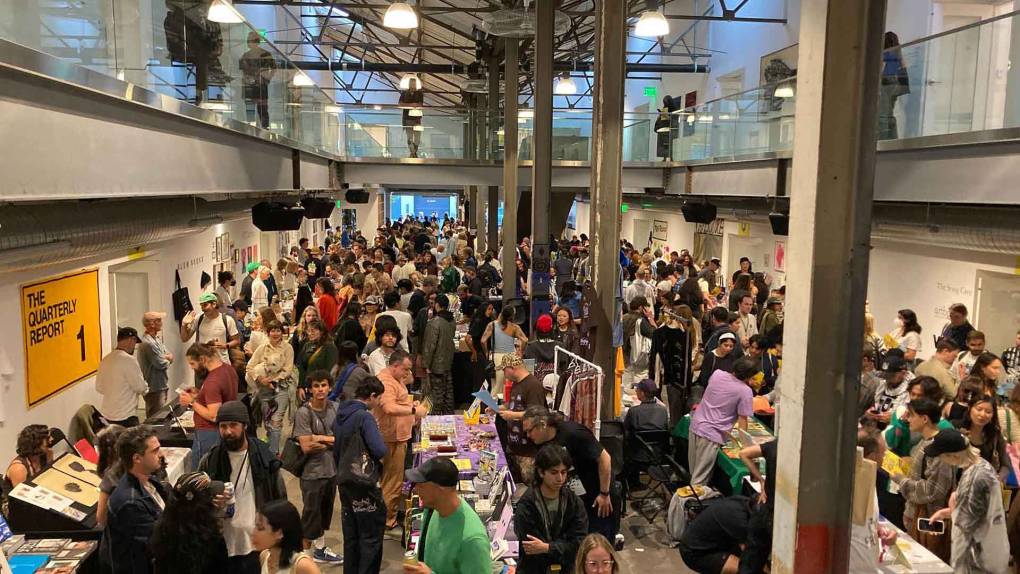
"caption": "The crowd at the 2024 SF Art Book Fair.",
"credit": "Gabe Meline/KQED",
"altTag": null,
"description": null,
"imgSizes": {
"medium": {
"file": "https://cdn.kqed.org/wp-content/uploads/sites/2/2024/07/SFArtsBook.MAIN_-800x450.jpg",
"width": 800,
"height": 450,
"mimeType": "image/jpeg"
},
"large": {
"file": "https://cdn.kqed.org/wp-content/uploads/sites/2/2024/07/SFArtsBook.MAIN_-1020x574.jpg",
"width": 1020,
"height": 574,
"mimeType": "image/jpeg"
},
"thumbnail": {
"file": "https://cdn.kqed.org/wp-content/uploads/sites/2/2024/07/SFArtsBook.MAIN_-160x90.jpg",
"width": 160,
"height": 90,
"mimeType": "image/jpeg"
},
"medium_large": {
"file": "https://cdn.kqed.org/wp-content/uploads/sites/2/2024/07/SFArtsBook.MAIN_-768x432.jpg",
"width": 768,
"height": 432,
"mimeType": "image/jpeg"
},
"1536x1536": {
"file": "https://cdn.kqed.org/wp-content/uploads/sites/2/2024/07/SFArtsBook.MAIN_-1536x864.jpg",
"width": 1536,
"height": 864,
"mimeType": "image/jpeg"
},
"post-thumbnail": {
"file": "https://cdn.kqed.org/wp-content/uploads/sites/2/2024/07/SFArtsBook.MAIN_-672x372.jpg",
"width": 672,
"height": 372,
"mimeType": "image/jpeg"
},
"twentyfourteen-full-width": {
"file": "https://cdn.kqed.org/wp-content/uploads/sites/2/2024/07/SFArtsBook.MAIN_-1038x576.jpg",
"width": 1038,
"height": 576,
"mimeType": "image/jpeg"
},
"kqedFullSize": {
"file": "https://cdn.kqed.org/wp-content/uploads/sites/2/2024/07/SFArtsBook.MAIN_.jpg",
"width": 1920,
"height": 1080
}
},
"isLoading": false,
"fetchFailed": false
},
"arts_13961311": {
"type": "attachments",
"id": "arts_13961311",
"meta": {
"index": "attachments_1716263798",
"site": "arts",
"id": "13961311",
"found": true
},
"title": "WithOpenEyes_Documentation-01_COVER",
"publishDate": 1721339755,
"status": "inherit",
"parent": 13961299,
"modified": 1721340069,
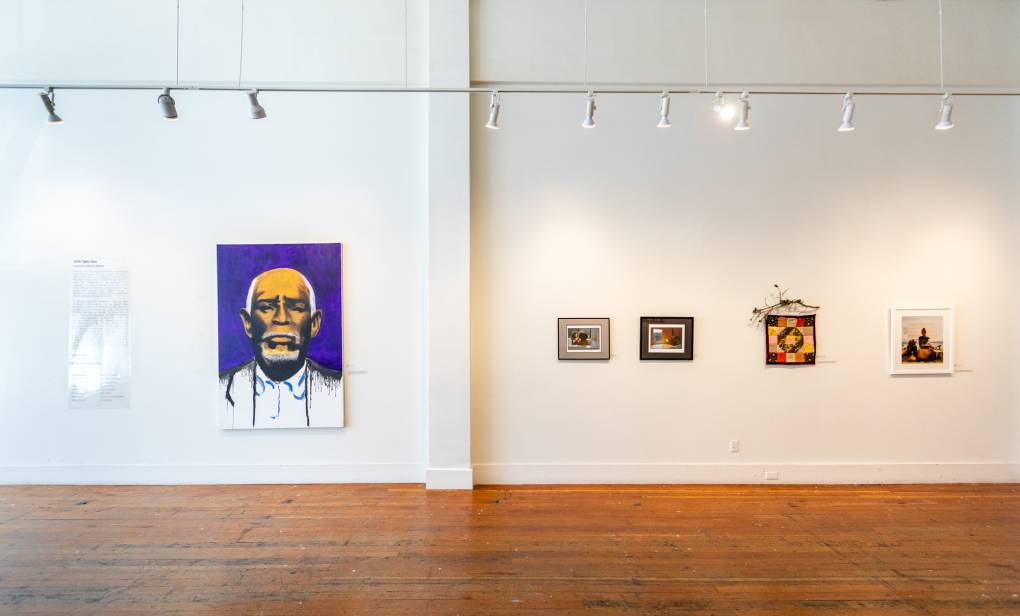
"caption": "An installation view of 'With Open Eyes' at Root Division.",
"credit": "Hunter Ridenour/Root Division",
"altTag": "Paintings and photographs on white gallery walls",
"description": null,
"imgSizes": {
"medium": {
"file": "https://cdn.kqed.org/wp-content/uploads/sites/2/2024/07/WithOpenEyes_Documentation-01_COVER-800x483.jpg",
"width": 800,
"height": 483,
"mimeType": "image/jpeg"
},
"large": {
"file": "https://cdn.kqed.org/wp-content/uploads/sites/2/2024/07/WithOpenEyes_Documentation-01_COVER-1020x616.jpg",
"width": 1020,
"height": 616,
"mimeType": "image/jpeg"
},
"thumbnail": {
"file": "https://cdn.kqed.org/wp-content/uploads/sites/2/2024/07/WithOpenEyes_Documentation-01_COVER-160x97.jpg",
"width": 160,
"height": 97,
"mimeType": "image/jpeg"
},
"medium_large": {
"file": "https://cdn.kqed.org/wp-content/uploads/sites/2/2024/07/WithOpenEyes_Documentation-01_COVER-768x463.jpg",
"width": 768,
"height": 463,
"mimeType": "image/jpeg"
},
"1536x1536": {
"file": "https://cdn.kqed.org/wp-content/uploads/sites/2/2024/07/WithOpenEyes_Documentation-01_COVER-1536x927.jpg",
"width": 1536,
"height": 927,
"mimeType": "image/jpeg"
},
"post-thumbnail": {
"file": "https://cdn.kqed.org/wp-content/uploads/sites/2/2024/07/WithOpenEyes_Documentation-01_COVER-672x372.jpg",
"width": 672,
"height": 372,
"mimeType": "image/jpeg"
},
"twentyfourteen-full-width": {
"file": "https://cdn.kqed.org/wp-content/uploads/sites/2/2024/07/WithOpenEyes_Documentation-01_COVER-1038x576.jpg",
"width": 1038,
"height": 576,
"mimeType": "image/jpeg"
},
"full-width": {
"file": "https://cdn.kqed.org/wp-content/uploads/sites/2/2024/07/WithOpenEyes_Documentation-01_COVER-1920x1159.jpg",
"width": 1920,
"height": 1159,
"mimeType": "image/jpeg"
},
"kqedFullSize": {
"file": "https://cdn.kqed.org/wp-content/uploads/sites/2/2024/07/WithOpenEyes_Documentation-01_COVER.jpg",
"width": 2000,
"height": 1207
}
},
"isLoading": false,
"fetchFailed": false
},
"arts_13961190": {
"type": "attachments",
"id": "arts_13961190",
"meta": {
"index": "attachments_1716263798",
"site": "arts",
"id": "13961190",
"found": true
},
"title": "DSC08515",
"publishDate": 1721142856,
"status": "inherit",
"parent": 13961188,
"modified": 1721239852,
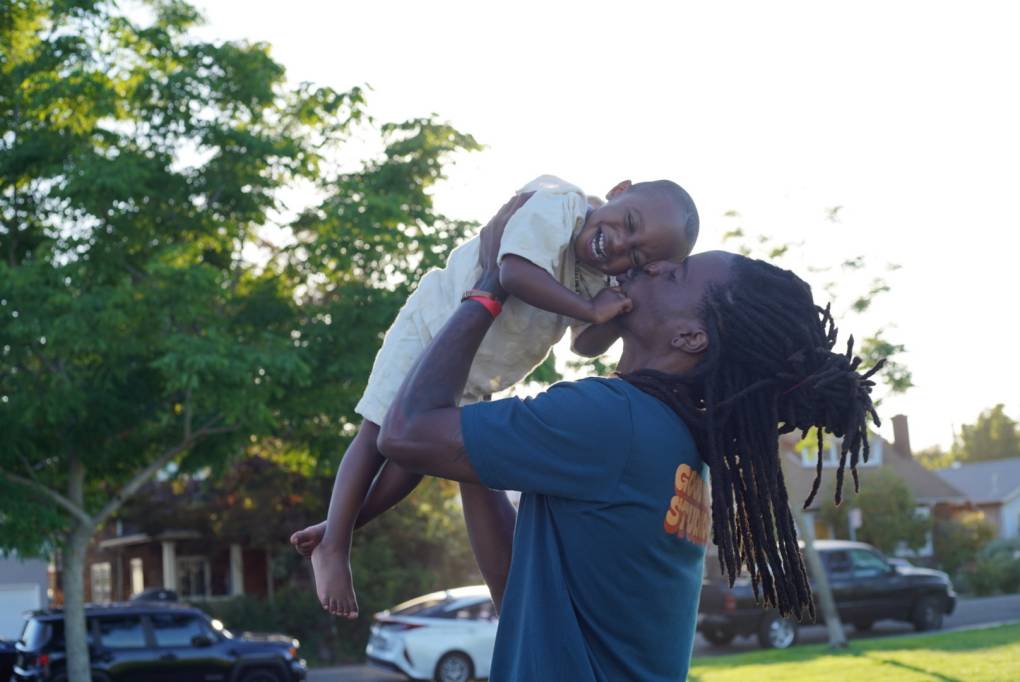
"caption": "Artist Timothy B. and his son share a moment at San Pablo Park in Berkeley. ",
"credit": "Pendarvis Harshaw",
"altTag": "Man with locs holding a smiling baby.",
"description": "Artist Timothy B. and his son share a moment at San Pablo Park in Berkeley. ",
"imgSizes": {
"medium": {
"file": "https://cdn.kqed.org/wp-content/uploads/sites/2/2024/07/DSC08515-800x535.jpg",
"width": 800,
"height": 535,
"mimeType": "image/jpeg"
},
"large": {
"file": "https://cdn.kqed.org/wp-content/uploads/sites/2/2024/07/DSC08515-1020x682.jpg",
"width": 1020,
"height": 682,
"mimeType": "image/jpeg"
},
"thumbnail": {
"file": "https://cdn.kqed.org/wp-content/uploads/sites/2/2024/07/DSC08515-160x107.jpg",
"width": 160,
"height": 107,
"mimeType": "image/jpeg"
},
"medium_large": {
"file": "https://cdn.kqed.org/wp-content/uploads/sites/2/2024/07/DSC08515-768x513.jpg",
"width": 768,
"height": 513,
"mimeType": "image/jpeg"
},
"1536x1536": {
"file": "https://cdn.kqed.org/wp-content/uploads/sites/2/2024/07/DSC08515-1536x1027.jpg",
"width": 1536,
"height": 1027,
"mimeType": "image/jpeg"
},
"post-thumbnail": {
"file": "https://cdn.kqed.org/wp-content/uploads/sites/2/2024/07/DSC08515-672x372.jpg",
"width": 672,
"height": 372,
"mimeType": "image/jpeg"
},
"twentyfourteen-full-width": {
"file": "https://cdn.kqed.org/wp-content/uploads/sites/2/2024/07/DSC08515-1038x576.jpg",
"width": 1038,
"height": 576,
"mimeType": "image/jpeg"
},
"kqedFullSize": {
"file": "https://cdn.kqed.org/wp-content/uploads/sites/2/2024/07/DSC08515.jpg",
"width": 1616,
"height": 1080
}
},
"isLoading": false,
"fetchFailed": false
},
"arts_13960594": {
"type": "attachments",
"id": "arts_13960594",
"meta": {
"index": "attachments_1716263798",
"site": "arts",
"id": "13960594",
"found": true
},
"title": "20240627_AlmaLandeta-6",
"publishDate": 1719852997,
"status": "inherit",
"parent": 0,
"modified": 1721087822,
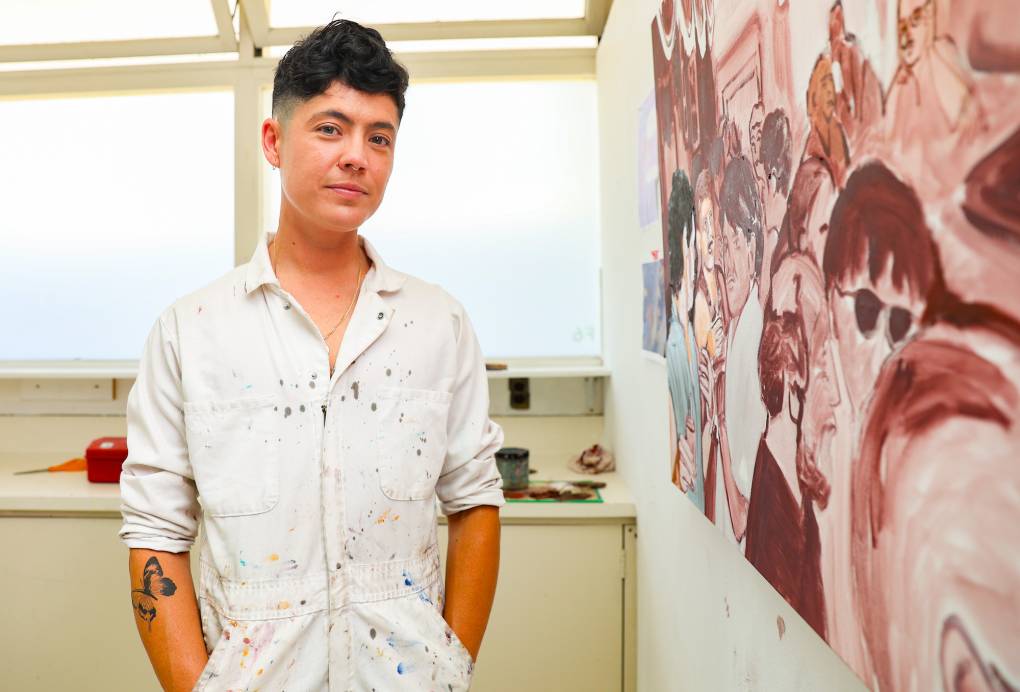
"caption": "Alma Landeta poses for a portrait in their Palo Alto studio on June 27, 2024. Alma, a trans and mixed-race visual artist, was selected as the 2024 King Artist in Residence; they will spend the year focusing on the lived experiences of the LGBTQAI+ communities residing or working in Palo Alto.",
"credit": "Gina Castro/KQED",
"altTag": "person with short hair stands in a painting studio in white jumpsuit",
"description": null,
"imgSizes": {
"medium": {
"file": "https://cdn.kqed.org/wp-content/uploads/sites/2/2024/07/20240627_AlmaLandeta-6-800x542.jpg",
"width": 800,
"height": 542,
"mimeType": "image/jpeg"
},
"large": {
"file": "https://cdn.kqed.org/wp-content/uploads/sites/2/2024/07/20240627_AlmaLandeta-6-1020x692.jpg",
"width": 1020,
"height": 692,
"mimeType": "image/jpeg"
},
"thumbnail": {
"file": "https://cdn.kqed.org/wp-content/uploads/sites/2/2024/07/20240627_AlmaLandeta-6-160x108.jpg",
"width": 160,
"height": 108,
"mimeType": "image/jpeg"
},
"medium_large": {
"file": "https://cdn.kqed.org/wp-content/uploads/sites/2/2024/07/20240627_AlmaLandeta-6-768x521.jpg",
"width": 768,
"height": 521,
"mimeType": "image/jpeg"
},
"1536x1536": {
"file": "https://cdn.kqed.org/wp-content/uploads/sites/2/2024/07/20240627_AlmaLandeta-6-1536x1041.jpg",
"width": 1536,
"height": 1041,
"mimeType": "image/jpeg"
},
"post-thumbnail": {
"file": "https://cdn.kqed.org/wp-content/uploads/sites/2/2024/07/20240627_AlmaLandeta-6-672x372.jpg",
"width": 672,
"height": 372,
"mimeType": "image/jpeg"
},
"twentyfourteen-full-width": {
"file": "https://cdn.kqed.org/wp-content/uploads/sites/2/2024/07/20240627_AlmaLandeta-6-1038x576.jpg",
"width": 1038,
"height": 576,
"mimeType": "image/jpeg"
},
"full-width": {
"file": "https://cdn.kqed.org/wp-content/uploads/sites/2/2024/07/20240627_AlmaLandeta-6-1920x1302.jpg",
"width": 1920,
"height": 1302,
"mimeType": "image/jpeg"
},
"kqedFullSize": {
"file": "https://cdn.kqed.org/wp-content/uploads/sites/2/2024/07/20240627_AlmaLandeta-6.jpg",
"width": 2000,
"height": 1356
}
},
"isLoading": false,
"fetchFailed": false
},
"arts_13960997": {
"type": "attachments",
"id": "arts_13960997",
"meta": {
"index": "attachments_1716263798",
"site": "arts",
"id": "13960997",
"found": true
},
"title": "240122-PORTSMOUTHSQUARE-29-BL-KQED",
"publishDate": 1720719221,
"status": "inherit",
"parent": 0,
"modified": 1720719558,
"caption": "San Francisco's Portsmouth Square, known as the 'Living Room of Chinatown,' will soon undergo major renovations. The city's Art Enrichment Ordinance will provide opportunities for new public art, with artists to be selected from the Chinatown Artist Registry.",
"credit": "Beth LaBerge/KQED",
"altTag": "People fill Portsmouth Square in San Francisco's Chinatown neighborhood on Jan. 22, 2024.",
"description": null,
"imgSizes": {
"medium": {
"file": "https://cdn.kqed.org/wp-content/uploads/sites/2/2024/07/240122-PORTSMOUTHSQUARE-29-BL-KQED-800x533.jpg",
"width": 800,
"height": 533,
"mimeType": "image/jpeg"
},
"large": {
"file": "https://cdn.kqed.org/wp-content/uploads/sites/2/2024/07/240122-PORTSMOUTHSQUARE-29-BL-KQED-1020x680.jpg",
"width": 1020,
"height": 680,
"mimeType": "image/jpeg"
},
"thumbnail": {
"file": "https://cdn.kqed.org/wp-content/uploads/sites/2/2024/07/240122-PORTSMOUTHSQUARE-29-BL-KQED-160x107.jpg",
"width": 160,
"height": 107,
"mimeType": "image/jpeg"
},
"medium_large": {
"file": "https://cdn.kqed.org/wp-content/uploads/sites/2/2024/07/240122-PORTSMOUTHSQUARE-29-BL-KQED-768x512.jpg",
"width": 768,
"height": 512,
"mimeType": "image/jpeg"
},
"1536x1536": {
"file": "https://cdn.kqed.org/wp-content/uploads/sites/2/2024/07/240122-PORTSMOUTHSQUARE-29-BL-KQED-1536x1024.jpg",
"width": 1536,
"height": 1024,
"mimeType": "image/jpeg"
},
"post-thumbnail": {
"file": "https://cdn.kqed.org/wp-content/uploads/sites/2/2024/07/240122-PORTSMOUTHSQUARE-29-BL-KQED-672x372.jpg",
"width": 672,
"height": 372,
"mimeType": "image/jpeg"
},
"twentyfourteen-full-width": {
"file": "https://cdn.kqed.org/wp-content/uploads/sites/2/2024/07/240122-PORTSMOUTHSQUARE-29-BL-KQED-1038x576.jpg",
"width": 1038,
"height": 576,
"mimeType": "image/jpeg"
},
"full-width": {
"file": "https://cdn.kqed.org/wp-content/uploads/sites/2/2024/07/240122-PORTSMOUTHSQUARE-29-BL-KQED-1920x1280.jpg",
"width": 1920,
"height": 1280,
"mimeType": "image/jpeg"
},
"kqedFullSize": {
"file": "https://cdn.kqed.org/wp-content/uploads/sites/2/2024/07/240122-PORTSMOUTHSQUARE-29-BL-KQED.jpg",
"width": 2000,
"height": 1333
}
},
"isLoading": false,
"fetchFailed": false
},
"arts_13960967": {
"type": "attachments",
"id": "arts_13960967",
"meta": {
"index": "attachments_1716263798",
"site": "arts",
"id": "13960967",
"found": true
},
"title": "2024_0701---CW-DL_08_2000",
"publishDate": 1720658851,
"status": "inherit",
"parent": 13960861,
"modified": 1720658966,
"caption": "Installation view of Dionne Lee's show at Cushion Works, 'Currents.'",
"credit": "Photo by Phillip Maisel; Courtesy the artist and Cushion Works",
"altTag": "two video monitors on floor and two small black-and-white photographs spotlit in gallery",
"description": null,
"imgSizes": {
"medium": {
"file": "https://cdn.kqed.org/wp-content/uploads/sites/2/2024/07/2024_0701-CW-DL_08_2000-800x534.jpg",
"width": 800,
"height": 534,
"mimeType": "image/jpeg"
},
"large": {
"file": "https://cdn.kqed.org/wp-content/uploads/sites/2/2024/07/2024_0701-CW-DL_08_2000-1020x681.jpg",
"width": 1020,
"height": 681,
"mimeType": "image/jpeg"
},
"thumbnail": {
"file": "https://cdn.kqed.org/wp-content/uploads/sites/2/2024/07/2024_0701-CW-DL_08_2000-160x107.jpg",
"width": 160,
"height": 107,
"mimeType": "image/jpeg"
},
"medium_large": {
"file": "https://cdn.kqed.org/wp-content/uploads/sites/2/2024/07/2024_0701-CW-DL_08_2000-768x513.jpg",
"width": 768,
"height": 513,
"mimeType": "image/jpeg"
},
"1536x1536": {
"file": "https://cdn.kqed.org/wp-content/uploads/sites/2/2024/07/2024_0701-CW-DL_08_2000-1536x1025.jpg",
"width": 1536,
"height": 1025,
"mimeType": "image/jpeg"
},
"post-thumbnail": {
"file": "https://cdn.kqed.org/wp-content/uploads/sites/2/2024/07/2024_0701-CW-DL_08_2000-672x372.jpg",
"width": 672,
"height": 372,
"mimeType": "image/jpeg"
},
"twentyfourteen-full-width": {
"file": "https://cdn.kqed.org/wp-content/uploads/sites/2/2024/07/2024_0701-CW-DL_08_2000-1038x576.jpg",
"width": 1038,
"height": 576,
"mimeType": "image/jpeg"
},
"full-width": {
"file": "https://cdn.kqed.org/wp-content/uploads/sites/2/2024/07/2024_0701-CW-DL_08_2000-1920x1282.jpg",
"width": 1920,
"height": 1282,
"mimeType": "image/jpeg"
},
"kqedFullSize": {
"file": "https://cdn.kqed.org/wp-content/uploads/sites/2/2024/07/2024_0701-CW-DL_08_2000.jpg",
"width": 2000,
"height": 1335
}
},
"isLoading": false,
"fetchFailed": false
},
"arts_13960814": {
"type": "attachments",
"id": "arts_13960814",
"meta": {
"index": "attachments_1716263798",
"site": "arts",
"id": "13960814",
"found": true
},
"title": "House_of_Seiko_Tyler_Cross_Kyle_Lypka_install_hires_V2_0003_2000",
"publishDate": 1720552022,
"status": "inherit",
"parent": 13960799,
"modified": 1720552105,
"caption": "Cross Lypka, 'vVVv,' 2024; glazed ceramic, 11 x 84 x 7 inches.",
"credit": "House of Seiko",
"altTag": "Detail of abstract glazed ceramic that covers a protruding corner in a white gallery space",
"description": null,
"imgSizes": {
"medium": {
"file": "https://cdn.kqed.org/wp-content/uploads/sites/2/2024/07/House_of_Seiko_Tyler_Cross_Kyle_Lypka_install_hires_V2_0003_2000-800x450.jpg",
"width": 800,
"height": 450,
"mimeType": "image/jpeg"
},
"large": {
"file": "https://cdn.kqed.org/wp-content/uploads/sites/2/2024/07/House_of_Seiko_Tyler_Cross_Kyle_Lypka_install_hires_V2_0003_2000-1020x574.jpg",
"width": 1020,
"height": 574,
"mimeType": "image/jpeg"
},
"thumbnail": {
"file": "https://cdn.kqed.org/wp-content/uploads/sites/2/2024/07/House_of_Seiko_Tyler_Cross_Kyle_Lypka_install_hires_V2_0003_2000-160x90.jpg",
"width": 160,
"height": 90,
"mimeType": "image/jpeg"
},
"medium_large": {
"file": "https://cdn.kqed.org/wp-content/uploads/sites/2/2024/07/House_of_Seiko_Tyler_Cross_Kyle_Lypka_install_hires_V2_0003_2000-768x432.jpg",
"width": 768,
"height": 432,
"mimeType": "image/jpeg"
},
"1536x1536": {
"file": "https://cdn.kqed.org/wp-content/uploads/sites/2/2024/07/House_of_Seiko_Tyler_Cross_Kyle_Lypka_install_hires_V2_0003_2000-1536x864.jpg",
"width": 1536,
"height": 864,
"mimeType": "image/jpeg"
},
"post-thumbnail": {
"file": "https://cdn.kqed.org/wp-content/uploads/sites/2/2024/07/House_of_Seiko_Tyler_Cross_Kyle_Lypka_install_hires_V2_0003_2000-672x372.jpg",
"width": 672,
"height": 372,
"mimeType": "image/jpeg"
},
"twentyfourteen-full-width": {
"file": "https://cdn.kqed.org/wp-content/uploads/sites/2/2024/07/House_of_Seiko_Tyler_Cross_Kyle_Lypka_install_hires_V2_0003_2000-1038x576.jpg",
"width": 1038,
"height": 576,
"mimeType": "image/jpeg"
},
"full-width": {
"file": "https://cdn.kqed.org/wp-content/uploads/sites/2/2024/07/House_of_Seiko_Tyler_Cross_Kyle_Lypka_install_hires_V2_0003_2000-1920x1080.jpg",
"width": 1920,
"height": 1080,
"mimeType": "image/jpeg"
},
"kqedFullSize": {
"file": "https://cdn.kqed.org/wp-content/uploads/sites/2/2024/07/House_of_Seiko_Tyler_Cross_Kyle_Lypka_install_hires_V2_0003_2000.jpg",
"width": 2000,
"height": 1125
}
},
"isLoading": false,
"fetchFailed": false
},
"arts_13960787": {
"type": "attachments",
"id": "arts_13960787",
"meta": {
"index": "attachments_1716263798",
"site": "arts",
"id": "13960787",
"found": true
},
"title": "A century-old wrestling competition in Bangladesh draws thousands of spectators annually. In this picture from April 24, 2023, two wrestlers go at it on a sandy stage in front of a street audience.",
"publishDate": 1720548143,
"status": "inherit",
"parent": 13960786,
"modified": 1720548406,
"caption": "A century-old wrestling competition in Bangladesh draws thousands of spectators annually. In this picture from April 24, 2023, two wrestlers go at it on a sandy stage in front of a street audience.",
"credit": "Sanchayan Chowdhury",
"altTag": "A large crowd gathers around a designated space where two wrestlers are engaged in a match.",
"description": null,
"imgSizes": {
"medium": {
"file": "https://cdn.kqed.org/wp-content/uploads/sites/2/2024/06/sport-sanchayan-chowdhury-800x533.jpeg",
"width": 800,
"height": 533,
"mimeType": "image/jpeg"
},
"large": {
"file": "https://cdn.kqed.org/wp-content/uploads/sites/2/2024/06/sport-sanchayan-chowdhury-1020x679.jpeg",
"width": 1020,
"height": 679,
"mimeType": "image/jpeg"
},
"thumbnail": {
"file": "https://cdn.kqed.org/wp-content/uploads/sites/2/2024/06/sport-sanchayan-chowdhury-160x107.jpeg",
"width": 160,
"height": 107,
"mimeType": "image/jpeg"
},
"medium_large": {
"file": "https://cdn.kqed.org/wp-content/uploads/sites/2/2024/06/sport-sanchayan-chowdhury-768x512.jpeg",
"width": 768,
"height": 512,
"mimeType": "image/jpeg"
},
"1536x1536": {
"file": "https://cdn.kqed.org/wp-content/uploads/sites/2/2024/06/sport-sanchayan-chowdhury-1536x1023.jpeg",
"width": 1536,
"height": 1023,
"mimeType": "image/jpeg"
},
"post-thumbnail": {
"file": "https://cdn.kqed.org/wp-content/uploads/sites/2/2024/06/sport-sanchayan-chowdhury-672x372.jpeg",
"width": 672,
"height": 372,
"mimeType": "image/jpeg"
},
"twentyfourteen-full-width": {
"file": "https://cdn.kqed.org/wp-content/uploads/sites/2/2024/06/sport-sanchayan-chowdhury-1038x576.jpeg",
"width": 1038,
"height": 576,
"mimeType": "image/jpeg"
},
"kqedFullSize": {
"file": "https://cdn.kqed.org/wp-content/uploads/sites/2/2024/06/sport-sanchayan-chowdhury.jpeg",
"width": 1920,
"height": 1279
}
},
"isLoading": false,
"fetchFailed": false
},
"arts_13960512": {
"type": "attachments",
"id": "arts_13960512",
"meta": {
"index": "attachments_1716263798",
"site": "arts",
"id": "13960512",
"found": true
},
"title": "2024_06_19_BoMu6729 1",
"publishDate": 1719606219,
"status": "inherit",
"parent": 13960505,
"modified": 1719606665,
"caption": "Installation view of Arleene Correa Valencia's Bolinas Museum show 'Llévanos Contigo / Take Us With You.'",
"credit": "Courtesy Bolinas Museum",
"altTag": "three textile pieces on white walls with windows",
"description": null,
"imgSizes": {
"medium": {
"file": "https://cdn.kqed.org/wp-content/uploads/sites/2/2024/06/2024_06_19_BoMu6729-1-800x600.jpeg",
"width": 800,
"height": 600,
"mimeType": "image/jpeg"
},
"large": {
"file": "https://cdn.kqed.org/wp-content/uploads/sites/2/2024/06/2024_06_19_BoMu6729-1-1020x765.jpeg",
"width": 1020,
"height": 765,
"mimeType": "image/jpeg"
},
"thumbnail": {
"file": "https://cdn.kqed.org/wp-content/uploads/sites/2/2024/06/2024_06_19_BoMu6729-1-160x120.jpeg",
"width": 160,
"height": 120,
"mimeType": "image/jpeg"
},
"medium_large": {
"file": "https://cdn.kqed.org/wp-content/uploads/sites/2/2024/06/2024_06_19_BoMu6729-1-768x576.jpeg",
"width": 768,
"height": 576,
"mimeType": "image/jpeg"
},
"post-thumbnail": {
"file": "https://cdn.kqed.org/wp-content/uploads/sites/2/2024/06/2024_06_19_BoMu6729-1-672x372.jpeg",
"width": 672,
"height": 372,
"mimeType": "image/jpeg"
},
"twentyfourteen-full-width": {
"file": "https://cdn.kqed.org/wp-content/uploads/sites/2/2024/06/2024_06_19_BoMu6729-1-1038x576.jpeg",
"width": 1038,
"height": 576,
"mimeType": "image/jpeg"
},
"kqedFullSize": {
"file": "https://cdn.kqed.org/wp-content/uploads/sites/2/2024/06/2024_06_19_BoMu6729-1.jpeg",
"width": 1280,
"height": 960
}
},
"isLoading": false,
"fetchFailed": false
},
"arts_13960407": {
"type": "attachments",
"id": "arts_13960407",
"meta": {
"index": "attachments_1716263798",
"site": "arts",
"id": "13960407",
"found": true
},
"title": "14. Kwaidan",
"publishDate": 1719521095,
"status": "inherit",
"parent": 13960392,
"modified": 1719521268,
"caption": "A still from Masaki Kobayashi's 'Kwaidan,' 1964, selected by Hiroshi Sugimoto.",
"credit": "Janus Films",
"altTag": "Blue-lit close-up of person's face",
"description": null,
"imgSizes": {
"medium": {
"file": "https://cdn.kqed.org/wp-content/uploads/sites/2/2024/06/14.-Kwaidan-800x450.jpg",
"width": 800,
"height": 450,
"mimeType": "image/jpeg"
},
"large": {
"file": "https://cdn.kqed.org/wp-content/uploads/sites/2/2024/06/14.-Kwaidan-1020x574.jpg",
"width": 1020,
"height": 574,
"mimeType": "image/jpeg"
},
"thumbnail": {
"file": "https://cdn.kqed.org/wp-content/uploads/sites/2/2024/06/14.-Kwaidan-160x90.jpg",
"width": 160,
"height": 90,
"mimeType": "image/jpeg"
},
"medium_large": {
"file": "https://cdn.kqed.org/wp-content/uploads/sites/2/2024/06/14.-Kwaidan-768x432.jpg",
"width": 768,
"height": 432,
"mimeType": "image/jpeg"
},
"post-thumbnail": {
"file": "https://cdn.kqed.org/wp-content/uploads/sites/2/2024/06/14.-Kwaidan-672x372.jpg",
"width": 672,
"height": 372,
"mimeType": "image/jpeg"
},
"twentyfourteen-full-width": {
"file": "https://cdn.kqed.org/wp-content/uploads/sites/2/2024/06/14.-Kwaidan-1038x576.jpg",
"width": 1038,
"height": 576,
"mimeType": "image/jpeg"
},
"kqedFullSize": {
"file": "https://cdn.kqed.org/wp-content/uploads/sites/2/2024/06/14.-Kwaidan.jpg",
"width": 1440,
"height": 810
}
},
"isLoading": false,
"fetchFailed": false
},
"arts_13960554": {
"type": "attachments",
"id": "arts_13960554",
"meta": {
"index": "attachments_1716263798",
"site": "arts",
"id": "13960554",
"found": true
},
"title": "install-1_2000",
"publishDate": 1719609542,
"status": "inherit",
"parent": 13960533,
"modified": 1719609689,
"caption": "Installation view of J Rivera Pansa's 'Imagers' at Et al.",
"credit": "Courtesy Et al.",
"altTag": "white-walled space with three minimal grid wall sculptures and large lavender platforms at center",
"description": null,
"imgSizes": {
"medium": {
"file": "https://cdn.kqed.org/wp-content/uploads/sites/2/2024/06/install-1_2000-800x450.jpg",
"width": 800,
"height": 450,
"mimeType": "image/jpeg"
},
"large": {
"file": "https://cdn.kqed.org/wp-content/uploads/sites/2/2024/06/install-1_2000-1020x574.jpg",
"width": 1020,
"height": 574,
"mimeType": "image/jpeg"
},
"thumbnail": {
"file": "https://cdn.kqed.org/wp-content/uploads/sites/2/2024/06/install-1_2000-160x90.jpg",
"width": 160,
"height": 90,
"mimeType": "image/jpeg"
},
"medium_large": {
"file": "https://cdn.kqed.org/wp-content/uploads/sites/2/2024/06/install-1_2000-768x432.jpg",
"width": 768,
"height": 432,
"mimeType": "image/jpeg"
},
"1536x1536": {
"file": "https://cdn.kqed.org/wp-content/uploads/sites/2/2024/06/install-1_2000-1536x864.jpg",
"width": 1536,
"height": 864,
"mimeType": "image/jpeg"
},
"post-thumbnail": {
"file": "https://cdn.kqed.org/wp-content/uploads/sites/2/2024/06/install-1_2000-672x372.jpg",
"width": 672,
"height": 372,
"mimeType": "image/jpeg"
},
"twentyfourteen-full-width": {
"file": "https://cdn.kqed.org/wp-content/uploads/sites/2/2024/06/install-1_2000-1038x576.jpg",
"width": 1038,
"height": 576,
"mimeType": "image/jpeg"
},
"full-width": {
"file": "https://cdn.kqed.org/wp-content/uploads/sites/2/2024/06/install-1_2000-1920x1080.jpg",
"width": 1920,
"height": 1080,
"mimeType": "image/jpeg"
},
"kqedFullSize": {
"file": "https://cdn.kqed.org/wp-content/uploads/sites/2/2024/06/install-1_2000.jpg",
"width": 2000,
"height": 1125
}
},
"isLoading": false,
"fetchFailed": false
},
"arts_13960201": {
"type": "attachments",
"id": "arts_13960201",
"meta": {
"index": "attachments_1716263798",
"site": "arts",
"id": "13960201",
"found": true
},
"title": "2024-06-24-0007",
"publishDate": 1719257790,
"status": "inherit",
"parent": 13960198,
"modified": 1719257859,
"caption": "Lorraine Shemesh, 'Criss-Cross' (Detail), 1995. ",
"credit": "Sebastopol Center for the Arts / Collection of Heather Stone",
"altTag": null,
"description": null,
"imgSizes": {
"medium": {
"file": "https://cdn.kqed.org/wp-content/uploads/sites/2/2024/06/2024-06-24-0007-800x450.jpg",
"width": 800,
"height": 450,
"mimeType": "image/jpeg"
},
"large": {
"file": "https://cdn.kqed.org/wp-content/uploads/sites/2/2024/06/2024-06-24-0007-1020x574.jpg",
"width": 1020,
"height": 574,
"mimeType": "image/jpeg"
},
"thumbnail": {
"file": "https://cdn.kqed.org/wp-content/uploads/sites/2/2024/06/2024-06-24-0007-160x90.jpg",
"width": 160,
"height": 90,
"mimeType": "image/jpeg"
},
"medium_large": {
"file": "https://cdn.kqed.org/wp-content/uploads/sites/2/2024/06/2024-06-24-0007-768x432.jpg",
"width": 768,
"height": 432,
"mimeType": "image/jpeg"
},
"1536x1536": {
"file": "https://cdn.kqed.org/wp-content/uploads/sites/2/2024/06/2024-06-24-0007-1536x864.jpg",
"width": 1536,
"height": 864,
"mimeType": "image/jpeg"
},
"post-thumbnail": {
"file": "https://cdn.kqed.org/wp-content/uploads/sites/2/2024/06/2024-06-24-0007-672x372.jpg",
"width": 672,
"height": 372,
"mimeType": "image/jpeg"
},
"twentyfourteen-full-width": {
"file": "https://cdn.kqed.org/wp-content/uploads/sites/2/2024/06/2024-06-24-0007-1038x576.jpg",
"width": 1038,
"height": 576,
"mimeType": "image/jpeg"
},
"kqedFullSize": {
"file": "https://cdn.kqed.org/wp-content/uploads/sites/2/2024/06/2024-06-24-0007.jpg",
"width": 1920,
"height": 1080
}
},
"isLoading": false,
"fetchFailed": false
}
},
"audioPlayerReducer": {
"postId": "stream_live",
"isPaused": true,
"isPlaying": false,
"pfsActive": false,
"pledgeModalIsOpen": true,
"playerDrawerIsOpen": false,
"liveAudioPlayStartedAt": 0,
"liveAudioPlayContext": ""
},
"authorsReducer": {
"byline_arts_13961299": {
"type": "authors",
"id": "byline_arts_13961299",
"meta": {
"override": true
},
"slug": "byline_arts_13961299",
"name": "Emily Wilson",
"isLoading": false
},
"byline_arts_13961177": {
"type": "authors",
"id": "byline_arts_13961177",
"meta": {
"override": true
},
"slug": "byline_arts_13961177",
"name": "Emily Wilson",
"isLoading": false
},
"byline_arts_13960786": {
"type": "authors",
"id": "byline_arts_13960786",
"meta": {
"override": true
},
"slug": "byline_arts_13960786",
"name": "Kamala Thiagarajan",
"isLoading": false
},
"byline_arts_13960533": {
"type": "authors",
"id": "byline_arts_13960533",
"meta": {
"override": true
},
"slug": "byline_arts_13960533",
"name": "Claire Frost",
"isLoading": false
},
"shotchkiss": {
"type": "authors",
"id": "61",
"meta": {
"index": "authors_1716337520",
"id": "61",
"found": true
},
"name": "Sarah Hotchkiss",
"firstName": "Sarah",
"lastName": "Hotchkiss",
"slug": "shotchkiss",
"email": "shotchkiss@kqed.org",
"display_author_email": true,
"staff_mastheads": [
"arts"
],
"title": "Senior Editor",
"bio": "Sarah Hotchkiss is a San Francisco \u003ca href=\"http://www.sarahhotchkiss.com\">artist\u003c/a> and arts writer. In 2019, she received the Dorothea & Leo Rabkin Foundation grant for visual art journalism and in 2020 she received a Society of Professional Journalists, Northern California award for excellence in arts and culture reporting.",
"avatar": "https://secure.gravatar.com/avatar/bc662df144b3d27fd8b1b6f1c2a420d34e91e53154d411bb7ad353cc8b6cea8d?s=600&d=blank&r=g",
"twitter": null,
"bluesky": null,
"facebook": null,
"instagram": null,
"linkedin": null,
"sites": [
{
"site": "",
"roles": [
"editor"
]
},
{
"site": "arts",
"roles": [
"Contributor",
"administrator"
]
},
{
"site": "artschool",
"roles": [
"administrator"
]
},
{
"site": "news",
"roles": [
"editor"
]
},
{
"site": "pop",
"roles": [
"administrator"
]
},
{
"site": "bayareabites",
"roles": [
"editor"
]
},
{
"site": "spark",
"roles": [
"editor"
]
},
{
"site": "checkplease",
"roles": [
"editor"
]
}
],
"headData": {
"title": "Sarah Hotchkiss | KQED",
"description": "Senior Editor",
"ogImgSrc": "https://secure.gravatar.com/avatar/bc662df144b3d27fd8b1b6f1c2a420d34e91e53154d411bb7ad353cc8b6cea8d?s=600&d=blank&r=g",
"twImgSrc": "https://secure.gravatar.com/avatar/bc662df144b3d27fd8b1b6f1c2a420d34e91e53154d411bb7ad353cc8b6cea8d?s=600&d=blank&r=g"
},
"isLoading": false,
"link": "/author/shotchkiss"
},
"gmeline": {
"type": "authors",
"id": "185",
"meta": {
"index": "authors_1716337520",
"id": "185",
"found": true
},
"name": "Gabe Meline",
"firstName": "Gabe",
"lastName": "Meline",
"slug": "gmeline",
"email": "gmeline@kqed.org",
"display_author_email": true,
"staff_mastheads": [
"arts"
],
"title": "Senior Editor, KQED Arts & Culture",
"bio": "Gabe Meline entered journalism at age 15 making photocopied zines, and has since earned awards from the Edward R. Murrow Awards, the Society for Professional Journalists, the Online Journalism Awards, the Association of Alternative Newsweeklies and the California Newspaper Publishers Association. Prior to KQED, he was the editor of the \u003cem>North Bay Bohemian\u003c/em> and a touring musician. He lives with his wife and daughter in his hometown of Santa Rosa, CA.",
"avatar": "https://secure.gravatar.com/avatar/5bebe57be0d8bc2dd318934feb47299e2d2d10cba28d09d8d7afb389a2ce2bdd?s=600&d=blank&r=g",
"twitter": null,
"bluesky": null,
"facebook": null,
"instagram": null,
"linkedin": null,
"sites": [
{
"site": "",
"roles": [
"editor"
]
},
{
"site": "arts",
"roles": [
"administrator"
]
},
{
"site": "artschool",
"roles": [
"editor"
]
},
{
"site": "news",
"roles": [
"author"
]
},
{
"site": "pop",
"roles": [
"editor"
]
},
{
"site": "bayareabites",
"roles": [
"editor"
]
},
{
"site": "food",
"roles": [
"editor"
]
},
{
"site": "forum",
"roles": [
"administrator"
]
},
{
"site": "liveblog",
"roles": [
"editor"
]
},
{
"site": "hiphop",
"roles": [
"editor"
]
}
],
"headData": {
"title": "Gabe Meline | KQED",
"description": "Senior Editor, KQED Arts & Culture",
"ogImgSrc": "https://secure.gravatar.com/avatar/5bebe57be0d8bc2dd318934feb47299e2d2d10cba28d09d8d7afb389a2ce2bdd?s=600&d=blank&r=g",
"twImgSrc": "https://secure.gravatar.com/avatar/5bebe57be0d8bc2dd318934feb47299e2d2d10cba28d09d8d7afb389a2ce2bdd?s=600&d=blank&r=g"
},
"isLoading": false,
"link": "/author/gmeline"
},
"ogpenn": {
"type": "authors",
"id": "11491",
"meta": {
"index": "authors_1716337520",
"id": "11491",
"found": true
},
"name": "Pendarvis Harshaw",
"firstName": "Pendarvis",
"lastName": "Harshaw",
"slug": "ogpenn",
"email": "ogpenn@gmail.com",
"display_author_email": false,
"staff_mastheads": [
"arts"
],
"title": "Community Engagement Reporter",
"bio": "Pendarvis Harshaw is an educator, host and writer with KQED Arts.",
"avatar": "https://secure.gravatar.com/avatar/972b77ee8e3f346ae2b00622661187fbfabd059b5693bbdc1475ea7a722fd4cd?s=600&d=blank&r=g",
"twitter": null,
"bluesky": null,
"facebook": null,
"instagram": "ogpenn",
"linkedin": null,
"sites": [
{
"site": "arts",
"roles": [
"administrator"
]
},
{
"site": "news",
"roles": [
"editor"
]
},
{
"site": "bayareabites",
"roles": [
"author"
]
},
{
"site": "hiphop",
"roles": [
"editor"
]
}
],
"headData": {
"title": "Pendarvis Harshaw | KQED",
"description": "Community Engagement Reporter",
"ogImgSrc": "https://secure.gravatar.com/avatar/972b77ee8e3f346ae2b00622661187fbfabd059b5693bbdc1475ea7a722fd4cd?s=600&d=blank&r=g",
"twImgSrc": "https://secure.gravatar.com/avatar/972b77ee8e3f346ae2b00622661187fbfabd059b5693bbdc1475ea7a722fd4cd?s=600&d=blank&r=g"
},
"isLoading": false,
"link": "/author/ogpenn"
},
"mmedina": {
"type": "authors",
"id": "11528",
"meta": {
"index": "authors_1716337520",
"id": "11528",
"found": true
},
"name": "Marisol Medina-Cadena",
"firstName": "Marisol",
"lastName": "Medina-Cadena",
"slug": "mmedina",
"email": "mmedina@KQED.org",
"display_author_email": true,
"staff_mastheads": [],
"title": "Producer, Rightnowish Podcast",
"bio": "Marisol Medina-Cadena is a radio reporter and podcast producer. Before working at KQED, she produced for PBS member station, KCET, in Los Angeles. In 2017, Marisol won an Emmy Award for her work on the televised documentary, \u003cem>City Rising\u003c/em>, examining California's affordable housing crisis and the historical roots of gentrification.",
"avatar": "https://secure.gravatar.com/avatar/6c3db46a1cabb5e1fe9a365b5f4e681e?s=600&d=blank&r=g",
"twitter": "marisolreports",
"facebook": null,
"instagram": null,
"linkedin": null,
"sites": [
{
"site": "arts",
"roles": []
},
{
"site": "news",
"roles": [
"edit_others_posts"
]
}
],
"headData": {
"title": "Marisol Medina-Cadena | KQED",
"description": "Producer, Rightnowish Podcast",
"ogImgSrc": "https://secure.gravatar.com/avatar/6c3db46a1cabb5e1fe9a365b5f4e681e?s=600&d=blank&r=g",
"twImgSrc": "https://secure.gravatar.com/avatar/6c3db46a1cabb5e1fe9a365b5f4e681e?s=600&d=blank&r=g"
},
"isLoading": false,
"link": "/author/mmedina"
},
"mblue": {
"type": "authors",
"id": "11917",
"meta": {
"index": "authors_1716337520",
"id": "11917",
"found": true
},
"name": "Max Blue",
"firstName": "Max",
"lastName": "Blue",
"slug": "mblue",
"email": "maxbluewriter@gmail.com",
"display_author_email": false,
"staff_mastheads": [],
"title": "KQED Contributor",
"bio": "Max Blue has contributed art criticism and reporting to Artsy, Cultured and Hyperallergic, among others. His short fiction has appeared in The MacGuffin and North Dakota Quarterly, among others. He lives in San Francisco.",
"avatar": "https://secure.gravatar.com/avatar/cf3bc08316ae54aaf34b606edc5721301b3306703234df5bee49a54e69d29843?s=600&d=blank&r=g",
"twitter": null,
"bluesky": null,
"facebook": null,
"instagram": "maxblueofficial",
"linkedin": null,
"sites": [
{
"site": "arts",
"roles": [
"contributor"
]
}
],
"headData": {
"title": "Max Blue | KQED",
"description": "KQED Contributor",
"ogImgSrc": "https://secure.gravatar.com/avatar/cf3bc08316ae54aaf34b606edc5721301b3306703234df5bee49a54e69d29843?s=600&d=blank&r=g",
"twImgSrc": "https://secure.gravatar.com/avatar/cf3bc08316ae54aaf34b606edc5721301b3306703234df5bee49a54e69d29843?s=600&d=blank&r=g"
},
"isLoading": false,
"link": "/author/mblue"
}
},
"pagesReducer": {
"arts_category_visualarts": {
"type": "terms",
"id": "arts_70",
"meta": {
"index": "terms_1716263798",
"site": "arts",
"id": "70",
"score": 14.406956
},
"featImg": null,
"name": "Visual Arts",
"description": null,
"taxonomy": "category",
"headData": {
"twImgId": null,
"twTitle": null,
"ogTitle": null,
"ogImgId": null,
"twDescription": null,
"description": null,
"title": "Visual Arts Archives | KQED Arts",
"ogDescription": null
},
"ttid": 71,
"slug": "visualarts",
"isLoading": false,
"title": "Visual Arts",
"pageMeta": {
"site": "arts",
"WpPageTemplate": "page-topic-editorial",
"currentPage": 22
},
"blocks": [
{
"blockName": "kqed/post-list",
"attrs": {
"layout": "cardArticle2",
"query": "posts/arts?category=visualarts",
"seeMore": false,
"paginated": true,
"page": 22
}
},
{
"blockName": "kqed/ad"
}
]
}
},
"pfsSessionReducer": {},
"postsReducer": {
"stream_live": {
"type": "live",
"id": "stream_live",
"audioUrl": "https://streams.kqed.org/kqedradio",
"title": "Live Stream",
"excerpt": "Live Stream information currently unavailable.",
"link": "/radio",
"featImg": "",
"label": {
"name": "KQED Live",
"link": "/"
}
},
"stream_kqedNewscast": {
"type": "posts",
"id": "stream_kqedNewscast",
"audioUrl": "https://www.kqed.org/.stream/anon/radio/RDnews/newscast.mp3?_=1",
"title": "KQED Newscast",
"featImg": "",
"label": {
"name": "88.5 FM",
"link": "/"
}
},
"arts_13961341": {
"type": "posts",
"id": "arts_13961341",
"meta": {
"index": "posts_1716263798",
"site": "arts",
"id": "13961341",
"score": null,
"sort": [
1721414023000
]
},
"guestAuthors": [],
"slug": "sf-art-book-fair-zines-underground-small-press-review",
"title": "8 of the Coolest Things We Saw at the SF Art Book Fair",
"publishDate": 1721414023,
"format": "standard",
"headTitle": "8 of the Coolest Things We Saw at the SF Art Book Fair | KQED",
"labelTerm": {
"term": 140,
"site": "arts"
},
"content": "\u003cp>Books! Zines! Hordes of people! Thursday night saw the opening of the \u003ca href=\"https://sfartbookfair.com/\">SF Art Book Fair\u003c/a>, as much a delight to small-press aficionados as a nightmare for claustrophobics. I can confirm: it was shoulder-to-shoulder \u003cem>packed\u003c/em>.\u003c/p>\n\u003cp>In its seventh year, the fair held at the Minnesota Street Art Project in San Francisco’s Dogpatch district is more popular than ever, underscored by the addition of a second exhibition building (the former McEvoy Foundation for the Arts, up the street). The expansion didn’t alleviate the congestion. It did provide for plenty of exhibitors, however — a total of 145, hawking limited-run books, zines and prints of all styles and subject matter to the beanie-and-tight-jean set.\u003c/p>\n\u003cp>I spent a few hours at the fair, looking for the coolest, weirdest, most intriguing printed matter on offer. Here are eight things that caught my eye.\u003c/p>\n\u003cfigure id=\"attachment_13961365\" class=\"wp-caption aligncenter\" style=\"max-width: 1920px\">\u003cimg loading=\"lazy\" decoding=\"async\" src=\"https://cdn.kqed.org/wp-content/uploads/sites/2/2024/07/IMG_8219.jpg\" alt=\"\" width=\"1920\" height=\"1440\" class=\"size-full wp-image-13961365\" srcset=\"https://cdn.kqed.org/wp-content/uploads/sites/2/2024/07/IMG_8219.jpg 1920w, https://cdn.kqed.org/wp-content/uploads/sites/2/2024/07/IMG_8219-800x600.jpg 800w, https://cdn.kqed.org/wp-content/uploads/sites/2/2024/07/IMG_8219-1020x765.jpg 1020w, https://cdn.kqed.org/wp-content/uploads/sites/2/2024/07/IMG_8219-160x120.jpg 160w, https://cdn.kqed.org/wp-content/uploads/sites/2/2024/07/IMG_8219-768x576.jpg 768w, https://cdn.kqed.org/wp-content/uploads/sites/2/2024/07/IMG_8219-1536x1152.jpg 1536w\" sizes=\"(max-width: 1920px) 100vw, 1920px\">\u003cfigcaption class=\"wp-caption-text\">‘The Mission District,’ published by StreetSalad. \u003ccite>(Gabe Meline/KQED)\u003c/cite>\u003c/figcaption>\u003c/figure>\n\u003ch2>‘The Mission District’\u003c/h2>\n\u003cp>\u003cem>(StreetSalad, $40)\u003c/em>\u003c/p>\n\u003cp>In 1980, out of his shop on 23rd Street in San Francisco, comics legend \u003ca href=\"https://larryrippeeandmollyreaart.blogspot.com/2014/01/gary-arlington.html\">Gary Arlington\u003c/a> began paying neighborhood teenagers to make one-page illustrations. Eventually, he compiled them into a periodical titled \u003cem>The Mission District\u003c/em>, filled with pencil drawings and Chicano-style lettering. Now, StreetSalad’s Tron Martínez has reprinted them, along with the more scrapbook-like \u003cem>Cholo\u003c/em>, out of San José, both perfectly capturing the \u003cem>Teen Angels\u003c/em>-type aesthetic of the cholo and lowrider scenes. As for Gary’s shop, “underground comic book culture really permeated out of there,” said Martínez.\u003c/p>\n\u003cfigure id=\"attachment_13961366\" class=\"wp-caption aligncenter\" style=\"max-width: 1920px\">\u003cimg loading=\"lazy\" decoding=\"async\" src=\"https://cdn.kqed.org/wp-content/uploads/sites/2/2024/07/IMG_8225.jpg\" alt=\"\" width=\"1920\" height=\"1440\" class=\"size-full wp-image-13961366\" srcset=\"https://cdn.kqed.org/wp-content/uploads/sites/2/2024/07/IMG_8225.jpg 1920w, https://cdn.kqed.org/wp-content/uploads/sites/2/2024/07/IMG_8225-800x600.jpg 800w, https://cdn.kqed.org/wp-content/uploads/sites/2/2024/07/IMG_8225-1020x765.jpg 1020w, https://cdn.kqed.org/wp-content/uploads/sites/2/2024/07/IMG_8225-160x120.jpg 160w, https://cdn.kqed.org/wp-content/uploads/sites/2/2024/07/IMG_8225-768x576.jpg 768w, https://cdn.kqed.org/wp-content/uploads/sites/2/2024/07/IMG_8225-1536x1152.jpg 1536w\" sizes=\"(max-width: 1920px) 100vw, 1920px\">\u003cfigcaption class=\"wp-caption-text\">‘Emeryville Cool Fun Booklet,’ by Jessalyn Aaland. \u003ccite>(Gabe Meline/KQED)\u003c/cite>\u003c/figcaption>\u003c/figure>\n\u003ch2>‘Emeryville Cool Fun Booklet’\u003c/h2>\n\u003cp>\u003cem>Jessalyn Aaland (Current Editions, $15)\u003c/em>\u003c/p>\n\u003cp>[ad fullwidth]\u003c/p>\n\u003cp>In 2020, four years after moving to Emeryville from Oakland and in the throes of COVID lockdown, Jessalyn Aaland decided to learn more about the history of her new city. Each new rabbit hole resulted in an issue of \u003cem>Emeryville C☺☺L Fun Facts\u003c/em>, a monthly one-page newsletter covering Emeryville’s canneries, labor strikes, 1980s punk scene, public art, streetcar lines and more. With a Risograph printer at home and a pandemic yearning to return to more human ways of connecting, she stapled her insightful, chatty and often hilarious newsletters to poles all around town, adding a phone number at the bottom. \u003cem>Emeryville Cool Fun Booklet\u003c/em> compiles all nine issues, along with responses from readers who called the number. (“An older woman was like, ‘I live alone,’ and told me stories about her landlord,” Aaland said.) I brought it home and devoured it in one sitting.\u003c/p>\n\u003cfigure id=\"attachment_13961364\" class=\"wp-caption aligncenter\" style=\"max-width: 1920px\">\u003cimg loading=\"lazy\" decoding=\"async\" src=\"https://cdn.kqed.org/wp-content/uploads/sites/2/2024/07/IMG_8218.jpg\" alt=\"\" width=\"1920\" height=\"1440\" class=\"size-full wp-image-13961364\" srcset=\"https://cdn.kqed.org/wp-content/uploads/sites/2/2024/07/IMG_8218.jpg 1920w, https://cdn.kqed.org/wp-content/uploads/sites/2/2024/07/IMG_8218-800x600.jpg 800w, https://cdn.kqed.org/wp-content/uploads/sites/2/2024/07/IMG_8218-1020x765.jpg 1020w, https://cdn.kqed.org/wp-content/uploads/sites/2/2024/07/IMG_8218-160x120.jpg 160w, https://cdn.kqed.org/wp-content/uploads/sites/2/2024/07/IMG_8218-768x576.jpg 768w, https://cdn.kqed.org/wp-content/uploads/sites/2/2024/07/IMG_8218-1536x1152.jpg 1536w\" sizes=\"(max-width: 1920px) 100vw, 1920px\">\u003cfigcaption class=\"wp-caption-text\">‘The Invisible,’ by Barbara Stauffacher Solomon. \u003ccite>(Gabe Meline/KQED)\u003c/cite>\u003c/figcaption>\u003c/figure>\n\u003ch2>‘The Invisible’\u003c/h2>\n\u003cp>\u003cem>Barbara Stauffacher Solomon (Colpa Press, $40)\u003c/em>\u003c/p>\n\u003cp>When Colpa Press’ Luca Antonucci first met \u003ca href=\"https://www.kqed.org/arts/13957530/barbara-stauffacher-solomon-supergraphics-obituary\">supergraphics pioneer\u003c/a> Barbara Stauffacher Solomon, she was making her own books at Kinko’s in San Francisco. Now, two months after \u003ca href=\"https://www.nytimes.com/2024/05/08/arts/design/barbara-stauffacher-solomon-dead.html\">Solomon’s death at age 95\u003c/a>, he’s printed their fifth and final book together, spiral-bound in an edition of 200. Made of collages that Stauffacher Solomon cut and pasted directly to a \u003ca href=\"https://www.peopleofprint.com/exhibition/the-swiss-grid/\">Swiss Grid\u003c/a>, \u003cem>The Invisible\u003c/em> was turned in by Stauffacher Solomon just two weeks before her death in May — along with attached instructional notes, handwritten, which Antonucci opted to include. “Scanning them was super emotional,” he said, “almost as if she was talking to me from beyond the grave.”\u003c/p>\n\u003cfigure id=\"attachment_13961371\" class=\"wp-caption aligncenter\" style=\"max-width: 1920px\">\u003cimg loading=\"lazy\" decoding=\"async\" src=\"https://cdn.kqed.org/wp-content/uploads/sites/2/2024/07/IMG_8258.jpg\" alt=\"\" width=\"1920\" height=\"1440\" class=\"size-full wp-image-13961371\" srcset=\"https://cdn.kqed.org/wp-content/uploads/sites/2/2024/07/IMG_8258.jpg 1920w, https://cdn.kqed.org/wp-content/uploads/sites/2/2024/07/IMG_8258-800x600.jpg 800w, https://cdn.kqed.org/wp-content/uploads/sites/2/2024/07/IMG_8258-1020x765.jpg 1020w, https://cdn.kqed.org/wp-content/uploads/sites/2/2024/07/IMG_8258-160x120.jpg 160w, https://cdn.kqed.org/wp-content/uploads/sites/2/2024/07/IMG_8258-768x576.jpg 768w, https://cdn.kqed.org/wp-content/uploads/sites/2/2024/07/IMG_8258-1536x1152.jpg 1536w\" sizes=\"(max-width: 1920px) 100vw, 1920px\">\u003cfigcaption class=\"wp-caption-text\">‘You’re Gonna Miss Me / For Your Love,’ by the Tymes 5. \u003ccite>(Gabe Meline/KQED)\u003c/cite>\u003c/figcaption>\u003c/figure>\n\u003ch2>‘You’re Gonna Miss Me / For Your Love’\u003c/h2>\n\u003cp>\u003cem>(The Tymes 5 feat. Michael Jang, $16)\u003c/em>\u003c/p>\n\u003cp>Visitors to this year’s fair may notice a large wheatpaste nearby at 23rd and Tennessee, the handiwork of the dizzingly prolific \u003ca href=\"https://www.kqed.org/arts/13958762/who-is-michael-jang-documentary-michael-jacobs-sf-docfest\">Michael Jang\u003c/a>. A San Francisco photographer, street artist and subtle prankster, Jang once also… \u003cem>played in a 1960s garage band\u003c/em>?! Here’s the proof: a 7″ of The Tymes 5, for which Jang played guitar, recorded in 1965. Covering songs by the 13th Floor Elevators and the Zombies, the band is out of tune, the vocals are overblown, the tempo-challenged drums sound like cardboard boxes. It’s great! “They’ve been selling like crazy — more than we expected,” said Park Life’s Saffron Munkres. The huge wheatpasted advertisement down the street probably doesn’t hurt.\u003c/p>\n\u003cfigure id=\"attachment_13961362\" class=\"wp-caption aligncenter\" style=\"max-width: 1920px\">\u003cimg loading=\"lazy\" decoding=\"async\" src=\"https://cdn.kqed.org/wp-content/uploads/sites/2/2024/07/IMG_8209.jpg\" alt=\"\" width=\"1920\" height=\"1440\" class=\"size-full wp-image-13961362\" srcset=\"https://cdn.kqed.org/wp-content/uploads/sites/2/2024/07/IMG_8209.jpg 1920w, https://cdn.kqed.org/wp-content/uploads/sites/2/2024/07/IMG_8209-800x600.jpg 800w, https://cdn.kqed.org/wp-content/uploads/sites/2/2024/07/IMG_8209-1020x765.jpg 1020w, https://cdn.kqed.org/wp-content/uploads/sites/2/2024/07/IMG_8209-160x120.jpg 160w, https://cdn.kqed.org/wp-content/uploads/sites/2/2024/07/IMG_8209-768x576.jpg 768w, https://cdn.kqed.org/wp-content/uploads/sites/2/2024/07/IMG_8209-1536x1152.jpg 1536w\" sizes=\"(max-width: 1920px) 100vw, 1920px\">\u003cfigcaption class=\"wp-caption-text\">‘Bodega Rider,’ by Martha Naranjo Sandoval. \u003ccite>(Gabe Meline/KQED)\u003c/cite>\u003c/figcaption>\u003c/figure>\n\u003ch2>‘Bodega Rider’\u003c/h2>\n\u003cp>\u003cem>Martha Naranjo Sandoval (Matarile Ediciones, $14)\u003c/em>\u003c/p>\n\u003cp>Not everything at the SF Art Book Fair is local. Distributed by Brooklyn’s Seaton Street Press, this photo zine contains the artist’s self-portraits on coin-operated sidewalk rides outside bodegas in New York City. What captivated me were the range of emotions on Naranjo Sandoval’s face while revisiting these childhood sources of joy: excitement at seeing them, nostalgia for what they once provided, sadness at their decreasing prominence, frustration at aging out of simple pleasures. “She’s publishing for immigrants, specifically, in the diaspora,” said Seaton Street’s Lindsay Buchman, but anyone who spent 90 seconds and 50¢ on a bucking horse stationed outside a storefront will relate.\u003c/p>\n\u003cfigure id=\"attachment_13961368\" class=\"wp-caption aligncenter\" style=\"max-width: 1920px\">\u003cimg loading=\"lazy\" decoding=\"async\" src=\"https://cdn.kqed.org/wp-content/uploads/sites/2/2024/07/IMG_8235.jpg\" alt=\"\" width=\"1920\" height=\"1440\" class=\"size-full wp-image-13961368\" srcset=\"https://cdn.kqed.org/wp-content/uploads/sites/2/2024/07/IMG_8235.jpg 1920w, https://cdn.kqed.org/wp-content/uploads/sites/2/2024/07/IMG_8235-800x600.jpg 800w, https://cdn.kqed.org/wp-content/uploads/sites/2/2024/07/IMG_8235-1020x765.jpg 1020w, https://cdn.kqed.org/wp-content/uploads/sites/2/2024/07/IMG_8235-160x120.jpg 160w, https://cdn.kqed.org/wp-content/uploads/sites/2/2024/07/IMG_8235-768x576.jpg 768w, https://cdn.kqed.org/wp-content/uploads/sites/2/2024/07/IMG_8235-1536x1152.jpg 1536w\" sizes=\"(max-width: 1920px) 100vw, 1920px\">\u003cfigcaption class=\"wp-caption-text\">‘How to Art Book Fair,’ by Paul Shortt \u003ccite>(Gabe Meline/KQED)\u003c/cite>\u003c/figcaption>\u003c/figure>\n\u003ch2>‘How to Art Book Fair’\u003c/h2>\n\u003cp>\u003cem>Paul Shortt (Shortt Editions, $10)\u003c/em>\u003c/p>\n\u003cp>Talk about meta! This guide to art book fairs was being sold at the art book fair by Paul Shortt, who’d woken up Thursday morning at 3:30 a.m. in Florida before flying to San Francisco. “There’s a lot of books that teach you how to make books,” he said, “and not a lot of books that teach you how to \u003cem>sell\u003c/em> books.” (He should know; he’s been to over 50 art book fairs in the past decade.) I’d assumed this zine would be a snarky troll on art book fairs, but no — it’s a practical guide to their ins and outs, drawn from Shortt’s experiences as a vendor (“I’m very clear in the book about my own failures,” he quipped), and input from other veterans of the scene. Most of the advice is uber-specific, while some is refreshingly simple, like “don’t be a jerk.”\u003c/p>\n\u003cfigure id=\"attachment_13961369\" class=\"wp-caption aligncenter\" style=\"max-width: 1920px\">\u003cimg loading=\"lazy\" decoding=\"async\" src=\"https://cdn.kqed.org/wp-content/uploads/sites/2/2024/07/IMG_8238.jpg\" alt=\"\" width=\"1920\" height=\"1440\" class=\"size-full wp-image-13961369\" srcset=\"https://cdn.kqed.org/wp-content/uploads/sites/2/2024/07/IMG_8238.jpg 1920w, https://cdn.kqed.org/wp-content/uploads/sites/2/2024/07/IMG_8238-800x600.jpg 800w, https://cdn.kqed.org/wp-content/uploads/sites/2/2024/07/IMG_8238-1020x765.jpg 1020w, https://cdn.kqed.org/wp-content/uploads/sites/2/2024/07/IMG_8238-160x120.jpg 160w, https://cdn.kqed.org/wp-content/uploads/sites/2/2024/07/IMG_8238-768x576.jpg 768w, https://cdn.kqed.org/wp-content/uploads/sites/2/2024/07/IMG_8238-1536x1152.jpg 1536w\" sizes=\"(max-width: 1920px) 100vw, 1920px\">\u003cfigcaption class=\"wp-caption-text\">‘If You Listen, Music Will Find You: 35mm Photographs of the Bay Area Underground,’ by Ezra Gonzalez. \u003ccite>(Gabe Meline/KQED)\u003c/cite>\u003c/figcaption>\u003c/figure>\n\u003ch2>‘If You Listen, Music Will Find You: 35mm Photographs of the Bay Area Underground’\u003c/h2>\n\u003cp>\u003cem>Ezra Gonzalez (Nematode, $30 each)\u003c/em>\u003c/p>\n\u003cp>It’s a guarantee that your older punk friends have complained that music sucks now, or that the scene is dead. To which I always say: go to more shows! Now, there’s a tangible document to rebut those beardy, complainy denim-vest dudes: under the namesake \u003ca href=\"https://www.instagram.com/nematodeworld/\">Nematode\u003c/a>, Bay Area photographer Ezra Gonzalez has published two volumes documenting the local underground music scene. Spanning 2018–2020 and 2021–2023, the photos contain a few recognizable spots (Eli’s Mile High Club, the Rickshaw Stop), but most come from shows at basements, sidewalks and house parties. “It’s been really fun since we got them,” says Matt Brownell, co-owner of \u003ca href=\"https://coneshapetop.com/\">Cone Shape Top\u003c/a> in Oakland. “People pick up the book and say ‘I was at this show!'” Here’s to more photo books documenting the Bay Area’s rich DIY punk scene. (Please do it, \u003ca href=\"https://www.instagram.com/robcoonsphotography/?hl=en\">Rob Coons\u003c/a>!)\u003c/p>\n\u003cfigure id=\"attachment_13961370\" class=\"wp-caption aligncenter\" style=\"max-width: 1920px\">\u003cimg loading=\"lazy\" decoding=\"async\" src=\"https://cdn.kqed.org/wp-content/uploads/sites/2/2024/07/IMG_8244.jpg\" alt=\"\" width=\"1920\" height=\"1440\" class=\"size-full wp-image-13961370\" srcset=\"https://cdn.kqed.org/wp-content/uploads/sites/2/2024/07/IMG_8244.jpg 1920w, https://cdn.kqed.org/wp-content/uploads/sites/2/2024/07/IMG_8244-800x600.jpg 800w, https://cdn.kqed.org/wp-content/uploads/sites/2/2024/07/IMG_8244-1020x765.jpg 1020w, https://cdn.kqed.org/wp-content/uploads/sites/2/2024/07/IMG_8244-160x120.jpg 160w, https://cdn.kqed.org/wp-content/uploads/sites/2/2024/07/IMG_8244-768x576.jpg 768w, https://cdn.kqed.org/wp-content/uploads/sites/2/2024/07/IMG_8244-1536x1152.jpg 1536w\" sizes=\"(max-width: 1920px) 100vw, 1920px\">\u003cfigcaption class=\"wp-caption-text\">‘Advertising Shits in Your Head: Strategies for Resistance,’ by Vyvian Raoul and Matt Bonner. \u003ccite>(Gabe Meline/KQED)\u003c/cite>\u003c/figcaption>\u003c/figure>\n\u003ch2>‘Advertising Shits in Your Head: Strategies for Resistance’\u003c/h2>\n\u003cp>\u003cem>Vyvian Raoul and Matt Bonner (PM Press, $15.95)\u003c/em>\u003c/p>\n\u003cp>While wandering around the Art Book Fair, it’s easy to be seduced by eye-catching book titles (\u003cem>What Is Post-Branding?\u003c/em>, \u003cem>8-Bit Porn Video Games\u003c/em>, \u003cem>Uncreative Writing\u003c/em> by Taylor Swift). Some of these clever titles deliver on their promises, while many do not. This is, in effect, a microcosm of the advertising world! So I was glad to discover that \u003cem>Advertising Shits in Your Head\u003c/em> is backed up by substance as well as humor. Along with a primer on how advertising intrudes on our daily mental lives, the book focuses on “subvertising” — the art of altering, remixing or defacing billboard and poster ads. “A lot of these things, like bus kiosks, are easy to get into. And if it looks like it belongs there, it’ll stay there for a while,” says Dan from Oakland’s PM Press. “It’s a public space! Use it for your own means!”\u003c/p>\n\u003chr>\n\u003cp>[ad floatright]\u003c/p>\n\u003cp>\u003cem>The SF Art Book Fair continues daily through Sunday, July 21 at the Minnesota Street Project in San Francisco. Admission is free. \u003ca href=\"https://sfartbookfair.com/\">Details here\u003c/a>.\u003c/em>\u003c/p>\n\n",
"blocks": [],
"excerpt": "1980s lowrider art! Cool Emeryville facts! Bay Area DIY show photos! We found all of this and more.",
"status": "publish",
"parent": 0,
"modified": 1727809929,
"stats": {
"hasAudio": false,
"hasVideo": false,
"hasChartOrMap": false,
"iframeSrcs": [],
"hasGoogleForm": false,
"hasGallery": false,
"hasHearkenModule": false,
"hasPolis": false,
"paragraphCount": 22,
"wordCount": 1521
},
"headData": {
"title": "8 of the Coolest Things We Saw at the SF Art Book Fair | KQED",
"description": "1980s lowrider art! Cool Emeryville facts! Bay Area DIY show photos! We found all of this and more.",
"ogTitle": "",
"ogDescription": "",
"ogImgId": "",
"twTitle": "",
"twDescription": "",
"twImgId": "",
"schema": {
"@context": "https://schema.org",
"@type": "Article",
"headline": "8 of the Coolest Things We Saw at the SF Art Book Fair",
"datePublished": "2024-07-19T11:33:43-07:00",
"dateModified": "2024-10-01T12:12:09-07:00",
"image": "https://cdn.kqed.org/wp-content/uploads/2020/02/KQED-OG-Image@1x.png"
}
},
"sticky": false,
"nprStoryId": "kqed-13961341",
"templateType": "standard",
"featuredImageType": "standard",
"excludeFromSiteSearch": "Include",
"articleAge": "0",
"path": "/arts/13961341/sf-art-book-fair-zines-underground-small-press-review",
"audioTrackLength": null,
"parsedContent": [
{
"type": "contentString",
"content": "\u003cdiv class=\"post-body\">\u003cp>\u003cp>Books! Zines! Hordes of people! Thursday night saw the opening of the \u003ca href=\"https://sfartbookfair.com/\">SF Art Book Fair\u003c/a>, as much a delight to small-press aficionados as a nightmare for claustrophobics. I can confirm: it was shoulder-to-shoulder \u003cem>packed\u003c/em>.\u003c/p>\n\u003cp>In its seventh year, the fair held at the Minnesota Street Art Project in San Francisco’s Dogpatch district is more popular than ever, underscored by the addition of a second exhibition building (the former McEvoy Foundation for the Arts, up the street). The expansion didn’t alleviate the congestion. It did provide for plenty of exhibitors, however — a total of 145, hawking limited-run books, zines and prints of all styles and subject matter to the beanie-and-tight-jean set.\u003c/p>\n\u003cp>I spent a few hours at the fair, looking for the coolest, weirdest, most intriguing printed matter on offer. Here are eight things that caught my eye.\u003c/p>\n\u003cfigure id=\"attachment_13961365\" class=\"wp-caption aligncenter\" style=\"max-width: 1920px\">\u003cimg loading=\"lazy\" decoding=\"async\" src=\"https://cdn.kqed.org/wp-content/uploads/sites/2/2024/07/IMG_8219.jpg\" alt=\"\" width=\"1920\" height=\"1440\" class=\"size-full wp-image-13961365\" srcset=\"https://cdn.kqed.org/wp-content/uploads/sites/2/2024/07/IMG_8219.jpg 1920w, https://cdn.kqed.org/wp-content/uploads/sites/2/2024/07/IMG_8219-800x600.jpg 800w, https://cdn.kqed.org/wp-content/uploads/sites/2/2024/07/IMG_8219-1020x765.jpg 1020w, https://cdn.kqed.org/wp-content/uploads/sites/2/2024/07/IMG_8219-160x120.jpg 160w, https://cdn.kqed.org/wp-content/uploads/sites/2/2024/07/IMG_8219-768x576.jpg 768w, https://cdn.kqed.org/wp-content/uploads/sites/2/2024/07/IMG_8219-1536x1152.jpg 1536w\" sizes=\"(max-width: 1920px) 100vw, 1920px\">\u003cfigcaption class=\"wp-caption-text\">‘The Mission District,’ published by StreetSalad. \u003ccite>(Gabe Meline/KQED)\u003c/cite>\u003c/figcaption>\u003c/figure>\n\u003ch2>‘The Mission District’\u003c/h2>\n\u003cp>\u003cem>(StreetSalad, $40)\u003c/em>\u003c/p>\n\u003cp>In 1980, out of his shop on 23rd Street in San Francisco, comics legend \u003ca href=\"https://larryrippeeandmollyreaart.blogspot.com/2014/01/gary-arlington.html\">Gary Arlington\u003c/a> began paying neighborhood teenagers to make one-page illustrations. Eventually, he compiled them into a periodical titled \u003cem>The Mission District\u003c/em>, filled with pencil drawings and Chicano-style lettering. Now, StreetSalad’s Tron Martínez has reprinted them, along with the more scrapbook-like \u003cem>Cholo\u003c/em>, out of San José, both perfectly capturing the \u003cem>Teen Angels\u003c/em>-type aesthetic of the cholo and lowrider scenes. As for Gary’s shop, “underground comic book culture really permeated out of there,” said Martínez.\u003c/p>\n\u003cfigure id=\"attachment_13961366\" class=\"wp-caption aligncenter\" style=\"max-width: 1920px\">\u003cimg loading=\"lazy\" decoding=\"async\" src=\"https://cdn.kqed.org/wp-content/uploads/sites/2/2024/07/IMG_8225.jpg\" alt=\"\" width=\"1920\" height=\"1440\" class=\"size-full wp-image-13961366\" srcset=\"https://cdn.kqed.org/wp-content/uploads/sites/2/2024/07/IMG_8225.jpg 1920w, https://cdn.kqed.org/wp-content/uploads/sites/2/2024/07/IMG_8225-800x600.jpg 800w, https://cdn.kqed.org/wp-content/uploads/sites/2/2024/07/IMG_8225-1020x765.jpg 1020w, https://cdn.kqed.org/wp-content/uploads/sites/2/2024/07/IMG_8225-160x120.jpg 160w, https://cdn.kqed.org/wp-content/uploads/sites/2/2024/07/IMG_8225-768x576.jpg 768w, https://cdn.kqed.org/wp-content/uploads/sites/2/2024/07/IMG_8225-1536x1152.jpg 1536w\" sizes=\"(max-width: 1920px) 100vw, 1920px\">\u003cfigcaption class=\"wp-caption-text\">‘Emeryville Cool Fun Booklet,’ by Jessalyn Aaland. \u003ccite>(Gabe Meline/KQED)\u003c/cite>\u003c/figcaption>\u003c/figure>\n\u003ch2>‘Emeryville Cool Fun Booklet’\u003c/h2>\n\u003cp>\u003cem>Jessalyn Aaland (Current Editions, $15)\u003c/em>\u003c/p>\n\u003cp>\u003c/p>\u003c/div>",
"attributes": {
"named": {},
"numeric": []
}
},
{
"type": "component",
"content": "",
"name": "ad",
"attributes": {
"named": {
"label": "fullwidth"
},
"numeric": [
"fullwidth"
]
}
},
{
"type": "contentString",
"content": "\u003cdiv class=\"post-body\">\u003cp>\u003c/p>\n\u003cp>In 2020, four years after moving to Emeryville from Oakland and in the throes of COVID lockdown, Jessalyn Aaland decided to learn more about the history of her new city. Each new rabbit hole resulted in an issue of \u003cem>Emeryville C☺☺L Fun Facts\u003c/em>, a monthly one-page newsletter covering Emeryville’s canneries, labor strikes, 1980s punk scene, public art, streetcar lines and more. With a Risograph printer at home and a pandemic yearning to return to more human ways of connecting, she stapled her insightful, chatty and often hilarious newsletters to poles all around town, adding a phone number at the bottom. \u003cem>Emeryville Cool Fun Booklet\u003c/em> compiles all nine issues, along with responses from readers who called the number. (“An older woman was like, ‘I live alone,’ and told me stories about her landlord,” Aaland said.) I brought it home and devoured it in one sitting.\u003c/p>\n\u003cfigure id=\"attachment_13961364\" class=\"wp-caption aligncenter\" style=\"max-width: 1920px\">\u003cimg loading=\"lazy\" decoding=\"async\" src=\"https://cdn.kqed.org/wp-content/uploads/sites/2/2024/07/IMG_8218.jpg\" alt=\"\" width=\"1920\" height=\"1440\" class=\"size-full wp-image-13961364\" srcset=\"https://cdn.kqed.org/wp-content/uploads/sites/2/2024/07/IMG_8218.jpg 1920w, https://cdn.kqed.org/wp-content/uploads/sites/2/2024/07/IMG_8218-800x600.jpg 800w, https://cdn.kqed.org/wp-content/uploads/sites/2/2024/07/IMG_8218-1020x765.jpg 1020w, https://cdn.kqed.org/wp-content/uploads/sites/2/2024/07/IMG_8218-160x120.jpg 160w, https://cdn.kqed.org/wp-content/uploads/sites/2/2024/07/IMG_8218-768x576.jpg 768w, https://cdn.kqed.org/wp-content/uploads/sites/2/2024/07/IMG_8218-1536x1152.jpg 1536w\" sizes=\"(max-width: 1920px) 100vw, 1920px\">\u003cfigcaption class=\"wp-caption-text\">‘The Invisible,’ by Barbara Stauffacher Solomon. \u003ccite>(Gabe Meline/KQED)\u003c/cite>\u003c/figcaption>\u003c/figure>\n\u003ch2>‘The Invisible’\u003c/h2>\n\u003cp>\u003cem>Barbara Stauffacher Solomon (Colpa Press, $40)\u003c/em>\u003c/p>\n\u003cp>When Colpa Press’ Luca Antonucci first met \u003ca href=\"https://www.kqed.org/arts/13957530/barbara-stauffacher-solomon-supergraphics-obituary\">supergraphics pioneer\u003c/a> Barbara Stauffacher Solomon, she was making her own books at Kinko’s in San Francisco. Now, two months after \u003ca href=\"https://www.nytimes.com/2024/05/08/arts/design/barbara-stauffacher-solomon-dead.html\">Solomon’s death at age 95\u003c/a>, he’s printed their fifth and final book together, spiral-bound in an edition of 200. Made of collages that Stauffacher Solomon cut and pasted directly to a \u003ca href=\"https://www.peopleofprint.com/exhibition/the-swiss-grid/\">Swiss Grid\u003c/a>, \u003cem>The Invisible\u003c/em> was turned in by Stauffacher Solomon just two weeks before her death in May — along with attached instructional notes, handwritten, which Antonucci opted to include. “Scanning them was super emotional,” he said, “almost as if she was talking to me from beyond the grave.”\u003c/p>\n\u003cfigure id=\"attachment_13961371\" class=\"wp-caption aligncenter\" style=\"max-width: 1920px\">\u003cimg loading=\"lazy\" decoding=\"async\" src=\"https://cdn.kqed.org/wp-content/uploads/sites/2/2024/07/IMG_8258.jpg\" alt=\"\" width=\"1920\" height=\"1440\" class=\"size-full wp-image-13961371\" srcset=\"https://cdn.kqed.org/wp-content/uploads/sites/2/2024/07/IMG_8258.jpg 1920w, https://cdn.kqed.org/wp-content/uploads/sites/2/2024/07/IMG_8258-800x600.jpg 800w, https://cdn.kqed.org/wp-content/uploads/sites/2/2024/07/IMG_8258-1020x765.jpg 1020w, https://cdn.kqed.org/wp-content/uploads/sites/2/2024/07/IMG_8258-160x120.jpg 160w, https://cdn.kqed.org/wp-content/uploads/sites/2/2024/07/IMG_8258-768x576.jpg 768w, https://cdn.kqed.org/wp-content/uploads/sites/2/2024/07/IMG_8258-1536x1152.jpg 1536w\" sizes=\"(max-width: 1920px) 100vw, 1920px\">\u003cfigcaption class=\"wp-caption-text\">‘You’re Gonna Miss Me / For Your Love,’ by the Tymes 5. \u003ccite>(Gabe Meline/KQED)\u003c/cite>\u003c/figcaption>\u003c/figure>\n\u003ch2>‘You’re Gonna Miss Me / For Your Love’\u003c/h2>\n\u003cp>\u003cem>(The Tymes 5 feat. Michael Jang, $16)\u003c/em>\u003c/p>\n\u003cp>Visitors to this year’s fair may notice a large wheatpaste nearby at 23rd and Tennessee, the handiwork of the dizzingly prolific \u003ca href=\"https://www.kqed.org/arts/13958762/who-is-michael-jang-documentary-michael-jacobs-sf-docfest\">Michael Jang\u003c/a>. A San Francisco photographer, street artist and subtle prankster, Jang once also… \u003cem>played in a 1960s garage band\u003c/em>?! Here’s the proof: a 7″ of The Tymes 5, for which Jang played guitar, recorded in 1965. Covering songs by the 13th Floor Elevators and the Zombies, the band is out of tune, the vocals are overblown, the tempo-challenged drums sound like cardboard boxes. It’s great! “They’ve been selling like crazy — more than we expected,” said Park Life’s Saffron Munkres. The huge wheatpasted advertisement down the street probably doesn’t hurt.\u003c/p>\n\u003cfigure id=\"attachment_13961362\" class=\"wp-caption aligncenter\" style=\"max-width: 1920px\">\u003cimg loading=\"lazy\" decoding=\"async\" src=\"https://cdn.kqed.org/wp-content/uploads/sites/2/2024/07/IMG_8209.jpg\" alt=\"\" width=\"1920\" height=\"1440\" class=\"size-full wp-image-13961362\" srcset=\"https://cdn.kqed.org/wp-content/uploads/sites/2/2024/07/IMG_8209.jpg 1920w, https://cdn.kqed.org/wp-content/uploads/sites/2/2024/07/IMG_8209-800x600.jpg 800w, https://cdn.kqed.org/wp-content/uploads/sites/2/2024/07/IMG_8209-1020x765.jpg 1020w, https://cdn.kqed.org/wp-content/uploads/sites/2/2024/07/IMG_8209-160x120.jpg 160w, https://cdn.kqed.org/wp-content/uploads/sites/2/2024/07/IMG_8209-768x576.jpg 768w, https://cdn.kqed.org/wp-content/uploads/sites/2/2024/07/IMG_8209-1536x1152.jpg 1536w\" sizes=\"(max-width: 1920px) 100vw, 1920px\">\u003cfigcaption class=\"wp-caption-text\">‘Bodega Rider,’ by Martha Naranjo Sandoval. \u003ccite>(Gabe Meline/KQED)\u003c/cite>\u003c/figcaption>\u003c/figure>\n\u003ch2>‘Bodega Rider’\u003c/h2>\n\u003cp>\u003cem>Martha Naranjo Sandoval (Matarile Ediciones, $14)\u003c/em>\u003c/p>\n\u003cp>Not everything at the SF Art Book Fair is local. Distributed by Brooklyn’s Seaton Street Press, this photo zine contains the artist’s self-portraits on coin-operated sidewalk rides outside bodegas in New York City. What captivated me were the range of emotions on Naranjo Sandoval’s face while revisiting these childhood sources of joy: excitement at seeing them, nostalgia for what they once provided, sadness at their decreasing prominence, frustration at aging out of simple pleasures. “She’s publishing for immigrants, specifically, in the diaspora,” said Seaton Street’s Lindsay Buchman, but anyone who spent 90 seconds and 50¢ on a bucking horse stationed outside a storefront will relate.\u003c/p>\n\u003cfigure id=\"attachment_13961368\" class=\"wp-caption aligncenter\" style=\"max-width: 1920px\">\u003cimg loading=\"lazy\" decoding=\"async\" src=\"https://cdn.kqed.org/wp-content/uploads/sites/2/2024/07/IMG_8235.jpg\" alt=\"\" width=\"1920\" height=\"1440\" class=\"size-full wp-image-13961368\" srcset=\"https://cdn.kqed.org/wp-content/uploads/sites/2/2024/07/IMG_8235.jpg 1920w, https://cdn.kqed.org/wp-content/uploads/sites/2/2024/07/IMG_8235-800x600.jpg 800w, https://cdn.kqed.org/wp-content/uploads/sites/2/2024/07/IMG_8235-1020x765.jpg 1020w, https://cdn.kqed.org/wp-content/uploads/sites/2/2024/07/IMG_8235-160x120.jpg 160w, https://cdn.kqed.org/wp-content/uploads/sites/2/2024/07/IMG_8235-768x576.jpg 768w, https://cdn.kqed.org/wp-content/uploads/sites/2/2024/07/IMG_8235-1536x1152.jpg 1536w\" sizes=\"(max-width: 1920px) 100vw, 1920px\">\u003cfigcaption class=\"wp-caption-text\">‘How to Art Book Fair,’ by Paul Shortt \u003ccite>(Gabe Meline/KQED)\u003c/cite>\u003c/figcaption>\u003c/figure>\n\u003ch2>‘How to Art Book Fair’\u003c/h2>\n\u003cp>\u003cem>Paul Shortt (Shortt Editions, $10)\u003c/em>\u003c/p>\n\u003cp>Talk about meta! This guide to art book fairs was being sold at the art book fair by Paul Shortt, who’d woken up Thursday morning at 3:30 a.m. in Florida before flying to San Francisco. “There’s a lot of books that teach you how to make books,” he said, “and not a lot of books that teach you how to \u003cem>sell\u003c/em> books.” (He should know; he’s been to over 50 art book fairs in the past decade.) I’d assumed this zine would be a snarky troll on art book fairs, but no — it’s a practical guide to their ins and outs, drawn from Shortt’s experiences as a vendor (“I’m very clear in the book about my own failures,” he quipped), and input from other veterans of the scene. Most of the advice is uber-specific, while some is refreshingly simple, like “don’t be a jerk.”\u003c/p>\n\u003cfigure id=\"attachment_13961369\" class=\"wp-caption aligncenter\" style=\"max-width: 1920px\">\u003cimg loading=\"lazy\" decoding=\"async\" src=\"https://cdn.kqed.org/wp-content/uploads/sites/2/2024/07/IMG_8238.jpg\" alt=\"\" width=\"1920\" height=\"1440\" class=\"size-full wp-image-13961369\" srcset=\"https://cdn.kqed.org/wp-content/uploads/sites/2/2024/07/IMG_8238.jpg 1920w, https://cdn.kqed.org/wp-content/uploads/sites/2/2024/07/IMG_8238-800x600.jpg 800w, https://cdn.kqed.org/wp-content/uploads/sites/2/2024/07/IMG_8238-1020x765.jpg 1020w, https://cdn.kqed.org/wp-content/uploads/sites/2/2024/07/IMG_8238-160x120.jpg 160w, https://cdn.kqed.org/wp-content/uploads/sites/2/2024/07/IMG_8238-768x576.jpg 768w, https://cdn.kqed.org/wp-content/uploads/sites/2/2024/07/IMG_8238-1536x1152.jpg 1536w\" sizes=\"(max-width: 1920px) 100vw, 1920px\">\u003cfigcaption class=\"wp-caption-text\">‘If You Listen, Music Will Find You: 35mm Photographs of the Bay Area Underground,’ by Ezra Gonzalez. \u003ccite>(Gabe Meline/KQED)\u003c/cite>\u003c/figcaption>\u003c/figure>\n\u003ch2>‘If You Listen, Music Will Find You: 35mm Photographs of the Bay Area Underground’\u003c/h2>\n\u003cp>\u003cem>Ezra Gonzalez (Nematode, $30 each)\u003c/em>\u003c/p>\n\u003cp>It’s a guarantee that your older punk friends have complained that music sucks now, or that the scene is dead. To which I always say: go to more shows! Now, there’s a tangible document to rebut those beardy, complainy denim-vest dudes: under the namesake \u003ca href=\"https://www.instagram.com/nematodeworld/\">Nematode\u003c/a>, Bay Area photographer Ezra Gonzalez has published two volumes documenting the local underground music scene. Spanning 2018–2020 and 2021–2023, the photos contain a few recognizable spots (Eli’s Mile High Club, the Rickshaw Stop), but most come from shows at basements, sidewalks and house parties. “It’s been really fun since we got them,” says Matt Brownell, co-owner of \u003ca href=\"https://coneshapetop.com/\">Cone Shape Top\u003c/a> in Oakland. “People pick up the book and say ‘I was at this show!'” Here’s to more photo books documenting the Bay Area’s rich DIY punk scene. (Please do it, \u003ca href=\"https://www.instagram.com/robcoonsphotography/?hl=en\">Rob Coons\u003c/a>!)\u003c/p>\n\u003cfigure id=\"attachment_13961370\" class=\"wp-caption aligncenter\" style=\"max-width: 1920px\">\u003cimg loading=\"lazy\" decoding=\"async\" src=\"https://cdn.kqed.org/wp-content/uploads/sites/2/2024/07/IMG_8244.jpg\" alt=\"\" width=\"1920\" height=\"1440\" class=\"size-full wp-image-13961370\" srcset=\"https://cdn.kqed.org/wp-content/uploads/sites/2/2024/07/IMG_8244.jpg 1920w, https://cdn.kqed.org/wp-content/uploads/sites/2/2024/07/IMG_8244-800x600.jpg 800w, https://cdn.kqed.org/wp-content/uploads/sites/2/2024/07/IMG_8244-1020x765.jpg 1020w, https://cdn.kqed.org/wp-content/uploads/sites/2/2024/07/IMG_8244-160x120.jpg 160w, https://cdn.kqed.org/wp-content/uploads/sites/2/2024/07/IMG_8244-768x576.jpg 768w, https://cdn.kqed.org/wp-content/uploads/sites/2/2024/07/IMG_8244-1536x1152.jpg 1536w\" sizes=\"(max-width: 1920px) 100vw, 1920px\">\u003cfigcaption class=\"wp-caption-text\">‘Advertising Shits in Your Head: Strategies for Resistance,’ by Vyvian Raoul and Matt Bonner. \u003ccite>(Gabe Meline/KQED)\u003c/cite>\u003c/figcaption>\u003c/figure>\n\u003ch2>‘Advertising Shits in Your Head: Strategies for Resistance’\u003c/h2>\n\u003cp>\u003cem>Vyvian Raoul and Matt Bonner (PM Press, $15.95)\u003c/em>\u003c/p>\n\u003cp>While wandering around the Art Book Fair, it’s easy to be seduced by eye-catching book titles (\u003cem>What Is Post-Branding?\u003c/em>, \u003cem>8-Bit Porn Video Games\u003c/em>, \u003cem>Uncreative Writing\u003c/em> by Taylor Swift). Some of these clever titles deliver on their promises, while many do not. This is, in effect, a microcosm of the advertising world! So I was glad to discover that \u003cem>Advertising Shits in Your Head\u003c/em> is backed up by substance as well as humor. Along with a primer on how advertising intrudes on our daily mental lives, the book focuses on “subvertising” — the art of altering, remixing or defacing billboard and poster ads. “A lot of these things, like bus kiosks, are easy to get into. And if it looks like it belongs there, it’ll stay there for a while,” says Dan from Oakland’s PM Press. “It’s a public space! Use it for your own means!”\u003c/p>\n\u003chr>\n\u003cp>\u003c/p>\u003c/div>",
"attributes": {
"named": {},
"numeric": []
}
},
{
"type": "component",
"content": "",
"name": "ad",
"attributes": {
"named": {
"label": "floatright"
},
"numeric": [
"floatright"
]
}
},
{
"type": "contentString",
"content": "\u003cdiv class=\"post-body\">\u003cp>\u003c/p>\n\u003cp>\u003cem>The SF Art Book Fair continues daily through Sunday, July 21 at the Minnesota Street Project in San Francisco. Admission is free. \u003ca href=\"https://sfartbookfair.com/\">Details here\u003c/a>.\u003c/em>\u003c/p>\n\n\u003c/div>\u003c/p>",
"attributes": {
"named": {},
"numeric": []
}
}
],
"link": "/arts/13961341/sf-art-book-fair-zines-underground-small-press-review",
"authors": [
"185"
],
"programs": [
"arts_140"
],
"categories": [
"arts_1",
"arts_73",
"arts_70"
],
"tags": [
"arts_928",
"arts_10278",
"arts_22219",
"arts_1146",
"arts_585",
"arts_914"
],
"featImg": "arts_13961382",
"label": "arts_140"
},
"arts_13961299": {
"type": "posts",
"id": "arts_13961299",
"meta": {
"index": "posts_1716263798",
"site": "arts",
"id": "13961299",
"score": null,
"sort": [
1721340948000
]
},
"guestAuthors": [],
"slug": "with-open-eyes-root-division-review",
"title": "In ‘With Open Eyes,’ Artists Deploy Dignity and Softness in Depictions of Black Life",
"publishDate": 1721340948,
"format": "standard",
"headTitle": "In ‘With Open Eyes,’ Artists Deploy Dignity and Softness in Depictions of Black Life | KQED",
"labelTerm": {
"term": 140,
"site": "arts"
},
"content": "\u003cp>In John Berryman’s “\u003ca href=\"https://www.poetryfoundation.org/poems/48265/dream-song-29\">Dream Song 29\u003c/a>,” the poem opens with a heaviness (“There sat down, once, a thing on Henry’s heart”) that the subject cannot dispel: “Ghastly, / with open eyes, he attends, blind.”\u003c/p>\n\u003cp>It’s this quality of existential unease, of being unable to either look away or end the source of discomfort, that curator Adrianne Ramsey had in mind while organizing \u003ci>\u003ca href=\"https://rootdivision.org/exhibition/with-open-eyes/\">With Open Eyes\u003c/a>\u003c/i>, a 14-person group show of Black artists at Root Division. She began working on the show, which includes photography, textiles, painting and video, after the murder of George Floyd by a Minneapolis police officer in May 2020. \u003c/p>\n\u003cp>In her curatorial essay, Ramsey recalls how videos of the murder were circulating on social media without any warnings about shocking violence of the content. She points to more recent examples of “Black trauma porn,” like the leaked video of music mogul Sean Combs beating his then-girlfriend Cassie Ventura in a hotel.\u003c/p>\n\u003cfigure id=\"attachment_13961313\" class=\"wp-caption aligncenter\" style=\"max-width: 2000px\">\u003cimg loading=\"lazy\" decoding=\"async\" src=\"https://cdn.kqed.org/wp-content/uploads/sites/2/2024/07/WithOpenEyes_Documentation-25_2000.jpg\" alt=\"Three wall-mounted artworks on white gallery walls\" width=\"2000\" height=\"1333\" class=\"size-full wp-image-13961313\" srcset=\"https://cdn.kqed.org/wp-content/uploads/sites/2/2024/07/WithOpenEyes_Documentation-25_2000.jpg 2000w, https://cdn.kqed.org/wp-content/uploads/sites/2/2024/07/WithOpenEyes_Documentation-25_2000-800x533.jpg 800w, https://cdn.kqed.org/wp-content/uploads/sites/2/2024/07/WithOpenEyes_Documentation-25_2000-1020x680.jpg 1020w, https://cdn.kqed.org/wp-content/uploads/sites/2/2024/07/WithOpenEyes_Documentation-25_2000-160x107.jpg 160w, https://cdn.kqed.org/wp-content/uploads/sites/2/2024/07/WithOpenEyes_Documentation-25_2000-768x512.jpg 768w, https://cdn.kqed.org/wp-content/uploads/sites/2/2024/07/WithOpenEyes_Documentation-25_2000-1536x1024.jpg 1536w, https://cdn.kqed.org/wp-content/uploads/sites/2/2024/07/WithOpenEyes_Documentation-25_2000-1920x1280.jpg 1920w\" sizes=\"(max-width: 2000px) 100vw, 2000px\">\u003cfigcaption class=\"wp-caption-text\">Installation view with Michon Sander’s ‘Used To Issue Out A Warning’ at center. \u003ccite>(Hunter Ridenour/Root Division)\u003c/cite>\u003c/figcaption>\u003c/figure>\n\u003cp>\u003ci>With Open Eyes\u003c/i> is meant to be an opportunity for Black artists to tell their own stories, not ignoring all harm but allowing them to reframe “the narrative that said bodies only experience harm,” Ramsey writes. \u003c/p>\n\u003cp>Two oil paintings by local artist \u003ca href=\"https://michonsandersart.com/\">Michon Sanders\u003c/a> lovingly depict her ancestors in dignified moments of rest. In \u003ci>Arthur Brown (But We Called Him Big Papa)\u003c/i>, Sanders’ great-great grandfather, a man who lived in rural Florida until the early 1900s, looks tranquil, with close-cropped gray hair, a beard and mustache. The background is a royal purple, enhancing his regal bearing. \u003c/p>\n\u003cp>[ad fullwidth]\u003c/p>\n\u003cp>\u003ci>Used To Issue Out A Warning\u003c/i> shows Sanders’ grandmother, who raised nine children, outside in a lawn chair, her hands folded over her belly. The title comes from the lyrics of Bill Withers’ “\u003ca href=\"https://youtu.be/TdrChyGb574?feature=shared\">Grandma’s Hands\u003c/a>,” in which hands caution as well as comfort. \u003c/p>\n\u003cp>Much of the work in the exhibition presents positive views of Black life, but it’s not a false positivity that ignores struggle. For example, in Bay Area artist \u003ca href=\"https://www.instagram.com/playdatephoto/\">Rohan DaCosta\u003c/a>’s arresting photo, \u003ci>Sistaz Outside\u003c/i>, two women are at the beach, one sipping orange juice out of a goblet and the other with a typewriter and a copy of Audre Lorde’s \u003ci>Sister Outsider\u003c/i>. Their obvious enjoyment in being together, children playing by the waves behind them, is juxtaposed with a rendering of a slave ship above their heads, a reminder of a brutal past.\u003c/p>\n\u003cfigure id=\"attachment_13961314\" class=\"wp-caption aligncenter\" style=\"max-width: 2000px\">\u003cimg loading=\"lazy\" decoding=\"async\" src=\"https://cdn.kqed.org/wp-content/uploads/sites/2/2024/07/WithOpenEyes_Documentation-10_2000.jpg\" alt=\"Framed color photo of two women at beach with drawing of slave ship behind them\" width=\"2000\" height=\"2352\" class=\"size-full wp-image-13961314\" srcset=\"https://cdn.kqed.org/wp-content/uploads/sites/2/2024/07/WithOpenEyes_Documentation-10_2000.jpg 2000w, https://cdn.kqed.org/wp-content/uploads/sites/2/2024/07/WithOpenEyes_Documentation-10_2000-800x941.jpg 800w, https://cdn.kqed.org/wp-content/uploads/sites/2/2024/07/WithOpenEyes_Documentation-10_2000-1020x1200.jpg 1020w, https://cdn.kqed.org/wp-content/uploads/sites/2/2024/07/WithOpenEyes_Documentation-10_2000-160x188.jpg 160w, https://cdn.kqed.org/wp-content/uploads/sites/2/2024/07/WithOpenEyes_Documentation-10_2000-768x903.jpg 768w, https://cdn.kqed.org/wp-content/uploads/sites/2/2024/07/WithOpenEyes_Documentation-10_2000-1306x1536.jpg 1306w, https://cdn.kqed.org/wp-content/uploads/sites/2/2024/07/WithOpenEyes_Documentation-10_2000-1741x2048.jpg 1741w, https://cdn.kqed.org/wp-content/uploads/sites/2/2024/07/WithOpenEyes_Documentation-10_2000-1920x2258.jpg 1920w\" sizes=\"(max-width: 2000px) 100vw, 2000px\">\u003cfigcaption class=\"wp-caption-text\">Rohan DaCosta, ‘Sistaz Outside’ in ‘With Open Eyes.’ \u003ccite>(Hunter Ridenour/Root Division)\u003c/cite>\u003c/figcaption>\u003c/figure>\n\u003cp>Other pieces offer quieter scenes. Los Angeles artist \u003ca href=\"https://mayajunemansour.com/\">Maya June Mansour\u003c/a>’s photograph \u003ci>Dear Body, What’s The Score?\u003c/i> shows a woman in a white tub with her back to the viewer. We can see her face reflected in the mirror she holds. In \u003ci>I’m Still Here\u003c/i>, Mansour captures what seems to be a still life: a simple room with a wood-burning stove. On the stove sits a small mirror showing the same woman’s face. Both photos, ethereal and spare, evoke a feeling of calm. \u003c/p>\n\u003cp>\u003ci>With Open Eyes\u003c/i> also includes softness and humor. The former comes from \u003ca href=\"https://www.instagram.com/seraphimfairy/?hl=en\">Seraphina Perkins\u003c/a>’ small, colorful quilt embroidered with poetry, \u003ci>Softest Fruits of My Labor\u003c/i>, and the latter comes from \u003ca href=\"https://www.danadav.com/\">Dana Davenport\u003c/a>’s \u003ci>Beauty Supply ASMR\u003c/i>, a video showing fingers in front of a microphone, massaging various beauty supplies to create a crinkly, soothing sound.\u003c/p>\n\u003cfigure id=\"attachment_13961317\" class=\"wp-caption aligncenter\" style=\"max-width: 2000px\">\u003cimg loading=\"lazy\" decoding=\"async\" src=\"https://cdn.kqed.org/wp-content/uploads/sites/2/2024/07/WithOpenEyes_Documentation-15_2000.jpg\" alt=\"Quilted textile work with dried branch hanging above\" width=\"2000\" height=\"2163\" class=\"size-full wp-image-13961317\" srcset=\"https://cdn.kqed.org/wp-content/uploads/sites/2/2024/07/WithOpenEyes_Documentation-15_2000.jpg 2000w, https://cdn.kqed.org/wp-content/uploads/sites/2/2024/07/WithOpenEyes_Documentation-15_2000-800x865.jpg 800w, https://cdn.kqed.org/wp-content/uploads/sites/2/2024/07/WithOpenEyes_Documentation-15_2000-1020x1103.jpg 1020w, https://cdn.kqed.org/wp-content/uploads/sites/2/2024/07/WithOpenEyes_Documentation-15_2000-160x173.jpg 160w, https://cdn.kqed.org/wp-content/uploads/sites/2/2024/07/WithOpenEyes_Documentation-15_2000-768x831.jpg 768w, https://cdn.kqed.org/wp-content/uploads/sites/2/2024/07/WithOpenEyes_Documentation-15_2000-1420x1536.jpg 1420w, https://cdn.kqed.org/wp-content/uploads/sites/2/2024/07/WithOpenEyes_Documentation-15_2000-1894x2048.jpg 1894w, https://cdn.kqed.org/wp-content/uploads/sites/2/2024/07/WithOpenEyes_Documentation-15_2000-1920x2076.jpg 1920w\" sizes=\"(max-width: 2000px) 100vw, 2000px\">\u003cfigcaption class=\"wp-caption-text\">Work by Seraphina Perkins in ‘With Open Eyes.’ \u003ccite>(Hunter Ridenour/Root Division)\u003c/cite>\u003c/figcaption>\u003c/figure>\n\u003cp>When I walked through the show a few days before it opened, Oakland artist \u003ca href=\"https://www.eniolafakile.com/\">Eniola Fakile\u003c/a> was working on the show’s most speculative piece, \u003ci>Ijinle Omi (mysterious water)\u003c/i>, a physical manifestation of the artist’s invented, fantastical world. In \u003ci>Ijinle Omi\u003c/i>, a sea god distributes magical kelp to visitors in the form of blue, green and tan ceramic pieces — available to Root Division visitors for the taking.\u003c/p>\n\u003cp>“A lot of my practice is really just about finding ways to cope and deal with different feelings through world-building,” Fakile says. “I’m creating a mythology based off different cultures around the world, including my own.”\u003c/p>\n\u003cp>With works like this, whether the artists create their own worlds, or document the people and things important to them in our shared reality, the exhibition goes beyond depictions of collective pain, allowing viewers to open their eyes to a more expansive view of Black art.\u003c/p>\n\u003chr>\n\u003cp>\u003c/p>\n\u003cp>\u003ci>‘\u003ca href=\"https://rootdivision.org/exhibition/with-open-eyes/\">With Open Eyes\u003c/a>’ is on view at Root Division (1131 Mission St., San Francisco) through Aug. 3, 2024.\u003c/i>\u003c/p>\n\n",
"blocks": [],
"excerpt": "Curated by Adrianne Ramsey, the show was conceived as an opportunity for Black artists to tell their own stories.",
"status": "publish",
"parent": 0,
"modified": 1721340948,
"stats": {
"hasAudio": false,
"hasVideo": false,
"hasChartOrMap": false,
"iframeSrcs": [],
"hasGoogleForm": false,
"hasGallery": false,
"hasHearkenModule": false,
"hasPolis": false,
"paragraphCount": 15,
"wordCount": 800
},
"headData": {
"title": "‘With Open Eyes’ at Root Division: Dignity and Softness | KQED",
"description": "Curated by Adrianne Ramsey, the show was conceived as an opportunity for Black artists to tell their own stories.",
"ogTitle": "In ‘With Open Eyes,’ Artists Deploy Dignity and Softness in Depictions of Black Life",
"ogDescription": "",
"ogImgId": "",
"twTitle": "In ‘With Open Eyes,’ Artists Deploy Dignity and Softness in Depictions of Black Life",
"twDescription": "",
"twImgId": "",
"socialTitle": "‘With Open Eyes’ at Root Division: Dignity and Softness %%page%% %%sep%% KQED",
"schema": {
"@context": "https://schema.org",
"@type": "Article",
"headline": "In ‘With Open Eyes,’ Artists Deploy Dignity and Softness in Depictions of Black Life",
"datePublished": "2024-07-18T15:15:48-07:00",
"dateModified": "2024-07-18T15:15:48-07:00",
"image": "https://cdn.kqed.org/wp-content/uploads/2020/02/KQED-OG-Image@1x.png"
}
},
"sticky": false,
"nprByline": "Emily Wilson",
"nprStoryId": "kqed-13961299",
"templateType": "standard",
"featuredImageType": "standard",
"excludeFromSiteSearch": "Include",
"showOnAuthorArchivePages": "No",
"articleAge": "0",
"path": "/arts/13961299/with-open-eyes-root-division-review",
"audioTrackLength": null,
"parsedContent": [
{
"type": "contentString",
"content": "\u003cdiv class=\"post-body\">\u003cp>\u003cp>In John Berryman’s “\u003ca href=\"https://www.poetryfoundation.org/poems/48265/dream-song-29\">Dream Song 29\u003c/a>,” the poem opens with a heaviness (“There sat down, once, a thing on Henry’s heart”) that the subject cannot dispel: “Ghastly, / with open eyes, he attends, blind.”\u003c/p>\n\u003cp>It’s this quality of existential unease, of being unable to either look away or end the source of discomfort, that curator Adrianne Ramsey had in mind while organizing \u003ci>\u003ca href=\"https://rootdivision.org/exhibition/with-open-eyes/\">With Open Eyes\u003c/a>\u003c/i>, a 14-person group show of Black artists at Root Division. She began working on the show, which includes photography, textiles, painting and video, after the murder of George Floyd by a Minneapolis police officer in May 2020. \u003c/p>\n\u003cp>In her curatorial essay, Ramsey recalls how videos of the murder were circulating on social media without any warnings about shocking violence of the content. She points to more recent examples of “Black trauma porn,” like the leaked video of music mogul Sean Combs beating his then-girlfriend Cassie Ventura in a hotel.\u003c/p>\n\u003cfigure id=\"attachment_13961313\" class=\"wp-caption aligncenter\" style=\"max-width: 2000px\">\u003cimg loading=\"lazy\" decoding=\"async\" src=\"https://cdn.kqed.org/wp-content/uploads/sites/2/2024/07/WithOpenEyes_Documentation-25_2000.jpg\" alt=\"Three wall-mounted artworks on white gallery walls\" width=\"2000\" height=\"1333\" class=\"size-full wp-image-13961313\" srcset=\"https://cdn.kqed.org/wp-content/uploads/sites/2/2024/07/WithOpenEyes_Documentation-25_2000.jpg 2000w, https://cdn.kqed.org/wp-content/uploads/sites/2/2024/07/WithOpenEyes_Documentation-25_2000-800x533.jpg 800w, https://cdn.kqed.org/wp-content/uploads/sites/2/2024/07/WithOpenEyes_Documentation-25_2000-1020x680.jpg 1020w, https://cdn.kqed.org/wp-content/uploads/sites/2/2024/07/WithOpenEyes_Documentation-25_2000-160x107.jpg 160w, https://cdn.kqed.org/wp-content/uploads/sites/2/2024/07/WithOpenEyes_Documentation-25_2000-768x512.jpg 768w, https://cdn.kqed.org/wp-content/uploads/sites/2/2024/07/WithOpenEyes_Documentation-25_2000-1536x1024.jpg 1536w, https://cdn.kqed.org/wp-content/uploads/sites/2/2024/07/WithOpenEyes_Documentation-25_2000-1920x1280.jpg 1920w\" sizes=\"(max-width: 2000px) 100vw, 2000px\">\u003cfigcaption class=\"wp-caption-text\">Installation view with Michon Sander’s ‘Used To Issue Out A Warning’ at center. \u003ccite>(Hunter Ridenour/Root Division)\u003c/cite>\u003c/figcaption>\u003c/figure>\n\u003cp>\u003ci>With Open Eyes\u003c/i> is meant to be an opportunity for Black artists to tell their own stories, not ignoring all harm but allowing them to reframe “the narrative that said bodies only experience harm,” Ramsey writes. \u003c/p>\n\u003cp>Two oil paintings by local artist \u003ca href=\"https://michonsandersart.com/\">Michon Sanders\u003c/a> lovingly depict her ancestors in dignified moments of rest. In \u003ci>Arthur Brown (But We Called Him Big Papa)\u003c/i>, Sanders’ great-great grandfather, a man who lived in rural Florida until the early 1900s, looks tranquil, with close-cropped gray hair, a beard and mustache. The background is a royal purple, enhancing his regal bearing. \u003c/p>\n\u003cp>\u003c/p>\u003c/div>",
"attributes": {
"named": {},
"numeric": []
}
},
{
"type": "component",
"content": "",
"name": "ad",
"attributes": {
"named": {
"label": "fullwidth"
},
"numeric": [
"fullwidth"
]
}
},
{
"type": "contentString",
"content": "\u003cdiv class=\"post-body\">\u003cp>\u003c/p>\n\u003cp>\u003ci>Used To Issue Out A Warning\u003c/i> shows Sanders’ grandmother, who raised nine children, outside in a lawn chair, her hands folded over her belly. The title comes from the lyrics of Bill Withers’ “\u003ca href=\"https://youtu.be/TdrChyGb574?feature=shared\">Grandma’s Hands\u003c/a>,” in which hands caution as well as comfort. \u003c/p>\n\u003cp>Much of the work in the exhibition presents positive views of Black life, but it’s not a false positivity that ignores struggle. For example, in Bay Area artist \u003ca href=\"https://www.instagram.com/playdatephoto/\">Rohan DaCosta\u003c/a>’s arresting photo, \u003ci>Sistaz Outside\u003c/i>, two women are at the beach, one sipping orange juice out of a goblet and the other with a typewriter and a copy of Audre Lorde’s \u003ci>Sister Outsider\u003c/i>. Their obvious enjoyment in being together, children playing by the waves behind them, is juxtaposed with a rendering of a slave ship above their heads, a reminder of a brutal past.\u003c/p>\n\u003cfigure id=\"attachment_13961314\" class=\"wp-caption aligncenter\" style=\"max-width: 2000px\">\u003cimg loading=\"lazy\" decoding=\"async\" src=\"https://cdn.kqed.org/wp-content/uploads/sites/2/2024/07/WithOpenEyes_Documentation-10_2000.jpg\" alt=\"Framed color photo of two women at beach with drawing of slave ship behind them\" width=\"2000\" height=\"2352\" class=\"size-full wp-image-13961314\" srcset=\"https://cdn.kqed.org/wp-content/uploads/sites/2/2024/07/WithOpenEyes_Documentation-10_2000.jpg 2000w, https://cdn.kqed.org/wp-content/uploads/sites/2/2024/07/WithOpenEyes_Documentation-10_2000-800x941.jpg 800w, https://cdn.kqed.org/wp-content/uploads/sites/2/2024/07/WithOpenEyes_Documentation-10_2000-1020x1200.jpg 1020w, https://cdn.kqed.org/wp-content/uploads/sites/2/2024/07/WithOpenEyes_Documentation-10_2000-160x188.jpg 160w, https://cdn.kqed.org/wp-content/uploads/sites/2/2024/07/WithOpenEyes_Documentation-10_2000-768x903.jpg 768w, https://cdn.kqed.org/wp-content/uploads/sites/2/2024/07/WithOpenEyes_Documentation-10_2000-1306x1536.jpg 1306w, https://cdn.kqed.org/wp-content/uploads/sites/2/2024/07/WithOpenEyes_Documentation-10_2000-1741x2048.jpg 1741w, https://cdn.kqed.org/wp-content/uploads/sites/2/2024/07/WithOpenEyes_Documentation-10_2000-1920x2258.jpg 1920w\" sizes=\"(max-width: 2000px) 100vw, 2000px\">\u003cfigcaption class=\"wp-caption-text\">Rohan DaCosta, ‘Sistaz Outside’ in ‘With Open Eyes.’ \u003ccite>(Hunter Ridenour/Root Division)\u003c/cite>\u003c/figcaption>\u003c/figure>\n\u003cp>Other pieces offer quieter scenes. Los Angeles artist \u003ca href=\"https://mayajunemansour.com/\">Maya June Mansour\u003c/a>’s photograph \u003ci>Dear Body, What’s The Score?\u003c/i> shows a woman in a white tub with her back to the viewer. We can see her face reflected in the mirror she holds. In \u003ci>I’m Still Here\u003c/i>, Mansour captures what seems to be a still life: a simple room with a wood-burning stove. On the stove sits a small mirror showing the same woman’s face. Both photos, ethereal and spare, evoke a feeling of calm. \u003c/p>\n\u003cp>\u003ci>With Open Eyes\u003c/i> also includes softness and humor. The former comes from \u003ca href=\"https://www.instagram.com/seraphimfairy/?hl=en\">Seraphina Perkins\u003c/a>’ small, colorful quilt embroidered with poetry, \u003ci>Softest Fruits of My Labor\u003c/i>, and the latter comes from \u003ca href=\"https://www.danadav.com/\">Dana Davenport\u003c/a>’s \u003ci>Beauty Supply ASMR\u003c/i>, a video showing fingers in front of a microphone, massaging various beauty supplies to create a crinkly, soothing sound.\u003c/p>\n\u003cfigure id=\"attachment_13961317\" class=\"wp-caption aligncenter\" style=\"max-width: 2000px\">\u003cimg loading=\"lazy\" decoding=\"async\" src=\"https://cdn.kqed.org/wp-content/uploads/sites/2/2024/07/WithOpenEyes_Documentation-15_2000.jpg\" alt=\"Quilted textile work with dried branch hanging above\" width=\"2000\" height=\"2163\" class=\"size-full wp-image-13961317\" srcset=\"https://cdn.kqed.org/wp-content/uploads/sites/2/2024/07/WithOpenEyes_Documentation-15_2000.jpg 2000w, https://cdn.kqed.org/wp-content/uploads/sites/2/2024/07/WithOpenEyes_Documentation-15_2000-800x865.jpg 800w, https://cdn.kqed.org/wp-content/uploads/sites/2/2024/07/WithOpenEyes_Documentation-15_2000-1020x1103.jpg 1020w, https://cdn.kqed.org/wp-content/uploads/sites/2/2024/07/WithOpenEyes_Documentation-15_2000-160x173.jpg 160w, https://cdn.kqed.org/wp-content/uploads/sites/2/2024/07/WithOpenEyes_Documentation-15_2000-768x831.jpg 768w, https://cdn.kqed.org/wp-content/uploads/sites/2/2024/07/WithOpenEyes_Documentation-15_2000-1420x1536.jpg 1420w, https://cdn.kqed.org/wp-content/uploads/sites/2/2024/07/WithOpenEyes_Documentation-15_2000-1894x2048.jpg 1894w, https://cdn.kqed.org/wp-content/uploads/sites/2/2024/07/WithOpenEyes_Documentation-15_2000-1920x2076.jpg 1920w\" sizes=\"(max-width: 2000px) 100vw, 2000px\">\u003cfigcaption class=\"wp-caption-text\">Work by Seraphina Perkins in ‘With Open Eyes.’ \u003ccite>(Hunter Ridenour/Root Division)\u003c/cite>\u003c/figcaption>\u003c/figure>\n\u003cp>When I walked through the show a few days before it opened, Oakland artist \u003ca href=\"https://www.eniolafakile.com/\">Eniola Fakile\u003c/a> was working on the show’s most speculative piece, \u003ci>Ijinle Omi (mysterious water)\u003c/i>, a physical manifestation of the artist’s invented, fantastical world. In \u003ci>Ijinle Omi\u003c/i>, a sea god distributes magical kelp to visitors in the form of blue, green and tan ceramic pieces — available to Root Division visitors for the taking.\u003c/p>\n\u003cp>“A lot of my practice is really just about finding ways to cope and deal with different feelings through world-building,” Fakile says. “I’m creating a mythology based off different cultures around the world, including my own.”\u003c/p>\n\u003cp>With works like this, whether the artists create their own worlds, or document the people and things important to them in our shared reality, the exhibition goes beyond depictions of collective pain, allowing viewers to open their eyes to a more expansive view of Black art.\u003c/p>\n\u003chr>\n\u003cp>\u003c/p>\n\u003cp>\u003ci>‘\u003ca href=\"https://rootdivision.org/exhibition/with-open-eyes/\">With Open Eyes\u003c/a>’ is on view at Root Division (1131 Mission St., San Francisco) through Aug. 3, 2024.\u003c/i>\u003c/p>\n\n\u003c/div>\u003c/p>",
"attributes": {
"named": {},
"numeric": []
}
}
],
"link": "/arts/13961299/with-open-eyes-root-division-review",
"authors": [
"byline_arts_13961299"
],
"programs": [
"arts_140"
],
"categories": [
"arts_1",
"arts_70"
],
"tags": [
"arts_10278",
"arts_769",
"arts_585",
"arts_901"
],
"featImg": "arts_13961311",
"label": "arts_140"
},
"arts_13961188": {
"type": "posts",
"id": "arts_13961188",
"meta": {
"index": "posts_1716263798",
"site": "arts",
"id": "13961188",
"score": null,
"sort": [
1721296854000
]
},
"guestAuthors": [],
"slug": "rightnowishs-grand-finale-words-of-wisdom-from-timothy-b",
"title": "Rightnowish’s Grand Finale: Words of Wisdom From Timothy B.",
"publishDate": 1721296854,
"format": "audio",
"headTitle": "Rightnowish’s Grand Finale: Words of Wisdom From Timothy B. | KQED",
"labelTerm": {
"term": 8720,
"site": "arts"
},
"content": "\u003cp>\u003ca href=\"#episode-transcript\">\u003ci>\u003cspan style=\"font-weight: 400\">View the full episode transcript.\u003c/span>\u003c/i>\u003c/a>\u003c/p>\n\u003cp>On this final episode of the Rightnowish podcast, we end back where we started — but with some pretty significant updates.\u003c/p>\n\u003cp>In the fall of 2019, renowned visual artist \u003ca href=\"https://www.instagram.com/timothyb_art/\" target=\"_blank\" rel=\"noopener\">Timothy B.\u003c/a> gave us the first full Rightnowish interview for an episode titled “\u003ca href=\"https://www.kqed.org/arts/13868502/from-d-boys-to-dope-art\" target=\"_blank\" rel=\"noopener\">From D-Boys to Dope Art.”\u003c/a>\u003c/p>\n\u003cp>During that interview, Timothy B. was flanked by his mother Dana Bluitt and his father Timothy Bluitt Sr. as he shared with us his perspective on mural making, community building and his work in Oakland. We also discussed how Timothy B.’s colorful paintings on the streets of the Town differ drastically from the work his father did in Oakland during the ’80s and early ’90s.\u003c/p>\n\u003cp>Timothy Sr., a representative of East Oakland’s legendary 69 Mob, was incarcerated in a federal penitentiary for over two decades. During that time, Mrs. Bluitt held the family down. Timothy B. took notes from both his mother and father, and flourished because of the strength of his parents.\u003c/p>\n\u003cp>Now, five years after our last conversation on tape, Timothy B. is a father too. Stepping into parenthood has changed his painting schedule and personal priorities. But he remains creative.\u003c/p>\n\u003cfigure id=\"attachment_13961247\" class=\"wp-caption aligncenter\" style=\"max-width: 800px\">\u003cimg loading=\"lazy\" decoding=\"async\" class=\"wp-image-13961247 size-medium\" src=\"https://cdn.kqed.org/wp-content/uploads/sites/2/2024/07/Screenshot-2024-07-16-at-11.40.56%E2%80%AFPM-800x1100.png\" alt=\"Timothy B. stands on a lift in front of a mural he painted at the East Oakland Youth Center dedicated to journalist and political prisoner Mumia Abu-Jamal.\" width=\"800\" height=\"1100\" srcset=\"https://cdn.kqed.org/wp-content/uploads/sites/2/2024/07/Screenshot-2024-07-16-at-11.40.56 PM-800x1100.png 800w, https://cdn.kqed.org/wp-content/uploads/sites/2/2024/07/Screenshot-2024-07-16-at-11.40.56 PM-160x220.png 160w, https://cdn.kqed.org/wp-content/uploads/sites/2/2024/07/Screenshot-2024-07-16-at-11.40.56 PM-768x1056.png 768w, https://cdn.kqed.org/wp-content/uploads/sites/2/2024/07/Screenshot-2024-07-16-at-11.40.56 PM.png 972w\" sizes=\"auto, (max-width: 800px) 100vw, 800px\">\u003cfigcaption class=\"wp-caption-text\">Timothy B. stands on a lift in front of a mural he painted at the East Oakland Youth Center dedicated to journalist and political prisoner Mumia Abu-Jamal. \u003ccite>(Courtesy of Timothy B. )\u003c/cite>\u003c/figcaption>\u003c/figure>\n\u003cp>In fact, having painted numerous murals around the Town and beyond, his work is getting out there more than ever. In Oakland, his work can be seen at places like the corner store on Grand and Ellita, as well as the broad side of buildings on 7th and Washington, 82nd and International, and 15th and Webster. He has more murals in the works, plus he’s expanding beyond walls: this past February, his designs were commissioned, printed on T-shirts and given away at \u003ca href=\"https://www.instagram.com/p/C3RDwNIPJNl/?hl=en\" target=\"_blank\" rel=\"noopener\">a Golden State Warriors home game\u003c/a>.\u003c/p>\n\u003cp>This week, we discuss how Timothy B. has grown, and how Oakland has changed. And then Timothy B. gives us some advice on how to deal with major life transitions; advice I needed to hear as we end the Rightnowish podcast.\u003c/p>\n\u003cp>\u003c!-- iframe plugin v.4.3 wordpress.org/plugins/iframe/ -->\u003cbr>\n\u003ciframe loading=\"lazy\" frameborder=\"0\" height=\"200\" scrolling=\"no\" src=\"https://playlist.megaphone.fm/?e=KQINC4636659965\" width=\"100%\" class=\"iframe-class\">\u003c/iframe>\u003c/p>\n\u003cp>\u003cimg loading=\"lazy\" decoding=\"async\" class=\"aligncenter size-full wp-image-12127869\" src=\"https://ww2.kqed.org/app/uploads/sites/2/2016/09/Q.Logo_.Break_.jpg\" alt=\"\" width=\"800\" height=\"78\" srcset=\"https://cdn.kqed.org/wp-content/uploads/sites/2/2016/09/Q.Logo_.Break_.jpg 800w, https://cdn.kqed.org/wp-content/uploads/sites/2/2016/09/Q.Logo_.Break_-400x39.jpg 400w, https://cdn.kqed.org/wp-content/uploads/sites/2/2016/09/Q.Logo_.Break_-768x75.jpg 768w\" sizes=\"auto, (max-width: 800px) 100vw, 800px\">\u003c/p>\n\u003cp>\u003cstrong>\u003cem>Rightnowish is an arts and culture podcast produced at KQED. Listen to it wherever you get your podcasts or click the play button at the top of this page and subscribe to the show on \u003ca href=\"https://www.npr.org/podcasts/721590300/rightnowish\">NPR One\u003c/a>, \u003ca href=\"https://open.spotify.com/show/7kEJuafTzTVan7B78ttz1I\">Spotify\u003c/a>, \u003ca href=\"https://podcasts.apple.com/us/podcast/rightnowish/id1482187648\">Apple Podcasts\u003c/a>, \u003ca href=\"https://tunein.com/podcasts/Arts--Culture-Podcasts/Rightnowish-p1258245/\">TuneIn\u003c/a>, \u003ca href=\"https://www.stitcher.com/podcast/kqed/rightnowish\">Stitcher\u003c/a> or wherever you get your podcasts. \u003c/em>\u003c/strong>\u003c/p>\n\u003ch2 id=\"episode-transcript\">Episode Transcript\u003c/h2>\n\u003cp>\u003ci>\u003cspan style=\"font-weight: 400\">This is a computer-generated transcript. While our team has reviewed it, there may be errors.\u003c/span>\u003c/i>\u003c/p>\n\u003cp>\u003ci>\u003cspan style=\"font-weight: 400\">[Music]\u003c/span>\u003c/i>\u003c/p>\n\u003cp>\u003cb>Pendarvis Harshaw, Host: \u003c/b>\u003cspan style=\"font-weight: 400\">What’s up Rightnowish listeners, I’m your host Pendarvis Harshaw.\u003cbr>\n\u003c/span>\u003cspan style=\"font-weight: 400\">\u003cbr>\n\u003c/span>\u003cspan style=\"font-weight: 400\">We are here. At the grand finale, the final episode of Rightnowish. We’ve had an amazing 5 year run, so much love, so many memories. Thank you all for rocking with us. \u003c/span>\u003c/p>\n\u003cp>\u003cspan style=\"font-weight: 400\">To host an arts and culture show in the Bay Area, it’s been so dope, I haven’t fully processed it. But for now I can say that I’m extremely grateful…grateful for the emails, comments on social posts and conversations at bars and coffee shops…grateful that we’ve had the support from KQED and from the community…grateful to the people who shared their stories with us, and to everyone who listened. I could go on but, yeah, grateful. \u003c/span>\u003c/p>\n\u003cp>\u003cspan style=\"font-weight: 400\">That being said, to bookend this Rightnowish podcast, we’re going back to where we started: a conversation with the very first guest on the show– renowned visual artist, Timothy B. We caught up with him via zoom from his Oakland studio.\u003c/span>\u003c/p>\n\u003cp>\u003cspan style=\"font-weight: 400\">Timothy’s work can be found all around the Bay, and beyond. He’s painted images of community members, goddesses and of Huey P. Newton. His mural of the late Nipsey Hussle on Grand and Perkins in Oakland is a trademark piece. Another mural on a wall further down Grand pays homage to the memory of Nia Wilson, a young woman who was slain on a BART platform in July of 2018.\u003c/span>\u003c/p>\n\u003cp>\u003cspan style=\"font-weight: 400\">In the first episode of Rightnowish, Timothy B. and I discussed how his work on the streets of the town differs drastically from the work his father did. His dad, Timothy Bliutt Sr., is a factor from East Oakland’s legendary 69 Mob, and he also served a significant amount of time in a federal penitentiary. And from there Mrs. Dana Bluitt, Timothy B.’s mother, held the family down. \u003c/span>\u003c/p>\n\u003cp>\u003cspan style=\"font-weight: 400\">Which brings us to today– over the last five years a lot has changed for Timothy B. He’s a father now. So, for this final episode, we chop it up about Oakland, art and mental health, as well as fatherhood, personal relationships and the process of dealing with life’s big transitions.\u003c/span>\u003c/p>\n\u003cp>\u003cspan style=\"font-weight: 400\">As you might imagine, I could use that advice right now… ish. Yeah, more after this. \u003c/span>\u003c/p>\n\u003cp>\u003cb>Pendarvis Harshaw: \u003c/b>\u003cspan style=\"font-weight: 400\">There we go, there we go, there we go, Timothy B! I’m really excited to talk to you today for a number of reasons, really because you were the first interview in the Rightnowish series. You started us off on a good note, and so much has changed over the past 5 years. And when I think of all the changes that you have experienced, the biggest one is fatherhood. And our past conversation was about family and your parents and how they poured into you, and how that shows up in your artistry and given your relationship with your parents, what does it mean to you to be a father now? \u003c/span>\u003c/p>\n\u003cp>\u003cb>Timothy B: \u003c/b>\u003cspan style=\"font-weight: 400\">You know, my son, he’s, he’s going to be the first to experience having a father and grandfather in I don’t know in how many generations, you know. So, you know, that’s power in itself. Because my father was incarcerated for 24 years of my life, to receive the opportunity to be a father now is monumental. I could give, ya know, my son, he’s…he won’t ever know what it’s like to not have a father around, you know? God forbid anything happens to me. \u003c/span>\u003c/p>\n\u003cp>\u003cspan style=\"font-weight: 400\">As you know, being a father yourself, I’m learning a lot around patience. Being a father is probably like, one of my hardest tasks, you know, just trying to balance everything. And I don’t cook to often, right? I think that’s probably like, my biggest challenge is just cooking different meals \u003c/span>\u003ci>\u003cspan style=\"font-weight: 400\">[laughs] \u003c/span>\u003c/i>\u003cspan style=\"font-weight: 400\">that he would eat.\u003c/span>\u003c/p>\n\u003cp>\u003cb>Pendarvis Harshaw: \u003c/b>\u003cspan style=\"font-weight: 400\">Gotta gotta learn more than just the spaghetti. I remember I stepped my game up. \u003c/span>\u003ci>\u003cspan style=\"font-weight: 400\">[laughs]\u003c/span>\u003c/i>\u003cspan style=\"font-weight: 400\"> I’m tired of having spaghetti, Dawg. \u003c/span>\u003c/p>\n\u003cp>\u003cb>Timothy B: \u003c/b>\u003cspan style=\"font-weight: 400\">Yeah, for me, man, it’s mashed potatoes and broccoli \u003c/span>\u003ci>\u003cspan style=\"font-weight: 400\">[laughs]\u003c/span>\u003c/i>\u003c/p>\n\u003cp>\u003cb>Pendarvis Harshaw:\u003c/b>\u003cspan style=\"font-weight: 400\"> But that’s clutch, that’s clutch yeah. \u003c/span>\u003c/p>\n\u003cp>\u003cb>Timothy B: \u003c/b>\u003cspan style=\"font-weight: 400\">But yeah, it’s been an amazing journey so far. You know, just seeing how, how much joy he bring, not to just myself, but everybody around. I feel like he was just, he was brought at the perfect time. He gave my family hope. \u003c/span>\u003c/p>\n\u003cp>\u003cb>Pendarvis Harshaw: \u003c/b>\u003cspan style=\"font-weight: 400\">You mentioned the balance, the balancing act and, I mean, you are a renowned artist. How has parenthood changed your schedule as an artist?\u003c/span>\u003c/p>\n\u003cp>\u003cb>Timothy B: \u003c/b>\u003cspan style=\"font-weight: 400\">Considering that I have my son four days a week,\u003c/span> \u003cspan style=\"font-weight: 400\">I don’t have much time to focus on my work like I used to. \u003c/span>\u003c/p>\n\u003cp>\u003cspan style=\"font-weight: 400\">When I’m off father-duty, I’m a lot more focused than I used to be. Whereas before I used to cat-off a little bit. But these days, time management skills is a lot much better, ya feel me? So, I think I’m a little more disciplined now than I was back then.\u003c/span>\u003c/p>\n\u003cp>\u003cb>Pendarvis Harshaw: \u003c/b>\u003cspan style=\"font-weight: 400\">What are some of the things that you’re dealing with with life right now? \u003c/span>\u003c/p>\n\u003cp>\u003cb>Timothy B:\u003c/b> \u003cspan style=\"font-weight: 400\">It’s a trip because you know all these great things are happening in the art department. You know a lot of people, they see me accomplishing great things every month. I’m having unveiling, there’s a celebration, I’m being honored by The Warriors and Allen Temple Baptist Church and it’s just love being thrown my way, but at the, on the flip side of it, man I’ve been feeling like sh*t. I’m feeling terrible, you know, just for the reasons that my personal relationships to the people I love the most, you know are in sh*t. It’s like, I don’t know man. Just trying to find that balance. \u003c/span>\u003c/p>\n\u003cp>\u003cb>Pendarvis Harshaw: \u003c/b>\u003cspan style=\"font-weight: 400\">What’s your method to the madness? How do you deal with it all? \u003c/span>\u003c/p>\n\u003cp>\u003cb>Timothy B: \u003c/b>\u003cspan style=\"font-weight: 400\">Martial arts, you know, has really helped. I’ve been, you know, getting some sun. And also just accepting that people are going to feel how they feel, you know. Like, there’s nothing, you know, there’s certain things you just can’t do. You know, you can’t control how people think of you. You know, like, if your intentions is to do right by people, but they don’t, they can’t receive it for whatever reason, yo, that’s outside of you. \u003c/span>\u003c/p>\n\u003cp>\u003cspan style=\"font-weight: 400\">But I’m learning, you know, these days to, you know, continue to just show the love that I want to receive and if they could receive it from you. Cool. You know, if they not, if they can’t, I’m still going to try to pour as much as I can. You feel me? But, you know, just set my boundaries to protect my heart. \u003c/span>\u003c/p>\n\u003cp>\u003ci>\u003cspan style=\"font-weight: 400\">[Music]\u003c/span>\u003c/i>\u003c/p>\n\u003cp>\u003cb>Timothy B: \u003c/b>\u003cspan style=\"font-weight: 400\">You know, the last thing I want to do is like, be here, be out here angry or frustrated. You feel me? So, you know, as of late I’ve been, like, moving in gratitude. \u003c/span>\u003c/p>\n\u003cp>\u003cb>Pendarvis Harshaw: \u003c/b>\u003cspan style=\"font-weight: 400\">You once told me that your artwork is an escape for you. Does it still provide that same escape? \u003c/span>\u003c/p>\n\u003cp>\u003cb>Timothy B: \u003c/b>\u003cspan style=\"font-weight: 400\">Yeah man, it really does. It really does. Because I mean, essentially, you know, I create worlds, you know whenever, you know, I’m logging into the arts, I’m in a whole different zone. Like, I’m in a whole different thinking space, \u003c/span>\u003c/p>\n\u003cp>\u003cb>Pendarvis Harshaw:\u003c/b>\u003cspan style=\"font-weight: 400\">Can you describe your style? \u003c/span>\u003c/p>\n\u003cp>\u003cb>Timothy B: \u003c/b>\u003cspan style=\"font-weight: 400\">I think I have, like a Afro-futuristic, surrealist style. I love, like, a stylistic, illustrative type of art, you know, similar to, like, you know, like, comic book style. \u003c/span>\u003c/p>\n\u003cp>\u003cspan style=\"font-weight: 400\">I’m thinking of, like, I’ll read, like, you know, like the \u003c/span>\u003ci>\u003cspan style=\"font-weight: 400\">Black Panther\u003c/span>\u003c/i>\u003cspan style=\"font-weight: 400\">, the one that was written by Ta-Nehisi Coates.\u003c/span>\u003c/p>\n\u003cp>\u003cb>Timothy B: \u003c/b>\u003cspan style=\"font-weight: 400\">I can’t think of who the illustrator is right now, but his work is is tight. You know, it’s like it’s highly detailed, kind of wanderlust. And whenever I think of my work, you know, I try to give that kind of a Candyland type feel, you know, but with, you know, a real sense of reality, \u003c/span>\u003c/p>\n\u003cp>\u003cb>Pendarvis Harshaw:\u003c/b>\u003cspan style=\"font-weight: 400\">That makes perfect sense. But I like what you say like surrealism, Afrofuturism, a little, you know, flavor to make it shine. And I could fully see that in your work, man. \u003c/span>\u003c/p>\n\u003cp>\u003cspan style=\"font-weight: 400\">I’m thinking about a design you did earlier this year that debuted for The Warriors during Black History Month, real big deal, man. Walk me through the process of designing that image. \u003c/span>\u003c/p>\n\u003cp>\u003cb>Timothy B: \u003c/b>\u003cspan style=\"font-weight: 400\">I usually start with looking at different references. I would write down, like my intentions for the design, how I want it to feel, what I want it to represent. \u003c/span>\u003c/p>\n\u003cp>\u003ci>\u003cspan style=\"font-weight: 400\">[Music]\u003c/span>\u003c/i>\u003c/p>\n\u003cp>\u003cb>Timothy B: \u003c/b>\u003cspan style=\"font-weight: 400\">That piece was like, it was themed around manifesting your life, your destiny, your dreams. And it was of a boy, you know, with his hands out and like his strength, his power is in his hands. Right? And my, you know, thinking about myself, you know, I’ve been able to manifest everything I want in life, you know, like I’m living the dream right now. \u003c/span>\u003c/p>\n\u003cp>\u003cspan style=\"font-weight: 400\">Man, it all came from my hands. You know, I’ve been able to travel the world. I’ve been able to buy the cars I want. I’ve been able to live in the space I want to live in. All because of these hands. \u003c/span>\u003c/p>\n\u003cp>\u003cspan style=\"font-weight: 400\">Behind him was, the elders, you know, that were standing together in prayer, praying over the boy. You know, I come from a big village as you know. My family has always been, ya know, real good at uplifting me in whatever I wanted to do. And, so, you know, that’s what that piece was about. \u003c/span>\u003c/p>\n\u003cp>\u003ci>\u003cspan style=\"font-weight: 400\">[Music]\u003c/span>\u003c/i>\u003c/p>\n\u003cp>\u003cb>Pendarvis Harshaw: \u003c/b>\u003cspan style=\"font-weight: 400\">Having that image printed on hundreds of thousands of t-shirts inside of The Warriors’ Chase Center, what was it like for you to walk in that evening and see your art?\u003c/span>\u003c/p>\n\u003cp>\u003cb>Timothy B: \u003c/b>\u003cspan style=\"font-weight: 400\">It was unreal. I would say it was unreal. Like, I don’t even think it really like resonated until afterwards. It was a reminder that I’ve came a long way. You know, like I, you know, I remember, you know, being in college telling myself that one day all this is going to make sense. \u003c/span>\u003c/p>\n\u003cp>\u003cspan style=\"font-weight: 400\">So now, to be in this position where, like you say, I got t-shirts, I’m doing.. got t-shirts all over the arena, the Chase. You know, I could barely even afford to be in the arena but now, you know, I’m in partnership with The Warriors, you feel me. It was like, man, like, it’s just it’s euphoric. \u003c/span>\u003c/p>\n\u003cp>\u003cb>Pendarvis Harshaw: \u003c/b>\u003cspan style=\"font-weight: 400\">You had your son with you? \u003c/span>\u003c/p>\n\u003cp>\u003cb>Timothy B: \u003c/b>\u003cspan style=\"font-weight: 400\">My son going everywhere with me. You feel me? Like he needs to know that anything is possible at a very young age.\u003c/span>\u003c/p>\n\u003cp>\u003cb>Pendarvis Harshaw: \u003c/b>\u003cspan style=\"font-weight: 400\">What does it mean for someone to come up to you and compliment your work and give you your flowers? \u003c/span>\u003c/p>\n\u003cp>\u003cb>Timothy B: \u003c/b>\u003cspan style=\"font-weight: 400\">What that means to me is that one… people, people see me. And that feels good in itself to be seen, to be recognized, and also to be appreciated for the things that you love to do that you think no one sees. It’d be one thing if I was out here popular for, like, putting out negativity. But when you’re not with that, when you out here putting, you know, spreading love, that’s what you receive. Everywhere you go is just love. \u003c/span>\u003c/p>\n\u003cp>\u003cb>Pendarvis Harshaw: \u003c/b>\u003cspan style=\"font-weight: 400\">Beyond putting paint where it ain’t and just doing an immaculate job at it, you’re also the founder of Good Air Studios, where you host live events and workshops for artists. Bringing it back a little bit, the last time we talked you were at Mouse Cat, and five years, a lot has changed. How was Good Air different from Mouse Cat? \u003c/span>\u003c/p>\n\u003cp>\u003cb>Timothy B: \u003c/b>\u003cspan style=\"font-weight: 400\">The Mouse Cat, personal studio is just all about…it’s my living space, you know. This is where I create, where I sleep, you know, but I needed a space for the community. \u003c/span>\u003c/p>\n\u003cp>\u003cb>Timothy B: \u003c/b>\u003cspan style=\"font-weight: 400\">For the longest time I’ve been doing this arts stuff, running this business by myself. I wanted to share this with other people. There’s a bunch of artists that look up to me and want to work by my side. And I want to be there to work in collaboration with them and teach them and learn from them. So I wanted to, you know, create a space for, you know, me and the community to connect and build. That’s how Good Air Studios came about. \u003c/span>\u003c/p>\n\u003cp>\u003cspan style=\"font-weight: 400\">For months, I was looking in this space, and I was just trying to, you know, figure out how I was going to pay that rent. So I reached out to all my closest friends and, you know, I pitched the idea to them, and then they believed in what I was talking about and now we here. \u003c/span>\u003cb> \u003c/b>\u003cspan style=\"font-weight: 400\">We makin’ enough money to pay rent, you know, but that’s a milestone. \u003c/span>\u003c/p>\n\u003cp>\u003cb>Pendarvis Harshaw:\u003c/b>\u003cspan style=\"font-weight: 400\">That’s gotta be dope to see it happening, the wheels are turning.\u003c/span> \u003cspan style=\"font-weight: 400\">I’ve been to the space it’s high ceilings, you know, like old warehouse just covered in art everywhere, the ping pong tables out front. You got the vibes and all of that is important. But the… what you just said beyond just the esthetics, this is about having space for creatives to come together. Why do you think that’s important for creatives in the Bay area right now? \u003c/span>\u003c/p>\n\u003cp>\u003cb>Timothy B: \u003c/b>\u003cspan style=\"font-weight: 400\">I feel like we as Black artists need a space for us, you know? And that’s what Good Air Studio is, you know? And it’s not just for Black artists, of course, but we are trying to encourage the Black community to come out and even those who don’t really draw like that and who want to learn, you know, we want to host workshops for them so they could develop the confidence to, you know, express themselves through that medium. We doing something really dope. \u003c/span>\u003c/p>\n\u003cp>\u003cb>Pendarvis Harshaw: \u003c/b>\u003cspan style=\"font-weight: 400\"> I feel like you personally, and also the larger ideas that come from you and your circle are very representative of creatives in the Bay Area right now. And also like, looking forward, I feel like y’all have a foot on the pulse of the now and also have some say in what’s to come down the pipeline.\u003c/span>\u003c/p>\n\u003cp>\u003ci>\u003cspan style=\"font-weight: 400\">[Music]\u003c/span>\u003c/i>\u003c/p>\n\u003cp>\u003cb>Pendarvis Harshaw: \u003c/b>\u003cspan style=\"font-weight: 400\">And we’re coming to the end of producing this show. With that, there’s a slight relief that I don’t do the same thing over and over again and there’s some sadness of like losing this thing that I love, right? And you as a person who’s gone through some transitions in your life, what advice would you give to myself and the Rightnowish team as we go through this transition? \u003c/span>\u003c/p>\n\u003cp>\u003cb>Timothy B: \u003c/b>\u003cspan style=\"font-weight: 400\">We all creatives here. So no matter what we doing, we are doing something..we gon do something dope. So I guess my advice is to, continue to move in purpose, you know, and continue to move, towards whatever it is that is fulfilling your spirit, you know, because that is the thing that is going to wake us all up. That’s the… you like, you starting this show, this is the thing that we all needed. We needed to hear these stories of, you know, all these local celebrities. We use these stories that just, you know, remind us of maybe what we doing or, maybe get an insight of, you know, what is out there. Yeah man, continue to explore and experiment, it will happen for you, I promise you. \u003c/span>\u003c/p>\n\u003cp>\u003cb>Pendarvis Harshaw: \u003c/b>\u003cspan style=\"font-weight: 400\">Thank you. Thank you for sharing some insight into your life as a parent and also your life as an artist, man. And like, yeah, I can’t thank you enough because, you know, you changed the visual landscape at a place that we love. And that’s, that’s a hell of a task. So thank you. \u003c/span>\u003c/p>\n\u003cp>\u003ci>\u003cspan style=\"font-weight: 400\">[Music]\u003c/span>\u003c/i>\u003c/p>\n\u003cp>\u003cb>Pendarvis Harshaw: \u003c/b>\u003cspan style=\"font-weight: 400\">There’s this thing that happens in journalism sometimes, where the person you’re interviewing speaks your truths. And all you can do is nod in agreement as the tape rolls. Timothy B.’s thoughts on community interaction — how it’s fueled his art and community service, even while dealing with all that life can throw at him. Yeah, bingo. That’s been a big part of this Rightnowish experience. \u003c/span>\u003c/p>\n\u003cp>\u003cspan style=\"font-weight: 400\">So Timothy B, Thank you again for your words of wisdom, your story and your work. \u003c/span>\u003c/p>\n\u003cp>\u003cspan style=\"font-weight: 400\">To keep up with Timothy B’s visual arts, live events and more follow him on Instagram at timothyb underscore art. That’s t-i-m-o-t-h-y-b underscore art. \u003c/span>\u003c/p>\n\u003cp>\u003cspan style=\"font-weight: 400\">And, wow…. for the last time here go the show credits:\u003c/span>\u003c/p>\n\u003cp>\u003cspan style=\"font-weight: 400\">This episode was hosted by me, Pendarvis Harshaw\u003cbr>\n\u003c/span>\u003cspan style=\"font-weight: 400\">Marisol Medina-Cadena is the Rightnowish producer. \u003c/span>\u003c/p>\n\u003cp>\u003cspan style=\"font-weight: 400\">Some of the music you heard in the episode was sourced from Audio Network.\u003cbr>\n\u003c/span>\u003cbr>\nChris Hambrick and Chris Egusa edited this episode.\u003cbr>\nChristopher Beale is our engineer.\u003cbr>\nThe Rightnowish team is also supported by Jen Chien, Ugur Dursun, Holly Kernan and Katie Sprenger.\u003c/p>\n\u003cp>\u003cspan style=\"font-weight: 400\">\u003cbr>\n\u003c/span>\u003cspan style=\"font-weight: 400\">Aight yall. This is the end. Thanks again. As a wise person once told me: keep it lit. Peace. \u003c/span>\u003c/p>\n\u003cp>\u003cspan style=\"font-weight: 400\">Rightnowish is a KQED production.\u003c/span>\u003c/p>\n\u003cp>[ad fullwidth]\u003c/p>\n\u003cp>[ad floatright]\u003c/p>\n",
"blocks": [],
"excerpt": "Rightnowish ends its five-year run by checking back in with its very first guest, Timothy B. ",
"status": "publish",
"parent": 0,
"modified": 1750117995,
"stats": {
"hasAudio": true,
"hasVideo": false,
"hasChartOrMap": false,
"iframeSrcs": [],
"hasGoogleForm": false,
"hasGallery": false,
"hasHearkenModule": false,
"hasPolis": false,
"paragraphCount": 80,
"wordCount": 3587
},
"headData": {
"title": "Rightnowish’s Grand Finale: Words of Wisdom From Timothy B. | KQED",
"description": "On this final episode of the Rightnowish podcast, we end back where we started and check in with renowned visual artist Timothy B., who was the very first Rightnowish guest.",
"ogTitle": "",
"ogDescription": "",
"ogImgId": "",
"twTitle": "",
"twDescription": "",
"twImgId": "",
"socialDescription": "On this final episode of the Rightnowish podcast, we end back where we started and check in with renowned visual artist Timothy B., who was the very first Rightnowish guest.",
"schema": {
"@context": "https://schema.org",
"@type": "Article",
"headline": "Rightnowish’s Grand Finale: Words of Wisdom From Timothy B.",
"datePublished": "2024-07-18T03:00:54-07:00",
"dateModified": "2025-06-16T16:53:15-07:00",
"image": "https://cdn.kqed.org/wp-content/uploads/2020/02/KQED-OG-Image@1x.png"
}
},
"audioUrl": "https://www.podtrac.com/pts/redirect.mp3/chrt.fm/track/G6C7C3/traffic.megaphone.fm/KQINC4636659965.mp3?updated=1721260825",
"sticky": false,
"nprStoryId": "kqed-13961188",
"templateType": "standard",
"featuredImageType": "standard",
"excludeFromSiteSearch": "Include",
"articleAge": "0",
"path": "/arts/13961188/rightnowishs-grand-finale-words-of-wisdom-from-timothy-b",
"audioTrackLength": null,
"parsedContent": [
{
"type": "contentString",
"content": "\u003cdiv class=\"post-body\">\u003cp>\u003cp>\u003ca href=\"#episode-transcript\">\u003ci>\u003cspan style=\"font-weight: 400\">View the full episode transcript.\u003c/span>\u003c/i>\u003c/a>\u003c/p>\n\u003cp>On this final episode of the Rightnowish podcast, we end back where we started — but with some pretty significant updates.\u003c/p>\n\u003cp>In the fall of 2019, renowned visual artist \u003ca href=\"https://www.instagram.com/timothyb_art/\" target=\"_blank\" rel=\"noopener\">Timothy B.\u003c/a> gave us the first full Rightnowish interview for an episode titled “\u003ca href=\"https://www.kqed.org/arts/13868502/from-d-boys-to-dope-art\" target=\"_blank\" rel=\"noopener\">From D-Boys to Dope Art.”\u003c/a>\u003c/p>\n\u003cp>During that interview, Timothy B. was flanked by his mother Dana Bluitt and his father Timothy Bluitt Sr. as he shared with us his perspective on mural making, community building and his work in Oakland. We also discussed how Timothy B.’s colorful paintings on the streets of the Town differ drastically from the work his father did in Oakland during the ’80s and early ’90s.\u003c/p>\n\u003cp>Timothy Sr., a representative of East Oakland’s legendary 69 Mob, was incarcerated in a federal penitentiary for over two decades. During that time, Mrs. Bluitt held the family down. Timothy B. took notes from both his mother and father, and flourished because of the strength of his parents.\u003c/p>\n\u003cp>Now, five years after our last conversation on tape, Timothy B. is a father too. Stepping into parenthood has changed his painting schedule and personal priorities. But he remains creative.\u003c/p>\n\u003cfigure id=\"attachment_13961247\" class=\"wp-caption aligncenter\" style=\"max-width: 800px\">\u003cimg loading=\"lazy\" decoding=\"async\" class=\"wp-image-13961247 size-medium\" src=\"https://cdn.kqed.org/wp-content/uploads/sites/2/2024/07/Screenshot-2024-07-16-at-11.40.56%E2%80%AFPM-800x1100.png\" alt=\"Timothy B. stands on a lift in front of a mural he painted at the East Oakland Youth Center dedicated to journalist and political prisoner Mumia Abu-Jamal.\" width=\"800\" height=\"1100\" srcset=\"https://cdn.kqed.org/wp-content/uploads/sites/2/2024/07/Screenshot-2024-07-16-at-11.40.56 PM-800x1100.png 800w, https://cdn.kqed.org/wp-content/uploads/sites/2/2024/07/Screenshot-2024-07-16-at-11.40.56 PM-160x220.png 160w, https://cdn.kqed.org/wp-content/uploads/sites/2/2024/07/Screenshot-2024-07-16-at-11.40.56 PM-768x1056.png 768w, https://cdn.kqed.org/wp-content/uploads/sites/2/2024/07/Screenshot-2024-07-16-at-11.40.56 PM.png 972w\" sizes=\"auto, (max-width: 800px) 100vw, 800px\">\u003cfigcaption class=\"wp-caption-text\">Timothy B. stands on a lift in front of a mural he painted at the East Oakland Youth Center dedicated to journalist and political prisoner Mumia Abu-Jamal. \u003ccite>(Courtesy of Timothy B. )\u003c/cite>\u003c/figcaption>\u003c/figure>\n\u003cp>In fact, having painted numerous murals around the Town and beyond, his work is getting out there more than ever. In Oakland, his work can be seen at places like the corner store on Grand and Ellita, as well as the broad side of buildings on 7th and Washington, 82nd and International, and 15th and Webster. He has more murals in the works, plus he’s expanding beyond walls: this past February, his designs were commissioned, printed on T-shirts and given away at \u003ca href=\"https://www.instagram.com/p/C3RDwNIPJNl/?hl=en\" target=\"_blank\" rel=\"noopener\">a Golden State Warriors home game\u003c/a>.\u003c/p>\n\u003cp>This week, we discuss how Timothy B. has grown, and how Oakland has changed. And then Timothy B. gives us some advice on how to deal with major life transitions; advice I needed to hear as we end the Rightnowish podcast.\u003c/p>\n\u003cp>\u003c!-- iframe plugin v.4.3 wordpress.org/plugins/iframe/ -->\u003cbr>\n\u003ciframe loading=\"lazy\" frameborder=\"0\" height=\"200\" scrolling=\"no\" src=\"https://playlist.megaphone.fm/?e=KQINC4636659965\" width=\"100%\" class=\"iframe-class\">\u003c/iframe>\u003c/p>\n\u003cp>\u003cimg loading=\"lazy\" decoding=\"async\" class=\"aligncenter size-full wp-image-12127869\" src=\"https://ww2.kqed.org/app/uploads/sites/2/2016/09/Q.Logo_.Break_.jpg\" alt=\"\" width=\"800\" height=\"78\" srcset=\"https://cdn.kqed.org/wp-content/uploads/sites/2/2016/09/Q.Logo_.Break_.jpg 800w, https://cdn.kqed.org/wp-content/uploads/sites/2/2016/09/Q.Logo_.Break_-400x39.jpg 400w, https://cdn.kqed.org/wp-content/uploads/sites/2/2016/09/Q.Logo_.Break_-768x75.jpg 768w\" sizes=\"auto, (max-width: 800px) 100vw, 800px\">\u003c/p>\n\u003cp>\u003cstrong>\u003cem>Rightnowish is an arts and culture podcast produced at KQED. Listen to it wherever you get your podcasts or click the play button at the top of this page and subscribe to the show on \u003ca href=\"https://www.npr.org/podcasts/721590300/rightnowish\">NPR One\u003c/a>, \u003ca href=\"https://open.spotify.com/show/7kEJuafTzTVan7B78ttz1I\">Spotify\u003c/a>, \u003ca href=\"https://podcasts.apple.com/us/podcast/rightnowish/id1482187648\">Apple Podcasts\u003c/a>, \u003ca href=\"https://tunein.com/podcasts/Arts--Culture-Podcasts/Rightnowish-p1258245/\">TuneIn\u003c/a>, \u003ca href=\"https://www.stitcher.com/podcast/kqed/rightnowish\">Stitcher\u003c/a> or wherever you get your podcasts. \u003c/em>\u003c/strong>\u003c/div>",
"attributes": {
"named": {},
"numeric": []
}
},
{
"type": "contentString",
"content": "\u003cdiv class=\"post-content post-body\">\u003ch2 id=\"episode-transcript\">Episode Transcript\u003c/h2>\n\u003cp>\u003ci>\u003cspan style=\"font-weight: 400\">This is a computer-generated transcript. While our team has reviewed it, there may be errors.\u003c/span>\u003c/i>\u003c/p>\n\u003cp>\u003ci>\u003cspan style=\"font-weight: 400\">[Music]\u003c/span>\u003c/i>\u003c/p>\n\u003cp>\u003cb>Pendarvis Harshaw, Host: \u003c/b>\u003cspan style=\"font-weight: 400\">What’s up Rightnowish listeners, I’m your host Pendarvis Harshaw.\u003cbr>\n\u003c/span>\u003cspan style=\"font-weight: 400\">\u003cbr>\n\u003c/span>\u003cspan style=\"font-weight: 400\">We are here. At the grand finale, the final episode of Rightnowish. We’ve had an amazing 5 year run, so much love, so many memories. Thank you all for rocking with us. \u003c/span>\u003c/p>\n\u003cp>\u003cspan style=\"font-weight: 400\">To host an arts and culture show in the Bay Area, it’s been so dope, I haven’t fully processed it. But for now I can say that I’m extremely grateful…grateful for the emails, comments on social posts and conversations at bars and coffee shops…grateful that we’ve had the support from KQED and from the community…grateful to the people who shared their stories with us, and to everyone who listened. I could go on but, yeah, grateful. \u003c/span>\u003c/p>\n\u003cp>\u003cspan style=\"font-weight: 400\">That being said, to bookend this Rightnowish podcast, we’re going back to where we started: a conversation with the very first guest on the show– renowned visual artist, Timothy B. We caught up with him via zoom from his Oakland studio.\u003c/span>\u003c/p>\n\u003cp>\u003cspan style=\"font-weight: 400\">Timothy’s work can be found all around the Bay, and beyond. He’s painted images of community members, goddesses and of Huey P. Newton. His mural of the late Nipsey Hussle on Grand and Perkins in Oakland is a trademark piece. Another mural on a wall further down Grand pays homage to the memory of Nia Wilson, a young woman who was slain on a BART platform in July of 2018.\u003c/span>\u003c/p>\n\u003cp>\u003cspan style=\"font-weight: 400\">In the first episode of Rightnowish, Timothy B. and I discussed how his work on the streets of the town differs drastically from the work his father did. His dad, Timothy Bliutt Sr., is a factor from East Oakland’s legendary 69 Mob, and he also served a significant amount of time in a federal penitentiary. And from there Mrs. Dana Bluitt, Timothy B.’s mother, held the family down. \u003c/span>\u003c/p>\n\u003cp>\u003cspan style=\"font-weight: 400\">Which brings us to today– over the last five years a lot has changed for Timothy B. He’s a father now. So, for this final episode, we chop it up about Oakland, art and mental health, as well as fatherhood, personal relationships and the process of dealing with life’s big transitions.\u003c/span>\u003c/p>\n\u003cp>\u003cspan style=\"font-weight: 400\">As you might imagine, I could use that advice right now… ish. Yeah, more after this. \u003c/span>\u003c/p>\n\u003cp>\u003cb>Pendarvis Harshaw: \u003c/b>\u003cspan style=\"font-weight: 400\">There we go, there we go, there we go, Timothy B! I’m really excited to talk to you today for a number of reasons, really because you were the first interview in the Rightnowish series. You started us off on a good note, and so much has changed over the past 5 years. And when I think of all the changes that you have experienced, the biggest one is fatherhood. And our past conversation was about family and your parents and how they poured into you, and how that shows up in your artistry and given your relationship with your parents, what does it mean to you to be a father now? \u003c/span>\u003c/p>\n\u003cp>\u003cb>Timothy B: \u003c/b>\u003cspan style=\"font-weight: 400\">You know, my son, he’s, he’s going to be the first to experience having a father and grandfather in I don’t know in how many generations, you know. So, you know, that’s power in itself. Because my father was incarcerated for 24 years of my life, to receive the opportunity to be a father now is monumental. I could give, ya know, my son, he’s…he won’t ever know what it’s like to not have a father around, you know? God forbid anything happens to me. \u003c/span>\u003c/p>\n\u003cp>\u003cspan style=\"font-weight: 400\">As you know, being a father yourself, I’m learning a lot around patience. Being a father is probably like, one of my hardest tasks, you know, just trying to balance everything. And I don’t cook to often, right? I think that’s probably like, my biggest challenge is just cooking different meals \u003c/span>\u003ci>\u003cspan style=\"font-weight: 400\">[laughs] \u003c/span>\u003c/i>\u003cspan style=\"font-weight: 400\">that he would eat.\u003c/span>\u003c/p>\n\u003cp>\u003cb>Pendarvis Harshaw: \u003c/b>\u003cspan style=\"font-weight: 400\">Gotta gotta learn more than just the spaghetti. I remember I stepped my game up. \u003c/span>\u003ci>\u003cspan style=\"font-weight: 400\">[laughs]\u003c/span>\u003c/i>\u003cspan style=\"font-weight: 400\"> I’m tired of having spaghetti, Dawg. \u003c/span>\u003c/p>\n\u003cp>\u003cb>Timothy B: \u003c/b>\u003cspan style=\"font-weight: 400\">Yeah, for me, man, it’s mashed potatoes and broccoli \u003c/span>\u003ci>\u003cspan style=\"font-weight: 400\">[laughs]\u003c/span>\u003c/i>\u003c/p>\n\u003cp>\u003cb>Pendarvis Harshaw:\u003c/b>\u003cspan style=\"font-weight: 400\"> But that’s clutch, that’s clutch yeah. \u003c/span>\u003c/p>\n\u003cp>\u003cb>Timothy B: \u003c/b>\u003cspan style=\"font-weight: 400\">But yeah, it’s been an amazing journey so far. You know, just seeing how, how much joy he bring, not to just myself, but everybody around. I feel like he was just, he was brought at the perfect time. He gave my family hope. \u003c/span>\u003c/p>\n\u003cp>\u003cb>Pendarvis Harshaw: \u003c/b>\u003cspan style=\"font-weight: 400\">You mentioned the balance, the balancing act and, I mean, you are a renowned artist. How has parenthood changed your schedule as an artist?\u003c/span>\u003c/p>\n\u003cp>\u003cb>Timothy B: \u003c/b>\u003cspan style=\"font-weight: 400\">Considering that I have my son four days a week,\u003c/span> \u003cspan style=\"font-weight: 400\">I don’t have much time to focus on my work like I used to. \u003c/span>\u003c/p>\n\u003cp>\u003cspan style=\"font-weight: 400\">When I’m off father-duty, I’m a lot more focused than I used to be. Whereas before I used to cat-off a little bit. But these days, time management skills is a lot much better, ya feel me? So, I think I’m a little more disciplined now than I was back then.\u003c/span>\u003c/p>\n\u003cp>\u003cb>Pendarvis Harshaw: \u003c/b>\u003cspan style=\"font-weight: 400\">What are some of the things that you’re dealing with with life right now? \u003c/span>\u003c/p>\n\u003cp>\u003cb>Timothy B:\u003c/b> \u003cspan style=\"font-weight: 400\">It’s a trip because you know all these great things are happening in the art department. You know a lot of people, they see me accomplishing great things every month. I’m having unveiling, there’s a celebration, I’m being honored by The Warriors and Allen Temple Baptist Church and it’s just love being thrown my way, but at the, on the flip side of it, man I’ve been feeling like sh*t. I’m feeling terrible, you know, just for the reasons that my personal relationships to the people I love the most, you know are in sh*t. It’s like, I don’t know man. Just trying to find that balance. \u003c/span>\u003c/p>\n\u003cp>\u003cb>Pendarvis Harshaw: \u003c/b>\u003cspan style=\"font-weight: 400\">What’s your method to the madness? How do you deal with it all? \u003c/span>\u003c/p>\n\u003cp>\u003cb>Timothy B: \u003c/b>\u003cspan style=\"font-weight: 400\">Martial arts, you know, has really helped. I’ve been, you know, getting some sun. And also just accepting that people are going to feel how they feel, you know. Like, there’s nothing, you know, there’s certain things you just can’t do. You know, you can’t control how people think of you. You know, like, if your intentions is to do right by people, but they don’t, they can’t receive it for whatever reason, yo, that’s outside of you. \u003c/span>\u003c/p>\n\u003cp>\u003cspan style=\"font-weight: 400\">But I’m learning, you know, these days to, you know, continue to just show the love that I want to receive and if they could receive it from you. Cool. You know, if they not, if they can’t, I’m still going to try to pour as much as I can. You feel me? But, you know, just set my boundaries to protect my heart. \u003c/span>\u003c/p>\n\u003cp>\u003ci>\u003cspan style=\"font-weight: 400\">[Music]\u003c/span>\u003c/i>\u003c/p>\n\u003cp>\u003cb>Timothy B: \u003c/b>\u003cspan style=\"font-weight: 400\">You know, the last thing I want to do is like, be here, be out here angry or frustrated. You feel me? So, you know, as of late I’ve been, like, moving in gratitude. \u003c/span>\u003c/p>\n\u003cp>\u003cb>Pendarvis Harshaw: \u003c/b>\u003cspan style=\"font-weight: 400\">You once told me that your artwork is an escape for you. Does it still provide that same escape? \u003c/span>\u003c/p>\n\u003cp>\u003cb>Timothy B: \u003c/b>\u003cspan style=\"font-weight: 400\">Yeah man, it really does. It really does. Because I mean, essentially, you know, I create worlds, you know whenever, you know, I’m logging into the arts, I’m in a whole different zone. Like, I’m in a whole different thinking space, \u003c/span>\u003c/p>\n\u003cp>\u003cb>Pendarvis Harshaw:\u003c/b>\u003cspan style=\"font-weight: 400\">Can you describe your style? \u003c/span>\u003c/p>\n\u003cp>\u003cb>Timothy B: \u003c/b>\u003cspan style=\"font-weight: 400\">I think I have, like a Afro-futuristic, surrealist style. I love, like, a stylistic, illustrative type of art, you know, similar to, like, you know, like, comic book style. \u003c/span>\u003c/p>\n\u003cp>\u003cspan style=\"font-weight: 400\">I’m thinking of, like, I’ll read, like, you know, like the \u003c/span>\u003ci>\u003cspan style=\"font-weight: 400\">Black Panther\u003c/span>\u003c/i>\u003cspan style=\"font-weight: 400\">, the one that was written by Ta-Nehisi Coates.\u003c/span>\u003c/p>\n\u003cp>\u003cb>Timothy B: \u003c/b>\u003cspan style=\"font-weight: 400\">I can’t think of who the illustrator is right now, but his work is is tight. You know, it’s like it’s highly detailed, kind of wanderlust. And whenever I think of my work, you know, I try to give that kind of a Candyland type feel, you know, but with, you know, a real sense of reality, \u003c/span>\u003c/p>\n\u003cp>\u003cb>Pendarvis Harshaw:\u003c/b>\u003cspan style=\"font-weight: 400\">That makes perfect sense. But I like what you say like surrealism, Afrofuturism, a little, you know, flavor to make it shine. And I could fully see that in your work, man. \u003c/span>\u003c/p>\n\u003cp>\u003cspan style=\"font-weight: 400\">I’m thinking about a design you did earlier this year that debuted for The Warriors during Black History Month, real big deal, man. Walk me through the process of designing that image. \u003c/span>\u003c/p>\n\u003cp>\u003cb>Timothy B: \u003c/b>\u003cspan style=\"font-weight: 400\">I usually start with looking at different references. I would write down, like my intentions for the design, how I want it to feel, what I want it to represent. \u003c/span>\u003c/p>\n\u003cp>\u003ci>\u003cspan style=\"font-weight: 400\">[Music]\u003c/span>\u003c/i>\u003c/p>\n\u003cp>\u003cb>Timothy B: \u003c/b>\u003cspan style=\"font-weight: 400\">That piece was like, it was themed around manifesting your life, your destiny, your dreams. And it was of a boy, you know, with his hands out and like his strength, his power is in his hands. Right? And my, you know, thinking about myself, you know, I’ve been able to manifest everything I want in life, you know, like I’m living the dream right now. \u003c/span>\u003c/p>\n\u003cp>\u003cspan style=\"font-weight: 400\">Man, it all came from my hands. You know, I’ve been able to travel the world. I’ve been able to buy the cars I want. I’ve been able to live in the space I want to live in. All because of these hands. \u003c/span>\u003c/p>\n\u003cp>\u003cspan style=\"font-weight: 400\">Behind him was, the elders, you know, that were standing together in prayer, praying over the boy. You know, I come from a big village as you know. My family has always been, ya know, real good at uplifting me in whatever I wanted to do. And, so, you know, that’s what that piece was about. \u003c/span>\u003c/p>\n\u003cp>\u003ci>\u003cspan style=\"font-weight: 400\">[Music]\u003c/span>\u003c/i>\u003c/p>\n\u003cp>\u003cb>Pendarvis Harshaw: \u003c/b>\u003cspan style=\"font-weight: 400\">Having that image printed on hundreds of thousands of t-shirts inside of The Warriors’ Chase Center, what was it like for you to walk in that evening and see your art?\u003c/span>\u003c/p>\n\u003cp>\u003cb>Timothy B: \u003c/b>\u003cspan style=\"font-weight: 400\">It was unreal. I would say it was unreal. Like, I don’t even think it really like resonated until afterwards. It was a reminder that I’ve came a long way. You know, like I, you know, I remember, you know, being in college telling myself that one day all this is going to make sense. \u003c/span>\u003c/p>\n\u003cp>\u003cspan style=\"font-weight: 400\">So now, to be in this position where, like you say, I got t-shirts, I’m doing.. got t-shirts all over the arena, the Chase. You know, I could barely even afford to be in the arena but now, you know, I’m in partnership with The Warriors, you feel me. It was like, man, like, it’s just it’s euphoric. \u003c/span>\u003c/p>\n\u003cp>\u003cb>Pendarvis Harshaw: \u003c/b>\u003cspan style=\"font-weight: 400\">You had your son with you? \u003c/span>\u003c/p>\n\u003cp>\u003cb>Timothy B: \u003c/b>\u003cspan style=\"font-weight: 400\">My son going everywhere with me. You feel me? Like he needs to know that anything is possible at a very young age.\u003c/span>\u003c/p>\n\u003cp>\u003cb>Pendarvis Harshaw: \u003c/b>\u003cspan style=\"font-weight: 400\">What does it mean for someone to come up to you and compliment your work and give you your flowers? \u003c/span>\u003c/p>\n\u003cp>\u003cb>Timothy B: \u003c/b>\u003cspan style=\"font-weight: 400\">What that means to me is that one… people, people see me. And that feels good in itself to be seen, to be recognized, and also to be appreciated for the things that you love to do that you think no one sees. It’d be one thing if I was out here popular for, like, putting out negativity. But when you’re not with that, when you out here putting, you know, spreading love, that’s what you receive. Everywhere you go is just love. \u003c/span>\u003c/p>\n\u003cp>\u003cb>Pendarvis Harshaw: \u003c/b>\u003cspan style=\"font-weight: 400\">Beyond putting paint where it ain’t and just doing an immaculate job at it, you’re also the founder of Good Air Studios, where you host live events and workshops for artists. Bringing it back a little bit, the last time we talked you were at Mouse Cat, and five years, a lot has changed. How was Good Air different from Mouse Cat? \u003c/span>\u003c/p>\n\u003cp>\u003cb>Timothy B: \u003c/b>\u003cspan style=\"font-weight: 400\">The Mouse Cat, personal studio is just all about…it’s my living space, you know. This is where I create, where I sleep, you know, but I needed a space for the community. \u003c/span>\u003c/p>\n\u003cp>\u003cb>Timothy B: \u003c/b>\u003cspan style=\"font-weight: 400\">For the longest time I’ve been doing this arts stuff, running this business by myself. I wanted to share this with other people. There’s a bunch of artists that look up to me and want to work by my side. And I want to be there to work in collaboration with them and teach them and learn from them. So I wanted to, you know, create a space for, you know, me and the community to connect and build. That’s how Good Air Studios came about. \u003c/span>\u003c/p>\n\u003cp>\u003cspan style=\"font-weight: 400\">For months, I was looking in this space, and I was just trying to, you know, figure out how I was going to pay that rent. So I reached out to all my closest friends and, you know, I pitched the idea to them, and then they believed in what I was talking about and now we here. \u003c/span>\u003cb> \u003c/b>\u003cspan style=\"font-weight: 400\">We makin’ enough money to pay rent, you know, but that’s a milestone. \u003c/span>\u003c/p>\n\u003cp>\u003cb>Pendarvis Harshaw:\u003c/b>\u003cspan style=\"font-weight: 400\">That’s gotta be dope to see it happening, the wheels are turning.\u003c/span> \u003cspan style=\"font-weight: 400\">I’ve been to the space it’s high ceilings, you know, like old warehouse just covered in art everywhere, the ping pong tables out front. You got the vibes and all of that is important. But the… what you just said beyond just the esthetics, this is about having space for creatives to come together. Why do you think that’s important for creatives in the Bay area right now? \u003c/span>\u003c/p>\n\u003cp>\u003cb>Timothy B: \u003c/b>\u003cspan style=\"font-weight: 400\">I feel like we as Black artists need a space for us, you know? And that’s what Good Air Studio is, you know? And it’s not just for Black artists, of course, but we are trying to encourage the Black community to come out and even those who don’t really draw like that and who want to learn, you know, we want to host workshops for them so they could develop the confidence to, you know, express themselves through that medium. We doing something really dope. \u003c/span>\u003c/p>\n\u003cp>\u003cb>Pendarvis Harshaw: \u003c/b>\u003cspan style=\"font-weight: 400\"> I feel like you personally, and also the larger ideas that come from you and your circle are very representative of creatives in the Bay Area right now. And also like, looking forward, I feel like y’all have a foot on the pulse of the now and also have some say in what’s to come down the pipeline.\u003c/span>\u003c/p>\n\u003cp>\u003ci>\u003cspan style=\"font-weight: 400\">[Music]\u003c/span>\u003c/i>\u003c/p>\n\u003cp>\u003cb>Pendarvis Harshaw: \u003c/b>\u003cspan style=\"font-weight: 400\">And we’re coming to the end of producing this show. With that, there’s a slight relief that I don’t do the same thing over and over again and there’s some sadness of like losing this thing that I love, right? And you as a person who’s gone through some transitions in your life, what advice would you give to myself and the Rightnowish team as we go through this transition? \u003c/span>\u003c/p>\n\u003cp>\u003cb>Timothy B: \u003c/b>\u003cspan style=\"font-weight: 400\">We all creatives here. So no matter what we doing, we are doing something..we gon do something dope. So I guess my advice is to, continue to move in purpose, you know, and continue to move, towards whatever it is that is fulfilling your spirit, you know, because that is the thing that is going to wake us all up. That’s the… you like, you starting this show, this is the thing that we all needed. We needed to hear these stories of, you know, all these local celebrities. We use these stories that just, you know, remind us of maybe what we doing or, maybe get an insight of, you know, what is out there. Yeah man, continue to explore and experiment, it will happen for you, I promise you. \u003c/span>\u003c/p>\n\u003cp>\u003cb>Pendarvis Harshaw: \u003c/b>\u003cspan style=\"font-weight: 400\">Thank you. Thank you for sharing some insight into your life as a parent and also your life as an artist, man. And like, yeah, I can’t thank you enough because, you know, you changed the visual landscape at a place that we love. And that’s, that’s a hell of a task. So thank you. \u003c/span>\u003c/p>\n\u003cp>\u003ci>\u003cspan style=\"font-weight: 400\">[Music]\u003c/span>\u003c/i>\u003c/p>\n\u003cp>\u003cb>Pendarvis Harshaw: \u003c/b>\u003cspan style=\"font-weight: 400\">There’s this thing that happens in journalism sometimes, where the person you’re interviewing speaks your truths. And all you can do is nod in agreement as the tape rolls. Timothy B.’s thoughts on community interaction — how it’s fueled his art and community service, even while dealing with all that life can throw at him. Yeah, bingo. That’s been a big part of this Rightnowish experience. \u003c/span>\u003c/p>\n\u003cp>\u003cspan style=\"font-weight: 400\">So Timothy B, Thank you again for your words of wisdom, your story and your work. \u003c/span>\u003c/p>\n\u003cp>\u003cspan style=\"font-weight: 400\">To keep up with Timothy B’s visual arts, live events and more follow him on Instagram at timothyb underscore art. That’s t-i-m-o-t-h-y-b underscore art. \u003c/span>\u003c/p>\n\u003cp>\u003cspan style=\"font-weight: 400\">And, wow…. for the last time here go the show credits:\u003c/span>\u003c/p>\n\u003cp>\u003cspan style=\"font-weight: 400\">This episode was hosted by me, Pendarvis Harshaw\u003cbr>\n\u003c/span>\u003cspan style=\"font-weight: 400\">Marisol Medina-Cadena is the Rightnowish producer. \u003c/span>\u003c/p>\n\u003cp>\u003cspan style=\"font-weight: 400\">Some of the music you heard in the episode was sourced from Audio Network.\u003cbr>\n\u003c/span>\u003cbr>\nChris Hambrick and Chris Egusa edited this episode.\u003cbr>\nChristopher Beale is our engineer.\u003cbr>\nThe Rightnowish team is also supported by Jen Chien, Ugur Dursun, Holly Kernan and Katie Sprenger.\u003c/p>\n\u003cp>\u003cspan style=\"font-weight: 400\">\u003cbr>\n\u003c/span>\u003cspan style=\"font-weight: 400\">Aight yall. This is the end. Thanks again. As a wise person once told me: keep it lit. Peace. \u003c/span>\u003c/p>\n\u003cp>\u003cspan style=\"font-weight: 400\">Rightnowish is a KQED production.\u003c/span>\u003c/p>\n\u003cp>\u003c/p>\n\u003cp>\u003c/p>\n\u003c/div>"
}
],
"link": "/arts/13961188/rightnowishs-grand-finale-words-of-wisdom-from-timothy-b",
"authors": [
"11491",
"11528"
],
"programs": [
"arts_8720"
],
"categories": [
"arts_1",
"arts_21759",
"arts_70"
],
"tags": [
"arts_1737",
"arts_1143"
],
"featImg": "arts_13961190",
"label": "arts_8720"
},
"arts_13961177": {
"type": "posts",
"id": "arts_13961177",
"meta": {
"index": "posts_1716263798",
"site": "arts",
"id": "13961177",
"score": null,
"sort": [
1721142011000
]
},
"guestAuthors": [],
"slug": "alma-landeta-palo-alto-king-artist-residency-queer-portraits",
"title": "How Alma Landeta Holds a Mirror Up to Queer Experiences",
"publishDate": 1721142011,
"format": "standard",
"headTitle": "How Alma Landeta Holds a Mirror Up to Queer Experiences | KQED",
"labelTerm": {
"site": "arts"
},
"content": "\u003cp>Before applying to Palo Alto’s King Artist Residency, \u003ca href=\"https://studiolandeta.com/\">Alma Landeta\u003c/a> researched the state of mental health in the city, specifically among queer people. The findings alarmed them. \u003c/p>\n\u003cp>“The statistics from a 2019 report were something like 25% of LGBTQAI+ individuals in Palo Alto had had some suicidal ideations, and it went up to closer to 50% for those who identified as trans,” Landeta remembers. “It’s startling and deeply upsetting.” \u003c/p>\n\u003cp>Landeta grew up in Tampa, Florida and always thought of the Bay Area as a refuge. “A part of me was a little surprised,” they say. “I guess I thought those numbers would be lower here.”\u003c/p>\n\u003cp>In their winning application for the \u003ca href=\"https://www.cityofpaloalto.org/Departments/Community-Services/Arts-Sciences/Public-Art-Program/King-Artist-Residency\">year-long residency\u003c/a>, Landeta proposed a portrait project in which the artist would work collaboratively with their subjects. In all their work, Landeta wants to provide mirrors for queer people to see themselves — and for the rest of the world to see them as well. That’s why their portraits, though identifiable to sitters, are somewhat abstract, so that viewers can project their own lives and experiences onto each artwork. \u003c/p>\n\u003cfigure id=\"attachment_13960596\" class=\"wp-caption aligncenter\" style=\"max-width: 2000px\">\u003cimg loading=\"lazy\" decoding=\"async\" src=\"https://cdn.kqed.org/wp-content/uploads/sites/2/2024/07/20240627_AlmaLandeta-8.jpg\" alt=\"\" width=\"2000\" height=\"1396\" class=\"size-full wp-image-13960596\" srcset=\"https://cdn.kqed.org/wp-content/uploads/sites/2/2024/07/20240627_AlmaLandeta-8.jpg 2000w, https://cdn.kqed.org/wp-content/uploads/sites/2/2024/07/20240627_AlmaLandeta-8-800x558.jpg 800w, https://cdn.kqed.org/wp-content/uploads/sites/2/2024/07/20240627_AlmaLandeta-8-1020x712.jpg 1020w, https://cdn.kqed.org/wp-content/uploads/sites/2/2024/07/20240627_AlmaLandeta-8-160x112.jpg 160w, https://cdn.kqed.org/wp-content/uploads/sites/2/2024/07/20240627_AlmaLandeta-8-768x536.jpg 768w, https://cdn.kqed.org/wp-content/uploads/sites/2/2024/07/20240627_AlmaLandeta-8-1536x1072.jpg 1536w, https://cdn.kqed.org/wp-content/uploads/sites/2/2024/07/20240627_AlmaLandeta-8-1920x1340.jpg 1920w\" sizes=\"(max-width: 2000px) 100vw, 2000px\">\u003cfigcaption class=\"wp-caption-text\">Landeta in their Cubberly studio. \u003ccite>(Gina Castro/KQED)\u003c/cite>\u003c/figcaption>\u003c/figure>\n\u003cp>In June, in the plain, white studio in the Cubberley Community Center, which they had recently started using as part of the residency, some examples of those portraits hung on the walls. Landeta’s process is careful. They check in with their sitters often, before, during and at the end of the session, making people feel comfortable with how they’re being portrayed. Sometimes, they say, a sitter will ask for small adjustments: lips more defined, a jawline less pronounced. Finally, Landeta has their sitters title the artwork. \u003c/p>\n\u003cp>[ad fullwidth]\u003c/p>\n\u003cp>Since painting a mural for the San Francisco LGBT Center in 2023 titled \u003cem>\u003ca href=\"https://www.instagram.com/p/CvIMla_xtlS/?utm_source=ig_web_copy_link&igsh=MzRlODBiNWFlZA==\">Joy is the Fuel\u003c/a>\u003c/em>, Landeta says they have been wanting to express more joy in their work. It’s part of why they take the collaborative process so seriously; Landeta wants people to feel good about how they’re portrayed. \u003c/p>\n\u003cp>As the 2024 Dr. Martin Luther King Jr. & Coretta Scott King artist in residence, Landeta has, along with the free studio, a stipend from the city, and will do an installation at King Plaza in front of Palo Alto City Hall at the end of the year. Landeta is the third artist to participate in the residency program, which focuses on equity and belonging. \u003c/p>\n\u003cp>In May, they started the \u003ca href=\"https://www.instagram.com/alma.landeta/reel/C8pqrGBSrYQ/\">Queeries Hotline\u003c/a>, which people are invited to call and leave a story. Landeta says the retro nature of voicemails tickles them, and they are thinking of using some of the audio in the installation at the end of the year. \u003c/p>\n\u003cfigure id=\"attachment_13960593\" class=\"wp-caption aligncenter\" style=\"max-width: 2000px\">\u003cimg loading=\"lazy\" decoding=\"async\" src=\"https://cdn.kqed.org/wp-content/uploads/sites/2/2024/07/20240627_AlmaLandeta-1.jpg\" alt=\"\" width=\"2000\" height=\"1333\" class=\"size-full wp-image-13960593\" srcset=\"https://cdn.kqed.org/wp-content/uploads/sites/2/2024/07/20240627_AlmaLandeta-1.jpg 2000w, https://cdn.kqed.org/wp-content/uploads/sites/2/2024/07/20240627_AlmaLandeta-1-800x533.jpg 800w, https://cdn.kqed.org/wp-content/uploads/sites/2/2024/07/20240627_AlmaLandeta-1-1020x680.jpg 1020w, https://cdn.kqed.org/wp-content/uploads/sites/2/2024/07/20240627_AlmaLandeta-1-160x107.jpg 160w, https://cdn.kqed.org/wp-content/uploads/sites/2/2024/07/20240627_AlmaLandeta-1-768x512.jpg 768w, https://cdn.kqed.org/wp-content/uploads/sites/2/2024/07/20240627_AlmaLandeta-1-1536x1024.jpg 1536w, https://cdn.kqed.org/wp-content/uploads/sites/2/2024/07/20240627_AlmaLandeta-1-1920x1280.jpg 1920w\" sizes=\"(max-width: 2000px) 100vw, 2000px\">\u003cfigcaption class=\"wp-caption-text\">As part of Landeta’s research phase for the residency, they started a hotline where individuals who identify as LGBTQAI+ call and talk about their stories. \u003ccite>(Gina Castro/KQED)\u003c/cite>\u003c/figcaption>\u003c/figure>\n\u003cp>“The prompt is ‘What is something you would want residents of Palo Alto to know about your experiences as an LGBTQAI + person of this community,’” Landeta says. “There’s a lot of beauty and a lot of joy in these stories as well as a lot of hardships. There are a lot of ways folks are still not feeling safe to be out and open, and that’s heartbreaking.”\u003c/p>\n\u003cp>In-person events are providing Landeta with opportunities to further connect with people in Palo Alto. In June, they hosted an open studio event, and a free community portrait workshop at the Mitchell Park Library. Landeta has linked up with Avenidas, a senior center that welcomes all communities. They participated in a Pride event there with \u003ca href=\"https://atmospherepress.com/books/run-my-story-of-lgbtq-political-power-equality-and-acceptance-in-silicon-valley-by-ken-yeager-ph-d/\">Ken Yeager\u003c/a>, one of the first openly gay political leaders in Silicon Valley, who served on the Santa Clara County Board of Supervisors.\u003c/p>\n\u003cp>“He was instrumental in making a lot of change happen, and I got to hear from him and other people in the room who had lived here and grown up here,” Landeta says of the senior center event. “There were some folks who had only recently come out, and they’re in their 60s and 70s.”\u003c/p>\n\u003cfigure id=\"attachment_13960597\" class=\"wp-caption aligncenter\" style=\"max-width: 2000px\">\u003cimg loading=\"lazy\" decoding=\"async\" src=\"https://cdn.kqed.org/wp-content/uploads/sites/2/2024/07/20240627_AlmaLandeta-10.jpg\" alt=\"\" width=\"2000\" height=\"1333\" class=\"size-full wp-image-13960597\" srcset=\"https://cdn.kqed.org/wp-content/uploads/sites/2/2024/07/20240627_AlmaLandeta-10.jpg 2000w, https://cdn.kqed.org/wp-content/uploads/sites/2/2024/07/20240627_AlmaLandeta-10-800x533.jpg 800w, https://cdn.kqed.org/wp-content/uploads/sites/2/2024/07/20240627_AlmaLandeta-10-1020x680.jpg 1020w, https://cdn.kqed.org/wp-content/uploads/sites/2/2024/07/20240627_AlmaLandeta-10-160x107.jpg 160w, https://cdn.kqed.org/wp-content/uploads/sites/2/2024/07/20240627_AlmaLandeta-10-768x512.jpg 768w, https://cdn.kqed.org/wp-content/uploads/sites/2/2024/07/20240627_AlmaLandeta-10-1536x1024.jpg 1536w, https://cdn.kqed.org/wp-content/uploads/sites/2/2024/07/20240627_AlmaLandeta-10-1920x1280.jpg 1920w\" sizes=\"(max-width: 2000px) 100vw, 2000px\">\u003cfigcaption class=\"wp-caption-text\">Landeta holds a photo from the 2022 documentary ‘Queer Silicon Valley.’ \u003ccite>(Gina Castro/KQED)\u003c/cite>\u003c/figcaption>\u003c/figure>\n\u003cp>At Avenidas, Landeta stayed after the panel to have lunch with attendees, inviting them to visit the studio and sit for a portrait if interested. At the library, Landeta led an hour-long workshop where the participants made portraits with Sharpies, which they took home. \u003c/p>\n\u003cp>“There were a few folks who came up to me at the end of the workshop and just wanted to share, ‘Hey, I’m trans,’ or ‘Hey, I’m gay,’” Landeta says. “I had one woman who was so sweet. She was wearing this rainbow jewel necklace, and she held it up to me, and she kind of was whispering, ‘I’m an ally.’” Like, ‘OK, yes, we love the allies, say it loud and proud!’”\u003c/p>\n\u003cp>Landeta’s ability to connect with people is part of why they were chosen for this residency, says Elise DeMarzo, director of Palo Alto’s public art program. \u003c/p>\n\u003cp>“Alma is so relatable and approachable,” DeMarzo says. “In the interview and presentation, they engaged everyone right off the bat with a drawing exercise. They put everyone at ease with their warmth.” \u003c/p>\n\u003cfigure id=\"attachment_13960595\" class=\"wp-caption aligncenter\" style=\"max-width: 2000px\">\u003cimg loading=\"lazy\" decoding=\"async\" src=\"https://cdn.kqed.org/wp-content/uploads/sites/2/2024/07/20240627_AlmaLandeta-7.jpg\" alt=\"\" width=\"2000\" height=\"1333\" class=\"size-full wp-image-13960595\" srcset=\"https://cdn.kqed.org/wp-content/uploads/sites/2/2024/07/20240627_AlmaLandeta-7.jpg 2000w, https://cdn.kqed.org/wp-content/uploads/sites/2/2024/07/20240627_AlmaLandeta-7-800x533.jpg 800w, https://cdn.kqed.org/wp-content/uploads/sites/2/2024/07/20240627_AlmaLandeta-7-1020x680.jpg 1020w, https://cdn.kqed.org/wp-content/uploads/sites/2/2024/07/20240627_AlmaLandeta-7-160x107.jpg 160w, https://cdn.kqed.org/wp-content/uploads/sites/2/2024/07/20240627_AlmaLandeta-7-768x512.jpg 768w, https://cdn.kqed.org/wp-content/uploads/sites/2/2024/07/20240627_AlmaLandeta-7-1536x1024.jpg 1536w, https://cdn.kqed.org/wp-content/uploads/sites/2/2024/07/20240627_AlmaLandeta-7-1920x1280.jpg 1920w\" sizes=\"(max-width: 2000px) 100vw, 2000px\">\u003cfigcaption class=\"wp-caption-text\">A self-portrait Landeta made a few weeks ago, center, is displayed in their Cubberly studio. \u003ccite>(Gina Castro/KQED)\u003c/cite>\u003c/figcaption>\u003c/figure>\n\u003cp>Landeta, a high school art teacher, is skilled at drawing people out, and their collaborative approach comes out of a genuine desire to make others feel included. Meanwhile, their art is entering ever-more formal contexts. Currently, they have work on view in \u003ci>\u003ca href=\"https://www.bmoa.org/exhibits/resonantly-me-queer-artist-invitational\">Resonantly Me: A Queer Artist’s Invitational\u003c/a>\u003c/i> at the Bakersfield Museum of Art, up through Sept. 7, 2024. With curator Victor Gonzales, Landeta chose two portraits — one of someone from San Francisco’s Transgender District office, and a self-portrait Landeta did right before undergoing gender affirming surgery.\u003c/p>\n\u003cp>Gonzales says he’s long admired Landeta’s work. \u003c/p>\n\u003cp>“It’s really about owning your own body and being able to be expressive and comfortable when you’re finally who you really are,” he says. “That’s what I want to come from those two works. Just be yourself, honestly.”\u003c/p>\n\u003cp>Landeta says Bakersfield’s conservative character reminds them of Tampa. With \u003cem>Resonantly Me\u003c/em>, they get to be part of a show they would have enjoyed seeing growing up. \u003c/p>\n\u003cp>[ad floatright]\u003c/p>\n\u003cp>“I get to bring this to a place where I know there is some closeted queer youth who will just see this and have a ‘Whoa, I don’t know what I’m looking at, but I know what I’m looking at,’ kind of feeling,” Landeta says. “I certainly had that at different points, and I wish I would have had way more of it.”\u003c/p>\n\n",
"blocks": [],
"excerpt": "Palo Alto’s 2024 King Artist in Residence wants people to feel good about how they’re portrayed.",
"status": "publish",
"parent": 0,
"modified": 1721088334,
"stats": {
"hasAudio": false,
"hasVideo": false,
"hasChartOrMap": false,
"iframeSrcs": [],
"hasGoogleForm": false,
"hasGallery": false,
"hasHearkenModule": false,
"hasPolis": false,
"paragraphCount": 22,
"wordCount": 1204
},
"headData": {
"title": "How Alma Landeta Holds a Mirror Up to Queer Experiences | KQED",
"description": "Palo Alto’s 2024 King Artist in Residence wants people to feel good about how they’re portrayed.",
"ogTitle": "",
"ogDescription": "",
"ogImgId": "",
"twTitle": "",
"twDescription": "",
"twImgId": "",
"schema": {
"@context": "https://schema.org",
"@type": "Article",
"headline": "How Alma Landeta Holds a Mirror Up to Queer Experiences",
"datePublished": "2024-07-16T08:00:11-07:00",
"dateModified": "2024-07-15T17:05:34-07:00",
"image": "https://cdn.kqed.org/wp-content/uploads/2020/02/KQED-OG-Image@1x.png"
}
},
"sticky": false,
"nprByline": "Emily Wilson",
"nprStoryId": "kqed-13961177",
"templateType": "standard",
"featuredImageType": "standard",
"excludeFromSiteSearch": "Include",
"showOnAuthorArchivePages": "No",
"articleAge": "0",
"path": "/arts/13961177/alma-landeta-palo-alto-king-artist-residency-queer-portraits",
"audioTrackLength": null,
"parsedContent": [
{
"type": "contentString",
"content": "\u003cdiv class=\"post-body\">\u003cp>\u003cp>Before applying to Palo Alto’s King Artist Residency, \u003ca href=\"https://studiolandeta.com/\">Alma Landeta\u003c/a> researched the state of mental health in the city, specifically among queer people. The findings alarmed them. \u003c/p>\n\u003cp>“The statistics from a 2019 report were something like 25% of LGBTQAI+ individuals in Palo Alto had had some suicidal ideations, and it went up to closer to 50% for those who identified as trans,” Landeta remembers. “It’s startling and deeply upsetting.” \u003c/p>\n\u003cp>Landeta grew up in Tampa, Florida and always thought of the Bay Area as a refuge. “A part of me was a little surprised,” they say. “I guess I thought those numbers would be lower here.”\u003c/p>\n\u003cp>In their winning application for the \u003ca href=\"https://www.cityofpaloalto.org/Departments/Community-Services/Arts-Sciences/Public-Art-Program/King-Artist-Residency\">year-long residency\u003c/a>, Landeta proposed a portrait project in which the artist would work collaboratively with their subjects. In all their work, Landeta wants to provide mirrors for queer people to see themselves — and for the rest of the world to see them as well. That’s why their portraits, though identifiable to sitters, are somewhat abstract, so that viewers can project their own lives and experiences onto each artwork. \u003c/p>\n\u003cfigure id=\"attachment_13960596\" class=\"wp-caption aligncenter\" style=\"max-width: 2000px\">\u003cimg loading=\"lazy\" decoding=\"async\" src=\"https://cdn.kqed.org/wp-content/uploads/sites/2/2024/07/20240627_AlmaLandeta-8.jpg\" alt=\"\" width=\"2000\" height=\"1396\" class=\"size-full wp-image-13960596\" srcset=\"https://cdn.kqed.org/wp-content/uploads/sites/2/2024/07/20240627_AlmaLandeta-8.jpg 2000w, https://cdn.kqed.org/wp-content/uploads/sites/2/2024/07/20240627_AlmaLandeta-8-800x558.jpg 800w, https://cdn.kqed.org/wp-content/uploads/sites/2/2024/07/20240627_AlmaLandeta-8-1020x712.jpg 1020w, https://cdn.kqed.org/wp-content/uploads/sites/2/2024/07/20240627_AlmaLandeta-8-160x112.jpg 160w, https://cdn.kqed.org/wp-content/uploads/sites/2/2024/07/20240627_AlmaLandeta-8-768x536.jpg 768w, https://cdn.kqed.org/wp-content/uploads/sites/2/2024/07/20240627_AlmaLandeta-8-1536x1072.jpg 1536w, https://cdn.kqed.org/wp-content/uploads/sites/2/2024/07/20240627_AlmaLandeta-8-1920x1340.jpg 1920w\" sizes=\"(max-width: 2000px) 100vw, 2000px\">\u003cfigcaption class=\"wp-caption-text\">Landeta in their Cubberly studio. \u003ccite>(Gina Castro/KQED)\u003c/cite>\u003c/figcaption>\u003c/figure>\n\u003cp>In June, in the plain, white studio in the Cubberley Community Center, which they had recently started using as part of the residency, some examples of those portraits hung on the walls. Landeta’s process is careful. They check in with their sitters often, before, during and at the end of the session, making people feel comfortable with how they’re being portrayed. Sometimes, they say, a sitter will ask for small adjustments: lips more defined, a jawline less pronounced. Finally, Landeta has their sitters title the artwork. \u003c/p>\n\u003cp>\u003c/p>\u003c/div>",
"attributes": {
"named": {},
"numeric": []
}
},
{
"type": "component",
"content": "",
"name": "ad",
"attributes": {
"named": {
"label": "fullwidth"
},
"numeric": [
"fullwidth"
]
}
},
{
"type": "contentString",
"content": "\u003cdiv class=\"post-body\">\u003cp>\u003c/p>\n\u003cp>Since painting a mural for the San Francisco LGBT Center in 2023 titled \u003cem>\u003ca href=\"https://www.instagram.com/p/CvIMla_xtlS/?utm_source=ig_web_copy_link&igsh=MzRlODBiNWFlZA==\">Joy is the Fuel\u003c/a>\u003c/em>, Landeta says they have been wanting to express more joy in their work. It’s part of why they take the collaborative process so seriously; Landeta wants people to feel good about how they’re portrayed. \u003c/p>\n\u003cp>As the 2024 Dr. Martin Luther King Jr. & Coretta Scott King artist in residence, Landeta has, along with the free studio, a stipend from the city, and will do an installation at King Plaza in front of Palo Alto City Hall at the end of the year. Landeta is the third artist to participate in the residency program, which focuses on equity and belonging. \u003c/p>\n\u003cp>In May, they started the \u003ca href=\"https://www.instagram.com/alma.landeta/reel/C8pqrGBSrYQ/\">Queeries Hotline\u003c/a>, which people are invited to call and leave a story. Landeta says the retro nature of voicemails tickles them, and they are thinking of using some of the audio in the installation at the end of the year. \u003c/p>\n\u003cfigure id=\"attachment_13960593\" class=\"wp-caption aligncenter\" style=\"max-width: 2000px\">\u003cimg loading=\"lazy\" decoding=\"async\" src=\"https://cdn.kqed.org/wp-content/uploads/sites/2/2024/07/20240627_AlmaLandeta-1.jpg\" alt=\"\" width=\"2000\" height=\"1333\" class=\"size-full wp-image-13960593\" srcset=\"https://cdn.kqed.org/wp-content/uploads/sites/2/2024/07/20240627_AlmaLandeta-1.jpg 2000w, https://cdn.kqed.org/wp-content/uploads/sites/2/2024/07/20240627_AlmaLandeta-1-800x533.jpg 800w, https://cdn.kqed.org/wp-content/uploads/sites/2/2024/07/20240627_AlmaLandeta-1-1020x680.jpg 1020w, https://cdn.kqed.org/wp-content/uploads/sites/2/2024/07/20240627_AlmaLandeta-1-160x107.jpg 160w, https://cdn.kqed.org/wp-content/uploads/sites/2/2024/07/20240627_AlmaLandeta-1-768x512.jpg 768w, https://cdn.kqed.org/wp-content/uploads/sites/2/2024/07/20240627_AlmaLandeta-1-1536x1024.jpg 1536w, https://cdn.kqed.org/wp-content/uploads/sites/2/2024/07/20240627_AlmaLandeta-1-1920x1280.jpg 1920w\" sizes=\"(max-width: 2000px) 100vw, 2000px\">\u003cfigcaption class=\"wp-caption-text\">As part of Landeta’s research phase for the residency, they started a hotline where individuals who identify as LGBTQAI+ call and talk about their stories. \u003ccite>(Gina Castro/KQED)\u003c/cite>\u003c/figcaption>\u003c/figure>\n\u003cp>“The prompt is ‘What is something you would want residents of Palo Alto to know about your experiences as an LGBTQAI + person of this community,’” Landeta says. “There’s a lot of beauty and a lot of joy in these stories as well as a lot of hardships. There are a lot of ways folks are still not feeling safe to be out and open, and that’s heartbreaking.”\u003c/p>\n\u003cp>In-person events are providing Landeta with opportunities to further connect with people in Palo Alto. In June, they hosted an open studio event, and a free community portrait workshop at the Mitchell Park Library. Landeta has linked up with Avenidas, a senior center that welcomes all communities. They participated in a Pride event there with \u003ca href=\"https://atmospherepress.com/books/run-my-story-of-lgbtq-political-power-equality-and-acceptance-in-silicon-valley-by-ken-yeager-ph-d/\">Ken Yeager\u003c/a>, one of the first openly gay political leaders in Silicon Valley, who served on the Santa Clara County Board of Supervisors.\u003c/p>\n\u003cp>“He was instrumental in making a lot of change happen, and I got to hear from him and other people in the room who had lived here and grown up here,” Landeta says of the senior center event. “There were some folks who had only recently come out, and they’re in their 60s and 70s.”\u003c/p>\n\u003cfigure id=\"attachment_13960597\" class=\"wp-caption aligncenter\" style=\"max-width: 2000px\">\u003cimg loading=\"lazy\" decoding=\"async\" src=\"https://cdn.kqed.org/wp-content/uploads/sites/2/2024/07/20240627_AlmaLandeta-10.jpg\" alt=\"\" width=\"2000\" height=\"1333\" class=\"size-full wp-image-13960597\" srcset=\"https://cdn.kqed.org/wp-content/uploads/sites/2/2024/07/20240627_AlmaLandeta-10.jpg 2000w, https://cdn.kqed.org/wp-content/uploads/sites/2/2024/07/20240627_AlmaLandeta-10-800x533.jpg 800w, https://cdn.kqed.org/wp-content/uploads/sites/2/2024/07/20240627_AlmaLandeta-10-1020x680.jpg 1020w, https://cdn.kqed.org/wp-content/uploads/sites/2/2024/07/20240627_AlmaLandeta-10-160x107.jpg 160w, https://cdn.kqed.org/wp-content/uploads/sites/2/2024/07/20240627_AlmaLandeta-10-768x512.jpg 768w, https://cdn.kqed.org/wp-content/uploads/sites/2/2024/07/20240627_AlmaLandeta-10-1536x1024.jpg 1536w, https://cdn.kqed.org/wp-content/uploads/sites/2/2024/07/20240627_AlmaLandeta-10-1920x1280.jpg 1920w\" sizes=\"(max-width: 2000px) 100vw, 2000px\">\u003cfigcaption class=\"wp-caption-text\">Landeta holds a photo from the 2022 documentary ‘Queer Silicon Valley.’ \u003ccite>(Gina Castro/KQED)\u003c/cite>\u003c/figcaption>\u003c/figure>\n\u003cp>At Avenidas, Landeta stayed after the panel to have lunch with attendees, inviting them to visit the studio and sit for a portrait if interested. At the library, Landeta led an hour-long workshop where the participants made portraits with Sharpies, which they took home. \u003c/p>\n\u003cp>“There were a few folks who came up to me at the end of the workshop and just wanted to share, ‘Hey, I’m trans,’ or ‘Hey, I’m gay,’” Landeta says. “I had one woman who was so sweet. She was wearing this rainbow jewel necklace, and she held it up to me, and she kind of was whispering, ‘I’m an ally.’” Like, ‘OK, yes, we love the allies, say it loud and proud!’”\u003c/p>\n\u003cp>Landeta’s ability to connect with people is part of why they were chosen for this residency, says Elise DeMarzo, director of Palo Alto’s public art program. \u003c/p>\n\u003cp>“Alma is so relatable and approachable,” DeMarzo says. “In the interview and presentation, they engaged everyone right off the bat with a drawing exercise. They put everyone at ease with their warmth.” \u003c/p>\n\u003cfigure id=\"attachment_13960595\" class=\"wp-caption aligncenter\" style=\"max-width: 2000px\">\u003cimg loading=\"lazy\" decoding=\"async\" src=\"https://cdn.kqed.org/wp-content/uploads/sites/2/2024/07/20240627_AlmaLandeta-7.jpg\" alt=\"\" width=\"2000\" height=\"1333\" class=\"size-full wp-image-13960595\" srcset=\"https://cdn.kqed.org/wp-content/uploads/sites/2/2024/07/20240627_AlmaLandeta-7.jpg 2000w, https://cdn.kqed.org/wp-content/uploads/sites/2/2024/07/20240627_AlmaLandeta-7-800x533.jpg 800w, https://cdn.kqed.org/wp-content/uploads/sites/2/2024/07/20240627_AlmaLandeta-7-1020x680.jpg 1020w, https://cdn.kqed.org/wp-content/uploads/sites/2/2024/07/20240627_AlmaLandeta-7-160x107.jpg 160w, https://cdn.kqed.org/wp-content/uploads/sites/2/2024/07/20240627_AlmaLandeta-7-768x512.jpg 768w, https://cdn.kqed.org/wp-content/uploads/sites/2/2024/07/20240627_AlmaLandeta-7-1536x1024.jpg 1536w, https://cdn.kqed.org/wp-content/uploads/sites/2/2024/07/20240627_AlmaLandeta-7-1920x1280.jpg 1920w\" sizes=\"(max-width: 2000px) 100vw, 2000px\">\u003cfigcaption class=\"wp-caption-text\">A self-portrait Landeta made a few weeks ago, center, is displayed in their Cubberly studio. \u003ccite>(Gina Castro/KQED)\u003c/cite>\u003c/figcaption>\u003c/figure>\n\u003cp>Landeta, a high school art teacher, is skilled at drawing people out, and their collaborative approach comes out of a genuine desire to make others feel included. Meanwhile, their art is entering ever-more formal contexts. Currently, they have work on view in \u003ci>\u003ca href=\"https://www.bmoa.org/exhibits/resonantly-me-queer-artist-invitational\">Resonantly Me: A Queer Artist’s Invitational\u003c/a>\u003c/i> at the Bakersfield Museum of Art, up through Sept. 7, 2024. With curator Victor Gonzales, Landeta chose two portraits — one of someone from San Francisco’s Transgender District office, and a self-portrait Landeta did right before undergoing gender affirming surgery.\u003c/p>\n\u003cp>Gonzales says he’s long admired Landeta’s work. \u003c/p>\n\u003cp>“It’s really about owning your own body and being able to be expressive and comfortable when you’re finally who you really are,” he says. “That’s what I want to come from those two works. Just be yourself, honestly.”\u003c/p>\n\u003cp>Landeta says Bakersfield’s conservative character reminds them of Tampa. With \u003cem>Resonantly Me\u003c/em>, they get to be part of a show they would have enjoyed seeing growing up. \u003c/p>\n\u003cp>\u003c/p>\u003c/div>",
"attributes": {
"named": {},
"numeric": []
}
},
{
"type": "component",
"content": "",
"name": "ad",
"attributes": {
"named": {
"label": "floatright"
},
"numeric": [
"floatright"
]
}
},
{
"type": "contentString",
"content": "\u003cdiv class=\"post-body\">\u003cp>\u003c/p>\n\u003cp>“I get to bring this to a place where I know there is some closeted queer youth who will just see this and have a ‘Whoa, I don’t know what I’m looking at, but I know what I’m looking at,’ kind of feeling,” Landeta says. “I certainly had that at different points, and I wish I would have had way more of it.”\u003c/p>\n\n\u003c/div>\u003c/p>",
"attributes": {
"named": {},
"numeric": []
}
}
],
"link": "/arts/13961177/alma-landeta-palo-alto-king-artist-residency-queer-portraits",
"authors": [
"byline_arts_13961177"
],
"categories": [
"arts_1",
"arts_70"
],
"tags": [
"arts_10278",
"arts_1315",
"arts_901"
],
"featImg": "arts_13960594",
"label": "arts"
},
"arts_13960990": {
"type": "posts",
"id": "arts_13960990",
"meta": {
"index": "posts_1716263798",
"site": "arts",
"id": "13960990",
"score": null,
"sort": [
1720721254000
]
},
"guestAuthors": [],
"slug": "san-francisco-chinatown-artist-registry-sfac-chinese-culture-center",
"title": "SF Launches Chinatown Artist Registry With $2.26 Million for Public Art",
"publishDate": 1720721254,
"format": "standard",
"headTitle": "SF Launches Chinatown Artist Registry With $2.26 Million for Public Art | KQED",
"labelTerm": {
"site": "arts"
},
"content": "\u003cp>The \u003ca href=\"https://www.sfartscommission.org/\">San Francisco Arts Commission\u003c/a> (SFAC) and the \u003ca href=\"https://www.cccsf.us/\">Chinese Culture Center\u003c/a> (CCC) announced today the creation of the \u003ca href=\"https://sfartscommission.org/find-opportunities/calls-for-artists/chinatown-artist-registry\">Chinatown Artist Registry\u003c/a>, launching a call for artists with meaningful connections to the neighborhood.\u003c/p>\n\u003cp>Artists accepted into the registry will be eligible for public art opportunities that total $993,000 in artist fees, including a sculpture commission in Portsmouth Square, two-dimensional artwork purchases for the Chinatown Public Health Center, and a wall work integrated into five arched niches at the Chinatown Him Mark Lai branch library. The registry will be used for other upcoming projects through 2027.\u003c/p>\n\u003cp>Jenny Leung, director of the CCC, marks this as a major milestone in the story of Chinatown’s city-funded public art. “I just really commend the city for listening to the community,” she told KQED. “Chinatown really does care about its public presentation, and our community has been really deeply underrepresented in our public spaces in public art.”\u003c/p>\n\u003cfigure id=\"attachment_13960996\" class=\"wp-caption aligncenter\" style=\"max-width: 2000px\">\u003cimg loading=\"lazy\" decoding=\"async\" class=\"size-full wp-image-13960996\" src=\"https://cdn.kqed.org/wp-content/uploads/sites/2/2024/07/240122-PORTSMOUTHSQUARE-11-BL-KQED.jpg\" alt=\"Birds fly above a pedestrian bridge connecting a Hilton to Portsmouth Square in San Francisco's Chinatown neighborhood on Jan. 22, 2024.\" width=\"2000\" height=\"1333\" srcset=\"https://cdn.kqed.org/wp-content/uploads/sites/2/2024/07/240122-PORTSMOUTHSQUARE-11-BL-KQED.jpg 2000w, https://cdn.kqed.org/wp-content/uploads/sites/2/2024/07/240122-PORTSMOUTHSQUARE-11-BL-KQED-800x533.jpg 800w, https://cdn.kqed.org/wp-content/uploads/sites/2/2024/07/240122-PORTSMOUTHSQUARE-11-BL-KQED-1020x680.jpg 1020w, https://cdn.kqed.org/wp-content/uploads/sites/2/2024/07/240122-PORTSMOUTHSQUARE-11-BL-KQED-160x107.jpg 160w, https://cdn.kqed.org/wp-content/uploads/sites/2/2024/07/240122-PORTSMOUTHSQUARE-11-BL-KQED-768x512.jpg 768w, https://cdn.kqed.org/wp-content/uploads/sites/2/2024/07/240122-PORTSMOUTHSQUARE-11-BL-KQED-1536x1024.jpg 1536w, https://cdn.kqed.org/wp-content/uploads/sites/2/2024/07/240122-PORTSMOUTHSQUARE-11-BL-KQED-1920x1280.jpg 1920w\" sizes=\"(max-width: 2000px) 100vw, 2000px\">\u003cfigcaption class=\"wp-caption-text\">The San Francisco Arts Commission worked closely with Chinese Culture Center to create the Chinatown Artist Registry. The CCC will hold workshops and provide language support to help artists apply to the registry. \u003ccite>(Beth LaBerge/KQED)\u003c/cite>\u003c/figcaption>\u003c/figure>\n\u003cp>[aside postID='arts_13938291,news_11973503' label=\"Public Art in Chinatown\"]In November 2023, the CCC, along with six other Chinatown organizations, successfully advocated for the \u003ca href=\"https://www.kqed.org/arts/13938291/sfac-remove-dragon-relief-broadway-tunnel-chinatown\">removal of Patti Bowler’s \u003ci>Dragon Relief\u003c/i>\u003c/a> from the Chinatown Public Health Center. The SFAC had proposed to reposition the artwork on the building’s façade or roof, but ultimately decided that the 56-foot-wide bronze and brass sculpture, installed 1970, no longer met the city’s standards for a community artwork.\u003c/p>\n\u003cp>Similarly, Portsmouth Square’s existing public art has been part of an evaluation process set forth in 2023 by the city’s \u003ca href=\"https://www.sfartscommission.org/content/monuments-and-memorials-advisory-committee\">Monuments and Memorials Advisory Committee\u003c/a>. As CCC Deputy Director Hoi Leung \u003ca href=\"https://www.kqed.org/news/11973503/sf-chinatown-weighs-in-on-controversial-monuments-in-portsmouth-square\">told KQED earlier this year\u003c/a>, the square currently contains no artwork that commemorates Asian American history or artwork made by artists of Asian descent.\u003c/p>\n\u003cp>[ad fullwidth]\u003c/p>\n\u003cp>\u003ca href=\"https://www.sfartscommission.org/experience-art/projects/portsmouth-square-improvement-project-public-art-project-plan\">Portsmouth Square\u003c/a>, the \u003ca href=\"https://www.sfartscommission.org/experience-art/projects/chinatown-public-health-center-renovation-public-art-project-plan\">Chinatown Public Health Center\u003c/a> and the \u003ca href=\"https://www.sfartscommission.org/experience-art/projects/chinatown-him-mark-lai-branch-library-renovation-project\">Chinatown library\u003c/a> are all undergoing multi-million dollar renovations in the coming years. The funding for public art in these projects comes from a combination of San Francisco’s Art Enrichment Ordinance (or 2%-for-Art-Program) and other state and city sources.\u003c/p>\n\u003cfigure id=\"attachment_13938308\" class=\"wp-caption aligncenter\" style=\"max-width: 2000px\">\u003cimg loading=\"lazy\" decoding=\"async\" class=\"size-full wp-image-13938308\" src=\"https://cdn.kqed.org/wp-content/uploads/sites/2/2023/11/CPHCUpgrade2_2000.jpg\" alt=\"Architectural rendering of glass-fronted building with red wrapping shape and Chinese characters on column\" width=\"2000\" height=\"1125\" srcset=\"https://cdn.kqed.org/wp-content/uploads/sites/2/2023/11/CPHCUpgrade2_2000.jpg 2000w, https://cdn.kqed.org/wp-content/uploads/sites/2/2023/11/CPHCUpgrade2_2000-800x450.jpg 800w, https://cdn.kqed.org/wp-content/uploads/sites/2/2023/11/CPHCUpgrade2_2000-1020x574.jpg 1020w, https://cdn.kqed.org/wp-content/uploads/sites/2/2023/11/CPHCUpgrade2_2000-160x90.jpg 160w, https://cdn.kqed.org/wp-content/uploads/sites/2/2023/11/CPHCUpgrade2_2000-768x432.jpg 768w, https://cdn.kqed.org/wp-content/uploads/sites/2/2023/11/CPHCUpgrade2_2000-1536x864.jpg 1536w, https://cdn.kqed.org/wp-content/uploads/sites/2/2023/11/CPHCUpgrade2_2000-1920x1080.jpg 1920w\" sizes=\"(max-width: 2000px) 100vw, 2000px\">\u003cfigcaption class=\"wp-caption-text\">A view of the planned upgrades to the Chinatown Public Health Center, as seen from Mason Street. \u003ccite>(San Francisco Public Works)\u003c/cite>\u003c/figcaption>\u003c/figure>\n\u003cp>These are no small commissions. The artist fee for a new, human-sized Portsmouth Square sculpture (inclusive of fabrication and transportation costs) is $340,000. At the Chinatown Public Health Center, the budget for a new exterior artwork near the clinic entrance is $107,000.\u003c/p>\n\u003cp>Integral to SFAC’s partnership with the CCC is a robust outreach plan, which involves virtual and in-person workshops and language support. A large percentage of Chinatown’s residents are monolingual seniors.\u003c/p>\n\u003cp>“We’ll also have one-on-one hours for artists that want support and help navigating the process,” said Leung.\u003c/p>\n\u003cp>[aside postID='arts_13920940']The registry builds on the model of the \u003ca href=\"https://www.sfartscommission.org/find-opportunities/calls-for-artists/bayview-artist-registry\">Bayview Artist Registry\u003c/a>, a similar neighborhood-specific call that led to artwork commissions and purchases for the \u003ca href=\"https://www.kqed.org/arts/13920940/new-southeast-community-center-bayview-art-sfac-sfpuc\">Southeast Community Center\u003c/a>, Southeast Family Health Center, Southeast Wastewater Treatment Plant and India Basin Shoreline Park projects.\u003c/p>\n\u003cp>“We are excited about the new artists that will be applying for this opportunity, and undiscovered artists that maybe have not had their work showcased or uplifted,” Leung said. “We want to make sure that everyone has the ability to apply.”\u003c/p>\n\u003chr>\n\u003cp>\u003c/p>\n\u003cp>\u003ci>Applications to the Chinatown Artist Registry are due by Sept. 11, 2024. The Chinese Culture Center will hold a virtual workshop on Aug. 6, 5–6:30 p.m. and an in-person workshop on Aug. 13, 5:30–7 p.m. \u003ca href=\"https://sfartscommission.org/find-opportunities/calls-for-artists/chinatown-artist-registry\">Click here for more information\u003c/a>.\u003c/i>\u003c/p>\n\n",
"blocks": [],
"excerpt": "Artists will be eligible for public art opportunities in Portsmouth Square and other renovation projects.",
"status": "publish",
"parent": 0,
"modified": 1726701007,
"stats": {
"hasAudio": false,
"hasVideo": false,
"hasChartOrMap": false,
"iframeSrcs": [],
"hasGoogleForm": false,
"hasGallery": false,
"hasHearkenModule": false,
"hasPolis": false,
"paragraphCount": 14,
"wordCount": 655
},
"headData": {
"title": "SF Launches Chinatown Artist Registry With $2.26 Million for Public Art | KQED",
"description": "Artists will be eligible for public art opportunities in Portsmouth Square and other renovation projects.",
"ogTitle": "",
"ogDescription": "",
"ogImgId": "",
"twTitle": "",
"twDescription": "",
"twImgId": "",
"socialTitle": "%%title%% %%page%% %%sep%% KQED",
"schema": {
"@context": "https://schema.org",
"@type": "Article",
"headline": "SF Launches Chinatown Artist Registry With $2.26 Million for Public Art",
"datePublished": "2024-07-11T11:07:34-07:00",
"dateModified": "2024-09-18T16:10:07-07:00",
"image": "https://cdn.kqed.org/wp-content/uploads/2020/02/KQED-OG-Image@1x.png"
}
},
"sticky": false,
"nprStoryId": "kqed-13960990",
"templateType": "standard",
"featuredImageType": "standard",
"excludeFromSiteSearch": "Include",
"articleAge": "0",
"path": "/arts/13960990/san-francisco-chinatown-artist-registry-sfac-chinese-culture-center",
"audioTrackLength": null,
"parsedContent": [
{
"type": "contentString",
"content": "\u003cdiv class=\"post-body\">\u003cp>\u003cp>The \u003ca href=\"https://www.sfartscommission.org/\">San Francisco Arts Commission\u003c/a> (SFAC) and the \u003ca href=\"https://www.cccsf.us/\">Chinese Culture Center\u003c/a> (CCC) announced today the creation of the \u003ca href=\"https://sfartscommission.org/find-opportunities/calls-for-artists/chinatown-artist-registry\">Chinatown Artist Registry\u003c/a>, launching a call for artists with meaningful connections to the neighborhood.\u003c/p>\n\u003cp>Artists accepted into the registry will be eligible for public art opportunities that total $993,000 in artist fees, including a sculpture commission in Portsmouth Square, two-dimensional artwork purchases for the Chinatown Public Health Center, and a wall work integrated into five arched niches at the Chinatown Him Mark Lai branch library. The registry will be used for other upcoming projects through 2027.\u003c/p>\n\u003cp>Jenny Leung, director of the CCC, marks this as a major milestone in the story of Chinatown’s city-funded public art. “I just really commend the city for listening to the community,” she told KQED. “Chinatown really does care about its public presentation, and our community has been really deeply underrepresented in our public spaces in public art.”\u003c/p>\n\u003cfigure id=\"attachment_13960996\" class=\"wp-caption aligncenter\" style=\"max-width: 2000px\">\u003cimg loading=\"lazy\" decoding=\"async\" class=\"size-full wp-image-13960996\" src=\"https://cdn.kqed.org/wp-content/uploads/sites/2/2024/07/240122-PORTSMOUTHSQUARE-11-BL-KQED.jpg\" alt=\"Birds fly above a pedestrian bridge connecting a Hilton to Portsmouth Square in San Francisco's Chinatown neighborhood on Jan. 22, 2024.\" width=\"2000\" height=\"1333\" srcset=\"https://cdn.kqed.org/wp-content/uploads/sites/2/2024/07/240122-PORTSMOUTHSQUARE-11-BL-KQED.jpg 2000w, https://cdn.kqed.org/wp-content/uploads/sites/2/2024/07/240122-PORTSMOUTHSQUARE-11-BL-KQED-800x533.jpg 800w, https://cdn.kqed.org/wp-content/uploads/sites/2/2024/07/240122-PORTSMOUTHSQUARE-11-BL-KQED-1020x680.jpg 1020w, https://cdn.kqed.org/wp-content/uploads/sites/2/2024/07/240122-PORTSMOUTHSQUARE-11-BL-KQED-160x107.jpg 160w, https://cdn.kqed.org/wp-content/uploads/sites/2/2024/07/240122-PORTSMOUTHSQUARE-11-BL-KQED-768x512.jpg 768w, https://cdn.kqed.org/wp-content/uploads/sites/2/2024/07/240122-PORTSMOUTHSQUARE-11-BL-KQED-1536x1024.jpg 1536w, https://cdn.kqed.org/wp-content/uploads/sites/2/2024/07/240122-PORTSMOUTHSQUARE-11-BL-KQED-1920x1280.jpg 1920w\" sizes=\"(max-width: 2000px) 100vw, 2000px\">\u003cfigcaption class=\"wp-caption-text\">The San Francisco Arts Commission worked closely with Chinese Culture Center to create the Chinatown Artist Registry. The CCC will hold workshops and provide language support to help artists apply to the registry. \u003ccite>(Beth LaBerge/KQED)\u003c/cite>\u003c/figcaption>\u003c/figure>\n\u003cp>\u003c/p>\u003c/div>",
"attributes": {
"named": {},
"numeric": []
}
},
{
"type": "component",
"content": "",
"name": "aside",
"attributes": {
"named": {
"postid": "arts_13938291,news_11973503",
"label": "Public Art in Chinatown "
},
"numeric": []
}
},
{
"type": "contentString",
"content": "\u003cdiv class=\"post-body\">\u003cp>In November 2023, the CCC, along with six other Chinatown organizations, successfully advocated for the \u003ca href=\"https://www.kqed.org/arts/13938291/sfac-remove-dragon-relief-broadway-tunnel-chinatown\">removal of Patti Bowler’s \u003ci>Dragon Relief\u003c/i>\u003c/a> from the Chinatown Public Health Center. The SFAC had proposed to reposition the artwork on the building’s façade or roof, but ultimately decided that the 56-foot-wide bronze and brass sculpture, installed 1970, no longer met the city’s standards for a community artwork.\u003c/p>\n\u003cp>Similarly, Portsmouth Square’s existing public art has been part of an evaluation process set forth in 2023 by the city’s \u003ca href=\"https://www.sfartscommission.org/content/monuments-and-memorials-advisory-committee\">Monuments and Memorials Advisory Committee\u003c/a>. As CCC Deputy Director Hoi Leung \u003ca href=\"https://www.kqed.org/news/11973503/sf-chinatown-weighs-in-on-controversial-monuments-in-portsmouth-square\">told KQED earlier this year\u003c/a>, the square currently contains no artwork that commemorates Asian American history or artwork made by artists of Asian descent.\u003c/p>\n\u003cp>\u003c/p>\u003c/div>",
"attributes": {
"named": {},
"numeric": []
}
},
{
"type": "component",
"content": "",
"name": "ad",
"attributes": {
"named": {
"label": "fullwidth"
},
"numeric": [
"fullwidth"
]
}
},
{
"type": "contentString",
"content": "\u003cdiv class=\"post-body\">\u003cp>\u003c/p>\n\u003cp>\u003ca href=\"https://www.sfartscommission.org/experience-art/projects/portsmouth-square-improvement-project-public-art-project-plan\">Portsmouth Square\u003c/a>, the \u003ca href=\"https://www.sfartscommission.org/experience-art/projects/chinatown-public-health-center-renovation-public-art-project-plan\">Chinatown Public Health Center\u003c/a> and the \u003ca href=\"https://www.sfartscommission.org/experience-art/projects/chinatown-him-mark-lai-branch-library-renovation-project\">Chinatown library\u003c/a> are all undergoing multi-million dollar renovations in the coming years. The funding for public art in these projects comes from a combination of San Francisco’s Art Enrichment Ordinance (or 2%-for-Art-Program) and other state and city sources.\u003c/p>\n\u003cfigure id=\"attachment_13938308\" class=\"wp-caption aligncenter\" style=\"max-width: 2000px\">\u003cimg loading=\"lazy\" decoding=\"async\" class=\"size-full wp-image-13938308\" src=\"https://cdn.kqed.org/wp-content/uploads/sites/2/2023/11/CPHCUpgrade2_2000.jpg\" alt=\"Architectural rendering of glass-fronted building with red wrapping shape and Chinese characters on column\" width=\"2000\" height=\"1125\" srcset=\"https://cdn.kqed.org/wp-content/uploads/sites/2/2023/11/CPHCUpgrade2_2000.jpg 2000w, https://cdn.kqed.org/wp-content/uploads/sites/2/2023/11/CPHCUpgrade2_2000-800x450.jpg 800w, https://cdn.kqed.org/wp-content/uploads/sites/2/2023/11/CPHCUpgrade2_2000-1020x574.jpg 1020w, https://cdn.kqed.org/wp-content/uploads/sites/2/2023/11/CPHCUpgrade2_2000-160x90.jpg 160w, https://cdn.kqed.org/wp-content/uploads/sites/2/2023/11/CPHCUpgrade2_2000-768x432.jpg 768w, https://cdn.kqed.org/wp-content/uploads/sites/2/2023/11/CPHCUpgrade2_2000-1536x864.jpg 1536w, https://cdn.kqed.org/wp-content/uploads/sites/2/2023/11/CPHCUpgrade2_2000-1920x1080.jpg 1920w\" sizes=\"(max-width: 2000px) 100vw, 2000px\">\u003cfigcaption class=\"wp-caption-text\">A view of the planned upgrades to the Chinatown Public Health Center, as seen from Mason Street. \u003ccite>(San Francisco Public Works)\u003c/cite>\u003c/figcaption>\u003c/figure>\n\u003cp>These are no small commissions. The artist fee for a new, human-sized Portsmouth Square sculpture (inclusive of fabrication and transportation costs) is $340,000. At the Chinatown Public Health Center, the budget for a new exterior artwork near the clinic entrance is $107,000.\u003c/p>\n\u003cp>Integral to SFAC’s partnership with the CCC is a robust outreach plan, which involves virtual and in-person workshops and language support. A large percentage of Chinatown’s residents are monolingual seniors.\u003c/p>\n\u003cp>“We’ll also have one-on-one hours for artists that want support and help navigating the process,” said Leung.\u003c/p>\n\u003cp>\u003c/p>\u003c/div>",
"attributes": {
"named": {},
"numeric": []
}
},
{
"type": "component",
"content": "",
"name": "aside",
"attributes": {
"named": {
"postid": "arts_13920940",
"label": ""
},
"numeric": []
}
},
{
"type": "contentString",
"content": "\u003cdiv class=\"post-body\">\u003cp>The registry builds on the model of the \u003ca href=\"https://www.sfartscommission.org/find-opportunities/calls-for-artists/bayview-artist-registry\">Bayview Artist Registry\u003c/a>, a similar neighborhood-specific call that led to artwork commissions and purchases for the \u003ca href=\"https://www.kqed.org/arts/13920940/new-southeast-community-center-bayview-art-sfac-sfpuc\">Southeast Community Center\u003c/a>, Southeast Family Health Center, Southeast Wastewater Treatment Plant and India Basin Shoreline Park projects.\u003c/p>\n\u003cp>“We are excited about the new artists that will be applying for this opportunity, and undiscovered artists that maybe have not had their work showcased or uplifted,” Leung said. “We want to make sure that everyone has the ability to apply.”\u003c/p>\n\u003chr>\n\u003cp>\u003c/p>\n\u003cp>\u003ci>Applications to the Chinatown Artist Registry are due by Sept. 11, 2024. The Chinese Culture Center will hold a virtual workshop on Aug. 6, 5–6:30 p.m. and an in-person workshop on Aug. 13, 5:30–7 p.m. \u003ca href=\"https://sfartscommission.org/find-opportunities/calls-for-artists/chinatown-artist-registry\">Click here for more information\u003c/a>.\u003c/i>\u003c/p>\n\n\u003c/div>\u003c/p>",
"attributes": {
"named": {},
"numeric": []
}
}
],
"link": "/arts/13960990/san-francisco-chinatown-artist-registry-sfac-chinese-culture-center",
"authors": [
"61"
],
"categories": [
"arts_1",
"arts_235",
"arts_70"
],
"tags": [
"arts_3835",
"arts_10278",
"arts_1879"
],
"featImg": "arts_13960997",
"label": "arts"
},
"arts_13960861": {
"type": "posts",
"id": "arts_13960861",
"meta": {
"index": "posts_1716263798",
"site": "arts",
"id": "13960861",
"score": null,
"sort": [
1720713647000
]
},
"guestAuthors": [],
"slug": "dionne-lee-currents-cushion-works-review",
"title": "Dionne Lee’s ‘Currents’ Offers a Taste of Searching Without a Destination",
"publishDate": 1720713647,
"format": "standard",
"headTitle": "Dionne Lee’s ‘Currents’ Offers a Taste of Searching Without a Destination | KQED",
"labelTerm": {
"term": 140,
"site": "arts"
},
"content": "\u003cp>Dionne Lee’s art casts a spell.\u003c/p>\n\u003cp>My first encounter with her work, a few years ago, remains unforgettable. In addition to samplings of Lee’s signature brand of raw, no-frills darkroom photography, \u003ca href=\"https://etaletc.com/dionne-lee-castings\">the exhibition\u003c/a> included a sculpture made from strips of cotton fabric tied between two wooden dowels, the ends of which were balanced on stacks of rocks. The sagging fabric of the improvised stretcher hovered just barely above the floor. This delicate tension of the almost imperceptible space between edges was vertigo-inducing, mesmerizing.\u003c/p>\n\u003cp>Earlier this year, I encountered Lee’s work again, in the 2024 edition of the \u003ca href=\"https://whitney.org/exhibitions/2024-biennial\">Whitney Biennial\u003c/a>. That piece is a video showing the artist’s hands holding two dowsing rods — sticks used to locate groundwater — aimlessly wandering an expansive field. Again, the effect was transcendence, a meditative and intoxicating antidote to hype. \u003c/p>\n\u003cp>[aside postID='arts_13960799']Lee’s latest exhibition, \u003cem>\u003ca href=\"https://www.cushionworks.info/exhibitions/dionne-lee-currents\">Currents\u003c/a>\u003c/em>, at the Mission District space Cushion Works, is a spare and spacious offering of three brief black-and-white videos and five silver gelatin prints, all untitled. The gallery space is dark; the videos play on CRT monitors on low pedestals, casting pools of light on the floor at their bases. The photos are small and individually spotlit. The presentation and the work are simultaneously restrained and expansive, an apt parallel to humanity’s fleeting existence within the geologic timescale versus our outsized impact on the planet.\u003c/p>\n\u003cfigure id=\"attachment_13960973\" class=\"wp-caption aligncenter\" style=\"max-width: 1440px\">\u003cimg loading=\"lazy\" decoding=\"async\" src=\"https://cdn.kqed.org/wp-content/uploads/sites/2/2024/07/CW-Dionne-Lee-Spirals-Still-01.jpeg\" alt=\"white spiral against rocky background\" width=\"1440\" height=\"1080\" class=\"size-full wp-image-13960973\" srcset=\"https://cdn.kqed.org/wp-content/uploads/sites/2/2024/07/CW-Dionne-Lee-Spirals-Still-01.jpeg 1440w, https://cdn.kqed.org/wp-content/uploads/sites/2/2024/07/CW-Dionne-Lee-Spirals-Still-01-800x600.jpeg 800w, https://cdn.kqed.org/wp-content/uploads/sites/2/2024/07/CW-Dionne-Lee-Spirals-Still-01-1020x765.jpeg 1020w, https://cdn.kqed.org/wp-content/uploads/sites/2/2024/07/CW-Dionne-Lee-Spirals-Still-01-160x120.jpeg 160w, https://cdn.kqed.org/wp-content/uploads/sites/2/2024/07/CW-Dionne-Lee-Spirals-Still-01-768x576.jpeg 768w\" sizes=\"(max-width: 1440px) 100vw, 1440px\">\u003cfigcaption class=\"wp-caption-text\">Dionne Lee, ‘Untitled,’ 2024; video (black and white, silent), 18:51 minutes, looping. \u003ccite>(Courtesy the artist and Cushion Works)\u003c/cite>\u003c/figcaption>\u003c/figure>\n\u003cp>All of the work in \u003cem>Currents\u003c/em> was made in collaboration with the natural environment, in a ravine a brief walk from Lee’s house in Columbus, Ohio, where she spends hours at a time documenting her performative gestures with a film camera and handheld camcorder. Only this documentation remains, the gestures themselves vanishing from the site of their creation almost immediately.\u003c/p>\n\u003cp>[ad fullwidth]\u003c/p>\n\u003cp>The longest video, at around 19 minutes, features a handful of slow, panning shots, tracking a spiral of white string as it floats on the surface of a shallow creek. The camera cuts only when the string is on the verge of unraveling from its spiral form, which, spoiler alert, it does at the very end, stretching out across the water in a wavering line. This cycle of expansion and contraction, negotiating the limits of human control over the natural environment, is reminiscent of meditative breathing. The final shot is an exhalation, a relinquishing of control to Lee’s natural collaborator.\u003c/p>\n\u003cp>Another video is a static shot of a large, flat stone, over which Lee continually spins a forked stick like a dowsing rod or divination tool, its spinning shadow echoing the spiral motif. Her hand remains out of frame, occasionally flickering into view. Here again, the tension between human intervention and natural course is evident.\u003c/p>\n\u003cp>Lee’s practice hovers somewhere between a conservative brand of land art and performance documentation, in company with Andy Goldsworthy’s \u003ca href=\"https://www.artsy.net/artwork/andy-goldsworthy-hand-hit-site-dust-presidio-spire\">dust drawings\u003c/a>, Ana Mendieta’s \u003ca href=\"https://www.tate.org.uk/art/artworks/mendieta-grass-breathing-l04622\">impressions in grass\u003c/a> and Robert Smithson’s \u003ca href=\"https://www.fundacionjumex.org/en/programa/296-actividades-de-entrecruzamientos/overturned-rock\">photographs of overturned rocks\u003c/a> — all artworks that were eventually overtaken by nature.\u003c/p>\n\u003cfigure id=\"attachment_13960969\" class=\"wp-caption aligncenter\" style=\"max-width: 2000px\">\u003cimg loading=\"lazy\" decoding=\"async\" src=\"https://cdn.kqed.org/wp-content/uploads/sites/2/2024/07/2024_0701-CW-DL_03_2000.jpg\" alt=\"two images, one of monitor with black-and-white video playing, the other of a photo print of a spiral painted with water on a rock\" width=\"2000\" height=\"1345\" class=\"size-full wp-image-13960969\" srcset=\"https://cdn.kqed.org/wp-content/uploads/sites/2/2024/07/2024_0701-CW-DL_03_2000.jpg 2000w, https://cdn.kqed.org/wp-content/uploads/sites/2/2024/07/2024_0701-CW-DL_03_2000-800x538.jpg 800w, https://cdn.kqed.org/wp-content/uploads/sites/2/2024/07/2024_0701-CW-DL_03_2000-1020x686.jpg 1020w, https://cdn.kqed.org/wp-content/uploads/sites/2/2024/07/2024_0701-CW-DL_03_2000-160x108.jpg 160w, https://cdn.kqed.org/wp-content/uploads/sites/2/2024/07/2024_0701-CW-DL_03_2000-768x516.jpg 768w, https://cdn.kqed.org/wp-content/uploads/sites/2/2024/07/2024_0701-CW-DL_03_2000-1536x1033.jpg 1536w, https://cdn.kqed.org/wp-content/uploads/sites/2/2024/07/2024_0701-CW-DL_03_2000-1920x1291.jpg 1920w\" sizes=\"(max-width: 2000px) 100vw, 2000px\">\u003cfigcaption class=\"wp-caption-text\">One of Dionne Lee’s video works and a silver gelatin print from the ‘Untitled Rock Drawing III’ series. \u003ccite>(Photos by Phillip Maisel; Courtesy the artist and Cushion Works)\u003c/cite>\u003c/figcaption>\u003c/figure>\n\u003cp>A series of three photographs, \u003cem>Untitled Rock Drawing III\u003c/em>, dot the gallery walls. Each shows a spiral drawn in water on the surface of a flat rock, the drawing fading more and more in the direct sunlight, leaving only the photographs behind. These pictures read almost like stills from a video in their own right, inviting the viewer to pace their own experience as they move through the gallery, activating Lee’s magic trick of manipulating time.\u003c/p>\n\u003cp>Lee recently participated in two projects connecting artists with the outdoors, which informed the work in Currents. The first was a \u003ca href=\"https://landarts.org/\">Land Arts of the American West\u003c/a> residency, which involved a two-month camping trip across the Southwest to famous land art locations — from Michael Heizer’s \u003cem>Double Negative\u003c/em> to Robert Smithson’s \u003cem>Spiral Jetty\u003c/em> — and a nuclear test site. She was also an “artist researcher” in \u003ca href=\"https://www.unseencalifornia.com/\">Unseen California\u003c/a>’s inaugural cohort, an initiative through the University of California Santa Cruz that “engages the public land of California as an outdoor artist studio and classroom laboratory.”\u003c/p>\n\u003cp>Lee says she’s still processing these experiences in her work. “I spent two months living outdoors and now I’m home and I’m drawing spirals on rocks,” she says, laughing.\u003c/p>\n\u003cp>And it’s this process of exploration and examination that the image of the spiral evokes, the circular logic of endless questioning turning in on itself.\u003c/p>\n\u003cp>“It’s not about finding anything,” Lee says. “It’s just about the act of searching or looking.”\u003c/p>\n\u003cfigure id=\"attachment_13960970\" class=\"wp-caption aligncenter\" style=\"max-width: 2000px\">\u003cimg loading=\"lazy\" decoding=\"async\" src=\"https://cdn.kqed.org/wp-content/uploads/sites/2/2024/07/2024_0701-CW-DL_07_2000.jpg\" alt=\"\" width=\"2000\" height=\"1335\" class=\"size-full wp-image-13960970\" srcset=\"https://cdn.kqed.org/wp-content/uploads/sites/2/2024/07/2024_0701-CW-DL_07_2000.jpg 2000w, https://cdn.kqed.org/wp-content/uploads/sites/2/2024/07/2024_0701-CW-DL_07_2000-800x534.jpg 800w, https://cdn.kqed.org/wp-content/uploads/sites/2/2024/07/2024_0701-CW-DL_07_2000-1020x681.jpg 1020w, https://cdn.kqed.org/wp-content/uploads/sites/2/2024/07/2024_0701-CW-DL_07_2000-160x107.jpg 160w, https://cdn.kqed.org/wp-content/uploads/sites/2/2024/07/2024_0701-CW-DL_07_2000-768x513.jpg 768w, https://cdn.kqed.org/wp-content/uploads/sites/2/2024/07/2024_0701-CW-DL_07_2000-1536x1025.jpg 1536w, https://cdn.kqed.org/wp-content/uploads/sites/2/2024/07/2024_0701-CW-DL_07_2000-1920x1282.jpg 1920w\" sizes=\"(max-width: 2000px) 100vw, 2000px\">\u003cfigcaption class=\"wp-caption-text\">Installation view of Dionne Lee’s ‘Currents’ at Cushion Works. \u003ccite>(Photos by Phillip Maisel; Courtesy the artist and Cushion Works)\u003c/cite>\u003c/figcaption>\u003c/figure>\n\u003cp>But the lack of a clear destination doesn’t necessarily make a search purposeless.\u003c/p>\n\u003cp>One mystical parallel to this kind of artistic practice would be apophatic theology, also known as negative theology. The practice, common in Christian mysticism, attempts to define God by everything that they are not, the idea being that what remains in relief of the infinite “not” is the closest we can come to defining the divine.\u003c/p>\n\u003cp>Lee’s work evokes the sublime tradition in landscape art, an embodied conceptual experience “prioritizing another level of experience and understanding and knowledge,” she says. Here, it is cosmic and geological at once, containing both light years and deep time, expanding the definition of landscape photography to metaphysical considerations. The topographies in \u003cem>Currents\u003c/em> are the contours of a divine experience that borders the limits of human comprehension.\u003c/p>\n\u003chr>\n\u003cp>\u003c/p>\n\u003cp>\u003ci>‘\u003ca href=\"https://www.cushionworks.info/exhibitions/dionne-lee-currents\">Currents\u003c/a>’ is on view at Cushion Works (3320 18th St., San Francisco) through Aug. 10, 2024.\u003c/i>\u003c/p>\n\n",
"blocks": [],
"excerpt": "Photographs and videos at Cushion Works highlight the tension between human intervention and nature’s course.",
"status": "publish",
"parent": 0,
"modified": 1721076542,
"stats": {
"hasAudio": false,
"hasVideo": false,
"hasChartOrMap": false,
"iframeSrcs": [],
"hasGoogleForm": false,
"hasGallery": false,
"hasHearkenModule": false,
"hasPolis": false,
"paragraphCount": 19,
"wordCount": 1022
},
"headData": {
"title": "Dionne Lee at Cushion Works: A Search Without a Destination | KQED",
"description": "Photographs and videos at Cushion Works highlight the tension between human intervention and nature’s course.",
"ogTitle": "Dionne Lee’s ‘Currents’ Offers a Taste of Searching Without a Destination",
"ogDescription": "",
"ogImgId": "",
"twTitle": "Dionne Lee’s ‘Currents’ Offers a Taste of Searching Without a Destination",
"twDescription": "",
"twImgId": "",
"socialTitle": "Dionne Lee at Cushion Works: A Search Without a Destination %%page%% %%sep%% KQED",
"schema": {
"@context": "https://schema.org",
"@type": "Article",
"headline": "Dionne Lee’s ‘Currents’ Offers a Taste of Searching Without a Destination",
"datePublished": "2024-07-11T09:00:47-07:00",
"dateModified": "2024-07-15T13:49:02-07:00",
"image": "https://cdn.kqed.org/wp-content/uploads/2020/02/KQED-OG-Image@1x.png"
}
},
"sticky": false,
"nprStoryId": "kqed-13960861",
"templateType": "standard",
"featuredImageType": "standard",
"excludeFromSiteSearch": "Include",
"showOnAuthorArchivePages": "No",
"articleAge": "0",
"path": "/arts/13960861/dionne-lee-currents-cushion-works-review",
"audioTrackLength": null,
"parsedContent": [
{
"type": "contentString",
"content": "\u003cdiv class=\"post-body\">\u003cp>\u003cp>Dionne Lee’s art casts a spell.\u003c/p>\n\u003cp>My first encounter with her work, a few years ago, remains unforgettable. In addition to samplings of Lee’s signature brand of raw, no-frills darkroom photography, \u003ca href=\"https://etaletc.com/dionne-lee-castings\">the exhibition\u003c/a> included a sculpture made from strips of cotton fabric tied between two wooden dowels, the ends of which were balanced on stacks of rocks. The sagging fabric of the improvised stretcher hovered just barely above the floor. This delicate tension of the almost imperceptible space between edges was vertigo-inducing, mesmerizing.\u003c/p>\n\u003cp>Earlier this year, I encountered Lee’s work again, in the 2024 edition of the \u003ca href=\"https://whitney.org/exhibitions/2024-biennial\">Whitney Biennial\u003c/a>. That piece is a video showing the artist’s hands holding two dowsing rods — sticks used to locate groundwater — aimlessly wandering an expansive field. Again, the effect was transcendence, a meditative and intoxicating antidote to hype. \u003c/p>\n\u003cp>\u003c/p>\u003c/div>",
"attributes": {
"named": {},
"numeric": []
}
},
{
"type": "component",
"content": "",
"name": "aside",
"attributes": {
"named": {
"postid": "arts_13960799",
"label": ""
},
"numeric": []
}
},
{
"type": "contentString",
"content": "\u003cdiv class=\"post-body\">\u003cp>Lee’s latest exhibition, \u003cem>\u003ca href=\"https://www.cushionworks.info/exhibitions/dionne-lee-currents\">Currents\u003c/a>\u003c/em>, at the Mission District space Cushion Works, is a spare and spacious offering of three brief black-and-white videos and five silver gelatin prints, all untitled. The gallery space is dark; the videos play on CRT monitors on low pedestals, casting pools of light on the floor at their bases. The photos are small and individually spotlit. The presentation and the work are simultaneously restrained and expansive, an apt parallel to humanity’s fleeting existence within the geologic timescale versus our outsized impact on the planet.\u003c/p>\n\u003cfigure id=\"attachment_13960973\" class=\"wp-caption aligncenter\" style=\"max-width: 1440px\">\u003cimg loading=\"lazy\" decoding=\"async\" src=\"https://cdn.kqed.org/wp-content/uploads/sites/2/2024/07/CW-Dionne-Lee-Spirals-Still-01.jpeg\" alt=\"white spiral against rocky background\" width=\"1440\" height=\"1080\" class=\"size-full wp-image-13960973\" srcset=\"https://cdn.kqed.org/wp-content/uploads/sites/2/2024/07/CW-Dionne-Lee-Spirals-Still-01.jpeg 1440w, https://cdn.kqed.org/wp-content/uploads/sites/2/2024/07/CW-Dionne-Lee-Spirals-Still-01-800x600.jpeg 800w, https://cdn.kqed.org/wp-content/uploads/sites/2/2024/07/CW-Dionne-Lee-Spirals-Still-01-1020x765.jpeg 1020w, https://cdn.kqed.org/wp-content/uploads/sites/2/2024/07/CW-Dionne-Lee-Spirals-Still-01-160x120.jpeg 160w, https://cdn.kqed.org/wp-content/uploads/sites/2/2024/07/CW-Dionne-Lee-Spirals-Still-01-768x576.jpeg 768w\" sizes=\"(max-width: 1440px) 100vw, 1440px\">\u003cfigcaption class=\"wp-caption-text\">Dionne Lee, ‘Untitled,’ 2024; video (black and white, silent), 18:51 minutes, looping. \u003ccite>(Courtesy the artist and Cushion Works)\u003c/cite>\u003c/figcaption>\u003c/figure>\n\u003cp>All of the work in \u003cem>Currents\u003c/em> was made in collaboration with the natural environment, in a ravine a brief walk from Lee’s house in Columbus, Ohio, where she spends hours at a time documenting her performative gestures with a film camera and handheld camcorder. Only this documentation remains, the gestures themselves vanishing from the site of their creation almost immediately.\u003c/p>\n\u003cp>\u003c/p>\u003c/div>",
"attributes": {
"named": {},
"numeric": []
}
},
{
"type": "component",
"content": "",
"name": "ad",
"attributes": {
"named": {
"label": "fullwidth"
},
"numeric": [
"fullwidth"
]
}
},
{
"type": "contentString",
"content": "\u003cdiv class=\"post-body\">\u003cp>\u003c/p>\n\u003cp>The longest video, at around 19 minutes, features a handful of slow, panning shots, tracking a spiral of white string as it floats on the surface of a shallow creek. The camera cuts only when the string is on the verge of unraveling from its spiral form, which, spoiler alert, it does at the very end, stretching out across the water in a wavering line. This cycle of expansion and contraction, negotiating the limits of human control over the natural environment, is reminiscent of meditative breathing. The final shot is an exhalation, a relinquishing of control to Lee’s natural collaborator.\u003c/p>\n\u003cp>Another video is a static shot of a large, flat stone, over which Lee continually spins a forked stick like a dowsing rod or divination tool, its spinning shadow echoing the spiral motif. Her hand remains out of frame, occasionally flickering into view. Here again, the tension between human intervention and natural course is evident.\u003c/p>\n\u003cp>Lee’s practice hovers somewhere between a conservative brand of land art and performance documentation, in company with Andy Goldsworthy’s \u003ca href=\"https://www.artsy.net/artwork/andy-goldsworthy-hand-hit-site-dust-presidio-spire\">dust drawings\u003c/a>, Ana Mendieta’s \u003ca href=\"https://www.tate.org.uk/art/artworks/mendieta-grass-breathing-l04622\">impressions in grass\u003c/a> and Robert Smithson’s \u003ca href=\"https://www.fundacionjumex.org/en/programa/296-actividades-de-entrecruzamientos/overturned-rock\">photographs of overturned rocks\u003c/a> — all artworks that were eventually overtaken by nature.\u003c/p>\n\u003cfigure id=\"attachment_13960969\" class=\"wp-caption aligncenter\" style=\"max-width: 2000px\">\u003cimg loading=\"lazy\" decoding=\"async\" src=\"https://cdn.kqed.org/wp-content/uploads/sites/2/2024/07/2024_0701-CW-DL_03_2000.jpg\" alt=\"two images, one of monitor with black-and-white video playing, the other of a photo print of a spiral painted with water on a rock\" width=\"2000\" height=\"1345\" class=\"size-full wp-image-13960969\" srcset=\"https://cdn.kqed.org/wp-content/uploads/sites/2/2024/07/2024_0701-CW-DL_03_2000.jpg 2000w, https://cdn.kqed.org/wp-content/uploads/sites/2/2024/07/2024_0701-CW-DL_03_2000-800x538.jpg 800w, https://cdn.kqed.org/wp-content/uploads/sites/2/2024/07/2024_0701-CW-DL_03_2000-1020x686.jpg 1020w, https://cdn.kqed.org/wp-content/uploads/sites/2/2024/07/2024_0701-CW-DL_03_2000-160x108.jpg 160w, https://cdn.kqed.org/wp-content/uploads/sites/2/2024/07/2024_0701-CW-DL_03_2000-768x516.jpg 768w, https://cdn.kqed.org/wp-content/uploads/sites/2/2024/07/2024_0701-CW-DL_03_2000-1536x1033.jpg 1536w, https://cdn.kqed.org/wp-content/uploads/sites/2/2024/07/2024_0701-CW-DL_03_2000-1920x1291.jpg 1920w\" sizes=\"(max-width: 2000px) 100vw, 2000px\">\u003cfigcaption class=\"wp-caption-text\">One of Dionne Lee’s video works and a silver gelatin print from the ‘Untitled Rock Drawing III’ series. \u003ccite>(Photos by Phillip Maisel; Courtesy the artist and Cushion Works)\u003c/cite>\u003c/figcaption>\u003c/figure>\n\u003cp>A series of three photographs, \u003cem>Untitled Rock Drawing III\u003c/em>, dot the gallery walls. Each shows a spiral drawn in water on the surface of a flat rock, the drawing fading more and more in the direct sunlight, leaving only the photographs behind. These pictures read almost like stills from a video in their own right, inviting the viewer to pace their own experience as they move through the gallery, activating Lee’s magic trick of manipulating time.\u003c/p>\n\u003cp>Lee recently participated in two projects connecting artists with the outdoors, which informed the work in Currents. The first was a \u003ca href=\"https://landarts.org/\">Land Arts of the American West\u003c/a> residency, which involved a two-month camping trip across the Southwest to famous land art locations — from Michael Heizer’s \u003cem>Double Negative\u003c/em> to Robert Smithson’s \u003cem>Spiral Jetty\u003c/em> — and a nuclear test site. She was also an “artist researcher” in \u003ca href=\"https://www.unseencalifornia.com/\">Unseen California\u003c/a>’s inaugural cohort, an initiative through the University of California Santa Cruz that “engages the public land of California as an outdoor artist studio and classroom laboratory.”\u003c/p>\n\u003cp>Lee says she’s still processing these experiences in her work. “I spent two months living outdoors and now I’m home and I’m drawing spirals on rocks,” she says, laughing.\u003c/p>\n\u003cp>And it’s this process of exploration and examination that the image of the spiral evokes, the circular logic of endless questioning turning in on itself.\u003c/p>\n\u003cp>“It’s not about finding anything,” Lee says. “It’s just about the act of searching or looking.”\u003c/p>\n\u003cfigure id=\"attachment_13960970\" class=\"wp-caption aligncenter\" style=\"max-width: 2000px\">\u003cimg loading=\"lazy\" decoding=\"async\" src=\"https://cdn.kqed.org/wp-content/uploads/sites/2/2024/07/2024_0701-CW-DL_07_2000.jpg\" alt=\"\" width=\"2000\" height=\"1335\" class=\"size-full wp-image-13960970\" srcset=\"https://cdn.kqed.org/wp-content/uploads/sites/2/2024/07/2024_0701-CW-DL_07_2000.jpg 2000w, https://cdn.kqed.org/wp-content/uploads/sites/2/2024/07/2024_0701-CW-DL_07_2000-800x534.jpg 800w, https://cdn.kqed.org/wp-content/uploads/sites/2/2024/07/2024_0701-CW-DL_07_2000-1020x681.jpg 1020w, https://cdn.kqed.org/wp-content/uploads/sites/2/2024/07/2024_0701-CW-DL_07_2000-160x107.jpg 160w, https://cdn.kqed.org/wp-content/uploads/sites/2/2024/07/2024_0701-CW-DL_07_2000-768x513.jpg 768w, https://cdn.kqed.org/wp-content/uploads/sites/2/2024/07/2024_0701-CW-DL_07_2000-1536x1025.jpg 1536w, https://cdn.kqed.org/wp-content/uploads/sites/2/2024/07/2024_0701-CW-DL_07_2000-1920x1282.jpg 1920w\" sizes=\"(max-width: 2000px) 100vw, 2000px\">\u003cfigcaption class=\"wp-caption-text\">Installation view of Dionne Lee’s ‘Currents’ at Cushion Works. \u003ccite>(Photos by Phillip Maisel; Courtesy the artist and Cushion Works)\u003c/cite>\u003c/figcaption>\u003c/figure>\n\u003cp>But the lack of a clear destination doesn’t necessarily make a search purposeless.\u003c/p>\n\u003cp>One mystical parallel to this kind of artistic practice would be apophatic theology, also known as negative theology. The practice, common in Christian mysticism, attempts to define God by everything that they are not, the idea being that what remains in relief of the infinite “not” is the closest we can come to defining the divine.\u003c/p>\n\u003cp>Lee’s work evokes the sublime tradition in landscape art, an embodied conceptual experience “prioritizing another level of experience and understanding and knowledge,” she says. Here, it is cosmic and geological at once, containing both light years and deep time, expanding the definition of landscape photography to metaphysical considerations. The topographies in \u003cem>Currents\u003c/em> are the contours of a divine experience that borders the limits of human comprehension.\u003c/p>\n\u003chr>\n\u003cp>\u003c/p>\n\u003cp>\u003ci>‘\u003ca href=\"https://www.cushionworks.info/exhibitions/dionne-lee-currents\">Currents\u003c/a>’ is on view at Cushion Works (3320 18th St., San Francisco) through Aug. 10, 2024.\u003c/i>\u003c/p>\n\n\u003c/div>\u003c/p>",
"attributes": {
"named": {},
"numeric": []
}
}
],
"link": "/arts/13960861/dionne-lee-currents-cushion-works-review",
"authors": [
"11917"
],
"programs": [
"arts_140"
],
"categories": [
"arts_1",
"arts_70"
],
"tags": [
"arts_10278",
"arts_822",
"arts_769",
"arts_585"
],
"featImg": "arts_13960967",
"label": "arts_140"
},
"arts_13960799": {
"type": "posts",
"id": "arts_13960799",
"meta": {
"index": "posts_1716263798",
"site": "arts",
"id": "13960799",
"score": null,
"sort": [
1720561215000
]
},
"guestAuthors": [],
"slug": "cross-lypka-tarantula-house-of-seiko-review",
"title": "Airy Paintings Made Chunky, By Way of Ceramics, at House of Seiko",
"publishDate": 1720561215,
"format": "standard",
"headTitle": "Airy Paintings Made Chunky, By Way of Ceramics, at House of Seiko | KQED",
"labelTerm": {
"term": 140,
"site": "arts"
},
"content": "\u003cp>Shows at the Mission District gallery \u003ca href=\"https://www.kqed.org/arts/13924661/house-of-seiko-cardinal-index-new-mission-gallery\">House of Seiko\u003c/a> are usually spare by necessity: the storefront space is a mere 350 square feet. This is absolutely a good thing. A spare show gives art room to breathe. It makes small details pop. Viewers linger to chat and soak it all in. (The one downside to a spare show is that it looks completely underwhelming in photographs, but that’s neither the fault of the art nor its arrangement.)\u003c/p>\n\u003cp>In House of Seiko’s latest exhibition, \u003ca href=\"https://www.instagram.com/crosslypka/\">Cross Lypka\u003c/a>’s \u003ci>\u003ca href=\"https://houseofseiko.info/present\">Tarantula\u003c/a>\u003c/i>, just four ceramic works hang on the gallery’s white walls. Created through a process of exquisite-corpse-like collaboration by Oakland artists Tyler Cross and Kyle Lypka, the sculptures are airy paintings made chunky, an alchemical fusion of delicacy and solidity. \u003c/p>\n\u003cp>It starts with a drawing, sometimes just the outline of a shape, often made by Cross. Lypka selects from these glyphs and hand-builds a three-dimensional object from clay. Cross applies the glaze, using a mixture of glass and other additives that run and pool according to the vicissitudes of gravity and heat. The pieces are fired in a bed of sand that fuses with the overflowing molten mixture, creating an encrusted skirt on an otherwise smooth finish. Then, the artists apply surface treatments and sealants.\u003c/p>\n\u003cfigure id=\"attachment_13960808\" class=\"wp-caption aligncenter\" style=\"max-width: 2000px\">\u003cimg loading=\"lazy\" decoding=\"async\" src=\"https://cdn.kqed.org/wp-content/uploads/sites/2/2024/07/House_of_Seiko_Tyler_Cross_Kyle_Lypka_install_hires_V2_0015_2000.jpg\" alt=\"Two images, one of slim vertical abstract ceramic sculpture on white wall, other of book-like ceramic sculpture on wall\" width=\"2000\" height=\"1389\" class=\"size-full wp-image-13960808\" srcset=\"https://cdn.kqed.org/wp-content/uploads/sites/2/2024/07/House_of_Seiko_Tyler_Cross_Kyle_Lypka_install_hires_V2_0015_2000.jpg 2000w, https://cdn.kqed.org/wp-content/uploads/sites/2/2024/07/House_of_Seiko_Tyler_Cross_Kyle_Lypka_install_hires_V2_0015_2000-800x556.jpg 800w, https://cdn.kqed.org/wp-content/uploads/sites/2/2024/07/House_of_Seiko_Tyler_Cross_Kyle_Lypka_install_hires_V2_0015_2000-1020x708.jpg 1020w, https://cdn.kqed.org/wp-content/uploads/sites/2/2024/07/House_of_Seiko_Tyler_Cross_Kyle_Lypka_install_hires_V2_0015_2000-160x111.jpg 160w, https://cdn.kqed.org/wp-content/uploads/sites/2/2024/07/House_of_Seiko_Tyler_Cross_Kyle_Lypka_install_hires_V2_0015_2000-768x533.jpg 768w, https://cdn.kqed.org/wp-content/uploads/sites/2/2024/07/House_of_Seiko_Tyler_Cross_Kyle_Lypka_install_hires_V2_0015_2000-1536x1067.jpg 1536w, https://cdn.kqed.org/wp-content/uploads/sites/2/2024/07/House_of_Seiko_Tyler_Cross_Kyle_Lypka_install_hires_V2_0015_2000-1920x1333.jpg 1920w\" sizes=\"(max-width: 2000px) 100vw, 2000px\">\u003cfigcaption class=\"wp-caption-text\">Cross Lypka, ‘TiiJ,’ 2024 and ‘Thunderhead,’ 2024. \u003ccite>(House of Seiko)\u003c/cite>\u003c/figcaption>\u003c/figure>\n\u003cp>Up close, their undulating ceramic objects — in this show, all wall-hanging works — are covered in fine networks of crackle. Some glazes render colors as if they lie at the bottom of clear pools. Others resemble the watercolor-esque stain paintings of Helen Frankenthaler (and her copyist, Morris Louis). \u003c/p>\n\u003cp>While Cross Lypka’s \u003ca href=\"https://www.blunkspace.com/gravity-corner\">previous exhibitions\u003c/a> have included more vessel-like sculptures, \u003ci>Tarantula\u003c/i> resembles a set of architectural fragments that could have been pried off a rotting Victorian down the street. There are nods to cornices and crown molding. These are mysterious ornaments removed from any set purpose and showing signs of elemental wear.\u003c/p>\n\u003cp>[ad fullwidth]\u003c/p>\n\u003cp>\u003ci>TiiJ\u003c/i>, the show’s largest work, stretches nearly the entire length of the floor to ceiling, seven feet tall. It’s a column in four parts, with two mirrored groves running top to bottom, channels for bright yellow and lurid green glaze. \u003c/p>\n\u003cp>This color combination reappears in \u003ci>h.e.r.d.\u003c/i>, now flowing between bookends of madder lake red. \u003ci>h.e.r.d.\u003c/i>’s shape, slightly reminiscent of a hymnal board, protrudes along a vertical center line, like the negative shape formed by an open book. \u003c/p>\n\u003cfigure id=\"attachment_13960809\" class=\"wp-caption aligncenter\" style=\"max-width: 2000px\">\u003cimg loading=\"lazy\" decoding=\"async\" src=\"https://cdn.kqed.org/wp-content/uploads/sites/2/2024/07/House_of_Seiko_Tyler_Cross_Kyle_Lypka_install_hires_V2_0026_2000.jpg\" alt=\"White gallery walls with three abstract ceramic sculptures hanging, one that wraps around a protruding corner\" width=\"2000\" height=\"1333\" class=\"size-full wp-image-13960809\" srcset=\"https://cdn.kqed.org/wp-content/uploads/sites/2/2024/07/House_of_Seiko_Tyler_Cross_Kyle_Lypka_install_hires_V2_0026_2000.jpg 2000w, https://cdn.kqed.org/wp-content/uploads/sites/2/2024/07/House_of_Seiko_Tyler_Cross_Kyle_Lypka_install_hires_V2_0026_2000-800x533.jpg 800w, https://cdn.kqed.org/wp-content/uploads/sites/2/2024/07/House_of_Seiko_Tyler_Cross_Kyle_Lypka_install_hires_V2_0026_2000-1020x680.jpg 1020w, https://cdn.kqed.org/wp-content/uploads/sites/2/2024/07/House_of_Seiko_Tyler_Cross_Kyle_Lypka_install_hires_V2_0026_2000-160x107.jpg 160w, https://cdn.kqed.org/wp-content/uploads/sites/2/2024/07/House_of_Seiko_Tyler_Cross_Kyle_Lypka_install_hires_V2_0026_2000-768x512.jpg 768w, https://cdn.kqed.org/wp-content/uploads/sites/2/2024/07/House_of_Seiko_Tyler_Cross_Kyle_Lypka_install_hires_V2_0026_2000-1536x1024.jpg 1536w, https://cdn.kqed.org/wp-content/uploads/sites/2/2024/07/House_of_Seiko_Tyler_Cross_Kyle_Lypka_install_hires_V2_0026_2000-1920x1280.jpg 1920w\" sizes=\"(max-width: 2000px) 100vw, 2000px\">\u003cfigcaption class=\"wp-caption-text\">Installation view of Cross Lypka’s ‘Tarantula’ at House of Seiko. \u003ccite>(House of Seiko )\u003c/cite>\u003c/figcaption>\u003c/figure>\n\u003cp>Its positive hangs diagonally opposite; \u003ci>Thunderhead\u003c/i>, with ruffled chanterelle edges, is the most organic of the bunch. If these reflected, Rorschach test sculptures are illuminated manuscripts, then \u003ci>vVVVv\u003c/i>, a piece that wraps in four segments around House of Seiko’s one architectural oddity (a slight bump-out in one corner), is an accordion-fold book, hinged across three right angles. \u003c/p>\n\u003cp>I like this book simile because it gets at the multistep and transformative process by which these objects are made. Cross’ initial drawings become flat covers. Lypka’s extrapolations pad out the silhouettes, filling the book with pages and substance. The glass and glaze: text and illustration. Firing it all in the kiln, solidifying and fusing particulate matter — that’s the binding. \u003c/p>\n\u003cp>What doesn’t quite fit into this retelling is the sandy residue on each sculpture’s back edge. This detail makes the sculptures more archeological than literary, as if rescued from the sea with a colony of barnacles attached. Books would never.\u003c/p>\n\u003cp>So maybe the works in \u003ci>Tarantula\u003c/i> aren’t books. They’re already the result of a collaboration between a painter and a ceramicist. I truly don’t need to throw another art form into the mix. This temptation comes from their ethereal quality of being a third thing: wet but hardened; crisp but handmade; taking up space, but gesturing, always, at what might fit around them.\u003c/p>\n\u003chr>\n\u003cp>\u003c/p>\n\u003cp>\u003ci>‘\u003ca href=\"https://houseofseiko.info/present\">Tarantula\u003c/a>’ is on view at House of Seiko (3109 22nd St., San Francisco) through Aug. 11, 2024.\u003c/i>\u003c/p>\n\n",
"blocks": [],
"excerpt": "Oakland artists Tyler Cross and Kyle Lypka’s collaborative practice fuses delicacy and solidity.",
"status": "publish",
"parent": 0,
"modified": 1720561327,
"stats": {
"hasAudio": false,
"hasVideo": false,
"hasChartOrMap": false,
"iframeSrcs": [],
"hasGoogleForm": false,
"hasGallery": false,
"hasHearkenModule": false,
"hasPolis": false,
"paragraphCount": 14,
"wordCount": 709
},
"headData": {
"title": "Cross Lypka’s ‘Tarantula’ at House of Seiko: Airy, Solid Sculptures | KQED",
"description": "Oakland artists Tyler Cross and Kyle Lypka’s collaborative practice fuses delicacy and solidity.",
"ogTitle": "Airy Paintings Made Chunky, By Way of Ceramics, at House of Seiko",
"ogDescription": "",
"ogImgId": "",
"twTitle": "Airy Paintings Made Chunky, By Way of Ceramics, at House of Seiko",
"twDescription": "",
"twImgId": "",
"socialTitle": "Cross Lypka’s ‘Tarantula’ at House of Seiko: Airy, Solid Sculptures %%page%% %%sep%% KQED",
"schema": {
"@context": "https://schema.org",
"@type": "Article",
"headline": "Airy Paintings Made Chunky, By Way of Ceramics, at House of Seiko",
"datePublished": "2024-07-09T14:40:15-07:00",
"dateModified": "2024-07-09T14:42:07-07:00",
"image": "https://cdn.kqed.org/wp-content/uploads/2020/02/KQED-OG-Image@1x.png"
}
},
"sticky": false,
"nprStoryId": "kqed-13960799",
"templateType": "standard",
"featuredImageType": "standard",
"excludeFromSiteSearch": "Include",
"articleAge": "0",
"path": "/arts/13960799/cross-lypka-tarantula-house-of-seiko-review",
"audioTrackLength": null,
"parsedContent": [
{
"type": "contentString",
"content": "\u003cdiv class=\"post-body\">\u003cp>\u003cp>Shows at the Mission District gallery \u003ca href=\"https://www.kqed.org/arts/13924661/house-of-seiko-cardinal-index-new-mission-gallery\">House of Seiko\u003c/a> are usually spare by necessity: the storefront space is a mere 350 square feet. This is absolutely a good thing. A spare show gives art room to breathe. It makes small details pop. Viewers linger to chat and soak it all in. (The one downside to a spare show is that it looks completely underwhelming in photographs, but that’s neither the fault of the art nor its arrangement.)\u003c/p>\n\u003cp>In House of Seiko’s latest exhibition, \u003ca href=\"https://www.instagram.com/crosslypka/\">Cross Lypka\u003c/a>’s \u003ci>\u003ca href=\"https://houseofseiko.info/present\">Tarantula\u003c/a>\u003c/i>, just four ceramic works hang on the gallery’s white walls. Created through a process of exquisite-corpse-like collaboration by Oakland artists Tyler Cross and Kyle Lypka, the sculptures are airy paintings made chunky, an alchemical fusion of delicacy and solidity. \u003c/p>\n\u003cp>It starts with a drawing, sometimes just the outline of a shape, often made by Cross. Lypka selects from these glyphs and hand-builds a three-dimensional object from clay. Cross applies the glaze, using a mixture of glass and other additives that run and pool according to the vicissitudes of gravity and heat. The pieces are fired in a bed of sand that fuses with the overflowing molten mixture, creating an encrusted skirt on an otherwise smooth finish. Then, the artists apply surface treatments and sealants.\u003c/p>\n\u003cfigure id=\"attachment_13960808\" class=\"wp-caption aligncenter\" style=\"max-width: 2000px\">\u003cimg loading=\"lazy\" decoding=\"async\" src=\"https://cdn.kqed.org/wp-content/uploads/sites/2/2024/07/House_of_Seiko_Tyler_Cross_Kyle_Lypka_install_hires_V2_0015_2000.jpg\" alt=\"Two images, one of slim vertical abstract ceramic sculpture on white wall, other of book-like ceramic sculpture on wall\" width=\"2000\" height=\"1389\" class=\"size-full wp-image-13960808\" srcset=\"https://cdn.kqed.org/wp-content/uploads/sites/2/2024/07/House_of_Seiko_Tyler_Cross_Kyle_Lypka_install_hires_V2_0015_2000.jpg 2000w, https://cdn.kqed.org/wp-content/uploads/sites/2/2024/07/House_of_Seiko_Tyler_Cross_Kyle_Lypka_install_hires_V2_0015_2000-800x556.jpg 800w, https://cdn.kqed.org/wp-content/uploads/sites/2/2024/07/House_of_Seiko_Tyler_Cross_Kyle_Lypka_install_hires_V2_0015_2000-1020x708.jpg 1020w, https://cdn.kqed.org/wp-content/uploads/sites/2/2024/07/House_of_Seiko_Tyler_Cross_Kyle_Lypka_install_hires_V2_0015_2000-160x111.jpg 160w, https://cdn.kqed.org/wp-content/uploads/sites/2/2024/07/House_of_Seiko_Tyler_Cross_Kyle_Lypka_install_hires_V2_0015_2000-768x533.jpg 768w, https://cdn.kqed.org/wp-content/uploads/sites/2/2024/07/House_of_Seiko_Tyler_Cross_Kyle_Lypka_install_hires_V2_0015_2000-1536x1067.jpg 1536w, https://cdn.kqed.org/wp-content/uploads/sites/2/2024/07/House_of_Seiko_Tyler_Cross_Kyle_Lypka_install_hires_V2_0015_2000-1920x1333.jpg 1920w\" sizes=\"(max-width: 2000px) 100vw, 2000px\">\u003cfigcaption class=\"wp-caption-text\">Cross Lypka, ‘TiiJ,’ 2024 and ‘Thunderhead,’ 2024. \u003ccite>(House of Seiko)\u003c/cite>\u003c/figcaption>\u003c/figure>\n\u003cp>Up close, their undulating ceramic objects — in this show, all wall-hanging works — are covered in fine networks of crackle. Some glazes render colors as if they lie at the bottom of clear pools. Others resemble the watercolor-esque stain paintings of Helen Frankenthaler (and her copyist, Morris Louis). \u003c/p>\n\u003cp>While Cross Lypka’s \u003ca href=\"https://www.blunkspace.com/gravity-corner\">previous exhibitions\u003c/a> have included more vessel-like sculptures, \u003ci>Tarantula\u003c/i> resembles a set of architectural fragments that could have been pried off a rotting Victorian down the street. There are nods to cornices and crown molding. These are mysterious ornaments removed from any set purpose and showing signs of elemental wear.\u003c/p>\n\u003cp>\u003c/p>\u003c/div>",
"attributes": {
"named": {},
"numeric": []
}
},
{
"type": "component",
"content": "",
"name": "ad",
"attributes": {
"named": {
"label": "fullwidth"
},
"numeric": [
"fullwidth"
]
}
},
{
"type": "contentString",
"content": "\u003cdiv class=\"post-body\">\u003cp>\u003c/p>\n\u003cp>\u003ci>TiiJ\u003c/i>, the show’s largest work, stretches nearly the entire length of the floor to ceiling, seven feet tall. It’s a column in four parts, with two mirrored groves running top to bottom, channels for bright yellow and lurid green glaze. \u003c/p>\n\u003cp>This color combination reappears in \u003ci>h.e.r.d.\u003c/i>, now flowing between bookends of madder lake red. \u003ci>h.e.r.d.\u003c/i>’s shape, slightly reminiscent of a hymnal board, protrudes along a vertical center line, like the negative shape formed by an open book. \u003c/p>\n\u003cfigure id=\"attachment_13960809\" class=\"wp-caption aligncenter\" style=\"max-width: 2000px\">\u003cimg loading=\"lazy\" decoding=\"async\" src=\"https://cdn.kqed.org/wp-content/uploads/sites/2/2024/07/House_of_Seiko_Tyler_Cross_Kyle_Lypka_install_hires_V2_0026_2000.jpg\" alt=\"White gallery walls with three abstract ceramic sculptures hanging, one that wraps around a protruding corner\" width=\"2000\" height=\"1333\" class=\"size-full wp-image-13960809\" srcset=\"https://cdn.kqed.org/wp-content/uploads/sites/2/2024/07/House_of_Seiko_Tyler_Cross_Kyle_Lypka_install_hires_V2_0026_2000.jpg 2000w, https://cdn.kqed.org/wp-content/uploads/sites/2/2024/07/House_of_Seiko_Tyler_Cross_Kyle_Lypka_install_hires_V2_0026_2000-800x533.jpg 800w, https://cdn.kqed.org/wp-content/uploads/sites/2/2024/07/House_of_Seiko_Tyler_Cross_Kyle_Lypka_install_hires_V2_0026_2000-1020x680.jpg 1020w, https://cdn.kqed.org/wp-content/uploads/sites/2/2024/07/House_of_Seiko_Tyler_Cross_Kyle_Lypka_install_hires_V2_0026_2000-160x107.jpg 160w, https://cdn.kqed.org/wp-content/uploads/sites/2/2024/07/House_of_Seiko_Tyler_Cross_Kyle_Lypka_install_hires_V2_0026_2000-768x512.jpg 768w, https://cdn.kqed.org/wp-content/uploads/sites/2/2024/07/House_of_Seiko_Tyler_Cross_Kyle_Lypka_install_hires_V2_0026_2000-1536x1024.jpg 1536w, https://cdn.kqed.org/wp-content/uploads/sites/2/2024/07/House_of_Seiko_Tyler_Cross_Kyle_Lypka_install_hires_V2_0026_2000-1920x1280.jpg 1920w\" sizes=\"(max-width: 2000px) 100vw, 2000px\">\u003cfigcaption class=\"wp-caption-text\">Installation view of Cross Lypka’s ‘Tarantula’ at House of Seiko. \u003ccite>(House of Seiko )\u003c/cite>\u003c/figcaption>\u003c/figure>\n\u003cp>Its positive hangs diagonally opposite; \u003ci>Thunderhead\u003c/i>, with ruffled chanterelle edges, is the most organic of the bunch. If these reflected, Rorschach test sculptures are illuminated manuscripts, then \u003ci>vVVVv\u003c/i>, a piece that wraps in four segments around House of Seiko’s one architectural oddity (a slight bump-out in one corner), is an accordion-fold book, hinged across three right angles. \u003c/p>\n\u003cp>I like this book simile because it gets at the multistep and transformative process by which these objects are made. Cross’ initial drawings become flat covers. Lypka’s extrapolations pad out the silhouettes, filling the book with pages and substance. The glass and glaze: text and illustration. Firing it all in the kiln, solidifying and fusing particulate matter — that’s the binding. \u003c/p>\n\u003cp>What doesn’t quite fit into this retelling is the sandy residue on each sculpture’s back edge. This detail makes the sculptures more archeological than literary, as if rescued from the sea with a colony of barnacles attached. Books would never.\u003c/p>\n\u003cp>So maybe the works in \u003ci>Tarantula\u003c/i> aren’t books. They’re already the result of a collaboration between a painter and a ceramicist. I truly don’t need to throw another art form into the mix. This temptation comes from their ethereal quality of being a third thing: wet but hardened; crisp but handmade; taking up space, but gesturing, always, at what might fit around them.\u003c/p>\n\u003chr>\n\u003cp>\u003c/p>\n\u003cp>\u003ci>‘\u003ca href=\"https://houseofseiko.info/present\">Tarantula\u003c/a>’ is on view at House of Seiko (3109 22nd St., San Francisco) through Aug. 11, 2024.\u003c/i>\u003c/p>\n\n\u003c/div>\u003c/p>",
"attributes": {
"named": {},
"numeric": []
}
}
],
"link": "/arts/13960799/cross-lypka-tarantula-house-of-seiko-review",
"authors": [
"61"
],
"programs": [
"arts_140"
],
"categories": [
"arts_1",
"arts_70"
],
"tags": [
"arts_10278",
"arts_769",
"arts_585"
],
"featImg": "arts_13960814",
"label": "arts_140"
},
"arts_13960786": {
"type": "posts",
"id": "arts_13960786",
"meta": {
"index": "posts_1716263798",
"site": "arts",
"id": "13960786",
"score": null,
"sort": [
1720551322000
]
},
"guestAuthors": [],
"slug": "best-drone-photo-competition-siena-drone-awards-short-list-best-images-from-around-the-world",
"title": "These Amazing Drone’s-Eye Views of Our World Are Up for Best Drone Photo",
"publishDate": 1720551322,
"format": "standard",
"headTitle": "These Amazing Drone’s-Eye Views of Our World Are Up for Best Drone Photo | KQED",
"labelTerm": {
"term": 137,
"site": "arts"
},
"content": "\u003cp>On a hot and humid Tuesday morning in April 2023, at the ringside of a wrestling match in Chittagong, Bangladesh, software engineer Sanchayan Chowdhury was looking for a good vantage point to launch his drone. Currently living in Finland, Chowdhury had traveled to Bangladesh to capture shots of the famed Abdul Jabbar’s Boli Khela — a wrestling tournament that dates as far back as 1909 and is named after the man who started it. Boli Khela means “the game of powerful people.”\u003c/p>\n\u003cp>The image highlights the dedication, skill and physical prowess of the wrestlers, he says. “I decided to shoot this picture because I wanted to capture the raw energy and passion of the wrestlers as well as the vibrant atmosphere of the event. It’s a way to honor my heritage and share this unique cultural practice with a broader audience.”\u003c/p>\n\u003cp>His photo is a finalist at this years’ Siena Drone Photo Awards.\u003c/p>\n\u003cp>[aside postid='arts_13956615']Drone photography has really evolved over the years, says Emanuela Ascoli, one of the judges for this year’s contest. And that’s thanks to the advancement in technology. Drones can now fly faster, secure better quality images and as a result of their GPS (global positioning system) can move precisely and maintain stable positions. “This has made it easier for photographers to capture detailed and stunning aerial shots from perspectives that were previously impossible to achieve,” she says.\u003c/p>\n\u003cp>Overall, judges look for photographs that stand out for their technical skill, creativity, composition and visual impact, Ascoli says. “Above all, I consider the photograph’s emotional and aesthetic impact, including how well it captures a moment — the perfect moment,” adding that “a great picture stops the time and raises awareness of the wonders and worries of our world.”\u003c/p>\n\u003cp>[ad fullwidth]\u003c/p>\n\u003cp>Here’s a selection of contest nominees, focusing on the Global South countries that NPR’s Goats & Soda covers. The prize winners will be announced on September 28.\u003c/p>\n\u003ch3>A pack of pelicans\u003c/h3>\n\u003cfigure id=\"attachment_13960789\" class=\"wp-caption aligncenter\" style=\"max-width: 852px\">\u003cimg loading=\"lazy\" decoding=\"async\" class=\"size-full wp-image-13960789\" src=\"https://cdn.kqed.org/wp-content/uploads/sites/2/2024/07/Screen-Shot-2024-07-09-at-11.10.54-AM.png\" alt=\"A gathering of scores of pelicans, all huddled together against a black background\" width=\"852\" height=\"1138\" srcset=\"https://cdn.kqed.org/wp-content/uploads/sites/2/2024/07/Screen-Shot-2024-07-09-at-11.10.54-AM.png 852w, https://cdn.kqed.org/wp-content/uploads/sites/2/2024/07/Screen-Shot-2024-07-09-at-11.10.54-AM-800x1069.png 800w, https://cdn.kqed.org/wp-content/uploads/sites/2/2024/07/Screen-Shot-2024-07-09-at-11.10.54-AM-160x214.png 160w, https://cdn.kqed.org/wp-content/uploads/sites/2/2024/07/Screen-Shot-2024-07-09-at-11.10.54-AM-768x1026.png 768w\" sizes=\"(max-width: 852px) 100vw, 852px\">\u003cfigcaption class=\"wp-caption-text\">Pelicans gather in the wetland Estero el Soldado in Guaymas, Sonora, Mexico. The white pelicans stand out against waters darkened by sediment. \u003ccite>(Guillermo Soberón)\u003c/cite>\u003c/figcaption>\u003c/figure>\n\u003cp>Guillemo Soberon chanced upon this scene when he set out to document the beauty of the wetlands called Estero el soldado for the media site Mongabay. “It is a natural protected area that hosts a great biodiversity, over 400 species in 350 hectares of land, and it’s a beautiful space in my hometown, Guaymas, Sonora, México,” he says. As he was shooting wildlife with his camera, he launched his drone to capture shots of the ecosystem from above. He meant to create a “virtual tour” to showcase the beauty and importance of the wetlands and that’s when he spotted a flock of gleaming white pelicans.\u003c/p>\n\u003cp>“It was such an amazing scene, I couldn’t believe my luck,” he says. While brown pelicans are common in these parts, white pelicans are not easy to find. “I believe that the appreciation of nature is a pathway to its conservation,” Soberon says.\u003c/p>\n\u003ch3>Crossing the Darien Gap\u003c/h3>\n\u003cfigure id=\"attachment_13960791\" class=\"wp-caption aligncenter\" style=\"max-width: 1928px\">\u003cimg loading=\"lazy\" decoding=\"async\" class=\"size-full wp-image-13960791\" src=\"https://cdn.kqed.org/wp-content/uploads/sites/2/2024/07/Screen-Shot-2024-07-09-at-11.16.35-AM.png\" alt=\"An aerial shot of a long line of people walking on a path carved out between dense forest on either side.\" width=\"1928\" height=\"1282\" srcset=\"https://cdn.kqed.org/wp-content/uploads/sites/2/2024/07/Screen-Shot-2024-07-09-at-11.16.35-AM.png 1928w, https://cdn.kqed.org/wp-content/uploads/sites/2/2024/07/Screen-Shot-2024-07-09-at-11.16.35-AM-800x532.png 800w, https://cdn.kqed.org/wp-content/uploads/sites/2/2024/07/Screen-Shot-2024-07-09-at-11.16.35-AM-1020x678.png 1020w, https://cdn.kqed.org/wp-content/uploads/sites/2/2024/07/Screen-Shot-2024-07-09-at-11.16.35-AM-160x106.png 160w, https://cdn.kqed.org/wp-content/uploads/sites/2/2024/07/Screen-Shot-2024-07-09-at-11.16.35-AM-768x511.png 768w, https://cdn.kqed.org/wp-content/uploads/sites/2/2024/07/Screen-Shot-2024-07-09-at-11.16.35-AM-1536x1021.png 1536w, https://cdn.kqed.org/wp-content/uploads/sites/2/2024/07/Screen-Shot-2024-07-09-at-11.16.35-AM-1920x1277.png 1920w\" sizes=\"(max-width: 1928px) 100vw, 1928px\">\u003cfigcaption class=\"wp-caption-text\">Migrants trekking through the jungle during clandestine journeys through the Darien Gap typically endure five or six days, exposed to all kinds of harsh weather conditions. \u003ccite>(Luis Acosta/AFP)\u003c/cite>\u003c/figcaption>\u003c/figure>\n\u003cp>A photographer at Agence France Press, Luis Acosta has on several occasions visited Darien Gap, the region that stretches from the Darien Province of Panama to Columbia. In 2023, over 500,000 people moved through the Darien Gap to migrate to the U.S.\u003c/p>\n\u003cp>In September last year, Acosta deployed a drone to capture the image. “I realized that the only way to show the magnitude of the migration through the jungle was with a drone,” he says. “The message I want to send with this image is how people’s desperation to find a better life forces them to make such dangerous journeys, sometimes risking the lives of their loved ones,” he says.\u003c/p>\n\u003ch3>Crowds at the bullfight\u003c/h3>\n\u003cfigure id=\"attachment_13960792\" class=\"wp-caption aligncenter\" style=\"max-width: 1710px\">\u003cimg loading=\"lazy\" decoding=\"async\" class=\"size-full wp-image-13960792\" src=\"https://cdn.kqed.org/wp-content/uploads/sites/2/2024/07/Screen-Shot-2024-07-09-at-11.20.12-AM.png\" alt=\"An aerial image of a vast crowd seated in concentric circles around a central ring.\" width=\"1710\" height=\"1268\" srcset=\"https://cdn.kqed.org/wp-content/uploads/sites/2/2024/07/Screen-Shot-2024-07-09-at-11.20.12-AM.png 1710w, https://cdn.kqed.org/wp-content/uploads/sites/2/2024/07/Screen-Shot-2024-07-09-at-11.20.12-AM-800x593.png 800w, https://cdn.kqed.org/wp-content/uploads/sites/2/2024/07/Screen-Shot-2024-07-09-at-11.20.12-AM-1020x756.png 1020w, https://cdn.kqed.org/wp-content/uploads/sites/2/2024/07/Screen-Shot-2024-07-09-at-11.20.12-AM-160x119.png 160w, https://cdn.kqed.org/wp-content/uploads/sites/2/2024/07/Screen-Shot-2024-07-09-at-11.20.12-AM-768x569.png 768w, https://cdn.kqed.org/wp-content/uploads/sites/2/2024/07/Screen-Shot-2024-07-09-at-11.20.12-AM-1536x1139.png 1536w\" sizes=\"(max-width: 1710px) 100vw, 1710px\">\u003cfigcaption class=\"wp-caption-text\">More than 42,000 people witness the final minutes of a bullfight in Mexico City’s Plaza México arena. \u003ccite>(Roberto Hernandez)\u003c/cite>\u003c/figcaption>\u003c/figure>\n\u003cfigure class=\"wp-block-image size-large\">\u003c/figure>\n\u003cp>Drone shots of crowds create interesting visual patterns, says Roberto Hernández Guerrero, a graphic designer turned photographer.\u003c/p>\n\u003cp>In February 2024, a court ruling allowed bull fights to finally return to Mexico City after a gap of two years. After the two-year ban, crowds swelled. Over 40,000 people gathered at La Monumental Plaza de Toros Mexico to watch the bulls return to the arena. And he decided to aim for a drone photo.\u003c/p>\n\u003cp>It took a week of planning and two days of drone flying to get the perfect shot. He rented the roof of the biggest building near the Plaza de Toros and from this vantage point launched his drone.\u003c/p>\n\u003cp>[aside postid='arts_13960083']Guerrero purchased his first drone camera a decade ago. “It started as a hobby,” he says. “I’ve flown a lot of different models, each with better technology and camera than the last. And while I enjoy the result, to be honest, I don’t enjoy flying drones, because it’s stressful,” he says. And that’s because he knows that whatever goes up can come crashing down too. “Some of my best photos involve flying drones over the heads of many people but that thought isn’t relaxing,” he laughs.\u003c/p>\n\u003cp>The title of this photo, \u003cem>Last Minute\u003c/em>, refers literally to the last minutes of a bull’s life. “I don’t support bullfights,” Guerrero says. “When the bull died, I almost cried, taking that last shot. But as with many aspects of my life, I respect people who think differently.” The photo, he says reflects both the pain and plight of the bulls in the arena and how they suffer, contrasting it with thousands of people who embrace the tradition.\u003c/p>\n\u003ch3>Where the Banni buffalo roam\u003c/h3>\n\u003cfigure id=\"attachment_13960793\" class=\"wp-caption aligncenter\" style=\"max-width: 1166px\">\u003cimg loading=\"lazy\" decoding=\"async\" class=\"size-full wp-image-13960793\" src=\"https://cdn.kqed.org/wp-content/uploads/sites/2/2024/07/Screen-Shot-2024-07-09-at-11.24.00-AM.png\" alt=\"An aerial shot of a small herd of buffalo walking across red and white earth.\" width=\"1166\" height=\"1380\" srcset=\"https://cdn.kqed.org/wp-content/uploads/sites/2/2024/07/Screen-Shot-2024-07-09-at-11.24.00-AM.png 1166w, https://cdn.kqed.org/wp-content/uploads/sites/2/2024/07/Screen-Shot-2024-07-09-at-11.24.00-AM-800x947.png 800w, https://cdn.kqed.org/wp-content/uploads/sites/2/2024/07/Screen-Shot-2024-07-09-at-11.24.00-AM-1020x1207.png 1020w, https://cdn.kqed.org/wp-content/uploads/sites/2/2024/07/Screen-Shot-2024-07-09-at-11.24.00-AM-160x189.png 160w, https://cdn.kqed.org/wp-content/uploads/sites/2/2024/07/Screen-Shot-2024-07-09-at-11.24.00-AM-768x909.png 768w\" sizes=\"(max-width: 1166px) 100vw, 1166px\">\u003cfigcaption class=\"wp-caption-text\">The Banni buffalo can tolerate harsh climatic conditions, surviving on scant patches of grass and shrubs. They are commonly found in the salt marshes of India’s Thar desert. \u003ccite>(Raj Mohan)\u003c/cite>\u003c/figcaption>\u003c/figure>\n\u003cp>An engineer who lives in Bengaluru, India, Raj Mohan has a passion for photography and for drones that drew him to a salt marsh within the Thar desert in the western Indian state of Gujarat.\u003c/p>\n\u003cp>“Drones transform the mundane view of what we see everyday. Everything looks different from above,” Mohan says.\u003c/p>\n\u003cp>At first, he meant to seek out patterns of white salt streaks on the brown mud. However, his drone shots also caught farmers taking their Banni buffaloes out to graze in the small patches of green left. Banni buffaloes are well-adapted to survive water scarcity, frequent droughts and high temperatures.\u003c/p>\n\u003cp>“Ultimately, the resilience of these buffaloes serves as a powerful example of how life can adapt and survive under challenging conditions,” he says.\u003c/p>\n\u003ch3>A 6-mile bridge\u003c/h3>\n\u003cfigure id=\"attachment_13960794\" class=\"wp-caption aligncenter\" style=\"max-width: 1712px\">\u003cimg loading=\"lazy\" decoding=\"async\" class=\"size-full wp-image-13960794\" src=\"https://cdn.kqed.org/wp-content/uploads/sites/2/2024/07/Screen-Shot-2024-07-09-at-11.26.32-AM.png\" alt=\"An aerial image of a highway cutting diagonally across a frozen body of water.\" width=\"1712\" height=\"1282\" srcset=\"https://cdn.kqed.org/wp-content/uploads/sites/2/2024/07/Screen-Shot-2024-07-09-at-11.26.32-AM.png 1712w, https://cdn.kqed.org/wp-content/uploads/sites/2/2024/07/Screen-Shot-2024-07-09-at-11.26.32-AM-800x599.png 800w, https://cdn.kqed.org/wp-content/uploads/sites/2/2024/07/Screen-Shot-2024-07-09-at-11.26.32-AM-1020x764.png 1020w, https://cdn.kqed.org/wp-content/uploads/sites/2/2024/07/Screen-Shot-2024-07-09-at-11.26.32-AM-160x120.png 160w, https://cdn.kqed.org/wp-content/uploads/sites/2/2024/07/Screen-Shot-2024-07-09-at-11.26.32-AM-768x575.png 768w, https://cdn.kqed.org/wp-content/uploads/sites/2/2024/07/Screen-Shot-2024-07-09-at-11.26.32-AM-1536x1150.png 1536w\" sizes=\"(max-width: 1712px) 100vw, 1712px\">\u003cfigcaption class=\"wp-caption-text\">The river carves out large, tree-like ravines on the mudflat along the Jiashao Bridge that extends into the East China Sea. \u003ccite>(Sheng Jiang)\u003c/cite>\u003c/figcaption>\u003c/figure>\n\u003cp>This drone photo by middle school teacher Sheng Jiang depicts Jia Shao bridge (also called the Jiaxing-Shaoxing Sea Bridge) — stretching across the mouth of the Qiantang River in the Zhejiang Province of China. It’s one of the longest pylon cable sea bridges in the world, extending 6 miles.\u003c/p>\n\u003cp>[aside postid='arts_13960392']“You can see the splendor of Chinese infrastructure,” says Jiang. She was especially fascinated by the branch-like patterns (that look like nerve endings. she says) that the river carves out in the mud flats around the bridge. In order to get the patterns in the picture which can only be seen from the air, she took the shot at midday and at low tide so the shadows of the bridge wouldn’t interfere with the image.\u003c/p>\n\u003cp>“By combining man-made structures with unique natural landscape along the Qiantang River, I hope to show a China where man and nature co-exist in harmony,” she says.\u003c/p>\n\u003ch3>Snowed-in village\u003c/h3>\n\u003cfigure id=\"attachment_13960795\" class=\"wp-caption aligncenter\" style=\"max-width: 1922px\">\u003cimg loading=\"lazy\" decoding=\"async\" class=\"size-full wp-image-13960795\" src=\"https://cdn.kqed.org/wp-content/uploads/sites/2/2024/07/Screen-Shot-2024-07-09-at-11.29.23-AM.png\" alt=\"An aerial image of lines and squares and green patches on a white background far below.\" width=\"1922\" height=\"1284\" srcset=\"https://cdn.kqed.org/wp-content/uploads/sites/2/2024/07/Screen-Shot-2024-07-09-at-11.29.23-AM.png 1922w, https://cdn.kqed.org/wp-content/uploads/sites/2/2024/07/Screen-Shot-2024-07-09-at-11.29.23-AM-800x534.png 800w, https://cdn.kqed.org/wp-content/uploads/sites/2/2024/07/Screen-Shot-2024-07-09-at-11.29.23-AM-1020x681.png 1020w, https://cdn.kqed.org/wp-content/uploads/sites/2/2024/07/Screen-Shot-2024-07-09-at-11.29.23-AM-160x107.png 160w, https://cdn.kqed.org/wp-content/uploads/sites/2/2024/07/Screen-Shot-2024-07-09-at-11.29.23-AM-768x513.png 768w, https://cdn.kqed.org/wp-content/uploads/sites/2/2024/07/Screen-Shot-2024-07-09-at-11.29.23-AM-1536x1026.png 1536w, https://cdn.kqed.org/wp-content/uploads/sites/2/2024/07/Screen-Shot-2024-07-09-at-11.29.23-AM-1920x1283.png 1920w\" sizes=\"(max-width: 1922px) 100vw, 1922px\">\u003cfigcaption class=\"wp-caption-text\">The village of Kargapazari in the Bingol province of Turkey is blanketed with a layer of white snow, resembling an absract painting from this drone perspective. \u003ccite>(Hüseyin Karahan)\u003c/cite>\u003c/figcaption>\u003c/figure>\n\u003cp>Hüseyin Karahan served as an officer in the Turkish naval forces for 30 years before retiring in 2018 and indulging in his love for photography. Karahan says, “Famous Turkish photographer Ara Güler, who made me love the art of photography, has a well-known saying: ‘\u003cem>Photos taken at random turn out better, we are happier with people we meet by chance, falling asleep in a corner is the most enjoyable sleep, unplanned activities are more fun.’\u003c/em> In short, everything that happens spontaneously is the most beautiful. These words completely summarize the photo I took,” he says.\u003c/p>\n\u003cp>On a February morning, Karahan visited the village of Kargapazari in the Bingol province of Turkey. He planned to photograph people leaving a mosque after prayers. However, their exit was delayed and so he raised his drone to the maximum height to see what it would see. At that moment, he says, the landscape looked like an abstract picture — and reminded him of how small we actually were in this big world.\u003c/p>\n\u003cp>“I love taking photos with a drone, it allows us to see things that the human eye cannot see, perhaps with the eyes of a flying bird,” says Karahan.\u003c/p>\n\u003ch3>City meets mountains\u003c/h3>\n\u003cfigure id=\"attachment_13960796\" class=\"wp-caption aligncenter\" style=\"max-width: 1930px\">\u003cimg loading=\"lazy\" decoding=\"async\" class=\"size-full wp-image-13960796\" src=\"https://cdn.kqed.org/wp-content/uploads/sites/2/2024/07/Screen-Shot-2024-07-09-at-11.32.51-AM.png\" alt=\"The light of thousands of tiny windows in several large buildings illuminate the night sky.\" width=\"1930\" height=\"1260\" srcset=\"https://cdn.kqed.org/wp-content/uploads/sites/2/2024/07/Screen-Shot-2024-07-09-at-11.32.51-AM.png 1930w, https://cdn.kqed.org/wp-content/uploads/sites/2/2024/07/Screen-Shot-2024-07-09-at-11.32.51-AM-800x522.png 800w, https://cdn.kqed.org/wp-content/uploads/sites/2/2024/07/Screen-Shot-2024-07-09-at-11.32.51-AM-1020x666.png 1020w, https://cdn.kqed.org/wp-content/uploads/sites/2/2024/07/Screen-Shot-2024-07-09-at-11.32.51-AM-160x104.png 160w, https://cdn.kqed.org/wp-content/uploads/sites/2/2024/07/Screen-Shot-2024-07-09-at-11.32.51-AM-768x501.png 768w, https://cdn.kqed.org/wp-content/uploads/sites/2/2024/07/Screen-Shot-2024-07-09-at-11.32.51-AM-1536x1003.png 1536w, https://cdn.kqed.org/wp-content/uploads/sites/2/2024/07/Screen-Shot-2024-07-09-at-11.32.51-AM-1920x1253.png 1920w\" sizes=\"(max-width: 1930px) 100vw, 1930px\">\u003cfigcaption class=\"wp-caption-text\">Guiyang City, located in Guizhou Province, China, boasts numerous towering buildings and elevated bridges that seamlessly integrate with the surrounding mountainous terrain. \u003ccite>(Xu Zhang)\u003c/cite>\u003c/figcaption>\u003c/figure>\n\u003cp>Beijing-based Xu Zhan, who’s 64, has been in love with photography since his middle school years and is a member of the China Photographer’s Association. He started using drones for filming in 2018, captivated by the perspective it could provide to ordinary landscapes.\u003c/p>\n\u003cp>[aside postid='arts_13960599']Visiting Guiyang City in the Guizhou Province of China, he shot this photo of Qianchun Interchange bridge in July 2023. He sought to capture how the urban landscape integrates with surrounding mountainous terrain. With 11 ramps, 8 entrances and exits, and two main lines, the overpass was put into use in 2016 and is spectacular, he says. “I only took a small part of the huge overpass in this picture. The exit of the overpass between the hills draws people’s attention to the bustling city and to the dazzling lights of every household.”\u003c/p>\n\u003cp>Nighttime photography using a drone can be a challenge, he says, because of poor visibility. His top tip: “Find a good [spot] and take enough photos until you’re satisfied.”\u003c/p>\n\u003cp>[ad floatright]\u003c/p>\n\u003cp>\u003cem>Kamala Thiagarajan is a freelance journalist based in Madurai, South India. She reports on global health, science and development and has been published in ‘The New York Times,’ ‘The British Medical Journal,’ the BBC, ‘The Guardian’ and other outlets. You can find her on X: \u003c/em>\u003ca href=\"https://x.com/kamal_t?lang=en\">@Kamal_t\u003c/a>\u003cem>.\u003c/em>\u003c/p>\n\n",
"blocks": [],
"excerpt": "Here's a selection of finalists for the Siena Drone Photo Award 2024: a wrestling match, a snow-covered village and pelicans!",
"status": "publish",
"parent": 0,
"modified": 1726701035,
"stats": {
"hasAudio": false,
"hasVideo": false,
"hasChartOrMap": false,
"iframeSrcs": [],
"hasGoogleForm": false,
"hasGallery": false,
"hasHearkenModule": false,
"hasPolis": false,
"paragraphCount": 31,
"wordCount": 1891
},
"headData": {
"title": "Siena Drone Photo Awards: Best Pictures From Around the World | KQED",
"description": "Here's a selection of finalists for the Siena Drone Photo Award 2024: a wrestling match, a snow-covered village and pelicans!",
"ogTitle": "These Amazing Drone’s-Eye Views of Our World Are up for Best Drone Photo",
"ogDescription": "",
"ogImgId": "",
"twTitle": "These Amazing Drone’s-Eye Views of Our World Are up for Best Drone Photo",
"twDescription": "",
"twImgId": "",
"socialTitle": "Siena Drone Photo Awards: Best Pictures From Around the World %%page%% %%sep%% KQED",
"schema": {
"@context": "https://schema.org",
"@type": "Article",
"headline": "These Amazing Drone’s-Eye Views of Our World Are Up for Best Drone Photo",
"datePublished": "2024-07-09T11:55:22-07:00",
"dateModified": "2024-09-18T16:10:35-07:00",
"image": "https://cdn.kqed.org/wp-content/uploads/2020/02/KQED-OG-Image@1x.png"
}
},
"sticky": false,
"nprByline": "Kamala Thiagarajan",
"nprStoryId": "g-s1-3927",
"nprHtmlLink": "https://www.npr.org/sections/goats-and-soda/2024/06/11/g-s1-3927/drone-photo-award-nominees",
"nprRetrievedStory": "1",
"nprPubDate": "2024-06-29T07:17:51.76-04:00",
"nprStoryDate": "2024-06-29T07:17:51.76-04:00",
"nprLastModifiedDate": "2024-07-02T15:07:15.6-04:00",
"templateType": "standard",
"featuredImageType": "standard",
"excludeFromSiteSearch": "Include",
"showOnAuthorArchivePages": "No",
"articleAge": "0",
"path": "/arts/13960786/best-drone-photo-competition-siena-drone-awards-short-list-best-images-from-around-the-world",
"audioTrackLength": null,
"parsedContent": [
{
"type": "contentString",
"content": "\u003cdiv class=\"post-body\">\u003cp>\u003cp>On a hot and humid Tuesday morning in April 2023, at the ringside of a wrestling match in Chittagong, Bangladesh, software engineer Sanchayan Chowdhury was looking for a good vantage point to launch his drone. Currently living in Finland, Chowdhury had traveled to Bangladesh to capture shots of the famed Abdul Jabbar’s Boli Khela — a wrestling tournament that dates as far back as 1909 and is named after the man who started it. Boli Khela means “the game of powerful people.”\u003c/p>\n\u003cp>The image highlights the dedication, skill and physical prowess of the wrestlers, he says. “I decided to shoot this picture because I wanted to capture the raw energy and passion of the wrestlers as well as the vibrant atmosphere of the event. It’s a way to honor my heritage and share this unique cultural practice with a broader audience.”\u003c/p>\n\u003cp>His photo is a finalist at this years’ Siena Drone Photo Awards.\u003c/p>\n\u003cp>\u003c/p>\u003c/div>",
"attributes": {
"named": {},
"numeric": []
}
},
{
"type": "component",
"content": "",
"name": "aside",
"attributes": {
"named": {
"postid": "arts_13956615",
"label": ""
},
"numeric": []
}
},
{
"type": "contentString",
"content": "\u003cdiv class=\"post-body\">\u003cp>Drone photography has really evolved over the years, says Emanuela Ascoli, one of the judges for this year’s contest. And that’s thanks to the advancement in technology. Drones can now fly faster, secure better quality images and as a result of their GPS (global positioning system) can move precisely and maintain stable positions. “This has made it easier for photographers to capture detailed and stunning aerial shots from perspectives that were previously impossible to achieve,” she says.\u003c/p>\n\u003cp>Overall, judges look for photographs that stand out for their technical skill, creativity, composition and visual impact, Ascoli says. “Above all, I consider the photograph’s emotional and aesthetic impact, including how well it captures a moment — the perfect moment,” adding that “a great picture stops the time and raises awareness of the wonders and worries of our world.”\u003c/p>\n\u003cp>\u003c/p>\u003c/div>",
"attributes": {
"named": {},
"numeric": []
}
},
{
"type": "component",
"content": "",
"name": "ad",
"attributes": {
"named": {
"label": "fullwidth"
},
"numeric": [
"fullwidth"
]
}
},
{
"type": "contentString",
"content": "\u003cdiv class=\"post-body\">\u003cp>\u003c/p>\n\u003cp>Here’s a selection of contest nominees, focusing on the Global South countries that NPR’s Goats & Soda covers. The prize winners will be announced on September 28.\u003c/p>\n\u003ch3>A pack of pelicans\u003c/h3>\n\u003cfigure id=\"attachment_13960789\" class=\"wp-caption aligncenter\" style=\"max-width: 852px\">\u003cimg loading=\"lazy\" decoding=\"async\" class=\"size-full wp-image-13960789\" src=\"https://cdn.kqed.org/wp-content/uploads/sites/2/2024/07/Screen-Shot-2024-07-09-at-11.10.54-AM.png\" alt=\"A gathering of scores of pelicans, all huddled together against a black background\" width=\"852\" height=\"1138\" srcset=\"https://cdn.kqed.org/wp-content/uploads/sites/2/2024/07/Screen-Shot-2024-07-09-at-11.10.54-AM.png 852w, https://cdn.kqed.org/wp-content/uploads/sites/2/2024/07/Screen-Shot-2024-07-09-at-11.10.54-AM-800x1069.png 800w, https://cdn.kqed.org/wp-content/uploads/sites/2/2024/07/Screen-Shot-2024-07-09-at-11.10.54-AM-160x214.png 160w, https://cdn.kqed.org/wp-content/uploads/sites/2/2024/07/Screen-Shot-2024-07-09-at-11.10.54-AM-768x1026.png 768w\" sizes=\"(max-width: 852px) 100vw, 852px\">\u003cfigcaption class=\"wp-caption-text\">Pelicans gather in the wetland Estero el Soldado in Guaymas, Sonora, Mexico. The white pelicans stand out against waters darkened by sediment. \u003ccite>(Guillermo Soberón)\u003c/cite>\u003c/figcaption>\u003c/figure>\n\u003cp>Guillemo Soberon chanced upon this scene when he set out to document the beauty of the wetlands called Estero el soldado for the media site Mongabay. “It is a natural protected area that hosts a great biodiversity, over 400 species in 350 hectares of land, and it’s a beautiful space in my hometown, Guaymas, Sonora, México,” he says. As he was shooting wildlife with his camera, he launched his drone to capture shots of the ecosystem from above. He meant to create a “virtual tour” to showcase the beauty and importance of the wetlands and that’s when he spotted a flock of gleaming white pelicans.\u003c/p>\n\u003cp>“It was such an amazing scene, I couldn’t believe my luck,” he says. While brown pelicans are common in these parts, white pelicans are not easy to find. “I believe that the appreciation of nature is a pathway to its conservation,” Soberon says.\u003c/p>\n\u003ch3>Crossing the Darien Gap\u003c/h3>\n\u003cfigure id=\"attachment_13960791\" class=\"wp-caption aligncenter\" style=\"max-width: 1928px\">\u003cimg loading=\"lazy\" decoding=\"async\" class=\"size-full wp-image-13960791\" src=\"https://cdn.kqed.org/wp-content/uploads/sites/2/2024/07/Screen-Shot-2024-07-09-at-11.16.35-AM.png\" alt=\"An aerial shot of a long line of people walking on a path carved out between dense forest on either side.\" width=\"1928\" height=\"1282\" srcset=\"https://cdn.kqed.org/wp-content/uploads/sites/2/2024/07/Screen-Shot-2024-07-09-at-11.16.35-AM.png 1928w, https://cdn.kqed.org/wp-content/uploads/sites/2/2024/07/Screen-Shot-2024-07-09-at-11.16.35-AM-800x532.png 800w, https://cdn.kqed.org/wp-content/uploads/sites/2/2024/07/Screen-Shot-2024-07-09-at-11.16.35-AM-1020x678.png 1020w, https://cdn.kqed.org/wp-content/uploads/sites/2/2024/07/Screen-Shot-2024-07-09-at-11.16.35-AM-160x106.png 160w, https://cdn.kqed.org/wp-content/uploads/sites/2/2024/07/Screen-Shot-2024-07-09-at-11.16.35-AM-768x511.png 768w, https://cdn.kqed.org/wp-content/uploads/sites/2/2024/07/Screen-Shot-2024-07-09-at-11.16.35-AM-1536x1021.png 1536w, https://cdn.kqed.org/wp-content/uploads/sites/2/2024/07/Screen-Shot-2024-07-09-at-11.16.35-AM-1920x1277.png 1920w\" sizes=\"(max-width: 1928px) 100vw, 1928px\">\u003cfigcaption class=\"wp-caption-text\">Migrants trekking through the jungle during clandestine journeys through the Darien Gap typically endure five or six days, exposed to all kinds of harsh weather conditions. \u003ccite>(Luis Acosta/AFP)\u003c/cite>\u003c/figcaption>\u003c/figure>\n\u003cp>A photographer at Agence France Press, Luis Acosta has on several occasions visited Darien Gap, the region that stretches from the Darien Province of Panama to Columbia. In 2023, over 500,000 people moved through the Darien Gap to migrate to the U.S.\u003c/p>\n\u003cp>In September last year, Acosta deployed a drone to capture the image. “I realized that the only way to show the magnitude of the migration through the jungle was with a drone,” he says. “The message I want to send with this image is how people’s desperation to find a better life forces them to make such dangerous journeys, sometimes risking the lives of their loved ones,” he says.\u003c/p>\n\u003ch3>Crowds at the bullfight\u003c/h3>\n\u003cfigure id=\"attachment_13960792\" class=\"wp-caption aligncenter\" style=\"max-width: 1710px\">\u003cimg loading=\"lazy\" decoding=\"async\" class=\"size-full wp-image-13960792\" src=\"https://cdn.kqed.org/wp-content/uploads/sites/2/2024/07/Screen-Shot-2024-07-09-at-11.20.12-AM.png\" alt=\"An aerial image of a vast crowd seated in concentric circles around a central ring.\" width=\"1710\" height=\"1268\" srcset=\"https://cdn.kqed.org/wp-content/uploads/sites/2/2024/07/Screen-Shot-2024-07-09-at-11.20.12-AM.png 1710w, https://cdn.kqed.org/wp-content/uploads/sites/2/2024/07/Screen-Shot-2024-07-09-at-11.20.12-AM-800x593.png 800w, https://cdn.kqed.org/wp-content/uploads/sites/2/2024/07/Screen-Shot-2024-07-09-at-11.20.12-AM-1020x756.png 1020w, https://cdn.kqed.org/wp-content/uploads/sites/2/2024/07/Screen-Shot-2024-07-09-at-11.20.12-AM-160x119.png 160w, https://cdn.kqed.org/wp-content/uploads/sites/2/2024/07/Screen-Shot-2024-07-09-at-11.20.12-AM-768x569.png 768w, https://cdn.kqed.org/wp-content/uploads/sites/2/2024/07/Screen-Shot-2024-07-09-at-11.20.12-AM-1536x1139.png 1536w\" sizes=\"(max-width: 1710px) 100vw, 1710px\">\u003cfigcaption class=\"wp-caption-text\">More than 42,000 people witness the final minutes of a bullfight in Mexico City’s Plaza México arena. \u003ccite>(Roberto Hernandez)\u003c/cite>\u003c/figcaption>\u003c/figure>\n\u003cfigure class=\"wp-block-image size-large\">\u003c/figure>\n\u003cp>Drone shots of crowds create interesting visual patterns, says Roberto Hernández Guerrero, a graphic designer turned photographer.\u003c/p>\n\u003cp>In February 2024, a court ruling allowed bull fights to finally return to Mexico City after a gap of two years. After the two-year ban, crowds swelled. Over 40,000 people gathered at La Monumental Plaza de Toros Mexico to watch the bulls return to the arena. And he decided to aim for a drone photo.\u003c/p>\n\u003cp>It took a week of planning and two days of drone flying to get the perfect shot. He rented the roof of the biggest building near the Plaza de Toros and from this vantage point launched his drone.\u003c/p>\n\u003cp>\u003c/p>\u003c/div>",
"attributes": {
"named": {},
"numeric": []
}
},
{
"type": "component",
"content": "",
"name": "aside",
"attributes": {
"named": {
"postid": "arts_13960083",
"label": ""
},
"numeric": []
}
},
{
"type": "contentString",
"content": "\u003cdiv class=\"post-body\">\u003cp>Guerrero purchased his first drone camera a decade ago. “It started as a hobby,” he says. “I’ve flown a lot of different models, each with better technology and camera than the last. And while I enjoy the result, to be honest, I don’t enjoy flying drones, because it’s stressful,” he says. And that’s because he knows that whatever goes up can come crashing down too. “Some of my best photos involve flying drones over the heads of many people but that thought isn’t relaxing,” he laughs.\u003c/p>\n\u003cp>The title of this photo, \u003cem>Last Minute\u003c/em>, refers literally to the last minutes of a bull’s life. “I don’t support bullfights,” Guerrero says. “When the bull died, I almost cried, taking that last shot. But as with many aspects of my life, I respect people who think differently.” The photo, he says reflects both the pain and plight of the bulls in the arena and how they suffer, contrasting it with thousands of people who embrace the tradition.\u003c/p>\n\u003ch3>Where the Banni buffalo roam\u003c/h3>\n\u003cfigure id=\"attachment_13960793\" class=\"wp-caption aligncenter\" style=\"max-width: 1166px\">\u003cimg loading=\"lazy\" decoding=\"async\" class=\"size-full wp-image-13960793\" src=\"https://cdn.kqed.org/wp-content/uploads/sites/2/2024/07/Screen-Shot-2024-07-09-at-11.24.00-AM.png\" alt=\"An aerial shot of a small herd of buffalo walking across red and white earth.\" width=\"1166\" height=\"1380\" srcset=\"https://cdn.kqed.org/wp-content/uploads/sites/2/2024/07/Screen-Shot-2024-07-09-at-11.24.00-AM.png 1166w, https://cdn.kqed.org/wp-content/uploads/sites/2/2024/07/Screen-Shot-2024-07-09-at-11.24.00-AM-800x947.png 800w, https://cdn.kqed.org/wp-content/uploads/sites/2/2024/07/Screen-Shot-2024-07-09-at-11.24.00-AM-1020x1207.png 1020w, https://cdn.kqed.org/wp-content/uploads/sites/2/2024/07/Screen-Shot-2024-07-09-at-11.24.00-AM-160x189.png 160w, https://cdn.kqed.org/wp-content/uploads/sites/2/2024/07/Screen-Shot-2024-07-09-at-11.24.00-AM-768x909.png 768w\" sizes=\"(max-width: 1166px) 100vw, 1166px\">\u003cfigcaption class=\"wp-caption-text\">The Banni buffalo can tolerate harsh climatic conditions, surviving on scant patches of grass and shrubs. They are commonly found in the salt marshes of India’s Thar desert. \u003ccite>(Raj Mohan)\u003c/cite>\u003c/figcaption>\u003c/figure>\n\u003cp>An engineer who lives in Bengaluru, India, Raj Mohan has a passion for photography and for drones that drew him to a salt marsh within the Thar desert in the western Indian state of Gujarat.\u003c/p>\n\u003cp>“Drones transform the mundane view of what we see everyday. Everything looks different from above,” Mohan says.\u003c/p>\n\u003cp>At first, he meant to seek out patterns of white salt streaks on the brown mud. However, his drone shots also caught farmers taking their Banni buffaloes out to graze in the small patches of green left. Banni buffaloes are well-adapted to survive water scarcity, frequent droughts and high temperatures.\u003c/p>\n\u003cp>“Ultimately, the resilience of these buffaloes serves as a powerful example of how life can adapt and survive under challenging conditions,” he says.\u003c/p>\n\u003ch3>A 6-mile bridge\u003c/h3>\n\u003cfigure id=\"attachment_13960794\" class=\"wp-caption aligncenter\" style=\"max-width: 1712px\">\u003cimg loading=\"lazy\" decoding=\"async\" class=\"size-full wp-image-13960794\" src=\"https://cdn.kqed.org/wp-content/uploads/sites/2/2024/07/Screen-Shot-2024-07-09-at-11.26.32-AM.png\" alt=\"An aerial image of a highway cutting diagonally across a frozen body of water.\" width=\"1712\" height=\"1282\" srcset=\"https://cdn.kqed.org/wp-content/uploads/sites/2/2024/07/Screen-Shot-2024-07-09-at-11.26.32-AM.png 1712w, https://cdn.kqed.org/wp-content/uploads/sites/2/2024/07/Screen-Shot-2024-07-09-at-11.26.32-AM-800x599.png 800w, https://cdn.kqed.org/wp-content/uploads/sites/2/2024/07/Screen-Shot-2024-07-09-at-11.26.32-AM-1020x764.png 1020w, https://cdn.kqed.org/wp-content/uploads/sites/2/2024/07/Screen-Shot-2024-07-09-at-11.26.32-AM-160x120.png 160w, https://cdn.kqed.org/wp-content/uploads/sites/2/2024/07/Screen-Shot-2024-07-09-at-11.26.32-AM-768x575.png 768w, https://cdn.kqed.org/wp-content/uploads/sites/2/2024/07/Screen-Shot-2024-07-09-at-11.26.32-AM-1536x1150.png 1536w\" sizes=\"(max-width: 1712px) 100vw, 1712px\">\u003cfigcaption class=\"wp-caption-text\">The river carves out large, tree-like ravines on the mudflat along the Jiashao Bridge that extends into the East China Sea. \u003ccite>(Sheng Jiang)\u003c/cite>\u003c/figcaption>\u003c/figure>\n\u003cp>This drone photo by middle school teacher Sheng Jiang depicts Jia Shao bridge (also called the Jiaxing-Shaoxing Sea Bridge) — stretching across the mouth of the Qiantang River in the Zhejiang Province of China. It’s one of the longest pylon cable sea bridges in the world, extending 6 miles.\u003c/p>\n\u003cp>\u003c/p>\u003c/div>",
"attributes": {
"named": {},
"numeric": []
}
},
{
"type": "component",
"content": "",
"name": "aside",
"attributes": {
"named": {
"postid": "arts_13960392",
"label": ""
},
"numeric": []
}
},
{
"type": "contentString",
"content": "\u003cdiv class=\"post-body\">\u003cp>“You can see the splendor of Chinese infrastructure,” says Jiang. She was especially fascinated by the branch-like patterns (that look like nerve endings. she says) that the river carves out in the mud flats around the bridge. In order to get the patterns in the picture which can only be seen from the air, she took the shot at midday and at low tide so the shadows of the bridge wouldn’t interfere with the image.\u003c/p>\n\u003cp>“By combining man-made structures with unique natural landscape along the Qiantang River, I hope to show a China where man and nature co-exist in harmony,” she says.\u003c/p>\n\u003ch3>Snowed-in village\u003c/h3>\n\u003cfigure id=\"attachment_13960795\" class=\"wp-caption aligncenter\" style=\"max-width: 1922px\">\u003cimg loading=\"lazy\" decoding=\"async\" class=\"size-full wp-image-13960795\" src=\"https://cdn.kqed.org/wp-content/uploads/sites/2/2024/07/Screen-Shot-2024-07-09-at-11.29.23-AM.png\" alt=\"An aerial image of lines and squares and green patches on a white background far below.\" width=\"1922\" height=\"1284\" srcset=\"https://cdn.kqed.org/wp-content/uploads/sites/2/2024/07/Screen-Shot-2024-07-09-at-11.29.23-AM.png 1922w, https://cdn.kqed.org/wp-content/uploads/sites/2/2024/07/Screen-Shot-2024-07-09-at-11.29.23-AM-800x534.png 800w, https://cdn.kqed.org/wp-content/uploads/sites/2/2024/07/Screen-Shot-2024-07-09-at-11.29.23-AM-1020x681.png 1020w, https://cdn.kqed.org/wp-content/uploads/sites/2/2024/07/Screen-Shot-2024-07-09-at-11.29.23-AM-160x107.png 160w, https://cdn.kqed.org/wp-content/uploads/sites/2/2024/07/Screen-Shot-2024-07-09-at-11.29.23-AM-768x513.png 768w, https://cdn.kqed.org/wp-content/uploads/sites/2/2024/07/Screen-Shot-2024-07-09-at-11.29.23-AM-1536x1026.png 1536w, https://cdn.kqed.org/wp-content/uploads/sites/2/2024/07/Screen-Shot-2024-07-09-at-11.29.23-AM-1920x1283.png 1920w\" sizes=\"(max-width: 1922px) 100vw, 1922px\">\u003cfigcaption class=\"wp-caption-text\">The village of Kargapazari in the Bingol province of Turkey is blanketed with a layer of white snow, resembling an absract painting from this drone perspective. \u003ccite>(Hüseyin Karahan)\u003c/cite>\u003c/figcaption>\u003c/figure>\n\u003cp>Hüseyin Karahan served as an officer in the Turkish naval forces for 30 years before retiring in 2018 and indulging in his love for photography. Karahan says, “Famous Turkish photographer Ara Güler, who made me love the art of photography, has a well-known saying: ‘\u003cem>Photos taken at random turn out better, we are happier with people we meet by chance, falling asleep in a corner is the most enjoyable sleep, unplanned activities are more fun.’\u003c/em> In short, everything that happens spontaneously is the most beautiful. These words completely summarize the photo I took,” he says.\u003c/p>\n\u003cp>On a February morning, Karahan visited the village of Kargapazari in the Bingol province of Turkey. He planned to photograph people leaving a mosque after prayers. However, their exit was delayed and so he raised his drone to the maximum height to see what it would see. At that moment, he says, the landscape looked like an abstract picture — and reminded him of how small we actually were in this big world.\u003c/p>\n\u003cp>“I love taking photos with a drone, it allows us to see things that the human eye cannot see, perhaps with the eyes of a flying bird,” says Karahan.\u003c/p>\n\u003ch3>City meets mountains\u003c/h3>\n\u003cfigure id=\"attachment_13960796\" class=\"wp-caption aligncenter\" style=\"max-width: 1930px\">\u003cimg loading=\"lazy\" decoding=\"async\" class=\"size-full wp-image-13960796\" src=\"https://cdn.kqed.org/wp-content/uploads/sites/2/2024/07/Screen-Shot-2024-07-09-at-11.32.51-AM.png\" alt=\"The light of thousands of tiny windows in several large buildings illuminate the night sky.\" width=\"1930\" height=\"1260\" srcset=\"https://cdn.kqed.org/wp-content/uploads/sites/2/2024/07/Screen-Shot-2024-07-09-at-11.32.51-AM.png 1930w, https://cdn.kqed.org/wp-content/uploads/sites/2/2024/07/Screen-Shot-2024-07-09-at-11.32.51-AM-800x522.png 800w, https://cdn.kqed.org/wp-content/uploads/sites/2/2024/07/Screen-Shot-2024-07-09-at-11.32.51-AM-1020x666.png 1020w, https://cdn.kqed.org/wp-content/uploads/sites/2/2024/07/Screen-Shot-2024-07-09-at-11.32.51-AM-160x104.png 160w, https://cdn.kqed.org/wp-content/uploads/sites/2/2024/07/Screen-Shot-2024-07-09-at-11.32.51-AM-768x501.png 768w, https://cdn.kqed.org/wp-content/uploads/sites/2/2024/07/Screen-Shot-2024-07-09-at-11.32.51-AM-1536x1003.png 1536w, https://cdn.kqed.org/wp-content/uploads/sites/2/2024/07/Screen-Shot-2024-07-09-at-11.32.51-AM-1920x1253.png 1920w\" sizes=\"(max-width: 1930px) 100vw, 1930px\">\u003cfigcaption class=\"wp-caption-text\">Guiyang City, located in Guizhou Province, China, boasts numerous towering buildings and elevated bridges that seamlessly integrate with the surrounding mountainous terrain. \u003ccite>(Xu Zhang)\u003c/cite>\u003c/figcaption>\u003c/figure>\n\u003cp>Beijing-based Xu Zhan, who’s 64, has been in love with photography since his middle school years and is a member of the China Photographer’s Association. He started using drones for filming in 2018, captivated by the perspective it could provide to ordinary landscapes.\u003c/p>\n\u003cp>\u003c/p>\u003c/div>",
"attributes": {
"named": {},
"numeric": []
}
},
{
"type": "component",
"content": "",
"name": "aside",
"attributes": {
"named": {
"postid": "arts_13960599",
"label": ""
},
"numeric": []
}
},
{
"type": "contentString",
"content": "\u003cdiv class=\"post-body\">\u003cp>Visiting Guiyang City in the Guizhou Province of China, he shot this photo of Qianchun Interchange bridge in July 2023. He sought to capture how the urban landscape integrates with surrounding mountainous terrain. With 11 ramps, 8 entrances and exits, and two main lines, the overpass was put into use in 2016 and is spectacular, he says. “I only took a small part of the huge overpass in this picture. The exit of the overpass between the hills draws people’s attention to the bustling city and to the dazzling lights of every household.”\u003c/p>\n\u003cp>Nighttime photography using a drone can be a challenge, he says, because of poor visibility. His top tip: “Find a good [spot] and take enough photos until you’re satisfied.”\u003c/p>\n\u003cp>\u003c/p>\u003c/div>",
"attributes": {
"named": {},
"numeric": []
}
},
{
"type": "component",
"content": "",
"name": "ad",
"attributes": {
"named": {
"label": "floatright"
},
"numeric": [
"floatright"
]
}
},
{
"type": "contentString",
"content": "\u003cdiv class=\"post-body\">\u003cp>\u003c/p>\n\u003cp>\u003cem>Kamala Thiagarajan is a freelance journalist based in Madurai, South India. She reports on global health, science and development and has been published in ‘The New York Times,’ ‘The British Medical Journal,’ the BBC, ‘The Guardian’ and other outlets. You can find her on X: \u003c/em>\u003ca href=\"https://x.com/kamal_t?lang=en\">@Kamal_t\u003c/a>\u003cem>.\u003c/em>\u003c/p>\n\n\u003c/div>\u003c/p>",
"attributes": {
"named": {},
"numeric": []
}
}
],
"link": "/arts/13960786/best-drone-photo-competition-siena-drone-awards-short-list-best-images-from-around-the-world",
"authors": [
"byline_arts_13960786"
],
"categories": [
"arts_1",
"arts_70"
],
"tags": [
"arts_9943",
"arts_9695",
"arts_822"
],
"affiliates": [
"arts_137"
],
"featImg": "arts_13960787",
"label": "arts_137"
},
"arts_13960505": {
"type": "posts",
"id": "arts_13960505",
"meta": {
"index": "posts_1716263798",
"site": "arts",
"id": "13960505",
"score": null,
"sort": [
1719932410000
]
},
"guestAuthors": [],
"slug": "arleene-correa-valencia-llevanos-contigo-take-us-with-you-bolinas-museum",
"title": "An Artist Stitches Stories of Family Separation at the Bolinas Museum",
"publishDate": 1719932410,
"format": "standard",
"headTitle": "An Artist Stitches Stories of Family Separation at the Bolinas Museum | KQED",
"labelTerm": {
"term": 140,
"site": "arts"
},
"content": "\u003cp>Family separation comes in many forms. Some, more obvious than others. Separation caused by \u003ca href=\"https://www.npr.org/2024/06/04/nx-s1-4991917/biden-executive-order-asylum-migration-border\">immigration policies\u003c/a> is currently top of mind for many North and South Americans, but that’s only one element at play in Napa-based artist Arleene Correa Valencia’s most recent exhibition, \u003cem>\u003ca href=\"https://bolinasmuseum.org/exhibitions/arleene-correa-valenica/\">Llévanos Contigo / Take Us With You\u003c/a>\u003c/em> at the Bolinas Museum.\u003c/p>\n\u003cp>[aside postID='arts_13957410']“I’ve spent my entire life searching for a physical home,” says Correa Valencia, who immigrated to the United States from Mexico at a young age. “I’m learning that maybe home is family.” For the artist, who isn’t able to have children of her own, the work in the show is also about that loss of legacy.\u003c/p>\n\u003cp>The exhibition features three interrelated bodies of work: textiles, copperplate prints and repurposed family documents — all of which either include or reference the artist’s family photographs and letters, as well as cultural traditions passed down through generations. For Correa Valencia, making art in collaboration and communion with family members serves as a way of preserving their connection.\u003c/p>\n\u003cp>Selections of family ephemera are framed in parings of snapshots and letters written by a young Correa Valencia, her mother and brother in Michoacán, to her father in the United States. The artist recalls her mother holding her hand to help her write the letters, and thinks of them as her earliest works of art. This posits separation as a genesis, the beginning of Correa Valencia’s own immigration journey and art practice.\u003c/p>\n\u003cfigure id=\"attachment_13960510\" class=\"wp-caption aligncenter\" style=\"max-width: 1280px\">\u003cimg loading=\"lazy\" decoding=\"async\" src=\"https://cdn.kqed.org/wp-content/uploads/sites/2/2024/06/2024_06_19_BoMu6700.jpeg\" alt=\"four framed textile pieces and one large tapestry in white wall gallery space\" width=\"1280\" height=\"960\" class=\"size-full wp-image-13960510\" srcset=\"https://cdn.kqed.org/wp-content/uploads/sites/2/2024/06/2024_06_19_BoMu6700.jpeg 1280w, https://cdn.kqed.org/wp-content/uploads/sites/2/2024/06/2024_06_19_BoMu6700-800x600.jpeg 800w, https://cdn.kqed.org/wp-content/uploads/sites/2/2024/06/2024_06_19_BoMu6700-1020x765.jpeg 1020w, https://cdn.kqed.org/wp-content/uploads/sites/2/2024/06/2024_06_19_BoMu6700-160x120.jpeg 160w, https://cdn.kqed.org/wp-content/uploads/sites/2/2024/06/2024_06_19_BoMu6700-768x576.jpeg 768w\" sizes=\"(max-width: 1280px) 100vw, 1280px\">\u003cfigcaption class=\"wp-caption-text\">Installation view of Arleene Correa Valencia’s Bolinas Museum show ‘Llévanos Contigo / Take Us With You.’ \u003ccite>(Courtesy Bolinas Museum)\u003c/cite>\u003c/figcaption>\u003c/figure>\n\u003cp>Elsewhere, photographs have been translated into black-and-white copperplate prints with additional etchings and embroideries decorating the images. These prints also feature lengthy, poetic titles, passages of text cherry-picked from the family correspondences. With their context slightly altered, they become lyric poems.\u003c/p>\n\u003cp>[ad fullwidth]\u003c/p>\n\u003cp>A print of a man in shorts and a striped shirt, embroidered with a flower and featuring an etching of a Mayan deity, features a title telling the story of a man dying in the trunk of a car while attempting to cross the border. The text is a startling juxtaposition to an image so full of life, suggesting the ambient violence circulating the immigrant experience in the Americas.\u003c/p>\n\u003cp>Another print of a young Correa Valencia and her brother is adorned with an etching inspired by her brother’s chest tattoo. The title is a message from their mother imploring their father to care for them if anything should happen to her, especially “our baby girl.” Here again, the text creates an unconscious layer to the images, infusing it with a complex pathos.\u003c/p>\n\u003cp>The majority of the exhibition consists of 14 brightly colored wall-hanging textiles, varied in size, embroidered with figurative outlines also based on family photographs.\u003c/p>\n\u003cp>“I call them paintings,” says Correa Valencia, who trained as an oil painter through graduate school and only recently took up textile work. She learned the medium from her mother-in-law during the months of the pandemic lockdown; the pieces weave together intricate references to culture and community.\u003c/p>\n\u003cfigure id=\"attachment_13960511\" class=\"wp-caption aligncenter\" style=\"max-width: 1280px\">\u003cimg loading=\"lazy\" decoding=\"async\" src=\"https://cdn.kqed.org/wp-content/uploads/sites/2/2024/06/2024_06_19_BoMu6705.jpeg\" alt=\"six framed textile pieces on white wall\" width=\"1280\" height=\"960\" class=\"size-full wp-image-13960511\" srcset=\"https://cdn.kqed.org/wp-content/uploads/sites/2/2024/06/2024_06_19_BoMu6705.jpeg 1280w, https://cdn.kqed.org/wp-content/uploads/sites/2/2024/06/2024_06_19_BoMu6705-800x600.jpeg 800w, https://cdn.kqed.org/wp-content/uploads/sites/2/2024/06/2024_06_19_BoMu6705-1020x765.jpeg 1020w, https://cdn.kqed.org/wp-content/uploads/sites/2/2024/06/2024_06_19_BoMu6705-160x120.jpeg 160w, https://cdn.kqed.org/wp-content/uploads/sites/2/2024/06/2024_06_19_BoMu6705-768x576.jpeg 768w\" sizes=\"(max-width: 1280px) 100vw, 1280px\">\u003cfigcaption class=\"wp-caption-text\">Installation view of Arleene Correa Valencia’s Bolinas Museum show ‘Llévanos Contigo / Take Us With You.’ \u003ccite>(Courtesy Bolinas Museum)\u003c/cite>\u003c/figcaption>\u003c/figure>\n\u003cp>Often, the background fabric Correa Valencia adorns with her illustrations is a textile purchased in El Salvador or Mexico — or, in the case of the smaller works, tortilla napkins taken from family members’ kitchens. Many of the figures’ clothes are made from actual articles of clothing.\u003c/p>\n\u003cp>In both \u003cem>Absent\u003c/em> and \u003cem>Present\u003c/em>, embroideries on large Salvadoran fabrics featuring geometric patterns, a figure holds a child in their arms. In \u003cem>Present\u003c/em>, the adult figure is filled in with a patterned fabric, while in Absent both adult and child dissolve against the background as ghostly outlines of white thread.\u003c/p>\n\u003cp>One of the largest textiles, \u003cem>Captured: Birds in Flight\u003c/em>, features a two-toned blue background with the outlined figures of three children dressed in repurposed family clothing. Two girls pose playfully while a boy wearing the El Salvador coat of arms reaches both hands up in a dramatic gesture of surrender. Three birds, embroidered in a traditional Salvadoran decorative style, circle overhead.\u003c/p>\n\u003cp>[aside postID='arts_13867062']The lack of recognizable traits and facial features in the figures creates a sense of distance and disappearance. I get the same feeling of nostalgia when I look at a faded photograph. Correa Valencia’s works summons the intimate yearning of straining to recall a hazy memory.\u003c/p>\n\u003cp>In seamless collaboration, she blends her own embellishments into the tortilla napkins’ preexisting floral embroideries. \u003cem>Mei Mei\u003c/em> shows a woman in an N-95 mask cradling a baby, the figure sprouting from the center of a decorative flower. The image is inspired by a photo of Correa Valencia holding her niece, and it’s stitched into a napkin handmade by one of the artist’s own childhood caretakers.\u003c/p>\n\u003cp>Correa Valencia’s show made me think of the ways thread is activated in the service of memory. We tie string around our fingers to remember things. In myths across cultures, people are connected by red thread, its delicacy underscoring tenuous ties — and the ease of forgetting.\u003c/p>\n\u003cp>It also reminded me of the poem “\u003ca href=\"https://www.poetryfoundation.org/poetrymagazine/poems/28891/separation-56d21285b2140\">Separation\u003c/a>” by W. S. Merwin: “Your absence has gone through me / Like thread through a needle. / Everything I do is stitched with its color.”\u003c/p>\n\u003cp>\u003cem>Llévanos Contigo / Take Us With You\u003c/em> makes good on Merwin’s promise that absence and presence are two sides of the same coin. Correa Valencia’s invocations of family are a celebration of connection as much as they anticipate inevitable separation — like a stitch that doubles back on itself. These aren’t threads that tie up in a neat bow, but they might be lifelines.\u003c/p>\n\u003chr>\n\u003cp>\u003c/p>\n\u003cp>\u003ci>‘\u003ca href=\"https://bolinasmuseum.org/exhibitions/arleene-correa-valenica/\">Llévanos Contigo / Take Us with You\u003c/a>’ is on view at the Bolinas Museum (48 Wharf Rd., Bolinas) through Aug. 4, 2024.\u003c/i>\u003c/p>\n\n",
"blocks": [],
"excerpt": "Arleene Correa Valencia’s textile and print work contains complex references to culture and community.",
"status": "publish",
"parent": 0,
"modified": 1721076504,
"stats": {
"hasAudio": false,
"hasVideo": false,
"hasChartOrMap": false,
"iframeSrcs": [],
"hasGoogleForm": false,
"hasGallery": false,
"hasHearkenModule": false,
"hasPolis": false,
"paragraphCount": 20,
"wordCount": 1034
},
"headData": {
"title": "Arleene Correa Valencia at Bolinas Museum: Stitched Stories | KQED",
"description": "Arleene Correa Valencia’s textile and print work contains complex references to culture and community.",
"ogTitle": "An Artist Stitches Stories of Family Separation at the Bolinas Museum",
"ogDescription": "",
"ogImgId": "",
"twTitle": "An Artist Stitches Stories of Family Separation at the Bolinas Museum",
"twDescription": "",
"twImgId": "",
"socialTitle": "Arleene Correa Valencia at Bolinas Museum: Stitched Stories %%page%% %%sep%% KQED",
"schema": {
"@context": "https://schema.org",
"@type": "Article",
"headline": "An Artist Stitches Stories of Family Separation at the Bolinas Museum",
"datePublished": "2024-07-02T08:00:10-07:00",
"dateModified": "2024-07-15T13:48:24-07:00",
"image": "https://cdn.kqed.org/wp-content/uploads/2020/02/KQED-OG-Image@1x.png"
}
},
"sticky": false,
"nprStoryId": "kqed-13960505",
"templateType": "standard",
"featuredImageType": "standard",
"excludeFromSiteSearch": "Include",
"showOnAuthorArchivePages": "No",
"articleAge": "0",
"path": "/arts/13960505/arleene-correa-valencia-llevanos-contigo-take-us-with-you-bolinas-museum",
"audioTrackLength": null,
"parsedContent": [
{
"type": "contentString",
"content": "\u003cdiv class=\"post-body\">\u003cp>\u003cp>Family separation comes in many forms. Some, more obvious than others. Separation caused by \u003ca href=\"https://www.npr.org/2024/06/04/nx-s1-4991917/biden-executive-order-asylum-migration-border\">immigration policies\u003c/a> is currently top of mind for many North and South Americans, but that’s only one element at play in Napa-based artist Arleene Correa Valencia’s most recent exhibition, \u003cem>\u003ca href=\"https://bolinasmuseum.org/exhibitions/arleene-correa-valenica/\">Llévanos Contigo / Take Us With You\u003c/a>\u003c/em> at the Bolinas Museum.\u003c/p>\n\u003cp>\u003c/p>\u003c/div>",
"attributes": {
"named": {},
"numeric": []
}
},
{
"type": "component",
"content": "",
"name": "aside",
"attributes": {
"named": {
"postid": "arts_13957410",
"label": ""
},
"numeric": []
}
},
{
"type": "contentString",
"content": "\u003cdiv class=\"post-body\">\u003cp>“I’ve spent my entire life searching for a physical home,” says Correa Valencia, who immigrated to the United States from Mexico at a young age. “I’m learning that maybe home is family.” For the artist, who isn’t able to have children of her own, the work in the show is also about that loss of legacy.\u003c/p>\n\u003cp>The exhibition features three interrelated bodies of work: textiles, copperplate prints and repurposed family documents — all of which either include or reference the artist’s family photographs and letters, as well as cultural traditions passed down through generations. For Correa Valencia, making art in collaboration and communion with family members serves as a way of preserving their connection.\u003c/p>\n\u003cp>Selections of family ephemera are framed in parings of snapshots and letters written by a young Correa Valencia, her mother and brother in Michoacán, to her father in the United States. The artist recalls her mother holding her hand to help her write the letters, and thinks of them as her earliest works of art. This posits separation as a genesis, the beginning of Correa Valencia’s own immigration journey and art practice.\u003c/p>\n\u003cfigure id=\"attachment_13960510\" class=\"wp-caption aligncenter\" style=\"max-width: 1280px\">\u003cimg loading=\"lazy\" decoding=\"async\" src=\"https://cdn.kqed.org/wp-content/uploads/sites/2/2024/06/2024_06_19_BoMu6700.jpeg\" alt=\"four framed textile pieces and one large tapestry in white wall gallery space\" width=\"1280\" height=\"960\" class=\"size-full wp-image-13960510\" srcset=\"https://cdn.kqed.org/wp-content/uploads/sites/2/2024/06/2024_06_19_BoMu6700.jpeg 1280w, https://cdn.kqed.org/wp-content/uploads/sites/2/2024/06/2024_06_19_BoMu6700-800x600.jpeg 800w, https://cdn.kqed.org/wp-content/uploads/sites/2/2024/06/2024_06_19_BoMu6700-1020x765.jpeg 1020w, https://cdn.kqed.org/wp-content/uploads/sites/2/2024/06/2024_06_19_BoMu6700-160x120.jpeg 160w, https://cdn.kqed.org/wp-content/uploads/sites/2/2024/06/2024_06_19_BoMu6700-768x576.jpeg 768w\" sizes=\"(max-width: 1280px) 100vw, 1280px\">\u003cfigcaption class=\"wp-caption-text\">Installation view of Arleene Correa Valencia’s Bolinas Museum show ‘Llévanos Contigo / Take Us With You.’ \u003ccite>(Courtesy Bolinas Museum)\u003c/cite>\u003c/figcaption>\u003c/figure>\n\u003cp>Elsewhere, photographs have been translated into black-and-white copperplate prints with additional etchings and embroideries decorating the images. These prints also feature lengthy, poetic titles, passages of text cherry-picked from the family correspondences. With their context slightly altered, they become lyric poems.\u003c/p>\n\u003cp>\u003c/p>\u003c/div>",
"attributes": {
"named": {},
"numeric": []
}
},
{
"type": "component",
"content": "",
"name": "ad",
"attributes": {
"named": {
"label": "fullwidth"
},
"numeric": [
"fullwidth"
]
}
},
{
"type": "contentString",
"content": "\u003cdiv class=\"post-body\">\u003cp>\u003c/p>\n\u003cp>A print of a man in shorts and a striped shirt, embroidered with a flower and featuring an etching of a Mayan deity, features a title telling the story of a man dying in the trunk of a car while attempting to cross the border. The text is a startling juxtaposition to an image so full of life, suggesting the ambient violence circulating the immigrant experience in the Americas.\u003c/p>\n\u003cp>Another print of a young Correa Valencia and her brother is adorned with an etching inspired by her brother’s chest tattoo. The title is a message from their mother imploring their father to care for them if anything should happen to her, especially “our baby girl.” Here again, the text creates an unconscious layer to the images, infusing it with a complex pathos.\u003c/p>\n\u003cp>The majority of the exhibition consists of 14 brightly colored wall-hanging textiles, varied in size, embroidered with figurative outlines also based on family photographs.\u003c/p>\n\u003cp>“I call them paintings,” says Correa Valencia, who trained as an oil painter through graduate school and only recently took up textile work. She learned the medium from her mother-in-law during the months of the pandemic lockdown; the pieces weave together intricate references to culture and community.\u003c/p>\n\u003cfigure id=\"attachment_13960511\" class=\"wp-caption aligncenter\" style=\"max-width: 1280px\">\u003cimg loading=\"lazy\" decoding=\"async\" src=\"https://cdn.kqed.org/wp-content/uploads/sites/2/2024/06/2024_06_19_BoMu6705.jpeg\" alt=\"six framed textile pieces on white wall\" width=\"1280\" height=\"960\" class=\"size-full wp-image-13960511\" srcset=\"https://cdn.kqed.org/wp-content/uploads/sites/2/2024/06/2024_06_19_BoMu6705.jpeg 1280w, https://cdn.kqed.org/wp-content/uploads/sites/2/2024/06/2024_06_19_BoMu6705-800x600.jpeg 800w, https://cdn.kqed.org/wp-content/uploads/sites/2/2024/06/2024_06_19_BoMu6705-1020x765.jpeg 1020w, https://cdn.kqed.org/wp-content/uploads/sites/2/2024/06/2024_06_19_BoMu6705-160x120.jpeg 160w, https://cdn.kqed.org/wp-content/uploads/sites/2/2024/06/2024_06_19_BoMu6705-768x576.jpeg 768w\" sizes=\"(max-width: 1280px) 100vw, 1280px\">\u003cfigcaption class=\"wp-caption-text\">Installation view of Arleene Correa Valencia’s Bolinas Museum show ‘Llévanos Contigo / Take Us With You.’ \u003ccite>(Courtesy Bolinas Museum)\u003c/cite>\u003c/figcaption>\u003c/figure>\n\u003cp>Often, the background fabric Correa Valencia adorns with her illustrations is a textile purchased in El Salvador or Mexico — or, in the case of the smaller works, tortilla napkins taken from family members’ kitchens. Many of the figures’ clothes are made from actual articles of clothing.\u003c/p>\n\u003cp>In both \u003cem>Absent\u003c/em> and \u003cem>Present\u003c/em>, embroideries on large Salvadoran fabrics featuring geometric patterns, a figure holds a child in their arms. In \u003cem>Present\u003c/em>, the adult figure is filled in with a patterned fabric, while in Absent both adult and child dissolve against the background as ghostly outlines of white thread.\u003c/p>\n\u003cp>One of the largest textiles, \u003cem>Captured: Birds in Flight\u003c/em>, features a two-toned blue background with the outlined figures of three children dressed in repurposed family clothing. Two girls pose playfully while a boy wearing the El Salvador coat of arms reaches both hands up in a dramatic gesture of surrender. Three birds, embroidered in a traditional Salvadoran decorative style, circle overhead.\u003c/p>\n\u003cp>\u003c/p>\u003c/div>",
"attributes": {
"named": {},
"numeric": []
}
},
{
"type": "component",
"content": "",
"name": "aside",
"attributes": {
"named": {
"postid": "arts_13867062",
"label": ""
},
"numeric": []
}
},
{
"type": "contentString",
"content": "\u003cdiv class=\"post-body\">\u003cp>The lack of recognizable traits and facial features in the figures creates a sense of distance and disappearance. I get the same feeling of nostalgia when I look at a faded photograph. Correa Valencia’s works summons the intimate yearning of straining to recall a hazy memory.\u003c/p>\n\u003cp>In seamless collaboration, she blends her own embellishments into the tortilla napkins’ preexisting floral embroideries. \u003cem>Mei Mei\u003c/em> shows a woman in an N-95 mask cradling a baby, the figure sprouting from the center of a decorative flower. The image is inspired by a photo of Correa Valencia holding her niece, and it’s stitched into a napkin handmade by one of the artist’s own childhood caretakers.\u003c/p>\n\u003cp>Correa Valencia’s show made me think of the ways thread is activated in the service of memory. We tie string around our fingers to remember things. In myths across cultures, people are connected by red thread, its delicacy underscoring tenuous ties — and the ease of forgetting.\u003c/p>\n\u003cp>It also reminded me of the poem “\u003ca href=\"https://www.poetryfoundation.org/poetrymagazine/poems/28891/separation-56d21285b2140\">Separation\u003c/a>” by W. S. Merwin: “Your absence has gone through me / Like thread through a needle. / Everything I do is stitched with its color.”\u003c/p>\n\u003cp>\u003cem>Llévanos Contigo / Take Us With You\u003c/em> makes good on Merwin’s promise that absence and presence are two sides of the same coin. Correa Valencia’s invocations of family are a celebration of connection as much as they anticipate inevitable separation — like a stitch that doubles back on itself. These aren’t threads that tie up in a neat bow, but they might be lifelines.\u003c/p>\n\u003chr>\n\u003cp>\u003c/p>\n\u003cp>\u003ci>‘\u003ca href=\"https://bolinasmuseum.org/exhibitions/arleene-correa-valenica/\">Llévanos Contigo / Take Us with You\u003c/a>’ is on view at the Bolinas Museum (48 Wharf Rd., Bolinas) through Aug. 4, 2024.\u003c/i>\u003c/p>\n\n\u003c/div>\u003c/p>",
"attributes": {
"named": {},
"numeric": []
}
}
],
"link": "/arts/13960505/arleene-correa-valencia-llevanos-contigo-take-us-with-you-bolinas-museum",
"authors": [
"11917"
],
"programs": [
"arts_140"
],
"categories": [
"arts_1",
"arts_70"
],
"tags": [
"arts_10278",
"arts_769",
"arts_585"
],
"featImg": "arts_13960512",
"label": "arts_140"
},
"arts_13960392": {
"type": "posts",
"id": "arts_13960392",
"meta": {
"index": "posts_1716263798",
"site": "arts",
"id": "13960392",
"score": null,
"sort": [
1719849636000
]
},
"guestAuthors": [],
"slug": "fraenkel-gallery-45th-anniversary-film-festival-roxie-theater",
"title": "Fraenkel Gallery Celebrates 45 Years with a Film Festival",
"publishDate": 1719849636,
"format": "standard",
"headTitle": "Fraenkel Gallery Celebrates 45 Years with a Film Festival | KQED",
"labelTerm": {
"term": 140,
"site": "arts"
},
"content": "\u003cp>To Jeffrey Fraenkel, founder of San Francisco’s Fraenkel Gallery, celebrating their 45th anniversary with \u003ca href=\"https://roxie.com/series/fraenkel-film-festival/\">a film festival\u003c/a> is equal parts no-brainer and “why not?”\u003c/p>\n\u003cp>“I asked the entire staff to think outside of the box, since we don’t want to repeat ourselves, and we definitely wanted to do something new and fresh,” he says. Previous milestones have been marked by thematic exhibitions, hefty publications and in-gallery picnics.\u003c/p>\n\u003cp>[aside postID='arts_13957326']The \u003ca href=\"https://roxie.com/series/fraenkel-film-festival/\">Fraenkel Film Festival\u003c/a> is not coming completely out of left field. Film \u003ci>is\u003c/i> a form of photography, Fraenkel emphasizes, a collection of thousands of still images that come together as motion in the viewer’s mind. \u003c/p>\n\u003cp>So the gallery put out the call to 10 of their artists: What films would you like to share with others? The resulting 11-day festival, proceeds of which will benefit the Roxie, is an eclectic assortment of classics and arthouse flicks, spanning 1943’s \u003ci>\u003ca href=\"https://roxie.com/film/casablanca/\">Casablanca\u003c/a>\u003c/i> to 2016’s \u003ci>Moonlight\u003c/i>. Part of the fun in the assortment is seeing which two films each artist chose.\u003c/p>\n\u003cp>Carrie Mae Weems, whose poetic, expansive photographic work often addresses her own family history, selected \u003ci>\u003ca href=\"https://roxie.com/film/moonlight/\">Moonlight\u003c/a>\u003c/i>, Barry Jenkins’ quiet film depicting three moments in the life of a Black boy/teen/man. She also picked Ingmar Bergman’s \u003ci>\u003ca href=\"https://roxie.com/film/wild-strawberries/\">Wild Strawberries\u003c/a>\u003c/i>, the story of an older man facing his past decisions, present relationships and impending death while making a long car ride from Stockholm to Lund.\u003c/p>\n\u003cfigure id=\"attachment_13960408\" class=\"wp-caption aligncenter\" style=\"max-width: 2560px\">\u003cimg loading=\"lazy\" decoding=\"async\" src=\"https://cdn.kqed.org/wp-content/uploads/sites/2/2024/06/07.-Blow-Up-scaled.jpg\" alt=\"Man with back to camera looks at woman standing in living room\" width=\"2560\" height=\"1955\" class=\"size-full wp-image-13960408\" srcset=\"https://cdn.kqed.org/wp-content/uploads/sites/2/2024/06/07.-Blow-Up-scaled.jpg 2560w, https://cdn.kqed.org/wp-content/uploads/sites/2/2024/06/07.-Blow-Up-800x611.jpg 800w, https://cdn.kqed.org/wp-content/uploads/sites/2/2024/06/07.-Blow-Up-1020x779.jpg 1020w, https://cdn.kqed.org/wp-content/uploads/sites/2/2024/06/07.-Blow-Up-160x122.jpg 160w, https://cdn.kqed.org/wp-content/uploads/sites/2/2024/06/07.-Blow-Up-768x587.jpg 768w, https://cdn.kqed.org/wp-content/uploads/sites/2/2024/06/07.-Blow-Up-1536x1173.jpg 1536w, https://cdn.kqed.org/wp-content/uploads/sites/2/2024/06/07.-Blow-Up-2048x1564.jpg 2048w, https://cdn.kqed.org/wp-content/uploads/sites/2/2024/06/07.-Blow-Up-1920x1466.jpg 1920w\" sizes=\"(max-width: 2560px) 100vw, 2560px\">\u003cfigcaption class=\"wp-caption-text\">Still from Michaelangelo Antonioni’s ‘Blow-Up’ (1966), selected by Christian Marclay. \u003ccite>(Warner Bros. Pictures)\u003c/cite>\u003c/figcaption>\u003c/figure>\n\u003cp>“Each artist’s choice is such an interesting reflection of who they are,” Fraenkel says. The other nine festival “programmers” are Kota Ezawa, Christian Marclay, Lee Friedlander, Robert Adams, Sophie Calle, Hiroshi Sugimoto, Nan Goldin, Martine Gutierrez and Richard Misrach.\u003c/p>\n\u003cp>[ad fullwidth]\u003c/p>\n\u003cp>Each night of the festival is given over to a particular artist, with their films showing back to back — perfect for a double feature. Many will be shown in 35mm, including \u003ci>Wild Strawberries\u003c/i>, \u003ci>\u003ca href=\"https://roxie.com/film/the-straight-story/\">The Straight Story\u003c/a>\u003c/i>, \u003ci>Casablanca\u003c/i>, \u003ci>Kwaidan\u003c/i>, \u003ci>\u003ca href=\"https://roxie.com/film/paths-of-glory/\">Paths of Glory\u003c/a>\u003c/i> and \u003ci>\u003ca href=\"https://roxie.com/film/the-truman-show/\">The Truman Show\u003c/a>\u003c/i>. The closing film, \u003ci>\u003ca href=\"https://roxie.com/film/the-right-stuff/\">The Right Stuff\u003c/a>\u003c/i>, will begin with a conversation between writer-director Philip Kaufman, now 87, and photographer Richard Misrach.\u003c/p>\n\u003cp>For Fraenkel, organizing a film festival is more than a fun experiment in format. It’s aboout the fundamental importance of viewing art in person, together.\u003c/p>\n\u003cp>“While we can all watch movies at home whenever we like,” he says, “nothing compares to watching a film in a real theater and sharing that experience with others.” It is, he says, “a profound psychological experience.”\u003c/p>\n\u003cfigure id=\"attachment_13960409\" class=\"wp-caption aligncenter\" style=\"max-width: 1440px\">\u003cimg loading=\"lazy\" decoding=\"async\" src=\"https://cdn.kqed.org/wp-content/uploads/sites/2/2024/06/13.-The-Idiots.jpg\" alt=\"Group of people laugh, hug and dance, some blurred in motion\" width=\"1440\" height=\"810\" class=\"size-full wp-image-13960409\" srcset=\"https://cdn.kqed.org/wp-content/uploads/sites/2/2024/06/13.-The-Idiots.jpg 1440w, https://cdn.kqed.org/wp-content/uploads/sites/2/2024/06/13.-The-Idiots-800x450.jpg 800w, https://cdn.kqed.org/wp-content/uploads/sites/2/2024/06/13.-The-Idiots-1020x574.jpg 1020w, https://cdn.kqed.org/wp-content/uploads/sites/2/2024/06/13.-The-Idiots-160x90.jpg 160w, https://cdn.kqed.org/wp-content/uploads/sites/2/2024/06/13.-The-Idiots-768x432.jpg 768w\" sizes=\"(max-width: 1440px) 100vw, 1440px\">\u003cfigcaption class=\"wp-caption-text\">Still from Lars von Trier’s ‘The Idiots’ (1998), selected by Sophie Calle. \u003ccite>(MUBI)\u003c/cite>\u003c/figcaption>\u003c/figure>\n\u003cp>While the gallery’s artists were given free rein in their selections, Fraenkel did add one of his own favorites to the mix: Joel and Ethan Coen’s 2000 adaptation of Homer’s \u003ci>The Odyssey\u003c/i>, \u003ci>\u003ca href=\"https://roxie.com/film/o-brother-where-art-thou/\">O Brother Where Art Thou?\u003c/a>\u003c/i> \u003c/p>\n\u003cp>[aside postID='arts_13951535']“Out of the 20 films that were chosen, no one selected either a Coen brothers film or a John Waters film. That was a surprise to me,” Fraenkel says. The gallery has a relationship with both directors. Joel Cohen \u003ca href=\"https://fraenkelgallery.com/exhibitions/lee-friedlander-framed-by-joel-coen\">curated an exhibition\u003c/a> of Lee Friedlander’s photographs for the gallery last year; Waters’ own work has been shown at the gallery, and he curated a group show for a Fraenkel project space in 2016. \u003c/p>\n\u003cp>“So I took the prerogative here of adding an opening night,” he says. “I think it is one of their great and underseen movies.”\u003c/p>\n\u003cp>The single addition is a minimal intrusion into the festival’s conceptual framework, representative of Fraenkel’s ego-less approach to running the gallery for the past 45 years. And even in this celebratory moment, the festival proceeds will be funneled towards another deserving cause. \u003c/p>\n\u003cp>“Does anyone not love the Roxie?” Fraenkel asks. “It’s been there for only 110 years, so it’s a little bit ahead of Fraenkel Gallery, but it has just this beautiful DNA that one can feel the moment one walks in.”\u003c/p>\n\u003chr>\n\u003cp>\u003c/p>\n\u003cp>\u003ci>The Fraenkel Film Festival takes place July 9–20, 2024 at the Roxie Theater (3125 16th St., San Francisco). Tickets are $16 per film, $72 for a six-film pass or $200 for an all-films pass. \u003ca href=\"https://roxie.com/series/fraenkel-film-festival/\">Click here for tickets and more information\u003c/a>.\u003c/i>\u003c/p>\n\n",
"blocks": [],
"excerpt": "The San Francisco gallery, known for its photography shows, presents artist-selected films at the Roxie.",
"status": "publish",
"parent": 0,
"modified": 1719610338,
"stats": {
"hasAudio": false,
"hasVideo": false,
"hasChartOrMap": false,
"iframeSrcs": [],
"hasGoogleForm": false,
"hasGallery": false,
"hasHearkenModule": false,
"hasPolis": false,
"paragraphCount": 17,
"wordCount": 764
},
"headData": {
"title": "Fraenkel Gallery Celebrates 45 Years with a Film Festival | KQED",
"description": "The San Francisco gallery, known for its photography shows, presents artist-selected films at the Roxie.",
"ogTitle": "",
"ogDescription": "",
"ogImgId": "",
"twTitle": "",
"twDescription": "",
"twImgId": "",
"schema": {
"@context": "https://schema.org",
"@type": "Article",
"headline": "Fraenkel Gallery Celebrates 45 Years with a Film Festival",
"datePublished": "2024-07-01T09:00:36-07:00",
"dateModified": "2024-06-28T14:32:18-07:00",
"image": "https://cdn.kqed.org/wp-content/uploads/2020/02/KQED-OG-Image@1x.png"
}
},
"sticky": false,
"templateType": "standard",
"featuredImageType": "standard",
"excludeFromSiteSearch": "Include",
"articleAge": "0",
"path": "/arts/13960392/fraenkel-gallery-45th-anniversary-film-festival-roxie-theater",
"audioTrackLength": null,
"parsedContent": [
{
"type": "contentString",
"content": "\u003cdiv class=\"post-body\">\u003cp>\u003cp>To Jeffrey Fraenkel, founder of San Francisco’s Fraenkel Gallery, celebrating their 45th anniversary with \u003ca href=\"https://roxie.com/series/fraenkel-film-festival/\">a film festival\u003c/a> is equal parts no-brainer and “why not?”\u003c/p>\n\u003cp>“I asked the entire staff to think outside of the box, since we don’t want to repeat ourselves, and we definitely wanted to do something new and fresh,” he says. Previous milestones have been marked by thematic exhibitions, hefty publications and in-gallery picnics.\u003c/p>\n\u003cp>\u003c/p>\u003c/div>",
"attributes": {
"named": {},
"numeric": []
}
},
{
"type": "component",
"content": "",
"name": "aside",
"attributes": {
"named": {
"postid": "arts_13957326",
"label": ""
},
"numeric": []
}
},
{
"type": "contentString",
"content": "\u003cdiv class=\"post-body\">\u003cp>The \u003ca href=\"https://roxie.com/series/fraenkel-film-festival/\">Fraenkel Film Festival\u003c/a> is not coming completely out of left field. Film \u003ci>is\u003c/i> a form of photography, Fraenkel emphasizes, a collection of thousands of still images that come together as motion in the viewer’s mind. \u003c/p>\n\u003cp>So the gallery put out the call to 10 of their artists: What films would you like to share with others? The resulting 11-day festival, proceeds of which will benefit the Roxie, is an eclectic assortment of classics and arthouse flicks, spanning 1943’s \u003ci>\u003ca href=\"https://roxie.com/film/casablanca/\">Casablanca\u003c/a>\u003c/i> to 2016’s \u003ci>Moonlight\u003c/i>. Part of the fun in the assortment is seeing which two films each artist chose.\u003c/p>\n\u003cp>Carrie Mae Weems, whose poetic, expansive photographic work often addresses her own family history, selected \u003ci>\u003ca href=\"https://roxie.com/film/moonlight/\">Moonlight\u003c/a>\u003c/i>, Barry Jenkins’ quiet film depicting three moments in the life of a Black boy/teen/man. She also picked Ingmar Bergman’s \u003ci>\u003ca href=\"https://roxie.com/film/wild-strawberries/\">Wild Strawberries\u003c/a>\u003c/i>, the story of an older man facing his past decisions, present relationships and impending death while making a long car ride from Stockholm to Lund.\u003c/p>\n\u003cfigure id=\"attachment_13960408\" class=\"wp-caption aligncenter\" style=\"max-width: 2560px\">\u003cimg loading=\"lazy\" decoding=\"async\" src=\"https://cdn.kqed.org/wp-content/uploads/sites/2/2024/06/07.-Blow-Up-scaled.jpg\" alt=\"Man with back to camera looks at woman standing in living room\" width=\"2560\" height=\"1955\" class=\"size-full wp-image-13960408\" srcset=\"https://cdn.kqed.org/wp-content/uploads/sites/2/2024/06/07.-Blow-Up-scaled.jpg 2560w, https://cdn.kqed.org/wp-content/uploads/sites/2/2024/06/07.-Blow-Up-800x611.jpg 800w, https://cdn.kqed.org/wp-content/uploads/sites/2/2024/06/07.-Blow-Up-1020x779.jpg 1020w, https://cdn.kqed.org/wp-content/uploads/sites/2/2024/06/07.-Blow-Up-160x122.jpg 160w, https://cdn.kqed.org/wp-content/uploads/sites/2/2024/06/07.-Blow-Up-768x587.jpg 768w, https://cdn.kqed.org/wp-content/uploads/sites/2/2024/06/07.-Blow-Up-1536x1173.jpg 1536w, https://cdn.kqed.org/wp-content/uploads/sites/2/2024/06/07.-Blow-Up-2048x1564.jpg 2048w, https://cdn.kqed.org/wp-content/uploads/sites/2/2024/06/07.-Blow-Up-1920x1466.jpg 1920w\" sizes=\"(max-width: 2560px) 100vw, 2560px\">\u003cfigcaption class=\"wp-caption-text\">Still from Michaelangelo Antonioni’s ‘Blow-Up’ (1966), selected by Christian Marclay. \u003ccite>(Warner Bros. Pictures)\u003c/cite>\u003c/figcaption>\u003c/figure>\n\u003cp>“Each artist’s choice is such an interesting reflection of who they are,” Fraenkel says. The other nine festival “programmers” are Kota Ezawa, Christian Marclay, Lee Friedlander, Robert Adams, Sophie Calle, Hiroshi Sugimoto, Nan Goldin, Martine Gutierrez and Richard Misrach.\u003c/p>\n\u003cp>\u003c/p>\u003c/div>",
"attributes": {
"named": {},
"numeric": []
}
},
{
"type": "component",
"content": "",
"name": "ad",
"attributes": {
"named": {
"label": "fullwidth"
},
"numeric": [
"fullwidth"
]
}
},
{
"type": "contentString",
"content": "\u003cdiv class=\"post-body\">\u003cp>\u003c/p>\n\u003cp>Each night of the festival is given over to a particular artist, with their films showing back to back — perfect for a double feature. Many will be shown in 35mm, including \u003ci>Wild Strawberries\u003c/i>, \u003ci>\u003ca href=\"https://roxie.com/film/the-straight-story/\">The Straight Story\u003c/a>\u003c/i>, \u003ci>Casablanca\u003c/i>, \u003ci>Kwaidan\u003c/i>, \u003ci>\u003ca href=\"https://roxie.com/film/paths-of-glory/\">Paths of Glory\u003c/a>\u003c/i> and \u003ci>\u003ca href=\"https://roxie.com/film/the-truman-show/\">The Truman Show\u003c/a>\u003c/i>. The closing film, \u003ci>\u003ca href=\"https://roxie.com/film/the-right-stuff/\">The Right Stuff\u003c/a>\u003c/i>, will begin with a conversation between writer-director Philip Kaufman, now 87, and photographer Richard Misrach.\u003c/p>\n\u003cp>For Fraenkel, organizing a film festival is more than a fun experiment in format. It’s aboout the fundamental importance of viewing art in person, together.\u003c/p>\n\u003cp>“While we can all watch movies at home whenever we like,” he says, “nothing compares to watching a film in a real theater and sharing that experience with others.” It is, he says, “a profound psychological experience.”\u003c/p>\n\u003cfigure id=\"attachment_13960409\" class=\"wp-caption aligncenter\" style=\"max-width: 1440px\">\u003cimg loading=\"lazy\" decoding=\"async\" src=\"https://cdn.kqed.org/wp-content/uploads/sites/2/2024/06/13.-The-Idiots.jpg\" alt=\"Group of people laugh, hug and dance, some blurred in motion\" width=\"1440\" height=\"810\" class=\"size-full wp-image-13960409\" srcset=\"https://cdn.kqed.org/wp-content/uploads/sites/2/2024/06/13.-The-Idiots.jpg 1440w, https://cdn.kqed.org/wp-content/uploads/sites/2/2024/06/13.-The-Idiots-800x450.jpg 800w, https://cdn.kqed.org/wp-content/uploads/sites/2/2024/06/13.-The-Idiots-1020x574.jpg 1020w, https://cdn.kqed.org/wp-content/uploads/sites/2/2024/06/13.-The-Idiots-160x90.jpg 160w, https://cdn.kqed.org/wp-content/uploads/sites/2/2024/06/13.-The-Idiots-768x432.jpg 768w\" sizes=\"(max-width: 1440px) 100vw, 1440px\">\u003cfigcaption class=\"wp-caption-text\">Still from Lars von Trier’s ‘The Idiots’ (1998), selected by Sophie Calle. \u003ccite>(MUBI)\u003c/cite>\u003c/figcaption>\u003c/figure>\n\u003cp>While the gallery’s artists were given free rein in their selections, Fraenkel did add one of his own favorites to the mix: Joel and Ethan Coen’s 2000 adaptation of Homer’s \u003ci>The Odyssey\u003c/i>, \u003ci>\u003ca href=\"https://roxie.com/film/o-brother-where-art-thou/\">O Brother Where Art Thou?\u003c/a>\u003c/i> \u003c/p>\n\u003cp>\u003c/p>\u003c/div>",
"attributes": {
"named": {},
"numeric": []
}
},
{
"type": "component",
"content": "",
"name": "aside",
"attributes": {
"named": {
"postid": "arts_13951535",
"label": ""
},
"numeric": []
}
},
{
"type": "contentString",
"content": "\u003cdiv class=\"post-body\">\u003cp>“Out of the 20 films that were chosen, no one selected either a Coen brothers film or a John Waters film. That was a surprise to me,” Fraenkel says. The gallery has a relationship with both directors. Joel Cohen \u003ca href=\"https://fraenkelgallery.com/exhibitions/lee-friedlander-framed-by-joel-coen\">curated an exhibition\u003c/a> of Lee Friedlander’s photographs for the gallery last year; Waters’ own work has been shown at the gallery, and he curated a group show for a Fraenkel project space in 2016. \u003c/p>\n\u003cp>“So I took the prerogative here of adding an opening night,” he says. “I think it is one of their great and underseen movies.”\u003c/p>\n\u003cp>The single addition is a minimal intrusion into the festival’s conceptual framework, representative of Fraenkel’s ego-less approach to running the gallery for the past 45 years. And even in this celebratory moment, the festival proceeds will be funneled towards another deserving cause. \u003c/p>\n\u003cp>“Does anyone not love the Roxie?” Fraenkel asks. “It’s been there for only 110 years, so it’s a little bit ahead of Fraenkel Gallery, but it has just this beautiful DNA that one can feel the moment one walks in.”\u003c/p>\n\u003chr>\n\u003cp>\u003c/p>\n\u003cp>\u003ci>The Fraenkel Film Festival takes place July 9–20, 2024 at the Roxie Theater (3125 16th St., San Francisco). Tickets are $16 per film, $72 for a six-film pass or $200 for an all-films pass. \u003ca href=\"https://roxie.com/series/fraenkel-film-festival/\">Click here for tickets and more information\u003c/a>.\u003c/i>\u003c/p>\n\n\u003c/div>\u003c/p>",
"attributes": {
"named": {},
"numeric": []
}
}
],
"link": "/arts/13960392/fraenkel-gallery-45th-anniversary-film-festival-roxie-theater",
"authors": [
"61"
],
"programs": [
"arts_140"
],
"categories": [
"arts_1",
"arts_74",
"arts_70"
],
"tags": [
"arts_10278",
"arts_977",
"arts_585",
"arts_901"
],
"featImg": "arts_13960407",
"label": "arts_140"
},
"arts_13960533": {
"type": "posts",
"id": "arts_13960533",
"meta": {
"index": "posts_1716263798",
"site": "arts",
"id": "13960533",
"score": null,
"sort": [
1719610177000
]
},
"guestAuthors": [],
"slug": "j-rivera-pansa-imagers-et-al-review",
"title": "Delicate Sculptures Are Quietly Assertive in This Et al. Show",
"publishDate": 1719610177,
"format": "standard",
"headTitle": "Delicate Sculptures Are Quietly Assertive in This Et al. Show | KQED",
"labelTerm": {
"term": 140,
"site": "arts"
},
"content": "\u003cp>It takes a moment to orient yourself upon walking into J Rivera Pansa’s exhibition \u003cem>\u003ca href=\"https://etaletc.com/imagers\">Imagers\u003c/a>\u003c/em> at San Francisco’s Et al. gallery. The brightness of the space’s tall white walls almost eclipses the delicate items arranged within it. Presenting works that the transdisciplinary artist has made over the past two years, the current show is their most comprehensive exhibition to date, and demonstrates how the artist’s practice has grown to encompass larger work and new materials. As your eyes adjust, the works assert themselves, reveling quietly in the power of this expanded scale. \u003c/p>\n\u003cp>[aside postID='arts_13957410']Ringing the walls of the gallery are five hanging grids composed of photo prints and X-ray film that are cut into slender rounded rectangles and then carefully linked like chain mail with metal grommets and rings. The gridded tapestries drape a few inches off the walls. As you move towards them, they stir gently in the disrupted air, giving the impression that the artwork is breathing. \u003c/p>\n\u003cp>Indeed, in \u003cem>G.M.R. x 220\u003c/em> (2024) Pansa’s use of X-ray film calls to mind imagery of body parts that are normally hidden. While the works made with photographic prints depict change on the scale of nature — through moon rises, agricultural fields and horizons — the shiny gray of the flimsy X-ray film reflects minute changes in the environment of the gallery itself. This piece, especially, makes visible an embodied subjectivity that shifts from moment to moment.\u003c/p>\n\u003cfigure id=\"attachment_13960553\" class=\"wp-caption aligncenter\" style=\"max-width: 2000px\">\u003cimg loading=\"lazy\" decoding=\"async\" src=\"https://cdn.kqed.org/wp-content/uploads/sites/2/2024/06/G.M.P.-x-20-moondusk_2000.jpg\" alt=\"hanging wall sculpture with connected segments of grid hanging in curved drape\" width=\"2000\" height=\"2239\" class=\"size-full wp-image-13960553\" srcset=\"https://cdn.kqed.org/wp-content/uploads/sites/2/2024/06/G.M.P.-x-20-moondusk_2000.jpg 2000w, https://cdn.kqed.org/wp-content/uploads/sites/2/2024/06/G.M.P.-x-20-moondusk_2000-800x896.jpg 800w, https://cdn.kqed.org/wp-content/uploads/sites/2/2024/06/G.M.P.-x-20-moondusk_2000-1020x1142.jpg 1020w, https://cdn.kqed.org/wp-content/uploads/sites/2/2024/06/G.M.P.-x-20-moondusk_2000-160x179.jpg 160w, https://cdn.kqed.org/wp-content/uploads/sites/2/2024/06/G.M.P.-x-20-moondusk_2000-768x860.jpg 768w, https://cdn.kqed.org/wp-content/uploads/sites/2/2024/06/G.M.P.-x-20-moondusk_2000-1372x1536.jpg 1372w, https://cdn.kqed.org/wp-content/uploads/sites/2/2024/06/G.M.P.-x-20-moondusk_2000-1829x2048.jpg 1829w, https://cdn.kqed.org/wp-content/uploads/sites/2/2024/06/G.M.P.-x-20-moondusk_2000-1920x2149.jpg 1920w\" sizes=\"(max-width: 2000px) 100vw, 2000px\">\u003cfigcaption class=\"wp-caption-text\">J Rivera Pansa, ‘G.M.P. x 20 (moondusk),’ 2023. \u003ccite>(Courtesy Et al.)\u003c/cite>\u003c/figcaption>\u003c/figure>\n\u003cp>Four low lavender platforms dominate the center of the room and frame the stained glass sculptures carefully placed on and around them. These works take the form of a three-dimensional grid and encase rounded forms of ball chains, copper grain and \u003ca href=\"https://en.wikipedia.org/wiki/Lincoln_cent\">wheat pennies\u003c/a>. It is not clear why these similarly rounded metal forms were chosen, though they do provide a pleasing contrast to the rigid structures that hold them. \u003c/p>\n\u003cp>As the photos and X-ray material respond to movement, the variously colored glass containers glimmer and reveal the objects inside as the viewer’s position shifts. Two rose-colored works and one yellow piece create a pastel tableau alongside the soft purple of the platforms. The grid is replicated throughout the space. \u003c/p>\n\u003cp>[ad fullwidth]\u003c/p>\n\u003cp>While the largest of the floor sculptures, \u003cem>A.G.F. x 12\u003c/em> (2024) fits within this system of shapes, its various facets disrupt the show’s otherwise subdued color palette with the red, black, white, and green of the Palestinian flag. In an art world that has not hesitated to censor voices advocating for an end to the siege of Gaza and for Palestinian liberation, Pansa’s choice to include these colors is a brave political statement. \u003c/p>\n\u003cfigure id=\"attachment_13960555\" class=\"wp-caption aligncenter\" style=\"max-width: 2000px\">\u003cimg loading=\"lazy\" decoding=\"async\" src=\"https://cdn.kqed.org/wp-content/uploads/sites/2/2024/06/A.G.F.-x-12_2000.jpg\" alt=\"Red, green, white and clear stained-glass grid sculpture on lavender platform\" width=\"2000\" height=\"1348\" class=\"size-full wp-image-13960555\" srcset=\"https://cdn.kqed.org/wp-content/uploads/sites/2/2024/06/A.G.F.-x-12_2000.jpg 2000w, https://cdn.kqed.org/wp-content/uploads/sites/2/2024/06/A.G.F.-x-12_2000-800x539.jpg 800w, https://cdn.kqed.org/wp-content/uploads/sites/2/2024/06/A.G.F.-x-12_2000-1020x687.jpg 1020w, https://cdn.kqed.org/wp-content/uploads/sites/2/2024/06/A.G.F.-x-12_2000-160x108.jpg 160w, https://cdn.kqed.org/wp-content/uploads/sites/2/2024/06/A.G.F.-x-12_2000-768x518.jpg 768w, https://cdn.kqed.org/wp-content/uploads/sites/2/2024/06/A.G.F.-x-12_2000-1536x1035.jpg 1536w, https://cdn.kqed.org/wp-content/uploads/sites/2/2024/06/A.G.F.-x-12_2000-1920x1294.jpg 1920w\" sizes=\"(max-width: 2000px) 100vw, 2000px\">\u003cfigcaption class=\"wp-caption-text\">J Rivera Pansa, ‘A.G.F. x 12,’ 2024. \u003ccite>(Courtesy Et al.)\u003c/cite>\u003c/figcaption>\u003c/figure>\n\u003cp>Placed on a platform whose lavender color was once a slur as well as a covert signal of queerness, the gesture also speaks to the dangers of visibility, which can bring as much violence as positive change. \u003c/p>\n\u003cp>In this light, seemingly formal choices such as the repeated grid and alphanumeric titles can be seen as guides that provide structure whether or not meaning is revealed. The mystery and indeterminacy that suffuses Pansa’s work is not indicative of a lack of depth. Rather, it shields what is most vulnerable. \u003c/p>\n\u003cp>It feels particularly fitting that Pansa has used chain mail and stained glass in these pieces, both centuries-old craft techniques that evoke histories of protection and faith as well as pain and judgment. \u003cem>Imagers\u003c/em> reminds us that we have always found ways to express our complex humanity — no matter how much that humanity feels at odds with a world of binary definitions.\u003c/p>\n\u003chr>\n\u003cp>\u003c/p>\n\u003cp>\u003ci>‘\u003ca href=\"https://etaletc.com/imagers\">Imagers\u003c/a>’ is on view at Et al. (2831A Mission St., San Francisco) through July 20, 2024.\u003c/i>\u003c/p>\n\n",
"blocks": [],
"excerpt": "J Rivera Pansa uses slices of photographs and X-ray film to create carefully linked gridded tapestries.\r\n",
"status": "publish",
"parent": 0,
"modified": 1719610199,
"stats": {
"hasAudio": false,
"hasVideo": false,
"hasChartOrMap": false,
"iframeSrcs": [],
"hasGoogleForm": false,
"hasGallery": false,
"hasHearkenModule": false,
"hasPolis": false,
"paragraphCount": 12,
"wordCount": 659
},
"headData": {
"title": "‘Imagers’ at Et al.: J Rivera Pansa’s Delicate, Assertive Sculptures | KQED",
"description": "J Rivera Pansa uses slices of photographs and X-ray film to create carefully linked gridded tapestries.\r\n",
"ogTitle": "Delicate Sculptures Are Quietly Assertive in This Et al. Show",
"ogDescription": "",
"ogImgId": "",
"twTitle": "Delicate Sculptures Are Quietly Assertive in This Et al. Show",
"twDescription": "",
"twImgId": "",
"socialTitle": "‘Imagers’ at Et al.: J Rivera Pansa’s Delicate, Assertive Sculptures %%page%% %%sep%% KQED",
"schema": {
"@context": "https://schema.org",
"@type": "Article",
"headline": "Delicate Sculptures Are Quietly Assertive in This Et al. Show",
"datePublished": "2024-06-28T14:29:37-07:00",
"dateModified": "2024-06-28T14:29:59-07:00",
"image": "https://cdn.kqed.org/wp-content/uploads/2020/02/KQED-OG-Image@1x.png"
}
},
"sticky": false,
"nprByline": "Claire Frost",
"nprStoryId": "kqed-13960533",
"templateType": "standard",
"featuredImageType": "standard",
"excludeFromSiteSearch": "Include",
"showOnAuthorArchivePages": "No",
"articleAge": "0",
"path": "/arts/13960533/j-rivera-pansa-imagers-et-al-review",
"audioTrackLength": null,
"parsedContent": [
{
"type": "contentString",
"content": "\u003cdiv class=\"post-body\">\u003cp>\u003cp>It takes a moment to orient yourself upon walking into J Rivera Pansa’s exhibition \u003cem>\u003ca href=\"https://etaletc.com/imagers\">Imagers\u003c/a>\u003c/em> at San Francisco’s Et al. gallery. The brightness of the space’s tall white walls almost eclipses the delicate items arranged within it. Presenting works that the transdisciplinary artist has made over the past two years, the current show is their most comprehensive exhibition to date, and demonstrates how the artist’s practice has grown to encompass larger work and new materials. As your eyes adjust, the works assert themselves, reveling quietly in the power of this expanded scale. \u003c/p>\n\u003cp>\u003c/p>\u003c/div>",
"attributes": {
"named": {},
"numeric": []
}
},
{
"type": "component",
"content": "",
"name": "aside",
"attributes": {
"named": {
"postid": "arts_13957410",
"label": ""
},
"numeric": []
}
},
{
"type": "contentString",
"content": "\u003cdiv class=\"post-body\">\u003cp>Ringing the walls of the gallery are five hanging grids composed of photo prints and X-ray film that are cut into slender rounded rectangles and then carefully linked like chain mail with metal grommets and rings. The gridded tapestries drape a few inches off the walls. As you move towards them, they stir gently in the disrupted air, giving the impression that the artwork is breathing. \u003c/p>\n\u003cp>Indeed, in \u003cem>G.M.R. x 220\u003c/em> (2024) Pansa’s use of X-ray film calls to mind imagery of body parts that are normally hidden. While the works made with photographic prints depict change on the scale of nature — through moon rises, agricultural fields and horizons — the shiny gray of the flimsy X-ray film reflects minute changes in the environment of the gallery itself. This piece, especially, makes visible an embodied subjectivity that shifts from moment to moment.\u003c/p>\n\u003cfigure id=\"attachment_13960553\" class=\"wp-caption aligncenter\" style=\"max-width: 2000px\">\u003cimg loading=\"lazy\" decoding=\"async\" src=\"https://cdn.kqed.org/wp-content/uploads/sites/2/2024/06/G.M.P.-x-20-moondusk_2000.jpg\" alt=\"hanging wall sculpture with connected segments of grid hanging in curved drape\" width=\"2000\" height=\"2239\" class=\"size-full wp-image-13960553\" srcset=\"https://cdn.kqed.org/wp-content/uploads/sites/2/2024/06/G.M.P.-x-20-moondusk_2000.jpg 2000w, https://cdn.kqed.org/wp-content/uploads/sites/2/2024/06/G.M.P.-x-20-moondusk_2000-800x896.jpg 800w, https://cdn.kqed.org/wp-content/uploads/sites/2/2024/06/G.M.P.-x-20-moondusk_2000-1020x1142.jpg 1020w, https://cdn.kqed.org/wp-content/uploads/sites/2/2024/06/G.M.P.-x-20-moondusk_2000-160x179.jpg 160w, https://cdn.kqed.org/wp-content/uploads/sites/2/2024/06/G.M.P.-x-20-moondusk_2000-768x860.jpg 768w, https://cdn.kqed.org/wp-content/uploads/sites/2/2024/06/G.M.P.-x-20-moondusk_2000-1372x1536.jpg 1372w, https://cdn.kqed.org/wp-content/uploads/sites/2/2024/06/G.M.P.-x-20-moondusk_2000-1829x2048.jpg 1829w, https://cdn.kqed.org/wp-content/uploads/sites/2/2024/06/G.M.P.-x-20-moondusk_2000-1920x2149.jpg 1920w\" sizes=\"(max-width: 2000px) 100vw, 2000px\">\u003cfigcaption class=\"wp-caption-text\">J Rivera Pansa, ‘G.M.P. x 20 (moondusk),’ 2023. \u003ccite>(Courtesy Et al.)\u003c/cite>\u003c/figcaption>\u003c/figure>\n\u003cp>Four low lavender platforms dominate the center of the room and frame the stained glass sculptures carefully placed on and around them. These works take the form of a three-dimensional grid and encase rounded forms of ball chains, copper grain and \u003ca href=\"https://en.wikipedia.org/wiki/Lincoln_cent\">wheat pennies\u003c/a>. It is not clear why these similarly rounded metal forms were chosen, though they do provide a pleasing contrast to the rigid structures that hold them. \u003c/p>\n\u003cp>As the photos and X-ray material respond to movement, the variously colored glass containers glimmer and reveal the objects inside as the viewer’s position shifts. Two rose-colored works and one yellow piece create a pastel tableau alongside the soft purple of the platforms. The grid is replicated throughout the space. \u003c/p>\n\u003cp>\u003c/p>\u003c/div>",
"attributes": {
"named": {},
"numeric": []
}
},
{
"type": "component",
"content": "",
"name": "ad",
"attributes": {
"named": {
"label": "fullwidth"
},
"numeric": [
"fullwidth"
]
}
},
{
"type": "contentString",
"content": "\u003cdiv class=\"post-body\">\u003cp>\u003c/p>\n\u003cp>While the largest of the floor sculptures, \u003cem>A.G.F. x 12\u003c/em> (2024) fits within this system of shapes, its various facets disrupt the show’s otherwise subdued color palette with the red, black, white, and green of the Palestinian flag. In an art world that has not hesitated to censor voices advocating for an end to the siege of Gaza and for Palestinian liberation, Pansa’s choice to include these colors is a brave political statement. \u003c/p>\n\u003cfigure id=\"attachment_13960555\" class=\"wp-caption aligncenter\" style=\"max-width: 2000px\">\u003cimg loading=\"lazy\" decoding=\"async\" src=\"https://cdn.kqed.org/wp-content/uploads/sites/2/2024/06/A.G.F.-x-12_2000.jpg\" alt=\"Red, green, white and clear stained-glass grid sculpture on lavender platform\" width=\"2000\" height=\"1348\" class=\"size-full wp-image-13960555\" srcset=\"https://cdn.kqed.org/wp-content/uploads/sites/2/2024/06/A.G.F.-x-12_2000.jpg 2000w, https://cdn.kqed.org/wp-content/uploads/sites/2/2024/06/A.G.F.-x-12_2000-800x539.jpg 800w, https://cdn.kqed.org/wp-content/uploads/sites/2/2024/06/A.G.F.-x-12_2000-1020x687.jpg 1020w, https://cdn.kqed.org/wp-content/uploads/sites/2/2024/06/A.G.F.-x-12_2000-160x108.jpg 160w, https://cdn.kqed.org/wp-content/uploads/sites/2/2024/06/A.G.F.-x-12_2000-768x518.jpg 768w, https://cdn.kqed.org/wp-content/uploads/sites/2/2024/06/A.G.F.-x-12_2000-1536x1035.jpg 1536w, https://cdn.kqed.org/wp-content/uploads/sites/2/2024/06/A.G.F.-x-12_2000-1920x1294.jpg 1920w\" sizes=\"(max-width: 2000px) 100vw, 2000px\">\u003cfigcaption class=\"wp-caption-text\">J Rivera Pansa, ‘A.G.F. x 12,’ 2024. \u003ccite>(Courtesy Et al.)\u003c/cite>\u003c/figcaption>\u003c/figure>\n\u003cp>Placed on a platform whose lavender color was once a slur as well as a covert signal of queerness, the gesture also speaks to the dangers of visibility, which can bring as much violence as positive change. \u003c/p>\n\u003cp>In this light, seemingly formal choices such as the repeated grid and alphanumeric titles can be seen as guides that provide structure whether or not meaning is revealed. The mystery and indeterminacy that suffuses Pansa’s work is not indicative of a lack of depth. Rather, it shields what is most vulnerable. \u003c/p>\n\u003cp>It feels particularly fitting that Pansa has used chain mail and stained glass in these pieces, both centuries-old craft techniques that evoke histories of protection and faith as well as pain and judgment. \u003cem>Imagers\u003c/em> reminds us that we have always found ways to express our complex humanity — no matter how much that humanity feels at odds with a world of binary definitions.\u003c/p>\n\u003chr>\n\u003cp>\u003c/p>\n\u003cp>\u003ci>‘\u003ca href=\"https://etaletc.com/imagers\">Imagers\u003c/a>’ is on view at Et al. (2831A Mission St., San Francisco) through July 20, 2024.\u003c/i>\u003c/p>\n\n\u003c/div>\u003c/p>",
"attributes": {
"named": {},
"numeric": []
}
}
],
"link": "/arts/13960533/j-rivera-pansa-imagers-et-al-review",
"authors": [
"byline_arts_13960533"
],
"programs": [
"arts_140"
],
"categories": [
"arts_1",
"arts_70"
],
"tags": [
"arts_769",
"arts_585",
"arts_901"
],
"featImg": "arts_13960554",
"label": "arts_140"
},
"arts_13960198": {
"type": "posts",
"id": "arts_13960198",
"meta": {
"index": "posts_1716263798",
"site": "arts",
"id": "13960198",
"score": null,
"sort": [
1719258402000
]
},
"guestAuthors": [],
"slug": "sebastopol-center-for-the-arts-reverberations-review",
"title": "In Small-Town Sebastopol, a Big Exhibition of ‘Reverberations’",
"publishDate": 1719258402,
"format": "aside",
"headTitle": "In Small-Town Sebastopol, a Big Exhibition of ‘Reverberations’ | KQED",
"labelTerm": {
"term": 140,
"site": "arts"
},
"content": "\u003cfigure id=\"attachment_13960288\" class=\"wp-caption aligncenter\" style=\"max-width: 1741px\">\u003cimg loading=\"lazy\" decoding=\"async\" src=\"https://cdn.kqed.org/wp-content/uploads/sites/2/2024/06/2024-06-25-0002.jpg\" alt=\"\" width=\"1741\" height=\"1920\" class=\"size-full wp-image-13960288\" srcset=\"https://cdn.kqed.org/wp-content/uploads/sites/2/2024/06/2024-06-25-0002.jpg 1741w, https://cdn.kqed.org/wp-content/uploads/sites/2/2024/06/2024-06-25-0002-800x882.jpg 800w, https://cdn.kqed.org/wp-content/uploads/sites/2/2024/06/2024-06-25-0002-1020x1125.jpg 1020w, https://cdn.kqed.org/wp-content/uploads/sites/2/2024/06/2024-06-25-0002-160x176.jpg 160w, https://cdn.kqed.org/wp-content/uploads/sites/2/2024/06/2024-06-25-0002-768x847.jpg 768w, https://cdn.kqed.org/wp-content/uploads/sites/2/2024/06/2024-06-25-0002-1393x1536.jpg 1393w\" sizes=\"(max-width: 1741px) 100vw, 1741px\">\u003cfigcaption class=\"wp-caption-text\">Wayne Thiebaud, ‘Untitled (Paint Can),’ 1983. \u003ccite>(Sebastopol Center for the Arts / Collection of Heather Stone)\u003c/cite>\u003c/figcaption>\u003c/figure>\n\u003cp>Sebastopol is a small town of big dualities.\u003c/p>\n\u003cp>Situated in West Sonoma County, the town of 7,000 champions environmentalism — signs at the entrance to town read “Nuclear-Free Zone” — while its bike-unfriendly downtown is increasingly crowded with SUVs. It’s resisted the Wine Country branding of nearby tourist towns like Healdsburg, even as its once-famous apple orchards have nearly all been converted to vineyards. \u003c/p>\n\u003cp>It’s not too surprising, then, that for the past 11 years, the \u003ca href=\"https://www.sebarts.org/\">Sebastopol Center for the Arts\u003c/a> has shared space with the local chapter of Veterans of Foreign Wars. The last time I visited the building, in fact, it was not for art, but the military funeral of a retired Marine. In the park just over the fence from the procession of rifles and flags, a “Peacetown” concert with twirling dancers and hippie vibes was getting underway. That’s Sebastopol for you.\u003c/p>\n\u003cp>What \u003cem>is\u003c/em> surprising is that this small arts center in a mostly rural town has managed to assemble one of the most impressive group shows of modern art I’ve ever seen in Sonoma County. \u003c/p>\n\u003cfigure id=\"attachment_13960286\" class=\"wp-caption aligncenter\" style=\"max-width: 1920px\">\u003cimg loading=\"lazy\" decoding=\"async\" src=\"https://cdn.kqed.org/wp-content/uploads/sites/2/2024/06/2024-06-25-0001.jpg\" alt=\"\" width=\"1920\" height=\"1927\" class=\"size-full wp-image-13960286\" srcset=\"https://cdn.kqed.org/wp-content/uploads/sites/2/2024/06/2024-06-25-0001.jpg 1920w, https://cdn.kqed.org/wp-content/uploads/sites/2/2024/06/2024-06-25-0001-800x803.jpg 800w, https://cdn.kqed.org/wp-content/uploads/sites/2/2024/06/2024-06-25-0001-1020x1024.jpg 1020w, https://cdn.kqed.org/wp-content/uploads/sites/2/2024/06/2024-06-25-0001-160x161.jpg 160w, https://cdn.kqed.org/wp-content/uploads/sites/2/2024/06/2024-06-25-0001-768x771.jpg 768w, https://cdn.kqed.org/wp-content/uploads/sites/2/2024/06/2024-06-25-0001-1530x1536.jpg 1530w\" sizes=\"(max-width: 1920px) 100vw, 1920px\">\u003cfigcaption class=\"wp-caption-text\">Hung Liu, ‘Two Birds,’ 2009. \u003ccite>(Sebastopol Center for the Arts / Collection of Dinah and James Costello)\u003c/cite>\u003c/figcaption>\u003c/figure>\n\u003cp>\u003cem>Reverberations 3\u003c/em> brings together works by major figures like Wayne Thiebaud, Edward Hopper, Richard Diebenkorn, Kara Walker and Ed Ruscha, many never before exhibited. Complementing them is work from contemporary Bay Area artists like Saif Azzuz, Alicia McCarthy and Maria de los Angeles. And, speaking of dualities, each work is accompanied by a poem — a presentation known as ekphrasis — that adds another layer to each artwork. \u003c/p>\n\u003cp>[ad fullwidth]\u003c/p>\n\u003cp>While this is the third time the center has presented Reverberations, says Executive Director Serafina Palandech, “this is bigger and better than anything I think any of us had ever envisioned.” \u003c/p>\n\u003cp>Part of that is due to the dogged persistence of curator Alan Porter, who says he was “shameless” in asking people for work, everywhere he went.\u003c/p>\n\u003cfigure id=\"attachment_13960284\" class=\"wp-caption aligncenter\" style=\"max-width: 1920px\">\u003cimg loading=\"lazy\" decoding=\"async\" src=\"https://cdn.kqed.org/wp-content/uploads/sites/2/2024/06/2024-06-25-0004.jpg\" alt=\"\" width=\"1920\" height=\"1631\" class=\"size-full wp-image-13960284\" srcset=\"https://cdn.kqed.org/wp-content/uploads/sites/2/2024/06/2024-06-25-0004.jpg 1920w, https://cdn.kqed.org/wp-content/uploads/sites/2/2024/06/2024-06-25-0004-800x680.jpg 800w, https://cdn.kqed.org/wp-content/uploads/sites/2/2024/06/2024-06-25-0004-1020x866.jpg 1020w, https://cdn.kqed.org/wp-content/uploads/sites/2/2024/06/2024-06-25-0004-160x136.jpg 160w, https://cdn.kqed.org/wp-content/uploads/sites/2/2024/06/2024-06-25-0004-768x652.jpg 768w, https://cdn.kqed.org/wp-content/uploads/sites/2/2024/06/2024-06-25-0004-1536x1305.jpg 1536w\" sizes=\"(max-width: 1920px) 100vw, 1920px\">\u003cfigcaption class=\"wp-caption-text\">Edward Hopper, ‘Night Shadows,’ 1921. \u003ccite>(Sebastopol Center for the Arts / Collection of Jack Leissring)\u003c/cite>\u003c/figcaption>\u003c/figure>\n\u003cp>An announcement in his pilates class led him to the daughter of New York gallery owner Allan Stone, who provided a 1983 Wayne Thiebaud painting, \u003cem>Untitled (Paint Can)\u003c/em>, as well as a 1963 charcoal drawing by Willem de Kooning. Another call for art at a birthday party led to a woman who provided a photograph by Dorothea Lange. \u003c/p>\n\u003cp>“She knew this guy for years and years, he was in his 90s, and he gave her this photograph,” Porter says. “He didn’t even know that it was by Dorothea Lange. When she went to have it framed, they said, ‘You know, this is a Dorothea Lange.’ She went and talked to him about it and he said, ‘Oh, yeah, she was a neighbor of my mother’s.’”\u003c/p>\n\u003cfigure id=\"attachment_13960287\" class=\"wp-caption aligncenter\" style=\"max-width: 1759px\">\u003cimg loading=\"lazy\" decoding=\"async\" src=\"https://cdn.kqed.org/wp-content/uploads/sites/2/2024/06/2024-06-25-0005.jpg\" alt=\"\" width=\"1759\" height=\"1920\" class=\"size-full wp-image-13960287\" srcset=\"https://cdn.kqed.org/wp-content/uploads/sites/2/2024/06/2024-06-25-0005.jpg 1759w, https://cdn.kqed.org/wp-content/uploads/sites/2/2024/06/2024-06-25-0005-800x873.jpg 800w, https://cdn.kqed.org/wp-content/uploads/sites/2/2024/06/2024-06-25-0005-1020x1113.jpg 1020w, https://cdn.kqed.org/wp-content/uploads/sites/2/2024/06/2024-06-25-0005-160x175.jpg 160w, https://cdn.kqed.org/wp-content/uploads/sites/2/2024/06/2024-06-25-0005-768x838.jpg 768w, https://cdn.kqed.org/wp-content/uploads/sites/2/2024/06/2024-06-25-0005-1407x1536.jpg 1407w\" sizes=\"(max-width: 1759px) 100vw, 1759px\">\u003cfigcaption class=\"wp-caption-text\">Matt Small, ‘Omar,’ 2012. \u003ccite>(Sebastopol Center for the Arts / Collection of Alan Beckstead and Danny Lerma)\u003c/cite>\u003c/figcaption>\u003c/figure>\n\u003cp>The task of pairing the artwork with poets fell to Linda Loveland Reid, who talks excitedly of the “double adventure” the viewer can have with the exhibition. The poetry, she says, “deepens their experience.”\u003c/p>\n\u003cp>While previewing the exhibition, I came upon a lithograph by Babara Hepworth, a pleasing spare grid with black and red trapezoids and an empty circle. It was joined by a Margaret Barkley poem that begins: “I am so tired of war.”\u003c/p>\n\u003cp>I impulsively laughed at the re-contextualization. I thought: \u003cem>Are the red and black shapes opposing countries? Is the grid a jagged, unwinnable game of tic-tac-toe? \u003c/em>\u003c/p>\n\u003cfigure id=\"attachment_13960285\" class=\"wp-caption aligncenter\" style=\"max-width: 1361px\">\u003cimg loading=\"lazy\" decoding=\"async\" src=\"https://cdn.kqed.org/wp-content/uploads/sites/2/2024/06/2024-06-25-0003.jpg\" alt=\"\" width=\"1361\" height=\"1920\" class=\"size-full wp-image-13960285\" srcset=\"https://cdn.kqed.org/wp-content/uploads/sites/2/2024/06/2024-06-25-0003.jpg 1361w, https://cdn.kqed.org/wp-content/uploads/sites/2/2024/06/2024-06-25-0003-800x1129.jpg 800w, https://cdn.kqed.org/wp-content/uploads/sites/2/2024/06/2024-06-25-0003-1020x1439.jpg 1020w, https://cdn.kqed.org/wp-content/uploads/sites/2/2024/06/2024-06-25-0003-160x226.jpg 160w, https://cdn.kqed.org/wp-content/uploads/sites/2/2024/06/2024-06-25-0003-768x1083.jpg 768w, https://cdn.kqed.org/wp-content/uploads/sites/2/2024/06/2024-06-25-0003-1089x1536.jpg 1089w\" sizes=\"(max-width: 1361px) 100vw, 1361px\">\u003cfigcaption class=\"wp-caption-text\">Ed Ruscha, ‘Your Space Gravure,’ 2006. \u003ccite>(Sebastopol Center for the Arts / Collection of Mari Andrews)\u003c/cite>\u003c/figcaption>\u003c/figure>\n\u003cp>Tamsin Spencer Smith, a participating poet who also wrote \u003cem>Reverberations 3\u003c/em>’s program notes, says the empathetic process of writing poetry from another’s artwork is in line with the democratic process, and even Sonoma County’s rich history of communal living. She likens it to visiting a foreign country, and coming to understand others outside one’s own culture. \u003c/p>\n\u003cp>“That dialogue is about breaking down the walls between what we think we know, what we think we love, what we think we understand, and developing more of a mutuality and sense of connectedness to people that may not be with us anymore, or that may have lived in a time that’s very different from our own,” Smith says.\u003c/p>\n\u003cp>A large painting by Hung Liu, \u003cem>Onion Field\u003c/em>, is accompanied by a rumination by Suzanne Maxson on the artist’s time spent in Chinese labor camps. Vija Celmins’ \u003cem>Constellation – Uccello\u003c/em> inspires a meditation on destiny from poet Nancy Caver Dougherty. For Joan Brown’s \u003cem>Anna\u003c/em>, poet Robin Gabbert focuses on the artist’s first name, and the image of a bare woman in repose, to compose an ode to Joan of Arc.\u003c/p>\n\u003cfigure id=\"attachment_13960202\" class=\"wp-caption aligncenter\" style=\"max-width: 1920px\">\u003cimg loading=\"lazy\" decoding=\"async\" src=\"https://cdn.kqed.org/wp-content/uploads/sites/2/2024/06/Sebarts1.jpg\" alt=\"\" width=\"1920\" height=\"1445\" class=\"size-full wp-image-13960202\" srcset=\"https://cdn.kqed.org/wp-content/uploads/sites/2/2024/06/Sebarts1.jpg 1920w, https://cdn.kqed.org/wp-content/uploads/sites/2/2024/06/Sebarts1-800x602.jpg 800w, https://cdn.kqed.org/wp-content/uploads/sites/2/2024/06/Sebarts1-1020x768.jpg 1020w, https://cdn.kqed.org/wp-content/uploads/sites/2/2024/06/Sebarts1-160x120.jpg 160w, https://cdn.kqed.org/wp-content/uploads/sites/2/2024/06/Sebarts1-768x578.jpg 768w, https://cdn.kqed.org/wp-content/uploads/sites/2/2024/06/Sebarts1-1536x1156.jpg 1536w\" sizes=\"(max-width: 1920px) 100vw, 1920px\">\u003cfigcaption class=\"wp-caption-text\">Lorraine Shemesh, ‘Criss-Cross,’ 1995. \u003ccite>(Sebastopol Center for the Arts / Collection of Heather Stone)\u003c/cite>\u003c/figcaption>\u003c/figure>\n\u003cp>Each work’s wall text, meanwhile, is not a formal statement by the curator but a statement from the owner of each work, describing what it’s like to live with the art, and what it means to them. On the whole, I found these simpler and more relatable than the usual academic assessments, and considered the question: How do we choose which art to hang on our walls? Why do we choose to live among art at all? \u003c/p>\n\u003cp>\u003cem>Reverberations 3\u003c/em> comes at a pivotal time for the center. After a rough patch of fiscal losses and a subsequent \u003ca href=\"https://www.pressdemocrat.com/article/entertainment/sebastopol-center-for-the-arts-starts-major-fundraising-drive/\">fundraising drive\u003c/a>, Palandech came aboard last year as the executive director. Her primary job, she says, was to right the ship. The community-supported center and its new staff have now reinstated its literary arts program, and will bring back its Sebastopol Documentary Film Festival next year. The higher profile of \u003cem>Reverberations 3\u003c/em>, meanwhile, represents new life for the space.\u003c/p>\n\u003cp>It also represents the local community’s faith in the nonprofit’s future. Palandech tells an illustrative story: After learning how expensive professional art movers were, exhibition organizers asked the owners of often very valuable artworks if they could throw them in their cars and drop them off themselves. All but one said yes.\u003c/p>\n\u003cp>You could call it a triumph of small-town sensibility, even. \u003c/p>\n\u003chr>\n\u003cp>[ad floatright]\u003c/p>\n\u003cp>\u003cem>‘Reverberations 3’ is on view through Aug. 10 at the Sebastopol Center for the Arts (282 S. High St., Sebastopol). \u003ca href=\"https://www.sebarts.org/reverberations\">Details here\u003c/a>.\u003c/em>\u003c/p>\n\n",
"blocks": [],
"excerpt": "What are works by Wayne Thiebaud, Edward Hopper and Kara Walker doing in this rural town of 7,000?\r\n",
"status": "publish",
"parent": 0,
"modified": 1719344017,
"stats": {
"hasAudio": false,
"hasVideo": false,
"hasChartOrMap": false,
"iframeSrcs": [],
"hasGoogleForm": false,
"hasGallery": false,
"hasHearkenModule": false,
"hasPolis": false,
"paragraphCount": 22,
"wordCount": 1132
},
"headData": {
"title": "In Small-Town Sebastopol, a Big Exhibition of ‘Reverberations’ | KQED",
"description": "What are works by Wayne Thiebaud, Edward Hopper and Kara Walker doing in this rural town of 7,000?\r\n",
"ogTitle": "",
"ogDescription": "",
"ogImgId": "",
"twTitle": "",
"twDescription": "",
"twImgId": "",
"schema": {
"@context": "https://schema.org",
"@type": "Article",
"headline": "In Small-Town Sebastopol, a Big Exhibition of ‘Reverberations’",
"datePublished": "2024-06-24T12:46:42-07:00",
"dateModified": "2024-06-25T12:33:37-07:00",
"image": "https://cdn.kqed.org/wp-content/uploads/2020/02/KQED-OG-Image@1x.png"
}
},
"sticky": false,
"nprStoryId": "kqed-13960198",
"templateType": "standard",
"featuredImageType": "standard",
"excludeFromSiteSearch": "Include",
"articleAge": "0",
"path": "/arts/13960198/sebastopol-center-for-the-arts-reverberations-review",
"audioTrackLength": null,
"parsedContent": [
{
"type": "contentString",
"content": "\u003cdiv class=\"post-body\">\u003cp>\u003cfigure id=\"attachment_13960288\" class=\"wp-caption aligncenter\" style=\"max-width: 1741px\">\u003cimg loading=\"lazy\" decoding=\"async\" src=\"https://cdn.kqed.org/wp-content/uploads/sites/2/2024/06/2024-06-25-0002.jpg\" alt=\"\" width=\"1741\" height=\"1920\" class=\"size-full wp-image-13960288\" srcset=\"https://cdn.kqed.org/wp-content/uploads/sites/2/2024/06/2024-06-25-0002.jpg 1741w, https://cdn.kqed.org/wp-content/uploads/sites/2/2024/06/2024-06-25-0002-800x882.jpg 800w, https://cdn.kqed.org/wp-content/uploads/sites/2/2024/06/2024-06-25-0002-1020x1125.jpg 1020w, https://cdn.kqed.org/wp-content/uploads/sites/2/2024/06/2024-06-25-0002-160x176.jpg 160w, https://cdn.kqed.org/wp-content/uploads/sites/2/2024/06/2024-06-25-0002-768x847.jpg 768w, https://cdn.kqed.org/wp-content/uploads/sites/2/2024/06/2024-06-25-0002-1393x1536.jpg 1393w\" sizes=\"(max-width: 1741px) 100vw, 1741px\">\u003cfigcaption class=\"wp-caption-text\">Wayne Thiebaud, ‘Untitled (Paint Can),’ 1983. \u003ccite>(Sebastopol Center for the Arts / Collection of Heather Stone)\u003c/cite>\u003c/figcaption>\u003c/figure>\n\u003cp>Sebastopol is a small town of big dualities.\u003c/p>\n\u003cp>Situated in West Sonoma County, the town of 7,000 champions environmentalism — signs at the entrance to town read “Nuclear-Free Zone” — while its bike-unfriendly downtown is increasingly crowded with SUVs. It’s resisted the Wine Country branding of nearby tourist towns like Healdsburg, even as its once-famous apple orchards have nearly all been converted to vineyards. \u003c/p>\n\u003cp>It’s not too surprising, then, that for the past 11 years, the \u003ca href=\"https://www.sebarts.org/\">Sebastopol Center for the Arts\u003c/a> has shared space with the local chapter of Veterans of Foreign Wars. The last time I visited the building, in fact, it was not for art, but the military funeral of a retired Marine. In the park just over the fence from the procession of rifles and flags, a “Peacetown” concert with twirling dancers and hippie vibes was getting underway. That’s Sebastopol for you.\u003c/p>\n\u003cp>What \u003cem>is\u003c/em> surprising is that this small arts center in a mostly rural town has managed to assemble one of the most impressive group shows of modern art I’ve ever seen in Sonoma County. \u003c/p>\n\u003cfigure id=\"attachment_13960286\" class=\"wp-caption aligncenter\" style=\"max-width: 1920px\">\u003cimg loading=\"lazy\" decoding=\"async\" src=\"https://cdn.kqed.org/wp-content/uploads/sites/2/2024/06/2024-06-25-0001.jpg\" alt=\"\" width=\"1920\" height=\"1927\" class=\"size-full wp-image-13960286\" srcset=\"https://cdn.kqed.org/wp-content/uploads/sites/2/2024/06/2024-06-25-0001.jpg 1920w, https://cdn.kqed.org/wp-content/uploads/sites/2/2024/06/2024-06-25-0001-800x803.jpg 800w, https://cdn.kqed.org/wp-content/uploads/sites/2/2024/06/2024-06-25-0001-1020x1024.jpg 1020w, https://cdn.kqed.org/wp-content/uploads/sites/2/2024/06/2024-06-25-0001-160x161.jpg 160w, https://cdn.kqed.org/wp-content/uploads/sites/2/2024/06/2024-06-25-0001-768x771.jpg 768w, https://cdn.kqed.org/wp-content/uploads/sites/2/2024/06/2024-06-25-0001-1530x1536.jpg 1530w\" sizes=\"(max-width: 1920px) 100vw, 1920px\">\u003cfigcaption class=\"wp-caption-text\">Hung Liu, ‘Two Birds,’ 2009. \u003ccite>(Sebastopol Center for the Arts / Collection of Dinah and James Costello)\u003c/cite>\u003c/figcaption>\u003c/figure>\n\u003cp>\u003cem>Reverberations 3\u003c/em> brings together works by major figures like Wayne Thiebaud, Edward Hopper, Richard Diebenkorn, Kara Walker and Ed Ruscha, many never before exhibited. Complementing them is work from contemporary Bay Area artists like Saif Azzuz, Alicia McCarthy and Maria de los Angeles. And, speaking of dualities, each work is accompanied by a poem — a presentation known as ekphrasis — that adds another layer to each artwork. \u003c/p>\n\u003cp>\u003c/p>\u003c/div>",
"attributes": {
"named": {},
"numeric": []
}
},
{
"type": "component",
"content": "",
"name": "ad",
"attributes": {
"named": {
"label": "fullwidth"
},
"numeric": [
"fullwidth"
]
}
},
{
"type": "contentString",
"content": "\u003cdiv class=\"post-body\">\u003cp>\u003c/p>\n\u003cp>While this is the third time the center has presented Reverberations, says Executive Director Serafina Palandech, “this is bigger and better than anything I think any of us had ever envisioned.” \u003c/p>\n\u003cp>Part of that is due to the dogged persistence of curator Alan Porter, who says he was “shameless” in asking people for work, everywhere he went.\u003c/p>\n\u003cfigure id=\"attachment_13960284\" class=\"wp-caption aligncenter\" style=\"max-width: 1920px\">\u003cimg loading=\"lazy\" decoding=\"async\" src=\"https://cdn.kqed.org/wp-content/uploads/sites/2/2024/06/2024-06-25-0004.jpg\" alt=\"\" width=\"1920\" height=\"1631\" class=\"size-full wp-image-13960284\" srcset=\"https://cdn.kqed.org/wp-content/uploads/sites/2/2024/06/2024-06-25-0004.jpg 1920w, https://cdn.kqed.org/wp-content/uploads/sites/2/2024/06/2024-06-25-0004-800x680.jpg 800w, https://cdn.kqed.org/wp-content/uploads/sites/2/2024/06/2024-06-25-0004-1020x866.jpg 1020w, https://cdn.kqed.org/wp-content/uploads/sites/2/2024/06/2024-06-25-0004-160x136.jpg 160w, https://cdn.kqed.org/wp-content/uploads/sites/2/2024/06/2024-06-25-0004-768x652.jpg 768w, https://cdn.kqed.org/wp-content/uploads/sites/2/2024/06/2024-06-25-0004-1536x1305.jpg 1536w\" sizes=\"(max-width: 1920px) 100vw, 1920px\">\u003cfigcaption class=\"wp-caption-text\">Edward Hopper, ‘Night Shadows,’ 1921. \u003ccite>(Sebastopol Center for the Arts / Collection of Jack Leissring)\u003c/cite>\u003c/figcaption>\u003c/figure>\n\u003cp>An announcement in his pilates class led him to the daughter of New York gallery owner Allan Stone, who provided a 1983 Wayne Thiebaud painting, \u003cem>Untitled (Paint Can)\u003c/em>, as well as a 1963 charcoal drawing by Willem de Kooning. Another call for art at a birthday party led to a woman who provided a photograph by Dorothea Lange. \u003c/p>\n\u003cp>“She knew this guy for years and years, he was in his 90s, and he gave her this photograph,” Porter says. “He didn’t even know that it was by Dorothea Lange. When she went to have it framed, they said, ‘You know, this is a Dorothea Lange.’ She went and talked to him about it and he said, ‘Oh, yeah, she was a neighbor of my mother’s.’”\u003c/p>\n\u003cfigure id=\"attachment_13960287\" class=\"wp-caption aligncenter\" style=\"max-width: 1759px\">\u003cimg loading=\"lazy\" decoding=\"async\" src=\"https://cdn.kqed.org/wp-content/uploads/sites/2/2024/06/2024-06-25-0005.jpg\" alt=\"\" width=\"1759\" height=\"1920\" class=\"size-full wp-image-13960287\" srcset=\"https://cdn.kqed.org/wp-content/uploads/sites/2/2024/06/2024-06-25-0005.jpg 1759w, https://cdn.kqed.org/wp-content/uploads/sites/2/2024/06/2024-06-25-0005-800x873.jpg 800w, https://cdn.kqed.org/wp-content/uploads/sites/2/2024/06/2024-06-25-0005-1020x1113.jpg 1020w, https://cdn.kqed.org/wp-content/uploads/sites/2/2024/06/2024-06-25-0005-160x175.jpg 160w, https://cdn.kqed.org/wp-content/uploads/sites/2/2024/06/2024-06-25-0005-768x838.jpg 768w, https://cdn.kqed.org/wp-content/uploads/sites/2/2024/06/2024-06-25-0005-1407x1536.jpg 1407w\" sizes=\"(max-width: 1759px) 100vw, 1759px\">\u003cfigcaption class=\"wp-caption-text\">Matt Small, ‘Omar,’ 2012. \u003ccite>(Sebastopol Center for the Arts / Collection of Alan Beckstead and Danny Lerma)\u003c/cite>\u003c/figcaption>\u003c/figure>\n\u003cp>The task of pairing the artwork with poets fell to Linda Loveland Reid, who talks excitedly of the “double adventure” the viewer can have with the exhibition. The poetry, she says, “deepens their experience.”\u003c/p>\n\u003cp>While previewing the exhibition, I came upon a lithograph by Babara Hepworth, a pleasing spare grid with black and red trapezoids and an empty circle. It was joined by a Margaret Barkley poem that begins: “I am so tired of war.”\u003c/p>\n\u003cp>I impulsively laughed at the re-contextualization. I thought: \u003cem>Are the red and black shapes opposing countries? Is the grid a jagged, unwinnable game of tic-tac-toe? \u003c/em>\u003c/p>\n\u003cfigure id=\"attachment_13960285\" class=\"wp-caption aligncenter\" style=\"max-width: 1361px\">\u003cimg loading=\"lazy\" decoding=\"async\" src=\"https://cdn.kqed.org/wp-content/uploads/sites/2/2024/06/2024-06-25-0003.jpg\" alt=\"\" width=\"1361\" height=\"1920\" class=\"size-full wp-image-13960285\" srcset=\"https://cdn.kqed.org/wp-content/uploads/sites/2/2024/06/2024-06-25-0003.jpg 1361w, https://cdn.kqed.org/wp-content/uploads/sites/2/2024/06/2024-06-25-0003-800x1129.jpg 800w, https://cdn.kqed.org/wp-content/uploads/sites/2/2024/06/2024-06-25-0003-1020x1439.jpg 1020w, https://cdn.kqed.org/wp-content/uploads/sites/2/2024/06/2024-06-25-0003-160x226.jpg 160w, https://cdn.kqed.org/wp-content/uploads/sites/2/2024/06/2024-06-25-0003-768x1083.jpg 768w, https://cdn.kqed.org/wp-content/uploads/sites/2/2024/06/2024-06-25-0003-1089x1536.jpg 1089w\" sizes=\"(max-width: 1361px) 100vw, 1361px\">\u003cfigcaption class=\"wp-caption-text\">Ed Ruscha, ‘Your Space Gravure,’ 2006. \u003ccite>(Sebastopol Center for the Arts / Collection of Mari Andrews)\u003c/cite>\u003c/figcaption>\u003c/figure>\n\u003cp>Tamsin Spencer Smith, a participating poet who also wrote \u003cem>Reverberations 3\u003c/em>’s program notes, says the empathetic process of writing poetry from another’s artwork is in line with the democratic process, and even Sonoma County’s rich history of communal living. She likens it to visiting a foreign country, and coming to understand others outside one’s own culture. \u003c/p>\n\u003cp>“That dialogue is about breaking down the walls between what we think we know, what we think we love, what we think we understand, and developing more of a mutuality and sense of connectedness to people that may not be with us anymore, or that may have lived in a time that’s very different from our own,” Smith says.\u003c/p>\n\u003cp>A large painting by Hung Liu, \u003cem>Onion Field\u003c/em>, is accompanied by a rumination by Suzanne Maxson on the artist’s time spent in Chinese labor camps. Vija Celmins’ \u003cem>Constellation – Uccello\u003c/em> inspires a meditation on destiny from poet Nancy Caver Dougherty. For Joan Brown’s \u003cem>Anna\u003c/em>, poet Robin Gabbert focuses on the artist’s first name, and the image of a bare woman in repose, to compose an ode to Joan of Arc.\u003c/p>\n\u003cfigure id=\"attachment_13960202\" class=\"wp-caption aligncenter\" style=\"max-width: 1920px\">\u003cimg loading=\"lazy\" decoding=\"async\" src=\"https://cdn.kqed.org/wp-content/uploads/sites/2/2024/06/Sebarts1.jpg\" alt=\"\" width=\"1920\" height=\"1445\" class=\"size-full wp-image-13960202\" srcset=\"https://cdn.kqed.org/wp-content/uploads/sites/2/2024/06/Sebarts1.jpg 1920w, https://cdn.kqed.org/wp-content/uploads/sites/2/2024/06/Sebarts1-800x602.jpg 800w, https://cdn.kqed.org/wp-content/uploads/sites/2/2024/06/Sebarts1-1020x768.jpg 1020w, https://cdn.kqed.org/wp-content/uploads/sites/2/2024/06/Sebarts1-160x120.jpg 160w, https://cdn.kqed.org/wp-content/uploads/sites/2/2024/06/Sebarts1-768x578.jpg 768w, https://cdn.kqed.org/wp-content/uploads/sites/2/2024/06/Sebarts1-1536x1156.jpg 1536w\" sizes=\"(max-width: 1920px) 100vw, 1920px\">\u003cfigcaption class=\"wp-caption-text\">Lorraine Shemesh, ‘Criss-Cross,’ 1995. \u003ccite>(Sebastopol Center for the Arts / Collection of Heather Stone)\u003c/cite>\u003c/figcaption>\u003c/figure>\n\u003cp>Each work’s wall text, meanwhile, is not a formal statement by the curator but a statement from the owner of each work, describing what it’s like to live with the art, and what it means to them. On the whole, I found these simpler and more relatable than the usual academic assessments, and considered the question: How do we choose which art to hang on our walls? Why do we choose to live among art at all? \u003c/p>\n\u003cp>\u003cem>Reverberations 3\u003c/em> comes at a pivotal time for the center. After a rough patch of fiscal losses and a subsequent \u003ca href=\"https://www.pressdemocrat.com/article/entertainment/sebastopol-center-for-the-arts-starts-major-fundraising-drive/\">fundraising drive\u003c/a>, Palandech came aboard last year as the executive director. Her primary job, she says, was to right the ship. The community-supported center and its new staff have now reinstated its literary arts program, and will bring back its Sebastopol Documentary Film Festival next year. The higher profile of \u003cem>Reverberations 3\u003c/em>, meanwhile, represents new life for the space.\u003c/p>\n\u003cp>It also represents the local community’s faith in the nonprofit’s future. Palandech tells an illustrative story: After learning how expensive professional art movers were, exhibition organizers asked the owners of often very valuable artworks if they could throw them in their cars and drop them off themselves. All but one said yes.\u003c/p>\n\u003cp>You could call it a triumph of small-town sensibility, even. \u003c/p>\n\u003chr>\n\u003cp>\u003c/p>\u003c/div>",
"attributes": {
"named": {},
"numeric": []
}
},
{
"type": "component",
"content": "",
"name": "ad",
"attributes": {
"named": {
"label": "floatright"
},
"numeric": [
"floatright"
]
}
},
{
"type": "contentString",
"content": "\u003cdiv class=\"post-body\">\u003cp>\u003c/p>\n\u003cp>\u003cem>‘Reverberations 3’ is on view through Aug. 10 at the Sebastopol Center for the Arts (282 S. High St., Sebastopol). \u003ca href=\"https://www.sebarts.org/reverberations\">Details here\u003c/a>.\u003c/em>\u003c/p>\n\n\u003c/div>\u003c/p>",
"attributes": {
"named": {},
"numeric": []
}
}
],
"link": "/arts/13960198/sebastopol-center-for-the-arts-reverberations-review",
"authors": [
"185"
],
"programs": [
"arts_140"
],
"categories": [
"arts_1",
"arts_70"
],
"tags": [
"arts_4754",
"arts_10278",
"arts_3181",
"arts_769",
"arts_3217",
"arts_585",
"arts_22190"
],
"featImg": "arts_13960201",
"label": "arts_140"
}
},
"podcastsReducer": {
"isFetching": false,
"fetchFailed": false,
"hasFetched": false,
"podcasts": {}
},
"radioProgramsReducer": {
"isFetching": false,
"fetchFailed": false,
"hasFetched": false,
"radioPrograms": {}
},
"radioSearchSegmentsReducer": {},
"programsReducer": {
"all-things-considered": {
"id": "all-things-considered",
"title": "All Things Considered",
"info": "Every weekday, \u003cem>All Things Considered\u003c/em> hosts Robert Siegel, Audie Cornish, Ari Shapiro, and Kelly McEvers present the program's trademark mix of news, interviews, commentaries, reviews, and offbeat features. Michel Martin hosts on the weekends.",
"airtime": "MON-FRI 1pm-2pm, 4:30pm-6:30pm\u003cbr />SAT-SUN 5pm-6pm",
"imageSrc": "https://cdn.kqed.org/wp-content/uploads/2024/04/All-Things-Considered-Podcast-Tile-360x360-1.jpg",
"officialWebsiteLink": "https://www.npr.org/programs/all-things-considered/",
"meta": {
"site": "news",
"source": "npr"
},
"link": "/radio/program/all-things-considered"
},
"american-suburb-podcast": {
"id": "american-suburb-podcast",
"title": "American Suburb: The Podcast",
"tagline": "The flip side of gentrification, told through one town",
"info": "Gentrification is changing cities across America, forcing people from neighborhoods they have long called home. Call them the displaced. Now those priced out of the Bay Area are looking for a better life in an unlikely place. American Suburb follows this migration to one California town along the Delta, 45 miles from San Francisco. But is this once sleepy suburb ready for them?",
"imageSrc": "https://cdn.kqed.org/wp-content/uploads/2024/04/American-Suburb-Podcast-Tile-703x703-1.jpg",
"officialWebsiteLink": "/news/series/american-suburb-podcast",
"meta": {
"site": "news",
"source": "kqed",
"order": 19
},
"link": "/news/series/american-suburb-podcast/",
"subscribe": {
"npr": "https://rpb3r.app.goo.gl/RBrW",
"apple": "https://itunes.apple.com/WebObjects/MZStore.woa/wa/viewPodcast?mt=2&id=1287748328",
"tuneIn": "https://tunein.com/radio/American-Suburb-p1086805/",
"rss": "https://ww2.kqed.org/news/series/american-suburb-podcast/feed/podcast",
"google": "https://podcasts.google.com/feed/aHR0cHM6Ly9mZWVkcy5tZWdhcGhvbmUuZm0vS1FJTkMzMDExODgxNjA5"
}
},
"baycurious": {
"id": "baycurious",
"title": "Bay Curious",
"tagline": "Exploring the Bay Area, one question at a time",
"info": "KQED’s new podcast, Bay Curious, gets to the bottom of the mysteries — both profound and peculiar — that give the Bay Area its unique identity. And we’ll do it with your help! You ask the questions. You decide what Bay Curious investigates. And you join us on the journey to find the answers.",
"imageSrc": "https://cdn.kqed.org/wp-content/uploads/2024/04/Bay-Curious-Podcast-Tile-703x703-1.jpg",
"imageAlt": "KQED Bay Curious",
"officialWebsiteLink": "/news/series/baycurious",
"meta": {
"site": "news",
"source": "kqed",
"order": 3
},
"link": "/podcasts/baycurious",
"subscribe": {
"apple": "https://podcasts.apple.com/us/podcast/bay-curious/id1172473406",
"npr": "https://www.npr.org/podcasts/500557090/bay-curious",
"rss": "https://ww2.kqed.org/news/category/bay-curious-podcast/feed/podcast",
"amazon": "https://music.amazon.com/podcasts/9a90d476-aa04-455d-9a4c-0871ed6216d4/bay-curious",
"stitcher": "https://www.stitcher.com/podcast/kqed/bay-curious",
"spotify": "https://open.spotify.com/show/6O76IdmhixfijmhTZLIJ8k"
}
},
"bbc-world-service": {
"id": "bbc-world-service",
"title": "BBC World Service",
"info": "The day's top stories from BBC News compiled twice daily in the week, once at weekends.",
"airtime": "MON-FRI 9pm-10pm, TUE-FRI 1am-2am",
"imageSrc": "https://cdn.kqed.org/wp-content/uploads/2024/04/BBC-World-Service-Podcast-Tile-360x360-1.jpg",
"officialWebsiteLink": "https://www.bbc.co.uk/sounds/play/live:bbc_world_service",
"meta": {
"site": "news",
"source": "BBC World Service"
},
"link": "/radio/program/bbc-world-service",
"subscribe": {
"apple": "https://itunes.apple.com/us/podcast/global-news-podcast/id135067274?mt=2",
"tuneIn": "https://tunein.com/radio/BBC-World-Service-p455581/",
"rss": "https://podcasts.files.bbci.co.uk/p02nq0gn.rss"
}
},
"californiareport": {
"id": "californiareport",
"title": "The California Report",
"tagline": "California, day by day",
"info": "KQED’s statewide radio news program providing daily coverage of issues, trends and public policy decisions.",
"imageSrc": "https://cdn.kqed.org/wp-content/uploads/2024/04/The-California-Report-Podcast-Tile-703x703-1.jpg",
"imageAlt": "KQED The California Report",
"officialWebsiteLink": "/californiareport",
"meta": {
"site": "news",
"source": "kqed",
"order": 8
},
"link": "/californiareport",
"subscribe": {
"apple": "https://podcasts.apple.com/us/podcast/kqeds-the-california-report/id79681292",
"amazon": "https://music.amazon.com/podcasts/26099305-72af-4542-9dde-ac1807fe36d5/kqed-s-the-california-report",
"npr": "https://www.npr.org/podcasts/432285393/the-california-report",
"stitcher": "https://www.stitcher.com/podcast/kqedfm-kqeds-the-california-report-podcast-8838",
"rss": "https://ww2.kqed.org/news/tag/tcram/feed/podcast"
}
},
"californiareportmagazine": {
"id": "californiareportmagazine",
"title": "The California Report Magazine",
"tagline": "Your state, your stories",
"info": "Every week, The California Report Magazine takes you on a road trip for the ears: to visit the places and meet the people who make California unique. The in-depth storytelling podcast from the California Report.",
"airtime": "FRI 4:30pm-5pm, 6:30pm-7pm, 11pm-11:30pm",
"imageSrc": "https://cdn.kqed.org/wp-content/uploads/2024/04/The-California-Report-Magazine-Podcast-Tile-703x703-1.jpg",
"imageAlt": "KQED The California Report Magazine",
"officialWebsiteLink": "/californiareportmagazine",
"meta": {
"site": "news",
"source": "kqed",
"order": 10
},
"link": "/californiareportmagazine",
"subscribe": {
"apple": "https://podcasts.apple.com/us/podcast/the-california-report-magazine/id1314750545",
"google": "https://podcasts.google.com/feed/aHR0cHM6Ly9mZWVkcy5tZWdhcGhvbmUuZm0vS1FJTkM3NjkwNjk1OTAz",
"npr": "https://www.npr.org/podcasts/564733126/the-california-report-magazine",
"stitcher": "https://www.stitcher.com/podcast/kqed/the-california-report-magazine",
"rss": "https://ww2.kqed.org/news/tag/tcrmag/feed/podcast"
}
},
"city-arts": {
"id": "city-arts",
"title": "City Arts & Lectures",
"info": "A one-hour radio program to hear celebrated writers, artists and thinkers address contemporary ideas and values, often discussing the creative process. Please note: tapes or transcripts are not available",
"imageSrc": "https://ww2.kqed.org/radio/wp-content/uploads/sites/50/2018/05/cityartsandlecture-300x300.jpg",
"officialWebsiteLink": "https://www.cityarts.net/",
"airtime": "SUN 1pm-2pm, TUE 10pm, WED 1am",
"meta": {
"site": "news",
"source": "City Arts & Lectures"
},
"link": "https://www.cityarts.net",
"subscribe": {
"tuneIn": "https://tunein.com/radio/City-Arts-and-Lectures-p692/",
"rss": "https://www.cityarts.net/feed/"
}
},
"closealltabs": {
"id": "closealltabs",
"title": "Close All Tabs",
"tagline": "Your irreverent guide to the trends redefining our world",
"info": "Close All Tabs breaks down how digital culture shapes our world through thoughtful insights and irreverent humor.",
"imageSrc": "https://cdn.kqed.org/wp-content/uploads/2025/02/CAT_2_Tile-scaled.jpg",
"imageAlt": "KQED Close All Tabs",
"officialWebsiteLink": "/podcasts/closealltabs",
"meta": {
"site": "news",
"source": "kqed",
"order": 1
},
"link": "/podcasts/closealltabs",
"subscribe": {
"apple": "https://podcasts.apple.com/us/podcast/close-all-tabs/id214663465",
"rss": "https://feeds.megaphone.fm/KQINC6993880386",
"amazon": "https://music.amazon.com/podcasts/92d9d4ac-67a3-4eed-b10a-fb45d45b1ef2/close-all-tabs",
"spotify": "https://open.spotify.com/show/6LAJFHnGK1pYXYzv6SIol6?si=deb0cae19813417c"
}
},
"code-switch-life-kit": {
"id": "code-switch-life-kit",
"title": "Code Switch / Life Kit",
"info": "\u003cem>Code Switch\u003c/em>, which listeners will hear in the first part of the hour, has fearless and much-needed conversations about race. Hosted by journalists of color, the show tackles the subject of race head-on, exploring how it impacts every part of society — from politics and pop culture to history, sports and more.\u003cbr />\u003cbr />\u003cem>Life Kit\u003c/em>, which will be in the second part of the hour, guides you through spaces and feelings no one prepares you for — from finances to mental health, from workplace microaggressions to imposter syndrome, from relationships to parenting. The show features experts with real world experience and shares their knowledge. Because everyone needs a little help being human.\u003cbr />\u003cbr />\u003ca href=\"https://www.npr.org/podcasts/510312/codeswitch\">\u003cem>Code Switch\u003c/em> offical site and podcast\u003c/a>\u003cbr />\u003ca href=\"https://www.npr.org/lifekit\">\u003cem>Life Kit\u003c/em> offical site and podcast\u003c/a>\u003cbr />",
"airtime": "SUN 9pm-10pm",
"imageSrc": "https://cdn.kqed.org/wp-content/uploads/2024/04/Code-Switch-Life-Kit-Podcast-Tile-360x360-1.jpg",
"meta": {
"site": "radio",
"source": "npr"
},
"link": "/radio/program/code-switch-life-kit",
"subscribe": {
"apple": "https://podcasts.apple.com/podcast/1112190608?mt=2&at=11l79Y&ct=nprdirectory",
"google": "https://podcasts.google.com/feed/aHR0cHM6Ly93d3cubnByLm9yZy9yc3MvcG9kY2FzdC5waHA_aWQ9NTEwMzEy",
"spotify": "https://open.spotify.com/show/3bExJ9JQpkwNhoHvaIIuyV",
"rss": "https://feeds.npr.org/510312/podcast.xml"
}
},
"commonwealth-club": {
"id": "commonwealth-club",
"title": "Commonwealth Club of California Podcast",
"info": "The Commonwealth Club of California is the nation's oldest and largest public affairs forum. As a non-partisan forum, The Club brings to the public airwaves diverse viewpoints on important topics. The Club's weekly radio broadcast - the oldest in the U.S., dating back to 1924 - is carried across the nation on public radio stations and is now podcasting. Our website archive features audio of our recent programs, as well as selected speeches from our long and distinguished history. This podcast feed is usually updated twice a week and is always un-edited.",
"airtime": "THU 10pm, FRI 1am",
"imageSrc": "https://cdn.kqed.org/wp-content/uploads/2024/04/Commonwealth-Club-Podcast-Tile-360x360-1.jpg",
"officialWebsiteLink": "https://www.commonwealthclub.org/podcasts",
"meta": {
"site": "news",
"source": "Commonwealth Club of California"
},
"link": "/radio/program/commonwealth-club",
"subscribe": {
"apple": "https://itunes.apple.com/us/podcast/commonwealth-club-of-california-podcast/id976334034?mt=2",
"google": "https://podcasts.google.com/feed/aHR0cDovL3d3dy5jb21tb253ZWFsdGhjbHViLm9yZy9hdWRpby9wb2RjYXN0L3dlZWtseS54bWw",
"tuneIn": "https://tunein.com/radio/Commonwealth-Club-of-California-p1060/"
}
},
"forum": {
"id": "forum",
"title": "Forum",
"tagline": "The conversation starts here",
"info": "KQED’s live call-in program discussing local, state, national and international issues, as well as in-depth interviews.",
"airtime": "MON-FRI 9am-11am, 10pm-11pm",
"imageSrc": "https://cdn.kqed.org/wp-content/uploads/2024/04/Forum-Podcast-Tile-703x703-1.jpg",
"imageAlt": "KQED Forum with Mina Kim and Alexis Madrigal",
"officialWebsiteLink": "/forum",
"meta": {
"site": "news",
"source": "kqed",
"order": 9
},
"link": "/forum",
"subscribe": {
"apple": "https://podcasts.apple.com/us/podcast/kqeds-forum/id73329719",
"google": "https://podcasts.google.com/feed/aHR0cHM6Ly9mZWVkcy5tZWdhcGhvbmUuZm0vS1FJTkM5NTU3MzgxNjMz",
"npr": "https://www.npr.org/podcasts/432307980/forum",
"stitcher": "https://www.stitcher.com/podcast/kqedfm-kqeds-forum-podcast",
"rss": "https://feeds.megaphone.fm/KQINC9557381633"
}
},
"freakonomics-radio": {
"id": "freakonomics-radio",
"title": "Freakonomics Radio",
"info": "Freakonomics Radio is a one-hour award-winning podcast and public-radio project hosted by Stephen Dubner, with co-author Steve Levitt as a regular guest. It is produced in partnership with WNYC.",
"imageSrc": "https://ww2.kqed.org/news/wp-content/uploads/sites/10/2018/05/freakonomicsRadio.png",
"officialWebsiteLink": "http://freakonomics.com/",
"airtime": "SUN 1am-2am, SAT 3pm-4pm",
"meta": {
"site": "radio",
"source": "WNYC"
},
"link": "/radio/program/freakonomics-radio",
"subscribe": {
"npr": "https://rpb3r.app.goo.gl/4s8b",
"apple": "https://itunes.apple.com/us/podcast/freakonomics-radio/id354668519",
"tuneIn": "https://tunein.com/podcasts/WNYC-Podcasts/Freakonomics-Radio-p272293/",
"rss": "https://feeds.feedburner.com/freakonomicsradio"
}
},
"fresh-air": {
"id": "fresh-air",
"title": "Fresh Air",
"info": "Hosted by Terry Gross, \u003cem>Fresh Air from WHYY\u003c/em> is the Peabody Award-winning weekday magazine of contemporary arts and issues. One of public radio's most popular programs, Fresh Air features intimate conversations with today's biggest luminaries.",
"airtime": "MON-FRI 7pm-8pm",
"imageSrc": "https://cdn.kqed.org/wp-content/uploads/2024/04/Fresh-Air-Podcast-Tile-360x360-1.jpg",
"officialWebsiteLink": "https://www.npr.org/programs/fresh-air/",
"meta": {
"site": "radio",
"source": "npr"
},
"link": "/radio/program/fresh-air",
"subscribe": {
"npr": "https://rpb3r.app.goo.gl/4s8b",
"apple": "https://itunes.apple.com/WebObjects/MZStore.woa/wa/viewPodcast?s=143441&mt=2&id=214089682&at=11l79Y&ct=nprdirectory",
"tuneIn": "https://tunein.com/radio/Fresh-Air-p17/",
"rss": "https://feeds.npr.org/381444908/podcast.xml"
}
},
"here-and-now": {
"id": "here-and-now",
"title": "Here & Now",
"info": "A live production of NPR and WBUR Boston, in collaboration with stations across the country, Here & Now reflects the fluid world of news as it's happening in the middle of the day, with timely, in-depth news, interviews and conversation. Hosted by Robin Young, Jeremy Hobson and Tonya Mosley.",
"airtime": "MON-THU 11am-12pm",
"imageSrc": "https://cdn.kqed.org/wp-content/uploads/2024/04/Here-And-Now-Podcast-Tile-360x360-1.jpg",
"officialWebsiteLink": "http://www.wbur.org/hereandnow",
"meta": {
"site": "news",
"source": "npr"
},
"link": "/radio/program/here-and-now",
"subsdcribe": {
"apple": "https://itunes.apple.com/WebObjects/MZStore.woa/wa/viewPodcast?mt=2&id=426698661",
"tuneIn": "https://tunein.com/radio/Here--Now-p211/",
"rss": "https://feeds.npr.org/510051/podcast.xml"
}
},
"hidden-brain": {
"id": "hidden-brain",
"title": "Hidden Brain",
"info": "Shankar Vedantam uses science and storytelling to reveal the unconscious patterns that drive human behavior, shape our choices and direct our relationships.",
"imageSrc": "https://ww2.kqed.org/radio/wp-content/uploads/sites/50/2018/05/hiddenbrain.jpg",
"officialWebsiteLink": "https://www.npr.org/series/423302056/hidden-brain",
"airtime": "SUN 7pm-8pm",
"meta": {
"site": "news",
"source": "NPR"
},
"link": "/radio/program/hidden-brain",
"subscribe": {
"apple": "https://itunes.apple.com/us/podcast/hidden-brain/id1028908750?mt=2",
"tuneIn": "https://tunein.com/podcasts/Science-Podcasts/Hidden-Brain-p787503/",
"rss": "https://feeds.npr.org/510308/podcast.xml"
}
},
"how-i-built-this": {
"id": "how-i-built-this",
"title": "How I Built This with Guy Raz",
"info": "Guy Raz dives into the stories behind some of the world's best known companies. How I Built This weaves a narrative journey about innovators, entrepreneurs and idealists—and the movements they built.",
"imageSrc": "https://ww2.kqed.org/news/wp-content/uploads/sites/10/2018/05/howIBuiltThis.png",
"officialWebsiteLink": "https://www.npr.org/podcasts/510313/how-i-built-this",
"airtime": "SUN 7:30pm-8pm",
"meta": {
"site": "news",
"source": "npr"
},
"link": "/radio/program/how-i-built-this",
"subscribe": {
"npr": "https://rpb3r.app.goo.gl/3zxy",
"apple": "https://itunes.apple.com/us/podcast/how-i-built-this-with-guy-raz/id1150510297?mt=2",
"tuneIn": "https://tunein.com/podcasts/Arts--Culture-Podcasts/How-I-Built-This-p910896/",
"rss": "https://feeds.npr.org/510313/podcast.xml"
}
},
"hyphenacion": {
"id": "hyphenacion",
"title": "Hyphenación",
"tagline": "Where conversation and cultura meet",
"info": "What kind of no sabo word is Hyphenación? For us, it’s about living within a hyphenation. Like being a third-gen Mexican-American from the Texas border now living that Bay Area Chicano life. Like Xorje! Each week we bring together a couple of hyphenated Latinos to talk all about personal life choices: family, careers, relationships, belonging … everything is on the table. ",
"imageSrc": "https://cdn.kqed.org/wp-content/uploads/2025/03/Hyphenacion_FinalAssets_PodcastTile.png",
"imageAlt": "KQED Hyphenación",
"officialWebsiteLink": "/podcasts/hyphenacion",
"meta": {
"site": "news",
"source": "kqed",
"order": 15
},
"link": "/podcasts/hyphenacion",
"subscribe": {
"apple": "https://podcasts.apple.com/us/podcast/hyphenaci%C3%B3n/id1191591838",
"spotify": "https://open.spotify.com/show/2p3Fifq96nw9BPcmFdIq0o?si=39209f7b25774f38",
"youtube": "https://www.youtube.com/c/kqedarts",
"amazon": "https://music.amazon.com/podcasts/6c3dd23c-93fb-4aab-97ba-1725fa6315f1/hyphenaci%C3%B3n",
"rss": "https://feeds.megaphone.fm/KQINC2275451163"
}
},
"jerrybrown": {
"id": "jerrybrown",
"title": "The Political Mind of Jerry Brown",
"tagline": "Lessons from a lifetime in politics",
"info": "The Political Mind of Jerry Brown brings listeners the wisdom of the former Governor, Mayor, and presidential candidate. Scott Shafer interviewed Brown for more than 40 hours, covering the former governor's life and half-century in the political game – and Brown has some lessons he'd like to share. ",
"imageSrc": "https://cdn.kqed.org/wp-content/uploads/2024/04/The-Political-Mind-of-Jerry-Brown-Podcast-Tile-703x703-1.jpg",
"imageAlt": "KQED The Political Mind of Jerry Brown",
"officialWebsiteLink": "/podcasts/jerrybrown",
"meta": {
"site": "news",
"source": "kqed",
"order": 18
},
"link": "/podcasts/jerrybrown",
"subscribe": {
"npr": "https://www.npr.org/podcasts/790253322/the-political-mind-of-jerry-brown",
"apple": "https://itunes.apple.com/us/podcast/id1492194549",
"rss": "https://ww2.kqed.org/news/series/jerrybrown/feed/podcast/",
"tuneIn": "http://tun.in/pjGcK",
"stitcher": "https://www.stitcher.com/podcast/kqed/the-political-mind-of-jerry-brown",
"spotify": "https://open.spotify.com/show/54C1dmuyFyKMFttY6X2j6r?si=K8SgRCoISNK6ZbjpXrX5-w",
"amazon": "https://music.amazon.com/podcasts/44420f75-3b0e-4301-ab3b-16da6b09e543/the-political-mind-of-jerry-brown"
}
},
"latino-usa": {
"id": "latino-usa",
"title": "Latino USA",
"airtime": "MON 1am-2am, SUN 6pm-7pm",
"info": "Latino USA, the radio journal of news and culture, is the only national, English-language radio program produced from a Latino perspective.",
"imageSrc": "https://ww2.kqed.org/radio/wp-content/uploads/sites/50/2018/04/latinoUsa.jpg",
"officialWebsiteLink": "http://latinousa.org/",
"meta": {
"site": "news",
"source": "npr"
},
"link": "/radio/program/latino-usa",
"subscribe": {
"npr": "https://rpb3r.app.goo.gl/xtTd",
"apple": "https://itunes.apple.com/WebObjects/MZStore.woa/wa/viewPodcast?s=143441&mt=2&id=79681317&at=11l79Y&ct=nprdirectory",
"tuneIn": "https://tunein.com/radio/Latino-USA-p621/",
"rss": "https://feeds.npr.org/510016/podcast.xml"
}
},
"marketplace": {
"id": "marketplace",
"title": "Marketplace",
"info": "Our flagship program, helmed by Kai Ryssdal, examines what the day in money delivered, through stories, conversations, newsworthy numbers and more. Updated Monday through Friday at about 3:30 p.m. PT.",
"airtime": "MON-FRI 4pm-4:30pm, MON-WED 6:30pm-7pm",
"imageSrc": "https://cdn.kqed.org/wp-content/uploads/2024/04/Marketplace-Podcast-Tile-360x360-1.jpg",
"officialWebsiteLink": "https://www.marketplace.org/",
"meta": {
"site": "news",
"source": "American Public Media"
},
"link": "/radio/program/marketplace",
"subscribe": {
"apple": "https://itunes.apple.com/WebObjects/MZStore.woa/wa/viewPodcast?s=143441&mt=2&id=201853034&at=11l79Y&ct=nprdirectory",
"tuneIn": "https://tunein.com/radio/APM-Marketplace-p88/",
"rss": "https://feeds.publicradio.org/public_feeds/marketplace-pm/rss/rss"
}
},
"masters-of-scale": {
"id": "masters-of-scale",
"title": "Masters of Scale",
"info": "Masters of Scale is an original podcast in which LinkedIn co-founder and Greylock Partner Reid Hoffman sets out to describe and prove theories that explain how great entrepreneurs take their companies from zero to a gazillion in ingenious fashion.",
"airtime": "Every other Wednesday June 12 through October 16 at 8pm (repeats Thursdays at 2am)",
"imageSrc": "https://cdn.kqed.org/wp-content/uploads/2024/04/Masters-of-Scale-Podcast-Tile-360x360-1.jpg",
"officialWebsiteLink": "https://mastersofscale.com/",
"meta": {
"site": "radio",
"source": "WaitWhat"
},
"link": "/radio/program/masters-of-scale",
"subscribe": {
"apple": "http://mastersofscale.app.link/",
"rss": "https://rss.art19.com/masters-of-scale"
}
},
"mindshift": {
"id": "mindshift",
"title": "MindShift",
"tagline": "A podcast about the future of learning and how we raise our kids",
"info": "The MindShift podcast explores the innovations in education that are shaping how kids learn. Hosts Ki Sung and Katrina Schwartz introduce listeners to educators, researchers, parents and students who are developing effective ways to improve how kids learn. We cover topics like how fed-up administrators are developing surprising tactics to deal with classroom disruptions; how listening to podcasts are helping kids develop reading skills; the consequences of overparenting; and why interdisciplinary learning can engage students on all ends of the traditional achievement spectrum. This podcast is part of the MindShift education site, a division of KQED News. KQED is an NPR/PBS member station based in San Francisco. You can also visit the MindShift website for episodes and supplemental blog posts or tweet us \u003ca href=\"https://twitter.com/MindShiftKQED\">@MindShiftKQED\u003c/a> or visit us at \u003ca href=\"/mindshift\">MindShift.KQED.org\u003c/a>",
"imageSrc": "https://cdn.kqed.org/wp-content/uploads/2024/04/Mindshift-Podcast-Tile-703x703-1.jpg",
"imageAlt": "KQED MindShift: How We Will Learn",
"officialWebsiteLink": "/mindshift/",
"meta": {
"site": "news",
"source": "kqed",
"order": 12
},
"link": "/podcasts/mindshift",
"subscribe": {
"apple": "https://podcasts.apple.com/us/podcast/mindshift-podcast/id1078765985",
"google": "https://podcasts.google.com/feed/aHR0cHM6Ly9mZWVkcy5tZWdhcGhvbmUuZm0vS1FJTkM1NzY0NjAwNDI5",
"npr": "https://www.npr.org/podcasts/464615685/mind-shift-podcast",
"stitcher": "https://www.stitcher.com/podcast/kqed/stories-teachers-share",
"spotify": "https://open.spotify.com/show/0MxSpNYZKNprFLCl7eEtyx"
}
},
"morning-edition": {
"id": "morning-edition",
"title": "Morning Edition",
"info": "\u003cem>Morning Edition\u003c/em> takes listeners around the country and the world with multi-faceted stories and commentaries every weekday. Hosts Steve Inskeep, David Greene and Rachel Martin bring you the latest breaking news and features to prepare you for the day.",
"airtime": "MON-FRI 3am-9am",
"imageSrc": "https://cdn.kqed.org/wp-content/uploads/2024/04/Morning-Edition-Podcast-Tile-360x360-1.jpg",
"officialWebsiteLink": "https://www.npr.org/programs/morning-edition/",
"meta": {
"site": "news",
"source": "npr"
},
"link": "/radio/program/morning-edition"
},
"onourwatch": {
"id": "onourwatch",
"title": "On Our Watch",
"tagline": "Deeply-reported investigative journalism",
"info": "For decades, the process for how police police themselves has been inconsistent – if not opaque. In some states, like California, these proceedings were completely hidden. After a new police transparency law unsealed scores of internal affairs files, our reporters set out to examine these cases and the shadow world of police discipline. On Our Watch brings listeners into the rooms where officers are questioned and witnesses are interrogated to find out who this system is really protecting. Is it the officers, or the public they've sworn to serve?",
"imageSrc": "https://cdn.kqed.org/wp-content/uploads/2024/04/On-Our-Watch-Podcast-Tile-703x703-1.jpg",
"imageAlt": "On Our Watch from NPR and KQED",
"officialWebsiteLink": "/podcasts/onourwatch",
"meta": {
"site": "news",
"source": "kqed",
"order": 11
},
"link": "/podcasts/onourwatch",
"subscribe": {
"apple": "https://podcasts.apple.com/podcast/id1567098962",
"google": "https://podcasts.google.com/feed/aHR0cHM6Ly9mZWVkcy5ucHIub3JnLzUxMDM2MC9wb2RjYXN0LnhtbD9zYz1nb29nbGVwb2RjYXN0cw",
"npr": "https://rpb3r.app.goo.gl/onourwatch",
"spotify": "https://open.spotify.com/show/0OLWoyizopu6tY1XiuX70x",
"tuneIn": "https://tunein.com/radio/On-Our-Watch-p1436229/",
"stitcher": "https://www.stitcher.com/show/on-our-watch",
"rss": "https://feeds.npr.org/510360/podcast.xml"
}
},
"on-the-media": {
"id": "on-the-media",
"title": "On The Media",
"info": "Our weekly podcast explores how the media 'sausage' is made, casts an incisive eye on fluctuations in the marketplace of ideas, and examines threats to the freedom of information and expression in America and abroad. For one hour a week, the show tries to lift the veil from the process of \"making media,\" especially news media, because it's through that lens that we see the world and the world sees us",
"airtime": "SUN 2pm-3pm, MON 12am-1am",
"imageSrc": "https://ww2.kqed.org/radio/wp-content/uploads/sites/50/2018/04/onTheMedia.png",
"officialWebsiteLink": "https://www.wnycstudios.org/shows/otm",
"meta": {
"site": "news",
"source": "wnyc"
},
"link": "/radio/program/on-the-media",
"subscribe": {
"apple": "https://itunes.apple.com/us/podcast/on-the-media/id73330715?mt=2",
"tuneIn": "https://tunein.com/radio/On-the-Media-p69/",
"rss": "http://feeds.wnyc.org/onthemedia"
}
},
"pbs-newshour": {
"id": "pbs-newshour",
"title": "PBS NewsHour",
"info": "Analysis, background reports and updates from the PBS NewsHour putting today's news in context.",
"airtime": "MON-FRI 3pm-4pm",
"imageSrc": "https://cdn.kqed.org/wp-content/uploads/2024/04/PBS-News-Hour-Podcast-Tile-360x360-1.jpg",
"officialWebsiteLink": "https://www.pbs.org/newshour/",
"meta": {
"site": "news",
"source": "pbs"
},
"link": "/radio/program/pbs-newshour",
"subscribe": {
"apple": "https://itunes.apple.com/us/podcast/pbs-newshour-full-show/id394432287?mt=2",
"tuneIn": "https://tunein.com/radio/PBS-NewsHour---Full-Show-p425698/",
"rss": "https://www.pbs.org/newshour/feeds/rss/podcasts/show"
}
},
"perspectives": {
"id": "perspectives",
"title": "Perspectives",
"tagline": "KQED's series of daily listener commentaries since 1991",
"info": "KQED's series of daily listener commentaries since 1991.",
"imageSrc": "https://cdn.kqed.org/wp-content/uploads/2025/01/Perspectives_Tile_Final.jpg",
"imageAlt": "KQED Perspectives",
"officialWebsiteLink": "/perspectives/",
"meta": {
"site": "radio",
"source": "kqed",
"order": 14
},
"link": "/perspectives",
"subscribe": {
"apple": "https://podcasts.apple.com/us/podcast/id73801135",
"npr": "https://www.npr.org/podcasts/432309616/perspectives",
"rss": "https://ww2.kqed.org/perspectives/category/perspectives/feed/",
"google": "https://podcasts.google.com/feed/aHR0cHM6Ly93dzIua3FlZC5vcmcvcGVyc3BlY3RpdmVzL2NhdGVnb3J5L3BlcnNwZWN0aXZlcy9mZWVkLw"
}
},
"planet-money": {
"id": "planet-money",
"title": "Planet Money",
"info": "The economy explained. Imagine you could call up a friend and say, Meet me at the bar and tell me what's going on with the economy. Now imagine that's actually a fun evening.",
"airtime": "SUN 3pm-4pm",
"imageSrc": "https://ww2.kqed.org/radio/wp-content/uploads/sites/50/2018/04/planetmoney.jpg",
"officialWebsiteLink": "https://www.npr.org/sections/money/",
"meta": {
"site": "news",
"source": "npr"
},
"link": "/radio/program/planet-money",
"subscribe": {
"npr": "https://rpb3r.app.goo.gl/M4f5",
"apple": "https://itunes.apple.com/us/podcast/planet-money/id290783428?mt=2",
"tuneIn": "https://tunein.com/podcasts/Business--Economics-Podcasts/Planet-Money-p164680/",
"rss": "https://feeds.npr.org/510289/podcast.xml"
}
},
"politicalbreakdown": {
"id": "politicalbreakdown",
"title": "Political Breakdown",
"tagline": "Politics from a personal perspective",
"info": "Political Breakdown is a new series that explores the political intersection of California and the nation. Each week hosts Scott Shafer and Marisa Lagos are joined with a new special guest to unpack politics -- with personality — and offer an insider’s glimpse at how politics happens.",
"airtime": "THU 6:30pm-7pm",
"imageSrc": "https://cdn.kqed.org/wp-content/uploads/2024/04/Political-Breakdown-2024-Podcast-Tile-703x703-1.jpg",
"imageAlt": "KQED Political Breakdown",
"officialWebsiteLink": "/podcasts/politicalbreakdown",
"meta": {
"site": "radio",
"source": "kqed",
"order": 5
},
"link": "/podcasts/politicalbreakdown",
"subscribe": {
"apple": "https://podcasts.apple.com/us/podcast/political-breakdown/id1327641087",
"amazon": "https://music.amazon.com/podcasts/e0c2d153-ad36-4c8d-901d-f1da6a724824/political-breakdown",
"npr": "https://www.npr.org/podcasts/572155894/political-breakdown",
"stitcher": "https://www.stitcher.com/podcast/kqed/political-breakdown",
"spotify": "https://open.spotify.com/show/07RVyIjIdk2WDuVehvBMoN",
"rss": "https://ww2.kqed.org/news/tag/political-breakdown/feed/podcast"
}
},
"possible": {
"id": "possible",
"title": "Possible",
"info": "Possible is hosted by entrepreneur Reid Hoffman and writer Aria Finger. Together in Possible, Hoffman and Finger lead enlightening discussions about building a brighter collective future. The show features interviews with visionary guests like Trevor Noah, Sam Altman and Janette Sadik-Khan. Possible paints an optimistic portrait of the world we can create through science, policy, business, art and our shared humanity. It asks: What if everything goes right for once? How can we get there? Each episode also includes a short fiction story generated by advanced AI GPT-4, serving as a thought-provoking springboard to speculate how humanity could leverage technology for good.",
"airtime": "SUN 2pm",
"imageSrc": "https://cdn.kqed.org/wp-content/uploads/2024/04/Possible-Podcast-Tile-360x360-1.jpg",
"officialWebsiteLink": "https://www.possible.fm/",
"meta": {
"site": "news",
"source": "Possible"
},
"link": "/radio/program/possible",
"subscribe": {
"apple": "https://podcasts.apple.com/us/podcast/possible/id1677184070",
"spotify": "https://open.spotify.com/show/730YpdUSNlMyPQwNnyjp4k"
}
},
"pri-the-world": {
"id": "pri-the-world",
"title": "PRI's The World: Latest Edition",
"info": "Each weekday, host Marco Werman and his team of producers bring you the world's most interesting stories in an hour of radio that reminds us just how small our planet really is.",
"airtime": "MON-FRI 2pm-3pm",
"imageSrc": "https://cdn.kqed.org/wp-content/uploads/2024/04/The-World-Podcast-Tile-360x360-1.jpg",
"officialWebsiteLink": "https://www.pri.org/programs/the-world",
"meta": {
"site": "news",
"source": "PRI"
},
"link": "/radio/program/pri-the-world",
"subscribe": {
"apple": "https://itunes.apple.com/us/podcast/pris-the-world-latest-edition/id278196007?mt=2",
"tuneIn": "https://tunein.com/podcasts/News--Politics-Podcasts/PRIs-The-World-p24/",
"rss": "http://feeds.feedburner.com/pri/theworld"
}
},
"radiolab": {
"id": "radiolab",
"title": "Radiolab",
"info": "A two-time Peabody Award-winner, Radiolab is an investigation told through sounds and stories, and centered around one big idea. In the Radiolab world, information sounds like music and science and culture collide. Hosted by Jad Abumrad and Robert Krulwich, the show is designed for listeners who demand skepticism, but appreciate wonder. WNYC Studios is the producer of other leading podcasts including Freakonomics Radio, Death, Sex & Money, On the Media and many more.",
"airtime": "SUN 12am-1am, SAT 2pm-3pm",
"imageSrc": "https://ww2.kqed.org/radio/wp-content/uploads/sites/50/2018/04/radiolab1400.png",
"officialWebsiteLink": "https://www.wnycstudios.org/shows/radiolab/",
"meta": {
"site": "science",
"source": "WNYC"
},
"link": "/radio/program/radiolab",
"subscribe": {
"apple": "https://itunes.apple.com/us/podcast/radiolab/id152249110?mt=2",
"tuneIn": "https://tunein.com/radio/RadioLab-p68032/",
"rss": "https://feeds.wnyc.org/radiolab"
}
},
"reveal": {
"id": "reveal",
"title": "Reveal",
"info": "Created by The Center for Investigative Reporting and PRX, Reveal is public radios first one-hour weekly radio show and podcast dedicated to investigative reporting. Credible, fact based and without a partisan agenda, Reveal combines the power and artistry of driveway moment storytelling with data-rich reporting on critically important issues. The result is stories that inform and inspire, arming our listeners with information to right injustices, hold the powerful accountable and improve lives.Reveal is hosted by Al Letson and showcases the award-winning work of CIR and newsrooms large and small across the nation. In a radio and podcast market crowded with choices, Reveal focuses on important and often surprising stories that illuminate the world for our listeners.",
"airtime": "SAT 4pm-5pm",
"imageSrc": "https://ww2.kqed.org/radio/wp-content/uploads/sites/50/2018/04/reveal300px.png",
"officialWebsiteLink": "https://www.revealnews.org/episodes/",
"meta": {
"site": "news",
"source": "npr"
},
"link": "/radio/program/reveal",
"subscribe": {
"apple": "https://itunes.apple.com/us/podcast/reveal/id886009669",
"tuneIn": "https://tunein.com/radio/Reveal-p679597/",
"rss": "http://feeds.revealradio.org/revealpodcast"
}
},
"rightnowish": {
"id": "rightnowish",
"title": "Rightnowish",
"tagline": "Art is where you find it",
"info": "Rightnowish digs into life in the Bay Area right now… ish. Journalist Pendarvis Harshaw takes us to galleries painted on the sides of liquor stores in West Oakland. We'll dance in warehouses in the Bayview, make smoothies with kids in South Berkeley, and listen to classical music in a 1984 Cutlass Supreme in Richmond. Every week, Pen talks to movers and shakers about how the Bay Area shapes what they create, and how they shape the place we call home.",
"imageSrc": "https://cdn.kqed.org/wp-content/uploads/2024/04/Rightnowish-Podcast-Tile-500x500-1.jpg",
"imageAlt": "KQED Rightnowish with Pendarvis Harshaw",
"officialWebsiteLink": "/podcasts/rightnowish",
"meta": {
"site": "arts",
"source": "kqed",
"order": 16
},
"link": "/podcasts/rightnowish",
"subscribe": {
"npr": "https://www.npr.org/podcasts/721590300/rightnowish",
"rss": "https://ww2.kqed.org/arts/programs/rightnowish/feed/podcast",
"apple": "https://podcasts.apple.com/us/podcast/rightnowish/id1482187648",
"stitcher": "https://www.stitcher.com/podcast/kqed/rightnowish",
"google": "https://podcasts.google.com/feed/aHR0cHM6Ly9mZWVkcy5tZWdhcGhvbmUuZm0vS1FJTkMxMjU5MTY3NDc4",
"spotify": "https://open.spotify.com/show/7kEJuafTzTVan7B78ttz1I"
}
},
"science-friday": {
"id": "science-friday",
"title": "Science Friday",
"info": "Science Friday is a weekly science talk show, broadcast live over public radio stations nationwide. Each week, the show focuses on science topics that are in the news and tries to bring an educated, balanced discussion to bear on the scientific issues at hand. Panels of expert guests join host Ira Flatow, a veteran science journalist, to discuss science and to take questions from listeners during the call-in portion of the program.",
"airtime": "FRI 11am-1pm",
"imageSrc": "https://cdn.kqed.org/wp-content/uploads/2024/04/Science-Friday-Podcast-Tile-360x360-1.jpg",
"officialWebsiteLink": "https://www.wnycstudios.org/shows/science-friday",
"meta": {
"site": "news",
"source": "npr"
},
"link": "/radio/program/science-friday",
"subscribe": {
"apple": "https://itunes.apple.com/WebObjects/MZStore.woa/wa/viewPodcast?s=143441&mt=2&id=73329284&at=11l79Y&ct=nprdirectory",
"tuneIn": "https://tunein.com/radio/Science-Friday-p394/",
"rss": "http://feeds.wnyc.org/science-friday"
}
},
"snap-judgment": {
"id": "snap-judgment",
"title": "Snap Judgment",
"tagline": "Real stories with killer beats",
"info": "The Snap Judgment radio show and podcast mixes real stories with killer beats to produce cinematic, dramatic radio. Snap's musical brand of storytelling dares listeners to see the world through the eyes of another. This is storytelling... with a BEAT!! Snap first aired on public radio stations nationwide in July 2010. Today, Snap Judgment airs on over 450 public radio stations and is brought to the airwaves by KQED & PRX.",
"airtime": "SAT 1pm-2pm, 9pm-10pm",
"imageSrc": "https://cdn.kqed.org/wp-content/uploads/2024/05/Snap-Judgment-Podcast-Tile-703x703-1.jpg",
"imageAlt": "KQED Snap Judgment",
"officialWebsiteLink": "https://snapjudgment.org",
"meta": {
"site": "arts",
"source": "kqed",
"order": 4
},
"link": "https://snapjudgment.org",
"subscribe": {
"apple": "https://podcasts.apple.com/us/podcast/snap-judgment/id283657561",
"npr": "https://www.npr.org/podcasts/449018144/snap-judgment",
"stitcher": "https://www.pandora.com/podcast/snap-judgment/PC:241?source=stitcher-sunset",
"spotify": "https://open.spotify.com/show/3Cct7ZWmxHNAtLgBTqjC5v",
"rss": "https://snap.feed.snapjudgment.org/"
}
},
"soldout": {
"id": "soldout",
"title": "SOLD OUT: Rethinking Housing in America",
"tagline": "A new future for housing",
"info": "Sold Out: Rethinking Housing in America",
"imageSrc": "https://cdn.kqed.org/wp-content/uploads/2024/04/Sold-Out-Podcast-Tile-703x703-1.jpg",
"imageAlt": "KQED Sold Out: Rethinking Housing in America",
"officialWebsiteLink": "/podcasts/soldout",
"meta": {
"site": "news",
"source": "kqed",
"order": 13
},
"link": "/podcasts/soldout",
"subscribe": {
"npr": "https://www.npr.org/podcasts/911586047/s-o-l-d-o-u-t-a-new-future-for-housing",
"apple": "https://podcasts.apple.com/us/podcast/introducing-sold-out-rethinking-housing-in-america/id1531354937",
"rss": "https://feeds.megaphone.fm/soldout",
"spotify": "https://open.spotify.com/show/38dTBSk2ISFoPiyYNoKn1X",
"stitcher": "https://www.stitcher.com/podcast/kqed/sold-out-rethinking-housing-in-america",
"tunein": "https://tunein.com/radio/SOLD-OUT-Rethinking-Housing-in-America-p1365871/"
}
},
"spooked": {
"id": "spooked",
"title": "Spooked",
"tagline": "True-life supernatural stories",
"info": "",
"imageSrc": "https://cdn.kqed.org/wp-content/uploads/2024/10/Spooked-Podcast-Tile-703x703-1.jpg",
"imageAlt": "KQED Spooked",
"officialWebsiteLink": "https://spookedpodcast.org/",
"meta": {
"site": "news",
"source": "kqed",
"order": 7
},
"link": "https://spookedpodcast.org/",
"subscribe": {
"apple": "https://podcasts.apple.com/us/podcast/spooked/id1279361017",
"npr": "https://www.npr.org/podcasts/549547848/snap-judgment-presents-spooked",
"spotify": "https://open.spotify.com/show/76571Rfl3m7PLJQZKQIGCT",
"rss": "https://feeds.simplecast.com/TBotaapn"
}
},
"tech-nation": {
"id": "tech-nation",
"title": "Tech Nation Radio Podcast",
"info": "Tech Nation is a weekly public radio program, hosted by Dr. Moira Gunn. Founded in 1993, it has grown from a simple interview show to a multi-faceted production, featuring conversations with noted technology and science leaders, and a weekly science and technology-related commentary.",
"airtime": "FRI 10pm",
"imageSrc": "https://cdn.kqed.org/wp-content/uploads/2024/04/Tech-Nation-Radio-Podcast-Tile-360x360-1.jpg",
"officialWebsiteLink": "http://technation.podomatic.com/",
"meta": {
"site": "science",
"source": "Tech Nation Media"
},
"link": "/radio/program/tech-nation",
"subscribe": {
"rss": "https://technation.podomatic.com/rss2.xml"
}
},
"ted-radio-hour": {
"id": "ted-radio-hour",
"title": "TED Radio Hour",
"info": "The TED Radio Hour is a journey through fascinating ideas, astonishing inventions, fresh approaches to old problems, and new ways to think and create.",
"airtime": "SUN 3pm-4pm, SAT 10pm-11pm",
"imageSrc": "https://ww2.kqed.org/radio/wp-content/uploads/sites/50/2018/04/tedRadioHour.jpg",
"officialWebsiteLink": "https://www.npr.org/programs/ted-radio-hour/?showDate=2018-06-22",
"meta": {
"site": "news",
"source": "npr"
},
"link": "/radio/program/ted-radio-hour",
"subscribe": {
"npr": "https://rpb3r.app.goo.gl/8vsS",
"apple": "https://itunes.apple.com/WebObjects/MZStore.woa/wa/viewPodcast?s=143441&mt=2&id=523121474&at=11l79Y&ct=nprdirectory",
"tuneIn": "https://tunein.com/radio/TED-Radio-Hour-p418021/",
"rss": "https://feeds.npr.org/510298/podcast.xml"
}
},
"thebay": {
"id": "thebay",
"title": "The Bay",
"tagline": "Local news to keep you rooted",
"info": "Host Devin Katayama walks you through the biggest story of the day with reporters and newsmakers.",
"imageSrc": "https://cdn.kqed.org/wp-content/uploads/2024/04/The-Bay-Podcast-Tile-703x703-1.jpg",
"imageAlt": "KQED The Bay",
"officialWebsiteLink": "/podcasts/thebay",
"meta": {
"site": "radio",
"source": "kqed",
"order": 2
},
"link": "/podcasts/thebay",
"subscribe": {
"apple": "https://podcasts.apple.com/us/podcast/the-bay/id1350043452",
"amazon": "https://music.amazon.com/podcasts/d800ea4c-7a2c-42f2-b861-edaf78a5db0b/the-bay",
"npr": "https://www.npr.org/podcasts/586725995/the-bay",
"stitcher": "https://www.stitcher.com/podcast/kqed/the-bay",
"spotify": "https://open.spotify.com/show/4BIKBKIujizLHlIlBNaAqQ",
"rss": "https://feeds.megaphone.fm/KQINC8259786327"
}
},
"thelatest": {
"id": "thelatest",
"title": "The Latest",
"tagline": "Trusted local news in real time",
"info": "",
"imageSrc": "https://cdn.kqed.org/wp-content/uploads/2025/05/The-Latest-2025-Podcast-Tile-703x703-1.jpg",
"imageAlt": "KQED The Latest",
"officialWebsiteLink": "/thelatest",
"meta": {
"site": "news",
"source": "kqed",
"order": 6
},
"link": "/thelatest",
"subscribe": {
"apple": "https://podcasts.apple.com/us/podcast/the-latest-from-kqed/id1197721799",
"npr": "https://www.npr.org/podcasts/1257949365/the-latest-from-k-q-e-d",
"spotify": "https://open.spotify.com/show/5KIIXMgM9GTi5AepwOYvIZ?si=bd3053fec7244dba",
"rss": "https://feeds.megaphone.fm/KQINC9137121918"
}
},
"theleap": {
"id": "theleap",
"title": "The Leap",
"tagline": "What if you closed your eyes, and jumped?",
"info": "Stories about people making dramatic, risky changes, told by award-winning public radio reporter Judy Campbell.",
"imageSrc": "https://cdn.kqed.org/wp-content/uploads/2024/04/The-Leap-Podcast-Tile-703x703-1.jpg",
"imageAlt": "KQED The Leap",
"officialWebsiteLink": "/podcasts/theleap",
"meta": {
"site": "news",
"source": "kqed",
"order": 17
},
"link": "/podcasts/theleap",
"subscribe": {
"apple": "https://podcasts.apple.com/us/podcast/the-leap/id1046668171",
"npr": "https://www.npr.org/podcasts/447248267/the-leap",
"stitcher": "https://www.stitcher.com/podcast/kqed/the-leap",
"spotify": "https://open.spotify.com/show/3sSlVHHzU0ytLwuGs1SD1U",
"rss": "https://ww2.kqed.org/news/programs/the-leap/feed/podcast"
}
},
"the-moth-radio-hour": {
"id": "the-moth-radio-hour",
"title": "The Moth Radio Hour",
"info": "Since its launch in 1997, The Moth has presented thousands of true stories, told live and without notes, to standing-room-only crowds worldwide. Moth storytellers stand alone, under a spotlight, with only a microphone and a roomful of strangers. The storyteller and the audience embark on a high-wire act of shared experience which is both terrifying and exhilarating. Since 2008, The Moth podcast has featured many of our favorite stories told live on Moth stages around the country. For information on all of our programs and live events, visit themoth.org.",
"airtime": "SAT 8pm-9pm and SUN 11am-12pm",
"imageSrc": "https://ww2.kqed.org/radio/wp-content/uploads/sites/50/2018/04/theMoth.jpg",
"officialWebsiteLink": "https://themoth.org/",
"meta": {
"site": "arts",
"source": "prx"
},
"link": "/radio/program/the-moth-radio-hour",
"subscribe": {
"apple": "https://itunes.apple.com/us/podcast/the-moth-podcast/id275699983?mt=2",
"tuneIn": "https://tunein.com/radio/The-Moth-p273888/",
"rss": "http://feeds.themoth.org/themothpodcast"
}
},
"the-new-yorker-radio-hour": {
"id": "the-new-yorker-radio-hour",
"title": "The New Yorker Radio Hour",
"info": "The New Yorker Radio Hour is a weekly program presented by the magazine's editor, David Remnick, and produced by WNYC Studios and The New Yorker. Each episode features a diverse mix of interviews, profiles, storytelling, and an occasional burst of humor inspired by the magazine, and shaped by its writers, artists, and editors. This isn't a radio version of a magazine, but something all its own, reflecting the rich possibilities of audio storytelling and conversation. Theme music for the show was composed and performed by Merrill Garbus of tUnE-YArDs.",
"airtime": "SAT 10am-11am",
"imageSrc": "https://cdn.kqed.org/wp-content/uploads/2024/04/The-New-Yorker-Podcast-Tile-360x360-1.jpg",
"officialWebsiteLink": "https://www.wnycstudios.org/shows/tnyradiohour",
"meta": {
"site": "arts",
"source": "WNYC"
},
"link": "/radio/program/the-new-yorker-radio-hour",
"subscribe": {
"apple": "https://itunes.apple.com/us/podcast/id1050430296",
"tuneIn": "https://tunein.com/podcasts/WNYC-Podcasts/New-Yorker-Radio-Hour-p803804/",
"rss": "https://feeds.feedburner.com/newyorkerradiohour"
}
},
"the-sam-sanders-show": {
"id": "the-sam-sanders-show",
"title": "The Sam Sanders Show",
"info": "One of public radio's most dynamic voices, Sam Sanders helped launch The NPR Politics Podcast and hosted NPR's hit show It's Been A Minute. Now, the award-winning host returns with something brand new, The Sam Sanders Show. Every week, Sam Sanders and friends dig into the culture that shapes our lives: what's driving the biggest trends, how artists really think, and even the memes you can't stop scrolling past. Sam is beloved for his way of unpacking the world and bringing you up close to fresh currents and engaging conversations. The Sam Sanders Show is smart, funny and always a good time.",
"airtime": "FRI 12-1pm AND SAT 11am-12pm",
"imageSrc": "https://cdn.kqed.org/wp-content/uploads/2025/11/The-Sam-Sanders-Show-Podcast-Tile-400x400-1.jpg",
"officialWebsiteLink": "https://www.kcrw.com/shows/the-sam-sanders-show/latest",
"meta": {
"site": "arts",
"source": "KCRW"
},
"link": "https://www.kcrw.com/shows/the-sam-sanders-show/latest",
"subscribe": {
"rss": "https://feed.cdnstream1.com/zjb/feed/download/ac/28/59/ac28594c-e1d0-4231-8728-61865cdc80e8.xml"
}
},
"the-splendid-table": {
"id": "the-splendid-table",
"title": "The Splendid Table",
"info": "\u003cem>The Splendid Table\u003c/em> hosts our nation's conversations about cooking, sustainability and food culture.",
"imageSrc": "https://cdn.kqed.org/wp-content/uploads/2024/04/The-Splendid-Table-Podcast-Tile-360x360-1.jpg",
"officialWebsiteLink": "https://www.splendidtable.org/",
"airtime": "SUN 10-11 pm",
"meta": {
"site": "radio",
"source": "npr"
},
"link": "/radio/program/the-splendid-table"
},
"this-american-life": {
"id": "this-american-life",
"title": "This American Life",
"info": "This American Life is a weekly public radio show, heard by 2.2 million people on more than 500 stations. Another 2.5 million people download the weekly podcast. It is hosted by Ira Glass, produced in collaboration with Chicago Public Media, delivered to stations by PRX The Public Radio Exchange, and has won all of the major broadcasting awards.",
"airtime": "SAT 12pm-1pm, 7pm-8pm",
"imageSrc": "https://ww2.kqed.org/radio/wp-content/uploads/sites/50/2018/04/thisAmericanLife.png",
"officialWebsiteLink": "https://www.thisamericanlife.org/",
"meta": {
"site": "news",
"source": "wbez"
},
"link": "/radio/program/this-american-life",
"subscribe": {
"apple": "https://itunes.apple.com/WebObjects/MZStore.woa/wa/viewPodcast?s=143441&mt=2&id=201671138&at=11l79Y&ct=nprdirectory",
"rss": "https://www.thisamericanlife.org/podcast/rss.xml"
}
},
"tinydeskradio": {
"id": "tinydeskradio",
"title": "Tiny Desk Radio",
"info": "We're bringing the best of Tiny Desk to the airwaves, only on public radio.",
"airtime": "SUN 8pm and SAT 9pm",
"imageSrc": "https://cdn.kqed.org/wp-content/uploads/2025/04/300x300-For-Member-Station-Logo-Tiny-Desk-Radio-@2x.png",
"officialWebsiteLink": "https://www.npr.org/series/g-s1-52030/tiny-desk-radio",
"meta": {
"site": "news",
"source": "npr"
},
"link": "/radio/program/tinydeskradio",
"subscribe": {
"rss": "https://feeds.npr.org/g-s1-52030/rss.xml"
}
},
"wait-wait-dont-tell-me": {
"id": "wait-wait-dont-tell-me",
"title": "Wait Wait... Don't Tell Me!",
"info": "Peter Sagal and Bill Kurtis host the weekly NPR News quiz show alongside some of the best and brightest news and entertainment personalities.",
"airtime": "SUN 10am-11am, SAT 11am-12pm, SAT 6pm-7pm",
"imageSrc": "https://cdn.kqed.org/wp-content/uploads/2024/04/Wait-Wait-Podcast-Tile-300x300-1.jpg",
"officialWebsiteLink": "https://www.npr.org/programs/wait-wait-dont-tell-me/",
"meta": {
"site": "news",
"source": "npr"
},
"link": "/radio/program/wait-wait-dont-tell-me",
"subscribe": {
"npr": "https://rpb3r.app.goo.gl/Xogv",
"apple": "https://itunes.apple.com/WebObjects/MZStore.woa/wa/viewPodcast?s=143441&mt=2&id=121493804&at=11l79Y&ct=nprdirectory",
"tuneIn": "https://tunein.com/radio/Wait-Wait-Dont-Tell-Me-p46/",
"rss": "https://feeds.npr.org/344098539/podcast.xml"
}
},
"weekend-edition-saturday": {
"id": "weekend-edition-saturday",
"title": "Weekend Edition Saturday",
"info": "Weekend Edition Saturday wraps up the week's news and offers a mix of analysis and features on a wide range of topics, including arts, sports, entertainment, and human interest stories. The two-hour program is hosted by NPR's Peabody Award-winning Scott Simon.",
"airtime": "SAT 5am-10am",
"imageSrc": "https://cdn.kqed.org/wp-content/uploads/2024/04/Weekend-Edition-Podcast-Tile-360x360-1.jpg",
"officialWebsiteLink": "https://www.npr.org/programs/weekend-edition-saturday/",
"meta": {
"site": "news",
"source": "npr"
},
"link": "/radio/program/weekend-edition-saturday"
},
"weekend-edition-sunday": {
"id": "weekend-edition-sunday",
"title": "Weekend Edition Sunday",
"info": "Weekend Edition Sunday features interviews with newsmakers, artists, scientists, politicians, musicians, writers, theologians and historians. The program has covered news events from Nelson Mandela's 1990 release from a South African prison to the capture of Saddam Hussein.",
"airtime": "SUN 5am-10am",
"imageSrc": "https://cdn.kqed.org/wp-content/uploads/2024/04/Weekend-Edition-Podcast-Tile-360x360-1.jpg",
"officialWebsiteLink": "https://www.npr.org/programs/weekend-edition-sunday/",
"meta": {
"site": "news",
"source": "npr"
},
"link": "/radio/program/weekend-edition-sunday"
}
},
"racesReducer": {},
"racesGenElectionReducer": {},
"racesGenElection2026Reducer": {},
"racesGenElection2026PresidentialReducer": {},
"radioSchedulesReducer": {},
"listsReducer": {
"posts/arts?category=visualarts": {
"isFetching": false,
"latestQuery": {
"from": 252,
"size": 12
},
"vitalsOnly": false,
"totalRequested": 12,
"isLoading": false,
"isLoadingMore": true,
"total": {
"value": 2494,
"relation": "eq"
},
"items": [
"arts_13961341",
"arts_13961299",
"arts_13961188",
"arts_13961177",
"arts_13960990",
"arts_13960861",
"arts_13960799",
"arts_13960786",
"arts_13960505",
"arts_13960392",
"arts_13960533",
"arts_13960198"
],
"complete": true
}
},
"recallGuideReducer": {
"intros": {},
"policy": {},
"candidates": {}
},
"savedArticleReducer": {
"articles": [],
"status": {}
},
"newslettersReducer": {
"isFetching": false,
"fetchFailed": false,
"hasFetched": false,
"newsletters": {},
"isSubscribing": false,
"isUnsubscribing": false,
"subscribedNewsletters": {}
},
"termsReducer": {
"about": {
"name": "About",
"type": "terms",
"id": "about",
"slug": "about",
"link": "/about",
"taxonomy": "site"
},
"arts": {
"name": "Arts & Culture",
"grouping": [
"arts",
"pop",
"trulyca"
],
"description": "KQED Arts provides daily in-depth coverage of the Bay Area's music, art, film, performing arts, literature and arts news, as well as cultural commentary and criticism.",
"type": "terms",
"id": "arts",
"slug": "arts",
"link": "/arts",
"taxonomy": "site"
},
"artschool": {
"name": "Art School",
"parent": "arts",
"type": "terms",
"id": "artschool",
"slug": "artschool",
"link": "/artschool",
"taxonomy": "site"
},
"bayareabites": {
"name": "KQED food",
"grouping": [
"food",
"bayareabites",
"checkplease"
],
"parent": "food",
"type": "terms",
"id": "bayareabites",
"slug": "bayareabites",
"link": "/food",
"taxonomy": "site"
},
"bayareahiphop": {
"name": "Bay Area Hiphop",
"type": "terms",
"id": "bayareahiphop",
"slug": "bayareahiphop",
"link": "/bayareahiphop",
"taxonomy": "site"
},
"campaign21": {
"name": "Campaign 21",
"type": "terms",
"id": "campaign21",
"slug": "campaign21",
"link": "/campaign21",
"taxonomy": "site"
},
"careers": {
"name": "Careers",
"type": "terms",
"id": "careers",
"slug": "careers",
"link": "/careers",
"taxonomy": "site"
},
"checkplease": {
"name": "KQED food",
"grouping": [
"food",
"bayareabites",
"checkplease"
],
"parent": "food",
"type": "terms",
"id": "checkplease",
"slug": "checkplease",
"link": "/food",
"taxonomy": "site"
},
"education": {
"name": "Education",
"grouping": [
"education"
],
"type": "terms",
"id": "education",
"slug": "education",
"link": "/education",
"taxonomy": "site"
},
"elections": {
"name": "Elections",
"type": "terms",
"id": "elections",
"slug": "elections",
"link": "/elections",
"taxonomy": "site"
},
"events": {
"name": "Events",
"type": "terms",
"id": "events",
"slug": "events",
"link": "/events",
"taxonomy": "site"
},
"event": {
"name": "Event",
"alias": "events",
"type": "terms",
"id": "event",
"slug": "event",
"link": "/event",
"taxonomy": "site"
},
"filmschoolshorts": {
"name": "Film School Shorts",
"type": "terms",
"id": "filmschoolshorts",
"slug": "filmschoolshorts",
"link": "/filmschoolshorts",
"taxonomy": "site"
},
"food": {
"name": "KQED food",
"grouping": [
"food",
"bayareabites",
"checkplease"
],
"type": "terms",
"id": "food",
"slug": "food",
"link": "/food",
"taxonomy": "site"
},
"forum": {
"name": "Forum",
"relatedContentQuery": "posts/forum?",
"parent": "news",
"type": "terms",
"id": "forum",
"slug": "forum",
"link": "/forum",
"taxonomy": "site"
},
"futureofyou": {
"name": "Future of You",
"grouping": [
"science",
"futureofyou"
],
"parent": "science",
"type": "terms",
"id": "futureofyou",
"slug": "futureofyou",
"link": "/futureofyou",
"taxonomy": "site"
},
"jpepinheart": {
"name": "KQED food",
"relatedContentQuery": "posts/food,bayareabites,checkplease",
"parent": "food",
"type": "terms",
"id": "jpepinheart",
"slug": "jpepinheart",
"link": "/food",
"taxonomy": "site"
},
"liveblog": {
"name": "Live Blog",
"type": "terms",
"id": "liveblog",
"slug": "liveblog",
"link": "/liveblog",
"taxonomy": "site"
},
"livetv": {
"name": "Live TV",
"parent": "tv",
"type": "terms",
"id": "livetv",
"slug": "livetv",
"link": "/livetv",
"taxonomy": "site"
},
"lowdown": {
"name": "The Lowdown",
"relatedContentQuery": "posts/lowdown?",
"parent": "news",
"type": "terms",
"id": "lowdown",
"slug": "lowdown",
"link": "/lowdown",
"taxonomy": "site"
},
"mindshift": {
"name": "Mindshift",
"parent": "news",
"description": "MindShift explores the future of education by highlighting the innovative – and sometimes counterintuitive – ways educators and parents are helping all children succeed.",
"type": "terms",
"id": "mindshift",
"slug": "mindshift",
"link": "/mindshift",
"taxonomy": "site"
},
"news": {
"name": "News",
"grouping": [
"news",
"forum"
],
"type": "terms",
"id": "news",
"slug": "news",
"link": "/news",
"taxonomy": "site"
},
"newsletters": {
"name": "newsletters",
"type": "terms",
"id": "newsletters",
"slug": "newsletters",
"link": "/newsletters",
"taxonomy": "site"
},
"perspectives": {
"name": "Perspectives",
"parent": "radio",
"type": "terms",
"id": "perspectives",
"slug": "perspectives",
"link": "/perspectives",
"taxonomy": "site"
},
"podcasts": {
"name": "Podcasts",
"type": "terms",
"id": "podcasts",
"slug": "podcasts",
"link": "/podcasts",
"taxonomy": "site"
},
"pop": {
"name": "Pop",
"parent": "arts",
"type": "terms",
"id": "pop",
"slug": "pop",
"link": "/pop",
"taxonomy": "site"
},
"pressroom": {
"name": "Pressroom",
"type": "terms",
"id": "pressroom",
"slug": "pressroom",
"link": "/pressroom",
"taxonomy": "site"
},
"quest": {
"name": "Quest",
"parent": "science",
"type": "terms",
"id": "quest",
"slug": "quest",
"link": "/quest",
"taxonomy": "site"
},
"radio": {
"name": "Radio",
"grouping": [
"forum",
"perspectives"
],
"description": "Listen to KQED Public Radio – home of Forum and The California Report – on 88.5 FM in San Francisco, 89.3 FM in Sacramento, 88.3 FM in Santa Rosa and 88.1 FM in Martinez.",
"type": "terms",
"id": "radio",
"slug": "radio",
"link": "/radio",
"taxonomy": "site"
},
"root": {
"name": "KQED",
"image": "https://ww2.kqed.org/app/uploads/2020/02/KQED-OG-Image@1x.png",
"imageWidth": 1200,
"imageHeight": 630,
"headData": {
"title": "KQED | News, Radio, Podcasts, TV | Public Media for Northern California",
"description": "KQED provides public radio, television, and independent reporting on issues that matter to the Bay Area. We’re the NPR and PBS member station for Northern California."
},
"type": "terms",
"id": "root",
"slug": "root",
"link": "/root",
"taxonomy": "site"
},
"science": {
"name": "Science",
"grouping": [
"science",
"futureofyou"
],
"description": "KQED Science brings you award-winning science and environment coverage from the Bay Area and beyond.",
"type": "terms",
"id": "science",
"slug": "science",
"link": "/science",
"taxonomy": "site"
},
"stateofhealth": {
"name": "State of Health",
"parent": "science",
"type": "terms",
"id": "stateofhealth",
"slug": "stateofhealth",
"link": "/stateofhealth",
"taxonomy": "site"
},
"support": {
"name": "Support",
"type": "terms",
"id": "support",
"slug": "support",
"link": "/support",
"taxonomy": "site"
},
"thedolist": {
"name": "The Do List",
"parent": "arts",
"type": "terms",
"id": "thedolist",
"slug": "thedolist",
"link": "/thedolist",
"taxonomy": "site"
},
"trulyca": {
"name": "Truly CA",
"grouping": [
"arts",
"pop",
"trulyca"
],
"parent": "arts",
"type": "terms",
"id": "trulyca",
"slug": "trulyca",
"link": "/trulyca",
"taxonomy": "site"
},
"tv": {
"name": "TV",
"type": "terms",
"id": "tv",
"slug": "tv",
"link": "/tv",
"taxonomy": "site"
},
"voterguide": {
"name": "Voter Guide",
"parent": "elections",
"alias": "elections",
"type": "terms",
"id": "voterguide",
"slug": "voterguide",
"link": "/voterguide",
"taxonomy": "site"
},
"guiaelectoral": {
"name": "Guia Electoral",
"parent": "elections",
"alias": "elections",
"type": "terms",
"id": "guiaelectoral",
"slug": "guiaelectoral",
"link": "/guiaelectoral",
"taxonomy": "site"
},
"arts_category_visualarts": {
"isLoading": true
},
"arts_70": {
"type": "terms",
"id": "arts_70",
"meta": {
"index": "terms_1716263798",
"site": "arts",
"id": "70",
"found": true
},
"relationships": {},
"featImg": null,
"name": "Visual Arts",
"description": null,
"taxonomy": "category",
"headData": {
"twImgId": null,
"twTitle": null,
"ogTitle": null,
"ogImgId": null,
"twDescription": null,
"description": null,
"title": "Visual Arts Archives | KQED Arts",
"ogDescription": null
},
"ttid": 71,
"slug": "visualarts",
"isLoading": false,
"link": "/arts/category/visualarts"
},
"arts_140": {
"type": "terms",
"id": "arts_140",
"meta": {
"index": "terms_1716263798",
"site": "arts",
"id": "140",
"found": true
},
"relationships": {},
"name": "The Do List",
"slug": "the-do-list",
"taxonomy": "program",
"description": null,
"featImg": "https://cdn.kqed.org/wp-content/uploads/sites/2/2015/11/The-Do-LIst-logo-2014-horizontal-015.png",
"headData": {
"title": "The Do List Archives | KQED Arts",
"description": null,
"ogTitle": null,
"ogDescription": null,
"ogImgId": null,
"twTitle": null,
"twDescription": null,
"twImgId": null
},
"ttid": 141,
"isLoading": false,
"link": "/arts/program/the-do-list"
},
"arts_1": {
"type": "terms",
"id": "arts_1",
"meta": {
"index": "terms_1716263798",
"site": "arts",
"id": "1",
"found": true
},
"relationships": {},
"featImg": null,
"name": "Arts",
"description": null,
"taxonomy": "category",
"headData": {
"twImgId": null,
"twTitle": null,
"ogTitle": null,
"ogImgId": null,
"twDescription": null,
"description": null,
"title": "Arts Archives | KQED Arts",
"ogDescription": null
},
"ttid": 1,
"slug": "arts",
"isLoading": false,
"link": "/arts/category/arts"
},
"arts_73": {
"type": "terms",
"id": "arts_73",
"meta": {
"index": "terms_1716263798",
"site": "arts",
"id": "73",
"found": true
},
"relationships": {},
"featImg": null,
"name": "Books",
"description": null,
"taxonomy": "category",
"headData": {
"twImgId": null,
"twTitle": null,
"ogTitle": null,
"ogImgId": null,
"twDescription": null,
"description": null,
"title": "Books Archives | KQED Arts",
"ogDescription": null
},
"ttid": 74,
"slug": "literature",
"isLoading": false,
"link": "/arts/category/literature"
},
"arts_928": {
"type": "terms",
"id": "arts_928",
"meta": {
"index": "terms_1716263798",
"site": "arts",
"id": "928",
"found": true
},
"relationships": {},
"featImg": null,
"name": "books",
"description": null,
"taxonomy": "tag",
"headData": {
"twImgId": null,
"twTitle": null,
"ogTitle": null,
"ogImgId": null,
"twDescription": null,
"description": null,
"title": "books Archives | KQED Arts",
"ogDescription": null
},
"ttid": 946,
"slug": "books",
"isLoading": false,
"link": "/arts/tag/books"
},
"arts_10278": {
"type": "terms",
"id": "arts_10278",
"meta": {
"index": "terms_1716263798",
"site": "arts",
"id": "10278",
"found": true
},
"relationships": {},
"featImg": null,
"name": "featured-arts",
"description": null,
"taxonomy": "tag",
"headData": {
"twImgId": null,
"twTitle": null,
"ogTitle": null,
"ogImgId": null,
"twDescription": null,
"description": null,
"title": "featured-arts Archives | KQED Arts",
"ogDescription": null
},
"ttid": 10290,
"slug": "featured-arts",
"isLoading": false,
"link": "/arts/tag/featured-arts"
},
"arts_22219": {
"type": "terms",
"id": "arts_22219",
"meta": {
"index": "terms_1716263798",
"site": "arts",
"id": "22219",
"found": true
},
"relationships": {},
"name": "Minnesota Street Project",
"slug": "minnesota-street-project",
"taxonomy": "tag",
"description": null,
"featImg": null,
"headData": {
"title": "Minnesota Street Project | KQED Arts",
"description": null,
"ogTitle": null,
"ogDescription": null,
"ogImgId": null,
"twTitle": null,
"twDescription": null,
"twImgId": null
},
"ttid": 22231,
"isLoading": false,
"link": "/arts/tag/minnesota-street-project"
},
"arts_1146": {
"type": "terms",
"id": "arts_1146",
"meta": {
"index": "terms_1716263798",
"site": "arts",
"id": "1146",
"found": true
},
"relationships": {},
"featImg": null,
"name": "San Francisco",
"description": null,
"taxonomy": "tag",
"headData": {
"twImgId": null,
"twTitle": null,
"ogTitle": null,
"ogImgId": null,
"twDescription": null,
"description": null,
"title": "San Francisco Archives | KQED Arts",
"ogDescription": null
},
"ttid": 701,
"slug": "san-francisco",
"isLoading": false,
"link": "/arts/tag/san-francisco"
},
"arts_585": {
"type": "terms",
"id": "arts_585",
"meta": {
"index": "terms_1716263798",
"site": "arts",
"id": "585",
"found": true
},
"relationships": {},
"featImg": null,
"name": "thedolist",
"description": null,
"taxonomy": "tag",
"headData": {
"twImgId": null,
"twTitle": null,
"ogTitle": null,
"ogImgId": null,
"twDescription": null,
"description": null,
"title": "thedolist Archives | KQED Arts",
"ogDescription": null
},
"ttid": 590,
"slug": "thedolist",
"isLoading": false,
"link": "/arts/tag/thedolist"
},
"arts_914": {
"type": "terms",
"id": "arts_914",
"meta": {
"index": "terms_1716263798",
"site": "arts",
"id": "914",
"found": true
},
"relationships": {},
"featImg": null,
"name": "zines",
"description": null,
"taxonomy": "tag",
"headData": {
"twImgId": null,
"twTitle": null,
"ogTitle": null,
"ogImgId": null,
"twDescription": null,
"description": null,
"title": "zines Archives | KQED Arts",
"ogDescription": null
},
"ttid": 932,
"slug": "zines",
"isLoading": false,
"link": "/arts/tag/zines"
},
"arts_21866": {
"type": "terms",
"id": "arts_21866",
"meta": {
"index": "terms_1716263798",
"site": "arts",
"id": "21866",
"found": true
},
"relationships": {},
"featImg": null,
"name": "Arts and Culture",
"description": null,
"taxonomy": "interest",
"headData": {
"twImgId": null,
"twTitle": null,
"ogTitle": null,
"ogImgId": null,
"twDescription": null,
"description": null,
"title": "Arts and Culture Archives | KQED Arts",
"ogDescription": null
},
"ttid": 21878,
"slug": "arts-and-culture",
"isLoading": false,
"link": "/arts/interest/arts-and-culture"
},
"arts_21870": {
"type": "terms",
"id": "arts_21870",
"meta": {
"index": "terms_1716263798",
"site": "arts",
"id": "21870",
"found": true
},
"relationships": {},
"featImg": null,
"name": "Events",
"description": null,
"taxonomy": "interest",
"headData": {
"twImgId": null,
"twTitle": null,
"ogTitle": null,
"ogImgId": null,
"twDescription": null,
"description": null,
"title": "Events Archives | KQED Arts",
"ogDescription": null
},
"ttid": 21882,
"slug": "events",
"isLoading": false,
"link": "/arts/interest/events"
},
"arts_21859": {
"type": "terms",
"id": "arts_21859",
"meta": {
"index": "terms_1716263798",
"site": "arts",
"id": "21859",
"found": true
},
"relationships": {},
"featImg": null,
"name": "San Francisco",
"description": null,
"taxonomy": "interest",
"headData": {
"twImgId": null,
"twTitle": null,
"ogTitle": null,
"ogImgId": null,
"twDescription": null,
"description": null,
"title": "San Francisco Archives | KQED Arts",
"ogDescription": null
},
"ttid": 21871,
"slug": "san-francisco",
"isLoading": false,
"link": "/arts/interest/san-francisco"
},
"arts_769": {
"type": "terms",
"id": "arts_769",
"meta": {
"index": "terms_1716263798",
"site": "arts",
"id": "769",
"found": true
},
"relationships": {},
"featImg": null,
"name": "review",
"description": null,
"taxonomy": "tag",
"headData": {
"twImgId": null,
"twTitle": null,
"ogTitle": null,
"ogImgId": null,
"twDescription": null,
"description": null,
"title": "review Archives | KQED Arts",
"ogDescription": null
},
"ttid": 787,
"slug": "review",
"isLoading": false,
"link": "/arts/tag/review"
},
"arts_901": {
"type": "terms",
"id": "arts_901",
"meta": {
"index": "terms_1716263798",
"site": "arts",
"id": "901",
"found": true
},
"relationships": {},
"featImg": null,
"name": "visual art",
"description": null,
"taxonomy": "tag",
"headData": {
"twImgId": null,
"twTitle": null,
"ogTitle": null,
"ogImgId": null,
"twDescription": null,
"description": null,
"title": "visual art Archives | KQED Arts",
"ogDescription": null
},
"ttid": 919,
"slug": "visual-art",
"isLoading": false,
"link": "/arts/tag/visual-art"
},
"arts_21879": {
"type": "terms",
"id": "arts_21879",
"meta": {
"index": "terms_1716263798",
"site": "arts",
"id": "21879",
"found": true
},
"relationships": {},
"featImg": null,
"name": "Entertainment",
"description": null,
"taxonomy": "interest",
"headData": {
"twImgId": null,
"twTitle": null,
"ogTitle": null,
"ogImgId": null,
"twDescription": null,
"description": null,
"title": "Entertainment Archives | KQED Arts",
"ogDescription": null
},
"ttid": 21891,
"slug": "entertainment",
"isLoading": false,
"link": "/arts/interest/entertainment"
},
"arts_8720": {
"type": "terms",
"id": "arts_8720",
"meta": {
"index": "terms_1716263798",
"site": "arts",
"id": "8720",
"found": true
},
"relationships": {},
"featImg": null,
"name": "Rightnowish",
"description": null,
"taxonomy": "program",
"headData": {
"twImgId": null,
"twTitle": null,
"ogTitle": null,
"ogImgId": null,
"twDescription": null,
"description": null,
"title": "Rightnowish Archives | KQED Arts",
"ogDescription": null
},
"ttid": 8732,
"slug": "rightnowish",
"isLoading": false,
"link": "/arts/program/rightnowish"
},
"arts_21759": {
"type": "terms",
"id": "arts_21759",
"meta": {
"index": "terms_1716263798",
"site": "arts",
"id": "21759",
"found": true
},
"relationships": {},
"featImg": null,
"name": "Podcast",
"description": null,
"taxonomy": "category",
"headData": {
"twImgId": null,
"twTitle": null,
"ogTitle": null,
"ogImgId": null,
"twDescription": null,
"description": null,
"title": "Podcast Archives | KQED Arts",
"ogDescription": null
},
"ttid": 21771,
"slug": "podcast",
"isLoading": false,
"link": "/arts/category/podcast"
},
"arts_1737": {
"type": "terms",
"id": "arts_1737",
"meta": {
"index": "terms_1716263798",
"site": "arts",
"id": "1737",
"found": true
},
"relationships": {},
"featImg": null,
"name": "murals",
"description": null,
"taxonomy": "tag",
"headData": {
"twImgId": null,
"twTitle": null,
"ogTitle": null,
"ogImgId": null,
"twDescription": null,
"description": null,
"title": "murals Archives | KQED Arts",
"ogDescription": null
},
"ttid": 1749,
"slug": "murals",
"isLoading": false,
"link": "/arts/tag/murals"
},
"arts_1143": {
"type": "terms",
"id": "arts_1143",
"meta": {
"index": "terms_1716263798",
"site": "arts",
"id": "1143",
"found": true
},
"relationships": {},
"featImg": null,
"name": "Oakland",
"description": null,
"taxonomy": "tag",
"headData": {
"twImgId": null,
"twTitle": null,
"ogTitle": null,
"ogImgId": null,
"twDescription": null,
"description": null,
"title": "Oakland Archives | KQED Arts",
"ogDescription": null
},
"ttid": 692,
"slug": "oakland",
"isLoading": false,
"link": "/arts/tag/oakland"
},
"arts_21871": {
"type": "terms",
"id": "arts_21871",
"meta": {
"index": "terms_1716263798",
"site": "arts",
"id": "21871",
"found": true
},
"relationships": {},
"featImg": null,
"name": "East Bay",
"description": null,
"taxonomy": "interest",
"headData": {
"twImgId": null,
"twTitle": null,
"ogTitle": null,
"ogImgId": null,
"twDescription": null,
"description": null,
"title": "East Bay Archives | KQED Arts",
"ogDescription": null
},
"ttid": 21883,
"slug": "east-bay",
"isLoading": false,
"link": "/arts/interest/east-bay"
},
"arts_21860": {
"type": "terms",
"id": "arts_21860",
"meta": {
"index": "terms_1716263798",
"site": "arts",
"id": "21860",
"found": true
},
"relationships": {},
"featImg": null,
"name": "Oakland",
"description": null,
"taxonomy": "interest",
"headData": {
"twImgId": null,
"twTitle": null,
"ogTitle": null,
"ogImgId": null,
"twDescription": null,
"description": null,
"title": "Oakland Archives | KQED Arts",
"ogDescription": null
},
"ttid": 21872,
"slug": "oakland",
"isLoading": false,
"link": "/arts/interest/oakland"
},
"arts_1315": {
"type": "terms",
"id": "arts_1315",
"meta": {
"index": "terms_1716263798",
"site": "arts",
"id": "1315",
"found": true
},
"relationships": {},
"featImg": null,
"name": "Palo Alto",
"description": null,
"taxonomy": "tag",
"headData": {
"twImgId": null,
"twTitle": null,
"ogTitle": null,
"ogImgId": null,
"twDescription": null,
"description": null,
"title": "Palo Alto Archives | KQED Arts",
"ogDescription": null
},
"ttid": 1327,
"slug": "palo-alto",
"isLoading": false,
"link": "/arts/tag/palo-alto"
},
"arts_21874": {
"type": "terms",
"id": "arts_21874",
"meta": {
"index": "terms_1716263798",
"site": "arts",
"id": "21874",
"found": true
},
"relationships": {},
"featImg": null,
"name": "Peninsula",
"description": null,
"taxonomy": "interest",
"headData": {
"twImgId": null,
"twTitle": null,
"ogTitle": null,
"ogImgId": null,
"twDescription": null,
"description": null,
"title": "Peninsula Archives | KQED Arts",
"ogDescription": null
},
"ttid": 21886,
"slug": "peninsula",
"isLoading": false,
"link": "/arts/interest/peninsula"
},
"arts_235": {
"type": "terms",
"id": "arts_235",
"meta": {
"index": "terms_1716263798",
"site": "arts",
"id": "235",
"found": true
},
"relationships": {},
"featImg": null,
"name": "News",
"description": null,
"taxonomy": "category",
"headData": {
"twImgId": null,
"twTitle": null,
"ogTitle": null,
"ogImgId": null,
"twDescription": null,
"description": null,
"title": "News Archives | KQED Arts",
"ogDescription": null
},
"ttid": 236,
"slug": "news",
"isLoading": false,
"link": "/arts/category/news"
},
"arts_3835": {
"type": "terms",
"id": "arts_3835",
"meta": {
"index": "terms_1716263798",
"site": "arts",
"id": "3835",
"found": true
},
"relationships": {},
"featImg": null,
"name": "chinese culture center",
"description": null,
"taxonomy": "tag",
"headData": {
"twImgId": null,
"twTitle": null,
"ogTitle": null,
"ogImgId": null,
"twDescription": null,
"description": null,
"title": "chinese culture center Archives | KQED Arts",
"ogDescription": null
},
"ttid": 3847,
"slug": "chinese-culture-center",
"isLoading": false,
"link": "/arts/tag/chinese-culture-center"
},
"arts_1879": {
"type": "terms",
"id": "arts_1879",
"meta": {
"index": "terms_1716263798",
"site": "arts",
"id": "1879",
"found": true
},
"relationships": {},
"featImg": null,
"name": "sfac",
"description": null,
"taxonomy": "tag",
"headData": {
"twImgId": null,
"twTitle": null,
"ogTitle": null,
"ogImgId": null,
"twDescription": null,
"description": null,
"title": "sfac Archives | KQED Arts",
"ogDescription": null
},
"ttid": 1891,
"slug": "sfac",
"isLoading": false,
"link": "/arts/tag/sfac"
},
"arts_822": {
"type": "terms",
"id": "arts_822",
"meta": {
"index": "terms_1716263798",
"site": "arts",
"id": "822",
"found": true
},
"relationships": {},
"featImg": null,
"name": "photography",
"description": null,
"taxonomy": "tag",
"headData": {
"twImgId": null,
"twTitle": null,
"ogTitle": null,
"ogImgId": null,
"twDescription": null,
"description": null,
"title": "photography Archives | KQED Arts",
"ogDescription": null
},
"ttid": 840,
"slug": "photography",
"isLoading": false,
"link": "/arts/tag/photography"
},
"arts_9943": {
"type": "terms",
"id": "arts_9943",
"meta": {
"index": "terms_1716263798",
"site": "arts",
"id": "9943",
"found": true
},
"relationships": {},
"featImg": null,
"name": "Awards",
"description": null,
"taxonomy": "tag",
"headData": {
"twImgId": null,
"twTitle": null,
"ogTitle": null,
"ogImgId": null,
"twDescription": null,
"description": null,
"title": "Awards Archives | KQED Arts",
"ogDescription": null
},
"ttid": 9955,
"slug": "awards",
"isLoading": false,
"link": "/arts/tag/awards"
},
"arts_9695": {
"type": "terms",
"id": "arts_9695",
"meta": {
"index": "terms_1716263798",
"site": "arts",
"id": "9695",
"found": true
},
"relationships": {},
"featImg": null,
"name": "geography",
"description": null,
"taxonomy": "tag",
"headData": {
"twImgId": null,
"twTitle": null,
"ogTitle": null,
"ogImgId": null,
"twDescription": null,
"description": null,
"title": "geography Archives | KQED Arts",
"ogDescription": null
},
"ttid": 9707,
"slug": "geography",
"isLoading": false,
"link": "/arts/tag/geography"
},
"arts_137": {
"type": "terms",
"id": "arts_137",
"meta": {
"index": "terms_1716263798",
"site": "arts",
"id": "137",
"found": true
},
"relationships": {},
"featImg": "https://ww2.kqed.org/app/uploads/sites/2/2014/04/logo-npr-lg1.png",
"name": "NPR",
"description": null,
"taxonomy": "affiliate",
"headData": {
"twImgId": null,
"twTitle": null,
"ogTitle": null,
"ogImgId": null,
"twDescription": null,
"description": null,
"title": "NPR Archives | KQED Arts",
"ogDescription": null
},
"ttid": 138,
"slug": "npr",
"isLoading": false,
"link": "/arts/affiliate/npr"
},
"arts_21873": {
"type": "terms",
"id": "arts_21873",
"meta": {
"index": "terms_1716263798",
"site": "arts",
"id": "21873",
"found": true
},
"relationships": {},
"featImg": null,
"name": "North Bay",
"description": null,
"taxonomy": "interest",
"headData": {
"twImgId": null,
"twTitle": null,
"ogTitle": null,
"ogImgId": null,
"twDescription": null,
"description": null,
"title": "North Bay Archives | KQED Arts",
"ogDescription": null
},
"ttid": 21885,
"slug": "north-bay",
"isLoading": false,
"link": "/arts/interest/north-bay"
},
"arts_74": {
"type": "terms",
"id": "arts_74",
"meta": {
"index": "terms_1716263798",
"site": "arts",
"id": "74",
"found": true
},
"relationships": {},
"featImg": null,
"name": "Movies",
"description": null,
"taxonomy": "category",
"headData": {
"twImgId": null,
"twTitle": null,
"ogTitle": null,
"ogImgId": null,
"twDescription": null,
"description": null,
"title": "Movies Archives | KQED Arts",
"ogDescription": null
},
"ttid": 75,
"slug": "movies",
"isLoading": false,
"link": "/arts/category/movies"
},
"arts_977": {
"type": "terms",
"id": "arts_977",
"meta": {
"index": "terms_1716263798",
"site": "arts",
"id": "977",
"found": true
},
"relationships": {},
"name": "Film",
"slug": "film",
"taxonomy": "tag",
"description": null,
"featImg": null,
"headData": {
"title": "Film Archives | KQED Arts",
"description": null,
"ogTitle": null,
"ogDescription": null,
"ogImgId": null,
"twTitle": null,
"twDescription": null,
"twImgId": null
},
"ttid": 995,
"isLoading": false,
"link": "/arts/tag/film"
},
"arts_4754": {
"type": "terms",
"id": "arts_4754",
"meta": {
"index": "terms_1716263798",
"site": "arts",
"id": "4754",
"found": true
},
"relationships": {},
"featImg": null,
"name": "Dorothea Lange",
"description": null,
"taxonomy": "tag",
"headData": {
"twImgId": null,
"twTitle": null,
"ogTitle": null,
"ogImgId": null,
"twDescription": null,
"description": null,
"title": "Dorothea Lange Archives | KQED Arts",
"ogDescription": null
},
"ttid": 4766,
"slug": "dorothea-lange",
"isLoading": false,
"link": "/arts/tag/dorothea-lange"
},
"arts_3181": {
"type": "terms",
"id": "arts_3181",
"meta": {
"index": "terms_1716263798",
"site": "arts",
"id": "3181",
"found": true
},
"relationships": {},
"featImg": null,
"name": "Hung Liu",
"description": null,
"taxonomy": "tag",
"headData": {
"twImgId": null,
"twTitle": null,
"ogTitle": null,
"ogImgId": null,
"twDescription": null,
"description": null,
"title": "Hung Liu Archives | KQED Arts",
"ogDescription": null
},
"ttid": 3193,
"slug": "hung-liu",
"isLoading": false,
"link": "/arts/tag/hung-liu"
},
"arts_3217": {
"type": "terms",
"id": "arts_3217",
"meta": {
"index": "terms_1716263798",
"site": "arts",
"id": "3217",
"found": true
},
"relationships": {},
"featImg": null,
"name": "sonoma county",
"description": null,
"taxonomy": "tag",
"headData": {
"twImgId": null,
"twTitle": null,
"ogTitle": null,
"ogImgId": null,
"twDescription": null,
"description": null,
"title": "sonoma county Archives | KQED Arts",
"ogDescription": null
},
"ttid": 3229,
"slug": "sonoma-county",
"isLoading": false,
"link": "/arts/tag/sonoma-county"
},
"arts_22190": {
"type": "terms",
"id": "arts_22190",
"meta": {
"index": "terms_1716263798",
"site": "arts",
"id": "22190",
"found": true
},
"relationships": {},
"name": "wayne thiebaud",
"slug": "wayne-thiebaud",
"taxonomy": "tag",
"description": null,
"featImg": null,
"headData": {
"title": "wayne thiebaud Archives | KQED Arts",
"description": null,
"ogTitle": null,
"ogDescription": null,
"ogImgId": null,
"twTitle": null,
"twDescription": null,
"twImgId": null
},
"ttid": 22202,
"isLoading": false,
"link": "/arts/tag/wayne-thiebaud"
}
},
"userPermissionsReducer": {
"wpLoggedIn": false
},
"eventsReducer": {},
"fssReducer": {},
"tvDailyScheduleReducer": {},
"tvWeeklyScheduleReducer": {},
"tvPrimetimeScheduleReducer": {},
"tvMonthlyScheduleReducer": {},
"userAccountReducer": {
"user": {
"email": null,
"emailStatus": "EMAIL_UNVALIDATED",
"loggedStatus": "LOGGED_OUT",
"loggingChecked": false,
"articles": [],
"firstName": null,
"lastName": null,
"phoneNumber": null,
"fetchingMembership": false,
"membershipError": false,
"memberships": [
{
"id": null,
"startDate": null,
"firstName": null,
"lastName": null,
"familyNumber": null,
"memberNumber": null,
"memberSince": null,
"expirationDate": null,
"pfsEligible": false,
"isSustaining": false,
"membershipLevel": "Prospect",
"membershipStatus": "Non Member",
"lastGiftDate": null,
"renewalDate": null,
"lastDonationAmount": null
}
]
},
"authModal": {
"isOpen": false,
"view": "LANDING_VIEW"
},
"error": null
},
"youthMediaReducer": {},
"checkPleaseReducer": {
"filterData": {
"region": {
"key": "Restaurant Region",
"filters": [
"Any Region"
]
},
"cuisine": {
"key": "Restaurant Cuisine",
"filters": [
"Any Cuisine"
]
}
},
"restaurantDataById": {},
"restaurantIdsSorted": [],
"error": null
},
"userAgentReducer": {
"userAgent": "Mozilla/5.0 AppleWebKit/537.36 (KHTML, like Gecko; compatible; ClaudeBot/1.0; +claudebot@anthropic.com)",
"isBot": true
},
"requestOutcomesReducer": {
"notFound": []
}
}