window.__IS_SSR__=true
window.__INITIAL_STATE__={
"attachmentsReducer": {
"audio_0": {
"type": "attachments",
"id": "audio_0",
"imgSizes": {
"kqedFullSize": {
"file": "https://ww2.kqed.org/news/wp-content/themes/KQED-unified/img/audio_bgs/background0.jpg"
}
}
},
"audio_1": {
"type": "attachments",
"id": "audio_1",
"imgSizes": {
"kqedFullSize": {
"file": "https://ww2.kqed.org/news/wp-content/themes/KQED-unified/img/audio_bgs/background1.jpg"
}
}
},
"audio_2": {
"type": "attachments",
"id": "audio_2",
"imgSizes": {
"kqedFullSize": {
"file": "https://ww2.kqed.org/news/wp-content/themes/KQED-unified/img/audio_bgs/background2.jpg"
}
}
},
"audio_3": {
"type": "attachments",
"id": "audio_3",
"imgSizes": {
"kqedFullSize": {
"file": "https://ww2.kqed.org/news/wp-content/themes/KQED-unified/img/audio_bgs/background3.jpg"
}
}
},
"audio_4": {
"type": "attachments",
"id": "audio_4",
"imgSizes": {
"kqedFullSize": {
"file": "https://ww2.kqed.org/news/wp-content/themes/KQED-unified/img/audio_bgs/background4.jpg"
}
}
},
"placeholder": {
"type": "attachments",
"id": "placeholder",
"imgSizes": {
"thumbnail": {
"file": "https://cdn.kqed.org/wp-content/uploads/2024/12/KQED-Default-Image-816638274-2000x1333-1-160x107.jpg",
"width": 160,
"height": 107,
"mimeType": "image/jpeg"
},
"medium": {
"file": "https://cdn.kqed.org/wp-content/uploads/2024/12/KQED-Default-Image-816638274-2000x1333-1-800x533.jpg",
"width": 800,
"height": 533,
"mimeType": "image/jpeg"
},
"medium_large": {
"file": "https://cdn.kqed.org/wp-content/uploads/2024/12/KQED-Default-Image-816638274-2000x1333-1-768x512.jpg",
"width": 768,
"height": 512,
"mimeType": "image/jpeg"
},
"large": {
"file": "https://cdn.kqed.org/wp-content/uploads/2024/12/KQED-Default-Image-816638274-2000x1333-1-1020x680.jpg",
"width": 1020,
"height": 680,
"mimeType": "image/jpeg"
},
"1536x1536": {
"file": "https://cdn.kqed.org/wp-content/uploads/2024/12/KQED-Default-Image-816638274-2000x1333-1-1536x1024.jpg",
"width": 1536,
"height": 1024,
"mimeType": "image/jpeg"
},
"fd-lrg": {
"file": "https://cdn.kqed.org/wp-content/uploads/2024/12/KQED-Default-Image-816638274-2000x1333-1-1536x1024.jpg",
"width": 1536,
"height": 1024,
"mimeType": "image/jpeg"
},
"fd-med": {
"file": "https://cdn.kqed.org/wp-content/uploads/2024/12/KQED-Default-Image-816638274-2000x1333-1-1020x680.jpg",
"width": 1020,
"height": 680,
"mimeType": "image/jpeg"
},
"fd-sm": {
"file": "https://cdn.kqed.org/wp-content/uploads/2024/12/KQED-Default-Image-816638274-2000x1333-1-800x533.jpg",
"width": 800,
"height": 533,
"mimeType": "image/jpeg"
},
"post-thumbnail": {
"file": "https://cdn.kqed.org/wp-content/uploads/2024/12/KQED-Default-Image-816638274-2000x1333-1-672x372.jpg",
"width": 672,
"height": 372,
"mimeType": "image/jpeg"
},
"twentyfourteen-full-width": {
"file": "https://cdn.kqed.org/wp-content/uploads/2024/12/KQED-Default-Image-816638274-2000x1333-1-1038x576.jpg",
"width": 1038,
"height": 576,
"mimeType": "image/jpeg"
},
"xxsmall": {
"file": "https://cdn.kqed.org/wp-content/uploads/2024/12/KQED-Default-Image-816638274-2000x1333-1-160x107.jpg",
"width": 160,
"height": 107,
"mimeType": "image/jpeg"
},
"xsmall": {
"file": "https://cdn.kqed.org/wp-content/uploads/2024/12/KQED-Default-Image-816638274-2000x1333-1-672x372.jpg",
"width": 672,
"height": 372,
"mimeType": "image/jpeg"
},
"small": {
"file": "https://cdn.kqed.org/wp-content/uploads/2024/12/KQED-Default-Image-816638274-2000x1333-1-672x372.jpg",
"width": 672,
"height": 372,
"mimeType": "image/jpeg"
},
"xlarge": {
"file": "https://cdn.kqed.org/wp-content/uploads/2024/12/KQED-Default-Image-816638274-2000x1333-1-1020x680.jpg",
"width": 1020,
"height": 680,
"mimeType": "image/jpeg"
},
"full-width": {
"file": "https://cdn.kqed.org/wp-content/uploads/2024/12/KQED-Default-Image-816638274-2000x1333-1-1920x1280.jpg",
"width": 1920,
"height": 1280,
"mimeType": "image/jpeg"
},
"guest-author-32": {
"file": "https://cdn.kqed.org/wp-content/uploads/2025/01/KQED-Default-Image-816638274-1333x1333-1-160x160.jpg",
"width": 32,
"height": 32,
"mimeType": "image/jpeg"
},
"guest-author-50": {
"file": "https://cdn.kqed.org/wp-content/uploads/2025/01/KQED-Default-Image-816638274-1333x1333-1-160x160.jpg",
"width": 50,
"height": 50,
"mimeType": "image/jpeg"
},
"guest-author-64": {
"file": "https://cdn.kqed.org/wp-content/uploads/2025/01/KQED-Default-Image-816638274-1333x1333-1-160x160.jpg",
"width": 64,
"height": 64,
"mimeType": "image/jpeg"
},
"guest-author-96": {
"file": "https://cdn.kqed.org/wp-content/uploads/2025/01/KQED-Default-Image-816638274-1333x1333-1-160x160.jpg",
"width": 96,
"height": 96,
"mimeType": "image/jpeg"
},
"guest-author-128": {
"file": "https://cdn.kqed.org/wp-content/uploads/2025/01/KQED-Default-Image-816638274-1333x1333-1-160x160.jpg",
"width": 128,
"height": 128,
"mimeType": "image/jpeg"
},
"detail": {
"file": "https://cdn.kqed.org/wp-content/uploads/2025/01/KQED-Default-Image-816638274-1333x1333-1-160x160.jpg",
"width": 160,
"height": 160,
"mimeType": "image/jpeg"
},
"kqedFullSize": {
"file": "https://cdn.kqed.org/wp-content/uploads/2024/12/KQED-Default-Image-816638274-2000x1333-1.jpg",
"width": 2000,
"height": 1333
}
}
},
"news_12044603": {
"type": "attachments",
"id": "news_12044603",
"meta": {
"index": "attachments_1716263798",
"site": "news",
"id": "12044603",
"found": true
},
"title": "Balboa Cafe",
"publishDate": 1750115944,
"status": "inherit",
"parent": 12044599,
"modified": 1750115980,
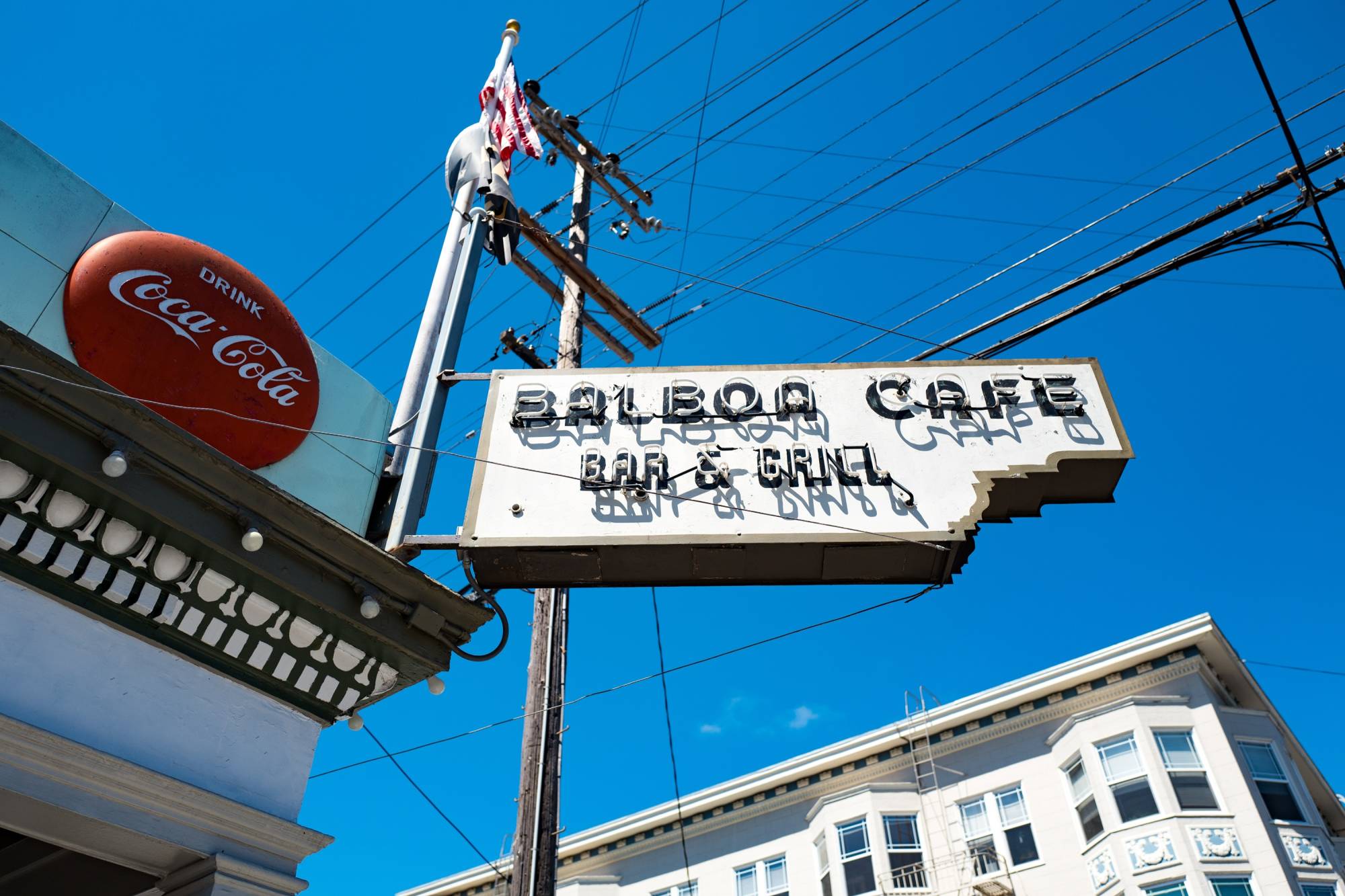
"caption": "Balboa Cafe in the Cow Hollow neighborhood of San Francisco, California, on Aug. 28, 2016. San Francisco police are investigating a suspected hate crime in the Marina District after a man was violently attacked early Friday amid antisemitic slurs. Witnesses said several men kicked the victim and also assaulted an employee from the nearby Balboa Cafe who tried to intervene.",
"credit": "Smith Collection/Gado/Getty Images",
"altTag": null,
"description": null,
"imgSizes": {
"medium": {
"file": "https://cdn.kqed.org/wp-content/uploads/sites/10/2025/06/BalboaCafeSFGetty-2000x1333.jpg",
"width": 2000,
"height": 1333,
"mimeType": "image/jpeg"
},
"large": {
"file": "https://cdn.kqed.org/wp-content/uploads/sites/10/2025/06/BalboaCafeSFGetty-2000x1333.jpg",
"width": 2000,
"height": 1333,
"mimeType": "image/jpeg"
},
"thumbnail": {
"file": "https://cdn.kqed.org/wp-content/uploads/sites/10/2025/06/BalboaCafeSFGetty-160x107.jpg",
"width": 160,
"height": 107,
"mimeType": "image/jpeg"
},
"1536x1536": {
"file": "https://cdn.kqed.org/wp-content/uploads/sites/10/2025/06/BalboaCafeSFGetty-1536x1024.jpg",
"width": 1536,
"height": 1024,
"mimeType": "image/jpeg"
},
"2048x2048": {
"file": "https://cdn.kqed.org/wp-content/uploads/sites/10/2025/06/BalboaCafeSFGetty-2048x1365.jpg",
"width": 2048,
"height": 1365,
"mimeType": "image/jpeg"
},
"post-thumbnail": {
"file": "https://cdn.kqed.org/wp-content/uploads/sites/10/2025/06/BalboaCafeSFGetty-672x372.jpg",
"width": 672,
"height": 372,
"mimeType": "image/jpeg"
},
"twentyfourteen-full-width": {
"file": "https://cdn.kqed.org/wp-content/uploads/sites/10/2025/06/BalboaCafeSFGetty-1038x576.jpg",
"width": 1038,
"height": 576,
"mimeType": "image/jpeg"
},
"full-width": {
"file": "https://cdn.kqed.org/wp-content/uploads/sites/10/2025/06/BalboaCafeSFGetty-2000x1333.jpg",
"width": 2000,
"height": 1333,
"mimeType": "image/jpeg"
},
"kqedFullSize": {
"file": "https://cdn.kqed.org/wp-content/uploads/sites/10/2025/06/BalboaCafeSFGetty-scaled.jpg",
"width": 2560,
"height": 1707
}
},
"isLoading": false,
"fetchFailed": false
},
"news_12043368": {
"type": "attachments",
"id": "news_12043368",
"meta": {
"index": "attachments_1716263798",
"site": "news",
"id": "12043368",
"found": true
},
"title": "250609-LURIEPRESSER-04-BL-KQED",
"publishDate": 1749495050,
"status": "inherit",
"parent": 12043333,
"modified": 1749503975,
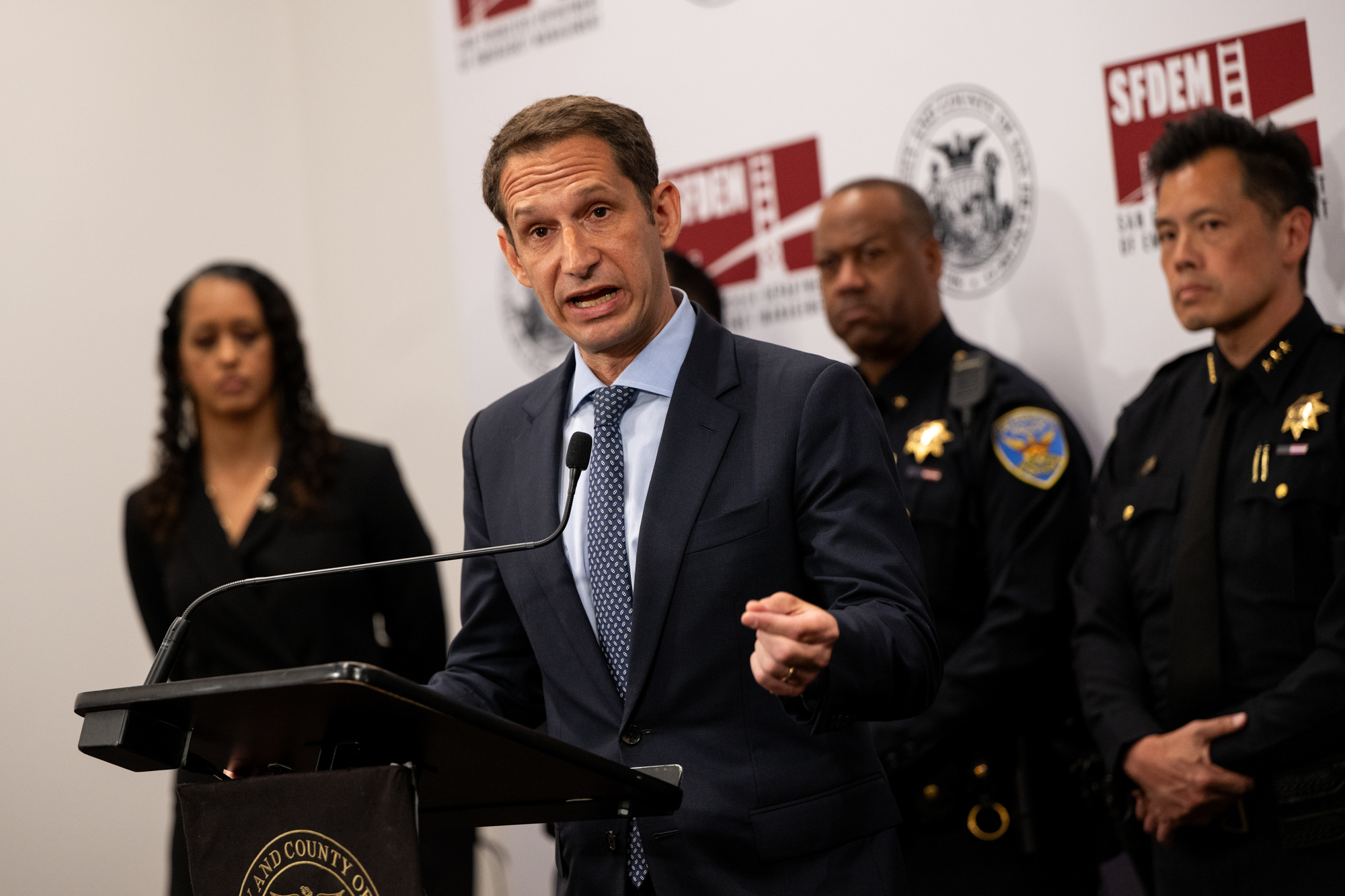
"caption": "Mayor Daniel Lurie speaks at a press conference with public safety leaders in San Francisco on June 9, 2025.",
"credit": "Beth LaBerge/KQED",
"altTag": null,
"description": null,
"imgSizes": {
"thumbnail": {
"file": "https://cdn.kqed.org/wp-content/uploads/sites/10/2025/06/250609-LURIEPRESSER-04-BL-KQED-160x107.jpg",
"width": 160,
"height": 107,
"mimeType": "image/jpeg"
},
"1536x1536": {
"file": "https://cdn.kqed.org/wp-content/uploads/sites/10/2025/06/250609-LURIEPRESSER-04-BL-KQED-1536x1024.jpg",
"width": 1536,
"height": 1024,
"mimeType": "image/jpeg"
},
"post-thumbnail": {
"file": "https://cdn.kqed.org/wp-content/uploads/sites/10/2025/06/250609-LURIEPRESSER-04-BL-KQED-672x372.jpg",
"width": 672,
"height": 372,
"mimeType": "image/jpeg"
},
"twentyfourteen-full-width": {
"file": "https://cdn.kqed.org/wp-content/uploads/sites/10/2025/06/250609-LURIEPRESSER-04-BL-KQED-1038x576.jpg",
"width": 1038,
"height": 576,
"mimeType": "image/jpeg"
},
"kqedFullSize": {
"file": "https://cdn.kqed.org/wp-content/uploads/sites/10/2025/06/250609-LURIEPRESSER-04-BL-KQED.jpg",
"width": 2000,
"height": 1333
}
},
"isLoading": false,
"fetchFailed": false
},
"news_12043264": {
"type": "attachments",
"id": "news_12043264",
"meta": {
"index": "attachments_1716263798",
"site": "news",
"id": "12043264",
"found": true
},
"title": "250608-ICE OUT OF THE BAY-AC-04-KQED",
"publishDate": 1749445597,
"status": "inherit",
"parent": 12043544,
"modified": 1749860292,
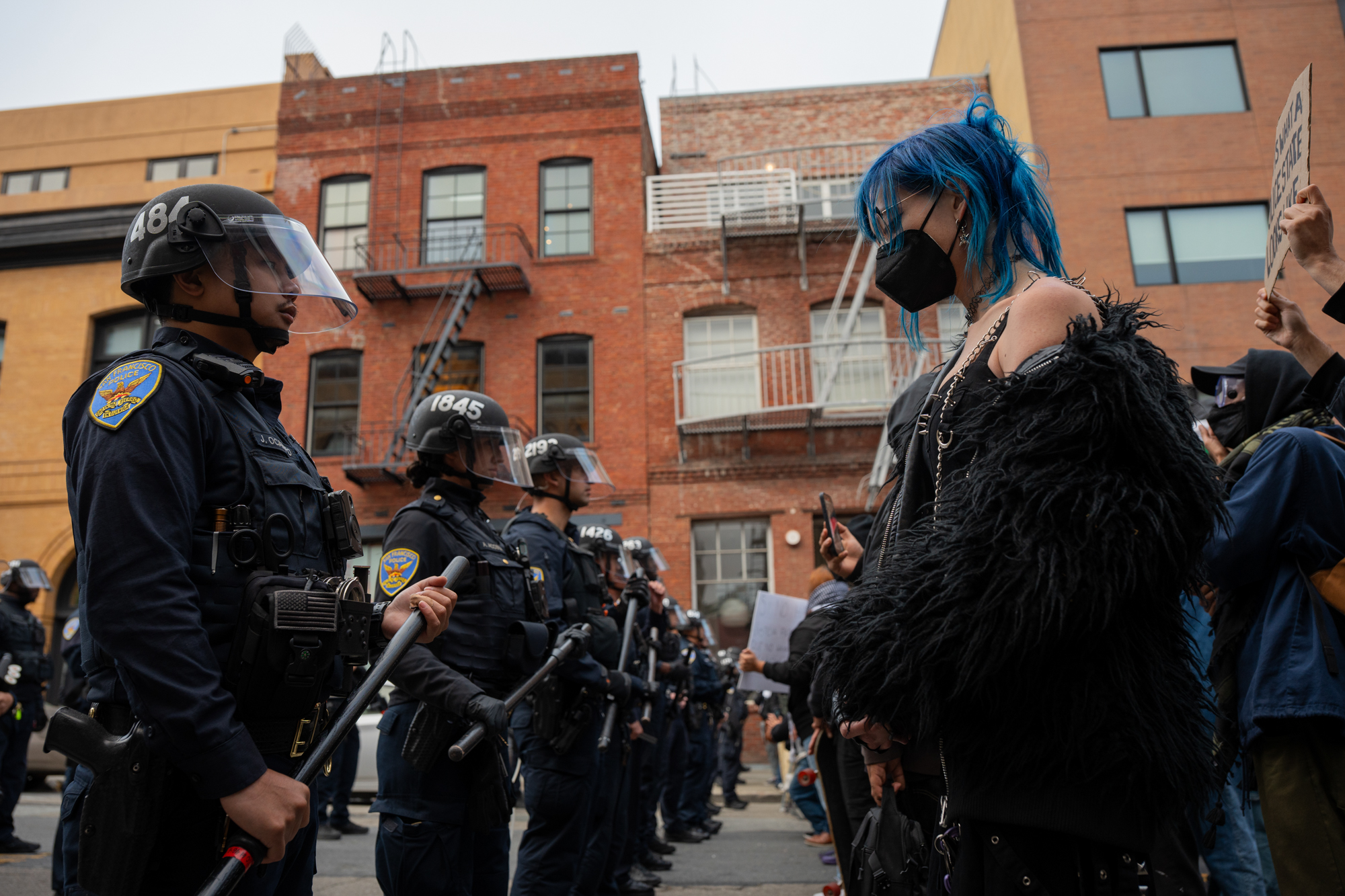
"caption": "Protesters face off with SFPD during an anti-ICE protest in San Francisco on June 8, 2025.",
"credit": "Aryk Copley for KQED",
"altTag": null,
"description": null,
"imgSizes": {
"thumbnail": {
"file": "https://cdn.kqed.org/wp-content/uploads/sites/10/2025/06/250608-ICE-OUT-OF-THE-BAY-AC-04-KQED-160x107.jpg",
"width": 160,
"height": 107,
"mimeType": "image/jpeg"
},
"1536x1536": {
"file": "https://cdn.kqed.org/wp-content/uploads/sites/10/2025/06/250608-ICE-OUT-OF-THE-BAY-AC-04-KQED-1536x1024.jpg",
"width": 1536,
"height": 1024,
"mimeType": "image/jpeg"
},
"post-thumbnail": {
"file": "https://cdn.kqed.org/wp-content/uploads/sites/10/2025/06/250608-ICE-OUT-OF-THE-BAY-AC-04-KQED-672x372.jpg",
"width": 672,
"height": 372,
"mimeType": "image/jpeg"
},
"twentyfourteen-full-width": {
"file": "https://cdn.kqed.org/wp-content/uploads/sites/10/2025/06/250608-ICE-OUT-OF-THE-BAY-AC-04-KQED-1038x576.jpg",
"width": 1038,
"height": 576,
"mimeType": "image/jpeg"
},
"kqedFullSize": {
"file": "https://cdn.kqed.org/wp-content/uploads/sites/10/2025/06/250608-ICE-OUT-OF-THE-BAY-AC-04-KQED.jpg",
"width": 2000,
"height": 1333
}
},
"isLoading": false,
"fetchFailed": false
},
"news_12042524": {
"type": "attachments",
"id": "news_12042524",
"meta": {
"index": "attachments_1716263798",
"site": "news",
"id": "12042524",
"found": true
},
"title": "250418-SFPDFile-45-BL_qed",
"publishDate": 1748974098,
"status": "inherit",
"parent": 12042515,
"modified": 1748974110,
"caption": "Mayor Daniel Lurie walks with Captain Liza Johansen, from the Mission Police Station, and Santiago Lerma, with the Department of Emergency Management, during a public safety walk in San Francisco’s Mission District on April 18, 2025.",
"credit": "Beth LaBerge/KQED",
"altTag": null,
"description": null,
"imgSizes": {
"medium": {
"file": "https://cdn.kqed.org/wp-content/uploads/sites/10/2025/06/250418-SFPDFile-45-BL_qed-800x533.jpg",
"width": 800,
"height": 533,
"mimeType": "image/jpeg"
},
"large": {
"file": "https://cdn.kqed.org/wp-content/uploads/sites/10/2025/06/250418-SFPDFile-45-BL_qed-1020x680.jpg",
"width": 1020,
"height": 680,
"mimeType": "image/jpeg"
},
"thumbnail": {
"file": "https://cdn.kqed.org/wp-content/uploads/sites/10/2025/06/250418-SFPDFile-45-BL_qed-160x107.jpg",
"width": 160,
"height": 107,
"mimeType": "image/jpeg"
},
"1536x1536": {
"file": "https://cdn.kqed.org/wp-content/uploads/sites/10/2025/06/250418-SFPDFile-45-BL_qed-1536x1024.jpg",
"width": 1536,
"height": 1024,
"mimeType": "image/jpeg"
},
"post-thumbnail": {
"file": "https://cdn.kqed.org/wp-content/uploads/sites/10/2025/06/250418-SFPDFile-45-BL_qed-672x372.jpg",
"width": 672,
"height": 372,
"mimeType": "image/jpeg"
},
"twentyfourteen-full-width": {
"file": "https://cdn.kqed.org/wp-content/uploads/sites/10/2025/06/250418-SFPDFile-45-BL_qed-1038x576.jpg",
"width": 1038,
"height": 576,
"mimeType": "image/jpeg"
},
"full-width": {
"file": "https://cdn.kqed.org/wp-content/uploads/sites/10/2025/06/250418-SFPDFile-45-BL_qed-1920x1280.jpg",
"width": 1920,
"height": 1280,
"mimeType": "image/jpeg"
},
"kqedFullSize": {
"file": "https://cdn.kqed.org/wp-content/uploads/sites/10/2025/06/250418-SFPDFile-45-BL_qed.jpg",
"width": 2000,
"height": 1333
}
},
"isLoading": false,
"fetchFailed": false
},
"news_12041527": {
"type": "attachments",
"id": "news_12041527",
"meta": {
"index": "attachments_1716263798",
"site": "news",
"id": "12041527",
"found": true
},
"title": "SFPlayground2",
"publishDate": 1748035783,
"status": "inherit",
"parent": 12041470,
"modified": 1748467274,
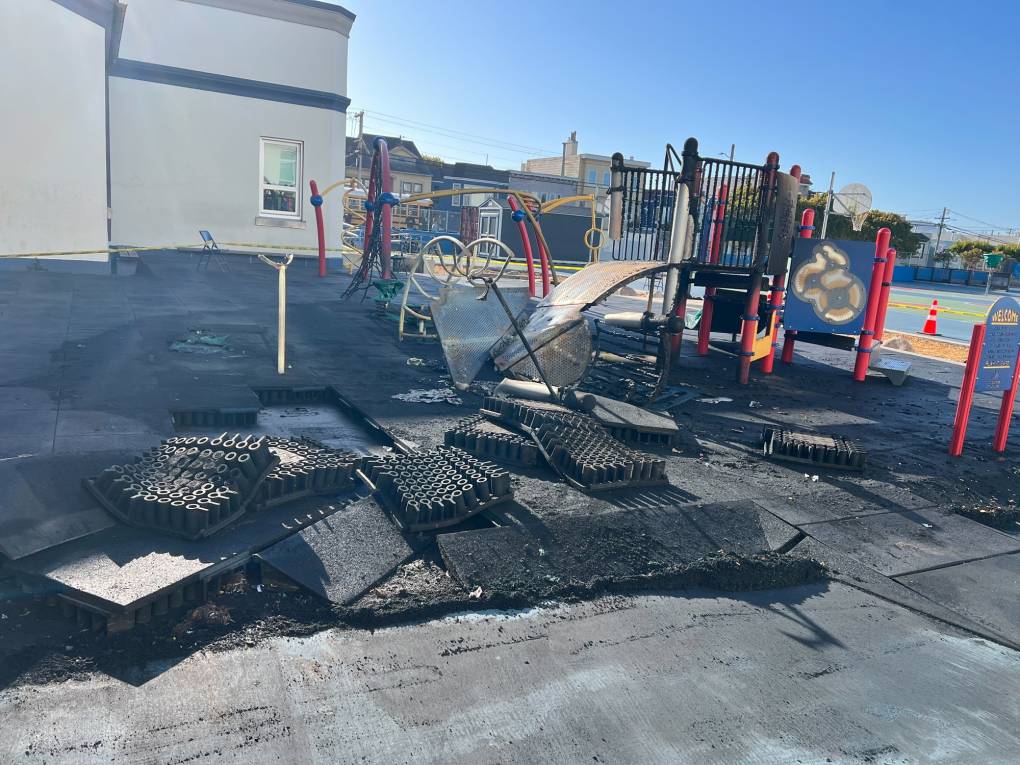
"caption": "The playground at Lafayette Elementary School in San Francisco’s Outer Richmond was destroyed in a suspicious fire, one of four blazes under investigation in the neighborhood this month.",
"credit": "Courtesy of Hallie Albert",
"altTag": null,
"description": null,
"imgSizes": {
"medium": {
"file": "https://cdn.kqed.org/wp-content/uploads/sites/10/2025/05/SFPlayground2-800x600.jpg",
"width": 800,
"height": 600,
"mimeType": "image/jpeg"
},
"large": {
"file": "https://cdn.kqed.org/wp-content/uploads/sites/10/2025/05/SFPlayground2-1020x765.jpg",
"width": 1020,
"height": 765,
"mimeType": "image/jpeg"
},
"thumbnail": {
"file": "https://cdn.kqed.org/wp-content/uploads/sites/10/2025/05/SFPlayground2-160x120.jpg",
"width": 160,
"height": 120,
"mimeType": "image/jpeg"
},
"1536x1536": {
"file": "https://cdn.kqed.org/wp-content/uploads/sites/10/2025/05/SFPlayground2-1536x1152.jpg",
"width": 1536,
"height": 1152,
"mimeType": "image/jpeg"
},
"post-thumbnail": {
"file": "https://cdn.kqed.org/wp-content/uploads/sites/10/2025/05/SFPlayground2-672x372.jpg",
"width": 672,
"height": 372,
"mimeType": "image/jpeg"
},
"twentyfourteen-full-width": {
"file": "https://cdn.kqed.org/wp-content/uploads/sites/10/2025/05/SFPlayground2-1038x576.jpg",
"width": 1038,
"height": 576,
"mimeType": "image/jpeg"
},
"full-width": {
"file": "https://cdn.kqed.org/wp-content/uploads/sites/10/2025/05/SFPlayground2-1920x1440.jpg",
"width": 1920,
"height": 1440,
"mimeType": "image/jpeg"
},
"kqedFullSize": {
"file": "https://cdn.kqed.org/wp-content/uploads/sites/10/2025/05/SFPlayground2.jpg",
"width": 2000,
"height": 1500
}
},
"isLoading": false,
"fetchFailed": false
},
"news_11749940": {
"type": "attachments",
"id": "news_11749940",
"meta": {
"index": "attachments_1716263798",
"site": "news",
"id": "11749940",
"found": true
},
"title": "San Francisco Police Department Chief William Scott Holds News Conference With Homeland Security Officials",
"publishDate": 1558815145,
"status": "inherit",
"parent": 11749934,
"modified": 1746636051,
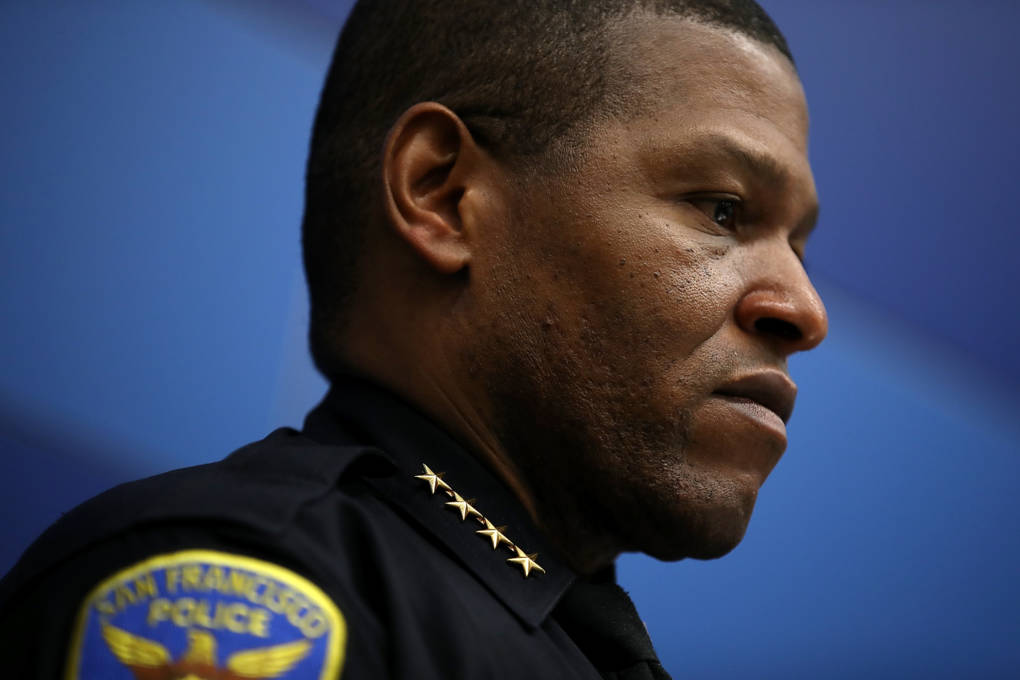
"caption": "San Francisco police chief William Scott looks on during a press conference at San Francisco police headquarters on April 6, 2018 in San Francisco, California. ",
"credit": "Justin Sullivan/Getty Images",
"altTag": null,
"description": null,
"imgSizes": {
"thumbnail": {
"file": "https://cdn.kqed.org/wp-content/uploads/sites/10/2019/05/GettyImages-942761860-160x107.jpg",
"width": 160,
"height": 107,
"mimeType": "image/jpeg"
},
"medium": {
"file": "https://cdn.kqed.org/wp-content/uploads/sites/10/2019/05/GettyImages-942761860-800x533.jpg",
"width": 800,
"height": 533,
"mimeType": "image/jpeg"
},
"large": {
"file": "https://cdn.kqed.org/wp-content/uploads/sites/10/2019/05/GettyImages-942761860-1020x680.jpg",
"width": 1020,
"height": 680,
"mimeType": "image/jpeg"
},
"complete_open_graph": {
"file": "https://cdn.kqed.org/wp-content/uploads/sites/10/2019/05/GettyImages-942761860-1200x800.jpg",
"width": 1200,
"height": 800,
"mimeType": "image/jpeg"
},
"post-thumbnail": {
"file": "https://cdn.kqed.org/wp-content/uploads/sites/10/2019/05/GettyImages-942761860-672x372.jpg",
"width": 672,
"height": 372,
"mimeType": "image/jpeg"
},
"twentyfourteen-full-width": {
"file": "https://cdn.kqed.org/wp-content/uploads/sites/10/2019/05/GettyImages-942761860-1038x576.jpg",
"width": 1038,
"height": 576,
"mimeType": "image/jpeg"
},
"full-width": {
"file": "https://cdn.kqed.org/wp-content/uploads/sites/10/2019/05/GettyImages-942761860-1920x1280.jpg",
"width": 1920,
"height": 1280,
"mimeType": "image/jpeg"
},
"apple_news_ca_landscape_12_9": {
"file": "https://cdn.kqed.org/wp-content/uploads/sites/10/2019/05/GettyImages-942761860-1832x1374.jpg",
"width": 1832,
"height": 1374,
"mimeType": "image/jpeg"
},
"apple_news_ca_landscape_9_7": {
"file": "https://cdn.kqed.org/wp-content/uploads/sites/10/2019/05/GettyImages-942761860-1376x1032.jpg",
"width": 1376,
"height": 1032,
"mimeType": "image/jpeg"
},
"apple_news_ca_landscape_5_5": {
"file": "https://cdn.kqed.org/wp-content/uploads/sites/10/2019/05/GettyImages-942761860-1044x783.jpg",
"width": 1044,
"height": 783,
"mimeType": "image/jpeg"
},
"apple_news_ca_landscape_4_7": {
"file": "https://cdn.kqed.org/wp-content/uploads/sites/10/2019/05/GettyImages-942761860-632x474.jpg",
"width": 632,
"height": 474,
"mimeType": "image/jpeg"
},
"apple_news_ca_landscape_4_0": {
"file": "https://cdn.kqed.org/wp-content/uploads/sites/10/2019/05/GettyImages-942761860-536x402.jpg",
"width": 536,
"height": 402,
"mimeType": "image/jpeg"
},
"apple_news_ca_portrait_12_9": {
"file": "https://cdn.kqed.org/wp-content/uploads/sites/10/2019/05/GettyImages-942761860-1122x1496.jpg",
"width": 1122,
"height": 1496,
"mimeType": "image/jpeg"
},
"apple_news_ca_portrait_9_7": {
"file": "https://cdn.kqed.org/wp-content/uploads/sites/10/2019/05/GettyImages-942761860-840x1120.jpg",
"width": 840,
"height": 1120,
"mimeType": "image/jpeg"
},
"apple_news_ca_portrait_5_5": {
"file": "https://cdn.kqed.org/wp-content/uploads/sites/10/2019/05/GettyImages-942761860-687x916.jpg",
"width": 687,
"height": 916,
"mimeType": "image/jpeg"
},
"apple_news_ca_portrait_4_7": {
"file": "https://cdn.kqed.org/wp-content/uploads/sites/10/2019/05/GettyImages-942761860-414x552.jpg",
"width": 414,
"height": 552,
"mimeType": "image/jpeg"
},
"apple_news_ca_portrait_4_0": {
"file": "https://cdn.kqed.org/wp-content/uploads/sites/10/2019/05/GettyImages-942761860-354x472.jpg",
"width": 354,
"height": 472,
"mimeType": "image/jpeg"
},
"apple_news_ca_square_12_9": {
"file": "https://cdn.kqed.org/wp-content/uploads/sites/10/2019/05/GettyImages-942761860-1472x1472.jpg",
"width": 1472,
"height": 1472,
"mimeType": "image/jpeg"
},
"apple_news_ca_square_9_7": {
"file": "https://cdn.kqed.org/wp-content/uploads/sites/10/2019/05/GettyImages-942761860-1104x1104.jpg",
"width": 1104,
"height": 1104,
"mimeType": "image/jpeg"
},
"apple_news_ca_square_5_5": {
"file": "https://cdn.kqed.org/wp-content/uploads/sites/10/2019/05/GettyImages-942761860-912x912.jpg",
"width": 912,
"height": 912,
"mimeType": "image/jpeg"
},
"apple_news_ca_square_4_7": {
"file": "https://cdn.kqed.org/wp-content/uploads/sites/10/2019/05/GettyImages-942761860-550x550.jpg",
"width": 550,
"height": 550,
"mimeType": "image/jpeg"
},
"apple_news_ca_square_4_0": {
"file": "https://cdn.kqed.org/wp-content/uploads/sites/10/2019/05/GettyImages-942761860-470x470.jpg",
"width": 470,
"height": 470,
"mimeType": "image/jpeg"
},
"kqedFullSize": {
"file": "https://cdn.kqed.org/wp-content/uploads/sites/10/2019/05/GettyImages-942761860-e1558815255426.jpg",
"width": 1920,
"height": 1280
}
},
"isLoading": false,
"fetchFailed": false
},
"news_12024503": {
"type": "attachments",
"id": "news_12024503",
"meta": {
"index": "attachments_1716263798",
"site": "news",
"id": "12024503",
"found": true
},
"title": "240903-OverdoseResponse-56-BL_qed",
"publishDate": 1738115144,
"status": "inherit",
"parent": 12024454,
"modified": 1742321872,
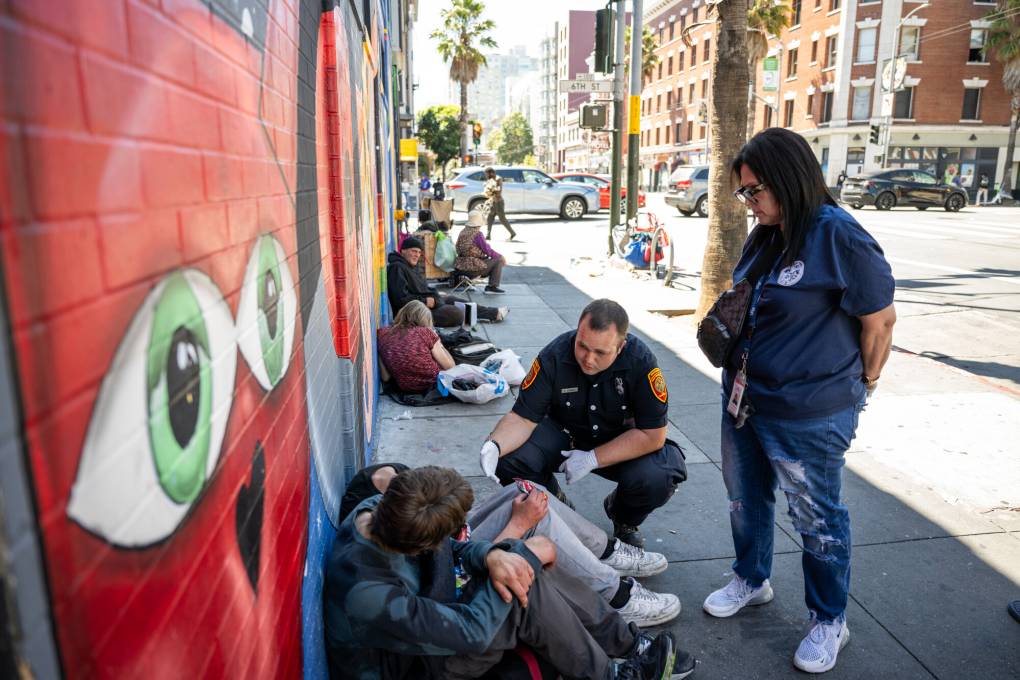
"caption": "Paramedic Isaac James (left) and counselor Chantel Hernandez-Coleman, members of the Street Overdose Response Team, speak with two people sitting on the street in the South of Market neighborhood in San Francisco on Sept. 3, 2024.",
"credit": "Beth LaBerge/KQED",
"altTag": null,
"description": null,
"imgSizes": {
"medium": {
"file": "https://cdn.kqed.org/wp-content/uploads/sites/10/2025/01/240903-OverdoseResponse-56-BL_qed-800x533.jpg",
"width": 800,
"height": 533,
"mimeType": "image/jpeg"
},
"large": {
"file": "https://cdn.kqed.org/wp-content/uploads/sites/10/2025/01/240903-OverdoseResponse-56-BL_qed-1020x680.jpg",
"width": 1020,
"height": 680,
"mimeType": "image/jpeg"
},
"thumbnail": {
"file": "https://cdn.kqed.org/wp-content/uploads/sites/10/2025/01/240903-OverdoseResponse-56-BL_qed-160x107.jpg",
"width": 160,
"height": 107,
"mimeType": "image/jpeg"
},
"1536x1536": {
"file": "https://cdn.kqed.org/wp-content/uploads/sites/10/2025/01/240903-OverdoseResponse-56-BL_qed-1536x1024.jpg",
"width": 1536,
"height": 1024,
"mimeType": "image/jpeg"
},
"post-thumbnail": {
"file": "https://cdn.kqed.org/wp-content/uploads/sites/10/2025/01/240903-OverdoseResponse-56-BL_qed-672x372.jpg",
"width": 672,
"height": 372,
"mimeType": "image/jpeg"
},
"twentyfourteen-full-width": {
"file": "https://cdn.kqed.org/wp-content/uploads/sites/10/2025/01/240903-OverdoseResponse-56-BL_qed-1038x576.jpg",
"width": 1038,
"height": 576,
"mimeType": "image/jpeg"
},
"full-width": {
"file": "https://cdn.kqed.org/wp-content/uploads/sites/10/2025/01/240903-OverdoseResponse-56-BL_qed-1920x1280.jpg",
"width": 1920,
"height": 1280,
"mimeType": "image/jpeg"
},
"kqedFullSize": {
"file": "https://cdn.kqed.org/wp-content/uploads/sites/10/2025/01/240903-OverdoseResponse-56-BL_qed.jpg",
"width": 2000,
"height": 1333
}
},
"isLoading": false,
"fetchFailed": false
},
"news_12033116": {
"type": "attachments",
"id": "news_12033116",
"meta": {
"index": "attachments_1716263798",
"site": "news",
"id": "12033116",
"found": true
},
"title": "005_KQED_CarFreeMarketSt_01222020_8366_qed",
"publishDate": 1743011694,
"status": "inherit",
"parent": 12033114,
"modified": 1743011737,
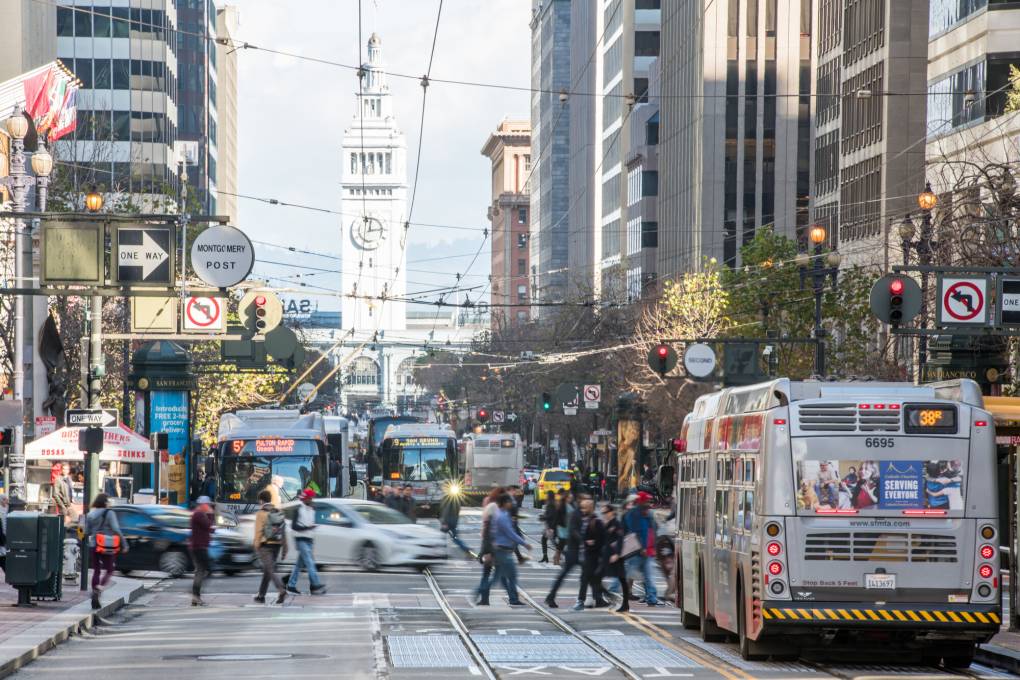
"caption": "Cars drive down Market Street in San Francisco on Jan. 20, 2022.",
"credit": "Beth LaBerge/KQED",
"altTag": null,
"description": null,
"imgSizes": {
"medium": {
"file": "https://cdn.kqed.org/wp-content/uploads/sites/10/2025/03/005_KQED_CarFreeMarketSt_01222020_8366_qed-800x533.jpg",
"width": 800,
"height": 533,
"mimeType": "image/jpeg"
},
"large": {
"file": "https://cdn.kqed.org/wp-content/uploads/sites/10/2025/03/005_KQED_CarFreeMarketSt_01222020_8366_qed-1020x680.jpg",
"width": 1020,
"height": 680,
"mimeType": "image/jpeg"
},
"thumbnail": {
"file": "https://cdn.kqed.org/wp-content/uploads/sites/10/2025/03/005_KQED_CarFreeMarketSt_01222020_8366_qed-160x107.jpg",
"width": 160,
"height": 107,
"mimeType": "image/jpeg"
},
"1536x1536": {
"file": "https://cdn.kqed.org/wp-content/uploads/sites/10/2025/03/005_KQED_CarFreeMarketSt_01222020_8366_qed-1536x1024.jpg",
"width": 1536,
"height": 1024,
"mimeType": "image/jpeg"
},
"post-thumbnail": {
"file": "https://cdn.kqed.org/wp-content/uploads/sites/10/2025/03/005_KQED_CarFreeMarketSt_01222020_8366_qed-672x372.jpg",
"width": 672,
"height": 372,
"mimeType": "image/jpeg"
},
"twentyfourteen-full-width": {
"file": "https://cdn.kqed.org/wp-content/uploads/sites/10/2025/03/005_KQED_CarFreeMarketSt_01222020_8366_qed-1038x576.jpg",
"width": 1038,
"height": 576,
"mimeType": "image/jpeg"
},
"full-width": {
"file": "https://cdn.kqed.org/wp-content/uploads/sites/10/2025/03/005_KQED_CarFreeMarketSt_01222020_8366_qed-1920x1280.jpg",
"width": 1920,
"height": 1280,
"mimeType": "image/jpeg"
},
"kqedFullSize": {
"file": "https://cdn.kqed.org/wp-content/uploads/sites/10/2025/03/005_KQED_CarFreeMarketSt_01222020_8366_qed.jpg",
"width": 2000,
"height": 1333
}
},
"isLoading": false,
"fetchFailed": false
},
"news_12032245": {
"type": "attachments",
"id": "news_12032245",
"meta": {
"index": "attachments_1716263798",
"site": "news",
"id": "12032245",
"found": true
},
"title": "240903-OverdoseResponse-42-BL_qed",
"publishDate": 1742493644,
"status": "inherit",
"parent": 12032239,
"modified": 1742493658,
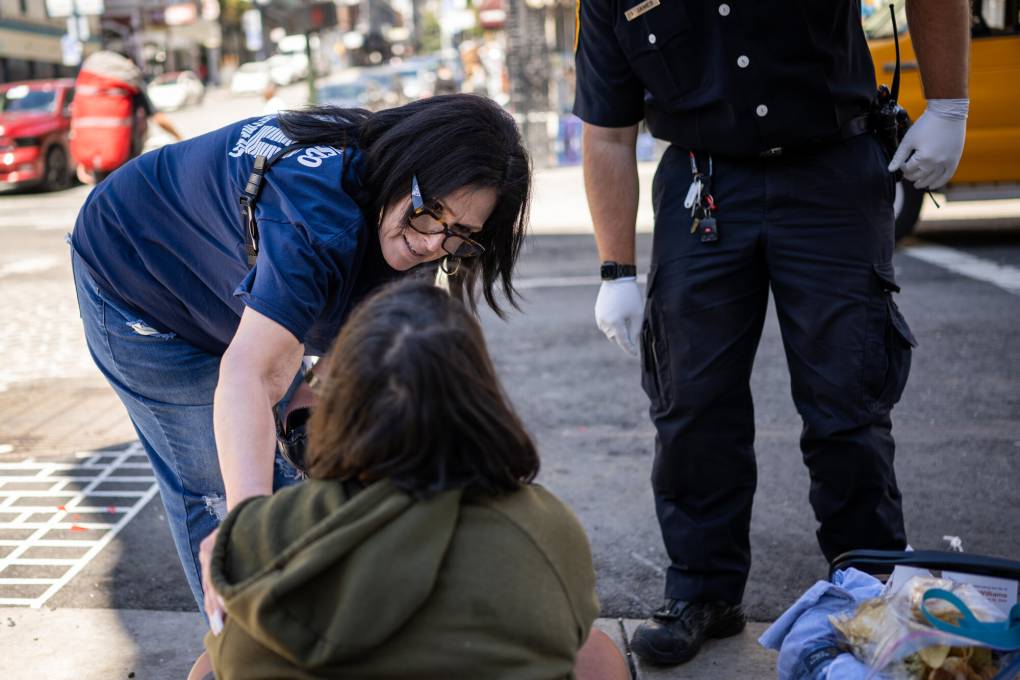
"caption": "Counselor Chantel Hernandez-Coleman (left) and paramedic Isaac James, members of the Street Overdose Response Team, speak with a woman sitting in the Tenderloin in San Francisco on Sept. 3, 2024.",
"credit": "Beth LaBerge/KQED",
"altTag": null,
"description": null,
"imgSizes": {
"medium": {
"file": "https://cdn.kqed.org/wp-content/uploads/sites/10/2025/03/240903-OverdoseResponse-42-BL_qed-800x533.jpg",
"width": 800,
"height": 533,
"mimeType": "image/jpeg"
},
"large": {
"file": "https://cdn.kqed.org/wp-content/uploads/sites/10/2025/03/240903-OverdoseResponse-42-BL_qed-1020x680.jpg",
"width": 1020,
"height": 680,
"mimeType": "image/jpeg"
},
"thumbnail": {
"file": "https://cdn.kqed.org/wp-content/uploads/sites/10/2025/03/240903-OverdoseResponse-42-BL_qed-160x107.jpg",
"width": 160,
"height": 107,
"mimeType": "image/jpeg"
},
"1536x1536": {
"file": "https://cdn.kqed.org/wp-content/uploads/sites/10/2025/03/240903-OverdoseResponse-42-BL_qed-1536x1024.jpg",
"width": 1536,
"height": 1024,
"mimeType": "image/jpeg"
},
"post-thumbnail": {
"file": "https://cdn.kqed.org/wp-content/uploads/sites/10/2025/03/240903-OverdoseResponse-42-BL_qed-672x372.jpg",
"width": 672,
"height": 372,
"mimeType": "image/jpeg"
},
"twentyfourteen-full-width": {
"file": "https://cdn.kqed.org/wp-content/uploads/sites/10/2025/03/240903-OverdoseResponse-42-BL_qed-1038x576.jpg",
"width": 1038,
"height": 576,
"mimeType": "image/jpeg"
},
"full-width": {
"file": "https://cdn.kqed.org/wp-content/uploads/sites/10/2025/03/240903-OverdoseResponse-42-BL_qed-1920x1280.jpg",
"width": 1920,
"height": 1280,
"mimeType": "image/jpeg"
},
"kqedFullSize": {
"file": "https://cdn.kqed.org/wp-content/uploads/sites/10/2025/03/240903-OverdoseResponse-42-BL_qed.jpg",
"width": 2000,
"height": 1333
}
},
"isLoading": false,
"fetchFailed": false
},
"news_12032139": {
"type": "attachments",
"id": "news_12032139",
"meta": {
"index": "attachments_1716263798",
"site": "news",
"id": "12032139",
"found": true
},
"title": "Speed cameras on Geary St. in San Francisco on March 19, 2025.",
"publishDate": 1742423076,
"status": "inherit",
"parent": 12041243,
"modified": 1748042683,
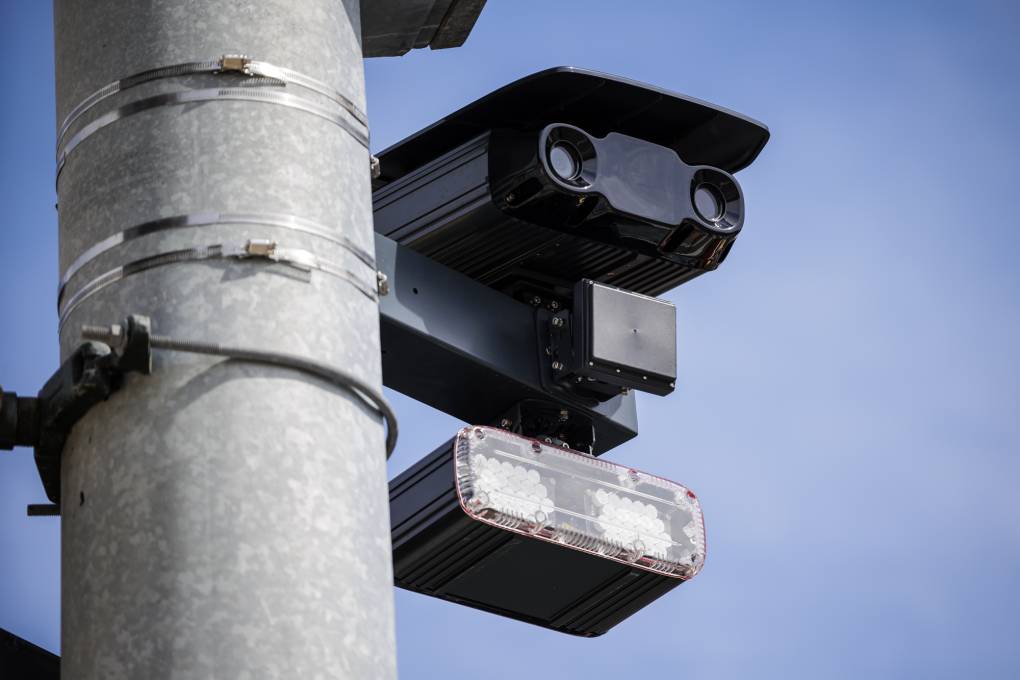
"caption": "A speed camera on Geary Street in San Francisco on March 19, 2025.",
"credit": "Martin do Nascimento/KQED",
"altTag": null,
"description": null,
"imgSizes": {
"medium": {
"file": "https://cdn.kqed.org/wp-content/uploads/sites/10/2025/03/250319-SF-SPEED-CAMERAS-MD-02-KQED-800x533.jpg",
"width": 800,
"height": 533,
"mimeType": "image/jpeg"
},
"large": {
"file": "https://cdn.kqed.org/wp-content/uploads/sites/10/2025/03/250319-SF-SPEED-CAMERAS-MD-02-KQED-1020x680.jpg",
"width": 1020,
"height": 680,
"mimeType": "image/jpeg"
},
"thumbnail": {
"file": "https://cdn.kqed.org/wp-content/uploads/sites/10/2025/03/250319-SF-SPEED-CAMERAS-MD-02-KQED-160x107.jpg",
"width": 160,
"height": 107,
"mimeType": "image/jpeg"
},
"1536x1536": {
"file": "https://cdn.kqed.org/wp-content/uploads/sites/10/2025/03/250319-SF-SPEED-CAMERAS-MD-02-KQED-1536x1024.jpg",
"width": 1536,
"height": 1024,
"mimeType": "image/jpeg"
},
"post-thumbnail": {
"file": "https://cdn.kqed.org/wp-content/uploads/sites/10/2025/03/250319-SF-SPEED-CAMERAS-MD-02-KQED-672x372.jpg",
"width": 672,
"height": 372,
"mimeType": "image/jpeg"
},
"twentyfourteen-full-width": {
"file": "https://cdn.kqed.org/wp-content/uploads/sites/10/2025/03/250319-SF-SPEED-CAMERAS-MD-02-KQED-1038x576.jpg",
"width": 1038,
"height": 576,
"mimeType": "image/jpeg"
},
"full-width": {
"file": "https://cdn.kqed.org/wp-content/uploads/sites/10/2025/03/250319-SF-SPEED-CAMERAS-MD-02-KQED-1920x1280.jpg",
"width": 1920,
"height": 1280,
"mimeType": "image/jpeg"
},
"kqedFullSize": {
"file": "https://cdn.kqed.org/wp-content/uploads/sites/10/2025/03/250319-SF-SPEED-CAMERAS-MD-02-KQED.jpg",
"width": 2000,
"height": 1333
}
},
"isLoading": false,
"fetchFailed": false
},
"news_11960807": {
"type": "attachments",
"id": "news_11960807",
"meta": {
"index": "attachments_1716263798",
"site": "news",
"id": "11960807",
"found": true
},
"parent": 0,
"imgSizes": {
"twentyfourteen-full-width": {
"file": "https://ww2.kqed.org/app/uploads/sites/10/2023/09/230911-MattieScottFreedomWest-019-BL-KQED-1038x576.jpg",
"width": 1038,
"mimeType": "image/jpeg",
"height": 576
},
"thumbnail": {
"file": "https://ww2.kqed.org/app/uploads/sites/10/2023/09/230911-MattieScottFreedomWest-019-BL-KQED-160x107.jpg",
"width": 160,
"mimeType": "image/jpeg",
"height": 107
},
"post-thumbnail": {
"file": "https://ww2.kqed.org/app/uploads/sites/10/2023/09/230911-MattieScottFreedomWest-019-BL-KQED-672x372.jpg",
"width": 672,
"mimeType": "image/jpeg",
"height": 372
},
"kqedFullSize": {
"file": "https://ww2.kqed.org/app/uploads/sites/10/2023/09/230911-MattieScottFreedomWest-019-BL-KQED.jpg",
"width": 2000,
"height": 1333
},
"large": {
"file": "https://ww2.kqed.org/app/uploads/sites/10/2023/09/230911-MattieScottFreedomWest-019-BL-KQED-1020x680.jpg",
"width": 1020,
"mimeType": "image/jpeg",
"height": 680
},
"1536x1536": {
"file": "https://ww2.kqed.org/app/uploads/sites/10/2023/09/230911-MattieScottFreedomWest-019-BL-KQED-1536x1024.jpg",
"width": 1536,
"mimeType": "image/jpeg",
"height": 1024
},
"full-width": {
"file": "https://ww2.kqed.org/app/uploads/sites/10/2023/09/230911-MattieScottFreedomWest-019-BL-KQED-1920x1280.jpg",
"width": 1920,
"mimeType": "image/jpeg",
"height": 1280
},
"medium": {
"file": "https://ww2.kqed.org/app/uploads/sites/10/2023/09/230911-MattieScottFreedomWest-019-BL-KQED-800x533.jpg",
"width": 800,
"mimeType": "image/jpeg",
"height": 533
}
},
"publishDate": 1694540028,
"modified": 1694644463,
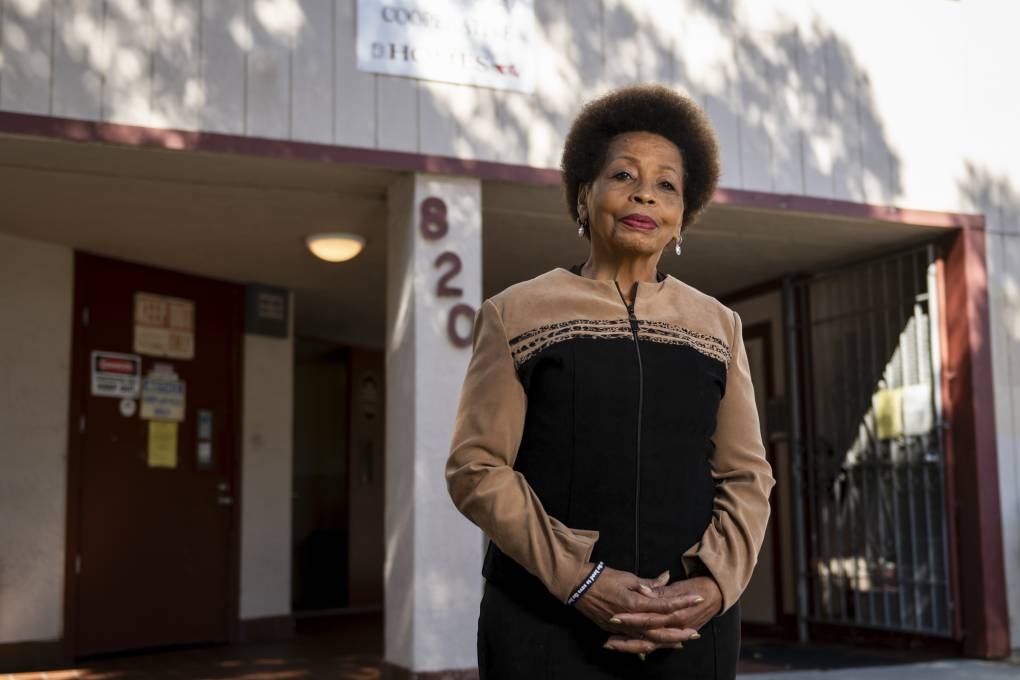
"caption": "Mattie Scott, a resident and board president of Freedom West Housing Corporation, stands in the housing cooperative in the Fillmore District on Sept. 11, 2023.",
"description": null,
"title": "230911-MattieScottFreedomWest-019-BL-KQED",
"credit": "Beth LaBerge/KQED",
"status": "inherit",
"altTag": "An older African American woman stands in front of a residential building, looking at the camera.",
"isLoading": false,
"fetchFailed": false
},
"news_12028350": {
"type": "attachments",
"id": "news_12028350",
"meta": {
"index": "attachments_1716263798",
"site": "news",
"id": "12028350",
"found": true
},
"title": "250224-SFPD POLICE COMMISSIONER PROTEST-MD-06",
"publishDate": 1740434315,
"status": "inherit",
"parent": 0,
"modified": 1740613560,
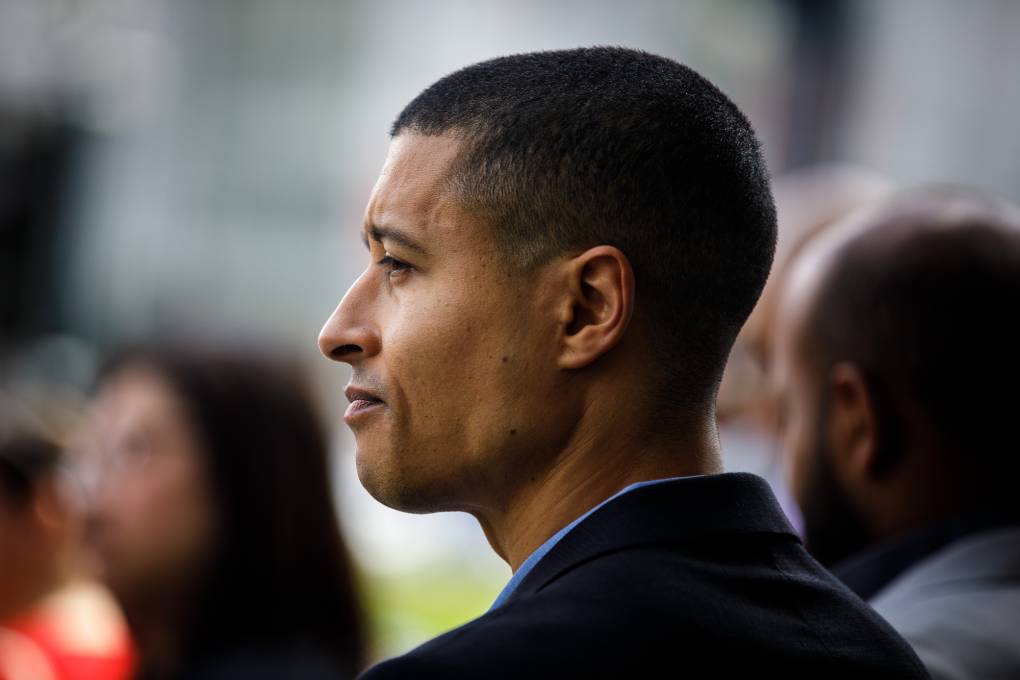
"caption": "San Francisco Police Commissioner Max Carter-Oberstone attends a rally protesting Mayor Daniel Lurie's attempt to remove him from the Police Commission on the steps of San Francisco City Hall, on Monday, Feb. 24, 2025.",
"credit": "Martin do Nascimento/KQED",
"altTag": null,
"description": null,
"imgSizes": {
"medium": {
"file": "https://cdn.kqed.org/wp-content/uploads/sites/10/2025/02/250224-SFPD-POLICE-COMMISSIONER-PROTEST-MD-06-800x533.jpg",
"width": 800,
"height": 533,
"mimeType": "image/jpeg"
},
"large": {
"file": "https://cdn.kqed.org/wp-content/uploads/sites/10/2025/02/250224-SFPD-POLICE-COMMISSIONER-PROTEST-MD-06-1020x680.jpg",
"width": 1020,
"height": 680,
"mimeType": "image/jpeg"
},
"thumbnail": {
"file": "https://cdn.kqed.org/wp-content/uploads/sites/10/2025/02/250224-SFPD-POLICE-COMMISSIONER-PROTEST-MD-06-160x107.jpg",
"width": 160,
"height": 107,
"mimeType": "image/jpeg"
},
"1536x1536": {
"file": "https://cdn.kqed.org/wp-content/uploads/sites/10/2025/02/250224-SFPD-POLICE-COMMISSIONER-PROTEST-MD-06-1536x1024.jpg",
"width": 1536,
"height": 1024,
"mimeType": "image/jpeg"
},
"post-thumbnail": {
"file": "https://cdn.kqed.org/wp-content/uploads/sites/10/2025/02/250224-SFPD-POLICE-COMMISSIONER-PROTEST-MD-06-672x372.jpg",
"width": 672,
"height": 372,
"mimeType": "image/jpeg"
},
"twentyfourteen-full-width": {
"file": "https://cdn.kqed.org/wp-content/uploads/sites/10/2025/02/250224-SFPD-POLICE-COMMISSIONER-PROTEST-MD-06-1038x576.jpg",
"width": 1038,
"height": 576,
"mimeType": "image/jpeg"
},
"full-width": {
"file": "https://cdn.kqed.org/wp-content/uploads/sites/10/2025/02/250224-SFPD-POLICE-COMMISSIONER-PROTEST-MD-06-1920x1280.jpg",
"width": 1920,
"height": 1280,
"mimeType": "image/jpeg"
},
"kqedFullSize": {
"file": "https://cdn.kqed.org/wp-content/uploads/sites/10/2025/02/250224-SFPD-POLICE-COMMISSIONER-PROTEST-MD-06.jpg",
"width": 2000,
"height": 1333
}
},
"isLoading": false,
"fetchFailed": false
}
},
"audioPlayerReducer": {
"postId": "stream_live",
"isPaused": true,
"isPlaying": false,
"pfsActive": false,
"pledgeModalIsOpen": true,
"playerDrawerIsOpen": false,
"liveAudioPlayStartedAt": 0,
"liveAudioPlayContext": ""
},
"authorsReducer": {
"danbrekke": {
"type": "authors",
"id": "222",
"meta": {
"index": "authors_1716337520",
"id": "222",
"found": true
},
"name": "Dan Brekke",
"firstName": "Dan",
"lastName": "Brekke",
"slug": "danbrekke",
"email": "dbrekke@kqed.org",
"display_author_email": true,
"staff_mastheads": [
"news",
"science"
],
"title": "KQED Editor and Reporter",
"bio": "Dan Brekke is a reporter and editor for KQED News, responsible for coverage of topics ranging from California water issues to the Bay Area's transportation challenges. In a newsroom career that began in Chicago in 1972, Dan has worked for \u003cem>The San Francisco Examiner,\u003c/em> Wired and TechTV and has been published in The New York Times, The New York Times Magazine, Business 2.0, Salon and elsewhere.\r\n\r\nSince joining KQED in 2007, Dan has reported, edited and produced both radio and online features and breaking news pieces. He has shared as both editor and reporter in four Society of Professional Journalists Norcal Excellence in Journalism awards and one Edward R. Murrow regional award. He was chosen for a spring 2017 residency at the Mesa Refuge to advance his research on California salmon.\r\n\r\nEmail Dan at: \u003ca href=\"mailto:dbrekke@kqed.org\">dbrekke@kqed.org\u003c/a>\r\n\r\n\u003cstrong>Twitter:\u003c/strong> \u003ca href=\"https://twitter.com/danbrekke\" rel=\"noopener noreferrer\">twitter.com/danbrekke\u003c/a>\r\n\u003cstrong>Facebook:\u003c/strong> \u003ca href=\"https://www.facebook.com/danbrekke\" rel=\"noopener noreferrer\">www.facebook.com/danbrekke\u003c/a>\r\n\u003cstrong>LinkedIn:\u003c/strong> \u003ca href=\"https://www.linkedin.com/in/danbrekke\" rel=\"noopener noreferrer\">www.linkedin.com/in/danbrekke\u003c/a>",
"avatar": "https://secure.gravatar.com/avatar/c8126230345efca3f7aa89b1a402be45?s=600&d=mm&r=g",
"twitter": "danbrekke",
"facebook": null,
"instagram": "https://www.instagram.com/dan.brekke/",
"linkedin": "https://www.linkedin.com/in/danbrekke/",
"sites": [
{
"site": "news",
"roles": [
"administrator",
"create_posts"
]
},
{
"site": "stateofhealth",
"roles": [
"editor"
]
},
{
"site": "science",
"roles": [
"editor"
]
},
{
"site": "quest",
"roles": [
"contributor"
]
},
{
"site": "food",
"roles": [
"contributor"
]
},
{
"site": "forum",
"roles": [
"contributor"
]
},
{
"site": "liveblog",
"roles": [
"editor"
]
}
],
"headData": {
"title": "Dan Brekke | KQED",
"description": "KQED Editor and Reporter",
"ogImgSrc": "https://secure.gravatar.com/avatar/c8126230345efca3f7aa89b1a402be45?s=600&d=mm&r=g",
"twImgSrc": "https://secure.gravatar.com/avatar/c8126230345efca3f7aa89b1a402be45?s=600&d=mm&r=g"
},
"isLoading": false,
"link": "/author/danbrekke"
},
"scottshafer": {
"type": "authors",
"id": "255",
"meta": {
"index": "authors_1716337520",
"id": "255",
"found": true
},
"name": "Scott Shafer",
"firstName": "Scott",
"lastName": "Shafer",
"slug": "scottshafer",
"email": "sshafer@kqed.org",
"display_author_email": false,
"staff_mastheads": [
"news"
],
"title": "KQED Contributor",
"bio": "Scott Shafer is a senior editor with the KQED Politics and Government desk. He is co-host of Political Breakdown, the award-winning radio show and podcast with a personal take on the world of politics. Scott came to KQED in 1998 to host the statewide\u003cem> California Report\u003c/em>. Prior to that he had extended stints in politics and government\u003cem>.\u003c/em> He uses that inside experience at KQED in his, reporting, hosting and analysis for the politics desk. Scott collaborated \u003cem>Political Breakdown a\u003c/em>nd on \u003cem>The Political Mind of Jerry Brown, \u003c/em>an eight-part series about the life and extraordinary political career of the former governor. For fun, he plays water polo with the San Francisco Tsunami.",
"avatar": "https://secure.gravatar.com/avatar/a62ebae45b79d7aed1a39a0e3bf68104?s=600&d=blank&r=g",
"twitter": "scottshafer",
"bluesky": null,
"facebook": null,
"instagram": null,
"linkedin": null,
"sites": [
{
"site": "news",
"roles": [
"editor"
]
},
{
"site": "stateofhealth",
"roles": [
"author"
]
},
{
"site": "science",
"roles": [
"author"
]
},
{
"site": "forum",
"roles": [
"subscriber"
]
},
{
"site": "liveblog",
"roles": [
"author"
]
}
],
"headData": {
"title": "Scott Shafer | KQED",
"description": "KQED Contributor",
"ogImgSrc": "https://secure.gravatar.com/avatar/a62ebae45b79d7aed1a39a0e3bf68104?s=600&d=blank&r=g",
"twImgSrc": "https://secure.gravatar.com/avatar/a62ebae45b79d7aed1a39a0e3bf68104?s=600&d=blank&r=g"
},
"isLoading": false,
"link": "/author/scottshafer"
},
"matthewgreen": {
"type": "authors",
"id": "1263",
"meta": {
"index": "authors_1716337520",
"id": "1263",
"found": true
},
"name": "Matthew Green",
"firstName": "Matthew",
"lastName": "Green",
"slug": "matthewgreen",
"email": "mgreen@kqed.org",
"display_author_email": false,
"staff_mastheads": [],
"title": "KQED Editor/Reporter",
"bio": "Matthew Green is a digital media producer for KQED News. He previously produced \u003ca href=\"http://www.kqed.org/lowdown\">The Lowdown\u003c/a>, KQED’s multimedia news education blog. Matthew's written for numerous Bay Area publications, including the Oakland Tribune and San Francisco Chronicle. He also taught journalism classes at Fremont High School in East Oakland.\r\n\r\nEmail: mgreen@kqed.org; Twitter: @MGreenKQED",
"avatar": "https://secure.gravatar.com/avatar/3bf498d1267ca02c8494f33d8cfc575e?s=600&d=blank&r=g",
"twitter": "MGreenKQED",
"facebook": null,
"instagram": null,
"linkedin": null,
"sites": [
{
"site": "news",
"roles": []
},
{
"site": "lowdown",
"roles": []
},
{
"site": "science",
"roles": []
},
{
"site": "education",
"roles": []
},
{
"site": "quest",
"roles": []
},
{
"site": "liveblog",
"roles": []
}
],
"headData": {
"title": "Matthew Green | KQED",
"description": "KQED Editor/Reporter",
"ogImgSrc": "https://secure.gravatar.com/avatar/3bf498d1267ca02c8494f33d8cfc575e?s=600&d=blank&r=g",
"twImgSrc": "https://secure.gravatar.com/avatar/3bf498d1267ca02c8494f33d8cfc575e?s=600&d=blank&r=g"
},
"isLoading": false,
"link": "/author/matthewgreen"
},
"sjohnson": {
"type": "authors",
"id": "11840",
"meta": {
"index": "authors_1716337520",
"id": "11840",
"found": true
},
"name": "Sydney Johnson",
"firstName": "Sydney",
"lastName": "Johnson",
"slug": "sjohnson",
"email": "sjohnson@kqed.org",
"display_author_email": false,
"staff_mastheads": [
"news"
],
"title": "KQED Reporter",
"bio": "Sydney Johnson is a general assignment reporter at KQED. She previously reported on public health and city government at the San Francisco Examiner, and before that, she covered statewide education policy for EdSource. Her reporting has won multiple local, state and national awards. Sydney is a graduate of the University of California, Berkeley and lives in San Francisco.",
"avatar": "https://secure.gravatar.com/avatar/97855f2719b72ad6190b7c535fe642c8?s=600&d=blank&r=g",
"twitter": "sydneyfjohnson",
"facebook": null,
"instagram": null,
"linkedin": null,
"sites": [
{
"site": "news",
"roles": [
"editor"
]
}
],
"headData": {
"title": "Sydney Johnson | KQED",
"description": "KQED Reporter",
"ogImgSrc": "https://secure.gravatar.com/avatar/97855f2719b72ad6190b7c535fe642c8?s=600&d=blank&r=g",
"twImgSrc": "https://secure.gravatar.com/avatar/97855f2719b72ad6190b7c535fe642c8?s=600&d=blank&r=g"
},
"isLoading": false,
"link": "/author/sjohnson"
},
"kdebenedetti": {
"type": "authors",
"id": "11913",
"meta": {
"index": "authors_1716337520",
"id": "11913",
"found": true
},
"name": "Katie DeBenedetti",
"firstName": "Katie",
"lastName": "DeBenedetti",
"slug": "kdebenedetti",
"email": "kdebenedetti@kqed.org",
"display_author_email": false,
"staff_mastheads": [
"news",
"science"
],
"title": "KQED Contributor",
"bio": "Katie DeBenedetti is a digital reporter covering daily news for the Express Desk. Prior to joining KQED as a culture reporting intern in January 2024, she covered education and city government for the Napa Valley Register.",
"avatar": "https://secure.gravatar.com/avatar/6e31073cb8f7e4214ab03f42771d0f45?s=600&d=blank&r=g",
"twitter": null,
"facebook": null,
"instagram": null,
"linkedin": null,
"sites": [
{
"site": "news",
"roles": [
"author"
]
},
{
"site": "science",
"roles": [
"author"
]
},
{
"site": "liveblog",
"roles": [
"author"
]
}
],
"headData": {
"title": "Katie DeBenedetti | KQED",
"description": "KQED Contributor",
"ogImgSrc": "https://secure.gravatar.com/avatar/6e31073cb8f7e4214ab03f42771d0f45?s=600&d=blank&r=g",
"twImgSrc": "https://secure.gravatar.com/avatar/6e31073cb8f7e4214ab03f42771d0f45?s=600&d=blank&r=g"
},
"isLoading": false,
"link": "/author/kdebenedetti"
},
"slim": {
"type": "authors",
"id": "11920",
"meta": {
"index": "authors_1716337520",
"id": "11920",
"found": true
},
"name": "Samantha Lim",
"firstName": "Samantha",
"lastName": "Lim",
"slug": "slim",
"email": "slim@KQED.org",
"display_author_email": false,
"staff_mastheads": [],
"title": "KQED Contributor",
"bio": null,
"avatar": "https://secure.gravatar.com/avatar/82e592e6c15fe1a04d385e8ad0fb0b4e?s=600&d=blank&r=g",
"twitter": null,
"facebook": null,
"instagram": null,
"linkedin": null,
"sites": [
{
"site": "news",
"roles": []
}
],
"headData": {
"title": "Samantha Lim | KQED",
"description": "KQED Contributor",
"ogImgSrc": "https://secure.gravatar.com/avatar/82e592e6c15fe1a04d385e8ad0fb0b4e?s=600&d=blank&r=g",
"twImgSrc": "https://secure.gravatar.com/avatar/82e592e6c15fe1a04d385e8ad0fb0b4e?s=600&d=blank&r=g"
},
"isLoading": false,
"link": "/author/slim"
},
"emanoukian": {
"type": "authors",
"id": "11925",
"meta": {
"index": "authors_1716337520",
"id": "11925",
"found": true
},
"name": "Elize Manoukian",
"firstName": "Elize",
"lastName": "Manoukian",
"slug": "emanoukian",
"email": "emanoukian@KQED.org",
"display_author_email": false,
"staff_mastheads": [
"news"
],
"title": "Digital News Editor",
"bio": "Elize Manoukian is an award-winning audio producer and Senior Editor on the Express Desk, KQED's digital news platform. Her work has appeared on KPFA, Interlochen Public Radio, Oregon Public Broadcast, the New York Daily News, LA Times and the San Diego Union-Tribune.",
"avatar": "https://secure.gravatar.com/avatar/4525f1a8e46ccb30933b32653d9772064cfefe3fa655eb45b3b3a80341f6bdad?s=600&d=blank&r=g",
"twitter": null,
"bluesky": null,
"facebook": null,
"instagram": null,
"linkedin": null,
"sites": [
{
"site": "arts",
"roles": [
"editor"
]
},
{
"site": "news",
"roles": [
"editor"
]
},
{
"site": "science",
"roles": [
"editor"
]
}
],
"headData": {
"title": "Elize Manoukian | KQED",
"description": "Digital News Editor",
"ogImgSrc": "https://secure.gravatar.com/avatar/4525f1a8e46ccb30933b32653d9772064cfefe3fa655eb45b3b3a80341f6bdad?s=600&d=blank&r=g",
"twImgSrc": "https://secure.gravatar.com/avatar/4525f1a8e46ccb30933b32653d9772064cfefe3fa655eb45b3b3a80341f6bdad?s=600&d=blank&r=g"
},
"isLoading": false,
"link": "/author/emanoukian"
}
},
"pagesReducer": {
"news_tag_san-francisco-police-department": {
"type": "terms",
"id": "news_545",
"meta": {
"index": "terms_1716263798",
"site": "news",
"id": "545",
"score": 9.892343
},
"featImg": null,
"name": "San Francisco Police Department",
"description": null,
"taxonomy": "tag",
"headData": {
"twImgId": null,
"twTitle": null,
"ogTitle": null,
"ogImgId": null,
"twDescription": null,
"description": null,
"title": "San Francisco Police Department Archives | KQED News",
"ogDescription": null
},
"ttid": 554,
"slug": "san-francisco-police-department",
"isLoading": false,
"title": "San Francisco Police Department",
"pageMeta": {
"site": "news",
"WpPageTemplate": "page-topic-editorial",
"currentPage": 3
},
"blocks": [
{
"blockName": "kqed/post-list",
"attrs": {
"layout": "cardArticle2",
"query": "posts/news?tag=san-francisco-police-department",
"seeMore": false,
"paginated": true,
"page": 3
}
},
{
"blockName": "kqed/ad"
}
]
}
},
"pfsSessionReducer": {},
"postsReducer": {
"stream_live": {
"type": "live",
"id": "stream_live",
"audioUrl": "https://streams.kqed.org/kqedradio",
"title": "Live Stream",
"excerpt": "Live Stream information currently unavailable.",
"link": "/radio",
"featImg": "",
"label": {
"name": "KQED Live",
"link": "/"
}
},
"stream_kqedNewscast": {
"type": "posts",
"id": "stream_kqedNewscast",
"audioUrl": "https://www.kqed.org/.stream/anon/radio/RDnews/newscast.mp3?_=1",
"title": "KQED Newscast",
"featImg": "",
"label": {
"name": "88.5 FM",
"link": "/"
}
},
"news_12044599": {
"type": "posts",
"id": "news_12044599",
"meta": {
"index": "posts_1716263798",
"site": "news",
"id": "12044599",
"score": null,
"sort": [
1750116109000
]
},
"guestAuthors": [],
"slug": "sf-police-investigate-marina-district-assault-as-hate-crime-after-antisemitic-slurs",
"title": "SF Police Investigate Marina District Assault as Hate Crime After Antisemitic Slurs",
"publishDate": 1750116109,
"format": "standard",
"headTitle": "SF Police Investigate Marina District Assault as Hate Crime After Antisemitic Slurs | KQED",
"labelTerm": {
"site": "news"
},
"content": "\u003cp>\u003cem>Updated 11:30 a.m. Tuesday\u003c/em>\u003c/p>\n\u003cp>\u003ca href=\"https://www.kqed.org/news/tag/san-francisco\">San Francisco\u003c/a> police said Monday that they’ve launched a hate crime investigation into an attack in the city’s Marina District after reports the assailants spewed antisemitic speech.\u003c/p>\n\u003cp>An unidentified man was waiting for an Uber with a friend at 2:20 a.m. Friday near Fillmore and Moulton streets when a man near them reportedly started shouting, “F— Jews, free Palestine.”\u003c/p>\n\u003cp>The remarks were shouted by the unidentified man for about a minute before a woman, who is a friend of the victim, told the man that she was Jewish and asked him to leave, the\u003cem> San Francisco Chronicle\u003c/em> reported\u003cem>. \u003c/em>\u003c/p>\n\u003cp>[ad fullwidth]\u003c/p>\n\u003cp>When the victim’s friend tried to pull him away, the situation quickly escalated into an unprovoked assault, police said. Other men jumped in and kicked the victim, repeating the anti-Jewish remarks and laughing, the friend told the \u003cem>Chronicle\u003c/em>.\u003c/p>\n\u003cp>The men also pushed to the ground and kicked an employee from the nearby Balboa Cafe who tried to intervene, the woman said, adding that the attack lasted about 30 seconds.\u003c/p>\n\u003cp>The victim suffered a swollen lip from multiple blows to the head.\u003c/p>\n\u003cp>Teresa Drenick, deputy director of the American Jewish Committee, said the country is currently experiencing the worst surge of anti-Jewish hate in decades.\u003c/p>\n\u003cp>\u003ca href=\"https://www.kqed.org/news/12042393/in-the-wake-of-colorado-attack-bay-area-jewish-community-fears-a-rise-in-violence\">Two weeks ago\u003c/a> in Boulder, Colorado, a man hurled Molotov cocktails into a crowd of marchers who were calling for the release of Israeli hostages.[aside postID=news_12042393 hero='https://cdn.kqed.org/wp-content/uploads/sites/10/2025/06/BoulderColoradoAttackGetty-1020x680.jpg']Less than two weeks earlier, a young couple was shot to death while leaving an event at the Jewish Museum in Washington. And after last week’s anti-ICE protests in San Francisco, Manny’s — a cafe, bar and event space — was vandalized with graffiti and smashed windows.\u003c/p>\n\u003cp>“The Jewish community that I speak to here in the Bay Area is terrified,” Drenick said. “We are seeing the vandalism. We are seeing hate speech. We’re seeing the assaults that are taking place across the country and here at home — looking at the FBI data — reading what is happening in the news, and it culminates into this sense of our community being targeted.”\u003c/p>\n\u003cp>Antisemitic hate crimes more than doubled between 2021 and 2023, according to the FBI.\u003c/p>\n\u003cp>Drenick called for the Bay Area to join together and condemn the attacks.\u003c/p>\n\u003cp>“We need our allies, our elected representatives, our faith leaders and our neighbors to stand up and say this is not acceptable and this form of hate and bigotry is dangerous and must be condemned in the strongest of words,” she said.\u003c/p>\n\u003cp>SFPD arrested Juan Diazrivas, 36, in association with the attack and booked him in county jail on assault charges. Another man, who was not identified, was also arrested.\u003c/p>\n\u003cp>\u003c/p>\n",
"blocks": [],
"excerpt": "Teresa Drenick, deputy director of the American Jewish Committee, said the country is experiencing a surge in anti-Jewish hate.",
"status": "publish",
"parent": 0,
"modified": 1750185120,
"stats": {
"hasAudio": false,
"hasVideo": false,
"hasChartOrMap": false,
"iframeSrcs": [],
"hasGoogleForm": false,
"hasGallery": false,
"hasHearkenModule": false,
"hasPolis": false,
"paragraphCount": 16,
"wordCount": 490
},
"headData": {
"title": "SF Police Investigate Marina District Assault as Hate Crime After Antisemitic Slurs | KQED",
"description": "Teresa Drenick, deputy director of the American Jewish Committee, said the country is experiencing a surge in anti-Jewish hate.",
"ogTitle": "",
"ogDescription": "",
"ogImgId": "",
"twTitle": "",
"twDescription": "",
"twImgId": "",
"schema": {
"@context": "https://schema.org",
"@type": "NewsArticle",
"headline": "SF Police Investigate Marina District Assault as Hate Crime After Antisemitic Slurs",
"datePublished": "2025-06-16T16:21:49-07:00",
"dateModified": "2025-06-17T11:32:00-07:00",
"image": "https://cdn.kqed.org/wp-content/uploads/2020/02/KQED-OG-Image@1x.png",
"isAccessibleForFree": "True",
"publisher": {
"@type": "NewsMediaOrganization",
"@id": "https://www.kqed.org/#organization",
"name": "KQED",
"logo": "https://cdn.kqed.org/wp-content/uploads/2020/02/KQED-OG-Image@1x.png",
"url": "https://www.kqed.org",
"sameAs": [
"https://www.facebook.com/KQED",
"https://twitter.com/KQED",
"https://www.instagram.com/kqed/",
"https://www.tiktok.com/@kqedofficial",
"https://www.linkedin.com/company/kqed",
"https://www.youtube.com/channel/UCeC0IOo7i1P_61zVUWbJ4nw"
]
}
}
},
"sticky": false,
"nprStoryId": "kqed-12044599",
"templateType": "standard",
"featuredImageType": "standard",
"excludeFromSiteSearch": "Include",
"articleAge": "0",
"path": "/news/12044599/sf-police-investigate-marina-district-assault-as-hate-crime-after-antisemitic-slurs",
"audioTrackLength": null,
"parsedContent": [
{
"type": "contentString",
"content": "\u003cdiv class=\"post-body\">\u003cp>\u003cp>\u003cem>Updated 11:30 a.m. Tuesday\u003c/em>\u003c/p>\n\u003cp>\u003ca href=\"https://www.kqed.org/news/tag/san-francisco\">San Francisco\u003c/a> police said Monday that they’ve launched a hate crime investigation into an attack in the city’s Marina District after reports the assailants spewed antisemitic speech.\u003c/p>\n\u003cp>An unidentified man was waiting for an Uber with a friend at 2:20 a.m. Friday near Fillmore and Moulton streets when a man near them reportedly started shouting, “F— Jews, free Palestine.”\u003c/p>\n\u003cp>The remarks were shouted by the unidentified man for about a minute before a woman, who is a friend of the victim, told the man that she was Jewish and asked him to leave, the\u003cem> San Francisco Chronicle\u003c/em> reported\u003cem>. \u003c/em>\u003c/p>\n\u003cp>\u003c/p>\u003c/div>",
"attributes": {
"named": {},
"numeric": []
}
},
{
"type": "component",
"content": "",
"name": "ad",
"attributes": {
"named": {
"label": "fullwidth"
},
"numeric": [
"fullwidth"
]
}
},
{
"type": "contentString",
"content": "\u003cdiv class=\"post-body\">\u003cp>\u003c/p>\n\u003cp>When the victim’s friend tried to pull him away, the situation quickly escalated into an unprovoked assault, police said. Other men jumped in and kicked the victim, repeating the anti-Jewish remarks and laughing, the friend told the \u003cem>Chronicle\u003c/em>.\u003c/p>\n\u003cp>The men also pushed to the ground and kicked an employee from the nearby Balboa Cafe who tried to intervene, the woman said, adding that the attack lasted about 30 seconds.\u003c/p>\n\u003cp>The victim suffered a swollen lip from multiple blows to the head.\u003c/p>\n\u003cp>Teresa Drenick, deputy director of the American Jewish Committee, said the country is currently experiencing the worst surge of anti-Jewish hate in decades.\u003c/p>\n\u003cp>\u003ca href=\"https://www.kqed.org/news/12042393/in-the-wake-of-colorado-attack-bay-area-jewish-community-fears-a-rise-in-violence\">Two weeks ago\u003c/a> in Boulder, Colorado, a man hurled Molotov cocktails into a crowd of marchers who were calling for the release of Israeli hostages.\u003c/p>\u003c/div>",
"attributes": {
"named": {},
"numeric": []
}
},
{
"type": "component",
"content": "",
"name": "aside",
"attributes": {
"named": {
"postid": "news_12042393",
"hero": "https://cdn.kqed.org/wp-content/uploads/sites/10/2025/06/BoulderColoradoAttackGetty-1020x680.jpg",
"label": ""
},
"numeric": []
}
},
{
"type": "contentString",
"content": "\u003cdiv class=\"post-body\">\u003cp>Less than two weeks earlier, a young couple was shot to death while leaving an event at the Jewish Museum in Washington. And after last week’s anti-ICE protests in San Francisco, Manny’s — a cafe, bar and event space — was vandalized with graffiti and smashed windows.\u003c/p>\n\u003cp>“The Jewish community that I speak to here in the Bay Area is terrified,” Drenick said. “We are seeing the vandalism. We are seeing hate speech. We’re seeing the assaults that are taking place across the country and here at home — looking at the FBI data — reading what is happening in the news, and it culminates into this sense of our community being targeted.”\u003c/p>\n\u003cp>Antisemitic hate crimes more than doubled between 2021 and 2023, according to the FBI.\u003c/p>\n\u003cp>Drenick called for the Bay Area to join together and condemn the attacks.\u003c/p>\n\u003cp>“We need our allies, our elected representatives, our faith leaders and our neighbors to stand up and say this is not acceptable and this form of hate and bigotry is dangerous and must be condemned in the strongest of words,” she said.\u003c/p>\n\u003cp>SFPD arrested Juan Diazrivas, 36, in association with the attack and booked him in county jail on assault charges. Another man, who was not identified, was also arrested.\u003c/p>\n\u003cp>\u003c/p>\n\u003c/div>\u003c/p>",
"attributes": {
"named": {},
"numeric": []
}
}
],
"link": "/news/12044599/sf-police-investigate-marina-district-assault-as-hate-crime-after-antisemitic-slurs",
"authors": [
"11925"
],
"categories": [
"news_31795",
"news_34167",
"news_8"
],
"tags": [
"news_24276",
"news_1386",
"news_18538",
"news_17725",
"news_4273",
"news_20310",
"news_38",
"news_545"
],
"featImg": "news_12044603",
"label": "news"
},
"news_12042755": {
"type": "posts",
"id": "news_12042755",
"meta": {
"index": "posts_1716263798",
"site": "news",
"id": "12042755",
"score": null,
"sort": [
1750082426000
]
},
"guestAuthors": [],
"slug": "protests-over-trump-underscore-sf-mayors-new-police-chief-decision",
"title": "Protests Over Trump Underscore SF Mayor’s New Police Chief Decision",
"publishDate": 1750082426,
"format": "standard",
"headTitle": "Protests Over Trump Underscore SF Mayor’s New Police Chief Decision | KQED",
"labelTerm": {
"site": "news"
},
"content": "\u003cp>A tense week of protests and confrontations between police and anti-ICE demonstrators in \u003ca href=\"https://www.kqed.org/news/12043515/more-protests-held-across-southern-california-as-trump-administration-orders-more-national-guard-to-la\">Los Angeles\u003c/a>, \u003ca href=\"https://www.kqed.org/news/12043445/a-moment-people-have-been-waiting-for-ice-arrests-fuel-sf-protests\">San Francisco\u003c/a> and \u003ca href=\"https://www.kqed.org/news/12043653/hundreds-rally-in-oakland-to-protest-ice-raids-support-immigrant-communities\">Oakland\u003c/a> underscores the importance of a decision facing Mayor Daniel Lurie: Who will lead the San Francisco Police Department now that \u003ca href=\"https://www.kqed.org/news/12039092/san-franciscos-police-chief-stepping-down\">Chief Bill Scott has departed\u003c/a>?\u003c/p>\n\u003cp>The department is currently under interim leadership, with former SFPD commander Paul Yep serving as acting police chief while the search for a permanent replacement is underway.\u003c/p>\n\u003cp>In Los Angeles, Mayor Karen Bass and local law enforcement agencies have the nation’s attention after President Donald Trump activated the California National Guard and mobilized more than 700 U.S. Marines \u003ca href=\"https://www.kqed.org/news/12043314/california-to-sue-trump-for-sending-national-guard-troops-into-la-after-ice-protests\">against the wishes of Gov. Gavin Newsom\u003c/a> and Bass. The city remains on edge after increased enforcement actions by federal Immigration and Customs Enforcement agents throughout the region.\u003c/p>\n\u003cp>[ad fullwidth]\u003c/p>\n\u003cp>The moment reminds many of 1992, when the National Guard was sent in at the request of then-Gov. Pete Wilson to quell civil unrest following the acquittal of police officers who beat motorist Rodney King.\u003c/p>\n\u003cp>In San Francisco, recent protests \u003ca href=\"https://www.kqed.org/news/12043544/dozens-more-arrested-in-calmer-night-of-san-francisco-ice-protests\">resulted in around 250 arrests\u003c/a>, mostly for violence or destroying property. The demonstrations over immigration raids highlight the challenge facing any new police chief in a city with a long history of progressive activism.\u003c/p>\n\u003cfigure id=\"attachment_12043273\" class=\"wp-caption aligncenter\" style=\"max-width: 2000px\">\u003cimg loading=\"lazy\" decoding=\"async\" class=\"size-full wp-image-12043273\" src=\"https://cdn.kqed.org/wp-content/uploads/sites/10/2025/06/250608-ICE-OUT-OF-THE-BAY-AC-13-KQED.jpg\" alt=\"\" width=\"2000\" height=\"1333\" srcset=\"https://cdn.kqed.org/wp-content/uploads/sites/10/2025/06/250608-ICE-OUT-OF-THE-BAY-AC-13-KQED.jpg 2000w, https://cdn.kqed.org/wp-content/uploads/sites/10/2025/06/250608-ICE-OUT-OF-THE-BAY-AC-13-KQED-160x107.jpg 160w, https://cdn.kqed.org/wp-content/uploads/sites/10/2025/06/250608-ICE-OUT-OF-THE-BAY-AC-13-KQED-1536x1024.jpg 1536w\" sizes=\"auto, (max-width: 2000px) 100vw, 2000px\">\u003cfigcaption class=\"wp-caption-text\">San Francisco police officers face off with protesters during an anti-ICE protest on June 8, 2025. \u003ccite>(Aryk Copley for KQED)\u003c/cite>\u003c/figcaption>\u003c/figure>\n\u003cp>Mayor Lurie condemned the attacks, saying in a statement that “violence directed at law enforcement or public servants is never acceptable.”[aside postID=news_12044426 hero='https://cdn.kqed.org/wp-content/uploads/sites/10/2025/06/250614-NO-KINGS-SF-MD-11-KQED.jpg']\u003c/p>\n\u003cp>Saturday’s “No Kings” demonstration \u003ca href=\"https://www.kqed.org/news/12044426/no-kings-protests-draw-thousands-across-the-bay-area-to-rally-against-president-trump\">attracted large crowds throughout the Bay Area\u003c/a>, stressing law enforcement resources. It all costs money at a time San Francisco is facing a nearly $800 million budget deficit.\u003c/p>\n\u003cp>It is in this moment of political peril that Lurie must select a new police chief. Even under the best of circumstances, selecting a police chief can be a fraught decision for mayors, who have to balance competing demands of several constituencies.\u003c/p>\n\u003ch2>Lessons from history\u003c/h2>\n\u003cp>In 1988, newly elected Mayor Art Agnos — who \u003cem>this \u003c/em>reporter was working for at the time — faced a similar challenge. That September, United Farm Workers leader Dolores Huerta — a friend and political ally of Agnos — was attending a protest outside the St. Francis Hotel, where Vice President George H. W. Bush was giving a speech. Bush was also the Republican nominee for president at the time.\u003c/p>\n\u003cp>During a scuffle with SFPD, the 58-year-old \u003ca href=\"https://www.sfgate.com/entertainment/article/dolores-huerta-hurt-at-protest-sept-16-1988-4809592.php\">Huerta was hit by a police officer’s baton\u003c/a>, rupturing her spleen and fracturing two ribs. It brought the department’s crowd control tactics into sharp focus.\u003c/p>\n\u003cfigure id=\"attachment_12044395\" class=\"wp-caption aligncenter\" style=\"max-width: 2000px\">\u003cimg loading=\"lazy\" decoding=\"async\" class=\"size-full wp-image-12044395\" src=\"https://cdn.kqed.org/wp-content/uploads/sites/10/2025/06/DoloresHuertaHistoricPortraitGetty.jpg\" alt=\"\" width=\"2000\" height=\"1393\" srcset=\"https://cdn.kqed.org/wp-content/uploads/sites/10/2025/06/DoloresHuertaHistoricPortraitGetty.jpg 2000w, https://cdn.kqed.org/wp-content/uploads/sites/10/2025/06/DoloresHuertaHistoricPortraitGetty-160x111.jpg 160w, https://cdn.kqed.org/wp-content/uploads/sites/10/2025/06/DoloresHuertaHistoricPortraitGetty-1536x1070.jpg 1536w\" sizes=\"auto, (max-width: 2000px) 100vw, 2000px\">\u003cfigcaption class=\"wp-caption-text\">Portrait of labor activist Dolores Huerta, co-founder of the United Farm Workers group, with a union flag that reads ‘Viva La Causa,’ circa 1970s. \u003ccite>(Cathy Murphy/Getty Images)\u003c/cite>\u003c/figcaption>\u003c/figure>\n\u003cp>“I will not tolerate anything that is not part of authorized crowd control tactics,” Agnos said after reviewing videotapes of the event. \u003ca href=\"https://www.latimes.com/archives/la-xpm-1988-09-16-mn-2389-story.html\">He ordered police chief Frank Jordan to investigate\u003c/a> the incident and recommend changes to crowd control policies.\u003c/p>\n\u003cp>Jordan, distancing himself from the mayor ever so slightly, contended that the 85 or so officers dressed in riot gear acted within department policy.\u003c/p>\n\u003cp>The following year, in a historic twist reverberating today, Agnos signed San Francisco’s Sanctuary City policy, placing sharp limits on local law enforcement agencies’ cooperation with federal immigration authorities.\u003c/p>\n\u003cp>One of Agnos’ first decisions after getting elected was keeping Jordan as police chief — a holdover from his predecessor, Dianne Feinstein, despite Agnos’ frosty relationship with her. It was a fateful decision.\u003c/p>\n\u003cp>Jordan was an amiable, non-threatening sort of chief, but he was never “Agnos’ guy.” When Agnos’ main opponent promised to fire Jordan if elected, Agnos said he would keep him, a political calculation to gain support in more conservative westside neighborhoods.\u003c/p>\n\u003cp>Jordan later resigned and ran for mayor, defeating Agnos in 1991 in a campaign dominated by concerns over homelessness, crime and drug use.\u003c/p>\n\u003ch2>Insider vs. outsider?\u003c/h2>\n\u003cp>Max Carter-Oberstone is a progressive attorney \u003ca href=\"https://www.kqed.org/news/12028726/reformist-sf-police-commissioner-is-ousted-giving-lurie-greater-control-of-oversight\">recently ousted from the Police Commission by Lurie\u003c/a>. The mayor didn’t give a reason, but Carter-Oberstone had publicly clashed with former Mayor London Breed — something most mayors don’t appreciate in their appointees.\u003c/p>\n\u003cp>He says whoever is chief in San Francisco must deal with several politically engaged constituencies.\u003c/p>\n\u003cp>“You’ve got the mayor, you’ve got the police commission, you have the police officers union, the rank-and-file, the command staff, and then of course various constituencies among the residents of the city who each have their own views,” he said.\u003c/p>\n\u003cfigure id=\"attachment_12028391\" class=\"wp-caption aligncenter\" style=\"max-width: 2000px\">\u003cimg loading=\"lazy\" decoding=\"async\" class=\"size-full wp-image-12028391\" src=\"https://cdn.kqed.org/wp-content/uploads/sites/10/2025/02/250224-SFPD-POLICE-COMMISSIONER-PROTEST-MD-16.jpg\" alt=\"\" width=\"2000\" height=\"1333\" srcset=\"https://cdn.kqed.org/wp-content/uploads/sites/10/2025/02/250224-SFPD-POLICE-COMMISSIONER-PROTEST-MD-16.jpg 2000w, https://cdn.kqed.org/wp-content/uploads/sites/10/2025/02/250224-SFPD-POLICE-COMMISSIONER-PROTEST-MD-16-800x533.jpg 800w, https://cdn.kqed.org/wp-content/uploads/sites/10/2025/02/250224-SFPD-POLICE-COMMISSIONER-PROTEST-MD-16-1020x680.jpg 1020w, https://cdn.kqed.org/wp-content/uploads/sites/10/2025/02/250224-SFPD-POLICE-COMMISSIONER-PROTEST-MD-16-160x107.jpg 160w, https://cdn.kqed.org/wp-content/uploads/sites/10/2025/02/250224-SFPD-POLICE-COMMISSIONER-PROTEST-MD-16-1536x1024.jpg 1536w, https://cdn.kqed.org/wp-content/uploads/sites/10/2025/02/250224-SFPD-POLICE-COMMISSIONER-PROTEST-MD-16-1920x1280.jpg 1920w\" sizes=\"auto, (max-width: 2000px) 100vw, 2000px\">\u003cfigcaption class=\"wp-caption-text\">SFPD Police Commissioner Max Carter-Oberstone listens to speakers at a rally protesting Mayor Daniel Lurie’s attempt to remove Carter-Oberstone from the Police Commission on the steps of San Francisco City Hall, on Monday, Feb. 24, 2025. \u003ccite>(Martin do Nascimento/KQED)\u003c/cite>\u003c/figcaption>\u003c/figure>\n\u003cp>Former SFPD police chief George Gascón, who was appointed by then-Mayor Gavin Newsom after leading the department in Mesa, Arizona, said understanding local politics is essential.\u003c/p>\n\u003cp>“You cannot be a chief of police if you don’t understand local politics,\u003cem>” \u003c/em>Gascón said.\u003c/p>\n\u003cp>He added that rank-and-file cops are often wary of someone from outside the department becoming chief.\u003c/p>\n\u003cp>“You’re going to find people wanting an outsider when there’s a perception that the internal structure is not addressing the needs of the organization and the people it serves,” Gascón said. “Generally, outside chiefs don’t last long\u003cem>.\u003c/em>”\u003c/p>\n\u003cp>Scott, who came to San Francisco from the Los Angeles Police Department in 2017, broke that mold.[aside postID=news_12042515 hero='https://cdn.kqed.org/wp-content/uploads/sites/10/2025/04/250418-SFPDFILE-29-BL-KQED.jpg']“I credit his ability to navigate a very complex political environment,” Gascón noted. “He’s a political survivor and that’s good for him.”\u003c/p>\n\u003cp>Gascón says that being an outsider has its pros and cons.\u003c/p>\n\u003cp>“It was easier in the sense that I didn’t owe anybody anything,” Gascón said. “I had no allegiances.”\u003c/p>\n\u003cp>The disadvantage to being an outsider, Gascón said, is that he often didn’t know where the internal alliances were.\u003c/p>\n\u003cp>Now with Scott gone, Lurie must weigh what kind of leader the department, and his administration, need.\u003c/p>\n\u003cp>“Every mayor wants to have who they want as the police chief. They just can’t hire them themselves. There’s a process to it,” said Tracy McCray, president of the San Francisco Police Officers Association.\u003c/p>\n\u003cp>Under the city charter, the San Francisco Police Commission forwards three candidates to the mayor. He can accept one, or request a new search.\u003c/p>\n\u003cp>McCray, who was recently \u003ca href=\"https://www.sfchronicle.com/sf/article/acting-police-chief-paul-yep-picks-command-staff-20376502.php\">promoted\u003c/a> from lieutenant to commander, worked under 11 different police chiefs during her 31 years on the force and notes that being chief “is unlike any other type of police job.”\u003c/p>\n\u003cp>“You have to be a little bit of a chameleon,” she said, referring to keeping multiple factions and interest groups happy in a city where politics is a blood sport. “You have to be able to kind of move and groove as things are thrown at you.”\u003c/p>\n\u003ch2>More protests could test next chief\u003c/h2>\n\u003cp>Today, facing a severe shortage of officers and a wave of retirements, the SFPD is at a critical juncture.\u003c/p>\n\u003cp>Jack Glaser, who studies policing trends and best practices at the UC Berkeley Goldman School of Public Policy, said the next chief should be someone who can remain calm under pressure and conflict, as recent protests suggest.\u003c/p>\n\u003cp>“I think that the city would be wise to think about somebody who’s going to be able to weather future storms, and I do think that we’re going to see a ramping up of protests in the months and years to come, partly related to the political environment and partly related to the situation in the Middle East,” Glaser said.\u003c/p>\n\u003cfigure id=\"attachment_12042524\" class=\"wp-caption aligncenter\" style=\"max-width: 2000px\">\u003cimg loading=\"lazy\" decoding=\"async\" class=\"size-full wp-image-12042524\" src=\"https://cdn.kqed.org/wp-content/uploads/sites/10/2025/06/250418-SFPDFile-45-BL_qed.jpg\" alt=\"\" width=\"2000\" height=\"1333\" srcset=\"https://cdn.kqed.org/wp-content/uploads/sites/10/2025/06/250418-SFPDFile-45-BL_qed.jpg 2000w, https://cdn.kqed.org/wp-content/uploads/sites/10/2025/06/250418-SFPDFile-45-BL_qed-800x533.jpg 800w, https://cdn.kqed.org/wp-content/uploads/sites/10/2025/06/250418-SFPDFile-45-BL_qed-1020x680.jpg 1020w, https://cdn.kqed.org/wp-content/uploads/sites/10/2025/06/250418-SFPDFile-45-BL_qed-160x107.jpg 160w, https://cdn.kqed.org/wp-content/uploads/sites/10/2025/06/250418-SFPDFile-45-BL_qed-1536x1024.jpg 1536w, https://cdn.kqed.org/wp-content/uploads/sites/10/2025/06/250418-SFPDFile-45-BL_qed-1920x1280.jpg 1920w\" sizes=\"auto, (max-width: 2000px) 100vw, 2000px\">\u003cfigcaption class=\"wp-caption-text\">Mayor Daniel Lurie walks with Captain Liza Johansen, from the Mission Police Station, and Santiago Lerma, with the Department of Emergency Management, during a public safety walk in San Francisco’s Mission District on April 18, 2025. \u003ccite>(Beth LaBerge/KQED)\u003c/cite>\u003c/figcaption>\u003c/figure>\n\u003cp>He added that research shows that managing protests effectively requires a “lighter touch” and good communication with protest organizers.\u003c/p>\n\u003cp>“You need a lot of restraint on the part of the chief and the ability of the chief to convey restraint to his rank and file,” Glaser said.\u003c/p>\n\u003cp>When Lurie announced Scott’s departure, he called him a friend, adding, \u003cstrong>“\u003c/strong>I cannot thank you enough for what you’ve given to me.”\u003c/p>\n\u003cp>\u003ca href=\"https://www.kqed.org/news/12036408/sf-mayor-daniel-lurie-touts-progress-crime-homelessness-first-100-days\">Crime rates in the city remain historically low\u003c/a>, including a significant drop in property crimes compared to 2023, when Lurie made public safety a centerpiece of his campaign.\u003c/p>\n\u003cp>On Monday, the Board of Supervisors Rules Committee will consider nominating one of seven candidates to fill a vacancy on the Police Commission, the body that will ultimately help choose Scott’s successor.\u003c/p>\n\u003cp>Scott’s record is a tough act to follow. And if the new chief fails to live up to expectations, it’s Lurie who will take the political hit.\u003c/p>\n\u003cp>[ad floatright]\u003c/p>\n",
"blocks": [],
"excerpt": "Recent demonstrations in San Francisco against immigration enforcement underscore the importance of a decision facing Mayor Daniel Lurie: Who will lead the San Francisco Police Department?",
"status": "publish",
"parent": 0,
"modified": 1750092081,
"stats": {
"hasAudio": false,
"hasVideo": false,
"hasChartOrMap": false,
"iframeSrcs": [],
"hasGoogleForm": false,
"hasGallery": false,
"hasHearkenModule": false,
"hasPolis": false,
"paragraphCount": 43,
"wordCount": 1615
},
"headData": {
"title": "Protests Over Trump Underscore SF Mayor’s New Police Chief Decision | KQED",
"description": "Recent demonstrations in San Francisco against immigration enforcement underscore the importance of a decision facing Mayor Daniel Lurie: Who will lead the San Francisco Police Department?",
"ogTitle": "",
"ogDescription": "",
"ogImgId": "",
"twTitle": "",
"twDescription": "",
"twImgId": "",
"schema": {
"@context": "https://schema.org",
"@type": "NewsArticle",
"headline": "Protests Over Trump Underscore SF Mayor’s New Police Chief Decision",
"datePublished": "2025-06-16T07:00:26-07:00",
"dateModified": "2025-06-16T09:41:21-07:00",
"image": "https://cdn.kqed.org/wp-content/uploads/2020/02/KQED-OG-Image@1x.png",
"isAccessibleForFree": "True",
"publisher": {
"@type": "NewsMediaOrganization",
"@id": "https://www.kqed.org/#organization",
"name": "KQED",
"logo": "https://cdn.kqed.org/wp-content/uploads/2020/02/KQED-OG-Image@1x.png",
"url": "https://www.kqed.org",
"sameAs": [
"https://www.facebook.com/KQED",
"https://twitter.com/KQED",
"https://www.instagram.com/kqed/",
"https://www.tiktok.com/@kqedofficial",
"https://www.linkedin.com/company/kqed",
"https://www.youtube.com/channel/UCeC0IOo7i1P_61zVUWbJ4nw"
]
}
}
},
"audioUrl": "https://traffic.omny.fm/d/clips/0af137ef-751e-4b19-a055-aaef00d2d578/ffca7e9f-6831-41c5-bcaf-aaef00f5a073/07828d45-498f-4184-93ce-b2fb01095b47/audio.mp3",
"sticky": false,
"nprStoryId": "kqed-12042755",
"templateType": "standard",
"featuredImageType": "standard",
"excludeFromSiteSearch": "Include",
"articleAge": "0",
"path": "/news/12042755/protests-over-trump-underscore-sf-mayors-new-police-chief-decision",
"audioTrackLength": null,
"parsedContent": [
{
"type": "contentString",
"content": "\u003cdiv class=\"post-body\">\u003cp>\u003cp>A tense week of protests and confrontations between police and anti-ICE demonstrators in \u003ca href=\"https://www.kqed.org/news/12043515/more-protests-held-across-southern-california-as-trump-administration-orders-more-national-guard-to-la\">Los Angeles\u003c/a>, \u003ca href=\"https://www.kqed.org/news/12043445/a-moment-people-have-been-waiting-for-ice-arrests-fuel-sf-protests\">San Francisco\u003c/a> and \u003ca href=\"https://www.kqed.org/news/12043653/hundreds-rally-in-oakland-to-protest-ice-raids-support-immigrant-communities\">Oakland\u003c/a> underscores the importance of a decision facing Mayor Daniel Lurie: Who will lead the San Francisco Police Department now that \u003ca href=\"https://www.kqed.org/news/12039092/san-franciscos-police-chief-stepping-down\">Chief Bill Scott has departed\u003c/a>?\u003c/p>\n\u003cp>The department is currently under interim leadership, with former SFPD commander Paul Yep serving as acting police chief while the search for a permanent replacement is underway.\u003c/p>\n\u003cp>In Los Angeles, Mayor Karen Bass and local law enforcement agencies have the nation’s attention after President Donald Trump activated the California National Guard and mobilized more than 700 U.S. Marines \u003ca href=\"https://www.kqed.org/news/12043314/california-to-sue-trump-for-sending-national-guard-troops-into-la-after-ice-protests\">against the wishes of Gov. Gavin Newsom\u003c/a> and Bass. The city remains on edge after increased enforcement actions by federal Immigration and Customs Enforcement agents throughout the region.\u003c/p>\n\u003cp>\u003c/p>\u003c/div>",
"attributes": {
"named": {},
"numeric": []
}
},
{
"type": "component",
"content": "",
"name": "ad",
"attributes": {
"named": {
"label": "fullwidth"
},
"numeric": [
"fullwidth"
]
}
},
{
"type": "contentString",
"content": "\u003cdiv class=\"post-body\">\u003cp>\u003c/p>\n\u003cp>The moment reminds many of 1992, when the National Guard was sent in at the request of then-Gov. Pete Wilson to quell civil unrest following the acquittal of police officers who beat motorist Rodney King.\u003c/p>\n\u003cp>In San Francisco, recent protests \u003ca href=\"https://www.kqed.org/news/12043544/dozens-more-arrested-in-calmer-night-of-san-francisco-ice-protests\">resulted in around 250 arrests\u003c/a>, mostly for violence or destroying property. The demonstrations over immigration raids highlight the challenge facing any new police chief in a city with a long history of progressive activism.\u003c/p>\n\u003cfigure id=\"attachment_12043273\" class=\"wp-caption aligncenter\" style=\"max-width: 2000px\">\u003cimg loading=\"lazy\" decoding=\"async\" class=\"size-full wp-image-12043273\" src=\"https://cdn.kqed.org/wp-content/uploads/sites/10/2025/06/250608-ICE-OUT-OF-THE-BAY-AC-13-KQED.jpg\" alt=\"\" width=\"2000\" height=\"1333\" srcset=\"https://cdn.kqed.org/wp-content/uploads/sites/10/2025/06/250608-ICE-OUT-OF-THE-BAY-AC-13-KQED.jpg 2000w, https://cdn.kqed.org/wp-content/uploads/sites/10/2025/06/250608-ICE-OUT-OF-THE-BAY-AC-13-KQED-160x107.jpg 160w, https://cdn.kqed.org/wp-content/uploads/sites/10/2025/06/250608-ICE-OUT-OF-THE-BAY-AC-13-KQED-1536x1024.jpg 1536w\" sizes=\"auto, (max-width: 2000px) 100vw, 2000px\">\u003cfigcaption class=\"wp-caption-text\">San Francisco police officers face off with protesters during an anti-ICE protest on June 8, 2025. \u003ccite>(Aryk Copley for KQED)\u003c/cite>\u003c/figcaption>\u003c/figure>\n\u003cp>Mayor Lurie condemned the attacks, saying in a statement that “violence directed at law enforcement or public servants is never acceptable.”\u003c/p>\u003c/div>",
"attributes": {
"named": {},
"numeric": []
}
},
{
"type": "component",
"content": "",
"name": "aside",
"attributes": {
"named": {
"postid": "news_12044426",
"hero": "https://cdn.kqed.org/wp-content/uploads/sites/10/2025/06/250614-NO-KINGS-SF-MD-11-KQED.jpg",
"label": ""
},
"numeric": []
}
},
{
"type": "contentString",
"content": "\u003cdiv class=\"post-body\">\u003cp>\u003c/p>\n\u003cp>Saturday’s “No Kings” demonstration \u003ca href=\"https://www.kqed.org/news/12044426/no-kings-protests-draw-thousands-across-the-bay-area-to-rally-against-president-trump\">attracted large crowds throughout the Bay Area\u003c/a>, stressing law enforcement resources. It all costs money at a time San Francisco is facing a nearly $800 million budget deficit.\u003c/p>\n\u003cp>It is in this moment of political peril that Lurie must select a new police chief. Even under the best of circumstances, selecting a police chief can be a fraught decision for mayors, who have to balance competing demands of several constituencies.\u003c/p>\n\u003ch2>Lessons from history\u003c/h2>\n\u003cp>In 1988, newly elected Mayor Art Agnos — who \u003cem>this \u003c/em>reporter was working for at the time — faced a similar challenge. That September, United Farm Workers leader Dolores Huerta — a friend and political ally of Agnos — was attending a protest outside the St. Francis Hotel, where Vice President George H. W. Bush was giving a speech. Bush was also the Republican nominee for president at the time.\u003c/p>\n\u003cp>During a scuffle with SFPD, the 58-year-old \u003ca href=\"https://www.sfgate.com/entertainment/article/dolores-huerta-hurt-at-protest-sept-16-1988-4809592.php\">Huerta was hit by a police officer’s baton\u003c/a>, rupturing her spleen and fracturing two ribs. It brought the department’s crowd control tactics into sharp focus.\u003c/p>\n\u003cfigure id=\"attachment_12044395\" class=\"wp-caption aligncenter\" style=\"max-width: 2000px\">\u003cimg loading=\"lazy\" decoding=\"async\" class=\"size-full wp-image-12044395\" src=\"https://cdn.kqed.org/wp-content/uploads/sites/10/2025/06/DoloresHuertaHistoricPortraitGetty.jpg\" alt=\"\" width=\"2000\" height=\"1393\" srcset=\"https://cdn.kqed.org/wp-content/uploads/sites/10/2025/06/DoloresHuertaHistoricPortraitGetty.jpg 2000w, https://cdn.kqed.org/wp-content/uploads/sites/10/2025/06/DoloresHuertaHistoricPortraitGetty-160x111.jpg 160w, https://cdn.kqed.org/wp-content/uploads/sites/10/2025/06/DoloresHuertaHistoricPortraitGetty-1536x1070.jpg 1536w\" sizes=\"auto, (max-width: 2000px) 100vw, 2000px\">\u003cfigcaption class=\"wp-caption-text\">Portrait of labor activist Dolores Huerta, co-founder of the United Farm Workers group, with a union flag that reads ‘Viva La Causa,’ circa 1970s. \u003ccite>(Cathy Murphy/Getty Images)\u003c/cite>\u003c/figcaption>\u003c/figure>\n\u003cp>“I will not tolerate anything that is not part of authorized crowd control tactics,” Agnos said after reviewing videotapes of the event. \u003ca href=\"https://www.latimes.com/archives/la-xpm-1988-09-16-mn-2389-story.html\">He ordered police chief Frank Jordan to investigate\u003c/a> the incident and recommend changes to crowd control policies.\u003c/p>\n\u003cp>Jordan, distancing himself from the mayor ever so slightly, contended that the 85 or so officers dressed in riot gear acted within department policy.\u003c/p>\n\u003cp>The following year, in a historic twist reverberating today, Agnos signed San Francisco’s Sanctuary City policy, placing sharp limits on local law enforcement agencies’ cooperation with federal immigration authorities.\u003c/p>\n\u003cp>One of Agnos’ first decisions after getting elected was keeping Jordan as police chief — a holdover from his predecessor, Dianne Feinstein, despite Agnos’ frosty relationship with her. It was a fateful decision.\u003c/p>\n\u003cp>Jordan was an amiable, non-threatening sort of chief, but he was never “Agnos’ guy.” When Agnos’ main opponent promised to fire Jordan if elected, Agnos said he would keep him, a political calculation to gain support in more conservative westside neighborhoods.\u003c/p>\n\u003cp>Jordan later resigned and ran for mayor, defeating Agnos in 1991 in a campaign dominated by concerns over homelessness, crime and drug use.\u003c/p>\n\u003ch2>Insider vs. outsider?\u003c/h2>\n\u003cp>Max Carter-Oberstone is a progressive attorney \u003ca href=\"https://www.kqed.org/news/12028726/reformist-sf-police-commissioner-is-ousted-giving-lurie-greater-control-of-oversight\">recently ousted from the Police Commission by Lurie\u003c/a>. The mayor didn’t give a reason, but Carter-Oberstone had publicly clashed with former Mayor London Breed — something most mayors don’t appreciate in their appointees.\u003c/p>\n\u003cp>He says whoever is chief in San Francisco must deal with several politically engaged constituencies.\u003c/p>\n\u003cp>“You’ve got the mayor, you’ve got the police commission, you have the police officers union, the rank-and-file, the command staff, and then of course various constituencies among the residents of the city who each have their own views,” he said.\u003c/p>\n\u003cfigure id=\"attachment_12028391\" class=\"wp-caption aligncenter\" style=\"max-width: 2000px\">\u003cimg loading=\"lazy\" decoding=\"async\" class=\"size-full wp-image-12028391\" src=\"https://cdn.kqed.org/wp-content/uploads/sites/10/2025/02/250224-SFPD-POLICE-COMMISSIONER-PROTEST-MD-16.jpg\" alt=\"\" width=\"2000\" height=\"1333\" srcset=\"https://cdn.kqed.org/wp-content/uploads/sites/10/2025/02/250224-SFPD-POLICE-COMMISSIONER-PROTEST-MD-16.jpg 2000w, https://cdn.kqed.org/wp-content/uploads/sites/10/2025/02/250224-SFPD-POLICE-COMMISSIONER-PROTEST-MD-16-800x533.jpg 800w, https://cdn.kqed.org/wp-content/uploads/sites/10/2025/02/250224-SFPD-POLICE-COMMISSIONER-PROTEST-MD-16-1020x680.jpg 1020w, https://cdn.kqed.org/wp-content/uploads/sites/10/2025/02/250224-SFPD-POLICE-COMMISSIONER-PROTEST-MD-16-160x107.jpg 160w, https://cdn.kqed.org/wp-content/uploads/sites/10/2025/02/250224-SFPD-POLICE-COMMISSIONER-PROTEST-MD-16-1536x1024.jpg 1536w, https://cdn.kqed.org/wp-content/uploads/sites/10/2025/02/250224-SFPD-POLICE-COMMISSIONER-PROTEST-MD-16-1920x1280.jpg 1920w\" sizes=\"auto, (max-width: 2000px) 100vw, 2000px\">\u003cfigcaption class=\"wp-caption-text\">SFPD Police Commissioner Max Carter-Oberstone listens to speakers at a rally protesting Mayor Daniel Lurie’s attempt to remove Carter-Oberstone from the Police Commission on the steps of San Francisco City Hall, on Monday, Feb. 24, 2025. \u003ccite>(Martin do Nascimento/KQED)\u003c/cite>\u003c/figcaption>\u003c/figure>\n\u003cp>Former SFPD police chief George Gascón, who was appointed by then-Mayor Gavin Newsom after leading the department in Mesa, Arizona, said understanding local politics is essential.\u003c/p>\n\u003cp>“You cannot be a chief of police if you don’t understand local politics,\u003cem>” \u003c/em>Gascón said.\u003c/p>\n\u003cp>He added that rank-and-file cops are often wary of someone from outside the department becoming chief.\u003c/p>\n\u003cp>“You’re going to find people wanting an outsider when there’s a perception that the internal structure is not addressing the needs of the organization and the people it serves,” Gascón said. “Generally, outside chiefs don’t last long\u003cem>.\u003c/em>”\u003c/p>\n\u003cp>Scott, who came to San Francisco from the Los Angeles Police Department in 2017, broke that mold.\u003c/p>\u003c/div>",
"attributes": {
"named": {},
"numeric": []
}
},
{
"type": "component",
"content": "",
"name": "aside",
"attributes": {
"named": {
"postid": "news_12042515",
"hero": "https://cdn.kqed.org/wp-content/uploads/sites/10/2025/04/250418-SFPDFILE-29-BL-KQED.jpg",
"label": ""
},
"numeric": []
}
},
{
"type": "contentString",
"content": "\u003cdiv class=\"post-body\">\u003cp>“I credit his ability to navigate a very complex political environment,” Gascón noted. “He’s a political survivor and that’s good for him.”\u003c/p>\n\u003cp>Gascón says that being an outsider has its pros and cons.\u003c/p>\n\u003cp>“It was easier in the sense that I didn’t owe anybody anything,” Gascón said. “I had no allegiances.”\u003c/p>\n\u003cp>The disadvantage to being an outsider, Gascón said, is that he often didn’t know where the internal alliances were.\u003c/p>\n\u003cp>Now with Scott gone, Lurie must weigh what kind of leader the department, and his administration, need.\u003c/p>\n\u003cp>“Every mayor wants to have who they want as the police chief. They just can’t hire them themselves. There’s a process to it,” said Tracy McCray, president of the San Francisco Police Officers Association.\u003c/p>\n\u003cp>Under the city charter, the San Francisco Police Commission forwards three candidates to the mayor. He can accept one, or request a new search.\u003c/p>\n\u003cp>McCray, who was recently \u003ca href=\"https://www.sfchronicle.com/sf/article/acting-police-chief-paul-yep-picks-command-staff-20376502.php\">promoted\u003c/a> from lieutenant to commander, worked under 11 different police chiefs during her 31 years on the force and notes that being chief “is unlike any other type of police job.”\u003c/p>\n\u003cp>“You have to be a little bit of a chameleon,” she said, referring to keeping multiple factions and interest groups happy in a city where politics is a blood sport. “You have to be able to kind of move and groove as things are thrown at you.”\u003c/p>\n\u003ch2>More protests could test next chief\u003c/h2>\n\u003cp>Today, facing a severe shortage of officers and a wave of retirements, the SFPD is at a critical juncture.\u003c/p>\n\u003cp>Jack Glaser, who studies policing trends and best practices at the UC Berkeley Goldman School of Public Policy, said the next chief should be someone who can remain calm under pressure and conflict, as recent protests suggest.\u003c/p>\n\u003cp>“I think that the city would be wise to think about somebody who’s going to be able to weather future storms, and I do think that we’re going to see a ramping up of protests in the months and years to come, partly related to the political environment and partly related to the situation in the Middle East,” Glaser said.\u003c/p>\n\u003cfigure id=\"attachment_12042524\" class=\"wp-caption aligncenter\" style=\"max-width: 2000px\">\u003cimg loading=\"lazy\" decoding=\"async\" class=\"size-full wp-image-12042524\" src=\"https://cdn.kqed.org/wp-content/uploads/sites/10/2025/06/250418-SFPDFile-45-BL_qed.jpg\" alt=\"\" width=\"2000\" height=\"1333\" srcset=\"https://cdn.kqed.org/wp-content/uploads/sites/10/2025/06/250418-SFPDFile-45-BL_qed.jpg 2000w, https://cdn.kqed.org/wp-content/uploads/sites/10/2025/06/250418-SFPDFile-45-BL_qed-800x533.jpg 800w, https://cdn.kqed.org/wp-content/uploads/sites/10/2025/06/250418-SFPDFile-45-BL_qed-1020x680.jpg 1020w, https://cdn.kqed.org/wp-content/uploads/sites/10/2025/06/250418-SFPDFile-45-BL_qed-160x107.jpg 160w, https://cdn.kqed.org/wp-content/uploads/sites/10/2025/06/250418-SFPDFile-45-BL_qed-1536x1024.jpg 1536w, https://cdn.kqed.org/wp-content/uploads/sites/10/2025/06/250418-SFPDFile-45-BL_qed-1920x1280.jpg 1920w\" sizes=\"auto, (max-width: 2000px) 100vw, 2000px\">\u003cfigcaption class=\"wp-caption-text\">Mayor Daniel Lurie walks with Captain Liza Johansen, from the Mission Police Station, and Santiago Lerma, with the Department of Emergency Management, during a public safety walk in San Francisco’s Mission District on April 18, 2025. \u003ccite>(Beth LaBerge/KQED)\u003c/cite>\u003c/figcaption>\u003c/figure>\n\u003cp>He added that research shows that managing protests effectively requires a “lighter touch” and good communication with protest organizers.\u003c/p>\n\u003cp>“You need a lot of restraint on the part of the chief and the ability of the chief to convey restraint to his rank and file,” Glaser said.\u003c/p>\n\u003cp>When Lurie announced Scott’s departure, he called him a friend, adding, \u003cstrong>“\u003c/strong>I cannot thank you enough for what you’ve given to me.”\u003c/p>\n\u003cp>\u003ca href=\"https://www.kqed.org/news/12036408/sf-mayor-daniel-lurie-touts-progress-crime-homelessness-first-100-days\">Crime rates in the city remain historically low\u003c/a>, including a significant drop in property crimes compared to 2023, when Lurie made public safety a centerpiece of his campaign.\u003c/p>\n\u003cp>On Monday, the Board of Supervisors Rules Committee will consider nominating one of seven candidates to fill a vacancy on the Police Commission, the body that will ultimately help choose Scott’s successor.\u003c/p>\n\u003cp>Scott’s record is a tough act to follow. And if the new chief fails to live up to expectations, it’s Lurie who will take the political hit.\u003c/p>\n\u003cp>\u003c/p>\u003c/div>",
"attributes": {
"named": {},
"numeric": []
}
},
{
"type": "component",
"content": "",
"name": "ad",
"attributes": {
"named": {
"label": "floatright"
},
"numeric": [
"floatright"
]
}
},
{
"type": "contentString",
"content": "\u003cdiv class=\"post-body\">\u003cp>\u003c/p>\n\u003c/div>\u003c/p>",
"attributes": {
"named": {},
"numeric": []
}
}
],
"link": "/news/12042755/protests-over-trump-underscore-sf-mayors-new-police-chief-decision",
"authors": [
"255"
],
"categories": [
"news_28250",
"news_8",
"news_13"
],
"tags": [
"news_25782",
"news_34055",
"news_34377",
"news_17968",
"news_38",
"news_545",
"news_20441"
],
"featImg": "news_12043368",
"label": "news"
},
"news_12044206": {
"type": "posts",
"id": "news_12044206",
"meta": {
"index": "posts_1716263798",
"site": "news",
"id": "12044206",
"score": null,
"sort": [
1749906058000
]
},
"guestAuthors": [],
"slug": "sfpds-protest-response-raises-press-freedom-concerns-ahead-of-anti-trump-march",
"title": "SFPD’s Protest Response Raises Press Freedom Concerns Ahead of Anti-Trump March",
"publishDate": 1749906058,
"format": "standard",
"headTitle": "SFPD’s Protest Response Raises Press Freedom Concerns Ahead of Anti-Trump March | KQED",
"labelTerm": {
"site": "news"
},
"content": "\u003cp>“We’re student journalists. We’re press.”\u003c/p>\n\u003cp>For the second night in a row, as part of their coverage of \u003ca href=\"https://www.kqed.org/news/12043653/hundreds-rally-in-oakland-to-protest-ice-raids-support-immigrant-communities\">immigration protests\u003c/a> in downtown San Francisco, UC Berkeley students Aarya Mukherjee and Sam Grotenstein found themselves detained by police.\u003c/p>\n\u003cp>“SFPD has kennelled us,” Mukherjee, a journalist for the university’s \u003cem>Daily Californian\u003c/em> student newspaper, posted on the social media platform \u003ca href=\"https://x.com/Aarya_Muk/status/1932306723785842718\">X\u003c/a> on June 9. “We have announced that we are press and they are not letting us leave.”\u003c/p>\n\u003cp>Their experience was not unique.\u003c/p>\n\u003cp>[ad fullwidth]\u003c/p>\n\u003cp>Press freedom groups are raising alarms about police interference with journalists’ First Amendment rights ahead of Saturday’s planned mass protests against the Trump administration’s immigration crackdown.\u003c/p>\n\u003cp>In the last week, the San Francisco Police Department detained “numerous journalists” covering protests, “halting their ability to report the news,” according to a letter sent Wednesday to interim Police Chief Paul Yep by the Society of Professional Journalists and the First Amendment Coalition.\u003c/p>\n\u003cp>Some were kettled into barricaded areas, like Mukherjee and Grotenstein, despite displaying their badges and identifying themselves as press. Others were restricted from crossing police lines, obstructing their view of newsworthy events.\u003c/p>\n\u003cfigure id=\"attachment_12044364\" class=\"wp-caption aligncenter\" style=\"max-width: 2000px\">\u003cimg loading=\"lazy\" decoding=\"async\" class=\"wp-image-12044364 size-full\" src=\"https://cdn.kqed.org/wp-content/uploads/sites/10/2025/06/FirstAmendment.jpg\" alt=\"\" width=\"2000\" height=\"1500\" srcset=\"https://cdn.kqed.org/wp-content/uploads/sites/10/2025/06/FirstAmendment.jpg 2000w, https://cdn.kqed.org/wp-content/uploads/sites/10/2025/06/FirstAmendment-160x120.jpg 160w, https://cdn.kqed.org/wp-content/uploads/sites/10/2025/06/FirstAmendment-1536x1152.jpg 1536w\" sizes=\"auto, (max-width: 2000px) 100vw, 2000px\">\u003cfigcaption class=\"wp-caption-text\">Press badges and homemade helmets identifying UC Berkeley student journalists detained by the San Francisco Police Department, on June 13, 2025, in Berkeley, California. \u003ccite>(Courtesy of Aarya Mukherjee)\u003c/cite>\u003c/figcaption>\u003c/figure>\n\u003cp>Aldo Toledo, a \u003cem>San Francisco Chronicle\u003c/em> reporter, was reportedly “shoved” to the ground, his phone knocked out of his hand as he tried to record police, the letter said.\u003c/p>\n\u003cp>Press freedom advocates condemned these actions by law enforcement, which they said trampled on journalists’ rights under state law.\u003c/p>\n\u003cp>“The press should not be singled out by officers to be kept away from a protest or a scene,” said Chessie Thacher, senior staff attorney at the ACLU of Northern California. “That’s actually unlawful in California, and it is questionable under the First Amendment in California’s free speech rights.”\u003c/p>\n\u003cp>In 2022, California significantly expanded legal protections for the press, spurred by numerous injuries to journalists and arrests during coverage of the protests following the murder of George Floyd.[aside postID=news_12043596 hero='https://cdn.kqed.org/wp-content/uploads/sites/10/2025/06/250609-SF-IMMIGRATION-PROTESTS-MD-12-KQED.jpg']The new law explicitly allows journalists access behind police lines during an emergency and prohibits police from interfering with newsgathering or citing journalists for failing to disperse. The law also gives journalists the right to challenge any detention with a supervisor on the scene.\u003c/p>\n\u003cp>But as tensions have escalated between the Trump administration and California, journalists have increasingly found themselves caught in the crossfire.\u003c/p>\n\u003cp>In Los Angeles, several journalists covering the protests against ramped-up immigration enforcement have been injured, including an Australian TV broadcaster who police shot with a less-lethal projectile while she was live on air.\u003c/p>\n\u003cp>It is not immediately clear what led to the incidents involving journalists in San Francisco, and the SFPD did not respond to requests for comment in time for publication of this story.\u003c/p>\n\u003cp>Tracy McCray, head of the San Francisco Police Officers Association, said it can be difficult in a tense environment to identify who is a journalist and who is a protester “with a phone.”\u003c/p>\n\u003cp>“The press has a right to do their job and report on this. That helps everyone. But there needs to be a better way to identify them,” McCray told KQED. “Because people can say anything, right? And sometimes we can’t take their word for it.”\u003c/p>\n\u003cfigure id=\"attachment_12043375\" class=\"wp-caption aligncenter\" style=\"max-width: 2000px\">\u003cimg loading=\"lazy\" decoding=\"async\" class=\"wp-image-12043375 size-full\" src=\"https://cdn.kqed.org/wp-content/uploads/sites/10/2025/06/250608-ICE-OUT-OF-THE-BAY-AC-18-KQED.jpg\" alt=\"\" width=\"2000\" height=\"1333\" srcset=\"https://cdn.kqed.org/wp-content/uploads/sites/10/2025/06/250608-ICE-OUT-OF-THE-BAY-AC-18-KQED.jpg 2000w, https://cdn.kqed.org/wp-content/uploads/sites/10/2025/06/250608-ICE-OUT-OF-THE-BAY-AC-18-KQED-160x107.jpg 160w, https://cdn.kqed.org/wp-content/uploads/sites/10/2025/06/250608-ICE-OUT-OF-THE-BAY-AC-18-KQED-1536x1024.jpg 1536w\" sizes=\"auto, (max-width: 2000px) 100vw, 2000px\">\u003cfigcaption class=\"wp-caption-text\">SFPD officers advance a line toward anti-ICE protesters during a demonstration outside the ICE offices in San Francisco on June 8, 2025. \u003ccite>(Aryk Copley for KQED)\u003c/cite>\u003c/figcaption>\u003c/figure>\n\u003cp>Mukherjee and Grotenstein were both wearing their student press badges and hard hats with “Press” and “Daily Cal” written on them, Mukherjee told KQED.\u003c/p>\n\u003cp>“On some level I understand that they are working and it’s an intense situation, but so far as detaining us for an hour, on two separate days, behind an SFPD line, when we’re repeatedly asking to speak to a supervisor … they’re putting our safety at risk,” said Mukherjee, 20. “And on a level I care about more, they’re impeding our ability to do our work and report on the events happening — it impedes both of those things.\u003c/p>\n\u003cp>While past anti-Trump protests in San Francisco have been relatively peaceful, including an April 5 protest called “Hands Off,” heightened tensions over the past week have led some to wonder if the protest could escalate. A safety advisory published by \u003ca href=\"https://bridgingdivides.princeton.edu/sites/g/files/toruqf6646/files/documents/BDI_Advisory_No%20Kings%20Protests%20June%202025.pdf\">Princeton University’s\u003c/a> Bridging Divides Initiative reported that the recent developments in Los Angeles may contribute to increased “contention” on Saturday.\u003c/p>\n\u003cp>Indivisible SF’s Liliana Soroceanu, an organizer of the upcoming protest, said she expects that the escalation in L.A. would bring more than the 4,000 currently registered attendees out into the streets “to express their dissatisfaction with what’s going on in America.”\u003c/p>\n\u003cp>Members of her organization have been in touch with SFPD and the mayor’s office to come up with a safety plan for the event.\u003c/p>\n\u003cp>“Our hope is that this will be a joyful, peaceful event, and the police will basically keep us safe,” she said.\u003c/p>\n\u003cp>\u003c/p>\n",
"blocks": [],
"excerpt": "Journalists and advocates say San Francisco police detained multiple reporters and interfered with First Amendment rights during recent protests against immigration raids.",
"status": "publish",
"parent": 0,
"modified": 1749861483,
"stats": {
"hasAudio": false,
"hasVideo": false,
"hasChartOrMap": false,
"iframeSrcs": [],
"hasGoogleForm": false,
"hasGallery": false,
"hasHearkenModule": false,
"hasPolis": false,
"paragraphCount": 24,
"wordCount": 920
},
"headData": {
"title": "SFPD’s Protest Response Raises Press Freedom Concerns Ahead of Anti-Trump March | KQED",
"description": "Journalists and advocates say San Francisco police detained multiple reporters and interfered with First Amendment rights during recent protests against immigration raids.",
"ogTitle": "",
"ogDescription": "",
"ogImgId": "",
"twTitle": "",
"twDescription": "",
"twImgId": "",
"schema": {
"@context": "https://schema.org",
"@type": "NewsArticle",
"headline": "SFPD’s Protest Response Raises Press Freedom Concerns Ahead of Anti-Trump March",
"datePublished": "2025-06-14T06:00:58-07:00",
"dateModified": "2025-06-13T17:38:03-07:00",
"image": "https://cdn.kqed.org/wp-content/uploads/2020/02/KQED-OG-Image@1x.png",
"isAccessibleForFree": "True",
"publisher": {
"@type": "NewsMediaOrganization",
"@id": "https://www.kqed.org/#organization",
"name": "KQED",
"logo": "https://cdn.kqed.org/wp-content/uploads/2020/02/KQED-OG-Image@1x.png",
"url": "https://www.kqed.org",
"sameAs": [
"https://www.facebook.com/KQED",
"https://twitter.com/KQED",
"https://www.instagram.com/kqed/",
"https://www.tiktok.com/@kqedofficial",
"https://www.linkedin.com/company/kqed",
"https://www.youtube.com/channel/UCeC0IOo7i1P_61zVUWbJ4nw"
]
}
}
},
"sticky": false,
"templateType": "standard",
"featuredImageType": "standard",
"excludeFromSiteSearch": "Include",
"articleAge": "0",
"path": "/news/12044206/sfpds-protest-response-raises-press-freedom-concerns-ahead-of-anti-trump-march",
"audioTrackLength": null,
"parsedContent": [
{
"type": "contentString",
"content": "\u003cdiv class=\"post-body\">\u003cp>\u003cp>“We’re student journalists. We’re press.”\u003c/p>\n\u003cp>For the second night in a row, as part of their coverage of \u003ca href=\"https://www.kqed.org/news/12043653/hundreds-rally-in-oakland-to-protest-ice-raids-support-immigrant-communities\">immigration protests\u003c/a> in downtown San Francisco, UC Berkeley students Aarya Mukherjee and Sam Grotenstein found themselves detained by police.\u003c/p>\n\u003cp>“SFPD has kennelled us,” Mukherjee, a journalist for the university’s \u003cem>Daily Californian\u003c/em> student newspaper, posted on the social media platform \u003ca href=\"https://x.com/Aarya_Muk/status/1932306723785842718\">X\u003c/a> on June 9. “We have announced that we are press and they are not letting us leave.”\u003c/p>\n\u003cp>Their experience was not unique.\u003c/p>\n\u003cp>\u003c/p>\u003c/div>",
"attributes": {
"named": {},
"numeric": []
}
},
{
"type": "component",
"content": "",
"name": "ad",
"attributes": {
"named": {
"label": "fullwidth"
},
"numeric": [
"fullwidth"
]
}
},
{
"type": "contentString",
"content": "\u003cdiv class=\"post-body\">\u003cp>\u003c/p>\n\u003cp>Press freedom groups are raising alarms about police interference with journalists’ First Amendment rights ahead of Saturday’s planned mass protests against the Trump administration’s immigration crackdown.\u003c/p>\n\u003cp>In the last week, the San Francisco Police Department detained “numerous journalists” covering protests, “halting their ability to report the news,” according to a letter sent Wednesday to interim Police Chief Paul Yep by the Society of Professional Journalists and the First Amendment Coalition.\u003c/p>\n\u003cp>Some were kettled into barricaded areas, like Mukherjee and Grotenstein, despite displaying their badges and identifying themselves as press. Others were restricted from crossing police lines, obstructing their view of newsworthy events.\u003c/p>\n\u003cfigure id=\"attachment_12044364\" class=\"wp-caption aligncenter\" style=\"max-width: 2000px\">\u003cimg loading=\"lazy\" decoding=\"async\" class=\"wp-image-12044364 size-full\" src=\"https://cdn.kqed.org/wp-content/uploads/sites/10/2025/06/FirstAmendment.jpg\" alt=\"\" width=\"2000\" height=\"1500\" srcset=\"https://cdn.kqed.org/wp-content/uploads/sites/10/2025/06/FirstAmendment.jpg 2000w, https://cdn.kqed.org/wp-content/uploads/sites/10/2025/06/FirstAmendment-160x120.jpg 160w, https://cdn.kqed.org/wp-content/uploads/sites/10/2025/06/FirstAmendment-1536x1152.jpg 1536w\" sizes=\"auto, (max-width: 2000px) 100vw, 2000px\">\u003cfigcaption class=\"wp-caption-text\">Press badges and homemade helmets identifying UC Berkeley student journalists detained by the San Francisco Police Department, on June 13, 2025, in Berkeley, California. \u003ccite>(Courtesy of Aarya Mukherjee)\u003c/cite>\u003c/figcaption>\u003c/figure>\n\u003cp>Aldo Toledo, a \u003cem>San Francisco Chronicle\u003c/em> reporter, was reportedly “shoved” to the ground, his phone knocked out of his hand as he tried to record police, the letter said.\u003c/p>\n\u003cp>Press freedom advocates condemned these actions by law enforcement, which they said trampled on journalists’ rights under state law.\u003c/p>\n\u003cp>“The press should not be singled out by officers to be kept away from a protest or a scene,” said Chessie Thacher, senior staff attorney at the ACLU of Northern California. “That’s actually unlawful in California, and it is questionable under the First Amendment in California’s free speech rights.”\u003c/p>\n\u003cp>In 2022, California significantly expanded legal protections for the press, spurred by numerous injuries to journalists and arrests during coverage of the protests following the murder of George Floyd.\u003c/p>\u003c/div>",
"attributes": {
"named": {},
"numeric": []
}
},
{
"type": "component",
"content": "",
"name": "aside",
"attributes": {
"named": {
"postid": "news_12043596",
"hero": "https://cdn.kqed.org/wp-content/uploads/sites/10/2025/06/250609-SF-IMMIGRATION-PROTESTS-MD-12-KQED.jpg",
"label": ""
},
"numeric": []
}
},
{
"type": "contentString",
"content": "\u003cdiv class=\"post-body\">\u003cp>The new law explicitly allows journalists access behind police lines during an emergency and prohibits police from interfering with newsgathering or citing journalists for failing to disperse. The law also gives journalists the right to challenge any detention with a supervisor on the scene.\u003c/p>\n\u003cp>But as tensions have escalated between the Trump administration and California, journalists have increasingly found themselves caught in the crossfire.\u003c/p>\n\u003cp>In Los Angeles, several journalists covering the protests against ramped-up immigration enforcement have been injured, including an Australian TV broadcaster who police shot with a less-lethal projectile while she was live on air.\u003c/p>\n\u003cp>It is not immediately clear what led to the incidents involving journalists in San Francisco, and the SFPD did not respond to requests for comment in time for publication of this story.\u003c/p>\n\u003cp>Tracy McCray, head of the San Francisco Police Officers Association, said it can be difficult in a tense environment to identify who is a journalist and who is a protester “with a phone.”\u003c/p>\n\u003cp>“The press has a right to do their job and report on this. That helps everyone. But there needs to be a better way to identify them,” McCray told KQED. “Because people can say anything, right? And sometimes we can’t take their word for it.”\u003c/p>\n\u003cfigure id=\"attachment_12043375\" class=\"wp-caption aligncenter\" style=\"max-width: 2000px\">\u003cimg loading=\"lazy\" decoding=\"async\" class=\"wp-image-12043375 size-full\" src=\"https://cdn.kqed.org/wp-content/uploads/sites/10/2025/06/250608-ICE-OUT-OF-THE-BAY-AC-18-KQED.jpg\" alt=\"\" width=\"2000\" height=\"1333\" srcset=\"https://cdn.kqed.org/wp-content/uploads/sites/10/2025/06/250608-ICE-OUT-OF-THE-BAY-AC-18-KQED.jpg 2000w, https://cdn.kqed.org/wp-content/uploads/sites/10/2025/06/250608-ICE-OUT-OF-THE-BAY-AC-18-KQED-160x107.jpg 160w, https://cdn.kqed.org/wp-content/uploads/sites/10/2025/06/250608-ICE-OUT-OF-THE-BAY-AC-18-KQED-1536x1024.jpg 1536w\" sizes=\"auto, (max-width: 2000px) 100vw, 2000px\">\u003cfigcaption class=\"wp-caption-text\">SFPD officers advance a line toward anti-ICE protesters during a demonstration outside the ICE offices in San Francisco on June 8, 2025. \u003ccite>(Aryk Copley for KQED)\u003c/cite>\u003c/figcaption>\u003c/figure>\n\u003cp>Mukherjee and Grotenstein were both wearing their student press badges and hard hats with “Press” and “Daily Cal” written on them, Mukherjee told KQED.\u003c/p>\n\u003cp>“On some level I understand that they are working and it’s an intense situation, but so far as detaining us for an hour, on two separate days, behind an SFPD line, when we’re repeatedly asking to speak to a supervisor … they’re putting our safety at risk,” said Mukherjee, 20. “And on a level I care about more, they’re impeding our ability to do our work and report on the events happening — it impedes both of those things.\u003c/p>\n\u003cp>While past anti-Trump protests in San Francisco have been relatively peaceful, including an April 5 protest called “Hands Off,” heightened tensions over the past week have led some to wonder if the protest could escalate. A safety advisory published by \u003ca href=\"https://bridgingdivides.princeton.edu/sites/g/files/toruqf6646/files/documents/BDI_Advisory_No%20Kings%20Protests%20June%202025.pdf\">Princeton University’s\u003c/a> Bridging Divides Initiative reported that the recent developments in Los Angeles may contribute to increased “contention” on Saturday.\u003c/p>\n\u003cp>Indivisible SF’s Liliana Soroceanu, an organizer of the upcoming protest, said she expects that the escalation in L.A. would bring more than the 4,000 currently registered attendees out into the streets “to express their dissatisfaction with what’s going on in America.”\u003c/p>\n\u003cp>Members of her organization have been in touch with SFPD and the mayor’s office to come up with a safety plan for the event.\u003c/p>\n\u003cp>“Our hope is that this will be a joyful, peaceful event, and the police will basically keep us safe,” she said.\u003c/p>\n\u003cp>\u003c/p>\n\u003c/div>\u003c/p>",
"attributes": {
"named": {},
"numeric": []
}
}
],
"link": "/news/12044206/sfpds-protest-response-raises-press-freedom-concerns-ahead-of-anti-trump-march",
"authors": [
"11925"
],
"categories": [
"news_1169",
"news_28250",
"news_8",
"news_13"
],
"tags": [
"news_18538",
"news_4750",
"news_34055",
"news_1323",
"news_27626",
"news_34377",
"news_23960",
"news_16",
"news_20202",
"news_19903",
"news_17968",
"news_745",
"news_38",
"news_545",
"news_20331",
"news_244"
],
"featImg": "news_12043264",
"label": "news"
},
"news_12042515": {
"type": "posts",
"id": "news_12042515",
"meta": {
"index": "posts_1716263798",
"site": "news",
"id": "12042515",
"score": null,
"sort": [
1749047444000
]
},
"guestAuthors": [],
"slug": "sf-crypto-billionaire-wants-to-donate-millions-for-police-drones-surveillance-efforts",
"title": "SF Crypto Billionaire Wants to Donate Millions for Police Drones, Surveillance Efforts",
"publishDate": 1749047444,
"format": "standard",
"headTitle": "SF Crypto Billionaire Wants to Donate Millions for Police Drones, Surveillance Efforts | KQED",
"labelTerm": {
"site": "news"
},
"content": "\u003cp>San Francisco police commissioners on Wednesday will consider a crypto billionaire’s offer of nearly $9.4 million to fund \u003ca href=\"https://www.kqed.org/news/12004882/san-francisco-to-deploy-mobile-surveillance-units-in-latest-expansion-of-police-tech\">increased surveillance efforts\u003c/a>, reigniting questions about the ethics of both the controversial technology and large private donations for public programs.\u003c/p>\n\u003cp>The funds would come from cryptocurrency company Ripple and the San Francisco Police Community Foundation, a nonprofit created by Ripple co-founder Chris Larsen, who has been a prominent supporter of new \u003ca href=\"https://www.kqed.org/news/tag/san-francisco-police-department\">SFPD\u003c/a> technology efforts.\u003c/p>\n\u003cp>If approved, the donation would provide new downtown office space for the Police Department’s surveillance unit, dubbed the Real Time Investigations Center, and funding for a dozen officer-operated drones to \u003ca href=\"https://www.kqed.org/news/11999063/san-francisco-police-deploy-drone-surveillance-after-24-year-break\">add to the fleet\u003c/a> it brought online last summer, among other technology.\u003c/p>\n\u003cp>[ad fullwidth]\u003c/p>\n\u003cp>Roughly $2.13 million of the donation would be in the form of a cost-free sublease of Ripple’s former office space at 315 Montgomery St. Currently, the RTIC operates out of the Hall of Justice, but according to the resolution before the Police Commission, the run-down building has hampered the unit’s ability to make use of its new technologies.\u003c/p>\n\u003cp>Larsen said the space has “such bad infrastructure that the police today literally lose connectivity to their drones while they’re trying to chase a suspect and that ruins the chase.”\u003c/p>\n\u003cfigure id=\"attachment_12042525\" class=\"wp-caption aligncenter\" style=\"max-width: 2000px\">\u003cimg loading=\"lazy\" decoding=\"async\" class=\"size-full wp-image-12042525\" src=\"https://cdn.kqed.org/wp-content/uploads/sites/10/2025/06/250418-SFPDFile-39-BL_qed.jpg\" alt=\"\" width=\"2000\" height=\"1333\" srcset=\"https://cdn.kqed.org/wp-content/uploads/sites/10/2025/06/250418-SFPDFile-39-BL_qed.jpg 2000w, https://cdn.kqed.org/wp-content/uploads/sites/10/2025/06/250418-SFPDFile-39-BL_qed-800x533.jpg 800w, https://cdn.kqed.org/wp-content/uploads/sites/10/2025/06/250418-SFPDFile-39-BL_qed-1020x680.jpg 1020w, https://cdn.kqed.org/wp-content/uploads/sites/10/2025/06/250418-SFPDFile-39-BL_qed-160x107.jpg 160w, https://cdn.kqed.org/wp-content/uploads/sites/10/2025/06/250418-SFPDFile-39-BL_qed-1536x1024.jpg 1536w, https://cdn.kqed.org/wp-content/uploads/sites/10/2025/06/250418-SFPDFile-39-BL_qed-1920x1280.jpg 1920w\" sizes=\"auto, (max-width: 2000px) 100vw, 2000px\">\u003cfigcaption class=\"wp-caption-text\">A San Francisco Police Department officer stands at 16th and Mission Streets in San Francisco on April 18, 2025. \u003ccite>(Beth LaBerge/KQED)\u003c/cite>\u003c/figcaption>\u003c/figure>\n\u003cp>Ripple’s existing lease doesn’t expire until December 2026, but the company relocated into a larger space on Battery Street in Jackson Square in 2022. Until the paid-for rental expires, Larsen said he saw an opportunity to “help out” the Police Department.\u003c/p>\n\u003cp>He said that after next December, it will be up to SFPD to decide whether to keep and pay for the space.\u003c/p>\n\u003cp>The remaining $7.25 million would go toward the purchase of new drones and installation of technology upgrades in the space, provided by the San Francisco Community Police Foundation. The legislation would also waive the city’s competitive bidding requirement that would generally apply to the Police Department’s purchases of equipment, technology or services.\u003c/p>\n\u003cp>Larsen created the foundation, which was formed last year to support the San Francisco Police Department, but does not sit on its board.[aside postID=news_12039914 hero='https://cdn.kqed.org/wp-content/uploads/sites/10/2025/03/250319-SF-SPEED-CAMERAS-MD-03-KQED-1020x680.jpg']Critics of the donation say that it allows wealthy citizens to “buy” policies they want the city to adopt.\u003c/p>\n\u003cp>“There is a rich person bankrolling technology that police are going to buy and use in the city, also without any democratic approval,” said Matthew Guariglia, a senior policy analyst at the digital privacy nonprofit Electronic Frontier Foundation.\u003c/p>\n\u003cp>Larsen disagrees that the donation overrides community input. He said it has to go through four levels of oversight — the foundation’s board cleared the funding, and along with the sublease, will now have to gain the approval of the Police Commission, Board of Supervisors, and Mayor Daniel Lurie.\u003c/p>\n\u003cp>Lurie has expressed support for RTIC and its technology, announcing at an April press conference that SFPD plans to expand the unit in the coming months and crediting its work in part for the city’s drop in crime.\u003c/p>\n\u003cp>“RTIC has already supported hundreds of arrests, with crime down 30% citywide, and with this new facility, the SFPD will have the tools and the technology it needs to take this work to the next level and help our officers keep our streets safe,” he said in a statement.\u003c/p>\n\u003cp>Many of the tools the money would fund were also \u003ca href=\"https://www.kqed.org/news/11978236/props-e-and-f-pass-prewrite\">backed by San Francisco voters\u003c/a> through the passage of Proposition E, which expanded SFPD’s ability to use surveillance technology and diminished the Police Commission’s power. It received 54% approval last March.\u003c/p>\n\u003cp>Since then, the RTIC unit has assisted in more than 500 arrests and prevented “numerous” police pursuits, according to the resolution.\u003c/p>\n\u003cfigure id=\"attachment_11959511\" class=\"wp-caption aligncenter\" style=\"max-width: 2560px\">\u003cimg loading=\"lazy\" decoding=\"async\" class=\"size-full wp-image-11959511\" src=\"https://cdn.kqed.org/wp-content/uploads/sites/10/2023/08/GettyImages-1258762922-scaled.jpg\" alt=\"A street in San Francisco lined with Victorian homes and cars. The camera is angled from a lower angle to focus on shards of shattered glass on the floor.\" width=\"2560\" height=\"1707\" srcset=\"https://cdn.kqed.org/wp-content/uploads/sites/10/2023/08/GettyImages-1258762922-scaled.jpg 2560w, https://cdn.kqed.org/wp-content/uploads/sites/10/2023/08/GettyImages-1258762922-800x533.jpg 800w, https://cdn.kqed.org/wp-content/uploads/sites/10/2023/08/GettyImages-1258762922-1020x680.jpg 1020w, https://cdn.kqed.org/wp-content/uploads/sites/10/2023/08/GettyImages-1258762922-160x107.jpg 160w, https://cdn.kqed.org/wp-content/uploads/sites/10/2023/08/GettyImages-1258762922-1536x1024.jpg 1536w, https://cdn.kqed.org/wp-content/uploads/sites/10/2023/08/GettyImages-1258762922-2048x1365.jpg 2048w, https://cdn.kqed.org/wp-content/uploads/sites/10/2023/08/GettyImages-1258762922-1920x1280.jpg 1920w\" sizes=\"auto, (max-width: 2560px) 100vw, 2560px\">\u003cfigcaption class=\"wp-caption-text\">Broken glass pieces from a car window are seen near a curb in Alamo Square in San Francisco, California, on June 16, 2023. \u003ccite>(Tayfun Coskun/Anadolu Agency via Getty Images)\u003c/cite>\u003c/figcaption>\u003c/figure>\n\u003cp>“Some of these tools … have been really effective at catching these professional smash-and-grab crews that run roughshod over the city,” Larsen told KQED. “You’ve seen that now in the numbers: over 20% drop from last year in smash-and-grabs, last year was the lowest murder rate since the 1960s.”\u003c/p>\n\u003cp>Guariglia pointed out that the decline in smash-and-grab robberies isn’t unique to San Francisco. Nationally, \u003ca href=\"https://www.ppic.org/blog/crime-in-california-is-trending-downward-new-data-suggests/#:~:text=California's%20decreases%20in%20violent%20and,%25%20and%204.4%25%2C%20respectively.\">property crime was down 8.4%\u003c/a> in 2024, according to the Public Policy Institute of California, and it has continued to fall this year.\u003c/p>\n\u003cp>He said increased surveillance can easily have a disproportionate and negative impact on poorer, more vulnerable communities, depending on where the technology is placed.\u003c/p>\n\u003cp>“If you live in a neighborhood with more surveillance … they are open to police harassment for jaywalking, for littering, a lot of really small minor things that are actionable for officers, but if you live in fancier neighborhoods up the hill with less cameras, you can get away with,” he said.\u003c/p>\n\u003cp>Larsen said he understands that concern, but believes that San Francisco’s public safety policy has swung too far on both sides of the pendulum in recent years, from over- to under-policing. The current surveillance technology, he said, can be used in a conscious way.\u003c/p>\n\u003cp>“The concern for the pendulum swinging too far the other way again is a valid one,” he said. “There’s a lot of room here to make sure that the police have the tools they need for their basic job, but everybody has to be concerned about it going too far, and we are, too.”\u003c/p>\n\u003cp>\u003c/p>\n",
"blocks": [],
"excerpt": "San Francisco police commissioners will consider the offer from Ripple and the nonprofit created by its co-founder, Chris Larsen, reigniting ethical questions.",
"status": "publish",
"parent": 0,
"modified": 1748991413,
"stats": {
"hasAudio": false,
"hasVideo": false,
"hasChartOrMap": false,
"iframeSrcs": [],
"hasGoogleForm": false,
"hasGallery": false,
"hasHearkenModule": false,
"hasPolis": false,
"paragraphCount": 23,
"wordCount": 1006
},
"headData": {
"title": "SF Crypto Billionaire Wants to Donate Millions for Police Drones, Surveillance Efforts | KQED",
"description": "San Francisco police commissioners will consider the offer from Ripple and the nonprofit created by its co-founder, Chris Larsen, reigniting ethical questions.",
"ogTitle": "",
"ogDescription": "",
"ogImgId": "",
"twTitle": "",
"twDescription": "",
"twImgId": "",
"schema": {
"@context": "https://schema.org",
"@type": "NewsArticle",
"headline": "SF Crypto Billionaire Wants to Donate Millions for Police Drones, Surveillance Efforts",
"datePublished": "2025-06-04T07:30:44-07:00",
"dateModified": "2025-06-03T15:56:53-07:00",
"image": "https://cdn.kqed.org/wp-content/uploads/2020/02/KQED-OG-Image@1x.png",
"isAccessibleForFree": "True",
"publisher": {
"@type": "NewsMediaOrganization",
"@id": "https://www.kqed.org/#organization",
"name": "KQED",
"logo": "https://cdn.kqed.org/wp-content/uploads/2020/02/KQED-OG-Image@1x.png",
"url": "https://www.kqed.org",
"sameAs": [
"https://www.facebook.com/KQED",
"https://twitter.com/KQED",
"https://www.instagram.com/kqed/",
"https://www.tiktok.com/@kqedofficial",
"https://www.linkedin.com/company/kqed",
"https://www.youtube.com/channel/UCeC0IOo7i1P_61zVUWbJ4nw"
]
}
}
},
"sticky": false,
"templateType": "standard",
"featuredImageType": "standard",
"excludeFromSiteSearch": "Include",
"articleAge": "0",
"path": "/news/12042515/sf-crypto-billionaire-wants-to-donate-millions-for-police-drones-surveillance-efforts",
"audioTrackLength": null,
"parsedContent": [
{
"type": "contentString",
"content": "\u003cdiv class=\"post-body\">\u003cp>\u003cp>San Francisco police commissioners on Wednesday will consider a crypto billionaire’s offer of nearly $9.4 million to fund \u003ca href=\"https://www.kqed.org/news/12004882/san-francisco-to-deploy-mobile-surveillance-units-in-latest-expansion-of-police-tech\">increased surveillance efforts\u003c/a>, reigniting questions about the ethics of both the controversial technology and large private donations for public programs.\u003c/p>\n\u003cp>The funds would come from cryptocurrency company Ripple and the San Francisco Police Community Foundation, a nonprofit created by Ripple co-founder Chris Larsen, who has been a prominent supporter of new \u003ca href=\"https://www.kqed.org/news/tag/san-francisco-police-department\">SFPD\u003c/a> technology efforts.\u003c/p>\n\u003cp>If approved, the donation would provide new downtown office space for the Police Department’s surveillance unit, dubbed the Real Time Investigations Center, and funding for a dozen officer-operated drones to \u003ca href=\"https://www.kqed.org/news/11999063/san-francisco-police-deploy-drone-surveillance-after-24-year-break\">add to the fleet\u003c/a> it brought online last summer, among other technology.\u003c/p>\n\u003cp>\u003c/p>\u003c/div>",
"attributes": {
"named": {},
"numeric": []
}
},
{
"type": "component",
"content": "",
"name": "ad",
"attributes": {
"named": {
"label": "fullwidth"
},
"numeric": [
"fullwidth"
]
}
},
{
"type": "contentString",
"content": "\u003cdiv class=\"post-body\">\u003cp>\u003c/p>\n\u003cp>Roughly $2.13 million of the donation would be in the form of a cost-free sublease of Ripple’s former office space at 315 Montgomery St. Currently, the RTIC operates out of the Hall of Justice, but according to the resolution before the Police Commission, the run-down building has hampered the unit’s ability to make use of its new technologies.\u003c/p>\n\u003cp>Larsen said the space has “such bad infrastructure that the police today literally lose connectivity to their drones while they’re trying to chase a suspect and that ruins the chase.”\u003c/p>\n\u003cfigure id=\"attachment_12042525\" class=\"wp-caption aligncenter\" style=\"max-width: 2000px\">\u003cimg loading=\"lazy\" decoding=\"async\" class=\"size-full wp-image-12042525\" src=\"https://cdn.kqed.org/wp-content/uploads/sites/10/2025/06/250418-SFPDFile-39-BL_qed.jpg\" alt=\"\" width=\"2000\" height=\"1333\" srcset=\"https://cdn.kqed.org/wp-content/uploads/sites/10/2025/06/250418-SFPDFile-39-BL_qed.jpg 2000w, https://cdn.kqed.org/wp-content/uploads/sites/10/2025/06/250418-SFPDFile-39-BL_qed-800x533.jpg 800w, https://cdn.kqed.org/wp-content/uploads/sites/10/2025/06/250418-SFPDFile-39-BL_qed-1020x680.jpg 1020w, https://cdn.kqed.org/wp-content/uploads/sites/10/2025/06/250418-SFPDFile-39-BL_qed-160x107.jpg 160w, https://cdn.kqed.org/wp-content/uploads/sites/10/2025/06/250418-SFPDFile-39-BL_qed-1536x1024.jpg 1536w, https://cdn.kqed.org/wp-content/uploads/sites/10/2025/06/250418-SFPDFile-39-BL_qed-1920x1280.jpg 1920w\" sizes=\"auto, (max-width: 2000px) 100vw, 2000px\">\u003cfigcaption class=\"wp-caption-text\">A San Francisco Police Department officer stands at 16th and Mission Streets in San Francisco on April 18, 2025. \u003ccite>(Beth LaBerge/KQED)\u003c/cite>\u003c/figcaption>\u003c/figure>\n\u003cp>Ripple’s existing lease doesn’t expire until December 2026, but the company relocated into a larger space on Battery Street in Jackson Square in 2022. Until the paid-for rental expires, Larsen said he saw an opportunity to “help out” the Police Department.\u003c/p>\n\u003cp>He said that after next December, it will be up to SFPD to decide whether to keep and pay for the space.\u003c/p>\n\u003cp>The remaining $7.25 million would go toward the purchase of new drones and installation of technology upgrades in the space, provided by the San Francisco Community Police Foundation. The legislation would also waive the city’s competitive bidding requirement that would generally apply to the Police Department’s purchases of equipment, technology or services.\u003c/p>\n\u003cp>Larsen created the foundation, which was formed last year to support the San Francisco Police Department, but does not sit on its board.\u003c/p>\u003c/div>",
"attributes": {
"named": {},
"numeric": []
}
},
{
"type": "component",
"content": "",
"name": "aside",
"attributes": {
"named": {
"postid": "news_12039914",
"hero": "https://cdn.kqed.org/wp-content/uploads/sites/10/2025/03/250319-SF-SPEED-CAMERAS-MD-03-KQED-1020x680.jpg",
"label": ""
},
"numeric": []
}
},
{
"type": "contentString",
"content": "\u003cdiv class=\"post-body\">\u003cp>Critics of the donation say that it allows wealthy citizens to “buy” policies they want the city to adopt.\u003c/p>\n\u003cp>“There is a rich person bankrolling technology that police are going to buy and use in the city, also without any democratic approval,” said Matthew Guariglia, a senior policy analyst at the digital privacy nonprofit Electronic Frontier Foundation.\u003c/p>\n\u003cp>Larsen disagrees that the donation overrides community input. He said it has to go through four levels of oversight — the foundation’s board cleared the funding, and along with the sublease, will now have to gain the approval of the Police Commission, Board of Supervisors, and Mayor Daniel Lurie.\u003c/p>\n\u003cp>Lurie has expressed support for RTIC and its technology, announcing at an April press conference that SFPD plans to expand the unit in the coming months and crediting its work in part for the city’s drop in crime.\u003c/p>\n\u003cp>“RTIC has already supported hundreds of arrests, with crime down 30% citywide, and with this new facility, the SFPD will have the tools and the technology it needs to take this work to the next level and help our officers keep our streets safe,” he said in a statement.\u003c/p>\n\u003cp>Many of the tools the money would fund were also \u003ca href=\"https://www.kqed.org/news/11978236/props-e-and-f-pass-prewrite\">backed by San Francisco voters\u003c/a> through the passage of Proposition E, which expanded SFPD’s ability to use surveillance technology and diminished the Police Commission’s power. It received 54% approval last March.\u003c/p>\n\u003cp>Since then, the RTIC unit has assisted in more than 500 arrests and prevented “numerous” police pursuits, according to the resolution.\u003c/p>\n\u003cfigure id=\"attachment_11959511\" class=\"wp-caption aligncenter\" style=\"max-width: 2560px\">\u003cimg loading=\"lazy\" decoding=\"async\" class=\"size-full wp-image-11959511\" src=\"https://cdn.kqed.org/wp-content/uploads/sites/10/2023/08/GettyImages-1258762922-scaled.jpg\" alt=\"A street in San Francisco lined with Victorian homes and cars. The camera is angled from a lower angle to focus on shards of shattered glass on the floor.\" width=\"2560\" height=\"1707\" srcset=\"https://cdn.kqed.org/wp-content/uploads/sites/10/2023/08/GettyImages-1258762922-scaled.jpg 2560w, https://cdn.kqed.org/wp-content/uploads/sites/10/2023/08/GettyImages-1258762922-800x533.jpg 800w, https://cdn.kqed.org/wp-content/uploads/sites/10/2023/08/GettyImages-1258762922-1020x680.jpg 1020w, https://cdn.kqed.org/wp-content/uploads/sites/10/2023/08/GettyImages-1258762922-160x107.jpg 160w, https://cdn.kqed.org/wp-content/uploads/sites/10/2023/08/GettyImages-1258762922-1536x1024.jpg 1536w, https://cdn.kqed.org/wp-content/uploads/sites/10/2023/08/GettyImages-1258762922-2048x1365.jpg 2048w, https://cdn.kqed.org/wp-content/uploads/sites/10/2023/08/GettyImages-1258762922-1920x1280.jpg 1920w\" sizes=\"auto, (max-width: 2560px) 100vw, 2560px\">\u003cfigcaption class=\"wp-caption-text\">Broken glass pieces from a car window are seen near a curb in Alamo Square in San Francisco, California, on June 16, 2023. \u003ccite>(Tayfun Coskun/Anadolu Agency via Getty Images)\u003c/cite>\u003c/figcaption>\u003c/figure>\n\u003cp>“Some of these tools … have been really effective at catching these professional smash-and-grab crews that run roughshod over the city,” Larsen told KQED. “You’ve seen that now in the numbers: over 20% drop from last year in smash-and-grabs, last year was the lowest murder rate since the 1960s.”\u003c/p>\n\u003cp>Guariglia pointed out that the decline in smash-and-grab robberies isn’t unique to San Francisco. Nationally, \u003ca href=\"https://www.ppic.org/blog/crime-in-california-is-trending-downward-new-data-suggests/#:~:text=California's%20decreases%20in%20violent%20and,%25%20and%204.4%25%2C%20respectively.\">property crime was down 8.4%\u003c/a> in 2024, according to the Public Policy Institute of California, and it has continued to fall this year.\u003c/p>\n\u003cp>He said increased surveillance can easily have a disproportionate and negative impact on poorer, more vulnerable communities, depending on where the technology is placed.\u003c/p>\n\u003cp>“If you live in a neighborhood with more surveillance … they are open to police harassment for jaywalking, for littering, a lot of really small minor things that are actionable for officers, but if you live in fancier neighborhoods up the hill with less cameras, you can get away with,” he said.\u003c/p>\n\u003cp>Larsen said he understands that concern, but believes that San Francisco’s public safety policy has swung too far on both sides of the pendulum in recent years, from over- to under-policing. The current surveillance technology, he said, can be used in a conscious way.\u003c/p>\n\u003cp>“The concern for the pendulum swinging too far the other way again is a valid one,” he said. “There’s a lot of room here to make sure that the police have the tools they need for their basic job, but everybody has to be concerned about it going too far, and we are, too.”\u003c/p>\n\u003cp>\u003c/p>\n\u003c/div>\u003c/p>",
"attributes": {
"named": {},
"numeric": []
}
}
],
"link": "/news/12042515/sf-crypto-billionaire-wants-to-donate-millions-for-police-drones-surveillance-efforts",
"authors": [
"11913"
],
"categories": [
"news_28250",
"news_8",
"news_248"
],
"tags": [
"news_1386",
"news_34061",
"news_35112",
"news_22757",
"news_34055",
"news_17968",
"news_38",
"news_545",
"news_34586",
"news_4289",
"news_1631"
],
"featImg": "news_12042524",
"label": "news"
},
"news_12041864": {
"type": "posts",
"id": "news_12041864",
"meta": {
"index": "posts_1716263798",
"site": "news",
"id": "12041864",
"score": null,
"sort": [
1748470923000
]
},
"guestAuthors": [],
"slug": "sf-police-arrest-man-for-arson-after-string-of-playground-fires-in-richmond",
"title": "SF Police Arrest Man for Arson After String of Playground Fires in Richmond",
"publishDate": 1748470923,
"format": "standard",
"headTitle": "SF Police Arrest Man for Arson After String of Playground Fires in Richmond | KQED",
"labelTerm": {
"site": "news"
},
"content": "\u003cp>Amid active investigations into a \u003ca href=\"https://www.kqed.org/news/12041470/suspicious-playground-fires-parents-neighbors-sfs-outer-richmond-on-edge\">series of suspicious fires\u003c/a> that broke out in San Francisco’s Outer Richmond this month, San Francisco police arrested a man for alleged arson and drug possession on Monday.\u003c/p>\n\u003cp>Officers were patrolling the Richmond District around 1:30 a.m. Monday, when they spotted Joseph Martinez, 29, “igniting objects while walking in a park” near La Playa and Balboa streets, according to the San Francisco Police Department. Officers later discovered a larger fire, and the San Francisco Fire Department was called to extinguish the flames.\u003c/p>\n\u003cp>Martinez was arrested and charged with arson, possession of an incendiary device with the intent to set fire to a structure or forest land, possession of methamphetamine, possession of a controlled substance and possession of drug paraphernalia.\u003c/p>\n\u003cp>[ad fullwidth]\u003c/p>\n\u003cp>He was booked into San Francisco County Jail.\u003c/p>\n\u003cp>Police have not confirmed whether Martinez is being investigated for multiple fires, which reportedly destroyed two playgrounds in the Outer Richmond. Instead, officials clarified that the investigations into the suspicious fires are still ongoing and encouraged members of the public to contact the department with any new information.\u003c/p>\n\u003cp>“SFPD is continuing to work with the San Francisco Fire Department in our joint Arson Task Force to investigate other recent suspicious fire cases in the area,” an SFPD spokesperson told KQED in a statement.[aside postID=news_12041470 hero='https://cdn.kqed.org/wp-content/uploads/sites/10/2025/05/SFPlayground1-1020x765.jpg']Firefighters were called to several suspicious fires this month — two at a local elementary school and two at a nearby park.\u003c/p>\n\u003cp>The first fire broke out on May 1, when firefighters responded around 1:30 a.m. to calls of a storage container burning outside Lafayette Elementary School. A shed containing thousands of dollars of school merchandise and event decorations was completely destroyed, according to the school’s Parent Teacher Association.\u003c/p>\n\u003cp>On May 10, another fire was reported at the playground at nearby Lincoln Park around 11 p.m. The blaze burned a hole through a slide but caused no further damage.\u003c/p>\n\u003cp>A few days later, on May 18, a second fire broke out at Lafayette Elementary School around 10:30 p.m. The school’s playground was completely decimated, leaving behind only rubble and twisted metal.\u003c/p>\n\u003cp>On May 21, firefighters responded to a final emergency call at Lincoln Park around 11 p.m., after a flare-up at the park’s play structure. According to Daniel Montes, a spokesperson for the San Francisco Recreation and Parks Department, the playground was entirely destroyed.\u003c/p>\n\u003cp>\u003c/p>\n",
"blocks": [],
"excerpt": "San Francisco police said they arrested a man for “igniting objects” by a park, but did not confirm whether he is being investigated for multiple fires set on or near playgrounds in the Outer Richmond. ",
"status": "publish",
"parent": 0,
"modified": 1748472025,
"stats": {
"hasAudio": false,
"hasVideo": false,
"hasChartOrMap": false,
"iframeSrcs": [],
"hasGoogleForm": false,
"hasGallery": false,
"hasHearkenModule": false,
"hasPolis": false,
"paragraphCount": 12,
"wordCount": 430
},
"headData": {
"title": "SF Police Arrest Man for Arson After String of Playground Fires in Richmond | KQED",
"description": "San Francisco police said they arrested a man for “igniting objects” by a park, but did not confirm whether he is being investigated for multiple fires set on or near playgrounds in the Outer Richmond. ",
"ogTitle": "",
"ogDescription": "",
"ogImgId": "",
"twTitle": "",
"twDescription": "",
"twImgId": "",
"schema": {
"@context": "https://schema.org",
"@type": "NewsArticle",
"headline": "SF Police Arrest Man for Arson After String of Playground Fires in Richmond",
"datePublished": "2025-05-28T15:22:03-07:00",
"dateModified": "2025-05-28T15:40:25-07:00",
"image": "https://cdn.kqed.org/wp-content/uploads/2020/02/KQED-OG-Image@1x.png",
"isAccessibleForFree": "True",
"publisher": {
"@type": "NewsMediaOrganization",
"@id": "https://www.kqed.org/#organization",
"name": "KQED",
"logo": "https://cdn.kqed.org/wp-content/uploads/2020/02/KQED-OG-Image@1x.png",
"url": "https://www.kqed.org",
"sameAs": [
"https://www.facebook.com/KQED",
"https://twitter.com/KQED",
"https://www.instagram.com/kqed/",
"https://www.tiktok.com/@kqedofficial",
"https://www.linkedin.com/company/kqed",
"https://www.youtube.com/channel/UCeC0IOo7i1P_61zVUWbJ4nw"
]
}
}
},
"sticky": false,
"nprStoryId": "kqed-12041864",
"templateType": "standard",
"featuredImageType": "standard",
"excludeFromSiteSearch": "Include",
"articleAge": "0",
"path": "/news/12041864/sf-police-arrest-man-for-arson-after-string-of-playground-fires-in-richmond",
"audioTrackLength": null,
"parsedContent": [
{
"type": "contentString",
"content": "\u003cdiv class=\"post-body\">\u003cp>\u003cp>Amid active investigations into a \u003ca href=\"https://www.kqed.org/news/12041470/suspicious-playground-fires-parents-neighbors-sfs-outer-richmond-on-edge\">series of suspicious fires\u003c/a> that broke out in San Francisco’s Outer Richmond this month, San Francisco police arrested a man for alleged arson and drug possession on Monday.\u003c/p>\n\u003cp>Officers were patrolling the Richmond District around 1:30 a.m. Monday, when they spotted Joseph Martinez, 29, “igniting objects while walking in a park” near La Playa and Balboa streets, according to the San Francisco Police Department. Officers later discovered a larger fire, and the San Francisco Fire Department was called to extinguish the flames.\u003c/p>\n\u003cp>Martinez was arrested and charged with arson, possession of an incendiary device with the intent to set fire to a structure or forest land, possession of methamphetamine, possession of a controlled substance and possession of drug paraphernalia.\u003c/p>\n\u003cp>\u003c/p>\u003c/div>",
"attributes": {
"named": {},
"numeric": []
}
},
{
"type": "component",
"content": "",
"name": "ad",
"attributes": {
"named": {
"label": "fullwidth"
},
"numeric": [
"fullwidth"
]
}
},
{
"type": "contentString",
"content": "\u003cdiv class=\"post-body\">\u003cp>\u003c/p>\n\u003cp>He was booked into San Francisco County Jail.\u003c/p>\n\u003cp>Police have not confirmed whether Martinez is being investigated for multiple fires, which reportedly destroyed two playgrounds in the Outer Richmond. Instead, officials clarified that the investigations into the suspicious fires are still ongoing and encouraged members of the public to contact the department with any new information.\u003c/p>\n\u003cp>“SFPD is continuing to work with the San Francisco Fire Department in our joint Arson Task Force to investigate other recent suspicious fire cases in the area,” an SFPD spokesperson told KQED in a statement.\u003c/p>\u003c/div>",
"attributes": {
"named": {},
"numeric": []
}
},
{
"type": "component",
"content": "",
"name": "aside",
"attributes": {
"named": {
"postid": "news_12041470",
"hero": "https://cdn.kqed.org/wp-content/uploads/sites/10/2025/05/SFPlayground1-1020x765.jpg",
"label": ""
},
"numeric": []
}
},
{
"type": "contentString",
"content": "\u003cdiv class=\"post-body\">\u003cp>Firefighters were called to several suspicious fires this month — two at a local elementary school and two at a nearby park.\u003c/p>\n\u003cp>The first fire broke out on May 1, when firefighters responded around 1:30 a.m. to calls of a storage container burning outside Lafayette Elementary School. A shed containing thousands of dollars of school merchandise and event decorations was completely destroyed, according to the school’s Parent Teacher Association.\u003c/p>\n\u003cp>On May 10, another fire was reported at the playground at nearby Lincoln Park around 11 p.m. The blaze burned a hole through a slide but caused no further damage.\u003c/p>\n\u003cp>A few days later, on May 18, a second fire broke out at Lafayette Elementary School around 10:30 p.m. The school’s playground was completely decimated, leaving behind only rubble and twisted metal.\u003c/p>\n\u003cp>On May 21, firefighters responded to a final emergency call at Lincoln Park around 11 p.m., after a flare-up at the park’s play structure. According to Daniel Montes, a spokesperson for the San Francisco Recreation and Parks Department, the playground was entirely destroyed.\u003c/p>\n\u003cp>\u003c/p>\n\u003c/div>\u003c/p>",
"attributes": {
"named": {},
"numeric": []
}
}
],
"link": "/news/12041864/sf-police-arrest-man-for-arson-after-string-of-playground-fires-in-richmond",
"authors": [
"11920"
],
"categories": [
"news_34167",
"news_28250",
"news_8"
],
"tags": [
"news_24350",
"news_17725",
"news_38",
"news_545"
],
"featImg": "news_12041527",
"label": "news"
},
"news_12039092": {
"type": "posts",
"id": "news_12039092",
"meta": {
"index": "posts_1716263798",
"site": "news",
"id": "12039092",
"score": null,
"sort": [
1746639427000
]
},
"guestAuthors": [],
"slug": "san-franciscos-police-chief-stepping-down",
"title": "San Francisco’s Police Chief is Stepping Down",
"publishDate": 1746639427,
"format": "standard",
"headTitle": "San Francisco’s Police Chief is Stepping Down | KQED",
"labelTerm": {
"site": "news"
},
"content": "\u003cp>\u003cem>Updated 3:16 p.m. Wednesday\u003c/em>\u003c/p>\n\u003cp>One of \u003ca href=\"https://www.kqed.org/news/tag/san-francisco\">San Francisco\u003c/a>’s longest-serving police chiefs is stepping down from the job, Mayor Daniel Lurie announced Wednesday morning.\u003c/p>\n\u003cp>Bill Scott, who has led the \u003ca href=\"https://www.kqed.org/news/tag/san-francisco-police-department\">police force\u003c/a> for more than eight years, will depart after assisting in a six-week transition and search for a replacement. He is moving to the newly formed Los Angeles Metro Transit Community Public Safety Department, \u003ca href=\"https://missionlocal.org/2025/05/police-chief-bill-scott-resigns-from-sfpd/\">\u003cem>Mission Local\u003c/em> reports\u003c/a>. Paul Yep will serve as interim chief beginning next week.\u003c/p>\n\u003cp>“On behalf of the city, I want to thank you, Chief Scott, for your steady leadership, your commitment to reform, and your dedicated service to the people of San Francisco,” Lurie said, announcing the news at City Hall.\u003c/p>\n\u003cp>[ad fullwidth]\u003c/p>\n\u003cp>Scott was selected to lead the department in 2016, after two years riled by a \u003ca href=\"https://www.kqed.org/news/11621361/s-f-district-attorney-clears-three-police-shootings-two-of-them-fatal\">series of high-profile police shootings\u003c/a>, including the \u003ca href=\"https://www.kqed.org/news/11752153/san-francisco-to-pay-400000-to-settle-lawsuit-over-police-killing-of-mario-woods\">death of Mario Woods\u003c/a> and increased community scrutiny. Then-Mayor Ed Lee tapped Scott to undertake reforms and transform the department into a “21st Century police force,” he said at the time.\u003c/p>\n\u003cp>Scott, who also led the department throughout Mayor London Breed’s time in office, came to the Bay Area after 27 years with the Los Angeles Police Department, where he had most recently served as deputy chief. He arrived in San Francisco planning to make changes within the department — similar to reforms he spearheaded in Los Angeles — but his tenure has been tumultuous.\u003c/p>\n\u003cp>Throughout the pandemic and the rise of the fentanyl crisis, Scott was blamed in part for increasing overdose deaths and public drug use, as well as rising car break-ins and property crime.\u003c/p>\n\u003cfigure id=\"attachment_12039124\" class=\"wp-caption aligncenter\" style=\"max-width: 1999px\">\u003cimg loading=\"lazy\" decoding=\"async\" class=\"size-full wp-image-12039124\" src=\"https://cdn.kqed.org/wp-content/uploads/sites/10/2025/05/240830-SFSideshowLegislation-28-BL_qed.jpg\" alt=\"\" width=\"1999\" height=\"1333\" srcset=\"https://cdn.kqed.org/wp-content/uploads/sites/10/2025/05/240830-SFSideshowLegislation-28-BL_qed.jpg 1999w, https://cdn.kqed.org/wp-content/uploads/sites/10/2025/05/240830-SFSideshowLegislation-28-BL_qed-800x533.jpg 800w, https://cdn.kqed.org/wp-content/uploads/sites/10/2025/05/240830-SFSideshowLegislation-28-BL_qed-1020x680.jpg 1020w, https://cdn.kqed.org/wp-content/uploads/sites/10/2025/05/240830-SFSideshowLegislation-28-BL_qed-160x107.jpg 160w, https://cdn.kqed.org/wp-content/uploads/sites/10/2025/05/240830-SFSideshowLegislation-28-BL_qed-1536x1024.jpg 1536w, https://cdn.kqed.org/wp-content/uploads/sites/10/2025/05/240830-SFSideshowLegislation-28-BL_qed-1920x1280.jpg 1920w\" sizes=\"auto, (max-width: 1999px) 100vw, 1999px\">\u003cfigcaption class=\"wp-caption-text\">Chief of Police William Scott speaks during a press conference regarding sideshows in the Bay Area at the San Francisco Police Department headquarters on Aug. 30, 2024. \u003ccite>(Beth LaBerge/KQED)\u003c/cite>\u003c/figcaption>\u003c/figure>\n\u003cp>“Chief Scott, by all accounts, is an honorable and hardworking police chief, but he was not a very effective police chief. Under his watch, the productivity and the efficacy of our police department continued to decline,” said veteran San Francisco political consultant Eric Jaye. “We have, at this point, one of the least productive police forces in California, if not America. And that was happening before he arrived, but that accelerated under his leadership.”\u003c/p>\n\u003cp>Dissatisfaction with the department and city leadership culminated in the 2022 recall of District Attorney Chesa Boudin \u003cspan style=\"font-weight: 400;\">—\u003c/span> and was a key factor in Breed’s \u003ca href=\"https://www.kqed.org/news/12017844/exit-interview-london-breed-reflects-on-more-than-6-years-as-san-franciscos-mayor\">failed 2024 mayoral reelection bid\u003c/a>.\u003c/p>\n\u003cp>However, over the last year, San Francisco has seen a \u003ca href=\"https://www.kqed.org/news/12036408/sf-mayor-daniel-lurie-touts-progress-crime-homelessness-first-100-days\">dramatic drop in crime\u003c/a>, and just this January, the department announced that it had completed an \u003ca href=\"https://www.kqed.org/news/12020778/state-ends-oversight-sfpd-after-long-reform-effort-followed-fatal-shootings\">eight-year-long reform\u003c/a> process in collaboration with the Department of Justice. In 2016, SFPD began a review of its practices following the series of police shootings and intensifying dissatisfaction, and throughout Scott’s tenure, it has worked with the DOJ to implement more than 270 recommended reforms.[aside postID=news_12037898 hero='https://cdn.kqed.org/wp-content/uploads/sites/10/2025/04/20250428_WARRANTLESSSEARCHES_GC-19-KQED-1020x680.jpg']“The accomplishments demonstrate that the SFPD can be a national model for policing in the 21st century, showing that reform efforts build community trust, which improves public safety,” the department announced in January.\u003c/p>\n\u003cp>San Francisco’s chapter of the NAACP acknowledged Scott led the department through difficult times, including protests following the killing of George Floyd, and thanked him for his service to the community.\u003c/p>\n\u003cp>“Chief Scott served our city with distinction, compassion, and consistency,” Jonathan Butler, NAACP San Francisco Branch President, said in a statement. “Importantly, Chief Scott consistently demonstrated his commitment to the work of the NAACP San Francisco Branch — participating in many of our meetings and showing up as a partner in our shared pursuit of justice and equity.”\u003c/p>\n\u003cp>Despite efforts to reform, the city’s over-policing of Black residents, including disproportionate pretextual stops, persisted under Scott, said James Taylor, a professor of politics at the University of San Francisco.\u003c/p>\n\u003cp>“Chief Scott largely came in response to the Mario Woods movement, and it is significant that he was in the position during Mayor London Breed’s administration if, for nothing else, the symbolic importance that he represented as an African-American chief of police,” Taylor said. “But having a Black person as the head of SFPD did absolutely nothing to curtail the disproportionate minority contact SFPD has, and it’s worse than any police department in the state of California on police stops.”\u003c/p>\n\u003cfigure id=\"attachment_12037951\" class=\"wp-caption aligncenter\" style=\"max-width: 2000px\">\u003cimg loading=\"lazy\" decoding=\"async\" class=\"size-full wp-image-12037951\" src=\"https://cdn.kqed.org/wp-content/uploads/sites/10/2025/04/20250428_WARRANTLESSSEARCHES_GC-27-KQED.jpg\" alt=\"\" width=\"2000\" height=\"1333\" srcset=\"https://cdn.kqed.org/wp-content/uploads/sites/10/2025/04/20250428_WARRANTLESSSEARCHES_GC-27-KQED.jpg 2000w, https://cdn.kqed.org/wp-content/uploads/sites/10/2025/04/20250428_WARRANTLESSSEARCHES_GC-27-KQED-800x533.jpg 800w, https://cdn.kqed.org/wp-content/uploads/sites/10/2025/04/20250428_WARRANTLESSSEARCHES_GC-27-KQED-1020x680.jpg 1020w, https://cdn.kqed.org/wp-content/uploads/sites/10/2025/04/20250428_WARRANTLESSSEARCHES_GC-27-KQED-160x107.jpg 160w, https://cdn.kqed.org/wp-content/uploads/sites/10/2025/04/20250428_WARRANTLESSSEARCHES_GC-27-KQED-1536x1024.jpg 1536w, https://cdn.kqed.org/wp-content/uploads/sites/10/2025/04/20250428_WARRANTLESSSEARCHES_GC-27-KQED-1920x1280.jpg 1920w\" sizes=\"auto, (max-width: 2000px) 100vw, 2000px\">\u003cfigcaption class=\"wp-caption-text\">Mayor Daniel Lurie attends a press conference announcing the San Francisco Sheriff’s Office’s plan to resume warrantless searches of criminal defendants who have been released and awaiting trial, outside of City Hall on April 28, 2025. \u003ccite>(Gina Castro/KQED)\u003c/cite>\u003c/figcaption>\u003c/figure>\n\u003cp>The San Francisco Police Officers’ Association and Scott have also clashed at times over certain policing policies, like avoiding seating handcuffed suspects on the ground. But in a statement on Wednesday, the group thanked him for his service.\u003c/p>\n\u003cp>“While we may not have always agreed on issues, we valued and respected each other’s roles,” said SFPOA President Tracy McCray. “We always believed that each of us was doing what we felt was best for public safety and best for our officers, and that we were committed to hiring and retaining the best officers for the SFPD. We wish him well.”\u003c/p>\n\u003cp>Lurie said that Scott will aid him in a six-week transition as he selects a new chief, who will be chosen from a list of options proposed by the citizen Police Commission.[aside postID=news_12038968 hero='https://cdn.kqed.org/wp-content/uploads/sites/10/2025/05/20230521_ksuzuki_baytobreakers-599_qed-1020x681.jpg']“I am committed to building a leadership team in SFPD that builds on our early progress, strengthens and deepens the ranks of our officers and command staff, and uses all the tools available to continue our comeback,” Lurie said. “And I look forward to working with the Commission, the Board of Supervisors, our officers, and communities across the city to do just that.”\u003c/p>\n\u003cp>Throughout the selection process, \u003ca href=\"https://www.kqed.org/news/12020118/lurie-names-sf-first-chief-public-safety-tapping-former-police-commander\">Paul Yep\u003c/a>, who has been serving as City Hall’s public safety czar for the last four months, will return to SFPD as interim chief. He previously served in the department for 28 years, including as captain of Central Station, overseeing parts of Chinatown and the city’s downtown.\u003c/p>\n\u003cp>Yep resigned from his post as captain in 2018, shortly after a civil lawsuit alleged he rear-ended someone in Burlingame while driving under the influence in a city-owned vehicle and used his position to intimidate the other motorist. In court filings, Yep vehemently denied the allegations.\u003c/p>\n\u003cp>In 2024, Yep, who grew up in San Francisco and now lives in San Mateo, campaigned alongside Lurie and has become a close ally to the mayor.\u003c/p>\n\u003cp>While Yep is serving as interim chief, Lurie said on Wednesday, “at City Hall, we have an experienced, capable team that will continue the work Paul has been doing” as policy chief.\u003c/p>\n\u003cp>[ad floatright]\u003c/p>\n",
"blocks": [],
"excerpt": "After leading the department for more than eight years, SFPD Chief Bill Scott will transition out of the role over the next six weeks, Mayor Daniel Lurie announced Wednesday morning.",
"status": "publish",
"parent": 0,
"modified": 1746656351,
"stats": {
"hasAudio": false,
"hasVideo": false,
"hasChartOrMap": false,
"iframeSrcs": [],
"hasGoogleForm": false,
"hasGallery": false,
"hasHearkenModule": false,
"hasPolis": false,
"paragraphCount": 23,
"wordCount": 1203
},
"headData": {
"title": "San Francisco’s Police Chief is Stepping Down | KQED",
"description": "After leading the department for more than eight years, SFPD Chief Bill Scott will transition out of the role over the next six weeks, Mayor Daniel Lurie announced Wednesday morning.",
"ogTitle": "",
"ogDescription": "",
"ogImgId": "",
"twTitle": "",
"twDescription": "",
"twImgId": "",
"schema": {
"@context": "https://schema.org",
"@type": "NewsArticle",
"headline": "San Francisco’s Police Chief is Stepping Down",
"datePublished": "2025-05-07T10:37:07-07:00",
"dateModified": "2025-05-07T15:19:11-07:00",
"image": "https://cdn.kqed.org/wp-content/uploads/2020/02/KQED-OG-Image@1x.png",
"isAccessibleForFree": "True",
"publisher": {
"@type": "NewsMediaOrganization",
"@id": "https://www.kqed.org/#organization",
"name": "KQED",
"logo": "https://cdn.kqed.org/wp-content/uploads/2020/02/KQED-OG-Image@1x.png",
"url": "https://www.kqed.org",
"sameAs": [
"https://www.facebook.com/KQED",
"https://twitter.com/KQED",
"https://www.instagram.com/kqed/",
"https://www.tiktok.com/@kqedofficial",
"https://www.linkedin.com/company/kqed",
"https://www.youtube.com/channel/UCeC0IOo7i1P_61zVUWbJ4nw"
]
}
}
},
"sticky": false,
"nprStoryId": "kqed-12039092",
"templateType": "standard",
"featuredImageType": "standard",
"excludeFromSiteSearch": "Include",
"articleAge": "0",
"path": "/news/12039092/san-franciscos-police-chief-stepping-down",
"audioTrackLength": null,
"parsedContent": [
{
"type": "contentString",
"content": "\u003cdiv class=\"post-body\">\u003cp>\u003cp>\u003cem>Updated 3:16 p.m. Wednesday\u003c/em>\u003c/p>\n\u003cp>One of \u003ca href=\"https://www.kqed.org/news/tag/san-francisco\">San Francisco\u003c/a>’s longest-serving police chiefs is stepping down from the job, Mayor Daniel Lurie announced Wednesday morning.\u003c/p>\n\u003cp>Bill Scott, who has led the \u003ca href=\"https://www.kqed.org/news/tag/san-francisco-police-department\">police force\u003c/a> for more than eight years, will depart after assisting in a six-week transition and search for a replacement. He is moving to the newly formed Los Angeles Metro Transit Community Public Safety Department, \u003ca href=\"https://missionlocal.org/2025/05/police-chief-bill-scott-resigns-from-sfpd/\">\u003cem>Mission Local\u003c/em> reports\u003c/a>. Paul Yep will serve as interim chief beginning next week.\u003c/p>\n\u003cp>“On behalf of the city, I want to thank you, Chief Scott, for your steady leadership, your commitment to reform, and your dedicated service to the people of San Francisco,” Lurie said, announcing the news at City Hall.\u003c/p>\n\u003cp>\u003c/p>\u003c/div>",
"attributes": {
"named": {},
"numeric": []
}
},
{
"type": "component",
"content": "",
"name": "ad",
"attributes": {
"named": {
"label": "fullwidth"
},
"numeric": [
"fullwidth"
]
}
},
{
"type": "contentString",
"content": "\u003cdiv class=\"post-body\">\u003cp>\u003c/p>\n\u003cp>Scott was selected to lead the department in 2016, after two years riled by a \u003ca href=\"https://www.kqed.org/news/11621361/s-f-district-attorney-clears-three-police-shootings-two-of-them-fatal\">series of high-profile police shootings\u003c/a>, including the \u003ca href=\"https://www.kqed.org/news/11752153/san-francisco-to-pay-400000-to-settle-lawsuit-over-police-killing-of-mario-woods\">death of Mario Woods\u003c/a> and increased community scrutiny. Then-Mayor Ed Lee tapped Scott to undertake reforms and transform the department into a “21st Century police force,” he said at the time.\u003c/p>\n\u003cp>Scott, who also led the department throughout Mayor London Breed’s time in office, came to the Bay Area after 27 years with the Los Angeles Police Department, where he had most recently served as deputy chief. He arrived in San Francisco planning to make changes within the department — similar to reforms he spearheaded in Los Angeles — but his tenure has been tumultuous.\u003c/p>\n\u003cp>Throughout the pandemic and the rise of the fentanyl crisis, Scott was blamed in part for increasing overdose deaths and public drug use, as well as rising car break-ins and property crime.\u003c/p>\n\u003cfigure id=\"attachment_12039124\" class=\"wp-caption aligncenter\" style=\"max-width: 1999px\">\u003cimg loading=\"lazy\" decoding=\"async\" class=\"size-full wp-image-12039124\" src=\"https://cdn.kqed.org/wp-content/uploads/sites/10/2025/05/240830-SFSideshowLegislation-28-BL_qed.jpg\" alt=\"\" width=\"1999\" height=\"1333\" srcset=\"https://cdn.kqed.org/wp-content/uploads/sites/10/2025/05/240830-SFSideshowLegislation-28-BL_qed.jpg 1999w, https://cdn.kqed.org/wp-content/uploads/sites/10/2025/05/240830-SFSideshowLegislation-28-BL_qed-800x533.jpg 800w, https://cdn.kqed.org/wp-content/uploads/sites/10/2025/05/240830-SFSideshowLegislation-28-BL_qed-1020x680.jpg 1020w, https://cdn.kqed.org/wp-content/uploads/sites/10/2025/05/240830-SFSideshowLegislation-28-BL_qed-160x107.jpg 160w, https://cdn.kqed.org/wp-content/uploads/sites/10/2025/05/240830-SFSideshowLegislation-28-BL_qed-1536x1024.jpg 1536w, https://cdn.kqed.org/wp-content/uploads/sites/10/2025/05/240830-SFSideshowLegislation-28-BL_qed-1920x1280.jpg 1920w\" sizes=\"auto, (max-width: 1999px) 100vw, 1999px\">\u003cfigcaption class=\"wp-caption-text\">Chief of Police William Scott speaks during a press conference regarding sideshows in the Bay Area at the San Francisco Police Department headquarters on Aug. 30, 2024. \u003ccite>(Beth LaBerge/KQED)\u003c/cite>\u003c/figcaption>\u003c/figure>\n\u003cp>“Chief Scott, by all accounts, is an honorable and hardworking police chief, but he was not a very effective police chief. Under his watch, the productivity and the efficacy of our police department continued to decline,” said veteran San Francisco political consultant Eric Jaye. “We have, at this point, one of the least productive police forces in California, if not America. And that was happening before he arrived, but that accelerated under his leadership.”\u003c/p>\n\u003cp>Dissatisfaction with the department and city leadership culminated in the 2022 recall of District Attorney Chesa Boudin \u003cspan style=\"font-weight: 400;\">—\u003c/span> and was a key factor in Breed’s \u003ca href=\"https://www.kqed.org/news/12017844/exit-interview-london-breed-reflects-on-more-than-6-years-as-san-franciscos-mayor\">failed 2024 mayoral reelection bid\u003c/a>.\u003c/p>\n\u003cp>However, over the last year, San Francisco has seen a \u003ca href=\"https://www.kqed.org/news/12036408/sf-mayor-daniel-lurie-touts-progress-crime-homelessness-first-100-days\">dramatic drop in crime\u003c/a>, and just this January, the department announced that it had completed an \u003ca href=\"https://www.kqed.org/news/12020778/state-ends-oversight-sfpd-after-long-reform-effort-followed-fatal-shootings\">eight-year-long reform\u003c/a> process in collaboration with the Department of Justice. In 2016, SFPD began a review of its practices following the series of police shootings and intensifying dissatisfaction, and throughout Scott’s tenure, it has worked with the DOJ to implement more than 270 recommended reforms.\u003c/p>\u003c/div>",
"attributes": {
"named": {},
"numeric": []
}
},
{
"type": "component",
"content": "",
"name": "aside",
"attributes": {
"named": {
"postid": "news_12037898",
"hero": "https://cdn.kqed.org/wp-content/uploads/sites/10/2025/04/20250428_WARRANTLESSSEARCHES_GC-19-KQED-1020x680.jpg",
"label": ""
},
"numeric": []
}
},
{
"type": "contentString",
"content": "\u003cdiv class=\"post-body\">\u003cp>“The accomplishments demonstrate that the SFPD can be a national model for policing in the 21st century, showing that reform efforts build community trust, which improves public safety,” the department announced in January.\u003c/p>\n\u003cp>San Francisco’s chapter of the NAACP acknowledged Scott led the department through difficult times, including protests following the killing of George Floyd, and thanked him for his service to the community.\u003c/p>\n\u003cp>“Chief Scott served our city with distinction, compassion, and consistency,” Jonathan Butler, NAACP San Francisco Branch President, said in a statement. “Importantly, Chief Scott consistently demonstrated his commitment to the work of the NAACP San Francisco Branch — participating in many of our meetings and showing up as a partner in our shared pursuit of justice and equity.”\u003c/p>\n\u003cp>Despite efforts to reform, the city’s over-policing of Black residents, including disproportionate pretextual stops, persisted under Scott, said James Taylor, a professor of politics at the University of San Francisco.\u003c/p>\n\u003cp>“Chief Scott largely came in response to the Mario Woods movement, and it is significant that he was in the position during Mayor London Breed’s administration if, for nothing else, the symbolic importance that he represented as an African-American chief of police,” Taylor said. “But having a Black person as the head of SFPD did absolutely nothing to curtail the disproportionate minority contact SFPD has, and it’s worse than any police department in the state of California on police stops.”\u003c/p>\n\u003cfigure id=\"attachment_12037951\" class=\"wp-caption aligncenter\" style=\"max-width: 2000px\">\u003cimg loading=\"lazy\" decoding=\"async\" class=\"size-full wp-image-12037951\" src=\"https://cdn.kqed.org/wp-content/uploads/sites/10/2025/04/20250428_WARRANTLESSSEARCHES_GC-27-KQED.jpg\" alt=\"\" width=\"2000\" height=\"1333\" srcset=\"https://cdn.kqed.org/wp-content/uploads/sites/10/2025/04/20250428_WARRANTLESSSEARCHES_GC-27-KQED.jpg 2000w, https://cdn.kqed.org/wp-content/uploads/sites/10/2025/04/20250428_WARRANTLESSSEARCHES_GC-27-KQED-800x533.jpg 800w, https://cdn.kqed.org/wp-content/uploads/sites/10/2025/04/20250428_WARRANTLESSSEARCHES_GC-27-KQED-1020x680.jpg 1020w, https://cdn.kqed.org/wp-content/uploads/sites/10/2025/04/20250428_WARRANTLESSSEARCHES_GC-27-KQED-160x107.jpg 160w, https://cdn.kqed.org/wp-content/uploads/sites/10/2025/04/20250428_WARRANTLESSSEARCHES_GC-27-KQED-1536x1024.jpg 1536w, https://cdn.kqed.org/wp-content/uploads/sites/10/2025/04/20250428_WARRANTLESSSEARCHES_GC-27-KQED-1920x1280.jpg 1920w\" sizes=\"auto, (max-width: 2000px) 100vw, 2000px\">\u003cfigcaption class=\"wp-caption-text\">Mayor Daniel Lurie attends a press conference announcing the San Francisco Sheriff’s Office’s plan to resume warrantless searches of criminal defendants who have been released and awaiting trial, outside of City Hall on April 28, 2025. \u003ccite>(Gina Castro/KQED)\u003c/cite>\u003c/figcaption>\u003c/figure>\n\u003cp>The San Francisco Police Officers’ Association and Scott have also clashed at times over certain policing policies, like avoiding seating handcuffed suspects on the ground. But in a statement on Wednesday, the group thanked him for his service.\u003c/p>\n\u003cp>“While we may not have always agreed on issues, we valued and respected each other’s roles,” said SFPOA President Tracy McCray. “We always believed that each of us was doing what we felt was best for public safety and best for our officers, and that we were committed to hiring and retaining the best officers for the SFPD. We wish him well.”\u003c/p>\n\u003cp>Lurie said that Scott will aid him in a six-week transition as he selects a new chief, who will be chosen from a list of options proposed by the citizen Police Commission.\u003c/p>\u003c/div>",
"attributes": {
"named": {},
"numeric": []
}
},
{
"type": "component",
"content": "",
"name": "aside",
"attributes": {
"named": {
"postid": "news_12038968",
"hero": "https://cdn.kqed.org/wp-content/uploads/sites/10/2025/05/20230521_ksuzuki_baytobreakers-599_qed-1020x681.jpg",
"label": ""
},
"numeric": []
}
},
{
"type": "contentString",
"content": "\u003cdiv class=\"post-body\">\u003cp>“I am committed to building a leadership team in SFPD that builds on our early progress, strengthens and deepens the ranks of our officers and command staff, and uses all the tools available to continue our comeback,” Lurie said. “And I look forward to working with the Commission, the Board of Supervisors, our officers, and communities across the city to do just that.”\u003c/p>\n\u003cp>Throughout the selection process, \u003ca href=\"https://www.kqed.org/news/12020118/lurie-names-sf-first-chief-public-safety-tapping-former-police-commander\">Paul Yep\u003c/a>, who has been serving as City Hall’s public safety czar for the last four months, will return to SFPD as interim chief. He previously served in the department for 28 years, including as captain of Central Station, overseeing parts of Chinatown and the city’s downtown.\u003c/p>\n\u003cp>Yep resigned from his post as captain in 2018, shortly after a civil lawsuit alleged he rear-ended someone in Burlingame while driving under the influence in a city-owned vehicle and used his position to intimidate the other motorist. In court filings, Yep vehemently denied the allegations.\u003c/p>\n\u003cp>In 2024, Yep, who grew up in San Francisco and now lives in San Mateo, campaigned alongside Lurie and has become a close ally to the mayor.\u003c/p>\n\u003cp>While Yep is serving as interim chief, Lurie said on Wednesday, “at City Hall, we have an experienced, capable team that will continue the work Paul has been doing” as policy chief.\u003c/p>\n\u003cp>\u003c/p>\u003c/div>",
"attributes": {
"named": {},
"numeric": []
}
},
{
"type": "component",
"content": "",
"name": "ad",
"attributes": {
"named": {
"label": "floatright"
},
"numeric": [
"floatright"
]
}
},
{
"type": "contentString",
"content": "\u003cdiv class=\"post-body\">\u003cp>\u003c/p>\n\u003c/div>\u003c/p>",
"attributes": {
"named": {},
"numeric": []
}
}
],
"link": "/news/12039092/san-franciscos-police-chief-stepping-down",
"authors": [
"11913",
"11840"
],
"categories": [
"news_28250",
"news_8",
"news_13"
],
"tags": [
"news_25782",
"news_17968",
"news_38",
"news_545",
"news_20441"
],
"featImg": "news_11749940",
"label": "news"
},
"news_12033622": {
"type": "posts",
"id": "news_12033622",
"meta": {
"index": "posts_1716263798",
"site": "news",
"id": "12033622",
"score": null,
"sort": [
1743199433000
]
},
"guestAuthors": [],
"slug": "sf-is-moving-away-from-harm-reduction-in-its-drug-crackdown-doctors-are-concerned",
"title": "SF Is Moving Away From Harm Reduction in Its Drug Crackdown. Doctors Are Concerned",
"publishDate": 1743199433,
"format": "standard",
"headTitle": "SF Is Moving Away From Harm Reduction in Its Drug Crackdown. Doctors Are Concerned | KQED",
"labelTerm": {
"site": "news"
},
"content": "\u003cp>As San Francisco \u003ca href=\"https://www.kqed.org/news/12032239/overdoses-climb-lurie-orders-scaling-back-harm-reduction-programs\">scales back some harm reduction programs\u003c/a> amid the city’s crackdown on open-air drug markets, UCSF doctors are raising concerns and emphasizing the integral role that such public health strategies play in keeping drug users safe.\u003c/p>\n\u003cp>Harm reduction, which aims to mitigate the risks of death and long-term damage associated with drug use, has spurred increasingly polarized debate between coalitions that support and oppose the strategy. However, doctors and policy experts say increasing collaboration is the best way to ensure public health for the whole city.\u003c/p>\n\u003cp>“Harm reduction and treatment are like part and parcel of each other,” Dr. Ayesha Appa, an assistant professor of medicine at UCSF, said during a town hall on Thursday hosted by the Treatment on Demand Coalition.\u003c/p>\n\u003cp>[ad fullwidth]\u003c/p>\n\u003cp>She said that for one of her patients, “having relationships with people who are offering safer-use supplies allowed him to feel valued and then think, ‘I’m worth something. I can do this,’” and get on methadone, a medication used to treat opioid addiction.\u003c/p>\n\u003cp>November’s election results, though, show a city growing more concerned with getting drugs and drug users off the streets and out of public view.\u003c/p>\n\u003cfigure id=\"attachment_11995962\" class=\"wp-caption aligncenter\" style=\"max-width: 2000px\">\u003ca href=\"https://cdn.kqed.org/wp-content/uploads/sites/10/2024/07/SFOverdoseDeathDecline.jpg\">\u003cimg loading=\"lazy\" decoding=\"async\" class=\"size-full wp-image-11995962\" src=\"https://cdn.kqed.org/wp-content/uploads/sites/10/2024/07/SFOverdoseDeathDecline.jpg\" alt=\"\" width=\"2000\" height=\"1333\" srcset=\"https://cdn.kqed.org/wp-content/uploads/sites/10/2024/07/SFOverdoseDeathDecline.jpg 2000w, https://cdn.kqed.org/wp-content/uploads/sites/10/2024/07/SFOverdoseDeathDecline-800x533.jpg 800w, https://cdn.kqed.org/wp-content/uploads/sites/10/2024/07/SFOverdoseDeathDecline-1020x680.jpg 1020w, https://cdn.kqed.org/wp-content/uploads/sites/10/2024/07/SFOverdoseDeathDecline-160x107.jpg 160w, https://cdn.kqed.org/wp-content/uploads/sites/10/2024/07/SFOverdoseDeathDecline-1536x1024.jpg 1536w, https://cdn.kqed.org/wp-content/uploads/sites/10/2024/07/SFOverdoseDeathDecline-1920x1280.jpg 1920w\" sizes=\"auto, (max-width: 2000px) 100vw, 2000px\">\u003c/a>\u003cfigcaption class=\"wp-caption-text\">A harm reduction program representative speaks with people on a popular alleyway in the Tenderloin neighborhood to hand out Narcan, fentanyl detection packets and tinfoil to those who need them as a part of drug addiction outreach in San Francisco. \u003ccite>(Nick Otto/Washington Post via Getty Images)\u003c/cite>\u003c/figcaption>\u003c/figure>\n\u003cp>New \u003ca href=\"https://www.kqed.org/news/tag/daniel-lurie\">Mayor Daniel Lurie\u003c/a> campaigned on public safety, saying the city needed to crack down on open-air drug markets. He and other candidates running against incumbent London Breed \u003ca href=\"https://www.kqed.org/news/12008970/its-maddening-addiction-experts-cry-foul-at-mayoral-candidates-push-for-drug-arrests\">criticized\u003c/a> some of her efforts focused on harm reduction, including the shuttered Tenderloin Center, which was the city’s first publicly run overdose prevention site.\u003c/p>\n\u003cp>In Breed’s latter years as mayor, she \u003ca href=\"https://www.kqed.org/news/11996234/sf-mayor-says-very-aggressive-encampment-sweeps-will-start-in-august\">moved away\u003c/a> from a harm-reduction approach to the drug crisis, which progressive politicians had embraced. And in District 5, which includes the Tenderloin, voters \u003ca href=\"https://www.kqed.org/news/12013950/dean-preston-concedes-sf-district-5-race-to-bilal-mahmood-blasts-right-wing-pressure-groups\">ousted their progressive supervisor\u003c/a> in favor of a more moderate leader.\u003c/p>\n\u003cp>“You have a city that moved in a pragmatic direction – a lot of people are clearly unhappy with a number of things in the city, but a big part of what they’re unhappy about is drugs, homelessness, disorder, crime,” said Keith Humphreys, a drug policy expert and professor of psychiatry at Stanford University.\u003c/p>\n\u003cp>Activists and nonprofits who have advocated for harsher crackdowns on public drug use — and criticized the city for making it too “easy” for people to use drugs — \u003ca href=\"https://www.kqed.org/news/12024579/luries-sf-fentanyl-emergency-ordinance-sails-through-its-first-test\">joined Lurie\u003c/a> during his first month in office to introduce his “\u003ca href=\"https://www.kqed.org/news/12020848/now-sf-mayor-lurie-unveils-emergency-plans-drug-homelessness-crises\">Fentanyl State of Emergency Ordinance\u003c/a>.”\u003c/p>\n\u003cp>“We’ve seen people suffering in the name of compassion and body autonomy, and it has to end,” said Gina McDonald, the co-founder of Mothers Against Drug Addiction and Deaths, who hosted the rally. “We believe that this fentanyl state of emergency ordinance is a state of emergency. It’s a five-alarm fire that needs to be mitigated.”\u003c/p>\n\u003cp>[aside postID=news_12032239 hero='https://cdn.kqed.org/wp-content/uploads/sites/10/2025/03/240903-OverdoseResponse-42-BL_qed-1020x680.jpg']\u003c/p>\n\u003cp>The legislation gained wide approval from the Board of Supervisors, with only a single vote against it.\u003c/p>\n\u003cp>In March, Lurie released more details on how he plans to use his expanded powers under the ordinance, which includes increasing treatment availability, clearing open-air drug markets and “reassess[ing] policies for distribution of fentanyl smoking supplies” — a service \u003ca href=\"https://www.kqed.org/news/11997957/heres-why-some-san-francisco-nonprofits-give-foil-and-pipes-to-drug-users\">provided by some city-funded nonprofits\u003c/a> that had drawn controversy.\u003c/p>\n\u003cp>He’s also worked with law enforcement to set up a mobile police command unit at the 16th Street BART station in the Mission, and \u003ca href=\"https://www.kqed.org/news/12028996/san-francisco-police-arrest-84-people-in-overnight-drug-market-raid-at-city-park\">overnight police raids\u003c/a> at prominent drug markets have increased.\u003c/p>\n\u003cp>Meanwhile, Supervisor Matt Dorsey introduced the “Recovery First Ordinance” at the end of February, which would make entirely stopping illicit drug use and attaining long-term treatment “the primary objective of the city’s drug policy.” In a \u003ca href=\"https://x.com/mattdorsey/status/1905468937963536639\">post on the social media platform X\u003c/a> on Friday criticizing the UCSF doctors, Dorsey wrote that abstinence-only approaches to ending drug use include medication-assisted treatments.\u003c/p>\n\u003cp>The push toward recovery-focused drug policy has been \u003ca href=\"https://www.kqed.org/news/12032239/overdoses-climb-lurie-orders-scaling-back-harm-reduction-programs\">unpopular with harm reduction advocates\u003c/a>, who say reducing efforts to give out safer smoking supplies like foil and pipes is “misguided.”\u003c/p>\n\u003cp>A recent study from independent scientific research organization RTI International found that increased drug seizures by law enforcement also increased opioid overdose mortality. But Humphreys said what it fails to account for is the public health of non-drug users.\u003c/p>\n\u003cfigure id=\"attachment_11998115\" class=\"wp-caption aligncenter\" style=\"max-width: 2000px\">\u003ca href=\"https://cdn.kqed.org/wp-content/uploads/sites/10/2024/07/001_KQED_SOMABuprenorphineDelivery_03232023_qed.jpg\">\u003cimg loading=\"lazy\" decoding=\"async\" class=\"size-full wp-image-11998115\" src=\"https://cdn.kqed.org/wp-content/uploads/sites/10/2024/07/001_KQED_SOMABuprenorphineDelivery_03232023_qed.jpg\" alt=\"\" width=\"2000\" height=\"1333\" srcset=\"https://cdn.kqed.org/wp-content/uploads/sites/10/2024/07/001_KQED_SOMABuprenorphineDelivery_03232023_qed.jpg 2000w, https://cdn.kqed.org/wp-content/uploads/sites/10/2024/07/001_KQED_SOMABuprenorphineDelivery_03232023_qed-800x533.jpg 800w, https://cdn.kqed.org/wp-content/uploads/sites/10/2024/07/001_KQED_SOMABuprenorphineDelivery_03232023_qed-1020x680.jpg 1020w, https://cdn.kqed.org/wp-content/uploads/sites/10/2024/07/001_KQED_SOMABuprenorphineDelivery_03232023_qed-160x107.jpg 160w, https://cdn.kqed.org/wp-content/uploads/sites/10/2024/07/001_KQED_SOMABuprenorphineDelivery_03232023_qed-1536x1024.jpg 1536w, https://cdn.kqed.org/wp-content/uploads/sites/10/2024/07/001_KQED_SOMABuprenorphineDelivery_03232023_qed-1920x1280.jpg 1920w\" sizes=\"auto, (max-width: 2000px) 100vw, 2000px\">\u003c/a>\u003cfigcaption class=\"wp-caption-text\">A psychiatric clinical pharmacist with the San Francisco Department of Public Health packs a backpack with harm reduction supplies before making deliveries to SROs and Permanent Supportive Housing in San Francisco on March 23, 2023. \u003ccite>(Beth LaBerge/KQED)\u003c/cite>\u003c/figcaption>\u003c/figure>\n\u003cp>“The purpose of taking drug dealers off the street is not to change the overdose rate,” he told KQED. “The purpose is to make neighborhoods safe for families and get drug dealers off the streets.”\u003c/p>\n\u003cp>He said an integrated public health approach — which the city \u003ca href=\"https://www.sfchronicle.com/sf/article/sf-drug-dealing-tenderloin-emergency-center-18132343.php\">has been working on for years\u003c/a> but continues to need more of — would combine a nighttime bust by police with onsite harm reduction services, for example.\u003c/p>\n\u003cp>“In Europe, in cities that have closed down open-air things, the police and the public health people work side by side,” he told KQED. “Police will say we’re closing down this open-air drug corner and the dealers are ours and the users are yours.”\u003c/p>\n\u003cp>“They will arrest the people … but then drive the methadone vans saying, ‘Who wants treatment, who needs clean needles right here?’ They use it as an opportunity to engage people into care because your dealer’s gone, but you know you could get to treatment right this second.”\u003c/p>\n\u003cp>[aside postID=news_12033114 hero='https://cdn.kqed.org/wp-content/uploads/sites/10/2025/03/005_KQED_CarFreeMarketSt_01222020_8366_qed-1020x680.jpg']\u003c/p>\n\u003cp>The four UCSF doctors who spoke about the importance of harm reduction on Thursday stressed the importance of linking harm reduction and treatment services by offering them in the same spaces and making the on-ramp to treatment less intimidating for drug users.\u003c/p>\n\u003cp>They said that reducing the distribution of safer drug supplies and medications that treat opioid addiction will make people less safe.\u003c/p>\n\u003cp>“I live in the city, I have kids … so that allows me to understand people who say, ‘Why the hell are you handing out opioids to people with opioid use disorder …handing out supplies to people that help them use drugs?’” said Dr. Scott Steiger, a professor in the departments of Medicine and Psychiatry and Behavioral Sciences at UCSF. “I could wave a magic wand and stop all of that, but we can’t.\u003c/p>\n\u003cp>“This particular city has done this before and is very good at figuring out ways to be more inclusive, to bring people back into the larger community who are otherwise stigmatized or outsiders.”\u003c/p>\n\u003cp>[ad floatright]\u003c/p>\n",
"blocks": [],
"excerpt": "As San Francisco scales back some harm reduction programs and stages police raids of open-air drug markets, a group of UCSF doctors says such public health strategies are vital.",
"status": "publish",
"parent": 0,
"modified": 1743200601,
"stats": {
"hasAudio": false,
"hasVideo": false,
"hasChartOrMap": false,
"iframeSrcs": [],
"hasGoogleForm": false,
"hasGallery": false,
"hasHearkenModule": false,
"hasPolis": false,
"paragraphCount": 28,
"wordCount": 1219
},
"headData": {
"title": "SF Is Moving Away From Harm Reduction in Its Drug Crackdown. Doctors Are Concerned | KQED",
"description": "As San Francisco scales back some harm reduction programs and stages police raids of open-air drug markets, a group of UCSF doctors says such public health strategies are vital.",
"ogTitle": "",
"ogDescription": "",
"ogImgId": "",
"twTitle": "",
"twDescription": "",
"twImgId": "",
"schema": {
"@context": "https://schema.org",
"@type": "NewsArticle",
"headline": "SF Is Moving Away From Harm Reduction in Its Drug Crackdown. Doctors Are Concerned",
"datePublished": "2025-03-28T15:03:53-07:00",
"dateModified": "2025-03-28T15:23:21-07:00",
"image": "https://cdn.kqed.org/wp-content/uploads/2020/02/KQED-OG-Image@1x.png",
"isAccessibleForFree": "True",
"publisher": {
"@type": "NewsMediaOrganization",
"@id": "https://www.kqed.org/#organization",
"name": "KQED",
"logo": "https://cdn.kqed.org/wp-content/uploads/2020/02/KQED-OG-Image@1x.png",
"url": "https://www.kqed.org",
"sameAs": [
"https://www.facebook.com/KQED",
"https://twitter.com/KQED",
"https://www.instagram.com/kqed/",
"https://www.tiktok.com/@kqedofficial",
"https://www.linkedin.com/company/kqed",
"https://www.youtube.com/channel/UCeC0IOo7i1P_61zVUWbJ4nw"
]
}
}
},
"sticky": false,
"nprStoryId": "kqed-12033622",
"templateType": "standard",
"featuredImageType": "standard",
"excludeFromSiteSearch": "Include",
"articleAge": "0",
"path": "/news/12033622/sf-is-moving-away-from-harm-reduction-in-its-drug-crackdown-doctors-are-concerned",
"audioTrackLength": null,
"parsedContent": [
{
"type": "contentString",
"content": "\u003cdiv class=\"post-body\">\u003cp>\u003cp>As San Francisco \u003ca href=\"https://www.kqed.org/news/12032239/overdoses-climb-lurie-orders-scaling-back-harm-reduction-programs\">scales back some harm reduction programs\u003c/a> amid the city’s crackdown on open-air drug markets, UCSF doctors are raising concerns and emphasizing the integral role that such public health strategies play in keeping drug users safe.\u003c/p>\n\u003cp>Harm reduction, which aims to mitigate the risks of death and long-term damage associated with drug use, has spurred increasingly polarized debate between coalitions that support and oppose the strategy. However, doctors and policy experts say increasing collaboration is the best way to ensure public health for the whole city.\u003c/p>\n\u003cp>“Harm reduction and treatment are like part and parcel of each other,” Dr. Ayesha Appa, an assistant professor of medicine at UCSF, said during a town hall on Thursday hosted by the Treatment on Demand Coalition.\u003c/p>\n\u003cp>\u003c/p>\u003c/div>",
"attributes": {
"named": {},
"numeric": []
}
},
{
"type": "component",
"content": "",
"name": "ad",
"attributes": {
"named": {
"label": "fullwidth"
},
"numeric": [
"fullwidth"
]
}
},
{
"type": "contentString",
"content": "\u003cdiv class=\"post-body\">\u003cp>\u003c/p>\n\u003cp>She said that for one of her patients, “having relationships with people who are offering safer-use supplies allowed him to feel valued and then think, ‘I’m worth something. I can do this,’” and get on methadone, a medication used to treat opioid addiction.\u003c/p>\n\u003cp>November’s election results, though, show a city growing more concerned with getting drugs and drug users off the streets and out of public view.\u003c/p>\n\u003cfigure id=\"attachment_11995962\" class=\"wp-caption aligncenter\" style=\"max-width: 2000px\">\u003ca href=\"https://cdn.kqed.org/wp-content/uploads/sites/10/2024/07/SFOverdoseDeathDecline.jpg\">\u003cimg loading=\"lazy\" decoding=\"async\" class=\"size-full wp-image-11995962\" src=\"https://cdn.kqed.org/wp-content/uploads/sites/10/2024/07/SFOverdoseDeathDecline.jpg\" alt=\"\" width=\"2000\" height=\"1333\" srcset=\"https://cdn.kqed.org/wp-content/uploads/sites/10/2024/07/SFOverdoseDeathDecline.jpg 2000w, https://cdn.kqed.org/wp-content/uploads/sites/10/2024/07/SFOverdoseDeathDecline-800x533.jpg 800w, https://cdn.kqed.org/wp-content/uploads/sites/10/2024/07/SFOverdoseDeathDecline-1020x680.jpg 1020w, https://cdn.kqed.org/wp-content/uploads/sites/10/2024/07/SFOverdoseDeathDecline-160x107.jpg 160w, https://cdn.kqed.org/wp-content/uploads/sites/10/2024/07/SFOverdoseDeathDecline-1536x1024.jpg 1536w, https://cdn.kqed.org/wp-content/uploads/sites/10/2024/07/SFOverdoseDeathDecline-1920x1280.jpg 1920w\" sizes=\"auto, (max-width: 2000px) 100vw, 2000px\">\u003c/a>\u003cfigcaption class=\"wp-caption-text\">A harm reduction program representative speaks with people on a popular alleyway in the Tenderloin neighborhood to hand out Narcan, fentanyl detection packets and tinfoil to those who need them as a part of drug addiction outreach in San Francisco. \u003ccite>(Nick Otto/Washington Post via Getty Images)\u003c/cite>\u003c/figcaption>\u003c/figure>\n\u003cp>New \u003ca href=\"https://www.kqed.org/news/tag/daniel-lurie\">Mayor Daniel Lurie\u003c/a> campaigned on public safety, saying the city needed to crack down on open-air drug markets. He and other candidates running against incumbent London Breed \u003ca href=\"https://www.kqed.org/news/12008970/its-maddening-addiction-experts-cry-foul-at-mayoral-candidates-push-for-drug-arrests\">criticized\u003c/a> some of her efforts focused on harm reduction, including the shuttered Tenderloin Center, which was the city’s first publicly run overdose prevention site.\u003c/p>\n\u003cp>In Breed’s latter years as mayor, she \u003ca href=\"https://www.kqed.org/news/11996234/sf-mayor-says-very-aggressive-encampment-sweeps-will-start-in-august\">moved away\u003c/a> from a harm-reduction approach to the drug crisis, which progressive politicians had embraced. And in District 5, which includes the Tenderloin, voters \u003ca href=\"https://www.kqed.org/news/12013950/dean-preston-concedes-sf-district-5-race-to-bilal-mahmood-blasts-right-wing-pressure-groups\">ousted their progressive supervisor\u003c/a> in favor of a more moderate leader.\u003c/p>\n\u003cp>“You have a city that moved in a pragmatic direction – a lot of people are clearly unhappy with a number of things in the city, but a big part of what they’re unhappy about is drugs, homelessness, disorder, crime,” said Keith Humphreys, a drug policy expert and professor of psychiatry at Stanford University.\u003c/p>\n\u003cp>Activists and nonprofits who have advocated for harsher crackdowns on public drug use — and criticized the city for making it too “easy” for people to use drugs — \u003ca href=\"https://www.kqed.org/news/12024579/luries-sf-fentanyl-emergency-ordinance-sails-through-its-first-test\">joined Lurie\u003c/a> during his first month in office to introduce his “\u003ca href=\"https://www.kqed.org/news/12020848/now-sf-mayor-lurie-unveils-emergency-plans-drug-homelessness-crises\">Fentanyl State of Emergency Ordinance\u003c/a>.”\u003c/p>\n\u003cp>“We’ve seen people suffering in the name of compassion and body autonomy, and it has to end,” said Gina McDonald, the co-founder of Mothers Against Drug Addiction and Deaths, who hosted the rally. “We believe that this fentanyl state of emergency ordinance is a state of emergency. It’s a five-alarm fire that needs to be mitigated.”\u003c/p>\n\u003cp>\u003c/p>\u003c/div>",
"attributes": {
"named": {},
"numeric": []
}
},
{
"type": "component",
"content": "",
"name": "aside",
"attributes": {
"named": {
"postid": "news_12032239",
"hero": "https://cdn.kqed.org/wp-content/uploads/sites/10/2025/03/240903-OverdoseResponse-42-BL_qed-1020x680.jpg",
"label": ""
},
"numeric": []
}
},
{
"type": "contentString",
"content": "\u003cdiv class=\"post-body\">\u003cp>\u003c/p>\n\u003cp>The legislation gained wide approval from the Board of Supervisors, with only a single vote against it.\u003c/p>\n\u003cp>In March, Lurie released more details on how he plans to use his expanded powers under the ordinance, which includes increasing treatment availability, clearing open-air drug markets and “reassess[ing] policies for distribution of fentanyl smoking supplies” — a service \u003ca href=\"https://www.kqed.org/news/11997957/heres-why-some-san-francisco-nonprofits-give-foil-and-pipes-to-drug-users\">provided by some city-funded nonprofits\u003c/a> that had drawn controversy.\u003c/p>\n\u003cp>He’s also worked with law enforcement to set up a mobile police command unit at the 16th Street BART station in the Mission, and \u003ca href=\"https://www.kqed.org/news/12028996/san-francisco-police-arrest-84-people-in-overnight-drug-market-raid-at-city-park\">overnight police raids\u003c/a> at prominent drug markets have increased.\u003c/p>\n\u003cp>Meanwhile, Supervisor Matt Dorsey introduced the “Recovery First Ordinance” at the end of February, which would make entirely stopping illicit drug use and attaining long-term treatment “the primary objective of the city’s drug policy.” In a \u003ca href=\"https://x.com/mattdorsey/status/1905468937963536639\">post on the social media platform X\u003c/a> on Friday criticizing the UCSF doctors, Dorsey wrote that abstinence-only approaches to ending drug use include medication-assisted treatments.\u003c/p>\n\u003cp>The push toward recovery-focused drug policy has been \u003ca href=\"https://www.kqed.org/news/12032239/overdoses-climb-lurie-orders-scaling-back-harm-reduction-programs\">unpopular with harm reduction advocates\u003c/a>, who say reducing efforts to give out safer smoking supplies like foil and pipes is “misguided.”\u003c/p>\n\u003cp>A recent study from independent scientific research organization RTI International found that increased drug seizures by law enforcement also increased opioid overdose mortality. But Humphreys said what it fails to account for is the public health of non-drug users.\u003c/p>\n\u003cfigure id=\"attachment_11998115\" class=\"wp-caption aligncenter\" style=\"max-width: 2000px\">\u003ca href=\"https://cdn.kqed.org/wp-content/uploads/sites/10/2024/07/001_KQED_SOMABuprenorphineDelivery_03232023_qed.jpg\">\u003cimg loading=\"lazy\" decoding=\"async\" class=\"size-full wp-image-11998115\" src=\"https://cdn.kqed.org/wp-content/uploads/sites/10/2024/07/001_KQED_SOMABuprenorphineDelivery_03232023_qed.jpg\" alt=\"\" width=\"2000\" height=\"1333\" srcset=\"https://cdn.kqed.org/wp-content/uploads/sites/10/2024/07/001_KQED_SOMABuprenorphineDelivery_03232023_qed.jpg 2000w, https://cdn.kqed.org/wp-content/uploads/sites/10/2024/07/001_KQED_SOMABuprenorphineDelivery_03232023_qed-800x533.jpg 800w, https://cdn.kqed.org/wp-content/uploads/sites/10/2024/07/001_KQED_SOMABuprenorphineDelivery_03232023_qed-1020x680.jpg 1020w, https://cdn.kqed.org/wp-content/uploads/sites/10/2024/07/001_KQED_SOMABuprenorphineDelivery_03232023_qed-160x107.jpg 160w, https://cdn.kqed.org/wp-content/uploads/sites/10/2024/07/001_KQED_SOMABuprenorphineDelivery_03232023_qed-1536x1024.jpg 1536w, https://cdn.kqed.org/wp-content/uploads/sites/10/2024/07/001_KQED_SOMABuprenorphineDelivery_03232023_qed-1920x1280.jpg 1920w\" sizes=\"auto, (max-width: 2000px) 100vw, 2000px\">\u003c/a>\u003cfigcaption class=\"wp-caption-text\">A psychiatric clinical pharmacist with the San Francisco Department of Public Health packs a backpack with harm reduction supplies before making deliveries to SROs and Permanent Supportive Housing in San Francisco on March 23, 2023. \u003ccite>(Beth LaBerge/KQED)\u003c/cite>\u003c/figcaption>\u003c/figure>\n\u003cp>“The purpose of taking drug dealers off the street is not to change the overdose rate,” he told KQED. “The purpose is to make neighborhoods safe for families and get drug dealers off the streets.”\u003c/p>\n\u003cp>He said an integrated public health approach — which the city \u003ca href=\"https://www.sfchronicle.com/sf/article/sf-drug-dealing-tenderloin-emergency-center-18132343.php\">has been working on for years\u003c/a> but continues to need more of — would combine a nighttime bust by police with onsite harm reduction services, for example.\u003c/p>\n\u003cp>“In Europe, in cities that have closed down open-air things, the police and the public health people work side by side,” he told KQED. “Police will say we’re closing down this open-air drug corner and the dealers are ours and the users are yours.”\u003c/p>\n\u003cp>“They will arrest the people … but then drive the methadone vans saying, ‘Who wants treatment, who needs clean needles right here?’ They use it as an opportunity to engage people into care because your dealer’s gone, but you know you could get to treatment right this second.”\u003c/p>\n\u003cp>\u003c/p>\u003c/div>",
"attributes": {
"named": {},
"numeric": []
}
},
{
"type": "component",
"content": "",
"name": "aside",
"attributes": {
"named": {
"postid": "news_12033114",
"hero": "https://cdn.kqed.org/wp-content/uploads/sites/10/2025/03/005_KQED_CarFreeMarketSt_01222020_8366_qed-1020x680.jpg",
"label": ""
},
"numeric": []
}
},
{
"type": "contentString",
"content": "\u003cdiv class=\"post-body\">\u003cp>\u003c/p>\n\u003cp>The four UCSF doctors who spoke about the importance of harm reduction on Thursday stressed the importance of linking harm reduction and treatment services by offering them in the same spaces and making the on-ramp to treatment less intimidating for drug users.\u003c/p>\n\u003cp>They said that reducing the distribution of safer drug supplies and medications that treat opioid addiction will make people less safe.\u003c/p>\n\u003cp>“I live in the city, I have kids … so that allows me to understand people who say, ‘Why the hell are you handing out opioids to people with opioid use disorder …handing out supplies to people that help them use drugs?’” said Dr. Scott Steiger, a professor in the departments of Medicine and Psychiatry and Behavioral Sciences at UCSF. “I could wave a magic wand and stop all of that, but we can’t.\u003c/p>\n\u003cp>“This particular city has done this before and is very good at figuring out ways to be more inclusive, to bring people back into the larger community who are otherwise stigmatized or outsiders.”\u003c/p>\n\u003cp>\u003c/p>\u003c/div>",
"attributes": {
"named": {},
"numeric": []
}
},
{
"type": "component",
"content": "",
"name": "ad",
"attributes": {
"named": {
"label": "floatright"
},
"numeric": [
"floatright"
]
}
},
{
"type": "contentString",
"content": "\u003cdiv class=\"post-body\">\u003cp>\u003c/p>\n\u003c/div>\u003c/p>",
"attributes": {
"named": {},
"numeric": []
}
}
],
"link": "/news/12033622/sf-is-moving-away-from-harm-reduction-in-its-drug-crackdown-doctors-are-concerned",
"authors": [
"11913"
],
"categories": [
"news_31795",
"news_457",
"news_8"
],
"tags": [
"news_34055",
"news_25968",
"news_30249",
"news_22774",
"news_29747",
"news_19960",
"news_38",
"news_545"
],
"featImg": "news_12024503",
"label": "news"
},
"news_12033114": {
"type": "posts",
"id": "news_12033114",
"meta": {
"index": "posts_1716263798",
"site": "news",
"id": "12033114",
"score": null,
"sort": [
1743029200000
]
},
"guestAuthors": [],
"slug": "sf-police-made-40-arrests-market-street-raid-why-was-no-one-charged",
"title": "SF Police Made 40 Arrests in Market Street Pre-Dawn Raid. Why Was No One Charged?",
"publishDate": 1743029200,
"format": "standard",
"headTitle": "SF Police Made 40 Arrests in Market Street Pre-Dawn Raid. Why Was No One Charged? | KQED",
"labelTerm": {
"site": "news"
},
"content": "\u003cp>San Francisco prosecutors said they don’t have enough evidence to file criminal charges against any of the roughly 40 people who police arrested last week as part of a pre-dawn “drug market crackdown” at the intersection of Market Street and Van Ness Avenue.\u003c/p>\n\u003cp>The raid marks the \u003ca href=\"https://www.kqed.org/news/12030060/after-2-raids-sf-police-say-theyll-follow-drug-markets-from-block-to-block\">third overnight action\u003c/a> the city has carried out in recent weeks at hot spots for the sale and use of illegal drugs. Though police and Mayor Daniel Lurie have touted the aggressive law enforcement operations, some supervisors and others have \u003ca href=\"https://www.kqed.org/news/12029456/supervisors-probe-san-franciscos-crackdown-outdoor-drug-use-dealing\">raised concerns about their efficacy\u003c/a>.\u003c/p>\n\u003cp>“We charged none of those people,” Assistant DA Ana Gonzalez \u003ca href=\"https://missionlocal.org/2025/03/sf-police-raid-market-van-ness-arrests-no-criminal-charges/\">told \u003cem>Mission Local\u003c/em>\u003c/a> before speaking at a community meeting on Tuesday at the Tenderloin police station, explaining that there was a lack of sufficient cause to do so. “We had five people who maybe it was close, but we had to go back and go to the police and be like, ‘Can you say more about these?’”\u003c/p>\n\u003cp>[ad fullwidth]\u003c/p>\n\u003cp>The DA’s office plans to meet with police officials to discuss “how to do it smarter” so future arrests are more likely to result in charges, Gonzalez told community members at the meeting. She attributed the lack of follow-through to growing pains as the city adopts a new approach to enforcement.\u003c/p>\n\u003cp>“[City leaders] are trying, but they’re trying too fast,” she said of San Francisco’s aggressive new push, under Mayor Daniel Lurie, to break up the city’s most notorious open-air drug markets. “We do not have the tools that would make this easier … [and police] are doing something that they have never done.”\u003c/p>\n\u003cfigure id=\"attachment_11996083\" class=\"wp-caption aligncenter\" style=\"max-width: 2000px\">\u003cimg loading=\"lazy\" decoding=\"async\" class=\"size-full wp-image-11996083\" src=\"https://cdn.kqed.org/wp-content/uploads/sites/10/2024/07/SFPD.jpg\" alt=\"\" width=\"2000\" height=\"1500\" srcset=\"https://cdn.kqed.org/wp-content/uploads/sites/10/2024/07/SFPD.jpg 2000w, https://cdn.kqed.org/wp-content/uploads/sites/10/2024/07/SFPD-800x600.jpg 800w, https://cdn.kqed.org/wp-content/uploads/sites/10/2024/07/SFPD-1020x765.jpg 1020w, https://cdn.kqed.org/wp-content/uploads/sites/10/2024/07/SFPD-160x120.jpg 160w, https://cdn.kqed.org/wp-content/uploads/sites/10/2024/07/SFPD-1536x1152.jpg 1536w, https://cdn.kqed.org/wp-content/uploads/sites/10/2024/07/SFPD-1920x1440.jpg 1920w\" sizes=\"auto, (max-width: 2000px) 100vw, 2000px\">\u003cfigcaption class=\"wp-caption-text\">Law enforcement arrested about 40 people in a large drug raid at Market and Van Ness in San Francisco last week, but prosecutors say there isn’t enough evidence to file charges. \u003ccite>(Alex Emslie/KQED)\u003c/cite>\u003c/figcaption>\u003c/figure>\n\u003cp>A \u003ca href=\"https://www.facebook.com/watch/?v=968098015470532\">Facebook video\u003c/a> posted by the San Francisco Police Department after Thursday’s early morning raid shows a legion of officers swarming the area, zip-tying people and making arrests — even setting up a folding table on the street to do the processing, as suspects sat waiting in clusters on the sidewalk.\u003c/p>\n\u003cp>“This activity will not be tolerated [and] and we will continue these operations for as long as it takes,” the post reads.\u003c/p>\n\u003cp>In a \u003ca href=\"https://x.com/DanielLurie/status/1902799634722087069\">separate post on X\u003c/a> featuring the video, Lurie echoed that sentiment.\u003c/p>\n\u003cp>“Every day I see families waiting for Muni here, amidst open drug use and dealing,” he said. “This will not be tolerated, and we will be relentless in dismantling drug markets.”\u003c/p>\n\u003cp>Led by the Drug Market Agency Coordination Center, a multi-agency task force, the raid follows another one in February \u003ca href=\"https://x.com/DanielLurie/status/1895549458571804821\">at Jefferson Square Park\u003c/a>, during which \u003ca href=\"https://www.kqed.org/news/12028996/san-francisco-police-arrest-84-people-in-overnight-drug-market-raid-at-city-park\">nearly 90 arrests or citations\u003c/a> were issued — the vast majority for non-drug-related offenses like loitering. Police have also recently increased surveillance operations on 6th Street and near the 16th Street–Mission BART station.[aside postID=news_12028996 hero='https://cdn.kqed.org/wp-content/uploads/sites/10/2025/02/123_1-1020x459.jpg']At Tuesday’s meeting, Gonzalez emphasized that her office can only file charges when a law has obviously been violated. Unlike the Jefferson Square Park raid, where people were charged for being in the park after it closed at 10 p.m., there was no such obvious violation during Thursday’s action on a public street.\u003c/p>\n\u003cp>“For every single one of those people, I need to be able to articulate to the judge what crime that person committed,” Gonzalez said. “Who are you marking to be able to articulate that they committed a crime?”\u003c/p>\n\u003cp>Gonzalez emphasized it was crucial for the DA’s office to be deliberate in how it handles the uptick in arrests.\u003c/p>\n\u003cp>“If you arrest enough people or cite enough people without being able to establish probable cause, the next thing you know, there’ll be complaints,” she said. “And then cops will get in trouble, and then there’ll be a chilling effect.”\u003c/p>\n\u003cp>The raids come \u003ca href=\"https://www.kqed.org/news/12032239/overdoses-climb-lurie-orders-scaling-back-harm-reduction-programs\">amid efforts\u003c/a> by the nascent Lurie administration to ramp up enforcement, fulfilling a key campaign promise.\u003c/p>\n\u003cp>Kevin Knoble, acting captain of the Tenderloin Station, told community members at Tuesday’s meeting that actions of this scale require a huge amount of planning and resources. He said that even though no charges were ultimately filed, raids like these still have real impact.\u003c/p>\n\u003cp>“[Lurie] is taking action. He’s looking for things to happen,” Knoble said. “And when you start to do anything new, what do you do? ‘OK, that’s not quite working, so let’s adjust.’”\u003c/p>\n\u003cp>\u003cem>This story is based on original reporting from Mission Local’s Eleni Balakrishnan.\u003c/em>\u003c/p>\n\u003cp>\u003c/p>\n",
"blocks": [],
"excerpt": "Last Thursday’s raid marks the third overnight action San Francisco has carried out in recent weeks, amid efforts by the Lurie administration to crack down on open-air drug markets.",
"status": "publish",
"parent": 0,
"modified": 1743030535,
"stats": {
"hasAudio": false,
"hasVideo": false,
"hasChartOrMap": false,
"iframeSrcs": [],
"hasGoogleForm": false,
"hasGallery": false,
"hasHearkenModule": false,
"hasPolis": false,
"paragraphCount": 19,
"wordCount": 828
},
"headData": {
"title": "SF Police Made 40 Arrests in Market Street Pre-Dawn Raid. Why Was No One Charged? | KQED",
"description": "Last Thursday’s raid marks the third overnight action San Francisco has carried out in recent weeks, amid efforts by the Lurie administration to crack down on open-air drug markets.",
"ogTitle": "",
"ogDescription": "",
"ogImgId": "",
"twTitle": "",
"twDescription": "",
"twImgId": "",
"schema": {
"@context": "https://schema.org",
"@type": "NewsArticle",
"headline": "SF Police Made 40 Arrests in Market Street Pre-Dawn Raid. Why Was No One Charged?",
"datePublished": "2025-03-26T15:46:40-07:00",
"dateModified": "2025-03-26T16:08:55-07:00",
"image": "https://cdn.kqed.org/wp-content/uploads/2020/02/KQED-OG-Image@1x.png",
"isAccessibleForFree": "True",
"publisher": {
"@type": "NewsMediaOrganization",
"@id": "https://www.kqed.org/#organization",
"name": "KQED",
"logo": "https://cdn.kqed.org/wp-content/uploads/2020/02/KQED-OG-Image@1x.png",
"url": "https://www.kqed.org",
"sameAs": [
"https://www.facebook.com/KQED",
"https://twitter.com/KQED",
"https://www.instagram.com/kqed/",
"https://www.tiktok.com/@kqedofficial",
"https://www.linkedin.com/company/kqed",
"https://www.youtube.com/channel/UCeC0IOo7i1P_61zVUWbJ4nw"
]
}
}
},
"sticky": false,
"nprStoryId": "kqed-12033114",
"templateType": "standard",
"featuredImageType": "standard",
"excludeFromSiteSearch": "Include",
"articleAge": "0",
"path": "/news/12033114/sf-police-made-40-arrests-market-street-raid-why-was-no-one-charged",
"audioTrackLength": null,
"parsedContent": [
{
"type": "contentString",
"content": "\u003cdiv class=\"post-body\">\u003cp>\u003cp>San Francisco prosecutors said they don’t have enough evidence to file criminal charges against any of the roughly 40 people who police arrested last week as part of a pre-dawn “drug market crackdown” at the intersection of Market Street and Van Ness Avenue.\u003c/p>\n\u003cp>The raid marks the \u003ca href=\"https://www.kqed.org/news/12030060/after-2-raids-sf-police-say-theyll-follow-drug-markets-from-block-to-block\">third overnight action\u003c/a> the city has carried out in recent weeks at hot spots for the sale and use of illegal drugs. Though police and Mayor Daniel Lurie have touted the aggressive law enforcement operations, some supervisors and others have \u003ca href=\"https://www.kqed.org/news/12029456/supervisors-probe-san-franciscos-crackdown-outdoor-drug-use-dealing\">raised concerns about their efficacy\u003c/a>.\u003c/p>\n\u003cp>“We charged none of those people,” Assistant DA Ana Gonzalez \u003ca href=\"https://missionlocal.org/2025/03/sf-police-raid-market-van-ness-arrests-no-criminal-charges/\">told \u003cem>Mission Local\u003c/em>\u003c/a> before speaking at a community meeting on Tuesday at the Tenderloin police station, explaining that there was a lack of sufficient cause to do so. “We had five people who maybe it was close, but we had to go back and go to the police and be like, ‘Can you say more about these?’”\u003c/p>\n\u003cp>\u003c/p>\u003c/div>",
"attributes": {
"named": {},
"numeric": []
}
},
{
"type": "component",
"content": "",
"name": "ad",
"attributes": {
"named": {
"label": "fullwidth"
},
"numeric": [
"fullwidth"
]
}
},
{
"type": "contentString",
"content": "\u003cdiv class=\"post-body\">\u003cp>\u003c/p>\n\u003cp>The DA’s office plans to meet with police officials to discuss “how to do it smarter” so future arrests are more likely to result in charges, Gonzalez told community members at the meeting. She attributed the lack of follow-through to growing pains as the city adopts a new approach to enforcement.\u003c/p>\n\u003cp>“[City leaders] are trying, but they’re trying too fast,” she said of San Francisco’s aggressive new push, under Mayor Daniel Lurie, to break up the city’s most notorious open-air drug markets. “We do not have the tools that would make this easier … [and police] are doing something that they have never done.”\u003c/p>\n\u003cfigure id=\"attachment_11996083\" class=\"wp-caption aligncenter\" style=\"max-width: 2000px\">\u003cimg loading=\"lazy\" decoding=\"async\" class=\"size-full wp-image-11996083\" src=\"https://cdn.kqed.org/wp-content/uploads/sites/10/2024/07/SFPD.jpg\" alt=\"\" width=\"2000\" height=\"1500\" srcset=\"https://cdn.kqed.org/wp-content/uploads/sites/10/2024/07/SFPD.jpg 2000w, https://cdn.kqed.org/wp-content/uploads/sites/10/2024/07/SFPD-800x600.jpg 800w, https://cdn.kqed.org/wp-content/uploads/sites/10/2024/07/SFPD-1020x765.jpg 1020w, https://cdn.kqed.org/wp-content/uploads/sites/10/2024/07/SFPD-160x120.jpg 160w, https://cdn.kqed.org/wp-content/uploads/sites/10/2024/07/SFPD-1536x1152.jpg 1536w, https://cdn.kqed.org/wp-content/uploads/sites/10/2024/07/SFPD-1920x1440.jpg 1920w\" sizes=\"auto, (max-width: 2000px) 100vw, 2000px\">\u003cfigcaption class=\"wp-caption-text\">Law enforcement arrested about 40 people in a large drug raid at Market and Van Ness in San Francisco last week, but prosecutors say there isn’t enough evidence to file charges. \u003ccite>(Alex Emslie/KQED)\u003c/cite>\u003c/figcaption>\u003c/figure>\n\u003cp>A \u003ca href=\"https://www.facebook.com/watch/?v=968098015470532\">Facebook video\u003c/a> posted by the San Francisco Police Department after Thursday’s early morning raid shows a legion of officers swarming the area, zip-tying people and making arrests — even setting up a folding table on the street to do the processing, as suspects sat waiting in clusters on the sidewalk.\u003c/p>\n\u003cp>“This activity will not be tolerated [and] and we will continue these operations for as long as it takes,” the post reads.\u003c/p>\n\u003cp>In a \u003ca href=\"https://x.com/DanielLurie/status/1902799634722087069\">separate post on X\u003c/a> featuring the video, Lurie echoed that sentiment.\u003c/p>\n\u003cp>“Every day I see families waiting for Muni here, amidst open drug use and dealing,” he said. “This will not be tolerated, and we will be relentless in dismantling drug markets.”\u003c/p>\n\u003cp>Led by the Drug Market Agency Coordination Center, a multi-agency task force, the raid follows another one in February \u003ca href=\"https://x.com/DanielLurie/status/1895549458571804821\">at Jefferson Square Park\u003c/a>, during which \u003ca href=\"https://www.kqed.org/news/12028996/san-francisco-police-arrest-84-people-in-overnight-drug-market-raid-at-city-park\">nearly 90 arrests or citations\u003c/a> were issued — the vast majority for non-drug-related offenses like loitering. Police have also recently increased surveillance operations on 6th Street and near the 16th Street–Mission BART station.\u003c/p>\u003c/div>",
"attributes": {
"named": {},
"numeric": []
}
},
{
"type": "component",
"content": "",
"name": "aside",
"attributes": {
"named": {
"postid": "news_12028996",
"hero": "https://cdn.kqed.org/wp-content/uploads/sites/10/2025/02/123_1-1020x459.jpg",
"label": ""
},
"numeric": []
}
},
{
"type": "contentString",
"content": "\u003cdiv class=\"post-body\">\u003cp>At Tuesday’s meeting, Gonzalez emphasized that her office can only file charges when a law has obviously been violated. Unlike the Jefferson Square Park raid, where people were charged for being in the park after it closed at 10 p.m., there was no such obvious violation during Thursday’s action on a public street.\u003c/p>\n\u003cp>“For every single one of those people, I need to be able to articulate to the judge what crime that person committed,” Gonzalez said. “Who are you marking to be able to articulate that they committed a crime?”\u003c/p>\n\u003cp>Gonzalez emphasized it was crucial for the DA’s office to be deliberate in how it handles the uptick in arrests.\u003c/p>\n\u003cp>“If you arrest enough people or cite enough people without being able to establish probable cause, the next thing you know, there’ll be complaints,” she said. “And then cops will get in trouble, and then there’ll be a chilling effect.”\u003c/p>\n\u003cp>The raids come \u003ca href=\"https://www.kqed.org/news/12032239/overdoses-climb-lurie-orders-scaling-back-harm-reduction-programs\">amid efforts\u003c/a> by the nascent Lurie administration to ramp up enforcement, fulfilling a key campaign promise.\u003c/p>\n\u003cp>Kevin Knoble, acting captain of the Tenderloin Station, told community members at Tuesday’s meeting that actions of this scale require a huge amount of planning and resources. He said that even though no charges were ultimately filed, raids like these still have real impact.\u003c/p>\n\u003cp>“[Lurie] is taking action. He’s looking for things to happen,” Knoble said. “And when you start to do anything new, what do you do? ‘OK, that’s not quite working, so let’s adjust.’”\u003c/p>\n\u003cp>\u003cem>This story is based on original reporting from Mission Local’s Eleni Balakrishnan.\u003c/em>\u003c/p>\n\u003cp>\u003c/p>\n\u003c/div>\u003c/p>",
"attributes": {
"named": {},
"numeric": []
}
}
],
"link": "/news/12033114/sf-police-made-40-arrests-market-street-raid-why-was-no-one-charged",
"authors": [
"1263"
],
"categories": [
"news_31795",
"news_34167",
"news_8"
],
"tags": [
"news_17626",
"news_34055",
"news_25968",
"news_2587",
"news_32906",
"news_22774",
"news_38",
"news_545"
],
"featImg": "news_12033116",
"label": "news"
},
"news_12032239": {
"type": "posts",
"id": "news_12032239",
"meta": {
"index": "posts_1716263798",
"site": "news",
"id": "12032239",
"score": null,
"sort": [
1742554824000
]
},
"guestAuthors": [],
"slug": "overdoses-climb-lurie-orders-scaling-back-harm-reduction-programs",
"title": "As Overdoses Climb, Lurie Orders Scaling Back Harm Reduction Programs",
"publishDate": 1742554824,
"format": "standard",
"headTitle": "As Overdoses Climb, Lurie Orders Scaling Back Harm Reduction Programs | KQED",
"labelTerm": {
"site": "news"
},
"content": "\u003cp>\u003ca href=\"https://www.kqed.org/news/tag/daniel-lurie\">Mayor Daniel Lurie\u003c/a> planted a flag in the overdose debate by ordering the San Francisco Public Health Department to scale back some harm reduction programs as part of efforts to address the city’s drug crisis.\u003c/p>\n\u003cp>Lurie’s latest move, following the announcement of an upcoming behavioral health facility at 822 Geary for people experiencing a mental health or drug crisis, comes amid nighttime law enforcement raids targeting entrenched drug markets and a \u003ca href=\"https://media.api.sf.gov/documents/2025_03_OCME_Overdose_Report.pdf\">steady rise in overdose rates\u003c/a> since October 2024, according to data from the Office of the Chief Medical Examiner.\u003c/p>\n\u003cp>The city is specifically planning to cut back on publicly-funded programs that hand out safe smoking supplies, such as pipes, foil and straws, according to Department of Public Health Director Daniel Tsai, who announced the \u003ca href=\"https://www.kqed.org/news/12031847/sf-sees-decline-in-overdose-deaths-but-fentanyl-remains-a-major-threat\">most recent overdose data\u003c/a> at a press conference earlier this week. Clean needle exchanges and Narcan distribution will remain, he said.\u003c/p>\n\u003cp>[ad fullwidth]\u003c/p>\n\u003cp>Lurie’s directive has sparked controversy among health experts and harm reduction advocates, who say programs that offer supplies for safer smoking are proven to reduce overdoses and infections associated with drug use and can connect users to treatment.\u003c/p>\n\u003cp>“This idea that if you make smoking supplies disappear, people are going to stop using — it’s a smokescreen and really misguided,” said Laura Guzman, executive director of the National Harm Reduction Coalition.\u003c/p>\n\u003cp>San Francisco contracts with the DOPE project, a program of NHRC, to distribute Narcan and other harm reduction supplies across the city.\u003c/p>\n\u003cfigure id=\"attachment_12000177\" class=\"wp-caption aligncenter\" style=\"max-width: 2000px\">\u003cimg loading=\"lazy\" decoding=\"async\" class=\"size-full wp-image-12000177\" src=\"https://cdn.kqed.org/wp-content/uploads/sites/10/2024/08/230831-SAFE-USE-POP-UP-MD-05_qed.jpg\" alt=\"\" width=\"2000\" height=\"1333\" srcset=\"https://cdn.kqed.org/wp-content/uploads/sites/10/2024/08/230831-SAFE-USE-POP-UP-MD-05_qed.jpg 2000w, https://cdn.kqed.org/wp-content/uploads/sites/10/2024/08/230831-SAFE-USE-POP-UP-MD-05_qed-800x533.jpg 800w, https://cdn.kqed.org/wp-content/uploads/sites/10/2024/08/230831-SAFE-USE-POP-UP-MD-05_qed-1020x680.jpg 1020w, https://cdn.kqed.org/wp-content/uploads/sites/10/2024/08/230831-SAFE-USE-POP-UP-MD-05_qed-160x107.jpg 160w, https://cdn.kqed.org/wp-content/uploads/sites/10/2024/08/230831-SAFE-USE-POP-UP-MD-05_qed-1536x1024.jpg 1536w, https://cdn.kqed.org/wp-content/uploads/sites/10/2024/08/230831-SAFE-USE-POP-UP-MD-05_qed-1920x1280.jpg 1920w\" sizes=\"auto, (max-width: 2000px) 100vw, 2000px\">\u003cfigcaption class=\"wp-caption-text\">Boxes of Narcan, the overdose prevention drug, at a safe drug use pop-up site created by volunteers with Concerned Public Response in San Francisco on Aug. 31, 2023. \u003ccite>(Martin do Nascimento/KQED)\u003c/cite>\u003c/figcaption>\u003c/figure>\n\u003cp>“These directives, unfortunately, are just responding to political perspectives,” Guzman continued.\u003c/p>\n\u003cp>Fentanyl, an opioid about 50 times more potent than heroin, is the most common drug currently associated with overdose deaths in the city. The majority of fentanyl users in San Francisco and across California consume fentanyl by smoking, which is far less likely to lead to an overdose than injecting.\u003c/p>\n\u003cp>A recent study found that fentanyl injection users were 40% more likely to experience a non-fatal overdose and 253% more likely to have bacterial or viral infections caused by needle use. While both methods can lead to an accidental overdose, addiction experts say that the shift to smoking fentanyl has likely kept overdose rates from being even higher.\u003c/p>\n\u003cp>Vladimir Andreyev, who used heroin for several years before turning to smoking fentanyl, has lived on San Francisco’s streets for more than a decade. Craving shelter after a rainy weekend, Andreyev recently stopped by a \u003ca href=\"https://www.kqed.org/news/12026575/a-new-triage-center-opened-in-san-francisco-but-questions-remain\">pop-up triage center\u003c/a> on Sixth Street because he heard he might be able to find a shelter bed.[aside postID=news_12026575 hero='https://cdn.kqed.org/wp-content/uploads/sites/10/2025/02/20250211_SFPOLICETRIAGE_GC-26-KQED-1020x680.jpg']“The only good thing about fentanyl was it helped me get off needles. The needle… that’s really depressing,” Andreyev, 42, told KQED while waiting for a ride to a shelter that a social worker at the center found for him.\u003c/p>\n\u003cp>Guzman said new fentanyl users tend to smoke.\u003c/p>\n\u003cp>“Smoking supplies, in particular, engage communities that are not already engaged in needle exchange programs,” she said. “So that directive goes contrary to all evidence.”\u003c/p>\n\u003cp>Lurie’s administration is doubling down on law enforcement to disrupt outdoor drug markets.\u003c/p>\n\u003cp>“We are actively dismantling the illegal drug markets as part of our ongoing commitment to public safety. San Franciscans deserve safe and clean streets,” he \u003ca href=\"https://x.com/DanielLurie/status/1902799634722087069\">posted on social media platform X\u003c/a> on Thursday, after police arrested nearly 40 people for being near an outdoor drug market at Market and Van Ness streets.\u003c/p>\n\u003cp>It’s the third overnight raid the city has carried out in recent weeks. Police surveillance has also increased on Sixth Street and near the 16th Street BART station. Some residents and officials have applauded the crackdown for at least temporarily clearing chaotic public areas.\u003c/p>\n\u003cp>“If you drive by there now, things are definitely better,” Supervisor Stephen Sherrill said at a recent press conference, referring to an overnight drug market raid that led to dozens of arrests at Jefferson Square Park. “Residents are rightfully hesitant to declare victory, and I don’t think anybody here is ready to declare victory at all.”\u003c/p>\n\u003cfigure id=\"attachment_12029042\" class=\"wp-caption aligncenter\" style=\"max-width: 2000px\">\u003cimg loading=\"lazy\" decoding=\"async\" class=\"size-full wp-image-12029042\" src=\"https://cdn.kqed.org/wp-content/uploads/sites/10/2025/02/123_1-scaled-e1740692245681.jpg\" alt=\"\" width=\"2000\" height=\"900\">\u003cfigcaption class=\"wp-caption-text\">Police officers carried out a sweeping drug market raid on the evening of Feb. 26, 2025, in Jefferson Square Park. \u003ccite>(Courtesy Sebastian Luke)\u003c/cite>\u003c/figcaption>\u003c/figure>\n\u003cp>Police and supervisors have said that the actions have pushed dangerous activity to other areas, and they are developing longer-term deterrence strategies.\u003c/p>\n\u003cp>Andreyev, who sleeps outside near Sixth Street, has noticed the changes.\u003c/p>\n\u003cp>“It’s cleaned up a lot. I’ve had a lot of friends get arrested,” he said. “You just have to be careful and follow the rules [if you] don’t want to end up in jail.”\u003c/p>\n\u003cp>Overdose rates fluctuate, and no specific intervention can be easily attributed to increases or decreases on a month-to-month basis.\u003c/p>\n\u003cp>A spokesperson for the Department of Public Health told KQED that what matters is that overdose deaths “are preventable, and we must have a quick, accessible and effective treatment and sustainable recovery” to drive rates down “and make our communities healthier.”\u003c/p>\n\u003cp>Multiple health experts said they are concerned that winding down some harm reduction programs while increasing enforcement could lead to a sustained increase in overdose rates.\u003c/p>\n\u003cp>A \u003ca href=\"https://jamanetwork.com/journals/jamanetworkopen/fullarticle/2831697?resultClick=1\">study\u003c/a> released this week by RTI International, a nonpartisan research organization, found that overdose risk was significantly higher in the days shortly after police seized drugs in San Francisco. The study looked at time and location data for both police drug enforcement actions and overdose deaths from January 2020 to September 2023.\u003c/p>\n\u003cp>That increased risk can be due to a variety of factors, including, as the study points out, if a drug user looks for a new supply after a drug bust, they could accidentally consume something more potent than their tolerance is used to.\u003c/p>\n\u003cp>“These findings suggest that the enforcement of drug distribution laws to increase public safety for residents in San Francisco may be having an unintended negative consequence of increasing opioid overdose mortality,” the study concluded.\u003c/p>\n\u003cp>[ad floatright]\u003c/p>\n",
"blocks": [],
"excerpt": "San Francisco officials are leaning into law enforcement to target outdoor drug markets despite concerns from harm reduction advocates.",
"status": "publish",
"parent": 0,
"modified": 1742518708,
"stats": {
"hasAudio": false,
"hasVideo": false,
"hasChartOrMap": false,
"iframeSrcs": [],
"hasGoogleForm": false,
"hasGallery": false,
"hasHearkenModule": false,
"hasPolis": false,
"paragraphCount": 27,
"wordCount": 1069
},
"headData": {
"title": "As Overdoses Climb, Lurie Orders Scaling Back Harm Reduction Programs | KQED",
"description": "San Francisco officials are leaning into law enforcement to target outdoor drug markets despite concerns from harm reduction advocates.",
"ogTitle": "",
"ogDescription": "",
"ogImgId": "",
"twTitle": "",
"twDescription": "",
"twImgId": "",
"schema": {
"@context": "https://schema.org",
"@type": "NewsArticle",
"headline": "As Overdoses Climb, Lurie Orders Scaling Back Harm Reduction Programs",
"datePublished": "2025-03-21T04:00:24-07:00",
"dateModified": "2025-03-20T17:58:28-07:00",
"image": "https://cdn.kqed.org/wp-content/uploads/2020/02/KQED-OG-Image@1x.png",
"isAccessibleForFree": "True",
"publisher": {
"@type": "NewsMediaOrganization",
"@id": "https://www.kqed.org/#organization",
"name": "KQED",
"logo": "https://cdn.kqed.org/wp-content/uploads/2020/02/KQED-OG-Image@1x.png",
"url": "https://www.kqed.org",
"sameAs": [
"https://www.facebook.com/KQED",
"https://twitter.com/KQED",
"https://www.instagram.com/kqed/",
"https://www.tiktok.com/@kqedofficial",
"https://www.linkedin.com/company/kqed",
"https://www.youtube.com/channel/UCeC0IOo7i1P_61zVUWbJ4nw"
]
}
}
},
"sticky": false,
"templateType": "standard",
"featuredImageType": "standard",
"excludeFromSiteSearch": "Include",
"articleAge": "0",
"path": "/news/12032239/overdoses-climb-lurie-orders-scaling-back-harm-reduction-programs",
"audioTrackLength": null,
"parsedContent": [
{
"type": "contentString",
"content": "\u003cdiv class=\"post-body\">\u003cp>\u003cp>\u003ca href=\"https://www.kqed.org/news/tag/daniel-lurie\">Mayor Daniel Lurie\u003c/a> planted a flag in the overdose debate by ordering the San Francisco Public Health Department to scale back some harm reduction programs as part of efforts to address the city’s drug crisis.\u003c/p>\n\u003cp>Lurie’s latest move, following the announcement of an upcoming behavioral health facility at 822 Geary for people experiencing a mental health or drug crisis, comes amid nighttime law enforcement raids targeting entrenched drug markets and a \u003ca href=\"https://media.api.sf.gov/documents/2025_03_OCME_Overdose_Report.pdf\">steady rise in overdose rates\u003c/a> since October 2024, according to data from the Office of the Chief Medical Examiner.\u003c/p>\n\u003cp>The city is specifically planning to cut back on publicly-funded programs that hand out safe smoking supplies, such as pipes, foil and straws, according to Department of Public Health Director Daniel Tsai, who announced the \u003ca href=\"https://www.kqed.org/news/12031847/sf-sees-decline-in-overdose-deaths-but-fentanyl-remains-a-major-threat\">most recent overdose data\u003c/a> at a press conference earlier this week. Clean needle exchanges and Narcan distribution will remain, he said.\u003c/p>\n\u003cp>\u003c/p>\u003c/div>",
"attributes": {
"named": {},
"numeric": []
}
},
{
"type": "component",
"content": "",
"name": "ad",
"attributes": {
"named": {
"label": "fullwidth"
},
"numeric": [
"fullwidth"
]
}
},
{
"type": "contentString",
"content": "\u003cdiv class=\"post-body\">\u003cp>\u003c/p>\n\u003cp>Lurie’s directive has sparked controversy among health experts and harm reduction advocates, who say programs that offer supplies for safer smoking are proven to reduce overdoses and infections associated with drug use and can connect users to treatment.\u003c/p>\n\u003cp>“This idea that if you make smoking supplies disappear, people are going to stop using — it’s a smokescreen and really misguided,” said Laura Guzman, executive director of the National Harm Reduction Coalition.\u003c/p>\n\u003cp>San Francisco contracts with the DOPE project, a program of NHRC, to distribute Narcan and other harm reduction supplies across the city.\u003c/p>\n\u003cfigure id=\"attachment_12000177\" class=\"wp-caption aligncenter\" style=\"max-width: 2000px\">\u003cimg loading=\"lazy\" decoding=\"async\" class=\"size-full wp-image-12000177\" src=\"https://cdn.kqed.org/wp-content/uploads/sites/10/2024/08/230831-SAFE-USE-POP-UP-MD-05_qed.jpg\" alt=\"\" width=\"2000\" height=\"1333\" srcset=\"https://cdn.kqed.org/wp-content/uploads/sites/10/2024/08/230831-SAFE-USE-POP-UP-MD-05_qed.jpg 2000w, https://cdn.kqed.org/wp-content/uploads/sites/10/2024/08/230831-SAFE-USE-POP-UP-MD-05_qed-800x533.jpg 800w, https://cdn.kqed.org/wp-content/uploads/sites/10/2024/08/230831-SAFE-USE-POP-UP-MD-05_qed-1020x680.jpg 1020w, https://cdn.kqed.org/wp-content/uploads/sites/10/2024/08/230831-SAFE-USE-POP-UP-MD-05_qed-160x107.jpg 160w, https://cdn.kqed.org/wp-content/uploads/sites/10/2024/08/230831-SAFE-USE-POP-UP-MD-05_qed-1536x1024.jpg 1536w, https://cdn.kqed.org/wp-content/uploads/sites/10/2024/08/230831-SAFE-USE-POP-UP-MD-05_qed-1920x1280.jpg 1920w\" sizes=\"auto, (max-width: 2000px) 100vw, 2000px\">\u003cfigcaption class=\"wp-caption-text\">Boxes of Narcan, the overdose prevention drug, at a safe drug use pop-up site created by volunteers with Concerned Public Response in San Francisco on Aug. 31, 2023. \u003ccite>(Martin do Nascimento/KQED)\u003c/cite>\u003c/figcaption>\u003c/figure>\n\u003cp>“These directives, unfortunately, are just responding to political perspectives,” Guzman continued.\u003c/p>\n\u003cp>Fentanyl, an opioid about 50 times more potent than heroin, is the most common drug currently associated with overdose deaths in the city. The majority of fentanyl users in San Francisco and across California consume fentanyl by smoking, which is far less likely to lead to an overdose than injecting.\u003c/p>\n\u003cp>A recent study found that fentanyl injection users were 40% more likely to experience a non-fatal overdose and 253% more likely to have bacterial or viral infections caused by needle use. While both methods can lead to an accidental overdose, addiction experts say that the shift to smoking fentanyl has likely kept overdose rates from being even higher.\u003c/p>\n\u003cp>Vladimir Andreyev, who used heroin for several years before turning to smoking fentanyl, has lived on San Francisco’s streets for more than a decade. Craving shelter after a rainy weekend, Andreyev recently stopped by a \u003ca href=\"https://www.kqed.org/news/12026575/a-new-triage-center-opened-in-san-francisco-but-questions-remain\">pop-up triage center\u003c/a> on Sixth Street because he heard he might be able to find a shelter bed.\u003c/p>\u003c/div>",
"attributes": {
"named": {},
"numeric": []
}
},
{
"type": "component",
"content": "",
"name": "aside",
"attributes": {
"named": {
"postid": "news_12026575",
"hero": "https://cdn.kqed.org/wp-content/uploads/sites/10/2025/02/20250211_SFPOLICETRIAGE_GC-26-KQED-1020x680.jpg",
"label": ""
},
"numeric": []
}
},
{
"type": "contentString",
"content": "\u003cdiv class=\"post-body\">\u003cp>“The only good thing about fentanyl was it helped me get off needles. The needle… that’s really depressing,” Andreyev, 42, told KQED while waiting for a ride to a shelter that a social worker at the center found for him.\u003c/p>\n\u003cp>Guzman said new fentanyl users tend to smoke.\u003c/p>\n\u003cp>“Smoking supplies, in particular, engage communities that are not already engaged in needle exchange programs,” she said. “So that directive goes contrary to all evidence.”\u003c/p>\n\u003cp>Lurie’s administration is doubling down on law enforcement to disrupt outdoor drug markets.\u003c/p>\n\u003cp>“We are actively dismantling the illegal drug markets as part of our ongoing commitment to public safety. San Franciscans deserve safe and clean streets,” he \u003ca href=\"https://x.com/DanielLurie/status/1902799634722087069\">posted on social media platform X\u003c/a> on Thursday, after police arrested nearly 40 people for being near an outdoor drug market at Market and Van Ness streets.\u003c/p>\n\u003cp>It’s the third overnight raid the city has carried out in recent weeks. Police surveillance has also increased on Sixth Street and near the 16th Street BART station. Some residents and officials have applauded the crackdown for at least temporarily clearing chaotic public areas.\u003c/p>\n\u003cp>“If you drive by there now, things are definitely better,” Supervisor Stephen Sherrill said at a recent press conference, referring to an overnight drug market raid that led to dozens of arrests at Jefferson Square Park. “Residents are rightfully hesitant to declare victory, and I don’t think anybody here is ready to declare victory at all.”\u003c/p>\n\u003cfigure id=\"attachment_12029042\" class=\"wp-caption aligncenter\" style=\"max-width: 2000px\">\u003cimg loading=\"lazy\" decoding=\"async\" class=\"size-full wp-image-12029042\" src=\"https://cdn.kqed.org/wp-content/uploads/sites/10/2025/02/123_1-scaled-e1740692245681.jpg\" alt=\"\" width=\"2000\" height=\"900\">\u003cfigcaption class=\"wp-caption-text\">Police officers carried out a sweeping drug market raid on the evening of Feb. 26, 2025, in Jefferson Square Park. \u003ccite>(Courtesy Sebastian Luke)\u003c/cite>\u003c/figcaption>\u003c/figure>\n\u003cp>Police and supervisors have said that the actions have pushed dangerous activity to other areas, and they are developing longer-term deterrence strategies.\u003c/p>\n\u003cp>Andreyev, who sleeps outside near Sixth Street, has noticed the changes.\u003c/p>\n\u003cp>“It’s cleaned up a lot. I’ve had a lot of friends get arrested,” he said. “You just have to be careful and follow the rules [if you] don’t want to end up in jail.”\u003c/p>\n\u003cp>Overdose rates fluctuate, and no specific intervention can be easily attributed to increases or decreases on a month-to-month basis.\u003c/p>\n\u003cp>A spokesperson for the Department of Public Health told KQED that what matters is that overdose deaths “are preventable, and we must have a quick, accessible and effective treatment and sustainable recovery” to drive rates down “and make our communities healthier.”\u003c/p>\n\u003cp>Multiple health experts said they are concerned that winding down some harm reduction programs while increasing enforcement could lead to a sustained increase in overdose rates.\u003c/p>\n\u003cp>A \u003ca href=\"https://jamanetwork.com/journals/jamanetworkopen/fullarticle/2831697?resultClick=1\">study\u003c/a> released this week by RTI International, a nonpartisan research organization, found that overdose risk was significantly higher in the days shortly after police seized drugs in San Francisco. The study looked at time and location data for both police drug enforcement actions and overdose deaths from January 2020 to September 2023.\u003c/p>\n\u003cp>That increased risk can be due to a variety of factors, including, as the study points out, if a drug user looks for a new supply after a drug bust, they could accidentally consume something more potent than their tolerance is used to.\u003c/p>\n\u003cp>“These findings suggest that the enforcement of drug distribution laws to increase public safety for residents in San Francisco may be having an unintended negative consequence of increasing opioid overdose mortality,” the study concluded.\u003c/p>\n\u003cp>\u003c/p>\u003c/div>",
"attributes": {
"named": {},
"numeric": []
}
},
{
"type": "component",
"content": "",
"name": "ad",
"attributes": {
"named": {
"label": "floatright"
},
"numeric": [
"floatright"
]
}
},
{
"type": "contentString",
"content": "\u003cdiv class=\"post-body\">\u003cp>\u003c/p>\n\u003c/div>\u003c/p>",
"attributes": {
"named": {},
"numeric": []
}
}
],
"link": "/news/12032239/overdoses-climb-lurie-orders-scaling-back-harm-reduction-programs",
"authors": [
"11840"
],
"categories": [
"news_31795",
"news_457",
"news_8"
],
"tags": [
"news_34055",
"news_25968",
"news_30249",
"news_27626",
"news_22774",
"news_29747",
"news_19960",
"news_38",
"news_545"
],
"featImg": "news_12032245",
"label": "news"
},
"news_12032036": {
"type": "posts",
"id": "news_12032036",
"meta": {
"index": "posts_1716263798",
"site": "news",
"id": "12032036",
"score": null,
"sort": [
1742500353000
]
},
"guestAuthors": [],
"slug": "sf-speed-cameras-first-in-state-turn-on-today-heres-where-they-are",
"title": "SF Speed Cameras, First in the State, Turn on Today. Here’s Where They Are",
"publishDate": 1742500353,
"format": "standard",
"headTitle": "SF Speed Cameras, First in the State, Turn on Today. Here’s Where They Are | KQED",
"labelTerm": {
"site": "news"
},
"content": "\u003cp>\u003cem>Updated 4:34 p.m. Thursday\u003c/em>\u003c/p>\n\u003cp>If you drive in \u003ca href=\"https://www.kqed.org/news/tag/san-francisco\">San Francisco\u003c/a>, now might be a good time to slow your roll.\u003c/p>\n\u003cp>Twelve of the city’s 33 new speed cameras began operating at the stroke of midnight on Thursday amid efforts to \u003ca href=\"https://www.kqed.org/news/12020559/can-san-francisco-stop-traffic-violence-so-far-efforts-failing\">reduce traffic fatalities\u003c/a> following a particularly deadly year for the city’s pedestrians.\u003c/p>\n\u003cp>Installed in \u003ca href=\"https://www.kqed.org/news/12028444/sf-struggling-reduce-traffic-deaths-slow-streets-could-be-answer\">high-injury corridors \u003c/a>where speeding is common, the cameras will automatically snap photos of the rear license plates of motorists traveling 11 mph or more over the posted speed limit.\u003c/p>\n\u003cp>[ad fullwidth]\u003c/p>\n\u003cp>For the next 60 days, speeding drivers in the camera zones will receive no-fee warning notices.\u003c/p>\n\u003cp>“These cameras will immediately begin issuing warnings to educate drivers on the importance of lower speeds,” Michael Roccaforte, a spokesperson for the San Francisco Municipal Transportation Agency, told KQED in an email.\u003c/p>\n\u003cp>\u003c!-- iframe plugin v.4.3 wordpress.org/plugins/iframe/ -->\u003cbr>\n\u003ciframe loading=\"lazy\" title=\"San Francisco speed camera locations\" aria-label=\"Map\" id=\"datawrapper-chart-Ri5ud\" src=\"https://datawrapper.dwcdn.net/Ri5ud/2/\" scrolling=\"no\" frameborder=\"0\" style=\"border: none;\" width=\"1000\" height=\"637\" data-external=\"1\" class=\"iframe-class\">\u003c/iframe>\u003c/p>\n\u003cp>The city plans to start issuing \u003ca href=\"https://www.sfmta.com/blog/why-were-introducing-speed-safety-cameras-first-california\">real citations\u003c/a> in late May, with penalties ranging from $50 for drivers caught going 11 to 15 mph over the posted speed limit and going as high as $500 for the rare 100 mph instance. Tickets will be processed by \u003ca href=\"https://www.sfmta.com/blog/why-were-introducing-speed-safety-cameras-first-california\">Verra Mobility\u003c/a>, the contractor the city hired to install and maintain the devices.\u003c/p>\n\u003cp>The remaining 21 cameras will be activated on a rolling basis over the coming weeks, according to the SFMTA, which is overseeing the program and intends to update \u003ca href=\"https://www.sfmta.com/projects/speed-safety-cameras\">its website\u003c/a> daily to show which camera locations are live.\u003c/p>\n\u003cp>San Francisco is the first city in California to install automated speed-enforcement cameras, long an aspiration of street safety advocates frustrated by the city’s lack of progress in reaching its long-term goal of \u003ca href=\"https://www.kqed.org/news/12010882/tragic-sf-pedestrian-death-raises-question-vision-zero-failure\">eliminating traffic deaths\u003c/a> and serious injuries.\u003c/p>\n\u003cp>“It’s a big moment for all of us who’ve been pushing for this technology to be allowed in San Francisco,” said Marta Lindsey, a spokesperson with Walk San Francisco.\u003c/p>\n\u003cfigure id=\"attachment_12032140\" class=\"wp-caption aligncenter\" style=\"max-width: 2000px\">\u003cimg loading=\"lazy\" decoding=\"async\" class=\"size-full wp-image-12032140\" src=\"https://cdn.kqed.org/wp-content/uploads/sites/10/2025/03/250319-SF-SPEED-CAMERAS-MD-03-KQED.jpg\" alt=\"\" width=\"2000\" height=\"1333\" srcset=\"https://cdn.kqed.org/wp-content/uploads/sites/10/2025/03/250319-SF-SPEED-CAMERAS-MD-03-KQED.jpg 2000w, https://cdn.kqed.org/wp-content/uploads/sites/10/2025/03/250319-SF-SPEED-CAMERAS-MD-03-KQED-800x533.jpg 800w, https://cdn.kqed.org/wp-content/uploads/sites/10/2025/03/250319-SF-SPEED-CAMERAS-MD-03-KQED-1020x680.jpg 1020w, https://cdn.kqed.org/wp-content/uploads/sites/10/2025/03/250319-SF-SPEED-CAMERAS-MD-03-KQED-160x107.jpg 160w, https://cdn.kqed.org/wp-content/uploads/sites/10/2025/03/250319-SF-SPEED-CAMERAS-MD-03-KQED-1536x1024.jpg 1536w, https://cdn.kqed.org/wp-content/uploads/sites/10/2025/03/250319-SF-SPEED-CAMERAS-MD-03-KQED-1920x1280.jpg 1920w\" sizes=\"auto, (max-width: 2000px) 100vw, 2000px\">\u003cfigcaption class=\"wp-caption-text\">A speed camera on Geary Street in San Francisco on March 19, 2025. \u003ccite>(Martin do Nascimento/KQED)\u003c/cite>\u003c/figcaption>\u003c/figure>\n\u003cp>The activation of the cameras comes more than a year and a half after Gov. Gavin Newsom signed \u003ca href=\"https://leginfo.legislature.ca.gov/faces/billNavClient.xhtml?bill_id=202320240AB645\">AB 645\u003c/a> authorizing the devices in San Francisco, Oakland, San José, Los Angeles, Long Beach and Glendale.\u003c/p>\n\u003cp>Since New York City implemented the country’s first red-light safety camera program in 1992, more than 300 cities across the U.S. have installed traffic safety cameras, according to the \u003ca href=\"https://www.iihs.org/topics/speed/speed-camera-communities\">Insurance Institute for Highway Safety\u003c/a>, a nonprofit research group.\u003c/p>\n\u003cp>“We have been so eager for this solution to come to San Francisco, especially when it’s proven so successful in places like \u003ca href=\"https://www.nyc.gov/html/dot/html/pr2025/nyc-dot-speed-cameras.shtml\">New York City\u003c/a>, where it’s just dramatically shifted behavior and, most importantly, reduced traffic crashes,” Lindsey said.\u003c/p>\n\u003cp>Speeding is consistently the primary cause of severe and fatal traffic crashes, she noted.\u003c/p>\n\u003cp>“If you want to end these tragedies on our streets, you have to go after speed,” Lindsey said. “Drivers slow down, and then the crashes go down.”\u003c/p>\n\u003cp>[aside postID=news_12020559 hero='https://cdn.kqed.org/wp-content/uploads/sites/10/2025/01/250107-PedestrianDeathStepback-26-1020x680.jpg']\u003c/p>\n\u003cp>Last year, San Francisco experienced its \u003ca href=\"https://www.kqed.org/news/12020559/can-san-francisco-stop-traffic-violence-so-far-efforts-failing\">highest traffic death toll\u003c/a> in nearly two decades, with 41 people killed in vehicle collisions, 24 of them pedestrians.\u003c/p>\n\u003cp>The spike in fatalities has led to widespread calls for the city to intensify its traffic safety efforts, as activists, the public and some members of the Board of Supervisors increasingly criticize the SFMTA for falling behind on its ambitious program aimed at rapidly improving conditions for people walking and rolling at more than 900 locations across the city by the end of 2024.\u003c/p>\n\u003cp>About three-fourths of those projects, including improving crosswalks and resetting traffic signals to give pedestrians more time to cross, have been finished.\u003c/p>\n\u003cp>At a Dec. 17 meeting of San Francisco County transportation officials, Supervisor Rafael Mandelman asked Shannon Hake, SFMTA’s Vision Zero program manager, why the cameras were being deployed in March, even though the agency had set a target of February.\u003c/p>\n\u003cp>“There is a problem when we articulate a public goal and are very clear about it and respond to people who are concerned about whether we can make that goal and over and over again to reassure them that we can — and then don’t,” Mandelman said. “That’s something that I think drives our public a little nuts.”\u003c/p>\n\u003cfigure id=\"attachment_12032384\" class=\"wp-caption aligncenter\" style=\"max-width: 1999px\">\u003cimg loading=\"lazy\" decoding=\"async\" class=\"size-full wp-image-12032384\" src=\"https://cdn.kqed.org/wp-content/uploads/sites/10/2025/03/250105-LurieInaugurationCleanup-07_qed.jpg\" alt=\"\" width=\"1999\" height=\"1333\" srcset=\"https://cdn.kqed.org/wp-content/uploads/sites/10/2025/03/250105-LurieInaugurationCleanup-07_qed.jpg 1999w, https://cdn.kqed.org/wp-content/uploads/sites/10/2025/03/250105-LurieInaugurationCleanup-07_qed-800x533.jpg 800w, https://cdn.kqed.org/wp-content/uploads/sites/10/2025/03/250105-LurieInaugurationCleanup-07_qed-1020x680.jpg 1020w, https://cdn.kqed.org/wp-content/uploads/sites/10/2025/03/250105-LurieInaugurationCleanup-07_qed-160x107.jpg 160w, https://cdn.kqed.org/wp-content/uploads/sites/10/2025/03/250105-LurieInaugurationCleanup-07_qed-1536x1024.jpg 1536w, https://cdn.kqed.org/wp-content/uploads/sites/10/2025/03/250105-LurieInaugurationCleanup-07_qed-1920x1280.jpg 1920w\" sizes=\"auto, (max-width: 1999px) 100vw, 1999px\">\u003cfigcaption class=\"wp-caption-text\">Supervisor Rafael Mandelman speaks at Manny’s in San Francisco on Jan. 5, 2025, before a trash pickup in the Mission District, part of a weekend of service before the inauguration of Mayor-elect Daniel Lurie. \u003ccite>(Beth LaBerge/KQED)\u003c/cite>\u003c/figcaption>\u003c/figure>\n\u003cp>Hake attributed the extended deployment timeline to factors like identifying a contractor to run the system, completing electrical and structural engineering and working out an agreement with the city’s Public Works agency to mount the cameras on light poles.\u003c/p>\n\u003cp>“Speed cameras are a powerful solution. [They] will prevent tragedies, like what happened to my family,” said Jenny Yu, who became a pedestrian safety advocate after her mother was struck and permanently disabled by a speeding motorist in San Francisco 14 years ago.\u003c/p>\n\u003cp>Speaking at a press event on Thursday in the city’s North Beach neighborhood, Yu said her mother had been crossing Anza Street and Park Presidio Boulevard in the Richmond District and had the walk sign when an SUV made a left turn and collided into her. Yu’s mother suffered a ruptured spleen, multiple fractures and a traumatic brain injury and now requires round-the-clock care.\u003c/p>\n\u003cp>“I still sometimes wonder where my mother was going when she was hit by a speeding driver,” said Yu, who co-founded San Francisco Bay Area Families for Safe Streets.\u003c/p>\n\u003cp>“I don’t want this to happen to anyone else,” she continued, holding back tears. “But we’re going to need more solutions for the city to make Vision Zero the success story it can be.”\u003c/p>\n\u003cp>Lindsey similarly acknowledged that more needs to be done. But she emphasized that the new cameras marked a major milestone in the fight for safer streets.\u003c/p>\n\u003cp>“So many of the people who have pushed so hard for this are people who have had their loved ones hurt or killed by speeding drivers,” she said. “And I have been in the room with some of those folks in Sacramento with them, pleading with legislators to support this.\u003c/p>\n\u003cp>“This is their win.”\u003c/p>\n\u003cp>\u003ci>KQED’s Gilare Zada contributed reporting to this story.\u003c/i>\u003c/p>\n\u003cp>[ad floatright]\u003c/p>\n",
"blocks": [],
"excerpt": "San Francisco is the first city in California to install automated speed-enforcement cameras, long an aspiration of street safety advocates.",
"status": "publish",
"parent": 0,
"modified": 1742835591,
"stats": {
"hasAudio": false,
"hasVideo": false,
"hasChartOrMap": true,
"iframeSrcs": [
"https://datawrapper.dwcdn.net/Ri5ud/2/"
],
"hasGoogleForm": false,
"hasGallery": false,
"hasHearkenModule": false,
"hasPolis": false,
"paragraphCount": 33,
"wordCount": 1112
},
"headData": {
"title": "SF Speed Cameras, First in the State, Turn on Today. Here’s Where They Are | KQED",
"description": "San Francisco is the first city in California to install automated speed-enforcement cameras, long an aspiration of street safety advocates.",
"ogTitle": "",
"ogDescription": "",
"ogImgId": "",
"twTitle": "",
"twDescription": "",
"twImgId": "",
"schema": {
"@context": "https://schema.org",
"@type": "NewsArticle",
"headline": "SF Speed Cameras, First in the State, Turn on Today. Here’s Where They Are",
"datePublished": "2025-03-20T12:52:33-07:00",
"dateModified": "2025-03-24T09:59:51-07:00",
"image": "https://cdn.kqed.org/wp-content/uploads/2020/02/KQED-OG-Image@1x.png",
"isAccessibleForFree": "True",
"publisher": {
"@type": "NewsMediaOrganization",
"@id": "https://www.kqed.org/#organization",
"name": "KQED",
"logo": "https://cdn.kqed.org/wp-content/uploads/2020/02/KQED-OG-Image@1x.png",
"url": "https://www.kqed.org",
"sameAs": [
"https://www.facebook.com/KQED",
"https://twitter.com/KQED",
"https://www.instagram.com/kqed/",
"https://www.tiktok.com/@kqedofficial",
"https://www.linkedin.com/company/kqed",
"https://www.youtube.com/channel/UCeC0IOo7i1P_61zVUWbJ4nw"
]
}
}
},
"sticky": false,
"nprStoryId": "kqed-12032036",
"templateType": "standard",
"featuredImageType": "standard",
"excludeFromSiteSearch": "Include",
"articleAge": "0",
"path": "/news/12032036/sf-speed-cameras-first-in-state-turn-on-today-heres-where-they-are",
"audioTrackLength": null,
"parsedContent": [
{
"type": "contentString",
"content": "\u003cdiv class=\"post-body\">\u003cp>\u003cp>\u003cem>Updated 4:34 p.m. Thursday\u003c/em>\u003c/p>\n\u003cp>If you drive in \u003ca href=\"https://www.kqed.org/news/tag/san-francisco\">San Francisco\u003c/a>, now might be a good time to slow your roll.\u003c/p>\n\u003cp>Twelve of the city’s 33 new speed cameras began operating at the stroke of midnight on Thursday amid efforts to \u003ca href=\"https://www.kqed.org/news/12020559/can-san-francisco-stop-traffic-violence-so-far-efforts-failing\">reduce traffic fatalities\u003c/a> following a particularly deadly year for the city’s pedestrians.\u003c/p>\n\u003cp>Installed in \u003ca href=\"https://www.kqed.org/news/12028444/sf-struggling-reduce-traffic-deaths-slow-streets-could-be-answer\">high-injury corridors \u003c/a>where speeding is common, the cameras will automatically snap photos of the rear license plates of motorists traveling 11 mph or more over the posted speed limit.\u003c/p>\n\u003cp>\u003c/p>\u003c/div>",
"attributes": {
"named": {},
"numeric": []
}
},
{
"type": "component",
"content": "",
"name": "ad",
"attributes": {
"named": {
"label": "fullwidth"
},
"numeric": [
"fullwidth"
]
}
},
{
"type": "contentString",
"content": "\u003cdiv class=\"post-body\">\u003cp>\u003c/p>\n\u003cp>For the next 60 days, speeding drivers in the camera zones will receive no-fee warning notices.\u003c/p>\n\u003cp>“These cameras will immediately begin issuing warnings to educate drivers on the importance of lower speeds,” Michael Roccaforte, a spokesperson for the San Francisco Municipal Transportation Agency, told KQED in an email.\u003c/p>\n\u003cp>\u003c!-- iframe plugin v.4.3 wordpress.org/plugins/iframe/ -->\u003cbr>\n\u003ciframe loading=\"lazy\" title=\"San Francisco speed camera locations\" aria-label=\"Map\" id=\"datawrapper-chart-Ri5ud\" src=\"https://datawrapper.dwcdn.net/Ri5ud/2/\" scrolling=\"no\" frameborder=\"0\" style=\"border: none;\" width=\"1000\" height=\"637\" data-external=\"1\" class=\"iframe-class\">\u003c/iframe>\u003c/p>\n\u003cp>The city plans to start issuing \u003ca href=\"https://www.sfmta.com/blog/why-were-introducing-speed-safety-cameras-first-california\">real citations\u003c/a> in late May, with penalties ranging from $50 for drivers caught going 11 to 15 mph over the posted speed limit and going as high as $500 for the rare 100 mph instance. Tickets will be processed by \u003ca href=\"https://www.sfmta.com/blog/why-were-introducing-speed-safety-cameras-first-california\">Verra Mobility\u003c/a>, the contractor the city hired to install and maintain the devices.\u003c/p>\n\u003cp>The remaining 21 cameras will be activated on a rolling basis over the coming weeks, according to the SFMTA, which is overseeing the program and intends to update \u003ca href=\"https://www.sfmta.com/projects/speed-safety-cameras\">its website\u003c/a> daily to show which camera locations are live.\u003c/p>\n\u003cp>San Francisco is the first city in California to install automated speed-enforcement cameras, long an aspiration of street safety advocates frustrated by the city’s lack of progress in reaching its long-term goal of \u003ca href=\"https://www.kqed.org/news/12010882/tragic-sf-pedestrian-death-raises-question-vision-zero-failure\">eliminating traffic deaths\u003c/a> and serious injuries.\u003c/p>\n\u003cp>“It’s a big moment for all of us who’ve been pushing for this technology to be allowed in San Francisco,” said Marta Lindsey, a spokesperson with Walk San Francisco.\u003c/p>\n\u003cfigure id=\"attachment_12032140\" class=\"wp-caption aligncenter\" style=\"max-width: 2000px\">\u003cimg loading=\"lazy\" decoding=\"async\" class=\"size-full wp-image-12032140\" src=\"https://cdn.kqed.org/wp-content/uploads/sites/10/2025/03/250319-SF-SPEED-CAMERAS-MD-03-KQED.jpg\" alt=\"\" width=\"2000\" height=\"1333\" srcset=\"https://cdn.kqed.org/wp-content/uploads/sites/10/2025/03/250319-SF-SPEED-CAMERAS-MD-03-KQED.jpg 2000w, https://cdn.kqed.org/wp-content/uploads/sites/10/2025/03/250319-SF-SPEED-CAMERAS-MD-03-KQED-800x533.jpg 800w, https://cdn.kqed.org/wp-content/uploads/sites/10/2025/03/250319-SF-SPEED-CAMERAS-MD-03-KQED-1020x680.jpg 1020w, https://cdn.kqed.org/wp-content/uploads/sites/10/2025/03/250319-SF-SPEED-CAMERAS-MD-03-KQED-160x107.jpg 160w, https://cdn.kqed.org/wp-content/uploads/sites/10/2025/03/250319-SF-SPEED-CAMERAS-MD-03-KQED-1536x1024.jpg 1536w, https://cdn.kqed.org/wp-content/uploads/sites/10/2025/03/250319-SF-SPEED-CAMERAS-MD-03-KQED-1920x1280.jpg 1920w\" sizes=\"auto, (max-width: 2000px) 100vw, 2000px\">\u003cfigcaption class=\"wp-caption-text\">A speed camera on Geary Street in San Francisco on March 19, 2025. \u003ccite>(Martin do Nascimento/KQED)\u003c/cite>\u003c/figcaption>\u003c/figure>\n\u003cp>The activation of the cameras comes more than a year and a half after Gov. Gavin Newsom signed \u003ca href=\"https://leginfo.legislature.ca.gov/faces/billNavClient.xhtml?bill_id=202320240AB645\">AB 645\u003c/a> authorizing the devices in San Francisco, Oakland, San José, Los Angeles, Long Beach and Glendale.\u003c/p>\n\u003cp>Since New York City implemented the country’s first red-light safety camera program in 1992, more than 300 cities across the U.S. have installed traffic safety cameras, according to the \u003ca href=\"https://www.iihs.org/topics/speed/speed-camera-communities\">Insurance Institute for Highway Safety\u003c/a>, a nonprofit research group.\u003c/p>\n\u003cp>“We have been so eager for this solution to come to San Francisco, especially when it’s proven so successful in places like \u003ca href=\"https://www.nyc.gov/html/dot/html/pr2025/nyc-dot-speed-cameras.shtml\">New York City\u003c/a>, where it’s just dramatically shifted behavior and, most importantly, reduced traffic crashes,” Lindsey said.\u003c/p>\n\u003cp>Speeding is consistently the primary cause of severe and fatal traffic crashes, she noted.\u003c/p>\n\u003cp>“If you want to end these tragedies on our streets, you have to go after speed,” Lindsey said. “Drivers slow down, and then the crashes go down.”\u003c/p>\n\u003cp>\u003c/p>\u003c/div>",
"attributes": {
"named": {},
"numeric": []
}
},
{
"type": "component",
"content": "",
"name": "aside",
"attributes": {
"named": {
"postid": "news_12020559",
"hero": "https://cdn.kqed.org/wp-content/uploads/sites/10/2025/01/250107-PedestrianDeathStepback-26-1020x680.jpg",
"label": ""
},
"numeric": []
}
},
{
"type": "contentString",
"content": "\u003cdiv class=\"post-body\">\u003cp>\u003c/p>\n\u003cp>Last year, San Francisco experienced its \u003ca href=\"https://www.kqed.org/news/12020559/can-san-francisco-stop-traffic-violence-so-far-efforts-failing\">highest traffic death toll\u003c/a> in nearly two decades, with 41 people killed in vehicle collisions, 24 of them pedestrians.\u003c/p>\n\u003cp>The spike in fatalities has led to widespread calls for the city to intensify its traffic safety efforts, as activists, the public and some members of the Board of Supervisors increasingly criticize the SFMTA for falling behind on its ambitious program aimed at rapidly improving conditions for people walking and rolling at more than 900 locations across the city by the end of 2024.\u003c/p>\n\u003cp>About three-fourths of those projects, including improving crosswalks and resetting traffic signals to give pedestrians more time to cross, have been finished.\u003c/p>\n\u003cp>At a Dec. 17 meeting of San Francisco County transportation officials, Supervisor Rafael Mandelman asked Shannon Hake, SFMTA’s Vision Zero program manager, why the cameras were being deployed in March, even though the agency had set a target of February.\u003c/p>\n\u003cp>“There is a problem when we articulate a public goal and are very clear about it and respond to people who are concerned about whether we can make that goal and over and over again to reassure them that we can — and then don’t,” Mandelman said. “That’s something that I think drives our public a little nuts.”\u003c/p>\n\u003cfigure id=\"attachment_12032384\" class=\"wp-caption aligncenter\" style=\"max-width: 1999px\">\u003cimg loading=\"lazy\" decoding=\"async\" class=\"size-full wp-image-12032384\" src=\"https://cdn.kqed.org/wp-content/uploads/sites/10/2025/03/250105-LurieInaugurationCleanup-07_qed.jpg\" alt=\"\" width=\"1999\" height=\"1333\" srcset=\"https://cdn.kqed.org/wp-content/uploads/sites/10/2025/03/250105-LurieInaugurationCleanup-07_qed.jpg 1999w, https://cdn.kqed.org/wp-content/uploads/sites/10/2025/03/250105-LurieInaugurationCleanup-07_qed-800x533.jpg 800w, https://cdn.kqed.org/wp-content/uploads/sites/10/2025/03/250105-LurieInaugurationCleanup-07_qed-1020x680.jpg 1020w, https://cdn.kqed.org/wp-content/uploads/sites/10/2025/03/250105-LurieInaugurationCleanup-07_qed-160x107.jpg 160w, https://cdn.kqed.org/wp-content/uploads/sites/10/2025/03/250105-LurieInaugurationCleanup-07_qed-1536x1024.jpg 1536w, https://cdn.kqed.org/wp-content/uploads/sites/10/2025/03/250105-LurieInaugurationCleanup-07_qed-1920x1280.jpg 1920w\" sizes=\"auto, (max-width: 1999px) 100vw, 1999px\">\u003cfigcaption class=\"wp-caption-text\">Supervisor Rafael Mandelman speaks at Manny’s in San Francisco on Jan. 5, 2025, before a trash pickup in the Mission District, part of a weekend of service before the inauguration of Mayor-elect Daniel Lurie. \u003ccite>(Beth LaBerge/KQED)\u003c/cite>\u003c/figcaption>\u003c/figure>\n\u003cp>Hake attributed the extended deployment timeline to factors like identifying a contractor to run the system, completing electrical and structural engineering and working out an agreement with the city’s Public Works agency to mount the cameras on light poles.\u003c/p>\n\u003cp>“Speed cameras are a powerful solution. [They] will prevent tragedies, like what happened to my family,” said Jenny Yu, who became a pedestrian safety advocate after her mother was struck and permanently disabled by a speeding motorist in San Francisco 14 years ago.\u003c/p>\n\u003cp>Speaking at a press event on Thursday in the city’s North Beach neighborhood, Yu said her mother had been crossing Anza Street and Park Presidio Boulevard in the Richmond District and had the walk sign when an SUV made a left turn and collided into her. Yu’s mother suffered a ruptured spleen, multiple fractures and a traumatic brain injury and now requires round-the-clock care.\u003c/p>\n\u003cp>“I still sometimes wonder where my mother was going when she was hit by a speeding driver,” said Yu, who co-founded San Francisco Bay Area Families for Safe Streets.\u003c/p>\n\u003cp>“I don’t want this to happen to anyone else,” she continued, holding back tears. “But we’re going to need more solutions for the city to make Vision Zero the success story it can be.”\u003c/p>\n\u003cp>Lindsey similarly acknowledged that more needs to be done. But she emphasized that the new cameras marked a major milestone in the fight for safer streets.\u003c/p>\n\u003cp>“So many of the people who have pushed so hard for this are people who have had their loved ones hurt or killed by speeding drivers,” she said. “And I have been in the room with some of those folks in Sacramento with them, pleading with legislators to support this.\u003c/p>\n\u003cp>“This is their win.”\u003c/p>\n\u003cp>\u003ci>KQED’s Gilare Zada contributed reporting to this story.\u003c/i>\u003c/p>\n\u003cp>\u003c/p>\u003c/div>",
"attributes": {
"named": {},
"numeric": []
}
},
{
"type": "component",
"content": "",
"name": "ad",
"attributes": {
"named": {
"label": "floatright"
},
"numeric": [
"floatright"
]
}
},
{
"type": "contentString",
"content": "\u003cdiv class=\"post-body\">\u003cp>\u003c/p>\n\u003c/div>\u003c/p>",
"attributes": {
"named": {},
"numeric": []
}
}
],
"link": "/news/12032036/sf-speed-cameras-first-in-state-turn-on-today-heres-where-they-are",
"authors": [
"1263",
"222"
],
"categories": [
"news_31795",
"news_34167",
"news_8"
],
"tags": [
"news_32939",
"news_18538",
"news_17626",
"news_27626",
"news_5535",
"news_22456",
"news_38",
"news_545",
"news_20331"
],
"featImg": "news_12032139",
"label": "news"
},
"news_12029248": {
"type": "posts",
"id": "news_12029248",
"meta": {
"index": "posts_1716263798",
"site": "news",
"id": "12029248",
"score": null,
"sort": [
1740775636000
]
},
"guestAuthors": [],
"slug": "sf-police-commission-shake-up-lurie-taps-anti-violence-housing-activist",
"title": "In SF Police Commission Shake-Up, Lurie Taps Anti-Violence and Housing Activist",
"publishDate": 1740775636,
"format": "standard",
"headTitle": "In SF Police Commission Shake-Up, Lurie Taps Anti-Violence and Housing Activist | KQED",
"labelTerm": {
"site": "news"
},
"content": "\u003cp>San Francisco Mayor Daniel Lurie announced on Friday that he has appointed anti-violence activist Mattie Scott to fill the Police Commission seat left vacant by his \u003ca href=\"https://www.kqed.org/news/12028726/reformist-sf-police-commissioner-is-ousted-giving-lurie-greater-control-of-oversight\">controversial removal\u003c/a> of another commissioner.\u003c/p>\n\u003cp>Scott has worked in anti-gun violence advocacy since her son George C. Scott, 24, was shot and killed at a party in San Francisco in 1996. Lurie confirmed her selection at a swearing-in ceremony for another newly appointed police commissioner, Wilson Leung.\u003c/p>\n\u003cp>“Together, we can stop the killing and start the healing,” Scott said at Friday morning’s press conference. “We can stop the killing from fentanyl, stop the killing of the homeless, stop the killing of not getting our kids educated in schools. We can stop the killing across the board against the LBGT community. We can stop the killing and start the healing in every aspect to represent the beautiful city of San Francisco.”\u003c/p>\n\u003cp>[ad fullwidth]\u003c/p>\n\u003cp>Scott’s nomination, which must be confirmed by the Board of Supervisors, comes days after the board approved Lurie’s motion to \u003ca href=\"https://www.kqed.org/news/12028306/sf-activists-rally-against-luries-push-remove-outspoken-police-commissioner\">remove progressive attorney Max Carter-Oberstone\u003c/a> from the Police Commission.\u003c/p>\n\u003cp>Former Mayor London Breed initially appointed Carter-Oberstone, but \u003ca href=\"https://www.kqed.org/news/12025784/lurie-aims-oust-sf-police-commissioner-pushed-reforms-clashed-breed\">their collegiality fizzled\u003c/a> after the commissioner revealed Breed’s practice of asking commissioners to sign undated resignation letters in order to take the job. Lurie said his decision to remove Carter-Oberstone was an effort to fill the seat with someone who “will collaborate and communicate.”\u003c/p>\n\u003cfigure id=\"attachment_12028391\" class=\"wp-caption aligncenter\" style=\"max-width: 2000px\">\u003cimg loading=\"lazy\" decoding=\"async\" class=\"size-full wp-image-12028391\" src=\"https://cdn.kqed.org/wp-content/uploads/sites/10/2025/02/250224-SFPD-POLICE-COMMISSIONER-PROTEST-MD-16.jpg\" alt=\"\" width=\"2000\" height=\"1333\" srcset=\"https://cdn.kqed.org/wp-content/uploads/sites/10/2025/02/250224-SFPD-POLICE-COMMISSIONER-PROTEST-MD-16.jpg 2000w, https://cdn.kqed.org/wp-content/uploads/sites/10/2025/02/250224-SFPD-POLICE-COMMISSIONER-PROTEST-MD-16-800x533.jpg 800w, https://cdn.kqed.org/wp-content/uploads/sites/10/2025/02/250224-SFPD-POLICE-COMMISSIONER-PROTEST-MD-16-1020x680.jpg 1020w, https://cdn.kqed.org/wp-content/uploads/sites/10/2025/02/250224-SFPD-POLICE-COMMISSIONER-PROTEST-MD-16-160x107.jpg 160w, https://cdn.kqed.org/wp-content/uploads/sites/10/2025/02/250224-SFPD-POLICE-COMMISSIONER-PROTEST-MD-16-1536x1024.jpg 1536w, https://cdn.kqed.org/wp-content/uploads/sites/10/2025/02/250224-SFPD-POLICE-COMMISSIONER-PROTEST-MD-16-1920x1280.jpg 1920w\" sizes=\"auto, (max-width: 2000px) 100vw, 2000px\">\u003cfigcaption class=\"wp-caption-text\">SFPD Police Commissioner Max Carter-Oberstone listens to speakers at a rally protesting Mayor Daniel Lurie’s attempt to remove Carter-Oberstone from the Police Commission on the steps of San Francisco City Hall on Monday, Feb. 24, 2025. \u003ccite>(Martin do Nascimento/KQED)\u003c/cite>\u003c/figcaption>\u003c/figure>\n\u003cp>The board voted 9–2 to remove Carter-Oberstone, with Supervisors Myrna Melgar and Jackie Fielder opposed.\u003c/p>\n\u003cp>Carter-Oberstone “has shown tremendous courage in his service on the SF Police Commission,” Fielder, who represents the Mission District, \u003ca href=\"https://x.com/JackieFielder_/status/1894581432724722020?ref_src=twsrc%5Etfw%7Ctwcamp%5Etweetembed%7Ctwterm%5E1894581432724722020%7Ctwgr%5Efc18a3fa297c266941a74b1a8919652963880fae%7Ctwcon%5Es1_&ref_url=https%3A%2F%2Fwww.ktvu.com%2Fnews%2Fsan-francisco-board-supervisors-vote-remove-police-commissioner-from-his-post\">posted on social media platform X\u003c/a>. “He is a whistleblower who revealed unethical practices of the last administration, earning him a national award.”\u003c/p>\n\u003cp>His likely replacement, Scott, is a well-known resident of the Fillmore, where, in addition to anti-gun violence work, she has also stepped into the fight for affordable housing.\u003c/p>\n\u003cp>[aside postID=news_12028703 hero='https://cdn.kqed.org/wp-content/uploads/sites/10/2025/02/250218-SFDowntown-16-BL_qed-1020x680.jpg']\u003c/p>\n\u003cp>She recently \u003ca href=\"https://www.kqed.org/news/11961026/thousands-sf-homes-destroyed-decades-ago-rebuilt-under-new-bill\">teamed up with Sen. Scott Wiener\u003c/a> on state legislation aimed at remedying social and economic harms during urban renewal projects in the 1960s and 1970s that bulldozed thousands of homes primarily owned by Black, Japanese and Filipino residents.\u003c/p>\n\u003cp>Scott founded and leads Healing 4 Our Families & Our Nation, which supports victims of violence, and is the president of the San Francisco chapter of Mothers In Charge, another violence prevention organization. She has served on multiple city boards, including the Chief of Police African American Police Advisory Board.\u003c/p>\n\u003cp>But unlike Carter-Oberstone, who studied police reform, Scott’s background lacks as much direct experience working on government and police issues beyond the scope of gun control. Police commissioners have a range of police oversight duties, including reviewing contracts, disciplinary actions and monitoring data gathered from SFPD.\u003c/p>\n\u003cp>“Mattie will bring invaluable experience, deep compassion and a commitment to our communities. Her voice on the Police Commission will help us strengthen public safety and build trust across our city,” Lurie said on Friday. “I’m optimistic that Mattie will receive the same overwhelming support that Wilson [Leung] did as well.”\u003c/p>\n\u003cp>\u003c/p>\n",
"blocks": [],
"excerpt": "The San Francisco mayor’s nomination of Mattie Scott comes shortly after supervisors agreed to remove former commissioner Max Carter-Oberstone at his request.",
"status": "publish",
"parent": 0,
"modified": 1740777079,
"stats": {
"hasAudio": false,
"hasVideo": false,
"hasChartOrMap": false,
"iframeSrcs": [],
"hasGoogleForm": false,
"hasGallery": false,
"hasHearkenModule": false,
"hasPolis": false,
"paragraphCount": 15,
"wordCount": 605
},
"headData": {
"title": "In SF Police Commission Shake-Up, Lurie Taps Anti-Violence and Housing Activist | KQED",
"description": "The San Francisco mayor’s nomination of Mattie Scott comes shortly after supervisors agreed to remove former commissioner Max Carter-Oberstone at his request.",
"ogTitle": "",
"ogDescription": "",
"ogImgId": "",
"twTitle": "",
"twDescription": "",
"twImgId": "",
"schema": {
"@context": "https://schema.org",
"@type": "NewsArticle",
"headline": "In SF Police Commission Shake-Up, Lurie Taps Anti-Violence and Housing Activist",
"datePublished": "2025-02-28T12:47:16-08:00",
"dateModified": "2025-02-28T13:11:19-08:00",
"image": "https://cdn.kqed.org/wp-content/uploads/2020/02/KQED-OG-Image@1x.png",
"isAccessibleForFree": "True",
"publisher": {
"@type": "NewsMediaOrganization",
"@id": "https://www.kqed.org/#organization",
"name": "KQED",
"logo": "https://cdn.kqed.org/wp-content/uploads/2020/02/KQED-OG-Image@1x.png",
"url": "https://www.kqed.org",
"sameAs": [
"https://www.facebook.com/KQED",
"https://twitter.com/KQED",
"https://www.instagram.com/kqed/",
"https://www.tiktok.com/@kqedofficial",
"https://www.linkedin.com/company/kqed",
"https://www.youtube.com/channel/UCeC0IOo7i1P_61zVUWbJ4nw"
]
}
}
},
"sticky": false,
"nprStoryId": "kqed-12029248",
"templateType": "standard",
"featuredImageType": "standard",
"excludeFromSiteSearch": "Include",
"articleAge": "0",
"path": "/news/12029248/sf-police-commission-shake-up-lurie-taps-anti-violence-housing-activist",
"audioTrackLength": null,
"parsedContent": [
{
"type": "contentString",
"content": "\u003cdiv class=\"post-body\">\u003cp>\u003cp>San Francisco Mayor Daniel Lurie announced on Friday that he has appointed anti-violence activist Mattie Scott to fill the Police Commission seat left vacant by his \u003ca href=\"https://www.kqed.org/news/12028726/reformist-sf-police-commissioner-is-ousted-giving-lurie-greater-control-of-oversight\">controversial removal\u003c/a> of another commissioner.\u003c/p>\n\u003cp>Scott has worked in anti-gun violence advocacy since her son George C. Scott, 24, was shot and killed at a party in San Francisco in 1996. Lurie confirmed her selection at a swearing-in ceremony for another newly appointed police commissioner, Wilson Leung.\u003c/p>\n\u003cp>“Together, we can stop the killing and start the healing,” Scott said at Friday morning’s press conference. “We can stop the killing from fentanyl, stop the killing of the homeless, stop the killing of not getting our kids educated in schools. We can stop the killing across the board against the LBGT community. We can stop the killing and start the healing in every aspect to represent the beautiful city of San Francisco.”\u003c/p>\n\u003cp>\u003c/p>\u003c/div>",
"attributes": {
"named": {},
"numeric": []
}
},
{
"type": "component",
"content": "",
"name": "ad",
"attributes": {
"named": {
"label": "fullwidth"
},
"numeric": [
"fullwidth"
]
}
},
{
"type": "contentString",
"content": "\u003cdiv class=\"post-body\">\u003cp>\u003c/p>\n\u003cp>Scott’s nomination, which must be confirmed by the Board of Supervisors, comes days after the board approved Lurie’s motion to \u003ca href=\"https://www.kqed.org/news/12028306/sf-activists-rally-against-luries-push-remove-outspoken-police-commissioner\">remove progressive attorney Max Carter-Oberstone\u003c/a> from the Police Commission.\u003c/p>\n\u003cp>Former Mayor London Breed initially appointed Carter-Oberstone, but \u003ca href=\"https://www.kqed.org/news/12025784/lurie-aims-oust-sf-police-commissioner-pushed-reforms-clashed-breed\">their collegiality fizzled\u003c/a> after the commissioner revealed Breed’s practice of asking commissioners to sign undated resignation letters in order to take the job. Lurie said his decision to remove Carter-Oberstone was an effort to fill the seat with someone who “will collaborate and communicate.”\u003c/p>\n\u003cfigure id=\"attachment_12028391\" class=\"wp-caption aligncenter\" style=\"max-width: 2000px\">\u003cimg loading=\"lazy\" decoding=\"async\" class=\"size-full wp-image-12028391\" src=\"https://cdn.kqed.org/wp-content/uploads/sites/10/2025/02/250224-SFPD-POLICE-COMMISSIONER-PROTEST-MD-16.jpg\" alt=\"\" width=\"2000\" height=\"1333\" srcset=\"https://cdn.kqed.org/wp-content/uploads/sites/10/2025/02/250224-SFPD-POLICE-COMMISSIONER-PROTEST-MD-16.jpg 2000w, https://cdn.kqed.org/wp-content/uploads/sites/10/2025/02/250224-SFPD-POLICE-COMMISSIONER-PROTEST-MD-16-800x533.jpg 800w, https://cdn.kqed.org/wp-content/uploads/sites/10/2025/02/250224-SFPD-POLICE-COMMISSIONER-PROTEST-MD-16-1020x680.jpg 1020w, https://cdn.kqed.org/wp-content/uploads/sites/10/2025/02/250224-SFPD-POLICE-COMMISSIONER-PROTEST-MD-16-160x107.jpg 160w, https://cdn.kqed.org/wp-content/uploads/sites/10/2025/02/250224-SFPD-POLICE-COMMISSIONER-PROTEST-MD-16-1536x1024.jpg 1536w, https://cdn.kqed.org/wp-content/uploads/sites/10/2025/02/250224-SFPD-POLICE-COMMISSIONER-PROTEST-MD-16-1920x1280.jpg 1920w\" sizes=\"auto, (max-width: 2000px) 100vw, 2000px\">\u003cfigcaption class=\"wp-caption-text\">SFPD Police Commissioner Max Carter-Oberstone listens to speakers at a rally protesting Mayor Daniel Lurie’s attempt to remove Carter-Oberstone from the Police Commission on the steps of San Francisco City Hall on Monday, Feb. 24, 2025. \u003ccite>(Martin do Nascimento/KQED)\u003c/cite>\u003c/figcaption>\u003c/figure>\n\u003cp>The board voted 9–2 to remove Carter-Oberstone, with Supervisors Myrna Melgar and Jackie Fielder opposed.\u003c/p>\n\u003cp>Carter-Oberstone “has shown tremendous courage in his service on the SF Police Commission,” Fielder, who represents the Mission District, \u003ca href=\"https://x.com/JackieFielder_/status/1894581432724722020?ref_src=twsrc%5Etfw%7Ctwcamp%5Etweetembed%7Ctwterm%5E1894581432724722020%7Ctwgr%5Efc18a3fa297c266941a74b1a8919652963880fae%7Ctwcon%5Es1_&ref_url=https%3A%2F%2Fwww.ktvu.com%2Fnews%2Fsan-francisco-board-supervisors-vote-remove-police-commissioner-from-his-post\">posted on social media platform X\u003c/a>. “He is a whistleblower who revealed unethical practices of the last administration, earning him a national award.”\u003c/p>\n\u003cp>His likely replacement, Scott, is a well-known resident of the Fillmore, where, in addition to anti-gun violence work, she has also stepped into the fight for affordable housing.\u003c/p>\n\u003cp>\u003c/p>\u003c/div>",
"attributes": {
"named": {},
"numeric": []
}
},
{
"type": "component",
"content": "",
"name": "aside",
"attributes": {
"named": {
"postid": "news_12028703",
"hero": "https://cdn.kqed.org/wp-content/uploads/sites/10/2025/02/250218-SFDowntown-16-BL_qed-1020x680.jpg",
"label": ""
},
"numeric": []
}
},
{
"type": "contentString",
"content": "\u003cdiv class=\"post-body\">\u003cp>\u003c/p>\n\u003cp>She recently \u003ca href=\"https://www.kqed.org/news/11961026/thousands-sf-homes-destroyed-decades-ago-rebuilt-under-new-bill\">teamed up with Sen. Scott Wiener\u003c/a> on state legislation aimed at remedying social and economic harms during urban renewal projects in the 1960s and 1970s that bulldozed thousands of homes primarily owned by Black, Japanese and Filipino residents.\u003c/p>\n\u003cp>Scott founded and leads Healing 4 Our Families & Our Nation, which supports victims of violence, and is the president of the San Francisco chapter of Mothers In Charge, another violence prevention organization. She has served on multiple city boards, including the Chief of Police African American Police Advisory Board.\u003c/p>\n\u003cp>But unlike Carter-Oberstone, who studied police reform, Scott’s background lacks as much direct experience working on government and police issues beyond the scope of gun control. Police commissioners have a range of police oversight duties, including reviewing contracts, disciplinary actions and monitoring data gathered from SFPD.\u003c/p>\n\u003cp>“Mattie will bring invaluable experience, deep compassion and a commitment to our communities. Her voice on the Police Commission will help us strengthen public safety and build trust across our city,” Lurie said on Friday. “I’m optimistic that Mattie will receive the same overwhelming support that Wilson [Leung] did as well.”\u003c/p>\n\u003cp>\u003c/p>\n\u003c/div>\u003c/p>",
"attributes": {
"named": {},
"numeric": []
}
}
],
"link": "/news/12029248/sf-police-commission-shake-up-lurie-taps-anti-violence-housing-activist",
"authors": [
"11840"
],
"categories": [
"news_28250",
"news_8",
"news_13"
],
"tags": [
"news_34055",
"news_34377",
"news_19903",
"news_17968",
"news_38",
"news_545"
],
"featImg": "news_11960807",
"label": "news"
},
"news_12028726": {
"type": "posts",
"id": "news_12028726",
"meta": {
"index": "posts_1716263798",
"site": "news",
"id": "12028726",
"score": null,
"sort": [
1740605481000
]
},
"guestAuthors": [],
"slug": "reformist-sf-police-commissioner-is-ousted-giving-lurie-greater-control-of-oversight",
"title": "Reformist SF Police Commissioner Is Ousted, Giving Lurie Greater Control of Oversight",
"publishDate": 1740605481,
"format": "standard",
"headTitle": "Reformist SF Police Commissioner Is Ousted, Giving Lurie Greater Control of Oversight | KQED",
"labelTerm": {
"site": "news"
},
"content": "\u003cp>San Francisco supervisors voted Tuesday to remove progressive police commissioner Max Carter-Oberstone, a move that could give \u003ca href=\"https://www.kqed.org/news/tag/daniel-lurie\">Mayor Daniel Lurie\u003c/a> greater influence over the commission but also one that some city officials and police reform activists worry will \u003ca href=\"https://www.kqed.org/news/12028306/sf-activists-rally-against-luries-push-remove-outspoken-police-commissioner\">hurt efforts to improve law enforcement accountability\u003c/a>.\u003c/p>\n\u003cp>The 9–2 vote came less than a month after Lurie moved to dismiss the commissioner before the end of his term next year in favor of one the mayor said would be more collaborative.\u003c/p>\n\u003cp>Carter-Oberstone was twice appointed to the oversight body by former Mayor London Breed, but he publicly clashed with her over public safety policies and exposed her controversial practice of having commission appointees sign undated resignation letters at the start of their terms. Without him as a reliable ally, Breed effectively lost control of the Police Commission, whose seven members include four appointed by the mayor.\u003c/p>\n\u003cp>According to Carter-Oberstone, Lurie’s office notified him three weeks ago that it would be \u003ca href=\"https://www.kqed.org/news/12025784/lurie-aims-oust-sf-police-commissioner-pushed-reforms-clashed-breed\">seeking his removal\u003c/a> after he made it clear during a previous meeting that he would not resign at the mayor’s request. Lurie has yet to provide a public explanation as to why he should be ousted from the role, the former police commissioner said.\u003c/p>\n\u003cp>[ad fullwidth]\u003c/p>\n\u003cp>Some have speculated that Lurie is seeking to shore up mayoral control of the Police Commission as part of a bid to replace SFPD Chief Bill Scott, a concern that was brought up by residents during public comment at Tuesday’s meeting.\u003c/p>\n\u003cp>During the selection of a new police chief, the Police Commission provides the mayor with a list of names to select from. Replacing Carter-Oberstone with a police commissioner who is more aligned with the mayor’s office could allow Lurie greater influence over that list if Scott is fired or resigns.\u003c/p>\n\u003cp>Supervisor Matt Dorsey, a former SFPD spokesperson, said that he didn’t believe Lurie sought Carter-Oberstone’s ouster in preparation for replacing Scott and that Lurie has the right to seek his own appointments as a newly elected mayor.\u003c/p>\n\u003cp>“At the end of the day, I don’t believe this is about Mr. Carter-Oberstone. I believe it is about what the city charter says about mayoral authority over mayoral appointments,” Dorsey said.\u003c/p>\n\u003cfigure id=\"attachment_12028382\" class=\"wp-caption aligncenter\" style=\"max-width: 2000px\">\u003cimg loading=\"lazy\" decoding=\"async\" class=\"size-full wp-image-12028382\" src=\"https://cdn.kqed.org/wp-content/uploads/sites/10/2025/02/250224-SFPD-POLICE-COMMISSIONER-PROTEST-MD-19_qed.jpg\" alt=\"\" width=\"2000\" height=\"1333\" srcset=\"https://cdn.kqed.org/wp-content/uploads/sites/10/2025/02/250224-SFPD-POLICE-COMMISSIONER-PROTEST-MD-19_qed.jpg 2000w, https://cdn.kqed.org/wp-content/uploads/sites/10/2025/02/250224-SFPD-POLICE-COMMISSIONER-PROTEST-MD-19_qed-800x533.jpg 800w, https://cdn.kqed.org/wp-content/uploads/sites/10/2025/02/250224-SFPD-POLICE-COMMISSIONER-PROTEST-MD-19_qed-1020x680.jpg 1020w, https://cdn.kqed.org/wp-content/uploads/sites/10/2025/02/250224-SFPD-POLICE-COMMISSIONER-PROTEST-MD-19_qed-160x107.jpg 160w, https://cdn.kqed.org/wp-content/uploads/sites/10/2025/02/250224-SFPD-POLICE-COMMISSIONER-PROTEST-MD-19_qed-1536x1024.jpg 1536w, https://cdn.kqed.org/wp-content/uploads/sites/10/2025/02/250224-SFPD-POLICE-COMMISSIONER-PROTEST-MD-19_qed-1920x1280.jpg 1920w\" sizes=\"auto, (max-width: 2000px) 100vw, 2000px\">\u003cfigcaption class=\"wp-caption-text\">Supporters of San Francisco Police Commissioner Max Carter-Oberstone attend a rally on the steps of San Francisco City Hall protesting Mayor Daniel Lurie’s attempt to remove Carter-Oberstone from the Police Commission on Feb. 24, 2025. \u003ccite>(Martin do Nascimento/KQED)\u003c/cite>\u003c/figcaption>\u003c/figure>\n\u003cp>Supervisor Jackie Fielder, who voted against the motion to remove Carter-Oberstone, said during the meeting that while the mayor is allowed to request the removal of a police commissioner, the board is also within its authority to reject the request. Her constituents have expressed a desire for greater police accountability, and Carter-Oberstone’s removal will be to the detriment of police oversight efforts, she said.\u003c/p>\n\u003cp>“Commissioner Carter-Oberstone has been a steadfast advocate for reforms and oversight. His leadership has been smart, principled and moral,” Fielder said. “He represents the kind of principled, uncorrupt, independent governance San Franciscans want, and he should be rewarded for his service, not punished.”\u003c/p>\n\u003cp>Only Supervisor Myrna Melgar joined Fielder in voting against removing Carter-Oberstone.\u003c/p>\n\u003cp>Many of the residents and civil rights advocates who spoke at the meeting pushed back against the motion, urging the board to allow Carter-Oberstone to serve until the end of his term.[aside postID=news_11996060 hero='https://cdn.kqed.org/wp-content/uploads/sites/10/2300/12/GettyImages-2168382996-1.jpg']\u003c/p>\n\u003cp>Carter-Oberstone “has not only provided critical, unwavering oversight of our city’s armed police force, but he has also fought for SFPD to engage in policing that does not rely on racial bias and police violence,” said Carolyn Goosen, policy director at the San Francisco Public Defender’s Office. “We need to ensure that there is strong, independent civilian oversight, and this is what Commissioner Carter-Oberstone exemplifies.”\u003c/p>\n\u003cp>Goosen praised Carter-Oberstone for his work as an outspoken proponent of police reform and for his effort in spearheading racial justice initiatives in San Francisco, including a commission-initiated policy that \u003ca href=\"https://www.kqed.org/news/11996060/san-francisco-police-are-now-restricted-from-certain-traffic-stops-heres-why\">bans “pretextual” traffic stops\u003c/a> — those for low-level violations that officers use to investigate whether the person was involved in an unrelated crime, often based on little more than speculation.\u003c/p>\n\u003cp>During the meeting, the Board of Supervisors also confirmed Lurie’s selection of a new police commissioner for a separate seat, former federal prosecutor Wilson Leung. With Carter-Oberstone’s removal, the mayor will also need to nominate another person to the commission, possibly furthering Lurie’s sway over the police oversight board.\u003c/p>\n\u003cp>“San Francisco has taken a dangerous step backward,” said Brian Hofer, executive director of nonprofit Secure Justice, in a statement responding to Carter-Oberstone’s removal. “Commissioner Carter-Oberstone was removed not because he failed in his duties but because he was too effective at holding SFPD accountable. This decision sends a chilling message to anyone who dares to stand up for justice.”\u003c/p>\n\u003cp>\u003cem>KQED’s \u003ca href=\"https://www.kqed.org/author/dcronin\">Dana Cronin\u003c/a> contributed to this report\u003c/em>.\u003c/p>\n\u003cp>\u003c/p>\n",
"blocks": [],
"excerpt": "San Francisco supervisors voted to remove Max Carter-Oberstone from the Police Commission at Mayor Daniel Lurie’s request.",
"status": "publish",
"parent": 0,
"modified": 1740610298,
"stats": {
"hasAudio": false,
"hasVideo": false,
"hasChartOrMap": false,
"iframeSrcs": [],
"hasGoogleForm": false,
"hasGallery": false,
"hasHearkenModule": false,
"hasPolis": false,
"paragraphCount": 19,
"wordCount": 884
},
"headData": {
"title": "Reformist SF Police Commissioner Is Ousted, Giving Lurie Greater Control of Oversight | KQED",
"description": "San Francisco supervisors voted to remove Max Carter-Oberstone from the Police Commission at Mayor Daniel Lurie’s request.",
"ogTitle": "",
"ogDescription": "",
"ogImgId": "",
"twTitle": "",
"twDescription": "",
"twImgId": "",
"schema": {
"@context": "https://schema.org",
"@type": "NewsArticle",
"headline": "Reformist SF Police Commissioner Is Ousted, Giving Lurie Greater Control of Oversight",
"datePublished": "2025-02-26T13:31:21-08:00",
"dateModified": "2025-02-26T14:51:38-08:00",
"image": "https://cdn.kqed.org/wp-content/uploads/2020/02/KQED-OG-Image@1x.png",
"isAccessibleForFree": "True",
"publisher": {
"@type": "NewsMediaOrganization",
"@id": "https://www.kqed.org/#organization",
"name": "KQED",
"logo": "https://cdn.kqed.org/wp-content/uploads/2020/02/KQED-OG-Image@1x.png",
"url": "https://www.kqed.org",
"sameAs": [
"https://www.facebook.com/KQED",
"https://twitter.com/KQED",
"https://www.instagram.com/kqed/",
"https://www.tiktok.com/@kqedofficial",
"https://www.linkedin.com/company/kqed",
"https://www.youtube.com/channel/UCeC0IOo7i1P_61zVUWbJ4nw"
]
}
}
},
"sticky": false,
"nprStoryId": "kqed-12028726",
"excludeFromSiteSearch": "Include",
"articleAge": "0",
"path": "/news/12028726/reformist-sf-police-commissioner-is-ousted-giving-lurie-greater-control-of-oversight",
"audioTrackLength": null,
"parsedContent": [
{
"type": "contentString",
"content": "\u003cdiv class=\"post-body\">\u003cp>\u003cp>San Francisco supervisors voted Tuesday to remove progressive police commissioner Max Carter-Oberstone, a move that could give \u003ca href=\"https://www.kqed.org/news/tag/daniel-lurie\">Mayor Daniel Lurie\u003c/a> greater influence over the commission but also one that some city officials and police reform activists worry will \u003ca href=\"https://www.kqed.org/news/12028306/sf-activists-rally-against-luries-push-remove-outspoken-police-commissioner\">hurt efforts to improve law enforcement accountability\u003c/a>.\u003c/p>\n\u003cp>The 9–2 vote came less than a month after Lurie moved to dismiss the commissioner before the end of his term next year in favor of one the mayor said would be more collaborative.\u003c/p>\n\u003cp>Carter-Oberstone was twice appointed to the oversight body by former Mayor London Breed, but he publicly clashed with her over public safety policies and exposed her controversial practice of having commission appointees sign undated resignation letters at the start of their terms. Without him as a reliable ally, Breed effectively lost control of the Police Commission, whose seven members include four appointed by the mayor.\u003c/p>\n\u003cp>According to Carter-Oberstone, Lurie’s office notified him three weeks ago that it would be \u003ca href=\"https://www.kqed.org/news/12025784/lurie-aims-oust-sf-police-commissioner-pushed-reforms-clashed-breed\">seeking his removal\u003c/a> after he made it clear during a previous meeting that he would not resign at the mayor’s request. Lurie has yet to provide a public explanation as to why he should be ousted from the role, the former police commissioner said.\u003c/p>\n\u003cp>\u003c/p>\u003c/div>",
"attributes": {
"named": {},
"numeric": []
}
},
{
"type": "component",
"content": "",
"name": "ad",
"attributes": {
"named": {
"label": "fullwidth"
},
"numeric": [
"fullwidth"
]
}
},
{
"type": "contentString",
"content": "\u003cdiv class=\"post-body\">\u003cp>\u003c/p>\n\u003cp>Some have speculated that Lurie is seeking to shore up mayoral control of the Police Commission as part of a bid to replace SFPD Chief Bill Scott, a concern that was brought up by residents during public comment at Tuesday’s meeting.\u003c/p>\n\u003cp>During the selection of a new police chief, the Police Commission provides the mayor with a list of names to select from. Replacing Carter-Oberstone with a police commissioner who is more aligned with the mayor’s office could allow Lurie greater influence over that list if Scott is fired or resigns.\u003c/p>\n\u003cp>Supervisor Matt Dorsey, a former SFPD spokesperson, said that he didn’t believe Lurie sought Carter-Oberstone’s ouster in preparation for replacing Scott and that Lurie has the right to seek his own appointments as a newly elected mayor.\u003c/p>\n\u003cp>“At the end of the day, I don’t believe this is about Mr. Carter-Oberstone. I believe it is about what the city charter says about mayoral authority over mayoral appointments,” Dorsey said.\u003c/p>\n\u003cfigure id=\"attachment_12028382\" class=\"wp-caption aligncenter\" style=\"max-width: 2000px\">\u003cimg loading=\"lazy\" decoding=\"async\" class=\"size-full wp-image-12028382\" src=\"https://cdn.kqed.org/wp-content/uploads/sites/10/2025/02/250224-SFPD-POLICE-COMMISSIONER-PROTEST-MD-19_qed.jpg\" alt=\"\" width=\"2000\" height=\"1333\" srcset=\"https://cdn.kqed.org/wp-content/uploads/sites/10/2025/02/250224-SFPD-POLICE-COMMISSIONER-PROTEST-MD-19_qed.jpg 2000w, https://cdn.kqed.org/wp-content/uploads/sites/10/2025/02/250224-SFPD-POLICE-COMMISSIONER-PROTEST-MD-19_qed-800x533.jpg 800w, https://cdn.kqed.org/wp-content/uploads/sites/10/2025/02/250224-SFPD-POLICE-COMMISSIONER-PROTEST-MD-19_qed-1020x680.jpg 1020w, https://cdn.kqed.org/wp-content/uploads/sites/10/2025/02/250224-SFPD-POLICE-COMMISSIONER-PROTEST-MD-19_qed-160x107.jpg 160w, https://cdn.kqed.org/wp-content/uploads/sites/10/2025/02/250224-SFPD-POLICE-COMMISSIONER-PROTEST-MD-19_qed-1536x1024.jpg 1536w, https://cdn.kqed.org/wp-content/uploads/sites/10/2025/02/250224-SFPD-POLICE-COMMISSIONER-PROTEST-MD-19_qed-1920x1280.jpg 1920w\" sizes=\"auto, (max-width: 2000px) 100vw, 2000px\">\u003cfigcaption class=\"wp-caption-text\">Supporters of San Francisco Police Commissioner Max Carter-Oberstone attend a rally on the steps of San Francisco City Hall protesting Mayor Daniel Lurie’s attempt to remove Carter-Oberstone from the Police Commission on Feb. 24, 2025. \u003ccite>(Martin do Nascimento/KQED)\u003c/cite>\u003c/figcaption>\u003c/figure>\n\u003cp>Supervisor Jackie Fielder, who voted against the motion to remove Carter-Oberstone, said during the meeting that while the mayor is allowed to request the removal of a police commissioner, the board is also within its authority to reject the request. Her constituents have expressed a desire for greater police accountability, and Carter-Oberstone’s removal will be to the detriment of police oversight efforts, she said.\u003c/p>\n\u003cp>“Commissioner Carter-Oberstone has been a steadfast advocate for reforms and oversight. His leadership has been smart, principled and moral,” Fielder said. “He represents the kind of principled, uncorrupt, independent governance San Franciscans want, and he should be rewarded for his service, not punished.”\u003c/p>\n\u003cp>Only Supervisor Myrna Melgar joined Fielder in voting against removing Carter-Oberstone.\u003c/p>\n\u003cp>Many of the residents and civil rights advocates who spoke at the meeting pushed back against the motion, urging the board to allow Carter-Oberstone to serve until the end of his term.\u003c/p>\u003c/div>",
"attributes": {
"named": {},
"numeric": []
}
},
{
"type": "component",
"content": "",
"name": "aside",
"attributes": {
"named": {
"postid": "news_11996060",
"hero": "https://cdn.kqed.org/wp-content/uploads/sites/10/2300/12/GettyImages-2168382996-1.jpg",
"label": ""
},
"numeric": []
}
},
{
"type": "contentString",
"content": "\u003cdiv class=\"post-body\">\u003cp>\u003c/p>\n\u003cp>Carter-Oberstone “has not only provided critical, unwavering oversight of our city’s armed police force, but he has also fought for SFPD to engage in policing that does not rely on racial bias and police violence,” said Carolyn Goosen, policy director at the San Francisco Public Defender’s Office. “We need to ensure that there is strong, independent civilian oversight, and this is what Commissioner Carter-Oberstone exemplifies.”\u003c/p>\n\u003cp>Goosen praised Carter-Oberstone for his work as an outspoken proponent of police reform and for his effort in spearheading racial justice initiatives in San Francisco, including a commission-initiated policy that \u003ca href=\"https://www.kqed.org/news/11996060/san-francisco-police-are-now-restricted-from-certain-traffic-stops-heres-why\">bans “pretextual” traffic stops\u003c/a> — those for low-level violations that officers use to investigate whether the person was involved in an unrelated crime, often based on little more than speculation.\u003c/p>\n\u003cp>During the meeting, the Board of Supervisors also confirmed Lurie’s selection of a new police commissioner for a separate seat, former federal prosecutor Wilson Leung. With Carter-Oberstone’s removal, the mayor will also need to nominate another person to the commission, possibly furthering Lurie’s sway over the police oversight board.\u003c/p>\n\u003cp>“San Francisco has taken a dangerous step backward,” said Brian Hofer, executive director of nonprofit Secure Justice, in a statement responding to Carter-Oberstone’s removal. “Commissioner Carter-Oberstone was removed not because he failed in his duties but because he was too effective at holding SFPD accountable. This decision sends a chilling message to anyone who dares to stand up for justice.”\u003c/p>\n\u003cp>\u003cem>KQED’s \u003ca href=\"https://www.kqed.org/author/dcronin\">Dana Cronin\u003c/a> contributed to this report\u003c/em>.\u003c/p>\n\u003cp>\u003c/p>\n\u003c/div>\u003c/p>",
"attributes": {
"named": {},
"numeric": []
}
}
],
"link": "/news/12028726/reformist-sf-police-commissioner-is-ousted-giving-lurie-greater-control-of-oversight",
"authors": [
"11920"
],
"categories": [
"news_28250",
"news_8",
"news_13"
],
"tags": [
"news_34055",
"news_34377",
"news_17968",
"news_38",
"news_545"
],
"featImg": "news_12028350",
"label": "news"
}
},
"podcastsReducer": {
"isFetching": false,
"fetchFailed": false,
"hasFetched": false,
"podcasts": {}
},
"radioProgramsReducer": {
"isFetching": false,
"fetchFailed": false,
"hasFetched": false,
"radioPrograms": {}
},
"radioSearchSegmentsReducer": {},
"programsReducer": {
"all-things-considered": {
"id": "all-things-considered",
"title": "All Things Considered",
"info": "Every weekday, \u003cem>All Things Considered\u003c/em> hosts Robert Siegel, Audie Cornish, Ari Shapiro, and Kelly McEvers present the program's trademark mix of news, interviews, commentaries, reviews, and offbeat features. Michel Martin hosts on the weekends.",
"airtime": "MON-FRI 1pm-2pm, 4:30pm-6:30pm\u003cbr />SAT-SUN 5pm-6pm",
"imageSrc": "https://cdn.kqed.org/wp-content/uploads/2024/04/All-Things-Considered-Podcast-Tile-360x360-1.jpg",
"officialWebsiteLink": "https://www.npr.org/programs/all-things-considered/",
"meta": {
"site": "news",
"source": "npr"
},
"link": "/radio/program/all-things-considered"
},
"american-suburb-podcast": {
"id": "american-suburb-podcast",
"title": "American Suburb: The Podcast",
"tagline": "The flip side of gentrification, told through one town",
"info": "Gentrification is changing cities across America, forcing people from neighborhoods they have long called home. Call them the displaced. Now those priced out of the Bay Area are looking for a better life in an unlikely place. American Suburb follows this migration to one California town along the Delta, 45 miles from San Francisco. But is this once sleepy suburb ready for them?",
"imageSrc": "https://cdn.kqed.org/wp-content/uploads/2024/04/American-Suburb-Podcast-Tile-703x703-1.jpg",
"officialWebsiteLink": "/news/series/american-suburb-podcast",
"meta": {
"site": "news",
"source": "kqed",
"order": 19
},
"link": "/news/series/american-suburb-podcast/",
"subscribe": {
"npr": "https://rpb3r.app.goo.gl/RBrW",
"apple": "https://itunes.apple.com/WebObjects/MZStore.woa/wa/viewPodcast?mt=2&id=1287748328",
"tuneIn": "https://tunein.com/radio/American-Suburb-p1086805/",
"rss": "https://ww2.kqed.org/news/series/american-suburb-podcast/feed/podcast",
"google": "https://podcasts.google.com/feed/aHR0cHM6Ly9mZWVkcy5tZWdhcGhvbmUuZm0vS1FJTkMzMDExODgxNjA5"
}
},
"baycurious": {
"id": "baycurious",
"title": "Bay Curious",
"tagline": "Exploring the Bay Area, one question at a time",
"info": "KQED’s new podcast, Bay Curious, gets to the bottom of the mysteries — both profound and peculiar — that give the Bay Area its unique identity. And we’ll do it with your help! You ask the questions. You decide what Bay Curious investigates. And you join us on the journey to find the answers.",
"imageSrc": "https://cdn.kqed.org/wp-content/uploads/2024/04/Bay-Curious-Podcast-Tile-703x703-1.jpg",
"imageAlt": "KQED Bay Curious",
"officialWebsiteLink": "/news/series/baycurious",
"meta": {
"site": "news",
"source": "kqed",
"order": 3
},
"link": "/podcasts/baycurious",
"subscribe": {
"apple": "https://podcasts.apple.com/us/podcast/bay-curious/id1172473406",
"npr": "https://www.npr.org/podcasts/500557090/bay-curious",
"rss": "https://ww2.kqed.org/news/category/bay-curious-podcast/feed/podcast",
"amazon": "https://music.amazon.com/podcasts/9a90d476-aa04-455d-9a4c-0871ed6216d4/bay-curious",
"stitcher": "https://www.stitcher.com/podcast/kqed/bay-curious",
"spotify": "https://open.spotify.com/show/6O76IdmhixfijmhTZLIJ8k"
}
},
"bbc-world-service": {
"id": "bbc-world-service",
"title": "BBC World Service",
"info": "The day's top stories from BBC News compiled twice daily in the week, once at weekends.",
"airtime": "MON-FRI 9pm-10pm, TUE-FRI 1am-2am",
"imageSrc": "https://cdn.kqed.org/wp-content/uploads/2024/04/BBC-World-Service-Podcast-Tile-360x360-1.jpg",
"officialWebsiteLink": "https://www.bbc.co.uk/sounds/play/live:bbc_world_service",
"meta": {
"site": "news",
"source": "BBC World Service"
},
"link": "/radio/program/bbc-world-service",
"subscribe": {
"apple": "https://itunes.apple.com/us/podcast/global-news-podcast/id135067274?mt=2",
"tuneIn": "https://tunein.com/radio/BBC-World-Service-p455581/",
"rss": "https://podcasts.files.bbci.co.uk/p02nq0gn.rss"
}
},
"californiareport": {
"id": "californiareport",
"title": "The California Report",
"tagline": "California, day by day",
"info": "KQED’s statewide radio news program providing daily coverage of issues, trends and public policy decisions.",
"imageSrc": "https://cdn.kqed.org/wp-content/uploads/2024/04/The-California-Report-Podcast-Tile-703x703-1.jpg",
"imageAlt": "KQED The California Report",
"officialWebsiteLink": "/californiareport",
"meta": {
"site": "news",
"source": "kqed",
"order": 8
},
"link": "/californiareport",
"subscribe": {
"apple": "https://podcasts.apple.com/us/podcast/kqeds-the-california-report/id79681292",
"amazon": "https://music.amazon.com/podcasts/26099305-72af-4542-9dde-ac1807fe36d5/kqed-s-the-california-report",
"npr": "https://www.npr.org/podcasts/432285393/the-california-report",
"stitcher": "https://www.stitcher.com/podcast/kqedfm-kqeds-the-california-report-podcast-8838",
"rss": "https://ww2.kqed.org/news/tag/tcram/feed/podcast"
}
},
"californiareportmagazine": {
"id": "californiareportmagazine",
"title": "The California Report Magazine",
"tagline": "Your state, your stories",
"info": "Every week, The California Report Magazine takes you on a road trip for the ears: to visit the places and meet the people who make California unique. The in-depth storytelling podcast from the California Report.",
"airtime": "FRI 4:30pm-5pm, 6:30pm-7pm, 11pm-11:30pm",
"imageSrc": "https://cdn.kqed.org/wp-content/uploads/2024/04/The-California-Report-Magazine-Podcast-Tile-703x703-1.jpg",
"imageAlt": "KQED The California Report Magazine",
"officialWebsiteLink": "/californiareportmagazine",
"meta": {
"site": "news",
"source": "kqed",
"order": 10
},
"link": "/californiareportmagazine",
"subscribe": {
"apple": "https://podcasts.apple.com/us/podcast/the-california-report-magazine/id1314750545",
"google": "https://podcasts.google.com/feed/aHR0cHM6Ly9mZWVkcy5tZWdhcGhvbmUuZm0vS1FJTkM3NjkwNjk1OTAz",
"npr": "https://www.npr.org/podcasts/564733126/the-california-report-magazine",
"stitcher": "https://www.stitcher.com/podcast/kqed/the-california-report-magazine",
"rss": "https://ww2.kqed.org/news/tag/tcrmag/feed/podcast"
}
},
"city-arts": {
"id": "city-arts",
"title": "City Arts & Lectures",
"info": "A one-hour radio program to hear celebrated writers, artists and thinkers address contemporary ideas and values, often discussing the creative process. Please note: tapes or transcripts are not available",
"imageSrc": "https://ww2.kqed.org/radio/wp-content/uploads/sites/50/2018/05/cityartsandlecture-300x300.jpg",
"officialWebsiteLink": "https://www.cityarts.net/",
"airtime": "SUN 1pm-2pm, TUE 10pm, WED 1am",
"meta": {
"site": "news",
"source": "City Arts & Lectures"
},
"link": "https://www.cityarts.net",
"subscribe": {
"tuneIn": "https://tunein.com/radio/City-Arts-and-Lectures-p692/",
"rss": "https://www.cityarts.net/feed/"
}
},
"closealltabs": {
"id": "closealltabs",
"title": "Close All Tabs",
"tagline": "Your irreverent guide to the trends redefining our world",
"info": "Close All Tabs breaks down how digital culture shapes our world through thoughtful insights and irreverent humor.",
"imageSrc": "https://cdn.kqed.org/wp-content/uploads/2025/02/CAT_2_Tile-scaled.jpg",
"imageAlt": "KQED Close All Tabs",
"officialWebsiteLink": "/podcasts/closealltabs",
"meta": {
"site": "news",
"source": "kqed",
"order": 1
},
"link": "/podcasts/closealltabs",
"subscribe": {
"apple": "https://podcasts.apple.com/us/podcast/close-all-tabs/id214663465",
"rss": "https://feeds.megaphone.fm/KQINC6993880386",
"amazon": "https://music.amazon.com/podcasts/92d9d4ac-67a3-4eed-b10a-fb45d45b1ef2/close-all-tabs",
"spotify": "https://open.spotify.com/show/6LAJFHnGK1pYXYzv6SIol6?si=deb0cae19813417c"
}
},
"code-switch-life-kit": {
"id": "code-switch-life-kit",
"title": "Code Switch / Life Kit",
"info": "\u003cem>Code Switch\u003c/em>, which listeners will hear in the first part of the hour, has fearless and much-needed conversations about race. Hosted by journalists of color, the show tackles the subject of race head-on, exploring how it impacts every part of society — from politics and pop culture to history, sports and more.\u003cbr />\u003cbr />\u003cem>Life Kit\u003c/em>, which will be in the second part of the hour, guides you through spaces and feelings no one prepares you for — from finances to mental health, from workplace microaggressions to imposter syndrome, from relationships to parenting. The show features experts with real world experience and shares their knowledge. Because everyone needs a little help being human.\u003cbr />\u003cbr />\u003ca href=\"https://www.npr.org/podcasts/510312/codeswitch\">\u003cem>Code Switch\u003c/em> offical site and podcast\u003c/a>\u003cbr />\u003ca href=\"https://www.npr.org/lifekit\">\u003cem>Life Kit\u003c/em> offical site and podcast\u003c/a>\u003cbr />",
"airtime": "SUN 9pm-10pm",
"imageSrc": "https://cdn.kqed.org/wp-content/uploads/2024/04/Code-Switch-Life-Kit-Podcast-Tile-360x360-1.jpg",
"meta": {
"site": "radio",
"source": "npr"
},
"link": "/radio/program/code-switch-life-kit",
"subscribe": {
"apple": "https://podcasts.apple.com/podcast/1112190608?mt=2&at=11l79Y&ct=nprdirectory",
"google": "https://podcasts.google.com/feed/aHR0cHM6Ly93d3cubnByLm9yZy9yc3MvcG9kY2FzdC5waHA_aWQ9NTEwMzEy",
"spotify": "https://open.spotify.com/show/3bExJ9JQpkwNhoHvaIIuyV",
"rss": "https://feeds.npr.org/510312/podcast.xml"
}
},
"commonwealth-club": {
"id": "commonwealth-club",
"title": "Commonwealth Club of California Podcast",
"info": "The Commonwealth Club of California is the nation's oldest and largest public affairs forum. As a non-partisan forum, The Club brings to the public airwaves diverse viewpoints on important topics. The Club's weekly radio broadcast - the oldest in the U.S., dating back to 1924 - is carried across the nation on public radio stations and is now podcasting. Our website archive features audio of our recent programs, as well as selected speeches from our long and distinguished history. This podcast feed is usually updated twice a week and is always un-edited.",
"airtime": "THU 10pm, FRI 1am",
"imageSrc": "https://cdn.kqed.org/wp-content/uploads/2024/04/Commonwealth-Club-Podcast-Tile-360x360-1.jpg",
"officialWebsiteLink": "https://www.commonwealthclub.org/podcasts",
"meta": {
"site": "news",
"source": "Commonwealth Club of California"
},
"link": "/radio/program/commonwealth-club",
"subscribe": {
"apple": "https://itunes.apple.com/us/podcast/commonwealth-club-of-california-podcast/id976334034?mt=2",
"google": "https://podcasts.google.com/feed/aHR0cDovL3d3dy5jb21tb253ZWFsdGhjbHViLm9yZy9hdWRpby9wb2RjYXN0L3dlZWtseS54bWw",
"tuneIn": "https://tunein.com/radio/Commonwealth-Club-of-California-p1060/"
}
},
"forum": {
"id": "forum",
"title": "Forum",
"tagline": "The conversation starts here",
"info": "KQED’s live call-in program discussing local, state, national and international issues, as well as in-depth interviews.",
"airtime": "MON-FRI 9am-11am, 10pm-11pm",
"imageSrc": "https://cdn.kqed.org/wp-content/uploads/2024/04/Forum-Podcast-Tile-703x703-1.jpg",
"imageAlt": "KQED Forum with Mina Kim and Alexis Madrigal",
"officialWebsiteLink": "/forum",
"meta": {
"site": "news",
"source": "kqed",
"order": 9
},
"link": "/forum",
"subscribe": {
"apple": "https://podcasts.apple.com/us/podcast/kqeds-forum/id73329719",
"google": "https://podcasts.google.com/feed/aHR0cHM6Ly9mZWVkcy5tZWdhcGhvbmUuZm0vS1FJTkM5NTU3MzgxNjMz",
"npr": "https://www.npr.org/podcasts/432307980/forum",
"stitcher": "https://www.stitcher.com/podcast/kqedfm-kqeds-forum-podcast",
"rss": "https://feeds.megaphone.fm/KQINC9557381633"
}
},
"freakonomics-radio": {
"id": "freakonomics-radio",
"title": "Freakonomics Radio",
"info": "Freakonomics Radio is a one-hour award-winning podcast and public-radio project hosted by Stephen Dubner, with co-author Steve Levitt as a regular guest. It is produced in partnership with WNYC.",
"imageSrc": "https://ww2.kqed.org/news/wp-content/uploads/sites/10/2018/05/freakonomicsRadio.png",
"officialWebsiteLink": "http://freakonomics.com/",
"airtime": "SUN 1am-2am, SAT 3pm-4pm",
"meta": {
"site": "radio",
"source": "WNYC"
},
"link": "/radio/program/freakonomics-radio",
"subscribe": {
"npr": "https://rpb3r.app.goo.gl/4s8b",
"apple": "https://itunes.apple.com/us/podcast/freakonomics-radio/id354668519",
"tuneIn": "https://tunein.com/podcasts/WNYC-Podcasts/Freakonomics-Radio-p272293/",
"rss": "https://feeds.feedburner.com/freakonomicsradio"
}
},
"fresh-air": {
"id": "fresh-air",
"title": "Fresh Air",
"info": "Hosted by Terry Gross, \u003cem>Fresh Air from WHYY\u003c/em> is the Peabody Award-winning weekday magazine of contemporary arts and issues. One of public radio's most popular programs, Fresh Air features intimate conversations with today's biggest luminaries.",
"airtime": "MON-FRI 7pm-8pm",
"imageSrc": "https://cdn.kqed.org/wp-content/uploads/2024/04/Fresh-Air-Podcast-Tile-360x360-1.jpg",
"officialWebsiteLink": "https://www.npr.org/programs/fresh-air/",
"meta": {
"site": "radio",
"source": "npr"
},
"link": "/radio/program/fresh-air",
"subscribe": {
"npr": "https://rpb3r.app.goo.gl/4s8b",
"apple": "https://itunes.apple.com/WebObjects/MZStore.woa/wa/viewPodcast?s=143441&mt=2&id=214089682&at=11l79Y&ct=nprdirectory",
"tuneIn": "https://tunein.com/radio/Fresh-Air-p17/",
"rss": "https://feeds.npr.org/381444908/podcast.xml"
}
},
"here-and-now": {
"id": "here-and-now",
"title": "Here & Now",
"info": "A live production of NPR and WBUR Boston, in collaboration with stations across the country, Here & Now reflects the fluid world of news as it's happening in the middle of the day, with timely, in-depth news, interviews and conversation. Hosted by Robin Young, Jeremy Hobson and Tonya Mosley.",
"airtime": "MON-THU 11am-12pm",
"imageSrc": "https://cdn.kqed.org/wp-content/uploads/2024/04/Here-And-Now-Podcast-Tile-360x360-1.jpg",
"officialWebsiteLink": "http://www.wbur.org/hereandnow",
"meta": {
"site": "news",
"source": "npr"
},
"link": "/radio/program/here-and-now",
"subsdcribe": {
"apple": "https://itunes.apple.com/WebObjects/MZStore.woa/wa/viewPodcast?mt=2&id=426698661",
"tuneIn": "https://tunein.com/radio/Here--Now-p211/",
"rss": "https://feeds.npr.org/510051/podcast.xml"
}
},
"hidden-brain": {
"id": "hidden-brain",
"title": "Hidden Brain",
"info": "Shankar Vedantam uses science and storytelling to reveal the unconscious patterns that drive human behavior, shape our choices and direct our relationships.",
"imageSrc": "https://ww2.kqed.org/radio/wp-content/uploads/sites/50/2018/05/hiddenbrain.jpg",
"officialWebsiteLink": "https://www.npr.org/series/423302056/hidden-brain",
"airtime": "SUN 7pm-8pm",
"meta": {
"site": "news",
"source": "NPR"
},
"link": "/radio/program/hidden-brain",
"subscribe": {
"apple": "https://itunes.apple.com/us/podcast/hidden-brain/id1028908750?mt=2",
"tuneIn": "https://tunein.com/podcasts/Science-Podcasts/Hidden-Brain-p787503/",
"rss": "https://feeds.npr.org/510308/podcast.xml"
}
},
"how-i-built-this": {
"id": "how-i-built-this",
"title": "How I Built This with Guy Raz",
"info": "Guy Raz dives into the stories behind some of the world's best known companies. How I Built This weaves a narrative journey about innovators, entrepreneurs and idealists—and the movements they built.",
"imageSrc": "https://ww2.kqed.org/news/wp-content/uploads/sites/10/2018/05/howIBuiltThis.png",
"officialWebsiteLink": "https://www.npr.org/podcasts/510313/how-i-built-this",
"airtime": "SUN 7:30pm-8pm",
"meta": {
"site": "news",
"source": "npr"
},
"link": "/radio/program/how-i-built-this",
"subscribe": {
"npr": "https://rpb3r.app.goo.gl/3zxy",
"apple": "https://itunes.apple.com/us/podcast/how-i-built-this-with-guy-raz/id1150510297?mt=2",
"tuneIn": "https://tunein.com/podcasts/Arts--Culture-Podcasts/How-I-Built-This-p910896/",
"rss": "https://feeds.npr.org/510313/podcast.xml"
}
},
"hyphenacion": {
"id": "hyphenacion",
"title": "Hyphenación",
"tagline": "Where conversation and cultura meet",
"info": "What kind of no sabo word is Hyphenación? For us, it’s about living within a hyphenation. Like being a third-gen Mexican-American from the Texas border now living that Bay Area Chicano life. Like Xorje! Each week we bring together a couple of hyphenated Latinos to talk all about personal life choices: family, careers, relationships, belonging … everything is on the table. ",
"imageSrc": "https://cdn.kqed.org/wp-content/uploads/2025/03/Hyphenacion_FinalAssets_PodcastTile.png",
"imageAlt": "KQED Hyphenación",
"officialWebsiteLink": "/podcasts/hyphenacion",
"meta": {
"site": "news",
"source": "kqed",
"order": 15
},
"link": "/podcasts/hyphenacion",
"subscribe": {
"apple": "https://podcasts.apple.com/us/podcast/hyphenaci%C3%B3n/id1191591838",
"spotify": "https://open.spotify.com/show/2p3Fifq96nw9BPcmFdIq0o?si=39209f7b25774f38",
"youtube": "https://www.youtube.com/c/kqedarts",
"amazon": "https://music.amazon.com/podcasts/6c3dd23c-93fb-4aab-97ba-1725fa6315f1/hyphenaci%C3%B3n",
"rss": "https://feeds.megaphone.fm/KQINC2275451163"
}
},
"jerrybrown": {
"id": "jerrybrown",
"title": "The Political Mind of Jerry Brown",
"tagline": "Lessons from a lifetime in politics",
"info": "The Political Mind of Jerry Brown brings listeners the wisdom of the former Governor, Mayor, and presidential candidate. Scott Shafer interviewed Brown for more than 40 hours, covering the former governor's life and half-century in the political game – and Brown has some lessons he'd like to share. ",
"imageSrc": "https://cdn.kqed.org/wp-content/uploads/2024/04/The-Political-Mind-of-Jerry-Brown-Podcast-Tile-703x703-1.jpg",
"imageAlt": "KQED The Political Mind of Jerry Brown",
"officialWebsiteLink": "/podcasts/jerrybrown",
"meta": {
"site": "news",
"source": "kqed",
"order": 18
},
"link": "/podcasts/jerrybrown",
"subscribe": {
"npr": "https://www.npr.org/podcasts/790253322/the-political-mind-of-jerry-brown",
"apple": "https://itunes.apple.com/us/podcast/id1492194549",
"rss": "https://ww2.kqed.org/news/series/jerrybrown/feed/podcast/",
"tuneIn": "http://tun.in/pjGcK",
"stitcher": "https://www.stitcher.com/podcast/kqed/the-political-mind-of-jerry-brown",
"spotify": "https://open.spotify.com/show/54C1dmuyFyKMFttY6X2j6r?si=K8SgRCoISNK6ZbjpXrX5-w",
"amazon": "https://music.amazon.com/podcasts/44420f75-3b0e-4301-ab3b-16da6b09e543/the-political-mind-of-jerry-brown"
}
},
"latino-usa": {
"id": "latino-usa",
"title": "Latino USA",
"airtime": "MON 1am-2am, SUN 6pm-7pm",
"info": "Latino USA, the radio journal of news and culture, is the only national, English-language radio program produced from a Latino perspective.",
"imageSrc": "https://ww2.kqed.org/radio/wp-content/uploads/sites/50/2018/04/latinoUsa.jpg",
"officialWebsiteLink": "http://latinousa.org/",
"meta": {
"site": "news",
"source": "npr"
},
"link": "/radio/program/latino-usa",
"subscribe": {
"npr": "https://rpb3r.app.goo.gl/xtTd",
"apple": "https://itunes.apple.com/WebObjects/MZStore.woa/wa/viewPodcast?s=143441&mt=2&id=79681317&at=11l79Y&ct=nprdirectory",
"tuneIn": "https://tunein.com/radio/Latino-USA-p621/",
"rss": "https://feeds.npr.org/510016/podcast.xml"
}
},
"marketplace": {
"id": "marketplace",
"title": "Marketplace",
"info": "Our flagship program, helmed by Kai Ryssdal, examines what the day in money delivered, through stories, conversations, newsworthy numbers and more. Updated Monday through Friday at about 3:30 p.m. PT.",
"airtime": "MON-FRI 4pm-4:30pm, MON-WED 6:30pm-7pm",
"imageSrc": "https://cdn.kqed.org/wp-content/uploads/2024/04/Marketplace-Podcast-Tile-360x360-1.jpg",
"officialWebsiteLink": "https://www.marketplace.org/",
"meta": {
"site": "news",
"source": "American Public Media"
},
"link": "/radio/program/marketplace",
"subscribe": {
"apple": "https://itunes.apple.com/WebObjects/MZStore.woa/wa/viewPodcast?s=143441&mt=2&id=201853034&at=11l79Y&ct=nprdirectory",
"tuneIn": "https://tunein.com/radio/APM-Marketplace-p88/",
"rss": "https://feeds.publicradio.org/public_feeds/marketplace-pm/rss/rss"
}
},
"masters-of-scale": {
"id": "masters-of-scale",
"title": "Masters of Scale",
"info": "Masters of Scale is an original podcast in which LinkedIn co-founder and Greylock Partner Reid Hoffman sets out to describe and prove theories that explain how great entrepreneurs take their companies from zero to a gazillion in ingenious fashion.",
"airtime": "Every other Wednesday June 12 through October 16 at 8pm (repeats Thursdays at 2am)",
"imageSrc": "https://cdn.kqed.org/wp-content/uploads/2024/04/Masters-of-Scale-Podcast-Tile-360x360-1.jpg",
"officialWebsiteLink": "https://mastersofscale.com/",
"meta": {
"site": "radio",
"source": "WaitWhat"
},
"link": "/radio/program/masters-of-scale",
"subscribe": {
"apple": "http://mastersofscale.app.link/",
"rss": "https://rss.art19.com/masters-of-scale"
}
},
"mindshift": {
"id": "mindshift",
"title": "MindShift",
"tagline": "A podcast about the future of learning and how we raise our kids",
"info": "The MindShift podcast explores the innovations in education that are shaping how kids learn. Hosts Ki Sung and Katrina Schwartz introduce listeners to educators, researchers, parents and students who are developing effective ways to improve how kids learn. We cover topics like how fed-up administrators are developing surprising tactics to deal with classroom disruptions; how listening to podcasts are helping kids develop reading skills; the consequences of overparenting; and why interdisciplinary learning can engage students on all ends of the traditional achievement spectrum. This podcast is part of the MindShift education site, a division of KQED News. KQED is an NPR/PBS member station based in San Francisco. You can also visit the MindShift website for episodes and supplemental blog posts or tweet us \u003ca href=\"https://twitter.com/MindShiftKQED\">@MindShiftKQED\u003c/a> or visit us at \u003ca href=\"/mindshift\">MindShift.KQED.org\u003c/a>",
"imageSrc": "https://cdn.kqed.org/wp-content/uploads/2024/04/Mindshift-Podcast-Tile-703x703-1.jpg",
"imageAlt": "KQED MindShift: How We Will Learn",
"officialWebsiteLink": "/mindshift/",
"meta": {
"site": "news",
"source": "kqed",
"order": 12
},
"link": "/podcasts/mindshift",
"subscribe": {
"apple": "https://podcasts.apple.com/us/podcast/mindshift-podcast/id1078765985",
"google": "https://podcasts.google.com/feed/aHR0cHM6Ly9mZWVkcy5tZWdhcGhvbmUuZm0vS1FJTkM1NzY0NjAwNDI5",
"npr": "https://www.npr.org/podcasts/464615685/mind-shift-podcast",
"stitcher": "https://www.stitcher.com/podcast/kqed/stories-teachers-share",
"spotify": "https://open.spotify.com/show/0MxSpNYZKNprFLCl7eEtyx"
}
},
"morning-edition": {
"id": "morning-edition",
"title": "Morning Edition",
"info": "\u003cem>Morning Edition\u003c/em> takes listeners around the country and the world with multi-faceted stories and commentaries every weekday. Hosts Steve Inskeep, David Greene and Rachel Martin bring you the latest breaking news and features to prepare you for the day.",
"airtime": "MON-FRI 3am-9am",
"imageSrc": "https://cdn.kqed.org/wp-content/uploads/2024/04/Morning-Edition-Podcast-Tile-360x360-1.jpg",
"officialWebsiteLink": "https://www.npr.org/programs/morning-edition/",
"meta": {
"site": "news",
"source": "npr"
},
"link": "/radio/program/morning-edition"
},
"onourwatch": {
"id": "onourwatch",
"title": "On Our Watch",
"tagline": "Deeply-reported investigative journalism",
"info": "For decades, the process for how police police themselves has been inconsistent – if not opaque. In some states, like California, these proceedings were completely hidden. After a new police transparency law unsealed scores of internal affairs files, our reporters set out to examine these cases and the shadow world of police discipline. On Our Watch brings listeners into the rooms where officers are questioned and witnesses are interrogated to find out who this system is really protecting. Is it the officers, or the public they've sworn to serve?",
"imageSrc": "https://cdn.kqed.org/wp-content/uploads/2024/04/On-Our-Watch-Podcast-Tile-703x703-1.jpg",
"imageAlt": "On Our Watch from NPR and KQED",
"officialWebsiteLink": "/podcasts/onourwatch",
"meta": {
"site": "news",
"source": "kqed",
"order": 11
},
"link": "/podcasts/onourwatch",
"subscribe": {
"apple": "https://podcasts.apple.com/podcast/id1567098962",
"google": "https://podcasts.google.com/feed/aHR0cHM6Ly9mZWVkcy5ucHIub3JnLzUxMDM2MC9wb2RjYXN0LnhtbD9zYz1nb29nbGVwb2RjYXN0cw",
"npr": "https://rpb3r.app.goo.gl/onourwatch",
"spotify": "https://open.spotify.com/show/0OLWoyizopu6tY1XiuX70x",
"tuneIn": "https://tunein.com/radio/On-Our-Watch-p1436229/",
"stitcher": "https://www.stitcher.com/show/on-our-watch",
"rss": "https://feeds.npr.org/510360/podcast.xml"
}
},
"on-the-media": {
"id": "on-the-media",
"title": "On The Media",
"info": "Our weekly podcast explores how the media 'sausage' is made, casts an incisive eye on fluctuations in the marketplace of ideas, and examines threats to the freedom of information and expression in America and abroad. For one hour a week, the show tries to lift the veil from the process of \"making media,\" especially news media, because it's through that lens that we see the world and the world sees us",
"airtime": "SUN 2pm-3pm, MON 12am-1am",
"imageSrc": "https://ww2.kqed.org/radio/wp-content/uploads/sites/50/2018/04/onTheMedia.png",
"officialWebsiteLink": "https://www.wnycstudios.org/shows/otm",
"meta": {
"site": "news",
"source": "wnyc"
},
"link": "/radio/program/on-the-media",
"subscribe": {
"apple": "https://itunes.apple.com/us/podcast/on-the-media/id73330715?mt=2",
"tuneIn": "https://tunein.com/radio/On-the-Media-p69/",
"rss": "http://feeds.wnyc.org/onthemedia"
}
},
"pbs-newshour": {
"id": "pbs-newshour",
"title": "PBS NewsHour",
"info": "Analysis, background reports and updates from the PBS NewsHour putting today's news in context.",
"airtime": "MON-FRI 3pm-4pm",
"imageSrc": "https://cdn.kqed.org/wp-content/uploads/2024/04/PBS-News-Hour-Podcast-Tile-360x360-1.jpg",
"officialWebsiteLink": "https://www.pbs.org/newshour/",
"meta": {
"site": "news",
"source": "pbs"
},
"link": "/radio/program/pbs-newshour",
"subscribe": {
"apple": "https://itunes.apple.com/us/podcast/pbs-newshour-full-show/id394432287?mt=2",
"tuneIn": "https://tunein.com/radio/PBS-NewsHour---Full-Show-p425698/",
"rss": "https://www.pbs.org/newshour/feeds/rss/podcasts/show"
}
},
"perspectives": {
"id": "perspectives",
"title": "Perspectives",
"tagline": "KQED's series of daily listener commentaries since 1991",
"info": "KQED's series of daily listener commentaries since 1991.",
"imageSrc": "https://cdn.kqed.org/wp-content/uploads/2025/01/Perspectives_Tile_Final.jpg",
"imageAlt": "KQED Perspectives",
"officialWebsiteLink": "/perspectives/",
"meta": {
"site": "radio",
"source": "kqed",
"order": 14
},
"link": "/perspectives",
"subscribe": {
"apple": "https://podcasts.apple.com/us/podcast/id73801135",
"npr": "https://www.npr.org/podcasts/432309616/perspectives",
"rss": "https://ww2.kqed.org/perspectives/category/perspectives/feed/",
"google": "https://podcasts.google.com/feed/aHR0cHM6Ly93dzIua3FlZC5vcmcvcGVyc3BlY3RpdmVzL2NhdGVnb3J5L3BlcnNwZWN0aXZlcy9mZWVkLw"
}
},
"planet-money": {
"id": "planet-money",
"title": "Planet Money",
"info": "The economy explained. Imagine you could call up a friend and say, Meet me at the bar and tell me what's going on with the economy. Now imagine that's actually a fun evening.",
"airtime": "SUN 3pm-4pm",
"imageSrc": "https://ww2.kqed.org/radio/wp-content/uploads/sites/50/2018/04/planetmoney.jpg",
"officialWebsiteLink": "https://www.npr.org/sections/money/",
"meta": {
"site": "news",
"source": "npr"
},
"link": "/radio/program/planet-money",
"subscribe": {
"npr": "https://rpb3r.app.goo.gl/M4f5",
"apple": "https://itunes.apple.com/us/podcast/planet-money/id290783428?mt=2",
"tuneIn": "https://tunein.com/podcasts/Business--Economics-Podcasts/Planet-Money-p164680/",
"rss": "https://feeds.npr.org/510289/podcast.xml"
}
},
"politicalbreakdown": {
"id": "politicalbreakdown",
"title": "Political Breakdown",
"tagline": "Politics from a personal perspective",
"info": "Political Breakdown is a new series that explores the political intersection of California and the nation. Each week hosts Scott Shafer and Marisa Lagos are joined with a new special guest to unpack politics -- with personality — and offer an insider’s glimpse at how politics happens.",
"airtime": "THU 6:30pm-7pm",
"imageSrc": "https://cdn.kqed.org/wp-content/uploads/2024/04/Political-Breakdown-2024-Podcast-Tile-703x703-1.jpg",
"imageAlt": "KQED Political Breakdown",
"officialWebsiteLink": "/podcasts/politicalbreakdown",
"meta": {
"site": "radio",
"source": "kqed",
"order": 5
},
"link": "/podcasts/politicalbreakdown",
"subscribe": {
"apple": "https://podcasts.apple.com/us/podcast/political-breakdown/id1327641087",
"amazon": "https://music.amazon.com/podcasts/e0c2d153-ad36-4c8d-901d-f1da6a724824/political-breakdown",
"npr": "https://www.npr.org/podcasts/572155894/political-breakdown",
"stitcher": "https://www.stitcher.com/podcast/kqed/political-breakdown",
"spotify": "https://open.spotify.com/show/07RVyIjIdk2WDuVehvBMoN",
"rss": "https://ww2.kqed.org/news/tag/political-breakdown/feed/podcast"
}
},
"possible": {
"id": "possible",
"title": "Possible",
"info": "Possible is hosted by entrepreneur Reid Hoffman and writer Aria Finger. Together in Possible, Hoffman and Finger lead enlightening discussions about building a brighter collective future. The show features interviews with visionary guests like Trevor Noah, Sam Altman and Janette Sadik-Khan. Possible paints an optimistic portrait of the world we can create through science, policy, business, art and our shared humanity. It asks: What if everything goes right for once? How can we get there? Each episode also includes a short fiction story generated by advanced AI GPT-4, serving as a thought-provoking springboard to speculate how humanity could leverage technology for good.",
"airtime": "SUN 2pm",
"imageSrc": "https://cdn.kqed.org/wp-content/uploads/2024/04/Possible-Podcast-Tile-360x360-1.jpg",
"officialWebsiteLink": "https://www.possible.fm/",
"meta": {
"site": "news",
"source": "Possible"
},
"link": "/radio/program/possible",
"subscribe": {
"apple": "https://podcasts.apple.com/us/podcast/possible/id1677184070",
"spotify": "https://open.spotify.com/show/730YpdUSNlMyPQwNnyjp4k"
}
},
"pri-the-world": {
"id": "pri-the-world",
"title": "PRI's The World: Latest Edition",
"info": "Each weekday, host Marco Werman and his team of producers bring you the world's most interesting stories in an hour of radio that reminds us just how small our planet really is.",
"airtime": "MON-FRI 2pm-3pm",
"imageSrc": "https://cdn.kqed.org/wp-content/uploads/2024/04/The-World-Podcast-Tile-360x360-1.jpg",
"officialWebsiteLink": "https://www.pri.org/programs/the-world",
"meta": {
"site": "news",
"source": "PRI"
},
"link": "/radio/program/pri-the-world",
"subscribe": {
"apple": "https://itunes.apple.com/us/podcast/pris-the-world-latest-edition/id278196007?mt=2",
"tuneIn": "https://tunein.com/podcasts/News--Politics-Podcasts/PRIs-The-World-p24/",
"rss": "http://feeds.feedburner.com/pri/theworld"
}
},
"radiolab": {
"id": "radiolab",
"title": "Radiolab",
"info": "A two-time Peabody Award-winner, Radiolab is an investigation told through sounds and stories, and centered around one big idea. In the Radiolab world, information sounds like music and science and culture collide. Hosted by Jad Abumrad and Robert Krulwich, the show is designed for listeners who demand skepticism, but appreciate wonder. WNYC Studios is the producer of other leading podcasts including Freakonomics Radio, Death, Sex & Money, On the Media and many more.",
"airtime": "SUN 12am-1am, SAT 2pm-3pm",
"imageSrc": "https://ww2.kqed.org/radio/wp-content/uploads/sites/50/2018/04/radiolab1400.png",
"officialWebsiteLink": "https://www.wnycstudios.org/shows/radiolab/",
"meta": {
"site": "science",
"source": "WNYC"
},
"link": "/radio/program/radiolab",
"subscribe": {
"apple": "https://itunes.apple.com/us/podcast/radiolab/id152249110?mt=2",
"tuneIn": "https://tunein.com/radio/RadioLab-p68032/",
"rss": "https://feeds.wnyc.org/radiolab"
}
},
"reveal": {
"id": "reveal",
"title": "Reveal",
"info": "Created by The Center for Investigative Reporting and PRX, Reveal is public radios first one-hour weekly radio show and podcast dedicated to investigative reporting. Credible, fact based and without a partisan agenda, Reveal combines the power and artistry of driveway moment storytelling with data-rich reporting on critically important issues. The result is stories that inform and inspire, arming our listeners with information to right injustices, hold the powerful accountable and improve lives.Reveal is hosted by Al Letson and showcases the award-winning work of CIR and newsrooms large and small across the nation. In a radio and podcast market crowded with choices, Reveal focuses on important and often surprising stories that illuminate the world for our listeners.",
"airtime": "SAT 4pm-5pm",
"imageSrc": "https://ww2.kqed.org/radio/wp-content/uploads/sites/50/2018/04/reveal300px.png",
"officialWebsiteLink": "https://www.revealnews.org/episodes/",
"meta": {
"site": "news",
"source": "npr"
},
"link": "/radio/program/reveal",
"subscribe": {
"apple": "https://itunes.apple.com/us/podcast/reveal/id886009669",
"tuneIn": "https://tunein.com/radio/Reveal-p679597/",
"rss": "http://feeds.revealradio.org/revealpodcast"
}
},
"rightnowish": {
"id": "rightnowish",
"title": "Rightnowish",
"tagline": "Art is where you find it",
"info": "Rightnowish digs into life in the Bay Area right now… ish. Journalist Pendarvis Harshaw takes us to galleries painted on the sides of liquor stores in West Oakland. We'll dance in warehouses in the Bayview, make smoothies with kids in South Berkeley, and listen to classical music in a 1984 Cutlass Supreme in Richmond. Every week, Pen talks to movers and shakers about how the Bay Area shapes what they create, and how they shape the place we call home.",
"imageSrc": "https://cdn.kqed.org/wp-content/uploads/2024/04/Rightnowish-Podcast-Tile-500x500-1.jpg",
"imageAlt": "KQED Rightnowish with Pendarvis Harshaw",
"officialWebsiteLink": "/podcasts/rightnowish",
"meta": {
"site": "arts",
"source": "kqed",
"order": 16
},
"link": "/podcasts/rightnowish",
"subscribe": {
"npr": "https://www.npr.org/podcasts/721590300/rightnowish",
"rss": "https://ww2.kqed.org/arts/programs/rightnowish/feed/podcast",
"apple": "https://podcasts.apple.com/us/podcast/rightnowish/id1482187648",
"stitcher": "https://www.stitcher.com/podcast/kqed/rightnowish",
"google": "https://podcasts.google.com/feed/aHR0cHM6Ly9mZWVkcy5tZWdhcGhvbmUuZm0vS1FJTkMxMjU5MTY3NDc4",
"spotify": "https://open.spotify.com/show/7kEJuafTzTVan7B78ttz1I"
}
},
"science-friday": {
"id": "science-friday",
"title": "Science Friday",
"info": "Science Friday is a weekly science talk show, broadcast live over public radio stations nationwide. Each week, the show focuses on science topics that are in the news and tries to bring an educated, balanced discussion to bear on the scientific issues at hand. Panels of expert guests join host Ira Flatow, a veteran science journalist, to discuss science and to take questions from listeners during the call-in portion of the program.",
"airtime": "FRI 11am-1pm",
"imageSrc": "https://cdn.kqed.org/wp-content/uploads/2024/04/Science-Friday-Podcast-Tile-360x360-1.jpg",
"officialWebsiteLink": "https://www.wnycstudios.org/shows/science-friday",
"meta": {
"site": "news",
"source": "npr"
},
"link": "/radio/program/science-friday",
"subscribe": {
"apple": "https://itunes.apple.com/WebObjects/MZStore.woa/wa/viewPodcast?s=143441&mt=2&id=73329284&at=11l79Y&ct=nprdirectory",
"tuneIn": "https://tunein.com/radio/Science-Friday-p394/",
"rss": "http://feeds.wnyc.org/science-friday"
}
},
"snap-judgment": {
"id": "snap-judgment",
"title": "Snap Judgment",
"tagline": "Real stories with killer beats",
"info": "The Snap Judgment radio show and podcast mixes real stories with killer beats to produce cinematic, dramatic radio. Snap's musical brand of storytelling dares listeners to see the world through the eyes of another. This is storytelling... with a BEAT!! Snap first aired on public radio stations nationwide in July 2010. Today, Snap Judgment airs on over 450 public radio stations and is brought to the airwaves by KQED & PRX.",
"airtime": "SAT 1pm-2pm, 9pm-10pm",
"imageSrc": "https://cdn.kqed.org/wp-content/uploads/2024/05/Snap-Judgment-Podcast-Tile-703x703-1.jpg",
"imageAlt": "KQED Snap Judgment",
"officialWebsiteLink": "https://snapjudgment.org",
"meta": {
"site": "arts",
"source": "kqed",
"order": 4
},
"link": "https://snapjudgment.org",
"subscribe": {
"apple": "https://podcasts.apple.com/us/podcast/snap-judgment/id283657561",
"npr": "https://www.npr.org/podcasts/449018144/snap-judgment",
"stitcher": "https://www.pandora.com/podcast/snap-judgment/PC:241?source=stitcher-sunset",
"spotify": "https://open.spotify.com/show/3Cct7ZWmxHNAtLgBTqjC5v",
"rss": "https://snap.feed.snapjudgment.org/"
}
},
"soldout": {
"id": "soldout",
"title": "SOLD OUT: Rethinking Housing in America",
"tagline": "A new future for housing",
"info": "Sold Out: Rethinking Housing in America",
"imageSrc": "https://cdn.kqed.org/wp-content/uploads/2024/04/Sold-Out-Podcast-Tile-703x703-1.jpg",
"imageAlt": "KQED Sold Out: Rethinking Housing in America",
"officialWebsiteLink": "/podcasts/soldout",
"meta": {
"site": "news",
"source": "kqed",
"order": 13
},
"link": "/podcasts/soldout",
"subscribe": {
"npr": "https://www.npr.org/podcasts/911586047/s-o-l-d-o-u-t-a-new-future-for-housing",
"apple": "https://podcasts.apple.com/us/podcast/introducing-sold-out-rethinking-housing-in-america/id1531354937",
"rss": "https://feeds.megaphone.fm/soldout",
"spotify": "https://open.spotify.com/show/38dTBSk2ISFoPiyYNoKn1X",
"stitcher": "https://www.stitcher.com/podcast/kqed/sold-out-rethinking-housing-in-america",
"tunein": "https://tunein.com/radio/SOLD-OUT-Rethinking-Housing-in-America-p1365871/"
}
},
"spooked": {
"id": "spooked",
"title": "Spooked",
"tagline": "True-life supernatural stories",
"info": "",
"imageSrc": "https://cdn.kqed.org/wp-content/uploads/2024/10/Spooked-Podcast-Tile-703x703-1.jpg",
"imageAlt": "KQED Spooked",
"officialWebsiteLink": "https://spookedpodcast.org/",
"meta": {
"site": "news",
"source": "kqed",
"order": 7
},
"link": "https://spookedpodcast.org/",
"subscribe": {
"apple": "https://podcasts.apple.com/us/podcast/spooked/id1279361017",
"npr": "https://www.npr.org/podcasts/549547848/snap-judgment-presents-spooked",
"spotify": "https://open.spotify.com/show/76571Rfl3m7PLJQZKQIGCT",
"rss": "https://feeds.simplecast.com/TBotaapn"
}
},
"tech-nation": {
"id": "tech-nation",
"title": "Tech Nation Radio Podcast",
"info": "Tech Nation is a weekly public radio program, hosted by Dr. Moira Gunn. Founded in 1993, it has grown from a simple interview show to a multi-faceted production, featuring conversations with noted technology and science leaders, and a weekly science and technology-related commentary.",
"airtime": "FRI 10pm",
"imageSrc": "https://cdn.kqed.org/wp-content/uploads/2024/04/Tech-Nation-Radio-Podcast-Tile-360x360-1.jpg",
"officialWebsiteLink": "http://technation.podomatic.com/",
"meta": {
"site": "science",
"source": "Tech Nation Media"
},
"link": "/radio/program/tech-nation",
"subscribe": {
"rss": "https://technation.podomatic.com/rss2.xml"
}
},
"ted-radio-hour": {
"id": "ted-radio-hour",
"title": "TED Radio Hour",
"info": "The TED Radio Hour is a journey through fascinating ideas, astonishing inventions, fresh approaches to old problems, and new ways to think and create.",
"airtime": "SUN 3pm-4pm, SAT 10pm-11pm",
"imageSrc": "https://ww2.kqed.org/radio/wp-content/uploads/sites/50/2018/04/tedRadioHour.jpg",
"officialWebsiteLink": "https://www.npr.org/programs/ted-radio-hour/?showDate=2018-06-22",
"meta": {
"site": "news",
"source": "npr"
},
"link": "/radio/program/ted-radio-hour",
"subscribe": {
"npr": "https://rpb3r.app.goo.gl/8vsS",
"apple": "https://itunes.apple.com/WebObjects/MZStore.woa/wa/viewPodcast?s=143441&mt=2&id=523121474&at=11l79Y&ct=nprdirectory",
"tuneIn": "https://tunein.com/radio/TED-Radio-Hour-p418021/",
"rss": "https://feeds.npr.org/510298/podcast.xml"
}
},
"thebay": {
"id": "thebay",
"title": "The Bay",
"tagline": "Local news to keep you rooted",
"info": "Host Devin Katayama walks you through the biggest story of the day with reporters and newsmakers.",
"imageSrc": "https://cdn.kqed.org/wp-content/uploads/2024/04/The-Bay-Podcast-Tile-703x703-1.jpg",
"imageAlt": "KQED The Bay",
"officialWebsiteLink": "/podcasts/thebay",
"meta": {
"site": "radio",
"source": "kqed",
"order": 2
},
"link": "/podcasts/thebay",
"subscribe": {
"apple": "https://podcasts.apple.com/us/podcast/the-bay/id1350043452",
"amazon": "https://music.amazon.com/podcasts/d800ea4c-7a2c-42f2-b861-edaf78a5db0b/the-bay",
"npr": "https://www.npr.org/podcasts/586725995/the-bay",
"stitcher": "https://www.stitcher.com/podcast/kqed/the-bay",
"spotify": "https://open.spotify.com/show/4BIKBKIujizLHlIlBNaAqQ",
"rss": "https://feeds.megaphone.fm/KQINC8259786327"
}
},
"thelatest": {
"id": "thelatest",
"title": "The Latest",
"tagline": "Trusted local news in real time",
"info": "",
"imageSrc": "https://cdn.kqed.org/wp-content/uploads/2025/05/The-Latest-2025-Podcast-Tile-703x703-1.jpg",
"imageAlt": "KQED The Latest",
"officialWebsiteLink": "/thelatest",
"meta": {
"site": "news",
"source": "kqed",
"order": 6
},
"link": "/thelatest",
"subscribe": {
"apple": "https://podcasts.apple.com/us/podcast/the-latest-from-kqed/id1197721799",
"npr": "https://www.npr.org/podcasts/1257949365/the-latest-from-k-q-e-d",
"spotify": "https://open.spotify.com/show/5KIIXMgM9GTi5AepwOYvIZ?si=bd3053fec7244dba",
"rss": "https://feeds.megaphone.fm/KQINC9137121918"
}
},
"theleap": {
"id": "theleap",
"title": "The Leap",
"tagline": "What if you closed your eyes, and jumped?",
"info": "Stories about people making dramatic, risky changes, told by award-winning public radio reporter Judy Campbell.",
"imageSrc": "https://cdn.kqed.org/wp-content/uploads/2024/04/The-Leap-Podcast-Tile-703x703-1.jpg",
"imageAlt": "KQED The Leap",
"officialWebsiteLink": "/podcasts/theleap",
"meta": {
"site": "news",
"source": "kqed",
"order": 17
},
"link": "/podcasts/theleap",
"subscribe": {
"apple": "https://podcasts.apple.com/us/podcast/the-leap/id1046668171",
"npr": "https://www.npr.org/podcasts/447248267/the-leap",
"stitcher": "https://www.stitcher.com/podcast/kqed/the-leap",
"spotify": "https://open.spotify.com/show/3sSlVHHzU0ytLwuGs1SD1U",
"rss": "https://ww2.kqed.org/news/programs/the-leap/feed/podcast"
}
},
"the-moth-radio-hour": {
"id": "the-moth-radio-hour",
"title": "The Moth Radio Hour",
"info": "Since its launch in 1997, The Moth has presented thousands of true stories, told live and without notes, to standing-room-only crowds worldwide. Moth storytellers stand alone, under a spotlight, with only a microphone and a roomful of strangers. The storyteller and the audience embark on a high-wire act of shared experience which is both terrifying and exhilarating. Since 2008, The Moth podcast has featured many of our favorite stories told live on Moth stages around the country. For information on all of our programs and live events, visit themoth.org.",
"airtime": "SAT 8pm-9pm and SUN 11am-12pm",
"imageSrc": "https://ww2.kqed.org/radio/wp-content/uploads/sites/50/2018/04/theMoth.jpg",
"officialWebsiteLink": "https://themoth.org/",
"meta": {
"site": "arts",
"source": "prx"
},
"link": "/radio/program/the-moth-radio-hour",
"subscribe": {
"apple": "https://itunes.apple.com/us/podcast/the-moth-podcast/id275699983?mt=2",
"tuneIn": "https://tunein.com/radio/The-Moth-p273888/",
"rss": "http://feeds.themoth.org/themothpodcast"
}
},
"the-new-yorker-radio-hour": {
"id": "the-new-yorker-radio-hour",
"title": "The New Yorker Radio Hour",
"info": "The New Yorker Radio Hour is a weekly program presented by the magazine's editor, David Remnick, and produced by WNYC Studios and The New Yorker. Each episode features a diverse mix of interviews, profiles, storytelling, and an occasional burst of humor inspired by the magazine, and shaped by its writers, artists, and editors. This isn't a radio version of a magazine, but something all its own, reflecting the rich possibilities of audio storytelling and conversation. Theme music for the show was composed and performed by Merrill Garbus of tUnE-YArDs.",
"airtime": "SAT 10am-11am",
"imageSrc": "https://cdn.kqed.org/wp-content/uploads/2024/04/The-New-Yorker-Podcast-Tile-360x360-1.jpg",
"officialWebsiteLink": "https://www.wnycstudios.org/shows/tnyradiohour",
"meta": {
"site": "arts",
"source": "WNYC"
},
"link": "/radio/program/the-new-yorker-radio-hour",
"subscribe": {
"apple": "https://itunes.apple.com/us/podcast/id1050430296",
"tuneIn": "https://tunein.com/podcasts/WNYC-Podcasts/New-Yorker-Radio-Hour-p803804/",
"rss": "https://feeds.feedburner.com/newyorkerradiohour"
}
},
"the-sam-sanders-show": {
"id": "the-sam-sanders-show",
"title": "The Sam Sanders Show",
"info": "One of public radio's most dynamic voices, Sam Sanders helped launch The NPR Politics Podcast and hosted NPR's hit show It's Been A Minute. Now, the award-winning host returns with something brand new, The Sam Sanders Show. Every week, Sam Sanders and friends dig into the culture that shapes our lives: what's driving the biggest trends, how artists really think, and even the memes you can't stop scrolling past. Sam is beloved for his way of unpacking the world and bringing you up close to fresh currents and engaging conversations. The Sam Sanders Show is smart, funny and always a good time.",
"airtime": "FRI 12-1pm AND SAT 11am-12pm",
"imageSrc": "https://cdn.kqed.org/wp-content/uploads/2025/11/The-Sam-Sanders-Show-Podcast-Tile-400x400-1.jpg",
"officialWebsiteLink": "https://www.kcrw.com/shows/the-sam-sanders-show/latest",
"meta": {
"site": "arts",
"source": "KCRW"
},
"link": "https://www.kcrw.com/shows/the-sam-sanders-show/latest",
"subscribe": {
"rss": "https://feed.cdnstream1.com/zjb/feed/download/ac/28/59/ac28594c-e1d0-4231-8728-61865cdc80e8.xml"
}
},
"the-splendid-table": {
"id": "the-splendid-table",
"title": "The Splendid Table",
"info": "\u003cem>The Splendid Table\u003c/em> hosts our nation's conversations about cooking, sustainability and food culture.",
"imageSrc": "https://cdn.kqed.org/wp-content/uploads/2024/04/The-Splendid-Table-Podcast-Tile-360x360-1.jpg",
"officialWebsiteLink": "https://www.splendidtable.org/",
"airtime": "SUN 10-11 pm",
"meta": {
"site": "radio",
"source": "npr"
},
"link": "/radio/program/the-splendid-table"
},
"this-american-life": {
"id": "this-american-life",
"title": "This American Life",
"info": "This American Life is a weekly public radio show, heard by 2.2 million people on more than 500 stations. Another 2.5 million people download the weekly podcast. It is hosted by Ira Glass, produced in collaboration with Chicago Public Media, delivered to stations by PRX The Public Radio Exchange, and has won all of the major broadcasting awards.",
"airtime": "SAT 12pm-1pm, 7pm-8pm",
"imageSrc": "https://ww2.kqed.org/radio/wp-content/uploads/sites/50/2018/04/thisAmericanLife.png",
"officialWebsiteLink": "https://www.thisamericanlife.org/",
"meta": {
"site": "news",
"source": "wbez"
},
"link": "/radio/program/this-american-life",
"subscribe": {
"apple": "https://itunes.apple.com/WebObjects/MZStore.woa/wa/viewPodcast?s=143441&mt=2&id=201671138&at=11l79Y&ct=nprdirectory",
"rss": "https://www.thisamericanlife.org/podcast/rss.xml"
}
},
"tinydeskradio": {
"id": "tinydeskradio",
"title": "Tiny Desk Radio",
"info": "We're bringing the best of Tiny Desk to the airwaves, only on public radio.",
"airtime": "SUN 8pm and SAT 9pm",
"imageSrc": "https://cdn.kqed.org/wp-content/uploads/2025/04/300x300-For-Member-Station-Logo-Tiny-Desk-Radio-@2x.png",
"officialWebsiteLink": "https://www.npr.org/series/g-s1-52030/tiny-desk-radio",
"meta": {
"site": "news",
"source": "npr"
},
"link": "/radio/program/tinydeskradio",
"subscribe": {
"rss": "https://feeds.npr.org/g-s1-52030/rss.xml"
}
},
"wait-wait-dont-tell-me": {
"id": "wait-wait-dont-tell-me",
"title": "Wait Wait... Don't Tell Me!",
"info": "Peter Sagal and Bill Kurtis host the weekly NPR News quiz show alongside some of the best and brightest news and entertainment personalities.",
"airtime": "SUN 10am-11am, SAT 11am-12pm, SAT 6pm-7pm",
"imageSrc": "https://cdn.kqed.org/wp-content/uploads/2024/04/Wait-Wait-Podcast-Tile-300x300-1.jpg",
"officialWebsiteLink": "https://www.npr.org/programs/wait-wait-dont-tell-me/",
"meta": {
"site": "news",
"source": "npr"
},
"link": "/radio/program/wait-wait-dont-tell-me",
"subscribe": {
"npr": "https://rpb3r.app.goo.gl/Xogv",
"apple": "https://itunes.apple.com/WebObjects/MZStore.woa/wa/viewPodcast?s=143441&mt=2&id=121493804&at=11l79Y&ct=nprdirectory",
"tuneIn": "https://tunein.com/radio/Wait-Wait-Dont-Tell-Me-p46/",
"rss": "https://feeds.npr.org/344098539/podcast.xml"
}
},
"weekend-edition-saturday": {
"id": "weekend-edition-saturday",
"title": "Weekend Edition Saturday",
"info": "Weekend Edition Saturday wraps up the week's news and offers a mix of analysis and features on a wide range of topics, including arts, sports, entertainment, and human interest stories. The two-hour program is hosted by NPR's Peabody Award-winning Scott Simon.",
"airtime": "SAT 5am-10am",
"imageSrc": "https://cdn.kqed.org/wp-content/uploads/2024/04/Weekend-Edition-Podcast-Tile-360x360-1.jpg",
"officialWebsiteLink": "https://www.npr.org/programs/weekend-edition-saturday/",
"meta": {
"site": "news",
"source": "npr"
},
"link": "/radio/program/weekend-edition-saturday"
},
"weekend-edition-sunday": {
"id": "weekend-edition-sunday",
"title": "Weekend Edition Sunday",
"info": "Weekend Edition Sunday features interviews with newsmakers, artists, scientists, politicians, musicians, writers, theologians and historians. The program has covered news events from Nelson Mandela's 1990 release from a South African prison to the capture of Saddam Hussein.",
"airtime": "SUN 5am-10am",
"imageSrc": "https://cdn.kqed.org/wp-content/uploads/2024/04/Weekend-Edition-Podcast-Tile-360x360-1.jpg",
"officialWebsiteLink": "https://www.npr.org/programs/weekend-edition-sunday/",
"meta": {
"site": "news",
"source": "npr"
},
"link": "/radio/program/weekend-edition-sunday"
}
},
"racesReducer": {},
"racesGenElectionReducer": {},
"racesGenElection2026Reducer": {},
"radioSchedulesReducer": {},
"listsReducer": {
"posts/news?tag=san-francisco-police-department": {
"isFetching": false,
"latestQuery": {
"from": 24,
"size": 12
},
"vitalsOnly": false,
"totalRequested": 12,
"isLoading": false,
"isLoadingMore": true,
"total": {
"value": 328,
"relation": "eq"
},
"items": [
"news_12044599",
"news_12042755",
"news_12044206",
"news_12042515",
"news_12041864",
"news_12039092",
"news_12033622",
"news_12033114",
"news_12032239",
"news_12032036",
"news_12029248",
"news_12028726"
],
"complete": true
}
},
"recallGuideReducer": {
"intros": {},
"policy": {},
"candidates": {}
},
"savedArticleReducer": {
"articles": [],
"status": {}
},
"newslettersReducer": {
"isFetching": false,
"fetchFailed": false,
"hasFetched": false,
"newsletters": {},
"isSubscribing": false,
"isUnsubscribing": false,
"subscribedNewsletters": {}
},
"termsReducer": {
"about": {
"name": "About",
"type": "terms",
"id": "about",
"slug": "about",
"link": "/about",
"taxonomy": "site"
},
"arts": {
"name": "Arts & Culture",
"grouping": [
"arts",
"pop",
"trulyca"
],
"description": "KQED Arts provides daily in-depth coverage of the Bay Area's music, art, film, performing arts, literature and arts news, as well as cultural commentary and criticism.",
"type": "terms",
"id": "arts",
"slug": "arts",
"link": "/arts",
"taxonomy": "site"
},
"artschool": {
"name": "Art School",
"parent": "arts",
"type": "terms",
"id": "artschool",
"slug": "artschool",
"link": "/artschool",
"taxonomy": "site"
},
"bayareabites": {
"name": "KQED food",
"grouping": [
"food",
"bayareabites",
"checkplease"
],
"parent": "food",
"type": "terms",
"id": "bayareabites",
"slug": "bayareabites",
"link": "/food",
"taxonomy": "site"
},
"bayareahiphop": {
"name": "Bay Area Hiphop",
"type": "terms",
"id": "bayareahiphop",
"slug": "bayareahiphop",
"link": "/bayareahiphop",
"taxonomy": "site"
},
"campaign21": {
"name": "Campaign 21",
"type": "terms",
"id": "campaign21",
"slug": "campaign21",
"link": "/campaign21",
"taxonomy": "site"
},
"careers": {
"name": "Careers",
"type": "terms",
"id": "careers",
"slug": "careers",
"link": "/careers",
"taxonomy": "site"
},
"checkplease": {
"name": "KQED food",
"grouping": [
"food",
"bayareabites",
"checkplease"
],
"parent": "food",
"type": "terms",
"id": "checkplease",
"slug": "checkplease",
"link": "/food",
"taxonomy": "site"
},
"education": {
"name": "Education",
"grouping": [
"education"
],
"type": "terms",
"id": "education",
"slug": "education",
"link": "/education",
"taxonomy": "site"
},
"elections": {
"name": "Elections",
"type": "terms",
"id": "elections",
"slug": "elections",
"link": "/elections",
"taxonomy": "site"
},
"events": {
"name": "Events",
"type": "terms",
"id": "events",
"slug": "events",
"link": "/events",
"taxonomy": "site"
},
"event": {
"name": "Event",
"alias": "events",
"type": "terms",
"id": "event",
"slug": "event",
"link": "/event",
"taxonomy": "site"
},
"filmschoolshorts": {
"name": "Film School Shorts",
"type": "terms",
"id": "filmschoolshorts",
"slug": "filmschoolshorts",
"link": "/filmschoolshorts",
"taxonomy": "site"
},
"food": {
"name": "KQED food",
"grouping": [
"food",
"bayareabites",
"checkplease"
],
"type": "terms",
"id": "food",
"slug": "food",
"link": "/food",
"taxonomy": "site"
},
"forum": {
"name": "Forum",
"relatedContentQuery": "posts/forum?",
"parent": "news",
"type": "terms",
"id": "forum",
"slug": "forum",
"link": "/forum",
"taxonomy": "site"
},
"futureofyou": {
"name": "Future of You",
"grouping": [
"science",
"futureofyou"
],
"parent": "science",
"type": "terms",
"id": "futureofyou",
"slug": "futureofyou",
"link": "/futureofyou",
"taxonomy": "site"
},
"jpepinheart": {
"name": "KQED food",
"relatedContentQuery": "posts/food,bayareabites,checkplease",
"parent": "food",
"type": "terms",
"id": "jpepinheart",
"slug": "jpepinheart",
"link": "/food",
"taxonomy": "site"
},
"liveblog": {
"name": "Live Blog",
"type": "terms",
"id": "liveblog",
"slug": "liveblog",
"link": "/liveblog",
"taxonomy": "site"
},
"livetv": {
"name": "Live TV",
"parent": "tv",
"type": "terms",
"id": "livetv",
"slug": "livetv",
"link": "/livetv",
"taxonomy": "site"
},
"lowdown": {
"name": "The Lowdown",
"relatedContentQuery": "posts/lowdown?",
"parent": "news",
"type": "terms",
"id": "lowdown",
"slug": "lowdown",
"link": "/lowdown",
"taxonomy": "site"
},
"mindshift": {
"name": "Mindshift",
"parent": "news",
"description": "MindShift explores the future of education by highlighting the innovative – and sometimes counterintuitive – ways educators and parents are helping all children succeed.",
"type": "terms",
"id": "mindshift",
"slug": "mindshift",
"link": "/mindshift",
"taxonomy": "site"
},
"news": {
"name": "News",
"grouping": [
"news",
"forum"
],
"type": "terms",
"id": "news",
"slug": "news",
"link": "/news",
"taxonomy": "site"
},
"newsletters": {
"name": "newsletters",
"type": "terms",
"id": "newsletters",
"slug": "newsletters",
"link": "/newsletters",
"taxonomy": "site"
},
"perspectives": {
"name": "Perspectives",
"parent": "radio",
"type": "terms",
"id": "perspectives",
"slug": "perspectives",
"link": "/perspectives",
"taxonomy": "site"
},
"podcasts": {
"name": "Podcasts",
"type": "terms",
"id": "podcasts",
"slug": "podcasts",
"link": "/podcasts",
"taxonomy": "site"
},
"pop": {
"name": "Pop",
"parent": "arts",
"type": "terms",
"id": "pop",
"slug": "pop",
"link": "/pop",
"taxonomy": "site"
},
"pressroom": {
"name": "Pressroom",
"type": "terms",
"id": "pressroom",
"slug": "pressroom",
"link": "/pressroom",
"taxonomy": "site"
},
"quest": {
"name": "Quest",
"parent": "science",
"type": "terms",
"id": "quest",
"slug": "quest",
"link": "/quest",
"taxonomy": "site"
},
"radio": {
"name": "Radio",
"grouping": [
"forum",
"perspectives"
],
"description": "Listen to KQED Public Radio – home of Forum and The California Report – on 88.5 FM in San Francisco, 89.3 FM in Sacramento, 88.3 FM in Santa Rosa and 88.1 FM in Martinez.",
"type": "terms",
"id": "radio",
"slug": "radio",
"link": "/radio",
"taxonomy": "site"
},
"root": {
"name": "KQED",
"image": "https://ww2.kqed.org/app/uploads/2020/02/KQED-OG-Image@1x.png",
"imageWidth": 1200,
"imageHeight": 630,
"headData": {
"title": "KQED | News, Radio, Podcasts, TV | Public Media for Northern California",
"description": "KQED provides public radio, television, and independent reporting on issues that matter to the Bay Area. We’re the NPR and PBS member station for Northern California."
},
"type": "terms",
"id": "root",
"slug": "root",
"link": "/root",
"taxonomy": "site"
},
"science": {
"name": "Science",
"grouping": [
"science",
"futureofyou"
],
"description": "KQED Science brings you award-winning science and environment coverage from the Bay Area and beyond.",
"type": "terms",
"id": "science",
"slug": "science",
"link": "/science",
"taxonomy": "site"
},
"stateofhealth": {
"name": "State of Health",
"parent": "science",
"type": "terms",
"id": "stateofhealth",
"slug": "stateofhealth",
"link": "/stateofhealth",
"taxonomy": "site"
},
"support": {
"name": "Support",
"type": "terms",
"id": "support",
"slug": "support",
"link": "/support",
"taxonomy": "site"
},
"thedolist": {
"name": "The Do List",
"parent": "arts",
"type": "terms",
"id": "thedolist",
"slug": "thedolist",
"link": "/thedolist",
"taxonomy": "site"
},
"trulyca": {
"name": "Truly CA",
"grouping": [
"arts",
"pop",
"trulyca"
],
"parent": "arts",
"type": "terms",
"id": "trulyca",
"slug": "trulyca",
"link": "/trulyca",
"taxonomy": "site"
},
"tv": {
"name": "TV",
"type": "terms",
"id": "tv",
"slug": "tv",
"link": "/tv",
"taxonomy": "site"
},
"voterguide": {
"name": "Voter Guide",
"parent": "elections",
"alias": "elections",
"type": "terms",
"id": "voterguide",
"slug": "voterguide",
"link": "/voterguide",
"taxonomy": "site"
},
"guiaelectoral": {
"name": "Guia Electoral",
"parent": "elections",
"alias": "elections",
"type": "terms",
"id": "guiaelectoral",
"slug": "guiaelectoral",
"link": "/guiaelectoral",
"taxonomy": "site"
},
"news_tag_san-francisco-police-department": {
"isLoading": true
},
"news_545": {
"type": "terms",
"id": "news_545",
"meta": {
"index": "terms_1716263798",
"site": "news",
"id": "545",
"found": true
},
"relationships": {},
"featImg": null,
"name": "San Francisco Police Department",
"description": null,
"taxonomy": "tag",
"headData": {
"twImgId": null,
"twTitle": null,
"ogTitle": null,
"ogImgId": null,
"twDescription": null,
"description": null,
"title": "San Francisco Police Department Archives | KQED News",
"ogDescription": null
},
"ttid": 554,
"slug": "san-francisco-police-department",
"isLoading": false,
"link": "/news/tag/san-francisco-police-department"
},
"news_31795": {
"type": "terms",
"id": "news_31795",
"meta": {
"index": "terms_1716263798",
"site": "news",
"id": "31795",
"found": true
},
"relationships": {},
"featImg": null,
"name": "California",
"description": null,
"taxonomy": "category",
"headData": {
"twImgId": null,
"twTitle": null,
"ogTitle": null,
"ogImgId": null,
"twDescription": null,
"description": null,
"title": "California Archives | KQED News",
"ogDescription": null
},
"ttid": 31812,
"slug": "california",
"isLoading": false,
"link": "/news/category/california"
},
"news_34167": {
"type": "terms",
"id": "news_34167",
"meta": {
"index": "terms_1716263798",
"site": "news",
"id": "34167",
"found": true
},
"relationships": {},
"name": "Criminal Justice",
"slug": "criminal-justice",
"taxonomy": "category",
"description": null,
"featImg": null,
"headData": {
"title": "Criminal Justice Archives | KQED News",
"description": null,
"ogTitle": null,
"ogDescription": null,
"ogImgId": null,
"twTitle": null,
"twDescription": null,
"twImgId": null
},
"ttid": 34184,
"isLoading": false,
"link": "/news/category/criminal-justice"
},
"news_8": {
"type": "terms",
"id": "news_8",
"meta": {
"index": "terms_1716263798",
"site": "news",
"id": "8",
"found": true
},
"relationships": {},
"featImg": null,
"name": "News",
"description": null,
"taxonomy": "category",
"headData": {
"twImgId": null,
"twTitle": null,
"ogTitle": null,
"ogImgId": null,
"twDescription": null,
"description": null,
"title": "News Archives | KQED News",
"ogDescription": null
},
"ttid": 8,
"slug": "news",
"isLoading": false,
"link": "/news/category/news"
},
"news_24276": {
"type": "terms",
"id": "news_24276",
"meta": {
"index": "terms_1716263798",
"site": "news",
"id": "24276",
"found": true
},
"relationships": {},
"featImg": null,
"name": "Anti-Semitism",
"description": null,
"taxonomy": "tag",
"headData": {
"twImgId": null,
"twTitle": null,
"ogTitle": null,
"ogImgId": null,
"twDescription": null,
"description": null,
"title": "Anti-Semitism Archives | KQED News",
"ogDescription": null
},
"ttid": 24293,
"slug": "anti-semitism",
"isLoading": false,
"link": "/news/tag/anti-semitism"
},
"news_1386": {
"type": "terms",
"id": "news_1386",
"meta": {
"index": "terms_1716263798",
"site": "news",
"id": "1386",
"found": true
},
"relationships": {},
"featImg": null,
"name": "Bay Area",
"description": null,
"taxonomy": "tag",
"headData": {
"twImgId": null,
"twTitle": null,
"ogTitle": null,
"ogImgId": null,
"twDescription": null,
"description": null,
"title": "Bay Area Archives | KQED News",
"ogDescription": null
},
"ttid": 1398,
"slug": "bay-area",
"isLoading": false,
"link": "/news/tag/bay-area"
},
"news_18538": {
"type": "terms",
"id": "news_18538",
"meta": {
"index": "terms_1716263798",
"site": "news",
"id": "18538",
"found": true
},
"relationships": {},
"featImg": null,
"name": "California",
"description": null,
"taxonomy": "tag",
"headData": {
"twImgId": null,
"twTitle": null,
"ogTitle": null,
"ogImgId": null,
"twDescription": null,
"description": null,
"title": "California Archives | KQED News",
"ogDescription": null
},
"ttid": 31,
"slug": "california",
"isLoading": false,
"link": "/news/tag/california"
},
"news_17725": {
"type": "terms",
"id": "news_17725",
"meta": {
"index": "terms_1716263798",
"site": "news",
"id": "17725",
"found": true
},
"relationships": {},
"featImg": null,
"name": "criminal justice",
"description": null,
"taxonomy": "tag",
"headData": {
"twImgId": null,
"twTitle": null,
"ogTitle": null,
"ogImgId": null,
"twDescription": null,
"description": null,
"title": "criminal justice Archives | KQED News",
"ogDescription": null
},
"ttid": 17759,
"slug": "criminal-justice",
"isLoading": false,
"link": "/news/tag/criminal-justice"
},
"news_4273": {
"type": "terms",
"id": "news_4273",
"meta": {
"index": "terms_1716263798",
"site": "news",
"id": "4273",
"found": true
},
"relationships": {},
"featImg": null,
"name": "hate crimes",
"description": null,
"taxonomy": "tag",
"headData": {
"twImgId": null,
"twTitle": null,
"ogTitle": null,
"ogImgId": null,
"twDescription": null,
"description": null,
"title": "hate crimes Archives | KQED News",
"ogDescription": null
},
"ttid": 4292,
"slug": "hate-crimes",
"isLoading": false,
"link": "/news/tag/hate-crimes"
},
"news_20310": {
"type": "terms",
"id": "news_20310",
"meta": {
"index": "terms_1716263798",
"site": "news",
"id": "20310",
"found": true
},
"relationships": {},
"featImg": null,
"name": "Jewish",
"description": null,
"taxonomy": "tag",
"headData": {
"twImgId": null,
"twTitle": null,
"ogTitle": null,
"ogImgId": null,
"twDescription": null,
"description": null,
"title": "Jewish Archives | KQED News",
"ogDescription": null
},
"ttid": 20327,
"slug": "jewish",
"isLoading": false,
"link": "/news/tag/jewish"
},
"news_38": {
"type": "terms",
"id": "news_38",
"meta": {
"index": "terms_1716263798",
"site": "news",
"id": "38",
"found": true
},
"relationships": {},
"featImg": null,
"name": "San Francisco",
"description": null,
"taxonomy": "tag",
"headData": {
"twImgId": null,
"twTitle": null,
"ogTitle": null,
"ogImgId": null,
"twDescription": null,
"description": null,
"title": "San Francisco Archives | KQED News",
"ogDescription": null
},
"ttid": 58,
"slug": "san-francisco",
"isLoading": false,
"link": "/news/tag/san-francisco"
},
"news_33745": {
"type": "terms",
"id": "news_33745",
"meta": {
"index": "terms_1716263798",
"site": "news",
"id": "33745",
"found": true
},
"relationships": {},
"featImg": null,
"name": "Criminal Justice",
"description": null,
"taxonomy": "interest",
"headData": {
"twImgId": null,
"twTitle": null,
"ogTitle": null,
"ogImgId": null,
"twDescription": null,
"description": null,
"title": "Criminal Justice Archives | KQED News",
"ogDescription": null
},
"ttid": 33762,
"slug": "criminal-justice",
"isLoading": false,
"link": "/news/interest/criminal-justice"
},
"news_33734": {
"type": "terms",
"id": "news_33734",
"meta": {
"index": "terms_1716263798",
"site": "news",
"id": "33734",
"found": true
},
"relationships": {},
"featImg": null,
"name": "Local Politics",
"description": null,
"taxonomy": "interest",
"headData": {
"twImgId": null,
"twTitle": null,
"ogTitle": null,
"ogImgId": null,
"twDescription": null,
"description": null,
"title": "Local Politics Archives | KQED News",
"ogDescription": null
},
"ttid": 33751,
"slug": "local-politics",
"isLoading": false,
"link": "/news/interest/local-politics"
},
"news_33733": {
"type": "terms",
"id": "news_33733",
"meta": {
"index": "terms_1716263798",
"site": "news",
"id": "33733",
"found": true
},
"relationships": {},
"featImg": null,
"name": "News",
"description": null,
"taxonomy": "interest",
"headData": {
"twImgId": null,
"twTitle": null,
"ogTitle": null,
"ogImgId": null,
"twDescription": null,
"description": null,
"title": "News Archives | KQED News",
"ogDescription": null
},
"ttid": 33750,
"slug": "news",
"isLoading": false,
"link": "/news/interest/news"
},
"news_28250": {
"type": "terms",
"id": "news_28250",
"meta": {
"index": "terms_1716263798",
"site": "news",
"id": "28250",
"found": true
},
"relationships": {},
"featImg": null,
"name": "Local",
"description": null,
"taxonomy": "category",
"headData": {
"twImgId": null,
"twTitle": null,
"ogTitle": null,
"ogImgId": null,
"twDescription": null,
"description": null,
"title": "Local Archives | KQED News",
"ogDescription": null
},
"ttid": 28267,
"slug": "local",
"isLoading": false,
"link": "/news/category/local"
},
"news_13": {
"type": "terms",
"id": "news_13",
"meta": {
"index": "terms_1716263798",
"site": "news",
"id": "13",
"found": true
},
"relationships": {},
"name": "Politics",
"slug": "politics",
"taxonomy": "category",
"description": null,
"featImg": null,
"headData": {
"title": "Politics | KQED News",
"description": null,
"ogTitle": null,
"ogDescription": null,
"ogImgId": null,
"twTitle": null,
"twDescription": null,
"twImgId": null
},
"ttid": 13,
"isLoading": false,
"link": "/news/category/politics"
},
"news_25782": {
"type": "terms",
"id": "news_25782",
"meta": {
"index": "terms_1716263798",
"site": "news",
"id": "25782",
"found": true
},
"relationships": {},
"featImg": null,
"name": "Bill Scott",
"description": null,
"taxonomy": "tag",
"headData": {
"twImgId": null,
"twTitle": null,
"ogTitle": null,
"ogImgId": null,
"twDescription": null,
"description": null,
"title": "Bill Scott Archives | KQED News",
"ogDescription": null
},
"ttid": 25799,
"slug": "bill-scott",
"isLoading": false,
"link": "/news/tag/bill-scott"
},
"news_34055": {
"type": "terms",
"id": "news_34055",
"meta": {
"index": "terms_1716263798",
"site": "news",
"id": "34055",
"found": true
},
"relationships": {},
"name": "Daniel Lurie",
"slug": "daniel-lurie",
"taxonomy": "tag",
"description": null,
"featImg": null,
"headData": {
"title": "Daniel Lurie | KQED News",
"description": null,
"ogTitle": null,
"ogDescription": null,
"ogImgId": null,
"twTitle": null,
"twDescription": null,
"twImgId": null
},
"ttid": 34072,
"isLoading": false,
"link": "/news/tag/daniel-lurie"
},
"news_34377": {
"type": "terms",
"id": "news_34377",
"meta": {
"index": "terms_1716263798",
"site": "news",
"id": "34377",
"found": true
},
"relationships": {},
"name": "featured-politics",
"slug": "featured-politics",
"taxonomy": "tag",
"description": null,
"featImg": null,
"headData": {
"title": "featured-politics Archives | KQED News",
"description": null,
"ogTitle": null,
"ogDescription": null,
"ogImgId": null,
"twTitle": null,
"twDescription": null,
"twImgId": null
},
"ttid": 34394,
"isLoading": false,
"link": "/news/tag/featured-politics"
},
"news_17968": {
"type": "terms",
"id": "news_17968",
"meta": {
"index": "terms_1716263798",
"site": "news",
"id": "17968",
"found": true
},
"relationships": {},
"name": "Politics",
"slug": "politics",
"taxonomy": "tag",
"description": null,
"featImg": null,
"headData": {
"title": "Politics | KQED News",
"description": null,
"ogTitle": null,
"ogDescription": null,
"ogImgId": null,
"twTitle": null,
"twDescription": null,
"twImgId": null
},
"ttid": 18002,
"isLoading": false,
"link": "/news/tag/politics"
},
"news_20441": {
"type": "terms",
"id": "news_20441",
"meta": {
"index": "terms_1716263798",
"site": "news",
"id": "20441",
"found": true
},
"relationships": {},
"featImg": null,
"name": "William Scott",
"description": null,
"taxonomy": "tag",
"headData": {
"twImgId": null,
"twTitle": null,
"ogTitle": null,
"ogImgId": null,
"twDescription": null,
"description": null,
"title": "William Scott Archives | KQED News",
"ogDescription": null
},
"ttid": 20458,
"slug": "william-scott",
"isLoading": false,
"link": "/news/tag/william-scott"
},
"news_33729": {
"type": "terms",
"id": "news_33729",
"meta": {
"index": "terms_1716263798",
"site": "news",
"id": "33729",
"found": true
},
"relationships": {},
"featImg": null,
"name": "San Francisco",
"description": null,
"taxonomy": "interest",
"headData": {
"twImgId": null,
"twTitle": null,
"ogTitle": null,
"ogImgId": null,
"twDescription": null,
"description": null,
"title": "San Francisco Archives | KQED News",
"ogDescription": null
},
"ttid": 33746,
"slug": "san-francisco",
"isLoading": false,
"link": "/news/interest/san-francisco"
},
"news_1169": {
"type": "terms",
"id": "news_1169",
"meta": {
"index": "terms_1716263798",
"site": "news",
"id": "1169",
"found": true
},
"relationships": {},
"featImg": null,
"name": "Immigration",
"description": null,
"taxonomy": "category",
"headData": {
"twImgId": null,
"twTitle": null,
"ogTitle": null,
"ogImgId": null,
"twDescription": null,
"description": null,
"title": "Immigration Archives | KQED News",
"ogDescription": null
},
"ttid": 1180,
"slug": "immigration",
"isLoading": false,
"link": "/news/category/immigration"
},
"news_4750": {
"type": "terms",
"id": "news_4750",
"meta": {
"index": "terms_1716263798",
"site": "news",
"id": "4750",
"found": true
},
"relationships": {},
"featImg": null,
"name": "civil rights",
"description": null,
"taxonomy": "tag",
"headData": {
"twImgId": null,
"twTitle": null,
"ogTitle": null,
"ogImgId": null,
"twDescription": null,
"description": null,
"title": "civil rights Archives | KQED News",
"ogDescription": null
},
"ttid": 4769,
"slug": "civil-rights",
"isLoading": false,
"link": "/news/tag/civil-rights"
},
"news_1323": {
"type": "terms",
"id": "news_1323",
"meta": {
"index": "terms_1716263798",
"site": "news",
"id": "1323",
"found": true
},
"relationships": {},
"featImg": null,
"name": "Donald Trump",
"description": null,
"taxonomy": "tag",
"headData": {
"twImgId": null,
"twTitle": null,
"ogTitle": null,
"ogImgId": null,
"twDescription": null,
"description": null,
"title": "Donald Trump Archives | KQED News",
"ogDescription": null
},
"ttid": 1335,
"slug": "donald-trump",
"isLoading": false,
"link": "/news/tag/donald-trump"
},
"news_27626": {
"type": "terms",
"id": "news_27626",
"meta": {
"index": "terms_1716263798",
"site": "news",
"id": "27626",
"found": true
},
"relationships": {},
"featImg": null,
"name": "featured-news",
"description": null,
"taxonomy": "tag",
"headData": {
"twImgId": null,
"twTitle": null,
"ogTitle": null,
"ogImgId": null,
"twDescription": null,
"description": null,
"title": "featured-news Archives | KQED News",
"ogDescription": null
},
"ttid": 27643,
"slug": "featured-news",
"isLoading": false,
"link": "/news/tag/featured-news"
},
"news_23960": {
"type": "terms",
"id": "news_23960",
"meta": {
"index": "terms_1716263798",
"site": "news",
"id": "23960",
"found": true
},
"relationships": {},
"featImg": null,
"name": "First Amendment",
"description": null,
"taxonomy": "tag",
"headData": {
"twImgId": null,
"twTitle": null,
"ogTitle": null,
"ogImgId": null,
"twDescription": null,
"description": null,
"title": "First Amendment Archives | KQED News",
"ogDescription": null
},
"ttid": 23977,
"slug": "first-amendment",
"isLoading": false,
"link": "/news/tag/first-amendment"
},
"news_16": {
"type": "terms",
"id": "news_16",
"meta": {
"index": "terms_1716263798",
"site": "news",
"id": "16",
"found": true
},
"relationships": {},
"featImg": null,
"name": "Gavin Newsom",
"description": null,
"taxonomy": "tag",
"headData": {
"twImgId": null,
"twTitle": null,
"ogTitle": null,
"ogImgId": null,
"twDescription": null,
"description": null,
"title": "Gavin Newsom Archives | KQED News",
"ogDescription": null
},
"ttid": 16,
"slug": "gavin-newsom",
"isLoading": false,
"link": "/news/tag/gavin-newsom"
},
"news_20202": {
"type": "terms",
"id": "news_20202",
"meta": {
"index": "terms_1716263798",
"site": "news",
"id": "20202",
"found": true
},
"relationships": {},
"featImg": null,
"name": "immigration",
"description": null,
"taxonomy": "tag",
"headData": {
"twImgId": null,
"twTitle": null,
"ogTitle": null,
"ogImgId": null,
"twDescription": null,
"description": null,
"title": "immigration Archives | KQED News",
"ogDescription": null
},
"ttid": 20219,
"slug": "immigration",
"isLoading": false,
"link": "/news/tag/immigration"
},
"news_19903": {
"type": "terms",
"id": "news_19903",
"meta": {
"index": "terms_1716263798",
"site": "news",
"id": "19903",
"found": true
},
"relationships": {},
"featImg": null,
"name": "law enforcement",
"description": null,
"taxonomy": "tag",
"headData": {
"twImgId": null,
"twTitle": null,
"ogTitle": null,
"ogImgId": null,
"twDescription": null,
"description": null,
"title": "law enforcement Archives | KQED News",
"ogDescription": null
},
"ttid": 19920,
"slug": "law-enforcement",
"isLoading": false,
"link": "/news/tag/law-enforcement"
},
"news_745": {
"type": "terms",
"id": "news_745",
"meta": {
"index": "terms_1716263798",
"site": "news",
"id": "745",
"found": true
},
"relationships": {},
"featImg": null,
"name": "protests",
"description": null,
"taxonomy": "tag",
"headData": {
"twImgId": null,
"twTitle": null,
"ogTitle": null,
"ogImgId": null,
"twDescription": null,
"description": null,
"title": "protests Archives | KQED News",
"ogDescription": null
},
"ttid": 754,
"slug": "protests",
"isLoading": false,
"link": "/news/tag/protests"
},
"news_20331": {
"type": "terms",
"id": "news_20331",
"meta": {
"index": "terms_1716263798",
"site": "news",
"id": "20331",
"found": true
},
"relationships": {},
"featImg": null,
"name": "SFPD",
"description": null,
"taxonomy": "tag",
"headData": {
"twImgId": null,
"twTitle": null,
"ogTitle": null,
"ogImgId": null,
"twDescription": null,
"description": null,
"title": "SFPD Archives | KQED News",
"ogDescription": null
},
"ttid": 20348,
"slug": "sfpd",
"isLoading": false,
"link": "/news/tag/sfpd"
},
"news_244": {
"type": "terms",
"id": "news_244",
"meta": {
"index": "terms_1716263798",
"site": "news",
"id": "244",
"found": true
},
"relationships": {},
"featImg": null,
"name": "undocumented immigrants",
"description": null,
"taxonomy": "tag",
"headData": {
"twImgId": null,
"twTitle": null,
"ogTitle": null,
"ogImgId": null,
"twDescription": null,
"description": null,
"title": "undocumented immigrants Archives | KQED News",
"ogDescription": null
},
"ttid": 252,
"slug": "undocumented-immigrants",
"isLoading": false,
"link": "/news/tag/undocumented-immigrants"
},
"news_33748": {
"type": "terms",
"id": "news_33748",
"meta": {
"index": "terms_1716263798",
"site": "news",
"id": "33748",
"found": true
},
"relationships": {},
"featImg": null,
"name": "Immigration",
"description": null,
"taxonomy": "interest",
"headData": {
"twImgId": null,
"twTitle": null,
"ogTitle": null,
"ogImgId": null,
"twDescription": null,
"description": null,
"title": "Immigration Archives | KQED News",
"ogDescription": null
},
"ttid": 33765,
"slug": "immigration",
"isLoading": false,
"link": "/news/interest/immigration"
},
"news_248": {
"type": "terms",
"id": "news_248",
"meta": {
"index": "terms_1716263798",
"site": "news",
"id": "248",
"found": true
},
"relationships": {},
"featImg": null,
"name": "Technology",
"description": null,
"taxonomy": "category",
"headData": {
"twImgId": null,
"twTitle": null,
"ogTitle": null,
"ogImgId": null,
"twDescription": null,
"description": null,
"title": "Technology Archives | KQED News",
"ogDescription": null
},
"ttid": 256,
"slug": "technology",
"isLoading": false,
"link": "/news/category/technology"
},
"news_34061": {
"type": "terms",
"id": "news_34061",
"meta": {
"index": "terms_1716263798",
"site": "news",
"id": "34061",
"found": true
},
"relationships": {},
"featImg": null,
"name": "billionaires",
"description": null,
"taxonomy": "tag",
"headData": {
"twImgId": null,
"twTitle": null,
"ogTitle": null,
"ogImgId": null,
"twDescription": null,
"description": null,
"title": "billionaires Archives | KQED News",
"ogDescription": null
},
"ttid": 34078,
"slug": "billionaires",
"isLoading": false,
"link": "/news/tag/billionaires"
},
"news_35112": {
"type": "terms",
"id": "news_35112",
"meta": {
"index": "terms_1716263798",
"site": "news",
"id": "35112",
"found": true
},
"relationships": {},
"name": "crypto",
"slug": "crypto",
"taxonomy": "tag",
"description": null,
"featImg": null,
"headData": {
"title": "crypto | KQED News",
"description": null,
"ogTitle": null,
"ogDescription": null,
"ogImgId": null,
"twTitle": null,
"twDescription": null,
"twImgId": null
},
"ttid": 35129,
"isLoading": false,
"link": "/news/tag/crypto"
},
"news_22757": {
"type": "terms",
"id": "news_22757",
"meta": {
"index": "terms_1716263798",
"site": "news",
"id": "22757",
"found": true
},
"relationships": {},
"featImg": null,
"name": "cryptocurrency",
"description": null,
"taxonomy": "tag",
"headData": {
"twImgId": null,
"twTitle": null,
"ogTitle": null,
"ogImgId": null,
"twDescription": null,
"description": null,
"title": "cryptocurrency Archives | KQED News",
"ogDescription": null
},
"ttid": 22774,
"slug": "cryptocurrency",
"isLoading": false,
"link": "/news/tag/cryptocurrency"
},
"news_34586": {
"type": "terms",
"id": "news_34586",
"meta": {
"index": "terms_1716263798",
"site": "news",
"id": "34586",
"found": true
},
"relationships": {},
"name": "Silicon Valley",
"slug": "silicon-valley",
"taxonomy": "tag",
"description": null,
"featImg": null,
"headData": {
"title": "Silicon Valley | KQED News",
"description": null,
"ogTitle": null,
"ogDescription": null,
"ogImgId": null,
"twTitle": null,
"twDescription": null,
"twImgId": null
},
"ttid": 34603,
"isLoading": false,
"link": "/news/tag/silicon-valley"
},
"news_4289": {
"type": "terms",
"id": "news_4289",
"meta": {
"index": "terms_1716263798",
"site": "news",
"id": "4289",
"found": true
},
"relationships": {},
"featImg": null,
"name": "surveillance",
"description": null,
"taxonomy": "tag",
"headData": {
"twImgId": null,
"twTitle": null,
"ogTitle": null,
"ogImgId": null,
"twDescription": null,
"description": null,
"title": "surveillance Archives | KQED News",
"ogDescription": null
},
"ttid": 4308,
"slug": "surveillance",
"isLoading": false,
"link": "/news/tag/surveillance"
},
"news_1631": {
"type": "terms",
"id": "news_1631",
"meta": {
"index": "terms_1716263798",
"site": "news",
"id": "1631",
"found": true
},
"relationships": {},
"name": "Technology",
"slug": "technology",
"taxonomy": "tag",
"description": null,
"featImg": null,
"headData": {
"title": "Technology | KQED News",
"description": null,
"ogTitle": null,
"ogDescription": null,
"ogImgId": null,
"twTitle": null,
"twDescription": null,
"twImgId": null
},
"ttid": 1643,
"isLoading": false,
"link": "/news/tag/technology"
},
"news_33732": {
"type": "terms",
"id": "news_33732",
"meta": {
"index": "terms_1716263798",
"site": "news",
"id": "33732",
"found": true
},
"relationships": {},
"featImg": null,
"name": "Technology",
"description": null,
"taxonomy": "interest",
"headData": {
"twImgId": null,
"twTitle": null,
"ogTitle": null,
"ogImgId": null,
"twDescription": null,
"description": null,
"title": "Technology Archives | KQED News",
"ogDescription": null
},
"ttid": 33749,
"slug": "technology",
"isLoading": false,
"link": "/news/interest/technology"
},
"news_24350": {
"type": "terms",
"id": "news_24350",
"meta": {
"index": "terms_1716263798",
"site": "news",
"id": "24350",
"found": true
},
"relationships": {},
"featImg": null,
"name": "arson",
"description": null,
"taxonomy": "tag",
"headData": {
"twImgId": null,
"twTitle": null,
"ogTitle": null,
"ogImgId": null,
"twDescription": null,
"description": null,
"title": "arson Archives | KQED News",
"ogDescription": null
},
"ttid": 24367,
"slug": "arson",
"isLoading": false,
"link": "/news/tag/arson"
},
"news_457": {
"type": "terms",
"id": "news_457",
"meta": {
"index": "terms_1716263798",
"site": "news",
"id": "457",
"found": true
},
"relationships": {},
"featImg": null,
"name": "Health",
"description": null,
"taxonomy": "category",
"headData": {
"twImgId": null,
"twTitle": null,
"ogTitle": null,
"ogImgId": null,
"twDescription": null,
"description": null,
"title": "Health Archives | KQED News",
"ogDescription": null
},
"ttid": 16998,
"slug": "health",
"isLoading": false,
"link": "/news/category/health"
},
"news_25968": {
"type": "terms",
"id": "news_25968",
"meta": {
"index": "terms_1716263798",
"site": "news",
"id": "25968",
"found": true
},
"relationships": {},
"featImg": null,
"name": "drug addiction",
"description": null,
"taxonomy": "tag",
"headData": {
"twImgId": null,
"twTitle": null,
"ogTitle": null,
"ogImgId": null,
"twDescription": null,
"description": null,
"title": "drug addiction Archives | KQED News",
"ogDescription": null
},
"ttid": 25985,
"slug": "drug-addiction",
"isLoading": false,
"link": "/news/tag/drug-addiction"
},
"news_30249": {
"type": "terms",
"id": "news_30249",
"meta": {
"index": "terms_1716263798",
"site": "news",
"id": "30249",
"found": true
},
"relationships": {},
"featImg": null,
"name": "drug overdoses",
"description": null,
"taxonomy": "tag",
"headData": {
"twImgId": null,
"twTitle": null,
"ogTitle": null,
"ogImgId": null,
"twDescription": null,
"description": null,
"title": "drug overdoses Archives | KQED News",
"ogDescription": null
},
"ttid": 30266,
"slug": "drug-overdoses",
"isLoading": false,
"link": "/news/tag/drug-overdoses"
},
"news_22774": {
"type": "terms",
"id": "news_22774",
"meta": {
"index": "terms_1716263798",
"site": "news",
"id": "22774",
"found": true
},
"relationships": {},
"featImg": null,
"name": "opioids",
"description": null,
"taxonomy": "tag",
"headData": {
"twImgId": null,
"twTitle": null,
"ogTitle": null,
"ogImgId": null,
"twDescription": null,
"description": null,
"title": "opioids Archives | KQED News",
"ogDescription": null
},
"ttid": 22791,
"slug": "opioids",
"isLoading": false,
"link": "/news/tag/opioids"
},
"news_29747": {
"type": "terms",
"id": "news_29747",
"meta": {
"index": "terms_1716263798",
"site": "news",
"id": "29747",
"found": true
},
"relationships": {},
"featImg": null,
"name": "overdose deaths",
"description": null,
"taxonomy": "tag",
"headData": {
"twImgId": null,
"twTitle": null,
"ogTitle": null,
"ogImgId": null,
"twDescription": null,
"description": null,
"title": "overdose deaths Archives | KQED News",
"ogDescription": null
},
"ttid": 29764,
"slug": "overdose-deaths",
"isLoading": false,
"link": "/news/tag/overdose-deaths"
},
"news_19960": {
"type": "terms",
"id": "news_19960",
"meta": {
"index": "terms_1716263798",
"site": "news",
"id": "19960",
"found": true
},
"relationships": {},
"featImg": null,
"name": "public health",
"description": null,
"taxonomy": "tag",
"headData": {
"twImgId": null,
"twTitle": null,
"ogTitle": null,
"ogImgId": null,
"twDescription": null,
"description": null,
"title": "public health Archives | KQED News",
"ogDescription": null
},
"ttid": 19977,
"slug": "public-health",
"isLoading": false,
"link": "/news/tag/public-health"
},
"news_33747": {
"type": "terms",
"id": "news_33747",
"meta": {
"index": "terms_1716263798",
"site": "news",
"id": "33747",
"found": true
},
"relationships": {},
"featImg": null,
"name": "Health",
"description": null,
"taxonomy": "interest",
"headData": {
"twImgId": null,
"twTitle": null,
"ogTitle": null,
"ogImgId": null,
"twDescription": null,
"description": null,
"title": "Health Archives | KQED News",
"ogDescription": null
},
"ttid": 33764,
"slug": "health",
"isLoading": false,
"link": "/news/interest/health"
},
"news_17626": {
"type": "terms",
"id": "news_17626",
"meta": {
"index": "terms_1716263798",
"site": "news",
"id": "17626",
"found": true
},
"relationships": {},
"featImg": null,
"name": "crime",
"description": null,
"taxonomy": "tag",
"headData": {
"twImgId": null,
"twTitle": null,
"ogTitle": null,
"ogImgId": null,
"twDescription": null,
"description": null,
"title": "crime Archives | KQED News",
"ogDescription": null
},
"ttid": 17660,
"slug": "crime",
"isLoading": false,
"link": "/news/tag/crime"
},
"news_2587": {
"type": "terms",
"id": "news_2587",
"meta": {
"index": "terms_1716263798",
"site": "news",
"id": "2587",
"found": true
},
"relationships": {},
"featImg": null,
"name": "drugs",
"description": null,
"taxonomy": "tag",
"headData": {
"twImgId": null,
"twTitle": null,
"ogTitle": null,
"ogImgId": null,
"twDescription": null,
"description": null,
"title": "drugs Archives | KQED News",
"ogDescription": null
},
"ttid": 2603,
"slug": "drugs",
"isLoading": false,
"link": "/news/tag/drugs"
},
"news_32906": {
"type": "terms",
"id": "news_32906",
"meta": {
"index": "terms_1716263798",
"site": "news",
"id": "32906",
"found": true
},
"relationships": {},
"featImg": null,
"name": "mass arrests",
"description": null,
"taxonomy": "tag",
"headData": {
"twImgId": null,
"twTitle": null,
"ogTitle": null,
"ogImgId": null,
"twDescription": null,
"description": null,
"title": "mass arrests Archives | KQED News",
"ogDescription": null
},
"ttid": 32923,
"slug": "mass-arrests",
"isLoading": false,
"link": "/news/tag/mass-arrests"
},
"news_32939": {
"type": "terms",
"id": "news_32939",
"meta": {
"index": "terms_1716263798",
"site": "news",
"id": "32939",
"found": true
},
"relationships": {},
"featImg": null,
"name": "automated speeding tickets",
"description": null,
"taxonomy": "tag",
"headData": {
"twImgId": null,
"twTitle": null,
"ogTitle": null,
"ogImgId": null,
"twDescription": null,
"description": null,
"title": "automated speeding tickets Archives | KQED News",
"ogDescription": null
},
"ttid": 32956,
"slug": "automated-speeding-tickets",
"isLoading": false,
"link": "/news/tag/automated-speeding-tickets"
},
"news_5535": {
"type": "terms",
"id": "news_5535",
"meta": {
"index": "terms_1716263798",
"site": "news",
"id": "5535",
"found": true
},
"relationships": {},
"featImg": null,
"name": "pedestrian safety",
"description": null,
"taxonomy": "tag",
"headData": {
"twImgId": null,
"twTitle": null,
"ogTitle": null,
"ogImgId": null,
"twDescription": null,
"description": null,
"title": "pedestrian safety Archives | KQED News",
"ogDescription": null
},
"ttid": 5558,
"slug": "pedestrian-safety",
"isLoading": false,
"link": "/news/tag/pedestrian-safety"
},
"news_22456": {
"type": "terms",
"id": "news_22456",
"meta": {
"index": "terms_1716263798",
"site": "news",
"id": "22456",
"found": true
},
"relationships": {},
"featImg": null,
"name": "public safety",
"description": null,
"taxonomy": "tag",
"headData": {
"twImgId": null,
"twTitle": null,
"ogTitle": null,
"ogImgId": null,
"twDescription": null,
"description": null,
"title": "public safety Archives | KQED News",
"ogDescription": null
},
"ttid": 22473,
"slug": "public-safety",
"isLoading": false,
"link": "/news/tag/public-safety"
}
},
"userPermissionsReducer": {
"wpLoggedIn": false
},
"eventsReducer": {},
"fssReducer": {},
"tvDailyScheduleReducer": {},
"tvWeeklyScheduleReducer": {},
"tvPrimetimeScheduleReducer": {},
"tvMonthlyScheduleReducer": {},
"userAccountReducer": {
"user": {
"email": null,
"emailStatus": "EMAIL_UNVALIDATED",
"loggedStatus": "LOGGED_OUT",
"loggingChecked": false,
"articles": [],
"firstName": null,
"lastName": null,
"phoneNumber": null,
"fetchingMembership": false,
"membershipError": false,
"memberships": [
{
"id": null,
"startDate": null,
"firstName": null,
"lastName": null,
"familyNumber": null,
"memberNumber": null,
"memberSince": null,
"expirationDate": null,
"pfsEligible": false,
"isSustaining": false,
"membershipLevel": "Prospect",
"membershipStatus": "Non Member",
"lastGiftDate": null,
"renewalDate": null,
"lastDonationAmount": null
}
]
},
"authModal": {
"isOpen": false,
"view": "LANDING_VIEW"
},
"error": null
},
"youthMediaReducer": {},
"checkPleaseReducer": {
"filterData": {
"region": {
"key": "Restaurant Region",
"filters": [
"Any Region"
]
},
"cuisine": {
"key": "Restaurant Cuisine",
"filters": [
"Any Cuisine"
]
}
},
"restaurantDataById": {},
"restaurantIdsSorted": [],
"error": null
},
"userAgentReducer": {
"userAgent": "Mozilla/5.0 AppleWebKit/537.36 (KHTML, like Gecko; compatible; ClaudeBot/1.0; +claudebot@anthropic.com)",
"isBot": true
},
"requestOutcomesReducer": {
"notFound": []
}
}