window.__IS_SSR__=true
window.__INITIAL_STATE__={
"attachmentsReducer": {
"audio_0": {
"type": "attachments",
"id": "audio_0",
"imgSizes": {
"kqedFullSize": {
"file": "https://ww2.kqed.org/news/wp-content/themes/KQED-unified/img/audio_bgs/background0.jpg"
}
}
},
"audio_1": {
"type": "attachments",
"id": "audio_1",
"imgSizes": {
"kqedFullSize": {
"file": "https://ww2.kqed.org/news/wp-content/themes/KQED-unified/img/audio_bgs/background1.jpg"
}
}
},
"audio_2": {
"type": "attachments",
"id": "audio_2",
"imgSizes": {
"kqedFullSize": {
"file": "https://ww2.kqed.org/news/wp-content/themes/KQED-unified/img/audio_bgs/background2.jpg"
}
}
},
"audio_3": {
"type": "attachments",
"id": "audio_3",
"imgSizes": {
"kqedFullSize": {
"file": "https://ww2.kqed.org/news/wp-content/themes/KQED-unified/img/audio_bgs/background3.jpg"
}
}
},
"audio_4": {
"type": "attachments",
"id": "audio_4",
"imgSizes": {
"kqedFullSize": {
"file": "https://ww2.kqed.org/news/wp-content/themes/KQED-unified/img/audio_bgs/background4.jpg"
}
}
},
"placeholder": {
"type": "attachments",
"id": "placeholder",
"imgSizes": {
"thumbnail": {
"file": "https://cdn.kqed.org/wp-content/uploads/2024/12/KQED-Default-Image-816638274-2000x1333-1-160x107.jpg",
"width": 160,
"height": 107,
"mimeType": "image/jpeg"
},
"medium": {
"file": "https://cdn.kqed.org/wp-content/uploads/2024/12/KQED-Default-Image-816638274-2000x1333-1-800x533.jpg",
"width": 800,
"height": 533,
"mimeType": "image/jpeg"
},
"medium_large": {
"file": "https://cdn.kqed.org/wp-content/uploads/2024/12/KQED-Default-Image-816638274-2000x1333-1-768x512.jpg",
"width": 768,
"height": 512,
"mimeType": "image/jpeg"
},
"large": {
"file": "https://cdn.kqed.org/wp-content/uploads/2024/12/KQED-Default-Image-816638274-2000x1333-1-1020x680.jpg",
"width": 1020,
"height": 680,
"mimeType": "image/jpeg"
},
"1536x1536": {
"file": "https://cdn.kqed.org/wp-content/uploads/2024/12/KQED-Default-Image-816638274-2000x1333-1-1536x1024.jpg",
"width": 1536,
"height": 1024,
"mimeType": "image/jpeg"
},
"fd-lrg": {
"file": "https://cdn.kqed.org/wp-content/uploads/2024/12/KQED-Default-Image-816638274-2000x1333-1-1536x1024.jpg",
"width": 1536,
"height": 1024,
"mimeType": "image/jpeg"
},
"fd-med": {
"file": "https://cdn.kqed.org/wp-content/uploads/2024/12/KQED-Default-Image-816638274-2000x1333-1-1020x680.jpg",
"width": 1020,
"height": 680,
"mimeType": "image/jpeg"
},
"fd-sm": {
"file": "https://cdn.kqed.org/wp-content/uploads/2024/12/KQED-Default-Image-816638274-2000x1333-1-800x533.jpg",
"width": 800,
"height": 533,
"mimeType": "image/jpeg"
},
"post-thumbnail": {
"file": "https://cdn.kqed.org/wp-content/uploads/2024/12/KQED-Default-Image-816638274-2000x1333-1-672x372.jpg",
"width": 672,
"height": 372,
"mimeType": "image/jpeg"
},
"twentyfourteen-full-width": {
"file": "https://cdn.kqed.org/wp-content/uploads/2024/12/KQED-Default-Image-816638274-2000x1333-1-1038x576.jpg",
"width": 1038,
"height": 576,
"mimeType": "image/jpeg"
},
"xxsmall": {
"file": "https://cdn.kqed.org/wp-content/uploads/2024/12/KQED-Default-Image-816638274-2000x1333-1-160x107.jpg",
"width": 160,
"height": 107,
"mimeType": "image/jpeg"
},
"xsmall": {
"file": "https://cdn.kqed.org/wp-content/uploads/2024/12/KQED-Default-Image-816638274-2000x1333-1-672x372.jpg",
"width": 672,
"height": 372,
"mimeType": "image/jpeg"
},
"small": {
"file": "https://cdn.kqed.org/wp-content/uploads/2024/12/KQED-Default-Image-816638274-2000x1333-1-672x372.jpg",
"width": 672,
"height": 372,
"mimeType": "image/jpeg"
},
"xlarge": {
"file": "https://cdn.kqed.org/wp-content/uploads/2024/12/KQED-Default-Image-816638274-2000x1333-1-1020x680.jpg",
"width": 1020,
"height": 680,
"mimeType": "image/jpeg"
},
"full-width": {
"file": "https://cdn.kqed.org/wp-content/uploads/2024/12/KQED-Default-Image-816638274-2000x1333-1-1920x1280.jpg",
"width": 1920,
"height": 1280,
"mimeType": "image/jpeg"
},
"guest-author-32": {
"file": "https://cdn.kqed.org/wp-content/uploads/2025/01/KQED-Default-Image-816638274-1333x1333-1-160x160.jpg",
"width": 32,
"height": 32,
"mimeType": "image/jpeg"
},
"guest-author-50": {
"file": "https://cdn.kqed.org/wp-content/uploads/2025/01/KQED-Default-Image-816638274-1333x1333-1-160x160.jpg",
"width": 50,
"height": 50,
"mimeType": "image/jpeg"
},
"guest-author-64": {
"file": "https://cdn.kqed.org/wp-content/uploads/2025/01/KQED-Default-Image-816638274-1333x1333-1-160x160.jpg",
"width": 64,
"height": 64,
"mimeType": "image/jpeg"
},
"guest-author-96": {
"file": "https://cdn.kqed.org/wp-content/uploads/2025/01/KQED-Default-Image-816638274-1333x1333-1-160x160.jpg",
"width": 96,
"height": 96,
"mimeType": "image/jpeg"
},
"guest-author-128": {
"file": "https://cdn.kqed.org/wp-content/uploads/2025/01/KQED-Default-Image-816638274-1333x1333-1-160x160.jpg",
"width": 128,
"height": 128,
"mimeType": "image/jpeg"
},
"detail": {
"file": "https://cdn.kqed.org/wp-content/uploads/2025/01/KQED-Default-Image-816638274-1333x1333-1-160x160.jpg",
"width": 160,
"height": 160,
"mimeType": "image/jpeg"
},
"kqedFullSize": {
"file": "https://cdn.kqed.org/wp-content/uploads/2024/12/KQED-Default-Image-816638274-2000x1333-1.jpg",
"width": 2000,
"height": 1333
}
}
},
"news_12061450": {
"type": "attachments",
"id": "news_12061450",
"meta": {
"index": "attachments_1716263798",
"site": "news",
"id": "12061450",
"found": true
},
"title": "251024-CoastGuard-11-BL_qed",
"publishDate": 1761324549,
"status": "inherit",
"parent": 12061436,
"modified": 1761324610,
"caption": "U.S. Coast Guard security personnel stand at the intersection of Dennison Street and Embarcadero in front of Coast Guard Island in Oakland on Oct. 24, 2025, as demonstrators return following a shooting late last night in which security personnel opened fire on a U-Haul near the base.",
"credit": "Beth LaBerge/KQED",
"altTag": null,
"description": null,
"imgSizes": {
"thumbnail": {
"file": "https://cdn.kqed.org/wp-content/uploads/sites/10/2025/10/251024-CoastGuard-11-BL_qed-160x107.jpg",
"width": 160,
"height": 107,
"mimeType": "image/jpeg"
},
"1536x1536": {
"file": "https://cdn.kqed.org/wp-content/uploads/sites/10/2025/10/251024-CoastGuard-11-BL_qed-1536x1024.jpg",
"width": 1536,
"height": 1024,
"mimeType": "image/jpeg"
},
"post-thumbnail": {
"file": "https://cdn.kqed.org/wp-content/uploads/sites/10/2025/10/251024-CoastGuard-11-BL_qed-672x372.jpg",
"width": 672,
"height": 372,
"mimeType": "image/jpeg"
},
"twentyfourteen-full-width": {
"file": "https://cdn.kqed.org/wp-content/uploads/sites/10/2025/10/251024-CoastGuard-11-BL_qed-1038x576.jpg",
"width": 1038,
"height": 576,
"mimeType": "image/jpeg"
},
"npr-cds-wide": {
"file": "https://cdn.kqed.org/wp-content/uploads/sites/10/2025/10/251024-CoastGuard-11-BL_qed-1600x900.jpg",
"width": 1600,
"height": 900,
"mimeType": "image/jpeg"
},
"kqedFullSize": {
"file": "https://cdn.kqed.org/wp-content/uploads/sites/10/2025/10/251024-CoastGuard-11-BL_qed.jpg",
"width": 2000,
"height": 1333
}
},
"isLoading": false,
"fetchFailed": false
},
"news_12061290": {
"type": "attachments",
"id": "news_12061290",
"meta": {
"index": "attachments_1716263798",
"site": "news",
"id": "12061290",
"found": true
},
"title": "20251023_SF CITY HALL_HERNANDEZ-2-KQED",
"publishDate": 1761255686,
"status": "inherit",
"parent": 0,
"modified": 1761255733,
"caption": "District 10 Supervisor Shamann Walton speaks at a rally outside San Francisco City Hall on Oct. 23, 2025, where faith, labor and community leaders denounced federal threats to deploy troops in the Bay Area.",
"credit": "Gustavo Hernandez/KQED",
"altTag": null,
"description": null,
"imgSizes": {
"thumbnail": {
"file": "https://cdn.kqed.org/wp-content/uploads/sites/10/2025/10/20251023_SF-CITY-HALL_HERNANDEZ-2-KQED-160x107.jpg",
"width": 160,
"height": 107,
"mimeType": "image/jpeg"
},
"1536x1536": {
"file": "https://cdn.kqed.org/wp-content/uploads/sites/10/2025/10/20251023_SF-CITY-HALL_HERNANDEZ-2-KQED-1536x1024.jpg",
"width": 1536,
"height": 1024,
"mimeType": "image/jpeg"
},
"post-thumbnail": {
"file": "https://cdn.kqed.org/wp-content/uploads/sites/10/2025/10/20251023_SF-CITY-HALL_HERNANDEZ-2-KQED-672x372.jpg",
"width": 672,
"height": 372,
"mimeType": "image/jpeg"
},
"twentyfourteen-full-width": {
"file": "https://cdn.kqed.org/wp-content/uploads/sites/10/2025/10/20251023_SF-CITY-HALL_HERNANDEZ-2-KQED-1038x576.jpg",
"width": 1038,
"height": 576,
"mimeType": "image/jpeg"
},
"npr-cds-wide": {
"file": "https://cdn.kqed.org/wp-content/uploads/sites/10/2025/10/20251023_SF-CITY-HALL_HERNANDEZ-2-KQED-1600x900.jpg",
"width": 1600,
"height": 900,
"mimeType": "image/jpeg"
},
"kqedFullSize": {
"file": "https://cdn.kqed.org/wp-content/uploads/sites/10/2025/10/20251023_SF-CITY-HALL_HERNANDEZ-2-KQED.jpg",
"width": 2000,
"height": 1333
}
},
"isLoading": false,
"fetchFailed": false
},
"news_12061257": {
"type": "attachments",
"id": "news_12061257",
"meta": {
"index": "attachments_1716263798",
"site": "news",
"id": "12061257",
"found": true
},
"title": "251023-MAYOR LEE PRESSER-MD-11-KQED",
"publishDate": 1761245645,
"status": "inherit",
"parent": 12061224,
"modified": 1761258885,
"caption": "Oakland Mayor Barbara Lee holds a press conference at Oakland City Hall flanked by prominent public figures on Oct. 23, 2025.",
"credit": "Martin do Nascimento/KQED",
"altTag": null,
"description": null,
"imgSizes": {
"thumbnail": {
"file": "https://cdn.kqed.org/wp-content/uploads/sites/10/2025/10/251023-MAYOR-LEE-PRESSER-MD-11-KQED-160x107.jpg",
"width": 160,
"height": 107,
"mimeType": "image/jpeg"
},
"1536x1536": {
"file": "https://cdn.kqed.org/wp-content/uploads/sites/10/2025/10/251023-MAYOR-LEE-PRESSER-MD-11-KQED-1536x1025.jpg",
"width": 1536,
"height": 1025,
"mimeType": "image/jpeg"
},
"post-thumbnail": {
"file": "https://cdn.kqed.org/wp-content/uploads/sites/10/2025/10/251023-MAYOR-LEE-PRESSER-MD-11-KQED-672x372.jpg",
"width": 672,
"height": 372,
"mimeType": "image/jpeg"
},
"twentyfourteen-full-width": {
"file": "https://cdn.kqed.org/wp-content/uploads/sites/10/2025/10/251023-MAYOR-LEE-PRESSER-MD-11-KQED-1038x576.jpg",
"width": 1038,
"height": 576,
"mimeType": "image/jpeg"
},
"npr-cds-wide": {
"file": "https://cdn.kqed.org/wp-content/uploads/sites/10/2025/10/251023-MAYOR-LEE-PRESSER-MD-11-KQED-1600x900.jpg",
"width": 1600,
"height": 900,
"mimeType": "image/jpeg"
},
"kqedFullSize": {
"file": "https://cdn.kqed.org/wp-content/uploads/sites/10/2025/10/251023-MAYOR-LEE-PRESSER-MD-11-KQED.jpg",
"width": 2000,
"height": 1334
}
},
"isLoading": false,
"fetchFailed": false
},
"news_12061203": {
"type": "attachments",
"id": "news_12061203",
"meta": {
"index": "attachments_1716263798",
"site": "news",
"id": "12061203",
"found": true
},
"title": "protesters block the entrance to Coast Guard Island Alameda",
"publishDate": 1761236167,
"status": "inherit",
"parent": 0,
"modified": 1761242543,
"caption": "A U.S. Customs and Border Protection agent confronts protesters blocking the entrance to Coast Guard Base Alameda, where they are sent to as a staging area for the long-threatened immigration crackdown, in Oakland on Oct. 23, 2025. ",
"credit": "Stephen Lam/San Francisco Chronicle via Getty Images",
"altTag": null,
"description": null,
"imgSizes": {
"thumbnail": {
"file": "https://cdn.kqed.org/wp-content/uploads/sites/10/2025/10/GETTYIMAGES-2242445000-KQED-160x107.jpg",
"width": 160,
"height": 107,
"mimeType": "image/jpeg"
},
"1536x1536": {
"file": "https://cdn.kqed.org/wp-content/uploads/sites/10/2025/10/GETTYIMAGES-2242445000-KQED-1536x1025.jpg",
"width": 1536,
"height": 1025,
"mimeType": "image/jpeg"
},
"post-thumbnail": {
"file": "https://cdn.kqed.org/wp-content/uploads/sites/10/2025/10/GETTYIMAGES-2242445000-KQED-672x372.jpg",
"width": 672,
"height": 372,
"mimeType": "image/jpeg"
},
"twentyfourteen-full-width": {
"file": "https://cdn.kqed.org/wp-content/uploads/sites/10/2025/10/GETTYIMAGES-2242445000-KQED-1038x576.jpg",
"width": 1038,
"height": 576,
"mimeType": "image/jpeg"
},
"npr-cds-wide": {
"file": "https://cdn.kqed.org/wp-content/uploads/sites/10/2025/10/GETTYIMAGES-2242445000-KQED-1600x900.jpg",
"width": 1600,
"height": 900,
"mimeType": "image/jpeg"
},
"kqedFullSize": {
"file": "https://cdn.kqed.org/wp-content/uploads/sites/10/2025/10/GETTYIMAGES-2242445000-KQED.jpg",
"width": 2000,
"height": 1334
}
},
"isLoading": false,
"fetchFailed": false
},
"news_12044183": {
"type": "attachments",
"id": "news_12044183",
"meta": {
"index": "attachments_1716263798",
"site": "news",
"id": "12044183",
"found": true
},
"title": "20250428_WarrantlessSearches_GC-29_qed",
"publishDate": 1749836052,
"status": "inherit",
"parent": 12044180,
"modified": 1749836087,
"caption": "Mayor Daniel Lurie attends a press conference outside of San Francisco City Hall on April 28, 2025.",
"credit": "Gina Castro/KQED",
"altTag": null,
"description": null,
"imgSizes": {
"thumbnail": {
"file": "https://cdn.kqed.org/wp-content/uploads/sites/10/2025/06/20250428_WarrantlessSearches_GC-29_qed-160x110.jpg",
"width": 160,
"height": 110,
"mimeType": "image/jpeg"
},
"1536x1536": {
"file": "https://cdn.kqed.org/wp-content/uploads/sites/10/2025/06/20250428_WarrantlessSearches_GC-29_qed-1536x1057.jpg",
"width": 1536,
"height": 1057,
"mimeType": "image/jpeg"
},
"post-thumbnail": {
"file": "https://cdn.kqed.org/wp-content/uploads/sites/10/2025/06/20250428_WarrantlessSearches_GC-29_qed-672x372.jpg",
"width": 672,
"height": 372,
"mimeType": "image/jpeg"
},
"twentyfourteen-full-width": {
"file": "https://cdn.kqed.org/wp-content/uploads/sites/10/2025/06/20250428_WarrantlessSearches_GC-29_qed-1038x576.jpg",
"width": 1038,
"height": 576,
"mimeType": "image/jpeg"
},
"kqedFullSize": {
"file": "https://cdn.kqed.org/wp-content/uploads/sites/10/2025/06/20250428_WarrantlessSearches_GC-29_qed.jpg",
"width": 1937,
"height": 1333
}
},
"isLoading": false,
"fetchFailed": false
},
"news_12061109": {
"type": "attachments",
"id": "news_12061109",
"meta": {
"index": "attachments_1716263798",
"site": "news",
"id": "12061109",
"found": true
},
"title": "251007_Urban Alchemy Rally_-2_qed",
"publishDate": 1761171697,
"status": "inherit",
"parent": 12061106,
"modified": 1761171728,
"caption": "Mayor Daniel Lurie speaks at a rally on the steps of City Hall in San Francisco on Oct. 7, 2025.",
"credit": "Gustavo Hernandez/KQED",
"altTag": null,
"description": null,
"imgSizes": {
"thumbnail": {
"file": "https://cdn.kqed.org/wp-content/uploads/sites/10/2025/10/251007_Urban-Alchemy-Rally_-2_qed-1-160x107.jpg",
"width": 160,
"height": 107,
"mimeType": "image/jpeg"
},
"1536x1536": {
"file": "https://cdn.kqed.org/wp-content/uploads/sites/10/2025/10/251007_Urban-Alchemy-Rally_-2_qed-1-1536x1024.jpg",
"width": 1536,
"height": 1024,
"mimeType": "image/jpeg"
},
"post-thumbnail": {
"file": "https://cdn.kqed.org/wp-content/uploads/sites/10/2025/10/251007_Urban-Alchemy-Rally_-2_qed-1-672x372.jpg",
"width": 672,
"height": 372,
"mimeType": "image/jpeg"
},
"twentyfourteen-full-width": {
"file": "https://cdn.kqed.org/wp-content/uploads/sites/10/2025/10/251007_Urban-Alchemy-Rally_-2_qed-1-1038x576.jpg",
"width": 1038,
"height": 576,
"mimeType": "image/jpeg"
},
"npr-cds-wide": {
"file": "https://cdn.kqed.org/wp-content/uploads/sites/10/2025/10/251007_Urban-Alchemy-Rally_-2_qed-1-1600x900.jpg",
"width": 1600,
"height": 900,
"mimeType": "image/jpeg"
},
"kqedFullSize": {
"file": "https://cdn.kqed.org/wp-content/uploads/sites/10/2025/10/251007_Urban-Alchemy-Rally_-2_qed-1.jpg",
"width": 2000,
"height": 1333
}
},
"isLoading": false,
"fetchFailed": false
},
"news_12048135": {
"type": "attachments",
"id": "news_12048135",
"meta": {
"index": "attachments_1716263798",
"site": "news",
"id": "12048135",
"found": true
},
"title": "Protests Erupt In L.A. County Sparked By Federal Immigration Raids",
"publishDate": 1752605450,
"status": "inherit",
"parent": 12048121,
"modified": 1779816898,
"caption": "Federal agents guard outside of a federal building and Immigration and Customs Enforcement (ICE) detention center in downtown Los Angeles as demonstrations continue after a series of immigration raids began June 13, 2025, in Los Angeles. Tensions in the city remain high after the Trump administration called in the National Guard and the Marines against the wishes of city leaders.",
"credit": "Spencer Platt/Getty Images",
"altTag": null,
"description": null,
"imgSizes": {
"medium": {
"file": "https://cdn.kqed.org/wp-content/uploads/sites/10/2025/07/GettyImages-2220045842-2000x1334.jpg",
"width": 2000,
"height": 1334,
"mimeType": "image/jpeg"
},
"large": {
"file": "https://cdn.kqed.org/wp-content/uploads/sites/10/2025/07/GettyImages-2220045842-2000x1334.jpg",
"width": 2000,
"height": 1334,
"mimeType": "image/jpeg"
},
"thumbnail": {
"file": "https://cdn.kqed.org/wp-content/uploads/sites/10/2025/07/GettyImages-2220045842-160x107.jpg",
"width": 160,
"height": 107,
"mimeType": "image/jpeg"
},
"1536x1536": {
"file": "https://cdn.kqed.org/wp-content/uploads/sites/10/2025/07/GettyImages-2220045842-1536x1025.jpg",
"width": 1536,
"height": 1025,
"mimeType": "image/jpeg"
},
"2048x2048": {
"file": "https://cdn.kqed.org/wp-content/uploads/sites/10/2025/07/GettyImages-2220045842-2048x1366.jpg",
"width": 2048,
"height": 1366,
"mimeType": "image/jpeg"
},
"post-thumbnail": {
"file": "https://cdn.kqed.org/wp-content/uploads/sites/10/2025/07/GettyImages-2220045842-672x372.jpg",
"width": 672,
"height": 372,
"mimeType": "image/jpeg"
},
"twentyfourteen-full-width": {
"file": "https://cdn.kqed.org/wp-content/uploads/sites/10/2025/07/GettyImages-2220045842-1038x576.jpg",
"width": 1038,
"height": 576,
"mimeType": "image/jpeg"
},
"full-width": {
"file": "https://cdn.kqed.org/wp-content/uploads/sites/10/2025/07/GettyImages-2220045842-2000x1334.jpg",
"width": 2000,
"height": 1334,
"mimeType": "image/jpeg"
},
"kqedFullSize": {
"file": "https://cdn.kqed.org/wp-content/uploads/sites/10/2025/07/GettyImages-2220045842-scaled-e1752857672682.jpg",
"width": 2000,
"height": 1334
}
},
"isLoading": false,
"fetchFailed": false
},
"news_12044278": {
"type": "attachments",
"id": "news_12044278",
"meta": {
"index": "attachments_1716263798",
"site": "news",
"id": "12044278",
"found": true
},
"title": "031523-ICE-Arrest-AP-CM-01 copy",
"publishDate": 1749847621,
"status": "inherit",
"parent": 12048205,
"modified": 1761160605,
"caption": "Immigration and Customs Enforcement officers escort a man detained at an immigration and customs processing facility in San Diego, California, on March 15, 2023. ",
"credit": "Gregory Bull/AP Photo",
"altTag": null,
"description": null,
"imgSizes": {
"thumbnail": {
"file": "https://cdn.kqed.org/wp-content/uploads/sites/10/2025/06/031523-ICE-Arrest-AP-CM-01-copy-160x107.jpg",
"width": 160,
"height": 107,
"mimeType": "image/jpeg"
},
"1536x1536": {
"file": "https://cdn.kqed.org/wp-content/uploads/sites/10/2025/06/031523-ICE-Arrest-AP-CM-01-copy-1536x1024.jpg",
"width": 1536,
"height": 1024,
"mimeType": "image/jpeg"
},
"post-thumbnail": {
"file": "https://cdn.kqed.org/wp-content/uploads/sites/10/2025/06/031523-ICE-Arrest-AP-CM-01-copy-672x372.jpg",
"width": 672,
"height": 372,
"mimeType": "image/jpeg"
},
"twentyfourteen-full-width": {
"file": "https://cdn.kqed.org/wp-content/uploads/sites/10/2025/06/031523-ICE-Arrest-AP-CM-01-copy-1038x576.jpg",
"width": 1038,
"height": 576,
"mimeType": "image/jpeg"
},
"kqedFullSize": {
"file": "https://cdn.kqed.org/wp-content/uploads/sites/10/2025/06/031523-ICE-Arrest-AP-CM-01-copy.jpg",
"width": 2000,
"height": 1333
}
},
"isLoading": false,
"fetchFailed": false
},
"news_12060896": {
"type": "attachments",
"id": "news_12060896",
"meta": {
"index": "attachments_1716263798",
"site": "news",
"id": "12060896",
"found": true
},
"title": "PeterOrtizKQED",
"publishDate": 1761077689,
"status": "inherit",
"parent": 12060893,
"modified": 1761077700,
"caption": "District 5 San José City Councilmember Peter Ortiz speaks during a protest against ICE in South San José on June 6, 2025.",
"credit": "Joseph Geha/KQED",
"altTag": null,
"description": null,
"imgSizes": {
"thumbnail": {
"file": "https://cdn.kqed.org/wp-content/uploads/sites/10/2025/10/PeterOrtizKQED-160x120.jpg",
"width": 160,
"height": 120,
"mimeType": "image/jpeg"
},
"1536x1536": {
"file": "https://cdn.kqed.org/wp-content/uploads/sites/10/2025/10/PeterOrtizKQED-1536x1156.jpg",
"width": 1536,
"height": 1156,
"mimeType": "image/jpeg"
},
"post-thumbnail": {
"file": "https://cdn.kqed.org/wp-content/uploads/sites/10/2025/10/PeterOrtizKQED-672x372.jpg",
"width": 672,
"height": 372,
"mimeType": "image/jpeg"
},
"twentyfourteen-full-width": {
"file": "https://cdn.kqed.org/wp-content/uploads/sites/10/2025/10/PeterOrtizKQED-1038x576.jpg",
"width": 1038,
"height": 576,
"mimeType": "image/jpeg"
},
"kqedFullSize": {
"file": "https://cdn.kqed.org/wp-content/uploads/sites/10/2025/10/PeterOrtizKQED.jpg",
"width": 2000,
"height": 1505
}
},
"isLoading": false,
"fetchFailed": false
},
"news_11977514": {
"type": "attachments",
"id": "news_11977514",
"meta": {
"index": "attachments_1716263798",
"site": "news",
"id": "11977514",
"found": true
},
"title": "Benioff speaks during a news conference in 2019. He is adamant that he is not building a Salesforce facility in Waimea.",
"publishDate": 1709165719,
"status": "inherit",
"parent": 11977506,
"modified": 1760564920,
"caption": "Salesforce CEO Marc Benioff speaks during a news conference in Indianapolis on Dec. 1, 2020.",
"credit": "Darron Cummings/AP Photo",
"altTag": null,
"description": "FILE - In this May 16, 2019, file photo, Salesforce chairman Marc Benioff speaks during a news conference, in Indianapolis. In a deal announced Tuesday, Dec. 1, 2020, business software pioneer Salesforce.com is buying work-chatting service Slack for $27.7 billion in a deal aimed at giving the two companies a better shot at competing against longtime industry powerhouse Microsoft. (AP Photo/Darron Cummings, File)",
"imgSizes": {
"medium": {
"file": "https://cdn.kqed.org/wp-content/uploads/sites/10/2024/02/ap20336794283031_custom-78b2f9039ebb1cd87ba3c4d3edf97a3854590c5a-800x533.jpg",
"width": 800,
"height": 533,
"mimeType": "image/jpeg"
},
"large": {
"file": "https://cdn.kqed.org/wp-content/uploads/sites/10/2024/02/ap20336794283031_custom-78b2f9039ebb1cd87ba3c4d3edf97a3854590c5a-1020x679.jpg",
"width": 1020,
"height": 679,
"mimeType": "image/jpeg"
},
"thumbnail": {
"file": "https://cdn.kqed.org/wp-content/uploads/sites/10/2024/02/ap20336794283031_custom-78b2f9039ebb1cd87ba3c4d3edf97a3854590c5a-160x107.jpg",
"width": 160,
"height": 107,
"mimeType": "image/jpeg"
},
"1536x1536": {
"file": "https://cdn.kqed.org/wp-content/uploads/sites/10/2024/02/ap20336794283031_custom-78b2f9039ebb1cd87ba3c4d3edf97a3854590c5a-1536x1023.jpg",
"width": 1536,
"height": 1023,
"mimeType": "image/jpeg"
},
"2048x2048": {
"file": "https://cdn.kqed.org/wp-content/uploads/sites/10/2024/02/ap20336794283031_custom-78b2f9039ebb1cd87ba3c4d3edf97a3854590c5a-2048x1364.jpg",
"width": 2048,
"height": 1364,
"mimeType": "image/jpeg"
},
"post-thumbnail": {
"file": "https://cdn.kqed.org/wp-content/uploads/sites/10/2024/02/ap20336794283031_custom-78b2f9039ebb1cd87ba3c4d3edf97a3854590c5a-672x372.jpg",
"width": 672,
"height": 372,
"mimeType": "image/jpeg"
},
"twentyfourteen-full-width": {
"file": "https://cdn.kqed.org/wp-content/uploads/sites/10/2024/02/ap20336794283031_custom-78b2f9039ebb1cd87ba3c4d3edf97a3854590c5a-1038x576.jpg",
"width": 1038,
"height": 576,
"mimeType": "image/jpeg"
},
"full-width": {
"file": "https://cdn.kqed.org/wp-content/uploads/sites/10/2024/02/ap20336794283031_custom-78b2f9039ebb1cd87ba3c4d3edf97a3854590c5a-1920x1279.jpg",
"width": 1920,
"height": 1279,
"mimeType": "image/jpeg"
},
"kqedFullSize": {
"file": "https://cdn.kqed.org/wp-content/uploads/sites/10/2024/02/ap20336794283031_custom-78b2f9039ebb1cd87ba3c4d3edf97a3854590c5a-scaled-e1760564859201.jpg",
"width": 2000,
"height": 1332
}
},
"isLoading": false,
"fetchFailed": false
},
"news_12060142": {
"type": "attachments",
"id": "news_12060142",
"meta": {
"index": "attachments_1716263798",
"site": "news",
"id": "12060142",
"found": true
},
"title": "Border Patrol Agents Detain Migrants Near US-Mexico Border",
"publishDate": 1760641072,
"status": "inherit",
"parent": 12060135,
"modified": 1760643684,
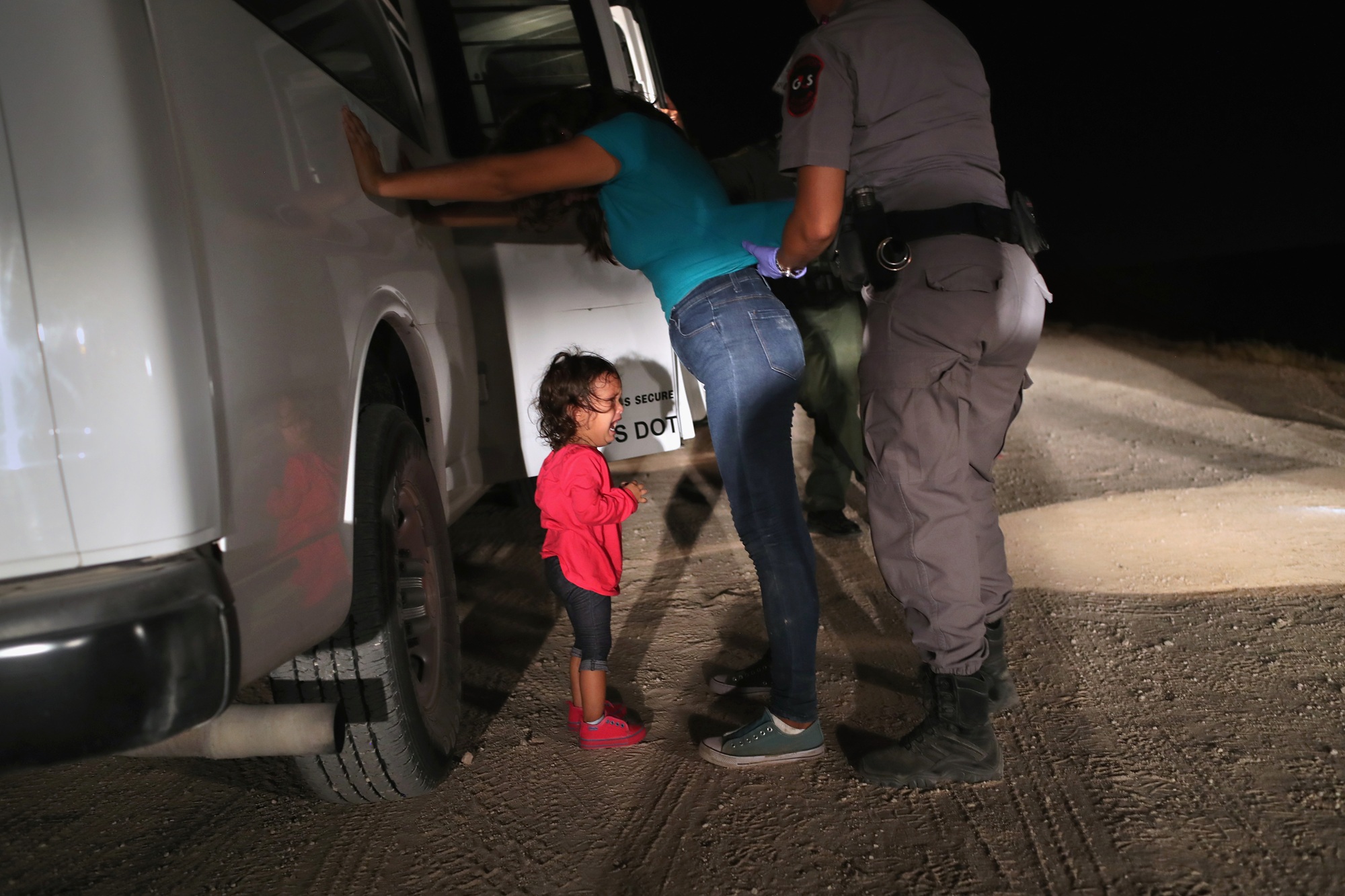
"caption": "A 2-year-old Honduran asylum seeker cries as her mother is searched and detained near the U.S.-Mexico border on June 12, 2018, in McAllen, Texas. ",
"credit": "John Moore/Getty Images",
"altTag": null,
"description": null,
"imgSizes": {
"thumbnail": {
"file": "https://cdn.kqed.org/wp-content/uploads/sites/10/2025/10/FamilySeparationGetty1-160x107.jpg",
"width": 160,
"height": 107,
"mimeType": "image/jpeg"
},
"1536x1536": {
"file": "https://cdn.kqed.org/wp-content/uploads/sites/10/2025/10/FamilySeparationGetty1-1536x1024.jpg",
"width": 1536,
"height": 1024,
"mimeType": "image/jpeg"
},
"post-thumbnail": {
"file": "https://cdn.kqed.org/wp-content/uploads/sites/10/2025/10/FamilySeparationGetty1-672x372.jpg",
"width": 672,
"height": 372,
"mimeType": "image/jpeg"
},
"twentyfourteen-full-width": {
"file": "https://cdn.kqed.org/wp-content/uploads/sites/10/2025/10/FamilySeparationGetty1-1038x576.jpg",
"width": 1038,
"height": 576,
"mimeType": "image/jpeg"
},
"kqedFullSize": {
"file": "https://cdn.kqed.org/wp-content/uploads/sites/10/2025/10/FamilySeparationGetty1.jpg",
"width": 2000,
"height": 1333
}
},
"isLoading": false,
"fetchFailed": false
},
"news_12059877": {
"type": "attachments",
"id": "news_12059877",
"meta": {
"index": "attachments_1716263798",
"site": "news",
"id": "12059877",
"found": true
},
"title": "251014-ANTIFAROUNDTABLEFOLO-03-BL-KQED",
"publishDate": 1760467761,
"status": "inherit",
"parent": 0,
"modified": 1760467820,
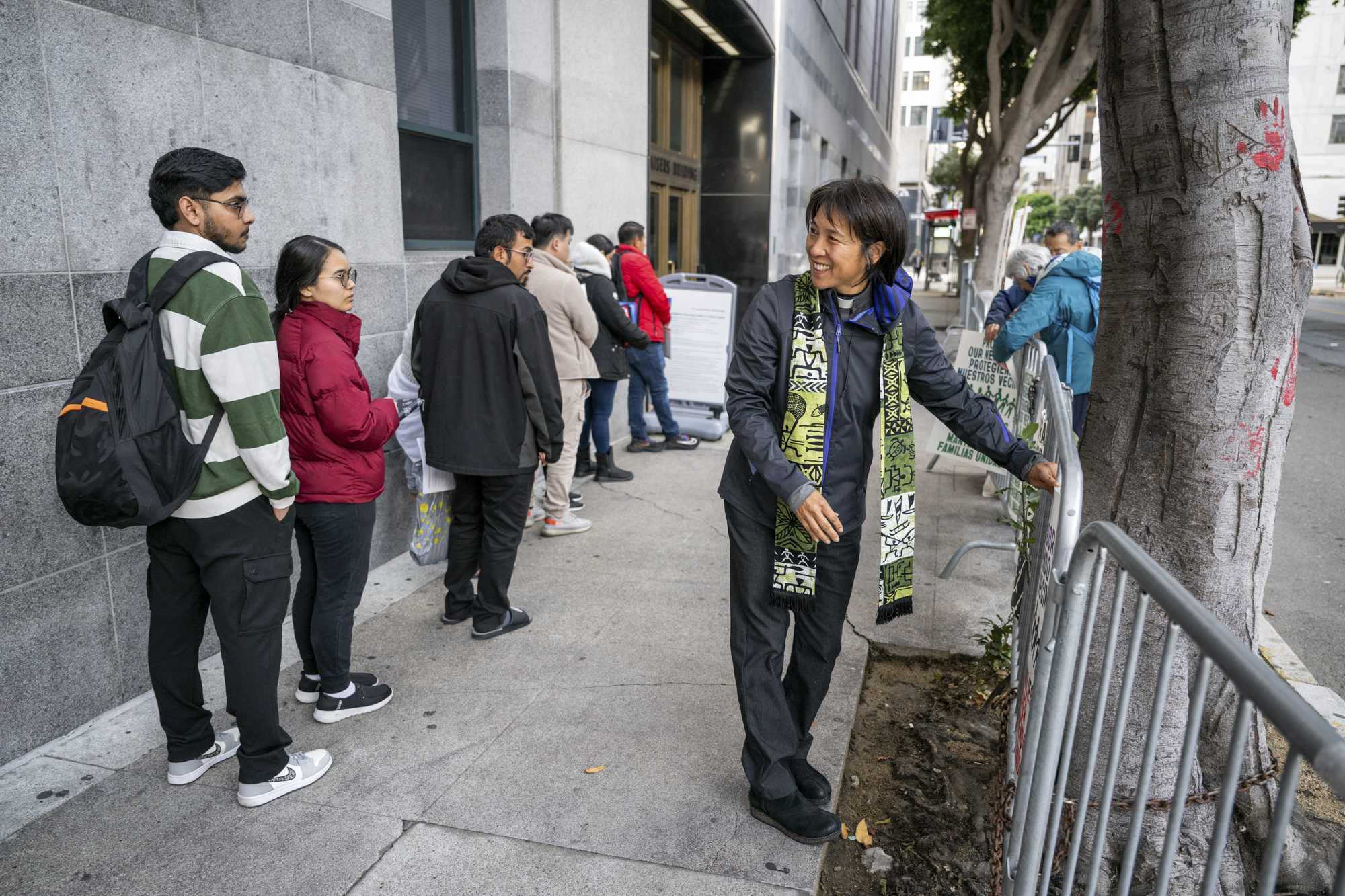
"caption": "Rev. Deborah Lee speaks with people in line outside the ICE Field Office in downtown San Francisco on Oct. 14, 2025, as they wait for scheduled check-ins and immigration-related appointments.",
"credit": "Beth LaBerge/KQED",
"altTag": null,
"description": null,
"imgSizes": {
"thumbnail": {
"file": "https://cdn.kqed.org/wp-content/uploads/sites/10/2025/10/251014-ANTIFAROUNDTABLEFOLO-03-BL-KQED-160x107.jpg",
"width": 160,
"height": 107,
"mimeType": "image/jpeg"
},
"1536x1536": {
"file": "https://cdn.kqed.org/wp-content/uploads/sites/10/2025/10/251014-ANTIFAROUNDTABLEFOLO-03-BL-KQED-1536x1024.jpg",
"width": 1536,
"height": 1024,
"mimeType": "image/jpeg"
},
"post-thumbnail": {
"file": "https://cdn.kqed.org/wp-content/uploads/sites/10/2025/10/251014-ANTIFAROUNDTABLEFOLO-03-BL-KQED-672x372.jpg",
"width": 672,
"height": 372,
"mimeType": "image/jpeg"
},
"twentyfourteen-full-width": {
"file": "https://cdn.kqed.org/wp-content/uploads/sites/10/2025/10/251014-ANTIFAROUNDTABLEFOLO-03-BL-KQED-1038x576.jpg",
"width": 1038,
"height": 576,
"mimeType": "image/jpeg"
},
"kqedFullSize": {
"file": "https://cdn.kqed.org/wp-content/uploads/sites/10/2025/10/251014-ANTIFAROUNDTABLEFOLO-03-BL-KQED.jpg",
"width": 2000,
"height": 1333
}
},
"isLoading": false,
"fetchFailed": false
}
},
"audioPlayerReducer": {
"postId": "stream_live",
"isPaused": true,
"isPlaying": false,
"pfsActive": false,
"pledgeModalIsOpen": true,
"playerDrawerIsOpen": false,
"liveAudioPlayStartedAt": 0,
"liveAudioPlayContext": ""
},
"authorsReducer": {
"byline_news_12060135": {
"type": "authors",
"id": "byline_news_12060135",
"meta": {
"override": true
},
"slug": "byline_news_12060135",
"name": "Mark Betancourt, The California Newsroom",
"isLoading": false
},
"tychehendricks": {
"type": "authors",
"id": "259",
"meta": {
"index": "authors_1716337520",
"id": "259",
"found": true
},
"name": "Tyche Hendricks",
"firstName": "Tyche",
"lastName": "Hendricks",
"slug": "tychehendricks",
"email": "thendricks@kqed.org",
"display_author_email": true,
"staff_mastheads": [
"news"
],
"title": "KQED Senior Editor, Immigration",
"bio": "\u003cspan style=\"font-weight: 400;\">Tyche Hendricks is KQED’s senior editor for immigration, leading coverage of the policy and politics that affect California’s immigrant communities. Her work for KQED’s radio and online audiences is also carried on NPR and other national outlets. She has been recognized with awards from the Radio and Television News Directors Association, the Society for Professional Journalists; the Education Writers Association; the Best of the West and the National Federation of Community Broadcasters. Before joining KQED in 2010, Tyche spent more than a dozen years as a newspaper reporter, notably at the \u003c/span>\u003ci>\u003cspan style=\"font-weight: 400;\">San Francisco Chronicle\u003c/span>\u003c/i>\u003cspan style=\"font-weight: 400;\">. At different times she has covered criminal justice, government and politics and urban planning. Tyche has taught in the MFA Creative Writing program at the University of San Francisco and at UC Berkeley’s Graduate School of Journalism, where she was co-director of a national immigration symposium for professional journalists. She is the author of \u003c/span>\u003ci>\u003cspan style=\"font-weight: 400;\">The Wind Doesn't Need a Passport: Stories from the U.S.-Mexico Borderlands\u003c/span>\u003c/i>\u003cspan style=\"font-weight: 400;\"> (University of California Press). \u003c/span>",
"avatar": "https://secure.gravatar.com/avatar/b8ee458e2731c2d43df86882ce17267e?s=600&d=blank&r=g",
"twitter": "tychehendricks",
"facebook": null,
"instagram": null,
"linkedin": null,
"sites": [
{
"site": "news",
"roles": [
"editor"
]
},
{
"site": "stateofhealth",
"roles": [
"editor"
]
}
],
"headData": {
"title": "Tyche Hendricks | KQED",
"description": "KQED Senior Editor, Immigration",
"ogImgSrc": "https://secure.gravatar.com/avatar/b8ee458e2731c2d43df86882ce17267e?s=600&d=blank&r=g",
"twImgSrc": "https://secure.gravatar.com/avatar/b8ee458e2731c2d43df86882ce17267e?s=600&d=blank&r=g"
},
"isLoading": false,
"link": "/author/tychehendricks"
},
"nvoynovskaya": {
"type": "authors",
"id": "11387",
"meta": {
"index": "authors_1716337520",
"id": "11387",
"found": true
},
"name": "Nastia Voynovskaya",
"firstName": "Nastia",
"lastName": "Voynovskaya",
"slug": "nvoynovskaya",
"email": "nvoynovskaya@kqed.org",
"display_author_email": false,
"staff_mastheads": [
"arts"
],
"title": "Editor and reporter",
"bio": "Nastia Voynovskaya is a reporter, editor and host at KQED Arts & Culture. She's been covering the arts in the Bay Area for over a decade, with a focus on music, queer culture, labor issues and grassroots organizing. She has edited KQED story series such as Trans Bay: A History of San Francisco's Gender-Diverse Community, and co-created KQED's Bay Area hip-hop history project, That's My Word. Nastia's work has been recognized by the Society of Professional Journalists and San Francisco Press Club. She regularly appears on podcasts and radio programs, including NPR's All Songs Considered, and hosts live events where music, culture and conversation meet.",
"avatar": "https://secure.gravatar.com/avatar/5025ee460e5a85d69ca20ea6c6f2f80d7e17795c828f61ea3aecfcd924e9042e?s=600&d=blank&r=g",
"twitter": null,
"bluesky": null,
"facebook": null,
"instagram": "https://www.instagram.com/nananastia/",
"linkedin": null,
"sites": [
{
"site": "",
"roles": [
"editor"
]
},
{
"site": "arts",
"roles": [
"administrator"
]
},
{
"site": "news",
"roles": [
"editor"
]
},
{
"site": "pop",
"roles": [
"administrator"
]
},
{
"site": "bayareabites",
"roles": [
"editor"
]
},
{
"site": "podcasts",
"roles": [
"editor"
]
},
{
"site": "hiphop",
"roles": [
"editor"
]
}
],
"headData": {
"title": "Nastia Voynovskaya | KQED",
"description": "Editor and reporter",
"ogImgSrc": "https://secure.gravatar.com/avatar/5025ee460e5a85d69ca20ea6c6f2f80d7e17795c828f61ea3aecfcd924e9042e?s=600&d=blank&r=g",
"twImgSrc": "https://secure.gravatar.com/avatar/5025ee460e5a85d69ca20ea6c6f2f80d7e17795c828f61ea3aecfcd924e9042e?s=600&d=blank&r=g"
},
"isLoading": false,
"link": "/author/nvoynovskaya"
},
"ahall": {
"type": "authors",
"id": "11490",
"meta": {
"index": "authors_1716337520",
"id": "11490",
"found": true
},
"name": "Alex Hall",
"firstName": "Alex",
"lastName": "Hall",
"slug": "ahall",
"email": "ahall@kqed.org",
"display_author_email": false,
"staff_mastheads": [
"news"
],
"title": "KQED Enterprise & Accountability Reporter",
"bio": "Alex Hall is KQED's Enterprise and Accountability Reporter. She previously covered the Central Valley for five years from KQED's bureau in Fresno. Before joining KQED, Alex was an investigative reporting fellow at Wisconsin Public Radio and the Wisconsin Center for Investigative Journalism. She has also worked as a bilingual producer for NPR's investigative unit and freelance video producer for Reuters TV on the Latin America desk. She got her start in journalism in South America, where she worked as a radio producer and Spanish-English translator for CNN Chile. Her documentary and investigation into the series of deadly COVID-19 outbreaks at Foster Farms won a national Edward R. Murrow award and was named an Investigative Reporters & Editors award finalist. Alex's reporting for Reveal on the Wisconsin dairy industry's reliance on undocumented immigrant labor was made into a film, Los Lecheros, which won a regional Edward R. Murrow award for best news documentary.",
"avatar": "https://secure.gravatar.com/avatar/04c28ad4a7caa7ac2ef39c655c4030c993a3f331481d1da4799bb76ea85b9afa?s=600&d=blank&r=g",
"twitter": "@chalexhall",
"bluesky": null,
"facebook": null,
"instagram": null,
"linkedin": null,
"sites": [
{
"site": "news",
"roles": [
"editor"
]
},
{
"site": "liveblog",
"roles": [
"author"
]
}
],
"headData": {
"title": "Alex Hall | KQED",
"description": "KQED Enterprise & Accountability Reporter",
"ogImgSrc": "https://secure.gravatar.com/avatar/04c28ad4a7caa7ac2ef39c655c4030c993a3f331481d1da4799bb76ea85b9afa?s=600&d=blank&r=g",
"twImgSrc": "https://secure.gravatar.com/avatar/04c28ad4a7caa7ac2ef39c655c4030c993a3f331481d1da4799bb76ea85b9afa?s=600&d=blank&r=g"
},
"isLoading": false,
"link": "/author/ahall"
},
"adahlstromeckman": {
"type": "authors",
"id": "11785",
"meta": {
"index": "authors_1716337520",
"id": "11785",
"found": true
},
"name": "Azul Dahlstrom-Eckman",
"firstName": "Azul",
"lastName": "Dahlstrom-Eckman",
"slug": "adahlstromeckman",
"email": "adahlstrom-eckman@kqed.org",
"display_author_email": true,
"staff_mastheads": [],
"title": "Reporter",
"bio": "Azul is a reporter for KQED focusing on transportation and features. He joined KQED in 2021 as an alumna of KALW's Audio Academy radio journalism training program.",
"avatar": "https://secure.gravatar.com/avatar/9cb750298435add7815a777f55bf1f46845c1386bb8452555c60a7b820b5aba3?s=600&d=blank&r=g",
"twitter": "@zuliemann",
"bluesky": "@azul415.bsky.social",
"facebook": null,
"instagram": null,
"linkedin": null,
"sites": [
{
"site": "arts",
"roles": [
"editor"
]
},
{
"site": "news",
"roles": [
"editor"
]
},
{
"site": "science",
"roles": [
"editor"
]
},
{
"site": "liveblog",
"roles": [
"author"
]
}
],
"headData": {
"title": "Azul Dahlstrom-Eckman | KQED",
"description": "Reporter",
"ogImgSrc": "https://secure.gravatar.com/avatar/9cb750298435add7815a777f55bf1f46845c1386bb8452555c60a7b820b5aba3?s=600&d=blank&r=g",
"twImgSrc": "https://secure.gravatar.com/avatar/9cb750298435add7815a777f55bf1f46845c1386bb8452555c60a7b820b5aba3?s=600&d=blank&r=g"
},
"isLoading": false,
"link": "/author/adahlstromeckman"
},
"sjohnson": {
"type": "authors",
"id": "11840",
"meta": {
"index": "authors_1716337520",
"id": "11840",
"found": true
},
"name": "Sydney Johnson",
"firstName": "Sydney",
"lastName": "Johnson",
"slug": "sjohnson",
"email": "sjohnson@kqed.org",
"display_author_email": false,
"staff_mastheads": [
"news"
],
"title": "KQED Reporter",
"bio": "Sydney Johnson is a general assignment reporter at KQED. She previously reported on public health and city government at the San Francisco Examiner, and before that, she covered statewide education policy for EdSource. Her reporting has won multiple local, state and national awards. Sydney is a graduate of the University of California, Berkeley and lives in San Francisco.",
"avatar": "https://secure.gravatar.com/avatar/97855f2719b72ad6190b7c535fe642c8?s=600&d=blank&r=g",
"twitter": "sydneyfjohnson",
"facebook": null,
"instagram": null,
"linkedin": null,
"sites": [
{
"site": "news",
"roles": [
"editor"
]
}
],
"headData": {
"title": "Sydney Johnson | KQED",
"description": "KQED Reporter",
"ogImgSrc": "https://secure.gravatar.com/avatar/97855f2719b72ad6190b7c535fe642c8?s=600&d=blank&r=g",
"twImgSrc": "https://secure.gravatar.com/avatar/97855f2719b72ad6190b7c535fe642c8?s=600&d=blank&r=g"
},
"isLoading": false,
"link": "/author/sjohnson"
},
"jgeha": {
"type": "authors",
"id": "11906",
"meta": {
"index": "authors_1716337520",
"id": "11906",
"found": true
},
"name": "Joseph Geha",
"firstName": "Joseph",
"lastName": "Geha",
"slug": "jgeha",
"email": "jgeha@kqed.org",
"display_author_email": false,
"staff_mastheads": [
"news",
"science"
],
"title": "KQED Contributor",
"bio": null,
"avatar": "https://secure.gravatar.com/avatar/ea84d2b6dd93d6369d453edf19dd583f117cd1759d2d9c9c92f9de77017354fe?s=600&d=blank&r=g",
"twitter": null,
"bluesky": null,
"facebook": null,
"instagram": null,
"linkedin": null,
"sites": [
{
"site": "news",
"roles": [
"editor"
]
},
{
"site": "liveblog",
"roles": [
"author"
]
}
],
"headData": {
"title": "Joseph Geha | KQED",
"description": "KQED Contributor",
"ogImgSrc": "https://secure.gravatar.com/avatar/ea84d2b6dd93d6369d453edf19dd583f117cd1759d2d9c9c92f9de77017354fe?s=600&d=blank&r=g",
"twImgSrc": "https://secure.gravatar.com/avatar/ea84d2b6dd93d6369d453edf19dd583f117cd1759d2d9c9c92f9de77017354fe?s=600&d=blank&r=g"
},
"isLoading": false,
"link": "/author/jgeha"
},
"kdebenedetti": {
"type": "authors",
"id": "11913",
"meta": {
"index": "authors_1716337520",
"id": "11913",
"found": true
},
"name": "Katie DeBenedetti",
"firstName": "Katie",
"lastName": "DeBenedetti",
"slug": "kdebenedetti",
"email": "kdebenedetti@kqed.org",
"display_author_email": false,
"staff_mastheads": [
"news",
"science"
],
"title": "KQED Contributor",
"bio": "Katie DeBenedetti is a digital reporter covering daily news for the Express Desk. Prior to joining KQED as a culture reporting intern in January 2024, she covered education and city government for the Napa Valley Register.",
"avatar": "https://secure.gravatar.com/avatar/6e31073cb8f7e4214ab03f42771d0f45?s=600&d=blank&r=g",
"twitter": null,
"facebook": null,
"instagram": null,
"linkedin": null,
"sites": [
{
"site": "news",
"roles": [
"author"
]
},
{
"site": "science",
"roles": [
"author"
]
},
{
"site": "liveblog",
"roles": [
"author"
]
}
],
"headData": {
"title": "Katie DeBenedetti | KQED",
"description": "KQED Contributor",
"ogImgSrc": "https://secure.gravatar.com/avatar/6e31073cb8f7e4214ab03f42771d0f45?s=600&d=blank&r=g",
"twImgSrc": "https://secure.gravatar.com/avatar/6e31073cb8f7e4214ab03f42771d0f45?s=600&d=blank&r=g"
},
"isLoading": false,
"link": "/author/kdebenedetti"
}
},
"pagesReducer": {
"news_tag_ice-raids": {
"type": "terms",
"id": "news_35606",
"meta": {
"index": "terms_1716263798",
"site": "news",
"id": "35606",
"score": 10.404627
},
"name": "ICE raids",
"slug": "ice-raids",
"taxonomy": "tag",
"description": null,
"featImg": null,
"headData": {
"title": "ICE raids | KQED News",
"description": null,
"ogTitle": null,
"ogDescription": null,
"ogImgId": null,
"twTitle": null,
"twDescription": null,
"twImgId": null
},
"ttid": 35623,
"isLoading": false,
"title": "ICE raids",
"pageMeta": {
"site": "news",
"WpPageTemplate": "page-topic-editorial",
"currentPage": 3
},
"blocks": [
{
"blockName": "kqed/post-list",
"attrs": {
"layout": "cardArticle2",
"query": "posts/news?tag=ice-raids",
"seeMore": false,
"paginated": true,
"page": 3
}
},
{
"blockName": "kqed/ad"
}
]
}
},
"pfsSessionReducer": {},
"postsReducer": {
"stream_live": {
"type": "live",
"id": "stream_live",
"audioUrl": "https://streams.kqed.org/kqedradio",
"title": "Live Stream",
"excerpt": "Live Stream information currently unavailable.",
"link": "/radio",
"featImg": "",
"label": {
"name": "KQED Live",
"link": "/"
}
},
"stream_kqedNewscast": {
"type": "posts",
"id": "stream_kqedNewscast",
"audioUrl": "https://www.kqed.org/.stream/anon/radio/RDnews/newscast.mp3?_=1",
"title": "KQED Newscast",
"featImg": "",
"label": {
"name": "88.5 FM",
"link": "/"
}
},
"news_12061436": {
"type": "posts",
"id": "news_12061436",
"meta": {
"index": "posts_1716263798",
"site": "news",
"id": "12061436",
"score": null,
"sort": [
1761325735000
]
},
"guestAuthors": [],
"slug": "2-injured-after-officers-shoot-at-truck-outside-alameda-base-following-day-of-protests",
"title": "2 Injured After Officers Shoot at Truck Outside Alameda Base Following Day of Protests",
"publishDate": 1761325735,
"format": "standard",
"headTitle": "2 Injured After Officers Shoot at Truck Outside Alameda Base Following Day of Protests | KQED",
"labelTerm": {
"site": "news"
},
"content": "\u003cp>At least two people were injured Thursday night when law enforcement officers opened fire on a U-Haul truck trying to back onto the bridge to Alameda’s Coast Guard Island, where federal agents arrived earlier in the day for what was expected to be a major \u003ca href=\"https://www.kqed.org/news/12061224/oakland-braces-for-possible-federal-action-after-san-francisco-dodges-trumps-attention\">immigration enforcement escalation\u003c/a> in the area.\u003c/p>\n\u003cp>The shooting occurred around 10 p.m., hours after hundreds of people had dispersed following protests there for much of the day against \u003ca href=\"https://www.kqed.org/news/12061191/activists-federal-agents-clash-at-coast-guard-base-during-immigration-crackdown\">the Border Patrol officers’ arrival\u003c/a>.\u003c/p>\n\u003cp>“The truck driver was wounded in the stomach and is being held for mental health evaluation,” the Department of Homeland Security \u003ca href=\"https://x.com/DHSgov/status/1981735133439725996\">said in a statement\u003c/a>. “A bystander was struck by a fragment, treated at a local hospital, and released.”\u003c/p>\n\u003cp>[ad fullwidth]\u003c/p>\n\u003cp>The Coast Guard said law enforcement officers opened fire on a U-Haul truck after its driver defied commands and backed onto the bridge that leads to the island base, reversing toward a blockade of officers and law enforcement vehicles shutting off access to the island, which is usually closed to the public. Officials have not specified what agency the officers were from.\u003c/p>\n\u003cp>Video footage captured by \u003ca href=\"https://www.youtube.com/watch?v=weYGEwkHDoA\">KTVU\u003c/a> and \u003ca href=\"https://x.com/SaraDonchey/status/1981607870325014602\">KPIX\u003c/a> shows a U-Haul truck line up facing away from the bridge before slowly reversing onto it.\u003c/p>\n\u003cfigure id=\"attachment_12061449\" class=\"wp-caption aligncenter\" style=\"max-width: 2000px\">\u003cimg loading=\"lazy\" decoding=\"async\" class=\"size-full wp-image-12061449\" src=\"https://cdn.kqed.org/wp-content/uploads/sites/10/2025/10/251024-CoastGuard-03-BL_qed.jpg\" alt=\"\" width=\"2000\" height=\"1333\" srcset=\"https://cdn.kqed.org/wp-content/uploads/sites/10/2025/10/251024-CoastGuard-03-BL_qed.jpg 2000w, https://cdn.kqed.org/wp-content/uploads/sites/10/2025/10/251024-CoastGuard-03-BL_qed-160x107.jpg 160w, https://cdn.kqed.org/wp-content/uploads/sites/10/2025/10/251024-CoastGuard-03-BL_qed-1536x1024.jpg 1536w\" sizes=\"auto, (max-width: 2000px) 100vw, 2000px\">\u003cfigcaption class=\"wp-caption-text\">FBI and law enforcement agents stand at the intersection of Dennison Street and Embarcadero in front of Coast Guard Island in Oakland on Oct. 24, 2025, following a shooting late last night in which security personnel opened fire on a U-Haul near the base. \u003ccite>(Beth LaBerge/KQED)\u003c/cite>\u003c/figcaption>\u003c/figure>\n\u003cp>Officers can be heard yelling at the driver before shooting repeatedly at the truck for multiple seconds. After the initial gunshots, the van reverses more quickly for another few seconds before coming to a halt and quickly pulling forward.\u003c/p>\n\u003cp>The vehicle appears to pause for about 30 seconds at the intersection leading off of the bridge before driving away.\u003c/p>\n\u003cp>The driver, along with another person not in the vehicle, were \u003ca href=\"https://www.mercurynews.com/2025/10/24/coast-guard-shooting-oakland-immigration-protest/\">injured in the shooting\u003c/a>, according to \u003ca href=\"https://x.com/henrykleeKTVU/status/1981707153619788001\">multiple reports\u003c/a>.[aside postID=news_12061191 hero='https://cdn.kqed.org/wp-content/uploads/sites/10/2025/10/GETTYIMAGES-2242445000-KQED.jpg']“Coast Guard personnel issued multiple verbal commands to stop the vehicle, the driver failed to comply and proceeded to put the vehicle in reverse,” the Coast Guard said in a statement. “When the vehicle’s actions posed a direct threat to the safety of Coast Guard and security personnel, law enforcement officers discharged several rounds of live fire.”\u003c/p>\n\u003cp>The Coast Guard said none of its personnel were injured during the incident.\u003c/p>\n\u003cp>The FBI is leading an investigation into the shooting, and agents were on the scene early Friday, with a block cordoned off in each direction surrounding the intersection near the bridge at Embarcadero and Dennison Street.\u003c/p>\n\u003cp>“At the request of the U.S. Coast Guard, the FBI is investigating a shooting incident that occurred around 10 p.m. last night on Coast Guard Island in Alameda,” spokesperson Cameron Polan told KQED. “At this time, the incident appears to be isolated, and there is no known current threat to the public.”\u003c/p>\n\u003cp>A group of about a dozen protesters were allowed back to the intersection after agents departed around 9 a.m.\u003c/p>\n\u003cp>A peaceful crowd of around 50 people gathered throughout the morning, though at one point officers fired what appeared to be pepper balls at a woman trying to drive up to the base.\u003c/p>\n\u003cp>Rose Strauser, who was among the activists, told KQED that the woman was not affiliated with the protest, but was trying to access a health center on the base to get medication.\u003c/p>\n\u003cp>“I don’t think she got hit because she was in her car, but she’s obviously really shaken up,” Strauser said. \u003c/p>\n\u003cp>\u003cem>KQED’s \u003c/em>\u003ca href=\"https://www.kqed.org/author/blaberge\">\u003cem>Beth LaBerge\u003c/em>\u003c/a>\u003cem> and \u003ca href=\"https://www.kqed.org/author/nvoynovskaya\">Nastia Voynovskaya\u003c/a> contributed to this report.\u003c/em>\u003c/p>\n\u003cp>\u003c/p>\n",
"blocks": [],
"excerpt": "Around 10 p.m. Thursday, officers opened fire on a U-Haul truck trying to back onto the bridge to Alameda’s Coast Guard Island, where federal agents began to arrive earlier in the day.",
"status": "publish",
"parent": 0,
"modified": 1761347483,
"stats": {
"hasAudio": false,
"hasVideo": false,
"hasChartOrMap": false,
"iframeSrcs": [],
"hasGoogleForm": false,
"hasGallery": false,
"hasHearkenModule": false,
"hasPolis": false,
"paragraphCount": 18,
"wordCount": 653
},
"headData": {
"title": "2 Injured After Officers Shoot at Truck Outside Alameda Base Following Day of Protests | KQED",
"description": "Around 10 p.m. Thursday, officers opened fire on a U-Haul truck trying to back onto the bridge to Alameda’s Coast Guard Island, where federal agents began to arrive earlier in the day.",
"ogTitle": "",
"ogDescription": "",
"ogImgId": "",
"twTitle": "",
"twDescription": "",
"twImgId": "",
"schema": {
"@context": "https://schema.org",
"@type": "NewsArticle",
"headline": "2 Injured After Officers Shoot at Truck Outside Alameda Base Following Day of Protests",
"datePublished": "2025-10-24T10:08:55-07:00",
"dateModified": "2025-10-24T16:11:23-07:00",
"image": "https://cdn.kqed.org/wp-content/uploads/2020/02/KQED-OG-Image@1x.png",
"isAccessibleForFree": "True",
"publisher": {
"@type": "NewsMediaOrganization",
"@id": "https://www.kqed.org/#organization",
"name": "KQED",
"logo": "https://cdn.kqed.org/wp-content/uploads/2020/02/KQED-OG-Image@1x.png",
"url": "https://www.kqed.org",
"sameAs": [
"https://www.facebook.com/KQED",
"https://twitter.com/KQED",
"https://www.instagram.com/kqed/",
"https://www.tiktok.com/@kqedofficial",
"https://www.linkedin.com/company/kqed",
"https://www.youtube.com/channel/UCeC0IOo7i1P_61zVUWbJ4nw"
]
}
}
},
"primaryCategory": {
"termId": 1169,
"slug": "immigration",
"name": "Immigration"
},
"sticky": false,
"nprStoryId": "kqed-12061436",
"templateType": "standard",
"featuredImageType": "standard",
"excludeFromSiteSearch": "Include",
"articleAge": "0",
"path": "/news/12061436/2-injured-after-officers-shoot-at-truck-outside-alameda-base-following-day-of-protests",
"audioTrackLength": null,
"parsedContent": [
{
"type": "contentString",
"content": "\u003cdiv class=\"post-body\">\u003cp>\u003cp>At least two people were injured Thursday night when law enforcement officers opened fire on a U-Haul truck trying to back onto the bridge to Alameda’s Coast Guard Island, where federal agents arrived earlier in the day for what was expected to be a major \u003ca href=\"https://www.kqed.org/news/12061224/oakland-braces-for-possible-federal-action-after-san-francisco-dodges-trumps-attention\">immigration enforcement escalation\u003c/a> in the area.\u003c/p>\n\u003cp>The shooting occurred around 10 p.m., hours after hundreds of people had dispersed following protests there for much of the day against \u003ca href=\"https://www.kqed.org/news/12061191/activists-federal-agents-clash-at-coast-guard-base-during-immigration-crackdown\">the Border Patrol officers’ arrival\u003c/a>.\u003c/p>\n\u003cp>“The truck driver was wounded in the stomach and is being held for mental health evaluation,” the Department of Homeland Security \u003ca href=\"https://x.com/DHSgov/status/1981735133439725996\">said in a statement\u003c/a>. “A bystander was struck by a fragment, treated at a local hospital, and released.”\u003c/p>\n\u003cp>\u003c/p>\u003c/div>",
"attributes": {
"named": {},
"numeric": []
}
},
{
"type": "component",
"content": "",
"name": "ad",
"attributes": {
"named": {
"label": "fullwidth"
},
"numeric": [
"fullwidth"
]
}
},
{
"type": "contentString",
"content": "\u003cdiv class=\"post-body\">\u003cp>\u003c/p>\n\u003cp>The Coast Guard said law enforcement officers opened fire on a U-Haul truck after its driver defied commands and backed onto the bridge that leads to the island base, reversing toward a blockade of officers and law enforcement vehicles shutting off access to the island, which is usually closed to the public. Officials have not specified what agency the officers were from.\u003c/p>\n\u003cp>Video footage captured by \u003ca href=\"https://www.youtube.com/watch?v=weYGEwkHDoA\">KTVU\u003c/a> and \u003ca href=\"https://x.com/SaraDonchey/status/1981607870325014602\">KPIX\u003c/a> shows a U-Haul truck line up facing away from the bridge before slowly reversing onto it.\u003c/p>\n\u003cfigure id=\"attachment_12061449\" class=\"wp-caption aligncenter\" style=\"max-width: 2000px\">\u003cimg loading=\"lazy\" decoding=\"async\" class=\"size-full wp-image-12061449\" src=\"https://cdn.kqed.org/wp-content/uploads/sites/10/2025/10/251024-CoastGuard-03-BL_qed.jpg\" alt=\"\" width=\"2000\" height=\"1333\" srcset=\"https://cdn.kqed.org/wp-content/uploads/sites/10/2025/10/251024-CoastGuard-03-BL_qed.jpg 2000w, https://cdn.kqed.org/wp-content/uploads/sites/10/2025/10/251024-CoastGuard-03-BL_qed-160x107.jpg 160w, https://cdn.kqed.org/wp-content/uploads/sites/10/2025/10/251024-CoastGuard-03-BL_qed-1536x1024.jpg 1536w\" sizes=\"auto, (max-width: 2000px) 100vw, 2000px\">\u003cfigcaption class=\"wp-caption-text\">FBI and law enforcement agents stand at the intersection of Dennison Street and Embarcadero in front of Coast Guard Island in Oakland on Oct. 24, 2025, following a shooting late last night in which security personnel opened fire on a U-Haul near the base. \u003ccite>(Beth LaBerge/KQED)\u003c/cite>\u003c/figcaption>\u003c/figure>\n\u003cp>Officers can be heard yelling at the driver before shooting repeatedly at the truck for multiple seconds. After the initial gunshots, the van reverses more quickly for another few seconds before coming to a halt and quickly pulling forward.\u003c/p>\n\u003cp>The vehicle appears to pause for about 30 seconds at the intersection leading off of the bridge before driving away.\u003c/p>\n\u003cp>The driver, along with another person not in the vehicle, were \u003ca href=\"https://www.mercurynews.com/2025/10/24/coast-guard-shooting-oakland-immigration-protest/\">injured in the shooting\u003c/a>, according to \u003ca href=\"https://x.com/henrykleeKTVU/status/1981707153619788001\">multiple reports\u003c/a>.\u003c/p>\u003c/div>",
"attributes": {
"named": {},
"numeric": []
}
},
{
"type": "component",
"content": "",
"name": "aside",
"attributes": {
"named": {
"postid": "news_12061191",
"hero": "https://cdn.kqed.org/wp-content/uploads/sites/10/2025/10/GETTYIMAGES-2242445000-KQED.jpg",
"label": ""
},
"numeric": []
}
},
{
"type": "contentString",
"content": "\u003cdiv class=\"post-body\">\u003cp>“Coast Guard personnel issued multiple verbal commands to stop the vehicle, the driver failed to comply and proceeded to put the vehicle in reverse,” the Coast Guard said in a statement. “When the vehicle’s actions posed a direct threat to the safety of Coast Guard and security personnel, law enforcement officers discharged several rounds of live fire.”\u003c/p>\n\u003cp>The Coast Guard said none of its personnel were injured during the incident.\u003c/p>\n\u003cp>The FBI is leading an investigation into the shooting, and agents were on the scene early Friday, with a block cordoned off in each direction surrounding the intersection near the bridge at Embarcadero and Dennison Street.\u003c/p>\n\u003cp>“At the request of the U.S. Coast Guard, the FBI is investigating a shooting incident that occurred around 10 p.m. last night on Coast Guard Island in Alameda,” spokesperson Cameron Polan told KQED. “At this time, the incident appears to be isolated, and there is no known current threat to the public.”\u003c/p>\n\u003cp>A group of about a dozen protesters were allowed back to the intersection after agents departed around 9 a.m.\u003c/p>\n\u003cp>A peaceful crowd of around 50 people gathered throughout the morning, though at one point officers fired what appeared to be pepper balls at a woman trying to drive up to the base.\u003c/p>\n\u003cp>Rose Strauser, who was among the activists, told KQED that the woman was not affiliated with the protest, but was trying to access a health center on the base to get medication.\u003c/p>\n\u003cp>“I don’t think she got hit because she was in her car, but she’s obviously really shaken up,” Strauser said. \u003c/p>\n\u003cp>\u003cem>KQED’s \u003c/em>\u003ca href=\"https://www.kqed.org/author/blaberge\">\u003cem>Beth LaBerge\u003c/em>\u003c/a>\u003cem> and \u003ca href=\"https://www.kqed.org/author/nvoynovskaya\">Nastia Voynovskaya\u003c/a> contributed to this report.\u003c/em>\u003c/p>\n\u003cp>\u003c/p>\n\u003c/div>\u003c/p>",
"attributes": {
"named": {},
"numeric": []
}
}
],
"link": "/news/12061436/2-injured-after-officers-shoot-at-truck-outside-alameda-base-following-day-of-protests",
"authors": [
"11913"
],
"categories": [
"news_1169",
"news_28250",
"news_8",
"news_13"
],
"tags": [
"news_18848",
"news_21130",
"news_21200",
"news_1323",
"news_27626",
"news_35606",
"news_20202",
"news_22923",
"news_20529"
],
"featImg": "news_12061450",
"label": "news"
},
"news_12061227": {
"type": "posts",
"id": "news_12061227",
"meta": {
"index": "posts_1716263798",
"site": "news",
"id": "12061227",
"score": null,
"sort": [
1761260885000
]
},
"guestAuthors": [],
"slug": "not-today-sf-officials-activists-vow-to-mobilize-against-immigration-enforcement",
"title": "‘Not Today’: SF Officials, Activists Vow to Mobilize Against Immigration Enforcement",
"publishDate": 1761260885,
"format": "standard",
"headTitle": "‘Not Today’: SF Officials, Activists Vow to Mobilize Against Immigration Enforcement | KQED",
"labelTerm": {
"site": "news"
},
"content": "\u003cp>As protesters rallied across the bay \u003ca href=\"https://www.kqed.org/news/12061191/activists-federal-agents-clash-at-coast-guard-base-during-immigration-crackdown\">at Alameda’s Coast Guard Island\u003c/a>, a coalition of labor, faith and city leaders gathered Thursday on the steps of San Francisco City Hall to denounce President Donald Trump’s mobilization of federal immigration agents in the Bay Area and share resources for community members who are at risk.\u003c/p>\n\u003cp>“They want us to backtrack our sanctuary policy,” said San Francisco Supervisor Jackie Fielder. “They want us to hand over our neighbors, our co-workers, our friends … to ICE. They want to tap our surveillance networks … to let Trump spy on our streets, our families, our people. They want our police to help them enforce their racist immigration agenda. Well, I say hell no. Not today, not tomorrow, not ever.”\u003c/p>\n\u003cp>Led by grassroots group Bay Resistance, the rally’s speakers included San Francisco Supervisors Chyanne Chen and Shamann Walton, as well as representatives from the San Francisco Labor Council, United Educators of San Francisco, SEIU Local 87, Mission Action and Trabajadores Unidos.\u003c/p>\n\u003cp>[ad fullwidth]\u003c/p>\n\u003cp>The groups stood against Trump’s decision this week to send more than 100 Customs and Border Protection agents to Alameda’s Coast Guard base as part of a\u003ca href=\"https://www.kqed.org/news/12061080/federal-border-agents-to-arrive-in-bay-area-as-cities-brace-for-enforcement-surge\"> major immigration enforcement operation\u003c/a> in the Bay Area.\u003c/p>\n\u003cp>Early Thursday morning, around 300 peaceful protesters assembled outside the Oakland entrance to Coast Guard Island. Activists told KQED that CBP agents drove through the crowd in SUVs, setting off flash-bang grenades; one of their vehicles ran over a protester’s foot. Another masked agent shot pepper powder at a reverend who attempted to block a vehicle, according to a witness. Two people were arrested as the protest dragged on into the afternoon.\u003c/p>\n\u003cfigure id=\"attachment_12061292\" class=\"wp-caption aligncenter\" style=\"max-width: 2000px\">\u003cimg loading=\"lazy\" decoding=\"async\" class=\"size-full wp-image-12061292\" src=\"https://cdn.kqed.org/wp-content/uploads/sites/10/2025/10/20251023_SF-CITY-HALL_HERNANDEZ-6-KQED.jpg\" alt=\"\" width=\"2000\" height=\"1333\" srcset=\"https://cdn.kqed.org/wp-content/uploads/sites/10/2025/10/20251023_SF-CITY-HALL_HERNANDEZ-6-KQED.jpg 2000w, https://cdn.kqed.org/wp-content/uploads/sites/10/2025/10/20251023_SF-CITY-HALL_HERNANDEZ-6-KQED-160x107.jpg 160w, https://cdn.kqed.org/wp-content/uploads/sites/10/2025/10/20251023_SF-CITY-HALL_HERNANDEZ-6-KQED-1536x1024.jpg 1536w\" sizes=\"auto, (max-width: 2000px) 100vw, 2000px\">\u003cfigcaption class=\"wp-caption-text\">Hundreds gathered on the steps of San Francisco City Hall for a press conference organized by faith, labor and immigrant rights groups opposing federal intervention and calling for community protection and solidarity on Oct. 23, 2025. \u003ccite>(Gustavo Hernandez/KQED)\u003c/cite>\u003c/figcaption>\u003c/figure>\n\u003cp>Elected officials, including Gov. Gavin Newsom, as well as community activists, have warned that Trump could use protests as a pretext to send in the National Guard to San Francisco or other Bay Area cities. But Thursday morning, Mayor Daniel Lurie\u003ca href=\"https://www.kqed.org/news/12061209/lurie-trump-is-calling-off-plans-to-send-federal-troops-to-san-francisco\"> announced that he received a late-night phone call\u003c/a> from the president, who told him he’d call off federal deployment to the city.\u003c/p>\n\u003cp>“My team will continue to monitor the situation closely, and our city remains prepared for any scenario,” Lurie said in a statement.\u003c/p>\n\u003cp>Many of the speakers on the City Hall steps were skeptical. “We want everyone to know that, regardless of new announcements, we stand with our communities,” Walton said. “We have to be careful because we do not trust this administration.”[aside postID=news_12061209 hero='https://cdn.kqed.org/wp-content/uploads/sites/10/2025/06/20250428_WarrantlessSearches_GC-29_qed.jpg']Fielder went further, denouncing Lurie’s statement that, although he opposes federalization of the National Guard, he’d welcome collaboration with the FBI; Drug Enforcement Administration; Bureau of Alcohol, Tobacco, Firearms and Explosives; and federal prosecutors to arrest drug dealers in San Francisco.\u003c/p>\n\u003cp>“We should not negotiate with a fascist administration,” Fielder said.\u003c/p>\n\u003cp>Several speakers pointed out that even if Trump doesn’t deploy the National Guard, CBP agents in Alameda still put people at risk. “As everyone knows, our workers live in the nine Bay Area counties and beyond,” said Kim Tavaglione, executive director of the San Francisco Labor Council. “Labor is vowing to protect every worker in every county in the Bay Area.”\u003c/p>\n\u003cp>Cassondra Curiel, president of United Educators of San Francisco, said that her union members are worried that heightened immigration enforcement increases their chances of being racially profiled and arrested, even if they are citizens or permanent residents. A \u003ca href=\"https://www.npr.org/2025/09/13/nx-s1-5507125/the-supreme-court-clears-the-way-for-ice-agents-to-treat-race-as-grounds-for-immigration-stops\">recent Supreme Court ruling\u003c/a> cleared the way for immigration enforcement agents to use race as a pretext to stop and detain people.\u003c/p>\n\u003cp>“We know these agents are going to profile Latino communities, Spanish speakers, Black people and Asian people, which is the majority — literally 78% — of our entire district,” Curiel told KQED in an interview after the rally.\u003c/p>\n\u003cfigure id=\"attachment_12061291\" class=\"wp-caption aligncenter\" style=\"max-width: 2000px\">\u003cimg loading=\"lazy\" decoding=\"async\" class=\"size-full wp-image-12061291\" src=\"https://cdn.kqed.org/wp-content/uploads/sites/10/2025/10/20251023_SF-CITY-HALL_HERNANDEZ-3-KQED.jpg\" alt=\"\" width=\"2000\" height=\"1333\" srcset=\"https://cdn.kqed.org/wp-content/uploads/sites/10/2025/10/20251023_SF-CITY-HALL_HERNANDEZ-3-KQED.jpg 2000w, https://cdn.kqed.org/wp-content/uploads/sites/10/2025/10/20251023_SF-CITY-HALL_HERNANDEZ-3-KQED-160x107.jpg 160w, https://cdn.kqed.org/wp-content/uploads/sites/10/2025/10/20251023_SF-CITY-HALL_HERNANDEZ-3-KQED-1536x1024.jpg 1536w\" sizes=\"auto, (max-width: 2000px) 100vw, 2000px\">\u003cfigcaption class=\"wp-caption-text\">Rev. Deborah Lee, co-executive director of the Interfaith Movement for Human Integrity, addresses the crowd on Oct. 23, 2025 rally at San Francisco City Hall. \u003ccite>(Gustavo Hernandez/KQED)\u003c/cite>\u003c/figcaption>\u003c/figure>\n\u003cp>Many of the activists pointed to mutual aid resources, including those assembled by \u003ca href=\"https://www.bayresistance.org/get-ready\">Bay Resistance\u003c/a>. The organization has a know-your-rights toolkit and phone numbers to a rapid-response network where people can report ICE agent sightings in all nine Bay Area counties, and get help if a loved one has been detained. Volunteers have also been watching street corners where day laborers gather and reporting ICE activity through the \u003ca href=\"https://ndlon.org/adopt-a-day-labor-corner/\">Adopt a Corner program\u003c/a>.\u003c/p>\n\u003cp>Laura Valdez, executive director of Mission Action and a representative of the \u003ca href=\"https://www.sfrrn.org/\">San Francisco Rapid Response Network\u003c/a>, implored immigrants to take precautions, including sharing identifying information such as their full legal name and immigration file “A-number” with trusted loved ones so that her organization can help locate them if they get detained by ICE.\u003c/p>\n\u003cp>“This might be the start of mass enforcement of our communities, and we need to prepare adequately,” Valdez said.\u003c/p>\n\u003cp>Bay Resistance will lead another protest on Thursday at 5 p.m. at San Francisco’s Embarcadero Plaza.\u003c/p>\n\u003cp>\u003c/p>\n",
"blocks": [],
"excerpt": "At San Francisco City Hall, labor, faith and city leaders implored the public to use rapid response networks to report ICE and Border Patrol activity. ",
"status": "publish",
"parent": 0,
"modified": 1761262073,
"stats": {
"hasAudio": false,
"hasVideo": false,
"hasChartOrMap": false,
"iframeSrcs": [],
"hasGoogleForm": false,
"hasGallery": false,
"hasHearkenModule": false,
"hasPolis": false,
"paragraphCount": 18,
"wordCount": 908
},
"headData": {
"title": "‘Not Today’: SF Officials, Activists Vow to Mobilize Against Immigration Enforcement | KQED",
"description": "At San Francisco City Hall, labor, faith and city leaders implored the public to use rapid response networks to report ICE and Border Patrol activity. ",
"ogTitle": "",
"ogDescription": "",
"ogImgId": "",
"twTitle": "",
"twDescription": "",
"twImgId": "",
"schema": {
"@context": "https://schema.org",
"@type": "NewsArticle",
"headline": "‘Not Today’: SF Officials, Activists Vow to Mobilize Against Immigration Enforcement",
"datePublished": "2025-10-23T16:08:05-07:00",
"dateModified": "2025-10-23T16:27:53-07:00",
"image": "https://cdn.kqed.org/wp-content/uploads/2020/02/KQED-OG-Image@1x.png",
"isAccessibleForFree": "True",
"publisher": {
"@type": "NewsMediaOrganization",
"@id": "https://www.kqed.org/#organization",
"name": "KQED",
"logo": "https://cdn.kqed.org/wp-content/uploads/2020/02/KQED-OG-Image@1x.png",
"url": "https://www.kqed.org",
"sameAs": [
"https://www.facebook.com/KQED",
"https://twitter.com/KQED",
"https://www.instagram.com/kqed/",
"https://www.tiktok.com/@kqedofficial",
"https://www.linkedin.com/company/kqed",
"https://www.youtube.com/channel/UCeC0IOo7i1P_61zVUWbJ4nw"
]
}
}
},
"primaryCategory": {
"termId": 1169,
"slug": "immigration",
"name": "Immigration"
},
"sticky": false,
"nprStoryId": "kqed-12061227",
"templateType": "standard",
"featuredImageType": "standard",
"excludeFromSiteSearch": "Include",
"articleAge": "0",
"path": "/news/12061227/not-today-sf-officials-activists-vow-to-mobilize-against-immigration-enforcement",
"audioTrackLength": null,
"parsedContent": [
{
"type": "contentString",
"content": "\u003cdiv class=\"post-body\">\u003cp>\u003cp>As protesters rallied across the bay \u003ca href=\"https://www.kqed.org/news/12061191/activists-federal-agents-clash-at-coast-guard-base-during-immigration-crackdown\">at Alameda’s Coast Guard Island\u003c/a>, a coalition of labor, faith and city leaders gathered Thursday on the steps of San Francisco City Hall to denounce President Donald Trump’s mobilization of federal immigration agents in the Bay Area and share resources for community members who are at risk.\u003c/p>\n\u003cp>“They want us to backtrack our sanctuary policy,” said San Francisco Supervisor Jackie Fielder. “They want us to hand over our neighbors, our co-workers, our friends … to ICE. They want to tap our surveillance networks … to let Trump spy on our streets, our families, our people. They want our police to help them enforce their racist immigration agenda. Well, I say hell no. Not today, not tomorrow, not ever.”\u003c/p>\n\u003cp>Led by grassroots group Bay Resistance, the rally’s speakers included San Francisco Supervisors Chyanne Chen and Shamann Walton, as well as representatives from the San Francisco Labor Council, United Educators of San Francisco, SEIU Local 87, Mission Action and Trabajadores Unidos.\u003c/p>\n\u003cp>\u003c/p>\u003c/div>",
"attributes": {
"named": {},
"numeric": []
}
},
{
"type": "component",
"content": "",
"name": "ad",
"attributes": {
"named": {
"label": "fullwidth"
},
"numeric": [
"fullwidth"
]
}
},
{
"type": "contentString",
"content": "\u003cdiv class=\"post-body\">\u003cp>\u003c/p>\n\u003cp>The groups stood against Trump’s decision this week to send more than 100 Customs and Border Protection agents to Alameda’s Coast Guard base as part of a\u003ca href=\"https://www.kqed.org/news/12061080/federal-border-agents-to-arrive-in-bay-area-as-cities-brace-for-enforcement-surge\"> major immigration enforcement operation\u003c/a> in the Bay Area.\u003c/p>\n\u003cp>Early Thursday morning, around 300 peaceful protesters assembled outside the Oakland entrance to Coast Guard Island. Activists told KQED that CBP agents drove through the crowd in SUVs, setting off flash-bang grenades; one of their vehicles ran over a protester’s foot. Another masked agent shot pepper powder at a reverend who attempted to block a vehicle, according to a witness. Two people were arrested as the protest dragged on into the afternoon.\u003c/p>\n\u003cfigure id=\"attachment_12061292\" class=\"wp-caption aligncenter\" style=\"max-width: 2000px\">\u003cimg loading=\"lazy\" decoding=\"async\" class=\"size-full wp-image-12061292\" src=\"https://cdn.kqed.org/wp-content/uploads/sites/10/2025/10/20251023_SF-CITY-HALL_HERNANDEZ-6-KQED.jpg\" alt=\"\" width=\"2000\" height=\"1333\" srcset=\"https://cdn.kqed.org/wp-content/uploads/sites/10/2025/10/20251023_SF-CITY-HALL_HERNANDEZ-6-KQED.jpg 2000w, https://cdn.kqed.org/wp-content/uploads/sites/10/2025/10/20251023_SF-CITY-HALL_HERNANDEZ-6-KQED-160x107.jpg 160w, https://cdn.kqed.org/wp-content/uploads/sites/10/2025/10/20251023_SF-CITY-HALL_HERNANDEZ-6-KQED-1536x1024.jpg 1536w\" sizes=\"auto, (max-width: 2000px) 100vw, 2000px\">\u003cfigcaption class=\"wp-caption-text\">Hundreds gathered on the steps of San Francisco City Hall for a press conference organized by faith, labor and immigrant rights groups opposing federal intervention and calling for community protection and solidarity on Oct. 23, 2025. \u003ccite>(Gustavo Hernandez/KQED)\u003c/cite>\u003c/figcaption>\u003c/figure>\n\u003cp>Elected officials, including Gov. Gavin Newsom, as well as community activists, have warned that Trump could use protests as a pretext to send in the National Guard to San Francisco or other Bay Area cities. But Thursday morning, Mayor Daniel Lurie\u003ca href=\"https://www.kqed.org/news/12061209/lurie-trump-is-calling-off-plans-to-send-federal-troops-to-san-francisco\"> announced that he received a late-night phone call\u003c/a> from the president, who told him he’d call off federal deployment to the city.\u003c/p>\n\u003cp>“My team will continue to monitor the situation closely, and our city remains prepared for any scenario,” Lurie said in a statement.\u003c/p>\n\u003cp>Many of the speakers on the City Hall steps were skeptical. “We want everyone to know that, regardless of new announcements, we stand with our communities,” Walton said. “We have to be careful because we do not trust this administration.”\u003c/p>\u003c/div>",
"attributes": {
"named": {},
"numeric": []
}
},
{
"type": "component",
"content": "",
"name": "aside",
"attributes": {
"named": {
"postid": "news_12061209",
"hero": "https://cdn.kqed.org/wp-content/uploads/sites/10/2025/06/20250428_WarrantlessSearches_GC-29_qed.jpg",
"label": ""
},
"numeric": []
}
},
{
"type": "contentString",
"content": "\u003cdiv class=\"post-body\">\u003cp>Fielder went further, denouncing Lurie’s statement that, although he opposes federalization of the National Guard, he’d welcome collaboration with the FBI; Drug Enforcement Administration; Bureau of Alcohol, Tobacco, Firearms and Explosives; and federal prosecutors to arrest drug dealers in San Francisco.\u003c/p>\n\u003cp>“We should not negotiate with a fascist administration,” Fielder said.\u003c/p>\n\u003cp>Several speakers pointed out that even if Trump doesn’t deploy the National Guard, CBP agents in Alameda still put people at risk. “As everyone knows, our workers live in the nine Bay Area counties and beyond,” said Kim Tavaglione, executive director of the San Francisco Labor Council. “Labor is vowing to protect every worker in every county in the Bay Area.”\u003c/p>\n\u003cp>Cassondra Curiel, president of United Educators of San Francisco, said that her union members are worried that heightened immigration enforcement increases their chances of being racially profiled and arrested, even if they are citizens or permanent residents. A \u003ca href=\"https://www.npr.org/2025/09/13/nx-s1-5507125/the-supreme-court-clears-the-way-for-ice-agents-to-treat-race-as-grounds-for-immigration-stops\">recent Supreme Court ruling\u003c/a> cleared the way for immigration enforcement agents to use race as a pretext to stop and detain people.\u003c/p>\n\u003cp>“We know these agents are going to profile Latino communities, Spanish speakers, Black people and Asian people, which is the majority — literally 78% — of our entire district,” Curiel told KQED in an interview after the rally.\u003c/p>\n\u003cfigure id=\"attachment_12061291\" class=\"wp-caption aligncenter\" style=\"max-width: 2000px\">\u003cimg loading=\"lazy\" decoding=\"async\" class=\"size-full wp-image-12061291\" src=\"https://cdn.kqed.org/wp-content/uploads/sites/10/2025/10/20251023_SF-CITY-HALL_HERNANDEZ-3-KQED.jpg\" alt=\"\" width=\"2000\" height=\"1333\" srcset=\"https://cdn.kqed.org/wp-content/uploads/sites/10/2025/10/20251023_SF-CITY-HALL_HERNANDEZ-3-KQED.jpg 2000w, https://cdn.kqed.org/wp-content/uploads/sites/10/2025/10/20251023_SF-CITY-HALL_HERNANDEZ-3-KQED-160x107.jpg 160w, https://cdn.kqed.org/wp-content/uploads/sites/10/2025/10/20251023_SF-CITY-HALL_HERNANDEZ-3-KQED-1536x1024.jpg 1536w\" sizes=\"auto, (max-width: 2000px) 100vw, 2000px\">\u003cfigcaption class=\"wp-caption-text\">Rev. Deborah Lee, co-executive director of the Interfaith Movement for Human Integrity, addresses the crowd on Oct. 23, 2025 rally at San Francisco City Hall. \u003ccite>(Gustavo Hernandez/KQED)\u003c/cite>\u003c/figcaption>\u003c/figure>\n\u003cp>Many of the activists pointed to mutual aid resources, including those assembled by \u003ca href=\"https://www.bayresistance.org/get-ready\">Bay Resistance\u003c/a>. The organization has a know-your-rights toolkit and phone numbers to a rapid-response network where people can report ICE agent sightings in all nine Bay Area counties, and get help if a loved one has been detained. Volunteers have also been watching street corners where day laborers gather and reporting ICE activity through the \u003ca href=\"https://ndlon.org/adopt-a-day-labor-corner/\">Adopt a Corner program\u003c/a>.\u003c/p>\n\u003cp>Laura Valdez, executive director of Mission Action and a representative of the \u003ca href=\"https://www.sfrrn.org/\">San Francisco Rapid Response Network\u003c/a>, implored immigrants to take precautions, including sharing identifying information such as their full legal name and immigration file “A-number” with trusted loved ones so that her organization can help locate them if they get detained by ICE.\u003c/p>\n\u003cp>“This might be the start of mass enforcement of our communities, and we need to prepare adequately,” Valdez said.\u003c/p>\n\u003cp>Bay Resistance will lead another protest on Thursday at 5 p.m. at San Francisco’s Embarcadero Plaza.\u003c/p>\n\u003cp>\u003c/p>\n\u003c/div>\u003c/p>",
"attributes": {
"named": {},
"numeric": []
}
}
],
"link": "/news/12061227/not-today-sf-officials-activists-vow-to-mobilize-against-immigration-enforcement",
"authors": [
"11387"
],
"categories": [
"news_1169",
"news_28250",
"news_8",
"news_13"
],
"tags": [
"news_1386",
"news_32006",
"news_21130",
"news_21200",
"news_34055",
"news_1323",
"news_35606",
"news_20202",
"news_38",
"news_28121",
"news_22923",
"news_20529"
],
"featImg": "news_12061290",
"label": "news"
},
"news_12061224": {
"type": "posts",
"id": "news_12061224",
"meta": {
"index": "posts_1716263798",
"site": "news",
"id": "12061224",
"score": null,
"sort": [
1761259607000
]
},
"guestAuthors": [],
"slug": "oakland-braces-for-possible-federal-action-after-san-francisco-dodges-trumps-attention",
"title": "Oakland Braces for Possible Federal Action After San Francisco Dodges Trump’s Attention",
"publishDate": 1761259607,
"format": "standard",
"headTitle": "Oakland Braces for Possible Federal Action After San Francisco Dodges Trump’s Attention | KQED",
"labelTerm": {
"site": "news"
},
"content": "\u003cp>East Bay officials say they are still prepared for a possible increase in federal immigration enforcement in the absence of clear information about what \u003ca href=\"https://www.kqed.org/news/12061209/lurie-trump-is-calling-off-plans-to-send-federal-troops-to-san-francisco\">President Trump’s decision to call off a federal “surge” in San Francisco\u003c/a> means for Oakland.\u003c/p>\n\u003cp>Speaking at a press conference at Oakland City Hall Thursday morning, Oakland Mayor Barbara Lee said the city was monitoring the situation and would keep residents informed of any developments.\u003c/p>\n\u003cp>“This is very fluid,” Lee said, flanked by East Bay officials at the local, state and federal levels. “There’s no information we can bring to you today to bring you up to date on what plans they have in place, but we are moving forward with our plans and we are prepared.”\u003c/p>\n\u003cp>[ad fullwidth]\u003c/p>\n\u003cp>The mayor’s press conference was called Wednesday afternoon after the \u003ca href=\"https://www.sfchronicle.com/bayarea/article/sf-immigration-operation-21114328.php\">\u003cem>San Francisco Chronicle\u003c/em> reported\u003c/a> that the Trump administration would dispatch more than 100 federal agents, including from U.S. Customs and Border Protection, to the U.S. Coast Guard base in Alameda.\u003c/p>\n\u003cp>What the federal agents would do was called into question Thursday morning after San Francisco Mayor Daniel Lurie announced he had spoken to Trump via phone late Wednesday and that the president had said he was calling off plans for a federal deployment in San Francisco. Trump, in a \u003ca href=\"https://truthsocial.com/@realDonaldTrump/posts/115424560133045127\">Truth Social post\u003c/a>, said he was cancelling a “surge” in the city planned for Saturday.\u003c/p>\n\u003cfigure id=\"attachment_12061254\" class=\"wp-caption aligncenter\" style=\"max-width: 2000px\">\u003cimg loading=\"lazy\" decoding=\"async\" class=\"size-full wp-image-12061254\" src=\"https://cdn.kqed.org/wp-content/uploads/sites/10/2025/10/251023-MAYOR-LEE-PRESSER-MD-07-KQED.jpg\" alt=\"\" width=\"2000\" height=\"1333\" srcset=\"https://cdn.kqed.org/wp-content/uploads/sites/10/2025/10/251023-MAYOR-LEE-PRESSER-MD-07-KQED.jpg 2000w, https://cdn.kqed.org/wp-content/uploads/sites/10/2025/10/251023-MAYOR-LEE-PRESSER-MD-07-KQED-160x107.jpg 160w, https://cdn.kqed.org/wp-content/uploads/sites/10/2025/10/251023-MAYOR-LEE-PRESSER-MD-07-KQED-1536x1024.jpg 1536w\" sizes=\"auto, (max-width: 2000px) 100vw, 2000px\">\u003cfigcaption class=\"wp-caption-text\">A person attending Oakland Mayor Barbara Lee’s press conference holds a sign that reads ‘Immigrants Are Essential’ at Oakland City Hall on Oct. 23, 2025. \u003ccite>(Martin do Nascimento/KQED)\u003c/cite>\u003c/figcaption>\u003c/figure>\n\u003cp>Protesters gathered at the road leading to Coast Guard Base Alameda Thursday where \u003ca href=\"https://www.kqed.org/news/12061191/activists-federal-agents-clash-at-coast-guard-base-during-immigration-crackdown\">they told KQED\u003c/a> that vans of CPB officials had entered early in the morning.\u003c/p>\n\u003cp>At the press conference in Oakland, Lee told reporters she had spoken with Lurie about his conversation with the president, and had been in touch with the governor’s office, but had not spoken with anyone in the federal government.\u003c/p>\n\u003cp>“The federal administration, of course, has escalated its rhetoric and its enforcement posture in the Bay Area,” Lee said. “We know that Border Patrol agents are being stationed on Coast Guard Island. But let me be clear, [in] our city, as I said, we are fully prepared. We’re monitoring developments closely and will keep our residents informed if there are any confirmed changes.”\u003c/p>\n\u003cp>As of Thursday afternoon, Lee’s office said that she still had not received any communication from the White House or the Department of Homeland Security.\u003c/p>\n\u003cp>“I will engage with anyone, at any level of government, to protect Oakland residents, as long as it respects our community’s values and constitutional rights,” Lee said. \u003c/p>\n\u003cp>At the press conference, law enforcement officials from Oakland and Alameda County reassured residents that local police would not assist federal immigration officers should they ramp up enforcement in the area.\u003c/p>\n\u003cfigure id=\"attachment_12061258\" class=\"wp-caption aligncenter\" style=\"max-width: 2000px\">\u003cimg loading=\"lazy\" decoding=\"async\" class=\"size-full wp-image-12061258\" src=\"https://cdn.kqed.org/wp-content/uploads/sites/10/2025/10/251023-MAYOR-LEE-PRESSER-MD-12-KQED.jpg\" alt=\"\" width=\"2000\" height=\"1334\" srcset=\"https://cdn.kqed.org/wp-content/uploads/sites/10/2025/10/251023-MAYOR-LEE-PRESSER-MD-12-KQED.jpg 2000w, https://cdn.kqed.org/wp-content/uploads/sites/10/2025/10/251023-MAYOR-LEE-PRESSER-MD-12-KQED-160x107.jpg 160w, https://cdn.kqed.org/wp-content/uploads/sites/10/2025/10/251023-MAYOR-LEE-PRESSER-MD-12-KQED-1536x1025.jpg 1536w\" sizes=\"auto, (max-width: 2000px) 100vw, 2000px\">\u003cfigcaption class=\"wp-caption-text\">Alameda County District Attorney Ursula Jones Dickson speaks at a press conference at Oakland City Hall on Oct. 23, 2025. \u003ccite>(Martin do Nascimento/KQED)\u003c/cite>\u003c/figcaption>\u003c/figure>\n\u003cp>They also urged protestors not to give the administration an excuse to escalate any possible response.\u003c/p>\n\u003cp>“We know that they’re baiting Oakland and that’s why San Francisco all of a sudden is off the table,” said Alameda County District Attorney Ursula Jones Dickson. “I’m not going to be quiet about what we know is coming. We know that their expectation is that Oakland is going to do something to cause them to make us the example. That’s not what we’re doing.”\u003c/p>\n\u003cp>Jones Dickson said local law enforcement cannot stop federal officials from coming into Alameda County or exercising a legal warrant, but the DA’s office will protect the rights of victims of crime, regardless of their immigration status.\u003c/p>\n\u003cp>OPD Assistant Chief James Beere reminded residents that local police should be identifiable by their uniforms or their credentials.\u003c/p>\n\u003cfigure id=\"attachment_12061256\" class=\"wp-caption aligncenter\" style=\"max-width: 2000px\">\u003cimg loading=\"lazy\" decoding=\"async\" class=\"size-full wp-image-12061256\" src=\"https://cdn.kqed.org/wp-content/uploads/sites/10/2025/10/251023-MAYOR-LEE-PRESSER-MD-09-KQED.jpg\" alt=\"\" width=\"2000\" height=\"1333\" srcset=\"https://cdn.kqed.org/wp-content/uploads/sites/10/2025/10/251023-MAYOR-LEE-PRESSER-MD-09-KQED.jpg 2000w, https://cdn.kqed.org/wp-content/uploads/sites/10/2025/10/251023-MAYOR-LEE-PRESSER-MD-09-KQED-160x107.jpg 160w, https://cdn.kqed.org/wp-content/uploads/sites/10/2025/10/251023-MAYOR-LEE-PRESSER-MD-09-KQED-1536x1024.jpg 1536w\" sizes=\"auto, (max-width: 2000px) 100vw, 2000px\">\u003cfigcaption class=\"wp-caption-text\">James Beere, assistant chief of police with the Oakland Police Department, speaks at a press conference at Oakland City Hall on Oct. 23, 2025. \u003ccite>(Martin do Nascimento/KQED)\u003c/cite>\u003c/figcaption>\u003c/figure>\n\u003cp>“I want to make it clear, if anyone attempts to enter your house and detain you and they are not in uniform, or they do not show official credentials, please call 911 immediately,” Beere said.\u003c/p>\n\u003cp>Other officials from the region, including State Senators Jesse Arreguin and Aisha Wahab, State Assemblymembers Mia Bonta and Liz Ortega and Alameda County Supervisors Nikki Fortunato Bas and Elisa Marquez were also in attendance, along with Oakland Fire Chief Damon Covington, OUSD Superintendent Denise Sadler and members of the Oakland City Council.\u003c/p>\n\u003cp>Oakland Police Chief Floyd Mitchell, who recently announced he will leave the department in December, was absent.[aside postID=news_12061209 hero='https://cdn.kqed.org/wp-content/uploads/sites/10/2025/06/20250428_WarrantlessSearches_GC-29_qed.jpg']Immigrant rights advocates disseminated a hotline phone number and urged people to call if they witnessed immigration officers.\u003c/p>\n\u003cp>“We are anticipating an escalation,” Lourdes Martinez with Centro Legal de la Raza said at the press conference. “What has happened in other cities, such as Washington, D.C., Chicago, Portland, is that if there has been deployment of additional federal law enforcement, it has really strengthened ICE and their ability to execute more detentions. So that is what we are bracing for.”\u003c/p>\n\u003cp>In his post on Truth Social just minutes before the press conference, Trump wrote that he had decided to call off the San Francisco operation after receiving calls from NVIDIA CEO Jensen Huang and Salesforce CEO Marc Benioff.\u003c/p>\n\u003cp>Asked about the post, East Bay Congresswoman Lateefah Simon, said she was more concerned about Trump’s decision-making processes than the influence tech has on his administration.\u003c/p>\n\u003cp>“What’s really concerning to me,” Simon said, “[is] not just Silicon Valley, but the fact that the president of the United States would move our men and women, our military, based on hunches and then get a phone call, not based on data, and then call it back.”\u003c/p>\n\u003cp>“That tells you all you need to know about an administration not focused on fact, not focused on public safety, not focused on coordination, not focused on ensuring that the people of this district and beyond are doing well,” she added. “I think that we’re in trouble as a nation.”\u003c/p>\n\u003cp>[ad floatright]\u003c/p>\n",
"blocks": [],
"excerpt": "Oakland Mayor Barbara Lee and other East Bay officials say they continue to stay prepared, as Trump’s plans for Oakland remain unclear.",
"status": "publish",
"parent": 0,
"modified": 1761263432,
"stats": {
"hasAudio": false,
"hasVideo": false,
"hasChartOrMap": false,
"iframeSrcs": [],
"hasGoogleForm": false,
"hasGallery": false,
"hasHearkenModule": false,
"hasPolis": false,
"paragraphCount": 25,
"wordCount": 1095
},
"headData": {
"title": "Oakland Braces for Possible Federal Action After San Francisco Dodges Trump’s Attention | KQED",
"description": "Oakland Mayor Barbara Lee and other East Bay officials say they continue to stay prepared, as Trump’s plans for Oakland remain unclear.",
"ogTitle": "",
"ogDescription": "",
"ogImgId": "",
"twTitle": "",
"twDescription": "",
"twImgId": "",
"schema": {
"@context": "https://schema.org",
"@type": "NewsArticle",
"headline": "Oakland Braces for Possible Federal Action After San Francisco Dodges Trump’s Attention",
"datePublished": "2025-10-23T15:46:47-07:00",
"dateModified": "2025-10-23T16:50:32-07:00",
"image": "https://cdn.kqed.org/wp-content/uploads/2020/02/KQED-OG-Image@1x.png",
"isAccessibleForFree": "True",
"publisher": {
"@type": "NewsMediaOrganization",
"@id": "https://www.kqed.org/#organization",
"name": "KQED",
"logo": "https://cdn.kqed.org/wp-content/uploads/2020/02/KQED-OG-Image@1x.png",
"url": "https://www.kqed.org",
"sameAs": [
"https://www.facebook.com/KQED",
"https://twitter.com/KQED",
"https://www.instagram.com/kqed/",
"https://www.tiktok.com/@kqedofficial",
"https://www.linkedin.com/company/kqed",
"https://www.youtube.com/channel/UCeC0IOo7i1P_61zVUWbJ4nw"
]
}
}
},
"primaryCategory": {
"termId": 1169,
"slug": "immigration",
"name": "Immigration"
},
"sticky": false,
"nprStoryId": "kqed-12061224",
"templateType": "standard",
"featuredImageType": "standard",
"excludeFromSiteSearch": "Include",
"articleAge": "0",
"path": "/news/12061224/oakland-braces-for-possible-federal-action-after-san-francisco-dodges-trumps-attention",
"audioTrackLength": null,
"parsedContent": [
{
"type": "contentString",
"content": "\u003cdiv class=\"post-body\">\u003cp>\u003cp>East Bay officials say they are still prepared for a possible increase in federal immigration enforcement in the absence of clear information about what \u003ca href=\"https://www.kqed.org/news/12061209/lurie-trump-is-calling-off-plans-to-send-federal-troops-to-san-francisco\">President Trump’s decision to call off a federal “surge” in San Francisco\u003c/a> means for Oakland.\u003c/p>\n\u003cp>Speaking at a press conference at Oakland City Hall Thursday morning, Oakland Mayor Barbara Lee said the city was monitoring the situation and would keep residents informed of any developments.\u003c/p>\n\u003cp>“This is very fluid,” Lee said, flanked by East Bay officials at the local, state and federal levels. “There’s no information we can bring to you today to bring you up to date on what plans they have in place, but we are moving forward with our plans and we are prepared.”\u003c/p>\n\u003cp>\u003c/p>\u003c/div>",
"attributes": {
"named": {},
"numeric": []
}
},
{
"type": "component",
"content": "",
"name": "ad",
"attributes": {
"named": {
"label": "fullwidth"
},
"numeric": [
"fullwidth"
]
}
},
{
"type": "contentString",
"content": "\u003cdiv class=\"post-body\">\u003cp>\u003c/p>\n\u003cp>The mayor’s press conference was called Wednesday afternoon after the \u003ca href=\"https://www.sfchronicle.com/bayarea/article/sf-immigration-operation-21114328.php\">\u003cem>San Francisco Chronicle\u003c/em> reported\u003c/a> that the Trump administration would dispatch more than 100 federal agents, including from U.S. Customs and Border Protection, to the U.S. Coast Guard base in Alameda.\u003c/p>\n\u003cp>What the federal agents would do was called into question Thursday morning after San Francisco Mayor Daniel Lurie announced he had spoken to Trump via phone late Wednesday and that the president had said he was calling off plans for a federal deployment in San Francisco. Trump, in a \u003ca href=\"https://truthsocial.com/@realDonaldTrump/posts/115424560133045127\">Truth Social post\u003c/a>, said he was cancelling a “surge” in the city planned for Saturday.\u003c/p>\n\u003cfigure id=\"attachment_12061254\" class=\"wp-caption aligncenter\" style=\"max-width: 2000px\">\u003cimg loading=\"lazy\" decoding=\"async\" class=\"size-full wp-image-12061254\" src=\"https://cdn.kqed.org/wp-content/uploads/sites/10/2025/10/251023-MAYOR-LEE-PRESSER-MD-07-KQED.jpg\" alt=\"\" width=\"2000\" height=\"1333\" srcset=\"https://cdn.kqed.org/wp-content/uploads/sites/10/2025/10/251023-MAYOR-LEE-PRESSER-MD-07-KQED.jpg 2000w, https://cdn.kqed.org/wp-content/uploads/sites/10/2025/10/251023-MAYOR-LEE-PRESSER-MD-07-KQED-160x107.jpg 160w, https://cdn.kqed.org/wp-content/uploads/sites/10/2025/10/251023-MAYOR-LEE-PRESSER-MD-07-KQED-1536x1024.jpg 1536w\" sizes=\"auto, (max-width: 2000px) 100vw, 2000px\">\u003cfigcaption class=\"wp-caption-text\">A person attending Oakland Mayor Barbara Lee’s press conference holds a sign that reads ‘Immigrants Are Essential’ at Oakland City Hall on Oct. 23, 2025. \u003ccite>(Martin do Nascimento/KQED)\u003c/cite>\u003c/figcaption>\u003c/figure>\n\u003cp>Protesters gathered at the road leading to Coast Guard Base Alameda Thursday where \u003ca href=\"https://www.kqed.org/news/12061191/activists-federal-agents-clash-at-coast-guard-base-during-immigration-crackdown\">they told KQED\u003c/a> that vans of CPB officials had entered early in the morning.\u003c/p>\n\u003cp>At the press conference in Oakland, Lee told reporters she had spoken with Lurie about his conversation with the president, and had been in touch with the governor’s office, but had not spoken with anyone in the federal government.\u003c/p>\n\u003cp>“The federal administration, of course, has escalated its rhetoric and its enforcement posture in the Bay Area,” Lee said. “We know that Border Patrol agents are being stationed on Coast Guard Island. But let me be clear, [in] our city, as I said, we are fully prepared. We’re monitoring developments closely and will keep our residents informed if there are any confirmed changes.”\u003c/p>\n\u003cp>As of Thursday afternoon, Lee’s office said that she still had not received any communication from the White House or the Department of Homeland Security.\u003c/p>\n\u003cp>“I will engage with anyone, at any level of government, to protect Oakland residents, as long as it respects our community’s values and constitutional rights,” Lee said. \u003c/p>\n\u003cp>At the press conference, law enforcement officials from Oakland and Alameda County reassured residents that local police would not assist federal immigration officers should they ramp up enforcement in the area.\u003c/p>\n\u003cfigure id=\"attachment_12061258\" class=\"wp-caption aligncenter\" style=\"max-width: 2000px\">\u003cimg loading=\"lazy\" decoding=\"async\" class=\"size-full wp-image-12061258\" src=\"https://cdn.kqed.org/wp-content/uploads/sites/10/2025/10/251023-MAYOR-LEE-PRESSER-MD-12-KQED.jpg\" alt=\"\" width=\"2000\" height=\"1334\" srcset=\"https://cdn.kqed.org/wp-content/uploads/sites/10/2025/10/251023-MAYOR-LEE-PRESSER-MD-12-KQED.jpg 2000w, https://cdn.kqed.org/wp-content/uploads/sites/10/2025/10/251023-MAYOR-LEE-PRESSER-MD-12-KQED-160x107.jpg 160w, https://cdn.kqed.org/wp-content/uploads/sites/10/2025/10/251023-MAYOR-LEE-PRESSER-MD-12-KQED-1536x1025.jpg 1536w\" sizes=\"auto, (max-width: 2000px) 100vw, 2000px\">\u003cfigcaption class=\"wp-caption-text\">Alameda County District Attorney Ursula Jones Dickson speaks at a press conference at Oakland City Hall on Oct. 23, 2025. \u003ccite>(Martin do Nascimento/KQED)\u003c/cite>\u003c/figcaption>\u003c/figure>\n\u003cp>They also urged protestors not to give the administration an excuse to escalate any possible response.\u003c/p>\n\u003cp>“We know that they’re baiting Oakland and that’s why San Francisco all of a sudden is off the table,” said Alameda County District Attorney Ursula Jones Dickson. “I’m not going to be quiet about what we know is coming. We know that their expectation is that Oakland is going to do something to cause them to make us the example. That’s not what we’re doing.”\u003c/p>\n\u003cp>Jones Dickson said local law enforcement cannot stop federal officials from coming into Alameda County or exercising a legal warrant, but the DA’s office will protect the rights of victims of crime, regardless of their immigration status.\u003c/p>\n\u003cp>OPD Assistant Chief James Beere reminded residents that local police should be identifiable by their uniforms or their credentials.\u003c/p>\n\u003cfigure id=\"attachment_12061256\" class=\"wp-caption aligncenter\" style=\"max-width: 2000px\">\u003cimg loading=\"lazy\" decoding=\"async\" class=\"size-full wp-image-12061256\" src=\"https://cdn.kqed.org/wp-content/uploads/sites/10/2025/10/251023-MAYOR-LEE-PRESSER-MD-09-KQED.jpg\" alt=\"\" width=\"2000\" height=\"1333\" srcset=\"https://cdn.kqed.org/wp-content/uploads/sites/10/2025/10/251023-MAYOR-LEE-PRESSER-MD-09-KQED.jpg 2000w, https://cdn.kqed.org/wp-content/uploads/sites/10/2025/10/251023-MAYOR-LEE-PRESSER-MD-09-KQED-160x107.jpg 160w, https://cdn.kqed.org/wp-content/uploads/sites/10/2025/10/251023-MAYOR-LEE-PRESSER-MD-09-KQED-1536x1024.jpg 1536w\" sizes=\"auto, (max-width: 2000px) 100vw, 2000px\">\u003cfigcaption class=\"wp-caption-text\">James Beere, assistant chief of police with the Oakland Police Department, speaks at a press conference at Oakland City Hall on Oct. 23, 2025. \u003ccite>(Martin do Nascimento/KQED)\u003c/cite>\u003c/figcaption>\u003c/figure>\n\u003cp>“I want to make it clear, if anyone attempts to enter your house and detain you and they are not in uniform, or they do not show official credentials, please call 911 immediately,” Beere said.\u003c/p>\n\u003cp>Other officials from the region, including State Senators Jesse Arreguin and Aisha Wahab, State Assemblymembers Mia Bonta and Liz Ortega and Alameda County Supervisors Nikki Fortunato Bas and Elisa Marquez were also in attendance, along with Oakland Fire Chief Damon Covington, OUSD Superintendent Denise Sadler and members of the Oakland City Council.\u003c/p>\n\u003cp>Oakland Police Chief Floyd Mitchell, who recently announced he will leave the department in December, was absent.\u003c/p>\u003c/div>",
"attributes": {
"named": {},
"numeric": []
}
},
{
"type": "component",
"content": "",
"name": "aside",
"attributes": {
"named": {
"postid": "news_12061209",
"hero": "https://cdn.kqed.org/wp-content/uploads/sites/10/2025/06/20250428_WarrantlessSearches_GC-29_qed.jpg",
"label": ""
},
"numeric": []
}
},
{
"type": "contentString",
"content": "\u003cdiv class=\"post-body\">\u003cp>Immigrant rights advocates disseminated a hotline phone number and urged people to call if they witnessed immigration officers.\u003c/p>\n\u003cp>“We are anticipating an escalation,” Lourdes Martinez with Centro Legal de la Raza said at the press conference. “What has happened in other cities, such as Washington, D.C., Chicago, Portland, is that if there has been deployment of additional federal law enforcement, it has really strengthened ICE and their ability to execute more detentions. So that is what we are bracing for.”\u003c/p>\n\u003cp>In his post on Truth Social just minutes before the press conference, Trump wrote that he had decided to call off the San Francisco operation after receiving calls from NVIDIA CEO Jensen Huang and Salesforce CEO Marc Benioff.\u003c/p>\n\u003cp>Asked about the post, East Bay Congresswoman Lateefah Simon, said she was more concerned about Trump’s decision-making processes than the influence tech has on his administration.\u003c/p>\n\u003cp>“What’s really concerning to me,” Simon said, “[is] not just Silicon Valley, but the fact that the president of the United States would move our men and women, our military, based on hunches and then get a phone call, not based on data, and then call it back.”\u003c/p>\n\u003cp>“That tells you all you need to know about an administration not focused on fact, not focused on public safety, not focused on coordination, not focused on ensuring that the people of this district and beyond are doing well,” she added. “I think that we’re in trouble as a nation.”\u003c/p>\n\u003cp>\u003c/p>\u003c/div>",
"attributes": {
"named": {},
"numeric": []
}
},
{
"type": "component",
"content": "",
"name": "ad",
"attributes": {
"named": {
"label": "floatright"
},
"numeric": [
"floatright"
]
}
},
{
"type": "contentString",
"content": "\u003cdiv class=\"post-body\">\u003cp>\u003c/p>\n\u003c/div>\u003c/p>",
"attributes": {
"named": {},
"numeric": []
}
}
],
"link": "/news/12061224/oakland-braces-for-possible-federal-action-after-san-francisco-dodges-trumps-attention",
"authors": [
"11490"
],
"categories": [
"news_31795",
"news_1169",
"news_28250",
"news_8",
"news_13"
],
"tags": [
"news_22185",
"news_18538",
"news_21200",
"news_1323",
"news_18352",
"news_35606",
"news_20202",
"news_34054",
"news_17968",
"news_20529"
],
"featImg": "news_12061257",
"label": "news"
},
"news_12061191": {
"type": "posts",
"id": "news_12061191",
"meta": {
"index": "posts_1716263798",
"site": "news",
"id": "12061191",
"score": null,
"sort": [
1761257824000
]
},
"guestAuthors": [],
"slug": "activists-federal-agents-clash-at-coast-guard-base-during-immigration-crackdown",
"title": "2 Arrests at Coast Guard Base Blockade During Trump Immigration Crackdown",
"publishDate": 1761257824,
"format": "standard",
"headTitle": "2 Arrests at Coast Guard Base Blockade During Trump Immigration Crackdown | KQED",
"labelTerm": {
"site": "news"
},
"content": "\u003cp>Two people have been arrested at the entrance to Alameda’s Coast Guard Island Thursday, where hundreds of \u003ca href=\"https://www.kqed.org/news/tag/bay-area\">Bay Area\u003c/a> residents have been stationed for hours, protesting the Trump administration’s deployment of U.S. Customs and Border Protection to Coast Guard Base Alameda.\u003c/p>\n\u003cp>Agents began arriving early Thursday morning, according to activists, as part of President Donald Trump’s long-anticipated expansion of \u003ca href=\"https://www.kqed.org/news/12061080/federal-border-agents-to-arrive-in-bay-area-as-cities-brace-for-enforcement-surge\">immigration enforcement operations in the Bay Area\u003c/a>.\u003c/p>\n\u003cp>Protesters said they began picketing at the intersection near the sole access bridge to the Coast Guard base overnight, before San Francisco Mayor Daniel Lurie and President Donald Trump announced Thursday that a planned federal “surge” into San Francisco this weekend had been called off.\u003c/p>\n\u003cp>[ad fullwidth]\u003c/p>\n\u003cp>The president has not addressed other Bay Area cities, which remain on high alert, or clarified what this means for the CBP officers who arrived in the East Bay early Thursday.\u003c/p>\n\u003cp>Around 2:30 p.m., organizers called on protesters to disperse and reconvene at Fruitvale Station in East Oakland around 4 p.m., after California Highway Patrol officers said they would arrest people who didn’t clear the intersection to allow civilians working on the island to leave.\u003c/p>\n\u003cfigure id=\"attachment_12061195\" class=\"wp-caption aligncenter\" style=\"max-width: 2000px\">\u003cimg loading=\"lazy\" decoding=\"async\" class=\"size-full wp-image-12061195\" src=\"https://cdn.kqed.org/wp-content/uploads/sites/10/2025/10/251023-COASTGUARD-02-BL-KQED.jpg\" alt=\"\" width=\"2000\" height=\"1333\" srcset=\"https://cdn.kqed.org/wp-content/uploads/sites/10/2025/10/251023-COASTGUARD-02-BL-KQED.jpg 2000w, https://cdn.kqed.org/wp-content/uploads/sites/10/2025/10/251023-COASTGUARD-02-BL-KQED-160x107.jpg 160w, https://cdn.kqed.org/wp-content/uploads/sites/10/2025/10/251023-COASTGUARD-02-BL-KQED-1536x1024.jpg 1536w\" sizes=\"auto, (max-width: 2000px) 100vw, 2000px\">\u003cfigcaption class=\"wp-caption-text\">U.S. Coast Guard security stand guard as demonstrators gather in front of the entrance to a U.S. Coast Guard base in Oakland on Oct. 23, 2025. \u003ccite>(Beth LaBerge/KQED)\u003c/cite>\u003c/figcaption>\u003c/figure>\n\u003cp>Some protesters refusing to move have engaged in an ongoing standoff with the law enforcement officials. By 3 p.m., CHP had largely cleared the middle of the intersection, but many people remained on the sides of the road.\u003c/p>\n\u003cp>Tensions first flared early Thursday morning, when around six marked CBP vans were able to enter the base shortly before 7 a.m. One official threw what appeared to be a flash-bang grenade into the crowd, and a van drove over the ankle of an organizer who was attempting to speak with the agents inside, according to activists.\u003c/p>\n\u003cp>Another agent exited their vehicle and shot pepper powder at a local faith leader attempting to block the road, according to Penny Nixon, with the Peninsula Solidarity Cohort.\u003c/p>\n\u003cfigure id=\"attachment_12061204\" class=\"wp-caption aligncenter\" style=\"max-width: 2000px\">\u003cimg loading=\"lazy\" decoding=\"async\" class=\"size-full wp-image-12061204\" src=\"https://cdn.kqed.org/wp-content/uploads/sites/10/2025/10/GETTYIMAGES-2242801100-KQED.jpg\" alt=\"\" width=\"2000\" height=\"1377\" srcset=\"https://cdn.kqed.org/wp-content/uploads/sites/10/2025/10/GETTYIMAGES-2242801100-KQED.jpg 2000w, https://cdn.kqed.org/wp-content/uploads/sites/10/2025/10/GETTYIMAGES-2242801100-KQED-160x110.jpg 160w, https://cdn.kqed.org/wp-content/uploads/sites/10/2025/10/GETTYIMAGES-2242801100-KQED-1536x1058.jpg 1536w\" sizes=\"auto, (max-width: 2000px) 100vw, 2000px\">\u003cfigcaption class=\"wp-caption-text\">In an aerial view, U.S. Coast Guard personnel stand guard at the entrance to Coast Guard Island as protesters block the road on Oct. 23, 2025, in Oakland. Federal agents have arrived in the San Francisco Bay Area for immigration operations. \u003ccite>(Justin Sullivan/Getty Images)\u003c/cite>\u003c/figcaption>\u003c/figure>\n\u003cp>“He [the reverend] was saying, ‘I come in peace’ in front of a car and an [immigration] agent geared up, masked, got out of the car, raised his weapon and shot,” she said. “What they are doing is immoral. It is anti-American, anti-democracy. But more than anything, it is immoral.”\u003c/p>\n\u003cp>The Department of Homeland Security said in a statement Friday that law enforcement provided “ample notice” to clear the street and “used appropriate force to clear the area for the safety of law enforcement.” \u003c/p>\n\u003cp>“Purposefully impeding access to federal buildings and law enforcement is dangerous and is not peacefully protesting,” a spokesperson said via email.\u003c/p>\n\u003cp>Smaller scuffles continued throughout the morning, but most of the protest was calm, with a steady flow of people joining and leaving the picket line at the intersection at the base’s access bridge. Alameda resident Nadine Skinner stopped by on her lunch break with apple strudels and beignets for the protesters who’d been standing in the streets for hours.\u003c/p>\n\u003cp>“For those who are still here staying, I want to support them and support our community,” she told KQED. “It’s hungering work protecting your community.”\u003c/p>\n\u003cp>“Disruption is a way to send a message … and right now, what’s going on is that ICE is not welcome in the Bay,” said Melanie Jasper, who’s been at the protest since 8:30 a.m.\u003c/p>\n\u003cp>She said that after at least some federal agents have accessed the island: “We don’t want to let them off their s—-y little island. If they want to hang out there, they can. They can’t come into our community.”[aside postID=news_12061209 hero='https://cdn.kqed.org/wp-content/uploads/sites/10/2025/06/20250428_WarrantlessSearches_GC-29_qed.jpg']Just after 12:30 p.m., California Highway Patrol officers arrived, saying they needed to keep access on and off the island open after emergency personnel had been unable to get through in response to an earlier 911 call.\u003c/p>\n\u003cp>Sgt. Andrew Barclay, CHP spokesperson, said the agency “supports peoples’ right to First Amendment speech, protected protest.”\u003c/p>\n\u003cp>Initially, protesters appeared to abide by CHP’s request, moving cars out of their way while continuing to sing hymns, bang drums and play music. But after CHP threatened to begin making arrests if protesters did not move around 2:30 p.m., organizers called on the crowd to disperse.\u003c/p>\n\u003cp>The protest in Oakland has been the first of many expected in the Bay Area in response to the immigration officials’ arrival. Hundreds also \u003ca href=\"https://www.kqed.org/news/12061227/not-today-sf-officials-activists-vow-to-mobilize-against-immigration-enforcement\">gathered on the steps of San Francisco’s City Hall \u003c/a>Thursday afternoon to oppose immigration enforcement in the city after the dispatch triggered fears that Trump was following through on promises to ramp up operations.\u003c/p>\n\u003cp>Sandra, 25, arrived at the demonstration shortly before noon. She said she planned to stay for a few hours before heading into San Francisco for another rally planned this evening.\u003c/p>\n\u003cp>“I come from a family of mixed-status people,” said Sandra, an East Bay resident and DACA recipient. “I wake up, it’s on my mind. Go to sleep, it is on my mind.\u003c/p>\n\u003cfigure id=\"attachment_12061197\" class=\"wp-caption aligncenter\" style=\"max-width: 2000px\">\u003cimg loading=\"lazy\" decoding=\"async\" class=\"size-full wp-image-12061197\" src=\"https://cdn.kqed.org/wp-content/uploads/sites/10/2025/10/251023-COASTGUARD-04-BL-KQED.jpg\" alt=\"\" width=\"2000\" height=\"1333\" srcset=\"https://cdn.kqed.org/wp-content/uploads/sites/10/2025/10/251023-COASTGUARD-04-BL-KQED.jpg 2000w, https://cdn.kqed.org/wp-content/uploads/sites/10/2025/10/251023-COASTGUARD-04-BL-KQED-160x107.jpg 160w, https://cdn.kqed.org/wp-content/uploads/sites/10/2025/10/251023-COASTGUARD-04-BL-KQED-1536x1024.jpg 1536w\" sizes=\"auto, (max-width: 2000px) 100vw, 2000px\">\u003cfigcaption class=\"wp-caption-text\">Demonstrators gather in front of the entrance to a U.S. Coast Guard base in Oakland on Oct. 23, 2025. \u003ccite>(Beth LaBerge/KQED)\u003c/cite>\u003c/figcaption>\u003c/figure>\n\u003cp>“It’s just the everyday fear, like constantly having to remind your family members that they have rights, constantly having to remind people not to open the doors … I have family members who are scared to go to the grocery store, scared to get gas, scared to go get water. Basic necessities.”\u003c/p>\n\u003cp>Throughout the summer, Immigration and Customs Enforcement and CBP officers have ramped up local enforcement operations, moving to have undocumented immigrants’ asylum cases dismissed and making detentions outside of courtrooms and ICE field offices. The move was unprecedented prior to the Trump administration.\u003c/p>\n\u003cp>“It feels like an invasion,” said Oakland resident Sonia Diermayer, who was at the Oakland protest earlier Thursday morning. “It feels as if the federal government is basically invading our communities to spread terrorism and fear, and it’s working.”\u003c/p>\n\u003cp>Recent expanded immigration enforcement in Los Angeles, Washington, D.C., Chicago and Portland, Oregon, has been followed by Trump sending National Guard troops to the cities. Though he has cited alleged crime spikes and violent protests against immigration enforcement operations as justification, with little evidence to show for it, the rollouts of federal troops have all targeted Democrat-led cities and raised criticisms of abuse of power.\u003c/p>\n\u003cp>Over the last few weeks, Trump has set his eyes on the Bay Area, and specifically San Francisco, as the \u003ca href=\"https://www.kqed.org/news/12060875/san-francisco-prepares-necessary-legal-action-if-trump-deploys-national-guard\">next target for National Guard deployment\u003c/a>.\u003c/p>\n\u003cfigure id=\"attachment_12061200\" class=\"wp-caption aligncenter\" style=\"max-width: 2000px\">\u003cimg loading=\"lazy\" decoding=\"async\" class=\"size-full wp-image-12061200\" src=\"https://cdn.kqed.org/wp-content/uploads/sites/10/2025/10/251023-COASTGUARD-08-BL-KQED.jpg\" alt=\"\" width=\"2000\" height=\"1333\" srcset=\"https://cdn.kqed.org/wp-content/uploads/sites/10/2025/10/251023-COASTGUARD-08-BL-KQED.jpg 2000w, https://cdn.kqed.org/wp-content/uploads/sites/10/2025/10/251023-COASTGUARD-08-BL-KQED-160x107.jpg 160w, https://cdn.kqed.org/wp-content/uploads/sites/10/2025/10/251023-COASTGUARD-08-BL-KQED-1536x1024.jpg 1536w\" sizes=\"auto, (max-width: 2000px) 100vw, 2000px\">\u003cfigcaption class=\"wp-caption-text\">A used flash-bang device lies on the ground near the entrance to a U.S. Coast Guard base in Oakland on Oct. 23, 2025. \u003ccite>(Beth LaBerge/KQED)\u003c/cite>\u003c/figcaption>\u003c/figure>\n\u003cp>“It’s the authoritarian playbook,” Gov. Gavin Newsom said during a press conference Wednesday. “For this administration, you send first masked men to the cities that you want to militarize … communities are torn asunder, it creates anxiety and stress, and that manifests into expressions of free speech. And then you use those expressions and those images as the justification to send the guard and suppress free speech, suppress free expression.”\u003c/p>\n\u003cp>Lurie and Trump confirmed that plans for a federal “surge” into San Francisco Saturday were called off after late-night conversations between the president, his “friends in the city” — \u003ca href=\"https://www.kqed.org/news/12060874/behind-benioffs-call-for-national-guard-troops\">including Salesforce CEO Marc Benioff \u003c/a>— and Lurie.\u003c/p>\n\u003cp>“I spoke to Mayor Lurie last night and he asked, very nicely, that I give him a chance to see if he can turn it around,” Trump wrote in a post on Truth Social Thursday. “The people of San Francisco have come together on fighting Crime, especially since we began to take charge of that very nasty subject.”\u003c/p>\n\u003cp>Lurie did not provide any information about other Bay Area cities while speaking to reporters Thursday.\u003c/p>\n\u003cp>“It would be really disturbing to me if Lurie didn’t have an agreement with the other mayors of the Bay Area … to make sure that we are united in stopping ICE from harming our communities,” said Michelle Mascarenhas, who was among the protesters. “That’s what I would be concerned about.”\u003c/p>\n\u003cp>San José Mayor Matt Mahan said in a social media statement that Trump did the “right thing” by calling off the deployment in San Francisco, adding that the South Bay city was the “safest big city in the nation because of the trust built between our police officers and our residents.\u003c/p>\n\u003cp>“We know how to keep our community safe — and we will continue to do so regardless of immigration status,” he wrote on\u003ca href=\"https://x.com/MattMahanSJ/status/1981412777911865527?t=qqjRBZu7SkBmsQvQfGicvQ&s=19\"> X\u003c/a>.\u003c/p>\n\u003cp>Oakland Mayor Barbara Lee said at a press conference Thursday that her office hasn’t received any information and will \u003ca href=\"https://www.kqed.org/news/12061224/oakland-braces-for-possible-federal-action-after-san-francisco-dodges-trumps-attention\">continue to prepare\u003c/a>. On Wednesday, Lee said the city “remains a proud sanctuary city committed to standing with our immigrant families.”\u003c/p>\n\u003cp>“I want to have a clean conscience for the future generations after,” Diermayer said. “That I’ve done my part. For my grandchildren, and children, and nieces and nephews … I want to give them some hope that there’s a future for them here in America.”\u003c/p>\n\u003cp>\u003cem>KQED’s \u003c/em>\u003ca href=\"https://www.kqed.org/author/ebaldassari\">\u003cem>Erin Baldassari\u003c/em>\u003c/a>\u003cem> and \u003c/em>\u003ca href=\"https://www.kqed.org/author/abandlamudi\">\u003cem>Adhiti Bandlamudi\u003c/em>\u003c/a>\u003cem> contributed to this report.\u003c/em>\u003c/p>\n\u003cp>[ad floatright]\u003c/p>\n",
"blocks": [],
"excerpt": "Crowds protesting President Donald Trump’s Bay Area immigration operation in Oakland were met with a forceful response by U.S. Customs and Border Protection and California Highway Patrol.",
"status": "publish",
"parent": 0,
"modified": 1761340986,
"stats": {
"hasAudio": false,
"hasVideo": false,
"hasChartOrMap": false,
"iframeSrcs": [],
"hasGoogleForm": false,
"hasGallery": false,
"hasHearkenModule": false,
"hasPolis": false,
"paragraphCount": 37,
"wordCount": 1702
},
"headData": {
"title": "2 Arrests at Coast Guard Base Blockade During Trump Immigration Crackdown | KQED",
"description": "Crowds protesting President Donald Trump’s Bay Area immigration operation in Oakland were met with a forceful response by U.S. Customs and Border Protection and California Highway Patrol.",
"ogTitle": "",
"ogDescription": "",
"ogImgId": "",
"twTitle": "",
"twDescription": "",
"twImgId": "",
"schema": {
"@context": "https://schema.org",
"@type": "NewsArticle",
"headline": "2 Arrests at Coast Guard Base Blockade During Trump Immigration Crackdown",
"datePublished": "2025-10-23T15:17:04-07:00",
"dateModified": "2025-10-24T14:23:06-07:00",
"image": "https://cdn.kqed.org/wp-content/uploads/2020/02/KQED-OG-Image@1x.png",
"isAccessibleForFree": "True",
"publisher": {
"@type": "NewsMediaOrganization",
"@id": "https://www.kqed.org/#organization",
"name": "KQED",
"logo": "https://cdn.kqed.org/wp-content/uploads/2020/02/KQED-OG-Image@1x.png",
"url": "https://www.kqed.org",
"sameAs": [
"https://www.facebook.com/KQED",
"https://twitter.com/KQED",
"https://www.instagram.com/kqed/",
"https://www.tiktok.com/@kqedofficial",
"https://www.linkedin.com/company/kqed",
"https://www.youtube.com/channel/UCeC0IOo7i1P_61zVUWbJ4nw"
]
}
}
},
"primaryCategory": {
"termId": 1169,
"slug": "immigration",
"name": "Immigration"
},
"sticky": false,
"nprStoryId": "kqed-12061191",
"templateType": "standard",
"featuredImageType": "standard",
"excludeFromSiteSearch": "Include",
"articleAge": "0",
"path": "/news/12061191/activists-federal-agents-clash-at-coast-guard-base-during-immigration-crackdown",
"audioTrackLength": null,
"parsedContent": [
{
"type": "contentString",
"content": "\u003cdiv class=\"post-body\">\u003cp>\u003cp>Two people have been arrested at the entrance to Alameda’s Coast Guard Island Thursday, where hundreds of \u003ca href=\"https://www.kqed.org/news/tag/bay-area\">Bay Area\u003c/a> residents have been stationed for hours, protesting the Trump administration’s deployment of U.S. Customs and Border Protection to Coast Guard Base Alameda.\u003c/p>\n\u003cp>Agents began arriving early Thursday morning, according to activists, as part of President Donald Trump’s long-anticipated expansion of \u003ca href=\"https://www.kqed.org/news/12061080/federal-border-agents-to-arrive-in-bay-area-as-cities-brace-for-enforcement-surge\">immigration enforcement operations in the Bay Area\u003c/a>.\u003c/p>\n\u003cp>Protesters said they began picketing at the intersection near the sole access bridge to the Coast Guard base overnight, before San Francisco Mayor Daniel Lurie and President Donald Trump announced Thursday that a planned federal “surge” into San Francisco this weekend had been called off.\u003c/p>\n\u003cp>\u003c/p>\u003c/div>",
"attributes": {
"named": {},
"numeric": []
}
},
{
"type": "component",
"content": "",
"name": "ad",
"attributes": {
"named": {
"label": "fullwidth"
},
"numeric": [
"fullwidth"
]
}
},
{
"type": "contentString",
"content": "\u003cdiv class=\"post-body\">\u003cp>\u003c/p>\n\u003cp>The president has not addressed other Bay Area cities, which remain on high alert, or clarified what this means for the CBP officers who arrived in the East Bay early Thursday.\u003c/p>\n\u003cp>Around 2:30 p.m., organizers called on protesters to disperse and reconvene at Fruitvale Station in East Oakland around 4 p.m., after California Highway Patrol officers said they would arrest people who didn’t clear the intersection to allow civilians working on the island to leave.\u003c/p>\n\u003cfigure id=\"attachment_12061195\" class=\"wp-caption aligncenter\" style=\"max-width: 2000px\">\u003cimg loading=\"lazy\" decoding=\"async\" class=\"size-full wp-image-12061195\" src=\"https://cdn.kqed.org/wp-content/uploads/sites/10/2025/10/251023-COASTGUARD-02-BL-KQED.jpg\" alt=\"\" width=\"2000\" height=\"1333\" srcset=\"https://cdn.kqed.org/wp-content/uploads/sites/10/2025/10/251023-COASTGUARD-02-BL-KQED.jpg 2000w, https://cdn.kqed.org/wp-content/uploads/sites/10/2025/10/251023-COASTGUARD-02-BL-KQED-160x107.jpg 160w, https://cdn.kqed.org/wp-content/uploads/sites/10/2025/10/251023-COASTGUARD-02-BL-KQED-1536x1024.jpg 1536w\" sizes=\"auto, (max-width: 2000px) 100vw, 2000px\">\u003cfigcaption class=\"wp-caption-text\">U.S. Coast Guard security stand guard as demonstrators gather in front of the entrance to a U.S. Coast Guard base in Oakland on Oct. 23, 2025. \u003ccite>(Beth LaBerge/KQED)\u003c/cite>\u003c/figcaption>\u003c/figure>\n\u003cp>Some protesters refusing to move have engaged in an ongoing standoff with the law enforcement officials. By 3 p.m., CHP had largely cleared the middle of the intersection, but many people remained on the sides of the road.\u003c/p>\n\u003cp>Tensions first flared early Thursday morning, when around six marked CBP vans were able to enter the base shortly before 7 a.m. One official threw what appeared to be a flash-bang grenade into the crowd, and a van drove over the ankle of an organizer who was attempting to speak with the agents inside, according to activists.\u003c/p>\n\u003cp>Another agent exited their vehicle and shot pepper powder at a local faith leader attempting to block the road, according to Penny Nixon, with the Peninsula Solidarity Cohort.\u003c/p>\n\u003cfigure id=\"attachment_12061204\" class=\"wp-caption aligncenter\" style=\"max-width: 2000px\">\u003cimg loading=\"lazy\" decoding=\"async\" class=\"size-full wp-image-12061204\" src=\"https://cdn.kqed.org/wp-content/uploads/sites/10/2025/10/GETTYIMAGES-2242801100-KQED.jpg\" alt=\"\" width=\"2000\" height=\"1377\" srcset=\"https://cdn.kqed.org/wp-content/uploads/sites/10/2025/10/GETTYIMAGES-2242801100-KQED.jpg 2000w, https://cdn.kqed.org/wp-content/uploads/sites/10/2025/10/GETTYIMAGES-2242801100-KQED-160x110.jpg 160w, https://cdn.kqed.org/wp-content/uploads/sites/10/2025/10/GETTYIMAGES-2242801100-KQED-1536x1058.jpg 1536w\" sizes=\"auto, (max-width: 2000px) 100vw, 2000px\">\u003cfigcaption class=\"wp-caption-text\">In an aerial view, U.S. Coast Guard personnel stand guard at the entrance to Coast Guard Island as protesters block the road on Oct. 23, 2025, in Oakland. Federal agents have arrived in the San Francisco Bay Area for immigration operations. \u003ccite>(Justin Sullivan/Getty Images)\u003c/cite>\u003c/figcaption>\u003c/figure>\n\u003cp>“He [the reverend] was saying, ‘I come in peace’ in front of a car and an [immigration] agent geared up, masked, got out of the car, raised his weapon and shot,” she said. “What they are doing is immoral. It is anti-American, anti-democracy. But more than anything, it is immoral.”\u003c/p>\n\u003cp>The Department of Homeland Security said in a statement Friday that law enforcement provided “ample notice” to clear the street and “used appropriate force to clear the area for the safety of law enforcement.” \u003c/p>\n\u003cp>“Purposefully impeding access to federal buildings and law enforcement is dangerous and is not peacefully protesting,” a spokesperson said via email.\u003c/p>\n\u003cp>Smaller scuffles continued throughout the morning, but most of the protest was calm, with a steady flow of people joining and leaving the picket line at the intersection at the base’s access bridge. Alameda resident Nadine Skinner stopped by on her lunch break with apple strudels and beignets for the protesters who’d been standing in the streets for hours.\u003c/p>\n\u003cp>“For those who are still here staying, I want to support them and support our community,” she told KQED. “It’s hungering work protecting your community.”\u003c/p>\n\u003cp>“Disruption is a way to send a message … and right now, what’s going on is that ICE is not welcome in the Bay,” said Melanie Jasper, who’s been at the protest since 8:30 a.m.\u003c/p>\n\u003cp>She said that after at least some federal agents have accessed the island: “We don’t want to let them off their s—-y little island. If they want to hang out there, they can. They can’t come into our community.”\u003c/p>\u003c/div>",
"attributes": {
"named": {},
"numeric": []
}
},
{
"type": "component",
"content": "",
"name": "aside",
"attributes": {
"named": {
"postid": "news_12061209",
"hero": "https://cdn.kqed.org/wp-content/uploads/sites/10/2025/06/20250428_WarrantlessSearches_GC-29_qed.jpg",
"label": ""
},
"numeric": []
}
},
{
"type": "contentString",
"content": "\u003cdiv class=\"post-body\">\u003cp>Just after 12:30 p.m., California Highway Patrol officers arrived, saying they needed to keep access on and off the island open after emergency personnel had been unable to get through in response to an earlier 911 call.\u003c/p>\n\u003cp>Sgt. Andrew Barclay, CHP spokesperson, said the agency “supports peoples’ right to First Amendment speech, protected protest.”\u003c/p>\n\u003cp>Initially, protesters appeared to abide by CHP’s request, moving cars out of their way while continuing to sing hymns, bang drums and play music. But after CHP threatened to begin making arrests if protesters did not move around 2:30 p.m., organizers called on the crowd to disperse.\u003c/p>\n\u003cp>The protest in Oakland has been the first of many expected in the Bay Area in response to the immigration officials’ arrival. Hundreds also \u003ca href=\"https://www.kqed.org/news/12061227/not-today-sf-officials-activists-vow-to-mobilize-against-immigration-enforcement\">gathered on the steps of San Francisco’s City Hall \u003c/a>Thursday afternoon to oppose immigration enforcement in the city after the dispatch triggered fears that Trump was following through on promises to ramp up operations.\u003c/p>\n\u003cp>Sandra, 25, arrived at the demonstration shortly before noon. She said she planned to stay for a few hours before heading into San Francisco for another rally planned this evening.\u003c/p>\n\u003cp>“I come from a family of mixed-status people,” said Sandra, an East Bay resident and DACA recipient. “I wake up, it’s on my mind. Go to sleep, it is on my mind.\u003c/p>\n\u003cfigure id=\"attachment_12061197\" class=\"wp-caption aligncenter\" style=\"max-width: 2000px\">\u003cimg loading=\"lazy\" decoding=\"async\" class=\"size-full wp-image-12061197\" src=\"https://cdn.kqed.org/wp-content/uploads/sites/10/2025/10/251023-COASTGUARD-04-BL-KQED.jpg\" alt=\"\" width=\"2000\" height=\"1333\" srcset=\"https://cdn.kqed.org/wp-content/uploads/sites/10/2025/10/251023-COASTGUARD-04-BL-KQED.jpg 2000w, https://cdn.kqed.org/wp-content/uploads/sites/10/2025/10/251023-COASTGUARD-04-BL-KQED-160x107.jpg 160w, https://cdn.kqed.org/wp-content/uploads/sites/10/2025/10/251023-COASTGUARD-04-BL-KQED-1536x1024.jpg 1536w\" sizes=\"auto, (max-width: 2000px) 100vw, 2000px\">\u003cfigcaption class=\"wp-caption-text\">Demonstrators gather in front of the entrance to a U.S. Coast Guard base in Oakland on Oct. 23, 2025. \u003ccite>(Beth LaBerge/KQED)\u003c/cite>\u003c/figcaption>\u003c/figure>\n\u003cp>“It’s just the everyday fear, like constantly having to remind your family members that they have rights, constantly having to remind people not to open the doors … I have family members who are scared to go to the grocery store, scared to get gas, scared to go get water. Basic necessities.”\u003c/p>\n\u003cp>Throughout the summer, Immigration and Customs Enforcement and CBP officers have ramped up local enforcement operations, moving to have undocumented immigrants’ asylum cases dismissed and making detentions outside of courtrooms and ICE field offices. The move was unprecedented prior to the Trump administration.\u003c/p>\n\u003cp>“It feels like an invasion,” said Oakland resident Sonia Diermayer, who was at the Oakland protest earlier Thursday morning. “It feels as if the federal government is basically invading our communities to spread terrorism and fear, and it’s working.”\u003c/p>\n\u003cp>Recent expanded immigration enforcement in Los Angeles, Washington, D.C., Chicago and Portland, Oregon, has been followed by Trump sending National Guard troops to the cities. Though he has cited alleged crime spikes and violent protests against immigration enforcement operations as justification, with little evidence to show for it, the rollouts of federal troops have all targeted Democrat-led cities and raised criticisms of abuse of power.\u003c/p>\n\u003cp>Over the last few weeks, Trump has set his eyes on the Bay Area, and specifically San Francisco, as the \u003ca href=\"https://www.kqed.org/news/12060875/san-francisco-prepares-necessary-legal-action-if-trump-deploys-national-guard\">next target for National Guard deployment\u003c/a>.\u003c/p>\n\u003cfigure id=\"attachment_12061200\" class=\"wp-caption aligncenter\" style=\"max-width: 2000px\">\u003cimg loading=\"lazy\" decoding=\"async\" class=\"size-full wp-image-12061200\" src=\"https://cdn.kqed.org/wp-content/uploads/sites/10/2025/10/251023-COASTGUARD-08-BL-KQED.jpg\" alt=\"\" width=\"2000\" height=\"1333\" srcset=\"https://cdn.kqed.org/wp-content/uploads/sites/10/2025/10/251023-COASTGUARD-08-BL-KQED.jpg 2000w, https://cdn.kqed.org/wp-content/uploads/sites/10/2025/10/251023-COASTGUARD-08-BL-KQED-160x107.jpg 160w, https://cdn.kqed.org/wp-content/uploads/sites/10/2025/10/251023-COASTGUARD-08-BL-KQED-1536x1024.jpg 1536w\" sizes=\"auto, (max-width: 2000px) 100vw, 2000px\">\u003cfigcaption class=\"wp-caption-text\">A used flash-bang device lies on the ground near the entrance to a U.S. Coast Guard base in Oakland on Oct. 23, 2025. \u003ccite>(Beth LaBerge/KQED)\u003c/cite>\u003c/figcaption>\u003c/figure>\n\u003cp>“It’s the authoritarian playbook,” Gov. Gavin Newsom said during a press conference Wednesday. “For this administration, you send first masked men to the cities that you want to militarize … communities are torn asunder, it creates anxiety and stress, and that manifests into expressions of free speech. And then you use those expressions and those images as the justification to send the guard and suppress free speech, suppress free expression.”\u003c/p>\n\u003cp>Lurie and Trump confirmed that plans for a federal “surge” into San Francisco Saturday were called off after late-night conversations between the president, his “friends in the city” — \u003ca href=\"https://www.kqed.org/news/12060874/behind-benioffs-call-for-national-guard-troops\">including Salesforce CEO Marc Benioff \u003c/a>— and Lurie.\u003c/p>\n\u003cp>“I spoke to Mayor Lurie last night and he asked, very nicely, that I give him a chance to see if he can turn it around,” Trump wrote in a post on Truth Social Thursday. “The people of San Francisco have come together on fighting Crime, especially since we began to take charge of that very nasty subject.”\u003c/p>\n\u003cp>Lurie did not provide any information about other Bay Area cities while speaking to reporters Thursday.\u003c/p>\n\u003cp>“It would be really disturbing to me if Lurie didn’t have an agreement with the other mayors of the Bay Area … to make sure that we are united in stopping ICE from harming our communities,” said Michelle Mascarenhas, who was among the protesters. “That’s what I would be concerned about.”\u003c/p>\n\u003cp>San José Mayor Matt Mahan said in a social media statement that Trump did the “right thing” by calling off the deployment in San Francisco, adding that the South Bay city was the “safest big city in the nation because of the trust built between our police officers and our residents.\u003c/p>\n\u003cp>“We know how to keep our community safe — and we will continue to do so regardless of immigration status,” he wrote on\u003ca href=\"https://x.com/MattMahanSJ/status/1981412777911865527?t=qqjRBZu7SkBmsQvQfGicvQ&s=19\"> X\u003c/a>.\u003c/p>\n\u003cp>Oakland Mayor Barbara Lee said at a press conference Thursday that her office hasn’t received any information and will \u003ca href=\"https://www.kqed.org/news/12061224/oakland-braces-for-possible-federal-action-after-san-francisco-dodges-trumps-attention\">continue to prepare\u003c/a>. On Wednesday, Lee said the city “remains a proud sanctuary city committed to standing with our immigrant families.”\u003c/p>\n\u003cp>“I want to have a clean conscience for the future generations after,” Diermayer said. “That I’ve done my part. For my grandchildren, and children, and nieces and nephews … I want to give them some hope that there’s a future for them here in America.”\u003c/p>\n\u003cp>\u003cem>KQED’s \u003c/em>\u003ca href=\"https://www.kqed.org/author/ebaldassari\">\u003cem>Erin Baldassari\u003c/em>\u003c/a>\u003cem> and \u003c/em>\u003ca href=\"https://www.kqed.org/author/abandlamudi\">\u003cem>Adhiti Bandlamudi\u003c/em>\u003c/a>\u003cem> contributed to this report.\u003c/em>\u003c/p>\n\u003cp>\u003c/p>\u003c/div>",
"attributes": {
"named": {},
"numeric": []
}
},
{
"type": "component",
"content": "",
"name": "ad",
"attributes": {
"named": {
"label": "floatright"
},
"numeric": [
"floatright"
]
}
},
{
"type": "contentString",
"content": "\u003cdiv class=\"post-body\">\u003cp>\u003c/p>\n\u003c/div>\u003c/p>",
"attributes": {
"named": {},
"numeric": []
}
}
],
"link": "/news/12061191/activists-federal-agents-clash-at-coast-guard-base-during-immigration-crackdown",
"authors": [
"11913",
"11785"
],
"categories": [
"news_1169",
"news_28250",
"news_8",
"news_13"
],
"tags": [
"news_18848",
"news_260",
"news_22185",
"news_1386",
"news_18538",
"news_34055",
"news_1323",
"news_27626",
"news_34377",
"news_35606",
"news_20202",
"news_34054",
"news_17968",
"news_38"
],
"featImg": "news_12061203",
"label": "news"
},
"news_12061209": {
"type": "posts",
"id": "news_12061209",
"meta": {
"index": "posts_1716263798",
"site": "news",
"id": "12061209",
"score": null,
"sort": [
1761238854000
]
},
"guestAuthors": [],
"slug": "lurie-trump-is-calling-off-plans-to-send-federal-troops-to-san-francisco",
"title": "Lurie: Trump Is ‘Calling Off’ Plans to Send Federal Troops to San Francisco",
"publishDate": 1761238854,
"format": "standard",
"headTitle": "Lurie: Trump Is ‘Calling Off’ Plans to Send Federal Troops to San Francisco | KQED",
"labelTerm": {
"site": "news"
},
"content": "\u003cp>\u003ca href=\"https://www.kqed.org/news/tag/daniel-lurie\">Mayor Daniel Lurie\u003c/a> announced Thursday that President Donald Trump is “calling off any plans for a federal deployment in San Francisco,” after a phone call with the president the night before.\u003c/p>\n\u003cp>The mayor also said he spoke with Secretary of Homeland Security Kristi Noem, who “reaffirmed that direction,” in a conversation Thursday morning.\u003c/p>\n\u003cp>“We have work to do, and we would welcome continued partnerships with the FBI, [Drug Enforcement Administration], [Bureau of Alcohol, Tobacco, Firearms and Explosives,] and U.S. Attorney to get drugs and drug dealers off our streets, but having the military and militarized immigration enforcement in our city will hinder our recovery,” Lurie said.\u003c/p>\n\u003cp>Trump echoed the mayor in a statement on Truth Social, saying Lurie asked “very nicely” to rethink a “surge” of federal troops planned for Saturday.\u003c/p>\n\u003cp>[ad fullwidth]\u003c/p>\n\u003cp>“I told him I think he is making a mistake, because we can do it much faster, and remove the criminals that the Law does not permit him to remove,” the president posted. “The people of San Francisco have come together on fighting Crime, especially since we began to take charge of that very nasty subject.”\u003c/p>\n\u003cp>The news comes as federal officials arrived Thursday morning in the East Bay, where Customs and Border Protection is set to begin using Alameda’s Coast Guard base as a “place of operation” for expanded federal \u003ca href=\"https://www.kqed.org/news/12061080/federal-border-agents-to-arrive-in-bay-area-as-cities-brace-for-enforcement-surge\">immigration enforcement operations\u003c/a>. It remains unclear what Lurie’s announcement will mean for the rest of the Bay Area, or whether it applied to CBP officials who \u003ca href=\"https://www.kqed.org/news/12061191/activists-federal-agents-clash-at-coast-guard-base-during-immigration-crackdown\">arrived at Alameda’s Coast Guard Island\u003c/a> earlier Thursday morning as part of an apparent expansion of immigration enforcement.\u003c/p>\n\u003cp>“I was told the surge was being called off. [Trump] only spoke about San Francisco prior, so all I can say is what he told me,” Lurie told reporters midday Thursday.\u003c/p>\n\u003cp>Oakland Mayor Barbara Lee said the city hasn’t received any new information and \u003ca href=\"https://www.kqed.org/news/12061224/oakland-braces-for-possible-federal-action-after-san-francisco-dodges-trumps-attention\">will continue to prepare\u003c/a>.\u003c/p>\n\u003cfigure id=\"attachment_12061199\" class=\"wp-caption aligncenter\" style=\"max-width: 2000px\">\u003cimg loading=\"lazy\" decoding=\"async\" class=\"size-full wp-image-12061199\" src=\"https://cdn.kqed.org/wp-content/uploads/sites/10/2025/10/251023-COASTGUARD-07-BL-KQED.jpg\" alt=\"\" width=\"2000\" height=\"1333\" srcset=\"https://cdn.kqed.org/wp-content/uploads/sites/10/2025/10/251023-COASTGUARD-07-BL-KQED.jpg 2000w, https://cdn.kqed.org/wp-content/uploads/sites/10/2025/10/251023-COASTGUARD-07-BL-KQED-160x107.jpg 160w, https://cdn.kqed.org/wp-content/uploads/sites/10/2025/10/251023-COASTGUARD-07-BL-KQED-1536x1024.jpg 1536w\" sizes=\"auto, (max-width: 2000px) 100vw, 2000px\">\u003cfigcaption class=\"wp-caption-text\">Demonstrators gather in front of the entrance to a U.S. Coast Guard base in Oakland on Oct. 23, 2025. \u003ccite>(Beth LaBerge/KQED)\u003c/cite>\u003c/figcaption>\u003c/figure>\n\u003cp>In San José, Mayor Matt Mahan said that Trump did the “right thing” by calling off a federal deployment.\u003c/p>\n\u003cp>“We know how to keep our community safe — and we will continue to do so regardless of immigration status,” he \u003ca href=\"https://x.com/MattMahanSJ/status/1981412777911865527?t=qqjRBZu7SkBmsQvQfGicvQ&s=19\">wrote on X.\u003c/a>\u003c/p>\n\u003cp>As federal officials arrived at the bridge access to the base early Thursday, \u003ca href=\"https://www.kqed.org/news/12061191/activists-federal-agents-clash-at-coast-guard-base-during-immigration-crackdown\">clashes broke out with protesters gathered to block their path\u003c/a>, injuring at least two people. More demonstrations are planned throughout the day across the Bay Area.\u003c/p>\n\u003cp>While activists stationed by the bridge cheered upon hearing Lurie’s announcement, many said they would continue to protest the immigration agents’ arrival.[aside postID=news_12061191 hero='https://cdn.kqed.org/wp-content/uploads/sites/10/2025/10/GETTYIMAGES-2242445000-KQED.jpg']Lurie said his team remains “prepared for any scenario” and has a plan ready to be activated at any moment if necessary.\u003c/p>\n\u003cp>“It is my sincere hope that we never have to put that planning into action,” he told reporters Thursday.\u003c/p>\n\u003cp>“I am profoundly grateful to all the San Franciscans who came together over the last several days during a difficult time,” he continued. “This takes everyone. Our community, our values, and our progress have been on full display. This is our city at our best.”\u003c/p>\n\u003cp>Speaker Emerita Nancy Pelosi commended Lurie’s leadership, saying his handling of the potential deployment demonstrated a “steadfast commitment to the safety and well-being of San Franciscans.”\u003c/p>\n\u003cp>“Mayor Lurie has underscored that public safety must be driven by local priorities, respectful of our values and communities,” she wrote in a statement.\u003c/p>\n\u003cp>Not all local leaders were satisfied with Lurie’s announcement, though.\u003c/p>\n\u003cp>Supervisor Jackie Fielder, who represents San Francisco’s Mission District, a neighborhood with a significant Latino community, said she was concerned that the mayor “would welcome continued partnerships” with federal law enforcement agencies, which have been reassigned to conduct immigration enforcement activities under Trump.\u003c/p>\n\u003cp>“While we in San Francisco uphold a criminal justice system that ensures due process, Trump does not,” she said in a statement. “Trump has said he will come after presumed criminals, but his forces have come after law-abiding people in other cities, regardless of citizenship status … Welcoming ATF, FBI, DEA under Pam Bondi is a dangerous invitation to a fascist administration.”\u003c/p>\n\u003cfigure id=\"attachment_12041396\" class=\"wp-caption aligncenter\" style=\"max-width: 2000px\">\u003cimg loading=\"lazy\" decoding=\"async\" class=\"size-full wp-image-12041396\" src=\"https://cdn.kqed.org/wp-content/uploads/sites/10/2025/05/250128-SFImmigration-25-BL_qed.jpg\" alt=\"\" width=\"2000\" height=\"1333\" srcset=\"https://cdn.kqed.org/wp-content/uploads/sites/10/2025/05/250128-SFImmigration-25-BL_qed.jpg 2000w, https://cdn.kqed.org/wp-content/uploads/sites/10/2025/05/250128-SFImmigration-25-BL_qed-800x533.jpg 800w, https://cdn.kqed.org/wp-content/uploads/sites/10/2025/05/250128-SFImmigration-25-BL_qed-1020x680.jpg 1020w, https://cdn.kqed.org/wp-content/uploads/sites/10/2025/05/250128-SFImmigration-25-BL_qed-160x107.jpg 160w, https://cdn.kqed.org/wp-content/uploads/sites/10/2025/05/250128-SFImmigration-25-BL_qed-1536x1024.jpg 1536w, https://cdn.kqed.org/wp-content/uploads/sites/10/2025/05/250128-SFImmigration-25-BL_qed-1920x1280.jpg 1920w\" sizes=\"auto, (max-width: 2000px) 100vw, 2000px\">\u003cfigcaption class=\"wp-caption-text\">San Francisco Supervisor Jackie Fielder speaks during a press conference with elected and public safety officials and labor leaders in front of City Hall in San Francisco on Jan. 28, 2025, to reaffirm San Francisco’s commitment to being a Sanctuary City. \u003ccite>(Beth LaBerge/KQED)\u003c/cite>\u003c/figcaption>\u003c/figure>\n\u003cp>Lurie said the city has ongoing partnerships with federal law enforcement agencies to fight pervasive fentanyl use, and added that in a call Thursday with Attorney General Pam Bondi, she “echoed her willingness to partner with our local law enforcement to combat fentanyl and hold drug traffickers accountable.”\u003c/p>\n\u003cp>In other cities where Trump has deployed National Guard troops, he’s first sent in additional immigration agents, which has incited protests and offered a justification for the federal military forces.\u003c/p>\n\u003cp>In recent weeks, Trump has set his eye on the Bay Area for National Guard deployment, saying in a Fox News appearance Sunday that troops would come to San Francisco, floating the possible invocation of the Insurrection Act to carry out the deployment.\u003c/p>\n\u003cp>On Wednesday, Gov. Gavin Newsom called the move part of the “authoritarian playbook.”\u003c/p>\n\u003cp>“You send first masked men to the cities that you want to militarize … communities are torn asunder, it creates anxiety and stress, and that manifests into expressions of free speech,” he said. “And then you use those expressions and those images as the justification to send the guard and suppress free speech, suppress free expression.”\u003c/p>\n\u003cp>\u003cem>KQED’s \u003c/em>\u003ca href=\"https://www.kqed.org/author/adahlstromeckman\">\u003cem>Azul Dahlstrom-Eckman\u003c/em>\u003c/a>\u003cem>, \u003c/em>\u003ca href=\"https://www.kqed.org/author/sjohnson\">\u003cem>Sydney Johnson\u003c/em>\u003c/a>\u003cem> and \u003c/em>\u003ca href=\"https://www.kqed.org/author/ahall\">\u003cem>Alex Hall\u003c/em>\u003c/a>\u003cem> contributed to this report.\u003c/em>\u003c/p>\n\u003cp>\u003c/p>\n",
"blocks": [],
"excerpt": "San Francisco Mayor Daniel Lurie said he spoke with Trump and with Homeland Security chief Kristi Noem by phone last night and this morning.",
"status": "publish",
"parent": 0,
"modified": 1761262623,
"stats": {
"hasAudio": false,
"hasVideo": false,
"hasChartOrMap": false,
"iframeSrcs": [],
"hasGoogleForm": false,
"hasGallery": false,
"hasHearkenModule": false,
"hasPolis": false,
"paragraphCount": 27,
"wordCount": 1035
},
"headData": {
"title": "Lurie: Trump Is ‘Calling Off’ Plans to Send Federal Troops to San Francisco | KQED",
"description": "San Francisco Mayor Daniel Lurie said he spoke with Trump and with Homeland Security chief Kristi Noem by phone last night and this morning.",
"ogTitle": "",
"ogDescription": "",
"ogImgId": "",
"twTitle": "",
"twDescription": "",
"twImgId": "",
"schema": {
"@context": "https://schema.org",
"@type": "NewsArticle",
"headline": "Lurie: Trump Is ‘Calling Off’ Plans to Send Federal Troops to San Francisco",
"datePublished": "2025-10-23T10:00:54-07:00",
"dateModified": "2025-10-23T16:37:03-07:00",
"image": "https://cdn.kqed.org/wp-content/uploads/2020/02/KQED-OG-Image@1x.png",
"isAccessibleForFree": "True",
"publisher": {
"@type": "NewsMediaOrganization",
"@id": "https://www.kqed.org/#organization",
"name": "KQED",
"logo": "https://cdn.kqed.org/wp-content/uploads/2020/02/KQED-OG-Image@1x.png",
"url": "https://www.kqed.org",
"sameAs": [
"https://www.facebook.com/KQED",
"https://twitter.com/KQED",
"https://www.instagram.com/kqed/",
"https://www.tiktok.com/@kqedofficial",
"https://www.linkedin.com/company/kqed",
"https://www.youtube.com/channel/UCeC0IOo7i1P_61zVUWbJ4nw"
]
}
}
},
"primaryCategory": {
"termId": 13,
"slug": "politics",
"name": "Politics"
},
"sticky": false,
"nprStoryId": "kqed-12061209",
"templateType": "standard",
"featuredImageType": "standard",
"excludeFromSiteSearch": "Include",
"articleAge": "0",
"path": "/news/12061209/lurie-trump-is-calling-off-plans-to-send-federal-troops-to-san-francisco",
"audioTrackLength": null,
"parsedContent": [
{
"type": "contentString",
"content": "\u003cdiv class=\"post-body\">\u003cp>\u003cp>\u003ca href=\"https://www.kqed.org/news/tag/daniel-lurie\">Mayor Daniel Lurie\u003c/a> announced Thursday that President Donald Trump is “calling off any plans for a federal deployment in San Francisco,” after a phone call with the president the night before.\u003c/p>\n\u003cp>The mayor also said he spoke with Secretary of Homeland Security Kristi Noem, who “reaffirmed that direction,” in a conversation Thursday morning.\u003c/p>\n\u003cp>“We have work to do, and we would welcome continued partnerships with the FBI, [Drug Enforcement Administration], [Bureau of Alcohol, Tobacco, Firearms and Explosives,] and U.S. Attorney to get drugs and drug dealers off our streets, but having the military and militarized immigration enforcement in our city will hinder our recovery,” Lurie said.\u003c/p>\n\u003cp>Trump echoed the mayor in a statement on Truth Social, saying Lurie asked “very nicely” to rethink a “surge” of federal troops planned for Saturday.\u003c/p>\n\u003cp>\u003c/p>\u003c/div>",
"attributes": {
"named": {},
"numeric": []
}
},
{
"type": "component",
"content": "",
"name": "ad",
"attributes": {
"named": {
"label": "fullwidth"
},
"numeric": [
"fullwidth"
]
}
},
{
"type": "contentString",
"content": "\u003cdiv class=\"post-body\">\u003cp>\u003c/p>\n\u003cp>“I told him I think he is making a mistake, because we can do it much faster, and remove the criminals that the Law does not permit him to remove,” the president posted. “The people of San Francisco have come together on fighting Crime, especially since we began to take charge of that very nasty subject.”\u003c/p>\n\u003cp>The news comes as federal officials arrived Thursday morning in the East Bay, where Customs and Border Protection is set to begin using Alameda’s Coast Guard base as a “place of operation” for expanded federal \u003ca href=\"https://www.kqed.org/news/12061080/federal-border-agents-to-arrive-in-bay-area-as-cities-brace-for-enforcement-surge\">immigration enforcement operations\u003c/a>. It remains unclear what Lurie’s announcement will mean for the rest of the Bay Area, or whether it applied to CBP officials who \u003ca href=\"https://www.kqed.org/news/12061191/activists-federal-agents-clash-at-coast-guard-base-during-immigration-crackdown\">arrived at Alameda’s Coast Guard Island\u003c/a> earlier Thursday morning as part of an apparent expansion of immigration enforcement.\u003c/p>\n\u003cp>“I was told the surge was being called off. [Trump] only spoke about San Francisco prior, so all I can say is what he told me,” Lurie told reporters midday Thursday.\u003c/p>\n\u003cp>Oakland Mayor Barbara Lee said the city hasn’t received any new information and \u003ca href=\"https://www.kqed.org/news/12061224/oakland-braces-for-possible-federal-action-after-san-francisco-dodges-trumps-attention\">will continue to prepare\u003c/a>.\u003c/p>\n\u003cfigure id=\"attachment_12061199\" class=\"wp-caption aligncenter\" style=\"max-width: 2000px\">\u003cimg loading=\"lazy\" decoding=\"async\" class=\"size-full wp-image-12061199\" src=\"https://cdn.kqed.org/wp-content/uploads/sites/10/2025/10/251023-COASTGUARD-07-BL-KQED.jpg\" alt=\"\" width=\"2000\" height=\"1333\" srcset=\"https://cdn.kqed.org/wp-content/uploads/sites/10/2025/10/251023-COASTGUARD-07-BL-KQED.jpg 2000w, https://cdn.kqed.org/wp-content/uploads/sites/10/2025/10/251023-COASTGUARD-07-BL-KQED-160x107.jpg 160w, https://cdn.kqed.org/wp-content/uploads/sites/10/2025/10/251023-COASTGUARD-07-BL-KQED-1536x1024.jpg 1536w\" sizes=\"auto, (max-width: 2000px) 100vw, 2000px\">\u003cfigcaption class=\"wp-caption-text\">Demonstrators gather in front of the entrance to a U.S. Coast Guard base in Oakland on Oct. 23, 2025. \u003ccite>(Beth LaBerge/KQED)\u003c/cite>\u003c/figcaption>\u003c/figure>\n\u003cp>In San José, Mayor Matt Mahan said that Trump did the “right thing” by calling off a federal deployment.\u003c/p>\n\u003cp>“We know how to keep our community safe — and we will continue to do so regardless of immigration status,” he \u003ca href=\"https://x.com/MattMahanSJ/status/1981412777911865527?t=qqjRBZu7SkBmsQvQfGicvQ&s=19\">wrote on X.\u003c/a>\u003c/p>\n\u003cp>As federal officials arrived at the bridge access to the base early Thursday, \u003ca href=\"https://www.kqed.org/news/12061191/activists-federal-agents-clash-at-coast-guard-base-during-immigration-crackdown\">clashes broke out with protesters gathered to block their path\u003c/a>, injuring at least two people. More demonstrations are planned throughout the day across the Bay Area.\u003c/p>\n\u003cp>While activists stationed by the bridge cheered upon hearing Lurie’s announcement, many said they would continue to protest the immigration agents’ arrival.\u003c/p>\u003c/div>",
"attributes": {
"named": {},
"numeric": []
}
},
{
"type": "component",
"content": "",
"name": "aside",
"attributes": {
"named": {
"postid": "news_12061191",
"hero": "https://cdn.kqed.org/wp-content/uploads/sites/10/2025/10/GETTYIMAGES-2242445000-KQED.jpg",
"label": ""
},
"numeric": []
}
},
{
"type": "contentString",
"content": "\u003cdiv class=\"post-body\">\u003cp>Lurie said his team remains “prepared for any scenario” and has a plan ready to be activated at any moment if necessary.\u003c/p>\n\u003cp>“It is my sincere hope that we never have to put that planning into action,” he told reporters Thursday.\u003c/p>\n\u003cp>“I am profoundly grateful to all the San Franciscans who came together over the last several days during a difficult time,” he continued. “This takes everyone. Our community, our values, and our progress have been on full display. This is our city at our best.”\u003c/p>\n\u003cp>Speaker Emerita Nancy Pelosi commended Lurie’s leadership, saying his handling of the potential deployment demonstrated a “steadfast commitment to the safety and well-being of San Franciscans.”\u003c/p>\n\u003cp>“Mayor Lurie has underscored that public safety must be driven by local priorities, respectful of our values and communities,” she wrote in a statement.\u003c/p>\n\u003cp>Not all local leaders were satisfied with Lurie’s announcement, though.\u003c/p>\n\u003cp>Supervisor Jackie Fielder, who represents San Francisco’s Mission District, a neighborhood with a significant Latino community, said she was concerned that the mayor “would welcome continued partnerships” with federal law enforcement agencies, which have been reassigned to conduct immigration enforcement activities under Trump.\u003c/p>\n\u003cp>“While we in San Francisco uphold a criminal justice system that ensures due process, Trump does not,” she said in a statement. “Trump has said he will come after presumed criminals, but his forces have come after law-abiding people in other cities, regardless of citizenship status … Welcoming ATF, FBI, DEA under Pam Bondi is a dangerous invitation to a fascist administration.”\u003c/p>\n\u003cfigure id=\"attachment_12041396\" class=\"wp-caption aligncenter\" style=\"max-width: 2000px\">\u003cimg loading=\"lazy\" decoding=\"async\" class=\"size-full wp-image-12041396\" src=\"https://cdn.kqed.org/wp-content/uploads/sites/10/2025/05/250128-SFImmigration-25-BL_qed.jpg\" alt=\"\" width=\"2000\" height=\"1333\" srcset=\"https://cdn.kqed.org/wp-content/uploads/sites/10/2025/05/250128-SFImmigration-25-BL_qed.jpg 2000w, https://cdn.kqed.org/wp-content/uploads/sites/10/2025/05/250128-SFImmigration-25-BL_qed-800x533.jpg 800w, https://cdn.kqed.org/wp-content/uploads/sites/10/2025/05/250128-SFImmigration-25-BL_qed-1020x680.jpg 1020w, https://cdn.kqed.org/wp-content/uploads/sites/10/2025/05/250128-SFImmigration-25-BL_qed-160x107.jpg 160w, https://cdn.kqed.org/wp-content/uploads/sites/10/2025/05/250128-SFImmigration-25-BL_qed-1536x1024.jpg 1536w, https://cdn.kqed.org/wp-content/uploads/sites/10/2025/05/250128-SFImmigration-25-BL_qed-1920x1280.jpg 1920w\" sizes=\"auto, (max-width: 2000px) 100vw, 2000px\">\u003cfigcaption class=\"wp-caption-text\">San Francisco Supervisor Jackie Fielder speaks during a press conference with elected and public safety officials and labor leaders in front of City Hall in San Francisco on Jan. 28, 2025, to reaffirm San Francisco’s commitment to being a Sanctuary City. \u003ccite>(Beth LaBerge/KQED)\u003c/cite>\u003c/figcaption>\u003c/figure>\n\u003cp>Lurie said the city has ongoing partnerships with federal law enforcement agencies to fight pervasive fentanyl use, and added that in a call Thursday with Attorney General Pam Bondi, she “echoed her willingness to partner with our local law enforcement to combat fentanyl and hold drug traffickers accountable.”\u003c/p>\n\u003cp>In other cities where Trump has deployed National Guard troops, he’s first sent in additional immigration agents, which has incited protests and offered a justification for the federal military forces.\u003c/p>\n\u003cp>In recent weeks, Trump has set his eye on the Bay Area for National Guard deployment, saying in a Fox News appearance Sunday that troops would come to San Francisco, floating the possible invocation of the Insurrection Act to carry out the deployment.\u003c/p>\n\u003cp>On Wednesday, Gov. Gavin Newsom called the move part of the “authoritarian playbook.”\u003c/p>\n\u003cp>“You send first masked men to the cities that you want to militarize … communities are torn asunder, it creates anxiety and stress, and that manifests into expressions of free speech,” he said. “And then you use those expressions and those images as the justification to send the guard and suppress free speech, suppress free expression.”\u003c/p>\n\u003cp>\u003cem>KQED’s \u003c/em>\u003ca href=\"https://www.kqed.org/author/adahlstromeckman\">\u003cem>Azul Dahlstrom-Eckman\u003c/em>\u003c/a>\u003cem>, \u003c/em>\u003ca href=\"https://www.kqed.org/author/sjohnson\">\u003cem>Sydney Johnson\u003c/em>\u003c/a>\u003cem> and \u003c/em>\u003ca href=\"https://www.kqed.org/author/ahall\">\u003cem>Alex Hall\u003c/em>\u003c/a>\u003cem> contributed to this report.\u003c/em>\u003c/p>\n\u003cp>\u003c/p>\n\u003c/div>\u003c/p>",
"attributes": {
"named": {},
"numeric": []
}
}
],
"link": "/news/12061209/lurie-trump-is-calling-off-plans-to-send-federal-troops-to-san-francisco",
"authors": [
"11913"
],
"categories": [
"news_1169",
"news_28250",
"news_8",
"news_13"
],
"tags": [
"news_1386",
"news_35204",
"news_21200",
"news_34055",
"news_1323",
"news_27626",
"news_35606",
"news_20202",
"news_17968",
"news_38",
"news_20529"
],
"featImg": "news_12044183",
"label": "news"
},
"news_12061106": {
"type": "posts",
"id": "news_12061106",
"meta": {
"index": "posts_1716263798",
"site": "news",
"id": "12061106",
"score": null,
"sort": [
1761174004000
]
},
"guestAuthors": [],
"slug": "sf-mayor-directs-police-to-protect-immigrants-protestors-ahead-of-anticipated-raids",
"title": "SF Mayor Directs Police to Protect Immigrants, Protesters Ahead of Anticipated Raids",
"publishDate": 1761174004,
"format": "standard",
"headTitle": "SF Mayor Directs Police to Protect Immigrants, Protesters Ahead of Anticipated Raids | KQED",
"labelTerm": {
"site": "news"
},
"content": "\u003cp>\u003ca href=\"https://www.kqed.org/news/tag/san-francisco\">San Francisco\u003c/a> Mayor Daniel Lurie is directing local law enforcement to support immigrant communities, protect peaceful protesters and refrain from assisting with federal civil immigration enforcement — in line with the city’s sanctuary policy — ahead of the anticipated arrival of U.S. Customs and Border Patrol agents in the Bay Area this week.\u003c/p>\n\u003cp>The mayor on Wednesday announced the new \u003ca href=\"https://media.api.sf.gov/documents/2025-05_Executive_Directive.pdf\">executive directive\u003c/a> and said he had activated the city’s Department of Emergency Management shortly after reports that the Trump administration had \u003ca href=\"https://www.kqed.org/news/12061080/federal-border-agents-to-arrive-in-bay-area-as-cities-brace-for-enforcement-surge\">dispatched roughly 100 federal agents\u003c/a> from U.S. Customs and Border Protection to the region. They are slated to arrive at the Alameda Coast Guard base on Thursday, KQED has confirmed.\u003c/p>\n\u003cp>The National Guard has previously deployed in cities where federal immigration agents are carrying out enforcement operations and local leaders are anticipating that troops will come to San Francisco.\u003c/p>\n\u003cp>[ad fullwidth]\u003c/p>\n\u003cp>In a quickly scheduled public address, Lurie criticized aggressive immigration enforcement raids and displays of force by the National Guard, and called on San Franciscans to peacefully protest. In keeping with his typical approach, he avoided calling out President Donald Trump or the Trump administration by name, instead referring to “this federal administration.”\u003c/p>\n\u003cp>“These tactics are designed to incite backlash, chaos and violence, which are then used as an excuse to deploy military personnel. They are intentionally creating a dangerous situation in the name of public safety,” Lurie said. “And while we cannot control the federal government, here in San Francisco, we define who we are. We stick to our values.”\u003c/p>\n\u003cfigure id=\"attachment_12051970\" class=\"wp-caption aligncenter\" style=\"max-width: 2000px\">\u003cimg loading=\"lazy\" decoding=\"async\" class=\"size-full wp-image-12051970\" src=\"https://cdn.kqed.org/wp-content/uploads/sites/10/2025/08/NationalGuardTrumpAP.jpg\" alt=\"\" width=\"2000\" height=\"1337\" srcset=\"https://cdn.kqed.org/wp-content/uploads/sites/10/2025/08/NationalGuardTrumpAP.jpg 2000w, https://cdn.kqed.org/wp-content/uploads/sites/10/2025/08/NationalGuardTrumpAP-160x107.jpg 160w, https://cdn.kqed.org/wp-content/uploads/sites/10/2025/08/NationalGuardTrumpAP-1536x1027.jpg 1536w\" sizes=\"auto, (max-width: 2000px) 100vw, 2000px\">\u003cfigcaption class=\"wp-caption-text\">Federal agents stage at MacArthur Park on July 7, 2025, in Los Angeles, California. \u003ccite>(Damian Dovarganes/AP Photo)\u003c/cite>\u003c/figcaption>\u003c/figure>\n\u003cp>Arrests outside of San Francisco’s immigration courthouse by ICE agents have increased this year. The mayor’s latest order calls on the city’s law enforcement agencies to “support San Francisco’s immigrant communities” and directs departments to “coordinate public safety and communication procedures in the event of enhanced federal immigration enforcement actions or federal deployment of the National Guard in San Francisco.”\u003c/p>\n\u003cp>Lurie’s response comes one day after City Attorney David Chiu said \u003ca href=\"https://www.kqed.org/news/12060875/san-francisco-prepares-necessary-legal-action-if-trump-deploys-national-guard\">his office is prepared to sue the Trump administration\u003c/a> if the president follows through on recent threats to send the National Guard to San Francisco.\u003c/p>\n\u003cp>On Tuesday, the Board of Supervisors pressed Lurie over his administration’s plans for keeping residents safe in the face of increased ICE raids. The mayor responded by saying that crime rates are dramatically lower this year than in previous years, defended local law enforcement capabilities and said his office has been meeting regularly with city agencies to prepare for potential interventions by the National Guard.[aside postID=news_12061080 hero='https://cdn.kqed.org/wp-content/uploads/sites/10/2025/07/GettyImages-2220045842-2000x1334.jpg']“This scenario has become increasingly and terrifyingly more real for thousands of our constituents over the past six days,” said Supervisor Jackie Fielder, whose district includes the heavily Latino Mission District. “We’ve been bracing for this moment. The moment that people stop going to work, when anyone Black or brown can’t freely walk outside without the fear of Trump’s federal agents racially profiling and arresting them. The moment when parents stop sending their kids to school, become too afraid to go get groceries, or go to the doctor.”\u003c/p>\n\u003cp>Gov. Gavin Newsom and Attorney General Rob Bonta, who sued President Donald Trump earlier this year for deploying the National Guard in Los Angeles during anti-ICE protests, \u003ca href=\"https://www.kqed.org/news/12060755/bonta-says-state-is-ready-vows-to-sue-in-minutes-if-trump-sends-troops-to-sf\">also vowed Tuesday to sue again\u003c/a> “in minutes” if Trump sends troops to San Francisco.\u003c/p>\n\u003cp>On Wednesday, Newsom ordered a National Guard unit to come to the Bay Area in order to \u003ca href=\"https://www.kqed.org/news/12061030/california-national-guard-to-support-food-banks-as-federal-shutdown-drags-on\">support food banks across the state\u003c/a> as the federal government shutdown continues. The move potentially limits National Guard personnel available for Trump’s deployment threats.\u003c/p>\n\u003cp>Trump has deployed the National Guard in several major Democratic cities this year, including Chicago and Portland, to follow and protect ICE agents during immigration enforcement. Details about any military following immigration agents to San Francisco have not been confirmed.\u003c/p>\n\u003cfigure id=\"attachment_12053489\" class=\"wp-caption aligncenter\" style=\"max-width: 2000px\">\u003cimg loading=\"lazy\" decoding=\"async\" class=\"size-full wp-image-12053489\" src=\"https://cdn.kqed.org/wp-content/uploads/sites/10/2025/08/250128-SFImmigration-08-BL_qed-1.jpg\" alt=\"\" width=\"2000\" height=\"1333\" srcset=\"https://cdn.kqed.org/wp-content/uploads/sites/10/2025/08/250128-SFImmigration-08-BL_qed-1.jpg 2000w, https://cdn.kqed.org/wp-content/uploads/sites/10/2025/08/250128-SFImmigration-08-BL_qed-1-160x107.jpg 160w, https://cdn.kqed.org/wp-content/uploads/sites/10/2025/08/250128-SFImmigration-08-BL_qed-1-1536x1024.jpg 1536w\" sizes=\"auto, (max-width: 2000px) 100vw, 2000px\">\u003cfigcaption class=\"wp-caption-text\">A group of elected and public safety officials, labor leaders, and community members fills the steps in front of City Hall in San Francisco on Tuesday, Jan. 28, 2025, during a press conference to reaffirm San Francisco’s commitment to being a Sanctuary City. \u003ccite>(Beth LaBerge/KQED)\u003c/cite>\u003c/figcaption>\u003c/figure>\n\u003cp>Lurie’s words on Wednesday marked a more defiant tone for the mayor.\u003c/p>\n\u003cp>“Uncoordinated federal action undermines our work. Having the military posted in front of our schools, restaurants and office buildings will hinder our progress and let chaos get in the way of our recovery,” Lurie said. “It cuts off families from income, keeps children from the food and social services they desperately need, and stops people from reporting crime and taking their loved ones to the hospital. This doesn’t make our city safer — it terrorizes our communities.”\u003c/p>\n\u003cp>Lurie, standing beside Chiu in his address on Wednesday, underscored that the National Guard does not have the power to make arrests or police the city’s fentanyl crisis and that local law enforcement cannot aid federal immigration enforcement.\u003c/p>\n\u003cp>But local police are also prohibited from interfering with federal agents, who can make arrests.\u003c/p>\n\u003cp>The mayor did invite greater cooperation with federal law enforcement agencies to arrest drug dealers.\u003c/p>\n\u003cp>“We would welcome the opportunity to strengthen our partnerships with the FBI, DEA, ATF and U.S. Attorney to get drugs and drug dealers off our streets. That’s the work we need to keep doing,” Lurie said. “A federal deployment of the National Guard can’t do that. They cannot arrest drug dealers or shut down open-air drug markets.”\u003c/p>\n\u003cp>\u003c/p>\n",
"blocks": [],
"excerpt": "Lurie’s new executive directive comes one day after City Attorney David Chiu said his office is prepared to sue the Trump administration.",
"status": "publish",
"parent": 0,
"modified": 1761231154,
"stats": {
"hasAudio": false,
"hasVideo": false,
"hasChartOrMap": false,
"iframeSrcs": [],
"hasGoogleForm": false,
"hasGallery": false,
"hasHearkenModule": false,
"hasPolis": false,
"paragraphCount": 19,
"wordCount": 987
},
"headData": {
"title": "SF Mayor Directs Police to Protect Immigrants, Protesters Ahead of Anticipated Raids | KQED",
"description": "Lurie’s new executive directive comes one day after City Attorney David Chiu said his office is prepared to sue the Trump administration.",
"ogTitle": "",
"ogDescription": "",
"ogImgId": "",
"twTitle": "",
"twDescription": "",
"twImgId": "",
"schema": {
"@context": "https://schema.org",
"@type": "NewsArticle",
"headline": "SF Mayor Directs Police to Protect Immigrants, Protesters Ahead of Anticipated Raids",
"datePublished": "2025-10-22T16:00:04-07:00",
"dateModified": "2025-10-23T07:52:34-07:00",
"image": "https://cdn.kqed.org/wp-content/uploads/2020/02/KQED-OG-Image@1x.png",
"isAccessibleForFree": "True",
"publisher": {
"@type": "NewsMediaOrganization",
"@id": "https://www.kqed.org/#organization",
"name": "KQED",
"logo": "https://cdn.kqed.org/wp-content/uploads/2020/02/KQED-OG-Image@1x.png",
"url": "https://www.kqed.org",
"sameAs": [
"https://www.facebook.com/KQED",
"https://twitter.com/KQED",
"https://www.instagram.com/kqed/",
"https://www.tiktok.com/@kqedofficial",
"https://www.linkedin.com/company/kqed",
"https://www.youtube.com/channel/UCeC0IOo7i1P_61zVUWbJ4nw"
]
}
}
},
"primaryCategory": {
"termId": 13,
"slug": "politics",
"name": "Politics"
},
"sticky": false,
"nprStoryId": "kqed-12061106",
"templateType": "standard",
"featuredImageType": "standard",
"excludeFromSiteSearch": "Include",
"articleAge": "0",
"path": "/news/12061106/sf-mayor-directs-police-to-protect-immigrants-protestors-ahead-of-anticipated-raids",
"audioTrackLength": null,
"parsedContent": [
{
"type": "contentString",
"content": "\u003cdiv class=\"post-body\">\u003cp>\u003cp>\u003ca href=\"https://www.kqed.org/news/tag/san-francisco\">San Francisco\u003c/a> Mayor Daniel Lurie is directing local law enforcement to support immigrant communities, protect peaceful protesters and refrain from assisting with federal civil immigration enforcement — in line with the city’s sanctuary policy — ahead of the anticipated arrival of U.S. Customs and Border Patrol agents in the Bay Area this week.\u003c/p>\n\u003cp>The mayor on Wednesday announced the new \u003ca href=\"https://media.api.sf.gov/documents/2025-05_Executive_Directive.pdf\">executive directive\u003c/a> and said he had activated the city’s Department of Emergency Management shortly after reports that the Trump administration had \u003ca href=\"https://www.kqed.org/news/12061080/federal-border-agents-to-arrive-in-bay-area-as-cities-brace-for-enforcement-surge\">dispatched roughly 100 federal agents\u003c/a> from U.S. Customs and Border Protection to the region. They are slated to arrive at the Alameda Coast Guard base on Thursday, KQED has confirmed.\u003c/p>\n\u003cp>The National Guard has previously deployed in cities where federal immigration agents are carrying out enforcement operations and local leaders are anticipating that troops will come to San Francisco.\u003c/p>\n\u003cp>\u003c/p>\u003c/div>",
"attributes": {
"named": {},
"numeric": []
}
},
{
"type": "component",
"content": "",
"name": "ad",
"attributes": {
"named": {
"label": "fullwidth"
},
"numeric": [
"fullwidth"
]
}
},
{
"type": "contentString",
"content": "\u003cdiv class=\"post-body\">\u003cp>\u003c/p>\n\u003cp>In a quickly scheduled public address, Lurie criticized aggressive immigration enforcement raids and displays of force by the National Guard, and called on San Franciscans to peacefully protest. In keeping with his typical approach, he avoided calling out President Donald Trump or the Trump administration by name, instead referring to “this federal administration.”\u003c/p>\n\u003cp>“These tactics are designed to incite backlash, chaos and violence, which are then used as an excuse to deploy military personnel. They are intentionally creating a dangerous situation in the name of public safety,” Lurie said. “And while we cannot control the federal government, here in San Francisco, we define who we are. We stick to our values.”\u003c/p>\n\u003cfigure id=\"attachment_12051970\" class=\"wp-caption aligncenter\" style=\"max-width: 2000px\">\u003cimg loading=\"lazy\" decoding=\"async\" class=\"size-full wp-image-12051970\" src=\"https://cdn.kqed.org/wp-content/uploads/sites/10/2025/08/NationalGuardTrumpAP.jpg\" alt=\"\" width=\"2000\" height=\"1337\" srcset=\"https://cdn.kqed.org/wp-content/uploads/sites/10/2025/08/NationalGuardTrumpAP.jpg 2000w, https://cdn.kqed.org/wp-content/uploads/sites/10/2025/08/NationalGuardTrumpAP-160x107.jpg 160w, https://cdn.kqed.org/wp-content/uploads/sites/10/2025/08/NationalGuardTrumpAP-1536x1027.jpg 1536w\" sizes=\"auto, (max-width: 2000px) 100vw, 2000px\">\u003cfigcaption class=\"wp-caption-text\">Federal agents stage at MacArthur Park on July 7, 2025, in Los Angeles, California. \u003ccite>(Damian Dovarganes/AP Photo)\u003c/cite>\u003c/figcaption>\u003c/figure>\n\u003cp>Arrests outside of San Francisco’s immigration courthouse by ICE agents have increased this year. The mayor’s latest order calls on the city’s law enforcement agencies to “support San Francisco’s immigrant communities” and directs departments to “coordinate public safety and communication procedures in the event of enhanced federal immigration enforcement actions or federal deployment of the National Guard in San Francisco.”\u003c/p>\n\u003cp>Lurie’s response comes one day after City Attorney David Chiu said \u003ca href=\"https://www.kqed.org/news/12060875/san-francisco-prepares-necessary-legal-action-if-trump-deploys-national-guard\">his office is prepared to sue the Trump administration\u003c/a> if the president follows through on recent threats to send the National Guard to San Francisco.\u003c/p>\n\u003cp>On Tuesday, the Board of Supervisors pressed Lurie over his administration’s plans for keeping residents safe in the face of increased ICE raids. The mayor responded by saying that crime rates are dramatically lower this year than in previous years, defended local law enforcement capabilities and said his office has been meeting regularly with city agencies to prepare for potential interventions by the National Guard.\u003c/p>\u003c/div>",
"attributes": {
"named": {},
"numeric": []
}
},
{
"type": "component",
"content": "",
"name": "aside",
"attributes": {
"named": {
"postid": "news_12061080",
"hero": "https://cdn.kqed.org/wp-content/uploads/sites/10/2025/07/GettyImages-2220045842-2000x1334.jpg",
"label": ""
},
"numeric": []
}
},
{
"type": "contentString",
"content": "\u003cdiv class=\"post-body\">\u003cp>“This scenario has become increasingly and terrifyingly more real for thousands of our constituents over the past six days,” said Supervisor Jackie Fielder, whose district includes the heavily Latino Mission District. “We’ve been bracing for this moment. The moment that people stop going to work, when anyone Black or brown can’t freely walk outside without the fear of Trump’s federal agents racially profiling and arresting them. The moment when parents stop sending their kids to school, become too afraid to go get groceries, or go to the doctor.”\u003c/p>\n\u003cp>Gov. Gavin Newsom and Attorney General Rob Bonta, who sued President Donald Trump earlier this year for deploying the National Guard in Los Angeles during anti-ICE protests, \u003ca href=\"https://www.kqed.org/news/12060755/bonta-says-state-is-ready-vows-to-sue-in-minutes-if-trump-sends-troops-to-sf\">also vowed Tuesday to sue again\u003c/a> “in minutes” if Trump sends troops to San Francisco.\u003c/p>\n\u003cp>On Wednesday, Newsom ordered a National Guard unit to come to the Bay Area in order to \u003ca href=\"https://www.kqed.org/news/12061030/california-national-guard-to-support-food-banks-as-federal-shutdown-drags-on\">support food banks across the state\u003c/a> as the federal government shutdown continues. The move potentially limits National Guard personnel available for Trump’s deployment threats.\u003c/p>\n\u003cp>Trump has deployed the National Guard in several major Democratic cities this year, including Chicago and Portland, to follow and protect ICE agents during immigration enforcement. Details about any military following immigration agents to San Francisco have not been confirmed.\u003c/p>\n\u003cfigure id=\"attachment_12053489\" class=\"wp-caption aligncenter\" style=\"max-width: 2000px\">\u003cimg loading=\"lazy\" decoding=\"async\" class=\"size-full wp-image-12053489\" src=\"https://cdn.kqed.org/wp-content/uploads/sites/10/2025/08/250128-SFImmigration-08-BL_qed-1.jpg\" alt=\"\" width=\"2000\" height=\"1333\" srcset=\"https://cdn.kqed.org/wp-content/uploads/sites/10/2025/08/250128-SFImmigration-08-BL_qed-1.jpg 2000w, https://cdn.kqed.org/wp-content/uploads/sites/10/2025/08/250128-SFImmigration-08-BL_qed-1-160x107.jpg 160w, https://cdn.kqed.org/wp-content/uploads/sites/10/2025/08/250128-SFImmigration-08-BL_qed-1-1536x1024.jpg 1536w\" sizes=\"auto, (max-width: 2000px) 100vw, 2000px\">\u003cfigcaption class=\"wp-caption-text\">A group of elected and public safety officials, labor leaders, and community members fills the steps in front of City Hall in San Francisco on Tuesday, Jan. 28, 2025, during a press conference to reaffirm San Francisco’s commitment to being a Sanctuary City. \u003ccite>(Beth LaBerge/KQED)\u003c/cite>\u003c/figcaption>\u003c/figure>\n\u003cp>Lurie’s words on Wednesday marked a more defiant tone for the mayor.\u003c/p>\n\u003cp>“Uncoordinated federal action undermines our work. Having the military posted in front of our schools, restaurants and office buildings will hinder our progress and let chaos get in the way of our recovery,” Lurie said. “It cuts off families from income, keeps children from the food and social services they desperately need, and stops people from reporting crime and taking their loved ones to the hospital. This doesn’t make our city safer — it terrorizes our communities.”\u003c/p>\n\u003cp>Lurie, standing beside Chiu in his address on Wednesday, underscored that the National Guard does not have the power to make arrests or police the city’s fentanyl crisis and that local law enforcement cannot aid federal immigration enforcement.\u003c/p>\n\u003cp>But local police are also prohibited from interfering with federal agents, who can make arrests.\u003c/p>\n\u003cp>The mayor did invite greater cooperation with federal law enforcement agencies to arrest drug dealers.\u003c/p>\n\u003cp>“We would welcome the opportunity to strengthen our partnerships with the FBI, DEA, ATF and U.S. Attorney to get drugs and drug dealers off our streets. That’s the work we need to keep doing,” Lurie said. “A federal deployment of the National Guard can’t do that. They cannot arrest drug dealers or shut down open-air drug markets.”\u003c/p>\n\u003cp>\u003c/p>\n\u003c/div>\u003c/p>",
"attributes": {
"named": {},
"numeric": []
}
}
],
"link": "/news/12061106/sf-mayor-directs-police-to-protect-immigrants-protestors-ahead-of-anticipated-raids",
"authors": [
"11840"
],
"categories": [
"news_1169",
"news_28250",
"news_8",
"news_13"
],
"tags": [
"news_20098",
"news_34055",
"news_1323",
"news_34377",
"news_35606",
"news_20202",
"news_79",
"news_17968",
"news_38"
],
"featImg": "news_12061109",
"label": "news"
},
"news_12061080": {
"type": "posts",
"id": "news_12061080",
"meta": {
"index": "posts_1716263798",
"site": "news",
"id": "12061080",
"score": null,
"sort": [
1761169045000
]
},
"guestAuthors": [],
"slug": "federal-border-agents-to-arrive-in-bay-area-as-cities-brace-for-enforcement-surge",
"title": "Federal Border Agents to Arrive in Bay Area as Cities Brace for Enforcement Surge",
"publishDate": 1761169045,
"format": "standard",
"headTitle": "Federal Border Agents to Arrive in Bay Area as Cities Brace for Enforcement Surge | KQED",
"labelTerm": {
"site": "news"
},
"content": "\u003cp>Federal agents are set to arrive in Alameda this week as part of a major \u003ca href=\"https://www.kqed.org/immigration\">immigration\u003c/a> enforcement operation in the Bay Area, the U.S. Coast Guard confirmed.\u003c/p>\n\u003cp>Alameda’s Coast Guard base will serve as a “place of operation” for the U.S. Customs and Border Protection agency, a spokesperson said, as President Donald Trump continues to crack down on undocumented immigration with expanded raids and surges of federal officers.\u003c/p>\n\u003cp>“The support of [Department of Homeland Security] agencies continues the Coast Guard’s action to provide its unique authorities and capabilities as part of [the] government’s approach to control, secure and defend U.S. borders and maritime approaches by dismantling transnational criminal organizations, including drug and human smuggling operations, narcoterrorists and other hostile activity before they reach the border,” the spokesperson said.\u003c/p>\n\u003cp>[ad fullwidth]\u003c/p>\n\u003cp>Alameda County Supervisor Nikki Fortunato Bas told KQED that Trump is sending 60 to 100 Border Patrol agents, who are expected to begin arriving at the base as soon as Thursday.\u003c/p>\n\u003cp>Elsewhere, expanded immigration enforcement has been followed by Trump sending \u003ca href=\"https://www.kqed.org/news/12058799/trumps-national-guard-moves-are-part-of-a-dangerous-plan-california-ag-warns\">National Guard troops\u003c/a> to cities such as Los Angeles, Washington, D.C., Chicago and Portland, Oregon. Though he has cited alleged crime spikes and violent protests against immigration enforcement operations as justification, with little evidence to show for it, the deployments have all targeted Democrat-led cities and raised criticisms of abuse of power.\u003c/p>\n\u003cp>For weeks, he has also \u003ca href=\"https://www.kqed.org/news/12060033/trump-calls-out-san-francisco-as-next-target-for-national-guard-deployment\">threatened to expand his operation\u003c/a> to the Bay Area.\u003c/p>\n\u003cfigure id=\"attachment_12054634\" class=\"wp-caption aligncenter\" style=\"max-width: 2000px\">\u003cimg loading=\"lazy\" decoding=\"async\" class=\"size-full wp-image-12054634\" src=\"https://cdn.kqed.org/wp-content/uploads/sites/10/2025/09/GavinNewsomAP.jpg\" alt=\"\" width=\"2000\" height=\"1333\" srcset=\"https://cdn.kqed.org/wp-content/uploads/sites/10/2025/09/GavinNewsomAP.jpg 2000w, https://cdn.kqed.org/wp-content/uploads/sites/10/2025/09/GavinNewsomAP-160x107.jpg 160w, https://cdn.kqed.org/wp-content/uploads/sites/10/2025/09/GavinNewsomAP-1536x1024.jpg 1536w\" sizes=\"auto, (max-width: 2000px) 100vw, 2000px\">\u003cfigcaption class=\"wp-caption-text\">Gov. Gavin Newsom at a press conference to discuss the measures to redraw the state’s Congressional districts and put new maps before voters in a special election, in Sacramento, California, on Aug. 21, 2025. \u003ccite>(Rich Pedroncelli/AP Photo)\u003c/cite>\u003c/figcaption>\u003c/figure>\n\u003cp>“It’s the authoritarian playbook,” Gov. Gavin Newsom said during a press conference Wednesday. “For this administration, you send first masked men to the cities that you want to militarize … communities are torn asunder, it creates anxiety and stress, and that manifests into expressions of free speech. And then you use those expressions and those images as the justification to send the guard and suppress free speech, suppress free expression.”\u003c/p>\n\u003cp>Since May, Immigration and Customs Enforcement and CBP officials have been \u003ca href=\"https://www.kqed.org/news/12041473/unprecedented-ice-officers-operating-inside-bay-area-immigration-courts-lawyers-say\">escalating operations\u003c/a> throughout the Bay Area, moving to have undocumented immigrants’ asylum cases dismissed and arresting them outside of courtrooms and ICE field offices.\u003c/p>\n\u003cp>More than 2,000 people were arrested in San Francisco’s “Area of Responsibility” between January and July 2025, \u003ca href=\"https://missionlocal.org/2025/07/ice-data-immigrants-arrested-sf/\">according to \u003cem>Mission Local.\u003c/em>\u003c/a>\u003c/p>\n\u003cp>Local rapid response networks said Wednesday that they were prepared to respond to heightened immigration enforcement in the region.[aside postID=news_12061106 hero='https://cdn.kqed.org/wp-content/uploads/sites/10/2025/10/251007_Urban-Alchemy-Rally_-2_qed-1.jpg']Alameda County is activating emergency operations, according to Centro Legal de La Raza attorney Lourdes Martinez, and would be operating its Immigration Legal and Education Partnership hotline through the weekend.\u003c/p>\n\u003cp>Milli Atkinson, the director of the Immigrant Legal Defense Program with the Bar Association of San Francisco, said the city’s rapid response network was also aware of the potential for increased operations targeting San Francisco and is “prepared to respond from a place of power, not panic.”\u003c/p>\n\u003cp>California Collaborative for Immigrant Justice will also provide attorney activation for rapid response networks in the region, according to communications manager Alex Mensing.\u003c/p>\n\u003cp>Local political leaders were also quick to respond to the news Wednesday, including San Francisco Mayor Daniel Lurie, who offered his most forceful rejection of the Trump administration in a virtual press conference, saying he had \u003ca href=\"https://www.kqed.org/news/12061106/sf-mayor-directs-police-to-protect-immigrants-protestors-ahead-of-anticipated-raids\">signed an emergency directive\u003c/a> to build on the city’s preparation for possible federal troop deployment and was activating the Department of Emergency Management.\u003c/p>\n\u003cp>He urged anyone who protests to do so peacefully.\u003c/p>\n\u003cp>In Oakland, Mayor Barbara Lee said the city “remains a proud sanctuary city committed to standing with our immigrant families.”\u003c/p>\n\u003cp>“We will notify our community with as much information as possible about any federal deployment,” she said in a statement. “Real public safety comes from Oakland-based solutions, not federal military occupation.”\u003c/p>\n\u003cfigure id=\"attachment_12055135\" class=\"wp-caption aligncenter\" style=\"max-width: 2000px\">\u003cimg loading=\"lazy\" decoding=\"async\" class=\"size-full wp-image-12055135\" src=\"https://cdn.kqed.org/wp-content/uploads/sites/10/2025/09/250814-OaklandPushback-10_qed.jpg\" alt=\"\" width=\"2000\" height=\"1333\" srcset=\"https://cdn.kqed.org/wp-content/uploads/sites/10/2025/09/250814-OaklandPushback-10_qed.jpg 2000w, https://cdn.kqed.org/wp-content/uploads/sites/10/2025/09/250814-OaklandPushback-10_qed-160x107.jpg 160w, https://cdn.kqed.org/wp-content/uploads/sites/10/2025/09/250814-OaklandPushback-10_qed-1536x1024.jpg 1536w\" sizes=\"auto, (max-width: 2000px) 100vw, 2000px\">\u003cfigcaption class=\"wp-caption-text\">Mayor Barbara Lee speaks during a press conference at Oakland City Hall in Oakland on Aug. 14, 2025, condemning President Trump’s recent remarks about Oakland. \u003ccite>(Beth LaBerge/KQED)\u003c/cite>\u003c/figcaption>\u003c/figure>\n\u003cp>“Based on what they’re doing in other parts of the country, we certainly are going to be very vigilant around places where there may be large numbers of our immigrant community members,” Fortunato Bas said. “We have your back, and we are going to work very hard to defend the rights of our immigrant community members.”\u003c/p>\n\u003cp>\u003cem>The \u003ca href=\"https://www.sfchronicle.com/bayarea/article/sf-immigration-operation-21114328.php\" target=\"_blank\" rel=\"noopener\">San Francisco Chronicle\u003c/a>\u003c/em> first reported that the Trump administration had dispatched federal agents to Alameda.\u003c/p>\n\u003cp>While the officials arriving on Wednesday aren’t members of the National Guard, the planned deployment comes after Trump told Fox News on Sunday that he planned to make San Francisco his next target for federal military deployment.\u003c/p>\n\u003cp>San Francisco \u003ca href=\"https://www.kqed.org/news/12060875/san-francisco-prepares-necessary-legal-action-if-trump-deploys-national-guard\">City Attorney David Chiu\u003c/a> and \u003ca href=\"https://www.kqed.org/news/12060755/bonta-says-state-is-ready-vows-to-sue-in-minutes-if-trump-sends-troops-to-sf\">Attorney General Rob Bonta\u003c/a> have already vowed to take legal action immediately should troops be sent to San Francisco.\u003c/p>\n\u003cfigure id=\"attachment_12024429\" class=\"wp-caption aligncenter\" style=\"max-width: 2000px\">\u003cimg loading=\"lazy\" decoding=\"async\" class=\"size-full wp-image-12024429\" src=\"https://cdn.kqed.org/wp-content/uploads/sites/10/2025/01/250128-SFImmigration-05-BL.jpg\" alt=\"\" width=\"2000\" height=\"1333\" srcset=\"https://cdn.kqed.org/wp-content/uploads/sites/10/2025/01/250128-SFImmigration-05-BL.jpg 2000w, https://cdn.kqed.org/wp-content/uploads/sites/10/2025/01/250128-SFImmigration-05-BL-800x533.jpg 800w, https://cdn.kqed.org/wp-content/uploads/sites/10/2025/01/250128-SFImmigration-05-BL-1020x680.jpg 1020w, https://cdn.kqed.org/wp-content/uploads/sites/10/2025/01/250128-SFImmigration-05-BL-160x107.jpg 160w, https://cdn.kqed.org/wp-content/uploads/sites/10/2025/01/250128-SFImmigration-05-BL-1536x1024.jpg 1536w, https://cdn.kqed.org/wp-content/uploads/sites/10/2025/01/250128-SFImmigration-05-BL-1920x1280.jpg 1920w\" sizes=\"auto, (max-width: 2000px) 100vw, 2000px\">\u003cfigcaption class=\"wp-caption-text\">San Francisco City Attorney David Chiu speaks during a press conference with elected and public safety officials and labor leaders in front of City Hall in San Francisco on Jan. 28, 2025, to reaffirm San Francisco’s commitment to being a Sanctuary City. \u003ccite>(Beth LaBerge/KQED)\u003c/cite>\u003c/figcaption>\u003c/figure>\n\u003cp>“We understand the anticipated increase in immigration enforcement in the area may be a precursor to that deployment,” a spokesperson for the California Department of Justice said. “Federal agents like CBP can enforce immigration laws, but we will continue to monitor the Trump Administration’s actions closely for compliance with the law.”\u003c/p>\n\u003cp>Thus far, lawsuits have hindered deployments in Chicago and Portland, though the 9th Circuit Court of Appeals on Monday lifted an order that had temporarily blocked troops’ access to the Oregon city.\u003c/p>\n\u003cp>Trump said he could use the Insurrection Act to deploy troops in San Francisco. The law allows the president to federalize state National Guard units and deploy federal troops to cities during times of heightened civil disorder or insurrection, giving him “unquestioned power,” he said.\u003c/p>\n\u003cp>“Everybody agrees you’re allowed to use that [the Insurrection Act] and there are no more court cases, there is no more anything. We’re trying to do it in a nicer manner, but we can always use the Insurrection Act,” he said on Fox News’ \u003ca href=\"https://www.foxnews.com/video/6383070885112\">\u003cem>Sunday Morning Futures\u003c/em>\u003c/a>\u003cem>.\u003c/em>\u003c/p>\n\u003cfigure id=\"attachment_12051925\" class=\"wp-caption aligncenter\" style=\"max-width: 2000px\">\u003cimg loading=\"lazy\" decoding=\"async\" class=\"wp-image-12051925 size-full\" src=\"https://cdn.kqed.org/wp-content/uploads/sites/10/2025/08/GettyImages-2229572233-scaled-e1756854510343.jpg\" alt=\"\" width=\"2000\" height=\"1334\">\u003cfigcaption class=\"wp-caption-text\">President Donald Trump answers questions during a press conference in the James S. Brady Press Briefing Room of the White House on Aug. 11, 2025, in Washington, D.C. Trump announced he will use his authority to place the D.C. Metropolitan Police Department under federal control to assist in crime prevention in the nation’s capital, and that the National Guard will be deployed to D.C. \u003ccite>(Andrew Harnik/Getty Images)\u003c/cite>\u003c/figcaption>\u003c/figure>\n\u003cp>The city of Alameda said its police department would not be part of any federal immigration enforcement operations and would not enforce federal immigration laws or related civil warrants. It urged people choosing to protest in response to the deployment to “avoid direct interaction with federal law enforcement.”\u003c/p>\n\u003cp>Gov. Newsom echoed the sentiment on social media, saying, “President Trump and Stephen Miller’s authoritarian playbook is coming for another of our cities, and violence and vandalism are exactly what they’re looking for to invoke chaos.\u003c/p>\n\u003cp>“Help keep yourself and your communities safe. Remain peaceful.”\u003c/p>\n\u003cp>“Oakland and [Alameda] County have a long history of protests and social justice, and we know how to protest peacefully and make our voices heard,” Fortunato Bas said. “It’s going to be very important to have a united voice that we do not support any federal deployment in our cities. We do not support increased immigration raids. And we will protest them and do that peacefully.”\u003c/p>\n\u003cp>\u003cem>KQED’s \u003c/em>\u003ca href=\"https://www.kqed.org/author/tychehendricks\">\u003cem>Tyche Hendricks\u003c/em>\u003c/a>\u003cem> and \u003c/em>\u003ca href=\"https://www.kqed.org/author/jlara\">\u003cem>Juan Carlos Lara\u003c/em>\u003c/a>\u003cem> contributed to this report.\u003c/em>\u003c/p>\n\u003cp>[ad floatright]\u003c/p>\n",
"blocks": [],
"excerpt": "The Trump administration is sending dozens of Customs and Border Protection agents to Alameda’s Coast Guard base as part of federal immigration and border operations. ",
"status": "publish",
"parent": 0,
"modified": 1761177611,
"stats": {
"hasAudio": false,
"hasVideo": false,
"hasChartOrMap": false,
"iframeSrcs": [],
"hasGoogleForm": false,
"hasGallery": false,
"hasHearkenModule": false,
"hasPolis": false,
"paragraphCount": 31,
"wordCount": 1375
},
"headData": {
"title": "Federal Border Agents to Arrive in Bay Area as Cities Brace for Enforcement Surge | KQED",
"description": "The Trump administration is sending dozens of Customs and Border Protection agents to Alameda’s Coast Guard base as part of federal immigration and border operations. ",
"ogTitle": "",
"ogDescription": "",
"ogImgId": "",
"twTitle": "",
"twDescription": "",
"twImgId": "",
"schema": {
"@context": "https://schema.org",
"@type": "NewsArticle",
"headline": "Federal Border Agents to Arrive in Bay Area as Cities Brace for Enforcement Surge",
"datePublished": "2025-10-22T14:37:25-07:00",
"dateModified": "2025-10-22T17:00:11-07:00",
"image": "https://cdn.kqed.org/wp-content/uploads/2020/02/KQED-OG-Image@1x.png",
"isAccessibleForFree": "True",
"publisher": {
"@type": "NewsMediaOrganization",
"@id": "https://www.kqed.org/#organization",
"name": "KQED",
"logo": "https://cdn.kqed.org/wp-content/uploads/2020/02/KQED-OG-Image@1x.png",
"url": "https://www.kqed.org",
"sameAs": [
"https://www.facebook.com/KQED",
"https://twitter.com/KQED",
"https://www.instagram.com/kqed/",
"https://www.tiktok.com/@kqedofficial",
"https://www.linkedin.com/company/kqed",
"https://www.youtube.com/channel/UCeC0IOo7i1P_61zVUWbJ4nw"
]
}
}
},
"primaryCategory": {
"termId": 1169,
"slug": "immigration",
"name": "Immigration"
},
"sticky": false,
"nprStoryId": "kqed-12061080",
"templateType": "standard",
"featuredImageType": "standard",
"excludeFromSiteSearch": "Include",
"articleAge": "0",
"path": "/news/12061080/federal-border-agents-to-arrive-in-bay-area-as-cities-brace-for-enforcement-surge",
"audioTrackLength": null,
"parsedContent": [
{
"type": "contentString",
"content": "\u003cdiv class=\"post-body\">\u003cp>\u003cp>Federal agents are set to arrive in Alameda this week as part of a major \u003ca href=\"https://www.kqed.org/immigration\">immigration\u003c/a> enforcement operation in the Bay Area, the U.S. Coast Guard confirmed.\u003c/p>\n\u003cp>Alameda’s Coast Guard base will serve as a “place of operation” for the U.S. Customs and Border Protection agency, a spokesperson said, as President Donald Trump continues to crack down on undocumented immigration with expanded raids and surges of federal officers.\u003c/p>\n\u003cp>“The support of [Department of Homeland Security] agencies continues the Coast Guard’s action to provide its unique authorities and capabilities as part of [the] government’s approach to control, secure and defend U.S. borders and maritime approaches by dismantling transnational criminal organizations, including drug and human smuggling operations, narcoterrorists and other hostile activity before they reach the border,” the spokesperson said.\u003c/p>\n\u003cp>\u003c/p>\u003c/div>",
"attributes": {
"named": {},
"numeric": []
}
},
{
"type": "component",
"content": "",
"name": "ad",
"attributes": {
"named": {
"label": "fullwidth"
},
"numeric": [
"fullwidth"
]
}
},
{
"type": "contentString",
"content": "\u003cdiv class=\"post-body\">\u003cp>\u003c/p>\n\u003cp>Alameda County Supervisor Nikki Fortunato Bas told KQED that Trump is sending 60 to 100 Border Patrol agents, who are expected to begin arriving at the base as soon as Thursday.\u003c/p>\n\u003cp>Elsewhere, expanded immigration enforcement has been followed by Trump sending \u003ca href=\"https://www.kqed.org/news/12058799/trumps-national-guard-moves-are-part-of-a-dangerous-plan-california-ag-warns\">National Guard troops\u003c/a> to cities such as Los Angeles, Washington, D.C., Chicago and Portland, Oregon. Though he has cited alleged crime spikes and violent protests against immigration enforcement operations as justification, with little evidence to show for it, the deployments have all targeted Democrat-led cities and raised criticisms of abuse of power.\u003c/p>\n\u003cp>For weeks, he has also \u003ca href=\"https://www.kqed.org/news/12060033/trump-calls-out-san-francisco-as-next-target-for-national-guard-deployment\">threatened to expand his operation\u003c/a> to the Bay Area.\u003c/p>\n\u003cfigure id=\"attachment_12054634\" class=\"wp-caption aligncenter\" style=\"max-width: 2000px\">\u003cimg loading=\"lazy\" decoding=\"async\" class=\"size-full wp-image-12054634\" src=\"https://cdn.kqed.org/wp-content/uploads/sites/10/2025/09/GavinNewsomAP.jpg\" alt=\"\" width=\"2000\" height=\"1333\" srcset=\"https://cdn.kqed.org/wp-content/uploads/sites/10/2025/09/GavinNewsomAP.jpg 2000w, https://cdn.kqed.org/wp-content/uploads/sites/10/2025/09/GavinNewsomAP-160x107.jpg 160w, https://cdn.kqed.org/wp-content/uploads/sites/10/2025/09/GavinNewsomAP-1536x1024.jpg 1536w\" sizes=\"auto, (max-width: 2000px) 100vw, 2000px\">\u003cfigcaption class=\"wp-caption-text\">Gov. Gavin Newsom at a press conference to discuss the measures to redraw the state’s Congressional districts and put new maps before voters in a special election, in Sacramento, California, on Aug. 21, 2025. \u003ccite>(Rich Pedroncelli/AP Photo)\u003c/cite>\u003c/figcaption>\u003c/figure>\n\u003cp>“It’s the authoritarian playbook,” Gov. Gavin Newsom said during a press conference Wednesday. “For this administration, you send first masked men to the cities that you want to militarize … communities are torn asunder, it creates anxiety and stress, and that manifests into expressions of free speech. And then you use those expressions and those images as the justification to send the guard and suppress free speech, suppress free expression.”\u003c/p>\n\u003cp>Since May, Immigration and Customs Enforcement and CBP officials have been \u003ca href=\"https://www.kqed.org/news/12041473/unprecedented-ice-officers-operating-inside-bay-area-immigration-courts-lawyers-say\">escalating operations\u003c/a> throughout the Bay Area, moving to have undocumented immigrants’ asylum cases dismissed and arresting them outside of courtrooms and ICE field offices.\u003c/p>\n\u003cp>More than 2,000 people were arrested in San Francisco’s “Area of Responsibility” between January and July 2025, \u003ca href=\"https://missionlocal.org/2025/07/ice-data-immigrants-arrested-sf/\">according to \u003cem>Mission Local.\u003c/em>\u003c/a>\u003c/p>\n\u003cp>Local rapid response networks said Wednesday that they were prepared to respond to heightened immigration enforcement in the region.\u003c/p>\u003c/div>",
"attributes": {
"named": {},
"numeric": []
}
},
{
"type": "component",
"content": "",
"name": "aside",
"attributes": {
"named": {
"postid": "news_12061106",
"hero": "https://cdn.kqed.org/wp-content/uploads/sites/10/2025/10/251007_Urban-Alchemy-Rally_-2_qed-1.jpg",
"label": ""
},
"numeric": []
}
},
{
"type": "contentString",
"content": "\u003cdiv class=\"post-body\">\u003cp>Alameda County is activating emergency operations, according to Centro Legal de La Raza attorney Lourdes Martinez, and would be operating its Immigration Legal and Education Partnership hotline through the weekend.\u003c/p>\n\u003cp>Milli Atkinson, the director of the Immigrant Legal Defense Program with the Bar Association of San Francisco, said the city’s rapid response network was also aware of the potential for increased operations targeting San Francisco and is “prepared to respond from a place of power, not panic.”\u003c/p>\n\u003cp>California Collaborative for Immigrant Justice will also provide attorney activation for rapid response networks in the region, according to communications manager Alex Mensing.\u003c/p>\n\u003cp>Local political leaders were also quick to respond to the news Wednesday, including San Francisco Mayor Daniel Lurie, who offered his most forceful rejection of the Trump administration in a virtual press conference, saying he had \u003ca href=\"https://www.kqed.org/news/12061106/sf-mayor-directs-police-to-protect-immigrants-protestors-ahead-of-anticipated-raids\">signed an emergency directive\u003c/a> to build on the city’s preparation for possible federal troop deployment and was activating the Department of Emergency Management.\u003c/p>\n\u003cp>He urged anyone who protests to do so peacefully.\u003c/p>\n\u003cp>In Oakland, Mayor Barbara Lee said the city “remains a proud sanctuary city committed to standing with our immigrant families.”\u003c/p>\n\u003cp>“We will notify our community with as much information as possible about any federal deployment,” she said in a statement. “Real public safety comes from Oakland-based solutions, not federal military occupation.”\u003c/p>\n\u003cfigure id=\"attachment_12055135\" class=\"wp-caption aligncenter\" style=\"max-width: 2000px\">\u003cimg loading=\"lazy\" decoding=\"async\" class=\"size-full wp-image-12055135\" src=\"https://cdn.kqed.org/wp-content/uploads/sites/10/2025/09/250814-OaklandPushback-10_qed.jpg\" alt=\"\" width=\"2000\" height=\"1333\" srcset=\"https://cdn.kqed.org/wp-content/uploads/sites/10/2025/09/250814-OaklandPushback-10_qed.jpg 2000w, https://cdn.kqed.org/wp-content/uploads/sites/10/2025/09/250814-OaklandPushback-10_qed-160x107.jpg 160w, https://cdn.kqed.org/wp-content/uploads/sites/10/2025/09/250814-OaklandPushback-10_qed-1536x1024.jpg 1536w\" sizes=\"auto, (max-width: 2000px) 100vw, 2000px\">\u003cfigcaption class=\"wp-caption-text\">Mayor Barbara Lee speaks during a press conference at Oakland City Hall in Oakland on Aug. 14, 2025, condemning President Trump’s recent remarks about Oakland. \u003ccite>(Beth LaBerge/KQED)\u003c/cite>\u003c/figcaption>\u003c/figure>\n\u003cp>“Based on what they’re doing in other parts of the country, we certainly are going to be very vigilant around places where there may be large numbers of our immigrant community members,” Fortunato Bas said. “We have your back, and we are going to work very hard to defend the rights of our immigrant community members.”\u003c/p>\n\u003cp>\u003cem>The \u003ca href=\"https://www.sfchronicle.com/bayarea/article/sf-immigration-operation-21114328.php\" target=\"_blank\" rel=\"noopener\">San Francisco Chronicle\u003c/a>\u003c/em> first reported that the Trump administration had dispatched federal agents to Alameda.\u003c/p>\n\u003cp>While the officials arriving on Wednesday aren’t members of the National Guard, the planned deployment comes after Trump told Fox News on Sunday that he planned to make San Francisco his next target for federal military deployment.\u003c/p>\n\u003cp>San Francisco \u003ca href=\"https://www.kqed.org/news/12060875/san-francisco-prepares-necessary-legal-action-if-trump-deploys-national-guard\">City Attorney David Chiu\u003c/a> and \u003ca href=\"https://www.kqed.org/news/12060755/bonta-says-state-is-ready-vows-to-sue-in-minutes-if-trump-sends-troops-to-sf\">Attorney General Rob Bonta\u003c/a> have already vowed to take legal action immediately should troops be sent to San Francisco.\u003c/p>\n\u003cfigure id=\"attachment_12024429\" class=\"wp-caption aligncenter\" style=\"max-width: 2000px\">\u003cimg loading=\"lazy\" decoding=\"async\" class=\"size-full wp-image-12024429\" src=\"https://cdn.kqed.org/wp-content/uploads/sites/10/2025/01/250128-SFImmigration-05-BL.jpg\" alt=\"\" width=\"2000\" height=\"1333\" srcset=\"https://cdn.kqed.org/wp-content/uploads/sites/10/2025/01/250128-SFImmigration-05-BL.jpg 2000w, https://cdn.kqed.org/wp-content/uploads/sites/10/2025/01/250128-SFImmigration-05-BL-800x533.jpg 800w, https://cdn.kqed.org/wp-content/uploads/sites/10/2025/01/250128-SFImmigration-05-BL-1020x680.jpg 1020w, https://cdn.kqed.org/wp-content/uploads/sites/10/2025/01/250128-SFImmigration-05-BL-160x107.jpg 160w, https://cdn.kqed.org/wp-content/uploads/sites/10/2025/01/250128-SFImmigration-05-BL-1536x1024.jpg 1536w, https://cdn.kqed.org/wp-content/uploads/sites/10/2025/01/250128-SFImmigration-05-BL-1920x1280.jpg 1920w\" sizes=\"auto, (max-width: 2000px) 100vw, 2000px\">\u003cfigcaption class=\"wp-caption-text\">San Francisco City Attorney David Chiu speaks during a press conference with elected and public safety officials and labor leaders in front of City Hall in San Francisco on Jan. 28, 2025, to reaffirm San Francisco’s commitment to being a Sanctuary City. \u003ccite>(Beth LaBerge/KQED)\u003c/cite>\u003c/figcaption>\u003c/figure>\n\u003cp>“We understand the anticipated increase in immigration enforcement in the area may be a precursor to that deployment,” a spokesperson for the California Department of Justice said. “Federal agents like CBP can enforce immigration laws, but we will continue to monitor the Trump Administration’s actions closely for compliance with the law.”\u003c/p>\n\u003cp>Thus far, lawsuits have hindered deployments in Chicago and Portland, though the 9th Circuit Court of Appeals on Monday lifted an order that had temporarily blocked troops’ access to the Oregon city.\u003c/p>\n\u003cp>Trump said he could use the Insurrection Act to deploy troops in San Francisco. The law allows the president to federalize state National Guard units and deploy federal troops to cities during times of heightened civil disorder or insurrection, giving him “unquestioned power,” he said.\u003c/p>\n\u003cp>“Everybody agrees you’re allowed to use that [the Insurrection Act] and there are no more court cases, there is no more anything. We’re trying to do it in a nicer manner, but we can always use the Insurrection Act,” he said on Fox News’ \u003ca href=\"https://www.foxnews.com/video/6383070885112\">\u003cem>Sunday Morning Futures\u003c/em>\u003c/a>\u003cem>.\u003c/em>\u003c/p>\n\u003cfigure id=\"attachment_12051925\" class=\"wp-caption aligncenter\" style=\"max-width: 2000px\">\u003cimg loading=\"lazy\" decoding=\"async\" class=\"wp-image-12051925 size-full\" src=\"https://cdn.kqed.org/wp-content/uploads/sites/10/2025/08/GettyImages-2229572233-scaled-e1756854510343.jpg\" alt=\"\" width=\"2000\" height=\"1334\">\u003cfigcaption class=\"wp-caption-text\">President Donald Trump answers questions during a press conference in the James S. Brady Press Briefing Room of the White House on Aug. 11, 2025, in Washington, D.C. Trump announced he will use his authority to place the D.C. Metropolitan Police Department under federal control to assist in crime prevention in the nation’s capital, and that the National Guard will be deployed to D.C. \u003ccite>(Andrew Harnik/Getty Images)\u003c/cite>\u003c/figcaption>\u003c/figure>\n\u003cp>The city of Alameda said its police department would not be part of any federal immigration enforcement operations and would not enforce federal immigration laws or related civil warrants. It urged people choosing to protest in response to the deployment to “avoid direct interaction with federal law enforcement.”\u003c/p>\n\u003cp>Gov. Newsom echoed the sentiment on social media, saying, “President Trump and Stephen Miller’s authoritarian playbook is coming for another of our cities, and violence and vandalism are exactly what they’re looking for to invoke chaos.\u003c/p>\n\u003cp>“Help keep yourself and your communities safe. Remain peaceful.”\u003c/p>\n\u003cp>“Oakland and [Alameda] County have a long history of protests and social justice, and we know how to protest peacefully and make our voices heard,” Fortunato Bas said. “It’s going to be very important to have a united voice that we do not support any federal deployment in our cities. We do not support increased immigration raids. And we will protest them and do that peacefully.”\u003c/p>\n\u003cp>\u003cem>KQED’s \u003c/em>\u003ca href=\"https://www.kqed.org/author/tychehendricks\">\u003cem>Tyche Hendricks\u003c/em>\u003c/a>\u003cem> and \u003c/em>\u003ca href=\"https://www.kqed.org/author/jlara\">\u003cem>Juan Carlos Lara\u003c/em>\u003c/a>\u003cem> contributed to this report.\u003c/em>\u003c/p>\n\u003cp>\u003c/p>\u003c/div>",
"attributes": {
"named": {},
"numeric": []
}
},
{
"type": "component",
"content": "",
"name": "ad",
"attributes": {
"named": {
"label": "floatright"
},
"numeric": [
"floatright"
]
}
},
{
"type": "contentString",
"content": "\u003cdiv class=\"post-body\">\u003cp>\u003c/p>\n\u003c/div>\u003c/p>",
"attributes": {
"named": {},
"numeric": []
}
}
],
"link": "/news/12061080/federal-border-agents-to-arrive-in-bay-area-as-cities-brace-for-enforcement-surge",
"authors": [
"11913"
],
"categories": [
"news_31795",
"news_1169",
"news_28250",
"news_8",
"news_13"
],
"tags": [
"news_260",
"news_1386",
"news_18538",
"news_21130",
"news_1323",
"news_27626",
"news_35606",
"news_20202",
"news_21791",
"news_22923",
"news_20529"
],
"featImg": "news_12048135",
"label": "news"
},
"news_12060821": {
"type": "posts",
"id": "news_12060821",
"meta": {
"index": "posts_1716263798",
"site": "news",
"id": "12060821",
"score": null,
"sort": [
1761161576000
]
},
"guestAuthors": [],
"slug": "bay-area-advocates-head-to-court-to-halt-trump-administrations-immigration-policies",
"title": "Bay Area Advocates Head to Court to Halt Trump Administration’s Immigration Policies",
"publishDate": 1761161576,
"format": "standard",
"headTitle": "Bay Area Advocates Head to Court to Halt Trump Administration’s Immigration Policies | KQED",
"labelTerm": {
"site": "news"
},
"content": "\u003cp>In a series of recent class action lawsuits, \u003ca href=\"https://www.kqed.org/news/tag/bay-area\">Bay Area\u003c/a> civil rights advocates are calling on the federal courts to halt what they call illegal Trump administration policies that are leading to the arrest of asylum seekers, victims of human trafficking and \u003ca href=\"https://www.kqed.org/news/12056762/bay-area-immigrant-advocates-sue-the-trump-administration-to-end-courthouse-arrests\">people attending immigration court hearings\u003c/a>.\u003c/p>\n\u003cp>The three lawsuits filed in federal courts in California in recent weeks are part of a larger legal pushback by advocacy groups across the country challenging the Trump administration’s aggressive immigration enforcement tactics.\u003c/p>\n\u003cp>At a time when Homeland Security officials tout arrests of “heinous” criminals they call the “worst of the worst,” the lawsuits put the focus on the ways U.S. Immigration and Customs Enforcement has targeted vulnerable people such as domestic violence survivors and those who’ve fled persecution, said UC Davis Law Professor Kevin Johnson.\u003c/p>\n\u003cp>“These are serious constitutional and statutory claims … challenging the efforts of the Trump administration to tighten the immigration enforcement machinery around non-citizens,” he said.\u003c/p>\n\u003cp>[ad fullwidth]\u003c/p>\n\u003ch2>Can ICE rearrest immigrants who were already released?\u003c/h2>\n\u003cp>In a \u003ca href=\"https://www.aclunc.org/sites/default/files/%5B38%5D%202025%2010%2010%20AMENDED%20COMPLAINT%20and%20Amended%20Petition%20for%20Writ%20of%20Habeas.pdf\">case\u003c/a> before a federal judge in San José, Bay Area legal groups are seeking to block ICE from rearresting immigrants who had previously been granted conditional release, typically after border agents had determined they were not dangerous and not a flight risk, meaning they were expected to show up for their proceedings in immigration court.\u003c/p>\n\u003cp>Advocates say ICE has arrested and detained more than 100 immigrants in recent months as they attended mandatory court hearings and ICE supervision check-ins in Northern and Central California, even though they were abiding by the terms of their release and their circumstances had not changed.\u003c/p>\n\u003cfigure id=\"attachment_12059882\" class=\"wp-caption aligncenter\" style=\"max-width: 2000px\">\u003cimg loading=\"lazy\" decoding=\"async\" class=\"size-full wp-image-12059882\" src=\"https://cdn.kqed.org/wp-content/uploads/sites/10/2025/10/251014-ANTIFAROUNDTABLEFOLO-19-BL-KQED.jpg\" alt=\"\" width=\"2000\" height=\"1333\" srcset=\"https://cdn.kqed.org/wp-content/uploads/sites/10/2025/10/251014-ANTIFAROUNDTABLEFOLO-19-BL-KQED.jpg 2000w, https://cdn.kqed.org/wp-content/uploads/sites/10/2025/10/251014-ANTIFAROUNDTABLEFOLO-19-BL-KQED-160x107.jpg 160w, https://cdn.kqed.org/wp-content/uploads/sites/10/2025/10/251014-ANTIFAROUNDTABLEFOLO-19-BL-KQED-1536x1024.jpg 1536w\" sizes=\"auto, (max-width: 2000px) 100vw, 2000px\">\u003cfigcaption class=\"wp-caption-text\">People line up outside the ICE Field Office in downtown San Francisco on Oct. 14, 2025, for scheduled check-ins and immigration-related appointments. \u003ccite>(Beth LaBerge/KQED)\u003c/cite>\u003c/figcaption>\u003c/figure>\n\u003cp>Bree Bernwanger, a senior staff attorney with the ACLU of Northern California, one of the groups filing the suit, said until things shifted abruptly in May, such rearrests were unheard of for ICE’s San Francisco field office.\u003c/p>\n\u003cp>\u003cstrong>“\u003c/strong>ICE’s new policy allows them to make arrests and throw people back into detention without any justification,” she said. “[It] has disrupted people’s lives, it’s torn families apart, and it’s fundamentally unfair and unreasoned.”\u003c/p>\n\u003cp>ICE officials did not respond to KQED’s request for comment, but the agency typically does not comment on pending litigation.\u003c/p>\n\u003cp>One of those arrested was Gabriela Vargas Plasencia, who was an engineering student in Peru before she fled death threats and came to the U.S. last year seeking asylum, according to her declaration to the court. She said she and her boyfriend were detained at the border, then released with instructions on attending immigration hearings.[aside postID=news_12060135 hero='https://cdn.kqed.org/wp-content/uploads/sites/10/2025/10/FamilySeparationGetty1.jpg']They settled in Oakland, submitted their asylum applications and enrolled in English classes. Once she was granted a work permit, Vargas Plasencia said she found two jobs, at Target and FedEx, working 50 hours a week.\u003c/p>\n\u003cp>But at court on Sep. 4, she said, a government attorney asked the immigration judge to dismiss their cases. When the couple left the courtroom, Vargas Plasencia said agents in plain clothes grabbed them, took them to the basement and shackled them – all with no explanation. Hours later, they were driven to Bakersfield and locked up at the Mesa Verde Immigration Detention Center.\u003c/p>\n\u003cp>After lawyers intervened, a federal judge ordered Vargas Plasencia’s release. But in the meantime, she said, her car was towed and she was reprimanded for missing work. Her partner is still in custody. And she said she still has flashbacks to what she called “one of the most difficult and painful experiences I have ever endured.”\u003c/p>\n\u003cp>“Each time I have to check in with ICE, I feel anxiety and panic all over again,” Vargas Plasencia said in her declaration. “I have never committed any crime, in the United States or anywhere else. I only wish to continue my asylum case peacefully and to build a safe, stable life here; and for my partner to be released soon, as well.”\u003c/p>\n\u003cp>Bernwanger, the ACLU attorney, says rearresting people who are complying with the conditions of their release is an arbitrary exercise of power that violates the Constitution’s protection against unreasonable seizure.\u003c/p>\n\u003cp>“We should all be concerned,” she said. “Are we comfortable with a system in which people can just be grabbed off of the street and thrown into detention?”\u003c/p>\n\u003ch2>Can ICE arrest immigrants at immigration courthouses?\u003c/h2>\n\u003cp>While the lawsuit involving Vargas Plasencia centers on the question of \u003cem>why\u003c/em> ICE can arrest someone, \u003ca href=\"https://www.kqed.org/news/12056762/bay-area-immigrant-advocates-sue-the-trump-administration-to-end-courthouse-arrests\">another recent case\u003c/a> deals with the question of \u003cem>where\u003c/em> those arrests can take place.\u003c/p>\n\u003cp>That \u003ca href=\"https://lccrsf.org/wp-content/uploads/2025/09/32.pdf\">lawsuit\u003c/a>, filed last month by the Lawyers Committee for Civil Rights of San Francisco, along with the ACLU and others, takes on Trump administration policies \u003ca href=\"https://www.ice.gov/doclib/foia/policy/11072.4.pdf\">instructing ICE\u003c/a> and \u003ca href=\"https://perma.cc/S9CB-FP96\">the immigration courts\u003c/a> that arresting people at courthouses, formerly off limits, is now acceptable.\u003c/p>\n\u003cfigure id=\"attachment_12060987\" class=\"wp-caption aligncenter\" style=\"max-width: 2000px\">\u003cimg loading=\"lazy\" decoding=\"async\" class=\"size-full wp-image-12060987\" src=\"https://cdn.kqed.org/wp-content/uploads/sites/10/2025/10/GettyImages-2216992312-scaled-e1761161311555.jpg\" alt=\"\" width=\"2000\" height=\"1334\">\u003cfigcaption class=\"wp-caption-text\">A child, whose father was detained by ICE after a court hearing in the early morning, stands inside the N. Los Angeles Street Immigration Court on May 23, 2025, in Los Angeles, California. \u003ccite>(Carlin Stiehl/Los Angeles Times via Getty Images)\u003c/cite>\u003c/figcaption>\u003c/figure>\n\u003cp>Immigrant advocates say detaining people who are following the rules, and may, like Vargas Plasencia, have pending claims to asylum or other relief, will have a “chilling effect,” keeping them away from hearings and denying them access to justice. The administration has denied there’s any evidence for that.\u003c/p>\n\u003cp>“Conducting these arrests at courthouses, and conducting arrests of people without a justification when you’ve already released them, both of those policies are unlawful for different reasons,” said Bernwanger. “We are seeing ICE use them in coordination to absolutely terrorize people in our community who are just trying to do what the immigration system asks of them.”\u003c/p>\n\u003cp>The same judge, P. Casey Pitts, who was appointed to the bench by President Joe Biden, will hear both Bay Area cases. Pitts has set hearings in both cases for Dec. 9.\u003c/p>\n\u003ch2>Can ICE arrest survivors of trafficking and domestic violence?\u003c/h2>\n\u003cp>Meanwhile, a class action \u003ca href=\"https://drive.google.com/file/d/18gBGtsW_qv9e_Cdd71E9EDbpUWIymIyS/view\">case\u003c/a> filed in federal court in Los Angeles last week blasts ICE for arresting, and even deporting, immigrants applying for legal visas as survivors of human trafficking, domestic violence or other serious crimes.\u003c/p>\n\u003cp>Karen Hernandez is with the Center for Human Rights and Constitutional Law, which is representing the immigrants. She said, under the Violence Against Women Act and other laws, these immigrants have permission to be in the U.S while their visas are pending.\u003c/p>\n\u003cfigure id=\"attachment_12055266\" class=\"wp-caption aligncenter\" style=\"max-width: 2000px\">\u003cimg loading=\"lazy\" decoding=\"async\" class=\"size-full wp-image-12055266\" src=\"https://cdn.kqed.org/wp-content/uploads/sites/10/2025/09/GettyImages-2221046205-scaled-e1761161380689.jpg\" alt=\"\" width=\"2000\" height=\"1345\">\u003cfigcaption class=\"wp-caption-text\">A protester carries a sign reading “Immigrants Built America!” as anti-ICE demonstrators protest outside a federal building on June 19, 2025, in Los Angeles, California. \u003ccite>(Mario Tama/Getty Images)\u003c/cite>\u003c/figcaption>\u003c/figure>\n\u003cp>“These are folks who have been granted legal protection by Congress,” she said. “The government is basically violating those legal protections.”\u003c/p>\n\u003cp>One of the named plaintiffs in the case, identified as Camila B., has lived in Los Angeles for more than two decades. In 2021, she was attacked at a bus stop and beaten unconscious, according to the complaint. She cooperated with police, helping them to arrest her attacker, and applied for a \u003ca href=\"https://www.uscis.gov/humanitarian/victims-of-criminal-activity-u-nonimmigrant-status\">U Visa\u003c/a>, which offers legal status to undocumented immigrants who’ve suffered serious crimes and assist law enforcement.\u003c/p>\n\u003cp>Because of the long backlog for applications, the government granted Camila, 46, temporary protection from deportation to her native Mexico while she awaited her visa. But on July 1, as part of ICE’s immigration sweeps in Los Angeles, officers surrounded her tamale stand and arrested her. She was held in detention until July 30, when a judge ordered her released on bond.[aside postID=news_12060893 hero='https://cdn.kqed.org/wp-content/uploads/sites/10/2025/10/PeterOrtizKQED.jpg']Many of the affected immigrants are in the U.S. illegally. But, beginning with the 1994 passage of the \u003ca href=\"https://www.uscis.gov/humanitarian/abused-spouses-children-and-parents\">Violence Against Women Act\u003c/a>, Congress repeatedly expanded protections for immigrant survivors of crime, encouraging them to seek safety and cooperate with law enforcement. Among the protections are \u003ca href=\"https://www.uscis.gov/humanitarian/victims-of-human-trafficking-and-other-crimes\">special visas for victims of trafficking and other serious crimes\u003c/a> that eventually lead to a green card. Congress also provided work authorization, and for years, immigration authorities had policies not to deport people who were in the process of applying for the visas.\u003c/p>\n\u003cp>The lawsuit alleges the Trump administration’s reversal flies in the face of a federal law against “arbitrary and capricious” policy changes, and says the detentions violate people’s constitutionally guaranteed due process rights.\u003c/p>\n\u003cp>ICE and Homeland Security officials did not respond to KQED’s requests for comment about the case, but Homeland Security spokeswoman Tricia McLaughlin has told other news outlets that every immigrant deported by ICE “has had due process and has a final order of removal — meaning they have no legal right to be in the country.”\u003c/p>\n\u003cp>Hernandez, with the Center for Human Rights and Constitutional Law, said defending laws like the Violence Against Women Act is very personal to her. She said she was a 3-year-old when her own family moved to the U.S. from Mexico. But her childhood was marked by domestic violence, and it took years for her mother to get free.\u003c/p>\n\u003cp>“I grew up with a father who was very violent towards my mom,” she said. “And I remember talking to her about this lawsuit as we were working on it. And she just said, ‘If this would have been around when you and I were being harmed by your father, this would’ve protected us.’”\u003c/p>\n\u003cp>The extent to which the Trump administration is pushing the legal limits on immigration means more lawsuits can be expected, according to Johnson, the UC Davis law professor.\u003c/p>\n\u003cp>“This administration is just so dogged in its immigration enforcement efforts, we see something new and different almost every day,” he said. “It’s an extraordinary time. The human misery is off the charts.”\u003c/p>\n\u003cp>[ad floatright]\u003c/p>\n",
"blocks": [],
"excerpt": "Recent lawsuits blast the Trump administration for its aggressive enforcement, arguing that asylum seekers and crime victims are among those targeted.",
"status": "publish",
"parent": 0,
"modified": 1761171138,
"stats": {
"hasAudio": false,
"hasVideo": false,
"hasChartOrMap": false,
"iframeSrcs": [],
"hasGoogleForm": false,
"hasGallery": false,
"hasHearkenModule": false,
"hasPolis": false,
"paragraphCount": 33,
"wordCount": 1728
},
"headData": {
"title": "Bay Area Advocates Head to Court to Halt Trump Administration’s Immigration Policies | KQED",
"description": "Recent lawsuits blast the Trump administration for its aggressive enforcement, arguing that asylum seekers and crime victims are among those targeted.",
"ogTitle": "",
"ogDescription": "",
"ogImgId": "",
"twTitle": "",
"twDescription": "",
"twImgId": "",
"schema": {
"@context": "https://schema.org",
"@type": "NewsArticle",
"headline": "Bay Area Advocates Head to Court to Halt Trump Administration’s Immigration Policies",
"datePublished": "2025-10-22T12:32:56-07:00",
"dateModified": "2025-10-22T15:12:18-07:00",
"image": "https://cdn.kqed.org/wp-content/uploads/2020/02/KQED-OG-Image@1x.png",
"isAccessibleForFree": "True",
"publisher": {
"@type": "NewsMediaOrganization",
"@id": "https://www.kqed.org/#organization",
"name": "KQED",
"logo": "https://cdn.kqed.org/wp-content/uploads/2020/02/KQED-OG-Image@1x.png",
"url": "https://www.kqed.org",
"sameAs": [
"https://www.facebook.com/KQED",
"https://twitter.com/KQED",
"https://www.instagram.com/kqed/",
"https://www.tiktok.com/@kqedofficial",
"https://www.linkedin.com/company/kqed",
"https://www.youtube.com/channel/UCeC0IOo7i1P_61zVUWbJ4nw"
]
}
}
},
"primaryCategory": {
"termId": 1169,
"slug": "immigration",
"name": "Immigration"
},
"sticky": false,
"nprStoryId": "kqed-12060821",
"templateType": "standard",
"featuredImageType": "standard",
"excludeFromSiteSearch": "Include",
"articleAge": "0",
"path": "/news/12060821/bay-area-advocates-head-to-court-to-halt-trump-administrations-immigration-policies",
"audioTrackLength": null,
"parsedContent": [
{
"type": "contentString",
"content": "\u003cdiv class=\"post-body\">\u003cp>\u003cp>In a series of recent class action lawsuits, \u003ca href=\"https://www.kqed.org/news/tag/bay-area\">Bay Area\u003c/a> civil rights advocates are calling on the federal courts to halt what they call illegal Trump administration policies that are leading to the arrest of asylum seekers, victims of human trafficking and \u003ca href=\"https://www.kqed.org/news/12056762/bay-area-immigrant-advocates-sue-the-trump-administration-to-end-courthouse-arrests\">people attending immigration court hearings\u003c/a>.\u003c/p>\n\u003cp>The three lawsuits filed in federal courts in California in recent weeks are part of a larger legal pushback by advocacy groups across the country challenging the Trump administration’s aggressive immigration enforcement tactics.\u003c/p>\n\u003cp>At a time when Homeland Security officials tout arrests of “heinous” criminals they call the “worst of the worst,” the lawsuits put the focus on the ways U.S. Immigration and Customs Enforcement has targeted vulnerable people such as domestic violence survivors and those who’ve fled persecution, said UC Davis Law Professor Kevin Johnson.\u003c/p>\n\u003cp>“These are serious constitutional and statutory claims … challenging the efforts of the Trump administration to tighten the immigration enforcement machinery around non-citizens,” he said.\u003c/p>\n\u003cp>\u003c/p>\u003c/div>",
"attributes": {
"named": {},
"numeric": []
}
},
{
"type": "component",
"content": "",
"name": "ad",
"attributes": {
"named": {
"label": "fullwidth"
},
"numeric": [
"fullwidth"
]
}
},
{
"type": "contentString",
"content": "\u003cdiv class=\"post-body\">\u003cp>\u003c/p>\n\u003ch2>Can ICE rearrest immigrants who were already released?\u003c/h2>\n\u003cp>In a \u003ca href=\"https://www.aclunc.org/sites/default/files/%5B38%5D%202025%2010%2010%20AMENDED%20COMPLAINT%20and%20Amended%20Petition%20for%20Writ%20of%20Habeas.pdf\">case\u003c/a> before a federal judge in San José, Bay Area legal groups are seeking to block ICE from rearresting immigrants who had previously been granted conditional release, typically after border agents had determined they were not dangerous and not a flight risk, meaning they were expected to show up for their proceedings in immigration court.\u003c/p>\n\u003cp>Advocates say ICE has arrested and detained more than 100 immigrants in recent months as they attended mandatory court hearings and ICE supervision check-ins in Northern and Central California, even though they were abiding by the terms of their release and their circumstances had not changed.\u003c/p>\n\u003cfigure id=\"attachment_12059882\" class=\"wp-caption aligncenter\" style=\"max-width: 2000px\">\u003cimg loading=\"lazy\" decoding=\"async\" class=\"size-full wp-image-12059882\" src=\"https://cdn.kqed.org/wp-content/uploads/sites/10/2025/10/251014-ANTIFAROUNDTABLEFOLO-19-BL-KQED.jpg\" alt=\"\" width=\"2000\" height=\"1333\" srcset=\"https://cdn.kqed.org/wp-content/uploads/sites/10/2025/10/251014-ANTIFAROUNDTABLEFOLO-19-BL-KQED.jpg 2000w, https://cdn.kqed.org/wp-content/uploads/sites/10/2025/10/251014-ANTIFAROUNDTABLEFOLO-19-BL-KQED-160x107.jpg 160w, https://cdn.kqed.org/wp-content/uploads/sites/10/2025/10/251014-ANTIFAROUNDTABLEFOLO-19-BL-KQED-1536x1024.jpg 1536w\" sizes=\"auto, (max-width: 2000px) 100vw, 2000px\">\u003cfigcaption class=\"wp-caption-text\">People line up outside the ICE Field Office in downtown San Francisco on Oct. 14, 2025, for scheduled check-ins and immigration-related appointments. \u003ccite>(Beth LaBerge/KQED)\u003c/cite>\u003c/figcaption>\u003c/figure>\n\u003cp>Bree Bernwanger, a senior staff attorney with the ACLU of Northern California, one of the groups filing the suit, said until things shifted abruptly in May, such rearrests were unheard of for ICE’s San Francisco field office.\u003c/p>\n\u003cp>\u003cstrong>“\u003c/strong>ICE’s new policy allows them to make arrests and throw people back into detention without any justification,” she said. “[It] has disrupted people’s lives, it’s torn families apart, and it’s fundamentally unfair and unreasoned.”\u003c/p>\n\u003cp>ICE officials did not respond to KQED’s request for comment, but the agency typically does not comment on pending litigation.\u003c/p>\n\u003cp>One of those arrested was Gabriela Vargas Plasencia, who was an engineering student in Peru before she fled death threats and came to the U.S. last year seeking asylum, according to her declaration to the court. She said she and her boyfriend were detained at the border, then released with instructions on attending immigration hearings.\u003c/p>\u003c/div>",
"attributes": {
"named": {},
"numeric": []
}
},
{
"type": "component",
"content": "",
"name": "aside",
"attributes": {
"named": {
"postid": "news_12060135",
"hero": "https://cdn.kqed.org/wp-content/uploads/sites/10/2025/10/FamilySeparationGetty1.jpg",
"label": ""
},
"numeric": []
}
},
{
"type": "contentString",
"content": "\u003cdiv class=\"post-body\">\u003cp>They settled in Oakland, submitted their asylum applications and enrolled in English classes. Once she was granted a work permit, Vargas Plasencia said she found two jobs, at Target and FedEx, working 50 hours a week.\u003c/p>\n\u003cp>But at court on Sep. 4, she said, a government attorney asked the immigration judge to dismiss their cases. When the couple left the courtroom, Vargas Plasencia said agents in plain clothes grabbed them, took them to the basement and shackled them – all with no explanation. Hours later, they were driven to Bakersfield and locked up at the Mesa Verde Immigration Detention Center.\u003c/p>\n\u003cp>After lawyers intervened, a federal judge ordered Vargas Plasencia’s release. But in the meantime, she said, her car was towed and she was reprimanded for missing work. Her partner is still in custody. And she said she still has flashbacks to what she called “one of the most difficult and painful experiences I have ever endured.”\u003c/p>\n\u003cp>“Each time I have to check in with ICE, I feel anxiety and panic all over again,” Vargas Plasencia said in her declaration. “I have never committed any crime, in the United States or anywhere else. I only wish to continue my asylum case peacefully and to build a safe, stable life here; and for my partner to be released soon, as well.”\u003c/p>\n\u003cp>Bernwanger, the ACLU attorney, says rearresting people who are complying with the conditions of their release is an arbitrary exercise of power that violates the Constitution’s protection against unreasonable seizure.\u003c/p>\n\u003cp>“We should all be concerned,” she said. “Are we comfortable with a system in which people can just be grabbed off of the street and thrown into detention?”\u003c/p>\n\u003ch2>Can ICE arrest immigrants at immigration courthouses?\u003c/h2>\n\u003cp>While the lawsuit involving Vargas Plasencia centers on the question of \u003cem>why\u003c/em> ICE can arrest someone, \u003ca href=\"https://www.kqed.org/news/12056762/bay-area-immigrant-advocates-sue-the-trump-administration-to-end-courthouse-arrests\">another recent case\u003c/a> deals with the question of \u003cem>where\u003c/em> those arrests can take place.\u003c/p>\n\u003cp>That \u003ca href=\"https://lccrsf.org/wp-content/uploads/2025/09/32.pdf\">lawsuit\u003c/a>, filed last month by the Lawyers Committee for Civil Rights of San Francisco, along with the ACLU and others, takes on Trump administration policies \u003ca href=\"https://www.ice.gov/doclib/foia/policy/11072.4.pdf\">instructing ICE\u003c/a> and \u003ca href=\"https://perma.cc/S9CB-FP96\">the immigration courts\u003c/a> that arresting people at courthouses, formerly off limits, is now acceptable.\u003c/p>\n\u003cfigure id=\"attachment_12060987\" class=\"wp-caption aligncenter\" style=\"max-width: 2000px\">\u003cimg loading=\"lazy\" decoding=\"async\" class=\"size-full wp-image-12060987\" src=\"https://cdn.kqed.org/wp-content/uploads/sites/10/2025/10/GettyImages-2216992312-scaled-e1761161311555.jpg\" alt=\"\" width=\"2000\" height=\"1334\">\u003cfigcaption class=\"wp-caption-text\">A child, whose father was detained by ICE after a court hearing in the early morning, stands inside the N. Los Angeles Street Immigration Court on May 23, 2025, in Los Angeles, California. \u003ccite>(Carlin Stiehl/Los Angeles Times via Getty Images)\u003c/cite>\u003c/figcaption>\u003c/figure>\n\u003cp>Immigrant advocates say detaining people who are following the rules, and may, like Vargas Plasencia, have pending claims to asylum or other relief, will have a “chilling effect,” keeping them away from hearings and denying them access to justice. The administration has denied there’s any evidence for that.\u003c/p>\n\u003cp>“Conducting these arrests at courthouses, and conducting arrests of people without a justification when you’ve already released them, both of those policies are unlawful for different reasons,” said Bernwanger. “We are seeing ICE use them in coordination to absolutely terrorize people in our community who are just trying to do what the immigration system asks of them.”\u003c/p>\n\u003cp>The same judge, P. Casey Pitts, who was appointed to the bench by President Joe Biden, will hear both Bay Area cases. Pitts has set hearings in both cases for Dec. 9.\u003c/p>\n\u003ch2>Can ICE arrest survivors of trafficking and domestic violence?\u003c/h2>\n\u003cp>Meanwhile, a class action \u003ca href=\"https://drive.google.com/file/d/18gBGtsW_qv9e_Cdd71E9EDbpUWIymIyS/view\">case\u003c/a> filed in federal court in Los Angeles last week blasts ICE for arresting, and even deporting, immigrants applying for legal visas as survivors of human trafficking, domestic violence or other serious crimes.\u003c/p>\n\u003cp>Karen Hernandez is with the Center for Human Rights and Constitutional Law, which is representing the immigrants. She said, under the Violence Against Women Act and other laws, these immigrants have permission to be in the U.S while their visas are pending.\u003c/p>\n\u003cfigure id=\"attachment_12055266\" class=\"wp-caption aligncenter\" style=\"max-width: 2000px\">\u003cimg loading=\"lazy\" decoding=\"async\" class=\"size-full wp-image-12055266\" src=\"https://cdn.kqed.org/wp-content/uploads/sites/10/2025/09/GettyImages-2221046205-scaled-e1761161380689.jpg\" alt=\"\" width=\"2000\" height=\"1345\">\u003cfigcaption class=\"wp-caption-text\">A protester carries a sign reading “Immigrants Built America!” as anti-ICE demonstrators protest outside a federal building on June 19, 2025, in Los Angeles, California. \u003ccite>(Mario Tama/Getty Images)\u003c/cite>\u003c/figcaption>\u003c/figure>\n\u003cp>“These are folks who have been granted legal protection by Congress,” she said. “The government is basically violating those legal protections.”\u003c/p>\n\u003cp>One of the named plaintiffs in the case, identified as Camila B., has lived in Los Angeles for more than two decades. In 2021, she was attacked at a bus stop and beaten unconscious, according to the complaint. She cooperated with police, helping them to arrest her attacker, and applied for a \u003ca href=\"https://www.uscis.gov/humanitarian/victims-of-criminal-activity-u-nonimmigrant-status\">U Visa\u003c/a>, which offers legal status to undocumented immigrants who’ve suffered serious crimes and assist law enforcement.\u003c/p>\n\u003cp>Because of the long backlog for applications, the government granted Camila, 46, temporary protection from deportation to her native Mexico while she awaited her visa. But on July 1, as part of ICE’s immigration sweeps in Los Angeles, officers surrounded her tamale stand and arrested her. She was held in detention until July 30, when a judge ordered her released on bond.\u003c/p>\u003c/div>",
"attributes": {
"named": {},
"numeric": []
}
},
{
"type": "component",
"content": "",
"name": "aside",
"attributes": {
"named": {
"postid": "news_12060893",
"hero": "https://cdn.kqed.org/wp-content/uploads/sites/10/2025/10/PeterOrtizKQED.jpg",
"label": ""
},
"numeric": []
}
},
{
"type": "contentString",
"content": "\u003cdiv class=\"post-body\">\u003cp>Many of the affected immigrants are in the U.S. illegally. But, beginning with the 1994 passage of the \u003ca href=\"https://www.uscis.gov/humanitarian/abused-spouses-children-and-parents\">Violence Against Women Act\u003c/a>, Congress repeatedly expanded protections for immigrant survivors of crime, encouraging them to seek safety and cooperate with law enforcement. Among the protections are \u003ca href=\"https://www.uscis.gov/humanitarian/victims-of-human-trafficking-and-other-crimes\">special visas for victims of trafficking and other serious crimes\u003c/a> that eventually lead to a green card. Congress also provided work authorization, and for years, immigration authorities had policies not to deport people who were in the process of applying for the visas.\u003c/p>\n\u003cp>The lawsuit alleges the Trump administration’s reversal flies in the face of a federal law against “arbitrary and capricious” policy changes, and says the detentions violate people’s constitutionally guaranteed due process rights.\u003c/p>\n\u003cp>ICE and Homeland Security officials did not respond to KQED’s requests for comment about the case, but Homeland Security spokeswoman Tricia McLaughlin has told other news outlets that every immigrant deported by ICE “has had due process and has a final order of removal — meaning they have no legal right to be in the country.”\u003c/p>\n\u003cp>Hernandez, with the Center for Human Rights and Constitutional Law, said defending laws like the Violence Against Women Act is very personal to her. She said she was a 3-year-old when her own family moved to the U.S. from Mexico. But her childhood was marked by domestic violence, and it took years for her mother to get free.\u003c/p>\n\u003cp>“I grew up with a father who was very violent towards my mom,” she said. “And I remember talking to her about this lawsuit as we were working on it. And she just said, ‘If this would have been around when you and I were being harmed by your father, this would’ve protected us.’”\u003c/p>\n\u003cp>The extent to which the Trump administration is pushing the legal limits on immigration means more lawsuits can be expected, according to Johnson, the UC Davis law professor.\u003c/p>\n\u003cp>“This administration is just so dogged in its immigration enforcement efforts, we see something new and different almost every day,” he said. “It’s an extraordinary time. The human misery is off the charts.”\u003c/p>\n\u003cp>\u003c/p>\u003c/div>",
"attributes": {
"named": {},
"numeric": []
}
},
{
"type": "component",
"content": "",
"name": "ad",
"attributes": {
"named": {
"label": "floatright"
},
"numeric": [
"floatright"
]
}
},
{
"type": "contentString",
"content": "\u003cdiv class=\"post-body\">\u003cp>\u003c/p>\n\u003c/div>\u003c/p>",
"attributes": {
"named": {},
"numeric": []
}
}
],
"link": "/news/12060821/bay-area-advocates-head-to-court-to-halt-trump-administrations-immigration-policies",
"authors": [
"259"
],
"categories": [
"news_31795",
"news_34167",
"news_1169",
"news_6188",
"news_8",
"news_13"
],
"tags": [
"news_18538",
"news_35606",
"news_20202",
"news_19954",
"news_21891",
"news_20529"
],
"featImg": "news_12044278",
"label": "news"
},
"news_12060893": {
"type": "posts",
"id": "news_12060893",
"meta": {
"index": "posts_1716263798",
"site": "news",
"id": "12060893",
"score": null,
"sort": [
1761091502000
]
},
"guestAuthors": [],
"slug": "south-bay-leaders-aim-to-create-ice-free-zones",
"title": "South Bay Leaders Aim to Create ‘ICE-Free Zones’",
"publishDate": 1761091502,
"format": "standard",
"headTitle": "South Bay Leaders Aim to Create ‘ICE-Free Zones’ | KQED",
"labelTerm": {
"site": "news"
},
"content": "\u003cp>\u003ca href=\"https://www.kqed.org/news/tag/south-bay\">South Bay\u003c/a> leaders this week are considering new laws aiming to prevent immigration agents and other federal authorities from using public facilities like parking garages for their operations.\u003c/p>\n\u003cp>The Santa Clara County Board of Supervisors and the San José City Council’s Rules Committee are hearing early versions of local proposals that would make city- and county-owned parking lots, garages and land off-limits for Immigration and Customs Enforcement agents working in the city.\u003c/p>\n\u003cp>“San José will not allow our resources to be weaponized against our very own residents,” City Councilmember Peter Ortiz said Tuesday during a press conference about the new policies.\u003c/p>\n\u003cp>[ad fullwidth]\u003c/p>\n\u003cp>Ortiz is leading the call for the new policy in the city, which is modeled after the “ICE Free Zone” executive order issued by Chicago Mayor Brandon Johnson earlier this month.\u003c/p>\n\u003cp>The local action comes just days after President Donald Trump said he is targeting San Francisco as the next city to deploy the National Guard. Local officials expect any guard deployment to target the broader Bay Area, including places like San José and Oakland, and the region has been bracing for ramped-up immigration enforcement efforts for months.\u003c/p>\n\u003cp>“That kind of rhetoric and that kind of federal overreach is exactly why this policy needs to be enforced and implemented,” Ortiz said. “We cannot wait until federal agents show up in our neighborhoods to finally decide that we should have protected our community spaces.”\u003c/p>\n\u003cfigure id=\"attachment_12037905\" class=\"wp-caption aligncenter\" style=\"max-width: 2000px\">\u003cimg loading=\"lazy\" decoding=\"async\" class=\"size-full wp-image-12037905\" src=\"https://cdn.kqed.org/wp-content/uploads/sites/10/2025/04/20240324_SANTACLARASUPERIORCOURT_GC-2-KQED.jpg\" alt=\"\" width=\"2000\" height=\"1333\" srcset=\"https://cdn.kqed.org/wp-content/uploads/sites/10/2025/04/20240324_SANTACLARASUPERIORCOURT_GC-2-KQED.jpg 2000w, https://cdn.kqed.org/wp-content/uploads/sites/10/2025/04/20240324_SANTACLARASUPERIORCOURT_GC-2-KQED-800x533.jpg 800w, https://cdn.kqed.org/wp-content/uploads/sites/10/2025/04/20240324_SANTACLARASUPERIORCOURT_GC-2-KQED-1020x680.jpg 1020w, https://cdn.kqed.org/wp-content/uploads/sites/10/2025/04/20240324_SANTACLARASUPERIORCOURT_GC-2-KQED-160x107.jpg 160w, https://cdn.kqed.org/wp-content/uploads/sites/10/2025/04/20240324_SANTACLARASUPERIORCOURT_GC-2-KQED-1536x1024.jpg 1536w, https://cdn.kqed.org/wp-content/uploads/sites/10/2025/04/20240324_SANTACLARASUPERIORCOURT_GC-2-KQED-1920x1280.jpg 1920w\" sizes=\"auto, (max-width: 2000px) 100vw, 2000px\">\u003cfigcaption class=\"wp-caption-text\">Santa Clara County Superior Court in San José on March 24, 2025. \u003ccite>(Gina Castro/KQED)\u003c/cite>\u003c/figcaption>\u003c/figure>\n\u003cp>While the new laws, if enacted, wouldn’t completely prevent federal immigration officers from carrying out their duties if they have a lawful warrant or court order for a person’s removal, the policies could make it harder for those authorities to find places to stage, process or surveil residents.\u003c/p>\n\u003cp>The county board unanimously supported advancing the proposal at its meeting on Tuesday afternoon, and it will return for a more formal vote at a future meeting. San José’s Rules Committee will consider the city proposal on Wednesday to weigh whether to send it to the full City Council for discussion.\u003c/p>\n\u003cp>For instance, the county policy would also include a directive to identify all county property that could potentially be used for immigration enforcement and ensure that “wherever appropriate, physical barriers such as locked gates are used to limit access” to those sites and structures.[aside postID=news_12060875 hero='https://cdn.kqed.org/wp-content/uploads/sites/10/2025/10/NationalGuardGetty.jpg']County Supervisor Sylvia Arenas, who is leading the county effort, said the region’s elected officials are trying to use physical barriers and a patchwork of new laws to foil ongoing immigration enforcement tactics she described as “horrific.”\u003c/p>\n\u003cp>“It’s a little bump in the road. But if that bump in the road distracts them and keeps some from coming to our community, I think that’s helpful. So anything to irritate and to agitate those ICE agents, I think, is good,” Arenas told KQED.\u003c/p>\n\u003cp>The county policy would also call for signs to be posted on county properties, “declaring the restriction of immigration enforcement” there. The county would make similar signs available to private property and business owners for free if they want to display them.\u003c/p>\n\u003cp>Ortiz recently spearheaded a new proposed policy in San José that would ban all law enforcement officers, including federal immigration agents, from wearing masks or face coverings and would require clear agency affiliation on their uniforms. The council will consider the ordinance for a formal vote on Oct. 28.\u003c/p>\n\u003cp>He acknowledged it’s possible federal authorities may ignore these kinds of local ordinances, or that they may end up being challenged in court, but said it’s important to put them on the books nonetheless.\u003c/p>\n\u003cfigure id=\"attachment_12058716\" class=\"wp-caption aligncenter\" style=\"max-width: 2000px\">\u003cimg loading=\"lazy\" decoding=\"async\" class=\"size-full wp-image-12058716\" src=\"https://cdn.kqed.org/wp-content/uploads/sites/10/2025/10/AP25278748416734-scaled-e1761091431392.jpg\" alt=\"Several people dressed in military gear and wearing gas masks stand in a line in the middle of the street.\" width=\"2000\" height=\"1334\">\u003cfigcaption class=\"wp-caption-text\">Law enforcement officers block the road for a vehicle to enter a U.S. Immigration and Customs Enforcement facility on Oct. 4, 2025, in Portland, Oregon. \u003ccite>(Jenny Kane/The Associated Press )\u003c/cite>\u003c/figcaption>\u003c/figure>\n\u003cp>“I took the lead in authoring this policy to make sure San José sets the standard that our city and county stands firmly on the side of our residents, and not with federal intimidation, because that’s what this is,” he said.\u003c/p>\n\u003cp>Arenas said her late parents, who were immigrant farmworkers, often lived in fear of ICE knocking on their door, even when they were legal residents and later citizens.\u003c/p>\n\u003cp>“And it’s sad to say, but I’m relieved that they’re not here to see their worst fear,” Arenas said. “I’m relieved that they didn’t live to see the day Latinos were rounded up in such a savage and inhumane manner. I’m relieved that my parents didn’t live to see the day in which a president made this country believe in absurdities and then carry out monstrosities.”\u003c/p>\n\u003cp>Lucila Ortiz (no relation to Peter Ortiz), the political director of community and labor organization Working Partnerships USA, said she’s happy to see local leaders taking action proactively.\u003c/p>\n\u003cp>She noted federal budgets for immigration enforcement are increasing, the threat of the National Guard coming to the region, and influential figures like Department of Homeland Security Secretary Kristi Noem saying ICE agents will be at the Super Bowl in Santa Clara next year.\u003c/p>\n\u003cp>“This is not a hypothetical. This is happening now,” she told KQED. “And so we can’t be quiet, we can’t be getting comfortable. We’ve got to do everything that we can, expect the worst and hope for the best.”\u003c/p>\n\u003cp>\u003c/p>\n",
"blocks": [],
"excerpt": "South Bay leaders are pushing new policies aimed at barring immigration agents from using public facilities for their operations. ",
"status": "publish",
"parent": 0,
"modified": 1761094758,
"stats": {
"hasAudio": false,
"hasVideo": false,
"hasChartOrMap": false,
"iframeSrcs": [],
"hasGoogleForm": false,
"hasGallery": false,
"hasHearkenModule": false,
"hasPolis": false,
"paragraphCount": 21,
"wordCount": 973
},
"headData": {
"title": "South Bay Leaders Aim to Create ‘ICE-Free Zones’ | KQED",
"description": "South Bay leaders are pushing new policies aimed at barring immigration agents from using public facilities for their operations. ",
"ogTitle": "",
"ogDescription": "",
"ogImgId": "",
"twTitle": "",
"twDescription": "",
"twImgId": "",
"schema": {
"@context": "https://schema.org",
"@type": "NewsArticle",
"headline": "South Bay Leaders Aim to Create ‘ICE-Free Zones’",
"datePublished": "2025-10-21T17:05:02-07:00",
"dateModified": "2025-10-21T17:59:18-07:00",
"image": "https://cdn.kqed.org/wp-content/uploads/2020/02/KQED-OG-Image@1x.png",
"isAccessibleForFree": "True",
"publisher": {
"@type": "NewsMediaOrganization",
"@id": "https://www.kqed.org/#organization",
"name": "KQED",
"logo": "https://cdn.kqed.org/wp-content/uploads/2020/02/KQED-OG-Image@1x.png",
"url": "https://www.kqed.org",
"sameAs": [
"https://www.facebook.com/KQED",
"https://twitter.com/KQED",
"https://www.instagram.com/kqed/",
"https://www.tiktok.com/@kqedofficial",
"https://www.linkedin.com/company/kqed",
"https://www.youtube.com/channel/UCeC0IOo7i1P_61zVUWbJ4nw"
]
}
}
},
"primaryCategory": {
"termId": 1169,
"slug": "immigration",
"name": "Immigration"
},
"sticky": false,
"nprStoryId": "kqed-12060893",
"templateType": "standard",
"featuredImageType": "standard",
"excludeFromSiteSearch": "Include",
"articleAge": "0",
"path": "/news/12060893/south-bay-leaders-aim-to-create-ice-free-zones",
"audioTrackLength": null,
"parsedContent": [
{
"type": "contentString",
"content": "\u003cdiv class=\"post-body\">\u003cp>\u003cp>\u003ca href=\"https://www.kqed.org/news/tag/south-bay\">South Bay\u003c/a> leaders this week are considering new laws aiming to prevent immigration agents and other federal authorities from using public facilities like parking garages for their operations.\u003c/p>\n\u003cp>The Santa Clara County Board of Supervisors and the San José City Council’s Rules Committee are hearing early versions of local proposals that would make city- and county-owned parking lots, garages and land off-limits for Immigration and Customs Enforcement agents working in the city.\u003c/p>\n\u003cp>“San José will not allow our resources to be weaponized against our very own residents,” City Councilmember Peter Ortiz said Tuesday during a press conference about the new policies.\u003c/p>\n\u003cp>\u003c/p>\u003c/div>",
"attributes": {
"named": {},
"numeric": []
}
},
{
"type": "component",
"content": "",
"name": "ad",
"attributes": {
"named": {
"label": "fullwidth"
},
"numeric": [
"fullwidth"
]
}
},
{
"type": "contentString",
"content": "\u003cdiv class=\"post-body\">\u003cp>\u003c/p>\n\u003cp>Ortiz is leading the call for the new policy in the city, which is modeled after the “ICE Free Zone” executive order issued by Chicago Mayor Brandon Johnson earlier this month.\u003c/p>\n\u003cp>The local action comes just days after President Donald Trump said he is targeting San Francisco as the next city to deploy the National Guard. Local officials expect any guard deployment to target the broader Bay Area, including places like San José and Oakland, and the region has been bracing for ramped-up immigration enforcement efforts for months.\u003c/p>\n\u003cp>“That kind of rhetoric and that kind of federal overreach is exactly why this policy needs to be enforced and implemented,” Ortiz said. “We cannot wait until federal agents show up in our neighborhoods to finally decide that we should have protected our community spaces.”\u003c/p>\n\u003cfigure id=\"attachment_12037905\" class=\"wp-caption aligncenter\" style=\"max-width: 2000px\">\u003cimg loading=\"lazy\" decoding=\"async\" class=\"size-full wp-image-12037905\" src=\"https://cdn.kqed.org/wp-content/uploads/sites/10/2025/04/20240324_SANTACLARASUPERIORCOURT_GC-2-KQED.jpg\" alt=\"\" width=\"2000\" height=\"1333\" srcset=\"https://cdn.kqed.org/wp-content/uploads/sites/10/2025/04/20240324_SANTACLARASUPERIORCOURT_GC-2-KQED.jpg 2000w, https://cdn.kqed.org/wp-content/uploads/sites/10/2025/04/20240324_SANTACLARASUPERIORCOURT_GC-2-KQED-800x533.jpg 800w, https://cdn.kqed.org/wp-content/uploads/sites/10/2025/04/20240324_SANTACLARASUPERIORCOURT_GC-2-KQED-1020x680.jpg 1020w, https://cdn.kqed.org/wp-content/uploads/sites/10/2025/04/20240324_SANTACLARASUPERIORCOURT_GC-2-KQED-160x107.jpg 160w, https://cdn.kqed.org/wp-content/uploads/sites/10/2025/04/20240324_SANTACLARASUPERIORCOURT_GC-2-KQED-1536x1024.jpg 1536w, https://cdn.kqed.org/wp-content/uploads/sites/10/2025/04/20240324_SANTACLARASUPERIORCOURT_GC-2-KQED-1920x1280.jpg 1920w\" sizes=\"auto, (max-width: 2000px) 100vw, 2000px\">\u003cfigcaption class=\"wp-caption-text\">Santa Clara County Superior Court in San José on March 24, 2025. \u003ccite>(Gina Castro/KQED)\u003c/cite>\u003c/figcaption>\u003c/figure>\n\u003cp>While the new laws, if enacted, wouldn’t completely prevent federal immigration officers from carrying out their duties if they have a lawful warrant or court order for a person’s removal, the policies could make it harder for those authorities to find places to stage, process or surveil residents.\u003c/p>\n\u003cp>The county board unanimously supported advancing the proposal at its meeting on Tuesday afternoon, and it will return for a more formal vote at a future meeting. San José’s Rules Committee will consider the city proposal on Wednesday to weigh whether to send it to the full City Council for discussion.\u003c/p>\n\u003cp>For instance, the county policy would also include a directive to identify all county property that could potentially be used for immigration enforcement and ensure that “wherever appropriate, physical barriers such as locked gates are used to limit access” to those sites and structures.\u003c/p>\u003c/div>",
"attributes": {
"named": {},
"numeric": []
}
},
{
"type": "component",
"content": "",
"name": "aside",
"attributes": {
"named": {
"postid": "news_12060875",
"hero": "https://cdn.kqed.org/wp-content/uploads/sites/10/2025/10/NationalGuardGetty.jpg",
"label": ""
},
"numeric": []
}
},
{
"type": "contentString",
"content": "\u003cdiv class=\"post-body\">\u003cp>County Supervisor Sylvia Arenas, who is leading the county effort, said the region’s elected officials are trying to use physical barriers and a patchwork of new laws to foil ongoing immigration enforcement tactics she described as “horrific.”\u003c/p>\n\u003cp>“It’s a little bump in the road. But if that bump in the road distracts them and keeps some from coming to our community, I think that’s helpful. So anything to irritate and to agitate those ICE agents, I think, is good,” Arenas told KQED.\u003c/p>\n\u003cp>The county policy would also call for signs to be posted on county properties, “declaring the restriction of immigration enforcement” there. The county would make similar signs available to private property and business owners for free if they want to display them.\u003c/p>\n\u003cp>Ortiz recently spearheaded a new proposed policy in San José that would ban all law enforcement officers, including federal immigration agents, from wearing masks or face coverings and would require clear agency affiliation on their uniforms. The council will consider the ordinance for a formal vote on Oct. 28.\u003c/p>\n\u003cp>He acknowledged it’s possible federal authorities may ignore these kinds of local ordinances, or that they may end up being challenged in court, but said it’s important to put them on the books nonetheless.\u003c/p>\n\u003cfigure id=\"attachment_12058716\" class=\"wp-caption aligncenter\" style=\"max-width: 2000px\">\u003cimg loading=\"lazy\" decoding=\"async\" class=\"size-full wp-image-12058716\" src=\"https://cdn.kqed.org/wp-content/uploads/sites/10/2025/10/AP25278748416734-scaled-e1761091431392.jpg\" alt=\"Several people dressed in military gear and wearing gas masks stand in a line in the middle of the street.\" width=\"2000\" height=\"1334\">\u003cfigcaption class=\"wp-caption-text\">Law enforcement officers block the road for a vehicle to enter a U.S. Immigration and Customs Enforcement facility on Oct. 4, 2025, in Portland, Oregon. \u003ccite>(Jenny Kane/The Associated Press )\u003c/cite>\u003c/figcaption>\u003c/figure>\n\u003cp>“I took the lead in authoring this policy to make sure San José sets the standard that our city and county stands firmly on the side of our residents, and not with federal intimidation, because that’s what this is,” he said.\u003c/p>\n\u003cp>Arenas said her late parents, who were immigrant farmworkers, often lived in fear of ICE knocking on their door, even when they were legal residents and later citizens.\u003c/p>\n\u003cp>“And it’s sad to say, but I’m relieved that they’re not here to see their worst fear,” Arenas said. “I’m relieved that they didn’t live to see the day Latinos were rounded up in such a savage and inhumane manner. I’m relieved that my parents didn’t live to see the day in which a president made this country believe in absurdities and then carry out monstrosities.”\u003c/p>\n\u003cp>Lucila Ortiz (no relation to Peter Ortiz), the political director of community and labor organization Working Partnerships USA, said she’s happy to see local leaders taking action proactively.\u003c/p>\n\u003cp>She noted federal budgets for immigration enforcement are increasing, the threat of the National Guard coming to the region, and influential figures like Department of Homeland Security Secretary Kristi Noem saying ICE agents will be at the Super Bowl in Santa Clara next year.\u003c/p>\n\u003cp>“This is not a hypothetical. This is happening now,” she told KQED. “And so we can’t be quiet, we can’t be getting comfortable. We’ve got to do everything that we can, expect the worst and hope for the best.”\u003c/p>\n\u003cp>\u003c/p>\n\u003c/div>\u003c/p>",
"attributes": {
"named": {},
"numeric": []
}
}
],
"link": "/news/12060893/south-bay-leaders-aim-to-create-ice-free-zones",
"authors": [
"11906"
],
"categories": [
"news_1169",
"news_28250",
"news_8"
],
"tags": [
"news_35606",
"news_20202",
"news_17968",
"news_18541",
"news_18188",
"news_21285",
"news_20529"
],
"featImg": "news_12060896",
"label": "news"
},
"news_12060384": {
"type": "posts",
"id": "news_12060384",
"meta": {
"index": "posts_1716263798",
"site": "news",
"id": "12060384",
"score": null,
"sort": [
1760739096000
]
},
"guestAuthors": [],
"slug": "salesforce-ceo-marc-benioff-walks-back-call-for-national-guard-to-san-francisco",
"title": "Salesforce CEO Marc Benioff Walks Back Call for National Guard to San Francisco",
"publishDate": 1760739096,
"format": "standard",
"headTitle": "Salesforce CEO Marc Benioff Walks Back Call for National Guard to San Francisco | KQED",
"labelTerm": {
"site": "news"
},
"content": "\u003cp>After a weeklong media storm, Salesforce CEO Marc Benioff on Friday apologized for \u003ca href=\"https://www.kqed.org/news/12059728/salesforce-ceo-marc-benioff-sf-mayor-scrap-event-after-national-guard-comment\">comments he made last week\u003c/a> supporting sending National Guard troops to San Francisco.\u003c/p>\n\u003cp>“Having listened closely to my fellow San Franciscans and our local officials, and after the largest and safest Dreamforce in our history, I do not believe the National Guard is needed to address safety in San Francisco,” Benioff \u003ca href=\"https://x.com/benioff/status/1979276817396830411?s=46&t=mo6t_ciGGvBE7BgQzo7Zlw\">wrote in a post on the social media platform X\u003c/a>.\u003c/p>\n\u003cp>The apology comes one day after venture capitalist Ron Conway announced he was leaving the board of Salesforce’s philanthropic arm after nearly a decade.\u003c/p>\n\u003cp>[ad fullwidth]\u003c/p>\n\u003cp>Conway, who has donated millions of dollars to moderate Democratic candidates in San Francisco elections, said in his resignation email that recent comments from the Salesforce CEO led to his decision, \u003ca href=\"https://www.nytimes.com/2025/10/16/us/salesforce-resign-benioff-ron-conway.html\">according to \u003cem>The\u003c/em> \u003cem>New York Times\u003c/em>\u003c/a>.\u003c/p>\n\u003cp>“I have expressed candidly to you, repeatedly, in recent days, that I am shocked and disappointed by your comments calling for an unwanted invasion of San Francisco by federal troops,” he wrote in the email, “and by your willful ignorance and detachment from the impacts of the ICE immigration raids of families with NO criminal record.”\u003c/p>\n\u003cfigure id=\"attachment_12059236\" class=\"wp-caption aligncenter\" style=\"max-width: 2000px\">\u003cimg loading=\"lazy\" decoding=\"async\" class=\"size-full wp-image-12059236\" src=\"https://cdn.kqed.org/wp-content/uploads/sites/10/2025/10/NationalGuardPortlandAP.jpg\" alt=\"\" width=\"2000\" height=\"1334\" srcset=\"https://cdn.kqed.org/wp-content/uploads/sites/10/2025/10/NationalGuardPortlandAP.jpg 2000w, https://cdn.kqed.org/wp-content/uploads/sites/10/2025/10/NationalGuardPortlandAP-160x107.jpg 160w, https://cdn.kqed.org/wp-content/uploads/sites/10/2025/10/NationalGuardPortlandAP-1536x1025.jpg 1536w\" sizes=\"auto, (max-width: 2000px) 100vw, 2000px\">\u003cfigcaption class=\"wp-caption-text\">A protester is arrested by police and federal officers outside a U.S. Immigration and Customs Enforcement facility in Portland, Oregon, on Monday, Oct. 6, 2025. \u003ccite>(Ethan Swope/AP Photo)\u003c/cite>\u003c/figcaption>\u003c/figure>\n\u003cp>Benioff had previously told the New York Times that he supported President Donald Trump and would back his efforts to deploy the National Guard in the city and called for San Francisco to “refund” the police department.\u003c/p>\n\u003cp>Trump, this year, has deployed the National Guard to Democratic strongholds like Portland, Oregon, and Chicago.\u003c/p>\n\u003cp>San Francisco is shy several hundred officers from its recommended staffing levels; however, the city never defunded the police, and the department’s budget has increased, even as the city faced a major budget deficit this year that led to cuts across other city agencies.\u003c/p>\n\u003cp>City officials were quick to fire back at Benioff’s comments, pointing out that crime has decreased citywide by nearly 30% in the last year.[aside postID=news_12059728 hero='https://cdn.kqed.org/wp-content/uploads/sites/10/2025/10/MarcBenioffGetty.jpg'] Mayor Daniel Lurie, who has refrained from calling out Trump directly, defended the city’s law enforcement when asked about Benioff’s comments during a press conference on Tuesday.\u003c/p>\n\u003cp>“I trust our local law enforcement,” Lurie said. “We are going to be relentless on keeping San Franciscans safe, keeping our tourists safe, and keeping those who come for conventions safe.”\u003c/p>\n\u003cp>Hours after the conference, \u003ca href=\"https://www.kqed.org/news/12060033/trump-calls-out-san-francisco-as-next-target-for-national-guard-deployment\">Trump said San Francisco is on his list\u003c/a> of cities that federal law enforcement should look to “next.”\u003c/p>\n\u003cp>District Attorney Brooke Jenkins told reporters that federal troops already deployed in cities like Chicago continue to “spiral out of control.”\u003c/p>\n\u003cp>“Tear gas is being deployed, assaults are happening. We just cannot afford to have what is happening [in Chicago] go on here,” Jenkins said. “It is not promoting law and order. It is NOT promoting safety. It is promoting chaos, terror and fear.”\u003c/p>\n\u003cp>Jenkins has largely dismissed police shooting cases locally. But the DA said she would “hold any law enforcement officer accountable, including ICE and anyone else, if they cross the bounds of the law, which includes using excessive force, harassing tactics, anything that I believe crosses the line.”\u003c/p>\n\u003cp>Attorney General Rob Bonta also told reporters this week he would challenge any National Guard deployment to San Francisco in court. In September, \u003ca href=\"https://www.kqed.org/news/12054322/judge-rules-trump-violated-law-by-sending-troops-to-los-angeles\">a judge ruled that Trump violated the law\u003c/a> this summer when he sent troops to Los Angeles during protests against increasing Immigration and Customs Enforcement raids and arrests. Other states, such as Illinois and Oregon, have also sued the Trump Administration over unsolicited deployments to major cities.\u003c/p>\n\u003cfigure id=\"attachment_12052849\" class=\"wp-caption aligncenter\" style=\"max-width: 2000px\">\u003cimg loading=\"lazy\" decoding=\"async\" class=\"size-full wp-image-12052849\" src=\"https://cdn.kqed.org/wp-content/uploads/sites/10/2025/08/Rob-Bonta-CalMatters.jpg\" alt=\"\" width=\"2000\" height=\"1333\" srcset=\"https://cdn.kqed.org/wp-content/uploads/sites/10/2025/08/Rob-Bonta-CalMatters.jpg 2000w, https://cdn.kqed.org/wp-content/uploads/sites/10/2025/08/Rob-Bonta-CalMatters-160x107.jpg 160w, https://cdn.kqed.org/wp-content/uploads/sites/10/2025/08/Rob-Bonta-CalMatters-1536x1024.jpg 1536w\" sizes=\"auto, (max-width: 2000px) 100vw, 2000px\">\u003cfigcaption class=\"wp-caption-text\">Attorney General Rob Bonta discusses the California Department of Justice’s efforts to protect rights of the state’s immigrant communities at a news conference at the San Francisco Public Library’s Bernal Heights branch in San Francisco, on Dec. 4, 2024. \u003ccite>(Jeff Chiu/AP Photo)\u003c/cite>\u003c/figcaption>\u003c/figure>\n\u003cp>Lurie spoke to Benioff on Sunday after his conversation with the \u003cem>Times\u003c/em> went viral. The Salesforce CEO attempted to clarify some of his comments in the following days, as the company’s flagship technology conference, called Dreamforce, took place downtown.\u003c/p>\n\u003cp>Benioff later said he was supporting public safety in San Francisco and wants to see an increase in policing. The National Guard cannot carry out local law enforcement duties, however. And it is common for companies to hire additional security to be brought in temporarily for massive events like Dreamforce, which brings in thousands of people.\u003c/p>\n\u003cp>Benioff’s message on Friday was more direct.\u003c/p>\n\u003cp>“My earlier comment came from an abundance of caution around the event, and I sincerely apologize for the concern it caused,” Benioff said. “It’s my firm belief that our city makes the most progress when we all work together in a spirit of partnership.”\u003c/p>\n\u003cp>The apology from Benioff, once considered among the more progressive tech executives, did not walk back his support for Trump.\u003c/p>\n\u003cp>\u003c/p>\n",
"blocks": [],
"excerpt": "The apology comes one day after a major venture capitalist resigned from the Salesforce Foundation board and days after President Donald Trump echoed calls to send troops to San Francisco. ",
"status": "publish",
"parent": 0,
"modified": 1760743234,
"stats": {
"hasAudio": false,
"hasVideo": false,
"hasChartOrMap": false,
"iframeSrcs": [],
"hasGoogleForm": false,
"hasGallery": false,
"hasHearkenModule": false,
"hasPolis": false,
"paragraphCount": 22,
"wordCount": 879
},
"headData": {
"title": "Salesforce CEO Marc Benioff Walks Back Call for National Guard to San Francisco | KQED",
"description": "The apology comes one day after a major venture capitalist resigned from the Salesforce Foundation board and days after President Donald Trump echoed calls to send troops to San Francisco. ",
"ogTitle": "",
"ogDescription": "",
"ogImgId": "",
"twTitle": "",
"twDescription": "",
"twImgId": "",
"schema": {
"@context": "https://schema.org",
"@type": "NewsArticle",
"headline": "Salesforce CEO Marc Benioff Walks Back Call for National Guard to San Francisco",
"datePublished": "2025-10-17T15:11:36-07:00",
"dateModified": "2025-10-17T16:20:34-07:00",
"image": "https://cdn.kqed.org/wp-content/uploads/2020/02/KQED-OG-Image@1x.png",
"isAccessibleForFree": "True",
"publisher": {
"@type": "NewsMediaOrganization",
"@id": "https://www.kqed.org/#organization",
"name": "KQED",
"logo": "https://cdn.kqed.org/wp-content/uploads/2020/02/KQED-OG-Image@1x.png",
"url": "https://www.kqed.org",
"sameAs": [
"https://www.facebook.com/KQED",
"https://twitter.com/KQED",
"https://www.instagram.com/kqed/",
"https://www.tiktok.com/@kqedofficial",
"https://www.linkedin.com/company/kqed",
"https://www.youtube.com/channel/UCeC0IOo7i1P_61zVUWbJ4nw"
]
}
}
},
"primaryCategory": {
"termId": 13,
"slug": "politics",
"name": "Politics"
},
"sticky": false,
"nprStoryId": "kqed-12060384",
"templateType": "standard",
"featuredImageType": "standard",
"excludeFromSiteSearch": "Include",
"articleAge": "0",
"path": "/news/12060384/salesforce-ceo-marc-benioff-walks-back-call-for-national-guard-to-san-francisco",
"audioTrackLength": null,
"parsedContent": [
{
"type": "contentString",
"content": "\u003cdiv class=\"post-body\">\u003cp>\u003cp>After a weeklong media storm, Salesforce CEO Marc Benioff on Friday apologized for \u003ca href=\"https://www.kqed.org/news/12059728/salesforce-ceo-marc-benioff-sf-mayor-scrap-event-after-national-guard-comment\">comments he made last week\u003c/a> supporting sending National Guard troops to San Francisco.\u003c/p>\n\u003cp>“Having listened closely to my fellow San Franciscans and our local officials, and after the largest and safest Dreamforce in our history, I do not believe the National Guard is needed to address safety in San Francisco,” Benioff \u003ca href=\"https://x.com/benioff/status/1979276817396830411?s=46&t=mo6t_ciGGvBE7BgQzo7Zlw\">wrote in a post on the social media platform X\u003c/a>.\u003c/p>\n\u003cp>The apology comes one day after venture capitalist Ron Conway announced he was leaving the board of Salesforce’s philanthropic arm after nearly a decade.\u003c/p>\n\u003cp>\u003c/p>\u003c/div>",
"attributes": {
"named": {},
"numeric": []
}
},
{
"type": "component",
"content": "",
"name": "ad",
"attributes": {
"named": {
"label": "fullwidth"
},
"numeric": [
"fullwidth"
]
}
},
{
"type": "contentString",
"content": "\u003cdiv class=\"post-body\">\u003cp>\u003c/p>\n\u003cp>Conway, who has donated millions of dollars to moderate Democratic candidates in San Francisco elections, said in his resignation email that recent comments from the Salesforce CEO led to his decision, \u003ca href=\"https://www.nytimes.com/2025/10/16/us/salesforce-resign-benioff-ron-conway.html\">according to \u003cem>The\u003c/em> \u003cem>New York Times\u003c/em>\u003c/a>.\u003c/p>\n\u003cp>“I have expressed candidly to you, repeatedly, in recent days, that I am shocked and disappointed by your comments calling for an unwanted invasion of San Francisco by federal troops,” he wrote in the email, “and by your willful ignorance and detachment from the impacts of the ICE immigration raids of families with NO criminal record.”\u003c/p>\n\u003cfigure id=\"attachment_12059236\" class=\"wp-caption aligncenter\" style=\"max-width: 2000px\">\u003cimg loading=\"lazy\" decoding=\"async\" class=\"size-full wp-image-12059236\" src=\"https://cdn.kqed.org/wp-content/uploads/sites/10/2025/10/NationalGuardPortlandAP.jpg\" alt=\"\" width=\"2000\" height=\"1334\" srcset=\"https://cdn.kqed.org/wp-content/uploads/sites/10/2025/10/NationalGuardPortlandAP.jpg 2000w, https://cdn.kqed.org/wp-content/uploads/sites/10/2025/10/NationalGuardPortlandAP-160x107.jpg 160w, https://cdn.kqed.org/wp-content/uploads/sites/10/2025/10/NationalGuardPortlandAP-1536x1025.jpg 1536w\" sizes=\"auto, (max-width: 2000px) 100vw, 2000px\">\u003cfigcaption class=\"wp-caption-text\">A protester is arrested by police and federal officers outside a U.S. Immigration and Customs Enforcement facility in Portland, Oregon, on Monday, Oct. 6, 2025. \u003ccite>(Ethan Swope/AP Photo)\u003c/cite>\u003c/figcaption>\u003c/figure>\n\u003cp>Benioff had previously told the New York Times that he supported President Donald Trump and would back his efforts to deploy the National Guard in the city and called for San Francisco to “refund” the police department.\u003c/p>\n\u003cp>Trump, this year, has deployed the National Guard to Democratic strongholds like Portland, Oregon, and Chicago.\u003c/p>\n\u003cp>San Francisco is shy several hundred officers from its recommended staffing levels; however, the city never defunded the police, and the department’s budget has increased, even as the city faced a major budget deficit this year that led to cuts across other city agencies.\u003c/p>\n\u003cp>City officials were quick to fire back at Benioff’s comments, pointing out that crime has decreased citywide by nearly 30% in the last year.\u003c/p>\u003c/div>",
"attributes": {
"named": {},
"numeric": []
}
},
{
"type": "component",
"content": "",
"name": "aside",
"attributes": {
"named": {
"postid": "news_12059728",
"hero": "https://cdn.kqed.org/wp-content/uploads/sites/10/2025/10/MarcBenioffGetty.jpg",
"label": ""
},
"numeric": []
}
},
{
"type": "contentString",
"content": "\u003cdiv class=\"post-body\">\u003cp> Mayor Daniel Lurie, who has refrained from calling out Trump directly, defended the city’s law enforcement when asked about Benioff’s comments during a press conference on Tuesday.\u003c/p>\n\u003cp>“I trust our local law enforcement,” Lurie said. “We are going to be relentless on keeping San Franciscans safe, keeping our tourists safe, and keeping those who come for conventions safe.”\u003c/p>\n\u003cp>Hours after the conference, \u003ca href=\"https://www.kqed.org/news/12060033/trump-calls-out-san-francisco-as-next-target-for-national-guard-deployment\">Trump said San Francisco is on his list\u003c/a> of cities that federal law enforcement should look to “next.”\u003c/p>\n\u003cp>District Attorney Brooke Jenkins told reporters that federal troops already deployed in cities like Chicago continue to “spiral out of control.”\u003c/p>\n\u003cp>“Tear gas is being deployed, assaults are happening. We just cannot afford to have what is happening [in Chicago] go on here,” Jenkins said. “It is not promoting law and order. It is NOT promoting safety. It is promoting chaos, terror and fear.”\u003c/p>\n\u003cp>Jenkins has largely dismissed police shooting cases locally. But the DA said she would “hold any law enforcement officer accountable, including ICE and anyone else, if they cross the bounds of the law, which includes using excessive force, harassing tactics, anything that I believe crosses the line.”\u003c/p>\n\u003cp>Attorney General Rob Bonta also told reporters this week he would challenge any National Guard deployment to San Francisco in court. In September, \u003ca href=\"https://www.kqed.org/news/12054322/judge-rules-trump-violated-law-by-sending-troops-to-los-angeles\">a judge ruled that Trump violated the law\u003c/a> this summer when he sent troops to Los Angeles during protests against increasing Immigration and Customs Enforcement raids and arrests. Other states, such as Illinois and Oregon, have also sued the Trump Administration over unsolicited deployments to major cities.\u003c/p>\n\u003cfigure id=\"attachment_12052849\" class=\"wp-caption aligncenter\" style=\"max-width: 2000px\">\u003cimg loading=\"lazy\" decoding=\"async\" class=\"size-full wp-image-12052849\" src=\"https://cdn.kqed.org/wp-content/uploads/sites/10/2025/08/Rob-Bonta-CalMatters.jpg\" alt=\"\" width=\"2000\" height=\"1333\" srcset=\"https://cdn.kqed.org/wp-content/uploads/sites/10/2025/08/Rob-Bonta-CalMatters.jpg 2000w, https://cdn.kqed.org/wp-content/uploads/sites/10/2025/08/Rob-Bonta-CalMatters-160x107.jpg 160w, https://cdn.kqed.org/wp-content/uploads/sites/10/2025/08/Rob-Bonta-CalMatters-1536x1024.jpg 1536w\" sizes=\"auto, (max-width: 2000px) 100vw, 2000px\">\u003cfigcaption class=\"wp-caption-text\">Attorney General Rob Bonta discusses the California Department of Justice’s efforts to protect rights of the state’s immigrant communities at a news conference at the San Francisco Public Library’s Bernal Heights branch in San Francisco, on Dec. 4, 2024. \u003ccite>(Jeff Chiu/AP Photo)\u003c/cite>\u003c/figcaption>\u003c/figure>\n\u003cp>Lurie spoke to Benioff on Sunday after his conversation with the \u003cem>Times\u003c/em> went viral. The Salesforce CEO attempted to clarify some of his comments in the following days, as the company’s flagship technology conference, called Dreamforce, took place downtown.\u003c/p>\n\u003cp>Benioff later said he was supporting public safety in San Francisco and wants to see an increase in policing. The National Guard cannot carry out local law enforcement duties, however. And it is common for companies to hire additional security to be brought in temporarily for massive events like Dreamforce, which brings in thousands of people.\u003c/p>\n\u003cp>Benioff’s message on Friday was more direct.\u003c/p>\n\u003cp>“My earlier comment came from an abundance of caution around the event, and I sincerely apologize for the concern it caused,” Benioff said. “It’s my firm belief that our city makes the most progress when we all work together in a spirit of partnership.”\u003c/p>\n\u003cp>The apology from Benioff, once considered among the more progressive tech executives, did not walk back his support for Trump.\u003c/p>\n\u003cp>\u003c/p>\n\u003c/div>\u003c/p>",
"attributes": {
"named": {},
"numeric": []
}
}
],
"link": "/news/12060384/salesforce-ceo-marc-benioff-walks-back-call-for-national-guard-to-san-francisco",
"authors": [
"11840"
],
"categories": [
"news_31795",
"news_1169",
"news_28250",
"news_8",
"news_13"
],
"tags": [
"news_20098",
"news_27626",
"news_34377",
"news_35606",
"news_20202",
"news_17897",
"news_79",
"news_17996",
"news_17968",
"news_5150"
],
"featImg": "news_11977514",
"label": "news"
},
"news_12060135": {
"type": "posts",
"id": "news_12060135",
"meta": {
"index": "posts_1716263798",
"site": "news",
"id": "12060135",
"score": null,
"sort": [
1760706056000
]
},
"guestAuthors": [],
"slug": "families-once-torn-apart-at-border-face-renewed-threat-of-separation",
"title": "Families Once Torn Apart at Border Face Renewed Threat of Separation",
"publishDate": 1760706056,
"format": "standard",
"headTitle": "Families Once Torn Apart at Border Face Renewed Threat of Separation | KQED",
"labelTerm": {
"site": "news"
},
"content": "\u003cp>Seven years ago, the first Trump administration triggered \u003ca href=\"https://www.npr.org/2018/06/01/616257822/immigration-rights-activists-protest-trump-administration-child-separation-polic\">global condemnation\u003c/a> when news broke that it was\u003ca href=\"https://www.npr.org/2018/06/19/621065383/what-we-know-family-separation-and-zero-tolerance-at-the-border\"> forcibly separating children\u003c/a> from their families at the U.S.-Mexico Border. The outcry led the administration to \u003ca href=\"https://www.npr.org/2018/06/20/621798823/speaker-ryan-plans-immigration-votes-amid-doubts-that-bills-can-pass\">shutter the program\u003c/a>, but thousands of families remained shattered.\u003c/p>\n\u003cp>The American Academy of Pediatrics called the policy “government-sanctioned child abuse.” Physicians who examined statements from many separated parents and children noted that most met the diagnostic criteria for major mental health disorders as a result of their experience at the border.\u003c/p>\n\u003cp>A class-action lawsuit followed, and the Biden administration later \u003ca href=\"https://www.aclu.org/documents/ms-l-amended-settlement\">settled the case.\u003c/a> In the settlement agreement, the federal government promised to repair some of the damage by reuniting the families in the U.S. and providing them with a path to asylum.\u003c/p>\n\u003cp>[ad fullwidth]\u003c/p>\n\u003cp>Now the second Trump administration is \u003ca href=\"https://www.kqed.org/news/12026959/families-separated-at-the-border-are-protected-by-a-2023-settlement-will-trump-honor-it\">quietly abandoning that promise\u003c/a>, putting thousands of once-separated families at risk of being split up a second time. At least four families have been deported already.\u003c/p>\n\u003cp>That’s according to the American Civil Liberties Union, which brought the original lawsuit, known as \u003cem>Ms. L. v. ICE\u003c/em>, on behalf of separated families. The ACLU filed a motion in federal court on Tuesday asking for the recently deported families to be returned to the U.S., alleging that at least one of the deportations violated an explicit court order.\u003c/p>\n\u003cp>It’s only one skirmish in a pitched battle that the ACLU and advocates across the country have been fighting since Trump was reelected. The organization said the settlement agreement is now in danger of unraveling.\u003c/p>\n\u003cfigure id=\"attachment_12060144\" class=\"wp-caption aligncenter\" style=\"max-width: 2000px\">\u003cimg loading=\"lazy\" decoding=\"async\" class=\"wp-image-12060144 size-full\" src=\"https://cdn.kqed.org/wp-content/uploads/sites/10/2025/10/FamilySeparationGetty2.jpg\" alt=\"\" width=\"2000\" height=\"1403\" srcset=\"https://cdn.kqed.org/wp-content/uploads/sites/10/2025/10/FamilySeparationGetty2.jpg 2000w, https://cdn.kqed.org/wp-content/uploads/sites/10/2025/10/FamilySeparationGetty2-160x112.jpg 160w, https://cdn.kqed.org/wp-content/uploads/sites/10/2025/10/FamilySeparationGetty2-1536x1078.jpg 1536w\" sizes=\"auto, (max-width: 2000px) 100vw, 2000px\">\u003cfigcaption class=\"wp-caption-text\">Protesters stand outside the James A. Musick Facility, a detention center that houses unauthorized immigrants, to protest President Trump’s immigration policies and demand that children be reunited with their families in Irvine on Saturday, June 30, 2018. \u003ccite>(Kevin Sullivan/Orange County Register via Getty Images)\u003c/cite>\u003c/figcaption>\u003c/figure>\n\u003cp>Since April, the administration has chipped away at \u003cem>Ms. L.\u003c/em> in a series of technical maneuvers that have profoundly impacted families covered by the settlement, according to ACLU filings. Most notably, the government pulled funding for services laid out in the agreement — like help navigating the complex immigration process, assistance with housing and medical costs, and mental health treatment. Defending its actions in court, government lawyers cited the president’s agenda to cut costs and purge contractors with diversity, equity and inclusion policies.\u003c/p>\n\u003cp>While the services were eventually restored, the families are still facing the consequences of the lapse, and the government has only continued to make things harder for them.\u003c/p>\n\u003cp>Despite orders from a judge to give \u003cem>Ms. L.\u003c/em> class members more time to stay in the country legally while plodding through the asylum process, court filings say the administration has failed to demonstrate that it is doing so.\u003c/p>\n\u003cp>“It started off slowly, but now we’re seeing breach after breach” of the settlement agreement, said Lee Gelernt, the ACLU’s lead attorney in the case. “The administration, while claiming the settlement is still in place, is trying to undermine it in various ways that will have the effect of allowing families to be reseparated and deported.”[aside postID=news_12026959 hero='https://ww2.kqed.org/app/uploads/sites/10/2020/10/CBP-family-border-1020x680.jpg']It’s not unusual or improper for the government to renegotiate court-ordered settlement agreements, said David Super, an administrative law expert at Georgetown University who has litigated against both Democratic and Republican administrations. But, he said, it’s “extraordinary” for the government to change its policy before receiving permission from the court, as the DOJ has done in \u003cem>Ms. L.\u003c/em> this year.\u003c/p>\n\u003cp>“When the government unilaterally stops complying, that’s not negotiation,” he said. “That’s contempt of court.”\u003c/p>\n\u003cp>The Department of Justice declined to answer questions about its challenges to the settlement agreement, saying it doesn’t comment on matters that are in litigation. But in hearings before Judge Dana M. Sabraw, of the U.S. District Court for the Southern District of California in San Diego, DOJ attorneys have maintained that government agencies are “trying to meet their obligations under the settlement agreement,” and that the deportations are legal.\u003c/p>\n\u003cp>The California Newsroom also asked the Department of Homeland Security, which oversees Immigration and Customs Enforcement, how it avoids reseparating families that are entitled to protection under the \u003cem>Ms. L.\u003c/em> agreement.\u003c/p>\n\u003cp>“ICE does not separate families,” an unnamed DHS spokesperson wrote in an email. “Parents are asked if they want to be removed with their children or ICE will place the children with a safe person the parent designates.”\u003c/p>\n\u003cp>Among those deported was a mother of five who was detained at a routine ICE check-in, along with her two youngest children, according to an ACLU court filing. The woman, whose family members had been separated during the first Trump presidency, had permission to stay in the United States under the terms of the settlement. She and the toddlers were deported to Honduras anyway, while the rest of their family was left behind in the U.S.\u003c/p>\n\u003cp>“My two youngest children cry for their father and siblings every day,” the woman, who was identified only by her initials, wrote in a declaration to the court. “It breaks my heart to see them in such pain.”\u003c/p>\n\u003ch2>‘The sole purpose of causing them harm’\u003c/h2>\n\u003cp>Upon approving the \u003cem>Ms. L.\u003c/em> settlement agreement in December 2023, Sabraw called family separation “one of the most shameful chapters in the history of our country.”\u003c/p>\n\u003cp>For decades, the federal government\u003ca href=\"https://www.congress.gov/crs-product/R45266\"> rarely separated families\u003c/a> at the border, often allowing them to stay in the country together while they pursued asylum. But soon after Trump took office in 2017, immigration officials began a coordinated effort to apprehend all adults who crossed without authorization, including those with children in tow. While adults were detained and deported, kids — \u003ca href=\"https://www.nytimes.com/2019/06/14/the-weekly/trump-immigration-border-separation-family.html\">some only a few months old\u003c/a> — were placed in federal custody. They \u003ca href=\"https://www.npr.org/2018/06/19/621065383/what-we-know-family-separation-and-zero-tolerance-at-the-border\">slept on the floors\u003c/a> of \u003ca href=\"https://www.nbcnews.com/storyline/immigration-border-crisis/trump-admin-s-tent-cities-cost-more-keeping-migrant-kids-n884871\">makeshift detention centers\u003c/a> and were later sent to other relatives or foster homes.\u003c/p>\n\u003cfigure id=\"attachment_11844000\" class=\"wp-caption aligncenter\" style=\"max-width: 1920px\">\u003cimg loading=\"lazy\" decoding=\"async\" class=\"size-full wp-image-11844000\" src=\"https://cdn.kqed.org/wp-content/uploads/sites/10/2020/10/CBPAgent.jpg\" alt=\"CBP agent detains migrants\" width=\"1920\" height=\"1280\" srcset=\"https://cdn.kqed.org/wp-content/uploads/sites/10/2020/10/CBPAgent.jpg 1920w, https://cdn.kqed.org/wp-content/uploads/sites/10/2020/10/CBPAgent-800x533.jpg 800w, https://cdn.kqed.org/wp-content/uploads/sites/10/2020/10/CBPAgent-1020x680.jpg 1020w, https://cdn.kqed.org/wp-content/uploads/sites/10/2020/10/CBPAgent-160x107.jpg 160w, https://cdn.kqed.org/wp-content/uploads/sites/10/2020/10/CBPAgent-1536x1024.jpg 1536w\" sizes=\"auto, (max-width: 1920px) 100vw, 1920px\">\u003cfigcaption class=\"wp-caption-text\">Central American asylum seekers wait as U.S. Border Patrol agents take them into custody in 2018 near McAllen, Texas. The families were then sent to a U.S. Customs and Border Protection (CBP) processing center for possible separation as part of the Trump administration’s “zero tolerance” policy toward undocumented immigrants. \u003ccite>(John Moore/Getty Images)\u003c/cite>\u003c/figcaption>\u003c/figure>\n\u003cp>The Trump administration called the policy “zero tolerance.”\u003c/p>\n\u003cp>In its rush to scale up the campaign, the government \u003ca href=\"https://www.cnn.com/2018/09/19/politics/undocumented-immigrant-children-not-located-detention-released\">lost track\u003c/a> of which children belonged to which families. Anguished parents were \u003ca href=\"https://www.buzzfeednews.com/article/zoetillman/migrant-parents-in-their-own-words-tell-a-judge-whats-like\">kept in the dark\u003c/a> about where immigration officials had taken their kids — and when they could see them again. Families \u003ca href=\"https://www.hrw.org/report/2024/12/16/we-need-take-away-children/zero-accountability-six-years-after-zero-tolerance\">remained separated\u003c/a> for weeks, months, and in some cases even years. As many as 1,000 children, parents and guardians may still be separated today, according to the ACLU, which is struggling to locate and reunite them all.\u003c/p>\n\u003cp>Trump officials have said, both during and since “zero tolerance,” that the explicit purpose of family separation was to make the crossing so painful that it would discourage other families from trying.\u003c/p>\n\u003cp>The pain has lasted.\u003c/p>\n\u003cp>“These events caused by the government have integrated into the psyche,” said Alfonso Mercado, a psychologist in South Texas who has done clinical research and consulted as an expert witness in family separation cases at the border. The trauma, he added, makes it difficult for families to function as they struggle to move on with a new life in the U.S.\u003c/p>\n\u003cfigure id=\"attachment_11331900\" class=\"wp-caption aligncenter\" style=\"max-width: 1920px\">\u003cimg loading=\"lazy\" decoding=\"async\" class=\"size-full wp-image-11331900\" src=\"https://cdn.kqed.org/wp-content/uploads/sites/10/2017/02/ChildBorderPatrol.jpg\" alt=\"Border Patrol agents take Central American immigrants into custody on January 4, 2017 near McAllen, Texas. Thousands of families and unaccompanied children, most from Central America, are crossing the border illegally to request asylum in the U.S. from violence and poverty in their home countries.\" width=\"1920\" height=\"1280\" srcset=\"https://cdn.kqed.org/wp-content/uploads/sites/10/2017/02/ChildBorderPatrol.jpg 1920w, https://cdn.kqed.org/wp-content/uploads/sites/10/2017/02/ChildBorderPatrol-160x107.jpg 160w, https://cdn.kqed.org/wp-content/uploads/sites/10/2017/02/ChildBorderPatrol-800x533.jpg 800w, https://cdn.kqed.org/wp-content/uploads/sites/10/2017/02/ChildBorderPatrol-1020x680.jpg 1020w, https://cdn.kqed.org/wp-content/uploads/sites/10/2017/02/ChildBorderPatrol-1180x787.jpg 1180w, https://cdn.kqed.org/wp-content/uploads/sites/10/2017/02/ChildBorderPatrol-960x640.jpg 960w, https://cdn.kqed.org/wp-content/uploads/sites/10/2017/02/ChildBorderPatrol-240x160.jpg 240w, https://cdn.kqed.org/wp-content/uploads/sites/10/2017/02/ChildBorderPatrol-375x250.jpg 375w, https://cdn.kqed.org/wp-content/uploads/sites/10/2017/02/ChildBorderPatrol-520x347.jpg 520w\" sizes=\"auto, (max-width: 1920px) 100vw, 1920px\">\u003cfigcaption class=\"wp-caption-text\">Border Patrol agents take Central American immigrants into custody on Jan. 4, 2017, near McAllen, Texas. \u003ccite>(John Moore/Getty Images)\u003c/cite>\u003c/figcaption>\u003c/figure>\n\u003cp>“We were intentionally tearing parents and kids from each other with the sole purpose of causing them harm,” said Sara Van Hofwegen of Acacia Center for Justice, the main contractor tasked with providing separated families with legal help. “Part of what the government did through \u003cem>Ms. L.\u003c/em> was it promised to help people rebuild their lives and give them a small piece of redress for everything that they went through.”\u003c/p>\n\u003cp>In all, the \u003cem>Ms. L.\u003c/em> settlement agreement applies to roughly 8,000 people, including close family members who were affected by the separation. California is home to the largest proportion — about 12% — of class members with known addresses, according to Acacia. The organization placed two of its eight contractors in California to manage the heavier caseload.\u003c/p>\n\u003cp>The vast majority of the families came to the U.S. seeking refuge from violence or persecution in their home countries, Van Hofwegen said. But before pursuing asylum cases, attorneys working with families through Acacia’s legal-services contract have helped them establish temporary immigration status and get permission to work, so they can support themselves and not worry about being deported during the asylum process, which can take years.\u003c/p>\n\u003cp>That work ground to a halt with little warning in April, when the Trump administration \u003ca href=\"https://www.kqed.org/news/12037508/aclu-fights-trump-court-preserve-legal-aid-border-separated-families\">abruptly cut off funding\u003c/a> for Acacia’s legal services.\u003c/p>\n\u003ch2>Rolling back protections\u003c/h2>\n\u003cp>Pulling the plug on the Acacia contract was only the first of a series of government steps that have made it more difficult for formerly separated families to stay in the U.S., according to the ACLU’s court filings and advocates who provide services to them.\u003c/p>\n\u003cp>In May, for example, the government stopped paying travel expenses for reuniting families. It also lets invoices pile up from an adjudicator who handles disputes about who qualifies for protections. Both services are required under the settlement agreement.\u003c/p>\n\u003cfigure id=\"attachment_12060151\" class=\"wp-caption aligncenter\" style=\"max-width: 2000px\">\u003cimg loading=\"lazy\" decoding=\"async\" class=\"wp-image-12060151 size-full\" src=\"https://cdn.kqed.org/wp-content/uploads/sites/10/2025/10/FamilySeparationGetty3.jpg\" alt=\"\" width=\"2000\" height=\"1333\" srcset=\"https://cdn.kqed.org/wp-content/uploads/sites/10/2025/10/FamilySeparationGetty3.jpg 2000w, https://cdn.kqed.org/wp-content/uploads/sites/10/2025/10/FamilySeparationGetty3-160x107.jpg 160w, https://cdn.kqed.org/wp-content/uploads/sites/10/2025/10/FamilySeparationGetty3-1536x1024.jpg 1536w\" sizes=\"auto, (max-width: 2000px) 100vw, 2000px\">\u003cfigcaption class=\"wp-caption-text\">A Honduran migrant and his daughter, who are taking part in a caravan heading to the U.S., rest as they wait to cross the border from Ciudad Tecun Uman in Guatemala to Ciudad Hidalgo, Mexico, on Oct. 22, 2018. \u003ccite>(Orlando Sierra/AFP via Getty Images)\u003c/cite>\u003c/figcaption>\u003c/figure>\n\u003cp>The next month, the DOJ let another contract lapse, this one with Oakland-based Seneca Family of Agencies, which provided mental health care, medical copays and general case management for separated families.\u003c/p>\n\u003cp>While the ACLU fought to get funding reinstated, some families couldn’t afford medications or access mental health care on their own. Some parents, who should have been flying to reunite with their children, were stuck in their home countries. One of the deported mothers searched for legal help to keep her family in the country, but none was available during the lapse of Acacia’s contract, according to the recent ACLU filing.\u003c/p>\n\u003cp>“One of the M.O.s of the Trump administration in this case has been to wait until there’s almost no time to fix things and then force us to rush into court,” said Gelernt, the ACLU attorney. “But while we’re litigating that issue, there’s this lapse in services.”\u003c/p>\n\u003cp>DOJ lawyers defended cutting off the Acacia contract by saying it would be cheaper for the agency to provide some legal services itself and let pro bono lawyers do the rest. The ACLU argued there aren’t enough private lawyers with the willingness and expertise to do that. The Justice Department also told the court that the government had only “temporarily paused” the travel and adjudication payments while officials reviewed the contracts for cost savings.\u003c/p>\n\u003cfigure id=\"attachment_11692190\" class=\"wp-caption aligncenter\" style=\"max-width: 1920px\">\u003cimg loading=\"lazy\" decoding=\"async\" class=\"size-full wp-image-11692190\" src=\"https://cdn.kqed.org/wp-content/uploads/sites/10/2018/09/ap_18207644894177-bf4e7bceee939dda2a4262cf80ca6777a3d16a80-e1536865057762.jpg\" alt=\"Asylum seekers line up at the San Ysidro port of entry in Tijuana, Mexico. The ACLU announced today a preliminary agreement with the Trump administration to allow some parents already in the U.S. but separated from their children at the border to apply for asylum.\" width=\"1920\" height=\"1440\">\u003cfigcaption class=\"wp-caption-text\">Asylum seekers line up at the San Ysidro port of entry in Tijuana, Mexico, on Sept. 13, 2018. The ACLU announced on Tuesday a preliminary agreement with the Trump administration to allow some parents already in the U.S. but separated from their children at the border to apply for asylum. \u003ccite>(Gregory Bull/AP Photo)\u003c/cite>\u003c/figcaption>\u003c/figure>\n\u003cp>As for the checks the government stopped cutting to Seneca, the administration suggested the organization’s efforts to hire a diverse staff may have violated anti-discrimination laws, an allegation that Seneca rejected.\u003c/p>\n\u003cp>“We take pride in our compliance with civil rights and employment laws and have received no specific evidence of any violations,” Seneca wrote in a June statement. “Should such information emerge, we would welcome the opportunity to review and address it.”\u003c/p>\n\u003cp>In four separate orders throughout the summer, Sabraw found the government was in breach of the settlement agreement by withholding funding for services. After a series of failed attempts to push back, the DOJ finally reinstated the Acacia and Seneca contracts and paid for the other lapsed services.\u003c/p>\n\u003cp>Advocates say they welcome the reversal, but don’t expect the government to give up its fight against the settlement agreement.\u003c/p>\n\u003cp>“While we’re really grateful that our contract is reinstated and that people are getting services,” Acacia’s Van Hofwegen said, “we’re prepared for ongoing attempts to roll back protections for class members.”\u003c/p>\n\u003ch2>‘In real jeopardy’\u003c/h2>\n\u003cp>In fact, while Acacia and Seneca scramble to rebuild teams they were forced to lay off during the lapse in services, slog through their backlog of cases and attempt to reach families they’d turned away, the government has continued to undermine the settlement agreement and fight the court on multiple fronts.\u003c/p>\n\u003cp>Last month, it challenged Sabraw’s standing order that requires DHS to notify the ACLU within 24 hours if it detains anyone covered by the settlement agreement, and to provide a list of those already in ICE custody or required to check in with the agency. The DOJ told Sabraw that following the orders would be too “operationally challenging,” and in early September, it appealed them in the 9th Circuit. The case is not scheduled to be heard until December.\u003c/p>\n\u003cfigure id=\"attachment_11868594\" class=\"wp-caption aligncenter\" style=\"max-width: 2000px\">\u003cimg loading=\"lazy\" decoding=\"async\" class=\"size-full wp-image-11868594\" src=\"https://cdn.kqed.org/wp-content/uploads/sites/10/2021/04/ap21089772775412-a8735e2cecb75d66dc4f6b59c06f7845a07e1342-scaled-e1760642201475.jpg\" alt=\"\" width=\"2000\" height=\"1500\">\u003cfigcaption class=\"wp-caption-text\">Young migrants lie down inside a pod at a Department of Homeland Security holding facility in Donna, Texas, the main detention center for unaccompanied children in the Rio Grande Valley, on March 30, 2021. The minors are housed by the hundreds in eight pods that are about 3,200 square feet in size. Many of the pods have more than 500 children in them. \u003ccite>(Dario Lopez-Mills/AP/Pool)\u003c/cite>\u003c/figcaption>\u003c/figure>\n\u003cp>Meanwhile, the ACLU remains in the dark about how many \u003cem>Ms. L.\u003c/em> families are at risk of being swept up by immigration enforcement.\u003c/p>\n\u003cp>“Everyone’s entitled to notice and everyone’s entitled to good faith in the exercise of their contractual rights,” Sabraw told DOJ lawyers during a July 17 hearing. “The fear, of course, is that the government is detaining and removing people, and to the extent they fall within the corners of the settlement agreement, it seems to me it would have an obligation, no matter how burdensome, to get it right.”\u003c/p>\n\u003cp>The DOJ also recently opened an entirely new objection to the settlement agreement, arguing that noncitizens applying for legal status — including \u003cem>Ms. L.\u003c/em> families — should pay hundreds of dollars in fees per person and be required to reapply annually, as laid out in the One Big Beautiful Bill Act passed in July. Under the settlement agreement, applying should be free and status should last for three years at a time, according to an ACLU court filing.\u003c/p>\n\u003cp>In declarations filed with the court, legal services providers wrote that nearly 30 people protected by the settlement agreement have already been denied work authorization renewals over the fees, even though Sabraw has not yet ruled on whether they should have to pay. According to one example in the ACLU’s court filings, a family of 10 could not come up with the $2,475 to renew their papers. Several of them have lost their jobs because their work authorization expired during the lapse in legal services.[aside postID=news_12038327 hero='https://cdn.kqed.org/wp-content/uploads/sites/10/2021/09/GettyImages-1031228044-1020x680.jpg']If the chaos continues, Van Hofwegen said, the added burden of renewing status more often will also tax legal-services providers, delay asylum applications and ultimately eat away at the support the settlement agreement is supposed to provide for separated families.\u003c/p>\n\u003cp>“It makes every piece of this legal process that’s supposed to exist for them harder and harder, with the goal of denying permanency in the U.S. to as many class members as possible,” she said.\u003c/p>\n\u003cp>Given the lapse in legal services, Sabraw recently extended deadlines for class members to apply for immigration documents and ordered the government to reinstate their legal status or work authorizations that expired during the stoppage.\u003c/p>\n\u003cp>But it’s unclear if the government has complied with that order, according to the filings. Attorneys advising class members say the administration has not responded to their requests for proof of the extension. Without official documents, the attorneys said, \u003cem>Ms. L.\u003c/em> families can’t show they have a right to be in the country if they’re stopped by law enforcement.\u003c/p>\n\u003cp>Even if the administration eventually complies with the court’s orders, say advocates, formerly separated families can only be protected by the settlement agreement if the government is willing to honor it.\u003c/p>\n\u003cp>“All the work the court did and all the work the parties did over two years to reach this settlement is in real jeopardy,” Gelernt told the court during one of many hearings this summer. “We cannot leave these families drifting.”\u003c/p>\n\u003cp>\u003cem>This story was produced with \u003c/em>\u003ca href=\"https://www.kqed.org/californianewsroom\">\u003cem>The California Newsroom\u003c/em>\u003c/a>\u003cem>, a collaboration of public media outlets throughout the state. \u003c/em>\u003c/p>\n\u003cp>[ad floatright]\u003c/p>\n",
"blocks": [],
"excerpt": "The Trump administration is quietly unraveling a court settlement meant to reunite and help families separated at the U.S.-Mexico border, the ACLU says, putting thousands at risk of being torn apart again.",
"status": "publish",
"parent": 0,
"modified": 1760711688,
"stats": {
"hasAudio": false,
"hasVideo": false,
"hasChartOrMap": false,
"iframeSrcs": [],
"hasGoogleForm": false,
"hasGallery": false,
"hasHearkenModule": false,
"hasPolis": false,
"paragraphCount": 52,
"wordCount": 2933
},
"headData": {
"title": "Families Once Torn Apart at Border Face Renewed Threat of Separation | KQED",
"description": "The Trump administration is quietly unraveling a court settlement meant to reunite and help families separated at the U.S.-Mexico border, the ACLU says, putting thousands at risk of being torn apart again.",
"ogTitle": "",
"ogDescription": "",
"ogImgId": "",
"twTitle": "",
"twDescription": "",
"twImgId": "",
"schema": {
"@context": "https://schema.org",
"@type": "NewsArticle",
"headline": "Families Once Torn Apart at Border Face Renewed Threat of Separation",
"datePublished": "2025-10-17T06:00:56-07:00",
"dateModified": "2025-10-17T07:34:48-07:00",
"image": "https://cdn.kqed.org/wp-content/uploads/2020/02/KQED-OG-Image@1x.png",
"isAccessibleForFree": "True",
"publisher": {
"@type": "NewsMediaOrganization",
"@id": "https://www.kqed.org/#organization",
"name": "KQED",
"logo": "https://cdn.kqed.org/wp-content/uploads/2020/02/KQED-OG-Image@1x.png",
"url": "https://www.kqed.org",
"sameAs": [
"https://www.facebook.com/KQED",
"https://twitter.com/KQED",
"https://www.instagram.com/kqed/",
"https://www.tiktok.com/@kqedofficial",
"https://www.linkedin.com/company/kqed",
"https://www.youtube.com/channel/UCeC0IOo7i1P_61zVUWbJ4nw"
]
}
}
},
"primaryCategory": {
"termId": 1169,
"slug": "immigration",
"name": "Immigration"
},
"sticky": false,
"nprByline": "Mark Betancourt, The California Newsroom",
"nprStoryId": "kqed-12060135",
"templateType": "standard",
"featuredImageType": "standard",
"excludeFromSiteSearch": "Include",
"showOnAuthorArchivePages": "No",
"articleAge": "0",
"path": "/news/12060135/families-once-torn-apart-at-border-face-renewed-threat-of-separation",
"audioTrackLength": null,
"parsedContent": [
{
"type": "contentString",
"content": "\u003cdiv class=\"post-body\">\u003cp>\u003cp>Seven years ago, the first Trump administration triggered \u003ca href=\"https://www.npr.org/2018/06/01/616257822/immigration-rights-activists-protest-trump-administration-child-separation-polic\">global condemnation\u003c/a> when news broke that it was\u003ca href=\"https://www.npr.org/2018/06/19/621065383/what-we-know-family-separation-and-zero-tolerance-at-the-border\"> forcibly separating children\u003c/a> from their families at the U.S.-Mexico Border. The outcry led the administration to \u003ca href=\"https://www.npr.org/2018/06/20/621798823/speaker-ryan-plans-immigration-votes-amid-doubts-that-bills-can-pass\">shutter the program\u003c/a>, but thousands of families remained shattered.\u003c/p>\n\u003cp>The American Academy of Pediatrics called the policy “government-sanctioned child abuse.” Physicians who examined statements from many separated parents and children noted that most met the diagnostic criteria for major mental health disorders as a result of their experience at the border.\u003c/p>\n\u003cp>A class-action lawsuit followed, and the Biden administration later \u003ca href=\"https://www.aclu.org/documents/ms-l-amended-settlement\">settled the case.\u003c/a> In the settlement agreement, the federal government promised to repair some of the damage by reuniting the families in the U.S. and providing them with a path to asylum.\u003c/p>\n\u003cp>\u003c/p>\u003c/div>",
"attributes": {
"named": {},
"numeric": []
}
},
{
"type": "component",
"content": "",
"name": "ad",
"attributes": {
"named": {
"label": "fullwidth"
},
"numeric": [
"fullwidth"
]
}
},
{
"type": "contentString",
"content": "\u003cdiv class=\"post-body\">\u003cp>\u003c/p>\n\u003cp>Now the second Trump administration is \u003ca href=\"https://www.kqed.org/news/12026959/families-separated-at-the-border-are-protected-by-a-2023-settlement-will-trump-honor-it\">quietly abandoning that promise\u003c/a>, putting thousands of once-separated families at risk of being split up a second time. At least four families have been deported already.\u003c/p>\n\u003cp>That’s according to the American Civil Liberties Union, which brought the original lawsuit, known as \u003cem>Ms. L. v. ICE\u003c/em>, on behalf of separated families. The ACLU filed a motion in federal court on Tuesday asking for the recently deported families to be returned to the U.S., alleging that at least one of the deportations violated an explicit court order.\u003c/p>\n\u003cp>It’s only one skirmish in a pitched battle that the ACLU and advocates across the country have been fighting since Trump was reelected. The organization said the settlement agreement is now in danger of unraveling.\u003c/p>\n\u003cfigure id=\"attachment_12060144\" class=\"wp-caption aligncenter\" style=\"max-width: 2000px\">\u003cimg loading=\"lazy\" decoding=\"async\" class=\"wp-image-12060144 size-full\" src=\"https://cdn.kqed.org/wp-content/uploads/sites/10/2025/10/FamilySeparationGetty2.jpg\" alt=\"\" width=\"2000\" height=\"1403\" srcset=\"https://cdn.kqed.org/wp-content/uploads/sites/10/2025/10/FamilySeparationGetty2.jpg 2000w, https://cdn.kqed.org/wp-content/uploads/sites/10/2025/10/FamilySeparationGetty2-160x112.jpg 160w, https://cdn.kqed.org/wp-content/uploads/sites/10/2025/10/FamilySeparationGetty2-1536x1078.jpg 1536w\" sizes=\"auto, (max-width: 2000px) 100vw, 2000px\">\u003cfigcaption class=\"wp-caption-text\">Protesters stand outside the James A. Musick Facility, a detention center that houses unauthorized immigrants, to protest President Trump’s immigration policies and demand that children be reunited with their families in Irvine on Saturday, June 30, 2018. \u003ccite>(Kevin Sullivan/Orange County Register via Getty Images)\u003c/cite>\u003c/figcaption>\u003c/figure>\n\u003cp>Since April, the administration has chipped away at \u003cem>Ms. L.\u003c/em> in a series of technical maneuvers that have profoundly impacted families covered by the settlement, according to ACLU filings. Most notably, the government pulled funding for services laid out in the agreement — like help navigating the complex immigration process, assistance with housing and medical costs, and mental health treatment. Defending its actions in court, government lawyers cited the president’s agenda to cut costs and purge contractors with diversity, equity and inclusion policies.\u003c/p>\n\u003cp>While the services were eventually restored, the families are still facing the consequences of the lapse, and the government has only continued to make things harder for them.\u003c/p>\n\u003cp>Despite orders from a judge to give \u003cem>Ms. L.\u003c/em> class members more time to stay in the country legally while plodding through the asylum process, court filings say the administration has failed to demonstrate that it is doing so.\u003c/p>\n\u003cp>“It started off slowly, but now we’re seeing breach after breach” of the settlement agreement, said Lee Gelernt, the ACLU’s lead attorney in the case. “The administration, while claiming the settlement is still in place, is trying to undermine it in various ways that will have the effect of allowing families to be reseparated and deported.”\u003c/p>\u003c/div>",
"attributes": {
"named": {},
"numeric": []
}
},
{
"type": "component",
"content": "",
"name": "aside",
"attributes": {
"named": {
"postid": "news_12026959",
"hero": "https://ww2.kqed.org/app/uploads/sites/10/2020/10/CBP-family-border-1020x680.jpg",
"label": ""
},
"numeric": []
}
},
{
"type": "contentString",
"content": "\u003cdiv class=\"post-body\">\u003cp>It’s not unusual or improper for the government to renegotiate court-ordered settlement agreements, said David Super, an administrative law expert at Georgetown University who has litigated against both Democratic and Republican administrations. But, he said, it’s “extraordinary” for the government to change its policy before receiving permission from the court, as the DOJ has done in \u003cem>Ms. L.\u003c/em> this year.\u003c/p>\n\u003cp>“When the government unilaterally stops complying, that’s not negotiation,” he said. “That’s contempt of court.”\u003c/p>\n\u003cp>The Department of Justice declined to answer questions about its challenges to the settlement agreement, saying it doesn’t comment on matters that are in litigation. But in hearings before Judge Dana M. Sabraw, of the U.S. District Court for the Southern District of California in San Diego, DOJ attorneys have maintained that government agencies are “trying to meet their obligations under the settlement agreement,” and that the deportations are legal.\u003c/p>\n\u003cp>The California Newsroom also asked the Department of Homeland Security, which oversees Immigration and Customs Enforcement, how it avoids reseparating families that are entitled to protection under the \u003cem>Ms. L.\u003c/em> agreement.\u003c/p>\n\u003cp>“ICE does not separate families,” an unnamed DHS spokesperson wrote in an email. “Parents are asked if they want to be removed with their children or ICE will place the children with a safe person the parent designates.”\u003c/p>\n\u003cp>Among those deported was a mother of five who was detained at a routine ICE check-in, along with her two youngest children, according to an ACLU court filing. The woman, whose family members had been separated during the first Trump presidency, had permission to stay in the United States under the terms of the settlement. She and the toddlers were deported to Honduras anyway, while the rest of their family was left behind in the U.S.\u003c/p>\n\u003cp>“My two youngest children cry for their father and siblings every day,” the woman, who was identified only by her initials, wrote in a declaration to the court. “It breaks my heart to see them in such pain.”\u003c/p>\n\u003ch2>‘The sole purpose of causing them harm’\u003c/h2>\n\u003cp>Upon approving the \u003cem>Ms. L.\u003c/em> settlement agreement in December 2023, Sabraw called family separation “one of the most shameful chapters in the history of our country.”\u003c/p>\n\u003cp>For decades, the federal government\u003ca href=\"https://www.congress.gov/crs-product/R45266\"> rarely separated families\u003c/a> at the border, often allowing them to stay in the country together while they pursued asylum. But soon after Trump took office in 2017, immigration officials began a coordinated effort to apprehend all adults who crossed without authorization, including those with children in tow. While adults were detained and deported, kids — \u003ca href=\"https://www.nytimes.com/2019/06/14/the-weekly/trump-immigration-border-separation-family.html\">some only a few months old\u003c/a> — were placed in federal custody. They \u003ca href=\"https://www.npr.org/2018/06/19/621065383/what-we-know-family-separation-and-zero-tolerance-at-the-border\">slept on the floors\u003c/a> of \u003ca href=\"https://www.nbcnews.com/storyline/immigration-border-crisis/trump-admin-s-tent-cities-cost-more-keeping-migrant-kids-n884871\">makeshift detention centers\u003c/a> and were later sent to other relatives or foster homes.\u003c/p>\n\u003cfigure id=\"attachment_11844000\" class=\"wp-caption aligncenter\" style=\"max-width: 1920px\">\u003cimg loading=\"lazy\" decoding=\"async\" class=\"size-full wp-image-11844000\" src=\"https://cdn.kqed.org/wp-content/uploads/sites/10/2020/10/CBPAgent.jpg\" alt=\"CBP agent detains migrants\" width=\"1920\" height=\"1280\" srcset=\"https://cdn.kqed.org/wp-content/uploads/sites/10/2020/10/CBPAgent.jpg 1920w, https://cdn.kqed.org/wp-content/uploads/sites/10/2020/10/CBPAgent-800x533.jpg 800w, https://cdn.kqed.org/wp-content/uploads/sites/10/2020/10/CBPAgent-1020x680.jpg 1020w, https://cdn.kqed.org/wp-content/uploads/sites/10/2020/10/CBPAgent-160x107.jpg 160w, https://cdn.kqed.org/wp-content/uploads/sites/10/2020/10/CBPAgent-1536x1024.jpg 1536w\" sizes=\"auto, (max-width: 1920px) 100vw, 1920px\">\u003cfigcaption class=\"wp-caption-text\">Central American asylum seekers wait as U.S. Border Patrol agents take them into custody in 2018 near McAllen, Texas. The families were then sent to a U.S. Customs and Border Protection (CBP) processing center for possible separation as part of the Trump administration’s “zero tolerance” policy toward undocumented immigrants. \u003ccite>(John Moore/Getty Images)\u003c/cite>\u003c/figcaption>\u003c/figure>\n\u003cp>The Trump administration called the policy “zero tolerance.”\u003c/p>\n\u003cp>In its rush to scale up the campaign, the government \u003ca href=\"https://www.cnn.com/2018/09/19/politics/undocumented-immigrant-children-not-located-detention-released\">lost track\u003c/a> of which children belonged to which families. Anguished parents were \u003ca href=\"https://www.buzzfeednews.com/article/zoetillman/migrant-parents-in-their-own-words-tell-a-judge-whats-like\">kept in the dark\u003c/a> about where immigration officials had taken their kids — and when they could see them again. Families \u003ca href=\"https://www.hrw.org/report/2024/12/16/we-need-take-away-children/zero-accountability-six-years-after-zero-tolerance\">remained separated\u003c/a> for weeks, months, and in some cases even years. As many as 1,000 children, parents and guardians may still be separated today, according to the ACLU, which is struggling to locate and reunite them all.\u003c/p>\n\u003cp>Trump officials have said, both during and since “zero tolerance,” that the explicit purpose of family separation was to make the crossing so painful that it would discourage other families from trying.\u003c/p>\n\u003cp>The pain has lasted.\u003c/p>\n\u003cp>“These events caused by the government have integrated into the psyche,” said Alfonso Mercado, a psychologist in South Texas who has done clinical research and consulted as an expert witness in family separation cases at the border. The trauma, he added, makes it difficult for families to function as they struggle to move on with a new life in the U.S.\u003c/p>\n\u003cfigure id=\"attachment_11331900\" class=\"wp-caption aligncenter\" style=\"max-width: 1920px\">\u003cimg loading=\"lazy\" decoding=\"async\" class=\"size-full wp-image-11331900\" src=\"https://cdn.kqed.org/wp-content/uploads/sites/10/2017/02/ChildBorderPatrol.jpg\" alt=\"Border Patrol agents take Central American immigrants into custody on January 4, 2017 near McAllen, Texas. Thousands of families and unaccompanied children, most from Central America, are crossing the border illegally to request asylum in the U.S. from violence and poverty in their home countries.\" width=\"1920\" height=\"1280\" srcset=\"https://cdn.kqed.org/wp-content/uploads/sites/10/2017/02/ChildBorderPatrol.jpg 1920w, https://cdn.kqed.org/wp-content/uploads/sites/10/2017/02/ChildBorderPatrol-160x107.jpg 160w, https://cdn.kqed.org/wp-content/uploads/sites/10/2017/02/ChildBorderPatrol-800x533.jpg 800w, https://cdn.kqed.org/wp-content/uploads/sites/10/2017/02/ChildBorderPatrol-1020x680.jpg 1020w, https://cdn.kqed.org/wp-content/uploads/sites/10/2017/02/ChildBorderPatrol-1180x787.jpg 1180w, https://cdn.kqed.org/wp-content/uploads/sites/10/2017/02/ChildBorderPatrol-960x640.jpg 960w, https://cdn.kqed.org/wp-content/uploads/sites/10/2017/02/ChildBorderPatrol-240x160.jpg 240w, https://cdn.kqed.org/wp-content/uploads/sites/10/2017/02/ChildBorderPatrol-375x250.jpg 375w, https://cdn.kqed.org/wp-content/uploads/sites/10/2017/02/ChildBorderPatrol-520x347.jpg 520w\" sizes=\"auto, (max-width: 1920px) 100vw, 1920px\">\u003cfigcaption class=\"wp-caption-text\">Border Patrol agents take Central American immigrants into custody on Jan. 4, 2017, near McAllen, Texas. \u003ccite>(John Moore/Getty Images)\u003c/cite>\u003c/figcaption>\u003c/figure>\n\u003cp>“We were intentionally tearing parents and kids from each other with the sole purpose of causing them harm,” said Sara Van Hofwegen of Acacia Center for Justice, the main contractor tasked with providing separated families with legal help. “Part of what the government did through \u003cem>Ms. L.\u003c/em> was it promised to help people rebuild their lives and give them a small piece of redress for everything that they went through.”\u003c/p>\n\u003cp>In all, the \u003cem>Ms. L.\u003c/em> settlement agreement applies to roughly 8,000 people, including close family members who were affected by the separation. California is home to the largest proportion — about 12% — of class members with known addresses, according to Acacia. The organization placed two of its eight contractors in California to manage the heavier caseload.\u003c/p>\n\u003cp>The vast majority of the families came to the U.S. seeking refuge from violence or persecution in their home countries, Van Hofwegen said. But before pursuing asylum cases, attorneys working with families through Acacia’s legal-services contract have helped them establish temporary immigration status and get permission to work, so they can support themselves and not worry about being deported during the asylum process, which can take years.\u003c/p>\n\u003cp>That work ground to a halt with little warning in April, when the Trump administration \u003ca href=\"https://www.kqed.org/news/12037508/aclu-fights-trump-court-preserve-legal-aid-border-separated-families\">abruptly cut off funding\u003c/a> for Acacia’s legal services.\u003c/p>\n\u003ch2>Rolling back protections\u003c/h2>\n\u003cp>Pulling the plug on the Acacia contract was only the first of a series of government steps that have made it more difficult for formerly separated families to stay in the U.S., according to the ACLU’s court filings and advocates who provide services to them.\u003c/p>\n\u003cp>In May, for example, the government stopped paying travel expenses for reuniting families. It also lets invoices pile up from an adjudicator who handles disputes about who qualifies for protections. Both services are required under the settlement agreement.\u003c/p>\n\u003cfigure id=\"attachment_12060151\" class=\"wp-caption aligncenter\" style=\"max-width: 2000px\">\u003cimg loading=\"lazy\" decoding=\"async\" class=\"wp-image-12060151 size-full\" src=\"https://cdn.kqed.org/wp-content/uploads/sites/10/2025/10/FamilySeparationGetty3.jpg\" alt=\"\" width=\"2000\" height=\"1333\" srcset=\"https://cdn.kqed.org/wp-content/uploads/sites/10/2025/10/FamilySeparationGetty3.jpg 2000w, https://cdn.kqed.org/wp-content/uploads/sites/10/2025/10/FamilySeparationGetty3-160x107.jpg 160w, https://cdn.kqed.org/wp-content/uploads/sites/10/2025/10/FamilySeparationGetty3-1536x1024.jpg 1536w\" sizes=\"auto, (max-width: 2000px) 100vw, 2000px\">\u003cfigcaption class=\"wp-caption-text\">A Honduran migrant and his daughter, who are taking part in a caravan heading to the U.S., rest as they wait to cross the border from Ciudad Tecun Uman in Guatemala to Ciudad Hidalgo, Mexico, on Oct. 22, 2018. \u003ccite>(Orlando Sierra/AFP via Getty Images)\u003c/cite>\u003c/figcaption>\u003c/figure>\n\u003cp>The next month, the DOJ let another contract lapse, this one with Oakland-based Seneca Family of Agencies, which provided mental health care, medical copays and general case management for separated families.\u003c/p>\n\u003cp>While the ACLU fought to get funding reinstated, some families couldn’t afford medications or access mental health care on their own. Some parents, who should have been flying to reunite with their children, were stuck in their home countries. One of the deported mothers searched for legal help to keep her family in the country, but none was available during the lapse of Acacia’s contract, according to the recent ACLU filing.\u003c/p>\n\u003cp>“One of the M.O.s of the Trump administration in this case has been to wait until there’s almost no time to fix things and then force us to rush into court,” said Gelernt, the ACLU attorney. “But while we’re litigating that issue, there’s this lapse in services.”\u003c/p>\n\u003cp>DOJ lawyers defended cutting off the Acacia contract by saying it would be cheaper for the agency to provide some legal services itself and let pro bono lawyers do the rest. The ACLU argued there aren’t enough private lawyers with the willingness and expertise to do that. The Justice Department also told the court that the government had only “temporarily paused” the travel and adjudication payments while officials reviewed the contracts for cost savings.\u003c/p>\n\u003cfigure id=\"attachment_11692190\" class=\"wp-caption aligncenter\" style=\"max-width: 1920px\">\u003cimg loading=\"lazy\" decoding=\"async\" class=\"size-full wp-image-11692190\" src=\"https://cdn.kqed.org/wp-content/uploads/sites/10/2018/09/ap_18207644894177-bf4e7bceee939dda2a4262cf80ca6777a3d16a80-e1536865057762.jpg\" alt=\"Asylum seekers line up at the San Ysidro port of entry in Tijuana, Mexico. The ACLU announced today a preliminary agreement with the Trump administration to allow some parents already in the U.S. but separated from their children at the border to apply for asylum.\" width=\"1920\" height=\"1440\">\u003cfigcaption class=\"wp-caption-text\">Asylum seekers line up at the San Ysidro port of entry in Tijuana, Mexico, on Sept. 13, 2018. The ACLU announced on Tuesday a preliminary agreement with the Trump administration to allow some parents already in the U.S. but separated from their children at the border to apply for asylum. \u003ccite>(Gregory Bull/AP Photo)\u003c/cite>\u003c/figcaption>\u003c/figure>\n\u003cp>As for the checks the government stopped cutting to Seneca, the administration suggested the organization’s efforts to hire a diverse staff may have violated anti-discrimination laws, an allegation that Seneca rejected.\u003c/p>\n\u003cp>“We take pride in our compliance with civil rights and employment laws and have received no specific evidence of any violations,” Seneca wrote in a June statement. “Should such information emerge, we would welcome the opportunity to review and address it.”\u003c/p>\n\u003cp>In four separate orders throughout the summer, Sabraw found the government was in breach of the settlement agreement by withholding funding for services. After a series of failed attempts to push back, the DOJ finally reinstated the Acacia and Seneca contracts and paid for the other lapsed services.\u003c/p>\n\u003cp>Advocates say they welcome the reversal, but don’t expect the government to give up its fight against the settlement agreement.\u003c/p>\n\u003cp>“While we’re really grateful that our contract is reinstated and that people are getting services,” Acacia’s Van Hofwegen said, “we’re prepared for ongoing attempts to roll back protections for class members.”\u003c/p>\n\u003ch2>‘In real jeopardy’\u003c/h2>\n\u003cp>In fact, while Acacia and Seneca scramble to rebuild teams they were forced to lay off during the lapse in services, slog through their backlog of cases and attempt to reach families they’d turned away, the government has continued to undermine the settlement agreement and fight the court on multiple fronts.\u003c/p>\n\u003cp>Last month, it challenged Sabraw’s standing order that requires DHS to notify the ACLU within 24 hours if it detains anyone covered by the settlement agreement, and to provide a list of those already in ICE custody or required to check in with the agency. The DOJ told Sabraw that following the orders would be too “operationally challenging,” and in early September, it appealed them in the 9th Circuit. The case is not scheduled to be heard until December.\u003c/p>\n\u003cfigure id=\"attachment_11868594\" class=\"wp-caption aligncenter\" style=\"max-width: 2000px\">\u003cimg loading=\"lazy\" decoding=\"async\" class=\"size-full wp-image-11868594\" src=\"https://cdn.kqed.org/wp-content/uploads/sites/10/2021/04/ap21089772775412-a8735e2cecb75d66dc4f6b59c06f7845a07e1342-scaled-e1760642201475.jpg\" alt=\"\" width=\"2000\" height=\"1500\">\u003cfigcaption class=\"wp-caption-text\">Young migrants lie down inside a pod at a Department of Homeland Security holding facility in Donna, Texas, the main detention center for unaccompanied children in the Rio Grande Valley, on March 30, 2021. The minors are housed by the hundreds in eight pods that are about 3,200 square feet in size. Many of the pods have more than 500 children in them. \u003ccite>(Dario Lopez-Mills/AP/Pool)\u003c/cite>\u003c/figcaption>\u003c/figure>\n\u003cp>Meanwhile, the ACLU remains in the dark about how many \u003cem>Ms. L.\u003c/em> families are at risk of being swept up by immigration enforcement.\u003c/p>\n\u003cp>“Everyone’s entitled to notice and everyone’s entitled to good faith in the exercise of their contractual rights,” Sabraw told DOJ lawyers during a July 17 hearing. “The fear, of course, is that the government is detaining and removing people, and to the extent they fall within the corners of the settlement agreement, it seems to me it would have an obligation, no matter how burdensome, to get it right.”\u003c/p>\n\u003cp>The DOJ also recently opened an entirely new objection to the settlement agreement, arguing that noncitizens applying for legal status — including \u003cem>Ms. L.\u003c/em> families — should pay hundreds of dollars in fees per person and be required to reapply annually, as laid out in the One Big Beautiful Bill Act passed in July. Under the settlement agreement, applying should be free and status should last for three years at a time, according to an ACLU court filing.\u003c/p>\n\u003cp>In declarations filed with the court, legal services providers wrote that nearly 30 people protected by the settlement agreement have already been denied work authorization renewals over the fees, even though Sabraw has not yet ruled on whether they should have to pay. According to one example in the ACLU’s court filings, a family of 10 could not come up with the $2,475 to renew their papers. Several of them have lost their jobs because their work authorization expired during the lapse in legal services.\u003c/p>\u003c/div>",
"attributes": {
"named": {},
"numeric": []
}
},
{
"type": "component",
"content": "",
"name": "aside",
"attributes": {
"named": {
"postid": "news_12038327",
"hero": "https://cdn.kqed.org/wp-content/uploads/sites/10/2021/09/GettyImages-1031228044-1020x680.jpg",
"label": ""
},
"numeric": []
}
},
{
"type": "contentString",
"content": "\u003cdiv class=\"post-body\">\u003cp>If the chaos continues, Van Hofwegen said, the added burden of renewing status more often will also tax legal-services providers, delay asylum applications and ultimately eat away at the support the settlement agreement is supposed to provide for separated families.\u003c/p>\n\u003cp>“It makes every piece of this legal process that’s supposed to exist for them harder and harder, with the goal of denying permanency in the U.S. to as many class members as possible,” she said.\u003c/p>\n\u003cp>Given the lapse in legal services, Sabraw recently extended deadlines for class members to apply for immigration documents and ordered the government to reinstate their legal status or work authorizations that expired during the stoppage.\u003c/p>\n\u003cp>But it’s unclear if the government has complied with that order, according to the filings. Attorneys advising class members say the administration has not responded to their requests for proof of the extension. Without official documents, the attorneys said, \u003cem>Ms. L.\u003c/em> families can’t show they have a right to be in the country if they’re stopped by law enforcement.\u003c/p>\n\u003cp>Even if the administration eventually complies with the court’s orders, say advocates, formerly separated families can only be protected by the settlement agreement if the government is willing to honor it.\u003c/p>\n\u003cp>“All the work the court did and all the work the parties did over two years to reach this settlement is in real jeopardy,” Gelernt told the court during one of many hearings this summer. “We cannot leave these families drifting.”\u003c/p>\n\u003cp>\u003cem>This story was produced with \u003c/em>\u003ca href=\"https://www.kqed.org/californianewsroom\">\u003cem>The California Newsroom\u003c/em>\u003c/a>\u003cem>, a collaboration of public media outlets throughout the state. \u003c/em>\u003c/p>\n\u003cp>\u003c/p>\u003c/div>",
"attributes": {
"named": {},
"numeric": []
}
},
{
"type": "component",
"content": "",
"name": "ad",
"attributes": {
"named": {
"label": "floatright"
},
"numeric": [
"floatright"
]
}
},
{
"type": "contentString",
"content": "\u003cdiv class=\"post-body\">\u003cp>\u003c/p>\n\u003c/div>\u003c/p>",
"attributes": {
"named": {},
"numeric": []
}
}
],
"link": "/news/12060135/families-once-torn-apart-at-border-face-renewed-threat-of-separation",
"authors": [
"byline_news_12060135"
],
"categories": [
"news_31795",
"news_1169",
"news_8",
"news_13"
],
"tags": [
"news_350",
"news_18538",
"news_1323",
"news_23456",
"news_27626",
"news_34377",
"news_35606",
"news_35558",
"news_20202",
"news_17968",
"news_22226",
"news_20058",
"news_20529"
],
"featImg": "news_12060142",
"label": "news"
},
"news_12059840": {
"type": "posts",
"id": "news_12059840",
"meta": {
"index": "posts_1716263798",
"site": "news",
"id": "12059840",
"score": null,
"sort": [
1760619638000
]
},
"guestAuthors": [],
"slug": "trump-says-anti-ice-protests-are-a-campaign-of-violence-reality-looks-far-different",
"title": "Trump Says Anti-ICE Protests Are a ‘Campaign of Violence.’ Reality Looks Far Different",
"publishDate": 1760619638,
"format": "standard",
"headTitle": "Trump Says Anti-ICE Protests Are a ‘Campaign of Violence.’ Reality Looks Far Different | KQED",
"labelTerm": {
"site": "news"
},
"content": "\u003cp>Just after 8 a.m. Tuesday, a mother balancing her young child and stacks of paperwork in her arms walked upstream of the growing line outside San Francisco’s \u003ca href=\"https://www.kqed.org/news/12057093/bay-area-lawmaker-inspects-ice-detention-facility-in-sf-after-reports-of-mistreatment\">Immigration and Customs Enforcement office\u003c/a> on Sansome Street.\u003c/p>\n\u003cp>As she rewrapped the blanket around her daughter’s shoulders, hiking her onto her hip, a slew of immigration check-in forms flew from her hands.\u003c/p>\n\u003cp>Russell Jeung, who is part of an interfaith coalition that stations outside the office a few days a week, rushed over to collect the splayed paperwork as he called to her: “You’re out?”\u003c/p>\n\u003cp>[ad fullwidth]\u003c/p>\n\u003cp>“Yes, yes,” the woman’s husband said eagerly from a few feet behind.\u003c/p>\n\u003cp>The family laughed and cheered with Jeung, relief evident on all of their faces.\u003c/p>\n\u003cp>“They were waiting to check in and were able to check in without having to go inside,” Jeung said. “That’s the best-case scenario. They have another maybe year to wait for a hearing.”\u003c/p>\n\u003cfigure id=\"attachment_12059876\" class=\"wp-caption aligncenter\" style=\"max-width: 2000px\">\u003cimg loading=\"lazy\" decoding=\"async\" class=\"size-full wp-image-12059876\" src=\"https://cdn.kqed.org/wp-content/uploads/sites/10/2025/10/251014-ANTIFAROUNDTABLEFOLO-02-BL-KQED.jpg\" alt=\"\" width=\"2000\" height=\"1333\" srcset=\"https://cdn.kqed.org/wp-content/uploads/sites/10/2025/10/251014-ANTIFAROUNDTABLEFOLO-02-BL-KQED.jpg 2000w, https://cdn.kqed.org/wp-content/uploads/sites/10/2025/10/251014-ANTIFAROUNDTABLEFOLO-02-BL-KQED-160x107.jpg 160w, https://cdn.kqed.org/wp-content/uploads/sites/10/2025/10/251014-ANTIFAROUNDTABLEFOLO-02-BL-KQED-1536x1024.jpg 1536w\" sizes=\"auto, (max-width: 2000px) 100vw, 2000px\">\u003cfigcaption class=\"wp-caption-text\">Members of the Interfaith Movement for Human Integrity hang signs outside the ICE Field Office in downtown San Francisco on Oct. 14, 2025, as people wait for scheduled check-ins and immigration-related appointments. \u003ccite>(Beth LaBerge/KQED)\u003c/cite>\u003c/figcaption>\u003c/figure>\n\u003cp>For months, Jeung has joined faith leaders and congregants early on Tuesday mornings outside the downtown San Francisco ICE office, where they hope to stand as “sacred witness” as an increasing number of asylum seekers and immigrants appearing for routine check-in appointments are detained.\u003c/p>\n\u003cp>It’s a far cry from the violent anarchy President Donald Trump described when discussing growing anti-ICE movements in cities across the country, including Portland, Ore., Chicago and Los Angeles, where he’s \u003ca href=\"https://www.kqed.org/news/12058799/trumps-national-guard-moves-are-part-of-a-dangerous-plan-california-ag-warns\">deployed National Guard troops\u003c/a>.\u003c/p>\n\u003cp>“Far-left extremists have been carrying out a campaign of violence against ICE agents and other officials charged with enforcing federal law,” he said during a \u003ca href=\"https://www.whitehouse.gov/videos/antifa-roundtable/\">discussion with right-wing media\u003c/a>, dubbed the “Antifa Roundtable,” last week. “In Chicago, anarchists have surveilled at least four local ICE facilities and posted diagrams of the buildings online. … And in Portland, Oregon, antifa thugs have repeatedly attacked our officers and laid siege to federal property in an attempt to violently stop the execution of federal law.”[aside postID=news_12059728 hero='https://cdn.kqed.org/wp-content/uploads/sites/10/2025/10/MarcBenioffGetty.jpg']On Wednesday, city officials and Democratic representatives \u003ca href=\"https://www.kqed.org/news/12060033/trump-calls-out-san-francisco-as-next-target-for-national-guard-deployment\">slammed Trump’s latest threats\u003c/a> to add San Francisco to that list, with state Sen. Scott Wiener calling the guard deployments an “authoritarian crackdown.”\u003c/p>\n\u003cp>Outside the downtown ICE office, the Interfaith Movement for Human Integrity has a standing presence on Tuesdays, Wednesdays and Thursdays to pray, sing hymns and serve hot coffee and pastries from the streetside of a chain of metal barricades lining the sidewalk.\u003c/p>\n\u003cp>Along with nonprofits and community organizations and a group of autonomous protesters, IMHI volunteers have been gathering outside the office and immigration court a half-mile away multiple times per week since May, when immigration officials began unprecedented detentions of immigrants who were summoned to court or ICE field offices for mandatory asylum hearings or check-in appointments.\u003c/p>\n\u003cp>A few violent altercations between federal officials and protesters marked the summer.\u003c/p>\n\u003cp>The immigration court shut down early one day in June after throngs of protesters rallied outside, and in July, one activist was \u003ca href=\"https://www.kqed.org/news/12047397/ice-officers-drive-through-protesters-trying-to-stop-arrest-at-sf-immigration-court\">sent flying from the side of a car\u003c/a> driven by ICE officers after a group attempted to block it from leaving with a man detained inside the building.\u003c/p>\n\u003cfigure id=\"attachment_12059881\" class=\"wp-caption aligncenter\" style=\"max-width: 2000px\">\u003cimg loading=\"lazy\" decoding=\"async\" class=\"size-full wp-image-12059881\" src=\"https://cdn.kqed.org/wp-content/uploads/sites/10/2025/10/251014-ANTIFAROUNDTABLEFOLO-16-BL-KQED.jpg\" alt=\"\" width=\"2000\" height=\"1333\" srcset=\"https://cdn.kqed.org/wp-content/uploads/sites/10/2025/10/251014-ANTIFAROUNDTABLEFOLO-16-BL-KQED.jpg 2000w, https://cdn.kqed.org/wp-content/uploads/sites/10/2025/10/251014-ANTIFAROUNDTABLEFOLO-16-BL-KQED-160x107.jpg 160w, https://cdn.kqed.org/wp-content/uploads/sites/10/2025/10/251014-ANTIFAROUNDTABLEFOLO-16-BL-KQED-1536x1024.jpg 1536w\" sizes=\"auto, (max-width: 2000px) 100vw, 2000px\">\u003cfigcaption class=\"wp-caption-text\">Cindy McPherson, with the Interfaith Movement For Human Integrity, hugs a friend outside the ICE Field Office in downtown San Francisco on Oct. 14, 2025, as people wait for scheduled check-ins and immigration-related appointments. \u003ccite>(Beth LaBerge/KQED)\u003c/cite>\u003c/figcaption>\u003c/figure>\n\u003cp>More recently, protesters trailed ICE officials on foot from the courthouse to the field office after a person was detained following their hearing. During the standoff, one U.S. citizen was arrested after slashing the tires on an ICE vehicle, while another was pepper-sprayed unprompted alongside a journalist \u003ca href=\"https://www.kqed.org/news/12052975/federal-officers-detain-protester-after-clash-outside-san-francisco-ice-office\">reporting on the altercation\u003c/a>.\u003c/p>\n\u003cp>But most mornings, like Tuesday, are calm.\u003c/p>\n\u003cp>As the line of immigrants grew along most of Sansome Street, Jeung and the Rev. Deborah Lee, who heads IMHI, spoke with terrified families, offered prayers of safety and took down asylum seekers’ alien registration numbers and emergency contact information to be passed along to the city’s Rapid Response Network. If they don’t come out of an appointment, the \u003ca href=\"https://www.kqed.org/news/12049326/as-ice-operations-expand-how-are-immigrant-allies-responding\">group of immigrant rights organizations\u003c/a> connects them to legal representation.\u003c/p>\n\u003cp>The volunteers greeted and stood with people they recognized, like a grandfather who two weeks ago was instructed to return to his appointment that morning “with documents so we can deport you,” Lee said.\u003c/p>\n\u003cfigure id=\"attachment_12059879\" class=\"wp-caption aligncenter\" style=\"max-width: 2000px\">\u003cimg loading=\"lazy\" decoding=\"async\" class=\"size-full wp-image-12059879\" src=\"https://cdn.kqed.org/wp-content/uploads/sites/10/2025/10/251014-ANTIFAROUNDTABLEFOLO-13-BL-KQED.jpg\" alt=\"\" width=\"2000\" height=\"1333\" srcset=\"https://cdn.kqed.org/wp-content/uploads/sites/10/2025/10/251014-ANTIFAROUNDTABLEFOLO-13-BL-KQED.jpg 2000w, https://cdn.kqed.org/wp-content/uploads/sites/10/2025/10/251014-ANTIFAROUNDTABLEFOLO-13-BL-KQED-160x107.jpg 160w, https://cdn.kqed.org/wp-content/uploads/sites/10/2025/10/251014-ANTIFAROUNDTABLEFOLO-13-BL-KQED-1536x1024.jpg 1536w\" sizes=\"auto, (max-width: 2000px) 100vw, 2000px\">\u003cfigcaption class=\"wp-caption-text\">Rev. Deborah Lee (center left) and members of the Interfaith Movement for Human Integrity gather for a prayer outside the ICE Field Office in downtown San Francisco on Oct. 14, 2025. \u003ccite>(Beth LaBerge/KQED)\u003c/cite>\u003c/figcaption>\u003c/figure>\n\u003cp>“He could get deported to a country that he hasn’t been in since he was 3 years old,” she told KQED. The man was born in Laos but has been in California with his family for 40 years.\u003c/p>\n\u003cp>“For decades, he’s been here in the Bay Area and contributing,” Lee said. “Our economy needs him, our community needs him, his family needs him — and probably we could say the same thing about every single person in this line.”\u003c/p>\n\u003cp>He and three others were detained on Tuesday, Lee told KQED.\u003c/p>\n\u003cp>Across downtown, half a dozen protesters stood outside the multi-use building that houses San Francisco’s immigration court, where they gather on Tuesdays, Wednesdays and Thursdays.\u003c/p>\n\u003cp>A few were set up behind a fold-out table covered in legal resource flyers and red, pocket-sized \u003ca href=\"https://www.kqed.org/news/12025647/what-to-do-if-you-encounter-ice\">“Know Your Rights”\u003c/a> cards that contain translated scripts immigrants are encouraged to use if they encounter ICE.\u003c/p>\n\u003cfigure id=\"attachment_12059883\" class=\"wp-caption aligncenter\" style=\"max-width: 2000px\">\u003cimg loading=\"lazy\" decoding=\"async\" class=\"size-full wp-image-12059883\" src=\"https://cdn.kqed.org/wp-content/uploads/sites/10/2025/10/251014-ANTIFAROUNDTABLEFOLO-20-BL-KQED.jpg\" alt=\"\" width=\"2000\" height=\"1333\" srcset=\"https://cdn.kqed.org/wp-content/uploads/sites/10/2025/10/251014-ANTIFAROUNDTABLEFOLO-20-BL-KQED.jpg 2000w, https://cdn.kqed.org/wp-content/uploads/sites/10/2025/10/251014-ANTIFAROUNDTABLEFOLO-20-BL-KQED-160x107.jpg 160w, https://cdn.kqed.org/wp-content/uploads/sites/10/2025/10/251014-ANTIFAROUNDTABLEFOLO-20-BL-KQED-1536x1024.jpg 1536w\" sizes=\"auto, (max-width: 2000px) 100vw, 2000px\">\u003cfigcaption class=\"wp-caption-text\">Ernesto Reyes holds a sign outside the San Francisco Immigration Court in downtown San Francisco on Oct. 14, 2025. \u003ccite>(Beth LaBerge/KQED)\u003c/cite>\u003c/figcaption>\u003c/figure>\n\u003cp>Once a week, the cohort is joined by a troupe of clowns who put on a show mocking immigration officials. Other days, artists sketch chalk drawings on the sidewalks and bands play music.\u003c/p>\n\u003cp>The group also stations a few people just outside the building’s entrance to offer interpretation and accompaniment to anyone headed to court.\u003c/p>\n\u003cp>“It’s not all like militarized confrontation as the federal government would have you believe,” said Ernesto Reyes, 27, who’s been joining the protests weekly since June.\u003c/p>\n\u003cp>“We’re just helping immigrants out by accompanying them and helping them not feel so alone,” they told KQED. As a Spanish speaker, Reyes said they can help immigrants navigate to the right room and explain what’s happening during the proceedings.\u003c/p>\n\u003cfigure id=\"attachment_12059882\" class=\"wp-caption aligncenter\" style=\"max-width: 2000px\">\u003cimg loading=\"lazy\" decoding=\"async\" class=\"size-full wp-image-12059882\" src=\"https://cdn.kqed.org/wp-content/uploads/sites/10/2025/10/251014-ANTIFAROUNDTABLEFOLO-19-BL-KQED.jpg\" alt=\"\" width=\"2000\" height=\"1333\" srcset=\"https://cdn.kqed.org/wp-content/uploads/sites/10/2025/10/251014-ANTIFAROUNDTABLEFOLO-19-BL-KQED.jpg 2000w, https://cdn.kqed.org/wp-content/uploads/sites/10/2025/10/251014-ANTIFAROUNDTABLEFOLO-19-BL-KQED-160x107.jpg 160w, https://cdn.kqed.org/wp-content/uploads/sites/10/2025/10/251014-ANTIFAROUNDTABLEFOLO-19-BL-KQED-1536x1024.jpg 1536w\" sizes=\"auto, (max-width: 2000px) 100vw, 2000px\">\u003cfigcaption class=\"wp-caption-text\">People line up outside the ICE Field Office in downtown San Francisco on Oct. 14, 2025, for scheduled check-ins and immigration-related appointments. \u003ccite>(Beth LaBerge/KQED)\u003c/cite>\u003c/figcaption>\u003c/figure>\n\u003cp>If the person being escorted is detained, they also coordinate with the Rapid Response Network. Even if no one is accompanying a person who is arrested, protesters often try to write down the person’s name or a phone number to call on their behalf as immigration officials escort them from the building.\u003c/p>\n\u003cp>Reyes credits the protest movement’s presence — and the standoffs with ICE officers on the street — with slowing the pace of enforcement actions at the courthouse. There hasn’t been a detention, they said, in nearly two months.\u003c/p>\n\u003cp>“The people here make it so much harder and make it cost so much more money for them to do it. And every time that happens, they get more and more discouraged,” Reyes told KQED.\u003c/p>\n\u003cp>Still, they said, protesters are preparing for increased ICE and federal law enforcement presence. During a press conference with FBI Director Kash Patel on Wednesday, Trump called San Francisco “a mess” and said he had encouraged his administration to look at it for future federal law enforcement interventions.\u003c/p>\n\u003cfigure id=\"attachment_12059878\" class=\"wp-caption aligncenter\" style=\"max-width: 2000px\">\u003cimg loading=\"lazy\" decoding=\"async\" class=\"size-full wp-image-12059878\" src=\"https://cdn.kqed.org/wp-content/uploads/sites/10/2025/10/251014-ANTIFAROUNDTABLEFOLO-09-BL-KQED.jpg\" alt=\"\" width=\"2000\" height=\"1333\" srcset=\"https://cdn.kqed.org/wp-content/uploads/sites/10/2025/10/251014-ANTIFAROUNDTABLEFOLO-09-BL-KQED.jpg 2000w, https://cdn.kqed.org/wp-content/uploads/sites/10/2025/10/251014-ANTIFAROUNDTABLEFOLO-09-BL-KQED-160x107.jpg 160w, https://cdn.kqed.org/wp-content/uploads/sites/10/2025/10/251014-ANTIFAROUNDTABLEFOLO-09-BL-KQED-1536x1024.jpg 1536w\" sizes=\"auto, (max-width: 2000px) 100vw, 2000px\">\u003cfigcaption class=\"wp-caption-text\">Rev. Deborah Lee (center left) and members of the Interfaith Movement for Human Integrity gather to share intentions outside the ICE Field Office in downtown San Francisco on Oct. 14, 2025. \u003ccite>(Beth LaBerge/KQED)\u003c/cite>\u003c/figcaption>\u003c/figure>\n\u003cp>In recent days, \u003ca href=\"https://x.com/elonmusk/status/1977277765415321926\">billionaire Elon Musk\u003c/a> and \u003ca href=\"https://www.kqed.org/news/12059728/salesforce-ceo-marc-benioff-sf-mayor-scrap-event-after-national-guard-comment\">Salesforce CEO Marc Benioff\u003c/a> joined in with calls for federal troops, raising alarms about acute safety concerns in the city.\u003c/p>\n\u003cp>Both Reyes and Lee said even if federal forces are deployed, they’ll keep showing up.\u003c/p>\n\u003cp>“All those mischaracterizations that are being leveled are a way to scare people from bearing witness,” Lee said. “They want to keep people away from these areas; they want people to stop being good neighbors, stop showing love and care.\u003c/p>\n\u003cp>“I’m not surprised, but it’s a set of lies.”\u003c/p>\n\u003cp>[ad floatright]\u003c/p>\n",
"blocks": [],
"excerpt": "For months, interfaith leaders and activists have been a steady presence outside San Francisco’s ICE office. It’s a far cry from the “antifa” violence described by President Trump.",
"status": "publish",
"parent": 0,
"modified": 1760573805,
"stats": {
"hasAudio": false,
"hasVideo": false,
"hasChartOrMap": false,
"iframeSrcs": [],
"hasGoogleForm": false,
"hasGallery": false,
"hasHearkenModule": false,
"hasPolis": false,
"paragraphCount": 36,
"wordCount": 1515
},
"headData": {
"title": "Trump Says Anti-ICE Protests Are a ‘Campaign of Violence.’ Reality Looks Far Different | KQED",
"description": "For months, interfaith leaders and activists have been a steady presence outside San Francisco’s ICE office. It’s a far cry from the “antifa” violence described by President Trump.",
"ogTitle": "",
"ogDescription": "",
"ogImgId": "",
"twTitle": "",
"twDescription": "",
"twImgId": "",
"schema": {
"@context": "https://schema.org",
"@type": "NewsArticle",
"headline": "Trump Says Anti-ICE Protests Are a ‘Campaign of Violence.’ Reality Looks Far Different",
"datePublished": "2025-10-16T06:00:38-07:00",
"dateModified": "2025-10-15T17:16:45-07:00",
"image": "https://cdn.kqed.org/wp-content/uploads/2020/02/KQED-OG-Image@1x.png",
"isAccessibleForFree": "True",
"publisher": {
"@type": "NewsMediaOrganization",
"@id": "https://www.kqed.org/#organization",
"name": "KQED",
"logo": "https://cdn.kqed.org/wp-content/uploads/2020/02/KQED-OG-Image@1x.png",
"url": "https://www.kqed.org",
"sameAs": [
"https://www.facebook.com/KQED",
"https://twitter.com/KQED",
"https://www.instagram.com/kqed/",
"https://www.tiktok.com/@kqedofficial",
"https://www.linkedin.com/company/kqed",
"https://www.youtube.com/channel/UCeC0IOo7i1P_61zVUWbJ4nw"
]
}
}
},
"primaryCategory": {
"termId": 13,
"slug": "politics",
"name": "Politics"
},
"sticky": false,
"templateType": "standard",
"featuredImageType": "standard",
"excludeFromSiteSearch": "Include",
"articleAge": "0",
"path": "/news/12059840/trump-says-anti-ice-protests-are-a-campaign-of-violence-reality-looks-far-different",
"audioTrackLength": null,
"parsedContent": [
{
"type": "contentString",
"content": "\u003cdiv class=\"post-body\">\u003cp>\u003cp>Just after 8 a.m. Tuesday, a mother balancing her young child and stacks of paperwork in her arms walked upstream of the growing line outside San Francisco’s \u003ca href=\"https://www.kqed.org/news/12057093/bay-area-lawmaker-inspects-ice-detention-facility-in-sf-after-reports-of-mistreatment\">Immigration and Customs Enforcement office\u003c/a> on Sansome Street.\u003c/p>\n\u003cp>As she rewrapped the blanket around her daughter’s shoulders, hiking her onto her hip, a slew of immigration check-in forms flew from her hands.\u003c/p>\n\u003cp>Russell Jeung, who is part of an interfaith coalition that stations outside the office a few days a week, rushed over to collect the splayed paperwork as he called to her: “You’re out?”\u003c/p>\n\u003cp>\u003c/p>\u003c/div>",
"attributes": {
"named": {},
"numeric": []
}
},
{
"type": "component",
"content": "",
"name": "ad",
"attributes": {
"named": {
"label": "fullwidth"
},
"numeric": [
"fullwidth"
]
}
},
{
"type": "contentString",
"content": "\u003cdiv class=\"post-body\">\u003cp>\u003c/p>\n\u003cp>“Yes, yes,” the woman’s husband said eagerly from a few feet behind.\u003c/p>\n\u003cp>The family laughed and cheered with Jeung, relief evident on all of their faces.\u003c/p>\n\u003cp>“They were waiting to check in and were able to check in without having to go inside,” Jeung said. “That’s the best-case scenario. They have another maybe year to wait for a hearing.”\u003c/p>\n\u003cfigure id=\"attachment_12059876\" class=\"wp-caption aligncenter\" style=\"max-width: 2000px\">\u003cimg loading=\"lazy\" decoding=\"async\" class=\"size-full wp-image-12059876\" src=\"https://cdn.kqed.org/wp-content/uploads/sites/10/2025/10/251014-ANTIFAROUNDTABLEFOLO-02-BL-KQED.jpg\" alt=\"\" width=\"2000\" height=\"1333\" srcset=\"https://cdn.kqed.org/wp-content/uploads/sites/10/2025/10/251014-ANTIFAROUNDTABLEFOLO-02-BL-KQED.jpg 2000w, https://cdn.kqed.org/wp-content/uploads/sites/10/2025/10/251014-ANTIFAROUNDTABLEFOLO-02-BL-KQED-160x107.jpg 160w, https://cdn.kqed.org/wp-content/uploads/sites/10/2025/10/251014-ANTIFAROUNDTABLEFOLO-02-BL-KQED-1536x1024.jpg 1536w\" sizes=\"auto, (max-width: 2000px) 100vw, 2000px\">\u003cfigcaption class=\"wp-caption-text\">Members of the Interfaith Movement for Human Integrity hang signs outside the ICE Field Office in downtown San Francisco on Oct. 14, 2025, as people wait for scheduled check-ins and immigration-related appointments. \u003ccite>(Beth LaBerge/KQED)\u003c/cite>\u003c/figcaption>\u003c/figure>\n\u003cp>For months, Jeung has joined faith leaders and congregants early on Tuesday mornings outside the downtown San Francisco ICE office, where they hope to stand as “sacred witness” as an increasing number of asylum seekers and immigrants appearing for routine check-in appointments are detained.\u003c/p>\n\u003cp>It’s a far cry from the violent anarchy President Donald Trump described when discussing growing anti-ICE movements in cities across the country, including Portland, Ore., Chicago and Los Angeles, where he’s \u003ca href=\"https://www.kqed.org/news/12058799/trumps-national-guard-moves-are-part-of-a-dangerous-plan-california-ag-warns\">deployed National Guard troops\u003c/a>.\u003c/p>\n\u003cp>“Far-left extremists have been carrying out a campaign of violence against ICE agents and other officials charged with enforcing federal law,” he said during a \u003ca href=\"https://www.whitehouse.gov/videos/antifa-roundtable/\">discussion with right-wing media\u003c/a>, dubbed the “Antifa Roundtable,” last week. “In Chicago, anarchists have surveilled at least four local ICE facilities and posted diagrams of the buildings online. … And in Portland, Oregon, antifa thugs have repeatedly attacked our officers and laid siege to federal property in an attempt to violently stop the execution of federal law.”\u003c/p>\u003c/div>",
"attributes": {
"named": {},
"numeric": []
}
},
{
"type": "component",
"content": "",
"name": "aside",
"attributes": {
"named": {
"postid": "news_12059728",
"hero": "https://cdn.kqed.org/wp-content/uploads/sites/10/2025/10/MarcBenioffGetty.jpg",
"label": ""
},
"numeric": []
}
},
{
"type": "contentString",
"content": "\u003cdiv class=\"post-body\">\u003cp>On Wednesday, city officials and Democratic representatives \u003ca href=\"https://www.kqed.org/news/12060033/trump-calls-out-san-francisco-as-next-target-for-national-guard-deployment\">slammed Trump’s latest threats\u003c/a> to add San Francisco to that list, with state Sen. Scott Wiener calling the guard deployments an “authoritarian crackdown.”\u003c/p>\n\u003cp>Outside the downtown ICE office, the Interfaith Movement for Human Integrity has a standing presence on Tuesdays, Wednesdays and Thursdays to pray, sing hymns and serve hot coffee and pastries from the streetside of a chain of metal barricades lining the sidewalk.\u003c/p>\n\u003cp>Along with nonprofits and community organizations and a group of autonomous protesters, IMHI volunteers have been gathering outside the office and immigration court a half-mile away multiple times per week since May, when immigration officials began unprecedented detentions of immigrants who were summoned to court or ICE field offices for mandatory asylum hearings or check-in appointments.\u003c/p>\n\u003cp>A few violent altercations between federal officials and protesters marked the summer.\u003c/p>\n\u003cp>The immigration court shut down early one day in June after throngs of protesters rallied outside, and in July, one activist was \u003ca href=\"https://www.kqed.org/news/12047397/ice-officers-drive-through-protesters-trying-to-stop-arrest-at-sf-immigration-court\">sent flying from the side of a car\u003c/a> driven by ICE officers after a group attempted to block it from leaving with a man detained inside the building.\u003c/p>\n\u003cfigure id=\"attachment_12059881\" class=\"wp-caption aligncenter\" style=\"max-width: 2000px\">\u003cimg loading=\"lazy\" decoding=\"async\" class=\"size-full wp-image-12059881\" src=\"https://cdn.kqed.org/wp-content/uploads/sites/10/2025/10/251014-ANTIFAROUNDTABLEFOLO-16-BL-KQED.jpg\" alt=\"\" width=\"2000\" height=\"1333\" srcset=\"https://cdn.kqed.org/wp-content/uploads/sites/10/2025/10/251014-ANTIFAROUNDTABLEFOLO-16-BL-KQED.jpg 2000w, https://cdn.kqed.org/wp-content/uploads/sites/10/2025/10/251014-ANTIFAROUNDTABLEFOLO-16-BL-KQED-160x107.jpg 160w, https://cdn.kqed.org/wp-content/uploads/sites/10/2025/10/251014-ANTIFAROUNDTABLEFOLO-16-BL-KQED-1536x1024.jpg 1536w\" sizes=\"auto, (max-width: 2000px) 100vw, 2000px\">\u003cfigcaption class=\"wp-caption-text\">Cindy McPherson, with the Interfaith Movement For Human Integrity, hugs a friend outside the ICE Field Office in downtown San Francisco on Oct. 14, 2025, as people wait for scheduled check-ins and immigration-related appointments. \u003ccite>(Beth LaBerge/KQED)\u003c/cite>\u003c/figcaption>\u003c/figure>\n\u003cp>More recently, protesters trailed ICE officials on foot from the courthouse to the field office after a person was detained following their hearing. During the standoff, one U.S. citizen was arrested after slashing the tires on an ICE vehicle, while another was pepper-sprayed unprompted alongside a journalist \u003ca href=\"https://www.kqed.org/news/12052975/federal-officers-detain-protester-after-clash-outside-san-francisco-ice-office\">reporting on the altercation\u003c/a>.\u003c/p>\n\u003cp>But most mornings, like Tuesday, are calm.\u003c/p>\n\u003cp>As the line of immigrants grew along most of Sansome Street, Jeung and the Rev. Deborah Lee, who heads IMHI, spoke with terrified families, offered prayers of safety and took down asylum seekers’ alien registration numbers and emergency contact information to be passed along to the city’s Rapid Response Network. If they don’t come out of an appointment, the \u003ca href=\"https://www.kqed.org/news/12049326/as-ice-operations-expand-how-are-immigrant-allies-responding\">group of immigrant rights organizations\u003c/a> connects them to legal representation.\u003c/p>\n\u003cp>The volunteers greeted and stood with people they recognized, like a grandfather who two weeks ago was instructed to return to his appointment that morning “with documents so we can deport you,” Lee said.\u003c/p>\n\u003cfigure id=\"attachment_12059879\" class=\"wp-caption aligncenter\" style=\"max-width: 2000px\">\u003cimg loading=\"lazy\" decoding=\"async\" class=\"size-full wp-image-12059879\" src=\"https://cdn.kqed.org/wp-content/uploads/sites/10/2025/10/251014-ANTIFAROUNDTABLEFOLO-13-BL-KQED.jpg\" alt=\"\" width=\"2000\" height=\"1333\" srcset=\"https://cdn.kqed.org/wp-content/uploads/sites/10/2025/10/251014-ANTIFAROUNDTABLEFOLO-13-BL-KQED.jpg 2000w, https://cdn.kqed.org/wp-content/uploads/sites/10/2025/10/251014-ANTIFAROUNDTABLEFOLO-13-BL-KQED-160x107.jpg 160w, https://cdn.kqed.org/wp-content/uploads/sites/10/2025/10/251014-ANTIFAROUNDTABLEFOLO-13-BL-KQED-1536x1024.jpg 1536w\" sizes=\"auto, (max-width: 2000px) 100vw, 2000px\">\u003cfigcaption class=\"wp-caption-text\">Rev. Deborah Lee (center left) and members of the Interfaith Movement for Human Integrity gather for a prayer outside the ICE Field Office in downtown San Francisco on Oct. 14, 2025. \u003ccite>(Beth LaBerge/KQED)\u003c/cite>\u003c/figcaption>\u003c/figure>\n\u003cp>“He could get deported to a country that he hasn’t been in since he was 3 years old,” she told KQED. The man was born in Laos but has been in California with his family for 40 years.\u003c/p>\n\u003cp>“For decades, he’s been here in the Bay Area and contributing,” Lee said. “Our economy needs him, our community needs him, his family needs him — and probably we could say the same thing about every single person in this line.”\u003c/p>\n\u003cp>He and three others were detained on Tuesday, Lee told KQED.\u003c/p>\n\u003cp>Across downtown, half a dozen protesters stood outside the multi-use building that houses San Francisco’s immigration court, where they gather on Tuesdays, Wednesdays and Thursdays.\u003c/p>\n\u003cp>A few were set up behind a fold-out table covered in legal resource flyers and red, pocket-sized \u003ca href=\"https://www.kqed.org/news/12025647/what-to-do-if-you-encounter-ice\">“Know Your Rights”\u003c/a> cards that contain translated scripts immigrants are encouraged to use if they encounter ICE.\u003c/p>\n\u003cfigure id=\"attachment_12059883\" class=\"wp-caption aligncenter\" style=\"max-width: 2000px\">\u003cimg loading=\"lazy\" decoding=\"async\" class=\"size-full wp-image-12059883\" src=\"https://cdn.kqed.org/wp-content/uploads/sites/10/2025/10/251014-ANTIFAROUNDTABLEFOLO-20-BL-KQED.jpg\" alt=\"\" width=\"2000\" height=\"1333\" srcset=\"https://cdn.kqed.org/wp-content/uploads/sites/10/2025/10/251014-ANTIFAROUNDTABLEFOLO-20-BL-KQED.jpg 2000w, https://cdn.kqed.org/wp-content/uploads/sites/10/2025/10/251014-ANTIFAROUNDTABLEFOLO-20-BL-KQED-160x107.jpg 160w, https://cdn.kqed.org/wp-content/uploads/sites/10/2025/10/251014-ANTIFAROUNDTABLEFOLO-20-BL-KQED-1536x1024.jpg 1536w\" sizes=\"auto, (max-width: 2000px) 100vw, 2000px\">\u003cfigcaption class=\"wp-caption-text\">Ernesto Reyes holds a sign outside the San Francisco Immigration Court in downtown San Francisco on Oct. 14, 2025. \u003ccite>(Beth LaBerge/KQED)\u003c/cite>\u003c/figcaption>\u003c/figure>\n\u003cp>Once a week, the cohort is joined by a troupe of clowns who put on a show mocking immigration officials. Other days, artists sketch chalk drawings on the sidewalks and bands play music.\u003c/p>\n\u003cp>The group also stations a few people just outside the building’s entrance to offer interpretation and accompaniment to anyone headed to court.\u003c/p>\n\u003cp>“It’s not all like militarized confrontation as the federal government would have you believe,” said Ernesto Reyes, 27, who’s been joining the protests weekly since June.\u003c/p>\n\u003cp>“We’re just helping immigrants out by accompanying them and helping them not feel so alone,” they told KQED. As a Spanish speaker, Reyes said they can help immigrants navigate to the right room and explain what’s happening during the proceedings.\u003c/p>\n\u003cfigure id=\"attachment_12059882\" class=\"wp-caption aligncenter\" style=\"max-width: 2000px\">\u003cimg loading=\"lazy\" decoding=\"async\" class=\"size-full wp-image-12059882\" src=\"https://cdn.kqed.org/wp-content/uploads/sites/10/2025/10/251014-ANTIFAROUNDTABLEFOLO-19-BL-KQED.jpg\" alt=\"\" width=\"2000\" height=\"1333\" srcset=\"https://cdn.kqed.org/wp-content/uploads/sites/10/2025/10/251014-ANTIFAROUNDTABLEFOLO-19-BL-KQED.jpg 2000w, https://cdn.kqed.org/wp-content/uploads/sites/10/2025/10/251014-ANTIFAROUNDTABLEFOLO-19-BL-KQED-160x107.jpg 160w, https://cdn.kqed.org/wp-content/uploads/sites/10/2025/10/251014-ANTIFAROUNDTABLEFOLO-19-BL-KQED-1536x1024.jpg 1536w\" sizes=\"auto, (max-width: 2000px) 100vw, 2000px\">\u003cfigcaption class=\"wp-caption-text\">People line up outside the ICE Field Office in downtown San Francisco on Oct. 14, 2025, for scheduled check-ins and immigration-related appointments. \u003ccite>(Beth LaBerge/KQED)\u003c/cite>\u003c/figcaption>\u003c/figure>\n\u003cp>If the person being escorted is detained, they also coordinate with the Rapid Response Network. Even if no one is accompanying a person who is arrested, protesters often try to write down the person’s name or a phone number to call on their behalf as immigration officials escort them from the building.\u003c/p>\n\u003cp>Reyes credits the protest movement’s presence — and the standoffs with ICE officers on the street — with slowing the pace of enforcement actions at the courthouse. There hasn’t been a detention, they said, in nearly two months.\u003c/p>\n\u003cp>“The people here make it so much harder and make it cost so much more money for them to do it. And every time that happens, they get more and more discouraged,” Reyes told KQED.\u003c/p>\n\u003cp>Still, they said, protesters are preparing for increased ICE and federal law enforcement presence. During a press conference with FBI Director Kash Patel on Wednesday, Trump called San Francisco “a mess” and said he had encouraged his administration to look at it for future federal law enforcement interventions.\u003c/p>\n\u003cfigure id=\"attachment_12059878\" class=\"wp-caption aligncenter\" style=\"max-width: 2000px\">\u003cimg loading=\"lazy\" decoding=\"async\" class=\"size-full wp-image-12059878\" src=\"https://cdn.kqed.org/wp-content/uploads/sites/10/2025/10/251014-ANTIFAROUNDTABLEFOLO-09-BL-KQED.jpg\" alt=\"\" width=\"2000\" height=\"1333\" srcset=\"https://cdn.kqed.org/wp-content/uploads/sites/10/2025/10/251014-ANTIFAROUNDTABLEFOLO-09-BL-KQED.jpg 2000w, https://cdn.kqed.org/wp-content/uploads/sites/10/2025/10/251014-ANTIFAROUNDTABLEFOLO-09-BL-KQED-160x107.jpg 160w, https://cdn.kqed.org/wp-content/uploads/sites/10/2025/10/251014-ANTIFAROUNDTABLEFOLO-09-BL-KQED-1536x1024.jpg 1536w\" sizes=\"auto, (max-width: 2000px) 100vw, 2000px\">\u003cfigcaption class=\"wp-caption-text\">Rev. Deborah Lee (center left) and members of the Interfaith Movement for Human Integrity gather to share intentions outside the ICE Field Office in downtown San Francisco on Oct. 14, 2025. \u003ccite>(Beth LaBerge/KQED)\u003c/cite>\u003c/figcaption>\u003c/figure>\n\u003cp>In recent days, \u003ca href=\"https://x.com/elonmusk/status/1977277765415321926\">billionaire Elon Musk\u003c/a> and \u003ca href=\"https://www.kqed.org/news/12059728/salesforce-ceo-marc-benioff-sf-mayor-scrap-event-after-national-guard-comment\">Salesforce CEO Marc Benioff\u003c/a> joined in with calls for federal troops, raising alarms about acute safety concerns in the city.\u003c/p>\n\u003cp>Both Reyes and Lee said even if federal forces are deployed, they’ll keep showing up.\u003c/p>\n\u003cp>“All those mischaracterizations that are being leveled are a way to scare people from bearing witness,” Lee said. “They want to keep people away from these areas; they want people to stop being good neighbors, stop showing love and care.\u003c/p>\n\u003cp>“I’m not surprised, but it’s a set of lies.”\u003c/p>\n\u003cp>\u003c/p>\u003c/div>",
"attributes": {
"named": {},
"numeric": []
}
},
{
"type": "component",
"content": "",
"name": "ad",
"attributes": {
"named": {
"label": "floatright"
},
"numeric": [
"floatright"
]
}
},
{
"type": "contentString",
"content": "\u003cdiv class=\"post-body\">\u003cp>\u003c/p>\n\u003c/div>\u003c/p>",
"attributes": {
"named": {},
"numeric": []
}
}
],
"link": "/news/12059840/trump-says-anti-ice-protests-are-a-campaign-of-violence-reality-looks-far-different",
"authors": [
"11913"
],
"categories": [
"news_31795",
"news_28250",
"news_8",
"news_13"
],
"tags": [
"news_21450",
"news_1386",
"news_18538",
"news_1323",
"news_27626",
"news_34377",
"news_35606",
"news_20202",
"news_17968",
"news_38",
"news_20529"
],
"featImg": "news_12059877",
"label": "news"
}
},
"podcastsReducer": {
"isFetching": false,
"fetchFailed": false,
"hasFetched": false,
"podcasts": {}
},
"radioProgramsReducer": {
"isFetching": false,
"fetchFailed": false,
"hasFetched": false,
"radioPrograms": {}
},
"radioSearchSegmentsReducer": {},
"programsReducer": {
"all-things-considered": {
"id": "all-things-considered",
"title": "All Things Considered",
"info": "Every weekday, \u003cem>All Things Considered\u003c/em> hosts Robert Siegel, Audie Cornish, Ari Shapiro, and Kelly McEvers present the program's trademark mix of news, interviews, commentaries, reviews, and offbeat features. Michel Martin hosts on the weekends.",
"airtime": "MON-FRI 1pm-2pm, 4:30pm-6:30pm\u003cbr />SAT-SUN 5pm-6pm",
"imageSrc": "https://cdn.kqed.org/wp-content/uploads/2024/04/All-Things-Considered-Podcast-Tile-360x360-1.jpg",
"officialWebsiteLink": "https://www.npr.org/programs/all-things-considered/",
"meta": {
"site": "news",
"source": "npr"
},
"link": "/radio/program/all-things-considered"
},
"american-suburb-podcast": {
"id": "american-suburb-podcast",
"title": "American Suburb: The Podcast",
"tagline": "The flip side of gentrification, told through one town",
"info": "Gentrification is changing cities across America, forcing people from neighborhoods they have long called home. Call them the displaced. Now those priced out of the Bay Area are looking for a better life in an unlikely place. American Suburb follows this migration to one California town along the Delta, 45 miles from San Francisco. But is this once sleepy suburb ready for them?",
"imageSrc": "https://cdn.kqed.org/wp-content/uploads/2024/04/American-Suburb-Podcast-Tile-703x703-1.jpg",
"officialWebsiteLink": "/news/series/american-suburb-podcast",
"meta": {
"site": "news",
"source": "kqed",
"order": 19
},
"link": "/news/series/american-suburb-podcast/",
"subscribe": {
"npr": "https://rpb3r.app.goo.gl/RBrW",
"apple": "https://itunes.apple.com/WebObjects/MZStore.woa/wa/viewPodcast?mt=2&id=1287748328",
"tuneIn": "https://tunein.com/radio/American-Suburb-p1086805/",
"rss": "https://ww2.kqed.org/news/series/american-suburb-podcast/feed/podcast",
"google": "https://podcasts.google.com/feed/aHR0cHM6Ly9mZWVkcy5tZWdhcGhvbmUuZm0vS1FJTkMzMDExODgxNjA5"
}
},
"baycurious": {
"id": "baycurious",
"title": "Bay Curious",
"tagline": "Exploring the Bay Area, one question at a time",
"info": "KQED’s new podcast, Bay Curious, gets to the bottom of the mysteries — both profound and peculiar — that give the Bay Area its unique identity. And we’ll do it with your help! You ask the questions. You decide what Bay Curious investigates. And you join us on the journey to find the answers.",
"imageSrc": "https://cdn.kqed.org/wp-content/uploads/2024/04/Bay-Curious-Podcast-Tile-703x703-1.jpg",
"imageAlt": "KQED Bay Curious",
"officialWebsiteLink": "/news/series/baycurious",
"meta": {
"site": "news",
"source": "kqed",
"order": 3
},
"link": "/podcasts/baycurious",
"subscribe": {
"apple": "https://podcasts.apple.com/us/podcast/bay-curious/id1172473406",
"npr": "https://www.npr.org/podcasts/500557090/bay-curious",
"rss": "https://ww2.kqed.org/news/category/bay-curious-podcast/feed/podcast",
"amazon": "https://music.amazon.com/podcasts/9a90d476-aa04-455d-9a4c-0871ed6216d4/bay-curious",
"stitcher": "https://www.stitcher.com/podcast/kqed/bay-curious",
"spotify": "https://open.spotify.com/show/6O76IdmhixfijmhTZLIJ8k"
}
},
"bbc-world-service": {
"id": "bbc-world-service",
"title": "BBC World Service",
"info": "The day's top stories from BBC News compiled twice daily in the week, once at weekends.",
"airtime": "MON-FRI 9pm-10pm, TUE-FRI 1am-2am",
"imageSrc": "https://cdn.kqed.org/wp-content/uploads/2024/04/BBC-World-Service-Podcast-Tile-360x360-1.jpg",
"officialWebsiteLink": "https://www.bbc.co.uk/sounds/play/live:bbc_world_service",
"meta": {
"site": "news",
"source": "BBC World Service"
},
"link": "/radio/program/bbc-world-service",
"subscribe": {
"apple": "https://itunes.apple.com/us/podcast/global-news-podcast/id135067274?mt=2",
"tuneIn": "https://tunein.com/radio/BBC-World-Service-p455581/",
"rss": "https://podcasts.files.bbci.co.uk/p02nq0gn.rss"
}
},
"californiareport": {
"id": "californiareport",
"title": "The California Report",
"tagline": "California, day by day",
"info": "KQED’s statewide radio news program providing daily coverage of issues, trends and public policy decisions.",
"imageSrc": "https://cdn.kqed.org/wp-content/uploads/2024/04/The-California-Report-Podcast-Tile-703x703-1.jpg",
"imageAlt": "KQED The California Report",
"officialWebsiteLink": "/californiareport",
"meta": {
"site": "news",
"source": "kqed",
"order": 8
},
"link": "/californiareport",
"subscribe": {
"apple": "https://podcasts.apple.com/us/podcast/kqeds-the-california-report/id79681292",
"amazon": "https://music.amazon.com/podcasts/26099305-72af-4542-9dde-ac1807fe36d5/kqed-s-the-california-report",
"npr": "https://www.npr.org/podcasts/432285393/the-california-report",
"stitcher": "https://www.stitcher.com/podcast/kqedfm-kqeds-the-california-report-podcast-8838",
"rss": "https://ww2.kqed.org/news/tag/tcram/feed/podcast"
}
},
"californiareportmagazine": {
"id": "californiareportmagazine",
"title": "The California Report Magazine",
"tagline": "Your state, your stories",
"info": "Every week, The California Report Magazine takes you on a road trip for the ears: to visit the places and meet the people who make California unique. The in-depth storytelling podcast from the California Report.",
"airtime": "FRI 4:30pm-5pm, 6:30pm-7pm, 11pm-11:30pm",
"imageSrc": "https://cdn.kqed.org/wp-content/uploads/2024/04/The-California-Report-Magazine-Podcast-Tile-703x703-1.jpg",
"imageAlt": "KQED The California Report Magazine",
"officialWebsiteLink": "/californiareportmagazine",
"meta": {
"site": "news",
"source": "kqed",
"order": 10
},
"link": "/californiareportmagazine",
"subscribe": {
"apple": "https://podcasts.apple.com/us/podcast/the-california-report-magazine/id1314750545",
"google": "https://podcasts.google.com/feed/aHR0cHM6Ly9mZWVkcy5tZWdhcGhvbmUuZm0vS1FJTkM3NjkwNjk1OTAz",
"npr": "https://www.npr.org/podcasts/564733126/the-california-report-magazine",
"stitcher": "https://www.stitcher.com/podcast/kqed/the-california-report-magazine",
"rss": "https://ww2.kqed.org/news/tag/tcrmag/feed/podcast"
}
},
"city-arts": {
"id": "city-arts",
"title": "City Arts & Lectures",
"info": "A one-hour radio program to hear celebrated writers, artists and thinkers address contemporary ideas and values, often discussing the creative process. Please note: tapes or transcripts are not available",
"imageSrc": "https://ww2.kqed.org/radio/wp-content/uploads/sites/50/2018/05/cityartsandlecture-300x300.jpg",
"officialWebsiteLink": "https://www.cityarts.net/",
"airtime": "SUN 1pm-2pm, TUE 10pm, WED 1am",
"meta": {
"site": "news",
"source": "City Arts & Lectures"
},
"link": "https://www.cityarts.net",
"subscribe": {
"tuneIn": "https://tunein.com/radio/City-Arts-and-Lectures-p692/",
"rss": "https://www.cityarts.net/feed/"
}
},
"closealltabs": {
"id": "closealltabs",
"title": "Close All Tabs",
"tagline": "Your irreverent guide to the trends redefining our world",
"info": "Close All Tabs breaks down how digital culture shapes our world through thoughtful insights and irreverent humor.",
"imageSrc": "https://cdn.kqed.org/wp-content/uploads/2025/02/CAT_2_Tile-scaled.jpg",
"imageAlt": "KQED Close All Tabs",
"officialWebsiteLink": "/podcasts/closealltabs",
"meta": {
"site": "news",
"source": "kqed",
"order": 1
},
"link": "/podcasts/closealltabs",
"subscribe": {
"apple": "https://podcasts.apple.com/us/podcast/close-all-tabs/id214663465",
"rss": "https://feeds.megaphone.fm/KQINC6993880386",
"amazon": "https://music.amazon.com/podcasts/92d9d4ac-67a3-4eed-b10a-fb45d45b1ef2/close-all-tabs",
"spotify": "https://open.spotify.com/show/6LAJFHnGK1pYXYzv6SIol6?si=deb0cae19813417c"
}
},
"code-switch-life-kit": {
"id": "code-switch-life-kit",
"title": "Code Switch / Life Kit",
"info": "\u003cem>Code Switch\u003c/em>, which listeners will hear in the first part of the hour, has fearless and much-needed conversations about race. Hosted by journalists of color, the show tackles the subject of race head-on, exploring how it impacts every part of society — from politics and pop culture to history, sports and more.\u003cbr />\u003cbr />\u003cem>Life Kit\u003c/em>, which will be in the second part of the hour, guides you through spaces and feelings no one prepares you for — from finances to mental health, from workplace microaggressions to imposter syndrome, from relationships to parenting. The show features experts with real world experience and shares their knowledge. Because everyone needs a little help being human.\u003cbr />\u003cbr />\u003ca href=\"https://www.npr.org/podcasts/510312/codeswitch\">\u003cem>Code Switch\u003c/em> offical site and podcast\u003c/a>\u003cbr />\u003ca href=\"https://www.npr.org/lifekit\">\u003cem>Life Kit\u003c/em> offical site and podcast\u003c/a>\u003cbr />",
"airtime": "SUN 9pm-10pm",
"imageSrc": "https://cdn.kqed.org/wp-content/uploads/2024/04/Code-Switch-Life-Kit-Podcast-Tile-360x360-1.jpg",
"meta": {
"site": "radio",
"source": "npr"
},
"link": "/radio/program/code-switch-life-kit",
"subscribe": {
"apple": "https://podcasts.apple.com/podcast/1112190608?mt=2&at=11l79Y&ct=nprdirectory",
"google": "https://podcasts.google.com/feed/aHR0cHM6Ly93d3cubnByLm9yZy9yc3MvcG9kY2FzdC5waHA_aWQ9NTEwMzEy",
"spotify": "https://open.spotify.com/show/3bExJ9JQpkwNhoHvaIIuyV",
"rss": "https://feeds.npr.org/510312/podcast.xml"
}
},
"commonwealth-club": {
"id": "commonwealth-club",
"title": "Commonwealth Club of California Podcast",
"info": "The Commonwealth Club of California is the nation's oldest and largest public affairs forum. As a non-partisan forum, The Club brings to the public airwaves diverse viewpoints on important topics. The Club's weekly radio broadcast - the oldest in the U.S., dating back to 1924 - is carried across the nation on public radio stations and is now podcasting. Our website archive features audio of our recent programs, as well as selected speeches from our long and distinguished history. This podcast feed is usually updated twice a week and is always un-edited.",
"airtime": "THU 10pm, FRI 1am",
"imageSrc": "https://cdn.kqed.org/wp-content/uploads/2024/04/Commonwealth-Club-Podcast-Tile-360x360-1.jpg",
"officialWebsiteLink": "https://www.commonwealthclub.org/podcasts",
"meta": {
"site": "news",
"source": "Commonwealth Club of California"
},
"link": "/radio/program/commonwealth-club",
"subscribe": {
"apple": "https://itunes.apple.com/us/podcast/commonwealth-club-of-california-podcast/id976334034?mt=2",
"google": "https://podcasts.google.com/feed/aHR0cDovL3d3dy5jb21tb253ZWFsdGhjbHViLm9yZy9hdWRpby9wb2RjYXN0L3dlZWtseS54bWw",
"tuneIn": "https://tunein.com/radio/Commonwealth-Club-of-California-p1060/"
}
},
"forum": {
"id": "forum",
"title": "Forum",
"tagline": "The conversation starts here",
"info": "KQED’s live call-in program discussing local, state, national and international issues, as well as in-depth interviews.",
"airtime": "MON-FRI 9am-11am, 10pm-11pm",
"imageSrc": "https://cdn.kqed.org/wp-content/uploads/2024/04/Forum-Podcast-Tile-703x703-1.jpg",
"imageAlt": "KQED Forum with Mina Kim and Alexis Madrigal",
"officialWebsiteLink": "/forum",
"meta": {
"site": "news",
"source": "kqed",
"order": 9
},
"link": "/forum",
"subscribe": {
"apple": "https://podcasts.apple.com/us/podcast/kqeds-forum/id73329719",
"google": "https://podcasts.google.com/feed/aHR0cHM6Ly9mZWVkcy5tZWdhcGhvbmUuZm0vS1FJTkM5NTU3MzgxNjMz",
"npr": "https://www.npr.org/podcasts/432307980/forum",
"stitcher": "https://www.stitcher.com/podcast/kqedfm-kqeds-forum-podcast",
"rss": "https://feeds.megaphone.fm/KQINC9557381633"
}
},
"freakonomics-radio": {
"id": "freakonomics-radio",
"title": "Freakonomics Radio",
"info": "Freakonomics Radio is a one-hour award-winning podcast and public-radio project hosted by Stephen Dubner, with co-author Steve Levitt as a regular guest. It is produced in partnership with WNYC.",
"imageSrc": "https://ww2.kqed.org/news/wp-content/uploads/sites/10/2018/05/freakonomicsRadio.png",
"officialWebsiteLink": "http://freakonomics.com/",
"airtime": "SUN 1am-2am, SAT 3pm-4pm",
"meta": {
"site": "radio",
"source": "WNYC"
},
"link": "/radio/program/freakonomics-radio",
"subscribe": {
"npr": "https://rpb3r.app.goo.gl/4s8b",
"apple": "https://itunes.apple.com/us/podcast/freakonomics-radio/id354668519",
"tuneIn": "https://tunein.com/podcasts/WNYC-Podcasts/Freakonomics-Radio-p272293/",
"rss": "https://feeds.feedburner.com/freakonomicsradio"
}
},
"fresh-air": {
"id": "fresh-air",
"title": "Fresh Air",
"info": "Hosted by Terry Gross, \u003cem>Fresh Air from WHYY\u003c/em> is the Peabody Award-winning weekday magazine of contemporary arts and issues. One of public radio's most popular programs, Fresh Air features intimate conversations with today's biggest luminaries.",
"airtime": "MON-FRI 7pm-8pm",
"imageSrc": "https://cdn.kqed.org/wp-content/uploads/2024/04/Fresh-Air-Podcast-Tile-360x360-1.jpg",
"officialWebsiteLink": "https://www.npr.org/programs/fresh-air/",
"meta": {
"site": "radio",
"source": "npr"
},
"link": "/radio/program/fresh-air",
"subscribe": {
"npr": "https://rpb3r.app.goo.gl/4s8b",
"apple": "https://itunes.apple.com/WebObjects/MZStore.woa/wa/viewPodcast?s=143441&mt=2&id=214089682&at=11l79Y&ct=nprdirectory",
"tuneIn": "https://tunein.com/radio/Fresh-Air-p17/",
"rss": "https://feeds.npr.org/381444908/podcast.xml"
}
},
"here-and-now": {
"id": "here-and-now",
"title": "Here & Now",
"info": "A live production of NPR and WBUR Boston, in collaboration with stations across the country, Here & Now reflects the fluid world of news as it's happening in the middle of the day, with timely, in-depth news, interviews and conversation. Hosted by Robin Young, Jeremy Hobson and Tonya Mosley.",
"airtime": "MON-THU 11am-12pm",
"imageSrc": "https://cdn.kqed.org/wp-content/uploads/2024/04/Here-And-Now-Podcast-Tile-360x360-1.jpg",
"officialWebsiteLink": "http://www.wbur.org/hereandnow",
"meta": {
"site": "news",
"source": "npr"
},
"link": "/radio/program/here-and-now",
"subsdcribe": {
"apple": "https://itunes.apple.com/WebObjects/MZStore.woa/wa/viewPodcast?mt=2&id=426698661",
"tuneIn": "https://tunein.com/radio/Here--Now-p211/",
"rss": "https://feeds.npr.org/510051/podcast.xml"
}
},
"hidden-brain": {
"id": "hidden-brain",
"title": "Hidden Brain",
"info": "Shankar Vedantam uses science and storytelling to reveal the unconscious patterns that drive human behavior, shape our choices and direct our relationships.",
"imageSrc": "https://ww2.kqed.org/radio/wp-content/uploads/sites/50/2018/05/hiddenbrain.jpg",
"officialWebsiteLink": "https://www.npr.org/series/423302056/hidden-brain",
"airtime": "SUN 7pm-8pm",
"meta": {
"site": "news",
"source": "NPR"
},
"link": "/radio/program/hidden-brain",
"subscribe": {
"apple": "https://itunes.apple.com/us/podcast/hidden-brain/id1028908750?mt=2",
"tuneIn": "https://tunein.com/podcasts/Science-Podcasts/Hidden-Brain-p787503/",
"rss": "https://feeds.npr.org/510308/podcast.xml"
}
},
"how-i-built-this": {
"id": "how-i-built-this",
"title": "How I Built This with Guy Raz",
"info": "Guy Raz dives into the stories behind some of the world's best known companies. How I Built This weaves a narrative journey about innovators, entrepreneurs and idealists—and the movements they built.",
"imageSrc": "https://ww2.kqed.org/news/wp-content/uploads/sites/10/2018/05/howIBuiltThis.png",
"officialWebsiteLink": "https://www.npr.org/podcasts/510313/how-i-built-this",
"airtime": "SUN 7:30pm-8pm",
"meta": {
"site": "news",
"source": "npr"
},
"link": "/radio/program/how-i-built-this",
"subscribe": {
"npr": "https://rpb3r.app.goo.gl/3zxy",
"apple": "https://itunes.apple.com/us/podcast/how-i-built-this-with-guy-raz/id1150510297?mt=2",
"tuneIn": "https://tunein.com/podcasts/Arts--Culture-Podcasts/How-I-Built-This-p910896/",
"rss": "https://feeds.npr.org/510313/podcast.xml"
}
},
"hyphenacion": {
"id": "hyphenacion",
"title": "Hyphenación",
"tagline": "Where conversation and cultura meet",
"info": "What kind of no sabo word is Hyphenación? For us, it’s about living within a hyphenation. Like being a third-gen Mexican-American from the Texas border now living that Bay Area Chicano life. Like Xorje! Each week we bring together a couple of hyphenated Latinos to talk all about personal life choices: family, careers, relationships, belonging … everything is on the table. ",
"imageSrc": "https://cdn.kqed.org/wp-content/uploads/2025/03/Hyphenacion_FinalAssets_PodcastTile.png",
"imageAlt": "KQED Hyphenación",
"officialWebsiteLink": "/podcasts/hyphenacion",
"meta": {
"site": "news",
"source": "kqed",
"order": 15
},
"link": "/podcasts/hyphenacion",
"subscribe": {
"apple": "https://podcasts.apple.com/us/podcast/hyphenaci%C3%B3n/id1191591838",
"spotify": "https://open.spotify.com/show/2p3Fifq96nw9BPcmFdIq0o?si=39209f7b25774f38",
"youtube": "https://www.youtube.com/c/kqedarts",
"amazon": "https://music.amazon.com/podcasts/6c3dd23c-93fb-4aab-97ba-1725fa6315f1/hyphenaci%C3%B3n",
"rss": "https://feeds.megaphone.fm/KQINC2275451163"
}
},
"jerrybrown": {
"id": "jerrybrown",
"title": "The Political Mind of Jerry Brown",
"tagline": "Lessons from a lifetime in politics",
"info": "The Political Mind of Jerry Brown brings listeners the wisdom of the former Governor, Mayor, and presidential candidate. Scott Shafer interviewed Brown for more than 40 hours, covering the former governor's life and half-century in the political game – and Brown has some lessons he'd like to share. ",
"imageSrc": "https://cdn.kqed.org/wp-content/uploads/2024/04/The-Political-Mind-of-Jerry-Brown-Podcast-Tile-703x703-1.jpg",
"imageAlt": "KQED The Political Mind of Jerry Brown",
"officialWebsiteLink": "/podcasts/jerrybrown",
"meta": {
"site": "news",
"source": "kqed",
"order": 18
},
"link": "/podcasts/jerrybrown",
"subscribe": {
"npr": "https://www.npr.org/podcasts/790253322/the-political-mind-of-jerry-brown",
"apple": "https://itunes.apple.com/us/podcast/id1492194549",
"rss": "https://ww2.kqed.org/news/series/jerrybrown/feed/podcast/",
"tuneIn": "http://tun.in/pjGcK",
"stitcher": "https://www.stitcher.com/podcast/kqed/the-political-mind-of-jerry-brown",
"spotify": "https://open.spotify.com/show/54C1dmuyFyKMFttY6X2j6r?si=K8SgRCoISNK6ZbjpXrX5-w",
"amazon": "https://music.amazon.com/podcasts/44420f75-3b0e-4301-ab3b-16da6b09e543/the-political-mind-of-jerry-brown"
}
},
"latino-usa": {
"id": "latino-usa",
"title": "Latino USA",
"airtime": "MON 1am-2am, SUN 6pm-7pm",
"info": "Latino USA, the radio journal of news and culture, is the only national, English-language radio program produced from a Latino perspective.",
"imageSrc": "https://ww2.kqed.org/radio/wp-content/uploads/sites/50/2018/04/latinoUsa.jpg",
"officialWebsiteLink": "http://latinousa.org/",
"meta": {
"site": "news",
"source": "npr"
},
"link": "/radio/program/latino-usa",
"subscribe": {
"npr": "https://rpb3r.app.goo.gl/xtTd",
"apple": "https://itunes.apple.com/WebObjects/MZStore.woa/wa/viewPodcast?s=143441&mt=2&id=79681317&at=11l79Y&ct=nprdirectory",
"tuneIn": "https://tunein.com/radio/Latino-USA-p621/",
"rss": "https://feeds.npr.org/510016/podcast.xml"
}
},
"marketplace": {
"id": "marketplace",
"title": "Marketplace",
"info": "Our flagship program, helmed by Kai Ryssdal, examines what the day in money delivered, through stories, conversations, newsworthy numbers and more. Updated Monday through Friday at about 3:30 p.m. PT.",
"airtime": "MON-FRI 4pm-4:30pm, MON-WED 6:30pm-7pm",
"imageSrc": "https://cdn.kqed.org/wp-content/uploads/2024/04/Marketplace-Podcast-Tile-360x360-1.jpg",
"officialWebsiteLink": "https://www.marketplace.org/",
"meta": {
"site": "news",
"source": "American Public Media"
},
"link": "/radio/program/marketplace",
"subscribe": {
"apple": "https://itunes.apple.com/WebObjects/MZStore.woa/wa/viewPodcast?s=143441&mt=2&id=201853034&at=11l79Y&ct=nprdirectory",
"tuneIn": "https://tunein.com/radio/APM-Marketplace-p88/",
"rss": "https://feeds.publicradio.org/public_feeds/marketplace-pm/rss/rss"
}
},
"masters-of-scale": {
"id": "masters-of-scale",
"title": "Masters of Scale",
"info": "Masters of Scale is an original podcast in which LinkedIn co-founder and Greylock Partner Reid Hoffman sets out to describe and prove theories that explain how great entrepreneurs take their companies from zero to a gazillion in ingenious fashion.",
"airtime": "Every other Wednesday June 12 through October 16 at 8pm (repeats Thursdays at 2am)",
"imageSrc": "https://cdn.kqed.org/wp-content/uploads/2024/04/Masters-of-Scale-Podcast-Tile-360x360-1.jpg",
"officialWebsiteLink": "https://mastersofscale.com/",
"meta": {
"site": "radio",
"source": "WaitWhat"
},
"link": "/radio/program/masters-of-scale",
"subscribe": {
"apple": "http://mastersofscale.app.link/",
"rss": "https://rss.art19.com/masters-of-scale"
}
},
"mindshift": {
"id": "mindshift",
"title": "MindShift",
"tagline": "A podcast about the future of learning and how we raise our kids",
"info": "The MindShift podcast explores the innovations in education that are shaping how kids learn. Hosts Ki Sung and Katrina Schwartz introduce listeners to educators, researchers, parents and students who are developing effective ways to improve how kids learn. We cover topics like how fed-up administrators are developing surprising tactics to deal with classroom disruptions; how listening to podcasts are helping kids develop reading skills; the consequences of overparenting; and why interdisciplinary learning can engage students on all ends of the traditional achievement spectrum. This podcast is part of the MindShift education site, a division of KQED News. KQED is an NPR/PBS member station based in San Francisco. You can also visit the MindShift website for episodes and supplemental blog posts or tweet us \u003ca href=\"https://twitter.com/MindShiftKQED\">@MindShiftKQED\u003c/a> or visit us at \u003ca href=\"/mindshift\">MindShift.KQED.org\u003c/a>",
"imageSrc": "https://cdn.kqed.org/wp-content/uploads/2024/04/Mindshift-Podcast-Tile-703x703-1.jpg",
"imageAlt": "KQED MindShift: How We Will Learn",
"officialWebsiteLink": "/mindshift/",
"meta": {
"site": "news",
"source": "kqed",
"order": 12
},
"link": "/podcasts/mindshift",
"subscribe": {
"apple": "https://podcasts.apple.com/us/podcast/mindshift-podcast/id1078765985",
"google": "https://podcasts.google.com/feed/aHR0cHM6Ly9mZWVkcy5tZWdhcGhvbmUuZm0vS1FJTkM1NzY0NjAwNDI5",
"npr": "https://www.npr.org/podcasts/464615685/mind-shift-podcast",
"stitcher": "https://www.stitcher.com/podcast/kqed/stories-teachers-share",
"spotify": "https://open.spotify.com/show/0MxSpNYZKNprFLCl7eEtyx"
}
},
"morning-edition": {
"id": "morning-edition",
"title": "Morning Edition",
"info": "\u003cem>Morning Edition\u003c/em> takes listeners around the country and the world with multi-faceted stories and commentaries every weekday. Hosts Steve Inskeep, David Greene and Rachel Martin bring you the latest breaking news and features to prepare you for the day.",
"airtime": "MON-FRI 3am-9am",
"imageSrc": "https://cdn.kqed.org/wp-content/uploads/2024/04/Morning-Edition-Podcast-Tile-360x360-1.jpg",
"officialWebsiteLink": "https://www.npr.org/programs/morning-edition/",
"meta": {
"site": "news",
"source": "npr"
},
"link": "/radio/program/morning-edition"
},
"onourwatch": {
"id": "onourwatch",
"title": "On Our Watch",
"tagline": "Deeply-reported investigative journalism",
"info": "For decades, the process for how police police themselves has been inconsistent – if not opaque. In some states, like California, these proceedings were completely hidden. After a new police transparency law unsealed scores of internal affairs files, our reporters set out to examine these cases and the shadow world of police discipline. On Our Watch brings listeners into the rooms where officers are questioned and witnesses are interrogated to find out who this system is really protecting. Is it the officers, or the public they've sworn to serve?",
"imageSrc": "https://cdn.kqed.org/wp-content/uploads/2024/04/On-Our-Watch-Podcast-Tile-703x703-1.jpg",
"imageAlt": "On Our Watch from NPR and KQED",
"officialWebsiteLink": "/podcasts/onourwatch",
"meta": {
"site": "news",
"source": "kqed",
"order": 11
},
"link": "/podcasts/onourwatch",
"subscribe": {
"apple": "https://podcasts.apple.com/podcast/id1567098962",
"google": "https://podcasts.google.com/feed/aHR0cHM6Ly9mZWVkcy5ucHIub3JnLzUxMDM2MC9wb2RjYXN0LnhtbD9zYz1nb29nbGVwb2RjYXN0cw",
"npr": "https://rpb3r.app.goo.gl/onourwatch",
"spotify": "https://open.spotify.com/show/0OLWoyizopu6tY1XiuX70x",
"tuneIn": "https://tunein.com/radio/On-Our-Watch-p1436229/",
"stitcher": "https://www.stitcher.com/show/on-our-watch",
"rss": "https://feeds.npr.org/510360/podcast.xml"
}
},
"on-the-media": {
"id": "on-the-media",
"title": "On The Media",
"info": "Our weekly podcast explores how the media 'sausage' is made, casts an incisive eye on fluctuations in the marketplace of ideas, and examines threats to the freedom of information and expression in America and abroad. For one hour a week, the show tries to lift the veil from the process of \"making media,\" especially news media, because it's through that lens that we see the world and the world sees us",
"airtime": "SUN 2pm-3pm, MON 12am-1am",
"imageSrc": "https://ww2.kqed.org/radio/wp-content/uploads/sites/50/2018/04/onTheMedia.png",
"officialWebsiteLink": "https://www.wnycstudios.org/shows/otm",
"meta": {
"site": "news",
"source": "wnyc"
},
"link": "/radio/program/on-the-media",
"subscribe": {
"apple": "https://itunes.apple.com/us/podcast/on-the-media/id73330715?mt=2",
"tuneIn": "https://tunein.com/radio/On-the-Media-p69/",
"rss": "http://feeds.wnyc.org/onthemedia"
}
},
"pbs-newshour": {
"id": "pbs-newshour",
"title": "PBS NewsHour",
"info": "Analysis, background reports and updates from the PBS NewsHour putting today's news in context.",
"airtime": "MON-FRI 3pm-4pm",
"imageSrc": "https://cdn.kqed.org/wp-content/uploads/2024/04/PBS-News-Hour-Podcast-Tile-360x360-1.jpg",
"officialWebsiteLink": "https://www.pbs.org/newshour/",
"meta": {
"site": "news",
"source": "pbs"
},
"link": "/radio/program/pbs-newshour",
"subscribe": {
"apple": "https://itunes.apple.com/us/podcast/pbs-newshour-full-show/id394432287?mt=2",
"tuneIn": "https://tunein.com/radio/PBS-NewsHour---Full-Show-p425698/",
"rss": "https://www.pbs.org/newshour/feeds/rss/podcasts/show"
}
},
"perspectives": {
"id": "perspectives",
"title": "Perspectives",
"tagline": "KQED's series of daily listener commentaries since 1991",
"info": "KQED's series of daily listener commentaries since 1991.",
"imageSrc": "https://cdn.kqed.org/wp-content/uploads/2025/01/Perspectives_Tile_Final.jpg",
"imageAlt": "KQED Perspectives",
"officialWebsiteLink": "/perspectives/",
"meta": {
"site": "radio",
"source": "kqed",
"order": 14
},
"link": "/perspectives",
"subscribe": {
"apple": "https://podcasts.apple.com/us/podcast/id73801135",
"npr": "https://www.npr.org/podcasts/432309616/perspectives",
"rss": "https://ww2.kqed.org/perspectives/category/perspectives/feed/",
"google": "https://podcasts.google.com/feed/aHR0cHM6Ly93dzIua3FlZC5vcmcvcGVyc3BlY3RpdmVzL2NhdGVnb3J5L3BlcnNwZWN0aXZlcy9mZWVkLw"
}
},
"planet-money": {
"id": "planet-money",
"title": "Planet Money",
"info": "The economy explained. Imagine you could call up a friend and say, Meet me at the bar and tell me what's going on with the economy. Now imagine that's actually a fun evening.",
"airtime": "SUN 3pm-4pm",
"imageSrc": "https://ww2.kqed.org/radio/wp-content/uploads/sites/50/2018/04/planetmoney.jpg",
"officialWebsiteLink": "https://www.npr.org/sections/money/",
"meta": {
"site": "news",
"source": "npr"
},
"link": "/radio/program/planet-money",
"subscribe": {
"npr": "https://rpb3r.app.goo.gl/M4f5",
"apple": "https://itunes.apple.com/us/podcast/planet-money/id290783428?mt=2",
"tuneIn": "https://tunein.com/podcasts/Business--Economics-Podcasts/Planet-Money-p164680/",
"rss": "https://feeds.npr.org/510289/podcast.xml"
}
},
"politicalbreakdown": {
"id": "politicalbreakdown",
"title": "Political Breakdown",
"tagline": "Politics from a personal perspective",
"info": "Political Breakdown is a new series that explores the political intersection of California and the nation. Each week hosts Scott Shafer and Marisa Lagos are joined with a new special guest to unpack politics -- with personality — and offer an insider’s glimpse at how politics happens.",
"airtime": "THU 6:30pm-7pm",
"imageSrc": "https://cdn.kqed.org/wp-content/uploads/2024/04/Political-Breakdown-2024-Podcast-Tile-703x703-1.jpg",
"imageAlt": "KQED Political Breakdown",
"officialWebsiteLink": "/podcasts/politicalbreakdown",
"meta": {
"site": "radio",
"source": "kqed",
"order": 5
},
"link": "/podcasts/politicalbreakdown",
"subscribe": {
"apple": "https://podcasts.apple.com/us/podcast/political-breakdown/id1327641087",
"amazon": "https://music.amazon.com/podcasts/e0c2d153-ad36-4c8d-901d-f1da6a724824/political-breakdown",
"npr": "https://www.npr.org/podcasts/572155894/political-breakdown",
"stitcher": "https://www.stitcher.com/podcast/kqed/political-breakdown",
"spotify": "https://open.spotify.com/show/07RVyIjIdk2WDuVehvBMoN",
"rss": "https://ww2.kqed.org/news/tag/political-breakdown/feed/podcast"
}
},
"possible": {
"id": "possible",
"title": "Possible",
"info": "Possible is hosted by entrepreneur Reid Hoffman and writer Aria Finger. Together in Possible, Hoffman and Finger lead enlightening discussions about building a brighter collective future. The show features interviews with visionary guests like Trevor Noah, Sam Altman and Janette Sadik-Khan. Possible paints an optimistic portrait of the world we can create through science, policy, business, art and our shared humanity. It asks: What if everything goes right for once? How can we get there? Each episode also includes a short fiction story generated by advanced AI GPT-4, serving as a thought-provoking springboard to speculate how humanity could leverage technology for good.",
"airtime": "SUN 2pm",
"imageSrc": "https://cdn.kqed.org/wp-content/uploads/2024/04/Possible-Podcast-Tile-360x360-1.jpg",
"officialWebsiteLink": "https://www.possible.fm/",
"meta": {
"site": "news",
"source": "Possible"
},
"link": "/radio/program/possible",
"subscribe": {
"apple": "https://podcasts.apple.com/us/podcast/possible/id1677184070",
"spotify": "https://open.spotify.com/show/730YpdUSNlMyPQwNnyjp4k"
}
},
"pri-the-world": {
"id": "pri-the-world",
"title": "PRI's The World: Latest Edition",
"info": "Each weekday, host Marco Werman and his team of producers bring you the world's most interesting stories in an hour of radio that reminds us just how small our planet really is.",
"airtime": "MON-FRI 2pm-3pm",
"imageSrc": "https://cdn.kqed.org/wp-content/uploads/2024/04/The-World-Podcast-Tile-360x360-1.jpg",
"officialWebsiteLink": "https://www.pri.org/programs/the-world",
"meta": {
"site": "news",
"source": "PRI"
},
"link": "/radio/program/pri-the-world",
"subscribe": {
"apple": "https://itunes.apple.com/us/podcast/pris-the-world-latest-edition/id278196007?mt=2",
"tuneIn": "https://tunein.com/podcasts/News--Politics-Podcasts/PRIs-The-World-p24/",
"rss": "http://feeds.feedburner.com/pri/theworld"
}
},
"radiolab": {
"id": "radiolab",
"title": "Radiolab",
"info": "A two-time Peabody Award-winner, Radiolab is an investigation told through sounds and stories, and centered around one big idea. In the Radiolab world, information sounds like music and science and culture collide. Hosted by Jad Abumrad and Robert Krulwich, the show is designed for listeners who demand skepticism, but appreciate wonder. WNYC Studios is the producer of other leading podcasts including Freakonomics Radio, Death, Sex & Money, On the Media and many more.",
"airtime": "SUN 12am-1am, SAT 2pm-3pm",
"imageSrc": "https://ww2.kqed.org/radio/wp-content/uploads/sites/50/2018/04/radiolab1400.png",
"officialWebsiteLink": "https://www.wnycstudios.org/shows/radiolab/",
"meta": {
"site": "science",
"source": "WNYC"
},
"link": "/radio/program/radiolab",
"subscribe": {
"apple": "https://itunes.apple.com/us/podcast/radiolab/id152249110?mt=2",
"tuneIn": "https://tunein.com/radio/RadioLab-p68032/",
"rss": "https://feeds.wnyc.org/radiolab"
}
},
"reveal": {
"id": "reveal",
"title": "Reveal",
"info": "Created by The Center for Investigative Reporting and PRX, Reveal is public radios first one-hour weekly radio show and podcast dedicated to investigative reporting. Credible, fact based and without a partisan agenda, Reveal combines the power and artistry of driveway moment storytelling with data-rich reporting on critically important issues. The result is stories that inform and inspire, arming our listeners with information to right injustices, hold the powerful accountable and improve lives.Reveal is hosted by Al Letson and showcases the award-winning work of CIR and newsrooms large and small across the nation. In a radio and podcast market crowded with choices, Reveal focuses on important and often surprising stories that illuminate the world for our listeners.",
"airtime": "SAT 4pm-5pm",
"imageSrc": "https://ww2.kqed.org/radio/wp-content/uploads/sites/50/2018/04/reveal300px.png",
"officialWebsiteLink": "https://www.revealnews.org/episodes/",
"meta": {
"site": "news",
"source": "npr"
},
"link": "/radio/program/reveal",
"subscribe": {
"apple": "https://itunes.apple.com/us/podcast/reveal/id886009669",
"tuneIn": "https://tunein.com/radio/Reveal-p679597/",
"rss": "http://feeds.revealradio.org/revealpodcast"
}
},
"rightnowish": {
"id": "rightnowish",
"title": "Rightnowish",
"tagline": "Art is where you find it",
"info": "Rightnowish digs into life in the Bay Area right now… ish. Journalist Pendarvis Harshaw takes us to galleries painted on the sides of liquor stores in West Oakland. We'll dance in warehouses in the Bayview, make smoothies with kids in South Berkeley, and listen to classical music in a 1984 Cutlass Supreme in Richmond. Every week, Pen talks to movers and shakers about how the Bay Area shapes what they create, and how they shape the place we call home.",
"imageSrc": "https://cdn.kqed.org/wp-content/uploads/2024/04/Rightnowish-Podcast-Tile-500x500-1.jpg",
"imageAlt": "KQED Rightnowish with Pendarvis Harshaw",
"officialWebsiteLink": "/podcasts/rightnowish",
"meta": {
"site": "arts",
"source": "kqed",
"order": 16
},
"link": "/podcasts/rightnowish",
"subscribe": {
"npr": "https://www.npr.org/podcasts/721590300/rightnowish",
"rss": "https://ww2.kqed.org/arts/programs/rightnowish/feed/podcast",
"apple": "https://podcasts.apple.com/us/podcast/rightnowish/id1482187648",
"stitcher": "https://www.stitcher.com/podcast/kqed/rightnowish",
"google": "https://podcasts.google.com/feed/aHR0cHM6Ly9mZWVkcy5tZWdhcGhvbmUuZm0vS1FJTkMxMjU5MTY3NDc4",
"spotify": "https://open.spotify.com/show/7kEJuafTzTVan7B78ttz1I"
}
},
"science-friday": {
"id": "science-friday",
"title": "Science Friday",
"info": "Science Friday is a weekly science talk show, broadcast live over public radio stations nationwide. Each week, the show focuses on science topics that are in the news and tries to bring an educated, balanced discussion to bear on the scientific issues at hand. Panels of expert guests join host Ira Flatow, a veteran science journalist, to discuss science and to take questions from listeners during the call-in portion of the program.",
"airtime": "FRI 11am-1pm",
"imageSrc": "https://cdn.kqed.org/wp-content/uploads/2024/04/Science-Friday-Podcast-Tile-360x360-1.jpg",
"officialWebsiteLink": "https://www.wnycstudios.org/shows/science-friday",
"meta": {
"site": "news",
"source": "npr"
},
"link": "/radio/program/science-friday",
"subscribe": {
"apple": "https://itunes.apple.com/WebObjects/MZStore.woa/wa/viewPodcast?s=143441&mt=2&id=73329284&at=11l79Y&ct=nprdirectory",
"tuneIn": "https://tunein.com/radio/Science-Friday-p394/",
"rss": "http://feeds.wnyc.org/science-friday"
}
},
"snap-judgment": {
"id": "snap-judgment",
"title": "Snap Judgment",
"tagline": "Real stories with killer beats",
"info": "The Snap Judgment radio show and podcast mixes real stories with killer beats to produce cinematic, dramatic radio. Snap's musical brand of storytelling dares listeners to see the world through the eyes of another. This is storytelling... with a BEAT!! Snap first aired on public radio stations nationwide in July 2010. Today, Snap Judgment airs on over 450 public radio stations and is brought to the airwaves by KQED & PRX.",
"airtime": "SAT 1pm-2pm, 9pm-10pm",
"imageSrc": "https://cdn.kqed.org/wp-content/uploads/2024/05/Snap-Judgment-Podcast-Tile-703x703-1.jpg",
"imageAlt": "KQED Snap Judgment",
"officialWebsiteLink": "https://snapjudgment.org",
"meta": {
"site": "arts",
"source": "kqed",
"order": 4
},
"link": "https://snapjudgment.org",
"subscribe": {
"apple": "https://podcasts.apple.com/us/podcast/snap-judgment/id283657561",
"npr": "https://www.npr.org/podcasts/449018144/snap-judgment",
"stitcher": "https://www.pandora.com/podcast/snap-judgment/PC:241?source=stitcher-sunset",
"spotify": "https://open.spotify.com/show/3Cct7ZWmxHNAtLgBTqjC5v",
"rss": "https://snap.feed.snapjudgment.org/"
}
},
"soldout": {
"id": "soldout",
"title": "SOLD OUT: Rethinking Housing in America",
"tagline": "A new future for housing",
"info": "Sold Out: Rethinking Housing in America",
"imageSrc": "https://cdn.kqed.org/wp-content/uploads/2024/04/Sold-Out-Podcast-Tile-703x703-1.jpg",
"imageAlt": "KQED Sold Out: Rethinking Housing in America",
"officialWebsiteLink": "/podcasts/soldout",
"meta": {
"site": "news",
"source": "kqed",
"order": 13
},
"link": "/podcasts/soldout",
"subscribe": {
"npr": "https://www.npr.org/podcasts/911586047/s-o-l-d-o-u-t-a-new-future-for-housing",
"apple": "https://podcasts.apple.com/us/podcast/introducing-sold-out-rethinking-housing-in-america/id1531354937",
"rss": "https://feeds.megaphone.fm/soldout",
"spotify": "https://open.spotify.com/show/38dTBSk2ISFoPiyYNoKn1X",
"stitcher": "https://www.stitcher.com/podcast/kqed/sold-out-rethinking-housing-in-america",
"tunein": "https://tunein.com/radio/SOLD-OUT-Rethinking-Housing-in-America-p1365871/"
}
},
"spooked": {
"id": "spooked",
"title": "Spooked",
"tagline": "True-life supernatural stories",
"info": "",
"imageSrc": "https://cdn.kqed.org/wp-content/uploads/2024/10/Spooked-Podcast-Tile-703x703-1.jpg",
"imageAlt": "KQED Spooked",
"officialWebsiteLink": "https://spookedpodcast.org/",
"meta": {
"site": "news",
"source": "kqed",
"order": 7
},
"link": "https://spookedpodcast.org/",
"subscribe": {
"apple": "https://podcasts.apple.com/us/podcast/spooked/id1279361017",
"npr": "https://www.npr.org/podcasts/549547848/snap-judgment-presents-spooked",
"spotify": "https://open.spotify.com/show/76571Rfl3m7PLJQZKQIGCT",
"rss": "https://feeds.simplecast.com/TBotaapn"
}
},
"tech-nation": {
"id": "tech-nation",
"title": "Tech Nation Radio Podcast",
"info": "Tech Nation is a weekly public radio program, hosted by Dr. Moira Gunn. Founded in 1993, it has grown from a simple interview show to a multi-faceted production, featuring conversations with noted technology and science leaders, and a weekly science and technology-related commentary.",
"airtime": "FRI 10pm",
"imageSrc": "https://cdn.kqed.org/wp-content/uploads/2024/04/Tech-Nation-Radio-Podcast-Tile-360x360-1.jpg",
"officialWebsiteLink": "http://technation.podomatic.com/",
"meta": {
"site": "science",
"source": "Tech Nation Media"
},
"link": "/radio/program/tech-nation",
"subscribe": {
"rss": "https://technation.podomatic.com/rss2.xml"
}
},
"ted-radio-hour": {
"id": "ted-radio-hour",
"title": "TED Radio Hour",
"info": "The TED Radio Hour is a journey through fascinating ideas, astonishing inventions, fresh approaches to old problems, and new ways to think and create.",
"airtime": "SUN 3pm-4pm, SAT 10pm-11pm",
"imageSrc": "https://ww2.kqed.org/radio/wp-content/uploads/sites/50/2018/04/tedRadioHour.jpg",
"officialWebsiteLink": "https://www.npr.org/programs/ted-radio-hour/?showDate=2018-06-22",
"meta": {
"site": "news",
"source": "npr"
},
"link": "/radio/program/ted-radio-hour",
"subscribe": {
"npr": "https://rpb3r.app.goo.gl/8vsS",
"apple": "https://itunes.apple.com/WebObjects/MZStore.woa/wa/viewPodcast?s=143441&mt=2&id=523121474&at=11l79Y&ct=nprdirectory",
"tuneIn": "https://tunein.com/radio/TED-Radio-Hour-p418021/",
"rss": "https://feeds.npr.org/510298/podcast.xml"
}
},
"thebay": {
"id": "thebay",
"title": "The Bay",
"tagline": "Local news to keep you rooted",
"info": "Host Devin Katayama walks you through the biggest story of the day with reporters and newsmakers.",
"imageSrc": "https://cdn.kqed.org/wp-content/uploads/2024/04/The-Bay-Podcast-Tile-703x703-1.jpg",
"imageAlt": "KQED The Bay",
"officialWebsiteLink": "/podcasts/thebay",
"meta": {
"site": "radio",
"source": "kqed",
"order": 2
},
"link": "/podcasts/thebay",
"subscribe": {
"apple": "https://podcasts.apple.com/us/podcast/the-bay/id1350043452",
"amazon": "https://music.amazon.com/podcasts/d800ea4c-7a2c-42f2-b861-edaf78a5db0b/the-bay",
"npr": "https://www.npr.org/podcasts/586725995/the-bay",
"stitcher": "https://www.stitcher.com/podcast/kqed/the-bay",
"spotify": "https://open.spotify.com/show/4BIKBKIujizLHlIlBNaAqQ",
"rss": "https://feeds.megaphone.fm/KQINC8259786327"
}
},
"thelatest": {
"id": "thelatest",
"title": "The Latest",
"tagline": "Trusted local news in real time",
"info": "",
"imageSrc": "https://cdn.kqed.org/wp-content/uploads/2025/05/The-Latest-2025-Podcast-Tile-703x703-1.jpg",
"imageAlt": "KQED The Latest",
"officialWebsiteLink": "/thelatest",
"meta": {
"site": "news",
"source": "kqed",
"order": 6
},
"link": "/thelatest",
"subscribe": {
"apple": "https://podcasts.apple.com/us/podcast/the-latest-from-kqed/id1197721799",
"npr": "https://www.npr.org/podcasts/1257949365/the-latest-from-k-q-e-d",
"spotify": "https://open.spotify.com/show/5KIIXMgM9GTi5AepwOYvIZ?si=bd3053fec7244dba",
"rss": "https://feeds.megaphone.fm/KQINC9137121918"
}
},
"theleap": {
"id": "theleap",
"title": "The Leap",
"tagline": "What if you closed your eyes, and jumped?",
"info": "Stories about people making dramatic, risky changes, told by award-winning public radio reporter Judy Campbell.",
"imageSrc": "https://cdn.kqed.org/wp-content/uploads/2024/04/The-Leap-Podcast-Tile-703x703-1.jpg",
"imageAlt": "KQED The Leap",
"officialWebsiteLink": "/podcasts/theleap",
"meta": {
"site": "news",
"source": "kqed",
"order": 17
},
"link": "/podcasts/theleap",
"subscribe": {
"apple": "https://podcasts.apple.com/us/podcast/the-leap/id1046668171",
"npr": "https://www.npr.org/podcasts/447248267/the-leap",
"stitcher": "https://www.stitcher.com/podcast/kqed/the-leap",
"spotify": "https://open.spotify.com/show/3sSlVHHzU0ytLwuGs1SD1U",
"rss": "https://ww2.kqed.org/news/programs/the-leap/feed/podcast"
}
},
"the-moth-radio-hour": {
"id": "the-moth-radio-hour",
"title": "The Moth Radio Hour",
"info": "Since its launch in 1997, The Moth has presented thousands of true stories, told live and without notes, to standing-room-only crowds worldwide. Moth storytellers stand alone, under a spotlight, with only a microphone and a roomful of strangers. The storyteller and the audience embark on a high-wire act of shared experience which is both terrifying and exhilarating. Since 2008, The Moth podcast has featured many of our favorite stories told live on Moth stages around the country. For information on all of our programs and live events, visit themoth.org.",
"airtime": "SAT 8pm-9pm and SUN 11am-12pm",
"imageSrc": "https://ww2.kqed.org/radio/wp-content/uploads/sites/50/2018/04/theMoth.jpg",
"officialWebsiteLink": "https://themoth.org/",
"meta": {
"site": "arts",
"source": "prx"
},
"link": "/radio/program/the-moth-radio-hour",
"subscribe": {
"apple": "https://itunes.apple.com/us/podcast/the-moth-podcast/id275699983?mt=2",
"tuneIn": "https://tunein.com/radio/The-Moth-p273888/",
"rss": "http://feeds.themoth.org/themothpodcast"
}
},
"the-new-yorker-radio-hour": {
"id": "the-new-yorker-radio-hour",
"title": "The New Yorker Radio Hour",
"info": "The New Yorker Radio Hour is a weekly program presented by the magazine's editor, David Remnick, and produced by WNYC Studios and The New Yorker. Each episode features a diverse mix of interviews, profiles, storytelling, and an occasional burst of humor inspired by the magazine, and shaped by its writers, artists, and editors. This isn't a radio version of a magazine, but something all its own, reflecting the rich possibilities of audio storytelling and conversation. Theme music for the show was composed and performed by Merrill Garbus of tUnE-YArDs.",
"airtime": "SAT 10am-11am",
"imageSrc": "https://cdn.kqed.org/wp-content/uploads/2024/04/The-New-Yorker-Podcast-Tile-360x360-1.jpg",
"officialWebsiteLink": "https://www.wnycstudios.org/shows/tnyradiohour",
"meta": {
"site": "arts",
"source": "WNYC"
},
"link": "/radio/program/the-new-yorker-radio-hour",
"subscribe": {
"apple": "https://itunes.apple.com/us/podcast/id1050430296",
"tuneIn": "https://tunein.com/podcasts/WNYC-Podcasts/New-Yorker-Radio-Hour-p803804/",
"rss": "https://feeds.feedburner.com/newyorkerradiohour"
}
},
"the-sam-sanders-show": {
"id": "the-sam-sanders-show",
"title": "The Sam Sanders Show",
"info": "One of public radio's most dynamic voices, Sam Sanders helped launch The NPR Politics Podcast and hosted NPR's hit show It's Been A Minute. Now, the award-winning host returns with something brand new, The Sam Sanders Show. Every week, Sam Sanders and friends dig into the culture that shapes our lives: what's driving the biggest trends, how artists really think, and even the memes you can't stop scrolling past. Sam is beloved for his way of unpacking the world and bringing you up close to fresh currents and engaging conversations. The Sam Sanders Show is smart, funny and always a good time.",
"airtime": "FRI 12-1pm AND SAT 11am-12pm",
"imageSrc": "https://cdn.kqed.org/wp-content/uploads/2025/11/The-Sam-Sanders-Show-Podcast-Tile-400x400-1.jpg",
"officialWebsiteLink": "https://www.kcrw.com/shows/the-sam-sanders-show/latest",
"meta": {
"site": "arts",
"source": "KCRW"
},
"link": "https://www.kcrw.com/shows/the-sam-sanders-show/latest",
"subscribe": {
"rss": "https://feed.cdnstream1.com/zjb/feed/download/ac/28/59/ac28594c-e1d0-4231-8728-61865cdc80e8.xml"
}
},
"the-splendid-table": {
"id": "the-splendid-table",
"title": "The Splendid Table",
"info": "\u003cem>The Splendid Table\u003c/em> hosts our nation's conversations about cooking, sustainability and food culture.",
"imageSrc": "https://cdn.kqed.org/wp-content/uploads/2024/04/The-Splendid-Table-Podcast-Tile-360x360-1.jpg",
"officialWebsiteLink": "https://www.splendidtable.org/",
"airtime": "SUN 10-11 pm",
"meta": {
"site": "radio",
"source": "npr"
},
"link": "/radio/program/the-splendid-table"
},
"this-american-life": {
"id": "this-american-life",
"title": "This American Life",
"info": "This American Life is a weekly public radio show, heard by 2.2 million people on more than 500 stations. Another 2.5 million people download the weekly podcast. It is hosted by Ira Glass, produced in collaboration with Chicago Public Media, delivered to stations by PRX The Public Radio Exchange, and has won all of the major broadcasting awards.",
"airtime": "SAT 12pm-1pm, 7pm-8pm",
"imageSrc": "https://ww2.kqed.org/radio/wp-content/uploads/sites/50/2018/04/thisAmericanLife.png",
"officialWebsiteLink": "https://www.thisamericanlife.org/",
"meta": {
"site": "news",
"source": "wbez"
},
"link": "/radio/program/this-american-life",
"subscribe": {
"apple": "https://itunes.apple.com/WebObjects/MZStore.woa/wa/viewPodcast?s=143441&mt=2&id=201671138&at=11l79Y&ct=nprdirectory",
"rss": "https://www.thisamericanlife.org/podcast/rss.xml"
}
},
"tinydeskradio": {
"id": "tinydeskradio",
"title": "Tiny Desk Radio",
"info": "We're bringing the best of Tiny Desk to the airwaves, only on public radio.",
"airtime": "SUN 8pm and SAT 9pm",
"imageSrc": "https://cdn.kqed.org/wp-content/uploads/2025/04/300x300-For-Member-Station-Logo-Tiny-Desk-Radio-@2x.png",
"officialWebsiteLink": "https://www.npr.org/series/g-s1-52030/tiny-desk-radio",
"meta": {
"site": "news",
"source": "npr"
},
"link": "/radio/program/tinydeskradio",
"subscribe": {
"rss": "https://feeds.npr.org/g-s1-52030/rss.xml"
}
},
"wait-wait-dont-tell-me": {
"id": "wait-wait-dont-tell-me",
"title": "Wait Wait... Don't Tell Me!",
"info": "Peter Sagal and Bill Kurtis host the weekly NPR News quiz show alongside some of the best and brightest news and entertainment personalities.",
"airtime": "SUN 10am-11am, SAT 11am-12pm, SAT 6pm-7pm",
"imageSrc": "https://cdn.kqed.org/wp-content/uploads/2024/04/Wait-Wait-Podcast-Tile-300x300-1.jpg",
"officialWebsiteLink": "https://www.npr.org/programs/wait-wait-dont-tell-me/",
"meta": {
"site": "news",
"source": "npr"
},
"link": "/radio/program/wait-wait-dont-tell-me",
"subscribe": {
"npr": "https://rpb3r.app.goo.gl/Xogv",
"apple": "https://itunes.apple.com/WebObjects/MZStore.woa/wa/viewPodcast?s=143441&mt=2&id=121493804&at=11l79Y&ct=nprdirectory",
"tuneIn": "https://tunein.com/radio/Wait-Wait-Dont-Tell-Me-p46/",
"rss": "https://feeds.npr.org/344098539/podcast.xml"
}
},
"weekend-edition-saturday": {
"id": "weekend-edition-saturday",
"title": "Weekend Edition Saturday",
"info": "Weekend Edition Saturday wraps up the week's news and offers a mix of analysis and features on a wide range of topics, including arts, sports, entertainment, and human interest stories. The two-hour program is hosted by NPR's Peabody Award-winning Scott Simon.",
"airtime": "SAT 5am-10am",
"imageSrc": "https://cdn.kqed.org/wp-content/uploads/2024/04/Weekend-Edition-Podcast-Tile-360x360-1.jpg",
"officialWebsiteLink": "https://www.npr.org/programs/weekend-edition-saturday/",
"meta": {
"site": "news",
"source": "npr"
},
"link": "/radio/program/weekend-edition-saturday"
},
"weekend-edition-sunday": {
"id": "weekend-edition-sunday",
"title": "Weekend Edition Sunday",
"info": "Weekend Edition Sunday features interviews with newsmakers, artists, scientists, politicians, musicians, writers, theologians and historians. The program has covered news events from Nelson Mandela's 1990 release from a South African prison to the capture of Saddam Hussein.",
"airtime": "SUN 5am-10am",
"imageSrc": "https://cdn.kqed.org/wp-content/uploads/2024/04/Weekend-Edition-Podcast-Tile-360x360-1.jpg",
"officialWebsiteLink": "https://www.npr.org/programs/weekend-edition-sunday/",
"meta": {
"site": "news",
"source": "npr"
},
"link": "/radio/program/weekend-edition-sunday"
}
},
"racesReducer": {},
"racesGenElectionReducer": {},
"racesGenElection2026Reducer": {},
"racesGenElection2026PresidentialReducer": {},
"radioSchedulesReducer": {},
"listsReducer": {
"posts/news?tag=ice-raids": {
"isFetching": false,
"latestQuery": {
"from": 24,
"size": 12
},
"vitalsOnly": false,
"totalRequested": 12,
"isLoading": false,
"isLoadingMore": true,
"total": {
"value": 68,
"relation": "eq"
},
"items": [
"news_12061436",
"news_12061227",
"news_12061224",
"news_12061191",
"news_12061209",
"news_12061106",
"news_12061080",
"news_12060821",
"news_12060893",
"news_12060384",
"news_12060135",
"news_12059840"
],
"complete": true
}
},
"recallGuideReducer": {
"intros": {},
"policy": {},
"candidates": {}
},
"savedArticleReducer": {
"articles": [],
"status": {}
},
"newslettersReducer": {
"isFetching": false,
"fetchFailed": false,
"hasFetched": false,
"newsletters": {},
"isSubscribing": false,
"isUnsubscribing": false,
"subscribedNewsletters": {}
},
"termsReducer": {
"about": {
"name": "About",
"type": "terms",
"id": "about",
"slug": "about",
"link": "/about",
"taxonomy": "site"
},
"arts": {
"name": "Arts & Culture",
"grouping": [
"arts",
"pop",
"trulyca"
],
"description": "KQED Arts provides daily in-depth coverage of the Bay Area's music, art, film, performing arts, literature and arts news, as well as cultural commentary and criticism.",
"type": "terms",
"id": "arts",
"slug": "arts",
"link": "/arts",
"taxonomy": "site"
},
"artschool": {
"name": "Art School",
"parent": "arts",
"type": "terms",
"id": "artschool",
"slug": "artschool",
"link": "/artschool",
"taxonomy": "site"
},
"bayareabites": {
"name": "KQED food",
"grouping": [
"food",
"bayareabites",
"checkplease"
],
"parent": "food",
"type": "terms",
"id": "bayareabites",
"slug": "bayareabites",
"link": "/food",
"taxonomy": "site"
},
"bayareahiphop": {
"name": "Bay Area Hiphop",
"type": "terms",
"id": "bayareahiphop",
"slug": "bayareahiphop",
"link": "/bayareahiphop",
"taxonomy": "site"
},
"campaign21": {
"name": "Campaign 21",
"type": "terms",
"id": "campaign21",
"slug": "campaign21",
"link": "/campaign21",
"taxonomy": "site"
},
"careers": {
"name": "Careers",
"type": "terms",
"id": "careers",
"slug": "careers",
"link": "/careers",
"taxonomy": "site"
},
"checkplease": {
"name": "KQED food",
"grouping": [
"food",
"bayareabites",
"checkplease"
],
"parent": "food",
"type": "terms",
"id": "checkplease",
"slug": "checkplease",
"link": "/food",
"taxonomy": "site"
},
"education": {
"name": "Education",
"grouping": [
"education"
],
"type": "terms",
"id": "education",
"slug": "education",
"link": "/education",
"taxonomy": "site"
},
"elections": {
"name": "Elections",
"type": "terms",
"id": "elections",
"slug": "elections",
"link": "/elections",
"taxonomy": "site"
},
"events": {
"name": "Events",
"type": "terms",
"id": "events",
"slug": "events",
"link": "/events",
"taxonomy": "site"
},
"event": {
"name": "Event",
"alias": "events",
"type": "terms",
"id": "event",
"slug": "event",
"link": "/event",
"taxonomy": "site"
},
"filmschoolshorts": {
"name": "Film School Shorts",
"type": "terms",
"id": "filmschoolshorts",
"slug": "filmschoolshorts",
"link": "/filmschoolshorts",
"taxonomy": "site"
},
"food": {
"name": "KQED food",
"grouping": [
"food",
"bayareabites",
"checkplease"
],
"type": "terms",
"id": "food",
"slug": "food",
"link": "/food",
"taxonomy": "site"
},
"forum": {
"name": "Forum",
"relatedContentQuery": "posts/forum?",
"parent": "news",
"type": "terms",
"id": "forum",
"slug": "forum",
"link": "/forum",
"taxonomy": "site"
},
"futureofyou": {
"name": "Future of You",
"grouping": [
"science",
"futureofyou"
],
"parent": "science",
"type": "terms",
"id": "futureofyou",
"slug": "futureofyou",
"link": "/futureofyou",
"taxonomy": "site"
},
"jpepinheart": {
"name": "KQED food",
"relatedContentQuery": "posts/food,bayareabites,checkplease",
"parent": "food",
"type": "terms",
"id": "jpepinheart",
"slug": "jpepinheart",
"link": "/food",
"taxonomy": "site"
},
"liveblog": {
"name": "Live Blog",
"type": "terms",
"id": "liveblog",
"slug": "liveblog",
"link": "/liveblog",
"taxonomy": "site"
},
"livetv": {
"name": "Live TV",
"parent": "tv",
"type": "terms",
"id": "livetv",
"slug": "livetv",
"link": "/livetv",
"taxonomy": "site"
},
"lowdown": {
"name": "The Lowdown",
"relatedContentQuery": "posts/lowdown?",
"parent": "news",
"type": "terms",
"id": "lowdown",
"slug": "lowdown",
"link": "/lowdown",
"taxonomy": "site"
},
"mindshift": {
"name": "Mindshift",
"parent": "news",
"description": "MindShift explores the future of education by highlighting the innovative – and sometimes counterintuitive – ways educators and parents are helping all children succeed.",
"type": "terms",
"id": "mindshift",
"slug": "mindshift",
"link": "/mindshift",
"taxonomy": "site"
},
"news": {
"name": "News",
"grouping": [
"news",
"forum"
],
"type": "terms",
"id": "news",
"slug": "news",
"link": "/news",
"taxonomy": "site"
},
"newsletters": {
"name": "newsletters",
"type": "terms",
"id": "newsletters",
"slug": "newsletters",
"link": "/newsletters",
"taxonomy": "site"
},
"perspectives": {
"name": "Perspectives",
"parent": "radio",
"type": "terms",
"id": "perspectives",
"slug": "perspectives",
"link": "/perspectives",
"taxonomy": "site"
},
"podcasts": {
"name": "Podcasts",
"type": "terms",
"id": "podcasts",
"slug": "podcasts",
"link": "/podcasts",
"taxonomy": "site"
},
"pop": {
"name": "Pop",
"parent": "arts",
"type": "terms",
"id": "pop",
"slug": "pop",
"link": "/pop",
"taxonomy": "site"
},
"pressroom": {
"name": "Pressroom",
"type": "terms",
"id": "pressroom",
"slug": "pressroom",
"link": "/pressroom",
"taxonomy": "site"
},
"quest": {
"name": "Quest",
"parent": "science",
"type": "terms",
"id": "quest",
"slug": "quest",
"link": "/quest",
"taxonomy": "site"
},
"radio": {
"name": "Radio",
"grouping": [
"forum",
"perspectives"
],
"description": "Listen to KQED Public Radio – home of Forum and The California Report – on 88.5 FM in San Francisco, 89.3 FM in Sacramento, 88.3 FM in Santa Rosa and 88.1 FM in Martinez.",
"type": "terms",
"id": "radio",
"slug": "radio",
"link": "/radio",
"taxonomy": "site"
},
"root": {
"name": "KQED",
"image": "https://ww2.kqed.org/app/uploads/2020/02/KQED-OG-Image@1x.png",
"imageWidth": 1200,
"imageHeight": 630,
"headData": {
"title": "KQED | News, Radio, Podcasts, TV | Public Media for Northern California",
"description": "KQED provides public radio, television, and independent reporting on issues that matter to the Bay Area. We’re the NPR and PBS member station for Northern California."
},
"type": "terms",
"id": "root",
"slug": "root",
"link": "/root",
"taxonomy": "site"
},
"science": {
"name": "Science",
"grouping": [
"science",
"futureofyou"
],
"description": "KQED Science brings you award-winning science and environment coverage from the Bay Area and beyond.",
"type": "terms",
"id": "science",
"slug": "science",
"link": "/science",
"taxonomy": "site"
},
"stateofhealth": {
"name": "State of Health",
"parent": "science",
"type": "terms",
"id": "stateofhealth",
"slug": "stateofhealth",
"link": "/stateofhealth",
"taxonomy": "site"
},
"support": {
"name": "Support",
"type": "terms",
"id": "support",
"slug": "support",
"link": "/support",
"taxonomy": "site"
},
"thedolist": {
"name": "The Do List",
"parent": "arts",
"type": "terms",
"id": "thedolist",
"slug": "thedolist",
"link": "/thedolist",
"taxonomy": "site"
},
"trulyca": {
"name": "Truly CA",
"grouping": [
"arts",
"pop",
"trulyca"
],
"parent": "arts",
"type": "terms",
"id": "trulyca",
"slug": "trulyca",
"link": "/trulyca",
"taxonomy": "site"
},
"tv": {
"name": "TV",
"type": "terms",
"id": "tv",
"slug": "tv",
"link": "/tv",
"taxonomy": "site"
},
"voterguide": {
"name": "Voter Guide",
"parent": "elections",
"alias": "elections",
"type": "terms",
"id": "voterguide",
"slug": "voterguide",
"link": "/voterguide",
"taxonomy": "site"
},
"guiaelectoral": {
"name": "Guia Electoral",
"parent": "elections",
"alias": "elections",
"type": "terms",
"id": "guiaelectoral",
"slug": "guiaelectoral",
"link": "/guiaelectoral",
"taxonomy": "site"
},
"news_tag_ice-raids": {
"isLoading": true
},
"news_35606": {
"type": "terms",
"id": "news_35606",
"meta": {
"index": "terms_1716263798",
"site": "news",
"id": "35606",
"found": true
},
"relationships": {},
"name": "ICE raids",
"slug": "ice-raids",
"taxonomy": "tag",
"description": null,
"featImg": null,
"headData": {
"title": "ICE raids | KQED News",
"description": null,
"ogTitle": null,
"ogDescription": null,
"ogImgId": null,
"twTitle": null,
"twDescription": null,
"twImgId": null
},
"ttid": 35623,
"isLoading": false,
"link": "/news/tag/ice-raids"
},
"news_1169": {
"type": "terms",
"id": "news_1169",
"meta": {
"index": "terms_1716263798",
"site": "news",
"id": "1169",
"found": true
},
"relationships": {},
"featImg": null,
"name": "Immigration",
"description": null,
"taxonomy": "category",
"headData": {
"twImgId": null,
"twTitle": null,
"ogTitle": null,
"ogImgId": null,
"twDescription": null,
"description": null,
"title": "Immigration Archives | KQED News",
"ogDescription": null
},
"ttid": 1180,
"slug": "immigration",
"isLoading": false,
"link": "/news/category/immigration"
},
"news_28250": {
"type": "terms",
"id": "news_28250",
"meta": {
"index": "terms_1716263798",
"site": "news",
"id": "28250",
"found": true
},
"relationships": {},
"featImg": null,
"name": "Local",
"description": null,
"taxonomy": "category",
"headData": {
"twImgId": null,
"twTitle": null,
"ogTitle": null,
"ogImgId": null,
"twDescription": null,
"description": null,
"title": "Local Archives | KQED News",
"ogDescription": null
},
"ttid": 28267,
"slug": "local",
"isLoading": false,
"link": "/news/category/local"
},
"news_8": {
"type": "terms",
"id": "news_8",
"meta": {
"index": "terms_1716263798",
"site": "news",
"id": "8",
"found": true
},
"relationships": {},
"featImg": null,
"name": "News",
"description": null,
"taxonomy": "category",
"headData": {
"twImgId": null,
"twTitle": null,
"ogTitle": null,
"ogImgId": null,
"twDescription": null,
"description": null,
"title": "News Archives | KQED News",
"ogDescription": null
},
"ttid": 8,
"slug": "news",
"isLoading": false,
"link": "/news/category/news"
},
"news_13": {
"type": "terms",
"id": "news_13",
"meta": {
"index": "terms_1716263798",
"site": "news",
"id": "13",
"found": true
},
"relationships": {},
"name": "Politics",
"slug": "politics",
"taxonomy": "category",
"description": null,
"featImg": null,
"headData": {
"title": "Politics | KQED News",
"description": null,
"ogTitle": null,
"ogDescription": null,
"ogImgId": null,
"twTitle": null,
"twDescription": null,
"twImgId": null
},
"ttid": 13,
"isLoading": false,
"link": "/news/category/politics"
},
"news_18848": {
"type": "terms",
"id": "news_18848",
"meta": {
"index": "terms_1716263798",
"site": "news",
"id": "18848",
"found": true
},
"relationships": {},
"featImg": null,
"name": "Alameda",
"description": null,
"taxonomy": "tag",
"headData": {
"twImgId": null,
"twTitle": null,
"ogTitle": null,
"ogImgId": null,
"twDescription": null,
"description": null,
"title": "Alameda Archives | KQED News",
"ogDescription": null
},
"ttid": 18865,
"slug": "alameda",
"isLoading": false,
"link": "/news/tag/alameda"
},
"news_21130": {
"type": "terms",
"id": "news_21130",
"meta": {
"index": "terms_1716263798",
"site": "news",
"id": "21130",
"found": true
},
"relationships": {},
"name": "Coast Guard",
"slug": "coast-guard",
"taxonomy": "tag",
"description": null,
"featImg": null,
"headData": {
"title": "Coast Guard | KQED News",
"description": null,
"ogTitle": null,
"ogDescription": null,
"ogImgId": null,
"twTitle": null,
"twDescription": null,
"twImgId": null,
"metaRobotsNoIndex": "noindex"
},
"ttid": 21147,
"isLoading": false,
"link": "/news/tag/coast-guard"
},
"news_21200": {
"type": "terms",
"id": "news_21200",
"meta": {
"index": "terms_1716263798",
"site": "news",
"id": "21200",
"found": true
},
"relationships": {},
"featImg": null,
"name": "Customs and Border Protection",
"description": null,
"taxonomy": "tag",
"headData": {
"twImgId": null,
"twTitle": null,
"ogTitle": null,
"ogImgId": null,
"twDescription": null,
"description": null,
"title": "Customs and Border Protection Archives | KQED News",
"ogDescription": null
},
"ttid": 21217,
"slug": "customs-and-border-protection",
"isLoading": false,
"link": "/news/tag/customs-and-border-protection"
},
"news_1323": {
"type": "terms",
"id": "news_1323",
"meta": {
"index": "terms_1716263798",
"site": "news",
"id": "1323",
"found": true
},
"relationships": {},
"featImg": null,
"name": "Donald Trump",
"description": null,
"taxonomy": "tag",
"headData": {
"twImgId": null,
"twTitle": null,
"ogTitle": null,
"ogImgId": null,
"twDescription": null,
"description": null,
"title": "Donald Trump Archives | KQED News",
"ogDescription": null
},
"ttid": 1335,
"slug": "donald-trump",
"isLoading": false,
"link": "/news/tag/donald-trump"
},
"news_27626": {
"type": "terms",
"id": "news_27626",
"meta": {
"index": "terms_1716263798",
"site": "news",
"id": "27626",
"found": true
},
"relationships": {},
"featImg": null,
"name": "featured-news",
"description": null,
"taxonomy": "tag",
"headData": {
"twImgId": null,
"twTitle": null,
"ogTitle": null,
"ogImgId": null,
"twDescription": null,
"description": null,
"title": "featured-news Archives | KQED News",
"ogDescription": null
},
"ttid": 27643,
"slug": "featured-news",
"isLoading": false,
"link": "/news/tag/featured-news"
},
"news_20202": {
"type": "terms",
"id": "news_20202",
"meta": {
"index": "terms_1716263798",
"site": "news",
"id": "20202",
"found": true
},
"relationships": {},
"featImg": null,
"name": "immigration",
"description": null,
"taxonomy": "tag",
"headData": {
"twImgId": null,
"twTitle": null,
"ogTitle": null,
"ogImgId": null,
"twDescription": null,
"description": null,
"title": "immigration Archives | KQED News",
"ogDescription": null
},
"ttid": 20219,
"slug": "immigration",
"isLoading": false,
"link": "/news/tag/immigration"
},
"news_22923": {
"type": "terms",
"id": "news_22923",
"meta": {
"index": "terms_1716263798",
"site": "news",
"id": "22923",
"found": true
},
"relationships": {},
"name": "U.S. Coast Guard",
"slug": "u-s-coast-guard",
"taxonomy": "tag",
"description": null,
"featImg": null,
"headData": {
"title": "U.S. Coast Guard | KQED News",
"description": null,
"ogTitle": null,
"ogDescription": null,
"ogImgId": null,
"twTitle": null,
"twDescription": null,
"twImgId": null,
"metaRobotsNoIndex": "noindex"
},
"ttid": 22940,
"isLoading": false,
"link": "/news/tag/u-s-coast-guard"
},
"news_20529": {
"type": "terms",
"id": "news_20529",
"meta": {
"index": "terms_1716263798",
"site": "news",
"id": "20529",
"found": true
},
"relationships": {},
"featImg": null,
"name": "U.S. Immigration and Customs Enforcement",
"description": null,
"taxonomy": "tag",
"headData": {
"twImgId": null,
"twTitle": null,
"ogTitle": null,
"ogImgId": null,
"twDescription": null,
"description": null,
"title": "U.S. Immigration and Customs Enforcement Archives | KQED News",
"ogDescription": null
},
"ttid": 20546,
"slug": "u-s-immigration-and-customs-enforcement",
"isLoading": false,
"link": "/news/tag/u-s-immigration-and-customs-enforcement"
},
"news_33748": {
"type": "terms",
"id": "news_33748",
"meta": {
"index": "terms_1716263798",
"site": "news",
"id": "33748",
"found": true
},
"relationships": {},
"featImg": null,
"name": "Immigration",
"description": null,
"taxonomy": "interest",
"headData": {
"twImgId": null,
"twTitle": null,
"ogTitle": null,
"ogImgId": null,
"twDescription": null,
"description": null,
"title": "Immigration Archives | KQED News",
"ogDescription": null
},
"ttid": 33765,
"slug": "immigration",
"isLoading": false,
"link": "/news/interest/immigration"
},
"news_33733": {
"type": "terms",
"id": "news_33733",
"meta": {
"index": "terms_1716263798",
"site": "news",
"id": "33733",
"found": true
},
"relationships": {},
"featImg": null,
"name": "News",
"description": null,
"taxonomy": "interest",
"headData": {
"twImgId": null,
"twTitle": null,
"ogTitle": null,
"ogImgId": null,
"twDescription": null,
"description": null,
"title": "News Archives | KQED News",
"ogDescription": null
},
"ttid": 33750,
"slug": "news",
"isLoading": false,
"link": "/news/interest/news"
},
"news_33730": {
"type": "terms",
"id": "news_33730",
"meta": {
"index": "terms_1716263798",
"site": "news",
"id": "33730",
"found": true
},
"relationships": {},
"featImg": null,
"name": "Oakland",
"description": null,
"taxonomy": "interest",
"headData": {
"twImgId": null,
"twTitle": null,
"ogTitle": null,
"ogImgId": null,
"twDescription": null,
"description": null,
"title": "Oakland Archives | KQED News",
"ogDescription": null
},
"ttid": 33747,
"slug": "oakland",
"isLoading": false,
"link": "/news/interest/oakland"
},
"news_1386": {
"type": "terms",
"id": "news_1386",
"meta": {
"index": "terms_1716263798",
"site": "news",
"id": "1386",
"found": true
},
"relationships": {},
"featImg": null,
"name": "Bay Area",
"description": null,
"taxonomy": "tag",
"headData": {
"twImgId": null,
"twTitle": null,
"ogTitle": null,
"ogImgId": null,
"twDescription": null,
"description": null,
"title": "Bay Area Archives | KQED News",
"ogDescription": null
},
"ttid": 1398,
"slug": "bay-area",
"isLoading": false,
"link": "/news/tag/bay-area"
},
"news_32006": {
"type": "terms",
"id": "news_32006",
"meta": {
"index": "terms_1716263798",
"site": "news",
"id": "32006",
"found": true
},
"relationships": {},
"featImg": null,
"name": "City Hall",
"description": null,
"taxonomy": "tag",
"headData": {
"twImgId": null,
"twTitle": null,
"ogTitle": null,
"ogImgId": null,
"twDescription": null,
"description": null,
"title": "City Hall Archives | KQED News",
"ogDescription": null
},
"ttid": 32023,
"slug": "city-hall",
"isLoading": false,
"link": "/news/tag/city-hall"
},
"news_34055": {
"type": "terms",
"id": "news_34055",
"meta": {
"index": "terms_1716263798",
"site": "news",
"id": "34055",
"found": true
},
"relationships": {},
"name": "Daniel Lurie",
"slug": "daniel-lurie",
"taxonomy": "tag",
"description": null,
"featImg": null,
"headData": {
"title": "Daniel Lurie | KQED News",
"description": null,
"ogTitle": null,
"ogDescription": null,
"ogImgId": null,
"twTitle": null,
"twDescription": null,
"twImgId": null
},
"ttid": 34072,
"isLoading": false,
"link": "/news/tag/daniel-lurie"
},
"news_38": {
"type": "terms",
"id": "news_38",
"meta": {
"index": "terms_1716263798",
"site": "news",
"id": "38",
"found": true
},
"relationships": {},
"featImg": null,
"name": "San Francisco",
"description": null,
"taxonomy": "tag",
"headData": {
"twImgId": null,
"twTitle": null,
"ogTitle": null,
"ogImgId": null,
"twDescription": null,
"description": null,
"title": "San Francisco Archives | KQED News",
"ogDescription": null
},
"ttid": 58,
"slug": "san-francisco",
"isLoading": false,
"link": "/news/tag/san-francisco"
},
"news_28121": {
"type": "terms",
"id": "news_28121",
"meta": {
"index": "terms_1716263798",
"site": "news",
"id": "28121",
"found": true
},
"relationships": {},
"name": "Shamann Walton",
"slug": "shamann-walton",
"taxonomy": "tag",
"description": null,
"featImg": null,
"headData": {
"title": "Shamann Walton | KQED News",
"description": null,
"ogTitle": null,
"ogDescription": null,
"ogImgId": null,
"twTitle": null,
"twDescription": null,
"twImgId": null,
"metaRobotsNoIndex": "noindex"
},
"ttid": 28138,
"isLoading": false,
"link": "/news/tag/shamann-walton"
},
"news_33729": {
"type": "terms",
"id": "news_33729",
"meta": {
"index": "terms_1716263798",
"site": "news",
"id": "33729",
"found": true
},
"relationships": {},
"featImg": null,
"name": "San Francisco",
"description": null,
"taxonomy": "interest",
"headData": {
"twImgId": null,
"twTitle": null,
"ogTitle": null,
"ogImgId": null,
"twDescription": null,
"description": null,
"title": "San Francisco Archives | KQED News",
"ogDescription": null
},
"ttid": 33746,
"slug": "san-francisco",
"isLoading": false,
"link": "/news/interest/san-francisco"
},
"news_31795": {
"type": "terms",
"id": "news_31795",
"meta": {
"index": "terms_1716263798",
"site": "news",
"id": "31795",
"found": true
},
"relationships": {},
"featImg": null,
"name": "California",
"description": null,
"taxonomy": "category",
"headData": {
"twImgId": null,
"twTitle": null,
"ogTitle": null,
"ogImgId": null,
"twDescription": null,
"description": null,
"title": "California Archives | KQED News",
"ogDescription": null
},
"ttid": 31812,
"slug": "california",
"isLoading": false,
"link": "/news/category/california"
},
"news_22185": {
"type": "terms",
"id": "news_22185",
"meta": {
"index": "terms_1716263798",
"site": "news",
"id": "22185",
"found": true
},
"relationships": {},
"featImg": null,
"name": "Barbara Lee",
"description": null,
"taxonomy": "tag",
"headData": {
"twImgId": null,
"twTitle": null,
"ogTitle": null,
"ogImgId": null,
"twDescription": null,
"description": null,
"title": "Barbara Lee Archives | KQED News",
"ogDescription": null
},
"ttid": 22202,
"slug": "barbara-lee",
"isLoading": false,
"link": "/news/tag/barbara-lee"
},
"news_18538": {
"type": "terms",
"id": "news_18538",
"meta": {
"index": "terms_1716263798",
"site": "news",
"id": "18538",
"found": true
},
"relationships": {},
"featImg": null,
"name": "California",
"description": null,
"taxonomy": "tag",
"headData": {
"twImgId": null,
"twTitle": null,
"ogTitle": null,
"ogImgId": null,
"twDescription": null,
"description": null,
"title": "California Archives | KQED News",
"ogDescription": null
},
"ttid": 31,
"slug": "california",
"isLoading": false,
"link": "/news/tag/california"
},
"news_18352": {
"type": "terms",
"id": "news_18352",
"meta": {
"index": "terms_1716263798",
"site": "news",
"id": "18352",
"found": true
},
"relationships": {},
"featImg": null,
"name": "East Bay",
"description": null,
"taxonomy": "tag",
"headData": {
"twImgId": null,
"twTitle": null,
"ogTitle": null,
"ogImgId": null,
"twDescription": null,
"description": null,
"title": "East Bay Archives | KQED News",
"ogDescription": null
},
"ttid": 18386,
"slug": "east-bay",
"isLoading": false,
"link": "/news/tag/east-bay"
},
"news_34054": {
"type": "terms",
"id": "news_34054",
"meta": {
"index": "terms_1716263798",
"site": "news",
"id": "34054",
"found": true
},
"relationships": {},
"featImg": null,
"name": "oakland",
"description": null,
"taxonomy": "tag",
"headData": {
"twImgId": null,
"twTitle": null,
"ogTitle": null,
"ogImgId": null,
"twDescription": null,
"description": null,
"title": "oakland Archives | KQED News",
"ogDescription": null
},
"ttid": 34071,
"slug": "oakland",
"isLoading": false,
"link": "/news/tag/oakland"
},
"news_17968": {
"type": "terms",
"id": "news_17968",
"meta": {
"index": "terms_1716263798",
"site": "news",
"id": "17968",
"found": true
},
"relationships": {},
"name": "Politics",
"slug": "politics",
"taxonomy": "tag",
"description": null,
"featImg": null,
"headData": {
"title": "Politics | KQED News",
"description": null,
"ogTitle": null,
"ogDescription": null,
"ogImgId": null,
"twTitle": null,
"twDescription": null,
"twImgId": null
},
"ttid": 18002,
"isLoading": false,
"link": "/news/tag/politics"
},
"news_260": {
"type": "terms",
"id": "news_260",
"meta": {
"index": "terms_1716263798",
"site": "news",
"id": "260",
"found": true
},
"relationships": {},
"featImg": null,
"name": "Alameda County",
"description": null,
"taxonomy": "tag",
"headData": {
"twImgId": null,
"twTitle": null,
"ogTitle": null,
"ogImgId": null,
"twDescription": null,
"description": null,
"title": "Alameda County Archives | KQED News",
"ogDescription": null
},
"ttid": 268,
"slug": "alameda-county",
"isLoading": false,
"link": "/news/tag/alameda-county"
},
"news_34377": {
"type": "terms",
"id": "news_34377",
"meta": {
"index": "terms_1716263798",
"site": "news",
"id": "34377",
"found": true
},
"relationships": {},
"name": "featured-politics",
"slug": "featured-politics",
"taxonomy": "tag",
"description": null,
"featImg": null,
"headData": {
"title": "featured-politics Archives | KQED News",
"description": null,
"ogTitle": null,
"ogDescription": null,
"ogImgId": null,
"twTitle": null,
"twDescription": null,
"twImgId": null
},
"ttid": 34394,
"isLoading": false,
"link": "/news/tag/featured-politics"
},
"news_33734": {
"type": "terms",
"id": "news_33734",
"meta": {
"index": "terms_1716263798",
"site": "news",
"id": "33734",
"found": true
},
"relationships": {},
"featImg": null,
"name": "Local Politics",
"description": null,
"taxonomy": "interest",
"headData": {
"twImgId": null,
"twTitle": null,
"ogTitle": null,
"ogImgId": null,
"twDescription": null,
"description": null,
"title": "Local Politics Archives | KQED News",
"ogDescription": null
},
"ttid": 33751,
"slug": "local-politics",
"isLoading": false,
"link": "/news/interest/local-politics"
},
"news_35204": {
"type": "terms",
"id": "news_35204",
"meta": {
"index": "terms_1716263798",
"site": "news",
"id": "35204",
"found": true
},
"relationships": {},
"name": "CPB",
"slug": "cpb",
"taxonomy": "tag",
"description": null,
"featImg": null,
"headData": {
"title": "CPB | KQED News",
"description": null,
"ogTitle": null,
"ogDescription": null,
"ogImgId": null,
"twTitle": null,
"twDescription": null,
"twImgId": null
},
"ttid": 35221,
"isLoading": false,
"link": "/news/tag/cpb"
},
"news_20098": {
"type": "terms",
"id": "news_20098",
"meta": {
"index": "terms_1716263798",
"site": "news",
"id": "20098",
"found": true
},
"relationships": {},
"featImg": null,
"name": "California National Guard",
"description": null,
"taxonomy": "tag",
"headData": {
"twImgId": null,
"twTitle": null,
"ogTitle": null,
"ogImgId": null,
"twDescription": null,
"description": null,
"title": "California National Guard Archives | KQED News",
"ogDescription": null
},
"ttid": 20115,
"slug": "california-national-guard",
"isLoading": false,
"link": "/news/tag/california-national-guard"
},
"news_79": {
"type": "terms",
"id": "news_79",
"meta": {
"index": "terms_1716263798",
"site": "news",
"id": "79",
"found": true
},
"relationships": {},
"featImg": null,
"name": "National Guard",
"description": null,
"taxonomy": "tag",
"headData": {
"twImgId": null,
"twTitle": null,
"ogTitle": null,
"ogImgId": null,
"twDescription": null,
"description": null,
"title": "National Guard Archives | KQED News",
"ogDescription": null
},
"ttid": 80,
"slug": "national-guard",
"isLoading": false,
"link": "/news/tag/national-guard"
},
"news_21791": {
"type": "terms",
"id": "news_21791",
"meta": {
"index": "terms_1716263798",
"site": "news",
"id": "21791",
"found": true
},
"relationships": {},
"featImg": null,
"name": "immigration enforcement",
"description": null,
"taxonomy": "tag",
"headData": {
"twImgId": null,
"twTitle": null,
"ogTitle": null,
"ogImgId": null,
"twDescription": null,
"description": null,
"title": "immigration enforcement Archives | KQED News",
"ogDescription": null
},
"ttid": 21808,
"slug": "immigration-enforcement",
"isLoading": false,
"link": "/news/tag/immigration-enforcement"
},
"news_34167": {
"type": "terms",
"id": "news_34167",
"meta": {
"index": "terms_1716263798",
"site": "news",
"id": "34167",
"found": true
},
"relationships": {},
"name": "Criminal Justice",
"slug": "criminal-justice",
"taxonomy": "category",
"description": null,
"featImg": null,
"headData": {
"title": "Criminal Justice Archives | KQED News",
"description": null,
"ogTitle": null,
"ogDescription": null,
"ogImgId": null,
"twTitle": null,
"twDescription": null,
"twImgId": null
},
"ttid": 34184,
"isLoading": false,
"link": "/news/category/criminal-justice"
},
"news_6188": {
"type": "terms",
"id": "news_6188",
"meta": {
"index": "terms_1716263798",
"site": "news",
"id": "6188",
"found": true
},
"relationships": {},
"featImg": null,
"name": "Law and Justice",
"description": null,
"taxonomy": "category",
"headData": {
"twImgId": null,
"twTitle": null,
"ogTitle": null,
"ogImgId": null,
"twDescription": null,
"description": null,
"title": "Law and Justice Archives | KQED News",
"ogDescription": null
},
"ttid": 6212,
"slug": "law-and-justice",
"isLoading": false,
"link": "/news/category/law-and-justice"
},
"news_19954": {
"type": "terms",
"id": "news_19954",
"meta": {
"index": "terms_1716263798",
"site": "news",
"id": "19954",
"found": true
},
"relationships": {},
"featImg": null,
"name": "Law and Justice",
"description": null,
"taxonomy": "tag",
"headData": {
"twImgId": null,
"twTitle": null,
"ogTitle": null,
"ogImgId": null,
"twDescription": null,
"description": null,
"title": "Law and Justice Archives | KQED News",
"ogDescription": null
},
"ttid": 19971,
"slug": "law-and-justice",
"isLoading": false,
"link": "/news/tag/law-and-justice"
},
"news_21891": {
"type": "terms",
"id": "news_21891",
"meta": {
"index": "terms_1716263798",
"site": "news",
"id": "21891",
"found": true
},
"relationships": {},
"featImg": null,
"name": "lawsuits",
"description": null,
"taxonomy": "tag",
"headData": {
"twImgId": null,
"twTitle": null,
"ogTitle": null,
"ogImgId": null,
"twDescription": null,
"description": null,
"title": "lawsuits Archives | KQED News",
"ogDescription": null
},
"ttid": 21908,
"slug": "lawsuits",
"isLoading": false,
"link": "/news/tag/lawsuits"
},
"news_33745": {
"type": "terms",
"id": "news_33745",
"meta": {
"index": "terms_1716263798",
"site": "news",
"id": "33745",
"found": true
},
"relationships": {},
"featImg": null,
"name": "Criminal Justice",
"description": null,
"taxonomy": "interest",
"headData": {
"twImgId": null,
"twTitle": null,
"ogTitle": null,
"ogImgId": null,
"twDescription": null,
"description": null,
"title": "Criminal Justice Archives | KQED News",
"ogDescription": null
},
"ttid": 33762,
"slug": "criminal-justice",
"isLoading": false,
"link": "/news/interest/criminal-justice"
},
"news_18541": {
"type": "terms",
"id": "news_18541",
"meta": {
"index": "terms_1716263798",
"site": "news",
"id": "18541",
"found": true
},
"relationships": {},
"featImg": null,
"name": "San Jose",
"description": null,
"taxonomy": "tag",
"headData": {
"twImgId": null,
"twTitle": null,
"ogTitle": null,
"ogImgId": null,
"twDescription": null,
"description": null,
"title": "San Jose Archives | KQED News",
"ogDescription": null
},
"ttid": 91,
"slug": "san-jose",
"isLoading": false,
"link": "/news/tag/san-jose"
},
"news_18188": {
"type": "terms",
"id": "news_18188",
"meta": {
"index": "terms_1716263798",
"site": "news",
"id": "18188",
"found": true
},
"relationships": {},
"featImg": null,
"name": "Santa Clara County",
"description": null,
"taxonomy": "tag",
"headData": {
"twImgId": null,
"twTitle": null,
"ogTitle": null,
"ogImgId": null,
"twDescription": null,
"description": null,
"title": "Santa Clara County Archives | KQED News",
"ogDescription": null
},
"ttid": 18222,
"slug": "santa-clara-county",
"isLoading": false,
"link": "/news/tag/santa-clara-county"
},
"news_21285": {
"type": "terms",
"id": "news_21285",
"meta": {
"index": "terms_1716263798",
"site": "news",
"id": "21285",
"found": true
},
"relationships": {},
"featImg": null,
"name": "South Bay",
"description": null,
"taxonomy": "tag",
"headData": {
"twImgId": null,
"twTitle": null,
"ogTitle": null,
"ogImgId": null,
"twDescription": null,
"description": null,
"title": "South Bay Archives | KQED News",
"ogDescription": null
},
"ttid": 21302,
"slug": "south-bay",
"isLoading": false,
"link": "/news/tag/south-bay"
},
"news_33731": {
"type": "terms",
"id": "news_33731",
"meta": {
"index": "terms_1716263798",
"site": "news",
"id": "33731",
"found": true
},
"relationships": {},
"featImg": null,
"name": "South Bay",
"description": null,
"taxonomy": "interest",
"headData": {
"twImgId": null,
"twTitle": null,
"ogTitle": null,
"ogImgId": null,
"twDescription": null,
"description": null,
"title": "South Bay Archives | KQED News",
"ogDescription": null
},
"ttid": 33748,
"slug": "south-bay",
"isLoading": false,
"link": "/news/interest/south-bay"
},
"news_17897": {
"type": "terms",
"id": "news_17897",
"meta": {
"index": "terms_1716263798",
"site": "news",
"id": "17897",
"found": true
},
"relationships": {},
"featImg": null,
"name": "Marc Benioff",
"description": null,
"taxonomy": "tag",
"headData": {
"twImgId": null,
"twTitle": null,
"ogTitle": null,
"ogImgId": null,
"twDescription": null,
"description": null,
"title": "Marc Benioff Archives | KQED News",
"ogDescription": null
},
"ttid": 17931,
"slug": "marc-benioff",
"isLoading": false,
"link": "/news/tag/marc-benioff"
},
"news_17996": {
"type": "terms",
"id": "news_17996",
"meta": {
"index": "terms_1716263798",
"site": "news",
"id": "17996",
"found": true
},
"relationships": {},
"featImg": null,
"name": "News",
"description": null,
"taxonomy": "tag",
"headData": {
"twImgId": null,
"twTitle": null,
"ogTitle": null,
"ogImgId": null,
"twDescription": null,
"description": null,
"title": "News Archives | KQED News",
"ogDescription": null
},
"ttid": 18030,
"slug": "news",
"isLoading": false,
"link": "/news/tag/news"
},
"news_5150": {
"type": "terms",
"id": "news_5150",
"meta": {
"index": "terms_1716263798",
"site": "news",
"id": "5150",
"found": true
},
"relationships": {},
"featImg": null,
"name": "Salesforce",
"description": null,
"taxonomy": "tag",
"headData": {
"twImgId": null,
"twTitle": null,
"ogTitle": null,
"ogImgId": null,
"twDescription": null,
"description": null,
"title": "Salesforce Archives | KQED News",
"ogDescription": null
},
"ttid": 5171,
"slug": "salesforce",
"isLoading": false,
"link": "/news/tag/salesforce"
},
"news_33738": {
"type": "terms",
"id": "news_33738",
"meta": {
"index": "terms_1716263798",
"site": "news",
"id": "33738",
"found": true
},
"relationships": {},
"featImg": null,
"name": "California",
"description": null,
"taxonomy": "interest",
"headData": {
"twImgId": null,
"twTitle": null,
"ogTitle": null,
"ogImgId": null,
"twDescription": null,
"description": null,
"title": "California Archives | KQED News",
"ogDescription": null
},
"ttid": 33755,
"slug": "california",
"isLoading": false,
"link": "/news/interest/california"
},
"news_350": {
"type": "terms",
"id": "news_350",
"meta": {
"index": "terms_1716263798",
"site": "news",
"id": "350",
"found": true
},
"relationships": {},
"featImg": null,
"name": "ACLU",
"description": null,
"taxonomy": "tag",
"headData": {
"twImgId": null,
"twTitle": null,
"ogTitle": null,
"ogImgId": null,
"twDescription": null,
"description": null,
"title": "ACLU Archives | KQED News",
"ogDescription": null
},
"ttid": 358,
"slug": "aclu",
"isLoading": false,
"link": "/news/tag/aclu"
},
"news_23456": {
"type": "terms",
"id": "news_23456",
"meta": {
"index": "terms_1716263798",
"site": "news",
"id": "23456",
"found": true
},
"relationships": {},
"featImg": null,
"name": "family separation",
"description": null,
"taxonomy": "tag",
"headData": {
"twImgId": null,
"twTitle": null,
"ogTitle": null,
"ogImgId": null,
"twDescription": null,
"description": null,
"title": "family separation Archives | KQED News",
"ogDescription": null
},
"ttid": 23473,
"slug": "family-separation",
"isLoading": false,
"link": "/news/tag/family-separation"
},
"news_35558": {
"type": "terms",
"id": "news_35558",
"meta": {
"index": "terms_1716263798",
"site": "news",
"id": "35558",
"found": true
},
"relationships": {},
"name": "immigrant families",
"slug": "immigrant-families",
"taxonomy": "tag",
"description": null,
"featImg": null,
"headData": {
"title": "immigrant families | KQED News",
"description": null,
"ogTitle": null,
"ogDescription": null,
"ogImgId": null,
"twTitle": null,
"twDescription": null,
"twImgId": null
},
"ttid": 35575,
"isLoading": false,
"link": "/news/tag/immigrant-families"
},
"news_22226": {
"type": "terms",
"id": "news_22226",
"meta": {
"index": "terms_1716263798",
"site": "news",
"id": "22226",
"found": true
},
"relationships": {},
"featImg": null,
"name": "U.S. Department of Homeland Security",
"description": null,
"taxonomy": "tag",
"headData": {
"twImgId": null,
"twTitle": null,
"ogTitle": null,
"ogImgId": null,
"twDescription": null,
"description": null,
"title": "U.S. Department of Homeland Security Archives | KQED News",
"ogDescription": null
},
"ttid": 22243,
"slug": "u-s-department-of-homeland-security",
"isLoading": false,
"link": "/news/tag/u-s-department-of-homeland-security"
},
"news_20058": {
"type": "terms",
"id": "news_20058",
"meta": {
"index": "terms_1716263798",
"site": "news",
"id": "20058",
"found": true
},
"relationships": {},
"featImg": null,
"name": "U.S. Department of Justice",
"description": null,
"taxonomy": "tag",
"headData": {
"twImgId": null,
"twTitle": null,
"ogTitle": null,
"ogImgId": null,
"twDescription": null,
"description": null,
"title": "U.S. Department of Justice Archives | KQED News",
"ogDescription": null
},
"ttid": 20075,
"slug": "u-s-department-of-justice",
"isLoading": false,
"link": "/news/tag/u-s-department-of-justice"
},
"news_21450": {
"type": "terms",
"id": "news_21450",
"meta": {
"index": "terms_1716263798",
"site": "news",
"id": "21450",
"found": true
},
"relationships": {},
"name": "antifa",
"slug": "antifa",
"taxonomy": "tag",
"description": null,
"featImg": null,
"headData": {
"title": "antifa | KQED News",
"description": null,
"ogTitle": null,
"ogDescription": null,
"ogImgId": null,
"twTitle": null,
"twDescription": null,
"twImgId": null,
"metaRobotsNoIndex": "noindex"
},
"ttid": 21467,
"isLoading": false,
"link": "/news/tag/antifa"
}
},
"userPermissionsReducer": {
"wpLoggedIn": false
},
"eventsReducer": {},
"fssReducer": {},
"tvDailyScheduleReducer": {},
"tvWeeklyScheduleReducer": {},
"tvPrimetimeScheduleReducer": {},
"tvMonthlyScheduleReducer": {},
"userAccountReducer": {
"user": {
"email": null,
"emailStatus": "EMAIL_UNVALIDATED",
"loggedStatus": "LOGGED_OUT",
"loggingChecked": false,
"articles": [],
"firstName": null,
"lastName": null,
"phoneNumber": null,
"fetchingMembership": false,
"membershipError": false,
"memberships": [
{
"id": null,
"startDate": null,
"firstName": null,
"lastName": null,
"familyNumber": null,
"memberNumber": null,
"memberSince": null,
"expirationDate": null,
"pfsEligible": false,
"isSustaining": false,
"membershipLevel": "Prospect",
"membershipStatus": "Non Member",
"lastGiftDate": null,
"renewalDate": null,
"lastDonationAmount": null
}
]
},
"authModal": {
"isOpen": false,
"view": "LANDING_VIEW"
},
"error": null
},
"youthMediaReducer": {},
"checkPleaseReducer": {
"filterData": {
"region": {
"key": "Restaurant Region",
"filters": [
"Any Region"
]
},
"cuisine": {
"key": "Restaurant Cuisine",
"filters": [
"Any Cuisine"
]
}
},
"restaurantDataById": {},
"restaurantIdsSorted": [],
"error": null
},
"userAgentReducer": {
"userAgent": "Mozilla/5.0 AppleWebKit/537.36 (KHTML, like Gecko; compatible; ClaudeBot/1.0; +claudebot@anthropic.com)",
"isBot": true
},
"requestOutcomesReducer": {
"notFound": []
}
}