window.__IS_SSR__=true
window.__INITIAL_STATE__={
"attachmentsReducer": {
"audio_0": {
"type": "attachments",
"id": "audio_0",
"imgSizes": {
"kqedFullSize": {
"file": "https://ww2.kqed.org/news/wp-content/themes/KQED-unified/img/audio_bgs/background0.jpg"
}
}
},
"audio_1": {
"type": "attachments",
"id": "audio_1",
"imgSizes": {
"kqedFullSize": {
"file": "https://ww2.kqed.org/news/wp-content/themes/KQED-unified/img/audio_bgs/background1.jpg"
}
}
},
"audio_2": {
"type": "attachments",
"id": "audio_2",
"imgSizes": {
"kqedFullSize": {
"file": "https://ww2.kqed.org/news/wp-content/themes/KQED-unified/img/audio_bgs/background2.jpg"
}
}
},
"audio_3": {
"type": "attachments",
"id": "audio_3",
"imgSizes": {
"kqedFullSize": {
"file": "https://ww2.kqed.org/news/wp-content/themes/KQED-unified/img/audio_bgs/background3.jpg"
}
}
},
"audio_4": {
"type": "attachments",
"id": "audio_4",
"imgSizes": {
"kqedFullSize": {
"file": "https://ww2.kqed.org/news/wp-content/themes/KQED-unified/img/audio_bgs/background4.jpg"
}
}
},
"placeholder": {
"type": "attachments",
"id": "placeholder",
"imgSizes": {
"thumbnail": {
"file": "https://cdn.kqed.org/wp-content/uploads/2024/12/KQED-Default-Image-816638274-2000x1333-1-160x107.jpg",
"width": 160,
"height": 107,
"mimeType": "image/jpeg"
},
"medium": {
"file": "https://cdn.kqed.org/wp-content/uploads/2024/12/KQED-Default-Image-816638274-2000x1333-1-800x533.jpg",
"width": 800,
"height": 533,
"mimeType": "image/jpeg"
},
"medium_large": {
"file": "https://cdn.kqed.org/wp-content/uploads/2024/12/KQED-Default-Image-816638274-2000x1333-1-768x512.jpg",
"width": 768,
"height": 512,
"mimeType": "image/jpeg"
},
"large": {
"file": "https://cdn.kqed.org/wp-content/uploads/2024/12/KQED-Default-Image-816638274-2000x1333-1-1020x680.jpg",
"width": 1020,
"height": 680,
"mimeType": "image/jpeg"
},
"1536x1536": {
"file": "https://cdn.kqed.org/wp-content/uploads/2024/12/KQED-Default-Image-816638274-2000x1333-1-1536x1024.jpg",
"width": 1536,
"height": 1024,
"mimeType": "image/jpeg"
},
"fd-lrg": {
"file": "https://cdn.kqed.org/wp-content/uploads/2024/12/KQED-Default-Image-816638274-2000x1333-1-1536x1024.jpg",
"width": 1536,
"height": 1024,
"mimeType": "image/jpeg"
},
"fd-med": {
"file": "https://cdn.kqed.org/wp-content/uploads/2024/12/KQED-Default-Image-816638274-2000x1333-1-1020x680.jpg",
"width": 1020,
"height": 680,
"mimeType": "image/jpeg"
},
"fd-sm": {
"file": "https://cdn.kqed.org/wp-content/uploads/2024/12/KQED-Default-Image-816638274-2000x1333-1-800x533.jpg",
"width": 800,
"height": 533,
"mimeType": "image/jpeg"
},
"post-thumbnail": {
"file": "https://cdn.kqed.org/wp-content/uploads/2024/12/KQED-Default-Image-816638274-2000x1333-1-672x372.jpg",
"width": 672,
"height": 372,
"mimeType": "image/jpeg"
},
"twentyfourteen-full-width": {
"file": "https://cdn.kqed.org/wp-content/uploads/2024/12/KQED-Default-Image-816638274-2000x1333-1-1038x576.jpg",
"width": 1038,
"height": 576,
"mimeType": "image/jpeg"
},
"xxsmall": {
"file": "https://cdn.kqed.org/wp-content/uploads/2024/12/KQED-Default-Image-816638274-2000x1333-1-160x107.jpg",
"width": 160,
"height": 107,
"mimeType": "image/jpeg"
},
"xsmall": {
"file": "https://cdn.kqed.org/wp-content/uploads/2024/12/KQED-Default-Image-816638274-2000x1333-1-672x372.jpg",
"width": 672,
"height": 372,
"mimeType": "image/jpeg"
},
"small": {
"file": "https://cdn.kqed.org/wp-content/uploads/2024/12/KQED-Default-Image-816638274-2000x1333-1-672x372.jpg",
"width": 672,
"height": 372,
"mimeType": "image/jpeg"
},
"xlarge": {
"file": "https://cdn.kqed.org/wp-content/uploads/2024/12/KQED-Default-Image-816638274-2000x1333-1-1020x680.jpg",
"width": 1020,
"height": 680,
"mimeType": "image/jpeg"
},
"full-width": {
"file": "https://cdn.kqed.org/wp-content/uploads/2024/12/KQED-Default-Image-816638274-2000x1333-1-1920x1280.jpg",
"width": 1920,
"height": 1280,
"mimeType": "image/jpeg"
},
"guest-author-32": {
"file": "https://cdn.kqed.org/wp-content/uploads/2025/01/KQED-Default-Image-816638274-1333x1333-1-160x160.jpg",
"width": 32,
"height": 32,
"mimeType": "image/jpeg"
},
"guest-author-50": {
"file": "https://cdn.kqed.org/wp-content/uploads/2025/01/KQED-Default-Image-816638274-1333x1333-1-160x160.jpg",
"width": 50,
"height": 50,
"mimeType": "image/jpeg"
},
"guest-author-64": {
"file": "https://cdn.kqed.org/wp-content/uploads/2025/01/KQED-Default-Image-816638274-1333x1333-1-160x160.jpg",
"width": 64,
"height": 64,
"mimeType": "image/jpeg"
},
"guest-author-96": {
"file": "https://cdn.kqed.org/wp-content/uploads/2025/01/KQED-Default-Image-816638274-1333x1333-1-160x160.jpg",
"width": 96,
"height": 96,
"mimeType": "image/jpeg"
},
"guest-author-128": {
"file": "https://cdn.kqed.org/wp-content/uploads/2025/01/KQED-Default-Image-816638274-1333x1333-1-160x160.jpg",
"width": 128,
"height": 128,
"mimeType": "image/jpeg"
},
"detail": {
"file": "https://cdn.kqed.org/wp-content/uploads/2025/01/KQED-Default-Image-816638274-1333x1333-1-160x160.jpg",
"width": 160,
"height": 160,
"mimeType": "image/jpeg"
},
"kqedFullSize": {
"file": "https://cdn.kqed.org/wp-content/uploads/2024/12/KQED-Default-Image-816638274-2000x1333-1.jpg",
"width": 2000,
"height": 1333
}
}
},
"news_12017340": {
"type": "attachments",
"id": "news_12017340",
"meta": {
"index": "attachments_1716263798",
"site": "news",
"id": "12017340",
"found": true
},
"title": "UnitedHealthcare CEO Killed",
"publishDate": 1733781167,
"status": "inherit",
"parent": 12017333,
"modified": 1733789244,
"caption": "In this photo taken from video, New York Police chief of detectives Joseph Kenny answers questions during a news conference on Monday, Dec. 9, 2024, in New York. The man arrested as a person of interest in the killing of UnitedHealthcare CEO Brian Thompson appears to have served as a head counselor for a Stanford summer program in 2019.",
"credit": "New York City Mayor's Office/AP Photo",
"altTag": null,
"description": null,
"imgSizes": {
"medium": {
"file": "https://cdn.kqed.org/wp-content/uploads/sites/10/2024/12/LuigiMangioneAP1-800x533.jpg",
"width": 800,
"height": 533,
"mimeType": "image/jpeg"
},
"large": {
"file": "https://cdn.kqed.org/wp-content/uploads/sites/10/2024/12/LuigiMangioneAP1-1020x680.jpg",
"width": 1020,
"height": 680,
"mimeType": "image/jpeg"
},
"thumbnail": {
"file": "https://cdn.kqed.org/wp-content/uploads/sites/10/2024/12/LuigiMangioneAP1-160x107.jpg",
"width": 160,
"height": 107,
"mimeType": "image/jpeg"
},
"1536x1536": {
"file": "https://cdn.kqed.org/wp-content/uploads/sites/10/2024/12/LuigiMangioneAP1-1536x1024.jpg",
"width": 1536,
"height": 1024,
"mimeType": "image/jpeg"
},
"post-thumbnail": {
"file": "https://cdn.kqed.org/wp-content/uploads/sites/10/2024/12/LuigiMangioneAP1-672x372.jpg",
"width": 672,
"height": 372,
"mimeType": "image/jpeg"
},
"twentyfourteen-full-width": {
"file": "https://cdn.kqed.org/wp-content/uploads/sites/10/2024/12/LuigiMangioneAP1-1038x576.jpg",
"width": 1038,
"height": 576,
"mimeType": "image/jpeg"
},
"full-width": {
"file": "https://cdn.kqed.org/wp-content/uploads/sites/10/2024/12/LuigiMangioneAP1-1920x1280.jpg",
"width": 1920,
"height": 1280,
"mimeType": "image/jpeg"
},
"kqedFullSize": {
"file": "https://cdn.kqed.org/wp-content/uploads/sites/10/2024/12/LuigiMangioneAP1.jpg",
"width": 2000,
"height": 1333
}
},
"isLoading": false,
"fetchFailed": false
},
"news_12017235": {
"type": "attachments",
"id": "news_12017235",
"meta": {
"index": "attachments_1716263798",
"site": "news",
"id": "12017235",
"found": true
},
"title": "Popular Deli Meat Maker Boar Head's Recalls 7 Million Pounds Of Meat After Listeria Outbreak",
"publishDate": 1733766521,
"status": "inherit",
"parent": 12017234,
"modified": 1733766886,
"caption": "A recall notice is posted next to Boar's Head meats that are displayed at a Safeway store on July 31, 2024 in San Rafael. According to the U.S. Department of Agriculture’s Food Safety and Inspection Service, Boar's Head has expanded its recall of ready-to-eat meat and poultry products to nearly 7 million additional pounds due to a listeria outbreak. ",
"credit": "Justin Sullivan/Getty Images",
"altTag": "A food recall notice posted in a store next to a refrigerated meats.",
"description": "SAN RAFAEL, CALIFORNIA - JULY 31: A recall notice is posted next to Boar's Head meats that are displayed at a Safeway store on July 31, 2024 in San Rafael, California. According to the U.S. Department of Agriculture’s Food Safety and Inspection Service, Boar's Head has expanded its recall of ready-to-eat meat and poultry products to nearly 7 million additional pounds due to a listeria outbreak. (Photo by Justin Sullivan/Getty Images)",
"imgSizes": {
"medium": {
"file": "https://cdn.kqed.org/wp-content/uploads/sites/10/2024/12/gettyimages-2164656715-800x591.jpeg",
"width": 800,
"height": 591,
"mimeType": "image/jpeg"
},
"large": {
"file": "https://cdn.kqed.org/wp-content/uploads/sites/10/2024/12/gettyimages-2164656715-1020x754.jpeg",
"width": 1020,
"height": 754,
"mimeType": "image/jpeg"
},
"thumbnail": {
"file": "https://cdn.kqed.org/wp-content/uploads/sites/10/2024/12/gettyimages-2164656715-160x118.jpeg",
"width": 160,
"height": 118,
"mimeType": "image/jpeg"
},
"1536x1536": {
"file": "https://cdn.kqed.org/wp-content/uploads/sites/10/2024/12/gettyimages-2164656715-1536x1135.jpeg",
"width": 1536,
"height": 1135,
"mimeType": "image/jpeg"
},
"2048x2048": {
"file": "https://cdn.kqed.org/wp-content/uploads/sites/10/2024/12/gettyimages-2164656715-2048x1514.jpeg",
"width": 2048,
"height": 1514,
"mimeType": "image/jpeg"
},
"post-thumbnail": {
"file": "https://cdn.kqed.org/wp-content/uploads/sites/10/2024/12/gettyimages-2164656715-672x372.jpeg",
"width": 672,
"height": 372,
"mimeType": "image/jpeg"
},
"twentyfourteen-full-width": {
"file": "https://cdn.kqed.org/wp-content/uploads/sites/10/2024/12/gettyimages-2164656715-1038x576.jpeg",
"width": 1038,
"height": 576,
"mimeType": "image/jpeg"
},
"full-width": {
"file": "https://cdn.kqed.org/wp-content/uploads/sites/10/2024/12/gettyimages-2164656715-1920x1419.jpeg",
"width": 1920,
"height": 1419,
"mimeType": "image/jpeg"
},
"kqedFullSize": {
"file": "https://cdn.kqed.org/wp-content/uploads/sites/10/2024/12/gettyimages-2164656715-scaled.jpeg",
"width": 2560,
"height": 1892
}
},
"isLoading": false,
"fetchFailed": false
},
"news_12016898": {
"type": "attachments",
"id": "news_12016898",
"meta": {
"index": "attachments_1716263798",
"site": "news",
"id": "12016898",
"found": true
},
"title": "241205-SCCTRASH-JG-5",
"publishDate": 1733435641,
"status": "inherit",
"parent": 12016821,
"modified": 1733436051,
"caption": "Santa Clara County District Attorney Jeff Rosen (center) speaks to reporters about his office's investigation into illegal dumping at county-run hospitals, on Dec. 5 2024 in San Josė. The blown-up photo shows a plastic bag of blood and human skin that investigators found in one of the hospital's trash compactors.",
"credit": "Joseph Geha/KQED",
"altTag": "Men in suits stand behind a podium, next to a bloody photo.",
"description": null,
"imgSizes": {
"medium": {
"file": "https://cdn.kqed.org/wp-content/uploads/sites/10/2024/12/241205-SCCTRASH-JG-5-800x533.jpg",
"width": 800,
"height": 533,
"mimeType": "image/jpeg"
},
"large": {
"file": "https://cdn.kqed.org/wp-content/uploads/sites/10/2024/12/241205-SCCTRASH-JG-5-1020x680.jpg",
"width": 1020,
"height": 680,
"mimeType": "image/jpeg"
},
"thumbnail": {
"file": "https://cdn.kqed.org/wp-content/uploads/sites/10/2024/12/241205-SCCTRASH-JG-5-160x107.jpg",
"width": 160,
"height": 107,
"mimeType": "image/jpeg"
},
"1536x1536": {
"file": "https://cdn.kqed.org/wp-content/uploads/sites/10/2024/12/241205-SCCTRASH-JG-5-1536x1024.jpg",
"width": 1536,
"height": 1024,
"mimeType": "image/jpeg"
},
"post-thumbnail": {
"file": "https://cdn.kqed.org/wp-content/uploads/sites/10/2024/12/241205-SCCTRASH-JG-5-672x372.jpg",
"width": 672,
"height": 372,
"mimeType": "image/jpeg"
},
"twentyfourteen-full-width": {
"file": "https://cdn.kqed.org/wp-content/uploads/sites/10/2024/12/241205-SCCTRASH-JG-5-1038x576.jpg",
"width": 1038,
"height": 576,
"mimeType": "image/jpeg"
},
"full-width": {
"file": "https://cdn.kqed.org/wp-content/uploads/sites/10/2024/12/241205-SCCTRASH-JG-5-1920x1280.jpg",
"width": 1920,
"height": 1280,
"mimeType": "image/jpeg"
},
"kqedFullSize": {
"file": "https://cdn.kqed.org/wp-content/uploads/sites/10/2024/12/241205-SCCTRASH-JG-5.jpg",
"width": 2000,
"height": 1333
}
},
"isLoading": false,
"fetchFailed": false
},
"news_11986068": {
"type": "attachments",
"id": "news_11986068",
"meta": {
"index": "attachments_1716263798",
"site": "news",
"id": "11986068",
"found": true
},
"title": "Raw Milk",
"publishDate": 1715705344,
"status": "inherit",
"parent": 11986062,
"modified": 1733350359,
"caption": "Bottles of raw milk are displayed for sale at a store in Temecula, on May 8, 2024. ",
"credit": "Jonel Aleccia/AP Photo",
"altTag": "Several jugs of milk.",
"description": null,
"imgSizes": {
"medium": {
"file": "https://cdn.kqed.org/wp-content/uploads/sites/10/2024/05/AP24134604431971-800x533.jpg",
"width": 800,
"height": 533,
"mimeType": "image/jpeg"
},
"large": {
"file": "https://cdn.kqed.org/wp-content/uploads/sites/10/2024/05/AP24134604431971-1020x680.jpg",
"width": 1020,
"height": 680,
"mimeType": "image/jpeg"
},
"thumbnail": {
"file": "https://cdn.kqed.org/wp-content/uploads/sites/10/2024/05/AP24134604431971-160x107.jpg",
"width": 160,
"height": 107,
"mimeType": "image/jpeg"
},
"1536x1536": {
"file": "https://cdn.kqed.org/wp-content/uploads/sites/10/2024/05/AP24134604431971-1536x1024.jpg",
"width": 1536,
"height": 1024,
"mimeType": "image/jpeg"
},
"post-thumbnail": {
"file": "https://cdn.kqed.org/wp-content/uploads/sites/10/2024/05/AP24134604431971-672x372.jpg",
"width": 672,
"height": 372,
"mimeType": "image/jpeg"
},
"twentyfourteen-full-width": {
"file": "https://cdn.kqed.org/wp-content/uploads/sites/10/2024/05/AP24134604431971-1038x576.jpg",
"width": 1038,
"height": 576,
"mimeType": "image/jpeg"
},
"kqedFullSize": {
"file": "https://cdn.kqed.org/wp-content/uploads/sites/10/2024/05/AP24134604431971.jpg",
"width": 1920,
"height": 1280
}
},
"isLoading": false,
"fetchFailed": false
},
"news_12016617": {
"type": "attachments",
"id": "news_12016617",
"meta": {
"index": "attachments_1716263798",
"site": "news",
"id": "12016617",
"found": true
},
"title": "Black-Plastic-Utensils",
"publishDate": 1733336461,
"status": "inherit",
"parent": 0,
"modified": 1733336547,
"caption": "The photorgapher’s kitchen utensils, including black plastic utensils, in Oakland, CA, Wednesday, Dec. 4, 2024. Black plastic utensils leach toxic chemicals, it’s time to ditch all of your plastic utensils—including the black spatula. The black plastic utensils were discarded after the photo shoot.",
"credit": "David M. Barreda/KQED",
"altTag": null,
"description": null,
"imgSizes": {
"medium": {
"file": "https://cdn.kqed.org/wp-content/uploads/sites/10/2024/12/241204-Black-Plastic-Utensils-DMB-0119-800x533.jpg",
"width": 800,
"height": 533,
"mimeType": "image/jpeg"
},
"large": {
"file": "https://cdn.kqed.org/wp-content/uploads/sites/10/2024/12/241204-Black-Plastic-Utensils-DMB-0119-1020x679.jpg",
"width": 1020,
"height": 679,
"mimeType": "image/jpeg"
},
"thumbnail": {
"file": "https://cdn.kqed.org/wp-content/uploads/sites/10/2024/12/241204-Black-Plastic-Utensils-DMB-0119-160x107.jpg",
"width": 160,
"height": 107,
"mimeType": "image/jpeg"
},
"1536x1536": {
"file": "https://cdn.kqed.org/wp-content/uploads/sites/10/2024/12/241204-Black-Plastic-Utensils-DMB-0119-1536x1023.jpg",
"width": 1536,
"height": 1023,
"mimeType": "image/jpeg"
},
"post-thumbnail": {
"file": "https://cdn.kqed.org/wp-content/uploads/sites/10/2024/12/241204-Black-Plastic-Utensils-DMB-0119-672x372.jpg",
"width": 672,
"height": 372,
"mimeType": "image/jpeg"
},
"twentyfourteen-full-width": {
"file": "https://cdn.kqed.org/wp-content/uploads/sites/10/2024/12/241204-Black-Plastic-Utensils-DMB-0119-1038x576.jpg",
"width": 1038,
"height": 576,
"mimeType": "image/jpeg"
},
"full-width": {
"file": "https://cdn.kqed.org/wp-content/uploads/sites/10/2024/12/241204-Black-Plastic-Utensils-DMB-0119-1920x1279.jpg",
"width": 1920,
"height": 1279,
"mimeType": "image/jpeg"
},
"kqedFullSize": {
"file": "https://cdn.kqed.org/wp-content/uploads/sites/10/2024/12/241204-Black-Plastic-Utensils-DMB-0119.jpg",
"width": 2000,
"height": 1332
}
},
"isLoading": false,
"fetchFailed": false
},
"news_12016369": {
"type": "attachments",
"id": "news_12016369",
"meta": {
"index": "attachments_1716263798",
"site": "news",
"id": "12016369",
"found": true
},
"title": "241202-Bhopal40thAnniv-05-BL",
"publishDate": 1733196980,
"status": "inherit",
"parent": 0,
"modified": 1733249771,
"caption": "A mural marks the 40th anniversary of the Bhopal gas tragedy on the street in front of the Consulate General of India in San Francisco on Dec. 2, 2024. Toxic gas, methyl isocyanate, leaked from the Union Carbide India Limited pesticide plant in Bhopal, India, on Dec. 2, 1984, killing thousands in one of the deadliest tragedies in India's history.",
"credit": "Beth LaBerge/KQED",
"altTag": null,
"description": null,
"imgSizes": {
"medium": {
"file": "https://cdn.kqed.org/wp-content/uploads/sites/10/2024/12/241202-Bhopal40thAnniv-05-BL-800x533.jpg",
"width": 800,
"height": 533,
"mimeType": "image/jpeg"
},
"large": {
"file": "https://cdn.kqed.org/wp-content/uploads/sites/10/2024/12/241202-Bhopal40thAnniv-05-BL-1020x679.jpg",
"width": 1020,
"height": 679,
"mimeType": "image/jpeg"
},
"thumbnail": {
"file": "https://cdn.kqed.org/wp-content/uploads/sites/10/2024/12/241202-Bhopal40thAnniv-05-BL-160x107.jpg",
"width": 160,
"height": 107,
"mimeType": "image/jpeg"
},
"1536x1536": {
"file": "https://cdn.kqed.org/wp-content/uploads/sites/10/2024/12/241202-Bhopal40thAnniv-05-BL-1536x1023.jpg",
"width": 1536,
"height": 1023,
"mimeType": "image/jpeg"
},
"post-thumbnail": {
"file": "https://cdn.kqed.org/wp-content/uploads/sites/10/2024/12/241202-Bhopal40thAnniv-05-BL-672x372.jpg",
"width": 672,
"height": 372,
"mimeType": "image/jpeg"
},
"twentyfourteen-full-width": {
"file": "https://cdn.kqed.org/wp-content/uploads/sites/10/2024/12/241202-Bhopal40thAnniv-05-BL-1038x576.jpg",
"width": 1038,
"height": 576,
"mimeType": "image/jpeg"
},
"full-width": {
"file": "https://cdn.kqed.org/wp-content/uploads/sites/10/2024/12/241202-Bhopal40thAnniv-05-BL-1920x1279.jpg",
"width": 1920,
"height": 1279,
"mimeType": "image/jpeg"
},
"kqedFullSize": {
"file": "https://cdn.kqed.org/wp-content/uploads/sites/10/2024/12/241202-Bhopal40thAnniv-05-BL.jpg",
"width": 2000,
"height": 1332
}
},
"isLoading": false,
"fetchFailed": false
},
"news_12016124": {
"type": "attachments",
"id": "news_12016124",
"meta": {
"index": "attachments_1716263798",
"site": "news",
"id": "12016124",
"found": true
},
"title": "npr.brightspotcdn copy",
"publishDate": 1732736879,
"status": "inherit",
"parent": 12016120,
"modified": 1732736921,
"caption": "Even a short walk around the block after dinner aids digestion, helps regulate blood sugar and promotes a better night's sleep.",
"credit": "Annie Otzen/Getty Images",
"altTag": null,
"description": null,
"imgSizes": {
"medium": {
"file": "https://cdn.kqed.org/wp-content/uploads/sites/10/2024/11/npr.brightspotcdn-copy-2-800x533.jpg",
"width": 800,
"height": 533,
"mimeType": "image/jpeg"
},
"large": {
"file": "https://cdn.kqed.org/wp-content/uploads/sites/10/2024/11/npr.brightspotcdn-copy-2-1020x680.jpg",
"width": 1020,
"height": 680,
"mimeType": "image/jpeg"
},
"thumbnail": {
"file": "https://cdn.kqed.org/wp-content/uploads/sites/10/2024/11/npr.brightspotcdn-copy-2-160x107.jpg",
"width": 160,
"height": 107,
"mimeType": "image/jpeg"
},
"post-thumbnail": {
"file": "https://cdn.kqed.org/wp-content/uploads/sites/10/2024/11/npr.brightspotcdn-copy-2-672x372.jpg",
"width": 672,
"height": 372,
"mimeType": "image/jpeg"
},
"twentyfourteen-full-width": {
"file": "https://cdn.kqed.org/wp-content/uploads/sites/10/2024/11/npr.brightspotcdn-copy-2-1038x576.jpg",
"width": 1038,
"height": 576,
"mimeType": "image/jpeg"
},
"kqedFullSize": {
"file": "https://cdn.kqed.org/wp-content/uploads/sites/10/2024/11/npr.brightspotcdn-copy-2.jpg",
"width": 1100,
"height": 733
}
},
"isLoading": false,
"fetchFailed": false
},
"news_12015956": {
"type": "attachments",
"id": "news_12015956",
"meta": {
"index": "attachments_1716263798",
"site": "news",
"id": "12015956",
"found": true
},
"title": "092722-RPE-L-ABORTION-BANG-CM copy",
"publishDate": 1732649886,
"status": "inherit",
"parent": 12015947,
"modified": 1732649930,
"caption": "An exam room at Planned Parenthood of Orange and San Bernardino Counties’ health center. ",
"credit": "Courtesy of Planned Parenthood of Orange and San Bernardino Counties",
"altTag": null,
"description": null,
"imgSizes": {
"medium": {
"file": "https://cdn.kqed.org/wp-content/uploads/sites/10/2024/11/092722-RPE-L-ABORTION-BANG-CM-copy-800x533.jpg",
"width": 800,
"height": 533,
"mimeType": "image/jpeg"
},
"large": {
"file": "https://cdn.kqed.org/wp-content/uploads/sites/10/2024/11/092722-RPE-L-ABORTION-BANG-CM-copy-1020x680.jpg",
"width": 1020,
"height": 680,
"mimeType": "image/jpeg"
},
"thumbnail": {
"file": "https://cdn.kqed.org/wp-content/uploads/sites/10/2024/11/092722-RPE-L-ABORTION-BANG-CM-copy-160x107.jpg",
"width": 160,
"height": 107,
"mimeType": "image/jpeg"
},
"1536x1536": {
"file": "https://cdn.kqed.org/wp-content/uploads/sites/10/2024/11/092722-RPE-L-ABORTION-BANG-CM-copy-1536x1024.jpg",
"width": 1536,
"height": 1024,
"mimeType": "image/jpeg"
},
"post-thumbnail": {
"file": "https://cdn.kqed.org/wp-content/uploads/sites/10/2024/11/092722-RPE-L-ABORTION-BANG-CM-copy-672x372.jpg",
"width": 672,
"height": 372,
"mimeType": "image/jpeg"
},
"twentyfourteen-full-width": {
"file": "https://cdn.kqed.org/wp-content/uploads/sites/10/2024/11/092722-RPE-L-ABORTION-BANG-CM-copy-1038x576.jpg",
"width": 1038,
"height": 576,
"mimeType": "image/jpeg"
},
"full-width": {
"file": "https://cdn.kqed.org/wp-content/uploads/sites/10/2024/11/092722-RPE-L-ABORTION-BANG-CM-copy-1920x1280.jpg",
"width": 1920,
"height": 1280,
"mimeType": "image/jpeg"
},
"kqedFullSize": {
"file": "https://cdn.kqed.org/wp-content/uploads/sites/10/2024/11/092722-RPE-L-ABORTION-BANG-CM-copy.jpg",
"width": 2000,
"height": 1333
}
},
"isLoading": false,
"fetchFailed": false
},
"news_12015784": {
"type": "attachments",
"id": "news_12015784",
"meta": {
"index": "attachments_1716263798",
"site": "news",
"id": "12015784",
"found": true
},
"title": "Bird Flu Outbreak On California Farms Spreads To Raw Milk",
"publishDate": 1732562540,
"status": "inherit",
"parent": 12015779,
"modified": 1732562578,
"caption": "Raw Farm raw milk containers are displayed on a shelf at a grocery store on Nov. 25, 2024, in San Anselmo, California. Fresno County dairy Raw Farm has recalled its cream top raw milk after bird flu virus was found in a retail sample of the raw milk product over the weekend. Consumers should avoid milk consumption and are encouraged to return the product to the store where it was purchased.",
"credit": "Justin Sullivan/Getty Images",
"altTag": null,
"description": null,
"imgSizes": {
"medium": {
"file": "https://cdn.kqed.org/wp-content/uploads/sites/10/2024/11/BirdFluMilkFresnoGetty-800x560.jpg",
"width": 800,
"height": 560,
"mimeType": "image/jpeg"
},
"large": {
"file": "https://cdn.kqed.org/wp-content/uploads/sites/10/2024/11/BirdFluMilkFresnoGetty-1020x714.jpg",
"width": 1020,
"height": 714,
"mimeType": "image/jpeg"
},
"thumbnail": {
"file": "https://cdn.kqed.org/wp-content/uploads/sites/10/2024/11/BirdFluMilkFresnoGetty-160x112.jpg",
"width": 160,
"height": 112,
"mimeType": "image/jpeg"
},
"1536x1536": {
"file": "https://cdn.kqed.org/wp-content/uploads/sites/10/2024/11/BirdFluMilkFresnoGetty-1536x1075.jpg",
"width": 1536,
"height": 1075,
"mimeType": "image/jpeg"
},
"post-thumbnail": {
"file": "https://cdn.kqed.org/wp-content/uploads/sites/10/2024/11/BirdFluMilkFresnoGetty-672x372.jpg",
"width": 672,
"height": 372,
"mimeType": "image/jpeg"
},
"twentyfourteen-full-width": {
"file": "https://cdn.kqed.org/wp-content/uploads/sites/10/2024/11/BirdFluMilkFresnoGetty-1038x576.jpg",
"width": 1038,
"height": 576,
"mimeType": "image/jpeg"
},
"full-width": {
"file": "https://cdn.kqed.org/wp-content/uploads/sites/10/2024/11/BirdFluMilkFresnoGetty-1920x1344.jpg",
"width": 1920,
"height": 1344,
"mimeType": "image/jpeg"
},
"kqedFullSize": {
"file": "https://cdn.kqed.org/wp-content/uploads/sites/10/2024/11/BirdFluMilkFresnoGetty.jpg",
"width": 2000,
"height": 1400
}
},
"isLoading": false,
"fetchFailed": false
},
"news_12015813": {
"type": "attachments",
"id": "news_12015813",
"meta": {
"index": "attachments_1716263798",
"site": "news",
"id": "12015813",
"found": true
},
"title": "112224-RFK-Jr.-MM-REUTERS-01-CM",
"publishDate": 1732566218,
"status": "inherit",
"parent": 12015810,
"modified": 1732577645,
"caption": "Robert F. Kennedy Jr. holds for applause during his remarks at the Tucker Carlson Live Tour finale at Desert Diamond Arena in Glendale on Oct. 31, 2024.",
"credit": "Megan Mendoza/Reuters",
"altTag": null,
"description": null,
"imgSizes": {
"medium": {
"file": "https://cdn.kqed.org/wp-content/uploads/sites/10/2024/11/112224-RFK-Jr.-MM-REUTERS-01-CM-800x533.jpg",
"width": 800,
"height": 533,
"mimeType": "image/jpeg"
},
"large": {
"file": "https://cdn.kqed.org/wp-content/uploads/sites/10/2024/11/112224-RFK-Jr.-MM-REUTERS-01-CM-1020x680.jpg",
"width": 1020,
"height": 680,
"mimeType": "image/jpeg"
},
"thumbnail": {
"file": "https://cdn.kqed.org/wp-content/uploads/sites/10/2024/11/112224-RFK-Jr.-MM-REUTERS-01-CM-160x107.jpg",
"width": 160,
"height": 107,
"mimeType": "image/jpeg"
},
"1536x1536": {
"file": "https://cdn.kqed.org/wp-content/uploads/sites/10/2024/11/112224-RFK-Jr.-MM-REUTERS-01-CM-1536x1024.jpg",
"width": 1536,
"height": 1024,
"mimeType": "image/jpeg"
},
"post-thumbnail": {
"file": "https://cdn.kqed.org/wp-content/uploads/sites/10/2024/11/112224-RFK-Jr.-MM-REUTERS-01-CM-672x372.jpg",
"width": 672,
"height": 372,
"mimeType": "image/jpeg"
},
"twentyfourteen-full-width": {
"file": "https://cdn.kqed.org/wp-content/uploads/sites/10/2024/11/112224-RFK-Jr.-MM-REUTERS-01-CM-1038x576.jpg",
"width": 1038,
"height": 576,
"mimeType": "image/jpeg"
},
"full-width": {
"file": "https://cdn.kqed.org/wp-content/uploads/sites/10/2024/11/112224-RFK-Jr.-MM-REUTERS-01-CM-1920x1280.jpg",
"width": 1920,
"height": 1280,
"mimeType": "image/jpeg"
},
"kqedFullSize": {
"file": "https://cdn.kqed.org/wp-content/uploads/sites/10/2024/11/112224-RFK-Jr.-MM-REUTERS-01-CM.jpg",
"width": 2000,
"height": 1333
}
},
"isLoading": false,
"fetchFailed": false
},
"news_12015591": {
"type": "attachments",
"id": "news_12015591",
"meta": {
"index": "attachments_1716263798",
"site": "news",
"id": "12015591",
"found": true
},
"title": "241122NPRTrans",
"publishDate": 1732307925,
"status": "inherit",
"parent": 12015590,
"modified": 1732307967,
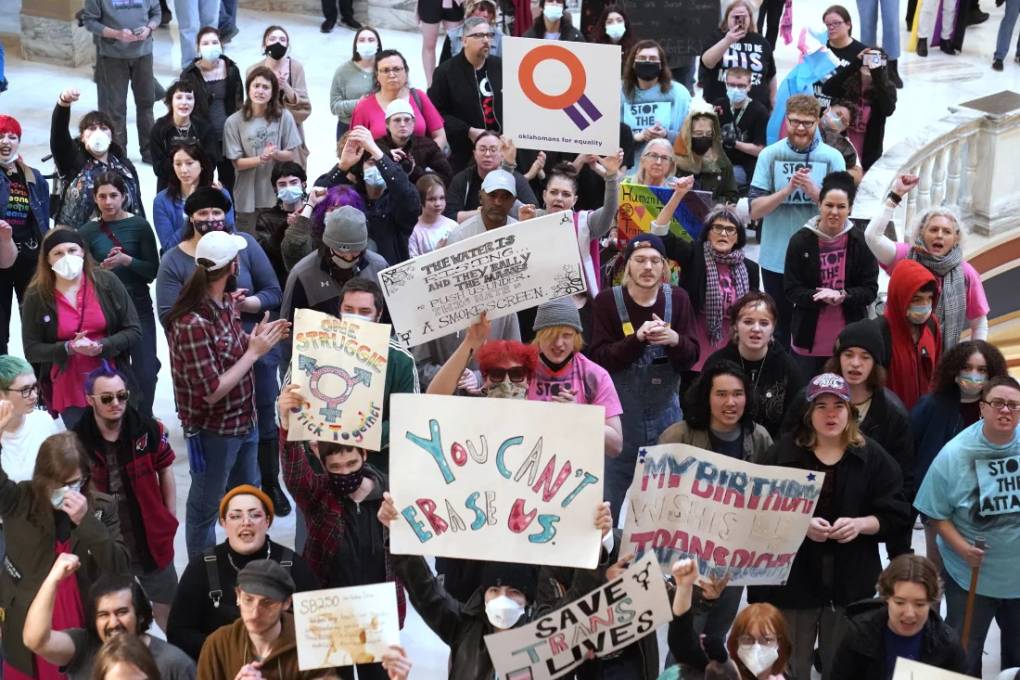
"caption": "Trans-rights activists protest outside the House chamber at the Oklahoma state capitol before the State of the State address, Feb. 6, 2023, in Oklahoma City. Oklahoma and 25 other states have anti-trans laws on the books.",
"credit": "Sue Ogrocki/AP",
"altTag": null,
"description": null,
"imgSizes": {
"medium": {
"file": "https://cdn.kqed.org/wp-content/uploads/sites/10/2024/11/241122NPRTrans-800x533.jpg",
"width": 800,
"height": 533,
"mimeType": "image/jpeg"
},
"large": {
"file": "https://cdn.kqed.org/wp-content/uploads/sites/10/2024/11/241122NPRTrans-1020x680.jpg",
"width": 1020,
"height": 680,
"mimeType": "image/jpeg"
},
"thumbnail": {
"file": "https://cdn.kqed.org/wp-content/uploads/sites/10/2024/11/241122NPRTrans-160x107.jpg",
"width": 160,
"height": 107,
"mimeType": "image/jpeg"
},
"post-thumbnail": {
"file": "https://cdn.kqed.org/wp-content/uploads/sites/10/2024/11/241122NPRTrans-672x372.jpg",
"width": 672,
"height": 372,
"mimeType": "image/jpeg"
},
"twentyfourteen-full-width": {
"file": "https://cdn.kqed.org/wp-content/uploads/sites/10/2024/11/241122NPRTrans-1038x576.jpg",
"width": 1038,
"height": 576,
"mimeType": "image/jpeg"
},
"kqedFullSize": {
"file": "https://cdn.kqed.org/wp-content/uploads/sites/10/2024/11/241122NPRTrans.jpg",
"width": 1100,
"height": 733
}
},
"isLoading": false,
"fetchFailed": false
},
"news_12015473": {
"type": "attachments",
"id": "news_12015473",
"meta": {
"index": "attachments_1716263798",
"site": "news",
"id": "12015473",
"found": true
},
"title": "Los Angeles Department of Public Health, The People Concern, vaccination clinic.",
"publishDate": 1732237168,
"status": "inherit",
"parent": 12015385,
"modified": 1732300216,
"caption": "A registered nurse with the Los Angeles Department of Public Health administers a COVID-19 booster at a vaccination clinic to immunize people against mpox and COVID-19 at The Village Mental Health Services in Los Angeles. ",
"credit": "Christina House/Los Angeles Times via Getty Images",
"altTag": null,
"description": null,
"imgSizes": {
"medium": {
"file": "https://cdn.kqed.org/wp-content/uploads/sites/10/2024/11/GettyImages-1242749971-800x530.jpg",
"width": 800,
"height": 530,
"mimeType": "image/jpeg"
},
"large": {
"file": "https://cdn.kqed.org/wp-content/uploads/sites/10/2024/11/GettyImages-1242749971-1020x676.jpg",
"width": 1020,
"height": 676,
"mimeType": "image/jpeg"
},
"thumbnail": {
"file": "https://cdn.kqed.org/wp-content/uploads/sites/10/2024/11/GettyImages-1242749971-160x106.jpg",
"width": 160,
"height": 106,
"mimeType": "image/jpeg"
},
"post-thumbnail": {
"file": "https://cdn.kqed.org/wp-content/uploads/sites/10/2024/11/GettyImages-1242749971-672x372.jpg",
"width": 672,
"height": 372,
"mimeType": "image/jpeg"
},
"twentyfourteen-full-width": {
"file": "https://cdn.kqed.org/wp-content/uploads/sites/10/2024/11/GettyImages-1242749971-1024x576.jpg",
"width": 1024,
"height": 576,
"mimeType": "image/jpeg"
},
"kqedFullSize": {
"file": "https://cdn.kqed.org/wp-content/uploads/sites/10/2024/11/GettyImages-1242749971.jpg",
"width": 1024,
"height": 679
}
},
"isLoading": false,
"fetchFailed": false
}
},
"audioPlayerReducer": {
"postId": "stream_live",
"isPaused": true,
"isPlaying": false,
"pfsActive": false,
"pledgeModalIsOpen": true,
"playerDrawerIsOpen": false,
"liveAudioPlayStartedAt": 0,
"liveAudioPlayContext": ""
},
"authorsReducer": {
"byline_news_12017234": {
"type": "authors",
"id": "byline_news_12017234",
"meta": {
"override": true
},
"slug": "byline_news_12017234",
"name": "Bill Chappell and Allison Aubrey, NPR",
"isLoading": false
},
"byline_news_12016664": {
"type": "authors",
"id": "byline_news_12016664",
"meta": {
"override": true
},
"slug": "byline_news_12016664",
"name": "Jonel Aleccia, Associated Press",
"isLoading": false
},
"byline_news_12016120": {
"type": "authors",
"id": "byline_news_12016120",
"meta": {
"override": true
},
"slug": "byline_news_12016120",
"name": "\u003ca href=\"https://www.npr.org/people/348777820/maria-godoy\">Maria Godoy\u003c/a>, NPR",
"isLoading": false
},
"byline_news_12015947": {
"type": "authors",
"id": "byline_news_12015947",
"meta": {
"override": true
},
"slug": "byline_news_12015947",
"name": "\u003ca href=\"https://calmatters.org/author/monique-madan/\">Monique O. Madan\u003c/a>, CalMatters",
"isLoading": false
},
"byline_news_12015810": {
"type": "authors",
"id": "byline_news_12015810",
"meta": {
"override": true
},
"slug": "byline_news_12015810",
"name": "\u003ca href=\"https://calmatters.org/author/anaibarra/\">Ana B. Ibarra\u003c/a>, CalMatters",
"isLoading": false
},
"byline_news_12015590": {
"type": "authors",
"id": "byline_news_12015590",
"meta": {
"override": true
},
"slug": "byline_news_12015590",
"name": "Selena Simmons-Duffin",
"isLoading": false
},
"shossaini": {
"type": "authors",
"id": "3214",
"meta": {
"index": "authors_1716337520",
"id": "3214",
"found": true
},
"name": "Sara Hossaini",
"firstName": "Sara",
"lastName": "Hossaini",
"slug": "shossaini",
"email": "shossaini@kqed.org",
"display_author_email": true,
"staff_mastheads": [
"news"
],
"title": "KQED Reporter",
"bio": "Sara Hossaini came to general assignment reporting at KQED in 2013 after two winters reporting at Wyoming Public Radio. She holds a bachelor's degree in broadcast journalism from the University of Nebraska-Lincoln. Her radio romance began after a bitter breakup with documentary film (Ok, maybe it's still complicated). Her first simultaneous jobs in San Francisco were as Associate Producer on a PBS film series through the Center for Asian American Media and as a butler. She likes to trot, plot and make things with her hands.",
"avatar": "https://secure.gravatar.com/avatar/060e9f56b9554e17942e89f413242774?s=600&d=blank&r=g",
"twitter": "mshossaini",
"facebook": null,
"instagram": null,
"linkedin": null,
"sites": [
{
"site": "news",
"roles": [
"author"
]
},
{
"site": "stateofhealth",
"roles": [
"author"
]
}
],
"headData": {
"title": "Sara Hossaini | KQED",
"description": "KQED Reporter",
"ogImgSrc": "https://secure.gravatar.com/avatar/060e9f56b9554e17942e89f413242774?s=600&d=blank&r=g",
"twImgSrc": "https://secure.gravatar.com/avatar/060e9f56b9554e17942e89f413242774?s=600&d=blank&r=g"
},
"isLoading": false,
"link": "/author/shossaini"
},
"lesleymcclurg": {
"type": "authors",
"id": "11229",
"meta": {
"index": "authors_1716337520",
"id": "11229",
"found": true
},
"name": "Lesley McClurg",
"firstName": "Lesley",
"lastName": "McClurg",
"slug": "lesleymcclurg",
"email": "lmcclurg@KQED.org",
"display_author_email": false,
"staff_mastheads": [
"news",
"science"
],
"title": "KQED Health Correspondent",
"bio": "Lesley McClurg is a health correspondent and fill-in host whose work is regularly rebroadcast on NPR and PBS programs. She’s earned multiple regional Emmy awards, a national and a regional Edward R. Murrow award, and was named Best Beat Reporter by the Association of Health Care Journalists. The Society of Professional Journalists has recognized her work several times, and the Society of Environmental Journalists spotlighted her coverage of California’s historic drought.\r\n\r\nBefore joining KQED in 2016, Lesley covered food and sustainability for Capital Public Radio, environmental issues for Colorado Public Radio, and reported for KUOW and KCTS 9 in Seattle. Away from the newsroom, she loves skiing with her daughter, mountain biking with her partner, and playing with Ollie, the family’s goldendoodle. On deadline, she runs almost entirely on chocolate chips.\r\n\r\n ",
"avatar": "https://secure.gravatar.com/avatar/bab49e972ea10c774fe0f5e29dba1722b158f7c0d58a360923d1389d380b2978?s=600&d=blank&r=g",
"twitter": "lesleywmcclurg",
"bluesky": null,
"facebook": null,
"instagram": null,
"linkedin": null,
"sites": [
{
"site": "arts",
"roles": [
"author"
]
},
{
"site": "news",
"roles": [
"editor"
]
},
{
"site": "futureofyou",
"roles": [
"editor"
]
},
{
"site": "stateofhealth",
"roles": [
"author"
]
},
{
"site": "science",
"roles": [
"editor"
]
},
{
"site": "quest",
"roles": [
"subscriber"
]
},
{
"site": "forum",
"roles": [
"administrator"
]
},
{
"site": "liveblog",
"roles": [
"author"
]
}
],
"headData": {
"title": "Lesley McClurg | KQED",
"description": "KQED Health Correspondent",
"ogImgSrc": "https://secure.gravatar.com/avatar/bab49e972ea10c774fe0f5e29dba1722b158f7c0d58a360923d1389d380b2978?s=600&d=blank&r=g",
"twImgSrc": "https://secure.gravatar.com/avatar/bab49e972ea10c774fe0f5e29dba1722b158f7c0d58a360923d1389d380b2978?s=600&d=blank&r=g"
},
"isLoading": false,
"link": "/author/lesleymcclurg"
},
"lsarah": {
"type": "authors",
"id": "11626",
"meta": {
"index": "authors_1716337520",
"id": "11626",
"found": true
},
"name": "Lakshmi Sarah",
"firstName": "Lakshmi",
"lastName": "Sarah",
"slug": "lsarah",
"email": "lsarah@kqed.org",
"display_author_email": false,
"staff_mastheads": [],
"title": "Digital Producer",
"bio": "Lakshmi Sarah is an educator, author and journalist with a focus on innovative storytelling. She has worked with newspapers, radio and magazines from Ahmedabad, India to Los Angeles, California. She has written and produced for Die Zeit, Global Voices, AJ+, KQED, Fusion Media Group and the New York Times.",
"avatar": "https://secure.gravatar.com/avatar/652dcaecd8b28826fc17a8b2d6bb4e93?s=600&d=blank&r=g",
"twitter": "lakitalki",
"facebook": null,
"instagram": "https://www.instagram.com/laki.talki/",
"linkedin": "https://www.linkedin.com/in/lakisarah/",
"sites": [
{
"site": "arts",
"roles": []
},
{
"site": "news",
"roles": []
},
{
"site": "bayareabites",
"roles": []
},
{
"site": "science",
"roles": []
}
],
"headData": {
"title": "Lakshmi Sarah | KQED",
"description": "Digital Producer",
"ogImgSrc": "https://secure.gravatar.com/avatar/652dcaecd8b28826fc17a8b2d6bb4e93?s=600&d=blank&r=g",
"twImgSrc": "https://secure.gravatar.com/avatar/652dcaecd8b28826fc17a8b2d6bb4e93?s=600&d=blank&r=g"
},
"isLoading": false,
"link": "/author/lsarah"
},
"ccabreralomeli": {
"type": "authors",
"id": "11708",
"meta": {
"index": "authors_1716337520",
"id": "11708",
"found": true
},
"name": "Carlos Cabrera-Lomelí",
"firstName": "Carlos",
"lastName": "Cabrera-Lomelí",
"slug": "ccabreralomeli",
"email": "ccabreralomeli@KQED.org",
"display_author_email": true,
"staff_mastheads": [
"news"
],
"title": "Community Reporter",
"bio": "Carlos Cabrera-Lomelí is a community reporter with KQED's digital engagement team. He also reports and co-produces for KQED's bilingual news hub KQED en Español. He grew up in San Francisco's Mission District and has previously worked with Univision, 48 Hills and REFORMA in Mexico City.",
"avatar": "https://secure.gravatar.com/avatar/c309be9665e484f887b818c89e273ecc673004f426f36b24d00a4d813a2e0518?s=600&d=blank&r=g",
"twitter": "@LomeliCabrera",
"bluesky": null,
"facebook": null,
"instagram": null,
"linkedin": null,
"sites": [
{
"site": "arts",
"roles": [
"editor"
]
},
{
"site": "news",
"roles": [
"editor"
]
},
{
"site": "about",
"roles": [
"editor"
]
},
{
"site": "science",
"roles": [
"editor"
]
},
{
"site": "perspectives",
"roles": [
"editor"
]
},
{
"site": "elections",
"roles": [
"editor"
]
},
{
"site": "liveblog",
"roles": [
"contributor"
]
}
],
"headData": {
"title": "Carlos Cabrera-Lomelí | KQED",
"description": "Community Reporter",
"ogImgSrc": "https://secure.gravatar.com/avatar/c309be9665e484f887b818c89e273ecc673004f426f36b24d00a4d813a2e0518?s=600&d=blank&r=g",
"twImgSrc": "https://secure.gravatar.com/avatar/c309be9665e484f887b818c89e273ecc673004f426f36b24d00a4d813a2e0518?s=600&d=blank&r=g"
},
"isLoading": false,
"link": "/author/ccabreralomeli"
},
"kdebenedetti": {
"type": "authors",
"id": "11913",
"meta": {
"index": "authors_1716337520",
"id": "11913",
"found": true
},
"name": "Katie DeBenedetti",
"firstName": "Katie",
"lastName": "DeBenedetti",
"slug": "kdebenedetti",
"email": "kdebenedetti@kqed.org",
"display_author_email": false,
"staff_mastheads": [
"news",
"science"
],
"title": "KQED Contributor",
"bio": "Katie DeBenedetti is a digital reporter covering daily news for the Express Desk. Prior to joining KQED as a culture reporting intern in January 2024, she covered education and city government for the Napa Valley Register.",
"avatar": "https://secure.gravatar.com/avatar/6e31073cb8f7e4214ab03f42771d0f45?s=600&d=blank&r=g",
"twitter": null,
"facebook": null,
"instagram": null,
"linkedin": null,
"sites": [
{
"site": "news",
"roles": [
"author"
]
},
{
"site": "science",
"roles": [
"author"
]
},
{
"site": "liveblog",
"roles": [
"author"
]
}
],
"headData": {
"title": "Katie DeBenedetti | KQED",
"description": "KQED Contributor",
"ogImgSrc": "https://secure.gravatar.com/avatar/6e31073cb8f7e4214ab03f42771d0f45?s=600&d=blank&r=g",
"twImgSrc": "https://secure.gravatar.com/avatar/6e31073cb8f7e4214ab03f42771d0f45?s=600&d=blank&r=g"
},
"isLoading": false,
"link": "/author/kdebenedetti"
},
"slim": {
"type": "authors",
"id": "11920",
"meta": {
"index": "authors_1716337520",
"id": "11920",
"found": true
},
"name": "Samantha Lim",
"firstName": "Samantha",
"lastName": "Lim",
"slug": "slim",
"email": "slim@KQED.org",
"display_author_email": false,
"staff_mastheads": [],
"title": "KQED Contributor",
"bio": null,
"avatar": "https://secure.gravatar.com/avatar/82e592e6c15fe1a04d385e8ad0fb0b4e?s=600&d=blank&r=g",
"twitter": null,
"facebook": null,
"instagram": null,
"linkedin": null,
"sites": [
{
"site": "news",
"roles": []
}
],
"headData": {
"title": "Samantha Lim | KQED",
"description": "KQED Contributor",
"ogImgSrc": "https://secure.gravatar.com/avatar/82e592e6c15fe1a04d385e8ad0fb0b4e?s=600&d=blank&r=g",
"twImgSrc": "https://secure.gravatar.com/avatar/82e592e6c15fe1a04d385e8ad0fb0b4e?s=600&d=blank&r=g"
},
"isLoading": false,
"link": "/author/slim"
},
"bkrans": {
"type": "authors",
"id": "11923",
"meta": {
"index": "authors_1716337520",
"id": "11923",
"found": true
},
"name": "Brian Krans",
"firstName": "Brian",
"lastName": "Krans",
"slug": "bkrans",
"email": "bkrans@kqed.org",
"display_author_email": false,
"staff_mastheads": [
"news"
],
"title": "KQED Contributing Reporter",
"bio": "Brian Krans is an award-winning local news and investigative reporter who has been proudly working as a general assignment reporter for KQED since August 2023. He lives in Richmond, where he also reports on air pollution for Richmondside. He is also a founding member of the Vallejo Sun.",
"avatar": "https://secure.gravatar.com/avatar/d1014d604089314a94807d2c4f2d3e06?s=600&d=blank&r=g",
"twitter": "citizenkrans",
"facebook": null,
"instagram": null,
"linkedin": null,
"sites": [
{
"site": "news",
"roles": [
"editor"
]
}
],
"headData": {
"title": "Brian Krans | KQED",
"description": "KQED Contributing Reporter",
"ogImgSrc": "https://secure.gravatar.com/avatar/d1014d604089314a94807d2c4f2d3e06?s=600&d=blank&r=g",
"twImgSrc": "https://secure.gravatar.com/avatar/d1014d604089314a94807d2c4f2d3e06?s=600&d=blank&r=g"
},
"isLoading": false,
"link": "/author/bkrans"
}
},
"pagesReducer": {
"news_tag_health": {
"type": "terms",
"id": "news_18543",
"meta": {
"index": "terms_1716263798",
"site": "news",
"id": "18543",
"score": 6.886659
},
"featImg": null,
"name": "Health",
"description": null,
"taxonomy": "tag",
"headData": {
"twImgId": null,
"twTitle": null,
"ogTitle": null,
"ogImgId": null,
"twDescription": null,
"description": null,
"title": "Health Archives | KQED News",
"ogDescription": null
},
"ttid": 466,
"slug": "health",
"isLoading": false,
"title": "Health",
"pageMeta": {
"site": "news",
"WpPageTemplate": "page-topic-editorial",
"currentPage": 26
},
"blocks": [
{
"blockName": "kqed/post-list",
"attrs": {
"layout": "cardArticle2",
"query": "posts/news?tag=health",
"seeMore": false,
"paginated": true,
"page": 26
}
},
{
"blockName": "kqed/ad"
}
]
}
},
"pfsSessionReducer": {},
"postsReducer": {
"stream_live": {
"type": "live",
"id": "stream_live",
"audioUrl": "https://streams.kqed.org/kqedradio",
"title": "Live Stream",
"excerpt": "Live Stream information currently unavailable.",
"link": "/radio",
"featImg": "",
"label": {
"name": "KQED Live",
"link": "/"
}
},
"stream_kqedNewscast": {
"type": "posts",
"id": "stream_kqedNewscast",
"audioUrl": "https://www.kqed.org/.stream/anon/radio/RDnews/newscast.mp3?_=1",
"title": "KQED Newscast",
"featImg": "",
"label": {
"name": "88.5 FM",
"link": "/"
}
},
"news_12017333": {
"type": "posts",
"id": "news_12017333",
"meta": {
"index": "posts_1716263798",
"site": "news",
"id": "12017333",
"score": null,
"sort": [
1733787268000
]
},
"guestAuthors": [],
"slug": "luigi-mangione-person-of-interest-health-care-ceo-shooting-ties-stanford",
"title": "Luigi Mangione, Person of Interest in Health Care CEO Shooting, Has Ties to Stanford",
"publishDate": 1733787268,
"format": "standard",
"headTitle": "Luigi Mangione, Person of Interest in Health Care CEO Shooting, Has Ties to Stanford | KQED",
"labelTerm": {
"site": "news"
},
"content": "\u003cp>The 26-year-old man arrested as a person of interest in the killing of UnitedHealthcare’s CEO appears to have previously worked at \u003ca href=\"https://www.kqed.org/news/tag/stanford-university\">Stanford\u003c/a>.\u003c/p>\n\u003cp>Luigi Mangione was arrested in central Pennsylvania on Monday morning. Someone with that name served as a head counselor for the university’s summer program for high school students in 2019, according to Stanford spokesperson Dee Mostofi.\u003c/p>\n\u003cp>New York City Police Department officials confirmed during a press conference that Mangione was arrested in Altoona, Pennsylvania, after local law enforcement was dispatched to a McDonald’s, where an employee spotted someone matching the description of the murder suspect.\u003c/p>\n\u003cp>[ad fullwidth]\u003c/p>\n\u003cp>Altoona police officers took Mangione into custody on an unrelated firearms charge, but he is considered a “strong person of interest” in the death of the insurance company’s chief, New York Mayor Eric Adams said during the press conference.\u003c/p>\n\u003cp>Police found a firearm and suppressor consistent with the weapon used in the killing in Mangione’s possession, along with a mask and clothes matching the wanted person’s clothing. He also had multiple fraudulent IDs, including one from New Jersey that matched the one the suspect used to check into a New York City hostel before the shooting, according to New York Police Commissioner Jessica Tisch.\u003c/p>\n\u003cfigure id=\"attachment_12014213\" class=\"wp-caption aligncenter\" style=\"max-width: 2000px\">\u003cimg loading=\"lazy\" decoding=\"async\" class=\"size-full wp-image-12014213\" src=\"https://cdn.kqed.org/wp-content/uploads/sites/10/2024/11/005_KQED_StanfordGradUnion_05302023_qed.jpg\" alt=\"\" width=\"2000\" height=\"1333\" srcset=\"https://cdn.kqed.org/wp-content/uploads/sites/10/2024/11/005_KQED_StanfordGradUnion_05302023_qed.jpg 2000w, https://cdn.kqed.org/wp-content/uploads/sites/10/2024/11/005_KQED_StanfordGradUnion_05302023_qed-800x533.jpg 800w, https://cdn.kqed.org/wp-content/uploads/sites/10/2024/11/005_KQED_StanfordGradUnion_05302023_qed-1020x680.jpg 1020w, https://cdn.kqed.org/wp-content/uploads/sites/10/2024/11/005_KQED_StanfordGradUnion_05302023_qed-160x107.jpg 160w, https://cdn.kqed.org/wp-content/uploads/sites/10/2024/11/005_KQED_StanfordGradUnion_05302023_qed-1536x1024.jpg 1536w, https://cdn.kqed.org/wp-content/uploads/sites/10/2024/11/005_KQED_StanfordGradUnion_05302023_qed-1920x1280.jpg 1920w\" sizes=\"auto, (max-width: 2000px) 100vw, 2000px\">\u003cfigcaption class=\"wp-caption-text\">Stanford University campus on May 30, 2023. \u003ccite>(Beth LaBerge/KQED)\u003c/cite>\u003c/figcaption>\u003c/figure>\n\u003cp>A written document that was said to include information about his “motivation” and “mindset” was also recovered.\u003c/p>\n\u003cp>The arrest comes five days after \u003ca href=\"https://www.npr.org/2024/12/04/nx-s1-5215908/the-killing-of-the-unitedhealthcare-ceo-was-a-targeted-attack-authorities-say\">Brian Thompson was shot\u003c/a> outside UnitedHealthcare’s investor conference at the Hilton Midtown hotel in what police have called a “brazen, targeted murder.”\u003c/p>\n\u003cp>[aside postID=news_12016811 hero='https://cdn.kqed.org/wp-content/uploads/sites/10/2024/09/021_Alameda_MarioGonzalezPressConf_04272021_qed-1020x679.jpg']\u003c/p>\n\u003cp>NYPD officials confirmed Monday that Mangione had ties to San Francisco, but they did not elaborate on the connection.\u003c/p>\n\u003cp>He appears to have worked in Palo Alto from at least May to December of 2019, during which time he advised high school students and residential counselors in Stanford’s pre-college summer programs.\u003c/p>\n\u003cp>Head counselors also work as teaching assistants and live on campus, serving as “visible role models and leaders” for the programs’ participants, according to \u003ca href=\"https://spcs.stanford.edu/jobs/head-counselor\">Stanford’s website\u003c/a>.\u003c/p>\n\u003cp>A LinkedIn profile that seems to belong to Mangione said he worked with students studying artificial intelligence and holds both bachelor’s and master’s degrees from the University of Pennsylvania in computer science.\u003c/p>\n\u003cp>His last known address was in Honolulu, and he was born and raised in Maryland, NYPD Chief of Detectives Joseph Kenny said.\u003c/p>\n\u003cp>\u003c/p>\n",
"blocks": [],
"excerpt": "The man arrested as a person of interest in the killing of UnitedHealthcare CEO Brian Thompson appears to have served as a head counselor for a Stanford summer program in 2019.",
"status": "publish",
"parent": 0,
"modified": 1738186039,
"stats": {
"hasAudio": false,
"hasVideo": false,
"hasChartOrMap": false,
"iframeSrcs": [],
"hasGoogleForm": false,
"hasGallery": false,
"hasHearkenModule": false,
"hasPolis": false,
"paragraphCount": 15,
"wordCount": 443
},
"headData": {
"title": "Luigi Mangione, Person of Interest in Health Care CEO Shooting, Has Ties to Stanford | KQED",
"description": "The man arrested as a person of interest in the killing of UnitedHealthcare CEO Brian Thompson appears to have served as a head counselor for a Stanford summer program in 2019.",
"ogTitle": "",
"ogDescription": "",
"ogImgId": "",
"twTitle": "",
"twDescription": "",
"twImgId": "",
"schema": {
"@context": "https://schema.org",
"@type": "NewsArticle",
"headline": "Luigi Mangione, Person of Interest in Health Care CEO Shooting, Has Ties to Stanford",
"datePublished": "2024-12-09T15:34:28-08:00",
"dateModified": "2025-01-29T13:27:19-08:00",
"image": "https://cdn.kqed.org/wp-content/uploads/2020/02/KQED-OG-Image@1x.png",
"isAccessibleForFree": "True",
"publisher": {
"@type": "NewsMediaOrganization",
"@id": "https://www.kqed.org/#organization",
"name": "KQED",
"logo": "https://cdn.kqed.org/wp-content/uploads/2020/02/KQED-OG-Image@1x.png",
"url": "https://www.kqed.org",
"sameAs": [
"https://www.facebook.com/KQED",
"https://twitter.com/KQED",
"https://www.instagram.com/kqed/",
"https://www.tiktok.com/@kqedofficial",
"https://www.linkedin.com/company/kqed",
"https://www.youtube.com/channel/UCeC0IOo7i1P_61zVUWbJ4nw"
]
}
}
},
"sticky": false,
"nprStoryId": "kqed-12017333",
"excludeFromSiteSearch": "Include",
"articleAge": "0",
"path": "/news/12017333/luigi-mangione-person-of-interest-health-care-ceo-shooting-ties-stanford",
"audioTrackLength": null,
"parsedContent": [
{
"type": "contentString",
"content": "\u003cdiv class=\"post-body\">\u003cp>\u003cp>The 26-year-old man arrested as a person of interest in the killing of UnitedHealthcare’s CEO appears to have previously worked at \u003ca href=\"https://www.kqed.org/news/tag/stanford-university\">Stanford\u003c/a>.\u003c/p>\n\u003cp>Luigi Mangione was arrested in central Pennsylvania on Monday morning. Someone with that name served as a head counselor for the university’s summer program for high school students in 2019, according to Stanford spokesperson Dee Mostofi.\u003c/p>\n\u003cp>New York City Police Department officials confirmed during a press conference that Mangione was arrested in Altoona, Pennsylvania, after local law enforcement was dispatched to a McDonald’s, where an employee spotted someone matching the description of the murder suspect.\u003c/p>\n\u003cp>\u003c/p>\u003c/div>",
"attributes": {
"named": {},
"numeric": []
}
},
{
"type": "component",
"content": "",
"name": "ad",
"attributes": {
"named": {
"label": "fullwidth"
},
"numeric": [
"fullwidth"
]
}
},
{
"type": "contentString",
"content": "\u003cdiv class=\"post-body\">\u003cp>\u003c/p>\n\u003cp>Altoona police officers took Mangione into custody on an unrelated firearms charge, but he is considered a “strong person of interest” in the death of the insurance company’s chief, New York Mayor Eric Adams said during the press conference.\u003c/p>\n\u003cp>Police found a firearm and suppressor consistent with the weapon used in the killing in Mangione’s possession, along with a mask and clothes matching the wanted person’s clothing. He also had multiple fraudulent IDs, including one from New Jersey that matched the one the suspect used to check into a New York City hostel before the shooting, according to New York Police Commissioner Jessica Tisch.\u003c/p>\n\u003cfigure id=\"attachment_12014213\" class=\"wp-caption aligncenter\" style=\"max-width: 2000px\">\u003cimg loading=\"lazy\" decoding=\"async\" class=\"size-full wp-image-12014213\" src=\"https://cdn.kqed.org/wp-content/uploads/sites/10/2024/11/005_KQED_StanfordGradUnion_05302023_qed.jpg\" alt=\"\" width=\"2000\" height=\"1333\" srcset=\"https://cdn.kqed.org/wp-content/uploads/sites/10/2024/11/005_KQED_StanfordGradUnion_05302023_qed.jpg 2000w, https://cdn.kqed.org/wp-content/uploads/sites/10/2024/11/005_KQED_StanfordGradUnion_05302023_qed-800x533.jpg 800w, https://cdn.kqed.org/wp-content/uploads/sites/10/2024/11/005_KQED_StanfordGradUnion_05302023_qed-1020x680.jpg 1020w, https://cdn.kqed.org/wp-content/uploads/sites/10/2024/11/005_KQED_StanfordGradUnion_05302023_qed-160x107.jpg 160w, https://cdn.kqed.org/wp-content/uploads/sites/10/2024/11/005_KQED_StanfordGradUnion_05302023_qed-1536x1024.jpg 1536w, https://cdn.kqed.org/wp-content/uploads/sites/10/2024/11/005_KQED_StanfordGradUnion_05302023_qed-1920x1280.jpg 1920w\" sizes=\"auto, (max-width: 2000px) 100vw, 2000px\">\u003cfigcaption class=\"wp-caption-text\">Stanford University campus on May 30, 2023. \u003ccite>(Beth LaBerge/KQED)\u003c/cite>\u003c/figcaption>\u003c/figure>\n\u003cp>A written document that was said to include information about his “motivation” and “mindset” was also recovered.\u003c/p>\n\u003cp>The arrest comes five days after \u003ca href=\"https://www.npr.org/2024/12/04/nx-s1-5215908/the-killing-of-the-unitedhealthcare-ceo-was-a-targeted-attack-authorities-say\">Brian Thompson was shot\u003c/a> outside UnitedHealthcare’s investor conference at the Hilton Midtown hotel in what police have called a “brazen, targeted murder.”\u003c/p>\n\u003cp>\u003c/p>\u003c/div>",
"attributes": {
"named": {},
"numeric": []
}
},
{
"type": "component",
"content": "",
"name": "aside",
"attributes": {
"named": {
"postid": "news_12016811",
"hero": "https://cdn.kqed.org/wp-content/uploads/sites/10/2024/09/021_Alameda_MarioGonzalezPressConf_04272021_qed-1020x679.jpg",
"label": ""
},
"numeric": []
}
},
{
"type": "contentString",
"content": "\u003cdiv class=\"post-body\">\u003cp>\u003c/p>\n\u003cp>NYPD officials confirmed Monday that Mangione had ties to San Francisco, but they did not elaborate on the connection.\u003c/p>\n\u003cp>He appears to have worked in Palo Alto from at least May to December of 2019, during which time he advised high school students and residential counselors in Stanford’s pre-college summer programs.\u003c/p>\n\u003cp>Head counselors also work as teaching assistants and live on campus, serving as “visible role models and leaders” for the programs’ participants, according to \u003ca href=\"https://spcs.stanford.edu/jobs/head-counselor\">Stanford’s website\u003c/a>.\u003c/p>\n\u003cp>A LinkedIn profile that seems to belong to Mangione said he worked with students studying artificial intelligence and holds both bachelor’s and master’s degrees from the University of Pennsylvania in computer science.\u003c/p>\n\u003cp>His last known address was in Honolulu, and he was born and raised in Maryland, NYPD Chief of Detectives Joseph Kenny said.\u003c/p>\n\u003cp>\u003c/p>\n\u003c/div>\u003c/p>",
"attributes": {
"named": {},
"numeric": []
}
}
],
"link": "/news/12017333/luigi-mangione-person-of-interest-health-care-ceo-shooting-ties-stanford",
"authors": [
"11913"
],
"categories": [
"news_34167",
"news_457",
"news_8"
],
"tags": [
"news_17626",
"news_17725",
"news_18543",
"news_3574",
"news_22456",
"news_1928"
],
"featImg": "news_12017340",
"label": "news"
},
"news_12017234": {
"type": "posts",
"id": "news_12017234",
"meta": {
"index": "posts_1716263798",
"site": "news",
"id": "12017234",
"score": null,
"sort": [
1733766949000
]
},
"guestAuthors": [],
"slug": "food-recalls-have-been-on-the-rise-heres-what-you-need-to-know",
"title": "Food Recalls Have Been on the Rise. Here's What You Need to Know",
"publishDate": 1733766949,
"format": "standard",
"headTitle": "Food Recalls Have Been on the Rise. Here’s What You Need to Know | KQED",
"labelTerm": {
"site": "news"
},
"content": "\u003cp>It’s been a year of high-profile food recalls. A deadly listeria outbreak led to a \u003ca href=\"https://www.npr.org/2024/07/26/nx-s1-5053117/boars-head-recall-deli-meat-listeria-infections#:~:text=Listeria%20is%20a%20foodborne%20bacterial,during%20an%20outbreak%20in%20June.\">massive recall\u003c/a> of Boar’s Head deli meat. Contaminated \u003ca href=\"https://www.npr.org/2024/10/25/g-s1-29867/mcdonalds-onions-ecoli-outbreak\">onions on McDonald’s Quarter Pounders\u003c/a> and \u003ca href=\"https://www.npr.org/2024/11/17/nx-s1-5194470/carrots-recall-e-coli-organic\">organic carrots\u003c/a> were linked to E. coli outbreaks. And in late November, federal authorities launched an investigation into \u003ca href=\"https://www.npr.org/2024/12/03/nx-s1-5213746/cdc-is-recalling-mexican-cucumbers-due-to-a-salmonella-outbreak\">cucumbers\u003c/a> contaminated with salmonella.\u003c/p>\n\u003cp>“I think that this most recent spate of outbreaks and recalls has made the average American consumer more anxious about food safety,” says \u003ca href=\"https://cps.northeastern.edu/faculty/darin-detwiler/\">Darin Detwiler\u003c/a>, a longtime food safety advocate and professor at Northeastern University.\u003c/p>\n\u003cp>Even before the Boar’s Head recall, a Gallup poll in July found Americans’ confidence in the government to ensure a safe U.S. food supply had sunk to a record low.\u003c/p>\n\u003cp>“While 57% express at least a fair amount of confidence in the government to keep food safe,” \u003ca href=\"https://news.gallup.com/poll/650024/trust-government-assurance-food-safety-hits-record-low.aspx\">the organization says\u003c/a>, “28% of Americans do not have much confidence and 14% have ‘none at all.'”\u003c/p>\n\u003cp>Here’s a guide to the situation and tips on keeping your food safe.\u003c/p>\n\u003ch2>Are there more recalls than before?\u003c/h2>\n\u003cp>Food recalls \u003ca href=\"https://www.npr.org/2021/12/28/1064951518/food-recalls-pandemic-covid-usda-fda\">fell sharply\u003c/a> during the COVID-19 pandemic. However, the numbers have been rising again: The Food and Drug Administration, which \u003ca href=\"https://datadashboard.fda.gov/ora/cd/recalls.htm\">reports food and cosmetics recalls together\u003c/a>, says 1,908 such products were recalled in the fiscal year that ended in September. That’s the highest since 2019, when 2,046 food and cosmetic products were recalled.\u003c/p>\n\u003cp>[ad fullwidth]\u003c/p>\n\u003cp>Not every recall signals an outbreak — some are due to undeclared allergens like nuts or eggs or a machine part, like a piece of plastic, getting into food at a processing facility. An “outbreak” means two or more people have been sickened by the same illness.\u003c/p>\n\u003cp>“Typically, on average, fresh produce accounts for roughly half of all the number of outbreaks that we have in the U.S.,” says Amanda Deering, associate professor of food science at Purdue University.\u003c/p>\n\u003cp>And now more than ever, it seems consumers want to know where their food comes from.\u003c/p>\n\u003cp>“Ten years ago, it was a different thing,” Deering says. “People weren’t so wanting to have that information. Right now, they go looking for it.”\u003c/p>\n\u003ch2>Do recalls mean our food safety system is working?\u003c/h2>\n\u003cp>The U.S. has two main food safety regulators: the Department of Agriculture, which is responsible for meat, poultry and eggs; and the FDA, which essentially handles everything else. Each agency follows \u003ca href=\"https://www.npr.org/sections/thesalt/2015/03/30/396360395/our-food-safety-system-is-a-patchwork-with-big-holes-critics-say\">its own inspection regimen and protocols\u003c/a>. Other agencies, such as the Centers for Disease Control and Prevention and the Environmental Protection Agency, are also involved in food safety.\u003c/p>\n\u003cp>Asked why there seem to be more recalls this year, Deering says U.S. food surveillance has gotten more granular — and communication about problems is more effective.\u003c/p>\n\u003cp>As recently as 10 years ago, Deering says, declaring a food-related outbreak with only six cases “would have been almost unheard of.”\u003c/p>\n\u003cp>However, in recent years, scientists at the CDC and labs across the country have gotten better at detecting and tracing the source of foodborne illness outbreaks. Using the \u003ca href=\"https://www.cdc.gov/pulsenet/php/internationalparticipants/index.html#:~:text=How%20it%20works,%2DAmerican%20Health%20Organization%20(PAHO)\">Pulse Net\u003c/a> data-sharing system and a newer technology known as whole genome sequencing, scientists can sequence the DNA from bacteria to help investigators see the scope of an outbreak and find its source.\u003c/p>\n\u003cp>“Whole genome sequencing has really changed the game,” explains \u003ca href=\"https://extension.psu.edu/martin-bucknavage\">Martin Bucknavage\u003c/a>, a food scientist at Penn State University. Investigators are able to get a detailed genetic fingerprint of the bacteria causing an outbreak.\u003c/p>\n\u003cp>Investigators use whole genome sequencing to match organisms (such as salmonella and \u003cem>E.coli\u003c/em>) isolated from sick people to find related cases. They also ask those affected what they’ve eaten, with the aim of identifying a common food. Then, they try to trace the bacteria in the sick people back to the suspected food.\u003c/p>\n\u003cp>In the recent \u003cem>E. coli\u003c/em> outbreak linked to McDonald’s onions, Bucknavage says investigators did not find the exact \u003cem>E. coli\u003c/em> strain in the onions. But based on the strength of the investigative findings, the onions were identified as the probable source.\u003c/p>\n\u003ch2>How can consumers make sure their food is safe?\u003c/h2>\n\u003cp>“Don’t take any chances,” says \u003ca href=\"https://foodscience.ucdavis.edu/people/linda-harris#/\">Linda Harris,\u003c/a> a food scientist at the University of California, Davis. If a product is recalled, “throw it away,” she says.\u003c/p>\n\u003cfigure id=\"attachment_12017243\" class=\"wp-caption alignnone\" style=\"max-width: 1200px\">\u003ca href=\"https://cdn.kqed.org/wp-content/uploads/sites/10/2024/12/download-1.jpg\">\u003cimg loading=\"lazy\" decoding=\"async\" class=\"wp-image-12017243 size-full\" src=\"https://cdn.kqed.org/wp-content/uploads/sites/10/2024/12/download-1.jpg\" alt=\"Shopper push carts down a meat aisle in a supermarket.\" width=\"1200\" height=\"823\" srcset=\"https://cdn.kqed.org/wp-content/uploads/sites/10/2024/12/download-1.jpg 1200w, https://cdn.kqed.org/wp-content/uploads/sites/10/2024/12/download-1-800x549.jpg 800w, https://cdn.kqed.org/wp-content/uploads/sites/10/2024/12/download-1-1020x700.jpg 1020w, https://cdn.kqed.org/wp-content/uploads/sites/10/2024/12/download-1-160x110.jpg 160w\" sizes=\"auto, (max-width: 1200px) 100vw, 1200px\">\u003c/a>\u003cfigcaption class=\"wp-caption-text\">Customers shop in the deli meat aisle of a grocery store in Miami in October 2024. \u003ccite>(Joe Raedle/Getty Images)\u003c/cite>\u003c/figcaption>\u003c/figure>\n\u003cp>Harris says there are day-to-day food handling habits that can help limit the risk of foodborne illness. With meat and cooked foods, heat can kill bacteria such as salmonella, \u003cem>E. coli\u003c/em> and listeria.\u003c/p>\n\u003cp>Fresh, raw vegetables and fruit are a different issue, according to Purdue University’s Deering.\u003c/p>\n\u003cp>Rinsing under running water can help remove microorganisms from the surface of fresh produce. Foods with a hard, smooth surface, such as cucumbers, are easier to rinse off.\u003c/p>\n\u003cp>“You can apply some pressure with your hands as you’re rinsing, which will increase the amount of microorganisms you can wash away,” Harris says. There’s \u003ca href=\"https://www.fda.gov/consumers/consumer-updates/7-tips-cleaning-fruits-vegetables#:~:text=Gently%20rub%20produce%20while%20holding,bacteria%20that%20may%20be%20present.\">no need to use soap\u003c/a> or other wash solutions.\u003c/p>\n\u003cp>It’s also helpful to dry with a clean towel to “remove the last bits of water and any microorganisms that are in those water droplets,” she says.\u003c/p>\n\u003cp>Some people rinse produce with a vinegar or lemon solution. But Harris advises against soaking your produce in a bowl. If there is bacteria on one piece or part of the produce, soaking it may contaminate the water and everything else in the bowl.\u003c/p>\n\u003cp>Bacteria such as salmonella don’t typically multiply on the surface of a fruit or vegetable with a hard peel, such as a cucumber. But once they’re sliced, bacteria have a chance to multiply.\u003c/p>\n\u003cp>“If you cut something that’s fresh, the knife edge can push the contamination from the surface to the flesh,” says food scientist \u003ca href=\"https://foodsci.rutgers.edu/faculty/schaffner/\">Don Schaffner\u003c/a> of Rutgers University. That’s why it’s important to keep produce cold to reduce the likelihood of contamination.\u003c/p>\n\u003cp>His No. 1 tip for consumers? “Once you cut it open, it must be refrigerated,” he says.\u003c/p>\n\u003cp>Citing the cucumber recall, Schaffner says people may wonder about peeling off the wax coating. Research shows peeling can remove much of the contamination, but some can still be transferred to the cucumber flesh, so it’s not a guarantee. “You can’t eliminate [the risk], but you can reduce it,” Schaffner says.\u003c/p>\n\u003cp>As for listeria, the \u003ca href=\"https://www.cdc.gov/listeria/prevention/index.html\">CDC\u003c/a> says that while infections are rare, people who are in at-risk groups, such as the immunocompromised or are pregnant should avoid foods like unpasteurized soft cheeses such as queso fresco and brie or premade deli salads.\u003c/p>\n\u003cp>In general, experts also recommend \u003ca href=\"https://www.cdc.gov/salmonella/general/prevention.html\">steps such as washing your hands\u003c/a> and making sure foods that need to be refrigerated don’t sit out too long.\u003c/p>\n\u003ch2>What kind of pathogens trigger recalls?\u003c/h2>\n\u003cp>The \u003ca href=\"https://wwwnc.cdc.gov/eid/article/17/1/p1-1101-t3\">CDC says\u003c/a> 31 pathogens — bacteria, viruses and parasites — have been commonly linked to foodborne hospitalizations and deaths in the U.S. Young kids, older adults and people with compromised immune systems are at particular risk.\u003c/p>\n\u003cp>Three bacteria cause the most hospitalizations and deaths each year:\u003c/p>\n\u003cp>\u003cstrong>Salmonella\u003c/strong>\u003cbr>\nSalmonella bacteria live in the intestines of people and animals. It’s also “the biggest cause of hospitalization and death in our food system,” Sarah Sorscher, director of regulatory affairs at the Center for Science in the Public Interest, \u003ca href=\"https://the1a.org/segments/boars-head-and-the-rise-of-major-food-recalls/\">told NPR’s \u003cem>1A\u003c/em> program\u003c/a> in September.\u003c/p>\n\u003cp>Every year, salmonella causes “about 1.35 million illnesses, 26,500 hospitalizations, and 420 deaths” in the U.S., according to a \u003ca href=\"https://www.cdc.gov/salmonella/general/index.html\">CDC estimate\u003c/a>.\u003c/p>\n\u003cp>Common symptoms include diarrhea, fever and stomach cramps. They often start hours or days after ingestion but can also be delayed for weeks after the initial infection. While people usually feel better after four to seven days, some strains can cause severe illness and infect the nervous system.\u003c/p>\n\u003cp>“In rare cases, infection may spread from the intestines to the bloodstream or to other parts of the body,” \u003ca href=\"https://www.cdc.gov/salmonella/general/diag-testing-salmonella.html\">the CDC says\u003c/a>. “These patients should be treated promptly with antibiotics.”\u003c/p>\n\u003cp>\u003cstrong>Listeria monocytogenes \u003c/strong>\u003cbr>\n“We do see listeria with produce at times, but listeria is naturally found in the soil, so that’s not a huge stretch,” Deering says. Listeria can be found in items like deli meat because it can grow under refrigeration temperatures, she says. “Listeria isn’t great at it, but it can grow.”\u003c/p>\n\u003cp>Just one or two listeria cells in a package of lunchmeat — with its often months-long shelf life — can grow to levels of illness under refrigeration, she notes.\u003c/p>\n\u003cp>The main symptoms are diarrhea and vomiting, which can be mild compared to other pathogens listed here. But some people can also develop \u003ca href=\"https://www.cdc.gov/listeria/signs-symptoms/index.html\">an invasive illness\u003c/a> beyond the intestine with a fever and flu-like symptoms — and, for a pregnant person, there can be heightened risk to the baby.\u003c/p>\n\u003cp>People infected with listeria might not be aware of it for weeks, a delay that makes it harder to identify and clamp down on an outbreak.\u003c/p>\n\u003cp>\u003cstrong>E. coli \u003c/strong>\u003cbr>\n\u003cem>Escherichia coli\u003c/em> bacteria are germs that live in the intestines and feces. Not all of them are dangerous: The \u003ca href=\"https://www.cdc.gov/ecoli/about/?CDC_AAref_Val=https://www.cdc.gov/ecoli/general/index.html\">CDC says\u003c/a> they “help us digest food, produce vitamins, and protect us from harmful germs.”\u003c/p>\n\u003cp>However, \u003ca href=\"https://www.cdc.gov/ecoli/about/kinds-of-ecoli.html\">six types of \u003cem>E. coli\u003c/em>\u003c/a> cause diarrhea. And one type known as \u003ca href=\"https://www.health.ny.gov/diseases/communicable/e_coli/stec.htm\">STEC\u003c/a> — Shiga toxin-producing \u003cem>E. coli\u003c/em> — can make people very sick. Unlike other types of \u003cem>E. coli\u003c/em>, STEC is more likely to hit people in high-income countries; it particularly affects children younger than 5 and adults over 65. The CDC says STEC “can trigger a serious health condition called \u003ca href=\"https://www.cdc.gov/ecoli/signs-symptoms/hus.html\">hemolytic uremic syndrome\u003c/a> (HUS). HUS can lead to kidney failure, permanent health problems, and even death.”\u003c/p>\n\u003cp>\u003ca href=\"https://www.foodsafety.gov/food-poisoning/bacteria-and-viruses\">Other pathogens\u003c/a> routinely tracked by U.S. agencies include the \u003ca href=\"https://www.cdc.gov/cyclosporiasis/index.html\">cyclospora\u003c/a> parasite and \u003ca href=\"https://www.cdc.gov/norovirus/index.html\">norovirus\u003c/a>; and bacteria such as \u003ca href=\"https://www.cdc.gov/campylobacter/about/index.html\">\u003cem>Campylobacter\u003c/em>\u003c/a>, \u003ca href=\"https://www.cdc.gov/vibrio/about/index.html\">\u003cem>Vibrio\u003c/em>\u003c/a>, \u003ca href=\"https://www.cdc.gov/yersinia/about/index.html\">\u003cem>Yersinia\u003c/em>\u003c/a> and \u003ca href=\"https://www.cdc.gov/shigella/about/index.html\">\u003cem>Shigella\u003c/em>\u003c/a>.\u003c/p>\n\u003ch2>How has food regulation changed?\u003c/h2>\n\u003cp>Important shifts have often come in response to tragic outbreaks. A \u003ca href=\"https://www.ou.edu/deptcomm/dodjcc/groups/02C2/Jack%20in%20the%20Box.htm\">deadly \u003cem>E. coli\u003c/em> outbreak linked to Jack in the Box\u003c/a> hamburgers in 1993 changed the way meat was regulated, for instance. Soon afterward, the Food Safety and Inspection Service declared dangerous E.coli to be \u003ca href=\"https://uscode.house.gov/view.xhtml?req=adulterated&f=treesort&fq=true&num=47&hl=true&edition=prelim&granuleId=USC-prelim-title21-section342\">an adulterant\u003c/a> in ground beef and set up a testing program for it, according to the \u003ca href=\"https://ask.usda.gov/s/article/Is-E-coli-an-adulterant#:~:text=In%201994%2C%20the%20Food%20Safety,testing%20program%20for%20the%20pathogen.\">USDA\u003c/a>.\u003c/p>\n\u003cp>“If it’s an adulterant, it means that if the product has that bacteria, it can’t be sold to consumers,” Sorscher said in September. “It has to be diverted.”\u003c/p>\n\u003cp>Also, regulators have historically lacked authority. Until 2011, for instance, the FDA didn’t have the power to issue mandatory recalls. That changed with the \u003ca href=\"https://www.npr.org/sections/thesalt/2015/11/13/455902270/its-final-fda-issues-long-awaited-food-safety-rules\">Food Safety Modernization Act\u003c/a>, which addressed \u003ca href=\"https://www.npr.org/sections/thesalt/2011/11/03/141992989/fda-officials-in-china-to-plug-new-food-safety-law\">concerns such as imported foods\u003c/a> not meeting U.S. standards.\u003c/p>\n\u003cp>When outbreaks do occur, advanced technology helps experts determine what went wrong. But Detwiler, Sorscher and others say the U.S. needs more systemic changes to prevent outbreaks in the first place.\u003c/p>\n\u003cp>[ad floatright]\u003c/p>\n\u003cp>“The fact that we’re identifying more outbreaks doesn’t mean the system is ‘working,'” Detwiler says, noting the human toll of outbreaks. “True progress will come when we stop seeing outbreaks and recalls as routine events and when we address the root causes of contamination.”\u003c/p>\n\n",
"blocks": [],
"excerpt": "Food recalls fell sharply during the COVID-19 pandemic but are on an uptick now. Here's how the government is tracing outbreaks — and some tips on handling food safely to minimize the risk of illness.",
"status": "publish",
"parent": 0,
"modified": 1733793056,
"stats": {
"hasAudio": false,
"hasVideo": false,
"hasChartOrMap": false,
"iframeSrcs": [],
"hasGoogleForm": false,
"hasGallery": false,
"hasHearkenModule": false,
"hasPolis": false,
"paragraphCount": 50,
"wordCount": 1942
},
"headData": {
"title": "Food Recalls Have Been on the Rise. Here's What You Need to Know | KQED",
"description": "Food recalls fell sharply during the COVID-19 pandemic but are on an uptick now. Here's how the government is tracing outbreaks — and some tips on handling food safely to minimize the risk of illness.",
"ogTitle": "",
"ogDescription": "",
"ogImgId": "",
"twTitle": "",
"twDescription": "",
"twImgId": "",
"schema": {
"@context": "https://schema.org",
"@type": "NewsArticle",
"headline": "Food Recalls Have Been on the Rise. Here's What You Need to Know",
"datePublished": "2024-12-09T09:55:49-08:00",
"dateModified": "2024-12-09T17:10:56-08:00",
"image": "https://cdn.kqed.org/wp-content/uploads/2020/02/KQED-OG-Image@1x.png",
"isAccessibleForFree": "True",
"publisher": {
"@type": "NewsMediaOrganization",
"@id": "https://www.kqed.org/#organization",
"name": "KQED",
"logo": "https://cdn.kqed.org/wp-content/uploads/2020/02/KQED-OG-Image@1x.png",
"url": "https://www.kqed.org",
"sameAs": [
"https://www.facebook.com/KQED",
"https://twitter.com/KQED",
"https://www.instagram.com/kqed/",
"https://www.tiktok.com/@kqedofficial",
"https://www.linkedin.com/company/kqed",
"https://www.youtube.com/channel/UCeC0IOo7i1P_61zVUWbJ4nw"
]
}
}
},
"sticky": false,
"nprByline": "Bill Chappell and Allison Aubrey, NPR",
"nprStoryId": "nx-s1-5215713",
"nprHtmlLink": "https://www.npr.org/2024/12/09/nx-s1-5215713/food-recalls-foodborne-illness-outbreaks-safety-tips",
"nprRetrievedStory": "1",
"nprPubDate": "2024-12-09T07:00:00-05:00",
"nprStoryDate": "2024-12-09T07:00:00-05:00",
"nprLastModifiedDate": "2024-12-09T10:41:53.814-05:00",
"excludeFromSiteSearch": "Include",
"showOnAuthorArchivePages": "No",
"articleAge": "0",
"path": "/news/12017234/food-recalls-have-been-on-the-rise-heres-what-you-need-to-know",
"audioTrackLength": null,
"parsedContent": [
{
"type": "contentString",
"content": "\u003cdiv class=\"post-body\">\u003cp>\u003cp>It’s been a year of high-profile food recalls. A deadly listeria outbreak led to a \u003ca href=\"https://www.npr.org/2024/07/26/nx-s1-5053117/boars-head-recall-deli-meat-listeria-infections#:~:text=Listeria%20is%20a%20foodborne%20bacterial,during%20an%20outbreak%20in%20June.\">massive recall\u003c/a> of Boar’s Head deli meat. Contaminated \u003ca href=\"https://www.npr.org/2024/10/25/g-s1-29867/mcdonalds-onions-ecoli-outbreak\">onions on McDonald’s Quarter Pounders\u003c/a> and \u003ca href=\"https://www.npr.org/2024/11/17/nx-s1-5194470/carrots-recall-e-coli-organic\">organic carrots\u003c/a> were linked to E. coli outbreaks. And in late November, federal authorities launched an investigation into \u003ca href=\"https://www.npr.org/2024/12/03/nx-s1-5213746/cdc-is-recalling-mexican-cucumbers-due-to-a-salmonella-outbreak\">cucumbers\u003c/a> contaminated with salmonella.\u003c/p>\n\u003cp>“I think that this most recent spate of outbreaks and recalls has made the average American consumer more anxious about food safety,” says \u003ca href=\"https://cps.northeastern.edu/faculty/darin-detwiler/\">Darin Detwiler\u003c/a>, a longtime food safety advocate and professor at Northeastern University.\u003c/p>\n\u003cp>Even before the Boar’s Head recall, a Gallup poll in July found Americans’ confidence in the government to ensure a safe U.S. food supply had sunk to a record low.\u003c/p>\n\u003cp>“While 57% express at least a fair amount of confidence in the government to keep food safe,” \u003ca href=\"https://news.gallup.com/poll/650024/trust-government-assurance-food-safety-hits-record-low.aspx\">the organization says\u003c/a>, “28% of Americans do not have much confidence and 14% have ‘none at all.'”\u003c/p>\n\u003cp>Here’s a guide to the situation and tips on keeping your food safe.\u003c/p>\n\u003ch2>Are there more recalls than before?\u003c/h2>\n\u003cp>Food recalls \u003ca href=\"https://www.npr.org/2021/12/28/1064951518/food-recalls-pandemic-covid-usda-fda\">fell sharply\u003c/a> during the COVID-19 pandemic. However, the numbers have been rising again: The Food and Drug Administration, which \u003ca href=\"https://datadashboard.fda.gov/ora/cd/recalls.htm\">reports food and cosmetics recalls together\u003c/a>, says 1,908 such products were recalled in the fiscal year that ended in September. That’s the highest since 2019, when 2,046 food and cosmetic products were recalled.\u003c/p>\n\u003cp>\u003c/p>\u003c/div>",
"attributes": {
"named": {},
"numeric": []
}
},
{
"type": "component",
"content": "",
"name": "ad",
"attributes": {
"named": {
"label": "fullwidth"
},
"numeric": [
"fullwidth"
]
}
},
{
"type": "contentString",
"content": "\u003cdiv class=\"post-body\">\u003cp>\u003c/p>\n\u003cp>Not every recall signals an outbreak — some are due to undeclared allergens like nuts or eggs or a machine part, like a piece of plastic, getting into food at a processing facility. An “outbreak” means two or more people have been sickened by the same illness.\u003c/p>\n\u003cp>“Typically, on average, fresh produce accounts for roughly half of all the number of outbreaks that we have in the U.S.,” says Amanda Deering, associate professor of food science at Purdue University.\u003c/p>\n\u003cp>And now more than ever, it seems consumers want to know where their food comes from.\u003c/p>\n\u003cp>“Ten years ago, it was a different thing,” Deering says. “People weren’t so wanting to have that information. Right now, they go looking for it.”\u003c/p>\n\u003ch2>Do recalls mean our food safety system is working?\u003c/h2>\n\u003cp>The U.S. has two main food safety regulators: the Department of Agriculture, which is responsible for meat, poultry and eggs; and the FDA, which essentially handles everything else. Each agency follows \u003ca href=\"https://www.npr.org/sections/thesalt/2015/03/30/396360395/our-food-safety-system-is-a-patchwork-with-big-holes-critics-say\">its own inspection regimen and protocols\u003c/a>. Other agencies, such as the Centers for Disease Control and Prevention and the Environmental Protection Agency, are also involved in food safety.\u003c/p>\n\u003cp>Asked why there seem to be more recalls this year, Deering says U.S. food surveillance has gotten more granular — and communication about problems is more effective.\u003c/p>\n\u003cp>As recently as 10 years ago, Deering says, declaring a food-related outbreak with only six cases “would have been almost unheard of.”\u003c/p>\n\u003cp>However, in recent years, scientists at the CDC and labs across the country have gotten better at detecting and tracing the source of foodborne illness outbreaks. Using the \u003ca href=\"https://www.cdc.gov/pulsenet/php/internationalparticipants/index.html#:~:text=How%20it%20works,%2DAmerican%20Health%20Organization%20(PAHO)\">Pulse Net\u003c/a> data-sharing system and a newer technology known as whole genome sequencing, scientists can sequence the DNA from bacteria to help investigators see the scope of an outbreak and find its source.\u003c/p>\n\u003cp>“Whole genome sequencing has really changed the game,” explains \u003ca href=\"https://extension.psu.edu/martin-bucknavage\">Martin Bucknavage\u003c/a>, a food scientist at Penn State University. Investigators are able to get a detailed genetic fingerprint of the bacteria causing an outbreak.\u003c/p>\n\u003cp>Investigators use whole genome sequencing to match organisms (such as salmonella and \u003cem>E.coli\u003c/em>) isolated from sick people to find related cases. They also ask those affected what they’ve eaten, with the aim of identifying a common food. Then, they try to trace the bacteria in the sick people back to the suspected food.\u003c/p>\n\u003cp>In the recent \u003cem>E. coli\u003c/em> outbreak linked to McDonald’s onions, Bucknavage says investigators did not find the exact \u003cem>E. coli\u003c/em> strain in the onions. But based on the strength of the investigative findings, the onions were identified as the probable source.\u003c/p>\n\u003ch2>How can consumers make sure their food is safe?\u003c/h2>\n\u003cp>“Don’t take any chances,” says \u003ca href=\"https://foodscience.ucdavis.edu/people/linda-harris#/\">Linda Harris,\u003c/a> a food scientist at the University of California, Davis. If a product is recalled, “throw it away,” she says.\u003c/p>\n\u003cfigure id=\"attachment_12017243\" class=\"wp-caption alignnone\" style=\"max-width: 1200px\">\u003ca href=\"https://cdn.kqed.org/wp-content/uploads/sites/10/2024/12/download-1.jpg\">\u003cimg loading=\"lazy\" decoding=\"async\" class=\"wp-image-12017243 size-full\" src=\"https://cdn.kqed.org/wp-content/uploads/sites/10/2024/12/download-1.jpg\" alt=\"Shopper push carts down a meat aisle in a supermarket.\" width=\"1200\" height=\"823\" srcset=\"https://cdn.kqed.org/wp-content/uploads/sites/10/2024/12/download-1.jpg 1200w, https://cdn.kqed.org/wp-content/uploads/sites/10/2024/12/download-1-800x549.jpg 800w, https://cdn.kqed.org/wp-content/uploads/sites/10/2024/12/download-1-1020x700.jpg 1020w, https://cdn.kqed.org/wp-content/uploads/sites/10/2024/12/download-1-160x110.jpg 160w\" sizes=\"auto, (max-width: 1200px) 100vw, 1200px\">\u003c/a>\u003cfigcaption class=\"wp-caption-text\">Customers shop in the deli meat aisle of a grocery store in Miami in October 2024. \u003ccite>(Joe Raedle/Getty Images)\u003c/cite>\u003c/figcaption>\u003c/figure>\n\u003cp>Harris says there are day-to-day food handling habits that can help limit the risk of foodborne illness. With meat and cooked foods, heat can kill bacteria such as salmonella, \u003cem>E. coli\u003c/em> and listeria.\u003c/p>\n\u003cp>Fresh, raw vegetables and fruit are a different issue, according to Purdue University’s Deering.\u003c/p>\n\u003cp>Rinsing under running water can help remove microorganisms from the surface of fresh produce. Foods with a hard, smooth surface, such as cucumbers, are easier to rinse off.\u003c/p>\n\u003cp>“You can apply some pressure with your hands as you’re rinsing, which will increase the amount of microorganisms you can wash away,” Harris says. There’s \u003ca href=\"https://www.fda.gov/consumers/consumer-updates/7-tips-cleaning-fruits-vegetables#:~:text=Gently%20rub%20produce%20while%20holding,bacteria%20that%20may%20be%20present.\">no need to use soap\u003c/a> or other wash solutions.\u003c/p>\n\u003cp>It’s also helpful to dry with a clean towel to “remove the last bits of water and any microorganisms that are in those water droplets,” she says.\u003c/p>\n\u003cp>Some people rinse produce with a vinegar or lemon solution. But Harris advises against soaking your produce in a bowl. If there is bacteria on one piece or part of the produce, soaking it may contaminate the water and everything else in the bowl.\u003c/p>\n\u003cp>Bacteria such as salmonella don’t typically multiply on the surface of a fruit or vegetable with a hard peel, such as a cucumber. But once they’re sliced, bacteria have a chance to multiply.\u003c/p>\n\u003cp>“If you cut something that’s fresh, the knife edge can push the contamination from the surface to the flesh,” says food scientist \u003ca href=\"https://foodsci.rutgers.edu/faculty/schaffner/\">Don Schaffner\u003c/a> of Rutgers University. That’s why it’s important to keep produce cold to reduce the likelihood of contamination.\u003c/p>\n\u003cp>His No. 1 tip for consumers? “Once you cut it open, it must be refrigerated,” he says.\u003c/p>\n\u003cp>Citing the cucumber recall, Schaffner says people may wonder about peeling off the wax coating. Research shows peeling can remove much of the contamination, but some can still be transferred to the cucumber flesh, so it’s not a guarantee. “You can’t eliminate [the risk], but you can reduce it,” Schaffner says.\u003c/p>\n\u003cp>As for listeria, the \u003ca href=\"https://www.cdc.gov/listeria/prevention/index.html\">CDC\u003c/a> says that while infections are rare, people who are in at-risk groups, such as the immunocompromised or are pregnant should avoid foods like unpasteurized soft cheeses such as queso fresco and brie or premade deli salads.\u003c/p>\n\u003cp>In general, experts also recommend \u003ca href=\"https://www.cdc.gov/salmonella/general/prevention.html\">steps such as washing your hands\u003c/a> and making sure foods that need to be refrigerated don’t sit out too long.\u003c/p>\n\u003ch2>What kind of pathogens trigger recalls?\u003c/h2>\n\u003cp>The \u003ca href=\"https://wwwnc.cdc.gov/eid/article/17/1/p1-1101-t3\">CDC says\u003c/a> 31 pathogens — bacteria, viruses and parasites — have been commonly linked to foodborne hospitalizations and deaths in the U.S. Young kids, older adults and people with compromised immune systems are at particular risk.\u003c/p>\n\u003cp>Three bacteria cause the most hospitalizations and deaths each year:\u003c/p>\n\u003cp>\u003cstrong>Salmonella\u003c/strong>\u003cbr>\nSalmonella bacteria live in the intestines of people and animals. It’s also “the biggest cause of hospitalization and death in our food system,” Sarah Sorscher, director of regulatory affairs at the Center for Science in the Public Interest, \u003ca href=\"https://the1a.org/segments/boars-head-and-the-rise-of-major-food-recalls/\">told NPR’s \u003cem>1A\u003c/em> program\u003c/a> in September.\u003c/p>\n\u003cp>Every year, salmonella causes “about 1.35 million illnesses, 26,500 hospitalizations, and 420 deaths” in the U.S., according to a \u003ca href=\"https://www.cdc.gov/salmonella/general/index.html\">CDC estimate\u003c/a>.\u003c/p>\n\u003cp>Common symptoms include diarrhea, fever and stomach cramps. They often start hours or days after ingestion but can also be delayed for weeks after the initial infection. While people usually feel better after four to seven days, some strains can cause severe illness and infect the nervous system.\u003c/p>\n\u003cp>“In rare cases, infection may spread from the intestines to the bloodstream or to other parts of the body,” \u003ca href=\"https://www.cdc.gov/salmonella/general/diag-testing-salmonella.html\">the CDC says\u003c/a>. “These patients should be treated promptly with antibiotics.”\u003c/p>\n\u003cp>\u003cstrong>Listeria monocytogenes \u003c/strong>\u003cbr>\n“We do see listeria with produce at times, but listeria is naturally found in the soil, so that’s not a huge stretch,” Deering says. Listeria can be found in items like deli meat because it can grow under refrigeration temperatures, she says. “Listeria isn’t great at it, but it can grow.”\u003c/p>\n\u003cp>Just one or two listeria cells in a package of lunchmeat — with its often months-long shelf life — can grow to levels of illness under refrigeration, she notes.\u003c/p>\n\u003cp>The main symptoms are diarrhea and vomiting, which can be mild compared to other pathogens listed here. But some people can also develop \u003ca href=\"https://www.cdc.gov/listeria/signs-symptoms/index.html\">an invasive illness\u003c/a> beyond the intestine with a fever and flu-like symptoms — and, for a pregnant person, there can be heightened risk to the baby.\u003c/p>\n\u003cp>People infected with listeria might not be aware of it for weeks, a delay that makes it harder to identify and clamp down on an outbreak.\u003c/p>\n\u003cp>\u003cstrong>E. coli \u003c/strong>\u003cbr>\n\u003cem>Escherichia coli\u003c/em> bacteria are germs that live in the intestines and feces. Not all of them are dangerous: The \u003ca href=\"https://www.cdc.gov/ecoli/about/?CDC_AAref_Val=https://www.cdc.gov/ecoli/general/index.html\">CDC says\u003c/a> they “help us digest food, produce vitamins, and protect us from harmful germs.”\u003c/p>\n\u003cp>However, \u003ca href=\"https://www.cdc.gov/ecoli/about/kinds-of-ecoli.html\">six types of \u003cem>E. coli\u003c/em>\u003c/a> cause diarrhea. And one type known as \u003ca href=\"https://www.health.ny.gov/diseases/communicable/e_coli/stec.htm\">STEC\u003c/a> — Shiga toxin-producing \u003cem>E. coli\u003c/em> — can make people very sick. Unlike other types of \u003cem>E. coli\u003c/em>, STEC is more likely to hit people in high-income countries; it particularly affects children younger than 5 and adults over 65. The CDC says STEC “can trigger a serious health condition called \u003ca href=\"https://www.cdc.gov/ecoli/signs-symptoms/hus.html\">hemolytic uremic syndrome\u003c/a> (HUS). HUS can lead to kidney failure, permanent health problems, and even death.”\u003c/p>\n\u003cp>\u003ca href=\"https://www.foodsafety.gov/food-poisoning/bacteria-and-viruses\">Other pathogens\u003c/a> routinely tracked by U.S. agencies include the \u003ca href=\"https://www.cdc.gov/cyclosporiasis/index.html\">cyclospora\u003c/a> parasite and \u003ca href=\"https://www.cdc.gov/norovirus/index.html\">norovirus\u003c/a>; and bacteria such as \u003ca href=\"https://www.cdc.gov/campylobacter/about/index.html\">\u003cem>Campylobacter\u003c/em>\u003c/a>, \u003ca href=\"https://www.cdc.gov/vibrio/about/index.html\">\u003cem>Vibrio\u003c/em>\u003c/a>, \u003ca href=\"https://www.cdc.gov/yersinia/about/index.html\">\u003cem>Yersinia\u003c/em>\u003c/a> and \u003ca href=\"https://www.cdc.gov/shigella/about/index.html\">\u003cem>Shigella\u003c/em>\u003c/a>.\u003c/p>\n\u003ch2>How has food regulation changed?\u003c/h2>\n\u003cp>Important shifts have often come in response to tragic outbreaks. A \u003ca href=\"https://www.ou.edu/deptcomm/dodjcc/groups/02C2/Jack%20in%20the%20Box.htm\">deadly \u003cem>E. coli\u003c/em> outbreak linked to Jack in the Box\u003c/a> hamburgers in 1993 changed the way meat was regulated, for instance. Soon afterward, the Food Safety and Inspection Service declared dangerous E.coli to be \u003ca href=\"https://uscode.house.gov/view.xhtml?req=adulterated&f=treesort&fq=true&num=47&hl=true&edition=prelim&granuleId=USC-prelim-title21-section342\">an adulterant\u003c/a> in ground beef and set up a testing program for it, according to the \u003ca href=\"https://ask.usda.gov/s/article/Is-E-coli-an-adulterant#:~:text=In%201994%2C%20the%20Food%20Safety,testing%20program%20for%20the%20pathogen.\">USDA\u003c/a>.\u003c/p>\n\u003cp>“If it’s an adulterant, it means that if the product has that bacteria, it can’t be sold to consumers,” Sorscher said in September. “It has to be diverted.”\u003c/p>\n\u003cp>Also, regulators have historically lacked authority. Until 2011, for instance, the FDA didn’t have the power to issue mandatory recalls. That changed with the \u003ca href=\"https://www.npr.org/sections/thesalt/2015/11/13/455902270/its-final-fda-issues-long-awaited-food-safety-rules\">Food Safety Modernization Act\u003c/a>, which addressed \u003ca href=\"https://www.npr.org/sections/thesalt/2011/11/03/141992989/fda-officials-in-china-to-plug-new-food-safety-law\">concerns such as imported foods\u003c/a> not meeting U.S. standards.\u003c/p>\n\u003cp>When outbreaks do occur, advanced technology helps experts determine what went wrong. But Detwiler, Sorscher and others say the U.S. needs more systemic changes to prevent outbreaks in the first place.\u003c/p>\n\u003cp>\u003c/p>\u003c/div>",
"attributes": {
"named": {},
"numeric": []
}
},
{
"type": "component",
"content": "",
"name": "ad",
"attributes": {
"named": {
"label": "floatright"
},
"numeric": [
"floatright"
]
}
},
{
"type": "contentString",
"content": "\u003cdiv class=\"post-body\">\u003cp>\u003c/p>\n\u003cp>“The fact that we’re identifying more outbreaks doesn’t mean the system is ‘working,'” Detwiler says, noting the human toll of outbreaks. “True progress will come when we stop seeing outbreaks and recalls as routine events and when we address the root causes of contamination.”\u003c/p>\n\n\u003c/div>\u003c/p>",
"attributes": {
"named": {},
"numeric": []
}
}
],
"link": "/news/12017234/food-recalls-have-been-on-the-rise-heres-what-you-need-to-know",
"authors": [
"byline_news_12017234"
],
"categories": [
"news_457",
"news_8",
"news_356"
],
"tags": [
"news_32707",
"news_27626",
"news_333",
"news_34795",
"news_18543"
],
"featImg": "news_12017235",
"label": "news"
},
"news_12016821": {
"type": "posts",
"id": "news_12016821",
"meta": {
"index": "posts_1716263798",
"site": "news",
"id": "12016821",
"score": null,
"sort": [
1733425463000
]
},
"guestAuthors": [],
"slug": "santa-clara-county-hospitals-illegally-dumped-medical-waste-and-drugs-da-says",
"title": "Santa Clara County Hospitals Illegally Dumped Medical Waste and Drugs, DA Says",
"publishDate": 1733425463,
"format": "standard",
"headTitle": "Santa Clara County Hospitals Illegally Dumped Medical Waste and Drugs, DA Says | KQED",
"labelTerm": {
"site": "news"
},
"content": "\u003cp>\u003cem>Updated 1:45 p.m., Thursday\u003c/em>\u003c/p>\n\u003cp>Santa Clara County’s hospital system has been illegally disposing of biomedical waste, like blood packs used in transfusions, bloody gauze and bandages, vials of fentanyl, and even human flesh, according to the Santa Clara County District Attorney’s Office.\u003c/p>\n\u003cp>District Attorney Jeff Rosen on Thursday said his office’s year-long “covert” investigation found that Valley Medical Center, O’Connor Hospital, and St. Louise Hospital — all county-run institutions — routinely dumped hazardous materials directly into the garbage. The waste was then compacted and sent out to a landfill, where Rosen said there was risk of contamination to the land and water.\u003c/p>\n\u003cp>“Our investigation of Santa Clara Valley Healthcare has uncovered evidence showing that these hospitals are regularly mismanaging and illegally disposing of medical and hazardous waste and confidential patient information,” Rosen told reporters.\u003c/p>\n\u003cp>Rosen said even after his office contacted hospital administrators — who run the state’s second-largest public health system — they continued to wrongfully dispose of the hazardous materials.\u003c/p>\n\u003cp>[ad fullwidth]\u003c/p>\n\u003cp>“This is not a polite, bureaucratic request from one county agency to another,” he said. “This is the law, and we are enforcing it.”\u003c/p>\n\u003cp>In response, Rosen on Thursday announced plans to bring a civil enforcement action against the county for violating state law, which mandates that medical and hazardous waste be properly stored, transported and disposed of, and handled from “cradle to grave.”\u003c/p>\n\u003cp>In a statement, Santa Clara Valley Healthcare said it recognizes the immense amount of work that went into the DA’s investigation, and “is taking the matter very seriously.”\u003c/p>\n\u003cp>“We are committed to adopting industry best-practices to prevent future occurrences and are already implementing corrective actions to address the concerns,” the statement said, adding that the agency is “working to strengthen our efforts in these areas while still delivering high-quality patient care.”\u003c/p>\n\u003cp>The \u003ca href=\"https://www.cdph.ca.gov/programs/ceh/drsem/cdph%20document%20library/emb/medicalwaste/medicalwastemanagementact.pdf\">California Department of Public Health requires (PDF)\u003c/a> all medical waste be packaged in red biohazard bags and then either incinerated or sterilized at high temperatures.\u003c/p>\n\u003cp>Beginning in November 2023, DA investigators began a series of unannounced inspections of garbage compactors hauled away from the county’s three medical centers, finding clear and black bags containing human body tissue, blood, solid hazardous waste items, non-empty vials of prescription drugs, and hundreds of documents and labels with unredacted personal patient information, according to the DA’s office.\u003c/p>\n\u003cfigure id=\"attachment_12016900\" class=\"wp-caption alignnone\" style=\"max-width: 2000px\">\u003ca href=\"https://cdn.kqed.org/wp-content/uploads/sites/10/2024/12/241205-SCCTRASH-JG-1.jpg\">\u003cimg loading=\"lazy\" decoding=\"async\" class=\"wp-image-12016900 size-full\" src=\"https://cdn.kqed.org/wp-content/uploads/sites/10/2024/12/241205-SCCTRASH-JG-1.jpg\" alt=\"Photos of blood vials and syringes.\" width=\"2000\" height=\"1333\" srcset=\"https://cdn.kqed.org/wp-content/uploads/sites/10/2024/12/241205-SCCTRASH-JG-1.jpg 2000w, https://cdn.kqed.org/wp-content/uploads/sites/10/2024/12/241205-SCCTRASH-JG-1-800x533.jpg 800w, https://cdn.kqed.org/wp-content/uploads/sites/10/2024/12/241205-SCCTRASH-JG-1-1020x680.jpg 1020w, https://cdn.kqed.org/wp-content/uploads/sites/10/2024/12/241205-SCCTRASH-JG-1-160x107.jpg 160w, https://cdn.kqed.org/wp-content/uploads/sites/10/2024/12/241205-SCCTRASH-JG-1-1536x1024.jpg 1536w, https://cdn.kqed.org/wp-content/uploads/sites/10/2024/12/241205-SCCTRASH-JG-1-1920x1280.jpg 1920w\" sizes=\"(max-width: 2000px) 100vw, 2000px\">\u003c/a>\u003cfigcaption class=\"wp-caption-text\">Photos shown by Santa Clara County DA Jeff Rosen of blood vials and syringes that investigators found in the trash compactors of Santa Clara County hospitals. \u003ccite>(Joseph Geha/KQED)\u003c/cite>\u003c/figcaption>\u003c/figure>\n\u003cp>“Throwing out unredacted patient information is an egregious violation of your privacy,” Rosen said. “Paperwork and labels that contain our personal and medical information need to be shredded or redacted by the health care provider. That’s not a best practice. That’s the law.”\u003c/p>\n\u003cp>Rosen said in one instance investigators recovered a patient’s discarded wallet with identification cards in it.\u003c/p>\n\u003cp>The DA’s office also says it found similar medical and hazardous waste in the garbage produced by Regional Medical Center — a privately owned hospital in East San José — which Santa Clara County recently \u003ca href=\"https://www.kqed.org/news/12001214/santa-clara-county-plans-to-buy-east-san-jose-hospital-to-reverse-cuts-to-care\">announced \u003c/a>it plans to purchase. A separate enforcement action is ongoing in that case, the DA says.\u003c/p>\n\u003cp>State law allows for fines of up to $70,000 per disposal of hazardous waste and up to $10,000 per disposal of medical waste, as well as a court-issued injunction to stop the illegal conduct.\u003c/p>\n\u003cp>Rosen said the county’s fines could add up to “more than a billion dollars.” But he also pointed to a \u003ca href=\"https://oag.ca.gov/news/press-releases/attorney-general-bonta-announces-49-million-settlement-kaiser-illegal-disposal\">similar case last year\u003c/a> involving the state Justice Department and Kaiser Permanente hospitals in California, saying that the resulting $49 million settlement could serve as a possible target.\u003c/p>\n\u003cp>At Thursday’s press conference, Rosen also noted the county health system’s “multi-billion dollar budget and more than 8,000 employees” that is expanding with more hospitals and patients. But he said “the success of this health care endeavor cannot and should not be measured by size or patient visits alone.”\u003c/p>\n\u003cp>“The public expects the county to spend its money responsibly, and it expects the DA’s office to make sure that everybody, all the residents, including the county, are following the law. And that’s what we did here,” Rosen said.\u003c/p>\n\u003cp>The DA’s office is encouraging any county employee with information about the waste to email \u003ca href=\"mailto:StopMedicalWaste@dao.sccgov.org\">StopMedicalWaste@dao.sccgov.org\u003c/a>.\u003c/p>\n\u003cp>\u003c/p>\n\u003cp>\u003cem>KQED’s Joseph Geha contributed reporting to this story.\u003c/em>\u003c/p>\n\n",
"blocks": [],
"excerpt": "The DA’s office plans to bring a civil enforcement action against the county for violating state law, after an investigation found the county-run hospital system has been illegally dumping hazardous waste and drugs, including blood-filled vials, syringes and even human flesh.",
"status": "publish",
"parent": 0,
"modified": 1733441565,
"stats": {
"hasAudio": false,
"hasVideo": false,
"hasChartOrMap": false,
"iframeSrcs": [],
"hasGoogleForm": false,
"hasGallery": false,
"hasHearkenModule": false,
"hasPolis": false,
"paragraphCount": 22,
"wordCount": 800
},
"headData": {
"title": "Santa Clara County Hospitals Illegally Dumped Medical Waste and Drugs, DA Says | KQED",
"description": "The DA’s office plans to bring a civil enforcement action against the county for violating state law, after an investigation found the county-run hospital system has been illegally dumping hazardous waste and drugs, including blood-filled vials, syringes and even human flesh.",
"ogTitle": "",
"ogDescription": "",
"ogImgId": "",
"twTitle": "",
"twDescription": "",
"twImgId": "",
"schema": {
"@context": "https://schema.org",
"@type": "NewsArticle",
"headline": "Santa Clara County Hospitals Illegally Dumped Medical Waste and Drugs, DA Says",
"datePublished": "2024-12-05T11:04:23-08:00",
"dateModified": "2024-12-05T15:32:45-08:00",
"image": "https://cdn.kqed.org/wp-content/uploads/2020/02/KQED-OG-Image@1x.png",
"isAccessibleForFree": "True",
"publisher": {
"@type": "NewsMediaOrganization",
"@id": "https://www.kqed.org/#organization",
"name": "KQED",
"logo": "https://cdn.kqed.org/wp-content/uploads/2020/02/KQED-OG-Image@1x.png",
"url": "https://www.kqed.org",
"sameAs": [
"https://www.facebook.com/KQED",
"https://twitter.com/KQED",
"https://www.instagram.com/kqed/",
"https://www.tiktok.com/@kqedofficial",
"https://www.linkedin.com/company/kqed",
"https://www.youtube.com/channel/UCeC0IOo7i1P_61zVUWbJ4nw"
]
}
}
},
"sticky": false,
"WpOldSlug": "santa-clara-county-hospitals-illegally-dumped-medica-waste-and-drugs-da-says",
"nprStoryId": "kqed-12016821",
"templateType": "standard",
"featuredImageType": "standard",
"excludeFromSiteSearch": "Include",
"articleAge": "0",
"path": "/news/12016821/santa-clara-county-hospitals-illegally-dumped-medical-waste-and-drugs-da-says",
"audioTrackLength": null,
"parsedContent": [
{
"type": "contentString",
"content": "\u003cdiv class=\"post-body\">\u003cp>\u003cp>\u003cem>Updated 1:45 p.m., Thursday\u003c/em>\u003c/p>\n\u003cp>Santa Clara County’s hospital system has been illegally disposing of biomedical waste, like blood packs used in transfusions, bloody gauze and bandages, vials of fentanyl, and even human flesh, according to the Santa Clara County District Attorney’s Office.\u003c/p>\n\u003cp>District Attorney Jeff Rosen on Thursday said his office’s year-long “covert” investigation found that Valley Medical Center, O’Connor Hospital, and St. Louise Hospital — all county-run institutions — routinely dumped hazardous materials directly into the garbage. The waste was then compacted and sent out to a landfill, where Rosen said there was risk of contamination to the land and water.\u003c/p>\n\u003cp>“Our investigation of Santa Clara Valley Healthcare has uncovered evidence showing that these hospitals are regularly mismanaging and illegally disposing of medical and hazardous waste and confidential patient information,” Rosen told reporters.\u003c/p>\n\u003cp>Rosen said even after his office contacted hospital administrators — who run the state’s second-largest public health system — they continued to wrongfully dispose of the hazardous materials.\u003c/p>\n\u003cp>\u003c/p>\u003c/div>",
"attributes": {
"named": {},
"numeric": []
}
},
{
"type": "component",
"content": "",
"name": "ad",
"attributes": {
"named": {
"label": "fullwidth"
},
"numeric": [
"fullwidth"
]
}
},
{
"type": "contentString",
"content": "\u003cdiv class=\"post-body\">\u003cp>\u003c/p>\n\u003cp>“This is not a polite, bureaucratic request from one county agency to another,” he said. “This is the law, and we are enforcing it.”\u003c/p>\n\u003cp>In response, Rosen on Thursday announced plans to bring a civil enforcement action against the county for violating state law, which mandates that medical and hazardous waste be properly stored, transported and disposed of, and handled from “cradle to grave.”\u003c/p>\n\u003cp>In a statement, Santa Clara Valley Healthcare said it recognizes the immense amount of work that went into the DA’s investigation, and “is taking the matter very seriously.”\u003c/p>\n\u003cp>“We are committed to adopting industry best-practices to prevent future occurrences and are already implementing corrective actions to address the concerns,” the statement said, adding that the agency is “working to strengthen our efforts in these areas while still delivering high-quality patient care.”\u003c/p>\n\u003cp>The \u003ca href=\"https://www.cdph.ca.gov/programs/ceh/drsem/cdph%20document%20library/emb/medicalwaste/medicalwastemanagementact.pdf\">California Department of Public Health requires (PDF)\u003c/a> all medical waste be packaged in red biohazard bags and then either incinerated or sterilized at high temperatures.\u003c/p>\n\u003cp>Beginning in November 2023, DA investigators began a series of unannounced inspections of garbage compactors hauled away from the county’s three medical centers, finding clear and black bags containing human body tissue, blood, solid hazardous waste items, non-empty vials of prescription drugs, and hundreds of documents and labels with unredacted personal patient information, according to the DA’s office.\u003c/p>\n\u003cfigure id=\"attachment_12016900\" class=\"wp-caption alignnone\" style=\"max-width: 2000px\">\u003ca href=\"https://cdn.kqed.org/wp-content/uploads/sites/10/2024/12/241205-SCCTRASH-JG-1.jpg\">\u003cimg loading=\"lazy\" decoding=\"async\" class=\"wp-image-12016900 size-full\" src=\"https://cdn.kqed.org/wp-content/uploads/sites/10/2024/12/241205-SCCTRASH-JG-1.jpg\" alt=\"Photos of blood vials and syringes.\" width=\"2000\" height=\"1333\" srcset=\"https://cdn.kqed.org/wp-content/uploads/sites/10/2024/12/241205-SCCTRASH-JG-1.jpg 2000w, https://cdn.kqed.org/wp-content/uploads/sites/10/2024/12/241205-SCCTRASH-JG-1-800x533.jpg 800w, https://cdn.kqed.org/wp-content/uploads/sites/10/2024/12/241205-SCCTRASH-JG-1-1020x680.jpg 1020w, https://cdn.kqed.org/wp-content/uploads/sites/10/2024/12/241205-SCCTRASH-JG-1-160x107.jpg 160w, https://cdn.kqed.org/wp-content/uploads/sites/10/2024/12/241205-SCCTRASH-JG-1-1536x1024.jpg 1536w, https://cdn.kqed.org/wp-content/uploads/sites/10/2024/12/241205-SCCTRASH-JG-1-1920x1280.jpg 1920w\" sizes=\"(max-width: 2000px) 100vw, 2000px\">\u003c/a>\u003cfigcaption class=\"wp-caption-text\">Photos shown by Santa Clara County DA Jeff Rosen of blood vials and syringes that investigators found in the trash compactors of Santa Clara County hospitals. \u003ccite>(Joseph Geha/KQED)\u003c/cite>\u003c/figcaption>\u003c/figure>\n\u003cp>“Throwing out unredacted patient information is an egregious violation of your privacy,” Rosen said. “Paperwork and labels that contain our personal and medical information need to be shredded or redacted by the health care provider. That’s not a best practice. That’s the law.”\u003c/p>\n\u003cp>Rosen said in one instance investigators recovered a patient’s discarded wallet with identification cards in it.\u003c/p>\n\u003cp>The DA’s office also says it found similar medical and hazardous waste in the garbage produced by Regional Medical Center — a privately owned hospital in East San José — which Santa Clara County recently \u003ca href=\"https://www.kqed.org/news/12001214/santa-clara-county-plans-to-buy-east-san-jose-hospital-to-reverse-cuts-to-care\">announced \u003c/a>it plans to purchase. A separate enforcement action is ongoing in that case, the DA says.\u003c/p>\n\u003cp>State law allows for fines of up to $70,000 per disposal of hazardous waste and up to $10,000 per disposal of medical waste, as well as a court-issued injunction to stop the illegal conduct.\u003c/p>\n\u003cp>Rosen said the county’s fines could add up to “more than a billion dollars.” But he also pointed to a \u003ca href=\"https://oag.ca.gov/news/press-releases/attorney-general-bonta-announces-49-million-settlement-kaiser-illegal-disposal\">similar case last year\u003c/a> involving the state Justice Department and Kaiser Permanente hospitals in California, saying that the resulting $49 million settlement could serve as a possible target.\u003c/p>\n\u003cp>At Thursday’s press conference, Rosen also noted the county health system’s “multi-billion dollar budget and more than 8,000 employees” that is expanding with more hospitals and patients. But he said “the success of this health care endeavor cannot and should not be measured by size or patient visits alone.”\u003c/p>\n\u003cp>“The public expects the county to spend its money responsibly, and it expects the DA’s office to make sure that everybody, all the residents, including the county, are following the law. And that’s what we did here,” Rosen said.\u003c/p>\n\u003cp>The DA’s office is encouraging any county employee with information about the waste to email \u003ca href=\"mailto:StopMedicalWaste@dao.sccgov.org\">StopMedicalWaste@dao.sccgov.org\u003c/a>.\u003c/p>\n\u003cp>\u003c/p>\n\u003cp>\u003cem>KQED’s Joseph Geha contributed reporting to this story.\u003c/em>\u003c/p>\n\n\u003c/div>\u003c/p>",
"attributes": {
"named": {},
"numeric": []
}
}
],
"link": "/news/12016821/santa-clara-county-hospitals-illegally-dumped-medical-waste-and-drugs-da-says",
"authors": [
"11923"
],
"categories": [
"news_457",
"news_8"
],
"tags": [
"news_18543"
],
"featImg": "news_12016898",
"label": "news"
},
"news_12016664": {
"type": "posts",
"id": "news_12016664",
"meta": {
"index": "posts_1716263798",
"site": "news",
"id": "12016664",
"score": null,
"sort": [
1733347848000
]
},
"guestAuthors": [],
"slug": "california-recalls-more-raw-milk-citing-bird-flu",
"title": "California Expands Raw Milk Recall After More Bird Flu Virus Detected",
"publishDate": 1733347848,
"format": "standard",
"headTitle": "California Expands Raw Milk Recall After More Bird Flu Virus Detected | KQED",
"labelTerm": {
"site": "news"
},
"content": "\u003cp>A California farm expanded a recall of raw milk sold in stores and halted production after state health and agriculture officials found bird flu virus in more milk samples.\u003c/p>\n\u003cp>Raw Farm, of Fresno, voluntarily recalled all whole milk and cream products from stores late Tuesday after tests found bird flu virus in “multiple” retail samples and dairy storage and bottling sites. The recall covers all Raw Farm milk and cream produced between Nov. 9 and Nov. 27.\u003c/p>\n\u003cp>The California Department of Food and Agriculture quarantined the farm and suspended distribution of raw milk, cream, kefir, butter and cheese products produced on or after Nov. 27.\u003c/p>\n\u003cp>“Californians are strongly encouraged not to consume any raw milk or cream products in their possession or still on store shelves,” officials said in a statement.\u003c/p>\n\u003cp>The move followed recalls of two lots of Raw Farm products after bird flu was first detected in retail milk on Nov. 21.\u003c/p>\n\u003cp>[ad fullwidth]\u003c/p>\n\u003cp>[aside label='Related Coverage' tag='bird-flu']\u003c/p>\n\u003cp>No known cases of bird flu virus have been confirmed in people who drank raw milk, health officials said. Pasteurized milk is heat-treated to kill the virus and remains safe to drink.\u003c/p>\n\u003cp>Pet owners also should avoid feeding Raw Farm products sold nationwide as “pet food topper” or “pet food kefir” to their animals, who can become ill, health officials said. Cats on farms with infected cows have developed brain damage and died after drinking contaminated raw milk.\u003c/p>\n\u003cp>Bird flu virus, also known as Type A H5N1 avian influenza, was detected for the first time in U.S. dairy cows in March. The virus has been spreading rapidly, particularly in California, where nearly 500 of the more than 700 infected U.S. herds have been detected.\u003c/p>\n\u003cp>The virus has infected 57 people in the U.S. this year, including 31 in California, according to the U.S. Centers for Disease Control and Prevention. Mild illnesses have been seen in dairy and poultry workers who had close contact with infected animals. In two cases, an adult in Missouri and a child in California, no known source of the illnesses have been identified. No cases of bird flu spreading between people have been detected in the U.S.\u003c/p>\n\u003cp>Health officials have long warned against drinking raw milk because it can contain germs that cause illnesses that range from mild to life-threatening.\u003c/p>\n\u003cp>Raw Farm’s owner, Mark McAfee, has called for less raw milk regulation. In an Instagram post on Wednesday, farm officials said they were working to restore supply quickly.\u003c/p>\n\u003cp>“There are no illnesses associated with H5N1 in our products. But rather, this is a political issue,” the post said. “There are no food safety issues with our products or consumer safety. We are working towards resolving this political issue while being cooperative with our government regulatory agencies.”\u003c/p>\n\u003cp>\u003c/p>\n\u003cp>Robert F. Kennedy, Jr., who has been tapped as the nation’s top health official, has vowed to allow wider distribution of raw milk. McAfee told The Associated Press that Kennedy is a customer of his products. Kennedy has criticized agriculture departments for cracking down on raw milk and promised that the Food and Drug Administration’s “ aggressive suppression ” of unpasteurized milk would end under President-elect Donald Trump.\u003c/p>\n\n",
"blocks": [],
"excerpt": "A California farm expanded the recall of raw milk sold in stores and halted production after officials found bird flu virus in additional samples.",
"status": "publish",
"parent": 0,
"modified": 1733354210,
"stats": {
"hasAudio": false,
"hasVideo": false,
"hasChartOrMap": false,
"iframeSrcs": [],
"hasGoogleForm": false,
"hasGallery": false,
"hasHearkenModule": false,
"hasPolis": false,
"paragraphCount": 16,
"wordCount": 557
},
"headData": {
"title": "California Expands Raw Milk Recall After More Bird Flu Virus Detected | KQED",
"description": "A California farm expanded the recall of raw milk sold in stores and halted production after officials found bird flu virus in additional samples.",
"ogTitle": "",
"ogDescription": "",
"ogImgId": "",
"twTitle": "",
"twDescription": "",
"twImgId": "",
"schema": {
"@context": "https://schema.org",
"@type": "NewsArticle",
"headline": "California Expands Raw Milk Recall After More Bird Flu Virus Detected",
"datePublished": "2024-12-04T13:30:48-08:00",
"dateModified": "2024-12-04T15:16:50-08:00",
"image": "https://cdn.kqed.org/wp-content/uploads/2020/02/KQED-OG-Image@1x.png",
"isAccessibleForFree": "True",
"publisher": {
"@type": "NewsMediaOrganization",
"@id": "https://www.kqed.org/#organization",
"name": "KQED",
"logo": "https://cdn.kqed.org/wp-content/uploads/2020/02/KQED-OG-Image@1x.png",
"url": "https://www.kqed.org",
"sameAs": [
"https://www.facebook.com/KQED",
"https://twitter.com/KQED",
"https://www.instagram.com/kqed/",
"https://www.tiktok.com/@kqedofficial",
"https://www.linkedin.com/company/kqed",
"https://www.youtube.com/channel/UCeC0IOo7i1P_61zVUWbJ4nw"
]
}
}
},
"sticky": false,
"nprByline": "Jonel Aleccia, Associated Press",
"excludeFromSiteSearch": "Include",
"showOnAuthorArchivePages": "No",
"articleAge": "0",
"path": "/news/12016664/california-recalls-more-raw-milk-citing-bird-flu",
"audioTrackLength": null,
"parsedContent": [
{
"type": "contentString",
"content": "\u003cdiv class=\"post-body\">\u003cp>\u003cp>A California farm expanded a recall of raw milk sold in stores and halted production after state health and agriculture officials found bird flu virus in more milk samples.\u003c/p>\n\u003cp>Raw Farm, of Fresno, voluntarily recalled all whole milk and cream products from stores late Tuesday after tests found bird flu virus in “multiple” retail samples and dairy storage and bottling sites. The recall covers all Raw Farm milk and cream produced between Nov. 9 and Nov. 27.\u003c/p>\n\u003cp>The California Department of Food and Agriculture quarantined the farm and suspended distribution of raw milk, cream, kefir, butter and cheese products produced on or after Nov. 27.\u003c/p>\n\u003cp>“Californians are strongly encouraged not to consume any raw milk or cream products in their possession or still on store shelves,” officials said in a statement.\u003c/p>\n\u003cp>The move followed recalls of two lots of Raw Farm products after bird flu was first detected in retail milk on Nov. 21.\u003c/p>\n\u003cp>\u003c/p>\u003c/div>",
"attributes": {
"named": {},
"numeric": []
}
},
{
"type": "component",
"content": "",
"name": "ad",
"attributes": {
"named": {
"label": "fullwidth"
},
"numeric": [
"fullwidth"
]
}
},
{
"type": "contentString",
"content": "\u003cdiv class=\"post-body\">\u003cp>\u003c/p>\n\u003cp>\u003c/p>\u003c/div>",
"attributes": {
"named": {},
"numeric": []
}
},
{
"type": "component",
"content": "",
"name": "aside",
"attributes": {
"named": {
"label": "Related Coverage ",
"tag": "bird-flu"
},
"numeric": []
}
},
{
"type": "contentString",
"content": "\u003cdiv class=\"post-body\">\u003cp>\u003c/p>\n\u003cp>No known cases of bird flu virus have been confirmed in people who drank raw milk, health officials said. Pasteurized milk is heat-treated to kill the virus and remains safe to drink.\u003c/p>\n\u003cp>Pet owners also should avoid feeding Raw Farm products sold nationwide as “pet food topper” or “pet food kefir” to their animals, who can become ill, health officials said. Cats on farms with infected cows have developed brain damage and died after drinking contaminated raw milk.\u003c/p>\n\u003cp>Bird flu virus, also known as Type A H5N1 avian influenza, was detected for the first time in U.S. dairy cows in March. The virus has been spreading rapidly, particularly in California, where nearly 500 of the more than 700 infected U.S. herds have been detected.\u003c/p>\n\u003cp>The virus has infected 57 people in the U.S. this year, including 31 in California, according to the U.S. Centers for Disease Control and Prevention. Mild illnesses have been seen in dairy and poultry workers who had close contact with infected animals. In two cases, an adult in Missouri and a child in California, no known source of the illnesses have been identified. No cases of bird flu spreading between people have been detected in the U.S.\u003c/p>\n\u003cp>Health officials have long warned against drinking raw milk because it can contain germs that cause illnesses that range from mild to life-threatening.\u003c/p>\n\u003cp>Raw Farm’s owner, Mark McAfee, has called for less raw milk regulation. In an Instagram post on Wednesday, farm officials said they were working to restore supply quickly.\u003c/p>\n\u003cp>“There are no illnesses associated with H5N1 in our products. But rather, this is a political issue,” the post said. “There are no food safety issues with our products or consumer safety. We are working towards resolving this political issue while being cooperative with our government regulatory agencies.”\u003c/p>\n\u003cp>\u003c/p>\n\u003cp>Robert F. Kennedy, Jr., who has been tapped as the nation’s top health official, has vowed to allow wider distribution of raw milk. McAfee told The Associated Press that Kennedy is a customer of his products. Kennedy has criticized agriculture departments for cracking down on raw milk and promised that the Food and Drug Administration’s “ aggressive suppression ” of unpasteurized milk would end under President-elect Donald Trump.\u003c/p>\n\n\u003c/div>\u003c/p>",
"attributes": {
"named": {},
"numeric": []
}
}
],
"link": "/news/12016664/california-recalls-more-raw-milk-citing-bird-flu",
"authors": [
"byline_news_12016664"
],
"categories": [
"news_8",
"news_356"
],
"tags": [
"news_33648",
"news_18538",
"news_333",
"news_18543",
"news_21509"
],
"featImg": "news_11986068",
"label": "news"
},
"news_12016506": {
"type": "posts",
"id": "news_12016506",
"meta": {
"index": "posts_1716263798",
"site": "news",
"id": "12016506",
"score": null,
"sort": [
1733342436000
]
},
"guestAuthors": [],
"slug": "why-its-time-to-ditch-your-black-plastic-cookware",
"title": "Why It's Time to Ditch Your Black Plastic Cookware",
"publishDate": 1733342436,
"format": "standard",
"headTitle": "Why It’s Time to Ditch Your Black Plastic Cookware | KQED",
"labelTerm": {
"site": "news"
},
"content": "\u003cp>Soon after journalist Zoë Schlanger wrote the piece “\u003ca href=\"https://www.theatlantic.com/health/archive/2024/10/black-plastic-spatula-flame-retardants/680452/\">Throw Out Your Black Plastic Spatula\u003c/a>” in The Atlantic at the end of October, dozens of other news outlets ran their own versions of her story, all with the same recommendation: \u003ca href=\"https://www.kqed.org/forum/2010101907913/how-freaked-out-should-we-be-about-black-plastic\">avoid using black plastic utensils in your kitchen\u003c/a>.\u003c/p>\n\u003cp>Schlanger points to the years of research that show high levels of \u003ca href=\"https://www.sciencedirect.com/science/article/abs/pii/S0160412018302125\">flame retardants\u003c/a> in these objects. When exposed to high temperatures during cooking, these chemicals leak from the utensils into whatever food you’re preparing. And once ingested, flame retardants can mess with how your body regulates itself: many are considered endocrine disruptors, which means they mess with your hormones — the tools your body uses to regulate your organs.\u003c/p>\n\u003cp>But throwing out black kitchen utensils may not be enough. Schlanger’s reporting — and research coming out of Stanford’s \u003ca href=\"https://news.stanford.edu/stories/2022/05/four-questions-desiree-labeaud\">School of Medicine\u003c/a> — suggest that plastic, being an integral part of our lives, could have bigger health hazards than previously imagined. In November, KQED’s Forum spoke to Schlanger and Stanford’s Desiree LaBeaud, an infectious disease physician who leads the university’s plastic working group, to learn how we as individuals can respond to the risks brought upon by the plastic objects in our lives.\u003c/p>\n\u003cp>Keep reading for the takeaways from their conversation with KQED’s Lesley McClurg, including helpful strategies to reduce our dependence on plastic in our homes.\u003c/p>\n\u003cp>\u003cb>Skip ahead to:\u003c/b>\u003c/p>\n\u003cul>\n\u003cli>\u003cb>\u003ca href=\"#1\">I’ve used plastic utensils my whole life. Why are they risky now?\u003c/a>\u003c/b>\u003c/li>\n\u003c/ul>\n\u003cul>\n\u003cli>\u003cb>\u003ca href=\"#2\">Are all plastic utensils — regardless of their color — bad for you?\u003c/a>\u003c/b>\u003c/li>\n\u003c/ul>\n\u003cul>\n\u003cli>\u003cb>\u003ca href=\"#3\">Beyond freaking out, how can I apply this information in my life?\u003c/a>\u003c/b>\u003c/li>\n\u003c/ul>\n\u003cul>\n\u003cli>\u003cb>\u003ca href=\"#4\">What are some alternatives to plastic kitchen utensils?\u003c/a>\u003c/b>\u003c/li>\n\u003c/ul>\n\u003cp>\u003cem>This conversation has been edited for length and clarity.\u003c/em>\u003cbr>\n\u003ca id=\"1\">\u003c/a>\u003cbr>\n\u003cb>Lesley McClurg:\u003c/b> Why are there flame retardants in my black plastic scraper?\u003c/p>\n\u003cp>[ad fullwidth]\u003c/p>\n\u003cp>\u003cstrong>Zoë Schlanger:\u003c/strong> They were never meant to be there. That’s not where flame retardants are supposed to be. But unfortunately, black plastic is one of these compounds that tend to be entering the product stream from recycled material. And the thing that does have flame retardants in it are electronics.\u003c/p>\n\u003cp>I’m looking at a computer monitor right now with a black plastic casing that probably has flame retardants in it. My black plastic keyboard also has flame retardants. And due to demands for black plastic in kitchen objects, sometimes those materials get recycled into kitchen objects or toys.\u003c/p>\n\u003cfigure id=\"attachment_12016615\" class=\"wp-caption alignnone\" style=\"max-width: 800px\">\u003cimg loading=\"lazy\" decoding=\"async\" class=\"size-medium wp-image-12016615\" src=\"https://cdn.kqed.org/wp-content/uploads/sites/10/2024/12/241204-Black-Plastic-Utensils-DMB-0030-800x533.jpg\" alt=\"\" width=\"800\" height=\"533\" srcset=\"https://cdn.kqed.org/wp-content/uploads/sites/10/2024/12/241204-Black-Plastic-Utensils-DMB-0030-800x533.jpg 800w, https://cdn.kqed.org/wp-content/uploads/sites/10/2024/12/241204-Black-Plastic-Utensils-DMB-0030-1020x679.jpg 1020w, https://cdn.kqed.org/wp-content/uploads/sites/10/2024/12/241204-Black-Plastic-Utensils-DMB-0030-160x107.jpg 160w, https://cdn.kqed.org/wp-content/uploads/sites/10/2024/12/241204-Black-Plastic-Utensils-DMB-0030-1536x1023.jpg 1536w, https://cdn.kqed.org/wp-content/uploads/sites/10/2024/12/241204-Black-Plastic-Utensils-DMB-0030-1920x1279.jpg 1920w, https://cdn.kqed.org/wp-content/uploads/sites/10/2024/12/241204-Black-Plastic-Utensils-DMB-0030.jpg 2000w\" sizes=\"(max-width: 800px) 100vw, 800px\">\u003cfigcaption class=\"wp-caption-text\">The photographer’s black plastic-tipped tongs, photographed in Oakland on Dec. 4, 2024. Black plastic utensils leach toxic chemicals, so it’s time to ditch all of your plastic utensils — including the black spatula. The black plastic utensils were discarded after the photo shoot. \u003ccite>(David M. Barreda/KQED)\u003c/cite>\u003c/figcaption>\u003c/figure>\n\u003cp>\u003cstrong>In my mind, it makes sense that a computer, television or keyboard might have flame retardants, but why would the e-waste from those items be recycled and then made into spatulas or kids’ toys?\u003c/strong>\u003c/p>\n\u003cp>\u003cstrong>Schlanger: \u003c/strong>This is due to a wrinkle in the global recycling industry, where our recycling plants use optical sensors. These sensors see the plastic that’s coming through the recycling plants, but they can’t see the color black. Typically, in countries where recycling is quite regulated, black plastic never gets recycled. That means there’s this dearth — this lack of a supply — of black plastic from recycled material in the consumer stream.\u003c/p>\n\u003cp>When someone wants to make a black plastic spatula, they might have to look farther afield. And global plastic recycling is just that: a global phenomenon. There’s not a lot of oversight, particularly overseas. That’s how you end up with recycled e-waste entering the product stream in ways it really shouldn’t.\u003c/p>\n\u003cp>\u003cstrong>So, this is a supply and demand issue. We don’t have enough recycled black plastic to make these items?\u003c/strong>\u003c/p>\n\u003cp>\u003cstrong>Schlanger: \u003c/strong>For some reason, there’s been an aesthetic choice that says we want our spatulas, in particular, to be black. Another way this shows up a lot is in takeout containers. Those tend to be black for no discernible reason that I can tell. If it’s a black plastic, it is potentially full of flame retardants from the same e-waste stream.\u003c/p>\n\u003cp>When plastic comes in contact with heat, it starts to degrade. Or when it comes in contact with something fatty — let’s say, the cream in my coffee or the oil in your pan. Plastic components or components of plastic that are hazardous for our health are also lipophilic, meaning they are attracted to fat and they can transfer quite easily into fat. When you’re applying heat or oil fats to your plastic, it’s just encouraging those problematic compounds to enter your food or your mouth or the environment in different ways.\u003c/p>\n\u003cp>\u003cstrong>I don’t want to be putting flame retardants in my body. But what does the actual health research say are the health concerns or risks that could happen if I do consume this stuff?\u003c/strong>\u003c/p>\n\u003cp>\u003cstrong>Schlanger: \u003c/strong>The research on flame retardants is pretty clear. Many of them are considered endocrine disruptors, meaning they mess with your hormone system, which can have all these knock-on effects. Thyroid disease is a problem with flame retardants.\u003c/p>\n\u003cp>And it’s not just flame retardants. It’s also a group of chemicals broadly called plasticizers, like phthalates, which people may have heard about. These are added to plastic to make them flexible or soft. And they readily migrate out of the plastic because they’re not completely bound to the polymer molecule. With heat, use or wear, they can migrate out of that polymer chain and into your food.\u003c/p>\n\u003cp>\u003ca id=\"2\">\u003c/a>\u003cstrong>We’re getting quite a few questions from listeners. One writes: ‘What about blue plastic? Yellow? Green? What about these other colors?’\u003c/strong>\u003c/p>\n\u003cp>\u003cstrong>Schlanger: \u003c/strong>All plastic is not something you want to be cooking with. I think that any expert would say that to you. Those other colors are not likely to come from an electronic waste stream just because of how many electronics are black. Maybe flame retardants would be less of an issue in those plastics. But there’s other things in plastics that you want to be wary about.\u003c/p>\n\u003cp>\u003cstrong>What do we know about silicone? Is it much better? Is it also dangerous?\u003c/strong>\u003c/p>\n\u003cp>\u003cstrong>Schlanger: \u003c/strong>What we know right now is that silicone is much better. It’s not plastic. It’s made of silica, an entirely different compound. And it does not form microparticles or nanoparticles in the way plastic does. There’s some concern for cheap silicone as it sometimes can contain chemical fillers. This is not something where there’s a lot of oversight. But if it’s mostly just a silicone object, you’re good.\u003c/p>\n\u003cp>\u003cstrong>For folks who might not be familiar, what are microplastics and why are they bad? \u003c/strong>\u003c/p>\n\u003cp>\u003cstrong>Desiree LaBeaud: \u003c/strong>All the plastic that we have in our lives slowly breaks down into smaller and smaller bits. And those teeny bits are called microplastics. And we ingest these plastics supposedly at the rate of a credit card of plastic a week. And we also inhale them because a lot of plastic is actually burned in the world to deal with the waste crisis or through wildfires and so forth, or even just the house dust in our homes.\u003c/p>\n\u003cp>When that plastic gets into our bodies, it impacts our bodies in all sorts of ways. And there’s been a lot of research to show that microplastics and even the smaller, finer plastics, which are called nanoplastics, can lead to a lot of different health effects through impairing the way that our cells function: the biochemistry, the energy, the way that our organs develop. Even carcinogenesis, which is the development of cancer. All of that can come from these microplastics.\u003c/p>\n\u003cp>\u003cstrong>A listener calls in to ask: “What about Legos?”\u003c/strong>\u003c/p>\n\u003cp>\u003cstrong>LaBeaud:\u003c/strong> Legos are made of very, very, very hard, durable plastic. Some types of plastic are going to break down more than others. And Legos are at ambient temperature. They’re not being heated up. I don’t think you need to go and throw away all your Legos at this time. It’s just like we keep saying: It’s about the dose. You choose your Legos, but you don’t heat up your plastic and cook it in hot oil, right?\u003c/p>\n\u003cp>\u003ca id=\"3\">\u003c/a>\u003cstrong>How freaked out should I be? How should I respond to this information?\u003c/strong>\u003c/p>\n\u003cp>\u003cstrong>Schlanger:\u003c/strong> For me, it goes back to this idea of lowering your dose. There’s only a few [environments] in our lives that we can control. And one of those is our kitchens. It actually brings me some measure of comfort to say, ‘All right, I can just have a stainless steel spatula. I can choose to use fewer plastic takeout containers. And all of these things are tiny little things I’m doing for my overall health.’ It doesn’t have to be overwhelming.\u003c/p>\n\u003cfigure id=\"attachment_12016619\" class=\"wp-caption alignnone\" style=\"max-width: 800px\">\u003cimg loading=\"lazy\" decoding=\"async\" class=\"size-medium wp-image-12016619\" src=\"https://cdn.kqed.org/wp-content/uploads/sites/10/2024/12/241204-Black-Plastic-Utensils-DMB-0147-800x533.jpg\" alt=\"\" width=\"800\" height=\"533\" srcset=\"https://cdn.kqed.org/wp-content/uploads/sites/10/2024/12/241204-Black-Plastic-Utensils-DMB-0147-800x533.jpg 800w, https://cdn.kqed.org/wp-content/uploads/sites/10/2024/12/241204-Black-Plastic-Utensils-DMB-0147-1020x679.jpg 1020w, https://cdn.kqed.org/wp-content/uploads/sites/10/2024/12/241204-Black-Plastic-Utensils-DMB-0147-160x107.jpg 160w, https://cdn.kqed.org/wp-content/uploads/sites/10/2024/12/241204-Black-Plastic-Utensils-DMB-0147-1536x1023.jpg 1536w, https://cdn.kqed.org/wp-content/uploads/sites/10/2024/12/241204-Black-Plastic-Utensils-DMB-0147-1920x1279.jpg 1920w, https://cdn.kqed.org/wp-content/uploads/sites/10/2024/12/241204-Black-Plastic-Utensils-DMB-0147.jpg 2000w\" sizes=\"(max-width: 800px) 100vw, 800px\">\u003cfigcaption class=\"wp-caption-text\">The photographer’s black plastic utensils at the bottom of the trash bin in Oakland on Wednesday, Dec. 4, 2024. Black plastic utensils leach toxic chemicals, so it’s time to ditch all of your plastic utensils — including the black spatula. The black plastic utensils were discarded after the photo shoot. \u003ccite>(David M. Barreda/KQED)\u003c/cite>\u003c/figcaption>\u003c/figure>\n\u003cp>\u003cstrong>Does the body rid itself or detox from plastics? If you take yourself off plastics, does the body do a good job of getting these things out of your body?\u003c/strong>\u003c/p>\n\u003cp>\u003cstrong>LaBeaud:\u003c/strong> As humans, we have three different things we can do [to get rid of toxins in our bodies]: we pee, poo and sweat. And this is the way that we release all sorts of different toxins that we come in contact with through our food or environment. That’s the natural process … but we don’t rid ourselves of all of the plastic. Some of it ends up somehow in our body tissues, which is what more and more research is finding, and that is harder for us to get rid of.\u003c/p>\n\u003cp>\u003ca id=\"4\">\u003c/a>\u003cstrong>Where would you suggest people start if they want to start having less plastic in their lives?\u003c/strong>\u003c/p>\n\u003cp>\u003cstrong>LaBeaud: \u003c/strong>Your kitchen is the first place to start … if you’re heating up your plastic, you don’t want to be. You’d rather be using something else like glass or ceramic. Your pots, pans and utensils are a good start. Try and replace the nonstick coating with something else that isn’t going to leach chemicals into your food. Replace those utensils. When we’re heating up our food in the microwave with Tupperware, that now should be replaced with glass. Instead of single-use plastic water bottles, we can filter our water and then just put it in a glass bottle or a metal bottle.\u003c/p>\n\u003cp>[ad floatright]\u003c/p>\n\u003cp>When we start to consume and choose products that are not in plastic, the industry will respond, and we’ll start to put more things back into recyclable containers, things that are actually truly recyclable.\u003c/p>\n\n",
"blocks": [],
"excerpt": null,
"status": "publish",
"parent": 0,
"modified": 1733342375,
"stats": {
"hasAudio": false,
"hasVideo": false,
"hasChartOrMap": false,
"iframeSrcs": [],
"hasGoogleForm": false,
"hasGallery": false,
"hasHearkenModule": false,
"hasPolis": false,
"paragraphCount": 35,
"wordCount": 1897
},
"headData": {
"title": "Why It's Time to Ditch Your Black Plastic Cookware | KQED",
"description": "Soon after journalist Zoë Schlanger wrote the piece “Throw Out Your Black Plastic Spatula” in The Atlantic at the end of October, dozens of other news outlets ran their own versions of her story, all with the same recommendation: avoid using black plastic utensils in your kitchen. Schlanger points to the years of research that",
"ogTitle": "",
"ogDescription": "",
"ogImgId": "",
"twTitle": "",
"twDescription": "",
"twImgId": "",
"schema": {
"@context": "https://schema.org",
"@type": "NewsArticle",
"headline": "Why It's Time to Ditch Your Black Plastic Cookware",
"datePublished": "2024-12-04T12:00:36-08:00",
"dateModified": "2024-12-04T11:59:35-08:00",
"image": "https://cdn.kqed.org/wp-content/uploads/2020/02/KQED-OG-Image@1x.png",
"isAccessibleForFree": "True",
"publisher": {
"@type": "NewsMediaOrganization",
"@id": "https://www.kqed.org/#organization",
"name": "KQED",
"logo": "https://cdn.kqed.org/wp-content/uploads/2020/02/KQED-OG-Image@1x.png",
"url": "https://www.kqed.org",
"sameAs": [
"https://www.facebook.com/KQED",
"https://twitter.com/KQED",
"https://www.instagram.com/kqed/",
"https://www.tiktok.com/@kqedofficial",
"https://www.linkedin.com/company/kqed",
"https://www.youtube.com/channel/UCeC0IOo7i1P_61zVUWbJ4nw"
]
}
}
},
"sticky": false,
"excludeFromSiteSearch": "Include",
"articleAge": "0",
"path": "/news/12016506/why-its-time-to-ditch-your-black-plastic-cookware",
"audioTrackLength": null,
"parsedContent": [
{
"type": "contentString",
"content": "\u003cdiv class=\"post-body\">\u003cp>\u003cp>Soon after journalist Zoë Schlanger wrote the piece “\u003ca href=\"https://www.theatlantic.com/health/archive/2024/10/black-plastic-spatula-flame-retardants/680452/\">Throw Out Your Black Plastic Spatula\u003c/a>” in The Atlantic at the end of October, dozens of other news outlets ran their own versions of her story, all with the same recommendation: \u003ca href=\"https://www.kqed.org/forum/2010101907913/how-freaked-out-should-we-be-about-black-plastic\">avoid using black plastic utensils in your kitchen\u003c/a>.\u003c/p>\n\u003cp>Schlanger points to the years of research that show high levels of \u003ca href=\"https://www.sciencedirect.com/science/article/abs/pii/S0160412018302125\">flame retardants\u003c/a> in these objects. When exposed to high temperatures during cooking, these chemicals leak from the utensils into whatever food you’re preparing. And once ingested, flame retardants can mess with how your body regulates itself: many are considered endocrine disruptors, which means they mess with your hormones — the tools your body uses to regulate your organs.\u003c/p>\n\u003cp>But throwing out black kitchen utensils may not be enough. Schlanger’s reporting — and research coming out of Stanford’s \u003ca href=\"https://news.stanford.edu/stories/2022/05/four-questions-desiree-labeaud\">School of Medicine\u003c/a> — suggest that plastic, being an integral part of our lives, could have bigger health hazards than previously imagined. In November, KQED’s Forum spoke to Schlanger and Stanford’s Desiree LaBeaud, an infectious disease physician who leads the university’s plastic working group, to learn how we as individuals can respond to the risks brought upon by the plastic objects in our lives.\u003c/p>\n\u003cp>Keep reading for the takeaways from their conversation with KQED’s Lesley McClurg, including helpful strategies to reduce our dependence on plastic in our homes.\u003c/p>\n\u003cp>\u003cb>Skip ahead to:\u003c/b>\u003c/p>\n\u003cul>\n\u003cli>\u003cb>\u003ca href=\"#1\">I’ve used plastic utensils my whole life. Why are they risky now?\u003c/a>\u003c/b>\u003c/li>\n\u003c/ul>\n\u003cul>\n\u003cli>\u003cb>\u003ca href=\"#2\">Are all plastic utensils — regardless of their color — bad for you?\u003c/a>\u003c/b>\u003c/li>\n\u003c/ul>\n\u003cul>\n\u003cli>\u003cb>\u003ca href=\"#3\">Beyond freaking out, how can I apply this information in my life?\u003c/a>\u003c/b>\u003c/li>\n\u003c/ul>\n\u003cul>\n\u003cli>\u003cb>\u003ca href=\"#4\">What are some alternatives to plastic kitchen utensils?\u003c/a>\u003c/b>\u003c/li>\n\u003c/ul>\n\u003cp>\u003cem>This conversation has been edited for length and clarity.\u003c/em>\u003cbr>\n\u003ca id=\"1\">\u003c/a>\u003cbr>\n\u003cb>Lesley McClurg:\u003c/b> Why are there flame retardants in my black plastic scraper?\u003c/p>\n\u003cp>\u003c/p>\u003c/div>",
"attributes": {
"named": {},
"numeric": []
}
},
{
"type": "component",
"content": "",
"name": "ad",
"attributes": {
"named": {
"label": "fullwidth"
},
"numeric": [
"fullwidth"
]
}
},
{
"type": "contentString",
"content": "\u003cdiv class=\"post-body\">\u003cp>\u003c/p>\n\u003cp>\u003cstrong>Zoë Schlanger:\u003c/strong> They were never meant to be there. That’s not where flame retardants are supposed to be. But unfortunately, black plastic is one of these compounds that tend to be entering the product stream from recycled material. And the thing that does have flame retardants in it are electronics.\u003c/p>\n\u003cp>I’m looking at a computer monitor right now with a black plastic casing that probably has flame retardants in it. My black plastic keyboard also has flame retardants. And due to demands for black plastic in kitchen objects, sometimes those materials get recycled into kitchen objects or toys.\u003c/p>\n\u003cfigure id=\"attachment_12016615\" class=\"wp-caption alignnone\" style=\"max-width: 800px\">\u003cimg loading=\"lazy\" decoding=\"async\" class=\"size-medium wp-image-12016615\" src=\"https://cdn.kqed.org/wp-content/uploads/sites/10/2024/12/241204-Black-Plastic-Utensils-DMB-0030-800x533.jpg\" alt=\"\" width=\"800\" height=\"533\" srcset=\"https://cdn.kqed.org/wp-content/uploads/sites/10/2024/12/241204-Black-Plastic-Utensils-DMB-0030-800x533.jpg 800w, https://cdn.kqed.org/wp-content/uploads/sites/10/2024/12/241204-Black-Plastic-Utensils-DMB-0030-1020x679.jpg 1020w, https://cdn.kqed.org/wp-content/uploads/sites/10/2024/12/241204-Black-Plastic-Utensils-DMB-0030-160x107.jpg 160w, https://cdn.kqed.org/wp-content/uploads/sites/10/2024/12/241204-Black-Plastic-Utensils-DMB-0030-1536x1023.jpg 1536w, https://cdn.kqed.org/wp-content/uploads/sites/10/2024/12/241204-Black-Plastic-Utensils-DMB-0030-1920x1279.jpg 1920w, https://cdn.kqed.org/wp-content/uploads/sites/10/2024/12/241204-Black-Plastic-Utensils-DMB-0030.jpg 2000w\" sizes=\"(max-width: 800px) 100vw, 800px\">\u003cfigcaption class=\"wp-caption-text\">The photographer’s black plastic-tipped tongs, photographed in Oakland on Dec. 4, 2024. Black plastic utensils leach toxic chemicals, so it’s time to ditch all of your plastic utensils — including the black spatula. The black plastic utensils were discarded after the photo shoot. \u003ccite>(David M. Barreda/KQED)\u003c/cite>\u003c/figcaption>\u003c/figure>\n\u003cp>\u003cstrong>In my mind, it makes sense that a computer, television or keyboard might have flame retardants, but why would the e-waste from those items be recycled and then made into spatulas or kids’ toys?\u003c/strong>\u003c/p>\n\u003cp>\u003cstrong>Schlanger: \u003c/strong>This is due to a wrinkle in the global recycling industry, where our recycling plants use optical sensors. These sensors see the plastic that’s coming through the recycling plants, but they can’t see the color black. Typically, in countries where recycling is quite regulated, black plastic never gets recycled. That means there’s this dearth — this lack of a supply — of black plastic from recycled material in the consumer stream.\u003c/p>\n\u003cp>When someone wants to make a black plastic spatula, they might have to look farther afield. And global plastic recycling is just that: a global phenomenon. There’s not a lot of oversight, particularly overseas. That’s how you end up with recycled e-waste entering the product stream in ways it really shouldn’t.\u003c/p>\n\u003cp>\u003cstrong>So, this is a supply and demand issue. We don’t have enough recycled black plastic to make these items?\u003c/strong>\u003c/p>\n\u003cp>\u003cstrong>Schlanger: \u003c/strong>For some reason, there’s been an aesthetic choice that says we want our spatulas, in particular, to be black. Another way this shows up a lot is in takeout containers. Those tend to be black for no discernible reason that I can tell. If it’s a black plastic, it is potentially full of flame retardants from the same e-waste stream.\u003c/p>\n\u003cp>When plastic comes in contact with heat, it starts to degrade. Or when it comes in contact with something fatty — let’s say, the cream in my coffee or the oil in your pan. Plastic components or components of plastic that are hazardous for our health are also lipophilic, meaning they are attracted to fat and they can transfer quite easily into fat. When you’re applying heat or oil fats to your plastic, it’s just encouraging those problematic compounds to enter your food or your mouth or the environment in different ways.\u003c/p>\n\u003cp>\u003cstrong>I don’t want to be putting flame retardants in my body. But what does the actual health research say are the health concerns or risks that could happen if I do consume this stuff?\u003c/strong>\u003c/p>\n\u003cp>\u003cstrong>Schlanger: \u003c/strong>The research on flame retardants is pretty clear. Many of them are considered endocrine disruptors, meaning they mess with your hormone system, which can have all these knock-on effects. Thyroid disease is a problem with flame retardants.\u003c/p>\n\u003cp>And it’s not just flame retardants. It’s also a group of chemicals broadly called plasticizers, like phthalates, which people may have heard about. These are added to plastic to make them flexible or soft. And they readily migrate out of the plastic because they’re not completely bound to the polymer molecule. With heat, use or wear, they can migrate out of that polymer chain and into your food.\u003c/p>\n\u003cp>\u003ca id=\"2\">\u003c/a>\u003cstrong>We’re getting quite a few questions from listeners. One writes: ‘What about blue plastic? Yellow? Green? What about these other colors?’\u003c/strong>\u003c/p>\n\u003cp>\u003cstrong>Schlanger: \u003c/strong>All plastic is not something you want to be cooking with. I think that any expert would say that to you. Those other colors are not likely to come from an electronic waste stream just because of how many electronics are black. Maybe flame retardants would be less of an issue in those plastics. But there’s other things in plastics that you want to be wary about.\u003c/p>\n\u003cp>\u003cstrong>What do we know about silicone? Is it much better? Is it also dangerous?\u003c/strong>\u003c/p>\n\u003cp>\u003cstrong>Schlanger: \u003c/strong>What we know right now is that silicone is much better. It’s not plastic. It’s made of silica, an entirely different compound. And it does not form microparticles or nanoparticles in the way plastic does. There’s some concern for cheap silicone as it sometimes can contain chemical fillers. This is not something where there’s a lot of oversight. But if it’s mostly just a silicone object, you’re good.\u003c/p>\n\u003cp>\u003cstrong>For folks who might not be familiar, what are microplastics and why are they bad? \u003c/strong>\u003c/p>\n\u003cp>\u003cstrong>Desiree LaBeaud: \u003c/strong>All the plastic that we have in our lives slowly breaks down into smaller and smaller bits. And those teeny bits are called microplastics. And we ingest these plastics supposedly at the rate of a credit card of plastic a week. And we also inhale them because a lot of plastic is actually burned in the world to deal with the waste crisis or through wildfires and so forth, or even just the house dust in our homes.\u003c/p>\n\u003cp>When that plastic gets into our bodies, it impacts our bodies in all sorts of ways. And there’s been a lot of research to show that microplastics and even the smaller, finer plastics, which are called nanoplastics, can lead to a lot of different health effects through impairing the way that our cells function: the biochemistry, the energy, the way that our organs develop. Even carcinogenesis, which is the development of cancer. All of that can come from these microplastics.\u003c/p>\n\u003cp>\u003cstrong>A listener calls in to ask: “What about Legos?”\u003c/strong>\u003c/p>\n\u003cp>\u003cstrong>LaBeaud:\u003c/strong> Legos are made of very, very, very hard, durable plastic. Some types of plastic are going to break down more than others. And Legos are at ambient temperature. They’re not being heated up. I don’t think you need to go and throw away all your Legos at this time. It’s just like we keep saying: It’s about the dose. You choose your Legos, but you don’t heat up your plastic and cook it in hot oil, right?\u003c/p>\n\u003cp>\u003ca id=\"3\">\u003c/a>\u003cstrong>How freaked out should I be? How should I respond to this information?\u003c/strong>\u003c/p>\n\u003cp>\u003cstrong>Schlanger:\u003c/strong> For me, it goes back to this idea of lowering your dose. There’s only a few [environments] in our lives that we can control. And one of those is our kitchens. It actually brings me some measure of comfort to say, ‘All right, I can just have a stainless steel spatula. I can choose to use fewer plastic takeout containers. And all of these things are tiny little things I’m doing for my overall health.’ It doesn’t have to be overwhelming.\u003c/p>\n\u003cfigure id=\"attachment_12016619\" class=\"wp-caption alignnone\" style=\"max-width: 800px\">\u003cimg loading=\"lazy\" decoding=\"async\" class=\"size-medium wp-image-12016619\" src=\"https://cdn.kqed.org/wp-content/uploads/sites/10/2024/12/241204-Black-Plastic-Utensils-DMB-0147-800x533.jpg\" alt=\"\" width=\"800\" height=\"533\" srcset=\"https://cdn.kqed.org/wp-content/uploads/sites/10/2024/12/241204-Black-Plastic-Utensils-DMB-0147-800x533.jpg 800w, https://cdn.kqed.org/wp-content/uploads/sites/10/2024/12/241204-Black-Plastic-Utensils-DMB-0147-1020x679.jpg 1020w, https://cdn.kqed.org/wp-content/uploads/sites/10/2024/12/241204-Black-Plastic-Utensils-DMB-0147-160x107.jpg 160w, https://cdn.kqed.org/wp-content/uploads/sites/10/2024/12/241204-Black-Plastic-Utensils-DMB-0147-1536x1023.jpg 1536w, https://cdn.kqed.org/wp-content/uploads/sites/10/2024/12/241204-Black-Plastic-Utensils-DMB-0147-1920x1279.jpg 1920w, https://cdn.kqed.org/wp-content/uploads/sites/10/2024/12/241204-Black-Plastic-Utensils-DMB-0147.jpg 2000w\" sizes=\"(max-width: 800px) 100vw, 800px\">\u003cfigcaption class=\"wp-caption-text\">The photographer’s black plastic utensils at the bottom of the trash bin in Oakland on Wednesday, Dec. 4, 2024. Black plastic utensils leach toxic chemicals, so it’s time to ditch all of your plastic utensils — including the black spatula. The black plastic utensils were discarded after the photo shoot. \u003ccite>(David M. Barreda/KQED)\u003c/cite>\u003c/figcaption>\u003c/figure>\n\u003cp>\u003cstrong>Does the body rid itself or detox from plastics? If you take yourself off plastics, does the body do a good job of getting these things out of your body?\u003c/strong>\u003c/p>\n\u003cp>\u003cstrong>LaBeaud:\u003c/strong> As humans, we have three different things we can do [to get rid of toxins in our bodies]: we pee, poo and sweat. And this is the way that we release all sorts of different toxins that we come in contact with through our food or environment. That’s the natural process … but we don’t rid ourselves of all of the plastic. Some of it ends up somehow in our body tissues, which is what more and more research is finding, and that is harder for us to get rid of.\u003c/p>\n\u003cp>\u003ca id=\"4\">\u003c/a>\u003cstrong>Where would you suggest people start if they want to start having less plastic in their lives?\u003c/strong>\u003c/p>\n\u003cp>\u003cstrong>LaBeaud: \u003c/strong>Your kitchen is the first place to start … if you’re heating up your plastic, you don’t want to be. You’d rather be using something else like glass or ceramic. Your pots, pans and utensils are a good start. Try and replace the nonstick coating with something else that isn’t going to leach chemicals into your food. Replace those utensils. When we’re heating up our food in the microwave with Tupperware, that now should be replaced with glass. Instead of single-use plastic water bottles, we can filter our water and then just put it in a glass bottle or a metal bottle.\u003c/p>\n\u003cp>\u003c/p>\u003c/div>",
"attributes": {
"named": {},
"numeric": []
}
},
{
"type": "component",
"content": "",
"name": "ad",
"attributes": {
"named": {
"label": "floatright"
},
"numeric": [
"floatright"
]
}
},
{
"type": "contentString",
"content": "\u003cdiv class=\"post-body\">\u003cp>\u003c/p>\n\u003cp>When we start to consume and choose products that are not in plastic, the industry will respond, and we’ll start to put more things back into recyclable containers, things that are actually truly recyclable.\u003c/p>\n\n\u003c/div>\u003c/p>",
"attributes": {
"named": {},
"numeric": []
}
}
],
"link": "/news/12016506/why-its-time-to-ditch-your-black-plastic-cookware",
"authors": [
"11229",
"11708"
],
"categories": [
"news_34168"
],
"tags": [
"news_32707",
"news_17617",
"news_18543",
"news_25428",
"news_382"
],
"featImg": "news_12016617",
"label": "news"
},
"news_12016287": {
"type": "posts",
"id": "news_12016287",
"meta": {
"index": "posts_1716263798",
"site": "news",
"id": "12016287",
"score": null,
"sort": [
1733242031000
]
},
"guestAuthors": [],
"slug": "40-years-after-massive-bhopal-disaster-bay-area-art-project-seeks-justice",
"title": "40 Years After Massive Bhopal Disaster, Bay Area Art Project Seeks Justice",
"publishDate": 1733242031,
"format": "standard",
"headTitle": "40 Years After Massive Bhopal Disaster, Bay Area Art Project Seeks Justice | KQED",
"labelTerm": {
"site": "news"
},
"content": "\u003cp>Four decades since the world’s worst industrial disaster killed thousands of people in the city of Bhopal, India, a group of \u003ca href=\"https://www.kqed.org/news/tag/bay-area\">Bay Area\u003c/a> artists and community organizers are still pushing for justice.\u003c/p>\n\u003cp>The Bhopal disaster struck on Dec. 3, 1984, when over 40 tons of gas leaked from a pesticide plant, immediately killing at least 3,800 people. \u003ca href=\"https://www.theguardian.com/global-development/2023/jun/14/bhopal-toxic-gas-leak-chemical-environmental-disaster-waiting-for-justice-union-carbide-dow\">Half a million people were exposed\u003c/a>, and at least 25,000 have died in the years since. Thousands more still suffer from disorders caused by the ongoing contamination — resulting in kidney and liver disorders, cancers, respiratory diseases and gynecological issues.\u003c/p>\n\u003cp>On Sunday, about 30 people gathered outside the Indian Consulate in San Francisco to paint a mural on the street commemorating the 40th anniversary of the disaster and calling attention to the decadeslong campaign to hold the U.S.-based factory owner accountable.\u003c/p>\n\u003cp>“There’s a big skull and crossbones over the Dow Chemical logo,” said Oakland artist Alizarin Menninga-Fong, who spent nine months after high school living in Bhopal and working with the International Campaign for Justice in Bhopal in 2009. “I hope that’s how everybody sees that logo whenever they encounter it out in the world.”\u003c/p>\n\u003cp>[ad fullwidth]\u003c/p>\n\u003cp>Dow Chemical Co. bought the American company that ran the Bhopal plant, Union Carbide Corp., in 2001. But it has refused to clean up the site, saying responsibility for environmental remediation lies with the state government in India.\u003c/p>\n\u003cp>The San Francisco mural also includes the slogan “Justice for Bhopal” and shows two women with raised fists against a backdrop of grey smoke.\u003c/p>\n\u003cp>“Storytelling and art is really important in both community building and to show the importance of a campaign,” said Kamardip Singh, an artist and organizer who created the mural design. “I really like that aspect of everyone being able to paint together.”\u003c/p>\n\u003cfigure id=\"attachment_12016371\" class=\"wp-caption aligncenter\" style=\"max-width: 2000px\">\u003cimg loading=\"lazy\" decoding=\"async\" class=\"size-full wp-image-12016371\" src=\"https://cdn.kqed.org/wp-content/uploads/sites/10/2024/12/241202-Bhopal40thAnniv-08-BL.jpg\" alt=\"\" width=\"2000\" height=\"1332\" srcset=\"https://cdn.kqed.org/wp-content/uploads/sites/10/2024/12/241202-Bhopal40thAnniv-08-BL.jpg 2000w, https://cdn.kqed.org/wp-content/uploads/sites/10/2024/12/241202-Bhopal40thAnniv-08-BL-800x533.jpg 800w, https://cdn.kqed.org/wp-content/uploads/sites/10/2024/12/241202-Bhopal40thAnniv-08-BL-1020x679.jpg 1020w, https://cdn.kqed.org/wp-content/uploads/sites/10/2024/12/241202-Bhopal40thAnniv-08-BL-160x107.jpg 160w, https://cdn.kqed.org/wp-content/uploads/sites/10/2024/12/241202-Bhopal40thAnniv-08-BL-1536x1023.jpg 1536w, https://cdn.kqed.org/wp-content/uploads/sites/10/2024/12/241202-Bhopal40thAnniv-08-BL-1920x1279.jpg 1920w\" sizes=\"(max-width: 2000px) 100vw, 2000px\">\u003cfigcaption class=\"wp-caption-text\">Half a million people were exposed in the Bhopal gas leak, and at least 25,000 have died in the years since. \u003ccite>(Beth LaBerge/KQED)\u003c/cite>\u003c/figcaption>\u003c/figure>\n\u003cp>Attendees painted together and listened to a short program of speeches with background and context on the history of the Bhopal disaster.\u003c/p>\n\u003cp>“We are here in solidarity with the people of Bhopal asking for Dow Chemical to pay for what they’ve done, to do right by the people of Bhopal,” said Vivek Kembaiyan, an organizer with Hindus for Human Rights and the Alliance of South Asians Taking Action.\u003c/p>\n\u003cp>“The Indian government also needs to do right by the people in Bhopal,” he added. “There still hasn’t been adequate environmental remediation, health care. And Dow Chemical has been hiding behind its status as a U.S. company.”\u003c/p>\n\u003cp>[aside postID=news_12006203 hero='https://cdn.kqed.org/wp-content/uploads/sites/10/2024/08/017_Richmond_ChevronRefinery_01132022_qed-1020x680.jpg']\u003c/p>\n\u003cp>Union Carbide shut down the site without cleaning it up, and in 1989, it settled with the Indian government, \u003ca href=\"http://news.bbc.co.uk/1/hi/world/south_asia/3255754.stm\">agreeing to pay $470\u003c/a> million in compensation to the victims. A \u003ca href=\"https://www.bhopal.org/continuing-disaster/second-poisoning/union-carbides-chemical-trail/\">study in 2002 found mercury, lead and organochlorines in the breast milk of women\u003c/a> living near the plant.\u003c/p>\n\u003cp>Dr. D.K. Satapathy, a pathologist and former head of a state institute that investigated the Bhopal deaths, recalled the immediate aftermath in an \u003ca href=\"https://www.amnesty.org/en/documents/asa20/7817/2024/en/\">Amnesty International report\u003c/a>.\u003c/p>\n\u003cp>“I saw thousands of people lying there,” he said. “Some were wailing, some were gasping, some were crying.”\u003c/p>\n\u003cp>Satapathy and his medical colleagues contacted Union Carbide hoping to find out more about how to treat patients, and the response they received was that the accident was “not a serious matter” and to “put a wet cloth on their mouth[s] and they will get well,” he said.\u003c/p>\n\u003cp>Sunday’s mural painting comes after a September event at an Oakland ballroom where audience members heard directly from survivors, connecting corporate accountability and environmental destruction in Bhopal to environmental concerns in the Bay Area — in Hunter’s Point and Treasure Island.\u003c/p>\n\u003cfigure id=\"attachment_12016388\" class=\"wp-caption aligncenter\" style=\"max-width: 1777px\">\u003cimg loading=\"lazy\" decoding=\"async\" class=\"size-full wp-image-12016388\" src=\"https://cdn.kqed.org/wp-content/uploads/sites/10/2024/12/Lsarah_Dec1_2024_qed.jpg\" alt=\"\" width=\"1777\" height=\"1333\" srcset=\"https://cdn.kqed.org/wp-content/uploads/sites/10/2024/12/Lsarah_Dec1_2024_qed.jpg 1777w, https://cdn.kqed.org/wp-content/uploads/sites/10/2024/12/Lsarah_Dec1_2024_qed-800x600.jpg 800w, https://cdn.kqed.org/wp-content/uploads/sites/10/2024/12/Lsarah_Dec1_2024_qed-1020x765.jpg 1020w, https://cdn.kqed.org/wp-content/uploads/sites/10/2024/12/Lsarah_Dec1_2024_qed-160x120.jpg 160w, https://cdn.kqed.org/wp-content/uploads/sites/10/2024/12/Lsarah_Dec1_2024_qed-1536x1152.jpg 1536w\" sizes=\"(max-width: 1777px) 100vw, 1777px\">\u003cfigcaption class=\"wp-caption-text\">People gather to paint the Bhopal disaster anniversary mural in San Francisco on Dec. 1, 2024. \u003ccite>(Lakshmi Sarah/KQED)\u003c/cite>\u003c/figcaption>\u003c/figure>\n\u003cp>“We need to be working together with international solidarity because all of our freedom, our health, our safety is tied together,” Kembaiyan said.\u003c/p>\n\u003cp>\u003ca href=\"https://www.bhopal.net/about-icjb/demands-for-justice/\">Demands from Bhopal survivors\u003c/a> include legal accountability from Union Carbide and Dow Chemical; compensation and remedy for survivors; and environmental remedy for the contaminated site.\u003c/p>\n\u003cp>A bill naming Dec. 3 as National Chemical Disaster Awareness Day is expected to be introduced to the U.S. House and Senate this week.\u003c/p>\n\u003cp>\u003c/p>\n",
"blocks": [],
"excerpt": "A San Francisco street mural commemorates the 40th anniversary of the gas leak disaster in Bhopal, India that killed thousands.",
"status": "publish",
"parent": 0,
"modified": 1733250272,
"stats": {
"hasAudio": false,
"hasVideo": false,
"hasChartOrMap": false,
"iframeSrcs": [],
"hasGoogleForm": false,
"hasGallery": false,
"hasHearkenModule": false,
"hasPolis": false,
"paragraphCount": 21,
"wordCount": 768
},
"headData": {
"title": "40 Years After Massive Bhopal Disaster, Bay Area Art Project Seeks Justice | KQED",
"description": "A San Francisco street mural commemorates the 40th anniversary of the gas leak disaster in Bhopal, India that killed thousands.",
"ogTitle": "",
"ogDescription": "",
"ogImgId": "",
"twTitle": "",
"twDescription": "",
"twImgId": "",
"schema": {
"@context": "https://schema.org",
"@type": "NewsArticle",
"headline": "40 Years After Massive Bhopal Disaster, Bay Area Art Project Seeks Justice",
"datePublished": "2024-12-03T08:07:11-08:00",
"dateModified": "2024-12-03T10:24:32-08:00",
"image": "https://cdn.kqed.org/wp-content/uploads/2020/02/KQED-OG-Image@1x.png",
"isAccessibleForFree": "True",
"publisher": {
"@type": "NewsMediaOrganization",
"@id": "https://www.kqed.org/#organization",
"name": "KQED",
"logo": "https://cdn.kqed.org/wp-content/uploads/2020/02/KQED-OG-Image@1x.png",
"url": "https://www.kqed.org",
"sameAs": [
"https://www.facebook.com/KQED",
"https://twitter.com/KQED",
"https://www.instagram.com/kqed/",
"https://www.tiktok.com/@kqedofficial",
"https://www.linkedin.com/company/kqed",
"https://www.youtube.com/channel/UCeC0IOo7i1P_61zVUWbJ4nw"
]
}
}
},
"sticky": false,
"nprStoryId": "kqed-12016287",
"excludeFromSiteSearch": "Include",
"articleAge": "0",
"path": "/news/12016287/40-years-after-massive-bhopal-disaster-bay-area-art-project-seeks-justice",
"audioTrackLength": null,
"parsedContent": [
{
"type": "contentString",
"content": "\u003cdiv class=\"post-body\">\u003cp>\u003cp>Four decades since the world’s worst industrial disaster killed thousands of people in the city of Bhopal, India, a group of \u003ca href=\"https://www.kqed.org/news/tag/bay-area\">Bay Area\u003c/a> artists and community organizers are still pushing for justice.\u003c/p>\n\u003cp>The Bhopal disaster struck on Dec. 3, 1984, when over 40 tons of gas leaked from a pesticide plant, immediately killing at least 3,800 people. \u003ca href=\"https://www.theguardian.com/global-development/2023/jun/14/bhopal-toxic-gas-leak-chemical-environmental-disaster-waiting-for-justice-union-carbide-dow\">Half a million people were exposed\u003c/a>, and at least 25,000 have died in the years since. Thousands more still suffer from disorders caused by the ongoing contamination — resulting in kidney and liver disorders, cancers, respiratory diseases and gynecological issues.\u003c/p>\n\u003cp>On Sunday, about 30 people gathered outside the Indian Consulate in San Francisco to paint a mural on the street commemorating the 40th anniversary of the disaster and calling attention to the decadeslong campaign to hold the U.S.-based factory owner accountable.\u003c/p>\n\u003cp>“There’s a big skull and crossbones over the Dow Chemical logo,” said Oakland artist Alizarin Menninga-Fong, who spent nine months after high school living in Bhopal and working with the International Campaign for Justice in Bhopal in 2009. “I hope that’s how everybody sees that logo whenever they encounter it out in the world.”\u003c/p>\n\u003cp>\u003c/p>\u003c/div>",
"attributes": {
"named": {},
"numeric": []
}
},
{
"type": "component",
"content": "",
"name": "ad",
"attributes": {
"named": {
"label": "fullwidth"
},
"numeric": [
"fullwidth"
]
}
},
{
"type": "contentString",
"content": "\u003cdiv class=\"post-body\">\u003cp>\u003c/p>\n\u003cp>Dow Chemical Co. bought the American company that ran the Bhopal plant, Union Carbide Corp., in 2001. But it has refused to clean up the site, saying responsibility for environmental remediation lies with the state government in India.\u003c/p>\n\u003cp>The San Francisco mural also includes the slogan “Justice for Bhopal” and shows two women with raised fists against a backdrop of grey smoke.\u003c/p>\n\u003cp>“Storytelling and art is really important in both community building and to show the importance of a campaign,” said Kamardip Singh, an artist and organizer who created the mural design. “I really like that aspect of everyone being able to paint together.”\u003c/p>\n\u003cfigure id=\"attachment_12016371\" class=\"wp-caption aligncenter\" style=\"max-width: 2000px\">\u003cimg loading=\"lazy\" decoding=\"async\" class=\"size-full wp-image-12016371\" src=\"https://cdn.kqed.org/wp-content/uploads/sites/10/2024/12/241202-Bhopal40thAnniv-08-BL.jpg\" alt=\"\" width=\"2000\" height=\"1332\" srcset=\"https://cdn.kqed.org/wp-content/uploads/sites/10/2024/12/241202-Bhopal40thAnniv-08-BL.jpg 2000w, https://cdn.kqed.org/wp-content/uploads/sites/10/2024/12/241202-Bhopal40thAnniv-08-BL-800x533.jpg 800w, https://cdn.kqed.org/wp-content/uploads/sites/10/2024/12/241202-Bhopal40thAnniv-08-BL-1020x679.jpg 1020w, https://cdn.kqed.org/wp-content/uploads/sites/10/2024/12/241202-Bhopal40thAnniv-08-BL-160x107.jpg 160w, https://cdn.kqed.org/wp-content/uploads/sites/10/2024/12/241202-Bhopal40thAnniv-08-BL-1536x1023.jpg 1536w, https://cdn.kqed.org/wp-content/uploads/sites/10/2024/12/241202-Bhopal40thAnniv-08-BL-1920x1279.jpg 1920w\" sizes=\"(max-width: 2000px) 100vw, 2000px\">\u003cfigcaption class=\"wp-caption-text\">Half a million people were exposed in the Bhopal gas leak, and at least 25,000 have died in the years since. \u003ccite>(Beth LaBerge/KQED)\u003c/cite>\u003c/figcaption>\u003c/figure>\n\u003cp>Attendees painted together and listened to a short program of speeches with background and context on the history of the Bhopal disaster.\u003c/p>\n\u003cp>“We are here in solidarity with the people of Bhopal asking for Dow Chemical to pay for what they’ve done, to do right by the people of Bhopal,” said Vivek Kembaiyan, an organizer with Hindus for Human Rights and the Alliance of South Asians Taking Action.\u003c/p>\n\u003cp>“The Indian government also needs to do right by the people in Bhopal,” he added. “There still hasn’t been adequate environmental remediation, health care. And Dow Chemical has been hiding behind its status as a U.S. company.”\u003c/p>\n\u003cp>\u003c/p>\u003c/div>",
"attributes": {
"named": {},
"numeric": []
}
},
{
"type": "component",
"content": "",
"name": "aside",
"attributes": {
"named": {
"postid": "news_12006203",
"hero": "https://cdn.kqed.org/wp-content/uploads/sites/10/2024/08/017_Richmond_ChevronRefinery_01132022_qed-1020x680.jpg",
"label": ""
},
"numeric": []
}
},
{
"type": "contentString",
"content": "\u003cdiv class=\"post-body\">\u003cp>\u003c/p>\n\u003cp>Union Carbide shut down the site without cleaning it up, and in 1989, it settled with the Indian government, \u003ca href=\"http://news.bbc.co.uk/1/hi/world/south_asia/3255754.stm\">agreeing to pay $470\u003c/a> million in compensation to the victims. A \u003ca href=\"https://www.bhopal.org/continuing-disaster/second-poisoning/union-carbides-chemical-trail/\">study in 2002 found mercury, lead and organochlorines in the breast milk of women\u003c/a> living near the plant.\u003c/p>\n\u003cp>Dr. D.K. Satapathy, a pathologist and former head of a state institute that investigated the Bhopal deaths, recalled the immediate aftermath in an \u003ca href=\"https://www.amnesty.org/en/documents/asa20/7817/2024/en/\">Amnesty International report\u003c/a>.\u003c/p>\n\u003cp>“I saw thousands of people lying there,” he said. “Some were wailing, some were gasping, some were crying.”\u003c/p>\n\u003cp>Satapathy and his medical colleagues contacted Union Carbide hoping to find out more about how to treat patients, and the response they received was that the accident was “not a serious matter” and to “put a wet cloth on their mouth[s] and they will get well,” he said.\u003c/p>\n\u003cp>Sunday’s mural painting comes after a September event at an Oakland ballroom where audience members heard directly from survivors, connecting corporate accountability and environmental destruction in Bhopal to environmental concerns in the Bay Area — in Hunter’s Point and Treasure Island.\u003c/p>\n\u003cfigure id=\"attachment_12016388\" class=\"wp-caption aligncenter\" style=\"max-width: 1777px\">\u003cimg loading=\"lazy\" decoding=\"async\" class=\"size-full wp-image-12016388\" src=\"https://cdn.kqed.org/wp-content/uploads/sites/10/2024/12/Lsarah_Dec1_2024_qed.jpg\" alt=\"\" width=\"1777\" height=\"1333\" srcset=\"https://cdn.kqed.org/wp-content/uploads/sites/10/2024/12/Lsarah_Dec1_2024_qed.jpg 1777w, https://cdn.kqed.org/wp-content/uploads/sites/10/2024/12/Lsarah_Dec1_2024_qed-800x600.jpg 800w, https://cdn.kqed.org/wp-content/uploads/sites/10/2024/12/Lsarah_Dec1_2024_qed-1020x765.jpg 1020w, https://cdn.kqed.org/wp-content/uploads/sites/10/2024/12/Lsarah_Dec1_2024_qed-160x120.jpg 160w, https://cdn.kqed.org/wp-content/uploads/sites/10/2024/12/Lsarah_Dec1_2024_qed-1536x1152.jpg 1536w\" sizes=\"(max-width: 1777px) 100vw, 1777px\">\u003cfigcaption class=\"wp-caption-text\">People gather to paint the Bhopal disaster anniversary mural in San Francisco on Dec. 1, 2024. \u003ccite>(Lakshmi Sarah/KQED)\u003c/cite>\u003c/figcaption>\u003c/figure>\n\u003cp>“We need to be working together with international solidarity because all of our freedom, our health, our safety is tied together,” Kembaiyan said.\u003c/p>\n\u003cp>\u003ca href=\"https://www.bhopal.net/about-icjb/demands-for-justice/\">Demands from Bhopal survivors\u003c/a> include legal accountability from Union Carbide and Dow Chemical; compensation and remedy for survivors; and environmental remedy for the contaminated site.\u003c/p>\n\u003cp>A bill naming Dec. 3 as National Chemical Disaster Awareness Day is expected to be introduced to the U.S. House and Senate this week.\u003c/p>\n\u003cp>\u003c/p>\n\u003c/div>\u003c/p>",
"attributes": {
"named": {},
"numeric": []
}
}
],
"link": "/news/12016287/40-years-after-massive-bhopal-disaster-bay-area-art-project-seeks-justice",
"authors": [
"11626"
],
"categories": [
"news_29992",
"news_31795",
"news_8"
],
"tags": [
"news_1386",
"news_18543",
"news_1247",
"news_19960",
"news_38"
],
"featImg": "news_12016369",
"label": "news"
},
"news_12016120": {
"type": "posts",
"id": "news_12016120",
"meta": {
"index": "posts_1716263798",
"site": "news",
"id": "12016120",
"score": null,
"sort": [
1732752018000
]
},
"guestAuthors": [],
"slug": "feeling-stuffed-after-the-big-meal-take-a-walk",
"title": "Feeling Stuffed at Thanksgiving? Walk It Off",
"publishDate": 1732752018,
"format": "standard",
"headTitle": "Feeling Stuffed at Thanksgiving? Walk It Off | KQED",
"labelTerm": {},
"content": "\u003cp>With the holiday season upon us, it’s more than likely that you’ll be sitting down for at least one indulgent meal over the next month or so — I’m looking at you Thanksgiving!\u003c/p>\n\u003cp>But instead of chilling out in front of the football game after you polish off the pumpkin pie, consider venturing out for a walk. It’s one of the easiest things you can do to boost your health after a meal and even a short stroll can yield big benefits.\u003c/p>\n\u003cp>The concept of post-meal walks has been around for centuries, notes \u003ca href=\"https://publichealth.gwu.edu/departments/exercise-and-nutrition-sciences/loretta-dipietro\">Loretta DiPietro\u003c/a>, a professor of exercise and nutrition science at the George Washington University Milken Institute School of Public Health.\u003c/p>\n\u003cp>[ad fullwidth]\u003c/p>\n\u003cp>“Italians have been doing it, and Europeans have been doing it forever. My grandparents did it,” she says.\u003c/p>\n\u003cp>Some people used to refer to these walks as constitutionals or strolls undertaken for your health.\u003c/p>\n\u003cp>TV may be one reason why the habit fell out of favor, but the idea has caught on again recently, thanks to viral TikTok videos extolling the virtues of a post-meal walk — sometimes called, ahem, “fart walks” because they can relieve gas! Experts say this is one health hack that social media gets right.\u003c/p>\n\u003cp>“Sustained walking at any time of day is beneficial. You get more bang for the buck if you walk after meals,” DiPietro says.\u003c/p>\n\u003cp>Why? For starters, walking or other physical activity will jumpstart digestion, so your meal goes down easier, says\u003ca href=\"https://gastro.uw.edu/people/faculty/damman-c\"> Dr. Chris Damman,\u003c/a> a gastroenterologist and professor at the University of Washington who studies the intersection of the microbiome and metabolic disease.\u003c/p>\n\u003cp>“It actually has pretty important benefits for your well-being in your belly, getting things moving, so to speak, and may be also beneficial for clearing the air, if you know what I mean,” Damman says.\u003c/p>\n\u003cp>Faster digestion may help get more fiber and other undigested nutrients to the lower part of the gut, providing a feast for the microbes that live there, Damman says. And if you’re feeding them fiber-rich foods, these microbes will, in turn, produce lots of molecules that play an important role in keeping our brains, immune systems and metabolisms healthy.\u003c/p>\n\u003cp>Walking also plays a big role in helping to regulate blood sugar levels after eating. That’s because as food is digested, it gets broken down into different parts, including the sugar glucose, one of the body’s main sources of energy. That sugar will then flood the bloodstream. A post-meal walk can blunt that spike, he says.\u003c/p>\n\u003cp>“One of the reasons walking is beneficial is when we move our muscles — and that’s both our heart and the muscles in our legs and our arms — they become sponges for the blood glucose that our gut is absorbing into the bloodstream,” Damman says. “And so it basically just pulls all that glucose out of the blood and into the muscles, where it’s being used immediately for propelling us forward.”\u003c/p>\n\u003cp>Normally, the body produces the hormone insulin to clear glucose out of the blood and into nearby cells. But muscle contractions through walking can also accomplish this — even without the presence of insulin.\u003c/p>\n\u003cp>That means less stress on your pancreas because it doesn’t have to produce as much insulin after a meal. And that’s important because “over time, high loads on the pancreas can tax it and even lead to pre-diabetes or diabetes,” Damman says.\u003c/p>\n\u003cp>You don’t have to walk long or intensely to see these benefits. For instance, DiPietro co-authored one study that found taking \u003ca href=\"https://diabetesjournals.org/care/article/36/10/3262/30770/Three-15-min-Bouts-of-Moderate-Postmeal-Walking\">a 15-minute walk at a moderate pace \u003c/a>after a meal improved blood sugar control even hours later. Other \u003ca href=\"https://link.springer.com/article/10.1007/s40279-022-01649-4\">research\u003c/a> has found that as little as 2 to 5 minutes of post-meal walking can help lower blood sugar, though longer is better.[aside label=\"Related Stories\" postID=\"news_12015914,news_12015975,arts_13968610\"]DiPietro says you want to head out within about a half hour after eating when you’re digesting your meal and the glucose is hitting your bloodstream, so your muscles can use it up right away.\u003c/p>\n\u003cp>If the weather isn’t conducive to an outdoor stroll — or you’re just too busy bingeing Netflix — don’t let that deter you. “Stand up and march in place and move your arms,” DiPietro advises. Even if it’s just a few minutes, those movements can help your body store glucose better.\u003c/p>\n\u003cp>Now, DiPietro says walking after any meal is beneficial, but if you had to pick one, dinner would be your best bet. That’s because, for many people, the evening meal tends to be the biggest of the day.\u003c/p>\n\u003cp>“And so you’ve got a lot of calories going in,” she says, “and all that sugar and fat is circulating in your blood. And what we then do is flop in front of the television or we go to bed,” which is a bad idea, she says, because our bodies also produce less insulin at night, especially as we age.\u003c/p>\n\u003cp>That combination of low insulin and couch potato instincts is a recipe for high blood sugar, which you want to avoid at all times, but especially before going to bed, says \u003ca href=\"https://clinicalconnection.hopkinsmedicine.org/participant/luis-fernando-buenaver-phd\">Luis Buenaver,\u003c/a> a behavioral sleep specialist at Johns Hopkins University. That’s because blood sugar spikes and crashes are linked to poor sleep quality.\u003c/p>\n\u003cp>A gentle walk after dinner can not only prevent that. It can also improve circulation, he says. “And it can help promote this sense of relaxation,” which in turn can make for a better night’s sleep.\u003c/p>\n\u003cp>And all of this is especially true after a heavy meal like Thanksgiving dinner.\u003c/p>\n\u003cp>“If ever there were a meal to walk after, that would be the Thanksgiving dinner, given the load of calories that one is consuming,” DiPietro says. So fight the urge to take a nap, and first go for a walk.\u003c/p>\n\u003cp>\u003c/p>\n",
"blocks": [],
"excerpt": "Instead of plopping down on the couch after polishing off the pumpkin pie, consider venturing out for a postprandial stroll. Even a short walk can boost your health after a meal and yield big benefits.",
"status": "publish",
"parent": 0,
"modified": 1732744719,
"stats": {
"hasAudio": false,
"hasVideo": false,
"hasChartOrMap": false,
"iframeSrcs": [],
"hasGoogleForm": false,
"hasGallery": false,
"hasHearkenModule": false,
"hasPolis": false,
"paragraphCount": 24,
"wordCount": 1046
},
"headData": {
"title": "Feeling Stuffed at Thanksgiving? Walk It Off | KQED",
"description": "Instead of plopping down on the couch after polishing off the pumpkin pie, consider venturing out for a postprandial stroll. Even a short walk can boost your health after a meal and yield big benefits.",
"ogTitle": "",
"ogDescription": "",
"ogImgId": "",
"twTitle": "",
"twDescription": "",
"twImgId": "",
"schema": {
"@context": "https://schema.org",
"@type": "NewsArticle",
"headline": "Feeling Stuffed at Thanksgiving? Walk It Off",
"datePublished": "2024-11-27T16:00:18-08:00",
"dateModified": "2024-11-27T13:58:39-08:00",
"image": "https://cdn.kqed.org/wp-content/uploads/2020/02/KQED-OG-Image@1x.png",
"isAccessibleForFree": "True",
"publisher": {
"@type": "NewsMediaOrganization",
"@id": "https://www.kqed.org/#organization",
"name": "KQED",
"logo": "https://cdn.kqed.org/wp-content/uploads/2020/02/KQED-OG-Image@1x.png",
"url": "https://www.kqed.org",
"sameAs": [
"https://www.facebook.com/KQED",
"https://twitter.com/KQED",
"https://www.instagram.com/kqed/",
"https://www.tiktok.com/@kqedofficial",
"https://www.linkedin.com/company/kqed",
"https://www.youtube.com/channel/UCeC0IOo7i1P_61zVUWbJ4nw"
]
}
}
},
"source": "Food",
"sourceUrl": "https://www.kqed.org/food",
"sticky": false,
"nprByline": "\u003ca href=\"https://www.npr.org/people/348777820/maria-godoy\">Maria Godoy\u003c/a>, NPR",
"excludeFromSiteSearch": "Include",
"showOnAuthorArchivePages": "No",
"articleAge": "0",
"path": "/news/12016120/feeling-stuffed-after-the-big-meal-take-a-walk",
"audioTrackLength": null,
"parsedContent": [
{
"type": "contentString",
"content": "\u003cdiv class=\"post-body\">\u003cp>\u003cp>With the holiday season upon us, it’s more than likely that you’ll be sitting down for at least one indulgent meal over the next month or so — I’m looking at you Thanksgiving!\u003c/p>\n\u003cp>But instead of chilling out in front of the football game after you polish off the pumpkin pie, consider venturing out for a walk. It’s one of the easiest things you can do to boost your health after a meal and even a short stroll can yield big benefits.\u003c/p>\n\u003cp>The concept of post-meal walks has been around for centuries, notes \u003ca href=\"https://publichealth.gwu.edu/departments/exercise-and-nutrition-sciences/loretta-dipietro\">Loretta DiPietro\u003c/a>, a professor of exercise and nutrition science at the George Washington University Milken Institute School of Public Health.\u003c/p>\n\u003cp>\u003c/p>\u003c/div>",
"attributes": {
"named": {},
"numeric": []
}
},
{
"type": "component",
"content": "",
"name": "ad",
"attributes": {
"named": {
"label": "fullwidth"
},
"numeric": [
"fullwidth"
]
}
},
{
"type": "contentString",
"content": "\u003cdiv class=\"post-body\">\u003cp>\u003c/p>\n\u003cp>“Italians have been doing it, and Europeans have been doing it forever. My grandparents did it,” she says.\u003c/p>\n\u003cp>Some people used to refer to these walks as constitutionals or strolls undertaken for your health.\u003c/p>\n\u003cp>TV may be one reason why the habit fell out of favor, but the idea has caught on again recently, thanks to viral TikTok videos extolling the virtues of a post-meal walk — sometimes called, ahem, “fart walks” because they can relieve gas! Experts say this is one health hack that social media gets right.\u003c/p>\n\u003cp>“Sustained walking at any time of day is beneficial. You get more bang for the buck if you walk after meals,” DiPietro says.\u003c/p>\n\u003cp>Why? For starters, walking or other physical activity will jumpstart digestion, so your meal goes down easier, says\u003ca href=\"https://gastro.uw.edu/people/faculty/damman-c\"> Dr. Chris Damman,\u003c/a> a gastroenterologist and professor at the University of Washington who studies the intersection of the microbiome and metabolic disease.\u003c/p>\n\u003cp>“It actually has pretty important benefits for your well-being in your belly, getting things moving, so to speak, and may be also beneficial for clearing the air, if you know what I mean,” Damman says.\u003c/p>\n\u003cp>Faster digestion may help get more fiber and other undigested nutrients to the lower part of the gut, providing a feast for the microbes that live there, Damman says. And if you’re feeding them fiber-rich foods, these microbes will, in turn, produce lots of molecules that play an important role in keeping our brains, immune systems and metabolisms healthy.\u003c/p>\n\u003cp>Walking also plays a big role in helping to regulate blood sugar levels after eating. That’s because as food is digested, it gets broken down into different parts, including the sugar glucose, one of the body’s main sources of energy. That sugar will then flood the bloodstream. A post-meal walk can blunt that spike, he says.\u003c/p>\n\u003cp>“One of the reasons walking is beneficial is when we move our muscles — and that’s both our heart and the muscles in our legs and our arms — they become sponges for the blood glucose that our gut is absorbing into the bloodstream,” Damman says. “And so it basically just pulls all that glucose out of the blood and into the muscles, where it’s being used immediately for propelling us forward.”\u003c/p>\n\u003cp>Normally, the body produces the hormone insulin to clear glucose out of the blood and into nearby cells. But muscle contractions through walking can also accomplish this — even without the presence of insulin.\u003c/p>\n\u003cp>That means less stress on your pancreas because it doesn’t have to produce as much insulin after a meal. And that’s important because “over time, high loads on the pancreas can tax it and even lead to pre-diabetes or diabetes,” Damman says.\u003c/p>\n\u003cp>You don’t have to walk long or intensely to see these benefits. For instance, DiPietro co-authored one study that found taking \u003ca href=\"https://diabetesjournals.org/care/article/36/10/3262/30770/Three-15-min-Bouts-of-Moderate-Postmeal-Walking\">a 15-minute walk at a moderate pace \u003c/a>after a meal improved blood sugar control even hours later. Other \u003ca href=\"https://link.springer.com/article/10.1007/s40279-022-01649-4\">research\u003c/a> has found that as little as 2 to 5 minutes of post-meal walking can help lower blood sugar, though longer is better.\u003c/p>\u003c/div>",
"attributes": {
"named": {},
"numeric": []
}
},
{
"type": "component",
"content": "",
"name": "aside",
"attributes": {
"named": {
"label": "Related Stories ",
"postid": "news_12015914,news_12015975,arts_13968610"
},
"numeric": []
}
},
{
"type": "contentString",
"content": "\u003cdiv class=\"post-body\">\u003cp>DiPietro says you want to head out within about a half hour after eating when you’re digesting your meal and the glucose is hitting your bloodstream, so your muscles can use it up right away.\u003c/p>\n\u003cp>If the weather isn’t conducive to an outdoor stroll — or you’re just too busy bingeing Netflix — don’t let that deter you. “Stand up and march in place and move your arms,” DiPietro advises. Even if it’s just a few minutes, those movements can help your body store glucose better.\u003c/p>\n\u003cp>Now, DiPietro says walking after any meal is beneficial, but if you had to pick one, dinner would be your best bet. That’s because, for many people, the evening meal tends to be the biggest of the day.\u003c/p>\n\u003cp>“And so you’ve got a lot of calories going in,” she says, “and all that sugar and fat is circulating in your blood. And what we then do is flop in front of the television or we go to bed,” which is a bad idea, she says, because our bodies also produce less insulin at night, especially as we age.\u003c/p>\n\u003cp>That combination of low insulin and couch potato instincts is a recipe for high blood sugar, which you want to avoid at all times, but especially before going to bed, says \u003ca href=\"https://clinicalconnection.hopkinsmedicine.org/participant/luis-fernando-buenaver-phd\">Luis Buenaver,\u003c/a> a behavioral sleep specialist at Johns Hopkins University. That’s because blood sugar spikes and crashes are linked to poor sleep quality.\u003c/p>\n\u003cp>A gentle walk after dinner can not only prevent that. It can also improve circulation, he says. “And it can help promote this sense of relaxation,” which in turn can make for a better night’s sleep.\u003c/p>\n\u003cp>And all of this is especially true after a heavy meal like Thanksgiving dinner.\u003c/p>\n\u003cp>“If ever there were a meal to walk after, that would be the Thanksgiving dinner, given the load of calories that one is consuming,” DiPietro says. So fight the urge to take a nap, and first go for a walk.\u003c/p>\n\u003cp>\u003c/p>\n\u003c/div>\u003c/p>",
"attributes": {
"named": {},
"numeric": []
}
}
],
"link": "/news/12016120/feeling-stuffed-after-the-big-meal-take-a-walk",
"authors": [
"byline_news_12016120"
],
"categories": [
"news_24114",
"news_457",
"news_8",
"news_356"
],
"tags": [
"news_333",
"news_18543",
"news_293",
"news_292"
],
"affiliates": [
"news_253"
],
"featImg": "news_12016124",
"label": "source_news_12016120"
},
"news_12015947": {
"type": "posts",
"id": "news_12015947",
"meta": {
"index": "posts_1716263798",
"site": "news",
"id": "12015947",
"score": null,
"sort": [
1732665628000
]
},
"guestAuthors": [],
"slug": "california-could-lose-300-million-in-medi-cal-funding-under-project-2025s-abortion-plan",
"title": "California Could Lose $300 Million in Medi-Cal Funding Under Project 2025's Abortion Plan",
"publishDate": 1732665628,
"format": "standard",
"headTitle": "California Could Lose $300 Million in Medi-Cal Funding Under Project 2025’s Abortion Plan | KQED",
"labelTerm": {
"term": 18481,
"site": "news"
},
"content": "\u003cp>If President-elect Donald Trump goes forward with Project 2025, California could lose out on at least $300 million a year in funding for abortions, family planning and contraception for millions of lower-income residents.\u003c/p>\n\u003cp>Project 2025, a right-wing blueprint for the next president, targeted the state \u003ca href=\"https://calmatters.org/politics/2024/09/project2025-trump-california-abortion-surveillance/\">with an ultimatum\u003c/a> that would require California to start reporting abortion data to the Centers for Disease Control or risk losing critical Medicaid funding.\u003c/p>\n\u003cp>Despite Trump’s attempts to distance himself from the plan during the campaign, at least 140 of his allies produced the report, and \u003ca href=\"https://www.washingtonpost.com/politics/2024/11/20/trump-project-2025-second-administration/\">he’s appointing key figures\u003c/a> from the project to his administration. As California leaders rush to shield the state from a Trump agenda, preserving reproductive freedoms stands as a top priority.\u003c/p>\n\u003cp>Newsom called \u003ca href=\"https://calmatters.org/politics/capitol/2024/11/gavin-newsom-special-session-trump-resistance/\">a special session for next month\u003c/a> to “Trump-proof” California, and he’s hiring lawyers to prepare for Day 1 of the Trump presidency.\u003c/p>\n\u003cp>[ad fullwidth]\u003c/p>\n\u003cp>“Whether it be our fundamental civil rights, reproductive freedom, or climate action — we refuse to turn back the clock and allow our values and laws to be attacked,” Newsom said in a statement.\u003c/p>\n\u003cp>When CalMatters first reported on the ultimatum in September, the California Department of Health Care Services didn’t provide specific figures detailing how much the state receives in federal reimbursements for reproductive health care provided through \u003ca href=\"https://calmatters.org/tag/medi-cal/\">Medi-Cal\u003c/a>. The department now says the federal government reimbursed California about $310.7 million for reproductive health care last year, according to California Department of Health Care Services figures. In the previous year, the state received $334.5 million. That funding supports Medi-Cal, the \u003ca href=\"https://www.acog.org/advocacy/policy-priorities/medicaid#:~:text=Medicaid%20is%20the%20largest%20single,ensuring%20healthy%20moms%20and%20babies.\">single largest payer\u003c/a> of maternity care in the country. Medi-Cal covers about 14.2 million Californians. All told, the federal government reimbursed the state $90.9 billion for Medi-Cal last year.\u003c/p>\n\u003cp>Under Project 2025, all 50 states would be mandated to report detailed abortion-related data to the federal government, including information such as the reason for the abortion, the fetus’ gestational age, the birthing parent’s state of residence, whether the procedure was surgical or medication-induced, and more.\u003c/p>\n\u003cp>Currently, California, Maryland, and New Hampshire do not require abortion providers to share patient data with the federal government. Shortly after the overturning of Roe v. Wade, the California Department of Public Health said that it does not report abortion data federally because\u003ca href=\"https://calmatters.org/health/2022/06/abortion-data-california/\"> it is not legally obligated to do so\u003c/a>. States that do collect abortion data typically use it for public health analyses, which can help identify gaps in care and improve access to services.\u003c/p>\n\u003cp>Newsom’s office did not provide details on the projected costs of lawyering up but said the governor plans for legislation to give additional resources to the California Department of Justice and other state agencies.\u003c/p>\n\u003cp>These resources are intended “to pursue robust affirmative litigation against any unlawful actions by the incoming Trump administration, as well as defend against federal lawsuits aimed at undermining California’s laws and policies,” the governor’s office said. “The funding will support the ability to immediately file litigation and seek injunctive relief against unlawful federal actions.”\u003c/p>\n\u003cfigure id=\"attachment_12015950\" class=\"wp-caption aligncenter\" style=\"max-width: 779px\">\u003cimg loading=\"lazy\" decoding=\"async\" class=\"size-full wp-image-12015950\" src=\"https://cdn.kqed.org/wp-content/uploads/sites/10/2024/11/081423-Project-2025-AP-CM-01-copy.jpg\" alt=\"\" width=\"779\" height=\"519\" srcset=\"https://cdn.kqed.org/wp-content/uploads/sites/10/2024/11/081423-Project-2025-AP-CM-01-copy.jpg 779w, https://cdn.kqed.org/wp-content/uploads/sites/10/2024/11/081423-Project-2025-AP-CM-01-copy-160x107.jpg 160w\" sizes=\"auto, (max-width: 779px) 100vw, 779px\">\u003cfigcaption class=\"wp-caption-text\">Kristen Eichamer, center, talks to fairgoers at the Project 2025 tent at the Iowa State Fair in Des Moines, Iowa, on Aug. 14, 2023. \u003ccite>(Charlie Neibergall/AP Photo)\u003c/cite>\u003c/figcaption>\u003c/figure>\n\u003cp>Trump tapped two individuals associated with Project 2025 for roles in his administration. Brendan Carr, who authored Project 2025’s section on the Federal Communications Commission, will lead the agency.\u003c/p>\n\u003cp>Tom Homan, an immigration hawk who’s listed in Project 2025’s credits as having assisted in developing and writing the playbook, will serve as the border czar, overseeing immigration policies and implementing mass deportation strategies. The spot is not an official cabinet position.\u003c/p>\n\u003cp>To lead the Department of Health and Human Services, Trump tapped Robert F. Kennedy Jr., an environmental lawyer who \u003ca href=\"https://calmatters.org/health/2024/11/robert-f-kennedy-jr-california-vaccine/\">previously fought California\u003c/a> over vaccine mandates. The department controls oversight of Medicaid spending and plays a critical role in abortion reporting by setting federal guidelines and enforcing privacy protections under HIPAA.\u003c/p>\n\u003cp>Kennedy does not appear to have endorsed Project 2025. His stance on abortion has been notably inconsistent over time. In May, \u003ca href=\"https://www.youtube.com/watch?v=ovu7Hu1oEiQ&t=1s\">he expressed\u003c/a> support for unrestricted abortion access, stating he opposed any government restrictions, “even if it’s full term.”\u003c/p>\n\u003cp>However, he later revised his position, advocating for legal \u003ca href=\"https://calmatters.org/tag/abortion/\">abortion\u003c/a> up to the point of \u003ca href=\"https://www.washingtonexaminer.com/news/campaigns/presidential/3000858/rfk-jr-walks-back-stance-abortion/\">fetal viability\u003c/a>, the stage at which a fetus can potentially survive outside the womb.\u003c/p>\n\u003cp>Roger Severino, who served as the Department of Health and Human Services director of the Office for Civil Rights under Trump, authored Project 2025’s abortion surveillance plan. He is now the vice president of domestic policy at the Heritage Foundation, the conservative think tank behind Project 2025. He declined an interview request.[aside label=\"Related Stories\" postID=\"news_12015752,news_12013882,forum_2010101906159\"]Severino’s vision for remaking the department is a cornerstone of Project 2025’s effort to impose stricter federal oversight on abortion practices, particularly targeting states like California, which offers greater access to abortion services than most other states.\u003c/p>\n\u003cp>“Because liberal states have now become sanctuaries for abortion tourism, [the Department of Health and Human Services] should use every available tool, including the cutting of funds, to ensure that every state reports exactly how many abortions take place within its borders, at what gestational age of the child, for what reason, the mother’s state of residence, and by what method,” reads \u003ca href=\"https://static.project2025.org/2025_MandateForLeadership_CHAPTER-14.pdf\">the chapter (PDF)\u003c/a> on abortion reporting.\u003c/p>\n\u003cp>The potential fallout isn’t limited to California. Experts \u003ca href=\"https://calmatters.org/politics/2024/09/project2025-trump-california-abortion-surveillance/\">have warned\u003c/a> that other states with progressive abortion policies may face similar funding threats, amplifying the national debate over reproductive rights under Trump’s second term.\u003c/p>\n\u003cp>After Election Day, Newsom traveled to Washington, D.C., for meetings with the Biden administration and congressional leaders to “discuss strategies for safeguarding health care access,” said Anthony Cava, a spokesperson for the California Department of Health Care Services.\u003c/p>\n\u003cp>Cava would not elaborate on those strategies. He said the department “cannot speculate on the future of these programs under a new federal administration, but the Newsom administration is working to protect the health and well-being of all Californians.”\u003c/p>\n\u003cp>California has long positioned itself as a national leader in reproductive rights, actively opposing federal restrictions on abortion access. The state’s proactive policies, such as safeguarding providers who serve out-of-state patients, stand in stark contrast to the goals of Project 2025. As policymakers and advocates brace for how Trump plans to “\u003ca href=\"https://truthsocial.com/@realDonaldTrump/posts/113448443776000306\">Make California Great Again\u003c/a>,” they’re treating Project 2025 as a looming possibility.\u003c/p>\n\u003cp>Planned Parenthood, one of California’s leading providers of reproductive health care services for lower-income communities, said the organization is preparing for “a variety of scenarios.”\u003c/p>\n\u003cp>Shelby McMichael, a spokesperson for Planned Parenthood Affiliates of California, said “while specifics remain under wraps,” the group is prioritizing expanding California’s abortion provider workforce, increasing investments in abortion funds and infrastructure as well as analyzing data to “improve abortion care access and education.”\u003c/p>\n\u003cp>[ad floatright]\u003c/p>\n",
"blocks": [],
"excerpt": "Under Project 2025, all 50 states would be mandated to report detailed abortion-related data to the federal government or risk funding cuts. California is one of three states that currently does not report.",
"status": "publish",
"parent": 0,
"modified": 1738186046,
"stats": {
"hasAudio": false,
"hasVideo": false,
"hasChartOrMap": false,
"iframeSrcs": [],
"hasGoogleForm": false,
"hasGallery": false,
"hasHearkenModule": false,
"hasPolis": false,
"paragraphCount": 25,
"wordCount": 1227
},
"headData": {
"title": "California Could Lose $300 Million in Medi-Cal Funding Under Project 2025's Abortion Plan | KQED",
"description": "Under Project 2025, all 50 states would be mandated to report detailed abortion-related data to the federal government or risk funding cuts. California is one of three states that currently does not report.",
"ogTitle": "",
"ogDescription": "",
"ogImgId": "",
"twTitle": "",
"twDescription": "",
"twImgId": "",
"schema": {
"@context": "https://schema.org",
"@type": "NewsArticle",
"headline": "California Could Lose $300 Million in Medi-Cal Funding Under Project 2025's Abortion Plan",
"datePublished": "2024-11-26T16:00:28-08:00",
"dateModified": "2025-01-29T13:27:26-08:00",
"image": "https://cdn.kqed.org/wp-content/uploads/2020/02/KQED-OG-Image@1x.png",
"isAccessibleForFree": "True",
"publisher": {
"@type": "NewsMediaOrganization",
"@id": "https://www.kqed.org/#organization",
"name": "KQED",
"logo": "https://cdn.kqed.org/wp-content/uploads/2020/02/KQED-OG-Image@1x.png",
"url": "https://www.kqed.org",
"sameAs": [
"https://www.facebook.com/KQED",
"https://twitter.com/KQED",
"https://www.instagram.com/kqed/",
"https://www.tiktok.com/@kqedofficial",
"https://www.linkedin.com/company/kqed",
"https://www.youtube.com/channel/UCeC0IOo7i1P_61zVUWbJ4nw"
]
}
}
},
"sticky": false,
"nprByline": "\u003ca href=\"https://calmatters.org/author/monique-madan/\">Monique O. Madan\u003c/a>, CalMatters",
"nprStoryId": "kqed-12015947",
"excludeFromSiteSearch": "Include",
"showOnAuthorArchivePages": "No",
"articleAge": "0",
"path": "/news/12015947/california-could-lose-300-million-in-medi-cal-funding-under-project-2025s-abortion-plan",
"audioTrackLength": null,
"parsedContent": [
{
"type": "contentString",
"content": "\u003cdiv class=\"post-body\">\u003cp>\u003cp>If President-elect Donald Trump goes forward with Project 2025, California could lose out on at least $300 million a year in funding for abortions, family planning and contraception for millions of lower-income residents.\u003c/p>\n\u003cp>Project 2025, a right-wing blueprint for the next president, targeted the state \u003ca href=\"https://calmatters.org/politics/2024/09/project2025-trump-california-abortion-surveillance/\">with an ultimatum\u003c/a> that would require California to start reporting abortion data to the Centers for Disease Control or risk losing critical Medicaid funding.\u003c/p>\n\u003cp>Despite Trump’s attempts to distance himself from the plan during the campaign, at least 140 of his allies produced the report, and \u003ca href=\"https://www.washingtonpost.com/politics/2024/11/20/trump-project-2025-second-administration/\">he’s appointing key figures\u003c/a> from the project to his administration. As California leaders rush to shield the state from a Trump agenda, preserving reproductive freedoms stands as a top priority.\u003c/p>\n\u003cp>Newsom called \u003ca href=\"https://calmatters.org/politics/capitol/2024/11/gavin-newsom-special-session-trump-resistance/\">a special session for next month\u003c/a> to “Trump-proof” California, and he’s hiring lawyers to prepare for Day 1 of the Trump presidency.\u003c/p>\n\u003cp>\u003c/p>\u003c/div>",
"attributes": {
"named": {},
"numeric": []
}
},
{
"type": "component",
"content": "",
"name": "ad",
"attributes": {
"named": {
"label": "fullwidth"
},
"numeric": [
"fullwidth"
]
}
},
{
"type": "contentString",
"content": "\u003cdiv class=\"post-body\">\u003cp>\u003c/p>\n\u003cp>“Whether it be our fundamental civil rights, reproductive freedom, or climate action — we refuse to turn back the clock and allow our values and laws to be attacked,” Newsom said in a statement.\u003c/p>\n\u003cp>When CalMatters first reported on the ultimatum in September, the California Department of Health Care Services didn’t provide specific figures detailing how much the state receives in federal reimbursements for reproductive health care provided through \u003ca href=\"https://calmatters.org/tag/medi-cal/\">Medi-Cal\u003c/a>. The department now says the federal government reimbursed California about $310.7 million for reproductive health care last year, according to California Department of Health Care Services figures. In the previous year, the state received $334.5 million. That funding supports Medi-Cal, the \u003ca href=\"https://www.acog.org/advocacy/policy-priorities/medicaid#:~:text=Medicaid%20is%20the%20largest%20single,ensuring%20healthy%20moms%20and%20babies.\">single largest payer\u003c/a> of maternity care in the country. Medi-Cal covers about 14.2 million Californians. All told, the federal government reimbursed the state $90.9 billion for Medi-Cal last year.\u003c/p>\n\u003cp>Under Project 2025, all 50 states would be mandated to report detailed abortion-related data to the federal government, including information such as the reason for the abortion, the fetus’ gestational age, the birthing parent’s state of residence, whether the procedure was surgical or medication-induced, and more.\u003c/p>\n\u003cp>Currently, California, Maryland, and New Hampshire do not require abortion providers to share patient data with the federal government. Shortly after the overturning of Roe v. Wade, the California Department of Public Health said that it does not report abortion data federally because\u003ca href=\"https://calmatters.org/health/2022/06/abortion-data-california/\"> it is not legally obligated to do so\u003c/a>. States that do collect abortion data typically use it for public health analyses, which can help identify gaps in care and improve access to services.\u003c/p>\n\u003cp>Newsom’s office did not provide details on the projected costs of lawyering up but said the governor plans for legislation to give additional resources to the California Department of Justice and other state agencies.\u003c/p>\n\u003cp>These resources are intended “to pursue robust affirmative litigation against any unlawful actions by the incoming Trump administration, as well as defend against federal lawsuits aimed at undermining California’s laws and policies,” the governor’s office said. “The funding will support the ability to immediately file litigation and seek injunctive relief against unlawful federal actions.”\u003c/p>\n\u003cfigure id=\"attachment_12015950\" class=\"wp-caption aligncenter\" style=\"max-width: 779px\">\u003cimg loading=\"lazy\" decoding=\"async\" class=\"size-full wp-image-12015950\" src=\"https://cdn.kqed.org/wp-content/uploads/sites/10/2024/11/081423-Project-2025-AP-CM-01-copy.jpg\" alt=\"\" width=\"779\" height=\"519\" srcset=\"https://cdn.kqed.org/wp-content/uploads/sites/10/2024/11/081423-Project-2025-AP-CM-01-copy.jpg 779w, https://cdn.kqed.org/wp-content/uploads/sites/10/2024/11/081423-Project-2025-AP-CM-01-copy-160x107.jpg 160w\" sizes=\"auto, (max-width: 779px) 100vw, 779px\">\u003cfigcaption class=\"wp-caption-text\">Kristen Eichamer, center, talks to fairgoers at the Project 2025 tent at the Iowa State Fair in Des Moines, Iowa, on Aug. 14, 2023. \u003ccite>(Charlie Neibergall/AP Photo)\u003c/cite>\u003c/figcaption>\u003c/figure>\n\u003cp>Trump tapped two individuals associated with Project 2025 for roles in his administration. Brendan Carr, who authored Project 2025’s section on the Federal Communications Commission, will lead the agency.\u003c/p>\n\u003cp>Tom Homan, an immigration hawk who’s listed in Project 2025’s credits as having assisted in developing and writing the playbook, will serve as the border czar, overseeing immigration policies and implementing mass deportation strategies. The spot is not an official cabinet position.\u003c/p>\n\u003cp>To lead the Department of Health and Human Services, Trump tapped Robert F. Kennedy Jr., an environmental lawyer who \u003ca href=\"https://calmatters.org/health/2024/11/robert-f-kennedy-jr-california-vaccine/\">previously fought California\u003c/a> over vaccine mandates. The department controls oversight of Medicaid spending and plays a critical role in abortion reporting by setting federal guidelines and enforcing privacy protections under HIPAA.\u003c/p>\n\u003cp>Kennedy does not appear to have endorsed Project 2025. His stance on abortion has been notably inconsistent over time. In May, \u003ca href=\"https://www.youtube.com/watch?v=ovu7Hu1oEiQ&t=1s\">he expressed\u003c/a> support for unrestricted abortion access, stating he opposed any government restrictions, “even if it’s full term.”\u003c/p>\n\u003cp>However, he later revised his position, advocating for legal \u003ca href=\"https://calmatters.org/tag/abortion/\">abortion\u003c/a> up to the point of \u003ca href=\"https://www.washingtonexaminer.com/news/campaigns/presidential/3000858/rfk-jr-walks-back-stance-abortion/\">fetal viability\u003c/a>, the stage at which a fetus can potentially survive outside the womb.\u003c/p>\n\u003cp>Roger Severino, who served as the Department of Health and Human Services director of the Office for Civil Rights under Trump, authored Project 2025’s abortion surveillance plan. He is now the vice president of domestic policy at the Heritage Foundation, the conservative think tank behind Project 2025. He declined an interview request.\u003c/p>\u003c/div>",
"attributes": {
"named": {},
"numeric": []
}
},
{
"type": "component",
"content": "",
"name": "aside",
"attributes": {
"named": {
"label": "Related Stories ",
"postid": "news_12015752,news_12013882,forum_2010101906159"
},
"numeric": []
}
},
{
"type": "contentString",
"content": "\u003cdiv class=\"post-body\">\u003cp>Severino’s vision for remaking the department is a cornerstone of Project 2025’s effort to impose stricter federal oversight on abortion practices, particularly targeting states like California, which offers greater access to abortion services than most other states.\u003c/p>\n\u003cp>“Because liberal states have now become sanctuaries for abortion tourism, [the Department of Health and Human Services] should use every available tool, including the cutting of funds, to ensure that every state reports exactly how many abortions take place within its borders, at what gestational age of the child, for what reason, the mother’s state of residence, and by what method,” reads \u003ca href=\"https://static.project2025.org/2025_MandateForLeadership_CHAPTER-14.pdf\">the chapter (PDF)\u003c/a> on abortion reporting.\u003c/p>\n\u003cp>The potential fallout isn’t limited to California. Experts \u003ca href=\"https://calmatters.org/politics/2024/09/project2025-trump-california-abortion-surveillance/\">have warned\u003c/a> that other states with progressive abortion policies may face similar funding threats, amplifying the national debate over reproductive rights under Trump’s second term.\u003c/p>\n\u003cp>After Election Day, Newsom traveled to Washington, D.C., for meetings with the Biden administration and congressional leaders to “discuss strategies for safeguarding health care access,” said Anthony Cava, a spokesperson for the California Department of Health Care Services.\u003c/p>\n\u003cp>Cava would not elaborate on those strategies. He said the department “cannot speculate on the future of these programs under a new federal administration, but the Newsom administration is working to protect the health and well-being of all Californians.”\u003c/p>\n\u003cp>California has long positioned itself as a national leader in reproductive rights, actively opposing federal restrictions on abortion access. The state’s proactive policies, such as safeguarding providers who serve out-of-state patients, stand in stark contrast to the goals of Project 2025. As policymakers and advocates brace for how Trump plans to “\u003ca href=\"https://truthsocial.com/@realDonaldTrump/posts/113448443776000306\">Make California Great Again\u003c/a>,” they’re treating Project 2025 as a looming possibility.\u003c/p>\n\u003cp>Planned Parenthood, one of California’s leading providers of reproductive health care services for lower-income communities, said the organization is preparing for “a variety of scenarios.”\u003c/p>\n\u003cp>Shelby McMichael, a spokesperson for Planned Parenthood Affiliates of California, said “while specifics remain under wraps,” the group is prioritizing expanding California’s abortion provider workforce, increasing investments in abortion funds and infrastructure as well as analyzing data to “improve abortion care access and education.”\u003c/p>\n\u003cp>\u003c/p>\u003c/div>",
"attributes": {
"named": {},
"numeric": []
}
},
{
"type": "component",
"content": "",
"name": "ad",
"attributes": {
"named": {
"label": "floatright"
},
"numeric": [
"floatright"
]
}
},
{
"type": "contentString",
"content": "\u003cdiv class=\"post-body\">\u003cp>\u003c/p>\n\u003c/div>\u003c/p>",
"attributes": {
"named": {},
"numeric": []
}
}
],
"link": "/news/12015947/california-could-lose-300-million-in-medi-cal-funding-under-project-2025s-abortion-plan",
"authors": [
"byline_news_12015947"
],
"categories": [
"news_31795",
"news_457",
"news_8",
"news_13"
],
"tags": [
"news_866",
"news_22880",
"news_4750",
"news_1323",
"news_18543",
"news_2605",
"news_34224"
],
"affiliates": [
"news_18481"
],
"featImg": "news_12015956",
"label": "news_18481"
},
"news_12015779": {
"type": "posts",
"id": "news_12015779",
"meta": {
"index": "posts_1716263798",
"site": "news",
"id": "12015779",
"score": null,
"sort": [
1732647472000
]
},
"guestAuthors": [],
"slug": "bird-flu-found-raw-milk-sold-santa-clara-county-sparks-public-health-concern",
"title": "Bird Flu Found in Raw Milk Sold in Santa Clara County Sparks Public Health Concern",
"publishDate": 1732647472,
"format": "standard",
"headTitle": "Bird Flu Found in Raw Milk Sold in Santa Clara County Sparks Public Health Concern | KQED",
"labelTerm": {
"site": "news"
},
"content": "\u003cp>Public health experts are using the recent discovery of bird flu genes in raw milk sold in \u003ca href=\"https://www.kqed.org/news/tag/santa-clara\">Santa Clara County\u003c/a> earlier this month to underscore the risks of consuming unpasteurized dairy products.\u003c/p>\n\u003cp>The virus was found while testing a batch of cream top, whole raw milk produced by Raw Farm that prompted a warning from the California Department of Public Health. Fresno-based Raw Farm, which sells raw milk, cream, butter and cheddar cheese, according to the company’s website, issued a voluntary recall.\u003c/p>\n\u003cp>This comes several months after \u003ca href=\"https://www.kqed.org/news/11986062/bird-flu-hits-us-dairy-cows-raw-milk-drinkers-arent-deterred\">bird flu hit dairy cows\u003c/a> and \u003ca href=\"https://www.kqed.org/news/12012121/bird-flu-jumped-from-cows-to-people-now-advocates-want-more-farmworkers-tested\">jumped to people\u003c/a>.\u003c/p>\n\u003cp>“No illnesses associated with this lot of raw milk have been reported,” the Department of Public Health said in a statement. “Out of an abundance of caution, and due to the ongoing spread of bird flu in dairy cows, poultry, and sporadic human cases, consumers should not consume any of the affected raw milk.”\u003c/p>\n\u003cp>[ad fullwidth]\u003c/p>\n\u003cp>Public health experts have repeatedly warned that consuming raw milk or raw milk products leads to elevated risks of foodborne illness because raw milk products are not pasteurized, the federally regulated heating process that kills bacteria and viruses such as bird flu.\u003c/p>\n\u003cp>The guidance might change as raw milk proponents have a champion in Robert F. Kennedy Jr., who President-elect Donald Trump appointed to lead the country’s public health agency.\u003c/p>\n\u003cp>Last month on \u003ca href=\"https://x.com/RobertKennedyJr/status/1849925311586238737?ref_src=twsrc%5Etfw%7Ctwcamp%5Etweetembed%7Ctwterm%5E1849925311586238737%7Ctwgr%5Ec7071085a5b1504b2ef4085f71092668b0776ab5%7Ctwcon%5Es1_&ref_url=https%3A%2F%2Fwww.nytimes.com%2F2024%2F11%2F12%2Fhealth%2Frobert-kennedy-jr-fda.html\">social media\u003c/a>, Kennedy criticized Federal Drug Administration employees for “aggressive suppression” of raw milk, among other products. If Kennedy, who has been a prominent \u003ca href=\"https://www.kqed.org/news/12015810/rfk-jr-fought-californias-vaccine-mandates-and-lost-now-he-could-set-us-health-policy\">anti-vaccine conspiracy theorist\u003c/a>, is confirmed by the Senate as the next secretary of the Department of Health and Human Services, he could shake up the country’s food regulations and shape vaccine and drug policies.\u003c/p>\n\u003cp>[aside postID=news_12015119 hero='https://cdn.kqed.org/wp-content/uploads/sites/10/2024/11/479421059_qed-1020x680.jpg']\u003c/p>\n\u003cp>Once bird flu was detected in the state’s dairy herds, the California Department of Food and Agriculture began weekly testing at farms. With about one-third of California’s dairy herds now affected, local public health officials began inspections of their own.\u003c/p>\n\u003cp>According to CDPH, the County of Santa Clara Public Health Laboratory has been testing raw milk products in retail stores as a second line of consumer protection. On Nov. 21, a PCR test found genetic traces of bird flu in a jug of raw milk.\u003c/p>\n\u003cp>In an interview with KQED, Raw Farm CEO Mark McAfee pointed out that the sample did not contain the live virus. He added that even if the genetic material could be cultured and grown into a live virus, there is no evidence that cow milk transmits bird flu to humans.\u003c/p>\n\u003cp>“Remember, the current thinking from the FDA is that this is a terrible virus. You don’t want to have anything to do with it because it may make you sick,” he said. “Well, there’s no evidence of that. Show me one person that’s gotten sick across the United States from consumption of raw milk.”\u003c/p>\n\u003cp>Kennedy has said that he drinks raw milk. In a May advisory on the \u003ca href=\"https://www.fda.gov/food/buy-store-serve-safe-food/dangers-raw-milk-unpasteurized-milk-can-pose-serious-health-risk\">dangers of raw milk\u003c/a>, the FDA stated that unpasteurized milk “can harbor dangerous germs that can pose serious health risks.”\u003c/p>\n\u003cp>“This is a very inconvenient truth time, as Al Gore would say. This is a time of battle between RFK — Bobby Jr. Kennedy — and the FDA,” insisted McAfee, who said the company’s raw milk continues to sell. “We have never been worse off in America in our health because our gut microbiome, which is 80% of our immune system, is shot. We want to build that back better by building back all the elements found in raw milk.”\u003c/p>\n\u003cp>Maurice Pitesky, a bird flu expert and an associate professor at the UC Davis School of Veterinary Medicine, maintains that raw milk should not be sold.\u003c/p>\n\u003cp>Since 2021, he has witnessed bird flu \u003ca href=\"https://experience.arcgis.com/experience/77e38ab79bfe416ca6d72b796612ee83/\">spread\u003c/a> from a small cluster of cases among wild birds in eastern Canada to the West Coast, evolving along the way. It is now believed to cause not only respiratory symptoms but also conjunctivitis, commonly known as pink eye, which is likely transmitted through close contact with infected animals.\u003c/p>\n\u003cp>“Are we going to put a little warning label that says, ‘Don’t rub this milk accidentally on your eyes?’” Pitesky said. “To me, that just seems like we’re playing with fire a little.”\u003c/p>\n\u003cp>Since early October, California has reported 29 confirmed human cases of bird flu, according to CDPH. Of those cases, 28 people had direct contact with infected dairy cows and all cases had mild symptoms, primarily eye infections. None required hospitalization.\u003c/p>\n\u003cp>Last week, California public health officials identified a \u003ca href=\"https://www.kqed.org/news/12014955/bay-area-potential-first-bird-flu-case-reported-alameda-county-child\">possible case of bird flu in a child\u003c/a> in Alameda County.\u003c/p>\n\u003cp>To date, there has been no person-to-person spread in the state or the country, according to CDPH.\u003c/p>\n\u003cp>\u003c/p>\n",
"blocks": [],
"excerpt": "Public health experts have warned against consuming raw milk, but the guidance could change under Robert F. Kennedy Jr., who President-elect Donald Trump appointed to lead the country’s public health agency.",
"status": "publish",
"parent": 0,
"modified": 1732650039,
"stats": {
"hasAudio": false,
"hasVideo": false,
"hasChartOrMap": false,
"iframeSrcs": [],
"hasGoogleForm": false,
"hasGallery": false,
"hasHearkenModule": false,
"hasPolis": false,
"paragraphCount": 22,
"wordCount": 845
},
"headData": {
"title": "Bird Flu Found in Raw Milk Sold in Santa Clara County Sparks Public Health Concern | KQED",
"description": "Public health experts have warned against consuming raw milk, but the guidance could change under Robert F. Kennedy Jr., who President-elect Donald Trump appointed to lead the country’s public health agency.",
"ogTitle": "",
"ogDescription": "",
"ogImgId": "",
"twTitle": "",
"twDescription": "",
"twImgId": "",
"schema": {
"@context": "https://schema.org",
"@type": "NewsArticle",
"headline": "Bird Flu Found in Raw Milk Sold in Santa Clara County Sparks Public Health Concern",
"datePublished": "2024-11-26T10:57:52-08:00",
"dateModified": "2024-11-26T11:40:39-08:00",
"image": "https://cdn.kqed.org/wp-content/uploads/2020/02/KQED-OG-Image@1x.png",
"isAccessibleForFree": "True",
"publisher": {
"@type": "NewsMediaOrganization",
"@id": "https://www.kqed.org/#organization",
"name": "KQED",
"logo": "https://cdn.kqed.org/wp-content/uploads/2020/02/KQED-OG-Image@1x.png",
"url": "https://www.kqed.org",
"sameAs": [
"https://www.facebook.com/KQED",
"https://twitter.com/KQED",
"https://www.instagram.com/kqed/",
"https://www.tiktok.com/@kqedofficial",
"https://www.linkedin.com/company/kqed",
"https://www.youtube.com/channel/UCeC0IOo7i1P_61zVUWbJ4nw"
]
}
}
},
"sticky": false,
"nprStoryId": "kqed-12015779",
"excludeFromSiteSearch": "Include",
"articleAge": "0",
"path": "/news/12015779/bird-flu-found-raw-milk-sold-santa-clara-county-sparks-public-health-concern",
"audioTrackLength": null,
"parsedContent": [
{
"type": "contentString",
"content": "\u003cdiv class=\"post-body\">\u003cp>\u003cp>Public health experts are using the recent discovery of bird flu genes in raw milk sold in \u003ca href=\"https://www.kqed.org/news/tag/santa-clara\">Santa Clara County\u003c/a> earlier this month to underscore the risks of consuming unpasteurized dairy products.\u003c/p>\n\u003cp>The virus was found while testing a batch of cream top, whole raw milk produced by Raw Farm that prompted a warning from the California Department of Public Health. Fresno-based Raw Farm, which sells raw milk, cream, butter and cheddar cheese, according to the company’s website, issued a voluntary recall.\u003c/p>\n\u003cp>This comes several months after \u003ca href=\"https://www.kqed.org/news/11986062/bird-flu-hits-us-dairy-cows-raw-milk-drinkers-arent-deterred\">bird flu hit dairy cows\u003c/a> and \u003ca href=\"https://www.kqed.org/news/12012121/bird-flu-jumped-from-cows-to-people-now-advocates-want-more-farmworkers-tested\">jumped to people\u003c/a>.\u003c/p>\n\u003cp>“No illnesses associated with this lot of raw milk have been reported,” the Department of Public Health said in a statement. “Out of an abundance of caution, and due to the ongoing spread of bird flu in dairy cows, poultry, and sporadic human cases, consumers should not consume any of the affected raw milk.”\u003c/p>\n\u003cp>\u003c/p>\u003c/div>",
"attributes": {
"named": {},
"numeric": []
}
},
{
"type": "component",
"content": "",
"name": "ad",
"attributes": {
"named": {
"label": "fullwidth"
},
"numeric": [
"fullwidth"
]
}
},
{
"type": "contentString",
"content": "\u003cdiv class=\"post-body\">\u003cp>\u003c/p>\n\u003cp>Public health experts have repeatedly warned that consuming raw milk or raw milk products leads to elevated risks of foodborne illness because raw milk products are not pasteurized, the federally regulated heating process that kills bacteria and viruses such as bird flu.\u003c/p>\n\u003cp>The guidance might change as raw milk proponents have a champion in Robert F. Kennedy Jr., who President-elect Donald Trump appointed to lead the country’s public health agency.\u003c/p>\n\u003cp>Last month on \u003ca href=\"https://x.com/RobertKennedyJr/status/1849925311586238737?ref_src=twsrc%5Etfw%7Ctwcamp%5Etweetembed%7Ctwterm%5E1849925311586238737%7Ctwgr%5Ec7071085a5b1504b2ef4085f71092668b0776ab5%7Ctwcon%5Es1_&ref_url=https%3A%2F%2Fwww.nytimes.com%2F2024%2F11%2F12%2Fhealth%2Frobert-kennedy-jr-fda.html\">social media\u003c/a>, Kennedy criticized Federal Drug Administration employees for “aggressive suppression” of raw milk, among other products. If Kennedy, who has been a prominent \u003ca href=\"https://www.kqed.org/news/12015810/rfk-jr-fought-californias-vaccine-mandates-and-lost-now-he-could-set-us-health-policy\">anti-vaccine conspiracy theorist\u003c/a>, is confirmed by the Senate as the next secretary of the Department of Health and Human Services, he could shake up the country’s food regulations and shape vaccine and drug policies.\u003c/p>\n\u003cp>\u003c/p>\u003c/div>",
"attributes": {
"named": {},
"numeric": []
}
},
{
"type": "component",
"content": "",
"name": "aside",
"attributes": {
"named": {
"postid": "news_12015119",
"hero": "https://cdn.kqed.org/wp-content/uploads/sites/10/2024/11/479421059_qed-1020x680.jpg",
"label": ""
},
"numeric": []
}
},
{
"type": "contentString",
"content": "\u003cdiv class=\"post-body\">\u003cp>\u003c/p>\n\u003cp>Once bird flu was detected in the state’s dairy herds, the California Department of Food and Agriculture began weekly testing at farms. With about one-third of California’s dairy herds now affected, local public health officials began inspections of their own.\u003c/p>\n\u003cp>According to CDPH, the County of Santa Clara Public Health Laboratory has been testing raw milk products in retail stores as a second line of consumer protection. On Nov. 21, a PCR test found genetic traces of bird flu in a jug of raw milk.\u003c/p>\n\u003cp>In an interview with KQED, Raw Farm CEO Mark McAfee pointed out that the sample did not contain the live virus. He added that even if the genetic material could be cultured and grown into a live virus, there is no evidence that cow milk transmits bird flu to humans.\u003c/p>\n\u003cp>“Remember, the current thinking from the FDA is that this is a terrible virus. You don’t want to have anything to do with it because it may make you sick,” he said. “Well, there’s no evidence of that. Show me one person that’s gotten sick across the United States from consumption of raw milk.”\u003c/p>\n\u003cp>Kennedy has said that he drinks raw milk. In a May advisory on the \u003ca href=\"https://www.fda.gov/food/buy-store-serve-safe-food/dangers-raw-milk-unpasteurized-milk-can-pose-serious-health-risk\">dangers of raw milk\u003c/a>, the FDA stated that unpasteurized milk “can harbor dangerous germs that can pose serious health risks.”\u003c/p>\n\u003cp>“This is a very inconvenient truth time, as Al Gore would say. This is a time of battle between RFK — Bobby Jr. Kennedy — and the FDA,” insisted McAfee, who said the company’s raw milk continues to sell. “We have never been worse off in America in our health because our gut microbiome, which is 80% of our immune system, is shot. We want to build that back better by building back all the elements found in raw milk.”\u003c/p>\n\u003cp>Maurice Pitesky, a bird flu expert and an associate professor at the UC Davis School of Veterinary Medicine, maintains that raw milk should not be sold.\u003c/p>\n\u003cp>Since 2021, he has witnessed bird flu \u003ca href=\"https://experience.arcgis.com/experience/77e38ab79bfe416ca6d72b796612ee83/\">spread\u003c/a> from a small cluster of cases among wild birds in eastern Canada to the West Coast, evolving along the way. It is now believed to cause not only respiratory symptoms but also conjunctivitis, commonly known as pink eye, which is likely transmitted through close contact with infected animals.\u003c/p>\n\u003cp>“Are we going to put a little warning label that says, ‘Don’t rub this milk accidentally on your eyes?’” Pitesky said. “To me, that just seems like we’re playing with fire a little.”\u003c/p>\n\u003cp>Since early October, California has reported 29 confirmed human cases of bird flu, according to CDPH. Of those cases, 28 people had direct contact with infected dairy cows and all cases had mild symptoms, primarily eye infections. None required hospitalization.\u003c/p>\n\u003cp>Last week, California public health officials identified a \u003ca href=\"https://www.kqed.org/news/12014955/bay-area-potential-first-bird-flu-case-reported-alameda-county-child\">possible case of bird flu in a child\u003c/a> in Alameda County.\u003c/p>\n\u003cp>To date, there has been no person-to-person spread in the state or the country, according to CDPH.\u003c/p>\n\u003cp>\u003c/p>\n\u003c/div>\u003c/p>",
"attributes": {
"named": {},
"numeric": []
}
}
],
"link": "/news/12015779/bird-flu-found-raw-milk-sold-santa-clara-county-sparks-public-health-concern",
"authors": [
"3214"
],
"categories": [
"news_31795",
"news_457",
"news_8"
],
"tags": [
"news_33648",
"news_18538",
"news_1323",
"news_18543",
"news_34267",
"news_19960",
"news_22456",
"news_33926"
],
"featImg": "news_12015784",
"label": "news"
},
"news_12015810": {
"type": "posts",
"id": "news_12015810",
"meta": {
"index": "posts_1716263798",
"site": "news",
"id": "12015810",
"score": null,
"sort": [
1732629652000
]
},
"guestAuthors": [],
"slug": "rfk-jr-fought-californias-vaccine-mandates-and-lost-now-he-could-set-us-health-policy",
"title": "RFK Jr. Fought California's Vaccine Mandates — and Lost. Now, He Could Set US Health Policy",
"publishDate": 1732629652,
"format": "standard",
"headTitle": "RFK Jr. Fought California’s Vaccine Mandates — and Lost. Now, He Could Set US Health Policy | KQED",
"labelTerm": {},
"content": "\u003cp>Five years ago, hundreds of people crowded the halls of the state Capitol, protesting legislation that sought to tighten California’s vaccine rules. Outside, music blasted something about a revolution, and people carried signs that read, “Vaccine mandates violate bodily autonomy.”\u003c/p>\n\u003cp>From the sea of red-clad protesters emerged a familiar face idolized \u003ca href=\"https://www.youtube.com/watch?v=9-QfrVFUoD8\">by the anti-vaccine activists\u003c/a>: Robert F. Kennedy Jr.\u003c/p>\n\u003cp>He was the guest of honor in one of the \u003ca href=\"https://calmatters.org/health/2019/09/california-legislature-protest-menstrual-blood-ani-vaccine/\">biggest public health showdowns\u003c/a> the state has seen in recent years. Ultimately, he and his followers lost — \u003ca href=\"https://leginfo.legislature.ca.gov/faces/billTextClient.xhtml?bill_id=201920200SB276\">the Legislature passed a law\u003c/a> to clamp down on fraudulent or inappropriate medical exemptions for required childhood vaccines.\u003c/p>\n\u003cp>Today, Kennedy finds himself on a bigger stage with potentially far more influence and power. President-elect Donald Trump has nominated the former environmental lawyer turned controversial vaccine critic to oversee the nation’s health policy as secretary of health and human services.\u003c/p>\n\u003cp>[ad fullwidth]\u003c/p>\n\u003cp>He has been known to make false, and at times dangerous, claims about medicine and public health. Perhaps most infamously, he \u003ca href=\"https://www.washingtonpost.com/lifestyle/magazine/robert-kennedy-jrs-belief-in-autism-vaccine-connection-and-its-political-peril/2014/07/16/f21c01ee-f70b-11e3-a606-946fd632f9f1_story.html\">linked vaccines to autism\u003c/a> — a claim that has been debunked over and over again.\u003c/p>\n\u003cp>Now, with Kennedy in the running to lead the federal health department, health leaders and advocates in California and across the country are voicing their concerns and preparing to combat a potential wave of medical disinformation.\u003c/p>\n\u003cp>Having a vaccine skeptic at the helm of the U.S. Department of Health and Human Services, some say, could lead to more Americans refusing to be vaccinated and potentially putting lives at risk. It could also embolden the anti-vaccine movement in California.\u003c/p>\n\u003cp>\u003ca href=\"https://calmatters.org/tag/richard-pan/\">Dr. Richard Pan\u003c/a>, a pediatrician who, as a state senator, authored the 2019 medical exemption law and a separate law that eliminated personal belief exemptions for childhood vaccines, said having a health secretary who casts doubt on vaccines is “a danger” and “disturbing.”\u003c/p>\n\u003cp>“I imagine we’re going to see a lot more direct attacks on individual scientists, individual people. I’m anticipating that I’m probably gonna be hoisted somewhere by those guys as well. I don’t think RFK Jr. has forgotten about me yet,” he said.\u003c/p>\n\u003cp>Pan said he met Kennedy twice when Kennedy traveled to Sacramento to oppose his bills.\u003c/p>\n\u003cp>Carrying those laws made Pan the subject of harassment and attacks, and at one point, an \u003ca href=\"https://www.sacbee.com/news/politics-government/capitol-alert/article234231737.html\">anti-vaccine activist shoved him\u003c/a> while Pan was walking in a Sacramento street. At protests, anti-vaccine activists plastered Pan’s face on posters with the word “LIAR” in red letters.\u003c/p>\n\u003cp>Now, people who rallied against his vaccine bills are celebrating Kennedy’s potential spot in Trump’s cabinet and calling for “justice” via social media posts.\u003c/p>\n\u003cp>In one of their last quarrels, Pan publicly called for Kennedy to be banned from social media platforms when Kennedy promoted COVID-19 disinformation. In response, Kennedy \u003ca href=\"https://www.sacbee.com/news/politics-government/capitol-alert/article249557493.html\">told the Sacramento Bee\u003c/a> that Pan’s request for censorship was anti-American.\u003c/p>\n\u003cp>More recently, Kennedy has taken a more measured approach when responding to questions about vaccines. Following Trump’s win, \u003ca href=\"https://www.youtube.com/watch?v=-fMfOnKUfik\">he told NBC News\u003c/a> that he isn’t looking to take vaccines off the market but rather is advocating for informed choice.\u003c/p>\n\u003cp>“If vaccines are working for somebody, I’m not going to take them away,” he said.\u003c/p>\n\u003ch2>What can RFK Jr. do as health secretary?\u003c/h2>\n\u003cp>If Kennedy is confirmed as head of health and human services, he would oversee a $1.7 trillion budget and about a dozen agencies. He would be responsible for managing pandemic preparedness and would be in charge of issues ranging from health insurance to food safety.\u003c/p>\n\u003cp>Experts say that any controversial changes would likely be met with litigation that could slow or derail Kennedy’s proposals. Still, there are several ways anti-vaccine sentiment in the federal government could undermine public health gains in states.\u003c/p>\n\u003cp>For example, school immunization mandates are issued by states, and while the federal government cannot directly change those, it could decide to withhold public health funding, such as grants sent to states to help fund vaccination efforts, said Dorit Reiss, a professor at UC Law San Francisco.\u003c/p>\n\u003cp>As health secretary, Kennedy would also have the power to appoint members of an advisory committee that makes recommendations on immunization practices to the U.S. Centers for Disease Control and Prevention.\u003c/p>\n\u003cp>Reiss added that the health secretary also has the power to expedite or limit access to new vaccines, which would become especially important in the case of another pandemic.\u003c/p>\n\u003cp>It is the secretary of health and human services who declares a public health emergency and \u003ca href=\"https://www.fda.gov/emergency-preparedness-and-response/mcm-legal-regulatory-and-policy-framework/emergency-use-authorization\">issues emergency use authorization\u003c/a> for unapproved vaccines. When COVID-19 shots were first made available to the public in December 2020, they were allowed under this emergency designation. The U.S. Food and Drug Administration fully approved the vaccine for people 16 and older nine months later.\u003c/p>\n\u003cp>A secretary hostile to vaccines could block or remove the emergency use authorization. That means the vaccine manufacturer “would have to either apply for full approval at the moment or not sell the vaccine,” Reiss said.\u003c/p>\n\u003cp>Kennedy told NBC that he wouldn’t have “directly blocked” the emergency use of COVID-19 vaccines had he been secretary at the time but rather would have made sure that “we have the best science.”\u003c/p>\n\u003cp>Yet, at the height of the pandemic, Kennedy helped fuel mistrust of the coronavirus vaccine. In 2021, \u003ca href=\"https://www.politifact.com/factchecks/2021/dec/10/robert-f-kennedy-jr/no-covid-19-vaccine-not-deadliest-vaccine-ever-mad/\">he called it the “deadliest vaccine ever made”\u003c/a> in opposition to a Louisiana proposal that would have required school children to be vaccinated against the virus.\u003c/p>\n\u003ch2>California vaccine mandates\u003c/h2>\n\u003cp>In 2010, the California Legislature passed \u003ca href=\"https://www.cde.ca.gov/ls/he/hn/pertussis.asp\">a law that added a booster of the pertussis vaccine\u003c/a>, which protects against whooping cough, to the immunization schedule for teens to attend school. Catherine Flores Martin, the executive director of California Immunization Coalition, a nonprofit that advocates for vaccines, remembers when lawmakers were considering this bill, roughly about 18 people or so showed up in opposition, she said.\u003c/p>\n\u003cp>Fast-forward to 2015 and 2019, opposition to vaccine legislation evolved into mass protests of hundreds of people. “It’s gotten wild,” Flores Martin said.\u003c/p>\n\u003cp>“The vast majority of parents still vaccinate their children,” she said. “We hear a lot about hesitancy, but hesitancy doesn’t convert into not vaccinating.”\u003c/p>\n\u003cfigure id=\"attachment_12015843\" class=\"wp-caption aligncenter\" style=\"max-width: 1200px\">\u003cimg loading=\"lazy\" decoding=\"async\" class=\"size-full wp-image-12015843\" src=\"https://cdn.kqed.org/wp-content/uploads/sites/10/2024/11/112224-Richard-Pan-RC-AP-01-CM.jpg\" alt=\"\" width=\"1200\" height=\"800\" srcset=\"https://cdn.kqed.org/wp-content/uploads/sites/10/2024/11/112224-Richard-Pan-RC-AP-01-CM.jpg 1200w, https://cdn.kqed.org/wp-content/uploads/sites/10/2024/11/112224-Richard-Pan-RC-AP-01-CM-800x533.jpg 800w, https://cdn.kqed.org/wp-content/uploads/sites/10/2024/11/112224-Richard-Pan-RC-AP-01-CM-1020x680.jpg 1020w, https://cdn.kqed.org/wp-content/uploads/sites/10/2024/11/112224-Richard-Pan-RC-AP-01-CM-160x107.jpg 160w\" sizes=\"auto, (max-width: 1200px) 100vw, 1200px\">\u003cfigcaption class=\"wp-caption-text\">Dr. Richard Pan, former state senator, speaks in a news conference after visiting a Kaiser Permanente warehouse in Downey on Saturday, March 18, 2023. He wrote California laws that tightened childhood vaccine mandates. \u003ccite>(Ringo Chiu, AP Photo)\u003c/cite>\u003c/figcaption>\u003c/figure>\n\u003cp>In the 2021–22 school year, 94% of California’s kindergarteners had received the required vaccines, the state’s public health department reported.\u003c/p>\n\u003cp>But Flores Martin acknowledges that it has become more challenging to pass vaccine legislation as opposition has become louder in California. She attributes this in part to the growing role of misinformation shared on social media platforms.\u003c/p>\n\u003cp>State public health officials did not respond to an interview request by deadline.\u003c/p>\n\u003cp>[aside label='More Health News' tag='health']\u003c/p>\n\u003cp>The year 2014 was notable in public health for a couple of reasons. That year, whooping cough infections peaked, \u003ca href=\"https://www.cdph.ca.gov/Programs/CID/DCDC/pages/immunization/pertussis.aspx\">with more than 11,000 cases reported in the state\u003c/a>, the most ever. Also, in December of that year, a measles outbreak at Disneyland contributed to \u003ca href=\"https://pmc.ncbi.nlm.nih.gov/articles/PMC8828106/\">the highest number of measles cases reported in the U.S.\u003c/a> in two decades. Most of the cases were among unvaccinated children. The outbreak resulted in hospitalizations, but no deaths were reported.\u003c/p>\n\u003cp>In California, the vaccine that protects against measles, mumps and rubella is \u003ca href=\"https://www.cdph.ca.gov/Programs/CID/DCDC/CDPH%20Document%20Library/Immunization/IMM-231.pdf\">among the required doses for kids (PDF)\u003c/a> to attend school. So are the polio vaccine and the Hepatitis B vaccine, among others. It was this measles outbreak that led the Legislature in 2015 to remove personal belief and religious exemptions for required shots.\u003c/p>\n\u003cp>Then, in 2019, lawmakers came back and approved a second law that allowed the state’s Department of Public Health \u003ca href=\"https://www.sfchronicle.com/politics/article/California-rejected-6-of-medical-exemptions-for-16556125.php\">to review and revoke inappropriate medical exemptions\u003c/a>. Medical exemptions have to be made by a physician and are reserved for small groups of people, such as those who are allergic to vaccine ingredients.\u003c/p>\n\u003cp>Following the 2019 law, the rate of kindergarteners with medical exemptions \u003ca href=\"https://www.cdph.ca.gov/Programs/CID/DCDC/CDPH%20Document%20Library/Immunization/2021-22KindergartenSummaryReport.pdf\">decreased to the lowest levels since 2015–16 (PDF)\u003c/a>, according to the state’s public health department. However, research shows that because of disruption in routine doctor visits during the pandemic, the number of \u003ca href=\"https://jamanetwork.com/journals/jama/fullarticle/2810396\">kindergarteners who were not up to date\u003c/a> on their immunizations ticked up.\u003c/p>\n\u003cp>Health advocates and experts say that it is now more important than ever to instill confidence in vaccines and proven public health measures. Flores Martin said doctors and health advocates will have to band together and push vaccine education to maintain high immunization rates. The messaging matters, she said.\u003c/p>\n\u003cp>\u003cem>Supported by the California Health Care Foundation (CHCF), which works to ensure that people have access to the care they need, when they need it, at a price they can afford. Visit www.chcf.org to learn more.\u003c/em>\u003c/p>\n\u003cp>[ad floatright]\u003c/p>\n",
"blocks": [],
"excerpt": "Robert F. Kennedy Jr. was a key figure in protests over California vaccine laws. He could set U.S. health policy in the Trump administration.",
"status": "publish",
"parent": 0,
"modified": 1740699472,
"stats": {
"hasAudio": false,
"hasVideo": false,
"hasChartOrMap": false,
"iframeSrcs": [],
"hasGoogleForm": false,
"hasGallery": false,
"hasHearkenModule": false,
"hasPolis": false,
"paragraphCount": 39,
"wordCount": 1541
},
"headData": {
"title": "RFK Jr. Fought California's Vaccine Mandates — and Lost. Now, He Could Set US Health Policy | KQED",
"description": "Robert F. Kennedy Jr. was a key figure in protests over California vaccine laws. He could set U.S. health policy in the Trump administration.",
"ogTitle": "",
"ogDescription": "",
"ogImgId": "",
"twTitle": "",
"twDescription": "",
"twImgId": "",
"schema": {
"@context": "https://schema.org",
"@type": "NewsArticle",
"headline": "RFK Jr. Fought California's Vaccine Mandates — and Lost. Now, He Could Set US Health Policy",
"datePublished": "2024-11-26T06:00:52-08:00",
"dateModified": "2025-02-27T15:37:52-08:00",
"image": "https://cdn.kqed.org/wp-content/uploads/2020/02/KQED-OG-Image@1x.png",
"isAccessibleForFree": "True",
"publisher": {
"@type": "NewsMediaOrganization",
"@id": "https://www.kqed.org/#organization",
"name": "KQED",
"logo": "https://cdn.kqed.org/wp-content/uploads/2020/02/KQED-OG-Image@1x.png",
"url": "https://www.kqed.org",
"sameAs": [
"https://www.facebook.com/KQED",
"https://twitter.com/KQED",
"https://www.instagram.com/kqed/",
"https://www.tiktok.com/@kqedofficial",
"https://www.linkedin.com/company/kqed",
"https://www.youtube.com/channel/UCeC0IOo7i1P_61zVUWbJ4nw"
]
}
}
},
"source": "CalMatters",
"sourceUrl": "https://calmatters.org/",
"sticky": false,
"nprByline": "\u003ca href=\"https://calmatters.org/author/anaibarra/\">Ana B. Ibarra\u003c/a>, CalMatters",
"nprStoryId": "kqed-12015810",
"excludeFromSiteSearch": "Include",
"showOnAuthorArchivePages": "No",
"articleAge": "0",
"path": "/news/12015810/rfk-jr-fought-californias-vaccine-mandates-and-lost-now-he-could-set-us-health-policy",
"audioTrackLength": null,
"parsedContent": [
{
"type": "contentString",
"content": "\u003cdiv class=\"post-body\">\u003cp>\u003cp>Five years ago, hundreds of people crowded the halls of the state Capitol, protesting legislation that sought to tighten California’s vaccine rules. Outside, music blasted something about a revolution, and people carried signs that read, “Vaccine mandates violate bodily autonomy.”\u003c/p>\n\u003cp>From the sea of red-clad protesters emerged a familiar face idolized \u003ca href=\"https://www.youtube.com/watch?v=9-QfrVFUoD8\">by the anti-vaccine activists\u003c/a>: Robert F. Kennedy Jr.\u003c/p>\n\u003cp>He was the guest of honor in one of the \u003ca href=\"https://calmatters.org/health/2019/09/california-legislature-protest-menstrual-blood-ani-vaccine/\">biggest public health showdowns\u003c/a> the state has seen in recent years. Ultimately, he and his followers lost — \u003ca href=\"https://leginfo.legislature.ca.gov/faces/billTextClient.xhtml?bill_id=201920200SB276\">the Legislature passed a law\u003c/a> to clamp down on fraudulent or inappropriate medical exemptions for required childhood vaccines.\u003c/p>\n\u003cp>Today, Kennedy finds himself on a bigger stage with potentially far more influence and power. President-elect Donald Trump has nominated the former environmental lawyer turned controversial vaccine critic to oversee the nation’s health policy as secretary of health and human services.\u003c/p>\n\u003cp>\u003c/p>\u003c/div>",
"attributes": {
"named": {},
"numeric": []
}
},
{
"type": "component",
"content": "",
"name": "ad",
"attributes": {
"named": {
"label": "fullwidth"
},
"numeric": [
"fullwidth"
]
}
},
{
"type": "contentString",
"content": "\u003cdiv class=\"post-body\">\u003cp>\u003c/p>\n\u003cp>He has been known to make false, and at times dangerous, claims about medicine and public health. Perhaps most infamously, he \u003ca href=\"https://www.washingtonpost.com/lifestyle/magazine/robert-kennedy-jrs-belief-in-autism-vaccine-connection-and-its-political-peril/2014/07/16/f21c01ee-f70b-11e3-a606-946fd632f9f1_story.html\">linked vaccines to autism\u003c/a> — a claim that has been debunked over and over again.\u003c/p>\n\u003cp>Now, with Kennedy in the running to lead the federal health department, health leaders and advocates in California and across the country are voicing their concerns and preparing to combat a potential wave of medical disinformation.\u003c/p>\n\u003cp>Having a vaccine skeptic at the helm of the U.S. Department of Health and Human Services, some say, could lead to more Americans refusing to be vaccinated and potentially putting lives at risk. It could also embolden the anti-vaccine movement in California.\u003c/p>\n\u003cp>\u003ca href=\"https://calmatters.org/tag/richard-pan/\">Dr. Richard Pan\u003c/a>, a pediatrician who, as a state senator, authored the 2019 medical exemption law and a separate law that eliminated personal belief exemptions for childhood vaccines, said having a health secretary who casts doubt on vaccines is “a danger” and “disturbing.”\u003c/p>\n\u003cp>“I imagine we’re going to see a lot more direct attacks on individual scientists, individual people. I’m anticipating that I’m probably gonna be hoisted somewhere by those guys as well. I don’t think RFK Jr. has forgotten about me yet,” he said.\u003c/p>\n\u003cp>Pan said he met Kennedy twice when Kennedy traveled to Sacramento to oppose his bills.\u003c/p>\n\u003cp>Carrying those laws made Pan the subject of harassment and attacks, and at one point, an \u003ca href=\"https://www.sacbee.com/news/politics-government/capitol-alert/article234231737.html\">anti-vaccine activist shoved him\u003c/a> while Pan was walking in a Sacramento street. At protests, anti-vaccine activists plastered Pan’s face on posters with the word “LIAR” in red letters.\u003c/p>\n\u003cp>Now, people who rallied against his vaccine bills are celebrating Kennedy’s potential spot in Trump’s cabinet and calling for “justice” via social media posts.\u003c/p>\n\u003cp>In one of their last quarrels, Pan publicly called for Kennedy to be banned from social media platforms when Kennedy promoted COVID-19 disinformation. In response, Kennedy \u003ca href=\"https://www.sacbee.com/news/politics-government/capitol-alert/article249557493.html\">told the Sacramento Bee\u003c/a> that Pan’s request for censorship was anti-American.\u003c/p>\n\u003cp>More recently, Kennedy has taken a more measured approach when responding to questions about vaccines. Following Trump’s win, \u003ca href=\"https://www.youtube.com/watch?v=-fMfOnKUfik\">he told NBC News\u003c/a> that he isn’t looking to take vaccines off the market but rather is advocating for informed choice.\u003c/p>\n\u003cp>“If vaccines are working for somebody, I’m not going to take them away,” he said.\u003c/p>\n\u003ch2>What can RFK Jr. do as health secretary?\u003c/h2>\n\u003cp>If Kennedy is confirmed as head of health and human services, he would oversee a $1.7 trillion budget and about a dozen agencies. He would be responsible for managing pandemic preparedness and would be in charge of issues ranging from health insurance to food safety.\u003c/p>\n\u003cp>Experts say that any controversial changes would likely be met with litigation that could slow or derail Kennedy’s proposals. Still, there are several ways anti-vaccine sentiment in the federal government could undermine public health gains in states.\u003c/p>\n\u003cp>For example, school immunization mandates are issued by states, and while the federal government cannot directly change those, it could decide to withhold public health funding, such as grants sent to states to help fund vaccination efforts, said Dorit Reiss, a professor at UC Law San Francisco.\u003c/p>\n\u003cp>As health secretary, Kennedy would also have the power to appoint members of an advisory committee that makes recommendations on immunization practices to the U.S. Centers for Disease Control and Prevention.\u003c/p>\n\u003cp>Reiss added that the health secretary also has the power to expedite or limit access to new vaccines, which would become especially important in the case of another pandemic.\u003c/p>\n\u003cp>It is the secretary of health and human services who declares a public health emergency and \u003ca href=\"https://www.fda.gov/emergency-preparedness-and-response/mcm-legal-regulatory-and-policy-framework/emergency-use-authorization\">issues emergency use authorization\u003c/a> for unapproved vaccines. When COVID-19 shots were first made available to the public in December 2020, they were allowed under this emergency designation. The U.S. Food and Drug Administration fully approved the vaccine for people 16 and older nine months later.\u003c/p>\n\u003cp>A secretary hostile to vaccines could block or remove the emergency use authorization. That means the vaccine manufacturer “would have to either apply for full approval at the moment or not sell the vaccine,” Reiss said.\u003c/p>\n\u003cp>Kennedy told NBC that he wouldn’t have “directly blocked” the emergency use of COVID-19 vaccines had he been secretary at the time but rather would have made sure that “we have the best science.”\u003c/p>\n\u003cp>Yet, at the height of the pandemic, Kennedy helped fuel mistrust of the coronavirus vaccine. In 2021, \u003ca href=\"https://www.politifact.com/factchecks/2021/dec/10/robert-f-kennedy-jr/no-covid-19-vaccine-not-deadliest-vaccine-ever-mad/\">he called it the “deadliest vaccine ever made”\u003c/a> in opposition to a Louisiana proposal that would have required school children to be vaccinated against the virus.\u003c/p>\n\u003ch2>California vaccine mandates\u003c/h2>\n\u003cp>In 2010, the California Legislature passed \u003ca href=\"https://www.cde.ca.gov/ls/he/hn/pertussis.asp\">a law that added a booster of the pertussis vaccine\u003c/a>, which protects against whooping cough, to the immunization schedule for teens to attend school. Catherine Flores Martin, the executive director of California Immunization Coalition, a nonprofit that advocates for vaccines, remembers when lawmakers were considering this bill, roughly about 18 people or so showed up in opposition, she said.\u003c/p>\n\u003cp>Fast-forward to 2015 and 2019, opposition to vaccine legislation evolved into mass protests of hundreds of people. “It’s gotten wild,” Flores Martin said.\u003c/p>\n\u003cp>“The vast majority of parents still vaccinate their children,” she said. “We hear a lot about hesitancy, but hesitancy doesn’t convert into not vaccinating.”\u003c/p>\n\u003cfigure id=\"attachment_12015843\" class=\"wp-caption aligncenter\" style=\"max-width: 1200px\">\u003cimg loading=\"lazy\" decoding=\"async\" class=\"size-full wp-image-12015843\" src=\"https://cdn.kqed.org/wp-content/uploads/sites/10/2024/11/112224-Richard-Pan-RC-AP-01-CM.jpg\" alt=\"\" width=\"1200\" height=\"800\" srcset=\"https://cdn.kqed.org/wp-content/uploads/sites/10/2024/11/112224-Richard-Pan-RC-AP-01-CM.jpg 1200w, https://cdn.kqed.org/wp-content/uploads/sites/10/2024/11/112224-Richard-Pan-RC-AP-01-CM-800x533.jpg 800w, https://cdn.kqed.org/wp-content/uploads/sites/10/2024/11/112224-Richard-Pan-RC-AP-01-CM-1020x680.jpg 1020w, https://cdn.kqed.org/wp-content/uploads/sites/10/2024/11/112224-Richard-Pan-RC-AP-01-CM-160x107.jpg 160w\" sizes=\"auto, (max-width: 1200px) 100vw, 1200px\">\u003cfigcaption class=\"wp-caption-text\">Dr. Richard Pan, former state senator, speaks in a news conference after visiting a Kaiser Permanente warehouse in Downey on Saturday, March 18, 2023. He wrote California laws that tightened childhood vaccine mandates. \u003ccite>(Ringo Chiu, AP Photo)\u003c/cite>\u003c/figcaption>\u003c/figure>\n\u003cp>In the 2021–22 school year, 94% of California’s kindergarteners had received the required vaccines, the state’s public health department reported.\u003c/p>\n\u003cp>But Flores Martin acknowledges that it has become more challenging to pass vaccine legislation as opposition has become louder in California. She attributes this in part to the growing role of misinformation shared on social media platforms.\u003c/p>\n\u003cp>State public health officials did not respond to an interview request by deadline.\u003c/p>\n\u003cp>\u003c/p>\u003c/div>",
"attributes": {
"named": {},
"numeric": []
}
},
{
"type": "component",
"content": "",
"name": "aside",
"attributes": {
"named": {
"label": "More Health News ",
"tag": "health"
},
"numeric": []
}
},
{
"type": "contentString",
"content": "\u003cdiv class=\"post-body\">\u003cp>\u003c/p>\n\u003cp>The year 2014 was notable in public health for a couple of reasons. That year, whooping cough infections peaked, \u003ca href=\"https://www.cdph.ca.gov/Programs/CID/DCDC/pages/immunization/pertussis.aspx\">with more than 11,000 cases reported in the state\u003c/a>, the most ever. Also, in December of that year, a measles outbreak at Disneyland contributed to \u003ca href=\"https://pmc.ncbi.nlm.nih.gov/articles/PMC8828106/\">the highest number of measles cases reported in the U.S.\u003c/a> in two decades. Most of the cases were among unvaccinated children. The outbreak resulted in hospitalizations, but no deaths were reported.\u003c/p>\n\u003cp>In California, the vaccine that protects against measles, mumps and rubella is \u003ca href=\"https://www.cdph.ca.gov/Programs/CID/DCDC/CDPH%20Document%20Library/Immunization/IMM-231.pdf\">among the required doses for kids (PDF)\u003c/a> to attend school. So are the polio vaccine and the Hepatitis B vaccine, among others. It was this measles outbreak that led the Legislature in 2015 to remove personal belief and religious exemptions for required shots.\u003c/p>\n\u003cp>Then, in 2019, lawmakers came back and approved a second law that allowed the state’s Department of Public Health \u003ca href=\"https://www.sfchronicle.com/politics/article/California-rejected-6-of-medical-exemptions-for-16556125.php\">to review and revoke inappropriate medical exemptions\u003c/a>. Medical exemptions have to be made by a physician and are reserved for small groups of people, such as those who are allergic to vaccine ingredients.\u003c/p>\n\u003cp>Following the 2019 law, the rate of kindergarteners with medical exemptions \u003ca href=\"https://www.cdph.ca.gov/Programs/CID/DCDC/CDPH%20Document%20Library/Immunization/2021-22KindergartenSummaryReport.pdf\">decreased to the lowest levels since 2015–16 (PDF)\u003c/a>, according to the state’s public health department. However, research shows that because of disruption in routine doctor visits during the pandemic, the number of \u003ca href=\"https://jamanetwork.com/journals/jama/fullarticle/2810396\">kindergarteners who were not up to date\u003c/a> on their immunizations ticked up.\u003c/p>\n\u003cp>Health advocates and experts say that it is now more important than ever to instill confidence in vaccines and proven public health measures. Flores Martin said doctors and health advocates will have to band together and push vaccine education to maintain high immunization rates. The messaging matters, she said.\u003c/p>\n\u003cp>\u003cem>Supported by the California Health Care Foundation (CHCF), which works to ensure that people have access to the care they need, when they need it, at a price they can afford. Visit www.chcf.org to learn more.\u003c/em>\u003c/p>\n\u003cp>\u003c/p>\u003c/div>",
"attributes": {
"named": {},
"numeric": []
}
},
{
"type": "component",
"content": "",
"name": "ad",
"attributes": {
"named": {
"label": "floatright"
},
"numeric": [
"floatright"
]
}
},
{
"type": "contentString",
"content": "\u003cdiv class=\"post-body\">\u003cp>\u003c/p>\n\u003c/div>\u003c/p>",
"attributes": {
"named": {},
"numeric": []
}
}
],
"link": "/news/12015810/rfk-jr-fought-californias-vaccine-mandates-and-lost-now-he-could-set-us-health-policy",
"authors": [
"byline_news_12015810"
],
"categories": [
"news_31795",
"news_457",
"news_8",
"news_13",
"news_356"
],
"tags": [
"news_18543",
"news_5831",
"news_33926",
"news_24935",
"news_981"
],
"affiliates": [
"news_18481"
],
"featImg": "news_12015813",
"label": "source_news_12015810"
},
"news_12015590": {
"type": "posts",
"id": "news_12015590",
"meta": {
"index": "posts_1716263798",
"site": "news",
"id": "12015590",
"score": null,
"sort": [
1732384821000
]
},
"guestAuthors": [],
"slug": "following-abortion-playbook-trump-likely-to-limit-federal-funding-for-trans-health-care",
"title": "Following Abortion Playbook, Trump Likely to Limit Federal Funding for Trans Health Care",
"publishDate": 1732384821,
"format": "standard",
"headTitle": "Following Abortion Playbook, Trump Likely to Limit Federal Funding for Trans Health Care | KQED",
"labelTerm": {},
"content": "\u003cp>Ringing in voters’ ears in the final weeks of the presidential campaign was the tagline: “Kamala is for they/them. Trump is for you.”\u003c/p>\n\u003cp>With the success of that part of its closing argument, the new Trump administration is likely to turn to policy affecting transgender people early in its tenure. The issue is mentioned twice in President-elect Donald Trump’s 20-point \u003ca href=\"https://www.donaldjtrump.com/platform\">“Agenda 47” platform\u003c/a>: #16 Cut funding to schools that teach “radical gender ideology”; and #17 “Keep men out of women’s sports.”\u003c/p>\n\u003cp>But what about health care for transgender people? The Trump campaign and conservative think tanks offer several indications of how policy could change.\u003c/p>\n\u003cp>A federal ban on gender-affirming care for minors is likely, says Jon Schweppe, policy director at the American Principles Project, a conservative political advocacy group that has advocated against transgender policy for years. “With adults, I think the American people are much less enthusiastic about a full ban [on gender affirming care], but with kids, they’re all about it,” Schweppe asserts. \u003ca href=\"https://www.kff.org/other/dashboard/gender-affirming-care-policy-tracker/\">About half of states\u003c/a> have enacted such a ban, although polls vary on how much or little the broader public supports these efforts.\u003c/p>\n\u003cp>There are also plans to curb access to gender transition by limiting insurance coverage. To do this, Republicans could take a page from the anti-abortion rights playbook.\u003c/p>\n\u003cp>[ad fullwidth]\u003c/p>\n\u003cp>“Definitely one of our goals is to create a Hyde Amendment for so-called gender-affirming care,” says Schweppe. The Hyde Amendment is a \u003ca href=\"https://www.kff.org/womens-health-policy/issue-brief/the-hyde-amendment-and-coverage-for-abortion-services-under-medicaid-in-the-post-roe-era/#:~:text=Starting%20in%201977%2C%20the%20Hyde,result%20from%20rape%20or%20incest.\">1977 policy\u003c/a> that prohibits federal dollars from paying for abortion with limited exceptions.\u003c/p>\n\u003cp>“We don’t believe taxpayer funding should go towards that for minors or for adults. We’ve poll tested that, and we’re pretty confident that the American people agree,” Schweppe says.\u003c/p>\n\u003cp>The Hyde Amendment largely is responsible for how abortion came to operate outside of the usual health insurance system. Patients often pay in cash, either because they don’t have coverage for abortion, or because they don’t want an abortion on their medical record. In response, abortion funds were created to allow people who don’t have insurance coverage or the means to afford an abortion on their own to have access.\u003c/p>\n\u003ch2>Investment in ‘a political winner’\u003c/h2>\n\u003cp>In the presidential race alone, Republicans spent more than $46 million on the “Kamala is for they/them” message, according to a report by AdImpact shared with NPR.\u003c/p>\n\u003cp>“This has shown itself to be a political winner,” says Schweppe. Overall, the party spent $222 million on anti-trans and LGBTQ ads during the 2024 campaign. Democrats, in contrast, spent just under $29 million on LGBTQ ads.\u003c/p>\n\u003cp>Some congressional Republicans are signaling their eagerness to turn anti-trans campaign messaging into lawmaking. Weeks before the new session begins, proposed laws and policies about \u003ca href=\"https://www.npr.org/2024/11/19/nx-s1-5196116/capitol-transgender-bathroom-ban-nancy-mace-sarah-mcbride\">bathroom access\u003c/a> have been crafted to take aim at incoming Rep. Sarah McBride D-Del., who will be the first transgender lawmaker in U.S. history.\u003c/p>\n\u003cfigure id=\"attachment_12012863\" class=\"wp-caption aligncenter\" style=\"max-width: 2560px\">\u003cimg loading=\"lazy\" decoding=\"async\" class=\"size-full wp-image-12012863\" src=\"https://cdn.kqed.org/wp-content/uploads/sites/10/2024/11/gettyimages-2051568476-scaled.jpeg\" alt=\"\" width=\"2560\" height=\"1707\" srcset=\"https://cdn.kqed.org/wp-content/uploads/sites/10/2024/11/gettyimages-2051568476-scaled.jpeg 2560w, https://cdn.kqed.org/wp-content/uploads/sites/10/2024/11/gettyimages-2051568476-800x533.jpeg 800w, https://cdn.kqed.org/wp-content/uploads/sites/10/2024/11/gettyimages-2051568476-1020x680.jpeg 1020w, https://cdn.kqed.org/wp-content/uploads/sites/10/2024/11/gettyimages-2051568476-160x107.jpeg 160w, https://cdn.kqed.org/wp-content/uploads/sites/10/2024/11/gettyimages-2051568476-1536x1024.jpeg 1536w, https://cdn.kqed.org/wp-content/uploads/sites/10/2024/11/gettyimages-2051568476-2048x1365.jpeg 2048w, https://cdn.kqed.org/wp-content/uploads/sites/10/2024/11/gettyimages-2051568476-1920x1280.jpeg 1920w\" sizes=\"auto, (max-width: 2560px) 100vw, 2560px\">\u003cfigcaption class=\"wp-caption-text\">Democratic congressional candidate from Delaware Sarah McBride chats with State Sen. Dave Sokola (left) following a press conference on the steps of Delaware Legislative Hall on March 4, 2024, in Dover, Delaware. \u003ccite>(Kent Nishimura/Getty Images)\u003c/cite>\u003c/figcaption>\u003c/figure>\n\u003ch2>Other promises and policies\u003c/h2>\n\u003cp>In 2023, the Trump campaign \u003ca href=\"https://www.donaldjtrump.com/agenda47/president-trumps-plan-to-protect-children-from-left-wing-gender-insanity\">released a video\u003c/a> and outline of some policy steps Republicans would take “to protect children from left-wing gender insanity.”\u003c/p>\n\u003cp>Specifically, Trump promised to:\u003c/p>\n\u003cul>\n\u003cli>Ban gender-affirming care for youth nationally.\u003c/li>\n\u003cli>Ban Medicare and Medicaid insurance coverage for gender-affirming care for patients of all ages and withhold federal funds from hospitals that provide the care.\u003c/li>\n\u003cli>Enact consequences for schools and teachers that affirm transgender youth.\u003c/li>\n\u003c/ul>\n\u003cp>Trump also wants a Justice Department investigation into how drug companies and hospitals are providing gender-affirming care, and he will seek to pass a federal law saying Title 9 prohibits transgender women and girls from participating in women’s sports.\u003c/p>\n\u003cp>Overall, Matt Sharp of the Christian conservative legal group Alliance Defending Freedom says he’s hopeful that the Trump administration will enact policies establishing that “differences between men and women matter, and that states and schools and other places will be allowed to go back to common sense and to recognize those differences.”\u003c/p>\n\u003cp>Even supporters of access to gender-affirming care agree that restrictions are likely coming when Trump takes office. “It’s very clear that they have a coherent, anti-trans agenda that they’re going to pursue, so we’re preparing along multiple fronts,” says \u003ca href=\"https://www.aclu.org/bio/harper-seldin\">Harper Seldin\u003c/a>, a staff attorney at the ACLU’s LGBTQ & HIV Project.\u003c/p>\n\u003cp>Trans people saw all those ads, too, Seldin says. “Without in any way speculating on what that did or did not do to the ultimate result [of the election], I do think it creates a climate of fear for trans people,” he says. “I think it also creates a lot of permission for a climate of hate for people who are opposed to trans people. It really positions transgender people as the enemy of the regular American polity — and trans people are people, too.”\u003c/p>\n\u003cfigure id=\"attachment_11943966\" class=\"wp-caption aligncenter\" style=\"max-width: 1920px\">\u003cimg loading=\"lazy\" decoding=\"async\" class=\"size-full wp-image-11943966\" src=\"https://cdn.kqed.org/wp-content/uploads/sites/10/2023/03/RS54556_GettyImages-1385208037-qut.jpg\" alt=\"A family with two adults and achild on one of the adults' shoulders see from behind, holding a sign that reads "Protect Trans Kids"\" width=\"1920\" height=\"1280\" srcset=\"https://cdn.kqed.org/wp-content/uploads/sites/10/2023/03/RS54556_GettyImages-1385208037-qut.jpg 1920w, https://cdn.kqed.org/wp-content/uploads/sites/10/2023/03/RS54556_GettyImages-1385208037-qut-800x533.jpg 800w, https://cdn.kqed.org/wp-content/uploads/sites/10/2023/03/RS54556_GettyImages-1385208037-qut-1020x680.jpg 1020w, https://cdn.kqed.org/wp-content/uploads/sites/10/2023/03/RS54556_GettyImages-1385208037-qut-160x107.jpg 160w, https://cdn.kqed.org/wp-content/uploads/sites/10/2023/03/RS54556_GettyImages-1385208037-qut-1536x1024.jpg 1536w\" sizes=\"auto, (max-width: 1920px) 100vw, 1920px\">\u003cfigcaption class=\"wp-caption-text\">People outside the Capitol in St. Paul, Minnesota, on March 6, 2022, protesting attacks against transgender kids. \u003ccite>(Michael Siluk/UCG/Universal Images Group via Getty Images)\u003c/cite>\u003c/figcaption>\u003c/figure>\n\u003ch2>Transgender young people in the spotlight\u003c/h2>\n\u003cp>Although Trump’s policy goals when it comes to trans people would affect adults in some ways, the focus of a lot of conservative activism on this issue has centered on kids.\u003c/p>\n\u003cp>Major American medical groups, including the American Academy of Pediatrics, the American Medical Association, and the Endocrine Society support access to gender-affirming care for youth, which can range from using a child’s preferred pronouns to using puberty blocking medications and sex hormones. (Surgery is very rare for minors.)\u003c/p>\n\u003cp>According to a \u003ca href=\"https://www.cdc.gov/mmwr/volumes/73/su/su7304a9.htm?s_cid=su7304a9_w\">recent report\u003c/a> from the Centers for Disease Control and Prevention, 3% of high school students describe themselves as transgender, although not all of them necessarily want medical interventions related to that identity.\u003c/p>\n\u003cp>CDC found trans students “experienced a higher prevalence of violence, poor mental health, suicidal thoughts and behaviors, and unstable housing.” The report goes on to note that “having supportive families and peers, feeling connected to family and school, having affirmed name and pronouns used consistently by others, and having a sense of pride of identity are protective factors for transgender students that buffer the effects of minority stressors and promote better mental health.”\u003c/p>\n\u003cp>The Trevor Project, which runs a 24/7 crisis line for LGBTQ youth and answers calls from the 988 crisis line for this population, recently \u003ca href=\"https://www.npr.org/sections/shots-health-news/2024/09/25/nx-s1-5127347/more-trans-teens-attempted-suicide-after-states-passed-anti-trans-laws-a-study-shows\">published an analysis\u003c/a> finding that transgender youth were more likely to attempt suicide after their home state passed a ban on gender affirming care for youth.\u003c/p>\n\u003cp>The day after the election, there was a 700% increase in calls to the crisis line, which marked the largest surge in daily contact ever, the Trevor Project wrote to NPR in a statement. Even though the volume has done down since Nov 6, “volume remains higher than normal as LGBTQ+ young people continue to reach out, overwhelmingly, to discuss concerns about the 2024 election results,” the statement reads.\u003c/p>\n\u003cp>Schweppe, of the American Principles Project, dismisses that data point, claiming research on suicide risk in this population is exaggerated. “We are diametrically opposed to what their goals are,” he says of the Trevor Project, whose work he described as indoctrination.\u003c/p>\n\u003cp>Even if children may be suffering from gender dysphoria, he says, “we should be trying to help them identify with their with their biological sex, try to feel help them feel comfortable with their bodies, not tell them that their bodies are wrong, that the way God made them is wrong,” he says.\u003c/p>\n\u003cp>Importantly, the American Academy of Pediatrics notes in \u003ca href=\"https://publications.aap.org/pediatrics/article/142/4/e20182162/37381/Ensuring-Comprehensive-Care-and-Support-for?autologincheck=redirected\">a policy statement\u003c/a> that conversion or reparative therapies “have been proven to be not only unsuccessful but also deleterious and are considered outside the mainstream of traditional medical practice.”\u003c/p>\n\u003ch2>The shifting legal landscape\u003c/h2>\n\u003cp>On Dec. 4, before the next Trump presidential term begins in January, the Supreme Court will hear arguments on whether Tennessee’s ban on gender-affirming care for transgender youth is constitutional, and by extension, the bans in 25 other states.\u003c/p>\n\u003cp>Sharp of the Alliance Defending Freedom says he hopes that the high court will decide on the substance of the case. “Ultimately, we hope that it will rule in favor of these state laws and allow them to go into effect,” he says.\u003c/p>\n\u003cp>Seldin of the ACLU, which represents the Tennessee transgender kids and families who brought the case, says it’s hard to predict what will happen after oral arguments, but that they’re prepared to “be flexible with what we need to do to meet the moment.” He says LGBTQ advocates are equally determined to keep fighting for the rights of transgender people.\u003c/p>\n\u003cp>If the justices do hold that the bans are unconstitutional, conservative advocacy groups like the American Principles Project plan to “pursue other avenues to effectively shut down these gender clinics,” Schweppe says. That’s the overall goal, he adds. “I think we’ve been very transparent about that.”\u003c/p>\n\u003cp>He’s not worried about the difficulties of passing laws on transgender issues with narrow Republican majorities in the House and Senate. He points to \u003ca href=\"https://www.nytimes.com/2024/11/06/nyregion/democrats-house-ny.html\">several Democrats\u003c/a> who argued in recent weeks that support for transgender people cost the party electoral wins, and who might cross party lines to support a bill on women’s sports, for instance.\u003c/p>\n\u003cp>[ad floatright]\u003c/p>\n\u003cp>“The case that groups like ours are making to Republican leadership is that, not only is this the right thing to do and these are the right laws to pass, but they’re also of great political benefit,” he says.\u003c/p>\n\n",
"blocks": [],
"excerpt": "The new Trump administration is likely to enact policy affecting transgender people early in its tenure, including cutting funding for health care. ",
"status": "publish",
"parent": 0,
"modified": 1738777712,
"stats": {
"hasAudio": false,
"hasVideo": false,
"hasChartOrMap": false,
"iframeSrcs": [],
"hasGoogleForm": false,
"hasGallery": false,
"hasHearkenModule": false,
"hasPolis": false,
"paragraphCount": 34,
"wordCount": 1695
},
"headData": {
"title": "Following Abortion Playbook, Trump Likely to Limit Federal Funding for Trans Health Care | KQED",
"description": "The new Trump administration is likely to enact policy affecting transgender people early in its tenure, including cutting funding for health care. ",
"ogTitle": "",
"ogDescription": "",
"ogImgId": "",
"twTitle": "",
"twDescription": "",
"twImgId": "",
"schema": {
"@context": "https://schema.org",
"@type": "NewsArticle",
"headline": "Following Abortion Playbook, Trump Likely to Limit Federal Funding for Trans Health Care",
"datePublished": "2024-11-23T10:00:21-08:00",
"dateModified": "2025-02-05T09:48:32-08:00",
"image": "https://cdn.kqed.org/wp-content/uploads/2020/02/KQED-OG-Image@1x.png",
"isAccessibleForFree": "True",
"publisher": {
"@type": "NewsMediaOrganization",
"@id": "https://www.kqed.org/#organization",
"name": "KQED",
"logo": "https://cdn.kqed.org/wp-content/uploads/2020/02/KQED-OG-Image@1x.png",
"url": "https://www.kqed.org",
"sameAs": [
"https://www.facebook.com/KQED",
"https://twitter.com/KQED",
"https://www.instagram.com/kqed/",
"https://www.tiktok.com/@kqedofficial",
"https://www.linkedin.com/company/kqed",
"https://www.youtube.com/channel/UCeC0IOo7i1P_61zVUWbJ4nw"
]
}
}
},
"source": "NPR",
"sourceUrl": "https://www.kqed.org/news/affiliate/npr",
"sticky": false,
"nprByline": "Selena Simmons-Duffin",
"nprStoryId": "kqed-12015590",
"excludeFromSiteSearch": "Include",
"showOnAuthorArchivePages": "No",
"articleAge": "0",
"path": "/news/12015590/following-abortion-playbook-trump-likely-to-limit-federal-funding-for-trans-health-care",
"audioTrackLength": null,
"parsedContent": [
{
"type": "contentString",
"content": "\u003cdiv class=\"post-body\">\u003cp>\u003cp>Ringing in voters’ ears in the final weeks of the presidential campaign was the tagline: “Kamala is for they/them. Trump is for you.”\u003c/p>\n\u003cp>With the success of that part of its closing argument, the new Trump administration is likely to turn to policy affecting transgender people early in its tenure. The issue is mentioned twice in President-elect Donald Trump’s 20-point \u003ca href=\"https://www.donaldjtrump.com/platform\">“Agenda 47” platform\u003c/a>: #16 Cut funding to schools that teach “radical gender ideology”; and #17 “Keep men out of women’s sports.”\u003c/p>\n\u003cp>But what about health care for transgender people? The Trump campaign and conservative think tanks offer several indications of how policy could change.\u003c/p>\n\u003cp>A federal ban on gender-affirming care for minors is likely, says Jon Schweppe, policy director at the American Principles Project, a conservative political advocacy group that has advocated against transgender policy for years. “With adults, I think the American people are much less enthusiastic about a full ban [on gender affirming care], but with kids, they’re all about it,” Schweppe asserts. \u003ca href=\"https://www.kff.org/other/dashboard/gender-affirming-care-policy-tracker/\">About half of states\u003c/a> have enacted such a ban, although polls vary on how much or little the broader public supports these efforts.\u003c/p>\n\u003cp>There are also plans to curb access to gender transition by limiting insurance coverage. To do this, Republicans could take a page from the anti-abortion rights playbook.\u003c/p>\n\u003cp>\u003c/p>\u003c/div>",
"attributes": {
"named": {},
"numeric": []
}
},
{
"type": "component",
"content": "",
"name": "ad",
"attributes": {
"named": {
"label": "fullwidth"
},
"numeric": [
"fullwidth"
]
}
},
{
"type": "contentString",
"content": "\u003cdiv class=\"post-body\">\u003cp>\u003c/p>\n\u003cp>“Definitely one of our goals is to create a Hyde Amendment for so-called gender-affirming care,” says Schweppe. The Hyde Amendment is a \u003ca href=\"https://www.kff.org/womens-health-policy/issue-brief/the-hyde-amendment-and-coverage-for-abortion-services-under-medicaid-in-the-post-roe-era/#:~:text=Starting%20in%201977%2C%20the%20Hyde,result%20from%20rape%20or%20incest.\">1977 policy\u003c/a> that prohibits federal dollars from paying for abortion with limited exceptions.\u003c/p>\n\u003cp>“We don’t believe taxpayer funding should go towards that for minors or for adults. We’ve poll tested that, and we’re pretty confident that the American people agree,” Schweppe says.\u003c/p>\n\u003cp>The Hyde Amendment largely is responsible for how abortion came to operate outside of the usual health insurance system. Patients often pay in cash, either because they don’t have coverage for abortion, or because they don’t want an abortion on their medical record. In response, abortion funds were created to allow people who don’t have insurance coverage or the means to afford an abortion on their own to have access.\u003c/p>\n\u003ch2>Investment in ‘a political winner’\u003c/h2>\n\u003cp>In the presidential race alone, Republicans spent more than $46 million on the “Kamala is for they/them” message, according to a report by AdImpact shared with NPR.\u003c/p>\n\u003cp>“This has shown itself to be a political winner,” says Schweppe. Overall, the party spent $222 million on anti-trans and LGBTQ ads during the 2024 campaign. Democrats, in contrast, spent just under $29 million on LGBTQ ads.\u003c/p>\n\u003cp>Some congressional Republicans are signaling their eagerness to turn anti-trans campaign messaging into lawmaking. Weeks before the new session begins, proposed laws and policies about \u003ca href=\"https://www.npr.org/2024/11/19/nx-s1-5196116/capitol-transgender-bathroom-ban-nancy-mace-sarah-mcbride\">bathroom access\u003c/a> have been crafted to take aim at incoming Rep. Sarah McBride D-Del., who will be the first transgender lawmaker in U.S. history.\u003c/p>\n\u003cfigure id=\"attachment_12012863\" class=\"wp-caption aligncenter\" style=\"max-width: 2560px\">\u003cimg loading=\"lazy\" decoding=\"async\" class=\"size-full wp-image-12012863\" src=\"https://cdn.kqed.org/wp-content/uploads/sites/10/2024/11/gettyimages-2051568476-scaled.jpeg\" alt=\"\" width=\"2560\" height=\"1707\" srcset=\"https://cdn.kqed.org/wp-content/uploads/sites/10/2024/11/gettyimages-2051568476-scaled.jpeg 2560w, https://cdn.kqed.org/wp-content/uploads/sites/10/2024/11/gettyimages-2051568476-800x533.jpeg 800w, https://cdn.kqed.org/wp-content/uploads/sites/10/2024/11/gettyimages-2051568476-1020x680.jpeg 1020w, https://cdn.kqed.org/wp-content/uploads/sites/10/2024/11/gettyimages-2051568476-160x107.jpeg 160w, https://cdn.kqed.org/wp-content/uploads/sites/10/2024/11/gettyimages-2051568476-1536x1024.jpeg 1536w, https://cdn.kqed.org/wp-content/uploads/sites/10/2024/11/gettyimages-2051568476-2048x1365.jpeg 2048w, https://cdn.kqed.org/wp-content/uploads/sites/10/2024/11/gettyimages-2051568476-1920x1280.jpeg 1920w\" sizes=\"auto, (max-width: 2560px) 100vw, 2560px\">\u003cfigcaption class=\"wp-caption-text\">Democratic congressional candidate from Delaware Sarah McBride chats with State Sen. Dave Sokola (left) following a press conference on the steps of Delaware Legislative Hall on March 4, 2024, in Dover, Delaware. \u003ccite>(Kent Nishimura/Getty Images)\u003c/cite>\u003c/figcaption>\u003c/figure>\n\u003ch2>Other promises and policies\u003c/h2>\n\u003cp>In 2023, the Trump campaign \u003ca href=\"https://www.donaldjtrump.com/agenda47/president-trumps-plan-to-protect-children-from-left-wing-gender-insanity\">released a video\u003c/a> and outline of some policy steps Republicans would take “to protect children from left-wing gender insanity.”\u003c/p>\n\u003cp>Specifically, Trump promised to:\u003c/p>\n\u003cul>\n\u003cli>Ban gender-affirming care for youth nationally.\u003c/li>\n\u003cli>Ban Medicare and Medicaid insurance coverage for gender-affirming care for patients of all ages and withhold federal funds from hospitals that provide the care.\u003c/li>\n\u003cli>Enact consequences for schools and teachers that affirm transgender youth.\u003c/li>\n\u003c/ul>\n\u003cp>Trump also wants a Justice Department investigation into how drug companies and hospitals are providing gender-affirming care, and he will seek to pass a federal law saying Title 9 prohibits transgender women and girls from participating in women’s sports.\u003c/p>\n\u003cp>Overall, Matt Sharp of the Christian conservative legal group Alliance Defending Freedom says he’s hopeful that the Trump administration will enact policies establishing that “differences between men and women matter, and that states and schools and other places will be allowed to go back to common sense and to recognize those differences.”\u003c/p>\n\u003cp>Even supporters of access to gender-affirming care agree that restrictions are likely coming when Trump takes office. “It’s very clear that they have a coherent, anti-trans agenda that they’re going to pursue, so we’re preparing along multiple fronts,” says \u003ca href=\"https://www.aclu.org/bio/harper-seldin\">Harper Seldin\u003c/a>, a staff attorney at the ACLU’s LGBTQ & HIV Project.\u003c/p>\n\u003cp>Trans people saw all those ads, too, Seldin says. “Without in any way speculating on what that did or did not do to the ultimate result [of the election], I do think it creates a climate of fear for trans people,” he says. “I think it also creates a lot of permission for a climate of hate for people who are opposed to trans people. It really positions transgender people as the enemy of the regular American polity — and trans people are people, too.”\u003c/p>\n\u003cfigure id=\"attachment_11943966\" class=\"wp-caption aligncenter\" style=\"max-width: 1920px\">\u003cimg loading=\"lazy\" decoding=\"async\" class=\"size-full wp-image-11943966\" src=\"https://cdn.kqed.org/wp-content/uploads/sites/10/2023/03/RS54556_GettyImages-1385208037-qut.jpg\" alt=\"A family with two adults and achild on one of the adults' shoulders see from behind, holding a sign that reads "Protect Trans Kids"\" width=\"1920\" height=\"1280\" srcset=\"https://cdn.kqed.org/wp-content/uploads/sites/10/2023/03/RS54556_GettyImages-1385208037-qut.jpg 1920w, https://cdn.kqed.org/wp-content/uploads/sites/10/2023/03/RS54556_GettyImages-1385208037-qut-800x533.jpg 800w, https://cdn.kqed.org/wp-content/uploads/sites/10/2023/03/RS54556_GettyImages-1385208037-qut-1020x680.jpg 1020w, https://cdn.kqed.org/wp-content/uploads/sites/10/2023/03/RS54556_GettyImages-1385208037-qut-160x107.jpg 160w, https://cdn.kqed.org/wp-content/uploads/sites/10/2023/03/RS54556_GettyImages-1385208037-qut-1536x1024.jpg 1536w\" sizes=\"auto, (max-width: 1920px) 100vw, 1920px\">\u003cfigcaption class=\"wp-caption-text\">People outside the Capitol in St. Paul, Minnesota, on March 6, 2022, protesting attacks against transgender kids. \u003ccite>(Michael Siluk/UCG/Universal Images Group via Getty Images)\u003c/cite>\u003c/figcaption>\u003c/figure>\n\u003ch2>Transgender young people in the spotlight\u003c/h2>\n\u003cp>Although Trump’s policy goals when it comes to trans people would affect adults in some ways, the focus of a lot of conservative activism on this issue has centered on kids.\u003c/p>\n\u003cp>Major American medical groups, including the American Academy of Pediatrics, the American Medical Association, and the Endocrine Society support access to gender-affirming care for youth, which can range from using a child’s preferred pronouns to using puberty blocking medications and sex hormones. (Surgery is very rare for minors.)\u003c/p>\n\u003cp>According to a \u003ca href=\"https://www.cdc.gov/mmwr/volumes/73/su/su7304a9.htm?s_cid=su7304a9_w\">recent report\u003c/a> from the Centers for Disease Control and Prevention, 3% of high school students describe themselves as transgender, although not all of them necessarily want medical interventions related to that identity.\u003c/p>\n\u003cp>CDC found trans students “experienced a higher prevalence of violence, poor mental health, suicidal thoughts and behaviors, and unstable housing.” The report goes on to note that “having supportive families and peers, feeling connected to family and school, having affirmed name and pronouns used consistently by others, and having a sense of pride of identity are protective factors for transgender students that buffer the effects of minority stressors and promote better mental health.”\u003c/p>\n\u003cp>The Trevor Project, which runs a 24/7 crisis line for LGBTQ youth and answers calls from the 988 crisis line for this population, recently \u003ca href=\"https://www.npr.org/sections/shots-health-news/2024/09/25/nx-s1-5127347/more-trans-teens-attempted-suicide-after-states-passed-anti-trans-laws-a-study-shows\">published an analysis\u003c/a> finding that transgender youth were more likely to attempt suicide after their home state passed a ban on gender affirming care for youth.\u003c/p>\n\u003cp>The day after the election, there was a 700% increase in calls to the crisis line, which marked the largest surge in daily contact ever, the Trevor Project wrote to NPR in a statement. Even though the volume has done down since Nov 6, “volume remains higher than normal as LGBTQ+ young people continue to reach out, overwhelmingly, to discuss concerns about the 2024 election results,” the statement reads.\u003c/p>\n\u003cp>Schweppe, of the American Principles Project, dismisses that data point, claiming research on suicide risk in this population is exaggerated. “We are diametrically opposed to what their goals are,” he says of the Trevor Project, whose work he described as indoctrination.\u003c/p>\n\u003cp>Even if children may be suffering from gender dysphoria, he says, “we should be trying to help them identify with their with their biological sex, try to feel help them feel comfortable with their bodies, not tell them that their bodies are wrong, that the way God made them is wrong,” he says.\u003c/p>\n\u003cp>Importantly, the American Academy of Pediatrics notes in \u003ca href=\"https://publications.aap.org/pediatrics/article/142/4/e20182162/37381/Ensuring-Comprehensive-Care-and-Support-for?autologincheck=redirected\">a policy statement\u003c/a> that conversion or reparative therapies “have been proven to be not only unsuccessful but also deleterious and are considered outside the mainstream of traditional medical practice.”\u003c/p>\n\u003ch2>The shifting legal landscape\u003c/h2>\n\u003cp>On Dec. 4, before the next Trump presidential term begins in January, the Supreme Court will hear arguments on whether Tennessee’s ban on gender-affirming care for transgender youth is constitutional, and by extension, the bans in 25 other states.\u003c/p>\n\u003cp>Sharp of the Alliance Defending Freedom says he hopes that the high court will decide on the substance of the case. “Ultimately, we hope that it will rule in favor of these state laws and allow them to go into effect,” he says.\u003c/p>\n\u003cp>Seldin of the ACLU, which represents the Tennessee transgender kids and families who brought the case, says it’s hard to predict what will happen after oral arguments, but that they’re prepared to “be flexible with what we need to do to meet the moment.” He says LGBTQ advocates are equally determined to keep fighting for the rights of transgender people.\u003c/p>\n\u003cp>If the justices do hold that the bans are unconstitutional, conservative advocacy groups like the American Principles Project plan to “pursue other avenues to effectively shut down these gender clinics,” Schweppe says. That’s the overall goal, he adds. “I think we’ve been very transparent about that.”\u003c/p>\n\u003cp>He’s not worried about the difficulties of passing laws on transgender issues with narrow Republican majorities in the House and Senate. He points to \u003ca href=\"https://www.nytimes.com/2024/11/06/nyregion/democrats-house-ny.html\">several Democrats\u003c/a> who argued in recent weeks that support for transgender people cost the party electoral wins, and who might cross party lines to support a bill on women’s sports, for instance.\u003c/p>\n\u003cp>\u003c/p>\u003c/div>",
"attributes": {
"named": {},
"numeric": []
}
},
{
"type": "component",
"content": "",
"name": "ad",
"attributes": {
"named": {
"label": "floatright"
},
"numeric": [
"floatright"
]
}
},
{
"type": "contentString",
"content": "\u003cdiv class=\"post-body\">\u003cp>\u003c/p>\n\u003cp>“The case that groups like ours are making to Republican leadership is that, not only is this the right thing to do and these are the right laws to pass, but they’re also of great political benefit,” he says.\u003c/p>\n\n\u003c/div>\u003c/p>",
"attributes": {
"named": {},
"numeric": []
}
}
],
"link": "/news/12015590/following-abortion-playbook-trump-likely-to-limit-federal-funding-for-trans-health-care",
"authors": [
"byline_news_12015590"
],
"categories": [
"news_457",
"news_8",
"news_13"
],
"tags": [
"news_1323",
"news_27626",
"news_31843",
"news_18543",
"news_20004",
"news_18542",
"news_2486"
],
"affiliates": [
"news_253"
],
"featImg": "news_12015591",
"label": "source_news_12015590"
},
"news_12015385": {
"type": "posts",
"id": "news_12015385",
"meta": {
"index": "posts_1716263798",
"site": "news",
"id": "12015385",
"score": null,
"sort": [
1732276808000
]
},
"guestAuthors": [],
"slug": "keep-on-keeping-on-california-public-health-officials-express-resolve-ahead-of-2nd-trump-term",
"title": "'Keep On Keeping On': California Public Health Officials Express Resolve Ahead of 2nd Trump Term",
"publishDate": 1732276808,
"format": "standard",
"headTitle": "‘Keep On Keeping On’: California Public Health Officials Express Resolve Ahead of 2nd Trump Term | KQED",
"labelTerm": {
"site": "news"
},
"content": "\u003cp>As the country enters another winter respiratory virus season, public officials say that local health departments will be crucial to combating misinformation and the spread of respiratory diseases over the coming years under the incoming Donald Trump administration.\u003c/p>\n\u003cp>In a press conference on Thursday hosted by the Big Cities Health Coalition — a forum for health officials and leaders operating in major metropolitan areas of more than half a million people — Santa Clara Public Health Department Director Dr. Sara Cody said the “hyperlocal” work of public health would continue regardless of any federal “headwinds.”\u003c/p>\n\u003cp>President-elect Trump recently announced that he will be nominating Robert F. Kennedy Jr., secretary of the Health and Human Services Department. The nomination has sparked concern among many health experts due to Kennedy’s \u003ca href=\"https://apnews.com/article/robert-f-kennedy-vaccines-trump-rfkjr-7f8dcb25de76a5a70710d22bbc63f6fa\">well-known criticisms of vaccines and other public health measures. \u003c/a>\u003c/p>\n\u003cp>[ad fullwidth]\u003c/p>\n\u003cp>Appearing alongside public health officials from North Carolina, Tennessee and Ohio, Cody acknowledged the challenge of misinformation during the COVID-19 pandemic from public leaders — \u003ca href=\"https://www.kqed.org/news/12013256/how-health-care-could-change-under-the-new-trump-administration\">including former president Trump\u003c/a> — fueling widespread skepticism and public discourse over vaccination. Now, as rates of respiratory illnesses, including COVID, whooping cough and RSV continue to increase, \u003ca href=\"https://www.thelancet.com/journals/lancet/article/PIIS0140-6736(24)02518-2/fulltext\">health experts and advocates have expressed concern \u003c/a>that the incoming administration and its policies will result in a renewed distrust of public health officials and their recommendations.\u003c/p>\n\u003cp>In these moments, “our strategy going forward is to keep on keeping on,” said Cody. “When there’s a lot of headwinds federally, we turn to our trusted partners on the ground and our communities to help us ensure that people have the information that they need and the tools that they need to stay healthy.”\u003c/p>\n\u003ch2>\u003cstrong>The challenge of vaccine skepticism\u003c/strong>\u003c/h2>\n\u003cp>As of Nov. 7, \u003ca href=\"https://www.cdph.ca.gov/Programs/CID/DCDC/Pages/RespiratoryVirusReport.aspx\">only 9.6% of Californians are up to date on their COVID-19 vaccinations\u003c/a>. \u003ca href=\"https://www.cdph.ca.gov/Programs/CID/DCDC/Pages/RespiratoryVirusReport.aspx\">While positive cases remain low\u003c/a>, the California Department of Public Health reports that numbers are beginning to rise for the virus — and that the same is true for other preventable respiratory viral diseases, including influenza and RSV.\u003c/p>\n\u003cp>“There’s been a lot of noise throughout the COVID pandemic over the last four years,” said Dr. Raynard Washington, director of public health for Mecklenburg County in North Carolina, during the press conference. “We are going to keep doing our work, and we are all charged with the responsibility of doing the right thing to keep people healthy and safe. I think the same charge is true for our state officials as well as federal officials.”[aside label=\"Related Stories\" postID=\"news_12013256,news_12003006,news_12015119\"]Washington noted that \u003ca href=\"https://www.advancingstates.org/hcbs/article/bridge-access-program-ending-august-2024\">federal funding for certain vaccination and public health programs has decreased\u003c/a> over the last couple of years, especially when it comes to services geared toward adults. He said many local health departments throughout the United States are still working, however, to ensure that everyone has access to some form of vaccination and treatment plan.\u003c/p>\n\u003cp>Cody said the Santa Clara County Public Health Department is deploying multiple strategies to ensure that local communities are cared for, including a mobile response team that can address concerns as they arise. But she emphasized that federal support is necessary for the public health system to work — all around the country.\u003c/p>\n\u003cp>“Every American should have an equal chance of living a healthy and productive life,” Cody said. “Local public health is here to do everything in our power, with our teams, to serve every single person in our community who needs us.”\u003c/p>\n\u003cp>“But that should be the case for every single person who lives in our country,” she said.\u003c/p>\n\u003cp>\u003c/p>\n",
"blocks": [],
"excerpt": "Public officials say that local health departments will be key in stopping the spread of both respiratory diseases and misinformation in the coming years.",
"status": "publish",
"parent": 0,
"modified": 1738185718,
"stats": {
"hasAudio": false,
"hasVideo": false,
"hasChartOrMap": false,
"iframeSrcs": [],
"hasGoogleForm": false,
"hasGallery": false,
"hasHearkenModule": false,
"hasPolis": false,
"paragraphCount": 12,
"wordCount": 615
},
"headData": {
"title": "'Keep On Keeping On': California Public Health Officials Express Resolve Ahead of 2nd Trump Term | KQED",
"description": "Public officials say that local health departments will be key in stopping the spread of both respiratory diseases and misinformation in the coming years.",
"ogTitle": "",
"ogDescription": "",
"ogImgId": "",
"twTitle": "",
"twDescription": "",
"twImgId": "",
"schema": {
"@context": "https://schema.org",
"@type": "NewsArticle",
"headline": "'Keep On Keeping On': California Public Health Officials Express Resolve Ahead of 2nd Trump Term",
"datePublished": "2024-11-22T04:00:08-08:00",
"dateModified": "2025-01-29T13:21:58-08:00",
"image": "https://cdn.kqed.org/wp-content/uploads/2020/02/KQED-OG-Image@1x.png",
"isAccessibleForFree": "True",
"publisher": {
"@type": "NewsMediaOrganization",
"@id": "https://www.kqed.org/#organization",
"name": "KQED",
"logo": "https://cdn.kqed.org/wp-content/uploads/2020/02/KQED-OG-Image@1x.png",
"url": "https://www.kqed.org",
"sameAs": [
"https://www.facebook.com/KQED",
"https://twitter.com/KQED",
"https://www.instagram.com/kqed/",
"https://www.tiktok.com/@kqedofficial",
"https://www.linkedin.com/company/kqed",
"https://www.youtube.com/channel/UCeC0IOo7i1P_61zVUWbJ4nw"
]
}
}
},
"sticky": false,
"nprStoryId": "kqed-12015385",
"excludeFromSiteSearch": "Include",
"articleAge": "0",
"path": "/news/12015385/keep-on-keeping-on-california-public-health-officials-express-resolve-ahead-of-2nd-trump-term",
"audioTrackLength": null,
"parsedContent": [
{
"type": "contentString",
"content": "\u003cdiv class=\"post-body\">\u003cp>\u003cp>As the country enters another winter respiratory virus season, public officials say that local health departments will be crucial to combating misinformation and the spread of respiratory diseases over the coming years under the incoming Donald Trump administration.\u003c/p>\n\u003cp>In a press conference on Thursday hosted by the Big Cities Health Coalition — a forum for health officials and leaders operating in major metropolitan areas of more than half a million people — Santa Clara Public Health Department Director Dr. Sara Cody said the “hyperlocal” work of public health would continue regardless of any federal “headwinds.”\u003c/p>\n\u003cp>President-elect Trump recently announced that he will be nominating Robert F. Kennedy Jr., secretary of the Health and Human Services Department. The nomination has sparked concern among many health experts due to Kennedy’s \u003ca href=\"https://apnews.com/article/robert-f-kennedy-vaccines-trump-rfkjr-7f8dcb25de76a5a70710d22bbc63f6fa\">well-known criticisms of vaccines and other public health measures. \u003c/a>\u003c/p>\n\u003cp>\u003c/p>\u003c/div>",
"attributes": {
"named": {},
"numeric": []
}
},
{
"type": "component",
"content": "",
"name": "ad",
"attributes": {
"named": {
"label": "fullwidth"
},
"numeric": [
"fullwidth"
]
}
},
{
"type": "contentString",
"content": "\u003cdiv class=\"post-body\">\u003cp>\u003c/p>\n\u003cp>Appearing alongside public health officials from North Carolina, Tennessee and Ohio, Cody acknowledged the challenge of misinformation during the COVID-19 pandemic from public leaders — \u003ca href=\"https://www.kqed.org/news/12013256/how-health-care-could-change-under-the-new-trump-administration\">including former president Trump\u003c/a> — fueling widespread skepticism and public discourse over vaccination. Now, as rates of respiratory illnesses, including COVID, whooping cough and RSV continue to increase, \u003ca href=\"https://www.thelancet.com/journals/lancet/article/PIIS0140-6736(24)02518-2/fulltext\">health experts and advocates have expressed concern \u003c/a>that the incoming administration and its policies will result in a renewed distrust of public health officials and their recommendations.\u003c/p>\n\u003cp>In these moments, “our strategy going forward is to keep on keeping on,” said Cody. “When there’s a lot of headwinds federally, we turn to our trusted partners on the ground and our communities to help us ensure that people have the information that they need and the tools that they need to stay healthy.”\u003c/p>\n\u003ch2>\u003cstrong>The challenge of vaccine skepticism\u003c/strong>\u003c/h2>\n\u003cp>As of Nov. 7, \u003ca href=\"https://www.cdph.ca.gov/Programs/CID/DCDC/Pages/RespiratoryVirusReport.aspx\">only 9.6% of Californians are up to date on their COVID-19 vaccinations\u003c/a>. \u003ca href=\"https://www.cdph.ca.gov/Programs/CID/DCDC/Pages/RespiratoryVirusReport.aspx\">While positive cases remain low\u003c/a>, the California Department of Public Health reports that numbers are beginning to rise for the virus — and that the same is true for other preventable respiratory viral diseases, including influenza and RSV.\u003c/p>\n\u003cp>“There’s been a lot of noise throughout the COVID pandemic over the last four years,” said Dr. Raynard Washington, director of public health for Mecklenburg County in North Carolina, during the press conference. “We are going to keep doing our work, and we are all charged with the responsibility of doing the right thing to keep people healthy and safe. I think the same charge is true for our state officials as well as federal officials.”\u003c/p>\u003c/div>",
"attributes": {
"named": {},
"numeric": []
}
},
{
"type": "component",
"content": "",
"name": "aside",
"attributes": {
"named": {
"label": "Related Stories ",
"postid": "news_12013256,news_12003006,news_12015119"
},
"numeric": []
}
},
{
"type": "contentString",
"content": "\u003cdiv class=\"post-body\">\u003cp>Washington noted that \u003ca href=\"https://www.advancingstates.org/hcbs/article/bridge-access-program-ending-august-2024\">federal funding for certain vaccination and public health programs has decreased\u003c/a> over the last couple of years, especially when it comes to services geared toward adults. He said many local health departments throughout the United States are still working, however, to ensure that everyone has access to some form of vaccination and treatment plan.\u003c/p>\n\u003cp>Cody said the Santa Clara County Public Health Department is deploying multiple strategies to ensure that local communities are cared for, including a mobile response team that can address concerns as they arise. But she emphasized that federal support is necessary for the public health system to work — all around the country.\u003c/p>\n\u003cp>“Every American should have an equal chance of living a healthy and productive life,” Cody said. “Local public health is here to do everything in our power, with our teams, to serve every single person in our community who needs us.”\u003c/p>\n\u003cp>“But that should be the case for every single person who lives in our country,” she said.\u003c/p>\n\u003cp>\u003c/p>\n\u003c/div>\u003c/p>",
"attributes": {
"named": {},
"numeric": []
}
}
],
"link": "/news/12015385/keep-on-keeping-on-california-public-health-officials-express-resolve-ahead-of-2nd-trump-term",
"authors": [
"11920"
],
"categories": [
"news_31795",
"news_457",
"news_8",
"news_13",
"news_356"
],
"tags": [
"news_6456",
"news_1323",
"news_18543",
"news_33927"
],
"featImg": "news_12015473",
"label": "news"
}
},
"podcastsReducer": {
"isFetching": false,
"fetchFailed": false,
"hasFetched": false,
"podcasts": {}
},
"radioProgramsReducer": {
"isFetching": false,
"fetchFailed": false,
"hasFetched": false,
"radioPrograms": {}
},
"radioSearchSegmentsReducer": {},
"programsReducer": {
"all-things-considered": {
"id": "all-things-considered",
"title": "All Things Considered",
"info": "Every weekday, \u003cem>All Things Considered\u003c/em> hosts Robert Siegel, Audie Cornish, Ari Shapiro, and Kelly McEvers present the program's trademark mix of news, interviews, commentaries, reviews, and offbeat features. Michel Martin hosts on the weekends.",
"airtime": "MON-FRI 1pm-2pm, 4:30pm-6:30pm\u003cbr />SAT-SUN 5pm-6pm",
"imageSrc": "https://cdn.kqed.org/wp-content/uploads/2024/04/All-Things-Considered-Podcast-Tile-360x360-1.jpg",
"officialWebsiteLink": "https://www.npr.org/programs/all-things-considered/",
"meta": {
"site": "news",
"source": "npr"
},
"link": "/radio/program/all-things-considered"
},
"american-suburb-podcast": {
"id": "american-suburb-podcast",
"title": "American Suburb: The Podcast",
"tagline": "The flip side of gentrification, told through one town",
"info": "Gentrification is changing cities across America, forcing people from neighborhoods they have long called home. Call them the displaced. Now those priced out of the Bay Area are looking for a better life in an unlikely place. American Suburb follows this migration to one California town along the Delta, 45 miles from San Francisco. But is this once sleepy suburb ready for them?",
"imageSrc": "https://cdn.kqed.org/wp-content/uploads/2024/04/American-Suburb-Podcast-Tile-703x703-1.jpg",
"officialWebsiteLink": "/news/series/american-suburb-podcast",
"meta": {
"site": "news",
"source": "kqed",
"order": 19
},
"link": "/news/series/american-suburb-podcast/",
"subscribe": {
"npr": "https://rpb3r.app.goo.gl/RBrW",
"apple": "https://itunes.apple.com/WebObjects/MZStore.woa/wa/viewPodcast?mt=2&id=1287748328",
"tuneIn": "https://tunein.com/radio/American-Suburb-p1086805/",
"rss": "https://ww2.kqed.org/news/series/american-suburb-podcast/feed/podcast",
"google": "https://podcasts.google.com/feed/aHR0cHM6Ly9mZWVkcy5tZWdhcGhvbmUuZm0vS1FJTkMzMDExODgxNjA5"
}
},
"baycurious": {
"id": "baycurious",
"title": "Bay Curious",
"tagline": "Exploring the Bay Area, one question at a time",
"info": "KQED’s new podcast, Bay Curious, gets to the bottom of the mysteries — both profound and peculiar — that give the Bay Area its unique identity. And we’ll do it with your help! You ask the questions. You decide what Bay Curious investigates. And you join us on the journey to find the answers.",
"imageSrc": "https://cdn.kqed.org/wp-content/uploads/2024/04/Bay-Curious-Podcast-Tile-703x703-1.jpg",
"imageAlt": "KQED Bay Curious",
"officialWebsiteLink": "/news/series/baycurious",
"meta": {
"site": "news",
"source": "kqed",
"order": 3
},
"link": "/podcasts/baycurious",
"subscribe": {
"apple": "https://podcasts.apple.com/us/podcast/bay-curious/id1172473406",
"npr": "https://www.npr.org/podcasts/500557090/bay-curious",
"rss": "https://ww2.kqed.org/news/category/bay-curious-podcast/feed/podcast",
"amazon": "https://music.amazon.com/podcasts/9a90d476-aa04-455d-9a4c-0871ed6216d4/bay-curious",
"stitcher": "https://www.stitcher.com/podcast/kqed/bay-curious",
"spotify": "https://open.spotify.com/show/6O76IdmhixfijmhTZLIJ8k"
}
},
"bbc-world-service": {
"id": "bbc-world-service",
"title": "BBC World Service",
"info": "The day's top stories from BBC News compiled twice daily in the week, once at weekends.",
"airtime": "MON-FRI 9pm-10pm, TUE-FRI 1am-2am",
"imageSrc": "https://cdn.kqed.org/wp-content/uploads/2024/04/BBC-World-Service-Podcast-Tile-360x360-1.jpg",
"officialWebsiteLink": "https://www.bbc.co.uk/sounds/play/live:bbc_world_service",
"meta": {
"site": "news",
"source": "BBC World Service"
},
"link": "/radio/program/bbc-world-service",
"subscribe": {
"apple": "https://itunes.apple.com/us/podcast/global-news-podcast/id135067274?mt=2",
"tuneIn": "https://tunein.com/radio/BBC-World-Service-p455581/",
"rss": "https://podcasts.files.bbci.co.uk/p02nq0gn.rss"
}
},
"californiareport": {
"id": "californiareport",
"title": "The California Report",
"tagline": "California, day by day",
"info": "KQED’s statewide radio news program providing daily coverage of issues, trends and public policy decisions.",
"imageSrc": "https://cdn.kqed.org/wp-content/uploads/2024/04/The-California-Report-Podcast-Tile-703x703-1.jpg",
"imageAlt": "KQED The California Report",
"officialWebsiteLink": "/californiareport",
"meta": {
"site": "news",
"source": "kqed",
"order": 8
},
"link": "/californiareport",
"subscribe": {
"apple": "https://podcasts.apple.com/us/podcast/kqeds-the-california-report/id79681292",
"amazon": "https://music.amazon.com/podcasts/26099305-72af-4542-9dde-ac1807fe36d5/kqed-s-the-california-report",
"npr": "https://www.npr.org/podcasts/432285393/the-california-report",
"stitcher": "https://www.stitcher.com/podcast/kqedfm-kqeds-the-california-report-podcast-8838",
"rss": "https://ww2.kqed.org/news/tag/tcram/feed/podcast"
}
},
"californiareportmagazine": {
"id": "californiareportmagazine",
"title": "The California Report Magazine",
"tagline": "Your state, your stories",
"info": "Every week, The California Report Magazine takes you on a road trip for the ears: to visit the places and meet the people who make California unique. The in-depth storytelling podcast from the California Report.",
"airtime": "FRI 4:30pm-5pm, 6:30pm-7pm, 11pm-11:30pm",
"imageSrc": "https://cdn.kqed.org/wp-content/uploads/2024/04/The-California-Report-Magazine-Podcast-Tile-703x703-1.jpg",
"imageAlt": "KQED The California Report Magazine",
"officialWebsiteLink": "/californiareportmagazine",
"meta": {
"site": "news",
"source": "kqed",
"order": 10
},
"link": "/californiareportmagazine",
"subscribe": {
"apple": "https://podcasts.apple.com/us/podcast/the-california-report-magazine/id1314750545",
"google": "https://podcasts.google.com/feed/aHR0cHM6Ly9mZWVkcy5tZWdhcGhvbmUuZm0vS1FJTkM3NjkwNjk1OTAz",
"npr": "https://www.npr.org/podcasts/564733126/the-california-report-magazine",
"stitcher": "https://www.stitcher.com/podcast/kqed/the-california-report-magazine",
"rss": "https://ww2.kqed.org/news/tag/tcrmag/feed/podcast"
}
},
"city-arts": {
"id": "city-arts",
"title": "City Arts & Lectures",
"info": "A one-hour radio program to hear celebrated writers, artists and thinkers address contemporary ideas and values, often discussing the creative process. Please note: tapes or transcripts are not available",
"imageSrc": "https://ww2.kqed.org/radio/wp-content/uploads/sites/50/2018/05/cityartsandlecture-300x300.jpg",
"officialWebsiteLink": "https://www.cityarts.net/",
"airtime": "SUN 1pm-2pm, TUE 10pm, WED 1am",
"meta": {
"site": "news",
"source": "City Arts & Lectures"
},
"link": "https://www.cityarts.net",
"subscribe": {
"tuneIn": "https://tunein.com/radio/City-Arts-and-Lectures-p692/",
"rss": "https://www.cityarts.net/feed/"
}
},
"closealltabs": {
"id": "closealltabs",
"title": "Close All Tabs",
"tagline": "Your irreverent guide to the trends redefining our world",
"info": "Close All Tabs breaks down how digital culture shapes our world through thoughtful insights and irreverent humor.",
"imageSrc": "https://cdn.kqed.org/wp-content/uploads/2025/02/CAT_2_Tile-scaled.jpg",
"imageAlt": "KQED Close All Tabs",
"officialWebsiteLink": "/podcasts/closealltabs",
"meta": {
"site": "news",
"source": "kqed",
"order": 1
},
"link": "/podcasts/closealltabs",
"subscribe": {
"apple": "https://podcasts.apple.com/us/podcast/close-all-tabs/id214663465",
"rss": "https://feeds.megaphone.fm/KQINC6993880386",
"amazon": "https://music.amazon.com/podcasts/92d9d4ac-67a3-4eed-b10a-fb45d45b1ef2/close-all-tabs",
"spotify": "https://open.spotify.com/show/6LAJFHnGK1pYXYzv6SIol6?si=deb0cae19813417c"
}
},
"code-switch-life-kit": {
"id": "code-switch-life-kit",
"title": "Code Switch / Life Kit",
"info": "\u003cem>Code Switch\u003c/em>, which listeners will hear in the first part of the hour, has fearless and much-needed conversations about race. Hosted by journalists of color, the show tackles the subject of race head-on, exploring how it impacts every part of society — from politics and pop culture to history, sports and more.\u003cbr />\u003cbr />\u003cem>Life Kit\u003c/em>, which will be in the second part of the hour, guides you through spaces and feelings no one prepares you for — from finances to mental health, from workplace microaggressions to imposter syndrome, from relationships to parenting. The show features experts with real world experience and shares their knowledge. Because everyone needs a little help being human.\u003cbr />\u003cbr />\u003ca href=\"https://www.npr.org/podcasts/510312/codeswitch\">\u003cem>Code Switch\u003c/em> offical site and podcast\u003c/a>\u003cbr />\u003ca href=\"https://www.npr.org/lifekit\">\u003cem>Life Kit\u003c/em> offical site and podcast\u003c/a>\u003cbr />",
"airtime": "SUN 9pm-10pm",
"imageSrc": "https://cdn.kqed.org/wp-content/uploads/2024/04/Code-Switch-Life-Kit-Podcast-Tile-360x360-1.jpg",
"meta": {
"site": "radio",
"source": "npr"
},
"link": "/radio/program/code-switch-life-kit",
"subscribe": {
"apple": "https://podcasts.apple.com/podcast/1112190608?mt=2&at=11l79Y&ct=nprdirectory",
"google": "https://podcasts.google.com/feed/aHR0cHM6Ly93d3cubnByLm9yZy9yc3MvcG9kY2FzdC5waHA_aWQ9NTEwMzEy",
"spotify": "https://open.spotify.com/show/3bExJ9JQpkwNhoHvaIIuyV",
"rss": "https://feeds.npr.org/510312/podcast.xml"
}
},
"commonwealth-club": {
"id": "commonwealth-club",
"title": "Commonwealth Club of California Podcast",
"info": "The Commonwealth Club of California is the nation's oldest and largest public affairs forum. As a non-partisan forum, The Club brings to the public airwaves diverse viewpoints on important topics. The Club's weekly radio broadcast - the oldest in the U.S., dating back to 1924 - is carried across the nation on public radio stations and is now podcasting. Our website archive features audio of our recent programs, as well as selected speeches from our long and distinguished history. This podcast feed is usually updated twice a week and is always un-edited.",
"airtime": "THU 10pm, FRI 1am",
"imageSrc": "https://cdn.kqed.org/wp-content/uploads/2024/04/Commonwealth-Club-Podcast-Tile-360x360-1.jpg",
"officialWebsiteLink": "https://www.commonwealthclub.org/podcasts",
"meta": {
"site": "news",
"source": "Commonwealth Club of California"
},
"link": "/radio/program/commonwealth-club",
"subscribe": {
"apple": "https://itunes.apple.com/us/podcast/commonwealth-club-of-california-podcast/id976334034?mt=2",
"google": "https://podcasts.google.com/feed/aHR0cDovL3d3dy5jb21tb253ZWFsdGhjbHViLm9yZy9hdWRpby9wb2RjYXN0L3dlZWtseS54bWw",
"tuneIn": "https://tunein.com/radio/Commonwealth-Club-of-California-p1060/"
}
},
"forum": {
"id": "forum",
"title": "Forum",
"tagline": "The conversation starts here",
"info": "KQED’s live call-in program discussing local, state, national and international issues, as well as in-depth interviews.",
"airtime": "MON-FRI 9am-11am, 10pm-11pm",
"imageSrc": "https://cdn.kqed.org/wp-content/uploads/2024/04/Forum-Podcast-Tile-703x703-1.jpg",
"imageAlt": "KQED Forum with Mina Kim and Alexis Madrigal",
"officialWebsiteLink": "/forum",
"meta": {
"site": "news",
"source": "kqed",
"order": 9
},
"link": "/forum",
"subscribe": {
"apple": "https://podcasts.apple.com/us/podcast/kqeds-forum/id73329719",
"google": "https://podcasts.google.com/feed/aHR0cHM6Ly9mZWVkcy5tZWdhcGhvbmUuZm0vS1FJTkM5NTU3MzgxNjMz",
"npr": "https://www.npr.org/podcasts/432307980/forum",
"stitcher": "https://www.stitcher.com/podcast/kqedfm-kqeds-forum-podcast",
"rss": "https://feeds.megaphone.fm/KQINC9557381633"
}
},
"freakonomics-radio": {
"id": "freakonomics-radio",
"title": "Freakonomics Radio",
"info": "Freakonomics Radio is a one-hour award-winning podcast and public-radio project hosted by Stephen Dubner, with co-author Steve Levitt as a regular guest. It is produced in partnership with WNYC.",
"imageSrc": "https://ww2.kqed.org/news/wp-content/uploads/sites/10/2018/05/freakonomicsRadio.png",
"officialWebsiteLink": "http://freakonomics.com/",
"airtime": "SUN 1am-2am, SAT 3pm-4pm",
"meta": {
"site": "radio",
"source": "WNYC"
},
"link": "/radio/program/freakonomics-radio",
"subscribe": {
"npr": "https://rpb3r.app.goo.gl/4s8b",
"apple": "https://itunes.apple.com/us/podcast/freakonomics-radio/id354668519",
"tuneIn": "https://tunein.com/podcasts/WNYC-Podcasts/Freakonomics-Radio-p272293/",
"rss": "https://feeds.feedburner.com/freakonomicsradio"
}
},
"fresh-air": {
"id": "fresh-air",
"title": "Fresh Air",
"info": "Hosted by Terry Gross, \u003cem>Fresh Air from WHYY\u003c/em> is the Peabody Award-winning weekday magazine of contemporary arts and issues. One of public radio's most popular programs, Fresh Air features intimate conversations with today's biggest luminaries.",
"airtime": "MON-FRI 7pm-8pm",
"imageSrc": "https://cdn.kqed.org/wp-content/uploads/2024/04/Fresh-Air-Podcast-Tile-360x360-1.jpg",
"officialWebsiteLink": "https://www.npr.org/programs/fresh-air/",
"meta": {
"site": "radio",
"source": "npr"
},
"link": "/radio/program/fresh-air",
"subscribe": {
"npr": "https://rpb3r.app.goo.gl/4s8b",
"apple": "https://itunes.apple.com/WebObjects/MZStore.woa/wa/viewPodcast?s=143441&mt=2&id=214089682&at=11l79Y&ct=nprdirectory",
"tuneIn": "https://tunein.com/radio/Fresh-Air-p17/",
"rss": "https://feeds.npr.org/381444908/podcast.xml"
}
},
"here-and-now": {
"id": "here-and-now",
"title": "Here & Now",
"info": "A live production of NPR and WBUR Boston, in collaboration with stations across the country, Here & Now reflects the fluid world of news as it's happening in the middle of the day, with timely, in-depth news, interviews and conversation. Hosted by Robin Young, Jeremy Hobson and Tonya Mosley.",
"airtime": "MON-THU 11am-12pm",
"imageSrc": "https://cdn.kqed.org/wp-content/uploads/2024/04/Here-And-Now-Podcast-Tile-360x360-1.jpg",
"officialWebsiteLink": "http://www.wbur.org/hereandnow",
"meta": {
"site": "news",
"source": "npr"
},
"link": "/radio/program/here-and-now",
"subsdcribe": {
"apple": "https://itunes.apple.com/WebObjects/MZStore.woa/wa/viewPodcast?mt=2&id=426698661",
"tuneIn": "https://tunein.com/radio/Here--Now-p211/",
"rss": "https://feeds.npr.org/510051/podcast.xml"
}
},
"hidden-brain": {
"id": "hidden-brain",
"title": "Hidden Brain",
"info": "Shankar Vedantam uses science and storytelling to reveal the unconscious patterns that drive human behavior, shape our choices and direct our relationships.",
"imageSrc": "https://ww2.kqed.org/radio/wp-content/uploads/sites/50/2018/05/hiddenbrain.jpg",
"officialWebsiteLink": "https://www.npr.org/series/423302056/hidden-brain",
"airtime": "SUN 7pm-8pm",
"meta": {
"site": "news",
"source": "NPR"
},
"link": "/radio/program/hidden-brain",
"subscribe": {
"apple": "https://itunes.apple.com/us/podcast/hidden-brain/id1028908750?mt=2",
"tuneIn": "https://tunein.com/podcasts/Science-Podcasts/Hidden-Brain-p787503/",
"rss": "https://feeds.npr.org/510308/podcast.xml"
}
},
"how-i-built-this": {
"id": "how-i-built-this",
"title": "How I Built This with Guy Raz",
"info": "Guy Raz dives into the stories behind some of the world's best known companies. How I Built This weaves a narrative journey about innovators, entrepreneurs and idealists—and the movements they built.",
"imageSrc": "https://ww2.kqed.org/news/wp-content/uploads/sites/10/2018/05/howIBuiltThis.png",
"officialWebsiteLink": "https://www.npr.org/podcasts/510313/how-i-built-this",
"airtime": "SUN 7:30pm-8pm",
"meta": {
"site": "news",
"source": "npr"
},
"link": "/radio/program/how-i-built-this",
"subscribe": {
"npr": "https://rpb3r.app.goo.gl/3zxy",
"apple": "https://itunes.apple.com/us/podcast/how-i-built-this-with-guy-raz/id1150510297?mt=2",
"tuneIn": "https://tunein.com/podcasts/Arts--Culture-Podcasts/How-I-Built-This-p910896/",
"rss": "https://feeds.npr.org/510313/podcast.xml"
}
},
"hyphenacion": {
"id": "hyphenacion",
"title": "Hyphenación",
"tagline": "Where conversation and cultura meet",
"info": "What kind of no sabo word is Hyphenación? For us, it’s about living within a hyphenation. Like being a third-gen Mexican-American from the Texas border now living that Bay Area Chicano life. Like Xorje! Each week we bring together a couple of hyphenated Latinos to talk all about personal life choices: family, careers, relationships, belonging … everything is on the table. ",
"imageSrc": "https://cdn.kqed.org/wp-content/uploads/2025/03/Hyphenacion_FinalAssets_PodcastTile.png",
"imageAlt": "KQED Hyphenación",
"officialWebsiteLink": "/podcasts/hyphenacion",
"meta": {
"site": "news",
"source": "kqed",
"order": 15
},
"link": "/podcasts/hyphenacion",
"subscribe": {
"apple": "https://podcasts.apple.com/us/podcast/hyphenaci%C3%B3n/id1191591838",
"spotify": "https://open.spotify.com/show/2p3Fifq96nw9BPcmFdIq0o?si=39209f7b25774f38",
"youtube": "https://www.youtube.com/c/kqedarts",
"amazon": "https://music.amazon.com/podcasts/6c3dd23c-93fb-4aab-97ba-1725fa6315f1/hyphenaci%C3%B3n",
"rss": "https://feeds.megaphone.fm/KQINC2275451163"
}
},
"jerrybrown": {
"id": "jerrybrown",
"title": "The Political Mind of Jerry Brown",
"tagline": "Lessons from a lifetime in politics",
"info": "The Political Mind of Jerry Brown brings listeners the wisdom of the former Governor, Mayor, and presidential candidate. Scott Shafer interviewed Brown for more than 40 hours, covering the former governor's life and half-century in the political game – and Brown has some lessons he'd like to share. ",
"imageSrc": "https://cdn.kqed.org/wp-content/uploads/2024/04/The-Political-Mind-of-Jerry-Brown-Podcast-Tile-703x703-1.jpg",
"imageAlt": "KQED The Political Mind of Jerry Brown",
"officialWebsiteLink": "/podcasts/jerrybrown",
"meta": {
"site": "news",
"source": "kqed",
"order": 18
},
"link": "/podcasts/jerrybrown",
"subscribe": {
"npr": "https://www.npr.org/podcasts/790253322/the-political-mind-of-jerry-brown",
"apple": "https://itunes.apple.com/us/podcast/id1492194549",
"rss": "https://ww2.kqed.org/news/series/jerrybrown/feed/podcast/",
"tuneIn": "http://tun.in/pjGcK",
"stitcher": "https://www.stitcher.com/podcast/kqed/the-political-mind-of-jerry-brown",
"spotify": "https://open.spotify.com/show/54C1dmuyFyKMFttY6X2j6r?si=K8SgRCoISNK6ZbjpXrX5-w",
"amazon": "https://music.amazon.com/podcasts/44420f75-3b0e-4301-ab3b-16da6b09e543/the-political-mind-of-jerry-brown"
}
},
"latino-usa": {
"id": "latino-usa",
"title": "Latino USA",
"airtime": "MON 1am-2am, SUN 6pm-7pm",
"info": "Latino USA, the radio journal of news and culture, is the only national, English-language radio program produced from a Latino perspective.",
"imageSrc": "https://ww2.kqed.org/radio/wp-content/uploads/sites/50/2018/04/latinoUsa.jpg",
"officialWebsiteLink": "http://latinousa.org/",
"meta": {
"site": "news",
"source": "npr"
},
"link": "/radio/program/latino-usa",
"subscribe": {
"npr": "https://rpb3r.app.goo.gl/xtTd",
"apple": "https://itunes.apple.com/WebObjects/MZStore.woa/wa/viewPodcast?s=143441&mt=2&id=79681317&at=11l79Y&ct=nprdirectory",
"tuneIn": "https://tunein.com/radio/Latino-USA-p621/",
"rss": "https://feeds.npr.org/510016/podcast.xml"
}
},
"marketplace": {
"id": "marketplace",
"title": "Marketplace",
"info": "Our flagship program, helmed by Kai Ryssdal, examines what the day in money delivered, through stories, conversations, newsworthy numbers and more. Updated Monday through Friday at about 3:30 p.m. PT.",
"airtime": "MON-FRI 4pm-4:30pm, MON-WED 6:30pm-7pm",
"imageSrc": "https://cdn.kqed.org/wp-content/uploads/2024/04/Marketplace-Podcast-Tile-360x360-1.jpg",
"officialWebsiteLink": "https://www.marketplace.org/",
"meta": {
"site": "news",
"source": "American Public Media"
},
"link": "/radio/program/marketplace",
"subscribe": {
"apple": "https://itunes.apple.com/WebObjects/MZStore.woa/wa/viewPodcast?s=143441&mt=2&id=201853034&at=11l79Y&ct=nprdirectory",
"tuneIn": "https://tunein.com/radio/APM-Marketplace-p88/",
"rss": "https://feeds.publicradio.org/public_feeds/marketplace-pm/rss/rss"
}
},
"masters-of-scale": {
"id": "masters-of-scale",
"title": "Masters of Scale",
"info": "Masters of Scale is an original podcast in which LinkedIn co-founder and Greylock Partner Reid Hoffman sets out to describe and prove theories that explain how great entrepreneurs take their companies from zero to a gazillion in ingenious fashion.",
"airtime": "Every other Wednesday June 12 through October 16 at 8pm (repeats Thursdays at 2am)",
"imageSrc": "https://cdn.kqed.org/wp-content/uploads/2024/04/Masters-of-Scale-Podcast-Tile-360x360-1.jpg",
"officialWebsiteLink": "https://mastersofscale.com/",
"meta": {
"site": "radio",
"source": "WaitWhat"
},
"link": "/radio/program/masters-of-scale",
"subscribe": {
"apple": "http://mastersofscale.app.link/",
"rss": "https://rss.art19.com/masters-of-scale"
}
},
"mindshift": {
"id": "mindshift",
"title": "MindShift",
"tagline": "A podcast about the future of learning and how we raise our kids",
"info": "The MindShift podcast explores the innovations in education that are shaping how kids learn. Hosts Ki Sung and Katrina Schwartz introduce listeners to educators, researchers, parents and students who are developing effective ways to improve how kids learn. We cover topics like how fed-up administrators are developing surprising tactics to deal with classroom disruptions; how listening to podcasts are helping kids develop reading skills; the consequences of overparenting; and why interdisciplinary learning can engage students on all ends of the traditional achievement spectrum. This podcast is part of the MindShift education site, a division of KQED News. KQED is an NPR/PBS member station based in San Francisco. You can also visit the MindShift website for episodes and supplemental blog posts or tweet us \u003ca href=\"https://twitter.com/MindShiftKQED\">@MindShiftKQED\u003c/a> or visit us at \u003ca href=\"/mindshift\">MindShift.KQED.org\u003c/a>",
"imageSrc": "https://cdn.kqed.org/wp-content/uploads/2024/04/Mindshift-Podcast-Tile-703x703-1.jpg",
"imageAlt": "KQED MindShift: How We Will Learn",
"officialWebsiteLink": "/mindshift/",
"meta": {
"site": "news",
"source": "kqed",
"order": 12
},
"link": "/podcasts/mindshift",
"subscribe": {
"apple": "https://podcasts.apple.com/us/podcast/mindshift-podcast/id1078765985",
"google": "https://podcasts.google.com/feed/aHR0cHM6Ly9mZWVkcy5tZWdhcGhvbmUuZm0vS1FJTkM1NzY0NjAwNDI5",
"npr": "https://www.npr.org/podcasts/464615685/mind-shift-podcast",
"stitcher": "https://www.stitcher.com/podcast/kqed/stories-teachers-share",
"spotify": "https://open.spotify.com/show/0MxSpNYZKNprFLCl7eEtyx"
}
},
"morning-edition": {
"id": "morning-edition",
"title": "Morning Edition",
"info": "\u003cem>Morning Edition\u003c/em> takes listeners around the country and the world with multi-faceted stories and commentaries every weekday. Hosts Steve Inskeep, David Greene and Rachel Martin bring you the latest breaking news and features to prepare you for the day.",
"airtime": "MON-FRI 3am-9am",
"imageSrc": "https://cdn.kqed.org/wp-content/uploads/2024/04/Morning-Edition-Podcast-Tile-360x360-1.jpg",
"officialWebsiteLink": "https://www.npr.org/programs/morning-edition/",
"meta": {
"site": "news",
"source": "npr"
},
"link": "/radio/program/morning-edition"
},
"onourwatch": {
"id": "onourwatch",
"title": "On Our Watch",
"tagline": "Deeply-reported investigative journalism",
"info": "For decades, the process for how police police themselves has been inconsistent – if not opaque. In some states, like California, these proceedings were completely hidden. After a new police transparency law unsealed scores of internal affairs files, our reporters set out to examine these cases and the shadow world of police discipline. On Our Watch brings listeners into the rooms where officers are questioned and witnesses are interrogated to find out who this system is really protecting. Is it the officers, or the public they've sworn to serve?",
"imageSrc": "https://cdn.kqed.org/wp-content/uploads/2024/04/On-Our-Watch-Podcast-Tile-703x703-1.jpg",
"imageAlt": "On Our Watch from NPR and KQED",
"officialWebsiteLink": "/podcasts/onourwatch",
"meta": {
"site": "news",
"source": "kqed",
"order": 11
},
"link": "/podcasts/onourwatch",
"subscribe": {
"apple": "https://podcasts.apple.com/podcast/id1567098962",
"google": "https://podcasts.google.com/feed/aHR0cHM6Ly9mZWVkcy5ucHIub3JnLzUxMDM2MC9wb2RjYXN0LnhtbD9zYz1nb29nbGVwb2RjYXN0cw",
"npr": "https://rpb3r.app.goo.gl/onourwatch",
"spotify": "https://open.spotify.com/show/0OLWoyizopu6tY1XiuX70x",
"tuneIn": "https://tunein.com/radio/On-Our-Watch-p1436229/",
"stitcher": "https://www.stitcher.com/show/on-our-watch",
"rss": "https://feeds.npr.org/510360/podcast.xml"
}
},
"on-the-media": {
"id": "on-the-media",
"title": "On The Media",
"info": "Our weekly podcast explores how the media 'sausage' is made, casts an incisive eye on fluctuations in the marketplace of ideas, and examines threats to the freedom of information and expression in America and abroad. For one hour a week, the show tries to lift the veil from the process of \"making media,\" especially news media, because it's through that lens that we see the world and the world sees us",
"airtime": "SUN 2pm-3pm, MON 12am-1am",
"imageSrc": "https://ww2.kqed.org/radio/wp-content/uploads/sites/50/2018/04/onTheMedia.png",
"officialWebsiteLink": "https://www.wnycstudios.org/shows/otm",
"meta": {
"site": "news",
"source": "wnyc"
},
"link": "/radio/program/on-the-media",
"subscribe": {
"apple": "https://itunes.apple.com/us/podcast/on-the-media/id73330715?mt=2",
"tuneIn": "https://tunein.com/radio/On-the-Media-p69/",
"rss": "http://feeds.wnyc.org/onthemedia"
}
},
"pbs-newshour": {
"id": "pbs-newshour",
"title": "PBS NewsHour",
"info": "Analysis, background reports and updates from the PBS NewsHour putting today's news in context.",
"airtime": "MON-FRI 3pm-4pm",
"imageSrc": "https://cdn.kqed.org/wp-content/uploads/2024/04/PBS-News-Hour-Podcast-Tile-360x360-1.jpg",
"officialWebsiteLink": "https://www.pbs.org/newshour/",
"meta": {
"site": "news",
"source": "pbs"
},
"link": "/radio/program/pbs-newshour",
"subscribe": {
"apple": "https://itunes.apple.com/us/podcast/pbs-newshour-full-show/id394432287?mt=2",
"tuneIn": "https://tunein.com/radio/PBS-NewsHour---Full-Show-p425698/",
"rss": "https://www.pbs.org/newshour/feeds/rss/podcasts/show"
}
},
"perspectives": {
"id": "perspectives",
"title": "Perspectives",
"tagline": "KQED's series of daily listener commentaries since 1991",
"info": "KQED's series of daily listener commentaries since 1991.",
"imageSrc": "https://cdn.kqed.org/wp-content/uploads/2025/01/Perspectives_Tile_Final.jpg",
"imageAlt": "KQED Perspectives",
"officialWebsiteLink": "/perspectives/",
"meta": {
"site": "radio",
"source": "kqed",
"order": 14
},
"link": "/perspectives",
"subscribe": {
"apple": "https://podcasts.apple.com/us/podcast/id73801135",
"npr": "https://www.npr.org/podcasts/432309616/perspectives",
"rss": "https://ww2.kqed.org/perspectives/category/perspectives/feed/",
"google": "https://podcasts.google.com/feed/aHR0cHM6Ly93dzIua3FlZC5vcmcvcGVyc3BlY3RpdmVzL2NhdGVnb3J5L3BlcnNwZWN0aXZlcy9mZWVkLw"
}
},
"planet-money": {
"id": "planet-money",
"title": "Planet Money",
"info": "The economy explained. Imagine you could call up a friend and say, Meet me at the bar and tell me what's going on with the economy. Now imagine that's actually a fun evening.",
"airtime": "SUN 3pm-4pm",
"imageSrc": "https://ww2.kqed.org/radio/wp-content/uploads/sites/50/2018/04/planetmoney.jpg",
"officialWebsiteLink": "https://www.npr.org/sections/money/",
"meta": {
"site": "news",
"source": "npr"
},
"link": "/radio/program/planet-money",
"subscribe": {
"npr": "https://rpb3r.app.goo.gl/M4f5",
"apple": "https://itunes.apple.com/us/podcast/planet-money/id290783428?mt=2",
"tuneIn": "https://tunein.com/podcasts/Business--Economics-Podcasts/Planet-Money-p164680/",
"rss": "https://feeds.npr.org/510289/podcast.xml"
}
},
"politicalbreakdown": {
"id": "politicalbreakdown",
"title": "Political Breakdown",
"tagline": "Politics from a personal perspective",
"info": "Political Breakdown is a new series that explores the political intersection of California and the nation. Each week hosts Scott Shafer and Marisa Lagos are joined with a new special guest to unpack politics -- with personality — and offer an insider’s glimpse at how politics happens.",
"airtime": "THU 6:30pm-7pm",
"imageSrc": "https://cdn.kqed.org/wp-content/uploads/2024/04/Political-Breakdown-2024-Podcast-Tile-703x703-1.jpg",
"imageAlt": "KQED Political Breakdown",
"officialWebsiteLink": "/podcasts/politicalbreakdown",
"meta": {
"site": "radio",
"source": "kqed",
"order": 5
},
"link": "/podcasts/politicalbreakdown",
"subscribe": {
"apple": "https://podcasts.apple.com/us/podcast/political-breakdown/id1327641087",
"amazon": "https://music.amazon.com/podcasts/e0c2d153-ad36-4c8d-901d-f1da6a724824/political-breakdown",
"npr": "https://www.npr.org/podcasts/572155894/political-breakdown",
"stitcher": "https://www.stitcher.com/podcast/kqed/political-breakdown",
"spotify": "https://open.spotify.com/show/07RVyIjIdk2WDuVehvBMoN",
"rss": "https://ww2.kqed.org/news/tag/political-breakdown/feed/podcast"
}
},
"possible": {
"id": "possible",
"title": "Possible",
"info": "Possible is hosted by entrepreneur Reid Hoffman and writer Aria Finger. Together in Possible, Hoffman and Finger lead enlightening discussions about building a brighter collective future. The show features interviews with visionary guests like Trevor Noah, Sam Altman and Janette Sadik-Khan. Possible paints an optimistic portrait of the world we can create through science, policy, business, art and our shared humanity. It asks: What if everything goes right for once? How can we get there? Each episode also includes a short fiction story generated by advanced AI GPT-4, serving as a thought-provoking springboard to speculate how humanity could leverage technology for good.",
"airtime": "SUN 2pm",
"imageSrc": "https://cdn.kqed.org/wp-content/uploads/2024/04/Possible-Podcast-Tile-360x360-1.jpg",
"officialWebsiteLink": "https://www.possible.fm/",
"meta": {
"site": "news",
"source": "Possible"
},
"link": "/radio/program/possible",
"subscribe": {
"apple": "https://podcasts.apple.com/us/podcast/possible/id1677184070",
"spotify": "https://open.spotify.com/show/730YpdUSNlMyPQwNnyjp4k"
}
},
"pri-the-world": {
"id": "pri-the-world",
"title": "PRI's The World: Latest Edition",
"info": "Each weekday, host Marco Werman and his team of producers bring you the world's most interesting stories in an hour of radio that reminds us just how small our planet really is.",
"airtime": "MON-FRI 2pm-3pm",
"imageSrc": "https://cdn.kqed.org/wp-content/uploads/2024/04/The-World-Podcast-Tile-360x360-1.jpg",
"officialWebsiteLink": "https://www.pri.org/programs/the-world",
"meta": {
"site": "news",
"source": "PRI"
},
"link": "/radio/program/pri-the-world",
"subscribe": {
"apple": "https://itunes.apple.com/us/podcast/pris-the-world-latest-edition/id278196007?mt=2",
"tuneIn": "https://tunein.com/podcasts/News--Politics-Podcasts/PRIs-The-World-p24/",
"rss": "http://feeds.feedburner.com/pri/theworld"
}
},
"radiolab": {
"id": "radiolab",
"title": "Radiolab",
"info": "A two-time Peabody Award-winner, Radiolab is an investigation told through sounds and stories, and centered around one big idea. In the Radiolab world, information sounds like music and science and culture collide. Hosted by Jad Abumrad and Robert Krulwich, the show is designed for listeners who demand skepticism, but appreciate wonder. WNYC Studios is the producer of other leading podcasts including Freakonomics Radio, Death, Sex & Money, On the Media and many more.",
"airtime": "SUN 12am-1am, SAT 2pm-3pm",
"imageSrc": "https://ww2.kqed.org/radio/wp-content/uploads/sites/50/2018/04/radiolab1400.png",
"officialWebsiteLink": "https://www.wnycstudios.org/shows/radiolab/",
"meta": {
"site": "science",
"source": "WNYC"
},
"link": "/radio/program/radiolab",
"subscribe": {
"apple": "https://itunes.apple.com/us/podcast/radiolab/id152249110?mt=2",
"tuneIn": "https://tunein.com/radio/RadioLab-p68032/",
"rss": "https://feeds.wnyc.org/radiolab"
}
},
"reveal": {
"id": "reveal",
"title": "Reveal",
"info": "Created by The Center for Investigative Reporting and PRX, Reveal is public radios first one-hour weekly radio show and podcast dedicated to investigative reporting. Credible, fact based and without a partisan agenda, Reveal combines the power and artistry of driveway moment storytelling with data-rich reporting on critically important issues. The result is stories that inform and inspire, arming our listeners with information to right injustices, hold the powerful accountable and improve lives.Reveal is hosted by Al Letson and showcases the award-winning work of CIR and newsrooms large and small across the nation. In a radio and podcast market crowded with choices, Reveal focuses on important and often surprising stories that illuminate the world for our listeners.",
"airtime": "SAT 4pm-5pm",
"imageSrc": "https://ww2.kqed.org/radio/wp-content/uploads/sites/50/2018/04/reveal300px.png",
"officialWebsiteLink": "https://www.revealnews.org/episodes/",
"meta": {
"site": "news",
"source": "npr"
},
"link": "/radio/program/reveal",
"subscribe": {
"apple": "https://itunes.apple.com/us/podcast/reveal/id886009669",
"tuneIn": "https://tunein.com/radio/Reveal-p679597/",
"rss": "http://feeds.revealradio.org/revealpodcast"
}
},
"rightnowish": {
"id": "rightnowish",
"title": "Rightnowish",
"tagline": "Art is where you find it",
"info": "Rightnowish digs into life in the Bay Area right now… ish. Journalist Pendarvis Harshaw takes us to galleries painted on the sides of liquor stores in West Oakland. We'll dance in warehouses in the Bayview, make smoothies with kids in South Berkeley, and listen to classical music in a 1984 Cutlass Supreme in Richmond. Every week, Pen talks to movers and shakers about how the Bay Area shapes what they create, and how they shape the place we call home.",
"imageSrc": "https://cdn.kqed.org/wp-content/uploads/2024/04/Rightnowish-Podcast-Tile-500x500-1.jpg",
"imageAlt": "KQED Rightnowish with Pendarvis Harshaw",
"officialWebsiteLink": "/podcasts/rightnowish",
"meta": {
"site": "arts",
"source": "kqed",
"order": 16
},
"link": "/podcasts/rightnowish",
"subscribe": {
"npr": "https://www.npr.org/podcasts/721590300/rightnowish",
"rss": "https://ww2.kqed.org/arts/programs/rightnowish/feed/podcast",
"apple": "https://podcasts.apple.com/us/podcast/rightnowish/id1482187648",
"stitcher": "https://www.stitcher.com/podcast/kqed/rightnowish",
"google": "https://podcasts.google.com/feed/aHR0cHM6Ly9mZWVkcy5tZWdhcGhvbmUuZm0vS1FJTkMxMjU5MTY3NDc4",
"spotify": "https://open.spotify.com/show/7kEJuafTzTVan7B78ttz1I"
}
},
"science-friday": {
"id": "science-friday",
"title": "Science Friday",
"info": "Science Friday is a weekly science talk show, broadcast live over public radio stations nationwide. Each week, the show focuses on science topics that are in the news and tries to bring an educated, balanced discussion to bear on the scientific issues at hand. Panels of expert guests join host Ira Flatow, a veteran science journalist, to discuss science and to take questions from listeners during the call-in portion of the program.",
"airtime": "FRI 11am-1pm",
"imageSrc": "https://cdn.kqed.org/wp-content/uploads/2024/04/Science-Friday-Podcast-Tile-360x360-1.jpg",
"officialWebsiteLink": "https://www.wnycstudios.org/shows/science-friday",
"meta": {
"site": "news",
"source": "npr"
},
"link": "/radio/program/science-friday",
"subscribe": {
"apple": "https://itunes.apple.com/WebObjects/MZStore.woa/wa/viewPodcast?s=143441&mt=2&id=73329284&at=11l79Y&ct=nprdirectory",
"tuneIn": "https://tunein.com/radio/Science-Friday-p394/",
"rss": "http://feeds.wnyc.org/science-friday"
}
},
"snap-judgment": {
"id": "snap-judgment",
"title": "Snap Judgment",
"tagline": "Real stories with killer beats",
"info": "The Snap Judgment radio show and podcast mixes real stories with killer beats to produce cinematic, dramatic radio. Snap's musical brand of storytelling dares listeners to see the world through the eyes of another. This is storytelling... with a BEAT!! Snap first aired on public radio stations nationwide in July 2010. Today, Snap Judgment airs on over 450 public radio stations and is brought to the airwaves by KQED & PRX.",
"airtime": "SAT 1pm-2pm, 9pm-10pm",
"imageSrc": "https://cdn.kqed.org/wp-content/uploads/2024/05/Snap-Judgment-Podcast-Tile-703x703-1.jpg",
"imageAlt": "KQED Snap Judgment",
"officialWebsiteLink": "https://snapjudgment.org",
"meta": {
"site": "arts",
"source": "kqed",
"order": 4
},
"link": "https://snapjudgment.org",
"subscribe": {
"apple": "https://podcasts.apple.com/us/podcast/snap-judgment/id283657561",
"npr": "https://www.npr.org/podcasts/449018144/snap-judgment",
"stitcher": "https://www.pandora.com/podcast/snap-judgment/PC:241?source=stitcher-sunset",
"spotify": "https://open.spotify.com/show/3Cct7ZWmxHNAtLgBTqjC5v",
"rss": "https://snap.feed.snapjudgment.org/"
}
},
"soldout": {
"id": "soldout",
"title": "SOLD OUT: Rethinking Housing in America",
"tagline": "A new future for housing",
"info": "Sold Out: Rethinking Housing in America",
"imageSrc": "https://cdn.kqed.org/wp-content/uploads/2024/04/Sold-Out-Podcast-Tile-703x703-1.jpg",
"imageAlt": "KQED Sold Out: Rethinking Housing in America",
"officialWebsiteLink": "/podcasts/soldout",
"meta": {
"site": "news",
"source": "kqed",
"order": 13
},
"link": "/podcasts/soldout",
"subscribe": {
"npr": "https://www.npr.org/podcasts/911586047/s-o-l-d-o-u-t-a-new-future-for-housing",
"apple": "https://podcasts.apple.com/us/podcast/introducing-sold-out-rethinking-housing-in-america/id1531354937",
"rss": "https://feeds.megaphone.fm/soldout",
"spotify": "https://open.spotify.com/show/38dTBSk2ISFoPiyYNoKn1X",
"stitcher": "https://www.stitcher.com/podcast/kqed/sold-out-rethinking-housing-in-america",
"tunein": "https://tunein.com/radio/SOLD-OUT-Rethinking-Housing-in-America-p1365871/"
}
},
"spooked": {
"id": "spooked",
"title": "Spooked",
"tagline": "True-life supernatural stories",
"info": "",
"imageSrc": "https://cdn.kqed.org/wp-content/uploads/2024/10/Spooked-Podcast-Tile-703x703-1.jpg",
"imageAlt": "KQED Spooked",
"officialWebsiteLink": "https://spookedpodcast.org/",
"meta": {
"site": "news",
"source": "kqed",
"order": 7
},
"link": "https://spookedpodcast.org/",
"subscribe": {
"apple": "https://podcasts.apple.com/us/podcast/spooked/id1279361017",
"npr": "https://www.npr.org/podcasts/549547848/snap-judgment-presents-spooked",
"spotify": "https://open.spotify.com/show/76571Rfl3m7PLJQZKQIGCT",
"rss": "https://feeds.simplecast.com/TBotaapn"
}
},
"tech-nation": {
"id": "tech-nation",
"title": "Tech Nation Radio Podcast",
"info": "Tech Nation is a weekly public radio program, hosted by Dr. Moira Gunn. Founded in 1993, it has grown from a simple interview show to a multi-faceted production, featuring conversations with noted technology and science leaders, and a weekly science and technology-related commentary.",
"airtime": "FRI 10pm",
"imageSrc": "https://cdn.kqed.org/wp-content/uploads/2024/04/Tech-Nation-Radio-Podcast-Tile-360x360-1.jpg",
"officialWebsiteLink": "http://technation.podomatic.com/",
"meta": {
"site": "science",
"source": "Tech Nation Media"
},
"link": "/radio/program/tech-nation",
"subscribe": {
"rss": "https://technation.podomatic.com/rss2.xml"
}
},
"ted-radio-hour": {
"id": "ted-radio-hour",
"title": "TED Radio Hour",
"info": "The TED Radio Hour is a journey through fascinating ideas, astonishing inventions, fresh approaches to old problems, and new ways to think and create.",
"airtime": "SUN 3pm-4pm, SAT 10pm-11pm",
"imageSrc": "https://ww2.kqed.org/radio/wp-content/uploads/sites/50/2018/04/tedRadioHour.jpg",
"officialWebsiteLink": "https://www.npr.org/programs/ted-radio-hour/?showDate=2018-06-22",
"meta": {
"site": "news",
"source": "npr"
},
"link": "/radio/program/ted-radio-hour",
"subscribe": {
"npr": "https://rpb3r.app.goo.gl/8vsS",
"apple": "https://itunes.apple.com/WebObjects/MZStore.woa/wa/viewPodcast?s=143441&mt=2&id=523121474&at=11l79Y&ct=nprdirectory",
"tuneIn": "https://tunein.com/radio/TED-Radio-Hour-p418021/",
"rss": "https://feeds.npr.org/510298/podcast.xml"
}
},
"thebay": {
"id": "thebay",
"title": "The Bay",
"tagline": "Local news to keep you rooted",
"info": "Host Devin Katayama walks you through the biggest story of the day with reporters and newsmakers.",
"imageSrc": "https://cdn.kqed.org/wp-content/uploads/2024/04/The-Bay-Podcast-Tile-703x703-1.jpg",
"imageAlt": "KQED The Bay",
"officialWebsiteLink": "/podcasts/thebay",
"meta": {
"site": "radio",
"source": "kqed",
"order": 2
},
"link": "/podcasts/thebay",
"subscribe": {
"apple": "https://podcasts.apple.com/us/podcast/the-bay/id1350043452",
"amazon": "https://music.amazon.com/podcasts/d800ea4c-7a2c-42f2-b861-edaf78a5db0b/the-bay",
"npr": "https://www.npr.org/podcasts/586725995/the-bay",
"stitcher": "https://www.stitcher.com/podcast/kqed/the-bay",
"spotify": "https://open.spotify.com/show/4BIKBKIujizLHlIlBNaAqQ",
"rss": "https://feeds.megaphone.fm/KQINC8259786327"
}
},
"thelatest": {
"id": "thelatest",
"title": "The Latest",
"tagline": "Trusted local news in real time",
"info": "",
"imageSrc": "https://cdn.kqed.org/wp-content/uploads/2025/05/The-Latest-2025-Podcast-Tile-703x703-1.jpg",
"imageAlt": "KQED The Latest",
"officialWebsiteLink": "/thelatest",
"meta": {
"site": "news",
"source": "kqed",
"order": 6
},
"link": "/thelatest",
"subscribe": {
"apple": "https://podcasts.apple.com/us/podcast/the-latest-from-kqed/id1197721799",
"npr": "https://www.npr.org/podcasts/1257949365/the-latest-from-k-q-e-d",
"spotify": "https://open.spotify.com/show/5KIIXMgM9GTi5AepwOYvIZ?si=bd3053fec7244dba",
"rss": "https://feeds.megaphone.fm/KQINC9137121918"
}
},
"theleap": {
"id": "theleap",
"title": "The Leap",
"tagline": "What if you closed your eyes, and jumped?",
"info": "Stories about people making dramatic, risky changes, told by award-winning public radio reporter Judy Campbell.",
"imageSrc": "https://cdn.kqed.org/wp-content/uploads/2024/04/The-Leap-Podcast-Tile-703x703-1.jpg",
"imageAlt": "KQED The Leap",
"officialWebsiteLink": "/podcasts/theleap",
"meta": {
"site": "news",
"source": "kqed",
"order": 17
},
"link": "/podcasts/theleap",
"subscribe": {
"apple": "https://podcasts.apple.com/us/podcast/the-leap/id1046668171",
"npr": "https://www.npr.org/podcasts/447248267/the-leap",
"stitcher": "https://www.stitcher.com/podcast/kqed/the-leap",
"spotify": "https://open.spotify.com/show/3sSlVHHzU0ytLwuGs1SD1U",
"rss": "https://ww2.kqed.org/news/programs/the-leap/feed/podcast"
}
},
"the-moth-radio-hour": {
"id": "the-moth-radio-hour",
"title": "The Moth Radio Hour",
"info": "Since its launch in 1997, The Moth has presented thousands of true stories, told live and without notes, to standing-room-only crowds worldwide. Moth storytellers stand alone, under a spotlight, with only a microphone and a roomful of strangers. The storyteller and the audience embark on a high-wire act of shared experience which is both terrifying and exhilarating. Since 2008, The Moth podcast has featured many of our favorite stories told live on Moth stages around the country. For information on all of our programs and live events, visit themoth.org.",
"airtime": "SAT 8pm-9pm and SUN 11am-12pm",
"imageSrc": "https://ww2.kqed.org/radio/wp-content/uploads/sites/50/2018/04/theMoth.jpg",
"officialWebsiteLink": "https://themoth.org/",
"meta": {
"site": "arts",
"source": "prx"
},
"link": "/radio/program/the-moth-radio-hour",
"subscribe": {
"apple": "https://itunes.apple.com/us/podcast/the-moth-podcast/id275699983?mt=2",
"tuneIn": "https://tunein.com/radio/The-Moth-p273888/",
"rss": "http://feeds.themoth.org/themothpodcast"
}
},
"the-new-yorker-radio-hour": {
"id": "the-new-yorker-radio-hour",
"title": "The New Yorker Radio Hour",
"info": "The New Yorker Radio Hour is a weekly program presented by the magazine's editor, David Remnick, and produced by WNYC Studios and The New Yorker. Each episode features a diverse mix of interviews, profiles, storytelling, and an occasional burst of humor inspired by the magazine, and shaped by its writers, artists, and editors. This isn't a radio version of a magazine, but something all its own, reflecting the rich possibilities of audio storytelling and conversation. Theme music for the show was composed and performed by Merrill Garbus of tUnE-YArDs.",
"airtime": "SAT 10am-11am",
"imageSrc": "https://cdn.kqed.org/wp-content/uploads/2024/04/The-New-Yorker-Podcast-Tile-360x360-1.jpg",
"officialWebsiteLink": "https://www.wnycstudios.org/shows/tnyradiohour",
"meta": {
"site": "arts",
"source": "WNYC"
},
"link": "/radio/program/the-new-yorker-radio-hour",
"subscribe": {
"apple": "https://itunes.apple.com/us/podcast/id1050430296",
"tuneIn": "https://tunein.com/podcasts/WNYC-Podcasts/New-Yorker-Radio-Hour-p803804/",
"rss": "https://feeds.feedburner.com/newyorkerradiohour"
}
},
"the-sam-sanders-show": {
"id": "the-sam-sanders-show",
"title": "The Sam Sanders Show",
"info": "One of public radio's most dynamic voices, Sam Sanders helped launch The NPR Politics Podcast and hosted NPR's hit show It's Been A Minute. Now, the award-winning host returns with something brand new, The Sam Sanders Show. Every week, Sam Sanders and friends dig into the culture that shapes our lives: what's driving the biggest trends, how artists really think, and even the memes you can't stop scrolling past. Sam is beloved for his way of unpacking the world and bringing you up close to fresh currents and engaging conversations. The Sam Sanders Show is smart, funny and always a good time.",
"airtime": "FRI 12-1pm AND SAT 11am-12pm",
"imageSrc": "https://cdn.kqed.org/wp-content/uploads/2025/11/The-Sam-Sanders-Show-Podcast-Tile-400x400-1.jpg",
"officialWebsiteLink": "https://www.kcrw.com/shows/the-sam-sanders-show/latest",
"meta": {
"site": "arts",
"source": "KCRW"
},
"link": "https://www.kcrw.com/shows/the-sam-sanders-show/latest",
"subscribe": {
"rss": "https://feed.cdnstream1.com/zjb/feed/download/ac/28/59/ac28594c-e1d0-4231-8728-61865cdc80e8.xml"
}
},
"the-splendid-table": {
"id": "the-splendid-table",
"title": "The Splendid Table",
"info": "\u003cem>The Splendid Table\u003c/em> hosts our nation's conversations about cooking, sustainability and food culture.",
"imageSrc": "https://cdn.kqed.org/wp-content/uploads/2024/04/The-Splendid-Table-Podcast-Tile-360x360-1.jpg",
"officialWebsiteLink": "https://www.splendidtable.org/",
"airtime": "SUN 10-11 pm",
"meta": {
"site": "radio",
"source": "npr"
},
"link": "/radio/program/the-splendid-table"
},
"this-american-life": {
"id": "this-american-life",
"title": "This American Life",
"info": "This American Life is a weekly public radio show, heard by 2.2 million people on more than 500 stations. Another 2.5 million people download the weekly podcast. It is hosted by Ira Glass, produced in collaboration with Chicago Public Media, delivered to stations by PRX The Public Radio Exchange, and has won all of the major broadcasting awards.",
"airtime": "SAT 12pm-1pm, 7pm-8pm",
"imageSrc": "https://ww2.kqed.org/radio/wp-content/uploads/sites/50/2018/04/thisAmericanLife.png",
"officialWebsiteLink": "https://www.thisamericanlife.org/",
"meta": {
"site": "news",
"source": "wbez"
},
"link": "/radio/program/this-american-life",
"subscribe": {
"apple": "https://itunes.apple.com/WebObjects/MZStore.woa/wa/viewPodcast?s=143441&mt=2&id=201671138&at=11l79Y&ct=nprdirectory",
"rss": "https://www.thisamericanlife.org/podcast/rss.xml"
}
},
"tinydeskradio": {
"id": "tinydeskradio",
"title": "Tiny Desk Radio",
"info": "We're bringing the best of Tiny Desk to the airwaves, only on public radio.",
"airtime": "SUN 8pm and SAT 9pm",
"imageSrc": "https://cdn.kqed.org/wp-content/uploads/2025/04/300x300-For-Member-Station-Logo-Tiny-Desk-Radio-@2x.png",
"officialWebsiteLink": "https://www.npr.org/series/g-s1-52030/tiny-desk-radio",
"meta": {
"site": "news",
"source": "npr"
},
"link": "/radio/program/tinydeskradio",
"subscribe": {
"rss": "https://feeds.npr.org/g-s1-52030/rss.xml"
}
},
"wait-wait-dont-tell-me": {
"id": "wait-wait-dont-tell-me",
"title": "Wait Wait... Don't Tell Me!",
"info": "Peter Sagal and Bill Kurtis host the weekly NPR News quiz show alongside some of the best and brightest news and entertainment personalities.",
"airtime": "SUN 10am-11am, SAT 11am-12pm, SAT 6pm-7pm",
"imageSrc": "https://cdn.kqed.org/wp-content/uploads/2024/04/Wait-Wait-Podcast-Tile-300x300-1.jpg",
"officialWebsiteLink": "https://www.npr.org/programs/wait-wait-dont-tell-me/",
"meta": {
"site": "news",
"source": "npr"
},
"link": "/radio/program/wait-wait-dont-tell-me",
"subscribe": {
"npr": "https://rpb3r.app.goo.gl/Xogv",
"apple": "https://itunes.apple.com/WebObjects/MZStore.woa/wa/viewPodcast?s=143441&mt=2&id=121493804&at=11l79Y&ct=nprdirectory",
"tuneIn": "https://tunein.com/radio/Wait-Wait-Dont-Tell-Me-p46/",
"rss": "https://feeds.npr.org/344098539/podcast.xml"
}
},
"weekend-edition-saturday": {
"id": "weekend-edition-saturday",
"title": "Weekend Edition Saturday",
"info": "Weekend Edition Saturday wraps up the week's news and offers a mix of analysis and features on a wide range of topics, including arts, sports, entertainment, and human interest stories. The two-hour program is hosted by NPR's Peabody Award-winning Scott Simon.",
"airtime": "SAT 5am-10am",
"imageSrc": "https://cdn.kqed.org/wp-content/uploads/2024/04/Weekend-Edition-Podcast-Tile-360x360-1.jpg",
"officialWebsiteLink": "https://www.npr.org/programs/weekend-edition-saturday/",
"meta": {
"site": "news",
"source": "npr"
},
"link": "/radio/program/weekend-edition-saturday"
},
"weekend-edition-sunday": {
"id": "weekend-edition-sunday",
"title": "Weekend Edition Sunday",
"info": "Weekend Edition Sunday features interviews with newsmakers, artists, scientists, politicians, musicians, writers, theologians and historians. The program has covered news events from Nelson Mandela's 1990 release from a South African prison to the capture of Saddam Hussein.",
"airtime": "SUN 5am-10am",
"imageSrc": "https://cdn.kqed.org/wp-content/uploads/2024/04/Weekend-Edition-Podcast-Tile-360x360-1.jpg",
"officialWebsiteLink": "https://www.npr.org/programs/weekend-edition-sunday/",
"meta": {
"site": "news",
"source": "npr"
},
"link": "/radio/program/weekend-edition-sunday"
}
},
"racesReducer": {},
"racesGenElectionReducer": {},
"racesGenElection2026Reducer": {},
"radioSchedulesReducer": {},
"listsReducer": {
"posts/news?tag=health": {
"isFetching": false,
"latestQuery": {
"from": 300,
"size": 12
},
"vitalsOnly": false,
"totalRequested": 12,
"isLoading": false,
"isLoadingMore": true,
"total": {
"value": 1633,
"relation": "eq"
},
"items": [
"news_12017333",
"news_12017234",
"news_12016821",
"news_12016664",
"news_12016506",
"news_12016287",
"news_12016120",
"news_12015947",
"news_12015779",
"news_12015810",
"news_12015590",
"news_12015385"
],
"complete": true
}
},
"recallGuideReducer": {
"intros": {},
"policy": {},
"candidates": {}
},
"savedArticleReducer": {
"articles": [],
"status": {}
},
"newslettersReducer": {
"isFetching": false,
"fetchFailed": false,
"hasFetched": false,
"newsletters": {},
"isSubscribing": false,
"isUnsubscribing": false,
"subscribedNewsletters": {}
},
"termsReducer": {
"about": {
"name": "About",
"type": "terms",
"id": "about",
"slug": "about",
"link": "/about",
"taxonomy": "site"
},
"arts": {
"name": "Arts & Culture",
"grouping": [
"arts",
"pop",
"trulyca"
],
"description": "KQED Arts provides daily in-depth coverage of the Bay Area's music, art, film, performing arts, literature and arts news, as well as cultural commentary and criticism.",
"type": "terms",
"id": "arts",
"slug": "arts",
"link": "/arts",
"taxonomy": "site"
},
"artschool": {
"name": "Art School",
"parent": "arts",
"type": "terms",
"id": "artschool",
"slug": "artschool",
"link": "/artschool",
"taxonomy": "site"
},
"bayareabites": {
"name": "KQED food",
"grouping": [
"food",
"bayareabites",
"checkplease"
],
"parent": "food",
"type": "terms",
"id": "bayareabites",
"slug": "bayareabites",
"link": "/food",
"taxonomy": "site"
},
"bayareahiphop": {
"name": "Bay Area Hiphop",
"type": "terms",
"id": "bayareahiphop",
"slug": "bayareahiphop",
"link": "/bayareahiphop",
"taxonomy": "site"
},
"campaign21": {
"name": "Campaign 21",
"type": "terms",
"id": "campaign21",
"slug": "campaign21",
"link": "/campaign21",
"taxonomy": "site"
},
"careers": {
"name": "Careers",
"type": "terms",
"id": "careers",
"slug": "careers",
"link": "/careers",
"taxonomy": "site"
},
"checkplease": {
"name": "KQED food",
"grouping": [
"food",
"bayareabites",
"checkplease"
],
"parent": "food",
"type": "terms",
"id": "checkplease",
"slug": "checkplease",
"link": "/food",
"taxonomy": "site"
},
"education": {
"name": "Education",
"grouping": [
"education"
],
"type": "terms",
"id": "education",
"slug": "education",
"link": "/education",
"taxonomy": "site"
},
"elections": {
"name": "Elections",
"type": "terms",
"id": "elections",
"slug": "elections",
"link": "/elections",
"taxonomy": "site"
},
"events": {
"name": "Events",
"type": "terms",
"id": "events",
"slug": "events",
"link": "/events",
"taxonomy": "site"
},
"event": {
"name": "Event",
"alias": "events",
"type": "terms",
"id": "event",
"slug": "event",
"link": "/event",
"taxonomy": "site"
},
"filmschoolshorts": {
"name": "Film School Shorts",
"type": "terms",
"id": "filmschoolshorts",
"slug": "filmschoolshorts",
"link": "/filmschoolshorts",
"taxonomy": "site"
},
"food": {
"name": "KQED food",
"grouping": [
"food",
"bayareabites",
"checkplease"
],
"type": "terms",
"id": "food",
"slug": "food",
"link": "/food",
"taxonomy": "site"
},
"forum": {
"name": "Forum",
"relatedContentQuery": "posts/forum?",
"parent": "news",
"type": "terms",
"id": "forum",
"slug": "forum",
"link": "/forum",
"taxonomy": "site"
},
"futureofyou": {
"name": "Future of You",
"grouping": [
"science",
"futureofyou"
],
"parent": "science",
"type": "terms",
"id": "futureofyou",
"slug": "futureofyou",
"link": "/futureofyou",
"taxonomy": "site"
},
"jpepinheart": {
"name": "KQED food",
"relatedContentQuery": "posts/food,bayareabites,checkplease",
"parent": "food",
"type": "terms",
"id": "jpepinheart",
"slug": "jpepinheart",
"link": "/food",
"taxonomy": "site"
},
"liveblog": {
"name": "Live Blog",
"type": "terms",
"id": "liveblog",
"slug": "liveblog",
"link": "/liveblog",
"taxonomy": "site"
},
"livetv": {
"name": "Live TV",
"parent": "tv",
"type": "terms",
"id": "livetv",
"slug": "livetv",
"link": "/livetv",
"taxonomy": "site"
},
"lowdown": {
"name": "The Lowdown",
"relatedContentQuery": "posts/lowdown?",
"parent": "news",
"type": "terms",
"id": "lowdown",
"slug": "lowdown",
"link": "/lowdown",
"taxonomy": "site"
},
"mindshift": {
"name": "Mindshift",
"parent": "news",
"description": "MindShift explores the future of education by highlighting the innovative – and sometimes counterintuitive – ways educators and parents are helping all children succeed.",
"type": "terms",
"id": "mindshift",
"slug": "mindshift",
"link": "/mindshift",
"taxonomy": "site"
},
"news": {
"name": "News",
"grouping": [
"news",
"forum"
],
"type": "terms",
"id": "news",
"slug": "news",
"link": "/news",
"taxonomy": "site"
},
"newsletters": {
"name": "newsletters",
"type": "terms",
"id": "newsletters",
"slug": "newsletters",
"link": "/newsletters",
"taxonomy": "site"
},
"perspectives": {
"name": "Perspectives",
"parent": "radio",
"type": "terms",
"id": "perspectives",
"slug": "perspectives",
"link": "/perspectives",
"taxonomy": "site"
},
"podcasts": {
"name": "Podcasts",
"type": "terms",
"id": "podcasts",
"slug": "podcasts",
"link": "/podcasts",
"taxonomy": "site"
},
"pop": {
"name": "Pop",
"parent": "arts",
"type": "terms",
"id": "pop",
"slug": "pop",
"link": "/pop",
"taxonomy": "site"
},
"pressroom": {
"name": "Pressroom",
"type": "terms",
"id": "pressroom",
"slug": "pressroom",
"link": "/pressroom",
"taxonomy": "site"
},
"quest": {
"name": "Quest",
"parent": "science",
"type": "terms",
"id": "quest",
"slug": "quest",
"link": "/quest",
"taxonomy": "site"
},
"radio": {
"name": "Radio",
"grouping": [
"forum",
"perspectives"
],
"description": "Listen to KQED Public Radio – home of Forum and The California Report – on 88.5 FM in San Francisco, 89.3 FM in Sacramento, 88.3 FM in Santa Rosa and 88.1 FM in Martinez.",
"type": "terms",
"id": "radio",
"slug": "radio",
"link": "/radio",
"taxonomy": "site"
},
"root": {
"name": "KQED",
"image": "https://ww2.kqed.org/app/uploads/2020/02/KQED-OG-Image@1x.png",
"imageWidth": 1200,
"imageHeight": 630,
"headData": {
"title": "KQED | News, Radio, Podcasts, TV | Public Media for Northern California",
"description": "KQED provides public radio, television, and independent reporting on issues that matter to the Bay Area. We’re the NPR and PBS member station for Northern California."
},
"type": "terms",
"id": "root",
"slug": "root",
"link": "/root",
"taxonomy": "site"
},
"science": {
"name": "Science",
"grouping": [
"science",
"futureofyou"
],
"description": "KQED Science brings you award-winning science and environment coverage from the Bay Area and beyond.",
"type": "terms",
"id": "science",
"slug": "science",
"link": "/science",
"taxonomy": "site"
},
"stateofhealth": {
"name": "State of Health",
"parent": "science",
"type": "terms",
"id": "stateofhealth",
"slug": "stateofhealth",
"link": "/stateofhealth",
"taxonomy": "site"
},
"support": {
"name": "Support",
"type": "terms",
"id": "support",
"slug": "support",
"link": "/support",
"taxonomy": "site"
},
"thedolist": {
"name": "The Do List",
"parent": "arts",
"type": "terms",
"id": "thedolist",
"slug": "thedolist",
"link": "/thedolist",
"taxonomy": "site"
},
"trulyca": {
"name": "Truly CA",
"grouping": [
"arts",
"pop",
"trulyca"
],
"parent": "arts",
"type": "terms",
"id": "trulyca",
"slug": "trulyca",
"link": "/trulyca",
"taxonomy": "site"
},
"tv": {
"name": "TV",
"type": "terms",
"id": "tv",
"slug": "tv",
"link": "/tv",
"taxonomy": "site"
},
"voterguide": {
"name": "Voter Guide",
"parent": "elections",
"alias": "elections",
"type": "terms",
"id": "voterguide",
"slug": "voterguide",
"link": "/voterguide",
"taxonomy": "site"
},
"guiaelectoral": {
"name": "Guia Electoral",
"parent": "elections",
"alias": "elections",
"type": "terms",
"id": "guiaelectoral",
"slug": "guiaelectoral",
"link": "/guiaelectoral",
"taxonomy": "site"
},
"news_tag_health": {
"isLoading": true
},
"news_18543": {
"type": "terms",
"id": "news_18543",
"meta": {
"index": "terms_1716263798",
"site": "news",
"id": "18543",
"found": true
},
"relationships": {},
"featImg": null,
"name": "Health",
"description": null,
"taxonomy": "tag",
"headData": {
"twImgId": null,
"twTitle": null,
"ogTitle": null,
"ogImgId": null,
"twDescription": null,
"description": null,
"title": "Health Archives | KQED News",
"ogDescription": null
},
"ttid": 466,
"slug": "health",
"isLoading": false,
"link": "/news/tag/health"
},
"source_news_12016120": {
"type": "terms",
"id": "source_news_12016120",
"meta": {
"override": true
},
"name": "Food",
"link": "https://www.kqed.org/food",
"isLoading": false
},
"source_news_12015810": {
"type": "terms",
"id": "source_news_12015810",
"meta": {
"override": true
},
"name": "CalMatters",
"link": "https://calmatters.org/",
"isLoading": false
},
"source_news_12015590": {
"type": "terms",
"id": "source_news_12015590",
"meta": {
"override": true
},
"name": "NPR",
"link": "https://www.kqed.org/news/affiliate/npr",
"isLoading": false
},
"news_34167": {
"type": "terms",
"id": "news_34167",
"meta": {
"index": "terms_1716263798",
"site": "news",
"id": "34167",
"found": true
},
"relationships": {},
"name": "Criminal Justice",
"slug": "criminal-justice",
"taxonomy": "category",
"description": null,
"featImg": null,
"headData": {
"title": "Criminal Justice Archives | KQED News",
"description": null,
"ogTitle": null,
"ogDescription": null,
"ogImgId": null,
"twTitle": null,
"twDescription": null,
"twImgId": null
},
"ttid": 34184,
"isLoading": false,
"link": "/news/category/criminal-justice"
},
"news_457": {
"type": "terms",
"id": "news_457",
"meta": {
"index": "terms_1716263798",
"site": "news",
"id": "457",
"found": true
},
"relationships": {},
"featImg": null,
"name": "Health",
"description": null,
"taxonomy": "category",
"headData": {
"twImgId": null,
"twTitle": null,
"ogTitle": null,
"ogImgId": null,
"twDescription": null,
"description": null,
"title": "Health Archives | KQED News",
"ogDescription": null
},
"ttid": 16998,
"slug": "health",
"isLoading": false,
"link": "/news/category/health"
},
"news_8": {
"type": "terms",
"id": "news_8",
"meta": {
"index": "terms_1716263798",
"site": "news",
"id": "8",
"found": true
},
"relationships": {},
"featImg": null,
"name": "News",
"description": null,
"taxonomy": "category",
"headData": {
"twImgId": null,
"twTitle": null,
"ogTitle": null,
"ogImgId": null,
"twDescription": null,
"description": null,
"title": "News Archives | KQED News",
"ogDescription": null
},
"ttid": 8,
"slug": "news",
"isLoading": false,
"link": "/news/category/news"
},
"news_17626": {
"type": "terms",
"id": "news_17626",
"meta": {
"index": "terms_1716263798",
"site": "news",
"id": "17626",
"found": true
},
"relationships": {},
"featImg": null,
"name": "crime",
"description": null,
"taxonomy": "tag",
"headData": {
"twImgId": null,
"twTitle": null,
"ogTitle": null,
"ogImgId": null,
"twDescription": null,
"description": null,
"title": "crime Archives | KQED News",
"ogDescription": null
},
"ttid": 17660,
"slug": "crime",
"isLoading": false,
"link": "/news/tag/crime"
},
"news_17725": {
"type": "terms",
"id": "news_17725",
"meta": {
"index": "terms_1716263798",
"site": "news",
"id": "17725",
"found": true
},
"relationships": {},
"featImg": null,
"name": "criminal justice",
"description": null,
"taxonomy": "tag",
"headData": {
"twImgId": null,
"twTitle": null,
"ogTitle": null,
"ogImgId": null,
"twDescription": null,
"description": null,
"title": "criminal justice Archives | KQED News",
"ogDescription": null
},
"ttid": 17759,
"slug": "criminal-justice",
"isLoading": false,
"link": "/news/tag/criminal-justice"
},
"news_3574": {
"type": "terms",
"id": "news_3574",
"meta": {
"index": "terms_1716263798",
"site": "news",
"id": "3574",
"found": true
},
"relationships": {},
"featImg": null,
"name": "murder",
"description": null,
"taxonomy": "tag",
"headData": {
"twImgId": null,
"twTitle": null,
"ogTitle": null,
"ogImgId": null,
"twDescription": null,
"description": null,
"title": "murder Archives | KQED News",
"ogDescription": null
},
"ttid": 3592,
"slug": "murder",
"isLoading": false,
"link": "/news/tag/murder"
},
"news_22456": {
"type": "terms",
"id": "news_22456",
"meta": {
"index": "terms_1716263798",
"site": "news",
"id": "22456",
"found": true
},
"relationships": {},
"featImg": null,
"name": "public safety",
"description": null,
"taxonomy": "tag",
"headData": {
"twImgId": null,
"twTitle": null,
"ogTitle": null,
"ogImgId": null,
"twDescription": null,
"description": null,
"title": "public safety Archives | KQED News",
"ogDescription": null
},
"ttid": 22473,
"slug": "public-safety",
"isLoading": false,
"link": "/news/tag/public-safety"
},
"news_1928": {
"type": "terms",
"id": "news_1928",
"meta": {
"index": "terms_1716263798",
"site": "news",
"id": "1928",
"found": true
},
"relationships": {},
"featImg": null,
"name": "Stanford University",
"description": null,
"taxonomy": "tag",
"headData": {
"twImgId": null,
"twTitle": null,
"ogTitle": null,
"ogImgId": null,
"twDescription": null,
"description": null,
"title": "Stanford University Archives | KQED News",
"ogDescription": null
},
"ttid": 1943,
"slug": "stanford-university",
"isLoading": false,
"link": "/news/tag/stanford-university"
},
"news_33745": {
"type": "terms",
"id": "news_33745",
"meta": {
"index": "terms_1716263798",
"site": "news",
"id": "33745",
"found": true
},
"relationships": {},
"featImg": null,
"name": "Criminal Justice",
"description": null,
"taxonomy": "interest",
"headData": {
"twImgId": null,
"twTitle": null,
"ogTitle": null,
"ogImgId": null,
"twDescription": null,
"description": null,
"title": "Criminal Justice Archives | KQED News",
"ogDescription": null
},
"ttid": 33762,
"slug": "criminal-justice",
"isLoading": false,
"link": "/news/interest/criminal-justice"
},
"news_33747": {
"type": "terms",
"id": "news_33747",
"meta": {
"index": "terms_1716263798",
"site": "news",
"id": "33747",
"found": true
},
"relationships": {},
"featImg": null,
"name": "Health",
"description": null,
"taxonomy": "interest",
"headData": {
"twImgId": null,
"twTitle": null,
"ogTitle": null,
"ogImgId": null,
"twDescription": null,
"description": null,
"title": "Health Archives | KQED News",
"ogDescription": null
},
"ttid": 33764,
"slug": "health",
"isLoading": false,
"link": "/news/interest/health"
},
"news_33733": {
"type": "terms",
"id": "news_33733",
"meta": {
"index": "terms_1716263798",
"site": "news",
"id": "33733",
"found": true
},
"relationships": {},
"featImg": null,
"name": "News",
"description": null,
"taxonomy": "interest",
"headData": {
"twImgId": null,
"twTitle": null,
"ogTitle": null,
"ogImgId": null,
"twDescription": null,
"description": null,
"title": "News Archives | KQED News",
"ogDescription": null
},
"ttid": 33750,
"slug": "news",
"isLoading": false,
"link": "/news/interest/news"
},
"news_356": {
"type": "terms",
"id": "news_356",
"meta": {
"index": "terms_1716263798",
"site": "news",
"id": "356",
"found": true
},
"relationships": {},
"featImg": null,
"name": "Science",
"description": null,
"taxonomy": "category",
"headData": {
"twImgId": null,
"twTitle": null,
"ogTitle": null,
"ogImgId": null,
"twDescription": null,
"description": null,
"title": "Science Archives | KQED News",
"ogDescription": null
},
"ttid": 364,
"slug": "science",
"isLoading": false,
"link": "/news/category/science"
},
"news_32707": {
"type": "terms",
"id": "news_32707",
"meta": {
"index": "terms_1716263798",
"site": "news",
"id": "32707",
"found": true
},
"relationships": {},
"featImg": null,
"name": "audience-news",
"description": null,
"taxonomy": "tag",
"headData": {
"twImgId": null,
"twTitle": null,
"ogTitle": null,
"ogImgId": null,
"twDescription": null,
"description": null,
"title": "audience-news Archives | KQED News",
"ogDescription": null
},
"ttid": 32724,
"slug": "audience-news",
"isLoading": false,
"link": "/news/tag/audience-news"
},
"news_27626": {
"type": "terms",
"id": "news_27626",
"meta": {
"index": "terms_1716263798",
"site": "news",
"id": "27626",
"found": true
},
"relationships": {},
"featImg": null,
"name": "featured-news",
"description": null,
"taxonomy": "tag",
"headData": {
"twImgId": null,
"twTitle": null,
"ogTitle": null,
"ogImgId": null,
"twDescription": null,
"description": null,
"title": "featured-news Archives | KQED News",
"ogDescription": null
},
"ttid": 27643,
"slug": "featured-news",
"isLoading": false,
"link": "/news/tag/featured-news"
},
"news_333": {
"type": "terms",
"id": "news_333",
"meta": {
"index": "terms_1716263798",
"site": "news",
"id": "333",
"found": true
},
"relationships": {},
"featImg": null,
"name": "Food",
"description": null,
"taxonomy": "tag",
"headData": {
"twImgId": null,
"twTitle": null,
"ogTitle": null,
"ogImgId": null,
"twDescription": null,
"description": null,
"title": "Food Archives | KQED News",
"ogDescription": null
},
"ttid": 341,
"slug": "food",
"isLoading": false,
"link": "/news/tag/food"
},
"news_34795": {
"type": "terms",
"id": "news_34795",
"meta": {
"index": "terms_1716263798",
"site": "news",
"id": "34795",
"found": true
},
"relationships": {},
"name": "food safety",
"slug": "food-safety",
"taxonomy": "tag",
"description": null,
"featImg": null,
"headData": {
"title": "food safety | KQED News",
"description": null,
"ogTitle": null,
"ogDescription": null,
"ogImgId": null,
"twTitle": null,
"twDescription": null,
"twImgId": null
},
"ttid": 34812,
"isLoading": false,
"link": "/news/tag/food-safety"
},
"news_33735": {
"type": "terms",
"id": "news_33735",
"meta": {
"index": "terms_1716263798",
"site": "news",
"id": "33735",
"found": true
},
"relationships": {},
"featImg": null,
"name": "Food and Drink",
"description": null,
"taxonomy": "interest",
"headData": {
"twImgId": null,
"twTitle": null,
"ogTitle": null,
"ogImgId": null,
"twDescription": null,
"description": null,
"title": "Food and Drink Archives | KQED News",
"ogDescription": null
},
"ttid": 33752,
"slug": "food-and-drink",
"isLoading": false,
"link": "/news/interest/food-and-drink"
},
"news_33731": {
"type": "terms",
"id": "news_33731",
"meta": {
"index": "terms_1716263798",
"site": "news",
"id": "33731",
"found": true
},
"relationships": {},
"featImg": null,
"name": "South Bay",
"description": null,
"taxonomy": "interest",
"headData": {
"twImgId": null,
"twTitle": null,
"ogTitle": null,
"ogImgId": null,
"twDescription": null,
"description": null,
"title": "South Bay Archives | KQED News",
"ogDescription": null
},
"ttid": 33748,
"slug": "south-bay",
"isLoading": false,
"link": "/news/interest/south-bay"
},
"news_33648": {
"type": "terms",
"id": "news_33648",
"meta": {
"index": "terms_1716263798",
"site": "news",
"id": "33648",
"found": true
},
"relationships": {},
"featImg": null,
"name": "bird flu",
"description": null,
"taxonomy": "tag",
"headData": {
"twImgId": null,
"twTitle": null,
"ogTitle": null,
"ogImgId": null,
"twDescription": null,
"description": null,
"title": "bird flu Archives | KQED News",
"ogDescription": null
},
"ttid": 33665,
"slug": "bird-flu",
"isLoading": false,
"link": "/news/tag/bird-flu"
},
"news_18538": {
"type": "terms",
"id": "news_18538",
"meta": {
"index": "terms_1716263798",
"site": "news",
"id": "18538",
"found": true
},
"relationships": {},
"featImg": null,
"name": "California",
"description": null,
"taxonomy": "tag",
"headData": {
"twImgId": null,
"twTitle": null,
"ogTitle": null,
"ogImgId": null,
"twDescription": null,
"description": null,
"title": "California Archives | KQED News",
"ogDescription": null
},
"ttid": 31,
"slug": "california",
"isLoading": false,
"link": "/news/tag/california"
},
"news_21509": {
"type": "terms",
"id": "news_21509",
"meta": {
"index": "terms_1716263798",
"site": "news",
"id": "21509",
"found": true
},
"relationships": {},
"featImg": null,
"name": "recall",
"description": null,
"taxonomy": "tag",
"headData": {
"twImgId": null,
"twTitle": null,
"ogTitle": null,
"ogImgId": null,
"twDescription": null,
"description": null,
"title": "recall Archives | KQED News",
"ogDescription": null
},
"ttid": 21526,
"slug": "recall",
"isLoading": false,
"link": "/news/tag/recall"
},
"news_34168": {
"type": "terms",
"id": "news_34168",
"meta": {
"index": "terms_1716263798",
"site": "news",
"id": "34168",
"found": true
},
"relationships": {},
"name": "Guides and Explainers",
"slug": "guides-and-explainers",
"taxonomy": "category",
"description": null,
"featImg": null,
"headData": {
"title": "Guides and Explainers Archives | KQED News",
"description": null,
"ogTitle": null,
"ogDescription": null,
"ogImgId": null,
"twTitle": null,
"twDescription": null,
"twImgId": null
},
"ttid": 34185,
"isLoading": false,
"link": "/news/category/guides-and-explainers"
},
"news_17617": {
"type": "terms",
"id": "news_17617",
"meta": {
"index": "terms_1716263798",
"site": "news",
"id": "17617",
"found": true
},
"relationships": {},
"featImg": null,
"name": "cancer",
"description": null,
"taxonomy": "tag",
"headData": {
"twImgId": null,
"twTitle": null,
"ogTitle": null,
"ogImgId": null,
"twDescription": null,
"description": null,
"title": "cancer Archives | KQED News",
"ogDescription": null
},
"ttid": 17651,
"slug": "cancer",
"isLoading": false,
"link": "/news/tag/cancer"
},
"news_25428": {
"type": "terms",
"id": "news_25428",
"meta": {
"index": "terms_1716263798",
"site": "news",
"id": "25428",
"found": true
},
"relationships": {},
"featImg": null,
"name": "plastic",
"description": null,
"taxonomy": "tag",
"headData": {
"twImgId": null,
"twTitle": null,
"ogTitle": null,
"ogImgId": null,
"twDescription": null,
"description": null,
"title": "plastic Archives | KQED News",
"ogDescription": null
},
"ttid": 25445,
"slug": "plastic",
"isLoading": false,
"link": "/news/tag/plastic"
},
"news_382": {
"type": "terms",
"id": "news_382",
"meta": {
"index": "terms_1716263798",
"site": "news",
"id": "382",
"found": true
},
"relationships": {},
"featImg": null,
"name": "recycling",
"description": null,
"taxonomy": "tag",
"headData": {
"twImgId": null,
"twTitle": null,
"ogTitle": null,
"ogImgId": null,
"twDescription": null,
"description": null,
"title": "recycling Archives | KQED News",
"ogDescription": null
},
"ttid": 390,
"slug": "recycling",
"isLoading": false,
"link": "/news/tag/recycling"
},
"news_29992": {
"type": "terms",
"id": "news_29992",
"meta": {
"index": "terms_1716263798",
"site": "news",
"id": "29992",
"found": true
},
"relationships": {},
"featImg": null,
"name": "Arts",
"description": null,
"taxonomy": "category",
"headData": {
"twImgId": null,
"twTitle": null,
"ogTitle": null,
"ogImgId": null,
"twDescription": null,
"description": null,
"title": "Arts Archives | KQED News",
"ogDescription": null
},
"ttid": 30009,
"slug": "arts",
"isLoading": false,
"link": "/news/category/arts"
},
"news_31795": {
"type": "terms",
"id": "news_31795",
"meta": {
"index": "terms_1716263798",
"site": "news",
"id": "31795",
"found": true
},
"relationships": {},
"featImg": null,
"name": "California",
"description": null,
"taxonomy": "category",
"headData": {
"twImgId": null,
"twTitle": null,
"ogTitle": null,
"ogImgId": null,
"twDescription": null,
"description": null,
"title": "California Archives | KQED News",
"ogDescription": null
},
"ttid": 31812,
"slug": "california",
"isLoading": false,
"link": "/news/category/california"
},
"news_1386": {
"type": "terms",
"id": "news_1386",
"meta": {
"index": "terms_1716263798",
"site": "news",
"id": "1386",
"found": true
},
"relationships": {},
"featImg": null,
"name": "Bay Area",
"description": null,
"taxonomy": "tag",
"headData": {
"twImgId": null,
"twTitle": null,
"ogTitle": null,
"ogImgId": null,
"twDescription": null,
"description": null,
"title": "Bay Area Archives | KQED News",
"ogDescription": null
},
"ttid": 1398,
"slug": "bay-area",
"isLoading": false,
"link": "/news/tag/bay-area"
},
"news_1247": {
"type": "terms",
"id": "news_1247",
"meta": {
"index": "terms_1716263798",
"site": "news",
"id": "1247",
"found": true
},
"relationships": {},
"featImg": null,
"name": "mural",
"description": null,
"taxonomy": "tag",
"headData": {
"twImgId": null,
"twTitle": null,
"ogTitle": null,
"ogImgId": null,
"twDescription": null,
"description": null,
"title": "mural Archives | KQED News",
"ogDescription": null
},
"ttid": 1259,
"slug": "mural",
"isLoading": false,
"link": "/news/tag/mural"
},
"news_19960": {
"type": "terms",
"id": "news_19960",
"meta": {
"index": "terms_1716263798",
"site": "news",
"id": "19960",
"found": true
},
"relationships": {},
"featImg": null,
"name": "public health",
"description": null,
"taxonomy": "tag",
"headData": {
"twImgId": null,
"twTitle": null,
"ogTitle": null,
"ogImgId": null,
"twDescription": null,
"description": null,
"title": "public health Archives | KQED News",
"ogDescription": null
},
"ttid": 19977,
"slug": "public-health",
"isLoading": false,
"link": "/news/tag/public-health"
},
"news_38": {
"type": "terms",
"id": "news_38",
"meta": {
"index": "terms_1716263798",
"site": "news",
"id": "38",
"found": true
},
"relationships": {},
"featImg": null,
"name": "San Francisco",
"description": null,
"taxonomy": "tag",
"headData": {
"twImgId": null,
"twTitle": null,
"ogTitle": null,
"ogImgId": null,
"twDescription": null,
"description": null,
"title": "San Francisco Archives | KQED News",
"ogDescription": null
},
"ttid": 58,
"slug": "san-francisco",
"isLoading": false,
"link": "/news/tag/san-francisco"
},
"news_33736": {
"type": "terms",
"id": "news_33736",
"meta": {
"index": "terms_1716263798",
"site": "news",
"id": "33736",
"found": true
},
"relationships": {},
"featImg": null,
"name": "Arts and Culture",
"description": null,
"taxonomy": "interest",
"headData": {
"twImgId": null,
"twTitle": null,
"ogTitle": null,
"ogImgId": null,
"twDescription": null,
"description": null,
"title": "Arts and Culture Archives | KQED News",
"ogDescription": null
},
"ttid": 33753,
"slug": "arts-and-culture",
"isLoading": false,
"link": "/news/interest/arts-and-culture"
},
"news_33729": {
"type": "terms",
"id": "news_33729",
"meta": {
"index": "terms_1716263798",
"site": "news",
"id": "33729",
"found": true
},
"relationships": {},
"featImg": null,
"name": "San Francisco",
"description": null,
"taxonomy": "interest",
"headData": {
"twImgId": null,
"twTitle": null,
"ogTitle": null,
"ogImgId": null,
"twDescription": null,
"description": null,
"title": "San Francisco Archives | KQED News",
"ogDescription": null
},
"ttid": 33746,
"slug": "san-francisco",
"isLoading": false,
"link": "/news/interest/san-francisco"
},
"news_24114": {
"type": "terms",
"id": "news_24114",
"meta": {
"index": "terms_1716263798",
"site": "news",
"id": "24114",
"found": true
},
"relationships": {},
"featImg": null,
"name": "Food",
"description": null,
"taxonomy": "category",
"headData": {
"twImgId": null,
"twTitle": null,
"ogTitle": null,
"ogImgId": null,
"twDescription": null,
"description": null,
"title": "Food Archives | KQED News",
"ogDescription": null
},
"ttid": 24131,
"slug": "food",
"isLoading": false,
"link": "/news/category/food"
},
"news_293": {
"type": "terms",
"id": "news_293",
"meta": {
"index": "terms_1716263798",
"site": "news",
"id": "293",
"found": true
},
"relationships": {},
"featImg": null,
"name": "Thanksgiving",
"description": null,
"taxonomy": "tag",
"headData": {
"twImgId": null,
"twTitle": null,
"ogTitle": null,
"ogImgId": null,
"twDescription": null,
"description": null,
"title": "Thanksgiving Archives | KQED News",
"ogDescription": null
},
"ttid": 301,
"slug": "thanksgiving",
"isLoading": false,
"link": "/news/tag/thanksgiving"
},
"news_292": {
"type": "terms",
"id": "news_292",
"meta": {
"index": "terms_1716263798",
"site": "news",
"id": "292",
"found": true
},
"relationships": {},
"featImg": null,
"name": "turkey",
"description": null,
"taxonomy": "tag",
"headData": {
"twImgId": null,
"twTitle": null,
"ogTitle": null,
"ogImgId": null,
"twDescription": null,
"description": null,
"title": "turkey Archives | KQED News",
"ogDescription": null
},
"ttid": 300,
"slug": "turkey",
"isLoading": false,
"link": "/news/tag/turkey"
},
"news_253": {
"type": "terms",
"id": "news_253",
"meta": {
"index": "terms_1716263798",
"site": "news",
"id": "253",
"found": true
},
"relationships": {},
"featImg": null,
"name": "NPR",
"description": null,
"taxonomy": "affiliate",
"headData": {
"twImgId": null,
"twTitle": null,
"ogTitle": null,
"ogImgId": null,
"twDescription": null,
"description": "KQED is the NPR station for the Bay Area, providing award-winning news, programming, and community engagement.",
"title": "NPR Archives - Get the Latest News and Reports from California | KQED",
"ogDescription": null
},
"ttid": 7083,
"slug": "npr",
"isLoading": false,
"link": "/news/affiliate/npr"
},
"news_33737": {
"type": "terms",
"id": "news_33737",
"meta": {
"index": "terms_1716263798",
"site": "news",
"id": "33737",
"found": true
},
"relationships": {},
"featImg": null,
"name": "Science",
"description": null,
"taxonomy": "interest",
"headData": {
"twImgId": null,
"twTitle": null,
"ogTitle": null,
"ogImgId": null,
"twDescription": null,
"description": null,
"title": "Science Archives | KQED News",
"ogDescription": null
},
"ttid": 33754,
"slug": "science",
"isLoading": false,
"link": "/news/interest/science"
},
"news_13": {
"type": "terms",
"id": "news_13",
"meta": {
"index": "terms_1716263798",
"site": "news",
"id": "13",
"found": true
},
"relationships": {},
"name": "Politics",
"slug": "politics",
"taxonomy": "category",
"description": null,
"featImg": null,
"headData": {
"title": "Politics | KQED News",
"description": null,
"ogTitle": null,
"ogDescription": null,
"ogImgId": null,
"twTitle": null,
"twDescription": null,
"twImgId": null
},
"ttid": 13,
"isLoading": false,
"link": "/news/category/politics"
},
"news_866": {
"type": "terms",
"id": "news_866",
"meta": {
"index": "terms_1716263798",
"site": "news",
"id": "866",
"found": true
},
"relationships": {},
"featImg": null,
"name": "abortion",
"description": null,
"taxonomy": "tag",
"headData": {
"twImgId": null,
"twTitle": null,
"ogTitle": null,
"ogImgId": null,
"twDescription": null,
"description": null,
"title": "abortion Archives | KQED News",
"ogDescription": null
},
"ttid": 876,
"slug": "abortion",
"isLoading": false,
"link": "/news/tag/abortion"
},
"news_22880": {
"type": "terms",
"id": "news_22880",
"meta": {
"index": "terms_1716263798",
"site": "news",
"id": "22880",
"found": true
},
"relationships": {},
"featImg": null,
"name": "abortion rights",
"description": null,
"taxonomy": "tag",
"headData": {
"twImgId": null,
"twTitle": null,
"ogTitle": null,
"ogImgId": null,
"twDescription": null,
"description": null,
"title": "abortion rights Archives | KQED News",
"ogDescription": null
},
"ttid": 22897,
"slug": "abortion-rights",
"isLoading": false,
"link": "/news/tag/abortion-rights"
},
"news_4750": {
"type": "terms",
"id": "news_4750",
"meta": {
"index": "terms_1716263798",
"site": "news",
"id": "4750",
"found": true
},
"relationships": {},
"featImg": null,
"name": "civil rights",
"description": null,
"taxonomy": "tag",
"headData": {
"twImgId": null,
"twTitle": null,
"ogTitle": null,
"ogImgId": null,
"twDescription": null,
"description": null,
"title": "civil rights Archives | KQED News",
"ogDescription": null
},
"ttid": 4769,
"slug": "civil-rights",
"isLoading": false,
"link": "/news/tag/civil-rights"
},
"news_1323": {
"type": "terms",
"id": "news_1323",
"meta": {
"index": "terms_1716263798",
"site": "news",
"id": "1323",
"found": true
},
"relationships": {},
"featImg": null,
"name": "Donald Trump",
"description": null,
"taxonomy": "tag",
"headData": {
"twImgId": null,
"twTitle": null,
"ogTitle": null,
"ogImgId": null,
"twDescription": null,
"description": null,
"title": "Donald Trump Archives | KQED News",
"ogDescription": null
},
"ttid": 1335,
"slug": "donald-trump",
"isLoading": false,
"link": "/news/tag/donald-trump"
},
"news_2605": {
"type": "terms",
"id": "news_2605",
"meta": {
"index": "terms_1716263798",
"site": "news",
"id": "2605",
"found": true
},
"relationships": {},
"featImg": null,
"name": "Medi-Cal",
"description": null,
"taxonomy": "tag",
"headData": {
"twImgId": null,
"twTitle": null,
"ogTitle": null,
"ogImgId": null,
"twDescription": null,
"description": null,
"title": "Medi-Cal Archives | KQED News",
"ogDescription": null
},
"ttid": 2621,
"slug": "medi-cal",
"isLoading": false,
"link": "/news/tag/medi-cal"
},
"news_34224": {
"type": "terms",
"id": "news_34224",
"meta": {
"index": "terms_1716263798",
"site": "news",
"id": "34224",
"found": true
},
"relationships": {},
"name": "project 2025",
"slug": "project-2025",
"taxonomy": "tag",
"description": null,
"featImg": null,
"headData": {
"title": "project 2025 Archives | KQED News",
"description": null,
"ogTitle": null,
"ogDescription": null,
"ogImgId": null,
"twTitle": null,
"twDescription": null,
"twImgId": null
},
"ttid": 34241,
"isLoading": false,
"link": "/news/tag/project-2025"
},
"news_18481": {
"type": "terms",
"id": "news_18481",
"meta": {
"index": "terms_1716263798",
"site": "news",
"id": "18481",
"found": true
},
"relationships": {},
"featImg": null,
"name": "CALmatters",
"description": null,
"taxonomy": "affiliate",
"headData": {
"twImgId": null,
"twTitle": null,
"ogTitle": null,
"ogImgId": null,
"twDescription": null,
"description": null,
"title": "CALmatters Archives | KQED Arts",
"ogDescription": null
},
"ttid": 18515,
"slug": "calmatters",
"isLoading": false,
"link": "/news/affiliate/calmatters"
},
"news_33738": {
"type": "terms",
"id": "news_33738",
"meta": {
"index": "terms_1716263798",
"site": "news",
"id": "33738",
"found": true
},
"relationships": {},
"featImg": null,
"name": "California",
"description": null,
"taxonomy": "interest",
"headData": {
"twImgId": null,
"twTitle": null,
"ogTitle": null,
"ogImgId": null,
"twDescription": null,
"description": null,
"title": "California Archives | KQED News",
"ogDescription": null
},
"ttid": 33755,
"slug": "california",
"isLoading": false,
"link": "/news/interest/california"
},
"news_34267": {
"type": "terms",
"id": "news_34267",
"meta": {
"index": "terms_1716263798",
"site": "news",
"id": "34267",
"found": true
},
"relationships": {},
"name": "milk",
"slug": "milk",
"taxonomy": "tag",
"description": null,
"featImg": null,
"headData": {
"title": "milk | KQED News",
"description": null,
"ogTitle": null,
"ogDescription": null,
"ogImgId": null,
"twTitle": null,
"twDescription": null,
"twImgId": null,
"metaRobotsNoIndex": "noindex"
},
"ttid": 34284,
"isLoading": false,
"link": "/news/tag/milk"
},
"news_33926": {
"type": "terms",
"id": "news_33926",
"meta": {
"index": "terms_1716263798",
"site": "news",
"id": "33926",
"found": true
},
"relationships": {},
"featImg": null,
"name": "robert f kennedy jr",
"description": null,
"taxonomy": "tag",
"headData": {
"twImgId": null,
"twTitle": null,
"ogTitle": null,
"ogImgId": null,
"twDescription": null,
"description": null,
"title": "robert f kennedy jr Archives | KQED News",
"ogDescription": null
},
"ttid": 33943,
"slug": "robert-f-kennedy-jr",
"isLoading": false,
"link": "/news/tag/robert-f-kennedy-jr"
},
"news_5831": {
"type": "terms",
"id": "news_5831",
"meta": {
"index": "terms_1716263798",
"site": "news",
"id": "5831",
"found": true
},
"relationships": {},
"featImg": null,
"name": "Richard Pan",
"description": null,
"taxonomy": "tag",
"headData": {
"twImgId": null,
"twTitle": null,
"ogTitle": null,
"ogImgId": null,
"twDescription": null,
"description": null,
"title": "Richard Pan Archives | KQED News",
"ogDescription": null
},
"ttid": 5855,
"slug": "richard-pan",
"isLoading": false,
"link": "/news/tag/richard-pan"
},
"news_24935": {
"type": "terms",
"id": "news_24935",
"meta": {
"index": "terms_1716263798",
"site": "news",
"id": "24935",
"found": true
},
"relationships": {},
"featImg": null,
"name": "U.S. Department of Health and Human Services",
"description": null,
"taxonomy": "tag",
"headData": {
"twImgId": null,
"twTitle": null,
"ogTitle": null,
"ogImgId": null,
"twDescription": null,
"description": null,
"title": "U.S. Department of Health and Human Services Archives | KQED News",
"ogDescription": null
},
"ttid": 24952,
"slug": "u-s-department-of-health-and-human-services",
"isLoading": false,
"link": "/news/tag/u-s-department-of-health-and-human-services"
},
"news_981": {
"type": "terms",
"id": "news_981",
"meta": {
"index": "terms_1716263798",
"site": "news",
"id": "981",
"found": true
},
"relationships": {},
"name": "Vaccines",
"slug": "vaccines",
"taxonomy": "tag",
"description": null,
"featImg": null,
"headData": {
"title": "Vaccines | KQED News",
"description": null,
"ogTitle": null,
"ogDescription": null,
"ogImgId": null,
"twTitle": null,
"twDescription": null,
"twImgId": null
},
"ttid": 991,
"isLoading": false,
"link": "/news/tag/vaccines"
},
"news_31843": {
"type": "terms",
"id": "news_31843",
"meta": {
"index": "terms_1716263798",
"site": "news",
"id": "31843",
"found": true
},
"relationships": {},
"featImg": null,
"name": "gender affirming care",
"description": null,
"taxonomy": "tag",
"headData": {
"twImgId": null,
"twTitle": null,
"ogTitle": null,
"ogImgId": null,
"twDescription": null,
"description": null,
"title": "gender affirming care Archives | KQED News",
"ogDescription": null
},
"ttid": 31860,
"slug": "gender-affirming-care",
"isLoading": false,
"link": "/news/tag/gender-affirming-care"
},
"news_20004": {
"type": "terms",
"id": "news_20004",
"meta": {
"index": "terms_1716263798",
"site": "news",
"id": "20004",
"found": true
},
"relationships": {},
"featImg": null,
"name": "LGBTQ",
"description": null,
"taxonomy": "tag",
"headData": {
"twImgId": null,
"twTitle": null,
"ogTitle": null,
"ogImgId": null,
"twDescription": null,
"description": null,
"title": "LGBTQ Archives | KQED News",
"ogDescription": null
},
"ttid": 20021,
"slug": "lgbtq",
"isLoading": false,
"link": "/news/tag/lgbtq"
},
"news_18542": {
"type": "terms",
"id": "news_18542",
"meta": {
"index": "terms_1716263798",
"site": "news",
"id": "18542",
"found": true
},
"relationships": {},
"featImg": null,
"name": "NPR",
"description": null,
"taxonomy": "tag",
"headData": {
"twImgId": null,
"twTitle": null,
"ogTitle": null,
"ogImgId": null,
"twDescription": null,
"description": null,
"title": "NPR Archives | KQED News",
"ogDescription": null
},
"ttid": 261,
"slug": "npr",
"isLoading": false,
"link": "/news/tag/npr"
},
"news_2486": {
"type": "terms",
"id": "news_2486",
"meta": {
"index": "terms_1716263798",
"site": "news",
"id": "2486",
"found": true
},
"relationships": {},
"featImg": null,
"name": "transgender",
"description": null,
"taxonomy": "tag",
"headData": {
"twImgId": null,
"twTitle": null,
"ogTitle": null,
"ogImgId": null,
"twDescription": null,
"description": null,
"title": "transgender Archives | KQED News",
"ogDescription": null
},
"ttid": 2501,
"slug": "transgender",
"isLoading": false,
"link": "/news/tag/transgender"
},
"news_6456": {
"type": "terms",
"id": "news_6456",
"meta": {
"index": "terms_1716263798",
"site": "news",
"id": "6456",
"found": true
},
"relationships": {},
"featImg": null,
"name": "CDPH",
"description": null,
"taxonomy": "tag",
"headData": {
"twImgId": null,
"twTitle": null,
"ogTitle": null,
"ogImgId": null,
"twDescription": null,
"description": null,
"title": "CDPH Archives | KQED News",
"ogDescription": null
},
"ttid": 6480,
"slug": "cdph",
"isLoading": false,
"link": "/news/tag/cdph"
},
"news_33927": {
"type": "terms",
"id": "news_33927",
"meta": {
"index": "terms_1716263798",
"site": "news",
"id": "33927",
"found": true
},
"relationships": {},
"featImg": null,
"name": "RFK Jr.",
"description": null,
"taxonomy": "tag",
"headData": {
"twImgId": null,
"twTitle": null,
"ogTitle": null,
"ogImgId": null,
"twDescription": null,
"description": null,
"title": "RFK Jr. Archives | KQED News",
"ogDescription": null
},
"ttid": 33944,
"slug": "rfk-jr",
"isLoading": false,
"link": "/news/tag/rfk-jr"
}
},
"userPermissionsReducer": {
"wpLoggedIn": false
},
"eventsReducer": {},
"fssReducer": {},
"tvDailyScheduleReducer": {},
"tvWeeklyScheduleReducer": {},
"tvPrimetimeScheduleReducer": {},
"tvMonthlyScheduleReducer": {},
"userAccountReducer": {
"user": {
"email": null,
"emailStatus": "EMAIL_UNVALIDATED",
"loggedStatus": "LOGGED_OUT",
"loggingChecked": false,
"articles": [],
"firstName": null,
"lastName": null,
"phoneNumber": null,
"fetchingMembership": false,
"membershipError": false,
"memberships": [
{
"id": null,
"startDate": null,
"firstName": null,
"lastName": null,
"familyNumber": null,
"memberNumber": null,
"memberSince": null,
"expirationDate": null,
"pfsEligible": false,
"isSustaining": false,
"membershipLevel": "Prospect",
"membershipStatus": "Non Member",
"lastGiftDate": null,
"renewalDate": null,
"lastDonationAmount": null
}
]
},
"authModal": {
"isOpen": false,
"view": "LANDING_VIEW"
},
"error": null
},
"youthMediaReducer": {},
"checkPleaseReducer": {
"filterData": {
"region": {
"key": "Restaurant Region",
"filters": [
"Any Region"
]
},
"cuisine": {
"key": "Restaurant Cuisine",
"filters": [
"Any Cuisine"
]
}
},
"restaurantDataById": {},
"restaurantIdsSorted": [],
"error": null
},
"userAgentReducer": {
"userAgent": "Mozilla/5.0 AppleWebKit/537.36 (KHTML, like Gecko; compatible; ClaudeBot/1.0; +claudebot@anthropic.com)",
"isBot": true
},
"requestOutcomesReducer": {
"notFound": []
}
}