window.__IS_SSR__=true
window.__INITIAL_STATE__={
"attachmentsReducer": {
"audio_0": {
"type": "attachments",
"id": "audio_0",
"imgSizes": {
"kqedFullSize": {
"file": "https://ww2.kqed.org/news/wp-content/themes/KQED-unified/img/audio_bgs/background0.jpg"
}
}
},
"audio_1": {
"type": "attachments",
"id": "audio_1",
"imgSizes": {
"kqedFullSize": {
"file": "https://ww2.kqed.org/news/wp-content/themes/KQED-unified/img/audio_bgs/background1.jpg"
}
}
},
"audio_2": {
"type": "attachments",
"id": "audio_2",
"imgSizes": {
"kqedFullSize": {
"file": "https://ww2.kqed.org/news/wp-content/themes/KQED-unified/img/audio_bgs/background2.jpg"
}
}
},
"audio_3": {
"type": "attachments",
"id": "audio_3",
"imgSizes": {
"kqedFullSize": {
"file": "https://ww2.kqed.org/news/wp-content/themes/KQED-unified/img/audio_bgs/background3.jpg"
}
}
},
"audio_4": {
"type": "attachments",
"id": "audio_4",
"imgSizes": {
"kqedFullSize": {
"file": "https://ww2.kqed.org/news/wp-content/themes/KQED-unified/img/audio_bgs/background4.jpg"
}
}
},
"placeholder": {
"type": "attachments",
"id": "placeholder",
"imgSizes": {
"thumbnail": {
"file": "https://cdn.kqed.org/wp-content/uploads/2024/12/KQED-Default-Image-816638274-2000x1333-1-160x107.jpg",
"width": 160,
"height": 107,
"mimeType": "image/jpeg"
},
"medium": {
"file": "https://cdn.kqed.org/wp-content/uploads/2024/12/KQED-Default-Image-816638274-2000x1333-1-800x533.jpg",
"width": 800,
"height": 533,
"mimeType": "image/jpeg"
},
"medium_large": {
"file": "https://cdn.kqed.org/wp-content/uploads/2024/12/KQED-Default-Image-816638274-2000x1333-1-768x512.jpg",
"width": 768,
"height": 512,
"mimeType": "image/jpeg"
},
"large": {
"file": "https://cdn.kqed.org/wp-content/uploads/2024/12/KQED-Default-Image-816638274-2000x1333-1-1020x680.jpg",
"width": 1020,
"height": 680,
"mimeType": "image/jpeg"
},
"1536x1536": {
"file": "https://cdn.kqed.org/wp-content/uploads/2024/12/KQED-Default-Image-816638274-2000x1333-1-1536x1024.jpg",
"width": 1536,
"height": 1024,
"mimeType": "image/jpeg"
},
"fd-lrg": {
"file": "https://cdn.kqed.org/wp-content/uploads/2024/12/KQED-Default-Image-816638274-2000x1333-1-1536x1024.jpg",
"width": 1536,
"height": 1024,
"mimeType": "image/jpeg"
},
"fd-med": {
"file": "https://cdn.kqed.org/wp-content/uploads/2024/12/KQED-Default-Image-816638274-2000x1333-1-1020x680.jpg",
"width": 1020,
"height": 680,
"mimeType": "image/jpeg"
},
"fd-sm": {
"file": "https://cdn.kqed.org/wp-content/uploads/2024/12/KQED-Default-Image-816638274-2000x1333-1-800x533.jpg",
"width": 800,
"height": 533,
"mimeType": "image/jpeg"
},
"post-thumbnail": {
"file": "https://cdn.kqed.org/wp-content/uploads/2024/12/KQED-Default-Image-816638274-2000x1333-1-672x372.jpg",
"width": 672,
"height": 372,
"mimeType": "image/jpeg"
},
"twentyfourteen-full-width": {
"file": "https://cdn.kqed.org/wp-content/uploads/2024/12/KQED-Default-Image-816638274-2000x1333-1-1038x576.jpg",
"width": 1038,
"height": 576,
"mimeType": "image/jpeg"
},
"xxsmall": {
"file": "https://cdn.kqed.org/wp-content/uploads/2024/12/KQED-Default-Image-816638274-2000x1333-1-160x107.jpg",
"width": 160,
"height": 107,
"mimeType": "image/jpeg"
},
"xsmall": {
"file": "https://cdn.kqed.org/wp-content/uploads/2024/12/KQED-Default-Image-816638274-2000x1333-1-672x372.jpg",
"width": 672,
"height": 372,
"mimeType": "image/jpeg"
},
"small": {
"file": "https://cdn.kqed.org/wp-content/uploads/2024/12/KQED-Default-Image-816638274-2000x1333-1-672x372.jpg",
"width": 672,
"height": 372,
"mimeType": "image/jpeg"
},
"xlarge": {
"file": "https://cdn.kqed.org/wp-content/uploads/2024/12/KQED-Default-Image-816638274-2000x1333-1-1020x680.jpg",
"width": 1020,
"height": 680,
"mimeType": "image/jpeg"
},
"full-width": {
"file": "https://cdn.kqed.org/wp-content/uploads/2024/12/KQED-Default-Image-816638274-2000x1333-1-1920x1280.jpg",
"width": 1920,
"height": 1280,
"mimeType": "image/jpeg"
},
"guest-author-32": {
"file": "https://cdn.kqed.org/wp-content/uploads/2025/01/KQED-Default-Image-816638274-1333x1333-1-160x160.jpg",
"width": 32,
"height": 32,
"mimeType": "image/jpeg"
},
"guest-author-50": {
"file": "https://cdn.kqed.org/wp-content/uploads/2025/01/KQED-Default-Image-816638274-1333x1333-1-160x160.jpg",
"width": 50,
"height": 50,
"mimeType": "image/jpeg"
},
"guest-author-64": {
"file": "https://cdn.kqed.org/wp-content/uploads/2025/01/KQED-Default-Image-816638274-1333x1333-1-160x160.jpg",
"width": 64,
"height": 64,
"mimeType": "image/jpeg"
},
"guest-author-96": {
"file": "https://cdn.kqed.org/wp-content/uploads/2025/01/KQED-Default-Image-816638274-1333x1333-1-160x160.jpg",
"width": 96,
"height": 96,
"mimeType": "image/jpeg"
},
"guest-author-128": {
"file": "https://cdn.kqed.org/wp-content/uploads/2025/01/KQED-Default-Image-816638274-1333x1333-1-160x160.jpg",
"width": 128,
"height": 128,
"mimeType": "image/jpeg"
},
"detail": {
"file": "https://cdn.kqed.org/wp-content/uploads/2025/01/KQED-Default-Image-816638274-1333x1333-1-160x160.jpg",
"width": 160,
"height": 160,
"mimeType": "image/jpeg"
},
"kqedFullSize": {
"file": "https://cdn.kqed.org/wp-content/uploads/2024/12/KQED-Default-Image-816638274-2000x1333-1.jpg",
"width": 2000,
"height": 1333
}
}
},
"news_11725480": {
"type": "attachments",
"id": "news_11725480",
"meta": {
"index": "attachments_1716263798",
"site": "news",
"id": "11725480",
"found": true
},
"parent": 11725468,
"imgSizes": {
"twentyfourteen-full-width": {
"file": "https://ww2.kqed.org/app/uploads/sites/10/2019/02/stage_021119_final-1038x576.jpg",
"width": 1038,
"mimeType": "image/jpeg",
"height": 576
},
"thumbnail": {
"file": "https://ww2.kqed.org/app/uploads/sites/10/2019/02/stage_021119_final-160x121.jpg",
"width": 160,
"mimeType": "image/jpeg",
"height": 121
},
"post-thumbnail": {
"file": "https://ww2.kqed.org/app/uploads/sites/10/2019/02/stage_021119_final-672x372.jpg",
"width": 672,
"mimeType": "image/jpeg",
"height": 372
},
"kqedFullSize": {
"file": "https://ww2.kqed.org/app/uploads/sites/10/2019/02/stage_021119_final.jpg",
"width": 1920,
"height": 1452
},
"large": {
"file": "https://ww2.kqed.org/app/uploads/sites/10/2019/02/stage_021119_final-1020x771.jpg",
"width": 1020,
"mimeType": "image/jpeg",
"height": 771
},
"complete_open_graph": {
"file": "https://ww2.kqed.org/app/uploads/sites/10/2019/02/stage_021119_final-1200x908.jpg",
"width": 1200,
"mimeType": "image/jpeg",
"height": 908
},
"guest-author-50": {
"file": "https://ww2.kqed.org/app/uploads/sites/10/2019/02/stage_021119_final-50x50.jpg",
"width": 50,
"mimeType": "image/jpeg",
"height": 50
},
"guest-author-96": {
"file": "https://ww2.kqed.org/app/uploads/sites/10/2019/02/stage_021119_final-96x96.jpg",
"width": 96,
"mimeType": "image/jpeg",
"height": 96
},
"medium": {
"file": "https://ww2.kqed.org/app/uploads/sites/10/2019/02/stage_021119_final-800x605.jpg",
"width": 800,
"mimeType": "image/jpeg",
"height": 605
},
"guest-author-64": {
"file": "https://ww2.kqed.org/app/uploads/sites/10/2019/02/stage_021119_final-64x64.jpg",
"width": 64,
"mimeType": "image/jpeg",
"height": 64
},
"guest-author-32": {
"file": "https://ww2.kqed.org/app/uploads/sites/10/2019/02/stage_021119_final-32x32.jpg",
"width": 32,
"mimeType": "image/jpeg",
"height": 32
},
"full-width": {
"file": "https://ww2.kqed.org/app/uploads/sites/10/2019/02/stage_021119_final-1920x1452.jpg",
"width": 1920,
"mimeType": "image/jpeg",
"height": 1452
},
"detail": {
"file": "https://ww2.kqed.org/app/uploads/sites/10/2019/02/stage_021119_final-150x150.jpg",
"width": 150,
"mimeType": "image/jpeg",
"height": 150
},
"guest-author-128": {
"file": "https://ww2.kqed.org/app/uploads/sites/10/2019/02/stage_021119_final-128x128.jpg",
"width": 128,
"mimeType": "image/jpeg",
"height": 128
}
},
"publishDate": 1549926624,
"modified": 1549926639,
"caption": null,
"description": null,
"title": "stage_021119_final",
"credit": null,
"status": "inherit",
"isLoading": false,
"fetchFailed": false
},
"news_11725337": {
"type": "attachments",
"id": "news_11725337",
"meta": {
"index": "attachments_1716263798",
"site": "news",
"id": "11725337",
"found": true
},
"parent": 11725334,
"imgSizes": {
"twentyfourteen-full-width": {
"file": "https://ww2.kqed.org/app/uploads/sites/10/2019/02/GettyImages-947954890-1038x576.jpg",
"width": 1038,
"mimeType": "image/jpeg",
"height": 576
},
"thumbnail": {
"file": "https://ww2.kqed.org/app/uploads/sites/10/2019/02/GettyImages-947954890-160x107.jpg",
"width": 160,
"mimeType": "image/jpeg",
"height": 107
},
"post-thumbnail": {
"file": "https://ww2.kqed.org/app/uploads/sites/10/2019/02/GettyImages-947954890-672x372.jpg",
"width": 672,
"mimeType": "image/jpeg",
"height": 372
},
"kqedFullSize": {
"file": "https://ww2.kqed.org/app/uploads/sites/10/2019/02/GettyImages-947954890-e1549903849413.jpg",
"width": 1920,
"height": 1280
},
"large": {
"file": "https://ww2.kqed.org/app/uploads/sites/10/2019/02/GettyImages-947954890-1020x680.jpg",
"width": 1020,
"mimeType": "image/jpeg",
"height": 680
},
"complete_open_graph": {
"file": "https://ww2.kqed.org/app/uploads/sites/10/2019/02/GettyImages-947954890-1200x800.jpg",
"width": 1200,
"mimeType": "image/jpeg",
"height": 800
},
"guest-author-50": {
"file": "https://ww2.kqed.org/app/uploads/sites/10/2019/02/GettyImages-947954890-50x50.jpg",
"width": 50,
"mimeType": "image/jpeg",
"height": 50
},
"guest-author-96": {
"file": "https://ww2.kqed.org/app/uploads/sites/10/2019/02/GettyImages-947954890-96x96.jpg",
"width": 96,
"mimeType": "image/jpeg",
"height": 96
},
"medium": {
"file": "https://ww2.kqed.org/app/uploads/sites/10/2019/02/GettyImages-947954890-800x533.jpg",
"width": 800,
"mimeType": "image/jpeg",
"height": 533
},
"guest-author-64": {
"file": "https://ww2.kqed.org/app/uploads/sites/10/2019/02/GettyImages-947954890-64x64.jpg",
"width": 64,
"mimeType": "image/jpeg",
"height": 64
},
"guest-author-32": {
"file": "https://ww2.kqed.org/app/uploads/sites/10/2019/02/GettyImages-947954890-32x32.jpg",
"width": 32,
"mimeType": "image/jpeg",
"height": 32
},
"full-width": {
"file": "https://ww2.kqed.org/app/uploads/sites/10/2019/02/GettyImages-947954890-1920x1280.jpg",
"width": 1920,
"mimeType": "image/jpeg",
"height": 1280
},
"detail": {
"file": "https://ww2.kqed.org/app/uploads/sites/10/2019/02/GettyImages-947954890-150x150.jpg",
"width": 150,
"mimeType": "image/jpeg",
"height": 150
},
"guest-author-128": {
"file": "https://ww2.kqed.org/app/uploads/sites/10/2019/02/GettyImages-947954890-128x128.jpg",
"width": 128,
"mimeType": "image/jpeg",
"height": 128
}
},
"publishDate": 1549903721,
"modified": 1549903842,
"caption": "U.S. workers are photographed during construction of a 20 mile long border wall by order of President Donald Trump on the border between Ciudad Juarez, Mexico and Santa Teresa, New Mexico.",
"description": null,
"title": "MEXICO-US-BORDER",
"credit": "Herika Martinez/AFP/Getty Images",
"status": "inherit",
"isLoading": false,
"fetchFailed": false
},
"news_11715607": {
"type": "attachments",
"id": "news_11715607",
"meta": {
"index": "attachments_1716263798",
"site": "news",
"id": "11715607",
"found": true
},
"parent": 11715576,
"imgSizes": {
"twentyfourteen-full-width": {
"file": "https://ww2.kqed.org/app/uploads/sites/10/2019/01/RS34133_chaparral-FINAL-02-qut-1038x576.jpg",
"width": 1038,
"mimeType": "image/jpeg",
"height": 576
},
"thumbnail": {
"file": "https://ww2.kqed.org/app/uploads/sites/10/2019/01/RS34133_chaparral-FINAL-02-qut-160x106.jpg",
"width": 160,
"mimeType": "image/jpeg",
"height": 106
},
"post-thumbnail": {
"file": "https://ww2.kqed.org/app/uploads/sites/10/2019/01/RS34133_chaparral-FINAL-02-qut-672x372.jpg",
"width": 672,
"mimeType": "image/jpeg",
"height": 372
},
"kqedFullSize": {
"file": "https://ww2.kqed.org/app/uploads/sites/10/2019/01/RS34133_chaparral-FINAL-02-qut.jpg",
"width": 1800,
"height": 1196
},
"large": {
"file": "https://ww2.kqed.org/app/uploads/sites/10/2019/01/RS34133_chaparral-FINAL-02-qut-1020x678.jpg",
"width": 1020,
"mimeType": "image/jpeg",
"height": 678
},
"complete_open_graph": {
"file": "https://ww2.kqed.org/app/uploads/sites/10/2019/01/RS34133_chaparral-FINAL-02-qut-1200x797.jpg",
"width": 1200,
"mimeType": "image/jpeg",
"height": 797
},
"guest-author-50": {
"file": "https://ww2.kqed.org/app/uploads/sites/10/2019/01/RS34133_chaparral-FINAL-02-qut-50x50.jpg",
"width": 50,
"mimeType": "image/jpeg",
"height": 50
},
"guest-author-96": {
"file": "https://ww2.kqed.org/app/uploads/sites/10/2019/01/RS34133_chaparral-FINAL-02-qut-96x96.jpg",
"width": 96,
"mimeType": "image/jpeg",
"height": 96
},
"medium": {
"file": "https://ww2.kqed.org/app/uploads/sites/10/2019/01/RS34133_chaparral-FINAL-02-qut-800x532.jpg",
"width": 800,
"mimeType": "image/jpeg",
"height": 532
},
"guest-author-64": {
"file": "https://ww2.kqed.org/app/uploads/sites/10/2019/01/RS34133_chaparral-FINAL-02-qut-64x64.jpg",
"width": 64,
"mimeType": "image/jpeg",
"height": 64
},
"guest-author-32": {
"file": "https://ww2.kqed.org/app/uploads/sites/10/2019/01/RS34133_chaparral-FINAL-02-qut-32x32.jpg",
"width": 32,
"mimeType": "image/jpeg",
"height": 32
},
"detail": {
"file": "https://ww2.kqed.org/app/uploads/sites/10/2019/01/RS34133_chaparral-FINAL-02-qut-150x150.jpg",
"width": 150,
"mimeType": "image/jpeg",
"height": 150
},
"guest-author-128": {
"file": "https://ww2.kqed.org/app/uploads/sites/10/2019/01/RS34133_chaparral-FINAL-02-qut-128x128.jpg",
"width": 128,
"mimeType": "image/jpeg",
"height": 128
}
},
"publishDate": 1546470768,
"modified": 1546471351,
"caption": "Three young men stand in line to add their names to a waiting list for people seeking asylum on Nov. 21, 2018, in Tijuana, Mexico.",
"description": null,
"title": "RS34133_chaparral FINAL 02-qut",
"credit": "David Maung/KQED",
"status": "inherit",
"isLoading": false,
"fetchFailed": false
},
"news_11723848": {
"type": "attachments",
"id": "news_11723848",
"meta": {
"index": "attachments_1716263798",
"site": "news",
"id": "11723848",
"found": true
},
"parent": 11723826,
"imgSizes": {
"twentyfourteen-full-width": {
"file": "https://ww2.kqed.org/app/uploads/sites/10/2019/02/harris-pic-1038x576.jpg",
"width": 1038,
"mimeType": "image/jpeg",
"height": 576
},
"thumbnail": {
"file": "https://ww2.kqed.org/app/uploads/sites/10/2019/02/harris-pic-160x107.jpg",
"width": 160,
"mimeType": "image/jpeg",
"height": 107
},
"post-thumbnail": {
"file": "https://ww2.kqed.org/app/uploads/sites/10/2019/02/harris-pic-672x372.jpg",
"width": 672,
"mimeType": "image/jpeg",
"height": 372
},
"kqedFullSize": {
"file": "https://ww2.kqed.org/app/uploads/sites/10/2019/02/harris-pic.jpg",
"width": 1920,
"height": 1280
},
"large": {
"file": "https://ww2.kqed.org/app/uploads/sites/10/2019/02/harris-pic-1020x680.jpg",
"width": 1020,
"mimeType": "image/jpeg",
"height": 680
},
"complete_open_graph": {
"file": "https://ww2.kqed.org/app/uploads/sites/10/2019/02/harris-pic-1200x800.jpg",
"width": 1200,
"mimeType": "image/jpeg",
"height": 800
},
"guest-author-50": {
"file": "https://ww2.kqed.org/app/uploads/sites/10/2019/02/harris-pic-50x50.jpg",
"width": 50,
"mimeType": "image/jpeg",
"height": 50
},
"guest-author-96": {
"file": "https://ww2.kqed.org/app/uploads/sites/10/2019/02/harris-pic-96x96.jpg",
"width": 96,
"mimeType": "image/jpeg",
"height": 96
},
"medium": {
"file": "https://ww2.kqed.org/app/uploads/sites/10/2019/02/harris-pic-800x533.jpg",
"width": 800,
"mimeType": "image/jpeg",
"height": 533
},
"guest-author-64": {
"file": "https://ww2.kqed.org/app/uploads/sites/10/2019/02/harris-pic-64x64.jpg",
"width": 64,
"mimeType": "image/jpeg",
"height": 64
},
"guest-author-32": {
"file": "https://ww2.kqed.org/app/uploads/sites/10/2019/02/harris-pic-32x32.jpg",
"width": 32,
"mimeType": "image/jpeg",
"height": 32
},
"full-width": {
"file": "https://ww2.kqed.org/app/uploads/sites/10/2019/02/harris-pic-1920x1280.jpg",
"width": 1920,
"mimeType": "image/jpeg",
"height": 1280
},
"detail": {
"file": "https://ww2.kqed.org/app/uploads/sites/10/2019/02/harris-pic-150x150.jpg",
"width": 150,
"mimeType": "image/jpeg",
"height": 150
},
"guest-author-128": {
"file": "https://ww2.kqed.org/app/uploads/sites/10/2019/02/harris-pic-128x128.jpg",
"width": 128,
"mimeType": "image/jpeg",
"height": 128
}
},
"publishDate": 1549483477,
"modified": 1549498845,
"caption": "California Democratic Sen. Kamala Harris launched her campaign for president with a rally in Oakland on Jan. 27, 2019.",
"description": "Sen. Kamala Harris launched her campaign for president with a rally in Oakland.",
"title": "harris pic",
"credit": "Stephanie Lister/KQED",
"status": "inherit",
"isLoading": false,
"fetchFailed": false
},
"news_11723797": {
"type": "attachments",
"id": "news_11723797",
"meta": {
"index": "attachments_1716263798",
"site": "news",
"id": "11723797",
"found": true
},
"parent": 11723796,
"imgSizes": {
"twentyfourteen-full-width": {
"file": "https://ww2.kqed.org/app/uploads/sites/10/2019/02/ap_18311292868638_custom-a93f93ad1ce1ebd685c597c70a33cdcca308d545-1038x576.jpg",
"width": 1038,
"mimeType": "image/jpeg",
"height": 576
},
"thumbnail": {
"file": "https://ww2.kqed.org/app/uploads/sites/10/2019/02/ap_18311292868638_custom-a93f93ad1ce1ebd685c597c70a33cdcca308d545-160x115.jpg",
"width": 160,
"mimeType": "image/jpeg",
"height": 115
},
"post-thumbnail": {
"file": "https://ww2.kqed.org/app/uploads/sites/10/2019/02/ap_18311292868638_custom-a93f93ad1ce1ebd685c597c70a33cdcca308d545-672x372.jpg",
"width": 672,
"mimeType": "image/jpeg",
"height": 372
},
"kqedFullSize": {
"file": "https://ww2.kqed.org/app/uploads/sites/10/2019/02/ap_18311292868638_custom-a93f93ad1ce1ebd685c597c70a33cdcca308d545-e1549475948431.jpg",
"width": 1920,
"height": 1386
},
"large": {
"file": "https://ww2.kqed.org/app/uploads/sites/10/2019/02/ap_18311292868638_custom-a93f93ad1ce1ebd685c597c70a33cdcca308d545-1020x736.jpg",
"width": 1020,
"mimeType": "image/jpeg",
"height": 736
},
"complete_open_graph": {
"file": "https://ww2.kqed.org/app/uploads/sites/10/2019/02/ap_18311292868638_custom-a93f93ad1ce1ebd685c597c70a33cdcca308d545-1200x866.jpg",
"width": 1200,
"mimeType": "image/jpeg",
"height": 866
},
"guest-author-50": {
"file": "https://ww2.kqed.org/app/uploads/sites/10/2019/02/ap_18311292868638_custom-a93f93ad1ce1ebd685c597c70a33cdcca308d545-50x50.jpg",
"width": 50,
"mimeType": "image/jpeg",
"height": 50
},
"guest-author-96": {
"file": "https://ww2.kqed.org/app/uploads/sites/10/2019/02/ap_18311292868638_custom-a93f93ad1ce1ebd685c597c70a33cdcca308d545-96x96.jpg",
"width": 96,
"mimeType": "image/jpeg",
"height": 96
},
"medium": {
"file": "https://ww2.kqed.org/app/uploads/sites/10/2019/02/ap_18311292868638_custom-a93f93ad1ce1ebd685c597c70a33cdcca308d545-800x577.jpg",
"width": 800,
"mimeType": "image/jpeg",
"height": 577
},
"guest-author-64": {
"file": "https://ww2.kqed.org/app/uploads/sites/10/2019/02/ap_18311292868638_custom-a93f93ad1ce1ebd685c597c70a33cdcca308d545-64x64.jpg",
"width": 64,
"mimeType": "image/jpeg",
"height": 64
},
"guest-author-32": {
"file": "https://ww2.kqed.org/app/uploads/sites/10/2019/02/ap_18311292868638_custom-a93f93ad1ce1ebd685c597c70a33cdcca308d545-32x32.jpg",
"width": 32,
"mimeType": "image/jpeg",
"height": 32
},
"full-width": {
"file": "https://ww2.kqed.org/app/uploads/sites/10/2019/02/ap_18311292868638_custom-a93f93ad1ce1ebd685c597c70a33cdcca308d545-1920x1386.jpg",
"width": 1920,
"mimeType": "image/jpeg",
"height": 1386
},
"detail": {
"file": "https://ww2.kqed.org/app/uploads/sites/10/2019/02/ap_18311292868638_custom-a93f93ad1ce1ebd685c597c70a33cdcca308d545-150x150.jpg",
"width": 150,
"mimeType": "image/jpeg",
"height": 150
},
"guest-author-128": {
"file": "https://ww2.kqed.org/app/uploads/sites/10/2019/02/ap_18311292868638_custom-a93f93ad1ce1ebd685c597c70a33cdcca308d545-128x128.jpg",
"width": 128,
"mimeType": "image/jpeg",
"height": 128
}
},
"publishDate": 1549475771,
"modified": 1549475917,
"caption": "California Attorney General Xavier Becerra was tapped to give the Spanish language response to the president's State of the Union address by top congressional Democratic leaders.",
"description": "California Attorney General Xavier Becerra was tapped to give the Spanish language response to the president's State of the Union address by top congressional Democratic leaders.",
"title": "California Attorney General Xavier Becerra was tapped to give the Spanish language response to the president's State of the Union address by top congressional Democratic leaders.",
"credit": "Reed Saxon/AP",
"status": "inherit",
"isLoading": false,
"fetchFailed": false
},
"news_11722794": {
"type": "attachments",
"id": "news_11722794",
"meta": {
"index": "attachments_1716263798",
"site": "news",
"id": "11722794",
"found": true
},
"parent": 11722713,
"imgSizes": {
"twentyfourteen-full-width": {
"file": "https://ww2.kqed.org/app/uploads/sites/10/2019/02/GettyImages-1126478789-1038x576.jpg",
"width": 1038,
"mimeType": "image/jpeg",
"height": 576
},
"thumbnail": {
"file": "https://ww2.kqed.org/app/uploads/sites/10/2019/02/GettyImages-1126478789-160x113.jpg",
"width": 160,
"mimeType": "image/jpeg",
"height": 113
},
"post-thumbnail": {
"file": "https://ww2.kqed.org/app/uploads/sites/10/2019/02/GettyImages-1126478789-672x372.jpg",
"width": 672,
"mimeType": "image/jpeg",
"height": 372
},
"kqedFullSize": {
"file": "https://ww2.kqed.org/app/uploads/sites/10/2019/02/GettyImages-1126478789-e1549070577608.jpg",
"width": 1920,
"height": 1362
},
"large": {
"file": "https://ww2.kqed.org/app/uploads/sites/10/2019/02/GettyImages-1126478789-1020x724.jpg",
"width": 1020,
"mimeType": "image/jpeg",
"height": 724
},
"complete_open_graph": {
"file": "https://ww2.kqed.org/app/uploads/sites/10/2019/02/GettyImages-1126478789-1200x851.jpg",
"width": 1200,
"mimeType": "image/jpeg",
"height": 851
},
"guest-author-50": {
"file": "https://ww2.kqed.org/app/uploads/sites/10/2019/02/GettyImages-1126478789-50x50.jpg",
"width": 50,
"mimeType": "image/jpeg",
"height": 50
},
"guest-author-96": {
"file": "https://ww2.kqed.org/app/uploads/sites/10/2019/02/GettyImages-1126478789-96x96.jpg",
"width": 96,
"mimeType": "image/jpeg",
"height": 96
},
"medium": {
"file": "https://ww2.kqed.org/app/uploads/sites/10/2019/02/GettyImages-1126478789-800x567.jpg",
"width": 800,
"mimeType": "image/jpeg",
"height": 567
},
"guest-author-64": {
"file": "https://ww2.kqed.org/app/uploads/sites/10/2019/02/GettyImages-1126478789-64x64.jpg",
"width": 64,
"mimeType": "image/jpeg",
"height": 64
},
"guest-author-32": {
"file": "https://ww2.kqed.org/app/uploads/sites/10/2019/02/GettyImages-1126478789-32x32.jpg",
"width": 32,
"mimeType": "image/jpeg",
"height": 32
},
"full-width": {
"file": "https://ww2.kqed.org/app/uploads/sites/10/2019/02/GettyImages-1126478789-1920x1362.jpg",
"width": 1920,
"mimeType": "image/jpeg",
"height": 1362
},
"detail": {
"file": "https://ww2.kqed.org/app/uploads/sites/10/2019/02/GettyImages-1126478789-150x150.jpg",
"width": 150,
"mimeType": "image/jpeg",
"height": 150
},
"guest-author-128": {
"file": "https://ww2.kqed.org/app/uploads/sites/10/2019/02/GettyImages-1126478789-128x128.jpg",
"width": 128,
"mimeType": "image/jpeg",
"height": 128
}
},
"publishDate": 1549060900,
"modified": 1549070589,
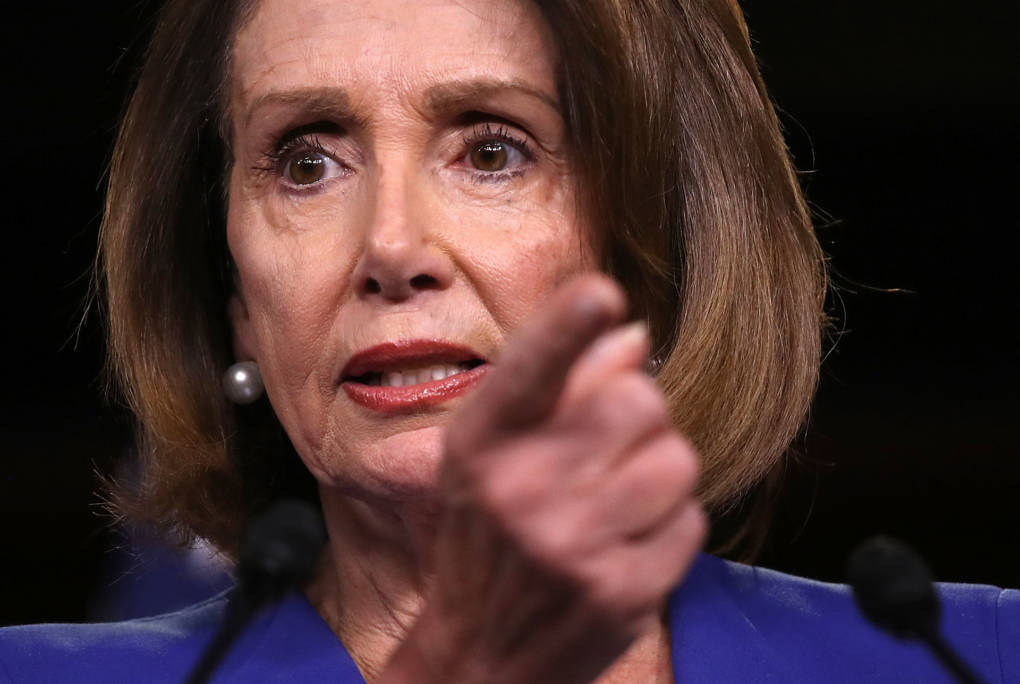
"caption": "U.S. Speaker of the House Nancy Pelosi answers questions during her weekly press conference on Jan. 31, 2019, in Washington, D.C. ",
"description": "U.S. Speaker of the House Nancy Pelosi answers questions during her weekly press conference on Jan. 31, 2019, in Washington, D.C. ",
"title": "House Speaker Nancy Pelosi Holds Her Weekly Press Conference At The Capitol",
"credit": "Win McNamee/Getty Images",
"status": "inherit",
"isLoading": false,
"fetchFailed": false
},
"news_11722503": {
"type": "attachments",
"id": "news_11722503",
"meta": {
"index": "attachments_1716263798",
"site": "news",
"id": "11722503",
"found": true
},
"parent": 11722489,
"imgSizes": {
"twentyfourteen-full-width": {
"file": "https://ww2.kqed.org/app/uploads/sites/10/2019/01/PelosiConf-1038x576.jpg",
"width": 1038,
"mimeType": "image/jpeg",
"height": 576
},
"thumbnail": {
"file": "https://ww2.kqed.org/app/uploads/sites/10/2019/01/PelosiConf-160x107.jpg",
"width": 160,
"mimeType": "image/jpeg",
"height": 107
},
"post-thumbnail": {
"file": "https://ww2.kqed.org/app/uploads/sites/10/2019/01/PelosiConf-672x372.jpg",
"width": 672,
"mimeType": "image/jpeg",
"height": 372
},
"kqedFullSize": {
"file": "https://ww2.kqed.org/app/uploads/sites/10/2019/01/PelosiConf.jpg",
"width": 1920,
"height": 1288
},
"large": {
"file": "https://ww2.kqed.org/app/uploads/sites/10/2019/01/PelosiConf-1020x684.jpg",
"width": 1020,
"mimeType": "image/jpeg",
"height": 684
},
"complete_open_graph": {
"file": "https://ww2.kqed.org/app/uploads/sites/10/2019/01/PelosiConf-1200x805.jpg",
"width": 1200,
"mimeType": "image/jpeg",
"height": 805
},
"guest-author-50": {
"file": "https://ww2.kqed.org/app/uploads/sites/10/2019/01/PelosiConf-50x50.jpg",
"width": 50,
"mimeType": "image/jpeg",
"height": 50
},
"guest-author-96": {
"file": "https://ww2.kqed.org/app/uploads/sites/10/2019/01/PelosiConf-96x96.jpg",
"width": 96,
"mimeType": "image/jpeg",
"height": 96
},
"medium": {
"file": "https://ww2.kqed.org/app/uploads/sites/10/2019/01/PelosiConf-800x537.jpg",
"width": 800,
"mimeType": "image/jpeg",
"height": 537
},
"guest-author-64": {
"file": "https://ww2.kqed.org/app/uploads/sites/10/2019/01/PelosiConf-64x64.jpg",
"width": 64,
"mimeType": "image/jpeg",
"height": 64
},
"guest-author-32": {
"file": "https://ww2.kqed.org/app/uploads/sites/10/2019/01/PelosiConf-32x32.jpg",
"width": 32,
"mimeType": "image/jpeg",
"height": 32
},
"full-width": {
"file": "https://ww2.kqed.org/app/uploads/sites/10/2019/01/PelosiConf-1920x1288.jpg",
"width": 1920,
"mimeType": "image/jpeg",
"height": 1288
},
"detail": {
"file": "https://ww2.kqed.org/app/uploads/sites/10/2019/01/PelosiConf-150x150.jpg",
"width": 150,
"mimeType": "image/jpeg",
"height": 150
},
"guest-author-128": {
"file": "https://ww2.kqed.org/app/uploads/sites/10/2019/01/PelosiConf-128x128.jpg",
"width": 128,
"mimeType": "image/jpeg",
"height": 128
}
},
"publishDate": 1548965346,
"modified": 1548965414,
"caption": "House Speaker Nancy Pelosi answers questions during a press conference on Jan 31, 2019. Pelosi answered questions primarily relating to ongoing negotiations to fund the federal government beyond Feb. 15.",
"description": "House Speaker Nancy Pelosi answers questions during a press conference on Jan 31, 2019. Pelosi answered questions primarily relating to ongoing negotiations to fund the federal government beyond Feb. 15.",
"title": "PelosiConf",
"credit": "Win McNamee/Getty Images",
"status": "inherit",
"isLoading": false,
"fetchFailed": false
},
"news_11722192": {
"type": "attachments",
"id": "news_11722192",
"meta": {
"index": "attachments_1716263798",
"site": "news",
"id": "11722192",
"found": true
},
"parent": 11722189,
"imgSizes": {
"twentyfourteen-full-width": {
"file": "https://ww2.kqed.org/app/uploads/sites/10/2019/01/AsylumSeekers-1038x576.jpg",
"width": 1038,
"mimeType": "image/jpeg",
"height": 576
},
"thumbnail": {
"file": "https://ww2.kqed.org/app/uploads/sites/10/2019/01/AsylumSeekers-160x106.jpg",
"width": 160,
"mimeType": "image/jpeg",
"height": 106
},
"post-thumbnail": {
"file": "https://ww2.kqed.org/app/uploads/sites/10/2019/01/AsylumSeekers-672x372.jpg",
"width": 672,
"mimeType": "image/jpeg",
"height": 372
},
"kqedFullSize": {
"file": "https://ww2.kqed.org/app/uploads/sites/10/2019/01/AsylumSeekers.jpg",
"width": 1800,
"height": 1198
},
"large": {
"file": "https://ww2.kqed.org/app/uploads/sites/10/2019/01/AsylumSeekers-1020x679.jpg",
"width": 1020,
"mimeType": "image/jpeg",
"height": 679
},
"complete_open_graph": {
"file": "https://ww2.kqed.org/app/uploads/sites/10/2019/01/AsylumSeekers-1200x799.jpg",
"width": 1200,
"mimeType": "image/jpeg",
"height": 799
},
"guest-author-50": {
"file": "https://ww2.kqed.org/app/uploads/sites/10/2019/01/AsylumSeekers-50x50.jpg",
"width": 50,
"mimeType": "image/jpeg",
"height": 50
},
"guest-author-96": {
"file": "https://ww2.kqed.org/app/uploads/sites/10/2019/01/AsylumSeekers-96x96.jpg",
"width": 96,
"mimeType": "image/jpeg",
"height": 96
},
"medium": {
"file": "https://ww2.kqed.org/app/uploads/sites/10/2019/01/AsylumSeekers-800x532.jpg",
"width": 800,
"mimeType": "image/jpeg",
"height": 532
},
"guest-author-64": {
"file": "https://ww2.kqed.org/app/uploads/sites/10/2019/01/AsylumSeekers-64x64.jpg",
"width": 64,
"mimeType": "image/jpeg",
"height": 64
},
"guest-author-32": {
"file": "https://ww2.kqed.org/app/uploads/sites/10/2019/01/AsylumSeekers-32x32.jpg",
"width": 32,
"mimeType": "image/jpeg",
"height": 32
},
"detail": {
"file": "https://ww2.kqed.org/app/uploads/sites/10/2019/01/AsylumSeekers-150x150.jpg",
"width": 150,
"mimeType": "image/jpeg",
"height": 150
},
"guest-author-128": {
"file": "https://ww2.kqed.org/app/uploads/sites/10/2019/01/AsylumSeekers-128x128.jpg",
"width": 128,
"mimeType": "image/jpeg",
"height": 128
}
},
"publishDate": 1548878481,
"modified": 1548878732,
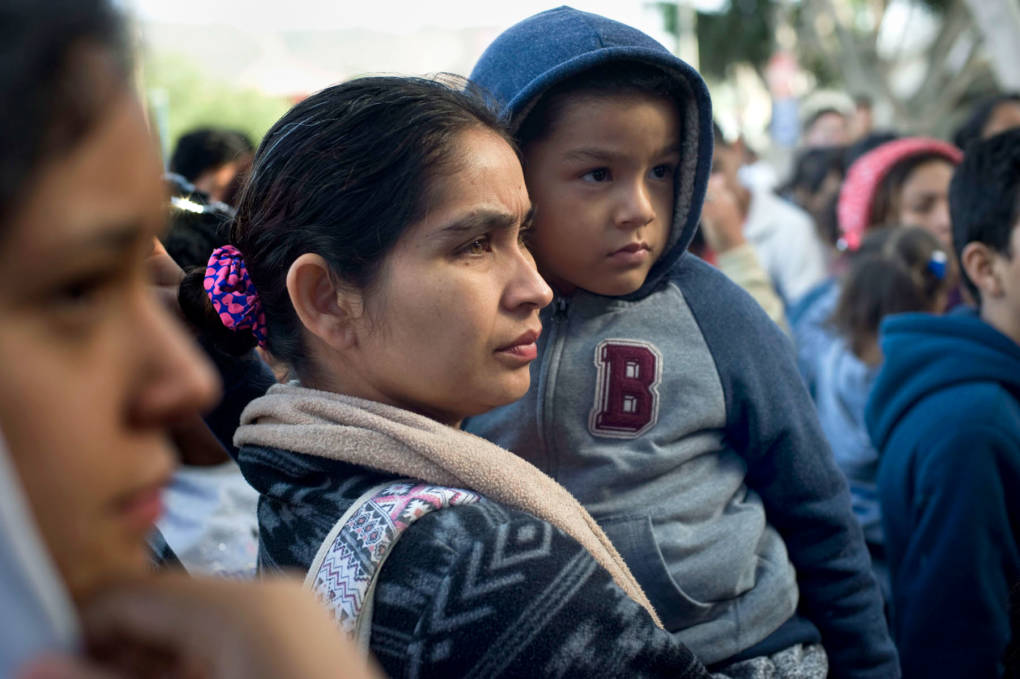
"caption": "A woman and child wait to hear their position on a list of asylum-seekers waiting at the U.S.-Mexico border on Nov. 21, 2018. ",
"description": "A woman and child wait to hear their position on a list of asylum-seekers waiting at the U.S.-Mexico border on Nov. 21, 2018. ",
"title": "AsylumSeekers",
"credit": "David Maung/KQED",
"status": "inherit",
"isLoading": false,
"fetchFailed": false
},
"news_11721033": {
"type": "attachments",
"id": "news_11721033",
"meta": {
"index": "attachments_1716263798",
"site": "news",
"id": "11721033",
"found": true
},
"parent": 11721026,
"imgSizes": {
"twentyfourteen-full-width": {
"file": "https://ww2.kqed.org/app/uploads/sites/10/2019/01/Trump-1038x576.jpg",
"width": 1038,
"mimeType": "image/jpeg",
"height": 576
},
"thumbnail": {
"file": "https://ww2.kqed.org/app/uploads/sites/10/2019/01/Trump-160x101.jpg",
"width": 160,
"mimeType": "image/jpeg",
"height": 101
},
"post-thumbnail": {
"file": "https://ww2.kqed.org/app/uploads/sites/10/2019/01/Trump-672x372.jpg",
"width": 672,
"mimeType": "image/jpeg",
"height": 372
},
"kqedFullSize": {
"file": "https://ww2.kqed.org/app/uploads/sites/10/2019/01/Trump.jpg",
"width": 1920,
"height": 1206
},
"large": {
"file": "https://ww2.kqed.org/app/uploads/sites/10/2019/01/Trump-1020x641.jpg",
"width": 1020,
"mimeType": "image/jpeg",
"height": 641
},
"complete_open_graph": {
"file": "https://ww2.kqed.org/app/uploads/sites/10/2019/01/Trump-1200x754.jpg",
"width": 1200,
"mimeType": "image/jpeg",
"height": 754
},
"guest-author-50": {
"file": "https://ww2.kqed.org/app/uploads/sites/10/2019/01/Trump-50x50.jpg",
"width": 50,
"mimeType": "image/jpeg",
"height": 50
},
"guest-author-96": {
"file": "https://ww2.kqed.org/app/uploads/sites/10/2019/01/Trump-96x96.jpg",
"width": 96,
"mimeType": "image/jpeg",
"height": 96
},
"medium": {
"file": "https://ww2.kqed.org/app/uploads/sites/10/2019/01/Trump-800x503.jpg",
"width": 800,
"mimeType": "image/jpeg",
"height": 503
},
"guest-author-64": {
"file": "https://ww2.kqed.org/app/uploads/sites/10/2019/01/Trump-64x64.jpg",
"width": 64,
"mimeType": "image/jpeg",
"height": 64
},
"guest-author-32": {
"file": "https://ww2.kqed.org/app/uploads/sites/10/2019/01/Trump-32x32.jpg",
"width": 32,
"mimeType": "image/jpeg",
"height": 32
},
"full-width": {
"file": "https://ww2.kqed.org/app/uploads/sites/10/2019/01/Trump-1920x1206.jpg",
"width": 1920,
"mimeType": "image/jpeg",
"height": 1206
},
"detail": {
"file": "https://ww2.kqed.org/app/uploads/sites/10/2019/01/Trump-150x150.jpg",
"width": 150,
"mimeType": "image/jpeg",
"height": 150
},
"guest-author-128": {
"file": "https://ww2.kqed.org/app/uploads/sites/10/2019/01/Trump-128x128.jpg",
"width": 128,
"mimeType": "image/jpeg",
"height": 128
}
},
"publishDate": 1548444211,
"modified": 1548444238,
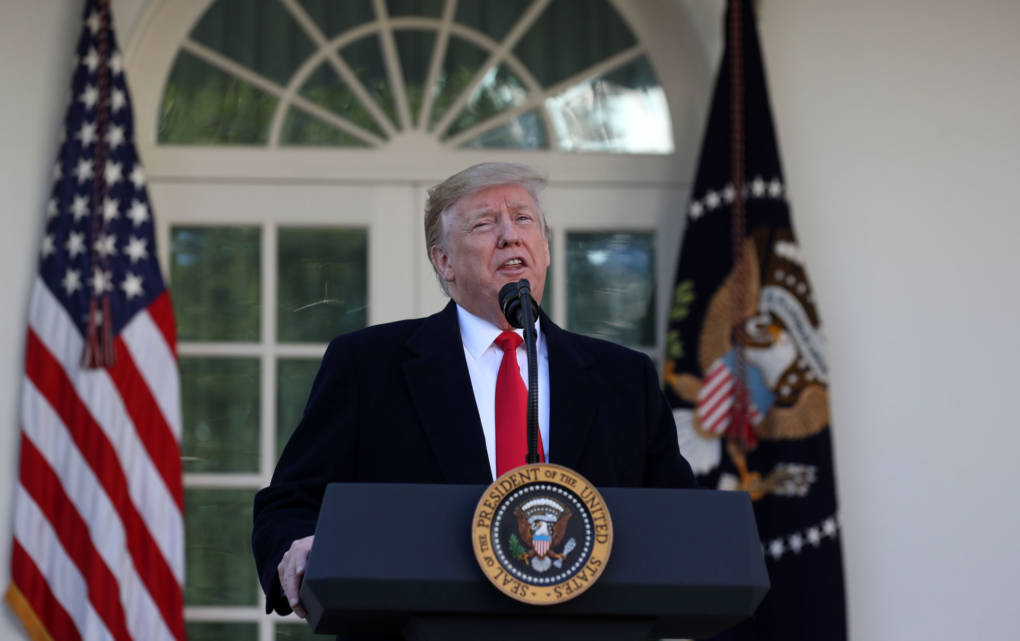
"caption": "President Donald Trump speaks about the government shutdown on January 25, 2019, from the Rose Garden of the White House.",
"description": "President Donald Trump speaks about the government shutdown on January 25, 2019, from the Rose Garden of the White House.",
"title": "Trump",
"credit": "ALEX EDELMAN/AFP/Getty Images",
"status": "inherit",
"isLoading": false,
"fetchFailed": false
},
"news_11721072": {
"type": "attachments",
"id": "news_11721072",
"meta": {
"index": "attachments_1716263798",
"site": "news",
"id": "11721072",
"found": true
},
"parent": 11721061,
"imgSizes": {
"twentyfourteen-full-width": {
"file": "https://ww2.kqed.org/app/uploads/sites/10/2019/01/border_mexico-1038x576.jpg",
"width": 1038,
"mimeType": "image/jpeg",
"height": 576
},
"thumbnail": {
"file": "https://ww2.kqed.org/app/uploads/sites/10/2019/01/border_mexico-160x106.jpg",
"width": 160,
"mimeType": "image/jpeg",
"height": 106
},
"post-thumbnail": {
"file": "https://ww2.kqed.org/app/uploads/sites/10/2019/01/border_mexico-672x372.jpg",
"width": 672,
"mimeType": "image/jpeg",
"height": 372
},
"kqedFullSize": {
"file": "https://ww2.kqed.org/app/uploads/sites/10/2019/01/border_mexico.jpg",
"width": 1800,
"height": 1198
},
"large": {
"file": "https://ww2.kqed.org/app/uploads/sites/10/2019/01/border_mexico-1020x679.jpg",
"width": 1020,
"mimeType": "image/jpeg",
"height": 679
},
"complete_open_graph": {
"file": "https://ww2.kqed.org/app/uploads/sites/10/2019/01/border_mexico-1200x799.jpg",
"width": 1200,
"mimeType": "image/jpeg",
"height": 799
},
"guest-author-50": {
"file": "https://ww2.kqed.org/app/uploads/sites/10/2019/01/border_mexico-50x50.jpg",
"width": 50,
"mimeType": "image/jpeg",
"height": 50
},
"guest-author-96": {
"file": "https://ww2.kqed.org/app/uploads/sites/10/2019/01/border_mexico-96x96.jpg",
"width": 96,
"mimeType": "image/jpeg",
"height": 96
},
"medium": {
"file": "https://ww2.kqed.org/app/uploads/sites/10/2019/01/border_mexico-800x532.jpg",
"width": 800,
"mimeType": "image/jpeg",
"height": 532
},
"guest-author-64": {
"file": "https://ww2.kqed.org/app/uploads/sites/10/2019/01/border_mexico-64x64.jpg",
"width": 64,
"mimeType": "image/jpeg",
"height": 64
},
"guest-author-32": {
"file": "https://ww2.kqed.org/app/uploads/sites/10/2019/01/border_mexico-32x32.jpg",
"width": 32,
"mimeType": "image/jpeg",
"height": 32
},
"detail": {
"file": "https://ww2.kqed.org/app/uploads/sites/10/2019/01/border_mexico-150x150.jpg",
"width": 150,
"mimeType": "image/jpeg",
"height": 150
},
"guest-author-128": {
"file": "https://ww2.kqed.org/app/uploads/sites/10/2019/01/border_mexico-128x128.jpg",
"width": 128,
"mimeType": "image/jpeg",
"height": 128
}
},
"publishDate": 1548449289,
"modified": 1548458519,
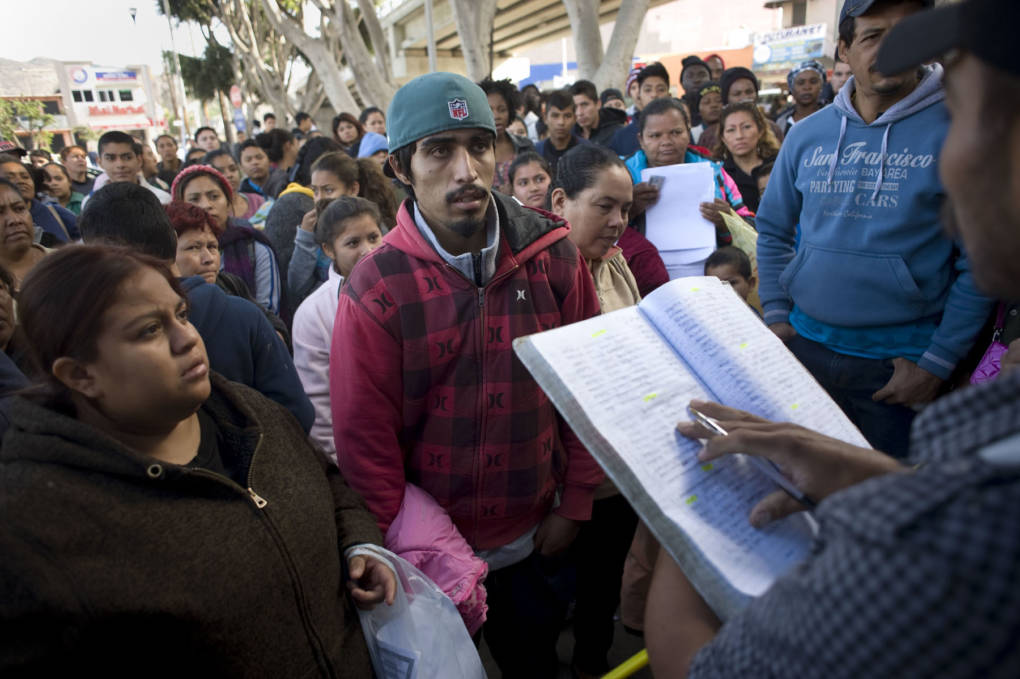
"caption": "People listen at the border in Tijuana, Mexico, as a man calls out names on a waiting list for those looking to cross the U.S. border to ask for asylum. The list is being kept by the asylum-seekers themselves in order to maintain order for those waiting and for those who have just arrived.",
"description": null,
"title": "border_mexico",
"credit": "David Maung/KQED",
"status": "inherit",
"isLoading": false,
"fetchFailed": false
},
"news_11719617": {
"type": "attachments",
"id": "news_11719617",
"meta": {
"index": "attachments_1716263798",
"site": "news",
"id": "11719617",
"found": true
},
"parent": 11719616,
"imgSizes": {
"twentyfourteen-full-width": {
"file": "https://ww2.kqed.org/app/uploads/sites/10/2019/01/7fc29fa5-ap_19019765826532_custom-d7a7e35f0c97bd44a3f70cbcb551d6eaf062c334-e1547934898150-1038x576.jpg",
"width": 1038,
"mimeType": "image/jpeg",
"height": 576
},
"thumbnail": {
"file": "https://ww2.kqed.org/app/uploads/sites/10/2019/01/7fc29fa5-ap_19019765826532_custom-d7a7e35f0c97bd44a3f70cbcb551d6eaf062c334-e1547934898150-160x102.jpg",
"width": 160,
"mimeType": "image/jpeg",
"height": 102
},
"post-thumbnail": {
"file": "https://ww2.kqed.org/app/uploads/sites/10/2019/01/7fc29fa5-ap_19019765826532_custom-d7a7e35f0c97bd44a3f70cbcb551d6eaf062c334-e1547934898150-672x372.jpg",
"width": 672,
"mimeType": "image/jpeg",
"height": 372
},
"kqedFullSize": {
"file": "https://ww2.kqed.org/app/uploads/sites/10/2019/01/7fc29fa5-ap_19019765826532_custom-d7a7e35f0c97bd44a3f70cbcb551d6eaf062c334-e1547934898150.jpg",
"width": 1920,
"height": 1225
},
"large": {
"file": "https://ww2.kqed.org/app/uploads/sites/10/2019/01/7fc29fa5-ap_19019765826532_custom-d7a7e35f0c97bd44a3f70cbcb551d6eaf062c334-e1547934898150-1020x651.jpg",
"width": 1020,
"mimeType": "image/jpeg",
"height": 651
},
"complete_open_graph": {
"file": "https://ww2.kqed.org/app/uploads/sites/10/2019/01/7fc29fa5-ap_19019765826532_custom-d7a7e35f0c97bd44a3f70cbcb551d6eaf062c334-e1547934898150-1200x766.jpg",
"width": 1200,
"mimeType": "image/jpeg",
"height": 766
},
"guest-author-50": {
"file": "https://ww2.kqed.org/app/uploads/sites/10/2019/01/7fc29fa5-ap_19019765826532_custom-d7a7e35f0c97bd44a3f70cbcb551d6eaf062c334-e1547934898150-50x50.jpg",
"width": 50,
"mimeType": "image/jpeg",
"height": 50
},
"guest-author-96": {
"file": "https://ww2.kqed.org/app/uploads/sites/10/2019/01/7fc29fa5-ap_19019765826532_custom-d7a7e35f0c97bd44a3f70cbcb551d6eaf062c334-e1547934898150-96x96.jpg",
"width": 96,
"mimeType": "image/jpeg",
"height": 96
},
"medium": {
"file": "https://ww2.kqed.org/app/uploads/sites/10/2019/01/7fc29fa5-ap_19019765826532_custom-d7a7e35f0c97bd44a3f70cbcb551d6eaf062c334-e1547934898150-800x510.jpg",
"width": 800,
"mimeType": "image/jpeg",
"height": 510
},
"guest-author-64": {
"file": "https://ww2.kqed.org/app/uploads/sites/10/2019/01/7fc29fa5-ap_19019765826532_custom-d7a7e35f0c97bd44a3f70cbcb551d6eaf062c334-e1547934898150-64x64.jpg",
"width": 64,
"mimeType": "image/jpeg",
"height": 64
},
"guest-author-32": {
"file": "https://ww2.kqed.org/app/uploads/sites/10/2019/01/7fc29fa5-ap_19019765826532_custom-d7a7e35f0c97bd44a3f70cbcb551d6eaf062c334-e1547934898150-32x32.jpg",
"width": 32,
"mimeType": "image/jpeg",
"height": 32
},
"full-width": {
"file": "https://ww2.kqed.org/app/uploads/sites/10/2019/01/7fc29fa5-ap_19019765826532_custom-d7a7e35f0c97bd44a3f70cbcb551d6eaf062c334-e1547934898150-1920x1225.jpg",
"width": 1920,
"mimeType": "image/jpeg",
"height": 1225
},
"detail": {
"file": "https://ww2.kqed.org/app/uploads/sites/10/2019/01/7fc29fa5-ap_19019765826532_custom-d7a7e35f0c97bd44a3f70cbcb551d6eaf062c334-e1547934898150-150x150.jpg",
"width": 150,
"mimeType": "image/jpeg",
"height": 150
},
"guest-author-128": {
"file": "https://ww2.kqed.org/app/uploads/sites/10/2019/01/7fc29fa5-ap_19019765826532_custom-d7a7e35f0c97bd44a3f70cbcb551d6eaf062c334-e1547934898150-128x128.jpg",
"width": 128,
"mimeType": "image/jpeg",
"height": 128
}
},
"publishDate": 1547934740,
"modified": 1547934891,
"caption": "President Trump speaks about the partial government shutdown, immigration and border security in the Diplomatic Reception Room of the White House Saturday.",
"description": "President Trump speaks about the partial government shutdown, immigration and border security in the Diplomatic Reception Room of the White House Saturday.",
"title": "President Trump speaks about the partial government shutdown, immigration and border security in the Diplomatic Reception Room of the White House Saturday.",
"credit": "Alex Brandon/AP",
"status": "inherit",
"isLoading": false,
"fetchFailed": false
},
"news_11719642": {
"type": "attachments",
"id": "news_11719642",
"meta": {
"index": "attachments_1716263798",
"site": "news",
"id": "11719642",
"found": true
},
"parent": 11719628,
"imgSizes": {
"twentyfourteen-full-width": {
"file": "https://ww2.kqed.org/app/uploads/sites/10/2019/01/4935be95-rs34766_gettyimages-1092246050-qut-1038x576.jpg",
"width": 1038,
"mimeType": "image/jpeg",
"height": 576
},
"thumbnail": {
"file": "https://ww2.kqed.org/app/uploads/sites/10/2019/01/4935be95-rs34766_gettyimages-1092246050-qut-160x111.jpg",
"width": 160,
"mimeType": "image/jpeg",
"height": 111
},
"post-thumbnail": {
"file": "https://ww2.kqed.org/app/uploads/sites/10/2019/01/4935be95-rs34766_gettyimages-1092246050-qut-672x372.jpg",
"width": 672,
"mimeType": "image/jpeg",
"height": 372
},
"kqedFullSize": {
"file": "https://ww2.kqed.org/app/uploads/sites/10/2019/01/4935be95-rs34766_gettyimages-1092246050-qut.jpg",
"width": 1920,
"height": 1331
},
"large": {
"file": "https://ww2.kqed.org/app/uploads/sites/10/2019/01/4935be95-rs34766_gettyimages-1092246050-qut-1020x707.jpg",
"width": 1020,
"mimeType": "image/jpeg",
"height": 707
},
"complete_open_graph": {
"file": "https://ww2.kqed.org/app/uploads/sites/10/2019/01/4935be95-rs34766_gettyimages-1092246050-qut-1200x832.jpg",
"width": 1200,
"mimeType": "image/jpeg",
"height": 832
},
"guest-author-50": {
"file": "https://ww2.kqed.org/app/uploads/sites/10/2019/01/4935be95-rs34766_gettyimages-1092246050-qut-50x50.jpg",
"width": 50,
"mimeType": "image/jpeg",
"height": 50
},
"guest-author-96": {
"file": "https://ww2.kqed.org/app/uploads/sites/10/2019/01/4935be95-rs34766_gettyimages-1092246050-qut-96x96.jpg",
"width": 96,
"mimeType": "image/jpeg",
"height": 96
},
"medium": {
"file": "https://ww2.kqed.org/app/uploads/sites/10/2019/01/4935be95-rs34766_gettyimages-1092246050-qut-800x555.jpg",
"width": 800,
"mimeType": "image/jpeg",
"height": 555
},
"guest-author-64": {
"file": "https://ww2.kqed.org/app/uploads/sites/10/2019/01/4935be95-rs34766_gettyimages-1092246050-qut-64x64.jpg",
"width": 64,
"mimeType": "image/jpeg",
"height": 64
},
"guest-author-32": {
"file": "https://ww2.kqed.org/app/uploads/sites/10/2019/01/4935be95-rs34766_gettyimages-1092246050-qut-32x32.jpg",
"width": 32,
"mimeType": "image/jpeg",
"height": 32
},
"full-width": {
"file": "https://ww2.kqed.org/app/uploads/sites/10/2019/01/4935be95-rs34766_gettyimages-1092246050-qut-1920x1331.jpg",
"width": 1920,
"mimeType": "image/jpeg",
"height": 1331
},
"detail": {
"file": "https://ww2.kqed.org/app/uploads/sites/10/2019/01/4935be95-rs34766_gettyimages-1092246050-qut-150x150.jpg",
"width": 150,
"mimeType": "image/jpeg",
"height": 150
},
"guest-author-128": {
"file": "https://ww2.kqed.org/app/uploads/sites/10/2019/01/4935be95-rs34766_gettyimages-1092246050-qut-128x128.jpg",
"width": 128,
"mimeType": "image/jpeg",
"height": 128
}
},
"publishDate": 1547940484,
"modified": 1547941795,
"caption": "San Francisco Democrat and House Speaker Nancy Pelosi called President Trump's border proposal a 'non-starter' even before it was officially announced.",
"description": "San Francisco Democrat and House Speaker Nancy Pelosi called President Trump's border proposal a 'non-starter' even before it was officially announced.",
"title": "House Speaker Nancy Pelosi Holds Her Weekly News Conference On Capitol Hill",
"credit": "Win McNamee/Getty Images",
"status": "inherit",
"isLoading": false,
"fetchFailed": false
}
},
"audioPlayerReducer": {
"postId": "stream_live",
"isPaused": true,
"isPlaying": false,
"pfsActive": false,
"pledgeModalIsOpen": true,
"playerDrawerIsOpen": false,
"liveAudioPlayStartedAt": 0,
"liveAudioPlayContext": ""
},
"authorsReducer": {
"byline_news_11725334": {
"type": "authors",
"id": "byline_news_11725334",
"meta": {
"override": true
},
"slug": "byline_news_11725334",
"name": "\u003cstrong>\u003ca href=\"https://www.npr.org/people/122805042/tamara-keith\">Tamara Keith\u003c/a>\u003c/strong>\u003cbr> \u003cstrong>\u003ca href=\"https://www.npr.org\">NPR\u003c/a>\u003c/strong>",
"isLoading": false
},
"byline_news_11723796": {
"type": "authors",
"id": "byline_news_11723796",
"meta": {
"override": true
},
"slug": "byline_news_11723796",
"name": "Meg Anderson",
"isLoading": false
},
"byline_news_11722489": {
"type": "authors",
"id": "byline_news_11722489",
"meta": {
"override": true
},
"slug": "byline_news_11722489",
"name": "Andrew Taylor and Alan Fram \u003cbr> Associated Press",
"isLoading": false
},
"byline_news_11722189": {
"type": "authors",
"id": "byline_news_11722189",
"meta": {
"override": true
},
"slug": "byline_news_11722189",
"name": "Elliot Spagat \u003cbr> Associated Press",
"isLoading": false
},
"byline_news_11721026": {
"type": "authors",
"id": "byline_news_11721026",
"meta": {
"override": true
},
"slug": "byline_news_11721026",
"name": "Jessica Taylor",
"isLoading": false
},
"byline_news_11721061": {
"type": "authors",
"id": "byline_news_11721061",
"meta": {
"override": true
},
"slug": "byline_news_11721061",
"name": "Richard Gonzales",
"isLoading": false
},
"byline_news_11719616": {
"type": "authors",
"id": "byline_news_11719616",
"meta": {
"override": true
},
"slug": "byline_news_11719616",
"name": "\u003ca href=\"https://www.npr.org/people/599484393/ayesha-rascoe\">Ayesha Rascoe\u003c/a>, \u003ca href=\"https://www.npr.org/people/392602474/domenico-montanaro\">Domenico Montanaro\u003c/a>\u003c/br>NPR",
"isLoading": false
},
"scottshafer": {
"type": "authors",
"id": "255",
"meta": {
"index": "authors_1716337520",
"id": "255",
"found": true
},
"name": "Scott Shafer",
"firstName": "Scott",
"lastName": "Shafer",
"slug": "scottshafer",
"email": "sshafer@kqed.org",
"display_author_email": false,
"staff_mastheads": [
"news"
],
"title": "KQED Contributor",
"bio": "Scott Shafer is a senior editor with the KQED Politics and Government desk. He is co-host of Political Breakdown, the award-winning radio show and podcast with a personal take on the world of politics. Scott came to KQED in 1998 to host the statewide\u003cem> California Report\u003c/em>. Prior to that he had extended stints in politics and government\u003cem>.\u003c/em> He uses that inside experience at KQED in his, reporting, hosting and analysis for the politics desk. Scott collaborated \u003cem>Political Breakdown a\u003c/em>nd on \u003cem>The Political Mind of Jerry Brown, \u003c/em>an eight-part series about the life and extraordinary political career of the former governor. For fun, he plays water polo with the San Francisco Tsunami.",
"avatar": "https://secure.gravatar.com/avatar/a62ebae45b79d7aed1a39a0e3bf68104?s=600&d=blank&r=g",
"twitter": "scottshafer",
"bluesky": null,
"facebook": null,
"instagram": null,
"linkedin": null,
"sites": [
{
"site": "news",
"roles": [
"editor"
]
},
{
"site": "stateofhealth",
"roles": [
"author"
]
},
{
"site": "science",
"roles": [
"author"
]
},
{
"site": "forum",
"roles": [
"subscriber"
]
},
{
"site": "liveblog",
"roles": [
"author"
]
}
],
"headData": {
"title": "Scott Shafer | KQED",
"description": "KQED Contributor",
"ogImgSrc": "https://secure.gravatar.com/avatar/a62ebae45b79d7aed1a39a0e3bf68104?s=600&d=blank&r=g",
"twImgSrc": "https://secure.gravatar.com/avatar/a62ebae45b79d7aed1a39a0e3bf68104?s=600&d=blank&r=g"
},
"isLoading": false,
"link": "/author/scottshafer"
},
"markfiore": {
"type": "authors",
"id": "3236",
"meta": {
"index": "authors_1716337520",
"id": "3236",
"found": true
},
"name": "Mark Fiore",
"firstName": "Mark",
"lastName": "Fiore",
"slug": "markfiore",
"email": "mark@markfiore.com",
"display_author_email": false,
"staff_mastheads": [
"news"
],
"title": "KQED News Cartoonist",
"bio": "\u003ca href=\"http://www.MarkFiore.com\">MarkFiore.com\u003c/a> | \u003ca href=\"https://twitter.com/markfiore\">Follow on Twitter\u003c/a> | \u003ca href=\"https://www.facebook.com/pages/Mark-Fiore-Animated-Political-Cartoons/94451707396?ref=bookmarks\">Facebook\u003c/a> | \u003ca href=\"mailto:mark@markfiore.com\">email\u003c/a>\r\n\r\nPulitzer Prize-winner, Mark Fiore, who the Wall Street Journal has called “the undisputed guru of the form,” creates animated political cartoons in San Francisco, where his work has been featured regularly on the San Francisco Chronicle’s web site, SFGate.com. His work has appeared on Newsweek.com, Slate.com, CBSNews.com, MotherJones.com, DailyKos.com and NPR’s web site. Fiore’s political animation has appeared on CNN, Frontline, Bill Moyers Journal, Salon.com and cable and broadcast outlets across the globe.\r\n\r\nBeginning his professional life by drawing traditional political cartoons for newspapers, Fiore’s work appeared in publications ranging from the Washington Post to the Los Angeles Times. In the late 1990s, he began to experiment with animating political cartoons and, after a short stint at the San Jose Mercury News as their staff cartoonist, Fiore devoted all his energies to animation.\r\nGrowing up in California, Fiore also spent a good portion of his life in the backwoods of Idaho. It was this combination that shaped him politically. Mark majored in political science at Colorado College, where, in a perfect send-off for a cartoonist, he received his diploma in 1991 as commencement speaker Dick Cheney smiled approvingly.\r\nMark Fiore was awarded the Pulitzer Prize for political cartooning in 2010, a Robert F. Kennedy Journalism Award in 2004 and has twice received an Online Journalism Award for commentary from the Online News Association (2002, 2008). Fiore has received two awards for his work in new media from the National Cartoonists Society (2001, 2002), and in 2006 received The James Madison Freedom of Information Award from The Society of Professional Journalists.",
"avatar": "https://secure.gravatar.com/avatar/fc4e2a612b15b67bad0c6f0e1db4ca9b?s=600&d=blank&r=g",
"twitter": "MarkFiore",
"facebook": null,
"instagram": "https://www.instagram.com/markfiore/?hl=en",
"linkedin": null,
"sites": [
{
"site": "arts",
"roles": [
"contributor"
]
},
{
"site": "news",
"roles": [
"editor"
]
},
{
"site": "futureofyou",
"roles": [
"editor"
]
},
{
"site": "science",
"roles": [
"editor"
]
}
],
"headData": {
"title": "Mark Fiore | KQED",
"description": "KQED News Cartoonist",
"ogImgSrc": "https://secure.gravatar.com/avatar/fc4e2a612b15b67bad0c6f0e1db4ca9b?s=600&d=blank&r=g",
"twImgSrc": "https://secure.gravatar.com/avatar/fc4e2a612b15b67bad0c6f0e1db4ca9b?s=600&d=blank&r=g"
},
"isLoading": false,
"link": "/author/markfiore"
},
"fjhabvala": {
"type": "authors",
"id": "8659",
"meta": {
"index": "authors_1716337520",
"id": "8659",
"found": true
},
"name": "Farida Jhabvala Romero",
"firstName": "Farida",
"lastName": "Jhabvala Romero",
"slug": "fjhabvala",
"email": "fjhabvala@kqed.org",
"display_author_email": true,
"staff_mastheads": [
"news"
],
"title": "KQED Contributor",
"bio": "Farida Jhabvala Romero is a Labor Correspondent for KQED. She previously covered immigration. Farida was \u003ca href=\"https://www.ccnma.org/2022-most-influential-latina-journalists\">named\u003c/a> one of the 10 Most Influential Latina Journalists in California in 2022 by the California Chicano News Media Association. Her work has won awards from the Society of Professional Journalists (Northern California), as well as a national and regional Edward M. Murrow Award for the collaborative reporting projects “Dangerous Air” and “Graying California.” Before joining KQED, Farida worked as a producer at Radio Bilingüe, a national public radio network. Farida earned her master’s degree in journalism from Stanford University.",
"avatar": "https://secure.gravatar.com/avatar/f9f022d4e2609741874222a1e9d41f48fea74011aa7c615eef91d9a50c944ebe?s=600&d=blank&r=g",
"twitter": "FaridaJhabvala",
"bluesky": null,
"facebook": null,
"instagram": null,
"linkedin": "https://www.linkedin.com/in/faridajhabvala/",
"sites": [
{
"site": "news",
"roles": [
"editor"
]
},
{
"site": "stateofhealth",
"roles": [
"author"
]
},
{
"site": "liveblog",
"roles": [
"author"
]
}
],
"headData": {
"title": "Farida Jhabvala Romero | KQED",
"description": "KQED Contributor",
"ogImgSrc": "https://secure.gravatar.com/avatar/f9f022d4e2609741874222a1e9d41f48fea74011aa7c615eef91d9a50c944ebe?s=600&d=blank&r=g",
"twImgSrc": "https://secure.gravatar.com/avatar/f9f022d4e2609741874222a1e9d41f48fea74011aa7c615eef91d9a50c944ebe?s=600&d=blank&r=g"
},
"isLoading": false,
"link": "/author/fjhabvala"
},
"jeremysiegel": {
"type": "authors",
"id": "11258",
"meta": {
"index": "authors_1716337520",
"id": "11258",
"found": true
},
"name": "Jeremy Siegel",
"firstName": "Jeremy",
"lastName": "Siegel",
"slug": "jeremysiegel",
"email": "jsiegel@kqed.org",
"display_author_email": false,
"staff_mastheads": [],
"title": "KQED Contributor",
"bio": "Jeremy Siegel is is the weekend afternoon news anchor for KQED. His reporting can be heard on KQED News, Morning Edition, All Things Considered and The California Report. Jeremy's coverage of the Camp Fire in Butte County won the 2019 Society of Professional Journalists, Northern California Chapter, Excellence in Journalism Award for Breaking News. Jeremy grew up in Cincinnati, Ohio, and graduated from UC Berkeley.",
"avatar": "https://secure.gravatar.com/avatar/3921a64ceb9ed5d0ba47d9ae9782f1ab?s=600&d=blank&r=g",
"twitter": "jersiegel",
"facebook": null,
"instagram": null,
"linkedin": null,
"sites": [
{
"site": "arts",
"roles": []
},
{
"site": "news",
"roles": [
"subscriber"
]
},
{
"site": "science",
"roles": []
}
],
"headData": {
"title": "Jeremy Siegel | KQED",
"description": "KQED Contributor",
"ogImgSrc": "https://secure.gravatar.com/avatar/3921a64ceb9ed5d0ba47d9ae9782f1ab?s=600&d=blank&r=g",
"twImgSrc": "https://secure.gravatar.com/avatar/3921a64ceb9ed5d0ba47d9ae9782f1ab?s=600&d=blank&r=g"
},
"isLoading": false,
"link": "/author/jeremysiegel"
},
"rlevi": {
"type": "authors",
"id": "11260",
"meta": {
"index": "authors_1716337520",
"id": "11260",
"found": true
},
"name": "Ryan Levi",
"firstName": "Ryan",
"lastName": "Levi",
"slug": "rlevi",
"email": "rlevi@KQED.org",
"display_author_email": false,
"staff_mastheads": [],
"title": "KQED Contributor",
"bio": "Ryan Levi was a reporter and podcast producer at KQED News from 2016-2019. He worked on \u003ca href=\"https://www.kqed.org/news/series/baycurious\">Bay Curious\u003c/a>, \u003ca href=\"https://www.kqed.org/news/tag/the-bay/\">The Bay, \u003c/a>and \u003ca href=\"https://podcasts.apple.com/us/podcast/the-california-report-magazine/id1314750545\">The California Report Magazine\u003c/a>, as well as hosting and producing the weekly \u003ca href=\"https://www.kqed.org/news/program/qedup/\">Q'ed Up podcast. \u003c/a>He also helped inaugurate KQED's weekend news coverage in 2017 as one of two original digital producers. Ryan holds degrees in multimedia journalism and Spanish from the University of Missouri.",
"avatar": "https://secure.gravatar.com/avatar/4cb2ddd028ac8807d1adf09609c5555d?s=600&d=blank&r=g",
"twitter": "ryan_levi",
"facebook": null,
"instagram": null,
"linkedin": null,
"sites": [
{
"site": "arts",
"roles": [
"editor"
]
},
{
"site": "news",
"roles": [
"subscriber"
]
},
{
"site": "stateofhealth",
"roles": [
"editor"
]
},
{
"site": "science",
"roles": [
"editor"
]
},
{
"site": "forum",
"roles": [
"administrator"
]
},
{
"site": "perspectives",
"roles": [
"administrator"
]
}
],
"headData": {
"title": "Ryan Levi | KQED",
"description": "KQED Contributor",
"ogImgSrc": "https://secure.gravatar.com/avatar/4cb2ddd028ac8807d1adf09609c5555d?s=600&d=blank&r=g",
"twImgSrc": "https://secure.gravatar.com/avatar/4cb2ddd028ac8807d1adf09609c5555d?s=600&d=blank&r=g"
},
"isLoading": false,
"link": "/author/rlevi"
},
"ktandy": {
"type": "authors",
"id": "11545",
"meta": {
"index": "authors_1716337520",
"id": "11545",
"found": true
},
"name": "Katie Tandy",
"firstName": "Katie",
"lastName": "Tandy",
"slug": "ktandy",
"email": "ktandy@kqed.org",
"display_author_email": false,
"staff_mastheads": [],
"title": "KQED Contributor",
"bio": "Katie Tandy is the co-founding editor of\u003ca href=\"http://www.theestablishment.co\"> The Establishment,\u003c/a> an online news+culture publication which champions the voices and stories of those who have been marginalized by mainstream media.\r\nShe is a former on-call interactive producer for KQED.",
"avatar": "https://secure.gravatar.com/avatar/1f877a62bab50d75c8bbef40e4ebe7f6?s=600&d=blank&r=g",
"twitter": null,
"facebook": null,
"instagram": null,
"linkedin": null,
"sites": [
{
"site": "news",
"roles": [
"subscriber"
]
}
],
"headData": {
"title": "Katie Tandy | KQED",
"description": "KQED Contributor",
"ogImgSrc": "https://secure.gravatar.com/avatar/1f877a62bab50d75c8bbef40e4ebe7f6?s=600&d=blank&r=g",
"twImgSrc": "https://secure.gravatar.com/avatar/1f877a62bab50d75c8bbef40e4ebe7f6?s=600&d=blank&r=g"
},
"isLoading": false,
"link": "/author/ktandy"
}
},
"pagesReducer": {
"news_tag_border-wall": {
"type": "terms",
"id": "news_20446",
"meta": {
"index": "terms_1716263798",
"site": "news",
"id": "20446",
"score": 9.556601
},
"featImg": null,
"name": "Border Wall",
"description": null,
"taxonomy": "tag",
"headData": {
"twImgId": null,
"twTitle": null,
"ogTitle": null,
"ogImgId": null,
"twDescription": null,
"description": null,
"title": "Border Wall Archives | KQED News",
"ogDescription": null
},
"ttid": 20463,
"slug": "border-wall",
"isLoading": false,
"title": "Border Wall",
"pageMeta": {
"site": "news",
"WpPageTemplate": "page-topic-editorial",
"currentPage": 4
},
"blocks": [
{
"blockName": "kqed/post-list",
"attrs": {
"layout": "cardArticle2",
"query": "posts/news?tag=border-wall",
"seeMore": false,
"paginated": true,
"page": 4
}
},
{
"blockName": "kqed/ad"
}
]
}
},
"pfsSessionReducer": {},
"postsReducer": {
"stream_live": {
"type": "live",
"id": "stream_live",
"audioUrl": "https://streams.kqed.org/kqedradio",
"title": "Live Stream",
"excerpt": "Live Stream information currently unavailable.",
"link": "/radio",
"featImg": "",
"label": {
"name": "KQED Live",
"link": "/"
}
},
"stream_kqedNewscast": {
"type": "posts",
"id": "stream_kqedNewscast",
"audioUrl": "https://www.kqed.org/.stream/anon/radio/RDnews/newscast.mp3?_=1",
"title": "KQED Newscast",
"featImg": "",
"label": {
"name": "88.5 FM",
"link": "/"
}
},
"news_11725468": {
"type": "posts",
"id": "news_11725468",
"meta": {
"index": "posts_1716263798",
"site": "news",
"id": "11725468",
"score": null,
"sort": [
1549929467000
]
},
"guestAuthors": [],
"slug": "no-more-california-guard-troops-for-manufactured-crisis",
"title": "No More California Guard Troops for 'Manufactured Crisis'",
"publishDate": 1549929467,
"format": "standard",
"headTitle": "No More California Guard Troops for ‘Manufactured Crisis’ | KQED",
"labelTerm": {
"term": 18515,
"site": "news"
},
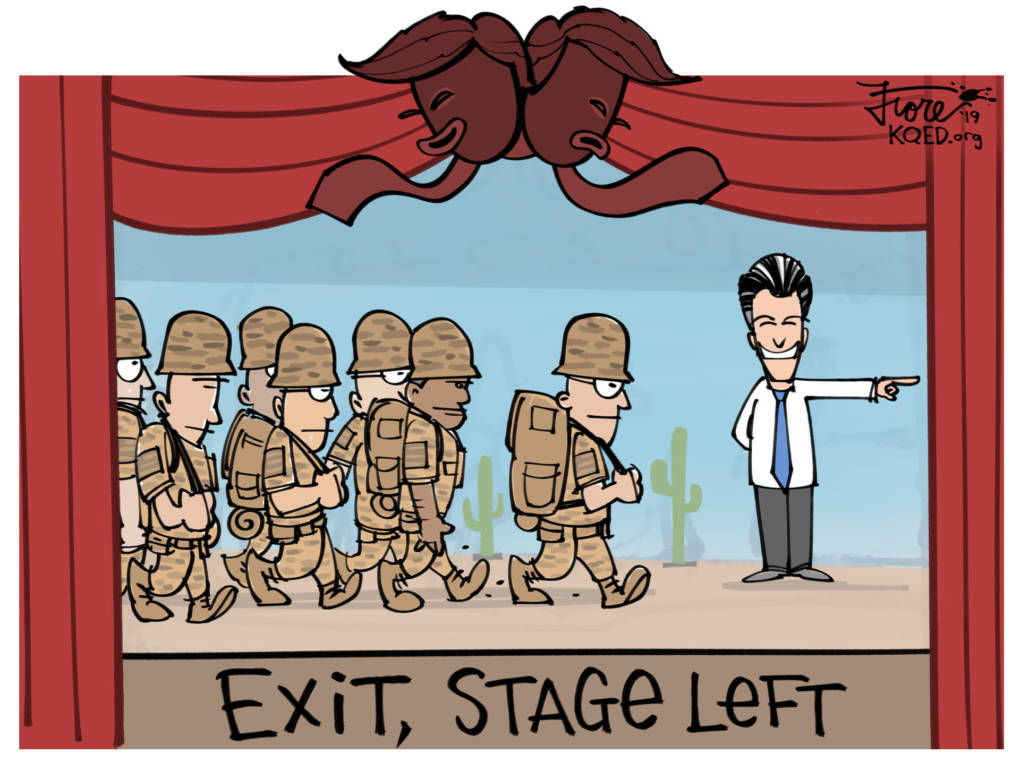
"content": "\u003cp>Gov. Gavin Newsom is \u003ca href=\"http://bit.ly/fiorestage\" target=\"_blank\" rel=\"noopener\">pulling California National Guard troops\u003c/a> from the border, calling the deployment “political theater.”\u003c/p>\n\u003cp>Newsom signed the order on Monday to rescind authorization for California Guard troops at the border.\u003c/p>\n\u003cp>Former Gov. Jerry Brown had \u003ca href=\"https://www.kqed.org/news/11661471/gov-brown-deploys-the-notional-guard\" target=\"_blank\" rel=\"noopener\">reluctantly ordered Guard troops\u003c/a> to the border under pressure from the Trump administration, and specified last April that the deployment of California service members “will not be a mission to round up women and children or detain people escaping violence and seeking a better life.”\u003c/p>\n\u003cp>[ad fullwidth]\u003c/p>\u003cp>\u003c/p>\n",
"blocks": [],
"excerpt": "Gov. Gavin Newsom is pulling California National Guard troops from the border, calling the deployment 'political theater.'",
"status": "publish",
"parent": 0,
"modified": 1738180153,
"stats": {
"hasAudio": false,
"hasVideo": false,
"hasChartOrMap": false,
"iframeSrcs": [],
"hasGoogleForm": false,
"hasGallery": false,
"hasHearkenModule": false,
"hasPolis": false,
"paragraphCount": 5,
"wordCount": 89
},
"headData": {
"title": "No More California Guard Troops for 'Manufactured Crisis' | KQED",
"description": "Gov. Gavin Newsom is pulling California National Guard troops from the border, calling the deployment 'political theater.'",
"ogTitle": "",
"ogDescription": "",
"ogImgId": "",
"twTitle": "",
"twDescription": "",
"twImgId": "",
"schema": {
"@context": "https://schema.org",
"@type": "NewsArticle",
"headline": "No More California Guard Troops for 'Manufactured Crisis'",
"datePublished": "2019-02-11T15:57:47-08:00",
"dateModified": "2025-01-29T11:49:13-08:00",
"image": "https://cdn.kqed.org/wp-content/uploads/2020/02/KQED-OG-Image@1x.png",
"isAccessibleForFree": "True",
"publisher": {
"@type": "NewsMediaOrganization",
"@id": "https://www.kqed.org/#organization",
"name": "KQED",
"logo": "https://cdn.kqed.org/wp-content/uploads/2020/02/KQED-OG-Image@1x.png",
"url": "https://www.kqed.org",
"sameAs": [
"https://www.facebook.com/KQED",
"https://twitter.com/KQED",
"https://www.instagram.com/kqed/",
"https://www.tiktok.com/@kqedofficial",
"https://www.linkedin.com/company/kqed",
"https://www.youtube.com/channel/UCeC0IOo7i1P_61zVUWbJ4nw"
]
}
}
},
"sticky": false,
"path": "/news/11725468/no-more-california-guard-troops-for-manufactured-crisis",
"audioTrackLength": null,
"parsedContent": [
{
"type": "contentString",
"content": "\u003cdiv class=\"post-body\">\u003cp>\u003cp>Gov. Gavin Newsom is \u003ca href=\"http://bit.ly/fiorestage\" target=\"_blank\" rel=\"noopener\">pulling California National Guard troops\u003c/a> from the border, calling the deployment “political theater.”\u003c/p>\n\u003cp>Newsom signed the order on Monday to rescind authorization for California Guard troops at the border.\u003c/p>\n\u003cp>Former Gov. Jerry Brown had \u003ca href=\"https://www.kqed.org/news/11661471/gov-brown-deploys-the-notional-guard\" target=\"_blank\" rel=\"noopener\">reluctantly ordered Guard troops\u003c/a> to the border under pressure from the Trump administration, and specified last April that the deployment of California service members “will not be a mission to round up women and children or detain people escaping violence and seeking a better life.”\u003c/p>\n\u003cp>\u003c/p>\u003c/div>",
"attributes": {
"named": {},
"numeric": []
}
},
{
"type": "component",
"content": "",
"name": "ad",
"attributes": {
"named": {
"label": "fullwidth"
},
"numeric": [
"fullwidth"
]
}
},
{
"type": "contentString",
"content": "\u003cdiv class=\"post-body\">\u003cp>\u003c/p>\u003cp>\u003c/p>\n\u003c/div>\u003c/p>",
"attributes": {
"named": {},
"numeric": []
}
}
],
"link": "/news/11725468/no-more-california-guard-troops-for-manufactured-crisis",
"authors": [
"3236"
],
"series": [
"news_18515"
],
"categories": [
"news_1169",
"news_6188",
"news_8",
"news_13"
],
"tags": [
"news_20446",
"news_20098",
"news_1323",
"news_16",
"news_23033",
"news_20949"
],
"featImg": "news_11725480",
"label": "news_18515"
},
"news_11725334": {
"type": "posts",
"id": "news_11725334",
"meta": {
"index": "posts_1716263798",
"site": "news",
"id": "11725334",
"score": null,
"sort": [
1549918848000
]
},
"guestAuthors": [],
"slug": "if-trump-declares-an-emergency-to-build-the-wall-congress-can-block-him",
"title": "If Trump Declares an Emergency to Build the Wall, Congress Can Block Him",
"publishDate": 1549918848,
"format": "standard",
"headTitle": "If Trump Declares an Emergency to Build the Wall, Congress Can Block Him | KQED",
"labelTerm": {},
"content": "\u003cp>Under the \u003ca href=\"https://policy.defense.gov/portals/11/Documents/hdasa/references/50%20USC%201601-1651.pdf\" target=\"_blank\" rel=\"noopener\">National Emergencies Act of 1976\u003c/a>, the president can declare an emergency for just about anything. As President Trump has considered using that authority to circumvent Congress and build a wall along the Southern border, that near-unlimited presidential power has gotten a lot of attention. But it isn’t the whole story.\u003c/p>\n\u003cp>Congress also gave itself \u003ca href=\"https://www.npr.org/2019/01/07/682965555/fact-check-can-trump-use-emergency-powers-to-build-the-wall\" target=\"_blank\" rel=\"noopener\">the ability to terminate an emergency declaration\u003c/a>. In the more than 40 years since the law was passed, only one member of Congress has ever tried it.\u003c/p>\n\u003cp>“It was a lever that we had,” said George Miller, the former Democratic congressman from California. “We decided to use it.”\u003c/p>\n\u003caside class=\"alignright\">\n\u003ch3>\u003ca href=\"https://www.kqed.org/news/11723796/california-attorney-general-vows-to-sue-if-trump-uses-emergency-powers-to-build-wall\">California Attorney General Vows to Sue If Trump Uses Emergency Powers to Build Wall\u003c/a>\u003c/h3>\n\u003cfigure>\u003ca href=\"https://www.kqed.org/news/11723796/california-attorney-general-vows-to-sue-if-trump-uses-emergency-powers-to-build-wall\">\u003cimg decoding=\"async\" src=\"https://ww2.kqed.org/news/wp-content/uploads/sites/10/2019/02/ap_18311292868638_custom-a93f93ad1ce1ebd685c597c70a33cdcca308d545-1020x736.jpg\" alt=\"\">\u003c/a>\u003c/figure>\n\u003c/aside>\n\u003cp>It was 2005, in the aftermath of Hurricane Katrina, when President George W. Bush \u003ca href=\"https://www.presidency.ucsb.edu/documents/proclamation-7924-suspend-subchapter-iv-chapter-31-title-40-united-states-code-within\" target=\"_blank\" rel=\"noopener\">issued a proclamation\u003c/a> saying government contractors could pay workers less than usual for recovery-related projects. He justified it by saying the conditions caused by Katrina constituted a “national emergency” and waiving federal wage requirement would “result in greater assistance to these devastated communities” and “permit the employment of thousands of additional individuals.”\u003c/p>\n\u003cp>Miller and others in Congress saw it differently. There was a major natural disaster. Many of the people doing the recovery work would be victims of the disaster themselves, and “to suggest that they should work at lower wages was just an insult,” Miller said.\u003c/p>\n\u003cp>Miller \u003ca href=\"https://apps.npr.org/documents/document.html?id=5732658-2005-Joint-Resolution-On-National-Emergency\" target=\"_blank\" rel=\"noopener\">introduced a resolution\u003c/a> under the National Emergencies Act to terminate Bush’s action.\u003c/p>\n\u003cp>[documentcloud url=\"https://www.documentcloud.org/documents/5734906-2005-Joint-Resolution-on-National-Emergency/\"]\u003c/p>\n\u003cp>Under the law, the relevant committee had 15 days to consider the measure and vote. Fourteen days later, President Bush \u003ca href=\"https://georgewbush-whitehouse.archives.gov/news/releases/2005/11/20051103-9.html\" target=\"_blank\" rel=\"noopener\">announced he would revoke\u003c/a> his own proclamation. That was the closest Congress ever came to voting to rescind a presidential emergency under the 1976 law.\u003c/p>\n\u003cp>\u003cstrong>After Watergate and Vietnam\u003c/strong>\u003c/p>\n\u003cp>To understand the intent of the law, it helps to understand the time when it was passed, in the wake of Watergate and the Vietnam War.\u003c/p>\n\u003cp>“Congress [was], really on a bipartisan basis, reaching to claw back power from what was then known as an imperial presidency,” said John Lawrence, who was a young congressional staffer and has gone on to \u003ca href=\"https://jhupbooks.press.jhu.edu/title/class-74\" target=\"_blank\" rel=\"noopener\">write a book about the congressional Class of 1974\u003c/a>.\u003c/p>\n\u003cp>In the mid-1970s, Congress passed the War Powers Act and the Budget Act, it expanded its oversight functions, and “the National Emergencies Act, which was enacted in 1976, was very much in that tradition, an attempt to put constraints around the use of presidential power.”\u003c/p>\n\u003caside class=\"pullquote alignright\">‘I have real concerns about it, but I’m not gonna start talking about the floor strategy and how I’m going to vote and how the House is going to vote until we get there, and I hope we don’t get there.’\u003ccite>Sen. Roy Blunt, R-Mo\u003c/cite>\u003c/aside>\n\u003cp>At the time, there were nearly 500 emergency-related statutes on the books, granting the president special powers when he declared a national emergency but with little ability for Congress to constrain the president. The National Emergencies Act cut those way back. It required the president to specify which emergency authorities he intended to invoke once the emergency was declared. It required those emergencies to be renewed on a regular basis. And it created a fast-track mechanism for Congress to terminate a presidential emergency.\u003c/p>\n\u003cp>“The catch was that for them to actually rein in presidential power, Congress would have to take action,” said Andrew Rudalevige, a professor of government at Bowdoin College. “They’d have to pay attention. They’d have to be willing to go against the will of a president, even of their own party. They haven’t done that.”\u003c/p>\n\u003cp>But that could change if President Trump follows through on his threat. A Democratic leadership aide tells NPR the House will “vigorously challenge any declaration that seeks an end run around Congress’s power of the purse.” That would likely include a resolution like the one Miller introduced in 2005.\u003c/p>\n\u003cp>[ad fullwidth]\u003c/p>\n\u003cp>If the Democrat-controlled House were to pass it, the Republican-controlled Senate would have no choice but to vote on it under the law. Several Republican senators have been cautioning the president not to put them in that position.\u003c/p>\n\u003cp>“I have real concerns about it, but I’m not gonna start talking about the floor strategy and how I’m going to vote and how the House is going to vote until we get there, and I hope we don’t get there,” said Sen. Roy Blunt, R-Mo.\u003c/p>\n\u003caside class=\"alignright\">\n\u003ch3>\u003ca href=\"https://www.kqed.org/news/11724350/as-u-s-starts-returning-asylum-seekers-to-mexico-questions-remain\">As U.S. Starts Returning Asylum-Seekers to Mexico, Questions Remain\u003c/a>\u003c/h3>\n\u003cfigure>\u003ca href=\"https://www.kqed.org/news/11724350/as-u-s-starts-returning-asylum-seekers-to-mexico-questions-remain\">\u003cimg decoding=\"async\" src=\"https://ww2.kqed.org/news/wp-content/uploads/sites/10/2019/01/RS34133_chaparral-FINAL-02-qut.jpg\" alt=\"\">\u003c/a>\u003c/figure>\n\u003c/aside>\n\u003cp>But if they do get there and a resolution were to pass, President Trump could still veto it. It’s unlikely either chamber would have the two-thirds majority needed to reverse a veto.\u003c/p>\n\u003cp>That high bar may be one reason Congress hasn’t been more active in pushing back on emergencies in the past. Another reason is presidents have typically used emergencies in line with congressional intent, said Russell Riley, a presidential scholar at the Miller Center at the University of Virginia. But what Trump is contemplating would be different, he says.\u003c/p>\n\u003cp>“Having gone to Congress repeatedly having not gotten his way with them…you can’t simply throw your hands up and say, ‘Ah, you know my commander in chief powers now will be invoked’ to declare an emergency,” said Riley.\u003c/p>\n\u003cp>For a president whose time in office has been defined by busting norms, and who relishes being different from his predecessors, it would be fitting that Trump could become the first president to have Congress actually vote to terminate an emergency declaration.\u003c/p>\n\u003cdiv class=\"fullattribution\">Copyright 2019 NPR. To see more, visit \u003ca href=\"https://www.npr.org\" target=\"_blank\" rel=\"noopener\">https://www.npr.org\u003c/a>.\u003cimg decoding=\"async\" src=\"https://www.google-analytics.com/__utm.gif?utmac=UA-5828686-4&utmdt=If+Trump+Declares+An+Emergency+To+Build+The+Wall%2C+Congress+Can+Block+Him&utme=8(APIKey)9(MDAxOTAwOTE4MDEyMTkxMDAzNjczZDljZA004)\">\u003c/div>\n\u003cp>\u003c/p>\n",
"blocks": [],
"excerpt": "President Trump has threatened to declare an emergency to go around Congress and build a border wall. The same law that gives him that power also gives Congress the ability to push back.",
"status": "publish",
"parent": 0,
"modified": 1721149556,
"stats": {
"hasAudio": false,
"hasVideo": false,
"hasChartOrMap": false,
"iframeSrcs": [],
"hasGoogleForm": false,
"hasGallery": false,
"hasHearkenModule": false,
"hasPolis": false,
"paragraphCount": 23,
"wordCount": 1002
},
"headData": {
"title": "If Trump Declares an Emergency to Build the Wall, Congress Can Block Him | KQED",
"description": "President Trump has threatened to declare an emergency to go around Congress and build a border wall. The same law that gives him that power also gives Congress the ability to push back.",
"ogTitle": "",
"ogDescription": "",
"ogImgId": "",
"twTitle": "",
"twDescription": "",
"twImgId": "",
"schema": {
"@context": "https://schema.org",
"@type": "NewsArticle",
"headline": "If Trump Declares an Emergency to Build the Wall, Congress Can Block Him",
"datePublished": "2019-02-11T13:00:48-08:00",
"dateModified": "2024-07-16T10:05:56-07:00",
"image": "https://cdn.kqed.org/wp-content/uploads/2020/02/KQED-OG-Image@1x.png",
"isAccessibleForFree": "True",
"publisher": {
"@type": "NewsMediaOrganization",
"@id": "https://www.kqed.org/#organization",
"name": "KQED",
"logo": "https://cdn.kqed.org/wp-content/uploads/2020/02/KQED-OG-Image@1x.png",
"url": "https://www.kqed.org",
"sameAs": [
"https://www.facebook.com/KQED",
"https://twitter.com/KQED",
"https://www.instagram.com/kqed/",
"https://www.tiktok.com/@kqedofficial",
"https://www.linkedin.com/company/kqed",
"https://www.youtube.com/channel/UCeC0IOo7i1P_61zVUWbJ4nw"
]
}
}
},
"source": "NPR",
"sourceUrl": "https://www.npr.org",
"sticky": false,
"nprImageCredit": "Scott Olson",
"nprByline": "\u003cstrong>\u003ca href=\"https://www.npr.org/people/122805042/tamara-keith\">Tamara Keith\u003c/a>\u003c/strong>\u003cbr> \u003cstrong>\u003ca href=\"https://www.npr.org\">NPR\u003c/a>\u003c/strong>",
"nprImageAgency": "Getty Images",
"nprStoryId": "693128901",
"nprApiLink": "http://api.npr.org/query?id=693128901&apiKey=MDAxOTAwOTE4MDEyMTkxMDAzNjczZDljZA004",
"nprHtmlLink": "https://www.npr.org/2019/02/11/693128901/if-trump-declares-an-emergency-to-build-the-wall-congress-can-block-him?ft=nprml&f=693128901",
"nprRetrievedStory": "1",
"nprPubDate": "Mon, 11 Feb 2019 09:14:00 -0500",
"nprStoryDate": "Mon, 11 Feb 2019 05:00:00 -0500",
"nprLastModifiedDate": "Mon, 11 Feb 2019 09:14:20 -0500",
"nprAudio": "https://ondemand.npr.org/anon.npr-mp3/npr/me/2019/02/20190211_me_if_trump_declares_an_emergency_to_build_the_wall_congress_can_block_him.mp3?orgId=1&topicId=1014&d=245&p=3&story=693128901&ft=nprml&f=693128901",
"nprAudioM3u": "http://api.npr.org/m3u/1693417831-727449.m3u?orgId=1&topicId=1014&d=245&p=3&story=693128901&ft=nprml&f=693128901",
"audioTrackLength": 245,
"path": "/news/11725334/if-trump-declares-an-emergency-to-build-the-wall-congress-can-block-him",
"audioUrl": "https://ondemand.npr.org/anon.npr-mp3/npr/me/2019/02/20190211_me_if_trump_declares_an_emergency_to_build_the_wall_congress_can_block_him.mp3?orgId=1&topicId=1014&d=245&p=3&story=693128901&ft=nprml&f=693128901",
"parsedContent": [
{
"type": "contentString",
"content": "\u003cdiv class=\"post-body\">\u003cp>\u003cp>Under the \u003ca href=\"https://policy.defense.gov/portals/11/Documents/hdasa/references/50%20USC%201601-1651.pdf\" target=\"_blank\" rel=\"noopener\">National Emergencies Act of 1976\u003c/a>, the president can declare an emergency for just about anything. As President Trump has considered using that authority to circumvent Congress and build a wall along the Southern border, that near-unlimited presidential power has gotten a lot of attention. But it isn’t the whole story.\u003c/p>\n\u003cp>Congress also gave itself \u003ca href=\"https://www.npr.org/2019/01/07/682965555/fact-check-can-trump-use-emergency-powers-to-build-the-wall\" target=\"_blank\" rel=\"noopener\">the ability to terminate an emergency declaration\u003c/a>. In the more than 40 years since the law was passed, only one member of Congress has ever tried it.\u003c/p>\n\u003cp>“It was a lever that we had,” said George Miller, the former Democratic congressman from California. “We decided to use it.”\u003c/p>\n\u003caside class=\"alignright\">\n\u003ch3>\u003ca href=\"https://www.kqed.org/news/11723796/california-attorney-general-vows-to-sue-if-trump-uses-emergency-powers-to-build-wall\">California Attorney General Vows to Sue If Trump Uses Emergency Powers to Build Wall\u003c/a>\u003c/h3>\n\u003cfigure>\u003ca href=\"https://www.kqed.org/news/11723796/california-attorney-general-vows-to-sue-if-trump-uses-emergency-powers-to-build-wall\">\u003cimg decoding=\"async\" src=\"https://ww2.kqed.org/news/wp-content/uploads/sites/10/2019/02/ap_18311292868638_custom-a93f93ad1ce1ebd685c597c70a33cdcca308d545-1020x736.jpg\" alt=\"\">\u003c/a>\u003c/figure>\n\u003c/aside>\n\u003cp>It was 2005, in the aftermath of Hurricane Katrina, when President George W. Bush \u003ca href=\"https://www.presidency.ucsb.edu/documents/proclamation-7924-suspend-subchapter-iv-chapter-31-title-40-united-states-code-within\" target=\"_blank\" rel=\"noopener\">issued a proclamation\u003c/a> saying government contractors could pay workers less than usual for recovery-related projects. He justified it by saying the conditions caused by Katrina constituted a “national emergency” and waiving federal wage requirement would “result in greater assistance to these devastated communities” and “permit the employment of thousands of additional individuals.”\u003c/p>\n\u003cp>Miller and others in Congress saw it differently. There was a major natural disaster. Many of the people doing the recovery work would be victims of the disaster themselves, and “to suggest that they should work at lower wages was just an insult,” Miller said.\u003c/p>\n\u003cp>Miller \u003ca href=\"https://apps.npr.org/documents/document.html?id=5732658-2005-Joint-Resolution-On-National-Emergency\" target=\"_blank\" rel=\"noopener\">introduced a resolution\u003c/a> under the National Emergencies Act to terminate Bush’s action.\u003c/p>\n\u003cp>\u003c/p>\u003c/div>",
"attributes": {
"named": {},
"numeric": []
}
},
{
"type": "component",
"content": "",
"name": "documentcloud",
"attributes": {
"named": {
"url": "https://www.documentcloud.org/documents/5734906-2005-Joint-Resolution-on-National-Emergency/",
"label": ""
},
"numeric": []
}
},
{
"type": "contentString",
"content": "\u003cdiv class=\"post-body\">\u003cp>\u003c/p>\n\u003cp>Under the law, the relevant committee had 15 days to consider the measure and vote. Fourteen days later, President Bush \u003ca href=\"https://georgewbush-whitehouse.archives.gov/news/releases/2005/11/20051103-9.html\" target=\"_blank\" rel=\"noopener\">announced he would revoke\u003c/a> his own proclamation. That was the closest Congress ever came to voting to rescind a presidential emergency under the 1976 law.\u003c/p>\n\u003cp>\u003cstrong>After Watergate and Vietnam\u003c/strong>\u003c/p>\n\u003cp>To understand the intent of the law, it helps to understand the time when it was passed, in the wake of Watergate and the Vietnam War.\u003c/p>\n\u003cp>“Congress [was], really on a bipartisan basis, reaching to claw back power from what was then known as an imperial presidency,” said John Lawrence, who was a young congressional staffer and has gone on to \u003ca href=\"https://jhupbooks.press.jhu.edu/title/class-74\" target=\"_blank\" rel=\"noopener\">write a book about the congressional Class of 1974\u003c/a>.\u003c/p>\n\u003cp>In the mid-1970s, Congress passed the War Powers Act and the Budget Act, it expanded its oversight functions, and “the National Emergencies Act, which was enacted in 1976, was very much in that tradition, an attempt to put constraints around the use of presidential power.”\u003c/p>\n\u003caside class=\"pullquote alignright\">‘I have real concerns about it, but I’m not gonna start talking about the floor strategy and how I’m going to vote and how the House is going to vote until we get there, and I hope we don’t get there.’\u003ccite>Sen. Roy Blunt, R-Mo\u003c/cite>\u003c/aside>\n\u003cp>At the time, there were nearly 500 emergency-related statutes on the books, granting the president special powers when he declared a national emergency but with little ability for Congress to constrain the president. The National Emergencies Act cut those way back. It required the president to specify which emergency authorities he intended to invoke once the emergency was declared. It required those emergencies to be renewed on a regular basis. And it created a fast-track mechanism for Congress to terminate a presidential emergency.\u003c/p>\n\u003cp>“The catch was that for them to actually rein in presidential power, Congress would have to take action,” said Andrew Rudalevige, a professor of government at Bowdoin College. “They’d have to pay attention. They’d have to be willing to go against the will of a president, even of their own party. They haven’t done that.”\u003c/p>\n\u003cp>But that could change if President Trump follows through on his threat. A Democratic leadership aide tells NPR the House will “vigorously challenge any declaration that seeks an end run around Congress’s power of the purse.” That would likely include a resolution like the one Miller introduced in 2005.\u003c/p>\n\u003cp>\u003c/p>\u003c/div>",
"attributes": {
"named": {},
"numeric": []
}
},
{
"type": "component",
"content": "",
"name": "ad",
"attributes": {
"named": {
"label": "fullwidth"
},
"numeric": [
"fullwidth"
]
}
},
{
"type": "contentString",
"content": "\u003cdiv class=\"post-body\">\u003cp>\u003c/p>\n\u003cp>If the Democrat-controlled House were to pass it, the Republican-controlled Senate would have no choice but to vote on it under the law. Several Republican senators have been cautioning the president not to put them in that position.\u003c/p>\n\u003cp>“I have real concerns about it, but I’m not gonna start talking about the floor strategy and how I’m going to vote and how the House is going to vote until we get there, and I hope we don’t get there,” said Sen. Roy Blunt, R-Mo.\u003c/p>\n\u003caside class=\"alignright\">\n\u003ch3>\u003ca href=\"https://www.kqed.org/news/11724350/as-u-s-starts-returning-asylum-seekers-to-mexico-questions-remain\">As U.S. Starts Returning Asylum-Seekers to Mexico, Questions Remain\u003c/a>\u003c/h3>\n\u003cfigure>\u003ca href=\"https://www.kqed.org/news/11724350/as-u-s-starts-returning-asylum-seekers-to-mexico-questions-remain\">\u003cimg decoding=\"async\" src=\"https://ww2.kqed.org/news/wp-content/uploads/sites/10/2019/01/RS34133_chaparral-FINAL-02-qut.jpg\" alt=\"\">\u003c/a>\u003c/figure>\n\u003c/aside>\n\u003cp>But if they do get there and a resolution were to pass, President Trump could still veto it. It’s unlikely either chamber would have the two-thirds majority needed to reverse a veto.\u003c/p>\n\u003cp>That high bar may be one reason Congress hasn’t been more active in pushing back on emergencies in the past. Another reason is presidents have typically used emergencies in line with congressional intent, said Russell Riley, a presidential scholar at the Miller Center at the University of Virginia. But what Trump is contemplating would be different, he says.\u003c/p>\n\u003cp>“Having gone to Congress repeatedly having not gotten his way with them…you can’t simply throw your hands up and say, ‘Ah, you know my commander in chief powers now will be invoked’ to declare an emergency,” said Riley.\u003c/p>\n\u003cp>For a president whose time in office has been defined by busting norms, and who relishes being different from his predecessors, it would be fitting that Trump could become the first president to have Congress actually vote to terminate an emergency declaration.\u003c/p>\n\u003cdiv class=\"fullattribution\">Copyright 2019 NPR. To see more, visit \u003ca href=\"https://www.npr.org\" target=\"_blank\" rel=\"noopener\">https://www.npr.org\u003c/a>.\u003cimg decoding=\"async\" src=\"https://www.google-analytics.com/__utm.gif?utmac=UA-5828686-4&utmdt=If+Trump+Declares+An+Emergency+To+Build+The+Wall%2C+Congress+Can+Block+Him&utme=8(APIKey)9(MDAxOTAwOTE4MDEyMTkxMDAzNjczZDljZA004)\">\u003c/div>\n\u003cp>\u003c/p>\n\u003c/div>\u003c/p>",
"attributes": {
"named": {},
"numeric": []
}
}
],
"link": "/news/11725334/if-trump-declares-an-emergency-to-build-the-wall-congress-can-block-him",
"authors": [
"byline_news_11725334"
],
"programs": [
"news_72"
],
"categories": [
"news_1169",
"news_6188",
"news_8",
"news_13"
],
"tags": [
"news_20446",
"news_1323",
"news_21038"
],
"affiliates": [
"news_253"
],
"featImg": "news_11725337",
"label": "source_news_11725334"
},
"news_11724350": {
"type": "posts",
"id": "news_11724350",
"meta": {
"index": "posts_1716263798",
"site": "news",
"id": "11724350",
"score": null,
"sort": [
1549565133000
]
},
"parent": 0,
"labelTerm": {
"site": "news",
"term": 72
},
"blocks": [],
"publishDate": 1549565133,
"format": "image",
"disqusTitle": "As U.S. Starts Returning Asylum-Seekers to Mexico, Questions Remain",
"title": "As U.S. Starts Returning Asylum-Seekers to Mexico, Questions Remain",
"headTitle": "The California Report | KQED News",
"content": "\u003cp>Even as the Trump administration ramps up a new policy forcing asylum-seekers to return to Mexico while their cases move through U.S. courts, immigration judges and attorneys say they’ve received scant information about how the dramatic change will be implemented.\u003c/p>\n\u003cp>At least a dozen asylum-seekers had been returned to Tijuana as of late last week under the policy, known informally as “Remain in Mexico.”\u003c/p>\n\u003cp>But immigration lawyers question whether the administration has a reliable system to notify migrants — who are often in temporary shelters and lack a fixed address — of their court dates. And the president of the National Association of Immigration Judges, Ashley Tabaddor, said ensuring asylum-seekers in Mexico are informed of hearings is a \"potential issue.\"\u003c/p>\n\u003cp>Tabaddor said she received no advance notice of the new system from the Department of Justice, which is in charge of immigration courts. Instead, Tabaddor, an immigration judge in Los Angeles, one of the nation's busiest courts, learned about the changes from reading the news.\u003c/p>\n\u003caside class=\"pullquote alignright\">'“It would have been nice if the department had told us judges in a formal way what’s happening.'\u003ccite>Ashley Tabaddor, president of the National Association of Immigration Judges\u003c/cite>\u003c/aside>\n\u003cp>“It would have been nice if the department had told us judges in a formal way what’s happening so that at least we are aware of it before it becomes public,” she said.\u003c/p>\n\u003cp>The policy, which the administration has dubbed \u003ca href=\"https://www.dhs.gov/news/2019/01/24/migrant-protection-protocols\" target=\"_blank\" rel=\"noopener\">Migrant Protection Protocols\u003c/a>, or MPP, is so far only in place at the San Ysidro Port of Entry, south of San Diego.\u003c/p>\n\u003cp>Officials with the Department of Homeland Security say before asylum-seekers are returned to Mexico they are given an “individualized notice” with a court date, so they know when to return to the border crossing. U.S. Immigration and Customs Enforcement will then transport them to immigration court in San Diego.\u003c/p>\n\u003cp>In December, the immigration court system, known as the Executive Office for Immigration Review, made its computerized scheduling system accessible to DHS officials, including U.S. Customs and Border Protection agents, allowing them to set court dates for people being sent back to Mexico.\u003c/p>\n\u003cp>Previously, immigration agents did not have such access to court schedules. So they gave migrants a Notice to Appear, which either included a “placeholder” date or simply said that the court date was “to be set.”\u003c/p>\n\u003cp>Individuals would then receive a second notice in the mail with a legitimate court date. Or they could call a court hotline to find out when to appear.\u003c/p>\n\u003caside class=\"alignleft\">\n\u003ch3>\u003ca href=\"https://www.kqed.org/news/11714240/new-policy-adds-to-complexity-for-migrants-in-mexico-seeking-u-s-asylum\">New Policy Adds to Complexity for Migrants in Mexico Seeking U.S. Asylum\u003c/a>\u003c/h3>\n\u003cfigure>\u003ca href=\"https://www.kqed.org/news/11714240/new-policy-adds-to-complexity-for-migrants-in-mexico-seeking-u-s-asylum\">\u003cimg src=\"https://ww2.kqed.org/wp-content/uploads/sites/10/2018/12/RS34155_Nolvia-Romero-FINAL-01-qut-1180x785.jpg\" alt=\"\">\u003c/a>\u003c/figure>\n\u003c/aside>\n\u003cp>Kate Mahoney, an immigration attorney at Centro Legal de la Raza in Oakland, is skeptical that U.S. officials can now reliably inform migrants in Mexico of court appearances.\u003c/p>\n\u003cp>“How is the government possibly going to notify people of their new hearing dates if they're homeless?” Mahoney asked. “Maybe they don't have a working telephone. They don't have a fixed address.”\u003c/p>\n\u003cp>Asylum cases often require several hearings before a judge. While applicants are usually told the date for their next proceeding when at court, they’ll be mailed a notice if the hearing date changes. And changes in court schedules are frequent in the overburdened system, said Mahoney.\u003c/p>\n\u003cp>“Hearings are rescheduled all the time in order to accommodate other cases, in order to accommodate personnel changes, and most recently, because of the government shutdown,” she said.\u003c/p>\n\u003cp>During the 35-day government shutdown, an estimated 86,000 hearings were canceled as most immigration judges were furloughed, according to researchers at Syracuse University.\u003c/p>\n\u003caside class=\"alignright\">\n\u003ch3>\u003ca href=\"https://www.kqed.org/news/11717702/thousands-of-immigrants-in-court-limbo-due-to-government-shutdown\">Thousands of Immigrants in Court Limbo Due to Government Shutdown\u003c/a>\u003c/h3>\n\u003cfigure>\u003ca href=\"https://www.kqed.org/news/11717702/thousands-of-immigrants-in-court-limbo-due-to-government-shutdown\">\u003cimg src=\"https://ww2.kqed.org/wp-content/uploads/sites/10/2019/01/GettyImages-923834000-e1547510905103-1020x680.jpg\" alt=\"\">\u003c/a>\u003c/figure>\n\u003c/aside>\n\u003cp>The shutdown also led to another problem for thousands of immigrants who showed up at courts around the country, bearing notices to appear for hearings on Jan. 31. It turned out that was a “placeholder” date given to them by ICE, but the hearings had not actually been scheduled because most of the court staff were furloughed.\u003c/p>\n\u003cp>A spokesman for U.S. Customs and Border Protection said the Department of Justice, along with the State Department will come up with a way to notify asylum-seekers under the MPP of rescheduled court dates.\u003c/p>\n\u003cp>Tabaddor, the immigration judge, said asylum-seekers returned to Mexico must be alerted about when to attend hearings.\u003c/p>\n\u003cp>“With every case the issue of notice is always paramount,” Tabaddor said. “Certainly I can imagine that there would be issues or questions that would be raised, but I don’t really know how those particular cases or questions are going to be addressed by the Department of Homeland Security.”\u003c/p>\n\u003cp>If a person fails to show up at immigration court, they can lose their claim to protections.\u003c/p>\n\u003cp>DHS Secretary Kirstjen Nielsen said the new protocol aims to reduce illegal migration by removing what she called a “key incentive,” because asylum-seekers would not be allowed to live in the U.S. while their case is decided.\u003c/p>\n\u003cp>Other DHS officials said in press call last week that they are focusing on individuals from Central America for the program. But as the program expands, they will also send parents traveling with children back to Mexico to wait for their asylum case to be resolved. They also plan to implement the MPP at other ports of entry along the border.\u003c/p>\n\u003caside class=\"pullquote alignleft\">'With every case the issue of notice is always paramount'\u003ccite>Ashley Tabaddor, president of the National Association of Immigration Judges\u003c/cite>\u003c/aside>\n\u003cp>The launch of the policy comes as a new caravan of about 2,000 people from Honduras is approaching the Texas-Mexico border.\u003c/p>\n\u003cp>Central American families and unaccompanied children are a growing share of those arrested by Border Patrol along the southern border. From October through December 2018, families and unaccompanied minors represented almost 60 percent of \u003ca href=\"https://www.cbp.gov/newsroom/stats/sw-border-migration\" target=\"_blank\" rel=\"noopener\">border apprehensions\u003c/a>. Many of them say they are fleeing violence in their home countries.\u003c/p>\n\u003cp>Thousands of migrants seeking asylum are currently waiting in Tijuana for a chance to request U.S. officials for protections. Many are Central Americans who arrived with a caravan last November.\u003c/p>\n\u003cp>Critics of the \"Remain in Mexico\" policy say the Trump administration is increasing the danger migrants face. Tijuana is Mexico’s most violent city, with 1,618 homicide cases in 2017, according to official \u003ca href=\"https://justiceinmexico.org/wp-content/uploads/2018/04/180411_DrugViolenceinMexico-12mb.pdf\" target=\"_blank\" rel=\"noopener\">statistics\u003c/a>.\u003c/p>\n\u003cp>Mahoney and other lawyers say keeping asylum-seekers in Mexico will also make it more difficult for them to find U.S. immigration attorneys. Research shows it's almost impossible to win an asylum case without legal representation.\u003c/p>\n\u003cp>An official with the Executive Office of Immigration Review said asylum-seekers affected by the MPP can expect a fair process in the courts.\u003c/p>\n\u003cp>“As we do with all cases, EOIR will process and adjudicate cases filed under the MPP in accordance with applicable law and consistent with due process,” said Kenneth Gardner, with the agency’s regional office in San Francisco, in a statement.\u003c/p>\n\u003cp>[ad fullwidth]\u003c/p>\n\u003cp>[ad floatright]\u003c/p>\n",
"disqusIdentifier": "11724350 https://ww2.kqed.org/news/?p=11724350",
"disqusUrl": "https://ww2.kqed.org/news/2019/02/07/as-u-s-starts-returning-asylum-seekers-to-mexico-questions-remain/",
"stats": {
"hasVideo": false,
"hasChartOrMap": false,
"hasAudio": false,
"hasPolis": false,
"wordCount": 1190,
"hasGoogleForm": false,
"hasGallery": false,
"hasHearkenModule": false,
"iframeSrcs": [],
"paragraphCount": 31
},
"modified": 1552074530,
"excerpt": "Immigration judges and attorneys say they’ve received scant information about how the dramatic change will be implemented.",
"headData": {
"twImgId": "",
"twTitle": "",
"ogTitle": "",
"ogImgId": "",
"twDescription": "",
"description": "Immigration judges and attorneys say they’ve received scant information about how the dramatic change will be implemented.",
"title": "As U.S. Starts Returning Asylum-Seekers to Mexico, Questions Remain | KQED",
"ogDescription": "",
"schema": {
"@context": "https://schema.org",
"@type": "NewsArticle",
"headline": "As U.S. Starts Returning Asylum-Seekers to Mexico, Questions Remain",
"datePublished": "2019-02-07T10:45:33-08:00",
"dateModified": "2019-03-08T11:48:50-08:00",
"image": "https://cdn.kqed.org/wp-content/uploads/2020/02/KQED-OG-Image@1x.png",
"isAccessibleForFree": "True",
"publisher": {
"@type": "NewsMediaOrganization",
"@id": "https://www.kqed.org/#organization",
"name": "KQED",
"logo": "https://cdn.kqed.org/wp-content/uploads/2020/02/KQED-OG-Image@1x.png",
"url": "https://www.kqed.org",
"sameAs": [
"https://www.facebook.com/KQED",
"https://twitter.com/KQED",
"https://www.instagram.com/kqed/",
"https://www.tiktok.com/@kqedofficial",
"https://www.linkedin.com/company/kqed",
"https://www.youtube.com/channel/UCeC0IOo7i1P_61zVUWbJ4nw"
]
}
}
},
"guestAuthors": [],
"slug": "as-u-s-starts-returning-asylum-seekers-to-mexico-questions-remain",
"status": "publish",
"audioUrl": "https://www.kqed.org/.stream/anon/radio/tcr/2019/02/JhabvalaRomeroImmigrationJudgesMPP.mp3",
"audioTrackLength": 136,
"path": "/news/11724350/as-u-s-starts-returning-asylum-seekers-to-mexico-questions-remain",
"audioDuration": 149000,
"parsedContent": [
{
"type": "contentString",
"content": "\u003cdiv class=\"post-body\">\u003cp>\u003cp>Even as the Trump administration ramps up a new policy forcing asylum-seekers to return to Mexico while their cases move through U.S. courts, immigration judges and attorneys say they’ve received scant information about how the dramatic change will be implemented.\u003c/p>\n\u003cp>At least a dozen asylum-seekers had been returned to Tijuana as of late last week under the policy, known informally as “Remain in Mexico.”\u003c/p>\n\u003cp>But immigration lawyers question whether the administration has a reliable system to notify migrants — who are often in temporary shelters and lack a fixed address — of their court dates. And the president of the National Association of Immigration Judges, Ashley Tabaddor, said ensuring asylum-seekers in Mexico are informed of hearings is a \"potential issue.\"\u003c/p>\n\u003cp>Tabaddor said she received no advance notice of the new system from the Department of Justice, which is in charge of immigration courts. Instead, Tabaddor, an immigration judge in Los Angeles, one of the nation's busiest courts, learned about the changes from reading the news.\u003c/p>\n\u003caside class=\"pullquote alignright\">'“It would have been nice if the department had told us judges in a formal way what’s happening.'\u003ccite>Ashley Tabaddor, president of the National Association of Immigration Judges\u003c/cite>\u003c/aside>\n\u003cp>“It would have been nice if the department had told us judges in a formal way what’s happening so that at least we are aware of it before it becomes public,” she said.\u003c/p>\n\u003cp>The policy, which the administration has dubbed \u003ca href=\"https://www.dhs.gov/news/2019/01/24/migrant-protection-protocols\" target=\"_blank\" rel=\"noopener\">Migrant Protection Protocols\u003c/a>, or MPP, is so far only in place at the San Ysidro Port of Entry, south of San Diego.\u003c/p>\n\u003cp>Officials with the Department of Homeland Security say before asylum-seekers are returned to Mexico they are given an “individualized notice” with a court date, so they know when to return to the border crossing. U.S. Immigration and Customs Enforcement will then transport them to immigration court in San Diego.\u003c/p>\n\u003cp>In December, the immigration court system, known as the Executive Office for Immigration Review, made its computerized scheduling system accessible to DHS officials, including U.S. Customs and Border Protection agents, allowing them to set court dates for people being sent back to Mexico.\u003c/p>\n\u003cp>Previously, immigration agents did not have such access to court schedules. So they gave migrants a Notice to Appear, which either included a “placeholder” date or simply said that the court date was “to be set.”\u003c/p>\n\u003cp>Individuals would then receive a second notice in the mail with a legitimate court date. Or they could call a court hotline to find out when to appear.\u003c/p>\n\u003caside class=\"alignleft\">\n\u003ch3>\u003ca href=\"https://www.kqed.org/news/11714240/new-policy-adds-to-complexity-for-migrants-in-mexico-seeking-u-s-asylum\">New Policy Adds to Complexity for Migrants in Mexico Seeking U.S. Asylum\u003c/a>\u003c/h3>\n\u003cfigure>\u003ca href=\"https://www.kqed.org/news/11714240/new-policy-adds-to-complexity-for-migrants-in-mexico-seeking-u-s-asylum\">\u003cimg src=\"https://ww2.kqed.org/wp-content/uploads/sites/10/2018/12/RS34155_Nolvia-Romero-FINAL-01-qut-1180x785.jpg\" alt=\"\">\u003c/a>\u003c/figure>\n\u003c/aside>\n\u003cp>Kate Mahoney, an immigration attorney at Centro Legal de la Raza in Oakland, is skeptical that U.S. officials can now reliably inform migrants in Mexico of court appearances.\u003c/p>\n\u003cp>“How is the government possibly going to notify people of their new hearing dates if they're homeless?” Mahoney asked. “Maybe they don't have a working telephone. They don't have a fixed address.”\u003c/p>\n\u003cp>Asylum cases often require several hearings before a judge. While applicants are usually told the date for their next proceeding when at court, they’ll be mailed a notice if the hearing date changes. And changes in court schedules are frequent in the overburdened system, said Mahoney.\u003c/p>\n\u003cp>“Hearings are rescheduled all the time in order to accommodate other cases, in order to accommodate personnel changes, and most recently, because of the government shutdown,” she said.\u003c/p>\n\u003cp>During the 35-day government shutdown, an estimated 86,000 hearings were canceled as most immigration judges were furloughed, according to researchers at Syracuse University.\u003c/p>\n\u003caside class=\"alignright\">\n\u003ch3>\u003ca href=\"https://www.kqed.org/news/11717702/thousands-of-immigrants-in-court-limbo-due-to-government-shutdown\">Thousands of Immigrants in Court Limbo Due to Government Shutdown\u003c/a>\u003c/h3>\n\u003cfigure>\u003ca href=\"https://www.kqed.org/news/11717702/thousands-of-immigrants-in-court-limbo-due-to-government-shutdown\">\u003cimg src=\"https://ww2.kqed.org/wp-content/uploads/sites/10/2019/01/GettyImages-923834000-e1547510905103-1020x680.jpg\" alt=\"\">\u003c/a>\u003c/figure>\n\u003c/aside>\n\u003cp>The shutdown also led to another problem for thousands of immigrants who showed up at courts around the country, bearing notices to appear for hearings on Jan. 31. It turned out that was a “placeholder” date given to them by ICE, but the hearings had not actually been scheduled because most of the court staff were furloughed.\u003c/p>\n\u003cp>A spokesman for U.S. Customs and Border Protection said the Department of Justice, along with the State Department will come up with a way to notify asylum-seekers under the MPP of rescheduled court dates.\u003c/p>\n\u003cp>Tabaddor, the immigration judge, said asylum-seekers returned to Mexico must be alerted about when to attend hearings.\u003c/p>\n\u003cp>“With every case the issue of notice is always paramount,” Tabaddor said. “Certainly I can imagine that there would be issues or questions that would be raised, but I don’t really know how those particular cases or questions are going to be addressed by the Department of Homeland Security.”\u003c/p>\n\u003cp>If a person fails to show up at immigration court, they can lose their claim to protections.\u003c/p>\n\u003cp>DHS Secretary Kirstjen Nielsen said the new protocol aims to reduce illegal migration by removing what she called a “key incentive,” because asylum-seekers would not be allowed to live in the U.S. while their case is decided.\u003c/p>\n\u003cp>Other DHS officials said in press call last week that they are focusing on individuals from Central America for the program. But as the program expands, they will also send parents traveling with children back to Mexico to wait for their asylum case to be resolved. They also plan to implement the MPP at other ports of entry along the border.\u003c/p>\n\u003caside class=\"pullquote alignleft\">'With every case the issue of notice is always paramount'\u003ccite>Ashley Tabaddor, president of the National Association of Immigration Judges\u003c/cite>\u003c/aside>\n\u003cp>The launch of the policy comes as a new caravan of about 2,000 people from Honduras is approaching the Texas-Mexico border.\u003c/p>\n\u003cp>Central American families and unaccompanied children are a growing share of those arrested by Border Patrol along the southern border. From October through December 2018, families and unaccompanied minors represented almost 60 percent of \u003ca href=\"https://www.cbp.gov/newsroom/stats/sw-border-migration\" target=\"_blank\" rel=\"noopener\">border apprehensions\u003c/a>. Many of them say they are fleeing violence in their home countries.\u003c/p>\n\u003cp>Thousands of migrants seeking asylum are currently waiting in Tijuana for a chance to request U.S. officials for protections. Many are Central Americans who arrived with a caravan last November.\u003c/p>\n\u003cp>Critics of the \"Remain in Mexico\" policy say the Trump administration is increasing the danger migrants face. Tijuana is Mexico’s most violent city, with 1,618 homicide cases in 2017, according to official \u003ca href=\"https://justiceinmexico.org/wp-content/uploads/2018/04/180411_DrugViolenceinMexico-12mb.pdf\" target=\"_blank\" rel=\"noopener\">statistics\u003c/a>.\u003c/p>\n\u003cp>Mahoney and other lawyers say keeping asylum-seekers in Mexico will also make it more difficult for them to find U.S. immigration attorneys. Research shows it's almost impossible to win an asylum case without legal representation.\u003c/p>\n\u003cp>An official with the Executive Office of Immigration Review said asylum-seekers affected by the MPP can expect a fair process in the courts.\u003c/p>\n\u003cp>“As we do with all cases, EOIR will process and adjudicate cases filed under the MPP in accordance with applicable law and consistent with due process,” said Kenneth Gardner, with the agency’s regional office in San Francisco, in a statement.\u003c/p>\n\u003cp>\u003c/p>\u003c/div>",
"attributes": {
"named": {},
"numeric": []
}
},
{
"type": "component",
"content": "",
"name": "ad",
"attributes": {
"named": {
"label": "fullwidth"
},
"numeric": [
"fullwidth"
]
}
},
{
"type": "contentString",
"content": "\u003cdiv class=\"post-body\">\u003cp>\u003c/p>\n\u003cp>\u003c/p>\u003c/div>",
"attributes": {
"named": {},
"numeric": []
}
},
{
"type": "component",
"content": "",
"name": "ad",
"attributes": {
"named": {
"label": "floatright"
},
"numeric": [
"floatright"
]
}
},
{
"type": "contentString",
"content": "\u003cdiv class=\"post-body\">\u003cp>\u003c/p>\n\u003c/div>\u003c/p>",
"attributes": {
"named": {},
"numeric": []
}
}
],
"link": "/news/11724350/as-u-s-starts-returning-asylum-seekers-to-mexico-questions-remain",
"authors": [
"8659"
],
"programs": [
"news_72"
],
"categories": [
"news_1169",
"news_6188",
"news_8",
"news_13"
],
"tags": [
"news_23087",
"news_23653",
"news_20446",
"news_1323",
"news_2403",
"news_23138",
"news_21038"
],
"featImg": "news_11715607",
"label": "news_72"
},
"news_11723826": {
"type": "posts",
"id": "news_11723826",
"meta": {
"index": "posts_1716263798",
"site": "news",
"id": "11723826",
"score": null,
"sort": [
1549496018000
]
},
"parent": 0,
"labelTerm": {
"site": "news",
"term": 72
},
"blocks": [],
"publishDate": 1549496018,
"format": "standard",
"disqusTitle": "Poll: California Democrats Most Excited About Biden and Harris (in That Order)",
"title": "Poll: California Democrats Most Excited About Biden and Harris (in That Order)",
"headTitle": "The California Report | KQED News",
"content": "\u003cp>It could be just an indication of high name recognition, but when California Democrats and Democratic-leaning voters are asked which potential 2020 presidential nominees would excite them, topping the list are former Vice President Joe Biden (60 percent) and California Sen. Kamala Harris (58 percent).\u003c/p>\n\u003cp>That's one key finding of a statewide California \u003ca href=\"https://www.documentcloud.org/documents/5728658-Quinnipiac.html\" target=\"_blank\" rel=\"noopener noreferrer\">survey\u003c/a> of 912 registered voters conducted by the respected Quinnipiac University Poll.\u003c/p>\n\u003cp>Rounding out the list and well behind the top two are Massachusetts Sen. Elizabeth Warren and Vermont Sen. Bernie Sanders with 44 percent each, followed by former Texas congressman Beto O'Rourke with 40 percent and New York Sen. Kirsten Gillibrand whose nomination 21 percent say would excite them.\u003c/p>\n\u003caside class=\"alignright\">\n\u003ch3>\u003ca href=\"https://www.kqed.org/news/11720908/thats-not-our-america-kamala-harris-officially-launches-presidential-bid-in-oakland\">'That's Not Our America': Kamala Harris Officially Launches Presidential Bid in Oakland\u003c/a>\u003c/h3>\n\u003cfigure>\u003ca href=\"https://www.kqed.org/news/11720908/thats-not-our-america-kamala-harris-officially-launches-presidential-bid-in-oakland\">\u003cimg src=\"https://ww2.kqed.org/news/wp-content/uploads/sites/10/2019/01/RS34879__M6A0560-qut.jpg\" alt=\"\">\u003c/a>\u003c/figure>\n\u003c/aside>\n\u003cp>Biden, O'Rourke and Sanders have yet to declare their intentions on running in 2020.\u003c/p>\n\u003cp>Digging deeper into the survey, voters are mixed on how Harris would do as commander-in-chief. When all California voters were asked if Harris would make a good president, 40 percent said yes, while 38 percent said no. Harris did best among women, registered Democrats, Bay Area voters and younger voters aged 18 to 34 years old.\u003c/p>\n\u003cp>Overall, Harris gets generally positive reviews from voters on the job she's doing as senator, with 53 percent approving and 32 percent disapproving.\u003c/p>\n\u003cp>[ad fullwidth]\u003c/p>\n\u003cp>The poll also measured opinions on a wide range of issues, including border security and immigration.\u003c/p>\n\u003cp>By 64 to 32 percent, California voters oppose President Trump's plan to build a wall on the U.S.-Mexico border. Eighty percent of California Republicans support the . However, voters are evenly split on the broader question of the border situation, with 46 percent saying current security is effective and 46 percent saying it is not.\u003c/p>\n\u003caside class=\"alignright\">\n\u003ch3>\u003ca href=\"https://www.kqed.org/news/11723796/california-attorney-general-vows-to-sue-if-trump-uses-emergency-powers-to-build-wall\">California Attorney General Vows to Sue If Trump Uses Emergency Powers to Build Wall\u003c/a>\u003c/h3>\n\u003cfigure>\u003ca href=\"https://www.kqed.org/news/11723796/california-attorney-general-vows-to-sue-if-trump-uses-emergency-powers-to-build-wall\">\u003cimg src=\"https://ww2.kqed.org/news/wp-content/uploads/sites/10/2019/02/ap_18311292868638_custom-a93f93ad1ce1ebd685c597c70a33cdcca308d545-1020x736.jpg\" alt=\"\">\u003c/a>\u003c/figure>\n\u003c/aside>\n\u003cp>In a warning sign for Democrats in Sacramento, 52 percent of voters oppose extending Medi-Cal health coverage to undocumented immigrants while 40 percent support it. \u003c/p>\n\u003cp>In his new state budget, Gov. Gavin Newsom proposes spending $197 million to expand full Medi-Cal coverage to eligible young adults ages 19 through 25 \u003cem>regardless of immigration status\u003c/em>. The state already covers eligible undocumented children up to age 18.\u003c/p>\n\u003cp>Another key finding in the survey is how the cost of living in California is being felt here. Forty-three percent of California voters say they can't afford to live here, including 61 percent of voters 18 to 34 years old.\u003c/p>\n\u003cp>This is the first statewide poll Connecticut-based Quinnipiac University has conducted in California, but assistant poll director Tim Malloy says they expect to do six per year.\u003c/p>\n\u003cp>\"It was inevitable we'd come to California,\" Malloy said, noting the Golden State's size and role as a public policy trendsetter.\u003c/p>\n\u003cp>\u003c/p>\n",
"disqusIdentifier": "11723826 https://ww2.kqed.org/news/?p=11723826",
"disqusUrl": "https://ww2.kqed.org/news/2019/02/06/poll-california-democrats-most-excited-about-biden-and-harris-in-that-order/",
"stats": {
"hasVideo": false,
"hasChartOrMap": false,
"hasAudio": false,
"hasPolis": false,
"wordCount": 478,
"hasGoogleForm": false,
"hasGallery": false,
"hasHearkenModule": false,
"iframeSrcs": [],
"paragraphCount": 15
},
"modified": 1580429288,
"excerpt": "The new Quinnipiac University Poll also measured opinions on a wide range of issues, including border security and immigration.",
"headData": {
"twImgId": "",
"twTitle": "",
"ogTitle": "",
"ogImgId": "",
"twDescription": "",
"description": "The new Quinnipiac University Poll also measured opinions on a wide range of issues, including border security and immigration.",
"title": "Poll: California Democrats Most Excited About Biden and Harris (in That Order) | KQED",
"ogDescription": "",
"schema": {
"@context": "https://schema.org",
"@type": "NewsArticle",
"headline": "Poll: California Democrats Most Excited About Biden and Harris (in That Order)",
"datePublished": "2019-02-06T15:33:38-08:00",
"dateModified": "2020-01-30T16:08:08-08:00",
"image": "https://cdn.kqed.org/wp-content/uploads/2020/02/KQED-OG-Image@1x.png",
"isAccessibleForFree": "True",
"publisher": {
"@type": "NewsMediaOrganization",
"@id": "https://www.kqed.org/#organization",
"name": "KQED",
"logo": "https://cdn.kqed.org/wp-content/uploads/2020/02/KQED-OG-Image@1x.png",
"url": "https://www.kqed.org",
"sameAs": [
"https://www.facebook.com/KQED",
"https://twitter.com/KQED",
"https://www.instagram.com/kqed/",
"https://www.tiktok.com/@kqedofficial",
"https://www.linkedin.com/company/kqed",
"https://www.youtube.com/channel/UCeC0IOo7i1P_61zVUWbJ4nw"
]
}
}
},
"guestAuthors": [],
"slug": "poll-california-democrats-most-excited-about-biden-and-harris-in-that-order",
"status": "publish",
"path": "/news/11723826/poll-california-democrats-most-excited-about-biden-and-harris-in-that-order",
"audioTrackLength": null,
"parsedContent": [
{
"type": "contentString",
"content": "\u003cdiv class=\"post-body\">\u003cp>\u003cp>It could be just an indication of high name recognition, but when California Democrats and Democratic-leaning voters are asked which potential 2020 presidential nominees would excite them, topping the list are former Vice President Joe Biden (60 percent) and California Sen. Kamala Harris (58 percent).\u003c/p>\n\u003cp>That's one key finding of a statewide California \u003ca href=\"https://www.documentcloud.org/documents/5728658-Quinnipiac.html\" target=\"_blank\" rel=\"noopener noreferrer\">survey\u003c/a> of 912 registered voters conducted by the respected Quinnipiac University Poll.\u003c/p>\n\u003cp>Rounding out the list and well behind the top two are Massachusetts Sen. Elizabeth Warren and Vermont Sen. Bernie Sanders with 44 percent each, followed by former Texas congressman Beto O'Rourke with 40 percent and New York Sen. Kirsten Gillibrand whose nomination 21 percent say would excite them.\u003c/p>\n\u003caside class=\"alignright\">\n\u003ch3>\u003ca href=\"https://www.kqed.org/news/11720908/thats-not-our-america-kamala-harris-officially-launches-presidential-bid-in-oakland\">'That's Not Our America': Kamala Harris Officially Launches Presidential Bid in Oakland\u003c/a>\u003c/h3>\n\u003cfigure>\u003ca href=\"https://www.kqed.org/news/11720908/thats-not-our-america-kamala-harris-officially-launches-presidential-bid-in-oakland\">\u003cimg src=\"https://ww2.kqed.org/news/wp-content/uploads/sites/10/2019/01/RS34879__M6A0560-qut.jpg\" alt=\"\">\u003c/a>\u003c/figure>\n\u003c/aside>\n\u003cp>Biden, O'Rourke and Sanders have yet to declare their intentions on running in 2020.\u003c/p>\n\u003cp>Digging deeper into the survey, voters are mixed on how Harris would do as commander-in-chief. When all California voters were asked if Harris would make a good president, 40 percent said yes, while 38 percent said no. Harris did best among women, registered Democrats, Bay Area voters and younger voters aged 18 to 34 years old.\u003c/p>\n\u003cp>Overall, Harris gets generally positive reviews from voters on the job she's doing as senator, with 53 percent approving and 32 percent disapproving.\u003c/p>\n\u003cp>\u003c/p>\u003c/div>",
"attributes": {
"named": {},
"numeric": []
}
},
{
"type": "component",
"content": "",
"name": "ad",
"attributes": {
"named": {
"label": "fullwidth"
},
"numeric": [
"fullwidth"
]
}
},
{
"type": "contentString",
"content": "\u003cdiv class=\"post-body\">\u003cp>\u003c/p>\n\u003cp>The poll also measured opinions on a wide range of issues, including border security and immigration.\u003c/p>\n\u003cp>By 64 to 32 percent, California voters oppose President Trump's plan to build a wall on the U.S.-Mexico border. Eighty percent of California Republicans support the . However, voters are evenly split on the broader question of the border situation, with 46 percent saying current security is effective and 46 percent saying it is not.\u003c/p>\n\u003caside class=\"alignright\">\n\u003ch3>\u003ca href=\"https://www.kqed.org/news/11723796/california-attorney-general-vows-to-sue-if-trump-uses-emergency-powers-to-build-wall\">California Attorney General Vows to Sue If Trump Uses Emergency Powers to Build Wall\u003c/a>\u003c/h3>\n\u003cfigure>\u003ca href=\"https://www.kqed.org/news/11723796/california-attorney-general-vows-to-sue-if-trump-uses-emergency-powers-to-build-wall\">\u003cimg src=\"https://ww2.kqed.org/news/wp-content/uploads/sites/10/2019/02/ap_18311292868638_custom-a93f93ad1ce1ebd685c597c70a33cdcca308d545-1020x736.jpg\" alt=\"\">\u003c/a>\u003c/figure>\n\u003c/aside>\n\u003cp>In a warning sign for Democrats in Sacramento, 52 percent of voters oppose extending Medi-Cal health coverage to undocumented immigrants while 40 percent support it. \u003c/p>\n\u003cp>In his new state budget, Gov. Gavin Newsom proposes spending $197 million to expand full Medi-Cal coverage to eligible young adults ages 19 through 25 \u003cem>regardless of immigration status\u003c/em>. The state already covers eligible undocumented children up to age 18.\u003c/p>\n\u003cp>Another key finding in the survey is how the cost of living in California is being felt here. Forty-three percent of California voters say they can't afford to live here, including 61 percent of voters 18 to 34 years old.\u003c/p>\n\u003cp>This is the first statewide poll Connecticut-based Quinnipiac University has conducted in California, but assistant poll director Tim Malloy says they expect to do six per year.\u003c/p>\n\u003cp>\"It was inevitable we'd come to California,\" Malloy said, noting the Golden State's size and role as a public policy trendsetter.\u003c/p>\n\u003cp>\u003c/p>\n\u003c/div>\u003c/p>",
"attributes": {
"named": {},
"numeric": []
}
}
],
"link": "/news/11723826/poll-california-democrats-most-excited-about-biden-and-harris-in-that-order",
"authors": [
"255"
],
"programs": [
"news_72"
],
"categories": [
"news_1758",
"news_1169",
"news_8",
"news_13"
],
"tags": [
"news_19442",
"news_24973",
"news_20446",
"news_1323",
"news_27370",
"news_24972",
"news_717",
"news_61",
"news_3211"
],
"featImg": "news_11723848",
"label": "news_72"
},
"news_11723796": {
"type": "posts",
"id": "news_11723796",
"meta": {
"index": "posts_1716263798",
"site": "news",
"id": "11723796",
"score": null,
"sort": [
1549476800000
]
},
"parent": 0,
"labelTerm": {},
"blocks": [],
"publishDate": 1549476800,
"format": "standard",
"disqusTitle": "California Attorney General Vows to Sue If Trump Uses Emergency Powers to Build Wall",
"title": "California Attorney General Vows to Sue If Trump Uses Emergency Powers to Build Wall",
"headTitle": "The California Report | KQED News",
"content": "\u003cp>California Attorney General Xavier Becerra says he plans to sue the Trump administration the moment the president declares a national emergency to free up funds for a border wall.\u003c/p>\n\u003cp>Becerra was \u003ca href=\"#transcript\">responding in Spanish\u003c/a> to President Trump's State of the Union address to Congress. But he released his response before Trump even delivered the first words of his remarks, anticipating a speech in which the president doubled down on his demand for the construction of a wall at the U.S.-Mexico border. \u003c/p>\n\u003caside class=\"pullquote alignright\">'We are ready to reject this senseless proposal in court the moment it touches the ground.'\u003ccite>California Attorney General Xavier Becerra\u003c/cite>\u003c/aside>\n\u003cp>\"The idea of declaring a state of emergency on the border that does not exist, to justify robbing funds that belong to the victims of fires, floods and hurricanes, to pay for the wall is not only immoral, it is illegal,\" Becerra said in Spanish, alluding to reports that Trump may \u003ca href=\"https://thehill.com/homenews/administration/424904-puerto-rico-governor-hits-report-trump-wants-to-use-disaster-funding\">tap into disaster relief funds\u003c/a> to construct the wall. \u003c/p>\n\u003cp>The president did not mention using emergency powers to build the wall in his speech, but has suggested to reporters that he might consider using those powers if Congress doesn't agree to authorize its funding in a spending bill for the Department of Homeland Security. Declaring a national emergency would allow the president to divert funding set aside for other purposes for the wall. \u003c/p>\n\u003cp>In his speech, Trump painted an urgent crisis at the border, speaking of \"large, organized caravans\" at the southern border, but most of the migrants waiting at the border have obtained a humanitarian visa from the Mexican government, according to \u003ca href=\"https://www.npr.org/2019/02/05/690345256/fact-check-trumps-state-of-the-union-address#caravans-on-their-way-28\">NPR's John Burnett and Carrie Kahn\u003c/a>. Eddie Trevino, a Cameron County Judge in Brownsville, recently told reporters: \"There is no Central American invasion. This is a manufactured crisis.\"\u003c/p>\n\u003cp>\"We are ready to reject this senseless proposal in court the moment it touches the ground,\" Becerra said.\u003c/p>\n\u003cp>[ad fullwidth]\u003c/p>\n\u003cp>In his address, Trump reiterated his plan for a border wall as a moral and security issue and stressed that Congress has until Feb. 15 to pass a bill to \"fund our government, protect our homeland, and secure our Southern Border.\"\u003c/p>\n\u003cp>\"I will get it built,\" Trump told Congress. \"Walls work and walls save lives.\"\u003c/p>\n\u003cp>President Trump's insistence on a border wall ultimately led to a stand-off between Congress and the president in December and January, resulting in the longest partial government shutdown in U.S. history. \u003c/p>\n\u003cp>If Trump declared a national emergency, the act could be voted down in Congress, according to NPR's Scott Horsley. Trump would face strong pushback immediately by the Democratic-controlled House, but he is also facing opposition from some members of his own party in the Republican-controlled Senate, which could mean a resolution of disapproval could pass both chambers. \u003c/p>\n\u003caside class=\"alignright\">\n\u003ch3>\u003ca href=\"https://www.kqed.org/news/11722713/pelosi-i-wont-let-republicans-shut-down-government-again\">Pelosi: I Won't Let Republicans Shut Down Government Again\u003c/a>\u003c/h3>\n\u003cfigure>\u003ca href=\"https://www.kqed.org/news/11722713/pelosi-i-wont-let-republicans-shut-down-government-again\">\u003cimg src=\"https://ww2.kqed.org/news/wp-content/uploads/sites/10/2019/02/GettyImages-1126478789-1038x576.jpg\" alt=\"\">\u003c/a>\u003c/figure>\n\u003c/aside>\n\u003cp>Legal action in the federal courts is also another likely route to challenge any emergency declaration, and Becerra is a familiar opponent. Since taking the post of California's top lawyer in January 2017, Becerra has sued the Trump administration 45 times on behalf of California, \u003ca href=\"https://www.democrats.senate.gov/newsroom/press-releases/schumer-pelosi-announce-stacey-abrams-to-deliver-democratic-response-to-president-trumps-state-of-the-union\">more than any other\u003c/a> state Attorney General. \u003c/p>\n\u003cp>\"In the courts or in Congress or in the voting booths, we have to fight for our agenda,\" Becerra said. \"And we're winning.\"'\u003c/p>\n\u003cp>Becerra has sued the administration over several immigration-related actions, including the decision to add a \u003ca href=\"https://www.npr.org/2018/08/17/639742598/california-legal-challenges-to-census-citizenship-question-to-continue\">citizenship question\u003c/a> to the 2020 census, which could make non-citizens less likely to participate in the count, given the \u003ca href=\"http://www.pewresearch.org/fact-tank/2018/02/08/ice-arrests-went-up-in-2017-with-biggest-increases-in-florida-northern-texas-oklahoma/\">increased immigration enforcement\u003c/a> under the Trump administration. \u003c/p>\n\u003cp>California and other states also \u003ca href=\"https://www.npr.org/sections/thetwo-way/2018/01/10/576963434/federal-judge-temporarily-blocks-trumps-decision-to-end-daca\">sued the administration\u003c/a> over its plan to end the Deferred Action for Childhood Arrivals program, or DACA, which protects certain immigrants from being deported. In early January, a federal judge blocked that decision and said the program could continue as lawsuits move forward in court.\u003c/p>\n\u003cp>Becerra, 61, has said that Trump's anti-immigrant rhetoric reminds him of the discrimination his own parents faced. \u003ca href=\"https://history.house.gov/People/Detail/9147\">His father\u003c/a> was born in Sacramento but grew up in Tijuana, Mexico, and his mother was raised in Guadalajara, Mexico. \u003c/p>\n\u003cp>In his speech, President Trump highlighted crimes committed by people in the country illegally, despite research showing \u003ca href=\"https://www.npr.org/2018/06/22/622540331/fact-check-trump-illegal-immigration-and-crime\">immigrants commit crimes at lower rates\u003c/a> than people born in the U.S. and that illegal immigration does not increase the prevalence of violent crime.\u003c/p>\n\u003cp>\"My parents had to put up with some of these indignities, these injustices. My dad couldn't walk into a restaurant because of the signs that said 'No dogs or Mexicans allowed' even though he was a U.S. citizen,\" Becerra \u003ca href=\"https://www.kqed.org/news/11722009/a-g-xavier-becerra-tapped-to-give-spanish-language-response-to-trump\">told KQED\u003c/a>. \"When you hear someone like Donald Trump say those vile things you absorb, you remember, but then you try to move forward as best you can.\"\u003c/p>\n\u003cp>At the end of his response to Trump, Becerra called to mind his parents, who just celebrated their 66th wedding anniversary.\u003c/p>\n\u003caside class=\"alignright\">\n\u003ch3>\u003ca href=\"https://www.kqed.org/news/11723281/california-attorney-general-refuses-to-release-police-misconduct-files-despite-new-law\">Free Speech Advocates Blast Xavier Becerra for Refusing to Release Police Misconduct Files\u003c/a>\u003c/h3>\n\u003cfigure>\u003ca href=\"https://www.kqed.org/news/11723281/california-attorney-general-refuses-to-release-police-misconduct-files-despite-new-law\">\u003cimg src=\"https://ww2.kqed.org/news/wp-content/uploads/sites/10/2019/02/RS25429_20170515_StateCapitol_AG_XavierBecerra_credit_BertJohnson-2-qut-1020x680.jpg\" alt=\"\">\u003c/a>\u003c/figure>\n\u003c/aside>\n\u003cp>\"If you asked them, my parents, what is the state of our union, I'm sure they would paint a more realistic image than that which President Trump presented to us tonight. They know what it means to work hard and respect the rules,\" Becerra said.\u003c/p>\n\u003cp>Before Becerra took the job as California's first Latino attorney general, he served for more than 24 years in the House, most recently for California's 34th district, which includes part of Los Angeles County. \u003c/p>\n\u003cp>Becerra was chosen to give the State of the Union's Spanish response, a speech given most years since 2011, by Senate Minority Leader Chuck Schumer, D-N.Y., and House Speaker Nancy Pelosi, D-Calif..\u003c/p>\n\u003cp>\"Attorney General Becerra is a towering champion of equal justice and a tireless fighter,\" Speaker Pelosi said in a statement. She continued that Becerra would deliver a \"strong message of progress for all American families and communities.\"\u003c/p>\n\u003cp>Stacey Abrams, the former Georgia gubernatorial candidate and State House Minority Leader delivered the English language response to the State of the Union. Abrams did not touch much on immigration issues, leaving that to be done in Spanish, the language spoken by many of the immigrants who arrive at the U.S.-Mexico border.\u003c/p>\n\u003chr>\n\u003cp>\u003ca id=\"transcript\" class=\"anchor\"> \u003c/a>\u003cem>Read a full transcript of Becerra's remarks below:\u003c/em>\u003c/p>\n\u003cp>Buenas noches. Es un honor estar con ustedes desde la escuela secundaria CK McClatchy High School en la ciudad de Sacramento, la capital del estado de California.\u003c/p>\n\u003cp>Me encuentro aquí con futuros líderes de nuestro país — estudiantes de la McClatchy — donde yo también estudié, pero hace como cuatro décadas.\u003c/p>\n\u003cp>Yo soy hijo de inmigrantes trabajadores y el primero en mi familia que pudo caminar por las puertas de la universidad — y por las puertas de la oportunidad.\u003c/p>\n\u003cp>Mis padres empezaron su vida aquí por la misma razón que viene mucha gente a este país: para trabajar duro y darles a sus hijos una vida mejor. Al salir de Guadalajara, Jalisco, México, trajeron con ellos su fé y no mucho más. Confiaban en la promesa de este país de que todos aquellos que se esfuerzan y cumplen con las reglas, se han ganado la oportunidad de salir adelante.\u003c/p>\n\u003cp>Sé que soy producto de los que lucharon por abrir estas puertas de oportunidad. El optimismo que caracteriza las olas de inmigrantes que han llegado aquí corre en mi sangre. Y si el estado de nuestra nación se puede caracterizar como fuerte, es porque gente como mis padres y los suyos ciudadanos o migrantes — construyeron este país.\u003c/p>\n\u003cp>Durante 24 años de servicio como congresista en Washington, yo conocí mucho de nuestro gran país y trabajé con tres presidentes diferentes. Y, ahora, como fiscal general, defendiendo y abogando por los derechos de millones de americanos aquí en California, y por extensión, en todo los Estados Unidos.\u003c/p>\n\u003cp>Permítanme una observación obvia: No hay otro país como los Estados Unidos. El mundo nos necesita fuerte y listo. Y nos busca como líder y socio. Si se cae América, todo el mundo se lastima. El estado de nuestro país decide destinos.\u003c/p>\n\u003cp>¿Cómo puede ser, entonces, que el estado de nuestra joven, rica, y fuerte nación ahora es desorden, tensión, hostilidad?\u003c/p>\n\u003cp>¿Cómo puede ser que lo que defina el estado de nuestro país en el año 2019 es el cierre del gobierno a manos del presidente Trump? Y no sólo una vez, pero quizás una segunda vez en las próximas semanas.\u003c/p>\n\u003cp>¿Quién pudiera creer que el estado de nuestra Unión sea impulsada por una obsesión extravagante del presidente Trump de construir un muro en la frontera que ni los expertos quieren? El presidente ya ni repite su promesa de que México pagaría los miles de millones que cuesta este muro.\u003c/p>\n\u003cp>Y sí todo eso no fuera suficiente para preocuparnos, ¿cómo se explica que nuestra nación vive bajo una intensa investigación sobre la interferencia rusa en nuestras elecciones presidenciales del 2016 y sobre el papel que jugó el Presidente Trump? Criminalidad, conspiración, obstrucción de justicia — todas estas sombras oscuras siguen a Donald Trump y a su administración.\u003c/p>\n\u003cp>No es sorpresa que la mayoría del pueblo aquí en los Estados Unidos piense que el país camina en la dirección equivocada. Y que cuatro de cada diez Americanos creen que este es el peor gobierno que han visto en su vida.\u003c/p>\n\u003cp>Esta noche era para convencernos que de ahora en adelante paraba el engaño y la disfunción y que empezaba la cooperación. Lo que escuchamos fue el cansado refrán de \"construir muros.\"\u003c/p>\n\u003cp>Si el presidente Trump quisiera avanzar en serio una reforma migratoria integral incluyendo la seguridad fronteriza, los Demócratas estamos y hemos estado listos. Pero cerrar nuestro gobierno — y dejar sin empleo o pago a cientos de miles de trabajadores no es la manera de hacerlo.\u003c/p>\n\u003cp>Y la idea de declarar un estado de emergencia en la frontera cuando uno no existe, para justificar robar fondos que le pertenecen a los desamparados de los incendios, inundaciones y huracanes, para pagar por el muro no solo es inmoral, es ilegal.\u003c/p>\n\u003cp>Estamos listos para rechazar esta propuesta insensata, en la corte, en el momento que toque la tierra.\u003c/p>\n\u003cp>El muro en la frontera no es la única barrera que estamos viendo de esta administración que trata de construir: \u003c/p>\n\u003cp>Están poniendo un muro entre usted y su médico, dictando cuales servicios puede recibir. Por eso, mis colegas y yo defendemos en la corte a personas como Elizabeth del estado de la Florida, teniendo cobertura de salud, eso le dejo a ella terminar sus estudios universitarios y aseguró que su marido tuviera cobertura para poder vencer el cáncer. Y ahora Elizabeth es abogada.\u003c/p>\n\u003cp>También la administración de Presidente Trump, ellos construyen un muro entre usted y las urnas de votación. Pero aquí tengo noticias: Fracasaron. En las elecciones de noviembre, Latinos, especialmente los jóvenes, salieron a votar en números históricos. Gracias.\u003c/p>\n\u003cp>¿Qué más? Ellos ponen un muro entre nuestros veteranos y sus servicios médicos. Ellos estan listos de malgastar miliones de dolares para un muro fronterizo en vez de ayudarles a nuestros veteranos que se enfrentan demasiadas demoras en los hospitales.\u003c/p>\n\u003cp>Y ellos también construyen también un muro entre padres y hijos, al meter a niños en jaulas que los separan de sus padres.\u003c/p>\n\u003cp>Amigos, créanmelo, podemos tumbar muros y abrir puertas con nuestros manos. Es más, ya lo hicimos.\u003c/p>\n\u003cp>¿No me lo creen? Con sus votos el noviembre pasado, ustedes cambiaron la composición del congreso. Los votos de los congresistas con quienes contaba el presidente, ya no los tiene. Ahora él tiene que aprender lo que es gobernar en una democracia. Ya no puede ignorar a los Demócratas. Y por eso no tiene su muro.\u003c/p>\n\u003cp>Su voto en noviembre cambio los votos en el congreso. Y eso ha cambiado la política de nuestra nación. \u003c/p>\n\u003cp>Ahora que ven su poder, ¿están listos para abrir nuevas puertas?\u003c/p>\n\u003cp>¿No les parece que ya es ahora de que nosotros y nuestro gobierno construya escuelas, no muros? ¡Entonces, prepárense, esas manos pueden cambiar mucho, esas manos pueden cambiar con la próxima votación!\u003c/p>\n\u003cp>Nuestro sistema demócrata premia a la participación de todos. Y con 66,000 ciudadanos Latinos cumpliendo 18 años de edad, la edad de votación, cada mes, tenemos muchas manos que premiar.\u003c/p>\n\u003cp>Imagínense si tuviéramos el poder de decidir la agenda política de esta nación.\u003c/p>\n\u003cp>Mejores escuelas . . . Check.\u003c/p>\n\u003cp>Un cuidado médico para su familia que los políticos no le pueden quitar . . . Check.\u003c/p>\n\u003cp>Sueldos con beneficios y protecciones en el empleo . . . Check.\u003c/p>\n\u003cp>Mejores leyes para proteger nuestras familias y nuestra policía del violento uso de las armas de fuego . . . Check.\u003c/p>\n\u003cp>Protección permanente para los Soñadores, los Dreamers . . . Check.\u003c/p>\n\u003cp>Leyes que protegen el agua que tomamos y el aire que respiramos . . . Check.\u003c/p>\n\u003cp>Y una reforma migratoria integral para reparar el sistema roto . . . Check. Check. Check.\u003c/p>\n\u003cp>Esta no es la agenda que presentó el presidente. Pero estas son las soluciones que abren puertas de la oportunidad.\u003c/p>\n\u003cp>En las cortes o en el Congreso o en las urnas de la votación, tenemos que luchar por nuestra agenda. Por eso es que yo he luchado como fiscal general en la corte contra la administración del presidente. Y estamos ganando:\u003c/p>\n\u003cp>En proteger el programa de DACA, luchamos y ganamos para los 700,000 jóvenes.\u003c/p>\n\u003cp>En proteger el programa de salud Obamacare, somos los protagonistas. Más de 4 millones de Latinos dependen en Obamacare para su seguro médico.\u003c/p>\n\u003cp>En proteger los estudiantes universitarios contra préstamos fraudulentos, luchamos y ganamos por miles de ellos.\u003c/p>\n\u003cp>Hace dos semanas, mis padres celebraron 66 años de matrimonio. Empezaron su viaje juntos solo con su fe. Todavía recuerdan los días cuando no podían cruzar las puertas de restaurantes debido a los letreros que les decían: \"Los perros o mexicanos no permitidos.\"\u003c/p>\n\u003cp>Con los años, han recibido los premios de su labor y dedicación a su familia. No hay duda de que el \"estado de la unión\" de María Teresa y Manuel Becerra es fuerte y sólido.\u003c/p>\n\u003cp>Y si les preguntamos a ellos, mis padres, cuales el estado de nuestra nación? Estoy seguro que pintarían un imagen más real que lo que nos presentó el presidente Trump esta noche. Ellos saben lo que significa trabajar duro y respetar las reglas. \u003c/p>\n\u003cp>Y bien que saben que para mantenernos fuertes como pueblo unido hay que trabajar juntos y mantener abiertas esas pesadas puertas para que todos nuestros hijos, como los estudiantes de CK McClatchy, puedan cruzar y conocer la oportunidad.\u003c/p>\n\u003cp>Ya sea con marchas en las calles o marchas a las urnas de votación, con luchas en la corte o a través del Congreso, haremos lo que se necesita para asegurar una unión nacional fuerte y vibrante. Amigos, con fe y la fuerza de nuestra labor y respetando las diversas contribuciones del pueblo Americano, los Estados Unidos seguirá siendo el dueño del Sueño Americano. Muchas gracias, buenas noches y que Dios los bendiga. \u003c/p>\n\u003cdiv class=\"fullattribution\">Copyright 2019 NPR. To see more, visit https://www.npr.org.\u003cimg src=\"https://www.google-analytics.com/__utm.gif?utmac=UA-5828686-4&utmdt=California+Attorney+General+Vows+To+Sue+If+Trump+Uses+Emergency+Powers+To+Build+Wall&utme=8(APIKey)9(MDAxOTAwOTE4MDEyMTkxMDAzNjczZDljZA004)\">\u003c/div>\n\u003cp>[ad floatright]\u003c/p>\n",
"disqusIdentifier": "11723796 https://ww2.kqed.org/news/?p=11723796",
"disqusUrl": "https://ww2.kqed.org/news/2019/02/06/california-attorney-general-vows-to-sue-if-trump-uses-emergency-powers-to-build-wall/",
"stats": {
"hasVideo": false,
"hasChartOrMap": false,
"hasAudio": false,
"hasPolis": false,
"wordCount": 2739,
"hasGoogleForm": false,
"hasGallery": false,
"hasHearkenModule": false,
"iframeSrcs": [],
"paragraphCount": 71
},
"modified": 1549476800,
"excerpt": "Xavier Becerra argued in the Spanish language response to the president's speech that it would be illegal for the administration to declare a national emergency to pay to build a border wall.",
"headData": {
"twImgId": "",
"twTitle": "",
"ogTitle": "",
"ogImgId": "",
"twDescription": "",
"description": "Xavier Becerra argued in the Spanish language response to the president's speech that it would be illegal for the administration to declare a national emergency to pay to build a border wall.",
"title": "California Attorney General Vows to Sue If Trump Uses Emergency Powers to Build Wall | KQED",
"ogDescription": "",
"schema": {
"@context": "https://schema.org",
"@type": "NewsArticle",
"headline": "California Attorney General Vows to Sue If Trump Uses Emergency Powers to Build Wall",
"datePublished": "2019-02-06T10:13:20-08:00",
"dateModified": "2019-02-06T10:13:20-08:00",
"image": "https://cdn.kqed.org/wp-content/uploads/2020/02/KQED-OG-Image@1x.png",
"isAccessibleForFree": "True",
"publisher": {
"@type": "NewsMediaOrganization",
"@id": "https://www.kqed.org/#organization",
"name": "KQED",
"logo": "https://cdn.kqed.org/wp-content/uploads/2020/02/KQED-OG-Image@1x.png",
"url": "https://www.kqed.org",
"sameAs": [
"https://www.facebook.com/KQED",
"https://twitter.com/KQED",
"https://www.instagram.com/kqed/",
"https://www.tiktok.com/@kqedofficial",
"https://www.linkedin.com/company/kqed",
"https://www.youtube.com/channel/UCeC0IOo7i1P_61zVUWbJ4nw"
]
}
}
},
"guestAuthors": [],
"slug": "california-attorney-general-vows-to-sue-if-trump-uses-emergency-powers-to-build-wall",
"status": "publish",
"sourceUrl": "https://www.npr.org/",
"nprApiLink": "http://api.npr.org/query?id=691822669&apiKey=MDAxOTAwOTE4MDEyMTkxMDAzNjczZDljZA004",
"nprByline": "Meg Anderson",
"nprStoryDate": "Tue, 05 Feb 2019 23:28:30 -0500",
"nprLastModifiedDate": "Wed, 06 Feb 2019 12:15:46 -0500",
"nprHtmlLink": "https://www.npr.org/2019/02/05/691822669/california-attorney-general-vows-to-sue-if-trump-uses-emergency-powers-to-build-?ft=nprml&f=691822669",
"nprImageAgency": "AP",
"nprImageCredit": "Reed Saxon",
"source": "NPR",
"nprStoryId": "691822669",
"nprRetrievedStory": "1",
"nprPubDate": "Wed, 06 Feb 2019 12:15:00 -0500",
"path": "/news/11723796/california-attorney-general-vows-to-sue-if-trump-uses-emergency-powers-to-build-wall",
"audioTrackLength": null,
"parsedContent": [
{
"type": "contentString",
"content": "\u003cdiv class=\"post-body\">\u003cp>\u003cp>California Attorney General Xavier Becerra says he plans to sue the Trump administration the moment the president declares a national emergency to free up funds for a border wall.\u003c/p>\n\u003cp>Becerra was \u003ca href=\"#transcript\">responding in Spanish\u003c/a> to President Trump's State of the Union address to Congress. But he released his response before Trump even delivered the first words of his remarks, anticipating a speech in which the president doubled down on his demand for the construction of a wall at the U.S.-Mexico border. \u003c/p>\n\u003caside class=\"pullquote alignright\">'We are ready to reject this senseless proposal in court the moment it touches the ground.'\u003ccite>California Attorney General Xavier Becerra\u003c/cite>\u003c/aside>\n\u003cp>\"The idea of declaring a state of emergency on the border that does not exist, to justify robbing funds that belong to the victims of fires, floods and hurricanes, to pay for the wall is not only immoral, it is illegal,\" Becerra said in Spanish, alluding to reports that Trump may \u003ca href=\"https://thehill.com/homenews/administration/424904-puerto-rico-governor-hits-report-trump-wants-to-use-disaster-funding\">tap into disaster relief funds\u003c/a> to construct the wall. \u003c/p>\n\u003cp>The president did not mention using emergency powers to build the wall in his speech, but has suggested to reporters that he might consider using those powers if Congress doesn't agree to authorize its funding in a spending bill for the Department of Homeland Security. Declaring a national emergency would allow the president to divert funding set aside for other purposes for the wall. \u003c/p>\n\u003cp>In his speech, Trump painted an urgent crisis at the border, speaking of \"large, organized caravans\" at the southern border, but most of the migrants waiting at the border have obtained a humanitarian visa from the Mexican government, according to \u003ca href=\"https://www.npr.org/2019/02/05/690345256/fact-check-trumps-state-of-the-union-address#caravans-on-their-way-28\">NPR's John Burnett and Carrie Kahn\u003c/a>. Eddie Trevino, a Cameron County Judge in Brownsville, recently told reporters: \"There is no Central American invasion. This is a manufactured crisis.\"\u003c/p>\n\u003cp>\"We are ready to reject this senseless proposal in court the moment it touches the ground,\" Becerra said.\u003c/p>\n\u003cp>\u003c/p>\u003c/div>",
"attributes": {
"named": {},
"numeric": []
}
},
{
"type": "component",
"content": "",
"name": "ad",
"attributes": {
"named": {
"label": "fullwidth"
},
"numeric": [
"fullwidth"
]
}
},
{
"type": "contentString",
"content": "\u003cdiv class=\"post-body\">\u003cp>\u003c/p>\n\u003cp>In his address, Trump reiterated his plan for a border wall as a moral and security issue and stressed that Congress has until Feb. 15 to pass a bill to \"fund our government, protect our homeland, and secure our Southern Border.\"\u003c/p>\n\u003cp>\"I will get it built,\" Trump told Congress. \"Walls work and walls save lives.\"\u003c/p>\n\u003cp>President Trump's insistence on a border wall ultimately led to a stand-off between Congress and the president in December and January, resulting in the longest partial government shutdown in U.S. history. \u003c/p>\n\u003cp>If Trump declared a national emergency, the act could be voted down in Congress, according to NPR's Scott Horsley. Trump would face strong pushback immediately by the Democratic-controlled House, but he is also facing opposition from some members of his own party in the Republican-controlled Senate, which could mean a resolution of disapproval could pass both chambers. \u003c/p>\n\u003caside class=\"alignright\">\n\u003ch3>\u003ca href=\"https://www.kqed.org/news/11722713/pelosi-i-wont-let-republicans-shut-down-government-again\">Pelosi: I Won't Let Republicans Shut Down Government Again\u003c/a>\u003c/h3>\n\u003cfigure>\u003ca href=\"https://www.kqed.org/news/11722713/pelosi-i-wont-let-republicans-shut-down-government-again\">\u003cimg src=\"https://ww2.kqed.org/news/wp-content/uploads/sites/10/2019/02/GettyImages-1126478789-1038x576.jpg\" alt=\"\">\u003c/a>\u003c/figure>\n\u003c/aside>\n\u003cp>Legal action in the federal courts is also another likely route to challenge any emergency declaration, and Becerra is a familiar opponent. Since taking the post of California's top lawyer in January 2017, Becerra has sued the Trump administration 45 times on behalf of California, \u003ca href=\"https://www.democrats.senate.gov/newsroom/press-releases/schumer-pelosi-announce-stacey-abrams-to-deliver-democratic-response-to-president-trumps-state-of-the-union\">more than any other\u003c/a> state Attorney General. \u003c/p>\n\u003cp>\"In the courts or in Congress or in the voting booths, we have to fight for our agenda,\" Becerra said. \"And we're winning.\"'\u003c/p>\n\u003cp>Becerra has sued the administration over several immigration-related actions, including the decision to add a \u003ca href=\"https://www.npr.org/2018/08/17/639742598/california-legal-challenges-to-census-citizenship-question-to-continue\">citizenship question\u003c/a> to the 2020 census, which could make non-citizens less likely to participate in the count, given the \u003ca href=\"http://www.pewresearch.org/fact-tank/2018/02/08/ice-arrests-went-up-in-2017-with-biggest-increases-in-florida-northern-texas-oklahoma/\">increased immigration enforcement\u003c/a> under the Trump administration. \u003c/p>\n\u003cp>California and other states also \u003ca href=\"https://www.npr.org/sections/thetwo-way/2018/01/10/576963434/federal-judge-temporarily-blocks-trumps-decision-to-end-daca\">sued the administration\u003c/a> over its plan to end the Deferred Action for Childhood Arrivals program, or DACA, which protects certain immigrants from being deported. In early January, a federal judge blocked that decision and said the program could continue as lawsuits move forward in court.\u003c/p>\n\u003cp>Becerra, 61, has said that Trump's anti-immigrant rhetoric reminds him of the discrimination his own parents faced. \u003ca href=\"https://history.house.gov/People/Detail/9147\">His father\u003c/a> was born in Sacramento but grew up in Tijuana, Mexico, and his mother was raised in Guadalajara, Mexico. \u003c/p>\n\u003cp>In his speech, President Trump highlighted crimes committed by people in the country illegally, despite research showing \u003ca href=\"https://www.npr.org/2018/06/22/622540331/fact-check-trump-illegal-immigration-and-crime\">immigrants commit crimes at lower rates\u003c/a> than people born in the U.S. and that illegal immigration does not increase the prevalence of violent crime.\u003c/p>\n\u003cp>\"My parents had to put up with some of these indignities, these injustices. My dad couldn't walk into a restaurant because of the signs that said 'No dogs or Mexicans allowed' even though he was a U.S. citizen,\" Becerra \u003ca href=\"https://www.kqed.org/news/11722009/a-g-xavier-becerra-tapped-to-give-spanish-language-response-to-trump\">told KQED\u003c/a>. \"When you hear someone like Donald Trump say those vile things you absorb, you remember, but then you try to move forward as best you can.\"\u003c/p>\n\u003cp>At the end of his response to Trump, Becerra called to mind his parents, who just celebrated their 66th wedding anniversary.\u003c/p>\n\u003caside class=\"alignright\">\n\u003ch3>\u003ca href=\"https://www.kqed.org/news/11723281/california-attorney-general-refuses-to-release-police-misconduct-files-despite-new-law\">Free Speech Advocates Blast Xavier Becerra for Refusing to Release Police Misconduct Files\u003c/a>\u003c/h3>\n\u003cfigure>\u003ca href=\"https://www.kqed.org/news/11723281/california-attorney-general-refuses-to-release-police-misconduct-files-despite-new-law\">\u003cimg src=\"https://ww2.kqed.org/news/wp-content/uploads/sites/10/2019/02/RS25429_20170515_StateCapitol_AG_XavierBecerra_credit_BertJohnson-2-qut-1020x680.jpg\" alt=\"\">\u003c/a>\u003c/figure>\n\u003c/aside>\n\u003cp>\"If you asked them, my parents, what is the state of our union, I'm sure they would paint a more realistic image than that which President Trump presented to us tonight. They know what it means to work hard and respect the rules,\" Becerra said.\u003c/p>\n\u003cp>Before Becerra took the job as California's first Latino attorney general, he served for more than 24 years in the House, most recently for California's 34th district, which includes part of Los Angeles County. \u003c/p>\n\u003cp>Becerra was chosen to give the State of the Union's Spanish response, a speech given most years since 2011, by Senate Minority Leader Chuck Schumer, D-N.Y., and House Speaker Nancy Pelosi, D-Calif..\u003c/p>\n\u003cp>\"Attorney General Becerra is a towering champion of equal justice and a tireless fighter,\" Speaker Pelosi said in a statement. She continued that Becerra would deliver a \"strong message of progress for all American families and communities.\"\u003c/p>\n\u003cp>Stacey Abrams, the former Georgia gubernatorial candidate and State House Minority Leader delivered the English language response to the State of the Union. Abrams did not touch much on immigration issues, leaving that to be done in Spanish, the language spoken by many of the immigrants who arrive at the U.S.-Mexico border.\u003c/p>\n\u003chr>\n\u003cp>\u003ca id=\"transcript\" class=\"anchor\"> \u003c/a>\u003cem>Read a full transcript of Becerra's remarks below:\u003c/em>\u003c/p>\n\u003cp>Buenas noches. Es un honor estar con ustedes desde la escuela secundaria CK McClatchy High School en la ciudad de Sacramento, la capital del estado de California.\u003c/p>\n\u003cp>Me encuentro aquí con futuros líderes de nuestro país — estudiantes de la McClatchy — donde yo también estudié, pero hace como cuatro décadas.\u003c/p>\n\u003cp>Yo soy hijo de inmigrantes trabajadores y el primero en mi familia que pudo caminar por las puertas de la universidad — y por las puertas de la oportunidad.\u003c/p>\n\u003cp>Mis padres empezaron su vida aquí por la misma razón que viene mucha gente a este país: para trabajar duro y darles a sus hijos una vida mejor. Al salir de Guadalajara, Jalisco, México, trajeron con ellos su fé y no mucho más. Confiaban en la promesa de este país de que todos aquellos que se esfuerzan y cumplen con las reglas, se han ganado la oportunidad de salir adelante.\u003c/p>\n\u003cp>Sé que soy producto de los que lucharon por abrir estas puertas de oportunidad. El optimismo que caracteriza las olas de inmigrantes que han llegado aquí corre en mi sangre. Y si el estado de nuestra nación se puede caracterizar como fuerte, es porque gente como mis padres y los suyos ciudadanos o migrantes — construyeron este país.\u003c/p>\n\u003cp>Durante 24 años de servicio como congresista en Washington, yo conocí mucho de nuestro gran país y trabajé con tres presidentes diferentes. Y, ahora, como fiscal general, defendiendo y abogando por los derechos de millones de americanos aquí en California, y por extensión, en todo los Estados Unidos.\u003c/p>\n\u003cp>Permítanme una observación obvia: No hay otro país como los Estados Unidos. El mundo nos necesita fuerte y listo. Y nos busca como líder y socio. Si se cae América, todo el mundo se lastima. El estado de nuestro país decide destinos.\u003c/p>\n\u003cp>¿Cómo puede ser, entonces, que el estado de nuestra joven, rica, y fuerte nación ahora es desorden, tensión, hostilidad?\u003c/p>\n\u003cp>¿Cómo puede ser que lo que defina el estado de nuestro país en el año 2019 es el cierre del gobierno a manos del presidente Trump? Y no sólo una vez, pero quizás una segunda vez en las próximas semanas.\u003c/p>\n\u003cp>¿Quién pudiera creer que el estado de nuestra Unión sea impulsada por una obsesión extravagante del presidente Trump de construir un muro en la frontera que ni los expertos quieren? El presidente ya ni repite su promesa de que México pagaría los miles de millones que cuesta este muro.\u003c/p>\n\u003cp>Y sí todo eso no fuera suficiente para preocuparnos, ¿cómo se explica que nuestra nación vive bajo una intensa investigación sobre la interferencia rusa en nuestras elecciones presidenciales del 2016 y sobre el papel que jugó el Presidente Trump? Criminalidad, conspiración, obstrucción de justicia — todas estas sombras oscuras siguen a Donald Trump y a su administración.\u003c/p>\n\u003cp>No es sorpresa que la mayoría del pueblo aquí en los Estados Unidos piense que el país camina en la dirección equivocada. Y que cuatro de cada diez Americanos creen que este es el peor gobierno que han visto en su vida.\u003c/p>\n\u003cp>Esta noche era para convencernos que de ahora en adelante paraba el engaño y la disfunción y que empezaba la cooperación. Lo que escuchamos fue el cansado refrán de \"construir muros.\"\u003c/p>\n\u003cp>Si el presidente Trump quisiera avanzar en serio una reforma migratoria integral incluyendo la seguridad fronteriza, los Demócratas estamos y hemos estado listos. Pero cerrar nuestro gobierno — y dejar sin empleo o pago a cientos de miles de trabajadores no es la manera de hacerlo.\u003c/p>\n\u003cp>Y la idea de declarar un estado de emergencia en la frontera cuando uno no existe, para justificar robar fondos que le pertenecen a los desamparados de los incendios, inundaciones y huracanes, para pagar por el muro no solo es inmoral, es ilegal.\u003c/p>\n\u003cp>Estamos listos para rechazar esta propuesta insensata, en la corte, en el momento que toque la tierra.\u003c/p>\n\u003cp>El muro en la frontera no es la única barrera que estamos viendo de esta administración que trata de construir: \u003c/p>\n\u003cp>Están poniendo un muro entre usted y su médico, dictando cuales servicios puede recibir. Por eso, mis colegas y yo defendemos en la corte a personas como Elizabeth del estado de la Florida, teniendo cobertura de salud, eso le dejo a ella terminar sus estudios universitarios y aseguró que su marido tuviera cobertura para poder vencer el cáncer. Y ahora Elizabeth es abogada.\u003c/p>\n\u003cp>También la administración de Presidente Trump, ellos construyen un muro entre usted y las urnas de votación. Pero aquí tengo noticias: Fracasaron. En las elecciones de noviembre, Latinos, especialmente los jóvenes, salieron a votar en números históricos. Gracias.\u003c/p>\n\u003cp>¿Qué más? Ellos ponen un muro entre nuestros veteranos y sus servicios médicos. Ellos estan listos de malgastar miliones de dolares para un muro fronterizo en vez de ayudarles a nuestros veteranos que se enfrentan demasiadas demoras en los hospitales.\u003c/p>\n\u003cp>Y ellos también construyen también un muro entre padres y hijos, al meter a niños en jaulas que los separan de sus padres.\u003c/p>\n\u003cp>Amigos, créanmelo, podemos tumbar muros y abrir puertas con nuestros manos. Es más, ya lo hicimos.\u003c/p>\n\u003cp>¿No me lo creen? Con sus votos el noviembre pasado, ustedes cambiaron la composición del congreso. Los votos de los congresistas con quienes contaba el presidente, ya no los tiene. Ahora él tiene que aprender lo que es gobernar en una democracia. Ya no puede ignorar a los Demócratas. Y por eso no tiene su muro.\u003c/p>\n\u003cp>Su voto en noviembre cambio los votos en el congreso. Y eso ha cambiado la política de nuestra nación. \u003c/p>\n\u003cp>Ahora que ven su poder, ¿están listos para abrir nuevas puertas?\u003c/p>\n\u003cp>¿No les parece que ya es ahora de que nosotros y nuestro gobierno construya escuelas, no muros? ¡Entonces, prepárense, esas manos pueden cambiar mucho, esas manos pueden cambiar con la próxima votación!\u003c/p>\n\u003cp>Nuestro sistema demócrata premia a la participación de todos. Y con 66,000 ciudadanos Latinos cumpliendo 18 años de edad, la edad de votación, cada mes, tenemos muchas manos que premiar.\u003c/p>\n\u003cp>Imagínense si tuviéramos el poder de decidir la agenda política de esta nación.\u003c/p>\n\u003cp>Mejores escuelas . . . Check.\u003c/p>\n\u003cp>Un cuidado médico para su familia que los políticos no le pueden quitar . . . Check.\u003c/p>\n\u003cp>Sueldos con beneficios y protecciones en el empleo . . . Check.\u003c/p>\n\u003cp>Mejores leyes para proteger nuestras familias y nuestra policía del violento uso de las armas de fuego . . . Check.\u003c/p>\n\u003cp>Protección permanente para los Soñadores, los Dreamers . . . Check.\u003c/p>\n\u003cp>Leyes que protegen el agua que tomamos y el aire que respiramos . . . Check.\u003c/p>\n\u003cp>Y una reforma migratoria integral para reparar el sistema roto . . . Check. Check. Check.\u003c/p>\n\u003cp>Esta no es la agenda que presentó el presidente. Pero estas son las soluciones que abren puertas de la oportunidad.\u003c/p>\n\u003cp>En las cortes o en el Congreso o en las urnas de la votación, tenemos que luchar por nuestra agenda. Por eso es que yo he luchado como fiscal general en la corte contra la administración del presidente. Y estamos ganando:\u003c/p>\n\u003cp>En proteger el programa de DACA, luchamos y ganamos para los 700,000 jóvenes.\u003c/p>\n\u003cp>En proteger el programa de salud Obamacare, somos los protagonistas. Más de 4 millones de Latinos dependen en Obamacare para su seguro médico.\u003c/p>\n\u003cp>En proteger los estudiantes universitarios contra préstamos fraudulentos, luchamos y ganamos por miles de ellos.\u003c/p>\n\u003cp>Hace dos semanas, mis padres celebraron 66 años de matrimonio. Empezaron su viaje juntos solo con su fe. Todavía recuerdan los días cuando no podían cruzar las puertas de restaurantes debido a los letreros que les decían: \"Los perros o mexicanos no permitidos.\"\u003c/p>\n\u003cp>Con los años, han recibido los premios de su labor y dedicación a su familia. No hay duda de que el \"estado de la unión\" de María Teresa y Manuel Becerra es fuerte y sólido.\u003c/p>\n\u003cp>Y si les preguntamos a ellos, mis padres, cuales el estado de nuestra nación? Estoy seguro que pintarían un imagen más real que lo que nos presentó el presidente Trump esta noche. Ellos saben lo que significa trabajar duro y respetar las reglas. \u003c/p>\n\u003cp>Y bien que saben que para mantenernos fuertes como pueblo unido hay que trabajar juntos y mantener abiertas esas pesadas puertas para que todos nuestros hijos, como los estudiantes de CK McClatchy, puedan cruzar y conocer la oportunidad.\u003c/p>\n\u003cp>Ya sea con marchas en las calles o marchas a las urnas de votación, con luchas en la corte o a través del Congreso, haremos lo que se necesita para asegurar una unión nacional fuerte y vibrante. Amigos, con fe y la fuerza de nuestra labor y respetando las diversas contribuciones del pueblo Americano, los Estados Unidos seguirá siendo el dueño del Sueño Americano. Muchas gracias, buenas noches y que Dios los bendiga. \u003c/p>\n\u003cdiv class=\"fullattribution\">Copyright 2019 NPR. To see more, visit https://www.npr.org.\u003cimg src=\"https://www.google-analytics.com/__utm.gif?utmac=UA-5828686-4&utmdt=California+Attorney+General+Vows+To+Sue+If+Trump+Uses+Emergency+Powers+To+Build+Wall&utme=8(APIKey)9(MDAxOTAwOTE4MDEyMTkxMDAzNjczZDljZA004)\">\u003c/div>\n\u003cp>\u003c/p>\u003c/div>",
"attributes": {
"named": {},
"numeric": []
}
},
{
"type": "component",
"content": "",
"name": "ad",
"attributes": {
"named": {
"label": "floatright"
},
"numeric": [
"floatright"
]
}
},
{
"type": "contentString",
"content": "\u003cdiv class=\"post-body\">\u003cp>\u003c/p>\n\u003c/div>\u003c/p>",
"attributes": {
"named": {},
"numeric": []
}
}
],
"link": "/news/11723796/california-attorney-general-vows-to-sue-if-trump-uses-emergency-powers-to-build-wall",
"authors": [
"byline_news_11723796"
],
"programs": [
"news_72"
],
"categories": [
"news_1169",
"news_6188",
"news_8",
"news_13"
],
"tags": [
"news_20446",
"news_1323",
"news_716",
"news_21038",
"news_20378"
],
"affiliates": [
"news_253"
],
"featImg": "news_11723797",
"label": "source_news_11723796"
},
"news_11722713": {
"type": "posts",
"id": "news_11722713",
"meta": {
"index": "posts_1716263798",
"site": "news",
"id": "11722713",
"score": null,
"sort": [
1549070990000
]
},
"guestAuthors": [],
"slug": "pelosi-i-wont-let-republicans-shut-down-government-again",
"title": "Pelosi: I Won't Let Republicans Shut Down Government Again",
"publishDate": 1549070990,
"format": "image",
"headTitle": "Pelosi: I Won’t Let Republicans Shut Down Government Again | KQED",
"labelTerm": {
"term": 72,
"site": "news"
},
"content": "\u003cp>House Speaker Nancy Pelosi told \u003ca href=\"https://www.kqed.org/forum\" rel=\"noopener\" target=\"_blank\">KQED’s Forum\u003c/a> on Friday there were “no winners” from the recent 35-day partial shutdown of the government, and vowed not to let Republicans close it again.\u003c/p>\n\u003cp>A fight over funding for President Trump’s border wall — a pledge he made to supporters as a presidential candidate — led to the longest shutdown in U.S. history, with Pelosi saying no deals would be made until the government reopened. The shutdown ended last Friday with Trump signing a bill that provides funding through Feb. 15, raising the specter that another closure could be imminent if both sides don’t find a path to a deal.\u003c/p>\n\u003cp>“When it comes to a shutdown, there are no winners,” Pelosi said.\u003c/p>\n\u003cp>“The fact that 800,000 families had to go without their paychecks is just unconscionable. … We have been very clear all along that Democrats support border security, and there are better ways to do it than devaluing who we are as a country. We don’t have to hold hostage 800,000 families.”\u003c/p>\n\u003caside class=\"alignright\">\n\u003ch3>\u003ca href=\"https://www.kqed.org/news/11722489/pelosi-and-trump-harden-their-positions-on-border-wall\">Pelosi and Trump Harden Their Positions on Border Wall\u003c/a>\u003c/h3>\n\u003cfigure>\u003ca href=\"https://www.kqed.org/news/11722489/pelosi-and-trump-harden-their-positions-on-border-wall\">\u003cimg decoding=\"async\" src=\"https://ww2.kqed.org/news/wp-content/uploads/sites/10/2019/01/PelosiConf-1020x684.jpg\" alt=\"\">\u003c/a>\u003c/figure>\n\u003c/aside>\n\u003cp>Capitol Hill negotiations intended to reach a compromise began on Wednesday, but House Democrats\u003ca href=\"https://www.washingtonpost.com/politics/trump-digs-in-on-border-wall-funds-as-congressional-negotiators-prepare-to-convene/2019/01/30/56139e24-2488-11e9-ad53-824486280311_story.html?noredirect=on&utm_term=.11f4ac9cdbe7\" target=\"_blank\" rel=\"noopener\"> emerged with a proposal\u003c/a> that openly defied Trump’s insistence that it include a physical barrier.\u003c/p>\n\u003cp>Trump reiterated his wall demands on Twitter, and appeared to sour on the congressional talks. He told reporters in the Oval Office that Pelosi was “just playing games” and repeated his threat to declare a national emergency and transfer billions of dollars in previously allocated funds to build the wall, \u003ca href=\"https://www.kqed.org/news/11722489/pelosi-and-trump-harden-their-positions-on-border-wall\">NPR reported\u003c/a>.\u003c/p>\n\u003cp>Pelosi said she resented Trump’s comments that lawmakers would be wasting their time if they don’t come up with wall money.\u003c/p>\n\u003cp>“It sounds like somebody who thinks his voice is the only one that counts, and we might as well all stay home and just see what his will is,” she said.\u003c/p>\n\u003cp>[ad fullwidth]\u003c/p>\n\u003cp>Despite the \u003ca href=\"https://www.kqed.org/news/11722489/pelosi-and-trump-harden-their-positions-on-border-wall\" rel=\"noopener\" target=\"_blank\">hardening of their positions\u003c/a> about a border wall, Pelosi was optimistic about the negotiations. She said Congress “can come to a compromise.”\u003c/p>\n\u003cp>“I look to them for guidance. They know the numbers,” she said on \u003cem>Forum\u003c/em>. “They know the values, they know the options that are there. And I think that they can prevail without any outside interference.”\u003c/p>\n\u003cp>Pelosi said she agreed with Trump on the need to stop drugs, guns and other contraband from coming into the U.S. but believes there are more cost-effective ways to do so, “honoring the value of our country” as well.\u003c/p>\n\u003cp>“We are not going to allow them to shut down government again,” she said of Republicans. “Public opinion is our biggest ally in this.”\u003c/p>\n\u003cfigure id=\"attachment_11722777\" class=\"wp-caption alignnone\" style=\"max-width: 800px\">\u003cimg loading=\"lazy\" decoding=\"async\" class=\"size-medium wp-image-11722777\" src=\"https://ww2.kqed.org/news/wp-content/uploads/sites/10/2019/02/Image-from-iOS-e1549059006323-800x655.jpg\" alt=\"\" width=\"800\" height=\"655\" srcset=\"https://cdn.kqed.org/wp-content/uploads/sites/10/2019/02/Image-from-iOS-e1549059006323-800x655.jpg 800w, https://cdn.kqed.org/wp-content/uploads/sites/10/2019/02/Image-from-iOS-e1549059006323-160x131.jpg 160w, https://cdn.kqed.org/wp-content/uploads/sites/10/2019/02/Image-from-iOS-e1549059006323-1020x836.jpg 1020w, https://cdn.kqed.org/wp-content/uploads/sites/10/2019/02/Image-from-iOS-e1549059006323-1200x983.jpg 1200w, https://cdn.kqed.org/wp-content/uploads/sites/10/2019/02/Image-from-iOS-e1549059006323.jpg 1593w\" sizes=\"auto, (max-width: 800px) 100vw, 800px\">\u003cfigcaption class=\"wp-caption-text\">House Speaker Nancy Pelosi joined KQED Forum on Friday, Feb. 1, 2019, to field questions from host Mina Kim and listeners. \u003ccite>(Zoe Schiffer/KQED)\u003c/cite>\u003c/figcaption>\u003c/figure>\n\u003cp>Pelosi has seen her political fortunes rise due to her steadfast approach in dealing with Trump, though late last year she faced a bruising leadership fight, resulting in her agreeing to serve \u003ca href=\"https://www.nytimes.com/2018/12/12/us/politics/nancy-pelosi-democrat-leadership.html\">only four years as speaker\u003c/a>.\u003c/p>\n\u003cp>Pelosi demurred when asked if this was her last term — “we all leave sometime” — and gave a hopeful nod to the Democratic Party’s future.\u003c/p>\n\u003cp>\u003cb>\u003c/b>“If anybody just looks to our leadership ranks, they will see beautiful diversity, a new generation. There’s no secret sauce here. It’s about building consensus within your party,” she said. “Our unity is our power.”\u003c/p>\n\u003cp>\u003c/p>\n",
"blocks": [],
"excerpt": "Nancy Pelosi has seen her political fortunes rise due to her steadfast approach in dealing with President Trump. But 'When it comes to the shutdown, there are no winners,' she told KQED on Friday.",
"status": "publish",
"parent": 0,
"modified": 1738180156,
"stats": {
"hasAudio": false,
"hasVideo": false,
"hasChartOrMap": false,
"iframeSrcs": [],
"hasGoogleForm": false,
"hasGallery": false,
"hasHearkenModule": false,
"hasPolis": false,
"paragraphCount": 17,
"wordCount": 617
},
"headData": {
"title": "Pelosi: I Won't Let Republicans Shut Down Government Again | KQED",
"description": "Nancy Pelosi has seen her political fortunes rise due to her steadfast approach in dealing with President Trump. But 'When it comes to the shutdown, there are no winners,' she told KQED on Friday.",
"ogTitle": "",
"ogDescription": "",
"ogImgId": "",
"twTitle": "",
"twDescription": "",
"twImgId": "",
"schema": {
"@context": "https://schema.org",
"@type": "NewsArticle",
"headline": "Pelosi: I Won't Let Republicans Shut Down Government Again",
"datePublished": "2019-02-01T17:29:50-08:00",
"dateModified": "2025-01-29T11:49:16-08:00",
"image": "https://cdn.kqed.org/wp-content/uploads/2020/02/KQED-OG-Image@1x.png",
"isAccessibleForFree": "True",
"publisher": {
"@type": "NewsMediaOrganization",
"@id": "https://www.kqed.org/#organization",
"name": "KQED",
"logo": "https://cdn.kqed.org/wp-content/uploads/2020/02/KQED-OG-Image@1x.png",
"url": "https://www.kqed.org",
"sameAs": [
"https://www.facebook.com/KQED",
"https://twitter.com/KQED",
"https://www.instagram.com/kqed/",
"https://www.tiktok.com/@kqedofficial",
"https://www.linkedin.com/company/kqed",
"https://www.youtube.com/channel/UCeC0IOo7i1P_61zVUWbJ4nw"
]
}
}
},
"audioUrl": "https://www.kqed.org/.stream/anon/radio/forum/2019/02/Forum20190201ba.mp3",
"sticky": false,
"audioTrackLength": 1433,
"path": "/news/11722713/pelosi-i-wont-let-republicans-shut-down-government-again",
"audioDuration": 1450000,
"parsedContent": [
{
"type": "contentString",
"content": "\u003cdiv class=\"post-body\">\u003cp>\u003cp>House Speaker Nancy Pelosi told \u003ca href=\"https://www.kqed.org/forum\" rel=\"noopener\" target=\"_blank\">KQED’s Forum\u003c/a> on Friday there were “no winners” from the recent 35-day partial shutdown of the government, and vowed not to let Republicans close it again.\u003c/p>\n\u003cp>A fight over funding for President Trump’s border wall — a pledge he made to supporters as a presidential candidate — led to the longest shutdown in U.S. history, with Pelosi saying no deals would be made until the government reopened. The shutdown ended last Friday with Trump signing a bill that provides funding through Feb. 15, raising the specter that another closure could be imminent if both sides don’t find a path to a deal.\u003c/p>\n\u003cp>“When it comes to a shutdown, there are no winners,” Pelosi said.\u003c/p>\n\u003cp>“The fact that 800,000 families had to go without their paychecks is just unconscionable. … We have been very clear all along that Democrats support border security, and there are better ways to do it than devaluing who we are as a country. We don’t have to hold hostage 800,000 families.”\u003c/p>\n\u003caside class=\"alignright\">\n\u003ch3>\u003ca href=\"https://www.kqed.org/news/11722489/pelosi-and-trump-harden-their-positions-on-border-wall\">Pelosi and Trump Harden Their Positions on Border Wall\u003c/a>\u003c/h3>\n\u003cfigure>\u003ca href=\"https://www.kqed.org/news/11722489/pelosi-and-trump-harden-their-positions-on-border-wall\">\u003cimg decoding=\"async\" src=\"https://ww2.kqed.org/news/wp-content/uploads/sites/10/2019/01/PelosiConf-1020x684.jpg\" alt=\"\">\u003c/a>\u003c/figure>\n\u003c/aside>\n\u003cp>Capitol Hill negotiations intended to reach a compromise began on Wednesday, but House Democrats\u003ca href=\"https://www.washingtonpost.com/politics/trump-digs-in-on-border-wall-funds-as-congressional-negotiators-prepare-to-convene/2019/01/30/56139e24-2488-11e9-ad53-824486280311_story.html?noredirect=on&utm_term=.11f4ac9cdbe7\" target=\"_blank\" rel=\"noopener\"> emerged with a proposal\u003c/a> that openly defied Trump’s insistence that it include a physical barrier.\u003c/p>\n\u003cp>Trump reiterated his wall demands on Twitter, and appeared to sour on the congressional talks. He told reporters in the Oval Office that Pelosi was “just playing games” and repeated his threat to declare a national emergency and transfer billions of dollars in previously allocated funds to build the wall, \u003ca href=\"https://www.kqed.org/news/11722489/pelosi-and-trump-harden-their-positions-on-border-wall\">NPR reported\u003c/a>.\u003c/p>\n\u003cp>Pelosi said she resented Trump’s comments that lawmakers would be wasting their time if they don’t come up with wall money.\u003c/p>\n\u003cp>“It sounds like somebody who thinks his voice is the only one that counts, and we might as well all stay home and just see what his will is,” she said.\u003c/p>\n\u003cp>\u003c/p>\u003c/div>",
"attributes": {
"named": {},
"numeric": []
}
},
{
"type": "component",
"content": "",
"name": "ad",
"attributes": {
"named": {
"label": "fullwidth"
},
"numeric": [
"fullwidth"
]
}
},
{
"type": "contentString",
"content": "\u003cdiv class=\"post-body\">\u003cp>\u003c/p>\n\u003cp>Despite the \u003ca href=\"https://www.kqed.org/news/11722489/pelosi-and-trump-harden-their-positions-on-border-wall\" rel=\"noopener\" target=\"_blank\">hardening of their positions\u003c/a> about a border wall, Pelosi was optimistic about the negotiations. She said Congress “can come to a compromise.”\u003c/p>\n\u003cp>“I look to them for guidance. They know the numbers,” she said on \u003cem>Forum\u003c/em>. “They know the values, they know the options that are there. And I think that they can prevail without any outside interference.”\u003c/p>\n\u003cp>Pelosi said she agreed with Trump on the need to stop drugs, guns and other contraband from coming into the U.S. but believes there are more cost-effective ways to do so, “honoring the value of our country” as well.\u003c/p>\n\u003cp>“We are not going to allow them to shut down government again,” she said of Republicans. “Public opinion is our biggest ally in this.”\u003c/p>\n\u003cfigure id=\"attachment_11722777\" class=\"wp-caption alignnone\" style=\"max-width: 800px\">\u003cimg loading=\"lazy\" decoding=\"async\" class=\"size-medium wp-image-11722777\" src=\"https://ww2.kqed.org/news/wp-content/uploads/sites/10/2019/02/Image-from-iOS-e1549059006323-800x655.jpg\" alt=\"\" width=\"800\" height=\"655\" srcset=\"https://cdn.kqed.org/wp-content/uploads/sites/10/2019/02/Image-from-iOS-e1549059006323-800x655.jpg 800w, https://cdn.kqed.org/wp-content/uploads/sites/10/2019/02/Image-from-iOS-e1549059006323-160x131.jpg 160w, https://cdn.kqed.org/wp-content/uploads/sites/10/2019/02/Image-from-iOS-e1549059006323-1020x836.jpg 1020w, https://cdn.kqed.org/wp-content/uploads/sites/10/2019/02/Image-from-iOS-e1549059006323-1200x983.jpg 1200w, https://cdn.kqed.org/wp-content/uploads/sites/10/2019/02/Image-from-iOS-e1549059006323.jpg 1593w\" sizes=\"auto, (max-width: 800px) 100vw, 800px\">\u003cfigcaption class=\"wp-caption-text\">House Speaker Nancy Pelosi joined KQED Forum on Friday, Feb. 1, 2019, to field questions from host Mina Kim and listeners. \u003ccite>(Zoe Schiffer/KQED)\u003c/cite>\u003c/figcaption>\u003c/figure>\n\u003cp>Pelosi has seen her political fortunes rise due to her steadfast approach in dealing with Trump, though late last year she faced a bruising leadership fight, resulting in her agreeing to serve \u003ca href=\"https://www.nytimes.com/2018/12/12/us/politics/nancy-pelosi-democrat-leadership.html\">only four years as speaker\u003c/a>.\u003c/p>\n\u003cp>Pelosi demurred when asked if this was her last term — “we all leave sometime” — and gave a hopeful nod to the Democratic Party’s future.\u003c/p>\n\u003cp>\u003cb>\u003c/b>“If anybody just looks to our leadership ranks, they will see beautiful diversity, a new generation. There’s no secret sauce here. It’s about building consensus within your party,” she said. “Our unity is our power.”\u003c/p>\n\u003cp>\u003c/p>\n\u003c/div>\u003c/p>",
"attributes": {
"named": {},
"numeric": []
}
}
],
"link": "/news/11722713/pelosi-i-wont-let-republicans-shut-down-government-again",
"authors": [
"11545"
],
"programs": [
"news_72"
],
"categories": [
"news_1758",
"news_1169",
"news_8",
"news_33520",
"news_13"
],
"tags": [
"news_20594",
"news_20446",
"news_1323",
"news_19542",
"news_24796",
"news_177"
],
"featImg": "news_11722794",
"label": "news_72"
},
"news_11722489": {
"type": "posts",
"id": "news_11722489",
"meta": {
"index": "posts_1716263798",
"site": "news",
"id": "11722489",
"score": null,
"sort": [
1548968984000
]
},
"parent": 0,
"labelTerm": {
"site": "news",
"term": 72
},
"blocks": [],
"publishDate": 1548968984,
"format": "standard",
"disqusTitle": "Pelosi and Trump Harden Their Positions on Border Wall",
"title": "Pelosi and Trump Harden Their Positions on Border Wall",
"headTitle": "The California Report | KQED News",
"content": "\u003cp>President Donald Trump and House Speaker Nancy Pelosi on Thursday hardened their positions about a border wall, casting doubt on the prospects of Capitol Hill negotiations intended to reach a compromise and avoid a second government shutdown.\u003c/p>\n\u003cp>\"There's not going to be any wall money in the legislation,\" Pelosi told reporters. Her remarks came after Democrats had signaled at least some flexibility in the talks on border security funding that began only Wednesday.\u003c/p>\n\u003cp>Pelosi's stance came as Trump used Twitter to reiterate his demands on the wall, and appeared to sour on the congressional talks aimed at striking a deal with Democrats. Trump told reporters in the Oval Office that Pelosi is \"just playing games\" and repeated his threat to declare a national emergency and transfer billions of dollars in previously allocated funds to build the wall.\u003c/p>\n\u003cp>In a barrage of morning tweets, Trump sent mixed messages in which he alternately hardened his wall demand and also suggested that repairing existing fencing is a big part of his plan.\u003c/p>\n\u003cp>\"Lets just call them WALLS from now on and stop playing political games! A WALL is a WALL!,\" Trump tweeted.\u003c/p>\n\u003cp>https://twitter.com/realDonaldTrump/status/1090946116496117760\u003c/p>\n\u003cp>https://twitter.com/realDonaldTrump/status/1090947003868213248\u003c/p>\n\u003cp>Democrats offered further details of their border security plan on Thursday, unveiling a measure that would not provide a penny for a wall, ignoring Trump's warnings that they'd be wasting their time if they don't come up with wall money.\u003c/p>\n\u003cp>The Democratic measure, totaling almost $22 billion for the customs service, border patrol and immigration agents, would significantly increase spending for scanners at ports of entry, humanitarian aid for apprehended migrants, and new aircraft to police the U.S.-Mexico border. It would freeze the number of border patrol agents and block any wall construction in wildlife refuges along the border.\u003c/p>\n\u003cp>Pelosi suggested she would be open to vehicle barriers called \"Normandy fencing.\"\u003c/p>\n\u003cp>\"If the president wants to call that a wall, he can call that a wall. ... Is there a place for enhanced fencing? Normandy fencing would work,\" Pelosi said.\u003c/p>\n\u003cfigure id=\"attachment_11722509\" class=\"wp-caption aligncenter\" style=\"max-width: 800px\">\u003cimg src=\"https://ww2.kqed.org/news/wp-content/uploads/sites/10/2019/01/NormandyFencing-800x513.jpg\" alt=\"A 'Normandy'-style border fence stretches along the U.S.-Mexico border on January 30, 2019 in Antelope Wells, New Mexico.\" width=\"800\" height=\"513\" class=\"size-medium wp-image-11722509\" srcset=\"https://ww2.kqed.org/app/uploads/sites/10/2019/01/NormandyFencing-800x513.jpg 800w, https://ww2.kqed.org/app/uploads/sites/10/2019/01/NormandyFencing-160x103.jpg 160w, https://ww2.kqed.org/app/uploads/sites/10/2019/01/NormandyFencing-1020x655.jpg 1020w, https://ww2.kqed.org/app/uploads/sites/10/2019/01/NormandyFencing-1200x770.jpg 1200w, https://ww2.kqed.org/app/uploads/sites/10/2019/01/NormandyFencing.jpg 1920w\" sizes=\"(max-width: 800px) 100vw, 800px\">\u003cfigcaption class=\"wp-caption-text\">A 'Normandy'-style border fence stretches along the U.S.-Mexico border on January 30, 2019 in Antelope Wells, New Mexico. \u003ccite>(John Moore/Getty Images))\u003c/cite>\u003c/figcaption>\u003c/figure>\n\u003cp>Trump on Thursday tamped down expectations, telling GOP negotiators they were \"wasting their time.\"\u003c/p>\n\u003cp>\"Democrats, despite all of the evidence, proof and Caravans coming, are not going to give money to build the DESPERATELY needed WALL. I've got you covered. Wall is already being built, I don't expect much help!\" Trump tweeted.\u003c/p>\n\u003cp>https://twitter.com/realDonaldTrump/status/1090963161942032385\u003c/p>\n\u003cp>Trump's threat to unilaterally build the wall through an unprecedented use of emergency powers could upset congressional Republicans. Pelosi's hard-line move could push the president further in that direction.\u003c/p>\n\u003cp>[ad fullwidth]\u003c/p>\n\u003cp>The high-stakes talks are taking place against the backdrop of another possible shutdown in mid-February — an outcome Trump's GOP allies in the Senate are especially eager to avoid. It increases the chances that the only way to avert another shutdown would be to put a host of federal agencies on autopilot for weeks or months.\u003c/p>\n\u003cp>Trump and the White House have proven to be an unpredictable force in the shutdown debate, mixing softer rhetoric about a multi-faceted approach to border security with campaign-style bluster about the wall. Lawmakers negotiating the bill are well aware that he could quash an agreement at any time, plunging them back into crisis.\u003c/p>\n\u003cp>Pelosi's declaration promises to put a nail in Trump's request for $5.7 billion to build about 234 miles of barriers along the U.S. border with Mexico. Trump's GOP allies acknowledge he might have settled for just a fraction of it. The Democratic plan includes new money for customs agents, scanners, aircraft and boats to police the border, and to provide humanitarian assistance for migrants.\u003c/p>\n\u003caside class=\"alignright\">\n\u003ch3>\u003ca href=\"https://www.kqed.org/news/11717656/once-a-fence-later-slats-almost-always-a-wall-trumps-border-wall-contradictions\">Once a Fence, Later Slats, Almost Always a Wall: Trump's Border Wall Contradictions\u003c/a>\u003c/h3>\n\u003cfigure>\u003ca href=\"https://www.kqed.org/news/11717656/once-a-fence-later-slats-almost-always-a-wall-trumps-border-wall-contradictions\">\u003cimg src=\"https://ww2.kqed.org/news/wp-content/uploads/sites/10/2019/01/gettyimages-1078312492_custom-cf7235bcb254b3328869340e88dd3af585a885ab-e1547235349247-1038x576.jpg\" alt=\"\">\u003c/a>\u003c/figure>\n\u003c/aside>\n\u003cp>The Democratic offer was just a starting point in House-Senate talks on border security funding that kicked off in a basement room in the Capitol. Then, a top Democrat, House Appropriations Committee Chairwoman Nita Lowey, D-N.Y., acknowledged that \"everything is on the table,\" including the border barriers demanded by Trump. Lawmakers on both sides in the talks signaled flexibility in hopes of resolving the standoff with Trump that sparked the 35-day partial government shutdown.\u003c/p>\n\u003cp>\"Democrats are once again supporting strong border security as an essential component of homeland security. Border security, however, is more than physical barriers; and homeland security is more than border security,\" said Democratic California Rep. Lucille Roybal-Allard.\u003c/p>\n\u003cp>Senators revisited a bipartisan $1.6 billion proposal for 65 miles of fencing in the Rio Grande Valley in Texas that passed a key committee last year. The panel of old-school lawmakers from the powerful appropriations committees has ample expertise on homeland security issues, as many of them helped finance fence built over the years that stretches across much of the 1,954-mile border.\u003c/p>\n\u003cp>\"Because of the work we did years ago we've already built almost 700 miles of fencing on our nation's border,\" said Rep. David Price, D-N.C. \"Whatever the president may say it is far from an open border. Meanwhile, the number of undocumented immigrants crossing our border or attempting to cross remain not at alarming highs but at historic lows.\"\u003c/p>\n\u003cp>Republican allies of the president said there will have to be some money to meet Trump's demands. But they also predict privately that the White House is eager to grab an agreement and declare victory — even if winning only a fraction of Trump's request.\u003c/p>\n\u003cp>\"The components of border security are people, technology and a barrier. And everybody has voted for all three,\" said Sen. John Hoeven, R-N.D. \"To get to an agreement we've got to have all three in there.\"\u003c/p>\n\u003cp>But as talks on the homeland security budget open, Trump and Republicans are in a weakened position just 17 days before the government runs out of money again without a deal. Democrats won back the House in a midterm rout and prevailed over Trump in the shutdown battle.\u003c/p>\n\u003cp>\"Smart border security is not overly reliant on physical barriers,\" said Lowey as the session began Wednesday. She said the Trump administration has failed to demonstrate that physical barriers are cost-effective compared with better technology and more personnel.\u003c/p>\n\u003cp>The comments at once served notice that Democrats weren't ruling out financing physical structures, but would do so only on a limited basis.\u003c/p>\n\u003cp>The president surrendered last Friday and agreed to reopen government for three weeks so negotiators can seek a border security deal, but with no commitments for wall funds.\u003c/p>\n\u003cp>[ad floatright]\u003c/p>\n",
"disqusIdentifier": "11722489 https://ww2.kqed.org/news/?p=11722489",
"disqusUrl": "https://ww2.kqed.org/news/2019/01/31/pelosi-and-trump-harden-their-positions-on-border-wall/",
"stats": {
"hasVideo": false,
"hasChartOrMap": false,
"hasAudio": false,
"hasPolis": false,
"wordCount": 1135,
"hasGoogleForm": false,
"hasGallery": false,
"hasHearkenModule": false,
"iframeSrcs": [],
"paragraphCount": 27
},
"modified": 1548969024,
"excerpt": "'There's not going to be any wall money in the legislation,' Pelosi said Thursday as President Trump reiterated his demands for the wall, casting doubt on the prospects of a compromise to avoid a second shutdown.",
"headData": {
"twImgId": "",
"twTitle": "",
"ogTitle": "",
"ogImgId": "",
"twDescription": "",
"description": "'There's not going to be any wall money in the legislation,' Pelosi said Thursday as President Trump reiterated his demands for the wall, casting doubt on the prospects of a compromise to avoid a second shutdown.",
"title": "Pelosi and Trump Harden Their Positions on Border Wall | KQED",
"ogDescription": "",
"schema": {
"@context": "https://schema.org",
"@type": "NewsArticle",
"headline": "Pelosi and Trump Harden Their Positions on Border Wall",
"datePublished": "2019-01-31T13:09:44-08:00",
"dateModified": "2019-01-31T13:10:24-08:00",
"image": "https://cdn.kqed.org/wp-content/uploads/2020/02/KQED-OG-Image@1x.png",
"isAccessibleForFree": "True",
"publisher": {
"@type": "NewsMediaOrganization",
"@id": "https://www.kqed.org/#organization",
"name": "KQED",
"logo": "https://cdn.kqed.org/wp-content/uploads/2020/02/KQED-OG-Image@1x.png",
"url": "https://www.kqed.org",
"sameAs": [
"https://www.facebook.com/KQED",
"https://twitter.com/KQED",
"https://www.instagram.com/kqed/",
"https://www.tiktok.com/@kqedofficial",
"https://www.linkedin.com/company/kqed",
"https://www.youtube.com/channel/UCeC0IOo7i1P_61zVUWbJ4nw"
]
}
}
},
"guestAuthors": [],
"slug": "pelosi-and-trump-harden-their-positions-on-border-wall",
"status": "publish",
"nprByline": "Andrew Taylor and Alan Fram \u003cbr> Associated Press",
"path": "/news/11722489/pelosi-and-trump-harden-their-positions-on-border-wall",
"audioTrackLength": null,
"parsedContent": [
{
"type": "contentString",
"content": "\u003cdiv class=\"post-body\">\u003cp>\u003cp>President Donald Trump and House Speaker Nancy Pelosi on Thursday hardened their positions about a border wall, casting doubt on the prospects of Capitol Hill negotiations intended to reach a compromise and avoid a second government shutdown.\u003c/p>\n\u003cp>\"There's not going to be any wall money in the legislation,\" Pelosi told reporters. Her remarks came after Democrats had signaled at least some flexibility in the talks on border security funding that began only Wednesday.\u003c/p>\n\u003cp>Pelosi's stance came as Trump used Twitter to reiterate his demands on the wall, and appeared to sour on the congressional talks aimed at striking a deal with Democrats. Trump told reporters in the Oval Office that Pelosi is \"just playing games\" and repeated his threat to declare a national emergency and transfer billions of dollars in previously allocated funds to build the wall.\u003c/p>\n\u003cp>In a barrage of morning tweets, Trump sent mixed messages in which he alternately hardened his wall demand and also suggested that repairing existing fencing is a big part of his plan.\u003c/p>\n\u003cp>\"Lets just call them WALLS from now on and stop playing political games! A WALL is a WALL!,\" Trump tweeted.\u003c/p>\u003c/p>\u003c/div>",
"attributes": {
"named": {},
"numeric": []
}
},
{
"type": "component",
"content": "",
"name": "singleTwitterStatus",
"attributes": {
"named": {
"id": "1090946116496117760"
},
"numeric": []
}
},
{
"type": "contentString",
"content": "\u003cdiv class=\"post-body\">\u003cp>\u003c/p>\u003c/div>",
"attributes": {
"named": {},
"numeric": []
}
},
{
"type": "component",
"content": "",
"name": "singleTwitterStatus",
"attributes": {
"named": {
"id": "1090947003868213248"
},
"numeric": []
}
},
{
"type": "contentString",
"content": "\u003cdiv class=\"post-body\">\u003cp>\n\u003cp>Democrats offered further details of their border security plan on Thursday, unveiling a measure that would not provide a penny for a wall, ignoring Trump's warnings that they'd be wasting their time if they don't come up with wall money.\u003c/p>\n\u003cp>The Democratic measure, totaling almost $22 billion for the customs service, border patrol and immigration agents, would significantly increase spending for scanners at ports of entry, humanitarian aid for apprehended migrants, and new aircraft to police the U.S.-Mexico border. It would freeze the number of border patrol agents and block any wall construction in wildlife refuges along the border.\u003c/p>\n\u003cp>Pelosi suggested she would be open to vehicle barriers called \"Normandy fencing.\"\u003c/p>\n\u003cp>\"If the president wants to call that a wall, he can call that a wall. ... Is there a place for enhanced fencing? Normandy fencing would work,\" Pelosi said.\u003c/p>\n\u003cfigure id=\"attachment_11722509\" class=\"wp-caption aligncenter\" style=\"max-width: 800px\">\u003cimg src=\"https://ww2.kqed.org/news/wp-content/uploads/sites/10/2019/01/NormandyFencing-800x513.jpg\" alt=\"A 'Normandy'-style border fence stretches along the U.S.-Mexico border on January 30, 2019 in Antelope Wells, New Mexico.\" width=\"800\" height=\"513\" class=\"size-medium wp-image-11722509\" srcset=\"https://ww2.kqed.org/app/uploads/sites/10/2019/01/NormandyFencing-800x513.jpg 800w, https://ww2.kqed.org/app/uploads/sites/10/2019/01/NormandyFencing-160x103.jpg 160w, https://ww2.kqed.org/app/uploads/sites/10/2019/01/NormandyFencing-1020x655.jpg 1020w, https://ww2.kqed.org/app/uploads/sites/10/2019/01/NormandyFencing-1200x770.jpg 1200w, https://ww2.kqed.org/app/uploads/sites/10/2019/01/NormandyFencing.jpg 1920w\" sizes=\"(max-width: 800px) 100vw, 800px\">\u003cfigcaption class=\"wp-caption-text\">A 'Normandy'-style border fence stretches along the U.S.-Mexico border on January 30, 2019 in Antelope Wells, New Mexico. \u003ccite>(John Moore/Getty Images))\u003c/cite>\u003c/figcaption>\u003c/figure>\n\u003cp>Trump on Thursday tamped down expectations, telling GOP negotiators they were \"wasting their time.\"\u003c/p>\n\u003cp>\"Democrats, despite all of the evidence, proof and Caravans coming, are not going to give money to build the DESPERATELY needed WALL. I've got you covered. Wall is already being built, I don't expect much help!\" Trump tweeted.\u003c/p>\u003c/p>\u003c/div>",
"attributes": {
"named": {},
"numeric": []
}
},
{
"type": "component",
"content": "",
"name": "singleTwitterStatus",
"attributes": {
"named": {
"id": "1090963161942032385"
},
"numeric": []
}
},
{
"type": "contentString",
"content": "\u003cdiv class=\"post-body\">\u003cp>\n\u003cp>Trump's threat to unilaterally build the wall through an unprecedented use of emergency powers could upset congressional Republicans. Pelosi's hard-line move could push the president further in that direction.\u003c/p>\n\u003cp>\u003c/p>\u003c/div>",
"attributes": {
"named": {},
"numeric": []
}
},
{
"type": "component",
"content": "",
"name": "ad",
"attributes": {
"named": {
"label": "fullwidth"
},
"numeric": [
"fullwidth"
]
}
},
{
"type": "contentString",
"content": "\u003cdiv class=\"post-body\">\u003cp>\u003c/p>\n\u003cp>The high-stakes talks are taking place against the backdrop of another possible shutdown in mid-February — an outcome Trump's GOP allies in the Senate are especially eager to avoid. It increases the chances that the only way to avert another shutdown would be to put a host of federal agencies on autopilot for weeks or months.\u003c/p>\n\u003cp>Trump and the White House have proven to be an unpredictable force in the shutdown debate, mixing softer rhetoric about a multi-faceted approach to border security with campaign-style bluster about the wall. Lawmakers negotiating the bill are well aware that he could quash an agreement at any time, plunging them back into crisis.\u003c/p>\n\u003cp>Pelosi's declaration promises to put a nail in Trump's request for $5.7 billion to build about 234 miles of barriers along the U.S. border with Mexico. Trump's GOP allies acknowledge he might have settled for just a fraction of it. The Democratic plan includes new money for customs agents, scanners, aircraft and boats to police the border, and to provide humanitarian assistance for migrants.\u003c/p>\n\u003caside class=\"alignright\">\n\u003ch3>\u003ca href=\"https://www.kqed.org/news/11717656/once-a-fence-later-slats-almost-always-a-wall-trumps-border-wall-contradictions\">Once a Fence, Later Slats, Almost Always a Wall: Trump's Border Wall Contradictions\u003c/a>\u003c/h3>\n\u003cfigure>\u003ca href=\"https://www.kqed.org/news/11717656/once-a-fence-later-slats-almost-always-a-wall-trumps-border-wall-contradictions\">\u003cimg src=\"https://ww2.kqed.org/news/wp-content/uploads/sites/10/2019/01/gettyimages-1078312492_custom-cf7235bcb254b3328869340e88dd3af585a885ab-e1547235349247-1038x576.jpg\" alt=\"\">\u003c/a>\u003c/figure>\n\u003c/aside>\n\u003cp>The Democratic offer was just a starting point in House-Senate talks on border security funding that kicked off in a basement room in the Capitol. Then, a top Democrat, House Appropriations Committee Chairwoman Nita Lowey, D-N.Y., acknowledged that \"everything is on the table,\" including the border barriers demanded by Trump. Lawmakers on both sides in the talks signaled flexibility in hopes of resolving the standoff with Trump that sparked the 35-day partial government shutdown.\u003c/p>\n\u003cp>\"Democrats are once again supporting strong border security as an essential component of homeland security. Border security, however, is more than physical barriers; and homeland security is more than border security,\" said Democratic California Rep. Lucille Roybal-Allard.\u003c/p>\n\u003cp>Senators revisited a bipartisan $1.6 billion proposal for 65 miles of fencing in the Rio Grande Valley in Texas that passed a key committee last year. The panel of old-school lawmakers from the powerful appropriations committees has ample expertise on homeland security issues, as many of them helped finance fence built over the years that stretches across much of the 1,954-mile border.\u003c/p>\n\u003cp>\"Because of the work we did years ago we've already built almost 700 miles of fencing on our nation's border,\" said Rep. David Price, D-N.C. \"Whatever the president may say it is far from an open border. Meanwhile, the number of undocumented immigrants crossing our border or attempting to cross remain not at alarming highs but at historic lows.\"\u003c/p>\n\u003cp>Republican allies of the president said there will have to be some money to meet Trump's demands. But they also predict privately that the White House is eager to grab an agreement and declare victory — even if winning only a fraction of Trump's request.\u003c/p>\n\u003cp>\"The components of border security are people, technology and a barrier. And everybody has voted for all three,\" said Sen. John Hoeven, R-N.D. \"To get to an agreement we've got to have all three in there.\"\u003c/p>\n\u003cp>But as talks on the homeland security budget open, Trump and Republicans are in a weakened position just 17 days before the government runs out of money again without a deal. Democrats won back the House in a midterm rout and prevailed over Trump in the shutdown battle.\u003c/p>\n\u003cp>\"Smart border security is not overly reliant on physical barriers,\" said Lowey as the session began Wednesday. She said the Trump administration has failed to demonstrate that physical barriers are cost-effective compared with better technology and more personnel.\u003c/p>\n\u003cp>The comments at once served notice that Democrats weren't ruling out financing physical structures, but would do so only on a limited basis.\u003c/p>\n\u003cp>The president surrendered last Friday and agreed to reopen government for three weeks so negotiators can seek a border security deal, but with no commitments for wall funds.\u003c/p>\n\u003cp>\u003c/p>\u003c/div>",
"attributes": {
"named": {},
"numeric": []
}
},
{
"type": "component",
"content": "",
"name": "ad",
"attributes": {
"named": {
"label": "floatright"
},
"numeric": [
"floatright"
]
}
},
{
"type": "contentString",
"content": "\u003cdiv class=\"post-body\">\u003cp>\u003c/p>\n\u003c/div>\u003c/p>",
"attributes": {
"named": {},
"numeric": []
}
}
],
"link": "/news/11722489/pelosi-and-trump-harden-their-positions-on-border-wall",
"authors": [
"byline_news_11722489"
],
"programs": [
"news_72"
],
"categories": [
"news_1169",
"news_6188",
"news_8",
"news_13"
],
"tags": [
"news_20594",
"news_20446",
"news_1323",
"news_1204",
"news_177",
"news_21038",
"news_244"
],
"featImg": "news_11722503",
"label": "news_72"
},
"news_11722189": {
"type": "posts",
"id": "news_11722189",
"meta": {
"index": "posts_1716263798",
"site": "news",
"id": "11722189",
"score": null,
"sort": [
1548880064000
]
},
"parent": 0,
"labelTerm": {
"site": "news",
"term": 72
},
"blocks": [],
"publishDate": 1548880064,
"format": "image",
"disqusTitle": "Trump Administration Starts Returning Asylum-Seekers to Tijuana",
"title": "Trump Administration Starts Returning Asylum-Seekers to Tijuana",
"headTitle": "The California Report | KQED News",
"content": "\u003cp>The Trump administration on Tuesday quietly launched an effort to make asylum-seekers wait in Mexico while their cases wind through U.S. immigration courts, despite clear reservations and conflicting messages from the Mexican government.\u003c/p>\n\u003cp>The U.S. returned one asylum-seeker to Mexico — a Honduran man named Carlos Gomez — on the first day of what would be one of the most dramatic changes to the U.S. immigration system of Donald Trump's presidency, if the policy survives an anticipated legal challenge. Gomez, 55, arrived in Tijuana around midday and asked authorities for a ride to a migrant shelter.\u003c/p>\n\u003cp>Mexican and U.S. authorities are asking San Diego-based nonprofits for help connecting asylum-seekers to legal services after they’re returned to Mexico. But Andrea Guerrero of Alliance San Diego said that's unrealistic, and that migrant advocacy groups don’t have the capacity to deal with this.\u003c/p>\n\u003cp>“It's unreasonable to expect that they're going to be making international phone calls to access U.S.-based legal service providers who may or may not have the capacity to cross an international border,\" Guerrero said. She added that the new program \"undermines\" the due process rights of asylum-seekers.\u003c/p>\n\u003caside class=\"alignright\">\n\u003ch3>\u003ca href=\"https://www.kqed.org/news/11721178/one-shutdown-ends-another-begins\">One Shutdown Ends, Another Begins\u003c/a>\u003c/h3>\n\u003cfigure>\u003ca href=\"https://www.kqed.org/news/11721178/one-shutdown-ends-another-begins\">\u003cimg src=\"https://ww2.kqed.org/news/wp-content/uploads/sites/10/2019/01/shut_012519_final-1020x767.jpg\" alt=\"\">\u003c/a>\u003c/figure>\n\u003c/aside>\n\u003cp>The only pro bono legal service provider in Tijuana is Al Otro Lado. Nicole Ramos, an attorney with the nonprofit, said it doesn't have the capacity to represent the number of individuals that the U.S. plans to return to Mexico, and that this program \"will complicate even the most basic presentation of a case,\" as well as expose asylum-seekers to historically high levels of violence in Tijuana.\u003c/p>\n\u003cp>Mexican officials sent mixed signals on the crucial point of whether Mexico would impose limits on accepting families. Tonatiuh Guillen, commissioner of Mexico's National Immigration Institute, said Mexico would accept only people 18 to 60 years old, which rules out families with young children.\u003c/p>\n\u003cp>But Roberto Velasco, spokesman for Mexico's foreign relations secretary, said Friday that families would be considered case by case. And a Mexican official with direct knowledge of the process said Mexico requested that families be excluded from the policy but that the U.S. declined to make any commitment, conceding only to start with single adults. The official spoke on condition of anonymity because the deliberations were not public.\u003c/p>\n\u003cp>The launch is limited to San Diego's San Ysidro border crossing, the nation's busiest, though Customs and Border Protection Commissioner Kevin McAleenan wrote in a memo released Tuesday that it is expected to expand to other crossings \"in the near future.\" Adding to a sense of confusion, Guillen said Mexico will allow it only at the one crossing that connects San Diego and Tijuana.\u003c/p>\n\u003cp>Katie Waldman, a Department of Homeland Security spokeswoman, insisted families will be included. A sharp increase in Central American families seeking asylum in the U.S. led to the Trump administration's dramatic move, and limiting families would diminish the impact.\u003c/p>\n\u003cp>\"It will be expanded across the entire Southwest border, and it will apply to family groups,\" Waldman said.\u003c/p>\n\u003cp>[ad fullwidth]\u003c/p>\n\u003cp>Homeland Security Secretary Kirstjen Nielsen was in San Diego on Tuesday to observe the launch but had no public appearances. The U.S. Embassy in Mexico said in a news release that the program began Tuesday.\u003c/p>\n\u003cp>Mexico's foreign relations secretary said Friday that the U.S. would start with 20 people a day. Two U.S. officials, who spoke on condition of anonymity because the deliberations were not public, said shortly before the launch that the policy would start with about 100 people a week in a trial period of up to 90 days in San Diego.\u003c/p>\n\u003cp>The launch followed months of delicate talks between the U.S. and Mexico and marked a change to the U.S. asylum system that both the administration and asylum experts said was unprecedented.\u003c/p>\n\u003caside class=\"pullquote alignright\">'With this policy, the Trump administration is purposefully keeping Central Americans in unsafe conditions without access to counsel and evidence in an effort to send them straight back to the hands of their persecutors.'\u003ccite>Dree Collopy, immigration lawyer and asylum expert\u003c/cite>\u003c/aside>\n\u003cp>Velasco, writing Monday in an opinion article in The Washington Post, outlined Mexico's doubts and said there \"are several technical-level questions ... that our two governments need to address to guarantee an adequate implementation of this unilateral policy.\" Mexico has repeatedly said the U.S. is acting alone, but it has pledged to issue temporary visas to the asylum-seekers, with permission to seek work authorization.\u003c/p>\n\u003cp>\"The operational complexity of receiving asylum-seekers from the United States opens the door to new potential drawbacks,\" Velasco wrote. \"Mexico will keep raising these concerns to the United States, to adequately manage the situation while guaranteeing the orderly functioning of our border.\"\u003c/p>\n\u003cp>On Monday, U.S. Citizenship and Immigration Services said in a memo to employees that asylum officers would interview migrants to determine if they are \"more likely than not\" to be persecuted or tortured in Mexico while waiting for hearings in the U.S.\u003c/p>\n\u003cp>If they are not, they will be returned to Mexico.\u003c/p>\n\u003cp>Asylum-seekers will not be allowed to have attorneys at that initial screening held at border crossings \"given the limited capacity and resources,\" drawing swift criticism from immigration attorneys.\u003c/p>\n\u003cp>\"With this policy, the Trump administration is purposefully keeping Central Americans in unsafe conditions without access to counsel and evidence in an effort to send them straight back to the hands of their persecutors,\" Dree Collopy, an immigration lawyer and asylum expert in Washington, wrote in an email. She regards the practice as illegal and contrary to U.S. obligations under domestic and international law.\u003c/p>\n\u003caside class=\"alignright\">\n\u003ch3>\u003ca href=\"https://www.kqed.org/news/11711704/after-eight-month-separation-an-salvadoran-asylum-seeker-reconnects-with-4-year-old-son\">After 8-Month Separation, Asylum-Seeker Reconnects With 4-Year-Old Son\u003c/a>\u003c/h3>\n\u003cfigure>\u003ca href=\"https://www.kqed.org/news/11711704/after-eight-month-separation-an-salvadoran-asylum-seeker-reconnects-with-4-year-old-son\">\u003cimg src=\"https://ww2.kqed.org/news/wp-content/uploads/sites/10/2018/12/Migrant-Family-Reunited-IMG_1608-e1544576284259-1020x825.jpg\" alt=\"\">\u003c/a>\u003c/figure>\n\u003c/aside>\n\u003cp>Due largely to a court-imposed 20-day limit on detaining children, families are typically released in the U.S. with a notice to appear in immigration court. With a backlog of more than 800,000 cases, it can take years to settle cases, giving rise to what the administration calls \"catch and release.\"\u003c/p>\n\u003cp>Nielsen said last week that the \"migrant protection protocols\" being introduced in San Diego are a \"methodical common-sense\" approach to what she calls a humanitarian and security crisis on the Mexican border.\u003c/p>\n\u003cp>\"For far too long, our immigration system has been exploited by smugglers, traffickers and those who have no legal right to remain in the United States,\" she said.\u003c/p>\n\u003cp>Children traveling alone and Mexican asylum-seekers will be exempt from the program, as will \"criminals,\" people with a \"history of violence\" and those with physical or mental health issues, according to guidelines issued Tuesday by Customs and Border Protection.\u003c/p>\n\u003cp>Customs and Border Protection said asylum-seekers would be given a sheet with information on the process and a list of free or low-cost legal service providers. U.S. authorities will provide transportation between the border and the courtroom.\u003c/p>\n\u003cp>Guillen said Mexico's temporary visas would last for a maximum of 120 days. The Mexican official said U.S. asylum judges are expected to render final decisions within 90 days.\u003c/p>\n\u003cp>\u003cem>This post includes reporting from KPBS reporter \u003ca href=\"https://www.kpbs.org/staff/jean-guerrero/\" target=\"_blank\" rel=\"noopener\">Jean Guerrero\u003c/a>.\u003c/em>\u003c/p>\n\u003cp>[ad floatright]\u003c/p>\n",
"disqusIdentifier": "11722189 https://ww2.kqed.org/news/?p=11722189",
"disqusUrl": "https://ww2.kqed.org/news/2019/01/30/trump-administration-starts-returning-asylum-seekers-to-tijuana/",
"stats": {
"hasVideo": false,
"hasChartOrMap": false,
"hasAudio": false,
"hasPolis": false,
"wordCount": 1203,
"hasGoogleForm": false,
"hasGallery": false,
"hasHearkenModule": false,
"iframeSrcs": [],
"paragraphCount": 28
},
"modified": 1548890174,
"excerpt": "An effort was quietly launched Tuesday to make asylum-seekers wait in Mexico while their cases wind through U.S. immigration courts, despite clear reservations and conflicting messages from the Mexican government.",
"headData": {
"twImgId": "",
"twTitle": "",
"ogTitle": "",
"ogImgId": "",
"twDescription": "",
"description": "An effort was quietly launched Tuesday to make asylum-seekers wait in Mexico while their cases wind through U.S. immigration courts, despite clear reservations and conflicting messages from the Mexican government.",
"title": "Trump Administration Starts Returning Asylum-Seekers to Tijuana | KQED",
"ogDescription": "",
"schema": {
"@context": "https://schema.org",
"@type": "NewsArticle",
"headline": "Trump Administration Starts Returning Asylum-Seekers to Tijuana",
"datePublished": "2019-01-30T12:27:44-08:00",
"dateModified": "2019-01-30T15:16:14-08:00",
"image": "https://cdn.kqed.org/wp-content/uploads/2020/02/KQED-OG-Image@1x.png",
"isAccessibleForFree": "True",
"publisher": {
"@type": "NewsMediaOrganization",
"@id": "https://www.kqed.org/#organization",
"name": "KQED",
"logo": "https://cdn.kqed.org/wp-content/uploads/2020/02/KQED-OG-Image@1x.png",
"url": "https://www.kqed.org",
"sameAs": [
"https://www.facebook.com/KQED",
"https://twitter.com/KQED",
"https://www.instagram.com/kqed/",
"https://www.tiktok.com/@kqedofficial",
"https://www.linkedin.com/company/kqed",
"https://www.youtube.com/channel/UCeC0IOo7i1P_61zVUWbJ4nw"
]
}
}
},
"guestAuthors": [],
"slug": "trump-administration-starts-returning-asylum-seekers-to-tijuana",
"status": "publish",
"audioUrl": "https://www.kqed.org/.stream/anon/radio/tcr/2019/01/TCRAMGuerreroBorder.mp3",
"nprByline": "Elliot Spagat \u003cbr> Associated Press",
"audioTrackLength": 94,
"path": "/news/11722189/trump-administration-starts-returning-asylum-seekers-to-tijuana",
"audioDuration": 97000,
"parsedContent": [
{
"type": "contentString",
"content": "\u003cdiv class=\"post-body\">\u003cp>\u003cp>The Trump administration on Tuesday quietly launched an effort to make asylum-seekers wait in Mexico while their cases wind through U.S. immigration courts, despite clear reservations and conflicting messages from the Mexican government.\u003c/p>\n\u003cp>The U.S. returned one asylum-seeker to Mexico — a Honduran man named Carlos Gomez — on the first day of what would be one of the most dramatic changes to the U.S. immigration system of Donald Trump's presidency, if the policy survives an anticipated legal challenge. Gomez, 55, arrived in Tijuana around midday and asked authorities for a ride to a migrant shelter.\u003c/p>\n\u003cp>Mexican and U.S. authorities are asking San Diego-based nonprofits for help connecting asylum-seekers to legal services after they’re returned to Mexico. But Andrea Guerrero of Alliance San Diego said that's unrealistic, and that migrant advocacy groups don’t have the capacity to deal with this.\u003c/p>\n\u003cp>“It's unreasonable to expect that they're going to be making international phone calls to access U.S.-based legal service providers who may or may not have the capacity to cross an international border,\" Guerrero said. She added that the new program \"undermines\" the due process rights of asylum-seekers.\u003c/p>\n\u003caside class=\"alignright\">\n\u003ch3>\u003ca href=\"https://www.kqed.org/news/11721178/one-shutdown-ends-another-begins\">One Shutdown Ends, Another Begins\u003c/a>\u003c/h3>\n\u003cfigure>\u003ca href=\"https://www.kqed.org/news/11721178/one-shutdown-ends-another-begins\">\u003cimg src=\"https://ww2.kqed.org/news/wp-content/uploads/sites/10/2019/01/shut_012519_final-1020x767.jpg\" alt=\"\">\u003c/a>\u003c/figure>\n\u003c/aside>\n\u003cp>The only pro bono legal service provider in Tijuana is Al Otro Lado. Nicole Ramos, an attorney with the nonprofit, said it doesn't have the capacity to represent the number of individuals that the U.S. plans to return to Mexico, and that this program \"will complicate even the most basic presentation of a case,\" as well as expose asylum-seekers to historically high levels of violence in Tijuana.\u003c/p>\n\u003cp>Mexican officials sent mixed signals on the crucial point of whether Mexico would impose limits on accepting families. Tonatiuh Guillen, commissioner of Mexico's National Immigration Institute, said Mexico would accept only people 18 to 60 years old, which rules out families with young children.\u003c/p>\n\u003cp>But Roberto Velasco, spokesman for Mexico's foreign relations secretary, said Friday that families would be considered case by case. And a Mexican official with direct knowledge of the process said Mexico requested that families be excluded from the policy but that the U.S. declined to make any commitment, conceding only to start with single adults. The official spoke on condition of anonymity because the deliberations were not public.\u003c/p>\n\u003cp>The launch is limited to San Diego's San Ysidro border crossing, the nation's busiest, though Customs and Border Protection Commissioner Kevin McAleenan wrote in a memo released Tuesday that it is expected to expand to other crossings \"in the near future.\" Adding to a sense of confusion, Guillen said Mexico will allow it only at the one crossing that connects San Diego and Tijuana.\u003c/p>\n\u003cp>Katie Waldman, a Department of Homeland Security spokeswoman, insisted families will be included. A sharp increase in Central American families seeking asylum in the U.S. led to the Trump administration's dramatic move, and limiting families would diminish the impact.\u003c/p>\n\u003cp>\"It will be expanded across the entire Southwest border, and it will apply to family groups,\" Waldman said.\u003c/p>\n\u003cp>\u003c/p>\u003c/div>",
"attributes": {
"named": {},
"numeric": []
}
},
{
"type": "component",
"content": "",
"name": "ad",
"attributes": {
"named": {
"label": "fullwidth"
},
"numeric": [
"fullwidth"
]
}
},
{
"type": "contentString",
"content": "\u003cdiv class=\"post-body\">\u003cp>\u003c/p>\n\u003cp>Homeland Security Secretary Kirstjen Nielsen was in San Diego on Tuesday to observe the launch but had no public appearances. The U.S. Embassy in Mexico said in a news release that the program began Tuesday.\u003c/p>\n\u003cp>Mexico's foreign relations secretary said Friday that the U.S. would start with 20 people a day. Two U.S. officials, who spoke on condition of anonymity because the deliberations were not public, said shortly before the launch that the policy would start with about 100 people a week in a trial period of up to 90 days in San Diego.\u003c/p>\n\u003cp>The launch followed months of delicate talks between the U.S. and Mexico and marked a change to the U.S. asylum system that both the administration and asylum experts said was unprecedented.\u003c/p>\n\u003caside class=\"pullquote alignright\">'With this policy, the Trump administration is purposefully keeping Central Americans in unsafe conditions without access to counsel and evidence in an effort to send them straight back to the hands of their persecutors.'\u003ccite>Dree Collopy, immigration lawyer and asylum expert\u003c/cite>\u003c/aside>\n\u003cp>Velasco, writing Monday in an opinion article in The Washington Post, outlined Mexico's doubts and said there \"are several technical-level questions ... that our two governments need to address to guarantee an adequate implementation of this unilateral policy.\" Mexico has repeatedly said the U.S. is acting alone, but it has pledged to issue temporary visas to the asylum-seekers, with permission to seek work authorization.\u003c/p>\n\u003cp>\"The operational complexity of receiving asylum-seekers from the United States opens the door to new potential drawbacks,\" Velasco wrote. \"Mexico will keep raising these concerns to the United States, to adequately manage the situation while guaranteeing the orderly functioning of our border.\"\u003c/p>\n\u003cp>On Monday, U.S. Citizenship and Immigration Services said in a memo to employees that asylum officers would interview migrants to determine if they are \"more likely than not\" to be persecuted or tortured in Mexico while waiting for hearings in the U.S.\u003c/p>\n\u003cp>If they are not, they will be returned to Mexico.\u003c/p>\n\u003cp>Asylum-seekers will not be allowed to have attorneys at that initial screening held at border crossings \"given the limited capacity and resources,\" drawing swift criticism from immigration attorneys.\u003c/p>\n\u003cp>\"With this policy, the Trump administration is purposefully keeping Central Americans in unsafe conditions without access to counsel and evidence in an effort to send them straight back to the hands of their persecutors,\" Dree Collopy, an immigration lawyer and asylum expert in Washington, wrote in an email. She regards the practice as illegal and contrary to U.S. obligations under domestic and international law.\u003c/p>\n\u003caside class=\"alignright\">\n\u003ch3>\u003ca href=\"https://www.kqed.org/news/11711704/after-eight-month-separation-an-salvadoran-asylum-seeker-reconnects-with-4-year-old-son\">After 8-Month Separation, Asylum-Seeker Reconnects With 4-Year-Old Son\u003c/a>\u003c/h3>\n\u003cfigure>\u003ca href=\"https://www.kqed.org/news/11711704/after-eight-month-separation-an-salvadoran-asylum-seeker-reconnects-with-4-year-old-son\">\u003cimg src=\"https://ww2.kqed.org/news/wp-content/uploads/sites/10/2018/12/Migrant-Family-Reunited-IMG_1608-e1544576284259-1020x825.jpg\" alt=\"\">\u003c/a>\u003c/figure>\n\u003c/aside>\n\u003cp>Due largely to a court-imposed 20-day limit on detaining children, families are typically released in the U.S. with a notice to appear in immigration court. With a backlog of more than 800,000 cases, it can take years to settle cases, giving rise to what the administration calls \"catch and release.\"\u003c/p>\n\u003cp>Nielsen said last week that the \"migrant protection protocols\" being introduced in San Diego are a \"methodical common-sense\" approach to what she calls a humanitarian and security crisis on the Mexican border.\u003c/p>\n\u003cp>\"For far too long, our immigration system has been exploited by smugglers, traffickers and those who have no legal right to remain in the United States,\" she said.\u003c/p>\n\u003cp>Children traveling alone and Mexican asylum-seekers will be exempt from the program, as will \"criminals,\" people with a \"history of violence\" and those with physical or mental health issues, according to guidelines issued Tuesday by Customs and Border Protection.\u003c/p>\n\u003cp>Customs and Border Protection said asylum-seekers would be given a sheet with information on the process and a list of free or low-cost legal service providers. U.S. authorities will provide transportation between the border and the courtroom.\u003c/p>\n\u003cp>Guillen said Mexico's temporary visas would last for a maximum of 120 days. The Mexican official said U.S. asylum judges are expected to render final decisions within 90 days.\u003c/p>\n\u003cp>\u003cem>This post includes reporting from KPBS reporter \u003ca href=\"https://www.kpbs.org/staff/jean-guerrero/\" target=\"_blank\" rel=\"noopener\">Jean Guerrero\u003c/a>.\u003c/em>\u003c/p>\n\u003cp>\u003c/p>\u003c/div>",
"attributes": {
"named": {},
"numeric": []
}
},
{
"type": "component",
"content": "",
"name": "ad",
"attributes": {
"named": {
"label": "floatright"
},
"numeric": [
"floatright"
]
}
},
{
"type": "contentString",
"content": "\u003cdiv class=\"post-body\">\u003cp>\u003c/p>\n\u003c/div>\u003c/p>",
"attributes": {
"named": {},
"numeric": []
}
}
],
"link": "/news/11722189/trump-administration-starts-returning-asylum-seekers-to-tijuana",
"authors": [
"byline_news_11722189"
],
"programs": [
"news_72"
],
"categories": [
"news_1169",
"news_6188",
"news_8",
"news_13"
],
"tags": [
"news_23087",
"news_23653",
"news_20446",
"news_1323",
"news_23138",
"news_18121",
"news_21038"
],
"affiliates": [
"news_7054"
],
"featImg": "news_11722192",
"label": "news_72"
},
"news_11721026": {
"type": "posts",
"id": "news_11721026",
"meta": {
"index": "posts_1716263798",
"site": "news",
"id": "11721026",
"score": null,
"sort": [
1548452131000
]
},
"parent": 0,
"labelTerm": {},
"blocks": [],
"publishDate": 1548452131,
"format": "image",
"disqusTitle": "Trump Signs Short-Term Bill to End Government Shutdown, but Border Fight Still Looms",
"title": "Trump Signs Short-Term Bill to End Government Shutdown, but Border Fight Still Looms",
"headTitle": "The California Report | KQED News",
"content": "\u003cp>\u003cstrong>Updated Friday at 6:45 p.m. PST\u003c/strong>\u003c/p>\n\u003cp>The longest government shutdown in history ended after President Trump signed a bipartisan three-week stopgap funding measure late Friday. Several agencies had been partially shuttered for 35 days.\u003c/p>\n\u003cp>\"I am very proud to announce today that we have reached a deal to end the shutdown and reopen the federal government,\" Trump said earlier Friday in the White House Rose Garden, announcing the long-awaited bipartisan breakthrough.\u003c/p>\n\u003cp>By Friday evening, the House and Senate had unanimously passed the bill to fund the government through Feb. 15. Lawmakers also authorized moving forward on a longer-term Department of Homeland Security funding bill for the rest of the fiscal year, where border security funds can be negotiated on a bipartisan basis. \u003c/p>\n\u003cp>The question remains, however, what exactly Trump accomplished with his firm stance against any deal without funding for a border wall, which he eventually capitulated to.\u003c/p>\n\u003cp>[ad fullwidth]\u003c/p>\n\u003cp>The stopgap measure does not include funding for the wall along the U.S.-Mexico border that Trump has pushed for. The Homeland Security bill does not include money earmarked for a wall, either, but a bipartisan group of lawmakers will hammer out the details over the next few weeks.\u003c/p>\n\u003cp>Ultimately, as the president's \u003ca href=\"https://www.npr.org/2019/01/17/685539207/poll-trump-approval-down-slips-with-base\" rel=\"noopener\" target=\"_blank\">approval ratings tumbled\u003c/a> and polls showed the \u003ca href=\"https://fivethirtyeight.com/features/americans-increasingly-blame-trump-for-the-government-shutdown\" rel=\"noopener\" target=\"_blank\">public largely blamed Republicans\u003c/a> for the increasingly dire situation — punctuated on Friday by \u003ca href=\"https://www.npr.org/688660390\" rel=\"noopener\" target=\"_blank\">massive delays at major airports\u003c/a> and recent warnings about a threat to national security — Trump finally seemed to back down from his demands. At least for now.\u003c/p>\n\u003cp>\u003cstrong>Another shutdown looming in three weeks?\u003c/strong>\u003c/p>\n\u003cp>Trump seemed to revive earlier deal-breakers as he ended his speech, warning that if negotiations over the next three weeks don't result in funding for the \"powerful wall or steel barrier\" he has demanded, \"the government would either shut down again\" or he would declare a national emergency to build the wall. \u003c/p>\n\u003cp>\"I have a very powerful alternative, but I didn't want to use it at this time. Hopefully it will be unnecessary,\" Trump teased at the beginning of his remarks about the extreme measures — which would very likely face legal challenges in court. \u003c/p>\n\u003cp>\"We do not need 2,000 miles of concrete wall from sea to shiny sea,\" the president added, showing an openness to some technology efforts that some Democrats have signaled they could back. Still, he reiterated proposals to build barriers in specific areas identified by the Border Patrol, strengthen security at legal ports of entry and provide humanitarian assistance to those who have crossed the border. \u003c/p>\n\u003cp>\"Walls or barriers or whatever you want to call it will be an important part of the solution,\" said Trump, who \u003ca href=\"https://www.npr.org/683920624\" rel=\"noopener\" target=\"_blank\">has regularly contradicted himself\u003c/a> on how he describes the promised wall.\u003c/p>\n\u003cp>Trump \u003ca href=\"https://twitter.com/realDonaldTrump/status/1088958154791100417\" rel=\"noopener\" target=\"_blank\">insisted later Friday evening\u003c/a> on Twitter that the deal \"was in no way a concession.\"\u003c/p>\n\u003cp>\u003cstrong>Democrats take a victory lap\u003c/strong>\u003c/p>\n\u003cp>Trump and Republicans had long maintained any deal to end the shutdown must include funding for the border wall the president wants, which was his key promise during the 2016 campaign. But Democrats said they should reopen the government and then resume talks, which is exactly what Friday's deal does.\u003c/p>\n\u003cp>Democratic leaders argued their conference's unity is what eventually caused Trump to cave. \u003c/p>\n\u003cp>\"The American people do not like it when you throw a wrench into the lives of government workers over an unrelated political dispute,\" Senate Minority Leader Chuck Schumer, D-N.Y., told reporters. \"Hopefully now the president has learned his lesson.\"\u003c/p>\n\u003cp>The first signs of a crack in Trump's resolve came earlier this week. After House Speaker Nancy Pelosi, D-Calif., said he could not give the State of the Union address until after the shutdown, Trump threatened to hold the annual speech someplace else. But he backed down hours later \u003ca href=\"https://www.npr.org/2019/01/23/687745949/trump-says-state-of-the-union-will-be-on-schedule-and-on-location\" rel=\"noopener\" target=\"_blank\">and said he would defer to Pelosi\u003c/a>. \u003c/p>\n\u003cp>It's unclear when the State of the Union, which had been slated for next Tuesday, will happen following Friday's deal to end the shutdown. Pelosi told reporters that it is \"not planned now\" and that she had told Trump \"when the government is opened we will discuss a mutually agreeable date.\"\u003c/p>\n\u003cp>Pelosi, a veteran appropriator, said she was hopeful the three-week talks would produce a deal on border security, though she didn't answer a question about whether that may include any funding for even portions of a wall. She has repeatedly said she is opposed to a wall and has called it \"immoral.\" \u003c/p>\n\u003cp>\"I see every challenge or every crisis as an opportunity,\" Pelosi said.\u003c/p>\n\u003cp>Speaking on the Senate floor shortly after Trump endorsed the deal, McConnell said he too was optimistic, but with some caveats.\u003c/p>\n\u003cp>\"Going forward, I hope Democrats will stay true to the commitment they have stated constantly over the past weeks — that once government was reopened, they would be perfectly willing to negotiate in good faith on full-year government funding that would include a significant investment in urgently needed border security measures, including physical barriers,\" McConnell said.\u003c/p>\n\u003cp>\u003cstrong>Consequences of the prolonged shutdown\u003c/strong>\u003c/p>\n\u003cp>Federal employees who have been working without pay or are furloughed would also get back pay as part of the agreement, though it's unclear how long that might take. \u003c/p>\n\u003cp>The American Federation of Government Employees says workers could get back pay as soon as next Thursday, but the union says it is also possible they won't get paid until their next scheduled pay date during the week of Feb. 4.\u003c/p>\n\u003cp>A senior administration official says \"the administration is taking steps to ensure that they receive pay as soon as possible.\"\u003c/p>\n\u003cp>Federal contractors also impacted by the shutdown would not get any back pay. \u003c/p>\n\u003cp>The breakthrough comes as federal workers missed their second paycheck in a row, now going without their salaries for more than a month. Trump thanked those workers, calling them \"patriots\" and said they have \"suffered\" far greater than anyone but they and their families can understand. \u003c/p>\n\u003cp>The prolonged stalemate pushed the nation's security and infrastructure to the brink, with significant flight delays at major airports due to Federal Aviation Administration and Transportation Security Administration absences escalating on Friday. The FBI also warned that critical crime-fighting measures have been curtailed with its agents limited and working without pay.\u003c/p>\n\u003cp>\u003cstrong>How it began\u003c/strong>\u003c/p>\n\u003cp>The shutdown began on Dec. 22, when Republicans still had control of a lame-duck Congress following their loss of 40 seats in the House in November 2018. \u003c/p>\n\u003cp>After two years of unified control, the GOP president was unable to push through Trump's signature campaign promise — which he repeatedly said during the 2016 campaign that Mexico would pay for — and there seemed to be an urgency to his last push. Egged on by conservative media and pundits, Trump drew a line — until he didn't.\u003c/p>\n\u003cp>Schumer said the lesson Trump should take away from the quagmire is that Pelosi, who reclaimed the speaker's gavel at the beginning of January, should not be taken lightly. \u003c/p>\n\u003cp>\"No one should ever underestimate the speaker, as Donald Trump has learned,\" Schumer said.\u003c/p>\n\u003cp>[ad floatright]\u003c/p>\n\u003cp>\u003cem>NPR congressional correspondents Susan Davis and Kelsey Snell and NPR national security correspondent Greg Myre contributed to this report. \u003c/em> \u003c/p>\n\u003cdiv class=\"fullattribution\">Copyright 2019 NPR. To see more, visit https://www.npr.org.\u003cimg src=\"https://www.google-analytics.com/__utm.gif?utmac=UA-5828686-4&utmdt=Trump+Signs+Short-Term+Bill+To+End+Government+Shutdown%2C+But+Border+Fight+Still+Looms&utme=8(APIKey)9(MDAxOTAwOTE4MDEyMTkxMDAzNjczZDljZA004)\">\u003c/div>\n\n",
"disqusIdentifier": "11721026 https://ww2.kqed.org/news/?p=11721026",
"disqusUrl": "https://ww2.kqed.org/news/2019/01/25/trump-to-address-shutdown-as-lawmakers-zero-in-on-short-term-deal/",
"stats": {
"hasVideo": false,
"hasChartOrMap": false,
"hasAudio": false,
"hasPolis": false,
"wordCount": 1220,
"hasGoogleForm": false,
"hasGallery": false,
"hasHearkenModule": false,
"iframeSrcs": [],
"paragraphCount": 38
},
"modified": 1548516568,
"excerpt": "The bill opens the government through Feb. 15 and provides back pay for federal workers who have missed two paychecks during the longest shutdown in U.S. history. Border security talks continue.",
"headData": {
"twImgId": "",
"twTitle": "",
"ogTitle": "",
"ogImgId": "",
"twDescription": "",
"description": "The bill opens the government through Feb. 15 and provides back pay for federal workers who have missed two paychecks during the longest shutdown in U.S. history. Border security talks continue.",
"title": "Trump Signs Short-Term Bill to End Government Shutdown, but Border Fight Still Looms | KQED",
"ogDescription": "",
"schema": {
"@context": "https://schema.org",
"@type": "NewsArticle",
"headline": "Trump Signs Short-Term Bill to End Government Shutdown, but Border Fight Still Looms",
"datePublished": "2019-01-25T13:35:31-08:00",
"dateModified": "2019-01-26T07:29:28-08:00",
"image": "https://cdn.kqed.org/wp-content/uploads/2020/02/KQED-OG-Image@1x.png",
"isAccessibleForFree": "True",
"publisher": {
"@type": "NewsMediaOrganization",
"@id": "https://www.kqed.org/#organization",
"name": "KQED",
"logo": "https://cdn.kqed.org/wp-content/uploads/2020/02/KQED-OG-Image@1x.png",
"url": "https://www.kqed.org",
"sameAs": [
"https://www.facebook.com/KQED",
"https://twitter.com/KQED",
"https://www.instagram.com/kqed/",
"https://www.tiktok.com/@kqedofficial",
"https://www.linkedin.com/company/kqed",
"https://www.youtube.com/channel/UCeC0IOo7i1P_61zVUWbJ4nw"
]
}
}
},
"guestAuthors": [],
"slug": "trump-to-address-shutdown-as-lawmakers-zero-in-on-short-term-deal",
"status": "publish",
"sourceUrl": "https://www.npr.org/",
"nprApiLink": "http://api.npr.org/query?id=688414503&apiKey=MDAxOTAwOTE4MDEyMTkxMDAzNjczZDljZA004",
"nprByline": "Jessica Taylor",
"nprStoryDate": "Fri, 25 Jan 2019 13:35:31 -0500",
"nprLastModifiedDate": "Fri, 25 Jan 2019 21:45:58 -0500",
"nprHtmlLink": "https://www.npr.org/2019/01/25/688414503/watch-live-trump-addresses-shutdown-from-white-house-rose-garden?ft=nprml&f=688414503",
"nprImageAgency": "AP",
"nprImageCredit": "Alex Brandon",
"source": "NPR",
"nprStoryId": "688414503",
"nprRetrievedStory": "1",
"nprPubDate": "Fri, 25 Jan 2019 21:45:00 -0500",
"path": "/news/11721026/trump-to-address-shutdown-as-lawmakers-zero-in-on-short-term-deal",
"audioTrackLength": null,
"parsedContent": [
{
"type": "contentString",
"content": "\u003cdiv class=\"post-body\">\u003cp>\u003cp>\u003cstrong>Updated Friday at 6:45 p.m. PST\u003c/strong>\u003c/p>\n\u003cp>The longest government shutdown in history ended after President Trump signed a bipartisan three-week stopgap funding measure late Friday. Several agencies had been partially shuttered for 35 days.\u003c/p>\n\u003cp>\"I am very proud to announce today that we have reached a deal to end the shutdown and reopen the federal government,\" Trump said earlier Friday in the White House Rose Garden, announcing the long-awaited bipartisan breakthrough.\u003c/p>\n\u003cp>By Friday evening, the House and Senate had unanimously passed the bill to fund the government through Feb. 15. Lawmakers also authorized moving forward on a longer-term Department of Homeland Security funding bill for the rest of the fiscal year, where border security funds can be negotiated on a bipartisan basis. \u003c/p>\n\u003cp>The question remains, however, what exactly Trump accomplished with his firm stance against any deal without funding for a border wall, which he eventually capitulated to.\u003c/p>\n\u003cp>\u003c/p>\u003c/div>",
"attributes": {
"named": {},
"numeric": []
}
},
{
"type": "component",
"content": "",
"name": "ad",
"attributes": {
"named": {
"label": "fullwidth"
},
"numeric": [
"fullwidth"
]
}
},
{
"type": "contentString",
"content": "\u003cdiv class=\"post-body\">\u003cp>\u003c/p>\n\u003cp>The stopgap measure does not include funding for the wall along the U.S.-Mexico border that Trump has pushed for. The Homeland Security bill does not include money earmarked for a wall, either, but a bipartisan group of lawmakers will hammer out the details over the next few weeks.\u003c/p>\n\u003cp>Ultimately, as the president's \u003ca href=\"https://www.npr.org/2019/01/17/685539207/poll-trump-approval-down-slips-with-base\" rel=\"noopener\" target=\"_blank\">approval ratings tumbled\u003c/a> and polls showed the \u003ca href=\"https://fivethirtyeight.com/features/americans-increasingly-blame-trump-for-the-government-shutdown\" rel=\"noopener\" target=\"_blank\">public largely blamed Republicans\u003c/a> for the increasingly dire situation — punctuated on Friday by \u003ca href=\"https://www.npr.org/688660390\" rel=\"noopener\" target=\"_blank\">massive delays at major airports\u003c/a> and recent warnings about a threat to national security — Trump finally seemed to back down from his demands. At least for now.\u003c/p>\n\u003cp>\u003cstrong>Another shutdown looming in three weeks?\u003c/strong>\u003c/p>\n\u003cp>Trump seemed to revive earlier deal-breakers as he ended his speech, warning that if negotiations over the next three weeks don't result in funding for the \"powerful wall or steel barrier\" he has demanded, \"the government would either shut down again\" or he would declare a national emergency to build the wall. \u003c/p>\n\u003cp>\"I have a very powerful alternative, but I didn't want to use it at this time. Hopefully it will be unnecessary,\" Trump teased at the beginning of his remarks about the extreme measures — which would very likely face legal challenges in court. \u003c/p>\n\u003cp>\"We do not need 2,000 miles of concrete wall from sea to shiny sea,\" the president added, showing an openness to some technology efforts that some Democrats have signaled they could back. Still, he reiterated proposals to build barriers in specific areas identified by the Border Patrol, strengthen security at legal ports of entry and provide humanitarian assistance to those who have crossed the border. \u003c/p>\n\u003cp>\"Walls or barriers or whatever you want to call it will be an important part of the solution,\" said Trump, who \u003ca href=\"https://www.npr.org/683920624\" rel=\"noopener\" target=\"_blank\">has regularly contradicted himself\u003c/a> on how he describes the promised wall.\u003c/p>\n\u003cp>Trump \u003ca href=\"https://twitter.com/realDonaldTrump/status/1088958154791100417\" rel=\"noopener\" target=\"_blank\">insisted later Friday evening\u003c/a> on Twitter that the deal \"was in no way a concession.\"\u003c/p>\n\u003cp>\u003cstrong>Democrats take a victory lap\u003c/strong>\u003c/p>\n\u003cp>Trump and Republicans had long maintained any deal to end the shutdown must include funding for the border wall the president wants, which was his key promise during the 2016 campaign. But Democrats said they should reopen the government and then resume talks, which is exactly what Friday's deal does.\u003c/p>\n\u003cp>Democratic leaders argued their conference's unity is what eventually caused Trump to cave. \u003c/p>\n\u003cp>\"The American people do not like it when you throw a wrench into the lives of government workers over an unrelated political dispute,\" Senate Minority Leader Chuck Schumer, D-N.Y., told reporters. \"Hopefully now the president has learned his lesson.\"\u003c/p>\n\u003cp>The first signs of a crack in Trump's resolve came earlier this week. After House Speaker Nancy Pelosi, D-Calif., said he could not give the State of the Union address until after the shutdown, Trump threatened to hold the annual speech someplace else. But he backed down hours later \u003ca href=\"https://www.npr.org/2019/01/23/687745949/trump-says-state-of-the-union-will-be-on-schedule-and-on-location\" rel=\"noopener\" target=\"_blank\">and said he would defer to Pelosi\u003c/a>. \u003c/p>\n\u003cp>It's unclear when the State of the Union, which had been slated for next Tuesday, will happen following Friday's deal to end the shutdown. Pelosi told reporters that it is \"not planned now\" and that she had told Trump \"when the government is opened we will discuss a mutually agreeable date.\"\u003c/p>\n\u003cp>Pelosi, a veteran appropriator, said she was hopeful the three-week talks would produce a deal on border security, though she didn't answer a question about whether that may include any funding for even portions of a wall. She has repeatedly said she is opposed to a wall and has called it \"immoral.\" \u003c/p>\n\u003cp>\"I see every challenge or every crisis as an opportunity,\" Pelosi said.\u003c/p>\n\u003cp>Speaking on the Senate floor shortly after Trump endorsed the deal, McConnell said he too was optimistic, but with some caveats.\u003c/p>\n\u003cp>\"Going forward, I hope Democrats will stay true to the commitment they have stated constantly over the past weeks — that once government was reopened, they would be perfectly willing to negotiate in good faith on full-year government funding that would include a significant investment in urgently needed border security measures, including physical barriers,\" McConnell said.\u003c/p>\n\u003cp>\u003cstrong>Consequences of the prolonged shutdown\u003c/strong>\u003c/p>\n\u003cp>Federal employees who have been working without pay or are furloughed would also get back pay as part of the agreement, though it's unclear how long that might take. \u003c/p>\n\u003cp>The American Federation of Government Employees says workers could get back pay as soon as next Thursday, but the union says it is also possible they won't get paid until their next scheduled pay date during the week of Feb. 4.\u003c/p>\n\u003cp>A senior administration official says \"the administration is taking steps to ensure that they receive pay as soon as possible.\"\u003c/p>\n\u003cp>Federal contractors also impacted by the shutdown would not get any back pay. \u003c/p>\n\u003cp>The breakthrough comes as federal workers missed their second paycheck in a row, now going without their salaries for more than a month. Trump thanked those workers, calling them \"patriots\" and said they have \"suffered\" far greater than anyone but they and their families can understand. \u003c/p>\n\u003cp>The prolonged stalemate pushed the nation's security and infrastructure to the brink, with significant flight delays at major airports due to Federal Aviation Administration and Transportation Security Administration absences escalating on Friday. The FBI also warned that critical crime-fighting measures have been curtailed with its agents limited and working without pay.\u003c/p>\n\u003cp>\u003cstrong>How it began\u003c/strong>\u003c/p>\n\u003cp>The shutdown began on Dec. 22, when Republicans still had control of a lame-duck Congress following their loss of 40 seats in the House in November 2018. \u003c/p>\n\u003cp>After two years of unified control, the GOP president was unable to push through Trump's signature campaign promise — which he repeatedly said during the 2016 campaign that Mexico would pay for — and there seemed to be an urgency to his last push. Egged on by conservative media and pundits, Trump drew a line — until he didn't.\u003c/p>\n\u003cp>Schumer said the lesson Trump should take away from the quagmire is that Pelosi, who reclaimed the speaker's gavel at the beginning of January, should not be taken lightly. \u003c/p>\n\u003cp>\"No one should ever underestimate the speaker, as Donald Trump has learned,\" Schumer said.\u003c/p>\n\u003cp>\u003c/p>\u003c/div>",
"attributes": {
"named": {},
"numeric": []
}
},
{
"type": "component",
"content": "",
"name": "ad",
"attributes": {
"named": {
"label": "floatright"
},
"numeric": [
"floatright"
]
}
},
{
"type": "contentString",
"content": "\u003cdiv class=\"post-body\">\u003cp>\u003c/p>\n\u003cp>\u003cem>NPR congressional correspondents Susan Davis and Kelsey Snell and NPR national security correspondent Greg Myre contributed to this report. \u003c/em> \u003c/p>\n\u003cdiv class=\"fullattribution\">Copyright 2019 NPR. To see more, visit https://www.npr.org.\u003cimg src=\"https://www.google-analytics.com/__utm.gif?utmac=UA-5828686-4&utmdt=Trump+Signs+Short-Term+Bill+To+End+Government+Shutdown%2C+But+Border+Fight+Still+Looms&utme=8(APIKey)9(MDAxOTAwOTE4MDEyMTkxMDAzNjczZDljZA004)\">\u003c/div>\n\n\u003c/div>\u003c/p>",
"attributes": {
"named": {},
"numeric": []
}
}
],
"link": "/news/11721026/trump-to-address-shutdown-as-lawmakers-zero-in-on-short-term-deal",
"authors": [
"byline_news_11721026"
],
"programs": [
"news_72"
],
"categories": [
"news_8"
],
"tags": [
"news_20446",
"news_1323",
"news_19542",
"news_1204"
],
"affiliates": [
"news_253"
],
"featImg": "news_11721033",
"label": "source_news_11721026"
},
"news_11721061": {
"type": "posts",
"id": "news_11721061",
"meta": {
"index": "posts_1716263798",
"site": "news",
"id": "11721061",
"score": null,
"sort": [
1548449929000
]
},
"parent": 0,
"labelTerm": {},
"blocks": [],
"publishDate": 1548449929,
"format": "standard",
"disqusTitle": "U.S. Rolls Out Its 'Remain In Mexico' Policy on Central American Asylum-Seekers",
"title": "U.S. Rolls Out Its 'Remain In Mexico' Policy on Central American Asylum-Seekers",
"headTitle": "NPR | KQED News",
"content": "\u003cp>The Trump administration on Friday is implementing its plan requiring asylum-seekers, mainly from Central America, to remain in Mexico while their legal proceedings are conducted in the U.S. court system.\u003c/p>\n\u003cp>The policy will be rolled out at San Diego's San Ysidro border crossing, the nation's busiest, a senior official with U.S. Customs and Border Protection tells NPR. The plan, coming out of talks with Mexican officials, is to bus asylum-seekers back and forth from Tijuana, Mexico, to a courthouse in downtown San Diego. The administration plans to eventually implement the policy at other border crossings.\u003c/p>\n\u003cp>Homeland Security Secretary Kirstjen Nielsen first announced the plans for this \"historic\" policy, called the \"Migration Protection Protocols,\" in a \u003ca href=\"https://www.dhs.gov/news/2018/12/20/secretary-nielsen-announces-historic-action-confront-illegal-immigration\">memo\u003c/a> issued in late December.\u003c/p>\n\u003cp>\"Aliens trying to game the system to get into our country illegally will no longer be able to disappear into the United States, where many skip their court dates. Instead, they will wait for an immigration court decision while they are in Mexico. 'Catch and release' will be replaced with 'catch and return,' \" said Nielsen.\u003c/p>\n\u003cp>\"Catch and release\" is a term the Trump administration uses for the traditional policy of allowing asylum-seekers to remain in the U.S. pending a court hearing.\u003c/p>\n\u003cp>A \"Fact Sheet\" issued by the Department of Homeland Security to explain the new policy says asylum-seekers \"will be given a 'Notice to Appear' for their immigration court hearing and will be returned to Mexico until their hearing date.\"\u003c/p>\n\u003cblockquote>\u003cp>\"While aliens await their hearings in Mexico, the Mexican government has made its own determination to provide such individuals the ability to stay in Mexico, under applicable protection based on the type of status given to them.\u003c/p>\n\u003cp>\"Aliens who need to return to the U.S. to attend their immigration court hearings will be allowed to enter the U.S. and attend that hearing. Aliens whose claims are found meritorious by an immigration judge will be allowed to remain in the U.S. Those determined to be without valid claims will be removed from the U.S. to their country of nationality or citizenship.\u003c/p>\n\u003cp>\"DHS is working closely with the U.S. Department of Justice's Executive Office for Immigration Review to streamline the process and conclude removal proceedings as expeditiously as possible.\"\u003c/p>\u003c/blockquote>\n\u003cp>The new policy, which has been dubbed \"\u003ca href=\"https://www.npr.org/2019/01/11/684037990/border-patrol-makes-its-case-for-an-expanded-border-barrier\">Remain in Mexico\u003c/a>\" by administration officials and critics alike, will not apply to children traveling alone, known as unaccompanied minors, or to asylum-seekers from Mexico.\u003c/p>\n\u003cp>[ad fullwidth]\u003c/p>\n\u003cp>A senior official with Customs and Border Protection told NPR he expects the new policy will be met with a swift legal challenge.\u003c/p>\n\u003cp>Immigrant and asylum advocates were quick to denounce the policy change.\u003c/p>\n\u003cp>\"Forcing families seeking asylum to remain in dangerous conditions in Mexico spits in the face of the values at the core of our country's identity,\" said Jess Morales Rocketto, chair of Families Belong Together, a coalition of 250 groups opposing the administration's immigration policies. \"The reality of this plan is suffering. These children and families will be left unsafe, without food or shelter, in violation of their human rights.\"\u003c/p>\n\u003cdiv class=\"fullattribution\">Copyright 2019 NPR. To see more, visit https://www.npr.org.\u003cimg src=\"https://www.google-analytics.com/__utm.gif?utmac=UA-5828686-4&utmdt=U.S.+Is+Rolling+Out+Its+%27Remain+In+Mexico%27+Policy+On+Central+American+Asylum-Seekers+&utme=8(APIKey)9(MDAxOTAwOTE4MDEyMTkxMDAzNjczZDljZA004)\">\u003c/div>\n\u003cp>\u003c/p>\n",
"disqusIdentifier": "11721061 https://ww2.kqed.org/news/?p=11721061",
"disqusUrl": "https://ww2.kqed.org/news/2019/01/25/u-s-rolls-out-its-remain-in-mexico-policy-on-central-american-asylum-seekers/",
"stats": {
"hasVideo": false,
"hasChartOrMap": false,
"hasAudio": false,
"hasPolis": false,
"wordCount": 533,
"hasGoogleForm": false,
"hasGallery": false,
"hasHearkenModule": false,
"iframeSrcs": [],
"paragraphCount": 15
},
"modified": 1548458584,
"excerpt": "The plan, expected to meet with a swift legal challenge, comes out of talks with Mexican officials. The administration is implementing it first at the San Ysidro Port of Entry in San Diego.",
"headData": {
"twImgId": "",
"twTitle": "",
"ogTitle": "",
"ogImgId": "",
"twDescription": "",
"description": "The plan, expected to meet with a swift legal challenge, comes out of talks with Mexican officials. The administration is implementing it first at the San Ysidro Port of Entry in San Diego.",
"title": "U.S. Rolls Out Its 'Remain In Mexico' Policy on Central American Asylum-Seekers | KQED",
"ogDescription": "",
"schema": {
"@context": "https://schema.org",
"@type": "NewsArticle",
"headline": "U.S. Rolls Out Its 'Remain In Mexico' Policy on Central American Asylum-Seekers",
"datePublished": "2019-01-25T12:58:49-08:00",
"dateModified": "2019-01-25T15:23:04-08:00",
"image": "https://cdn.kqed.org/wp-content/uploads/2020/02/KQED-OG-Image@1x.png",
"isAccessibleForFree": "True",
"publisher": {
"@type": "NewsMediaOrganization",
"@id": "https://www.kqed.org/#organization",
"name": "KQED",
"logo": "https://cdn.kqed.org/wp-content/uploads/2020/02/KQED-OG-Image@1x.png",
"url": "https://www.kqed.org",
"sameAs": [
"https://www.facebook.com/KQED",
"https://twitter.com/KQED",
"https://www.instagram.com/kqed/",
"https://www.tiktok.com/@kqedofficial",
"https://www.linkedin.com/company/kqed",
"https://www.youtube.com/channel/UCeC0IOo7i1P_61zVUWbJ4nw"
]
}
}
},
"guestAuthors": [],
"slug": "u-s-rolls-out-its-remain-in-mexico-policy-on-central-american-asylum-seekers",
"status": "publish",
"sourceUrl": "https://www.npr.org",
"nprApiLink": "http://api.npr.org/query?id=688470513&apiKey=MDAxOTAwOTE4MDEyMTkxMDAzNjczZDljZA004",
"nprByline": "Richard Gonzales",
"nprStoryDate": "Thu, 24 Jan 2019 22:37:00 -0500",
"nprLastModifiedDate": "Fri, 25 Jan 2019 10:13:32 -0500",
"nprHtmlLink": "https://www.npr.org/2019/01/24/688470513/u-s-plans-to-enforce-remain-in-mexico-policy-on-central-american-asylum-seekers?ft=nprml&f=688470513",
"nprImageAgency": "AP",
"nprImageCredit": "Moises Castillo",
"source": "NPR",
"nprStoryId": "688470513",
"nprRetrievedStory": "1",
"nprPubDate": "Fri, 25 Jan 2019 10:13:00 -0500",
"path": "/news/11721061/u-s-rolls-out-its-remain-in-mexico-policy-on-central-american-asylum-seekers",
"audioTrackLength": null,
"parsedContent": [
{
"type": "contentString",
"content": "\u003cdiv class=\"post-body\">\u003cp>\u003cp>The Trump administration on Friday is implementing its plan requiring asylum-seekers, mainly from Central America, to remain in Mexico while their legal proceedings are conducted in the U.S. court system.\u003c/p>\n\u003cp>The policy will be rolled out at San Diego's San Ysidro border crossing, the nation's busiest, a senior official with U.S. Customs and Border Protection tells NPR. The plan, coming out of talks with Mexican officials, is to bus asylum-seekers back and forth from Tijuana, Mexico, to a courthouse in downtown San Diego. The administration plans to eventually implement the policy at other border crossings.\u003c/p>\n\u003cp>Homeland Security Secretary Kirstjen Nielsen first announced the plans for this \"historic\" policy, called the \"Migration Protection Protocols,\" in a \u003ca href=\"https://www.dhs.gov/news/2018/12/20/secretary-nielsen-announces-historic-action-confront-illegal-immigration\">memo\u003c/a> issued in late December.\u003c/p>\n\u003cp>\"Aliens trying to game the system to get into our country illegally will no longer be able to disappear into the United States, where many skip their court dates. Instead, they will wait for an immigration court decision while they are in Mexico. 'Catch and release' will be replaced with 'catch and return,' \" said Nielsen.\u003c/p>\n\u003cp>\"Catch and release\" is a term the Trump administration uses for the traditional policy of allowing asylum-seekers to remain in the U.S. pending a court hearing.\u003c/p>\n\u003cp>A \"Fact Sheet\" issued by the Department of Homeland Security to explain the new policy says asylum-seekers \"will be given a 'Notice to Appear' for their immigration court hearing and will be returned to Mexico until their hearing date.\"\u003c/p>\n\u003cblockquote>\u003cp>\"While aliens await their hearings in Mexico, the Mexican government has made its own determination to provide such individuals the ability to stay in Mexico, under applicable protection based on the type of status given to them.\u003c/p>\n\u003cp>\"Aliens who need to return to the U.S. to attend their immigration court hearings will be allowed to enter the U.S. and attend that hearing. Aliens whose claims are found meritorious by an immigration judge will be allowed to remain in the U.S. Those determined to be without valid claims will be removed from the U.S. to their country of nationality or citizenship.\u003c/p>\n\u003cp>\"DHS is working closely with the U.S. Department of Justice's Executive Office for Immigration Review to streamline the process and conclude removal proceedings as expeditiously as possible.\"\u003c/p>\u003c/blockquote>\n\u003cp>The new policy, which has been dubbed \"\u003ca href=\"https://www.npr.org/2019/01/11/684037990/border-patrol-makes-its-case-for-an-expanded-border-barrier\">Remain in Mexico\u003c/a>\" by administration officials and critics alike, will not apply to children traveling alone, known as unaccompanied minors, or to asylum-seekers from Mexico.\u003c/p>\n\u003cp>\u003c/p>\u003c/div>",
"attributes": {
"named": {},
"numeric": []
}
},
{
"type": "component",
"content": "",
"name": "ad",
"attributes": {
"named": {
"label": "fullwidth"
},
"numeric": [
"fullwidth"
]
}
},
{
"type": "contentString",
"content": "\u003cdiv class=\"post-body\">\u003cp>\u003c/p>\n\u003cp>A senior official with Customs and Border Protection told NPR he expects the new policy will be met with a swift legal challenge.\u003c/p>\n\u003cp>Immigrant and asylum advocates were quick to denounce the policy change.\u003c/p>\n\u003cp>\"Forcing families seeking asylum to remain in dangerous conditions in Mexico spits in the face of the values at the core of our country's identity,\" said Jess Morales Rocketto, chair of Families Belong Together, a coalition of 250 groups opposing the administration's immigration policies. \"The reality of this plan is suffering. These children and families will be left unsafe, without food or shelter, in violation of their human rights.\"\u003c/p>\n\u003cdiv class=\"fullattribution\">Copyright 2019 NPR. To see more, visit https://www.npr.org.\u003cimg src=\"https://www.google-analytics.com/__utm.gif?utmac=UA-5828686-4&utmdt=U.S.+Is+Rolling+Out+Its+%27Remain+In+Mexico%27+Policy+On+Central+American+Asylum-Seekers+&utme=8(APIKey)9(MDAxOTAwOTE4MDEyMTkxMDAzNjczZDljZA004)\">\u003c/div>\n\u003cp>\u003c/p>\n\u003c/div>\u003c/p>",
"attributes": {
"named": {},
"numeric": []
}
}
],
"link": "/news/11721061/u-s-rolls-out-its-remain-in-mexico-policy-on-central-american-asylum-seekers",
"authors": [
"byline_news_11721061"
],
"categories": [
"news_1169",
"news_8"
],
"tags": [
"news_20594",
"news_20446",
"news_1204",
"news_2403"
],
"affiliates": [
"news_253"
],
"featImg": "news_11721072",
"label": "source_news_11721061"
},
"news_11719616": {
"type": "posts",
"id": "news_11719616",
"meta": {
"index": "posts_1716263798",
"site": "news",
"id": "11719616",
"score": null,
"sort": [
1547943889000
]
},
"parent": 0,
"labelTerm": {},
"blocks": [],
"publishDate": 1547943889,
"format": "standard",
"disqusTitle": "Democrats Reject Trump Border Wall Proposal, Calling It a 'Non-Starter'",
"title": "Democrats Reject Trump Border Wall Proposal, Calling It a 'Non-Starter'",
"headTitle": "The California Report | KQED News",
"content": "\u003cp>\u003cstrong>Updated at 2:28 p.m. PT\u003c/strong>\u003c/p>\n\u003cp>With negotiations over reopening the government at a standstill, President Trump offered to back temporary protections for some immigrants brought to the country illegally as children, many of whom are now adults, in exchange for funding for a wall on the Southern border.\u003c/p>\n\u003cp>In a White House speech on Saturday, Trump also offered to extend the Temporary Protected Status program that blocks deportation of certain immigrants fleeing civil unrest or natural disasters. \u003c/p>\n\u003cp>The proposal had multiple components, including requests for:\u003c/p>\n\u003cul>\n\u003cli>$800 million for urgent humanitarian assistance;\u003c/li>\n\u003cli>$805 million for drug-detection technology to secure ports of entry;\u003c/li>\n\u003cli>2,750 additional border agents;\u003c/li>\n\u003cli>75 new immigration judge teams for a court backlog of nearly 900,000 cases; \u003c/li>\n\u003cli>Allowing Central American minors to apply for asylum in their home countries;\u003c/li>\n\u003cli>$5.7 billion for strategic deployment of physical barriers, or a wall, but not, Trump said, a 2,000-mile concrete structure. The president said he wants to add 230 miles this year and claimed the crime rate and drug problem \"would be quickly and greatly reduced\" and that \"some say it would be cut in half.\"\u003c/li>\n\u003c/ul>\n\u003cp>In exchange for:\u003c/p>\n\u003cul>\n\u003cli>Three years of legislative relief for some 700,000 recipients of the Obama-era initiative known as Deferred Action for Childhood Arrivals, or DACA, which protects some immigrants brought to the U.S. illegally as children from deportation. The Trump administration had moved to end DACA, but the decision was challenged in court and is currently held up in legal proceedings. Trump's proposal would give an extension of legal status;\u003c/li>\n\u003cli>A three-year extension of Temporary Protected Status for some 300,000 facing expiration; \u003c/li>\n\u003c/ul>\n\u003cp>The president said these measures would allow three more years of certainty to work on a larger immigration deal. \u003c/p>\n\u003cp>[ad fullwidth]\u003c/p>\n\u003cp>However, even before he spoke, the deal appeared to be dead on arrival with Democratic leaders. They insisted Trump needs to open the government before beginning any negotiations over border security or barrier funding. \u003c/p>\n\u003cp>Before the speech, House Speaker Nancy Pelosi, D-Calif., responded to initial reports of the president's offer by calling it \"a compilation of several previously rejected initiatives, each of which is unacceptable.\" She added that Trump's proposal does not \"represent a good faith effort to restore certainty to people's lives.\"\u003c/p>\n\u003cp>Some 800,000 federal workers throughout the country have either been furloughed or made to work without pay. Workers have now missed one paycheck and will miss another if the shutdown is not resolved in the next week. Trump has signed legislation to give back pay to federal workers once the government is reopened.\u003c/p>\n\u003cp>Senate Majority Leader Mitch McConnell, R-Ky., pledged to put Trump's proposal up for a vote this week. \u003c/p>\n\u003cp>\"Everyone has made their point — now it's time to make a law,\" McConnell said in a statement shortly after the speech. \"I intend to move to this legislation this week. With bipartisan cooperation, the Senate can send a bill to the House quickly so that they can take action as well. The situation for furloughed employees isn't getting any brighter and the crisis at the border isn't improved by show votes. But the president's plan is a path toward addressing both issues quickly.\"\u003c/p>\n\u003cp>Rep. Mark Meadows, R-N.C., head of the conservative House Freedom Caucus, praised Trump's move and put the ball in Democrats' court.\u003c/p>\n\u003cp>https://twitter.com/RepMarkMeadows/status/1086736389239201792\u003c/p>\n\u003cp>But not everyone in the conservative base was happy with Trump's proposal. Conservative commentator Ann Coulter \u003ca href=\"https://twitter.com/AnnCoulter/status/1086735045425979392\" rel=\"noopener\" target=\"_blank\">called Trump's move\u003c/a> \"amnestying millions of illegals.\"\u003c/p>\n\u003cp>https://twitter.com/AnnCoulter/status/1086735045425979392\u003c/p>\n\u003cp>During this, the longest partial government shutdown in U.S. history, Trump has suffered in the polls, which have found more people blame the president than congressional Democrats. And that number is on the rise. An \u003ca href=\"https://www.npr.org/2019/01/17/685539207/poll-trump-approval-down-slips-with-base\" rel=\"noopener\" target=\"_blank\">NPR/PBS NewsHour/Marist poll\u003c/a> also found Trump's approval rating down to 39 percent and slipping with his base.\u003c/p>\n\u003cp>Coming out Saturday and making this speech was an attempt by the president to reclaim the narrative and appear conciliatory. Democrats indicate the president did not reach out to them before the speech and don't see what he's doing, as Pelosi noted, as a good faith effort at compromise.\u003c/p>\n\u003cp>Trump's offer is based, in part, on bipartisan legislation proposed by Sen. Lindsey Graham, R-S.C., and Dick Durbin, D-Ill., known as the \u003ca href=\"https://www.durbin.senate.gov/imo/media/doc/The%20BRIDGE%20Act%20Summary.pdf\" rel=\"noopener\" target=\"_blank\">Bridge Act\u003c/a>. The bill would give three years of protections to the so-called \"DREAMers\" — immigrants who came to the U.S. illegally as children. But before Trump's speech, Durbin, a member of the Democratic leadership in the Senate, rejected Trump's use of the bill in this way and called for the government first to be reopened before any negotiations on a border barrier could take place.\u003c/p>\n\u003cp>\"First, President Trump and Senate Majority Leader McConnell must open the government today,\" said Durbin, the minority whip in the Senate. \"Second, I cannot support the proposed offer as reported and do not believe it can pass the Senate. Third, I am ready to sit down at any time after the government is opened and work to resolve all outstanding issues.\"\u003c/p>\n\u003cp>This is the latest move by the White House in the midst of its showdown with Democrats, who have balked at providing the money for construction of a border wall. Democrats contend that Trump's push for the wall is immoral and that it is an ineffective way to stop illegal crossings.\u003c/p>\n\u003cp>Trump argues a wall is necessary for national security. He has refused to sign any spending bill without funding for it. Back in December, the president indicated that he would sign temporary funding measures to keep the government open but then faced a backlash in conservative media over it. He reversed course, which led to the shutdown. \u003c/p>\n\u003cp>Until now, the White House had said it would be open to negotiating on the amount of money it will accept for a wall but has been noncommittal about offering other concessions to Democrats. \u003c/p>\n\u003cp>Almost a year ago, Democrats \u003ca href=\"https://www.washingtonpost.com/news/post-politics/wp/2018/01/24/white-house-promises-new-immigration-framework-amid-stalled-negotiations-on-dreamers/?utm_term=.e7aceb9332bd\" rel=\"noopener\" target=\"_blank\">offered some $25 billion in exchange\u003c/a> for a path to citizenship for those almost 700,000 DACA recipients. Democrats say Trump balked at the offer, demanding more after Democrats thought they had a deal.\u003c/p>\n\u003cp>Democrats have passed several bills out of the House to fund and reopen agencies that are currently shut down. McConnell has not brought them to the floor of the Senate, deferring instead to the need for negotiations between Trump and Democrats. \u003c/p>\n\u003cp>[ad floatright]\u003c/p>\n\u003cp>Copyright 2019 NPR. To see more, visit https://www.npr.org.\u003c/p>\n\n",
"disqusIdentifier": "11719616 https://ww2.kqed.org/news/?p=11719616",
"disqusUrl": "https://ww2.kqed.org/news/2019/01/19/trump-offers-temporary-immigrant-protections-for-5-7-billion-in-wall-money/",
"stats": {
"hasVideo": false,
"hasChartOrMap": false,
"hasAudio": false,
"hasPolis": false,
"wordCount": 1110,
"hasGoogleForm": false,
"hasGallery": false,
"hasHearkenModule": false,
"iframeSrcs": [],
"paragraphCount": 25
},
"modified": 1547955024,
"excerpt": "The proposal would temporarily extend deportation protections for some immigrants in exchange for funding for a border wall. But Democrats say the offer doesn't amount to much. ",
"headData": {
"twImgId": "",
"twTitle": "",
"ogTitle": "",
"ogImgId": "",
"twDescription": "",
"description": "The proposal would temporarily extend deportation protections for some immigrants in exchange for funding for a border wall. But Democrats say the offer doesn't amount to much. ",
"title": "Democrats Reject Trump Border Wall Proposal, Calling It a 'Non-Starter' | KQED",
"ogDescription": "",
"schema": {
"@context": "https://schema.org",
"@type": "NewsArticle",
"headline": "Democrats Reject Trump Border Wall Proposal, Calling It a 'Non-Starter'",
"datePublished": "2019-01-19T16:24:49-08:00",
"dateModified": "2019-01-19T19:30:24-08:00",
"image": "https://cdn.kqed.org/wp-content/uploads/2020/02/KQED-OG-Image@1x.png",
"isAccessibleForFree": "True",
"publisher": {
"@type": "NewsMediaOrganization",
"@id": "https://www.kqed.org/#organization",
"name": "KQED",
"logo": "https://cdn.kqed.org/wp-content/uploads/2020/02/KQED-OG-Image@1x.png",
"url": "https://www.kqed.org",
"sameAs": [
"https://www.facebook.com/KQED",
"https://twitter.com/KQED",
"https://www.instagram.com/kqed/",
"https://www.tiktok.com/@kqedofficial",
"https://www.linkedin.com/company/kqed",
"https://www.youtube.com/channel/UCeC0IOo7i1P_61zVUWbJ4nw"
]
}
}
},
"guestAuthors": [],
"slug": "trump-offers-temporary-immigrant-protections-for-5-7-billion-in-wall-money",
"status": "publish",
"sourceUrl": "https://www.npr.org",
"nprApiLink": "http://api.npr.org/query?id=686876605&apiKey=MDAxOTAwOTE4MDEyMTkxMDAzNjczZDljZA004",
"nprByline": "\u003ca href=\"https://www.npr.org/people/599484393/ayesha-rascoe\">Ayesha Rascoe\u003c/a>, \u003ca href=\"https://www.npr.org/people/392602474/domenico-montanaro\">Domenico Montanaro\u003c/a>\u003c/br>NPR",
"nprStoryDate": "Sat, 19 Jan 2019 16:24:49 -0500",
"nprLastModifiedDate": "Sat, 19 Jan 2019 19:21:36 -0500",
"nprHtmlLink": "https://www.npr.org/2019/01/19/686876605/trump-offers-temporary-immigrant-protections-for-5-7-billion-in-wall-money?ft=nprml&f=686876605",
"nprImageAgency": "AP",
"nprImageCredit": "Alex Brandon",
"source": "NPR",
"nprStoryId": "686876605",
"nprRetrievedStory": "1",
"nprPubDate": "Sat, 19 Jan 2019 19:21:00 -0500",
"path": "/news/11719616/trump-offers-temporary-immigrant-protections-for-5-7-billion-in-wall-money",
"audioTrackLength": null,
"parsedContent": [
{
"type": "contentString",
"content": "\u003cdiv class=\"post-body\">\u003cp>\u003cp>\u003cstrong>Updated at 2:28 p.m. PT\u003c/strong>\u003c/p>\n\u003cp>With negotiations over reopening the government at a standstill, President Trump offered to back temporary protections for some immigrants brought to the country illegally as children, many of whom are now adults, in exchange for funding for a wall on the Southern border.\u003c/p>\n\u003cp>In a White House speech on Saturday, Trump also offered to extend the Temporary Protected Status program that blocks deportation of certain immigrants fleeing civil unrest or natural disasters. \u003c/p>\n\u003cp>The proposal had multiple components, including requests for:\u003c/p>\n\u003cul>\n\u003cli>$800 million for urgent humanitarian assistance;\u003c/li>\n\u003cli>$805 million for drug-detection technology to secure ports of entry;\u003c/li>\n\u003cli>2,750 additional border agents;\u003c/li>\n\u003cli>75 new immigration judge teams for a court backlog of nearly 900,000 cases; \u003c/li>\n\u003cli>Allowing Central American minors to apply for asylum in their home countries;\u003c/li>\n\u003cli>$5.7 billion for strategic deployment of physical barriers, or a wall, but not, Trump said, a 2,000-mile concrete structure. The president said he wants to add 230 miles this year and claimed the crime rate and drug problem \"would be quickly and greatly reduced\" and that \"some say it would be cut in half.\"\u003c/li>\n\u003c/ul>\n\u003cp>In exchange for:\u003c/p>\n\u003cul>\n\u003cli>Three years of legislative relief for some 700,000 recipients of the Obama-era initiative known as Deferred Action for Childhood Arrivals, or DACA, which protects some immigrants brought to the U.S. illegally as children from deportation. The Trump administration had moved to end DACA, but the decision was challenged in court and is currently held up in legal proceedings. Trump's proposal would give an extension of legal status;\u003c/li>\n\u003cli>A three-year extension of Temporary Protected Status for some 300,000 facing expiration; \u003c/li>\n\u003c/ul>\n\u003cp>The president said these measures would allow three more years of certainty to work on a larger immigration deal. \u003c/p>\n\u003cp>\u003c/p>\u003c/div>",
"attributes": {
"named": {},
"numeric": []
}
},
{
"type": "component",
"content": "",
"name": "ad",
"attributes": {
"named": {
"label": "fullwidth"
},
"numeric": [
"fullwidth"
]
}
},
{
"type": "contentString",
"content": "\u003cdiv class=\"post-body\">\u003cp>\u003c/p>\n\u003cp>However, even before he spoke, the deal appeared to be dead on arrival with Democratic leaders. They insisted Trump needs to open the government before beginning any negotiations over border security or barrier funding. \u003c/p>\n\u003cp>Before the speech, House Speaker Nancy Pelosi, D-Calif., responded to initial reports of the president's offer by calling it \"a compilation of several previously rejected initiatives, each of which is unacceptable.\" She added that Trump's proposal does not \"represent a good faith effort to restore certainty to people's lives.\"\u003c/p>\n\u003cp>Some 800,000 federal workers throughout the country have either been furloughed or made to work without pay. Workers have now missed one paycheck and will miss another if the shutdown is not resolved in the next week. Trump has signed legislation to give back pay to federal workers once the government is reopened.\u003c/p>\n\u003cp>Senate Majority Leader Mitch McConnell, R-Ky., pledged to put Trump's proposal up for a vote this week. \u003c/p>\n\u003cp>\"Everyone has made their point — now it's time to make a law,\" McConnell said in a statement shortly after the speech. \"I intend to move to this legislation this week. With bipartisan cooperation, the Senate can send a bill to the House quickly so that they can take action as well. The situation for furloughed employees isn't getting any brighter and the crisis at the border isn't improved by show votes. But the president's plan is a path toward addressing both issues quickly.\"\u003c/p>\n\u003cp>Rep. Mark Meadows, R-N.C., head of the conservative House Freedom Caucus, praised Trump's move and put the ball in Democrats' court.\u003c/p>\u003c/p>\u003c/div>",
"attributes": {
"named": {},
"numeric": []
}
},
{
"type": "component",
"content": "",
"name": "singleTwitterStatus",
"attributes": {
"named": {
"id": "1086736389239201792"
},
"numeric": []
}
},
{
"type": "contentString",
"content": "\u003cdiv class=\"post-body\">\u003cp>\n\u003cp>But not everyone in the conservative base was happy with Trump's proposal. Conservative commentator Ann Coulter \u003ca href=\"https://twitter.com/AnnCoulter/status/1086735045425979392\" rel=\"noopener\" target=\"_blank\">called Trump's move\u003c/a> \"amnestying millions of illegals.\"\u003c/p>\u003c/p>\u003c/div>",
"attributes": {
"named": {},
"numeric": []
}
},
{
"type": "component",
"content": "",
"name": "singleTwitterStatus",
"attributes": {
"named": {
"id": "1086735045425979392"
},
"numeric": []
}
},
{
"type": "contentString",
"content": "\u003cdiv class=\"post-body\">\u003cp>\n\u003cp>During this, the longest partial government shutdown in U.S. history, Trump has suffered in the polls, which have found more people blame the president than congressional Democrats. And that number is on the rise. An \u003ca href=\"https://www.npr.org/2019/01/17/685539207/poll-trump-approval-down-slips-with-base\" rel=\"noopener\" target=\"_blank\">NPR/PBS NewsHour/Marist poll\u003c/a> also found Trump's approval rating down to 39 percent and slipping with his base.\u003c/p>\n\u003cp>Coming out Saturday and making this speech was an attempt by the president to reclaim the narrative and appear conciliatory. Democrats indicate the president did not reach out to them before the speech and don't see what he's doing, as Pelosi noted, as a good faith effort at compromise.\u003c/p>\n\u003cp>Trump's offer is based, in part, on bipartisan legislation proposed by Sen. Lindsey Graham, R-S.C., and Dick Durbin, D-Ill., known as the \u003ca href=\"https://www.durbin.senate.gov/imo/media/doc/The%20BRIDGE%20Act%20Summary.pdf\" rel=\"noopener\" target=\"_blank\">Bridge Act\u003c/a>. The bill would give three years of protections to the so-called \"DREAMers\" — immigrants who came to the U.S. illegally as children. But before Trump's speech, Durbin, a member of the Democratic leadership in the Senate, rejected Trump's use of the bill in this way and called for the government first to be reopened before any negotiations on a border barrier could take place.\u003c/p>\n\u003cp>\"First, President Trump and Senate Majority Leader McConnell must open the government today,\" said Durbin, the minority whip in the Senate. \"Second, I cannot support the proposed offer as reported and do not believe it can pass the Senate. Third, I am ready to sit down at any time after the government is opened and work to resolve all outstanding issues.\"\u003c/p>\n\u003cp>This is the latest move by the White House in the midst of its showdown with Democrats, who have balked at providing the money for construction of a border wall. Democrats contend that Trump's push for the wall is immoral and that it is an ineffective way to stop illegal crossings.\u003c/p>\n\u003cp>Trump argues a wall is necessary for national security. He has refused to sign any spending bill without funding for it. Back in December, the president indicated that he would sign temporary funding measures to keep the government open but then faced a backlash in conservative media over it. He reversed course, which led to the shutdown. \u003c/p>\n\u003cp>Until now, the White House had said it would be open to negotiating on the amount of money it will accept for a wall but has been noncommittal about offering other concessions to Democrats. \u003c/p>\n\u003cp>Almost a year ago, Democrats \u003ca href=\"https://www.washingtonpost.com/news/post-politics/wp/2018/01/24/white-house-promises-new-immigration-framework-amid-stalled-negotiations-on-dreamers/?utm_term=.e7aceb9332bd\" rel=\"noopener\" target=\"_blank\">offered some $25 billion in exchange\u003c/a> for a path to citizenship for those almost 700,000 DACA recipients. Democrats say Trump balked at the offer, demanding more after Democrats thought they had a deal.\u003c/p>\n\u003cp>Democrats have passed several bills out of the House to fund and reopen agencies that are currently shut down. McConnell has not brought them to the floor of the Senate, deferring instead to the need for negotiations between Trump and Democrats. \u003c/p>\n\u003cp>\u003c/p>\u003c/div>",
"attributes": {
"named": {},
"numeric": []
}
},
{
"type": "component",
"content": "",
"name": "ad",
"attributes": {
"named": {
"label": "floatright"
},
"numeric": [
"floatright"
]
}
},
{
"type": "contentString",
"content": "\u003cdiv class=\"post-body\">\u003cp>\u003c/p>\n\u003cp>Copyright 2019 NPR. To see more, visit https://www.npr.org.\u003c/p>\n\n\u003c/div>\u003c/p>",
"attributes": {
"named": {},
"numeric": []
}
}
],
"link": "/news/11719616/trump-offers-temporary-immigrant-protections-for-5-7-billion-in-wall-money",
"authors": [
"byline_news_11719616"
],
"programs": [
"news_72"
],
"categories": [
"news_1169",
"news_8",
"news_13"
],
"tags": [
"news_20446",
"news_24082",
"news_23138",
"news_23978"
],
"featImg": "news_11719617",
"label": "source_news_11719616"
},
"news_11719628": {
"type": "posts",
"id": "news_11719628",
"meta": {
"index": "posts_1716263798",
"site": "news",
"id": "11719628",
"score": null,
"sort": [
1547941702000
]
},
"parent": 0,
"labelTerm": {
"site": "news",
"term": 72
},
"blocks": [],
"publishDate": 1547941702,
"format": "standard",
"disqusTitle": "Bay Area Lawmakers Dismiss Trump's Proposal to End Government Shutdown",
"title": "Bay Area Lawmakers Dismiss Trump's Proposal to End Government Shutdown",
"headTitle": "The California Report | KQED News",
"content": "\u003cp>\u003cem>Updated Saturday, 11:55 p.m.\u003c/em>\u003c/p>\n\u003cp>Several Bay Area congressional leaders on Saturday quickly rejected President Trump's proposal to reopen the federal government by exchanging temporary protections for people brought to the country illegally as children for $5.7 billion in border wall funding.\u003c/p>\n\u003cp>\u003ca href=\"https://www.kqed.org/news/11719616/trump-offers-temporary-immigrant-protections-for-5-7-billion-in-wall-money\" target=\"_blank\" rel=\"noopener\">Trump's offer\u003c/a>, which he announced Saturday afternoon from the White House, would extend for three years legal status and protection from deportation for the roughly 700,000 recipients of Deferred Action for Childhood Arrivals, or DACA, as well as temporary protected status for some 300,000 immigrants who have fled natural disasters or unrest in their native countries.\u003c/p>\n\u003cp>The Trump administration has previously rescinded DACA and TPS protections, although its move against DACA has been blocked by the courts. \u003c/p>\n\u003cp>In exchange, he's asking for $800 million for humanitarian assistance at the border, $805 million for drug-detection technology at ports of entry, an additional 2,750 border agents, 75 new \"\u003ca href=\"https://www.kqed.org/news/11717702/thousands-of-immigrants-in-court-limbo-due-to-government-shutdown\" target=\"_blank\" rel=\"noopener\">immigration judge teams\u003c/a>,\" the ability for Central American minors to apply for asylum from their home countries and $5.7 billion for \"strategic deployment of physical barriers or a wall.\"\u003c/p>\n\u003cp>[ad fullwidth]\u003c/p>\n\u003cp>Even before the president announced his proposal, Bay Area Democrats were coming out against it based on early media reports.\u003c/p>\n\u003cp>San Francisco Democrat and House Speaker Nancy Pelosi called the proposal a \"compilation of previously rejected initiatives\" in a \u003ca href=\"https://twitter.com/SpeakerPelosi/status/1086730113369165827\" rel=\"noopener\" target=\"_blank\">statement released\u003c/a> 30 minutes before Trump's speech. \"It is unlikely that any one of these provisions alone would pass the House, and taken together, they are a non-starter,\" she wrote.\u003c/p>\n\u003cp>https://twitter.com/SpeakerPelosi/status/1086730113369165827\u003c/p>\n\u003cp>Pelosi specifically called out the lack of a permanent solution for DACA recipients and those with temporary protected status, but several of the \"smart, effective border security solutions\" Pelosi said that Democrats would support — new drug-detection technology at ports of entry, increased border staffing and more immigration judges — were included in Trump's proposal.\u003c/p>\n\u003cp>\"What is original in the President’s proposal is not good. What is good in the proposal is not original,\" Pelosi \u003ca href=\"https://twitter.com/SpeakerPelosi/status/1086756248119316482\" rel=\"noopener\" target=\"_blank\">tweeted\u003c/a> after Trump officially unveiled his plan.\u003c/p>\n\u003cp>East Bay Rep. Eric Swalwell, D-Dublin, also rebuffed Trump's offer before it was officially announced. Swalwell told KQED just before the president's speech that any proposal including a wall is off the table.\u003c/p>\n\u003cp>“I’m not going to trade opening the government or the fate of Dreamers for a wall,” he said.\u003c/p>\n\u003cp>Swalwell, a staunch critic of the president and rumored candidate for president in 2020, added that he could support a proposal that includes funding for barriers at certain points along the border, but not a wall.\u003c/p>\n\u003cp>“If he wants to have targeted barriers where he can articulate vulnerabilities, I’m open to working with him on that,” he said, noting that he does not think the president will budge on the issue.\u003c/p>\n\u003cp>Fellow Bay Area Rep. Zoe Lofgren, D-San Jose, said in an \u003ca href=\"https://www.cnn.com/videos/politics/2019/01/19/rep-zoe-lofgren-trump-daca-offer-democrats-response-sot-nr-vpx.cnn\" rel=\"noopener\" target=\"_blank\">interview with CNN\u003c/a> shortly after Trump's announcement that Democrats will not negotiate with the president on funding for a wall while the government is shut down.\u003c/p>\n\u003cp>“We can have a discussion about solving our policy differences, but not with the government hostage,” said Lofgren, who leads the House Judiciary Subcommittee on Immigration and Citizenship.\u003c/p>\n\u003cp>Lofgren, a former immigration attorney and longtime advocate for immigration reform, told CNN that Democrats do support funding for border security and conceded that some of their ideas may overlap with the president’s in some areas, but she said the government should reopen before negotiations begin.\u003c/p>\n\u003cp>“We’re not going to get to where we need to be for our country with the president coming up with deals that are only his deals that he’s never discussed with anyone,” she said.\u003c/p>\n\u003cp>Lofgren added that Democrats plan to release their border security proposals in detail next week, including a proposal to “dramatically” increase the number of immigration judges, one to increase funding for the Coast Guard, and another to strengthen funding for new detection technologies at official ports of entry.\u003c/p>\n\u003cp>“Almost all the drugs that are coming over the land borders come through the ports of entry; they come on trucks,” she said. “And we don’t have the technology to detect those drugs.”\u003c/p>\n\u003cp>Rep. Mark DeSaulnier, D-Concord, also called funding the border wall a \"non-starter\" and said border security negotiations should wait until after the government is reopened.\u003c/p>\n\u003cp>\"We shouldn't shut down the government for policy disagreements,\" DeSaulnier said at a town hall in his district on Saturday.\u003c/p>\n\u003cp>\"I do agree with [Trump] on the immigration reform,\" he added. \"We do need to fix the system; it's broken. But for him to claim there's a humanitarian crisis? I've seen it, and he's contributed to it significantly.\"\u003c/p>\n\u003cp>Rep. Barbara Lee, D-Oakland, called the proposal a \"real slap in the face,\" and echoed her colleagues complaints over the lack of long-term protections for DACA and TPS recipients. But she said even if they were included, it would not be enough for her to agree to the rest of Trump's proposal.\u003c/p>\n\u003cp>\"Not for a $5 billion wall,\" she told KQED. \"Dreamers deserve a pathway to citizenship regardless of any proposed wall or any proposal the president makes. That’s the right thing to do.” \u003c/p>\n\u003cp>She also lamented the continued impact of the partial government shutdown, now the longest in U.S. history.\u003c/p>\n\u003cp>“These government workers don’t have a lot of money, and this president is just holding them hostage,\" she said.\u003c/p>\n\u003cp>https://twitter.com/RepBarbaraLee/status/1086778035305467905\u003c/p>\n\u003cp>Unlike her colleagues, Rep. Jackie Speier, D-Hillsborough, said there are parameters under which she could support providing some funding for a border wall, including if the president were to propose a permanent fix for DACA, rather than just three years of protections.\u003c/p>\n\u003cp>“I think that would be a deal that I personally could support,” she said. “But not all of my colleagues would even be willing to do that.”\u003c/p>\n\u003cp>But that didn't stop her from harshly criticizing the proposal and the president's negotiating tactics, which she said indicate that he’s not willing to negotiate with Democrats at all.\u003c/p>\n\u003cp>“We’re not going to negotiate with a terrorist,” she said. “He’s becoming a terrorist in the way he’s negotiating with us.”\u003c/p>\n\u003cp>https://twitter.com/RepSpeier/status/1086780030372536320\u003c/p>\n\u003cp>In her statement, Pelosi said Democrats plan to pass a package of six bills to reopen the government \"so that we can fully negotiate on border security proposals.\"\u003c/p>\n\u003cp>Senate Leader Mitch McConnell, who has previously said he would not bring any proposal to reopen the government up for a vote in the Senate unless it was agreed upon by the president and Democrats, said in a statement after the speech that he will move the president's proposal through the Senate this week.\u003c/p>\n\u003cp>The federal government has been partially shutdown since Dec. 22. and has led to more than 800,000 federal employees being furloughed or forced to work without pay.\u003c/p>\n\u003cp>\u003cem>KQED's Sara Hossaini and Caroline Champlin contributed to this report.\u003c/em>\u003c/p>\n\u003cp>[ad floatright]\u003c/p>\n\u003cp>\u003cem>This post has been updated to include comments from Reps. Barbara Lee, Jackie Speier and Mark DeSaulnier.\u003c/em>\u003c/p>\n\n",
"disqusIdentifier": "11719628 https://ww2.kqed.org/news/?p=11719628",
"disqusUrl": "https://ww2.kqed.org/news/2019/01/19/bay-area-lawmakers-reject-trumps-latest-proposal-to-end-government-shutdown/",
"stats": {
"hasVideo": false,
"hasChartOrMap": false,
"hasAudio": false,
"hasPolis": false,
"wordCount": 1242,
"hasGoogleForm": false,
"hasGallery": false,
"hasHearkenModule": false,
"iframeSrcs": [],
"paragraphCount": 37
},
"modified": 1547970895,
"excerpt": "Even before the president officially released his plan, House Speaker Nancy Pelosi called it a 'non-starter.'",
"headData": {
"twImgId": "",
"twTitle": "",
"ogTitle": "",
"ogImgId": "",
"twDescription": "",
"description": "Even before the president officially released his plan, House Speaker Nancy Pelosi called it a 'non-starter.'",
"title": "Bay Area Lawmakers Dismiss Trump's Proposal to End Government Shutdown | KQED",
"ogDescription": "",
"schema": {
"@context": "https://schema.org",
"@type": "NewsArticle",
"headline": "Bay Area Lawmakers Dismiss Trump's Proposal to End Government Shutdown",
"datePublished": "2019-01-19T15:48:22-08:00",
"dateModified": "2019-01-19T23:54:55-08:00",
"image": "https://cdn.kqed.org/wp-content/uploads/2020/02/KQED-OG-Image@1x.png",
"isAccessibleForFree": "True",
"publisher": {
"@type": "NewsMediaOrganization",
"@id": "https://www.kqed.org/#organization",
"name": "KQED",
"logo": "https://cdn.kqed.org/wp-content/uploads/2020/02/KQED-OG-Image@1x.png",
"url": "https://www.kqed.org",
"sameAs": [
"https://www.facebook.com/KQED",
"https://twitter.com/KQED",
"https://www.instagram.com/kqed/",
"https://www.tiktok.com/@kqedofficial",
"https://www.linkedin.com/company/kqed",
"https://www.youtube.com/channel/UCeC0IOo7i1P_61zVUWbJ4nw"
]
}
}
},
"guestAuthors": [],
"slug": "bay-area-lawmakers-reject-trumps-latest-proposal-to-end-government-shutdown",
"status": "publish",
"path": "/news/11719628/bay-area-lawmakers-reject-trumps-latest-proposal-to-end-government-shutdown",
"audioTrackLength": null,
"parsedContent": [
{
"type": "contentString",
"content": "\u003cdiv class=\"post-body\">\u003cp>\u003cp>\u003cem>Updated Saturday, 11:55 p.m.\u003c/em>\u003c/p>\n\u003cp>Several Bay Area congressional leaders on Saturday quickly rejected President Trump's proposal to reopen the federal government by exchanging temporary protections for people brought to the country illegally as children for $5.7 billion in border wall funding.\u003c/p>\n\u003cp>\u003ca href=\"https://www.kqed.org/news/11719616/trump-offers-temporary-immigrant-protections-for-5-7-billion-in-wall-money\" target=\"_blank\" rel=\"noopener\">Trump's offer\u003c/a>, which he announced Saturday afternoon from the White House, would extend for three years legal status and protection from deportation for the roughly 700,000 recipients of Deferred Action for Childhood Arrivals, or DACA, as well as temporary protected status for some 300,000 immigrants who have fled natural disasters or unrest in their native countries.\u003c/p>\n\u003cp>The Trump administration has previously rescinded DACA and TPS protections, although its move against DACA has been blocked by the courts. \u003c/p>\n\u003cp>In exchange, he's asking for $800 million for humanitarian assistance at the border, $805 million for drug-detection technology at ports of entry, an additional 2,750 border agents, 75 new \"\u003ca href=\"https://www.kqed.org/news/11717702/thousands-of-immigrants-in-court-limbo-due-to-government-shutdown\" target=\"_blank\" rel=\"noopener\">immigration judge teams\u003c/a>,\" the ability for Central American minors to apply for asylum from their home countries and $5.7 billion for \"strategic deployment of physical barriers or a wall.\"\u003c/p>\n\u003cp>\u003c/p>\u003c/div>",
"attributes": {
"named": {},
"numeric": []
}
},
{
"type": "component",
"content": "",
"name": "ad",
"attributes": {
"named": {
"label": "fullwidth"
},
"numeric": [
"fullwidth"
]
}
},
{
"type": "contentString",
"content": "\u003cdiv class=\"post-body\">\u003cp>\u003c/p>\n\u003cp>Even before the president announced his proposal, Bay Area Democrats were coming out against it based on early media reports.\u003c/p>\n\u003cp>San Francisco Democrat and House Speaker Nancy Pelosi called the proposal a \"compilation of previously rejected initiatives\" in a \u003ca href=\"https://twitter.com/SpeakerPelosi/status/1086730113369165827\" rel=\"noopener\" target=\"_blank\">statement released\u003c/a> 30 minutes before Trump's speech. \"It is unlikely that any one of these provisions alone would pass the House, and taken together, they are a non-starter,\" she wrote.\u003c/p>\u003c/p>\u003c/div>",
"attributes": {
"named": {},
"numeric": []
}
},
{
"type": "component",
"content": "",
"name": "singleTwitterStatus",
"attributes": {
"named": {
"id": "1086730113369165827"
},
"numeric": []
}
},
{
"type": "contentString",
"content": "\u003cdiv class=\"post-body\">\u003cp>\n\u003cp>Pelosi specifically called out the lack of a permanent solution for DACA recipients and those with temporary protected status, but several of the \"smart, effective border security solutions\" Pelosi said that Democrats would support — new drug-detection technology at ports of entry, increased border staffing and more immigration judges — were included in Trump's proposal.\u003c/p>\n\u003cp>\"What is original in the President’s proposal is not good. What is good in the proposal is not original,\" Pelosi \u003ca href=\"https://twitter.com/SpeakerPelosi/status/1086756248119316482\" rel=\"noopener\" target=\"_blank\">tweeted\u003c/a> after Trump officially unveiled his plan.\u003c/p>\n\u003cp>East Bay Rep. Eric Swalwell, D-Dublin, also rebuffed Trump's offer before it was officially announced. Swalwell told KQED just before the president's speech that any proposal including a wall is off the table.\u003c/p>\n\u003cp>“I’m not going to trade opening the government or the fate of Dreamers for a wall,” he said.\u003c/p>\n\u003cp>Swalwell, a staunch critic of the president and rumored candidate for president in 2020, added that he could support a proposal that includes funding for barriers at certain points along the border, but not a wall.\u003c/p>\n\u003cp>“If he wants to have targeted barriers where he can articulate vulnerabilities, I’m open to working with him on that,” he said, noting that he does not think the president will budge on the issue.\u003c/p>\n\u003cp>Fellow Bay Area Rep. Zoe Lofgren, D-San Jose, said in an \u003ca href=\"https://www.cnn.com/videos/politics/2019/01/19/rep-zoe-lofgren-trump-daca-offer-democrats-response-sot-nr-vpx.cnn\" rel=\"noopener\" target=\"_blank\">interview with CNN\u003c/a> shortly after Trump's announcement that Democrats will not negotiate with the president on funding for a wall while the government is shut down.\u003c/p>\n\u003cp>“We can have a discussion about solving our policy differences, but not with the government hostage,” said Lofgren, who leads the House Judiciary Subcommittee on Immigration and Citizenship.\u003c/p>\n\u003cp>Lofgren, a former immigration attorney and longtime advocate for immigration reform, told CNN that Democrats do support funding for border security and conceded that some of their ideas may overlap with the president’s in some areas, but she said the government should reopen before negotiations begin.\u003c/p>\n\u003cp>“We’re not going to get to where we need to be for our country with the president coming up with deals that are only his deals that he’s never discussed with anyone,” she said.\u003c/p>\n\u003cp>Lofgren added that Democrats plan to release their border security proposals in detail next week, including a proposal to “dramatically” increase the number of immigration judges, one to increase funding for the Coast Guard, and another to strengthen funding for new detection technologies at official ports of entry.\u003c/p>\n\u003cp>“Almost all the drugs that are coming over the land borders come through the ports of entry; they come on trucks,” she said. “And we don’t have the technology to detect those drugs.”\u003c/p>\n\u003cp>Rep. Mark DeSaulnier, D-Concord, also called funding the border wall a \"non-starter\" and said border security negotiations should wait until after the government is reopened.\u003c/p>\n\u003cp>\"We shouldn't shut down the government for policy disagreements,\" DeSaulnier said at a town hall in his district on Saturday.\u003c/p>\n\u003cp>\"I do agree with [Trump] on the immigration reform,\" he added. \"We do need to fix the system; it's broken. But for him to claim there's a humanitarian crisis? I've seen it, and he's contributed to it significantly.\"\u003c/p>\n\u003cp>Rep. Barbara Lee, D-Oakland, called the proposal a \"real slap in the face,\" and echoed her colleagues complaints over the lack of long-term protections for DACA and TPS recipients. But she said even if they were included, it would not be enough for her to agree to the rest of Trump's proposal.\u003c/p>\n\u003cp>\"Not for a $5 billion wall,\" she told KQED. \"Dreamers deserve a pathway to citizenship regardless of any proposed wall or any proposal the president makes. That’s the right thing to do.” \u003c/p>\n\u003cp>She also lamented the continued impact of the partial government shutdown, now the longest in U.S. history.\u003c/p>\n\u003cp>“These government workers don’t have a lot of money, and this president is just holding them hostage,\" she said.\u003c/p>\u003c/p>\u003c/div>",
"attributes": {
"named": {},
"numeric": []
}
},
{
"type": "component",
"content": "",
"name": "singleTwitterStatus",
"attributes": {
"named": {
"id": "1086778035305467905"
},
"numeric": []
}
},
{
"type": "contentString",
"content": "\u003cdiv class=\"post-body\">\u003cp>\n\u003cp>Unlike her colleagues, Rep. Jackie Speier, D-Hillsborough, said there are parameters under which she could support providing some funding for a border wall, including if the president were to propose a permanent fix for DACA, rather than just three years of protections.\u003c/p>\n\u003cp>“I think that would be a deal that I personally could support,” she said. “But not all of my colleagues would even be willing to do that.”\u003c/p>\n\u003cp>But that didn't stop her from harshly criticizing the proposal and the president's negotiating tactics, which she said indicate that he’s not willing to negotiate with Democrats at all.\u003c/p>\n\u003cp>“We’re not going to negotiate with a terrorist,” she said. “He’s becoming a terrorist in the way he’s negotiating with us.”\u003c/p>\u003c/p>\u003c/div>",
"attributes": {
"named": {},
"numeric": []
}
},
{
"type": "component",
"content": "",
"name": "singleTwitterStatus",
"attributes": {
"named": {
"id": "1086780030372536320"
},
"numeric": []
}
},
{
"type": "contentString",
"content": "\u003cdiv class=\"post-body\">\u003cp>\n\u003cp>In her statement, Pelosi said Democrats plan to pass a package of six bills to reopen the government \"so that we can fully negotiate on border security proposals.\"\u003c/p>\n\u003cp>Senate Leader Mitch McConnell, who has previously said he would not bring any proposal to reopen the government up for a vote in the Senate unless it was agreed upon by the president and Democrats, said in a statement after the speech that he will move the president's proposal through the Senate this week.\u003c/p>\n\u003cp>The federal government has been partially shutdown since Dec. 22. and has led to more than 800,000 federal employees being furloughed or forced to work without pay.\u003c/p>\n\u003cp>\u003cem>KQED's Sara Hossaini and Caroline Champlin contributed to this report.\u003c/em>\u003c/p>\n\u003cp>\u003c/p>\u003c/div>",
"attributes": {
"named": {},
"numeric": []
}
},
{
"type": "component",
"content": "",
"name": "ad",
"attributes": {
"named": {
"label": "floatright"
},
"numeric": [
"floatright"
]
}
},
{
"type": "contentString",
"content": "\u003cdiv class=\"post-body\">\u003cp>\u003c/p>\n\u003cp>\u003cem>This post has been updated to include comments from Reps. Barbara Lee, Jackie Speier and Mark DeSaulnier.\u003c/em>\u003c/p>\n\n\u003c/div>\u003c/p>",
"attributes": {
"named": {},
"numeric": []
}
}
],
"link": "/news/11719628/bay-area-lawmakers-reject-trumps-latest-proposal-to-end-government-shutdown",
"authors": [
"11260",
"11258"
],
"programs": [
"news_72"
],
"categories": [
"news_1169",
"news_8",
"news_13"
],
"tags": [
"news_20594",
"news_20446",
"news_20226",
"news_1323",
"news_20415",
"news_20910",
"news_19542",
"news_24796",
"news_1204",
"news_177",
"news_24748",
"news_2013"
],
"featImg": "news_11719642",
"label": "news_72"
}
},
"podcastsReducer": {
"isFetching": false,
"fetchFailed": false,
"hasFetched": false,
"podcasts": {}
},
"radioProgramsReducer": {
"isFetching": false,
"fetchFailed": false,
"hasFetched": false,
"radioPrograms": {}
},
"radioSearchSegmentsReducer": {},
"programsReducer": {
"all-things-considered": {
"id": "all-things-considered",
"title": "All Things Considered",
"info": "Every weekday, \u003cem>All Things Considered\u003c/em> hosts Robert Siegel, Audie Cornish, Ari Shapiro, and Kelly McEvers present the program's trademark mix of news, interviews, commentaries, reviews, and offbeat features. Michel Martin hosts on the weekends.",
"airtime": "MON-FRI 1pm-2pm, 4:30pm-6:30pm\u003cbr />SAT-SUN 5pm-6pm",
"imageSrc": "https://cdn.kqed.org/wp-content/uploads/2024/04/All-Things-Considered-Podcast-Tile-360x360-1.jpg",
"officialWebsiteLink": "https://www.npr.org/programs/all-things-considered/",
"meta": {
"site": "news",
"source": "npr"
},
"link": "/radio/program/all-things-considered"
},
"american-suburb-podcast": {
"id": "american-suburb-podcast",
"title": "American Suburb: The Podcast",
"tagline": "The flip side of gentrification, told through one town",
"info": "Gentrification is changing cities across America, forcing people from neighborhoods they have long called home. Call them the displaced. Now those priced out of the Bay Area are looking for a better life in an unlikely place. American Suburb follows this migration to one California town along the Delta, 45 miles from San Francisco. But is this once sleepy suburb ready for them?",
"imageSrc": "https://cdn.kqed.org/wp-content/uploads/2024/04/American-Suburb-Podcast-Tile-703x703-1.jpg",
"officialWebsiteLink": "/news/series/american-suburb-podcast",
"meta": {
"site": "news",
"source": "kqed",
"order": 19
},
"link": "/news/series/american-suburb-podcast/",
"subscribe": {
"npr": "https://rpb3r.app.goo.gl/RBrW",
"apple": "https://itunes.apple.com/WebObjects/MZStore.woa/wa/viewPodcast?mt=2&id=1287748328",
"tuneIn": "https://tunein.com/radio/American-Suburb-p1086805/",
"rss": "https://ww2.kqed.org/news/series/american-suburb-podcast/feed/podcast",
"google": "https://podcasts.google.com/feed/aHR0cHM6Ly9mZWVkcy5tZWdhcGhvbmUuZm0vS1FJTkMzMDExODgxNjA5"
}
},
"baycurious": {
"id": "baycurious",
"title": "Bay Curious",
"tagline": "Exploring the Bay Area, one question at a time",
"info": "KQED’s new podcast, Bay Curious, gets to the bottom of the mysteries — both profound and peculiar — that give the Bay Area its unique identity. And we’ll do it with your help! You ask the questions. You decide what Bay Curious investigates. And you join us on the journey to find the answers.",
"imageSrc": "https://cdn.kqed.org/wp-content/uploads/2024/04/Bay-Curious-Podcast-Tile-703x703-1.jpg",
"imageAlt": "KQED Bay Curious",
"officialWebsiteLink": "/news/series/baycurious",
"meta": {
"site": "news",
"source": "kqed",
"order": 3
},
"link": "/podcasts/baycurious",
"subscribe": {
"apple": "https://podcasts.apple.com/us/podcast/bay-curious/id1172473406",
"npr": "https://www.npr.org/podcasts/500557090/bay-curious",
"rss": "https://ww2.kqed.org/news/category/bay-curious-podcast/feed/podcast",
"amazon": "https://music.amazon.com/podcasts/9a90d476-aa04-455d-9a4c-0871ed6216d4/bay-curious",
"stitcher": "https://www.stitcher.com/podcast/kqed/bay-curious",
"spotify": "https://open.spotify.com/show/6O76IdmhixfijmhTZLIJ8k"
}
},
"bbc-world-service": {
"id": "bbc-world-service",
"title": "BBC World Service",
"info": "The day's top stories from BBC News compiled twice daily in the week, once at weekends.",
"airtime": "MON-FRI 9pm-10pm, TUE-FRI 1am-2am",
"imageSrc": "https://cdn.kqed.org/wp-content/uploads/2024/04/BBC-World-Service-Podcast-Tile-360x360-1.jpg",
"officialWebsiteLink": "https://www.bbc.co.uk/sounds/play/live:bbc_world_service",
"meta": {
"site": "news",
"source": "BBC World Service"
},
"link": "/radio/program/bbc-world-service",
"subscribe": {
"apple": "https://itunes.apple.com/us/podcast/global-news-podcast/id135067274?mt=2",
"tuneIn": "https://tunein.com/radio/BBC-World-Service-p455581/",
"rss": "https://podcasts.files.bbci.co.uk/p02nq0gn.rss"
}
},
"californiareport": {
"id": "californiareport",
"title": "The California Report",
"tagline": "California, day by day",
"info": "KQED’s statewide radio news program providing daily coverage of issues, trends and public policy decisions.",
"imageSrc": "https://cdn.kqed.org/wp-content/uploads/2024/04/The-California-Report-Podcast-Tile-703x703-1.jpg",
"imageAlt": "KQED The California Report",
"officialWebsiteLink": "/californiareport",
"meta": {
"site": "news",
"source": "kqed",
"order": 8
},
"link": "/californiareport",
"subscribe": {
"apple": "https://podcasts.apple.com/us/podcast/kqeds-the-california-report/id79681292",
"amazon": "https://music.amazon.com/podcasts/26099305-72af-4542-9dde-ac1807fe36d5/kqed-s-the-california-report",
"npr": "https://www.npr.org/podcasts/432285393/the-california-report",
"stitcher": "https://www.stitcher.com/podcast/kqedfm-kqeds-the-california-report-podcast-8838",
"rss": "https://ww2.kqed.org/news/tag/tcram/feed/podcast"
}
},
"californiareportmagazine": {
"id": "californiareportmagazine",
"title": "The California Report Magazine",
"tagline": "Your state, your stories",
"info": "Every week, The California Report Magazine takes you on a road trip for the ears: to visit the places and meet the people who make California unique. The in-depth storytelling podcast from the California Report.",
"airtime": "FRI 4:30pm-5pm, 6:30pm-7pm, 11pm-11:30pm",
"imageSrc": "https://cdn.kqed.org/wp-content/uploads/2024/04/The-California-Report-Magazine-Podcast-Tile-703x703-1.jpg",
"imageAlt": "KQED The California Report Magazine",
"officialWebsiteLink": "/californiareportmagazine",
"meta": {
"site": "news",
"source": "kqed",
"order": 10
},
"link": "/californiareportmagazine",
"subscribe": {
"apple": "https://podcasts.apple.com/us/podcast/the-california-report-magazine/id1314750545",
"google": "https://podcasts.google.com/feed/aHR0cHM6Ly9mZWVkcy5tZWdhcGhvbmUuZm0vS1FJTkM3NjkwNjk1OTAz",
"npr": "https://www.npr.org/podcasts/564733126/the-california-report-magazine",
"stitcher": "https://www.stitcher.com/podcast/kqed/the-california-report-magazine",
"rss": "https://ww2.kqed.org/news/tag/tcrmag/feed/podcast"
}
},
"city-arts": {
"id": "city-arts",
"title": "City Arts & Lectures",
"info": "A one-hour radio program to hear celebrated writers, artists and thinkers address contemporary ideas and values, often discussing the creative process. Please note: tapes or transcripts are not available",
"imageSrc": "https://ww2.kqed.org/radio/wp-content/uploads/sites/50/2018/05/cityartsandlecture-300x300.jpg",
"officialWebsiteLink": "https://www.cityarts.net/",
"airtime": "SUN 1pm-2pm, TUE 10pm, WED 1am",
"meta": {
"site": "news",
"source": "City Arts & Lectures"
},
"link": "https://www.cityarts.net",
"subscribe": {
"tuneIn": "https://tunein.com/radio/City-Arts-and-Lectures-p692/",
"rss": "https://www.cityarts.net/feed/"
}
},
"closealltabs": {
"id": "closealltabs",
"title": "Close All Tabs",
"tagline": "Your irreverent guide to the trends redefining our world",
"info": "Close All Tabs breaks down how digital culture shapes our world through thoughtful insights and irreverent humor.",
"imageSrc": "https://cdn.kqed.org/wp-content/uploads/2025/02/CAT_2_Tile-scaled.jpg",
"imageAlt": "KQED Close All Tabs",
"officialWebsiteLink": "/podcasts/closealltabs",
"meta": {
"site": "news",
"source": "kqed",
"order": 1
},
"link": "/podcasts/closealltabs",
"subscribe": {
"apple": "https://podcasts.apple.com/us/podcast/close-all-tabs/id214663465",
"rss": "https://feeds.megaphone.fm/KQINC6993880386",
"amazon": "https://music.amazon.com/podcasts/92d9d4ac-67a3-4eed-b10a-fb45d45b1ef2/close-all-tabs",
"spotify": "https://open.spotify.com/show/6LAJFHnGK1pYXYzv6SIol6?si=deb0cae19813417c"
}
},
"code-switch-life-kit": {
"id": "code-switch-life-kit",
"title": "Code Switch / Life Kit",
"info": "\u003cem>Code Switch\u003c/em>, which listeners will hear in the first part of the hour, has fearless and much-needed conversations about race. Hosted by journalists of color, the show tackles the subject of race head-on, exploring how it impacts every part of society — from politics and pop culture to history, sports and more.\u003cbr />\u003cbr />\u003cem>Life Kit\u003c/em>, which will be in the second part of the hour, guides you through spaces and feelings no one prepares you for — from finances to mental health, from workplace microaggressions to imposter syndrome, from relationships to parenting. The show features experts with real world experience and shares their knowledge. Because everyone needs a little help being human.\u003cbr />\u003cbr />\u003ca href=\"https://www.npr.org/podcasts/510312/codeswitch\">\u003cem>Code Switch\u003c/em> offical site and podcast\u003c/a>\u003cbr />\u003ca href=\"https://www.npr.org/lifekit\">\u003cem>Life Kit\u003c/em> offical site and podcast\u003c/a>\u003cbr />",
"airtime": "SUN 9pm-10pm",
"imageSrc": "https://cdn.kqed.org/wp-content/uploads/2024/04/Code-Switch-Life-Kit-Podcast-Tile-360x360-1.jpg",
"meta": {
"site": "radio",
"source": "npr"
},
"link": "/radio/program/code-switch-life-kit",
"subscribe": {
"apple": "https://podcasts.apple.com/podcast/1112190608?mt=2&at=11l79Y&ct=nprdirectory",
"google": "https://podcasts.google.com/feed/aHR0cHM6Ly93d3cubnByLm9yZy9yc3MvcG9kY2FzdC5waHA_aWQ9NTEwMzEy",
"spotify": "https://open.spotify.com/show/3bExJ9JQpkwNhoHvaIIuyV",
"rss": "https://feeds.npr.org/510312/podcast.xml"
}
},
"commonwealth-club": {
"id": "commonwealth-club",
"title": "Commonwealth Club of California Podcast",
"info": "The Commonwealth Club of California is the nation's oldest and largest public affairs forum. As a non-partisan forum, The Club brings to the public airwaves diverse viewpoints on important topics. The Club's weekly radio broadcast - the oldest in the U.S., dating back to 1924 - is carried across the nation on public radio stations and is now podcasting. Our website archive features audio of our recent programs, as well as selected speeches from our long and distinguished history. This podcast feed is usually updated twice a week and is always un-edited.",
"airtime": "THU 10pm, FRI 1am",
"imageSrc": "https://cdn.kqed.org/wp-content/uploads/2024/04/Commonwealth-Club-Podcast-Tile-360x360-1.jpg",
"officialWebsiteLink": "https://www.commonwealthclub.org/podcasts",
"meta": {
"site": "news",
"source": "Commonwealth Club of California"
},
"link": "/radio/program/commonwealth-club",
"subscribe": {
"apple": "https://itunes.apple.com/us/podcast/commonwealth-club-of-california-podcast/id976334034?mt=2",
"google": "https://podcasts.google.com/feed/aHR0cDovL3d3dy5jb21tb253ZWFsdGhjbHViLm9yZy9hdWRpby9wb2RjYXN0L3dlZWtseS54bWw",
"tuneIn": "https://tunein.com/radio/Commonwealth-Club-of-California-p1060/"
}
},
"forum": {
"id": "forum",
"title": "Forum",
"tagline": "The conversation starts here",
"info": "KQED’s live call-in program discussing local, state, national and international issues, as well as in-depth interviews.",
"airtime": "MON-FRI 9am-11am, 10pm-11pm",
"imageSrc": "https://cdn.kqed.org/wp-content/uploads/2024/04/Forum-Podcast-Tile-703x703-1.jpg",
"imageAlt": "KQED Forum with Mina Kim and Alexis Madrigal",
"officialWebsiteLink": "/forum",
"meta": {
"site": "news",
"source": "kqed",
"order": 9
},
"link": "/forum",
"subscribe": {
"apple": "https://podcasts.apple.com/us/podcast/kqeds-forum/id73329719",
"google": "https://podcasts.google.com/feed/aHR0cHM6Ly9mZWVkcy5tZWdhcGhvbmUuZm0vS1FJTkM5NTU3MzgxNjMz",
"npr": "https://www.npr.org/podcasts/432307980/forum",
"stitcher": "https://www.stitcher.com/podcast/kqedfm-kqeds-forum-podcast",
"rss": "https://feeds.megaphone.fm/KQINC9557381633"
}
},
"freakonomics-radio": {
"id": "freakonomics-radio",
"title": "Freakonomics Radio",
"info": "Freakonomics Radio is a one-hour award-winning podcast and public-radio project hosted by Stephen Dubner, with co-author Steve Levitt as a regular guest. It is produced in partnership with WNYC.",
"imageSrc": "https://ww2.kqed.org/news/wp-content/uploads/sites/10/2018/05/freakonomicsRadio.png",
"officialWebsiteLink": "http://freakonomics.com/",
"airtime": "SUN 1am-2am, SAT 3pm-4pm",
"meta": {
"site": "radio",
"source": "WNYC"
},
"link": "/radio/program/freakonomics-radio",
"subscribe": {
"npr": "https://rpb3r.app.goo.gl/4s8b",
"apple": "https://itunes.apple.com/us/podcast/freakonomics-radio/id354668519",
"tuneIn": "https://tunein.com/podcasts/WNYC-Podcasts/Freakonomics-Radio-p272293/",
"rss": "https://feeds.feedburner.com/freakonomicsradio"
}
},
"fresh-air": {
"id": "fresh-air",
"title": "Fresh Air",
"info": "Hosted by Terry Gross, \u003cem>Fresh Air from WHYY\u003c/em> is the Peabody Award-winning weekday magazine of contemporary arts and issues. One of public radio's most popular programs, Fresh Air features intimate conversations with today's biggest luminaries.",
"airtime": "MON-FRI 7pm-8pm",
"imageSrc": "https://cdn.kqed.org/wp-content/uploads/2024/04/Fresh-Air-Podcast-Tile-360x360-1.jpg",
"officialWebsiteLink": "https://www.npr.org/programs/fresh-air/",
"meta": {
"site": "radio",
"source": "npr"
},
"link": "/radio/program/fresh-air",
"subscribe": {
"npr": "https://rpb3r.app.goo.gl/4s8b",
"apple": "https://itunes.apple.com/WebObjects/MZStore.woa/wa/viewPodcast?s=143441&mt=2&id=214089682&at=11l79Y&ct=nprdirectory",
"tuneIn": "https://tunein.com/radio/Fresh-Air-p17/",
"rss": "https://feeds.npr.org/381444908/podcast.xml"
}
},
"here-and-now": {
"id": "here-and-now",
"title": "Here & Now",
"info": "A live production of NPR and WBUR Boston, in collaboration with stations across the country, Here & Now reflects the fluid world of news as it's happening in the middle of the day, with timely, in-depth news, interviews and conversation. Hosted by Robin Young, Jeremy Hobson and Tonya Mosley.",
"airtime": "MON-THU 11am-12pm",
"imageSrc": "https://cdn.kqed.org/wp-content/uploads/2024/04/Here-And-Now-Podcast-Tile-360x360-1.jpg",
"officialWebsiteLink": "http://www.wbur.org/hereandnow",
"meta": {
"site": "news",
"source": "npr"
},
"link": "/radio/program/here-and-now",
"subsdcribe": {
"apple": "https://itunes.apple.com/WebObjects/MZStore.woa/wa/viewPodcast?mt=2&id=426698661",
"tuneIn": "https://tunein.com/radio/Here--Now-p211/",
"rss": "https://feeds.npr.org/510051/podcast.xml"
}
},
"hidden-brain": {
"id": "hidden-brain",
"title": "Hidden Brain",
"info": "Shankar Vedantam uses science and storytelling to reveal the unconscious patterns that drive human behavior, shape our choices and direct our relationships.",
"imageSrc": "https://ww2.kqed.org/radio/wp-content/uploads/sites/50/2018/05/hiddenbrain.jpg",
"officialWebsiteLink": "https://www.npr.org/series/423302056/hidden-brain",
"airtime": "SUN 7pm-8pm",
"meta": {
"site": "news",
"source": "NPR"
},
"link": "/radio/program/hidden-brain",
"subscribe": {
"apple": "https://itunes.apple.com/us/podcast/hidden-brain/id1028908750?mt=2",
"tuneIn": "https://tunein.com/podcasts/Science-Podcasts/Hidden-Brain-p787503/",
"rss": "https://feeds.npr.org/510308/podcast.xml"
}
},
"how-i-built-this": {
"id": "how-i-built-this",
"title": "How I Built This with Guy Raz",
"info": "Guy Raz dives into the stories behind some of the world's best known companies. How I Built This weaves a narrative journey about innovators, entrepreneurs and idealists—and the movements they built.",
"imageSrc": "https://ww2.kqed.org/news/wp-content/uploads/sites/10/2018/05/howIBuiltThis.png",
"officialWebsiteLink": "https://www.npr.org/podcasts/510313/how-i-built-this",
"airtime": "SUN 7:30pm-8pm",
"meta": {
"site": "news",
"source": "npr"
},
"link": "/radio/program/how-i-built-this",
"subscribe": {
"npr": "https://rpb3r.app.goo.gl/3zxy",
"apple": "https://itunes.apple.com/us/podcast/how-i-built-this-with-guy-raz/id1150510297?mt=2",
"tuneIn": "https://tunein.com/podcasts/Arts--Culture-Podcasts/How-I-Built-This-p910896/",
"rss": "https://feeds.npr.org/510313/podcast.xml"
}
},
"hyphenacion": {
"id": "hyphenacion",
"title": "Hyphenación",
"tagline": "Where conversation and cultura meet",
"info": "What kind of no sabo word is Hyphenación? For us, it’s about living within a hyphenation. Like being a third-gen Mexican-American from the Texas border now living that Bay Area Chicano life. Like Xorje! Each week we bring together a couple of hyphenated Latinos to talk all about personal life choices: family, careers, relationships, belonging … everything is on the table. ",
"imageSrc": "https://cdn.kqed.org/wp-content/uploads/2025/03/Hyphenacion_FinalAssets_PodcastTile.png",
"imageAlt": "KQED Hyphenación",
"officialWebsiteLink": "/podcasts/hyphenacion",
"meta": {
"site": "news",
"source": "kqed",
"order": 15
},
"link": "/podcasts/hyphenacion",
"subscribe": {
"apple": "https://podcasts.apple.com/us/podcast/hyphenaci%C3%B3n/id1191591838",
"spotify": "https://open.spotify.com/show/2p3Fifq96nw9BPcmFdIq0o?si=39209f7b25774f38",
"youtube": "https://www.youtube.com/c/kqedarts",
"amazon": "https://music.amazon.com/podcasts/6c3dd23c-93fb-4aab-97ba-1725fa6315f1/hyphenaci%C3%B3n",
"rss": "https://feeds.megaphone.fm/KQINC2275451163"
}
},
"jerrybrown": {
"id": "jerrybrown",
"title": "The Political Mind of Jerry Brown",
"tagline": "Lessons from a lifetime in politics",
"info": "The Political Mind of Jerry Brown brings listeners the wisdom of the former Governor, Mayor, and presidential candidate. Scott Shafer interviewed Brown for more than 40 hours, covering the former governor's life and half-century in the political game – and Brown has some lessons he'd like to share. ",
"imageSrc": "https://cdn.kqed.org/wp-content/uploads/2024/04/The-Political-Mind-of-Jerry-Brown-Podcast-Tile-703x703-1.jpg",
"imageAlt": "KQED The Political Mind of Jerry Brown",
"officialWebsiteLink": "/podcasts/jerrybrown",
"meta": {
"site": "news",
"source": "kqed",
"order": 18
},
"link": "/podcasts/jerrybrown",
"subscribe": {
"npr": "https://www.npr.org/podcasts/790253322/the-political-mind-of-jerry-brown",
"apple": "https://itunes.apple.com/us/podcast/id1492194549",
"rss": "https://ww2.kqed.org/news/series/jerrybrown/feed/podcast/",
"tuneIn": "http://tun.in/pjGcK",
"stitcher": "https://www.stitcher.com/podcast/kqed/the-political-mind-of-jerry-brown",
"spotify": "https://open.spotify.com/show/54C1dmuyFyKMFttY6X2j6r?si=K8SgRCoISNK6ZbjpXrX5-w",
"amazon": "https://music.amazon.com/podcasts/44420f75-3b0e-4301-ab3b-16da6b09e543/the-political-mind-of-jerry-brown"
}
},
"latino-usa": {
"id": "latino-usa",
"title": "Latino USA",
"airtime": "MON 1am-2am, SUN 6pm-7pm",
"info": "Latino USA, the radio journal of news and culture, is the only national, English-language radio program produced from a Latino perspective.",
"imageSrc": "https://ww2.kqed.org/radio/wp-content/uploads/sites/50/2018/04/latinoUsa.jpg",
"officialWebsiteLink": "http://latinousa.org/",
"meta": {
"site": "news",
"source": "npr"
},
"link": "/radio/program/latino-usa",
"subscribe": {
"npr": "https://rpb3r.app.goo.gl/xtTd",
"apple": "https://itunes.apple.com/WebObjects/MZStore.woa/wa/viewPodcast?s=143441&mt=2&id=79681317&at=11l79Y&ct=nprdirectory",
"tuneIn": "https://tunein.com/radio/Latino-USA-p621/",
"rss": "https://feeds.npr.org/510016/podcast.xml"
}
},
"marketplace": {
"id": "marketplace",
"title": "Marketplace",
"info": "Our flagship program, helmed by Kai Ryssdal, examines what the day in money delivered, through stories, conversations, newsworthy numbers and more. Updated Monday through Friday at about 3:30 p.m. PT.",
"airtime": "MON-FRI 4pm-4:30pm, MON-WED 6:30pm-7pm",
"imageSrc": "https://cdn.kqed.org/wp-content/uploads/2024/04/Marketplace-Podcast-Tile-360x360-1.jpg",
"officialWebsiteLink": "https://www.marketplace.org/",
"meta": {
"site": "news",
"source": "American Public Media"
},
"link": "/radio/program/marketplace",
"subscribe": {
"apple": "https://itunes.apple.com/WebObjects/MZStore.woa/wa/viewPodcast?s=143441&mt=2&id=201853034&at=11l79Y&ct=nprdirectory",
"tuneIn": "https://tunein.com/radio/APM-Marketplace-p88/",
"rss": "https://feeds.publicradio.org/public_feeds/marketplace-pm/rss/rss"
}
},
"masters-of-scale": {
"id": "masters-of-scale",
"title": "Masters of Scale",
"info": "Masters of Scale is an original podcast in which LinkedIn co-founder and Greylock Partner Reid Hoffman sets out to describe and prove theories that explain how great entrepreneurs take their companies from zero to a gazillion in ingenious fashion.",
"airtime": "Every other Wednesday June 12 through October 16 at 8pm (repeats Thursdays at 2am)",
"imageSrc": "https://cdn.kqed.org/wp-content/uploads/2024/04/Masters-of-Scale-Podcast-Tile-360x360-1.jpg",
"officialWebsiteLink": "https://mastersofscale.com/",
"meta": {
"site": "radio",
"source": "WaitWhat"
},
"link": "/radio/program/masters-of-scale",
"subscribe": {
"apple": "http://mastersofscale.app.link/",
"rss": "https://rss.art19.com/masters-of-scale"
}
},
"mindshift": {
"id": "mindshift",
"title": "MindShift",
"tagline": "A podcast about the future of learning and how we raise our kids",
"info": "The MindShift podcast explores the innovations in education that are shaping how kids learn. Hosts Ki Sung and Katrina Schwartz introduce listeners to educators, researchers, parents and students who are developing effective ways to improve how kids learn. We cover topics like how fed-up administrators are developing surprising tactics to deal with classroom disruptions; how listening to podcasts are helping kids develop reading skills; the consequences of overparenting; and why interdisciplinary learning can engage students on all ends of the traditional achievement spectrum. This podcast is part of the MindShift education site, a division of KQED News. KQED is an NPR/PBS member station based in San Francisco. You can also visit the MindShift website for episodes and supplemental blog posts or tweet us \u003ca href=\"https://twitter.com/MindShiftKQED\">@MindShiftKQED\u003c/a> or visit us at \u003ca href=\"/mindshift\">MindShift.KQED.org\u003c/a>",
"imageSrc": "https://cdn.kqed.org/wp-content/uploads/2024/04/Mindshift-Podcast-Tile-703x703-1.jpg",
"imageAlt": "KQED MindShift: How We Will Learn",
"officialWebsiteLink": "/mindshift/",
"meta": {
"site": "news",
"source": "kqed",
"order": 12
},
"link": "/podcasts/mindshift",
"subscribe": {
"apple": "https://podcasts.apple.com/us/podcast/mindshift-podcast/id1078765985",
"google": "https://podcasts.google.com/feed/aHR0cHM6Ly9mZWVkcy5tZWdhcGhvbmUuZm0vS1FJTkM1NzY0NjAwNDI5",
"npr": "https://www.npr.org/podcasts/464615685/mind-shift-podcast",
"stitcher": "https://www.stitcher.com/podcast/kqed/stories-teachers-share",
"spotify": "https://open.spotify.com/show/0MxSpNYZKNprFLCl7eEtyx"
}
},
"morning-edition": {
"id": "morning-edition",
"title": "Morning Edition",
"info": "\u003cem>Morning Edition\u003c/em> takes listeners around the country and the world with multi-faceted stories and commentaries every weekday. Hosts Steve Inskeep, David Greene and Rachel Martin bring you the latest breaking news and features to prepare you for the day.",
"airtime": "MON-FRI 3am-9am",
"imageSrc": "https://cdn.kqed.org/wp-content/uploads/2024/04/Morning-Edition-Podcast-Tile-360x360-1.jpg",
"officialWebsiteLink": "https://www.npr.org/programs/morning-edition/",
"meta": {
"site": "news",
"source": "npr"
},
"link": "/radio/program/morning-edition"
},
"onourwatch": {
"id": "onourwatch",
"title": "On Our Watch",
"tagline": "Deeply-reported investigative journalism",
"info": "For decades, the process for how police police themselves has been inconsistent – if not opaque. In some states, like California, these proceedings were completely hidden. After a new police transparency law unsealed scores of internal affairs files, our reporters set out to examine these cases and the shadow world of police discipline. On Our Watch brings listeners into the rooms where officers are questioned and witnesses are interrogated to find out who this system is really protecting. Is it the officers, or the public they've sworn to serve?",
"imageSrc": "https://cdn.kqed.org/wp-content/uploads/2024/04/On-Our-Watch-Podcast-Tile-703x703-1.jpg",
"imageAlt": "On Our Watch from NPR and KQED",
"officialWebsiteLink": "/podcasts/onourwatch",
"meta": {
"site": "news",
"source": "kqed",
"order": 11
},
"link": "/podcasts/onourwatch",
"subscribe": {
"apple": "https://podcasts.apple.com/podcast/id1567098962",
"google": "https://podcasts.google.com/feed/aHR0cHM6Ly9mZWVkcy5ucHIub3JnLzUxMDM2MC9wb2RjYXN0LnhtbD9zYz1nb29nbGVwb2RjYXN0cw",
"npr": "https://rpb3r.app.goo.gl/onourwatch",
"spotify": "https://open.spotify.com/show/0OLWoyizopu6tY1XiuX70x",
"tuneIn": "https://tunein.com/radio/On-Our-Watch-p1436229/",
"stitcher": "https://www.stitcher.com/show/on-our-watch",
"rss": "https://feeds.npr.org/510360/podcast.xml"
}
},
"on-the-media": {
"id": "on-the-media",
"title": "On The Media",
"info": "Our weekly podcast explores how the media 'sausage' is made, casts an incisive eye on fluctuations in the marketplace of ideas, and examines threats to the freedom of information and expression in America and abroad. For one hour a week, the show tries to lift the veil from the process of \"making media,\" especially news media, because it's through that lens that we see the world and the world sees us",
"airtime": "SUN 2pm-3pm, MON 12am-1am",
"imageSrc": "https://ww2.kqed.org/radio/wp-content/uploads/sites/50/2018/04/onTheMedia.png",
"officialWebsiteLink": "https://www.wnycstudios.org/shows/otm",
"meta": {
"site": "news",
"source": "wnyc"
},
"link": "/radio/program/on-the-media",
"subscribe": {
"apple": "https://itunes.apple.com/us/podcast/on-the-media/id73330715?mt=2",
"tuneIn": "https://tunein.com/radio/On-the-Media-p69/",
"rss": "http://feeds.wnyc.org/onthemedia"
}
},
"pbs-newshour": {
"id": "pbs-newshour",
"title": "PBS NewsHour",
"info": "Analysis, background reports and updates from the PBS NewsHour putting today's news in context.",
"airtime": "MON-FRI 3pm-4pm",
"imageSrc": "https://cdn.kqed.org/wp-content/uploads/2024/04/PBS-News-Hour-Podcast-Tile-360x360-1.jpg",
"officialWebsiteLink": "https://www.pbs.org/newshour/",
"meta": {
"site": "news",
"source": "pbs"
},
"link": "/radio/program/pbs-newshour",
"subscribe": {
"apple": "https://itunes.apple.com/us/podcast/pbs-newshour-full-show/id394432287?mt=2",
"tuneIn": "https://tunein.com/radio/PBS-NewsHour---Full-Show-p425698/",
"rss": "https://www.pbs.org/newshour/feeds/rss/podcasts/show"
}
},
"perspectives": {
"id": "perspectives",
"title": "Perspectives",
"tagline": "KQED's series of daily listener commentaries since 1991",
"info": "KQED's series of daily listener commentaries since 1991.",
"imageSrc": "https://cdn.kqed.org/wp-content/uploads/2025/01/Perspectives_Tile_Final.jpg",
"imageAlt": "KQED Perspectives",
"officialWebsiteLink": "/perspectives/",
"meta": {
"site": "radio",
"source": "kqed",
"order": 14
},
"link": "/perspectives",
"subscribe": {
"apple": "https://podcasts.apple.com/us/podcast/id73801135",
"npr": "https://www.npr.org/podcasts/432309616/perspectives",
"rss": "https://ww2.kqed.org/perspectives/category/perspectives/feed/",
"google": "https://podcasts.google.com/feed/aHR0cHM6Ly93dzIua3FlZC5vcmcvcGVyc3BlY3RpdmVzL2NhdGVnb3J5L3BlcnNwZWN0aXZlcy9mZWVkLw"
}
},
"planet-money": {
"id": "planet-money",
"title": "Planet Money",
"info": "The economy explained. Imagine you could call up a friend and say, Meet me at the bar and tell me what's going on with the economy. Now imagine that's actually a fun evening.",
"airtime": "SUN 3pm-4pm",
"imageSrc": "https://ww2.kqed.org/radio/wp-content/uploads/sites/50/2018/04/planetmoney.jpg",
"officialWebsiteLink": "https://www.npr.org/sections/money/",
"meta": {
"site": "news",
"source": "npr"
},
"link": "/radio/program/planet-money",
"subscribe": {
"npr": "https://rpb3r.app.goo.gl/M4f5",
"apple": "https://itunes.apple.com/us/podcast/planet-money/id290783428?mt=2",
"tuneIn": "https://tunein.com/podcasts/Business--Economics-Podcasts/Planet-Money-p164680/",
"rss": "https://feeds.npr.org/510289/podcast.xml"
}
},
"politicalbreakdown": {
"id": "politicalbreakdown",
"title": "Political Breakdown",
"tagline": "Politics from a personal perspective",
"info": "Political Breakdown is a new series that explores the political intersection of California and the nation. Each week hosts Scott Shafer and Marisa Lagos are joined with a new special guest to unpack politics -- with personality — and offer an insider’s glimpse at how politics happens.",
"airtime": "THU 6:30pm-7pm",
"imageSrc": "https://cdn.kqed.org/wp-content/uploads/2024/04/Political-Breakdown-2024-Podcast-Tile-703x703-1.jpg",
"imageAlt": "KQED Political Breakdown",
"officialWebsiteLink": "/podcasts/politicalbreakdown",
"meta": {
"site": "radio",
"source": "kqed",
"order": 5
},
"link": "/podcasts/politicalbreakdown",
"subscribe": {
"apple": "https://podcasts.apple.com/us/podcast/political-breakdown/id1327641087",
"amazon": "https://music.amazon.com/podcasts/e0c2d153-ad36-4c8d-901d-f1da6a724824/political-breakdown",
"npr": "https://www.npr.org/podcasts/572155894/political-breakdown",
"stitcher": "https://www.stitcher.com/podcast/kqed/political-breakdown",
"spotify": "https://open.spotify.com/show/07RVyIjIdk2WDuVehvBMoN",
"rss": "https://ww2.kqed.org/news/tag/political-breakdown/feed/podcast"
}
},
"possible": {
"id": "possible",
"title": "Possible",
"info": "Possible is hosted by entrepreneur Reid Hoffman and writer Aria Finger. Together in Possible, Hoffman and Finger lead enlightening discussions about building a brighter collective future. The show features interviews with visionary guests like Trevor Noah, Sam Altman and Janette Sadik-Khan. Possible paints an optimistic portrait of the world we can create through science, policy, business, art and our shared humanity. It asks: What if everything goes right for once? How can we get there? Each episode also includes a short fiction story generated by advanced AI GPT-4, serving as a thought-provoking springboard to speculate how humanity could leverage technology for good.",
"airtime": "SUN 2pm",
"imageSrc": "https://cdn.kqed.org/wp-content/uploads/2024/04/Possible-Podcast-Tile-360x360-1.jpg",
"officialWebsiteLink": "https://www.possible.fm/",
"meta": {
"site": "news",
"source": "Possible"
},
"link": "/radio/program/possible",
"subscribe": {
"apple": "https://podcasts.apple.com/us/podcast/possible/id1677184070",
"spotify": "https://open.spotify.com/show/730YpdUSNlMyPQwNnyjp4k"
}
},
"pri-the-world": {
"id": "pri-the-world",
"title": "PRI's The World: Latest Edition",
"info": "Each weekday, host Marco Werman and his team of producers bring you the world's most interesting stories in an hour of radio that reminds us just how small our planet really is.",
"airtime": "MON-FRI 2pm-3pm",
"imageSrc": "https://cdn.kqed.org/wp-content/uploads/2024/04/The-World-Podcast-Tile-360x360-1.jpg",
"officialWebsiteLink": "https://www.pri.org/programs/the-world",
"meta": {
"site": "news",
"source": "PRI"
},
"link": "/radio/program/pri-the-world",
"subscribe": {
"apple": "https://itunes.apple.com/us/podcast/pris-the-world-latest-edition/id278196007?mt=2",
"tuneIn": "https://tunein.com/podcasts/News--Politics-Podcasts/PRIs-The-World-p24/",
"rss": "http://feeds.feedburner.com/pri/theworld"
}
},
"radiolab": {
"id": "radiolab",
"title": "Radiolab",
"info": "A two-time Peabody Award-winner, Radiolab is an investigation told through sounds and stories, and centered around one big idea. In the Radiolab world, information sounds like music and science and culture collide. Hosted by Jad Abumrad and Robert Krulwich, the show is designed for listeners who demand skepticism, but appreciate wonder. WNYC Studios is the producer of other leading podcasts including Freakonomics Radio, Death, Sex & Money, On the Media and many more.",
"airtime": "SUN 12am-1am, SAT 2pm-3pm",
"imageSrc": "https://ww2.kqed.org/radio/wp-content/uploads/sites/50/2018/04/radiolab1400.png",
"officialWebsiteLink": "https://www.wnycstudios.org/shows/radiolab/",
"meta": {
"site": "science",
"source": "WNYC"
},
"link": "/radio/program/radiolab",
"subscribe": {
"apple": "https://itunes.apple.com/us/podcast/radiolab/id152249110?mt=2",
"tuneIn": "https://tunein.com/radio/RadioLab-p68032/",
"rss": "https://feeds.wnyc.org/radiolab"
}
},
"reveal": {
"id": "reveal",
"title": "Reveal",
"info": "Created by The Center for Investigative Reporting and PRX, Reveal is public radios first one-hour weekly radio show and podcast dedicated to investigative reporting. Credible, fact based and without a partisan agenda, Reveal combines the power and artistry of driveway moment storytelling with data-rich reporting on critically important issues. The result is stories that inform and inspire, arming our listeners with information to right injustices, hold the powerful accountable and improve lives.Reveal is hosted by Al Letson and showcases the award-winning work of CIR and newsrooms large and small across the nation. In a radio and podcast market crowded with choices, Reveal focuses on important and often surprising stories that illuminate the world for our listeners.",
"airtime": "SAT 4pm-5pm",
"imageSrc": "https://ww2.kqed.org/radio/wp-content/uploads/sites/50/2018/04/reveal300px.png",
"officialWebsiteLink": "https://www.revealnews.org/episodes/",
"meta": {
"site": "news",
"source": "npr"
},
"link": "/radio/program/reveal",
"subscribe": {
"apple": "https://itunes.apple.com/us/podcast/reveal/id886009669",
"tuneIn": "https://tunein.com/radio/Reveal-p679597/",
"rss": "http://feeds.revealradio.org/revealpodcast"
}
},
"rightnowish": {
"id": "rightnowish",
"title": "Rightnowish",
"tagline": "Art is where you find it",
"info": "Rightnowish digs into life in the Bay Area right now… ish. Journalist Pendarvis Harshaw takes us to galleries painted on the sides of liquor stores in West Oakland. We'll dance in warehouses in the Bayview, make smoothies with kids in South Berkeley, and listen to classical music in a 1984 Cutlass Supreme in Richmond. Every week, Pen talks to movers and shakers about how the Bay Area shapes what they create, and how they shape the place we call home.",
"imageSrc": "https://cdn.kqed.org/wp-content/uploads/2024/04/Rightnowish-Podcast-Tile-500x500-1.jpg",
"imageAlt": "KQED Rightnowish with Pendarvis Harshaw",
"officialWebsiteLink": "/podcasts/rightnowish",
"meta": {
"site": "arts",
"source": "kqed",
"order": 16
},
"link": "/podcasts/rightnowish",
"subscribe": {
"npr": "https://www.npr.org/podcasts/721590300/rightnowish",
"rss": "https://ww2.kqed.org/arts/programs/rightnowish/feed/podcast",
"apple": "https://podcasts.apple.com/us/podcast/rightnowish/id1482187648",
"stitcher": "https://www.stitcher.com/podcast/kqed/rightnowish",
"google": "https://podcasts.google.com/feed/aHR0cHM6Ly9mZWVkcy5tZWdhcGhvbmUuZm0vS1FJTkMxMjU5MTY3NDc4",
"spotify": "https://open.spotify.com/show/7kEJuafTzTVan7B78ttz1I"
}
},
"science-friday": {
"id": "science-friday",
"title": "Science Friday",
"info": "Science Friday is a weekly science talk show, broadcast live over public radio stations nationwide. Each week, the show focuses on science topics that are in the news and tries to bring an educated, balanced discussion to bear on the scientific issues at hand. Panels of expert guests join host Ira Flatow, a veteran science journalist, to discuss science and to take questions from listeners during the call-in portion of the program.",
"airtime": "FRI 11am-1pm",
"imageSrc": "https://cdn.kqed.org/wp-content/uploads/2024/04/Science-Friday-Podcast-Tile-360x360-1.jpg",
"officialWebsiteLink": "https://www.wnycstudios.org/shows/science-friday",
"meta": {
"site": "news",
"source": "npr"
},
"link": "/radio/program/science-friday",
"subscribe": {
"apple": "https://itunes.apple.com/WebObjects/MZStore.woa/wa/viewPodcast?s=143441&mt=2&id=73329284&at=11l79Y&ct=nprdirectory",
"tuneIn": "https://tunein.com/radio/Science-Friday-p394/",
"rss": "http://feeds.wnyc.org/science-friday"
}
},
"snap-judgment": {
"id": "snap-judgment",
"title": "Snap Judgment",
"tagline": "Real stories with killer beats",
"info": "The Snap Judgment radio show and podcast mixes real stories with killer beats to produce cinematic, dramatic radio. Snap's musical brand of storytelling dares listeners to see the world through the eyes of another. This is storytelling... with a BEAT!! Snap first aired on public radio stations nationwide in July 2010. Today, Snap Judgment airs on over 450 public radio stations and is brought to the airwaves by KQED & PRX.",
"airtime": "SAT 1pm-2pm, 9pm-10pm",
"imageSrc": "https://cdn.kqed.org/wp-content/uploads/2024/05/Snap-Judgment-Podcast-Tile-703x703-1.jpg",
"imageAlt": "KQED Snap Judgment",
"officialWebsiteLink": "https://snapjudgment.org",
"meta": {
"site": "arts",
"source": "kqed",
"order": 4
},
"link": "https://snapjudgment.org",
"subscribe": {
"apple": "https://podcasts.apple.com/us/podcast/snap-judgment/id283657561",
"npr": "https://www.npr.org/podcasts/449018144/snap-judgment",
"stitcher": "https://www.pandora.com/podcast/snap-judgment/PC:241?source=stitcher-sunset",
"spotify": "https://open.spotify.com/show/3Cct7ZWmxHNAtLgBTqjC5v",
"rss": "https://snap.feed.snapjudgment.org/"
}
},
"soldout": {
"id": "soldout",
"title": "SOLD OUT: Rethinking Housing in America",
"tagline": "A new future for housing",
"info": "Sold Out: Rethinking Housing in America",
"imageSrc": "https://cdn.kqed.org/wp-content/uploads/2024/04/Sold-Out-Podcast-Tile-703x703-1.jpg",
"imageAlt": "KQED Sold Out: Rethinking Housing in America",
"officialWebsiteLink": "/podcasts/soldout",
"meta": {
"site": "news",
"source": "kqed",
"order": 13
},
"link": "/podcasts/soldout",
"subscribe": {
"npr": "https://www.npr.org/podcasts/911586047/s-o-l-d-o-u-t-a-new-future-for-housing",
"apple": "https://podcasts.apple.com/us/podcast/introducing-sold-out-rethinking-housing-in-america/id1531354937",
"rss": "https://feeds.megaphone.fm/soldout",
"spotify": "https://open.spotify.com/show/38dTBSk2ISFoPiyYNoKn1X",
"stitcher": "https://www.stitcher.com/podcast/kqed/sold-out-rethinking-housing-in-america",
"tunein": "https://tunein.com/radio/SOLD-OUT-Rethinking-Housing-in-America-p1365871/"
}
},
"spooked": {
"id": "spooked",
"title": "Spooked",
"tagline": "True-life supernatural stories",
"info": "",
"imageSrc": "https://cdn.kqed.org/wp-content/uploads/2024/10/Spooked-Podcast-Tile-703x703-1.jpg",
"imageAlt": "KQED Spooked",
"officialWebsiteLink": "https://spookedpodcast.org/",
"meta": {
"site": "news",
"source": "kqed",
"order": 7
},
"link": "https://spookedpodcast.org/",
"subscribe": {
"apple": "https://podcasts.apple.com/us/podcast/spooked/id1279361017",
"npr": "https://www.npr.org/podcasts/549547848/snap-judgment-presents-spooked",
"spotify": "https://open.spotify.com/show/76571Rfl3m7PLJQZKQIGCT",
"rss": "https://feeds.simplecast.com/TBotaapn"
}
},
"tech-nation": {
"id": "tech-nation",
"title": "Tech Nation Radio Podcast",
"info": "Tech Nation is a weekly public radio program, hosted by Dr. Moira Gunn. Founded in 1993, it has grown from a simple interview show to a multi-faceted production, featuring conversations with noted technology and science leaders, and a weekly science and technology-related commentary.",
"airtime": "FRI 10pm",
"imageSrc": "https://cdn.kqed.org/wp-content/uploads/2024/04/Tech-Nation-Radio-Podcast-Tile-360x360-1.jpg",
"officialWebsiteLink": "http://technation.podomatic.com/",
"meta": {
"site": "science",
"source": "Tech Nation Media"
},
"link": "/radio/program/tech-nation",
"subscribe": {
"rss": "https://technation.podomatic.com/rss2.xml"
}
},
"ted-radio-hour": {
"id": "ted-radio-hour",
"title": "TED Radio Hour",
"info": "The TED Radio Hour is a journey through fascinating ideas, astonishing inventions, fresh approaches to old problems, and new ways to think and create.",
"airtime": "SUN 3pm-4pm, SAT 10pm-11pm",
"imageSrc": "https://ww2.kqed.org/radio/wp-content/uploads/sites/50/2018/04/tedRadioHour.jpg",
"officialWebsiteLink": "https://www.npr.org/programs/ted-radio-hour/?showDate=2018-06-22",
"meta": {
"site": "news",
"source": "npr"
},
"link": "/radio/program/ted-radio-hour",
"subscribe": {
"npr": "https://rpb3r.app.goo.gl/8vsS",
"apple": "https://itunes.apple.com/WebObjects/MZStore.woa/wa/viewPodcast?s=143441&mt=2&id=523121474&at=11l79Y&ct=nprdirectory",
"tuneIn": "https://tunein.com/radio/TED-Radio-Hour-p418021/",
"rss": "https://feeds.npr.org/510298/podcast.xml"
}
},
"thebay": {
"id": "thebay",
"title": "The Bay",
"tagline": "Local news to keep you rooted",
"info": "Host Devin Katayama walks you through the biggest story of the day with reporters and newsmakers.",
"imageSrc": "https://cdn.kqed.org/wp-content/uploads/2024/04/The-Bay-Podcast-Tile-703x703-1.jpg",
"imageAlt": "KQED The Bay",
"officialWebsiteLink": "/podcasts/thebay",
"meta": {
"site": "radio",
"source": "kqed",
"order": 2
},
"link": "/podcasts/thebay",
"subscribe": {
"apple": "https://podcasts.apple.com/us/podcast/the-bay/id1350043452",
"amazon": "https://music.amazon.com/podcasts/d800ea4c-7a2c-42f2-b861-edaf78a5db0b/the-bay",
"npr": "https://www.npr.org/podcasts/586725995/the-bay",
"stitcher": "https://www.stitcher.com/podcast/kqed/the-bay",
"spotify": "https://open.spotify.com/show/4BIKBKIujizLHlIlBNaAqQ",
"rss": "https://feeds.megaphone.fm/KQINC8259786327"
}
},
"thelatest": {
"id": "thelatest",
"title": "The Latest",
"tagline": "Trusted local news in real time",
"info": "",
"imageSrc": "https://cdn.kqed.org/wp-content/uploads/2025/05/The-Latest-2025-Podcast-Tile-703x703-1.jpg",
"imageAlt": "KQED The Latest",
"officialWebsiteLink": "/thelatest",
"meta": {
"site": "news",
"source": "kqed",
"order": 6
},
"link": "/thelatest",
"subscribe": {
"apple": "https://podcasts.apple.com/us/podcast/the-latest-from-kqed/id1197721799",
"npr": "https://www.npr.org/podcasts/1257949365/the-latest-from-k-q-e-d",
"spotify": "https://open.spotify.com/show/5KIIXMgM9GTi5AepwOYvIZ?si=bd3053fec7244dba",
"rss": "https://feeds.megaphone.fm/KQINC9137121918"
}
},
"theleap": {
"id": "theleap",
"title": "The Leap",
"tagline": "What if you closed your eyes, and jumped?",
"info": "Stories about people making dramatic, risky changes, told by award-winning public radio reporter Judy Campbell.",
"imageSrc": "https://cdn.kqed.org/wp-content/uploads/2024/04/The-Leap-Podcast-Tile-703x703-1.jpg",
"imageAlt": "KQED The Leap",
"officialWebsiteLink": "/podcasts/theleap",
"meta": {
"site": "news",
"source": "kqed",
"order": 17
},
"link": "/podcasts/theleap",
"subscribe": {
"apple": "https://podcasts.apple.com/us/podcast/the-leap/id1046668171",
"npr": "https://www.npr.org/podcasts/447248267/the-leap",
"stitcher": "https://www.stitcher.com/podcast/kqed/the-leap",
"spotify": "https://open.spotify.com/show/3sSlVHHzU0ytLwuGs1SD1U",
"rss": "https://ww2.kqed.org/news/programs/the-leap/feed/podcast"
}
},
"the-moth-radio-hour": {
"id": "the-moth-radio-hour",
"title": "The Moth Radio Hour",
"info": "Since its launch in 1997, The Moth has presented thousands of true stories, told live and without notes, to standing-room-only crowds worldwide. Moth storytellers stand alone, under a spotlight, with only a microphone and a roomful of strangers. The storyteller and the audience embark on a high-wire act of shared experience which is both terrifying and exhilarating. Since 2008, The Moth podcast has featured many of our favorite stories told live on Moth stages around the country. For information on all of our programs and live events, visit themoth.org.",
"airtime": "SAT 8pm-9pm and SUN 11am-12pm",
"imageSrc": "https://ww2.kqed.org/radio/wp-content/uploads/sites/50/2018/04/theMoth.jpg",
"officialWebsiteLink": "https://themoth.org/",
"meta": {
"site": "arts",
"source": "prx"
},
"link": "/radio/program/the-moth-radio-hour",
"subscribe": {
"apple": "https://itunes.apple.com/us/podcast/the-moth-podcast/id275699983?mt=2",
"tuneIn": "https://tunein.com/radio/The-Moth-p273888/",
"rss": "http://feeds.themoth.org/themothpodcast"
}
},
"the-new-yorker-radio-hour": {
"id": "the-new-yorker-radio-hour",
"title": "The New Yorker Radio Hour",
"info": "The New Yorker Radio Hour is a weekly program presented by the magazine's editor, David Remnick, and produced by WNYC Studios and The New Yorker. Each episode features a diverse mix of interviews, profiles, storytelling, and an occasional burst of humor inspired by the magazine, and shaped by its writers, artists, and editors. This isn't a radio version of a magazine, but something all its own, reflecting the rich possibilities of audio storytelling and conversation. Theme music for the show was composed and performed by Merrill Garbus of tUnE-YArDs.",
"airtime": "SAT 10am-11am",
"imageSrc": "https://cdn.kqed.org/wp-content/uploads/2024/04/The-New-Yorker-Podcast-Tile-360x360-1.jpg",
"officialWebsiteLink": "https://www.wnycstudios.org/shows/tnyradiohour",
"meta": {
"site": "arts",
"source": "WNYC"
},
"link": "/radio/program/the-new-yorker-radio-hour",
"subscribe": {
"apple": "https://itunes.apple.com/us/podcast/id1050430296",
"tuneIn": "https://tunein.com/podcasts/WNYC-Podcasts/New-Yorker-Radio-Hour-p803804/",
"rss": "https://feeds.feedburner.com/newyorkerradiohour"
}
},
"the-sam-sanders-show": {
"id": "the-sam-sanders-show",
"title": "The Sam Sanders Show",
"info": "One of public radio's most dynamic voices, Sam Sanders helped launch The NPR Politics Podcast and hosted NPR's hit show It's Been A Minute. Now, the award-winning host returns with something brand new, The Sam Sanders Show. Every week, Sam Sanders and friends dig into the culture that shapes our lives: what's driving the biggest trends, how artists really think, and even the memes you can't stop scrolling past. Sam is beloved for his way of unpacking the world and bringing you up close to fresh currents and engaging conversations. The Sam Sanders Show is smart, funny and always a good time.",
"airtime": "FRI 12-1pm AND SAT 11am-12pm",
"imageSrc": "https://cdn.kqed.org/wp-content/uploads/2025/11/The-Sam-Sanders-Show-Podcast-Tile-400x400-1.jpg",
"officialWebsiteLink": "https://www.kcrw.com/shows/the-sam-sanders-show/latest",
"meta": {
"site": "arts",
"source": "KCRW"
},
"link": "https://www.kcrw.com/shows/the-sam-sanders-show/latest",
"subscribe": {
"rss": "https://feed.cdnstream1.com/zjb/feed/download/ac/28/59/ac28594c-e1d0-4231-8728-61865cdc80e8.xml"
}
},
"the-splendid-table": {
"id": "the-splendid-table",
"title": "The Splendid Table",
"info": "\u003cem>The Splendid Table\u003c/em> hosts our nation's conversations about cooking, sustainability and food culture.",
"imageSrc": "https://cdn.kqed.org/wp-content/uploads/2024/04/The-Splendid-Table-Podcast-Tile-360x360-1.jpg",
"officialWebsiteLink": "https://www.splendidtable.org/",
"airtime": "SUN 10-11 pm",
"meta": {
"site": "radio",
"source": "npr"
},
"link": "/radio/program/the-splendid-table"
},
"this-american-life": {
"id": "this-american-life",
"title": "This American Life",
"info": "This American Life is a weekly public radio show, heard by 2.2 million people on more than 500 stations. Another 2.5 million people download the weekly podcast. It is hosted by Ira Glass, produced in collaboration with Chicago Public Media, delivered to stations by PRX The Public Radio Exchange, and has won all of the major broadcasting awards.",
"airtime": "SAT 12pm-1pm, 7pm-8pm",
"imageSrc": "https://ww2.kqed.org/radio/wp-content/uploads/sites/50/2018/04/thisAmericanLife.png",
"officialWebsiteLink": "https://www.thisamericanlife.org/",
"meta": {
"site": "news",
"source": "wbez"
},
"link": "/radio/program/this-american-life",
"subscribe": {
"apple": "https://itunes.apple.com/WebObjects/MZStore.woa/wa/viewPodcast?s=143441&mt=2&id=201671138&at=11l79Y&ct=nprdirectory",
"rss": "https://www.thisamericanlife.org/podcast/rss.xml"
}
},
"tinydeskradio": {
"id": "tinydeskradio",
"title": "Tiny Desk Radio",
"info": "We're bringing the best of Tiny Desk to the airwaves, only on public radio.",
"airtime": "SUN 8pm and SAT 9pm",
"imageSrc": "https://cdn.kqed.org/wp-content/uploads/2025/04/300x300-For-Member-Station-Logo-Tiny-Desk-Radio-@2x.png",
"officialWebsiteLink": "https://www.npr.org/series/g-s1-52030/tiny-desk-radio",
"meta": {
"site": "news",
"source": "npr"
},
"link": "/radio/program/tinydeskradio",
"subscribe": {
"rss": "https://feeds.npr.org/g-s1-52030/rss.xml"
}
},
"wait-wait-dont-tell-me": {
"id": "wait-wait-dont-tell-me",
"title": "Wait Wait... Don't Tell Me!",
"info": "Peter Sagal and Bill Kurtis host the weekly NPR News quiz show alongside some of the best and brightest news and entertainment personalities.",
"airtime": "SUN 10am-11am, SAT 11am-12pm, SAT 6pm-7pm",
"imageSrc": "https://cdn.kqed.org/wp-content/uploads/2024/04/Wait-Wait-Podcast-Tile-300x300-1.jpg",
"officialWebsiteLink": "https://www.npr.org/programs/wait-wait-dont-tell-me/",
"meta": {
"site": "news",
"source": "npr"
},
"link": "/radio/program/wait-wait-dont-tell-me",
"subscribe": {
"npr": "https://rpb3r.app.goo.gl/Xogv",
"apple": "https://itunes.apple.com/WebObjects/MZStore.woa/wa/viewPodcast?s=143441&mt=2&id=121493804&at=11l79Y&ct=nprdirectory",
"tuneIn": "https://tunein.com/radio/Wait-Wait-Dont-Tell-Me-p46/",
"rss": "https://feeds.npr.org/344098539/podcast.xml"
}
},
"weekend-edition-saturday": {
"id": "weekend-edition-saturday",
"title": "Weekend Edition Saturday",
"info": "Weekend Edition Saturday wraps up the week's news and offers a mix of analysis and features on a wide range of topics, including arts, sports, entertainment, and human interest stories. The two-hour program is hosted by NPR's Peabody Award-winning Scott Simon.",
"airtime": "SAT 5am-10am",
"imageSrc": "https://cdn.kqed.org/wp-content/uploads/2024/04/Weekend-Edition-Podcast-Tile-360x360-1.jpg",
"officialWebsiteLink": "https://www.npr.org/programs/weekend-edition-saturday/",
"meta": {
"site": "news",
"source": "npr"
},
"link": "/radio/program/weekend-edition-saturday"
},
"weekend-edition-sunday": {
"id": "weekend-edition-sunday",
"title": "Weekend Edition Sunday",
"info": "Weekend Edition Sunday features interviews with newsmakers, artists, scientists, politicians, musicians, writers, theologians and historians. The program has covered news events from Nelson Mandela's 1990 release from a South African prison to the capture of Saddam Hussein.",
"airtime": "SUN 5am-10am",
"imageSrc": "https://cdn.kqed.org/wp-content/uploads/2024/04/Weekend-Edition-Podcast-Tile-360x360-1.jpg",
"officialWebsiteLink": "https://www.npr.org/programs/weekend-edition-sunday/",
"meta": {
"site": "news",
"source": "npr"
},
"link": "/radio/program/weekend-edition-sunday"
}
},
"racesReducer": {},
"racesGenElectionReducer": {},
"racesGenElection2026Reducer": {},
"radioSchedulesReducer": {},
"listsReducer": {
"posts/news?tag=border-wall": {
"isFetching": false,
"latestQuery": {
"from": 36,
"size": 12
},
"vitalsOnly": false,
"totalRequested": 12,
"isLoading": false,
"isLoadingMore": true,
"total": {
"value": 126,
"relation": "eq"
},
"items": [
"news_11725468",
"news_11725334",
"news_11724350",
"news_11723826",
"news_11723796",
"news_11722713",
"news_11722489",
"news_11722189",
"news_11721026",
"news_11721061",
"news_11719616",
"news_11719628"
],
"complete": true
}
},
"recallGuideReducer": {
"intros": {},
"policy": {},
"candidates": {}
},
"savedArticleReducer": {
"articles": [],
"status": {}
},
"newslettersReducer": {
"isFetching": false,
"fetchFailed": false,
"hasFetched": false,
"newsletters": {},
"isSubscribing": false,
"isUnsubscribing": false,
"subscribedNewsletters": {}
},
"termsReducer": {
"about": {
"name": "About",
"type": "terms",
"id": "about",
"slug": "about",
"link": "/about",
"taxonomy": "site"
},
"arts": {
"name": "Arts & Culture",
"grouping": [
"arts",
"pop",
"trulyca"
],
"description": "KQED Arts provides daily in-depth coverage of the Bay Area's music, art, film, performing arts, literature and arts news, as well as cultural commentary and criticism.",
"type": "terms",
"id": "arts",
"slug": "arts",
"link": "/arts",
"taxonomy": "site"
},
"artschool": {
"name": "Art School",
"parent": "arts",
"type": "terms",
"id": "artschool",
"slug": "artschool",
"link": "/artschool",
"taxonomy": "site"
},
"bayareabites": {
"name": "KQED food",
"grouping": [
"food",
"bayareabites",
"checkplease"
],
"parent": "food",
"type": "terms",
"id": "bayareabites",
"slug": "bayareabites",
"link": "/food",
"taxonomy": "site"
},
"bayareahiphop": {
"name": "Bay Area Hiphop",
"type": "terms",
"id": "bayareahiphop",
"slug": "bayareahiphop",
"link": "/bayareahiphop",
"taxonomy": "site"
},
"campaign21": {
"name": "Campaign 21",
"type": "terms",
"id": "campaign21",
"slug": "campaign21",
"link": "/campaign21",
"taxonomy": "site"
},
"careers": {
"name": "Careers",
"type": "terms",
"id": "careers",
"slug": "careers",
"link": "/careers",
"taxonomy": "site"
},
"checkplease": {
"name": "KQED food",
"grouping": [
"food",
"bayareabites",
"checkplease"
],
"parent": "food",
"type": "terms",
"id": "checkplease",
"slug": "checkplease",
"link": "/food",
"taxonomy": "site"
},
"education": {
"name": "Education",
"grouping": [
"education"
],
"type": "terms",
"id": "education",
"slug": "education",
"link": "/education",
"taxonomy": "site"
},
"elections": {
"name": "Elections",
"type": "terms",
"id": "elections",
"slug": "elections",
"link": "/elections",
"taxonomy": "site"
},
"events": {
"name": "Events",
"type": "terms",
"id": "events",
"slug": "events",
"link": "/events",
"taxonomy": "site"
},
"event": {
"name": "Event",
"alias": "events",
"type": "terms",
"id": "event",
"slug": "event",
"link": "/event",
"taxonomy": "site"
},
"filmschoolshorts": {
"name": "Film School Shorts",
"type": "terms",
"id": "filmschoolshorts",
"slug": "filmschoolshorts",
"link": "/filmschoolshorts",
"taxonomy": "site"
},
"food": {
"name": "KQED food",
"grouping": [
"food",
"bayareabites",
"checkplease"
],
"type": "terms",
"id": "food",
"slug": "food",
"link": "/food",
"taxonomy": "site"
},
"forum": {
"name": "Forum",
"relatedContentQuery": "posts/forum?",
"parent": "news",
"type": "terms",
"id": "forum",
"slug": "forum",
"link": "/forum",
"taxonomy": "site"
},
"futureofyou": {
"name": "Future of You",
"grouping": [
"science",
"futureofyou"
],
"parent": "science",
"type": "terms",
"id": "futureofyou",
"slug": "futureofyou",
"link": "/futureofyou",
"taxonomy": "site"
},
"jpepinheart": {
"name": "KQED food",
"relatedContentQuery": "posts/food,bayareabites,checkplease",
"parent": "food",
"type": "terms",
"id": "jpepinheart",
"slug": "jpepinheart",
"link": "/food",
"taxonomy": "site"
},
"liveblog": {
"name": "Live Blog",
"type": "terms",
"id": "liveblog",
"slug": "liveblog",
"link": "/liveblog",
"taxonomy": "site"
},
"livetv": {
"name": "Live TV",
"parent": "tv",
"type": "terms",
"id": "livetv",
"slug": "livetv",
"link": "/livetv",
"taxonomy": "site"
},
"lowdown": {
"name": "The Lowdown",
"relatedContentQuery": "posts/lowdown?",
"parent": "news",
"type": "terms",
"id": "lowdown",
"slug": "lowdown",
"link": "/lowdown",
"taxonomy": "site"
},
"mindshift": {
"name": "Mindshift",
"parent": "news",
"description": "MindShift explores the future of education by highlighting the innovative – and sometimes counterintuitive – ways educators and parents are helping all children succeed.",
"type": "terms",
"id": "mindshift",
"slug": "mindshift",
"link": "/mindshift",
"taxonomy": "site"
},
"news": {
"name": "News",
"grouping": [
"news",
"forum"
],
"type": "terms",
"id": "news",
"slug": "news",
"link": "/news",
"taxonomy": "site"
},
"newsletters": {
"name": "newsletters",
"type": "terms",
"id": "newsletters",
"slug": "newsletters",
"link": "/newsletters",
"taxonomy": "site"
},
"perspectives": {
"name": "Perspectives",
"parent": "radio",
"type": "terms",
"id": "perspectives",
"slug": "perspectives",
"link": "/perspectives",
"taxonomy": "site"
},
"podcasts": {
"name": "Podcasts",
"type": "terms",
"id": "podcasts",
"slug": "podcasts",
"link": "/podcasts",
"taxonomy": "site"
},
"pop": {
"name": "Pop",
"parent": "arts",
"type": "terms",
"id": "pop",
"slug": "pop",
"link": "/pop",
"taxonomy": "site"
},
"pressroom": {
"name": "Pressroom",
"type": "terms",
"id": "pressroom",
"slug": "pressroom",
"link": "/pressroom",
"taxonomy": "site"
},
"quest": {
"name": "Quest",
"parent": "science",
"type": "terms",
"id": "quest",
"slug": "quest",
"link": "/quest",
"taxonomy": "site"
},
"radio": {
"name": "Radio",
"grouping": [
"forum",
"perspectives"
],
"description": "Listen to KQED Public Radio – home of Forum and The California Report – on 88.5 FM in San Francisco, 89.3 FM in Sacramento, 88.3 FM in Santa Rosa and 88.1 FM in Martinez.",
"type": "terms",
"id": "radio",
"slug": "radio",
"link": "/radio",
"taxonomy": "site"
},
"root": {
"name": "KQED",
"image": "https://ww2.kqed.org/app/uploads/2020/02/KQED-OG-Image@1x.png",
"imageWidth": 1200,
"imageHeight": 630,
"headData": {
"title": "KQED | News, Radio, Podcasts, TV | Public Media for Northern California",
"description": "KQED provides public radio, television, and independent reporting on issues that matter to the Bay Area. We’re the NPR and PBS member station for Northern California."
},
"type": "terms",
"id": "root",
"slug": "root",
"link": "/root",
"taxonomy": "site"
},
"science": {
"name": "Science",
"grouping": [
"science",
"futureofyou"
],
"description": "KQED Science brings you award-winning science and environment coverage from the Bay Area and beyond.",
"type": "terms",
"id": "science",
"slug": "science",
"link": "/science",
"taxonomy": "site"
},
"stateofhealth": {
"name": "State of Health",
"parent": "science",
"type": "terms",
"id": "stateofhealth",
"slug": "stateofhealth",
"link": "/stateofhealth",
"taxonomy": "site"
},
"support": {
"name": "Support",
"type": "terms",
"id": "support",
"slug": "support",
"link": "/support",
"taxonomy": "site"
},
"thedolist": {
"name": "The Do List",
"parent": "arts",
"type": "terms",
"id": "thedolist",
"slug": "thedolist",
"link": "/thedolist",
"taxonomy": "site"
},
"trulyca": {
"name": "Truly CA",
"grouping": [
"arts",
"pop",
"trulyca"
],
"parent": "arts",
"type": "terms",
"id": "trulyca",
"slug": "trulyca",
"link": "/trulyca",
"taxonomy": "site"
},
"tv": {
"name": "TV",
"type": "terms",
"id": "tv",
"slug": "tv",
"link": "/tv",
"taxonomy": "site"
},
"voterguide": {
"name": "Voter Guide",
"parent": "elections",
"alias": "elections",
"type": "terms",
"id": "voterguide",
"slug": "voterguide",
"link": "/voterguide",
"taxonomy": "site"
},
"guiaelectoral": {
"name": "Guia Electoral",
"parent": "elections",
"alias": "elections",
"type": "terms",
"id": "guiaelectoral",
"slug": "guiaelectoral",
"link": "/guiaelectoral",
"taxonomy": "site"
},
"news_tag_border-wall": {
"isLoading": true
},
"news_20446": {
"type": "terms",
"id": "news_20446",
"meta": {
"index": "terms_1716263798",
"site": "news",
"id": "20446",
"found": true
},
"relationships": {},
"featImg": null,
"name": "Border Wall",
"description": null,
"taxonomy": "tag",
"headData": {
"twImgId": null,
"twTitle": null,
"ogTitle": null,
"ogImgId": null,
"twDescription": null,
"description": null,
"title": "Border Wall Archives | KQED News",
"ogDescription": null
},
"ttid": 20463,
"slug": "border-wall",
"isLoading": false,
"link": "/news/tag/border-wall"
},
"source_news_11725334": {
"type": "terms",
"id": "source_news_11725334",
"meta": {
"override": true
},
"name": "NPR",
"link": "https://www.npr.org",
"isLoading": false
},
"source_news_11723796": {
"type": "terms",
"id": "source_news_11723796",
"meta": {
"override": true
},
"name": "NPR",
"link": "https://www.npr.org/",
"isLoading": false
},
"source_news_11721026": {
"type": "terms",
"id": "source_news_11721026",
"meta": {
"override": true
},
"name": "NPR",
"link": "https://www.npr.org/",
"isLoading": false
},
"source_news_11721061": {
"type": "terms",
"id": "source_news_11721061",
"meta": {
"override": true
},
"name": "NPR",
"link": "https://www.npr.org",
"isLoading": false
},
"source_news_11719616": {
"type": "terms",
"id": "source_news_11719616",
"meta": {
"override": true
},
"name": "NPR",
"link": "https://www.npr.org",
"isLoading": false
},
"news_18515": {
"type": "terms",
"id": "news_18515",
"meta": {
"index": "terms_1716263798",
"site": "news",
"id": "18515",
"found": true
},
"relationships": {},
"featImg": "https://ww2.kqed.org/app/uploads/sites/10/2015/09/DrawnBayHeader.jpg",
"name": "Mark Fiore: Drawn to the Bay",
"description": "\"Mark Fiore: Drawn to the Bay\" is a look at the Bay Area through the eyes of a longtime local cartoonist. Sometimes current, sometimes quirky, always interesting and engaging, you can find Drawn to the Bay here and on KQED’s Facebook, Twitter and Instagram feeds Monday through Friday. Mark Fiore is a Pulitzer Prize-winning political animator and cartoonist who hatched in California before the Intertubes were even invented.\r\n",
"taxonomy": "series",
"headData": {
"twImgId": null,
"twTitle": null,
"ogTitle": null,
"ogImgId": null,
"twDescription": null,
"description": "\"Mark Fiore: Drawn to the Bay\" is a look at the Bay Area through the eyes of a longtime local cartoonist. Sometimes current, sometimes quirky, always interesting and engaging, you can find Drawn to the Bay here and on KQED’s Facebook, Twitter and Instagram feeds Monday through Friday. Mark Fiore is a Pulitzer Prize-winning political animator and cartoonist who hatched in California before the Intertubes were even invented.",
"title": "Mark Fiore: Drawn to the Bay Archives | KQED News",
"ogDescription": null
},
"ttid": 18549,
"slug": "mark-fiore-drawn-to-the-bay",
"isLoading": false,
"link": "/news/series/mark-fiore-drawn-to-the-bay"
},
"news_1169": {
"type": "terms",
"id": "news_1169",
"meta": {
"index": "terms_1716263798",
"site": "news",
"id": "1169",
"found": true
},
"relationships": {},
"featImg": null,
"name": "Immigration",
"description": null,
"taxonomy": "category",
"headData": {
"twImgId": null,
"twTitle": null,
"ogTitle": null,
"ogImgId": null,
"twDescription": null,
"description": null,
"title": "Immigration Archives | KQED News",
"ogDescription": null
},
"ttid": 1180,
"slug": "immigration",
"isLoading": false,
"link": "/news/category/immigration"
},
"news_6188": {
"type": "terms",
"id": "news_6188",
"meta": {
"index": "terms_1716263798",
"site": "news",
"id": "6188",
"found": true
},
"relationships": {},
"featImg": null,
"name": "Law and Justice",
"description": null,
"taxonomy": "category",
"headData": {
"twImgId": null,
"twTitle": null,
"ogTitle": null,
"ogImgId": null,
"twDescription": null,
"description": null,
"title": "Law and Justice Archives | KQED News",
"ogDescription": null
},
"ttid": 6212,
"slug": "law-and-justice",
"isLoading": false,
"link": "/news/category/law-and-justice"
},
"news_8": {
"type": "terms",
"id": "news_8",
"meta": {
"index": "terms_1716263798",
"site": "news",
"id": "8",
"found": true
},
"relationships": {},
"featImg": null,
"name": "News",
"description": null,
"taxonomy": "category",
"headData": {
"twImgId": null,
"twTitle": null,
"ogTitle": null,
"ogImgId": null,
"twDescription": null,
"description": null,
"title": "News Archives | KQED News",
"ogDescription": null
},
"ttid": 8,
"slug": "news",
"isLoading": false,
"link": "/news/category/news"
},
"news_13": {
"type": "terms",
"id": "news_13",
"meta": {
"index": "terms_1716263798",
"site": "news",
"id": "13",
"found": true
},
"relationships": {},
"name": "Politics",
"slug": "politics",
"taxonomy": "category",
"description": null,
"featImg": null,
"headData": {
"title": "Politics | KQED News",
"description": null,
"ogTitle": null,
"ogDescription": null,
"ogImgId": null,
"twTitle": null,
"twDescription": null,
"twImgId": null
},
"ttid": 13,
"isLoading": false,
"link": "/news/category/politics"
},
"news_20098": {
"type": "terms",
"id": "news_20098",
"meta": {
"index": "terms_1716263798",
"site": "news",
"id": "20098",
"found": true
},
"relationships": {},
"featImg": null,
"name": "California National Guard",
"description": null,
"taxonomy": "tag",
"headData": {
"twImgId": null,
"twTitle": null,
"ogTitle": null,
"ogImgId": null,
"twDescription": null,
"description": null,
"title": "California National Guard Archives | KQED News",
"ogDescription": null
},
"ttid": 20115,
"slug": "california-national-guard",
"isLoading": false,
"link": "/news/tag/california-national-guard"
},
"news_1323": {
"type": "terms",
"id": "news_1323",
"meta": {
"index": "terms_1716263798",
"site": "news",
"id": "1323",
"found": true
},
"relationships": {},
"featImg": null,
"name": "Donald Trump",
"description": null,
"taxonomy": "tag",
"headData": {
"twImgId": null,
"twTitle": null,
"ogTitle": null,
"ogImgId": null,
"twDescription": null,
"description": null,
"title": "Donald Trump Archives | KQED News",
"ogDescription": null
},
"ttid": 1335,
"slug": "donald-trump",
"isLoading": false,
"link": "/news/tag/donald-trump"
},
"news_16": {
"type": "terms",
"id": "news_16",
"meta": {
"index": "terms_1716263798",
"site": "news",
"id": "16",
"found": true
},
"relationships": {},
"featImg": null,
"name": "Gavin Newsom",
"description": null,
"taxonomy": "tag",
"headData": {
"twImgId": null,
"twTitle": null,
"ogTitle": null,
"ogImgId": null,
"twDescription": null,
"description": null,
"title": "Gavin Newsom Archives | KQED News",
"ogDescription": null
},
"ttid": 16,
"slug": "gavin-newsom",
"isLoading": false,
"link": "/news/tag/gavin-newsom"
},
"news_23033": {
"type": "terms",
"id": "news_23033",
"meta": {
"index": "terms_1716263798",
"site": "news",
"id": "23033",
"found": true
},
"relationships": {},
"featImg": null,
"name": "Gov. Jerry Brown",
"description": null,
"taxonomy": "tag",
"headData": {
"twImgId": null,
"twTitle": null,
"ogTitle": null,
"ogImgId": null,
"twDescription": null,
"description": null,
"title": "Gov. Jerry Brown Archives | KQED News",
"ogDescription": null
},
"ttid": 23050,
"slug": "gov-jerry-brown",
"isLoading": false,
"link": "/news/tag/gov-jerry-brown"
},
"news_20949": {
"type": "terms",
"id": "news_20949",
"meta": {
"index": "terms_1716263798",
"site": "news",
"id": "20949",
"found": true
},
"relationships": {},
"featImg": null,
"name": "mark-fiore-drawn-to-the-bay-featured",
"description": null,
"taxonomy": "tag",
"headData": {
"twImgId": null,
"twTitle": null,
"ogTitle": null,
"ogImgId": null,
"twDescription": null,
"description": null,
"title": "mark-fiore-drawn-to-the-bay-featured Archives | KQED News",
"ogDescription": null
},
"ttid": 20966,
"slug": "mark-fiore-drawn-to-the-bay-featured",
"isLoading": false,
"link": "/news/tag/mark-fiore-drawn-to-the-bay-featured"
},
"news_72": {
"type": "terms",
"id": "news_72",
"meta": {
"index": "terms_1716263798",
"site": "news",
"id": "72",
"found": true
},
"relationships": {},
"featImg": "https://ww2.kqed.org/app/uploads/sites/10/2014/10/TCR-2-Logo-Web-Banners-03.png",
"name": "The California Report",
"description": null,
"taxonomy": "program",
"headData": {
"twImgId": null,
"twTitle": null,
"ogTitle": null,
"ogImgId": null,
"twDescription": null,
"description": null,
"title": "The California Report Archives | KQED News",
"ogDescription": null
},
"ttid": 6969,
"slug": "the-california-report",
"isLoading": false,
"link": "/news/program/the-california-report"
},
"news_21038": {
"type": "terms",
"id": "news_21038",
"meta": {
"index": "terms_1716263798",
"site": "news",
"id": "21038",
"found": true
},
"relationships": {},
"featImg": null,
"name": "U.S. Mexico border",
"description": null,
"taxonomy": "tag",
"headData": {
"twImgId": null,
"twTitle": null,
"ogTitle": null,
"ogImgId": null,
"twDescription": null,
"description": null,
"title": "U.S. Mexico border Archives | KQED News",
"ogDescription": null
},
"ttid": 21055,
"slug": "u-s-mexico-border",
"isLoading": false,
"link": "/news/tag/u-s-mexico-border"
},
"news_253": {
"type": "terms",
"id": "news_253",
"meta": {
"index": "terms_1716263798",
"site": "news",
"id": "253",
"found": true
},
"relationships": {},
"featImg": null,
"name": "NPR",
"description": null,
"taxonomy": "affiliate",
"headData": {
"twImgId": null,
"twTitle": null,
"ogTitle": null,
"ogImgId": null,
"twDescription": null,
"description": "KQED is the NPR station for the Bay Area, providing award-winning news, programming, and community engagement.",
"title": "NPR Archives - Get the Latest News and Reports from California | KQED",
"ogDescription": null
},
"ttid": 7083,
"slug": "npr",
"isLoading": false,
"link": "/news/affiliate/npr"
},
"news_23087": {
"type": "terms",
"id": "news_23087",
"meta": {
"index": "terms_1716263798",
"site": "news",
"id": "23087",
"found": true
},
"relationships": {},
"featImg": null,
"name": "Asylum",
"description": null,
"taxonomy": "tag",
"headData": {
"twImgId": null,
"twTitle": null,
"ogTitle": null,
"ogImgId": null,
"twDescription": null,
"description": null,
"title": "Asylum Archives | KQED News",
"ogDescription": null
},
"ttid": 23104,
"slug": "asylum",
"isLoading": false,
"link": "/news/tag/asylum"
},
"news_23653": {
"type": "terms",
"id": "news_23653",
"meta": {
"index": "terms_1716263798",
"site": "news",
"id": "23653",
"found": true
},
"relationships": {},
"featImg": null,
"name": "Asylum-seekers",
"description": null,
"taxonomy": "tag",
"headData": {
"twImgId": null,
"twTitle": null,
"ogTitle": null,
"ogImgId": null,
"twDescription": null,
"description": null,
"title": "Asylum-seekers Archives | KQED News",
"ogDescription": null
},
"ttid": 23670,
"slug": "asylum-seekers",
"isLoading": false,
"link": "/news/tag/asylum-seekers"
},
"news_2403": {
"type": "terms",
"id": "news_2403",
"meta": {
"index": "terms_1716263798",
"site": "news",
"id": "2403",
"found": true
},
"relationships": {},
"featImg": null,
"name": "Mexico",
"description": null,
"taxonomy": "tag",
"headData": {
"twImgId": null,
"twTitle": null,
"ogTitle": null,
"ogImgId": null,
"twDescription": null,
"description": null,
"title": "Mexico Archives | KQED News",
"ogDescription": null
},
"ttid": 2418,
"slug": "mexico",
"isLoading": false,
"link": "/news/tag/mexico"
},
"news_23138": {
"type": "terms",
"id": "news_23138",
"meta": {
"index": "terms_1716263798",
"site": "news",
"id": "23138",
"found": true
},
"relationships": {},
"featImg": null,
"name": "migrant caravan",
"description": null,
"taxonomy": "tag",
"headData": {
"twImgId": null,
"twTitle": null,
"ogTitle": null,
"ogImgId": null,
"twDescription": null,
"description": null,
"title": "migrant caravan Archives | KQED News",
"ogDescription": null
},
"ttid": 23155,
"slug": "migrant-caravan",
"isLoading": false,
"link": "/news/tag/migrant-caravan"
},
"news_1758": {
"type": "terms",
"id": "news_1758",
"meta": {
"index": "terms_1716263798",
"site": "news",
"id": "1758",
"found": true
},
"relationships": {},
"featImg": null,
"name": "Economy",
"description": null,
"taxonomy": "category",
"headData": {
"twImgId": null,
"twTitle": null,
"ogTitle": null,
"ogImgId": null,
"twDescription": null,
"description": "Full coverage of the economy",
"title": "Economy Archives | KQED News",
"ogDescription": null
},
"ttid": 2648,
"slug": "economy",
"isLoading": false,
"link": "/news/category/economy"
},
"news_19442": {
"type": "terms",
"id": "news_19442",
"meta": {
"index": "terms_1716263798",
"site": "news",
"id": "19442",
"found": true
},
"relationships": {},
"featImg": null,
"name": "Bernie Sanders",
"description": null,
"taxonomy": "tag",
"headData": {
"twImgId": null,
"twTitle": null,
"ogTitle": null,
"ogImgId": null,
"twDescription": null,
"description": null,
"title": "Bernie Sanders Archives | KQED News",
"ogDescription": null
},
"ttid": 19459,
"slug": "bernie-sanders",
"isLoading": false,
"link": "/news/tag/bernie-sanders"
},
"news_24973": {
"type": "terms",
"id": "news_24973",
"meta": {
"index": "terms_1716263798",
"site": "news",
"id": "24973",
"found": true
},
"relationships": {},
"featImg": null,
"name": "Beto O'Rourke",
"description": null,
"taxonomy": "tag",
"headData": {
"twImgId": null,
"twTitle": null,
"ogTitle": null,
"ogImgId": null,
"twDescription": null,
"description": null,
"title": "Beto O'Rourke Archives | KQED News",
"ogDescription": null
},
"ttid": 24990,
"slug": "beto-orourke",
"isLoading": false,
"link": "/news/tag/beto-orourke"
},
"news_27370": {
"type": "terms",
"id": "news_27370",
"meta": {
"index": "terms_1716263798",
"site": "news",
"id": "27370",
"found": true
},
"relationships": {},
"name": "Election2020",
"slug": "election2020",
"taxonomy": "tag",
"description": null,
"featImg": null,
"headData": {
"title": "Election2020 | KQED News",
"description": null,
"ogTitle": null,
"ogDescription": null,
"ogImgId": null,
"twTitle": null,
"twDescription": null,
"twImgId": null
},
"ttid": 27387,
"isLoading": false,
"link": "/news/tag/election2020"
},
"news_24972": {
"type": "terms",
"id": "news_24972",
"meta": {
"index": "terms_1716263798",
"site": "news",
"id": "24972",
"found": true
},
"relationships": {},
"featImg": null,
"name": "Elizabeth Warren",
"description": null,
"taxonomy": "tag",
"headData": {
"twImgId": null,
"twTitle": null,
"ogTitle": null,
"ogImgId": null,
"twDescription": null,
"description": null,
"title": "Elizabeth Warren Archives | KQED News",
"ogDescription": null
},
"ttid": 24989,
"slug": "elizabeth-warren",
"isLoading": false,
"link": "/news/tag/elizabeth-warren"
},
"news_717": {
"type": "terms",
"id": "news_717",
"meta": {
"index": "terms_1716263798",
"site": "news",
"id": "717",
"found": true
},
"relationships": {},
"featImg": null,
"name": "Joe Biden",
"description": null,
"taxonomy": "tag",
"headData": {
"twImgId": null,
"twTitle": null,
"ogTitle": null,
"ogImgId": null,
"twDescription": null,
"description": null,
"title": "Joe Biden Archives | KQED News",
"ogDescription": null
},
"ttid": 726,
"slug": "joe-biden",
"isLoading": false,
"link": "/news/tag/joe-biden"
},
"news_61": {
"type": "terms",
"id": "news_61",
"meta": {
"index": "terms_1716263798",
"site": "news",
"id": "61",
"found": true
},
"relationships": {},
"name": "Kamala Harris",
"slug": "kamala-harris",
"taxonomy": "tag",
"description": "Browse all our stories on Vice President Kamala Harris, including archive coverage of her accomplishments — and controversies — during her time in Bay Area and California politics before 2020.\r\n\r\nThe Oakland-born, Berkeley-raised Harris was San Francisco district attorney from 2004–10, California attorney general from 2011–17 and United States senator for California from 2017–21. In 2020, she became the first woman, the first Black woman and the first South Asian woman to be elected to vice president.",
"featImg": null,
"headData": {
"title": "Kamala Harris Archives | KQED News",
"description": "Browse all our stories on Vice President Kamala Harris, including archive coverage of her accomplishments — and controversies — during her time in Bay Area and California politics before 2020. The Oakland-born, Berkeley-raised Harris was San Francisco district attorney from 2004–10, California attorney general from 2011–17 and United States senator for California from 2017–21. In 2020, she became the first woman, the first Black woman and the first South Asian woman to be elected to vice president.",
"ogTitle": null,
"ogDescription": null,
"ogImgId": null,
"twTitle": null,
"twDescription": null,
"twImgId": null
},
"ttid": 62,
"isLoading": false,
"link": "/news/tag/kamala-harris"
},
"news_3211": {
"type": "terms",
"id": "news_3211",
"meta": {
"index": "terms_1716263798",
"site": "news",
"id": "3211",
"found": true
},
"relationships": {},
"featImg": null,
"name": "poll",
"description": null,
"taxonomy": "tag",
"headData": {
"twImgId": null,
"twTitle": null,
"ogTitle": null,
"ogImgId": null,
"twDescription": null,
"description": null,
"title": "poll Archives | KQED News",
"ogDescription": null
},
"ttid": 3229,
"slug": "poll",
"isLoading": false,
"link": "/news/tag/poll"
},
"news_716": {
"type": "terms",
"id": "news_716",
"meta": {
"index": "terms_1716263798",
"site": "news",
"id": "716",
"found": true
},
"relationships": {},
"featImg": null,
"name": "State of the Union",
"description": null,
"taxonomy": "tag",
"headData": {
"twImgId": null,
"twTitle": null,
"ogTitle": null,
"ogImgId": null,
"twDescription": null,
"description": null,
"title": "State of the Union Archives | KQED News",
"ogDescription": null
},
"ttid": 725,
"slug": "state-of-the-union",
"isLoading": false,
"link": "/news/tag/state-of-the-union"
},
"news_20378": {
"type": "terms",
"id": "news_20378",
"meta": {
"index": "terms_1716263798",
"site": "news",
"id": "20378",
"found": true
},
"relationships": {},
"featImg": null,
"name": "Xavier Becerra",
"description": null,
"taxonomy": "tag",
"headData": {
"twImgId": null,
"twTitle": null,
"ogTitle": null,
"ogImgId": null,
"twDescription": null,
"description": null,
"title": "Xavier Becerra Archives | KQED News",
"ogDescription": null
},
"ttid": 20395,
"slug": "xavier-becerra",
"isLoading": false,
"link": "/news/tag/xavier-becerra"
},
"news_33520": {
"type": "terms",
"id": "news_33520",
"meta": {
"index": "terms_1716263798",
"site": "news",
"id": "33520",
"found": true
},
"relationships": {},
"featImg": null,
"name": "Podcast",
"description": null,
"taxonomy": "category",
"headData": {
"twImgId": null,
"twTitle": null,
"ogTitle": null,
"ogImgId": null,
"twDescription": null,
"description": null,
"title": "Podcast Archives | KQED News",
"ogDescription": null
},
"ttid": 33537,
"slug": "podcast",
"isLoading": false,
"link": "/news/category/podcast"
},
"news_20594": {
"type": "terms",
"id": "news_20594",
"meta": {
"index": "terms_1716263798",
"site": "news",
"id": "20594",
"found": true
},
"relationships": {},
"featImg": null,
"name": "border security",
"description": null,
"taxonomy": "tag",
"headData": {
"twImgId": null,
"twTitle": null,
"ogTitle": null,
"ogImgId": null,
"twDescription": null,
"description": null,
"title": "border security Archives | KQED News",
"ogDescription": null
},
"ttid": 20611,
"slug": "border-security",
"isLoading": false,
"link": "/news/tag/border-security"
},
"news_19542": {
"type": "terms",
"id": "news_19542",
"meta": {
"index": "terms_1716263798",
"site": "news",
"id": "19542",
"found": true
},
"relationships": {},
"featImg": null,
"name": "featured",
"description": null,
"taxonomy": "tag",
"headData": {
"twImgId": null,
"twTitle": null,
"ogTitle": null,
"ogImgId": null,
"twDescription": null,
"description": null,
"title": "featured Archives | KQED News",
"ogDescription": null
},
"ttid": 19559,
"slug": "featured",
"isLoading": false,
"link": "/news/tag/featured"
},
"news_24796": {
"type": "terms",
"id": "news_24796",
"meta": {
"index": "terms_1716263798",
"site": "news",
"id": "24796",
"found": true
},
"relationships": {},
"featImg": null,
"name": "Federal government shutdown",
"description": null,
"taxonomy": "tag",
"headData": {
"twImgId": null,
"twTitle": null,
"ogTitle": null,
"ogImgId": null,
"twDescription": null,
"description": null,
"title": "Federal government shutdown Archives | KQED News",
"ogDescription": null
},
"ttid": 24813,
"slug": "federal-government-shutdown",
"isLoading": false,
"link": "/news/tag/federal-government-shutdown"
},
"news_177": {
"type": "terms",
"id": "news_177",
"meta": {
"index": "terms_1716263798",
"site": "news",
"id": "177",
"found": true
},
"relationships": {},
"featImg": null,
"name": "Nancy Pelosi",
"description": null,
"taxonomy": "tag",
"headData": {
"twImgId": null,
"twTitle": null,
"ogTitle": null,
"ogImgId": null,
"twDescription": null,
"description": null,
"title": "Nancy Pelosi Archives | KQED News",
"ogDescription": null
},
"ttid": 184,
"slug": "nancy-pelosi",
"isLoading": false,
"link": "/news/tag/nancy-pelosi"
},
"news_1204": {
"type": "terms",
"id": "news_1204",
"meta": {
"index": "terms_1716263798",
"site": "news",
"id": "1204",
"found": true
},
"relationships": {},
"featImg": null,
"name": "government shutdown",
"description": null,
"taxonomy": "tag",
"headData": {
"twImgId": null,
"twTitle": null,
"ogTitle": null,
"ogImgId": null,
"twDescription": null,
"description": null,
"title": "government shutdown Archives | KQED News",
"ogDescription": null
},
"ttid": 1216,
"slug": "government-shutdown",
"isLoading": false,
"link": "/news/tag/government-shutdown"
},
"news_244": {
"type": "terms",
"id": "news_244",
"meta": {
"index": "terms_1716263798",
"site": "news",
"id": "244",
"found": true
},
"relationships": {},
"featImg": null,
"name": "undocumented immigrants",
"description": null,
"taxonomy": "tag",
"headData": {
"twImgId": null,
"twTitle": null,
"ogTitle": null,
"ogImgId": null,
"twDescription": null,
"description": null,
"title": "undocumented immigrants Archives | KQED News",
"ogDescription": null
},
"ttid": 252,
"slug": "undocumented-immigrants",
"isLoading": false,
"link": "/news/tag/undocumented-immigrants"
},
"news_18121": {
"type": "terms",
"id": "news_18121",
"meta": {
"index": "terms_1716263798",
"site": "news",
"id": "18121",
"found": true
},
"relationships": {},
"featImg": null,
"name": "Tijuana",
"description": null,
"taxonomy": "tag",
"headData": {
"twImgId": null,
"twTitle": null,
"ogTitle": null,
"ogImgId": null,
"twDescription": null,
"description": null,
"title": "Tijuana Archives | KQED News",
"ogDescription": null
},
"ttid": 18155,
"slug": "tijuana",
"isLoading": false,
"link": "/news/tag/tijuana"
},
"news_7054": {
"type": "terms",
"id": "news_7054",
"meta": {
"index": "terms_1716263798",
"site": "news",
"id": "7054",
"found": true
},
"relationships": {},
"featImg": null,
"name": "KPBS",
"description": null,
"taxonomy": "affiliate",
"headData": {
"twImgId": null,
"twTitle": null,
"ogTitle": null,
"ogImgId": null,
"twDescription": null,
"description": null,
"title": "KPBS Archives | KQED Arts",
"ogDescription": null
},
"ttid": 7081,
"slug": "kpbs",
"isLoading": false,
"link": "/news/affiliate/kpbs"
},
"news_24082": {
"type": "terms",
"id": "news_24082",
"meta": {
"index": "terms_1716263798",
"site": "news",
"id": "24082",
"found": true
},
"relationships": {},
"featImg": null,
"name": "child migrants",
"description": null,
"taxonomy": "tag",
"headData": {
"twImgId": null,
"twTitle": null,
"ogTitle": null,
"ogImgId": null,
"twDescription": null,
"description": null,
"title": "child migrants Archives | KQED News",
"ogDescription": null
},
"ttid": 24099,
"slug": "child-migrants",
"isLoading": false,
"link": "/news/tag/child-migrants"
},
"news_23978": {
"type": "terms",
"id": "news_23978",
"meta": {
"index": "terms_1716263798",
"site": "news",
"id": "23978",
"found": true
},
"relationships": {},
"featImg": null,
"name": "migrants",
"description": null,
"taxonomy": "tag",
"headData": {
"twImgId": null,
"twTitle": null,
"ogTitle": null,
"ogImgId": null,
"twDescription": null,
"description": null,
"title": "migrants Archives | KQED News",
"ogDescription": null
},
"ttid": 23995,
"slug": "migrants",
"isLoading": false,
"link": "/news/tag/migrants"
},
"news_20226": {
"type": "terms",
"id": "news_20226",
"meta": {
"index": "terms_1716263798",
"site": "news",
"id": "20226",
"found": true
},
"relationships": {},
"featImg": null,
"name": "DACA",
"description": null,
"taxonomy": "tag",
"headData": {
"twImgId": null,
"twTitle": null,
"ogTitle": null,
"ogImgId": null,
"twDescription": null,
"description": null,
"title": "DACA Archives | KQED News",
"ogDescription": null
},
"ttid": 20243,
"slug": "daca",
"isLoading": false,
"link": "/news/tag/daca"
},
"news_20415": {
"type": "terms",
"id": "news_20415",
"meta": {
"index": "terms_1716263798",
"site": "news",
"id": "20415",
"found": true
},
"relationships": {},
"featImg": null,
"name": "dreamers",
"description": null,
"taxonomy": "tag",
"headData": {
"twImgId": null,
"twTitle": null,
"ogTitle": null,
"ogImgId": null,
"twDescription": null,
"description": null,
"title": "dreamers Archives | KQED News",
"ogDescription": null
},
"ttid": 20432,
"slug": "dreamers",
"isLoading": false,
"link": "/news/tag/dreamers"
},
"news_20910": {
"type": "terms",
"id": "news_20910",
"meta": {
"index": "terms_1716263798",
"site": "news",
"id": "20910",
"found": true
},
"relationships": {},
"featImg": null,
"name": "Eric Swalwell",
"description": null,
"taxonomy": "tag",
"headData": {
"twImgId": null,
"twTitle": null,
"ogTitle": null,
"ogImgId": null,
"twDescription": null,
"description": null,
"title": "Eric Swalwell Archives | KQED News",
"ogDescription": null
},
"ttid": 20927,
"slug": "eric-swalwell",
"isLoading": false,
"link": "/news/tag/eric-swalwell"
},
"news_24748": {
"type": "terms",
"id": "news_24748",
"meta": {
"index": "terms_1716263798",
"site": "news",
"id": "24748",
"found": true
},
"relationships": {},
"featImg": null,
"name": "partial government shutdown",
"description": null,
"taxonomy": "tag",
"headData": {
"twImgId": null,
"twTitle": null,
"ogTitle": null,
"ogImgId": null,
"twDescription": null,
"description": null,
"title": "partial government shutdown Archives | KQED News",
"ogDescription": null
},
"ttid": 24765,
"slug": "partial-government-shutdown",
"isLoading": false,
"link": "/news/tag/partial-government-shutdown"
},
"news_2013": {
"type": "terms",
"id": "news_2013",
"meta": {
"index": "terms_1716263798",
"site": "news",
"id": "2013",
"found": true
},
"relationships": {},
"featImg": null,
"name": "Zoe Lofgren",
"description": null,
"taxonomy": "tag",
"headData": {
"twImgId": null,
"twTitle": null,
"ogTitle": null,
"ogImgId": null,
"twDescription": null,
"description": null,
"title": "Zoe Lofgren Archives | KQED News",
"ogDescription": null
},
"ttid": 2028,
"slug": "zoe-lofgren",
"isLoading": false,
"link": "/news/tag/zoe-lofgren"
}
},
"userPermissionsReducer": {
"wpLoggedIn": false
},
"eventsReducer": {},
"fssReducer": {},
"tvDailyScheduleReducer": {},
"tvWeeklyScheduleReducer": {},
"tvPrimetimeScheduleReducer": {},
"tvMonthlyScheduleReducer": {},
"userAccountReducer": {
"user": {
"email": null,
"emailStatus": "EMAIL_UNVALIDATED",
"loggedStatus": "LOGGED_OUT",
"loggingChecked": false,
"articles": [],
"firstName": null,
"lastName": null,
"phoneNumber": null,
"fetchingMembership": false,
"membershipError": false,
"memberships": [
{
"id": null,
"startDate": null,
"firstName": null,
"lastName": null,
"familyNumber": null,
"memberNumber": null,
"memberSince": null,
"expirationDate": null,
"pfsEligible": false,
"isSustaining": false,
"membershipLevel": "Prospect",
"membershipStatus": "Non Member",
"lastGiftDate": null,
"renewalDate": null,
"lastDonationAmount": null
}
]
},
"authModal": {
"isOpen": false,
"view": "LANDING_VIEW"
},
"error": null
},
"youthMediaReducer": {},
"checkPleaseReducer": {
"filterData": {
"region": {
"key": "Restaurant Region",
"filters": [
"Any Region"
]
},
"cuisine": {
"key": "Restaurant Cuisine",
"filters": [
"Any Cuisine"
]
}
},
"restaurantDataById": {},
"restaurantIdsSorted": [],
"error": null
},
"userAgentReducer": {
"userAgent": "Mozilla/5.0 AppleWebKit/537.36 (KHTML, like Gecko; compatible; ClaudeBot/1.0; +claudebot@anthropic.com)",
"isBot": true
},
"requestOutcomesReducer": {
"notFound": []
}
}