window.__IS_SSR__=true
window.__INITIAL_STATE__={
"attachmentsReducer": {
"audio_0": {
"type": "attachments",
"id": "audio_0",
"imgSizes": {
"kqedFullSize": {
"file": "https://ww2.kqed.org/news/wp-content/themes/KQED-unified/img/audio_bgs/background0.jpg"
}
}
},
"audio_1": {
"type": "attachments",
"id": "audio_1",
"imgSizes": {
"kqedFullSize": {
"file": "https://ww2.kqed.org/news/wp-content/themes/KQED-unified/img/audio_bgs/background1.jpg"
}
}
},
"audio_2": {
"type": "attachments",
"id": "audio_2",
"imgSizes": {
"kqedFullSize": {
"file": "https://ww2.kqed.org/news/wp-content/themes/KQED-unified/img/audio_bgs/background2.jpg"
}
}
},
"audio_3": {
"type": "attachments",
"id": "audio_3",
"imgSizes": {
"kqedFullSize": {
"file": "https://ww2.kqed.org/news/wp-content/themes/KQED-unified/img/audio_bgs/background3.jpg"
}
}
},
"audio_4": {
"type": "attachments",
"id": "audio_4",
"imgSizes": {
"kqedFullSize": {
"file": "https://ww2.kqed.org/news/wp-content/themes/KQED-unified/img/audio_bgs/background4.jpg"
}
}
},
"placeholder": {
"type": "attachments",
"id": "placeholder",
"imgSizes": {
"thumbnail": {
"file": "https://cdn.kqed.org/wp-content/uploads/2024/12/KQED-Default-Image-816638274-2000x1333-1-160x107.jpg",
"width": 160,
"height": 107,
"mimeType": "image/jpeg"
},
"medium": {
"file": "https://cdn.kqed.org/wp-content/uploads/2024/12/KQED-Default-Image-816638274-2000x1333-1-800x533.jpg",
"width": 800,
"height": 533,
"mimeType": "image/jpeg"
},
"medium_large": {
"file": "https://cdn.kqed.org/wp-content/uploads/2024/12/KQED-Default-Image-816638274-2000x1333-1-768x512.jpg",
"width": 768,
"height": 512,
"mimeType": "image/jpeg"
},
"large": {
"file": "https://cdn.kqed.org/wp-content/uploads/2024/12/KQED-Default-Image-816638274-2000x1333-1-1020x680.jpg",
"width": 1020,
"height": 680,
"mimeType": "image/jpeg"
},
"1536x1536": {
"file": "https://cdn.kqed.org/wp-content/uploads/2024/12/KQED-Default-Image-816638274-2000x1333-1-1536x1024.jpg",
"width": 1536,
"height": 1024,
"mimeType": "image/jpeg"
},
"fd-lrg": {
"file": "https://cdn.kqed.org/wp-content/uploads/2024/12/KQED-Default-Image-816638274-2000x1333-1-1536x1024.jpg",
"width": 1536,
"height": 1024,
"mimeType": "image/jpeg"
},
"fd-med": {
"file": "https://cdn.kqed.org/wp-content/uploads/2024/12/KQED-Default-Image-816638274-2000x1333-1-1020x680.jpg",
"width": 1020,
"height": 680,
"mimeType": "image/jpeg"
},
"fd-sm": {
"file": "https://cdn.kqed.org/wp-content/uploads/2024/12/KQED-Default-Image-816638274-2000x1333-1-800x533.jpg",
"width": 800,
"height": 533,
"mimeType": "image/jpeg"
},
"post-thumbnail": {
"file": "https://cdn.kqed.org/wp-content/uploads/2024/12/KQED-Default-Image-816638274-2000x1333-1-672x372.jpg",
"width": 672,
"height": 372,
"mimeType": "image/jpeg"
},
"twentyfourteen-full-width": {
"file": "https://cdn.kqed.org/wp-content/uploads/2024/12/KQED-Default-Image-816638274-2000x1333-1-1038x576.jpg",
"width": 1038,
"height": 576,
"mimeType": "image/jpeg"
},
"xxsmall": {
"file": "https://cdn.kqed.org/wp-content/uploads/2024/12/KQED-Default-Image-816638274-2000x1333-1-160x107.jpg",
"width": 160,
"height": 107,
"mimeType": "image/jpeg"
},
"xsmall": {
"file": "https://cdn.kqed.org/wp-content/uploads/2024/12/KQED-Default-Image-816638274-2000x1333-1-672x372.jpg",
"width": 672,
"height": 372,
"mimeType": "image/jpeg"
},
"small": {
"file": "https://cdn.kqed.org/wp-content/uploads/2024/12/KQED-Default-Image-816638274-2000x1333-1-672x372.jpg",
"width": 672,
"height": 372,
"mimeType": "image/jpeg"
},
"xlarge": {
"file": "https://cdn.kqed.org/wp-content/uploads/2024/12/KQED-Default-Image-816638274-2000x1333-1-1020x680.jpg",
"width": 1020,
"height": 680,
"mimeType": "image/jpeg"
},
"full-width": {
"file": "https://cdn.kqed.org/wp-content/uploads/2024/12/KQED-Default-Image-816638274-2000x1333-1-1920x1280.jpg",
"width": 1920,
"height": 1280,
"mimeType": "image/jpeg"
},
"guest-author-32": {
"file": "https://cdn.kqed.org/wp-content/uploads/2025/01/KQED-Default-Image-816638274-1333x1333-1-160x160.jpg",
"width": 32,
"height": 32,
"mimeType": "image/jpeg"
},
"guest-author-50": {
"file": "https://cdn.kqed.org/wp-content/uploads/2025/01/KQED-Default-Image-816638274-1333x1333-1-160x160.jpg",
"width": 50,
"height": 50,
"mimeType": "image/jpeg"
},
"guest-author-64": {
"file": "https://cdn.kqed.org/wp-content/uploads/2025/01/KQED-Default-Image-816638274-1333x1333-1-160x160.jpg",
"width": 64,
"height": 64,
"mimeType": "image/jpeg"
},
"guest-author-96": {
"file": "https://cdn.kqed.org/wp-content/uploads/2025/01/KQED-Default-Image-816638274-1333x1333-1-160x160.jpg",
"width": 96,
"height": 96,
"mimeType": "image/jpeg"
},
"guest-author-128": {
"file": "https://cdn.kqed.org/wp-content/uploads/2025/01/KQED-Default-Image-816638274-1333x1333-1-160x160.jpg",
"width": 128,
"height": 128,
"mimeType": "image/jpeg"
},
"detail": {
"file": "https://cdn.kqed.org/wp-content/uploads/2025/01/KQED-Default-Image-816638274-1333x1333-1-160x160.jpg",
"width": 160,
"height": 160,
"mimeType": "image/jpeg"
},
"kqedFullSize": {
"file": "https://cdn.kqed.org/wp-content/uploads/2024/12/KQED-Default-Image-816638274-2000x1333-1.jpg",
"width": 2000,
"height": 1333
}
}
},
"news_12043029": {
"type": "attachments",
"id": "news_12043029",
"meta": {
"index": "attachments_1716263798",
"site": "news",
"id": "12043029",
"found": true
},
"title": "101324-The-Investigators-MG-CM-05 copy",
"publishDate": 1749169095,
"status": "inherit",
"parent": 12043026,
"modified": 1749169130,
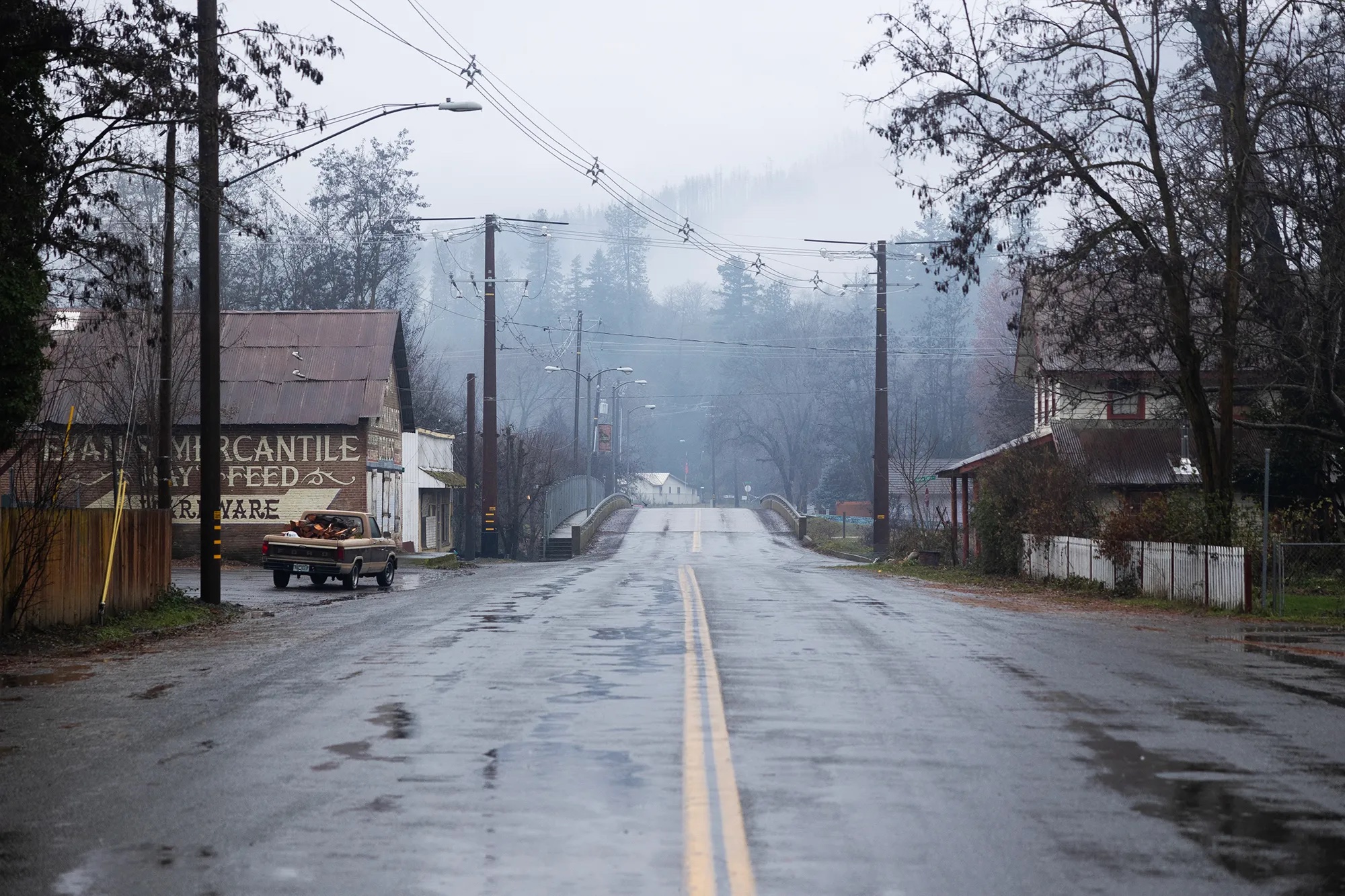
"caption": "A view down 2nd Avenue in Happy Camp on Dec. 13, 2024. \n",
"credit": "Miguel Gutierrez Jr./CalMatters",
"altTag": null,
"description": null,
"imgSizes": {
"thumbnail": {
"file": "https://cdn.kqed.org/wp-content/uploads/sites/10/2025/06/101324-The-Investigators-MG-CM-05-copy-160x107.jpg",
"width": 160,
"height": 107,
"mimeType": "image/jpeg"
},
"1536x1536": {
"file": "https://cdn.kqed.org/wp-content/uploads/sites/10/2025/06/101324-The-Investigators-MG-CM-05-copy-1536x1024.jpg",
"width": 1536,
"height": 1024,
"mimeType": "image/jpeg"
},
"post-thumbnail": {
"file": "https://cdn.kqed.org/wp-content/uploads/sites/10/2025/06/101324-The-Investigators-MG-CM-05-copy-672x372.jpg",
"width": 672,
"height": 372,
"mimeType": "image/jpeg"
},
"twentyfourteen-full-width": {
"file": "https://cdn.kqed.org/wp-content/uploads/sites/10/2025/06/101324-The-Investigators-MG-CM-05-copy-1038x576.jpg",
"width": 1038,
"height": 576,
"mimeType": "image/jpeg"
},
"kqedFullSize": {
"file": "https://cdn.kqed.org/wp-content/uploads/sites/10/2025/06/101324-The-Investigators-MG-CM-05-copy.jpg",
"width": 2000,
"height": 1333
}
},
"isLoading": false,
"fetchFailed": false
},
"news_11973075": {
"type": "attachments",
"id": "news_11973075",
"meta": {
"index": "attachments_1716263798",
"site": "news",
"id": "11973075",
"found": true
},
"title": "044_KQED_HMBMassShootingVigil_01272023-qut",
"publishDate": 1705688004,
"status": "inherit",
"parent": 11973071,
"modified": 1749065195,
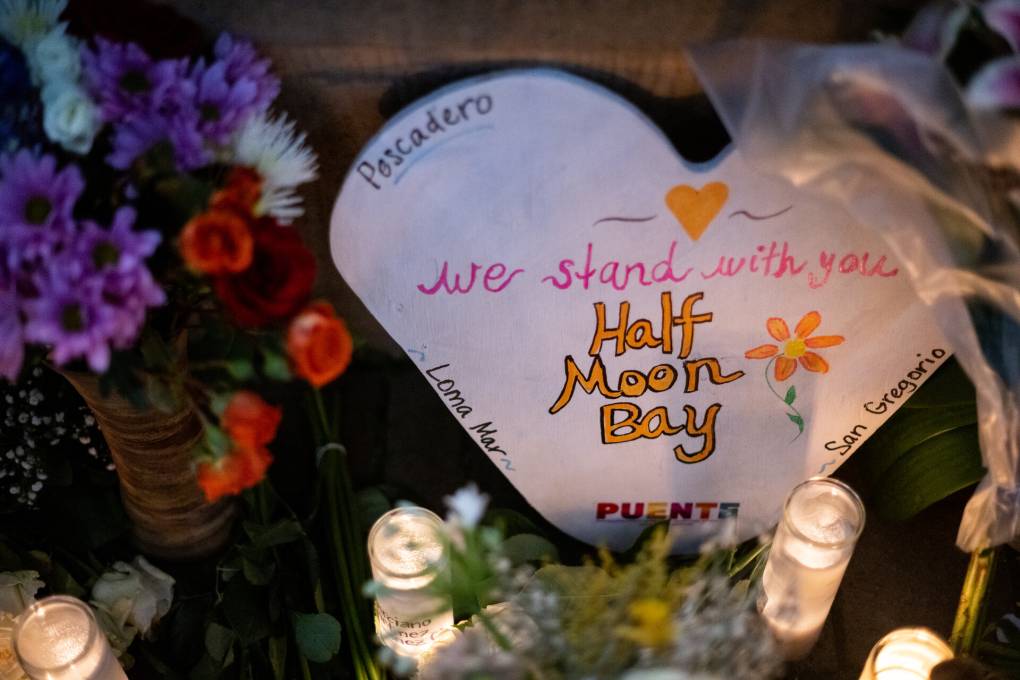
"caption": "A sign at a memorial for victims of a mass shooting in Half Moon Bay says, \"We Stand With You\" after a vigil in their honor at Mac Dutra Park in Half Moon Bay on Jan. 27, 2023.",
"credit": "Beth LaBerge/KQED",
"altTag": "A candlelit vigil for the victims of the Half Moon Bay mass shooting.",
"description": null,
"imgSizes": {
"medium": {
"file": "https://cdn.kqed.org/wp-content/uploads/sites/10/2024/01/044_KQED_HMBMassShootingVigil_01272023-qut-800x533.jpg",
"width": 800,
"height": 533,
"mimeType": "image/jpeg"
},
"large": {
"file": "https://cdn.kqed.org/wp-content/uploads/sites/10/2024/01/044_KQED_HMBMassShootingVigil_01272023-qut-1020x680.jpg",
"width": 1020,
"height": 680,
"mimeType": "image/jpeg"
},
"thumbnail": {
"file": "https://cdn.kqed.org/wp-content/uploads/sites/10/2024/01/044_KQED_HMBMassShootingVigil_01272023-qut-160x107.jpg",
"width": 160,
"height": 107,
"mimeType": "image/jpeg"
},
"1536x1536": {
"file": "https://cdn.kqed.org/wp-content/uploads/sites/10/2024/01/044_KQED_HMBMassShootingVigil_01272023-qut-1536x1024.jpg",
"width": 1536,
"height": 1024,
"mimeType": "image/jpeg"
},
"post-thumbnail": {
"file": "https://cdn.kqed.org/wp-content/uploads/sites/10/2024/01/044_KQED_HMBMassShootingVigil_01272023-qut-672x372.jpg",
"width": 672,
"height": 372,
"mimeType": "image/jpeg"
},
"twentyfourteen-full-width": {
"file": "https://cdn.kqed.org/wp-content/uploads/sites/10/2024/01/044_KQED_HMBMassShootingVigil_01272023-qut-1038x576.jpg",
"width": 1038,
"height": 576,
"mimeType": "image/jpeg"
},
"kqedFullSize": {
"file": "https://cdn.kqed.org/wp-content/uploads/sites/10/2024/01/044_KQED_HMBMassShootingVigil_01272023-qut.jpg",
"width": 1920,
"height": 1280
}
},
"isLoading": false,
"fetchFailed": false
},
"news_12042560": {
"type": "attachments",
"id": "news_12042560",
"meta": {
"index": "attachments_1716263798",
"site": "news",
"id": "12042560",
"found": true
},
"title": "250603-OAKLAND PURSUIT POLICY-MD-01-KQED",
"publishDate": 1748985924,
"status": "inherit",
"parent": 0,
"modified": 1748987125,
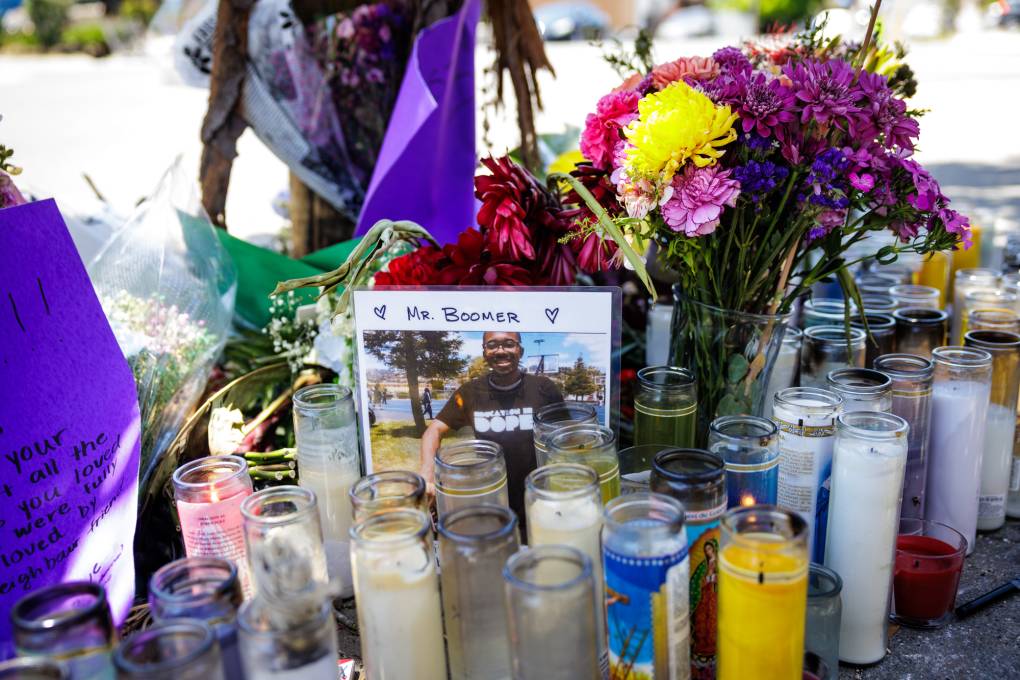
"caption": "A memorial for Marvin Boomer in Oakland on June 3, 2025. Boomer was killed when a suspect fleeing from the California Highway Patrol struck a fire hydrant, which hit the Castlemont High School teacher, who was out walking with his partner.",
"credit": "Martin do Nascimento/KQED",
"altTag": null,
"description": null,
"imgSizes": {
"medium": {
"file": "https://cdn.kqed.org/wp-content/uploads/sites/10/2025/06/250603-OAKLAND-PURSUIT-POLICY-MD-01-KQED-800x534.jpg",
"width": 800,
"height": 534,
"mimeType": "image/jpeg"
},
"large": {
"file": "https://cdn.kqed.org/wp-content/uploads/sites/10/2025/06/250603-OAKLAND-PURSUIT-POLICY-MD-01-KQED-1020x680.jpg",
"width": 1020,
"height": 680,
"mimeType": "image/jpeg"
},
"thumbnail": {
"file": "https://cdn.kqed.org/wp-content/uploads/sites/10/2025/06/250603-OAKLAND-PURSUIT-POLICY-MD-01-KQED-160x107.jpg",
"width": 160,
"height": 107,
"mimeType": "image/jpeg"
},
"1536x1536": {
"file": "https://cdn.kqed.org/wp-content/uploads/sites/10/2025/06/250603-OAKLAND-PURSUIT-POLICY-MD-01-KQED-1536x1025.jpg",
"width": 1536,
"height": 1025,
"mimeType": "image/jpeg"
},
"post-thumbnail": {
"file": "https://cdn.kqed.org/wp-content/uploads/sites/10/2025/06/250603-OAKLAND-PURSUIT-POLICY-MD-01-KQED-672x372.jpg",
"width": 672,
"height": 372,
"mimeType": "image/jpeg"
},
"twentyfourteen-full-width": {
"file": "https://cdn.kqed.org/wp-content/uploads/sites/10/2025/06/250603-OAKLAND-PURSUIT-POLICY-MD-01-KQED-1038x576.jpg",
"width": 1038,
"height": 576,
"mimeType": "image/jpeg"
},
"full-width": {
"file": "https://cdn.kqed.org/wp-content/uploads/sites/10/2025/06/250603-OAKLAND-PURSUIT-POLICY-MD-01-KQED-1920x1281.jpg",
"width": 1920,
"height": 1281,
"mimeType": "image/jpeg"
},
"kqedFullSize": {
"file": "https://cdn.kqed.org/wp-content/uploads/sites/10/2025/06/250603-OAKLAND-PURSUIT-POLICY-MD-01-KQED.jpg",
"width": 2000,
"height": 1334
}
},
"isLoading": false,
"fetchFailed": false
},
"news_12041527": {
"type": "attachments",
"id": "news_12041527",
"meta": {
"index": "attachments_1716263798",
"site": "news",
"id": "12041527",
"found": true
},
"title": "SFPlayground2",
"publishDate": 1748035783,
"status": "inherit",
"parent": 12041470,
"modified": 1748467274,
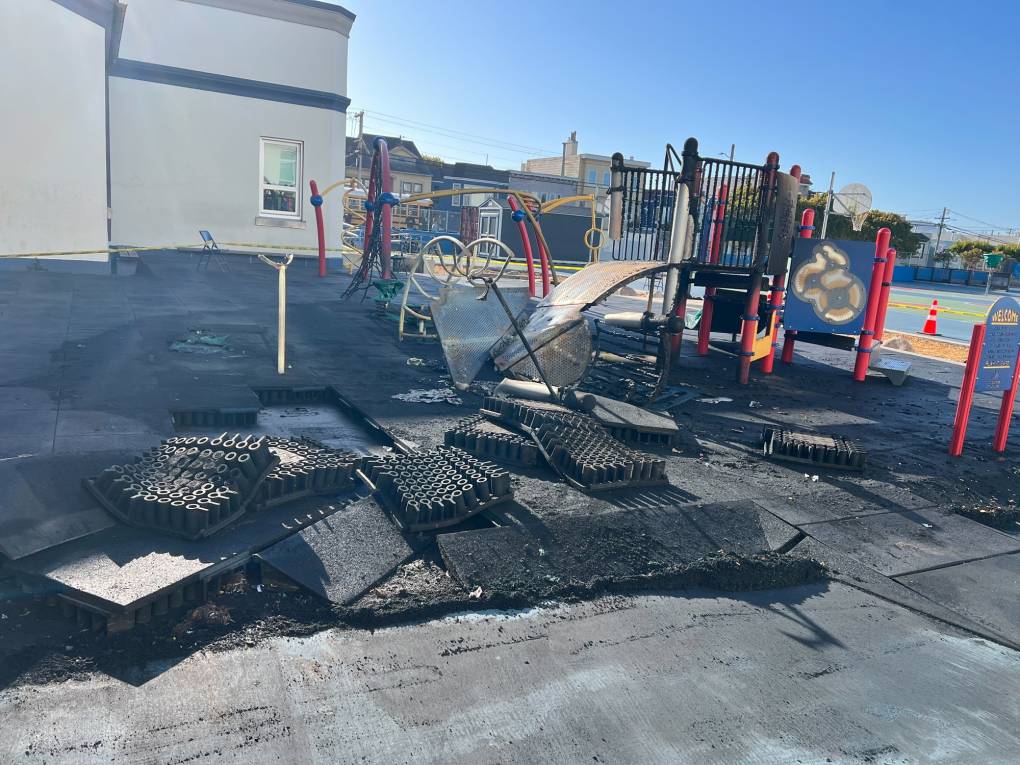
"caption": "The playground at Lafayette Elementary School in San Francisco’s Outer Richmond was destroyed in a suspicious fire, one of four blazes under investigation in the neighborhood this month.",
"credit": "Courtesy of Hallie Albert",
"altTag": null,
"description": null,
"imgSizes": {
"medium": {
"file": "https://cdn.kqed.org/wp-content/uploads/sites/10/2025/05/SFPlayground2-800x600.jpg",
"width": 800,
"height": 600,
"mimeType": "image/jpeg"
},
"large": {
"file": "https://cdn.kqed.org/wp-content/uploads/sites/10/2025/05/SFPlayground2-1020x765.jpg",
"width": 1020,
"height": 765,
"mimeType": "image/jpeg"
},
"thumbnail": {
"file": "https://cdn.kqed.org/wp-content/uploads/sites/10/2025/05/SFPlayground2-160x120.jpg",
"width": 160,
"height": 120,
"mimeType": "image/jpeg"
},
"1536x1536": {
"file": "https://cdn.kqed.org/wp-content/uploads/sites/10/2025/05/SFPlayground2-1536x1152.jpg",
"width": 1536,
"height": 1152,
"mimeType": "image/jpeg"
},
"post-thumbnail": {
"file": "https://cdn.kqed.org/wp-content/uploads/sites/10/2025/05/SFPlayground2-672x372.jpg",
"width": 672,
"height": 372,
"mimeType": "image/jpeg"
},
"twentyfourteen-full-width": {
"file": "https://cdn.kqed.org/wp-content/uploads/sites/10/2025/05/SFPlayground2-1038x576.jpg",
"width": 1038,
"height": 576,
"mimeType": "image/jpeg"
},
"full-width": {
"file": "https://cdn.kqed.org/wp-content/uploads/sites/10/2025/05/SFPlayground2-1920x1440.jpg",
"width": 1920,
"height": 1440,
"mimeType": "image/jpeg"
},
"kqedFullSize": {
"file": "https://cdn.kqed.org/wp-content/uploads/sites/10/2025/05/SFPlayground2.jpg",
"width": 2000,
"height": 1500
}
},
"isLoading": false,
"fetchFailed": false
},
"news_12002795": {
"type": "attachments",
"id": "news_12002795",
"meta": {
"index": "attachments_1716263798",
"site": "news",
"id": "12002795",
"found": true
},
"title": "240408-FCIDublin-009-BL_qed",
"publishDate": 1725383562,
"status": "inherit",
"parent": 12002790,
"modified": 1748470018,
"caption": "The Federal Correctional Institution, Dublin, a prison for women, in Dublin, on April 8, 2024.",
"credit": "Beth LaBerge/KQED",
"altTag": null,
"description": null,
"imgSizes": {
"medium": {
"file": "https://cdn.kqed.org/wp-content/uploads/sites/10/2024/09/240408-FCIDublin-009-BL_qed-800x533.jpg",
"width": 800,
"height": 533,
"mimeType": "image/jpeg"
},
"large": {
"file": "https://cdn.kqed.org/wp-content/uploads/sites/10/2024/09/240408-FCIDublin-009-BL_qed-1020x680.jpg",
"width": 1020,
"height": 680,
"mimeType": "image/jpeg"
},
"thumbnail": {
"file": "https://cdn.kqed.org/wp-content/uploads/sites/10/2024/09/240408-FCIDublin-009-BL_qed-160x107.jpg",
"width": 160,
"height": 107,
"mimeType": "image/jpeg"
},
"1536x1536": {
"file": "https://cdn.kqed.org/wp-content/uploads/sites/10/2024/09/240408-FCIDublin-009-BL_qed-1536x1024.jpg",
"width": 1536,
"height": 1024,
"mimeType": "image/jpeg"
},
"post-thumbnail": {
"file": "https://cdn.kqed.org/wp-content/uploads/sites/10/2024/09/240408-FCIDublin-009-BL_qed-672x372.jpg",
"width": 672,
"height": 372,
"mimeType": "image/jpeg"
},
"twentyfourteen-full-width": {
"file": "https://cdn.kqed.org/wp-content/uploads/sites/10/2024/09/240408-FCIDublin-009-BL_qed-1038x576.jpg",
"width": 1038,
"height": 576,
"mimeType": "image/jpeg"
},
"full-width": {
"file": "https://cdn.kqed.org/wp-content/uploads/sites/10/2024/09/240408-FCIDublin-009-BL_qed-1920x1280.jpg",
"width": 1920,
"height": 1280,
"mimeType": "image/jpeg"
},
"kqedFullSize": {
"file": "https://cdn.kqed.org/wp-content/uploads/sites/10/2024/09/240408-FCIDublin-009-BL_qed.jpg",
"width": 2000,
"height": 1333
}
},
"isLoading": false,
"fetchFailed": false
},
"news_12024249": {
"type": "attachments",
"id": "news_12024249",
"meta": {
"index": "attachments_1716263798",
"site": "news",
"id": "12024249",
"found": true
},
"title": "ICE agents raid to arrest illigal immigrants.",
"publishDate": 1738015637,
"status": "inherit",
"parent": 12024246,
"modified": 1738716093,
"caption": "Thomas Giles, ICE Field Office Director, center, talks to other agents after going to arrest an immigrant with a criminal record on Sept. 8, 2022, in Los Angeles.",
"credit": "Irfan Khan / Los Angeles Times via Getty Images",
"altTag": null,
"description": null,
"imgSizes": {
"medium": {
"file": "https://cdn.kqed.org/wp-content/uploads/sites/10/2025/01/GettyImages-1243312873-800x533.jpg",
"width": 800,
"height": 533,
"mimeType": "image/jpeg"
},
"large": {
"file": "https://cdn.kqed.org/wp-content/uploads/sites/10/2025/01/GettyImages-1243312873-1020x680.jpg",
"width": 1020,
"height": 680,
"mimeType": "image/jpeg"
},
"thumbnail": {
"file": "https://cdn.kqed.org/wp-content/uploads/sites/10/2025/01/GettyImages-1243312873-160x107.jpg",
"width": 160,
"height": 107,
"mimeType": "image/jpeg"
},
"1536x1536": {
"file": "https://cdn.kqed.org/wp-content/uploads/sites/10/2025/01/GettyImages-1243312873-1536x1024.jpg",
"width": 1536,
"height": 1024,
"mimeType": "image/jpeg"
},
"2048x2048": {
"file": "https://cdn.kqed.org/wp-content/uploads/sites/10/2025/01/GettyImages-1243312873-2048x1365.jpg",
"width": 2048,
"height": 1365,
"mimeType": "image/jpeg"
},
"post-thumbnail": {
"file": "https://cdn.kqed.org/wp-content/uploads/sites/10/2025/01/GettyImages-1243312873-672x372.jpg",
"width": 672,
"height": 372,
"mimeType": "image/jpeg"
},
"twentyfourteen-full-width": {
"file": "https://cdn.kqed.org/wp-content/uploads/sites/10/2025/01/GettyImages-1243312873-1038x576.jpg",
"width": 1038,
"height": 576,
"mimeType": "image/jpeg"
},
"full-width": {
"file": "https://cdn.kqed.org/wp-content/uploads/sites/10/2025/01/GettyImages-1243312873-1920x1280.jpg",
"width": 1920,
"height": 1280,
"mimeType": "image/jpeg"
},
"kqedFullSize": {
"file": "https://cdn.kqed.org/wp-content/uploads/sites/10/2025/01/GettyImages-1243312873-scaled.jpg",
"width": 2560,
"height": 1707
}
},
"isLoading": false,
"fetchFailed": false
},
"news_12041677": {
"type": "attachments",
"id": "news_12041677",
"meta": {
"index": "attachments_1716263798",
"site": "news",
"id": "12041677",
"found": true
},
"title": "SantaRosaChurchFire1",
"publishDate": 1748366178,
"status": "inherit",
"parent": 0,
"modified": 1748366252,
"caption": "The historic Church of One Tree in Santa Rosa is seen on Tuesday, May 27, the morning after a fire that authorities are investigating as arson.",
"credit": "Gabe Meline/KQED",
"altTag": null,
"description": null,
"imgSizes": {
"medium": {
"file": "https://cdn.kqed.org/wp-content/uploads/sites/10/2025/05/SantaRosaChurchFire1-800x600.jpg",
"width": 800,
"height": 600,
"mimeType": "image/jpeg"
},
"large": {
"file": "https://cdn.kqed.org/wp-content/uploads/sites/10/2025/05/SantaRosaChurchFire1-1020x765.jpg",
"width": 1020,
"height": 765,
"mimeType": "image/jpeg"
},
"thumbnail": {
"file": "https://cdn.kqed.org/wp-content/uploads/sites/10/2025/05/SantaRosaChurchFire1-160x120.jpg",
"width": 160,
"height": 120,
"mimeType": "image/jpeg"
},
"1536x1536": {
"file": "https://cdn.kqed.org/wp-content/uploads/sites/10/2025/05/SantaRosaChurchFire1-1536x1152.jpg",
"width": 1536,
"height": 1152,
"mimeType": "image/jpeg"
},
"post-thumbnail": {
"file": "https://cdn.kqed.org/wp-content/uploads/sites/10/2025/05/SantaRosaChurchFire1-672x372.jpg",
"width": 672,
"height": 372,
"mimeType": "image/jpeg"
},
"twentyfourteen-full-width": {
"file": "https://cdn.kqed.org/wp-content/uploads/sites/10/2025/05/SantaRosaChurchFire1-1038x576.jpg",
"width": 1038,
"height": 576,
"mimeType": "image/jpeg"
},
"full-width": {
"file": "https://cdn.kqed.org/wp-content/uploads/sites/10/2025/05/SantaRosaChurchFire1-1920x1440.jpg",
"width": 1920,
"height": 1440,
"mimeType": "image/jpeg"
},
"kqedFullSize": {
"file": "https://cdn.kqed.org/wp-content/uploads/sites/10/2025/05/SantaRosaChurchFire1.jpg",
"width": 2000,
"height": 1500
}
},
"isLoading": false,
"fetchFailed": false
},
"news_12041523": {
"type": "attachments",
"id": "news_12041523",
"meta": {
"index": "attachments_1716263798",
"site": "news",
"id": "12041523",
"found": true
},
"title": "SFPlayground1",
"publishDate": 1748035531,
"status": "inherit",
"parent": 12041470,
"modified": 1748036173,
"caption": "Charred remains of the playground at Lafayette Elementary School in San Francisco, one of two westside playgrounds — along with Lincoln Park — destroyed in a string of four fires this month. Authorities are investigating the cause.",
"credit": "Courtesy of Hallie Albert",
"altTag": null,
"description": null,
"imgSizes": {
"medium": {
"file": "https://cdn.kqed.org/wp-content/uploads/sites/10/2025/05/SFPlayground1-800x600.jpg",
"width": 800,
"height": 600,
"mimeType": "image/jpeg"
},
"large": {
"file": "https://cdn.kqed.org/wp-content/uploads/sites/10/2025/05/SFPlayground1-1020x765.jpg",
"width": 1020,
"height": 765,
"mimeType": "image/jpeg"
},
"thumbnail": {
"file": "https://cdn.kqed.org/wp-content/uploads/sites/10/2025/05/SFPlayground1-160x120.jpg",
"width": 160,
"height": 120,
"mimeType": "image/jpeg"
},
"1536x1536": {
"file": "https://cdn.kqed.org/wp-content/uploads/sites/10/2025/05/SFPlayground1-1536x1152.jpg",
"width": 1536,
"height": 1152,
"mimeType": "image/jpeg"
},
"post-thumbnail": {
"file": "https://cdn.kqed.org/wp-content/uploads/sites/10/2025/05/SFPlayground1-672x372.jpg",
"width": 672,
"height": 372,
"mimeType": "image/jpeg"
},
"twentyfourteen-full-width": {
"file": "https://cdn.kqed.org/wp-content/uploads/sites/10/2025/05/SFPlayground1-1038x576.jpg",
"width": 1038,
"height": 576,
"mimeType": "image/jpeg"
},
"full-width": {
"file": "https://cdn.kqed.org/wp-content/uploads/sites/10/2025/05/SFPlayground1-1920x1440.jpg",
"width": 1920,
"height": 1440,
"mimeType": "image/jpeg"
},
"kqedFullSize": {
"file": "https://cdn.kqed.org/wp-content/uploads/sites/10/2025/05/SFPlayground1.jpg",
"width": 2000,
"height": 1500
}
},
"isLoading": false,
"fetchFailed": false
},
"news_12039575": {
"type": "attachments",
"id": "news_12039575",
"meta": {
"index": "attachments_1716263798",
"site": "news",
"id": "12039575",
"found": true
},
"title": "050525-Corcoran-State-Prison-GR-Getty-01-CM copy",
"publishDate": 1746820001,
"status": "inherit",
"parent": 12039556,
"modified": 1746820028,
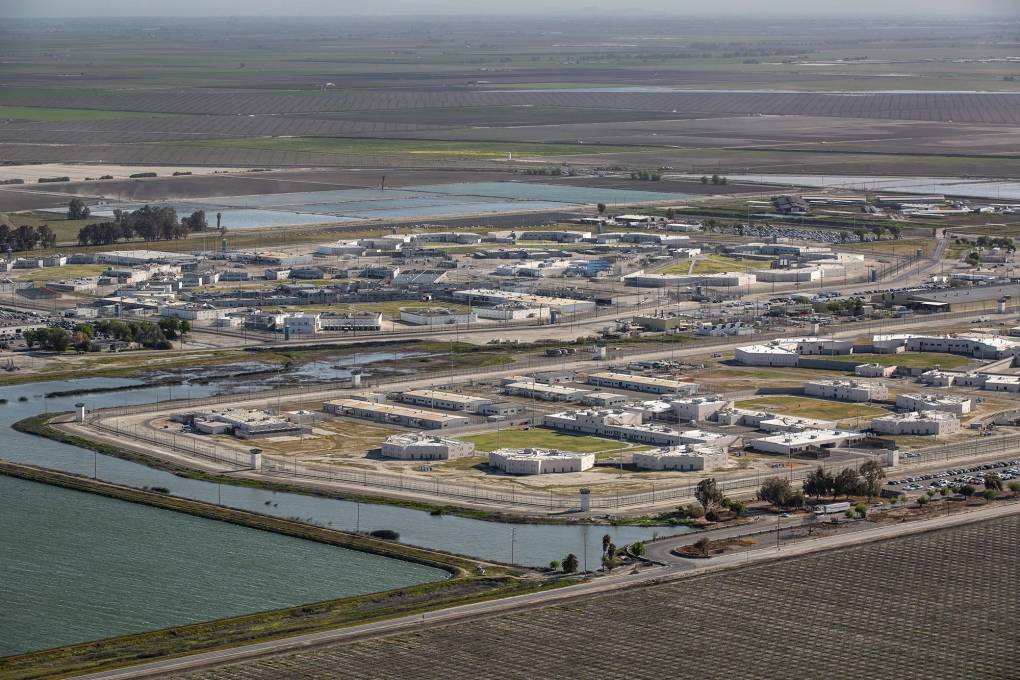
"caption": "Two California state prisons had to create evacuation plans in 2023 when flooding approached them. They did not ultimately evacuate, but the near-disaster raised concerns about emergency planning. Here, rising water from the intermittent Tulare Lake approached one of the prisons on April 13, 2023.",
"credit": "George Rose/Getty Images",
"altTag": null,
"description": null,
"imgSizes": {
"medium": {
"file": "https://cdn.kqed.org/wp-content/uploads/sites/10/2025/05/050525-Corcoran-State-Prison-GR-Getty-01-CM-copy-800x533.jpg",
"width": 800,
"height": 533,
"mimeType": "image/jpeg"
},
"large": {
"file": "https://cdn.kqed.org/wp-content/uploads/sites/10/2025/05/050525-Corcoran-State-Prison-GR-Getty-01-CM-copy-1020x680.jpg",
"width": 1020,
"height": 680,
"mimeType": "image/jpeg"
},
"thumbnail": {
"file": "https://cdn.kqed.org/wp-content/uploads/sites/10/2025/05/050525-Corcoran-State-Prison-GR-Getty-01-CM-copy-160x107.jpg",
"width": 160,
"height": 107,
"mimeType": "image/jpeg"
},
"1536x1536": {
"file": "https://cdn.kqed.org/wp-content/uploads/sites/10/2025/05/050525-Corcoran-State-Prison-GR-Getty-01-CM-copy-1536x1024.jpg",
"width": 1536,
"height": 1024,
"mimeType": "image/jpeg"
},
"post-thumbnail": {
"file": "https://cdn.kqed.org/wp-content/uploads/sites/10/2025/05/050525-Corcoran-State-Prison-GR-Getty-01-CM-copy-672x372.jpg",
"width": 672,
"height": 372,
"mimeType": "image/jpeg"
},
"twentyfourteen-full-width": {
"file": "https://cdn.kqed.org/wp-content/uploads/sites/10/2025/05/050525-Corcoran-State-Prison-GR-Getty-01-CM-copy-1038x576.jpg",
"width": 1038,
"height": 576,
"mimeType": "image/jpeg"
},
"full-width": {
"file": "https://cdn.kqed.org/wp-content/uploads/sites/10/2025/05/050525-Corcoran-State-Prison-GR-Getty-01-CM-copy-1920x1280.jpg",
"width": 1920,
"height": 1280,
"mimeType": "image/jpeg"
},
"kqedFullSize": {
"file": "https://cdn.kqed.org/wp-content/uploads/sites/10/2025/05/050525-Corcoran-State-Prison-GR-Getty-01-CM-copy.jpg",
"width": 2000,
"height": 1333
}
},
"isLoading": false,
"fetchFailed": false
},
"news_12037105": {
"type": "attachments",
"id": "news_12037105",
"meta": {
"index": "attachments_1716263798",
"site": "news",
"id": "12037105",
"found": true
},
"title": "The Federal Courthouse in Oakland on Aug. 16, 2023.",
"publishDate": 1745345804,
"status": "inherit",
"parent": 12037103,
"modified": 1745345829,
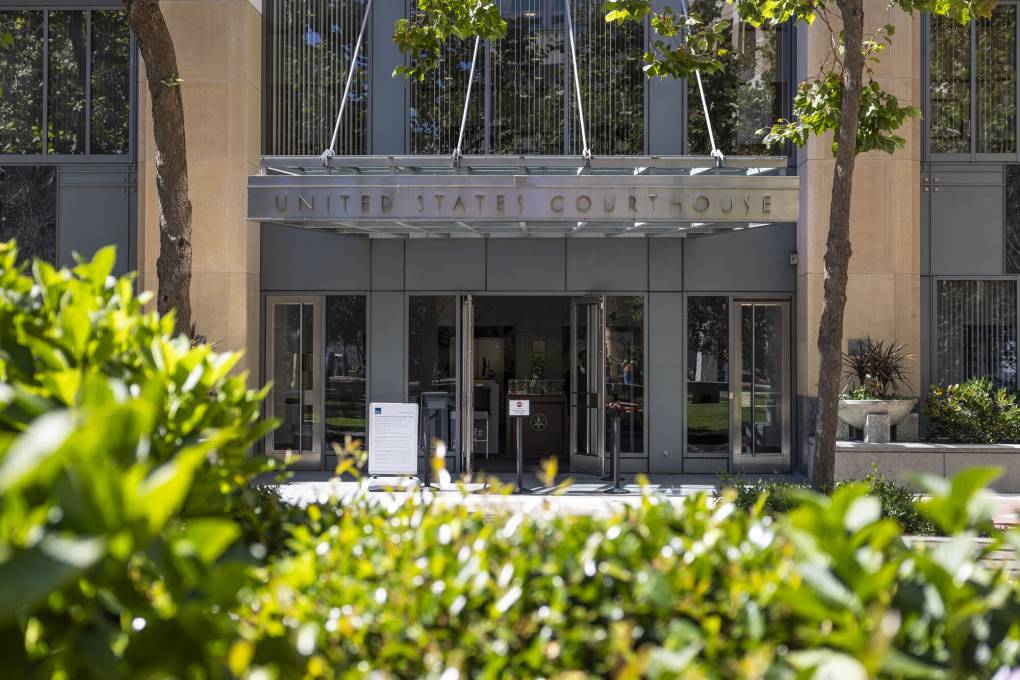
"caption": "The Federal Courthouse in Oakland on Aug. 16, 2023.",
"credit": "Martin do Nascimento/KQED",
"altTag": null,
"description": null,
"imgSizes": {
"medium": {
"file": "https://cdn.kqed.org/wp-content/uploads/sites/10/2025/04/230816-Dublin-Womens-Prison-Suit-MD-01_qed-800x533.jpg",
"width": 800,
"height": 533,
"mimeType": "image/jpeg"
},
"large": {
"file": "https://cdn.kqed.org/wp-content/uploads/sites/10/2025/04/230816-Dublin-Womens-Prison-Suit-MD-01_qed-1020x680.jpg",
"width": 1020,
"height": 680,
"mimeType": "image/jpeg"
},
"thumbnail": {
"file": "https://cdn.kqed.org/wp-content/uploads/sites/10/2025/04/230816-Dublin-Womens-Prison-Suit-MD-01_qed-160x107.jpg",
"width": 160,
"height": 107,
"mimeType": "image/jpeg"
},
"1536x1536": {
"file": "https://cdn.kqed.org/wp-content/uploads/sites/10/2025/04/230816-Dublin-Womens-Prison-Suit-MD-01_qed-1536x1024.jpg",
"width": 1536,
"height": 1024,
"mimeType": "image/jpeg"
},
"post-thumbnail": {
"file": "https://cdn.kqed.org/wp-content/uploads/sites/10/2025/04/230816-Dublin-Womens-Prison-Suit-MD-01_qed-672x372.jpg",
"width": 672,
"height": 372,
"mimeType": "image/jpeg"
},
"twentyfourteen-full-width": {
"file": "https://cdn.kqed.org/wp-content/uploads/sites/10/2025/04/230816-Dublin-Womens-Prison-Suit-MD-01_qed-1038x576.jpg",
"width": 1038,
"height": 576,
"mimeType": "image/jpeg"
},
"full-width": {
"file": "https://cdn.kqed.org/wp-content/uploads/sites/10/2025/04/230816-Dublin-Womens-Prison-Suit-MD-01_qed-1920x1280.jpg",
"width": 1920,
"height": 1280,
"mimeType": "image/jpeg"
},
"kqedFullSize": {
"file": "https://cdn.kqed.org/wp-content/uploads/sites/10/2025/04/230816-Dublin-Womens-Prison-Suit-MD-01_qed.jpg",
"width": 2000,
"height": 1333
}
},
"isLoading": false,
"fetchFailed": false
},
"news_12029336": {
"type": "attachments",
"id": "news_12029336",
"meta": {
"index": "attachments_1716263798",
"site": "news",
"id": "12029336",
"found": true
},
"title": "California Police-Racist Texts",
"publishDate": 1740785734,
"status": "inherit",
"parent": 12029300,
"modified": 1740785775,
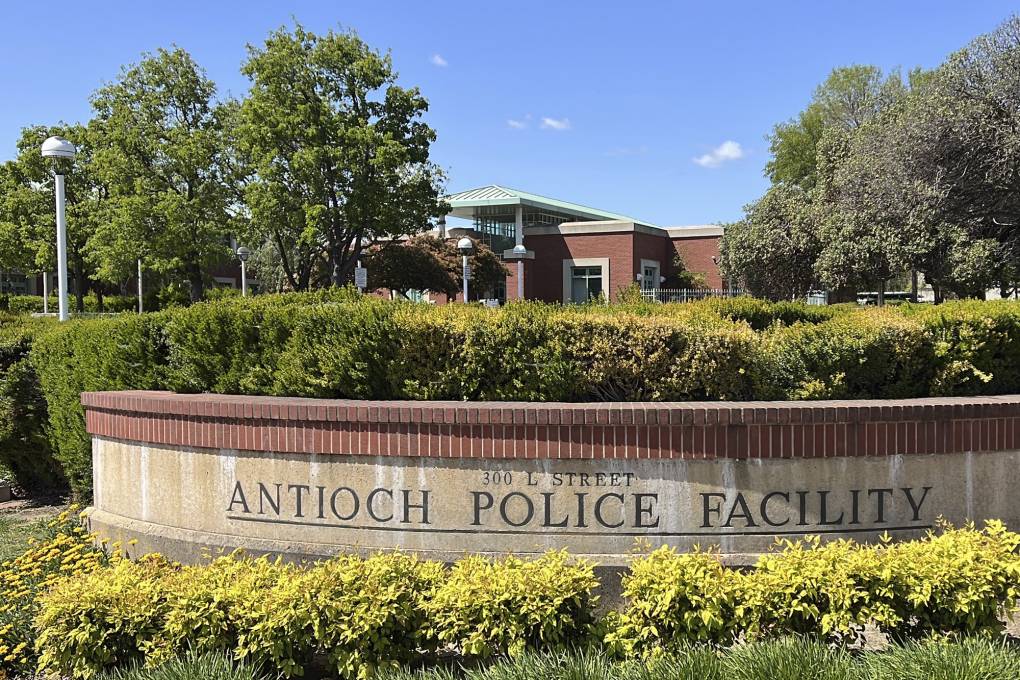
"caption": "The Antioch Police headquarters in Antioch, California, on April 19, 2023. ",
"credit": "Terry Chea/AP Photo",
"altTag": null,
"description": null,
"imgSizes": {
"medium": {
"file": "https://cdn.kqed.org/wp-content/uploads/sites/10/2025/02/AntiochPoliceDepartmentAP-800x533.jpg",
"width": 800,
"height": 533,
"mimeType": "image/jpeg"
},
"large": {
"file": "https://cdn.kqed.org/wp-content/uploads/sites/10/2025/02/AntiochPoliceDepartmentAP-1020x680.jpg",
"width": 1020,
"height": 680,
"mimeType": "image/jpeg"
},
"thumbnail": {
"file": "https://cdn.kqed.org/wp-content/uploads/sites/10/2025/02/AntiochPoliceDepartmentAP-160x107.jpg",
"width": 160,
"height": 107,
"mimeType": "image/jpeg"
},
"1536x1536": {
"file": "https://cdn.kqed.org/wp-content/uploads/sites/10/2025/02/AntiochPoliceDepartmentAP-1536x1024.jpg",
"width": 1536,
"height": 1024,
"mimeType": "image/jpeg"
},
"post-thumbnail": {
"file": "https://cdn.kqed.org/wp-content/uploads/sites/10/2025/02/AntiochPoliceDepartmentAP-672x372.jpg",
"width": 672,
"height": 372,
"mimeType": "image/jpeg"
},
"twentyfourteen-full-width": {
"file": "https://cdn.kqed.org/wp-content/uploads/sites/10/2025/02/AntiochPoliceDepartmentAP-1038x576.jpg",
"width": 1038,
"height": 576,
"mimeType": "image/jpeg"
},
"full-width": {
"file": "https://cdn.kqed.org/wp-content/uploads/sites/10/2025/02/AntiochPoliceDepartmentAP-1920x1280.jpg",
"width": 1920,
"height": 1280,
"mimeType": "image/jpeg"
},
"kqedFullSize": {
"file": "https://cdn.kqed.org/wp-content/uploads/sites/10/2025/02/AntiochPoliceDepartmentAP.jpg",
"width": 2000,
"height": 1333
}
},
"isLoading": false,
"fetchFailed": false
},
"news_12029523": {
"type": "attachments",
"id": "news_12029523",
"meta": {
"index": "attachments_1716263798",
"site": "news",
"id": "12029523",
"found": true
},
"title": "IMG_5881-KQED",
"publishDate": 1741049692,
"status": "inherit",
"parent": 12030234,
"modified": 1758239571,
"caption": "Nicole Castronovo, defense attorney for former Antioch police officer Devon Christopher Wenger, gives her opening statement in the federal trial against Wenger and another former Antioch officer at the U.S. District Courthouse in Oakland on March 3, 2025. ",
"credit": "Vicki Behringer/KQED",
"altTag": null,
"description": null,
"imgSizes": {
"medium": {
"file": "https://cdn.kqed.org/wp-content/uploads/sites/10/2025/03/IMG_5881-KQED-800x450.jpg",
"width": 800,
"height": 450,
"mimeType": "image/jpeg"
},
"large": {
"file": "https://cdn.kqed.org/wp-content/uploads/sites/10/2025/03/IMG_5881-KQED-1020x574.jpg",
"width": 1020,
"height": 574,
"mimeType": "image/jpeg"
},
"thumbnail": {
"file": "https://cdn.kqed.org/wp-content/uploads/sites/10/2025/03/IMG_5881-KQED-160x90.jpg",
"width": 160,
"height": 90,
"mimeType": "image/jpeg"
},
"1536x1536": {
"file": "https://cdn.kqed.org/wp-content/uploads/sites/10/2025/03/IMG_5881-KQED-1536x864.jpg",
"width": 1536,
"height": 864,
"mimeType": "image/jpeg"
},
"post-thumbnail": {
"file": "https://cdn.kqed.org/wp-content/uploads/sites/10/2025/03/IMG_5881-KQED-672x372.jpg",
"width": 672,
"height": 372,
"mimeType": "image/jpeg"
},
"twentyfourteen-full-width": {
"file": "https://cdn.kqed.org/wp-content/uploads/sites/10/2025/03/IMG_5881-KQED-1038x576.jpg",
"width": 1038,
"height": 576,
"mimeType": "image/jpeg"
},
"full-width": {
"file": "https://cdn.kqed.org/wp-content/uploads/sites/10/2025/03/IMG_5881-KQED-1920x1080.jpg",
"width": 1920,
"height": 1080,
"mimeType": "image/jpeg"
},
"kqedFullSize": {
"file": "https://cdn.kqed.org/wp-content/uploads/sites/10/2025/03/IMG_5881-KQED.jpg",
"width": 2000,
"height": 1125
}
},
"isLoading": false,
"fetchFailed": false
}
},
"audioPlayerReducer": {
"postId": "stream_live",
"isPaused": true,
"isPlaying": false,
"pfsActive": false,
"pledgeModalIsOpen": true,
"playerDrawerIsOpen": false,
"liveAudioPlayStartedAt": 0,
"liveAudioPlayContext": ""
},
"authorsReducer": {
"byline_news_12043026": {
"type": "authors",
"id": "byline_news_12043026",
"meta": {
"override": true
},
"slug": "byline_news_12043026",
"name": "\u003ca href=\"https://calmatters.org/author/anat-rubin/\">Anat Rubin\u003c/a>, CalMatters",
"isLoading": false
},
"byline_news_12039556": {
"type": "authors",
"id": "byline_news_12039556",
"meta": {
"override": true
},
"slug": "byline_news_12039556",
"name": "\u003ca href=\"https://calmatters.org/author/cayla-mihalovich/\">Cayla Mihalovich\u003c/a>, CalMatters",
"isLoading": false
},
"nkhan": {
"type": "authors",
"id": "11867",
"meta": {
"index": "authors_1716337520",
"id": "11867",
"found": true
},
"name": "Nisa Khan",
"firstName": "Nisa",
"lastName": "Khan",
"slug": "nkhan",
"email": "nkhan@kqed.org",
"display_author_email": false,
"staff_mastheads": [],
"title": "KQED Contributor",
"bio": "Nisa Khan is a reporter for KQED's Audience News Desk. She was formerly a data reporter at Michigan Radio. She earned a Bachelor of Science in Information from the University of Michigan and a Master of Arts in Communication from Stanford University.",
"avatar": "https://secure.gravatar.com/avatar/8720459eef081ff64582b3506b124d58523e80e120704a0cbd9892533c914991?s=600&d=blank&r=g",
"twitter": "mnisakhan",
"bluesky": null,
"facebook": null,
"instagram": null,
"linkedin": null,
"sites": [
{
"site": "arts",
"roles": [
"editor"
]
},
{
"site": "news",
"roles": [
"editor"
]
},
{
"site": "science",
"roles": [
"editor",
"author"
]
},
{
"site": "forum",
"roles": [
"editor"
]
},
{
"site": "liveblog",
"roles": [
"contributor"
]
}
],
"headData": {
"title": "Nisa Khan | KQED",
"description": "KQED Contributor",
"ogImgSrc": "https://secure.gravatar.com/avatar/8720459eef081ff64582b3506b124d58523e80e120704a0cbd9892533c914991?s=600&d=blank&r=g",
"twImgSrc": "https://secure.gravatar.com/avatar/8720459eef081ff64582b3506b124d58523e80e120704a0cbd9892533c914991?s=600&d=blank&r=g"
},
"isLoading": false,
"link": "/author/nkhan"
},
"kdebenedetti": {
"type": "authors",
"id": "11913",
"meta": {
"index": "authors_1716337520",
"id": "11913",
"found": true
},
"name": "Katie DeBenedetti",
"firstName": "Katie",
"lastName": "DeBenedetti",
"slug": "kdebenedetti",
"email": "kdebenedetti@kqed.org",
"display_author_email": false,
"staff_mastheads": [
"news",
"science"
],
"title": "KQED Contributor",
"bio": "Katie DeBenedetti is a digital reporter covering daily news for the Express Desk. Prior to joining KQED as a culture reporting intern in January 2024, she covered education and city government for the Napa Valley Register.",
"avatar": "https://secure.gravatar.com/avatar/6e31073cb8f7e4214ab03f42771d0f45?s=600&d=blank&r=g",
"twitter": null,
"facebook": null,
"instagram": null,
"linkedin": null,
"sites": [
{
"site": "news",
"roles": [
"author"
]
},
{
"site": "science",
"roles": [
"author"
]
},
{
"site": "liveblog",
"roles": [
"author"
]
}
],
"headData": {
"title": "Katie DeBenedetti | KQED",
"description": "KQED Contributor",
"ogImgSrc": "https://secure.gravatar.com/avatar/6e31073cb8f7e4214ab03f42771d0f45?s=600&d=blank&r=g",
"twImgSrc": "https://secure.gravatar.com/avatar/6e31073cb8f7e4214ab03f42771d0f45?s=600&d=blank&r=g"
},
"isLoading": false,
"link": "/author/kdebenedetti"
},
"slim": {
"type": "authors",
"id": "11920",
"meta": {
"index": "authors_1716337520",
"id": "11920",
"found": true
},
"name": "Samantha Lim",
"firstName": "Samantha",
"lastName": "Lim",
"slug": "slim",
"email": "slim@KQED.org",
"display_author_email": false,
"staff_mastheads": [],
"title": "KQED Contributor",
"bio": null,
"avatar": "https://secure.gravatar.com/avatar/82e592e6c15fe1a04d385e8ad0fb0b4e?s=600&d=blank&r=g",
"twitter": null,
"facebook": null,
"instagram": null,
"linkedin": null,
"sites": [
{
"site": "news",
"roles": []
}
],
"headData": {
"title": "Samantha Lim | KQED",
"description": "KQED Contributor",
"ogImgSrc": "https://secure.gravatar.com/avatar/82e592e6c15fe1a04d385e8ad0fb0b4e?s=600&d=blank&r=g",
"twImgSrc": "https://secure.gravatar.com/avatar/82e592e6c15fe1a04d385e8ad0fb0b4e?s=600&d=blank&r=g"
},
"isLoading": false,
"link": "/author/slim"
},
"bkrans": {
"type": "authors",
"id": "11923",
"meta": {
"index": "authors_1716337520",
"id": "11923",
"found": true
},
"name": "Brian Krans",
"firstName": "Brian",
"lastName": "Krans",
"slug": "bkrans",
"email": "bkrans@kqed.org",
"display_author_email": false,
"staff_mastheads": [
"news"
],
"title": "KQED Contributing Reporter",
"bio": "Brian Krans is an award-winning local news and investigative reporter who has been proudly working as a general assignment reporter for KQED since August 2023. He lives in Richmond, where he also reports on air pollution for Richmondside. He is also a founding member of the Vallejo Sun.",
"avatar": "https://secure.gravatar.com/avatar/71fa91f931774612559f7640390b53d9c2840ff72b20f195a25239aab2d9fbb9?s=600&d=blank&r=g",
"twitter": "citizenkrans",
"bluesky": null,
"facebook": null,
"instagram": null,
"linkedin": null,
"sites": [
{
"site": "news",
"roles": [
"editor"
]
}
],
"headData": {
"title": "Brian Krans | KQED",
"description": "KQED Contributing Reporter",
"ogImgSrc": "https://secure.gravatar.com/avatar/71fa91f931774612559f7640390b53d9c2840ff72b20f195a25239aab2d9fbb9?s=600&d=blank&r=g",
"twImgSrc": "https://secure.gravatar.com/avatar/71fa91f931774612559f7640390b53d9c2840ff72b20f195a25239aab2d9fbb9?s=600&d=blank&r=g"
},
"isLoading": false,
"link": "/author/bkrans"
},
"emanoukian": {
"type": "authors",
"id": "11925",
"meta": {
"index": "authors_1716337520",
"id": "11925",
"found": true
},
"name": "Elize Manoukian",
"firstName": "Elize",
"lastName": "Manoukian",
"slug": "emanoukian",
"email": "emanoukian@KQED.org",
"display_author_email": false,
"staff_mastheads": [
"news"
],
"title": "Digital News Editor",
"bio": "Elize Manoukian is an award-winning audio producer and Senior Editor on the Express Desk, KQED's digital news platform. Her work has appeared on KPFA, Interlochen Public Radio, Oregon Public Broadcast, the New York Daily News, LA Times and the San Diego Union-Tribune.",
"avatar": "https://secure.gravatar.com/avatar/4525f1a8e46ccb30933b32653d9772064cfefe3fa655eb45b3b3a80341f6bdad?s=600&d=blank&r=g",
"twitter": null,
"bluesky": null,
"facebook": null,
"instagram": null,
"linkedin": null,
"sites": [
{
"site": "arts",
"roles": [
"editor"
]
},
{
"site": "news",
"roles": [
"editor"
]
},
{
"site": "science",
"roles": [
"editor"
]
}
],
"headData": {
"title": "Elize Manoukian | KQED",
"description": "Digital News Editor",
"ogImgSrc": "https://secure.gravatar.com/avatar/4525f1a8e46ccb30933b32653d9772064cfefe3fa655eb45b3b3a80341f6bdad?s=600&d=blank&r=g",
"twImgSrc": "https://secure.gravatar.com/avatar/4525f1a8e46ccb30933b32653d9772064cfefe3fa655eb45b3b3a80341f6bdad?s=600&d=blank&r=g"
},
"isLoading": false,
"link": "/author/emanoukian"
}
},
"pagesReducer": {
"news_category_criminal-justice": {
"type": "terms",
"id": "news_34167",
"meta": {
"index": "terms_1716263798",
"site": "news",
"id": "34167",
"score": 11.18808
},
"name": "Criminal Justice",
"slug": "criminal-justice",
"taxonomy": "category",
"description": null,
"featImg": null,
"headData": {
"title": "Criminal Justice Archives | KQED News",
"description": null,
"ogTitle": null,
"ogDescription": null,
"ogImgId": null,
"twTitle": null,
"twDescription": null,
"twImgId": null
},
"ttid": 34184,
"isLoading": false,
"title": "Criminal Justice",
"pageMeta": {
"site": "news",
"WpPageTemplate": "page-topic-editorial",
"currentPage": 25
},
"blocks": [
{
"blockName": "kqed/post-list",
"attrs": {
"layout": "cardArticle2",
"query": "posts/news?category=criminal-justice",
"seeMore": false,
"paginated": true,
"page": 25
}
},
{
"blockName": "kqed/ad"
}
]
}
},
"pfsSessionReducer": {},
"postsReducer": {
"stream_live": {
"type": "live",
"id": "stream_live",
"audioUrl": "https://streams.kqed.org/kqedradio",
"title": "Live Stream",
"excerpt": "Live Stream information currently unavailable.",
"link": "/radio",
"featImg": "",
"label": {
"name": "KQED Live",
"link": "/"
}
},
"stream_kqedNewscast": {
"type": "posts",
"id": "stream_kqedNewscast",
"audioUrl": "https://www.kqed.org/.stream/anon/radio/RDnews/newscast.mp3?_=1",
"title": "KQED Newscast",
"featImg": "",
"label": {
"name": "88.5 FM",
"link": "/"
}
},
"news_12043026": {
"type": "posts",
"id": "news_12043026",
"meta": {
"index": "posts_1716263798",
"site": "news",
"id": "12043026",
"score": null,
"sort": [
1749409206000
]
},
"guestAuthors": [],
"slug": "the-man-who-unsolved-a-murder",
"title": "The Man Who Unsolved a Murder",
"publishDate": 1749409206,
"format": "standard",
"headTitle": "The Man Who Unsolved a Murder | KQED",
"labelTerm": {
"term": 18481,
"site": "news"
},
"content": "\u003cp>\u003cem>This story was originally published by \u003ca href=\"https://calmatters.org/\">CalMatters\u003c/a>. \u003ca href=\"https://calmatters.org/subscribe-to-calmatters/\">Sign up\u003c/a> for their newsletters.\u003c/em>\u003c/p>\n\u003cp>[dropcap]O[/dropcap]n Aug. 28, 1976, sometime between 7:30 and 8 p.m., a 6-year-old boy named Willie Cook disappeared from the bed of his father’s pickup in Happy Camp, a secluded logging community in Northern California’s Klamath National Forest. Willie’s father, Bill Cook, had been working on his lawn mower at a repair shop in the center of town. When he was done, he told Willie to wait in the truck with the family dog while he ducked into the bar across the street. He was gone less than 20 minutes. The sun had set behind the mountains, but there was still light in the sky.\u003c/p>\n\u003cp>Cook searched the area on foot, then drove in the direction of the family home. After he circled town a couple more times, he called law enforcement to report that his son was missing. He gave the local deputy a description: Willie was 42 inches tall and weighed 45 pounds. He was wearing a black baseball jersey, jeans and white tennis shoes. His right eye was blue, and his left eye was a mix of blue and brown. He was, Cook said, “a very good boy, and had never wandered off in the past.”\u003c/p>\n\u003cp>[ad fullwidth]\u003c/p>\n\u003cp>By midnight, 150 people were searching for Willie, combing the dense woods surrounding the town. But Cook did not believe his son was lost in the forest. From the moment he had walked out of that bar, he was certain that someone had taken him. “I felt it,” he said. “I felt it all over.”\u003c/p>\n\u003cp>Willie’s body was discovered six months later in a small cardboard barrel at a campground along the Klamath River, more than 50 miles from Happy Camp. The Siskiyou County sheriff’s office launched a murder investigation but never solved the case.\u003c/p>\n\u003cp>After 32 years, sheriff’s deputies got their first big break when a man came forward to say he had witnessed the kidnapping. Steve Marshall was only 10 years old in 1976, but his memory of that August day was vivid: He was sitting alone in his mother’s blue station wagon, parked outside the Headway Market, within view of the repair shop and the old bar. He was eating a vanilla ice cream cone. His brother was inside the market with their mother. They would be having spaghetti for dinner that night — his favorite.\u003c/p>\n\u003cp>Marshall seemed to remember what happened next as though it were unfolding in slow motion: The sound of a logging truck as it roared past. Willie’s Labrador wagging his tail. And a young man in blue jeans and a vest, his long hair in two braids, standing on the opposite side of the street, staring at the boy and his dog.\u003c/p>\n\u003cp>Marshall recognized him. His name was Gregory Nelson. And Marshall said he had a clear view of him as he crossed the street, grabbed Willie, shoved him into a VW bus and drove off, disappearing down the one-lane highway that cut through town. Marshall had tried to tell his mother what he’d seen, but she’d brushed him off. For the next few decades, he mostly kept it to himself. But the memory, he said, had haunted him.\u003c/p>\n\u003cp>The Siskiyou sheriff arrested Nelson, then 51, and brought him in for questioning. He had a couple grams of methamphetamine and several syringes in his pocket. After two days of interrogation, he confessed. The following day, the sheriff told a local reporter that a cold case is like a puzzle. “After 32 years, we’re finally getting the pieces put together.”\u003c/p>\n\u003cp>Nelson was charged with kidnapping and murder. Siskiyou’s chief public defender, Lael Kayfetz, thought there was little chance of overcoming a signed confession and an eyewitness account. Then the prosecutors turned over the recordings of Nelson’s interrogation. When Kayfetz watched the footage, she said, “my eyeballs fell out of my head.”\u003c/p>\n\u003cp>She realized she needed to test the claims against her client, but she couldn’t do it on her own. “I’m an expert on the law,” Kayfetz said. “I’m not an expert on getting the facts.” She needed an investigator.\u003c/p>\n\u003cp>The prosecutors were working closely with detectives at the sheriff’s office, issuing warrants and building a case. They also employed their own team of five investigators.\u003c/p>\n\u003cp>That year, Siskiyou County’s public defender didn’t have a single defense investigator on staff.\u003c/p>\n\u003cp>\u003cstrong>***\u003c/strong>\u003c/p>\n\u003cp>Lawyers have a constitutional obligation to investigate every case. But a CalMatters investigation found that poor people accused of crimes, who account for at least 80% of criminal defendants, are routinely convicted in California without anyone investigating the charges against them. Close to half of California’s 58 counties do not employ any full-time public defense investigators. Among the remaining counties, defendants’ access to investigators fluctuates wildly, but it’s almost always inadequate.\u003c/p>\n\u003cp>The cost of this failure is steep, for individual defendants and for the integrity of California’s criminal justice system. Of the 10 California counties with the highest prison incarceration rates, eight have no defense investigators on staff, according to an analysis of staffing and prison data.\u003c/p>\n\u003cp>The lack of investigators affects counties throughout the state, from poor, rural areas like Siskiyou to the state’s largest and most well-funded public defense offices. Los Angeles employed just 1 investigator for every 10 public defenders — one of the state’s worst ratios, according to the most recent data from the California Department of Justice. Only seven California counties met the widely accepted minimum standard of 1 investigator for every 3 attorneys.\u003c/p>\n\u003cp>The situation is most alarming in the 25 California counties that don’t have dedicated public defender offices and pay private attorneys to represent indigent people in criminal court. Most of these attorneys receive a flat fee for their services, and the cost of an investigator would eat away at their profits. Some counties allow contracted attorneys to ask the court for additional funds for investigations, but court records show the attorneys rarely make those requests.\u003c/p>\n\u003cp>In Kings County, which has one of the highest prison incarceration rates in California, contracted attorneys asked the court for permission to hire an investigator in \u003ca href=\"https://www.documentcloud.org/documents/25957834-evaulation-of-kings-county-indigent-defense-system/#document/p30/a2652950\">7% of criminal cases\u003c/a> from 2018 to 2022. In Lake County, attorneys made those requests in just 2% of criminal cases over a three-year period; in Mono County, it was less than 1%. To earn a living from meager county contracts, \u003ca href=\"https://repository.law.umich.edu/cgi/viewcontent.cgi?article=13329&context=mlr\">research shows\u003c/a>, private attorneys and firms must persuade defendants to accept plea deals as quickly as possible. An investigation is an expensive delay.\u003c/p>\n\u003cp>Defense investigators interview witnesses, visit crime scenes, review police reports and retrieve video surveillance footage that might prove the defendant was on the other side of town when a crime was committed, or that an assault was an act of self-defense. They do work that most lawyers are not trained to do. Without them, police and prosecutorial misconduct — among the most common causes of wrongful convictions — remain unchecked, significantly increasing the likelihood that people will go to prison for crimes they did not commit.\u003c/p>\n\u003cp>“Law is important, but the facts are what influences the law,” said Aditi Goel, executive director of the Sixth Amendment Center, a national nonprofit focused on improving indigent defense. “The heart of a case is what happened.”\u003c/p>\n\u003cp>\u003cstrong>***\u003c/strong>\u003c/p>\n\u003cp>In 2008, Kayfetz and her four staff attorneys were left to sleuth most cases on their own, and they worried about what they might be missing. Siskiyou County provided them with a small budget to contract with a private investigator, but the Nelson case, which had already spanned three decades, would burn through their entire investigation fund for the year. Still, Kayfetz didn’t feel as though she had a choice. Nelson was facing life in prison, and the sheriff was in the papers talking about closure for the Cook family.\u003c/p>\n\u003cp>She called Rob Shelton, an investigator who had spent most of the previous two decades in law enforcement — first with the Coast Guard, then as a harbor patrol officer in Ventura, and recently as a probation officer for Siskiyou. He’d crossed over into defense investigations, and this would be his first homicide case for the public defender’s office.\u003c/p>\n\u003cfigure>\u003cimg decoding=\"async\" src=\"https://calmatters.org/wp-content/uploads/2025/05/030725_Lael-Kayfetz_CHK_CM_35-819x1024.jpg\" alt=\"\">\u003cfigcaption>Lael Kayfetz, the Siskiyou County public defender, realized she needed to test the claims against her client, but she couldn’t do it on her own. \u003cem>Christie Hemm Klok for CalMatters\u003c/em>\u003c/figcaption>\u003c/figure>\n\u003cp>Nelson’s mug shot had by then been published on the front page of the Siskiyou Daily News. His hair was graying, and his cheeks were deeply sunken. Shelton knew that look. He had seen it on the probationers he had monitored, people whose hard lives were etched into their faces. He had come to view their struggles with the law as a symptom of their poverty and addiction. But he also believed Nelson was guilty. It was hard for him to imagine that the sheriff would pursue a case without concrete evidence, and even harder to believe that the district attorney would push it toward trial.\u003c/p>\n\u003cp>Kayfetz handed Shelton the records she’d gotten from the prosecutors, and he spent those first few weeks combing through old police reports.\u003c/p>\n\u003cp>As he made his way through the documents, he found black-and-white copies of photographs the sheriff’s deputies had taken as they searched Happy Camp in the days after Willie’s disappearance: The chain-saw repair shop where the truck had been parked. The old bar across the street. And a building that looked as though it had recently burned down. It was familiar to Shelton, though he couldn’t initially place it.\u003c/p>\n\u003cp>Then one day, while he was staring at the photo, it clicked. It was the Headway Market, where Marshall said his mother had been shopping when he witnessed the kidnapping.\u003c/p>\n\u003cp>“There was no store,” Shelton said. “There was just ruins.”\u003c/p>\n\u003cp>Shelton walked down the street to the Siskiyou County assessor’s office to pull records on the property. The market, he learned, had burned down a few months before Willie Cook was taken.\u003c/p>\n\u003cp>\u003cstrong>***\u003c/strong>\u003c/p>\n\u003cp>California is the birthplace of public defense. The nation’s first public defender office opened in Los Angeles in 1913. By the time the U.S. Supreme Court established in 1963 that defendants have the right to an attorney in state criminal proceedings, more than a dozen California counties were already providing free representation to poor people accused of crimes.\u003c/p>\n\u003cp>As the nation caught up, California slipped behind. The state kept its defender system entirely in the hands of its counties. Today, it is one of just two states — alongside Arizona — that don’t contribute any funding to trial-level public defense, according to the Sixth Amendment Center. The state does not monitor or evaluate the counties’ systems. There are no minimum standards, and for many defendants there are no investigations — even in the most serious cases.\u003c/p>\n\u003cp>Meanwhile, prosecutors have robust, in-house investigative teams. In Riverside, the district attorney has 30% more lawyers than the public defender but 500% more investigators, state data shows, in addition to the support of the county sheriff and various municipal police departments. This pattern repeats throughout the state. In what is supposed to be an adversarial legal system, indigent defendants and their attorneys are often on their own, facing an army of investigators who are working to secure a conviction.\u003c/p>\n\u003cp>Hidden in that data is the greatest tragedy of failing to investigate cases: wrongful convictions. The National Registry of Exonerations is filled with cases in which convictions were overturned when someone finally looked into the prisoner’s claims, years or even decades after they were imprisoned.\u003c/p>\n\u003cp>Hundreds of those cases are in California. In \u003ca href=\"https://exonerationregistry.org/cases/10738\">one exoneration\u003c/a> out of Fresno, Innocence Project investigators found nine witnesses who corroborated their client’s alibi: He was more than 25 miles away at a birthday party at the time of the crime. In \u003ca href=\"https://exonerationregistry.org/cases/12870\">a recent case\u003c/a> out of Los Angeles, investigators found evidence of their client’s innocence in a police detective’s handwritten notes, material that had been included in a file turned over to the defense before trial. If their cases had been investigated on the front end, these men might have been spared a combined 30 years in prison.\u003c/p>\n\u003cp>Maurice Possley, the exoneration registry’s senior researcher, said that a failure to investigate is at the heart of most of the registry’s 3,600 cases.\u003c/p>\n\u003cp>When he looks at the evidence that overturned these convictions, he’s astounded the defense didn’t find it when the case was being prosecuted.\u003c/p>\n\u003cp>“If someone had just made the effort,” he said. “This was all sitting there.”\u003c/p>\n\u003cp>\u003cstrong>***\u003c/strong>\u003c/p>\n\u003cp>Shelton was in his early 40s when he got the Nelson case. He had been living in Siskiyou for years, but he hadn’t shed his Southern California accent. He was soft-spoken, smiled often, and had the easy mannerisms of someone who had spent a lot of time at the beach. It didn’t take long for him to build a rapport with Nelson, and he visited him frequently at the Siskiyou County jail. Nelson told him he had no memory of the events that Marshall had recounted for the deputies. Those claims of innocence had sounded hollow to Shelton, but the picture of the burned market changed his thinking about the case. Now he wondered whether anything Marshall had said was true.\u003c/p>\n\u003cfigure>\u003cimg decoding=\"async\" src=\"https://calmatters.org/wp-content/uploads/2025/05/101324-The-Investigators-MG-CM-01-1024x682.jpg\" alt=\"A person with neatly styled silver hair stands under a covered walkway, looking to the side with a calm expression. They wear a red and black jacket over a plaid shirt. The background shows a rainy, quiet street with buildings and telephone poles fading into the distance. The atmosphere feels still and contemplative.\">\u003cfigcaption>As he dug deeper into the case, defense investigator Rob Shelton began to doubt the prosecution’s narrative of the crime. \u003cem>Miguel Gutierrez Jr./CalMatters\u003c/em>\u003c/figcaption>\u003c/figure>\n\u003cp>Detectives with the Siskiyou sheriff’s office had interviewed Marshall several times in October 2008, a month before they arrested Nelson. Kayfetz requested those recordings, and she and Shelton listened to the tapes.\u003c/p>\n\u003cp>In the first interview, Marshall initially hedged his words. When a detective asked him whether he saw Willie — who was Marshall’s cousin — on the day he was taken, he said that it “seemed like” he did. Then he said that he watched Nelson grab Willie and put him in the van, where another man was crouching in the passenger seat.\u003c/p>\n\u003cp>“You saw that?” the detective asked.\u003c/p>\n\u003cp>“That was with my own eyes I saw that,” Marshall said.\u003c/p>\n\u003cp>Minutes later, in a second accounting, Marshall added an accomplice — the woman who would later become Nelson’s wife slid the van door open and jumped inside before they drove off. Three days later, an additional woman appeared in the story — the wife’s sister — and the man in the passenger seat was gone.\u003c/p>\n\u003cp>It was remarkable to Shelton that the detectives didn’t challenge Marshall on these discrepancies. Each time he told the story, he added details — the ice cream flavor, the face his brother made at him as he walked into the market.\u003c/p>\n\u003cp>When a detective asked whether Marshall had said anything to his mother when she came back, he replied that he had tried but that his brother was teasing him. “That’s why I just threw it aside,” he said. “Because my brother, he made me mad.” Marshall eventually told his mother what had happened, he said, but neither of them mentioned it to Cook when they joined the search party later that night.\u003c/p>\n\u003cp>In a separate interview with detectives, Marshall’s mother corroborated his account. “I should have listened to him,” she said. “It was like he was trying to tell all of us that he had seen who took Willie. Is that possible? But nobody would believe him, because he was a little boy.”\u003c/p>\n\u003cp>In one of the recordings, the detectives alluded to some kind of legal trouble Marshall was facing. “You’re taking care of us, and we’re going to scratch your back in return,” a detective had promised him.\u003c/p>\n\u003cp>During his fourth and final recorded interview with detectives, Marshall had something new to share: He wasn’t just a witness to Willie’s kidnapping. He was also a witness to his murder. Months after the kidnapping, Marshall said, he took a trip with his father to visit his grandparents on the Hoopa reservation, some 70 miles from Happy Camp. It was there, he said, while hiding behind a tree in the back of Nelson’s house, that he saw Nelson take Willie out of a locked van and heard him say, “This is the last time you’re going to even breathe air.”\u003c/p>\n\u003cp>“I’m standing right there, and I’m watching him from that tree,” he told a detective. “I’m watching him put his hands around that little boy and strangle him until that little boy was dead.”\u003c/p>\n\u003cp>The detective conducting the interview initially seemed alarmed by this change in the story. She told Marshall that her sergeant would need to speak with him “about the differences in your statement from the first time that we talked to you.” She left the room but came back alone. “I think you and I pretty much clarified everything,” she said.\u003c/p>\n\u003cp>In her report, she wrote that Marshall had witnessed the murder “four or five days” after the kidnapping. That was an error — Marshall repeatedly said four or five months had passed between the kidnapping and the murder, according to a transcript of the interview. But that error would find its way into Nelson’s confession.\u003c/p>\n\u003cp>From Marshall’s testimony, police and prosecutors created their theory of the crime, interview transcripts and court filings show. They proposed Nelson was a pawn in a scheme hatched by his sister-in-law — one of the women Marshall named as an accomplice — who wanted to hurt Cook by taking his son. Maybe she had been jealous of his success. Maybe she wanted to avenge her husband, who had been tried, and later acquitted, for the murder of Cook’s brother.\u003c/p>\n\u003cp>Nelson and his sister-in-law were both Native American. To Kayfetz, law enforcement’s assumption that they would kidnap and kill a child as an act of revenge, or in a fit of jealous rage, played into racial stereotypes and became the “underlying stench” of the case.\u003c/p>\n\u003cp>The evidence had suggested that Willie was kidnapped by a sexual predator. His body was naked when it was discovered. Now law enforcement posited he was murdered in a family feud.\u003c/p>\n\u003cp>Even Willie’s father initially had a hard time believing this theory. “I just can’t imagine that,” Cook told a detective in 2008. “Over something that stupid? My gut feeling is no.”\u003c/p>\n\u003cp>But the deputies were insistent. Eventually, Cook began to come around to the possibility that Nelson was the killer.\u003c/p>\n\u003cp>Deputies exhumed Willie’s body, but it did not provide any new evidence. Far too much time had passed.\u003c/p>\n\u003cp>\u003cstrong>***\u003c/strong>\u003c/p>\n\u003cp>When Shelton began working on the case, he was shocked whenever he discovered that law enforcement had made a mistake, or that prosecutors had failed to turn over a key document.\u003c/p>\n\u003cp>He would burst into Kayfetz’s office, saying, “You’re not gonna believe this!” And Kayfetz would tell him, dryly, “There’s no Santa or Easter Bunny, either.”\u003c/p>\n\u003cp>He would soon lose that sense of disbelief.\u003c/p>\n\u003cp>As the investigation progressed, Shelton became convinced that Marshall had invented most of his story. Marshall had given detectives the names of other potential witnesses, but those turned out to be dead ends. Still, Siskiyou’s district attorney, Kirk Andrus, seemed determined to move forward, and Nelson was losing hope.\u003c/p>\n\u003cp>Then, one day, while he was looking through old police files, Shelton found a list of materials the deputies had entered into evidence in 1976. It included references to interviews they recorded with potential witnesses. Shelton scanned the list and saw Marshall’s name. The prosecution’s star witness had spoken to officers just days after Willie disappeared. If law enforcement still had access to these recordings, they hadn’t shared them with the defense.\u003c/p>\n\u003cp>When Kayfetz asked the district attorney’s office to turn over the evidence, the prosecutors said they didn’t have it. But Shelton learned the tapes from the case had recently been digitized and enhanced by the Justice Department, at the request of the Siskiyou detectives. Kayfetz filed a second motion to get the recordings. When the judge ordered the prosecutors to explain how the tapes had gone missing, they said that they had found them and that they had been lost on a detective’s desk, according to court documents.\u003c/p>\n\u003cfigure>\u003cimg decoding=\"async\" src=\"https://calmatters.org/wp-content/uploads/2025/05/101324-The-Investigators-MG-CM-09-1024x682.jpg\" alt=\"A foggy, overcast day in a rural town shows a weathered cream and green building labeled “Guide Service.” The small structure has boarded-up windows, a faded sign with a phone number, and a hand-painted “White Water Tours” mural on the side. To the right is an open garage-like shelter with an old, rusted vehicle and an orange traffic cone. Bare trees and mist-covered hills fill the background.\">\u003cfigcaption>Willie Cook was sitting in the open bed of his father’s pickup truck in front of this building in Happy Camp when he was kidnapped. \u003cem>Miguel Gutierrez Jr./CalMatters\u003c/em>\u003c/figcaption>\u003c/figure>\n\u003cp>Soon Kayfetz and Shelton were listening to Marshall, 10 years old, answering questions about the evening Willie disappeared. There was no ice cream. Marshall’s brother was not in the car, but his older sister was. Their mom didn’t go to the grocery store, but she did stop at a liquor store to buy a TV Guide. When they drove through the center of town, Marshall waved to Willie, who was sitting in his dad’s truck.\u003c/p>\n\u003cp>“I said, ‘Hi, Willie,’ and he said ‘Hi’ back. And I said, ‘Where’s your dad?’ And he said, ‘He’s in the bar.’” When they drove by again, Willie was gone.\u003c/p>\n\u003cp>“Am I allowed to go now?” Marshall asked the detective.\u003c/p>\n\u003cp>In a separate interview that same day, Marshall’s mother corroborated her son’s account. Nobody mentioned Nelson. Nobody said anything about witnessing a kidnapping.\u003c/p>\n\u003cp>\u003cstrong>***\u003c/strong>\u003c/p>\n\u003cp>Shelton felt as though they were pulling a string and unraveling the district attorney’s case.\u003c/p>\n\u003cp>He discovered that Marshall had a motive for becoming useful to law enforcement in the fall of 2008. He had violated the terms of his probation for a drunken-driving conviction and was facing prison, but police kept the violation off his record, Shelton said.\u003c/p>\n\u003cp>Kayfetz was encouraged by the evidence that was mounting in Nelson’s favor, but if the case went to trial, she would have to contend with the fact that he had confessed to the crime.\u003c/p>\n\u003cp>She sent the footage of his interrogation to Richard Leo, a University of San Francisco law professor and one of the nation’s foremost experts on coerced confessions, and asked him to testify on Nelson’s behalf. She couldn’t afford his fee — she was already pushing the outer limits of her budget. And when she first reached out, Leo told her he didn’t have time to take on another case. But she begged him to watch the footage before he made up his mind.\u003c/p>\n\u003cp>Even now, almost 17 years later, he remembers how stunned he had been when he first saw it. Among the 2,400 cases he’s consulted on, he said, the Nelson case stands out as one of the most egregious examples of a coerced confession he has ever seen. He called it “a form of psychological torture.”\u003c/p>\n\u003cp>“There’s a sequence to this — a long interrogation, lie to the suspect about evidence, attack the suspect’s denials, cause him to doubt his memory,” he said. “Sometimes you see this person denying and admitting at the same time: ‘I couldn’t have done this. I have no memory. You’re telling me I did this, maybe I did this.’”\u003c/p>\n\u003cp>Leo said Nelson was subjected to almost every tactic known to lead to a false admission of guilt. He agreed to do the case for a reduced fee — a “bro deal,” Kayfetz called it — in exchange for permission to include it in a future book.\u003c/p>\n\u003cp>More than 12% of the wrongful convictions listed on the National Registry of Exonerations involved false confessions. In a recent case in San Bernardino, police officers pushed a man to admit to killing his father after he called police to report him missing. During a marathon interrogation, officers told the man they had conclusive evidence of his guilt and got him to agree with a gruesome scenario that they had pulled, it seems, from thin air. A few hours after he confessed, \u003ca href=\"https://www.latimes.com/california/story/2024-06-01/fontana-police-coerced-false-murder-confession-with-lies\">police officers located the man’s father\u003c/a>. He was alive and well.\u003c/p>\n\u003cp>\u003cstrong>***\u003c/strong>\u003c/p>\n\u003cp>In 2007, the Bureau of Justice Statistics conducted a census of the nation’s public defender offices. It found that 40% had no investigators on staff and that 93% failed to meet the National Association for Public Defense’s industry standard of at least 1 investigator for every 3 attorneys.\u003c/p>\n\u003cp>The study made it clear that, across the country, investigators were seen as a luxury, not a necessity. CalMatters interviews with top public defenders in several states, along with recent reports examining indigent defense systems, suggest that’s still the case.\u003c/p>\n\u003cp>In Mississippi, only eight of the state’s 82 counties have public defender offices. The rest rely on private attorneys who are paid a flat fee — one that rarely covers the cost of an investigator. A \u003ca href=\"https://6ac.org/wp-content/uploads/2024/02/6AC_mississippi_report_2018.pdf\">2018 report\u003c/a> found that, in many Mississippi counties, with the exception of murder cases, the attorneys “never hire investigators and have no time to investigate cases themselves.” Appointed attorneys told researchers they would “get laughed out of court” for requesting additional funds for an investigator.\u003c/p>\n\u003cp>Public defender systems that are funded and controlled by state legislatures also have severe investigator shortages. The head public defender in Arkansas, Gregg Parrish, said he has only 12 staff investigators, responsible for assisting in felony cases, including capital cases, in all of the state’s 75 counties. Minnesota’s top public defender, William Ward, said he is trying to maintain a ratio of at least 1 investigator for every 7 public defenders but knows that’s not enough. “I would rather have a great investigator and an average lawyer than an average investigator and a great lawyer,” he said. “Investigators make all the difference on a case.”\u003c/p>\n\u003cp>Colin Reingold remembers one case in particular from his time as a public defender in Louisiana’s Orleans Parish. His client was accused of breaking into a car, but he insisted he was entering the car to leave a note offering to do yard work.\u003c/p>\n\u003cp>Reingold sent an investigator to the car owner’s house, but there was no one home. His client had two prior felonies, and a car burglary would qualify him for a life sentence. When the prosecutor offered 10 years in exchange for a guilty plea, Reingold advised him to take the deal. But his client begged him to find the note, he said.\u003c/p>\n\u003cp>That year, Orleans Parish had 65 public defenders and three investigators. The one assigned to the man’s case refused to give up. She tried for six weeks to find the car’s owner. In the week before the plea hearing, she stopped by his home almost daily. One evening, he answered the door. He said, “Oh yeah, I still have that note!”\u003c/p>\n\u003cp>Reingold presented the note as evidence, and his client was released from jail.\u003c/p>\n\u003cp>It was, he said, a rare stroke of luck. “The scary thing is, we don’t know all the other times we’ve missed things like that.”\u003c/p>\n\u003cp>\u003cstrong>***\u003c/strong>\u003c/p>\n\u003cp>Just weeks before Nelson’s trial was set to begin, the prosecution was still turning over discovery materials.\u003c/p>\n\u003cp>Shelton began to make his way through the latest batch. Many of the documents were familiar — duplicates of reports and transcripts he had already reviewed. But he stumbled on a few photographs, tucked into the file, that he hadn’t seen before. In the foreground of one of the pictures, leaning up against a trailer home, something caught his eye — a cardboard cylinder, not quite 2 feet tall. It looked just like the barrel in which Willie’s body was found.\u003c/p>\n\u003cp>“Jesus Christ, man. That’s it right there,” he said to himself. “It was in their hands. They had it all along.”\u003c/p>\n\u003cp>The trailer belonged to a man who had lived in Happy Camp in the 1970s and whom everyone knew as Sonny. He washed trucks for a local logging company and lived on the owner’s property. Cook told police he had been on that property with Willie the day of the kidnapping, which is probably why the deputies photographed the area.\u003c/p>\n\u003cp>When Shelton went back to Happy Camp to learn more about Sonny, he discovered he had been arrested less than a year after Willie’s body was found, when a 5-year-old boy told his parents that Sonny had sexually abused him. The boy’s family had owned the logging company, and Sonny had been their employee. Prosecutors didn’t file charges, and Sonny was released.\u003c/p>\n\u003cp>According to documents Kayfetz filed with the court, the boy, who was in his late 30s when Nelson was arrested, had always wondered about the connection between Willie’s murder and his own abuse. His grandmother once told him she believed the cardboard barrel had come from their family’s property — she said it was a container for the detergent that Sonny used to wash the trucks.\u003c/p>\n\u003cfigure>\u003cimg decoding=\"async\" src=\"https://calmatters.org/wp-content/uploads/2025/05/101324-The-Investigators-MG-CM-16-1024x682.jpg\" alt=\"A towering sculpture of a Bigfoot-like creature made from dark, textured metal stands among bare branches in a misty, forested area. The figure has exaggerated features and a shaggy appearance, with one arm extended forward. Pine trees, power lines, and rooftops are visible in the background beneath an overcast sky, adding to the eerie atmosphere.\">\u003cfigcaption>The Happy Camp Big Foot statue on Dec. 13, 2024. \u003cem>Miguel Gutierrez Jr./CalMatters\u003c/em>\u003c/figcaption>\u003c/figure>\n\u003cfigure>\n\u003cfigure>\u003cimg decoding=\"async\" src=\"https://calmatters.org/wp-content/uploads/2025/04/101324-The-Investigators-MG-CM-22-1024x682.jpg\" alt=\"A wet, empty street in a small town on a foggy day, with a few parked cars along the sides and leafless trees lining the road. Low hills and more trees are visible in the misty background.\">\u003c/figure>\n\u003cfigure>\u003cimg decoding=\"async\" src=\"https://calmatters.org/wp-content/uploads/2025/05/101324-The-Investigators-MG-CM-15-1024x682.jpg\" alt=\"Three small, weathered buildings sit side by side on a wet street in a mountain town. The structures show signs of age, with faded paint, boarded windows, and moss-covered roofs. Bare trees stand behind them, and a misty forested hillside rises in the background under an overcast sky. The scene is quiet and damp, evoking a sense of stillness and isolation.\">\u003c/figure>\u003cfigcaption>First\u003cstrong>: \u003c/strong>A view down Washington Street in Happy Camp on Dec. 13, 2024. Last\u003cstrong>: \u003c/strong>Buildings on 2nd Avenue in Happy Camp on Dec. 13, 2024. \u003cem>Miguel Gutierrez Jr./CalMatters\u003c/em>\u003c/figcaption>\u003c/figure>\n\u003cp>He had recently searched for the Cook case online and was surprised to find that it had been reopened and that Nelson had been charged with the crime. He wondered: Did the police know about Sonny?\u003c/p>\n\u003cp>The local press had published a phone number for the Siskiyou detective’s bureau, urging people to come forward with relevant information about the crime. He called and left a message, but no one called him back. He called a second time and explained to a receptionist who he was and why he was calling. He was still waiting for a reply.\u003c/p>\n\u003cp>Sonny did eventually go to prison for sexually abusing a child. A mother reported him to the police when she learned he had been molesting her son for years. She told investigators that after Sonny was sentenced, other boys came forward to say he had abused them as well, according to a statement filed in court. He died in 2001.\u003c/p>\n\u003cp>To Shelton, these discoveries seemed like “a game changer.” He shared the details with Kayfetz. “I was like, ‘This is done,’” he said.\u003c/p>\n\u003cp>But the jury would not get to see the photo of the barrel or hear from Sonny’s accusers. The prosecution fought to exclude the evidence, arguing it didn’t prove Sonny had ever met Willie, let alone had kidnapped and killed him. And the judge agreed.\u003c/p>\n\u003cp>“It never even made it to court,” Shelton said. “Our job was to create reasonable doubt. We never planned to solve this case and figure out who did kidnap Willie. But I think we did, and no one cared.”\u003c/p>\n\u003cp>The case would radically alter Shelton’s beliefs about the justice system and his perception of how police and prosecutors operate. “I used to be on their team,” he said. “And when I worked for the defense I started to see that, you know, sometimes it’s more about winning than actual justice.”\u003c/p>\n\u003cp>He began to view his job as “quality control” for law enforcement agencies.\u003c/p>\n\u003cp>“Some district attorneys are wonderful and they disclose everything,” he said. “They’re not all like that. And so, if you’re a defendant and you draw a dishonest attorney, well, is that it? Is your fate sealed?”\u003c/p>\n\u003cp>It would be, Shelton said, if you didn’t have anyone to look into your side of the story.\u003c/p>\n\u003cp>\u003cstrong>***\u003c/strong>\u003c/p>\n\u003cp>Over the past 20 years, California has introduced ambitious legislation aimed at reducing incarceration, earning the state a reputation as a leader in criminal justice reform. But those efforts are routinely undermined by California’s failure to provide defendants with a proper investigation of the charges against them.\u003c/p>\n\u003cp>“That’s what’s so shocking — that it’s California,” said Goel, of the Sixth Amendment Center. “There’s perception, and then there’s reality. When will the state look in the mirror and see what it really is?”\u003c/p>\n\u003cp>Investigations affect every part of the criminal justice process. They’re not just about figuring out whether a client is innocent. Even if a case is moving toward a plea deal, an investigation can turn up information that forces a prosecutor to reduce the charge or compels a judge to grant bond or shorten a prison sentence.\u003c/p>\n\u003cp>Lawyers are discouraged from interviewing witnesses on their own. If a witness later changed their story or disappeared before trial, the attorney might have to testify on their client’s behalf and recuse themself from the case.\u003c/p>\n\u003cp>California lawmakers are considering \u003ca href=\"https://calmatters.digitaldemocracy.org/bills/ca_202520260ab690\">a bill\u003c/a> that could bolster defense investigations by \u003ca href=\"https://www.aclunc.org/sites/default/files/Contracted%20to%20Fail%20report_March%202025.pdf\">eliminating flat-fee contracts\u003c/a>. But it faces opposition from county officials, who say it would force them to increase their defense budgets without helping them pay for it.\u003c/p>\n\u003cp>New York was once very similar to California. Its counties managed their own public defender systems, without much input or funding from the state, until a class-action lawsuit, settled in 2015, led to statewide changes.\u003c/p>\n\u003cp>New York created an office tasked with improving public defense, eventually giving it some $250 million to dole out each year. Counties that take the money must prioritize certain aspects of public defense, including investigations. In a recent report to the agency overseeing the effort, these counties consistently said the ability to investigate cases was among the most profound impacts of the new funding. Some described specific cases that ended in acquittal or significantly reduced charges as a result.\u003c/p>\n\u003cp>California was also sued over claims it failed to provide competent defense. To settle the lawsuit, filed in Fresno County, Gov. Gavin Newsom in 2020 expanded the scope of the Office of the State Public Defender, which had previously handled death penalty appeals, to include support and training for county-based public defender systems.\u003c/p>\n\u003cp>But the governor committed only $10 million in one-time grants to the effort, and that money has since run out.\u003c/p>\n\u003cp>\u003cstrong>***\u003c/strong>\u003c/p>\n\u003cp>Nelson’s trial began in September 2009. The case hinged on Marshall’s account and Nelson’s confession. Kayfetz built much of the defense on what Shelton had discovered.\u003c/p>\n\u003cp>The jury deliberated for six days and could not come to a decision. Seven jurors believed Nelson was guilty of murder, and five did not. Six believed he had kidnapped Willie, the other six did not. The judge declared a mistrial. A few weeks later, Andrus, the district attorney, announced he was dismissing the charges against Nelson and his sister-in-law, whose kidnapping case was awaiting trial.\u003c/p>\n\u003cp>In a press release, Andrus said it was “the most difficult and painful decision I have made in my professional career.” He told a news reporter that his office had a heavy caseload and didn’t have the staff to prosecute the case. Andrus noted that he could always refile the charges if new evidence emerged or a new witness came forward.\u003c/p>\n\u003cp>Nelson was released, but he didn’t get to go home. He had to answer for the drugs he had on him at the time of his arrest and was sent to a Humboldt County jail.\u003c/p>\n\u003cp>“I left here just to be interviewed, and 16 months later I got out,” Nelson said from his home in Hoopa. “They got their hook in me, and they kept it in me. There’s nothing you can do when you’re in that situation.”\u003c/p>\n\u003cfigure>\u003cimg decoding=\"async\" src=\"https://calmatters.org/wp-content/uploads/2025/05/101324-The-Investigators-MG-CM-19-1024x682.jpg\" alt='An older person with white hair and a mustache sits indoors on the edge of a bed, wearing a red t-shirt with a white \"CR\" logo. The room is dimly lit, with personal items and decorations visible in the background, including a dartboard and a painting of a horse and rider.'>\u003cfigcaption>Gregory Nelson in his home in Hoopa on Dec. 13, 2024. \u003cem>Miguel Gutierrez Jr./CalMatters\u003c/em>\u003c/figcaption>\u003c/figure>\n\u003cp>Nelson said he’s certain he would be in prison if not for Shelton. “He believed what I told him,” he said. “Without that investigator, you don’t have a chance.”\u003c/p>\n\u003cp>Marshall and his mother have since died.\u003c/p>\n\u003cp>Shelton retired from defense investigation last year. He was initially hesitant to talk about the Nelson case and insisted that he had only been doing his job. He said he doesn’t want to be the hero of a story that is still, at its core, a tragedy. “Imagine being Bill Cook,” he said.\u003c/p>\n\u003cp>Although CalMatters was unable to reach Willie’s parents, a Facebook group dedicated to his memory, which has been inactive since 2016, includes posts from family members who express the belief that Nelson is guilty.\u003c/p>\n\u003cp>That’s what compounds the tragedy of the case for Kayfetz.\u003c/p>\n\u003cp>“They took a decades-old bandage off of these people’s hearts and just ripped it off,” she said. “It’s every kind of miscarriage of justice.”\u003c/p>\n\u003cp>Last year, the Siskiyou public defender’s office finally got its first staff investigator. Kayfetz said she needed to “clone him.” She cobbled together funding from a couple of new grants to hire a second, who started earlier this year. But she said it’s still not enough.\u003c/p>\n\u003cp>The Nelson case, she said, “rose and fell on the quality of the investigation.”\u003c/p>\n\u003cp>For his part, Andrus said he doesn’t believe Shelton’s work had much impact on the case. He said the prosecutors and sheriff’s deputies had always known that Marshall was “a compromised witness.”\u003c/p>\n\u003cp>“There were so many nails in the coffin of Steve Marshall’s credibility that it didn’t need more,” he said. “He was not the kind of person that we would want to rely on in a murder case.”\u003c/p>\n\u003cp>He said they had a duty to “look into his statement, see if we can corroborate it.” And Nelson had confessed. The other evidence they gathered, he acknowledged, “was not very strong.”\u003c/p>\n\u003cp>They pushed the case forward anyhow.\u003c/p>\n\u003cp>\u003cem>This article was \u003ca href=\"https://calmatters.org/investigation/2025/06/public-defense-investigators/\">originally published on CalMatters\u003c/a> and was republished under the \u003ca href=\"https://creativecommons.org/licenses/by-nc-nd/4.0/\">Creative Commons Attribution-NonCommercial-NoDerivatives\u003c/a> license.\u003c/em>\u003c/p>\n\u003cp>[ad floatright]\u003c/p>\n",
"blocks": [],
"excerpt": "If you’re accused of a crime, will someone investigate your side of the story? In California, there’s no guarantee.",
"status": "publish",
"parent": 0,
"modified": 1749169293,
"stats": {
"hasAudio": false,
"hasVideo": false,
"hasChartOrMap": false,
"iframeSrcs": [],
"hasGoogleForm": false,
"hasGallery": false,
"hasHearkenModule": false,
"hasPolis": false,
"paragraphCount": 138,
"wordCount": 6644
},
"headData": {
"title": "The Man Who Unsolved a Murder | KQED",
"description": "If you’re accused of a crime, will someone investigate your side of the story? In California, there’s no guarantee.",
"ogTitle": "",
"ogDescription": "",
"ogImgId": "",
"twTitle": "",
"twDescription": "",
"twImgId": "",
"schema": {
"@context": "https://schema.org",
"@type": "NewsArticle",
"headline": "The Man Who Unsolved a Murder",
"datePublished": "2025-06-08T12:00:06-07:00",
"dateModified": "2025-06-05T17:21:33-07:00",
"image": "https://cdn.kqed.org/wp-content/uploads/2020/02/KQED-OG-Image@1x.png",
"isAccessibleForFree": "True",
"publisher": {
"@type": "NewsMediaOrganization",
"@id": "https://www.kqed.org/#organization",
"name": "KQED",
"logo": "https://cdn.kqed.org/wp-content/uploads/2020/02/KQED-OG-Image@1x.png",
"url": "https://www.kqed.org",
"sameAs": [
"https://www.facebook.com/KQED",
"https://twitter.com/KQED",
"https://www.instagram.com/kqed/",
"https://www.tiktok.com/@kqedofficial",
"https://www.linkedin.com/company/kqed",
"https://www.youtube.com/channel/UCeC0IOo7i1P_61zVUWbJ4nw"
]
}
}
},
"sticky": false,
"nprByline": "\u003ca href=\"https://calmatters.org/author/anat-rubin/\">Anat Rubin\u003c/a>, CalMatters",
"templateType": "standard",
"featuredImageType": "standard",
"excludeFromSiteSearch": "Include",
"showOnAuthorArchivePages": "No",
"articleAge": "0",
"path": "/news/12043026/the-man-who-unsolved-a-murder",
"audioTrackLength": null,
"parsedContent": [
{
"type": "contentString",
"content": "\u003cdiv class=\"post-body\">\u003cp>\u003cp>\u003cem>This story was originally published by \u003ca href=\"https://calmatters.org/\">CalMatters\u003c/a>. \u003ca href=\"https://calmatters.org/subscribe-to-calmatters/\">Sign up\u003c/a> for their newsletters.\u003c/em>\u003c/p>\n\u003cp>\u003c/p>\u003cp>\u003cspan class=\"utils-parseShortcode-shortcodes-__dropcapShortcode__dropcap\">O\u003c/span>\u003c/p>\u003cp>n Aug. 28, 1976, sometime between 7:30 and 8 p.m., a 6-year-old boy named Willie Cook disappeared from the bed of his father’s pickup in Happy Camp, a secluded logging community in Northern California’s Klamath National Forest. Willie’s father, Bill Cook, had been working on his lawn mower at a repair shop in the center of town. When he was done, he told Willie to wait in the truck with the family dog while he ducked into the bar across the street. He was gone less than 20 minutes. The sun had set behind the mountains, but there was still light in the sky.\u003c/p>\n\u003cp>Cook searched the area on foot, then drove in the direction of the family home. After he circled town a couple more times, he called law enforcement to report that his son was missing. He gave the local deputy a description: Willie was 42 inches tall and weighed 45 pounds. He was wearing a black baseball jersey, jeans and white tennis shoes. His right eye was blue, and his left eye was a mix of blue and brown. He was, Cook said, “a very good boy, and had never wandered off in the past.”\u003c/p>\n\u003cp>\u003c/p>\u003c/div>",
"attributes": {
"named": {},
"numeric": []
}
},
{
"type": "component",
"content": "",
"name": "ad",
"attributes": {
"named": {
"label": "fullwidth"
},
"numeric": [
"fullwidth"
]
}
},
{
"type": "contentString",
"content": "\u003cdiv class=\"post-body\">\u003cp>\u003c/p>\n\u003cp>By midnight, 150 people were searching for Willie, combing the dense woods surrounding the town. But Cook did not believe his son was lost in the forest. From the moment he had walked out of that bar, he was certain that someone had taken him. “I felt it,” he said. “I felt it all over.”\u003c/p>\n\u003cp>Willie’s body was discovered six months later in a small cardboard barrel at a campground along the Klamath River, more than 50 miles from Happy Camp. The Siskiyou County sheriff’s office launched a murder investigation but never solved the case.\u003c/p>\n\u003cp>After 32 years, sheriff’s deputies got their first big break when a man came forward to say he had witnessed the kidnapping. Steve Marshall was only 10 years old in 1976, but his memory of that August day was vivid: He was sitting alone in his mother’s blue station wagon, parked outside the Headway Market, within view of the repair shop and the old bar. He was eating a vanilla ice cream cone. His brother was inside the market with their mother. They would be having spaghetti for dinner that night — his favorite.\u003c/p>\n\u003cp>Marshall seemed to remember what happened next as though it were unfolding in slow motion: The sound of a logging truck as it roared past. Willie’s Labrador wagging his tail. And a young man in blue jeans and a vest, his long hair in two braids, standing on the opposite side of the street, staring at the boy and his dog.\u003c/p>\n\u003cp>Marshall recognized him. His name was Gregory Nelson. And Marshall said he had a clear view of him as he crossed the street, grabbed Willie, shoved him into a VW bus and drove off, disappearing down the one-lane highway that cut through town. Marshall had tried to tell his mother what he’d seen, but she’d brushed him off. For the next few decades, he mostly kept it to himself. But the memory, he said, had haunted him.\u003c/p>\n\u003cp>The Siskiyou sheriff arrested Nelson, then 51, and brought him in for questioning. He had a couple grams of methamphetamine and several syringes in his pocket. After two days of interrogation, he confessed. The following day, the sheriff told a local reporter that a cold case is like a puzzle. “After 32 years, we’re finally getting the pieces put together.”\u003c/p>\n\u003cp>Nelson was charged with kidnapping and murder. Siskiyou’s chief public defender, Lael Kayfetz, thought there was little chance of overcoming a signed confession and an eyewitness account. Then the prosecutors turned over the recordings of Nelson’s interrogation. When Kayfetz watched the footage, she said, “my eyeballs fell out of my head.”\u003c/p>\n\u003cp>She realized she needed to test the claims against her client, but she couldn’t do it on her own. “I’m an expert on the law,” Kayfetz said. “I’m not an expert on getting the facts.” She needed an investigator.\u003c/p>\n\u003cp>The prosecutors were working closely with detectives at the sheriff’s office, issuing warrants and building a case. They also employed their own team of five investigators.\u003c/p>\n\u003cp>That year, Siskiyou County’s public defender didn’t have a single defense investigator on staff.\u003c/p>\n\u003cp>\u003cstrong>***\u003c/strong>\u003c/p>\n\u003cp>Lawyers have a constitutional obligation to investigate every case. But a CalMatters investigation found that poor people accused of crimes, who account for at least 80% of criminal defendants, are routinely convicted in California without anyone investigating the charges against them. Close to half of California’s 58 counties do not employ any full-time public defense investigators. Among the remaining counties, defendants’ access to investigators fluctuates wildly, but it’s almost always inadequate.\u003c/p>\n\u003cp>The cost of this failure is steep, for individual defendants and for the integrity of California’s criminal justice system. Of the 10 California counties with the highest prison incarceration rates, eight have no defense investigators on staff, according to an analysis of staffing and prison data.\u003c/p>\n\u003cp>The lack of investigators affects counties throughout the state, from poor, rural areas like Siskiyou to the state’s largest and most well-funded public defense offices. Los Angeles employed just 1 investigator for every 10 public defenders — one of the state’s worst ratios, according to the most recent data from the California Department of Justice. Only seven California counties met the widely accepted minimum standard of 1 investigator for every 3 attorneys.\u003c/p>\n\u003cp>The situation is most alarming in the 25 California counties that don’t have dedicated public defender offices and pay private attorneys to represent indigent people in criminal court. Most of these attorneys receive a flat fee for their services, and the cost of an investigator would eat away at their profits. Some counties allow contracted attorneys to ask the court for additional funds for investigations, but court records show the attorneys rarely make those requests.\u003c/p>\n\u003cp>In Kings County, which has one of the highest prison incarceration rates in California, contracted attorneys asked the court for permission to hire an investigator in \u003ca href=\"https://www.documentcloud.org/documents/25957834-evaulation-of-kings-county-indigent-defense-system/#document/p30/a2652950\">7% of criminal cases\u003c/a> from 2018 to 2022. In Lake County, attorneys made those requests in just 2% of criminal cases over a three-year period; in Mono County, it was less than 1%. To earn a living from meager county contracts, \u003ca href=\"https://repository.law.umich.edu/cgi/viewcontent.cgi?article=13329&context=mlr\">research shows\u003c/a>, private attorneys and firms must persuade defendants to accept plea deals as quickly as possible. An investigation is an expensive delay.\u003c/p>\n\u003cp>Defense investigators interview witnesses, visit crime scenes, review police reports and retrieve video surveillance footage that might prove the defendant was on the other side of town when a crime was committed, or that an assault was an act of self-defense. They do work that most lawyers are not trained to do. Without them, police and prosecutorial misconduct — among the most common causes of wrongful convictions — remain unchecked, significantly increasing the likelihood that people will go to prison for crimes they did not commit.\u003c/p>\n\u003cp>“Law is important, but the facts are what influences the law,” said Aditi Goel, executive director of the Sixth Amendment Center, a national nonprofit focused on improving indigent defense. “The heart of a case is what happened.”\u003c/p>\n\u003cp>\u003cstrong>***\u003c/strong>\u003c/p>\n\u003cp>In 2008, Kayfetz and her four staff attorneys were left to sleuth most cases on their own, and they worried about what they might be missing. Siskiyou County provided them with a small budget to contract with a private investigator, but the Nelson case, which had already spanned three decades, would burn through their entire investigation fund for the year. Still, Kayfetz didn’t feel as though she had a choice. Nelson was facing life in prison, and the sheriff was in the papers talking about closure for the Cook family.\u003c/p>\n\u003cp>She called Rob Shelton, an investigator who had spent most of the previous two decades in law enforcement — first with the Coast Guard, then as a harbor patrol officer in Ventura, and recently as a probation officer for Siskiyou. He’d crossed over into defense investigations, and this would be his first homicide case for the public defender’s office.\u003c/p>\n\u003cfigure>\u003cimg decoding=\"async\" src=\"https://calmatters.org/wp-content/uploads/2025/05/030725_Lael-Kayfetz_CHK_CM_35-819x1024.jpg\" alt=\"\">\u003cfigcaption>Lael Kayfetz, the Siskiyou County public defender, realized she needed to test the claims against her client, but she couldn’t do it on her own. \u003cem>Christie Hemm Klok for CalMatters\u003c/em>\u003c/figcaption>\u003c/figure>\n\u003cp>Nelson’s mug shot had by then been published on the front page of the Siskiyou Daily News. His hair was graying, and his cheeks were deeply sunken. Shelton knew that look. He had seen it on the probationers he had monitored, people whose hard lives were etched into their faces. He had come to view their struggles with the law as a symptom of their poverty and addiction. But he also believed Nelson was guilty. It was hard for him to imagine that the sheriff would pursue a case without concrete evidence, and even harder to believe that the district attorney would push it toward trial.\u003c/p>\n\u003cp>Kayfetz handed Shelton the records she’d gotten from the prosecutors, and he spent those first few weeks combing through old police reports.\u003c/p>\n\u003cp>As he made his way through the documents, he found black-and-white copies of photographs the sheriff’s deputies had taken as they searched Happy Camp in the days after Willie’s disappearance: The chain-saw repair shop where the truck had been parked. The old bar across the street. And a building that looked as though it had recently burned down. It was familiar to Shelton, though he couldn’t initially place it.\u003c/p>\n\u003cp>Then one day, while he was staring at the photo, it clicked. It was the Headway Market, where Marshall said his mother had been shopping when he witnessed the kidnapping.\u003c/p>\n\u003cp>“There was no store,” Shelton said. “There was just ruins.”\u003c/p>\n\u003cp>Shelton walked down the street to the Siskiyou County assessor’s office to pull records on the property. The market, he learned, had burned down a few months before Willie Cook was taken.\u003c/p>\n\u003cp>\u003cstrong>***\u003c/strong>\u003c/p>\n\u003cp>California is the birthplace of public defense. The nation’s first public defender office opened in Los Angeles in 1913. By the time the U.S. Supreme Court established in 1963 that defendants have the right to an attorney in state criminal proceedings, more than a dozen California counties were already providing free representation to poor people accused of crimes.\u003c/p>\n\u003cp>As the nation caught up, California slipped behind. The state kept its defender system entirely in the hands of its counties. Today, it is one of just two states — alongside Arizona — that don’t contribute any funding to trial-level public defense, according to the Sixth Amendment Center. The state does not monitor or evaluate the counties’ systems. There are no minimum standards, and for many defendants there are no investigations — even in the most serious cases.\u003c/p>\n\u003cp>Meanwhile, prosecutors have robust, in-house investigative teams. In Riverside, the district attorney has 30% more lawyers than the public defender but 500% more investigators, state data shows, in addition to the support of the county sheriff and various municipal police departments. This pattern repeats throughout the state. In what is supposed to be an adversarial legal system, indigent defendants and their attorneys are often on their own, facing an army of investigators who are working to secure a conviction.\u003c/p>\n\u003cp>Hidden in that data is the greatest tragedy of failing to investigate cases: wrongful convictions. The National Registry of Exonerations is filled with cases in which convictions were overturned when someone finally looked into the prisoner’s claims, years or even decades after they were imprisoned.\u003c/p>\n\u003cp>Hundreds of those cases are in California. In \u003ca href=\"https://exonerationregistry.org/cases/10738\">one exoneration\u003c/a> out of Fresno, Innocence Project investigators found nine witnesses who corroborated their client’s alibi: He was more than 25 miles away at a birthday party at the time of the crime. In \u003ca href=\"https://exonerationregistry.org/cases/12870\">a recent case\u003c/a> out of Los Angeles, investigators found evidence of their client’s innocence in a police detective’s handwritten notes, material that had been included in a file turned over to the defense before trial. If their cases had been investigated on the front end, these men might have been spared a combined 30 years in prison.\u003c/p>\n\u003cp>Maurice Possley, the exoneration registry’s senior researcher, said that a failure to investigate is at the heart of most of the registry’s 3,600 cases.\u003c/p>\n\u003cp>When he looks at the evidence that overturned these convictions, he’s astounded the defense didn’t find it when the case was being prosecuted.\u003c/p>\n\u003cp>“If someone had just made the effort,” he said. “This was all sitting there.”\u003c/p>\n\u003cp>\u003cstrong>***\u003c/strong>\u003c/p>\n\u003cp>Shelton was in his early 40s when he got the Nelson case. He had been living in Siskiyou for years, but he hadn’t shed his Southern California accent. He was soft-spoken, smiled often, and had the easy mannerisms of someone who had spent a lot of time at the beach. It didn’t take long for him to build a rapport with Nelson, and he visited him frequently at the Siskiyou County jail. Nelson told him he had no memory of the events that Marshall had recounted for the deputies. Those claims of innocence had sounded hollow to Shelton, but the picture of the burned market changed his thinking about the case. Now he wondered whether anything Marshall had said was true.\u003c/p>\n\u003cfigure>\u003cimg decoding=\"async\" src=\"https://calmatters.org/wp-content/uploads/2025/05/101324-The-Investigators-MG-CM-01-1024x682.jpg\" alt=\"A person with neatly styled silver hair stands under a covered walkway, looking to the side with a calm expression. They wear a red and black jacket over a plaid shirt. The background shows a rainy, quiet street with buildings and telephone poles fading into the distance. The atmosphere feels still and contemplative.\">\u003cfigcaption>As he dug deeper into the case, defense investigator Rob Shelton began to doubt the prosecution’s narrative of the crime. \u003cem>Miguel Gutierrez Jr./CalMatters\u003c/em>\u003c/figcaption>\u003c/figure>\n\u003cp>Detectives with the Siskiyou sheriff’s office had interviewed Marshall several times in October 2008, a month before they arrested Nelson. Kayfetz requested those recordings, and she and Shelton listened to the tapes.\u003c/p>\n\u003cp>In the first interview, Marshall initially hedged his words. When a detective asked him whether he saw Willie — who was Marshall’s cousin — on the day he was taken, he said that it “seemed like” he did. Then he said that he watched Nelson grab Willie and put him in the van, where another man was crouching in the passenger seat.\u003c/p>\n\u003cp>“You saw that?” the detective asked.\u003c/p>\n\u003cp>“That was with my own eyes I saw that,” Marshall said.\u003c/p>\n\u003cp>Minutes later, in a second accounting, Marshall added an accomplice — the woman who would later become Nelson’s wife slid the van door open and jumped inside before they drove off. Three days later, an additional woman appeared in the story — the wife’s sister — and the man in the passenger seat was gone.\u003c/p>\n\u003cp>It was remarkable to Shelton that the detectives didn’t challenge Marshall on these discrepancies. Each time he told the story, he added details — the ice cream flavor, the face his brother made at him as he walked into the market.\u003c/p>\n\u003cp>When a detective asked whether Marshall had said anything to his mother when she came back, he replied that he had tried but that his brother was teasing him. “That’s why I just threw it aside,” he said. “Because my brother, he made me mad.” Marshall eventually told his mother what had happened, he said, but neither of them mentioned it to Cook when they joined the search party later that night.\u003c/p>\n\u003cp>In a separate interview with detectives, Marshall’s mother corroborated his account. “I should have listened to him,” she said. “It was like he was trying to tell all of us that he had seen who took Willie. Is that possible? But nobody would believe him, because he was a little boy.”\u003c/p>\n\u003cp>In one of the recordings, the detectives alluded to some kind of legal trouble Marshall was facing. “You’re taking care of us, and we’re going to scratch your back in return,” a detective had promised him.\u003c/p>\n\u003cp>During his fourth and final recorded interview with detectives, Marshall had something new to share: He wasn’t just a witness to Willie’s kidnapping. He was also a witness to his murder. Months after the kidnapping, Marshall said, he took a trip with his father to visit his grandparents on the Hoopa reservation, some 70 miles from Happy Camp. It was there, he said, while hiding behind a tree in the back of Nelson’s house, that he saw Nelson take Willie out of a locked van and heard him say, “This is the last time you’re going to even breathe air.”\u003c/p>\n\u003cp>“I’m standing right there, and I’m watching him from that tree,” he told a detective. “I’m watching him put his hands around that little boy and strangle him until that little boy was dead.”\u003c/p>\n\u003cp>The detective conducting the interview initially seemed alarmed by this change in the story. She told Marshall that her sergeant would need to speak with him “about the differences in your statement from the first time that we talked to you.” She left the room but came back alone. “I think you and I pretty much clarified everything,” she said.\u003c/p>\n\u003cp>In her report, she wrote that Marshall had witnessed the murder “four or five days” after the kidnapping. That was an error — Marshall repeatedly said four or five months had passed between the kidnapping and the murder, according to a transcript of the interview. But that error would find its way into Nelson’s confession.\u003c/p>\n\u003cp>From Marshall’s testimony, police and prosecutors created their theory of the crime, interview transcripts and court filings show. They proposed Nelson was a pawn in a scheme hatched by his sister-in-law — one of the women Marshall named as an accomplice — who wanted to hurt Cook by taking his son. Maybe she had been jealous of his success. Maybe she wanted to avenge her husband, who had been tried, and later acquitted, for the murder of Cook’s brother.\u003c/p>\n\u003cp>Nelson and his sister-in-law were both Native American. To Kayfetz, law enforcement’s assumption that they would kidnap and kill a child as an act of revenge, or in a fit of jealous rage, played into racial stereotypes and became the “underlying stench” of the case.\u003c/p>\n\u003cp>The evidence had suggested that Willie was kidnapped by a sexual predator. His body was naked when it was discovered. Now law enforcement posited he was murdered in a family feud.\u003c/p>\n\u003cp>Even Willie’s father initially had a hard time believing this theory. “I just can’t imagine that,” Cook told a detective in 2008. “Over something that stupid? My gut feeling is no.”\u003c/p>\n\u003cp>But the deputies were insistent. Eventually, Cook began to come around to the possibility that Nelson was the killer.\u003c/p>\n\u003cp>Deputies exhumed Willie’s body, but it did not provide any new evidence. Far too much time had passed.\u003c/p>\n\u003cp>\u003cstrong>***\u003c/strong>\u003c/p>\n\u003cp>When Shelton began working on the case, he was shocked whenever he discovered that law enforcement had made a mistake, or that prosecutors had failed to turn over a key document.\u003c/p>\n\u003cp>He would burst into Kayfetz’s office, saying, “You’re not gonna believe this!” And Kayfetz would tell him, dryly, “There’s no Santa or Easter Bunny, either.”\u003c/p>\n\u003cp>He would soon lose that sense of disbelief.\u003c/p>\n\u003cp>As the investigation progressed, Shelton became convinced that Marshall had invented most of his story. Marshall had given detectives the names of other potential witnesses, but those turned out to be dead ends. Still, Siskiyou’s district attorney, Kirk Andrus, seemed determined to move forward, and Nelson was losing hope.\u003c/p>\n\u003cp>Then, one day, while he was looking through old police files, Shelton found a list of materials the deputies had entered into evidence in 1976. It included references to interviews they recorded with potential witnesses. Shelton scanned the list and saw Marshall’s name. The prosecution’s star witness had spoken to officers just days after Willie disappeared. If law enforcement still had access to these recordings, they hadn’t shared them with the defense.\u003c/p>\n\u003cp>When Kayfetz asked the district attorney’s office to turn over the evidence, the prosecutors said they didn’t have it. But Shelton learned the tapes from the case had recently been digitized and enhanced by the Justice Department, at the request of the Siskiyou detectives. Kayfetz filed a second motion to get the recordings. When the judge ordered the prosecutors to explain how the tapes had gone missing, they said that they had found them and that they had been lost on a detective’s desk, according to court documents.\u003c/p>\n\u003cfigure>\u003cimg decoding=\"async\" src=\"https://calmatters.org/wp-content/uploads/2025/05/101324-The-Investigators-MG-CM-09-1024x682.jpg\" alt=\"A foggy, overcast day in a rural town shows a weathered cream and green building labeled “Guide Service.” The small structure has boarded-up windows, a faded sign with a phone number, and a hand-painted “White Water Tours” mural on the side. To the right is an open garage-like shelter with an old, rusted vehicle and an orange traffic cone. Bare trees and mist-covered hills fill the background.\">\u003cfigcaption>Willie Cook was sitting in the open bed of his father’s pickup truck in front of this building in Happy Camp when he was kidnapped. \u003cem>Miguel Gutierrez Jr./CalMatters\u003c/em>\u003c/figcaption>\u003c/figure>\n\u003cp>Soon Kayfetz and Shelton were listening to Marshall, 10 years old, answering questions about the evening Willie disappeared. There was no ice cream. Marshall’s brother was not in the car, but his older sister was. Their mom didn’t go to the grocery store, but she did stop at a liquor store to buy a TV Guide. When they drove through the center of town, Marshall waved to Willie, who was sitting in his dad’s truck.\u003c/p>\n\u003cp>“I said, ‘Hi, Willie,’ and he said ‘Hi’ back. And I said, ‘Where’s your dad?’ And he said, ‘He’s in the bar.’” When they drove by again, Willie was gone.\u003c/p>\n\u003cp>“Am I allowed to go now?” Marshall asked the detective.\u003c/p>\n\u003cp>In a separate interview that same day, Marshall’s mother corroborated her son’s account. Nobody mentioned Nelson. Nobody said anything about witnessing a kidnapping.\u003c/p>\n\u003cp>\u003cstrong>***\u003c/strong>\u003c/p>\n\u003cp>Shelton felt as though they were pulling a string and unraveling the district attorney’s case.\u003c/p>\n\u003cp>He discovered that Marshall had a motive for becoming useful to law enforcement in the fall of 2008. He had violated the terms of his probation for a drunken-driving conviction and was facing prison, but police kept the violation off his record, Shelton said.\u003c/p>\n\u003cp>Kayfetz was encouraged by the evidence that was mounting in Nelson’s favor, but if the case went to trial, she would have to contend with the fact that he had confessed to the crime.\u003c/p>\n\u003cp>She sent the footage of his interrogation to Richard Leo, a University of San Francisco law professor and one of the nation’s foremost experts on coerced confessions, and asked him to testify on Nelson’s behalf. She couldn’t afford his fee — she was already pushing the outer limits of her budget. And when she first reached out, Leo told her he didn’t have time to take on another case. But she begged him to watch the footage before he made up his mind.\u003c/p>\n\u003cp>Even now, almost 17 years later, he remembers how stunned he had been when he first saw it. Among the 2,400 cases he’s consulted on, he said, the Nelson case stands out as one of the most egregious examples of a coerced confession he has ever seen. He called it “a form of psychological torture.”\u003c/p>\n\u003cp>“There’s a sequence to this — a long interrogation, lie to the suspect about evidence, attack the suspect’s denials, cause him to doubt his memory,” he said. “Sometimes you see this person denying and admitting at the same time: ‘I couldn’t have done this. I have no memory. You’re telling me I did this, maybe I did this.’”\u003c/p>\n\u003cp>Leo said Nelson was subjected to almost every tactic known to lead to a false admission of guilt. He agreed to do the case for a reduced fee — a “bro deal,” Kayfetz called it — in exchange for permission to include it in a future book.\u003c/p>\n\u003cp>More than 12% of the wrongful convictions listed on the National Registry of Exonerations involved false confessions. In a recent case in San Bernardino, police officers pushed a man to admit to killing his father after he called police to report him missing. During a marathon interrogation, officers told the man they had conclusive evidence of his guilt and got him to agree with a gruesome scenario that they had pulled, it seems, from thin air. A few hours after he confessed, \u003ca href=\"https://www.latimes.com/california/story/2024-06-01/fontana-police-coerced-false-murder-confession-with-lies\">police officers located the man’s father\u003c/a>. He was alive and well.\u003c/p>\n\u003cp>\u003cstrong>***\u003c/strong>\u003c/p>\n\u003cp>In 2007, the Bureau of Justice Statistics conducted a census of the nation’s public defender offices. It found that 40% had no investigators on staff and that 93% failed to meet the National Association for Public Defense’s industry standard of at least 1 investigator for every 3 attorneys.\u003c/p>\n\u003cp>The study made it clear that, across the country, investigators were seen as a luxury, not a necessity. CalMatters interviews with top public defenders in several states, along with recent reports examining indigent defense systems, suggest that’s still the case.\u003c/p>\n\u003cp>In Mississippi, only eight of the state’s 82 counties have public defender offices. The rest rely on private attorneys who are paid a flat fee — one that rarely covers the cost of an investigator. A \u003ca href=\"https://6ac.org/wp-content/uploads/2024/02/6AC_mississippi_report_2018.pdf\">2018 report\u003c/a> found that, in many Mississippi counties, with the exception of murder cases, the attorneys “never hire investigators and have no time to investigate cases themselves.” Appointed attorneys told researchers they would “get laughed out of court” for requesting additional funds for an investigator.\u003c/p>\n\u003cp>Public defender systems that are funded and controlled by state legislatures also have severe investigator shortages. The head public defender in Arkansas, Gregg Parrish, said he has only 12 staff investigators, responsible for assisting in felony cases, including capital cases, in all of the state’s 75 counties. Minnesota’s top public defender, William Ward, said he is trying to maintain a ratio of at least 1 investigator for every 7 public defenders but knows that’s not enough. “I would rather have a great investigator and an average lawyer than an average investigator and a great lawyer,” he said. “Investigators make all the difference on a case.”\u003c/p>\n\u003cp>Colin Reingold remembers one case in particular from his time as a public defender in Louisiana’s Orleans Parish. His client was accused of breaking into a car, but he insisted he was entering the car to leave a note offering to do yard work.\u003c/p>\n\u003cp>Reingold sent an investigator to the car owner’s house, but there was no one home. His client had two prior felonies, and a car burglary would qualify him for a life sentence. When the prosecutor offered 10 years in exchange for a guilty plea, Reingold advised him to take the deal. But his client begged him to find the note, he said.\u003c/p>\n\u003cp>That year, Orleans Parish had 65 public defenders and three investigators. The one assigned to the man’s case refused to give up. She tried for six weeks to find the car’s owner. In the week before the plea hearing, she stopped by his home almost daily. One evening, he answered the door. He said, “Oh yeah, I still have that note!”\u003c/p>\n\u003cp>Reingold presented the note as evidence, and his client was released from jail.\u003c/p>\n\u003cp>It was, he said, a rare stroke of luck. “The scary thing is, we don’t know all the other times we’ve missed things like that.”\u003c/p>\n\u003cp>\u003cstrong>***\u003c/strong>\u003c/p>\n\u003cp>Just weeks before Nelson’s trial was set to begin, the prosecution was still turning over discovery materials.\u003c/p>\n\u003cp>Shelton began to make his way through the latest batch. Many of the documents were familiar — duplicates of reports and transcripts he had already reviewed. But he stumbled on a few photographs, tucked into the file, that he hadn’t seen before. In the foreground of one of the pictures, leaning up against a trailer home, something caught his eye — a cardboard cylinder, not quite 2 feet tall. It looked just like the barrel in which Willie’s body was found.\u003c/p>\n\u003cp>“Jesus Christ, man. That’s it right there,” he said to himself. “It was in their hands. They had it all along.”\u003c/p>\n\u003cp>The trailer belonged to a man who had lived in Happy Camp in the 1970s and whom everyone knew as Sonny. He washed trucks for a local logging company and lived on the owner’s property. Cook told police he had been on that property with Willie the day of the kidnapping, which is probably why the deputies photographed the area.\u003c/p>\n\u003cp>When Shelton went back to Happy Camp to learn more about Sonny, he discovered he had been arrested less than a year after Willie’s body was found, when a 5-year-old boy told his parents that Sonny had sexually abused him. The boy’s family had owned the logging company, and Sonny had been their employee. Prosecutors didn’t file charges, and Sonny was released.\u003c/p>\n\u003cp>According to documents Kayfetz filed with the court, the boy, who was in his late 30s when Nelson was arrested, had always wondered about the connection between Willie’s murder and his own abuse. His grandmother once told him she believed the cardboard barrel had come from their family’s property — she said it was a container for the detergent that Sonny used to wash the trucks.\u003c/p>\n\u003cfigure>\u003cimg decoding=\"async\" src=\"https://calmatters.org/wp-content/uploads/2025/05/101324-The-Investigators-MG-CM-16-1024x682.jpg\" alt=\"A towering sculpture of a Bigfoot-like creature made from dark, textured metal stands among bare branches in a misty, forested area. The figure has exaggerated features and a shaggy appearance, with one arm extended forward. Pine trees, power lines, and rooftops are visible in the background beneath an overcast sky, adding to the eerie atmosphere.\">\u003cfigcaption>The Happy Camp Big Foot statue on Dec. 13, 2024. \u003cem>Miguel Gutierrez Jr./CalMatters\u003c/em>\u003c/figcaption>\u003c/figure>\n\u003cfigure>\n\u003cfigure>\u003cimg decoding=\"async\" src=\"https://calmatters.org/wp-content/uploads/2025/04/101324-The-Investigators-MG-CM-22-1024x682.jpg\" alt=\"A wet, empty street in a small town on a foggy day, with a few parked cars along the sides and leafless trees lining the road. Low hills and more trees are visible in the misty background.\">\u003c/figure>\n\u003cfigure>\u003cimg decoding=\"async\" src=\"https://calmatters.org/wp-content/uploads/2025/05/101324-The-Investigators-MG-CM-15-1024x682.jpg\" alt=\"Three small, weathered buildings sit side by side on a wet street in a mountain town. The structures show signs of age, with faded paint, boarded windows, and moss-covered roofs. Bare trees stand behind them, and a misty forested hillside rises in the background under an overcast sky. The scene is quiet and damp, evoking a sense of stillness and isolation.\">\u003c/figure>\u003cfigcaption>First\u003cstrong>: \u003c/strong>A view down Washington Street in Happy Camp on Dec. 13, 2024. Last\u003cstrong>: \u003c/strong>Buildings on 2nd Avenue in Happy Camp on Dec. 13, 2024. \u003cem>Miguel Gutierrez Jr./CalMatters\u003c/em>\u003c/figcaption>\u003c/figure>\n\u003cp>He had recently searched for the Cook case online and was surprised to find that it had been reopened and that Nelson had been charged with the crime. He wondered: Did the police know about Sonny?\u003c/p>\n\u003cp>The local press had published a phone number for the Siskiyou detective’s bureau, urging people to come forward with relevant information about the crime. He called and left a message, but no one called him back. He called a second time and explained to a receptionist who he was and why he was calling. He was still waiting for a reply.\u003c/p>\n\u003cp>Sonny did eventually go to prison for sexually abusing a child. A mother reported him to the police when she learned he had been molesting her son for years. She told investigators that after Sonny was sentenced, other boys came forward to say he had abused them as well, according to a statement filed in court. He died in 2001.\u003c/p>\n\u003cp>To Shelton, these discoveries seemed like “a game changer.” He shared the details with Kayfetz. “I was like, ‘This is done,’” he said.\u003c/p>\n\u003cp>But the jury would not get to see the photo of the barrel or hear from Sonny’s accusers. The prosecution fought to exclude the evidence, arguing it didn’t prove Sonny had ever met Willie, let alone had kidnapped and killed him. And the judge agreed.\u003c/p>\n\u003cp>“It never even made it to court,” Shelton said. “Our job was to create reasonable doubt. We never planned to solve this case and figure out who did kidnap Willie. But I think we did, and no one cared.”\u003c/p>\n\u003cp>The case would radically alter Shelton’s beliefs about the justice system and his perception of how police and prosecutors operate. “I used to be on their team,” he said. “And when I worked for the defense I started to see that, you know, sometimes it’s more about winning than actual justice.”\u003c/p>\n\u003cp>He began to view his job as “quality control” for law enforcement agencies.\u003c/p>\n\u003cp>“Some district attorneys are wonderful and they disclose everything,” he said. “They’re not all like that. And so, if you’re a defendant and you draw a dishonest attorney, well, is that it? Is your fate sealed?”\u003c/p>\n\u003cp>It would be, Shelton said, if you didn’t have anyone to look into your side of the story.\u003c/p>\n\u003cp>\u003cstrong>***\u003c/strong>\u003c/p>\n\u003cp>Over the past 20 years, California has introduced ambitious legislation aimed at reducing incarceration, earning the state a reputation as a leader in criminal justice reform. But those efforts are routinely undermined by California’s failure to provide defendants with a proper investigation of the charges against them.\u003c/p>\n\u003cp>“That’s what’s so shocking — that it’s California,” said Goel, of the Sixth Amendment Center. “There’s perception, and then there’s reality. When will the state look in the mirror and see what it really is?”\u003c/p>\n\u003cp>Investigations affect every part of the criminal justice process. They’re not just about figuring out whether a client is innocent. Even if a case is moving toward a plea deal, an investigation can turn up information that forces a prosecutor to reduce the charge or compels a judge to grant bond or shorten a prison sentence.\u003c/p>\n\u003cp>Lawyers are discouraged from interviewing witnesses on their own. If a witness later changed their story or disappeared before trial, the attorney might have to testify on their client’s behalf and recuse themself from the case.\u003c/p>\n\u003cp>California lawmakers are considering \u003ca href=\"https://calmatters.digitaldemocracy.org/bills/ca_202520260ab690\">a bill\u003c/a> that could bolster defense investigations by \u003ca href=\"https://www.aclunc.org/sites/default/files/Contracted%20to%20Fail%20report_March%202025.pdf\">eliminating flat-fee contracts\u003c/a>. But it faces opposition from county officials, who say it would force them to increase their defense budgets without helping them pay for it.\u003c/p>\n\u003cp>New York was once very similar to California. Its counties managed their own public defender systems, without much input or funding from the state, until a class-action lawsuit, settled in 2015, led to statewide changes.\u003c/p>\n\u003cp>New York created an office tasked with improving public defense, eventually giving it some $250 million to dole out each year. Counties that take the money must prioritize certain aspects of public defense, including investigations. In a recent report to the agency overseeing the effort, these counties consistently said the ability to investigate cases was among the most profound impacts of the new funding. Some described specific cases that ended in acquittal or significantly reduced charges as a result.\u003c/p>\n\u003cp>California was also sued over claims it failed to provide competent defense. To settle the lawsuit, filed in Fresno County, Gov. Gavin Newsom in 2020 expanded the scope of the Office of the State Public Defender, which had previously handled death penalty appeals, to include support and training for county-based public defender systems.\u003c/p>\n\u003cp>But the governor committed only $10 million in one-time grants to the effort, and that money has since run out.\u003c/p>\n\u003cp>\u003cstrong>***\u003c/strong>\u003c/p>\n\u003cp>Nelson’s trial began in September 2009. The case hinged on Marshall’s account and Nelson’s confession. Kayfetz built much of the defense on what Shelton had discovered.\u003c/p>\n\u003cp>The jury deliberated for six days and could not come to a decision. Seven jurors believed Nelson was guilty of murder, and five did not. Six believed he had kidnapped Willie, the other six did not. The judge declared a mistrial. A few weeks later, Andrus, the district attorney, announced he was dismissing the charges against Nelson and his sister-in-law, whose kidnapping case was awaiting trial.\u003c/p>\n\u003cp>In a press release, Andrus said it was “the most difficult and painful decision I have made in my professional career.” He told a news reporter that his office had a heavy caseload and didn’t have the staff to prosecute the case. Andrus noted that he could always refile the charges if new evidence emerged or a new witness came forward.\u003c/p>\n\u003cp>Nelson was released, but he didn’t get to go home. He had to answer for the drugs he had on him at the time of his arrest and was sent to a Humboldt County jail.\u003c/p>\n\u003cp>“I left here just to be interviewed, and 16 months later I got out,” Nelson said from his home in Hoopa. “They got their hook in me, and they kept it in me. There’s nothing you can do when you’re in that situation.”\u003c/p>\n\u003cfigure>\u003cimg decoding=\"async\" src=\"https://calmatters.org/wp-content/uploads/2025/05/101324-The-Investigators-MG-CM-19-1024x682.jpg\" alt='An older person with white hair and a mustache sits indoors on the edge of a bed, wearing a red t-shirt with a white \"CR\" logo. The room is dimly lit, with personal items and decorations visible in the background, including a dartboard and a painting of a horse and rider.'>\u003cfigcaption>Gregory Nelson in his home in Hoopa on Dec. 13, 2024. \u003cem>Miguel Gutierrez Jr./CalMatters\u003c/em>\u003c/figcaption>\u003c/figure>\n\u003cp>Nelson said he’s certain he would be in prison if not for Shelton. “He believed what I told him,” he said. “Without that investigator, you don’t have a chance.”\u003c/p>\n\u003cp>Marshall and his mother have since died.\u003c/p>\n\u003cp>Shelton retired from defense investigation last year. He was initially hesitant to talk about the Nelson case and insisted that he had only been doing his job. He said he doesn’t want to be the hero of a story that is still, at its core, a tragedy. “Imagine being Bill Cook,” he said.\u003c/p>\n\u003cp>Although CalMatters was unable to reach Willie’s parents, a Facebook group dedicated to his memory, which has been inactive since 2016, includes posts from family members who express the belief that Nelson is guilty.\u003c/p>\n\u003cp>That’s what compounds the tragedy of the case for Kayfetz.\u003c/p>\n\u003cp>“They took a decades-old bandage off of these people’s hearts and just ripped it off,” she said. “It’s every kind of miscarriage of justice.”\u003c/p>\n\u003cp>Last year, the Siskiyou public defender’s office finally got its first staff investigator. Kayfetz said she needed to “clone him.” She cobbled together funding from a couple of new grants to hire a second, who started earlier this year. But she said it’s still not enough.\u003c/p>\n\u003cp>The Nelson case, she said, “rose and fell on the quality of the investigation.”\u003c/p>\n\u003cp>For his part, Andrus said he doesn’t believe Shelton’s work had much impact on the case. He said the prosecutors and sheriff’s deputies had always known that Marshall was “a compromised witness.”\u003c/p>\n\u003cp>“There were so many nails in the coffin of Steve Marshall’s credibility that it didn’t need more,” he said. “He was not the kind of person that we would want to rely on in a murder case.”\u003c/p>\n\u003cp>He said they had a duty to “look into his statement, see if we can corroborate it.” And Nelson had confessed. The other evidence they gathered, he acknowledged, “was not very strong.”\u003c/p>\n\u003cp>They pushed the case forward anyhow.\u003c/p>\n\u003cp>\u003cem>This article was \u003ca href=\"https://calmatters.org/investigation/2025/06/public-defense-investigators/\">originally published on CalMatters\u003c/a> and was republished under the \u003ca href=\"https://creativecommons.org/licenses/by-nc-nd/4.0/\">Creative Commons Attribution-NonCommercial-NoDerivatives\u003c/a> license.\u003c/em>\u003c/p>\n\u003cp>\u003c/p>\u003c/div>",
"attributes": {
"named": {},
"numeric": []
}
},
{
"type": "component",
"content": "",
"name": "ad",
"attributes": {
"named": {
"label": "floatright"
},
"numeric": [
"floatright"
]
}
},
{
"type": "contentString",
"content": "\u003cdiv class=\"post-body\">\u003cp>\u003c/p>\n\u003c/div>\u003c/p>",
"attributes": {
"named": {},
"numeric": []
}
}
],
"link": "/news/12043026/the-man-who-unsolved-a-murder",
"authors": [
"byline_news_12043026"
],
"categories": [
"news_31795",
"news_34167",
"news_6188",
"news_8"
],
"tags": [
"news_17626",
"news_17725",
"news_19954",
"news_4776"
],
"affiliates": [
"news_18481"
],
"featImg": "news_12043029",
"label": "news_18481"
},
"news_12042732": {
"type": "posts",
"id": "news_12042732",
"meta": {
"index": "posts_1716263798",
"site": "news",
"id": "12042732",
"score": null,
"sort": [
1749069581000
]
},
"guestAuthors": [],
"slug": "half-moon-bay-mass-shooting-suspect-will-face-rare-push-for-death-penalty-da-says",
"title": "Half Moon Bay Mass Shooting Suspect Will Face Rare Push for Death Penalty, DA Says",
"publishDate": 1749069581,
"format": "standard",
"headTitle": "Half Moon Bay Mass Shooting Suspect Will Face Rare Push for Death Penalty, DA Says | KQED",
"labelTerm": {
"site": "news"
},
"content": "\u003cp>\u003cem>Updated 9:44 a.m. Thursday\u003c/em>\u003c/p>\n\u003cp>San Mateo County prosecutors will seek the death penalty against Chunli Zhao, the man accused of \u003ca href=\"https://www.kqed.org/news/11938972/7-killed-in-monday-shooting-massacre-in-half-moon-bay\">killing seven co-workers in a 2023 mass shooting\u003c/a> at two Half Moon Bay mushroom farms, District Attorney Steve Wagstaffe said in a court hearing on Tuesday.\u003c/p>\n\u003cp>The death penalty has become increasingly rare in California, and the case against Zhao is the first time Wagstaffe has pursued capital punishment since becoming district attorney in 2011.\u003c/p>\n\u003cp>Because of a gag order in the case, Wagstaffe told KQED he couldn’t provide details on why he’s seeking the death penalty. In 2023, however, Wagstaffe told KQED that he was open to pursuing capital punishment depending on what the sheriff’s investigation revealed.\u003c/p>\n\u003cp>[ad fullwidth]\u003c/p>\n\u003cp>“Making that decision on the death penalty is something that will take place over the course of the next many, many months as we have so much more to learn about this individual, about the victims and their families and the harm that’s been inflicted here,” Wagstaffe said at the time. “So we have a long way to go before we make that decision.”\u003c/p>\n\u003cp>Zhao, 68, has pleaded not guilty to seven counts of first-degree murder and one count of attempted murder in connection with the Jan. 23, 2023, mass shooting, the deadliest in San Mateo County’s history.\u003c/p>\n\u003cfigure id=\"attachment_11954145\" class=\"wp-caption aligncenter\" style=\"max-width: 1960px\">\u003cimg loading=\"lazy\" decoding=\"async\" class=\"size-full wp-image-11954145\" src=\"https://cdn.kqed.org/wp-content/uploads/sites/10/2023/06/GettyImages-1459869831.jpg\" alt=\"A row of dilapidated trailers are seen from above in a dirt lot.\" width=\"1960\" height=\"1328\" srcset=\"https://cdn.kqed.org/wp-content/uploads/sites/10/2023/06/GettyImages-1459869831.jpg 1960w, https://cdn.kqed.org/wp-content/uploads/sites/10/2023/06/GettyImages-1459869831-800x542.jpg 800w, https://cdn.kqed.org/wp-content/uploads/sites/10/2023/06/GettyImages-1459869831-1020x691.jpg 1020w, https://cdn.kqed.org/wp-content/uploads/sites/10/2023/06/GettyImages-1459869831-160x108.jpg 160w, https://cdn.kqed.org/wp-content/uploads/sites/10/2023/06/GettyImages-1459869831-1536x1041.jpg 1536w, https://cdn.kqed.org/wp-content/uploads/sites/10/2023/06/GettyImages-1459869831-1920x1301.jpg 1920w\" sizes=\"auto, (max-width: 1960px) 100vw, 1960px\">\u003cfigcaption class=\"wp-caption-text\">Trailers are seen from above at the California Terra Gardens mushroom farm just after the mass shooting in January 2023. \u003ccite>(Jane Tyska/Digital First Media/East Bay Times via Getty Images)\u003c/cite>\u003c/figcaption>\u003c/figure>\n\u003cp>Zhao was believed to have acted alone when he opened fire at California Terra Garden — the mushroom farm where he lived and worked for seven years — killing four and leaving one other seriously wounded, sheriff’s officials said. According to authorities, he then drove to a nearby farm where he had previously worked and killed three more people.\u003c/p>\n\u003cp>The attack allegedly stemmed from \u003ca href=\"https://www.kqed.org/news/11939361/im-afraid-half-moon-bay-shootings-may-have-been-extreme-case-of-workplace-violence\">a dispute between Zhao and his boss\u003c/a>, who had tried to charge him $100 for damaged construction equipment, Wagstaffe told the \u003cem>Mercury News\u003c/em> in 2023.\u003c/p>\n\u003cp>Wagstaffe also previously confirmed reporting by NBC Bay Area that Zhao had confronted his boss and a co-worker, whom he blamed for a workplace accident, just before the shootings. The co-worker and boss were reportedly among those shot.[aside postID=news_12037511 hero='https://cdn.kqed.org/wp-content/uploads/sites/10/2023/01/GettyImages-1246581187-1020x765.jpg']The killings shed light upon Half Moon Bay farmworkers’ \u003ca href=\"https://www.kqed.org/news/11939470/deplorable-heartbreaking-officials-pledge-to-investigate-labor-conditions-at-mushroom-farms-targeted-in-half-moon-bay-shootings\">deplorable workplace and living conditions\u003c/a>. In a visit to the mourning community after the shootings, Newsom noted that farmworkers, many of whom are migrants, often labor for sub-minimum wage at just $9 an hour and are forced to live in on-site shipping containers, as was the case for Zhao and some of the shooting victims.\u003c/p>\n\u003cp>For months after the rampage, questions swirled about whether Wagstaffe would seek to execute the man officials have said is responsible for it. However, Wagstaffe, who told KQED he supports the use of the death penalty, has long been an advocate for the use of capital punishment in extreme cases.\u003c/p>\n\u003cp>Wagstaffe was working as a prosecutor in the 1980s, during an unusual wave of death penalty cases in San Mateo County. From 1983 through 1994, his office sought the death penalty 18 times, winning verdicts in 14 of those cases.\u003c/p>\n\u003cp>In 2009, Wagstaffe was the trial prosecutor in the last case that resulted in a capital conviction in the county, following the 2006 slaying of an East Palo Alto Police officer.\u003c/p>\n\u003cp>More recently, as top prosecutor in the county, he joined the Riverside and San Bernardino County district attorneys in asking California’s First District Court of Appeal to lift the state’s stays of execution, arguing that they have the right to pursue the execution of those sentenced to death in their jurisdictions.\u003c/p>\n\u003cp>“My job is to enforce the law — not to make it — but it is still the law,” Wagstaffe told KQED. “In my 14-and-a-half years as the district attorney, I have said no in so many dozens of cases where it’s technically eligible. This one here, while I can’t go in front of the desk, I had to weigh and balance it, because [the death penalty] is still on the books.”\u003c/p>\n\u003cp>Technically, the death penalty still exists in California, and prosecutors can seek it. But no one has been put to death in the state in \u003ca href=\"https://www.cdcr.ca.gov/capital-punishment/inmates-executed-1978-to-present/executed-inmate-summary-clarence-ray-allen/%20\">nearly 20 years\u003c/a>. In 2019, Newsom\u003ca href=\"https://www.kqed.org/news/11938061/california-will-dismantle-death-row-some-cheer-but-others-are-outraged\"> imposed a moratorium on executions\u003c/a> and closed the death chamber at San Quentin, \u003ca href=\"https://www.kqed.org/news/11943855/were-turning-a-new-page-infamous-san-quentin-prison-to-be-transformed-into-rehabilitation-center\">the recently renovated \u003c/a>19th-century prison overlooking San Francisco Bay. However, the moratorium ends with the governor’s term, and his successor could choose not to reinstate it.\u003c/p>\n\u003cp>Support for capital punishment has historically been low among Californians. In a 2021 poll by UC Berkeley’s Institute of Governmental Studies, a plurality of voters favored abolishing the death penalty.\u003c/p>\n\u003cp>Of those surveyed, 44% said they would vote yes on a potential amendment to the state constitution to repeal the death penalty, while 35% favored allowing executions and 21% were undecided. The death penalty has not gone before state voters since 2016, when an effort to repeal it failed.\u003c/p>\n\u003cp>Support for capital punishment has historically been low among Californians. In a\u003ca href=\"https://escholarship.org/content/qt5qq8v6c1/qt5qq8v6c1.pdf\"> 2021 poll\u003c/a> by UC Berkeley’s Institute of Governmental Studies, a plurality of voters favored abolishing the death penalty.\u003c/p>\n\u003cp>Of those surveyed, 44% said they would vote yes on a potential amendment to the state constitution to repeal the death penalty, while 35% favored allowing executions and 21% were undecided. The death penalty has not gone before state voters since 2016, when \u003ca href=\"https://www.kqed.org/news/11097442/death-penalty-propositions-divide-voters\">an effort to repeal it failed\u003c/a>.\u003c/p>\n\u003cp>The outcome of November’s election raised further questions about whether voters are souring on progressive criminal justice policy. Californians overwhelmingly approved \u003ca href=\"https://www.kqed.org/news/12035165/california-officials-warn-prop-36-may-drain-resources-from-successful-community-programs\">Proposition 36\u003c/a>, which increased penalties for drug and theft crimes, and rejected \u003ca href=\"https://www.kqed.org/news/12013392/californians-voted-against-outlawing-slavery-why-is-prop-6-failing\">Proposition 6\u003c/a>, which would have banned forced labor in prisons and jails.\u003c/p>\n\u003cp>Progressive \u003ca href=\"https://www.kqed.org/news/12013442/alameda-county-voters-recall-district-attorney-pamela-price\">district attorneys in Alameda\u003c/a> and Los Angeles counties were also voted out of office, leading some to speculate about a potential sea change in attitudes toward reform efforts of previous decades.\u003c/p>\n\u003cp>Los Angeles County’s new district attorney, Nathan Hochman, has begun seeking the death penalty again. In Alameda County, Ursula Jones Dickson has \u003ca href=\"https://www.kqed.org/news/12042693/recalled-alameda-county-da-pamela-price-blasts-the-offices-new-direction\">quietly withdrawn death row resentencing\u003c/a> efforts for at least four people — petitions that had been championed by former DA Pamela Price to correct decades of unconstitutional conduct.\u003c/p>\n\u003cp>Mary Kate DeLucco, a spokesperson for the Sacramento abolitionist group Death Penalty Focus, said the changes in California mirror wider political shifts that have happened since the presidential election.\u003c/p>\n\u003cp>“What we’re seeing in California is reflective of what we’re seeing in the United States as a whole. There has been, clearly, a backlash to what people perceive as liberal dogma,” DeLucco said.\u003c/p>\n\u003cp>DeLucco reiterated common criticisms of the death penalty: that the sentence does not impact crime rates, and that the death penalty system is vastly more expensive to taxpayers than life in prison, due to the length of proceedings and number of appeals — up to $4 billion more since 1978, according to a USC Law School \u003ca href=\"https://gould.usc.edu/news/the-high-cost-of-a-death-sentence/\">study\u003c/a>.\u003c/p>\n\u003cp>She also criticized the DA’s decision to pursue the charges in the case against Zhao.\u003c/p>\n\u003cp>“It’s a huge disappointment that Wagstaffe would choose to do this,” DeLucco said. “Everything about this is a tragedy, and a continuation of this cycle of violence. I just think it’s counterproductive.\u003c/p>\n\u003cp>\u003cem>KQED’s \u003c/em>\u003ca href=\"https://www.kqed.org/author/kmizuguchi\">\u003cem>Keith Mizuguchi\u003c/em>\u003c/a>\u003cem> contributed to this report. \u003c/em>\u003c/p>\n\u003cp>[ad floatright]\u003c/p>\n",
"blocks": [],
"excerpt": "San Mateo County prosecutors will seek the death penalty against Chunli Zhao, who is accused of killing seven co-workers at two Half Moon Bay mushroom farms in 2023.",
"status": "publish",
"parent": 0,
"modified": 1749141895,
"stats": {
"hasAudio": false,
"hasVideo": false,
"hasChartOrMap": false,
"iframeSrcs": [],
"hasGoogleForm": false,
"hasGallery": false,
"hasHearkenModule": false,
"hasPolis": false,
"paragraphCount": 30,
"wordCount": 1302
},
"headData": {
"title": "Half Moon Bay Mass Shooting Suspect Will Face Rare Push for Death Penalty, DA Says | KQED",
"description": "San Mateo County prosecutors will seek the death penalty against Chunli Zhao, who is accused of killing seven co-workers at two Half Moon Bay mushroom farms in 2023.",
"ogTitle": "",
"ogDescription": "",
"ogImgId": "",
"twTitle": "",
"twDescription": "",
"twImgId": "",
"schema": {
"@context": "https://schema.org",
"@type": "NewsArticle",
"headline": "Half Moon Bay Mass Shooting Suspect Will Face Rare Push for Death Penalty, DA Says",
"datePublished": "2025-06-04T13:39:41-07:00",
"dateModified": "2025-06-05T09:44:55-07:00",
"image": "https://cdn.kqed.org/wp-content/uploads/2020/02/KQED-OG-Image@1x.png",
"isAccessibleForFree": "True",
"publisher": {
"@type": "NewsMediaOrganization",
"@id": "https://www.kqed.org/#organization",
"name": "KQED",
"logo": "https://cdn.kqed.org/wp-content/uploads/2020/02/KQED-OG-Image@1x.png",
"url": "https://www.kqed.org",
"sameAs": [
"https://www.facebook.com/KQED",
"https://twitter.com/KQED",
"https://www.instagram.com/kqed/",
"https://www.tiktok.com/@kqedofficial",
"https://www.linkedin.com/company/kqed",
"https://www.youtube.com/channel/UCeC0IOo7i1P_61zVUWbJ4nw"
]
}
}
},
"sticky": false,
"nprStoryId": "kqed-12042732",
"templateType": "standard",
"featuredImageType": "standard",
"excludeFromSiteSearch": "Include",
"articleAge": "0",
"path": "/news/12042732/half-moon-bay-mass-shooting-suspect-will-face-rare-push-for-death-penalty-da-says",
"audioTrackLength": null,
"parsedContent": [
{
"type": "contentString",
"content": "\u003cdiv class=\"post-body\">\u003cp>\u003cp>\u003cem>Updated 9:44 a.m. Thursday\u003c/em>\u003c/p>\n\u003cp>San Mateo County prosecutors will seek the death penalty against Chunli Zhao, the man accused of \u003ca href=\"https://www.kqed.org/news/11938972/7-killed-in-monday-shooting-massacre-in-half-moon-bay\">killing seven co-workers in a 2023 mass shooting\u003c/a> at two Half Moon Bay mushroom farms, District Attorney Steve Wagstaffe said in a court hearing on Tuesday.\u003c/p>\n\u003cp>The death penalty has become increasingly rare in California, and the case against Zhao is the first time Wagstaffe has pursued capital punishment since becoming district attorney in 2011.\u003c/p>\n\u003cp>Because of a gag order in the case, Wagstaffe told KQED he couldn’t provide details on why he’s seeking the death penalty. In 2023, however, Wagstaffe told KQED that he was open to pursuing capital punishment depending on what the sheriff’s investigation revealed.\u003c/p>\n\u003cp>\u003c/p>\u003c/div>",
"attributes": {
"named": {},
"numeric": []
}
},
{
"type": "component",
"content": "",
"name": "ad",
"attributes": {
"named": {
"label": "fullwidth"
},
"numeric": [
"fullwidth"
]
}
},
{
"type": "contentString",
"content": "\u003cdiv class=\"post-body\">\u003cp>\u003c/p>\n\u003cp>“Making that decision on the death penalty is something that will take place over the course of the next many, many months as we have so much more to learn about this individual, about the victims and their families and the harm that’s been inflicted here,” Wagstaffe said at the time. “So we have a long way to go before we make that decision.”\u003c/p>\n\u003cp>Zhao, 68, has pleaded not guilty to seven counts of first-degree murder and one count of attempted murder in connection with the Jan. 23, 2023, mass shooting, the deadliest in San Mateo County’s history.\u003c/p>\n\u003cfigure id=\"attachment_11954145\" class=\"wp-caption aligncenter\" style=\"max-width: 1960px\">\u003cimg loading=\"lazy\" decoding=\"async\" class=\"size-full wp-image-11954145\" src=\"https://cdn.kqed.org/wp-content/uploads/sites/10/2023/06/GettyImages-1459869831.jpg\" alt=\"A row of dilapidated trailers are seen from above in a dirt lot.\" width=\"1960\" height=\"1328\" srcset=\"https://cdn.kqed.org/wp-content/uploads/sites/10/2023/06/GettyImages-1459869831.jpg 1960w, https://cdn.kqed.org/wp-content/uploads/sites/10/2023/06/GettyImages-1459869831-800x542.jpg 800w, https://cdn.kqed.org/wp-content/uploads/sites/10/2023/06/GettyImages-1459869831-1020x691.jpg 1020w, https://cdn.kqed.org/wp-content/uploads/sites/10/2023/06/GettyImages-1459869831-160x108.jpg 160w, https://cdn.kqed.org/wp-content/uploads/sites/10/2023/06/GettyImages-1459869831-1536x1041.jpg 1536w, https://cdn.kqed.org/wp-content/uploads/sites/10/2023/06/GettyImages-1459869831-1920x1301.jpg 1920w\" sizes=\"auto, (max-width: 1960px) 100vw, 1960px\">\u003cfigcaption class=\"wp-caption-text\">Trailers are seen from above at the California Terra Gardens mushroom farm just after the mass shooting in January 2023. \u003ccite>(Jane Tyska/Digital First Media/East Bay Times via Getty Images)\u003c/cite>\u003c/figcaption>\u003c/figure>\n\u003cp>Zhao was believed to have acted alone when he opened fire at California Terra Garden — the mushroom farm where he lived and worked for seven years — killing four and leaving one other seriously wounded, sheriff’s officials said. According to authorities, he then drove to a nearby farm where he had previously worked and killed three more people.\u003c/p>\n\u003cp>The attack allegedly stemmed from \u003ca href=\"https://www.kqed.org/news/11939361/im-afraid-half-moon-bay-shootings-may-have-been-extreme-case-of-workplace-violence\">a dispute between Zhao and his boss\u003c/a>, who had tried to charge him $100 for damaged construction equipment, Wagstaffe told the \u003cem>Mercury News\u003c/em> in 2023.\u003c/p>\n\u003cp>Wagstaffe also previously confirmed reporting by NBC Bay Area that Zhao had confronted his boss and a co-worker, whom he blamed for a workplace accident, just before the shootings. The co-worker and boss were reportedly among those shot.\u003c/p>\u003c/div>",
"attributes": {
"named": {},
"numeric": []
}
},
{
"type": "component",
"content": "",
"name": "aside",
"attributes": {
"named": {
"postid": "news_12037511",
"hero": "https://cdn.kqed.org/wp-content/uploads/sites/10/2023/01/GettyImages-1246581187-1020x765.jpg",
"label": ""
},
"numeric": []
}
},
{
"type": "contentString",
"content": "\u003cdiv class=\"post-body\">\u003cp>The killings shed light upon Half Moon Bay farmworkers’ \u003ca href=\"https://www.kqed.org/news/11939470/deplorable-heartbreaking-officials-pledge-to-investigate-labor-conditions-at-mushroom-farms-targeted-in-half-moon-bay-shootings\">deplorable workplace and living conditions\u003c/a>. In a visit to the mourning community after the shootings, Newsom noted that farmworkers, many of whom are migrants, often labor for sub-minimum wage at just $9 an hour and are forced to live in on-site shipping containers, as was the case for Zhao and some of the shooting victims.\u003c/p>\n\u003cp>For months after the rampage, questions swirled about whether Wagstaffe would seek to execute the man officials have said is responsible for it. However, Wagstaffe, who told KQED he supports the use of the death penalty, has long been an advocate for the use of capital punishment in extreme cases.\u003c/p>\n\u003cp>Wagstaffe was working as a prosecutor in the 1980s, during an unusual wave of death penalty cases in San Mateo County. From 1983 through 1994, his office sought the death penalty 18 times, winning verdicts in 14 of those cases.\u003c/p>\n\u003cp>In 2009, Wagstaffe was the trial prosecutor in the last case that resulted in a capital conviction in the county, following the 2006 slaying of an East Palo Alto Police officer.\u003c/p>\n\u003cp>More recently, as top prosecutor in the county, he joined the Riverside and San Bernardino County district attorneys in asking California’s First District Court of Appeal to lift the state’s stays of execution, arguing that they have the right to pursue the execution of those sentenced to death in their jurisdictions.\u003c/p>\n\u003cp>“My job is to enforce the law — not to make it — but it is still the law,” Wagstaffe told KQED. “In my 14-and-a-half years as the district attorney, I have said no in so many dozens of cases where it’s technically eligible. This one here, while I can’t go in front of the desk, I had to weigh and balance it, because [the death penalty] is still on the books.”\u003c/p>\n\u003cp>Technically, the death penalty still exists in California, and prosecutors can seek it. But no one has been put to death in the state in \u003ca href=\"https://www.cdcr.ca.gov/capital-punishment/inmates-executed-1978-to-present/executed-inmate-summary-clarence-ray-allen/%20\">nearly 20 years\u003c/a>. In 2019, Newsom\u003ca href=\"https://www.kqed.org/news/11938061/california-will-dismantle-death-row-some-cheer-but-others-are-outraged\"> imposed a moratorium on executions\u003c/a> and closed the death chamber at San Quentin, \u003ca href=\"https://www.kqed.org/news/11943855/were-turning-a-new-page-infamous-san-quentin-prison-to-be-transformed-into-rehabilitation-center\">the recently renovated \u003c/a>19th-century prison overlooking San Francisco Bay. However, the moratorium ends with the governor’s term, and his successor could choose not to reinstate it.\u003c/p>\n\u003cp>Support for capital punishment has historically been low among Californians. In a 2021 poll by UC Berkeley’s Institute of Governmental Studies, a plurality of voters favored abolishing the death penalty.\u003c/p>\n\u003cp>Of those surveyed, 44% said they would vote yes on a potential amendment to the state constitution to repeal the death penalty, while 35% favored allowing executions and 21% were undecided. The death penalty has not gone before state voters since 2016, when an effort to repeal it failed.\u003c/p>\n\u003cp>Support for capital punishment has historically been low among Californians. In a\u003ca href=\"https://escholarship.org/content/qt5qq8v6c1/qt5qq8v6c1.pdf\"> 2021 poll\u003c/a> by UC Berkeley’s Institute of Governmental Studies, a plurality of voters favored abolishing the death penalty.\u003c/p>\n\u003cp>Of those surveyed, 44% said they would vote yes on a potential amendment to the state constitution to repeal the death penalty, while 35% favored allowing executions and 21% were undecided. The death penalty has not gone before state voters since 2016, when \u003ca href=\"https://www.kqed.org/news/11097442/death-penalty-propositions-divide-voters\">an effort to repeal it failed\u003c/a>.\u003c/p>\n\u003cp>The outcome of November’s election raised further questions about whether voters are souring on progressive criminal justice policy. Californians overwhelmingly approved \u003ca href=\"https://www.kqed.org/news/12035165/california-officials-warn-prop-36-may-drain-resources-from-successful-community-programs\">Proposition 36\u003c/a>, which increased penalties for drug and theft crimes, and rejected \u003ca href=\"https://www.kqed.org/news/12013392/californians-voted-against-outlawing-slavery-why-is-prop-6-failing\">Proposition 6\u003c/a>, which would have banned forced labor in prisons and jails.\u003c/p>\n\u003cp>Progressive \u003ca href=\"https://www.kqed.org/news/12013442/alameda-county-voters-recall-district-attorney-pamela-price\">district attorneys in Alameda\u003c/a> and Los Angeles counties were also voted out of office, leading some to speculate about a potential sea change in attitudes toward reform efforts of previous decades.\u003c/p>\n\u003cp>Los Angeles County’s new district attorney, Nathan Hochman, has begun seeking the death penalty again. In Alameda County, Ursula Jones Dickson has \u003ca href=\"https://www.kqed.org/news/12042693/recalled-alameda-county-da-pamela-price-blasts-the-offices-new-direction\">quietly withdrawn death row resentencing\u003c/a> efforts for at least four people — petitions that had been championed by former DA Pamela Price to correct decades of unconstitutional conduct.\u003c/p>\n\u003cp>Mary Kate DeLucco, a spokesperson for the Sacramento abolitionist group Death Penalty Focus, said the changes in California mirror wider political shifts that have happened since the presidential election.\u003c/p>\n\u003cp>“What we’re seeing in California is reflective of what we’re seeing in the United States as a whole. There has been, clearly, a backlash to what people perceive as liberal dogma,” DeLucco said.\u003c/p>\n\u003cp>DeLucco reiterated common criticisms of the death penalty: that the sentence does not impact crime rates, and that the death penalty system is vastly more expensive to taxpayers than life in prison, due to the length of proceedings and number of appeals — up to $4 billion more since 1978, according to a USC Law School \u003ca href=\"https://gould.usc.edu/news/the-high-cost-of-a-death-sentence/\">study\u003c/a>.\u003c/p>\n\u003cp>She also criticized the DA’s decision to pursue the charges in the case against Zhao.\u003c/p>\n\u003cp>“It’s a huge disappointment that Wagstaffe would choose to do this,” DeLucco said. “Everything about this is a tragedy, and a continuation of this cycle of violence. I just think it’s counterproductive.\u003c/p>\n\u003cp>\u003cem>KQED’s \u003c/em>\u003ca href=\"https://www.kqed.org/author/kmizuguchi\">\u003cem>Keith Mizuguchi\u003c/em>\u003c/a>\u003cem> contributed to this report. \u003c/em>\u003c/p>\n\u003cp>\u003c/p>\u003c/div>",
"attributes": {
"named": {},
"numeric": []
}
},
{
"type": "component",
"content": "",
"name": "ad",
"attributes": {
"named": {
"label": "floatright"
},
"numeric": [
"floatright"
]
}
},
{
"type": "contentString",
"content": "\u003cdiv class=\"post-body\">\u003cp>\u003c/p>\n\u003c/div>\u003c/p>",
"attributes": {
"named": {},
"numeric": []
}
}
],
"link": "/news/12042732/half-moon-bay-mass-shooting-suspect-will-face-rare-push-for-death-penalty-da-says",
"authors": [
"11925"
],
"categories": [
"news_34167",
"news_1169",
"news_8"
],
"tags": [
"news_1386",
"news_18538",
"news_17725",
"news_18282",
"news_18269",
"news_1164",
"news_32332",
"news_32889",
"news_19954"
],
"featImg": "news_11973075",
"label": "news"
},
"news_12042539": {
"type": "posts",
"id": "news_12042539",
"meta": {
"index": "posts_1716263798",
"site": "news",
"id": "12042539",
"score": null,
"sort": [
1748986266000
]
},
"guestAuthors": [],
"slug": "after-fatal-chp-pursuit-crash-oakland-police-watchdog-says-systemic-changes-are-needed",
"title": "After Fatal CHP Pursuit Crash, Oakland Police Watchdog Says Systemic Changes Are Needed",
"publishDate": 1748986266,
"format": "standard",
"headTitle": "After Fatal CHP Pursuit Crash, Oakland Police Watchdog Says Systemic Changes Are Needed | KQED",
"labelTerm": {
"site": "news"
},
"content": "\u003cp>One week after a high-speed California Highway Patrol chase led to a crash that \u003ca href=\"https://www.kqed.org/news/12042178/oakland-chp-pursuit-crash-kills-a-beloved-teacher-renewing-debate-over-police-chases\">killed a high school teacher\u003c/a> in Oakland, the city’s Police Commission said systemic changes are needed to address how local police apprehend suspects.\u003c/p>\n\u003cp>“Revisions to the pursuit policy alone will not resolve the underlying issues that led to this heartbreaking loss,” the commission said in a statement on Monday afternoon signed by Chair Ricardo Garcia-Acosta. “Police pursuits are a complex, multifaceted problem requiring urgent, coordinated action across city leadership, public safety agencies, and community partners.”\u003c/p>\n\u003cp>The pursuit policy revisions proposed by Oakland Police Chief Floyd Mitchell last month, a week before the fatal May 28 crash, would \u003ca href=\"https://drive.google.com/file/d/1p1PM8a3qLj2zhKqO2y02wRQ3Wbpm4WPr/view\">rescind a restriction on pursuits\u003c/a> established under former Police Chief LeRonne Armstrong in 2022. Under that restriction, officers who do not have a commander’s approval must end a police chase if the vehicles involved exceed 50 mph on city streets.\u003c/p>\n\u003cp>[ad fullwidth]\u003c/p>\n\u003cp>The CHP, however, is not required to follow OPD’s pursuit policy.\u003c/p>\n\u003cp>According to Mitchell, the policy is too restrictive, adding that it has resulted in fewer pursuits in cases where an officer has reason to believe a crime has been committed — a 47.7% decline from 2022 to 2024.\u003c/p>\n\u003cp>The Police Commission said in a statement that while it is still in the process of reviewing Mitchell’s proposal, it urges other city agencies, including OPD, the City Council’s Public Safety Committee and the Department of Violence Prevention, to also consider other public safety initiatives.\u003c/p>\n\u003cfigure id=\"attachment_12038002\" class=\"wp-caption aligncenter\" style=\"max-width: 2000px\">\u003cimg loading=\"lazy\" decoding=\"async\" class=\"size-full wp-image-12038002\" src=\"https://cdn.kqed.org/wp-content/uploads/sites/10/2025/04/250428-OPD-FILE-MD-01-KQED-1.jpg\" alt=\"\" width=\"2000\" height=\"1333\" srcset=\"https://cdn.kqed.org/wp-content/uploads/sites/10/2025/04/250428-OPD-FILE-MD-01-KQED-1.jpg 2000w, https://cdn.kqed.org/wp-content/uploads/sites/10/2025/04/250428-OPD-FILE-MD-01-KQED-1-800x533.jpg 800w, https://cdn.kqed.org/wp-content/uploads/sites/10/2025/04/250428-OPD-FILE-MD-01-KQED-1-1020x680.jpg 1020w, https://cdn.kqed.org/wp-content/uploads/sites/10/2025/04/250428-OPD-FILE-MD-01-KQED-1-160x107.jpg 160w, https://cdn.kqed.org/wp-content/uploads/sites/10/2025/04/250428-OPD-FILE-MD-01-KQED-1-1536x1024.jpg 1536w, https://cdn.kqed.org/wp-content/uploads/sites/10/2025/04/250428-OPD-FILE-MD-01-KQED-1-1920x1280.jpg 1920w\" sizes=\"auto, (max-width: 2000px) 100vw, 2000px\">\u003cfigcaption class=\"wp-caption-text\">An Oakland Police Department squad car in downtown Oakland on April 28, 2025. \u003ccite>(Martin do Nascimento/KQED)\u003c/cite>\u003c/figcaption>\u003c/figure>\n\u003cp>“This collaboration must include a thorough review of the pursuit policy’s alignment with broader public safety strategies, development of an enhanced community provider system of care, investments in technology and resources for safer apprehension methods, and clear public messaging that communicates a significant shift in our city’s approach,” the commission said.\u003c/p>\n\u003cp>Last week’s chase began after CHP officers saw Eric Scott Hernandez-Garcia, 18, driving a vehicle that was wanted in association with a felony evading incident, according to the agency.\u003c/p>\n\u003cp>When officers attempted to stop the car in a parking lot near the intersection of 102nd Avenue and International Boulevard, they said, Hernandez-Garcia fled the scene. Officers pursued him for around 30 seconds before discontinuing their ground chase while CHP aircraft continued to monitor Hernandez-Garcia from above, CHP said.[aside postID=news_12042178 hero='https://cdn.kqed.org/wp-content/uploads/sites/10/2024/08/240408-FCIDublin-026-BL_qed-1020x680.jpg']At one point, Hernandez-Garcia pulled over and began to exit the vehicle. When law enforcement approached him, however, he re-entered the car and a second ground pursuit ensued, CHP said, adding that the driver crashed into a minivan near Park Boulevard a few seconds later. The people in the minivan suffered minor injuries, and the pursuit was called off.\u003c/p>\n\u003cp>A few seconds later, around 7:45 p.m., the driver crashed into a fire hydrant and two pedestrians at the intersection of East 21st Street and 12th Avenue, killing one of the people and injuring the other.\u003c/p>\n\u003cp>Marvin Boomer, a beloved math teacher and academic coach at Castlemont High School in Oakland, was pronounced dead at the scene while his girlfriend, who was walking with him, was taken to the hospital for her injuries.\u003c/p>\n\u003cp>Boomer, 40, “was a source of light, always stepping up to help others, lead with kindness, and bring people together,” a \u003ca href=\"https://www.gofundme.com/f/honoring-dr-boomers-legacy?attribution_id=sl:9e2cda4b-3908-43f0-beeb-3b3d8e4a3d9e&lang=en_US&ts=1748728311&utm_campaign=fp_sharesheet&utm_content=amp13_t1-amp14_c-amp15_t3&utm_medium=customer&utm_source=copy_link&v=amp14_c\">GoFundMe\u003c/a> dedicated to Boomer said. “His warmth, wisdom, and joyful spirit left a lasting impact on his family and friends as well as the countless students, colleagues, and community members in his orbit.”\u003c/p>\n\u003cp>Hernandez-Garcia was arrested and booked into Santa Rita Jail on multiple felony charges, and CHP and the Oakland Police Department are investigating the incident. The Alameda County District Attorney’s Office said June 20 is his scheduled plea hearing.\u003c/p>\n\u003cp>\u003c/p>\n",
"blocks": [],
"excerpt": "The Oakland Police Commission said revisions to the local police pursuit policy alone won’t be enough to fix the underlying issues that led to last week’s deadly crash.",
"status": "publish",
"parent": 0,
"modified": 1748987055,
"stats": {
"hasAudio": false,
"hasVideo": false,
"hasChartOrMap": false,
"iframeSrcs": [],
"hasGoogleForm": false,
"hasGallery": false,
"hasHearkenModule": false,
"hasPolis": false,
"paragraphCount": 15,
"wordCount": 677
},
"headData": {
"title": "After Fatal CHP Pursuit Crash, Oakland Police Watchdog Says Systemic Changes Are Needed | KQED",
"description": "The Oakland Police Commission said revisions to the local police pursuit policy alone won’t be enough to fix the underlying issues that led to last week’s deadly crash.",
"ogTitle": "",
"ogDescription": "",
"ogImgId": "",
"twTitle": "",
"twDescription": "",
"twImgId": "",
"schema": {
"@context": "https://schema.org",
"@type": "NewsArticle",
"headline": "After Fatal CHP Pursuit Crash, Oakland Police Watchdog Says Systemic Changes Are Needed",
"datePublished": "2025-06-03T14:31:06-07:00",
"dateModified": "2025-06-03T14:44:15-07:00",
"image": "https://cdn.kqed.org/wp-content/uploads/2020/02/KQED-OG-Image@1x.png",
"isAccessibleForFree": "True",
"publisher": {
"@type": "NewsMediaOrganization",
"@id": "https://www.kqed.org/#organization",
"name": "KQED",
"logo": "https://cdn.kqed.org/wp-content/uploads/2020/02/KQED-OG-Image@1x.png",
"url": "https://www.kqed.org",
"sameAs": [
"https://www.facebook.com/KQED",
"https://twitter.com/KQED",
"https://www.instagram.com/kqed/",
"https://www.tiktok.com/@kqedofficial",
"https://www.linkedin.com/company/kqed",
"https://www.youtube.com/channel/UCeC0IOo7i1P_61zVUWbJ4nw"
]
}
}
},
"sticky": false,
"nprStoryId": "kqed-12042539",
"templateType": "standard",
"featuredImageType": "standard",
"excludeFromSiteSearch": "Include",
"articleAge": "0",
"path": "/news/12042539/after-fatal-chp-pursuit-crash-oakland-police-watchdog-says-systemic-changes-are-needed",
"audioTrackLength": null,
"parsedContent": [
{
"type": "contentString",
"content": "\u003cdiv class=\"post-body\">\u003cp>\u003cp>One week after a high-speed California Highway Patrol chase led to a crash that \u003ca href=\"https://www.kqed.org/news/12042178/oakland-chp-pursuit-crash-kills-a-beloved-teacher-renewing-debate-over-police-chases\">killed a high school teacher\u003c/a> in Oakland, the city’s Police Commission said systemic changes are needed to address how local police apprehend suspects.\u003c/p>\n\u003cp>“Revisions to the pursuit policy alone will not resolve the underlying issues that led to this heartbreaking loss,” the commission said in a statement on Monday afternoon signed by Chair Ricardo Garcia-Acosta. “Police pursuits are a complex, multifaceted problem requiring urgent, coordinated action across city leadership, public safety agencies, and community partners.”\u003c/p>\n\u003cp>The pursuit policy revisions proposed by Oakland Police Chief Floyd Mitchell last month, a week before the fatal May 28 crash, would \u003ca href=\"https://drive.google.com/file/d/1p1PM8a3qLj2zhKqO2y02wRQ3Wbpm4WPr/view\">rescind a restriction on pursuits\u003c/a> established under former Police Chief LeRonne Armstrong in 2022. Under that restriction, officers who do not have a commander’s approval must end a police chase if the vehicles involved exceed 50 mph on city streets.\u003c/p>\n\u003cp>\u003c/p>\u003c/div>",
"attributes": {
"named": {},
"numeric": []
}
},
{
"type": "component",
"content": "",
"name": "ad",
"attributes": {
"named": {
"label": "fullwidth"
},
"numeric": [
"fullwidth"
]
}
},
{
"type": "contentString",
"content": "\u003cdiv class=\"post-body\">\u003cp>\u003c/p>\n\u003cp>The CHP, however, is not required to follow OPD’s pursuit policy.\u003c/p>\n\u003cp>According to Mitchell, the policy is too restrictive, adding that it has resulted in fewer pursuits in cases where an officer has reason to believe a crime has been committed — a 47.7% decline from 2022 to 2024.\u003c/p>\n\u003cp>The Police Commission said in a statement that while it is still in the process of reviewing Mitchell’s proposal, it urges other city agencies, including OPD, the City Council’s Public Safety Committee and the Department of Violence Prevention, to also consider other public safety initiatives.\u003c/p>\n\u003cfigure id=\"attachment_12038002\" class=\"wp-caption aligncenter\" style=\"max-width: 2000px\">\u003cimg loading=\"lazy\" decoding=\"async\" class=\"size-full wp-image-12038002\" src=\"https://cdn.kqed.org/wp-content/uploads/sites/10/2025/04/250428-OPD-FILE-MD-01-KQED-1.jpg\" alt=\"\" width=\"2000\" height=\"1333\" srcset=\"https://cdn.kqed.org/wp-content/uploads/sites/10/2025/04/250428-OPD-FILE-MD-01-KQED-1.jpg 2000w, https://cdn.kqed.org/wp-content/uploads/sites/10/2025/04/250428-OPD-FILE-MD-01-KQED-1-800x533.jpg 800w, https://cdn.kqed.org/wp-content/uploads/sites/10/2025/04/250428-OPD-FILE-MD-01-KQED-1-1020x680.jpg 1020w, https://cdn.kqed.org/wp-content/uploads/sites/10/2025/04/250428-OPD-FILE-MD-01-KQED-1-160x107.jpg 160w, https://cdn.kqed.org/wp-content/uploads/sites/10/2025/04/250428-OPD-FILE-MD-01-KQED-1-1536x1024.jpg 1536w, https://cdn.kqed.org/wp-content/uploads/sites/10/2025/04/250428-OPD-FILE-MD-01-KQED-1-1920x1280.jpg 1920w\" sizes=\"auto, (max-width: 2000px) 100vw, 2000px\">\u003cfigcaption class=\"wp-caption-text\">An Oakland Police Department squad car in downtown Oakland on April 28, 2025. \u003ccite>(Martin do Nascimento/KQED)\u003c/cite>\u003c/figcaption>\u003c/figure>\n\u003cp>“This collaboration must include a thorough review of the pursuit policy’s alignment with broader public safety strategies, development of an enhanced community provider system of care, investments in technology and resources for safer apprehension methods, and clear public messaging that communicates a significant shift in our city’s approach,” the commission said.\u003c/p>\n\u003cp>Last week’s chase began after CHP officers saw Eric Scott Hernandez-Garcia, 18, driving a vehicle that was wanted in association with a felony evading incident, according to the agency.\u003c/p>\n\u003cp>When officers attempted to stop the car in a parking lot near the intersection of 102nd Avenue and International Boulevard, they said, Hernandez-Garcia fled the scene. Officers pursued him for around 30 seconds before discontinuing their ground chase while CHP aircraft continued to monitor Hernandez-Garcia from above, CHP said.\u003c/p>\u003c/div>",
"attributes": {
"named": {},
"numeric": []
}
},
{
"type": "component",
"content": "",
"name": "aside",
"attributes": {
"named": {
"postid": "news_12042178",
"hero": "https://cdn.kqed.org/wp-content/uploads/sites/10/2024/08/240408-FCIDublin-026-BL_qed-1020x680.jpg",
"label": ""
},
"numeric": []
}
},
{
"type": "contentString",
"content": "\u003cdiv class=\"post-body\">\u003cp>At one point, Hernandez-Garcia pulled over and began to exit the vehicle. When law enforcement approached him, however, he re-entered the car and a second ground pursuit ensued, CHP said, adding that the driver crashed into a minivan near Park Boulevard a few seconds later. The people in the minivan suffered minor injuries, and the pursuit was called off.\u003c/p>\n\u003cp>A few seconds later, around 7:45 p.m., the driver crashed into a fire hydrant and two pedestrians at the intersection of East 21st Street and 12th Avenue, killing one of the people and injuring the other.\u003c/p>\n\u003cp>Marvin Boomer, a beloved math teacher and academic coach at Castlemont High School in Oakland, was pronounced dead at the scene while his girlfriend, who was walking with him, was taken to the hospital for her injuries.\u003c/p>\n\u003cp>Boomer, 40, “was a source of light, always stepping up to help others, lead with kindness, and bring people together,” a \u003ca href=\"https://www.gofundme.com/f/honoring-dr-boomers-legacy?attribution_id=sl:9e2cda4b-3908-43f0-beeb-3b3d8e4a3d9e&lang=en_US&ts=1748728311&utm_campaign=fp_sharesheet&utm_content=amp13_t1-amp14_c-amp15_t3&utm_medium=customer&utm_source=copy_link&v=amp14_c\">GoFundMe\u003c/a> dedicated to Boomer said. “His warmth, wisdom, and joyful spirit left a lasting impact on his family and friends as well as the countless students, colleagues, and community members in his orbit.”\u003c/p>\n\u003cp>Hernandez-Garcia was arrested and booked into Santa Rita Jail on multiple felony charges, and CHP and the Oakland Police Department are investigating the incident. The Alameda County District Attorney’s Office said June 20 is his scheduled plea hearing.\u003c/p>\n\u003cp>\u003c/p>\n\u003c/div>\u003c/p>",
"attributes": {
"named": {},
"numeric": []
}
}
],
"link": "/news/12042539/after-fatal-chp-pursuit-crash-oakland-police-watchdog-says-systemic-changes-are-needed",
"authors": [
"11920"
],
"categories": [
"news_34167",
"news_28250",
"news_8"
],
"tags": [
"news_1386",
"news_21546",
"news_35349",
"news_4100",
"news_18066",
"news_35352",
"news_27626",
"news_34054"
],
"featImg": "news_12042560",
"label": "news"
},
"news_12041864": {
"type": "posts",
"id": "news_12041864",
"meta": {
"index": "posts_1716263798",
"site": "news",
"id": "12041864",
"score": null,
"sort": [
1748470923000
]
},
"guestAuthors": [],
"slug": "sf-police-arrest-man-for-arson-after-string-of-playground-fires-in-richmond",
"title": "SF Police Arrest Man for Arson After String of Playground Fires in Richmond",
"publishDate": 1748470923,
"format": "standard",
"headTitle": "SF Police Arrest Man for Arson After String of Playground Fires in Richmond | KQED",
"labelTerm": {
"site": "news"
},
"content": "\u003cp>Amid active investigations into a \u003ca href=\"https://www.kqed.org/news/12041470/suspicious-playground-fires-parents-neighbors-sfs-outer-richmond-on-edge\">series of suspicious fires\u003c/a> that broke out in San Francisco’s Outer Richmond this month, San Francisco police arrested a man for alleged arson and drug possession on Monday.\u003c/p>\n\u003cp>Officers were patrolling the Richmond District around 1:30 a.m. Monday, when they spotted Joseph Martinez, 29, “igniting objects while walking in a park” near La Playa and Balboa streets, according to the San Francisco Police Department. Officers later discovered a larger fire, and the San Francisco Fire Department was called to extinguish the flames.\u003c/p>\n\u003cp>Martinez was arrested and charged with arson, possession of an incendiary device with the intent to set fire to a structure or forest land, possession of methamphetamine, possession of a controlled substance and possession of drug paraphernalia.\u003c/p>\n\u003cp>[ad fullwidth]\u003c/p>\n\u003cp>He was booked into San Francisco County Jail.\u003c/p>\n\u003cp>Police have not confirmed whether Martinez is being investigated for multiple fires, which reportedly destroyed two playgrounds in the Outer Richmond. Instead, officials clarified that the investigations into the suspicious fires are still ongoing and encouraged members of the public to contact the department with any new information.\u003c/p>\n\u003cp>“SFPD is continuing to work with the San Francisco Fire Department in our joint Arson Task Force to investigate other recent suspicious fire cases in the area,” an SFPD spokesperson told KQED in a statement.[aside postID=news_12041470 hero='https://cdn.kqed.org/wp-content/uploads/sites/10/2025/05/SFPlayground1-1020x765.jpg']Firefighters were called to several suspicious fires this month — two at a local elementary school and two at a nearby park.\u003c/p>\n\u003cp>The first fire broke out on May 1, when firefighters responded around 1:30 a.m. to calls of a storage container burning outside Lafayette Elementary School. A shed containing thousands of dollars of school merchandise and event decorations was completely destroyed, according to the school’s Parent Teacher Association.\u003c/p>\n\u003cp>On May 10, another fire was reported at the playground at nearby Lincoln Park around 11 p.m. The blaze burned a hole through a slide but caused no further damage.\u003c/p>\n\u003cp>A few days later, on May 18, a second fire broke out at Lafayette Elementary School around 10:30 p.m. The school’s playground was completely decimated, leaving behind only rubble and twisted metal.\u003c/p>\n\u003cp>On May 21, firefighters responded to a final emergency call at Lincoln Park around 11 p.m., after a flare-up at the park’s play structure. According to Daniel Montes, a spokesperson for the San Francisco Recreation and Parks Department, the playground was entirely destroyed.\u003c/p>\n\u003cp>\u003c/p>\n",
"blocks": [],
"excerpt": "San Francisco police said they arrested a man for “igniting objects” by a park, but did not confirm whether he is being investigated for multiple fires set on or near playgrounds in the Outer Richmond. ",
"status": "publish",
"parent": 0,
"modified": 1748472025,
"stats": {
"hasAudio": false,
"hasVideo": false,
"hasChartOrMap": false,
"iframeSrcs": [],
"hasGoogleForm": false,
"hasGallery": false,
"hasHearkenModule": false,
"hasPolis": false,
"paragraphCount": 12,
"wordCount": 430
},
"headData": {
"title": "SF Police Arrest Man for Arson After String of Playground Fires in Richmond | KQED",
"description": "San Francisco police said they arrested a man for “igniting objects” by a park, but did not confirm whether he is being investigated for multiple fires set on or near playgrounds in the Outer Richmond. ",
"ogTitle": "",
"ogDescription": "",
"ogImgId": "",
"twTitle": "",
"twDescription": "",
"twImgId": "",
"schema": {
"@context": "https://schema.org",
"@type": "NewsArticle",
"headline": "SF Police Arrest Man for Arson After String of Playground Fires in Richmond",
"datePublished": "2025-05-28T15:22:03-07:00",
"dateModified": "2025-05-28T15:40:25-07:00",
"image": "https://cdn.kqed.org/wp-content/uploads/2020/02/KQED-OG-Image@1x.png",
"isAccessibleForFree": "True",
"publisher": {
"@type": "NewsMediaOrganization",
"@id": "https://www.kqed.org/#organization",
"name": "KQED",
"logo": "https://cdn.kqed.org/wp-content/uploads/2020/02/KQED-OG-Image@1x.png",
"url": "https://www.kqed.org",
"sameAs": [
"https://www.facebook.com/KQED",
"https://twitter.com/KQED",
"https://www.instagram.com/kqed/",
"https://www.tiktok.com/@kqedofficial",
"https://www.linkedin.com/company/kqed",
"https://www.youtube.com/channel/UCeC0IOo7i1P_61zVUWbJ4nw"
]
}
}
},
"sticky": false,
"nprStoryId": "kqed-12041864",
"templateType": "standard",
"featuredImageType": "standard",
"excludeFromSiteSearch": "Include",
"articleAge": "0",
"path": "/news/12041864/sf-police-arrest-man-for-arson-after-string-of-playground-fires-in-richmond",
"audioTrackLength": null,
"parsedContent": [
{
"type": "contentString",
"content": "\u003cdiv class=\"post-body\">\u003cp>\u003cp>Amid active investigations into a \u003ca href=\"https://www.kqed.org/news/12041470/suspicious-playground-fires-parents-neighbors-sfs-outer-richmond-on-edge\">series of suspicious fires\u003c/a> that broke out in San Francisco’s Outer Richmond this month, San Francisco police arrested a man for alleged arson and drug possession on Monday.\u003c/p>\n\u003cp>Officers were patrolling the Richmond District around 1:30 a.m. Monday, when they spotted Joseph Martinez, 29, “igniting objects while walking in a park” near La Playa and Balboa streets, according to the San Francisco Police Department. Officers later discovered a larger fire, and the San Francisco Fire Department was called to extinguish the flames.\u003c/p>\n\u003cp>Martinez was arrested and charged with arson, possession of an incendiary device with the intent to set fire to a structure or forest land, possession of methamphetamine, possession of a controlled substance and possession of drug paraphernalia.\u003c/p>\n\u003cp>\u003c/p>\u003c/div>",
"attributes": {
"named": {},
"numeric": []
}
},
{
"type": "component",
"content": "",
"name": "ad",
"attributes": {
"named": {
"label": "fullwidth"
},
"numeric": [
"fullwidth"
]
}
},
{
"type": "contentString",
"content": "\u003cdiv class=\"post-body\">\u003cp>\u003c/p>\n\u003cp>He was booked into San Francisco County Jail.\u003c/p>\n\u003cp>Police have not confirmed whether Martinez is being investigated for multiple fires, which reportedly destroyed two playgrounds in the Outer Richmond. Instead, officials clarified that the investigations into the suspicious fires are still ongoing and encouraged members of the public to contact the department with any new information.\u003c/p>\n\u003cp>“SFPD is continuing to work with the San Francisco Fire Department in our joint Arson Task Force to investigate other recent suspicious fire cases in the area,” an SFPD spokesperson told KQED in a statement.\u003c/p>\u003c/div>",
"attributes": {
"named": {},
"numeric": []
}
},
{
"type": "component",
"content": "",
"name": "aside",
"attributes": {
"named": {
"postid": "news_12041470",
"hero": "https://cdn.kqed.org/wp-content/uploads/sites/10/2025/05/SFPlayground1-1020x765.jpg",
"label": ""
},
"numeric": []
}
},
{
"type": "contentString",
"content": "\u003cdiv class=\"post-body\">\u003cp>Firefighters were called to several suspicious fires this month — two at a local elementary school and two at a nearby park.\u003c/p>\n\u003cp>The first fire broke out on May 1, when firefighters responded around 1:30 a.m. to calls of a storage container burning outside Lafayette Elementary School. A shed containing thousands of dollars of school merchandise and event decorations was completely destroyed, according to the school’s Parent Teacher Association.\u003c/p>\n\u003cp>On May 10, another fire was reported at the playground at nearby Lincoln Park around 11 p.m. The blaze burned a hole through a slide but caused no further damage.\u003c/p>\n\u003cp>A few days later, on May 18, a second fire broke out at Lafayette Elementary School around 10:30 p.m. The school’s playground was completely decimated, leaving behind only rubble and twisted metal.\u003c/p>\n\u003cp>On May 21, firefighters responded to a final emergency call at Lincoln Park around 11 p.m., after a flare-up at the park’s play structure. According to Daniel Montes, a spokesperson for the San Francisco Recreation and Parks Department, the playground was entirely destroyed.\u003c/p>\n\u003cp>\u003c/p>\n\u003c/div>\u003c/p>",
"attributes": {
"named": {},
"numeric": []
}
}
],
"link": "/news/12041864/sf-police-arrest-man-for-arson-after-string-of-playground-fires-in-richmond",
"authors": [
"11920"
],
"categories": [
"news_34167",
"news_28250",
"news_8"
],
"tags": [
"news_24350",
"news_17725",
"news_38",
"news_545"
],
"featImg": "news_12041527",
"label": "news"
},
"news_12041857": {
"type": "posts",
"id": "news_12041857",
"meta": {
"index": "posts_1716263798",
"site": "news",
"id": "12041857",
"score": null,
"sort": [
1748468218000
]
},
"guestAuthors": [],
"slug": "after-mistrial-in-fci-dublin-abuse-case-new-charges-leave-out-one-of-the-accusers",
"title": "After Mistrial in FCI Dublin Abuse Case, New Charges Leave Out One of the Accusers",
"publishDate": 1748468218,
"format": "standard",
"headTitle": "After Mistrial in FCI Dublin Abuse Case, New Charges Leave Out One of the Accusers | KQED",
"labelTerm": {
"site": "news"
},
"content": "\u003cp>After the \u003ca href=\"https://www.kqed.org/news/12031367/for-years-abuse-plagued-an-east-bay-prison-dubbed-the-rape-club-one-trial-remains\">sexual abuse trial\u003c/a> of a former FCI Dublin guard \u003ca href=\"https://www.kqed.org/news/12035958/mistrial-declared-fci-dublin-sex-abuse-case-jury-deadlocks-all-charges\">ended in a mistrial\u003c/a> last month, federal prosecutors are dropping one of the five accusers and her related charge from the case ahead of a new trial in the fall.\u003c/p>\n\u003cp>In a superseding indictment filed in federal court last week, the U.S. Attorney’s Office for the Northern District of California charged \u003ca href=\"https://www.kqed.org/news/12031584/east-bay-prison-sex-abuse-trial-opens-account-guards-ultimate-control\">Darrell Wayne Smith\u003c/a> with 14 counts of sexual misconduct and related crimes, excluding \u003ca href=\"https://www.kqed.org/news/12032044/in-court-women-detail-abuse-east-bay-federal-prison-officer\">one count from the earlier indictment\u003c/a> that saw the jury unable to come to a verdict on any of the charges.\u003c/p>\n\u003cp>Three indictments have now been filed in the case. The dropped charge was \u003ca href=\"https://www.kqed.org/news/11997595/former-east-bay-prison-officer-charged-with-more-sex-crimes-against-women-in-his-custody\">added in the second charging document\u003c/a>, which incorporated additional accusations from the woman and another accuser.\u003c/p>\n\u003cp>[ad fullwidth]\u003c/p>\n\u003cp>It was one of seven for abusive sexual contact and stemmed from accusations by a woman who alleged that Smith locked her in her cell and forced her to show him her breasts. Although her first name was used in court, KQED does not identify survivors of sexual assault.\u003c/p>\n\u003cp>The woman played a key role for prosecutors in corroborating the story of another victim, who said Smith had isolated her and forced himself on her multiple times, but the defense also used her to drum up speculation about the validity of all of the accusations against Smith.\u003c/p>\n\u003cfigure id=\"attachment_12031941\" class=\"wp-caption aligncenter\" style=\"max-width: 2000px\">\u003ca href=\"https://cdn.kqed.org/wp-content/uploads/sites/10/2025/03/250318-FCI-DUBLIN-VB-3-KQED-1.jpg\">\u003cimg loading=\"lazy\" decoding=\"async\" class=\"size-full wp-image-12031941\" src=\"https://cdn.kqed.org/wp-content/uploads/sites/10/2025/03/250318-FCI-DUBLIN-VB-3-KQED-1.jpg\" alt=\"\" width=\"2000\" height=\"1404\" srcset=\"https://cdn.kqed.org/wp-content/uploads/sites/10/2025/03/250318-FCI-DUBLIN-VB-3-KQED-1.jpg 2000w, https://cdn.kqed.org/wp-content/uploads/sites/10/2025/03/250318-FCI-DUBLIN-VB-3-KQED-1-800x562.jpg 800w, https://cdn.kqed.org/wp-content/uploads/sites/10/2025/03/250318-FCI-DUBLIN-VB-3-KQED-1-1020x716.jpg 1020w, https://cdn.kqed.org/wp-content/uploads/sites/10/2025/03/250318-FCI-DUBLIN-VB-3-KQED-1-160x112.jpg 160w, https://cdn.kqed.org/wp-content/uploads/sites/10/2025/03/250318-FCI-DUBLIN-VB-3-KQED-1-1536x1078.jpg 1536w, https://cdn.kqed.org/wp-content/uploads/sites/10/2025/03/250318-FCI-DUBLIN-VB-3-KQED-1-1920x1348.jpg 1920w\" sizes=\"auto, (max-width: 2000px) 100vw, 2000px\">\u003c/a>\u003cfigcaption class=\"wp-caption-text\">A courtroom sketch shows former FCI Dublin correctional officer Darrell Wayne Smith, right, listening as a witness testifies in federal court in Oakland on March 18, 2025. \u003ccite>(Vicki Behringer for KQED)\u003c/cite>\u003c/figcaption>\u003c/figure>\n\u003cp>In their closing argument, Smith’s defense attorneys acknowledged that sexual abuse was an issue at FCI Dublin, which was shuttered last year following a sprawling FBI investigation that led to seven former officials’ convictions, but they said he was the victim of a scam. Attorneys said that the five women tried to use fabricated stories of abuse by Smith to earn early release and other benefits, like legal immigration status and settlement payouts.\u003c/p>\n\u003cp>“[The woman] was a driving force in this group of inmates,” defense attorney Naomi Chung said during her closing argument at trial. “[Two of the other victims] both consulted with [her] before reporting.”\u003c/p>\n\u003cp>[aside postID=news_12035958 hero='https://cdn.kqed.org/wp-content/uploads/sites/10/2025/03/250318-FCI-DUBLIN-VB-2B-KQED-1020x668.jpg']\u003c/p>\n\u003cp>The defense accused the women of coordinating their stories through a shared civil attorney, Jae Oh. Oh represented all three in a related civil class-action suit that was settled with over 100 women in December, awarding them a total of $116 million for abuse they experienced at Dublin.\u003c/p>\n\u003cp>“[The woman’s] own story changed after hiring Ms. Oh,” Chung continued. “She added a new role for herself as a lookout for [another].”\u003c/p>\n\u003cp>Whether the defense’s accusations affected prosecutors’ decision to drop one of the charges is unknown. Assistant U.S. Attorney Andrew Jay Paulson, who prosecuted the case, told KQED he could not comment. The U.S. Attorney’s Office confirmed that the count had been removed but declined to comment further.\u003c/p>\n\u003cp>A new trial for Smith, who now lives in Florida, is set for Sept. 15. If he is convicted, he faces up to a life sentence.\u003c/p>\n\u003cp>\u003c/p>\n",
"blocks": [],
"excerpt": "Federal prosecutors will no longer pursue the charge linked to one of the women who accused former East Bay prison official Darrell Wayne Smith of sexual abuse.",
"status": "publish",
"parent": 0,
"modified": 1748470813,
"stats": {
"hasAudio": false,
"hasVideo": false,
"hasChartOrMap": false,
"iframeSrcs": [],
"hasGoogleForm": false,
"hasGallery": false,
"hasHearkenModule": false,
"hasPolis": false,
"paragraphCount": 14,
"wordCount": 552
},
"headData": {
"title": "After Mistrial in FCI Dublin Abuse Case, New Charges Leave Out One of the Accusers | KQED",
"description": "Federal prosecutors will no longer pursue the charge linked to one of the women who accused former East Bay prison official Darrell Wayne Smith of sexual abuse.",
"ogTitle": "",
"ogDescription": "",
"ogImgId": "",
"twTitle": "",
"twDescription": "",
"twImgId": "",
"schema": {
"@context": "https://schema.org",
"@type": "NewsArticle",
"headline": "After Mistrial in FCI Dublin Abuse Case, New Charges Leave Out One of the Accusers",
"datePublished": "2025-05-28T14:36:58-07:00",
"dateModified": "2025-05-28T15:20:13-07:00",
"image": "https://cdn.kqed.org/wp-content/uploads/2020/02/KQED-OG-Image@1x.png",
"isAccessibleForFree": "True",
"publisher": {
"@type": "NewsMediaOrganization",
"@id": "https://www.kqed.org/#organization",
"name": "KQED",
"logo": "https://cdn.kqed.org/wp-content/uploads/2020/02/KQED-OG-Image@1x.png",
"url": "https://www.kqed.org",
"sameAs": [
"https://www.facebook.com/KQED",
"https://twitter.com/KQED",
"https://www.instagram.com/kqed/",
"https://www.tiktok.com/@kqedofficial",
"https://www.linkedin.com/company/kqed",
"https://www.youtube.com/channel/UCeC0IOo7i1P_61zVUWbJ4nw"
]
}
}
},
"sticky": false,
"nprStoryId": "kqed-12041857",
"templateType": "standard",
"featuredImageType": "standard",
"excludeFromSiteSearch": "Include",
"articleAge": "0",
"path": "/news/12041857/after-mistrial-in-fci-dublin-abuse-case-new-charges-leave-out-one-of-the-accusers",
"audioTrackLength": null,
"parsedContent": [
{
"type": "contentString",
"content": "\u003cdiv class=\"post-body\">\u003cp>\u003cp>After the \u003ca href=\"https://www.kqed.org/news/12031367/for-years-abuse-plagued-an-east-bay-prison-dubbed-the-rape-club-one-trial-remains\">sexual abuse trial\u003c/a> of a former FCI Dublin guard \u003ca href=\"https://www.kqed.org/news/12035958/mistrial-declared-fci-dublin-sex-abuse-case-jury-deadlocks-all-charges\">ended in a mistrial\u003c/a> last month, federal prosecutors are dropping one of the five accusers and her related charge from the case ahead of a new trial in the fall.\u003c/p>\n\u003cp>In a superseding indictment filed in federal court last week, the U.S. Attorney’s Office for the Northern District of California charged \u003ca href=\"https://www.kqed.org/news/12031584/east-bay-prison-sex-abuse-trial-opens-account-guards-ultimate-control\">Darrell Wayne Smith\u003c/a> with 14 counts of sexual misconduct and related crimes, excluding \u003ca href=\"https://www.kqed.org/news/12032044/in-court-women-detail-abuse-east-bay-federal-prison-officer\">one count from the earlier indictment\u003c/a> that saw the jury unable to come to a verdict on any of the charges.\u003c/p>\n\u003cp>Three indictments have now been filed in the case. The dropped charge was \u003ca href=\"https://www.kqed.org/news/11997595/former-east-bay-prison-officer-charged-with-more-sex-crimes-against-women-in-his-custody\">added in the second charging document\u003c/a>, which incorporated additional accusations from the woman and another accuser.\u003c/p>\n\u003cp>\u003c/p>\u003c/div>",
"attributes": {
"named": {},
"numeric": []
}
},
{
"type": "component",
"content": "",
"name": "ad",
"attributes": {
"named": {
"label": "fullwidth"
},
"numeric": [
"fullwidth"
]
}
},
{
"type": "contentString",
"content": "\u003cdiv class=\"post-body\">\u003cp>\u003c/p>\n\u003cp>It was one of seven for abusive sexual contact and stemmed from accusations by a woman who alleged that Smith locked her in her cell and forced her to show him her breasts. Although her first name was used in court, KQED does not identify survivors of sexual assault.\u003c/p>\n\u003cp>The woman played a key role for prosecutors in corroborating the story of another victim, who said Smith had isolated her and forced himself on her multiple times, but the defense also used her to drum up speculation about the validity of all of the accusations against Smith.\u003c/p>\n\u003cfigure id=\"attachment_12031941\" class=\"wp-caption aligncenter\" style=\"max-width: 2000px\">\u003ca href=\"https://cdn.kqed.org/wp-content/uploads/sites/10/2025/03/250318-FCI-DUBLIN-VB-3-KQED-1.jpg\">\u003cimg loading=\"lazy\" decoding=\"async\" class=\"size-full wp-image-12031941\" src=\"https://cdn.kqed.org/wp-content/uploads/sites/10/2025/03/250318-FCI-DUBLIN-VB-3-KQED-1.jpg\" alt=\"\" width=\"2000\" height=\"1404\" srcset=\"https://cdn.kqed.org/wp-content/uploads/sites/10/2025/03/250318-FCI-DUBLIN-VB-3-KQED-1.jpg 2000w, https://cdn.kqed.org/wp-content/uploads/sites/10/2025/03/250318-FCI-DUBLIN-VB-3-KQED-1-800x562.jpg 800w, https://cdn.kqed.org/wp-content/uploads/sites/10/2025/03/250318-FCI-DUBLIN-VB-3-KQED-1-1020x716.jpg 1020w, https://cdn.kqed.org/wp-content/uploads/sites/10/2025/03/250318-FCI-DUBLIN-VB-3-KQED-1-160x112.jpg 160w, https://cdn.kqed.org/wp-content/uploads/sites/10/2025/03/250318-FCI-DUBLIN-VB-3-KQED-1-1536x1078.jpg 1536w, https://cdn.kqed.org/wp-content/uploads/sites/10/2025/03/250318-FCI-DUBLIN-VB-3-KQED-1-1920x1348.jpg 1920w\" sizes=\"auto, (max-width: 2000px) 100vw, 2000px\">\u003c/a>\u003cfigcaption class=\"wp-caption-text\">A courtroom sketch shows former FCI Dublin correctional officer Darrell Wayne Smith, right, listening as a witness testifies in federal court in Oakland on March 18, 2025. \u003ccite>(Vicki Behringer for KQED)\u003c/cite>\u003c/figcaption>\u003c/figure>\n\u003cp>In their closing argument, Smith’s defense attorneys acknowledged that sexual abuse was an issue at FCI Dublin, which was shuttered last year following a sprawling FBI investigation that led to seven former officials’ convictions, but they said he was the victim of a scam. Attorneys said that the five women tried to use fabricated stories of abuse by Smith to earn early release and other benefits, like legal immigration status and settlement payouts.\u003c/p>\n\u003cp>“[The woman] was a driving force in this group of inmates,” defense attorney Naomi Chung said during her closing argument at trial. “[Two of the other victims] both consulted with [her] before reporting.”\u003c/p>\n\u003cp>\u003c/p>\u003c/div>",
"attributes": {
"named": {},
"numeric": []
}
},
{
"type": "component",
"content": "",
"name": "aside",
"attributes": {
"named": {
"postid": "news_12035958",
"hero": "https://cdn.kqed.org/wp-content/uploads/sites/10/2025/03/250318-FCI-DUBLIN-VB-2B-KQED-1020x668.jpg",
"label": ""
},
"numeric": []
}
},
{
"type": "contentString",
"content": "\u003cdiv class=\"post-body\">\u003cp>\u003c/p>\n\u003cp>The defense accused the women of coordinating their stories through a shared civil attorney, Jae Oh. Oh represented all three in a related civil class-action suit that was settled with over 100 women in December, awarding them a total of $116 million for abuse they experienced at Dublin.\u003c/p>\n\u003cp>“[The woman’s] own story changed after hiring Ms. Oh,” Chung continued. “She added a new role for herself as a lookout for [another].”\u003c/p>\n\u003cp>Whether the defense’s accusations affected prosecutors’ decision to drop one of the charges is unknown. Assistant U.S. Attorney Andrew Jay Paulson, who prosecuted the case, told KQED he could not comment. The U.S. Attorney’s Office confirmed that the count had been removed but declined to comment further.\u003c/p>\n\u003cp>A new trial for Smith, who now lives in Florida, is set for Sept. 15. If he is convicted, he faces up to a life sentence.\u003c/p>\n\u003cp>\u003c/p>\n\u003c/div>\u003c/p>",
"attributes": {
"named": {},
"numeric": []
}
}
],
"link": "/news/12041857/after-mistrial-in-fci-dublin-abuse-case-new-charges-leave-out-one-of-the-accusers",
"authors": [
"11913"
],
"categories": [
"news_31795",
"news_34167",
"news_8"
],
"tags": [
"news_1386",
"news_18538",
"news_3215",
"news_17725",
"news_33723",
"news_33888",
"news_17996",
"news_1471",
"news_2700"
],
"featImg": "news_12002795",
"label": "news"
},
"news_12025647": {
"type": "posts",
"id": "news_12025647",
"meta": {
"index": "posts_1716263798",
"site": "news",
"id": "12025647",
"score": null,
"sort": [
1748451603000
]
},
"guestAuthors": [],
"slug": "what-to-do-if-you-encounter-ice",
"title": "What to Do If ICE Shows Up at Your Home or Workplace",
"publishDate": 1748451603,
"format": "standard",
"headTitle": "What to Do If ICE Shows Up at Your Home or Workplace | KQED",
"labelTerm": {
"site": "news"
},
"content": "\u003cp>\u003ca href=\"https://www.kqed.org/news/12026143/que-hacer-si-se-topa-con-ice\">\u003cem>Leer en español\u003c/em>\u003c/a>\u003c/p>\n\u003cp>California has \u003ca href=\"https://www.pewresearch.org/short-reads/2024/07/22/what-we-know-about-unauthorized-immigrants-living-in-the-us/\">close to 2 million undocumented residents\u003c/a> — and 8% of households include a family member without a permanent legal status.\u003c/p>\n\u003cp>This year, President Donald Trump’s return to the White House has brought \u003ca href=\"https://www.kqed.org/news/12023560/bay-area-officials-vow-uphold-sanctuary-immigrants-despite-threats-from-trump\">promises of “mass deportations,”\u003c/a> high-profile raids by U.S. Immigration and Customs Enforcement (ICE) and \u003ca href=\"https://www.nytimes.com/interactive/2025/06/27/us/ice-arrests-trump.html?smid=url-share&rsrc=deeplink#ice_arrests_California\">a sharp rise in immigration arrests in California.\u003c/a>\u003c/p>\n\u003cp>[ad fullwidth]\u003c/p>\n\u003cp>In the Bay Area, \u003ca href=\"https://www.kqed.org/news/12024332/ice-raids-in-california-how-to-sort-fact-from-rumor-online\">rumors of ICE sightings\u003c/a> continue to spread alongside news of \u003ca href=\"https://www.kqed.org/news/12050993/a-day-in-the-life-of-san-joses-rapid-response-network-built-to-resist-ice-fear\">real, verified operations by immigration agents\u003c/a>. And even after \u003ca href=\"https://www.kqed.org/news/12061545/bay-area-spared-from-federal-immigration-enforcement-surge-officials-say\">a “surge” of federal immigration enforcement planned in the region\u003c/a> for the week of Oct. 20 was called off, Bay Area residents remain on high alert.\u003c/p>\n\u003cp>As NPR has noted, \u003ca href=\"https://www.npr.org/2025/09/05/nx-s1-5517998/ice-arrest-rules-explained\">immigration agents are frequently given wide latitude\u003c/a> in the line of duty – meaning a good number of the tactics witnessed by the public since Trump’s inauguration, while shocking to many, are likely legal. And despite \u003ca href=\"https://oag.ca.gov/news/press-releases/attorney-general-bonta-reminds-california-immigrants-their-rights-and\">California’s relatively strong stance on protecting undocumented families\u003c/a>, people without legal status in the United States have always been at risk of deportations.[aside postID='news_12024332,news_12047506,news_12026817,news_11871364' label='Related Explainers']\u003c/p>\n\u003cp>But in stressful, uncertain times like these, advocates have emphasized that one of the best things people can do is to \u003ca href=\"https://laist.com/news/politics/immigration-california-students-know-your-rights\">know their rights\u003c/a>. Keep reading for what activists and legal experts say people should know about when dealing with immigration officers.\u003c/p>\n\u003cp>It may also be helpful to \u003ca href=\"https://www.ilrc.org/red-cards-tarjetas-rojas\">carry a card that details your rights\u003c/a>, like \u003ca href=\"https://www.ilrc.org/red-cards-tarjetas-rojas\">this printable version from the Immigrant Legal Resource Center\u003c/a>.\u003c/p>\n\u003cp>Bear in mind that the information below is not legal advice, and it’s recommended that you consult an immigration attorney for guidance on your specific situation.(\u003ca href=\"#lawyer\">Jump straight to a list of free or low-cost lawyers in the Bay Area\u003c/a>.)\u003c/p>\n\u003ch2>Q. How can I recognize if someone is actually an ICE agent?\u003c/h2>\n\u003cp>ICE agents can sometimes wear uniforms or gear that suggests they are police officers or probation officers, \u003ca href=\"https://www.aclusocal.org/en/icenotwelcome\">according to the American Civil Liberties Union Southern California\u003c/a>.\u003c/p>\n\u003cp>This can sometimes help \u003ca href=\"https://www.npr.org/2017/02/21/516488396/without-warrants-immigration-agents-often-pose-as-police-officers\">agents enter a home without a warrant\u003c/a>. In 2018, several \u003ca href=\"https://www.kqed.org/news/11642905/s-f-police-commissioners-want-ice-agents-to-stop-impersonating-police\">San Francisco police commissioners called on ICE\u003c/a> to stop \u003ca href=\"https://www.immigrantdefenseproject.org/raids-foia/\">these practices\u003c/a>, saying it interfered with local policing. ICE agents can also wear civilian clothes or plain dark clothing with a bulletproof vest.\u003c/p>\n\u003cp>Police officers, however, usually wear a more specific-looking uniform “with identifying insignias,” \u003ca href=\"https://www.aclusocal.org/en/icenotwelcome\">says ACLU SoCal\u003c/a>.\u003c/p>\n\u003ch2>Q. What is the difference between ICE and CBP?\u003c/h2>\n\u003cp>ICE and Customs and Border Protection (CBP) are both immigration enforcement agencies within the Department of Homeland Security.\u003c/p>\n\u003cp>\u003ca href=\"https://crsreports.congress.gov/product/pdf/LSB/LSB10362\">ICE conducts enforcement within the U.S.\u003c/a> and manages detention and deportation operations.\u003c/p>\n\u003cp>CBP conducts inspections at all U.S. “ports of entry” — at land borders, seaports and airports. And the Border Patrol, which is part of CBP, polices the land borders in between the official ports of entry.\u003c/p>\n\u003cp>Similar to ICE, CBP officers may have “police” written prominently on their uniform. “U.S. Customs and Border Protection” may be written on their sleeve or on their back.\u003c/p>\n\u003cp>Federal law grants additional powers to CBP within \u003ca href=\"https://www.aclu.org/know-your-rights/border-zone\">a wide border zone\u003c/a> that the government has defined as 100 air miles from an “external boundary” of the U.S. Within that zone — which \u003ca href=\"https://www.kqed.org/news/11801962/immigration-advocates-call-sending-border-patrol-agents-to-sanctuary-cities-a-scare-tactic\">covers most coastal cities in the country, as well as the entire Bay Area\u003c/a> — \u003ca href=\"https://crsreports.congress.gov/product/pdf/LSB/LSB10559\">CBP officers and Border Patrol agents can stop and question people\u003c/a> and board vessels, buses and trains to search for unauthorized immigrants without a warrant. They would still \u003ca href=\"https://www.acluaz.org/sites/default/files/field_documents/aclu_border_rights.pdf\">need a warrant — or consent — to enter a house\u003c/a>, however.\u003c/p>\n\u003cp>In recent months, Border Patrol agents have been deployed to American cities, including Los Angeles and Chicago, to conduct immigration arrests that would ordinarily be handled by ICE.\u003c/p>\n\u003cp>In spite of this “dissolving” of the distinction between ICE and CBP functions, Bree Bernwanger, a senior attorney at the ACLU of Northern California, says, “both agencies are bound by the same laws and the same rules, especially in the interior of the United States.”\u003c/p>\n\u003cfigure id=\"attachment_11695291\" class=\"wp-caption aligncenter\" style=\"max-width: 1920px\">\u003cimg loading=\"lazy\" decoding=\"async\" class=\"size-full wp-image-11695291\" src=\"https://cdn.kqed.org/wp-content/uploads/sites/10/2018/09/CBPSanYsidro.jpg\" alt=\"A U.S. Customs and Border Protection officer at the San Ysidro port of entry. One of the U.S.-citizen children separated recently is a seven-year-old boy who was taken from his Mexican mother at the San Ysidro port of entry after the two presented themselves legally and asked for asylum.\" width=\"1920\" height=\"1280\" srcset=\"https://cdn.kqed.org/wp-content/uploads/sites/10/2018/09/CBPSanYsidro.jpg 1920w, https://cdn.kqed.org/wp-content/uploads/sites/10/2018/09/CBPSanYsidro-160x107.jpg 160w, https://cdn.kqed.org/wp-content/uploads/sites/10/2018/09/CBPSanYsidro-800x533.jpg 800w, https://cdn.kqed.org/wp-content/uploads/sites/10/2018/09/CBPSanYsidro-1020x680.jpg 1020w, https://cdn.kqed.org/wp-content/uploads/sites/10/2018/09/CBPSanYsidro-1200x800.jpg 1200w, https://cdn.kqed.org/wp-content/uploads/sites/10/2018/09/CBPSanYsidro-1180x787.jpg 1180w, https://cdn.kqed.org/wp-content/uploads/sites/10/2018/09/CBPSanYsidro-960x640.jpg 960w, https://cdn.kqed.org/wp-content/uploads/sites/10/2018/09/CBPSanYsidro-240x160.jpg 240w, https://cdn.kqed.org/wp-content/uploads/sites/10/2018/09/CBPSanYsidro-375x250.jpg 375w, https://cdn.kqed.org/wp-content/uploads/sites/10/2018/09/CBPSanYsidro-520x347.jpg 520w\" sizes=\"auto, (max-width: 1920px) 100vw, 1920px\">\u003cfigcaption class=\"wp-caption-text\">A U.S. Customs and Border Protection (CBP) officer at the San Ysidro port of entry. \u003ccite>(Mario Tama/Getty Images)\u003c/cite>\u003c/figcaption>\u003c/figure>\n\u003cp>“And that’s true in the Bay Area, even though we are close to this maritime border,” said Bernwanger. “That doesn’t matter: If you’re a person walking down the street, if you’re a person driving your private car, Border Patrol and ICE are bound by the same rules.”\u003c/p>\n\u003cp>In these scenarios, “they have to have a reason to stop you,” said Bernwanger. They have to have a reason to suspect that you’re violating an immigration law.”\u003c/p>\n\u003cp>In most cases, both ICE and CBP also require a judicial warrant to enter a private property and an administrative warrant to make an arrest (more on this below.)\u003c/p>\n\u003ch2>Q. Wat should I say to ICE or CBP if they approach me?\u003c/h2>\n\u003cp>CBP and ICE powers at border checkpoints — including airports and land crossings – are strongest. Here, \u003ca href=\"https://www.npr.org/2025/09/05/nx-s1-5517998/ice-arrest-rules-explained\">officers can ask questions, carry out personal searches and detain people\u003c/a> with wide latitude, Ahilan Arulanantham, co-director of the UCLA School of Law’s Center for Immigration Law & Policy, told NPR.\u003c/p>\n\u003cp>But outside of this specific border context, Arulanantham stressed the difference between a “consensual” encounter with immigration agents – where you have the right to leave — and a detention.\u003c/p>\n\u003cp>“T\u003ca href=\"https://www.npr.org/2025/09/05/nx-s1-5517998/ice-arrest-rules-explained\">he first question anyone should ask\u003c/a> if they feel uncomfortable when approached by any officer is ‘Am I free to leave?’ If the officer says they are, then they should exercise their right to leave,” Arulanantham told NPR. “If the officer tries not to answer, the individual should repeat the question until they get a response.”\u003c/p>\n\u003cp>Advocates stress that you also have the right to remain silent, in all cases, when it comes to encountering ICE agents. If — for whatever reason — \u003ca href=\"https://www.aclusocal.org/en/icenotwelcome\">it’s not possible for you to remain silent, ACLU SoCal suggests\u003c/a> taking the following steps — while prioritizing your physical safety:\u003c/p>\n\u003cp>Ask the right questions:\u003c/p>\n\u003cul>\n\u003cli>Ask to see a badge or business card\u003c/li>\n\u003cli>Ask if they have a warrant signed by a judge\u003c/li>\n\u003cli>Ask for their name and title (and write it down)\u003c/li>\n\u003c/ul>\n\u003cp>Make sure the encounter is witnessed somehow:\u003c/p>\n\u003cul>\n\u003cli>Find or enlist another person to witness the encounter, like someone else in your house or someone passing by\u003c/li>\n\u003cli>Record the encounter yourself or have someone else do it — and ask them to identify which agency they’re with in the video.\u003c/li>\n\u003c/ul>\n\u003cp>You can send the video or audio of the encounter to advocacy organizations, for example \u003ca href=\"https://www.aclusocal.org/en/mobilejustice\">the ACLU’s Mobile Justice app\u003c/a>, for them to evaluate whether the footage might show any potential abuses of authority. KQED also has \u003ca href=\"https://www.kqed.org/news/11871364/recording-the-police-what-to-know-and-how-to-stay-safe-doing-it\">a guide on your rights when filming officers\u003c/a> and \u003ca href=\"https://www.kqed.org/news/12024332/ice-raids-in-california-how-to-sort-fact-from-rumor-online\">how to report ICE activity to local advocates\u003c/a>.\u003c/p>\n\u003ch2>Q. What should I do if I’m at home and an ICE agent knocks on my door?\u003c/h2>\n\u003cp>Under the Fourth Amendment, if ICE agents or any law enforcement officer — comes to your door and wants to enter your home, they either need:\u003c/p>\n\u003cul>\n\u003cli>To present a warrant signed by a judge (not just an administrative warrant from their agency) OR\u003c/li>\n\u003cli>Your consent to enter your home\u003c/li>\n\u003c/ul>\n\u003cp>Agents \u003ca href=\"https://www.axios.com/2025/01/27/ice-warrants-undocumented-immigrants-raids-arrests\">could also technically enter without permission if they report hearing an emergency happening\u003c/a> inside the home.\u003c/p>\n\u003cp>If you don’t want the agent to come in, legal advocates say, you don’t have to open the door unless the agent shows you a judicial warrant. (\u003ca href=\"https://www.nilc.org/resources/know-your-rights-what-to-do-if-arrested-detained-immigration/\">Advocates suggest asking the agent to slide the warrant under the door\u003c/a> or hold it up to a window where you can read it so you don’t have to step outside.)\u003c/p>\n\u003cp>“ICE will often trick you into giving consent by saying they are investigating a crime or need to ‘take a quick look around’ or ‘come in to talk,” warns the National Immigrant Law Center (NILC).\u003c/p>\n\u003cp>If a judge does not sign the warrant, NILC says you can tell the agent that you do not want to talk right now.\u003c/p>\n\u003ch2>Q. What do I do if an officer approaches me on the street or public transportation and asks my immigration status?\u003c/h2>\n\u003cp>Your rights are strongest in your home.\u003c/p>\n\u003cp>So, if you encounter ICE agents outside your home and you don’t have any documentation, \u003ca href=\"https://www.nilc.org/resources/know-your-rights-what-to-do-if-arrested-detained-immigration/\">you have the right to remain silent\u003c/a> and refuse to answer any questions. You also have a right to a lawyer, \u003ca href=\"https://sahanjournal.com/immigration/know-your-rights-ice-minnesota-resources/#:~:text=Because%20immigration%20violations%20are%20not,by%20local%20law%20enforcement%20does.\">although one may not be provided for you by the government\u003c/a>.\u003c/p>\n\u003cp>The law \u003ca href=\"https://cilawgroup.com/news/2014/01/23/foreign-national-in-the-u-s-what-documents-should-i-carry-with-me/\">requires noncitizens to carry their papers, such as \u003c/a>a \u003ca href=\"https://www.uscis.gov/save/current-user-agencies/commonly-used-immigration-documents\">green card or Employment Authorization Document\u003c/a>, with them — and if you have such papers, you should show them to the agent. You still, however, have the right to remain silent while you’re doing so.\u003c/p>\n\u003ch2>Q. What is the difference between an administrative warrant and a judicial warrant?\u003c/h2>\n\u003cp>To enter \u003ca href=\"https://www.congress.gov/crs-product/LSB10362\">private property like a home or the non-public areas of a business\u003c/a>, ICE and CBP officers \u003ca href=\"https://www.nilc.org/wp-content/uploads/2025/01/2025-Subpoenas-Warrants_.pdf\">need a judicial warrant\u003c/a>.\u003c/p>\n\u003cp>To arrest a person, ICE and CBP officers generally need an administrative warrant (signed by an ICE or CBP supervisor.) However, they can make an arrest without a warrant if they see a person illegally entering the country or they have “reason to believe” a person is here illegally and likely to escape before they can get a warrant.\u003c/p>\n\u003cp>That said, even if an immigration officer proceeds with arresting you, you still have constitutional protections, including the right to remain silent so you don’t say something that could incriminate you. Immigration officers cannot detain you without “reasonable suspicion” of a crime, and they cannot search you or your belongings without “probable cause” — unless you give your consent.\u003c/p>\n\u003ch2>Q. What if I’m at work and immigration officers approach me and my colleagues?\u003c/h2>\n\u003cp>ICE \u003ca href=\"https://www.nilc.org/wp-content/uploads/2017/07/EmployerGuide-NELP-NILC-2017-07-1.pdf\">tends to go to a workplace for three reasons\u003c/a>:\u003c/p>\n\u003cul>\n\u003cli>To perform a document audit to check if employees have work authorization\u003c/li>\n\u003cli>To conduct a raid — \u003ca href=\"https://www.nilc.org/wp-content/uploads/2017/07/EmployerGuide-NELP-NILC-2017-07-1.pdf\">meaning, in this case\u003c/a>, going to a workplace without informing the employer beforehand\u003c/li>\n\u003cli>To detain a specific person\u003c/li>\n\u003c/ul>\n\u003cp>ICE agents can freely enter public areas of a workplace, such as a dining area in a restaurant, a parking lot or a lobby or waiting area. But it does not give them the right to stop, question or arrest just anyone in those spaces.\u003c/p>\n\u003cfigure id=\"attachment_12013975\" class=\"wp-caption aligncenter\" style=\"max-width: 2000px\">\u003cimg loading=\"lazy\" decoding=\"async\" class=\"size-full wp-image-12013975\" src=\"https://cdn.kqed.org/wp-content/uploads/sites/10/2024/11/02_060622-ICE-Immigration-AP-CM.jpg\" alt=\"A person in jeans and a t-shirt stands while someone with a vest and gun ties something around them.\" width=\"2000\" height=\"1333\" srcset=\"https://cdn.kqed.org/wp-content/uploads/sites/10/2024/11/02_060622-ICE-Immigration-AP-CM.jpg 2000w, https://cdn.kqed.org/wp-content/uploads/sites/10/2024/11/02_060622-ICE-Immigration-AP-CM-800x533.jpg 800w, https://cdn.kqed.org/wp-content/uploads/sites/10/2024/11/02_060622-ICE-Immigration-AP-CM-1020x680.jpg 1020w, https://cdn.kqed.org/wp-content/uploads/sites/10/2024/11/02_060622-ICE-Immigration-AP-CM-160x107.jpg 160w, https://cdn.kqed.org/wp-content/uploads/sites/10/2024/11/02_060622-ICE-Immigration-AP-CM-1536x1024.jpg 1536w, https://cdn.kqed.org/wp-content/uploads/sites/10/2024/11/02_060622-ICE-Immigration-AP-CM-1920x1280.jpg 1920w\" sizes=\"auto, (max-width: 2000px) 100vw, 2000px\">\u003cfigcaption class=\"wp-caption-text\">U.S. Immigration and Customs Enforcement agents transfer an immigrant after an early morning raid on June 6, 2022. \u003ccite>(Damian Dovarganes/AP Photo)\u003c/cite>\u003c/figcaption>\u003c/figure>\n\u003cp>Agents cannot enter \u003ca href=\"https://www.nilc.org/wp-content/uploads/2017/07/EmployerGuide-NELP-NILC-2017-07-1.pdf\">a private area of the business without permission or a judicial warrant\u003c/a>. Ask to see this warrant, and see if it is signed by a judge. A judicial warrant is \u003cem>not the same\u003c/em> as an administrative warrant, which is signed by an ICE supervisor and generally assists the agent in making arrests.\u003c/p>\n\u003cp>If \u003ca href=\"https://www.nilc.org/resources/a-guide-for-employers-what-to-do-if-immigration-comes-to-your-workplace/\">an immigration officer comes to your place of work\u003c/a>, you do not have to answer questions or answer questions about other employees. But \u003ca href=\"https://www.nilc.org/resources/know-your-rights-what-to-do-if-arrested-detained-immigration/\">the National Immigration Law Center stresses not to run away\u003c/a> — instead, they recommend that it’s “safer to continue working, ask if you are being detained, and calmly ask if you may leave.”\u003c/p>\n\u003cp>If you have the ability to record the agents and if they do have a warrant, make sure they are doing what the warrant is allowing them to do.\u003c/p>\n\u003ch2>Q. What do I do if ICE has detained me?\u003c/h2>\n\u003cp>You still have\u003ca href=\"https://www.nilc.org/resources/know-your-rights-what-to-do-if-arrested-detained-immigration/\"> the right to remain silent\u003c/a> and the right to a lawyer. However, you should not lie about your immigration status, according to the National Immigration Law Center.\u003c/p>\n\u003cp>Do \u003cem>not\u003c/em> sign any documents without speaking to a lawyer first.\u003c/p>\n\u003cp>Note the officer who detained you by writing down their name and number.\u003c/p>\n\u003cp>You still have the right to receive calls when detained. The government \u003ca href=\"https://www.nilc.org/resources/know-your-rights-what-to-do-if-arrested-detained-immigration/\">will not provide you with a lawyer\u003c/a>, so you or your family will need to secure one on your own.\u003c/p>\n\u003ch2>Q. How can I find someone who’s been detained by ICE?\u003c/h2>\n\u003cp>\u003cb>Use ICE’s online system\u003c/b>\u003c/p>\n\u003cp>If the person is an adult, you can use\u003ca href=\"https://locator.ice.gov/odls/#/search\"> ICE’s own Online Detainee Locator System\u003c/a> to search for them, or you can call \u003ca href=\"https://www.help.cbp.gov/s/article/Article-1706?language=en_US\">(866) 347-2423\u003c/a>.\u003c/p>\n\u003cp>You will need to have\u003ca href=\"https://www.latimes.com/california/story/2025-06-27/what-to-do-if-relative-detained-immigration-officials\"> the person’s information\u003c/a>, like:\u003c/p>\n\u003cul>\n\u003cli>Their A-number, or the “alien registration number,” which is assigned by the Department of Homeland Security. This number can be found on a green card, work permit or other immigration documents, and is usually \u003ca href=\"https://www.uscis.gov/glossary-term/50684#:~:text=or%20A%23)-,A%2DNumber/Alien%20Registration%20Number/Alien%20Number%20(,A%2DNumber%20or%20A%23)&text=A%20unique%20seven%2D%2C%20eight%2D,Also%20see%20USCIS%20Number.\">7, 8 or 9 digits\u003c/a>.\u003c/li>\n\u003cli>Their full name\u003c/li>\n\u003cli>Their country of birth\u003c/li>\n\u003cli>Their date of birth\u003c/li>\n\u003c/ul>\n\u003cp>According to the\u003ca href=\"https://help.asylumadvocacy.org/faqs-other-topics/#detained-loved-one\"> Asylum Seeker Advocacy Project\u003c/a>, it may take a few days for a person to appear in this ICE database.\u003c/p>\n\u003cp>If the name you’re searching for isn’t showing up in the ICE system, or if you’re worried about their safety and possible deportation, you can seek out assistance from advocacy organizations like\u003ca href=\"https://www.freedomforimmigrants.org/\"> Freedom for Immigrants\u003c/a> through\u003ca href=\"https://www.freedomforimmigrants.org/reunite\"> their form online\u003c/a> or by calling 209-757-3733. (There’s more on resources for free or low-cost legal support below.)\u003c/p>\n\u003cp>\u003cb>Check the Bureau of Prisons’ search tool\u003c/b>\u003c/p>\n\u003cp>According to the NILC, \u003ca href=\"https://www.latimes.com/california/story/2025-02-12/trump-administration-immigrants-dublin-federal-prison\">this year\u003c/a>, \u003ca href=\"https://www.nilc.org/wp-content/uploads/2025/04/How-to-Locate-a-ICE-Disappearance.pdf\">“CE began using prisons run by the Bureau of Prisons (BOP) to hold people for immigration cases.” \u003c/a>\u003c/p>\n\u003cp>You can use \u003ca href=\"https://www.bop.gov/inmateloc/\">the Bureau of Prisons’ search tool\u003c/a> to look up a person. NILC says that people who are being held by the Bureau of Prisons should also show up in \u003ca href=\"https://locator.ice.gov/odls/#/search\">the ICE online locator system\u003c/a>.\u003c/p>\n\u003cp>If you know someone was detained nearby one of these prisons, \u003ca href=\"https://www.bop.gov/locations/map.jsp?region=WXR\">you can try calling that individual facility\u003c/a> too.\u003c/p>\n\u003cp>\u003cb>Looking for a minor?\u003c/b>\u003c/p>\n\u003cp>If you are trying to find a minor you suspect has been detained, you can call ICE at 1-800-203-7001.\u003c/p>\n\u003cp>You can also email the\u003ca href=\"https://www.cbp.gov/sites/default/files/assets/documents/2018-Jun/next-steps-for-families.pdf\"> Office of Refugee Resettlement\u003c/a> at information@ORRNCC.com.\u003c/p>\n\u003cp>\u003cb>Reach out to an ICE field office\u003c/b>\u003c/p>\n\u003cp>The ICE Enforcement and Removal Operations field office is in San Francisco, with an area of responsibility that includes \u003ca href=\"https://www.ice.gov/field-office/san-francisco-field-office\">Northern California, Hawaii, Guam and Saipan\u003c/a>.\u003c/p>\n\u003cp>You can contact theSF field office – which is located at 630 Sansome Street – by phone at (415) 365-8800 or by email at \u003ca href=\"mailto:SanFrancisco.Outreach@ice.dhs.gov\">SanFrancisco.Outreach@ice.dhs.gov\u003c/a>.\u003c/p>\n\u003cp>Please note: NILC warns that if you’re calling or emailing a field office, \u003ca href=\"https://www.nilc.org/wp-content/uploads/2025/04/How-to-Locate-a-ICE-Disappearance.pdf\">“don’t give more information than you need to,”\u003c/a> and “only give the necessary A number or basic information, like name and country of birth, that you would use in the online locator.”\u003c/p>\n\u003cp>If you can’t reach anyone at the field office, San Francisco has an ICE Community Relations Officer, who can be reached at \u003ca href=\"mailto:CommunityRelations.SanFrancisco@ice.dhs.gov\">CommunityRelations.SanFrancisco@ice.dhs.gov\u003c/a>.\u003c/p>\n\u003cp>\u003cb>Call a detention facility\u003c/b>\u003c/p>\n\u003cp>ICE’s website lists \u003ca href=\"https://www.ice.gov/detention-facilities\">five detention facilities\u003c/a> associated with the agency’s San Francisco field office, but not all of them are in the Bay Area or even California.\u003c/p>\n\u003cp>If\u003ca href=\"https://www.usa.gov/detained-by-ice\"> you know someone is being held at a detention facility\u003c/a>, you can call to try to get more information about them. The facilities include:\u003c/p>\n\u003cul>\n\u003cli>\u003ca href=\"https://www.ice.gov/detain/detention-facilities/golden-state-annex\">Golden State Annex\u003c/a>, located in McFarland. The number is (661) 792-2731, and you can call between 8 a.m. and 3:30 p.m.\u003c/li>\n\u003cli>\u003ca href=\"https://www.ice.gov/detain/detention-facilities/mesa-verde-ice-processing-facility\">The Mesa Verde ICE Processing Center\u003c/a>, located in Bakersfield. You can call (661) 859-1028 between 8 a.m. and 3:30 p.m.\u003c/li>\n\u003cli>\u003ca href=\"https://www.ice.gov/detain/detention-facilities/federal-detention-center-honolulu-fdc-honolulu\">Federal Detention Center, Honolulu\u003c/a>, located in Hawaii. You can call (808) 529-1970 between 8 a.m. and 3 p.m. Hawaii is three hours behind San Francisco.\u003c/li>\n\u003cli>The \u003ca href=\"https://www.ice.gov/detain/detention-facilities/guam-department-corrections-hagatna-detention-facility\">Guam Department of Corrections, Hagatna Detention Facility\u003c/a>, is in Guam. You can call (671) 777-2976 between the hours of 7:30 a.m. and 3:30 p.m. Guam is 17 hours ahead of San Francisco.\u003c/li>\n\u003cli>The \u003ca href=\"https://www.ice.gov/detain/detention-facilities/cnmi-department-corrections\">CNMI Department of Corrections\u003c/a> is in Saipan. You can call (670) 237-6000 between the hours of 8 a.m. and 4 p.m. Saipan is 17 hours ahead of San Francisco.\u003c/li>\n\u003c/ul>\n\u003cp>According to ICE’s website, people detained cannot receive incoming calls. You would have to leave a message with the office, along with the detainee’s full name, alien registration number, as well as your name and telephone number where you can be reached.\u003c/p>\n\u003cp>\u003cb>Contact the person’s consulate \u003c/b>\u003c/p>\n\u003cp>According to \u003ca href=\"https://www.nilc.org/wp-content/uploads/2025/04/How-to-Locate-a-ICE-Disappearance.pdf\">the NILC\u003c/a>, “All immigrants in ICE jails \u003ca href=\"https://www.ice.gov/detain/detention-management/national-detainee-handbook\">have the right\u003c/a> to contact their country’s consulate.”\u003c/p>\n\u003cp>You can also try contacting this office yourself in an effort to find a person. However, the \u003ca href=\"https://www.nilc.org/wp-content/uploads/2025/04/How-to-Locate-a-ICE-Disappearance.pdf\">NILC strongly suggests\u003c/a> that you do \u003ci>not\u003c/i> do this if the person is applying for asylum or fears for their life back in said country.\u003c/p>\n\u003cp>KPBS, the NPR and PBS station of San Diego, has a video guide on how to use publicly available data released by ICE:\u003c/p>\n\u003cblockquote class=\"tiktok-embed\" style=\"max-width: 605px; min-width: 325px;\" cite=\"https://www.tiktok.com/@kpbssandiego/video/7521816864264162591\" data-video-id=\"7521816864264162591\">\n\u003csection>\u003ca title=\"@kpbssandiego\" href=\"https://www.tiktok.com/@kpbssandiego?refer=embed\" target=\"_blank\" rel=\"noopener\">@kpbssandiego\u003c/a> Did you know that the federal government has a public spreadsheet that shows you exactly who is being held in immigration detention? It gives you an up-to-date picture of what is going on around the country, and is available for anyone to look up at any time. KPBS San Diego’s border reporter Gustavo Solis is here to show you how to access it. \u003ca title=\"sandiego\" href=\"https://www.tiktok.com/tag/sandiego?refer=embed\" target=\"_blank\" rel=\"noopener\">#sandiego\u003c/a> \u003ca title=\"border\" href=\"https://www.tiktok.com/tag/border?refer=embed\" target=\"_blank\" rel=\"noopener\">#border\u003c/a> \u003ca title=\"usmexicoborder\" href=\"https://www.tiktok.com/tag/usmexicoborder?refer=embed\" target=\"_blank\" rel=\"noopener\">#usmexicoborder\u003c/a> \u003ca title=\"ice\" href=\"https://www.tiktok.com/tag/ice?refer=embed\" target=\"_blank\" rel=\"noopener\">#ice\u003c/a> \u003ca title=\"immigration\" href=\"https://www.tiktok.com/tag/immigration?refer=embed\" target=\"_blank\" rel=\"noopener\">#immigration\u003c/a> \u003ca title=\"♬ original sound - KPBS San Diego\" href=\"https://www.tiktok.com/music/original-sound-KPBS-San-Diego-7521821993948252959?refer=embed\" target=\"_blank\" rel=\"noopener\">♬ original sound – KPBS San Diego\u003c/a>\u003c/section>\n\u003c/blockquote>\n\u003cp>[tiktok]\u003c/p>\n\u003cp>[aside label='Immigration Coverage' tag='immigration']\u003c/p>\n\u003cp>\u003cstrong>Look up their possible court date\u003c/strong>\u003c/p>\n\u003cp>If you are worried someone is being subject to expedited removal, check if they have a court hearing. “If someone has a pending court date, they have not yet been subject to expedited removal,” said Jordan Weiner, the legal director of the Removal Defense Program at La Raza Centro Legal in San Francisco. “But once expedited removal is applied, their court date will go away.”\u003c/p>\n\u003cp>You can search for someone’s next hearing date by using their A number on the \u003ca href=\"https://acis.eoir.justice.gov/en/\">Executive Office for Immigration Review’s website\u003c/a>.\u003c/p>\n\u003cp>People who are especially vulnerable to quick deportation without a hearing are those who are detained and do not have information showing up on the EOIR website – because they were never issued a notice to appear.\u003c/p>\n\u003cp>If someone has their case dismissed or didn’t show up on the system and then later shows up with an upcoming court date, “this likely means they passed \u003ca href=\"https://www.kqed.org/news/12047018/how-legal-experts-advocates-are-responding-to-the-detention-of-asylum-seekers\">their credible fear interview\u003c/a> and are back in proceedings before an immigration judge,” Weiner explained.\u003c/p>\n\u003cp>“Which is good because it means they can fight their case.”\u003c/p>\n\u003ch2>Hotlines for ICE encounters and sightings:\u003c/h2>\n\u003cp>Immigration advocates highly encourage people who think they have seen ICE sightings in their neighborhood to call them instead of posting on social media. With these hotlines, \u003ca href=\"https://www.kqed.org/news/12024332/ice-raids-in-california-how-to-sort-fact-from-rumor-online\">the advocates can fact-check these sightings\u003c/a>. This practice aims to prevent the spread of misinformation online, which can ripple to larger panic in the community.\u003c/p>\n\u003cp>These numbers can change, so be sure to visit \u003ca href=\"https://www.ccijustice.org/carrn\">California Collaborative for Immigrant Justice’s updated hotline list on their website\u003c/a>.\u003c/p>\n\u003cul>\n\u003cli>\u003ca href=\"https://immigrants.sf.gov/help/rapid-response\">San Francisco’s 24-hour hotline\u003c/a> to either report ICE sightings or get legal assistance: \u003cstrong>415-200-1548\u003c/strong>. This is run by the \u003ca href=\"https://sfilen.org/\">San Francisco Immigrant Legal & Education Network\u003c/a>\u003c/li>\n\u003cli>\u003ca href=\"https://www.centrolegal.org/acilep/\">Alameda County\u003c/a>: \u003cstrong>510-437-1554\u003c/strong>\u003c/li>\n\u003cli>\u003ca href=\"https://pactsj.org/\">Santa Clara County\u003c/a>: \u003cstrong>408-290-1144\u003c/strong>\u003c/li>\n\u003cli>\u003ca href=\"https://montereycountyrrn.com/\">Monterey County\u003c/a>: \u003cstrong>831-204-8082\u003c/strong>\u003c/li>\n\u003cli>\u003ca href=\"https://www.facebook.com/YARRsantacruz/\">Santa Cruz County\u003c/a>: \u003cstrong>831-239-4289\u003c/strong>\u003c/li>\n\u003cli>\u003ca href=\"https://www.marinrrn.org/\">Marin County\u003c/a>: \u003cstrong>415-991-4545\u003c/strong>\u003c/li>\n\u003cli>\u003ca href=\"https://podersf.org/wp-content/uploads/2023/11/Northern-California-Rapid-Response-Network.pdf\">San Mateo County\u003c/a>: \u003cstrong>203-666-4472\u003c/strong>\u003c/li>\n\u003cli>\u003ca href=\"https://standtogethercontracosta.org/\">Contra Costa County\u003c/a>: \u003cstrong>925-900-5151\u003c/strong>\u003c/li>\n\u003cli>Sacramento County: \u003cstrong>916-382-0256\u003c/strong>\u003c/li>\n\u003cli>\u003ca href=\"https://www.sirenimmigrantrights.org/\">Services, Immigration Rights and Education Network\u003c/a>: \u003cstrong>201-468-6088\u003c/strong> or \u003cstrong>918-609-4480\u003c/strong>\u003c/li>\n\u003cli>\u003ca href=\"http://northbayop.org/rapidresponse/\">Sonoma, Solano and Napa Counties\u003c/a>: \u003cstrong>707- 800-4544\u003c/strong>\u003c/li>\n\u003cli>\u003ca href=\"https://www.aclusocal.org/en/mobilejustice\">Mobile Justice\u003c/a>, which sends information, incident reporting, and more to the ACLU\u003c/li>\n\u003cli>If someone is inside a detention facility, they can dial \u003cstrong>9233# from a facility phone\u003c/strong> on Tuesdays, Wednesdays and Thursdays to reach the \u003ca href=\"https://www.freedomforimmigrants.org/resources\">National Immigration Detention Hotline\u003c/a>\u003c/li>\n\u003c/ul>\n\u003cp>More contacts can be found on \u003ca href=\"https://www.ccijustice.org/carrn\">California Collaborative for Immigrant Justice’s website\u003c/a>.\u003c/p>\n\u003cp>\u003ca id=\"lawyer\">\u003c/a>Selected resources for free or low-cost legal support:\u003c/p>\n\u003cul>\n\u003cli>\u003ca href=\"https://www.centrolegal.org/\">Centro Legal de la Raza\u003c/a>\u003c/li>\n\u003cli>\u003ca href=\"https://www.larazacrc.org/\">La Raza Community\u003c/a>\u003c/li>\n\u003cli>\u003ca href=\"https://www.missionaction.org/find-services/\">Mission Action\u003c/a>\u003c/li>\n\u003cli>\u003ca href=\"https://mujeresunidas.net/en/programas/\">Mujeres Unidas y Activas\u003c/a>\u003c/li>\n\u003cli>\u003ca href=\"https://www.asianlawcaucus.org/\">Asian Law Center\u003c/a>\u003c/li>\n\u003cli>\u003ca href=\"https://immigrantsrising.org/\">Immigrants Rising\u003c/a>\u003c/li>\n\u003cli>\u003ca href=\"https://unitedwedream.org/our-work/undocuhealth-wellness/\">UndocuHealth\u003c/a>\u003c/li>\n\u003cli>\u003ca href=\"https://iibayarea.org/get-involved/\">Immigration Institute of the Bay Area\u003c/a>\u003c/li>\n\u003cli>\u003ca href=\"https://www.chirla.org/\">Coalition for Humane Immigrant Rights\u003c/a>\u003c/li>\n\u003cli>\u003ca href=\"https://www.sfbar.org/jdc/immigrant-legal-defense/attorney-of-the-day-resources-for-our-immigrant-community/\">Bar Association of San Francisco\u003c/a>\u003c/li>\n\u003cli>\u003ca href=\"https://www.immigrationadvocates.org/nonprofit/legaldirectory/search?state=CA\">National Immigration Legal Services Directory for California\u003c/a>\u003c/li>\n\u003cli>\u003ca href=\"https://www.informedimmigrant.com/help/\">Informed Immigrant\u003c/a>\u003c/li>\n\u003cli>\u003ca href=\"https://help.asylumadvocacy.org/private-attorneys/\">Private immigration lawyer look-up\u003c/a>\u003c/li>\n\u003c/ul>\n\u003cp>\u003cem>This story contains reporting from KQED’s Tyche Hendricks and Carly Severn.\u003c/em>\u003c/p>\n\u003cp>[ad floatright]\u003c/p>\n",
"blocks": [],
"excerpt": "Here's what experts say people should know when dealing with immigration officers, whether on the doorstep or as part of an ICE raid on a workplace.",
"status": "publish",
"parent": 0,
"modified": 1761588111,
"stats": {
"hasAudio": false,
"hasVideo": false,
"hasChartOrMap": false,
"iframeSrcs": [],
"hasGoogleForm": false,
"hasGallery": false,
"hasHearkenModule": false,
"hasPolis": false,
"paragraphCount": 88,
"wordCount": 3449
},
"headData": {
"title": "What to Do If ICE Shows Up at Your Home or Workplace | KQED",
"description": "Here's what experts say people should know when dealing with immigration officers, whether on the doorstep or as part of an ICE raid on a workplace.",
"ogTitle": "",
"ogDescription": "",
"ogImgId": "",
"twTitle": "",
"twDescription": "",
"twImgId": "",
"translatedArticles": [
{
"path": "/news/12025647/what-to-do-if-you-encounter-ice",
"lang": "en"
},
{
"path": "/news/12026143/que-hacer-si-se-topa-con-ice",
"lang": "es"
}
],
"schema": {
"@context": "https://schema.org",
"@type": "NewsArticle",
"headline": "What to Do If ICE Shows Up at Your Home or Workplace",
"datePublished": "2025-05-28T10:00:03-07:00",
"dateModified": "2025-10-27T11:01:51-07:00",
"image": "https://cdn.kqed.org/wp-content/uploads/2020/02/KQED-OG-Image@1x.png",
"isAccessibleForFree": "True",
"publisher": {
"@type": "NewsMediaOrganization",
"@id": "https://www.kqed.org/#organization",
"name": "KQED",
"logo": "https://cdn.kqed.org/wp-content/uploads/2020/02/KQED-OG-Image@1x.png",
"url": "https://www.kqed.org",
"sameAs": [
"https://www.facebook.com/KQED",
"https://twitter.com/KQED",
"https://www.instagram.com/kqed/",
"https://www.tiktok.com/@kqedofficial",
"https://www.linkedin.com/company/kqed",
"https://www.youtube.com/channel/UCeC0IOo7i1P_61zVUWbJ4nw"
]
}
}
},
"primaryCategory": {
"termId": 34168,
"slug": "guides-and-explainers",
"name": "Guides and Explainers"
},
"audioUrl": "https://traffic.omny.fm/d/clips/0af137ef-751e-4b19-a055-aaef00d2d578/ffca7e9f-6831-41c5-bcaf-aaef00f5a073/52fb6941-6d0e-45f5-b4e5-b2f90104922a/audio.mp3",
"sticky": false,
"nprStoryId": "kqed-12025647",
"templateType": "standard",
"featuredImageType": "standard",
"excludeFromSiteSearch": "Include",
"articleAge": "0",
"path": "/news/12025647/what-to-do-if-you-encounter-ice",
"audioTrackLength": null,
"parsedContent": [
{
"type": "contentString",
"content": "\u003cdiv class=\"post-body\">\u003cp>\u003cp>\u003ca href=\"https://www.kqed.org/news/12026143/que-hacer-si-se-topa-con-ice\">\u003cem>Leer en español\u003c/em>\u003c/a>\u003c/p>\n\u003cp>California has \u003ca href=\"https://www.pewresearch.org/short-reads/2024/07/22/what-we-know-about-unauthorized-immigrants-living-in-the-us/\">close to 2 million undocumented residents\u003c/a> — and 8% of households include a family member without a permanent legal status.\u003c/p>\n\u003cp>This year, President Donald Trump’s return to the White House has brought \u003ca href=\"https://www.kqed.org/news/12023560/bay-area-officials-vow-uphold-sanctuary-immigrants-despite-threats-from-trump\">promises of “mass deportations,”\u003c/a> high-profile raids by U.S. Immigration and Customs Enforcement (ICE) and \u003ca href=\"https://www.nytimes.com/interactive/2025/06/27/us/ice-arrests-trump.html?smid=url-share&rsrc=deeplink#ice_arrests_California\">a sharp rise in immigration arrests in California.\u003c/a>\u003c/p>\n\u003cp>\u003c/p>\u003c/div>",
"attributes": {
"named": {},
"numeric": []
}
},
{
"type": "component",
"content": "",
"name": "ad",
"attributes": {
"named": {
"label": "fullwidth"
},
"numeric": [
"fullwidth"
]
}
},
{
"type": "contentString",
"content": "\u003cdiv class=\"post-body\">\u003cp>\u003c/p>\n\u003cp>In the Bay Area, \u003ca href=\"https://www.kqed.org/news/12024332/ice-raids-in-california-how-to-sort-fact-from-rumor-online\">rumors of ICE sightings\u003c/a> continue to spread alongside news of \u003ca href=\"https://www.kqed.org/news/12050993/a-day-in-the-life-of-san-joses-rapid-response-network-built-to-resist-ice-fear\">real, verified operations by immigration agents\u003c/a>. And even after \u003ca href=\"https://www.kqed.org/news/12061545/bay-area-spared-from-federal-immigration-enforcement-surge-officials-say\">a “surge” of federal immigration enforcement planned in the region\u003c/a> for the week of Oct. 20 was called off, Bay Area residents remain on high alert.\u003c/p>\n\u003cp>As NPR has noted, \u003ca href=\"https://www.npr.org/2025/09/05/nx-s1-5517998/ice-arrest-rules-explained\">immigration agents are frequently given wide latitude\u003c/a> in the line of duty – meaning a good number of the tactics witnessed by the public since Trump’s inauguration, while shocking to many, are likely legal. And despite \u003ca href=\"https://oag.ca.gov/news/press-releases/attorney-general-bonta-reminds-california-immigrants-their-rights-and\">California’s relatively strong stance on protecting undocumented families\u003c/a>, people without legal status in the United States have always been at risk of deportations.\u003c/p>\u003c/div>",
"attributes": {
"named": {},
"numeric": []
}
},
{
"type": "component",
"content": "",
"name": "aside",
"attributes": {
"named": {
"postid": "news_12024332,news_12047506,news_12026817,news_11871364",
"label": "Related Explainers "
},
"numeric": []
}
},
{
"type": "contentString",
"content": "\u003cdiv class=\"post-body\">\u003cp>\u003c/p>\n\u003cp>But in stressful, uncertain times like these, advocates have emphasized that one of the best things people can do is to \u003ca href=\"https://laist.com/news/politics/immigration-california-students-know-your-rights\">know their rights\u003c/a>. Keep reading for what activists and legal experts say people should know about when dealing with immigration officers.\u003c/p>\n\u003cp>It may also be helpful to \u003ca href=\"https://www.ilrc.org/red-cards-tarjetas-rojas\">carry a card that details your rights\u003c/a>, like \u003ca href=\"https://www.ilrc.org/red-cards-tarjetas-rojas\">this printable version from the Immigrant Legal Resource Center\u003c/a>.\u003c/p>\n\u003cp>Bear in mind that the information below is not legal advice, and it’s recommended that you consult an immigration attorney for guidance on your specific situation.(\u003ca href=\"#lawyer\">Jump straight to a list of free or low-cost lawyers in the Bay Area\u003c/a>.)\u003c/p>\n\u003ch2>Q. How can I recognize if someone is actually an ICE agent?\u003c/h2>\n\u003cp>ICE agents can sometimes wear uniforms or gear that suggests they are police officers or probation officers, \u003ca href=\"https://www.aclusocal.org/en/icenotwelcome\">according to the American Civil Liberties Union Southern California\u003c/a>.\u003c/p>\n\u003cp>This can sometimes help \u003ca href=\"https://www.npr.org/2017/02/21/516488396/without-warrants-immigration-agents-often-pose-as-police-officers\">agents enter a home without a warrant\u003c/a>. In 2018, several \u003ca href=\"https://www.kqed.org/news/11642905/s-f-police-commissioners-want-ice-agents-to-stop-impersonating-police\">San Francisco police commissioners called on ICE\u003c/a> to stop \u003ca href=\"https://www.immigrantdefenseproject.org/raids-foia/\">these practices\u003c/a>, saying it interfered with local policing. ICE agents can also wear civilian clothes or plain dark clothing with a bulletproof vest.\u003c/p>\n\u003cp>Police officers, however, usually wear a more specific-looking uniform “with identifying insignias,” \u003ca href=\"https://www.aclusocal.org/en/icenotwelcome\">says ACLU SoCal\u003c/a>.\u003c/p>\n\u003ch2>Q. What is the difference between ICE and CBP?\u003c/h2>\n\u003cp>ICE and Customs and Border Protection (CBP) are both immigration enforcement agencies within the Department of Homeland Security.\u003c/p>\n\u003cp>\u003ca href=\"https://crsreports.congress.gov/product/pdf/LSB/LSB10362\">ICE conducts enforcement within the U.S.\u003c/a> and manages detention and deportation operations.\u003c/p>\n\u003cp>CBP conducts inspections at all U.S. “ports of entry” — at land borders, seaports and airports. And the Border Patrol, which is part of CBP, polices the land borders in between the official ports of entry.\u003c/p>\n\u003cp>Similar to ICE, CBP officers may have “police” written prominently on their uniform. “U.S. Customs and Border Protection” may be written on their sleeve or on their back.\u003c/p>\n\u003cp>Federal law grants additional powers to CBP within \u003ca href=\"https://www.aclu.org/know-your-rights/border-zone\">a wide border zone\u003c/a> that the government has defined as 100 air miles from an “external boundary” of the U.S. Within that zone — which \u003ca href=\"https://www.kqed.org/news/11801962/immigration-advocates-call-sending-border-patrol-agents-to-sanctuary-cities-a-scare-tactic\">covers most coastal cities in the country, as well as the entire Bay Area\u003c/a> — \u003ca href=\"https://crsreports.congress.gov/product/pdf/LSB/LSB10559\">CBP officers and Border Patrol agents can stop and question people\u003c/a> and board vessels, buses and trains to search for unauthorized immigrants without a warrant. They would still \u003ca href=\"https://www.acluaz.org/sites/default/files/field_documents/aclu_border_rights.pdf\">need a warrant — or consent — to enter a house\u003c/a>, however.\u003c/p>\n\u003cp>In recent months, Border Patrol agents have been deployed to American cities, including Los Angeles and Chicago, to conduct immigration arrests that would ordinarily be handled by ICE.\u003c/p>\n\u003cp>In spite of this “dissolving” of the distinction between ICE and CBP functions, Bree Bernwanger, a senior attorney at the ACLU of Northern California, says, “both agencies are bound by the same laws and the same rules, especially in the interior of the United States.”\u003c/p>\n\u003cfigure id=\"attachment_11695291\" class=\"wp-caption aligncenter\" style=\"max-width: 1920px\">\u003cimg loading=\"lazy\" decoding=\"async\" class=\"size-full wp-image-11695291\" src=\"https://cdn.kqed.org/wp-content/uploads/sites/10/2018/09/CBPSanYsidro.jpg\" alt=\"A U.S. Customs and Border Protection officer at the San Ysidro port of entry. One of the U.S.-citizen children separated recently is a seven-year-old boy who was taken from his Mexican mother at the San Ysidro port of entry after the two presented themselves legally and asked for asylum.\" width=\"1920\" height=\"1280\" srcset=\"https://cdn.kqed.org/wp-content/uploads/sites/10/2018/09/CBPSanYsidro.jpg 1920w, https://cdn.kqed.org/wp-content/uploads/sites/10/2018/09/CBPSanYsidro-160x107.jpg 160w, https://cdn.kqed.org/wp-content/uploads/sites/10/2018/09/CBPSanYsidro-800x533.jpg 800w, https://cdn.kqed.org/wp-content/uploads/sites/10/2018/09/CBPSanYsidro-1020x680.jpg 1020w, https://cdn.kqed.org/wp-content/uploads/sites/10/2018/09/CBPSanYsidro-1200x800.jpg 1200w, https://cdn.kqed.org/wp-content/uploads/sites/10/2018/09/CBPSanYsidro-1180x787.jpg 1180w, https://cdn.kqed.org/wp-content/uploads/sites/10/2018/09/CBPSanYsidro-960x640.jpg 960w, https://cdn.kqed.org/wp-content/uploads/sites/10/2018/09/CBPSanYsidro-240x160.jpg 240w, https://cdn.kqed.org/wp-content/uploads/sites/10/2018/09/CBPSanYsidro-375x250.jpg 375w, https://cdn.kqed.org/wp-content/uploads/sites/10/2018/09/CBPSanYsidro-520x347.jpg 520w\" sizes=\"auto, (max-width: 1920px) 100vw, 1920px\">\u003cfigcaption class=\"wp-caption-text\">A U.S. Customs and Border Protection (CBP) officer at the San Ysidro port of entry. \u003ccite>(Mario Tama/Getty Images)\u003c/cite>\u003c/figcaption>\u003c/figure>\n\u003cp>“And that’s true in the Bay Area, even though we are close to this maritime border,” said Bernwanger. “That doesn’t matter: If you’re a person walking down the street, if you’re a person driving your private car, Border Patrol and ICE are bound by the same rules.”\u003c/p>\n\u003cp>In these scenarios, “they have to have a reason to stop you,” said Bernwanger. They have to have a reason to suspect that you’re violating an immigration law.”\u003c/p>\n\u003cp>In most cases, both ICE and CBP also require a judicial warrant to enter a private property and an administrative warrant to make an arrest (more on this below.)\u003c/p>\n\u003ch2>Q. Wat should I say to ICE or CBP if they approach me?\u003c/h2>\n\u003cp>CBP and ICE powers at border checkpoints — including airports and land crossings – are strongest. Here, \u003ca href=\"https://www.npr.org/2025/09/05/nx-s1-5517998/ice-arrest-rules-explained\">officers can ask questions, carry out personal searches and detain people\u003c/a> with wide latitude, Ahilan Arulanantham, co-director of the UCLA School of Law’s Center for Immigration Law & Policy, told NPR.\u003c/p>\n\u003cp>But outside of this specific border context, Arulanantham stressed the difference between a “consensual” encounter with immigration agents – where you have the right to leave — and a detention.\u003c/p>\n\u003cp>“T\u003ca href=\"https://www.npr.org/2025/09/05/nx-s1-5517998/ice-arrest-rules-explained\">he first question anyone should ask\u003c/a> if they feel uncomfortable when approached by any officer is ‘Am I free to leave?’ If the officer says they are, then they should exercise their right to leave,” Arulanantham told NPR. “If the officer tries not to answer, the individual should repeat the question until they get a response.”\u003c/p>\n\u003cp>Advocates stress that you also have the right to remain silent, in all cases, when it comes to encountering ICE agents. If — for whatever reason — \u003ca href=\"https://www.aclusocal.org/en/icenotwelcome\">it’s not possible for you to remain silent, ACLU SoCal suggests\u003c/a> taking the following steps — while prioritizing your physical safety:\u003c/p>\n\u003cp>Ask the right questions:\u003c/p>\n\u003cul>\n\u003cli>Ask to see a badge or business card\u003c/li>\n\u003cli>Ask if they have a warrant signed by a judge\u003c/li>\n\u003cli>Ask for their name and title (and write it down)\u003c/li>\n\u003c/ul>\n\u003cp>Make sure the encounter is witnessed somehow:\u003c/p>\n\u003cul>\n\u003cli>Find or enlist another person to witness the encounter, like someone else in your house or someone passing by\u003c/li>\n\u003cli>Record the encounter yourself or have someone else do it — and ask them to identify which agency they’re with in the video.\u003c/li>\n\u003c/ul>\n\u003cp>You can send the video or audio of the encounter to advocacy organizations, for example \u003ca href=\"https://www.aclusocal.org/en/mobilejustice\">the ACLU’s Mobile Justice app\u003c/a>, for them to evaluate whether the footage might show any potential abuses of authority. KQED also has \u003ca href=\"https://www.kqed.org/news/11871364/recording-the-police-what-to-know-and-how-to-stay-safe-doing-it\">a guide on your rights when filming officers\u003c/a> and \u003ca href=\"https://www.kqed.org/news/12024332/ice-raids-in-california-how-to-sort-fact-from-rumor-online\">how to report ICE activity to local advocates\u003c/a>.\u003c/p>\n\u003ch2>Q. What should I do if I’m at home and an ICE agent knocks on my door?\u003c/h2>\n\u003cp>Under the Fourth Amendment, if ICE agents or any law enforcement officer — comes to your door and wants to enter your home, they either need:\u003c/p>\n\u003cul>\n\u003cli>To present a warrant signed by a judge (not just an administrative warrant from their agency) OR\u003c/li>\n\u003cli>Your consent to enter your home\u003c/li>\n\u003c/ul>\n\u003cp>Agents \u003ca href=\"https://www.axios.com/2025/01/27/ice-warrants-undocumented-immigrants-raids-arrests\">could also technically enter without permission if they report hearing an emergency happening\u003c/a> inside the home.\u003c/p>\n\u003cp>If you don’t want the agent to come in, legal advocates say, you don’t have to open the door unless the agent shows you a judicial warrant. (\u003ca href=\"https://www.nilc.org/resources/know-your-rights-what-to-do-if-arrested-detained-immigration/\">Advocates suggest asking the agent to slide the warrant under the door\u003c/a> or hold it up to a window where you can read it so you don’t have to step outside.)\u003c/p>\n\u003cp>“ICE will often trick you into giving consent by saying they are investigating a crime or need to ‘take a quick look around’ or ‘come in to talk,” warns the National Immigrant Law Center (NILC).\u003c/p>\n\u003cp>If a judge does not sign the warrant, NILC says you can tell the agent that you do not want to talk right now.\u003c/p>\n\u003ch2>Q. What do I do if an officer approaches me on the street or public transportation and asks my immigration status?\u003c/h2>\n\u003cp>Your rights are strongest in your home.\u003c/p>\n\u003cp>So, if you encounter ICE agents outside your home and you don’t have any documentation, \u003ca href=\"https://www.nilc.org/resources/know-your-rights-what-to-do-if-arrested-detained-immigration/\">you have the right to remain silent\u003c/a> and refuse to answer any questions. You also have a right to a lawyer, \u003ca href=\"https://sahanjournal.com/immigration/know-your-rights-ice-minnesota-resources/#:~:text=Because%20immigration%20violations%20are%20not,by%20local%20law%20enforcement%20does.\">although one may not be provided for you by the government\u003c/a>.\u003c/p>\n\u003cp>The law \u003ca href=\"https://cilawgroup.com/news/2014/01/23/foreign-national-in-the-u-s-what-documents-should-i-carry-with-me/\">requires noncitizens to carry their papers, such as \u003c/a>a \u003ca href=\"https://www.uscis.gov/save/current-user-agencies/commonly-used-immigration-documents\">green card or Employment Authorization Document\u003c/a>, with them — and if you have such papers, you should show them to the agent. You still, however, have the right to remain silent while you’re doing so.\u003c/p>\n\u003ch2>Q. What is the difference between an administrative warrant and a judicial warrant?\u003c/h2>\n\u003cp>To enter \u003ca href=\"https://www.congress.gov/crs-product/LSB10362\">private property like a home or the non-public areas of a business\u003c/a>, ICE and CBP officers \u003ca href=\"https://www.nilc.org/wp-content/uploads/2025/01/2025-Subpoenas-Warrants_.pdf\">need a judicial warrant\u003c/a>.\u003c/p>\n\u003cp>To arrest a person, ICE and CBP officers generally need an administrative warrant (signed by an ICE or CBP supervisor.) However, they can make an arrest without a warrant if they see a person illegally entering the country or they have “reason to believe” a person is here illegally and likely to escape before they can get a warrant.\u003c/p>\n\u003cp>That said, even if an immigration officer proceeds with arresting you, you still have constitutional protections, including the right to remain silent so you don’t say something that could incriminate you. Immigration officers cannot detain you without “reasonable suspicion” of a crime, and they cannot search you or your belongings without “probable cause” — unless you give your consent.\u003c/p>\n\u003ch2>Q. What if I’m at work and immigration officers approach me and my colleagues?\u003c/h2>\n\u003cp>ICE \u003ca href=\"https://www.nilc.org/wp-content/uploads/2017/07/EmployerGuide-NELP-NILC-2017-07-1.pdf\">tends to go to a workplace for three reasons\u003c/a>:\u003c/p>\n\u003cul>\n\u003cli>To perform a document audit to check if employees have work authorization\u003c/li>\n\u003cli>To conduct a raid — \u003ca href=\"https://www.nilc.org/wp-content/uploads/2017/07/EmployerGuide-NELP-NILC-2017-07-1.pdf\">meaning, in this case\u003c/a>, going to a workplace without informing the employer beforehand\u003c/li>\n\u003cli>To detain a specific person\u003c/li>\n\u003c/ul>\n\u003cp>ICE agents can freely enter public areas of a workplace, such as a dining area in a restaurant, a parking lot or a lobby or waiting area. But it does not give them the right to stop, question or arrest just anyone in those spaces.\u003c/p>\n\u003cfigure id=\"attachment_12013975\" class=\"wp-caption aligncenter\" style=\"max-width: 2000px\">\u003cimg loading=\"lazy\" decoding=\"async\" class=\"size-full wp-image-12013975\" src=\"https://cdn.kqed.org/wp-content/uploads/sites/10/2024/11/02_060622-ICE-Immigration-AP-CM.jpg\" alt=\"A person in jeans and a t-shirt stands while someone with a vest and gun ties something around them.\" width=\"2000\" height=\"1333\" srcset=\"https://cdn.kqed.org/wp-content/uploads/sites/10/2024/11/02_060622-ICE-Immigration-AP-CM.jpg 2000w, https://cdn.kqed.org/wp-content/uploads/sites/10/2024/11/02_060622-ICE-Immigration-AP-CM-800x533.jpg 800w, https://cdn.kqed.org/wp-content/uploads/sites/10/2024/11/02_060622-ICE-Immigration-AP-CM-1020x680.jpg 1020w, https://cdn.kqed.org/wp-content/uploads/sites/10/2024/11/02_060622-ICE-Immigration-AP-CM-160x107.jpg 160w, https://cdn.kqed.org/wp-content/uploads/sites/10/2024/11/02_060622-ICE-Immigration-AP-CM-1536x1024.jpg 1536w, https://cdn.kqed.org/wp-content/uploads/sites/10/2024/11/02_060622-ICE-Immigration-AP-CM-1920x1280.jpg 1920w\" sizes=\"auto, (max-width: 2000px) 100vw, 2000px\">\u003cfigcaption class=\"wp-caption-text\">U.S. Immigration and Customs Enforcement agents transfer an immigrant after an early morning raid on June 6, 2022. \u003ccite>(Damian Dovarganes/AP Photo)\u003c/cite>\u003c/figcaption>\u003c/figure>\n\u003cp>Agents cannot enter \u003ca href=\"https://www.nilc.org/wp-content/uploads/2017/07/EmployerGuide-NELP-NILC-2017-07-1.pdf\">a private area of the business without permission or a judicial warrant\u003c/a>. Ask to see this warrant, and see if it is signed by a judge. A judicial warrant is \u003cem>not the same\u003c/em> as an administrative warrant, which is signed by an ICE supervisor and generally assists the agent in making arrests.\u003c/p>\n\u003cp>If \u003ca href=\"https://www.nilc.org/resources/a-guide-for-employers-what-to-do-if-immigration-comes-to-your-workplace/\">an immigration officer comes to your place of work\u003c/a>, you do not have to answer questions or answer questions about other employees. But \u003ca href=\"https://www.nilc.org/resources/know-your-rights-what-to-do-if-arrested-detained-immigration/\">the National Immigration Law Center stresses not to run away\u003c/a> — instead, they recommend that it’s “safer to continue working, ask if you are being detained, and calmly ask if you may leave.”\u003c/p>\n\u003cp>If you have the ability to record the agents and if they do have a warrant, make sure they are doing what the warrant is allowing them to do.\u003c/p>\n\u003ch2>Q. What do I do if ICE has detained me?\u003c/h2>\n\u003cp>You still have\u003ca href=\"https://www.nilc.org/resources/know-your-rights-what-to-do-if-arrested-detained-immigration/\"> the right to remain silent\u003c/a> and the right to a lawyer. However, you should not lie about your immigration status, according to the National Immigration Law Center.\u003c/p>\n\u003cp>Do \u003cem>not\u003c/em> sign any documents without speaking to a lawyer first.\u003c/p>\n\u003cp>Note the officer who detained you by writing down their name and number.\u003c/p>\n\u003cp>You still have the right to receive calls when detained. The government \u003ca href=\"https://www.nilc.org/resources/know-your-rights-what-to-do-if-arrested-detained-immigration/\">will not provide you with a lawyer\u003c/a>, so you or your family will need to secure one on your own.\u003c/p>\n\u003ch2>Q. How can I find someone who’s been detained by ICE?\u003c/h2>\n\u003cp>\u003cb>Use ICE’s online system\u003c/b>\u003c/p>\n\u003cp>If the person is an adult, you can use\u003ca href=\"https://locator.ice.gov/odls/#/search\"> ICE’s own Online Detainee Locator System\u003c/a> to search for them, or you can call \u003ca href=\"https://www.help.cbp.gov/s/article/Article-1706?language=en_US\">(866) 347-2423\u003c/a>.\u003c/p>\n\u003cp>You will need to have\u003ca href=\"https://www.latimes.com/california/story/2025-06-27/what-to-do-if-relative-detained-immigration-officials\"> the person’s information\u003c/a>, like:\u003c/p>\n\u003cul>\n\u003cli>Their A-number, or the “alien registration number,” which is assigned by the Department of Homeland Security. This number can be found on a green card, work permit or other immigration documents, and is usually \u003ca href=\"https://www.uscis.gov/glossary-term/50684#:~:text=or%20A%23)-,A%2DNumber/Alien%20Registration%20Number/Alien%20Number%20(,A%2DNumber%20or%20A%23)&text=A%20unique%20seven%2D%2C%20eight%2D,Also%20see%20USCIS%20Number.\">7, 8 or 9 digits\u003c/a>.\u003c/li>\n\u003cli>Their full name\u003c/li>\n\u003cli>Their country of birth\u003c/li>\n\u003cli>Their date of birth\u003c/li>\n\u003c/ul>\n\u003cp>According to the\u003ca href=\"https://help.asylumadvocacy.org/faqs-other-topics/#detained-loved-one\"> Asylum Seeker Advocacy Project\u003c/a>, it may take a few days for a person to appear in this ICE database.\u003c/p>\n\u003cp>If the name you’re searching for isn’t showing up in the ICE system, or if you’re worried about their safety and possible deportation, you can seek out assistance from advocacy organizations like\u003ca href=\"https://www.freedomforimmigrants.org/\"> Freedom for Immigrants\u003c/a> through\u003ca href=\"https://www.freedomforimmigrants.org/reunite\"> their form online\u003c/a> or by calling 209-757-3733. (There’s more on resources for free or low-cost legal support below.)\u003c/p>\n\u003cp>\u003cb>Check the Bureau of Prisons’ search tool\u003c/b>\u003c/p>\n\u003cp>According to the NILC, \u003ca href=\"https://www.latimes.com/california/story/2025-02-12/trump-administration-immigrants-dublin-federal-prison\">this year\u003c/a>, \u003ca href=\"https://www.nilc.org/wp-content/uploads/2025/04/How-to-Locate-a-ICE-Disappearance.pdf\">“CE began using prisons run by the Bureau of Prisons (BOP) to hold people for immigration cases.” \u003c/a>\u003c/p>\n\u003cp>You can use \u003ca href=\"https://www.bop.gov/inmateloc/\">the Bureau of Prisons’ search tool\u003c/a> to look up a person. NILC says that people who are being held by the Bureau of Prisons should also show up in \u003ca href=\"https://locator.ice.gov/odls/#/search\">the ICE online locator system\u003c/a>.\u003c/p>\n\u003cp>If you know someone was detained nearby one of these prisons, \u003ca href=\"https://www.bop.gov/locations/map.jsp?region=WXR\">you can try calling that individual facility\u003c/a> too.\u003c/p>\n\u003cp>\u003cb>Looking for a minor?\u003c/b>\u003c/p>\n\u003cp>If you are trying to find a minor you suspect has been detained, you can call ICE at 1-800-203-7001.\u003c/p>\n\u003cp>You can also email the\u003ca href=\"https://www.cbp.gov/sites/default/files/assets/documents/2018-Jun/next-steps-for-families.pdf\"> Office of Refugee Resettlement\u003c/a> at information@ORRNCC.com.\u003c/p>\n\u003cp>\u003cb>Reach out to an ICE field office\u003c/b>\u003c/p>\n\u003cp>The ICE Enforcement and Removal Operations field office is in San Francisco, with an area of responsibility that includes \u003ca href=\"https://www.ice.gov/field-office/san-francisco-field-office\">Northern California, Hawaii, Guam and Saipan\u003c/a>.\u003c/p>\n\u003cp>You can contact theSF field office – which is located at 630 Sansome Street – by phone at (415) 365-8800 or by email at \u003ca href=\"mailto:SanFrancisco.Outreach@ice.dhs.gov\">SanFrancisco.Outreach@ice.dhs.gov\u003c/a>.\u003c/p>\n\u003cp>Please note: NILC warns that if you’re calling or emailing a field office, \u003ca href=\"https://www.nilc.org/wp-content/uploads/2025/04/How-to-Locate-a-ICE-Disappearance.pdf\">“don’t give more information than you need to,”\u003c/a> and “only give the necessary A number or basic information, like name and country of birth, that you would use in the online locator.”\u003c/p>\n\u003cp>If you can’t reach anyone at the field office, San Francisco has an ICE Community Relations Officer, who can be reached at \u003ca href=\"mailto:CommunityRelations.SanFrancisco@ice.dhs.gov\">CommunityRelations.SanFrancisco@ice.dhs.gov\u003c/a>.\u003c/p>\n\u003cp>\u003cb>Call a detention facility\u003c/b>\u003c/p>\n\u003cp>ICE’s website lists \u003ca href=\"https://www.ice.gov/detention-facilities\">five detention facilities\u003c/a> associated with the agency’s San Francisco field office, but not all of them are in the Bay Area or even California.\u003c/p>\n\u003cp>If\u003ca href=\"https://www.usa.gov/detained-by-ice\"> you know someone is being held at a detention facility\u003c/a>, you can call to try to get more information about them. The facilities include:\u003c/p>\n\u003cul>\n\u003cli>\u003ca href=\"https://www.ice.gov/detain/detention-facilities/golden-state-annex\">Golden State Annex\u003c/a>, located in McFarland. The number is (661) 792-2731, and you can call between 8 a.m. and 3:30 p.m.\u003c/li>\n\u003cli>\u003ca href=\"https://www.ice.gov/detain/detention-facilities/mesa-verde-ice-processing-facility\">The Mesa Verde ICE Processing Center\u003c/a>, located in Bakersfield. You can call (661) 859-1028 between 8 a.m. and 3:30 p.m.\u003c/li>\n\u003cli>\u003ca href=\"https://www.ice.gov/detain/detention-facilities/federal-detention-center-honolulu-fdc-honolulu\">Federal Detention Center, Honolulu\u003c/a>, located in Hawaii. You can call (808) 529-1970 between 8 a.m. and 3 p.m. Hawaii is three hours behind San Francisco.\u003c/li>\n\u003cli>The \u003ca href=\"https://www.ice.gov/detain/detention-facilities/guam-department-corrections-hagatna-detention-facility\">Guam Department of Corrections, Hagatna Detention Facility\u003c/a>, is in Guam. You can call (671) 777-2976 between the hours of 7:30 a.m. and 3:30 p.m. Guam is 17 hours ahead of San Francisco.\u003c/li>\n\u003cli>The \u003ca href=\"https://www.ice.gov/detain/detention-facilities/cnmi-department-corrections\">CNMI Department of Corrections\u003c/a> is in Saipan. You can call (670) 237-6000 between the hours of 8 a.m. and 4 p.m. Saipan is 17 hours ahead of San Francisco.\u003c/li>\n\u003c/ul>\n\u003cp>According to ICE’s website, people detained cannot receive incoming calls. You would have to leave a message with the office, along with the detainee’s full name, alien registration number, as well as your name and telephone number where you can be reached.\u003c/p>\n\u003cp>\u003cb>Contact the person’s consulate \u003c/b>\u003c/p>\n\u003cp>According to \u003ca href=\"https://www.nilc.org/wp-content/uploads/2025/04/How-to-Locate-a-ICE-Disappearance.pdf\">the NILC\u003c/a>, “All immigrants in ICE jails \u003ca href=\"https://www.ice.gov/detain/detention-management/national-detainee-handbook\">have the right\u003c/a> to contact their country’s consulate.”\u003c/p>\n\u003cp>You can also try contacting this office yourself in an effort to find a person. However, the \u003ca href=\"https://www.nilc.org/wp-content/uploads/2025/04/How-to-Locate-a-ICE-Disappearance.pdf\">NILC strongly suggests\u003c/a> that you do \u003ci>not\u003c/i> do this if the person is applying for asylum or fears for their life back in said country.\u003c/p>\n\u003cp>KPBS, the NPR and PBS station of San Diego, has a video guide on how to use publicly available data released by ICE:\u003c/p>\n\u003cblockquote class=\"tiktok-embed\" style=\"max-width: 605px; min-width: 325px;\" cite=\"https://www.tiktok.com/@kpbssandiego/video/7521816864264162591\" data-video-id=\"7521816864264162591\">\n\u003csection>\u003ca title=\"@kpbssandiego\" href=\"https://www.tiktok.com/@kpbssandiego?refer=embed\" target=\"_blank\" rel=\"noopener\">@kpbssandiego\u003c/a> Did you know that the federal government has a public spreadsheet that shows you exactly who is being held in immigration detention? It gives you an up-to-date picture of what is going on around the country, and is available for anyone to look up at any time. KPBS San Diego’s border reporter Gustavo Solis is here to show you how to access it. \u003ca title=\"sandiego\" href=\"https://www.tiktok.com/tag/sandiego?refer=embed\" target=\"_blank\" rel=\"noopener\">#sandiego\u003c/a> \u003ca title=\"border\" href=\"https://www.tiktok.com/tag/border?refer=embed\" target=\"_blank\" rel=\"noopener\">#border\u003c/a> \u003ca title=\"usmexicoborder\" href=\"https://www.tiktok.com/tag/usmexicoborder?refer=embed\" target=\"_blank\" rel=\"noopener\">#usmexicoborder\u003c/a> \u003ca title=\"ice\" href=\"https://www.tiktok.com/tag/ice?refer=embed\" target=\"_blank\" rel=\"noopener\">#ice\u003c/a> \u003ca title=\"immigration\" href=\"https://www.tiktok.com/tag/immigration?refer=embed\" target=\"_blank\" rel=\"noopener\">#immigration\u003c/a> \u003ca title=\"♬ original sound - KPBS San Diego\" href=\"https://www.tiktok.com/music/original-sound-KPBS-San-Diego-7521821993948252959?refer=embed\" target=\"_blank\" rel=\"noopener\">♬ original sound – KPBS San Diego\u003c/a>\u003c/section>\n\u003c/blockquote>\n\u003cp>\u003c/p>\u003c/div>",
"attributes": {
"named": {},
"numeric": []
}
},
{
"type": "component",
"content": "",
"name": "tiktok",
"attributes": {
"named": {
"label": ""
},
"numeric": []
}
},
{
"type": "contentString",
"content": "\u003cdiv class=\"post-body\">\u003cp>\u003c/p>\n\u003cp>\u003c/p>\u003c/div>",
"attributes": {
"named": {},
"numeric": []
}
},
{
"type": "component",
"content": "",
"name": "aside",
"attributes": {
"named": {
"label": "Immigration Coverage ",
"tag": "immigration"
},
"numeric": []
}
},
{
"type": "contentString",
"content": "\u003cdiv class=\"post-body\">\u003cp>\u003c/p>\n\u003cp>\u003cstrong>Look up their possible court date\u003c/strong>\u003c/p>\n\u003cp>If you are worried someone is being subject to expedited removal, check if they have a court hearing. “If someone has a pending court date, they have not yet been subject to expedited removal,” said Jordan Weiner, the legal director of the Removal Defense Program at La Raza Centro Legal in San Francisco. “But once expedited removal is applied, their court date will go away.”\u003c/p>\n\u003cp>You can search for someone’s next hearing date by using their A number on the \u003ca href=\"https://acis.eoir.justice.gov/en/\">Executive Office for Immigration Review’s website\u003c/a>.\u003c/p>\n\u003cp>People who are especially vulnerable to quick deportation without a hearing are those who are detained and do not have information showing up on the EOIR website – because they were never issued a notice to appear.\u003c/p>\n\u003cp>If someone has their case dismissed or didn’t show up on the system and then later shows up with an upcoming court date, “this likely means they passed \u003ca href=\"https://www.kqed.org/news/12047018/how-legal-experts-advocates-are-responding-to-the-detention-of-asylum-seekers\">their credible fear interview\u003c/a> and are back in proceedings before an immigration judge,” Weiner explained.\u003c/p>\n\u003cp>“Which is good because it means they can fight their case.”\u003c/p>\n\u003ch2>Hotlines for ICE encounters and sightings:\u003c/h2>\n\u003cp>Immigration advocates highly encourage people who think they have seen ICE sightings in their neighborhood to call them instead of posting on social media. With these hotlines, \u003ca href=\"https://www.kqed.org/news/12024332/ice-raids-in-california-how-to-sort-fact-from-rumor-online\">the advocates can fact-check these sightings\u003c/a>. This practice aims to prevent the spread of misinformation online, which can ripple to larger panic in the community.\u003c/p>\n\u003cp>These numbers can change, so be sure to visit \u003ca href=\"https://www.ccijustice.org/carrn\">California Collaborative for Immigrant Justice’s updated hotline list on their website\u003c/a>.\u003c/p>\n\u003cul>\n\u003cli>\u003ca href=\"https://immigrants.sf.gov/help/rapid-response\">San Francisco’s 24-hour hotline\u003c/a> to either report ICE sightings or get legal assistance: \u003cstrong>415-200-1548\u003c/strong>. This is run by the \u003ca href=\"https://sfilen.org/\">San Francisco Immigrant Legal & Education Network\u003c/a>\u003c/li>\n\u003cli>\u003ca href=\"https://www.centrolegal.org/acilep/\">Alameda County\u003c/a>: \u003cstrong>510-437-1554\u003c/strong>\u003c/li>\n\u003cli>\u003ca href=\"https://pactsj.org/\">Santa Clara County\u003c/a>: \u003cstrong>408-290-1144\u003c/strong>\u003c/li>\n\u003cli>\u003ca href=\"https://montereycountyrrn.com/\">Monterey County\u003c/a>: \u003cstrong>831-204-8082\u003c/strong>\u003c/li>\n\u003cli>\u003ca href=\"https://www.facebook.com/YARRsantacruz/\">Santa Cruz County\u003c/a>: \u003cstrong>831-239-4289\u003c/strong>\u003c/li>\n\u003cli>\u003ca href=\"https://www.marinrrn.org/\">Marin County\u003c/a>: \u003cstrong>415-991-4545\u003c/strong>\u003c/li>\n\u003cli>\u003ca href=\"https://podersf.org/wp-content/uploads/2023/11/Northern-California-Rapid-Response-Network.pdf\">San Mateo County\u003c/a>: \u003cstrong>203-666-4472\u003c/strong>\u003c/li>\n\u003cli>\u003ca href=\"https://standtogethercontracosta.org/\">Contra Costa County\u003c/a>: \u003cstrong>925-900-5151\u003c/strong>\u003c/li>\n\u003cli>Sacramento County: \u003cstrong>916-382-0256\u003c/strong>\u003c/li>\n\u003cli>\u003ca href=\"https://www.sirenimmigrantrights.org/\">Services, Immigration Rights and Education Network\u003c/a>: \u003cstrong>201-468-6088\u003c/strong> or \u003cstrong>918-609-4480\u003c/strong>\u003c/li>\n\u003cli>\u003ca href=\"http://northbayop.org/rapidresponse/\">Sonoma, Solano and Napa Counties\u003c/a>: \u003cstrong>707- 800-4544\u003c/strong>\u003c/li>\n\u003cli>\u003ca href=\"https://www.aclusocal.org/en/mobilejustice\">Mobile Justice\u003c/a>, which sends information, incident reporting, and more to the ACLU\u003c/li>\n\u003cli>If someone is inside a detention facility, they can dial \u003cstrong>9233# from a facility phone\u003c/strong> on Tuesdays, Wednesdays and Thursdays to reach the \u003ca href=\"https://www.freedomforimmigrants.org/resources\">National Immigration Detention Hotline\u003c/a>\u003c/li>\n\u003c/ul>\n\u003cp>More contacts can be found on \u003ca href=\"https://www.ccijustice.org/carrn\">California Collaborative for Immigrant Justice’s website\u003c/a>.\u003c/p>\n\u003cp>\u003ca id=\"lawyer\">\u003c/a>Selected resources for free or low-cost legal support:\u003c/p>\n\u003cul>\n\u003cli>\u003ca href=\"https://www.centrolegal.org/\">Centro Legal de la Raza\u003c/a>\u003c/li>\n\u003cli>\u003ca href=\"https://www.larazacrc.org/\">La Raza Community\u003c/a>\u003c/li>\n\u003cli>\u003ca href=\"https://www.missionaction.org/find-services/\">Mission Action\u003c/a>\u003c/li>\n\u003cli>\u003ca href=\"https://mujeresunidas.net/en/programas/\">Mujeres Unidas y Activas\u003c/a>\u003c/li>\n\u003cli>\u003ca href=\"https://www.asianlawcaucus.org/\">Asian Law Center\u003c/a>\u003c/li>\n\u003cli>\u003ca href=\"https://immigrantsrising.org/\">Immigrants Rising\u003c/a>\u003c/li>\n\u003cli>\u003ca href=\"https://unitedwedream.org/our-work/undocuhealth-wellness/\">UndocuHealth\u003c/a>\u003c/li>\n\u003cli>\u003ca href=\"https://iibayarea.org/get-involved/\">Immigration Institute of the Bay Area\u003c/a>\u003c/li>\n\u003cli>\u003ca href=\"https://www.chirla.org/\">Coalition for Humane Immigrant Rights\u003c/a>\u003c/li>\n\u003cli>\u003ca href=\"https://www.sfbar.org/jdc/immigrant-legal-defense/attorney-of-the-day-resources-for-our-immigrant-community/\">Bar Association of San Francisco\u003c/a>\u003c/li>\n\u003cli>\u003ca href=\"https://www.immigrationadvocates.org/nonprofit/legaldirectory/search?state=CA\">National Immigration Legal Services Directory for California\u003c/a>\u003c/li>\n\u003cli>\u003ca href=\"https://www.informedimmigrant.com/help/\">Informed Immigrant\u003c/a>\u003c/li>\n\u003cli>\u003ca href=\"https://help.asylumadvocacy.org/private-attorneys/\">Private immigration lawyer look-up\u003c/a>\u003c/li>\n\u003c/ul>\n\u003cp>\u003cem>This story contains reporting from KQED’s Tyche Hendricks and Carly Severn.\u003c/em>\u003c/p>\n\u003cp>\u003c/p>\u003c/div>",
"attributes": {
"named": {},
"numeric": []
}
},
{
"type": "component",
"content": "",
"name": "ad",
"attributes": {
"named": {
"label": "floatright"
},
"numeric": [
"floatright"
]
}
},
{
"type": "contentString",
"content": "\u003cdiv class=\"post-body\">\u003cp>\u003c/p>\n\u003c/div>\u003c/p>",
"attributes": {
"named": {},
"numeric": []
}
}
],
"link": "/news/12025647/what-to-do-if-you-encounter-ice",
"authors": [
"11867"
],
"categories": [
"news_34167",
"news_34168",
"news_1169",
"news_6188",
"news_28250",
"news_8",
"news_13"
],
"tags": [
"news_32707",
"news_1323",
"news_20202",
"news_17968",
"news_20529",
"news_244"
],
"featImg": "news_12024249",
"label": "news"
},
"news_12041675": {
"type": "posts",
"id": "news_12041675",
"meta": {
"index": "posts_1716263798",
"site": "news",
"id": "12041675",
"score": null,
"sort": [
1748369070000
]
},
"guestAuthors": [],
"slug": "fire-at-santa-rosas-historic-church-of-one-tree-is-believed-to-be-arson",
"title": "Fire at Santa Rosa’s Historic Church of One Tree Is Believed to Be Arson",
"publishDate": 1748369070,
"format": "standard",
"headTitle": "Fire at Santa Rosa’s Historic Church of One Tree Is Believed to Be Arson | KQED",
"labelTerm": {
"site": "news"
},
"content": "\u003cp>A fire at the historic Church of One Tree in \u003ca href=\"https://www.kqed.org/news/tag/santa-rosa\">Santa Rosa\u003c/a> on Monday night is being investigated as arson, according to fire officials.\u003c/p>\n\u003cp>The Santa Rosa Fire Department responded to reports of a fire at the 19th-century building, which was once the city’s First Baptist Church and later gained fame as the subject of an early installment of “Ripley’s Believe It or Not!”\u003c/p>\n\u003cp>Fire crews were dispatched to the building on Sonoma Avenue shortly before 8 p.m. and extinguished a fire on its backside, according to Battalion Chief Paul Ricci. Firefighters also cut a small portion of the church’s back wall open with chainsaws and determined that smoke, but no fire, had spread inside.\u003c/p>\n\u003cp>[ad fullwidth]\u003c/p>\n\u003cp>Ricci said that after the fire was put out, an investigator was called to the scene, and “based on the preliminary investigation, the fire appears to be an intentional act.”\u003c/p>\n\u003cp>On early Tuesday morning, a pile of redwood siding and insulation sat adjacent to the damage, which constituted a relatively small corner of the church’s alcove. No other materials were present.\u003c/p>\n\u003cfigure id=\"attachment_12041678\" class=\"wp-caption aligncenter\" style=\"max-width: 2000px\">\u003cimg loading=\"lazy\" decoding=\"async\" class=\"wp-image-12041678 size-full\" src=\"https://cdn.kqed.org/wp-content/uploads/sites/10/2025/05/SantaRosaChurchFire2.jpg\" alt=\"\" width=\"2000\" height=\"1500\" srcset=\"https://cdn.kqed.org/wp-content/uploads/sites/10/2025/05/SantaRosaChurchFire2.jpg 2000w, https://cdn.kqed.org/wp-content/uploads/sites/10/2025/05/SantaRosaChurchFire2-800x600.jpg 800w, https://cdn.kqed.org/wp-content/uploads/sites/10/2025/05/SantaRosaChurchFire2-1020x765.jpg 1020w, https://cdn.kqed.org/wp-content/uploads/sites/10/2025/05/SantaRosaChurchFire2-160x120.jpg 160w, https://cdn.kqed.org/wp-content/uploads/sites/10/2025/05/SantaRosaChurchFire2-1536x1152.jpg 1536w, https://cdn.kqed.org/wp-content/uploads/sites/10/2025/05/SantaRosaChurchFire2-1920x1440.jpg 1920w\" sizes=\"auto, (max-width: 2000px) 100vw, 2000px\">\u003cfigcaption class=\"wp-caption-text\">The historic Church of One Tree in Santa Rosa stands charred on Tuesday, May 27, the morning after a suspected arson fire. Built more than 150 years ago from a single redwood tree milled in Guerneville, the landmark once served as the First Baptist Church and later as a museum honoring “Believe It or Not!” creator and Santa Rosa native Robert Ripley. \u003ccite>(Gabe Meline/KQED)\u003c/cite>\u003c/figcaption>\u003c/figure>\n\u003cp>The well-known church was built in downtown Santa Rosa from a single redwood tree, 18 feet in diameter, milled in Guerneville more than 150 years ago.\u003c/p>\n\u003cp>It served as the First Baptist Church for nearly 100 years before being repurposed as a memorial museum honoring Robert Ripley, a Santa Rosa native. He featured the church in one of his earliest versions of “Believe it or Not!” because his mother attended its services.[aside postID=news_12038756 hero='https://cdn.kqed.org/wp-content/uploads/sites/10/2025/04/METTE.LAMPCOV.CHURCH.BELL-22-KQED-1020x680.jpg']In 1957, the building was moved from downtown Santa Rosa to its current location, across from Juilliard Park, to avoid being torn down. It is now owned by the city and used as a community event space.\u003c/p>\n\u003cp>This is not the first time the church has been damaged by fire. In 1984, just after the installation of a new automatic fire alarm system and fire-resistant roof, the church’s steeple was charred in a blaze believed to be arson. Repairs at the time cost $72,000.\u003c/p>\n\u003cp>\u003cem>KQED’s \u003c/em>\u003ca href=\"https://www.kqed.org/author/gmeline\">\u003cem>Gabe Meline\u003c/em>\u003c/a>\u003cem> contributed to this report.\u003c/em>\u003c/p>\n\u003cp>\u003c/p>\n",
"blocks": [],
"excerpt": "The fire damaged the exterior of the building, which was built over 150 years ago from a single redwood tree milled in Guerneville.",
"status": "publish",
"parent": 0,
"modified": 1748369608,
"stats": {
"hasAudio": false,
"hasVideo": false,
"hasChartOrMap": false,
"iframeSrcs": [],
"hasGoogleForm": false,
"hasGallery": false,
"hasHearkenModule": false,
"hasPolis": false,
"paragraphCount": 11,
"wordCount": 454
},
"headData": {
"title": "Fire at Santa Rosa’s Historic Church of One Tree Is Believed to Be Arson | KQED",
"description": "The fire damaged the exterior of the building, which was built over 150 years ago from a single redwood tree milled in Guerneville.",
"ogTitle": "",
"ogDescription": "",
"ogImgId": "",
"twTitle": "",
"twDescription": "",
"twImgId": "",
"schema": {
"@context": "https://schema.org",
"@type": "NewsArticle",
"headline": "Fire at Santa Rosa’s Historic Church of One Tree Is Believed to Be Arson",
"datePublished": "2025-05-27T11:04:30-07:00",
"dateModified": "2025-05-27T11:13:28-07:00",
"image": "https://cdn.kqed.org/wp-content/uploads/2020/02/KQED-OG-Image@1x.png",
"isAccessibleForFree": "True",
"publisher": {
"@type": "NewsMediaOrganization",
"@id": "https://www.kqed.org/#organization",
"name": "KQED",
"logo": "https://cdn.kqed.org/wp-content/uploads/2020/02/KQED-OG-Image@1x.png",
"url": "https://www.kqed.org",
"sameAs": [
"https://www.facebook.com/KQED",
"https://twitter.com/KQED",
"https://www.instagram.com/kqed/",
"https://www.tiktok.com/@kqedofficial",
"https://www.linkedin.com/company/kqed",
"https://www.youtube.com/channel/UCeC0IOo7i1P_61zVUWbJ4nw"
]
}
}
},
"sticky": false,
"nprStoryId": "kqed-12041675",
"templateType": "standard",
"featuredImageType": "standard",
"excludeFromSiteSearch": "Include",
"articleAge": "0",
"path": "/news/12041675/fire-at-santa-rosas-historic-church-of-one-tree-is-believed-to-be-arson",
"audioTrackLength": null,
"parsedContent": [
{
"type": "contentString",
"content": "\u003cdiv class=\"post-body\">\u003cp>\u003cp>A fire at the historic Church of One Tree in \u003ca href=\"https://www.kqed.org/news/tag/santa-rosa\">Santa Rosa\u003c/a> on Monday night is being investigated as arson, according to fire officials.\u003c/p>\n\u003cp>The Santa Rosa Fire Department responded to reports of a fire at the 19th-century building, which was once the city’s First Baptist Church and later gained fame as the subject of an early installment of “Ripley’s Believe It or Not!”\u003c/p>\n\u003cp>Fire crews were dispatched to the building on Sonoma Avenue shortly before 8 p.m. and extinguished a fire on its backside, according to Battalion Chief Paul Ricci. Firefighters also cut a small portion of the church’s back wall open with chainsaws and determined that smoke, but no fire, had spread inside.\u003c/p>\n\u003cp>\u003c/p>\u003c/div>",
"attributes": {
"named": {},
"numeric": []
}
},
{
"type": "component",
"content": "",
"name": "ad",
"attributes": {
"named": {
"label": "fullwidth"
},
"numeric": [
"fullwidth"
]
}
},
{
"type": "contentString",
"content": "\u003cdiv class=\"post-body\">\u003cp>\u003c/p>\n\u003cp>Ricci said that after the fire was put out, an investigator was called to the scene, and “based on the preliminary investigation, the fire appears to be an intentional act.”\u003c/p>\n\u003cp>On early Tuesday morning, a pile of redwood siding and insulation sat adjacent to the damage, which constituted a relatively small corner of the church’s alcove. No other materials were present.\u003c/p>\n\u003cfigure id=\"attachment_12041678\" class=\"wp-caption aligncenter\" style=\"max-width: 2000px\">\u003cimg loading=\"lazy\" decoding=\"async\" class=\"wp-image-12041678 size-full\" src=\"https://cdn.kqed.org/wp-content/uploads/sites/10/2025/05/SantaRosaChurchFire2.jpg\" alt=\"\" width=\"2000\" height=\"1500\" srcset=\"https://cdn.kqed.org/wp-content/uploads/sites/10/2025/05/SantaRosaChurchFire2.jpg 2000w, https://cdn.kqed.org/wp-content/uploads/sites/10/2025/05/SantaRosaChurchFire2-800x600.jpg 800w, https://cdn.kqed.org/wp-content/uploads/sites/10/2025/05/SantaRosaChurchFire2-1020x765.jpg 1020w, https://cdn.kqed.org/wp-content/uploads/sites/10/2025/05/SantaRosaChurchFire2-160x120.jpg 160w, https://cdn.kqed.org/wp-content/uploads/sites/10/2025/05/SantaRosaChurchFire2-1536x1152.jpg 1536w, https://cdn.kqed.org/wp-content/uploads/sites/10/2025/05/SantaRosaChurchFire2-1920x1440.jpg 1920w\" sizes=\"auto, (max-width: 2000px) 100vw, 2000px\">\u003cfigcaption class=\"wp-caption-text\">The historic Church of One Tree in Santa Rosa stands charred on Tuesday, May 27, the morning after a suspected arson fire. Built more than 150 years ago from a single redwood tree milled in Guerneville, the landmark once served as the First Baptist Church and later as a museum honoring “Believe It or Not!” creator and Santa Rosa native Robert Ripley. \u003ccite>(Gabe Meline/KQED)\u003c/cite>\u003c/figcaption>\u003c/figure>\n\u003cp>The well-known church was built in downtown Santa Rosa from a single redwood tree, 18 feet in diameter, milled in Guerneville more than 150 years ago.\u003c/p>\n\u003cp>It served as the First Baptist Church for nearly 100 years before being repurposed as a memorial museum honoring Robert Ripley, a Santa Rosa native. He featured the church in one of his earliest versions of “Believe it or Not!” because his mother attended its services.\u003c/p>\u003c/div>",
"attributes": {
"named": {},
"numeric": []
}
},
{
"type": "component",
"content": "",
"name": "aside",
"attributes": {
"named": {
"postid": "news_12038756",
"hero": "https://cdn.kqed.org/wp-content/uploads/sites/10/2025/04/METTE.LAMPCOV.CHURCH.BELL-22-KQED-1020x680.jpg",
"label": ""
},
"numeric": []
}
},
{
"type": "contentString",
"content": "\u003cdiv class=\"post-body\">\u003cp>In 1957, the building was moved from downtown Santa Rosa to its current location, across from Juilliard Park, to avoid being torn down. It is now owned by the city and used as a community event space.\u003c/p>\n\u003cp>This is not the first time the church has been damaged by fire. In 1984, just after the installation of a new automatic fire alarm system and fire-resistant roof, the church’s steeple was charred in a blaze believed to be arson. Repairs at the time cost $72,000.\u003c/p>\n\u003cp>\u003cem>KQED’s \u003c/em>\u003ca href=\"https://www.kqed.org/author/gmeline\">\u003cem>Gabe Meline\u003c/em>\u003c/a>\u003cem> contributed to this report.\u003c/em>\u003c/p>\n\u003cp>\u003c/p>\n\u003c/div>\u003c/p>",
"attributes": {
"named": {},
"numeric": []
}
}
],
"link": "/news/12041675/fire-at-santa-rosas-historic-church-of-one-tree-is-believed-to-be-arson",
"authors": [
"11913"
],
"categories": [
"news_34167",
"news_28250",
"news_8"
],
"tags": [
"news_24350",
"news_1386",
"news_17626",
"news_17725",
"news_856",
"news_474",
"news_4981"
],
"featImg": "news_12041677",
"label": "news"
},
"news_12041470": {
"type": "posts",
"id": "news_12041470",
"meta": {
"index": "posts_1716263798",
"site": "news",
"id": "12041470",
"score": null,
"sort": [
1748036613000
]
},
"guestAuthors": [],
"slug": "suspicious-playground-fires-parents-neighbors-sfs-outer-richmond-on-edge",
"title": "Suspicious Playground Fires Have Parents, Neighbors in SF’s Outer Richmond on Edge",
"publishDate": 1748036613,
"format": "standard",
"headTitle": "Suspicious Playground Fires Have Parents, Neighbors in SF’s Outer Richmond on Edge | KQED",
"labelTerm": {
"site": "news"
},
"content": "\u003cp>A series of fires that have destroyed two playgrounds in San Francisco’s \u003ca href=\"https://www.kqed.org/news/12033966/sfs-single-family-home-neighborhoods-apartments-65-story-towers-downtown\">Outer Richmond\u003c/a> in the last week have frightened residents and raised suspicions of foul play, with little known about who or what started the blazes.\u003c/p>\n\u003cp>San Francisco firefighters and police officers are investigating four fires that have broken out in the neighborhood this month, but no suspects have been identified and no arrests have been made.\u003c/p>\n\u003cp>The most recent two fires burned down playgrounds at Lafayette Elementary School and Lincoln Park just a few days before summer vacation begins.\u003c/p>\n\u003cp>[ad fullwidth]\u003c/p>\n\u003cp>“It’s just unreasonable to believe that these could be random, unassociated acts when they are so close together in location and temporal proximity,” said Hallie Albert, vice president of Lafayette’s Parent Teacher Association. “It raises the very reasonable suspicion that they are connected, and that leaves us all very concerned.”\u003c/p>\n\u003cp>Albert, who is also the parent of a fourth-grader at Lafayette, said a sense of fear and anxiety has pervaded the school community, although it varies from person to person. If someone did intentionally start the fires, parents are mostly worried that it could happen again at other play structures and areas frequented by children, she said.\u003c/p>\n\u003cfigure id=\"attachment_12041527\" class=\"wp-caption aligncenter\" style=\"max-width: 2000px\">\u003cimg loading=\"lazy\" decoding=\"async\" class=\"wp-image-12041527 size-full\" src=\"https://cdn.kqed.org/wp-content/uploads/sites/10/2025/05/SFPlayground2.jpg\" alt=\"\" width=\"2000\" height=\"1500\" srcset=\"https://cdn.kqed.org/wp-content/uploads/sites/10/2025/05/SFPlayground2.jpg 2000w, https://cdn.kqed.org/wp-content/uploads/sites/10/2025/05/SFPlayground2-800x600.jpg 800w, https://cdn.kqed.org/wp-content/uploads/sites/10/2025/05/SFPlayground2-1020x765.jpg 1020w, https://cdn.kqed.org/wp-content/uploads/sites/10/2025/05/SFPlayground2-160x120.jpg 160w, https://cdn.kqed.org/wp-content/uploads/sites/10/2025/05/SFPlayground2-1536x1152.jpg 1536w, https://cdn.kqed.org/wp-content/uploads/sites/10/2025/05/SFPlayground2-1920x1440.jpg 1920w\" sizes=\"auto, (max-width: 2000px) 100vw, 2000px\">\u003cfigcaption class=\"wp-caption-text\">The playground at Lafayette Elementary School in San Francisco’s Outer Richmond was destroyed in a suspicious fire, one of four blazes under investigation in the neighborhood this month. \u003ccite>(Courtesy of Hallie Albert)\u003c/cite>\u003c/figcaption>\u003c/figure>\n\u003cp>The fires’ causes have not been determined. Samuel Menchaca, a spokesperson for the \u003ca href=\"https://www.kqed.org/news/tag/san-francisco-fire-department\">San Francisco Fire Department\u003c/a>, said firefighters and officers are taking their investigations seriously and urged people to report anything suspicious or abnormal in the area right away.\u003c/p>\n\u003cp>The first fire broke out on May 1, when firefighters responded around 1:30 a.m. to calls of a storage container burning outside Lafayette Elementary School. The container, which stored thousands of dollars’ worth of PTA merchandise, games, decorations and other event supplies, was completely destroyed, Albert said.\u003c/p>\n\u003cp>On May 10, a small fire was reported at the playground at Lincoln Park around 11 p.m. It burned a hole through a slide, but there was no further damage.[aside postID=news_12041112 hero='https://cdn.kqed.org/wp-content/uploads/sites/10/2025/05/IMG_6619_qed-1020x599.jpg']Earlier this week, a second fire broke out at Lafayette Elementary School around 10:30 p.m. on May 18, completely destroying the school’s playground. All that was left of the structure when devastated parents arrived at the school the next morning was twisted metal, rubble and ash. Fortunately, no one was hurt.\u003c/p>\n\u003cp>Over the next few days, parents and school staff helped to clean up the site. Many of them also volunteered to decorate the fence surrounding the playground. It is now adorned with a colorful display of ribbons and flowers, Albert said.\u003c/p>\n\u003cp>On Wednesday, community members met with school officials and local authorities to discuss the fire and to figure out the next steps.\u003c/p>\n\u003cp>Parents expressed concern over the safety of their children, some of whom were coming home from school with soot and ash on their clothes. The school assured them that emergency procedures were in place, and a cleaning crew was sent out to clear away the debris, Albert said.\u003c/p>\n\u003cfigure id=\"attachment_12041532\" class=\"wp-caption alignleft\" style=\"max-width: 640px\">\u003cimg loading=\"lazy\" decoding=\"async\" class=\"size-large wp-image-12041532\" src=\"https://cdn.kqed.org/wp-content/uploads/sites/10/2025/05/SFPlayground3-1020x1360.jpg\" alt=\"\" width=\"640\" height=\"853\" srcset=\"https://cdn.kqed.org/wp-content/uploads/sites/10/2025/05/SFPlayground3-1020x1360.jpg 1020w, https://cdn.kqed.org/wp-content/uploads/sites/10/2025/05/SFPlayground3-800x1066.jpg 800w, https://cdn.kqed.org/wp-content/uploads/sites/10/2025/05/SFPlayground3-160x213.jpg 160w, https://cdn.kqed.org/wp-content/uploads/sites/10/2025/05/SFPlayground3-1152x1536.jpg 1152w, https://cdn.kqed.org/wp-content/uploads/sites/10/2025/05/SFPlayground3-1536x2048.jpg 1536w, https://cdn.kqed.org/wp-content/uploads/sites/10/2025/05/SFPlayground3-scaled.jpg 1920w\" sizes=\"auto, (max-width: 640px) 100vw, 640px\">\u003cfigcaption class=\"wp-caption-text\">Parents and school staff spent several days cleaning up the site and transforming the playground fence into a vibrant display adorned with colorful ribbons and flowers. \u003ccite>(Courtesy of Erin Montoya)\u003c/cite>\u003c/figcaption>\u003c/figure>\n\u003cp>Another parent asked whether the fire at Lafayette had any connection to the one at Lincoln Park. According to Albert, it was the first time any of them had heard the word “arson” being used to describe what may have happened.\u003c/p>\n\u003cp>“We understand that two incidents in a short time are concerning, and we are working closely with the Fire Department to investigate both cases,” Katrina Kincade, a spokesperson for the \u003ca href=\"https://www.kqed.org/news/tag/sfusd\">San Francisco Unified School District\u003c/a>, said in a statement to KQED. “Until the investigation is complete, we are not making assumptions about the causes of the fires.”\u003c/p>\n\u003cp>A few hours after the community meeting ended on Wednesday, firefighters responded to another emergency call at Lincoln Park around 11 p.m. A second fire had occurred at the park’s play structure, and the damage was far worse than before.\u003c/p>\n\u003cp>According to Daniel Montes, a spokesperson for the San Francisco Recreation and Parks Department, the playground was almost entirely destroyed. All that remains is a small play area for toddlers that was untouched by the fire.\u003c/p>\n\u003cp>“It’s disheartening to see vandalism in any park,” Montes said. “The play area has been effectively destroyed, and this is a treasured space for kids and families in the Richmond neighborhood. We are still trying to assess the damage, but it is closed off to the public for now.”\u003c/p>\n\u003cp>As summer vacation starts, Albert said she’s trying to figure out new ways to keep her children entertained outdoors without some of the play structures that were previously available.\u003c/p>\n\u003cp>“One of the reasons many of us live and love living in Outer Richmond is because we have a more mellowed feel while still being in the city. Our kids are able to go out and be in the neighborhood and play,” she said. “It’s really quite sad and disheartening that they no longer have the spaces that have been burned.”\u003c/p>\n\u003cp>\u003c/p>\n",
"blocks": [],
"excerpt": "The two most recent of four fires this month in the westside San Francisco neighborhood destroyed playgrounds at Lafayette Elementary School and Lincoln Park. Authorities are investigating.",
"status": "publish",
"parent": 0,
"modified": 1748038123,
"stats": {
"hasAudio": false,
"hasVideo": false,
"hasChartOrMap": false,
"iframeSrcs": [],
"hasGoogleForm": false,
"hasGallery": false,
"hasHearkenModule": false,
"hasPolis": false,
"paragraphCount": 20,
"wordCount": 917
},
"headData": {
"title": "Suspicious Playground Fires Have Parents, Neighbors in SF’s Outer Richmond on Edge | KQED",
"description": "The two most recent of four fires this month in the westside San Francisco neighborhood destroyed playgrounds at Lafayette Elementary School and Lincoln Park. Authorities are investigating.",
"ogTitle": "",
"ogDescription": "",
"ogImgId": "",
"twTitle": "",
"twDescription": "",
"twImgId": "",
"schema": {
"@context": "https://schema.org",
"@type": "NewsArticle",
"headline": "Suspicious Playground Fires Have Parents, Neighbors in SF’s Outer Richmond on Edge",
"datePublished": "2025-05-23T14:43:33-07:00",
"dateModified": "2025-05-23T15:08:43-07:00",
"image": "https://cdn.kqed.org/wp-content/uploads/2020/02/KQED-OG-Image@1x.png",
"isAccessibleForFree": "True",
"publisher": {
"@type": "NewsMediaOrganization",
"@id": "https://www.kqed.org/#organization",
"name": "KQED",
"logo": "https://cdn.kqed.org/wp-content/uploads/2020/02/KQED-OG-Image@1x.png",
"url": "https://www.kqed.org",
"sameAs": [
"https://www.facebook.com/KQED",
"https://twitter.com/KQED",
"https://www.instagram.com/kqed/",
"https://www.tiktok.com/@kqedofficial",
"https://www.linkedin.com/company/kqed",
"https://www.youtube.com/channel/UCeC0IOo7i1P_61zVUWbJ4nw"
]
}
}
},
"sticky": false,
"nprStoryId": "kqed-12041470",
"templateType": "standard",
"featuredImageType": "standard",
"excludeFromSiteSearch": "Include",
"articleAge": "0",
"path": "/news/12041470/suspicious-playground-fires-parents-neighbors-sfs-outer-richmond-on-edge",
"audioTrackLength": null,
"parsedContent": [
{
"type": "contentString",
"content": "\u003cdiv class=\"post-body\">\u003cp>\u003cp>A series of fires that have destroyed two playgrounds in San Francisco’s \u003ca href=\"https://www.kqed.org/news/12033966/sfs-single-family-home-neighborhoods-apartments-65-story-towers-downtown\">Outer Richmond\u003c/a> in the last week have frightened residents and raised suspicions of foul play, with little known about who or what started the blazes.\u003c/p>\n\u003cp>San Francisco firefighters and police officers are investigating four fires that have broken out in the neighborhood this month, but no suspects have been identified and no arrests have been made.\u003c/p>\n\u003cp>The most recent two fires burned down playgrounds at Lafayette Elementary School and Lincoln Park just a few days before summer vacation begins.\u003c/p>\n\u003cp>\u003c/p>\u003c/div>",
"attributes": {
"named": {},
"numeric": []
}
},
{
"type": "component",
"content": "",
"name": "ad",
"attributes": {
"named": {
"label": "fullwidth"
},
"numeric": [
"fullwidth"
]
}
},
{
"type": "contentString",
"content": "\u003cdiv class=\"post-body\">\u003cp>\u003c/p>\n\u003cp>“It’s just unreasonable to believe that these could be random, unassociated acts when they are so close together in location and temporal proximity,” said Hallie Albert, vice president of Lafayette’s Parent Teacher Association. “It raises the very reasonable suspicion that they are connected, and that leaves us all very concerned.”\u003c/p>\n\u003cp>Albert, who is also the parent of a fourth-grader at Lafayette, said a sense of fear and anxiety has pervaded the school community, although it varies from person to person. If someone did intentionally start the fires, parents are mostly worried that it could happen again at other play structures and areas frequented by children, she said.\u003c/p>\n\u003cfigure id=\"attachment_12041527\" class=\"wp-caption aligncenter\" style=\"max-width: 2000px\">\u003cimg loading=\"lazy\" decoding=\"async\" class=\"wp-image-12041527 size-full\" src=\"https://cdn.kqed.org/wp-content/uploads/sites/10/2025/05/SFPlayground2.jpg\" alt=\"\" width=\"2000\" height=\"1500\" srcset=\"https://cdn.kqed.org/wp-content/uploads/sites/10/2025/05/SFPlayground2.jpg 2000w, https://cdn.kqed.org/wp-content/uploads/sites/10/2025/05/SFPlayground2-800x600.jpg 800w, https://cdn.kqed.org/wp-content/uploads/sites/10/2025/05/SFPlayground2-1020x765.jpg 1020w, https://cdn.kqed.org/wp-content/uploads/sites/10/2025/05/SFPlayground2-160x120.jpg 160w, https://cdn.kqed.org/wp-content/uploads/sites/10/2025/05/SFPlayground2-1536x1152.jpg 1536w, https://cdn.kqed.org/wp-content/uploads/sites/10/2025/05/SFPlayground2-1920x1440.jpg 1920w\" sizes=\"auto, (max-width: 2000px) 100vw, 2000px\">\u003cfigcaption class=\"wp-caption-text\">The playground at Lafayette Elementary School in San Francisco’s Outer Richmond was destroyed in a suspicious fire, one of four blazes under investigation in the neighborhood this month. \u003ccite>(Courtesy of Hallie Albert)\u003c/cite>\u003c/figcaption>\u003c/figure>\n\u003cp>The fires’ causes have not been determined. Samuel Menchaca, a spokesperson for the \u003ca href=\"https://www.kqed.org/news/tag/san-francisco-fire-department\">San Francisco Fire Department\u003c/a>, said firefighters and officers are taking their investigations seriously and urged people to report anything suspicious or abnormal in the area right away.\u003c/p>\n\u003cp>The first fire broke out on May 1, when firefighters responded around 1:30 a.m. to calls of a storage container burning outside Lafayette Elementary School. The container, which stored thousands of dollars’ worth of PTA merchandise, games, decorations and other event supplies, was completely destroyed, Albert said.\u003c/p>\n\u003cp>On May 10, a small fire was reported at the playground at Lincoln Park around 11 p.m. It burned a hole through a slide, but there was no further damage.\u003c/p>\u003c/div>",
"attributes": {
"named": {},
"numeric": []
}
},
{
"type": "component",
"content": "",
"name": "aside",
"attributes": {
"named": {
"postid": "news_12041112",
"hero": "https://cdn.kqed.org/wp-content/uploads/sites/10/2025/05/IMG_6619_qed-1020x599.jpg",
"label": ""
},
"numeric": []
}
},
{
"type": "contentString",
"content": "\u003cdiv class=\"post-body\">\u003cp>Earlier this week, a second fire broke out at Lafayette Elementary School around 10:30 p.m. on May 18, completely destroying the school’s playground. All that was left of the structure when devastated parents arrived at the school the next morning was twisted metal, rubble and ash. Fortunately, no one was hurt.\u003c/p>\n\u003cp>Over the next few days, parents and school staff helped to clean up the site. Many of them also volunteered to decorate the fence surrounding the playground. It is now adorned with a colorful display of ribbons and flowers, Albert said.\u003c/p>\n\u003cp>On Wednesday, community members met with school officials and local authorities to discuss the fire and to figure out the next steps.\u003c/p>\n\u003cp>Parents expressed concern over the safety of their children, some of whom were coming home from school with soot and ash on their clothes. The school assured them that emergency procedures were in place, and a cleaning crew was sent out to clear away the debris, Albert said.\u003c/p>\n\u003cfigure id=\"attachment_12041532\" class=\"wp-caption alignleft\" style=\"max-width: 640px\">\u003cimg loading=\"lazy\" decoding=\"async\" class=\"size-large wp-image-12041532\" src=\"https://cdn.kqed.org/wp-content/uploads/sites/10/2025/05/SFPlayground3-1020x1360.jpg\" alt=\"\" width=\"640\" height=\"853\" srcset=\"https://cdn.kqed.org/wp-content/uploads/sites/10/2025/05/SFPlayground3-1020x1360.jpg 1020w, https://cdn.kqed.org/wp-content/uploads/sites/10/2025/05/SFPlayground3-800x1066.jpg 800w, https://cdn.kqed.org/wp-content/uploads/sites/10/2025/05/SFPlayground3-160x213.jpg 160w, https://cdn.kqed.org/wp-content/uploads/sites/10/2025/05/SFPlayground3-1152x1536.jpg 1152w, https://cdn.kqed.org/wp-content/uploads/sites/10/2025/05/SFPlayground3-1536x2048.jpg 1536w, https://cdn.kqed.org/wp-content/uploads/sites/10/2025/05/SFPlayground3-scaled.jpg 1920w\" sizes=\"auto, (max-width: 640px) 100vw, 640px\">\u003cfigcaption class=\"wp-caption-text\">Parents and school staff spent several days cleaning up the site and transforming the playground fence into a vibrant display adorned with colorful ribbons and flowers. \u003ccite>(Courtesy of Erin Montoya)\u003c/cite>\u003c/figcaption>\u003c/figure>\n\u003cp>Another parent asked whether the fire at Lafayette had any connection to the one at Lincoln Park. According to Albert, it was the first time any of them had heard the word “arson” being used to describe what may have happened.\u003c/p>\n\u003cp>“We understand that two incidents in a short time are concerning, and we are working closely with the Fire Department to investigate both cases,” Katrina Kincade, a spokesperson for the \u003ca href=\"https://www.kqed.org/news/tag/sfusd\">San Francisco Unified School District\u003c/a>, said in a statement to KQED. “Until the investigation is complete, we are not making assumptions about the causes of the fires.”\u003c/p>\n\u003cp>A few hours after the community meeting ended on Wednesday, firefighters responded to another emergency call at Lincoln Park around 11 p.m. A second fire had occurred at the park’s play structure, and the damage was far worse than before.\u003c/p>\n\u003cp>According to Daniel Montes, a spokesperson for the San Francisco Recreation and Parks Department, the playground was almost entirely destroyed. All that remains is a small play area for toddlers that was untouched by the fire.\u003c/p>\n\u003cp>“It’s disheartening to see vandalism in any park,” Montes said. “The play area has been effectively destroyed, and this is a treasured space for kids and families in the Richmond neighborhood. We are still trying to assess the damage, but it is closed off to the public for now.”\u003c/p>\n\u003cp>As summer vacation starts, Albert said she’s trying to figure out new ways to keep her children entertained outdoors without some of the play structures that were previously available.\u003c/p>\n\u003cp>“One of the reasons many of us live and love living in Outer Richmond is because we have a more mellowed feel while still being in the city. Our kids are able to go out and be in the neighborhood and play,” she said. “It’s really quite sad and disheartening that they no longer have the spaces that have been burned.”\u003c/p>\n\u003cp>\u003c/p>\n\u003c/div>\u003c/p>",
"attributes": {
"named": {},
"numeric": []
}
}
],
"link": "/news/12041470/suspicious-playground-fires-parents-neighbors-sfs-outer-richmond-on-edge",
"authors": [
"11920"
],
"categories": [
"news_34167",
"news_28250",
"news_8"
],
"tags": [
"news_24350",
"news_2043",
"news_17626",
"news_17725",
"news_22456",
"news_20516",
"news_38"
],
"featImg": "news_12041523",
"label": "news"
},
"news_12039556": {
"type": "posts",
"id": "news_12039556",
"meta": {
"index": "posts_1716263798",
"site": "news",
"id": "12039556",
"score": null,
"sort": [
1746820845000
]
},
"guestAuthors": [],
"slug": "floods-exposed-weaknesses-in-california-prisons-emergency-plans-they-still-arent-ready",
"title": "Floods Exposed Weaknesses in California Prisons’ Emergency Plans. They Still Aren’t Ready",
"publishDate": 1746820845,
"format": "standard",
"headTitle": "Floods Exposed Weaknesses in California Prisons’ Emergency Plans. They Still Aren’t Ready | KQED",
"labelTerm": {
"term": 18481,
"site": "news"
},
"content": "\u003cp>\u003cem>This story was originally published by \u003ca href=\"https://calmatters.org/\">CalMatters\u003c/a>. \u003ca href=\"https://calmatters.org/subscribe-to-calmatters/\">Sign up\u003c/a> for their newsletters.\u003c/em>\u003c/p>\n\u003cp>In 2023, amid record-breaking rain and snow, \u003ca href=\"https://calmatters.org/tag/prisons/\">two prisons\u003c/a> in the southern San Joaquin Valley faced a \u003ca href=\"https://www.latimes.com/environment/story/2023-04-26/newsom-visits-flood-threatened-corcoran\">serious risk of flooding\u003c/a>. But neither prison, California State Prison, Corcoran or the Substance Abuse Treatment Facility, had a robust evacuation plan on hand and ready for the looming disaster.\u003c/p>\n\u003cp>Instead, the prisons developed a joint plan to transfer roughly 8,000 incarcerated people to other state prisons within 11 to 14 days — or longer. Wheelchair-bound individuals, the plan stated, would take six days to evacuate. And department buses intended to shuttle people to safety could take up to a day to arrive.\u003c/p>\n\u003cp>The floods that year ultimately did not reach the prisons, but the threat they posed illustrated how California’s 90,000-prisoner corrections system has failed to prepare for natural disasters. That’s \u003ca href=\"https://www.oig.ca.gov/wp-content/uploads/2025/05/Audit-of-the-California-Department-of-Corrections-and-Rehabilitations-Natural-Disaster-Emergency-Preparedness-and-Mitigation-Efforts.pdf\">according to a report issued last week\u003c/a> by an independent agency that oversees the department’s disciplinary process and internal investigations.\u003c/p>\n\u003cp>[ad fullwidth]\u003c/p>\n\u003cp>“While California’s prisons are vulnerable to wildfires, floods, and earthquakes, we found they are not adequately prepared to respond to emergencies posed by natural disasters,” stated the report by the Office of Inspector General, which reviewed emergency plans for 30 state prisons after fielding concerns about the department’s disaster response.\u003c/p>\n\u003cp>The report detailed deep fractures in the department’s emergency preparedness, including issues of transportation, varied risk assessment methodologies, lacking mutual aid agreements, timely evacuations, and prison overcrowding. As of December, California’s prison system was operating at roughly 120% — or 16,000 people — over its designed capacity, according to the report.\u003c/p>\n\u003cp>“Not only are some prisons overcrowded, but the department is unable to evacuate the incarcerated population and staff at most prisons within the first critical 72 hours of an emergency,” the report noted. “Without the ability to quickly evacuate prisons, it is likely that wildfires, floods, and earthquakes will result in loss of life within the incarcerated population.”\u003c/p>\n\u003cp>[aside postID=news_12038872 hero='https://cdn.kqed.org/wp-content/uploads/sites/10/2025/04/gettyimages-2210243092-1020x680.jpeg']\u003c/p>\n\u003cp>Notably, the inspector general found that none of the prisons included a plan to evacuate incarcerated people outside their gates, but rather focused on moving “the incarcerated population to and from locations within the prison.”\u003c/p>\n\u003cp>The report concluded with a list of 18 recommendations, including ones that would bring the California Department of Corrections and Rehabilitation into compliance with California regulations around emergency planning.\u003c/p>\n\u003cp>Carlee Purdum, an assistant professor of sociology at the University of Houston who researches how disasters impact incarcerated people, said the report is a “first step” in identifying more resources to support prisons and corrections agencies as they plan and prepare.\u003c/p>\n\u003cp>“I’ve never seen anything like this before,” Purdum said. “Prisons and corrections agencies are very marginalized and isolated in the emergency and disaster planning space. The significant takeaway should be that we have not engaged in these kinds of discussions, and put forth the kind of state level resources and accountability into these institutions.”\u003c/p>\n\u003cp>Advocates for years have been sounding the alarm over the ways in which California prisons are ill-equipped to confront climate hazards due to issues such as overcrowding and aging infrastructure. A \u003ca href=\"https://ellabakercenter.org/wp-content/uploads/2023/06/Hidden-Hazards-Report-FINAL.pdf\" target=\"_blank\" rel=\"noopener\">2023 report (PDF)\u003c/a> by the UCLA Luskin School of Public Affairs and the nonprofit organization Ella Baker Center for Human Rights chronicled those concerns and urged the state to implement safeguards.\u003c/p>\n\u003cp>“People inside have a fear that the actual plan is to abandon them in the case of an emergency. It is deeply troubling,” said James King, director of programs for the Ella Baker Center for Human Rights. “In these public health crises, it’s not just going to affect the people in the prisons, either incarcerated there or working there. It’s going to impact the entire county, the entire community.”\u003c/p>\n\u003cfigure>\u003cimg decoding=\"async\" src=\"https://calmatters.org/wp-content/uploads/2022/06/031623-Corcoran-Flood-LV_05-1024x682.jpg\" alt=\"\">\u003cfigcaption>Trucks driving through the flooded intersection on Highway 43 near Corcoran on March 15, 2023. The flood was caused by rising water levels on the Tule River after a series of storms. \u003cem>Larry Valenzuela/CalMatters/CatchLight Local\u003c/em>\u003c/figcaption>\u003c/figure>\n\u003cp>Those concerns were echoed by Dax Proctor, statewide coordinator for Californians United for a Responsible Budget, a statewide coalition of organizations that view climate hazards as a key reason to close prisons.\u003c/p>\n\u003cp>“The number one solution to address these issues at hand is to reduce the number of people locked up in California prisons as rapidly as possible,” Proctor said. “A good starting place would be those most vulnerable to climate hazards.”[aside postID=science_1996303 hero='https://cdn.kqed.org/wp-content/uploads/sites/35/2025/03/19-1115_0531-1020x679.jpg']Officials from the California Department of Corrections and Rehabilitation and the California Governor’s Office of Emergency Services answered questions about the report before lawmakers at a hearing Thursday. They assured lawmakers that the department would not work alone in a large-scale emergency.\u003c/p>\n\u003cp>“California has a vast amount of resources and we would rely heavily on our federal, state and local partners to assist us with the evacuation of an entire prison,” said Melissa Prill, special agent-in-charge at the corrections department’s Office of Correctional Safety.\u003c/p>\n\u003cp>But Sen. Laura Richardson, a Democrat from Inglewood, said that in an unpredictable situation, those partners “may be busy assisting other people.”\u003c/p>\n\u003cp>“To assume that these other agencies are going to be available to help you, or to help us in a prison environment is not something, going forward, we have the freedom to assume,” Richardson said. “I would give this (office of inspector general)’s report of your organization — I would consider it an ‘F’ — frankly.”\u003c/p>\n\u003cp>Sen. Kelly Seyarto, a Republican from Murrieta, said he wasn’t “extremely critically concerned.”\u003c/p>\n\u003cp>“I think we’re getting a little overboard in terms of thinking that we are going to have to evacuate entire prisons,” Seyarto said. “It’s just not a practical thing to think that somehow the whole prison is going to catch on fire.”\u003c/p>\n\u003cp>In a statement to CalMatters, department spokesperson Mary Xjimenez said prisons take an “all-hazards” approach to emergency planning and that it coordinates its plans with the Governor’s Office of Emergency Services. The department “follows the FEMA National Incident Management System, which is the national doctrine that provides all federal, state, and local response agencies with a consistent set of principles, management structures, and a systematic approach to emergency response.”\u003c/p>\n\u003cp>King said the department has a history of being unprepared for climate hazards and instead reacts to them once they inevitably occur.\u003c/p>\n\u003cp>“These are simply facts,” King said. The department “could accept these facts and do something about them — or they could try to manage their response to the report. Disappointedly, it seems like they’ve chosen the latter. This is an opportunity to improve their response, to see the gaps and to create plans that address the gaps. ”\u003c/p>\n\u003cp>\u003cem>Cayla Mihalovich is a California Local News fellow. \u003c/em>\u003c/p>\n\u003cp>\u003cem>This article was \u003ca href=\"https://calmatters.org/justice/2025/05/prisons-natural-disasters/\">originally published on CalMatters\u003c/a> and was republished under the \u003ca href=\"https://creativecommons.org/licenses/by-nc-nd/4.0/\">Creative Commons Attribution-NonCommercial-NoDerivatives\u003c/a> license.\u003c/em>\u003c/p>\n\u003cp>[ad floatright]\u003c/p>\n",
"blocks": [],
"excerpt": "Earthquakes, wildfires and floods all could cause problems for California prisons. A new audit says they aren’t ready to quickly evacuate prisoners.",
"status": "publish",
"parent": 0,
"modified": 1746820734,
"stats": {
"hasAudio": false,
"hasVideo": false,
"hasChartOrMap": false,
"iframeSrcs": [],
"hasGoogleForm": false,
"hasGallery": false,
"hasHearkenModule": false,
"hasPolis": false,
"paragraphCount": 28,
"wordCount": 1245
},
"headData": {
"title": "Floods Exposed Weaknesses in California Prisons’ Emergency Plans. They Still Aren’t Ready | KQED",
"description": "Earthquakes, wildfires and floods all could cause problems for California prisons. A new audit says they aren’t ready to quickly evacuate prisoners.",
"ogTitle": "",
"ogDescription": "",
"ogImgId": "",
"twTitle": "",
"twDescription": "",
"twImgId": "",
"schema": {
"@context": "https://schema.org",
"@type": "NewsArticle",
"headline": "Floods Exposed Weaknesses in California Prisons’ Emergency Plans. They Still Aren’t Ready",
"datePublished": "2025-05-09T13:00:45-07:00",
"dateModified": "2025-05-09T12:58:54-07:00",
"image": "https://cdn.kqed.org/wp-content/uploads/2020/02/KQED-OG-Image@1x.png",
"isAccessibleForFree": "True",
"publisher": {
"@type": "NewsMediaOrganization",
"@id": "https://www.kqed.org/#organization",
"name": "KQED",
"logo": "https://cdn.kqed.org/wp-content/uploads/2020/02/KQED-OG-Image@1x.png",
"url": "https://www.kqed.org",
"sameAs": [
"https://www.facebook.com/KQED",
"https://twitter.com/KQED",
"https://www.instagram.com/kqed/",
"https://www.tiktok.com/@kqedofficial",
"https://www.linkedin.com/company/kqed",
"https://www.youtube.com/channel/UCeC0IOo7i1P_61zVUWbJ4nw"
]
}
}
},
"sticky": false,
"nprByline": "\u003ca href=\"https://calmatters.org/author/cayla-mihalovich/\">Cayla Mihalovich\u003c/a>, CalMatters",
"templateType": "standard",
"featuredImageType": "standard",
"excludeFromSiteSearch": "Include",
"showOnAuthorArchivePages": "No",
"articleAge": "0",
"path": "/news/12039556/floods-exposed-weaknesses-in-california-prisons-emergency-plans-they-still-arent-ready",
"audioTrackLength": null,
"parsedContent": [
{
"type": "contentString",
"content": "\u003cdiv class=\"post-body\">\u003cp>\u003cp>\u003cem>This story was originally published by \u003ca href=\"https://calmatters.org/\">CalMatters\u003c/a>. \u003ca href=\"https://calmatters.org/subscribe-to-calmatters/\">Sign up\u003c/a> for their newsletters.\u003c/em>\u003c/p>\n\u003cp>In 2023, amid record-breaking rain and snow, \u003ca href=\"https://calmatters.org/tag/prisons/\">two prisons\u003c/a> in the southern San Joaquin Valley faced a \u003ca href=\"https://www.latimes.com/environment/story/2023-04-26/newsom-visits-flood-threatened-corcoran\">serious risk of flooding\u003c/a>. But neither prison, California State Prison, Corcoran or the Substance Abuse Treatment Facility, had a robust evacuation plan on hand and ready for the looming disaster.\u003c/p>\n\u003cp>Instead, the prisons developed a joint plan to transfer roughly 8,000 incarcerated people to other state prisons within 11 to 14 days — or longer. Wheelchair-bound individuals, the plan stated, would take six days to evacuate. And department buses intended to shuttle people to safety could take up to a day to arrive.\u003c/p>\n\u003cp>The floods that year ultimately did not reach the prisons, but the threat they posed illustrated how California’s 90,000-prisoner corrections system has failed to prepare for natural disasters. That’s \u003ca href=\"https://www.oig.ca.gov/wp-content/uploads/2025/05/Audit-of-the-California-Department-of-Corrections-and-Rehabilitations-Natural-Disaster-Emergency-Preparedness-and-Mitigation-Efforts.pdf\">according to a report issued last week\u003c/a> by an independent agency that oversees the department’s disciplinary process and internal investigations.\u003c/p>\n\u003cp>\u003c/p>\u003c/div>",
"attributes": {
"named": {},
"numeric": []
}
},
{
"type": "component",
"content": "",
"name": "ad",
"attributes": {
"named": {
"label": "fullwidth"
},
"numeric": [
"fullwidth"
]
}
},
{
"type": "contentString",
"content": "\u003cdiv class=\"post-body\">\u003cp>\u003c/p>\n\u003cp>“While California’s prisons are vulnerable to wildfires, floods, and earthquakes, we found they are not adequately prepared to respond to emergencies posed by natural disasters,” stated the report by the Office of Inspector General, which reviewed emergency plans for 30 state prisons after fielding concerns about the department’s disaster response.\u003c/p>\n\u003cp>The report detailed deep fractures in the department’s emergency preparedness, including issues of transportation, varied risk assessment methodologies, lacking mutual aid agreements, timely evacuations, and prison overcrowding. As of December, California’s prison system was operating at roughly 120% — or 16,000 people — over its designed capacity, according to the report.\u003c/p>\n\u003cp>“Not only are some prisons overcrowded, but the department is unable to evacuate the incarcerated population and staff at most prisons within the first critical 72 hours of an emergency,” the report noted. “Without the ability to quickly evacuate prisons, it is likely that wildfires, floods, and earthquakes will result in loss of life within the incarcerated population.”\u003c/p>\n\u003cp>\u003c/p>\u003c/div>",
"attributes": {
"named": {},
"numeric": []
}
},
{
"type": "component",
"content": "",
"name": "aside",
"attributes": {
"named": {
"postid": "news_12038872",
"hero": "https://cdn.kqed.org/wp-content/uploads/sites/10/2025/04/gettyimages-2210243092-1020x680.jpeg",
"label": ""
},
"numeric": []
}
},
{
"type": "contentString",
"content": "\u003cdiv class=\"post-body\">\u003cp>\u003c/p>\n\u003cp>Notably, the inspector general found that none of the prisons included a plan to evacuate incarcerated people outside their gates, but rather focused on moving “the incarcerated population to and from locations within the prison.”\u003c/p>\n\u003cp>The report concluded with a list of 18 recommendations, including ones that would bring the California Department of Corrections and Rehabilitation into compliance with California regulations around emergency planning.\u003c/p>\n\u003cp>Carlee Purdum, an assistant professor of sociology at the University of Houston who researches how disasters impact incarcerated people, said the report is a “first step” in identifying more resources to support prisons and corrections agencies as they plan and prepare.\u003c/p>\n\u003cp>“I’ve never seen anything like this before,” Purdum said. “Prisons and corrections agencies are very marginalized and isolated in the emergency and disaster planning space. The significant takeaway should be that we have not engaged in these kinds of discussions, and put forth the kind of state level resources and accountability into these institutions.”\u003c/p>\n\u003cp>Advocates for years have been sounding the alarm over the ways in which California prisons are ill-equipped to confront climate hazards due to issues such as overcrowding and aging infrastructure. A \u003ca href=\"https://ellabakercenter.org/wp-content/uploads/2023/06/Hidden-Hazards-Report-FINAL.pdf\" target=\"_blank\" rel=\"noopener\">2023 report (PDF)\u003c/a> by the UCLA Luskin School of Public Affairs and the nonprofit organization Ella Baker Center for Human Rights chronicled those concerns and urged the state to implement safeguards.\u003c/p>\n\u003cp>“People inside have a fear that the actual plan is to abandon them in the case of an emergency. It is deeply troubling,” said James King, director of programs for the Ella Baker Center for Human Rights. “In these public health crises, it’s not just going to affect the people in the prisons, either incarcerated there or working there. It’s going to impact the entire county, the entire community.”\u003c/p>\n\u003cfigure>\u003cimg decoding=\"async\" src=\"https://calmatters.org/wp-content/uploads/2022/06/031623-Corcoran-Flood-LV_05-1024x682.jpg\" alt=\"\">\u003cfigcaption>Trucks driving through the flooded intersection on Highway 43 near Corcoran on March 15, 2023. The flood was caused by rising water levels on the Tule River after a series of storms. \u003cem>Larry Valenzuela/CalMatters/CatchLight Local\u003c/em>\u003c/figcaption>\u003c/figure>\n\u003cp>Those concerns were echoed by Dax Proctor, statewide coordinator for Californians United for a Responsible Budget, a statewide coalition of organizations that view climate hazards as a key reason to close prisons.\u003c/p>\n\u003cp>“The number one solution to address these issues at hand is to reduce the number of people locked up in California prisons as rapidly as possible,” Proctor said. “A good starting place would be those most vulnerable to climate hazards.”\u003c/p>\u003c/div>",
"attributes": {
"named": {},
"numeric": []
}
},
{
"type": "component",
"content": "",
"name": "aside",
"attributes": {
"named": {
"postid": "science_1996303",
"hero": "https://cdn.kqed.org/wp-content/uploads/sites/35/2025/03/19-1115_0531-1020x679.jpg",
"label": ""
},
"numeric": []
}
},
{
"type": "contentString",
"content": "\u003cdiv class=\"post-body\">\u003cp>Officials from the California Department of Corrections and Rehabilitation and the California Governor’s Office of Emergency Services answered questions about the report before lawmakers at a hearing Thursday. They assured lawmakers that the department would not work alone in a large-scale emergency.\u003c/p>\n\u003cp>“California has a vast amount of resources and we would rely heavily on our federal, state and local partners to assist us with the evacuation of an entire prison,” said Melissa Prill, special agent-in-charge at the corrections department’s Office of Correctional Safety.\u003c/p>\n\u003cp>But Sen. Laura Richardson, a Democrat from Inglewood, said that in an unpredictable situation, those partners “may be busy assisting other people.”\u003c/p>\n\u003cp>“To assume that these other agencies are going to be available to help you, or to help us in a prison environment is not something, going forward, we have the freedom to assume,” Richardson said. “I would give this (office of inspector general)’s report of your organization — I would consider it an ‘F’ — frankly.”\u003c/p>\n\u003cp>Sen. Kelly Seyarto, a Republican from Murrieta, said he wasn’t “extremely critically concerned.”\u003c/p>\n\u003cp>“I think we’re getting a little overboard in terms of thinking that we are going to have to evacuate entire prisons,” Seyarto said. “It’s just not a practical thing to think that somehow the whole prison is going to catch on fire.”\u003c/p>\n\u003cp>In a statement to CalMatters, department spokesperson Mary Xjimenez said prisons take an “all-hazards” approach to emergency planning and that it coordinates its plans with the Governor’s Office of Emergency Services. The department “follows the FEMA National Incident Management System, which is the national doctrine that provides all federal, state, and local response agencies with a consistent set of principles, management structures, and a systematic approach to emergency response.”\u003c/p>\n\u003cp>King said the department has a history of being unprepared for climate hazards and instead reacts to them once they inevitably occur.\u003c/p>\n\u003cp>“These are simply facts,” King said. The department “could accept these facts and do something about them — or they could try to manage their response to the report. Disappointedly, it seems like they’ve chosen the latter. This is an opportunity to improve their response, to see the gaps and to create plans that address the gaps. ”\u003c/p>\n\u003cp>\u003cem>Cayla Mihalovich is a California Local News fellow. \u003c/em>\u003c/p>\n\u003cp>\u003cem>This article was \u003ca href=\"https://calmatters.org/justice/2025/05/prisons-natural-disasters/\">originally published on CalMatters\u003c/a> and was republished under the \u003ca href=\"https://creativecommons.org/licenses/by-nc-nd/4.0/\">Creative Commons Attribution-NonCommercial-NoDerivatives\u003c/a> license.\u003c/em>\u003c/p>\n\u003cp>\u003c/p>\u003c/div>",
"attributes": {
"named": {},
"numeric": []
}
},
{
"type": "component",
"content": "",
"name": "ad",
"attributes": {
"named": {
"label": "floatright"
},
"numeric": [
"floatright"
]
}
},
{
"type": "contentString",
"content": "\u003cdiv class=\"post-body\">\u003cp>\u003c/p>\n\u003c/div>\u003c/p>",
"attributes": {
"named": {},
"numeric": []
}
}
],
"link": "/news/12039556/floods-exposed-weaknesses-in-california-prisons-emergency-plans-they-still-arent-ready",
"authors": [
"byline_news_12039556"
],
"categories": [
"news_31795",
"news_34165",
"news_34167",
"news_8"
],
"tags": [
"news_616",
"news_3149",
"news_3431",
"news_312"
],
"affiliates": [
"news_18481"
],
"featImg": "news_12039575",
"label": "news_18481"
},
"news_12038229": {
"type": "posts",
"id": "news_12038229",
"meta": {
"index": "posts_1716263798",
"site": "news",
"id": "12038229",
"score": null,
"sort": [
1746047527000
]
},
"guestAuthors": [],
"slug": "former-antioch-cop-is-guilty-of-planning-to-distribute-steroids-and-destroying-evidence",
"title": "Former Antioch Cop Is Guilty of Planning to Distribute Steroids and Destroying Evidence",
"publishDate": 1746047527,
"format": "standard",
"headTitle": "Former Antioch Cop Is Guilty of Planning to Distribute Steroids and Destroying Evidence | KQED",
"labelTerm": {
"site": "news"
},
"content": "\u003cp>A federal jury on Wednesday afternoon found a former Antioch police officer guilty of \u003ca href=\"https://www.kqed.org/news/12037299/former-antioch-cop-faces-drug-charges-in-second-conspiracy-trial\">conspiring to distribute synthetic steroids\u003c/a> and then destroying evidence of it while the FBI was at his door.\u003c/p>\n\u003cp>The jury deliberated for just under three hours before convicting Devon Wenger of one count each of conspiracy to distribute and possess with intent to distribute anabolic steroids as well as destruction, alteration and falsification of records in a federal investigation. He faces up to 30 years in prison.\u003c/p>\n\u003cp>As the verdicts were read, Wenger — who has been free on bond — leaned forward in his chair, resting his arms on his legs with his hands held together. His mother sat in the first row of the gallery behind him, shaking her head.\u003c/p>\n\u003cp>[ad fullwidth]\u003c/p>\n\u003cp>District Judge Jeffrey White ruled that Wenger, who now lives in Florida, will not immediately be taken into custody because the U.S. Marshals Service is not prepared to “make provisions for [Wenger’s] safety as a former police officer.”\u003c/p>\n\u003cp>Wenger is also one of three Antioch officers who were indicted on charges that they \u003ca href=\"https://www.kqed.org/news/12029300/former-antioch-officers-face-trial-for-alleged-conspiracy-civil-rights-violations\">conspired to deprive people of their civil rights\u003c/a> by subjecting them to excessive force. Eric Rombough pleaded guilty this year in exchange for his testimony against Morteza Amiri and Wenger. A jury found Amiri guilty of violating one person’s rights and falsifying a police report, but not of the larger conspiracy.\u003c/p>\n\u003cfigure id=\"attachment_12029523\" class=\"wp-caption aligncenter\" style=\"max-width: 2000px\">\u003ca href=\"https://cdn.kqed.org/wp-content/uploads/sites/10/2025/03/IMG_5881-KQED.jpg\">\u003cimg loading=\"lazy\" decoding=\"async\" class=\"size-full wp-image-12029523\" src=\"https://cdn.kqed.org/wp-content/uploads/sites/10/2025/03/IMG_5881-KQED.jpg\" alt=\"\" width=\"2000\" height=\"1125\" srcset=\"https://cdn.kqed.org/wp-content/uploads/sites/10/2025/03/IMG_5881-KQED.jpg 2000w, https://cdn.kqed.org/wp-content/uploads/sites/10/2025/03/IMG_5881-KQED-800x450.jpg 800w, https://cdn.kqed.org/wp-content/uploads/sites/10/2025/03/IMG_5881-KQED-1020x574.jpg 1020w, https://cdn.kqed.org/wp-content/uploads/sites/10/2025/03/IMG_5881-KQED-160x90.jpg 160w, https://cdn.kqed.org/wp-content/uploads/sites/10/2025/03/IMG_5881-KQED-1536x864.jpg 1536w, https://cdn.kqed.org/wp-content/uploads/sites/10/2025/03/IMG_5881-KQED-1920x1080.jpg 1920w\" sizes=\"auto, (max-width: 2000px) 100vw, 2000px\">\u003c/a>\u003cfigcaption class=\"wp-caption-text\">Nicole Castronovo, defense attorney for former Antioch police officer Devon Christopher Wenger, gives her opening statement in the federal trial against Wenger and another former Antioch officer at the U.S. District Courthouse in Oakland on March 3, 2025. \u003ccite>(Vicki Behringer for KQED)\u003c/cite>\u003c/figcaption>\u003c/figure>\n\u003cp>Wenger’s \u003ca href=\"https://www.kqed.org/news/12029643/bay-area-police-conspiracy-trial-shaken-up-by-mistrial-for-1-of-2-former-officers\">case on similar charges ended in a mistrial\u003c/a> last month, but he’s scheduled to be retried later this summer.\u003c/p>\n\u003cp>On Wednesday morning, White instructed jurors in the steroids case that it didn’t matter how much or for how long Wenger agreed to distribute the illicit drugs from fellow former Antioch officer Daniel Harris — or that the deal went through — only that there was an agreement.\u003c/p>\n\u003cp>Before deliberating just after 10 a.m., jurors were also instructed that it didn’t matter whether or not Wenger knew he was the subject of a federal investigation, only that the matter of drugs made in a clandestine lab falls within the federal government’s jurisdiction.\u003c/p>\n\u003cp>Harris, the government’s key witness, \u003ca href=\"https://www.kqed.org/news/12037887/former-antioch-cop-testifies-about-selling-illegal-steroids-to-fellow-law-enforcement\">testified Monday\u003c/a> that he bought various anabolic steroids and other drugs from a supplier in Florida and then sold them to current and former law enforcement across the country, including to fellow officers in Antioch and other East Bay departments. He said that in March 2022, Wenger gave Harris’ phone number to Brendon Mahoney, who Wenger knew from training in the U.S. Army Special Forces and wanted to buy testosterone.\u003c/p>\n\u003cp>Prosecutors said Wenger texted with both of them to get the steroids from the Florida lab to Harris’ address in Discovery Bay.\u003c/p>\n\u003cp>“…get ready to become super human!” Wenger allegedly texted Mahoney, according to messages retrieved from Wenger’s phone using forensic recovery software and shown to the jury during closing arguments.\u003c/p>\n\u003cp>Instead, federal authorities intercepted the package in the mail.\u003c/p>\n\u003cp>“For this offense, the agreement is the crime. It doesn’t matter if the distribution didn’t happen. Just the agreement is enough,” Assistant U.S. Attorney Ajay Krishnamurthy said in his closing argument.\u003c/p>\n\u003cp>Harris testified that Wenger first started using steroids in January 2022, when both he and Harris were working as Antioch police, although Harris was on medical leave while training to be a competitive bodybuilder.\u003c/p>\n\u003cp>[aside postID=news_12037887 hero='https://cdn.kqed.org/wp-content/uploads/sites/10/2025/02/AntiochPoliceDepartmentAP-1020x680.jpg']\u003c/p>\n\u003cp>“I’m tired of being lean. I just want to be a fucking animal,” Wenger texted Harris.\u003c/p>\n\u003cp>“Well you are an animal. We can just make you a bigger more vascular animal. Lol,” Harris replied.\u003c/p>\n\u003cp>A year later, Antioch police were embroiled in a scandal involving racist texts and memes about citizens and city officials that were exchanged by more than half of the department, but no one reported it to the appropriate authorities. A federal investigation into the texts led to charges against multiple officers.\u003c/p>\n\u003cp>In his current trial, federal prosecutors alleged that when FBI agents went to Wenger’s home in 2022 with a warrant to seize his phone, he deleted key information, including texts about steroids, Harris’ number and contact from Venmo, the financial app used to pay for the shipments.\u003c/p>\n\u003cp>“Wenger was a trained police officer. He knew how controlled substance investigations work. He also knew he committed a crime,” Krishnamurthy told jurors.\u003c/p>\n\u003cp>Dena Marie Young, Wenger’s attorney, wanted jurors to weigh the prosecution’s evidence carefully, including what texts were missing from the government’s attempts to retrieve them.\u003c/p>\n\u003cp>“What we have left are a series of messages that have been put back together by the government and are being interpreted by the government in a way that best suits their case,” Young said.\u003c/p>\n\u003cp>She painted Harris as a self-serving drug dealer and said Wenger’s involvement in any transaction between Harris and Mahoney was “just a friend doing a friend a favor.”\u003c/p>\n\u003cp>Young also highlighted how the FBI attempted to retrieve Wenger’s phone from him by sending a SWAT team to his door, saying it was a “dog and pony show” meant to intimidate Wenger, who wasn’t even at his residence when authorities showed up looking for him.\u003c/p>\n\u003cp>“The reality is, they didn’t even check to see if he was home,” Young said.\u003c/p>\n\u003cp>Walking with Wenger outside the courtroom, Young declined to comment on behalf of the former officer.\u003c/p>\n\u003cp>“We have to respect the decision of the jury,” Young told reporters.\u003c/p>\n\u003cp>Wenger is due back in court on Tuesday for a scheduling conference for his other outstanding criminal trial and whether he should be held in custody before his sentencing hearing, which White said will occur when both cases have concluded.\u003c/p>\n\u003cp>\u003cem>KQED’s \u003c/em>\u003ca href=\"https://www.kqed.org/author/shossaini\">\u003cem>Sara Hossaini\u003c/em>\u003c/a>\u003cem> contributed to this report.\u003c/em>\u003c/p>\n\u003cp>\u003c/p>\n",
"blocks": [],
"excerpt": "A federal jury in Oakland convicted former Antioch officer Devon Wenger of conspiring to distribute anabolic steroids and then deleting evidence from his phone while the FBI was at his door.\r\n",
"status": "publish",
"parent": 0,
"modified": 1746049888,
"stats": {
"hasAudio": false,
"hasVideo": false,
"hasChartOrMap": false,
"iframeSrcs": [],
"hasGoogleForm": false,
"hasGallery": false,
"hasHearkenModule": false,
"hasPolis": false,
"paragraphCount": 31,
"wordCount": 1057
},
"headData": {
"title": "Former Antioch Cop Is Guilty of Planning to Distribute Steroids and Destroying Evidence | KQED",
"description": "A federal jury in Oakland convicted former Antioch officer Devon Wenger of conspiring to distribute anabolic steroids and then deleting evidence from his phone while the FBI was at his door.\r\n",
"ogTitle": "",
"ogDescription": "",
"ogImgId": "",
"twTitle": "",
"twDescription": "",
"twImgId": "",
"schema": {
"@context": "https://schema.org",
"@type": "NewsArticle",
"headline": "Former Antioch Cop Is Guilty of Planning to Distribute Steroids and Destroying Evidence",
"datePublished": "2025-04-30T14:12:07-07:00",
"dateModified": "2025-04-30T14:51:28-07:00",
"image": "https://cdn.kqed.org/wp-content/uploads/2020/02/KQED-OG-Image@1x.png",
"isAccessibleForFree": "True",
"publisher": {
"@type": "NewsMediaOrganization",
"@id": "https://www.kqed.org/#organization",
"name": "KQED",
"logo": "https://cdn.kqed.org/wp-content/uploads/2020/02/KQED-OG-Image@1x.png",
"url": "https://www.kqed.org",
"sameAs": [
"https://www.facebook.com/KQED",
"https://twitter.com/KQED",
"https://www.instagram.com/kqed/",
"https://www.tiktok.com/@kqedofficial",
"https://www.linkedin.com/company/kqed",
"https://www.youtube.com/channel/UCeC0IOo7i1P_61zVUWbJ4nw"
]
}
}
},
"sticky": false,
"nprStoryId": "kqed-12038229",
"templateType": "standard",
"featuredImageType": "standard",
"excludeFromSiteSearch": "Include",
"articleAge": "0",
"path": "/news/12038229/former-antioch-cop-is-guilty-of-planning-to-distribute-steroids-and-destroying-evidence",
"audioTrackLength": null,
"parsedContent": [
{
"type": "contentString",
"content": "\u003cdiv class=\"post-body\">\u003cp>\u003cp>A federal jury on Wednesday afternoon found a former Antioch police officer guilty of \u003ca href=\"https://www.kqed.org/news/12037299/former-antioch-cop-faces-drug-charges-in-second-conspiracy-trial\">conspiring to distribute synthetic steroids\u003c/a> and then destroying evidence of it while the FBI was at his door.\u003c/p>\n\u003cp>The jury deliberated for just under three hours before convicting Devon Wenger of one count each of conspiracy to distribute and possess with intent to distribute anabolic steroids as well as destruction, alteration and falsification of records in a federal investigation. He faces up to 30 years in prison.\u003c/p>\n\u003cp>As the verdicts were read, Wenger — who has been free on bond — leaned forward in his chair, resting his arms on his legs with his hands held together. His mother sat in the first row of the gallery behind him, shaking her head.\u003c/p>\n\u003cp>\u003c/p>\u003c/div>",
"attributes": {
"named": {},
"numeric": []
}
},
{
"type": "component",
"content": "",
"name": "ad",
"attributes": {
"named": {
"label": "fullwidth"
},
"numeric": [
"fullwidth"
]
}
},
{
"type": "contentString",
"content": "\u003cdiv class=\"post-body\">\u003cp>\u003c/p>\n\u003cp>District Judge Jeffrey White ruled that Wenger, who now lives in Florida, will not immediately be taken into custody because the U.S. Marshals Service is not prepared to “make provisions for [Wenger’s] safety as a former police officer.”\u003c/p>\n\u003cp>Wenger is also one of three Antioch officers who were indicted on charges that they \u003ca href=\"https://www.kqed.org/news/12029300/former-antioch-officers-face-trial-for-alleged-conspiracy-civil-rights-violations\">conspired to deprive people of their civil rights\u003c/a> by subjecting them to excessive force. Eric Rombough pleaded guilty this year in exchange for his testimony against Morteza Amiri and Wenger. A jury found Amiri guilty of violating one person’s rights and falsifying a police report, but not of the larger conspiracy.\u003c/p>\n\u003cfigure id=\"attachment_12029523\" class=\"wp-caption aligncenter\" style=\"max-width: 2000px\">\u003ca href=\"https://cdn.kqed.org/wp-content/uploads/sites/10/2025/03/IMG_5881-KQED.jpg\">\u003cimg loading=\"lazy\" decoding=\"async\" class=\"size-full wp-image-12029523\" src=\"https://cdn.kqed.org/wp-content/uploads/sites/10/2025/03/IMG_5881-KQED.jpg\" alt=\"\" width=\"2000\" height=\"1125\" srcset=\"https://cdn.kqed.org/wp-content/uploads/sites/10/2025/03/IMG_5881-KQED.jpg 2000w, https://cdn.kqed.org/wp-content/uploads/sites/10/2025/03/IMG_5881-KQED-800x450.jpg 800w, https://cdn.kqed.org/wp-content/uploads/sites/10/2025/03/IMG_5881-KQED-1020x574.jpg 1020w, https://cdn.kqed.org/wp-content/uploads/sites/10/2025/03/IMG_5881-KQED-160x90.jpg 160w, https://cdn.kqed.org/wp-content/uploads/sites/10/2025/03/IMG_5881-KQED-1536x864.jpg 1536w, https://cdn.kqed.org/wp-content/uploads/sites/10/2025/03/IMG_5881-KQED-1920x1080.jpg 1920w\" sizes=\"auto, (max-width: 2000px) 100vw, 2000px\">\u003c/a>\u003cfigcaption class=\"wp-caption-text\">Nicole Castronovo, defense attorney for former Antioch police officer Devon Christopher Wenger, gives her opening statement in the federal trial against Wenger and another former Antioch officer at the U.S. District Courthouse in Oakland on March 3, 2025. \u003ccite>(Vicki Behringer for KQED)\u003c/cite>\u003c/figcaption>\u003c/figure>\n\u003cp>Wenger’s \u003ca href=\"https://www.kqed.org/news/12029643/bay-area-police-conspiracy-trial-shaken-up-by-mistrial-for-1-of-2-former-officers\">case on similar charges ended in a mistrial\u003c/a> last month, but he’s scheduled to be retried later this summer.\u003c/p>\n\u003cp>On Wednesday morning, White instructed jurors in the steroids case that it didn’t matter how much or for how long Wenger agreed to distribute the illicit drugs from fellow former Antioch officer Daniel Harris — or that the deal went through — only that there was an agreement.\u003c/p>\n\u003cp>Before deliberating just after 10 a.m., jurors were also instructed that it didn’t matter whether or not Wenger knew he was the subject of a federal investigation, only that the matter of drugs made in a clandestine lab falls within the federal government’s jurisdiction.\u003c/p>\n\u003cp>Harris, the government’s key witness, \u003ca href=\"https://www.kqed.org/news/12037887/former-antioch-cop-testifies-about-selling-illegal-steroids-to-fellow-law-enforcement\">testified Monday\u003c/a> that he bought various anabolic steroids and other drugs from a supplier in Florida and then sold them to current and former law enforcement across the country, including to fellow officers in Antioch and other East Bay departments. He said that in March 2022, Wenger gave Harris’ phone number to Brendon Mahoney, who Wenger knew from training in the U.S. Army Special Forces and wanted to buy testosterone.\u003c/p>\n\u003cp>Prosecutors said Wenger texted with both of them to get the steroids from the Florida lab to Harris’ address in Discovery Bay.\u003c/p>\n\u003cp>“…get ready to become super human!” Wenger allegedly texted Mahoney, according to messages retrieved from Wenger’s phone using forensic recovery software and shown to the jury during closing arguments.\u003c/p>\n\u003cp>Instead, federal authorities intercepted the package in the mail.\u003c/p>\n\u003cp>“For this offense, the agreement is the crime. It doesn’t matter if the distribution didn’t happen. Just the agreement is enough,” Assistant U.S. Attorney Ajay Krishnamurthy said in his closing argument.\u003c/p>\n\u003cp>Harris testified that Wenger first started using steroids in January 2022, when both he and Harris were working as Antioch police, although Harris was on medical leave while training to be a competitive bodybuilder.\u003c/p>\n\u003cp>\u003c/p>\u003c/div>",
"attributes": {
"named": {},
"numeric": []
}
},
{
"type": "component",
"content": "",
"name": "aside",
"attributes": {
"named": {
"postid": "news_12037887",
"hero": "https://cdn.kqed.org/wp-content/uploads/sites/10/2025/02/AntiochPoliceDepartmentAP-1020x680.jpg",
"label": ""
},
"numeric": []
}
},
{
"type": "contentString",
"content": "\u003cdiv class=\"post-body\">\u003cp>\u003c/p>\n\u003cp>“I’m tired of being lean. I just want to be a fucking animal,” Wenger texted Harris.\u003c/p>\n\u003cp>“Well you are an animal. We can just make you a bigger more vascular animal. Lol,” Harris replied.\u003c/p>\n\u003cp>A year later, Antioch police were embroiled in a scandal involving racist texts and memes about citizens and city officials that were exchanged by more than half of the department, but no one reported it to the appropriate authorities. A federal investigation into the texts led to charges against multiple officers.\u003c/p>\n\u003cp>In his current trial, federal prosecutors alleged that when FBI agents went to Wenger’s home in 2022 with a warrant to seize his phone, he deleted key information, including texts about steroids, Harris’ number and contact from Venmo, the financial app used to pay for the shipments.\u003c/p>\n\u003cp>“Wenger was a trained police officer. He knew how controlled substance investigations work. He also knew he committed a crime,” Krishnamurthy told jurors.\u003c/p>\n\u003cp>Dena Marie Young, Wenger’s attorney, wanted jurors to weigh the prosecution’s evidence carefully, including what texts were missing from the government’s attempts to retrieve them.\u003c/p>\n\u003cp>“What we have left are a series of messages that have been put back together by the government and are being interpreted by the government in a way that best suits their case,” Young said.\u003c/p>\n\u003cp>She painted Harris as a self-serving drug dealer and said Wenger’s involvement in any transaction between Harris and Mahoney was “just a friend doing a friend a favor.”\u003c/p>\n\u003cp>Young also highlighted how the FBI attempted to retrieve Wenger’s phone from him by sending a SWAT team to his door, saying it was a “dog and pony show” meant to intimidate Wenger, who wasn’t even at his residence when authorities showed up looking for him.\u003c/p>\n\u003cp>“The reality is, they didn’t even check to see if he was home,” Young said.\u003c/p>\n\u003cp>Walking with Wenger outside the courtroom, Young declined to comment on behalf of the former officer.\u003c/p>\n\u003cp>“We have to respect the decision of the jury,” Young told reporters.\u003c/p>\n\u003cp>Wenger is due back in court on Tuesday for a scheduling conference for his other outstanding criminal trial and whether he should be held in custody before his sentencing hearing, which White said will occur when both cases have concluded.\u003c/p>\n\u003cp>\u003cem>KQED’s \u003c/em>\u003ca href=\"https://www.kqed.org/author/shossaini\">\u003cem>Sara Hossaini\u003c/em>\u003c/a>\u003cem> contributed to this report.\u003c/em>\u003c/p>\n\u003cp>\u003c/p>\n\u003c/div>\u003c/p>",
"attributes": {
"named": {},
"numeric": []
}
}
],
"link": "/news/12038229/former-antioch-cop-is-guilty-of-planning-to-distribute-steroids-and-destroying-evidence",
"authors": [
"11923"
],
"categories": [
"news_34167",
"news_28250",
"news_8"
],
"tags": [
"news_19122",
"news_32621",
"news_17626",
"news_17725",
"news_18352",
"news_19954"
],
"featImg": "news_12037105",
"label": "news"
},
"news_12037887": {
"type": "posts",
"id": "news_12037887",
"meta": {
"index": "posts_1716263798",
"site": "news",
"id": "12037887",
"score": null,
"sort": [
1745882079000
]
},
"guestAuthors": [],
"slug": "former-antioch-cop-testifies-about-selling-illegal-steroids-to-fellow-law-enforcement",
"title": "Former Antioch Cop Testifies About Selling Illegal Steroids to Fellow Law Enforcement",
"publishDate": 1745882079,
"format": "standard",
"headTitle": "Former Antioch Cop Testifies About Selling Illegal Steroids to Fellow Law Enforcement | KQED",
"labelTerm": {
"site": "news"
},
"content": "\u003cp>In the first day of a former Antioch police officer’s federal trial on charges of \u003ca href=\"https://www.kqed.org/news/12037299/former-antioch-cop-faces-drug-charges-in-second-conspiracy-trial\">conspiring to illegally distribute anabolic steroids\u003c/a>, his former co-defendant testified about selling the drugs to law enforcement in the East Bay and beyond.\u003c/p>\n\u003cp>After taking a plea deal with prosecutors, Daniel Harris took the stand Monday in an Oakland federal courtroom to testify against Devon Wenger, a fellow former Antioch officer who Harris called a friend and who sold him his Discovery Bay home before federal authorities descended upon it in March 2022.\u003c/p>\n\u003cp>Both were among the more than a dozen officers implicated in several scandals unearthed within the \u003ca href=\"https://www.kqed.org/news/tag/antioch-police-department\">Antioch Police Department\u003c/a> over the following year, including allegations that a small group of officers — including Wenger — \u003ca href=\"https://www.kqed.org/news/12029300/former-antioch-officers-face-trial-for-alleged-conspiracy-civil-rights-violations\">conspired to use excessive force on residents\u003c/a> without cause. That case against Wenger \u003ca href=\"https://www.kqed.org/news/12029643/bay-area-police-conspiracy-trial-shaken-up-by-mistrial-for-1-of-2-former-officers\">ended in a mistrial\u003c/a> last month, but he’s scheduled to be retried in that case later this summer.\u003c/p>\n\u003cp>[ad fullwidth]\u003c/p>\n\u003cp>In his current trial, Wenger is charged with conspiracy to distribute and possess with intent to distribute anabolic steroids as well as destruction, alteration and falsification of records in a federal investigation.\u003c/p>\n\u003cp>Harris testified Monday that he began using anabolic steroids to help recover from an injury, then later used them as he trained to be a competitive bodybuilder, all while on medical leave from the Antioch Police Department. He said he’d buy the steroids from “an underground lab” in Florida and distribute them to “clients” in other states, most of whom were former or current law enforcement.\u003c/p>\n\u003cfigure id=\"attachment_12029718\" class=\"wp-caption aligncenter\" style=\"max-width: 2000px\">\u003ca href=\"https://cdn.kqed.org/wp-content/uploads/sites/10/2025/03/250303-ANTIOCHPOLICE-10-BL-KQED.jpg\">\u003cimg loading=\"lazy\" decoding=\"async\" class=\"size-full wp-image-12029718\" src=\"https://cdn.kqed.org/wp-content/uploads/sites/10/2025/03/250303-ANTIOCHPOLICE-10-BL-KQED.jpg\" alt=\"\" width=\"2000\" height=\"1333\" srcset=\"https://cdn.kqed.org/wp-content/uploads/sites/10/2025/03/250303-ANTIOCHPOLICE-10-BL-KQED.jpg 2000w, https://cdn.kqed.org/wp-content/uploads/sites/10/2025/03/250303-ANTIOCHPOLICE-10-BL-KQED-800x533.jpg 800w, https://cdn.kqed.org/wp-content/uploads/sites/10/2025/03/250303-ANTIOCHPOLICE-10-BL-KQED-1020x680.jpg 1020w, https://cdn.kqed.org/wp-content/uploads/sites/10/2025/03/250303-ANTIOCHPOLICE-10-BL-KQED-160x107.jpg 160w, https://cdn.kqed.org/wp-content/uploads/sites/10/2025/03/250303-ANTIOCHPOLICE-10-BL-KQED-1536x1024.jpg 1536w, https://cdn.kqed.org/wp-content/uploads/sites/10/2025/03/250303-ANTIOCHPOLICE-10-BL-KQED-1920x1280.jpg 1920w\" sizes=\"auto, (max-width: 2000px) 100vw, 2000px\">\u003c/a>\u003cfigcaption class=\"wp-caption-text\">An Antioch Police vehicle drives through Antioch on March 3, 2025. \u003ccite>(Beth LaBerge/KQED)\u003c/cite>\u003c/figcaption>\u003c/figure>\n\u003cp>“People love the stuff I get from you so there are no complaints,” Harris testified to emailing his dealer, known as “True Shot Pharmaceuticals.”\u003c/p>\n\u003cp>One of those people was allegedly Wenger.\u003c/p>\n\u003cp>During his time with Antioch police, Wenger had aspirations of training to become a Green Beret, the nickname for the elite U.S. Army Special Forces.\u003c/p>\n\u003cp>“I need some test or growth shit in my life,” Wenger texted Harris in February 2023, with Harris explaining on the witness stand that “test” is slang for testosterone.\u003c/p>\n\u003cp>“I’m tired of being lean bro,” Wenger texted. “I just want to be a fucking animal.”\u003c/p>\n\u003cp>“You already are an animal,” Harris replied.\u003c/p>\n\u003cp>In opening statements, Assistant U.S. Attorney Eric Cheng called Wenger “a sworn police officer who agreed to distribute anabolic steroids to someone else, and when he got caught, he destroyed the evidence.”\u003c/p>\n\u003cp>Wenger’s attorney, Dena Young, agreed in her opening statement that the trial was about a police officer who distributed steroids.\u003c/p>\n\u003cp>[aside postID=news_12037299 hero='https://cdn.kqed.org/wp-content/uploads/sites/10/2025/03/IMG_5881-KQED-1020x574.jpg']\u003c/p>\n\u003cp>“But that’s not Mr. Wenger. That’s Daniel Harris,” Young said, adding that there was no evidence of Wenger possessing steroids. Wenger sat next to his attorney in court in a dark suit, sometimes nodding or shaking his head as people testified about his alleged involvement in the steroid conspiracy.\u003c/p>\n\u003cp>Young pointed to Harris’ plea agreement with federal authorities, saying he has agreed to testify truthfully “in the eyes of the government.”\u003c/p>\n\u003cp>“His fate is in the hands of the government,” Young said, asking jurors to pay attention to inconsistencies in his testimony.\u003c/p>\n\u003cp>Following opening statements, prosecutors called a slew of federal government employees, including\u003cbr>\nforensic chemists from the Drug Enforcement Administration in Pleasanton who testified that testing showed the substances seized were variations of anabolic steroids, which are Schedule 3 controlled substances.\u003c/p>\n\u003cp>As prosecutors laid out their case against Wenger, they pointed to digital evidence, including text messages and Venmo records, which they say Wenger used to pay Harris for steroids. Harris replied with “GET HUGE BRO” after their first of only two transactions, the Venmo records showed.\u003c/p>\n\u003cp>Shortly after allegedly using the anabolic steroids, Wenger texted Harris: “Feeling juicy bro.”\u003c/p>\n\u003cfigure id=\"attachment_11959228\" class=\"wp-caption aligncenter\" style=\"max-width: 2000px\">\u003ca href=\"https://cdn.kqed.org/wp-content/uploads/sites/10/2023/08/230825-ANTIOCH-RACIAL-JUSTICE-HEARING-MD-01-KQED.jpg\">\u003cimg loading=\"lazy\" decoding=\"async\" class=\"size-full wp-image-11959228\" src=\"https://cdn.kqed.org/wp-content/uploads/sites/10/2023/08/230825-ANTIOCH-RACIAL-JUSTICE-HEARING-MD-01-KQED.jpg\" alt=\"Signage on a large building reads A.F. Bray Courts Buidling.\" width=\"2000\" height=\"1333\" srcset=\"https://cdn.kqed.org/wp-content/uploads/sites/10/2023/08/230825-ANTIOCH-RACIAL-JUSTICE-HEARING-MD-01-KQED.jpg 2000w, https://cdn.kqed.org/wp-content/uploads/sites/10/2023/08/230825-ANTIOCH-RACIAL-JUSTICE-HEARING-MD-01-KQED-800x533.jpg 800w, https://cdn.kqed.org/wp-content/uploads/sites/10/2023/08/230825-ANTIOCH-RACIAL-JUSTICE-HEARING-MD-01-KQED-1020x680.jpg 1020w, https://cdn.kqed.org/wp-content/uploads/sites/10/2023/08/230825-ANTIOCH-RACIAL-JUSTICE-HEARING-MD-01-KQED-160x107.jpg 160w, https://cdn.kqed.org/wp-content/uploads/sites/10/2023/08/230825-ANTIOCH-RACIAL-JUSTICE-HEARING-MD-01-KQED-1536x1024.jpg 1536w, https://cdn.kqed.org/wp-content/uploads/sites/10/2023/08/230825-ANTIOCH-RACIAL-JUSTICE-HEARING-MD-01-KQED-1920x1280.jpg 1920w\" sizes=\"auto, (max-width: 2000px) 100vw, 2000px\">\u003c/a>\u003cfigcaption class=\"wp-caption-text\">The A.F. Bray Courthouse in Martinez on Aug. 25, 2023. \u003ccite>(Martin do Nascimento/KQED)\u003c/cite>\u003c/figcaption>\u003c/figure>\n\u003cp>“Welcome to the anabolic club!” Harris responded, later adding that the two should be quiet about it so that people at the Police Department didn’t find out.\u003c/p>\n\u003cp>Prosecutors allege that Wenger soon introduced Harris to Brendon Mahoney, another potential customer, in February 2022. “Wenger acted in the middle,” Cheng said.\u003c/p>\n\u003cp>Mahoney, a medic with the U.S. Army’s Special Forces, testified to meeting Wenger at a Special Forces training in 2021 and subsequently becoming friends. Wenger told him about Harris because of the “line of work we’re in, it’s physically demanding,” he said.\u003c/p>\n\u003cp>“I was interested in purchasing testosterone,” Mahoney said. “Mr. Harris seemed like the individual who would facilitate that.”\u003c/p>\n\u003cp>Mahoney testified that he assumed payment and delivery of the testosterone would have “come through Devon,” but he never actually paid for or received anything from Wenger and had easily directly contacted Harris himself.\u003c/p>\n\u003cp>Young asked Mahoney if he needed Wenger to buy steroids from Harris. “I don’t believe so,” Mahoney replied.\u003c/p>\n\u003cp>On March 1, 2022, federal law enforcement agents seized a Priority Mail package with a tracking number from the clandestine Florida lab, which a postal inspector testified was a fictitious business name tied to a single-family residence. The package was addressed to “Danny Moore” at Harris’ home in Discovery Bay.\u003c/p>\n\u003cp>[aside postID=news_12037346 hero='https://cdn.kqed.org/wp-content/uploads/sites/10/2025/04/AntiochHousingDevelopmentGetty-1020x680.jpg']\u003c/p>\n\u003cp>“No one named Danny Moore lived at that address,” said Sukhdeep Singh, a postal inspector with the U.S. Postal Inspection Service, the law enforcement arm of the USPS.\u003c/p>\n\u003cp>Instead, it was meant for Harris, who was allegedly going to distribute them to Wenger, who would deliver them to Mahoney.\u003c/p>\n\u003cp>Soon, authorities searched Harris’ residence, finding drawers full of steroids, needles and other contraband. They seized his iPhone, which allegedly showed his text messages about steroid dealing with Wenger and others.\u003c/p>\n\u003cp>In his questioning of Harris, Cheng asked him what oath he took as a police officer.\u003c/p>\n\u003cp>Laughing, Harris said, “To uphold the constitution and protect and serve the community.”\u003c/p>\n\u003cp>“Do you regret what you did? Cheng asked.\u003c/p>\n\u003cp>“Every day,” Harris replied.\u003c/p>\n\u003cp>Federal authorities soon went to Wenger’s home, where he hung up on them when they called his phone. Cheng said FBI agents texted with Wenger, who indicated he may have believed it was a potential scam.\u003c/p>\n\u003cp>“We are trying to give you a professional courtesy of a low profile,” Teak Wilson, then a crisis negotiator with the FBI in San Francisco, testified to texting Wenger that morning.\u003c/p>\n\u003cp>They texted for nearly an hour before Wenger agreed to meet agents at a nearby parking lot. Cheng said Wenger surrendered his phone, but he had already deleted relevant information, including text messages with Harris and his contact on the Venmo app.\u003c/p>\n\u003cp>Cheng told the court that the government intends to rest its case on Tuesday.\u003c/p>\n\u003cp>\u003cem>KQED’s \u003c/em>\u003ca href=\"https://www.kqed.org/author/shossaini\">\u003cem>Sara Hossaini\u003c/em>\u003c/a>\u003cem> contributed to this report.\u003c/em>\u003c/p>\n\u003cp>[ad floatright]\u003c/p>\n",
"blocks": [],
"excerpt": "In the first day of the Oakland federal trial of Devon Wenger on charges of conspiring to distribute anabolic steroids, his former co-defendant took the stand to testify against him. \r\n",
"status": "publish",
"parent": 0,
"modified": 1745887172,
"stats": {
"hasAudio": false,
"hasVideo": false,
"hasChartOrMap": false,
"iframeSrcs": [],
"hasGoogleForm": false,
"hasGallery": false,
"hasHearkenModule": false,
"hasPolis": false,
"paragraphCount": 42,
"wordCount": 1228
},
"headData": {
"title": "Former Antioch Cop Testifies About Selling Illegal Steroids to Fellow Law Enforcement | KQED",
"description": "In the first day of the Oakland federal trial of Devon Wenger on charges of conspiring to distribute anabolic steroids, his former co-defendant took the stand to testify against him. \r\n",
"ogTitle": "",
"ogDescription": "",
"ogImgId": "",
"twTitle": "",
"twDescription": "",
"twImgId": "",
"schema": {
"@context": "https://schema.org",
"@type": "NewsArticle",
"headline": "Former Antioch Cop Testifies About Selling Illegal Steroids to Fellow Law Enforcement",
"datePublished": "2025-04-28T16:14:39-07:00",
"dateModified": "2025-04-28T17:39:32-07:00",
"image": "https://cdn.kqed.org/wp-content/uploads/2020/02/KQED-OG-Image@1x.png",
"isAccessibleForFree": "True",
"publisher": {
"@type": "NewsMediaOrganization",
"@id": "https://www.kqed.org/#organization",
"name": "KQED",
"logo": "https://cdn.kqed.org/wp-content/uploads/2020/02/KQED-OG-Image@1x.png",
"url": "https://www.kqed.org",
"sameAs": [
"https://www.facebook.com/KQED",
"https://twitter.com/KQED",
"https://www.instagram.com/kqed/",
"https://www.tiktok.com/@kqedofficial",
"https://www.linkedin.com/company/kqed",
"https://www.youtube.com/channel/UCeC0IOo7i1P_61zVUWbJ4nw"
]
}
}
},
"sticky": false,
"nprStoryId": "kqed-12037887",
"templateType": "standard",
"featuredImageType": "standard",
"excludeFromSiteSearch": "Include",
"articleAge": "0",
"path": "/news/12037887/former-antioch-cop-testifies-about-selling-illegal-steroids-to-fellow-law-enforcement",
"audioTrackLength": null,
"parsedContent": [
{
"type": "contentString",
"content": "\u003cdiv class=\"post-body\">\u003cp>\u003cp>In the first day of a former Antioch police officer’s federal trial on charges of \u003ca href=\"https://www.kqed.org/news/12037299/former-antioch-cop-faces-drug-charges-in-second-conspiracy-trial\">conspiring to illegally distribute anabolic steroids\u003c/a>, his former co-defendant testified about selling the drugs to law enforcement in the East Bay and beyond.\u003c/p>\n\u003cp>After taking a plea deal with prosecutors, Daniel Harris took the stand Monday in an Oakland federal courtroom to testify against Devon Wenger, a fellow former Antioch officer who Harris called a friend and who sold him his Discovery Bay home before federal authorities descended upon it in March 2022.\u003c/p>\n\u003cp>Both were among the more than a dozen officers implicated in several scandals unearthed within the \u003ca href=\"https://www.kqed.org/news/tag/antioch-police-department\">Antioch Police Department\u003c/a> over the following year, including allegations that a small group of officers — including Wenger — \u003ca href=\"https://www.kqed.org/news/12029300/former-antioch-officers-face-trial-for-alleged-conspiracy-civil-rights-violations\">conspired to use excessive force on residents\u003c/a> without cause. That case against Wenger \u003ca href=\"https://www.kqed.org/news/12029643/bay-area-police-conspiracy-trial-shaken-up-by-mistrial-for-1-of-2-former-officers\">ended in a mistrial\u003c/a> last month, but he’s scheduled to be retried in that case later this summer.\u003c/p>\n\u003cp>\u003c/p>\u003c/div>",
"attributes": {
"named": {},
"numeric": []
}
},
{
"type": "component",
"content": "",
"name": "ad",
"attributes": {
"named": {
"label": "fullwidth"
},
"numeric": [
"fullwidth"
]
}
},
{
"type": "contentString",
"content": "\u003cdiv class=\"post-body\">\u003cp>\u003c/p>\n\u003cp>In his current trial, Wenger is charged with conspiracy to distribute and possess with intent to distribute anabolic steroids as well as destruction, alteration and falsification of records in a federal investigation.\u003c/p>\n\u003cp>Harris testified Monday that he began using anabolic steroids to help recover from an injury, then later used them as he trained to be a competitive bodybuilder, all while on medical leave from the Antioch Police Department. He said he’d buy the steroids from “an underground lab” in Florida and distribute them to “clients” in other states, most of whom were former or current law enforcement.\u003c/p>\n\u003cfigure id=\"attachment_12029718\" class=\"wp-caption aligncenter\" style=\"max-width: 2000px\">\u003ca href=\"https://cdn.kqed.org/wp-content/uploads/sites/10/2025/03/250303-ANTIOCHPOLICE-10-BL-KQED.jpg\">\u003cimg loading=\"lazy\" decoding=\"async\" class=\"size-full wp-image-12029718\" src=\"https://cdn.kqed.org/wp-content/uploads/sites/10/2025/03/250303-ANTIOCHPOLICE-10-BL-KQED.jpg\" alt=\"\" width=\"2000\" height=\"1333\" srcset=\"https://cdn.kqed.org/wp-content/uploads/sites/10/2025/03/250303-ANTIOCHPOLICE-10-BL-KQED.jpg 2000w, https://cdn.kqed.org/wp-content/uploads/sites/10/2025/03/250303-ANTIOCHPOLICE-10-BL-KQED-800x533.jpg 800w, https://cdn.kqed.org/wp-content/uploads/sites/10/2025/03/250303-ANTIOCHPOLICE-10-BL-KQED-1020x680.jpg 1020w, https://cdn.kqed.org/wp-content/uploads/sites/10/2025/03/250303-ANTIOCHPOLICE-10-BL-KQED-160x107.jpg 160w, https://cdn.kqed.org/wp-content/uploads/sites/10/2025/03/250303-ANTIOCHPOLICE-10-BL-KQED-1536x1024.jpg 1536w, https://cdn.kqed.org/wp-content/uploads/sites/10/2025/03/250303-ANTIOCHPOLICE-10-BL-KQED-1920x1280.jpg 1920w\" sizes=\"auto, (max-width: 2000px) 100vw, 2000px\">\u003c/a>\u003cfigcaption class=\"wp-caption-text\">An Antioch Police vehicle drives through Antioch on March 3, 2025. \u003ccite>(Beth LaBerge/KQED)\u003c/cite>\u003c/figcaption>\u003c/figure>\n\u003cp>“People love the stuff I get from you so there are no complaints,” Harris testified to emailing his dealer, known as “True Shot Pharmaceuticals.”\u003c/p>\n\u003cp>One of those people was allegedly Wenger.\u003c/p>\n\u003cp>During his time with Antioch police, Wenger had aspirations of training to become a Green Beret, the nickname for the elite U.S. Army Special Forces.\u003c/p>\n\u003cp>“I need some test or growth shit in my life,” Wenger texted Harris in February 2023, with Harris explaining on the witness stand that “test” is slang for testosterone.\u003c/p>\n\u003cp>“I’m tired of being lean bro,” Wenger texted. “I just want to be a fucking animal.”\u003c/p>\n\u003cp>“You already are an animal,” Harris replied.\u003c/p>\n\u003cp>In opening statements, Assistant U.S. Attorney Eric Cheng called Wenger “a sworn police officer who agreed to distribute anabolic steroids to someone else, and when he got caught, he destroyed the evidence.”\u003c/p>\n\u003cp>Wenger’s attorney, Dena Young, agreed in her opening statement that the trial was about a police officer who distributed steroids.\u003c/p>\n\u003cp>\u003c/p>\u003c/div>",
"attributes": {
"named": {},
"numeric": []
}
},
{
"type": "component",
"content": "",
"name": "aside",
"attributes": {
"named": {
"postid": "news_12037299",
"hero": "https://cdn.kqed.org/wp-content/uploads/sites/10/2025/03/IMG_5881-KQED-1020x574.jpg",
"label": ""
},
"numeric": []
}
},
{
"type": "contentString",
"content": "\u003cdiv class=\"post-body\">\u003cp>\u003c/p>\n\u003cp>“But that’s not Mr. Wenger. That’s Daniel Harris,” Young said, adding that there was no evidence of Wenger possessing steroids. Wenger sat next to his attorney in court in a dark suit, sometimes nodding or shaking his head as people testified about his alleged involvement in the steroid conspiracy.\u003c/p>\n\u003cp>Young pointed to Harris’ plea agreement with federal authorities, saying he has agreed to testify truthfully “in the eyes of the government.”\u003c/p>\n\u003cp>“His fate is in the hands of the government,” Young said, asking jurors to pay attention to inconsistencies in his testimony.\u003c/p>\n\u003cp>Following opening statements, prosecutors called a slew of federal government employees, including\u003cbr>\nforensic chemists from the Drug Enforcement Administration in Pleasanton who testified that testing showed the substances seized were variations of anabolic steroids, which are Schedule 3 controlled substances.\u003c/p>\n\u003cp>As prosecutors laid out their case against Wenger, they pointed to digital evidence, including text messages and Venmo records, which they say Wenger used to pay Harris for steroids. Harris replied with “GET HUGE BRO” after their first of only two transactions, the Venmo records showed.\u003c/p>\n\u003cp>Shortly after allegedly using the anabolic steroids, Wenger texted Harris: “Feeling juicy bro.”\u003c/p>\n\u003cfigure id=\"attachment_11959228\" class=\"wp-caption aligncenter\" style=\"max-width: 2000px\">\u003ca href=\"https://cdn.kqed.org/wp-content/uploads/sites/10/2023/08/230825-ANTIOCH-RACIAL-JUSTICE-HEARING-MD-01-KQED.jpg\">\u003cimg loading=\"lazy\" decoding=\"async\" class=\"size-full wp-image-11959228\" src=\"https://cdn.kqed.org/wp-content/uploads/sites/10/2023/08/230825-ANTIOCH-RACIAL-JUSTICE-HEARING-MD-01-KQED.jpg\" alt=\"Signage on a large building reads A.F. Bray Courts Buidling.\" width=\"2000\" height=\"1333\" srcset=\"https://cdn.kqed.org/wp-content/uploads/sites/10/2023/08/230825-ANTIOCH-RACIAL-JUSTICE-HEARING-MD-01-KQED.jpg 2000w, https://cdn.kqed.org/wp-content/uploads/sites/10/2023/08/230825-ANTIOCH-RACIAL-JUSTICE-HEARING-MD-01-KQED-800x533.jpg 800w, https://cdn.kqed.org/wp-content/uploads/sites/10/2023/08/230825-ANTIOCH-RACIAL-JUSTICE-HEARING-MD-01-KQED-1020x680.jpg 1020w, https://cdn.kqed.org/wp-content/uploads/sites/10/2023/08/230825-ANTIOCH-RACIAL-JUSTICE-HEARING-MD-01-KQED-160x107.jpg 160w, https://cdn.kqed.org/wp-content/uploads/sites/10/2023/08/230825-ANTIOCH-RACIAL-JUSTICE-HEARING-MD-01-KQED-1536x1024.jpg 1536w, https://cdn.kqed.org/wp-content/uploads/sites/10/2023/08/230825-ANTIOCH-RACIAL-JUSTICE-HEARING-MD-01-KQED-1920x1280.jpg 1920w\" sizes=\"auto, (max-width: 2000px) 100vw, 2000px\">\u003c/a>\u003cfigcaption class=\"wp-caption-text\">The A.F. Bray Courthouse in Martinez on Aug. 25, 2023. \u003ccite>(Martin do Nascimento/KQED)\u003c/cite>\u003c/figcaption>\u003c/figure>\n\u003cp>“Welcome to the anabolic club!” Harris responded, later adding that the two should be quiet about it so that people at the Police Department didn’t find out.\u003c/p>\n\u003cp>Prosecutors allege that Wenger soon introduced Harris to Brendon Mahoney, another potential customer, in February 2022. “Wenger acted in the middle,” Cheng said.\u003c/p>\n\u003cp>Mahoney, a medic with the U.S. Army’s Special Forces, testified to meeting Wenger at a Special Forces training in 2021 and subsequently becoming friends. Wenger told him about Harris because of the “line of work we’re in, it’s physically demanding,” he said.\u003c/p>\n\u003cp>“I was interested in purchasing testosterone,” Mahoney said. “Mr. Harris seemed like the individual who would facilitate that.”\u003c/p>\n\u003cp>Mahoney testified that he assumed payment and delivery of the testosterone would have “come through Devon,” but he never actually paid for or received anything from Wenger and had easily directly contacted Harris himself.\u003c/p>\n\u003cp>Young asked Mahoney if he needed Wenger to buy steroids from Harris. “I don’t believe so,” Mahoney replied.\u003c/p>\n\u003cp>On March 1, 2022, federal law enforcement agents seized a Priority Mail package with a tracking number from the clandestine Florida lab, which a postal inspector testified was a fictitious business name tied to a single-family residence. The package was addressed to “Danny Moore” at Harris’ home in Discovery Bay.\u003c/p>\n\u003cp>\u003c/p>\u003c/div>",
"attributes": {
"named": {},
"numeric": []
}
},
{
"type": "component",
"content": "",
"name": "aside",
"attributes": {
"named": {
"postid": "news_12037346",
"hero": "https://cdn.kqed.org/wp-content/uploads/sites/10/2025/04/AntiochHousingDevelopmentGetty-1020x680.jpg",
"label": ""
},
"numeric": []
}
},
{
"type": "contentString",
"content": "\u003cdiv class=\"post-body\">\u003cp>\u003c/p>\n\u003cp>“No one named Danny Moore lived at that address,” said Sukhdeep Singh, a postal inspector with the U.S. Postal Inspection Service, the law enforcement arm of the USPS.\u003c/p>\n\u003cp>Instead, it was meant for Harris, who was allegedly going to distribute them to Wenger, who would deliver them to Mahoney.\u003c/p>\n\u003cp>Soon, authorities searched Harris’ residence, finding drawers full of steroids, needles and other contraband. They seized his iPhone, which allegedly showed his text messages about steroid dealing with Wenger and others.\u003c/p>\n\u003cp>In his questioning of Harris, Cheng asked him what oath he took as a police officer.\u003c/p>\n\u003cp>Laughing, Harris said, “To uphold the constitution and protect and serve the community.”\u003c/p>\n\u003cp>“Do you regret what you did? Cheng asked.\u003c/p>\n\u003cp>“Every day,” Harris replied.\u003c/p>\n\u003cp>Federal authorities soon went to Wenger’s home, where he hung up on them when they called his phone. Cheng said FBI agents texted with Wenger, who indicated he may have believed it was a potential scam.\u003c/p>\n\u003cp>“We are trying to give you a professional courtesy of a low profile,” Teak Wilson, then a crisis negotiator with the FBI in San Francisco, testified to texting Wenger that morning.\u003c/p>\n\u003cp>They texted for nearly an hour before Wenger agreed to meet agents at a nearby parking lot. Cheng said Wenger surrendered his phone, but he had already deleted relevant information, including text messages with Harris and his contact on the Venmo app.\u003c/p>\n\u003cp>Cheng told the court that the government intends to rest its case on Tuesday.\u003c/p>\n\u003cp>\u003cem>KQED’s \u003c/em>\u003ca href=\"https://www.kqed.org/author/shossaini\">\u003cem>Sara Hossaini\u003c/em>\u003c/a>\u003cem> contributed to this report.\u003c/em>\u003c/p>\n\u003cp>\u003c/p>\u003c/div>",
"attributes": {
"named": {},
"numeric": []
}
},
{
"type": "component",
"content": "",
"name": "ad",
"attributes": {
"named": {
"label": "floatright"
},
"numeric": [
"floatright"
]
}
},
{
"type": "contentString",
"content": "\u003cdiv class=\"post-body\">\u003cp>\u003c/p>\n\u003c/div>\u003c/p>",
"attributes": {
"named": {},
"numeric": []
}
}
],
"link": "/news/12037887/former-antioch-cop-testifies-about-selling-illegal-steroids-to-fellow-law-enforcement",
"authors": [
"11923"
],
"categories": [
"news_31795",
"news_34167",
"news_8"
],
"tags": [
"news_19122",
"news_32621",
"news_1386",
"news_17626",
"news_17725",
"news_18352",
"news_19954"
],
"featImg": "news_12029336",
"label": "news"
},
"news_12037299": {
"type": "posts",
"id": "news_12037299",
"meta": {
"index": "posts_1716263798",
"site": "news",
"id": "12037299",
"score": null,
"sort": [
1745879819000
]
},
"guestAuthors": [],
"slug": "former-antioch-cop-faces-drug-charges-in-second-conspiracy-trial",
"title": "Former Antioch Cop Faces Drug Charges in Second Conspiracy Trial",
"publishDate": 1745879819,
"format": "standard",
"headTitle": "Former Antioch Cop Faces Drug Charges in Second Conspiracy Trial | KQED",
"labelTerm": {
"site": "news"
},
"content": "\u003cp>\u003cem>Updated 3:36 p.m. Tuesday\u003c/em>\u003c/p>\n\u003cp>A \u003ca href=\"https://www.kqed.org/news/12029300/former-antioch-officers-face-trial-for-alleged-conspiracy-civil-rights-violations\">former Antioch police officer\u003c/a> faces a federal criminal trial set to start Monday on charges he conspired with another officer to distribute steroids.\u003c/p>\n\u003cp>Prosecutors allege that Devon Christopher Wenger was part of a conspiracy to obtain and sell steroids with one-time co-defendant Daniel James Harris, who is expected to testify against Wenger as part of a plea deal with federal prosecutors.\u003c/p>\n\u003cp>It’ll be the second time this year that Wenger defends himself against conspiracy charges in an Oakland federal courtroom, after a \u003ca href=\"https://www.kqed.org/news/12029444/ex-antioch-officers-corruption-trial-begins\">previous case\u003c/a> alleging he and other officers repeatedly violated suspects’ civil rights \u003ca href=\"https://www.kqed.org/news/12029643/bay-area-police-conspiracy-trial-shaken-up-by-mistrial-for-1-of-2-former-officers\">ended in a mistrial\u003c/a> for him last month.\u003c/p>\n\u003cp>[ad fullwidth]\u003c/p>\n\u003cp>The steroids case is the latest to reach a jury stemming from a widespread investigation by the U.S. Department of Justice and the Contra Costa County District Attorney’s Office where authorities unearthed a trove of racist and misogynistic text messages shared among officers in Antioch and some in Pittsburg, which was first \u003ca href=\"https://www.kqed.org/news/11958522/fbi-arrests-antioch-pittsburg-police-officers-following-indictments\">announced\u003c/a> in the late summer of 2023.\u003c/p>\n\u003cp>The investigation determined that \u003ca href=\"https://www.kqed.org/news/11946551/antiochs-racist-police-text-message-scandal-could-mean-dropped-charges-in-other-cases\">14 Antioch officers\u003c/a> — including Wenger and fellow former Antioch police officers Morteza Amiri and Eric Rombough — exchanged those texts. Some indicated violations of civil rights, and many included racist memes and derogatory messages about Black and Latino residents. While about half of the department’s officers received those messages, none reported them to superiors or outside authorities.\u003c/p>\n\u003cp>\u003ca style=\"font-weight: bold;background-color: transparent\" href=\"https://cdn.kqed.org/wp-content/uploads/sites/10/2025/03/250303-ANTIOCHPOLICE-11-BL-KQED.jpg\">\u003cimg loading=\"lazy\" decoding=\"async\" class=\"size-full wp-image-12029719\" src=\"https://cdn.kqed.org/wp-content/uploads/sites/10/2025/03/250303-ANTIOCHPOLICE-11-BL-KQED.jpg\" alt=\"\" width=\"2000\" height=\"1333\" srcset=\"https://cdn.kqed.org/wp-content/uploads/sites/10/2025/03/250303-ANTIOCHPOLICE-11-BL-KQED.jpg 2000w, https://cdn.kqed.org/wp-content/uploads/sites/10/2025/03/250303-ANTIOCHPOLICE-11-BL-KQED-800x533.jpg 800w, https://cdn.kqed.org/wp-content/uploads/sites/10/2025/03/250303-ANTIOCHPOLICE-11-BL-KQED-1020x680.jpg 1020w, https://cdn.kqed.org/wp-content/uploads/sites/10/2025/03/250303-ANTIOCHPOLICE-11-BL-KQED-160x107.jpg 160w, https://cdn.kqed.org/wp-content/uploads/sites/10/2025/03/250303-ANTIOCHPOLICE-11-BL-KQED-1536x1024.jpg 1536w, https://cdn.kqed.org/wp-content/uploads/sites/10/2025/03/250303-ANTIOCHPOLICE-11-BL-KQED-1920x1280.jpg 1920w\" sizes=\"auto, (max-width: 2000px) 100vw, 2000px\">\u003c/a>\u003c/p>\n\u003cp>An Antioch Police vehicle sits in the parking lot of the Antioch Police Department on March 3, 2025.The texts were discovered while the FBI was investigating members of the Antioch Police Department on accusations ranging from alleged civil rights violations to faking college degrees, along with the allegations of steroid distribution. A federal grand jury indicted \u003ca href=\"https://www.justice.gov/usao-ndca/file/1310956/dl?inline\">10 Antioch and Pittsburg officers\u003c/a> for those crimes in 2023.\u003c/p>\n\u003cp>Opening statements are scheduled Monday on charges against Wenger alleging conspiracy to distribute and possess with intent to distribute anabolic steroids as well as destruction, alteration and falsification of records in a federal investigation.\u003c/p>\n\u003cp>\u003ca href=\"https://www.justice.gov/usao-ndca/pr/former-antioch-police-officer-found-guilty-deprivation-civil-rights-and-falsification\">Harris pleaded guilty\u003c/a> in September to conspiracy to distribute anabolic steroids, possession of anabolic steroids with the intent to distribute, and attempted possession of anabolic steroids with the intent to distribute, as well as bank fraud in another case.\u003c/p>\n\u003cp>Prosecutors expect Harris to testify that he purchased anabolic steroids from a source in Florida to use himself as well as distribute to other law enforcement officers, according to the government’s \u003ca href=\"https://storage.courtlistener.com/recap/gov.uscourts.cand.416992/gov.uscourts.cand.416992.158.0.pdf\">trial brief\u003c/a>. Prosecutors allege Wenger was aware that Harris sold steroids and purchased some, later noting to Harris in a text that his “dad might want some too, he’s trying to cut fat and gain muscle.”\u003c/p>\n\u003cp>[aside postID=news_12036413 hero='https://cdn.kqed.org/wp-content/uploads/sites/10/2025/04/250417-LAWYER-SETTLEMENT-MD-04-KQED-KQED-11-1020x680.jpg']\u003c/p>\n\u003cp>Stanford law professor Robert Weisberg said it’s likely that the defense will play up the fact that Harris took a plea, but juries largely find police to be credible witnesses, especially if they’re persuasive on the witness stand.\u003c/p>\n\u003cp>“Cops may have more credibility even if they did something wrong, but it’s not a happy thing for a cop to testify against a cop,” Weisberg said. “It’s self-interested on Harris’ part, but that’s always true in these cases where the cooperator is self-interested. The fact is that there’s a blue wall, and if he’s willing to breach it, he may have more credibility.”\u003c/p>\n\u003cp>Wenger also allegedly connected Harris to a friend with the initials B.M. to purchase steroids, but law enforcement intercepted that shipment in March 2022 as Wenger was allegedly trying to retrieve it.\u003c/p>\n\u003cp>On March 2, 2022, Wenger texted Harris and asked if he could “come by Monday or Sunday to pick up [B.M.’s] stuff?” according to the prosecution’s court filings.\u003c/p>\n\u003cp>“I’m leaving to Long Beach on Tuesday, so I’ll pick your stuff up from Dan on Monday or one of those days before I leave!” Wenger wrote to B.M. a minute later.\u003c/p>\n\u003cp>“Fuck yeah!” B.M. responded. “LET’S GET FUCKING JACKEEEEEEEEEED.”\u003c/p>\n\u003cp>Later that month, law enforcement agents in Weatherford, Texas, seized Harris’ iPhone. Soon, law enforcement seized Wenger’s phone. Prosecutors allege Wenger attempted to delete full message threads and phone call logs between Wenger, Harris and B.M. from his phone prior to handing it over to law enforcement.\u003c/p>\n\u003cfigure id=\"attachment_11958535\" class=\"wp-caption aligncenter\" style=\"max-width: 1920px\">\u003ca href=\"https://cdn.kqed.org/wp-content/uploads/sites/10/2023/08/RS64569_010_KQED_AntiochPoliceRacistTextProtest_04182023-qut-1.jpg\">\u003cimg loading=\"lazy\" decoding=\"async\" class=\"size-full wp-image-11958535\" src=\"https://cdn.kqed.org/wp-content/uploads/sites/10/2023/08/RS64569_010_KQED_AntiochPoliceRacistTextProtest_04182023-qut-1.jpg\" alt=\"\" width=\"1920\" height=\"1280\" srcset=\"https://cdn.kqed.org/wp-content/uploads/sites/10/2023/08/RS64569_010_KQED_AntiochPoliceRacistTextProtest_04182023-qut-1.jpg 1920w, https://cdn.kqed.org/wp-content/uploads/sites/10/2023/08/RS64569_010_KQED_AntiochPoliceRacistTextProtest_04182023-qut-1-800x533.jpg 800w, https://cdn.kqed.org/wp-content/uploads/sites/10/2023/08/RS64569_010_KQED_AntiochPoliceRacistTextProtest_04182023-qut-1-1020x680.jpg 1020w, https://cdn.kqed.org/wp-content/uploads/sites/10/2023/08/RS64569_010_KQED_AntiochPoliceRacistTextProtest_04182023-qut-1-160x107.jpg 160w, https://cdn.kqed.org/wp-content/uploads/sites/10/2023/08/RS64569_010_KQED_AntiochPoliceRacistTextProtest_04182023-qut-1-1536x1024.jpg 1536w\" sizes=\"auto, (max-width: 1920px) 100vw, 1920px\">\u003c/a>\u003cfigcaption class=\"wp-caption-text\">Dozens of community members, families of police violence and activists joined a rally outside of the Antioch Police Department on April 18, 2023, to protest the racist and homophobic text messages shared among the department. \u003ccite>(Beth LaBerge/KQED)\u003c/cite>\u003c/figcaption>\u003c/figure>\n\u003cp>A forensic review was unable to retrieve any messages from Signal, an encrypted messaging service. Prosecutors say they’ll bring evidence to show Wenger “selectively deleted messages relevant to his purchase and distribution of anabolic steroids,” according to their trial brief.\u003c/p>\n\u003cp>That brief also says while Wenger may argue that he had “a mere buyer-seller relationship with Harris,” the evidence they plan to present at trial shows that Wenger’s facilitating sales between his father and B.M. showed he had a “knowing participation in the conspiracy.”\u003c/p>\n\u003cp>The U.S. Attorney’s Office declined to comment ahead of the trial.\u003c/p>\n\u003cp>During jury selection, Dena Marie Young, an attorney for Wenger, posed additional questions to potential jurors, including those with law enforcement experience, family members who were in law enforcement, and those who worked closely with law enforcement. Several of the questions centered around whether testimony from those in law enforcement should have more weight than others, because “they take an oath.”\u003c/p>\n\u003cp>[aside postID=news_12029793 hero='https://cdn.kqed.org/wp-content/uploads/sites/10/2024/12/GettyImages-1459218231-1020x680.jpg']\u003c/p>\n\u003cp>“Are you open to the possibility that law enforcement officers might be mistaken, or even lie?” Young wrote in one set of potential questions. “Can you set aside your opinion and judge the testimony of law enforcement officers the same [as] any other witness?”\u003c/p>\n\u003cp>Young did not respond to a request for comment.\u003c/p>\n\u003cp>In \u003ca href=\"https://www.justice.gov/usao-ndca/pr/antioch-and-pittsburg-police-officers-and-employee-charged-various-crimes-ranging\">August 2023\u003c/a>, a federal grand jury also indicted Wenger — along with Amiri and Rombough — on charges of conspiracy against rights and deprivation of rights under color of law. Amiri and Wenger were each charged with one count of conspiracy “to injure, oppress, threaten, and intimidate residents of Antioch, California.”\u003c/p>\n\u003cp>In January, Rombough pleaded guilty to one count of conspiracy and two counts of deprivation of rights under the color of the law. As part of his plea deal with prosecutors, Rombough testified at trial last month that he and other Antioch officers used premeditated violence, failed to report uses of force and then falsified police reports to cover up those acts.\u003c/p>\n\u003cp>Wenger faced one count of deprivation of rights under the color of law for a specific incident: the allegedly unreasonable use of a 40-millimeter impact launcher. But on the third day of trial, Judge Jeffrey S. White \u003ca href=\"https://www.kqed.org/news/12029643/bay-area-police-conspiracy-trial-shaken-up-by-mistrial-for-1-of-2-former-officers\">announced a mistrial in Wenger’s case\u003c/a>, due to issues regarding Wenger’s representation by attorney Nicole Castronovo.\u003c/p>\n\u003cfigure id=\"attachment_12029481\" class=\"wp-caption aligncenter\" style=\"max-width: 2000px\">\u003ca href=\"https://cdn.kqed.org/wp-content/uploads/sites/10/2025/03/Amiri-Opening_KQED.jpg\">\u003cimg loading=\"lazy\" decoding=\"async\" class=\"size-full wp-image-12029481\" src=\"https://cdn.kqed.org/wp-content/uploads/sites/10/2025/03/Amiri-Opening_KQED.jpg\" alt=\"\" width=\"2000\" height=\"1125\" srcset=\"https://cdn.kqed.org/wp-content/uploads/sites/10/2025/03/Amiri-Opening_KQED.jpg 2000w, https://cdn.kqed.org/wp-content/uploads/sites/10/2025/03/Amiri-Opening_KQED-800x450.jpg 800w, https://cdn.kqed.org/wp-content/uploads/sites/10/2025/03/Amiri-Opening_KQED-1020x574.jpg 1020w, https://cdn.kqed.org/wp-content/uploads/sites/10/2025/03/Amiri-Opening_KQED-160x90.jpg 160w, https://cdn.kqed.org/wp-content/uploads/sites/10/2025/03/Amiri-Opening_KQED-1536x864.jpg 1536w, https://cdn.kqed.org/wp-content/uploads/sites/10/2025/03/Amiri-Opening_KQED-1920x1080.jpg 1920w\" sizes=\"auto, (max-width: 2000px) 100vw, 2000px\">\u003c/a>\u003cfigcaption class=\"wp-caption-text\">The prosecution presents text messages on the first day of the federal trial against Morteza Amiri and Devon Christopher Wenger at the U.S. District Courthouse in Oakland on March 3, 2025. Amiri and Wenger face charges that they conspired to severely injure suspects over a period of three years. \u003ccite>(Vicki Behringer for KQED)\u003c/cite>\u003c/figcaption>\u003c/figure>\n\u003cp>Amiri’s trial continued without Wenger and the jury returned \u003ca href=\"https://www.kqed.org/news/12031189/federal-trial-of-former-antioch-police-officer-ends-in-limited-split-verdict\">a split verdict\u003c/a> in mid-March, finding him guilty of violating one person’s rights and falsifying a police report but not on the more sweeping conspiracy allegations.\u003c/p>\n\u003cp>“The FBI remains committed to holding accountable any officer who violates their oath and deprives citizens of their constitutional rights,” FBI Special Agent in Charge Sanjay Virmani said in a statement following that trial. “The people of Antioch and communities everywhere deserve better.”\u003c/p>\n\u003cp>Amiri is scheduled to be sentenced on June 3.\u003c/p>\n\u003cp>Wenger is scheduled to be retried on the alleged violation of civil rights charges beginning on July 21.\u003c/p>\n\u003cp>Because Harris’ and Rombough’s plea deals are contingent on their cooperation and testimony, both are due back in court on Aug. 19, when Wenger’s two trials are expected to be completed.\u003c/p>\n\u003cp>\u003cem>April 29: This story has been corrected to indicate that the Contra Costa County district attorney’s report from 2023 found officers exchanged texts including potential violations of civil rights, as well as messages that are racist.\u003c/em>\u003c/p>\n\u003cp>[ad floatright]\u003c/p>\n",
"blocks": [],
"excerpt": "Devon Wenger faces his second jury in an Oakland federal courtroom in as many months, this time on conspiracy to distribute steroids to fellow officers. \r\n",
"status": "publish",
"parent": 0,
"modified": 1745968132,
"stats": {
"hasAudio": false,
"hasVideo": false,
"hasChartOrMap": false,
"iframeSrcs": [],
"hasGoogleForm": false,
"hasGallery": false,
"hasHearkenModule": false,
"hasPolis": false,
"paragraphCount": 37,
"wordCount": 1481
},
"headData": {
"title": "Former Antioch Cop Faces Drug Charges in Second Conspiracy Trial | KQED",
"description": "Devon Wenger faces his second jury in an Oakland federal courtroom in as many months, this time on conspiracy to distribute steroids to fellow officers. \r\n",
"ogTitle": "",
"ogDescription": "",
"ogImgId": "",
"twTitle": "",
"twDescription": "",
"twImgId": "",
"schema": {
"@context": "https://schema.org",
"@type": "NewsArticle",
"headline": "Former Antioch Cop Faces Drug Charges in Second Conspiracy Trial",
"datePublished": "2025-04-28T15:36:59-07:00",
"dateModified": "2025-04-29T16:08:52-07:00",
"image": "https://cdn.kqed.org/wp-content/uploads/2020/02/KQED-OG-Image@1x.png",
"isAccessibleForFree": "True",
"publisher": {
"@type": "NewsMediaOrganization",
"@id": "https://www.kqed.org/#organization",
"name": "KQED",
"logo": "https://cdn.kqed.org/wp-content/uploads/2020/02/KQED-OG-Image@1x.png",
"url": "https://www.kqed.org",
"sameAs": [
"https://www.facebook.com/KQED",
"https://twitter.com/KQED",
"https://www.instagram.com/kqed/",
"https://www.tiktok.com/@kqedofficial",
"https://www.linkedin.com/company/kqed",
"https://www.youtube.com/channel/UCeC0IOo7i1P_61zVUWbJ4nw"
]
}
}
},
"sticky": false,
"nprStoryId": "kqed-12037299",
"templateType": "standard",
"featuredImageType": "standard",
"excludeFromSiteSearch": "Include",
"articleAge": "0",
"path": "/news/12037299/former-antioch-cop-faces-drug-charges-in-second-conspiracy-trial",
"audioTrackLength": null,
"parsedContent": [
{
"type": "contentString",
"content": "\u003cdiv class=\"post-body\">\u003cp>\u003cp>\u003cem>Updated 3:36 p.m. Tuesday\u003c/em>\u003c/p>\n\u003cp>A \u003ca href=\"https://www.kqed.org/news/12029300/former-antioch-officers-face-trial-for-alleged-conspiracy-civil-rights-violations\">former Antioch police officer\u003c/a> faces a federal criminal trial set to start Monday on charges he conspired with another officer to distribute steroids.\u003c/p>\n\u003cp>Prosecutors allege that Devon Christopher Wenger was part of a conspiracy to obtain and sell steroids with one-time co-defendant Daniel James Harris, who is expected to testify against Wenger as part of a plea deal with federal prosecutors.\u003c/p>\n\u003cp>It’ll be the second time this year that Wenger defends himself against conspiracy charges in an Oakland federal courtroom, after a \u003ca href=\"https://www.kqed.org/news/12029444/ex-antioch-officers-corruption-trial-begins\">previous case\u003c/a> alleging he and other officers repeatedly violated suspects’ civil rights \u003ca href=\"https://www.kqed.org/news/12029643/bay-area-police-conspiracy-trial-shaken-up-by-mistrial-for-1-of-2-former-officers\">ended in a mistrial\u003c/a> for him last month.\u003c/p>\n\u003cp>\u003c/p>\u003c/div>",
"attributes": {
"named": {},
"numeric": []
}
},
{
"type": "component",
"content": "",
"name": "ad",
"attributes": {
"named": {
"label": "fullwidth"
},
"numeric": [
"fullwidth"
]
}
},
{
"type": "contentString",
"content": "\u003cdiv class=\"post-body\">\u003cp>\u003c/p>\n\u003cp>The steroids case is the latest to reach a jury stemming from a widespread investigation by the U.S. Department of Justice and the Contra Costa County District Attorney’s Office where authorities unearthed a trove of racist and misogynistic text messages shared among officers in Antioch and some in Pittsburg, which was first \u003ca href=\"https://www.kqed.org/news/11958522/fbi-arrests-antioch-pittsburg-police-officers-following-indictments\">announced\u003c/a> in the late summer of 2023.\u003c/p>\n\u003cp>The investigation determined that \u003ca href=\"https://www.kqed.org/news/11946551/antiochs-racist-police-text-message-scandal-could-mean-dropped-charges-in-other-cases\">14 Antioch officers\u003c/a> — including Wenger and fellow former Antioch police officers Morteza Amiri and Eric Rombough — exchanged those texts. Some indicated violations of civil rights, and many included racist memes and derogatory messages about Black and Latino residents. While about half of the department’s officers received those messages, none reported them to superiors or outside authorities.\u003c/p>\n\u003cp>\u003ca style=\"font-weight: bold;background-color: transparent\" href=\"https://cdn.kqed.org/wp-content/uploads/sites/10/2025/03/250303-ANTIOCHPOLICE-11-BL-KQED.jpg\">\u003cimg loading=\"lazy\" decoding=\"async\" class=\"size-full wp-image-12029719\" src=\"https://cdn.kqed.org/wp-content/uploads/sites/10/2025/03/250303-ANTIOCHPOLICE-11-BL-KQED.jpg\" alt=\"\" width=\"2000\" height=\"1333\" srcset=\"https://cdn.kqed.org/wp-content/uploads/sites/10/2025/03/250303-ANTIOCHPOLICE-11-BL-KQED.jpg 2000w, https://cdn.kqed.org/wp-content/uploads/sites/10/2025/03/250303-ANTIOCHPOLICE-11-BL-KQED-800x533.jpg 800w, https://cdn.kqed.org/wp-content/uploads/sites/10/2025/03/250303-ANTIOCHPOLICE-11-BL-KQED-1020x680.jpg 1020w, https://cdn.kqed.org/wp-content/uploads/sites/10/2025/03/250303-ANTIOCHPOLICE-11-BL-KQED-160x107.jpg 160w, https://cdn.kqed.org/wp-content/uploads/sites/10/2025/03/250303-ANTIOCHPOLICE-11-BL-KQED-1536x1024.jpg 1536w, https://cdn.kqed.org/wp-content/uploads/sites/10/2025/03/250303-ANTIOCHPOLICE-11-BL-KQED-1920x1280.jpg 1920w\" sizes=\"auto, (max-width: 2000px) 100vw, 2000px\">\u003c/a>\u003c/p>\n\u003cp>An Antioch Police vehicle sits in the parking lot of the Antioch Police Department on March 3, 2025.The texts were discovered while the FBI was investigating members of the Antioch Police Department on accusations ranging from alleged civil rights violations to faking college degrees, along with the allegations of steroid distribution. A federal grand jury indicted \u003ca href=\"https://www.justice.gov/usao-ndca/file/1310956/dl?inline\">10 Antioch and Pittsburg officers\u003c/a> for those crimes in 2023.\u003c/p>\n\u003cp>Opening statements are scheduled Monday on charges against Wenger alleging conspiracy to distribute and possess with intent to distribute anabolic steroids as well as destruction, alteration and falsification of records in a federal investigation.\u003c/p>\n\u003cp>\u003ca href=\"https://www.justice.gov/usao-ndca/pr/former-antioch-police-officer-found-guilty-deprivation-civil-rights-and-falsification\">Harris pleaded guilty\u003c/a> in September to conspiracy to distribute anabolic steroids, possession of anabolic steroids with the intent to distribute, and attempted possession of anabolic steroids with the intent to distribute, as well as bank fraud in another case.\u003c/p>\n\u003cp>Prosecutors expect Harris to testify that he purchased anabolic steroids from a source in Florida to use himself as well as distribute to other law enforcement officers, according to the government’s \u003ca href=\"https://storage.courtlistener.com/recap/gov.uscourts.cand.416992/gov.uscourts.cand.416992.158.0.pdf\">trial brief\u003c/a>. Prosecutors allege Wenger was aware that Harris sold steroids and purchased some, later noting to Harris in a text that his “dad might want some too, he’s trying to cut fat and gain muscle.”\u003c/p>\n\u003cp>\u003c/p>\u003c/div>",
"attributes": {
"named": {},
"numeric": []
}
},
{
"type": "component",
"content": "",
"name": "aside",
"attributes": {
"named": {
"postid": "news_12036413",
"hero": "https://cdn.kqed.org/wp-content/uploads/sites/10/2025/04/250417-LAWYER-SETTLEMENT-MD-04-KQED-KQED-11-1020x680.jpg",
"label": ""
},
"numeric": []
}
},
{
"type": "contentString",
"content": "\u003cdiv class=\"post-body\">\u003cp>\u003c/p>\n\u003cp>Stanford law professor Robert Weisberg said it’s likely that the defense will play up the fact that Harris took a plea, but juries largely find police to be credible witnesses, especially if they’re persuasive on the witness stand.\u003c/p>\n\u003cp>“Cops may have more credibility even if they did something wrong, but it’s not a happy thing for a cop to testify against a cop,” Weisberg said. “It’s self-interested on Harris’ part, but that’s always true in these cases where the cooperator is self-interested. The fact is that there’s a blue wall, and if he’s willing to breach it, he may have more credibility.”\u003c/p>\n\u003cp>Wenger also allegedly connected Harris to a friend with the initials B.M. to purchase steroids, but law enforcement intercepted that shipment in March 2022 as Wenger was allegedly trying to retrieve it.\u003c/p>\n\u003cp>On March 2, 2022, Wenger texted Harris and asked if he could “come by Monday or Sunday to pick up [B.M.’s] stuff?” according to the prosecution’s court filings.\u003c/p>\n\u003cp>“I’m leaving to Long Beach on Tuesday, so I’ll pick your stuff up from Dan on Monday or one of those days before I leave!” Wenger wrote to B.M. a minute later.\u003c/p>\n\u003cp>“Fuck yeah!” B.M. responded. “LET’S GET FUCKING JACKEEEEEEEEEED.”\u003c/p>\n\u003cp>Later that month, law enforcement agents in Weatherford, Texas, seized Harris’ iPhone. Soon, law enforcement seized Wenger’s phone. Prosecutors allege Wenger attempted to delete full message threads and phone call logs between Wenger, Harris and B.M. from his phone prior to handing it over to law enforcement.\u003c/p>\n\u003cfigure id=\"attachment_11958535\" class=\"wp-caption aligncenter\" style=\"max-width: 1920px\">\u003ca href=\"https://cdn.kqed.org/wp-content/uploads/sites/10/2023/08/RS64569_010_KQED_AntiochPoliceRacistTextProtest_04182023-qut-1.jpg\">\u003cimg loading=\"lazy\" decoding=\"async\" class=\"size-full wp-image-11958535\" src=\"https://cdn.kqed.org/wp-content/uploads/sites/10/2023/08/RS64569_010_KQED_AntiochPoliceRacistTextProtest_04182023-qut-1.jpg\" alt=\"\" width=\"1920\" height=\"1280\" srcset=\"https://cdn.kqed.org/wp-content/uploads/sites/10/2023/08/RS64569_010_KQED_AntiochPoliceRacistTextProtest_04182023-qut-1.jpg 1920w, https://cdn.kqed.org/wp-content/uploads/sites/10/2023/08/RS64569_010_KQED_AntiochPoliceRacistTextProtest_04182023-qut-1-800x533.jpg 800w, https://cdn.kqed.org/wp-content/uploads/sites/10/2023/08/RS64569_010_KQED_AntiochPoliceRacistTextProtest_04182023-qut-1-1020x680.jpg 1020w, https://cdn.kqed.org/wp-content/uploads/sites/10/2023/08/RS64569_010_KQED_AntiochPoliceRacistTextProtest_04182023-qut-1-160x107.jpg 160w, https://cdn.kqed.org/wp-content/uploads/sites/10/2023/08/RS64569_010_KQED_AntiochPoliceRacistTextProtest_04182023-qut-1-1536x1024.jpg 1536w\" sizes=\"auto, (max-width: 1920px) 100vw, 1920px\">\u003c/a>\u003cfigcaption class=\"wp-caption-text\">Dozens of community members, families of police violence and activists joined a rally outside of the Antioch Police Department on April 18, 2023, to protest the racist and homophobic text messages shared among the department. \u003ccite>(Beth LaBerge/KQED)\u003c/cite>\u003c/figcaption>\u003c/figure>\n\u003cp>A forensic review was unable to retrieve any messages from Signal, an encrypted messaging service. Prosecutors say they’ll bring evidence to show Wenger “selectively deleted messages relevant to his purchase and distribution of anabolic steroids,” according to their trial brief.\u003c/p>\n\u003cp>That brief also says while Wenger may argue that he had “a mere buyer-seller relationship with Harris,” the evidence they plan to present at trial shows that Wenger’s facilitating sales between his father and B.M. showed he had a “knowing participation in the conspiracy.”\u003c/p>\n\u003cp>The U.S. Attorney’s Office declined to comment ahead of the trial.\u003c/p>\n\u003cp>During jury selection, Dena Marie Young, an attorney for Wenger, posed additional questions to potential jurors, including those with law enforcement experience, family members who were in law enforcement, and those who worked closely with law enforcement. Several of the questions centered around whether testimony from those in law enforcement should have more weight than others, because “they take an oath.”\u003c/p>\n\u003cp>\u003c/p>\u003c/div>",
"attributes": {
"named": {},
"numeric": []
}
},
{
"type": "component",
"content": "",
"name": "aside",
"attributes": {
"named": {
"postid": "news_12029793",
"hero": "https://cdn.kqed.org/wp-content/uploads/sites/10/2024/12/GettyImages-1459218231-1020x680.jpg",
"label": ""
},
"numeric": []
}
},
{
"type": "contentString",
"content": "\u003cdiv class=\"post-body\">\u003cp>\u003c/p>\n\u003cp>“Are you open to the possibility that law enforcement officers might be mistaken, or even lie?” Young wrote in one set of potential questions. “Can you set aside your opinion and judge the testimony of law enforcement officers the same [as] any other witness?”\u003c/p>\n\u003cp>Young did not respond to a request for comment.\u003c/p>\n\u003cp>In \u003ca href=\"https://www.justice.gov/usao-ndca/pr/antioch-and-pittsburg-police-officers-and-employee-charged-various-crimes-ranging\">August 2023\u003c/a>, a federal grand jury also indicted Wenger — along with Amiri and Rombough — on charges of conspiracy against rights and deprivation of rights under color of law. Amiri and Wenger were each charged with one count of conspiracy “to injure, oppress, threaten, and intimidate residents of Antioch, California.”\u003c/p>\n\u003cp>In January, Rombough pleaded guilty to one count of conspiracy and two counts of deprivation of rights under the color of the law. As part of his plea deal with prosecutors, Rombough testified at trial last month that he and other Antioch officers used premeditated violence, failed to report uses of force and then falsified police reports to cover up those acts.\u003c/p>\n\u003cp>Wenger faced one count of deprivation of rights under the color of law for a specific incident: the allegedly unreasonable use of a 40-millimeter impact launcher. But on the third day of trial, Judge Jeffrey S. White \u003ca href=\"https://www.kqed.org/news/12029643/bay-area-police-conspiracy-trial-shaken-up-by-mistrial-for-1-of-2-former-officers\">announced a mistrial in Wenger’s case\u003c/a>, due to issues regarding Wenger’s representation by attorney Nicole Castronovo.\u003c/p>\n\u003cfigure id=\"attachment_12029481\" class=\"wp-caption aligncenter\" style=\"max-width: 2000px\">\u003ca href=\"https://cdn.kqed.org/wp-content/uploads/sites/10/2025/03/Amiri-Opening_KQED.jpg\">\u003cimg loading=\"lazy\" decoding=\"async\" class=\"size-full wp-image-12029481\" src=\"https://cdn.kqed.org/wp-content/uploads/sites/10/2025/03/Amiri-Opening_KQED.jpg\" alt=\"\" width=\"2000\" height=\"1125\" srcset=\"https://cdn.kqed.org/wp-content/uploads/sites/10/2025/03/Amiri-Opening_KQED.jpg 2000w, https://cdn.kqed.org/wp-content/uploads/sites/10/2025/03/Amiri-Opening_KQED-800x450.jpg 800w, https://cdn.kqed.org/wp-content/uploads/sites/10/2025/03/Amiri-Opening_KQED-1020x574.jpg 1020w, https://cdn.kqed.org/wp-content/uploads/sites/10/2025/03/Amiri-Opening_KQED-160x90.jpg 160w, https://cdn.kqed.org/wp-content/uploads/sites/10/2025/03/Amiri-Opening_KQED-1536x864.jpg 1536w, https://cdn.kqed.org/wp-content/uploads/sites/10/2025/03/Amiri-Opening_KQED-1920x1080.jpg 1920w\" sizes=\"auto, (max-width: 2000px) 100vw, 2000px\">\u003c/a>\u003cfigcaption class=\"wp-caption-text\">The prosecution presents text messages on the first day of the federal trial against Morteza Amiri and Devon Christopher Wenger at the U.S. District Courthouse in Oakland on March 3, 2025. Amiri and Wenger face charges that they conspired to severely injure suspects over a period of three years. \u003ccite>(Vicki Behringer for KQED)\u003c/cite>\u003c/figcaption>\u003c/figure>\n\u003cp>Amiri’s trial continued without Wenger and the jury returned \u003ca href=\"https://www.kqed.org/news/12031189/federal-trial-of-former-antioch-police-officer-ends-in-limited-split-verdict\">a split verdict\u003c/a> in mid-March, finding him guilty of violating one person’s rights and falsifying a police report but not on the more sweeping conspiracy allegations.\u003c/p>\n\u003cp>“The FBI remains committed to holding accountable any officer who violates their oath and deprives citizens of their constitutional rights,” FBI Special Agent in Charge Sanjay Virmani said in a statement following that trial. “The people of Antioch and communities everywhere deserve better.”\u003c/p>\n\u003cp>Amiri is scheduled to be sentenced on June 3.\u003c/p>\n\u003cp>Wenger is scheduled to be retried on the alleged violation of civil rights charges beginning on July 21.\u003c/p>\n\u003cp>Because Harris’ and Rombough’s plea deals are contingent on their cooperation and testimony, both are due back in court on Aug. 19, when Wenger’s two trials are expected to be completed.\u003c/p>\n\u003cp>\u003cem>April 29: This story has been corrected to indicate that the Contra Costa County district attorney’s report from 2023 found officers exchanged texts including potential violations of civil rights, as well as messages that are racist.\u003c/em>\u003c/p>\n\u003cp>\u003c/p>\u003c/div>",
"attributes": {
"named": {},
"numeric": []
}
},
{
"type": "component",
"content": "",
"name": "ad",
"attributes": {
"named": {
"label": "floatright"
},
"numeric": [
"floatright"
]
}
},
{
"type": "contentString",
"content": "\u003cdiv class=\"post-body\">\u003cp>\u003c/p>\n\u003c/div>\u003c/p>",
"attributes": {
"named": {},
"numeric": []
}
}
],
"link": "/news/12037299/former-antioch-cop-faces-drug-charges-in-second-conspiracy-trial",
"authors": [
"11923"
],
"categories": [
"news_31795",
"news_34167",
"news_8"
],
"tags": [
"news_19122",
"news_32621",
"news_17626",
"news_17725",
"news_18352",
"news_19954"
],
"featImg": "news_12029523",
"label": "news"
}
},
"podcastsReducer": {
"isFetching": false,
"fetchFailed": false,
"hasFetched": false,
"podcasts": {}
},
"radioProgramsReducer": {
"isFetching": false,
"fetchFailed": false,
"hasFetched": false,
"radioPrograms": {}
},
"radioSearchSegmentsReducer": {},
"programsReducer": {
"all-things-considered": {
"id": "all-things-considered",
"title": "All Things Considered",
"info": "Every weekday, \u003cem>All Things Considered\u003c/em> hosts Robert Siegel, Audie Cornish, Ari Shapiro, and Kelly McEvers present the program's trademark mix of news, interviews, commentaries, reviews, and offbeat features. Michel Martin hosts on the weekends.",
"airtime": "MON-FRI 1pm-2pm, 4:30pm-6:30pm\u003cbr />SAT-SUN 5pm-6pm",
"imageSrc": "https://cdn.kqed.org/wp-content/uploads/2024/04/All-Things-Considered-Podcast-Tile-360x360-1.jpg",
"officialWebsiteLink": "https://www.npr.org/programs/all-things-considered/",
"meta": {
"site": "news",
"source": "npr"
},
"link": "/radio/program/all-things-considered"
},
"american-suburb-podcast": {
"id": "american-suburb-podcast",
"title": "American Suburb: The Podcast",
"tagline": "The flip side of gentrification, told through one town",
"info": "Gentrification is changing cities across America, forcing people from neighborhoods they have long called home. Call them the displaced. Now those priced out of the Bay Area are looking for a better life in an unlikely place. American Suburb follows this migration to one California town along the Delta, 45 miles from San Francisco. But is this once sleepy suburb ready for them?",
"imageSrc": "https://cdn.kqed.org/wp-content/uploads/2024/04/American-Suburb-Podcast-Tile-703x703-1.jpg",
"officialWebsiteLink": "/news/series/american-suburb-podcast",
"meta": {
"site": "news",
"source": "kqed",
"order": 19
},
"link": "/news/series/american-suburb-podcast/",
"subscribe": {
"npr": "https://rpb3r.app.goo.gl/RBrW",
"apple": "https://itunes.apple.com/WebObjects/MZStore.woa/wa/viewPodcast?mt=2&id=1287748328",
"tuneIn": "https://tunein.com/radio/American-Suburb-p1086805/",
"rss": "https://ww2.kqed.org/news/series/american-suburb-podcast/feed/podcast",
"google": "https://podcasts.google.com/feed/aHR0cHM6Ly9mZWVkcy5tZWdhcGhvbmUuZm0vS1FJTkMzMDExODgxNjA5"
}
},
"baycurious": {
"id": "baycurious",
"title": "Bay Curious",
"tagline": "Exploring the Bay Area, one question at a time",
"info": "KQED’s new podcast, Bay Curious, gets to the bottom of the mysteries — both profound and peculiar — that give the Bay Area its unique identity. And we’ll do it with your help! You ask the questions. You decide what Bay Curious investigates. And you join us on the journey to find the answers.",
"imageSrc": "https://cdn.kqed.org/wp-content/uploads/2024/04/Bay-Curious-Podcast-Tile-703x703-1.jpg",
"imageAlt": "KQED Bay Curious",
"officialWebsiteLink": "/news/series/baycurious",
"meta": {
"site": "news",
"source": "kqed",
"order": 3
},
"link": "/podcasts/baycurious",
"subscribe": {
"apple": "https://podcasts.apple.com/us/podcast/bay-curious/id1172473406",
"npr": "https://www.npr.org/podcasts/500557090/bay-curious",
"rss": "https://ww2.kqed.org/news/category/bay-curious-podcast/feed/podcast",
"amazon": "https://music.amazon.com/podcasts/9a90d476-aa04-455d-9a4c-0871ed6216d4/bay-curious",
"stitcher": "https://www.stitcher.com/podcast/kqed/bay-curious",
"spotify": "https://open.spotify.com/show/6O76IdmhixfijmhTZLIJ8k"
}
},
"bbc-world-service": {
"id": "bbc-world-service",
"title": "BBC World Service",
"info": "The day's top stories from BBC News compiled twice daily in the week, once at weekends.",
"airtime": "MON-FRI 9pm-10pm, TUE-FRI 1am-2am",
"imageSrc": "https://cdn.kqed.org/wp-content/uploads/2024/04/BBC-World-Service-Podcast-Tile-360x360-1.jpg",
"officialWebsiteLink": "https://www.bbc.co.uk/sounds/play/live:bbc_world_service",
"meta": {
"site": "news",
"source": "BBC World Service"
},
"link": "/radio/program/bbc-world-service",
"subscribe": {
"apple": "https://itunes.apple.com/us/podcast/global-news-podcast/id135067274?mt=2",
"tuneIn": "https://tunein.com/radio/BBC-World-Service-p455581/",
"rss": "https://podcasts.files.bbci.co.uk/p02nq0gn.rss"
}
},
"californiareport": {
"id": "californiareport",
"title": "The California Report",
"tagline": "California, day by day",
"info": "KQED’s statewide radio news program providing daily coverage of issues, trends and public policy decisions.",
"imageSrc": "https://cdn.kqed.org/wp-content/uploads/2024/04/The-California-Report-Podcast-Tile-703x703-1.jpg",
"imageAlt": "KQED The California Report",
"officialWebsiteLink": "/californiareport",
"meta": {
"site": "news",
"source": "kqed",
"order": 8
},
"link": "/californiareport",
"subscribe": {
"apple": "https://podcasts.apple.com/us/podcast/kqeds-the-california-report/id79681292",
"amazon": "https://music.amazon.com/podcasts/26099305-72af-4542-9dde-ac1807fe36d5/kqed-s-the-california-report",
"npr": "https://www.npr.org/podcasts/432285393/the-california-report",
"stitcher": "https://www.stitcher.com/podcast/kqedfm-kqeds-the-california-report-podcast-8838",
"rss": "https://ww2.kqed.org/news/tag/tcram/feed/podcast"
}
},
"californiareportmagazine": {
"id": "californiareportmagazine",
"title": "The California Report Magazine",
"tagline": "Your state, your stories",
"info": "Every week, The California Report Magazine takes you on a road trip for the ears: to visit the places and meet the people who make California unique. The in-depth storytelling podcast from the California Report.",
"airtime": "FRI 4:30pm-5pm, 6:30pm-7pm, 11pm-11:30pm",
"imageSrc": "https://cdn.kqed.org/wp-content/uploads/2024/04/The-California-Report-Magazine-Podcast-Tile-703x703-1.jpg",
"imageAlt": "KQED The California Report Magazine",
"officialWebsiteLink": "/californiareportmagazine",
"meta": {
"site": "news",
"source": "kqed",
"order": 10
},
"link": "/californiareportmagazine",
"subscribe": {
"apple": "https://podcasts.apple.com/us/podcast/the-california-report-magazine/id1314750545",
"google": "https://podcasts.google.com/feed/aHR0cHM6Ly9mZWVkcy5tZWdhcGhvbmUuZm0vS1FJTkM3NjkwNjk1OTAz",
"npr": "https://www.npr.org/podcasts/564733126/the-california-report-magazine",
"stitcher": "https://www.stitcher.com/podcast/kqed/the-california-report-magazine",
"rss": "https://ww2.kqed.org/news/tag/tcrmag/feed/podcast"
}
},
"city-arts": {
"id": "city-arts",
"title": "City Arts & Lectures",
"info": "A one-hour radio program to hear celebrated writers, artists and thinkers address contemporary ideas and values, often discussing the creative process. Please note: tapes or transcripts are not available",
"imageSrc": "https://ww2.kqed.org/radio/wp-content/uploads/sites/50/2018/05/cityartsandlecture-300x300.jpg",
"officialWebsiteLink": "https://www.cityarts.net/",
"airtime": "SUN 1pm-2pm, TUE 10pm, WED 1am",
"meta": {
"site": "news",
"source": "City Arts & Lectures"
},
"link": "https://www.cityarts.net",
"subscribe": {
"tuneIn": "https://tunein.com/radio/City-Arts-and-Lectures-p692/",
"rss": "https://www.cityarts.net/feed/"
}
},
"closealltabs": {
"id": "closealltabs",
"title": "Close All Tabs",
"tagline": "Your irreverent guide to the trends redefining our world",
"info": "Close All Tabs breaks down how digital culture shapes our world through thoughtful insights and irreverent humor.",
"imageSrc": "https://cdn.kqed.org/wp-content/uploads/2025/02/CAT_2_Tile-scaled.jpg",
"imageAlt": "KQED Close All Tabs",
"officialWebsiteLink": "/podcasts/closealltabs",
"meta": {
"site": "news",
"source": "kqed",
"order": 1
},
"link": "/podcasts/closealltabs",
"subscribe": {
"apple": "https://podcasts.apple.com/us/podcast/close-all-tabs/id214663465",
"rss": "https://feeds.megaphone.fm/KQINC6993880386",
"amazon": "https://music.amazon.com/podcasts/92d9d4ac-67a3-4eed-b10a-fb45d45b1ef2/close-all-tabs",
"spotify": "https://open.spotify.com/show/6LAJFHnGK1pYXYzv6SIol6?si=deb0cae19813417c"
}
},
"code-switch-life-kit": {
"id": "code-switch-life-kit",
"title": "Code Switch / Life Kit",
"info": "\u003cem>Code Switch\u003c/em>, which listeners will hear in the first part of the hour, has fearless and much-needed conversations about race. Hosted by journalists of color, the show tackles the subject of race head-on, exploring how it impacts every part of society — from politics and pop culture to history, sports and more.\u003cbr />\u003cbr />\u003cem>Life Kit\u003c/em>, which will be in the second part of the hour, guides you through spaces and feelings no one prepares you for — from finances to mental health, from workplace microaggressions to imposter syndrome, from relationships to parenting. The show features experts with real world experience and shares their knowledge. Because everyone needs a little help being human.\u003cbr />\u003cbr />\u003ca href=\"https://www.npr.org/podcasts/510312/codeswitch\">\u003cem>Code Switch\u003c/em> offical site and podcast\u003c/a>\u003cbr />\u003ca href=\"https://www.npr.org/lifekit\">\u003cem>Life Kit\u003c/em> offical site and podcast\u003c/a>\u003cbr />",
"airtime": "SUN 9pm-10pm",
"imageSrc": "https://cdn.kqed.org/wp-content/uploads/2024/04/Code-Switch-Life-Kit-Podcast-Tile-360x360-1.jpg",
"meta": {
"site": "radio",
"source": "npr"
},
"link": "/radio/program/code-switch-life-kit",
"subscribe": {
"apple": "https://podcasts.apple.com/podcast/1112190608?mt=2&at=11l79Y&ct=nprdirectory",
"google": "https://podcasts.google.com/feed/aHR0cHM6Ly93d3cubnByLm9yZy9yc3MvcG9kY2FzdC5waHA_aWQ9NTEwMzEy",
"spotify": "https://open.spotify.com/show/3bExJ9JQpkwNhoHvaIIuyV",
"rss": "https://feeds.npr.org/510312/podcast.xml"
}
},
"commonwealth-club": {
"id": "commonwealth-club",
"title": "Commonwealth Club of California Podcast",
"info": "The Commonwealth Club of California is the nation's oldest and largest public affairs forum. As a non-partisan forum, The Club brings to the public airwaves diverse viewpoints on important topics. The Club's weekly radio broadcast - the oldest in the U.S., dating back to 1924 - is carried across the nation on public radio stations and is now podcasting. Our website archive features audio of our recent programs, as well as selected speeches from our long and distinguished history. This podcast feed is usually updated twice a week and is always un-edited.",
"airtime": "THU 10pm, FRI 1am",
"imageSrc": "https://cdn.kqed.org/wp-content/uploads/2024/04/Commonwealth-Club-Podcast-Tile-360x360-1.jpg",
"officialWebsiteLink": "https://www.commonwealthclub.org/podcasts",
"meta": {
"site": "news",
"source": "Commonwealth Club of California"
},
"link": "/radio/program/commonwealth-club",
"subscribe": {
"apple": "https://itunes.apple.com/us/podcast/commonwealth-club-of-california-podcast/id976334034?mt=2",
"google": "https://podcasts.google.com/feed/aHR0cDovL3d3dy5jb21tb253ZWFsdGhjbHViLm9yZy9hdWRpby9wb2RjYXN0L3dlZWtseS54bWw",
"tuneIn": "https://tunein.com/radio/Commonwealth-Club-of-California-p1060/"
}
},
"forum": {
"id": "forum",
"title": "Forum",
"tagline": "The conversation starts here",
"info": "KQED’s live call-in program discussing local, state, national and international issues, as well as in-depth interviews.",
"airtime": "MON-FRI 9am-11am, 10pm-11pm",
"imageSrc": "https://cdn.kqed.org/wp-content/uploads/2024/04/Forum-Podcast-Tile-703x703-1.jpg",
"imageAlt": "KQED Forum with Mina Kim and Alexis Madrigal",
"officialWebsiteLink": "/forum",
"meta": {
"site": "news",
"source": "kqed",
"order": 9
},
"link": "/forum",
"subscribe": {
"apple": "https://podcasts.apple.com/us/podcast/kqeds-forum/id73329719",
"google": "https://podcasts.google.com/feed/aHR0cHM6Ly9mZWVkcy5tZWdhcGhvbmUuZm0vS1FJTkM5NTU3MzgxNjMz",
"npr": "https://www.npr.org/podcasts/432307980/forum",
"stitcher": "https://www.stitcher.com/podcast/kqedfm-kqeds-forum-podcast",
"rss": "https://feeds.megaphone.fm/KQINC9557381633"
}
},
"freakonomics-radio": {
"id": "freakonomics-radio",
"title": "Freakonomics Radio",
"info": "Freakonomics Radio is a one-hour award-winning podcast and public-radio project hosted by Stephen Dubner, with co-author Steve Levitt as a regular guest. It is produced in partnership with WNYC.",
"imageSrc": "https://ww2.kqed.org/news/wp-content/uploads/sites/10/2018/05/freakonomicsRadio.png",
"officialWebsiteLink": "http://freakonomics.com/",
"airtime": "SUN 1am-2am, SAT 3pm-4pm",
"meta": {
"site": "radio",
"source": "WNYC"
},
"link": "/radio/program/freakonomics-radio",
"subscribe": {
"npr": "https://rpb3r.app.goo.gl/4s8b",
"apple": "https://itunes.apple.com/us/podcast/freakonomics-radio/id354668519",
"tuneIn": "https://tunein.com/podcasts/WNYC-Podcasts/Freakonomics-Radio-p272293/",
"rss": "https://feeds.feedburner.com/freakonomicsradio"
}
},
"fresh-air": {
"id": "fresh-air",
"title": "Fresh Air",
"info": "Hosted by Terry Gross, \u003cem>Fresh Air from WHYY\u003c/em> is the Peabody Award-winning weekday magazine of contemporary arts and issues. One of public radio's most popular programs, Fresh Air features intimate conversations with today's biggest luminaries.",
"airtime": "MON-FRI 7pm-8pm",
"imageSrc": "https://cdn.kqed.org/wp-content/uploads/2024/04/Fresh-Air-Podcast-Tile-360x360-1.jpg",
"officialWebsiteLink": "https://www.npr.org/programs/fresh-air/",
"meta": {
"site": "radio",
"source": "npr"
},
"link": "/radio/program/fresh-air",
"subscribe": {
"npr": "https://rpb3r.app.goo.gl/4s8b",
"apple": "https://itunes.apple.com/WebObjects/MZStore.woa/wa/viewPodcast?s=143441&mt=2&id=214089682&at=11l79Y&ct=nprdirectory",
"tuneIn": "https://tunein.com/radio/Fresh-Air-p17/",
"rss": "https://feeds.npr.org/381444908/podcast.xml"
}
},
"here-and-now": {
"id": "here-and-now",
"title": "Here & Now",
"info": "A live production of NPR and WBUR Boston, in collaboration with stations across the country, Here & Now reflects the fluid world of news as it's happening in the middle of the day, with timely, in-depth news, interviews and conversation. Hosted by Robin Young, Jeremy Hobson and Tonya Mosley.",
"airtime": "MON-THU 11am-12pm",
"imageSrc": "https://cdn.kqed.org/wp-content/uploads/2024/04/Here-And-Now-Podcast-Tile-360x360-1.jpg",
"officialWebsiteLink": "http://www.wbur.org/hereandnow",
"meta": {
"site": "news",
"source": "npr"
},
"link": "/radio/program/here-and-now",
"subsdcribe": {
"apple": "https://itunes.apple.com/WebObjects/MZStore.woa/wa/viewPodcast?mt=2&id=426698661",
"tuneIn": "https://tunein.com/radio/Here--Now-p211/",
"rss": "https://feeds.npr.org/510051/podcast.xml"
}
},
"hidden-brain": {
"id": "hidden-brain",
"title": "Hidden Brain",
"info": "Shankar Vedantam uses science and storytelling to reveal the unconscious patterns that drive human behavior, shape our choices and direct our relationships.",
"imageSrc": "https://ww2.kqed.org/radio/wp-content/uploads/sites/50/2018/05/hiddenbrain.jpg",
"officialWebsiteLink": "https://www.npr.org/series/423302056/hidden-brain",
"airtime": "SUN 7pm-8pm",
"meta": {
"site": "news",
"source": "NPR"
},
"link": "/radio/program/hidden-brain",
"subscribe": {
"apple": "https://itunes.apple.com/us/podcast/hidden-brain/id1028908750?mt=2",
"tuneIn": "https://tunein.com/podcasts/Science-Podcasts/Hidden-Brain-p787503/",
"rss": "https://feeds.npr.org/510308/podcast.xml"
}
},
"how-i-built-this": {
"id": "how-i-built-this",
"title": "How I Built This with Guy Raz",
"info": "Guy Raz dives into the stories behind some of the world's best known companies. How I Built This weaves a narrative journey about innovators, entrepreneurs and idealists—and the movements they built.",
"imageSrc": "https://ww2.kqed.org/news/wp-content/uploads/sites/10/2018/05/howIBuiltThis.png",
"officialWebsiteLink": "https://www.npr.org/podcasts/510313/how-i-built-this",
"airtime": "SUN 7:30pm-8pm",
"meta": {
"site": "news",
"source": "npr"
},
"link": "/radio/program/how-i-built-this",
"subscribe": {
"npr": "https://rpb3r.app.goo.gl/3zxy",
"apple": "https://itunes.apple.com/us/podcast/how-i-built-this-with-guy-raz/id1150510297?mt=2",
"tuneIn": "https://tunein.com/podcasts/Arts--Culture-Podcasts/How-I-Built-This-p910896/",
"rss": "https://feeds.npr.org/510313/podcast.xml"
}
},
"hyphenacion": {
"id": "hyphenacion",
"title": "Hyphenación",
"tagline": "Where conversation and cultura meet",
"info": "What kind of no sabo word is Hyphenación? For us, it’s about living within a hyphenation. Like being a third-gen Mexican-American from the Texas border now living that Bay Area Chicano life. Like Xorje! Each week we bring together a couple of hyphenated Latinos to talk all about personal life choices: family, careers, relationships, belonging … everything is on the table. ",
"imageSrc": "https://cdn.kqed.org/wp-content/uploads/2025/03/Hyphenacion_FinalAssets_PodcastTile.png",
"imageAlt": "KQED Hyphenación",
"officialWebsiteLink": "/podcasts/hyphenacion",
"meta": {
"site": "news",
"source": "kqed",
"order": 15
},
"link": "/podcasts/hyphenacion",
"subscribe": {
"apple": "https://podcasts.apple.com/us/podcast/hyphenaci%C3%B3n/id1191591838",
"spotify": "https://open.spotify.com/show/2p3Fifq96nw9BPcmFdIq0o?si=39209f7b25774f38",
"youtube": "https://www.youtube.com/c/kqedarts",
"amazon": "https://music.amazon.com/podcasts/6c3dd23c-93fb-4aab-97ba-1725fa6315f1/hyphenaci%C3%B3n",
"rss": "https://feeds.megaphone.fm/KQINC2275451163"
}
},
"jerrybrown": {
"id": "jerrybrown",
"title": "The Political Mind of Jerry Brown",
"tagline": "Lessons from a lifetime in politics",
"info": "The Political Mind of Jerry Brown brings listeners the wisdom of the former Governor, Mayor, and presidential candidate. Scott Shafer interviewed Brown for more than 40 hours, covering the former governor's life and half-century in the political game – and Brown has some lessons he'd like to share. ",
"imageSrc": "https://cdn.kqed.org/wp-content/uploads/2024/04/The-Political-Mind-of-Jerry-Brown-Podcast-Tile-703x703-1.jpg",
"imageAlt": "KQED The Political Mind of Jerry Brown",
"officialWebsiteLink": "/podcasts/jerrybrown",
"meta": {
"site": "news",
"source": "kqed",
"order": 18
},
"link": "/podcasts/jerrybrown",
"subscribe": {
"npr": "https://www.npr.org/podcasts/790253322/the-political-mind-of-jerry-brown",
"apple": "https://itunes.apple.com/us/podcast/id1492194549",
"rss": "https://ww2.kqed.org/news/series/jerrybrown/feed/podcast/",
"tuneIn": "http://tun.in/pjGcK",
"stitcher": "https://www.stitcher.com/podcast/kqed/the-political-mind-of-jerry-brown",
"spotify": "https://open.spotify.com/show/54C1dmuyFyKMFttY6X2j6r?si=K8SgRCoISNK6ZbjpXrX5-w",
"amazon": "https://music.amazon.com/podcasts/44420f75-3b0e-4301-ab3b-16da6b09e543/the-political-mind-of-jerry-brown"
}
},
"latino-usa": {
"id": "latino-usa",
"title": "Latino USA",
"airtime": "MON 1am-2am, SUN 6pm-7pm",
"info": "Latino USA, the radio journal of news and culture, is the only national, English-language radio program produced from a Latino perspective.",
"imageSrc": "https://ww2.kqed.org/radio/wp-content/uploads/sites/50/2018/04/latinoUsa.jpg",
"officialWebsiteLink": "http://latinousa.org/",
"meta": {
"site": "news",
"source": "npr"
},
"link": "/radio/program/latino-usa",
"subscribe": {
"npr": "https://rpb3r.app.goo.gl/xtTd",
"apple": "https://itunes.apple.com/WebObjects/MZStore.woa/wa/viewPodcast?s=143441&mt=2&id=79681317&at=11l79Y&ct=nprdirectory",
"tuneIn": "https://tunein.com/radio/Latino-USA-p621/",
"rss": "https://feeds.npr.org/510016/podcast.xml"
}
},
"marketplace": {
"id": "marketplace",
"title": "Marketplace",
"info": "Our flagship program, helmed by Kai Ryssdal, examines what the day in money delivered, through stories, conversations, newsworthy numbers and more. Updated Monday through Friday at about 3:30 p.m. PT.",
"airtime": "MON-FRI 4pm-4:30pm, MON-WED 6:30pm-7pm",
"imageSrc": "https://cdn.kqed.org/wp-content/uploads/2024/04/Marketplace-Podcast-Tile-360x360-1.jpg",
"officialWebsiteLink": "https://www.marketplace.org/",
"meta": {
"site": "news",
"source": "American Public Media"
},
"link": "/radio/program/marketplace",
"subscribe": {
"apple": "https://itunes.apple.com/WebObjects/MZStore.woa/wa/viewPodcast?s=143441&mt=2&id=201853034&at=11l79Y&ct=nprdirectory",
"tuneIn": "https://tunein.com/radio/APM-Marketplace-p88/",
"rss": "https://feeds.publicradio.org/public_feeds/marketplace-pm/rss/rss"
}
},
"masters-of-scale": {
"id": "masters-of-scale",
"title": "Masters of Scale",
"info": "Masters of Scale is an original podcast in which LinkedIn co-founder and Greylock Partner Reid Hoffman sets out to describe and prove theories that explain how great entrepreneurs take their companies from zero to a gazillion in ingenious fashion.",
"airtime": "Every other Wednesday June 12 through October 16 at 8pm (repeats Thursdays at 2am)",
"imageSrc": "https://cdn.kqed.org/wp-content/uploads/2024/04/Masters-of-Scale-Podcast-Tile-360x360-1.jpg",
"officialWebsiteLink": "https://mastersofscale.com/",
"meta": {
"site": "radio",
"source": "WaitWhat"
},
"link": "/radio/program/masters-of-scale",
"subscribe": {
"apple": "http://mastersofscale.app.link/",
"rss": "https://rss.art19.com/masters-of-scale"
}
},
"mindshift": {
"id": "mindshift",
"title": "MindShift",
"tagline": "A podcast about the future of learning and how we raise our kids",
"info": "The MindShift podcast explores the innovations in education that are shaping how kids learn. Hosts Ki Sung and Katrina Schwartz introduce listeners to educators, researchers, parents and students who are developing effective ways to improve how kids learn. We cover topics like how fed-up administrators are developing surprising tactics to deal with classroom disruptions; how listening to podcasts are helping kids develop reading skills; the consequences of overparenting; and why interdisciplinary learning can engage students on all ends of the traditional achievement spectrum. This podcast is part of the MindShift education site, a division of KQED News. KQED is an NPR/PBS member station based in San Francisco. You can also visit the MindShift website for episodes and supplemental blog posts or tweet us \u003ca href=\"https://twitter.com/MindShiftKQED\">@MindShiftKQED\u003c/a> or visit us at \u003ca href=\"/mindshift\">MindShift.KQED.org\u003c/a>",
"imageSrc": "https://cdn.kqed.org/wp-content/uploads/2024/04/Mindshift-Podcast-Tile-703x703-1.jpg",
"imageAlt": "KQED MindShift: How We Will Learn",
"officialWebsiteLink": "/mindshift/",
"meta": {
"site": "news",
"source": "kqed",
"order": 12
},
"link": "/podcasts/mindshift",
"subscribe": {
"apple": "https://podcasts.apple.com/us/podcast/mindshift-podcast/id1078765985",
"google": "https://podcasts.google.com/feed/aHR0cHM6Ly9mZWVkcy5tZWdhcGhvbmUuZm0vS1FJTkM1NzY0NjAwNDI5",
"npr": "https://www.npr.org/podcasts/464615685/mind-shift-podcast",
"stitcher": "https://www.stitcher.com/podcast/kqed/stories-teachers-share",
"spotify": "https://open.spotify.com/show/0MxSpNYZKNprFLCl7eEtyx"
}
},
"morning-edition": {
"id": "morning-edition",
"title": "Morning Edition",
"info": "\u003cem>Morning Edition\u003c/em> takes listeners around the country and the world with multi-faceted stories and commentaries every weekday. Hosts Steve Inskeep, David Greene and Rachel Martin bring you the latest breaking news and features to prepare you for the day.",
"airtime": "MON-FRI 3am-9am",
"imageSrc": "https://cdn.kqed.org/wp-content/uploads/2024/04/Morning-Edition-Podcast-Tile-360x360-1.jpg",
"officialWebsiteLink": "https://www.npr.org/programs/morning-edition/",
"meta": {
"site": "news",
"source": "npr"
},
"link": "/radio/program/morning-edition"
},
"onourwatch": {
"id": "onourwatch",
"title": "On Our Watch",
"tagline": "Deeply-reported investigative journalism",
"info": "For decades, the process for how police police themselves has been inconsistent – if not opaque. In some states, like California, these proceedings were completely hidden. After a new police transparency law unsealed scores of internal affairs files, our reporters set out to examine these cases and the shadow world of police discipline. On Our Watch brings listeners into the rooms where officers are questioned and witnesses are interrogated to find out who this system is really protecting. Is it the officers, or the public they've sworn to serve?",
"imageSrc": "https://cdn.kqed.org/wp-content/uploads/2024/04/On-Our-Watch-Podcast-Tile-703x703-1.jpg",
"imageAlt": "On Our Watch from NPR and KQED",
"officialWebsiteLink": "/podcasts/onourwatch",
"meta": {
"site": "news",
"source": "kqed",
"order": 11
},
"link": "/podcasts/onourwatch",
"subscribe": {
"apple": "https://podcasts.apple.com/podcast/id1567098962",
"google": "https://podcasts.google.com/feed/aHR0cHM6Ly9mZWVkcy5ucHIub3JnLzUxMDM2MC9wb2RjYXN0LnhtbD9zYz1nb29nbGVwb2RjYXN0cw",
"npr": "https://rpb3r.app.goo.gl/onourwatch",
"spotify": "https://open.spotify.com/show/0OLWoyizopu6tY1XiuX70x",
"tuneIn": "https://tunein.com/radio/On-Our-Watch-p1436229/",
"stitcher": "https://www.stitcher.com/show/on-our-watch",
"rss": "https://feeds.npr.org/510360/podcast.xml"
}
},
"on-the-media": {
"id": "on-the-media",
"title": "On The Media",
"info": "Our weekly podcast explores how the media 'sausage' is made, casts an incisive eye on fluctuations in the marketplace of ideas, and examines threats to the freedom of information and expression in America and abroad. For one hour a week, the show tries to lift the veil from the process of \"making media,\" especially news media, because it's through that lens that we see the world and the world sees us",
"airtime": "SUN 2pm-3pm, MON 12am-1am",
"imageSrc": "https://ww2.kqed.org/radio/wp-content/uploads/sites/50/2018/04/onTheMedia.png",
"officialWebsiteLink": "https://www.wnycstudios.org/shows/otm",
"meta": {
"site": "news",
"source": "wnyc"
},
"link": "/radio/program/on-the-media",
"subscribe": {
"apple": "https://itunes.apple.com/us/podcast/on-the-media/id73330715?mt=2",
"tuneIn": "https://tunein.com/radio/On-the-Media-p69/",
"rss": "http://feeds.wnyc.org/onthemedia"
}
},
"pbs-newshour": {
"id": "pbs-newshour",
"title": "PBS NewsHour",
"info": "Analysis, background reports and updates from the PBS NewsHour putting today's news in context.",
"airtime": "MON-FRI 3pm-4pm",
"imageSrc": "https://cdn.kqed.org/wp-content/uploads/2024/04/PBS-News-Hour-Podcast-Tile-360x360-1.jpg",
"officialWebsiteLink": "https://www.pbs.org/newshour/",
"meta": {
"site": "news",
"source": "pbs"
},
"link": "/radio/program/pbs-newshour",
"subscribe": {
"apple": "https://itunes.apple.com/us/podcast/pbs-newshour-full-show/id394432287?mt=2",
"tuneIn": "https://tunein.com/radio/PBS-NewsHour---Full-Show-p425698/",
"rss": "https://www.pbs.org/newshour/feeds/rss/podcasts/show"
}
},
"perspectives": {
"id": "perspectives",
"title": "Perspectives",
"tagline": "KQED's series of daily listener commentaries since 1991",
"info": "KQED's series of daily listener commentaries since 1991.",
"imageSrc": "https://cdn.kqed.org/wp-content/uploads/2025/01/Perspectives_Tile_Final.jpg",
"imageAlt": "KQED Perspectives",
"officialWebsiteLink": "/perspectives/",
"meta": {
"site": "radio",
"source": "kqed",
"order": 14
},
"link": "/perspectives",
"subscribe": {
"apple": "https://podcasts.apple.com/us/podcast/id73801135",
"npr": "https://www.npr.org/podcasts/432309616/perspectives",
"rss": "https://ww2.kqed.org/perspectives/category/perspectives/feed/",
"google": "https://podcasts.google.com/feed/aHR0cHM6Ly93dzIua3FlZC5vcmcvcGVyc3BlY3RpdmVzL2NhdGVnb3J5L3BlcnNwZWN0aXZlcy9mZWVkLw"
}
},
"planet-money": {
"id": "planet-money",
"title": "Planet Money",
"info": "The economy explained. Imagine you could call up a friend and say, Meet me at the bar and tell me what's going on with the economy. Now imagine that's actually a fun evening.",
"airtime": "SUN 3pm-4pm",
"imageSrc": "https://ww2.kqed.org/radio/wp-content/uploads/sites/50/2018/04/planetmoney.jpg",
"officialWebsiteLink": "https://www.npr.org/sections/money/",
"meta": {
"site": "news",
"source": "npr"
},
"link": "/radio/program/planet-money",
"subscribe": {
"npr": "https://rpb3r.app.goo.gl/M4f5",
"apple": "https://itunes.apple.com/us/podcast/planet-money/id290783428?mt=2",
"tuneIn": "https://tunein.com/podcasts/Business--Economics-Podcasts/Planet-Money-p164680/",
"rss": "https://feeds.npr.org/510289/podcast.xml"
}
},
"politicalbreakdown": {
"id": "politicalbreakdown",
"title": "Political Breakdown",
"tagline": "Politics from a personal perspective",
"info": "Political Breakdown is a new series that explores the political intersection of California and the nation. Each week hosts Scott Shafer and Marisa Lagos are joined with a new special guest to unpack politics -- with personality — and offer an insider’s glimpse at how politics happens.",
"airtime": "THU 6:30pm-7pm",
"imageSrc": "https://cdn.kqed.org/wp-content/uploads/2024/04/Political-Breakdown-2024-Podcast-Tile-703x703-1.jpg",
"imageAlt": "KQED Political Breakdown",
"officialWebsiteLink": "/podcasts/politicalbreakdown",
"meta": {
"site": "radio",
"source": "kqed",
"order": 5
},
"link": "/podcasts/politicalbreakdown",
"subscribe": {
"apple": "https://podcasts.apple.com/us/podcast/political-breakdown/id1327641087",
"amazon": "https://music.amazon.com/podcasts/e0c2d153-ad36-4c8d-901d-f1da6a724824/political-breakdown",
"npr": "https://www.npr.org/podcasts/572155894/political-breakdown",
"stitcher": "https://www.stitcher.com/podcast/kqed/political-breakdown",
"spotify": "https://open.spotify.com/show/07RVyIjIdk2WDuVehvBMoN",
"rss": "https://ww2.kqed.org/news/tag/political-breakdown/feed/podcast"
}
},
"possible": {
"id": "possible",
"title": "Possible",
"info": "Possible is hosted by entrepreneur Reid Hoffman and writer Aria Finger. Together in Possible, Hoffman and Finger lead enlightening discussions about building a brighter collective future. The show features interviews with visionary guests like Trevor Noah, Sam Altman and Janette Sadik-Khan. Possible paints an optimistic portrait of the world we can create through science, policy, business, art and our shared humanity. It asks: What if everything goes right for once? How can we get there? Each episode also includes a short fiction story generated by advanced AI GPT-4, serving as a thought-provoking springboard to speculate how humanity could leverage technology for good.",
"airtime": "SUN 2pm",
"imageSrc": "https://cdn.kqed.org/wp-content/uploads/2024/04/Possible-Podcast-Tile-360x360-1.jpg",
"officialWebsiteLink": "https://www.possible.fm/",
"meta": {
"site": "news",
"source": "Possible"
},
"link": "/radio/program/possible",
"subscribe": {
"apple": "https://podcasts.apple.com/us/podcast/possible/id1677184070",
"spotify": "https://open.spotify.com/show/730YpdUSNlMyPQwNnyjp4k"
}
},
"pri-the-world": {
"id": "pri-the-world",
"title": "PRI's The World: Latest Edition",
"info": "Each weekday, host Marco Werman and his team of producers bring you the world's most interesting stories in an hour of radio that reminds us just how small our planet really is.",
"airtime": "MON-FRI 2pm-3pm",
"imageSrc": "https://cdn.kqed.org/wp-content/uploads/2024/04/The-World-Podcast-Tile-360x360-1.jpg",
"officialWebsiteLink": "https://www.pri.org/programs/the-world",
"meta": {
"site": "news",
"source": "PRI"
},
"link": "/radio/program/pri-the-world",
"subscribe": {
"apple": "https://itunes.apple.com/us/podcast/pris-the-world-latest-edition/id278196007?mt=2",
"tuneIn": "https://tunein.com/podcasts/News--Politics-Podcasts/PRIs-The-World-p24/",
"rss": "http://feeds.feedburner.com/pri/theworld"
}
},
"radiolab": {
"id": "radiolab",
"title": "Radiolab",
"info": "A two-time Peabody Award-winner, Radiolab is an investigation told through sounds and stories, and centered around one big idea. In the Radiolab world, information sounds like music and science and culture collide. Hosted by Jad Abumrad and Robert Krulwich, the show is designed for listeners who demand skepticism, but appreciate wonder. WNYC Studios is the producer of other leading podcasts including Freakonomics Radio, Death, Sex & Money, On the Media and many more.",
"airtime": "SUN 12am-1am, SAT 2pm-3pm",
"imageSrc": "https://ww2.kqed.org/radio/wp-content/uploads/sites/50/2018/04/radiolab1400.png",
"officialWebsiteLink": "https://www.wnycstudios.org/shows/radiolab/",
"meta": {
"site": "science",
"source": "WNYC"
},
"link": "/radio/program/radiolab",
"subscribe": {
"apple": "https://itunes.apple.com/us/podcast/radiolab/id152249110?mt=2",
"tuneIn": "https://tunein.com/radio/RadioLab-p68032/",
"rss": "https://feeds.wnyc.org/radiolab"
}
},
"reveal": {
"id": "reveal",
"title": "Reveal",
"info": "Created by The Center for Investigative Reporting and PRX, Reveal is public radios first one-hour weekly radio show and podcast dedicated to investigative reporting. Credible, fact based and without a partisan agenda, Reveal combines the power and artistry of driveway moment storytelling with data-rich reporting on critically important issues. The result is stories that inform and inspire, arming our listeners with information to right injustices, hold the powerful accountable and improve lives.Reveal is hosted by Al Letson and showcases the award-winning work of CIR and newsrooms large and small across the nation. In a radio and podcast market crowded with choices, Reveal focuses on important and often surprising stories that illuminate the world for our listeners.",
"airtime": "SAT 4pm-5pm",
"imageSrc": "https://ww2.kqed.org/radio/wp-content/uploads/sites/50/2018/04/reveal300px.png",
"officialWebsiteLink": "https://www.revealnews.org/episodes/",
"meta": {
"site": "news",
"source": "npr"
},
"link": "/radio/program/reveal",
"subscribe": {
"apple": "https://itunes.apple.com/us/podcast/reveal/id886009669",
"tuneIn": "https://tunein.com/radio/Reveal-p679597/",
"rss": "http://feeds.revealradio.org/revealpodcast"
}
},
"rightnowish": {
"id": "rightnowish",
"title": "Rightnowish",
"tagline": "Art is where you find it",
"info": "Rightnowish digs into life in the Bay Area right now… ish. Journalist Pendarvis Harshaw takes us to galleries painted on the sides of liquor stores in West Oakland. We'll dance in warehouses in the Bayview, make smoothies with kids in South Berkeley, and listen to classical music in a 1984 Cutlass Supreme in Richmond. Every week, Pen talks to movers and shakers about how the Bay Area shapes what they create, and how they shape the place we call home.",
"imageSrc": "https://cdn.kqed.org/wp-content/uploads/2024/04/Rightnowish-Podcast-Tile-500x500-1.jpg",
"imageAlt": "KQED Rightnowish with Pendarvis Harshaw",
"officialWebsiteLink": "/podcasts/rightnowish",
"meta": {
"site": "arts",
"source": "kqed",
"order": 16
},
"link": "/podcasts/rightnowish",
"subscribe": {
"npr": "https://www.npr.org/podcasts/721590300/rightnowish",
"rss": "https://ww2.kqed.org/arts/programs/rightnowish/feed/podcast",
"apple": "https://podcasts.apple.com/us/podcast/rightnowish/id1482187648",
"stitcher": "https://www.stitcher.com/podcast/kqed/rightnowish",
"google": "https://podcasts.google.com/feed/aHR0cHM6Ly9mZWVkcy5tZWdhcGhvbmUuZm0vS1FJTkMxMjU5MTY3NDc4",
"spotify": "https://open.spotify.com/show/7kEJuafTzTVan7B78ttz1I"
}
},
"science-friday": {
"id": "science-friday",
"title": "Science Friday",
"info": "Science Friday is a weekly science talk show, broadcast live over public radio stations nationwide. Each week, the show focuses on science topics that are in the news and tries to bring an educated, balanced discussion to bear on the scientific issues at hand. Panels of expert guests join host Ira Flatow, a veteran science journalist, to discuss science and to take questions from listeners during the call-in portion of the program.",
"airtime": "FRI 11am-1pm",
"imageSrc": "https://cdn.kqed.org/wp-content/uploads/2024/04/Science-Friday-Podcast-Tile-360x360-1.jpg",
"officialWebsiteLink": "https://www.wnycstudios.org/shows/science-friday",
"meta": {
"site": "news",
"source": "npr"
},
"link": "/radio/program/science-friday",
"subscribe": {
"apple": "https://itunes.apple.com/WebObjects/MZStore.woa/wa/viewPodcast?s=143441&mt=2&id=73329284&at=11l79Y&ct=nprdirectory",
"tuneIn": "https://tunein.com/radio/Science-Friday-p394/",
"rss": "http://feeds.wnyc.org/science-friday"
}
},
"snap-judgment": {
"id": "snap-judgment",
"title": "Snap Judgment",
"tagline": "Real stories with killer beats",
"info": "The Snap Judgment radio show and podcast mixes real stories with killer beats to produce cinematic, dramatic radio. Snap's musical brand of storytelling dares listeners to see the world through the eyes of another. This is storytelling... with a BEAT!! Snap first aired on public radio stations nationwide in July 2010. Today, Snap Judgment airs on over 450 public radio stations and is brought to the airwaves by KQED & PRX.",
"airtime": "SAT 1pm-2pm, 9pm-10pm",
"imageSrc": "https://cdn.kqed.org/wp-content/uploads/2024/05/Snap-Judgment-Podcast-Tile-703x703-1.jpg",
"imageAlt": "KQED Snap Judgment",
"officialWebsiteLink": "https://snapjudgment.org",
"meta": {
"site": "arts",
"source": "kqed",
"order": 4
},
"link": "https://snapjudgment.org",
"subscribe": {
"apple": "https://podcasts.apple.com/us/podcast/snap-judgment/id283657561",
"npr": "https://www.npr.org/podcasts/449018144/snap-judgment",
"stitcher": "https://www.pandora.com/podcast/snap-judgment/PC:241?source=stitcher-sunset",
"spotify": "https://open.spotify.com/show/3Cct7ZWmxHNAtLgBTqjC5v",
"rss": "https://snap.feed.snapjudgment.org/"
}
},
"soldout": {
"id": "soldout",
"title": "SOLD OUT: Rethinking Housing in America",
"tagline": "A new future for housing",
"info": "Sold Out: Rethinking Housing in America",
"imageSrc": "https://cdn.kqed.org/wp-content/uploads/2024/04/Sold-Out-Podcast-Tile-703x703-1.jpg",
"imageAlt": "KQED Sold Out: Rethinking Housing in America",
"officialWebsiteLink": "/podcasts/soldout",
"meta": {
"site": "news",
"source": "kqed",
"order": 13
},
"link": "/podcasts/soldout",
"subscribe": {
"npr": "https://www.npr.org/podcasts/911586047/s-o-l-d-o-u-t-a-new-future-for-housing",
"apple": "https://podcasts.apple.com/us/podcast/introducing-sold-out-rethinking-housing-in-america/id1531354937",
"rss": "https://feeds.megaphone.fm/soldout",
"spotify": "https://open.spotify.com/show/38dTBSk2ISFoPiyYNoKn1X",
"stitcher": "https://www.stitcher.com/podcast/kqed/sold-out-rethinking-housing-in-america",
"tunein": "https://tunein.com/radio/SOLD-OUT-Rethinking-Housing-in-America-p1365871/"
}
},
"spooked": {
"id": "spooked",
"title": "Spooked",
"tagline": "True-life supernatural stories",
"info": "",
"imageSrc": "https://cdn.kqed.org/wp-content/uploads/2024/10/Spooked-Podcast-Tile-703x703-1.jpg",
"imageAlt": "KQED Spooked",
"officialWebsiteLink": "https://spookedpodcast.org/",
"meta": {
"site": "news",
"source": "kqed",
"order": 7
},
"link": "https://spookedpodcast.org/",
"subscribe": {
"apple": "https://podcasts.apple.com/us/podcast/spooked/id1279361017",
"npr": "https://www.npr.org/podcasts/549547848/snap-judgment-presents-spooked",
"spotify": "https://open.spotify.com/show/76571Rfl3m7PLJQZKQIGCT",
"rss": "https://feeds.simplecast.com/TBotaapn"
}
},
"tech-nation": {
"id": "tech-nation",
"title": "Tech Nation Radio Podcast",
"info": "Tech Nation is a weekly public radio program, hosted by Dr. Moira Gunn. Founded in 1993, it has grown from a simple interview show to a multi-faceted production, featuring conversations with noted technology and science leaders, and a weekly science and technology-related commentary.",
"airtime": "FRI 10pm",
"imageSrc": "https://cdn.kqed.org/wp-content/uploads/2024/04/Tech-Nation-Radio-Podcast-Tile-360x360-1.jpg",
"officialWebsiteLink": "http://technation.podomatic.com/",
"meta": {
"site": "science",
"source": "Tech Nation Media"
},
"link": "/radio/program/tech-nation",
"subscribe": {
"rss": "https://technation.podomatic.com/rss2.xml"
}
},
"ted-radio-hour": {
"id": "ted-radio-hour",
"title": "TED Radio Hour",
"info": "The TED Radio Hour is a journey through fascinating ideas, astonishing inventions, fresh approaches to old problems, and new ways to think and create.",
"airtime": "SUN 3pm-4pm, SAT 10pm-11pm",
"imageSrc": "https://ww2.kqed.org/radio/wp-content/uploads/sites/50/2018/04/tedRadioHour.jpg",
"officialWebsiteLink": "https://www.npr.org/programs/ted-radio-hour/?showDate=2018-06-22",
"meta": {
"site": "news",
"source": "npr"
},
"link": "/radio/program/ted-radio-hour",
"subscribe": {
"npr": "https://rpb3r.app.goo.gl/8vsS",
"apple": "https://itunes.apple.com/WebObjects/MZStore.woa/wa/viewPodcast?s=143441&mt=2&id=523121474&at=11l79Y&ct=nprdirectory",
"tuneIn": "https://tunein.com/radio/TED-Radio-Hour-p418021/",
"rss": "https://feeds.npr.org/510298/podcast.xml"
}
},
"thebay": {
"id": "thebay",
"title": "The Bay",
"tagline": "Local news to keep you rooted",
"info": "Host Devin Katayama walks you through the biggest story of the day with reporters and newsmakers.",
"imageSrc": "https://cdn.kqed.org/wp-content/uploads/2024/04/The-Bay-Podcast-Tile-703x703-1.jpg",
"imageAlt": "KQED The Bay",
"officialWebsiteLink": "/podcasts/thebay",
"meta": {
"site": "radio",
"source": "kqed",
"order": 2
},
"link": "/podcasts/thebay",
"subscribe": {
"apple": "https://podcasts.apple.com/us/podcast/the-bay/id1350043452",
"amazon": "https://music.amazon.com/podcasts/d800ea4c-7a2c-42f2-b861-edaf78a5db0b/the-bay",
"npr": "https://www.npr.org/podcasts/586725995/the-bay",
"stitcher": "https://www.stitcher.com/podcast/kqed/the-bay",
"spotify": "https://open.spotify.com/show/4BIKBKIujizLHlIlBNaAqQ",
"rss": "https://feeds.megaphone.fm/KQINC8259786327"
}
},
"thelatest": {
"id": "thelatest",
"title": "The Latest",
"tagline": "Trusted local news in real time",
"info": "",
"imageSrc": "https://cdn.kqed.org/wp-content/uploads/2025/05/The-Latest-2025-Podcast-Tile-703x703-1.jpg",
"imageAlt": "KQED The Latest",
"officialWebsiteLink": "/thelatest",
"meta": {
"site": "news",
"source": "kqed",
"order": 6
},
"link": "/thelatest",
"subscribe": {
"apple": "https://podcasts.apple.com/us/podcast/the-latest-from-kqed/id1197721799",
"npr": "https://www.npr.org/podcasts/1257949365/the-latest-from-k-q-e-d",
"spotify": "https://open.spotify.com/show/5KIIXMgM9GTi5AepwOYvIZ?si=bd3053fec7244dba",
"rss": "https://feeds.megaphone.fm/KQINC9137121918"
}
},
"theleap": {
"id": "theleap",
"title": "The Leap",
"tagline": "What if you closed your eyes, and jumped?",
"info": "Stories about people making dramatic, risky changes, told by award-winning public radio reporter Judy Campbell.",
"imageSrc": "https://cdn.kqed.org/wp-content/uploads/2024/04/The-Leap-Podcast-Tile-703x703-1.jpg",
"imageAlt": "KQED The Leap",
"officialWebsiteLink": "/podcasts/theleap",
"meta": {
"site": "news",
"source": "kqed",
"order": 17
},
"link": "/podcasts/theleap",
"subscribe": {
"apple": "https://podcasts.apple.com/us/podcast/the-leap/id1046668171",
"npr": "https://www.npr.org/podcasts/447248267/the-leap",
"stitcher": "https://www.stitcher.com/podcast/kqed/the-leap",
"spotify": "https://open.spotify.com/show/3sSlVHHzU0ytLwuGs1SD1U",
"rss": "https://ww2.kqed.org/news/programs/the-leap/feed/podcast"
}
},
"the-moth-radio-hour": {
"id": "the-moth-radio-hour",
"title": "The Moth Radio Hour",
"info": "Since its launch in 1997, The Moth has presented thousands of true stories, told live and without notes, to standing-room-only crowds worldwide. Moth storytellers stand alone, under a spotlight, with only a microphone and a roomful of strangers. The storyteller and the audience embark on a high-wire act of shared experience which is both terrifying and exhilarating. Since 2008, The Moth podcast has featured many of our favorite stories told live on Moth stages around the country. For information on all of our programs and live events, visit themoth.org.",
"airtime": "SAT 8pm-9pm and SUN 11am-12pm",
"imageSrc": "https://ww2.kqed.org/radio/wp-content/uploads/sites/50/2018/04/theMoth.jpg",
"officialWebsiteLink": "https://themoth.org/",
"meta": {
"site": "arts",
"source": "prx"
},
"link": "/radio/program/the-moth-radio-hour",
"subscribe": {
"apple": "https://itunes.apple.com/us/podcast/the-moth-podcast/id275699983?mt=2",
"tuneIn": "https://tunein.com/radio/The-Moth-p273888/",
"rss": "http://feeds.themoth.org/themothpodcast"
}
},
"the-new-yorker-radio-hour": {
"id": "the-new-yorker-radio-hour",
"title": "The New Yorker Radio Hour",
"info": "The New Yorker Radio Hour is a weekly program presented by the magazine's editor, David Remnick, and produced by WNYC Studios and The New Yorker. Each episode features a diverse mix of interviews, profiles, storytelling, and an occasional burst of humor inspired by the magazine, and shaped by its writers, artists, and editors. This isn't a radio version of a magazine, but something all its own, reflecting the rich possibilities of audio storytelling and conversation. Theme music for the show was composed and performed by Merrill Garbus of tUnE-YArDs.",
"airtime": "SAT 10am-11am",
"imageSrc": "https://cdn.kqed.org/wp-content/uploads/2024/04/The-New-Yorker-Podcast-Tile-360x360-1.jpg",
"officialWebsiteLink": "https://www.wnycstudios.org/shows/tnyradiohour",
"meta": {
"site": "arts",
"source": "WNYC"
},
"link": "/radio/program/the-new-yorker-radio-hour",
"subscribe": {
"apple": "https://itunes.apple.com/us/podcast/id1050430296",
"tuneIn": "https://tunein.com/podcasts/WNYC-Podcasts/New-Yorker-Radio-Hour-p803804/",
"rss": "https://feeds.feedburner.com/newyorkerradiohour"
}
},
"the-sam-sanders-show": {
"id": "the-sam-sanders-show",
"title": "The Sam Sanders Show",
"info": "One of public radio's most dynamic voices, Sam Sanders helped launch The NPR Politics Podcast and hosted NPR's hit show It's Been A Minute. Now, the award-winning host returns with something brand new, The Sam Sanders Show. Every week, Sam Sanders and friends dig into the culture that shapes our lives: what's driving the biggest trends, how artists really think, and even the memes you can't stop scrolling past. Sam is beloved for his way of unpacking the world and bringing you up close to fresh currents and engaging conversations. The Sam Sanders Show is smart, funny and always a good time.",
"airtime": "FRI 12-1pm AND SAT 11am-12pm",
"imageSrc": "https://cdn.kqed.org/wp-content/uploads/2025/11/The-Sam-Sanders-Show-Podcast-Tile-400x400-1.jpg",
"officialWebsiteLink": "https://www.kcrw.com/shows/the-sam-sanders-show/latest",
"meta": {
"site": "arts",
"source": "KCRW"
},
"link": "https://www.kcrw.com/shows/the-sam-sanders-show/latest",
"subscribe": {
"rss": "https://feed.cdnstream1.com/zjb/feed/download/ac/28/59/ac28594c-e1d0-4231-8728-61865cdc80e8.xml"
}
},
"the-splendid-table": {
"id": "the-splendid-table",
"title": "The Splendid Table",
"info": "\u003cem>The Splendid Table\u003c/em> hosts our nation's conversations about cooking, sustainability and food culture.",
"imageSrc": "https://cdn.kqed.org/wp-content/uploads/2024/04/The-Splendid-Table-Podcast-Tile-360x360-1.jpg",
"officialWebsiteLink": "https://www.splendidtable.org/",
"airtime": "SUN 10-11 pm",
"meta": {
"site": "radio",
"source": "npr"
},
"link": "/radio/program/the-splendid-table"
},
"this-american-life": {
"id": "this-american-life",
"title": "This American Life",
"info": "This American Life is a weekly public radio show, heard by 2.2 million people on more than 500 stations. Another 2.5 million people download the weekly podcast. It is hosted by Ira Glass, produced in collaboration with Chicago Public Media, delivered to stations by PRX The Public Radio Exchange, and has won all of the major broadcasting awards.",
"airtime": "SAT 12pm-1pm, 7pm-8pm",
"imageSrc": "https://ww2.kqed.org/radio/wp-content/uploads/sites/50/2018/04/thisAmericanLife.png",
"officialWebsiteLink": "https://www.thisamericanlife.org/",
"meta": {
"site": "news",
"source": "wbez"
},
"link": "/radio/program/this-american-life",
"subscribe": {
"apple": "https://itunes.apple.com/WebObjects/MZStore.woa/wa/viewPodcast?s=143441&mt=2&id=201671138&at=11l79Y&ct=nprdirectory",
"rss": "https://www.thisamericanlife.org/podcast/rss.xml"
}
},
"tinydeskradio": {
"id": "tinydeskradio",
"title": "Tiny Desk Radio",
"info": "We're bringing the best of Tiny Desk to the airwaves, only on public radio.",
"airtime": "SUN 8pm and SAT 9pm",
"imageSrc": "https://cdn.kqed.org/wp-content/uploads/2025/04/300x300-For-Member-Station-Logo-Tiny-Desk-Radio-@2x.png",
"officialWebsiteLink": "https://www.npr.org/series/g-s1-52030/tiny-desk-radio",
"meta": {
"site": "news",
"source": "npr"
},
"link": "/radio/program/tinydeskradio",
"subscribe": {
"rss": "https://feeds.npr.org/g-s1-52030/rss.xml"
}
},
"wait-wait-dont-tell-me": {
"id": "wait-wait-dont-tell-me",
"title": "Wait Wait... Don't Tell Me!",
"info": "Peter Sagal and Bill Kurtis host the weekly NPR News quiz show alongside some of the best and brightest news and entertainment personalities.",
"airtime": "SUN 10am-11am, SAT 11am-12pm, SAT 6pm-7pm",
"imageSrc": "https://cdn.kqed.org/wp-content/uploads/2024/04/Wait-Wait-Podcast-Tile-300x300-1.jpg",
"officialWebsiteLink": "https://www.npr.org/programs/wait-wait-dont-tell-me/",
"meta": {
"site": "news",
"source": "npr"
},
"link": "/radio/program/wait-wait-dont-tell-me",
"subscribe": {
"npr": "https://rpb3r.app.goo.gl/Xogv",
"apple": "https://itunes.apple.com/WebObjects/MZStore.woa/wa/viewPodcast?s=143441&mt=2&id=121493804&at=11l79Y&ct=nprdirectory",
"tuneIn": "https://tunein.com/radio/Wait-Wait-Dont-Tell-Me-p46/",
"rss": "https://feeds.npr.org/344098539/podcast.xml"
}
},
"weekend-edition-saturday": {
"id": "weekend-edition-saturday",
"title": "Weekend Edition Saturday",
"info": "Weekend Edition Saturday wraps up the week's news and offers a mix of analysis and features on a wide range of topics, including arts, sports, entertainment, and human interest stories. The two-hour program is hosted by NPR's Peabody Award-winning Scott Simon.",
"airtime": "SAT 5am-10am",
"imageSrc": "https://cdn.kqed.org/wp-content/uploads/2024/04/Weekend-Edition-Podcast-Tile-360x360-1.jpg",
"officialWebsiteLink": "https://www.npr.org/programs/weekend-edition-saturday/",
"meta": {
"site": "news",
"source": "npr"
},
"link": "/radio/program/weekend-edition-saturday"
},
"weekend-edition-sunday": {
"id": "weekend-edition-sunday",
"title": "Weekend Edition Sunday",
"info": "Weekend Edition Sunday features interviews with newsmakers, artists, scientists, politicians, musicians, writers, theologians and historians. The program has covered news events from Nelson Mandela's 1990 release from a South African prison to the capture of Saddam Hussein.",
"airtime": "SUN 5am-10am",
"imageSrc": "https://cdn.kqed.org/wp-content/uploads/2024/04/Weekend-Edition-Podcast-Tile-360x360-1.jpg",
"officialWebsiteLink": "https://www.npr.org/programs/weekend-edition-sunday/",
"meta": {
"site": "news",
"source": "npr"
},
"link": "/radio/program/weekend-edition-sunday"
}
},
"racesReducer": {},
"racesGenElectionReducer": {},
"racesGenElection2026Reducer": {},
"racesGenElection2026PresidentialReducer": {},
"radioSchedulesReducer": {},
"listsReducer": {
"posts/news?category=criminal-justice": {
"isFetching": false,
"latestQuery": {
"from": 288,
"size": 12
},
"vitalsOnly": false,
"totalRequested": 12,
"isLoading": false,
"isLoadingMore": true,
"total": {
"value": 577,
"relation": "eq"
},
"items": [
"news_12043026",
"news_12042732",
"news_12042539",
"news_12041864",
"news_12041857",
"news_12025647",
"news_12041675",
"news_12041470",
"news_12039556",
"news_12038229",
"news_12037887",
"news_12037299"
],
"complete": true
}
},
"recallGuideReducer": {
"intros": {},
"policy": {},
"candidates": {}
},
"savedArticleReducer": {
"articles": [],
"status": {}
},
"newslettersReducer": {
"isFetching": false,
"fetchFailed": false,
"hasFetched": false,
"newsletters": {},
"isSubscribing": false,
"isUnsubscribing": false,
"subscribedNewsletters": {}
},
"termsReducer": {
"about": {
"name": "About",
"type": "terms",
"id": "about",
"slug": "about",
"link": "/about",
"taxonomy": "site"
},
"arts": {
"name": "Arts & Culture",
"grouping": [
"arts",
"pop",
"trulyca"
],
"description": "KQED Arts provides daily in-depth coverage of the Bay Area's music, art, film, performing arts, literature and arts news, as well as cultural commentary and criticism.",
"type": "terms",
"id": "arts",
"slug": "arts",
"link": "/arts",
"taxonomy": "site"
},
"artschool": {
"name": "Art School",
"parent": "arts",
"type": "terms",
"id": "artschool",
"slug": "artschool",
"link": "/artschool",
"taxonomy": "site"
},
"bayareabites": {
"name": "KQED food",
"grouping": [
"food",
"bayareabites",
"checkplease"
],
"parent": "food",
"type": "terms",
"id": "bayareabites",
"slug": "bayareabites",
"link": "/food",
"taxonomy": "site"
},
"bayareahiphop": {
"name": "Bay Area Hiphop",
"type": "terms",
"id": "bayareahiphop",
"slug": "bayareahiphop",
"link": "/bayareahiphop",
"taxonomy": "site"
},
"campaign21": {
"name": "Campaign 21",
"type": "terms",
"id": "campaign21",
"slug": "campaign21",
"link": "/campaign21",
"taxonomy": "site"
},
"careers": {
"name": "Careers",
"type": "terms",
"id": "careers",
"slug": "careers",
"link": "/careers",
"taxonomy": "site"
},
"checkplease": {
"name": "KQED food",
"grouping": [
"food",
"bayareabites",
"checkplease"
],
"parent": "food",
"type": "terms",
"id": "checkplease",
"slug": "checkplease",
"link": "/food",
"taxonomy": "site"
},
"education": {
"name": "Education",
"grouping": [
"education"
],
"type": "terms",
"id": "education",
"slug": "education",
"link": "/education",
"taxonomy": "site"
},
"elections": {
"name": "Elections",
"type": "terms",
"id": "elections",
"slug": "elections",
"link": "/elections",
"taxonomy": "site"
},
"events": {
"name": "Events",
"type": "terms",
"id": "events",
"slug": "events",
"link": "/events",
"taxonomy": "site"
},
"event": {
"name": "Event",
"alias": "events",
"type": "terms",
"id": "event",
"slug": "event",
"link": "/event",
"taxonomy": "site"
},
"filmschoolshorts": {
"name": "Film School Shorts",
"type": "terms",
"id": "filmschoolshorts",
"slug": "filmschoolshorts",
"link": "/filmschoolshorts",
"taxonomy": "site"
},
"food": {
"name": "KQED food",
"grouping": [
"food",
"bayareabites",
"checkplease"
],
"type": "terms",
"id": "food",
"slug": "food",
"link": "/food",
"taxonomy": "site"
},
"forum": {
"name": "Forum",
"relatedContentQuery": "posts/forum?",
"parent": "news",
"type": "terms",
"id": "forum",
"slug": "forum",
"link": "/forum",
"taxonomy": "site"
},
"futureofyou": {
"name": "Future of You",
"grouping": [
"science",
"futureofyou"
],
"parent": "science",
"type": "terms",
"id": "futureofyou",
"slug": "futureofyou",
"link": "/futureofyou",
"taxonomy": "site"
},
"jpepinheart": {
"name": "KQED food",
"relatedContentQuery": "posts/food,bayareabites,checkplease",
"parent": "food",
"type": "terms",
"id": "jpepinheart",
"slug": "jpepinheart",
"link": "/food",
"taxonomy": "site"
},
"liveblog": {
"name": "Live Blog",
"type": "terms",
"id": "liveblog",
"slug": "liveblog",
"link": "/liveblog",
"taxonomy": "site"
},
"livetv": {
"name": "Live TV",
"parent": "tv",
"type": "terms",
"id": "livetv",
"slug": "livetv",
"link": "/livetv",
"taxonomy": "site"
},
"lowdown": {
"name": "The Lowdown",
"relatedContentQuery": "posts/lowdown?",
"parent": "news",
"type": "terms",
"id": "lowdown",
"slug": "lowdown",
"link": "/lowdown",
"taxonomy": "site"
},
"mindshift": {
"name": "Mindshift",
"parent": "news",
"description": "MindShift explores the future of education by highlighting the innovative – and sometimes counterintuitive – ways educators and parents are helping all children succeed.",
"type": "terms",
"id": "mindshift",
"slug": "mindshift",
"link": "/mindshift",
"taxonomy": "site"
},
"news": {
"name": "News",
"grouping": [
"news",
"forum"
],
"type": "terms",
"id": "news",
"slug": "news",
"link": "/news",
"taxonomy": "site"
},
"newsletters": {
"name": "newsletters",
"type": "terms",
"id": "newsletters",
"slug": "newsletters",
"link": "/newsletters",
"taxonomy": "site"
},
"perspectives": {
"name": "Perspectives",
"parent": "radio",
"type": "terms",
"id": "perspectives",
"slug": "perspectives",
"link": "/perspectives",
"taxonomy": "site"
},
"podcasts": {
"name": "Podcasts",
"type": "terms",
"id": "podcasts",
"slug": "podcasts",
"link": "/podcasts",
"taxonomy": "site"
},
"pop": {
"name": "Pop",
"parent": "arts",
"type": "terms",
"id": "pop",
"slug": "pop",
"link": "/pop",
"taxonomy": "site"
},
"pressroom": {
"name": "Pressroom",
"type": "terms",
"id": "pressroom",
"slug": "pressroom",
"link": "/pressroom",
"taxonomy": "site"
},
"quest": {
"name": "Quest",
"parent": "science",
"type": "terms",
"id": "quest",
"slug": "quest",
"link": "/quest",
"taxonomy": "site"
},
"radio": {
"name": "Radio",
"grouping": [
"forum",
"perspectives"
],
"description": "Listen to KQED Public Radio – home of Forum and The California Report – on 88.5 FM in San Francisco, 89.3 FM in Sacramento, 88.3 FM in Santa Rosa and 88.1 FM in Martinez.",
"type": "terms",
"id": "radio",
"slug": "radio",
"link": "/radio",
"taxonomy": "site"
},
"root": {
"name": "KQED",
"image": "https://ww2.kqed.org/app/uploads/2020/02/KQED-OG-Image@1x.png",
"imageWidth": 1200,
"imageHeight": 630,
"headData": {
"title": "KQED | News, Radio, Podcasts, TV | Public Media for Northern California",
"description": "KQED provides public radio, television, and independent reporting on issues that matter to the Bay Area. We’re the NPR and PBS member station for Northern California."
},
"type": "terms",
"id": "root",
"slug": "root",
"link": "/root",
"taxonomy": "site"
},
"science": {
"name": "Science",
"grouping": [
"science",
"futureofyou"
],
"description": "KQED Science brings you award-winning science and environment coverage from the Bay Area and beyond.",
"type": "terms",
"id": "science",
"slug": "science",
"link": "/science",
"taxonomy": "site"
},
"stateofhealth": {
"name": "State of Health",
"parent": "science",
"type": "terms",
"id": "stateofhealth",
"slug": "stateofhealth",
"link": "/stateofhealth",
"taxonomy": "site"
},
"support": {
"name": "Support",
"type": "terms",
"id": "support",
"slug": "support",
"link": "/support",
"taxonomy": "site"
},
"thedolist": {
"name": "The Do List",
"parent": "arts",
"type": "terms",
"id": "thedolist",
"slug": "thedolist",
"link": "/thedolist",
"taxonomy": "site"
},
"trulyca": {
"name": "Truly CA",
"grouping": [
"arts",
"pop",
"trulyca"
],
"parent": "arts",
"type": "terms",
"id": "trulyca",
"slug": "trulyca",
"link": "/trulyca",
"taxonomy": "site"
},
"tv": {
"name": "TV",
"type": "terms",
"id": "tv",
"slug": "tv",
"link": "/tv",
"taxonomy": "site"
},
"voterguide": {
"name": "Voter Guide",
"parent": "elections",
"alias": "elections",
"type": "terms",
"id": "voterguide",
"slug": "voterguide",
"link": "/voterguide",
"taxonomy": "site"
},
"guiaelectoral": {
"name": "Guia Electoral",
"parent": "elections",
"alias": "elections",
"type": "terms",
"id": "guiaelectoral",
"slug": "guiaelectoral",
"link": "/guiaelectoral",
"taxonomy": "site"
},
"news_category_criminal-justice": {
"isLoading": true
},
"news_34167": {
"type": "terms",
"id": "news_34167",
"meta": {
"index": "terms_1716263798",
"site": "news",
"id": "34167",
"found": true
},
"relationships": {},
"name": "Criminal Justice",
"slug": "criminal-justice",
"taxonomy": "category",
"description": null,
"featImg": null,
"headData": {
"title": "Criminal Justice Archives | KQED News",
"description": null,
"ogTitle": null,
"ogDescription": null,
"ogImgId": null,
"twTitle": null,
"twDescription": null,
"twImgId": null
},
"ttid": 34184,
"isLoading": false,
"link": "/news/category/criminal-justice"
},
"news_31795": {
"type": "terms",
"id": "news_31795",
"meta": {
"index": "terms_1716263798",
"site": "news",
"id": "31795",
"found": true
},
"relationships": {},
"featImg": null,
"name": "California",
"description": null,
"taxonomy": "category",
"headData": {
"twImgId": null,
"twTitle": null,
"ogTitle": null,
"ogImgId": null,
"twDescription": null,
"description": null,
"title": "California Archives | KQED News",
"ogDescription": null
},
"ttid": 31812,
"slug": "california",
"isLoading": false,
"link": "/news/category/california"
},
"news_6188": {
"type": "terms",
"id": "news_6188",
"meta": {
"index": "terms_1716263798",
"site": "news",
"id": "6188",
"found": true
},
"relationships": {},
"featImg": null,
"name": "Law and Justice",
"description": null,
"taxonomy": "category",
"headData": {
"twImgId": null,
"twTitle": null,
"ogTitle": null,
"ogImgId": null,
"twDescription": null,
"description": null,
"title": "Law and Justice Archives | KQED News",
"ogDescription": null
},
"ttid": 6212,
"slug": "law-and-justice",
"isLoading": false,
"link": "/news/category/law-and-justice"
},
"news_8": {
"type": "terms",
"id": "news_8",
"meta": {
"index": "terms_1716263798",
"site": "news",
"id": "8",
"found": true
},
"relationships": {},
"featImg": null,
"name": "News",
"description": null,
"taxonomy": "category",
"headData": {
"twImgId": null,
"twTitle": null,
"ogTitle": null,
"ogImgId": null,
"twDescription": null,
"description": null,
"title": "News Archives | KQED News",
"ogDescription": null
},
"ttid": 8,
"slug": "news",
"isLoading": false,
"link": "/news/category/news"
},
"news_17626": {
"type": "terms",
"id": "news_17626",
"meta": {
"index": "terms_1716263798",
"site": "news",
"id": "17626",
"found": true
},
"relationships": {},
"featImg": null,
"name": "crime",
"description": null,
"taxonomy": "tag",
"headData": {
"twImgId": null,
"twTitle": null,
"ogTitle": null,
"ogImgId": null,
"twDescription": null,
"description": null,
"title": "crime Archives | KQED News",
"ogDescription": null
},
"ttid": 17660,
"slug": "crime",
"isLoading": false,
"link": "/news/tag/crime"
},
"news_17725": {
"type": "terms",
"id": "news_17725",
"meta": {
"index": "terms_1716263798",
"site": "news",
"id": "17725",
"found": true
},
"relationships": {},
"featImg": null,
"name": "criminal justice",
"description": null,
"taxonomy": "tag",
"headData": {
"twImgId": null,
"twTitle": null,
"ogTitle": null,
"ogImgId": null,
"twDescription": null,
"description": null,
"title": "criminal justice Archives | KQED News",
"ogDescription": null
},
"ttid": 17759,
"slug": "criminal-justice",
"isLoading": false,
"link": "/news/tag/criminal-justice"
},
"news_19954": {
"type": "terms",
"id": "news_19954",
"meta": {
"index": "terms_1716263798",
"site": "news",
"id": "19954",
"found": true
},
"relationships": {},
"featImg": null,
"name": "Law and Justice",
"description": null,
"taxonomy": "tag",
"headData": {
"twImgId": null,
"twTitle": null,
"ogTitle": null,
"ogImgId": null,
"twDescription": null,
"description": null,
"title": "Law and Justice Archives | KQED News",
"ogDescription": null
},
"ttid": 19971,
"slug": "law-and-justice",
"isLoading": false,
"link": "/news/tag/law-and-justice"
},
"news_4776": {
"type": "terms",
"id": "news_4776",
"meta": {
"index": "terms_1716263798",
"site": "news",
"id": "4776",
"found": true
},
"relationships": {},
"featImg": null,
"name": "Siskiyou County",
"description": null,
"taxonomy": "tag",
"headData": {
"twImgId": null,
"twTitle": null,
"ogTitle": null,
"ogImgId": null,
"twDescription": null,
"description": null,
"title": "Siskiyou County Archives | KQED News",
"ogDescription": null
},
"ttid": 4795,
"slug": "siskiyou-county",
"isLoading": false,
"link": "/news/tag/siskiyou-county"
},
"news_18481": {
"type": "terms",
"id": "news_18481",
"meta": {
"index": "terms_1716263798",
"site": "news",
"id": "18481",
"found": true
},
"relationships": {},
"featImg": null,
"name": "CALmatters",
"description": null,
"taxonomy": "affiliate",
"headData": {
"twImgId": null,
"twTitle": null,
"ogTitle": null,
"ogImgId": null,
"twDescription": null,
"description": null,
"title": "CALmatters Archives | KQED Arts",
"ogDescription": null
},
"ttid": 18515,
"slug": "calmatters",
"isLoading": false,
"link": "/news/affiliate/calmatters"
},
"news_33738": {
"type": "terms",
"id": "news_33738",
"meta": {
"index": "terms_1716263798",
"site": "news",
"id": "33738",
"found": true
},
"relationships": {},
"featImg": null,
"name": "California",
"description": null,
"taxonomy": "interest",
"headData": {
"twImgId": null,
"twTitle": null,
"ogTitle": null,
"ogImgId": null,
"twDescription": null,
"description": null,
"title": "California Archives | KQED News",
"ogDescription": null
},
"ttid": 33755,
"slug": "california",
"isLoading": false,
"link": "/news/interest/california"
},
"news_33745": {
"type": "terms",
"id": "news_33745",
"meta": {
"index": "terms_1716263798",
"site": "news",
"id": "33745",
"found": true
},
"relationships": {},
"featImg": null,
"name": "Criminal Justice",
"description": null,
"taxonomy": "interest",
"headData": {
"twImgId": null,
"twTitle": null,
"ogTitle": null,
"ogImgId": null,
"twDescription": null,
"description": null,
"title": "Criminal Justice Archives | KQED News",
"ogDescription": null
},
"ttid": 33762,
"slug": "criminal-justice",
"isLoading": false,
"link": "/news/interest/criminal-justice"
},
"news_33733": {
"type": "terms",
"id": "news_33733",
"meta": {
"index": "terms_1716263798",
"site": "news",
"id": "33733",
"found": true
},
"relationships": {},
"featImg": null,
"name": "News",
"description": null,
"taxonomy": "interest",
"headData": {
"twImgId": null,
"twTitle": null,
"ogTitle": null,
"ogImgId": null,
"twDescription": null,
"description": null,
"title": "News Archives | KQED News",
"ogDescription": null
},
"ttid": 33750,
"slug": "news",
"isLoading": false,
"link": "/news/interest/news"
},
"news_1169": {
"type": "terms",
"id": "news_1169",
"meta": {
"index": "terms_1716263798",
"site": "news",
"id": "1169",
"found": true
},
"relationships": {},
"featImg": null,
"name": "Immigration",
"description": null,
"taxonomy": "category",
"headData": {
"twImgId": null,
"twTitle": null,
"ogTitle": null,
"ogImgId": null,
"twDescription": null,
"description": null,
"title": "Immigration Archives | KQED News",
"ogDescription": null
},
"ttid": 1180,
"slug": "immigration",
"isLoading": false,
"link": "/news/category/immigration"
},
"news_1386": {
"type": "terms",
"id": "news_1386",
"meta": {
"index": "terms_1716263798",
"site": "news",
"id": "1386",
"found": true
},
"relationships": {},
"featImg": null,
"name": "Bay Area",
"description": null,
"taxonomy": "tag",
"headData": {
"twImgId": null,
"twTitle": null,
"ogTitle": null,
"ogImgId": null,
"twDescription": null,
"description": null,
"title": "Bay Area Archives | KQED News",
"ogDescription": null
},
"ttid": 1398,
"slug": "bay-area",
"isLoading": false,
"link": "/news/tag/bay-area"
},
"news_18538": {
"type": "terms",
"id": "news_18538",
"meta": {
"index": "terms_1716263798",
"site": "news",
"id": "18538",
"found": true
},
"relationships": {},
"featImg": null,
"name": "California",
"description": null,
"taxonomy": "tag",
"headData": {
"twImgId": null,
"twTitle": null,
"ogTitle": null,
"ogImgId": null,
"twDescription": null,
"description": null,
"title": "California Archives | KQED News",
"ogDescription": null
},
"ttid": 31,
"slug": "california",
"isLoading": false,
"link": "/news/tag/california"
},
"news_18282": {
"type": "terms",
"id": "news_18282",
"meta": {
"index": "terms_1716263798",
"site": "news",
"id": "18282",
"found": true
},
"relationships": {},
"featImg": null,
"name": "death penalty",
"description": null,
"taxonomy": "tag",
"headData": {
"twImgId": null,
"twTitle": null,
"ogTitle": null,
"ogImgId": null,
"twDescription": null,
"description": null,
"title": "death penalty Archives | KQED News",
"ogDescription": null
},
"ttid": 18316,
"slug": "death-penalty",
"isLoading": false,
"link": "/news/tag/death-penalty"
},
"news_18269": {
"type": "terms",
"id": "news_18269",
"meta": {
"index": "terms_1716263798",
"site": "news",
"id": "18269",
"found": true
},
"relationships": {},
"featImg": null,
"name": "farmworkers",
"description": null,
"taxonomy": "tag",
"headData": {
"twImgId": null,
"twTitle": null,
"ogTitle": null,
"ogImgId": null,
"twDescription": null,
"description": null,
"title": "farmworkers Archives | KQED News",
"ogDescription": null
},
"ttid": 18303,
"slug": "farmworkers",
"isLoading": false,
"link": "/news/tag/farmworkers"
},
"news_1164": {
"type": "terms",
"id": "news_1164",
"meta": {
"index": "terms_1716263798",
"site": "news",
"id": "1164",
"found": true
},
"relationships": {},
"featImg": null,
"name": "Half Moon Bay",
"description": null,
"taxonomy": "tag",
"headData": {
"twImgId": null,
"twTitle": null,
"ogTitle": null,
"ogImgId": null,
"twDescription": null,
"description": null,
"title": "Half Moon Bay Archives | KQED News",
"ogDescription": null
},
"ttid": 1175,
"slug": "half-moon-bay",
"isLoading": false,
"link": "/news/tag/half-moon-bay"
},
"news_32332": {
"type": "terms",
"id": "news_32332",
"meta": {
"index": "terms_1716263798",
"site": "news",
"id": "32332",
"found": true
},
"relationships": {},
"featImg": null,
"name": "half moon bay shooting",
"description": null,
"taxonomy": "tag",
"headData": {
"twImgId": null,
"twTitle": null,
"ogTitle": null,
"ogImgId": null,
"twDescription": null,
"description": null,
"title": "half moon bay shooting Archives | KQED News",
"ogDescription": null
},
"ttid": 32349,
"slug": "half-moon-bay-shooting",
"isLoading": false,
"link": "/news/tag/half-moon-bay-shooting"
},
"news_32889": {
"type": "terms",
"id": "news_32889",
"meta": {
"index": "terms_1716263798",
"site": "news",
"id": "32889",
"found": true
},
"relationships": {},
"featImg": null,
"name": "immigrant farmworkers",
"description": null,
"taxonomy": "tag",
"headData": {
"twImgId": null,
"twTitle": null,
"ogTitle": null,
"ogImgId": null,
"twDescription": null,
"description": null,
"title": "immigrant farmworkers Archives | KQED News",
"ogDescription": null
},
"ttid": 32906,
"slug": "immigrant-farmworkers",
"isLoading": false,
"link": "/news/tag/immigrant-farmworkers"
},
"news_33748": {
"type": "terms",
"id": "news_33748",
"meta": {
"index": "terms_1716263798",
"site": "news",
"id": "33748",
"found": true
},
"relationships": {},
"featImg": null,
"name": "Immigration",
"description": null,
"taxonomy": "interest",
"headData": {
"twImgId": null,
"twTitle": null,
"ogTitle": null,
"ogImgId": null,
"twDescription": null,
"description": null,
"title": "Immigration Archives | KQED News",
"ogDescription": null
},
"ttid": 33765,
"slug": "immigration",
"isLoading": false,
"link": "/news/interest/immigration"
},
"news_28250": {
"type": "terms",
"id": "news_28250",
"meta": {
"index": "terms_1716263798",
"site": "news",
"id": "28250",
"found": true
},
"relationships": {},
"featImg": null,
"name": "Local",
"description": null,
"taxonomy": "category",
"headData": {
"twImgId": null,
"twTitle": null,
"ogTitle": null,
"ogImgId": null,
"twDescription": null,
"description": null,
"title": "Local Archives | KQED News",
"ogDescription": null
},
"ttid": 28267,
"slug": "local",
"isLoading": false,
"link": "/news/category/local"
},
"news_21546": {
"type": "terms",
"id": "news_21546",
"meta": {
"index": "terms_1716263798",
"site": "news",
"id": "21546",
"found": true
},
"relationships": {},
"featImg": null,
"name": "California Highway Patrol",
"description": null,
"taxonomy": "tag",
"headData": {
"twImgId": null,
"twTitle": null,
"ogTitle": null,
"ogImgId": null,
"twDescription": null,
"description": null,
"title": "California Highway Patrol Archives | KQED News",
"ogDescription": null
},
"ttid": 21563,
"slug": "california-highway-patrol",
"isLoading": false,
"link": "/news/tag/california-highway-patrol"
},
"news_35349": {
"type": "terms",
"id": "news_35349",
"meta": {
"index": "terms_1716263798",
"site": "news",
"id": "35349",
"found": true
},
"relationships": {},
"name": "car crash",
"slug": "car-crash",
"taxonomy": "tag",
"description": null,
"featImg": null,
"headData": {
"title": "car crash | KQED News",
"description": null,
"ogTitle": null,
"ogDescription": null,
"ogImgId": null,
"twTitle": null,
"twDescription": null,
"twImgId": null
},
"ttid": 35366,
"isLoading": false,
"link": "/news/tag/car-crash"
},
"news_4100": {
"type": "terms",
"id": "news_4100",
"meta": {
"index": "terms_1716263798",
"site": "news",
"id": "4100",
"found": true
},
"relationships": {},
"featImg": null,
"name": "CHP",
"description": null,
"taxonomy": "tag",
"headData": {
"twImgId": null,
"twTitle": null,
"ogTitle": null,
"ogImgId": null,
"twDescription": null,
"description": null,
"title": "CHP Archives | KQED News",
"ogDescription": null
},
"ttid": 4119,
"slug": "chp",
"isLoading": false,
"link": "/news/tag/chp"
},
"news_18066": {
"type": "terms",
"id": "news_18066",
"meta": {
"index": "terms_1716263798",
"site": "news",
"id": "18066",
"found": true
},
"relationships": {},
"featImg": null,
"name": "east oakland",
"description": null,
"taxonomy": "tag",
"headData": {
"twImgId": null,
"twTitle": null,
"ogTitle": null,
"ogImgId": null,
"twDescription": null,
"description": null,
"title": "east oakland Archives | KQED News",
"ogDescription": null
},
"ttid": 18100,
"slug": "east-oakland",
"isLoading": false,
"link": "/news/tag/east-oakland"
},
"news_35352": {
"type": "terms",
"id": "news_35352",
"meta": {
"index": "terms_1716263798",
"site": "news",
"id": "35352",
"found": true
},
"relationships": {},
"name": "fatal collision",
"slug": "fatal-collision",
"taxonomy": "tag",
"description": null,
"featImg": null,
"headData": {
"title": "fatal collision | KQED News",
"description": null,
"ogTitle": null,
"ogDescription": null,
"ogImgId": null,
"twTitle": null,
"twDescription": null,
"twImgId": null
},
"ttid": 35369,
"isLoading": false,
"link": "/news/tag/fatal-collision"
},
"news_27626": {
"type": "terms",
"id": "news_27626",
"meta": {
"index": "terms_1716263798",
"site": "news",
"id": "27626",
"found": true
},
"relationships": {},
"featImg": null,
"name": "featured-news",
"description": null,
"taxonomy": "tag",
"headData": {
"twImgId": null,
"twTitle": null,
"ogTitle": null,
"ogImgId": null,
"twDescription": null,
"description": null,
"title": "featured-news Archives | KQED News",
"ogDescription": null
},
"ttid": 27643,
"slug": "featured-news",
"isLoading": false,
"link": "/news/tag/featured-news"
},
"news_34054": {
"type": "terms",
"id": "news_34054",
"meta": {
"index": "terms_1716263798",
"site": "news",
"id": "34054",
"found": true
},
"relationships": {},
"featImg": null,
"name": "oakland",
"description": null,
"taxonomy": "tag",
"headData": {
"twImgId": null,
"twTitle": null,
"ogTitle": null,
"ogImgId": null,
"twDescription": null,
"description": null,
"title": "oakland Archives | KQED News",
"ogDescription": null
},
"ttid": 34071,
"slug": "oakland",
"isLoading": false,
"link": "/news/tag/oakland"
},
"news_33730": {
"type": "terms",
"id": "news_33730",
"meta": {
"index": "terms_1716263798",
"site": "news",
"id": "33730",
"found": true
},
"relationships": {},
"featImg": null,
"name": "Oakland",
"description": null,
"taxonomy": "interest",
"headData": {
"twImgId": null,
"twTitle": null,
"ogTitle": null,
"ogImgId": null,
"twDescription": null,
"description": null,
"title": "Oakland Archives | KQED News",
"ogDescription": null
},
"ttid": 33747,
"slug": "oakland",
"isLoading": false,
"link": "/news/interest/oakland"
},
"news_24350": {
"type": "terms",
"id": "news_24350",
"meta": {
"index": "terms_1716263798",
"site": "news",
"id": "24350",
"found": true
},
"relationships": {},
"featImg": null,
"name": "arson",
"description": null,
"taxonomy": "tag",
"headData": {
"twImgId": null,
"twTitle": null,
"ogTitle": null,
"ogImgId": null,
"twDescription": null,
"description": null,
"title": "arson Archives | KQED News",
"ogDescription": null
},
"ttid": 24367,
"slug": "arson",
"isLoading": false,
"link": "/news/tag/arson"
},
"news_38": {
"type": "terms",
"id": "news_38",
"meta": {
"index": "terms_1716263798",
"site": "news",
"id": "38",
"found": true
},
"relationships": {},
"featImg": null,
"name": "San Francisco",
"description": null,
"taxonomy": "tag",
"headData": {
"twImgId": null,
"twTitle": null,
"ogTitle": null,
"ogImgId": null,
"twDescription": null,
"description": null,
"title": "San Francisco Archives | KQED News",
"ogDescription": null
},
"ttid": 58,
"slug": "san-francisco",
"isLoading": false,
"link": "/news/tag/san-francisco"
},
"news_545": {
"type": "terms",
"id": "news_545",
"meta": {
"index": "terms_1716263798",
"site": "news",
"id": "545",
"found": true
},
"relationships": {},
"featImg": null,
"name": "San Francisco Police Department",
"description": null,
"taxonomy": "tag",
"headData": {
"twImgId": null,
"twTitle": null,
"ogTitle": null,
"ogImgId": null,
"twDescription": null,
"description": null,
"title": "San Francisco Police Department Archives | KQED News",
"ogDescription": null
},
"ttid": 554,
"slug": "san-francisco-police-department",
"isLoading": false,
"link": "/news/tag/san-francisco-police-department"
},
"news_33729": {
"type": "terms",
"id": "news_33729",
"meta": {
"index": "terms_1716263798",
"site": "news",
"id": "33729",
"found": true
},
"relationships": {},
"featImg": null,
"name": "San Francisco",
"description": null,
"taxonomy": "interest",
"headData": {
"twImgId": null,
"twTitle": null,
"ogTitle": null,
"ogImgId": null,
"twDescription": null,
"description": null,
"title": "San Francisco Archives | KQED News",
"ogDescription": null
},
"ttid": 33746,
"slug": "san-francisco",
"isLoading": false,
"link": "/news/interest/san-francisco"
},
"news_3215": {
"type": "terms",
"id": "news_3215",
"meta": {
"index": "terms_1716263798",
"site": "news",
"id": "3215",
"found": true
},
"relationships": {},
"featImg": null,
"name": "California Department of Corrections",
"description": null,
"taxonomy": "tag",
"headData": {
"twImgId": null,
"twTitle": null,
"ogTitle": null,
"ogImgId": null,
"twDescription": null,
"description": null,
"title": "California Department of Corrections Archives | KQED News",
"ogDescription": null
},
"ttid": 3233,
"slug": "california-department-of-corrections",
"isLoading": false,
"link": "/news/tag/california-department-of-corrections"
},
"news_33723": {
"type": "terms",
"id": "news_33723",
"meta": {
"index": "terms_1716263798",
"site": "news",
"id": "33723",
"found": true
},
"relationships": {},
"featImg": null,
"name": "fci dublin",
"description": null,
"taxonomy": "tag",
"headData": {
"twImgId": null,
"twTitle": null,
"ogTitle": null,
"ogImgId": null,
"twDescription": null,
"description": null,
"title": "fci dublin Archives | KQED News",
"ogDescription": null
},
"ttid": 33740,
"slug": "fci-dublin",
"isLoading": false,
"link": "/news/tag/fci-dublin"
},
"news_33888": {
"type": "terms",
"id": "news_33888",
"meta": {
"index": "terms_1716263798",
"site": "news",
"id": "33888",
"found": true
},
"relationships": {},
"featImg": null,
"name": "Federal Correctional Institution in Dublin",
"description": null,
"taxonomy": "tag",
"headData": {
"twImgId": null,
"twTitle": null,
"ogTitle": null,
"ogImgId": null,
"twDescription": null,
"description": null,
"title": "Federal Correctional Institution in Dublin Archives | KQED News",
"ogDescription": null
},
"ttid": 33905,
"slug": "federal-correctional-institution-in-dublin",
"isLoading": false,
"link": "/news/tag/federal-correctional-institution-in-dublin"
},
"news_17996": {
"type": "terms",
"id": "news_17996",
"meta": {
"index": "terms_1716263798",
"site": "news",
"id": "17996",
"found": true
},
"relationships": {},
"featImg": null,
"name": "News",
"description": null,
"taxonomy": "tag",
"headData": {
"twImgId": null,
"twTitle": null,
"ogTitle": null,
"ogImgId": null,
"twDescription": null,
"description": null,
"title": "News Archives | KQED News",
"ogDescription": null
},
"ttid": 18030,
"slug": "news",
"isLoading": false,
"link": "/news/tag/news"
},
"news_1471": {
"type": "terms",
"id": "news_1471",
"meta": {
"index": "terms_1716263798",
"site": "news",
"id": "1471",
"found": true
},
"relationships": {},
"featImg": null,
"name": "prisons",
"description": null,
"taxonomy": "tag",
"headData": {
"twImgId": null,
"twTitle": null,
"ogTitle": null,
"ogImgId": null,
"twDescription": null,
"description": null,
"title": "prisons Archives | KQED News",
"ogDescription": null
},
"ttid": 1483,
"slug": "prisons",
"isLoading": false,
"link": "/news/tag/prisons"
},
"news_2700": {
"type": "terms",
"id": "news_2700",
"meta": {
"index": "terms_1716263798",
"site": "news",
"id": "2700",
"found": true
},
"relationships": {},
"featImg": null,
"name": "sexual abuse",
"description": null,
"taxonomy": "tag",
"headData": {
"twImgId": null,
"twTitle": null,
"ogTitle": null,
"ogImgId": null,
"twDescription": null,
"description": null,
"title": "sexual abuse Archives | KQED News",
"ogDescription": null
},
"ttid": 2718,
"slug": "sexual-abuse",
"isLoading": false,
"link": "/news/tag/sexual-abuse"
},
"news_34168": {
"type": "terms",
"id": "news_34168",
"meta": {
"index": "terms_1716263798",
"site": "news",
"id": "34168",
"found": true
},
"relationships": {},
"name": "Guides and Explainers",
"slug": "guides-and-explainers",
"taxonomy": "category",
"description": null,
"featImg": null,
"headData": {
"title": "Guides and Explainers Archives | KQED News",
"description": null,
"ogTitle": null,
"ogDescription": null,
"ogImgId": null,
"twTitle": null,
"twDescription": null,
"twImgId": null
},
"ttid": 34185,
"isLoading": false,
"link": "/news/category/guides-and-explainers"
},
"news_13": {
"type": "terms",
"id": "news_13",
"meta": {
"index": "terms_1716263798",
"site": "news",
"id": "13",
"found": true
},
"relationships": {},
"name": "Politics",
"slug": "politics",
"taxonomy": "category",
"description": null,
"featImg": null,
"headData": {
"title": "Politics | KQED News",
"description": null,
"ogTitle": null,
"ogDescription": null,
"ogImgId": null,
"twTitle": null,
"twDescription": null,
"twImgId": null
},
"ttid": 13,
"isLoading": false,
"link": "/news/category/politics"
},
"news_32707": {
"type": "terms",
"id": "news_32707",
"meta": {
"index": "terms_1716263798",
"site": "news",
"id": "32707",
"found": true
},
"relationships": {},
"featImg": null,
"name": "audience-news",
"description": null,
"taxonomy": "tag",
"headData": {
"twImgId": null,
"twTitle": null,
"ogTitle": null,
"ogImgId": null,
"twDescription": null,
"description": null,
"title": "audience-news Archives | KQED News",
"ogDescription": null
},
"ttid": 32724,
"slug": "audience-news",
"isLoading": false,
"link": "/news/tag/audience-news"
},
"news_1323": {
"type": "terms",
"id": "news_1323",
"meta": {
"index": "terms_1716263798",
"site": "news",
"id": "1323",
"found": true
},
"relationships": {},
"featImg": null,
"name": "Donald Trump",
"description": null,
"taxonomy": "tag",
"headData": {
"twImgId": null,
"twTitle": null,
"ogTitle": null,
"ogImgId": null,
"twDescription": null,
"description": null,
"title": "Donald Trump Archives | KQED News",
"ogDescription": null
},
"ttid": 1335,
"slug": "donald-trump",
"isLoading": false,
"link": "/news/tag/donald-trump"
},
"news_20202": {
"type": "terms",
"id": "news_20202",
"meta": {
"index": "terms_1716263798",
"site": "news",
"id": "20202",
"found": true
},
"relationships": {},
"featImg": null,
"name": "immigration",
"description": null,
"taxonomy": "tag",
"headData": {
"twImgId": null,
"twTitle": null,
"ogTitle": null,
"ogImgId": null,
"twDescription": null,
"description": null,
"title": "immigration Archives | KQED News",
"ogDescription": null
},
"ttid": 20219,
"slug": "immigration",
"isLoading": false,
"link": "/news/tag/immigration"
},
"news_17968": {
"type": "terms",
"id": "news_17968",
"meta": {
"index": "terms_1716263798",
"site": "news",
"id": "17968",
"found": true
},
"relationships": {},
"name": "Politics",
"slug": "politics",
"taxonomy": "tag",
"description": null,
"featImg": null,
"headData": {
"title": "Politics | KQED News",
"description": null,
"ogTitle": null,
"ogDescription": null,
"ogImgId": null,
"twTitle": null,
"twDescription": null,
"twImgId": null
},
"ttid": 18002,
"isLoading": false,
"link": "/news/tag/politics"
},
"news_20529": {
"type": "terms",
"id": "news_20529",
"meta": {
"index": "terms_1716263798",
"site": "news",
"id": "20529",
"found": true
},
"relationships": {},
"featImg": null,
"name": "U.S. Immigration and Customs Enforcement",
"description": null,
"taxonomy": "tag",
"headData": {
"twImgId": null,
"twTitle": null,
"ogTitle": null,
"ogImgId": null,
"twDescription": null,
"description": null,
"title": "U.S. Immigration and Customs Enforcement Archives | KQED News",
"ogDescription": null
},
"ttid": 20546,
"slug": "u-s-immigration-and-customs-enforcement",
"isLoading": false,
"link": "/news/tag/u-s-immigration-and-customs-enforcement"
},
"news_244": {
"type": "terms",
"id": "news_244",
"meta": {
"index": "terms_1716263798",
"site": "news",
"id": "244",
"found": true
},
"relationships": {},
"featImg": null,
"name": "undocumented immigrants",
"description": null,
"taxonomy": "tag",
"headData": {
"twImgId": null,
"twTitle": null,
"ogTitle": null,
"ogImgId": null,
"twDescription": null,
"description": null,
"title": "undocumented immigrants Archives | KQED News",
"ogDescription": null
},
"ttid": 252,
"slug": "undocumented-immigrants",
"isLoading": false,
"link": "/news/tag/undocumented-immigrants"
},
"news_33734": {
"type": "terms",
"id": "news_33734",
"meta": {
"index": "terms_1716263798",
"site": "news",
"id": "33734",
"found": true
},
"relationships": {},
"featImg": null,
"name": "Local Politics",
"description": null,
"taxonomy": "interest",
"headData": {
"twImgId": null,
"twTitle": null,
"ogTitle": null,
"ogImgId": null,
"twDescription": null,
"description": null,
"title": "Local Politics Archives | KQED News",
"ogDescription": null
},
"ttid": 33751,
"slug": "local-politics",
"isLoading": false,
"link": "/news/interest/local-politics"
},
"news_856": {
"type": "terms",
"id": "news_856",
"meta": {
"index": "terms_1716263798",
"site": "news",
"id": "856",
"found": true
},
"relationships": {},
"featImg": null,
"name": "Religion",
"description": null,
"taxonomy": "tag",
"headData": {
"twImgId": null,
"twTitle": null,
"ogTitle": null,
"ogImgId": null,
"twDescription": null,
"description": null,
"title": "Religion Archives | KQED News",
"ogDescription": null
},
"ttid": 866,
"slug": "religion",
"isLoading": false,
"link": "/news/tag/religion"
},
"news_474": {
"type": "terms",
"id": "news_474",
"meta": {
"index": "terms_1716263798",
"site": "news",
"id": "474",
"found": true
},
"relationships": {},
"featImg": null,
"name": "Santa Rosa",
"description": null,
"taxonomy": "tag",
"headData": {
"twImgId": null,
"twTitle": null,
"ogTitle": null,
"ogImgId": null,
"twDescription": null,
"description": null,
"title": "Santa Rosa Archives | KQED News",
"ogDescription": null
},
"ttid": 483,
"slug": "santa-rosa",
"isLoading": false,
"link": "/news/tag/santa-rosa"
},
"news_4981": {
"type": "terms",
"id": "news_4981",
"meta": {
"index": "terms_1716263798",
"site": "news",
"id": "4981",
"found": true
},
"relationships": {},
"featImg": null,
"name": "Sonoma County",
"description": null,
"taxonomy": "tag",
"headData": {
"twImgId": null,
"twTitle": null,
"ogTitle": null,
"ogImgId": null,
"twDescription": null,
"description": null,
"title": "Sonoma County Archives | KQED News",
"ogDescription": null
},
"ttid": 5000,
"slug": "sonoma-county",
"isLoading": false,
"link": "/news/tag/sonoma-county"
},
"news_33743": {
"type": "terms",
"id": "news_33743",
"meta": {
"index": "terms_1716263798",
"site": "news",
"id": "33743",
"found": true
},
"relationships": {},
"featImg": null,
"name": "North Bay",
"description": null,
"taxonomy": "interest",
"headData": {
"twImgId": null,
"twTitle": null,
"ogTitle": null,
"ogImgId": null,
"twDescription": null,
"description": null,
"title": "North Bay Archives | KQED News",
"ogDescription": null
},
"ttid": 33760,
"slug": "north-bay",
"isLoading": false,
"link": "/news/interest/north-bay"
},
"news_2043": {
"type": "terms",
"id": "news_2043",
"meta": {
"index": "terms_1716263798",
"site": "news",
"id": "2043",
"found": true
},
"relationships": {},
"featImg": null,
"name": "children",
"description": null,
"taxonomy": "tag",
"headData": {
"twImgId": null,
"twTitle": null,
"ogTitle": null,
"ogImgId": null,
"twDescription": null,
"description": null,
"title": "children Archives | KQED News",
"ogDescription": null
},
"ttid": 2058,
"slug": "children",
"isLoading": false,
"link": "/news/tag/children"
},
"news_22456": {
"type": "terms",
"id": "news_22456",
"meta": {
"index": "terms_1716263798",
"site": "news",
"id": "22456",
"found": true
},
"relationships": {},
"featImg": null,
"name": "public safety",
"description": null,
"taxonomy": "tag",
"headData": {
"twImgId": null,
"twTitle": null,
"ogTitle": null,
"ogImgId": null,
"twDescription": null,
"description": null,
"title": "public safety Archives | KQED News",
"ogDescription": null
},
"ttid": 22473,
"slug": "public-safety",
"isLoading": false,
"link": "/news/tag/public-safety"
},
"news_20516": {
"type": "terms",
"id": "news_20516",
"meta": {
"index": "terms_1716263798",
"site": "news",
"id": "20516",
"found": true
},
"relationships": {},
"featImg": null,
"name": "public schools",
"description": null,
"taxonomy": "tag",
"headData": {
"twImgId": null,
"twTitle": null,
"ogTitle": null,
"ogImgId": null,
"twDescription": null,
"description": null,
"title": "public schools Archives | KQED News",
"ogDescription": null
},
"ttid": 20533,
"slug": "public-schools",
"isLoading": false,
"link": "/news/tag/public-schools"
},
"news_34165": {
"type": "terms",
"id": "news_34165",
"meta": {
"index": "terms_1716263798",
"site": "news",
"id": "34165",
"found": true
},
"relationships": {},
"name": "Climate",
"slug": "climate",
"taxonomy": "category",
"description": null,
"featImg": null,
"headData": {
"title": "Climate Archives | KQED News",
"description": null,
"ogTitle": null,
"ogDescription": null,
"ogImgId": null,
"twTitle": null,
"twDescription": null,
"twImgId": null
},
"ttid": 34182,
"isLoading": false,
"link": "/news/category/climate"
},
"news_616": {
"type": "terms",
"id": "news_616",
"meta": {
"index": "terms_1716263798",
"site": "news",
"id": "616",
"found": true
},
"relationships": {},
"featImg": null,
"name": "California prisons",
"description": null,
"taxonomy": "tag",
"headData": {
"twImgId": null,
"twTitle": null,
"ogTitle": null,
"ogImgId": null,
"twDescription": null,
"description": null,
"title": "California prisons Archives | KQED News",
"ogDescription": null
},
"ttid": 625,
"slug": "california-prisons",
"isLoading": false,
"link": "/news/tag/california-prisons"
},
"news_3149": {
"type": "terms",
"id": "news_3149",
"meta": {
"index": "terms_1716263798",
"site": "news",
"id": "3149",
"found": true
},
"relationships": {},
"featImg": null,
"name": "California State Prison",
"description": null,
"taxonomy": "tag",
"headData": {
"twImgId": null,
"twTitle": null,
"ogTitle": null,
"ogImgId": null,
"twDescription": null,
"description": null,
"title": "California State Prison Archives | KQED News",
"ogDescription": null
},
"ttid": 3167,
"slug": "california-state-prison",
"isLoading": false,
"link": "/news/tag/california-state-prison"
},
"news_3431": {
"type": "terms",
"id": "news_3431",
"meta": {
"index": "terms_1716263798",
"site": "news",
"id": "3431",
"found": true
},
"relationships": {},
"name": "Flooding",
"slug": "flooding",
"taxonomy": "tag",
"description": null,
"featImg": null,
"headData": {
"title": "Flooding | KQED News",
"description": null,
"ogTitle": null,
"ogDescription": null,
"ogImgId": null,
"twTitle": null,
"twDescription": null,
"twImgId": null
},
"ttid": 3449,
"isLoading": false,
"link": "/news/tag/flooding"
},
"news_312": {
"type": "terms",
"id": "news_312",
"meta": {
"index": "terms_1716263798",
"site": "news",
"id": "312",
"found": true
},
"relationships": {},
"featImg": null,
"name": "San Joaquin Valley",
"description": null,
"taxonomy": "tag",
"headData": {
"twImgId": null,
"twTitle": null,
"ogTitle": null,
"ogImgId": null,
"twDescription": null,
"description": null,
"title": "San Joaquin Valley Archives | KQED News",
"ogDescription": null
},
"ttid": 320,
"slug": "san-joaquin-valley",
"isLoading": false,
"link": "/news/tag/san-joaquin-valley"
},
"news_33750": {
"type": "terms",
"id": "news_33750",
"meta": {
"index": "terms_1716263798",
"site": "news",
"id": "33750",
"found": true
},
"relationships": {},
"featImg": null,
"name": "Climate",
"description": null,
"taxonomy": "interest",
"headData": {
"twImgId": null,
"twTitle": null,
"ogTitle": null,
"ogImgId": null,
"twDescription": null,
"description": null,
"title": "Climate Archives | KQED News",
"ogDescription": null
},
"ttid": 33767,
"slug": "climate",
"isLoading": false,
"link": "/news/interest/climate"
},
"news_19122": {
"type": "terms",
"id": "news_19122",
"meta": {
"index": "terms_1716263798",
"site": "news",
"id": "19122",
"found": true
},
"relationships": {},
"featImg": null,
"name": "Antioch",
"description": null,
"taxonomy": "tag",
"headData": {
"twImgId": null,
"twTitle": null,
"ogTitle": null,
"ogImgId": null,
"twDescription": null,
"description": null,
"title": "Antioch Archives | KQED News",
"ogDescription": null
},
"ttid": 19139,
"slug": "antioch",
"isLoading": false,
"link": "/news/tag/antioch"
},
"news_32621": {
"type": "terms",
"id": "news_32621",
"meta": {
"index": "terms_1716263798",
"site": "news",
"id": "32621",
"found": true
},
"relationships": {},
"featImg": null,
"name": "Antioch Police Department",
"description": null,
"taxonomy": "tag",
"headData": {
"twImgId": null,
"twTitle": null,
"ogTitle": null,
"ogImgId": null,
"twDescription": null,
"description": null,
"title": "Antioch Police Department Archives | KQED News",
"ogDescription": null
},
"ttid": 32638,
"slug": "antioch-police-department",
"isLoading": false,
"link": "/news/tag/antioch-police-department"
},
"news_18352": {
"type": "terms",
"id": "news_18352",
"meta": {
"index": "terms_1716263798",
"site": "news",
"id": "18352",
"found": true
},
"relationships": {},
"featImg": null,
"name": "East Bay",
"description": null,
"taxonomy": "tag",
"headData": {
"twImgId": null,
"twTitle": null,
"ogTitle": null,
"ogImgId": null,
"twDescription": null,
"description": null,
"title": "East Bay Archives | KQED News",
"ogDescription": null
},
"ttid": 18386,
"slug": "east-bay",
"isLoading": false,
"link": "/news/tag/east-bay"
},
"news_33741": {
"type": "terms",
"id": "news_33741",
"meta": {
"index": "terms_1716263798",
"site": "news",
"id": "33741",
"found": true
},
"relationships": {},
"featImg": null,
"name": "East Bay",
"description": null,
"taxonomy": "interest",
"headData": {
"twImgId": null,
"twTitle": null,
"ogTitle": null,
"ogImgId": null,
"twDescription": null,
"description": null,
"title": "East Bay Archives | KQED News",
"ogDescription": null
},
"ttid": 33758,
"slug": "east-bay",
"isLoading": false,
"link": "/news/interest/east-bay"
}
},
"userPermissionsReducer": {
"wpLoggedIn": false
},
"eventsReducer": {},
"fssReducer": {},
"tvDailyScheduleReducer": {},
"tvWeeklyScheduleReducer": {},
"tvPrimetimeScheduleReducer": {},
"tvMonthlyScheduleReducer": {},
"userAccountReducer": {
"user": {
"email": null,
"emailStatus": "EMAIL_UNVALIDATED",
"loggedStatus": "LOGGED_OUT",
"loggingChecked": false,
"articles": [],
"firstName": null,
"lastName": null,
"phoneNumber": null,
"fetchingMembership": false,
"membershipError": false,
"memberships": [
{
"id": null,
"startDate": null,
"firstName": null,
"lastName": null,
"familyNumber": null,
"memberNumber": null,
"memberSince": null,
"expirationDate": null,
"pfsEligible": false,
"isSustaining": false,
"membershipLevel": "Prospect",
"membershipStatus": "Non Member",
"lastGiftDate": null,
"renewalDate": null,
"lastDonationAmount": null
}
]
},
"authModal": {
"isOpen": false,
"view": "LANDING_VIEW"
},
"error": null
},
"youthMediaReducer": {},
"checkPleaseReducer": {
"filterData": {
"region": {
"key": "Restaurant Region",
"filters": [
"Any Region"
]
},
"cuisine": {
"key": "Restaurant Cuisine",
"filters": [
"Any Cuisine"
]
}
},
"restaurantDataById": {},
"restaurantIdsSorted": [],
"error": null
},
"userAgentReducer": {
"userAgent": "Mozilla/5.0 AppleWebKit/537.36 (KHTML, like Gecko; compatible; ClaudeBot/1.0; +claudebot@anthropic.com)",
"isBot": true
},
"requestOutcomesReducer": {
"notFound": []
}
}