window.__IS_SSR__=true
window.__INITIAL_STATE__={
"attachmentsReducer": {
"audio_0": {
"type": "attachments",
"id": "audio_0",
"imgSizes": {
"kqedFullSize": {
"file": "https://ww2.kqed.org/news/wp-content/themes/KQED-unified/img/audio_bgs/background0.jpg"
}
}
},
"audio_1": {
"type": "attachments",
"id": "audio_1",
"imgSizes": {
"kqedFullSize": {
"file": "https://ww2.kqed.org/news/wp-content/themes/KQED-unified/img/audio_bgs/background1.jpg"
}
}
},
"audio_2": {
"type": "attachments",
"id": "audio_2",
"imgSizes": {
"kqedFullSize": {
"file": "https://ww2.kqed.org/news/wp-content/themes/KQED-unified/img/audio_bgs/background2.jpg"
}
}
},
"audio_3": {
"type": "attachments",
"id": "audio_3",
"imgSizes": {
"kqedFullSize": {
"file": "https://ww2.kqed.org/news/wp-content/themes/KQED-unified/img/audio_bgs/background3.jpg"
}
}
},
"audio_4": {
"type": "attachments",
"id": "audio_4",
"imgSizes": {
"kqedFullSize": {
"file": "https://ww2.kqed.org/news/wp-content/themes/KQED-unified/img/audio_bgs/background4.jpg"
}
}
},
"placeholder": {
"type": "attachments",
"id": "placeholder",
"imgSizes": {
"thumbnail": {
"file": "https://cdn.kqed.org/wp-content/uploads/2024/12/KQED-Default-Image-816638274-2000x1333-1-160x107.jpg",
"width": 160,
"height": 107,
"mimeType": "image/jpeg"
},
"medium": {
"file": "https://cdn.kqed.org/wp-content/uploads/2024/12/KQED-Default-Image-816638274-2000x1333-1-800x533.jpg",
"width": 800,
"height": 533,
"mimeType": "image/jpeg"
},
"medium_large": {
"file": "https://cdn.kqed.org/wp-content/uploads/2024/12/KQED-Default-Image-816638274-2000x1333-1-768x512.jpg",
"width": 768,
"height": 512,
"mimeType": "image/jpeg"
},
"large": {
"file": "https://cdn.kqed.org/wp-content/uploads/2024/12/KQED-Default-Image-816638274-2000x1333-1-1020x680.jpg",
"width": 1020,
"height": 680,
"mimeType": "image/jpeg"
},
"1536x1536": {
"file": "https://cdn.kqed.org/wp-content/uploads/2024/12/KQED-Default-Image-816638274-2000x1333-1-1536x1024.jpg",
"width": 1536,
"height": 1024,
"mimeType": "image/jpeg"
},
"fd-lrg": {
"file": "https://cdn.kqed.org/wp-content/uploads/2024/12/KQED-Default-Image-816638274-2000x1333-1-1536x1024.jpg",
"width": 1536,
"height": 1024,
"mimeType": "image/jpeg"
},
"fd-med": {
"file": "https://cdn.kqed.org/wp-content/uploads/2024/12/KQED-Default-Image-816638274-2000x1333-1-1020x680.jpg",
"width": 1020,
"height": 680,
"mimeType": "image/jpeg"
},
"fd-sm": {
"file": "https://cdn.kqed.org/wp-content/uploads/2024/12/KQED-Default-Image-816638274-2000x1333-1-800x533.jpg",
"width": 800,
"height": 533,
"mimeType": "image/jpeg"
},
"post-thumbnail": {
"file": "https://cdn.kqed.org/wp-content/uploads/2024/12/KQED-Default-Image-816638274-2000x1333-1-672x372.jpg",
"width": 672,
"height": 372,
"mimeType": "image/jpeg"
},
"twentyfourteen-full-width": {
"file": "https://cdn.kqed.org/wp-content/uploads/2024/12/KQED-Default-Image-816638274-2000x1333-1-1038x576.jpg",
"width": 1038,
"height": 576,
"mimeType": "image/jpeg"
},
"xxsmall": {
"file": "https://cdn.kqed.org/wp-content/uploads/2024/12/KQED-Default-Image-816638274-2000x1333-1-160x107.jpg",
"width": 160,
"height": 107,
"mimeType": "image/jpeg"
},
"xsmall": {
"file": "https://cdn.kqed.org/wp-content/uploads/2024/12/KQED-Default-Image-816638274-2000x1333-1-672x372.jpg",
"width": 672,
"height": 372,
"mimeType": "image/jpeg"
},
"small": {
"file": "https://cdn.kqed.org/wp-content/uploads/2024/12/KQED-Default-Image-816638274-2000x1333-1-672x372.jpg",
"width": 672,
"height": 372,
"mimeType": "image/jpeg"
},
"xlarge": {
"file": "https://cdn.kqed.org/wp-content/uploads/2024/12/KQED-Default-Image-816638274-2000x1333-1-1020x680.jpg",
"width": 1020,
"height": 680,
"mimeType": "image/jpeg"
},
"full-width": {
"file": "https://cdn.kqed.org/wp-content/uploads/2024/12/KQED-Default-Image-816638274-2000x1333-1-1920x1280.jpg",
"width": 1920,
"height": 1280,
"mimeType": "image/jpeg"
},
"guest-author-32": {
"file": "https://cdn.kqed.org/wp-content/uploads/2025/01/KQED-Default-Image-816638274-1333x1333-1-160x160.jpg",
"width": 32,
"height": 32,
"mimeType": "image/jpeg"
},
"guest-author-50": {
"file": "https://cdn.kqed.org/wp-content/uploads/2025/01/KQED-Default-Image-816638274-1333x1333-1-160x160.jpg",
"width": 50,
"height": 50,
"mimeType": "image/jpeg"
},
"guest-author-64": {
"file": "https://cdn.kqed.org/wp-content/uploads/2025/01/KQED-Default-Image-816638274-1333x1333-1-160x160.jpg",
"width": 64,
"height": 64,
"mimeType": "image/jpeg"
},
"guest-author-96": {
"file": "https://cdn.kqed.org/wp-content/uploads/2025/01/KQED-Default-Image-816638274-1333x1333-1-160x160.jpg",
"width": 96,
"height": 96,
"mimeType": "image/jpeg"
},
"guest-author-128": {
"file": "https://cdn.kqed.org/wp-content/uploads/2025/01/KQED-Default-Image-816638274-1333x1333-1-160x160.jpg",
"width": 128,
"height": 128,
"mimeType": "image/jpeg"
},
"detail": {
"file": "https://cdn.kqed.org/wp-content/uploads/2025/01/KQED-Default-Image-816638274-1333x1333-1-160x160.jpg",
"width": 160,
"height": 160,
"mimeType": "image/jpeg"
},
"kqedFullSize": {
"file": "https://cdn.kqed.org/wp-content/uploads/2024/12/KQED-Default-Image-816638274-2000x1333-1.jpg",
"width": 2000,
"height": 1333
}
}
},
"news_12077588": {
"type": "attachments",
"id": "news_12077588",
"meta": {
"index": "attachments_1716263798",
"site": "news",
"id": "12077588",
"found": true
},
"title": "Protests erupt over SFPD assistance in ICE arrest at SFO",
"publishDate": 1774479250,
"status": "inherit",
"parent": 12077581,
"modified": 1774547350,
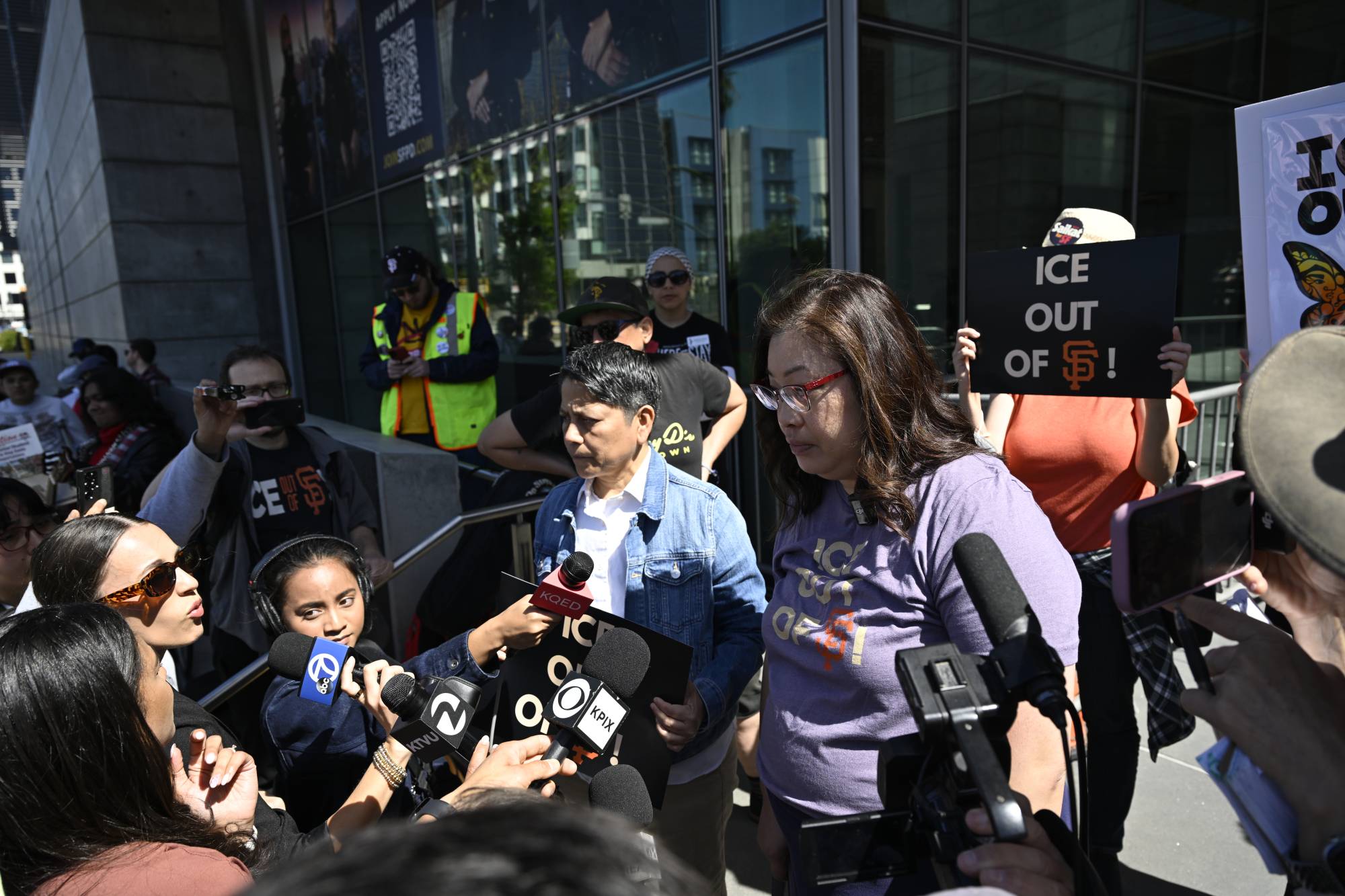
"caption": "Laura Valdez, left, executive director of Mission Action, and Angela Chan, assistant chief attorney at the San Francisco public defender's office, speak as protesters gather outside the San Francisco Police Department headquarters on March 25, 2026. They criticized the SFPD's presence at the scene where ICE officers arrested a mother at San Francisco International Airport.",
"credit": "Tayfun Coskun /Anadolu via Getty Images",
"altTag": "Two people speak into news microphones as a crowd of protesters surrounds them. A sign says \"ICE out of SF\"",
"description": null,
"imgSizes": {
"medium": {
"file": "https://cdn.kqed.org/wp-content/uploads/sites/10/2026/03/GettyImages-2267820367-2000x1333.jpg",
"width": 2000,
"height": 1333,
"mimeType": "image/jpeg"
},
"large": {
"file": "https://cdn.kqed.org/wp-content/uploads/sites/10/2026/03/GettyImages-2267820367-2000x1333.jpg",
"width": 2000,
"height": 1333,
"mimeType": "image/jpeg"
},
"thumbnail": {
"file": "https://cdn.kqed.org/wp-content/uploads/sites/10/2026/03/GettyImages-2267820367-160x107.jpg",
"width": 160,
"height": 107,
"mimeType": "image/jpeg"
},
"1536x1536": {
"file": "https://cdn.kqed.org/wp-content/uploads/sites/10/2026/03/GettyImages-2267820367-1536x1024.jpg",
"width": 1536,
"height": 1024,
"mimeType": "image/jpeg"
},
"2048x2048": {
"file": "https://cdn.kqed.org/wp-content/uploads/sites/10/2026/03/GettyImages-2267820367-2048x1365.jpg",
"width": 2048,
"height": 1365,
"mimeType": "image/jpeg"
},
"post-thumbnail": {
"file": "https://cdn.kqed.org/wp-content/uploads/sites/10/2026/03/GettyImages-2267820367-672x372.jpg",
"width": 672,
"height": 372,
"mimeType": "image/jpeg"
},
"twentyfourteen-full-width": {
"file": "https://cdn.kqed.org/wp-content/uploads/sites/10/2026/03/GettyImages-2267820367-1038x576.jpg",
"width": 1038,
"height": 576,
"mimeType": "image/jpeg"
},
"full-width": {
"file": "https://cdn.kqed.org/wp-content/uploads/sites/10/2026/03/GettyImages-2267820367-2000x1333.jpg",
"width": 2000,
"height": 1333,
"mimeType": "image/jpeg"
},
"npr-cds-wide": {
"file": "https://cdn.kqed.org/wp-content/uploads/sites/10/2026/03/GettyImages-2267820367-1200x675.jpg",
"width": 1200,
"height": 675,
"mimeType": "image/jpeg"
},
"npr-cds-square": {
"file": "https://cdn.kqed.org/wp-content/uploads/sites/10/2026/03/GettyImages-2267820367-600x600.jpg",
"width": 600,
"height": 600,
"mimeType": "image/jpeg"
},
"kqedFullSize": {
"file": "https://cdn.kqed.org/wp-content/uploads/sites/10/2026/03/GettyImages-2267820367-scaled.jpg",
"width": 2560,
"height": 1707
}
},
"isLoading": false,
"fetchFailed": false
},
"news_12029736": {
"type": "attachments",
"id": "news_12029736",
"meta": {
"index": "attachments_1716263798",
"site": "news",
"id": "12029736",
"found": true
},
"title": "The Antioch Police Department in Antioch on March 3, 2025.",
"publishDate": 1741135055,
"status": "inherit",
"parent": 0,
"modified": 1741135070,
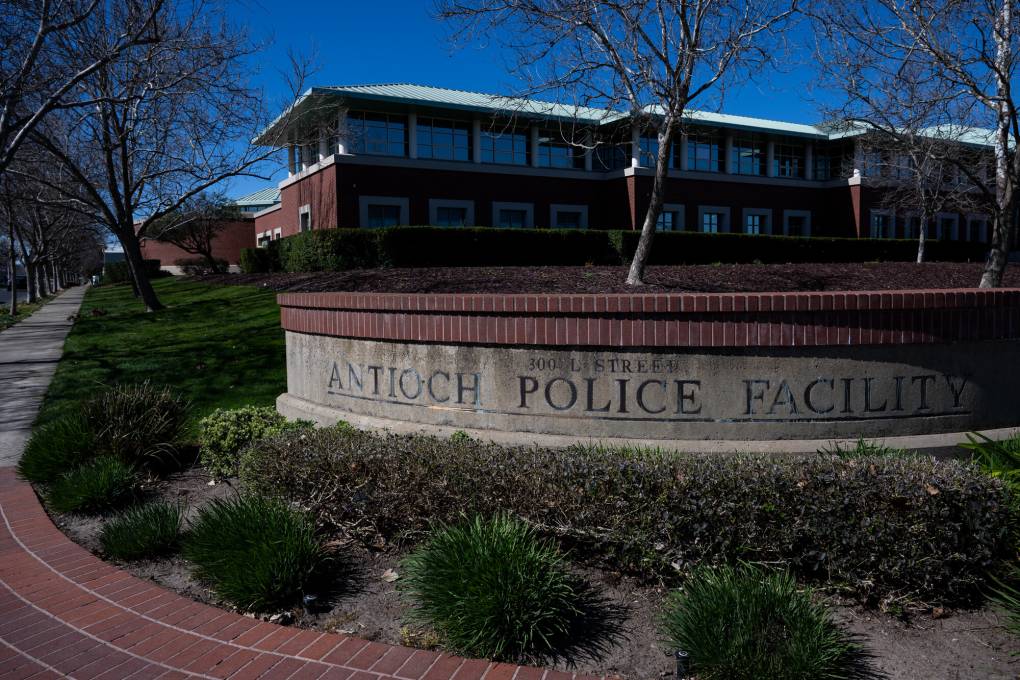
"caption": "The Antioch Police Department in Antioch on March 3, 2025.",
"credit": "Beth LaBerge/KQED",
"altTag": null,
"description": null,
"imgSizes": {
"medium": {
"file": "https://cdn.kqed.org/wp-content/uploads/sites/10/2025/03/250303-AntiochPolice-02-BL_qed-800x533.jpg",
"width": 800,
"height": 533,
"mimeType": "image/jpeg"
},
"large": {
"file": "https://cdn.kqed.org/wp-content/uploads/sites/10/2025/03/250303-AntiochPolice-02-BL_qed-1020x680.jpg",
"width": 1020,
"height": 680,
"mimeType": "image/jpeg"
},
"thumbnail": {
"file": "https://cdn.kqed.org/wp-content/uploads/sites/10/2025/03/250303-AntiochPolice-02-BL_qed-160x107.jpg",
"width": 160,
"height": 107,
"mimeType": "image/jpeg"
},
"1536x1536": {
"file": "https://cdn.kqed.org/wp-content/uploads/sites/10/2025/03/250303-AntiochPolice-02-BL_qed-1536x1024.jpg",
"width": 1536,
"height": 1024,
"mimeType": "image/jpeg"
},
"post-thumbnail": {
"file": "https://cdn.kqed.org/wp-content/uploads/sites/10/2025/03/250303-AntiochPolice-02-BL_qed-672x372.jpg",
"width": 672,
"height": 372,
"mimeType": "image/jpeg"
},
"twentyfourteen-full-width": {
"file": "https://cdn.kqed.org/wp-content/uploads/sites/10/2025/03/250303-AntiochPolice-02-BL_qed-1038x576.jpg",
"width": 1038,
"height": 576,
"mimeType": "image/jpeg"
},
"full-width": {
"file": "https://cdn.kqed.org/wp-content/uploads/sites/10/2025/03/250303-AntiochPolice-02-BL_qed-1920x1280.jpg",
"width": 1920,
"height": 1280,
"mimeType": "image/jpeg"
},
"kqedFullSize": {
"file": "https://cdn.kqed.org/wp-content/uploads/sites/10/2025/03/250303-AntiochPolice-02-BL_qed.jpg",
"width": 2000,
"height": 1333
}
},
"isLoading": false,
"fetchFailed": false
},
"news_12077215": {
"type": "attachments",
"id": "news_12077215",
"meta": {
"index": "attachments_1716263798",
"site": "news",
"id": "12077215",
"found": true
},
"title": "Hearing For Mary Fong Lau At San Francisco Hall Of Justice",
"publishDate": 1774041547,
"status": "inherit",
"parent": 12077174,
"modified": 1774041603,
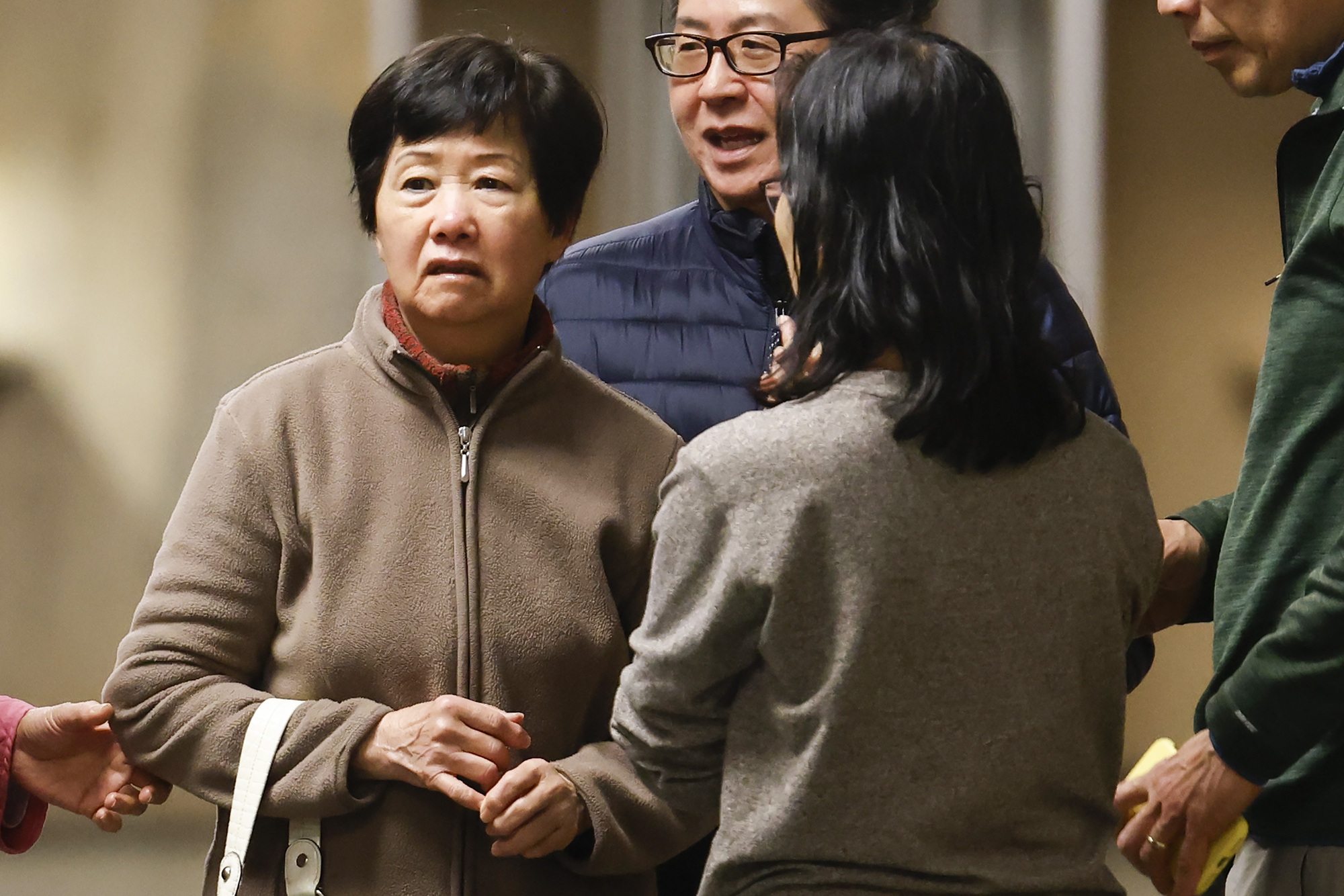
"caption": "Mary Fong Lau, left, stands with friends in the hallway ahead of a hearing at the Hall of Justice in San Francisco, California, on Feb. 13, 2026. Lau is a San Francisco resident facing felony vehicular manslaughter charges in an accident that killed a family of four in March 2024. ",
"credit": "Jessica Christian/San Francisco Chronicle via Getty Images",
"altTag": null,
"description": null,
"imgSizes": {
"thumbnail": {
"file": "https://cdn.kqed.org/wp-content/uploads/sites/10/2026/03/MaryFongLauGetty-160x107.jpg",
"width": 160,
"height": 107,
"mimeType": "image/jpeg"
},
"1536x1536": {
"file": "https://cdn.kqed.org/wp-content/uploads/sites/10/2026/03/MaryFongLauGetty-1536x1025.jpg",
"width": 1536,
"height": 1025,
"mimeType": "image/jpeg"
},
"post-thumbnail": {
"file": "https://cdn.kqed.org/wp-content/uploads/sites/10/2026/03/MaryFongLauGetty-672x372.jpg",
"width": 672,
"height": 372,
"mimeType": "image/jpeg"
},
"twentyfourteen-full-width": {
"file": "https://cdn.kqed.org/wp-content/uploads/sites/10/2026/03/MaryFongLauGetty-1038x576.jpg",
"width": 1038,
"height": 576,
"mimeType": "image/jpeg"
},
"npr-cds-wide": {
"file": "https://cdn.kqed.org/wp-content/uploads/sites/10/2026/03/MaryFongLauGetty-1200x675.jpg",
"width": 1200,
"height": 675,
"mimeType": "image/jpeg"
},
"kqedFullSize": {
"file": "https://cdn.kqed.org/wp-content/uploads/sites/10/2026/03/MaryFongLauGetty.jpg",
"width": 2000,
"height": 1334
}
},
"isLoading": false,
"fetchFailed": false
},
"news_12075430": {
"type": "attachments",
"id": "news_12075430",
"meta": {
"index": "attachments_1716263798",
"site": "news",
"id": "12075430",
"found": true
},
"title": "260304-Elon-Musk-Trial-03-KQED",
"publishDate": 1772664124,
"status": "inherit",
"parent": 12081290,
"modified": 1777070671,
"caption": "A courtroom sketch depicts Elon Musk on the stand on March 4, 2026.",
"credit": "Vicki Behringer for KQED",
"altTag": null,
"description": null,
"imgSizes": {
"thumbnail": {
"file": "https://cdn.kqed.org/wp-content/uploads/sites/10/2026/03/260304-Elon-Musk-Trial-03-KQED-160x107.jpg",
"width": 160,
"height": 107,
"mimeType": "image/jpeg"
},
"1536x1536": {
"file": "https://cdn.kqed.org/wp-content/uploads/sites/10/2026/03/260304-Elon-Musk-Trial-03-KQED-1536x1024.jpg",
"width": 1536,
"height": 1024,
"mimeType": "image/jpeg"
},
"post-thumbnail": {
"file": "https://cdn.kqed.org/wp-content/uploads/sites/10/2026/03/260304-Elon-Musk-Trial-03-KQED-672x372.jpg",
"width": 672,
"height": 372,
"mimeType": "image/jpeg"
},
"twentyfourteen-full-width": {
"file": "https://cdn.kqed.org/wp-content/uploads/sites/10/2026/03/260304-Elon-Musk-Trial-03-KQED-1038x576.jpg",
"width": 1038,
"height": 576,
"mimeType": "image/jpeg"
},
"npr-cds-wide": {
"file": "https://cdn.kqed.org/wp-content/uploads/sites/10/2026/03/260304-Elon-Musk-Trial-03-KQED-1200x675.jpg",
"width": 1200,
"height": 675,
"mimeType": "image/jpeg"
},
"kqedFullSize": {
"file": "https://cdn.kqed.org/wp-content/uploads/sites/10/2026/03/260304-Elon-Musk-Trial-03-KQED.jpg",
"width": 2000,
"height": 1333
}
},
"isLoading": false,
"fetchFailed": false
},
"news_12075461": {
"type": "attachments",
"id": "news_12075461",
"meta": {
"index": "attachments_1716263798",
"site": "news",
"id": "12075461",
"found": true
},
"title": "260304-Elon-Musk-Trial-05-KQED",
"publishDate": 1772671994,
"status": "inherit",
"parent": 12075332,
"modified": 1773790475,
"caption": "A courtroom sketch depicts the defense questioning Elon Musk on March 4, 2026.",
"credit": "Vicki Behringer for KQED",
"altTag": null,
"description": null,
"imgSizes": {
"thumbnail": {
"file": "https://cdn.kqed.org/wp-content/uploads/sites/10/2026/03/260304-Elon-Musk-Trial-05-KQED-160x107.jpg",
"width": 160,
"height": 107,
"mimeType": "image/jpeg"
},
"1536x1536": {
"file": "https://cdn.kqed.org/wp-content/uploads/sites/10/2026/03/260304-Elon-Musk-Trial-05-KQED-1536x1024.jpg",
"width": 1536,
"height": 1024,
"mimeType": "image/jpeg"
},
"post-thumbnail": {
"file": "https://cdn.kqed.org/wp-content/uploads/sites/10/2026/03/260304-Elon-Musk-Trial-05-KQED-672x372.jpg",
"width": 672,
"height": 372,
"mimeType": "image/jpeg"
},
"twentyfourteen-full-width": {
"file": "https://cdn.kqed.org/wp-content/uploads/sites/10/2026/03/260304-Elon-Musk-Trial-05-KQED-1038x576.jpg",
"width": 1038,
"height": 576,
"mimeType": "image/jpeg"
},
"npr-cds-wide": {
"file": "https://cdn.kqed.org/wp-content/uploads/sites/10/2026/03/260304-Elon-Musk-Trial-05-KQED-1200x675.jpg",
"width": 1200,
"height": 675,
"mimeType": "image/jpeg"
},
"kqedFullSize": {
"file": "https://cdn.kqed.org/wp-content/uploads/sites/10/2026/03/260304-Elon-Musk-Trial-05-KQED.jpg",
"width": 2000,
"height": 1333
}
},
"isLoading": false,
"fetchFailed": false
},
"news_12076316": {
"type": "attachments",
"id": "news_12076316",
"meta": {
"index": "attachments_1716263798",
"site": "news",
"id": "12076316",
"found": true
},
"title": "260312-Ayden Fang-KQED",
"publishDate": 1773347618,
"status": "inherit",
"parent": 0,
"modified": 1773349936,
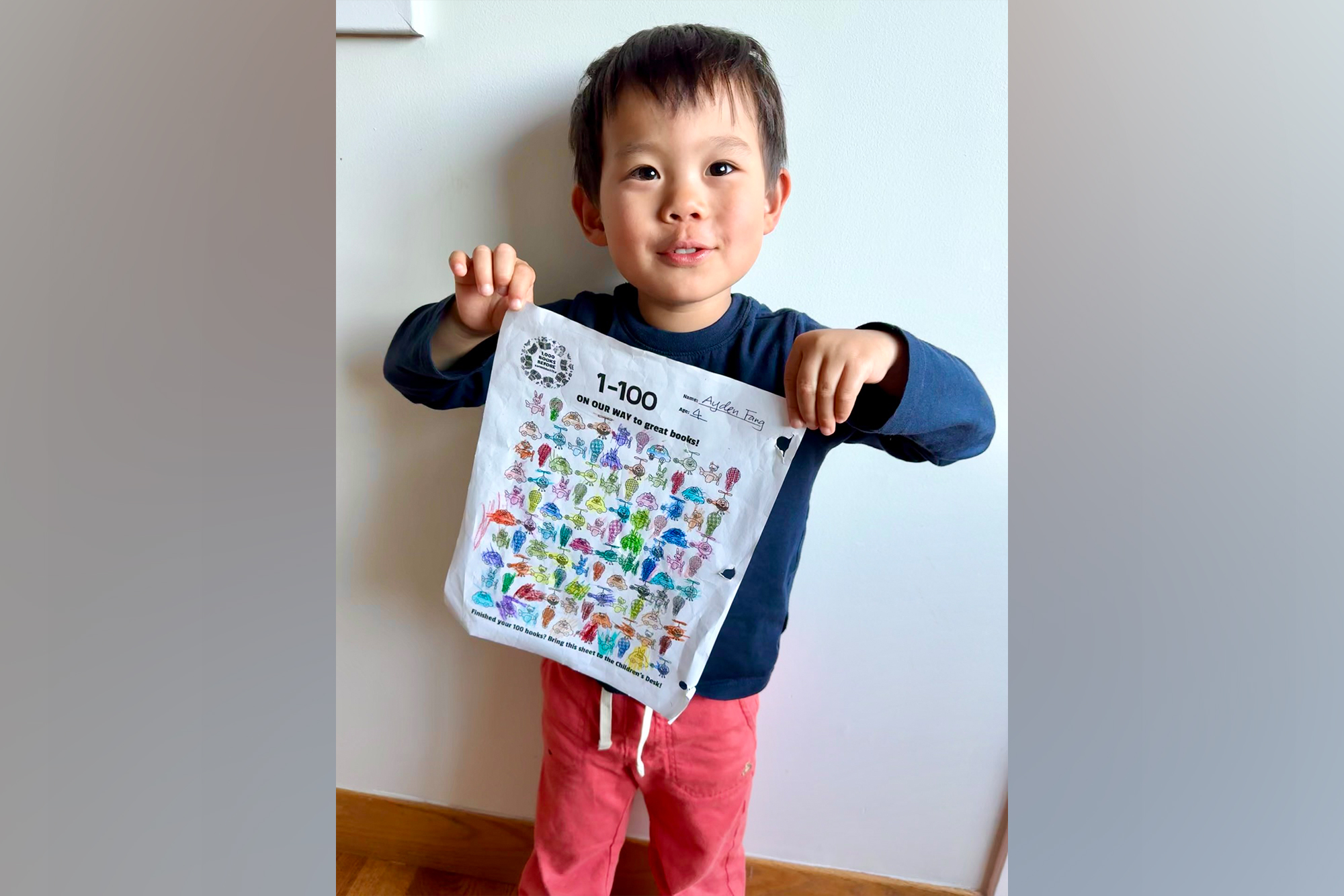
"caption": "A photograph of 4-year-old Ayden Fang, who was killed when a vehicle crashed onto the sidewalk where he was playing in downtown Burlingame on Aug. 8, 2025.",
"credit": "Courtesy of Xiaoming Fang and Ting Ting Liu",
"altTag": null,
"description": null,
"imgSizes": {
"thumbnail": {
"file": "https://cdn.kqed.org/wp-content/uploads/sites/10/2026/03/260312-Ayden-Fang-KQED-160x107.jpg",
"width": 160,
"height": 107,
"mimeType": "image/jpeg"
},
"1536x1536": {
"file": "https://cdn.kqed.org/wp-content/uploads/sites/10/2026/03/260312-Ayden-Fang-KQED-1536x1025.jpg",
"width": 1536,
"height": 1025,
"mimeType": "image/jpeg"
},
"post-thumbnail": {
"file": "https://cdn.kqed.org/wp-content/uploads/sites/10/2026/03/260312-Ayden-Fang-KQED-672x372.jpg",
"width": 672,
"height": 372,
"mimeType": "image/jpeg"
},
"twentyfourteen-full-width": {
"file": "https://cdn.kqed.org/wp-content/uploads/sites/10/2026/03/260312-Ayden-Fang-KQED-1038x576.jpg",
"width": 1038,
"height": 576,
"mimeType": "image/jpeg"
},
"npr-cds-wide": {
"file": "https://cdn.kqed.org/wp-content/uploads/sites/10/2026/03/260312-Ayden-Fang-KQED-1200x675.jpg",
"width": 1200,
"height": 675,
"mimeType": "image/jpeg"
},
"kqedFullSize": {
"file": "https://cdn.kqed.org/wp-content/uploads/sites/10/2026/03/260312-Ayden-Fang-KQED.jpg",
"width": 2000,
"height": 1334
}
},
"isLoading": false,
"fetchFailed": false
},
"news_12075897": {
"type": "attachments",
"id": "news_12075897",
"meta": {
"index": "attachments_1716263798",
"site": "news",
"id": "12075897",
"found": true
},
"title": "250418-SFPDFile-14-BL_qed",
"publishDate": 1773159243,
"status": "inherit",
"parent": 12075894,
"modified": 1773159258,
"caption": "The Northern District Police Station of the San Francisco Police Department in San Francisco's Fillmore neighborhood on April 18, 2025.",
"credit": "Beth LaBerge/KQED",
"altTag": null,
"description": null,
"imgSizes": {
"thumbnail": {
"file": "https://cdn.kqed.org/wp-content/uploads/sites/10/2026/03/250418-SFPDFile-14-BL_qed-160x107.jpg",
"width": 160,
"height": 107,
"mimeType": "image/jpeg"
},
"1536x1536": {
"file": "https://cdn.kqed.org/wp-content/uploads/sites/10/2026/03/250418-SFPDFile-14-BL_qed-1536x1024.jpg",
"width": 1536,
"height": 1024,
"mimeType": "image/jpeg"
},
"post-thumbnail": {
"file": "https://cdn.kqed.org/wp-content/uploads/sites/10/2026/03/250418-SFPDFile-14-BL_qed-672x372.jpg",
"width": 672,
"height": 372,
"mimeType": "image/jpeg"
},
"twentyfourteen-full-width": {
"file": "https://cdn.kqed.org/wp-content/uploads/sites/10/2026/03/250418-SFPDFile-14-BL_qed-1038x576.jpg",
"width": 1038,
"height": 576,
"mimeType": "image/jpeg"
},
"npr-cds-wide": {
"file": "https://cdn.kqed.org/wp-content/uploads/sites/10/2026/03/250418-SFPDFile-14-BL_qed-1200x675.jpg",
"width": 1200,
"height": 675,
"mimeType": "image/jpeg"
},
"kqedFullSize": {
"file": "https://cdn.kqed.org/wp-content/uploads/sites/10/2026/03/250418-SFPDFile-14-BL_qed.jpg",
"width": 2000,
"height": 1333
}
},
"isLoading": false,
"fetchFailed": false
},
"news_12075904": {
"type": "attachments",
"id": "news_12075904",
"meta": {
"index": "attachments_1716263798",
"site": "news",
"id": "12075904",
"found": true
},
"title": "260309-OAKLANDVICTIMS00259_TV-KQED",
"publishDate": 1773160301,
"status": "inherit",
"parent": 0,
"modified": 1773166916,
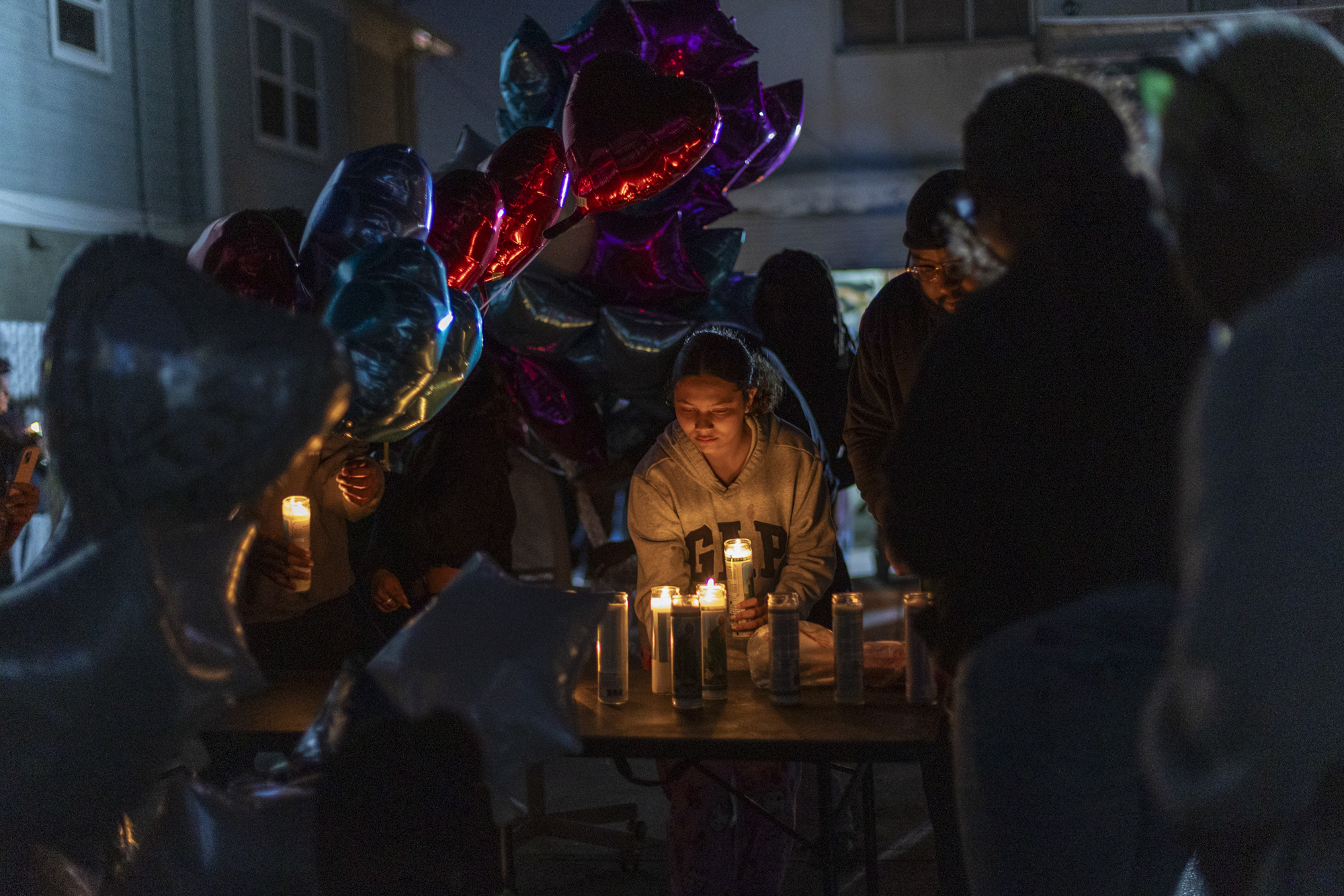
"caption": "Yasmin Chapadense, a student of Latetia Bobo’s, places a lit candle on a table honoring her memory at her vigil in Oakland on March 9, 2026. Latetia Bobo was one of two victims who died in a mass shooting in Oakland on Saturday, March 7.",
"credit": "Tâm Vũ/KQED",
"altTag": null,
"description": null,
"imgSizes": {
"thumbnail": {
"file": "https://cdn.kqed.org/wp-content/uploads/sites/10/2026/03/260309-OAKLANDVICTIMS00259_TV-KQED-160x107.jpg",
"width": 160,
"height": 107,
"mimeType": "image/jpeg"
},
"1536x1536": {
"file": "https://cdn.kqed.org/wp-content/uploads/sites/10/2026/03/260309-OAKLANDVICTIMS00259_TV-KQED-1536x1025.jpg",
"width": 1536,
"height": 1025,
"mimeType": "image/jpeg"
},
"post-thumbnail": {
"file": "https://cdn.kqed.org/wp-content/uploads/sites/10/2026/03/260309-OAKLANDVICTIMS00259_TV-KQED-672x372.jpg",
"width": 672,
"height": 372,
"mimeType": "image/jpeg"
},
"twentyfourteen-full-width": {
"file": "https://cdn.kqed.org/wp-content/uploads/sites/10/2026/03/260309-OAKLANDVICTIMS00259_TV-KQED-1038x576.jpg",
"width": 1038,
"height": 576,
"mimeType": "image/jpeg"
},
"npr-cds-wide": {
"file": "https://cdn.kqed.org/wp-content/uploads/sites/10/2026/03/260309-OAKLANDVICTIMS00259_TV-KQED-1200x675.jpg",
"width": 1200,
"height": 675,
"mimeType": "image/jpeg"
},
"kqedFullSize": {
"file": "https://cdn.kqed.org/wp-content/uploads/sites/10/2026/03/260309-OAKLANDVICTIMS00259_TV-KQED.jpg",
"width": 2000,
"height": 1334
}
},
"isLoading": false,
"fetchFailed": false
},
"news_11805615": {
"type": "attachments",
"id": "news_11805615",
"meta": {
"index": "attachments_1716263798",
"site": "news",
"id": "11805615",
"found": true
},
"title": "RS14516_475371681-qut",
"publishDate": 1583521455,
"status": "inherit",
"parent": 11805573,
"modified": 1773167109,
"caption": "The San Francisco resident was on his way to a court hearing at the San Francisco Hall of Justice when Immigration and Customs Enforcement agents arrested him — the first such arrest in the city, according to the public defender’s office.",
"credit": "Justin Sullivan/Getty Images",
"altTag": null,
"description": "The San Francisco resident was on his way to a court hearing at the San Francisco Hall of Justice when he was arrested by Immigration and Customs Enforcement agents — the first such arrest in the city, according to the public defender’s office.",
"imgSizes": {
"thumbnail": {
"file": "https://cdn.kqed.org/wp-content/uploads/sites/10/2020/03/RS14516_475371681-qut-160x107.jpg",
"width": 160,
"height": 107,
"mimeType": "image/jpeg"
},
"medium": {
"file": "https://cdn.kqed.org/wp-content/uploads/sites/10/2020/03/RS14516_475371681-qut-800x534.jpg",
"width": 800,
"height": 534,
"mimeType": "image/jpeg"
},
"large": {
"file": "https://cdn.kqed.org/wp-content/uploads/sites/10/2020/03/RS14516_475371681-qut-1020x681.jpg",
"width": 1020,
"height": 681,
"mimeType": "image/jpeg"
},
"post-thumbnail": {
"file": "https://cdn.kqed.org/wp-content/uploads/sites/10/2020/03/RS14516_475371681-qut-672x372.jpg",
"width": 672,
"height": 372,
"mimeType": "image/jpeg"
},
"twentyfourteen-full-width": {
"file": "https://cdn.kqed.org/wp-content/uploads/sites/10/2020/03/RS14516_475371681-qut-1038x576.jpg",
"width": 1038,
"height": 576,
"mimeType": "image/jpeg"
},
"full-width": {
"file": "https://cdn.kqed.org/wp-content/uploads/sites/10/2020/03/RS14516_475371681-qut-1920x1281.jpg",
"width": 1920,
"height": 1281,
"mimeType": "image/jpeg"
},
"apple_news_ca_landscape_12_9": {
"file": "https://cdn.kqed.org/wp-content/uploads/sites/10/2020/03/RS14516_475371681-qut-1832x1281.jpg",
"width": 1832,
"height": 1281,
"mimeType": "image/jpeg"
},
"apple_news_ca_landscape_9_7": {
"file": "https://cdn.kqed.org/wp-content/uploads/sites/10/2020/03/RS14516_475371681-qut-1376x1032.jpg",
"width": 1376,
"height": 1032,
"mimeType": "image/jpeg"
},
"apple_news_ca_landscape_5_5": {
"file": "https://cdn.kqed.org/wp-content/uploads/sites/10/2020/03/RS14516_475371681-qut-1044x783.jpg",
"width": 1044,
"height": 783,
"mimeType": "image/jpeg"
},
"apple_news_ca_landscape_4_7": {
"file": "https://cdn.kqed.org/wp-content/uploads/sites/10/2020/03/RS14516_475371681-qut-632x474.jpg",
"width": 632,
"height": 474,
"mimeType": "image/jpeg"
},
"apple_news_ca_landscape_4_0": {
"file": "https://cdn.kqed.org/wp-content/uploads/sites/10/2020/03/RS14516_475371681-qut-536x402.jpg",
"width": 536,
"height": 402,
"mimeType": "image/jpeg"
},
"apple_news_ca_portrait_12_9": {
"file": "https://cdn.kqed.org/wp-content/uploads/sites/10/2020/03/RS14516_475371681-qut-1122x1281.jpg",
"width": 1122,
"height": 1281,
"mimeType": "image/jpeg"
},
"apple_news_ca_portrait_9_7": {
"file": "https://cdn.kqed.org/wp-content/uploads/sites/10/2020/03/RS14516_475371681-qut-840x1120.jpg",
"width": 840,
"height": 1120,
"mimeType": "image/jpeg"
},
"apple_news_ca_portrait_5_5": {
"file": "https://cdn.kqed.org/wp-content/uploads/sites/10/2020/03/RS14516_475371681-qut-687x916.jpg",
"width": 687,
"height": 916,
"mimeType": "image/jpeg"
},
"apple_news_ca_portrait_4_7": {
"file": "https://cdn.kqed.org/wp-content/uploads/sites/10/2020/03/RS14516_475371681-qut-414x552.jpg",
"width": 414,
"height": 552,
"mimeType": "image/jpeg"
},
"apple_news_ca_portrait_4_0": {
"file": "https://cdn.kqed.org/wp-content/uploads/sites/10/2020/03/RS14516_475371681-qut-354x472.jpg",
"width": 354,
"height": 472,
"mimeType": "image/jpeg"
},
"apple_news_ca_square_12_9": {
"file": "https://cdn.kqed.org/wp-content/uploads/sites/10/2020/03/RS14516_475371681-qut-1472x1281.jpg",
"width": 1472,
"height": 1281,
"mimeType": "image/jpeg"
},
"apple_news_ca_square_9_7": {
"file": "https://cdn.kqed.org/wp-content/uploads/sites/10/2020/03/RS14516_475371681-qut-1104x1104.jpg",
"width": 1104,
"height": 1104,
"mimeType": "image/jpeg"
},
"apple_news_ca_square_5_5": {
"file": "https://cdn.kqed.org/wp-content/uploads/sites/10/2020/03/RS14516_475371681-qut-912x912.jpg",
"width": 912,
"height": 912,
"mimeType": "image/jpeg"
},
"apple_news_ca_square_4_7": {
"file": "https://cdn.kqed.org/wp-content/uploads/sites/10/2020/03/RS14516_475371681-qut-550x550.jpg",
"width": 550,
"height": 550,
"mimeType": "image/jpeg"
},
"apple_news_ca_square_4_0": {
"file": "https://cdn.kqed.org/wp-content/uploads/sites/10/2020/03/RS14516_475371681-qut-470x470.jpg",
"width": 470,
"height": 470,
"mimeType": "image/jpeg"
},
"kqedFullSize": {
"file": "https://cdn.kqed.org/wp-content/uploads/sites/10/2020/03/RS14516_475371681-qut.jpg",
"width": 1920,
"height": 1281
}
},
"isLoading": false,
"fetchFailed": false
},
"news_12031243": {
"type": "attachments",
"id": "news_12031243",
"meta": {
"index": "attachments_1716263798",
"site": "news",
"id": "12031243",
"found": true
},
"title": "041922-ATTORNEY-GENERAL-OFFICE-MHN-03-CM copy",
"publishDate": 1741896556,
"status": "inherit",
"parent": 12031237,
"modified": 1741896584,
"caption": "The seal above the offices of the California Department of Justice in Sacramento on April 19, 2022. ",
"credit": "Martin do Nascimento/CalMatters",
"altTag": null,
"description": null,
"imgSizes": {
"medium": {
"file": "https://cdn.kqed.org/wp-content/uploads/sites/10/2025/03/041922-ATTORNEY-GENERAL-OFFICE-MHN-03-CM-copy-800x533.jpg",
"width": 800,
"height": 533,
"mimeType": "image/jpeg"
},
"large": {
"file": "https://cdn.kqed.org/wp-content/uploads/sites/10/2025/03/041922-ATTORNEY-GENERAL-OFFICE-MHN-03-CM-copy-1020x680.jpg",
"width": 1020,
"height": 680,
"mimeType": "image/jpeg"
},
"thumbnail": {
"file": "https://cdn.kqed.org/wp-content/uploads/sites/10/2025/03/041922-ATTORNEY-GENERAL-OFFICE-MHN-03-CM-copy-160x107.jpg",
"width": 160,
"height": 107,
"mimeType": "image/jpeg"
},
"1536x1536": {
"file": "https://cdn.kqed.org/wp-content/uploads/sites/10/2025/03/041922-ATTORNEY-GENERAL-OFFICE-MHN-03-CM-copy-1536x1024.jpg",
"width": 1536,
"height": 1024,
"mimeType": "image/jpeg"
},
"post-thumbnail": {
"file": "https://cdn.kqed.org/wp-content/uploads/sites/10/2025/03/041922-ATTORNEY-GENERAL-OFFICE-MHN-03-CM-copy-672x372.jpg",
"width": 672,
"height": 372,
"mimeType": "image/jpeg"
},
"twentyfourteen-full-width": {
"file": "https://cdn.kqed.org/wp-content/uploads/sites/10/2025/03/041922-ATTORNEY-GENERAL-OFFICE-MHN-03-CM-copy-1038x576.jpg",
"width": 1038,
"height": 576,
"mimeType": "image/jpeg"
},
"kqedFullSize": {
"file": "https://cdn.kqed.org/wp-content/uploads/sites/10/2025/03/041922-ATTORNEY-GENERAL-OFFICE-MHN-03-CM-copy.jpg",
"width": 1568,
"height": 1045
}
},
"isLoading": false,
"fetchFailed": false
},
"news_12075382": {
"type": "attachments",
"id": "news_12075382",
"meta": {
"index": "attachments_1716263798",
"site": "news",
"id": "12075382",
"found": true
},
"title": "260304-Elon Musk Trial-01-KQED",
"publishDate": 1772650201,
"status": "inherit",
"parent": 12083612,
"modified": 1778805009,
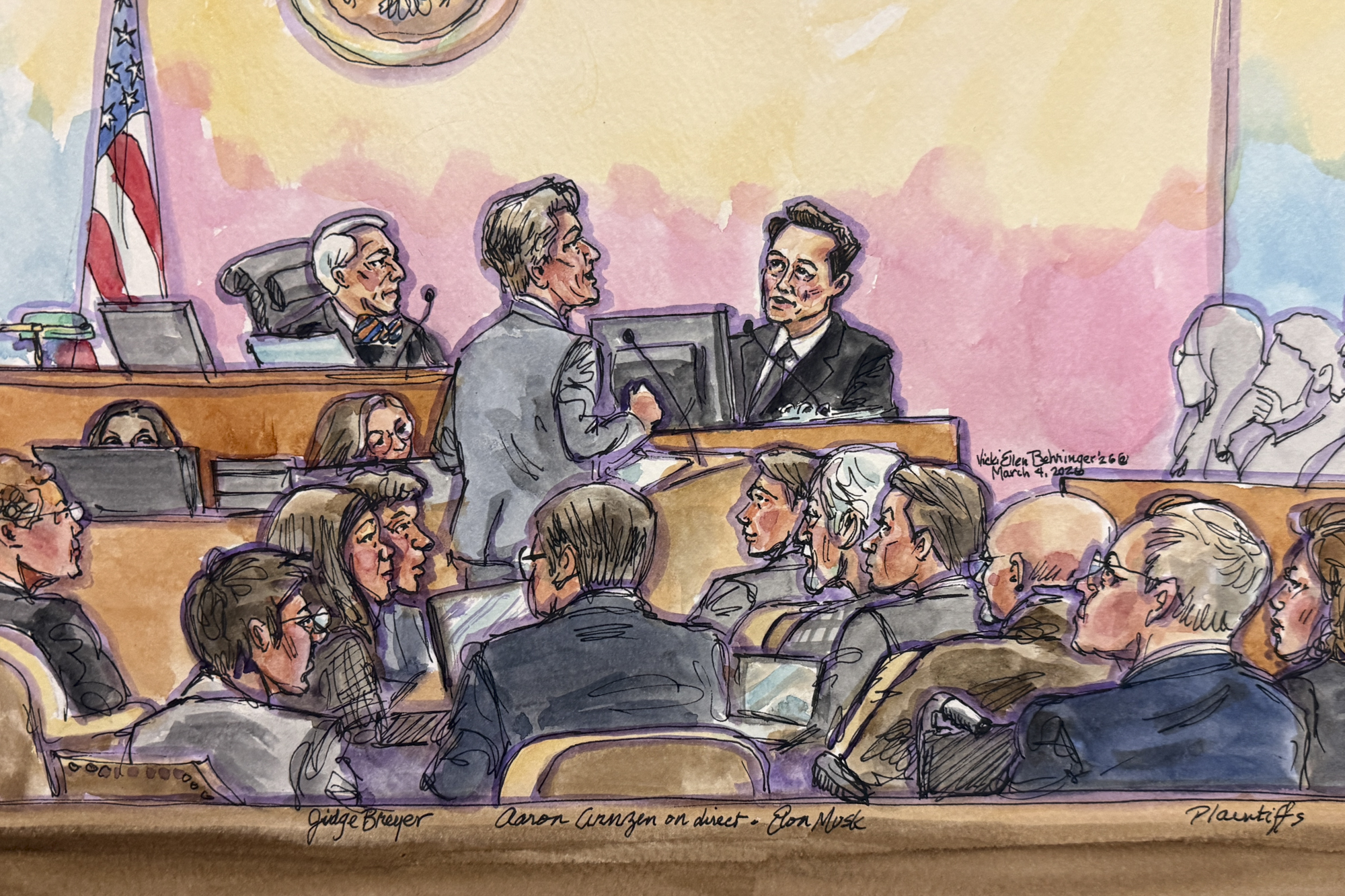
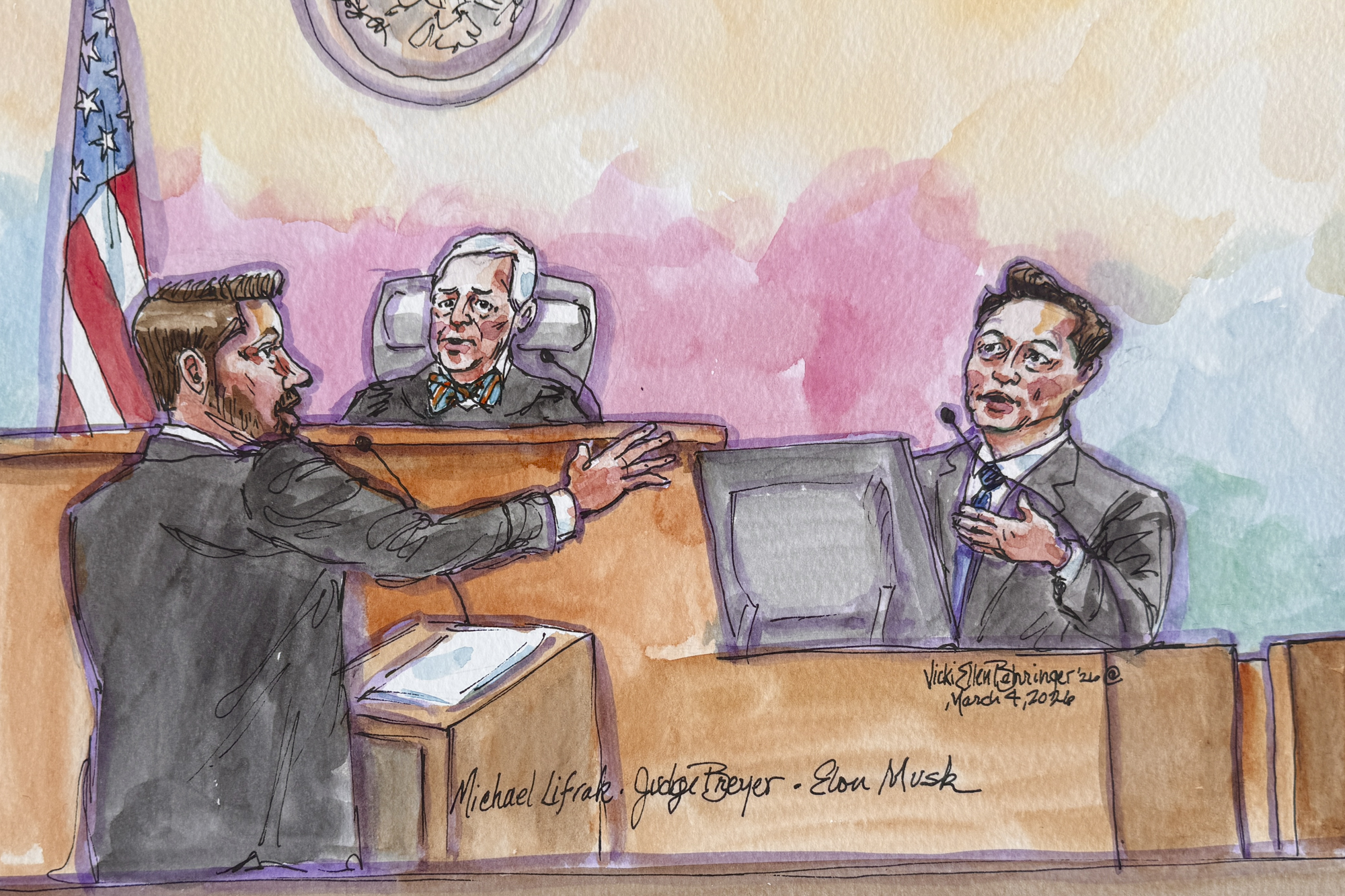
"caption": "A courtroom sketch of Elon Musk on the stand as he's questioned by the plaintiff's attorney, Aaron P. Arnzen, on March 4, 2026. Musk is accused of making false and misleading statements that drove down Twitter's stock price before he bought the social media platform for $44 billion in 2022.",
"credit": "Vicki Behringer for KQED",
"altTag": null,
"description": null,
"imgSizes": {
"thumbnail": {
"file": "https://cdn.kqed.org/wp-content/uploads/sites/10/2026/03/260304-Elon-Musk-Trial-01-KQED-160x107.jpg",
"width": 160,
"height": 107,
"mimeType": "image/jpeg"
},
"1536x1536": {
"file": "https://cdn.kqed.org/wp-content/uploads/sites/10/2026/03/260304-Elon-Musk-Trial-01-KQED-1536x1024.jpg",
"width": 1536,
"height": 1024,
"mimeType": "image/jpeg"
},
"post-thumbnail": {
"file": "https://cdn.kqed.org/wp-content/uploads/sites/10/2026/03/260304-Elon-Musk-Trial-01-KQED-672x372.jpg",
"width": 672,
"height": 372,
"mimeType": "image/jpeg"
},
"twentyfourteen-full-width": {
"file": "https://cdn.kqed.org/wp-content/uploads/sites/10/2026/03/260304-Elon-Musk-Trial-01-KQED-1038x576.jpg",
"width": 1038,
"height": 576,
"mimeType": "image/jpeg"
},
"npr-cds-wide": {
"file": "https://cdn.kqed.org/wp-content/uploads/sites/10/2026/03/260304-Elon-Musk-Trial-01-KQED-1200x675.jpg",
"width": 1200,
"height": 675,
"mimeType": "image/jpeg"
},
"kqedFullSize": {
"file": "https://cdn.kqed.org/wp-content/uploads/sites/10/2026/03/260304-Elon-Musk-Trial-01-KQED.jpg",
"width": 2000,
"height": 1333
}
},
"isLoading": false,
"fetchFailed": false
},
"news_12075399": {
"type": "attachments",
"id": "news_12075399",
"meta": {
"index": "attachments_1716263798",
"site": "news",
"id": "12075399",
"found": true
},
"title": "Los Gatos teen party mom denied bail, judge issues protective orders for alleged victims",
"publishDate": 1772653317,
"status": "inherit",
"parent": 12075393,
"modified": 1772664995,
"caption": "Shannon O'Connor, the Los Gatos woman charged with throwing drunken and sex-filled parties for her son and local teens, attends an arraignment hearing with her attorney Sam Polverino in San José, California, on Oct. 20, 2021.",
"credit": "Anda Chu/MediaNews Group/The Mercury News via Getty Images",
"altTag": null,
"description": "Photo by Anda Chu via Getty Images",
"imgSizes": {
"thumbnail": {
"file": "https://cdn.kqed.org/wp-content/uploads/sites/10/2026/03/GettyImages-1236026529-160x107.jpg",
"width": 160,
"height": 107,
"mimeType": "image/jpeg"
},
"1536x1536": {
"file": "https://cdn.kqed.org/wp-content/uploads/sites/10/2026/03/GettyImages-1236026529-1536x1024.jpg",
"width": 1536,
"height": 1024,
"mimeType": "image/jpeg"
},
"post-thumbnail": {
"file": "https://cdn.kqed.org/wp-content/uploads/sites/10/2026/03/GettyImages-1236026529-672x372.jpg",
"width": 672,
"height": 372,
"mimeType": "image/jpeg"
},
"twentyfourteen-full-width": {
"file": "https://cdn.kqed.org/wp-content/uploads/sites/10/2026/03/GettyImages-1236026529-1038x576.jpg",
"width": 1038,
"height": 576,
"mimeType": "image/jpeg"
},
"npr-cds-wide": {
"file": "https://cdn.kqed.org/wp-content/uploads/sites/10/2026/03/GettyImages-1236026529-1200x675.jpg",
"width": 1200,
"height": 675,
"mimeType": "image/jpeg"
},
"kqedFullSize": {
"file": "https://cdn.kqed.org/wp-content/uploads/sites/10/2026/03/GettyImages-1236026529.jpg",
"width": 1980,
"height": 1320
}
},
"isLoading": false,
"fetchFailed": false
}
},
"audioPlayerReducer": {
"postId": "stream_live",
"isPaused": true,
"isPlaying": false,
"pfsActive": false,
"pledgeModalIsOpen": true,
"playerDrawerIsOpen": false,
"liveAudioPlayStartedAt": 0,
"liveAudioPlayContext": ""
},
"authorsReducer": {
"shossaini": {
"type": "authors",
"id": "3214",
"meta": {
"index": "authors_1716337520",
"id": "3214",
"found": true
},
"name": "Sara Hossaini",
"firstName": "Sara",
"lastName": "Hossaini",
"slug": "shossaini",
"email": "shossaini@kqed.org",
"display_author_email": true,
"staff_mastheads": [
"news"
],
"title": "KQED Reporter",
"bio": "Sara Hossaini came to general assignment reporting at KQED in 2013 after two winters reporting at Wyoming Public Radio. She holds a bachelor's degree in broadcast journalism from the University of Nebraska-Lincoln. Her radio romance began after a bitter breakup with documentary film (Ok, maybe it's still complicated). Her first simultaneous jobs in San Francisco were as Associate Producer on a PBS film series through the Center for Asian American Media and as a butler. She likes to trot, plot and make things with her hands.",
"avatar": "https://secure.gravatar.com/avatar/060e9f56b9554e17942e89f413242774?s=600&d=blank&r=g",
"twitter": "mshossaini",
"facebook": null,
"instagram": null,
"linkedin": null,
"sites": [
{
"site": "news",
"roles": [
"author"
]
},
{
"site": "stateofhealth",
"roles": [
"author"
]
}
],
"headData": {
"title": "Sara Hossaini | KQED",
"description": "KQED Reporter",
"ogImgSrc": "https://secure.gravatar.com/avatar/060e9f56b9554e17942e89f413242774?s=600&d=blank&r=g",
"twImgSrc": "https://secure.gravatar.com/avatar/060e9f56b9554e17942e89f413242774?s=600&d=blank&r=g"
},
"isLoading": false,
"link": "/author/shossaini"
},
"lklivans": {
"type": "authors",
"id": "8648",
"meta": {
"index": "authors_1716337520",
"id": "8648",
"found": true
},
"name": "Laura Klivans",
"firstName": "Laura",
"lastName": "Klivans",
"slug": "lklivans",
"email": "lklivans@kqed.org",
"display_author_email": true,
"staff_mastheads": [
"news",
"science"
],
"title": "Reporter",
"bio": "Laura Klivans is an award-winning science reporter for KQED News, where she covers climate change with an eye on both groundbreaking progress and gaps in action. She is the former host of KQED's blockbuster video series about tiny, amazing animals, \u003cem>Deep Look\u003c/em>. Her work reaches national audiences through NPR, \u003cem>Here & Now, \u003c/em>PRI, and other major outlets. \r\n\r\nLaura’s won five Northern California Area Emmy Awards for Deep Look and First Place in the Greater Bay Area Journalism Awards for a podcast exploring how one Oakland neighborhood teamed up to reduce planet-heating pollution.\r\n\r\nBeyond her reporting, she hosts and moderates events. In the past, she taught audio storytelling at the UC Berkeley Graduate School of Journalism, led international education programs, worked with immigrants and refugees along the Thai-Burmese border, taught high schoolers sex ed, and was an actress. \r\n\r\nShe's a former UC Berkeley Human Rights Fellow, USC Center for Health Journalism's California Fellow and Coro Fellow in Public Affairs. Laura has a master’s in journalism from UC Berkeley, a master’s in education from Harvard, and an undergraduate degree from Northwestern University.\r\n\r\nShe loves trying to riddle the meaning out of vanity license plates.",
"avatar": "https://secure.gravatar.com/avatar/2d2ecd1550a494cc10ad4a503406965585902124739e775a9b3817eebf1d88be?s=600&d=blank&r=g",
"twitter": "lauraklivans",
"bluesky": null,
"facebook": null,
"instagram": null,
"linkedin": null,
"sites": [
{
"site": "news",
"roles": [
"editor"
]
},
{
"site": "stateofhealth",
"roles": [
"contributor",
"editor"
]
},
{
"site": "science",
"roles": [
"editor"
]
},
{
"site": "forum",
"roles": [
"editor"
]
}
],
"headData": {
"title": "Laura Klivans | KQED",
"description": "Reporter",
"ogImgSrc": "https://secure.gravatar.com/avatar/2d2ecd1550a494cc10ad4a503406965585902124739e775a9b3817eebf1d88be?s=600&d=blank&r=g",
"twImgSrc": "https://secure.gravatar.com/avatar/2d2ecd1550a494cc10ad4a503406965585902124739e775a9b3817eebf1d88be?s=600&d=blank&r=g"
},
"isLoading": false,
"link": "/author/lklivans"
},
"vrancano": {
"type": "authors",
"id": "11276",
"meta": {
"index": "authors_1716337520",
"id": "11276",
"found": true
},
"name": "Vanessa Rancaño",
"firstName": "Vanessa",
"lastName": "Rancaño",
"slug": "vrancano",
"email": "vrancano@kqed.org",
"display_author_email": false,
"staff_mastheads": [
"news"
],
"title": "Reporter",
"bio": "Vanessa Rancaño is a features reporter for KQED. She’s also covered homelessness and education for the station and reported from the Central Valley. Her work has aired across public radio, from flagship national news shows to longform narrative podcasts. Before taking up a mic, she worked as a freelance print journalist. She’s been recognized with a number of national and regional awards. Vanessa grew up in California's Central Valley. She's a former NPR Kroc Fellow, and a graduate of the UC Berkeley Graduate School of Journalism.",
"avatar": "https://secure.gravatar.com/avatar/b3a383dfb0e7ee1c17568f2cf067904ab654d6e3de9743fc661f3c788ade1bed?s=600&d=blank&r=g",
"twitter": "vanessarancano",
"bluesky": null,
"facebook": null,
"instagram": null,
"linkedin": null,
"sites": [
{
"site": "arts",
"roles": [
"editor"
]
},
{
"site": "news",
"roles": [
"editor"
]
},
{
"site": "liveblog",
"roles": [
"contributor"
]
}
],
"headData": {
"title": "Vanessa Rancaño | KQED",
"description": "Reporter",
"ogImgSrc": "https://secure.gravatar.com/avatar/b3a383dfb0e7ee1c17568f2cf067904ab654d6e3de9743fc661f3c788ade1bed?s=600&d=blank&r=g",
"twImgSrc": "https://secure.gravatar.com/avatar/b3a383dfb0e7ee1c17568f2cf067904ab654d6e3de9743fc661f3c788ade1bed?s=600&d=blank&r=g"
},
"isLoading": false,
"link": "/author/vrancano"
},
"jlara": {
"type": "authors",
"id": "11761",
"meta": {
"index": "authors_1716337520",
"id": "11761",
"found": true
},
"name": "Juan Carlos Lara",
"firstName": "Juan Carlos",
"lastName": "Lara",
"slug": "jlara",
"email": "jlara@kqed.org",
"display_author_email": false,
"staff_mastheads": [],
"title": "KQED Contributor",
"bio": null,
"avatar": "https://secure.gravatar.com/avatar/19e2052b9b05657c5ff2af2121846e9c?s=600&d=blank&r=g",
"twitter": null,
"facebook": null,
"instagram": null,
"linkedin": null,
"sites": [
{
"site": "arts",
"roles": [
"editor"
]
},
{
"site": "news",
"roles": [
"editor"
]
},
{
"site": "forum",
"roles": [
"editor"
]
},
{
"site": "liveblog",
"roles": [
"contributor"
]
}
],
"headData": {
"title": "Juan Carlos Lara | KQED",
"description": "KQED Contributor",
"ogImgSrc": "https://secure.gravatar.com/avatar/19e2052b9b05657c5ff2af2121846e9c?s=600&d=blank&r=g",
"twImgSrc": "https://secure.gravatar.com/avatar/19e2052b9b05657c5ff2af2121846e9c?s=600&d=blank&r=g"
},
"isLoading": false,
"link": "/author/jlara"
},
"ibloom": {
"type": "authors",
"id": "11805",
"meta": {
"index": "authors_1716337520",
"id": "11805",
"found": true
},
"name": "Izzy Bloom",
"firstName": "Izzy",
"lastName": "Bloom",
"slug": "ibloom",
"email": "ibloom@kqed.org",
"display_author_email": false,
"staff_mastheads": [],
"title": "KQED Reporter & Producer",
"bio": "Izzy is a reporter and producer on KQED's California Politics & Government Desk. She joined the desk in 2024 to produce Political Breakdown, covering local and national elections and attending the RNC and DNC in Milwaukee and Chicago. \r\n\r\nBefore that, Izzy was a producer on The California Report and reported long-form stories for The California Report Magazine. She was a finalist for the Third Coast/Richard H. Driehaus Foundation Competition and was awarded for her reporting on indigenous land back by the Society of Professional Journalists. Izzy received her master's in journalism from the University of California, Berkeley.",
"avatar": "https://secure.gravatar.com/avatar/cc4d272ca430783ee1a8efac470a6b1e0fdd082c3beb61da019801d0ff751c8c?s=600&d=blank&r=g",
"twitter": null,
"bluesky": null,
"facebook": null,
"instagram": null,
"linkedin": null,
"sites": [
{
"site": "news",
"roles": [
"editor"
]
},
{
"site": "perspectives",
"roles": [
"editor"
]
}
],
"headData": {
"title": "Izzy Bloom | KQED",
"description": "KQED Reporter & Producer",
"ogImgSrc": "https://secure.gravatar.com/avatar/cc4d272ca430783ee1a8efac470a6b1e0fdd082c3beb61da019801d0ff751c8c?s=600&d=blank&r=g",
"twImgSrc": "https://secure.gravatar.com/avatar/cc4d272ca430783ee1a8efac470a6b1e0fdd082c3beb61da019801d0ff751c8c?s=600&d=blank&r=g"
},
"isLoading": false,
"link": "/author/ibloom"
},
"kdebenedetti": {
"type": "authors",
"id": "11913",
"meta": {
"index": "authors_1716337520",
"id": "11913",
"found": true
},
"name": "Katie DeBenedetti",
"firstName": "Katie",
"lastName": "DeBenedetti",
"slug": "kdebenedetti",
"email": "kdebenedetti@kqed.org",
"display_author_email": false,
"staff_mastheads": [
"news",
"science"
],
"title": "KQED Contributor",
"bio": "Katie DeBenedetti is a digital reporter covering daily news for the Express Desk. Prior to joining KQED as a culture reporting intern in January 2024, she covered education and city government for the Napa Valley Register.",
"avatar": "https://secure.gravatar.com/avatar/6e31073cb8f7e4214ab03f42771d0f45?s=600&d=blank&r=g",
"twitter": null,
"facebook": null,
"instagram": null,
"linkedin": null,
"sites": [
{
"site": "news",
"roles": [
"author"
]
},
{
"site": "science",
"roles": [
"author"
]
},
{
"site": "liveblog",
"roles": [
"author"
]
}
],
"headData": {
"title": "Katie DeBenedetti | KQED",
"description": "KQED Contributor",
"ogImgSrc": "https://secure.gravatar.com/avatar/6e31073cb8f7e4214ab03f42771d0f45?s=600&d=blank&r=g",
"twImgSrc": "https://secure.gravatar.com/avatar/6e31073cb8f7e4214ab03f42771d0f45?s=600&d=blank&r=g"
},
"isLoading": false,
"link": "/author/kdebenedetti"
},
"emanoukian": {
"type": "authors",
"id": "11925",
"meta": {
"index": "authors_1716337520",
"id": "11925",
"found": true
},
"name": "Elize Manoukian",
"firstName": "Elize",
"lastName": "Manoukian",
"slug": "emanoukian",
"email": "emanoukian@KQED.org",
"display_author_email": false,
"staff_mastheads": [
"news"
],
"title": "Digital News Editor",
"bio": "Elize Manoukian is an award-winning audio producer and Senior Editor on the Express Desk, KQED's digital news platform. Her work has appeared on KPFA, Interlochen Public Radio, Oregon Public Broadcast, the New York Daily News, LA Times and the San Diego Union-Tribune.",
"avatar": "https://secure.gravatar.com/avatar/4525f1a8e46ccb30933b32653d9772064cfefe3fa655eb45b3b3a80341f6bdad?s=600&d=blank&r=g",
"twitter": null,
"bluesky": null,
"facebook": null,
"instagram": null,
"linkedin": null,
"sites": [
{
"site": "arts",
"roles": [
"editor"
]
},
{
"site": "news",
"roles": [
"editor"
]
},
{
"site": "science",
"roles": [
"editor"
]
}
],
"headData": {
"title": "Elize Manoukian | KQED",
"description": "Digital News Editor",
"ogImgSrc": "https://secure.gravatar.com/avatar/4525f1a8e46ccb30933b32653d9772064cfefe3fa655eb45b3b3a80341f6bdad?s=600&d=blank&r=g",
"twImgSrc": "https://secure.gravatar.com/avatar/4525f1a8e46ccb30933b32653d9772064cfefe3fa655eb45b3b3a80341f6bdad?s=600&d=blank&r=g"
},
"isLoading": false,
"link": "/author/emanoukian"
},
"aaliahmad": {
"type": "authors",
"id": "11986",
"meta": {
"index": "authors_1716337520",
"id": "11986",
"found": true
},
"name": "Ayah Ali-Ahmad",
"firstName": "Ayah",
"lastName": "Ali-Ahmad",
"slug": "aaliahmad",
"email": "aaliahmad@KQED.org",
"display_author_email": false,
"staff_mastheads": [],
"title": "KQED Contributor",
"bio": null,
"avatar": "https://secure.gravatar.com/avatar/1cf54f187a5e1064b2cfef3f3d2f1e4f93e453395d56912aca6382a6071ec3ed?s=600&d=blank&r=g",
"twitter": "ayahaliahmad",
"bluesky": null,
"facebook": null,
"instagram": null,
"linkedin": null,
"sites": [
{
"site": "news",
"roles": [
"subscriber"
]
}
],
"headData": {
"title": "Ayah Ali-Ahmad | KQED",
"description": "KQED Contributor",
"ogImgSrc": "https://secure.gravatar.com/avatar/1cf54f187a5e1064b2cfef3f3d2f1e4f93e453395d56912aca6382a6071ec3ed?s=600&d=blank&r=g",
"twImgSrc": "https://secure.gravatar.com/avatar/1cf54f187a5e1064b2cfef3f3d2f1e4f93e453395d56912aca6382a6071ec3ed?s=600&d=blank&r=g"
},
"isLoading": false,
"link": "/author/aaliahmad"
},
"psibulo": {
"type": "authors",
"id": "11995",
"meta": {
"index": "authors_1716337520",
"id": "11995",
"found": true
},
"name": "Paula Sibulo",
"firstName": "Paula",
"lastName": "Sibulo",
"slug": "psibulo",
"email": "psibulo@kqed.org",
"display_author_email": false,
"staff_mastheads": [
"news"
],
"title": "KQED Contributor",
"bio": "Paula Sibulo is a reporter at KQED. She graduated from San Francisco State University, where she studied broadcast journalism and served as the editor-in-chief of its student-run newspaper, \u003cem>Golden Gate Xpress\u003c/em>. Her work has been recognized with awards from Society of Professional Journalists NorCal, College Media Association, Associated Collegiate Press, and Best of SNO.",
"avatar": "https://secure.gravatar.com/avatar/0548c07ed39b61edb3e76faad378e49a997fd03a43541c27edf5392b1e0738f6?s=600&d=blank&r=g",
"twitter": null,
"bluesky": null,
"facebook": null,
"instagram": null,
"linkedin": null,
"sites": [
{
"site": "news",
"roles": [
"contributor"
]
}
],
"headData": {
"title": "Paula Sibulo | KQED",
"description": "KQED Contributor",
"ogImgSrc": "https://secure.gravatar.com/avatar/0548c07ed39b61edb3e76faad378e49a997fd03a43541c27edf5392b1e0738f6?s=600&d=blank&r=g",
"twImgSrc": "https://secure.gravatar.com/avatar/0548c07ed39b61edb3e76faad378e49a997fd03a43541c27edf5392b1e0738f6?s=600&d=blank&r=g"
},
"isLoading": false,
"link": "/author/psibulo"
}
},
"pagesReducer": {
"news_category_criminal-justice": {
"type": "terms",
"id": "news_34167",
"meta": {
"index": "terms_1716263798",
"site": "news",
"id": "34167",
"score": 11.18808
},
"name": "Criminal Justice",
"slug": "criminal-justice",
"taxonomy": "category",
"description": null,
"featImg": null,
"headData": {
"title": "Criminal Justice Archives | KQED News",
"description": null,
"ogTitle": null,
"ogDescription": null,
"ogImgId": null,
"twTitle": null,
"twDescription": null,
"twImgId": null
},
"ttid": 34184,
"isLoading": false,
"title": "Criminal Justice",
"pageMeta": {
"site": "news",
"WpPageTemplate": "page-topic-editorial",
"currentPage": 10
},
"blocks": [
{
"blockName": "kqed/post-list",
"attrs": {
"layout": "cardArticle2",
"query": "posts/news?category=criminal-justice",
"seeMore": false,
"paginated": true,
"page": 10
}
},
{
"blockName": "kqed/ad"
}
]
}
},
"pfsSessionReducer": {},
"postsReducer": {
"stream_live": {
"type": "live",
"id": "stream_live",
"audioUrl": "https://streams.kqed.org/kqedradio",
"title": "Live Stream",
"excerpt": "Live Stream information currently unavailable.",
"link": "/radio",
"featImg": "",
"label": {
"name": "KQED Live",
"link": "/"
}
},
"stream_kqedNewscast": {
"type": "posts",
"id": "stream_kqedNewscast",
"audioUrl": "https://www.kqed.org/.stream/anon/radio/RDnews/newscast.mp3?_=1",
"title": "KQED Newscast",
"featImg": "",
"label": {
"name": "88.5 FM",
"link": "/"
}
},
"news_12077581": {
"type": "posts",
"id": "news_12077581",
"meta": {
"index": "posts_1716263798",
"site": "news",
"id": "12077581",
"score": null,
"sort": [
1774540426000
]
},
"guestAuthors": [],
"slug": "bay-area-officials-raise-privacy-concerns-after-ice-arrest-at-sfo",
"title": "Bay Area Officials Raise Privacy Concerns After ICE Arrest at SFO",
"publishDate": 1774540426,
"format": "standard",
"headTitle": "Bay Area Officials Raise Privacy Concerns After ICE Arrest at SFO | KQED",
"labelTerm": {
"site": "news"
},
"content": "\u003cp>After the detention and deportation of a \u003ca href=\"https://www.kqed.org/news/12077292/is-ice-at-sfo-heres-what-we-know-about-videos-of-woman-being-forcefully-detained\">mother and child\u003c/a> from the San Francisco International Airport this week, Bay Area officials and advocates are raising alarms about privacy and civil liberties as immigration enforcement expands nationwide.\u003c/p>\n\u003cp>U.S. Rep. John Garamendi said the revelation that the Transportation Security Administration flagged Angelina Lopez-Jimenez, 41, and her 9-year-old daughter, Wendy Godinez-Lopez, to U.S. Immigration and Customs Enforcement for arrest — \u003ca href=\"https://www.nytimes.com/2026/03/24/us/tsa-data-ice-deportation-san-francisco-airport.html\">as reported by \u003cem>The New York Times\u003c/em>\u003c/a> on Tuesday — is the latest example of unprecedented data sharing between government agencies to target and arrest immigrants.\u003c/p>\n\u003cp>“Herein lies a very fundamental question of our civil liberties: How did ICE know that she was going to get on an airplane at a specific time?” Garamendi told KQED.\u003c/p>\n\u003cp>[ad fullwidth]\u003c/p>\n\u003cp>The newspaper’s investigation adds new context to footage of the incident, which quickly went viral. Video of the arrest shows plainclothes agents struggling with a crying woman in Terminal 3, her distressed child nearby, as onlookers yell at agents to stop.\u003c/p>\n\u003cp>TSA officials informed ICE that the family had planned to fly within the U.S. when they showed up on a flight manifest for a Sunday flight from San Francisco to Miami, \u003ca href=\"https://www.nytimes.com/2026/03/24/us/tsa-data-ice-deportation-san-francisco-airport.html\">the \u003cem>Times\u003c/em> reported\u003c/a>. Lopez-Jimenez, who was born in Guatemala, and her daughter were going to visit another daughter in Miami, Garamendi said. He confirmed Lopez-Jimenez and her daughter are Contra Costa County residents.\u003c/p>\n\u003cp>“She was just a part of our community, living a lawful life, with the exception of this immigration issue,” the lawmaker said.\u003c/p>\n\u003cp>By Tuesday, the pair were on a flight bound for Guatemala.\u003c/p>\n\u003cp>Previous \u003ca href=\"https://www.nytimes.com/2025/12/12/us/politics/immigration-tsa-passenger-data.html?searchResultPosition=1\">\u003cem>New York Times\u003c/em> reporting\u003c/a> has documented that TSA has shared names and birth dates of travelers as part of President Donald Trump’s far-reaching deportation effort. Lopez-Jimenez and her daughter had a final order of removal from an immigration judge dating back to 2019, the Department of Homeland Security \u003ca href=\"https://x.com/DHSgov/status/2036158826341077203?ref_src=twsrc%5Etfw%7Ctwcamp%5Etweetembed%7Ctwterm%5E2036158826341077203%7Ctwgr%5E316cc36d549a4c1b6763530d86bc21f24def5b3a%7Ctwcon%5Es1_&ref_url=https%3A%2F%2Fwpde.com%2Fnews%2Fnation-world%2Ftsa-tip-led-to-ice-san-francisco-airport-immigration-arrest-of-mother-angeline-lopez-jimenez-guatemala-daughter-seen-in-viral-video-federal-documents-homeland-security-government-shutdown\">said\u003c/a> in a March 23 post on social media.\u003c/p>\n\u003cp>“While being escorted to the international terminal for processing, Lopez-Jimenez attempted to flee and resisted law enforcement officers. ICE is working as quickly as possible to repatriate the family unit to their home country of Guatemala,” the agency said.[aside postID=news_12077353 hero='https://cdn.kqed.org/wp-content/uploads/sites/10/2026/03/GettyImages-2267571375-2000x1333.jpg']Bill Ong Hing, a longtime immigration attorney, professor of law at the University of San Francisco and former police commissioner, said immigration enforcement is not “within the TSA’s jurisdiction or responsibilities,” and called the Trump administration’s use of TSA to go after people targeted for removal “disturbing.”\u003c/p>\n\u003cp>“[TSA’s] responsibility is to make sure that people have their travel documents and they have a valid ID. It’s not to test whether or not somebody is lawfully in the United States,” he told KQED on Wednesday.\u003c/p>\n\u003cp>Earlier this week, Bay Area officials confirmed that the arrest was not part of the Trump administration’s wider push to use ICE to staff security lines, while TSA workers go unpaid during a government shutdown.\u003c/p>\n\u003cp>Hing said it’s not unusual for ICE to take a while to follow up with people with active removal orders, which a judge may automatically order if \u003ca href=\"https://www.kqed.org/news/12077372/san-francisco-immigration-courts-order-800-removals-in-absentia-in-1-week\">a person misses an immigration court hearing\u003c/a>. While in the past, ICE prioritized those with U.S. criminal records, the administration is likely looking closely at deportation lists in order to fulfill “Stephen Miller’s goal of deporting 3,000 people a day,” the attorney said.\u003c/p>\n\u003cp>Hing, who volunteers with rapid response networks, also described the impact the removal process can have on young children who witness their family member’s arrest or sometimes are arrested themselves.\u003c/p>\n\u003cp>“There should be a different way of doing this, but every day parents are being arrested with their children,” he said.\u003c/p>\n\u003cp>As the TSA news came to light, local advocates filed complaints against the San Francisco Police Department on Wednesday, alleging that officers violated local and state sanctuary city laws during the detention and deportation, after cell phone footage showed a phalanx of SFPD officers lining up between the agents and the crowd.\u003c/p>\n\u003cp>Assistant Chief San Francisco Public Defender Angela Chan, who worked on writing the SFPD sanctuary policy in 2020, said she was filing a complaint with the Department of Police Accountability.\u003c/p>\n\u003cp>“I reviewed all the videos. I re-reviewed the laws that I helped to write. I believe what they did was they assisted with immigration enforcement by assisting with an arrest, a detention, and transportation for ICE,” Chan told reporters outside SFPD headquarters on Wednesday.\u003c/p>\n\u003cp>“SFPD does not assist in civil federal immigration enforcement and cannot impede federal law enforcement actions as outlined in our city charter, state law and our department policy,” SFPD spokesperson Paulina Henderson said in an emailed statement on Wednesday. Henderson said officers responded to a 911 call at the airport Sunday evening, and then determined the event involved federal immigration officials.\u003c/p>\n\u003cp>On Wednesday, San Francisco Mayor Daniel Lurie told reporters that city sanctuary policies “are not going anywhere as long as I am mayor. We are going to continue those policies. SFPD and any local law enforcement will not assist federal immigration enforcement.”\u003c/p>\n\u003cp>Unimpressed with Lurie’s response, Chan called on city officials to address questions about SFPD’s role in the arrests.\u003c/p>\n\u003cp>“You don’t need a law degree to understand the SFPD violated state and local sanctuary laws that night,” she said. “They were there to protect ICE.”\u003c/p>\n\u003cp>\u003cem>KQED’s \u003ca href=\"https://www.kqed.org/author/tychehendricks\">Tyche Hendricks\u003c/a> and Paula Sibulo contributed to this report.\u003c/em>\u003c/p>\n\u003cp>\u003c/p>\n",
"blocks": [],
"excerpt": "The detention and deportation of a Contra Costa County mother and her child at San Francisco International Airport is raising questions about TSA data sharing, immigration enforcement and sanctuary law compliance in California.",
"status": "publish",
"parent": 0,
"modified": 1774547563,
"stats": {
"hasAudio": false,
"hasVideo": false,
"hasChartOrMap": false,
"iframeSrcs": [],
"hasGoogleForm": false,
"hasGallery": false,
"hasHearkenModule": false,
"hasPolis": false,
"paragraphCount": 24,
"wordCount": 971
},
"headData": {
"title": "Bay Area Officials Raise Privacy Concerns After ICE Arrest at SFO | KQED",
"description": "The detention and deportation of a Contra Costa County mother and her child at San Francisco International Airport is raising questions about TSA data sharing, immigration enforcement and sanctuary law compliance in California.",
"ogTitle": "",
"ogDescription": "",
"ogImgId": "",
"twTitle": "",
"twDescription": "",
"twImgId": "",
"schema": {
"@context": "https://schema.org",
"@type": "NewsArticle",
"headline": "Bay Area Officials Raise Privacy Concerns After ICE Arrest at SFO",
"datePublished": "2026-03-26T08:53:46-07:00",
"dateModified": "2026-03-26T10:52:43-07:00",
"image": "https://cdn.kqed.org/wp-content/uploads/2020/02/KQED-OG-Image@1x.png",
"isAccessibleForFree": "True",
"publisher": {
"@type": "NewsMediaOrganization",
"@id": "https://www.kqed.org/#organization",
"name": "KQED",
"logo": "https://cdn.kqed.org/wp-content/uploads/2020/02/KQED-OG-Image@1x.png",
"url": "https://www.kqed.org",
"sameAs": [
"https://www.facebook.com/KQED",
"https://twitter.com/KQED",
"https://www.instagram.com/kqed/",
"https://www.tiktok.com/@kqedofficial",
"https://www.linkedin.com/company/kqed",
"https://www.youtube.com/channel/UCeC0IOo7i1P_61zVUWbJ4nw"
]
}
}
},
"primaryCategory": {
"termId": 1169,
"slug": "immigration",
"name": "Immigration"
},
"sticky": false,
"nprStoryId": "kqed-12077581",
"templateType": "standard",
"featuredImageType": "standard",
"excludeFromSiteSearch": "Include",
"articleAge": "0",
"path": "/news/12077581/bay-area-officials-raise-privacy-concerns-after-ice-arrest-at-sfo",
"audioTrackLength": null,
"parsedContent": [
{
"type": "contentString",
"content": "\u003cdiv class=\"post-body\">\u003cp>\u003cp>After the detention and deportation of a \u003ca href=\"https://www.kqed.org/news/12077292/is-ice-at-sfo-heres-what-we-know-about-videos-of-woman-being-forcefully-detained\">mother and child\u003c/a> from the San Francisco International Airport this week, Bay Area officials and advocates are raising alarms about privacy and civil liberties as immigration enforcement expands nationwide.\u003c/p>\n\u003cp>U.S. Rep. John Garamendi said the revelation that the Transportation Security Administration flagged Angelina Lopez-Jimenez, 41, and her 9-year-old daughter, Wendy Godinez-Lopez, to U.S. Immigration and Customs Enforcement for arrest — \u003ca href=\"https://www.nytimes.com/2026/03/24/us/tsa-data-ice-deportation-san-francisco-airport.html\">as reported by \u003cem>The New York Times\u003c/em>\u003c/a> on Tuesday — is the latest example of unprecedented data sharing between government agencies to target and arrest immigrants.\u003c/p>\n\u003cp>“Herein lies a very fundamental question of our civil liberties: How did ICE know that she was going to get on an airplane at a specific time?” Garamendi told KQED.\u003c/p>\n\u003cp>\u003c/p>\u003c/div>",
"attributes": {
"named": {},
"numeric": []
}
},
{
"type": "component",
"content": "",
"name": "ad",
"attributes": {
"named": {
"label": "fullwidth"
},
"numeric": [
"fullwidth"
]
}
},
{
"type": "contentString",
"content": "\u003cdiv class=\"post-body\">\u003cp>\u003c/p>\n\u003cp>The newspaper’s investigation adds new context to footage of the incident, which quickly went viral. Video of the arrest shows plainclothes agents struggling with a crying woman in Terminal 3, her distressed child nearby, as onlookers yell at agents to stop.\u003c/p>\n\u003cp>TSA officials informed ICE that the family had planned to fly within the U.S. when they showed up on a flight manifest for a Sunday flight from San Francisco to Miami, \u003ca href=\"https://www.nytimes.com/2026/03/24/us/tsa-data-ice-deportation-san-francisco-airport.html\">the \u003cem>Times\u003c/em> reported\u003c/a>. Lopez-Jimenez, who was born in Guatemala, and her daughter were going to visit another daughter in Miami, Garamendi said. He confirmed Lopez-Jimenez and her daughter are Contra Costa County residents.\u003c/p>\n\u003cp>“She was just a part of our community, living a lawful life, with the exception of this immigration issue,” the lawmaker said.\u003c/p>\n\u003cp>By Tuesday, the pair were on a flight bound for Guatemala.\u003c/p>\n\u003cp>Previous \u003ca href=\"https://www.nytimes.com/2025/12/12/us/politics/immigration-tsa-passenger-data.html?searchResultPosition=1\">\u003cem>New York Times\u003c/em> reporting\u003c/a> has documented that TSA has shared names and birth dates of travelers as part of President Donald Trump’s far-reaching deportation effort. Lopez-Jimenez and her daughter had a final order of removal from an immigration judge dating back to 2019, the Department of Homeland Security \u003ca href=\"https://x.com/DHSgov/status/2036158826341077203?ref_src=twsrc%5Etfw%7Ctwcamp%5Etweetembed%7Ctwterm%5E2036158826341077203%7Ctwgr%5E316cc36d549a4c1b6763530d86bc21f24def5b3a%7Ctwcon%5Es1_&ref_url=https%3A%2F%2Fwpde.com%2Fnews%2Fnation-world%2Ftsa-tip-led-to-ice-san-francisco-airport-immigration-arrest-of-mother-angeline-lopez-jimenez-guatemala-daughter-seen-in-viral-video-federal-documents-homeland-security-government-shutdown\">said\u003c/a> in a March 23 post on social media.\u003c/p>\n\u003cp>“While being escorted to the international terminal for processing, Lopez-Jimenez attempted to flee and resisted law enforcement officers. ICE is working as quickly as possible to repatriate the family unit to their home country of Guatemala,” the agency said.\u003c/p>\u003c/div>",
"attributes": {
"named": {},
"numeric": []
}
},
{
"type": "component",
"content": "",
"name": "aside",
"attributes": {
"named": {
"postid": "news_12077353",
"hero": "https://cdn.kqed.org/wp-content/uploads/sites/10/2026/03/GettyImages-2267571375-2000x1333.jpg",
"label": ""
},
"numeric": []
}
},
{
"type": "contentString",
"content": "\u003cdiv class=\"post-body\">\u003cp>Bill Ong Hing, a longtime immigration attorney, professor of law at the University of San Francisco and former police commissioner, said immigration enforcement is not “within the TSA’s jurisdiction or responsibilities,” and called the Trump administration’s use of TSA to go after people targeted for removal “disturbing.”\u003c/p>\n\u003cp>“[TSA’s] responsibility is to make sure that people have their travel documents and they have a valid ID. It’s not to test whether or not somebody is lawfully in the United States,” he told KQED on Wednesday.\u003c/p>\n\u003cp>Earlier this week, Bay Area officials confirmed that the arrest was not part of the Trump administration’s wider push to use ICE to staff security lines, while TSA workers go unpaid during a government shutdown.\u003c/p>\n\u003cp>Hing said it’s not unusual for ICE to take a while to follow up with people with active removal orders, which a judge may automatically order if \u003ca href=\"https://www.kqed.org/news/12077372/san-francisco-immigration-courts-order-800-removals-in-absentia-in-1-week\">a person misses an immigration court hearing\u003c/a>. While in the past, ICE prioritized those with U.S. criminal records, the administration is likely looking closely at deportation lists in order to fulfill “Stephen Miller’s goal of deporting 3,000 people a day,” the attorney said.\u003c/p>\n\u003cp>Hing, who volunteers with rapid response networks, also described the impact the removal process can have on young children who witness their family member’s arrest or sometimes are arrested themselves.\u003c/p>\n\u003cp>“There should be a different way of doing this, but every day parents are being arrested with their children,” he said.\u003c/p>\n\u003cp>As the TSA news came to light, local advocates filed complaints against the San Francisco Police Department on Wednesday, alleging that officers violated local and state sanctuary city laws during the detention and deportation, after cell phone footage showed a phalanx of SFPD officers lining up between the agents and the crowd.\u003c/p>\n\u003cp>Assistant Chief San Francisco Public Defender Angela Chan, who worked on writing the SFPD sanctuary policy in 2020, said she was filing a complaint with the Department of Police Accountability.\u003c/p>\n\u003cp>“I reviewed all the videos. I re-reviewed the laws that I helped to write. I believe what they did was they assisted with immigration enforcement by assisting with an arrest, a detention, and transportation for ICE,” Chan told reporters outside SFPD headquarters on Wednesday.\u003c/p>\n\u003cp>“SFPD does not assist in civil federal immigration enforcement and cannot impede federal law enforcement actions as outlined in our city charter, state law and our department policy,” SFPD spokesperson Paulina Henderson said in an emailed statement on Wednesday. Henderson said officers responded to a 911 call at the airport Sunday evening, and then determined the event involved federal immigration officials.\u003c/p>\n\u003cp>On Wednesday, San Francisco Mayor Daniel Lurie told reporters that city sanctuary policies “are not going anywhere as long as I am mayor. We are going to continue those policies. SFPD and any local law enforcement will not assist federal immigration enforcement.”\u003c/p>\n\u003cp>Unimpressed with Lurie’s response, Chan called on city officials to address questions about SFPD’s role in the arrests.\u003c/p>\n\u003cp>“You don’t need a law degree to understand the SFPD violated state and local sanctuary laws that night,” she said. “They were there to protect ICE.”\u003c/p>\n\u003cp>\u003cem>KQED’s \u003ca href=\"https://www.kqed.org/author/tychehendricks\">Tyche Hendricks\u003c/a> and Paula Sibulo contributed to this report.\u003c/em>\u003c/p>\n\u003cp>\u003c/p>\n\u003c/div>\u003c/p>",
"attributes": {
"named": {},
"numeric": []
}
}
],
"link": "/news/12077581/bay-area-officials-raise-privacy-concerns-after-ice-arrest-at-sfo",
"authors": [
"11925"
],
"categories": [
"news_34167",
"news_1169",
"news_8"
],
"tags": [
"news_21027",
"news_20202",
"news_2767",
"news_264"
],
"featImg": "news_12077588",
"label": "news"
},
"news_12077391": {
"type": "posts",
"id": "news_12077391",
"meta": {
"index": "posts_1716263798",
"site": "news",
"id": "12077391",
"score": null,
"sort": [
1774394992000
]
},
"guestAuthors": [],
"slug": "former-antioch-officer-who-bragged-about-abuse-of-power-gets-4-years-in-prison",
"title": "Former Antioch Officer Who Bragged About Abuse of Power Gets 4 Years in Prison",
"publishDate": 1774394992,
"format": "standard",
"headTitle": "Former Antioch Officer Who Bragged About Abuse of Power Gets 4 Years in Prison | KQED",
"labelTerm": {
"site": "news"
},
"content": "\u003cp>A former \u003ca href=\"https://www.kqed.org/news/tag/antioch-police-department\">Antioch police\u003c/a> officer charged in connection with a widespread scandal involving corruption and excessive force at two East Bay police departments was sentenced Tuesday to more than four years in prison.\u003c/p>\n\u003cp>The sentencing of Eric Allen Rombough, who pleaded guilty last year to conspiring with other former officers to violate residents’ civil rights, brought to a close the litigation of the abuse case, which shook trust in law enforcement agencies in Antioch and neighboring Pittsburg and led to 10 guilty pleas or criminal convictions for former officers.\u003c/p>\n\u003cp>“It was extremely hard to listen to as a citizen, to hear that the police were essentially on a rampage of unbridled violence, racism, imposing — as you candidly admit — violence and terror on the community,” U.S. District Judge Jeffrey White told Rombough at the sentencing hearing. “I would venture to say that anybody who saw the red lights behind them in Antioch during that time period … or even now because of what happened … is in terror.”\u003c/p>\n\u003cp>[ad fullwidth]\u003c/p>\n\u003cp>Over the past year, Rombough served as a key witness for prosecutors in trials against fellow \u003ca href=\"https://www.kqed.org/news/12045925/7-year-sentence-for-former-antioch-cop-stands-out-among-east-bay-officers-cases\">former officers Morteza Amiri\u003c/a> and \u003ca href=\"https://www.kqed.org/news/12065727/ex-antioch-cop-sentenced-to-7-5-years-for-sprawling-2023-corruption-scandal\">Christopher Wenger\u003c/a>. He received leniency for his cooperation with authorities, White said. Last year, Amiri and Wenger were sentenced to seven and seven and a half years in prison, respectively.\u003c/p>\n\u003cp>The government’s investigation revealed that Rombough’s misconduct stood out among related cases as “the worst of the worst,” the judge said. Rombough bragged about using his 40-millimeter impact round launcher \u003ca href=\"https://www.kqed.org/news/11985781/antioch-police-targeted-black-people-with-dogs-and-40mm-launchers-suit-alleges\">to abuse suspects\u003c/a>, and he celebrated his colleagues’ use of violence. Rombough and his colleagues then falsified police reports to misrepresent their actions.\u003c/p>\n\u003cp>“I feel horrible about the victims, and about the other police officers who have had to clean up the job I created,” Rombough told White. “I understand why certain individuals don’t trust the police, because of what has happened here.”\u003c/p>\n\u003cfigure id=\"attachment_12029719\" class=\"wp-caption aligncenter\" style=\"max-width: 2000px\">\u003cimg loading=\"lazy\" decoding=\"async\" class=\"size-full wp-image-12029719\" src=\"https://cdn.kqed.org/wp-content/uploads/sites/10/2025/03/250303-ANTIOCHPOLICE-11-BL-KQED.jpg\" alt=\"\" width=\"2000\" height=\"1333\" srcset=\"https://cdn.kqed.org/wp-content/uploads/sites/10/2025/03/250303-ANTIOCHPOLICE-11-BL-KQED.jpg 2000w, https://cdn.kqed.org/wp-content/uploads/sites/10/2025/03/250303-ANTIOCHPOLICE-11-BL-KQED-800x533.jpg 800w, https://cdn.kqed.org/wp-content/uploads/sites/10/2025/03/250303-ANTIOCHPOLICE-11-BL-KQED-1020x680.jpg 1020w, https://cdn.kqed.org/wp-content/uploads/sites/10/2025/03/250303-ANTIOCHPOLICE-11-BL-KQED-160x107.jpg 160w, https://cdn.kqed.org/wp-content/uploads/sites/10/2025/03/250303-ANTIOCHPOLICE-11-BL-KQED-1536x1024.jpg 1536w, https://cdn.kqed.org/wp-content/uploads/sites/10/2025/03/250303-ANTIOCHPOLICE-11-BL-KQED-1920x1280.jpg 1920w\" sizes=\"auto, (max-width: 2000px) 100vw, 2000px\">\u003cfigcaption class=\"wp-caption-text\">An Antioch Police vehicle sits in the parking lot of the Antioch Police Department on March 3, 2025. \u003ccite>(Beth LaBerge/KQED)\u003c/cite>\u003c/figcaption>\u003c/figure>\n\u003cp>Rombough joined the Antioch Police Department in 2017. During his trial, which focused on a period between February 2019 and March 2022, Rombough testified that he conspired with Amiri, Wenger and other APD officers to injure, harass and intimidate residents.\u003c/p>\n\u003cp>Prosecutors showed a series of text exchanges between Rombough and Amiri in which they repeatedly referred to Black suspects as “gorillas,” with Rombough adding: “I can shoot a few on Sunday.”\u003c/p>\n\u003cp>The two sent photos of victims’ injuries to one another, including bites caused by Amiri’s K9, and mocked other officers who refrained from using excessive force in their arrests.\u003c/p>\n\u003cp>Sentencing documents also describe a 2021 arrest in which Rombough kicked a suspect in the head and told other officers that he had injured his foot kicking the suspect’s head “like a field goal.”\u003c/p>\n\u003cp>Prosecutors also alleged that Rombough displayed spent impact round shells on his mantle as trophies. In one text exchange with another officer, he sent a photograph of an injury, with the comments “and another one got 40d,” referring to his firearm, and “Bro so much fun.”[aside postID=news_12069430 hero='https://cdn.kqed.org/wp-content/uploads/sites/10/2025/03/250303-ANTIOCHPOLICE-10-BL-KQED-1020x680.jpg']But U.S. prosecutors said there was a second part to Rombough’s story: that after the former officer was indicted by a federal jury in 2023, investigators witnessed “a tremendous turnaround as well, unlike anyone else involved in the case,” Assistant U.S. Attorney Eric Cheng said during the sentencing hearing. “In this, we saw a full and complete acceptance of responsibility.”\u003c/p>\n\u003cp>Federal attorneys recommended a 36-month sentence — much more lenient than the punishments meted out to Amiri and Wenger. They also noted that Rombough paid $3,308 to a man he shot with his impact round launcher.\u003c/p>\n\u003cp>Rombough’s lawyers also asked for leniency, saying that since he pleaded guilty, he has shown “genuine remorse.” Attorney Tony Brass noted that the misconduct took place during the COVID-19 pandemic, during which officers were forced to work longer hours at a time of heightened public tension, and during a broader institutional breakdown at APD.\u003c/p>\n\u003cp>“You have to be a wolf to catch a wolf,” Brass said during the hearing, quoting the 2001 film \u003cem>Training Day.\u003c/em> “The Antioch Police Department was infirm from the top down. The structure was to encourage police officers to be intimidating, to have street credibility, which comes with violence and bending the rules.”\u003c/p>\n\u003cp>White ultimately sentenced Rombough to 50 months in prison. He told Rombough the decision had been challenging because of what he called Rombough’s “heartfelt feeling of remorse.”\u003c/p>\n\u003cp>“It’s a very painful thing, and it’s a very hard thing to do, but it’s one that has to be done. Police conduct must be judged at the highest level of morality because of the power that they hold, and hopefully, this sentence will temper the justice with mercy,” White told Rombough.\u003c/p>\n\u003cp>Rombough, who wore a gray suit and whose blond hair was cropped short, fought back tears as he read from a letter that he wrote to the judge before the sentence was handed down.\u003c/p>\n\u003cp>“I’m choosing to be honest now because I want to be able to look my young sons in the eyes … and tell them the truth,” he said. “I want them to understand that when you make serious mistakes, you still have to try to make things right.”\u003c/p>\n\u003cp>Rombough, who is not currently in custody, has 45 days to report to the Federal Bureau of Prisons for his sentence.\u003c/p>\n\u003cp>On release from imprisonment, Rombough will be placed under supervision for three years. He also must refrain from controlled substances, must make restitution and may not have contact with certain victims nor with any other defendant in the case, including Amiri and Wenger.\u003c/p>\n\u003cp>Earlier this year, White sentenced two other former Antioch police officers who testified against colleagues, Timothy Manly Williams and Daniel Harris, \u003ca href=\"https://www.kqed.org/news/12069430/no-prison-time-for-2-former-antioch-cops-who-testified-against-colleagues\">to time served or probation\u003c/a> for federal charges. And in December 2025, \u003ca href=\"https://www.kqed.org/news/tag/antioch\">Antioch\u003c/a> agreed to implement a series of police reforms and pay $4.6 million to settle a civil rights lawsuit filed by the officers’ victims.\u003c/p>\n\u003cp>[ad floatright]\u003c/p>\n",
"blocks": [],
"excerpt": "Eric Rombough, the final man sentenced in a sprawling East Bay police scandal, took part in inflicting \"violence and terror on the community\" but showed genuine remorse, a judge said.",
"status": "publish",
"parent": 0,
"modified": 1774396886,
"stats": {
"hasAudio": false,
"hasVideo": false,
"hasChartOrMap": false,
"iframeSrcs": [],
"hasGoogleForm": false,
"hasGallery": false,
"hasHearkenModule": false,
"hasPolis": false,
"paragraphCount": 23,
"wordCount": 1099
},
"headData": {
"title": "Former Antioch Officer Who Bragged About Abuse of Power Gets 4 Years in Prison | KQED",
"description": "Eric Rombough, the final man sentenced in a sprawling East Bay police scandal, took part in inflicting "violence and terror on the community" but showed genuine remorse, a judge said.",
"ogTitle": "",
"ogDescription": "",
"ogImgId": "",
"twTitle": "",
"twDescription": "",
"twImgId": "",
"schema": {
"@context": "https://schema.org",
"@type": "NewsArticle",
"headline": "Former Antioch Officer Who Bragged About Abuse of Power Gets 4 Years in Prison",
"datePublished": "2026-03-24T16:29:52-07:00",
"dateModified": "2026-03-24T17:01:26-07:00",
"image": "https://cdn.kqed.org/wp-content/uploads/2020/02/KQED-OG-Image@1x.png",
"isAccessibleForFree": "True",
"publisher": {
"@type": "NewsMediaOrganization",
"@id": "https://www.kqed.org/#organization",
"name": "KQED",
"logo": "https://cdn.kqed.org/wp-content/uploads/2020/02/KQED-OG-Image@1x.png",
"url": "https://www.kqed.org",
"sameAs": [
"https://www.facebook.com/KQED",
"https://twitter.com/KQED",
"https://www.instagram.com/kqed/",
"https://www.tiktok.com/@kqedofficial",
"https://www.linkedin.com/company/kqed",
"https://www.youtube.com/channel/UCeC0IOo7i1P_61zVUWbJ4nw"
]
}
}
},
"primaryCategory": {
"termId": 34167,
"slug": "criminal-justice",
"name": "Criminal Justice"
},
"sticky": false,
"nprStoryId": "kqed-12077391",
"templateType": "standard",
"featuredImageType": "standard",
"excludeFromSiteSearch": "Include",
"articleAge": "0",
"path": "/news/12077391/former-antioch-officer-who-bragged-about-abuse-of-power-gets-4-years-in-prison",
"audioTrackLength": null,
"parsedContent": [
{
"type": "contentString",
"content": "\u003cdiv class=\"post-body\">\u003cp>\u003cp>A former \u003ca href=\"https://www.kqed.org/news/tag/antioch-police-department\">Antioch police\u003c/a> officer charged in connection with a widespread scandal involving corruption and excessive force at two East Bay police departments was sentenced Tuesday to more than four years in prison.\u003c/p>\n\u003cp>The sentencing of Eric Allen Rombough, who pleaded guilty last year to conspiring with other former officers to violate residents’ civil rights, brought to a close the litigation of the abuse case, which shook trust in law enforcement agencies in Antioch and neighboring Pittsburg and led to 10 guilty pleas or criminal convictions for former officers.\u003c/p>\n\u003cp>“It was extremely hard to listen to as a citizen, to hear that the police were essentially on a rampage of unbridled violence, racism, imposing — as you candidly admit — violence and terror on the community,” U.S. District Judge Jeffrey White told Rombough at the sentencing hearing. “I would venture to say that anybody who saw the red lights behind them in Antioch during that time period … or even now because of what happened … is in terror.”\u003c/p>\n\u003cp>\u003c/p>\u003c/div>",
"attributes": {
"named": {},
"numeric": []
}
},
{
"type": "component",
"content": "",
"name": "ad",
"attributes": {
"named": {
"label": "fullwidth"
},
"numeric": [
"fullwidth"
]
}
},
{
"type": "contentString",
"content": "\u003cdiv class=\"post-body\">\u003cp>\u003c/p>\n\u003cp>Over the past year, Rombough served as a key witness for prosecutors in trials against fellow \u003ca href=\"https://www.kqed.org/news/12045925/7-year-sentence-for-former-antioch-cop-stands-out-among-east-bay-officers-cases\">former officers Morteza Amiri\u003c/a> and \u003ca href=\"https://www.kqed.org/news/12065727/ex-antioch-cop-sentenced-to-7-5-years-for-sprawling-2023-corruption-scandal\">Christopher Wenger\u003c/a>. He received leniency for his cooperation with authorities, White said. Last year, Amiri and Wenger were sentenced to seven and seven and a half years in prison, respectively.\u003c/p>\n\u003cp>The government’s investigation revealed that Rombough’s misconduct stood out among related cases as “the worst of the worst,” the judge said. Rombough bragged about using his 40-millimeter impact round launcher \u003ca href=\"https://www.kqed.org/news/11985781/antioch-police-targeted-black-people-with-dogs-and-40mm-launchers-suit-alleges\">to abuse suspects\u003c/a>, and he celebrated his colleagues’ use of violence. Rombough and his colleagues then falsified police reports to misrepresent their actions.\u003c/p>\n\u003cp>“I feel horrible about the victims, and about the other police officers who have had to clean up the job I created,” Rombough told White. “I understand why certain individuals don’t trust the police, because of what has happened here.”\u003c/p>\n\u003cfigure id=\"attachment_12029719\" class=\"wp-caption aligncenter\" style=\"max-width: 2000px\">\u003cimg loading=\"lazy\" decoding=\"async\" class=\"size-full wp-image-12029719\" src=\"https://cdn.kqed.org/wp-content/uploads/sites/10/2025/03/250303-ANTIOCHPOLICE-11-BL-KQED.jpg\" alt=\"\" width=\"2000\" height=\"1333\" srcset=\"https://cdn.kqed.org/wp-content/uploads/sites/10/2025/03/250303-ANTIOCHPOLICE-11-BL-KQED.jpg 2000w, https://cdn.kqed.org/wp-content/uploads/sites/10/2025/03/250303-ANTIOCHPOLICE-11-BL-KQED-800x533.jpg 800w, https://cdn.kqed.org/wp-content/uploads/sites/10/2025/03/250303-ANTIOCHPOLICE-11-BL-KQED-1020x680.jpg 1020w, https://cdn.kqed.org/wp-content/uploads/sites/10/2025/03/250303-ANTIOCHPOLICE-11-BL-KQED-160x107.jpg 160w, https://cdn.kqed.org/wp-content/uploads/sites/10/2025/03/250303-ANTIOCHPOLICE-11-BL-KQED-1536x1024.jpg 1536w, https://cdn.kqed.org/wp-content/uploads/sites/10/2025/03/250303-ANTIOCHPOLICE-11-BL-KQED-1920x1280.jpg 1920w\" sizes=\"auto, (max-width: 2000px) 100vw, 2000px\">\u003cfigcaption class=\"wp-caption-text\">An Antioch Police vehicle sits in the parking lot of the Antioch Police Department on March 3, 2025. \u003ccite>(Beth LaBerge/KQED)\u003c/cite>\u003c/figcaption>\u003c/figure>\n\u003cp>Rombough joined the Antioch Police Department in 2017. During his trial, which focused on a period between February 2019 and March 2022, Rombough testified that he conspired with Amiri, Wenger and other APD officers to injure, harass and intimidate residents.\u003c/p>\n\u003cp>Prosecutors showed a series of text exchanges between Rombough and Amiri in which they repeatedly referred to Black suspects as “gorillas,” with Rombough adding: “I can shoot a few on Sunday.”\u003c/p>\n\u003cp>The two sent photos of victims’ injuries to one another, including bites caused by Amiri’s K9, and mocked other officers who refrained from using excessive force in their arrests.\u003c/p>\n\u003cp>Sentencing documents also describe a 2021 arrest in which Rombough kicked a suspect in the head and told other officers that he had injured his foot kicking the suspect’s head “like a field goal.”\u003c/p>\n\u003cp>Prosecutors also alleged that Rombough displayed spent impact round shells on his mantle as trophies. In one text exchange with another officer, he sent a photograph of an injury, with the comments “and another one got 40d,” referring to his firearm, and “Bro so much fun.”\u003c/p>\u003c/div>",
"attributes": {
"named": {},
"numeric": []
}
},
{
"type": "component",
"content": "",
"name": "aside",
"attributes": {
"named": {
"postid": "news_12069430",
"hero": "https://cdn.kqed.org/wp-content/uploads/sites/10/2025/03/250303-ANTIOCHPOLICE-10-BL-KQED-1020x680.jpg",
"label": ""
},
"numeric": []
}
},
{
"type": "contentString",
"content": "\u003cdiv class=\"post-body\">\u003cp>But U.S. prosecutors said there was a second part to Rombough’s story: that after the former officer was indicted by a federal jury in 2023, investigators witnessed “a tremendous turnaround as well, unlike anyone else involved in the case,” Assistant U.S. Attorney Eric Cheng said during the sentencing hearing. “In this, we saw a full and complete acceptance of responsibility.”\u003c/p>\n\u003cp>Federal attorneys recommended a 36-month sentence — much more lenient than the punishments meted out to Amiri and Wenger. They also noted that Rombough paid $3,308 to a man he shot with his impact round launcher.\u003c/p>\n\u003cp>Rombough’s lawyers also asked for leniency, saying that since he pleaded guilty, he has shown “genuine remorse.” Attorney Tony Brass noted that the misconduct took place during the COVID-19 pandemic, during which officers were forced to work longer hours at a time of heightened public tension, and during a broader institutional breakdown at APD.\u003c/p>\n\u003cp>“You have to be a wolf to catch a wolf,” Brass said during the hearing, quoting the 2001 film \u003cem>Training Day.\u003c/em> “The Antioch Police Department was infirm from the top down. The structure was to encourage police officers to be intimidating, to have street credibility, which comes with violence and bending the rules.”\u003c/p>\n\u003cp>White ultimately sentenced Rombough to 50 months in prison. He told Rombough the decision had been challenging because of what he called Rombough’s “heartfelt feeling of remorse.”\u003c/p>\n\u003cp>“It’s a very painful thing, and it’s a very hard thing to do, but it’s one that has to be done. Police conduct must be judged at the highest level of morality because of the power that they hold, and hopefully, this sentence will temper the justice with mercy,” White told Rombough.\u003c/p>\n\u003cp>Rombough, who wore a gray suit and whose blond hair was cropped short, fought back tears as he read from a letter that he wrote to the judge before the sentence was handed down.\u003c/p>\n\u003cp>“I’m choosing to be honest now because I want to be able to look my young sons in the eyes … and tell them the truth,” he said. “I want them to understand that when you make serious mistakes, you still have to try to make things right.”\u003c/p>\n\u003cp>Rombough, who is not currently in custody, has 45 days to report to the Federal Bureau of Prisons for his sentence.\u003c/p>\n\u003cp>On release from imprisonment, Rombough will be placed under supervision for three years. He also must refrain from controlled substances, must make restitution and may not have contact with certain victims nor with any other defendant in the case, including Amiri and Wenger.\u003c/p>\n\u003cp>Earlier this year, White sentenced two other former Antioch police officers who testified against colleagues, Timothy Manly Williams and Daniel Harris, \u003ca href=\"https://www.kqed.org/news/12069430/no-prison-time-for-2-former-antioch-cops-who-testified-against-colleagues\">to time served or probation\u003c/a> for federal charges. And in December 2025, \u003ca href=\"https://www.kqed.org/news/tag/antioch\">Antioch\u003c/a> agreed to implement a series of police reforms and pay $4.6 million to settle a civil rights lawsuit filed by the officers’ victims.\u003c/p>\n\u003cp>\u003c/p>\u003c/div>",
"attributes": {
"named": {},
"numeric": []
}
},
{
"type": "component",
"content": "",
"name": "ad",
"attributes": {
"named": {
"label": "floatright"
},
"numeric": [
"floatright"
]
}
},
{
"type": "contentString",
"content": "\u003cdiv class=\"post-body\">\u003cp>\u003c/p>\n\u003c/div>\u003c/p>",
"attributes": {
"named": {},
"numeric": []
}
}
],
"link": "/news/12077391/former-antioch-officer-who-bragged-about-abuse-of-power-gets-4-years-in-prison",
"authors": [
"11913",
"11925"
],
"categories": [
"news_34167",
"news_6188",
"news_8"
],
"tags": [
"news_19122",
"news_32621",
"news_19522",
"news_17725",
"news_18352",
"news_19954",
"news_38"
],
"featImg": "news_12029736",
"label": "news"
},
"news_12077174": {
"type": "posts",
"id": "news_12077174",
"meta": {
"index": "posts_1716263798",
"site": "news",
"id": "12077174",
"score": null,
"sort": [
1774054902000
]
},
"guestAuthors": [],
"slug": "judge-sentences-driver-in-deadly-west-portal-crash-to-2-years-probation-no-prison-time",
"title": "Judge Sentences Driver in Deadly West Portal Crash to 2 Years Probation, No Prison Time",
"publishDate": 1774054902,
"format": "standard",
"headTitle": "Judge Sentences Driver in Deadly West Portal Crash to 2 Years Probation, No Prison Time | KQED",
"labelTerm": {
"site": "news"
},
"content": "\u003cp>A San Francisco woman who prosecutors said \u003ca href=\"https://www.kqed.org/news/11992918/san-francisco-driver-78-arrested-months-after-crash-that-killed-family-of-4\">drove into a bus stop\u003c/a> at high speed, killing a family of four, has been sentenced to two years of probation.\u003c/p>\n\u003cp>Along with the two years of probation, Superior Court Judge Bruce Chan revoked Mary Fong Lau’s driver’s license for at least three years, and she’ll have to complete 200 hours of community service.\u003c/p>\n\u003cp>The ruling comes almost exactly two years after the crash in San Francisco’s \u003ca href=\"https://www.kqed.org/news/12060004/san-francisco-completes-redesign-of-west-portal-station-after-tragic-2024-crash\">West Portal neighborhood,\u003c/a> which took the lives of Matilde Ramos Pinto, 38, Diego Cardoso de Oliveira, 40, and their young sons, both under 2 years old. Lau, 80, was believed to have been driving approximately 70 mph at the time of the crash.\u003c/p>\n\u003cp>[ad fullwidth]\u003c/p>\n\u003cp>During Friday’s sentencing hearing, Chan said Lau’s remorse influenced the sentence, her lack of a criminal record and her age.\u003c/p>\n\u003cp>Family and friends of both Lau and the victims filled the courtroom to hear Chan pass the sentence.\u003c/p>\n\u003cp>A final restitution payment will be decided at a later date and will fall somewhere between $67,000 and nearly $300,000.\u003c/p>\n\u003cfigure id=\"attachment_12077245\" class=\"wp-caption aligncenter\" style=\"max-width: 2000px\">\u003ca href=\"https://cdn.kqed.org/wp-content/uploads/sites/10/2026/03/West-Portal-Two-Year-Anniversary-Vigil-March-20-2026-Fiona-Yim-2-scaled-e1774054793536.jpeg\">\u003cimg loading=\"lazy\" decoding=\"async\" class=\"size-full wp-image-12077245\" src=\"https://cdn.kqed.org/wp-content/uploads/sites/10/2026/03/West-Portal-Two-Year-Anniversary-Vigil-March-20-2026-Fiona-Yim-2-scaled-e1774054793536.jpeg\" alt=\"\" width=\"2000\" height=\"1334\">\u003c/a>\u003cfigcaption class=\"wp-caption-text\">Photographs of the family killed in a 2024 crash in San Francisco’s West Portal neighborhood hang at a vigil near the crash site on March 19, 2026. \u003ccite>(Courtesy of Fiona Yim/Walk SF)\u003c/cite>\u003c/figcaption>\u003c/figure>\n\u003cp>Family members addressed the court, describing the days after the accident as the youngest, 3-month-old Cauê, lay in the hospital in an induced coma. With both parents dead, their extended family was left with the painful decision to take him off life support so that his organs could go to other babies.\u003c/p>\n\u003cp>Lau, who sat listening through an interpreter for most of the hearing, stood to face the family of the victims.\u003c/p>\n\u003cp>“I want to say sorry for your family. Sorry. Sorry,” Lau said, bowing with each apology.\u003c/p>\n\u003cp>Supporters of the victims expressed their frustration with the judge’s ruling and said Lau should have faced greater punishment for taking four lives.\u003c/p>\n\u003cp>On Monday, the victims’ families released a joint statement criticizing the judge’s decision.\u003c/p>\n\u003cp>“We are outraged that the Court imposed a sentence that not only falls short of justice, but disregards the recommendation of the Adult Probation Department, which called for greater accountability, including 400 hours of community service and one year of home detention. Even those modest recommendations were ignored by Judge Chan,” the statement read.\u003c/p>\n\u003cp>The families said they plan to continue with a civil wrongful death case against Lau.\u003c/p>\n\u003cp>\u003c/p>\n",
"blocks": [],
"excerpt": "The ruling comes almost exactly two years after Mary Fong Lau, 80, crashed into a bus stop at high speed, killing a family of four.",
"status": "publish",
"parent": 0,
"modified": 1774292733,
"stats": {
"hasAudio": false,
"hasVideo": false,
"hasChartOrMap": false,
"iframeSrcs": [],
"hasGoogleForm": false,
"hasGallery": false,
"hasHearkenModule": false,
"hasPolis": false,
"paragraphCount": 15,
"wordCount": 431
},
"headData": {
"title": "Judge Sentences Driver in Deadly West Portal Crash to 2 Years Probation, No Prison Time | KQED",
"description": "The ruling comes almost exactly two years after Mary Fong Lau, 80, crashed into a bus stop at high speed, killing a family of four.",
"ogTitle": "",
"ogDescription": "",
"ogImgId": "",
"twTitle": "",
"twDescription": "",
"twImgId": "",
"schema": {
"@context": "https://schema.org",
"@type": "NewsArticle",
"headline": "Judge Sentences Driver in Deadly West Portal Crash to 2 Years Probation, No Prison Time",
"datePublished": "2026-03-20T18:01:42-07:00",
"dateModified": "2026-03-23T12:05:33-07:00",
"image": "https://cdn.kqed.org/wp-content/uploads/2020/02/KQED-OG-Image@1x.png",
"isAccessibleForFree": "True",
"publisher": {
"@type": "NewsMediaOrganization",
"@id": "https://www.kqed.org/#organization",
"name": "KQED",
"logo": "https://cdn.kqed.org/wp-content/uploads/2020/02/KQED-OG-Image@1x.png",
"url": "https://www.kqed.org",
"sameAs": [
"https://www.facebook.com/KQED",
"https://twitter.com/KQED",
"https://www.instagram.com/kqed/",
"https://www.tiktok.com/@kqedofficial",
"https://www.linkedin.com/company/kqed",
"https://www.youtube.com/channel/UCeC0IOo7i1P_61zVUWbJ4nw"
]
}
}
},
"primaryCategory": {
"termId": 28250,
"slug": "local",
"name": "Local"
},
"sticky": false,
"nprStoryId": "kqed-12077174",
"templateType": "standard",
"featuredImageType": "standard",
"excludeFromSiteSearch": "Include",
"articleAge": "0",
"path": "/news/12077174/judge-sentences-driver-in-deadly-west-portal-crash-to-2-years-probation-no-prison-time",
"audioTrackLength": null,
"parsedContent": [
{
"type": "contentString",
"content": "\u003cdiv class=\"post-body\">\u003cp>\u003cp>A San Francisco woman who prosecutors said \u003ca href=\"https://www.kqed.org/news/11992918/san-francisco-driver-78-arrested-months-after-crash-that-killed-family-of-4\">drove into a bus stop\u003c/a> at high speed, killing a family of four, has been sentenced to two years of probation.\u003c/p>\n\u003cp>Along with the two years of probation, Superior Court Judge Bruce Chan revoked Mary Fong Lau’s driver’s license for at least three years, and she’ll have to complete 200 hours of community service.\u003c/p>\n\u003cp>The ruling comes almost exactly two years after the crash in San Francisco’s \u003ca href=\"https://www.kqed.org/news/12060004/san-francisco-completes-redesign-of-west-portal-station-after-tragic-2024-crash\">West Portal neighborhood,\u003c/a> which took the lives of Matilde Ramos Pinto, 38, Diego Cardoso de Oliveira, 40, and their young sons, both under 2 years old. Lau, 80, was believed to have been driving approximately 70 mph at the time of the crash.\u003c/p>\n\u003cp>\u003c/p>\u003c/div>",
"attributes": {
"named": {},
"numeric": []
}
},
{
"type": "component",
"content": "",
"name": "ad",
"attributes": {
"named": {
"label": "fullwidth"
},
"numeric": [
"fullwidth"
]
}
},
{
"type": "contentString",
"content": "\u003cdiv class=\"post-body\">\u003cp>\u003c/p>\n\u003cp>During Friday’s sentencing hearing, Chan said Lau’s remorse influenced the sentence, her lack of a criminal record and her age.\u003c/p>\n\u003cp>Family and friends of both Lau and the victims filled the courtroom to hear Chan pass the sentence.\u003c/p>\n\u003cp>A final restitution payment will be decided at a later date and will fall somewhere between $67,000 and nearly $300,000.\u003c/p>\n\u003cfigure id=\"attachment_12077245\" class=\"wp-caption aligncenter\" style=\"max-width: 2000px\">\u003ca href=\"https://cdn.kqed.org/wp-content/uploads/sites/10/2026/03/West-Portal-Two-Year-Anniversary-Vigil-March-20-2026-Fiona-Yim-2-scaled-e1774054793536.jpeg\">\u003cimg loading=\"lazy\" decoding=\"async\" class=\"size-full wp-image-12077245\" src=\"https://cdn.kqed.org/wp-content/uploads/sites/10/2026/03/West-Portal-Two-Year-Anniversary-Vigil-March-20-2026-Fiona-Yim-2-scaled-e1774054793536.jpeg\" alt=\"\" width=\"2000\" height=\"1334\">\u003c/a>\u003cfigcaption class=\"wp-caption-text\">Photographs of the family killed in a 2024 crash in San Francisco’s West Portal neighborhood hang at a vigil near the crash site on March 19, 2026. \u003ccite>(Courtesy of Fiona Yim/Walk SF)\u003c/cite>\u003c/figcaption>\u003c/figure>\n\u003cp>Family members addressed the court, describing the days after the accident as the youngest, 3-month-old Cauê, lay in the hospital in an induced coma. With both parents dead, their extended family was left with the painful decision to take him off life support so that his organs could go to other babies.\u003c/p>\n\u003cp>Lau, who sat listening through an interpreter for most of the hearing, stood to face the family of the victims.\u003c/p>\n\u003cp>“I want to say sorry for your family. Sorry. Sorry,” Lau said, bowing with each apology.\u003c/p>\n\u003cp>Supporters of the victims expressed their frustration with the judge’s ruling and said Lau should have faced greater punishment for taking four lives.\u003c/p>\n\u003cp>On Monday, the victims’ families released a joint statement criticizing the judge’s decision.\u003c/p>\n\u003cp>“We are outraged that the Court imposed a sentence that not only falls short of justice, but disregards the recommendation of the Adult Probation Department, which called for greater accountability, including 400 hours of community service and one year of home detention. Even those modest recommendations were ignored by Judge Chan,” the statement read.\u003c/p>\n\u003cp>The families said they plan to continue with a civil wrongful death case against Lau.\u003c/p>\n\u003cp>\u003c/p>\n\u003c/div>\u003c/p>",
"attributes": {
"named": {},
"numeric": []
}
}
],
"link": "/news/12077174/judge-sentences-driver-in-deadly-west-portal-crash-to-2-years-probation-no-prison-time",
"authors": [
"11761"
],
"categories": [
"news_34167",
"news_28250",
"news_8",
"news_1397"
],
"tags": [
"news_35350",
"news_17725",
"news_22434",
"news_320",
"news_5535",
"news_22456",
"news_1764",
"news_1533",
"news_38",
"news_4096",
"news_1334",
"news_20517"
],
"featImg": "news_12077215",
"label": "news"
},
"news_12077222": {
"type": "posts",
"id": "news_12077222",
"meta": {
"index": "posts_1716263798",
"site": "news",
"id": "12077222",
"score": null,
"sort": [
1774045527000
]
},
"guestAuthors": [],
"slug": "elon-musk-to-owe-billions-after-jury-finds-he-misled-twitter-investors-before-takeover",
"title": "Elon Musk to Owe Billions After Jury Finds He Misled Twitter Investors Before Takeover",
"publishDate": 1774045527,
"format": "standard",
"headTitle": "Elon Musk to Owe Billions After Jury Finds He Misled Twitter Investors Before Takeover | KQED",
"labelTerm": {
"site": "news"
},
"content": "\u003cp>\u003ca href=\"https://www.kqed.org/news/tag/elon-musk\">Elon Musk\u003c/a> has been found liable for attempting to drive down Twitter’s stock price ahead of his $44 billion takeover of the company four years ago, a federal jury in San Francisco decided Friday.\u003c/p>\n\u003cp>Attorneys said the world’s wealthiest person will owe an estimated $2.1 billion in damages to former shareholders in the company, who say they lost out on earnings when they sold their stocks at deflated prices amid Musk’s public waffling over his 2022 acquisition deal.\u003c/p>\n\u003cp>“The jury’s verdict sends a strong message that just because you’re a rich and powerful person, you still have to obey the law and no man is above the law,” attorney Mark Molumphy, who represented the shareholders, said after the verdict was read Friday.\u003c/p>\n\u003cp>[ad fullwidth]\u003c/p>\n\u003cp>Attorneys for Musk declined to comment on the verdict.\u003c/p>\n\u003cp>The class action lawsuit accused Musk of \u003ca href=\"https://www.kqed.org/news/12076663/lawsuit-accusing-elon-musk-of-tanking-twitter-share-price-goes-to-jury\">making misleading statements\u003c/a> to hurt Twitter’s stock price with the intent to renegotiate a cheaper price in the months it took to close the deal.\u003c/p>\n\u003cp>The weekslong civil trial focused primarily on statements he made in May 2022, a month after signing the binding purchase agreement, speculating that the number of bots on Twitter was much higher than the company publicly reported and suggesting that the deal could be put on pause as a result.\u003c/p>\n\u003cfigure id=\"attachment_12029287\" class=\"wp-caption aligncenter\" style=\"max-width: 2000px\">\u003ca href=\"https://cdn.kqed.org/wp-content/uploads/sites/10/2025/02/ElonMuskGetty.jpg\">\u003cimg loading=\"lazy\" decoding=\"async\" class=\"size-full wp-image-12029287\" src=\"https://cdn.kqed.org/wp-content/uploads/sites/10/2025/02/ElonMuskGetty.jpg\" alt=\"\" width=\"2000\" height=\"1333\" srcset=\"https://cdn.kqed.org/wp-content/uploads/sites/10/2025/02/ElonMuskGetty.jpg 2000w, https://cdn.kqed.org/wp-content/uploads/sites/10/2025/02/ElonMuskGetty-800x533.jpg 800w, https://cdn.kqed.org/wp-content/uploads/sites/10/2025/02/ElonMuskGetty-1020x680.jpg 1020w, https://cdn.kqed.org/wp-content/uploads/sites/10/2025/02/ElonMuskGetty-160x107.jpg 160w, https://cdn.kqed.org/wp-content/uploads/sites/10/2025/02/ElonMuskGetty-1536x1024.jpg 1536w, https://cdn.kqed.org/wp-content/uploads/sites/10/2025/02/ElonMuskGetty-1920x1280.jpg 1920w\" sizes=\"auto, (max-width: 2000px) 100vw, 2000px\">\u003c/a>\u003cfigcaption class=\"wp-caption-text\">Elon Musk speaks at the Conservative Political Action Conference (CPAC) at the National Harbor in Oxon Hill, Maryland, on Feb. 20, 2025. \u003ccite>(Valerie Plesch/The Washington Post via Getty Images)\u003c/cite>\u003c/figcaption>\u003c/figure>\n\u003cp>In Securities and Exchange Commission filings at the time, Twitter reported that spam accounts made up about 5% of its daily users.\u003c/p>\n\u003cp>Testifying earlier this month, Musk said that in early May 2022, he asked then-CEO Parag Agrawal and CFO Ned Segal how the company determined that percentage, and did not get a clear answer.\u003c/p>\n\u003cp>Days later, he tweeted that the deal was “temporarily on hold” pending that information.\u003c/p>\n\u003cp>Hours after that, he posted that he was “still committed to the acquisition,” but the following Monday, he tweeted again, suggesting that up to 20% of Twitter users could be bots. In the time between those posts, the company’s stock dropped nearly 18%.\u003c/p>\n\u003cp>On the stand, Musk said he was only speaking his mind with his tweets and had not intended to manipulate the market. He also maintained his belief that the company had misrepresented the number of bots, saying at times he felt like up to 90% of comments on his posts were from spam accounts.\u003c/p>\n\u003cp>He deflected blame for investors’ lost earnings, saying that “if somebody had simply held on to their position … the vast number of people benefited greatly from the acquisition.”[aside postID=news_12076608 hero='https://cdn.kqed.org/wp-content/uploads/sites/10/2026/03/Billboard-AI-Illustration_6.jpg'] Ultimately, the deal closed at its original price point in October 2022, after Twitter sued Musk, accusing him of trying to back out of the deal.\u003c/p>\n\u003cp>Molumphy told reporters on Friday that the verdict was a victory not only for shareholders but also for Twitter as a company.\u003c/p>\n\u003cp>“He was basically saying the company was a sham,” he said. Before Musk’s takeover, he said, “Twitter was an important institution in San Francisco. It was not a sham; it was a real company, and the way he dragged it through the mud in order to basically get a better deal was atrocious.”\u003c/p>\n\u003cp>Attorneys believed the ruling was the first time a jury had held Musk liable for his statements on Twitter.\u003c/p>\n\u003cp>“Going forward, this will have a real chilling effect,” said Monte Mann, a Chicago-based business litigation partner. “Executives and dealmakers will need to think carefully about how public statements can be interpreted — not just as disclosure, but as part of the negotiation itself.”\u003c/p>\n\u003cp>The maximum cost to Musk could be closer to $2.6 billion, accounting for both shares and stock options, the plaintiffs’ lawyers estimated. They said that it will likely take about six months for class members to receive damages.\u003c/p>\n\u003cp>“But it’ll be well earned,” attorney Joseph Cotchett said.\u003cstrong> \u003c/strong>\u003c/p>\n\u003cp>\u003c/p>\n",
"blocks": [],
"excerpt": "A federal jury in San Francisco found Elon Musk liable for attempting to drive down Twitter’s stock price with misleading statements ahead of his 2022 acquisition of the company.",
"status": "publish",
"parent": 0,
"modified": 1774048980,
"stats": {
"hasAudio": false,
"hasVideo": false,
"hasChartOrMap": false,
"iframeSrcs": [],
"hasGoogleForm": false,
"hasGallery": false,
"hasHearkenModule": false,
"hasPolis": false,
"paragraphCount": 20,
"wordCount": 713
},
"headData": {
"title": "Elon Musk to Owe Billions After Jury Finds He Misled Twitter Investors Before Takeover | KQED",
"description": "A federal jury in San Francisco found Elon Musk liable for attempting to drive down Twitter’s stock price with misleading statements ahead of his 2022 acquisition of the company.",
"ogTitle": "",
"ogDescription": "",
"ogImgId": "",
"twTitle": "",
"twDescription": "",
"twImgId": "",
"schema": {
"@context": "https://schema.org",
"@type": "NewsArticle",
"headline": "Elon Musk to Owe Billions After Jury Finds He Misled Twitter Investors Before Takeover",
"datePublished": "2026-03-20T15:25:27-07:00",
"dateModified": "2026-03-20T16:23:00-07:00",
"image": "https://cdn.kqed.org/wp-content/uploads/2020/02/KQED-OG-Image@1x.png",
"isAccessibleForFree": "True",
"publisher": {
"@type": "NewsMediaOrganization",
"@id": "https://www.kqed.org/#organization",
"name": "KQED",
"logo": "https://cdn.kqed.org/wp-content/uploads/2020/02/KQED-OG-Image@1x.png",
"url": "https://www.kqed.org",
"sameAs": [
"https://www.facebook.com/KQED",
"https://twitter.com/KQED",
"https://www.instagram.com/kqed/",
"https://www.tiktok.com/@kqedofficial",
"https://www.linkedin.com/company/kqed",
"https://www.youtube.com/channel/UCeC0IOo7i1P_61zVUWbJ4nw"
]
}
}
},
"primaryCategory": {
"termId": 34167,
"slug": "criminal-justice",
"name": "Criminal Justice"
},
"sticky": false,
"nprStoryId": "kqed-12077222",
"templateType": "standard",
"featuredImageType": "standard",
"excludeFromSiteSearch": "Include",
"articleAge": "0",
"path": "/news/12077222/elon-musk-to-owe-billions-after-jury-finds-he-misled-twitter-investors-before-takeover",
"audioTrackLength": null,
"parsedContent": [
{
"type": "contentString",
"content": "\u003cdiv class=\"post-body\">\u003cp>\u003cp>\u003ca href=\"https://www.kqed.org/news/tag/elon-musk\">Elon Musk\u003c/a> has been found liable for attempting to drive down Twitter’s stock price ahead of his $44 billion takeover of the company four years ago, a federal jury in San Francisco decided Friday.\u003c/p>\n\u003cp>Attorneys said the world’s wealthiest person will owe an estimated $2.1 billion in damages to former shareholders in the company, who say they lost out on earnings when they sold their stocks at deflated prices amid Musk’s public waffling over his 2022 acquisition deal.\u003c/p>\n\u003cp>“The jury’s verdict sends a strong message that just because you’re a rich and powerful person, you still have to obey the law and no man is above the law,” attorney Mark Molumphy, who represented the shareholders, said after the verdict was read Friday.\u003c/p>\n\u003cp>\u003c/p>\u003c/div>",
"attributes": {
"named": {},
"numeric": []
}
},
{
"type": "component",
"content": "",
"name": "ad",
"attributes": {
"named": {
"label": "fullwidth"
},
"numeric": [
"fullwidth"
]
}
},
{
"type": "contentString",
"content": "\u003cdiv class=\"post-body\">\u003cp>\u003c/p>\n\u003cp>Attorneys for Musk declined to comment on the verdict.\u003c/p>\n\u003cp>The class action lawsuit accused Musk of \u003ca href=\"https://www.kqed.org/news/12076663/lawsuit-accusing-elon-musk-of-tanking-twitter-share-price-goes-to-jury\">making misleading statements\u003c/a> to hurt Twitter’s stock price with the intent to renegotiate a cheaper price in the months it took to close the deal.\u003c/p>\n\u003cp>The weekslong civil trial focused primarily on statements he made in May 2022, a month after signing the binding purchase agreement, speculating that the number of bots on Twitter was much higher than the company publicly reported and suggesting that the deal could be put on pause as a result.\u003c/p>\n\u003cfigure id=\"attachment_12029287\" class=\"wp-caption aligncenter\" style=\"max-width: 2000px\">\u003ca href=\"https://cdn.kqed.org/wp-content/uploads/sites/10/2025/02/ElonMuskGetty.jpg\">\u003cimg loading=\"lazy\" decoding=\"async\" class=\"size-full wp-image-12029287\" src=\"https://cdn.kqed.org/wp-content/uploads/sites/10/2025/02/ElonMuskGetty.jpg\" alt=\"\" width=\"2000\" height=\"1333\" srcset=\"https://cdn.kqed.org/wp-content/uploads/sites/10/2025/02/ElonMuskGetty.jpg 2000w, https://cdn.kqed.org/wp-content/uploads/sites/10/2025/02/ElonMuskGetty-800x533.jpg 800w, https://cdn.kqed.org/wp-content/uploads/sites/10/2025/02/ElonMuskGetty-1020x680.jpg 1020w, https://cdn.kqed.org/wp-content/uploads/sites/10/2025/02/ElonMuskGetty-160x107.jpg 160w, https://cdn.kqed.org/wp-content/uploads/sites/10/2025/02/ElonMuskGetty-1536x1024.jpg 1536w, https://cdn.kqed.org/wp-content/uploads/sites/10/2025/02/ElonMuskGetty-1920x1280.jpg 1920w\" sizes=\"auto, (max-width: 2000px) 100vw, 2000px\">\u003c/a>\u003cfigcaption class=\"wp-caption-text\">Elon Musk speaks at the Conservative Political Action Conference (CPAC) at the National Harbor in Oxon Hill, Maryland, on Feb. 20, 2025. \u003ccite>(Valerie Plesch/The Washington Post via Getty Images)\u003c/cite>\u003c/figcaption>\u003c/figure>\n\u003cp>In Securities and Exchange Commission filings at the time, Twitter reported that spam accounts made up about 5% of its daily users.\u003c/p>\n\u003cp>Testifying earlier this month, Musk said that in early May 2022, he asked then-CEO Parag Agrawal and CFO Ned Segal how the company determined that percentage, and did not get a clear answer.\u003c/p>\n\u003cp>Days later, he tweeted that the deal was “temporarily on hold” pending that information.\u003c/p>\n\u003cp>Hours after that, he posted that he was “still committed to the acquisition,” but the following Monday, he tweeted again, suggesting that up to 20% of Twitter users could be bots. In the time between those posts, the company’s stock dropped nearly 18%.\u003c/p>\n\u003cp>On the stand, Musk said he was only speaking his mind with his tweets and had not intended to manipulate the market. He also maintained his belief that the company had misrepresented the number of bots, saying at times he felt like up to 90% of comments on his posts were from spam accounts.\u003c/p>\n\u003cp>He deflected blame for investors’ lost earnings, saying that “if somebody had simply held on to their position … the vast number of people benefited greatly from the acquisition.”\u003c/p>\u003c/div>",
"attributes": {
"named": {},
"numeric": []
}
},
{
"type": "component",
"content": "",
"name": "aside",
"attributes": {
"named": {
"postid": "news_12076608",
"hero": "https://cdn.kqed.org/wp-content/uploads/sites/10/2026/03/Billboard-AI-Illustration_6.jpg",
"label": ""
},
"numeric": []
}
},
{
"type": "contentString",
"content": "\u003cdiv class=\"post-body\">\u003cp> Ultimately, the deal closed at its original price point in October 2022, after Twitter sued Musk, accusing him of trying to back out of the deal.\u003c/p>\n\u003cp>Molumphy told reporters on Friday that the verdict was a victory not only for shareholders but also for Twitter as a company.\u003c/p>\n\u003cp>“He was basically saying the company was a sham,” he said. Before Musk’s takeover, he said, “Twitter was an important institution in San Francisco. It was not a sham; it was a real company, and the way he dragged it through the mud in order to basically get a better deal was atrocious.”\u003c/p>\n\u003cp>Attorneys believed the ruling was the first time a jury had held Musk liable for his statements on Twitter.\u003c/p>\n\u003cp>“Going forward, this will have a real chilling effect,” said Monte Mann, a Chicago-based business litigation partner. “Executives and dealmakers will need to think carefully about how public statements can be interpreted — not just as disclosure, but as part of the negotiation itself.”\u003c/p>\n\u003cp>The maximum cost to Musk could be closer to $2.6 billion, accounting for both shares and stock options, the plaintiffs’ lawyers estimated. They said that it will likely take about six months for class members to receive damages.\u003c/p>\n\u003cp>“But it’ll be well earned,” attorney Joseph Cotchett said.\u003cstrong> \u003c/strong>\u003c/p>\n\u003cp>\u003c/p>\n\u003c/div>\u003c/p>",
"attributes": {
"named": {},
"numeric": []
}
}
],
"link": "/news/12077222/elon-musk-to-owe-billions-after-jury-finds-he-misled-twitter-investors-before-takeover",
"authors": [
"11913"
],
"categories": [
"news_34167",
"news_6188",
"news_8",
"news_248"
],
"tags": [
"news_1386",
"news_18538",
"news_17725",
"news_3897",
"news_27626",
"news_23052",
"news_21891",
"news_38",
"news_34586",
"news_1089",
"news_1631",
"news_346"
],
"featImg": "news_12075430",
"label": "news"
},
"news_12076663": {
"type": "posts",
"id": "news_12076663",
"meta": {
"index": "posts_1716263798",
"site": "news",
"id": "12076663",
"score": null,
"sort": [
1773789004000
]
},
"guestAuthors": [],
"slug": "lawsuit-accusing-elon-musk-of-tanking-twitter-share-price-goes-to-jury",
"title": "Lawsuit Accusing Elon Musk of Tanking Twitter Share Price Goes to Jury",
"publishDate": 1773789004,
"format": "standard",
"headTitle": "Lawsuit Accusing Elon Musk of Tanking Twitter Share Price Goes to Jury | KQED",
"labelTerm": {
"site": "news"
},
"content": "\u003cp>Whether Elon Musk will be forced to pay back \u003ca href=\"https://www.kqed.org/news/12075332/elon-musk-defends-himself-in-court-over-posts-before-twitter-takeover\">investors who sold Twitter stock\u003c/a> amid his 2022 takeover is now in the hands of a San Francisco jury, after attorneys wrapped up their closing arguments in the securities fraud case Tuesday.\u003c/p>\n\u003cp>The federal class action lawsuit, brought by former shareholders in the social media company, alleges that in the months before the $44 million buyout, the billionaire made misleading statements to hurt Twitter’s stock price with intent to renegotiate a cheaper deal.\u003c/p>\n\u003cp>“Mr. Musk decided … that he didn’t want to pay investors what he promised to pay. The deal in his mind had gotten too expensive,” said Mark Molumphy, an attorney for the plaintiffs. “So, he did here what he did on the stand: he trashed the company, he trashed the executives and he tanked the stock.”\u003c/p>\n\u003cp>[ad fullwidth]\u003c/p>\n\u003cp>The weekslong civil trial has focused primarily on statements Musk made in May 2022, speculating that the number of bots on Twitter was much higher than the company publicly reported, and suggesting that the deal could be put on pause as a result.\u003c/p>\n\u003cp>The previous month, he’d signed a binding agreement to purchase the company at $54.20 a share.\u003c/p>\n\u003cp>During his testimony earlier this month, Musk said that in a May meeting with then-CEO Parag Agrawal and CFO Ned Segal, he asked the executives how the company determined the number of spam accounts that use the site daily, and said he was “flabbergasted” when they did not know.\u003c/p>\n\u003cfigure id=\"attachment_12075459\" class=\"wp-caption aligncenter\" style=\"max-width: 2000px\">\u003cimg loading=\"lazy\" decoding=\"async\" class=\"wp-image-12075459 size-full\" src=\"https://cdn.kqed.org/wp-content/uploads/sites/10/2026/03/260304-Elon-Musk-Trial-04-KQED.jpg\" alt=\"\" width=\"2000\" height=\"1125\" srcset=\"https://cdn.kqed.org/wp-content/uploads/sites/10/2026/03/260304-Elon-Musk-Trial-04-KQED.jpg 2000w, https://cdn.kqed.org/wp-content/uploads/sites/10/2026/03/260304-Elon-Musk-Trial-04-KQED-160x90.jpg 160w, https://cdn.kqed.org/wp-content/uploads/sites/10/2026/03/260304-Elon-Musk-Trial-04-KQED-1536x864.jpg 1536w, https://cdn.kqed.org/wp-content/uploads/sites/10/2026/03/260304-Elon-Musk-Trial-04-KQED-1200x675.jpg 1200w\" sizes=\"auto, (max-width: 2000px) 100vw, 2000px\">\u003cfigcaption class=\"wp-caption-text\">A courtroom sketch depicts Elon Musk (left) with his defense team on Mar. 4, 2026. \u003ccite>(Vicki Behringer for KQED)\u003c/cite>\u003c/figcaption>\u003c/figure>\n\u003cp>Days later, Musk tweeted that the deal was “temporarily on hold,” pending evidence of how the company calculated that percentage. Hours later, he posted that he was “still committed to the acquisition,” but the following Monday, he tweeted again, suggesting that up to 20% of Twitter users could be bots. In the time between those posts, the company’s stock dropped nearly 18%.\u003c/p>\n\u003cp>Molumphy said in total, Twitter stock dropped $8 million amid Musk’s public waffling, and many people sold their shares at deflated prices, believing the deal might fall through.[aside postID=forum_2010101912956 hero='https://cdn.kqed.org/wp-content/uploads/sites/43/2025/04/GettyImages-2203694533-1-1020x574.jpg']“There can be no dispute that Mr. Musk’s tweets caused this loss, caused this drop,” he said.\u003c/p>\n\u003cp>Musk’s defense argued his tweets were just him speaking his mind, and not intended to manipulate the market. Defense Attorney Michael Lifrak said Tuesday that Musk’s concerns about spam on the site were real, and said that when he asked for information about how Twitter calculated its bot numbers at the May executive meeting, the company “clammed up.”\u003c/p>\n\u003cp>Musk never asked directly for a discount on the purchase, Lifrak added.\u003c/p>\n\u003cp>The deal closed at the original price point in October 2022, after \u003ca href=\"https://www.npr.org/2022/07/12/1111032233/elon-musk-twitter-lawsuit-deal\">Twitter sued Musk\u003c/a> over his alleged plan to back out.\u003c/p>\n\u003cp>Lifrak urged the jury to consider the facts of the case, regardless of their feelings toward Musk.\u003c/p>\n\u003cp>“This is about what happened in 2022, whether Mr. Musk engaged in the scheme to defraud, whether he purposely was tanking Twitter’s stock price, whether he lied,” Lifrak said. “He didn’t. They didn’t prove it.”\u003c/p>\n\u003cp>If he’s found guilty, Musk could be forced to repay more than $2 billion in damages to investors, according to Molumphy.\u003c/p>\n\u003cp>\u003c/p>\n",
"blocks": [],
"excerpt": "The civil trial in San Francisco will decide whether the world’s richest man engaged in deceptive practices before buying the social media platform, which he renamed X. ",
"status": "publish",
"parent": 0,
"modified": 1773793222,
"stats": {
"hasAudio": false,
"hasVideo": false,
"hasChartOrMap": false,
"iframeSrcs": [],
"hasGoogleForm": false,
"hasGallery": false,
"hasHearkenModule": false,
"hasPolis": false,
"paragraphCount": 16,
"wordCount": 603
},
"headData": {
"title": "Lawsuit Accusing Elon Musk of Tanking Twitter Share Price Goes to Jury | KQED",
"description": "The civil trial in San Francisco will decide whether the world’s richest man engaged in deceptive practices before buying the social media platform, which he renamed X. ",
"ogTitle": "",
"ogDescription": "",
"ogImgId": "",
"twTitle": "",
"twDescription": "",
"twImgId": "",
"schema": {
"@context": "https://schema.org",
"@type": "NewsArticle",
"headline": "Lawsuit Accusing Elon Musk of Tanking Twitter Share Price Goes to Jury",
"datePublished": "2026-03-17T16:10:04-07:00",
"dateModified": "2026-03-17T17:20:22-07:00",
"image": "https://cdn.kqed.org/wp-content/uploads/2020/02/KQED-OG-Image@1x.png",
"isAccessibleForFree": "True",
"publisher": {
"@type": "NewsMediaOrganization",
"@id": "https://www.kqed.org/#organization",
"name": "KQED",
"logo": "https://cdn.kqed.org/wp-content/uploads/2020/02/KQED-OG-Image@1x.png",
"url": "https://www.kqed.org",
"sameAs": [
"https://www.facebook.com/KQED",
"https://twitter.com/KQED",
"https://www.instagram.com/kqed/",
"https://www.tiktok.com/@kqedofficial",
"https://www.linkedin.com/company/kqed",
"https://www.youtube.com/channel/UCeC0IOo7i1P_61zVUWbJ4nw"
]
}
}
},
"primaryCategory": {
"termId": 34167,
"slug": "criminal-justice",
"name": "Criminal Justice"
},
"sticky": false,
"nprStoryId": "kqed-12076663",
"templateType": "standard",
"featuredImageType": "standard",
"excludeFromSiteSearch": "Include",
"articleAge": "0",
"path": "/news/12076663/lawsuit-accusing-elon-musk-of-tanking-twitter-share-price-goes-to-jury",
"audioTrackLength": null,
"parsedContent": [
{
"type": "contentString",
"content": "\u003cdiv class=\"post-body\">\u003cp>\u003cp>Whether Elon Musk will be forced to pay back \u003ca href=\"https://www.kqed.org/news/12075332/elon-musk-defends-himself-in-court-over-posts-before-twitter-takeover\">investors who sold Twitter stock\u003c/a> amid his 2022 takeover is now in the hands of a San Francisco jury, after attorneys wrapped up their closing arguments in the securities fraud case Tuesday.\u003c/p>\n\u003cp>The federal class action lawsuit, brought by former shareholders in the social media company, alleges that in the months before the $44 million buyout, the billionaire made misleading statements to hurt Twitter’s stock price with intent to renegotiate a cheaper deal.\u003c/p>\n\u003cp>“Mr. Musk decided … that he didn’t want to pay investors what he promised to pay. The deal in his mind had gotten too expensive,” said Mark Molumphy, an attorney for the plaintiffs. “So, he did here what he did on the stand: he trashed the company, he trashed the executives and he tanked the stock.”\u003c/p>\n\u003cp>\u003c/p>\u003c/div>",
"attributes": {
"named": {},
"numeric": []
}
},
{
"type": "component",
"content": "",
"name": "ad",
"attributes": {
"named": {
"label": "fullwidth"
},
"numeric": [
"fullwidth"
]
}
},
{
"type": "contentString",
"content": "\u003cdiv class=\"post-body\">\u003cp>\u003c/p>\n\u003cp>The weekslong civil trial has focused primarily on statements Musk made in May 2022, speculating that the number of bots on Twitter was much higher than the company publicly reported, and suggesting that the deal could be put on pause as a result.\u003c/p>\n\u003cp>The previous month, he’d signed a binding agreement to purchase the company at $54.20 a share.\u003c/p>\n\u003cp>During his testimony earlier this month, Musk said that in a May meeting with then-CEO Parag Agrawal and CFO Ned Segal, he asked the executives how the company determined the number of spam accounts that use the site daily, and said he was “flabbergasted” when they did not know.\u003c/p>\n\u003cfigure id=\"attachment_12075459\" class=\"wp-caption aligncenter\" style=\"max-width: 2000px\">\u003cimg loading=\"lazy\" decoding=\"async\" class=\"wp-image-12075459 size-full\" src=\"https://cdn.kqed.org/wp-content/uploads/sites/10/2026/03/260304-Elon-Musk-Trial-04-KQED.jpg\" alt=\"\" width=\"2000\" height=\"1125\" srcset=\"https://cdn.kqed.org/wp-content/uploads/sites/10/2026/03/260304-Elon-Musk-Trial-04-KQED.jpg 2000w, https://cdn.kqed.org/wp-content/uploads/sites/10/2026/03/260304-Elon-Musk-Trial-04-KQED-160x90.jpg 160w, https://cdn.kqed.org/wp-content/uploads/sites/10/2026/03/260304-Elon-Musk-Trial-04-KQED-1536x864.jpg 1536w, https://cdn.kqed.org/wp-content/uploads/sites/10/2026/03/260304-Elon-Musk-Trial-04-KQED-1200x675.jpg 1200w\" sizes=\"auto, (max-width: 2000px) 100vw, 2000px\">\u003cfigcaption class=\"wp-caption-text\">A courtroom sketch depicts Elon Musk (left) with his defense team on Mar. 4, 2026. \u003ccite>(Vicki Behringer for KQED)\u003c/cite>\u003c/figcaption>\u003c/figure>\n\u003cp>Days later, Musk tweeted that the deal was “temporarily on hold,” pending evidence of how the company calculated that percentage. Hours later, he posted that he was “still committed to the acquisition,” but the following Monday, he tweeted again, suggesting that up to 20% of Twitter users could be bots. In the time between those posts, the company’s stock dropped nearly 18%.\u003c/p>\n\u003cp>Molumphy said in total, Twitter stock dropped $8 million amid Musk’s public waffling, and many people sold their shares at deflated prices, believing the deal might fall through.\u003c/p>\u003c/div>",
"attributes": {
"named": {},
"numeric": []
}
},
{
"type": "component",
"content": "",
"name": "aside",
"attributes": {
"named": {
"postid": "forum_2010101912956",
"hero": "https://cdn.kqed.org/wp-content/uploads/sites/43/2025/04/GettyImages-2203694533-1-1020x574.jpg",
"label": ""
},
"numeric": []
}
},
{
"type": "contentString",
"content": "\u003cdiv class=\"post-body\">\u003cp>“There can be no dispute that Mr. Musk’s tweets caused this loss, caused this drop,” he said.\u003c/p>\n\u003cp>Musk’s defense argued his tweets were just him speaking his mind, and not intended to manipulate the market. Defense Attorney Michael Lifrak said Tuesday that Musk’s concerns about spam on the site were real, and said that when he asked for information about how Twitter calculated its bot numbers at the May executive meeting, the company “clammed up.”\u003c/p>\n\u003cp>Musk never asked directly for a discount on the purchase, Lifrak added.\u003c/p>\n\u003cp>The deal closed at the original price point in October 2022, after \u003ca href=\"https://www.npr.org/2022/07/12/1111032233/elon-musk-twitter-lawsuit-deal\">Twitter sued Musk\u003c/a> over his alleged plan to back out.\u003c/p>\n\u003cp>Lifrak urged the jury to consider the facts of the case, regardless of their feelings toward Musk.\u003c/p>\n\u003cp>“This is about what happened in 2022, whether Mr. Musk engaged in the scheme to defraud, whether he purposely was tanking Twitter’s stock price, whether he lied,” Lifrak said. “He didn’t. They didn’t prove it.”\u003c/p>\n\u003cp>If he’s found guilty, Musk could be forced to repay more than $2 billion in damages to investors, according to Molumphy.\u003c/p>\n\u003cp>\u003c/p>\n\u003c/div>\u003c/p>",
"attributes": {
"named": {},
"numeric": []
}
}
],
"link": "/news/12076663/lawsuit-accusing-elon-musk-of-tanking-twitter-share-price-goes-to-jury",
"authors": [
"11913"
],
"categories": [
"news_34167",
"news_6188",
"news_8",
"news_248"
],
"tags": [
"news_1386",
"news_18538",
"news_17725",
"news_3897",
"news_27626",
"news_23052",
"news_21891",
"news_38",
"news_34586",
"news_1089",
"news_1631",
"news_346"
],
"featImg": "news_12075461",
"label": "news"
},
"news_12076277": {
"type": "posts",
"id": "news_12076277",
"meta": {
"index": "posts_1716263798",
"site": "news",
"id": "12076277",
"score": null,
"sort": [
1773353808000
]
},
"guestAuthors": [],
"slug": "parents-of-burlingame-4-year-old-killed-in-crash-sue-city-young-driver",
"title": "Parents of Burlingame 4-year-old Killed in Crash Sue City, Young Driver",
"publishDate": 1773353808,
"format": "standard",
"headTitle": "Parents of Burlingame 4-year-old Killed in Crash Sue City, Young Driver | KQED",
"labelTerm": {
"site": "news"
},
"content": "\u003cp>The parents of a 4-year-old child struck and killed by a driver while on the sidewalk in \u003ca href=\"https://www.kqed.org/news/tag/san-mateo-county\">downtown Burlingame\u003c/a> filed a lawsuit against multiple parties on Thursday, alleging “preventable failures.”\u003c/p>\n\u003cp>On the evening of Aug. 8, 2025, Ayden Fang was playing with a friend on the sidewalk outside Truffle Poké Bar on Donnelly Avenue while his family sat nearby. Around 6:20 p.m., a vehicle crashed onto the sidewalk, killing him.\u003c/p>\n\u003cp>The family’s lawsuit alleges that nineteen-year-old driver Mari Abey, who was attempting to exit a parking lot, had an obstructed view of oncoming traffic by a large SUV legally parked by the driveway. At the same time, an 11-year-old boy riding east on a Class 2 electric bicycle with his 10-year-old sister as a passenger collided with Abey’s SUV door. The driver, Abey, accidentally accelerated over the curb and onto the sidewalk, hitting Fang before crashing into the front of the restaurant.\u003c/p>\n\u003cp>[ad fullwidth]\u003c/p>\n\u003cp>An 11-year-old driving an e-bike and having a passenger are both prohibited by the e-bike’s \u003ca href=\"https://www.cpmlegal.com/media/matter/60027_Fang%20Complaint.pdf\">user manual,\u003c/a> though the manual does not constitute a legal requirement under California law.\u003c/p>\n\u003cp>The lawsuit stated that since the tragedy, Burlingame now prohibits parking in the spot in question.\u003c/p>\n\u003cp>Fang’s parents are suing the city of Burlingame, the 19-year-old driver of the SUV and her parents, and the parents of the child riding the e-bike.\u003c/p>\n\u003cp>“This tragedy was preventable on multiple levels. Ignoring basic safety caused this result,” said Niall P. McCarthy, the attorney for Ayden’s parents, Xiaoming Fang and Ting Ting Liu, in an emailed statement.\u003c/p>\n\u003cp>Fang spoke about his son at a press conference on Thursday.\u003c/p>\n\u003cp>“He was cheated of his years. His toddler brother was robbed of a loving sibling and a best friend for life. My wife and I were denied the sacred right of watching Ayden blossom through his teenage and adult years. Our lives, as we knew them, shattered,” Fang said.[aside postID=news_12075833 hero='https://cdn.kqed.org/wp-content/uploads/sites/10/2026/03/260309-OAKLANDVICTIMS00259_TV-KQED.jpg']The family has created two scholarships in Ayden’s name, one to support families with financial need to attend Ayden’s former preschool, and another in support of the U.S. Space & Rocket Center Education Foundation, to honor Ayden’s love of space and flight.\u003c/p>\n\u003cp>“What are we left with? We’re left only with an opportunity to honor Ayden’s life and spirit by doing good,” Fang said.\u003c/p>\n\u003cp>But the father cited a greater mission: “To prevent just one other family from experiencing what therapists and other grief experts call the worst loss,” he said.\u003c/p>\n\u003cp>Fang and Liu brought a Lego tower to the press conference that Ayden had constructed two days before his death. As the 4-year-old built, the family said, Ayden incorporated blocks that said “Protect our city,” with four animals perched at the top, overlooking what happens below.\u003c/p>\n\u003cp>When the parents looked more closely at his work in the days following his death, the structure became a call from Ayden to protect others, which had been a key element of who he was.\u003c/p>\n\u003cp>“Nothing can lessen the pain of missing his hugs, his kisses, his acts of kindness,” Fang said. “But by taking action today, we can create opportunities.”\u003c/p>\n\u003cp>Fang said he and his family hope for contrition from the families involved in the crash, for elected leaders to enact stricter laws on children riding e-bikes and for the Department of Motor Vehicles to “take reckless drivers off our streets.”\u003c/p>\n\u003cp>“The family has made clear to us from the beginning that this case is not about money,” McCarthy said. “It’s about saving lives and improving safety.”\u003c/p>\n\u003cp>In January 2026, San Mateo County District Attorney Steve Wagstaffe declined to file charges, saying a jury might not find sufficient evidence.\u003c/p>\n\u003cp>\u003c/p>\n",
"blocks": [],
"excerpt": "Parents Xiaoming Fang and Ting Ting Liu alleged that the San Mateo County city created and failed to remedy a dangerous condition on public ground. ",
"status": "publish",
"parent": 0,
"modified": 1773431226,
"stats": {
"hasAudio": false,
"hasVideo": false,
"hasChartOrMap": false,
"iframeSrcs": [],
"hasGoogleForm": false,
"hasGallery": false,
"hasHearkenModule": false,
"hasPolis": false,
"paragraphCount": 19,
"wordCount": 689
},
"headData": {
"title": "Parents of Burlingame 4-year-old Killed in Crash Sue City, Young Driver | KQED",
"description": "Parents Xiaoming Fang and Ting Ting Liu alleged that the San Mateo County city created and failed to remedy a dangerous condition on public ground. ",
"ogTitle": "",
"ogDescription": "",
"ogImgId": "",
"twTitle": "",
"twDescription": "",
"twImgId": "",
"schema": {
"@context": "https://schema.org",
"@type": "NewsArticle",
"headline": "Parents of Burlingame 4-year-old Killed in Crash Sue City, Young Driver",
"datePublished": "2026-03-12T15:16:48-07:00",
"dateModified": "2026-03-13T12:47:06-07:00",
"image": "https://cdn.kqed.org/wp-content/uploads/2020/02/KQED-OG-Image@1x.png",
"isAccessibleForFree": "True",
"publisher": {
"@type": "NewsMediaOrganization",
"@id": "https://www.kqed.org/#organization",
"name": "KQED",
"logo": "https://cdn.kqed.org/wp-content/uploads/2020/02/KQED-OG-Image@1x.png",
"url": "https://www.kqed.org",
"sameAs": [
"https://www.facebook.com/KQED",
"https://twitter.com/KQED",
"https://www.instagram.com/kqed/",
"https://www.tiktok.com/@kqedofficial",
"https://www.linkedin.com/company/kqed",
"https://www.youtube.com/channel/UCeC0IOo7i1P_61zVUWbJ4nw"
]
}
}
},
"primaryCategory": {
"termId": 34167,
"slug": "criminal-justice",
"name": "Criminal Justice"
},
"sticky": false,
"nprStoryId": "kqed-12076277",
"templateType": "standard",
"featuredImageType": "standard",
"excludeFromSiteSearch": "Include",
"articleAge": "0",
"path": "/news/12076277/parents-of-burlingame-4-year-old-killed-in-crash-sue-city-young-driver",
"audioTrackLength": null,
"parsedContent": [
{
"type": "contentString",
"content": "\u003cdiv class=\"post-body\">\u003cp>\u003cp>The parents of a 4-year-old child struck and killed by a driver while on the sidewalk in \u003ca href=\"https://www.kqed.org/news/tag/san-mateo-county\">downtown Burlingame\u003c/a> filed a lawsuit against multiple parties on Thursday, alleging “preventable failures.”\u003c/p>\n\u003cp>On the evening of Aug. 8, 2025, Ayden Fang was playing with a friend on the sidewalk outside Truffle Poké Bar on Donnelly Avenue while his family sat nearby. Around 6:20 p.m., a vehicle crashed onto the sidewalk, killing him.\u003c/p>\n\u003cp>The family’s lawsuit alleges that nineteen-year-old driver Mari Abey, who was attempting to exit a parking lot, had an obstructed view of oncoming traffic by a large SUV legally parked by the driveway. At the same time, an 11-year-old boy riding east on a Class 2 electric bicycle with his 10-year-old sister as a passenger collided with Abey’s SUV door. The driver, Abey, accidentally accelerated over the curb and onto the sidewalk, hitting Fang before crashing into the front of the restaurant.\u003c/p>\n\u003cp>\u003c/p>\u003c/div>",
"attributes": {
"named": {},
"numeric": []
}
},
{
"type": "component",
"content": "",
"name": "ad",
"attributes": {
"named": {
"label": "fullwidth"
},
"numeric": [
"fullwidth"
]
}
},
{
"type": "contentString",
"content": "\u003cdiv class=\"post-body\">\u003cp>\u003c/p>\n\u003cp>An 11-year-old driving an e-bike and having a passenger are both prohibited by the e-bike’s \u003ca href=\"https://www.cpmlegal.com/media/matter/60027_Fang%20Complaint.pdf\">user manual,\u003c/a> though the manual does not constitute a legal requirement under California law.\u003c/p>\n\u003cp>The lawsuit stated that since the tragedy, Burlingame now prohibits parking in the spot in question.\u003c/p>\n\u003cp>Fang’s parents are suing the city of Burlingame, the 19-year-old driver of the SUV and her parents, and the parents of the child riding the e-bike.\u003c/p>\n\u003cp>“This tragedy was preventable on multiple levels. Ignoring basic safety caused this result,” said Niall P. McCarthy, the attorney for Ayden’s parents, Xiaoming Fang and Ting Ting Liu, in an emailed statement.\u003c/p>\n\u003cp>Fang spoke about his son at a press conference on Thursday.\u003c/p>\n\u003cp>“He was cheated of his years. His toddler brother was robbed of a loving sibling and a best friend for life. My wife and I were denied the sacred right of watching Ayden blossom through his teenage and adult years. Our lives, as we knew them, shattered,” Fang said.\u003c/p>\u003c/div>",
"attributes": {
"named": {},
"numeric": []
}
},
{
"type": "component",
"content": "",
"name": "aside",
"attributes": {
"named": {
"postid": "news_12075833",
"hero": "https://cdn.kqed.org/wp-content/uploads/sites/10/2026/03/260309-OAKLANDVICTIMS00259_TV-KQED.jpg",
"label": ""
},
"numeric": []
}
},
{
"type": "contentString",
"content": "\u003cdiv class=\"post-body\">\u003cp>The family has created two scholarships in Ayden’s name, one to support families with financial need to attend Ayden’s former preschool, and another in support of the U.S. Space & Rocket Center Education Foundation, to honor Ayden’s love of space and flight.\u003c/p>\n\u003cp>“What are we left with? We’re left only with an opportunity to honor Ayden’s life and spirit by doing good,” Fang said.\u003c/p>\n\u003cp>But the father cited a greater mission: “To prevent just one other family from experiencing what therapists and other grief experts call the worst loss,” he said.\u003c/p>\n\u003cp>Fang and Liu brought a Lego tower to the press conference that Ayden had constructed two days before his death. As the 4-year-old built, the family said, Ayden incorporated blocks that said “Protect our city,” with four animals perched at the top, overlooking what happens below.\u003c/p>\n\u003cp>When the parents looked more closely at his work in the days following his death, the structure became a call from Ayden to protect others, which had been a key element of who he was.\u003c/p>\n\u003cp>“Nothing can lessen the pain of missing his hugs, his kisses, his acts of kindness,” Fang said. “But by taking action today, we can create opportunities.”\u003c/p>\n\u003cp>Fang said he and his family hope for contrition from the families involved in the crash, for elected leaders to enact stricter laws on children riding e-bikes and for the Department of Motor Vehicles to “take reckless drivers off our streets.”\u003c/p>\n\u003cp>“The family has made clear to us from the beginning that this case is not about money,” McCarthy said. “It’s about saving lives and improving safety.”\u003c/p>\n\u003cp>In January 2026, San Mateo County District Attorney Steve Wagstaffe declined to file charges, saying a jury might not find sufficient evidence.\u003c/p>\n\u003cp>\u003c/p>\n\u003c/div>\u003c/p>",
"attributes": {
"named": {},
"numeric": []
}
}
],
"link": "/news/12076277/parents-of-burlingame-4-year-old-killed-in-crash-sue-city-young-driver",
"authors": [
"8648"
],
"categories": [
"news_34167",
"news_6188",
"news_8"
],
"tags": [
"news_1386",
"news_20006",
"news_35350",
"news_17725",
"news_22434",
"news_19954",
"news_21891",
"news_1259",
"news_35357"
],
"featImg": "news_12076316",
"label": "news"
},
"news_12075894": {
"type": "posts",
"id": "news_12075894",
"meta": {
"index": "posts_1716263798",
"site": "news",
"id": "12075894",
"score": null,
"sort": [
1773241208000
]
},
"guestAuthors": [],
"slug": "california-fines-sfpd-for-death-of-police-recruit-during-training",
"title": "California Fines SFPD in Death of Police Recruit During Training",
"publishDate": 1773241208,
"format": "standard",
"headTitle": "California Fines SFPD in Death of Police Recruit During Training | KQED",
"labelTerm": {
"site": "news"
},
"content": "\u003cp>California workplace regulators fined the \u003ca href=\"https://www.kqed.org/news/tag/san-francisco-police-department\">San Francisco Police Department\u003c/a> $40,500 for serious violations related to the death of a recruit during a strenuous training exercise last summer.\u003c/p>\n\u003cp>In a citation letter issued last month obtained by KQED, the state’s workplace safety agency, better known as Cal/OSHA, said SFPD did not effectively identify or evaluate safety and health risks tied to the arduous physical drills, and concluded the department failed to correct hazards associated with the training. \u003c/p>\n\u003cp>Investigators also found that the department did not adequately train supervisors responsible for overseeing the exercises.\u003c/p>\n\u003cp>[ad fullwidth]\u003c/p>\n\u003cp>The violations stem from the collapse and subsequent death of Jon-Marques Psalms, a 30-year-old Southern California native and former tech industry worker.\u003c/p>\n\u003cp>The coroner’s report lists his official cause of death as “sequelae of rhabdomyolysis in the setting of a high-intensity training exercise,” in which excessive exertion essentially causes muscle cells to die and leak toxic substances into the body.\u003c/p>\n\u003cp>Psalms’ family has said they’ve struggled to get clarity from the city or police department about what they described as a “highly controversial” exercise.\u003c/p>\n\u003cfigure id=\"attachment_12036907\" class=\"wp-caption aligncenter\" style=\"max-width: 2000px\">\u003cimg loading=\"lazy\" decoding=\"async\" class=\"size-full wp-image-12036907\" src=\"https://cdn.kqed.org/wp-content/uploads/sites/10/2025/04/250418-SFPDFILE-39-BL-KQED.jpg\" alt=\"\" width=\"2000\" height=\"1333\" srcset=\"https://cdn.kqed.org/wp-content/uploads/sites/10/2025/04/250418-SFPDFILE-39-BL-KQED.jpg 2000w, https://cdn.kqed.org/wp-content/uploads/sites/10/2025/04/250418-SFPDFILE-39-BL-KQED-800x533.jpg 800w, https://cdn.kqed.org/wp-content/uploads/sites/10/2025/04/250418-SFPDFILE-39-BL-KQED-1020x680.jpg 1020w, https://cdn.kqed.org/wp-content/uploads/sites/10/2025/04/250418-SFPDFILE-39-BL-KQED-160x107.jpg 160w, https://cdn.kqed.org/wp-content/uploads/sites/10/2025/04/250418-SFPDFILE-39-BL-KQED-1536x1024.jpg 1536w, https://cdn.kqed.org/wp-content/uploads/sites/10/2025/04/250418-SFPDFILE-39-BL-KQED-1920x1280.jpg 1920w\" sizes=\"auto, (max-width: 2000px) 100vw, 2000px\">\u003cfigcaption class=\"wp-caption-text\">A San Francisco Police Department officer stands at 16th and Mission Streets in San Francisco on April 18, 2025. \u003ccite>(Beth LaBerge/KQED)\u003c/cite>\u003c/figcaption>\u003c/figure>\n\u003cp>Police have \u003ca href=\"https://x.com/SFPD/status/1959104169325068636/photo/1\">said\u003c/a> the training is required by the California Commission on Peace Officer Standards and Training, which establishes statewide standards for police academies.\u003c/p>\n\u003cp>According to accounts of the training, participants reportedly donned padded \u003ca href=\"https://sfstandard.com/2025/09/12/sfpd-recruit-jon-marques-psalms-family-gofundme-second-autopsy-academy-death/\">red suits\u003c/a> to simulate confrontation with suspects and sparred with one another. Psalms “suffered a medical emergency,” and was treated at the scene before paramedics transported him to the hospital, where he died two days later, SFPD said.\u003c/p>\n\u003cp>According to the family’s \u003ca href=\"https://www.gofundme.com/f/support-jons-family-in-their-search-for-answers\">GoFundMe fundraiser\u003c/a>, Psalms — who had dreamt of joining the police force — was not yet eligible for life insurance or other benefits that could have helped his family financially, as they pursue a second autopsy and legal action.\u003c/p>\n\u003cp>CalOSHA said the department has appealed the citation. SFPD did not respond to a request for comment.\u003c/p>\n\u003cp>\u003cem>KQED’s \u003c/em>\u003ca href=\"https://www.kqed.org/author/tgoldberg\">\u003cem>Ted Goldberg \u003c/em>\u003c/a>\u003cem>contributed to this report.\u003c/em>\u003c/p>\n\u003cp>\u003c/p>\n",
"blocks": [],
"excerpt": "A state workplace safety agency said SFPD did not effectively identify or evaluate health risks tied to arduous physical drills.",
"status": "publish",
"parent": 0,
"modified": 1773258924,
"stats": {
"hasAudio": false,
"hasVideo": false,
"hasChartOrMap": false,
"iframeSrcs": [],
"hasGoogleForm": false,
"hasGallery": false,
"hasHearkenModule": false,
"hasPolis": false,
"paragraphCount": 13,
"wordCount": 362
},
"headData": {
"title": "California Fines SFPD in Death of Police Recruit During Training | KQED",
"description": "A state workplace safety agency said SFPD did not effectively identify or evaluate health risks tied to arduous physical drills.",
"ogTitle": "",
"ogDescription": "",
"ogImgId": "",
"twTitle": "",
"twDescription": "",
"twImgId": "",
"schema": {
"@context": "https://schema.org",
"@type": "NewsArticle",
"headline": "California Fines SFPD in Death of Police Recruit During Training",
"datePublished": "2026-03-11T08:00:08-07:00",
"dateModified": "2026-03-11T12:55:24-07:00",
"image": "https://cdn.kqed.org/wp-content/uploads/2020/02/KQED-OG-Image@1x.png",
"isAccessibleForFree": "True",
"publisher": {
"@type": "NewsMediaOrganization",
"@id": "https://www.kqed.org/#organization",
"name": "KQED",
"logo": "https://cdn.kqed.org/wp-content/uploads/2020/02/KQED-OG-Image@1x.png",
"url": "https://www.kqed.org",
"sameAs": [
"https://www.facebook.com/KQED",
"https://twitter.com/KQED",
"https://www.instagram.com/kqed/",
"https://www.tiktok.com/@kqedofficial",
"https://www.linkedin.com/company/kqed",
"https://www.youtube.com/channel/UCeC0IOo7i1P_61zVUWbJ4nw"
]
}
}
},
"primaryCategory": {
"termId": 34551,
"slug": "labor",
"name": "Labor"
},
"sticky": false,
"nprStoryId": "kqed-12075894",
"templateType": "standard",
"featuredImageType": "standard",
"excludeFromSiteSearch": "Include",
"articleAge": "0",
"path": "/news/12075894/california-fines-sfpd-for-death-of-police-recruit-during-training",
"audioTrackLength": null,
"parsedContent": [
{
"type": "contentString",
"content": "\u003cdiv class=\"post-body\">\u003cp>\u003cp>California workplace regulators fined the \u003ca href=\"https://www.kqed.org/news/tag/san-francisco-police-department\">San Francisco Police Department\u003c/a> $40,500 for serious violations related to the death of a recruit during a strenuous training exercise last summer.\u003c/p>\n\u003cp>In a citation letter issued last month obtained by KQED, the state’s workplace safety agency, better known as Cal/OSHA, said SFPD did not effectively identify or evaluate safety and health risks tied to the arduous physical drills, and concluded the department failed to correct hazards associated with the training. \u003c/p>\n\u003cp>Investigators also found that the department did not adequately train supervisors responsible for overseeing the exercises.\u003c/p>\n\u003cp>\u003c/p>\u003c/div>",
"attributes": {
"named": {},
"numeric": []
}
},
{
"type": "component",
"content": "",
"name": "ad",
"attributes": {
"named": {
"label": "fullwidth"
},
"numeric": [
"fullwidth"
]
}
},
{
"type": "contentString",
"content": "\u003cdiv class=\"post-body\">\u003cp>\u003c/p>\n\u003cp>The violations stem from the collapse and subsequent death of Jon-Marques Psalms, a 30-year-old Southern California native and former tech industry worker.\u003c/p>\n\u003cp>The coroner’s report lists his official cause of death as “sequelae of rhabdomyolysis in the setting of a high-intensity training exercise,” in which excessive exertion essentially causes muscle cells to die and leak toxic substances into the body.\u003c/p>\n\u003cp>Psalms’ family has said they’ve struggled to get clarity from the city or police department about what they described as a “highly controversial” exercise.\u003c/p>\n\u003cfigure id=\"attachment_12036907\" class=\"wp-caption aligncenter\" style=\"max-width: 2000px\">\u003cimg loading=\"lazy\" decoding=\"async\" class=\"size-full wp-image-12036907\" src=\"https://cdn.kqed.org/wp-content/uploads/sites/10/2025/04/250418-SFPDFILE-39-BL-KQED.jpg\" alt=\"\" width=\"2000\" height=\"1333\" srcset=\"https://cdn.kqed.org/wp-content/uploads/sites/10/2025/04/250418-SFPDFILE-39-BL-KQED.jpg 2000w, https://cdn.kqed.org/wp-content/uploads/sites/10/2025/04/250418-SFPDFILE-39-BL-KQED-800x533.jpg 800w, https://cdn.kqed.org/wp-content/uploads/sites/10/2025/04/250418-SFPDFILE-39-BL-KQED-1020x680.jpg 1020w, https://cdn.kqed.org/wp-content/uploads/sites/10/2025/04/250418-SFPDFILE-39-BL-KQED-160x107.jpg 160w, https://cdn.kqed.org/wp-content/uploads/sites/10/2025/04/250418-SFPDFILE-39-BL-KQED-1536x1024.jpg 1536w, https://cdn.kqed.org/wp-content/uploads/sites/10/2025/04/250418-SFPDFILE-39-BL-KQED-1920x1280.jpg 1920w\" sizes=\"auto, (max-width: 2000px) 100vw, 2000px\">\u003cfigcaption class=\"wp-caption-text\">A San Francisco Police Department officer stands at 16th and Mission Streets in San Francisco on April 18, 2025. \u003ccite>(Beth LaBerge/KQED)\u003c/cite>\u003c/figcaption>\u003c/figure>\n\u003cp>Police have \u003ca href=\"https://x.com/SFPD/status/1959104169325068636/photo/1\">said\u003c/a> the training is required by the California Commission on Peace Officer Standards and Training, which establishes statewide standards for police academies.\u003c/p>\n\u003cp>According to accounts of the training, participants reportedly donned padded \u003ca href=\"https://sfstandard.com/2025/09/12/sfpd-recruit-jon-marques-psalms-family-gofundme-second-autopsy-academy-death/\">red suits\u003c/a> to simulate confrontation with suspects and sparred with one another. Psalms “suffered a medical emergency,” and was treated at the scene before paramedics transported him to the hospital, where he died two days later, SFPD said.\u003c/p>\n\u003cp>According to the family’s \u003ca href=\"https://www.gofundme.com/f/support-jons-family-in-their-search-for-answers\">GoFundMe fundraiser\u003c/a>, Psalms — who had dreamt of joining the police force — was not yet eligible for life insurance or other benefits that could have helped his family financially, as they pursue a second autopsy and legal action.\u003c/p>\n\u003cp>CalOSHA said the department has appealed the citation. SFPD did not respond to a request for comment.\u003c/p>\n\u003cp>\u003cem>KQED’s \u003c/em>\u003ca href=\"https://www.kqed.org/author/tgoldberg\">\u003cem>Ted Goldberg \u003c/em>\u003c/a>\u003cem>contributed to this report.\u003c/em>\u003c/p>\n\u003cp>\u003c/p>\n\u003c/div>\u003c/p>",
"attributes": {
"named": {},
"numeric": []
}
}
],
"link": "/news/12075894/california-fines-sfpd-for-death-of-police-recruit-during-training",
"authors": [
"3214"
],
"categories": [
"news_34167",
"news_34551",
"news_8"
],
"tags": [
"news_6145",
"news_5043",
"news_17626",
"news_17725",
"news_22434",
"news_19904",
"news_21891",
"news_35904",
"news_545",
"news_20331"
],
"featImg": "news_12075897",
"label": "news"
},
"news_12075833": {
"type": "posts",
"id": "news_12075833",
"meta": {
"index": "posts_1716263798",
"site": "news",
"id": "12075833",
"score": null,
"sort": [
1773160929000
]
},
"guestAuthors": [],
"slug": "mass-shooting-in-oakland-leaves-2-dead-several-others-injured",
"title": "Oakland Mass Shooting Leaves Community in Shock",
"publishDate": 1773160929,
"format": "standard",
"headTitle": "Oakland Mass Shooting Leaves Community in Shock | KQED",
"labelTerm": {
"site": "news"
},
"content": "\u003cp>East Bay residents mourned the two victims of a mass shooting at a downtown \u003ca href=\"https://www.kqed.org/news/tag/oakland\">Oakland\u003c/a> bar early Saturday morning — an eighth-grade teacher and a young father — according to friends and family of the victims.\u003c/p>\n\u003cp>\u003cspan style=\"font-weight: 400\">The shooting occurred at EZ’s Lounge on 14th Street around 3:30 a.m., according to the Oakland Police Department, leaving five others injured. Several firearms were recovered from the scene, police said.\u003c/span>\u003c/p>\n\u003cp>One of the victims, Latetia Bobo, 33, was an eighth-grade English Language Arts teacher at San Pablo’s Caliber Beta Academy, a K-8 charter school, which \u003ca href=\"https://www.facebook.com/officialCBA/posts/pfbid0qYHyES2ApNtKgNZff87mFKTmrCY7Ae3hx5BxW9zfugSUKfh5YcEr7A7P9Vdp65hGl\">announced\u003c/a> a schoolwide closure on Monday in honor of Bobo’s memory.\u003c/p>\n\u003cp>[ad fullwidth]\u003c/p>\n\u003cp>The other victim, Markise Martin, 25, was a father to a 1-year-old girl, according to a \u003ca href=\"https://www.gofundme.com/f/honoring-markise-tyler-martin\">GoFundMe campaign\u003c/a> posted by his brother, Lawrence Mcgee. Martin’s brother did not immediately respond to requests for comment.\u003c/p>\n\u003cp>The GoFundMe post described Martin as “always there for his family when needed, offering support and love without hesitation.”\u003c/p>\n\u003cfigure id=\"attachment_12075906\" class=\"wp-caption aligncenter\" style=\"max-width: 2000px\">\u003cimg loading=\"lazy\" decoding=\"async\" class=\"size-full wp-image-12075906\" src=\"https://cdn.kqed.org/wp-content/uploads/sites/10/2026/03/260309-OAKLANDVICTIMS00534_TV-KQED.jpg\" alt=\"\" width=\"2000\" height=\"1334\" srcset=\"https://cdn.kqed.org/wp-content/uploads/sites/10/2026/03/260309-OAKLANDVICTIMS00534_TV-KQED.jpg 2000w, https://cdn.kqed.org/wp-content/uploads/sites/10/2026/03/260309-OAKLANDVICTIMS00534_TV-KQED-160x107.jpg 160w, https://cdn.kqed.org/wp-content/uploads/sites/10/2026/03/260309-OAKLANDVICTIMS00534_TV-KQED-1536x1025.jpg 1536w\" sizes=\"auto, (max-width: 2000px) 100vw, 2000px\">\u003cfigcaption class=\"wp-caption-text\">Friends of the late Latetia Bobo hold hands at her vigil in Oakland on March 9, 2026. Latetia Bobo was one of two victims who died in a mass shooting in Oakland on Saturday, March 7. \u003ccite>(Tâm Vũ/KQED)\u003c/cite>\u003c/figcaption>\u003c/figure>\n\u003cp>“His presence brought comfort and strength to those around him, and he was truly such a caring soul underneath his tough exterior,” it continued.\u003c/p>\n\u003cp>\u003cspan style=\"font-weight: 400\">Police said Bobo died on the scene — and Martin died after being transported to the hospital Saturday morning.\u003c/span>\u003c/p>\n\u003cp>Caliber Beta parent Robin DeGarcia, whose two children were both in Bobo’s classes, said she took the lead in organizing student trips, events like prom, and prepared eighth-graders to apply to high school.[aside postID=news_12068975 hero='https://cdn.kqed.org/wp-content/uploads/sites/10/2025/07/250702-OAKLAND-POLICE-DEPARTMENT-MD-01_qed.jpg']DeGarcia said that there’s “not one person who’s going to be able to step in and help what she had built.”\u003c/p>\n\u003cp>“She built a relationship with all of these children,” DeGarcia said, one “severed so quickly at what’s supposed to be starting the fun time of their eighth-grade year.”\u003c/p>\n\u003cp>Caliber Beta Academy assistant and substitute teacher Paulie “Coach K” Kennedy said he often assisted Bobo when she was busy. Kennedy said Bobo was a teacher whom he aspires to be like, having frequently asked her for advice.\u003c/p>\n\u003cp>“She was strict as she expected a lot out of you,” Kennedy said. “She would ask questions that made you think inside and introspectively and think, ‘How can I better myself?’”\u003c/p>\n\u003cp>If Caliber asked him to fill her position, Kennedy said, he would honor her legacy by pushing the students to be the best they can be.\u003c/p>\n\u003cp>“Sometimes they say when people are called above, it means it’s their time,” Kennedy added. “They’ve done enough good on this earth, and she’s one of those few people.”\u003c/p>\n\u003cfigure id=\"attachment_12075908\" class=\"wp-caption aligncenter\" style=\"max-width: 2000px\">\u003cimg loading=\"lazy\" decoding=\"async\" class=\"size-full wp-image-12075908\" src=\"https://cdn.kqed.org/wp-content/uploads/sites/10/2026/03/260309-OAKLANDVICTIMS00623_TV-KQED.jpg\" alt=\"\" width=\"2000\" height=\"1334\" srcset=\"https://cdn.kqed.org/wp-content/uploads/sites/10/2026/03/260309-OAKLANDVICTIMS00623_TV-KQED.jpg 2000w, https://cdn.kqed.org/wp-content/uploads/sites/10/2026/03/260309-OAKLANDVICTIMS00623_TV-KQED-160x107.jpg 160w, https://cdn.kqed.org/wp-content/uploads/sites/10/2026/03/260309-OAKLANDVICTIMS00623_TV-KQED-1536x1025.jpg 1536w\" sizes=\"auto, (max-width: 2000px) 100vw, 2000px\">\u003cfigcaption class=\"wp-caption-text\">Friends and family of the late Latetia Bobo release balloons at her vigil in Oakland on March 9, 2026. Latetia Bobo was one of two victims who died in a mass shooting in Oakland on Saturday, March 7. \u003ccite>(Tâm Vũ/KQED)\u003c/cite>\u003c/figcaption>\u003c/figure>\n\u003cp>Sofala Mayfield, a music producer, called Bobo by her stage name: “\u003ca href=\"https://open.spotify.com/track/7EgNppU4cpHcUlA6kknI3T\">Teesh\u003c/a>.” He was with her at a First Friday event, the night before she was killed, Mayfield said, but they parted ways around 8 p.m. when his daughter got tired.\u003c/p>\n\u003cp>Mayfield questioned how the bar, EZ’s Lounge, was still open — he cited the \u003ca href=\"https://www.abc.ca.gov/education/merchant-education/on-sale-licensee-informational-guide/hours-of-sale/#:~:text=In%20California%2C%20it%20is%20illegal%20to%20sell%2C,of%20the%20day%20before%20the%20time%20change.\">California code\u003c/a> prohibiting the sale of alcohol past 2 a.m. and called for the city of Oakland to take accountability.\u003c/p>\n\u003cp>“Law-abiding citizens don’t want to be held hostage by the violence and dysfunction that’s taking place in this city right now,” Mayfield said. He said online comments suggesting that victims of gun violence ‘shouldn’t have been outside’ make it seem as if “it’s a crime to enjoy your life in the city of Oakland.”\u003c/p>\n\u003cp>\u003cspan style=\"font-weight: 400\">OPD said that due to an ongoing investigation, no additional details are being released at this time. \u003c/span>\u003c/p>\n\u003cp>\u003c/p>\n",
"blocks": [],
"excerpt": "The East Bay community mourned schoolteacher Latetia Bobo and father Markise Martin, who were fatally shot in downtown Oakland early Saturday morning.",
"status": "publish",
"parent": 0,
"modified": 1774369057,
"stats": {
"hasAudio": false,
"hasVideo": false,
"hasChartOrMap": false,
"iframeSrcs": [],
"hasGoogleForm": false,
"hasGallery": false,
"hasHearkenModule": false,
"hasPolis": false,
"paragraphCount": 19,
"wordCount": 735
},
"headData": {
"title": "Oakland Mass Shooting Leaves Community in Shock | KQED",
"description": "The East Bay community mourned schoolteacher Latetia Bobo and father Markise Martin, who were fatally shot in downtown Oakland early Saturday morning.",
"ogTitle": "",
"ogDescription": "",
"ogImgId": "",
"twTitle": "",
"twDescription": "",
"twImgId": "",
"schema": {
"@context": "https://schema.org",
"@type": "NewsArticle",
"headline": "Oakland Mass Shooting Leaves Community in Shock",
"datePublished": "2026-03-10T09:42:09-07:00",
"dateModified": "2026-03-24T09:17:37-07:00",
"image": "https://cdn.kqed.org/wp-content/uploads/2020/02/KQED-OG-Image@1x.png",
"isAccessibleForFree": "True",
"publisher": {
"@type": "NewsMediaOrganization",
"@id": "https://www.kqed.org/#organization",
"name": "KQED",
"logo": "https://cdn.kqed.org/wp-content/uploads/2020/02/KQED-OG-Image@1x.png",
"url": "https://www.kqed.org",
"sameAs": [
"https://www.facebook.com/KQED",
"https://twitter.com/KQED",
"https://www.instagram.com/kqed/",
"https://www.tiktok.com/@kqedofficial",
"https://www.linkedin.com/company/kqed",
"https://www.youtube.com/channel/UCeC0IOo7i1P_61zVUWbJ4nw"
]
}
}
},
"primaryCategory": {
"termId": 34167,
"slug": "criminal-justice",
"name": "Criminal Justice"
},
"sticky": false,
"nprStoryId": "kqed-12075833",
"templateType": "standard",
"featuredImageType": "standard",
"excludeFromSiteSearch": "Include",
"showOnAuthorArchivePages": "No",
"articleAge": "0",
"path": "/news/12075833/mass-shooting-in-oakland-leaves-2-dead-several-others-injured",
"audioTrackLength": null,
"parsedContent": [
{
"type": "contentString",
"content": "\u003cdiv class=\"post-body\">\u003cp>\u003cp>East Bay residents mourned the two victims of a mass shooting at a downtown \u003ca href=\"https://www.kqed.org/news/tag/oakland\">Oakland\u003c/a> bar early Saturday morning — an eighth-grade teacher and a young father — according to friends and family of the victims.\u003c/p>\n\u003cp>\u003cspan style=\"font-weight: 400\">The shooting occurred at EZ’s Lounge on 14th Street around 3:30 a.m., according to the Oakland Police Department, leaving five others injured. Several firearms were recovered from the scene, police said.\u003c/span>\u003c/p>\n\u003cp>One of the victims, Latetia Bobo, 33, was an eighth-grade English Language Arts teacher at San Pablo’s Caliber Beta Academy, a K-8 charter school, which \u003ca href=\"https://www.facebook.com/officialCBA/posts/pfbid0qYHyES2ApNtKgNZff87mFKTmrCY7Ae3hx5BxW9zfugSUKfh5YcEr7A7P9Vdp65hGl\">announced\u003c/a> a schoolwide closure on Monday in honor of Bobo’s memory.\u003c/p>\n\u003cp>\u003c/p>\u003c/div>",
"attributes": {
"named": {},
"numeric": []
}
},
{
"type": "component",
"content": "",
"name": "ad",
"attributes": {
"named": {
"label": "fullwidth"
},
"numeric": [
"fullwidth"
]
}
},
{
"type": "contentString",
"content": "\u003cdiv class=\"post-body\">\u003cp>\u003c/p>\n\u003cp>The other victim, Markise Martin, 25, was a father to a 1-year-old girl, according to a \u003ca href=\"https://www.gofundme.com/f/honoring-markise-tyler-martin\">GoFundMe campaign\u003c/a> posted by his brother, Lawrence Mcgee. Martin’s brother did not immediately respond to requests for comment.\u003c/p>\n\u003cp>The GoFundMe post described Martin as “always there for his family when needed, offering support and love without hesitation.”\u003c/p>\n\u003cfigure id=\"attachment_12075906\" class=\"wp-caption aligncenter\" style=\"max-width: 2000px\">\u003cimg loading=\"lazy\" decoding=\"async\" class=\"size-full wp-image-12075906\" src=\"https://cdn.kqed.org/wp-content/uploads/sites/10/2026/03/260309-OAKLANDVICTIMS00534_TV-KQED.jpg\" alt=\"\" width=\"2000\" height=\"1334\" srcset=\"https://cdn.kqed.org/wp-content/uploads/sites/10/2026/03/260309-OAKLANDVICTIMS00534_TV-KQED.jpg 2000w, https://cdn.kqed.org/wp-content/uploads/sites/10/2026/03/260309-OAKLANDVICTIMS00534_TV-KQED-160x107.jpg 160w, https://cdn.kqed.org/wp-content/uploads/sites/10/2026/03/260309-OAKLANDVICTIMS00534_TV-KQED-1536x1025.jpg 1536w\" sizes=\"auto, (max-width: 2000px) 100vw, 2000px\">\u003cfigcaption class=\"wp-caption-text\">Friends of the late Latetia Bobo hold hands at her vigil in Oakland on March 9, 2026. Latetia Bobo was one of two victims who died in a mass shooting in Oakland on Saturday, March 7. \u003ccite>(Tâm Vũ/KQED)\u003c/cite>\u003c/figcaption>\u003c/figure>\n\u003cp>“His presence brought comfort and strength to those around him, and he was truly such a caring soul underneath his tough exterior,” it continued.\u003c/p>\n\u003cp>\u003cspan style=\"font-weight: 400\">Police said Bobo died on the scene — and Martin died after being transported to the hospital Saturday morning.\u003c/span>\u003c/p>\n\u003cp>Caliber Beta parent Robin DeGarcia, whose two children were both in Bobo’s classes, said she took the lead in organizing student trips, events like prom, and prepared eighth-graders to apply to high school.\u003c/p>\u003c/div>",
"attributes": {
"named": {},
"numeric": []
}
},
{
"type": "component",
"content": "",
"name": "aside",
"attributes": {
"named": {
"postid": "news_12068975",
"hero": "https://cdn.kqed.org/wp-content/uploads/sites/10/2025/07/250702-OAKLAND-POLICE-DEPARTMENT-MD-01_qed.jpg",
"label": ""
},
"numeric": []
}
},
{
"type": "contentString",
"content": "\u003cdiv class=\"post-body\">\u003cp>DeGarcia said that there’s “not one person who’s going to be able to step in and help what she had built.”\u003c/p>\n\u003cp>“She built a relationship with all of these children,” DeGarcia said, one “severed so quickly at what’s supposed to be starting the fun time of their eighth-grade year.”\u003c/p>\n\u003cp>Caliber Beta Academy assistant and substitute teacher Paulie “Coach K” Kennedy said he often assisted Bobo when she was busy. Kennedy said Bobo was a teacher whom he aspires to be like, having frequently asked her for advice.\u003c/p>\n\u003cp>“She was strict as she expected a lot out of you,” Kennedy said. “She would ask questions that made you think inside and introspectively and think, ‘How can I better myself?’”\u003c/p>\n\u003cp>If Caliber asked him to fill her position, Kennedy said, he would honor her legacy by pushing the students to be the best they can be.\u003c/p>\n\u003cp>“Sometimes they say when people are called above, it means it’s their time,” Kennedy added. “They’ve done enough good on this earth, and she’s one of those few people.”\u003c/p>\n\u003cfigure id=\"attachment_12075908\" class=\"wp-caption aligncenter\" style=\"max-width: 2000px\">\u003cimg loading=\"lazy\" decoding=\"async\" class=\"size-full wp-image-12075908\" src=\"https://cdn.kqed.org/wp-content/uploads/sites/10/2026/03/260309-OAKLANDVICTIMS00623_TV-KQED.jpg\" alt=\"\" width=\"2000\" height=\"1334\" srcset=\"https://cdn.kqed.org/wp-content/uploads/sites/10/2026/03/260309-OAKLANDVICTIMS00623_TV-KQED.jpg 2000w, https://cdn.kqed.org/wp-content/uploads/sites/10/2026/03/260309-OAKLANDVICTIMS00623_TV-KQED-160x107.jpg 160w, https://cdn.kqed.org/wp-content/uploads/sites/10/2026/03/260309-OAKLANDVICTIMS00623_TV-KQED-1536x1025.jpg 1536w\" sizes=\"auto, (max-width: 2000px) 100vw, 2000px\">\u003cfigcaption class=\"wp-caption-text\">Friends and family of the late Latetia Bobo release balloons at her vigil in Oakland on March 9, 2026. Latetia Bobo was one of two victims who died in a mass shooting in Oakland on Saturday, March 7. \u003ccite>(Tâm Vũ/KQED)\u003c/cite>\u003c/figcaption>\u003c/figure>\n\u003cp>Sofala Mayfield, a music producer, called Bobo by her stage name: “\u003ca href=\"https://open.spotify.com/track/7EgNppU4cpHcUlA6kknI3T\">Teesh\u003c/a>.” He was with her at a First Friday event, the night before she was killed, Mayfield said, but they parted ways around 8 p.m. when his daughter got tired.\u003c/p>\n\u003cp>Mayfield questioned how the bar, EZ’s Lounge, was still open — he cited the \u003ca href=\"https://www.abc.ca.gov/education/merchant-education/on-sale-licensee-informational-guide/hours-of-sale/#:~:text=In%20California%2C%20it%20is%20illegal%20to%20sell%2C,of%20the%20day%20before%20the%20time%20change.\">California code\u003c/a> prohibiting the sale of alcohol past 2 a.m. and called for the city of Oakland to take accountability.\u003c/p>\n\u003cp>“Law-abiding citizens don’t want to be held hostage by the violence and dysfunction that’s taking place in this city right now,” Mayfield said. He said online comments suggesting that victims of gun violence ‘shouldn’t have been outside’ make it seem as if “it’s a crime to enjoy your life in the city of Oakland.”\u003c/p>\n\u003cp>\u003cspan style=\"font-weight: 400\">OPD said that due to an ongoing investigation, no additional details are being released at this time. \u003c/span>\u003c/p>\n\u003cp>\u003c/p>\n\u003c/div>\u003c/p>",
"attributes": {
"named": {},
"numeric": []
}
}
],
"link": "/news/12075833/mass-shooting-in-oakland-leaves-2-dead-several-others-injured",
"authors": [
"11995"
],
"categories": [
"news_34167",
"news_28250",
"news_8"
],
"tags": [
"news_17626",
"news_17725",
"news_22434",
"news_18352",
"news_35784",
"news_21721",
"news_34054",
"news_412",
"news_416",
"news_22456"
],
"featImg": "news_12075904",
"label": "news"
},
"news_12075775": {
"type": "posts",
"id": "news_12075775",
"meta": {
"index": "posts_1716263798",
"site": "news",
"id": "12075775",
"score": null,
"sort": [
1773143719000
]
},
"guestAuthors": [],
"slug": "san-francisco-public-defender-faces-contempt-charges-after-refusing-new-cases",
"title": "San Francisco Public Defender Found in Contempt After Refusing New Cases",
"publishDate": 1773143719,
"format": "standard",
"headTitle": "San Francisco Public Defender Found in Contempt After Refusing New Cases | KQED",
"labelTerm": {
"site": "news"
},
"content": "\u003cp>A judge found San Francisco’s \u003ca href=\"https://www.kqed.org/news/tag/san-francisco-public-defender\">public defender\u003c/a> in contempt Tuesday in a dispute over limited staffing and caseloads.\u003c/p>\n\u003cp>San Francisco County Superior Court Judge Harry M. Dorfman found Public Defender Mano Raju had not followed the court’s lawful order to accept dozens of new criminal cases over January and February of this year.\u003c/p>\n\u003cp>Raju said his office is overwhelmed by the high volume of cases, and that it would be “unethical” to take on clients if their office could not provide due process.\u003c/p>\n\u003cp>[ad fullwidth]\u003c/p>\n\u003cp>“There is a huge amount of work to do in being an effective public defender, and we have an ethical obligation to make sure we can provide constitutionally effective representation to all of our clients,” Raju told KQED before the hearing. “If we continue to take every single case that comes in, that’s impossible.”\u003c/p>\n\u003cp>According to the public defender, there has been a 78% increase in active misdemeanor cases and a 56% increase in active felony cases since early 2019 — a period Raju says has also transformed what it takes to defend a single case.\u003c/p>\n\u003cfigure id=\"attachment_12032493\" class=\"wp-caption aligncenter\" style=\"max-width: 2000px\">\u003cimg loading=\"lazy\" decoding=\"async\" class=\"wp-image-12032493 size-full\" src=\"https://cdn.kqed.org/wp-content/uploads/sites/10/2025/03/250320-JAPANESEAMERICANSDENOUNCE-01-BL-KQED.jpg\" alt=\"\" width=\"2000\" height=\"1333\" srcset=\"https://cdn.kqed.org/wp-content/uploads/sites/10/2025/03/250320-JAPANESEAMERICANSDENOUNCE-01-BL-KQED.jpg 2000w, https://cdn.kqed.org/wp-content/uploads/sites/10/2025/03/250320-JAPANESEAMERICANSDENOUNCE-01-BL-KQED-800x533.jpg 800w, https://cdn.kqed.org/wp-content/uploads/sites/10/2025/03/250320-JAPANESEAMERICANSDENOUNCE-01-BL-KQED-1020x680.jpg 1020w, https://cdn.kqed.org/wp-content/uploads/sites/10/2025/03/250320-JAPANESEAMERICANSDENOUNCE-01-BL-KQED-160x107.jpg 160w, https://cdn.kqed.org/wp-content/uploads/sites/10/2025/03/250320-JAPANESEAMERICANSDENOUNCE-01-BL-KQED-1536x1024.jpg 1536w, https://cdn.kqed.org/wp-content/uploads/sites/10/2025/03/250320-JAPANESEAMERICANSDENOUNCE-01-BL-KQED-1920x1280.jpg 1920w\" sizes=\"auto, (max-width: 2000px) 100vw, 2000px\">\u003cfigcaption class=\"wp-caption-text\">San Francisco Public Defender Mano Raju speaks at the Japanese Cultural and Community Center in San Francisco on March 20, 2025, during a press conference condemning the use of the Alien Enemies Act to target immigrants. \u003ccite>(Beth LaBerge/KQED)\u003c/cite>\u003c/figcaption>\u003c/figure>\n\u003cp>“With body-worn cameras, surveillance technology, cell phone technology, each case is much, much more than the cases used to be,” Raju said. “There’s just a lot more materials to review in every single case.”\u003c/p>\n\u003cp>The crisis at the courts has escalated since May, when the public defender’s office declared itself unavailable one day a week due to excessive caseloads and understaffing.\u003c/p>\n\u003cp>The Bar Association of San Francisco previously provided privately-contracted attorneys to represent those defendants, but their caseloads also ballooned, and they have said they will no longer accept new appointments.[aside postID=news_12028351 hero='https://cdn.kqed.org/wp-content/uploads/sites/10/2025/02/GettyImages-2195560285-1020x680.jpg']Raju’s office points to a \u003ca href=\"https://www.rand.org/pubs/research_reports/RRA2559-1.html\">recent study \u003c/a>of public defender workloads, which concluded that excessive workloads violate court ethics and compromise the judicial system.\u003c/p>\n\u003cp>Using those standards, the office determined it needs 36 additional attorneys and dozens of support staff just to reach constitutional compliance.\u003c/p>\n\u003cp>District Attorney Brooke Jenkins has \u003ca href=\"https://www.kqed.org/news/12061089/jenkins-san-francisco-superior-court-is-complicit-in-dereliction-of-duty\">previously criticized the office’s stance\u003c/a>, lashing out at the public defender’s “dereliction of duty” as a tactic to extract more funding from city leaders.\u003c/p>\n\u003cp>The court has also pushed back, suggesting the office has capacity to accept new cases — a position Raju disputes.\u003c/p>\n\u003cp>Robert Weisberg, co-director of the Stanford Criminal Justice Center, said that while the situation is unusual, it is not unheard of, and that public defender offices in other states have pursued similar legal standoffs when caseloads became unmanageable.\u003c/p>\n\u003cp>“It’s not unusual for public defenders to seek some kind of legal relief when they claim that their caseloads are too high,” Weisberg told KQED. “This is really, in a sense, a threat to go on strike.”\u003c/p>\n\u003cfigure id=\"attachment_12061152\" class=\"wp-caption aligncenter\" style=\"max-width: 2000px\">\u003cimg loading=\"lazy\" decoding=\"async\" class=\"size-full wp-image-12061152\" src=\"https://cdn.kqed.org/wp-content/uploads/sites/10/2025/10/251007_Urban-Alchemy-Rally_-24_qed.jpg\" alt=\"\" width=\"2000\" height=\"1333\" srcset=\"https://cdn.kqed.org/wp-content/uploads/sites/10/2025/10/251007_Urban-Alchemy-Rally_-24_qed.jpg 2000w, https://cdn.kqed.org/wp-content/uploads/sites/10/2025/10/251007_Urban-Alchemy-Rally_-24_qed-160x107.jpg 160w, https://cdn.kqed.org/wp-content/uploads/sites/10/2025/10/251007_Urban-Alchemy-Rally_-24_qed-1536x1024.jpg 1536w\" sizes=\"auto, (max-width: 2000px) 100vw, 2000px\">\u003cfigcaption class=\"wp-caption-text\">San Francisco District Attorney Brooke Jenkins speaks at a rally outside City Hall on Monday, Oct. 7, 2025. \u003ccite>(Gustavo Hernandez/KQED)\u003c/cite>\u003c/figcaption>\u003c/figure>\n\u003cp>Similar standoffs have played out across California. Public defender offices in Los Angeles, San Diego, Alameda, Contra Costa and Sacramento counties have all declared some form of limited unavailability of new cases in recent years, according to Raju.\u003c/p>\n\u003cp>Kory DeClark, an attorney representing Raju and Gonzalez, said the office’s refusals reflect a principled effort to safeguard clients’ rights. He said that threatening the city’s top defense officials with contempt only moves the system further from a workable solution.\u003c/p>\n\u003cp>Dorfman said jail time would not be appropriate, and that he was still deciding whether Raju’s actions are one continuous contempt or separate instances of it. That decision will determine what fines will come as a result of the ruling.\u003c/p>\n\u003cp>\u003cspan style=\"font-weight: 400\">Raju said his office will appeal the judge’s decision.\u003c/span>\u003c/p>\n\u003cp>\u003cem>KQED’s \u003c/em>\u003ca href=\"https://www.kqed.org/author/lklivans\">\u003cem>Laura Klivans\u003c/em>\u003c/a>\u003cem> contributed to this report. \u003c/em>\u003c/p>\n\u003cp>\u003c/p>\n",
"blocks": [],
"excerpt": "The public defender’s office said it has been forced to turn down some cases because of an overwhelming workload. ",
"status": "publish",
"parent": 0,
"modified": 1773187191,
"stats": {
"hasAudio": false,
"hasVideo": false,
"hasChartOrMap": false,
"iframeSrcs": [],
"hasGoogleForm": false,
"hasGallery": false,
"hasHearkenModule": false,
"hasPolis": false,
"paragraphCount": 20,
"wordCount": 703
},
"headData": {
"title": "San Francisco Public Defender Found in Contempt After Refusing New Cases | KQED",
"description": "The public defender’s office said it has been forced to turn down some cases because of an overwhelming workload. ",
"ogTitle": "",
"ogDescription": "",
"ogImgId": "",
"twTitle": "",
"twDescription": "",
"twImgId": "",
"schema": {
"@context": "https://schema.org",
"@type": "NewsArticle",
"headline": "San Francisco Public Defender Found in Contempt After Refusing New Cases",
"datePublished": "2026-03-10T04:55:19-07:00",
"dateModified": "2026-03-10T16:59:51-07:00",
"image": "https://cdn.kqed.org/wp-content/uploads/2020/02/KQED-OG-Image@1x.png",
"isAccessibleForFree": "True",
"publisher": {
"@type": "NewsMediaOrganization",
"@id": "https://www.kqed.org/#organization",
"name": "KQED",
"logo": "https://cdn.kqed.org/wp-content/uploads/2020/02/KQED-OG-Image@1x.png",
"url": "https://www.kqed.org",
"sameAs": [
"https://www.facebook.com/KQED",
"https://twitter.com/KQED",
"https://www.instagram.com/kqed/",
"https://www.tiktok.com/@kqedofficial",
"https://www.linkedin.com/company/kqed",
"https://www.youtube.com/channel/UCeC0IOo7i1P_61zVUWbJ4nw"
]
}
}
},
"primaryCategory": {
"termId": 34167,
"slug": "criminal-justice",
"name": "Criminal Justice"
},
"sticky": false,
"WpOldSlug": "san-francisco-public-defender-found-in-contempt-after-refusing-new-cases",
"nprStoryId": "kqed-12075775",
"templateType": "standard",
"featuredImageType": "standard",
"excludeFromSiteSearch": "Include",
"articleAge": "0",
"path": "/news/12075775/san-francisco-public-defender-faces-contempt-charges-after-refusing-new-cases",
"audioTrackLength": null,
"parsedContent": [
{
"type": "contentString",
"content": "\u003cdiv class=\"post-body\">\u003cp>\u003cp>A judge found San Francisco’s \u003ca href=\"https://www.kqed.org/news/tag/san-francisco-public-defender\">public defender\u003c/a> in contempt Tuesday in a dispute over limited staffing and caseloads.\u003c/p>\n\u003cp>San Francisco County Superior Court Judge Harry M. Dorfman found Public Defender Mano Raju had not followed the court’s lawful order to accept dozens of new criminal cases over January and February of this year.\u003c/p>\n\u003cp>Raju said his office is overwhelmed by the high volume of cases, and that it would be “unethical” to take on clients if their office could not provide due process.\u003c/p>\n\u003cp>\u003c/p>\u003c/div>",
"attributes": {
"named": {},
"numeric": []
}
},
{
"type": "component",
"content": "",
"name": "ad",
"attributes": {
"named": {
"label": "fullwidth"
},
"numeric": [
"fullwidth"
]
}
},
{
"type": "contentString",
"content": "\u003cdiv class=\"post-body\">\u003cp>\u003c/p>\n\u003cp>“There is a huge amount of work to do in being an effective public defender, and we have an ethical obligation to make sure we can provide constitutionally effective representation to all of our clients,” Raju told KQED before the hearing. “If we continue to take every single case that comes in, that’s impossible.”\u003c/p>\n\u003cp>According to the public defender, there has been a 78% increase in active misdemeanor cases and a 56% increase in active felony cases since early 2019 — a period Raju says has also transformed what it takes to defend a single case.\u003c/p>\n\u003cfigure id=\"attachment_12032493\" class=\"wp-caption aligncenter\" style=\"max-width: 2000px\">\u003cimg loading=\"lazy\" decoding=\"async\" class=\"wp-image-12032493 size-full\" src=\"https://cdn.kqed.org/wp-content/uploads/sites/10/2025/03/250320-JAPANESEAMERICANSDENOUNCE-01-BL-KQED.jpg\" alt=\"\" width=\"2000\" height=\"1333\" srcset=\"https://cdn.kqed.org/wp-content/uploads/sites/10/2025/03/250320-JAPANESEAMERICANSDENOUNCE-01-BL-KQED.jpg 2000w, https://cdn.kqed.org/wp-content/uploads/sites/10/2025/03/250320-JAPANESEAMERICANSDENOUNCE-01-BL-KQED-800x533.jpg 800w, https://cdn.kqed.org/wp-content/uploads/sites/10/2025/03/250320-JAPANESEAMERICANSDENOUNCE-01-BL-KQED-1020x680.jpg 1020w, https://cdn.kqed.org/wp-content/uploads/sites/10/2025/03/250320-JAPANESEAMERICANSDENOUNCE-01-BL-KQED-160x107.jpg 160w, https://cdn.kqed.org/wp-content/uploads/sites/10/2025/03/250320-JAPANESEAMERICANSDENOUNCE-01-BL-KQED-1536x1024.jpg 1536w, https://cdn.kqed.org/wp-content/uploads/sites/10/2025/03/250320-JAPANESEAMERICANSDENOUNCE-01-BL-KQED-1920x1280.jpg 1920w\" sizes=\"auto, (max-width: 2000px) 100vw, 2000px\">\u003cfigcaption class=\"wp-caption-text\">San Francisco Public Defender Mano Raju speaks at the Japanese Cultural and Community Center in San Francisco on March 20, 2025, during a press conference condemning the use of the Alien Enemies Act to target immigrants. \u003ccite>(Beth LaBerge/KQED)\u003c/cite>\u003c/figcaption>\u003c/figure>\n\u003cp>“With body-worn cameras, surveillance technology, cell phone technology, each case is much, much more than the cases used to be,” Raju said. “There’s just a lot more materials to review in every single case.”\u003c/p>\n\u003cp>The crisis at the courts has escalated since May, when the public defender’s office declared itself unavailable one day a week due to excessive caseloads and understaffing.\u003c/p>\n\u003cp>The Bar Association of San Francisco previously provided privately-contracted attorneys to represent those defendants, but their caseloads also ballooned, and they have said they will no longer accept new appointments.\u003c/p>\u003c/div>",
"attributes": {
"named": {},
"numeric": []
}
},
{
"type": "component",
"content": "",
"name": "aside",
"attributes": {
"named": {
"postid": "news_12028351",
"hero": "https://cdn.kqed.org/wp-content/uploads/sites/10/2025/02/GettyImages-2195560285-1020x680.jpg",
"label": ""
},
"numeric": []
}
},
{
"type": "contentString",
"content": "\u003cdiv class=\"post-body\">\u003cp>Raju’s office points to a \u003ca href=\"https://www.rand.org/pubs/research_reports/RRA2559-1.html\">recent study \u003c/a>of public defender workloads, which concluded that excessive workloads violate court ethics and compromise the judicial system.\u003c/p>\n\u003cp>Using those standards, the office determined it needs 36 additional attorneys and dozens of support staff just to reach constitutional compliance.\u003c/p>\n\u003cp>District Attorney Brooke Jenkins has \u003ca href=\"https://www.kqed.org/news/12061089/jenkins-san-francisco-superior-court-is-complicit-in-dereliction-of-duty\">previously criticized the office’s stance\u003c/a>, lashing out at the public defender’s “dereliction of duty” as a tactic to extract more funding from city leaders.\u003c/p>\n\u003cp>The court has also pushed back, suggesting the office has capacity to accept new cases — a position Raju disputes.\u003c/p>\n\u003cp>Robert Weisberg, co-director of the Stanford Criminal Justice Center, said that while the situation is unusual, it is not unheard of, and that public defender offices in other states have pursued similar legal standoffs when caseloads became unmanageable.\u003c/p>\n\u003cp>“It’s not unusual for public defenders to seek some kind of legal relief when they claim that their caseloads are too high,” Weisberg told KQED. “This is really, in a sense, a threat to go on strike.”\u003c/p>\n\u003cfigure id=\"attachment_12061152\" class=\"wp-caption aligncenter\" style=\"max-width: 2000px\">\u003cimg loading=\"lazy\" decoding=\"async\" class=\"size-full wp-image-12061152\" src=\"https://cdn.kqed.org/wp-content/uploads/sites/10/2025/10/251007_Urban-Alchemy-Rally_-24_qed.jpg\" alt=\"\" width=\"2000\" height=\"1333\" srcset=\"https://cdn.kqed.org/wp-content/uploads/sites/10/2025/10/251007_Urban-Alchemy-Rally_-24_qed.jpg 2000w, https://cdn.kqed.org/wp-content/uploads/sites/10/2025/10/251007_Urban-Alchemy-Rally_-24_qed-160x107.jpg 160w, https://cdn.kqed.org/wp-content/uploads/sites/10/2025/10/251007_Urban-Alchemy-Rally_-24_qed-1536x1024.jpg 1536w\" sizes=\"auto, (max-width: 2000px) 100vw, 2000px\">\u003cfigcaption class=\"wp-caption-text\">San Francisco District Attorney Brooke Jenkins speaks at a rally outside City Hall on Monday, Oct. 7, 2025. \u003ccite>(Gustavo Hernandez/KQED)\u003c/cite>\u003c/figcaption>\u003c/figure>\n\u003cp>Similar standoffs have played out across California. Public defender offices in Los Angeles, San Diego, Alameda, Contra Costa and Sacramento counties have all declared some form of limited unavailability of new cases in recent years, according to Raju.\u003c/p>\n\u003cp>Kory DeClark, an attorney representing Raju and Gonzalez, said the office’s refusals reflect a principled effort to safeguard clients’ rights. He said that threatening the city’s top defense officials with contempt only moves the system further from a workable solution.\u003c/p>\n\u003cp>Dorfman said jail time would not be appropriate, and that he was still deciding whether Raju’s actions are one continuous contempt or separate instances of it. That decision will determine what fines will come as a result of the ruling.\u003c/p>\n\u003cp>\u003cspan style=\"font-weight: 400\">Raju said his office will appeal the judge’s decision.\u003c/span>\u003c/p>\n\u003cp>\u003cem>KQED’s \u003c/em>\u003ca href=\"https://www.kqed.org/author/lklivans\">\u003cem>Laura Klivans\u003c/em>\u003c/a>\u003cem> contributed to this report. \u003c/em>\u003c/p>\n\u003cp>\u003c/p>\n\u003c/div>\u003c/p>",
"attributes": {
"named": {},
"numeric": []
}
}
],
"link": "/news/12075775/san-francisco-public-defender-faces-contempt-charges-after-refusing-new-cases",
"authors": [
"11986"
],
"categories": [
"news_34167",
"news_34551",
"news_28250",
"news_8"
],
"tags": [
"news_18538",
"news_17725",
"news_19904",
"news_19954",
"news_38",
"news_959"
],
"featImg": "news_11805615",
"label": "news"
},
"news_12075515": {
"type": "posts",
"id": "news_12075515",
"meta": {
"index": "posts_1716263798",
"site": "news",
"id": "12075515",
"score": null,
"sort": [
1772745288000
]
},
"guestAuthors": [],
"slug": "california-wont-charge-san-francisco-officers-in-2022-fatal-shooting",
"title": "California Won’t Charge San Francisco Officers in 2022 Fatal Shooting",
"publishDate": 1772745288,
"format": "standard",
"headTitle": "California Won’t Charge San Francisco Officers in 2022 Fatal Shooting | KQED",
"labelTerm": {
"site": "news"
},
"content": "\u003cp>California won’t pursue criminal charges against \u003ca href=\"https://www.kqed.org/news/tag/san-francisco\">San Francisco\u003c/a> police officers who shot and killed two men in 2022, the state’s Department of Justice said this week.\u003c/p>\n\u003cp>The shooting happened on May 19, 2022, after officers responded to a 911 call about an assault under a freeway overpass in the Mission Bay neighborhood. The caller reported seeing a man, later identified as Rafael Mendoza, 49, carrying a bat or baton in each hand, hitting an unhoused person’s tent, according to the state’s report.\u003c/p>\n\u003cp>[ad fullwidth]\u003c/p>\n\u003cp>When officers got there, they found Michael MacFhionghain, 57, on top of Mendoza, wielding a knife, and they repeatedly told MacFhionghain to drop the weapon, investigators wrote. When he didn’t follow the orders and moved the knife toward Mendoza, four officers opened fire. One bullet struck Mendoza, who was unarmed, and both men were killed.\u003c/p>\n\u003cp>The autopsy showed that MacFhionghain sustained nine gunshot wounds to the chest, back, flank and buttocks, and Mendoza was shot once in the chest, according to the report.[aside postID=news_12075393 hero='https://cdn.kqed.org/wp-content/uploads/sites/10/2026/03/GettyImages-1236026529.jpg']Investigators concluded there’s not enough evidence to prove the officers committed a crime. According to the report, the officers likely believed they needed to shoot to save Mendoza’s life: “A prosecution, therefore, could not prove beyond a reasonable doubt that the officers’ use of force was unlawful.”\u003c/p>\n\u003cp>The report recommends that the San Francisco Police Department give officers more training to designate one officer at each scene to speak with a suspect, to minimize confusing or conflicting communication.\u003c/p>\n\u003cp>Under state law, the DOJ is required to investigate anytime a police officer kills an unarmed citizen in California.\u003c/p>\n\u003cp>California is currently \u003ca href=\"https://oag.ca.gov/ois-incidents/current-cases\">investigating \u003c/a>around 50 of these cases, dating back to 2022, including five in the Bay Area. Most recently, officials said they were investigating the \u003ca href=\"https://www.kqed.org/news/12073025/man-fatally-shot-by-alameda-county-deputies-reportedly-had-a-pipe-not-a-gun\">fatal shooting of Anthony Joseph Anderson\u003c/a> near San Leandro.\u003c/p>\n\u003cp>The San Francisco Police Department did not immediately respond to a request for comment.\u003c/p>\n\u003cp>\u003c/p>\n",
"blocks": [],
"excerpt": "State Department of Justice investigators said there wasn’t enough evidence to charge the San Francisco officers with committing a crime. ",
"status": "publish",
"parent": 0,
"modified": 1772746965,
"stats": {
"hasAudio": false,
"hasVideo": false,
"hasChartOrMap": false,
"iframeSrcs": [],
"hasGoogleForm": false,
"hasGallery": false,
"hasHearkenModule": false,
"hasPolis": false,
"paragraphCount": 10,
"wordCount": 349
},
"headData": {
"title": "California Won’t Charge San Francisco Officers in 2022 Fatal Shooting | KQED",
"description": "State Department of Justice investigators said there wasn’t enough evidence to charge the San Francisco officers with committing a crime. ",
"ogTitle": "",
"ogDescription": "",
"ogImgId": "",
"twTitle": "",
"twDescription": "",
"twImgId": "",
"schema": {
"@context": "https://schema.org",
"@type": "NewsArticle",
"headline": "California Won’t Charge San Francisco Officers in 2022 Fatal Shooting",
"datePublished": "2026-03-05T13:14:48-08:00",
"dateModified": "2026-03-05T13:42:45-08:00",
"image": "https://cdn.kqed.org/wp-content/uploads/2020/02/KQED-OG-Image@1x.png",
"isAccessibleForFree": "True",
"publisher": {
"@type": "NewsMediaOrganization",
"@id": "https://www.kqed.org/#organization",
"name": "KQED",
"logo": "https://cdn.kqed.org/wp-content/uploads/2020/02/KQED-OG-Image@1x.png",
"url": "https://www.kqed.org",
"sameAs": [
"https://www.facebook.com/KQED",
"https://twitter.com/KQED",
"https://www.instagram.com/kqed/",
"https://www.tiktok.com/@kqedofficial",
"https://www.linkedin.com/company/kqed",
"https://www.youtube.com/channel/UCeC0IOo7i1P_61zVUWbJ4nw"
]
}
}
},
"primaryCategory": {
"termId": 28250,
"slug": "local",
"name": "Local"
},
"sticky": false,
"nprStoryId": "kqed-12075515",
"templateType": "standard",
"featuredImageType": "standard",
"excludeFromSiteSearch": "Include",
"articleAge": "0",
"path": "/news/12075515/california-wont-charge-san-francisco-officers-in-2022-fatal-shooting",
"audioTrackLength": null,
"parsedContent": [
{
"type": "contentString",
"content": "\u003cdiv class=\"post-body\">\u003cp>\u003cp>California won’t pursue criminal charges against \u003ca href=\"https://www.kqed.org/news/tag/san-francisco\">San Francisco\u003c/a> police officers who shot and killed two men in 2022, the state’s Department of Justice said this week.\u003c/p>\n\u003cp>The shooting happened on May 19, 2022, after officers responded to a 911 call about an assault under a freeway overpass in the Mission Bay neighborhood. The caller reported seeing a man, later identified as Rafael Mendoza, 49, carrying a bat or baton in each hand, hitting an unhoused person’s tent, according to the state’s report.\u003c/p>\n\u003cp>\u003c/p>\u003c/div>",
"attributes": {
"named": {},
"numeric": []
}
},
{
"type": "component",
"content": "",
"name": "ad",
"attributes": {
"named": {
"label": "fullwidth"
},
"numeric": [
"fullwidth"
]
}
},
{
"type": "contentString",
"content": "\u003cdiv class=\"post-body\">\u003cp>\u003c/p>\n\u003cp>When officers got there, they found Michael MacFhionghain, 57, on top of Mendoza, wielding a knife, and they repeatedly told MacFhionghain to drop the weapon, investigators wrote. When he didn’t follow the orders and moved the knife toward Mendoza, four officers opened fire. One bullet struck Mendoza, who was unarmed, and both men were killed.\u003c/p>\n\u003cp>The autopsy showed that MacFhionghain sustained nine gunshot wounds to the chest, back, flank and buttocks, and Mendoza was shot once in the chest, according to the report.\u003c/p>\u003c/div>",
"attributes": {
"named": {},
"numeric": []
}
},
{
"type": "component",
"content": "",
"name": "aside",
"attributes": {
"named": {
"postid": "news_12075393",
"hero": "https://cdn.kqed.org/wp-content/uploads/sites/10/2026/03/GettyImages-1236026529.jpg",
"label": ""
},
"numeric": []
}
},
{
"type": "contentString",
"content": "\u003cdiv class=\"post-body\">\u003cp>Investigators concluded there’s not enough evidence to prove the officers committed a crime. According to the report, the officers likely believed they needed to shoot to save Mendoza’s life: “A prosecution, therefore, could not prove beyond a reasonable doubt that the officers’ use of force was unlawful.”\u003c/p>\n\u003cp>The report recommends that the San Francisco Police Department give officers more training to designate one officer at each scene to speak with a suspect, to minimize confusing or conflicting communication.\u003c/p>\n\u003cp>Under state law, the DOJ is required to investigate anytime a police officer kills an unarmed citizen in California.\u003c/p>\n\u003cp>California is currently \u003ca href=\"https://oag.ca.gov/ois-incidents/current-cases\">investigating \u003c/a>around 50 of these cases, dating back to 2022, including five in the Bay Area. Most recently, officials said they were investigating the \u003ca href=\"https://www.kqed.org/news/12073025/man-fatally-shot-by-alameda-county-deputies-reportedly-had-a-pipe-not-a-gun\">fatal shooting of Anthony Joseph Anderson\u003c/a> near San Leandro.\u003c/p>\n\u003cp>The San Francisco Police Department did not immediately respond to a request for comment.\u003c/p>\n\u003cp>\u003c/p>\n\u003c/div>\u003c/p>",
"attributes": {
"named": {},
"numeric": []
}
}
],
"link": "/news/12075515/california-wont-charge-san-francisco-officers-in-2022-fatal-shooting",
"authors": [
"11276"
],
"categories": [
"news_34167",
"news_6188",
"news_28250",
"news_8"
],
"tags": [
"news_3014",
"news_17725",
"news_22434",
"news_32894",
"news_35784",
"news_4020",
"news_4379",
"news_38",
"news_545",
"news_20331",
"news_29607"
],
"featImg": "news_12031243",
"label": "news"
},
"news_12075332": {
"type": "posts",
"id": "news_12075332",
"meta": {
"index": "posts_1716263798",
"site": "news",
"id": "12075332",
"score": null,
"sort": [
1772676390000
]
},
"guestAuthors": [],
"slug": "elon-musk-defends-himself-in-court-over-posts-before-twitter-takeover",
"title": "Elon Musk Defends Himself in Court Over Posts Before Twitter Takeover",
"publishDate": 1772676390,
"format": "standard",
"headTitle": "Elon Musk Defends Himself in Court Over Posts Before Twitter Takeover | KQED",
"labelTerm": {
"site": "news"
},
"content": "\u003cp>\u003ca href=\"https://www.kqed.org/news/tag/elon-musk\">Elon Musk\u003c/a> on Wednesday defended statements he made in the months leading up to the 2022 purchase of Twitter, saying he did not intend to intentionally manipulate stock prices before the deal.\u003c/p>\n\u003cp>In a San Francisco federal court, Musk testified in a trial brought by former Twitter shareholders who alleged the world’s richest man committed securities fraud, attempting to bring down the value of the social media platform before he purchased and renamed it X.\u003c/p>\n\u003cp>On behalf of the investors, attorney Aaron Arnzen peppered Musk with questions regarding high-profile tweets he posted, casting doubt on the deal and questioning the number of spam accounts on the platform in the months preceding his purchase. Arnzen also asked if Musk believed he could renegotiate a lower price for the acquisition at the time.\u003c/p>\n\u003cp>[ad fullwidth]\u003c/p>\n\u003cp>Musk deflected many of the inquiries, maintaining that his tweets were simply “speaking his mind,” and that changes in stock prices are “up to the market.” He repeatedly accused Twitter and its former executives of lying on U.S. Securities and Exchange Commission filings about the percentage of bot accounts on its site.\u003c/p>\n\u003cp>“They had misrepresented the number of bots … they had lied,” Musk repeatedly said throughout his hourslong testimony.\u003c/p>\n\u003cp>During the first three days of Musk’s civil trial, much of the testimony had focused on statements he made in May 2022, which alleged that he was misled about the number of spam and bot accounts on the platform.\u003c/p>\n\u003cfigure id=\"attachment_12075459\" class=\"wp-caption aligncenter\" style=\"max-width: 2000px\">\u003cimg loading=\"lazy\" decoding=\"async\" class=\"wp-image-12075459 size-full\" src=\"https://cdn.kqed.org/wp-content/uploads/sites/10/2026/03/260304-Elon-Musk-Trial-04-KQED.jpg\" alt=\"\" width=\"2000\" height=\"1125\" srcset=\"https://cdn.kqed.org/wp-content/uploads/sites/10/2026/03/260304-Elon-Musk-Trial-04-KQED.jpg 2000w, https://cdn.kqed.org/wp-content/uploads/sites/10/2026/03/260304-Elon-Musk-Trial-04-KQED-160x90.jpg 160w, https://cdn.kqed.org/wp-content/uploads/sites/10/2026/03/260304-Elon-Musk-Trial-04-KQED-1536x864.jpg 1536w, https://cdn.kqed.org/wp-content/uploads/sites/10/2026/03/260304-Elon-Musk-Trial-04-KQED-1200x675.jpg 1200w\" sizes=\"auto, (max-width: 2000px) 100vw, 2000px\">\u003cfigcaption class=\"wp-caption-text\">A courtroom sketch depicts Elon Musk (left) with his defense team on Mar. 4, 2026. Musk is expected to return to court on Thursday to continue his testimony. \u003ccite>(Vicki Behringer for KQED)\u003c/cite>\u003c/figcaption>\u003c/figure>\n\u003cp>While Musk had signed a binding agreement to purchase the site for $54.20 a share in April, in the following months, Arnzen suggested, the billionaire seemed to believe he might be able to back out or renegotiate the terms of the deal based on the bot statistics.\u003c/p>\n\u003cp>In social media posts dating back years, Musk has accused Twitter of being overrun by bot accounts. On the stand on Wednesday, he argued repeatedly that more than 50% of comments and responses to his posts were filled with spam accounts.\u003c/p>\n\u003cp>“Anyone who used Twitter would realize there were a lot of bots and a lot of spam,” he said. “I definitely was complaining about bots for years; it was driving me crazy.”\u003c/p>\n\u003cp>According to Musk, he met with Twitter executives in early May — one month after they agreed to sell to him — and raised concerns about the company’s claims that less than 5% of the company’s \u003ca href=\"https://www.bbc.com/news/technology-62571733\">then-240 million\u003c/a> daily Twitter users were spam accounts.[aside postID=news_12071615 hero='https://cdn.kqed.org/wp-content/uploads/sites/10/2026/01/Tesla-Optimus-Getty.jpg']He told the jury that he was “flabbergasted” when CEO Parag Agrawal and CFO Ned Segal said they did not know how the company determined the 5% figure.\u003c/p>\n\u003cp>Days later, Musk posted on Twitter that the deal was “temporarily on hold” pending evidence supporting how Twitter calculated that percentage. Hours later, he posted that he was “still committed to acquisition.”\u003c/p>\n\u003cp>After the initial post, Twitter stock took “the elevator to the basement,” dropping 18% over the following 48 hours, Arnzen told the jury.\u003c/p>\n\u003cp>Arnzen also asked Musk if, after the early May meeting, he “thought [he] could pay way less for Twitter — half the price?” He also asked the X-owner whether he was “looking at an opportunity to revisit price.”\u003c/p>\n\u003cp>Musk said he believed there should have been an opportunity to renegotiate if there had been “material fraud” in calculating the numbers in Twitter’s SEC filings. Musk maintained, though, that he did not make any comments to intentionally depress stock prices or get a better deal on the purchase.\u003c/p>\n\u003cp>The tweets were intended to inform the public, he said, not sway stock prices.\u003c/p>\n\u003cp>“I’ve seen much bigger changes with no news,” Musk said on the stand. He did acknowledge that he knew the general public was closely attuned to his comments on social media.\u003c/p>\n\u003cfigure id=\"attachment_12075461\" class=\"wp-caption aligncenter\" style=\"max-width: 2000px\">\u003cimg loading=\"lazy\" decoding=\"async\" class=\"wp-image-12075461 size-full\" src=\"https://cdn.kqed.org/wp-content/uploads/sites/10/2026/03/260304-Elon-Musk-Trial-05-KQED.jpg\" alt=\"\" width=\"2000\" height=\"1333\" srcset=\"https://cdn.kqed.org/wp-content/uploads/sites/10/2026/03/260304-Elon-Musk-Trial-05-KQED.jpg 2000w, https://cdn.kqed.org/wp-content/uploads/sites/10/2026/03/260304-Elon-Musk-Trial-05-KQED-160x107.jpg 160w, https://cdn.kqed.org/wp-content/uploads/sites/10/2026/03/260304-Elon-Musk-Trial-05-KQED-1536x1024.jpg 1536w\" sizes=\"auto, (max-width: 2000px) 100vw, 2000px\">\u003cfigcaption class=\"wp-caption-text\">A courtroom sketch depicts the defense questioning Elon Musk on Mar. 4, 2026. The tech billionaire testified Wednesday, accused of defrauding former shareholders in a lawsuit. \u003ccite>(Vicki Behringer for KQED)\u003c/cite>\u003c/figcaption>\u003c/figure>\n\u003cp>This was in contrast with testimony from former stakeholders, who told the court they sold shares at deflated prices amid Musk’s public waffling. If he’s found guilty, he could be forced to repay them for the money they lost.\u003c/p>\n\u003cp>Separately, Musk also faces charges related to the Twitter acquisition brought by the SEC, which \u003ca href=\"https://www.sec.gov/enforcement-litigation/litigation-releases/lr-26219\">alleged\u003c/a> he violated the law by not disclosing his stake in Twitter while the deal was being worked out.\u003c/p>\n\u003cp>When asked directly whether he thought of shareholders who might have sold their stock based on his comments at a deflated price, he said he didn’t have control over whether people chose to sell, adding that in the end, he bought Twitter at his originally proposed price, which was a “premium.”\u003c/p>\n\u003cp>“Share prices go up and down, but if somebody had simply held on to their position … the vast number of people benefited greatly from the acquisition,” he told the courtroom.\u003c/p>\n\u003cp>\u003c/p>\n",
"blocks": [],
"excerpt": "The tech billionaire testified in a San Francisco court on Wednesday, accused of defrauding former shareholders in a lawsuit. ",
"status": "publish",
"parent": 0,
"modified": 1772735777,
"stats": {
"hasAudio": false,
"hasVideo": false,
"hasChartOrMap": false,
"iframeSrcs": [],
"hasGoogleForm": false,
"hasGallery": false,
"hasHearkenModule": false,
"hasPolis": false,
"paragraphCount": 22,
"wordCount": 910
},
"headData": {
"title": "Elon Musk Defends Himself in Court Over Posts Before Twitter Takeover | KQED",
"description": "The tech billionaire testified in a San Francisco court on Wednesday, accused of defrauding former shareholders in a lawsuit. ",
"ogTitle": "",
"ogDescription": "",
"ogImgId": "",
"twTitle": "",
"twDescription": "",
"twImgId": "",
"schema": {
"@context": "https://schema.org",
"@type": "NewsArticle",
"headline": "Elon Musk Defends Himself in Court Over Posts Before Twitter Takeover",
"datePublished": "2026-03-04T18:06:30-08:00",
"dateModified": "2026-03-05T10:36:17-08:00",
"image": "https://cdn.kqed.org/wp-content/uploads/2020/02/KQED-OG-Image@1x.png",
"isAccessibleForFree": "True",
"publisher": {
"@type": "NewsMediaOrganization",
"@id": "https://www.kqed.org/#organization",
"name": "KQED",
"logo": "https://cdn.kqed.org/wp-content/uploads/2020/02/KQED-OG-Image@1x.png",
"url": "https://www.kqed.org",
"sameAs": [
"https://www.facebook.com/KQED",
"https://twitter.com/KQED",
"https://www.instagram.com/kqed/",
"https://www.tiktok.com/@kqedofficial",
"https://www.linkedin.com/company/kqed",
"https://www.youtube.com/channel/UCeC0IOo7i1P_61zVUWbJ4nw"
]
}
}
},
"primaryCategory": {
"termId": 34167,
"slug": "criminal-justice",
"name": "Criminal Justice"
},
"sticky": false,
"nprStoryId": "kqed-12075332",
"templateType": "standard",
"featuredImageType": "standard",
"excludeFromSiteSearch": "Include",
"articleAge": "0",
"path": "/news/12075332/elon-musk-defends-himself-in-court-over-posts-before-twitter-takeover",
"audioTrackLength": null,
"parsedContent": [
{
"type": "contentString",
"content": "\u003cdiv class=\"post-body\">\u003cp>\u003cp>\u003ca href=\"https://www.kqed.org/news/tag/elon-musk\">Elon Musk\u003c/a> on Wednesday defended statements he made in the months leading up to the 2022 purchase of Twitter, saying he did not intend to intentionally manipulate stock prices before the deal.\u003c/p>\n\u003cp>In a San Francisco federal court, Musk testified in a trial brought by former Twitter shareholders who alleged the world’s richest man committed securities fraud, attempting to bring down the value of the social media platform before he purchased and renamed it X.\u003c/p>\n\u003cp>On behalf of the investors, attorney Aaron Arnzen peppered Musk with questions regarding high-profile tweets he posted, casting doubt on the deal and questioning the number of spam accounts on the platform in the months preceding his purchase. Arnzen also asked if Musk believed he could renegotiate a lower price for the acquisition at the time.\u003c/p>\n\u003cp>\u003c/p>\u003c/div>",
"attributes": {
"named": {},
"numeric": []
}
},
{
"type": "component",
"content": "",
"name": "ad",
"attributes": {
"named": {
"label": "fullwidth"
},
"numeric": [
"fullwidth"
]
}
},
{
"type": "contentString",
"content": "\u003cdiv class=\"post-body\">\u003cp>\u003c/p>\n\u003cp>Musk deflected many of the inquiries, maintaining that his tweets were simply “speaking his mind,” and that changes in stock prices are “up to the market.” He repeatedly accused Twitter and its former executives of lying on U.S. Securities and Exchange Commission filings about the percentage of bot accounts on its site.\u003c/p>\n\u003cp>“They had misrepresented the number of bots … they had lied,” Musk repeatedly said throughout his hourslong testimony.\u003c/p>\n\u003cp>During the first three days of Musk’s civil trial, much of the testimony had focused on statements he made in May 2022, which alleged that he was misled about the number of spam and bot accounts on the platform.\u003c/p>\n\u003cfigure id=\"attachment_12075459\" class=\"wp-caption aligncenter\" style=\"max-width: 2000px\">\u003cimg loading=\"lazy\" decoding=\"async\" class=\"wp-image-12075459 size-full\" src=\"https://cdn.kqed.org/wp-content/uploads/sites/10/2026/03/260304-Elon-Musk-Trial-04-KQED.jpg\" alt=\"\" width=\"2000\" height=\"1125\" srcset=\"https://cdn.kqed.org/wp-content/uploads/sites/10/2026/03/260304-Elon-Musk-Trial-04-KQED.jpg 2000w, https://cdn.kqed.org/wp-content/uploads/sites/10/2026/03/260304-Elon-Musk-Trial-04-KQED-160x90.jpg 160w, https://cdn.kqed.org/wp-content/uploads/sites/10/2026/03/260304-Elon-Musk-Trial-04-KQED-1536x864.jpg 1536w, https://cdn.kqed.org/wp-content/uploads/sites/10/2026/03/260304-Elon-Musk-Trial-04-KQED-1200x675.jpg 1200w\" sizes=\"auto, (max-width: 2000px) 100vw, 2000px\">\u003cfigcaption class=\"wp-caption-text\">A courtroom sketch depicts Elon Musk (left) with his defense team on Mar. 4, 2026. Musk is expected to return to court on Thursday to continue his testimony. \u003ccite>(Vicki Behringer for KQED)\u003c/cite>\u003c/figcaption>\u003c/figure>\n\u003cp>While Musk had signed a binding agreement to purchase the site for $54.20 a share in April, in the following months, Arnzen suggested, the billionaire seemed to believe he might be able to back out or renegotiate the terms of the deal based on the bot statistics.\u003c/p>\n\u003cp>In social media posts dating back years, Musk has accused Twitter of being overrun by bot accounts. On the stand on Wednesday, he argued repeatedly that more than 50% of comments and responses to his posts were filled with spam accounts.\u003c/p>\n\u003cp>“Anyone who used Twitter would realize there were a lot of bots and a lot of spam,” he said. “I definitely was complaining about bots for years; it was driving me crazy.”\u003c/p>\n\u003cp>According to Musk, he met with Twitter executives in early May — one month after they agreed to sell to him — and raised concerns about the company’s claims that less than 5% of the company’s \u003ca href=\"https://www.bbc.com/news/technology-62571733\">then-240 million\u003c/a> daily Twitter users were spam accounts.\u003c/p>\u003c/div>",
"attributes": {
"named": {},
"numeric": []
}
},
{
"type": "component",
"content": "",
"name": "aside",
"attributes": {
"named": {
"postid": "news_12071615",
"hero": "https://cdn.kqed.org/wp-content/uploads/sites/10/2026/01/Tesla-Optimus-Getty.jpg",
"label": ""
},
"numeric": []
}
},
{
"type": "contentString",
"content": "\u003cdiv class=\"post-body\">\u003cp>He told the jury that he was “flabbergasted” when CEO Parag Agrawal and CFO Ned Segal said they did not know how the company determined the 5% figure.\u003c/p>\n\u003cp>Days later, Musk posted on Twitter that the deal was “temporarily on hold” pending evidence supporting how Twitter calculated that percentage. Hours later, he posted that he was “still committed to acquisition.”\u003c/p>\n\u003cp>After the initial post, Twitter stock took “the elevator to the basement,” dropping 18% over the following 48 hours, Arnzen told the jury.\u003c/p>\n\u003cp>Arnzen also asked Musk if, after the early May meeting, he “thought [he] could pay way less for Twitter — half the price?” He also asked the X-owner whether he was “looking at an opportunity to revisit price.”\u003c/p>\n\u003cp>Musk said he believed there should have been an opportunity to renegotiate if there had been “material fraud” in calculating the numbers in Twitter’s SEC filings. Musk maintained, though, that he did not make any comments to intentionally depress stock prices or get a better deal on the purchase.\u003c/p>\n\u003cp>The tweets were intended to inform the public, he said, not sway stock prices.\u003c/p>\n\u003cp>“I’ve seen much bigger changes with no news,” Musk said on the stand. He did acknowledge that he knew the general public was closely attuned to his comments on social media.\u003c/p>\n\u003cfigure id=\"attachment_12075461\" class=\"wp-caption aligncenter\" style=\"max-width: 2000px\">\u003cimg loading=\"lazy\" decoding=\"async\" class=\"wp-image-12075461 size-full\" src=\"https://cdn.kqed.org/wp-content/uploads/sites/10/2026/03/260304-Elon-Musk-Trial-05-KQED.jpg\" alt=\"\" width=\"2000\" height=\"1333\" srcset=\"https://cdn.kqed.org/wp-content/uploads/sites/10/2026/03/260304-Elon-Musk-Trial-05-KQED.jpg 2000w, https://cdn.kqed.org/wp-content/uploads/sites/10/2026/03/260304-Elon-Musk-Trial-05-KQED-160x107.jpg 160w, https://cdn.kqed.org/wp-content/uploads/sites/10/2026/03/260304-Elon-Musk-Trial-05-KQED-1536x1024.jpg 1536w\" sizes=\"auto, (max-width: 2000px) 100vw, 2000px\">\u003cfigcaption class=\"wp-caption-text\">A courtroom sketch depicts the defense questioning Elon Musk on Mar. 4, 2026. The tech billionaire testified Wednesday, accused of defrauding former shareholders in a lawsuit. \u003ccite>(Vicki Behringer for KQED)\u003c/cite>\u003c/figcaption>\u003c/figure>\n\u003cp>This was in contrast with testimony from former stakeholders, who told the court they sold shares at deflated prices amid Musk’s public waffling. If he’s found guilty, he could be forced to repay them for the money they lost.\u003c/p>\n\u003cp>Separately, Musk also faces charges related to the Twitter acquisition brought by the SEC, which \u003ca href=\"https://www.sec.gov/enforcement-litigation/litigation-releases/lr-26219\">alleged\u003c/a> he violated the law by not disclosing his stake in Twitter while the deal was being worked out.\u003c/p>\n\u003cp>When asked directly whether he thought of shareholders who might have sold their stock based on his comments at a deflated price, he said he didn’t have control over whether people chose to sell, adding that in the end, he bought Twitter at his originally proposed price, which was a “premium.”\u003c/p>\n\u003cp>“Share prices go up and down, but if somebody had simply held on to their position … the vast number of people benefited greatly from the acquisition,” he told the courtroom.\u003c/p>\n\u003cp>\u003c/p>\n\u003c/div>\u003c/p>",
"attributes": {
"named": {},
"numeric": []
}
}
],
"link": "/news/12075332/elon-musk-defends-himself-in-court-over-posts-before-twitter-takeover",
"authors": [
"11913"
],
"categories": [
"news_34167",
"news_8",
"news_248"
],
"tags": [
"news_1386",
"news_18538",
"news_17725",
"news_3897",
"news_27626",
"news_23052",
"news_21891",
"news_38",
"news_34586",
"news_1089",
"news_1631",
"news_346"
],
"featImg": "news_12075382",
"label": "news"
},
"news_12075393": {
"type": "posts",
"id": "news_12075393",
"meta": {
"index": "posts_1716263798",
"site": "news",
"id": "12075393",
"score": null,
"sort": [
1772664868000
]
},
"guestAuthors": [],
"slug": "los-gatos-party-mom-may-see-30-years-in-prison-after-guilty-verdict",
"title": "Los Gatos ‘Party Mom’ May See 30 Years in Prison After Guilty Verdict",
"publishDate": 1772664868,
"format": "standard",
"headTitle": "Los Gatos ‘Party Mom’ May See 30 Years in Prison After Guilty Verdict | KQED",
"labelTerm": {
"site": "news"
},
"content": "\u003cp>A \u003ca href=\"https://www.kqed.org/news/tag/santa-clara-county\">Santa Clara County\u003c/a> jury on Wednesday returned mostly guilty verdicts against a Los Gatos woman accused of hosting drunken parties with sexual activity for her teenage son and his friends, in what became known as the “Party Mom” case.\u003c/p>\n\u003cp>A jury convicted Shannon O’Connor of 48 charges, including the most serious charges of sexually assaulting two girls by proxy because she allowed them to get so intoxicated that they were unable to consent. She was also found guilty of additional charges, including annoying and molesting a child and dissuading witnesses from testifying.\u003c/p>\n\u003cp>At a \u003ca href=\"https://www.ktvu.com/video/fmc-fbtmfdt48cx7bie6\">press conference\u003c/a> after the verdict reading, Santa Clara County District Attorney Jeff Rosen said O’Connor is likely to face 30 years or more in prison.\u003c/p>\n\u003cp>[ad fullwidth]\u003c/p>\n\u003cp>“This defendant took advantage of children, manipulated children, hurt children emotionally, mentally, physically and did that for her own perverse reasons,” Rosen said. “And today, there’s justice for what she had done.”\u003c/p>\n\u003cp>The verdict followed a four-month trial featuring testimony from some of the dozen-plus victims — many of whom were around 14 years old — who were invited to parties O’Connor hosted between 2020 and 2021 at her Los Gatos home, short-term rentals and hotels. Jurors viewed video recordings showing teenagers so intoxicated that they were falling over, vomiting and in some cases, losing consciousness, court records show.\u003c/p>\n\u003cp>Prosecutors contended that O’Connor not only supplied alcohol but also fostered an environment where minors were vulnerable and facilitated sexual encounters that she sometimes watched.\u003c/p>\n\u003cp>O’Connor would have rooms available at her parties for the minors to perform sexual acts, and pressure girls to go in, according to a \u003ca href=\"https://files.santaclaracounty.gov/exjcpb1551/migrated/SOF-O'Connor_0.pdf?VersionId=lib6tTnkU2qtAdvIwqesS6TvMF8AByWo\">statement of facts\u003c/a> by investigator Christina Hanks. At one party in December 2020, O’Connor was present when a boy digitally penetrated a girl in the hot tub while she was so intoxicated that she struggled to keep her head above water, Hanks wrote. At another, she handed an underage boy a condom and pushed him into a room with an intoxicated girl.[aside postID=news_12073875 hero='https://cdn.kqed.org/wp-content/uploads/sites/10/2026/02/260208-superbowlsunday00908_TV_qed.jpg']The document also shows that O’Connor communicated with the teenagers on Snapchat, encouraging them to lie to their parents and discussing their sexual interests. She bullied and threatened to spread rumors about minors who broke her rule of not telling anyone about the parties.\u003c/p>\n\u003cp>Throughout the trial, O’Connor’s attorney, Stephen Prekoski, focused on disputing the most serious felony charges, including sexual assault-related charges, annoying and molesting a child charges, witness dissuasion and felony child endangerment.\u003c/p>\n\u003cp>“It’s obviously not the result we were hoping for,” Prekoski told reporters outside the courthouse on Wednesday. He noted that O’Connor received four favorable verdicts, but said those were not the charges the defense considered their highest priority.\u003c/p>\n\u003cp>O’Connor was arrested in 2021 in Idaho and was extradited to Santa Clara County, where she has remained in jail for four and a half years. She pleaded not guilty to all charges.\u003c/p>\n\u003cp>She did not testify at trial. However, in December, she told \u003ca href=\"https://www.mercurynews.com/2025/12/31/los-gatos-mom-party-shannon-oconnor-trial/\">\u003cem>The Mercury News\u003c/em>\u003c/a> she intended to create a “safe space” for teenagers struggling during pandemic lockdowns. She acknowledged poor judgment in allowing alcohol but denied criminal intent, arguing that the teens were incentivized to blame her in order to avoid consequences themselves.\u003c/p>\n\u003cp>With the guilty verdicts, O’Connor now faces decades in prison and will have to register as a sex offender. She will be sentenced later this year.\u003c/p>\n\u003cp>\u003c/p>\n",
"blocks": [],
"excerpt": "A Santa Clara County jury found Shannon O’Connor guilty on most charges after allegedly hosting drunken parties for minors where she provided alcohol and enabled sexual assault.",
"status": "publish",
"parent": 0,
"modified": 1772668976,
"stats": {
"hasAudio": false,
"hasVideo": false,
"hasChartOrMap": false,
"iframeSrcs": [],
"hasGoogleForm": false,
"hasGallery": false,
"hasHearkenModule": false,
"hasPolis": false,
"paragraphCount": 14,
"wordCount": 617
},
"headData": {
"title": "Los Gatos ‘Party Mom’ May See 30 Years in Prison After Guilty Verdict | KQED",
"description": "A Santa Clara County jury found Shannon O’Connor guilty on most charges after allegedly hosting drunken parties for minors where she provided alcohol and enabled sexual assault.",
"ogTitle": "",
"ogDescription": "",
"ogImgId": "",
"twTitle": "",
"twDescription": "",
"twImgId": "",
"schema": {
"@context": "https://schema.org",
"@type": "NewsArticle",
"headline": "Los Gatos ‘Party Mom’ May See 30 Years in Prison After Guilty Verdict",
"datePublished": "2026-03-04T14:54:28-08:00",
"dateModified": "2026-03-04T16:02:56-08:00",
"image": "https://cdn.kqed.org/wp-content/uploads/2020/02/KQED-OG-Image@1x.png",
"isAccessibleForFree": "True",
"publisher": {
"@type": "NewsMediaOrganization",
"@id": "https://www.kqed.org/#organization",
"name": "KQED",
"logo": "https://cdn.kqed.org/wp-content/uploads/2020/02/KQED-OG-Image@1x.png",
"url": "https://www.kqed.org",
"sameAs": [
"https://www.facebook.com/KQED",
"https://twitter.com/KQED",
"https://www.instagram.com/kqed/",
"https://www.tiktok.com/@kqedofficial",
"https://www.linkedin.com/company/kqed",
"https://www.youtube.com/channel/UCeC0IOo7i1P_61zVUWbJ4nw"
]
}
}
},
"primaryCategory": {
"termId": 34167,
"slug": "criminal-justice",
"name": "Criminal Justice"
},
"sticky": false,
"nprStoryId": "kqed-12075393",
"templateType": "standard",
"featuredImageType": "standard",
"excludeFromSiteSearch": "Include",
"articleAge": "0",
"path": "/news/12075393/los-gatos-party-mom-may-see-30-years-in-prison-after-guilty-verdict",
"audioTrackLength": null,
"parsedContent": [
{
"type": "contentString",
"content": "\u003cdiv class=\"post-body\">\u003cp>\u003cp>A \u003ca href=\"https://www.kqed.org/news/tag/santa-clara-county\">Santa Clara County\u003c/a> jury on Wednesday returned mostly guilty verdicts against a Los Gatos woman accused of hosting drunken parties with sexual activity for her teenage son and his friends, in what became known as the “Party Mom” case.\u003c/p>\n\u003cp>A jury convicted Shannon O’Connor of 48 charges, including the most serious charges of sexually assaulting two girls by proxy because she allowed them to get so intoxicated that they were unable to consent. She was also found guilty of additional charges, including annoying and molesting a child and dissuading witnesses from testifying.\u003c/p>\n\u003cp>At a \u003ca href=\"https://www.ktvu.com/video/fmc-fbtmfdt48cx7bie6\">press conference\u003c/a> after the verdict reading, Santa Clara County District Attorney Jeff Rosen said O’Connor is likely to face 30 years or more in prison.\u003c/p>\n\u003cp>\u003c/p>\u003c/div>",
"attributes": {
"named": {},
"numeric": []
}
},
{
"type": "component",
"content": "",
"name": "ad",
"attributes": {
"named": {
"label": "fullwidth"
},
"numeric": [
"fullwidth"
]
}
},
{
"type": "contentString",
"content": "\u003cdiv class=\"post-body\">\u003cp>\u003c/p>\n\u003cp>“This defendant took advantage of children, manipulated children, hurt children emotionally, mentally, physically and did that for her own perverse reasons,” Rosen said. “And today, there’s justice for what she had done.”\u003c/p>\n\u003cp>The verdict followed a four-month trial featuring testimony from some of the dozen-plus victims — many of whom were around 14 years old — who were invited to parties O’Connor hosted between 2020 and 2021 at her Los Gatos home, short-term rentals and hotels. Jurors viewed video recordings showing teenagers so intoxicated that they were falling over, vomiting and in some cases, losing consciousness, court records show.\u003c/p>\n\u003cp>Prosecutors contended that O’Connor not only supplied alcohol but also fostered an environment where minors were vulnerable and facilitated sexual encounters that she sometimes watched.\u003c/p>\n\u003cp>O’Connor would have rooms available at her parties for the minors to perform sexual acts, and pressure girls to go in, according to a \u003ca href=\"https://files.santaclaracounty.gov/exjcpb1551/migrated/SOF-O'Connor_0.pdf?VersionId=lib6tTnkU2qtAdvIwqesS6TvMF8AByWo\">statement of facts\u003c/a> by investigator Christina Hanks. At one party in December 2020, O’Connor was present when a boy digitally penetrated a girl in the hot tub while she was so intoxicated that she struggled to keep her head above water, Hanks wrote. At another, she handed an underage boy a condom and pushed him into a room with an intoxicated girl.\u003c/p>\u003c/div>",
"attributes": {
"named": {},
"numeric": []
}
},
{
"type": "component",
"content": "",
"name": "aside",
"attributes": {
"named": {
"postid": "news_12073875",
"hero": "https://cdn.kqed.org/wp-content/uploads/sites/10/2026/02/260208-superbowlsunday00908_TV_qed.jpg",
"label": ""
},
"numeric": []
}
},
{
"type": "contentString",
"content": "\u003cdiv class=\"post-body\">\u003cp>The document also shows that O’Connor communicated with the teenagers on Snapchat, encouraging them to lie to their parents and discussing their sexual interests. She bullied and threatened to spread rumors about minors who broke her rule of not telling anyone about the parties.\u003c/p>\n\u003cp>Throughout the trial, O’Connor’s attorney, Stephen Prekoski, focused on disputing the most serious felony charges, including sexual assault-related charges, annoying and molesting a child charges, witness dissuasion and felony child endangerment.\u003c/p>\n\u003cp>“It’s obviously not the result we were hoping for,” Prekoski told reporters outside the courthouse on Wednesday. He noted that O’Connor received four favorable verdicts, but said those were not the charges the defense considered their highest priority.\u003c/p>\n\u003cp>O’Connor was arrested in 2021 in Idaho and was extradited to Santa Clara County, where she has remained in jail for four and a half years. She pleaded not guilty to all charges.\u003c/p>\n\u003cp>She did not testify at trial. However, in December, she told \u003ca href=\"https://www.mercurynews.com/2025/12/31/los-gatos-mom-party-shannon-oconnor-trial/\">\u003cem>The Mercury News\u003c/em>\u003c/a> she intended to create a “safe space” for teenagers struggling during pandemic lockdowns. She acknowledged poor judgment in allowing alcohol but denied criminal intent, arguing that the teens were incentivized to blame her in order to avoid consequences themselves.\u003c/p>\n\u003cp>With the guilty verdicts, O’Connor now faces decades in prison and will have to register as a sex offender. She will be sentenced later this year.\u003c/p>\n\u003cp>\u003c/p>\n\u003c/div>\u003c/p>",
"attributes": {
"named": {},
"numeric": []
}
}
],
"link": "/news/12075393/los-gatos-party-mom-may-see-30-years-in-prison-after-guilty-verdict",
"authors": [
"11805"
],
"categories": [
"news_31795",
"news_34167",
"news_28250",
"news_8"
],
"tags": [
"news_17626",
"news_17725",
"news_26182",
"news_18188",
"news_1527",
"news_20385"
],
"featImg": "news_12075399",
"label": "news"
}
},
"podcastsReducer": {
"isFetching": false,
"fetchFailed": false,
"hasFetched": false,
"podcasts": {}
},
"radioProgramsReducer": {
"isFetching": false,
"fetchFailed": false,
"hasFetched": false,
"radioPrograms": {}
},
"radioSearchSegmentsReducer": {},
"programsReducer": {
"all-things-considered": {
"id": "all-things-considered",
"title": "All Things Considered",
"info": "Every weekday, \u003cem>All Things Considered\u003c/em> hosts Robert Siegel, Audie Cornish, Ari Shapiro, and Kelly McEvers present the program's trademark mix of news, interviews, commentaries, reviews, and offbeat features. Michel Martin hosts on the weekends.",
"airtime": "MON-FRI 1pm-2pm, 4:30pm-6:30pm\u003cbr />SAT-SUN 5pm-6pm",
"imageSrc": "https://cdn.kqed.org/wp-content/uploads/2024/04/All-Things-Considered-Podcast-Tile-360x360-1.jpg",
"officialWebsiteLink": "https://www.npr.org/programs/all-things-considered/",
"meta": {
"site": "news",
"source": "npr"
},
"link": "/radio/program/all-things-considered"
},
"american-suburb-podcast": {
"id": "american-suburb-podcast",
"title": "American Suburb: The Podcast",
"tagline": "The flip side of gentrification, told through one town",
"info": "Gentrification is changing cities across America, forcing people from neighborhoods they have long called home. Call them the displaced. Now those priced out of the Bay Area are looking for a better life in an unlikely place. American Suburb follows this migration to one California town along the Delta, 45 miles from San Francisco. But is this once sleepy suburb ready for them?",
"imageSrc": "https://cdn.kqed.org/wp-content/uploads/2024/04/American-Suburb-Podcast-Tile-703x703-1.jpg",
"officialWebsiteLink": "/news/series/american-suburb-podcast",
"meta": {
"site": "news",
"source": "kqed",
"order": 19
},
"link": "/news/series/american-suburb-podcast/",
"subscribe": {
"npr": "https://rpb3r.app.goo.gl/RBrW",
"apple": "https://itunes.apple.com/WebObjects/MZStore.woa/wa/viewPodcast?mt=2&id=1287748328",
"tuneIn": "https://tunein.com/radio/American-Suburb-p1086805/",
"rss": "https://ww2.kqed.org/news/series/american-suburb-podcast/feed/podcast",
"google": "https://podcasts.google.com/feed/aHR0cHM6Ly9mZWVkcy5tZWdhcGhvbmUuZm0vS1FJTkMzMDExODgxNjA5"
}
},
"baycurious": {
"id": "baycurious",
"title": "Bay Curious",
"tagline": "Exploring the Bay Area, one question at a time",
"info": "KQED’s new podcast, Bay Curious, gets to the bottom of the mysteries — both profound and peculiar — that give the Bay Area its unique identity. And we’ll do it with your help! You ask the questions. You decide what Bay Curious investigates. And you join us on the journey to find the answers.",
"imageSrc": "https://cdn.kqed.org/wp-content/uploads/2024/04/Bay-Curious-Podcast-Tile-703x703-1.jpg",
"imageAlt": "KQED Bay Curious",
"officialWebsiteLink": "/news/series/baycurious",
"meta": {
"site": "news",
"source": "kqed",
"order": 3
},
"link": "/podcasts/baycurious",
"subscribe": {
"apple": "https://podcasts.apple.com/us/podcast/bay-curious/id1172473406",
"npr": "https://www.npr.org/podcasts/500557090/bay-curious",
"rss": "https://ww2.kqed.org/news/category/bay-curious-podcast/feed/podcast",
"amazon": "https://music.amazon.com/podcasts/9a90d476-aa04-455d-9a4c-0871ed6216d4/bay-curious",
"stitcher": "https://www.stitcher.com/podcast/kqed/bay-curious",
"spotify": "https://open.spotify.com/show/6O76IdmhixfijmhTZLIJ8k"
}
},
"bbc-world-service": {
"id": "bbc-world-service",
"title": "BBC World Service",
"info": "The day's top stories from BBC News compiled twice daily in the week, once at weekends.",
"airtime": "MON-FRI 9pm-10pm, TUE-FRI 1am-2am",
"imageSrc": "https://cdn.kqed.org/wp-content/uploads/2024/04/BBC-World-Service-Podcast-Tile-360x360-1.jpg",
"officialWebsiteLink": "https://www.bbc.co.uk/sounds/play/live:bbc_world_service",
"meta": {
"site": "news",
"source": "BBC World Service"
},
"link": "/radio/program/bbc-world-service",
"subscribe": {
"apple": "https://itunes.apple.com/us/podcast/global-news-podcast/id135067274?mt=2",
"tuneIn": "https://tunein.com/radio/BBC-World-Service-p455581/",
"rss": "https://podcasts.files.bbci.co.uk/p02nq0gn.rss"
}
},
"californiareport": {
"id": "californiareport",
"title": "The California Report",
"tagline": "California, day by day",
"info": "KQED’s statewide radio news program providing daily coverage of issues, trends and public policy decisions.",
"imageSrc": "https://cdn.kqed.org/wp-content/uploads/2024/04/The-California-Report-Podcast-Tile-703x703-1.jpg",
"imageAlt": "KQED The California Report",
"officialWebsiteLink": "/californiareport",
"meta": {
"site": "news",
"source": "kqed",
"order": 8
},
"link": "/californiareport",
"subscribe": {
"apple": "https://podcasts.apple.com/us/podcast/kqeds-the-california-report/id79681292",
"amazon": "https://music.amazon.com/podcasts/26099305-72af-4542-9dde-ac1807fe36d5/kqed-s-the-california-report",
"npr": "https://www.npr.org/podcasts/432285393/the-california-report",
"stitcher": "https://www.stitcher.com/podcast/kqedfm-kqeds-the-california-report-podcast-8838",
"rss": "https://ww2.kqed.org/news/tag/tcram/feed/podcast"
}
},
"californiareportmagazine": {
"id": "californiareportmagazine",
"title": "The California Report Magazine",
"tagline": "Your state, your stories",
"info": "Every week, The California Report Magazine takes you on a road trip for the ears: to visit the places and meet the people who make California unique. The in-depth storytelling podcast from the California Report.",
"airtime": "FRI 4:30pm-5pm, 6:30pm-7pm, 11pm-11:30pm",
"imageSrc": "https://cdn.kqed.org/wp-content/uploads/2024/04/The-California-Report-Magazine-Podcast-Tile-703x703-1.jpg",
"imageAlt": "KQED The California Report Magazine",
"officialWebsiteLink": "/californiareportmagazine",
"meta": {
"site": "news",
"source": "kqed",
"order": 10
},
"link": "/californiareportmagazine",
"subscribe": {
"apple": "https://podcasts.apple.com/us/podcast/the-california-report-magazine/id1314750545",
"google": "https://podcasts.google.com/feed/aHR0cHM6Ly9mZWVkcy5tZWdhcGhvbmUuZm0vS1FJTkM3NjkwNjk1OTAz",
"npr": "https://www.npr.org/podcasts/564733126/the-california-report-magazine",
"stitcher": "https://www.stitcher.com/podcast/kqed/the-california-report-magazine",
"rss": "https://ww2.kqed.org/news/tag/tcrmag/feed/podcast"
}
},
"city-arts": {
"id": "city-arts",
"title": "City Arts & Lectures",
"info": "A one-hour radio program to hear celebrated writers, artists and thinkers address contemporary ideas and values, often discussing the creative process. Please note: tapes or transcripts are not available",
"imageSrc": "https://ww2.kqed.org/radio/wp-content/uploads/sites/50/2018/05/cityartsandlecture-300x300.jpg",
"officialWebsiteLink": "https://www.cityarts.net/",
"airtime": "SUN 1pm-2pm, TUE 10pm, WED 1am",
"meta": {
"site": "news",
"source": "City Arts & Lectures"
},
"link": "https://www.cityarts.net",
"subscribe": {
"tuneIn": "https://tunein.com/radio/City-Arts-and-Lectures-p692/",
"rss": "https://www.cityarts.net/feed/"
}
},
"closealltabs": {
"id": "closealltabs",
"title": "Close All Tabs",
"tagline": "Your irreverent guide to the trends redefining our world",
"info": "Close All Tabs breaks down how digital culture shapes our world through thoughtful insights and irreverent humor.",
"imageSrc": "https://cdn.kqed.org/wp-content/uploads/2025/02/CAT_2_Tile-scaled.jpg",
"imageAlt": "KQED Close All Tabs",
"officialWebsiteLink": "/podcasts/closealltabs",
"meta": {
"site": "news",
"source": "kqed",
"order": 1
},
"link": "/podcasts/closealltabs",
"subscribe": {
"apple": "https://podcasts.apple.com/us/podcast/close-all-tabs/id214663465",
"rss": "https://feeds.megaphone.fm/KQINC6993880386",
"amazon": "https://music.amazon.com/podcasts/92d9d4ac-67a3-4eed-b10a-fb45d45b1ef2/close-all-tabs",
"spotify": "https://open.spotify.com/show/6LAJFHnGK1pYXYzv6SIol6?si=deb0cae19813417c"
}
},
"code-switch-life-kit": {
"id": "code-switch-life-kit",
"title": "Code Switch / Life Kit",
"info": "\u003cem>Code Switch\u003c/em>, which listeners will hear in the first part of the hour, has fearless and much-needed conversations about race. Hosted by journalists of color, the show tackles the subject of race head-on, exploring how it impacts every part of society — from politics and pop culture to history, sports and more.\u003cbr />\u003cbr />\u003cem>Life Kit\u003c/em>, which will be in the second part of the hour, guides you through spaces and feelings no one prepares you for — from finances to mental health, from workplace microaggressions to imposter syndrome, from relationships to parenting. The show features experts with real world experience and shares their knowledge. Because everyone needs a little help being human.\u003cbr />\u003cbr />\u003ca href=\"https://www.npr.org/podcasts/510312/codeswitch\">\u003cem>Code Switch\u003c/em> offical site and podcast\u003c/a>\u003cbr />\u003ca href=\"https://www.npr.org/lifekit\">\u003cem>Life Kit\u003c/em> offical site and podcast\u003c/a>\u003cbr />",
"airtime": "SUN 9pm-10pm",
"imageSrc": "https://cdn.kqed.org/wp-content/uploads/2024/04/Code-Switch-Life-Kit-Podcast-Tile-360x360-1.jpg",
"meta": {
"site": "radio",
"source": "npr"
},
"link": "/radio/program/code-switch-life-kit",
"subscribe": {
"apple": "https://podcasts.apple.com/podcast/1112190608?mt=2&at=11l79Y&ct=nprdirectory",
"google": "https://podcasts.google.com/feed/aHR0cHM6Ly93d3cubnByLm9yZy9yc3MvcG9kY2FzdC5waHA_aWQ9NTEwMzEy",
"spotify": "https://open.spotify.com/show/3bExJ9JQpkwNhoHvaIIuyV",
"rss": "https://feeds.npr.org/510312/podcast.xml"
}
},
"commonwealth-club": {
"id": "commonwealth-club",
"title": "Commonwealth Club of California Podcast",
"info": "The Commonwealth Club of California is the nation's oldest and largest public affairs forum. As a non-partisan forum, The Club brings to the public airwaves diverse viewpoints on important topics. The Club's weekly radio broadcast - the oldest in the U.S., dating back to 1924 - is carried across the nation on public radio stations and is now podcasting. Our website archive features audio of our recent programs, as well as selected speeches from our long and distinguished history. This podcast feed is usually updated twice a week and is always un-edited.",
"airtime": "THU 10pm, FRI 1am",
"imageSrc": "https://cdn.kqed.org/wp-content/uploads/2024/04/Commonwealth-Club-Podcast-Tile-360x360-1.jpg",
"officialWebsiteLink": "https://www.commonwealthclub.org/podcasts",
"meta": {
"site": "news",
"source": "Commonwealth Club of California"
},
"link": "/radio/program/commonwealth-club",
"subscribe": {
"apple": "https://itunes.apple.com/us/podcast/commonwealth-club-of-california-podcast/id976334034?mt=2",
"google": "https://podcasts.google.com/feed/aHR0cDovL3d3dy5jb21tb253ZWFsdGhjbHViLm9yZy9hdWRpby9wb2RjYXN0L3dlZWtseS54bWw",
"tuneIn": "https://tunein.com/radio/Commonwealth-Club-of-California-p1060/"
}
},
"forum": {
"id": "forum",
"title": "Forum",
"tagline": "The conversation starts here",
"info": "KQED’s live call-in program discussing local, state, national and international issues, as well as in-depth interviews.",
"airtime": "MON-FRI 9am-11am, 10pm-11pm",
"imageSrc": "https://cdn.kqed.org/wp-content/uploads/2024/04/Forum-Podcast-Tile-703x703-1.jpg",
"imageAlt": "KQED Forum with Mina Kim and Alexis Madrigal",
"officialWebsiteLink": "/forum",
"meta": {
"site": "news",
"source": "kqed",
"order": 9
},
"link": "/forum",
"subscribe": {
"apple": "https://podcasts.apple.com/us/podcast/kqeds-forum/id73329719",
"google": "https://podcasts.google.com/feed/aHR0cHM6Ly9mZWVkcy5tZWdhcGhvbmUuZm0vS1FJTkM5NTU3MzgxNjMz",
"npr": "https://www.npr.org/podcasts/432307980/forum",
"stitcher": "https://www.stitcher.com/podcast/kqedfm-kqeds-forum-podcast",
"rss": "https://feeds.megaphone.fm/KQINC9557381633"
}
},
"freakonomics-radio": {
"id": "freakonomics-radio",
"title": "Freakonomics Radio",
"info": "Freakonomics Radio is a one-hour award-winning podcast and public-radio project hosted by Stephen Dubner, with co-author Steve Levitt as a regular guest. It is produced in partnership with WNYC.",
"imageSrc": "https://ww2.kqed.org/news/wp-content/uploads/sites/10/2018/05/freakonomicsRadio.png",
"officialWebsiteLink": "http://freakonomics.com/",
"airtime": "SUN 1am-2am, SAT 3pm-4pm",
"meta": {
"site": "radio",
"source": "WNYC"
},
"link": "/radio/program/freakonomics-radio",
"subscribe": {
"npr": "https://rpb3r.app.goo.gl/4s8b",
"apple": "https://itunes.apple.com/us/podcast/freakonomics-radio/id354668519",
"tuneIn": "https://tunein.com/podcasts/WNYC-Podcasts/Freakonomics-Radio-p272293/",
"rss": "https://feeds.feedburner.com/freakonomicsradio"
}
},
"fresh-air": {
"id": "fresh-air",
"title": "Fresh Air",
"info": "Hosted by Terry Gross, \u003cem>Fresh Air from WHYY\u003c/em> is the Peabody Award-winning weekday magazine of contemporary arts and issues. One of public radio's most popular programs, Fresh Air features intimate conversations with today's biggest luminaries.",
"airtime": "MON-FRI 7pm-8pm",
"imageSrc": "https://cdn.kqed.org/wp-content/uploads/2024/04/Fresh-Air-Podcast-Tile-360x360-1.jpg",
"officialWebsiteLink": "https://www.npr.org/programs/fresh-air/",
"meta": {
"site": "radio",
"source": "npr"
},
"link": "/radio/program/fresh-air",
"subscribe": {
"npr": "https://rpb3r.app.goo.gl/4s8b",
"apple": "https://itunes.apple.com/WebObjects/MZStore.woa/wa/viewPodcast?s=143441&mt=2&id=214089682&at=11l79Y&ct=nprdirectory",
"tuneIn": "https://tunein.com/radio/Fresh-Air-p17/",
"rss": "https://feeds.npr.org/381444908/podcast.xml"
}
},
"here-and-now": {
"id": "here-and-now",
"title": "Here & Now",
"info": "A live production of NPR and WBUR Boston, in collaboration with stations across the country, Here & Now reflects the fluid world of news as it's happening in the middle of the day, with timely, in-depth news, interviews and conversation. Hosted by Robin Young, Jeremy Hobson and Tonya Mosley.",
"airtime": "MON-THU 11am-12pm",
"imageSrc": "https://cdn.kqed.org/wp-content/uploads/2024/04/Here-And-Now-Podcast-Tile-360x360-1.jpg",
"officialWebsiteLink": "http://www.wbur.org/hereandnow",
"meta": {
"site": "news",
"source": "npr"
},
"link": "/radio/program/here-and-now",
"subsdcribe": {
"apple": "https://itunes.apple.com/WebObjects/MZStore.woa/wa/viewPodcast?mt=2&id=426698661",
"tuneIn": "https://tunein.com/radio/Here--Now-p211/",
"rss": "https://feeds.npr.org/510051/podcast.xml"
}
},
"hidden-brain": {
"id": "hidden-brain",
"title": "Hidden Brain",
"info": "Shankar Vedantam uses science and storytelling to reveal the unconscious patterns that drive human behavior, shape our choices and direct our relationships.",
"imageSrc": "https://ww2.kqed.org/radio/wp-content/uploads/sites/50/2018/05/hiddenbrain.jpg",
"officialWebsiteLink": "https://www.npr.org/series/423302056/hidden-brain",
"airtime": "SUN 7pm-8pm",
"meta": {
"site": "news",
"source": "NPR"
},
"link": "/radio/program/hidden-brain",
"subscribe": {
"apple": "https://itunes.apple.com/us/podcast/hidden-brain/id1028908750?mt=2",
"tuneIn": "https://tunein.com/podcasts/Science-Podcasts/Hidden-Brain-p787503/",
"rss": "https://feeds.npr.org/510308/podcast.xml"
}
},
"how-i-built-this": {
"id": "how-i-built-this",
"title": "How I Built This with Guy Raz",
"info": "Guy Raz dives into the stories behind some of the world's best known companies. How I Built This weaves a narrative journey about innovators, entrepreneurs and idealists—and the movements they built.",
"imageSrc": "https://ww2.kqed.org/news/wp-content/uploads/sites/10/2018/05/howIBuiltThis.png",
"officialWebsiteLink": "https://www.npr.org/podcasts/510313/how-i-built-this",
"airtime": "SUN 7:30pm-8pm",
"meta": {
"site": "news",
"source": "npr"
},
"link": "/radio/program/how-i-built-this",
"subscribe": {
"npr": "https://rpb3r.app.goo.gl/3zxy",
"apple": "https://itunes.apple.com/us/podcast/how-i-built-this-with-guy-raz/id1150510297?mt=2",
"tuneIn": "https://tunein.com/podcasts/Arts--Culture-Podcasts/How-I-Built-This-p910896/",
"rss": "https://feeds.npr.org/510313/podcast.xml"
}
},
"hyphenacion": {
"id": "hyphenacion",
"title": "Hyphenación",
"tagline": "Where conversation and cultura meet",
"info": "What kind of no sabo word is Hyphenación? For us, it’s about living within a hyphenation. Like being a third-gen Mexican-American from the Texas border now living that Bay Area Chicano life. Like Xorje! Each week we bring together a couple of hyphenated Latinos to talk all about personal life choices: family, careers, relationships, belonging … everything is on the table. ",
"imageSrc": "https://cdn.kqed.org/wp-content/uploads/2025/03/Hyphenacion_FinalAssets_PodcastTile.png",
"imageAlt": "KQED Hyphenación",
"officialWebsiteLink": "/podcasts/hyphenacion",
"meta": {
"site": "news",
"source": "kqed",
"order": 15
},
"link": "/podcasts/hyphenacion",
"subscribe": {
"apple": "https://podcasts.apple.com/us/podcast/hyphenaci%C3%B3n/id1191591838",
"spotify": "https://open.spotify.com/show/2p3Fifq96nw9BPcmFdIq0o?si=39209f7b25774f38",
"youtube": "https://www.youtube.com/c/kqedarts",
"amazon": "https://music.amazon.com/podcasts/6c3dd23c-93fb-4aab-97ba-1725fa6315f1/hyphenaci%C3%B3n",
"rss": "https://feeds.megaphone.fm/KQINC2275451163"
}
},
"jerrybrown": {
"id": "jerrybrown",
"title": "The Political Mind of Jerry Brown",
"tagline": "Lessons from a lifetime in politics",
"info": "The Political Mind of Jerry Brown brings listeners the wisdom of the former Governor, Mayor, and presidential candidate. Scott Shafer interviewed Brown for more than 40 hours, covering the former governor's life and half-century in the political game – and Brown has some lessons he'd like to share. ",
"imageSrc": "https://cdn.kqed.org/wp-content/uploads/2024/04/The-Political-Mind-of-Jerry-Brown-Podcast-Tile-703x703-1.jpg",
"imageAlt": "KQED The Political Mind of Jerry Brown",
"officialWebsiteLink": "/podcasts/jerrybrown",
"meta": {
"site": "news",
"source": "kqed",
"order": 18
},
"link": "/podcasts/jerrybrown",
"subscribe": {
"npr": "https://www.npr.org/podcasts/790253322/the-political-mind-of-jerry-brown",
"apple": "https://itunes.apple.com/us/podcast/id1492194549",
"rss": "https://ww2.kqed.org/news/series/jerrybrown/feed/podcast/",
"tuneIn": "http://tun.in/pjGcK",
"stitcher": "https://www.stitcher.com/podcast/kqed/the-political-mind-of-jerry-brown",
"spotify": "https://open.spotify.com/show/54C1dmuyFyKMFttY6X2j6r?si=K8SgRCoISNK6ZbjpXrX5-w",
"amazon": "https://music.amazon.com/podcasts/44420f75-3b0e-4301-ab3b-16da6b09e543/the-political-mind-of-jerry-brown"
}
},
"latino-usa": {
"id": "latino-usa",
"title": "Latino USA",
"airtime": "MON 1am-2am, SUN 6pm-7pm",
"info": "Latino USA, the radio journal of news and culture, is the only national, English-language radio program produced from a Latino perspective.",
"imageSrc": "https://ww2.kqed.org/radio/wp-content/uploads/sites/50/2018/04/latinoUsa.jpg",
"officialWebsiteLink": "http://latinousa.org/",
"meta": {
"site": "news",
"source": "npr"
},
"link": "/radio/program/latino-usa",
"subscribe": {
"npr": "https://rpb3r.app.goo.gl/xtTd",
"apple": "https://itunes.apple.com/WebObjects/MZStore.woa/wa/viewPodcast?s=143441&mt=2&id=79681317&at=11l79Y&ct=nprdirectory",
"tuneIn": "https://tunein.com/radio/Latino-USA-p621/",
"rss": "https://feeds.npr.org/510016/podcast.xml"
}
},
"marketplace": {
"id": "marketplace",
"title": "Marketplace",
"info": "Our flagship program, helmed by Kai Ryssdal, examines what the day in money delivered, through stories, conversations, newsworthy numbers and more. Updated Monday through Friday at about 3:30 p.m. PT.",
"airtime": "MON-FRI 4pm-4:30pm, MON-WED 6:30pm-7pm",
"imageSrc": "https://cdn.kqed.org/wp-content/uploads/2024/04/Marketplace-Podcast-Tile-360x360-1.jpg",
"officialWebsiteLink": "https://www.marketplace.org/",
"meta": {
"site": "news",
"source": "American Public Media"
},
"link": "/radio/program/marketplace",
"subscribe": {
"apple": "https://itunes.apple.com/WebObjects/MZStore.woa/wa/viewPodcast?s=143441&mt=2&id=201853034&at=11l79Y&ct=nprdirectory",
"tuneIn": "https://tunein.com/radio/APM-Marketplace-p88/",
"rss": "https://feeds.publicradio.org/public_feeds/marketplace-pm/rss/rss"
}
},
"masters-of-scale": {
"id": "masters-of-scale",
"title": "Masters of Scale",
"info": "Masters of Scale is an original podcast in which LinkedIn co-founder and Greylock Partner Reid Hoffman sets out to describe and prove theories that explain how great entrepreneurs take their companies from zero to a gazillion in ingenious fashion.",
"airtime": "Every other Wednesday June 12 through October 16 at 8pm (repeats Thursdays at 2am)",
"imageSrc": "https://cdn.kqed.org/wp-content/uploads/2024/04/Masters-of-Scale-Podcast-Tile-360x360-1.jpg",
"officialWebsiteLink": "https://mastersofscale.com/",
"meta": {
"site": "radio",
"source": "WaitWhat"
},
"link": "/radio/program/masters-of-scale",
"subscribe": {
"apple": "http://mastersofscale.app.link/",
"rss": "https://rss.art19.com/masters-of-scale"
}
},
"mindshift": {
"id": "mindshift",
"title": "MindShift",
"tagline": "A podcast about the future of learning and how we raise our kids",
"info": "The MindShift podcast explores the innovations in education that are shaping how kids learn. Hosts Ki Sung and Katrina Schwartz introduce listeners to educators, researchers, parents and students who are developing effective ways to improve how kids learn. We cover topics like how fed-up administrators are developing surprising tactics to deal with classroom disruptions; how listening to podcasts are helping kids develop reading skills; the consequences of overparenting; and why interdisciplinary learning can engage students on all ends of the traditional achievement spectrum. This podcast is part of the MindShift education site, a division of KQED News. KQED is an NPR/PBS member station based in San Francisco. You can also visit the MindShift website for episodes and supplemental blog posts or tweet us \u003ca href=\"https://twitter.com/MindShiftKQED\">@MindShiftKQED\u003c/a> or visit us at \u003ca href=\"/mindshift\">MindShift.KQED.org\u003c/a>",
"imageSrc": "https://cdn.kqed.org/wp-content/uploads/2024/04/Mindshift-Podcast-Tile-703x703-1.jpg",
"imageAlt": "KQED MindShift: How We Will Learn",
"officialWebsiteLink": "/mindshift/",
"meta": {
"site": "news",
"source": "kqed",
"order": 12
},
"link": "/podcasts/mindshift",
"subscribe": {
"apple": "https://podcasts.apple.com/us/podcast/mindshift-podcast/id1078765985",
"google": "https://podcasts.google.com/feed/aHR0cHM6Ly9mZWVkcy5tZWdhcGhvbmUuZm0vS1FJTkM1NzY0NjAwNDI5",
"npr": "https://www.npr.org/podcasts/464615685/mind-shift-podcast",
"stitcher": "https://www.stitcher.com/podcast/kqed/stories-teachers-share",
"spotify": "https://open.spotify.com/show/0MxSpNYZKNprFLCl7eEtyx"
}
},
"morning-edition": {
"id": "morning-edition",
"title": "Morning Edition",
"info": "\u003cem>Morning Edition\u003c/em> takes listeners around the country and the world with multi-faceted stories and commentaries every weekday. Hosts Steve Inskeep, David Greene and Rachel Martin bring you the latest breaking news and features to prepare you for the day.",
"airtime": "MON-FRI 3am-9am",
"imageSrc": "https://cdn.kqed.org/wp-content/uploads/2024/04/Morning-Edition-Podcast-Tile-360x360-1.jpg",
"officialWebsiteLink": "https://www.npr.org/programs/morning-edition/",
"meta": {
"site": "news",
"source": "npr"
},
"link": "/radio/program/morning-edition"
},
"onourwatch": {
"id": "onourwatch",
"title": "On Our Watch",
"tagline": "Deeply-reported investigative journalism",
"info": "For decades, the process for how police police themselves has been inconsistent – if not opaque. In some states, like California, these proceedings were completely hidden. After a new police transparency law unsealed scores of internal affairs files, our reporters set out to examine these cases and the shadow world of police discipline. On Our Watch brings listeners into the rooms where officers are questioned and witnesses are interrogated to find out who this system is really protecting. Is it the officers, or the public they've sworn to serve?",
"imageSrc": "https://cdn.kqed.org/wp-content/uploads/2024/04/On-Our-Watch-Podcast-Tile-703x703-1.jpg",
"imageAlt": "On Our Watch from NPR and KQED",
"officialWebsiteLink": "/podcasts/onourwatch",
"meta": {
"site": "news",
"source": "kqed",
"order": 11
},
"link": "/podcasts/onourwatch",
"subscribe": {
"apple": "https://podcasts.apple.com/podcast/id1567098962",
"google": "https://podcasts.google.com/feed/aHR0cHM6Ly9mZWVkcy5ucHIub3JnLzUxMDM2MC9wb2RjYXN0LnhtbD9zYz1nb29nbGVwb2RjYXN0cw",
"npr": "https://rpb3r.app.goo.gl/onourwatch",
"spotify": "https://open.spotify.com/show/0OLWoyizopu6tY1XiuX70x",
"tuneIn": "https://tunein.com/radio/On-Our-Watch-p1436229/",
"stitcher": "https://www.stitcher.com/show/on-our-watch",
"rss": "https://feeds.npr.org/510360/podcast.xml"
}
},
"on-the-media": {
"id": "on-the-media",
"title": "On The Media",
"info": "Our weekly podcast explores how the media 'sausage' is made, casts an incisive eye on fluctuations in the marketplace of ideas, and examines threats to the freedom of information and expression in America and abroad. For one hour a week, the show tries to lift the veil from the process of \"making media,\" especially news media, because it's through that lens that we see the world and the world sees us",
"airtime": "SUN 2pm-3pm, MON 12am-1am",
"imageSrc": "https://ww2.kqed.org/radio/wp-content/uploads/sites/50/2018/04/onTheMedia.png",
"officialWebsiteLink": "https://www.wnycstudios.org/shows/otm",
"meta": {
"site": "news",
"source": "wnyc"
},
"link": "/radio/program/on-the-media",
"subscribe": {
"apple": "https://itunes.apple.com/us/podcast/on-the-media/id73330715?mt=2",
"tuneIn": "https://tunein.com/radio/On-the-Media-p69/",
"rss": "http://feeds.wnyc.org/onthemedia"
}
},
"pbs-newshour": {
"id": "pbs-newshour",
"title": "PBS NewsHour",
"info": "Analysis, background reports and updates from the PBS NewsHour putting today's news in context.",
"airtime": "MON-FRI 3pm-4pm",
"imageSrc": "https://cdn.kqed.org/wp-content/uploads/2024/04/PBS-News-Hour-Podcast-Tile-360x360-1.jpg",
"officialWebsiteLink": "https://www.pbs.org/newshour/",
"meta": {
"site": "news",
"source": "pbs"
},
"link": "/radio/program/pbs-newshour",
"subscribe": {
"apple": "https://itunes.apple.com/us/podcast/pbs-newshour-full-show/id394432287?mt=2",
"tuneIn": "https://tunein.com/radio/PBS-NewsHour---Full-Show-p425698/",
"rss": "https://www.pbs.org/newshour/feeds/rss/podcasts/show"
}
},
"perspectives": {
"id": "perspectives",
"title": "Perspectives",
"tagline": "KQED's series of daily listener commentaries since 1991",
"info": "KQED's series of daily listener commentaries since 1991.",
"imageSrc": "https://cdn.kqed.org/wp-content/uploads/2025/01/Perspectives_Tile_Final.jpg",
"imageAlt": "KQED Perspectives",
"officialWebsiteLink": "/perspectives/",
"meta": {
"site": "radio",
"source": "kqed",
"order": 14
},
"link": "/perspectives",
"subscribe": {
"apple": "https://podcasts.apple.com/us/podcast/id73801135",
"npr": "https://www.npr.org/podcasts/432309616/perspectives",
"rss": "https://ww2.kqed.org/perspectives/category/perspectives/feed/",
"google": "https://podcasts.google.com/feed/aHR0cHM6Ly93dzIua3FlZC5vcmcvcGVyc3BlY3RpdmVzL2NhdGVnb3J5L3BlcnNwZWN0aXZlcy9mZWVkLw"
}
},
"planet-money": {
"id": "planet-money",
"title": "Planet Money",
"info": "The economy explained. Imagine you could call up a friend and say, Meet me at the bar and tell me what's going on with the economy. Now imagine that's actually a fun evening.",
"airtime": "SUN 3pm-4pm",
"imageSrc": "https://ww2.kqed.org/radio/wp-content/uploads/sites/50/2018/04/planetmoney.jpg",
"officialWebsiteLink": "https://www.npr.org/sections/money/",
"meta": {
"site": "news",
"source": "npr"
},
"link": "/radio/program/planet-money",
"subscribe": {
"npr": "https://rpb3r.app.goo.gl/M4f5",
"apple": "https://itunes.apple.com/us/podcast/planet-money/id290783428?mt=2",
"tuneIn": "https://tunein.com/podcasts/Business--Economics-Podcasts/Planet-Money-p164680/",
"rss": "https://feeds.npr.org/510289/podcast.xml"
}
},
"politicalbreakdown": {
"id": "politicalbreakdown",
"title": "Political Breakdown",
"tagline": "Politics from a personal perspective",
"info": "Political Breakdown is a new series that explores the political intersection of California and the nation. Each week hosts Scott Shafer and Marisa Lagos are joined with a new special guest to unpack politics -- with personality — and offer an insider’s glimpse at how politics happens.",
"airtime": "THU 6:30pm-7pm",
"imageSrc": "https://cdn.kqed.org/wp-content/uploads/2024/04/Political-Breakdown-2024-Podcast-Tile-703x703-1.jpg",
"imageAlt": "KQED Political Breakdown",
"officialWebsiteLink": "/podcasts/politicalbreakdown",
"meta": {
"site": "radio",
"source": "kqed",
"order": 5
},
"link": "/podcasts/politicalbreakdown",
"subscribe": {
"apple": "https://podcasts.apple.com/us/podcast/political-breakdown/id1327641087",
"amazon": "https://music.amazon.com/podcasts/e0c2d153-ad36-4c8d-901d-f1da6a724824/political-breakdown",
"npr": "https://www.npr.org/podcasts/572155894/political-breakdown",
"stitcher": "https://www.stitcher.com/podcast/kqed/political-breakdown",
"spotify": "https://open.spotify.com/show/07RVyIjIdk2WDuVehvBMoN",
"rss": "https://ww2.kqed.org/news/tag/political-breakdown/feed/podcast"
}
},
"possible": {
"id": "possible",
"title": "Possible",
"info": "Possible is hosted by entrepreneur Reid Hoffman and writer Aria Finger. Together in Possible, Hoffman and Finger lead enlightening discussions about building a brighter collective future. The show features interviews with visionary guests like Trevor Noah, Sam Altman and Janette Sadik-Khan. Possible paints an optimistic portrait of the world we can create through science, policy, business, art and our shared humanity. It asks: What if everything goes right for once? How can we get there? Each episode also includes a short fiction story generated by advanced AI GPT-4, serving as a thought-provoking springboard to speculate how humanity could leverage technology for good.",
"airtime": "SUN 2pm",
"imageSrc": "https://cdn.kqed.org/wp-content/uploads/2024/04/Possible-Podcast-Tile-360x360-1.jpg",
"officialWebsiteLink": "https://www.possible.fm/",
"meta": {
"site": "news",
"source": "Possible"
},
"link": "/radio/program/possible",
"subscribe": {
"apple": "https://podcasts.apple.com/us/podcast/possible/id1677184070",
"spotify": "https://open.spotify.com/show/730YpdUSNlMyPQwNnyjp4k"
}
},
"pri-the-world": {
"id": "pri-the-world",
"title": "PRI's The World: Latest Edition",
"info": "Each weekday, host Marco Werman and his team of producers bring you the world's most interesting stories in an hour of radio that reminds us just how small our planet really is.",
"airtime": "MON-FRI 2pm-3pm",
"imageSrc": "https://cdn.kqed.org/wp-content/uploads/2024/04/The-World-Podcast-Tile-360x360-1.jpg",
"officialWebsiteLink": "https://www.pri.org/programs/the-world",
"meta": {
"site": "news",
"source": "PRI"
},
"link": "/radio/program/pri-the-world",
"subscribe": {
"apple": "https://itunes.apple.com/us/podcast/pris-the-world-latest-edition/id278196007?mt=2",
"tuneIn": "https://tunein.com/podcasts/News--Politics-Podcasts/PRIs-The-World-p24/",
"rss": "http://feeds.feedburner.com/pri/theworld"
}
},
"radiolab": {
"id": "radiolab",
"title": "Radiolab",
"info": "A two-time Peabody Award-winner, Radiolab is an investigation told through sounds and stories, and centered around one big idea. In the Radiolab world, information sounds like music and science and culture collide. Hosted by Jad Abumrad and Robert Krulwich, the show is designed for listeners who demand skepticism, but appreciate wonder. WNYC Studios is the producer of other leading podcasts including Freakonomics Radio, Death, Sex & Money, On the Media and many more.",
"airtime": "SUN 12am-1am, SAT 2pm-3pm",
"imageSrc": "https://ww2.kqed.org/radio/wp-content/uploads/sites/50/2018/04/radiolab1400.png",
"officialWebsiteLink": "https://www.wnycstudios.org/shows/radiolab/",
"meta": {
"site": "science",
"source": "WNYC"
},
"link": "/radio/program/radiolab",
"subscribe": {
"apple": "https://itunes.apple.com/us/podcast/radiolab/id152249110?mt=2",
"tuneIn": "https://tunein.com/radio/RadioLab-p68032/",
"rss": "https://feeds.wnyc.org/radiolab"
}
},
"reveal": {
"id": "reveal",
"title": "Reveal",
"info": "Created by The Center for Investigative Reporting and PRX, Reveal is public radios first one-hour weekly radio show and podcast dedicated to investigative reporting. Credible, fact based and without a partisan agenda, Reveal combines the power and artistry of driveway moment storytelling with data-rich reporting on critically important issues. The result is stories that inform and inspire, arming our listeners with information to right injustices, hold the powerful accountable and improve lives.Reveal is hosted by Al Letson and showcases the award-winning work of CIR and newsrooms large and small across the nation. In a radio and podcast market crowded with choices, Reveal focuses on important and often surprising stories that illuminate the world for our listeners.",
"airtime": "SAT 4pm-5pm",
"imageSrc": "https://ww2.kqed.org/radio/wp-content/uploads/sites/50/2018/04/reveal300px.png",
"officialWebsiteLink": "https://www.revealnews.org/episodes/",
"meta": {
"site": "news",
"source": "npr"
},
"link": "/radio/program/reveal",
"subscribe": {
"apple": "https://itunes.apple.com/us/podcast/reveal/id886009669",
"tuneIn": "https://tunein.com/radio/Reveal-p679597/",
"rss": "http://feeds.revealradio.org/revealpodcast"
}
},
"rightnowish": {
"id": "rightnowish",
"title": "Rightnowish",
"tagline": "Art is where you find it",
"info": "Rightnowish digs into life in the Bay Area right now… ish. Journalist Pendarvis Harshaw takes us to galleries painted on the sides of liquor stores in West Oakland. We'll dance in warehouses in the Bayview, make smoothies with kids in South Berkeley, and listen to classical music in a 1984 Cutlass Supreme in Richmond. Every week, Pen talks to movers and shakers about how the Bay Area shapes what they create, and how they shape the place we call home.",
"imageSrc": "https://cdn.kqed.org/wp-content/uploads/2024/04/Rightnowish-Podcast-Tile-500x500-1.jpg",
"imageAlt": "KQED Rightnowish with Pendarvis Harshaw",
"officialWebsiteLink": "/podcasts/rightnowish",
"meta": {
"site": "arts",
"source": "kqed",
"order": 16
},
"link": "/podcasts/rightnowish",
"subscribe": {
"npr": "https://www.npr.org/podcasts/721590300/rightnowish",
"rss": "https://ww2.kqed.org/arts/programs/rightnowish/feed/podcast",
"apple": "https://podcasts.apple.com/us/podcast/rightnowish/id1482187648",
"stitcher": "https://www.stitcher.com/podcast/kqed/rightnowish",
"google": "https://podcasts.google.com/feed/aHR0cHM6Ly9mZWVkcy5tZWdhcGhvbmUuZm0vS1FJTkMxMjU5MTY3NDc4",
"spotify": "https://open.spotify.com/show/7kEJuafTzTVan7B78ttz1I"
}
},
"science-friday": {
"id": "science-friday",
"title": "Science Friday",
"info": "Science Friday is a weekly science talk show, broadcast live over public radio stations nationwide. Each week, the show focuses on science topics that are in the news and tries to bring an educated, balanced discussion to bear on the scientific issues at hand. Panels of expert guests join host Ira Flatow, a veteran science journalist, to discuss science and to take questions from listeners during the call-in portion of the program.",
"airtime": "FRI 11am-1pm",
"imageSrc": "https://cdn.kqed.org/wp-content/uploads/2024/04/Science-Friday-Podcast-Tile-360x360-1.jpg",
"officialWebsiteLink": "https://www.wnycstudios.org/shows/science-friday",
"meta": {
"site": "news",
"source": "npr"
},
"link": "/radio/program/science-friday",
"subscribe": {
"apple": "https://itunes.apple.com/WebObjects/MZStore.woa/wa/viewPodcast?s=143441&mt=2&id=73329284&at=11l79Y&ct=nprdirectory",
"tuneIn": "https://tunein.com/radio/Science-Friday-p394/",
"rss": "http://feeds.wnyc.org/science-friday"
}
},
"snap-judgment": {
"id": "snap-judgment",
"title": "Snap Judgment",
"tagline": "Real stories with killer beats",
"info": "The Snap Judgment radio show and podcast mixes real stories with killer beats to produce cinematic, dramatic radio. Snap's musical brand of storytelling dares listeners to see the world through the eyes of another. This is storytelling... with a BEAT!! Snap first aired on public radio stations nationwide in July 2010. Today, Snap Judgment airs on over 450 public radio stations and is brought to the airwaves by KQED & PRX.",
"airtime": "SAT 1pm-2pm, 9pm-10pm",
"imageSrc": "https://cdn.kqed.org/wp-content/uploads/2024/05/Snap-Judgment-Podcast-Tile-703x703-1.jpg",
"imageAlt": "KQED Snap Judgment",
"officialWebsiteLink": "https://snapjudgment.org",
"meta": {
"site": "arts",
"source": "kqed",
"order": 4
},
"link": "https://snapjudgment.org",
"subscribe": {
"apple": "https://podcasts.apple.com/us/podcast/snap-judgment/id283657561",
"npr": "https://www.npr.org/podcasts/449018144/snap-judgment",
"stitcher": "https://www.pandora.com/podcast/snap-judgment/PC:241?source=stitcher-sunset",
"spotify": "https://open.spotify.com/show/3Cct7ZWmxHNAtLgBTqjC5v",
"rss": "https://snap.feed.snapjudgment.org/"
}
},
"soldout": {
"id": "soldout",
"title": "SOLD OUT: Rethinking Housing in America",
"tagline": "A new future for housing",
"info": "Sold Out: Rethinking Housing in America",
"imageSrc": "https://cdn.kqed.org/wp-content/uploads/2024/04/Sold-Out-Podcast-Tile-703x703-1.jpg",
"imageAlt": "KQED Sold Out: Rethinking Housing in America",
"officialWebsiteLink": "/podcasts/soldout",
"meta": {
"site": "news",
"source": "kqed",
"order": 13
},
"link": "/podcasts/soldout",
"subscribe": {
"npr": "https://www.npr.org/podcasts/911586047/s-o-l-d-o-u-t-a-new-future-for-housing",
"apple": "https://podcasts.apple.com/us/podcast/introducing-sold-out-rethinking-housing-in-america/id1531354937",
"rss": "https://feeds.megaphone.fm/soldout",
"spotify": "https://open.spotify.com/show/38dTBSk2ISFoPiyYNoKn1X",
"stitcher": "https://www.stitcher.com/podcast/kqed/sold-out-rethinking-housing-in-america",
"tunein": "https://tunein.com/radio/SOLD-OUT-Rethinking-Housing-in-America-p1365871/"
}
},
"spooked": {
"id": "spooked",
"title": "Spooked",
"tagline": "True-life supernatural stories",
"info": "",
"imageSrc": "https://cdn.kqed.org/wp-content/uploads/2024/10/Spooked-Podcast-Tile-703x703-1.jpg",
"imageAlt": "KQED Spooked",
"officialWebsiteLink": "https://spookedpodcast.org/",
"meta": {
"site": "news",
"source": "kqed",
"order": 7
},
"link": "https://spookedpodcast.org/",
"subscribe": {
"apple": "https://podcasts.apple.com/us/podcast/spooked/id1279361017",
"npr": "https://www.npr.org/podcasts/549547848/snap-judgment-presents-spooked",
"spotify": "https://open.spotify.com/show/76571Rfl3m7PLJQZKQIGCT",
"rss": "https://feeds.simplecast.com/TBotaapn"
}
},
"tech-nation": {
"id": "tech-nation",
"title": "Tech Nation Radio Podcast",
"info": "Tech Nation is a weekly public radio program, hosted by Dr. Moira Gunn. Founded in 1993, it has grown from a simple interview show to a multi-faceted production, featuring conversations with noted technology and science leaders, and a weekly science and technology-related commentary.",
"airtime": "FRI 10pm",
"imageSrc": "https://cdn.kqed.org/wp-content/uploads/2024/04/Tech-Nation-Radio-Podcast-Tile-360x360-1.jpg",
"officialWebsiteLink": "http://technation.podomatic.com/",
"meta": {
"site": "science",
"source": "Tech Nation Media"
},
"link": "/radio/program/tech-nation",
"subscribe": {
"rss": "https://technation.podomatic.com/rss2.xml"
}
},
"ted-radio-hour": {
"id": "ted-radio-hour",
"title": "TED Radio Hour",
"info": "The TED Radio Hour is a journey through fascinating ideas, astonishing inventions, fresh approaches to old problems, and new ways to think and create.",
"airtime": "SUN 3pm-4pm, SAT 10pm-11pm",
"imageSrc": "https://ww2.kqed.org/radio/wp-content/uploads/sites/50/2018/04/tedRadioHour.jpg",
"officialWebsiteLink": "https://www.npr.org/programs/ted-radio-hour/?showDate=2018-06-22",
"meta": {
"site": "news",
"source": "npr"
},
"link": "/radio/program/ted-radio-hour",
"subscribe": {
"npr": "https://rpb3r.app.goo.gl/8vsS",
"apple": "https://itunes.apple.com/WebObjects/MZStore.woa/wa/viewPodcast?s=143441&mt=2&id=523121474&at=11l79Y&ct=nprdirectory",
"tuneIn": "https://tunein.com/radio/TED-Radio-Hour-p418021/",
"rss": "https://feeds.npr.org/510298/podcast.xml"
}
},
"thebay": {
"id": "thebay",
"title": "The Bay",
"tagline": "Local news to keep you rooted",
"info": "Host Devin Katayama walks you through the biggest story of the day with reporters and newsmakers.",
"imageSrc": "https://cdn.kqed.org/wp-content/uploads/2024/04/The-Bay-Podcast-Tile-703x703-1.jpg",
"imageAlt": "KQED The Bay",
"officialWebsiteLink": "/podcasts/thebay",
"meta": {
"site": "radio",
"source": "kqed",
"order": 2
},
"link": "/podcasts/thebay",
"subscribe": {
"apple": "https://podcasts.apple.com/us/podcast/the-bay/id1350043452",
"amazon": "https://music.amazon.com/podcasts/d800ea4c-7a2c-42f2-b861-edaf78a5db0b/the-bay",
"npr": "https://www.npr.org/podcasts/586725995/the-bay",
"stitcher": "https://www.stitcher.com/podcast/kqed/the-bay",
"spotify": "https://open.spotify.com/show/4BIKBKIujizLHlIlBNaAqQ",
"rss": "https://feeds.megaphone.fm/KQINC8259786327"
}
},
"thelatest": {
"id": "thelatest",
"title": "The Latest",
"tagline": "Trusted local news in real time",
"info": "",
"imageSrc": "https://cdn.kqed.org/wp-content/uploads/2025/05/The-Latest-2025-Podcast-Tile-703x703-1.jpg",
"imageAlt": "KQED The Latest",
"officialWebsiteLink": "/thelatest",
"meta": {
"site": "news",
"source": "kqed",
"order": 6
},
"link": "/thelatest",
"subscribe": {
"apple": "https://podcasts.apple.com/us/podcast/the-latest-from-kqed/id1197721799",
"npr": "https://www.npr.org/podcasts/1257949365/the-latest-from-k-q-e-d",
"spotify": "https://open.spotify.com/show/5KIIXMgM9GTi5AepwOYvIZ?si=bd3053fec7244dba",
"rss": "https://feeds.megaphone.fm/KQINC9137121918"
}
},
"theleap": {
"id": "theleap",
"title": "The Leap",
"tagline": "What if you closed your eyes, and jumped?",
"info": "Stories about people making dramatic, risky changes, told by award-winning public radio reporter Judy Campbell.",
"imageSrc": "https://cdn.kqed.org/wp-content/uploads/2024/04/The-Leap-Podcast-Tile-703x703-1.jpg",
"imageAlt": "KQED The Leap",
"officialWebsiteLink": "/podcasts/theleap",
"meta": {
"site": "news",
"source": "kqed",
"order": 17
},
"link": "/podcasts/theleap",
"subscribe": {
"apple": "https://podcasts.apple.com/us/podcast/the-leap/id1046668171",
"npr": "https://www.npr.org/podcasts/447248267/the-leap",
"stitcher": "https://www.stitcher.com/podcast/kqed/the-leap",
"spotify": "https://open.spotify.com/show/3sSlVHHzU0ytLwuGs1SD1U",
"rss": "https://ww2.kqed.org/news/programs/the-leap/feed/podcast"
}
},
"the-moth-radio-hour": {
"id": "the-moth-radio-hour",
"title": "The Moth Radio Hour",
"info": "Since its launch in 1997, The Moth has presented thousands of true stories, told live and without notes, to standing-room-only crowds worldwide. Moth storytellers stand alone, under a spotlight, with only a microphone and a roomful of strangers. The storyteller and the audience embark on a high-wire act of shared experience which is both terrifying and exhilarating. Since 2008, The Moth podcast has featured many of our favorite stories told live on Moth stages around the country. For information on all of our programs and live events, visit themoth.org.",
"airtime": "SAT 8pm-9pm and SUN 11am-12pm",
"imageSrc": "https://ww2.kqed.org/radio/wp-content/uploads/sites/50/2018/04/theMoth.jpg",
"officialWebsiteLink": "https://themoth.org/",
"meta": {
"site": "arts",
"source": "prx"
},
"link": "/radio/program/the-moth-radio-hour",
"subscribe": {
"apple": "https://itunes.apple.com/us/podcast/the-moth-podcast/id275699983?mt=2",
"tuneIn": "https://tunein.com/radio/The-Moth-p273888/",
"rss": "http://feeds.themoth.org/themothpodcast"
}
},
"the-new-yorker-radio-hour": {
"id": "the-new-yorker-radio-hour",
"title": "The New Yorker Radio Hour",
"info": "The New Yorker Radio Hour is a weekly program presented by the magazine's editor, David Remnick, and produced by WNYC Studios and The New Yorker. Each episode features a diverse mix of interviews, profiles, storytelling, and an occasional burst of humor inspired by the magazine, and shaped by its writers, artists, and editors. This isn't a radio version of a magazine, but something all its own, reflecting the rich possibilities of audio storytelling and conversation. Theme music for the show was composed and performed by Merrill Garbus of tUnE-YArDs.",
"airtime": "SAT 10am-11am",
"imageSrc": "https://cdn.kqed.org/wp-content/uploads/2024/04/The-New-Yorker-Podcast-Tile-360x360-1.jpg",
"officialWebsiteLink": "https://www.wnycstudios.org/shows/tnyradiohour",
"meta": {
"site": "arts",
"source": "WNYC"
},
"link": "/radio/program/the-new-yorker-radio-hour",
"subscribe": {
"apple": "https://itunes.apple.com/us/podcast/id1050430296",
"tuneIn": "https://tunein.com/podcasts/WNYC-Podcasts/New-Yorker-Radio-Hour-p803804/",
"rss": "https://feeds.feedburner.com/newyorkerradiohour"
}
},
"the-sam-sanders-show": {
"id": "the-sam-sanders-show",
"title": "The Sam Sanders Show",
"info": "One of public radio's most dynamic voices, Sam Sanders helped launch The NPR Politics Podcast and hosted NPR's hit show It's Been A Minute. Now, the award-winning host returns with something brand new, The Sam Sanders Show. Every week, Sam Sanders and friends dig into the culture that shapes our lives: what's driving the biggest trends, how artists really think, and even the memes you can't stop scrolling past. Sam is beloved for his way of unpacking the world and bringing you up close to fresh currents and engaging conversations. The Sam Sanders Show is smart, funny and always a good time.",
"airtime": "FRI 12-1pm AND SAT 11am-12pm",
"imageSrc": "https://cdn.kqed.org/wp-content/uploads/2025/11/The-Sam-Sanders-Show-Podcast-Tile-400x400-1.jpg",
"officialWebsiteLink": "https://www.kcrw.com/shows/the-sam-sanders-show/latest",
"meta": {
"site": "arts",
"source": "KCRW"
},
"link": "https://www.kcrw.com/shows/the-sam-sanders-show/latest",
"subscribe": {
"rss": "https://feed.cdnstream1.com/zjb/feed/download/ac/28/59/ac28594c-e1d0-4231-8728-61865cdc80e8.xml"
}
},
"the-splendid-table": {
"id": "the-splendid-table",
"title": "The Splendid Table",
"info": "\u003cem>The Splendid Table\u003c/em> hosts our nation's conversations about cooking, sustainability and food culture.",
"imageSrc": "https://cdn.kqed.org/wp-content/uploads/2024/04/The-Splendid-Table-Podcast-Tile-360x360-1.jpg",
"officialWebsiteLink": "https://www.splendidtable.org/",
"airtime": "SUN 10-11 pm",
"meta": {
"site": "radio",
"source": "npr"
},
"link": "/radio/program/the-splendid-table"
},
"this-american-life": {
"id": "this-american-life",
"title": "This American Life",
"info": "This American Life is a weekly public radio show, heard by 2.2 million people on more than 500 stations. Another 2.5 million people download the weekly podcast. It is hosted by Ira Glass, produced in collaboration with Chicago Public Media, delivered to stations by PRX The Public Radio Exchange, and has won all of the major broadcasting awards.",
"airtime": "SAT 12pm-1pm, 7pm-8pm",
"imageSrc": "https://ww2.kqed.org/radio/wp-content/uploads/sites/50/2018/04/thisAmericanLife.png",
"officialWebsiteLink": "https://www.thisamericanlife.org/",
"meta": {
"site": "news",
"source": "wbez"
},
"link": "/radio/program/this-american-life",
"subscribe": {
"apple": "https://itunes.apple.com/WebObjects/MZStore.woa/wa/viewPodcast?s=143441&mt=2&id=201671138&at=11l79Y&ct=nprdirectory",
"rss": "https://www.thisamericanlife.org/podcast/rss.xml"
}
},
"tinydeskradio": {
"id": "tinydeskradio",
"title": "Tiny Desk Radio",
"info": "We're bringing the best of Tiny Desk to the airwaves, only on public radio.",
"airtime": "SUN 8pm and SAT 9pm",
"imageSrc": "https://cdn.kqed.org/wp-content/uploads/2025/04/300x300-For-Member-Station-Logo-Tiny-Desk-Radio-@2x.png",
"officialWebsiteLink": "https://www.npr.org/series/g-s1-52030/tiny-desk-radio",
"meta": {
"site": "news",
"source": "npr"
},
"link": "/radio/program/tinydeskradio",
"subscribe": {
"rss": "https://feeds.npr.org/g-s1-52030/rss.xml"
}
},
"wait-wait-dont-tell-me": {
"id": "wait-wait-dont-tell-me",
"title": "Wait Wait... Don't Tell Me!",
"info": "Peter Sagal and Bill Kurtis host the weekly NPR News quiz show alongside some of the best and brightest news and entertainment personalities.",
"airtime": "SUN 10am-11am, SAT 11am-12pm, SAT 6pm-7pm",
"imageSrc": "https://cdn.kqed.org/wp-content/uploads/2024/04/Wait-Wait-Podcast-Tile-300x300-1.jpg",
"officialWebsiteLink": "https://www.npr.org/programs/wait-wait-dont-tell-me/",
"meta": {
"site": "news",
"source": "npr"
},
"link": "/radio/program/wait-wait-dont-tell-me",
"subscribe": {
"npr": "https://rpb3r.app.goo.gl/Xogv",
"apple": "https://itunes.apple.com/WebObjects/MZStore.woa/wa/viewPodcast?s=143441&mt=2&id=121493804&at=11l79Y&ct=nprdirectory",
"tuneIn": "https://tunein.com/radio/Wait-Wait-Dont-Tell-Me-p46/",
"rss": "https://feeds.npr.org/344098539/podcast.xml"
}
},
"weekend-edition-saturday": {
"id": "weekend-edition-saturday",
"title": "Weekend Edition Saturday",
"info": "Weekend Edition Saturday wraps up the week's news and offers a mix of analysis and features on a wide range of topics, including arts, sports, entertainment, and human interest stories. The two-hour program is hosted by NPR's Peabody Award-winning Scott Simon.",
"airtime": "SAT 5am-10am",
"imageSrc": "https://cdn.kqed.org/wp-content/uploads/2024/04/Weekend-Edition-Podcast-Tile-360x360-1.jpg",
"officialWebsiteLink": "https://www.npr.org/programs/weekend-edition-saturday/",
"meta": {
"site": "news",
"source": "npr"
},
"link": "/radio/program/weekend-edition-saturday"
},
"weekend-edition-sunday": {
"id": "weekend-edition-sunday",
"title": "Weekend Edition Sunday",
"info": "Weekend Edition Sunday features interviews with newsmakers, artists, scientists, politicians, musicians, writers, theologians and historians. The program has covered news events from Nelson Mandela's 1990 release from a South African prison to the capture of Saddam Hussein.",
"airtime": "SUN 5am-10am",
"imageSrc": "https://cdn.kqed.org/wp-content/uploads/2024/04/Weekend-Edition-Podcast-Tile-360x360-1.jpg",
"officialWebsiteLink": "https://www.npr.org/programs/weekend-edition-sunday/",
"meta": {
"site": "news",
"source": "npr"
},
"link": "/radio/program/weekend-edition-sunday"
}
},
"racesReducer": {},
"racesGenElectionReducer": {},
"racesGenElection2026Reducer": {},
"racesGenElection2026PresidentialReducer": {},
"radioSchedulesReducer": {},
"listsReducer": {
"posts/news?category=criminal-justice": {
"isFetching": false,
"latestQuery": {
"from": 108,
"size": 12
},
"vitalsOnly": false,
"totalRequested": 12,
"isLoading": false,
"isLoadingMore": true,
"total": {
"value": 577,
"relation": "eq"
},
"items": [
"news_12077581",
"news_12077391",
"news_12077174",
"news_12077222",
"news_12076663",
"news_12076277",
"news_12075894",
"news_12075833",
"news_12075775",
"news_12075515",
"news_12075332",
"news_12075393"
],
"complete": true
}
},
"recallGuideReducer": {
"intros": {},
"policy": {},
"candidates": {}
},
"savedArticleReducer": {
"articles": [],
"status": {}
},
"newslettersReducer": {
"isFetching": false,
"fetchFailed": false,
"hasFetched": false,
"newsletters": {},
"isSubscribing": false,
"isUnsubscribing": false,
"subscribedNewsletters": {}
},
"termsReducer": {
"about": {
"name": "About",
"type": "terms",
"id": "about",
"slug": "about",
"link": "/about",
"taxonomy": "site"
},
"arts": {
"name": "Arts & Culture",
"grouping": [
"arts",
"pop",
"trulyca"
],
"description": "KQED Arts provides daily in-depth coverage of the Bay Area's music, art, film, performing arts, literature and arts news, as well as cultural commentary and criticism.",
"type": "terms",
"id": "arts",
"slug": "arts",
"link": "/arts",
"taxonomy": "site"
},
"artschool": {
"name": "Art School",
"parent": "arts",
"type": "terms",
"id": "artschool",
"slug": "artschool",
"link": "/artschool",
"taxonomy": "site"
},
"bayareabites": {
"name": "KQED food",
"grouping": [
"food",
"bayareabites",
"checkplease"
],
"parent": "food",
"type": "terms",
"id": "bayareabites",
"slug": "bayareabites",
"link": "/food",
"taxonomy": "site"
},
"bayareahiphop": {
"name": "Bay Area Hiphop",
"type": "terms",
"id": "bayareahiphop",
"slug": "bayareahiphop",
"link": "/bayareahiphop",
"taxonomy": "site"
},
"campaign21": {
"name": "Campaign 21",
"type": "terms",
"id": "campaign21",
"slug": "campaign21",
"link": "/campaign21",
"taxonomy": "site"
},
"careers": {
"name": "Careers",
"type": "terms",
"id": "careers",
"slug": "careers",
"link": "/careers",
"taxonomy": "site"
},
"checkplease": {
"name": "KQED food",
"grouping": [
"food",
"bayareabites",
"checkplease"
],
"parent": "food",
"type": "terms",
"id": "checkplease",
"slug": "checkplease",
"link": "/food",
"taxonomy": "site"
},
"education": {
"name": "Education",
"grouping": [
"education"
],
"type": "terms",
"id": "education",
"slug": "education",
"link": "/education",
"taxonomy": "site"
},
"elections": {
"name": "Elections",
"type": "terms",
"id": "elections",
"slug": "elections",
"link": "/elections",
"taxonomy": "site"
},
"events": {
"name": "Events",
"type": "terms",
"id": "events",
"slug": "events",
"link": "/events",
"taxonomy": "site"
},
"event": {
"name": "Event",
"alias": "events",
"type": "terms",
"id": "event",
"slug": "event",
"link": "/event",
"taxonomy": "site"
},
"filmschoolshorts": {
"name": "Film School Shorts",
"type": "terms",
"id": "filmschoolshorts",
"slug": "filmschoolshorts",
"link": "/filmschoolshorts",
"taxonomy": "site"
},
"food": {
"name": "KQED food",
"grouping": [
"food",
"bayareabites",
"checkplease"
],
"type": "terms",
"id": "food",
"slug": "food",
"link": "/food",
"taxonomy": "site"
},
"forum": {
"name": "Forum",
"relatedContentQuery": "posts/forum?",
"parent": "news",
"type": "terms",
"id": "forum",
"slug": "forum",
"link": "/forum",
"taxonomy": "site"
},
"futureofyou": {
"name": "Future of You",
"grouping": [
"science",
"futureofyou"
],
"parent": "science",
"type": "terms",
"id": "futureofyou",
"slug": "futureofyou",
"link": "/futureofyou",
"taxonomy": "site"
},
"jpepinheart": {
"name": "KQED food",
"relatedContentQuery": "posts/food,bayareabites,checkplease",
"parent": "food",
"type": "terms",
"id": "jpepinheart",
"slug": "jpepinheart",
"link": "/food",
"taxonomy": "site"
},
"liveblog": {
"name": "Live Blog",
"type": "terms",
"id": "liveblog",
"slug": "liveblog",
"link": "/liveblog",
"taxonomy": "site"
},
"livetv": {
"name": "Live TV",
"parent": "tv",
"type": "terms",
"id": "livetv",
"slug": "livetv",
"link": "/livetv",
"taxonomy": "site"
},
"lowdown": {
"name": "The Lowdown",
"relatedContentQuery": "posts/lowdown?",
"parent": "news",
"type": "terms",
"id": "lowdown",
"slug": "lowdown",
"link": "/lowdown",
"taxonomy": "site"
},
"mindshift": {
"name": "Mindshift",
"parent": "news",
"description": "MindShift explores the future of education by highlighting the innovative – and sometimes counterintuitive – ways educators and parents are helping all children succeed.",
"type": "terms",
"id": "mindshift",
"slug": "mindshift",
"link": "/mindshift",
"taxonomy": "site"
},
"news": {
"name": "News",
"grouping": [
"news",
"forum"
],
"type": "terms",
"id": "news",
"slug": "news",
"link": "/news",
"taxonomy": "site"
},
"newsletters": {
"name": "newsletters",
"type": "terms",
"id": "newsletters",
"slug": "newsletters",
"link": "/newsletters",
"taxonomy": "site"
},
"perspectives": {
"name": "Perspectives",
"parent": "radio",
"type": "terms",
"id": "perspectives",
"slug": "perspectives",
"link": "/perspectives",
"taxonomy": "site"
},
"podcasts": {
"name": "Podcasts",
"type": "terms",
"id": "podcasts",
"slug": "podcasts",
"link": "/podcasts",
"taxonomy": "site"
},
"pop": {
"name": "Pop",
"parent": "arts",
"type": "terms",
"id": "pop",
"slug": "pop",
"link": "/pop",
"taxonomy": "site"
},
"pressroom": {
"name": "Pressroom",
"type": "terms",
"id": "pressroom",
"slug": "pressroom",
"link": "/pressroom",
"taxonomy": "site"
},
"quest": {
"name": "Quest",
"parent": "science",
"type": "terms",
"id": "quest",
"slug": "quest",
"link": "/quest",
"taxonomy": "site"
},
"radio": {
"name": "Radio",
"grouping": [
"forum",
"perspectives"
],
"description": "Listen to KQED Public Radio – home of Forum and The California Report – on 88.5 FM in San Francisco, 89.3 FM in Sacramento, 88.3 FM in Santa Rosa and 88.1 FM in Martinez.",
"type": "terms",
"id": "radio",
"slug": "radio",
"link": "/radio",
"taxonomy": "site"
},
"root": {
"name": "KQED",
"image": "https://ww2.kqed.org/app/uploads/2020/02/KQED-OG-Image@1x.png",
"imageWidth": 1200,
"imageHeight": 630,
"headData": {
"title": "KQED | News, Radio, Podcasts, TV | Public Media for Northern California",
"description": "KQED provides public radio, television, and independent reporting on issues that matter to the Bay Area. We’re the NPR and PBS member station for Northern California."
},
"type": "terms",
"id": "root",
"slug": "root",
"link": "/root",
"taxonomy": "site"
},
"science": {
"name": "Science",
"grouping": [
"science",
"futureofyou"
],
"description": "KQED Science brings you award-winning science and environment coverage from the Bay Area and beyond.",
"type": "terms",
"id": "science",
"slug": "science",
"link": "/science",
"taxonomy": "site"
},
"stateofhealth": {
"name": "State of Health",
"parent": "science",
"type": "terms",
"id": "stateofhealth",
"slug": "stateofhealth",
"link": "/stateofhealth",
"taxonomy": "site"
},
"support": {
"name": "Support",
"type": "terms",
"id": "support",
"slug": "support",
"link": "/support",
"taxonomy": "site"
},
"thedolist": {
"name": "The Do List",
"parent": "arts",
"type": "terms",
"id": "thedolist",
"slug": "thedolist",
"link": "/thedolist",
"taxonomy": "site"
},
"trulyca": {
"name": "Truly CA",
"grouping": [
"arts",
"pop",
"trulyca"
],
"parent": "arts",
"type": "terms",
"id": "trulyca",
"slug": "trulyca",
"link": "/trulyca",
"taxonomy": "site"
},
"tv": {
"name": "TV",
"type": "terms",
"id": "tv",
"slug": "tv",
"link": "/tv",
"taxonomy": "site"
},
"voterguide": {
"name": "Voter Guide",
"parent": "elections",
"alias": "elections",
"type": "terms",
"id": "voterguide",
"slug": "voterguide",
"link": "/voterguide",
"taxonomy": "site"
},
"guiaelectoral": {
"name": "Guia Electoral",
"parent": "elections",
"alias": "elections",
"type": "terms",
"id": "guiaelectoral",
"slug": "guiaelectoral",
"link": "/guiaelectoral",
"taxonomy": "site"
},
"news_category_criminal-justice": {
"isLoading": true
},
"news_34167": {
"type": "terms",
"id": "news_34167",
"meta": {
"index": "terms_1716263798",
"site": "news",
"id": "34167",
"found": true
},
"relationships": {},
"name": "Criminal Justice",
"slug": "criminal-justice",
"taxonomy": "category",
"description": null,
"featImg": null,
"headData": {
"title": "Criminal Justice Archives | KQED News",
"description": null,
"ogTitle": null,
"ogDescription": null,
"ogImgId": null,
"twTitle": null,
"twDescription": null,
"twImgId": null
},
"ttid": 34184,
"isLoading": false,
"link": "/news/category/criminal-justice"
},
"news_1169": {
"type": "terms",
"id": "news_1169",
"meta": {
"index": "terms_1716263798",
"site": "news",
"id": "1169",
"found": true
},
"relationships": {},
"featImg": null,
"name": "Immigration",
"description": null,
"taxonomy": "category",
"headData": {
"twImgId": null,
"twTitle": null,
"ogTitle": null,
"ogImgId": null,
"twDescription": null,
"description": null,
"title": "Immigration Archives | KQED News",
"ogDescription": null
},
"ttid": 1180,
"slug": "immigration",
"isLoading": false,
"link": "/news/category/immigration"
},
"news_8": {
"type": "terms",
"id": "news_8",
"meta": {
"index": "terms_1716263798",
"site": "news",
"id": "8",
"found": true
},
"relationships": {},
"featImg": null,
"name": "News",
"description": null,
"taxonomy": "category",
"headData": {
"twImgId": null,
"twTitle": null,
"ogTitle": null,
"ogImgId": null,
"twDescription": null,
"description": null,
"title": "News Archives | KQED News",
"ogDescription": null
},
"ttid": 8,
"slug": "news",
"isLoading": false,
"link": "/news/category/news"
},
"news_21027": {
"type": "terms",
"id": "news_21027",
"meta": {
"index": "terms_1716263798",
"site": "news",
"id": "21027",
"found": true
},
"relationships": {},
"featImg": null,
"name": "ICE",
"description": null,
"taxonomy": "tag",
"headData": {
"twImgId": null,
"twTitle": null,
"ogTitle": null,
"ogImgId": null,
"twDescription": null,
"description": null,
"title": "ICE Archives | KQED News",
"ogDescription": null
},
"ttid": 21044,
"slug": "ice",
"isLoading": false,
"link": "/news/tag/ice"
},
"news_20202": {
"type": "terms",
"id": "news_20202",
"meta": {
"index": "terms_1716263798",
"site": "news",
"id": "20202",
"found": true
},
"relationships": {},
"featImg": null,
"name": "immigration",
"description": null,
"taxonomy": "tag",
"headData": {
"twImgId": null,
"twTitle": null,
"ogTitle": null,
"ogImgId": null,
"twDescription": null,
"description": null,
"title": "immigration Archives | KQED News",
"ogDescription": null
},
"ttid": 20219,
"slug": "immigration",
"isLoading": false,
"link": "/news/tag/immigration"
},
"news_2767": {
"type": "terms",
"id": "news_2767",
"meta": {
"index": "terms_1716263798",
"site": "news",
"id": "2767",
"found": true
},
"relationships": {},
"featImg": null,
"name": "San Francisco international Airport",
"description": null,
"taxonomy": "tag",
"headData": {
"twImgId": null,
"twTitle": null,
"ogTitle": null,
"ogImgId": null,
"twDescription": null,
"description": null,
"title": "San Francisco international Airport Archives | KQED News",
"ogDescription": null
},
"ttid": 2785,
"slug": "san-francisco-international-airport",
"isLoading": false,
"link": "/news/tag/san-francisco-international-airport"
},
"news_264": {
"type": "terms",
"id": "news_264",
"meta": {
"index": "terms_1716263798",
"site": "news",
"id": "264",
"found": true
},
"relationships": {},
"featImg": null,
"name": "TSA",
"description": null,
"taxonomy": "tag",
"headData": {
"twImgId": null,
"twTitle": null,
"ogTitle": null,
"ogImgId": null,
"twDescription": null,
"description": null,
"title": "TSA Archives | KQED News",
"ogDescription": null
},
"ttid": 272,
"slug": "tsa",
"isLoading": false,
"link": "/news/tag/tsa"
},
"news_33738": {
"type": "terms",
"id": "news_33738",
"meta": {
"index": "terms_1716263798",
"site": "news",
"id": "33738",
"found": true
},
"relationships": {},
"featImg": null,
"name": "California",
"description": null,
"taxonomy": "interest",
"headData": {
"twImgId": null,
"twTitle": null,
"ogTitle": null,
"ogImgId": null,
"twDescription": null,
"description": null,
"title": "California Archives | KQED News",
"ogDescription": null
},
"ttid": 33755,
"slug": "california",
"isLoading": false,
"link": "/news/interest/california"
},
"news_33745": {
"type": "terms",
"id": "news_33745",
"meta": {
"index": "terms_1716263798",
"site": "news",
"id": "33745",
"found": true
},
"relationships": {},
"featImg": null,
"name": "Criminal Justice",
"description": null,
"taxonomy": "interest",
"headData": {
"twImgId": null,
"twTitle": null,
"ogTitle": null,
"ogImgId": null,
"twDescription": null,
"description": null,
"title": "Criminal Justice Archives | KQED News",
"ogDescription": null
},
"ttid": 33762,
"slug": "criminal-justice",
"isLoading": false,
"link": "/news/interest/criminal-justice"
},
"news_33748": {
"type": "terms",
"id": "news_33748",
"meta": {
"index": "terms_1716263798",
"site": "news",
"id": "33748",
"found": true
},
"relationships": {},
"featImg": null,
"name": "Immigration",
"description": null,
"taxonomy": "interest",
"headData": {
"twImgId": null,
"twTitle": null,
"ogTitle": null,
"ogImgId": null,
"twDescription": null,
"description": null,
"title": "Immigration Archives | KQED News",
"ogDescription": null
},
"ttid": 33765,
"slug": "immigration",
"isLoading": false,
"link": "/news/interest/immigration"
},
"news_33733": {
"type": "terms",
"id": "news_33733",
"meta": {
"index": "terms_1716263798",
"site": "news",
"id": "33733",
"found": true
},
"relationships": {},
"featImg": null,
"name": "News",
"description": null,
"taxonomy": "interest",
"headData": {
"twImgId": null,
"twTitle": null,
"ogTitle": null,
"ogImgId": null,
"twDescription": null,
"description": null,
"title": "News Archives | KQED News",
"ogDescription": null
},
"ttid": 33750,
"slug": "news",
"isLoading": false,
"link": "/news/interest/news"
},
"news_33729": {
"type": "terms",
"id": "news_33729",
"meta": {
"index": "terms_1716263798",
"site": "news",
"id": "33729",
"found": true
},
"relationships": {},
"featImg": null,
"name": "San Francisco",
"description": null,
"taxonomy": "interest",
"headData": {
"twImgId": null,
"twTitle": null,
"ogTitle": null,
"ogImgId": null,
"twDescription": null,
"description": null,
"title": "San Francisco Archives | KQED News",
"ogDescription": null
},
"ttid": 33746,
"slug": "san-francisco",
"isLoading": false,
"link": "/news/interest/san-francisco"
},
"news_6188": {
"type": "terms",
"id": "news_6188",
"meta": {
"index": "terms_1716263798",
"site": "news",
"id": "6188",
"found": true
},
"relationships": {},
"featImg": null,
"name": "Law and Justice",
"description": null,
"taxonomy": "category",
"headData": {
"twImgId": null,
"twTitle": null,
"ogTitle": null,
"ogImgId": null,
"twDescription": null,
"description": null,
"title": "Law and Justice Archives | KQED News",
"ogDescription": null
},
"ttid": 6212,
"slug": "law-and-justice",
"isLoading": false,
"link": "/news/category/law-and-justice"
},
"news_19122": {
"type": "terms",
"id": "news_19122",
"meta": {
"index": "terms_1716263798",
"site": "news",
"id": "19122",
"found": true
},
"relationships": {},
"featImg": null,
"name": "Antioch",
"description": null,
"taxonomy": "tag",
"headData": {
"twImgId": null,
"twTitle": null,
"ogTitle": null,
"ogImgId": null,
"twDescription": null,
"description": null,
"title": "Antioch Archives | KQED News",
"ogDescription": null
},
"ttid": 19139,
"slug": "antioch",
"isLoading": false,
"link": "/news/tag/antioch"
},
"news_32621": {
"type": "terms",
"id": "news_32621",
"meta": {
"index": "terms_1716263798",
"site": "news",
"id": "32621",
"found": true
},
"relationships": {},
"featImg": null,
"name": "Antioch Police Department",
"description": null,
"taxonomy": "tag",
"headData": {
"twImgId": null,
"twTitle": null,
"ogTitle": null,
"ogImgId": null,
"twDescription": null,
"description": null,
"title": "Antioch Police Department Archives | KQED News",
"ogDescription": null
},
"ttid": 32638,
"slug": "antioch-police-department",
"isLoading": false,
"link": "/news/tag/antioch-police-department"
},
"news_19522": {
"type": "terms",
"id": "news_19522",
"meta": {
"index": "terms_1716263798",
"site": "news",
"id": "19522",
"found": true
},
"relationships": {},
"featImg": null,
"name": "corruption",
"description": null,
"taxonomy": "tag",
"headData": {
"twImgId": null,
"twTitle": null,
"ogTitle": null,
"ogImgId": null,
"twDescription": null,
"description": null,
"title": "corruption Archives | KQED News",
"ogDescription": null
},
"ttid": 19539,
"slug": "corruption",
"isLoading": false,
"link": "/news/tag/corruption"
},
"news_17725": {
"type": "terms",
"id": "news_17725",
"meta": {
"index": "terms_1716263798",
"site": "news",
"id": "17725",
"found": true
},
"relationships": {},
"featImg": null,
"name": "criminal justice",
"description": null,
"taxonomy": "tag",
"headData": {
"twImgId": null,
"twTitle": null,
"ogTitle": null,
"ogImgId": null,
"twDescription": null,
"description": null,
"title": "criminal justice Archives | KQED News",
"ogDescription": null
},
"ttid": 17759,
"slug": "criminal-justice",
"isLoading": false,
"link": "/news/tag/criminal-justice"
},
"news_18352": {
"type": "terms",
"id": "news_18352",
"meta": {
"index": "terms_1716263798",
"site": "news",
"id": "18352",
"found": true
},
"relationships": {},
"featImg": null,
"name": "East Bay",
"description": null,
"taxonomy": "tag",
"headData": {
"twImgId": null,
"twTitle": null,
"ogTitle": null,
"ogImgId": null,
"twDescription": null,
"description": null,
"title": "East Bay Archives | KQED News",
"ogDescription": null
},
"ttid": 18386,
"slug": "east-bay",
"isLoading": false,
"link": "/news/tag/east-bay"
},
"news_19954": {
"type": "terms",
"id": "news_19954",
"meta": {
"index": "terms_1716263798",
"site": "news",
"id": "19954",
"found": true
},
"relationships": {},
"featImg": null,
"name": "Law and Justice",
"description": null,
"taxonomy": "tag",
"headData": {
"twImgId": null,
"twTitle": null,
"ogTitle": null,
"ogImgId": null,
"twDescription": null,
"description": null,
"title": "Law and Justice Archives | KQED News",
"ogDescription": null
},
"ttid": 19971,
"slug": "law-and-justice",
"isLoading": false,
"link": "/news/tag/law-and-justice"
},
"news_38": {
"type": "terms",
"id": "news_38",
"meta": {
"index": "terms_1716263798",
"site": "news",
"id": "38",
"found": true
},
"relationships": {},
"featImg": null,
"name": "San Francisco",
"description": null,
"taxonomy": "tag",
"headData": {
"twImgId": null,
"twTitle": null,
"ogTitle": null,
"ogImgId": null,
"twDescription": null,
"description": null,
"title": "San Francisco Archives | KQED News",
"ogDescription": null
},
"ttid": 58,
"slug": "san-francisco",
"isLoading": false,
"link": "/news/tag/san-francisco"
},
"news_33741": {
"type": "terms",
"id": "news_33741",
"meta": {
"index": "terms_1716263798",
"site": "news",
"id": "33741",
"found": true
},
"relationships": {},
"featImg": null,
"name": "East Bay",
"description": null,
"taxonomy": "interest",
"headData": {
"twImgId": null,
"twTitle": null,
"ogTitle": null,
"ogImgId": null,
"twDescription": null,
"description": null,
"title": "East Bay Archives | KQED News",
"ogDescription": null
},
"ttid": 33758,
"slug": "east-bay",
"isLoading": false,
"link": "/news/interest/east-bay"
},
"news_28250": {
"type": "terms",
"id": "news_28250",
"meta": {
"index": "terms_1716263798",
"site": "news",
"id": "28250",
"found": true
},
"relationships": {},
"featImg": null,
"name": "Local",
"description": null,
"taxonomy": "category",
"headData": {
"twImgId": null,
"twTitle": null,
"ogTitle": null,
"ogImgId": null,
"twDescription": null,
"description": null,
"title": "Local Archives | KQED News",
"ogDescription": null
},
"ttid": 28267,
"slug": "local",
"isLoading": false,
"link": "/news/category/local"
},
"news_1397": {
"type": "terms",
"id": "news_1397",
"meta": {
"index": "terms_1716263798",
"site": "news",
"id": "1397",
"found": true
},
"relationships": {},
"featImg": null,
"name": "Transportation",
"description": null,
"taxonomy": "category",
"headData": {
"twImgId": null,
"twTitle": null,
"ogTitle": null,
"ogImgId": null,
"twDescription": null,
"description": null,
"title": "Transportation Archives | KQED News",
"ogDescription": null
},
"ttid": 1409,
"slug": "transportation",
"isLoading": false,
"link": "/news/category/transportation"
},
"news_35350": {
"type": "terms",
"id": "news_35350",
"meta": {
"index": "terms_1716263798",
"site": "news",
"id": "35350",
"found": true
},
"relationships": {},
"name": "car crashes",
"slug": "car-crashes",
"taxonomy": "tag",
"description": null,
"featImg": null,
"headData": {
"title": "car crashes | KQED News",
"description": null,
"ogTitle": null,
"ogDescription": null,
"ogImgId": null,
"twTitle": null,
"twDescription": null,
"twImgId": null
},
"ttid": 35367,
"isLoading": false,
"link": "/news/tag/car-crashes"
},
"news_22434": {
"type": "terms",
"id": "news_22434",
"meta": {
"index": "terms_1716263798",
"site": "news",
"id": "22434",
"found": true
},
"relationships": {},
"featImg": null,
"name": "death",
"description": null,
"taxonomy": "tag",
"headData": {
"twImgId": null,
"twTitle": null,
"ogTitle": null,
"ogImgId": null,
"twDescription": null,
"description": null,
"title": "death Archives | KQED News",
"ogDescription": null
},
"ttid": 22451,
"slug": "death",
"isLoading": false,
"link": "/news/tag/death"
},
"news_320": {
"type": "terms",
"id": "news_320",
"meta": {
"index": "terms_1716263798",
"site": "news",
"id": "320",
"found": true
},
"relationships": {},
"featImg": null,
"name": "Muni",
"description": null,
"taxonomy": "tag",
"headData": {
"twImgId": null,
"twTitle": null,
"ogTitle": null,
"ogImgId": null,
"twDescription": null,
"description": null,
"title": "Muni Archives | KQED News",
"ogDescription": null
},
"ttid": 328,
"slug": "muni",
"isLoading": false,
"link": "/news/tag/muni"
},
"news_5535": {
"type": "terms",
"id": "news_5535",
"meta": {
"index": "terms_1716263798",
"site": "news",
"id": "5535",
"found": true
},
"relationships": {},
"featImg": null,
"name": "pedestrian safety",
"description": null,
"taxonomy": "tag",
"headData": {
"twImgId": null,
"twTitle": null,
"ogTitle": null,
"ogImgId": null,
"twDescription": null,
"description": null,
"title": "pedestrian safety Archives | KQED News",
"ogDescription": null
},
"ttid": 5558,
"slug": "pedestrian-safety",
"isLoading": false,
"link": "/news/tag/pedestrian-safety"
},
"news_22456": {
"type": "terms",
"id": "news_22456",
"meta": {
"index": "terms_1716263798",
"site": "news",
"id": "22456",
"found": true
},
"relationships": {},
"featImg": null,
"name": "public safety",
"description": null,
"taxonomy": "tag",
"headData": {
"twImgId": null,
"twTitle": null,
"ogTitle": null,
"ogImgId": null,
"twDescription": null,
"description": null,
"title": "public safety Archives | KQED News",
"ogDescription": null
},
"ttid": 22473,
"slug": "public-safety",
"isLoading": false,
"link": "/news/tag/public-safety"
},
"news_1764": {
"type": "terms",
"id": "news_1764",
"meta": {
"index": "terms_1716263798",
"site": "news",
"id": "1764",
"found": true
},
"relationships": {},
"featImg": null,
"name": "public transit",
"description": null,
"taxonomy": "tag",
"headData": {
"twImgId": null,
"twTitle": null,
"ogTitle": null,
"ogImgId": null,
"twDescription": null,
"description": null,
"title": "public transit Archives | KQED News",
"ogDescription": null
},
"ttid": 1777,
"slug": "public-transit",
"isLoading": false,
"link": "/news/tag/public-transit"
},
"news_1533": {
"type": "terms",
"id": "news_1533",
"meta": {
"index": "terms_1716263798",
"site": "news",
"id": "1533",
"found": true
},
"relationships": {},
"featImg": null,
"name": "public transportation",
"description": null,
"taxonomy": "tag",
"headData": {
"twImgId": null,
"twTitle": null,
"ogTitle": null,
"ogImgId": null,
"twDescription": null,
"description": null,
"title": "public transportation Archives | KQED News",
"ogDescription": null
},
"ttid": 1545,
"slug": "public-transportation",
"isLoading": false,
"link": "/news/tag/public-transportation"
},
"news_4096": {
"type": "terms",
"id": "news_4096",
"meta": {
"index": "terms_1716263798",
"site": "news",
"id": "4096",
"found": true
},
"relationships": {},
"featImg": null,
"name": "San Francisco Municipal Transportation Agency",
"description": null,
"taxonomy": "tag",
"headData": {
"twImgId": null,
"twTitle": null,
"ogTitle": null,
"ogImgId": null,
"twDescription": null,
"description": null,
"title": "San Francisco Municipal Transportation Agency Archives | KQED News",
"ogDescription": null
},
"ttid": 4115,
"slug": "san-francisco-municipal-transportation-agency",
"isLoading": false,
"link": "/news/tag/san-francisco-municipal-transportation-agency"
},
"news_1334": {
"type": "terms",
"id": "news_1334",
"meta": {
"index": "terms_1716263798",
"site": "news",
"id": "1334",
"found": true
},
"relationships": {},
"featImg": null,
"name": "SFMTA",
"description": null,
"taxonomy": "tag",
"headData": {
"twImgId": null,
"twTitle": null,
"ogTitle": null,
"ogImgId": null,
"twDescription": null,
"description": null,
"title": "SFMTA Archives | KQED News",
"ogDescription": null
},
"ttid": 1346,
"slug": "sfmta",
"isLoading": false,
"link": "/news/tag/sfmta"
},
"news_20517": {
"type": "terms",
"id": "news_20517",
"meta": {
"index": "terms_1716263798",
"site": "news",
"id": "20517",
"found": true
},
"relationships": {},
"featImg": null,
"name": "transportation",
"description": null,
"taxonomy": "tag",
"headData": {
"twImgId": null,
"twTitle": null,
"ogTitle": null,
"ogImgId": null,
"twDescription": null,
"description": null,
"title": "transportation Archives | KQED News",
"ogDescription": null
},
"ttid": 20534,
"slug": "transportation",
"isLoading": false,
"link": "/news/tag/transportation"
},
"news_248": {
"type": "terms",
"id": "news_248",
"meta": {
"index": "terms_1716263798",
"site": "news",
"id": "248",
"found": true
},
"relationships": {},
"featImg": null,
"name": "Technology",
"description": null,
"taxonomy": "category",
"headData": {
"twImgId": null,
"twTitle": null,
"ogTitle": null,
"ogImgId": null,
"twDescription": null,
"description": null,
"title": "Technology Archives | KQED News",
"ogDescription": null
},
"ttid": 256,
"slug": "technology",
"isLoading": false,
"link": "/news/category/technology"
},
"news_1386": {
"type": "terms",
"id": "news_1386",
"meta": {
"index": "terms_1716263798",
"site": "news",
"id": "1386",
"found": true
},
"relationships": {},
"featImg": null,
"name": "Bay Area",
"description": null,
"taxonomy": "tag",
"headData": {
"twImgId": null,
"twTitle": null,
"ogTitle": null,
"ogImgId": null,
"twDescription": null,
"description": null,
"title": "Bay Area Archives | KQED News",
"ogDescription": null
},
"ttid": 1398,
"slug": "bay-area",
"isLoading": false,
"link": "/news/tag/bay-area"
},
"news_18538": {
"type": "terms",
"id": "news_18538",
"meta": {
"index": "terms_1716263798",
"site": "news",
"id": "18538",
"found": true
},
"relationships": {},
"featImg": null,
"name": "California",
"description": null,
"taxonomy": "tag",
"headData": {
"twImgId": null,
"twTitle": null,
"ogTitle": null,
"ogImgId": null,
"twDescription": null,
"description": null,
"title": "California Archives | KQED News",
"ogDescription": null
},
"ttid": 31,
"slug": "california",
"isLoading": false,
"link": "/news/tag/california"
},
"news_3897": {
"type": "terms",
"id": "news_3897",
"meta": {
"index": "terms_1716263798",
"site": "news",
"id": "3897",
"found": true
},
"relationships": {},
"featImg": null,
"name": "Elon Musk",
"description": null,
"taxonomy": "tag",
"headData": {
"twImgId": null,
"twTitle": null,
"ogTitle": null,
"ogImgId": null,
"twDescription": null,
"description": null,
"title": "Elon Musk Archives | KQED News",
"ogDescription": null
},
"ttid": 3916,
"slug": "elon-musk",
"isLoading": false,
"link": "/news/tag/elon-musk"
},
"news_27626": {
"type": "terms",
"id": "news_27626",
"meta": {
"index": "terms_1716263798",
"site": "news",
"id": "27626",
"found": true
},
"relationships": {},
"featImg": null,
"name": "featured-news",
"description": null,
"taxonomy": "tag",
"headData": {
"twImgId": null,
"twTitle": null,
"ogTitle": null,
"ogImgId": null,
"twDescription": null,
"description": null,
"title": "featured-news Archives | KQED News",
"ogDescription": null
},
"ttid": 27643,
"slug": "featured-news",
"isLoading": false,
"link": "/news/tag/featured-news"
},
"news_23052": {
"type": "terms",
"id": "news_23052",
"meta": {
"index": "terms_1716263798",
"site": "news",
"id": "23052",
"found": true
},
"relationships": {},
"featImg": null,
"name": "fraud",
"description": null,
"taxonomy": "tag",
"headData": {
"twImgId": null,
"twTitle": null,
"ogTitle": null,
"ogImgId": null,
"twDescription": null,
"description": null,
"title": "fraud Archives | KQED News",
"ogDescription": null
},
"ttid": 23069,
"slug": "fraud",
"isLoading": false,
"link": "/news/tag/fraud"
},
"news_21891": {
"type": "terms",
"id": "news_21891",
"meta": {
"index": "terms_1716263798",
"site": "news",
"id": "21891",
"found": true
},
"relationships": {},
"featImg": null,
"name": "lawsuits",
"description": null,
"taxonomy": "tag",
"headData": {
"twImgId": null,
"twTitle": null,
"ogTitle": null,
"ogImgId": null,
"twDescription": null,
"description": null,
"title": "lawsuits Archives | KQED News",
"ogDescription": null
},
"ttid": 21908,
"slug": "lawsuits",
"isLoading": false,
"link": "/news/tag/lawsuits"
},
"news_34586": {
"type": "terms",
"id": "news_34586",
"meta": {
"index": "terms_1716263798",
"site": "news",
"id": "34586",
"found": true
},
"relationships": {},
"name": "Silicon Valley",
"slug": "silicon-valley",
"taxonomy": "tag",
"description": null,
"featImg": null,
"headData": {
"title": "Silicon Valley | KQED News",
"description": null,
"ogTitle": null,
"ogDescription": null,
"ogImgId": null,
"twTitle": null,
"twDescription": null,
"twImgId": null
},
"ttid": 34603,
"isLoading": false,
"link": "/news/tag/silicon-valley"
},
"news_1089": {
"type": "terms",
"id": "news_1089",
"meta": {
"index": "terms_1716263798",
"site": "news",
"id": "1089",
"found": true
},
"relationships": {},
"featImg": null,
"name": "social media",
"description": null,
"taxonomy": "tag",
"headData": {
"twImgId": null,
"twTitle": null,
"ogTitle": null,
"ogImgId": null,
"twDescription": null,
"description": null,
"title": "social media Archives | KQED News",
"ogDescription": null
},
"ttid": 1100,
"slug": "social-media",
"isLoading": false,
"link": "/news/tag/social-media"
},
"news_1631": {
"type": "terms",
"id": "news_1631",
"meta": {
"index": "terms_1716263798",
"site": "news",
"id": "1631",
"found": true
},
"relationships": {},
"name": "Technology",
"slug": "technology",
"taxonomy": "tag",
"description": null,
"featImg": null,
"headData": {
"title": "Technology | KQED News",
"description": null,
"ogTitle": null,
"ogDescription": null,
"ogImgId": null,
"twTitle": null,
"twDescription": null,
"twImgId": null
},
"ttid": 1643,
"isLoading": false,
"link": "/news/tag/technology"
},
"news_346": {
"type": "terms",
"id": "news_346",
"meta": {
"index": "terms_1716263798",
"site": "news",
"id": "346",
"found": true
},
"relationships": {},
"featImg": null,
"name": "Twitter",
"description": null,
"taxonomy": "tag",
"headData": {
"twImgId": null,
"twTitle": null,
"ogTitle": null,
"ogImgId": null,
"twDescription": null,
"description": null,
"title": "Twitter Archives | KQED News",
"ogDescription": null
},
"ttid": 354,
"slug": "twitter",
"isLoading": false,
"link": "/news/tag/twitter"
},
"news_33732": {
"type": "terms",
"id": "news_33732",
"meta": {
"index": "terms_1716263798",
"site": "news",
"id": "33732",
"found": true
},
"relationships": {},
"featImg": null,
"name": "Technology",
"description": null,
"taxonomy": "interest",
"headData": {
"twImgId": null,
"twTitle": null,
"ogTitle": null,
"ogImgId": null,
"twDescription": null,
"description": null,
"title": "Technology Archives | KQED News",
"ogDescription": null
},
"ttid": 33749,
"slug": "technology",
"isLoading": false,
"link": "/news/interest/technology"
},
"news_20006": {
"type": "terms",
"id": "news_20006",
"meta": {
"index": "terms_1716263798",
"site": "news",
"id": "20006",
"found": true
},
"relationships": {},
"name": "Burlingame",
"slug": "burlingame",
"taxonomy": "tag",
"description": null,
"featImg": null,
"headData": {
"title": "Burlingame | KQED News",
"description": null,
"ogTitle": null,
"ogDescription": null,
"ogImgId": null,
"twTitle": null,
"twDescription": null,
"twImgId": null,
"metaRobotsNoIndex": "noindex"
},
"ttid": 20023,
"isLoading": false,
"link": "/news/tag/burlingame"
},
"news_1259": {
"type": "terms",
"id": "news_1259",
"meta": {
"index": "terms_1716263798",
"site": "news",
"id": "1259",
"found": true
},
"relationships": {},
"featImg": null,
"name": "Peninsula",
"description": null,
"taxonomy": "tag",
"headData": {
"twImgId": null,
"twTitle": null,
"ogTitle": null,
"ogImgId": null,
"twDescription": null,
"description": null,
"title": "Peninsula Archives | KQED News",
"ogDescription": null
},
"ttid": 1271,
"slug": "peninsula",
"isLoading": false,
"link": "/news/tag/peninsula"
},
"news_35357": {
"type": "terms",
"id": "news_35357",
"meta": {
"index": "terms_1716263798",
"site": "news",
"id": "35357",
"found": true
},
"relationships": {},
"name": "vehicular manslaughter",
"slug": "vehicular-manslaughter",
"taxonomy": "tag",
"description": null,
"featImg": null,
"headData": {
"title": "vehicular manslaughter | KQED News",
"description": null,
"ogTitle": null,
"ogDescription": null,
"ogImgId": null,
"twTitle": null,
"twDescription": null,
"twImgId": null
},
"ttid": 35374,
"isLoading": false,
"link": "/news/tag/vehicular-manslaughter"
},
"news_34551": {
"type": "terms",
"id": "news_34551",
"meta": {
"index": "terms_1716263798",
"site": "news",
"id": "34551",
"found": true
},
"relationships": {},
"name": "Labor",
"slug": "labor",
"taxonomy": "category",
"description": "We examine worker safety, workplace regulation, employment trends and union organizing.",
"featImg": null,
"headData": {
"title": "Labor | KQED News",
"description": "We examine worker safety, workplace regulation, employment trends and union organizing.",
"ogTitle": null,
"ogDescription": null,
"ogImgId": null,
"twTitle": null,
"twDescription": null,
"twImgId": null
},
"ttid": 34568,
"isLoading": false,
"link": "/news/category/labor"
},
"news_6145": {
"type": "terms",
"id": "news_6145",
"meta": {
"index": "terms_1716263798",
"site": "news",
"id": "6145",
"found": true
},
"relationships": {},
"featImg": null,
"name": "Cal-OSHA",
"description": null,
"taxonomy": "tag",
"headData": {
"twImgId": null,
"twTitle": null,
"ogTitle": null,
"ogImgId": null,
"twDescription": null,
"description": null,
"title": "Cal-OSHA Archives | KQED News",
"ogDescription": null
},
"ttid": 6169,
"slug": "cal-osha",
"isLoading": false,
"link": "/news/tag/cal-osha"
},
"news_5043": {
"type": "terms",
"id": "news_5043",
"meta": {
"index": "terms_1716263798",
"site": "news",
"id": "5043",
"found": true
},
"relationships": {},
"featImg": null,
"name": "CalOSHA",
"description": null,
"taxonomy": "tag",
"headData": {
"twImgId": null,
"twTitle": null,
"ogTitle": null,
"ogImgId": null,
"twDescription": null,
"description": null,
"title": "CalOSHA Archives | KQED News",
"ogDescription": null
},
"ttid": 5063,
"slug": "calosha",
"isLoading": false,
"link": "/news/tag/calosha"
},
"news_17626": {
"type": "terms",
"id": "news_17626",
"meta": {
"index": "terms_1716263798",
"site": "news",
"id": "17626",
"found": true
},
"relationships": {},
"featImg": null,
"name": "crime",
"description": null,
"taxonomy": "tag",
"headData": {
"twImgId": null,
"twTitle": null,
"ogTitle": null,
"ogImgId": null,
"twDescription": null,
"description": null,
"title": "crime Archives | KQED News",
"ogDescription": null
},
"ttid": 17660,
"slug": "crime",
"isLoading": false,
"link": "/news/tag/crime"
},
"news_19904": {
"type": "terms",
"id": "news_19904",
"meta": {
"index": "terms_1716263798",
"site": "news",
"id": "19904",
"found": true
},
"relationships": {},
"name": "Labor",
"slug": "labor",
"taxonomy": "tag",
"description": null,
"featImg": null,
"headData": {
"title": "Labor | KQED News",
"description": null,
"ogTitle": null,
"ogDescription": null,
"ogImgId": null,
"twTitle": null,
"twDescription": null,
"twImgId": null
},
"ttid": 19921,
"isLoading": false,
"link": "/news/tag/labor"
},
"news_35904": {
"type": "terms",
"id": "news_35904",
"meta": {
"index": "terms_1716263798",
"site": "news",
"id": "35904",
"found": true
},
"relationships": {},
"name": "recruitment",
"slug": "recruitment",
"taxonomy": "tag",
"description": null,
"featImg": null,
"headData": {
"title": "recruitment | KQED News",
"description": null,
"ogTitle": null,
"ogDescription": null,
"ogImgId": null,
"twTitle": null,
"twDescription": null,
"twImgId": null
},
"ttid": 35921,
"isLoading": false,
"link": "/news/tag/recruitment"
},
"news_545": {
"type": "terms",
"id": "news_545",
"meta": {
"index": "terms_1716263798",
"site": "news",
"id": "545",
"found": true
},
"relationships": {},
"featImg": null,
"name": "San Francisco Police Department",
"description": null,
"taxonomy": "tag",
"headData": {
"twImgId": null,
"twTitle": null,
"ogTitle": null,
"ogImgId": null,
"twDescription": null,
"description": null,
"title": "San Francisco Police Department Archives | KQED News",
"ogDescription": null
},
"ttid": 554,
"slug": "san-francisco-police-department",
"isLoading": false,
"link": "/news/tag/san-francisco-police-department"
},
"news_20331": {
"type": "terms",
"id": "news_20331",
"meta": {
"index": "terms_1716263798",
"site": "news",
"id": "20331",
"found": true
},
"relationships": {},
"featImg": null,
"name": "SFPD",
"description": null,
"taxonomy": "tag",
"headData": {
"twImgId": null,
"twTitle": null,
"ogTitle": null,
"ogImgId": null,
"twDescription": null,
"description": null,
"title": "SFPD Archives | KQED News",
"ogDescription": null
},
"ttid": 20348,
"slug": "sfpd",
"isLoading": false,
"link": "/news/tag/sfpd"
},
"news_35784": {
"type": "terms",
"id": "news_35784",
"meta": {
"index": "terms_1716263798",
"site": "news",
"id": "35784",
"found": true
},
"relationships": {},
"name": "gun violence",
"slug": "gun-violence",
"taxonomy": "tag",
"description": null,
"featImg": null,
"headData": {
"title": "gun violence | KQED News",
"description": null,
"ogTitle": null,
"ogDescription": null,
"ogImgId": null,
"twTitle": null,
"twDescription": null,
"twImgId": null
},
"ttid": 35801,
"isLoading": false,
"link": "/news/tag/gun-violence"
},
"news_21721": {
"type": "terms",
"id": "news_21721",
"meta": {
"index": "terms_1716263798",
"site": "news",
"id": "21721",
"found": true
},
"relationships": {},
"featImg": null,
"name": "mass shooting",
"description": null,
"taxonomy": "tag",
"headData": {
"twImgId": null,
"twTitle": null,
"ogTitle": null,
"ogImgId": null,
"twDescription": null,
"description": null,
"title": "mass shooting Archives | KQED News",
"ogDescription": null
},
"ttid": 21738,
"slug": "mass-shooting",
"isLoading": false,
"link": "/news/tag/mass-shooting"
},
"news_34054": {
"type": "terms",
"id": "news_34054",
"meta": {
"index": "terms_1716263798",
"site": "news",
"id": "34054",
"found": true
},
"relationships": {},
"featImg": null,
"name": "oakland",
"description": null,
"taxonomy": "tag",
"headData": {
"twImgId": null,
"twTitle": null,
"ogTitle": null,
"ogImgId": null,
"twDescription": null,
"description": null,
"title": "oakland Archives | KQED News",
"ogDescription": null
},
"ttid": 34071,
"slug": "oakland",
"isLoading": false,
"link": "/news/tag/oakland"
},
"news_412": {
"type": "terms",
"id": "news_412",
"meta": {
"index": "terms_1716263798",
"site": "news",
"id": "412",
"found": true
},
"relationships": {},
"featImg": null,
"name": "Oakland police",
"description": null,
"taxonomy": "tag",
"headData": {
"twImgId": null,
"twTitle": null,
"ogTitle": null,
"ogImgId": null,
"twDescription": null,
"description": null,
"title": "Oakland police Archives | KQED News",
"ogDescription": null
},
"ttid": 421,
"slug": "oakland-police",
"isLoading": false,
"link": "/news/tag/oakland-police"
},
"news_416": {
"type": "terms",
"id": "news_416",
"meta": {
"index": "terms_1716263798",
"site": "news",
"id": "416",
"found": true
},
"relationships": {},
"featImg": null,
"name": "Oakland Police Department",
"description": null,
"taxonomy": "tag",
"headData": {
"twImgId": null,
"twTitle": null,
"ogTitle": null,
"ogImgId": null,
"twDescription": null,
"description": null,
"title": "Oakland Police Department Archives | KQED News",
"ogDescription": null
},
"ttid": 425,
"slug": "oakland-police-department",
"isLoading": false,
"link": "/news/tag/oakland-police-department"
},
"news_33730": {
"type": "terms",
"id": "news_33730",
"meta": {
"index": "terms_1716263798",
"site": "news",
"id": "33730",
"found": true
},
"relationships": {},
"featImg": null,
"name": "Oakland",
"description": null,
"taxonomy": "interest",
"headData": {
"twImgId": null,
"twTitle": null,
"ogTitle": null,
"ogImgId": null,
"twDescription": null,
"description": null,
"title": "Oakland Archives | KQED News",
"ogDescription": null
},
"ttid": 33747,
"slug": "oakland",
"isLoading": false,
"link": "/news/interest/oakland"
},
"news_959": {
"type": "terms",
"id": "news_959",
"meta": {
"index": "terms_1716263798",
"site": "news",
"id": "959",
"found": true
},
"relationships": {},
"featImg": null,
"name": "San Francisco Public Defender",
"description": null,
"taxonomy": "tag",
"headData": {
"twImgId": null,
"twTitle": null,
"ogTitle": null,
"ogImgId": null,
"twDescription": null,
"description": null,
"title": "San Francisco Public Defender Archives | KQED News",
"ogDescription": null
},
"ttid": 969,
"slug": "san-francisco-public-defender",
"isLoading": false,
"link": "/news/tag/san-francisco-public-defender"
},
"news_3014": {
"type": "terms",
"id": "news_3014",
"meta": {
"index": "terms_1716263798",
"site": "news",
"id": "3014",
"found": true
},
"relationships": {},
"featImg": null,
"name": "California Department of Justice",
"description": null,
"taxonomy": "tag",
"headData": {
"twImgId": null,
"twTitle": null,
"ogTitle": null,
"ogImgId": null,
"twDescription": null,
"description": null,
"title": "California Department of Justice Archives | KQED News",
"ogDescription": null
},
"ttid": 3032,
"slug": "california-department-of-justice",
"isLoading": false,
"link": "/news/tag/california-department-of-justice"
},
"news_32894": {
"type": "terms",
"id": "news_32894",
"meta": {
"index": "terms_1716263798",
"site": "news",
"id": "32894",
"found": true
},
"relationships": {},
"name": "DOJ",
"slug": "doj",
"taxonomy": "tag",
"description": null,
"featImg": null,
"headData": {
"title": "DOJ | KQED News",
"description": null,
"ogTitle": null,
"ogDescription": null,
"ogImgId": null,
"twTitle": null,
"twDescription": null,
"twImgId": null,
"metaRobotsNoIndex": "noindex"
},
"ttid": 32911,
"isLoading": false,
"link": "/news/tag/doj"
},
"news_4020": {
"type": "terms",
"id": "news_4020",
"meta": {
"index": "terms_1716263798",
"site": "news",
"id": "4020",
"found": true
},
"relationships": {},
"name": "Homelessness",
"slug": "homelessness",
"taxonomy": "tag",
"description": null,
"featImg": null,
"headData": {
"title": "Homelessness | KQED News",
"description": null,
"ogTitle": null,
"ogDescription": null,
"ogImgId": null,
"twTitle": null,
"twDescription": null,
"twImgId": null,
"metaRobotsNoIndex": "index"
},
"ttid": 4039,
"isLoading": false,
"link": "/news/tag/homelessness"
},
"news_4379": {
"type": "terms",
"id": "news_4379",
"meta": {
"index": "terms_1716263798",
"site": "news",
"id": "4379",
"found": true
},
"relationships": {},
"featImg": null,
"name": "police shootings",
"description": null,
"taxonomy": "tag",
"headData": {
"twImgId": null,
"twTitle": null,
"ogTitle": null,
"ogImgId": null,
"twDescription": null,
"description": null,
"title": "police shootings Archives | KQED News",
"ogDescription": null
},
"ttid": 4398,
"slug": "police-shootings",
"isLoading": false,
"link": "/news/tag/police-shootings"
},
"news_29607": {
"type": "terms",
"id": "news_29607",
"meta": {
"index": "terms_1716263798",
"site": "news",
"id": "29607",
"found": true
},
"relationships": {},
"featImg": null,
"name": "unhoused",
"description": null,
"taxonomy": "tag",
"headData": {
"twImgId": null,
"twTitle": null,
"ogTitle": null,
"ogImgId": null,
"twDescription": null,
"description": null,
"title": "unhoused Archives | KQED News",
"ogDescription": null
},
"ttid": 29624,
"slug": "unhoused",
"isLoading": false,
"link": "/news/tag/unhoused"
},
"news_31795": {
"type": "terms",
"id": "news_31795",
"meta": {
"index": "terms_1716263798",
"site": "news",
"id": "31795",
"found": true
},
"relationships": {},
"featImg": null,
"name": "California",
"description": null,
"taxonomy": "category",
"headData": {
"twImgId": null,
"twTitle": null,
"ogTitle": null,
"ogImgId": null,
"twDescription": null,
"description": null,
"title": "California Archives | KQED News",
"ogDescription": null
},
"ttid": 31812,
"slug": "california",
"isLoading": false,
"link": "/news/category/california"
},
"news_26182": {
"type": "terms",
"id": "news_26182",
"meta": {
"index": "terms_1716263798",
"site": "news",
"id": "26182",
"found": true
},
"relationships": {},
"featImg": null,
"name": "Los Gatos",
"description": null,
"taxonomy": "tag",
"headData": {
"twImgId": null,
"twTitle": null,
"ogTitle": null,
"ogImgId": null,
"twDescription": null,
"description": null,
"title": "Los Gatos Archives | KQED News",
"ogDescription": null
},
"ttid": 26199,
"slug": "los-gatos",
"isLoading": false,
"link": "/news/tag/los-gatos"
},
"news_18188": {
"type": "terms",
"id": "news_18188",
"meta": {
"index": "terms_1716263798",
"site": "news",
"id": "18188",
"found": true
},
"relationships": {},
"featImg": null,
"name": "Santa Clara County",
"description": null,
"taxonomy": "tag",
"headData": {
"twImgId": null,
"twTitle": null,
"ogTitle": null,
"ogImgId": null,
"twDescription": null,
"description": null,
"title": "Santa Clara County Archives | KQED News",
"ogDescription": null
},
"ttid": 18222,
"slug": "santa-clara-county",
"isLoading": false,
"link": "/news/tag/santa-clara-county"
},
"news_1527": {
"type": "terms",
"id": "news_1527",
"meta": {
"index": "terms_1716263798",
"site": "news",
"id": "1527",
"found": true
},
"relationships": {},
"featImg": null,
"name": "sexual assault",
"description": null,
"taxonomy": "tag",
"headData": {
"twImgId": null,
"twTitle": null,
"ogTitle": null,
"ogImgId": null,
"twDescription": null,
"description": null,
"title": "sexual assault Archives | KQED News",
"ogDescription": null
},
"ttid": 1539,
"slug": "sexual-assault",
"isLoading": false,
"link": "/news/tag/sexual-assault"
},
"news_20385": {
"type": "terms",
"id": "news_20385",
"meta": {
"index": "terms_1716263798",
"site": "news",
"id": "20385",
"found": true
},
"relationships": {},
"featImg": null,
"name": "teens",
"description": null,
"taxonomy": "tag",
"headData": {
"twImgId": null,
"twTitle": null,
"ogTitle": null,
"ogImgId": null,
"twDescription": null,
"description": null,
"title": "teens Archives | KQED News",
"ogDescription": null
},
"ttid": 20402,
"slug": "teens",
"isLoading": false,
"link": "/news/tag/teens"
},
"news_33731": {
"type": "terms",
"id": "news_33731",
"meta": {
"index": "terms_1716263798",
"site": "news",
"id": "33731",
"found": true
},
"relationships": {},
"featImg": null,
"name": "South Bay",
"description": null,
"taxonomy": "interest",
"headData": {
"twImgId": null,
"twTitle": null,
"ogTitle": null,
"ogImgId": null,
"twDescription": null,
"description": null,
"title": "South Bay Archives | KQED News",
"ogDescription": null
},
"ttid": 33748,
"slug": "south-bay",
"isLoading": false,
"link": "/news/interest/south-bay"
}
},
"userPermissionsReducer": {
"wpLoggedIn": false
},
"eventsReducer": {},
"fssReducer": {},
"tvDailyScheduleReducer": {},
"tvWeeklyScheduleReducer": {},
"tvPrimetimeScheduleReducer": {},
"tvMonthlyScheduleReducer": {},
"userAccountReducer": {
"user": {
"email": null,
"emailStatus": "EMAIL_UNVALIDATED",
"loggedStatus": "LOGGED_OUT",
"loggingChecked": false,
"articles": [],
"firstName": null,
"lastName": null,
"phoneNumber": null,
"fetchingMembership": false,
"membershipError": false,
"memberships": [
{
"id": null,
"startDate": null,
"firstName": null,
"lastName": null,
"familyNumber": null,
"memberNumber": null,
"memberSince": null,
"expirationDate": null,
"pfsEligible": false,
"isSustaining": false,
"membershipLevel": "Prospect",
"membershipStatus": "Non Member",
"lastGiftDate": null,
"renewalDate": null,
"lastDonationAmount": null
}
]
},
"authModal": {
"isOpen": false,
"view": "LANDING_VIEW"
},
"error": null
},
"youthMediaReducer": {},
"checkPleaseReducer": {
"filterData": {
"region": {
"key": "Restaurant Region",
"filters": [
"Any Region"
]
},
"cuisine": {
"key": "Restaurant Cuisine",
"filters": [
"Any Cuisine"
]
}
},
"restaurantDataById": {},
"restaurantIdsSorted": [],
"error": null
},
"userAgentReducer": {
"userAgent": "Mozilla/5.0 AppleWebKit/537.36 (KHTML, like Gecko; compatible; ClaudeBot/1.0; +claudebot@anthropic.com)",
"isBot": true
},
"requestOutcomesReducer": {
"notFound": []
}
}