Shasta County Registrar Subpoenaed Over Election Claims
Here are the morning’s top stories on Thursday, September 24, 2026
- A federal grand jury has subpoenaed Shasta County’s registrar of voters to report to Sacramento on Thursday. They’ve asked him to bring ballots he seized from the June election. The subpoenas came after Clint Curtis, the registrar, locked up stacks of those ballots, saying they looked and smelled suspicious. Curtis counters that he doesn’t have to bring ballots to Sacramento because the FBI is already on the case.
- The group behind a ballot measure to reform California’s landmark environmental protection law is rejecting claims it will make it easier to build data centers.
- Residents in Riverside County are raising the alarm on a small data center project being proposed for the fairgrounds near Lake Perris. But officials say the proposal is still in its early stages.
FBI agents paid a visit to Shasta County last week after Registrar of Voters Clint Curtis claimed ballots looked, felt and smelled funny as workers were counting them in the June primary, an election he happened to lose.
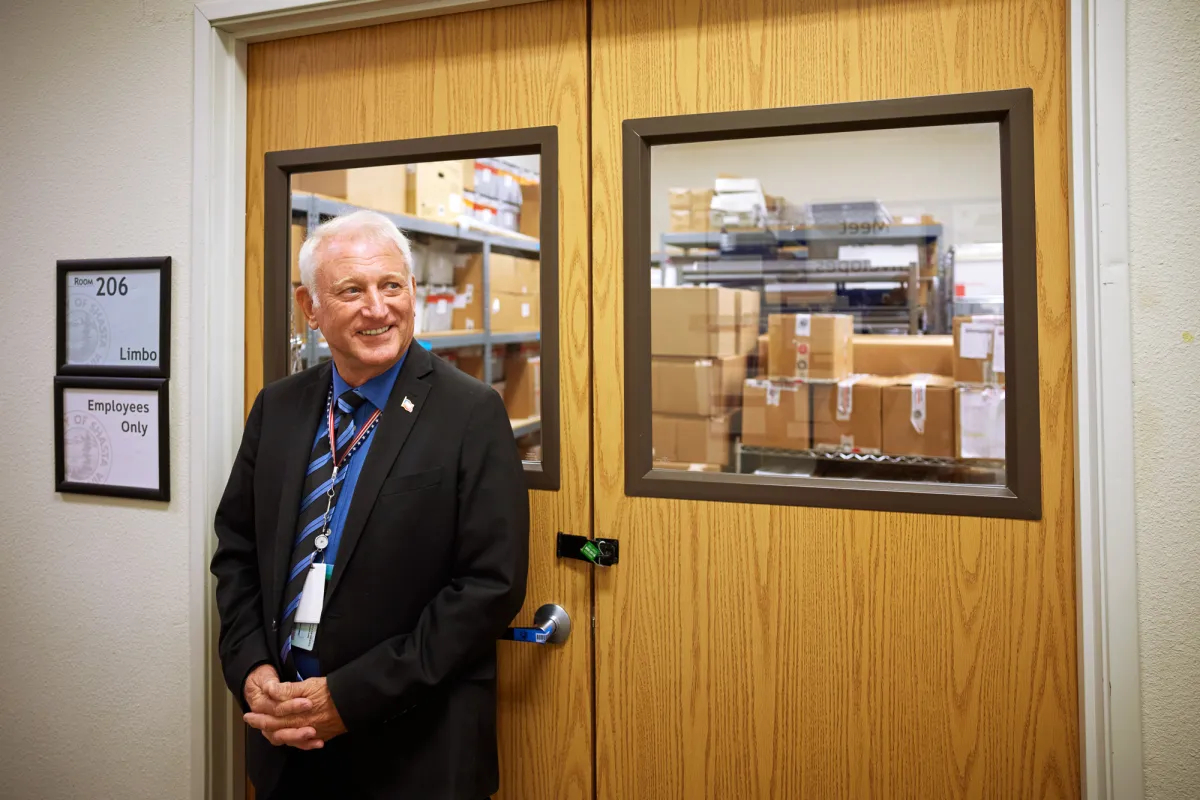
They visited the room in the Shasta County elections office where Curtis had locked away ballots from the June election in anticipation of the FBI’s eventual arrival. The agents, Curtis said, inspected the boxes holding them as part of what he claims is an election-fraud investigation. Curtis said a federal grand jury subpoena ordered him to bring the ballots to court in Sacramento this week.
The FBI’s inspection came after other Shasta County officials also urged the federal and state government to investigate, but for a different reason: To prove Curtis’ claims about widespread election fraud wrong. “The county condemns the conduct of the Clerk-Registrar of Voters and invites all relevant state and federal agencies to review the allegations he has made and to proactively investigate his official actions and practices as Shasta County’s elections official,” officials said in a statement last month.
The extraordinary level of federal involvement in the heavily conservative county a two-and-a-half hour drive north of Sacramento comes as Trump and his MAGA movement hunt for evidence of widespread election fraud that experts say doesn’t exist. It follows a handful of cases this year of federal and MAGA-aligned local authorities seizing ballots from past elections in California and in other states.
After he lost the June election, Curtis, a longtime conspiracy theorist and election denier whose final official act will be to oversee November’s election in Shasta, began claiming some of the mail-in ballots that arrived at the elections office seemed off. “We had a lot of weird ballots coming in, so we have the whole counterfeit ballot thing, which is what the feds are looking at, which is essentially the fact that the paper is wrong,” Curtis said in an hourlong interview with CalMatters in the Redding elections office. “And it smelled wrong before, but now it doesn’t smell anymore. Two months have gone by, but when we did our first initial — you know, I had a dozen people say ‘Something’s wrong with this.’ When you’re flipping through ballots, you kind of get used to the thickness and the size, and suddenly you hit one that’s, you know, considerably thicker.”
Curtis claims the wrong paper issue is possible proof of something he and other MAGA conspiracy theorists have long claimed happens regularly in California and other states with mail-in voting: Nefarious actors are fixing elections by stuffing fake ballots into drop-off boxes. Election experts have a word for such claims: Nonsense. They say there are so many safeguards in place to verify signatures and scan ballots that it would be nearly impossible to forge huge numbers of ballots and not get immediately caught. Sonni Waknin, an attorney at the UCLA Voting Rights Project, used her own experience to highlight how well California’s safeguards work. She said one of her ballots in a past election was flagged at a California elections office because the signature she used to register to vote didn’t appear to match the one she signed on her ballot. Elections officials reached out to her to verify it was her signature, and she was required to fill out a form to declare it was indeed Waknin who filled out her ballot. “You get caught when it’s not even forged,” she said. “When people try to commit fraud, they get caught.”
Curtis said FBI agents showed up last week at the election office to inspect the room where he’d stored ballots. Curtis had a padlock installed and had hung “Keep Out” signs on the door in anticipation of an investigation. The FBI agents brought bolt cutters to get in the room. Curtis said representatives from the California secretary of state’s office were also there observing. He said the federal authorities didn’t take any ballots with them. They left a green evidence cable lock marked with the word “SECURED” where Curtis’ padlock once hung. Curtis said the FBI didn’t tell him what they were looking for. “I just showed them what we had,” he said. “The FBI never says anything to you, by the way … it’s information in and nothing out.” Curtis says a federal grand jury in Sacramento ordered him to bring boxes containing the ballots but on Monday he said he was told he no longer needs to, though he’s not yet received a written notice that his subpoena is canceled.
Proposition 45 on the November ballot would reform the California Environmental Quality Act, also known as CEQA. Proponents argue the measure would help with the state’s affordability crisis by speeding up housing construction.
However, public polling shows support for the measure has tanked in the last few months as critics argue the measure would make it easier to build data centers, which are deeply unpopular with voters.
The measure is sponsored by the state Chamber of Commerce, which argues it will help expedite housing construction. CalChamber CEO Jennifer Barrera spoke with KQED. “The opposition is raising it to scare voters. They’re butchering the definition of broadband to try and make data centers fit into it, and it just doesn’t fit,” she said.
Polling from the Public Policy Institute of California shows support for the measure among likely voters dropped from 73% in July to 49% last week.
Proposed data center project raises concerns in Riverside County
Residents in Riverside County are raising the alarm on a small data center project being proposed for the fairgrounds near Lake Perris. But officials said the proposal is still in its early stages.
Last month, Global Stack, an infrastructure company, got approval to explore the construction of a small data center for emergency response. It would sit at the Southern California Fair and Events Center at Lake Perris. As a public benefit, the Santa Ana-based company agreed to build a large parking structure for public events and a helipad.
On its website, Global Stack said it aims to build similar data centers on fairgrounds across the state. The company didn’t respond to requests for comment.
Russell Vanderberg, the CEO of the SoCal Fair and Events Center, said construction hasn’t been approved. “We met with the representatives of Global Stack and decided to sign a non-binding memorandum of understanding,” he said.
But residents who live nearby say they didn’t know about the non-binding memorandum. And they’re concerned about data centers water and energy use. This comes as the city of Perris’ planning commission is recommending a citywide ban on data centers.