Historians Try to Discover Mystery Behind Central Valley 7UP Signs
Here are the morning’s top stories on Wednesday, September 23, 2026
- 7UP is one of the most recognizable drinks in the world. But what’s less known is a connection in the San Joaquin Valley that began almost a century ago. Billboards and signs of the once flourishing Valley industry have enticed historians for years.
- The governor has signed legislation that strengthens protections for abused children.
- The U.S. Supreme Court has declined to step into a custody dispute involving a California couple and the surrogate who gave birth to their baby in Texas.
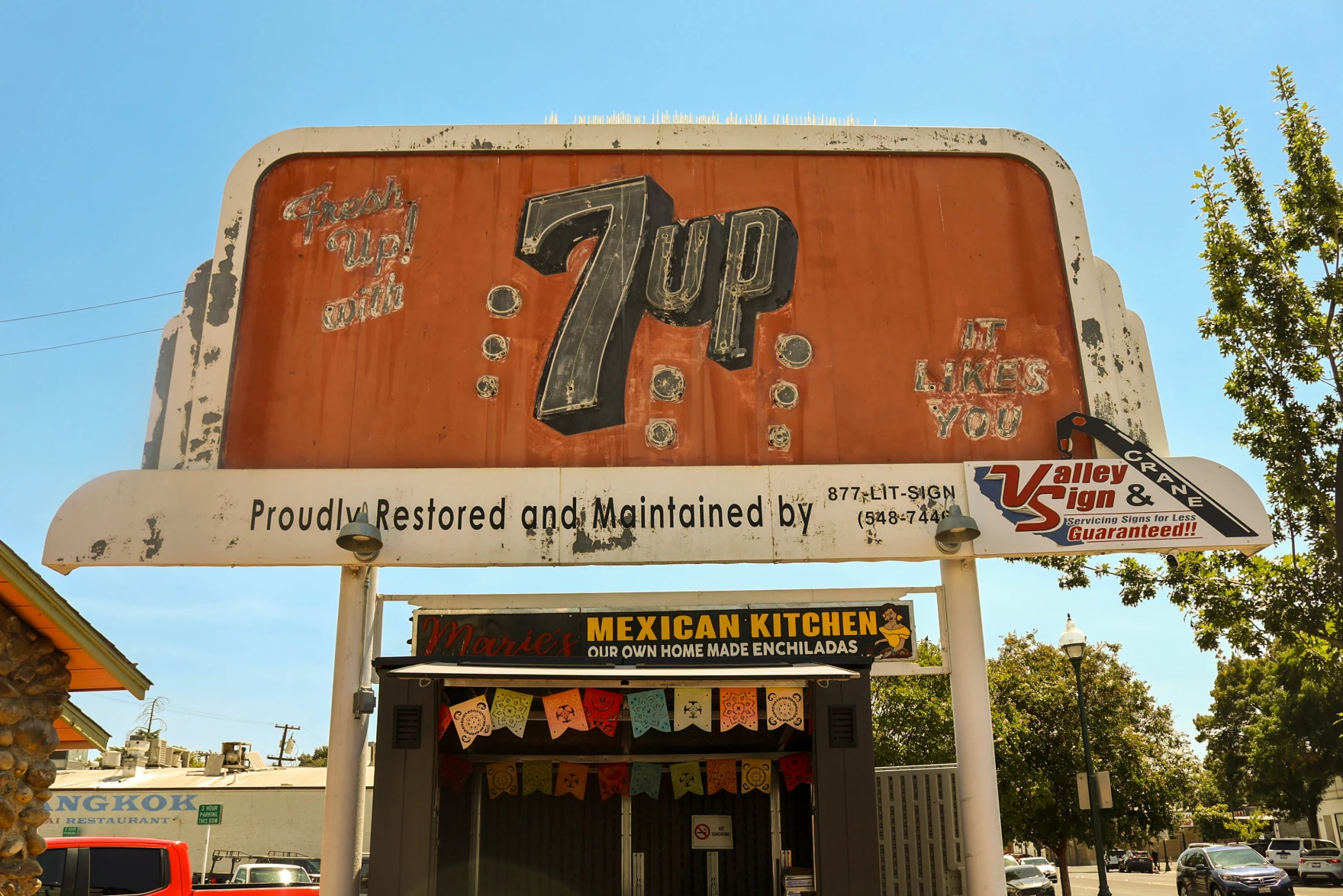
It was a bustling afternoon in the heart of downtown Merced, and Kern County historian Mike McCoy craned his neck to stare up at a billboard with faded red paint and neon casings. The billboard is advertising the soda brand 7UP. It features the decades-old slogans “Fresh Up with 7UP” and “It likes you!”
“I think it’s beautiful,” McCoy said in awe. “See the bubbles? The bubbles would have moved.”
McCoy stopped for lunch at the Mexican restaurant next to the sign while on a road trip. The pitstop was sort of ironic — earlier that week, he tracked down another 7UP sign for the Kern County Museum, which originally stood atop a bottling plant in Bakersfield. “It had this large, 20-foot metal tower, and at the top of that tower was this 10-foot sign that actually rotated at one point,” McCoy said.
These are among at least four vintage 7UP signs remaining in the Valley. The other two are located in Fresno. 7UP, the lemon-lime flavored soda produced by Keurig Dr Pepper, is one of the most recognizable drinks in the world. What’s less known is the connection to the San Joaquin Valley that began almost a century ago.
For years, the billboards and signs reflecting the once flourishing Valley industry have enticed some local historians, like McCoy. He said they evoke memories for locals, too. “It’s not about the sign. It’s about the business, and it’s about the people that ran that business,” McCoy said. “Sometimes the buildings were torn down, and the sign is the only thing that remains from businesses that are 100 years old.”
The origins of most of the 7UP signs in the region remain a mystery — but that doesn’t stop community members from wondering about who put them up or why they’re still around. In Merced, a conversation on Facebook showed many users presumed the sign in the city was owned by Maria’s Mexican Kitchen restaurant next door. KVPR spoke to the restaurant’s manager, Miriam Valenzuela, but she dispelled that rumor and claimed it was owned by the city. But Jennifer Flachman, the city of Merced’s spokesperson, told KVPR in a written response it’s not the city’s property, either, and that the billboard is located on private property. Flachman didn’t reveal who the owner was.
Sarah Lim, director at the Merced County Courthouse museum, is another historian looking into 7UP’s local ties. 7UP is almost 100 years old, but she thinks the Merced sign likely came more than a decade later. Lim estimates Merced’s sign was put up in 1941. She never found out the original owner or exact date it was erected, but a hamburger joint with fountain drinks opened nearby around that time. A 7UP distributor also operated just down the street, with another location in Mariposa. “I don’t know if the distributor put the sign up, or if the 7UP company put up the sign, but regardless, it was a great collaboration between the restaurant, the dealer and the 7UP company to promote the 7UP drinks,” Lim said.
Lim said the number of bubbles on the sign also gave a clue to the timeline. “This is the magical part,” Lim said, laughing. “Counting the bubbles!” 7UP logos originally had seven bubbles, but this billboard and another in Fresno both have eight. The company made this change around 1940, Lim said. These findings are significant, Lim said, but not just for her own curiosity. Lim said signs are a big pinpoint for people, but so is any artifact from a specific time.
Gov. Gavin Newsom has signed a bill aimed at protecting children who are abused.
The law, which went into effect this week, is named “Gabriel’s Law,” after Gabriel Fernandez — an 8-year-old boy in Palmdale who died in 2013 after being tortured and abused by his mother and her boyfriend. “It devastated the community. Still has,” said State Assemblymember Tom Lackey (R-Palmdale), who worked on legislation related to Gabriel’s case for years. “It hasn’t gone away, right? It’s something we still acknowledge.”
Since Fernandez’s death, the Antelope Valley has seen a number of high-profile child deaths at the hands of their parents.
The new law requires social workers to make sure a child gets emergency medical care when needed, and it makes it easier to prosecute social workers who knowingly falsify records. Officials said there had been warning signs about Fernandez’s abuse, but social workers with the L.A. County Department of Children and Family Services failed to follow up on them. The high-profile case prompted internal reforms in the agency.
Before this week, the law said that social workers may authorize care if a child needs immediate emergency care, but did not require it. Gabriel’s law requires a social worker to secure medical care for a child. “ They call for an ambulance or escort the child to an emergency room— make sure a physician has the opportunity to provide some level of remedy and documentation of the injury,” Lackey said. It also clarifies the law so that social workers who are guilty of falsifying or destroying public records can be imprisoned or fined.
The U.S. Supreme Court on Tuesday declined to intervene in a custody dispute over a 5-week-old child who was born in Texas after a surrogate refused a California couple’s wishes to have an abortion.
Justice Elena Kagan denied the request from McKenna West, who was seeking conservatorship over a baby boy she gave birth to in Dallas. The brief order did not detail the legal reasoning, as is typical in emergency appeals. The decision came from Kagan because she handles appeals of cases out of California.
Multiple courts have rejected West’s efforts to have a say in the treatment of the child, who was born with a life-threatening heart condition. She gave birth to the boy in Dallas, where most abortions are banned, after she refused the couple’s wishes to end the pregnancy. West had asked the Supreme Court to halt a California court order that recognizes Omar Ahmed and Nausheen Gilkar as the parents of the child whom she calls Gabriel and they call Rumi.