Grizzly Flats Residents Still Struggle to Recover 5 Years After Wildfire
Here are the morning’s top stories on Wednesday, August 19, 2026
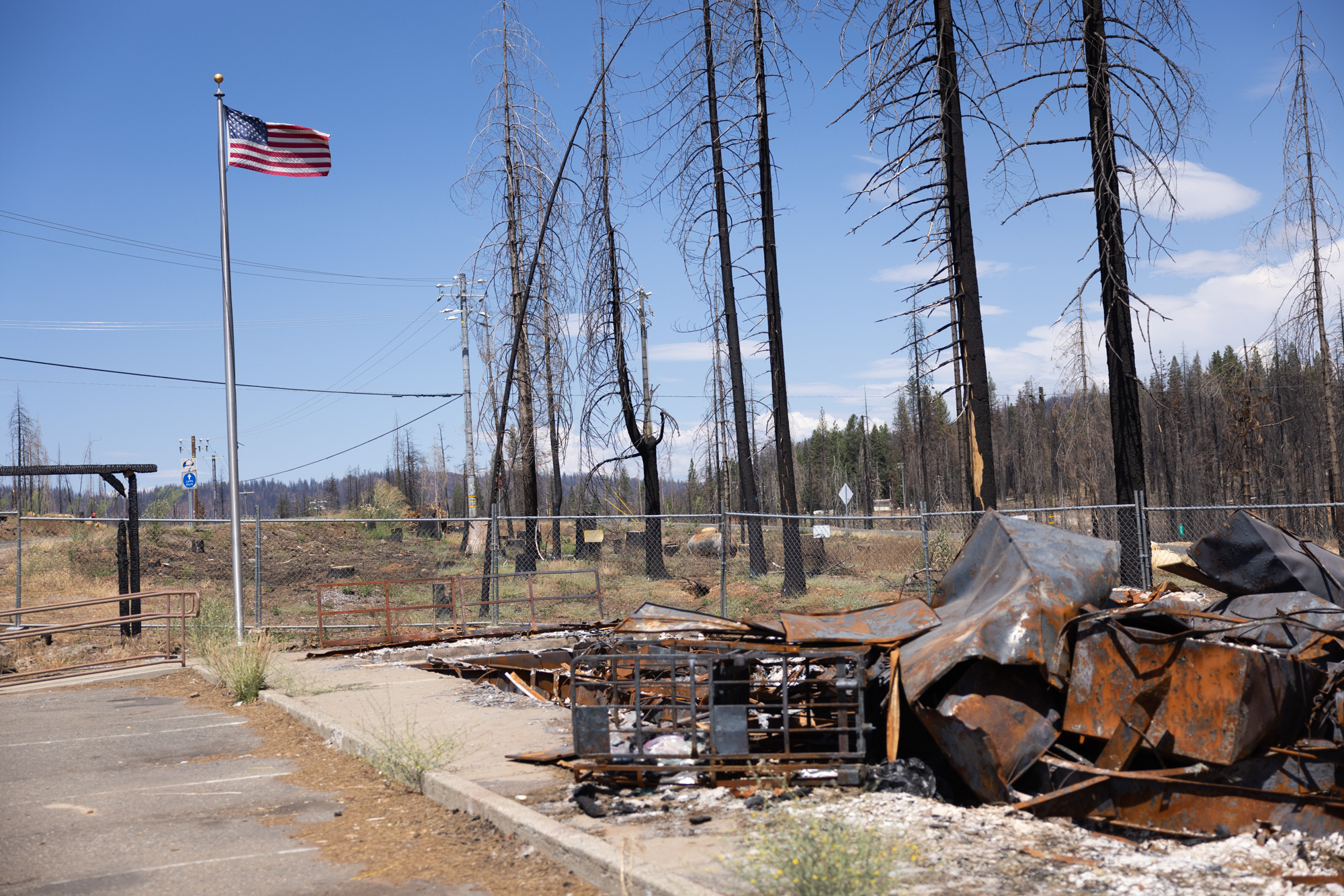
- It’s been five years since the Caldor Fire nearly burned down the entire community of Grizzly Flats… a remote canyon town nestled in El Dorado County. Since then, residents say they’ve received little to no help from the federal government and the community is working to become whole again.
- A federal judge in Oakland has heard opening statements in a lawsuit brought by four states against Meta.
- A national survey by a California advocacy group found that 70 percent of teenagers are using Artificial Intelligence to complete their schoolwork.
The 200,000 acre Caldor Fire blazed five years ago, taking 400 of the 600 homes in Grizzly Flats with it.
Kim Gustafson and her son, almost 13, are growing tired of sharing their cramped trailer.
“I’m going to have motion sickness probably for the rest of my life,” she said. “I always feel like there’s an earthquake going on. There’s no privacy really whatsoever.”
Five years after the fire, Gustafson still hasn’t been able to afford to rebuild. Allstate Insurance dropped Gustafson a year before the fire. She received a small business loan to rebuild, but the money expired before she had a chance to return a year after.
The federal government also left residents hanging. The Federal Emergency Management Agency (FEMA) told CapRadio it helped with public infrastructure grants, but denied individual assistance to residents like Gustafson.
El Dorado County Supervisor George Turnboo tried to get answers for residents to no avail.
“President Biden promised that he was gonna take care of the residents in Grizzly Flat, and he never did,” Turnboo said. “I wrote several letters to try to get individual assistance for these people out there and was denied several times by FEMA.”
The most recent denial letter from FEMA is dated December 10, 2025. It notes that Governor Gavin Newsom requested a major disaster declaration in 2021 as well as individual assistance, public assistance, and funding through the Hazard Mitigation Grant Program.
“When evaluating the Governor’s request for a disaster declaration, FEMA considers several factors,” the letter reads. “Including the severity and magnitude of the incident, the number of insured primary residences impacted, effects on individuals and public infrastructure, and the State’s capacity to respond and recover. In this case, the criteria were not met and the IA (individual assistance) was not not authorized.”
Where the federal government has faltered, Turnboo, HomeAid Sacramento and residents have come together to try and get fire survivors back into homes through the creation of Caldor Fire Grizzly Flats Homeowner Rebuild Program.
The program allows fire victims to build Title 25 homes, which are 750 square feet and have reduced regulatory requirements to make them cost effective. The homes don’t require things such as a sprinkler system, which can easily add $20,000 or more in construction costs.
The housing program is funded through the county and HomeAid. They currently are in the process of building 12 homes. Fire survivors are asked to pay half the cost, but forgivable loans funded by developers are also available for those who can’t pay.
Gustafson is on the waitlist for one. Once they’re able to finally move, she and her son Chris Gustafson have struck a deal.
“We’re going to get new kitties,” she said. “He wants a ginger.”
Rebuilding the community is happening slowly but surely. The community center is currently in the permitting process, and the first Title 25 home – the kind Gustafson hopes to get – had a ribbon cutting August 17.
Grizzly Flats is going through a metamorphosis. Some are finally getting some semblance of normalcy, some remain in the middle, and some live in the same house they always did. New pine trees are sprouting up from the dirt.
In the case of fire survivors, resident Robin Kelley said that day five years ago was just the beginning.
“ When I see a fire now, like Lahaina or Palisades, I know this isn’t their worst day,” she said. “That is to come, all the horrible things that they’re gonna have to go through just to try to come home.”
In court, Megan O’Neill, deputy attorney general for California, argued that Meta deliberately designed Facebook and Instagram to be addictive, aimed them at children, and lied to the public about the risks.
“We have proof that Meta knows,” said AG Rob Bonta outside the courthouse. “Meta knows that Instagram is harmful to a significant percentage of teenagers, especially teen girls.”
Colorado, Kentucky and New Jersey join California in the suit.
Meta’s attorney Paul Schmidt argued the states found extreme cases – proverbial needles in the haystack of billions of user experiences. He acknowledged there’s no dispute that some teens struggle to manage their time on social media, that kids can lie about their ages to get around Meta’s 13-and-over age policy, and that some people post negative things — but that’s something Meta takes seriously and tries to act on, he said.
The trial comes amid thousands of personal injury and consumer protection lawsuits against social media companies filed by states, school districts, individuals. All these cases claim in some form that the platforms are addictive to children and designed to be that way – similar to the legal playbook used against Big Tobacco in the 1990s.
Social media platform developers have long argued successfully that federal law protects them from claims made on free speech grounds, but plaintiffs are drawing blood at the state level with the new consumer product cases like those brought against tobacco companies. Judges in both New Mexico and Los Angeles have already ordered big damages. Appeals are pending.
The case against Meta is expected to last into early October.