Demand for Pistachios Clashes With Climate Reality
Here are the morning’s top stories on Wednesday, August 12, 2026
- Demand for pistachios is booming worldwide – from Dubai-inspired chocolate bars to pistachio cookies and lattes. But in the Central Valley, growers are worried that this year’s harvest could be smaller than anticipated. That’s after some unexpected weather earlier this spring.
- People in five Monterey County zones have been evacuated due to the Timber Fire in Big Sur. It’s burned more than 3,000 acres and hundreds of homes are currently threatened. A portion of Highway One is now closed, due to the spread of the fire. The limited access to the area has also threatened the lives of two captive birds.
- A bill advancing in the state Legislature would limit how long law enforcement agencies can retain data from license plate readers. The proposal caps that retention period at 30 days. And it comes amid growing concern that license plate reader data is being shared and used inappropriately.
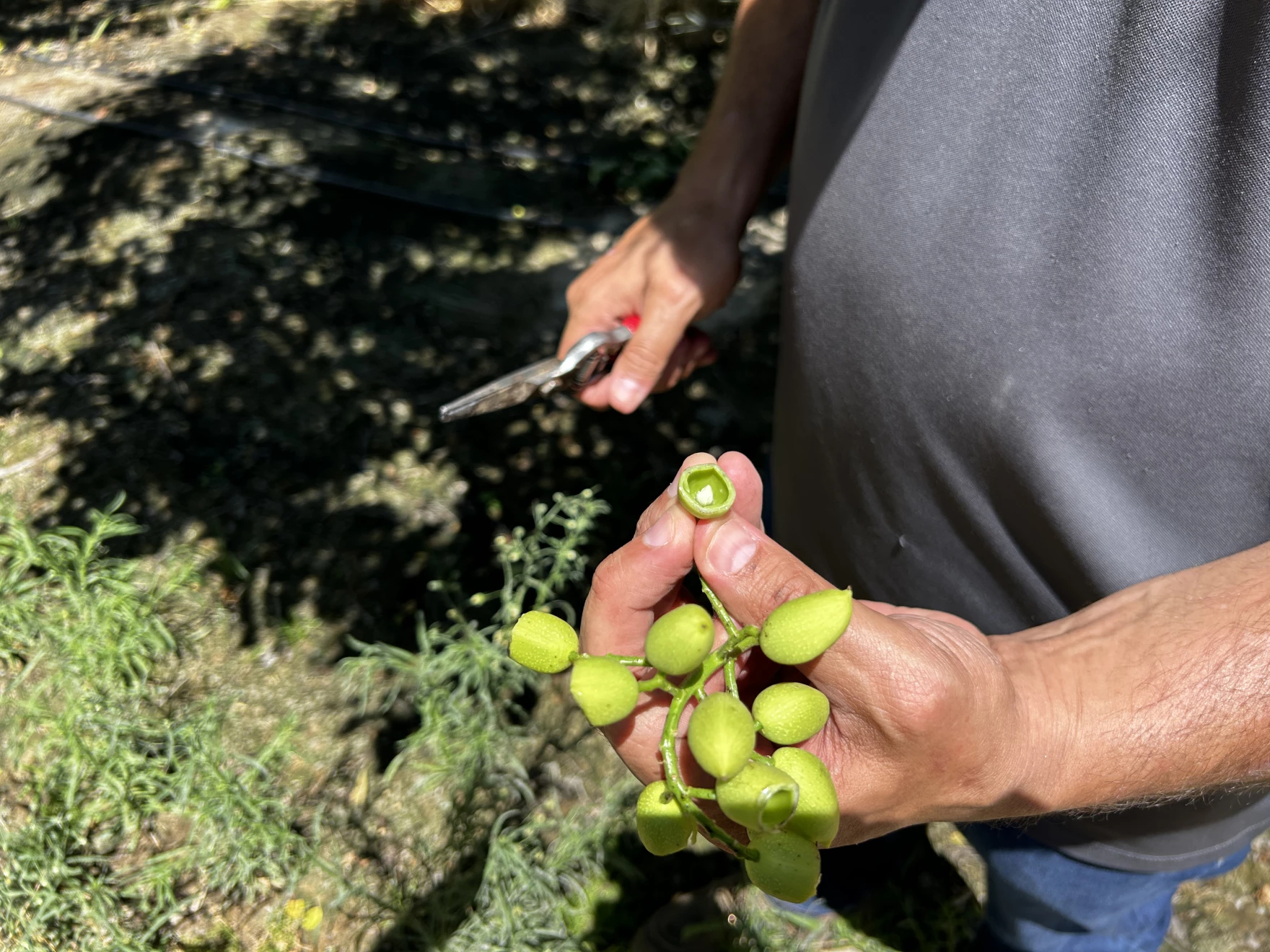
Earlier this spring, Joe Coelho’s pistachio orchard in Fresno County seemed to be headed for a strong season. Then came an unexpected stretch of heat. It “took place right in the middle of bloom,” Coelho said.
Temperatures rose into the 90s at one of the critical points of the pistachio blooming process. Recently, as Coelho walked through rows of pistachio trees, he was in a waiting period to see how much of the crop would actually fully develop this year. He carefully examined pistachio shells, looking for “a blank,” which is a shell without a pistachio kernel inside – a sign of the climate’s toll on a sensitive crop. He found some.
The uncertainty over the climate’s impact comes as the global pistachio demand continues to grow. This boom is fueled by viral food trends like Dubai-style chocolate and pistachio-filled desserts that fill internet algorithms. Scott Fryer, vice president of global marketing for American Pistachio Growers, said that in 2024, there were about 54 products on grocery store shelves across the U.S. that mentioned “Dubai-style chocolate.” In 2025, that number nearly tripled.
The trend has added to demand that was already growing before this year’s pistachio season. Fryer said it could turn out that the 2026 harvest is so low that it can’t meet demand. And much of the pressure of such demand would be on California, which produces 99% of U.S. pistachios, according to Gurreet Brar, an associate professor of pomology at Fresno State who focuses on pistachio physiology and horticulture. “Pistachio is a really economically important crop in California,” Brar said.
But pistachio farmers don’t seem to be in a position to increase production to meet a growing demand. Pistachio trees, like many others, take years to produce enough nuts for a typical commercial harvest. This means that each orchard is a long-term investment with no guarantee that it will offer the crop that growers – and consumers – expect each season. But when they do have a normal blooming season, pistachios are a durable crop. “Pistachios are usually taken as a much more resilient crop than almonds or other crops grown in the Valley,” Brar said. “They’re more drought-tolerant, they’re more salt-tolerant, and we have adapted pistachios to California conditions really well.”
For farmers like Coelho, a small harvest translates to a significant drop in revenue. He estimates that it costs roughly $4,000 per acre each year to farm a pistachio orchard. He needs to produce about 1,400 pounds of pistachios per acre at an average price to break even. “You have to be really thoughtful about your profitability when you’re right on the margin of potentially making money,” Coelho said.
Slow growth for Timber Fire in Big Sur
People in five Monterey County zones have been evacuated due to the Timber Fire in Big Sur. It’s burned more than 3,000 acres and hundreds of homes are currently threatened.
Highway 1 through the area is closed as of Tuesday afternoon, according to a Facebook post by the California Highway Patrol. But visitors were being strongly advised to avoid Big Sur altogether over the past few days even when the route was open to the public.
Limited road access to the area has also threatened the lives of two captive birds. The Ventana Wildlife Society sanctuary was caring for the condors when the fire broke out. Executive director Kelly Sorenson said he and others worked the phones to figure out how they could free the birds. “The two birds are stuck in this pen and we can’t get up there to care for them, to provide any food or water while they’re held captive,” he said.
The organization did receive good news Tuesday as its senior wildlife biologist was escorted to the sanctuary by Forest Service firefighters. Sorenson said the condors should be fine – though the sanctuary was planning to give them a little more time to recover from lead poisoning and treatment.
In the past year alone, they’ve helped catch suspected murderers, bank robbers and hit-and-run drivers. They’ve located dozens of stolen cars and helped send a wildland arsonist to prison. They’re also distrusted and despised by privacy rights activists on the left and on the right. Just last month, police accused a suspect in Monterey County of yanking down three of them with his pickup.
They’re called automated license plate readers. Every day, untold numbers of Californians drive past the thousands of cameras that at least 230 police and sheriffs’ departments have posted along roadways or installed on their patrol cars. The cameras in real time capture and read plate numbers, then cross-reference them with law enforcement databases of vehicles police want to locate, such as stolen cars, getaway vehicles or those that may be carrying a missing or wanted person.
Since 2019, California Democratic lawmakers have unsuccessfully sought to further restrict how police use the technology. They’re trying again this year with a bill that would add limits on how long police may retain license plate data, how they access it and with whom they share it. Police agencies and officers’ unions across the state oppose the latest measure, which is similar to a bill Gov. Gavin Newsom vetoed last year.
“This bill is about one simple principle: Protecting the privacy and safety of Californians while ensuring law enforcement tools are used responsibly before it’s too late,” the author of this year’s legislation, Riverside Democratic Sen. Sabrina Cervantes, told the Assembly privacy committee last month. She did not respond to a request for an interview from CalMatters.
Cervantes’ bill would generally limit to 30 days the amount of time agencies could keep license plate data, unless it pertains to an active investigation or is part of a search for missing people. It also sets limits around who can access the data and adds training and search-tracking requirements. Police and sheriffs’ departments would be prohibited from entering into contracts with camera companies that provide default access to plate databases that federal and out-of-state police can search.
Critics of the technology cite high-profile examples of California police using license plate data inappropriately, including to stalk or harass innocent people. As CalMatters reported last year, California officers have repeatedly violated an 11-year-old state law that prohibits sharing the data with federal authorities and others outside the state.
At least 39 police agencies and officers’ unions oppose Senate Bill 1013. Combined, they have spent at least $5.6 million on legislative campaigns since 2000, according to the CalMatters Digital Democracy database. Police say the technology has proven invaluable at helping them solve crimes.