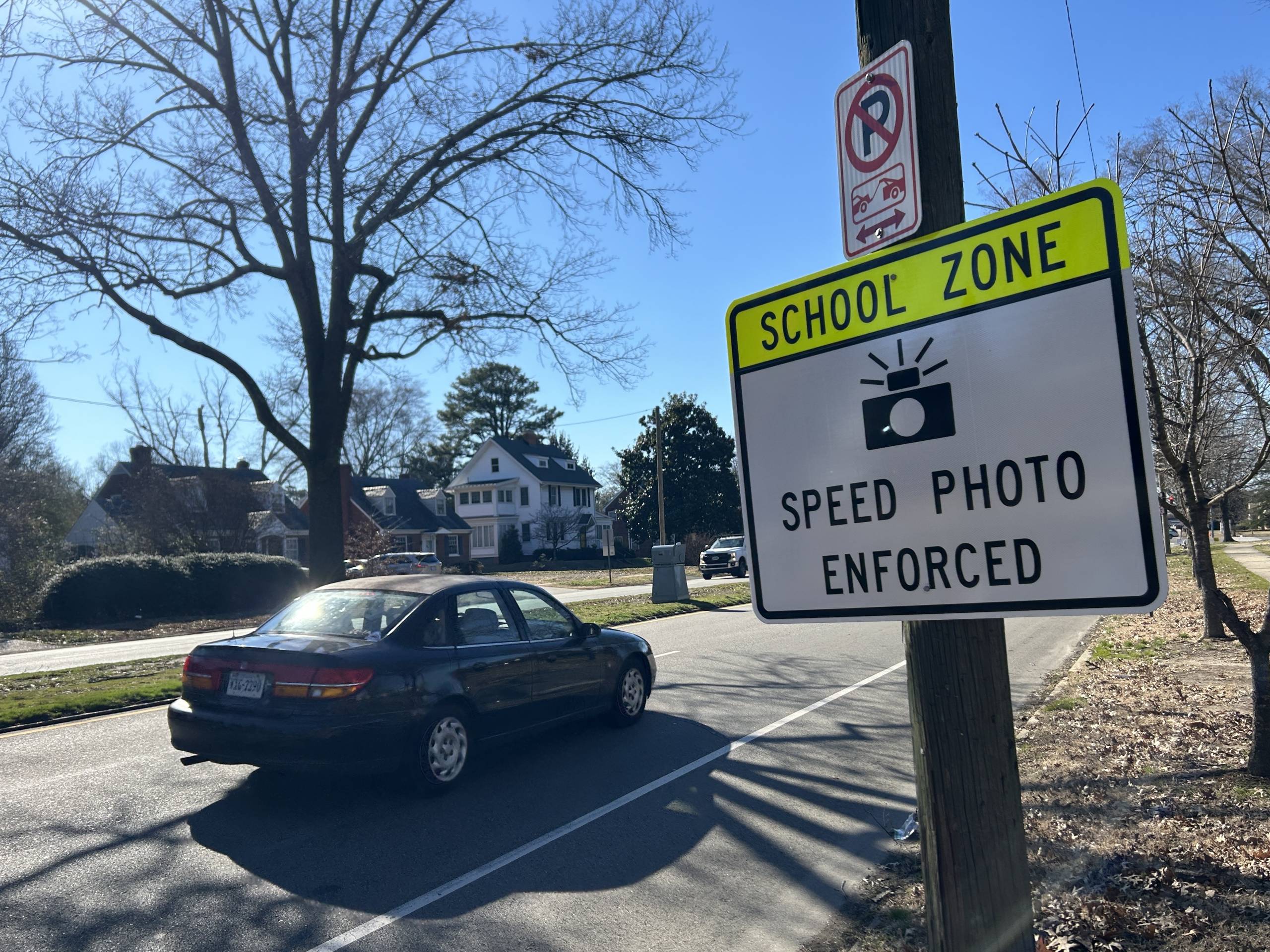
The speed limit in front of Linwood Holton Elementary School in Richmond, Virginia, is 25 miles per hour at drop-off and dismissal.
But Tara FitzPatrick says it’s not unusual to see drivers doing twice that. And she has the receipts to prove it.
“So he officially hit the school zone doing 50 miles an hour through a crosswalk,” FitzPatrick says, pointing her radar gun at a gray Chevrolet SUV flying by in the left lane.
This is one of two schools in Richmond where the city has installed new enforcement cameras to catch speeders. FitzPatrick has two children at the school. She’s also a traffic safety advocate for the nonprofit Greater Richmond Fit4Kids, which is why she owns a radar gun.
Still, FitzPatrick has mixed feelings about the speed cameras. She’d rather see the whole street redesigned to discourage speeding and protect pedestrians and bicyclists. But she also knows that won’t happen anytime soon.
“A lot of us feel desperate” to make streets safer,” FitzPatrick says. “If I could make a quick fix tomorrow, it would not be any type of speed enforcement. It would not be school zone speed enforcement cameras. But that’s the option that we’re left with at this point.”
Advocates say speeding tickets change behavior
Richmond joins a growing list of cities turning to speed cameras. New laws in California and Pennsylvania will allow them in major cities where they’ve long been blocked.
Traffic fatalities have risen sharply over the past decade, and safety advocates around the country are desperately searching for anything that will get drivers to slow down. However, critics say speed cameras can financially burden those who are least able to pay.
Still, they’ve earned the endorsement of prominent safety advocates, including Jonathan Adkins, the CEO of the Governors Highway Safety Association.
“Automated enforcement works,” Adkins says. “For lack of a better term, it sucks to get a ticket. It changes your behavior.”
Police departments in many places have scaled back their traffic enforcement, Adkins says, and speeding and reckless driving seem to worsen. He says automated cameras can help fill that void.
“The question is, how do we deploy them in a fair and equitable way with the public support?” Adkins says. “It can’t be a gotcha, it can’t be a surprise.”
Skeptics say speed cameras are a cash grab
No one likes getting a speeding ticket. But the objections to automated traffic enforcement go deeper than that.
“We are very skeptical that safety is the real goal,” says Jay Beeber with the National Motorists Association, a driver advocacy group.
There are other ways to get drivers to slow down, Beeber says, including speed feedback signs that show drivers how fast they’re going in real time.
“There’s many ways to get greater compliance,” Beeber says. But many cities are focused on speeding cameras “because they do not want to lose the money from the tickets they are issuing.”
Safety advocates have touted automated enforcement as a neutral alternative to police stops, which can be potentially biased by race, and as a way to reduce unnecessary interactions between police and communities of color.