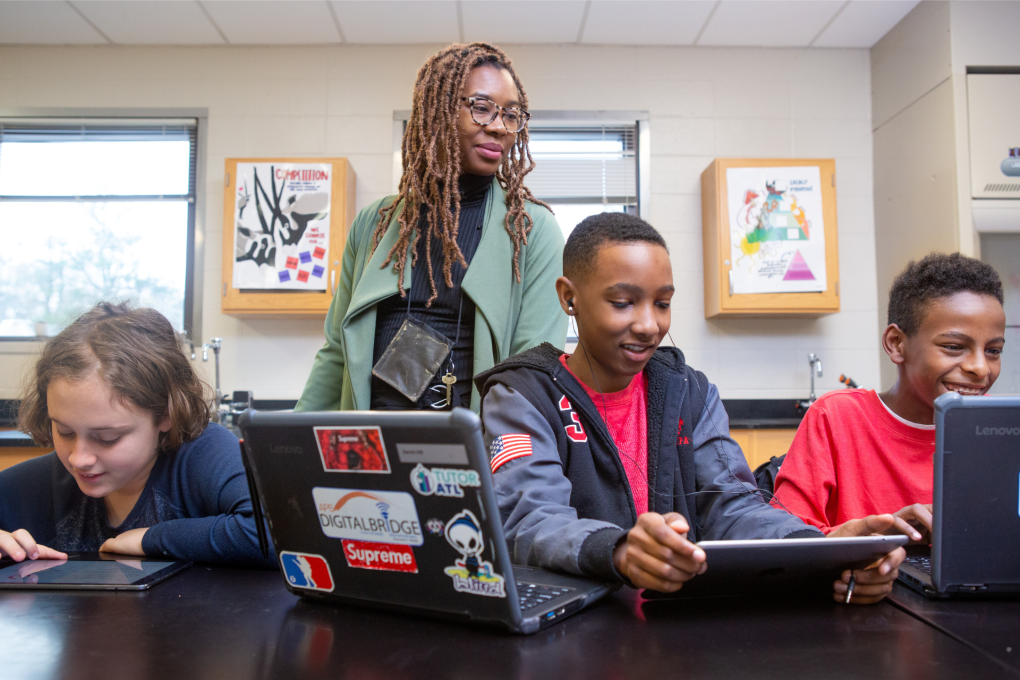
Inquiry Into Student Learning Gaps Leads To Better Teaching And Shifts School Culture
Major support for MindShift comes from
Player sponsored by
window.__IS_SSR__=true
window.__INITIAL_STATE__={
"attachmentsReducer": {
"audio_0": {
"type": "attachments",
"id": "audio_0",
"imgSizes": {
"kqedFullSize": {
"file": "https://ww2.kqed.org/news/wp-content/themes/KQED-unified/img/audio_bgs/background0.jpg"
}
}
},
"audio_1": {
"type": "attachments",
"id": "audio_1",
"imgSizes": {
"kqedFullSize": {
"file": "https://ww2.kqed.org/news/wp-content/themes/KQED-unified/img/audio_bgs/background1.jpg"
}
}
},
"audio_2": {
"type": "attachments",
"id": "audio_2",
"imgSizes": {
"kqedFullSize": {
"file": "https://ww2.kqed.org/news/wp-content/themes/KQED-unified/img/audio_bgs/background2.jpg"
}
}
},
"audio_3": {
"type": "attachments",
"id": "audio_3",
"imgSizes": {
"kqedFullSize": {
"file": "https://ww2.kqed.org/news/wp-content/themes/KQED-unified/img/audio_bgs/background3.jpg"
}
}
},
"audio_4": {
"type": "attachments",
"id": "audio_4",
"imgSizes": {
"kqedFullSize": {
"file": "https://ww2.kqed.org/news/wp-content/themes/KQED-unified/img/audio_bgs/background4.jpg"
}
}
},
"placeholder": {
"type": "attachments",
"id": "placeholder",
"imgSizes": {
"thumbnail": {
"file": "https://cdn.kqed.org/wp-content/uploads/2024/12/KQED-Default-Image-816638274-2000x1333-1-160x107.jpg",
"width": 160,
"height": 107,
"mimeType": "image/jpeg"
},
"medium": {
"file": "https://cdn.kqed.org/wp-content/uploads/2024/12/KQED-Default-Image-816638274-2000x1333-1-800x533.jpg",
"width": 800,
"height": 533,
"mimeType": "image/jpeg"
},
"medium_large": {
"file": "https://cdn.kqed.org/wp-content/uploads/2024/12/KQED-Default-Image-816638274-2000x1333-1-768x512.jpg",
"width": 768,
"height": 512,
"mimeType": "image/jpeg"
},
"large": {
"file": "https://cdn.kqed.org/wp-content/uploads/2024/12/KQED-Default-Image-816638274-2000x1333-1-1020x680.jpg",
"width": 1020,
"height": 680,
"mimeType": "image/jpeg"
},
"1536x1536": {
"file": "https://cdn.kqed.org/wp-content/uploads/2024/12/KQED-Default-Image-816638274-2000x1333-1-1536x1024.jpg",
"width": 1536,
"height": 1024,
"mimeType": "image/jpeg"
},
"fd-lrg": {
"file": "https://cdn.kqed.org/wp-content/uploads/2024/12/KQED-Default-Image-816638274-2000x1333-1-1536x1024.jpg",
"width": 1536,
"height": 1024,
"mimeType": "image/jpeg"
},
"fd-med": {
"file": "https://cdn.kqed.org/wp-content/uploads/2024/12/KQED-Default-Image-816638274-2000x1333-1-1020x680.jpg",
"width": 1020,
"height": 680,
"mimeType": "image/jpeg"
},
"fd-sm": {
"file": "https://cdn.kqed.org/wp-content/uploads/2024/12/KQED-Default-Image-816638274-2000x1333-1-800x533.jpg",
"width": 800,
"height": 533,
"mimeType": "image/jpeg"
},
"post-thumbnail": {
"file": "https://cdn.kqed.org/wp-content/uploads/2024/12/KQED-Default-Image-816638274-2000x1333-1-672x372.jpg",
"width": 672,
"height": 372,
"mimeType": "image/jpeg"
},
"twentyfourteen-full-width": {
"file": "https://cdn.kqed.org/wp-content/uploads/2024/12/KQED-Default-Image-816638274-2000x1333-1-1038x576.jpg",
"width": 1038,
"height": 576,
"mimeType": "image/jpeg"
},
"xxsmall": {
"file": "https://cdn.kqed.org/wp-content/uploads/2024/12/KQED-Default-Image-816638274-2000x1333-1-160x107.jpg",
"width": 160,
"height": 107,
"mimeType": "image/jpeg"
},
"xsmall": {
"file": "https://cdn.kqed.org/wp-content/uploads/2024/12/KQED-Default-Image-816638274-2000x1333-1-672x372.jpg",
"width": 672,
"height": 372,
"mimeType": "image/jpeg"
},
"small": {
"file": "https://cdn.kqed.org/wp-content/uploads/2024/12/KQED-Default-Image-816638274-2000x1333-1-672x372.jpg",
"width": 672,
"height": 372,
"mimeType": "image/jpeg"
},
"xlarge": {
"file": "https://cdn.kqed.org/wp-content/uploads/2024/12/KQED-Default-Image-816638274-2000x1333-1-1020x680.jpg",
"width": 1020,
"height": 680,
"mimeType": "image/jpeg"
},
"full-width": {
"file": "https://cdn.kqed.org/wp-content/uploads/2024/12/KQED-Default-Image-816638274-2000x1333-1-1920x1280.jpg",
"width": 1920,
"height": 1280,
"mimeType": "image/jpeg"
},
"guest-author-32": {
"file": "https://cdn.kqed.org/wp-content/uploads/2025/01/KQED-Default-Image-816638274-1333x1333-1-160x160.jpg",
"width": 32,
"height": 32,
"mimeType": "image/jpeg"
},
"guest-author-50": {
"file": "https://cdn.kqed.org/wp-content/uploads/2025/01/KQED-Default-Image-816638274-1333x1333-1-160x160.jpg",
"width": 50,
"height": 50,
"mimeType": "image/jpeg"
},
"guest-author-64": {
"file": "https://cdn.kqed.org/wp-content/uploads/2025/01/KQED-Default-Image-816638274-1333x1333-1-160x160.jpg",
"width": 64,
"height": 64,
"mimeType": "image/jpeg"
},
"guest-author-96": {
"file": "https://cdn.kqed.org/wp-content/uploads/2025/01/KQED-Default-Image-816638274-1333x1333-1-160x160.jpg",
"width": 96,
"height": 96,
"mimeType": "image/jpeg"
},
"guest-author-128": {
"file": "https://cdn.kqed.org/wp-content/uploads/2025/01/KQED-Default-Image-816638274-1333x1333-1-160x160.jpg",
"width": 128,
"height": 128,
"mimeType": "image/jpeg"
},
"detail": {
"file": "https://cdn.kqed.org/wp-content/uploads/2025/01/KQED-Default-Image-816638274-1333x1333-1-160x160.jpg",
"width": 160,
"height": 160,
"mimeType": "image/jpeg"
},
"kqedFullSize": {
"file": "https://cdn.kqed.org/wp-content/uploads/2024/12/KQED-Default-Image-816638274-2000x1333-1.jpg",
"width": 2000,
"height": 1333
}
}
},
"mindshift_64790": {
"type": "attachments",
"id": "mindshift_64790",
"meta": {
"index": "attachments_1716263798",
"site": "mindshift",
"id": "64790",
"found": true
},
"title": "Hechinger Report Proof Points Featured Image",
"publishDate": 1727478396,
"status": "inherit",
"parent": 64787,
"modified": 1727478440,
"caption": "Allison Shelley for EDUimages",
"credit": null,
"altTag": "An adult overlooks three students shoulders as they work on computers.",
"description": null,
"imgSizes": {
"medium": {
"file": "https://cdn.kqed.org/wp-content/uploads/sites/23/2024/09/Hechinger-Report-Proof-Points-Featured-Image-800x533.png",
"width": 800,
"height": 533,
"mimeType": "image/png"
},
"large": {
"file": "https://cdn.kqed.org/wp-content/uploads/sites/23/2024/09/Hechinger-Report-Proof-Points-Featured-Image-1020x680.png",
"width": 1020,
"height": 680,
"mimeType": "image/png"
},
"thumbnail": {
"file": "https://cdn.kqed.org/wp-content/uploads/sites/23/2024/09/Hechinger-Report-Proof-Points-Featured-Image-160x107.png",
"width": 160,
"height": 107,
"mimeType": "image/png"
},
"medium_large": {
"file": "https://cdn.kqed.org/wp-content/uploads/sites/23/2024/09/Hechinger-Report-Proof-Points-Featured-Image-768x512.png",
"width": 768,
"height": 512,
"mimeType": "image/png"
},
"1536x1536": {
"file": "https://cdn.kqed.org/wp-content/uploads/sites/23/2024/09/Hechinger-Report-Proof-Points-Featured-Image-1536x1024.png",
"width": 1536,
"height": 1024,
"mimeType": "image/png"
},
"post-thumbnail": {
"file": "https://cdn.kqed.org/wp-content/uploads/sites/23/2024/09/Hechinger-Report-Proof-Points-Featured-Image-672x372.png",
"width": 672,
"height": 372,
"mimeType": "image/png"
},
"twentyfourteen-full-width": {
"file": "https://cdn.kqed.org/wp-content/uploads/sites/23/2024/09/Hechinger-Report-Proof-Points-Featured-Image-1038x576.png",
"width": 1038,
"height": 576,
"mimeType": "image/png"
},
"kqedFullSize": {
"file": "https://cdn.kqed.org/wp-content/uploads/sites/23/2024/09/Hechinger-Report-Proof-Points-Featured-Image.png",
"width": 1920,
"height": 1280
}
},
"isLoading": false,
"fetchFailed": false
},
"mindshift_53751": {
"type": "attachments",
"id": "mindshift_53751",
"meta": {
"index": "attachments_1716263798",
"site": "mindshift",
"id": "53751",
"found": true
},
"parent": 53744,
"imgSizes": {
"twentyfourteen-full-width": {
"file": "https://ww2.kqed.org/app/uploads/sites/23/2019/05/inquiry-collaboration-school-culture-1038x576.jpg",
"width": 1038,
"mimeType": "image/jpeg",
"height": 576
},
"thumbnail": {
"file": "https://ww2.kqed.org/app/uploads/sites/23/2019/05/inquiry-collaboration-school-culture-160x160.jpg",
"width": 160,
"mimeType": "image/jpeg",
"height": 160
},
"post-thumbnail": {
"file": "https://ww2.kqed.org/app/uploads/sites/23/2019/05/inquiry-collaboration-school-culture-672x372.jpg",
"width": 672,
"mimeType": "image/jpeg",
"height": 372
},
"kqedFullSize": {
"file": "https://ww2.kqed.org/app/uploads/sites/23/2019/05/inquiry-collaboration-school-culture.jpg",
"width": 1732,
"height": 1732
},
"large": {
"file": "https://ww2.kqed.org/app/uploads/sites/23/2019/05/inquiry-collaboration-school-culture-1020x1020.jpg",
"width": 1020,
"mimeType": "image/jpeg",
"height": 1020
},
"complete_open_graph": {
"file": "https://ww2.kqed.org/app/uploads/sites/23/2019/05/inquiry-collaboration-school-culture-1200x1200.jpg",
"width": 1200,
"mimeType": "image/jpeg",
"height": 1200
},
"medium": {
"file": "https://ww2.kqed.org/app/uploads/sites/23/2019/05/inquiry-collaboration-school-culture-800x800.jpg",
"width": 800,
"mimeType": "image/jpeg",
"height": 800
},
"medium_large": {
"file": "https://ww2.kqed.org/app/uploads/sites/23/2019/05/inquiry-collaboration-school-culture-768x768.jpg",
"width": 768,
"mimeType": "image/jpeg",
"height": 768
}
},
"publishDate": 1559173625,
"modified": 1559173702,
"caption": "When teachers work collaboratively to identify specific student skill gaps, they can push learning for all students more quickly.",
"description": null,
"title": "inquiry-collaboration-school-culture",
"credit": "iStock/bobmadbob",
"status": "inherit",
"isLoading": false,
"fetchFailed": false
}
},
"audioPlayerReducer": {
"postId": "stream_live",
"isPaused": true,
"isPlaying": false,
"pfsActive": false,
"pledgeModalIsOpen": true,
"playerDrawerIsOpen": false,
"liveAudioPlayStartedAt": 0,
"liveAudioPlayContext": ""
},
"authorsReducer": {
"byline_mindshift_64787": {
"type": "authors",
"id": "byline_mindshift_64787",
"meta": {
"override": true
},
"slug": "byline_mindshift_64787",
"name": "Jill Barshay, The Hechinger Report",
"isLoading": false
},
"katrinaschwartz": {
"type": "authors",
"id": "234",
"meta": {
"index": "authors_1716337520",
"id": "234",
"found": true
},
"name": "Katrina Schwartz",
"firstName": "Katrina",
"lastName": "Schwartz",
"slug": "katrinaschwartz",
"email": "kschwartz@kqed.org",
"display_author_email": false,
"staff_mastheads": [
"news"
],
"title": "Producer",
"bio": "Katrina Schwartz is a journalist based in San Francisco. She's worked at KPCC public radio in LA and has reported on air and online for KQED since 2010. She covered how teaching and learning is changing for MindShift between 2012 and 2020. She is the co-host of the MindShift podcast and now produces KQED's Bay Curious podcast.",
"avatar": "https://secure.gravatar.com/avatar/edb4ee79070447a018538c9aae6eeecf28786515b8a0c30e43b6b7dce5aa44c8?s=600&d=blank&r=g",
"twitter": "kschwart",
"bluesky": null,
"facebook": null,
"instagram": null,
"linkedin": null,
"sites": [
{
"site": "",
"roles": [
"editor"
]
},
{
"site": "news",
"roles": [
"editor"
]
},
{
"site": "mindshift",
"roles": [
"administrator"
]
},
{
"site": "stateofhealth",
"roles": [
"author"
]
},
{
"site": "science",
"roles": [
"editor"
]
}
],
"headData": {
"title": "Katrina Schwartz | KQED",
"description": "Producer",
"ogImgSrc": "https://secure.gravatar.com/avatar/edb4ee79070447a018538c9aae6eeecf28786515b8a0c30e43b6b7dce5aa44c8?s=600&d=blank&r=g",
"twImgSrc": "https://secure.gravatar.com/avatar/edb4ee79070447a018538c9aae6eeecf28786515b8a0c30e43b6b7dce5aa44c8?s=600&d=blank&r=g"
},
"isLoading": false,
"link": "/author/katrinaschwartz"
}
},
"pagesReducer": {
"mindshift_tag_school-improvement": {
"type": "terms",
"id": "mindshift_21269",
"meta": {
"index": "terms_1716263798",
"site": "mindshift",
"id": "21269",
"score": 10.407741
},
"featImg": null,
"name": "school improvement",
"description": null,
"taxonomy": "tag",
"headData": {
"twImgId": null,
"twTitle": null,
"ogTitle": null,
"ogImgId": null,
"twDescription": null,
"description": null,
"title": "school improvement Archives | KQED Mindshift",
"ogDescription": null
},
"ttid": 20541,
"slug": "school-improvement",
"isLoading": false,
"title": "school improvement",
"pageMeta": {
"site": "mindshift",
"WpPageTemplate": "page-topic-editorial",
"currentPage": 1
},
"blocks": [
{
"blockName": "kqed/post-list",
"attrs": {
"layout": "cardArticle2",
"query": "posts/mindshift?tag=school-improvement",
"seeMore": false,
"paginated": true,
"page": 1
}
},
{
"blockName": "kqed/ad"
}
]
}
},
"pfsSessionReducer": {},
"postsReducer": {
"stream_live": {
"type": "live",
"id": "stream_live",
"audioUrl": "https://hls.kqed.org/hls/kqed_app/playlist.m3u8",
"title": "Live Stream",
"excerpt": "Live Stream information currently unavailable.",
"link": "/radio",
"featImg": "",
"label": {
"name": "KQED Live",
"link": "/"
}
},
"stream_kqedNewscast": {
"type": "posts",
"id": "stream_kqedNewscast",
"audioUrl": "https://www.kqed.org/.stream/anon/radio/RDnews/newscast.mp3?_=1",
"title": "KQED Newscast",
"featImg": "",
"label": {
"name": "88.5 FM",
"link": "/"
}
},
"mindshift_64787": {
"type": "posts",
"id": "mindshift_64787",
"meta": {
"index": "posts_1716263798",
"site": "mindshift",
"id": "64787",
"score": null,
"sort": [
1727690536000
]
},
"guestAuthors": [],
"slug": "the-habits-of-7-highly-effective-schools",
"title": "The Habits of 7 Highly Effective Schools",
"publishDate": 1727690536,
"format": "standard",
"headTitle": "The Habits of 7 Highly Effective Schools | KQED",
"labelTerm": {
"term": 21847,
"site": "mindshift"
},
"content": "\u003cp>Everybody is trying to find ways to help students catch up after the pandemic. One \u003ca href=\"https://tntp.org/publication/the-opportunity-makers/\">new data analysis\u003c/a> suggests some promising ideas.\u003c/p>\n\u003cp>\u003ca href=\"https://tntp.org/\">TNTP\u003c/a>, a nonprofit based in New York that advocates for improving K-12 education, wanted to identify schools that are the most effective at helping kids recover academically and understand what those schools are doing differently. These are not schools where students post the highest test scores, but schools where kids learn more each school year than students typically do.\u003c/p>\n\u003cp>TNTP researchers plunged into a giant pool of data housed at \u003ca href=\"https://edopportunity.org/\">Stanford University \u003c/a> that tracked hundreds of millions of students’ scores on state tests at more than half the elementary and middle schools in the nation from 2009 to 2018. The researchers found that at 28,000 of the 51,000 elementary and middle schools in the database, students entered third grade or middle school below grade level. TNTP calculated that the top 5 percent of these start-behind schools – 1,345 of them – were helping students learn at least 1.3 year’s worth of material every year, based on how test scores improved as students progressed from grade to grade. In other words, the students at the top 5 percent of the start-behind schools learned the equivalent of an extra full year or more of math and reading every three years.\u003c/p>\n\u003cp>“Growing at this rate allows most students to catch up to grade level during their time in school,” concluded the \u003ca href=\"https://tntp.org/publication/the-opportunity-makers/\">report\u003c/a>, which was released in September 2024.\u003c/p>\n\u003cp>Previous researchers conducted a similar analysis in \u003ca href=\"https://cepa.stanford.edu/content/educational-opportunity-early-and-middle-childhood-using-full-population-administrative-data-study-variation-place-and-age\">2017 with whole school districts\u003c/a> instead of individual schools. In that study, \u003ca href=\"https://www.nytimes.com/interactive/2017/12/05/upshot/a-better-way-to-compare-public-schools.html\">Chicago emerged as\u003c/a> the nation’s most effective school district. Like the schools in the 2024 analysis, Chicago didn’t post the highest test scores, but its students were progressing the most each year.\u003c/p>\n\u003cp>[ad fullwidth]\u003c/p>\n\u003cp>“There are many schools that are effective at helping students learn, even in high-poverty communities,” said Sean Reardon, a Stanford sociologist who was part of the team that developed the Stanford Education Data Archive. “The TNTP report uses our data to identify some of them and then digs in to understand what makes them particularly effective. This is exactly what we hoped people would do with the data.”\u003c/p>\n\u003cp>TNTP did identify seven of the 1,345 highly effective schools that it selected to study in depth. Only one of the seven schools had a majority Black population, reflecting the fact that Black students are underrepresented at the most effective schools.\u003c/p>\n\u003cp>The seven schools ranged widely. Some were large. Some were small. Some were city schools with many Hispanic students. Others were mostly white, rural schools. They used different instructional materials and did a lot of things differently, but TNTP teased out three traits that it thought these schools had in common.\u003c/p>\n\u003ch2>\u003cstrong>Seven of the 1,345 schools where students started behind but made large learning gains over a decade from 2009 to 2018\u003c/strong>\u003c/h2>\n\u003cp> \u003c/p>\n\u003cfigure id=\"attachment_64791\" class=\"wp-caption aligncenter\" style=\"max-width: 977px\">\u003cimg loading=\"lazy\" decoding=\"async\" class=\"wp-image-64791 size-full\" src=\"https://cdn.kqed.org/wp-content/uploads/sites/23/2024/09/TNTP-Map.png\" alt=\"\" width=\"977\" height=\"408\" srcset=\"https://cdn.kqed.org/wp-content/uploads/sites/23/2024/09/TNTP-Map.png 977w, https://cdn.kqed.org/wp-content/uploads/sites/23/2024/09/TNTP-Map-800x334.png 800w, https://cdn.kqed.org/wp-content/uploads/sites/23/2024/09/TNTP-Map-160x67.png 160w, https://cdn.kqed.org/wp-content/uploads/sites/23/2024/09/TNTP-Map-768x321.png 768w\" sizes=\"(max-width: 977px) 100vw, 977px\">\u003cfigcaption class=\"wp-caption-text\">Red dots represent the seven schools that TNTP named and studied in depth. Green dots represent all 1,345 schools that TNTP identified as producing large annual gains in learning for students who entered school behind grade level. Source: TNTP Opportunity Makers report 2024.\u003c/figcaption>\u003c/figure>\n\u003cp>“What we found was not a silver-bullet solution, a perfect curriculum, or a rockstar principal,” the report said. “Instead, these schools shared a commitment to doing three core things well: they create a culture of belonging, deliver consistent grade-level instruction, and build a coherent instructional program.\u003c/p>\n\u003cp>According to TNTP’s classroom observations, students received good or strong instruction in nine out of 10 classrooms. “Across all classrooms, the steady accumulation of good lessons—not unattainably perfect ones—sets trajectory-changing schools apart,” the report said, contrasting this consistent level of “good” with \u003ca href=\"https://opportunitymyth.tntp.org/\">its earlier observation\u003c/a> that most U.S. schools have some good teaching, but there is a lot of variation from one classroom to the next.\u003c/p>\n\u003cp>In addition to good instruction, TNTP said that students in these seven schools were receiving grade-level content in their English and math classes although most students were behind. Teachers in each school used the same shared curriculum. According to the TNTP report, only about a third of elementary school teachers nationwide say they “mostly use” the curriculum adopted by their school. At Trousdale County Elementary in Tennessee, one of the exemplar schools, 80 percent of teachers said they did.\u003c/p>\n\u003cp>While many education advocates are pushing for the \u003ca href=\"https://www.aei.org/events/the-case-for-curriculum-reform/\">adoption of better curriculum as a lever to improve schools\u003c/a>, “It’s possible to get trajectory-changing results without a perfect curriculum,” TNTP wrote in its report.\u003c/p>\n\u003cp>Teachers also had regular, scheduled sessions to collaborate, discuss their instruction, and note what did and did not work. “Everyone holds the same high expectations and works together to improve,” the report said.\u003c/p>\n\u003cp>The schools also gave students extra instruction to fill knowledge gaps and extra practice to solidify their skills. These extra support classes, called “intervention blocks,” are now commonplace at many low-income schools, but TNTP noted one major difference at the seven schools they studied. The intervention blocks were connected to what students were learning in their main classrooms. That requires school leaders to make sure that interventionists, classroom aides and the main classroom teachers have time to talk and collaborate during the school day.\u003c/p>\n\u003cp>These seven schools all had strong principals. Although many of the principals came and left during the decade that TNTP studied, the schools maintained strong results.\u003c/p>\n\u003cp>The seven schools also emphasized student-teacher relationships and built a caring community. At Brightwood, a small charter school in Washington, D.C., that serves an immigrant population, staff members try to learn the names of every student and to be collectively responsible for both their academics and well-being. During one staff meeting, teachers wrote more than 250 student names on giant pads of paper. Teachers put check marks by each child they felt like they had a genuine relationship with and then brainstormed ways to reach the students without checks.\u003c/p>\n\u003cp>At New Heights Academy Charter School in New York City, each teacher contacts 10 parents a week—by text, email, or phone—and logs the calls in a journal. Teachers don’t just call when something goes wrong. They also reach out to parents to talk about an “A” on a test, academic improvement, or good attendance, the report said.\u003c/p>\n\u003cp>It’s always risky to highlight what successful schools are doing because other educators might be tempted to just copy ideas. But TNTP warns that every school is different. What works in one place might not in another. The organization’s advice for schools is to change one practice at a time, perhaps starting with a category that the school is already pretty good at, and improve it. TNTP warns against trying to change too many things at once.\u003c/p>\n\u003cp>TNTP’s view is that any school can become a highly effective school, and that there aren’t particular educational philosophies or materials that a school must use to accomplish this rare feat. A lot of it is simply about increasing communication among teachers, between teachers and students, and with families. It’s a bit like weight-loss diets that don’t dictate which foods you can and cannot eat, as long as you eat less and exercise more. It’s the basic principles that matter most.\u003c/p>\n\u003cp>\u003cem>Contact staff writer \u003c/em>\u003ca href=\"https://hechingerreport.org/author/jill-barshay/\">\u003cem>Jill Barshay\u003c/em>\u003c/a>\u003cem> at (212) 678-3595 or barshay@hechingerreport.org\u003c/em>.\u003c/p>\n\u003cp>[ad floatright]\u003c/p>\n\u003cp>\u003cem>This story about \u003c/em>\u003ca href=\"https://hechingerreport.org/proof-points-tntp-effective-schools/\">\u003cem>how to catch up at school\u003c/em>\u003c/a>\u003cem> was written by Jill Barshay and produced by \u003c/em>\u003ca href=\"https://hechingerreport.org/special-reports/higher-education/\">The Hechinger Report\u003c/a>\u003cem>, a nonprofit, independent news organization focused on inequality and innovation in education. Sign up for \u003c/em>\u003ca href=\"https://hechingerreport.org/proofpoints/\">\u003cem>Proof Points\u003c/em>\u003c/a>\u003cem> and other \u003c/em>\u003ca href=\"https://hechingerreport.org/newsletters/\">\u003cem>Hechinger newsletters\u003c/em>\u003c/a>\u003cem>.\u003c/em>\u003c/p>\n\n",
"blocks": [],
"excerpt": "Nonprofit counts more than 1,300 U.S. schools where students beat the odds.",
"status": "publish",
"parent": 0,
"modified": 1729134473,
"stats": {
"hasAudio": false,
"hasVideo": false,
"hasChartOrMap": false,
"iframeSrcs": [],
"hasGoogleForm": false,
"hasGallery": false,
"hasHearkenModule": false,
"hasPolis": false,
"paragraphCount": 23,
"wordCount": 1335
},
"headData": {
"title": "The Habits of 7 Highly Effective Schools | KQED",
"description": "Nonprofit counts more than 1,300 U.S. schools where students beat the odds.",
"ogTitle": "",
"ogDescription": "",
"ogImgId": "",
"twTitle": "",
"twDescription": "",
"twImgId": "",
"schema": {
"@context": "https://schema.org",
"@type": "Article",
"headline": "The Habits of 7 Highly Effective Schools",
"datePublished": "2024-09-30T03:02:16-07:00",
"dateModified": "2024-10-16T20:07:53-07:00",
"image": "https://cdn.kqed.org/wp-content/uploads/2020/02/KQED-OG-Image@1x.png"
}
},
"sticky": false,
"nprByline": "Jill Barshay, The Hechinger Report",
"excludeFromSiteSearch": "Include",
"showOnAuthorArchivePages": "Yes",
"articleAge": "0",
"path": "/mindshift/64787/the-habits-of-7-highly-effective-schools",
"audioTrackLength": null,
"parsedContent": [
{
"type": "contentString",
"content": "\u003cdiv class=\"post-body\">\u003cp>\u003cp>Everybody is trying to find ways to help students catch up after the pandemic. One \u003ca href=\"https://tntp.org/publication/the-opportunity-makers/\">new data analysis\u003c/a> suggests some promising ideas.\u003c/p>\n\u003cp>\u003ca href=\"https://tntp.org/\">TNTP\u003c/a>, a nonprofit based in New York that advocates for improving K-12 education, wanted to identify schools that are the most effective at helping kids recover academically and understand what those schools are doing differently. These are not schools where students post the highest test scores, but schools where kids learn more each school year than students typically do.\u003c/p>\n\u003cp>TNTP researchers plunged into a giant pool of data housed at \u003ca href=\"https://edopportunity.org/\">Stanford University \u003c/a> that tracked hundreds of millions of students’ scores on state tests at more than half the elementary and middle schools in the nation from 2009 to 2018. The researchers found that at 28,000 of the 51,000 elementary and middle schools in the database, students entered third grade or middle school below grade level. TNTP calculated that the top 5 percent of these start-behind schools – 1,345 of them – were helping students learn at least 1.3 year’s worth of material every year, based on how test scores improved as students progressed from grade to grade. In other words, the students at the top 5 percent of the start-behind schools learned the equivalent of an extra full year or more of math and reading every three years.\u003c/p>\n\u003cp>“Growing at this rate allows most students to catch up to grade level during their time in school,” concluded the \u003ca href=\"https://tntp.org/publication/the-opportunity-makers/\">report\u003c/a>, which was released in September 2024.\u003c/p>\n\u003cp>Previous researchers conducted a similar analysis in \u003ca href=\"https://cepa.stanford.edu/content/educational-opportunity-early-and-middle-childhood-using-full-population-administrative-data-study-variation-place-and-age\">2017 with whole school districts\u003c/a> instead of individual schools. In that study, \u003ca href=\"https://www.nytimes.com/interactive/2017/12/05/upshot/a-better-way-to-compare-public-schools.html\">Chicago emerged as\u003c/a> the nation’s most effective school district. Like the schools in the 2024 analysis, Chicago didn’t post the highest test scores, but its students were progressing the most each year.\u003c/p>\n\u003cp>\u003c/p>\u003c/div>",
"attributes": {
"named": {},
"numeric": []
}
},
{
"type": "component",
"content": "",
"name": "ad",
"attributes": {
"named": {
"label": "fullwidth"
},
"numeric": [
"fullwidth"
]
}
},
{
"type": "contentString",
"content": "\u003cdiv class=\"post-body\">\u003cp>\u003c/p>\n\u003cp>“There are many schools that are effective at helping students learn, even in high-poverty communities,” said Sean Reardon, a Stanford sociologist who was part of the team that developed the Stanford Education Data Archive. “The TNTP report uses our data to identify some of them and then digs in to understand what makes them particularly effective. This is exactly what we hoped people would do with the data.”\u003c/p>\n\u003cp>TNTP did identify seven of the 1,345 highly effective schools that it selected to study in depth. Only one of the seven schools had a majority Black population, reflecting the fact that Black students are underrepresented at the most effective schools.\u003c/p>\n\u003cp>The seven schools ranged widely. Some were large. Some were small. Some were city schools with many Hispanic students. Others were mostly white, rural schools. They used different instructional materials and did a lot of things differently, but TNTP teased out three traits that it thought these schools had in common.\u003c/p>\n\u003ch2>\u003cstrong>Seven of the 1,345 schools where students started behind but made large learning gains over a decade from 2009 to 2018\u003c/strong>\u003c/h2>\n\u003cp> \u003c/p>\n\u003cfigure id=\"attachment_64791\" class=\"wp-caption aligncenter\" style=\"max-width: 977px\">\u003cimg loading=\"lazy\" decoding=\"async\" class=\"wp-image-64791 size-full\" src=\"https://cdn.kqed.org/wp-content/uploads/sites/23/2024/09/TNTP-Map.png\" alt=\"\" width=\"977\" height=\"408\" srcset=\"https://cdn.kqed.org/wp-content/uploads/sites/23/2024/09/TNTP-Map.png 977w, https://cdn.kqed.org/wp-content/uploads/sites/23/2024/09/TNTP-Map-800x334.png 800w, https://cdn.kqed.org/wp-content/uploads/sites/23/2024/09/TNTP-Map-160x67.png 160w, https://cdn.kqed.org/wp-content/uploads/sites/23/2024/09/TNTP-Map-768x321.png 768w\" sizes=\"(max-width: 977px) 100vw, 977px\">\u003cfigcaption class=\"wp-caption-text\">Red dots represent the seven schools that TNTP named and studied in depth. Green dots represent all 1,345 schools that TNTP identified as producing large annual gains in learning for students who entered school behind grade level. Source: TNTP Opportunity Makers report 2024.\u003c/figcaption>\u003c/figure>\n\u003cp>“What we found was not a silver-bullet solution, a perfect curriculum, or a rockstar principal,” the report said. “Instead, these schools shared a commitment to doing three core things well: they create a culture of belonging, deliver consistent grade-level instruction, and build a coherent instructional program.\u003c/p>\n\u003cp>According to TNTP’s classroom observations, students received good or strong instruction in nine out of 10 classrooms. “Across all classrooms, the steady accumulation of good lessons—not unattainably perfect ones—sets trajectory-changing schools apart,” the report said, contrasting this consistent level of “good” with \u003ca href=\"https://opportunitymyth.tntp.org/\">its earlier observation\u003c/a> that most U.S. schools have some good teaching, but there is a lot of variation from one classroom to the next.\u003c/p>\n\u003cp>In addition to good instruction, TNTP said that students in these seven schools were receiving grade-level content in their English and math classes although most students were behind. Teachers in each school used the same shared curriculum. According to the TNTP report, only about a third of elementary school teachers nationwide say they “mostly use” the curriculum adopted by their school. At Trousdale County Elementary in Tennessee, one of the exemplar schools, 80 percent of teachers said they did.\u003c/p>\n\u003cp>While many education advocates are pushing for the \u003ca href=\"https://www.aei.org/events/the-case-for-curriculum-reform/\">adoption of better curriculum as a lever to improve schools\u003c/a>, “It’s possible to get trajectory-changing results without a perfect curriculum,” TNTP wrote in its report.\u003c/p>\n\u003cp>Teachers also had regular, scheduled sessions to collaborate, discuss their instruction, and note what did and did not work. “Everyone holds the same high expectations and works together to improve,” the report said.\u003c/p>\n\u003cp>The schools also gave students extra instruction to fill knowledge gaps and extra practice to solidify their skills. These extra support classes, called “intervention blocks,” are now commonplace at many low-income schools, but TNTP noted one major difference at the seven schools they studied. The intervention blocks were connected to what students were learning in their main classrooms. That requires school leaders to make sure that interventionists, classroom aides and the main classroom teachers have time to talk and collaborate during the school day.\u003c/p>\n\u003cp>These seven schools all had strong principals. Although many of the principals came and left during the decade that TNTP studied, the schools maintained strong results.\u003c/p>\n\u003cp>The seven schools also emphasized student-teacher relationships and built a caring community. At Brightwood, a small charter school in Washington, D.C., that serves an immigrant population, staff members try to learn the names of every student and to be collectively responsible for both their academics and well-being. During one staff meeting, teachers wrote more than 250 student names on giant pads of paper. Teachers put check marks by each child they felt like they had a genuine relationship with and then brainstormed ways to reach the students without checks.\u003c/p>\n\u003cp>At New Heights Academy Charter School in New York City, each teacher contacts 10 parents a week—by text, email, or phone—and logs the calls in a journal. Teachers don’t just call when something goes wrong. They also reach out to parents to talk about an “A” on a test, academic improvement, or good attendance, the report said.\u003c/p>\n\u003cp>It’s always risky to highlight what successful schools are doing because other educators might be tempted to just copy ideas. But TNTP warns that every school is different. What works in one place might not in another. The organization’s advice for schools is to change one practice at a time, perhaps starting with a category that the school is already pretty good at, and improve it. TNTP warns against trying to change too many things at once.\u003c/p>\n\u003cp>TNTP’s view is that any school can become a highly effective school, and that there aren’t particular educational philosophies or materials that a school must use to accomplish this rare feat. A lot of it is simply about increasing communication among teachers, between teachers and students, and with families. It’s a bit like weight-loss diets that don’t dictate which foods you can and cannot eat, as long as you eat less and exercise more. It’s the basic principles that matter most.\u003c/p>\n\u003cp>\u003cem>Contact staff writer \u003c/em>\u003ca href=\"https://hechingerreport.org/author/jill-barshay/\">\u003cem>Jill Barshay\u003c/em>\u003c/a>\u003cem> at (212) 678-3595 or barshay@hechingerreport.org\u003c/em>.\u003c/p>\n\u003cp>\u003c/p>\u003c/div>",
"attributes": {
"named": {},
"numeric": []
}
},
{
"type": "component",
"content": "",
"name": "ad",
"attributes": {
"named": {
"label": "floatright"
},
"numeric": [
"floatright"
]
}
},
{
"type": "contentString",
"content": "\u003cdiv class=\"post-body\">\u003cp>\u003c/p>\n\u003cp>\u003cem>This story about \u003c/em>\u003ca href=\"https://hechingerreport.org/proof-points-tntp-effective-schools/\">\u003cem>how to catch up at school\u003c/em>\u003c/a>\u003cem> was written by Jill Barshay and produced by \u003c/em>\u003ca href=\"https://hechingerreport.org/special-reports/higher-education/\">The Hechinger Report\u003c/a>\u003cem>, a nonprofit, independent news organization focused on inequality and innovation in education. Sign up for \u003c/em>\u003ca href=\"https://hechingerreport.org/proofpoints/\">\u003cem>Proof Points\u003c/em>\u003c/a>\u003cem> and other \u003c/em>\u003ca href=\"https://hechingerreport.org/newsletters/\">\u003cem>Hechinger newsletters\u003c/em>\u003c/a>\u003cem>.\u003c/em>\u003c/p>\n\n\u003c/div>\u003c/p>",
"attributes": {
"named": {},
"numeric": []
}
}
],
"link": "/mindshift/64787/the-habits-of-7-highly-effective-schools",
"authors": [
"byline_mindshift_64787"
],
"programs": [
"mindshift_21847"
],
"categories": [
"mindshift_21504",
"mindshift_21848"
],
"tags": [
"mindshift_21186",
"mindshift_21269"
],
"featImg": "mindshift_64790",
"label": "mindshift_21847"
},
"mindshift_53744": {
"type": "posts",
"id": "mindshift_53744",
"meta": {
"index": "posts_1716263798",
"site": "mindshift",
"id": "53744",
"score": null,
"sort": [
1564381357000
]
},
"parent": 0,
"labelTerm": {
"site": "mindshift"
},
"blocks": [],
"publishDate": 1564381357,
"format": "standard",
"disqusTitle": "Inquiry Into Student Learning Gaps Leads To Better Teaching And Shifts School Culture",
"title": "Inquiry Into Student Learning Gaps Leads To Better Teaching And Shifts School Culture",
"headTitle": "MindShift | KQED News",
"content": "\u003cp>When Nell Scharff Panero walked into the high school math classroom, she couldn’t believe how bad it was. The teacher was at the board teaching his math, barely looking at the kids, while they ignored him and threw things across the room. She thought to herself: This guy shouldn’t be a teacher.\u003c/p>\n\u003cp>So she was amazed to see his transformation on a visit a few years later. He was curious to know whether students were actually learning what they were taught and actively searched for gaps he needed to help fill in so they could move forward. The transition was stark; and she thought to herself, “This is really working.” It upended her narrative that there was such a thing as good and bad teachers. If this guy, who epitomized bad teaching in her mind, could transform so dramatically with a good professional development program, so could many other teachers.\u003c/p>\n\u003cp>Scharff Panero, a \u003ca href=\"https://education.hunter.cuny.edu/about/faculty-staff/nell-scharff-panero/\" target=\"_blank\" rel=\"noopener\">distinguished lecturer at Hunter College\u003c/a> and executive director of \u003ca href=\"https://strategicinquiry.com/\" target=\"_blank\" rel=\"noopener\">Strategic Inquiry Consulting\u003c/a>, has been implementing and researching what she calls \u003ca href=\"https://www.hepg.org/hep-home/books/strategic-inquiry\">Strategic Inquiry\u003c/a> with teachers for over 15 years. She became confident in her approach after watching it transform the professional culture and student outcomes at New Dorp High School.*\u003c/p>\n\u003cp>Peg Tyre documents the New Dorp High School turnaround in an Atlantic article, \u003ca href=\"https://www.theatlantic.com/magazine/archive/2012/10/the-writing-revolution/309090/\" target=\"_blank\" rel=\"noopener\">“Writing Revolution,” \u003c/a>describing how teachers used \u003ca href=\"https://www.thewritingrevolution.org/method/hochman-method/\" target=\"_blank\" rel=\"noopener\">techniques based on Judith Hochman’s work\u003c/a> to transform students’ writing ability. Staff realized students, at what was then a persistently low-performing school, did poorly in many content areas because they were missing fundamental building blocks of good writing. Together they drilled down into the specific skills students were missing and discovered that many struggled with coordinating conjunctions like “but, because, and so.”\u003c/p>\n\u003cp>Scharff Panero was the lead facilitator of a new professional development program at New Dorp called Scaffolded Apprenticeship Model (SAM) that led to this transformation. She saw how powerful it was for teachers to work together to identify gaps in student learning, test strategies, and collectively assume responsibility for moving students forward. Not only had the process unearthed important insights into students’ writing, it was a powerful way to improve teaching, too. This on the ground work with teachers at New Dorp helped her study and refine the underlying model, which later formed the basis for Hunter College's \u003ca href=\"https://education.hunter.cuny.edu/academics/graduate-programs/class-educational-leadership-sblsdl-msed/\" target=\"_blank\" rel=\"noopener\">educational leadership program\u003c/a>.**\u003c/p>\n\u003cp>[ad fullwidth]\u003c/p>\n\u003cp>The success of the New Dorp program led New York City education leaders to implement a similar program in several high schools that had been identified as low-performing -- called \u003ca href=\"https://www.schools.nyc.gov/about-us/initiatives/renewal-and-rise-schools\" target=\"_blank\" rel=\"noopener\">Renewal Schools\u003c/a>. To keep costs down, Scharff Panero trained teacher-leaders to be inquiry facilitators at their school sites. \u003ca href=\"https://strategicinquiry.com/wp-content/uploads/2019/07/Download-the-full-article-here.pdf\" target=\"_blank\" rel=\"noopener\">She wasn’t sure this lower-touch model would work\u003c/a>. When she facilitated inquiry groups at New Dorp, she’d been there three days a week to move the work forward. The leadership program work at Baruch College was also more hands-on. The train-the-trainer model was new and potentially risky -- implementation is everything.\u003c/p>\n\u003cp>A \u003ca href=\"http://strategicinquiry.com/wp-content/uploads/2018/12/Strategic-Inquiry-Final-Report-1.0-1.pdf\" target=\"_blank\" rel=\"noopener\">report from Columbia Teachers College\u003c/a> found that students in Renewal high schools that adopted Strategic Inquiry were almost 2½ times more likely to be on track to graduate than students at comparable schools without Strategic Inquiry.\u003c/p>\n\u003cp>“I really do think that this model is different and pushes against typical ways of thinking,” Scharff Panero said.\u003cbr>\n\u003cstrong>\u003cbr>\nHOW TO DO STRATEGIC INQUIRY\u003c/strong>\u003c/p>\n\u003cp>On the surface, Strategic Inquiry sounds like standard professional learning community (PLC) work: Teachers get together, look at student work, and design interventions to target skill deficits. But Scharff Panero points to subtle but important differences at the core of what makes Strategic Inquiry effective. Two things are especially important: the size of the problem the group works on and using student work as the evidence for both making instructional tweaks and determining if they worked. Assumptions about why kids can’t do something are actively discouraged in the process.\u003c/p>\n\u003cp>Scharff Panero used the medical drama “House” as a metaphor. In every episode, a patient comes in with an ailment that no one can figure out. Established tests and traditional diagnostic practices don’t give Dr. Gregory House enough new information to make a diagnosis. He has to invent new ways to access the problem until he gets to a small enough signal that he’s sure is the crucial issue and not a red herring.\u003c/p>\n\u003cp>Similarly, when teachers are tackling a broad problem like English Language Learners' ability to pass an accountability test, it’s easy to list all the things students can’t yet do. Teachers get overwhelmed by all the ways their kids are struggling. And that makes it hard to move from talking about the problem to action. Scharff Panero coaches teachers to look at the test itself, identify a section where students struggle the most, and then look for patterns in why they aren’t scoring well in that section.\u003c/p>\n\u003cp>She calls this identification process a high-leverage educator skill because even though it sounds like “teaching to the test,” identifying particular skill gaps and teaching to them is also an important instructional technique that many teachers haven’t had a chance to develop. Scharff Panero wants inquiry groups to be asking: What is the most foundational thing this group of students needs to be able to do in order to improve their scores? What skill do they need to improve the most quickly and is it something we can measure explicitly?\u003c/p>\n\u003cp>“It’s always an answer that’s equally offensive to teachers,” Scharff Panero said. Often by high school, students have deep learning gaps. In English, they may not understand \u003ca href=\"https://www.kqed.org/mindshift/47069/is-it-time-to-go-back-to-basics-with-writing-instruction\" target=\"_blank\" rel=\"noopener\">coordinating conjunctions, which prevents them from writing rich, complex sentences\u003c/a>. In math, it may be that they never understood fractions or they can’t express relations between things. It takes a lot of inquiry work to dig down to that level and choose a problem that’s the right “grain size.”\u003c/p>\n\u003cp>“The process is mostly about shifting beliefs for people on the team,” Scharff Panero said. It’s easy to see the many problems that exist in a kid’s life and to say they can’t do work at the expected level. But when they narrow it down with the help of a trained facilitator, and teach a small skill that moves learning, “they’re really transformed. ‘Oh my god, the problem is not the kids. The problem is they didn’t know this.’ ”\u003c/p>\n\u003cp>That process provides the beginning of a culture shift on staff. It can take all semester to drill down enough to find the high-level skill that teachers are going to focus on across disciplines, but the inquiry process with teachers requires going slow at first to make big strides in both student learning and in school culture, Scharff Panero said.\u003c/p>\n\u003cp>“Basically this is about how do we organize to make new learning,” Scharff Panero said. “We’re kinda doing what we know as a field and it’s not enough. So, how do we learn something new?”\u003c/p>\n\u003cp>\u003cstrong>STRATEGIC INQUIRY AT LONG ISLAND CITY HIGH SCHOOL\u003c/strong>\u003c/p>\n\u003cp>This process has profoundly changed teaching and learning at \u003ca href=\"https://ny01000947.schoolwires.net/\" target=\"_blank\" rel=\"noopener\">Long Island City High School\u003c/a> (LICHS). Four years ago they started doing Strategic Inquiry work as part of the Renewal School program. In 2012, the school had a high school graduation rate of 57 percent. In 2018, after years of working collaboratively in inquiry groups to identify and teach skills, they’ve raised the graduation rate to 75 percent. This is the first year Long Island City High School has been in “good standing.”\u003c/p>\n\u003cp>“Looking at the data is really the buy in,” said Julie Bingay-Lopez, assistant principal of mathematics who helped facilitate this work at LICHS. Teachers looked at papers of students who came to school every day and did their work. “They were students who wanted to be successful,” so the fact that their writing didn’t have the richness it should have for ninth grade created buy-in for teachers.\u003c/p>\n\u003cp>“The hardest part of that first year was teachers sharing their own work and getting feedback,” Bingay-Lopez said. “They needed to refine the kinds of tasks they wrote so the students could show what they understood from the content part and the writing part.”\u003c/p>\n\u003cp>This is particularly important because the inquiry groups worked as cross-disciplinary teams, identifying skills that made a difference across classes. Often writing skills are high leverage because students have to write about their math thinking, explain their science conclusions, and expand on ideas in history and English. But after doing the work for several years, the LICHS teams continue to find new skill gaps that make a big difference: For example, students have trouble with multi-step problems and understanding implicit questions, ones that don’t start with a question word or end in a question mark.\u003c/p>\n\u003cp>“In the beginning we didn’t have a large sample of activities for teachers to try, and the hard part was having them write them,” Bingay-Lopez said. Task writing became powerful professional development. The granular focus, which allowed teachers to separate out various challenges and narrow in on one, is not present in most test prep or textbook materials, nor does it show up in an actionable way on benchmark tests. And learning to think like diagnosticians, without assumptions, improved teaching skills.\u003c/p>\n\u003cp>“Now we’re at a place where teacher teams are sharing all the sentence strategies they’ve tried, what were the ones that helped students the most,” Bingay-Lopez said.\u003c/p>\n\u003cp>In fact, inquiry team facilitators were shocked when right before the midyear holiday break, when staff are more than ready for a vacation, teachers enthusiastically attended a professional development session where the groups got to share their work with one another. There was a gallery walk and each group handed out exercises that had worked particularly well for their students. Those handouts went like hotcakes.\u003c/p>\n\u003cp>“There’s real ownership of the idea that we can shift achievement for students, and that’s part of the practice and culture of our school,” said Leo Smith-Serra, an English Learner teacher and inquiry facilitator.\u003c/p>\n\u003cp>As teachers at LICHS got comfortable with the Strategic Inquiry approach, the work became seamless. They meet twice a week for 45 minutes -- time that principal Vivian Selenikas makes sure to protect -- and facilitators often visit one another's groups to get ideas and be thought-partners. Selenikas also sits in on inquiry groups, using a low inference formative note-catcher to give feedback, and demonstrate by example that formative feedback is part of the learning culture at the school.\u003c/p>\n\u003cp>As teachers saw their students succeeding in concrete ways, the buy-in became even stronger. After the second and third year, Smith-Serra said she could see her students performing better on writing tasks across content. By looking at the work of just five students, teachers identified skill gaps that applied to almost all students in their classes and made measurable gains. That’s what going small to get big results can achieve.\u003c/p>\n\u003cp>“When you are looking at data, and when you’re keeping your vocabulary, your language, your focus on what you’re seeing in the work, it really does remove the conversations that aren’t grounded in anything that’s observable or isolated in what you see in front of you,” Smith-Serra said.”\u003c/p>\n\u003cp>\u003cstrong>SPREADING A CULTURE SHIFT\u003c/strong>\u003c/p>\n\u003cp>As LICHS teachers improved their ability to use Strategic Inquiry they also began looking at larger systems that supported or hindered their work. They began to make changes to their curriculum to ensure that certain skills are taught across content areas. And teachers who led the inquiry work became leaders in the school, pushing for other systematic changes.\u003c/p>\n\u003cp>When they started the work, LICHS had a ninth-grade academy to help students transition into high school. One group of teachers worked with those students, but then they went on to a whole different group of teachers for 10-12th grades. Only the ninth-grade teachers, and those who worked explicitly with language learners, were doing Strategic Inquiry in the first year. Those teachers soon realized they needed to reorganize their small learning communities so that all teachers across grade levels were engaged in the inquiry work. If they didn’t, they wouldn’t make enough progress to dramatically shift achievement in the ways they needed.\u003c/p>\n\u003cp>“I think it’s countercultural,” Scharff Panero said of this process. “Either people hear it and they think ‘that’s what we’re doing already’. Or they hear this piece about getting small and they actually don’t like it without knowing why.”\u003c/p>\n\u003cp>Her critique of a lot of inquiry work that goes on in PLCs is that it’s not focused enough or based on the evidence from student tasks. To know if an intervention is working, teachers have to pick a clear goal and a way to measure it that will give good information on whether teaching that new skill worked. Too often, teachers are trying to change many variables at once.\u003c/p>\n\u003cp>“I really do think that this model is different and pushes against our typical ways of thinking,” she said.\u003c/p>\n\u003cp>And when it spreads beyond classroom interventions this type of inquiry can have ripple effects. It forces staff to see how the systems work and to use their power as teacher-leaders to advocate for change.\u003c/p>\n\u003cp>“Get people thinking about how things actually work instead of how it should work,” Scharff Panero said.\u003c/p>\n\u003cp>The biggest takeaway from this work is that big shifts in culture and student achievement come from starting small. When the targets are clearly specified, measurable and high leverage, it not only creates teacher buy-in, but it may upend a lot of latent assumptions about what students can and can’t do. And when students start to have success because teachers have figured out how to close the disconnect between what they’re being taught and what they know, they’re more motivated. Success is motivating for everyone involved.\u003c/p>\n\u003cp>\u003cem>* This paragraph has been edited to clarify that Scharff Panero facilitated an existing professional development program at New Dorp. She did not pilot the SAM program there.\u003c/em>\u003c/p>\n\u003cp>[ad floatright]\u003c/p>\n\u003cp>\u003cem>** This paragraph has been edited to clarify that Scharff Panero was the lead facilitator of the SAM program at New Dorp. Her work there helped her study and refine the model that she later started calling \"Strategic Inquiry.\"\u003c/em>\u003c/p>\n\n",
"disqusIdentifier": "53744 https://ww2.kqed.org/mindshift/?p=53744",
"disqusUrl": "https://ww2.kqed.org/mindshift/2019/07/28/inquiry-into-student-learning-gaps-leads-to-better-teaching-and-shifts-school-culture/",
"stats": {
"hasVideo": false,
"hasChartOrMap": false,
"hasAudio": false,
"hasPolis": false,
"wordCount": 2508,
"hasGoogleForm": false,
"hasGallery": false,
"hasHearkenModule": false,
"iframeSrcs": [],
"paragraphCount": 41
},
"modified": 1565197676,
"excerpt": "When teachers across disciplines can work together to investigate problems students are facing, they can work towards a more complete solution for the child. ",
"headData": {
"twImgId": "",
"twTitle": "",
"ogTitle": "",
"ogImgId": "",
"twDescription": "",
"description": "When teachers across disciplines can work together to investigate problems students are facing, they can work towards a more complete solution for the child. ",
"title": "Inquiry Into Student Learning Gaps Leads To Better Teaching And Shifts School Culture | KQED",
"ogDescription": "",
"schema": {
"@context": "https://schema.org",
"@type": "Article",
"headline": "Inquiry Into Student Learning Gaps Leads To Better Teaching And Shifts School Culture",
"datePublished": "2019-07-28T23:22:37-07:00",
"dateModified": "2019-08-07T10:07:56-07:00",
"image": "https://cdn.kqed.org/wp-content/uploads/2020/02/KQED-OG-Image@1x.png"
}
},
"guestAuthors": [],
"slug": "inquiry-into-student-learning-gaps-leads-to-better-teaching-and-shifts-school-culture",
"status": "publish",
"path": "/mindshift/53744/inquiry-into-student-learning-gaps-leads-to-better-teaching-and-shifts-school-culture",
"audioTrackLength": null,
"parsedContent": [
{
"type": "contentString",
"content": "\u003cdiv class=\"post-body\">\u003cp>\u003cp>When Nell Scharff Panero walked into the high school math classroom, she couldn’t believe how bad it was. The teacher was at the board teaching his math, barely looking at the kids, while they ignored him and threw things across the room. She thought to herself: This guy shouldn’t be a teacher.\u003c/p>\n\u003cp>So she was amazed to see his transformation on a visit a few years later. He was curious to know whether students were actually learning what they were taught and actively searched for gaps he needed to help fill in so they could move forward. The transition was stark; and she thought to herself, “This is really working.” It upended her narrative that there was such a thing as good and bad teachers. If this guy, who epitomized bad teaching in her mind, could transform so dramatically with a good professional development program, so could many other teachers.\u003c/p>\n\u003cp>Scharff Panero, a \u003ca href=\"https://education.hunter.cuny.edu/about/faculty-staff/nell-scharff-panero/\" target=\"_blank\" rel=\"noopener\">distinguished lecturer at Hunter College\u003c/a> and executive director of \u003ca href=\"https://strategicinquiry.com/\" target=\"_blank\" rel=\"noopener\">Strategic Inquiry Consulting\u003c/a>, has been implementing and researching what she calls \u003ca href=\"https://www.hepg.org/hep-home/books/strategic-inquiry\">Strategic Inquiry\u003c/a> with teachers for over 15 years. She became confident in her approach after watching it transform the professional culture and student outcomes at New Dorp High School.*\u003c/p>\n\u003cp>Peg Tyre documents the New Dorp High School turnaround in an Atlantic article, \u003ca href=\"https://www.theatlantic.com/magazine/archive/2012/10/the-writing-revolution/309090/\" target=\"_blank\" rel=\"noopener\">“Writing Revolution,” \u003c/a>describing how teachers used \u003ca href=\"https://www.thewritingrevolution.org/method/hochman-method/\" target=\"_blank\" rel=\"noopener\">techniques based on Judith Hochman’s work\u003c/a> to transform students’ writing ability. Staff realized students, at what was then a persistently low-performing school, did poorly in many content areas because they were missing fundamental building blocks of good writing. Together they drilled down into the specific skills students were missing and discovered that many struggled with coordinating conjunctions like “but, because, and so.”\u003c/p>\n\u003cp>Scharff Panero was the lead facilitator of a new professional development program at New Dorp called Scaffolded Apprenticeship Model (SAM) that led to this transformation. She saw how powerful it was for teachers to work together to identify gaps in student learning, test strategies, and collectively assume responsibility for moving students forward. Not only had the process unearthed important insights into students’ writing, it was a powerful way to improve teaching, too. This on the ground work with teachers at New Dorp helped her study and refine the underlying model, which later formed the basis for Hunter College's \u003ca href=\"https://education.hunter.cuny.edu/academics/graduate-programs/class-educational-leadership-sblsdl-msed/\" target=\"_blank\" rel=\"noopener\">educational leadership program\u003c/a>.**\u003c/p>\n\u003cp>\u003c/p>\u003c/div>",
"attributes": {
"named": {},
"numeric": []
}
},
{
"type": "component",
"content": "",
"name": "ad",
"attributes": {
"named": {
"label": "fullwidth"
},
"numeric": [
"fullwidth"
]
}
},
{
"type": "contentString",
"content": "\u003cdiv class=\"post-body\">\u003cp>\u003c/p>\n\u003cp>The success of the New Dorp program led New York City education leaders to implement a similar program in several high schools that had been identified as low-performing -- called \u003ca href=\"https://www.schools.nyc.gov/about-us/initiatives/renewal-and-rise-schools\" target=\"_blank\" rel=\"noopener\">Renewal Schools\u003c/a>. To keep costs down, Scharff Panero trained teacher-leaders to be inquiry facilitators at their school sites. \u003ca href=\"https://strategicinquiry.com/wp-content/uploads/2019/07/Download-the-full-article-here.pdf\" target=\"_blank\" rel=\"noopener\">She wasn’t sure this lower-touch model would work\u003c/a>. When she facilitated inquiry groups at New Dorp, she’d been there three days a week to move the work forward. The leadership program work at Baruch College was also more hands-on. The train-the-trainer model was new and potentially risky -- implementation is everything.\u003c/p>\n\u003cp>A \u003ca href=\"http://strategicinquiry.com/wp-content/uploads/2018/12/Strategic-Inquiry-Final-Report-1.0-1.pdf\" target=\"_blank\" rel=\"noopener\">report from Columbia Teachers College\u003c/a> found that students in Renewal high schools that adopted Strategic Inquiry were almost 2½ times more likely to be on track to graduate than students at comparable schools without Strategic Inquiry.\u003c/p>\n\u003cp>“I really do think that this model is different and pushes against typical ways of thinking,” Scharff Panero said.\u003cbr>\n\u003cstrong>\u003cbr>\nHOW TO DO STRATEGIC INQUIRY\u003c/strong>\u003c/p>\n\u003cp>On the surface, Strategic Inquiry sounds like standard professional learning community (PLC) work: Teachers get together, look at student work, and design interventions to target skill deficits. But Scharff Panero points to subtle but important differences at the core of what makes Strategic Inquiry effective. Two things are especially important: the size of the problem the group works on and using student work as the evidence for both making instructional tweaks and determining if they worked. Assumptions about why kids can’t do something are actively discouraged in the process.\u003c/p>\n\u003cp>Scharff Panero used the medical drama “House” as a metaphor. In every episode, a patient comes in with an ailment that no one can figure out. Established tests and traditional diagnostic practices don’t give Dr. Gregory House enough new information to make a diagnosis. He has to invent new ways to access the problem until he gets to a small enough signal that he’s sure is the crucial issue and not a red herring.\u003c/p>\n\u003cp>Similarly, when teachers are tackling a broad problem like English Language Learners' ability to pass an accountability test, it’s easy to list all the things students can’t yet do. Teachers get overwhelmed by all the ways their kids are struggling. And that makes it hard to move from talking about the problem to action. Scharff Panero coaches teachers to look at the test itself, identify a section where students struggle the most, and then look for patterns in why they aren’t scoring well in that section.\u003c/p>\n\u003cp>She calls this identification process a high-leverage educator skill because even though it sounds like “teaching to the test,” identifying particular skill gaps and teaching to them is also an important instructional technique that many teachers haven’t had a chance to develop. Scharff Panero wants inquiry groups to be asking: What is the most foundational thing this group of students needs to be able to do in order to improve their scores? What skill do they need to improve the most quickly and is it something we can measure explicitly?\u003c/p>\n\u003cp>“It’s always an answer that’s equally offensive to teachers,” Scharff Panero said. Often by high school, students have deep learning gaps. In English, they may not understand \u003ca href=\"https://www.kqed.org/mindshift/47069/is-it-time-to-go-back-to-basics-with-writing-instruction\" target=\"_blank\" rel=\"noopener\">coordinating conjunctions, which prevents them from writing rich, complex sentences\u003c/a>. In math, it may be that they never understood fractions or they can’t express relations between things. It takes a lot of inquiry work to dig down to that level and choose a problem that’s the right “grain size.”\u003c/p>\n\u003cp>“The process is mostly about shifting beliefs for people on the team,” Scharff Panero said. It’s easy to see the many problems that exist in a kid’s life and to say they can’t do work at the expected level. But when they narrow it down with the help of a trained facilitator, and teach a small skill that moves learning, “they’re really transformed. ‘Oh my god, the problem is not the kids. The problem is they didn’t know this.’ ”\u003c/p>\n\u003cp>That process provides the beginning of a culture shift on staff. It can take all semester to drill down enough to find the high-level skill that teachers are going to focus on across disciplines, but the inquiry process with teachers requires going slow at first to make big strides in both student learning and in school culture, Scharff Panero said.\u003c/p>\n\u003cp>“Basically this is about how do we organize to make new learning,” Scharff Panero said. “We’re kinda doing what we know as a field and it’s not enough. So, how do we learn something new?”\u003c/p>\n\u003cp>\u003cstrong>STRATEGIC INQUIRY AT LONG ISLAND CITY HIGH SCHOOL\u003c/strong>\u003c/p>\n\u003cp>This process has profoundly changed teaching and learning at \u003ca href=\"https://ny01000947.schoolwires.net/\" target=\"_blank\" rel=\"noopener\">Long Island City High School\u003c/a> (LICHS). Four years ago they started doing Strategic Inquiry work as part of the Renewal School program. In 2012, the school had a high school graduation rate of 57 percent. In 2018, after years of working collaboratively in inquiry groups to identify and teach skills, they’ve raised the graduation rate to 75 percent. This is the first year Long Island City High School has been in “good standing.”\u003c/p>\n\u003cp>“Looking at the data is really the buy in,” said Julie Bingay-Lopez, assistant principal of mathematics who helped facilitate this work at LICHS. Teachers looked at papers of students who came to school every day and did their work. “They were students who wanted to be successful,” so the fact that their writing didn’t have the richness it should have for ninth grade created buy-in for teachers.\u003c/p>\n\u003cp>“The hardest part of that first year was teachers sharing their own work and getting feedback,” Bingay-Lopez said. “They needed to refine the kinds of tasks they wrote so the students could show what they understood from the content part and the writing part.”\u003c/p>\n\u003cp>This is particularly important because the inquiry groups worked as cross-disciplinary teams, identifying skills that made a difference across classes. Often writing skills are high leverage because students have to write about their math thinking, explain their science conclusions, and expand on ideas in history and English. But after doing the work for several years, the LICHS teams continue to find new skill gaps that make a big difference: For example, students have trouble with multi-step problems and understanding implicit questions, ones that don’t start with a question word or end in a question mark.\u003c/p>\n\u003cp>“In the beginning we didn’t have a large sample of activities for teachers to try, and the hard part was having them write them,” Bingay-Lopez said. Task writing became powerful professional development. The granular focus, which allowed teachers to separate out various challenges and narrow in on one, is not present in most test prep or textbook materials, nor does it show up in an actionable way on benchmark tests. And learning to think like diagnosticians, without assumptions, improved teaching skills.\u003c/p>\n\u003cp>“Now we’re at a place where teacher teams are sharing all the sentence strategies they’ve tried, what were the ones that helped students the most,” Bingay-Lopez said.\u003c/p>\n\u003cp>In fact, inquiry team facilitators were shocked when right before the midyear holiday break, when staff are more than ready for a vacation, teachers enthusiastically attended a professional development session where the groups got to share their work with one another. There was a gallery walk and each group handed out exercises that had worked particularly well for their students. Those handouts went like hotcakes.\u003c/p>\n\u003cp>“There’s real ownership of the idea that we can shift achievement for students, and that’s part of the practice and culture of our school,” said Leo Smith-Serra, an English Learner teacher and inquiry facilitator.\u003c/p>\n\u003cp>As teachers at LICHS got comfortable with the Strategic Inquiry approach, the work became seamless. They meet twice a week for 45 minutes -- time that principal Vivian Selenikas makes sure to protect -- and facilitators often visit one another's groups to get ideas and be thought-partners. Selenikas also sits in on inquiry groups, using a low inference formative note-catcher to give feedback, and demonstrate by example that formative feedback is part of the learning culture at the school.\u003c/p>\n\u003cp>As teachers saw their students succeeding in concrete ways, the buy-in became even stronger. After the second and third year, Smith-Serra said she could see her students performing better on writing tasks across content. By looking at the work of just five students, teachers identified skill gaps that applied to almost all students in their classes and made measurable gains. That’s what going small to get big results can achieve.\u003c/p>\n\u003cp>“When you are looking at data, and when you’re keeping your vocabulary, your language, your focus on what you’re seeing in the work, it really does remove the conversations that aren’t grounded in anything that’s observable or isolated in what you see in front of you,” Smith-Serra said.”\u003c/p>\n\u003cp>\u003cstrong>SPREADING A CULTURE SHIFT\u003c/strong>\u003c/p>\n\u003cp>As LICHS teachers improved their ability to use Strategic Inquiry they also began looking at larger systems that supported or hindered their work. They began to make changes to their curriculum to ensure that certain skills are taught across content areas. And teachers who led the inquiry work became leaders in the school, pushing for other systematic changes.\u003c/p>\n\u003cp>When they started the work, LICHS had a ninth-grade academy to help students transition into high school. One group of teachers worked with those students, but then they went on to a whole different group of teachers for 10-12th grades. Only the ninth-grade teachers, and those who worked explicitly with language learners, were doing Strategic Inquiry in the first year. Those teachers soon realized they needed to reorganize their small learning communities so that all teachers across grade levels were engaged in the inquiry work. If they didn’t, they wouldn’t make enough progress to dramatically shift achievement in the ways they needed.\u003c/p>\n\u003cp>“I think it’s countercultural,” Scharff Panero said of this process. “Either people hear it and they think ‘that’s what we’re doing already’. Or they hear this piece about getting small and they actually don’t like it without knowing why.”\u003c/p>\n\u003cp>Her critique of a lot of inquiry work that goes on in PLCs is that it’s not focused enough or based on the evidence from student tasks. To know if an intervention is working, teachers have to pick a clear goal and a way to measure it that will give good information on whether teaching that new skill worked. Too often, teachers are trying to change many variables at once.\u003c/p>\n\u003cp>“I really do think that this model is different and pushes against our typical ways of thinking,” she said.\u003c/p>\n\u003cp>And when it spreads beyond classroom interventions this type of inquiry can have ripple effects. It forces staff to see how the systems work and to use their power as teacher-leaders to advocate for change.\u003c/p>\n\u003cp>“Get people thinking about how things actually work instead of how it should work,” Scharff Panero said.\u003c/p>\n\u003cp>The biggest takeaway from this work is that big shifts in culture and student achievement come from starting small. When the targets are clearly specified, measurable and high leverage, it not only creates teacher buy-in, but it may upend a lot of latent assumptions about what students can and can’t do. And when students start to have success because teachers have figured out how to close the disconnect between what they’re being taught and what they know, they’re more motivated. Success is motivating for everyone involved.\u003c/p>\n\u003cp>\u003cem>* This paragraph has been edited to clarify that Scharff Panero facilitated an existing professional development program at New Dorp. She did not pilot the SAM program there.\u003c/em>\u003c/p>\n\u003cp>\u003c/p>\u003c/div>",
"attributes": {
"named": {},
"numeric": []
}
},
{
"type": "component",
"content": "",
"name": "ad",
"attributes": {
"named": {
"label": "floatright"
},
"numeric": [
"floatright"
]
}
},
{
"type": "contentString",
"content": "\u003cdiv class=\"post-body\">\u003cp>\u003c/p>\n\u003cp>\u003cem>** This paragraph has been edited to clarify that Scharff Panero was the lead facilitator of the SAM program at New Dorp. Her work there helped her study and refine the model that she later started calling \"Strategic Inquiry.\"\u003c/em>\u003c/p>\n\n\u003c/div>\u003c/p>",
"attributes": {
"named": {},
"numeric": []
}
}
],
"link": "/mindshift/53744/inquiry-into-student-learning-gaps-leads-to-better-teaching-and-shifts-school-culture",
"authors": [
"234"
],
"categories": [
"mindshift_193"
],
"tags": [
"mindshift_20784",
"mindshift_1040",
"mindshift_1041",
"mindshift_486",
"mindshift_21269",
"mindshift_21270",
"mindshift_21197"
],
"featImg": "mindshift_53751",
"label": "mindshift"
}
},
"podcastsReducer": {
"isFetching": false,
"fetchFailed": false,
"hasFetched": false,
"podcasts": {}
},
"radioProgramsReducer": {
"isFetching": false,
"fetchFailed": false,
"hasFetched": false,
"radioPrograms": {}
},
"radioSearchSegmentsReducer": {},
"programsReducer": {
"all-things-considered": {
"id": "all-things-considered",
"title": "All Things Considered",
"info": "Every weekday, \u003cem>All Things Considered\u003c/em> hosts Robert Siegel, Audie Cornish, Ari Shapiro, and Kelly McEvers present the program's trademark mix of news, interviews, commentaries, reviews, and offbeat features. Michel Martin hosts on the weekends.",
"airtime": "MON-FRI 1pm-2pm, 4:30pm-6:30pm\u003cbr />SAT-SUN 5pm-6pm",
"imageSrc": "https://cdn.kqed.org/wp-content/uploads/2024/04/All-Things-Considered-Podcast-Tile-360x360-1.jpg",
"officialWebsiteLink": "https://www.npr.org/programs/all-things-considered/",
"meta": {
"site": "news",
"source": "npr"
},
"link": "/radio/program/all-things-considered"
},
"american-suburb-podcast": {
"id": "american-suburb-podcast",
"title": "American Suburb: The Podcast",
"tagline": "The flip side of gentrification, told through one town",
"info": "Gentrification is changing cities across America, forcing people from neighborhoods they have long called home. Call them the displaced. Now those priced out of the Bay Area are looking for a better life in an unlikely place. American Suburb follows this migration to one California town along the Delta, 45 miles from San Francisco. But is this once sleepy suburb ready for them?",
"imageSrc": "https://cdn.kqed.org/wp-content/uploads/2024/04/American-Suburb-Podcast-Tile-703x703-1.jpg",
"officialWebsiteLink": "/news/series/american-suburb-podcast",
"meta": {
"site": "news",
"source": "kqed",
"order": 19
},
"link": "/news/series/american-suburb-podcast/",
"subscribe": {
"npr": "https://rpb3r.app.goo.gl/RBrW",
"apple": "https://itunes.apple.com/WebObjects/MZStore.woa/wa/viewPodcast?mt=2&id=1287748328",
"tuneIn": "https://tunein.com/radio/American-Suburb-p1086805/",
"rss": "https://ww2.kqed.org/news/series/american-suburb-podcast/feed/podcast",
"google": "https://podcasts.google.com/feed/aHR0cHM6Ly9mZWVkcy5tZWdhcGhvbmUuZm0vS1FJTkMzMDExODgxNjA5"
}
},
"baycurious": {
"id": "baycurious",
"title": "Bay Curious",
"tagline": "Exploring the Bay Area, one question at a time",
"info": "KQED’s new podcast, Bay Curious, gets to the bottom of the mysteries — both profound and peculiar — that give the Bay Area its unique identity. And we’ll do it with your help! You ask the questions. You decide what Bay Curious investigates. And you join us on the journey to find the answers.",
"imageSrc": "https://cdn.kqed.org/wp-content/uploads/2024/04/Bay-Curious-Podcast-Tile-703x703-1.jpg",
"imageAlt": "KQED Bay Curious",
"officialWebsiteLink": "/news/series/baycurious",
"meta": {
"site": "news",
"source": "kqed",
"order": 3
},
"link": "/podcasts/baycurious",
"subscribe": {
"apple": "https://podcasts.apple.com/us/podcast/bay-curious/id1172473406",
"npr": "https://www.npr.org/podcasts/500557090/bay-curious",
"rss": "https://ww2.kqed.org/news/category/bay-curious-podcast/feed/podcast",
"amazon": "https://music.amazon.com/podcasts/9a90d476-aa04-455d-9a4c-0871ed6216d4/bay-curious",
"stitcher": "https://www.stitcher.com/podcast/kqed/bay-curious",
"spotify": "https://open.spotify.com/show/6O76IdmhixfijmhTZLIJ8k"
}
},
"bbc-world-service": {
"id": "bbc-world-service",
"title": "BBC World Service",
"info": "The day's top stories from BBC News compiled twice daily in the week, once at weekends.",
"airtime": "MON-FRI 9pm-10pm, TUE-FRI 1am-2am",
"imageSrc": "https://cdn.kqed.org/wp-content/uploads/2024/04/BBC-World-Service-Podcast-Tile-360x360-1.jpg",
"officialWebsiteLink": "https://www.bbc.co.uk/sounds/play/live:bbc_world_service",
"meta": {
"site": "news",
"source": "BBC World Service"
},
"link": "/radio/program/bbc-world-service",
"subscribe": {
"apple": "https://itunes.apple.com/us/podcast/global-news-podcast/id135067274?mt=2",
"tuneIn": "https://tunein.com/radio/BBC-World-Service-p455581/",
"rss": "https://podcasts.files.bbci.co.uk/p02nq0gn.rss"
}
},
"californiareport": {
"id": "californiareport",
"title": "The California Report",
"tagline": "California, day by day",
"info": "KQED’s statewide radio news program providing daily coverage of issues, trends and public policy decisions.",
"imageSrc": "https://cdn.kqed.org/wp-content/uploads/2024/04/The-California-Report-Podcast-Tile-703x703-1.jpg",
"imageAlt": "KQED The California Report",
"officialWebsiteLink": "/californiareport",
"meta": {
"site": "news",
"source": "kqed",
"order": 8
},
"link": "/californiareport",
"subscribe": {
"apple": "https://podcasts.apple.com/us/podcast/kqeds-the-california-report/id79681292",
"amazon": "https://music.amazon.com/podcasts/26099305-72af-4542-9dde-ac1807fe36d5/kqed-s-the-california-report",
"npr": "https://www.npr.org/podcasts/432285393/the-california-report",
"stitcher": "https://www.stitcher.com/podcast/kqedfm-kqeds-the-california-report-podcast-8838",
"rss": "https://ww2.kqed.org/news/tag/tcram/feed/podcast"
}
},
"californiareportmagazine": {
"id": "californiareportmagazine",
"title": "The California Report Magazine",
"tagline": "Your state, your stories",
"info": "Every week, The California Report Magazine takes you on a road trip for the ears: to visit the places and meet the people who make California unique. The in-depth storytelling podcast from the California Report.",
"airtime": "FRI 4:30pm-5pm, 6:30pm-7pm, 11pm-11:30pm",
"imageSrc": "https://cdn.kqed.org/wp-content/uploads/2024/04/The-California-Report-Magazine-Podcast-Tile-703x703-1.jpg",
"imageAlt": "KQED The California Report Magazine",
"officialWebsiteLink": "/californiareportmagazine",
"meta": {
"site": "news",
"source": "kqed",
"order": 10
},
"link": "/californiareportmagazine",
"subscribe": {
"apple": "https://podcasts.apple.com/us/podcast/the-california-report-magazine/id1314750545",
"google": "https://podcasts.google.com/feed/aHR0cHM6Ly9mZWVkcy5tZWdhcGhvbmUuZm0vS1FJTkM3NjkwNjk1OTAz",
"npr": "https://www.npr.org/podcasts/564733126/the-california-report-magazine",
"stitcher": "https://www.stitcher.com/podcast/kqed/the-california-report-magazine",
"rss": "https://ww2.kqed.org/news/tag/tcrmag/feed/podcast"
}
},
"city-arts": {
"id": "city-arts",
"title": "City Arts & Lectures",
"info": "A one-hour radio program to hear celebrated writers, artists and thinkers address contemporary ideas and values, often discussing the creative process. Please note: tapes or transcripts are not available",
"imageSrc": "https://ww2.kqed.org/radio/wp-content/uploads/sites/50/2018/05/cityartsandlecture-300x300.jpg",
"officialWebsiteLink": "https://www.cityarts.net/",
"airtime": "SUN 1pm-2pm, TUE 10pm, WED 1am",
"meta": {
"site": "news",
"source": "City Arts & Lectures"
},
"link": "https://www.cityarts.net",
"subscribe": {
"tuneIn": "https://tunein.com/radio/City-Arts-and-Lectures-p692/",
"rss": "https://www.cityarts.net/feed/"
}
},
"closealltabs": {
"id": "closealltabs",
"title": "Close All Tabs",
"tagline": "Your irreverent guide to the trends redefining our world",
"info": "Close All Tabs breaks down how digital culture shapes our world through thoughtful insights and irreverent humor.",
"imageSrc": "https://cdn.kqed.org/wp-content/uploads/2025/02/CAT_2_Tile-scaled.jpg",
"imageAlt": "KQED Close All Tabs",
"officialWebsiteLink": "/podcasts/closealltabs",
"meta": {
"site": "news",
"source": "kqed",
"order": 1
},
"link": "/podcasts/closealltabs",
"subscribe": {
"apple": "https://podcasts.apple.com/us/podcast/close-all-tabs/id214663465",
"rss": "https://feeds.megaphone.fm/KQINC6993880386",
"amazon": "https://music.amazon.com/podcasts/92d9d4ac-67a3-4eed-b10a-fb45d45b1ef2/close-all-tabs",
"spotify": "https://open.spotify.com/show/6LAJFHnGK1pYXYzv6SIol6?si=deb0cae19813417c"
}
},
"code-switch-life-kit": {
"id": "code-switch-life-kit",
"title": "Code Switch / Life Kit",
"info": "\u003cem>Code Switch\u003c/em>, which listeners will hear in the first part of the hour, has fearless and much-needed conversations about race. Hosted by journalists of color, the show tackles the subject of race head-on, exploring how it impacts every part of society — from politics and pop culture to history, sports and more.\u003cbr />\u003cbr />\u003cem>Life Kit\u003c/em>, which will be in the second part of the hour, guides you through spaces and feelings no one prepares you for — from finances to mental health, from workplace microaggressions to imposter syndrome, from relationships to parenting. The show features experts with real world experience and shares their knowledge. Because everyone needs a little help being human.\u003cbr />\u003cbr />\u003ca href=\"https://www.npr.org/podcasts/510312/codeswitch\">\u003cem>Code Switch\u003c/em> offical site and podcast\u003c/a>\u003cbr />\u003ca href=\"https://www.npr.org/lifekit\">\u003cem>Life Kit\u003c/em> offical site and podcast\u003c/a>\u003cbr />",
"airtime": "SUN 9pm-10pm",
"imageSrc": "https://cdn.kqed.org/wp-content/uploads/2024/04/Code-Switch-Life-Kit-Podcast-Tile-360x360-1.jpg",
"meta": {
"site": "radio",
"source": "npr"
},
"link": "/radio/program/code-switch-life-kit",
"subscribe": {
"apple": "https://podcasts.apple.com/podcast/1112190608?mt=2&at=11l79Y&ct=nprdirectory",
"google": "https://podcasts.google.com/feed/aHR0cHM6Ly93d3cubnByLm9yZy9yc3MvcG9kY2FzdC5waHA_aWQ9NTEwMzEy",
"spotify": "https://open.spotify.com/show/3bExJ9JQpkwNhoHvaIIuyV",
"rss": "https://feeds.npr.org/510312/podcast.xml"
}
},
"commonwealth-club": {
"id": "commonwealth-club",
"title": "Commonwealth Club of California Podcast",
"info": "The Commonwealth Club of California is the nation's oldest and largest public affairs forum. As a non-partisan forum, The Club brings to the public airwaves diverse viewpoints on important topics. The Club's weekly radio broadcast - the oldest in the U.S., dating back to 1924 - is carried across the nation on public radio stations and is now podcasting. Our website archive features audio of our recent programs, as well as selected speeches from our long and distinguished history. This podcast feed is usually updated twice a week and is always un-edited.",
"airtime": "THU 10pm, FRI 1am",
"imageSrc": "https://cdn.kqed.org/wp-content/uploads/2024/04/Commonwealth-Club-Podcast-Tile-360x360-1.jpg",
"officialWebsiteLink": "https://www.commonwealthclub.org/podcasts",
"meta": {
"site": "news",
"source": "Commonwealth Club of California"
},
"link": "/radio/program/commonwealth-club",
"subscribe": {
"apple": "https://itunes.apple.com/us/podcast/commonwealth-club-of-california-podcast/id976334034?mt=2",
"google": "https://podcasts.google.com/feed/aHR0cDovL3d3dy5jb21tb253ZWFsdGhjbHViLm9yZy9hdWRpby9wb2RjYXN0L3dlZWtseS54bWw",
"tuneIn": "https://tunein.com/radio/Commonwealth-Club-of-California-p1060/"
}
},
"forum": {
"id": "forum",
"title": "Forum",
"tagline": "The conversation starts here",
"info": "KQED’s live call-in program discussing local, state, national and international issues, as well as in-depth interviews.",
"airtime": "MON-FRI 9am-11am, 10pm-11pm",
"imageSrc": "https://cdn.kqed.org/wp-content/uploads/2024/04/Forum-Podcast-Tile-703x703-1.jpg",
"imageAlt": "KQED Forum with Mina Kim and Alexis Madrigal",
"officialWebsiteLink": "/forum",
"meta": {
"site": "news",
"source": "kqed",
"order": 9
},
"link": "/forum",
"subscribe": {
"apple": "https://podcasts.apple.com/us/podcast/kqeds-forum/id73329719",
"google": "https://podcasts.google.com/feed/aHR0cHM6Ly9mZWVkcy5tZWdhcGhvbmUuZm0vS1FJTkM5NTU3MzgxNjMz",
"npr": "https://www.npr.org/podcasts/432307980/forum",
"stitcher": "https://www.stitcher.com/podcast/kqedfm-kqeds-forum-podcast",
"rss": "https://feeds.megaphone.fm/KQINC9557381633"
}
},
"freakonomics-radio": {
"id": "freakonomics-radio",
"title": "Freakonomics Radio",
"info": "Freakonomics Radio is a one-hour award-winning podcast and public-radio project hosted by Stephen Dubner, with co-author Steve Levitt as a regular guest. It is produced in partnership with WNYC.",
"imageSrc": "https://ww2.kqed.org/news/wp-content/uploads/sites/10/2018/05/freakonomicsRadio.png",
"officialWebsiteLink": "http://freakonomics.com/",
"airtime": "SUN 1am-2am, SAT 3pm-4pm",
"meta": {
"site": "radio",
"source": "WNYC"
},
"link": "/radio/program/freakonomics-radio",
"subscribe": {
"npr": "https://rpb3r.app.goo.gl/4s8b",
"apple": "https://itunes.apple.com/us/podcast/freakonomics-radio/id354668519",
"tuneIn": "https://tunein.com/podcasts/WNYC-Podcasts/Freakonomics-Radio-p272293/",
"rss": "https://feeds.feedburner.com/freakonomicsradio"
}
},
"fresh-air": {
"id": "fresh-air",
"title": "Fresh Air",
"info": "Hosted by Terry Gross, \u003cem>Fresh Air from WHYY\u003c/em> is the Peabody Award-winning weekday magazine of contemporary arts and issues. One of public radio's most popular programs, Fresh Air features intimate conversations with today's biggest luminaries.",
"airtime": "MON-FRI 7pm-8pm",
"imageSrc": "https://cdn.kqed.org/wp-content/uploads/2024/04/Fresh-Air-Podcast-Tile-360x360-1.jpg",
"officialWebsiteLink": "https://www.npr.org/programs/fresh-air/",
"meta": {
"site": "radio",
"source": "npr"
},
"link": "/radio/program/fresh-air",
"subscribe": {
"npr": "https://rpb3r.app.goo.gl/4s8b",
"apple": "https://itunes.apple.com/WebObjects/MZStore.woa/wa/viewPodcast?s=143441&mt=2&id=214089682&at=11l79Y&ct=nprdirectory",
"tuneIn": "https://tunein.com/radio/Fresh-Air-p17/",
"rss": "https://feeds.npr.org/381444908/podcast.xml"
}
},
"here-and-now": {
"id": "here-and-now",
"title": "Here & Now",
"info": "A live production of NPR and WBUR Boston, in collaboration with stations across the country, Here & Now reflects the fluid world of news as it's happening in the middle of the day, with timely, in-depth news, interviews and conversation. Hosted by Robin Young, Jeremy Hobson and Tonya Mosley.",
"airtime": "MON-THU 11am-12pm",
"imageSrc": "https://cdn.kqed.org/wp-content/uploads/2024/04/Here-And-Now-Podcast-Tile-360x360-1.jpg",
"officialWebsiteLink": "http://www.wbur.org/hereandnow",
"meta": {
"site": "news",
"source": "npr"
},
"link": "/radio/program/here-and-now",
"subsdcribe": {
"apple": "https://itunes.apple.com/WebObjects/MZStore.woa/wa/viewPodcast?mt=2&id=426698661",
"tuneIn": "https://tunein.com/radio/Here--Now-p211/",
"rss": "https://feeds.npr.org/510051/podcast.xml"
}
},
"hidden-brain": {
"id": "hidden-brain",
"title": "Hidden Brain",
"info": "Shankar Vedantam uses science and storytelling to reveal the unconscious patterns that drive human behavior, shape our choices and direct our relationships.",
"imageSrc": "https://ww2.kqed.org/radio/wp-content/uploads/sites/50/2018/05/hiddenbrain.jpg",
"officialWebsiteLink": "https://www.npr.org/series/423302056/hidden-brain",
"airtime": "SUN 7pm-8pm",
"meta": {
"site": "news",
"source": "NPR"
},
"link": "/radio/program/hidden-brain",
"subscribe": {
"apple": "https://itunes.apple.com/us/podcast/hidden-brain/id1028908750?mt=2",
"tuneIn": "https://tunein.com/podcasts/Science-Podcasts/Hidden-Brain-p787503/",
"rss": "https://feeds.npr.org/510308/podcast.xml"
}
},
"how-i-built-this": {
"id": "how-i-built-this",
"title": "How I Built This with Guy Raz",
"info": "Guy Raz dives into the stories behind some of the world's best known companies. How I Built This weaves a narrative journey about innovators, entrepreneurs and idealists—and the movements they built.",
"imageSrc": "https://ww2.kqed.org/news/wp-content/uploads/sites/10/2018/05/howIBuiltThis.png",
"officialWebsiteLink": "https://www.npr.org/podcasts/510313/how-i-built-this",
"airtime": "SUN 7:30pm-8pm",
"meta": {
"site": "news",
"source": "npr"
},
"link": "/radio/program/how-i-built-this",
"subscribe": {
"npr": "https://rpb3r.app.goo.gl/3zxy",
"apple": "https://itunes.apple.com/us/podcast/how-i-built-this-with-guy-raz/id1150510297?mt=2",
"tuneIn": "https://tunein.com/podcasts/Arts--Culture-Podcasts/How-I-Built-This-p910896/",
"rss": "https://feeds.npr.org/510313/podcast.xml"
}
},
"hyphenacion": {
"id": "hyphenacion",
"title": "Hyphenación",
"tagline": "Where conversation and cultura meet",
"info": "What kind of no sabo word is Hyphenación? For us, it’s about living within a hyphenation. Like being a third-gen Mexican-American from the Texas border now living that Bay Area Chicano life. Like Xorje! Each week we bring together a couple of hyphenated Latinos to talk all about personal life choices: family, careers, relationships, belonging … everything is on the table. ",
"imageSrc": "https://cdn.kqed.org/wp-content/uploads/2025/03/Hyphenacion_FinalAssets_PodcastTile.png",
"imageAlt": "KQED Hyphenación",
"officialWebsiteLink": "/podcasts/hyphenacion",
"meta": {
"site": "news",
"source": "kqed",
"order": 15
},
"link": "/podcasts/hyphenacion",
"subscribe": {
"apple": "https://podcasts.apple.com/us/podcast/hyphenaci%C3%B3n/id1191591838",
"spotify": "https://open.spotify.com/show/2p3Fifq96nw9BPcmFdIq0o?si=39209f7b25774f38",
"youtube": "https://www.youtube.com/c/kqedarts",
"amazon": "https://music.amazon.com/podcasts/6c3dd23c-93fb-4aab-97ba-1725fa6315f1/hyphenaci%C3%B3n",
"rss": "https://feeds.megaphone.fm/KQINC2275451163"
}
},
"jerrybrown": {
"id": "jerrybrown",
"title": "The Political Mind of Jerry Brown",
"tagline": "Lessons from a lifetime in politics",
"info": "The Political Mind of Jerry Brown brings listeners the wisdom of the former Governor, Mayor, and presidential candidate. Scott Shafer interviewed Brown for more than 40 hours, covering the former governor's life and half-century in the political game – and Brown has some lessons he'd like to share. ",
"imageSrc": "https://cdn.kqed.org/wp-content/uploads/2024/04/The-Political-Mind-of-Jerry-Brown-Podcast-Tile-703x703-1.jpg",
"imageAlt": "KQED The Political Mind of Jerry Brown",
"officialWebsiteLink": "/podcasts/jerrybrown",
"meta": {
"site": "news",
"source": "kqed",
"order": 18
},
"link": "/podcasts/jerrybrown",
"subscribe": {
"npr": "https://www.npr.org/podcasts/790253322/the-political-mind-of-jerry-brown",
"apple": "https://itunes.apple.com/us/podcast/id1492194549",
"rss": "https://ww2.kqed.org/news/series/jerrybrown/feed/podcast/",
"tuneIn": "http://tun.in/pjGcK",
"stitcher": "https://www.stitcher.com/podcast/kqed/the-political-mind-of-jerry-brown",
"spotify": "https://open.spotify.com/show/54C1dmuyFyKMFttY6X2j6r?si=K8SgRCoISNK6ZbjpXrX5-w",
"amazon": "https://music.amazon.com/podcasts/44420f75-3b0e-4301-ab3b-16da6b09e543/the-political-mind-of-jerry-brown"
}
},
"latino-usa": {
"id": "latino-usa",
"title": "Latino USA",
"airtime": "MON 1am-2am, SUN 6pm-7pm",
"info": "Latino USA, the radio journal of news and culture, is the only national, English-language radio program produced from a Latino perspective.",
"imageSrc": "https://ww2.kqed.org/radio/wp-content/uploads/sites/50/2018/04/latinoUsa.jpg",
"officialWebsiteLink": "http://latinousa.org/",
"meta": {
"site": "news",
"source": "npr"
},
"link": "/radio/program/latino-usa",
"subscribe": {
"npr": "https://rpb3r.app.goo.gl/xtTd",
"apple": "https://itunes.apple.com/WebObjects/MZStore.woa/wa/viewPodcast?s=143441&mt=2&id=79681317&at=11l79Y&ct=nprdirectory",
"tuneIn": "https://tunein.com/radio/Latino-USA-p621/",
"rss": "https://feeds.npr.org/510016/podcast.xml"
}
},
"marketplace": {
"id": "marketplace",
"title": "Marketplace",
"info": "Our flagship program, helmed by Kai Ryssdal, examines what the day in money delivered, through stories, conversations, newsworthy numbers and more. Updated Monday through Friday at about 3:30 p.m. PT.",
"airtime": "MON-FRI 4pm-4:30pm, MON-WED 6:30pm-7pm",
"imageSrc": "https://cdn.kqed.org/wp-content/uploads/2024/04/Marketplace-Podcast-Tile-360x360-1.jpg",
"officialWebsiteLink": "https://www.marketplace.org/",
"meta": {
"site": "news",
"source": "American Public Media"
},
"link": "/radio/program/marketplace",
"subscribe": {
"apple": "https://itunes.apple.com/WebObjects/MZStore.woa/wa/viewPodcast?s=143441&mt=2&id=201853034&at=11l79Y&ct=nprdirectory",
"tuneIn": "https://tunein.com/radio/APM-Marketplace-p88/",
"rss": "https://feeds.publicradio.org/public_feeds/marketplace-pm/rss/rss"
}
},
"masters-of-scale": {
"id": "masters-of-scale",
"title": "Masters of Scale",
"info": "Masters of Scale is an original podcast in which LinkedIn co-founder and Greylock Partner Reid Hoffman sets out to describe and prove theories that explain how great entrepreneurs take their companies from zero to a gazillion in ingenious fashion.",
"airtime": "Every other Wednesday June 12 through October 16 at 8pm (repeats Thursdays at 2am)",
"imageSrc": "https://cdn.kqed.org/wp-content/uploads/2024/04/Masters-of-Scale-Podcast-Tile-360x360-1.jpg",
"officialWebsiteLink": "https://mastersofscale.com/",
"meta": {
"site": "radio",
"source": "WaitWhat"
},
"link": "/radio/program/masters-of-scale",
"subscribe": {
"apple": "http://mastersofscale.app.link/",
"rss": "https://rss.art19.com/masters-of-scale"
}
},
"mindshift": {
"id": "mindshift",
"title": "MindShift",
"tagline": "A podcast about the future of learning and how we raise our kids",
"info": "The MindShift podcast explores the innovations in education that are shaping how kids learn. Hosts Ki Sung and Katrina Schwartz introduce listeners to educators, researchers, parents and students who are developing effective ways to improve how kids learn. We cover topics like how fed-up administrators are developing surprising tactics to deal with classroom disruptions; how listening to podcasts are helping kids develop reading skills; the consequences of overparenting; and why interdisciplinary learning can engage students on all ends of the traditional achievement spectrum. This podcast is part of the MindShift education site, a division of KQED News. KQED is an NPR/PBS member station based in San Francisco. You can also visit the MindShift website for episodes and supplemental blog posts or tweet us \u003ca href=\"https://twitter.com/MindShiftKQED\">@MindShiftKQED\u003c/a> or visit us at \u003ca href=\"/mindshift\">MindShift.KQED.org\u003c/a>",
"imageSrc": "https://cdn.kqed.org/wp-content/uploads/2024/04/Mindshift-Podcast-Tile-703x703-1.jpg",
"imageAlt": "KQED MindShift: How We Will Learn",
"officialWebsiteLink": "/mindshift/",
"meta": {
"site": "news",
"source": "kqed",
"order": 12
},
"link": "/podcasts/mindshift",
"subscribe": {
"apple": "https://podcasts.apple.com/us/podcast/mindshift-podcast/id1078765985",
"google": "https://podcasts.google.com/feed/aHR0cHM6Ly9mZWVkcy5tZWdhcGhvbmUuZm0vS1FJTkM1NzY0NjAwNDI5",
"npr": "https://www.npr.org/podcasts/464615685/mind-shift-podcast",
"stitcher": "https://www.stitcher.com/podcast/kqed/stories-teachers-share",
"spotify": "https://open.spotify.com/show/0MxSpNYZKNprFLCl7eEtyx"
}
},
"morning-edition": {
"id": "morning-edition",
"title": "Morning Edition",
"info": "\u003cem>Morning Edition\u003c/em> takes listeners around the country and the world with multi-faceted stories and commentaries every weekday. Hosts Steve Inskeep, David Greene and Rachel Martin bring you the latest breaking news and features to prepare you for the day.",
"airtime": "MON-FRI 3am-9am",
"imageSrc": "https://cdn.kqed.org/wp-content/uploads/2024/04/Morning-Edition-Podcast-Tile-360x360-1.jpg",
"officialWebsiteLink": "https://www.npr.org/programs/morning-edition/",
"meta": {
"site": "news",
"source": "npr"
},
"link": "/radio/program/morning-edition"
},
"onourwatch": {
"id": "onourwatch",
"title": "On Our Watch",
"tagline": "Deeply-reported investigative journalism",
"info": "For decades, the process for how police police themselves has been inconsistent – if not opaque. In some states, like California, these proceedings were completely hidden. After a new police transparency law unsealed scores of internal affairs files, our reporters set out to examine these cases and the shadow world of police discipline. On Our Watch brings listeners into the rooms where officers are questioned and witnesses are interrogated to find out who this system is really protecting. Is it the officers, or the public they've sworn to serve?",
"imageSrc": "https://cdn.kqed.org/wp-content/uploads/2024/04/On-Our-Watch-Podcast-Tile-703x703-1.jpg",
"imageAlt": "On Our Watch from NPR and KQED",
"officialWebsiteLink": "/podcasts/onourwatch",
"meta": {
"site": "news",
"source": "kqed",
"order": 11
},
"link": "/podcasts/onourwatch",
"subscribe": {
"apple": "https://podcasts.apple.com/podcast/id1567098962",
"google": "https://podcasts.google.com/feed/aHR0cHM6Ly9mZWVkcy5ucHIub3JnLzUxMDM2MC9wb2RjYXN0LnhtbD9zYz1nb29nbGVwb2RjYXN0cw",
"npr": "https://rpb3r.app.goo.gl/onourwatch",
"spotify": "https://open.spotify.com/show/0OLWoyizopu6tY1XiuX70x",
"tuneIn": "https://tunein.com/radio/On-Our-Watch-p1436229/",
"stitcher": "https://www.stitcher.com/show/on-our-watch",
"rss": "https://feeds.npr.org/510360/podcast.xml"
}
},
"on-the-media": {
"id": "on-the-media",
"title": "On The Media",
"info": "Our weekly podcast explores how the media 'sausage' is made, casts an incisive eye on fluctuations in the marketplace of ideas, and examines threats to the freedom of information and expression in America and abroad. For one hour a week, the show tries to lift the veil from the process of \"making media,\" especially news media, because it's through that lens that we see the world and the world sees us",
"airtime": "SUN 2pm-3pm, MON 12am-1am",
"imageSrc": "https://ww2.kqed.org/radio/wp-content/uploads/sites/50/2018/04/onTheMedia.png",
"officialWebsiteLink": "https://www.wnycstudios.org/shows/otm",
"meta": {
"site": "news",
"source": "wnyc"
},
"link": "/radio/program/on-the-media",
"subscribe": {
"apple": "https://itunes.apple.com/us/podcast/on-the-media/id73330715?mt=2",
"tuneIn": "https://tunein.com/radio/On-the-Media-p69/",
"rss": "http://feeds.wnyc.org/onthemedia"
}
},
"pbs-newshour": {
"id": "pbs-newshour",
"title": "PBS NewsHour",
"info": "Analysis, background reports and updates from the PBS NewsHour putting today's news in context.",
"airtime": "MON-FRI 3pm-4pm",
"imageSrc": "https://cdn.kqed.org/wp-content/uploads/2024/04/PBS-News-Hour-Podcast-Tile-360x360-1.jpg",
"officialWebsiteLink": "https://www.pbs.org/newshour/",
"meta": {
"site": "news",
"source": "pbs"
},
"link": "/radio/program/pbs-newshour",
"subscribe": {
"apple": "https://itunes.apple.com/us/podcast/pbs-newshour-full-show/id394432287?mt=2",
"tuneIn": "https://tunein.com/radio/PBS-NewsHour---Full-Show-p425698/",
"rss": "https://www.pbs.org/newshour/feeds/rss/podcasts/show"
}
},
"perspectives": {
"id": "perspectives",
"title": "Perspectives",
"tagline": "KQED's series of daily listener commentaries since 1991",
"info": "KQED's series of daily listener commentaries since 1991.",
"imageSrc": "https://cdn.kqed.org/wp-content/uploads/2025/01/Perspectives_Tile_Final.jpg",
"imageAlt": "KQED Perspectives",
"officialWebsiteLink": "/perspectives/",
"meta": {
"site": "radio",
"source": "kqed",
"order": 14
},
"link": "/perspectives",
"subscribe": {
"apple": "https://podcasts.apple.com/us/podcast/id73801135",
"npr": "https://www.npr.org/podcasts/432309616/perspectives",
"rss": "https://ww2.kqed.org/perspectives/category/perspectives/feed/",
"google": "https://podcasts.google.com/feed/aHR0cHM6Ly93dzIua3FlZC5vcmcvcGVyc3BlY3RpdmVzL2NhdGVnb3J5L3BlcnNwZWN0aXZlcy9mZWVkLw"
}
},
"planet-money": {
"id": "planet-money",
"title": "Planet Money",
"info": "The economy explained. Imagine you could call up a friend and say, Meet me at the bar and tell me what's going on with the economy. Now imagine that's actually a fun evening.",
"airtime": "SUN 3pm-4pm",
"imageSrc": "https://ww2.kqed.org/radio/wp-content/uploads/sites/50/2018/04/planetmoney.jpg",
"officialWebsiteLink": "https://www.npr.org/sections/money/",
"meta": {
"site": "news",
"source": "npr"
},
"link": "/radio/program/planet-money",
"subscribe": {
"npr": "https://rpb3r.app.goo.gl/M4f5",
"apple": "https://itunes.apple.com/us/podcast/planet-money/id290783428?mt=2",
"tuneIn": "https://tunein.com/podcasts/Business--Economics-Podcasts/Planet-Money-p164680/",
"rss": "https://feeds.npr.org/510289/podcast.xml"
}
},
"politicalbreakdown": {
"id": "politicalbreakdown",
"title": "Political Breakdown",
"tagline": "Politics from a personal perspective",
"info": "Political Breakdown is a new series that explores the political intersection of California and the nation. Each week hosts Scott Shafer and Marisa Lagos are joined with a new special guest to unpack politics -- with personality — and offer an insider’s glimpse at how politics happens.",
"airtime": "THU 6:30pm-7pm",
"imageSrc": "https://cdn.kqed.org/wp-content/uploads/2024/04/Political-Breakdown-2024-Podcast-Tile-703x703-1.jpg",
"imageAlt": "KQED Political Breakdown",
"officialWebsiteLink": "/podcasts/politicalbreakdown",
"meta": {
"site": "radio",
"source": "kqed",
"order": 5
},
"link": "/podcasts/politicalbreakdown",
"subscribe": {
"apple": "https://podcasts.apple.com/us/podcast/political-breakdown/id1327641087",
"amazon": "https://music.amazon.com/podcasts/e0c2d153-ad36-4c8d-901d-f1da6a724824/political-breakdown",
"npr": "https://www.npr.org/podcasts/572155894/political-breakdown",
"stitcher": "https://www.stitcher.com/podcast/kqed/political-breakdown",
"spotify": "https://open.spotify.com/show/07RVyIjIdk2WDuVehvBMoN",
"rss": "https://ww2.kqed.org/news/tag/political-breakdown/feed/podcast"
}
},
"possible": {
"id": "possible",
"title": "Possible",
"info": "Possible is hosted by entrepreneur Reid Hoffman and writer Aria Finger. Together in Possible, Hoffman and Finger lead enlightening discussions about building a brighter collective future. The show features interviews with visionary guests like Trevor Noah, Sam Altman and Janette Sadik-Khan. Possible paints an optimistic portrait of the world we can create through science, policy, business, art and our shared humanity. It asks: What if everything goes right for once? How can we get there? Each episode also includes a short fiction story generated by advanced AI GPT-4, serving as a thought-provoking springboard to speculate how humanity could leverage technology for good.",
"airtime": "SUN 2pm",
"imageSrc": "https://cdn.kqed.org/wp-content/uploads/2024/04/Possible-Podcast-Tile-360x360-1.jpg",
"officialWebsiteLink": "https://www.possible.fm/",
"meta": {
"site": "news",
"source": "Possible"
},
"link": "/radio/program/possible",
"subscribe": {
"apple": "https://podcasts.apple.com/us/podcast/possible/id1677184070",
"spotify": "https://open.spotify.com/show/730YpdUSNlMyPQwNnyjp4k"
}
},
"pri-the-world": {
"id": "pri-the-world",
"title": "PRI's The World: Latest Edition",
"info": "Each weekday, host Marco Werman and his team of producers bring you the world's most interesting stories in an hour of radio that reminds us just how small our planet really is.",
"airtime": "MON-FRI 2pm-3pm",
"imageSrc": "https://cdn.kqed.org/wp-content/uploads/2024/04/The-World-Podcast-Tile-360x360-1.jpg",
"officialWebsiteLink": "https://www.pri.org/programs/the-world",
"meta": {
"site": "news",
"source": "PRI"
},
"link": "/radio/program/pri-the-world",
"subscribe": {
"apple": "https://itunes.apple.com/us/podcast/pris-the-world-latest-edition/id278196007?mt=2",
"tuneIn": "https://tunein.com/podcasts/News--Politics-Podcasts/PRIs-The-World-p24/",
"rss": "http://feeds.feedburner.com/pri/theworld"
}
},
"radiolab": {
"id": "radiolab",
"title": "Radiolab",
"info": "A two-time Peabody Award-winner, Radiolab is an investigation told through sounds and stories, and centered around one big idea. In the Radiolab world, information sounds like music and science and culture collide. Hosted by Jad Abumrad and Robert Krulwich, the show is designed for listeners who demand skepticism, but appreciate wonder. WNYC Studios is the producer of other leading podcasts including Freakonomics Radio, Death, Sex & Money, On the Media and many more.",
"airtime": "SUN 12am-1am, SAT 2pm-3pm",
"imageSrc": "https://ww2.kqed.org/radio/wp-content/uploads/sites/50/2018/04/radiolab1400.png",
"officialWebsiteLink": "https://www.wnycstudios.org/shows/radiolab/",
"meta": {
"site": "science",
"source": "WNYC"
},
"link": "/radio/program/radiolab",
"subscribe": {
"apple": "https://itunes.apple.com/us/podcast/radiolab/id152249110?mt=2",
"tuneIn": "https://tunein.com/radio/RadioLab-p68032/",
"rss": "https://feeds.wnyc.org/radiolab"
}
},
"reveal": {
"id": "reveal",
"title": "Reveal",
"info": "Created by The Center for Investigative Reporting and PRX, Reveal is public radios first one-hour weekly radio show and podcast dedicated to investigative reporting. Credible, fact based and without a partisan agenda, Reveal combines the power and artistry of driveway moment storytelling with data-rich reporting on critically important issues. The result is stories that inform and inspire, arming our listeners with information to right injustices, hold the powerful accountable and improve lives.Reveal is hosted by Al Letson and showcases the award-winning work of CIR and newsrooms large and small across the nation. In a radio and podcast market crowded with choices, Reveal focuses on important and often surprising stories that illuminate the world for our listeners.",
"airtime": "SAT 4pm-5pm",
"imageSrc": "https://ww2.kqed.org/radio/wp-content/uploads/sites/50/2018/04/reveal300px.png",
"officialWebsiteLink": "https://www.revealnews.org/episodes/",
"meta": {
"site": "news",
"source": "npr"
},
"link": "/radio/program/reveal",
"subscribe": {
"apple": "https://itunes.apple.com/us/podcast/reveal/id886009669",
"tuneIn": "https://tunein.com/radio/Reveal-p679597/",
"rss": "http://feeds.revealradio.org/revealpodcast"
}
},
"rightnowish": {
"id": "rightnowish",
"title": "Rightnowish",
"tagline": "Art is where you find it",
"info": "Rightnowish digs into life in the Bay Area right now… ish. Journalist Pendarvis Harshaw takes us to galleries painted on the sides of liquor stores in West Oakland. We'll dance in warehouses in the Bayview, make smoothies with kids in South Berkeley, and listen to classical music in a 1984 Cutlass Supreme in Richmond. Every week, Pen talks to movers and shakers about how the Bay Area shapes what they create, and how they shape the place we call home.",
"imageSrc": "https://cdn.kqed.org/wp-content/uploads/2024/04/Rightnowish-Podcast-Tile-500x500-1.jpg",
"imageAlt": "KQED Rightnowish with Pendarvis Harshaw",
"officialWebsiteLink": "/podcasts/rightnowish",
"meta": {
"site": "arts",
"source": "kqed",
"order": 16
},
"link": "/podcasts/rightnowish",
"subscribe": {
"npr": "https://www.npr.org/podcasts/721590300/rightnowish",
"rss": "https://ww2.kqed.org/arts/programs/rightnowish/feed/podcast",
"apple": "https://podcasts.apple.com/us/podcast/rightnowish/id1482187648",
"stitcher": "https://www.stitcher.com/podcast/kqed/rightnowish",
"google": "https://podcasts.google.com/feed/aHR0cHM6Ly9mZWVkcy5tZWdhcGhvbmUuZm0vS1FJTkMxMjU5MTY3NDc4",
"spotify": "https://open.spotify.com/show/7kEJuafTzTVan7B78ttz1I"
}
},
"science-friday": {
"id": "science-friday",
"title": "Science Friday",
"info": "Science Friday is a weekly science talk show, broadcast live over public radio stations nationwide. Each week, the show focuses on science topics that are in the news and tries to bring an educated, balanced discussion to bear on the scientific issues at hand. Panels of expert guests join host Ira Flatow, a veteran science journalist, to discuss science and to take questions from listeners during the call-in portion of the program.",
"airtime": "FRI 11am-1pm",
"imageSrc": "https://cdn.kqed.org/wp-content/uploads/2024/04/Science-Friday-Podcast-Tile-360x360-1.jpg",
"officialWebsiteLink": "https://www.wnycstudios.org/shows/science-friday",
"meta": {
"site": "news",
"source": "npr"
},
"link": "/radio/program/science-friday",
"subscribe": {
"apple": "https://itunes.apple.com/WebObjects/MZStore.woa/wa/viewPodcast?s=143441&mt=2&id=73329284&at=11l79Y&ct=nprdirectory",
"tuneIn": "https://tunein.com/radio/Science-Friday-p394/",
"rss": "http://feeds.wnyc.org/science-friday"
}
},
"snap-judgment": {
"id": "snap-judgment",
"title": "Snap Judgment",
"tagline": "Real stories with killer beats",
"info": "The Snap Judgment radio show and podcast mixes real stories with killer beats to produce cinematic, dramatic radio. Snap's musical brand of storytelling dares listeners to see the world through the eyes of another. This is storytelling... with a BEAT!! Snap first aired on public radio stations nationwide in July 2010. Today, Snap Judgment airs on over 450 public radio stations and is brought to the airwaves by KQED & PRX.",
"airtime": "SAT 1pm-2pm, 9pm-10pm",
"imageSrc": "https://cdn.kqed.org/wp-content/uploads/2024/05/Snap-Judgment-Podcast-Tile-703x703-1.jpg",
"imageAlt": "KQED Snap Judgment",
"officialWebsiteLink": "https://snapjudgment.org",
"meta": {
"site": "arts",
"source": "kqed",
"order": 4
},
"link": "https://snapjudgment.org",
"subscribe": {
"apple": "https://podcasts.apple.com/us/podcast/snap-judgment/id283657561",
"npr": "https://www.npr.org/podcasts/449018144/snap-judgment",
"stitcher": "https://www.pandora.com/podcast/snap-judgment/PC:241?source=stitcher-sunset",
"spotify": "https://open.spotify.com/show/3Cct7ZWmxHNAtLgBTqjC5v",
"rss": "https://snap.feed.snapjudgment.org/"
}
},
"soldout": {
"id": "soldout",
"title": "SOLD OUT: Rethinking Housing in America",
"tagline": "A new future for housing",
"info": "Sold Out: Rethinking Housing in America",
"imageSrc": "https://cdn.kqed.org/wp-content/uploads/2024/04/Sold-Out-Podcast-Tile-703x703-1.jpg",
"imageAlt": "KQED Sold Out: Rethinking Housing in America",
"officialWebsiteLink": "/podcasts/soldout",
"meta": {
"site": "news",
"source": "kqed",
"order": 13
},
"link": "/podcasts/soldout",
"subscribe": {
"npr": "https://www.npr.org/podcasts/911586047/s-o-l-d-o-u-t-a-new-future-for-housing",
"apple": "https://podcasts.apple.com/us/podcast/introducing-sold-out-rethinking-housing-in-america/id1531354937",
"rss": "https://feeds.megaphone.fm/soldout",
"spotify": "https://open.spotify.com/show/38dTBSk2ISFoPiyYNoKn1X",
"stitcher": "https://www.stitcher.com/podcast/kqed/sold-out-rethinking-housing-in-america",
"tunein": "https://tunein.com/radio/SOLD-OUT-Rethinking-Housing-in-America-p1365871/"
}
},
"spooked": {
"id": "spooked",
"title": "Spooked",
"tagline": "True-life supernatural stories",
"info": "",
"imageSrc": "https://cdn.kqed.org/wp-content/uploads/2024/10/Spooked-Podcast-Tile-703x703-1.jpg",
"imageAlt": "KQED Spooked",
"officialWebsiteLink": "https://spookedpodcast.org/",
"meta": {
"site": "news",
"source": "kqed",
"order": 7
},
"link": "https://spookedpodcast.org/",
"subscribe": {
"apple": "https://podcasts.apple.com/us/podcast/spooked/id1279361017",
"npr": "https://www.npr.org/podcasts/549547848/snap-judgment-presents-spooked",
"spotify": "https://open.spotify.com/show/76571Rfl3m7PLJQZKQIGCT",
"rss": "https://feeds.simplecast.com/TBotaapn"
}
},
"tech-nation": {
"id": "tech-nation",
"title": "Tech Nation Radio Podcast",
"info": "Tech Nation is a weekly public radio program, hosted by Dr. Moira Gunn. Founded in 1993, it has grown from a simple interview show to a multi-faceted production, featuring conversations with noted technology and science leaders, and a weekly science and technology-related commentary.",
"airtime": "FRI 10pm",
"imageSrc": "https://cdn.kqed.org/wp-content/uploads/2024/04/Tech-Nation-Radio-Podcast-Tile-360x360-1.jpg",
"officialWebsiteLink": "http://technation.podomatic.com/",
"meta": {
"site": "science",
"source": "Tech Nation Media"
},
"link": "/radio/program/tech-nation",
"subscribe": {
"rss": "https://technation.podomatic.com/rss2.xml"
}
},
"ted-radio-hour": {
"id": "ted-radio-hour",
"title": "TED Radio Hour",
"info": "The TED Radio Hour is a journey through fascinating ideas, astonishing inventions, fresh approaches to old problems, and new ways to think and create.",
"airtime": "SUN 3pm-4pm, SAT 10pm-11pm",
"imageSrc": "https://ww2.kqed.org/radio/wp-content/uploads/sites/50/2018/04/tedRadioHour.jpg",
"officialWebsiteLink": "https://www.npr.org/programs/ted-radio-hour/?showDate=2018-06-22",
"meta": {
"site": "news",
"source": "npr"
},
"link": "/radio/program/ted-radio-hour",
"subscribe": {
"npr": "https://rpb3r.app.goo.gl/8vsS",
"apple": "https://itunes.apple.com/WebObjects/MZStore.woa/wa/viewPodcast?s=143441&mt=2&id=523121474&at=11l79Y&ct=nprdirectory",
"tuneIn": "https://tunein.com/radio/TED-Radio-Hour-p418021/",
"rss": "https://feeds.npr.org/510298/podcast.xml"
}
},
"thebay": {
"id": "thebay",
"title": "The Bay",
"tagline": "Local news to keep you rooted",
"info": "Host Devin Katayama walks you through the biggest story of the day with reporters and newsmakers.",
"imageSrc": "https://cdn.kqed.org/wp-content/uploads/2024/04/The-Bay-Podcast-Tile-703x703-1.jpg",
"imageAlt": "KQED The Bay",
"officialWebsiteLink": "/podcasts/thebay",
"meta": {
"site": "radio",
"source": "kqed",
"order": 2
},
"link": "/podcasts/thebay",
"subscribe": {
"apple": "https://podcasts.apple.com/us/podcast/the-bay/id1350043452",
"amazon": "https://music.amazon.com/podcasts/d800ea4c-7a2c-42f2-b861-edaf78a5db0b/the-bay",
"npr": "https://www.npr.org/podcasts/586725995/the-bay",
"stitcher": "https://www.stitcher.com/podcast/kqed/the-bay",
"spotify": "https://open.spotify.com/show/4BIKBKIujizLHlIlBNaAqQ",
"rss": "https://feeds.megaphone.fm/KQINC8259786327"
}
},
"thelatest": {
"id": "thelatest",
"title": "The Latest",
"tagline": "Trusted local news in real time",
"info": "",
"imageSrc": "https://cdn.kqed.org/wp-content/uploads/2025/05/The-Latest-2025-Podcast-Tile-703x703-1.jpg",
"imageAlt": "KQED The Latest",
"officialWebsiteLink": "/thelatest",
"meta": {
"site": "news",
"source": "kqed",
"order": 6
},
"link": "/thelatest",
"subscribe": {
"apple": "https://podcasts.apple.com/us/podcast/the-latest-from-kqed/id1197721799",
"npr": "https://www.npr.org/podcasts/1257949365/the-latest-from-k-q-e-d",
"spotify": "https://open.spotify.com/show/5KIIXMgM9GTi5AepwOYvIZ?si=bd3053fec7244dba",
"rss": "https://feeds.megaphone.fm/KQINC9137121918"
}
},
"theleap": {
"id": "theleap",
"title": "The Leap",
"tagline": "What if you closed your eyes, and jumped?",
"info": "Stories about people making dramatic, risky changes, told by award-winning public radio reporter Judy Campbell.",
"imageSrc": "https://cdn.kqed.org/wp-content/uploads/2024/04/The-Leap-Podcast-Tile-703x703-1.jpg",
"imageAlt": "KQED The Leap",
"officialWebsiteLink": "/podcasts/theleap",
"meta": {
"site": "news",
"source": "kqed",
"order": 17
},
"link": "/podcasts/theleap",
"subscribe": {
"apple": "https://podcasts.apple.com/us/podcast/the-leap/id1046668171",
"npr": "https://www.npr.org/podcasts/447248267/the-leap",
"stitcher": "https://www.stitcher.com/podcast/kqed/the-leap",
"spotify": "https://open.spotify.com/show/3sSlVHHzU0ytLwuGs1SD1U",
"rss": "https://ww2.kqed.org/news/programs/the-leap/feed/podcast"
}
},
"the-moth-radio-hour": {
"id": "the-moth-radio-hour",
"title": "The Moth Radio Hour",
"info": "Since its launch in 1997, The Moth has presented thousands of true stories, told live and without notes, to standing-room-only crowds worldwide. Moth storytellers stand alone, under a spotlight, with only a microphone and a roomful of strangers. The storyteller and the audience embark on a high-wire act of shared experience which is both terrifying and exhilarating. Since 2008, The Moth podcast has featured many of our favorite stories told live on Moth stages around the country. For information on all of our programs and live events, visit themoth.org.",
"airtime": "SAT 8pm-9pm and SUN 11am-12pm",
"imageSrc": "https://ww2.kqed.org/radio/wp-content/uploads/sites/50/2018/04/theMoth.jpg",
"officialWebsiteLink": "https://themoth.org/",
"meta": {
"site": "arts",
"source": "prx"
},
"link": "/radio/program/the-moth-radio-hour",
"subscribe": {
"apple": "https://itunes.apple.com/us/podcast/the-moth-podcast/id275699983?mt=2",
"tuneIn": "https://tunein.com/radio/The-Moth-p273888/",
"rss": "http://feeds.themoth.org/themothpodcast"
}
},
"the-new-yorker-radio-hour": {
"id": "the-new-yorker-radio-hour",
"title": "The New Yorker Radio Hour",
"info": "The New Yorker Radio Hour is a weekly program presented by the magazine's editor, David Remnick, and produced by WNYC Studios and The New Yorker. Each episode features a diverse mix of interviews, profiles, storytelling, and an occasional burst of humor inspired by the magazine, and shaped by its writers, artists, and editors. This isn't a radio version of a magazine, but something all its own, reflecting the rich possibilities of audio storytelling and conversation. Theme music for the show was composed and performed by Merrill Garbus of tUnE-YArDs.",
"airtime": "SAT 10am-11am",
"imageSrc": "https://cdn.kqed.org/wp-content/uploads/2024/04/The-New-Yorker-Podcast-Tile-360x360-1.jpg",
"officialWebsiteLink": "https://www.wnycstudios.org/shows/tnyradiohour",
"meta": {
"site": "arts",
"source": "WNYC"
},
"link": "/radio/program/the-new-yorker-radio-hour",
"subscribe": {
"apple": "https://itunes.apple.com/us/podcast/id1050430296",
"tuneIn": "https://tunein.com/podcasts/WNYC-Podcasts/New-Yorker-Radio-Hour-p803804/",
"rss": "https://feeds.feedburner.com/newyorkerradiohour"
}
},
"the-sam-sanders-show": {
"id": "the-sam-sanders-show",
"title": "The Sam Sanders Show",
"info": "One of public radio's most dynamic voices, Sam Sanders helped launch The NPR Politics Podcast and hosted NPR's hit show It's Been A Minute. Now, the award-winning host returns with something brand new, The Sam Sanders Show. Every week, Sam Sanders and friends dig into the culture that shapes our lives: what's driving the biggest trends, how artists really think, and even the memes you can't stop scrolling past. Sam is beloved for his way of unpacking the world and bringing you up close to fresh currents and engaging conversations. The Sam Sanders Show is smart, funny and always a good time.",
"airtime": "FRI 12-1pm AND SAT 11am-12pm",
"imageSrc": "https://cdn.kqed.org/wp-content/uploads/2025/11/The-Sam-Sanders-Show-Podcast-Tile-400x400-1.jpg",
"officialWebsiteLink": "https://www.kcrw.com/shows/the-sam-sanders-show/latest",
"meta": {
"site": "arts",
"source": "KCRW"
},
"link": "https://www.kcrw.com/shows/the-sam-sanders-show/latest",
"subscribe": {
"rss": "https://feed.cdnstream1.com/zjb/feed/download/ac/28/59/ac28594c-e1d0-4231-8728-61865cdc80e8.xml"
}
},
"the-splendid-table": {
"id": "the-splendid-table",
"title": "The Splendid Table",
"info": "\u003cem>The Splendid Table\u003c/em> hosts our nation's conversations about cooking, sustainability and food culture.",
"imageSrc": "https://cdn.kqed.org/wp-content/uploads/2024/04/The-Splendid-Table-Podcast-Tile-360x360-1.jpg",
"officialWebsiteLink": "https://www.splendidtable.org/",
"airtime": "SUN 10-11 pm",
"meta": {
"site": "radio",
"source": "npr"
},
"link": "/radio/program/the-splendid-table"
},
"this-american-life": {
"id": "this-american-life",
"title": "This American Life",
"info": "This American Life is a weekly public radio show, heard by 2.2 million people on more than 500 stations. Another 2.5 million people download the weekly podcast. It is hosted by Ira Glass, produced in collaboration with Chicago Public Media, delivered to stations by PRX The Public Radio Exchange, and has won all of the major broadcasting awards.",
"airtime": "SAT 12pm-1pm, 7pm-8pm",
"imageSrc": "https://ww2.kqed.org/radio/wp-content/uploads/sites/50/2018/04/thisAmericanLife.png",
"officialWebsiteLink": "https://www.thisamericanlife.org/",
"meta": {
"site": "news",
"source": "wbez"
},
"link": "/radio/program/this-american-life",
"subscribe": {
"apple": "https://itunes.apple.com/WebObjects/MZStore.woa/wa/viewPodcast?s=143441&mt=2&id=201671138&at=11l79Y&ct=nprdirectory",
"rss": "https://www.thisamericanlife.org/podcast/rss.xml"
}
},
"tinydeskradio": {
"id": "tinydeskradio",
"title": "Tiny Desk Radio",
"info": "We're bringing the best of Tiny Desk to the airwaves, only on public radio.",
"airtime": "SUN 8pm and SAT 9pm",
"imageSrc": "https://cdn.kqed.org/wp-content/uploads/2025/04/300x300-For-Member-Station-Logo-Tiny-Desk-Radio-@2x.png",
"officialWebsiteLink": "https://www.npr.org/series/g-s1-52030/tiny-desk-radio",
"meta": {
"site": "news",
"source": "npr"
},
"link": "/radio/program/tinydeskradio",
"subscribe": {
"rss": "https://feeds.npr.org/g-s1-52030/rss.xml"
}
},
"wait-wait-dont-tell-me": {
"id": "wait-wait-dont-tell-me",
"title": "Wait Wait... Don't Tell Me!",
"info": "Peter Sagal and Bill Kurtis host the weekly NPR News quiz show alongside some of the best and brightest news and entertainment personalities.",
"airtime": "SUN 10am-11am, SAT 11am-12pm, SAT 6pm-7pm",
"imageSrc": "https://cdn.kqed.org/wp-content/uploads/2024/04/Wait-Wait-Podcast-Tile-300x300-1.jpg",
"officialWebsiteLink": "https://www.npr.org/programs/wait-wait-dont-tell-me/",
"meta": {
"site": "news",
"source": "npr"
},
"link": "/radio/program/wait-wait-dont-tell-me",
"subscribe": {
"npr": "https://rpb3r.app.goo.gl/Xogv",
"apple": "https://itunes.apple.com/WebObjects/MZStore.woa/wa/viewPodcast?s=143441&mt=2&id=121493804&at=11l79Y&ct=nprdirectory",
"tuneIn": "https://tunein.com/radio/Wait-Wait-Dont-Tell-Me-p46/",
"rss": "https://feeds.npr.org/344098539/podcast.xml"
}
},
"weekend-edition-saturday": {
"id": "weekend-edition-saturday",
"title": "Weekend Edition Saturday",
"info": "Weekend Edition Saturday wraps up the week's news and offers a mix of analysis and features on a wide range of topics, including arts, sports, entertainment, and human interest stories. The two-hour program is hosted by NPR's Peabody Award-winning Scott Simon.",
"airtime": "SAT 5am-10am",
"imageSrc": "https://cdn.kqed.org/wp-content/uploads/2024/04/Weekend-Edition-Podcast-Tile-360x360-1.jpg",
"officialWebsiteLink": "https://www.npr.org/programs/weekend-edition-saturday/",
"meta": {
"site": "news",
"source": "npr"
},
"link": "/radio/program/weekend-edition-saturday"
},
"weekend-edition-sunday": {
"id": "weekend-edition-sunday",
"title": "Weekend Edition Sunday",
"info": "Weekend Edition Sunday features interviews with newsmakers, artists, scientists, politicians, musicians, writers, theologians and historians. The program has covered news events from Nelson Mandela's 1990 release from a South African prison to the capture of Saddam Hussein.",
"airtime": "SUN 5am-10am",
"imageSrc": "https://cdn.kqed.org/wp-content/uploads/2024/04/Weekend-Edition-Podcast-Tile-360x360-1.jpg",
"officialWebsiteLink": "https://www.npr.org/programs/weekend-edition-sunday/",
"meta": {
"site": "news",
"source": "npr"
},
"link": "/radio/program/weekend-edition-sunday"
}
},
"racesReducer": {},
"racesGenElectionReducer": {},
"racesGenElection2026Reducer": {},
"racesGeneralEl2026Reducer": {},
"radioSchedulesReducer": {},
"listsReducer": {
"posts/mindshift?tag=school-improvement": {
"isFetching": false,
"latestQuery": {
"from": 0,
"size": 12
},
"vitalsOnly": false,
"totalRequested": 2,
"isLoading": false,
"isLoadingMore": true,
"total": {
"value": 2,
"relation": "eq"
},
"items": [
"mindshift_64787",
"mindshift_53744"
],
"complete": true
}
},
"recallGuideReducer": {
"intros": {},
"policy": {},
"candidates": {}
},
"savedArticleReducer": {
"articles": [],
"status": {}
},
"newslettersReducer": {
"isFetching": false,
"fetchFailed": false,
"hasFetched": false,
"newsletters": {},
"isSubscribing": false,
"isUnsubscribing": false,
"subscribedNewsletters": {}
},
"termsReducer": {
"about": {
"name": "About",
"type": "terms",
"id": "about",
"slug": "about",
"link": "/about",
"taxonomy": "site"
},
"arts": {
"name": "Arts & Culture",
"grouping": [
"arts",
"pop",
"trulyca"
],
"description": "KQED Arts provides daily in-depth coverage of the Bay Area's music, art, film, performing arts, literature and arts news, as well as cultural commentary and criticism.",
"type": "terms",
"id": "arts",
"slug": "arts",
"link": "/arts",
"taxonomy": "site"
},
"artschool": {
"name": "Art School",
"parent": "arts",
"type": "terms",
"id": "artschool",
"slug": "artschool",
"link": "/artschool",
"taxonomy": "site"
},
"bayareabites": {
"name": "KQED food",
"grouping": [
"food",
"bayareabites",
"checkplease"
],
"parent": "food",
"type": "terms",
"id": "bayareabites",
"slug": "bayareabites",
"link": "/food",
"taxonomy": "site"
},
"bayareahiphop": {
"name": "Bay Area Hiphop",
"type": "terms",
"id": "bayareahiphop",
"slug": "bayareahiphop",
"link": "/bayareahiphop",
"taxonomy": "site"
},
"campaign21": {
"name": "Campaign 21",
"type": "terms",
"id": "campaign21",
"slug": "campaign21",
"link": "/campaign21",
"taxonomy": "site"
},
"careers": {
"name": "Careers",
"type": "terms",
"id": "careers",
"slug": "careers",
"link": "/careers",
"taxonomy": "site"
},
"checkplease": {
"name": "KQED food",
"grouping": [
"food",
"bayareabites",
"checkplease"
],
"parent": "food",
"type": "terms",
"id": "checkplease",
"slug": "checkplease",
"link": "/food",
"taxonomy": "site"
},
"education": {
"name": "Education",
"grouping": [
"education"
],
"type": "terms",
"id": "education",
"slug": "education",
"link": "/education",
"taxonomy": "site"
},
"elections": {
"name": "Elections",
"type": "terms",
"id": "elections",
"slug": "elections",
"link": "/elections",
"taxonomy": "site"
},
"events": {
"name": "Events",
"type": "terms",
"id": "events",
"slug": "events",
"link": "/events",
"taxonomy": "site"
},
"event": {
"name": "Event",
"alias": "events",
"type": "terms",
"id": "event",
"slug": "event",
"link": "/event",
"taxonomy": "site"
},
"filmschoolshorts": {
"name": "Film School Shorts",
"type": "terms",
"id": "filmschoolshorts",
"slug": "filmschoolshorts",
"link": "/filmschoolshorts",
"taxonomy": "site"
},
"food": {
"name": "KQED food",
"grouping": [
"food",
"bayareabites",
"checkplease"
],
"type": "terms",
"id": "food",
"slug": "food",
"link": "/food",
"taxonomy": "site"
},
"forum": {
"name": "Forum",
"relatedContentQuery": "posts/forum?",
"parent": "news",
"type": "terms",
"id": "forum",
"slug": "forum",
"link": "/forum",
"taxonomy": "site"
},
"futureofyou": {
"name": "Future of You",
"grouping": [
"science",
"futureofyou"
],
"parent": "science",
"type": "terms",
"id": "futureofyou",
"slug": "futureofyou",
"link": "/futureofyou",
"taxonomy": "site"
},
"jpepinheart": {
"name": "KQED food",
"relatedContentQuery": "posts/food,bayareabites,checkplease",
"parent": "food",
"type": "terms",
"id": "jpepinheart",
"slug": "jpepinheart",
"link": "/food",
"taxonomy": "site"
},
"liveblog": {
"name": "Live Blog",
"type": "terms",
"id": "liveblog",
"slug": "liveblog",
"link": "/liveblog",
"taxonomy": "site"
},
"livetv": {
"name": "Live TV",
"parent": "tv",
"type": "terms",
"id": "livetv",
"slug": "livetv",
"link": "/livetv",
"taxonomy": "site"
},
"lowdown": {
"name": "The Lowdown",
"relatedContentQuery": "posts/lowdown?",
"parent": "news",
"type": "terms",
"id": "lowdown",
"slug": "lowdown",
"link": "/lowdown",
"taxonomy": "site"
},
"mindshift": {
"name": "Mindshift",
"parent": "news",
"description": "MindShift explores the future of education by highlighting the innovative – and sometimes counterintuitive – ways educators and parents are helping all children succeed.",
"type": "terms",
"id": "mindshift",
"slug": "mindshift",
"link": "/mindshift",
"taxonomy": "site"
},
"news": {
"name": "News",
"grouping": [
"news",
"forum"
],
"type": "terms",
"id": "news",
"slug": "news",
"link": "/news",
"taxonomy": "site"
},
"newsletters": {
"name": "newsletters",
"type": "terms",
"id": "newsletters",
"slug": "newsletters",
"link": "/newsletters",
"taxonomy": "site"
},
"perspectives": {
"name": "Perspectives",
"parent": "radio",
"type": "terms",
"id": "perspectives",
"slug": "perspectives",
"link": "/perspectives",
"taxonomy": "site"
},
"podcasts": {
"name": "Podcasts",
"type": "terms",
"id": "podcasts",
"slug": "podcasts",
"link": "/podcasts",
"taxonomy": "site"
},
"pop": {
"name": "Pop",
"parent": "arts",
"type": "terms",
"id": "pop",
"slug": "pop",
"link": "/pop",
"taxonomy": "site"
},
"pressroom": {
"name": "Pressroom",
"type": "terms",
"id": "pressroom",
"slug": "pressroom",
"link": "/pressroom",
"taxonomy": "site"
},
"quest": {
"name": "Quest",
"parent": "science",
"type": "terms",
"id": "quest",
"slug": "quest",
"link": "/quest",
"taxonomy": "site"
},
"radio": {
"name": "Radio",
"grouping": [
"forum",
"perspectives"
],
"description": "Listen to KQED Public Radio – home of Forum and The California Report – on 88.5 FM in San Francisco, 89.3 FM in Sacramento, 88.3 FM in Santa Rosa and 88.1 FM in Martinez.",
"type": "terms",
"id": "radio",
"slug": "radio",
"link": "/radio",
"taxonomy": "site"
},
"root": {
"name": "KQED",
"image": "https://ww2.kqed.org/app/uploads/2020/02/KQED-OG-Image@1x.png",
"imageWidth": 1200,
"imageHeight": 630,
"headData": {
"title": "KQED | News, Radio, Podcasts, TV | Public Media for Northern California",
"description": "KQED provides public radio, television, and independent reporting on issues that matter to the Bay Area. We’re the NPR and PBS member station for Northern California."
},
"type": "terms",
"id": "root",
"slug": "root",
"link": "/root",
"taxonomy": "site"
},
"science": {
"name": "Science",
"grouping": [
"science",
"futureofyou"
],
"description": "KQED Science brings you award-winning science and environment coverage from the Bay Area and beyond.",
"type": "terms",
"id": "science",
"slug": "science",
"link": "/science",
"taxonomy": "site"
},
"stateofhealth": {
"name": "State of Health",
"parent": "science",
"type": "terms",
"id": "stateofhealth",
"slug": "stateofhealth",
"link": "/stateofhealth",
"taxonomy": "site"
},
"support": {
"name": "Support",
"type": "terms",
"id": "support",
"slug": "support",
"link": "/support",
"taxonomy": "site"
},
"thedolist": {
"name": "The Do List",
"parent": "arts",
"type": "terms",
"id": "thedolist",
"slug": "thedolist",
"link": "/thedolist",
"taxonomy": "site"
},
"trulyca": {
"name": "Truly CA",
"grouping": [
"arts",
"pop",
"trulyca"
],
"parent": "arts",
"type": "terms",
"id": "trulyca",
"slug": "trulyca",
"link": "/trulyca",
"taxonomy": "site"
},
"tv": {
"name": "TV",
"type": "terms",
"id": "tv",
"slug": "tv",
"link": "/tv",
"taxonomy": "site"
},
"voterguide": {
"name": "Voter Guide",
"parent": "elections",
"alias": "elections",
"type": "terms",
"id": "voterguide",
"slug": "voterguide",
"link": "/voterguide",
"taxonomy": "site"
},
"guiaelectoral": {
"name": "Guia Electoral",
"parent": "elections",
"alias": "elections",
"type": "terms",
"id": "guiaelectoral",
"slug": "guiaelectoral",
"link": "/guiaelectoral",
"taxonomy": "site"
},
"mindshift_tag_school-improvement": {
"isLoading": true
},
"mindshift_21269": {
"type": "terms",
"id": "mindshift_21269",
"meta": {
"index": "terms_1716263798",
"site": "mindshift",
"id": "21269",
"found": true
},
"relationships": {},
"featImg": null,
"name": "school improvement",
"description": null,
"taxonomy": "tag",
"headData": {
"twImgId": null,
"twTitle": null,
"ogTitle": null,
"ogImgId": null,
"twDescription": null,
"description": null,
"title": "school improvement Archives | KQED Mindshift",
"ogDescription": null
},
"ttid": 20541,
"slug": "school-improvement",
"isLoading": false,
"link": "/mindshift/tag/school-improvement"
},
"mindshift_21847": {
"type": "terms",
"id": "mindshift_21847",
"meta": {
"index": "terms_1716263798",
"site": "mindshift",
"id": "21847",
"found": true
},
"relationships": {},
"featImg": null,
"name": "MindShift",
"description": null,
"taxonomy": "program",
"headData": {
"twImgId": null,
"twTitle": null,
"ogTitle": null,
"ogImgId": null,
"twDescription": null,
"description": null,
"title": "MindShift Archives - KQED Mindshift",
"ogDescription": null
},
"ttid": 21119,
"slug": "mindshift",
"isLoading": false,
"link": "/mindshift/program/mindshift"
},
"mindshift_21504": {
"type": "terms",
"id": "mindshift_21504",
"meta": {
"index": "terms_1716263798",
"site": "mindshift",
"id": "21504",
"found": true
},
"relationships": {},
"featImg": null,
"name": "Education research",
"description": null,
"taxonomy": "category",
"headData": {
"twImgId": null,
"twTitle": null,
"ogTitle": null,
"ogImgId": null,
"twDescription": null,
"description": null,
"title": "Education research Archives | KQED Mindshift",
"ogDescription": null
},
"ttid": 20776,
"slug": "education-research",
"isLoading": false,
"link": "/mindshift/category/education-research"
},
"mindshift_21848": {
"type": "terms",
"id": "mindshift_21848",
"meta": {
"index": "terms_1716263798",
"site": "mindshift",
"id": "21848",
"found": true
},
"relationships": {},
"featImg": null,
"name": "Podcast",
"description": null,
"taxonomy": "category",
"headData": {
"twImgId": null,
"twTitle": null,
"ogTitle": null,
"ogImgId": null,
"twDescription": null,
"description": null,
"title": "Podcast Archives - KQED Mindshift",
"ogDescription": null
},
"ttid": 21120,
"slug": "podcast",
"isLoading": false,
"link": "/mindshift/category/podcast"
},
"mindshift_21186": {
"type": "terms",
"id": "mindshift_21186",
"meta": {
"index": "terms_1716263798",
"site": "mindshift",
"id": "21186",
"found": true
},
"relationships": {},
"featImg": null,
"name": "improvement science",
"description": null,
"taxonomy": "tag",
"headData": {
"twImgId": null,
"twTitle": null,
"ogTitle": null,
"ogImgId": null,
"twDescription": null,
"description": null,
"title": "improvement science Archives | KQED Mindshift",
"ogDescription": null
},
"ttid": 20458,
"slug": "improvement-science",
"isLoading": false,
"link": "/mindshift/tag/improvement-science"
},
"mindshift_21892": {
"type": "terms",
"id": "mindshift_21892",
"meta": {
"index": "terms_1716263798",
"site": "mindshift",
"id": "21892",
"found": true
},
"relationships": {},
"featImg": null,
"name": "Education",
"description": null,
"taxonomy": "interest",
"headData": {
"twImgId": null,
"twTitle": null,
"ogTitle": null,
"ogImgId": null,
"twDescription": null,
"description": null,
"title": "Education Archives - MindShift",
"ogDescription": null
},
"ttid": 21164,
"slug": "education",
"isLoading": false,
"link": "/mindshift/interest/education"
},
"mindshift_193": {
"type": "terms",
"id": "mindshift_193",
"meta": {
"index": "terms_1716263798",
"site": "mindshift",
"id": "193",
"found": true
},
"relationships": {},
"featImg": null,
"name": "Teaching Strategies",
"description": "Innovative ideas - projects, processes, curricula, and more - that are transforming how we teach and learn.",
"taxonomy": "category",
"headData": {
"twImgId": null,
"twTitle": null,
"ogTitle": null,
"ogImgId": null,
"twDescription": null,
"description": "Innovative ideas - projects, processes, curricula, and more - that are transforming how we teach and learn.",
"title": "Teaching Strategies Archives | KQED Mindshift",
"ogDescription": null
},
"ttid": 193,
"slug": "teaching-strategies",
"isLoading": false,
"link": "/mindshift/category/teaching-strategies"
},
"mindshift_20784": {
"type": "terms",
"id": "mindshift_20784",
"meta": {
"index": "terms_1716263798",
"site": "mindshift",
"id": "20784",
"found": true
},
"relationships": {},
"featImg": null,
"name": "featured",
"description": null,
"taxonomy": "tag",
"headData": {
"twImgId": null,
"twTitle": null,
"ogTitle": null,
"ogImgId": null,
"twDescription": null,
"description": null,
"title": "featured Archives | KQED Mindshift",
"ogDescription": null
},
"ttid": 20061,
"slug": "featured",
"isLoading": false,
"link": "/mindshift/tag/featured"
},
"mindshift_1040": {
"type": "terms",
"id": "mindshift_1040",
"meta": {
"index": "terms_1716263798",
"site": "mindshift",
"id": "1040",
"found": true
},
"relationships": {},
"featImg": null,
"name": "full-image",
"description": null,
"taxonomy": "tag",
"headData": {
"twImgId": null,
"twTitle": null,
"ogTitle": null,
"ogImgId": null,
"twDescription": null,
"description": null,
"title": "full-image Archives | KQED Mindshift",
"ogDescription": null
},
"ttid": 1045,
"slug": "full-image",
"isLoading": false,
"link": "/mindshift/tag/full-image"
},
"mindshift_1041": {
"type": "terms",
"id": "mindshift_1041",
"meta": {
"index": "terms_1716263798",
"site": "mindshift",
"id": "1041",
"found": true
},
"relationships": {},
"featImg": null,
"name": "leadership",
"description": null,
"taxonomy": "tag",
"headData": {
"twImgId": null,
"twTitle": null,
"ogTitle": null,
"ogImgId": null,
"twDescription": null,
"description": null,
"title": "leadership Archives | KQED Mindshift",
"ogDescription": null
},
"ttid": 1046,
"slug": "leadership",
"isLoading": false,
"link": "/mindshift/tag/leadership"
},
"mindshift_486": {
"type": "terms",
"id": "mindshift_486",
"meta": {
"index": "terms_1716263798",
"site": "mindshift",
"id": "486",
"found": true
},
"relationships": {},
"featImg": null,
"name": "school culture",
"description": null,
"taxonomy": "tag",
"headData": {
"twImgId": null,
"twTitle": null,
"ogTitle": null,
"ogImgId": null,
"twDescription": null,
"description": null,
"title": "school culture Archives | KQED Mindshift",
"ogDescription": null
},
"ttid": 489,
"slug": "school-culture",
"isLoading": false,
"link": "/mindshift/tag/school-culture"
},
"mindshift_21270": {
"type": "terms",
"id": "mindshift_21270",
"meta": {
"index": "terms_1716263798",
"site": "mindshift",
"id": "21270",
"found": true
},
"relationships": {},
"featImg": null,
"name": "teacher-leader",
"description": null,
"taxonomy": "tag",
"headData": {
"twImgId": null,
"twTitle": null,
"ogTitle": null,
"ogImgId": null,
"twDescription": null,
"description": null,
"title": "teacher-leader Archives | KQED Mindshift",
"ogDescription": null
},
"ttid": 20542,
"slug": "teacher-leader",
"isLoading": false,
"link": "/mindshift/tag/teacher-leader"
},
"mindshift_21197": {
"type": "terms",
"id": "mindshift_21197",
"meta": {
"index": "terms_1716263798",
"site": "mindshift",
"id": "21197",
"found": true
},
"relationships": {},
"featImg": null,
"name": "Writing is Thinking Through Inquiry",
"description": null,
"taxonomy": "tag",
"headData": {
"twImgId": null,
"twTitle": null,
"ogTitle": null,
"ogImgId": null,
"twDescription": null,
"description": null,
"title": "Writing is Thinking Through Inquiry Archives | KQED Mindshift",
"ogDescription": null
},
"ttid": 20469,
"slug": "writing-is-thinking-through-inquiry",
"isLoading": false,
"link": "/mindshift/tag/writing-is-thinking-through-inquiry"
}
},
"userPermissionsReducer": {
"wpLoggedIn": false
},
"eventsReducer": {},
"fssReducer": {},
"tvDailyScheduleReducer": {},
"tvWeeklyScheduleReducer": {},
"tvPrimetimeScheduleReducer": {},
"tvMonthlyScheduleReducer": {},
"userAccountReducer": {
"user": {
"email": null,
"emailStatus": "EMAIL_UNVALIDATED",
"loggedStatus": "LOGGED_OUT",
"loggingChecked": false,
"articles": [],
"firstName": null,
"lastName": null,
"phoneNumber": null,
"fetchingMembership": false,
"membershipError": false,
"memberships": [
{
"id": null,
"startDate": null,
"firstName": null,
"lastName": null,
"familyNumber": null,
"memberNumber": null,
"memberSince": null,
"expirationDate": null,
"pfsEligible": false,
"isSustaining": false,
"membershipLevel": "Prospect",
"membershipStatus": "Non Member",
"lastGiftDate": null,
"renewalDate": null,
"lastDonationAmount": null
}
]
},
"authModal": {
"isOpen": false,
"view": "LANDING_VIEW"
},
"error": null
},
"youthMediaReducer": {},
"checkPleaseReducer": {
"filterData": {
"region": {
"key": "Restaurant Region",
"filters": [
"Any Region"
]
},
"cuisine": {
"key": "Restaurant Cuisine",
"filters": [
"Any Cuisine"
]
}
},
"restaurantDataById": {},
"restaurantIdsSorted": [],
"error": null
},
"userAgentReducer": {
"userAgent": "Mozilla/5.0 AppleWebKit/537.36 (KHTML, like Gecko; compatible; ClaudeBot/1.0; +claudebot@anthropic.com)",
"isBot": true
},
"requestOutcomesReducer": {
"notFound": []
},
"navPromosReducer": {
"isFetching": false,
"fetchFailed": false,
"hasFetched": true,
"promos": {
"news": {},
"podcasts-radio": {},
"video-tv": {},
"events": {},
"support": {
"name": "Shop exclusive Bay Area offers",
"link": "https://shop.kqed.org/",
"imageURL": "https://cdn.kqed.org/wp-content/uploads/2026/11/Nav-Support-KQED-Marketplace@2x-e29b8111.png",
"description": "100% of net proceeds go to support KQED’s mission."
}
}
}
}