window.__IS_SSR__=true
window.__INITIAL_STATE__={
"attachmentsReducer": {
"audio_0": {
"type": "attachments",
"id": "audio_0",
"imgSizes": {
"kqedFullSize": {
"file": "https://ww2.kqed.org/news/wp-content/themes/KQED-unified/img/audio_bgs/background0.jpg"
}
}
},
"audio_1": {
"type": "attachments",
"id": "audio_1",
"imgSizes": {
"kqedFullSize": {
"file": "https://ww2.kqed.org/news/wp-content/themes/KQED-unified/img/audio_bgs/background1.jpg"
}
}
},
"audio_2": {
"type": "attachments",
"id": "audio_2",
"imgSizes": {
"kqedFullSize": {
"file": "https://ww2.kqed.org/news/wp-content/themes/KQED-unified/img/audio_bgs/background2.jpg"
}
}
},
"audio_3": {
"type": "attachments",
"id": "audio_3",
"imgSizes": {
"kqedFullSize": {
"file": "https://ww2.kqed.org/news/wp-content/themes/KQED-unified/img/audio_bgs/background3.jpg"
}
}
},
"audio_4": {
"type": "attachments",
"id": "audio_4",
"imgSizes": {
"kqedFullSize": {
"file": "https://ww2.kqed.org/news/wp-content/themes/KQED-unified/img/audio_bgs/background4.jpg"
}
}
},
"placeholder": {
"type": "attachments",
"id": "placeholder",
"imgSizes": {
"thumbnail": {
"file": "https://cdn.kqed.org/wp-content/uploads/2024/12/KQED-Default-Image-816638274-2000x1333-1-160x107.jpg",
"width": 160,
"height": 107,
"mimeType": "image/jpeg"
},
"medium": {
"file": "https://cdn.kqed.org/wp-content/uploads/2024/12/KQED-Default-Image-816638274-2000x1333-1-800x533.jpg",
"width": 800,
"height": 533,
"mimeType": "image/jpeg"
},
"medium_large": {
"file": "https://cdn.kqed.org/wp-content/uploads/2024/12/KQED-Default-Image-816638274-2000x1333-1-768x512.jpg",
"width": 768,
"height": 512,
"mimeType": "image/jpeg"
},
"large": {
"file": "https://cdn.kqed.org/wp-content/uploads/2024/12/KQED-Default-Image-816638274-2000x1333-1-1020x680.jpg",
"width": 1020,
"height": 680,
"mimeType": "image/jpeg"
},
"1536x1536": {
"file": "https://cdn.kqed.org/wp-content/uploads/2024/12/KQED-Default-Image-816638274-2000x1333-1-1536x1024.jpg",
"width": 1536,
"height": 1024,
"mimeType": "image/jpeg"
},
"fd-lrg": {
"file": "https://cdn.kqed.org/wp-content/uploads/2024/12/KQED-Default-Image-816638274-2000x1333-1-1536x1024.jpg",
"width": 1536,
"height": 1024,
"mimeType": "image/jpeg"
},
"fd-med": {
"file": "https://cdn.kqed.org/wp-content/uploads/2024/12/KQED-Default-Image-816638274-2000x1333-1-1020x680.jpg",
"width": 1020,
"height": 680,
"mimeType": "image/jpeg"
},
"fd-sm": {
"file": "https://cdn.kqed.org/wp-content/uploads/2024/12/KQED-Default-Image-816638274-2000x1333-1-800x533.jpg",
"width": 800,
"height": 533,
"mimeType": "image/jpeg"
},
"post-thumbnail": {
"file": "https://cdn.kqed.org/wp-content/uploads/2024/12/KQED-Default-Image-816638274-2000x1333-1-672x372.jpg",
"width": 672,
"height": 372,
"mimeType": "image/jpeg"
},
"twentyfourteen-full-width": {
"file": "https://cdn.kqed.org/wp-content/uploads/2024/12/KQED-Default-Image-816638274-2000x1333-1-1038x576.jpg",
"width": 1038,
"height": 576,
"mimeType": "image/jpeg"
},
"xxsmall": {
"file": "https://cdn.kqed.org/wp-content/uploads/2024/12/KQED-Default-Image-816638274-2000x1333-1-160x107.jpg",
"width": 160,
"height": 107,
"mimeType": "image/jpeg"
},
"xsmall": {
"file": "https://cdn.kqed.org/wp-content/uploads/2024/12/KQED-Default-Image-816638274-2000x1333-1-672x372.jpg",
"width": 672,
"height": 372,
"mimeType": "image/jpeg"
},
"small": {
"file": "https://cdn.kqed.org/wp-content/uploads/2024/12/KQED-Default-Image-816638274-2000x1333-1-672x372.jpg",
"width": 672,
"height": 372,
"mimeType": "image/jpeg"
},
"xlarge": {
"file": "https://cdn.kqed.org/wp-content/uploads/2024/12/KQED-Default-Image-816638274-2000x1333-1-1020x680.jpg",
"width": 1020,
"height": 680,
"mimeType": "image/jpeg"
},
"full-width": {
"file": "https://cdn.kqed.org/wp-content/uploads/2024/12/KQED-Default-Image-816638274-2000x1333-1-1920x1280.jpg",
"width": 1920,
"height": 1280,
"mimeType": "image/jpeg"
},
"guest-author-32": {
"file": "https://cdn.kqed.org/wp-content/uploads/2025/01/KQED-Default-Image-816638274-1333x1333-1-160x160.jpg",
"width": 32,
"height": 32,
"mimeType": "image/jpeg"
},
"guest-author-50": {
"file": "https://cdn.kqed.org/wp-content/uploads/2025/01/KQED-Default-Image-816638274-1333x1333-1-160x160.jpg",
"width": 50,
"height": 50,
"mimeType": "image/jpeg"
},
"guest-author-64": {
"file": "https://cdn.kqed.org/wp-content/uploads/2025/01/KQED-Default-Image-816638274-1333x1333-1-160x160.jpg",
"width": 64,
"height": 64,
"mimeType": "image/jpeg"
},
"guest-author-96": {
"file": "https://cdn.kqed.org/wp-content/uploads/2025/01/KQED-Default-Image-816638274-1333x1333-1-160x160.jpg",
"width": 96,
"height": 96,
"mimeType": "image/jpeg"
},
"guest-author-128": {
"file": "https://cdn.kqed.org/wp-content/uploads/2025/01/KQED-Default-Image-816638274-1333x1333-1-160x160.jpg",
"width": 128,
"height": 128,
"mimeType": "image/jpeg"
},
"detail": {
"file": "https://cdn.kqed.org/wp-content/uploads/2025/01/KQED-Default-Image-816638274-1333x1333-1-160x160.jpg",
"width": 160,
"height": 160,
"mimeType": "image/jpeg"
},
"kqedFullSize": {
"file": "https://cdn.kqed.org/wp-content/uploads/2024/12/KQED-Default-Image-816638274-2000x1333-1.jpg",
"width": 2000,
"height": 1333
}
}
},
"mindshift_66312": {
"type": "attachments",
"id": "mindshift_66312",
"meta": {
"index": "attachments_1716263798",
"site": "mindshift",
"id": "66312",
"found": true
},
"title": "Close up view on girl's hand doing homework in notebook on wooden table",
"publishDate": 1777655336,
"status": "inherit",
"parent": 66311,
"modified": 1777655490,
"caption": "Federal data suggests that the amount of math homework assigned to fourth and eighth grade students, in particular, has been steadily declining.",
"credit": "Stanislaw Pytel/Getty Images",
"altTag": "Closeup of a student doing math homework. ",
"description": null,
"imgSizes": {
"medium": {
"file": "https://cdn.kqed.org/wp-content/uploads/sites/23/2026/04/k12-math-homework-1-2000x1334.jpeg",
"width": 2000,
"height": 1334,
"mimeType": "image/jpeg"
},
"large": {
"file": "https://cdn.kqed.org/wp-content/uploads/sites/23/2026/04/k12-math-homework-1-2000x1334.jpeg",
"width": 2000,
"height": 1334,
"mimeType": "image/jpeg"
},
"thumbnail": {
"file": "https://cdn.kqed.org/wp-content/uploads/sites/23/2026/04/k12-math-homework-1-160x107.jpeg",
"width": 160,
"height": 107,
"mimeType": "image/jpeg"
},
"medium_large": {
"file": "https://cdn.kqed.org/wp-content/uploads/sites/23/2026/04/k12-math-homework-1-768x512.jpeg",
"width": 768,
"height": 512,
"mimeType": "image/jpeg"
},
"1536x1536": {
"file": "https://cdn.kqed.org/wp-content/uploads/sites/23/2026/04/k12-math-homework-1-1536x1024.jpeg",
"width": 1536,
"height": 1024,
"mimeType": "image/jpeg"
},
"2048x2048": {
"file": "https://cdn.kqed.org/wp-content/uploads/sites/23/2026/04/k12-math-homework-1-2048x1366.jpeg",
"width": 2048,
"height": 1366,
"mimeType": "image/jpeg"
},
"post-thumbnail": {
"file": "https://cdn.kqed.org/wp-content/uploads/sites/23/2026/04/k12-math-homework-1-672x372.jpeg",
"width": 672,
"height": 372,
"mimeType": "image/jpeg"
},
"twentyfourteen-full-width": {
"file": "https://cdn.kqed.org/wp-content/uploads/sites/23/2026/04/k12-math-homework-1-1038x576.jpeg",
"width": 1038,
"height": 576,
"mimeType": "image/jpeg"
},
"full-width": {
"file": "https://cdn.kqed.org/wp-content/uploads/sites/23/2026/04/k12-math-homework-1-2000x1334.jpeg",
"width": 2000,
"height": 1334,
"mimeType": "image/jpeg"
},
"npr-cds-wide": {
"file": "https://cdn.kqed.org/wp-content/uploads/sites/23/2026/04/k12-math-homework-1-1200x675.jpeg",
"width": 1200,
"height": 675,
"mimeType": "image/jpeg"
},
"npr-cds-square": {
"file": "https://cdn.kqed.org/wp-content/uploads/sites/23/2026/04/k12-math-homework-1-600x600.jpeg",
"width": 600,
"height": 600,
"mimeType": "image/jpeg"
},
"kqedFullSize": {
"file": "https://cdn.kqed.org/wp-content/uploads/sites/23/2026/04/k12-math-homework-1-scaled.jpeg",
"width": 2560,
"height": 1707
}
},
"isLoading": false,
"fetchFailed": false
},
"mindshift_64835": {
"type": "attachments",
"id": "mindshift_64835",
"meta": {
"index": "attachments_1716263798",
"site": "mindshift",
"id": "64835",
"found": true
},
"title": null,
"publishDate": 1728308810,
"status": "inherit",
"parent": 64833,
"modified": 1728308856,
"caption": null,
"credit": "Getty Images/\taldomurillo",
"altTag": "Female student using laptop at table in library",
"description": null,
"imgSizes": {
"medium": {
"file": "https://cdn.kqed.org/wp-content/uploads/sites/23/2024/10/GettyImages-1372604887-800x533.jpg",
"width": 800,
"height": 533,
"mimeType": "image/jpeg"
},
"large": {
"file": "https://cdn.kqed.org/wp-content/uploads/sites/23/2024/10/GettyImages-1372604887-1020x680.jpg",
"width": 1020,
"height": 680,
"mimeType": "image/jpeg"
},
"thumbnail": {
"file": "https://cdn.kqed.org/wp-content/uploads/sites/23/2024/10/GettyImages-1372604887-160x107.jpg",
"width": 160,
"height": 107,
"mimeType": "image/jpeg"
},
"medium_large": {
"file": "https://cdn.kqed.org/wp-content/uploads/sites/23/2024/10/GettyImages-1372604887-768x512.jpg",
"width": 768,
"height": 512,
"mimeType": "image/jpeg"
},
"1536x1536": {
"file": "https://cdn.kqed.org/wp-content/uploads/sites/23/2024/10/GettyImages-1372604887-1536x1024.jpg",
"width": 1536,
"height": 1024,
"mimeType": "image/jpeg"
},
"2048x2048": {
"file": "https://cdn.kqed.org/wp-content/uploads/sites/23/2024/10/GettyImages-1372604887-2048x1365.jpg",
"width": 2048,
"height": 1365,
"mimeType": "image/jpeg"
},
"post-thumbnail": {
"file": "https://cdn.kqed.org/wp-content/uploads/sites/23/2024/10/GettyImages-1372604887-672x372.jpg",
"width": 672,
"height": 372,
"mimeType": "image/jpeg"
},
"twentyfourteen-full-width": {
"file": "https://cdn.kqed.org/wp-content/uploads/sites/23/2024/10/GettyImages-1372604887-1038x576.jpg",
"width": 1038,
"height": 576,
"mimeType": "image/jpeg"
},
"full-width": {
"file": "https://cdn.kqed.org/wp-content/uploads/sites/23/2024/10/GettyImages-1372604887-1920x1280.jpg",
"width": 1920,
"height": 1280,
"mimeType": "image/jpeg"
},
"kqedFullSize": {
"file": "https://cdn.kqed.org/wp-content/uploads/sites/23/2024/10/GettyImages-1372604887.jpg",
"width": 2121,
"height": 1414
}
},
"isLoading": false,
"fetchFailed": false
},
"mindshift_63054": {
"type": "attachments",
"id": "mindshift_63054",
"meta": {
"index": "attachments_1716263798",
"site": "mindshift",
"id": "63054",
"found": true
},
"parent": 63052,
"imgSizes": {
"twentyfourteen-full-width": {
"file": "https://cdn.kqed.org/wp-content/uploads/sites/23/2024/02/iStock-1862146139-1038x576.jpg",
"width": 1038,
"mimeType": "image/jpeg",
"height": 576
},
"thumbnail": {
"file": "https://cdn.kqed.org/wp-content/uploads/sites/23/2024/02/iStock-1862146139-160x128.jpg",
"width": 160,
"mimeType": "image/jpeg",
"height": 128
},
"post-thumbnail": {
"file": "https://cdn.kqed.org/wp-content/uploads/sites/23/2024/02/iStock-1862146139-672x372.jpg",
"width": 672,
"mimeType": "image/jpeg",
"height": 372
},
"kqedFullSize": {
"file": "https://cdn.kqed.org/wp-content/uploads/sites/23/2024/02/iStock-1862146139.jpg",
"width": 1934,
"height": 1550
},
"large": {
"file": "https://cdn.kqed.org/wp-content/uploads/sites/23/2024/02/iStock-1862146139-1020x817.jpg",
"width": 1020,
"mimeType": "image/jpeg",
"height": 817
},
"1536x1536": {
"file": "https://cdn.kqed.org/wp-content/uploads/sites/23/2024/02/iStock-1862146139-1536x1231.jpg",
"width": 1536,
"mimeType": "image/jpeg",
"height": 1231
},
"full-width": {
"file": "https://cdn.kqed.org/wp-content/uploads/sites/23/2024/02/iStock-1862146139-1920x1539.jpg",
"width": 1920,
"mimeType": "image/jpeg",
"height": 1539
},
"medium": {
"file": "https://cdn.kqed.org/wp-content/uploads/sites/23/2024/02/iStock-1862146139-800x641.jpg",
"width": 800,
"mimeType": "image/jpeg",
"height": 641
},
"medium_large": {
"file": "https://cdn.kqed.org/wp-content/uploads/sites/23/2024/02/iStock-1862146139-768x616.jpg",
"width": 768,
"mimeType": "image/jpeg",
"height": 616
}
},
"publishDate": 1706884850,
"modified": 1706885212,
"caption": null,
"description": null,
"title": "Tired, Fatigue Student Boy Rests His Head On The Desk, Laptop Open And Surrounded By Books, Succumbing To Exhaustion",
"credit": "lemono/iStock",
"status": "inherit",
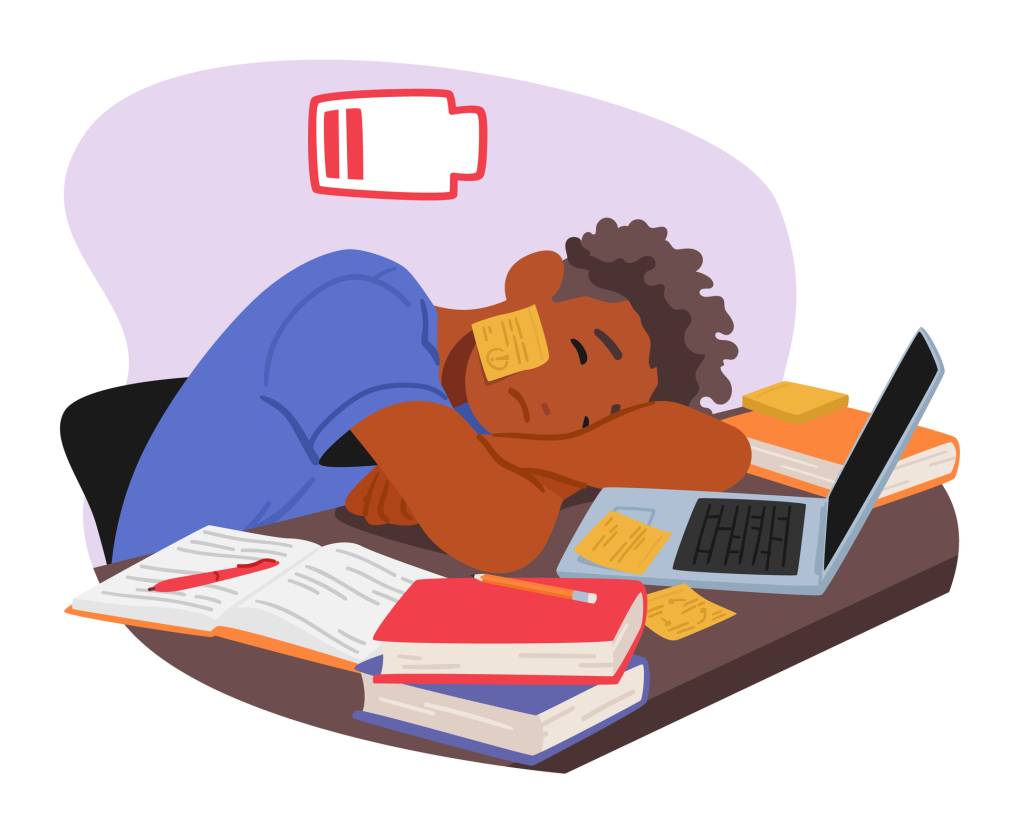
"altTag": "Illustration of Tired, Fatigue Student Boy Resting his Head On a Desk, Laptop Open And Surrounded By Books. A battery symbol with low energy status floats above him on a pink background.",
"isLoading": false,
"fetchFailed": false
},
"mindshift_62403": {
"type": "attachments",
"id": "mindshift_62403",
"meta": {
"index": "attachments_1716263798",
"site": "mindshift",
"id": "62403",
"found": true
},
"parent": 62400,
"imgSizes": {
"twentyfourteen-full-width": {
"file": "https://ww2.kqed.org/app/uploads/sites/23/2023/09/iStock-846720752-1038x576.jpg",
"width": 1038,
"mimeType": "image/jpeg",
"height": 576
},
"thumbnail": {
"file": "https://ww2.kqed.org/app/uploads/sites/23/2023/09/iStock-846720752-160x107.jpg",
"width": 160,
"mimeType": "image/jpeg",
"height": 107
},
"post-thumbnail": {
"file": "https://ww2.kqed.org/app/uploads/sites/23/2023/09/iStock-846720752-672x372.jpg",
"width": 672,
"mimeType": "image/jpeg",
"height": 372
},
"kqedFullSize": {
"file": "https://ww2.kqed.org/app/uploads/sites/23/2023/09/iStock-846720752-scaled.jpg",
"width": 2560,
"height": 1707
},
"2048x2048": {
"file": "https://ww2.kqed.org/app/uploads/sites/23/2023/09/iStock-846720752-2048x1365.jpg",
"width": 2048,
"mimeType": "image/jpeg",
"height": 1365
},
"large": {
"file": "https://ww2.kqed.org/app/uploads/sites/23/2023/09/iStock-846720752-1020x680.jpg",
"width": 1020,
"mimeType": "image/jpeg",
"height": 680
},
"1536x1536": {
"file": "https://ww2.kqed.org/app/uploads/sites/23/2023/09/iStock-846720752-1536x1024.jpg",
"width": 1536,
"mimeType": "image/jpeg",
"height": 1024
},
"full-width": {
"file": "https://ww2.kqed.org/app/uploads/sites/23/2023/09/iStock-846720752-1920x1280.jpg",
"width": 1920,
"mimeType": "image/jpeg",
"height": 1280
},
"medium": {
"file": "https://ww2.kqed.org/app/uploads/sites/23/2023/09/iStock-846720752-800x533.jpg",
"width": 800,
"mimeType": "image/jpeg",
"height": 533
},
"medium_large": {
"file": "https://ww2.kqed.org/app/uploads/sites/23/2023/09/iStock-846720752-768x512.jpg",
"width": 768,
"mimeType": "image/jpeg",
"height": 512
}
},
"publishDate": 1695096026,
"modified": 1695096079,
"caption": null,
"description": null,
"title": null,
"credit": "iStock/monkeybusinessimages",
"status": "inherit",
"altTag": null,
"isLoading": false,
"fetchFailed": false
},
"mindshift_62366": {
"type": "attachments",
"id": "mindshift_62366",
"meta": {
"index": "attachments_1716263798",
"site": "mindshift",
"id": "62366",
"found": true
},
"parent": 62365,
"imgSizes": {
"twentyfourteen-full-width": {
"file": "https://ww2.kqed.org/app/uploads/sites/23/2023/09/barshay-edtech-1038x576.jpeg",
"width": 1038,
"mimeType": "image/jpeg",
"height": 576
},
"thumbnail": {
"file": "https://ww2.kqed.org/app/uploads/sites/23/2023/09/barshay-edtech-160x107.jpeg",
"width": 160,
"mimeType": "image/jpeg",
"height": 107
},
"post-thumbnail": {
"file": "https://ww2.kqed.org/app/uploads/sites/23/2023/09/barshay-edtech-672x372.jpeg",
"width": 672,
"mimeType": "image/jpeg",
"height": 372
},
"kqedFullSize": {
"file": "https://ww2.kqed.org/app/uploads/sites/23/2023/09/barshay-edtech-scaled.jpeg",
"width": 2560,
"height": 1707
},
"2048x2048": {
"file": "https://ww2.kqed.org/app/uploads/sites/23/2023/09/barshay-edtech-2048x1365.jpeg",
"width": 2048,
"mimeType": "image/jpeg",
"height": 1365
},
"large": {
"file": "https://ww2.kqed.org/app/uploads/sites/23/2023/09/barshay-edtech-1020x680.jpeg",
"width": 1020,
"mimeType": "image/jpeg",
"height": 680
},
"1536x1536": {
"file": "https://ww2.kqed.org/app/uploads/sites/23/2023/09/barshay-edtech-1536x1024.jpeg",
"width": 1536,
"mimeType": "image/jpeg",
"height": 1024
},
"full-width": {
"file": "https://ww2.kqed.org/app/uploads/sites/23/2023/09/barshay-edtech-1920x1280.jpeg",
"width": 1920,
"mimeType": "image/jpeg",
"height": 1280
},
"medium": {
"file": "https://ww2.kqed.org/app/uploads/sites/23/2023/09/barshay-edtech-800x533.jpeg",
"width": 800,
"mimeType": "image/jpeg",
"height": 533
},
"medium_large": {
"file": "https://ww2.kqed.org/app/uploads/sites/23/2023/09/barshay-edtech-768x512.jpeg",
"width": 768,
"mimeType": "image/jpeg",
"height": 512
}
},
"publishDate": 1694364129,
"modified": 1694364170,
"caption": null,
"description": null,
"title": "Barshay edtech",
"credit": "Zachary Clingenpeel for The Hechinger Report",
"status": "inherit",
"altTag": null,
"isLoading": false,
"fetchFailed": false
},
"mindshift_60907": {
"type": "attachments",
"id": "mindshift_60907",
"meta": {
"index": "attachments_1716263798",
"site": "mindshift",
"id": "60907",
"found": true
},
"parent": 60905,
"imgSizes": {
"twentyfourteen-full-width": {
"file": "https://ww2.kqed.org/app/uploads/sites/23/2023/01/AMERICANED_SKYLINE_002-1038x576.jpg",
"width": 1038,
"mimeType": "image/jpeg",
"height": 576
},
"thumbnail": {
"file": "https://ww2.kqed.org/app/uploads/sites/23/2023/01/AMERICANED_SKYLINE_002-160x107.jpg",
"width": 160,
"mimeType": "image/jpeg",
"height": 107
},
"post-thumbnail": {
"file": "https://ww2.kqed.org/app/uploads/sites/23/2023/01/AMERICANED_SKYLINE_002-672x372.jpg",
"width": 672,
"mimeType": "image/jpeg",
"height": 372
},
"kqedFullSize": {
"file": "https://ww2.kqed.org/app/uploads/sites/23/2023/01/AMERICANED_SKYLINE_002-scaled.jpg",
"width": 2560,
"height": 1707
},
"2048x2048": {
"file": "https://ww2.kqed.org/app/uploads/sites/23/2023/01/AMERICANED_SKYLINE_002-2048x1365.jpg",
"width": 2048,
"mimeType": "image/jpeg",
"height": 1365
},
"large": {
"file": "https://ww2.kqed.org/app/uploads/sites/23/2023/01/AMERICANED_SKYLINE_002-1020x680.jpg",
"width": 1020,
"mimeType": "image/jpeg",
"height": 680
},
"1536x1536": {
"file": "https://ww2.kqed.org/app/uploads/sites/23/2023/01/AMERICANED_SKYLINE_002-1536x1024.jpg",
"width": 1536,
"mimeType": "image/jpeg",
"height": 1024
},
"full-width": {
"file": "https://ww2.kqed.org/app/uploads/sites/23/2023/01/AMERICANED_SKYLINE_002-1920x1280.jpg",
"width": 1920,
"mimeType": "image/jpeg",
"height": 1280
},
"medium": {
"file": "https://ww2.kqed.org/app/uploads/sites/23/2023/01/AMERICANED_SKYLINE_002-800x533.jpg",
"width": 800,
"mimeType": "image/jpeg",
"height": 533
},
"medium_large": {
"file": "https://ww2.kqed.org/app/uploads/sites/23/2023/01/AMERICANED_SKYLINE_002-768x512.jpg",
"width": 768,
"mimeType": "image/jpeg",
"height": 512
}
},
"publishDate": 1674770523,
"modified": 1674770567,
"caption": null,
"description": null,
"title": "High school girl writing",
"credit": "Allison Shelley/The Verbatim Agency for EDUimages",
"status": "inherit",
"altTag": "A student journals her response to a writing prompt in a tenth-grade English class.",
"isLoading": false,
"fetchFailed": false
},
"mindshift_60781": {
"type": "attachments",
"id": "mindshift_60781",
"meta": {
"index": "attachments_1716263798",
"site": "mindshift",
"id": "60781",
"found": true
},
"parent": 60780,
"imgSizes": {
"twentyfourteen-full-width": {
"file": "https://ww2.kqed.org/app/uploads/sites/23/2023/01/gpt0_custom-872f90e839240b1211259e1ad7aef02b9f839af4-1038x576.png",
"width": 1038,
"mimeType": "image/png",
"height": 576
},
"thumbnail": {
"file": "https://ww2.kqed.org/app/uploads/sites/23/2023/01/gpt0_custom-872f90e839240b1211259e1ad7aef02b9f839af4-160x96.png",
"width": 160,
"mimeType": "image/png",
"height": 96
},
"post-thumbnail": {
"file": "https://ww2.kqed.org/app/uploads/sites/23/2023/01/gpt0_custom-872f90e839240b1211259e1ad7aef02b9f839af4-672x372.png",
"width": 672,
"mimeType": "image/png",
"height": 372
},
"kqedFullSize": {
"file": "https://ww2.kqed.org/app/uploads/sites/23/2023/01/gpt0_custom-872f90e839240b1211259e1ad7aef02b9f839af4.png",
"width": 1276,
"height": 767
},
"large": {
"file": "https://ww2.kqed.org/app/uploads/sites/23/2023/01/gpt0_custom-872f90e839240b1211259e1ad7aef02b9f839af4-1020x613.png",
"width": 1020,
"mimeType": "image/png",
"height": 613
},
"medium": {
"file": "https://ww2.kqed.org/app/uploads/sites/23/2023/01/gpt0_custom-872f90e839240b1211259e1ad7aef02b9f839af4-800x481.png",
"width": 800,
"mimeType": "image/png",
"height": 481
},
"medium_large": {
"file": "https://ww2.kqed.org/app/uploads/sites/23/2023/01/gpt0_custom-872f90e839240b1211259e1ad7aef02b9f839af4-768x462.png",
"width": 768,
"mimeType": "image/png",
"height": 462
}
},
"publishDate": 1673301947,
"modified": 1673301947,
"caption": null,
"description": null,
"title": "GPTZero in action: The bot correctly detected AI-written text. The writing sample that was submitted? ChatGPT's attempt at \"an essay on the ethics of AI plagiarism that could pass a ChatGPT detector tool.\"",
"credit": null,
"status": "inherit",
"altTag": null,
"isLoading": false,
"fetchFailed": false
},
"mindshift_60640": {
"type": "attachments",
"id": "mindshift_60640",
"meta": {
"index": "attachments_1716263798",
"site": "mindshift",
"id": "60640",
"found": true
},
"parent": 60639,
"imgSizes": {
"twentyfourteen-full-width": {
"file": "https://ww2.kqed.org/app/uploads/sites/23/2022/12/chat-gpt-art-2_custom-d6c322b9069b3953f91013331c1ba97326d112ef-1038x576.png",
"width": 1038,
"mimeType": "image/png",
"height": 576
},
"thumbnail": {
"file": "https://ww2.kqed.org/app/uploads/sites/23/2022/12/chat-gpt-art-2_custom-d6c322b9069b3953f91013331c1ba97326d112ef-160x105.png",
"width": 160,
"mimeType": "image/png",
"height": 105
},
"post-thumbnail": {
"file": "https://ww2.kqed.org/app/uploads/sites/23/2022/12/chat-gpt-art-2_custom-d6c322b9069b3953f91013331c1ba97326d112ef-672x372.png",
"width": 672,
"mimeType": "image/png",
"height": 372
},
"kqedFullSize": {
"file": "https://ww2.kqed.org/app/uploads/sites/23/2022/12/chat-gpt-art-2_custom-d6c322b9069b3953f91013331c1ba97326d112ef.png",
"width": 1233,
"height": 812
},
"large": {
"file": "https://ww2.kqed.org/app/uploads/sites/23/2022/12/chat-gpt-art-2_custom-d6c322b9069b3953f91013331c1ba97326d112ef-1020x672.png",
"width": 1020,
"mimeType": "image/png",
"height": 672
},
"medium": {
"file": "https://ww2.kqed.org/app/uploads/sites/23/2022/12/chat-gpt-art-2_custom-d6c322b9069b3953f91013331c1ba97326d112ef-800x527.png",
"width": 800,
"mimeType": "image/png",
"height": 527
},
"medium_large": {
"file": "https://ww2.kqed.org/app/uploads/sites/23/2022/12/chat-gpt-art-2_custom-d6c322b9069b3953f91013331c1ba97326d112ef-768x506.png",
"width": 768,
"mimeType": "image/png",
"height": 506
}
},
"publishDate": 1671508053,
"modified": 1671508053,
"caption": null,
"description": null,
"title": "Enter a prompt into ChatGPT, and it becomes your very own virtual assistant.",
"credit": null,
"status": "inherit",
"altTag": null,
"isLoading": false,
"fetchFailed": false
},
"mindshift_59626": {
"type": "attachments",
"id": "mindshift_59626",
"meta": {
"index": "attachments_1716263798",
"site": "mindshift",
"id": "59626",
"found": true
},
"parent": 59625,
"imgSizes": {
"twentyfourteen-full-width": {
"file": "https://ww2.kqed.org/app/uploads/sites/23/2022/07/iStock-1340933349-1038x576.jpg",
"width": 1038,
"mimeType": "image/jpeg",
"height": 576
},
"thumbnail": {
"file": "https://ww2.kqed.org/app/uploads/sites/23/2022/07/iStock-1340933349-160x107.jpg",
"width": 160,
"mimeType": "image/jpeg",
"height": 107
},
"post-thumbnail": {
"file": "https://ww2.kqed.org/app/uploads/sites/23/2022/07/iStock-1340933349-672x372.jpg",
"width": 672,
"mimeType": "image/jpeg",
"height": 372
},
"kqedFullSize": {
"file": "https://ww2.kqed.org/app/uploads/sites/23/2022/07/iStock-1340933349.jpg",
"width": 2121,
"height": 1414
},
"2048x2048": {
"file": "https://ww2.kqed.org/app/uploads/sites/23/2022/07/iStock-1340933349-2048x1365.jpg",
"width": 2048,
"mimeType": "image/jpeg",
"height": 1365
},
"large": {
"file": "https://ww2.kqed.org/app/uploads/sites/23/2022/07/iStock-1340933349-1020x680.jpg",
"width": 1020,
"mimeType": "image/jpeg",
"height": 680
},
"1536x1536": {
"file": "https://ww2.kqed.org/app/uploads/sites/23/2022/07/iStock-1340933349-1536x1024.jpg",
"width": 1536,
"mimeType": "image/jpeg",
"height": 1024
},
"full-width": {
"file": "https://ww2.kqed.org/app/uploads/sites/23/2022/07/iStock-1340933349-1920x1280.jpg",
"width": 1920,
"mimeType": "image/jpeg",
"height": 1280
},
"medium": {
"file": "https://ww2.kqed.org/app/uploads/sites/23/2022/07/iStock-1340933349-800x533.jpg",
"width": 800,
"mimeType": "image/jpeg",
"height": 533
},
"medium_large": {
"file": "https://ww2.kqed.org/app/uploads/sites/23/2022/07/iStock-1340933349-768x512.jpg",
"width": 768,
"mimeType": "image/jpeg",
"height": 512
}
},
"publishDate": 1659133742,
"modified": 1659133832,
"caption": null,
"description": null,
"title": "iStock-1340933349",
"credit": "Lolkaphoto/ iStock",
"status": "inherit",
"altTag": "boy lying on the bed under a blanket and stopping alarm clock in the morning.",
"isLoading": false,
"fetchFailed": false
},
"mindshift_54596": {
"type": "attachments",
"id": "mindshift_54596",
"meta": {
"index": "attachments_1716263798",
"site": "mindshift",
"id": "54596",
"found": true
},
"parent": 54536,
"imgSizes": {
"twentyfourteen-full-width": {
"file": "https://ww2.kqed.org/app/uploads/sites/23/2019/10/iStock-846511402-1038x576.jpg",
"width": 1038,
"mimeType": "image/jpeg",
"height": 576
},
"thumbnail": {
"file": "https://ww2.kqed.org/app/uploads/sites/23/2019/10/iStock-846511402-160x107.jpg",
"width": 160,
"mimeType": "image/jpeg",
"height": 107
},
"post-thumbnail": {
"file": "https://ww2.kqed.org/app/uploads/sites/23/2019/10/iStock-846511402-672x372.jpg",
"width": 672,
"mimeType": "image/jpeg",
"height": 372
},
"kqedFullSize": {
"file": "https://ww2.kqed.org/app/uploads/sites/23/2019/10/iStock-846511402-e1570220832324.jpg",
"width": 1920,
"height": 1280
},
"large": {
"file": "https://ww2.kqed.org/app/uploads/sites/23/2019/10/iStock-846511402-1020x680.jpg",
"width": 1020,
"mimeType": "image/jpeg",
"height": 680
},
"complete_open_graph": {
"file": "https://ww2.kqed.org/app/uploads/sites/23/2019/10/iStock-846511402-1200x800.jpg",
"width": 1200,
"mimeType": "image/jpeg",
"height": 800
},
"full-width": {
"file": "https://ww2.kqed.org/app/uploads/sites/23/2019/10/iStock-846511402-1920x1280.jpg",
"width": 1920,
"mimeType": "image/jpeg",
"height": 1280
},
"medium": {
"file": "https://ww2.kqed.org/app/uploads/sites/23/2019/10/iStock-846511402-800x533.jpg",
"width": 800,
"mimeType": "image/jpeg",
"height": 533
},
"medium_large": {
"file": "https://ww2.kqed.org/app/uploads/sites/23/2019/10/iStock-846511402-768x512.jpg",
"width": 768,
"mimeType": "image/jpeg",
"height": 512
}
},
"publishDate": 1570220805,
"modified": 1570220827,
"caption": null,
"description": null,
"title": "Young girl doing homework",
"credit": "ASIFE/iStock",
"status": "inherit",
"isLoading": false,
"fetchFailed": false
},
"mindshift_52573": {
"type": "attachments",
"id": "mindshift_52573",
"meta": {
"index": "attachments_1716263798",
"site": "mindshift",
"id": "52573",
"found": true
},
"parent": 52393,
"imgSizes": {
"small": {
"file": "https://ww2.kqed.org/app/uploads/sites/23/2018/11/reluctant-hmwk-520x347.jpg",
"width": 520,
"mimeType": "image/jpeg",
"height": 347
},
"twentyfourteen-full-width": {
"file": "https://ww2.kqed.org/app/uploads/sites/23/2018/11/reluctant-hmwk-1038x576.jpg",
"width": 1038,
"mimeType": "image/jpeg",
"height": 576
},
"thumbnail": {
"file": "https://ww2.kqed.org/app/uploads/sites/23/2018/11/reluctant-hmwk-160x107.jpg",
"width": 160,
"mimeType": "image/jpeg",
"height": 107
},
"fd-sm": {
"file": "https://ww2.kqed.org/app/uploads/sites/23/2018/11/reluctant-hmwk-960x640.jpg",
"width": 960,
"mimeType": "image/jpeg",
"height": 640
},
"post-thumbnail": {
"file": "https://ww2.kqed.org/app/uploads/sites/23/2018/11/reluctant-hmwk-672x372.jpg",
"width": 672,
"mimeType": "image/jpeg",
"height": 372
},
"xsmall": {
"file": "https://ww2.kqed.org/app/uploads/sites/23/2018/11/reluctant-hmwk-375x250.jpg",
"width": 375,
"mimeType": "image/jpeg",
"height": 250
},
"kqedFullSize": {
"file": "https://ww2.kqed.org/app/uploads/sites/23/2018/11/reluctant-hmwk.jpg",
"width": 2121,
"height": 1414
},
"large": {
"file": "https://ww2.kqed.org/app/uploads/sites/23/2018/11/reluctant-hmwk-1020x680.jpg",
"width": 1020,
"mimeType": "image/jpeg",
"height": 680
},
"xlarge": {
"file": "https://ww2.kqed.org/app/uploads/sites/23/2018/11/reluctant-hmwk-1180x787.jpg",
"width": 1180,
"mimeType": "image/jpeg",
"height": 787
},
"complete_open_graph": {
"file": "https://ww2.kqed.org/app/uploads/sites/23/2018/11/reluctant-hmwk-1200x800.jpg",
"width": 1200,
"mimeType": "image/jpeg",
"height": 800
},
"guest-author-50": {
"file": "https://ww2.kqed.org/app/uploads/sites/23/2018/11/reluctant-hmwk-50x50.jpg",
"width": 50,
"mimeType": "image/jpeg",
"height": 50
},
"guest-author-96": {
"file": "https://ww2.kqed.org/app/uploads/sites/23/2018/11/reluctant-hmwk-96x96.jpg",
"width": 96,
"mimeType": "image/jpeg",
"height": 96
},
"medium": {
"file": "https://ww2.kqed.org/app/uploads/sites/23/2018/11/reluctant-hmwk-800x533.jpg",
"width": 800,
"mimeType": "image/jpeg",
"height": 533
},
"guest-author-64": {
"file": "https://ww2.kqed.org/app/uploads/sites/23/2018/11/reluctant-hmwk-64x64.jpg",
"width": 64,
"mimeType": "image/jpeg",
"height": 64
},
"guest-author-32": {
"file": "https://ww2.kqed.org/app/uploads/sites/23/2018/11/reluctant-hmwk-32x32.jpg",
"width": 32,
"mimeType": "image/jpeg",
"height": 32
},
"fd-lrg": {
"file": "https://ww2.kqed.org/app/uploads/sites/23/2018/11/reluctant-hmwk-1920x1280.jpg",
"width": 1920,
"mimeType": "image/jpeg",
"height": 1280
},
"fd-med": {
"file": "https://ww2.kqed.org/app/uploads/sites/23/2018/11/reluctant-hmwk-1180x787.jpg",
"width": 1180,
"mimeType": "image/jpeg",
"height": 787
},
"full-width": {
"file": "https://ww2.kqed.org/app/uploads/sites/23/2018/11/reluctant-hmwk-1920x1280.jpg",
"width": 1920,
"mimeType": "image/jpeg",
"height": 1280
},
"detail": {
"file": "https://ww2.kqed.org/app/uploads/sites/23/2018/11/reluctant-hmwk-150x150.jpg",
"width": 150,
"mimeType": "image/jpeg",
"height": 150
},
"medium_large": {
"file": "https://ww2.kqed.org/app/uploads/sites/23/2018/11/reluctant-hmwk-768x512.jpg",
"width": 768,
"mimeType": "image/jpeg",
"height": 512
},
"guest-author-128": {
"file": "https://ww2.kqed.org/app/uploads/sites/23/2018/11/reluctant-hmwk-128x128.jpg",
"width": 128,
"mimeType": "image/jpeg",
"height": 128
},
"xxsmall": {
"file": "https://ww2.kqed.org/app/uploads/sites/23/2018/11/reluctant-hmwk-240x160.jpg",
"width": 240,
"mimeType": "image/jpeg",
"height": 160
}
},
"publishDate": 1543215287,
"modified": 1543215586,
"caption": null,
"description": null,
"title": "Mother and daughter drawing",
"credit": "PIKSEL/iStock",
"status": "inherit",
"isLoading": false,
"fetchFailed": false
},
"mindshift_52251": {
"type": "attachments",
"id": "mindshift_52251",
"meta": {
"index": "attachments_1716263798",
"site": "mindshift",
"id": "52251",
"found": true
},
"parent": 52180,
"imgSizes": {
"small": {
"file": "https://ww2.kqed.org/app/uploads/sites/23/2018/09/iStock-935874416-520x347.jpg",
"width": 520,
"mimeType": "image/jpeg",
"height": 347
},
"twentyfourteen-full-width": {
"file": "https://ww2.kqed.org/app/uploads/sites/23/2018/09/iStock-935874416-1038x576.jpg",
"width": 1038,
"mimeType": "image/jpeg",
"height": 576
},
"thumbnail": {
"file": "https://ww2.kqed.org/app/uploads/sites/23/2018/09/iStock-935874416-160x107.jpg",
"width": 160,
"mimeType": "image/jpeg",
"height": 107
},
"fd-sm": {
"file": "https://ww2.kqed.org/app/uploads/sites/23/2018/09/iStock-935874416-960x641.jpg",
"width": 960,
"mimeType": "image/jpeg",
"height": 641
},
"post-thumbnail": {
"file": "https://ww2.kqed.org/app/uploads/sites/23/2018/09/iStock-935874416-672x372.jpg",
"width": 672,
"mimeType": "image/jpeg",
"height": 372
},
"xsmall": {
"file": "https://ww2.kqed.org/app/uploads/sites/23/2018/09/iStock-935874416-375x250.jpg",
"width": 375,
"mimeType": "image/jpeg",
"height": 250
},
"kqedFullSize": {
"file": "https://ww2.kqed.org/app/uploads/sites/23/2018/09/iStock-935874416-e1538113734153.jpg",
"width": 1920,
"height": 1282
},
"large": {
"file": "https://ww2.kqed.org/app/uploads/sites/23/2018/09/iStock-935874416-1020x681.jpg",
"width": 1020,
"mimeType": "image/jpeg",
"height": 681
},
"xlarge": {
"file": "https://ww2.kqed.org/app/uploads/sites/23/2018/09/iStock-935874416-1180x788.jpg",
"width": 1180,
"mimeType": "image/jpeg",
"height": 788
},
"complete_open_graph": {
"file": "https://ww2.kqed.org/app/uploads/sites/23/2018/09/iStock-935874416-1200x801.jpg",
"width": 1200,
"mimeType": "image/jpeg",
"height": 801
},
"guest-author-50": {
"file": "https://ww2.kqed.org/app/uploads/sites/23/2018/09/iStock-935874416-50x50.jpg",
"width": 50,
"mimeType": "image/jpeg",
"height": 50
},
"guest-author-96": {
"file": "https://ww2.kqed.org/app/uploads/sites/23/2018/09/iStock-935874416-96x96.jpg",
"width": 96,
"mimeType": "image/jpeg",
"height": 96
},
"medium": {
"file": "https://ww2.kqed.org/app/uploads/sites/23/2018/09/iStock-935874416-800x534.jpg",
"width": 800,
"mimeType": "image/jpeg",
"height": 534
},
"guest-author-64": {
"file": "https://ww2.kqed.org/app/uploads/sites/23/2018/09/iStock-935874416-64x64.jpg",
"width": 64,
"mimeType": "image/jpeg",
"height": 64
},
"guest-author-32": {
"file": "https://ww2.kqed.org/app/uploads/sites/23/2018/09/iStock-935874416-32x32.jpg",
"width": 32,
"mimeType": "image/jpeg",
"height": 32
},
"fd-lrg": {
"file": "https://ww2.kqed.org/app/uploads/sites/23/2018/09/iStock-935874416-1920x1282.jpg",
"width": 1920,
"mimeType": "image/jpeg",
"height": 1282
},
"fd-med": {
"file": "https://ww2.kqed.org/app/uploads/sites/23/2018/09/iStock-935874416-1180x788.jpg",
"width": 1180,
"mimeType": "image/jpeg",
"height": 788
},
"full-width": {
"file": "https://ww2.kqed.org/app/uploads/sites/23/2018/09/iStock-935874416-1920x1282.jpg",
"width": 1920,
"mimeType": "image/jpeg",
"height": 1282
},
"detail": {
"file": "https://ww2.kqed.org/app/uploads/sites/23/2018/09/iStock-935874416-150x150.jpg",
"width": 150,
"mimeType": "image/jpeg",
"height": 150
},
"medium_large": {
"file": "https://ww2.kqed.org/app/uploads/sites/23/2018/09/iStock-935874416-768x513.jpg",
"width": 768,
"mimeType": "image/jpeg",
"height": 513
},
"guest-author-128": {
"file": "https://ww2.kqed.org/app/uploads/sites/23/2018/09/iStock-935874416-128x128.jpg",
"width": 128,
"mimeType": "image/jpeg",
"height": 128
},
"xxsmall": {
"file": "https://ww2.kqed.org/app/uploads/sites/23/2018/09/iStock-935874416-240x160.jpg",
"width": 240,
"mimeType": "image/jpeg",
"height": 160
}
},
"publishDate": 1538113706,
"modified": 1538113726,
"caption": null,
"description": null,
"title": "iStock-935874416",
"credit": "iStock/flukyfluky",
"status": "inherit",
"isLoading": false,
"fetchFailed": false
}
},
"audioPlayerReducer": {
"postId": "stream_live",
"isPaused": true,
"isPlaying": false,
"pfsActive": false,
"pledgeModalIsOpen": true,
"playerDrawerIsOpen": false,
"liveAudioPlayStartedAt": 0,
"liveAudioPlayContext": ""
},
"authorsReducer": {
"byline_mindshift_66311": {
"type": "authors",
"id": "byline_mindshift_66311",
"meta": {
"override": true
},
"slug": "byline_mindshift_66311",
"name": "Ariel Gilreath, \u003ca href=\"https://hechingerreport.org/\">The Hechinger Report\u003c/a>",
"isLoading": false
},
"byline_mindshift_63052": {
"type": "authors",
"id": "byline_mindshift_63052",
"meta": {
"override": true
},
"slug": "byline_mindshift_63052",
"name": "Jill Barshay, \u003ca href=\"https://hechingerreport.org/\" target=\"_blank\">The Hechinger Report\u003c/a>",
"isLoading": false
},
"byline_mindshift_62400": {
"type": "authors",
"id": "byline_mindshift_62400",
"meta": {
"override": true
},
"slug": "byline_mindshift_62400",
"name": "Cara Goodwin, \u003ca href=\"https://parentingtranslator.org\" target=\"_blank\">The Parenting Translator\u003c/a>",
"isLoading": false
},
"byline_mindshift_62365": {
"type": "authors",
"id": "byline_mindshift_62365",
"meta": {
"override": true
},
"slug": "byline_mindshift_62365",
"name": "Jill Barshay, \u003ca href=\"https://hechingerreport.org/\" target=\"_blank\">The Hechinger Report\u003c/a>",
"isLoading": false
},
"byline_mindshift_60780": {
"type": "authors",
"id": "byline_mindshift_60780",
"meta": {
"override": true
},
"slug": "byline_mindshift_60780",
"name": "Emma Bowman",
"isLoading": false
},
"byline_mindshift_60639": {
"type": "authors",
"id": "byline_mindshift_60639",
"meta": {
"override": true
},
"slug": "byline_mindshift_60639",
"name": "Emma Bowman",
"isLoading": false
},
"katrinaschwartz": {
"type": "authors",
"id": "234",
"meta": {
"index": "authors_1716337520",
"id": "234",
"found": true
},
"name": "Katrina Schwartz",
"firstName": "Katrina",
"lastName": "Schwartz",
"slug": "katrinaschwartz",
"email": "kschwartz@kqed.org",
"display_author_email": false,
"staff_mastheads": [
"news"
],
"title": "Producer",
"bio": "Katrina Schwartz is a journalist based in San Francisco. She's worked at KPCC public radio in LA and has reported on air and online for KQED since 2010. She covered how teaching and learning is changing for MindShift between 2012 and 2020. She is the co-host of the MindShift podcast and now produces KQED's Bay Curious podcast.",
"avatar": "https://secure.gravatar.com/avatar/edb4ee79070447a018538c9aae6eeecf28786515b8a0c30e43b6b7dce5aa44c8?s=600&d=blank&r=g",
"twitter": "kschwart",
"bluesky": null,
"facebook": null,
"instagram": null,
"linkedin": null,
"sites": [
{
"site": "",
"roles": [
"editor"
]
},
{
"site": "news",
"roles": [
"editor"
]
},
{
"site": "mindshift",
"roles": [
"administrator"
]
},
{
"site": "stateofhealth",
"roles": [
"author"
]
},
{
"site": "science",
"roles": [
"editor"
]
}
],
"headData": {
"title": "Katrina Schwartz | KQED",
"description": "Producer",
"ogImgSrc": "https://secure.gravatar.com/avatar/edb4ee79070447a018538c9aae6eeecf28786515b8a0c30e43b6b7dce5aa44c8?s=600&d=blank&r=g",
"twImgSrc": "https://secure.gravatar.com/avatar/edb4ee79070447a018538c9aae6eeecf28786515b8a0c30e43b6b7dce5aa44c8?s=600&d=blank&r=g"
},
"isLoading": false,
"link": "/author/katrinaschwartz"
},
"dfkris": {
"type": "authors",
"id": "11087",
"meta": {
"index": "authors_1716337520",
"id": "11087",
"found": true
},
"name": "Deborah Farmer Kris",
"firstName": "Deborah Farmer",
"lastName": "Kris",
"slug": "dfkris",
"email": "dfkris@gmail.com",
"display_author_email": false,
"staff_mastheads": [],
"title": null,
"bio": "\u003cem>\u003ca href=\"https://twitter.com/@dfkris\">Deborah Farmer Kris\u003c/a> has taught elementary, middle and high school and served as a charter school administrator. She spent a decade as an associate at Boston University’s \u003c/em>\u003cem>\u003ca href=\"http://www.bu.edu/ccsr/about-us/\">Center for Character and Social Responsibility\u003c/a>, \u003c/em>\u003cem>researching, writing, and consulting with schools. She is the mother of two young children. You can follower her on Twitter \u003ca href=\"https://twitter.com/@dfkris\">@dfkris\u003c/a>.\u003c/em>",
"avatar": "https://secure.gravatar.com/avatar/48efe6f17031ed31222b74af9605fe5a?s=600&d=blank&r=g",
"twitter": "dfkris",
"facebook": null,
"instagram": null,
"linkedin": null,
"sites": [
{
"site": "mindshift",
"roles": [
"author"
]
}
],
"headData": {
"title": "Deborah Farmer Kris | KQED",
"description": null,
"ogImgSrc": "https://secure.gravatar.com/avatar/48efe6f17031ed31222b74af9605fe5a?s=600&d=blank&r=g",
"twImgSrc": "https://secure.gravatar.com/avatar/48efe6f17031ed31222b74af9605fe5a?s=600&d=blank&r=g"
},
"isLoading": false,
"link": "/author/dfkris"
},
"mfederis": {
"type": "authors",
"id": "11509",
"meta": {
"index": "authors_1716337520",
"id": "11509",
"found": true
},
"name": "Marnette Federis",
"firstName": "Marnette",
"lastName": "Federis",
"slug": "mfederis",
"email": "mfederis@kqed.org",
"display_author_email": false,
"staff_mastheads": [],
"title": "KQED Contributor",
"bio": null,
"avatar": "https://secure.gravatar.com/avatar/4e22db56276fd54eaeb4ec94c12662c6c695a321a263331af03448665369ad7f?s=600&d=mm&r=g",
"twitter": null,
"bluesky": null,
"facebook": null,
"instagram": null,
"linkedin": null,
"sites": [
{
"site": "arts",
"roles": [
"editor"
]
},
{
"site": "news",
"roles": [
"editor"
]
},
{
"site": "mindshift",
"roles": [
"editor"
]
},
{
"site": "science",
"roles": [
"editor"
]
},
{
"site": "forum",
"roles": [
"editor"
]
},
{
"site": "podcasts",
"roles": [
"editor"
]
},
{
"site": "elections",
"roles": [
"editor"
]
}
],
"headData": {
"title": "Marnette Federis | KQED",
"description": "KQED Contributor",
"ogImgSrc": "https://secure.gravatar.com/avatar/4e22db56276fd54eaeb4ec94c12662c6c695a321a263331af03448665369ad7f?s=600&d=mm&r=g",
"twImgSrc": "https://secure.gravatar.com/avatar/4e22db56276fd54eaeb4ec94c12662c6c695a321a263331af03448665369ad7f?s=600&d=mm&r=g"
},
"isLoading": false,
"link": "/author/mfederis"
},
"ngobir": {
"type": "authors",
"id": "11721",
"meta": {
"index": "authors_1716337520",
"id": "11721",
"found": true
},
"name": "Nimah Gobir",
"firstName": "Nimah",
"lastName": "Gobir",
"slug": "ngobir",
"email": "ngobir@kqed.org",
"display_author_email": false,
"staff_mastheads": [],
"title": "KQED Contributor",
"bio": null,
"avatar": "https://secure.gravatar.com/avatar/837f5df7045c59f3ec097cdf7ac391373ab75d5ec936dd7099b8cb6f0af1b0e9?s=600&d=blank&r=g",
"twitter": null,
"bluesky": null,
"facebook": null,
"instagram": null,
"linkedin": null,
"sites": [
{
"site": "mindshift",
"roles": [
"editor"
]
}
],
"headData": {
"title": "Nimah Gobir | KQED",
"description": "KQED Contributor",
"ogImgSrc": "https://secure.gravatar.com/avatar/837f5df7045c59f3ec097cdf7ac391373ab75d5ec936dd7099b8cb6f0af1b0e9?s=600&d=blank&r=g",
"twImgSrc": "https://secure.gravatar.com/avatar/837f5df7045c59f3ec097cdf7ac391373ab75d5ec936dd7099b8cb6f0af1b0e9?s=600&d=blank&r=g"
},
"isLoading": false,
"link": "/author/ngobir"
}
},
"pagesReducer": {
"mindshift_tag_homework": {
"type": "terms",
"id": "mindshift_563",
"meta": {
"index": "terms_1716263798",
"site": "mindshift",
"id": "563",
"score": 10.407741
},
"featImg": null,
"name": "homework",
"description": null,
"taxonomy": "tag",
"headData": {
"twImgId": null,
"twTitle": null,
"ogTitle": null,
"ogImgId": null,
"twDescription": null,
"description": null,
"title": "homework Archives | KQED Mindshift",
"ogDescription": null
},
"ttid": 566,
"slug": "homework",
"isLoading": false,
"title": "homework",
"pageMeta": {
"site": "mindshift",
"WpPageTemplate": "page-topic-editorial",
"currentPage": 1
},
"blocks": [
{
"blockName": "kqed/post-list",
"attrs": {
"layout": "cardArticle2",
"query": "posts/mindshift?tag=homework",
"seeMore": false,
"paginated": true,
"page": 1
}
},
{
"blockName": "kqed/ad"
}
]
}
},
"pfsSessionReducer": {},
"postsReducer": {
"stream_live": {
"type": "live",
"id": "stream_live",
"audioUrl": "https://hls.kqed.org/hls/kqed_app/playlist.m3u8",
"title": "Live Stream",
"excerpt": "Live Stream information currently unavailable.",
"link": "/radio",
"featImg": "",
"label": {
"name": "KQED Live",
"link": "/"
}
},
"stream_kqedNewscast": {
"type": "posts",
"id": "stream_kqedNewscast",
"audioUrl": "https://www.kqed.org/.stream/anon/radio/RDnews/newscast.mp3?_=1",
"title": "KQED Newscast",
"featImg": "",
"label": {
"name": "88.5 FM",
"link": "/"
}
},
"mindshift_66311": {
"type": "posts",
"id": "mindshift_66311",
"meta": {
"index": "posts_1716263798",
"site": "mindshift",
"id": "66311",
"score": null,
"sort": [
1777396146000
]
},
"guestAuthors": [],
"slug": "should-schools-get-rid-of-homework-the-answer-is-complex-and-ai-contributes",
"title": "Should Schools Get Rid of Homework? The Answer is Complex and AI Contributes",
"publishDate": 1777396146,
"format": "standard",
"headTitle": "Should Schools Get Rid of Homework? The Answer is Complex and AI Contributes | KQED",
"labelTerm": {
"site": "mindshift"
},
"content": "\u003cp>A few days into the new semester this January, the LaSalle Parish school district in rural Louisiana made a pronouncement: No more homework.\u003c/p>\n\u003cp>Since then, none of the 2,500 students in this district — from the youngest learners up through high school seniors — have been required to do schoolwork at home. Parents can request practice problems if they’d like, Superintendent Jonathan Garrett said, but that work won’t be mandatory or graded.\u003c/p>\n\u003cp>Homework assignments, it turned out, were among the biggest sources of complaints Garrett had heard from parents and students over the years.\u003c/p>\n\u003cp>“When there was a negative feeling about school, it usually stemmed from what kids are bringing home, the frustrations they feel completing that, and that parents and guardians feel trying to help them complete it,” he said in an interview.\u003c/p>\n\u003cp>Beyond that, Garrett said the move was driven by concerns – shared by many educators – that much of the homework students are assigned – especially in math – is needlessly repetitive, takes too long to complete and hasn’t adapted to the challenges posed by Artificial Intelligence.\u003c/p>\n\u003cp>[ad fullwidth]\u003c/p>\n\u003cp>The response to Garrett’s announcement was swift — and overwhelmingly positive. The message is the district’s most “liked”\u003ca href=\"https://www.facebook.com/photo?fbid=1444965060964889&set=a.499624705498934\" target=\"_blank\" rel=\"noopener\"> post on Facebook\u003c/a> by far this year, with hundreds of shares — many of them by parents from neighboring parishes asking how they could get their own schools on board.\u003c/p>\n\u003cp>The scope of the district’s no-homework guidance is new, but it follows a trend that educators and researchers have been noticing for years: More teachers are moving away from homework.\u003c/p>\n\u003cp>Federal survey data shows that the amount of math homework assigned to fourth and eighth grade students, in particular, has been steadily declining for the past decade.\u003c/p>\n\u003cp>Some educators and parents say this is a good thing — students shouldn’t spend six or more hours a day at school and still have additional schoolwork to complete at home. But the research on homework is complicated.\u003c/p>\n\u003cp>Some studies show that students who spend more time on homework\u003ca href=\"https://pmc.ncbi.nlm.nih.gov/articles/PMC8025066/\" target=\"_blank\" rel=\"noopener\"> perform better than their peers\u003c/a>. For example, a longitudinal study released in 2021 of more than 6,000 students in Germany, Uruguay and the Netherlands found that lower-performing students who increased the amount of time they spent on math homework performed better in math, even one year later.\u003c/p>\n\u003cp>Other studies, however, suggest homework has minimal outcomes on academic performance: A 1998 study of more than 700 U.S. students led by a researcher at Duke University found that more homework assigned in elementary grades had no significant effect on standardized test scores. The researchers did find small positive gains on class grades when they looked at both test scores and the proportion of homework students completed.\u003c/p>\n\u003cp>More homework was also associated with negative attitudes about school for younger children in the study.\u003c/p>\n\u003cp>“The best educators figured out a long time ago that we can control what we can control,” and that’s what happens during the school day, Superintendent Garrett said, not homework. “There has been a shift away from it naturally anyway, and I felt like this made it equitable across our entire school system.”\u003c/p>\n\u003ch2>In math especially, students need practice\u003c/h2>\n\u003cp>The debate over homework has swung back and forth for more than a century, and the tide of public opinion has shifted every few years. It’s likely to continue changing for a simple reason: Researching homework is a challenge.\u003c/p>\n\u003cp>There’s no good way to isolate the amount of time spent on homework and its effects on students, because it may take one student five minutes to complete the same math problem that another student spent 45 minutes on. That extra time doesn’t necessarily result in the struggling student performing better than the student who grasped the assignment more quickly.\u003c/p>\n\u003cp>However, just like playing the violin or hitting a baseball, or any other skill that requires training, there is evidence that students need practice to master academic subjects, particularly in math.\u003c/p>\n\u003cp>Some experts worry the overall decrease in homework could be a problem for math achievement, at a time when\u003ca href=\"https://hechingerreport.org/naep-test-2024-dismal-report/\" target=\"_blank\" rel=\"noopener\"> math scores across the country are already at a dismal low\u003c/a>.\u003c/p>\n\u003cp>“The best argument for homework is that mathematical procedures require practice, and you don’t want to waste classroom time on practice, so you send that home,” said Tom Loveless, a researcher and former teacher who has studied homework.\u003c/p>\n\u003ch2>\u003cstrong>The effects of AI on homework\u003c/strong>\u003c/h2>\n\u003cp>Generative artificial intelligence has added a new wrinkle to the homework debate, too. More than half of teens said they used chatbots to help with schoolwork, and\u003ca href=\"https://www.pewresearch.org/internet/2026/02/24/how-teens-use-and-view-ai/\" target=\"_blank\" rel=\"noopener\"> 1 in 10 said they used virtual assistants\u003c/a> to do all or most of their schoolwork, according to a recent survey by Pew Research Center.\u003c/p>\n\u003cp>A different survey of teachers by the EdWeek Research Center found that 40 percent said homework assignments had decreased over the past two years, and of those, 29 percent said it was\u003ca href=\"https://www.edweek.org/leadership/are-schools-assigning-less-homework-a-new-survey-offers-answers/2026/02\" target=\"_blank\" rel=\"noopener\"> because students’ use of AI had lessened the value of homework\u003c/a>.\u003c/p>\n\u003cp>Between 1996 and 2015, very few fourth graders — between 4 and 6 percent — reported being given no math homework the previous night, according to surveys from the Nation’s Report Card. By 2024, that percentage was up to more than a quarter. There was a similar trend for eighth graders.\u003c/p>\n\u003cp>Ariel Taylor Smith, senior director of the Center for Policy and Action at the National Parents Union, a nonprofit that advocates for parents, has seen this trend in her own fourth grader’s public elementary school class in Vermont, whose teacher doesn’t assign homework.\u003c/p>\n\u003cp>“The thing they point to is that it’s an equity issue, and not all parents have the same availability and ability to support their students,” said Smith.\u003c/p>\n\u003cp>She believes, however, that students should do some homework without the help of their parents. “I would make the argument that if a kid is really far behind in school, that’s an equity issue. They need the additional time to practice.”\u003c/p>\n\u003cp>Smith said she and her mother create their own homework now for her son: reading exercises and flash cards in math. Kids, she said, “need more practice. … Sometimes, you do have to practice the boring stuff, like math.”\u003c/p>\n\u003cp>Not everyone feels this way about homework. For Jim Malliard’s two children in Franklin, Pa., adverse experiences at school became a barrier to completing homework.\u003c/p>\n\u003cp>“It became a fight because the kids had so much school-based anxiety from trauma and bullying at school that they didn’t want to deal with school when they got home,” said Malliard, whose kids attended a public high school.\u003c/p>\n\u003cp>Malliard, who\u003ca href=\"https://candyappleadvocacy.com\" target=\"_blank\" rel=\"noopener\"> writes\u003c/a> about education issues and is a full-time caregiver to his wife, doesn’t think his children were overburdened with homework at their school, but he also doesn’t believe they were benefiting from it.\u003c/p>\n\u003cp>“The teachers would tell us homework only takes 15 minutes a night — sure, if a kid sits there and does it right away and is attentive and wants to do it,” Malliard said. “It was getting to be an hour for us.”\u003c/p>\n\u003cp>He eventually enrolled his children in a virtual charter school, which they attended for the rest of their K-12 schooling.\u003c/p>\n\u003ch2>\u003cstrong>How much is enough?\u003c/strong>\u003c/h2>\n\u003cp>Over the years, research has attempted to answer the thorny question of how much homework is appropriate, with varying degrees of success.\u003c/p>\n\u003cp>Education groups and researchers generally recommend 10 minutes of homework each night per grade level. But it’s almost impossible to assign work that will take every student the same amount of time to complete, and research has shown there are harmful effects from too much time spent on homework.\u003c/p>\n\u003cp>A survey published in 2014 out of Stanford University that looked at more than 4,300 students in high-performing California high school schools found that the benefit of homework for high school students\u003ca href=\"https://ed.stanford.edu/news/more-two-hours-homework-may-be-counterproductive-research-suggests\" target=\"_blank\" rel=\"noopener\"> plateaus after two hours a night\u003c/a>. Beyond that, the researchers found, it can lead to more stress and poor sleep.\u003c/p>\n\u003cp>Research on homework tends to focus on the amount of time students spend on it rather than the quality or purpose of the assignments, said Joyce Epstein, who has studied homework and is the co-director of the Center on School, Family, and Community Partnerships at the Johns Hopkins University School of Education.\u003c/p>\n\u003cp>One option worth considering, Epstein said, is to design homework that has a specific purpose but is perhaps shorter than traditional homework assignments. Giving students the opportunity to practice is important, she said, particularly in math, where concepts build on each other and move relentlessly forward throughout the year.\u003c/p>\n\u003cp>“The interesting issue for folks to consider is not should there be more homework, but should there be better homework,” Epstein said. “Better homework in math might be knowing the fact that kids don’t have to be practicing for hours, 10 to 20 examples,” when they could establish mastery in less time.\u003c/p>\n\u003cp>When students are completing math homework on their own but doing the problems incorrectly, some educators say it takes longer to reteach them the right way in class the next day.\u003c/p>\n\u003cp>Wendy Birhanzel, superintendent of Harrison School District 2 in Colorado, said her district has taken the approach recommended by Epstein, of focusing on the quality of homework while assigning less of it.\u003c/p>\n\u003cp>Rather than long “drill and kill” worksheets she remembers from her time as a student, Birhanzel said elementary students in the district might have a reading assignment, a few math problems and a small writing sample. “It’s more purposeful and less intensive,” Birhanzel said.\u003c/p>\n\u003cp>In Louisiana’s LaSalle Parish, Superintendent Garrett said that to account for the lost practice time, he has given math teachers permission to slow down their instruction and give students time in class to practice concepts, even if that means they don’t cover as much content during the school year.\u003c/p>\n\u003cp>“We felt like doing that would actually be more beneficial than racing through and covering every single thing that was listed. We’ll see,” he said. “This might be something that helps us in the long run.”\u003c/p>\n\u003cp>[ad floatright]\u003c/p>\n\u003cp>\u003cem>This story was produced by\u003c/em>\u003ca href=\"https://hechingerreport.org/\" target=\"_blank\" rel=\"noopener\"> The Hechinger Report\u003c/a>\u003cem>, a nonprofit, independent news organization focused on inequality and innovation in education. Contact writer Ariel Gilreath on Signal at arielgilreath.46 or at gilreath@hechingerreport.org\u003c/em>.\u003c/p>\n\n",
"blocks": [],
"excerpt": "Some experts worry that less homework could be a problem for math achievement, at a time when test scores nationwide are already at a dismal low.",
"status": "publish",
"parent": 0,
"modified": 1777655634,
"stats": {
"hasAudio": false,
"hasVideo": false,
"hasChartOrMap": false,
"iframeSrcs": [],
"hasGoogleForm": false,
"hasGallery": false,
"hasHearkenModule": false,
"hasPolis": false,
"paragraphCount": 44,
"wordCount": 1797
},
"headData": {
"title": "Should Schools Get Rid of Homework? The Answer is Complex and AI Contributes | KQED",
"description": "Some experts worry that less homework could be a problem for math achievement, at a time when test scores nationwide are already at a dismal low.",
"ogTitle": "",
"ogDescription": "",
"ogImgId": "",
"twTitle": "",
"twDescription": "",
"twImgId": "",
"schema": {
"@context": "https://schema.org",
"@type": "Article",
"headline": "Should Schools Get Rid of Homework? The Answer is Complex and AI Contributes",
"datePublished": "2026-04-28T10:09:06-07:00",
"dateModified": "2026-05-01T10:13:54-07:00",
"image": "https://cdn.kqed.org/wp-content/uploads/2020/02/KQED-OG-Image@1x.png"
}
},
"primaryCategory": {
"termId": 21504,
"slug": "education-research",
"name": "Education research"
},
"sticky": false,
"nprByline": "Ariel Gilreath, \u003ca href=\"https://hechingerreport.org/\">The Hechinger Report\u003c/a>",
"nprStoryId": "nx-s1-5795647",
"nprHtmlLink": "https://www.npr.org/2026/04/28/nx-s1-5795647/should-schools-get-rid-of-homework",
"nprRetrievedStory": "1",
"nprPubDate": "2026-04-28T05:00:00-04:00",
"nprStoryDate": "2026-04-28T05:00:00-04:00",
"nprLastModifiedDate": "2026-04-28T05:00:25.432-04:00",
"templateType": "standard",
"featuredImageType": "standard",
"excludeFromSiteSearch": "Include",
"showOnAuthorArchivePages": "No",
"articleAge": "0",
"path": "/mindshift/66311/should-schools-get-rid-of-homework-the-answer-is-complex-and-ai-contributes",
"audioTrackLength": null,
"parsedContent": [
{
"type": "contentString",
"content": "\u003cdiv class=\"post-body\">\u003cp>\u003cp>A few days into the new semester this January, the LaSalle Parish school district in rural Louisiana made a pronouncement: No more homework.\u003c/p>\n\u003cp>Since then, none of the 2,500 students in this district — from the youngest learners up through high school seniors — have been required to do schoolwork at home. Parents can request practice problems if they’d like, Superintendent Jonathan Garrett said, but that work won’t be mandatory or graded.\u003c/p>\n\u003cp>Homework assignments, it turned out, were among the biggest sources of complaints Garrett had heard from parents and students over the years.\u003c/p>\n\u003cp>“When there was a negative feeling about school, it usually stemmed from what kids are bringing home, the frustrations they feel completing that, and that parents and guardians feel trying to help them complete it,” he said in an interview.\u003c/p>\n\u003cp>Beyond that, Garrett said the move was driven by concerns – shared by many educators – that much of the homework students are assigned – especially in math – is needlessly repetitive, takes too long to complete and hasn’t adapted to the challenges posed by Artificial Intelligence.\u003c/p>\n\u003cp>\u003c/p>\u003c/div>",
"attributes": {
"named": {},
"numeric": []
}
},
{
"type": "component",
"content": "",
"name": "ad",
"attributes": {
"named": {
"label": "fullwidth"
},
"numeric": [
"fullwidth"
]
}
},
{
"type": "contentString",
"content": "\u003cdiv class=\"post-body\">\u003cp>\u003c/p>\n\u003cp>The response to Garrett’s announcement was swift — and overwhelmingly positive. The message is the district’s most “liked”\u003ca href=\"https://www.facebook.com/photo?fbid=1444965060964889&set=a.499624705498934\" target=\"_blank\" rel=\"noopener\"> post on Facebook\u003c/a> by far this year, with hundreds of shares — many of them by parents from neighboring parishes asking how they could get their own schools on board.\u003c/p>\n\u003cp>The scope of the district’s no-homework guidance is new, but it follows a trend that educators and researchers have been noticing for years: More teachers are moving away from homework.\u003c/p>\n\u003cp>Federal survey data shows that the amount of math homework assigned to fourth and eighth grade students, in particular, has been steadily declining for the past decade.\u003c/p>\n\u003cp>Some educators and parents say this is a good thing — students shouldn’t spend six or more hours a day at school and still have additional schoolwork to complete at home. But the research on homework is complicated.\u003c/p>\n\u003cp>Some studies show that students who spend more time on homework\u003ca href=\"https://pmc.ncbi.nlm.nih.gov/articles/PMC8025066/\" target=\"_blank\" rel=\"noopener\"> perform better than their peers\u003c/a>. For example, a longitudinal study released in 2021 of more than 6,000 students in Germany, Uruguay and the Netherlands found that lower-performing students who increased the amount of time they spent on math homework performed better in math, even one year later.\u003c/p>\n\u003cp>Other studies, however, suggest homework has minimal outcomes on academic performance: A 1998 study of more than 700 U.S. students led by a researcher at Duke University found that more homework assigned in elementary grades had no significant effect on standardized test scores. The researchers did find small positive gains on class grades when they looked at both test scores and the proportion of homework students completed.\u003c/p>\n\u003cp>More homework was also associated with negative attitudes about school for younger children in the study.\u003c/p>\n\u003cp>“The best educators figured out a long time ago that we can control what we can control,” and that’s what happens during the school day, Superintendent Garrett said, not homework. “There has been a shift away from it naturally anyway, and I felt like this made it equitable across our entire school system.”\u003c/p>\n\u003ch2>In math especially, students need practice\u003c/h2>\n\u003cp>The debate over homework has swung back and forth for more than a century, and the tide of public opinion has shifted every few years. It’s likely to continue changing for a simple reason: Researching homework is a challenge.\u003c/p>\n\u003cp>There’s no good way to isolate the amount of time spent on homework and its effects on students, because it may take one student five minutes to complete the same math problem that another student spent 45 minutes on. That extra time doesn’t necessarily result in the struggling student performing better than the student who grasped the assignment more quickly.\u003c/p>\n\u003cp>However, just like playing the violin or hitting a baseball, or any other skill that requires training, there is evidence that students need practice to master academic subjects, particularly in math.\u003c/p>\n\u003cp>Some experts worry the overall decrease in homework could be a problem for math achievement, at a time when\u003ca href=\"https://hechingerreport.org/naep-test-2024-dismal-report/\" target=\"_blank\" rel=\"noopener\"> math scores across the country are already at a dismal low\u003c/a>.\u003c/p>\n\u003cp>“The best argument for homework is that mathematical procedures require practice, and you don’t want to waste classroom time on practice, so you send that home,” said Tom Loveless, a researcher and former teacher who has studied homework.\u003c/p>\n\u003ch2>\u003cstrong>The effects of AI on homework\u003c/strong>\u003c/h2>\n\u003cp>Generative artificial intelligence has added a new wrinkle to the homework debate, too. More than half of teens said they used chatbots to help with schoolwork, and\u003ca href=\"https://www.pewresearch.org/internet/2026/02/24/how-teens-use-and-view-ai/\" target=\"_blank\" rel=\"noopener\"> 1 in 10 said they used virtual assistants\u003c/a> to do all or most of their schoolwork, according to a recent survey by Pew Research Center.\u003c/p>\n\u003cp>A different survey of teachers by the EdWeek Research Center found that 40 percent said homework assignments had decreased over the past two years, and of those, 29 percent said it was\u003ca href=\"https://www.edweek.org/leadership/are-schools-assigning-less-homework-a-new-survey-offers-answers/2026/02\" target=\"_blank\" rel=\"noopener\"> because students’ use of AI had lessened the value of homework\u003c/a>.\u003c/p>\n\u003cp>Between 1996 and 2015, very few fourth graders — between 4 and 6 percent — reported being given no math homework the previous night, according to surveys from the Nation’s Report Card. By 2024, that percentage was up to more than a quarter. There was a similar trend for eighth graders.\u003c/p>\n\u003cp>Ariel Taylor Smith, senior director of the Center for Policy and Action at the National Parents Union, a nonprofit that advocates for parents, has seen this trend in her own fourth grader’s public elementary school class in Vermont, whose teacher doesn’t assign homework.\u003c/p>\n\u003cp>“The thing they point to is that it’s an equity issue, and not all parents have the same availability and ability to support their students,” said Smith.\u003c/p>\n\u003cp>She believes, however, that students should do some homework without the help of their parents. “I would make the argument that if a kid is really far behind in school, that’s an equity issue. They need the additional time to practice.”\u003c/p>\n\u003cp>Smith said she and her mother create their own homework now for her son: reading exercises and flash cards in math. Kids, she said, “need more practice. … Sometimes, you do have to practice the boring stuff, like math.”\u003c/p>\n\u003cp>Not everyone feels this way about homework. For Jim Malliard’s two children in Franklin, Pa., adverse experiences at school became a barrier to completing homework.\u003c/p>\n\u003cp>“It became a fight because the kids had so much school-based anxiety from trauma and bullying at school that they didn’t want to deal with school when they got home,” said Malliard, whose kids attended a public high school.\u003c/p>\n\u003cp>Malliard, who\u003ca href=\"https://candyappleadvocacy.com\" target=\"_blank\" rel=\"noopener\"> writes\u003c/a> about education issues and is a full-time caregiver to his wife, doesn’t think his children were overburdened with homework at their school, but he also doesn’t believe they were benefiting from it.\u003c/p>\n\u003cp>“The teachers would tell us homework only takes 15 minutes a night — sure, if a kid sits there and does it right away and is attentive and wants to do it,” Malliard said. “It was getting to be an hour for us.”\u003c/p>\n\u003cp>He eventually enrolled his children in a virtual charter school, which they attended for the rest of their K-12 schooling.\u003c/p>\n\u003ch2>\u003cstrong>How much is enough?\u003c/strong>\u003c/h2>\n\u003cp>Over the years, research has attempted to answer the thorny question of how much homework is appropriate, with varying degrees of success.\u003c/p>\n\u003cp>Education groups and researchers generally recommend 10 minutes of homework each night per grade level. But it’s almost impossible to assign work that will take every student the same amount of time to complete, and research has shown there are harmful effects from too much time spent on homework.\u003c/p>\n\u003cp>A survey published in 2014 out of Stanford University that looked at more than 4,300 students in high-performing California high school schools found that the benefit of homework for high school students\u003ca href=\"https://ed.stanford.edu/news/more-two-hours-homework-may-be-counterproductive-research-suggests\" target=\"_blank\" rel=\"noopener\"> plateaus after two hours a night\u003c/a>. Beyond that, the researchers found, it can lead to more stress and poor sleep.\u003c/p>\n\u003cp>Research on homework tends to focus on the amount of time students spend on it rather than the quality or purpose of the assignments, said Joyce Epstein, who has studied homework and is the co-director of the Center on School, Family, and Community Partnerships at the Johns Hopkins University School of Education.\u003c/p>\n\u003cp>One option worth considering, Epstein said, is to design homework that has a specific purpose but is perhaps shorter than traditional homework assignments. Giving students the opportunity to practice is important, she said, particularly in math, where concepts build on each other and move relentlessly forward throughout the year.\u003c/p>\n\u003cp>“The interesting issue for folks to consider is not should there be more homework, but should there be better homework,” Epstein said. “Better homework in math might be knowing the fact that kids don’t have to be practicing for hours, 10 to 20 examples,” when they could establish mastery in less time.\u003c/p>\n\u003cp>When students are completing math homework on their own but doing the problems incorrectly, some educators say it takes longer to reteach them the right way in class the next day.\u003c/p>\n\u003cp>Wendy Birhanzel, superintendent of Harrison School District 2 in Colorado, said her district has taken the approach recommended by Epstein, of focusing on the quality of homework while assigning less of it.\u003c/p>\n\u003cp>Rather than long “drill and kill” worksheets she remembers from her time as a student, Birhanzel said elementary students in the district might have a reading assignment, a few math problems and a small writing sample. “It’s more purposeful and less intensive,” Birhanzel said.\u003c/p>\n\u003cp>In Louisiana’s LaSalle Parish, Superintendent Garrett said that to account for the lost practice time, he has given math teachers permission to slow down their instruction and give students time in class to practice concepts, even if that means they don’t cover as much content during the school year.\u003c/p>\n\u003cp>“We felt like doing that would actually be more beneficial than racing through and covering every single thing that was listed. We’ll see,” he said. “This might be something that helps us in the long run.”\u003c/p>\n\u003cp>\u003c/p>\u003c/div>",
"attributes": {
"named": {},
"numeric": []
}
},
{
"type": "component",
"content": "",
"name": "ad",
"attributes": {
"named": {
"label": "floatright"
},
"numeric": [
"floatright"
]
}
},
{
"type": "contentString",
"content": "\u003cdiv class=\"post-body\">\u003cp>\u003c/p>\n\u003cp>\u003cem>This story was produced by\u003c/em>\u003ca href=\"https://hechingerreport.org/\" target=\"_blank\" rel=\"noopener\"> The Hechinger Report\u003c/a>\u003cem>, a nonprofit, independent news organization focused on inequality and innovation in education. Contact writer Ariel Gilreath on Signal at arielgilreath.46 or at gilreath@hechingerreport.org\u003c/em>.\u003c/p>\n\n\u003c/div>\u003c/p>",
"attributes": {
"named": {},
"numeric": []
}
}
],
"link": "/mindshift/66311/should-schools-get-rid-of-homework-the-answer-is-complex-and-ai-contributes",
"authors": [
"byline_mindshift_66311"
],
"categories": [
"mindshift_21504"
],
"tags": [
"mindshift_1023",
"mindshift_563",
"mindshift_20893",
"mindshift_20816"
],
"featImg": "mindshift_66312",
"label": "mindshift"
},
"mindshift_64833": {
"type": "posts",
"id": "mindshift_64833",
"meta": {
"index": "posts_1716263798",
"site": "mindshift",
"id": "64833",
"score": null,
"sort": [
1728381768000
]
},
"guestAuthors": [],
"slug": "why-are-students-paying-fees-to-access-homework-assignments",
"title": "Why Are Students Paying Fees to Access Homework Assignments?",
"publishDate": 1728381768,
"format": "standard",
"headTitle": "Why Are Students Paying Fees to Access Homework Assignments? | KQED",
"labelTerm": {
"site": "mindshift"
},
"content": "\u003cp>\u003cspan style=\"font-weight: 400\">Years ago, Virginia Clinton-Lisell, a professor of educational psychology at the University of North Dakota, decided to use a commercial textbook for her class along with an online homework platform. \u003c/span>\u003c/p>\n\u003cp>\u003cspan style=\"font-weight: 400\">Clinton-Lisell said the publishing company rep told her that if she used their homework platform in her course, students would benefit from adaptive learning technology. If students got the questions wrong, they would be given questions more suited for them — “so it was ‘scaffolded,’” Clinton-Lisell said. She was also told this homework was “free.” What she didn’t learn until later was that the homework platform was free \u003c/span>\u003ci>\u003cspan style=\"font-weight: 400\">with\u003c/span>\u003c/i>\u003cspan style=\"font-weight: 400\"> the purchase of the hard copy of the book.\u003c/span>\u003c/p>\n\u003cp>\u003cspan style=\"font-weight: 400\">“It was a lot of education buzzwords that, being an educational psychologist, I was very interested in,” she said. When class started, a student approached her wanting to use the hard copy from a friend who took the class the previous term. But the student wondered how to access the homework. Clinton-Lisell realized students would need to pay for a \u003c/span>\u003ci>\u003cspan style=\"font-weight: 400\">new \u003c/span>\u003c/i>\u003cspan style=\"font-weight: 400\">copy of the book before they could do the exercises she was so excited about. \u003c/span>\u003c/p>\n\u003cp>\u003cspan style=\"font-weight: 400\">“I had all these students who had to purchase access,” she said. \u003c/span>\u003c/p>\n\u003cp>\u003cspan style=\"font-weight: 400\">In recent years, use of online homework systems that students gain access to by buying a code has become more widespread. \u003c/span>\u003ca href=\"https://www.ijtes.net/index.php/ijtes/article/view/547\">\u003cspan style=\"font-weight: 400\">A recent survey\u003c/span>\u003c/a>\u003cspan style=\"font-weight: 400\"> conducted by Clinton-Lisell and her colleague Alison Kelly, found that nearly 80% of students say they have been required to purchase an access code to an online homework system. A 2022 study found most faculty in the United States, \u003c/span>\u003ca href=\"https://www.bayviewanalytics.com/reports/turningpointdigitalcurricula_infographic.pdf\">\u003cspan style=\"font-weight: 400\">72%, have required or recommended use of online homework systems\u003c/span>\u003c/a>\u003cspan style=\"font-weight: 400\"> for their students to complete coursework in at least one of their classes. \u003c/span>\u003c/p>\n\u003cp>[ad fullwidth]\u003c/p>\n\u003cp>\u003cspan style=\"font-weight: 400\">Often the homework systems are bundled with required digital or hard copy textbooks and the digital platforms offer students supplemental materials such as practice questions, quizzes and videos. \u003c/span>\u003cspan style=\"font-weight: 400\">And they come with a price tag — an \u003c/span>\u003cspan style=\"font-weight: 400\">average of $90 per course, according to the survey findings.\u003c/span>\u003c/p>\n\u003cp>\u003cspan style=\"font-weight: 400\">“If you’re taking five courses and they all require access codes, that is an additional $450 for that semester that you need to pay just to do your homework,” Clinton-Lisell said. “It creates a financial barrier to what used to be free resources.” \u003c/span>\u003c/p>\n\u003cp>\u003cspan style=\"font-weight: 400\">Access codes for homework platforms, created by educational publishing companies, are assigned individually, are not reusable by others and they expire after a certain period of time. For many students, their grades could be dependent on whether they complete assignments within the system.\u003c/span>\u003c/p>\n\u003cp>\u003cspan style=\"font-weight: 400\">The survey conducted by Clinton-Lisell and Kelly received responses from 966 students at campuses across the county. \u003c/span>\u003c/p>\n\u003cp>\u003cspan style=\"font-weight: 400\">Some students noted in the survey that they like the immediate feedback they receive from the homework systems and that it encourages interaction with their courses. But others complained of costs and were concerned that questions in the homework systems might be different from what’s being presented in class.\u003c/span>\u003c/p>\n\u003cp>\u003cspan style=\"font-weight: 400\">In the survey, Black students said the homework systems were more helpful compared to other students. Latinx students were more likely to say that their grades went down because they were not able to afford access codes. Additionally, more first-generation students reported avoiding certain courses requiring online homework systems compared to continuing-generation students, according to the survey. \u003c/span>\u003c/p>\n\u003cp>\u003cspan style=\"font-weight: 400\">“We are always sensitive to and aware of the challenges that students face in the context of the environment these days and the costs that they’re having to navigate and juggle, and that is one of the motivations and drivers for us to how to sort of create digital products that are affordable, of high quality and improve student outcomes,” said Kate Edwards, senior vice president of efficacy and research at Pearson, one of the largest course material publishers in the country.\u003c/span>\u003c/p>\n\u003ch2>\u003cb>Students think the price of doing homework is “unreasonable”\u003c/b>\u003c/h2>\n\u003cp>\u003cspan style=\"font-weight: 400\">Features of an online homework platform often include quizzes, interactive problems, videos and other visuals that can help students learn course concepts. \u003c/span>\u003c/p>\n\u003cp>\u003cspan style=\"font-weight: 400\">In the survey by Clinton-Lisell, students described the costs of online homework systems to be “somewhat unreasonable.” In comparison, the price students considered to be fair for these features was one-third of the actual figure. \u003c/span>\u003c/p>\n\u003cp>\u003cspan style=\"font-weight: 400\">Jake Twomey, a student at University of California Santa Barbara and a member of Student Public Interest Research Group (PIRG) is appalled by the idea of paying for homework. \u003c/span>\u003c/p>\n\u003cp>\u003cspan style=\"font-weight: 400\">“[Students are] not the most well off people,” said Twomey. “I know students who sometimes, really unfortunately, have to make the decision between buying access codes for a class, or getting dinner tomorrow. These are very real decisions for students.”\u003c/span>\u003cb> \u003c/b>\u003c/p>\n\u003cp>\u003cspan style=\"font-weight: 400\">Students in the survey also questioned the seamlessness of the systems. Clinton-Lisell said many students feel that because publishers are the ones creating the exercises, professors end up not being knowledgeable about the problems their students are working on or they are unable to help troubleshoot technical issues that might come up. \u003c/span>\u003c/p>\n\u003cp>\u003cspan style=\"font-weight: 400\">“[Faculty are] not involved in curating or developing the homework, or at least as much,” said Clinton-Lisell, citing a lack of alignment sometimes between the homework and the class content. \u003c/span>\u003c/p>\n\u003cp>\u003cspan style=\"font-weight: 400\">Edwards said Pearson’s online homework platforms such as MyLab, provides a selection of assessments from the core content of a course and an instructor is then able to have “the flexibility to select the questions that they think are most suitable for their own class context.” Edwards adds that there are many opportunities for an instructor to personalize and ensure that their classes and the assignments align. \u003c/span>\u003c/p>\n\u003ch2>\u003cb>What historically underrepresented students say about homework platforms\u003c/b>\u003c/h2>\n\u003cp>\u003cspan style=\"font-weight: 400\">First-generation college students are spending more per semester for online materials compared to their continuing-generation peers, \u003c/span>\u003ca href=\"https://www.ijtes.net/index.php/ijtes/article/view/547\">\u003cspan style=\"font-weight: 400\">according to the survey\u003c/span>\u003c/a>\u003cspan style=\"font-weight: 400\">. At the same time, 11% of first-generation students reported failing a class because they could not afford the access codes compared with 2.9% of continuing generation students. And 35.8% of first-generation students said they got worse grades compared to 25.6% of continuing generation students because of the costs of online homework systems.\u003c/span>\u003c/p>\n\u003cp>\u003cspan style=\"font-weight: 400\">“We have students who are already marginalized by systemic barriers now being given another,” said Clinton-Lisell. \u003c/span>\u003c/p>\n\u003cp>\u003cspan style=\"font-weight: 400\">Latinx students reported high levels of stress over the cost of online homework systems and were more likely to not purchase textbooks, and have their grades suffer because of it. Black students said they paid for more access codes than any other student groups but had the lowest stress levels related to cost. \u003c/span>\u003c/p>\n\u003ch2>\u003cb>The benefits to online homework systems\u003c/b>\u003c/h2>\n\u003cp>\u003cspan style=\"font-weight: 400\">Despite the fees, some students who were part of Clinton-Lisell’s survey did report benefits. Black students in particular said they were useful and reported more course content engagement compared to other students. \u003c/span>\u003c/p>\n\u003cp>\u003cspan style=\"font-weight: 400\">Clinton-Lisell said that in the survey, students praised the idea of homework itself rather than the platforms where they complete the work. \u003c/span>\u003c/p>\n\u003cp>\u003cspan style=\"font-weight: 400\">“They want to be able to practice, they don’t want to wait until the test to find out if they know it, and it’s a way for them to support their grade,” she said. \u003c/span>\u003c/p>\n\u003cp>\u003cspan style=\"font-weight: 400\">For students who are more visually inclined or need to understand dense material, online exercises are especially helpful for visualizing certain concepts. The online systems will often include videos and other visuals to explain complex ideas. \u003c/span>\u003c/p>\n\u003cp>\u003cspan style=\"font-weight: 400\">But Clinton-Lisell said those benefits should be weighed against the impact of costs on students. \u003c/span>\u003c/p>\n\u003cp>\u003cspan style=\"font-weight: 400\">Kyle Goodin, an accounting professor at Missouri State University, uses an online homework system by McGraw Hill, where he is also a \u003ca href=\"https://www.mheducation.com/highered/blog/2024/06/dfc-spotlight-kyle-goodin-secrets-to-increasing-2024-accounting-enrollments-at-missouri-state.html\">consultant\u003c/a>. He said the platform, called Connect, has increased student engagement and improved “drop, fail, withdrawal” rates for some classes.\u003c/span>\u003c/p>\n\u003cp>\u003cspan style=\"font-weight: 400\">“I think the value that students get for what they pay for these is astronomical,” Goodin said. \u003c/span>\u003c/p>\n\u003cp>\u003cspan style=\"font-weight: 400\">In Goodin’s \u003c/span>\u003cspan style=\"font-weight: 400\">financial accounting course, for example, students pay $152 for a digital book, homework manager, proctoring service and additional resources per term. \u003c/span>\u003cspan style=\"font-weight: 400\">Goodin said because of the homework platform, students can immerse themselves in data analysis and visualizations, which is increasingly important in the field of accounting.\u003c/span>\u003c/p>\n\u003cp>\u003cspan style=\"font-weight: 400\">“I remember paying much more than this, for much less when I was a student,” Goodin said. \u003c/span>\u003c/p>\n\u003ch2>\u003cb>Moving toward open education resources\u003c/b>\u003c/h2>\n\u003cp>\u003cspan style=\"font-weight: 400\">Back in 2020, when the coronavirus pandemic forced campuses to shut down, big publishers made online homework platforms free. Many faculty incorporated them into their courses and have kept on using them even after the fees were reinstated. \u003c/span>\u003c/p>\n\u003cp>\u003cspan style=\"font-weight: 400\">But Clinton-Lisell said results of her survey shows faculty could look more into open education resources — course materials available under public domain or open license that are free or accessible at a nominal fee. \u003c/span>\u003c/p>\n\u003cp>\u003cspan style=\"font-weight: 400\">Dan Xie, political director of PIRG Campus Action, said in a world where knowledge and information is everywhere, students shouldn’t have to pay exorbitant amounts to learn course material and do their homework. \u003c/span>\u003c/p>\n\u003cp>\u003cspan style=\"font-weight: 400\">“We have open textbooks … that are extremely high quality, peer reviewed, that professors can and do choose from,” Xie said. \u003c/span>\u003c/p>\n\u003cp>\u003cspan style=\"font-weight: 400\">But professors like Goodin are skeptical about widespread use of open education resources.\u003c/span>\u003c/p>\n\u003cp>\u003cspan style=\"font-weight: 400\">“These textbook companies like Wiley and McGraw Hill and Pearson, they’ve got authors that are vetted experts in their subject matter,” he said. Goodin said he doesn’t believe, at this point in time, that open-source textbooks can provide as much value compared to what publishers’ course materials provide. \u003c/span>\u003c/p>\n\u003cp>\u003cspan style=\"font-weight: 400\">Still, there’s a movement to try and incentivize faculty — through grants and stipends — into creating their own open textbooks and course materials. \u003c/span>\u003c/p>\n\u003cp>[ad floatright]\u003c/p>\n\u003cp>\u003cspan style=\"font-weight: 400\">“I really think that’s the future of education,” said Xie. \u003c/span>\u003c/p>\n\n",
"blocks": [],
"excerpt": "Online homework access fees are growing, and no, buying a used book doesn’t help. ",
"status": "publish",
"parent": 0,
"modified": 1729134389,
"stats": {
"hasAudio": false,
"hasVideo": false,
"hasChartOrMap": false,
"iframeSrcs": [],
"hasGoogleForm": false,
"hasGallery": false,
"hasHearkenModule": false,
"hasPolis": false,
"paragraphCount": 41,
"wordCount": 1689
},
"headData": {
"title": "Why Are Students Paying Fees to Access Homework Assignments? | KQED",
"description": "Online homework access fees are growing, and no, buying a used book doesn’t help. ",
"ogTitle": "",
"ogDescription": "",
"ogImgId": "",
"twTitle": "",
"twDescription": "",
"twImgId": "",
"schema": {
"@context": "https://schema.org",
"@type": "Article",
"headline": "Why Are Students Paying Fees to Access Homework Assignments?",
"datePublished": "2024-10-08T03:02:48-07:00",
"dateModified": "2024-10-16T20:06:29-07:00",
"image": "https://cdn.kqed.org/wp-content/uploads/2020/02/KQED-OG-Image@1x.png"
}
},
"sticky": false,
"nprStoryId": "kqed-64833",
"excludeFromSiteSearch": "Include",
"articleAge": "0",
"path": "/mindshift/64833/why-are-students-paying-fees-to-access-homework-assignments",
"audioTrackLength": null,
"parsedContent": [
{
"type": "contentString",
"content": "\u003cdiv class=\"post-body\">\u003cp>\u003cp>\u003cspan style=\"font-weight: 400\">Years ago, Virginia Clinton-Lisell, a professor of educational psychology at the University of North Dakota, decided to use a commercial textbook for her class along with an online homework platform. \u003c/span>\u003c/p>\n\u003cp>\u003cspan style=\"font-weight: 400\">Clinton-Lisell said the publishing company rep told her that if she used their homework platform in her course, students would benefit from adaptive learning technology. If students got the questions wrong, they would be given questions more suited for them — “so it was ‘scaffolded,’” Clinton-Lisell said. She was also told this homework was “free.” What she didn’t learn until later was that the homework platform was free \u003c/span>\u003ci>\u003cspan style=\"font-weight: 400\">with\u003c/span>\u003c/i>\u003cspan style=\"font-weight: 400\"> the purchase of the hard copy of the book.\u003c/span>\u003c/p>\n\u003cp>\u003cspan style=\"font-weight: 400\">“It was a lot of education buzzwords that, being an educational psychologist, I was very interested in,” she said. When class started, a student approached her wanting to use the hard copy from a friend who took the class the previous term. But the student wondered how to access the homework. Clinton-Lisell realized students would need to pay for a \u003c/span>\u003ci>\u003cspan style=\"font-weight: 400\">new \u003c/span>\u003c/i>\u003cspan style=\"font-weight: 400\">copy of the book before they could do the exercises she was so excited about. \u003c/span>\u003c/p>\n\u003cp>\u003cspan style=\"font-weight: 400\">“I had all these students who had to purchase access,” she said. \u003c/span>\u003c/p>\n\u003cp>\u003cspan style=\"font-weight: 400\">In recent years, use of online homework systems that students gain access to by buying a code has become more widespread. \u003c/span>\u003ca href=\"https://www.ijtes.net/index.php/ijtes/article/view/547\">\u003cspan style=\"font-weight: 400\">A recent survey\u003c/span>\u003c/a>\u003cspan style=\"font-weight: 400\"> conducted by Clinton-Lisell and her colleague Alison Kelly, found that nearly 80% of students say they have been required to purchase an access code to an online homework system. A 2022 study found most faculty in the United States, \u003c/span>\u003ca href=\"https://www.bayviewanalytics.com/reports/turningpointdigitalcurricula_infographic.pdf\">\u003cspan style=\"font-weight: 400\">72%, have required or recommended use of online homework systems\u003c/span>\u003c/a>\u003cspan style=\"font-weight: 400\"> for their students to complete coursework in at least one of their classes. \u003c/span>\u003c/p>\n\u003cp>\u003c/p>\u003c/div>",
"attributes": {
"named": {},
"numeric": []
}
},
{
"type": "component",
"content": "",
"name": "ad",
"attributes": {
"named": {
"label": "fullwidth"
},
"numeric": [
"fullwidth"
]
}
},
{
"type": "contentString",
"content": "\u003cdiv class=\"post-body\">\u003cp>\u003c/p>\n\u003cp>\u003cspan style=\"font-weight: 400\">Often the homework systems are bundled with required digital or hard copy textbooks and the digital platforms offer students supplemental materials such as practice questions, quizzes and videos. \u003c/span>\u003cspan style=\"font-weight: 400\">And they come with a price tag — an \u003c/span>\u003cspan style=\"font-weight: 400\">average of $90 per course, according to the survey findings.\u003c/span>\u003c/p>\n\u003cp>\u003cspan style=\"font-weight: 400\">“If you’re taking five courses and they all require access codes, that is an additional $450 for that semester that you need to pay just to do your homework,” Clinton-Lisell said. “It creates a financial barrier to what used to be free resources.” \u003c/span>\u003c/p>\n\u003cp>\u003cspan style=\"font-weight: 400\">Access codes for homework platforms, created by educational publishing companies, are assigned individually, are not reusable by others and they expire after a certain period of time. For many students, their grades could be dependent on whether they complete assignments within the system.\u003c/span>\u003c/p>\n\u003cp>\u003cspan style=\"font-weight: 400\">The survey conducted by Clinton-Lisell and Kelly received responses from 966 students at campuses across the county. \u003c/span>\u003c/p>\n\u003cp>\u003cspan style=\"font-weight: 400\">Some students noted in the survey that they like the immediate feedback they receive from the homework systems and that it encourages interaction with their courses. But others complained of costs and were concerned that questions in the homework systems might be different from what’s being presented in class.\u003c/span>\u003c/p>\n\u003cp>\u003cspan style=\"font-weight: 400\">In the survey, Black students said the homework systems were more helpful compared to other students. Latinx students were more likely to say that their grades went down because they were not able to afford access codes. Additionally, more first-generation students reported avoiding certain courses requiring online homework systems compared to continuing-generation students, according to the survey. \u003c/span>\u003c/p>\n\u003cp>\u003cspan style=\"font-weight: 400\">“We are always sensitive to and aware of the challenges that students face in the context of the environment these days and the costs that they’re having to navigate and juggle, and that is one of the motivations and drivers for us to how to sort of create digital products that are affordable, of high quality and improve student outcomes,” said Kate Edwards, senior vice president of efficacy and research at Pearson, one of the largest course material publishers in the country.\u003c/span>\u003c/p>\n\u003ch2>\u003cb>Students think the price of doing homework is “unreasonable”\u003c/b>\u003c/h2>\n\u003cp>\u003cspan style=\"font-weight: 400\">Features of an online homework platform often include quizzes, interactive problems, videos and other visuals that can help students learn course concepts. \u003c/span>\u003c/p>\n\u003cp>\u003cspan style=\"font-weight: 400\">In the survey by Clinton-Lisell, students described the costs of online homework systems to be “somewhat unreasonable.” In comparison, the price students considered to be fair for these features was one-third of the actual figure. \u003c/span>\u003c/p>\n\u003cp>\u003cspan style=\"font-weight: 400\">Jake Twomey, a student at University of California Santa Barbara and a member of Student Public Interest Research Group (PIRG) is appalled by the idea of paying for homework. \u003c/span>\u003c/p>\n\u003cp>\u003cspan style=\"font-weight: 400\">“[Students are] not the most well off people,” said Twomey. “I know students who sometimes, really unfortunately, have to make the decision between buying access codes for a class, or getting dinner tomorrow. These are very real decisions for students.”\u003c/span>\u003cb> \u003c/b>\u003c/p>\n\u003cp>\u003cspan style=\"font-weight: 400\">Students in the survey also questioned the seamlessness of the systems. Clinton-Lisell said many students feel that because publishers are the ones creating the exercises, professors end up not being knowledgeable about the problems their students are working on or they are unable to help troubleshoot technical issues that might come up. \u003c/span>\u003c/p>\n\u003cp>\u003cspan style=\"font-weight: 400\">“[Faculty are] not involved in curating or developing the homework, or at least as much,” said Clinton-Lisell, citing a lack of alignment sometimes between the homework and the class content. \u003c/span>\u003c/p>\n\u003cp>\u003cspan style=\"font-weight: 400\">Edwards said Pearson’s online homework platforms such as MyLab, provides a selection of assessments from the core content of a course and an instructor is then able to have “the flexibility to select the questions that they think are most suitable for their own class context.” Edwards adds that there are many opportunities for an instructor to personalize and ensure that their classes and the assignments align. \u003c/span>\u003c/p>\n\u003ch2>\u003cb>What historically underrepresented students say about homework platforms\u003c/b>\u003c/h2>\n\u003cp>\u003cspan style=\"font-weight: 400\">First-generation college students are spending more per semester for online materials compared to their continuing-generation peers, \u003c/span>\u003ca href=\"https://www.ijtes.net/index.php/ijtes/article/view/547\">\u003cspan style=\"font-weight: 400\">according to the survey\u003c/span>\u003c/a>\u003cspan style=\"font-weight: 400\">. At the same time, 11% of first-generation students reported failing a class because they could not afford the access codes compared with 2.9% of continuing generation students. And 35.8% of first-generation students said they got worse grades compared to 25.6% of continuing generation students because of the costs of online homework systems.\u003c/span>\u003c/p>\n\u003cp>\u003cspan style=\"font-weight: 400\">“We have students who are already marginalized by systemic barriers now being given another,” said Clinton-Lisell. \u003c/span>\u003c/p>\n\u003cp>\u003cspan style=\"font-weight: 400\">Latinx students reported high levels of stress over the cost of online homework systems and were more likely to not purchase textbooks, and have their grades suffer because of it. Black students said they paid for more access codes than any other student groups but had the lowest stress levels related to cost. \u003c/span>\u003c/p>\n\u003ch2>\u003cb>The benefits to online homework systems\u003c/b>\u003c/h2>\n\u003cp>\u003cspan style=\"font-weight: 400\">Despite the fees, some students who were part of Clinton-Lisell’s survey did report benefits. Black students in particular said they were useful and reported more course content engagement compared to other students. \u003c/span>\u003c/p>\n\u003cp>\u003cspan style=\"font-weight: 400\">Clinton-Lisell said that in the survey, students praised the idea of homework itself rather than the platforms where they complete the work. \u003c/span>\u003c/p>\n\u003cp>\u003cspan style=\"font-weight: 400\">“They want to be able to practice, they don’t want to wait until the test to find out if they know it, and it’s a way for them to support their grade,” she said. \u003c/span>\u003c/p>\n\u003cp>\u003cspan style=\"font-weight: 400\">For students who are more visually inclined or need to understand dense material, online exercises are especially helpful for visualizing certain concepts. The online systems will often include videos and other visuals to explain complex ideas. \u003c/span>\u003c/p>\n\u003cp>\u003cspan style=\"font-weight: 400\">But Clinton-Lisell said those benefits should be weighed against the impact of costs on students. \u003c/span>\u003c/p>\n\u003cp>\u003cspan style=\"font-weight: 400\">Kyle Goodin, an accounting professor at Missouri State University, uses an online homework system by McGraw Hill, where he is also a \u003ca href=\"https://www.mheducation.com/highered/blog/2024/06/dfc-spotlight-kyle-goodin-secrets-to-increasing-2024-accounting-enrollments-at-missouri-state.html\">consultant\u003c/a>. He said the platform, called Connect, has increased student engagement and improved “drop, fail, withdrawal” rates for some classes.\u003c/span>\u003c/p>\n\u003cp>\u003cspan style=\"font-weight: 400\">“I think the value that students get for what they pay for these is astronomical,” Goodin said. \u003c/span>\u003c/p>\n\u003cp>\u003cspan style=\"font-weight: 400\">In Goodin’s \u003c/span>\u003cspan style=\"font-weight: 400\">financial accounting course, for example, students pay $152 for a digital book, homework manager, proctoring service and additional resources per term. \u003c/span>\u003cspan style=\"font-weight: 400\">Goodin said because of the homework platform, students can immerse themselves in data analysis and visualizations, which is increasingly important in the field of accounting.\u003c/span>\u003c/p>\n\u003cp>\u003cspan style=\"font-weight: 400\">“I remember paying much more than this, for much less when I was a student,” Goodin said. \u003c/span>\u003c/p>\n\u003ch2>\u003cb>Moving toward open education resources\u003c/b>\u003c/h2>\n\u003cp>\u003cspan style=\"font-weight: 400\">Back in 2020, when the coronavirus pandemic forced campuses to shut down, big publishers made online homework platforms free. Many faculty incorporated them into their courses and have kept on using them even after the fees were reinstated. \u003c/span>\u003c/p>\n\u003cp>\u003cspan style=\"font-weight: 400\">But Clinton-Lisell said results of her survey shows faculty could look more into open education resources — course materials available under public domain or open license that are free or accessible at a nominal fee. \u003c/span>\u003c/p>\n\u003cp>\u003cspan style=\"font-weight: 400\">Dan Xie, political director of PIRG Campus Action, said in a world where knowledge and information is everywhere, students shouldn’t have to pay exorbitant amounts to learn course material and do their homework. \u003c/span>\u003c/p>\n\u003cp>\u003cspan style=\"font-weight: 400\">“We have open textbooks … that are extremely high quality, peer reviewed, that professors can and do choose from,” Xie said. \u003c/span>\u003c/p>\n\u003cp>\u003cspan style=\"font-weight: 400\">But professors like Goodin are skeptical about widespread use of open education resources.\u003c/span>\u003c/p>\n\u003cp>\u003cspan style=\"font-weight: 400\">“These textbook companies like Wiley and McGraw Hill and Pearson, they’ve got authors that are vetted experts in their subject matter,” he said. Goodin said he doesn’t believe, at this point in time, that open-source textbooks can provide as much value compared to what publishers’ course materials provide. \u003c/span>\u003c/p>\n\u003cp>\u003cspan style=\"font-weight: 400\">Still, there’s a movement to try and incentivize faculty — through grants and stipends — into creating their own open textbooks and course materials. \u003c/span>\u003c/p>\n\u003cp>\u003c/p>\u003c/div>",
"attributes": {
"named": {},
"numeric": []
}
},
{
"type": "component",
"content": "",
"name": "ad",
"attributes": {
"named": {
"label": "floatright"
},
"numeric": [
"floatright"
]
}
},
{
"type": "contentString",
"content": "\u003cdiv class=\"post-body\">\u003cp>\u003c/p>\n\u003cp>\u003cspan style=\"font-weight: 400\">“I really think that’s the future of education,” said Xie. \u003c/span>\u003c/p>\n\n\u003c/div>\u003c/p>",
"attributes": {
"named": {},
"numeric": []
}
}
],
"link": "/mindshift/64833/why-are-students-paying-fees-to-access-homework-assignments",
"authors": [
"11509"
],
"categories": [
"mindshift_21504",
"mindshift_21848"
],
"tags": [
"mindshift_21305",
"mindshift_106",
"mindshift_563",
"mindshift_458",
"mindshift_452"
],
"featImg": "mindshift_64835",
"label": "mindshift"
},
"mindshift_63052": {
"type": "posts",
"id": "mindshift_63052",
"meta": {
"index": "posts_1716263798",
"site": "mindshift",
"id": "63052",
"score": null,
"sort": [
1707130837000
]
},
"guestAuthors": [],
"slug": "overscheduling-kids-lives-causes-depression-and-anxiety-study-finds",
"title": "Overscheduling Kids’ Lives Causes Depression and Anxiety, Study Finds",
"publishDate": 1707130837,
"format": "standard",
"headTitle": "Overscheduling Kids’ Lives Causes Depression and Anxiety, Study Finds | KQED",
"labelTerm": {
"site": "mindshift"
},
"content": "\u003cp>\u003cspan style=\"font-weight: 400\">Psychologists have long warned that children’s lives are overscheduled, which undermines their ability to develop non-academic skills that they’ll need in adulthood, from coping with setbacks to building strong relationships. Now a trio of economists say they’ve been able to calculate some of these psychological costs.\u003c/span>\u003c/p>\n\u003cp>\u003cspan style=\"font-weight: 400\">In a new \u003c/span>\u003ca href=\"https://www.sciencedirect.com/science/article/abs/pii/S0272775723001504?via%3Dihub\">\u003cspan style=\"font-weight: 400\">data analysis published in the February 2024 issue of the Economics of Education Review\u003c/span>\u003c/a>\u003cspan style=\"font-weight: 400\">, three economists from the University of Georgia and the Federal Reserve Board found that students are assigned so much homework and signed up for so many extracurricular activities that the “last hour” was no longer helping to build their academic skills. Instead, the activities were actually harming their mental well-being, making students more anxious, depressed or angry. \u003c/span>\u003c/p>\n\u003cp>\u003cspan style=\"font-weight: 400\">“We’re not saying that all these activities are bad, but that the total is bad,” said Carolina Caetano, one of the study’s authors and an assistant professor of economics at the University of Georgia. Homework and scheduled activities, she said, were eating away at time for sleep and socializing, which are also important. \u003c/span>\u003c/p>\n\u003cp>\u003cspan style=\"font-weight: 400\">The downsides of homework and scheduled activities were most pronounced during the high school years, when students are feeling pressure to earn high grades and load up on extracurriculars for their college applications, the researchers found.\u003c/span>\u003c/p>\n\u003cp>\u003cspan style=\"font-weight: 400\">Unfortunately, the researchers weren’t able to put a precise number on how many hours is too much, and Caetano explained to me that the number might not be the same for everyone.\u003c/span>\u003c/p>\n\u003cp>[ad fullwidth]\u003c/p>\n\u003cp>\u003cspan style=\"font-weight: 400\">Parents who worry that their children might be overscheduled should ask themselves whether they feel their days are so busy that their children don’t even have time for spontaneous play dates, Caetano said. “If you feel stretched, you’re probably on the too-much side of this,” she said.\u003c/span>\u003c/p>\n\u003cp>\u003cspan style=\"font-weight: 400\">Caetano and her research team analyzed the time diaries of 4,300 children and teens, from kindergarten through 12th grade. The diaries had been collected over the years, dating back to 1997, as part of the \u003c/span>\u003ca href=\"https://psidonline.isr.umich.edu/\">\u003cspan style=\"font-weight: 400\">Panel Study of Income Dynamics (PSID)\u003c/span>\u003c/a>\u003cspan style=\"font-weight: 400\">, a large nationally representative household survey overseen by the University of Michigan. Children, parents and survey workers kept track of a random weekday and a random weekend day for each child, allowing the researchers to see how children spent every minute.\u003c/span>\u003c/p>\n\u003cp>\u003cspan style=\"font-weight: 400\">The researchers described a wide assortment of activities intended to improve children’s skills as “enrichment.” Homework was the largest component, adding up to two thirds of the total enrichment hours. The remainder of the enrichment time was occupied by reading (14% of the enrichment time), followed by before- and after-school programs (7%). In the diaries, relatively little time was spent being read to by parents, tutoring and other academic lessons, and on non-academic lessons, such as piano, soccer lessons or driver’s ed. On average, children spent 45 minutes a day on all of them, ranging from zero to four hours a day.\u003c/span>\u003c/p>\n\u003cp>\u003cspan style=\"font-weight: 400\">The researchers then compared time spent on these enrichment activities with academic test scores along with non-cognitive psychological measures, which were based on parent surveys of their children’s behaviors, such as being withdrawn, anxious or angry. \u003c/span>\u003c/p>\n\u003cp>\u003cspan style=\"font-weight: 400\">At first, there seemed to be a strong association between time spent on enrichment and academic skills and positive behaviors. That is, students who were more scheduled also had higher test scores and better behaviors. \u003c/span>\u003c/p>\n\u003cp>\u003cspan style=\"font-weight: 400\">But scheduled students also tend to be wealthier. Their families have the resources for tutors, after-school activities, or nannies who enforce homework time. It’s hard to tell how much the activities were responsible for boosting students’ skills or whether these highly resourced children would have done just as well on the tests and non-cognitive measures without the activities. After adjusting for family income and other demographic characteristics, some of these benefits melted away. Still, some association between scheduled activities and academic skills remained. In other words, even between two children with the same demographics and family income, the one that was more scheduled and spent more time on homework scored higher.\u003c/span>\u003c/p>\n\u003cp>\u003cspan style=\"font-weight: 400\">However, these scheduled children of the same income and demographics still differ from each other in important ways. Some are more motivated or conscientious. Some have photographic memories or are hard working. Some have a gift for math or music. The children who choose to do more homework and participate in after-school activities are exactly the ones who are more likely to score higher anyway. It’s a thorny knot to disentangle how much the homework and scheduled activities are driving the improvement in skills.\u003c/span>\u003c/p>\n\u003cp>\u003cspan style=\"font-weight: 400\">In this study, the researchers used a new statistical technique for large datasets to disentangle it. And once they adjusted for the effects of the students’ unobservable or inner differences, all the academic benefits melted away, and well-being turned negative. That is, the final or marginal hour of homework and activities didn’t raise a student’s test scores at all and lowered a child’s non-cognitive behaviors.\u003c/span>\u003c/p>\n\u003cp>\u003cspan style=\"font-weight: 400\">The researchers also noticed a dilemma in the data. The psychological downsides of overscheduling hit before students’ cognitive skills were maximized. There’s a point where a child could still boost his academic skills by doing another hour of homework or tutoring, for example, but it would come at the expense of mental well-being. With more time spent on these activities, the academic returns eventually fall to zero, but by that time, there’s been a considerable hit to well-being.\u003c/span>\u003c/p>\n\u003cp>\u003cspan style=\"font-weight: 400\">A lot more research is needed to understand if some activities are harming students more than others. One question Caetano has concerns timing. She wonders what would happen if little kids were less scheduled in elementary school. Would they then have more resilience to deal with the time pressures in high school? \u003c/span>\u003c/p>\n\u003cp>\u003cspan style=\"font-weight: 400\">The statistical techniques in this study are new and researchers debate about how and when to use them. Josh Goodman, an education economist at Boston University who was not involved in the study, commented that the causal claims between overscheduling and academic skills and mental well-being aren’t “perfect,” but called them “good enough.” He said on X (formerly Twitter) that “the paper raises some very uncomfortable questions (including about my own parenting decisions!)” \u003c/span>\u003c/p>\n\u003cp>\u003cspan style=\"font-weight: 400\">Of course, parents aren’t entirely to blame. Schools assign the homework and their children’s grades will suffer if it isn’t done. College admissions departments value applicants with high grades and activities. Caetano sympathizes with parents who find it hard to individually push back against the current system. \u003c/span>\u003c/p>\n\u003cp>\u003cspan style=\"font-weight: 400\">It’s similarly difficult for one school to unilaterally change homework policies when colleges could penalize their students. Indeed, schools that have tried reducing the pressure have sometimes felt the wrath of parents who are worried that less homework will cause their children to fall behind the competition. Ultimately, Caetano says that education policymakers on the state or federal level need to set policies to ratchet down the pressure for all.\u003c/span>\u003c/p>\n\u003cp>[ad floatright]\u003c/p>\n\u003cp>\u003ci>\u003cspan style=\"font-weight: 400\">This story about \u003c/span>\u003c/i>\u003ca href=\"https://hechingerreport.org/proof-points-overscheduling-kids-lives-causes-depression-and-anxiety-study-finds/\">\u003ci>\u003cspan style=\"font-weight: 400\">extracurricular activities\u003c/span>\u003c/i>\u003c/a>\u003ci>\u003cspan style=\"font-weight: 400\"> was written by Jill Barshay and produced by \u003c/span>\u003c/i>\u003cspan style=\"font-weight: 400\">The Hechinger Report\u003c/span>\u003ci>\u003cspan style=\"font-weight: 400\">, a nonprofit, independent news organization focused on inequality and innovation in education. Sign up for the \u003c/span>\u003c/i>\u003ca href=\"https://hechingerreport.org/proofpoints/\">\u003ci>\u003cspan style=\"font-weight: 400\">Proof Points newsletter\u003c/span>\u003c/i>\u003c/a>\u003ci>\u003cspan style=\"font-weight: 400\">.\u003c/span>\u003c/i>\u003c/p>\n\n",
"blocks": [],
"excerpt": "Economists calculated the costs and benefits of homework and extracurriculars. They found troubling mental health costs.",
"status": "publish",
"parent": 0,
"modified": 1723488253,
"stats": {
"hasAudio": false,
"hasVideo": false,
"hasChartOrMap": false,
"iframeSrcs": [],
"hasGoogleForm": false,
"hasGallery": false,
"hasHearkenModule": false,
"hasPolis": false,
"paragraphCount": 21,
"wordCount": 1247
},
"headData": {
"title": "Overscheduling Kids’ Lives Causes Depression and Anxiety, Study Finds | KQED",
"description": "Economists calculated the costs and benefits of homework and extracurriculars. They found troubling mental health costs.",
"ogTitle": "",
"ogDescription": "",
"ogImgId": "",
"twTitle": "",
"twDescription": "",
"twImgId": "",
"socialDescription": "Economists calculated the costs and benefits of homework and extracurriculars. They found troubling mental health costs.",
"schema": {
"@context": "https://schema.org",
"@type": "Article",
"headline": "Overscheduling Kids’ Lives Causes Depression and Anxiety, Study Finds",
"datePublished": "2024-02-05T03:00:37-08:00",
"dateModified": "2024-08-12T11:44:13-07:00",
"image": "https://cdn.kqed.org/wp-content/uploads/2020/02/KQED-OG-Image@1x.png"
}
},
"sticky": false,
"nprByline": "Jill Barshay, \u003ca href=\"https://hechingerreport.org/\" target=\"_blank\">The Hechinger Report\u003c/a>",
"excludeFromSiteSearch": "Include",
"showOnAuthorArchivePages": "No",
"articleAge": "0",
"path": "/mindshift/63052/overscheduling-kids-lives-causes-depression-and-anxiety-study-finds",
"audioTrackLength": null,
"parsedContent": [
{
"type": "contentString",
"content": "\u003cdiv class=\"post-body\">\u003cp>\u003cp>\u003cspan style=\"font-weight: 400\">Psychologists have long warned that children’s lives are overscheduled, which undermines their ability to develop non-academic skills that they’ll need in adulthood, from coping with setbacks to building strong relationships. Now a trio of economists say they’ve been able to calculate some of these psychological costs.\u003c/span>\u003c/p>\n\u003cp>\u003cspan style=\"font-weight: 400\">In a new \u003c/span>\u003ca href=\"https://www.sciencedirect.com/science/article/abs/pii/S0272775723001504?via%3Dihub\">\u003cspan style=\"font-weight: 400\">data analysis published in the February 2024 issue of the Economics of Education Review\u003c/span>\u003c/a>\u003cspan style=\"font-weight: 400\">, three economists from the University of Georgia and the Federal Reserve Board found that students are assigned so much homework and signed up for so many extracurricular activities that the “last hour” was no longer helping to build their academic skills. Instead, the activities were actually harming their mental well-being, making students more anxious, depressed or angry. \u003c/span>\u003c/p>\n\u003cp>\u003cspan style=\"font-weight: 400\">“We’re not saying that all these activities are bad, but that the total is bad,” said Carolina Caetano, one of the study’s authors and an assistant professor of economics at the University of Georgia. Homework and scheduled activities, she said, were eating away at time for sleep and socializing, which are also important. \u003c/span>\u003c/p>\n\u003cp>\u003cspan style=\"font-weight: 400\">The downsides of homework and scheduled activities were most pronounced during the high school years, when students are feeling pressure to earn high grades and load up on extracurriculars for their college applications, the researchers found.\u003c/span>\u003c/p>\n\u003cp>\u003cspan style=\"font-weight: 400\">Unfortunately, the researchers weren’t able to put a precise number on how many hours is too much, and Caetano explained to me that the number might not be the same for everyone.\u003c/span>\u003c/p>\n\u003cp>\u003c/p>\u003c/div>",
"attributes": {
"named": {},
"numeric": []
}
},
{
"type": "component",
"content": "",
"name": "ad",
"attributes": {
"named": {
"label": "fullwidth"
},
"numeric": [
"fullwidth"
]
}
},
{
"type": "contentString",
"content": "\u003cdiv class=\"post-body\">\u003cp>\u003c/p>\n\u003cp>\u003cspan style=\"font-weight: 400\">Parents who worry that their children might be overscheduled should ask themselves whether they feel their days are so busy that their children don’t even have time for spontaneous play dates, Caetano said. “If you feel stretched, you’re probably on the too-much side of this,” she said.\u003c/span>\u003c/p>\n\u003cp>\u003cspan style=\"font-weight: 400\">Caetano and her research team analyzed the time diaries of 4,300 children and teens, from kindergarten through 12th grade. The diaries had been collected over the years, dating back to 1997, as part of the \u003c/span>\u003ca href=\"https://psidonline.isr.umich.edu/\">\u003cspan style=\"font-weight: 400\">Panel Study of Income Dynamics (PSID)\u003c/span>\u003c/a>\u003cspan style=\"font-weight: 400\">, a large nationally representative household survey overseen by the University of Michigan. Children, parents and survey workers kept track of a random weekday and a random weekend day for each child, allowing the researchers to see how children spent every minute.\u003c/span>\u003c/p>\n\u003cp>\u003cspan style=\"font-weight: 400\">The researchers described a wide assortment of activities intended to improve children’s skills as “enrichment.” Homework was the largest component, adding up to two thirds of the total enrichment hours. The remainder of the enrichment time was occupied by reading (14% of the enrichment time), followed by before- and after-school programs (7%). In the diaries, relatively little time was spent being read to by parents, tutoring and other academic lessons, and on non-academic lessons, such as piano, soccer lessons or driver’s ed. On average, children spent 45 minutes a day on all of them, ranging from zero to four hours a day.\u003c/span>\u003c/p>\n\u003cp>\u003cspan style=\"font-weight: 400\">The researchers then compared time spent on these enrichment activities with academic test scores along with non-cognitive psychological measures, which were based on parent surveys of their children’s behaviors, such as being withdrawn, anxious or angry. \u003c/span>\u003c/p>\n\u003cp>\u003cspan style=\"font-weight: 400\">At first, there seemed to be a strong association between time spent on enrichment and academic skills and positive behaviors. That is, students who were more scheduled also had higher test scores and better behaviors. \u003c/span>\u003c/p>\n\u003cp>\u003cspan style=\"font-weight: 400\">But scheduled students also tend to be wealthier. Their families have the resources for tutors, after-school activities, or nannies who enforce homework time. It’s hard to tell how much the activities were responsible for boosting students’ skills or whether these highly resourced children would have done just as well on the tests and non-cognitive measures without the activities. After adjusting for family income and other demographic characteristics, some of these benefits melted away. Still, some association between scheduled activities and academic skills remained. In other words, even between two children with the same demographics and family income, the one that was more scheduled and spent more time on homework scored higher.\u003c/span>\u003c/p>\n\u003cp>\u003cspan style=\"font-weight: 400\">However, these scheduled children of the same income and demographics still differ from each other in important ways. Some are more motivated or conscientious. Some have photographic memories or are hard working. Some have a gift for math or music. The children who choose to do more homework and participate in after-school activities are exactly the ones who are more likely to score higher anyway. It’s a thorny knot to disentangle how much the homework and scheduled activities are driving the improvement in skills.\u003c/span>\u003c/p>\n\u003cp>\u003cspan style=\"font-weight: 400\">In this study, the researchers used a new statistical technique for large datasets to disentangle it. And once they adjusted for the effects of the students’ unobservable or inner differences, all the academic benefits melted away, and well-being turned negative. That is, the final or marginal hour of homework and activities didn’t raise a student’s test scores at all and lowered a child’s non-cognitive behaviors.\u003c/span>\u003c/p>\n\u003cp>\u003cspan style=\"font-weight: 400\">The researchers also noticed a dilemma in the data. The psychological downsides of overscheduling hit before students’ cognitive skills were maximized. There’s a point where a child could still boost his academic skills by doing another hour of homework or tutoring, for example, but it would come at the expense of mental well-being. With more time spent on these activities, the academic returns eventually fall to zero, but by that time, there’s been a considerable hit to well-being.\u003c/span>\u003c/p>\n\u003cp>\u003cspan style=\"font-weight: 400\">A lot more research is needed to understand if some activities are harming students more than others. One question Caetano has concerns timing. She wonders what would happen if little kids were less scheduled in elementary school. Would they then have more resilience to deal with the time pressures in high school? \u003c/span>\u003c/p>\n\u003cp>\u003cspan style=\"font-weight: 400\">The statistical techniques in this study are new and researchers debate about how and when to use them. Josh Goodman, an education economist at Boston University who was not involved in the study, commented that the causal claims between overscheduling and academic skills and mental well-being aren’t “perfect,” but called them “good enough.” He said on X (formerly Twitter) that “the paper raises some very uncomfortable questions (including about my own parenting decisions!)” \u003c/span>\u003c/p>\n\u003cp>\u003cspan style=\"font-weight: 400\">Of course, parents aren’t entirely to blame. Schools assign the homework and their children’s grades will suffer if it isn’t done. College admissions departments value applicants with high grades and activities. Caetano sympathizes with parents who find it hard to individually push back against the current system. \u003c/span>\u003c/p>\n\u003cp>\u003cspan style=\"font-weight: 400\">It’s similarly difficult for one school to unilaterally change homework policies when colleges could penalize their students. Indeed, schools that have tried reducing the pressure have sometimes felt the wrath of parents who are worried that less homework will cause their children to fall behind the competition. Ultimately, Caetano says that education policymakers on the state or federal level need to set policies to ratchet down the pressure for all.\u003c/span>\u003c/p>\n\u003cp>\u003c/p>\u003c/div>",
"attributes": {
"named": {},
"numeric": []
}
},
{
"type": "component",
"content": "",
"name": "ad",
"attributes": {
"named": {
"label": "floatright"
},
"numeric": [
"floatright"
]
}
},
{
"type": "contentString",
"content": "\u003cdiv class=\"post-body\">\u003cp>\u003c/p>\n\u003cp>\u003ci>\u003cspan style=\"font-weight: 400\">This story about \u003c/span>\u003c/i>\u003ca href=\"https://hechingerreport.org/proof-points-overscheduling-kids-lives-causes-depression-and-anxiety-study-finds/\">\u003ci>\u003cspan style=\"font-weight: 400\">extracurricular activities\u003c/span>\u003c/i>\u003c/a>\u003ci>\u003cspan style=\"font-weight: 400\"> was written by Jill Barshay and produced by \u003c/span>\u003c/i>\u003cspan style=\"font-weight: 400\">The Hechinger Report\u003c/span>\u003ci>\u003cspan style=\"font-weight: 400\">, a nonprofit, independent news organization focused on inequality and innovation in education. Sign up for the \u003c/span>\u003c/i>\u003ca href=\"https://hechingerreport.org/proofpoints/\">\u003ci>\u003cspan style=\"font-weight: 400\">Proof Points newsletter\u003c/span>\u003c/i>\u003c/a>\u003ci>\u003cspan style=\"font-weight: 400\">.\u003c/span>\u003c/i>\u003c/p>\n\n\u003c/div>\u003c/p>",
"attributes": {
"named": {},
"numeric": []
}
}
],
"link": "/mindshift/63052/overscheduling-kids-lives-causes-depression-and-anxiety-study-finds",
"authors": [
"byline_mindshift_63052"
],
"categories": [
"mindshift_21504",
"mindshift_21280",
"mindshift_21385",
"mindshift_20874"
],
"tags": [
"mindshift_20589",
"mindshift_21612",
"mindshift_21070",
"mindshift_21100",
"mindshift_563",
"mindshift_20865",
"mindshift_20870",
"mindshift_290"
],
"featImg": "mindshift_63054",
"label": "mindshift"
},
"mindshift_62400": {
"type": "posts",
"id": "mindshift_62400",
"meta": {
"index": "posts_1716263798",
"site": "mindshift",
"id": "62400",
"score": null,
"sort": [
1695117638000
]
},
"guestAuthors": [],
"slug": "how-important-is-homework-and-how-much-should-parents-help",
"title": "How Important Is Homework, And How Much Should Parents Help?",
"publishDate": 1695117638,
"format": "standard",
"headTitle": "How Important Is Homework, And How Much Should Parents Help? | KQED",
"labelTerm": {
"site": "mindshift"
},
"content": "\u003cp>\u003cem>A version of this post was \u003ca href=\"https://parentingtranslator.substack.com/p/how-important-is-homework\">originally published\u003c/a> by Parenting Translator. Sign up for \u003ca href=\"https://parentingtranslator.substack.com/\" target=\"_blank\" rel=\"noopener\">the newsletter\u003c/a> and follow Parenting Translator \u003ca href=\"https://www.instagram.com/parentingtranslator/\" target=\"_blank\" rel=\"noopener\">on Instagram\u003c/a>.\u003c/em>\u003c/p>\n\u003cp>\u003cspan style=\"font-weight: 400\">In recent years, homework has become a very \u003ca href=\"https://www.kqed.org/mindshift/54536/is-homework-valuable-depends-on-the-grade-teachers-share-their-approaches\">hot topic\u003c/a>. Many parents and educators have raised concerns about homework and questioned how effective it is in enhancing students’ learning. There are also concerns that students may be getting too much homework, which ultimately interferes with quality family time and \u003ca href=\"https://www.kqed.org/mindshift/60253/play-is-crucial-for-middle-schoolers-too\">opportunities for physical activity and play\u003c/a>. Research suggests that these concerns may be valid. For example, \u003c/span>\u003ca href=\"http://businessstatistics.us/cte-capstone-homework-and.pdf\">\u003cspan style=\"font-weight: 400\">one study\u003c/span>\u003c/a>\u003cspan style=\"font-weight: 400\"> reported that elementary school students, on average, are assigned three times\u003c/span>\u003cspan style=\"font-weight: 400\"> the recommended amount of homework.\u003c/span>\u003c/p>\n\u003cp>\u003cspan style=\"font-weight: 400\">So what does the research say? What are the potential risks and benefits of homework, and how much is too much?\u003c/span>\u003c/p>\n\u003ch3>\u003cb>Academic benefits\u003c/b>\u003c/h3>\n\u003cp>\u003cspan style=\"font-weight: 400\">First, \u003c/span>\u003ca href=\"http://classtap.pbworks.com/f/Does+Homework+Improve+Achievement.pdf\">\u003cspan style=\"font-weight: 400\">research\u003c/span>\u003c/a>\u003cspan style=\"font-weight: 400\"> finds that homework is associated with higher scores on academic standardized tests for middle and high school students, but \u003c/span>not \u003ca href=\"https://www.researchgate.net/profile/Harris-Cooper/publication/247522586_Using_Research_to_Answer_Practical_Questions_About_Homework/links/63e3957ec002331f7262531b/Using-Research-to-Answer-Practical-Questions-About-Homework.pdf\">\u003cspan style=\"font-weight: 400\">elementary school students\u003c/span>\u003c/a>\u003cspan style=\"font-weight: 400\">. A\u003c/span>\u003ca href=\"https://www.tandfonline.com/doi/pdf/10.1080/00220973.2020.1861422\"> \u003cspan style=\"font-weight: 400\">recent experimental study\u003c/span>\u003c/a>\u003cspan style=\"font-weight: 400\"> in Romania found some benefit for a small amount of writing homework in elementary students but not math homework. Yet, interestingly, this positive impact only occurred when students were given a moderate amount of homework (about 20 minutes on average).\u003c/span>\u003c/p>\n\u003ch3>\u003cb>Non-academic benefits\u003c/b>\u003c/h3>\n\u003cp>\u003cspan style=\"font-weight: 400\">The goal of homework is not simply to improve academic skills. Research finds that homework may have some non-academic benefits, such as \u003c/span>\u003ca href=\"https://www.sciencedirect.com/science/article/abs/pii/S0092656616302446\">\u003cspan style=\"font-weight: 400\">building responsibility\u003c/span>\u003c/a>\u003cspan style=\"font-weight: 400\">, \u003c/span>\u003ca href=\"https://citeseerx.ist.psu.edu/document?repid=rep1&type=pdf&doi=221554b32125b18c98bda95d408cdb90a3236005\">\u003cspan style=\"font-weight: 400\">time management skills, and task persistence\u003c/span>\u003c/a>\u003cspan style=\"font-weight: 400\">. \u003c/span>\u003ca href=\"https://www.jstor.org/stable/27542451\">\u003cspan style=\"font-weight: 400\">Homework\u003c/span>\u003c/a>\u003cspan style=\"font-weight: 400\"> may also \u003c/span>\u003ca href=\"https://web.archive.org/web/20170812233101id_/http://libres.uncg.edu/ir/uncg/f/D_Demo_Family_1998.pdf\">\u003cspan style=\"font-weight: 400\">increase parents’ involvement\u003c/span>\u003c/a>\u003cspan style=\"font-weight: 400\"> in their children’s schooling. Yet, too much homework may also have some negative impacts on non-academic skills by reducing opportunities for \u003c/span>\u003ca href=\"https://publications.aap.org/pediatrics/article/142/3/e20182058/38649/The-Power-of-Play-A-Pediatric-Role-in-Enhancing\">\u003cspan style=\"font-weight: 400\">free play\u003c/span>\u003c/a>\u003cspan style=\"font-weight: 400\">, which is essential for the development of language, cognitive, self-regulation and social-emotional skills. Homework may also \u003c/span>\u003ca href=\"https://bmcresnotes.biomedcentral.com/counter/pdf/10.1186/s13104-018-3292-y.pdf\">\u003cspan style=\"font-weight: 400\">interfere with physical activity\u003c/span>\u003c/a>\u003cspan style=\"font-weight: 400\"> and too much homework is associated with \u003c/span>\u003ca href=\"https://bmcpediatr.biomedcentral.com/articles/10.1186/s12887-021-02892-w\">\u003cspan style=\"font-weight: 400\">an increased risk for being overweight\u003c/span>\u003c/a>\u003cspan style=\"font-weight: 400\">. As with the research on academic benefits, this research also suggests that homework may be beneficial when it is minimal.\u003c/span>\u003c/p>\n\u003ch3>\u003cb>What is the “right” amount of homework?\u003c/b>\u003c/h3>\n\u003cp>\u003cspan style=\"font-weight: 400\">Research suggests that \u003c/span>\u003ca href=\"http://classtap.pbworks.com/f/Does+Homework+Improve+Achievement.pdf\">\u003cspan style=\"font-weight: 400\">homework\u003c/span>\u003c/a>\u003cspan style=\"font-weight: 400\"> should not exceed 1.5 to 2.5 hours per night for high school students and no more than one hour per night for middle school students. Homework for elementary school students should be minimal and assigned with the aim of building self-regulation and independent work skills. Any more than this and homework may no longer have a positive impact. \u003c/span>\u003c/p>\n\u003cp>[ad fullwidth]\u003c/p>\n\u003cp>\u003cspan style=\"font-weight: 400\">The \u003c/span>\u003ca href=\"https://www.nea.org/professional-excellence/student-engagement/tools-tips/how-much-homework-too-much\">\u003cspan style=\"font-weight: 400\">National Education Association\u003c/span>\u003c/a>\u003cspan style=\"font-weight: 400\"> recommends 10 minutes of homework per grade and there is also\u003c/span> \u003cspan style=\"font-weight: 400\">some experimental evidence that backs this up.\u003c/span>\u003c/p>\n\u003ch3>\u003cb>Overall translation\u003c/b>\u003c/h3>\n\u003cp>\u003cspan style=\"font-weight: 400\">Research finds that homework provides some academic benefit for middle and high school students but is less beneficial for elementary school students. Research suggests that homework should be none or minimal for elementary students, less than one hour per night for middle school students, and less than 1.5 to 2.5 hours for high school students. \u003c/span>\u003c/p>\n\u003ch3>\u003cb>What can parents do?\u003c/b>\u003c/h3>\n\u003cp>\u003ca href=\"https://web.archive.org/web/20221115083537id_/https://phrepo.phbern.ch/1018/1/The_Need_to_Distinguish_Between_Quantity_and_Quality_in_Research_on_Parental_Involvement_The_Example_of_Parental_Help_With_Homework.pdf\">\u003cspan style=\"font-weight: 400\">Research\u003c/span>\u003c/a>\u003cspan style=\"font-weight: 400\"> finds that parental help with homework is beneficial but that it matters more \u003cem>how\u003c/em>\u003c/span>\u003cspan style=\"font-weight: 400\"> the parent is helping rather than \u003cem>how often\u003c/em>\u003c/span>\u003cspan style=\"font-weight: 400\"> the parent is helping.\u003c/span>\u003c/p>\n\u003cp>\u003cspan style=\"font-weight: 400\">So how should parents help with homework, according to the research? \u003c/span>\u003c/p>\n\u003col>\n\u003cli style=\"font-weight: 400\">\u003cb>Focus on providing general monitoring, guidance and encouragement, but allow children to generate answers on their own and complete their homework as independently as possible\u003c/b>\u003cspan style=\"font-weight: 400\">. Specifically, \u003ca href=\"https://www.kqed.org/mindshift/52393/how-parents-can-create-a-nightly-homework-ritual-for-reluctant-children\">be present\u003c/a> while they are completing homework to help them to understand the directions, be available to answer simple questions, or praise and acknowledge their effort and hard work. \u003c/span>\u003ca href=\"https://www.sciencedirect.com/science/article/abs/pii/S0361476X99910366\">\u003cspan style=\"font-weight: 400\">Research\u003c/span>\u003c/a>\u003cspan style=\"font-weight: 400\"> shows that allowing children \u003c/span>\u003ca href=\"https://www.sciencedirect.com/science/article/abs/pii/S0361476X11000439\">\u003cspan style=\"font-weight: 400\">more autonomy\u003c/span>\u003c/a>\u003cspan style=\"font-weight: 400\"> in completing homework may benefit their academic skills.\u003c/span>\u003c/li>\n\u003cli style=\"font-weight: 400\">\u003cb>Only provide help when your child asks for it and step away whenever possible.\u003c/b> \u003ca href=\"https://deepblue.lib.umich.edu/bitstream/handle/2027.42/108320/bjep12039.pdf?sequence\">\u003cspan style=\"font-weight: 400\">Research\u003c/span>\u003c/a>\u003cspan style=\"font-weight: 400\"> finds that too much parental involvement or intrusive and controlling involvement with homework is associated with \u003c/span>\u003ca href=\"https://web.archive.org/web/20221115083537id_/https://phrepo.phbern.ch/1018/1/The_Need_to_Distinguish_Between_Quantity_and_Quality_in_Research_on_Parental_Involvement_The_Example_of_Parental_Help_With_Homework.pdf\">\u003cspan style=\"font-weight: 400\">worse academic performance\u003c/span>\u003c/a>\u003cspan style=\"font-weight: 400\">. \u003c/span>\u003c/li>\n\u003cli style=\"font-weight: 400\">\u003cb>Help your children to create structure and develop some routines that help your child to independently complete their homework\u003c/b>\u003cspan style=\"font-weight: 400\">. Have a regular time and place for homework that is free from distractions and has all of the materials they need within arm’s reach. Help your child to create a checklist for homework tasks. Create rules for homework with your child. Help children to develop strategies for increasing their own self-motivation. For example, developing their own reward system or creating a homework schedule with breaks for fun activities. \u003c/span>\u003ca href=\"https://eric.ed.gov/?id=EJ1054517\">\u003cspan style=\"font-weight: 400\">Research\u003c/span>\u003c/a>\u003cspan style=\"font-weight: 400\"> finds that providing this type of structure and responsiveness is related to improved academic skills.\u003c/span>\u003c/li>\n\u003cli style=\"font-weight: 400\">\u003cb>Set specific rules around homework.\u003c/b> \u003ca href=\"https://journals.sagepub.com/doi/10.3102/0034654308325185\">\u003cspan style=\"font-weight: 400\">Research\u003c/span>\u003c/a>\u003cspan style=\"font-weight: 400\"> finds an association between parents setting rules around homework and academic performance. \u003c/span>\u003c/li>\n\u003cli style=\"font-weight: 400\">\u003cb>Help your child to view homework as an opportunity to learn and improve skills.\u003c/b> \u003ca href=\"https://www.sciencedirect.com/science/article/abs/pii/S1041608011000409\">\u003cspan style=\"font-weight: 400\">Parents\u003c/span>\u003c/a>\u003cspan style=\"font-weight: 400\"> who view homework as a learning opportunity (that is, a “mastery orientation”) rather than something that they must get “right” or complete successfully to obtain a higher grade (that is, a “performance orientation”) are more likely to have children with the same attitudes. \u003c/span>\u003c/li>\n\u003cli style=\"font-weight: 400\">\u003cb>Encourage your child to persist in challenging assignments and emphasize difficult assignments as opportunities to grow\u003c/b>\u003cspan style=\"font-weight: 400\">. \u003c/span>\u003ca href=\"https://citeseerx.ist.psu.edu/document?repid=rep1&type=pdf&doi=646524b6163a46720005099da775dbbced5745de\">\u003cspan style=\"font-weight: 400\">Research\u003c/span>\u003c/a>\u003cspan style=\"font-weight: 400\"> finds that this attitude is associated with student success. \u003c/span>\u003ca href=\"https://www.researchgate.net/profile/Mareike-Kunter-2/publication/44951983_Homework_Works_if_Homework_Quality_Is_High_Using_Multilevel_Modeling_to_Predict_the_Development_of_Achievement_in_Mathematics/links/552e688f0cf2acd38cb94e51/Homework-Works-if-Homework-Quality-Is-High-Using-Multilevel-Modeling-to-Predict-the-Development-of-Achievement-in-Mathematics.pdf\">\u003cspan style=\"font-weight: 400\">Research\u003c/span>\u003c/a>\u003cspan style=\"font-weight: 400\"> also indicates that more challenging homework is associated with enhanced academic performance.\u003c/span>\u003c/li>\n\u003cli style=\"font-weight: 400\">\u003cb>Stay calm and positive during homework.\u003c/b> \u003ca href=\"https://psycnet.apa.org/buy/2005-02477-012\">\u003cspan style=\"font-weight: 400\">Research\u003c/span>\u003c/a>\u003cspan style=\"font-weight: 400\"> shows that mothers showing positive emotions while helping with homework may improve children’s motivation in homework.\u003c/span>\u003c/li>\n\u003cli style=\"font-weight: 400\">\u003cb>Praise your child’s hard work and effort during homework.\u003c/b>\u003cspan style=\"font-weight: 400\"> This type of \u003c/span>\u003ca href=\"https://www.reed.edu/psychology/motivation/assets/downloads/Haimovitz_Corpus_2011.pdf\">\u003cspan style=\"font-weight: 400\">praise\u003c/span>\u003c/a>\u003cspan style=\"font-weight: 400\"> is likely to increase motivation. In addition, research finds that putting more effort into homework may be associated with enhanced development of \u003c/span>\u003ca href=\"https://www.sciencedirect.com/science/article/abs/pii/S0092656616302446\">\u003cspan style=\"font-weight: 400\">conscientiousness \u003c/span>\u003c/a>\u003cspan style=\"font-weight: 400\">in children.\u003c/span>\u003c/li>\n\u003cli style=\"font-weight: 400\">\u003cb>Communicate with your child and the teacher about any problems your child has with homework and the teacher’s learning goals.\u003c/b> \u003ca href=\"https://www.researchgate.net/profile/Nancy-Hill-3/publication/24399801_Parental_Involvement_in_Middle_School_A_Meta-Analytic_Assessment_of_the_Strategies_That_Promote_Achievement/links/54637ef40cf2cb7e9da96676/Parental-Involvement-in-Middle-School-A-Meta-Analytic-Assessment-of-the-Strategies-That-Promote-Achievement.pdf\">\u003cspan style=\"font-weight: 400\">Research\u003c/span>\u003c/a>\u003cspan style=\"font-weight: 400\"> finds that open communication about homework is associated with increased academic performance.\u003c/span>\u003c/li>\n\u003c/ol>\n\u003cp>\u003c/p>\n\u003cp>\u003ci>Cara Goodwin, PhD, is a licensed psychologist, a mother of three and the founder of \u003ca href=\"https://parentingtranslator.substack.com/\" target=\"_blank\" rel=\"noopener\">Parenting Translator\u003c/a>, a nonprofit newsletter that turns scientific research into information that is accurate, relevant and useful for parents.\u003c/i>\u003c/p>\n\n",
"blocks": [],
"excerpt": "Research finds that homework provides some academic benefit for middle and high school students but is less beneficial for elementary school students.",
"status": "publish",
"parent": 0,
"modified": 1720105038,
"stats": {
"hasAudio": false,
"hasVideo": false,
"hasChartOrMap": false,
"iframeSrcs": [],
"hasGoogleForm": false,
"hasGallery": false,
"hasHearkenModule": false,
"hasPolis": false,
"paragraphCount": 13,
"wordCount": 1001
},
"headData": {
"title": "How Important Is Homework, And How Much Should Parents Help? | KQED",
"description": "Homework provides some academic benefit for middle and high school students but is less beneficial in elementary school.",
"ogTitle": "",
"ogDescription": "",
"ogImgId": "mindshift_62403",
"twTitle": "",
"twDescription": "",
"twImgId": "",
"socialDescription": "Homework provides some academic benefit for middle and high school students but is less beneficial in elementary school.",
"schema": {
"@context": "https://schema.org",
"@type": "Article",
"headline": "How Important Is Homework, And How Much Should Parents Help?",
"datePublished": "2023-09-19T03:00:38-07:00",
"dateModified": "2024-07-04T07:57:18-07:00",
"image": "https://cdn.kqed.org/wp-content/uploads/2020/02/KQED-OG-Image@1x.png"
}
},
"sticky": false,
"nprByline": "Cara Goodwin, \u003ca href=\"https://parentingtranslator.org\" target=\"_blank\">The Parenting Translator\u003c/a>",
"excludeFromSiteSearch": "Include",
"showOnAuthorArchivePages": "No",
"articleAge": "0",
"path": "/mindshift/62400/how-important-is-homework-and-how-much-should-parents-help",
"audioTrackLength": null,
"parsedContent": [
{
"type": "contentString",
"content": "\u003cdiv class=\"post-body\">\u003cp>\u003cp>\u003cem>A version of this post was \u003ca href=\"https://parentingtranslator.substack.com/p/how-important-is-homework\">originally published\u003c/a> by Parenting Translator. Sign up for \u003ca href=\"https://parentingtranslator.substack.com/\" target=\"_blank\" rel=\"noopener\">the newsletter\u003c/a> and follow Parenting Translator \u003ca href=\"https://www.instagram.com/parentingtranslator/\" target=\"_blank\" rel=\"noopener\">on Instagram\u003c/a>.\u003c/em>\u003c/p>\n\u003cp>\u003cspan style=\"font-weight: 400\">In recent years, homework has become a very \u003ca href=\"https://www.kqed.org/mindshift/54536/is-homework-valuable-depends-on-the-grade-teachers-share-their-approaches\">hot topic\u003c/a>. Many parents and educators have raised concerns about homework and questioned how effective it is in enhancing students’ learning. There are also concerns that students may be getting too much homework, which ultimately interferes with quality family time and \u003ca href=\"https://www.kqed.org/mindshift/60253/play-is-crucial-for-middle-schoolers-too\">opportunities for physical activity and play\u003c/a>. Research suggests that these concerns may be valid. For example, \u003c/span>\u003ca href=\"http://businessstatistics.us/cte-capstone-homework-and.pdf\">\u003cspan style=\"font-weight: 400\">one study\u003c/span>\u003c/a>\u003cspan style=\"font-weight: 400\"> reported that elementary school students, on average, are assigned three times\u003c/span>\u003cspan style=\"font-weight: 400\"> the recommended amount of homework.\u003c/span>\u003c/p>\n\u003cp>\u003cspan style=\"font-weight: 400\">So what does the research say? What are the potential risks and benefits of homework, and how much is too much?\u003c/span>\u003c/p>\n\u003ch3>\u003cb>Academic benefits\u003c/b>\u003c/h3>\n\u003cp>\u003cspan style=\"font-weight: 400\">First, \u003c/span>\u003ca href=\"http://classtap.pbworks.com/f/Does+Homework+Improve+Achievement.pdf\">\u003cspan style=\"font-weight: 400\">research\u003c/span>\u003c/a>\u003cspan style=\"font-weight: 400\"> finds that homework is associated with higher scores on academic standardized tests for middle and high school students, but \u003c/span>not \u003ca href=\"https://www.researchgate.net/profile/Harris-Cooper/publication/247522586_Using_Research_to_Answer_Practical_Questions_About_Homework/links/63e3957ec002331f7262531b/Using-Research-to-Answer-Practical-Questions-About-Homework.pdf\">\u003cspan style=\"font-weight: 400\">elementary school students\u003c/span>\u003c/a>\u003cspan style=\"font-weight: 400\">. A\u003c/span>\u003ca href=\"https://www.tandfonline.com/doi/pdf/10.1080/00220973.2020.1861422\"> \u003cspan style=\"font-weight: 400\">recent experimental study\u003c/span>\u003c/a>\u003cspan style=\"font-weight: 400\"> in Romania found some benefit for a small amount of writing homework in elementary students but not math homework. Yet, interestingly, this positive impact only occurred when students were given a moderate amount of homework (about 20 minutes on average).\u003c/span>\u003c/p>\n\u003ch3>\u003cb>Non-academic benefits\u003c/b>\u003c/h3>\n\u003cp>\u003cspan style=\"font-weight: 400\">The goal of homework is not simply to improve academic skills. Research finds that homework may have some non-academic benefits, such as \u003c/span>\u003ca href=\"https://www.sciencedirect.com/science/article/abs/pii/S0092656616302446\">\u003cspan style=\"font-weight: 400\">building responsibility\u003c/span>\u003c/a>\u003cspan style=\"font-weight: 400\">, \u003c/span>\u003ca href=\"https://citeseerx.ist.psu.edu/document?repid=rep1&type=pdf&doi=221554b32125b18c98bda95d408cdb90a3236005\">\u003cspan style=\"font-weight: 400\">time management skills, and task persistence\u003c/span>\u003c/a>\u003cspan style=\"font-weight: 400\">. \u003c/span>\u003ca href=\"https://www.jstor.org/stable/27542451\">\u003cspan style=\"font-weight: 400\">Homework\u003c/span>\u003c/a>\u003cspan style=\"font-weight: 400\"> may also \u003c/span>\u003ca href=\"https://web.archive.org/web/20170812233101id_/http://libres.uncg.edu/ir/uncg/f/D_Demo_Family_1998.pdf\">\u003cspan style=\"font-weight: 400\">increase parents’ involvement\u003c/span>\u003c/a>\u003cspan style=\"font-weight: 400\"> in their children’s schooling. Yet, too much homework may also have some negative impacts on non-academic skills by reducing opportunities for \u003c/span>\u003ca href=\"https://publications.aap.org/pediatrics/article/142/3/e20182058/38649/The-Power-of-Play-A-Pediatric-Role-in-Enhancing\">\u003cspan style=\"font-weight: 400\">free play\u003c/span>\u003c/a>\u003cspan style=\"font-weight: 400\">, which is essential for the development of language, cognitive, self-regulation and social-emotional skills. Homework may also \u003c/span>\u003ca href=\"https://bmcresnotes.biomedcentral.com/counter/pdf/10.1186/s13104-018-3292-y.pdf\">\u003cspan style=\"font-weight: 400\">interfere with physical activity\u003c/span>\u003c/a>\u003cspan style=\"font-weight: 400\"> and too much homework is associated with \u003c/span>\u003ca href=\"https://bmcpediatr.biomedcentral.com/articles/10.1186/s12887-021-02892-w\">\u003cspan style=\"font-weight: 400\">an increased risk for being overweight\u003c/span>\u003c/a>\u003cspan style=\"font-weight: 400\">. As with the research on academic benefits, this research also suggests that homework may be beneficial when it is minimal.\u003c/span>\u003c/p>\n\u003ch3>\u003cb>What is the “right” amount of homework?\u003c/b>\u003c/h3>\n\u003cp>\u003cspan style=\"font-weight: 400\">Research suggests that \u003c/span>\u003ca href=\"http://classtap.pbworks.com/f/Does+Homework+Improve+Achievement.pdf\">\u003cspan style=\"font-weight: 400\">homework\u003c/span>\u003c/a>\u003cspan style=\"font-weight: 400\"> should not exceed 1.5 to 2.5 hours per night for high school students and no more than one hour per night for middle school students. Homework for elementary school students should be minimal and assigned with the aim of building self-regulation and independent work skills. Any more than this and homework may no longer have a positive impact. \u003c/span>\u003c/p>\n\u003cp>\u003c/p>\u003c/div>",
"attributes": {
"named": {},
"numeric": []
}
},
{
"type": "component",
"content": "",
"name": "ad",
"attributes": {
"named": {
"label": "fullwidth"
},
"numeric": [
"fullwidth"
]
}
},
{
"type": "contentString",
"content": "\u003cdiv class=\"post-body\">\u003cp>\u003c/p>\n\u003cp>\u003cspan style=\"font-weight: 400\">The \u003c/span>\u003ca href=\"https://www.nea.org/professional-excellence/student-engagement/tools-tips/how-much-homework-too-much\">\u003cspan style=\"font-weight: 400\">National Education Association\u003c/span>\u003c/a>\u003cspan style=\"font-weight: 400\"> recommends 10 minutes of homework per grade and there is also\u003c/span> \u003cspan style=\"font-weight: 400\">some experimental evidence that backs this up.\u003c/span>\u003c/p>\n\u003ch3>\u003cb>Overall translation\u003c/b>\u003c/h3>\n\u003cp>\u003cspan style=\"font-weight: 400\">Research finds that homework provides some academic benefit for middle and high school students but is less beneficial for elementary school students. Research suggests that homework should be none or minimal for elementary students, less than one hour per night for middle school students, and less than 1.5 to 2.5 hours for high school students. \u003c/span>\u003c/p>\n\u003ch3>\u003cb>What can parents do?\u003c/b>\u003c/h3>\n\u003cp>\u003ca href=\"https://web.archive.org/web/20221115083537id_/https://phrepo.phbern.ch/1018/1/The_Need_to_Distinguish_Between_Quantity_and_Quality_in_Research_on_Parental_Involvement_The_Example_of_Parental_Help_With_Homework.pdf\">\u003cspan style=\"font-weight: 400\">Research\u003c/span>\u003c/a>\u003cspan style=\"font-weight: 400\"> finds that parental help with homework is beneficial but that it matters more \u003cem>how\u003c/em>\u003c/span>\u003cspan style=\"font-weight: 400\"> the parent is helping rather than \u003cem>how often\u003c/em>\u003c/span>\u003cspan style=\"font-weight: 400\"> the parent is helping.\u003c/span>\u003c/p>\n\u003cp>\u003cspan style=\"font-weight: 400\">So how should parents help with homework, according to the research? \u003c/span>\u003c/p>\n\u003col>\n\u003cli style=\"font-weight: 400\">\u003cb>Focus on providing general monitoring, guidance and encouragement, but allow children to generate answers on their own and complete their homework as independently as possible\u003c/b>\u003cspan style=\"font-weight: 400\">. Specifically, \u003ca href=\"https://www.kqed.org/mindshift/52393/how-parents-can-create-a-nightly-homework-ritual-for-reluctant-children\">be present\u003c/a> while they are completing homework to help them to understand the directions, be available to answer simple questions, or praise and acknowledge their effort and hard work. \u003c/span>\u003ca href=\"https://www.sciencedirect.com/science/article/abs/pii/S0361476X99910366\">\u003cspan style=\"font-weight: 400\">Research\u003c/span>\u003c/a>\u003cspan style=\"font-weight: 400\"> shows that allowing children \u003c/span>\u003ca href=\"https://www.sciencedirect.com/science/article/abs/pii/S0361476X11000439\">\u003cspan style=\"font-weight: 400\">more autonomy\u003c/span>\u003c/a>\u003cspan style=\"font-weight: 400\"> in completing homework may benefit their academic skills.\u003c/span>\u003c/li>\n\u003cli style=\"font-weight: 400\">\u003cb>Only provide help when your child asks for it and step away whenever possible.\u003c/b> \u003ca href=\"https://deepblue.lib.umich.edu/bitstream/handle/2027.42/108320/bjep12039.pdf?sequence\">\u003cspan style=\"font-weight: 400\">Research\u003c/span>\u003c/a>\u003cspan style=\"font-weight: 400\"> finds that too much parental involvement or intrusive and controlling involvement with homework is associated with \u003c/span>\u003ca href=\"https://web.archive.org/web/20221115083537id_/https://phrepo.phbern.ch/1018/1/The_Need_to_Distinguish_Between_Quantity_and_Quality_in_Research_on_Parental_Involvement_The_Example_of_Parental_Help_With_Homework.pdf\">\u003cspan style=\"font-weight: 400\">worse academic performance\u003c/span>\u003c/a>\u003cspan style=\"font-weight: 400\">. \u003c/span>\u003c/li>\n\u003cli style=\"font-weight: 400\">\u003cb>Help your children to create structure and develop some routines that help your child to independently complete their homework\u003c/b>\u003cspan style=\"font-weight: 400\">. Have a regular time and place for homework that is free from distractions and has all of the materials they need within arm’s reach. Help your child to create a checklist for homework tasks. Create rules for homework with your child. Help children to develop strategies for increasing their own self-motivation. For example, developing their own reward system or creating a homework schedule with breaks for fun activities. \u003c/span>\u003ca href=\"https://eric.ed.gov/?id=EJ1054517\">\u003cspan style=\"font-weight: 400\">Research\u003c/span>\u003c/a>\u003cspan style=\"font-weight: 400\"> finds that providing this type of structure and responsiveness is related to improved academic skills.\u003c/span>\u003c/li>\n\u003cli style=\"font-weight: 400\">\u003cb>Set specific rules around homework.\u003c/b> \u003ca href=\"https://journals.sagepub.com/doi/10.3102/0034654308325185\">\u003cspan style=\"font-weight: 400\">Research\u003c/span>\u003c/a>\u003cspan style=\"font-weight: 400\"> finds an association between parents setting rules around homework and academic performance. \u003c/span>\u003c/li>\n\u003cli style=\"font-weight: 400\">\u003cb>Help your child to view homework as an opportunity to learn and improve skills.\u003c/b> \u003ca href=\"https://www.sciencedirect.com/science/article/abs/pii/S1041608011000409\">\u003cspan style=\"font-weight: 400\">Parents\u003c/span>\u003c/a>\u003cspan style=\"font-weight: 400\"> who view homework as a learning opportunity (that is, a “mastery orientation”) rather than something that they must get “right” or complete successfully to obtain a higher grade (that is, a “performance orientation”) are more likely to have children with the same attitudes. \u003c/span>\u003c/li>\n\u003cli style=\"font-weight: 400\">\u003cb>Encourage your child to persist in challenging assignments and emphasize difficult assignments as opportunities to grow\u003c/b>\u003cspan style=\"font-weight: 400\">. \u003c/span>\u003ca href=\"https://citeseerx.ist.psu.edu/document?repid=rep1&type=pdf&doi=646524b6163a46720005099da775dbbced5745de\">\u003cspan style=\"font-weight: 400\">Research\u003c/span>\u003c/a>\u003cspan style=\"font-weight: 400\"> finds that this attitude is associated with student success. \u003c/span>\u003ca href=\"https://www.researchgate.net/profile/Mareike-Kunter-2/publication/44951983_Homework_Works_if_Homework_Quality_Is_High_Using_Multilevel_Modeling_to_Predict_the_Development_of_Achievement_in_Mathematics/links/552e688f0cf2acd38cb94e51/Homework-Works-if-Homework-Quality-Is-High-Using-Multilevel-Modeling-to-Predict-the-Development-of-Achievement-in-Mathematics.pdf\">\u003cspan style=\"font-weight: 400\">Research\u003c/span>\u003c/a>\u003cspan style=\"font-weight: 400\"> also indicates that more challenging homework is associated with enhanced academic performance.\u003c/span>\u003c/li>\n\u003cli style=\"font-weight: 400\">\u003cb>Stay calm and positive during homework.\u003c/b> \u003ca href=\"https://psycnet.apa.org/buy/2005-02477-012\">\u003cspan style=\"font-weight: 400\">Research\u003c/span>\u003c/a>\u003cspan style=\"font-weight: 400\"> shows that mothers showing positive emotions while helping with homework may improve children’s motivation in homework.\u003c/span>\u003c/li>\n\u003cli style=\"font-weight: 400\">\u003cb>Praise your child’s hard work and effort during homework.\u003c/b>\u003cspan style=\"font-weight: 400\"> This type of \u003c/span>\u003ca href=\"https://www.reed.edu/psychology/motivation/assets/downloads/Haimovitz_Corpus_2011.pdf\">\u003cspan style=\"font-weight: 400\">praise\u003c/span>\u003c/a>\u003cspan style=\"font-weight: 400\"> is likely to increase motivation. In addition, research finds that putting more effort into homework may be associated with enhanced development of \u003c/span>\u003ca href=\"https://www.sciencedirect.com/science/article/abs/pii/S0092656616302446\">\u003cspan style=\"font-weight: 400\">conscientiousness \u003c/span>\u003c/a>\u003cspan style=\"font-weight: 400\">in children.\u003c/span>\u003c/li>\n\u003cli style=\"font-weight: 400\">\u003cb>Communicate with your child and the teacher about any problems your child has with homework and the teacher’s learning goals.\u003c/b> \u003ca href=\"https://www.researchgate.net/profile/Nancy-Hill-3/publication/24399801_Parental_Involvement_in_Middle_School_A_Meta-Analytic_Assessment_of_the_Strategies_That_Promote_Achievement/links/54637ef40cf2cb7e9da96676/Parental-Involvement-in-Middle-School-A-Meta-Analytic-Assessment-of-the-Strategies-That-Promote-Achievement.pdf\">\u003cspan style=\"font-weight: 400\">Research\u003c/span>\u003c/a>\u003cspan style=\"font-weight: 400\"> finds that open communication about homework is associated with increased academic performance.\u003c/span>\u003c/li>\n\u003c/ol>\n\u003cp>\u003c/p>\n\u003cp>\u003ci>Cara Goodwin, PhD, is a licensed psychologist, a mother of three and the founder of \u003ca href=\"https://parentingtranslator.substack.com/\" target=\"_blank\" rel=\"noopener\">Parenting Translator\u003c/a>, a nonprofit newsletter that turns scientific research into information that is accurate, relevant and useful for parents.\u003c/i>\u003c/p>\n\n\u003c/div>\u003c/p>",
"attributes": {
"named": {},
"numeric": []
}
}
],
"link": "/mindshift/62400/how-important-is-homework-and-how-much-should-parents-help",
"authors": [
"byline_mindshift_62400"
],
"categories": [
"mindshift_21504",
"mindshift_21385"
],
"tags": [
"mindshift_21110",
"mindshift_563",
"mindshift_21706"
],
"featImg": "mindshift_62403",
"label": "mindshift"
},
"mindshift_62365": {
"type": "posts",
"id": "mindshift_62365",
"meta": {
"index": "posts_1716263798",
"site": "mindshift",
"id": "62365",
"score": null,
"sort": [
1694426439000
]
},
"parent": 0,
"labelTerm": {
"site": "mindshift"
},
"blocks": [],
"publishDate": 1694426439,
"format": "standard",
"title": "One-size-fits-all math homework may be more helpful than you think",
"headTitle": "One-size-fits-all math homework may be more helpful than you think | KQED",
"content": "\u003cp class=\"p6\">In theory, education technology could redesign school from a factory-like assembly line to an individualized experience. Computers, powered by algorithms and AI, could deliver custom-tailored lessons for each child. Advocates call this concept “personalized learning” but this sci-fi idyll (or dystopia, depending on your point of view) has been slow to catch on in American classrooms.\u003c/p>\n\u003cp class=\"p8\">Meanwhile one piece of ed tech, called ASSISTments, takes the opposite approach. Instead of personalizing instruction, this homework website for middle schoolers encourages teachers to assign the exact same set of math problems to the entire class. One size fits all.\u003c/p>\n\u003cp class=\"p9\">Unlike other popular math practice sites, such as Khan Academy, IXL or ALEKS, in which a computer controls the content, ASSISTments keeps the control levers with the teachers, who pick the questions they like from a library of 200,000. Many teachers assign the same familiar homework questions from textbooks and curricula they are already using.\u003c/p>\n\u003cp class=\"p8\">And this deceptively simple – and free –\u003cspan class=\"Apple-converted-space\"> \u003c/span>tool has built an impressive evidence base and a following among middle school math teachers. Roughly 3,000 teachers and 130,000 students were using it during the 2022-23 school year, according to the husband and wife team of Neil and Cristina Heffernan who run ASSISTments, a nonprofit based at Worcester Polytechnic Institute in Massachusetts, where Neil is a computer science professor.\u003c/p>\n\u003cp class=\"p8\">After Neil built the platform in 2003, several early studies showed \u003ca href=\"https://link.springer.com/chapter/10.1007/978-3-642-39112-5_122\">\u003cspan class=\"s3\">promising results\u003c/span>\u003c/a>, and then a large randomized control trial (RCT) in Maine, published in 2016, \u003ca href=\"https://journals.sagepub.com/doi/10.1177/2332858416673968\">\u003cspan class=\"s3\">confirmed them\u003c/span>\u003c/a>. For 1,600 seventh-grade students whose classrooms were randomly selected to use ASSISTments for math homework, math achievement was significantly higher at the end of the year, equivalent to an extra three quarters of a year of schooling, \u003ca href=\"https://ies.ed.gov/ncser/pubs/20133000/pdf/20133000.pdf\">\u003cspan class=\"s3\">according to one estimate\u003c/span>\u003c/a>. Both groups – treatment and control – were otherwise using the same textbooks and curriculum.\u003c/p>\n\u003cp>[ad fullwidth]\u003c/p>\n\u003cp class=\"p8\">On the strength of those results, an MIT research organization \u003ca href=\"https://www.povertyactionlab.org/blog/9-5-17/exploring-promise-education-technology\">\u003cspan class=\"s3\">singled out ASSISTments\u003c/span>\u003c/a> as one of the rare ed tech tools proven to help students. The Department of Education’s What Works Clearinghouse, which reviews education evidence, said the research behind ASSISTments was so strong that it received the \u003ca href=\"https://ies.ed.gov/ncee/wwc/Study/86375\">\u003cspan class=\"s3\">highest stamp of approval:\u003c/span>\u003c/a> “without reservations.”\u003c/p>\n\u003cp class=\"p8\">Still, Maine is an unusual state with a population that is more than 90% white and so small that everyone could fit inside the city limits of San Diego. It had distributed laptops to every middle school student years before the ASSISTments experiment. Would an online math platform work in conditions where computer access is uneven?\u003c/p>\n\u003cp class=\"p8\">The Department of Education commissioned a \u003ca href=\"https://ies.ed.gov/funding/grantsearch/details.asp?ID=2058\">\u003cspan class=\"s3\">$3 million replication study\u003c/span>\u003c/a> in North Carolina, in which 3,000 seventh graders were randomly assigned to use ASSISTments. The study, set to test how well the students learned math in spring of 2020, was derailed by the pandemic. But a private foundation salvaged it. Before the pandemic, Arnold Ventures had agreed to fund an additional year of the North Carolina study, to see if students would continue to be better at math in eighth grade. (\u003ci>Arnold Ventures is among the many funders of The Hechinger Report.\u003c/i>)\u003c/p>\n\u003cp class=\"p8\">Those longer-term \u003ca href=\"https://www.wested.org/wp-content/uploads/2023/07/ASSISTments-Long-Term-Effects-_07-11-23_FINAL-ADA.pdf\">\u003cspan class=\"s3\">results were published in June 2023\u003c/span>\u003c/a>, and they were good. Even a year later, on year-end eighth grade math tests, the 3,000 students who had used ASSISTments in seventh grade outperformed 3,000 peers who hadn’t. The eighth graders had moved on to new math topics and were no longer using ASSISTments, but their practice time on the platform a year earlier was still generating dividends.\u003c/p>\n\u003cp class=\"p8\">Researchers found that the lingering effect of practicing math on ASSISTments was similar in size to the long-term benefits of Saga Education’s intensive, in-person tutoring, which costs $3,200 to $4,800 per year for each student. The cost of ASSISTments is a tiny fraction of that, less than $100 per student. (That cost is covered by private foundations and federal grants. Schools use it free of charge.)\u003c/p>\n\u003cp class=\"p8\">Another surprising result is that students, on average, benefited from solving the same problems, without assigning easier ones to weaker students and harder ones to stronger students.\u003c/p>\n\u003cp class=\"p8\">How is it that this rather simple piece of software is succeeding while more sophisticated ed tech has often shown mixed results and failed to gain traction?\u003c/p>\n\u003cp class=\"p8\">The studies aren’t able to explain that exactly. ASSISTments, criticized for its \u003ca href=\"https://www.commonsense.org/education/reviews/assistments\">\u003cspan class=\"s3\">“bland” design and for sometimes being “frustrating,”\u003c/span>\u003c/a> doesn’t appear to be luring kids to do enormous amounts of homework. In North Carolina, students typically used it for only 18 minutes a week, usually split among two to three sessions.\u003c/p>\n\u003cp class=\"p8\">From a student’s perspective, the main feature is instant feedback. ASSISTments marks each problem immediately, like a robo grader. A green check appears for getting it right on the first try, and an orange check is for solving it on a subsequent attempt. Students can try as many times as they wish. Students can also just ask for the correct answer.\u003c/p>\n\u003cp class=\"p8\">Nearly every online math platform gives instant feedback. It’s a well established principle of cognitive science that students learn better when they can see and sort out their mistakes immediately, rather than waiting days for the teacher to grade their work and return it.\u003c/p>\n\u003cp class=\"p8\">The secret sauce might be in the easy-to-digest feedback that teachers are getting. Teachers receive a simple data report, showing them which problems students are getting right and wrong.\u003c/p>\n\u003cp class=\"p8\">ASSISTments encourages teachers to project anonymized homework results on a whiteboard and review the ones that many students got wrong. Not every teacher does that. On the teacher’s back end, the system also highlights common mistakes that students are making. In surveys, teachers said it changes how they review homework.\u003c/p>\n\u003cp class=\"p8\">Other math platforms generate data reports too, and teachers ought to be able to use them to inform their instruction. But when 30 students are each working on 20 different, customized problems, it’s a lot harder to figure out which of those 600 problems should be reviewed in class.\u003c/p>\n\u003cp class=\"p8\">There are other advantages to having a class work on a common set of problems. It allows kids to work together, something that motivates many extroverted tweens and teens to do their homework. It can also trigger worthwhile class discussions, in which students explain how they solved the same problem differently.\u003c/p>\n\u003cp class=\"p8\">ASSISTments has drawbacks. Many students don’t have good internet connections at home and many teachers don’t want to devote precious minutes of class time to screen time. In the North Carolina study, some teachers had students do the homework in school.\u003c/p>\n\u003cp class=\"p8\">Teachers are restricted to the math problems that Heffernan’s team has uploaded to the ASSISTments library. It currently includes problems from three middle school math curricula:\u003cspan class=\"Apple-converted-space\"> \u003c/span>Illustrative Mathematics, Open Up Resources and Eureka Math (also known as EngageNY). For the Maine and North Carolina studies, the ASSISTments team uploaded math questions that teachers were familiar with from their textbooks and binders. But outside of a study, if teachers want to use their own math questions, they’ll have to wait until next year, when ASSISTments plans to allow teachers to build their own problems or edit existing ones.\u003c/p>\n\u003cp class=\"p8\">Teachers can assign longer open-response questions, but ASSISTments doesn’t give instant feedback on them. Heffernan is currently testing how to use AI to evaluate students’ written explanations.\u003c/p>\n\u003cp class=\"p8\">There are other bells and whistles inside the ASSISTments system too. Many problems have “hints” to help students who are struggling and can show step-by-step worked out examples. There are also optional “skill builders” for students to practice rudimentary skills, such as adding fractions with unlike denominators. It is unclear how important these extra features are. In the North Carolina study, students generally didn’t use them.\u003c/p>\n\u003cp class=\"p8\">There’s every reason to believe that students can learn more from personalized instruction, but the research is mixed. Many students don’t spend as much practice time on the software as they should. Many teachers want more control over what the computer assigns to students. Researchers are starting to see \u003ca href=\"https://www.kqed.org/mindshift/61543/how-can-tutors-reach-more-kids-researchers-look-to-ed-tech-paired-with-human-tutors\">\u003cspan class=\"s3\">good results in using differentiated practice\u003c/span>\u003c/a> work in combination with tutoring. That could make catching up a lot more cost effective.\u003c/p>\n\u003cp class=\"p8\">I rarely hear about “personalized learning” any more in a classroom context. One thing we’ve all learned during the pandemic is that learning has proven to be a profoundly human interaction of give and take between student and teacher and among peers. One-size-fits-all instruction may not be perfect, but it keeps the humans in the picture.\u003c/p>\n\u003cp>[ad floatright]\u003c/p>\n\u003cp class=\"p8\">\u003ci>This story about \u003c/i>\u003ca href=\"https://hechingerreport.org/proof-points-the-value-of-one-size-fits-all-math-homework/\">\u003cspan class=\"s3\">\u003ci>ASSISTments\u003c/i>\u003c/span>\u003c/a>\u003ci> was written by Jill Barshay and produced by \u003c/i>\u003ca href=\"https://hechingerreport.org/special-reports/\">\u003cspan class=\"s3\">The Hechinger Report\u003c/span>\u003c/a>\u003ci>, a nonprofit, independent news organization focused on inequality and innovation in education. Sign up for \u003c/i>\u003ca href=\"https://hechingerreport.org/proofpoints/\">\u003cspan class=\"s3\">\u003ci>Proof Points\u003c/i>\u003c/span>\u003c/a>\u003ci> and other \u003c/i>\u003ca href=\"https://hechingerreport.org/newsletters/\">\u003cspan class=\"s3\">\u003ci>Hechinger newsletters\u003c/i>\u003c/span>\u003c/a>.\u003c/p>\n\n",
"stats": {
"hasVideo": false,
"hasChartOrMap": false,
"hasAudio": false,
"hasPolis": false,
"wordCount": 1504,
"hasGoogleForm": false,
"hasGallery": false,
"hasHearkenModule": false,
"iframeSrcs": [],
"paragraphCount": 2
},
"modified": 1694806450,
"excerpt": "Research on ASSISTments, a digital math learning tool, suggests it is one of the rare ed tech tools proven to help students.",
"headData": {
"twImgId": "",
"twTitle": "",
"ogTitle": "",
"ogImgId": "",
"twDescription": "",
"description": "Research on ASSISTments, a digital math learning tool, suggests it is one of the rare ed tech tools proven to help students.",
"socialDescription": "Research on ASSISTments, a digital math learning tool, suggests it is one of the rare ed tech tools proven to help students.",
"title": "One-size-fits-all math homework may be more helpful than you think | KQED",
"ogDescription": "",
"schema": {
"@context": "https://schema.org",
"@type": "Article",
"headline": "One-size-fits-all math homework may be more helpful than you think",
"datePublished": "2023-09-11T03:00:39-07:00",
"dateModified": "2023-09-15T12:34:10-07:00",
"image": "https://cdn.kqed.org/wp-content/uploads/2020/02/KQED-OG-Image@1x.png"
}
},
"guestAuthors": [],
"slug": "one-size-fits-all-math-homework-may-be-more-helpful-than-you-think",
"status": "publish",
"nprByline": "Jill Barshay, \u003ca href=\"https://hechingerreport.org/\" target=\"_blank\">The Hechinger Report\u003c/a>",
"excludeFromSiteSearch": "Include",
"showOnAuthorArchivePages": "No",
"articleAge": "0",
"path": "/mindshift/62365/one-size-fits-all-math-homework-may-be-more-helpful-than-you-think",
"audioTrackLength": null,
"parsedContent": [
{
"type": "contentString",
"content": "\u003cdiv class=\"post-body\">\u003cp>\u003cp class=\"p6\">In theory, education technology could redesign school from a factory-like assembly line to an individualized experience. Computers, powered by algorithms and AI, could deliver custom-tailored lessons for each child. Advocates call this concept “personalized learning” but this sci-fi idyll (or dystopia, depending on your point of view) has been slow to catch on in American classrooms.\u003c/p>\n\u003cp class=\"p8\">Meanwhile one piece of ed tech, called ASSISTments, takes the opposite approach. Instead of personalizing instruction, this homework website for middle schoolers encourages teachers to assign the exact same set of math problems to the entire class. One size fits all.\u003c/p>\n\u003cp class=\"p9\">Unlike other popular math practice sites, such as Khan Academy, IXL or ALEKS, in which a computer controls the content, ASSISTments keeps the control levers with the teachers, who pick the questions they like from a library of 200,000. Many teachers assign the same familiar homework questions from textbooks and curricula they are already using.\u003c/p>\n\u003cp class=\"p8\">And this deceptively simple – and free –\u003cspan class=\"Apple-converted-space\"> \u003c/span>tool has built an impressive evidence base and a following among middle school math teachers. Roughly 3,000 teachers and 130,000 students were using it during the 2022-23 school year, according to the husband and wife team of Neil and Cristina Heffernan who run ASSISTments, a nonprofit based at Worcester Polytechnic Institute in Massachusetts, where Neil is a computer science professor.\u003c/p>\n\u003cp class=\"p8\">After Neil built the platform in 2003, several early studies showed \u003ca href=\"https://link.springer.com/chapter/10.1007/978-3-642-39112-5_122\">\u003cspan class=\"s3\">promising results\u003c/span>\u003c/a>, and then a large randomized control trial (RCT) in Maine, published in 2016, \u003ca href=\"https://journals.sagepub.com/doi/10.1177/2332858416673968\">\u003cspan class=\"s3\">confirmed them\u003c/span>\u003c/a>. For 1,600 seventh-grade students whose classrooms were randomly selected to use ASSISTments for math homework, math achievement was significantly higher at the end of the year, equivalent to an extra three quarters of a year of schooling, \u003ca href=\"https://ies.ed.gov/ncser/pubs/20133000/pdf/20133000.pdf\">\u003cspan class=\"s3\">according to one estimate\u003c/span>\u003c/a>. Both groups – treatment and control – were otherwise using the same textbooks and curriculum.\u003c/p>\n\u003cp>\u003c/p>\u003c/div>",
"attributes": {
"named": {},
"numeric": []
}
},
{
"type": "component",
"content": "",
"name": "ad",
"attributes": {
"named": {
"label": "fullwidth"
},
"numeric": [
"fullwidth"
]
}
},
{
"type": "contentString",
"content": "\u003cdiv class=\"post-body\">\u003cp>\u003c/p>\n\u003cp class=\"p8\">On the strength of those results, an MIT research organization \u003ca href=\"https://www.povertyactionlab.org/blog/9-5-17/exploring-promise-education-technology\">\u003cspan class=\"s3\">singled out ASSISTments\u003c/span>\u003c/a> as one of the rare ed tech tools proven to help students. The Department of Education’s What Works Clearinghouse, which reviews education evidence, said the research behind ASSISTments was so strong that it received the \u003ca href=\"https://ies.ed.gov/ncee/wwc/Study/86375\">\u003cspan class=\"s3\">highest stamp of approval:\u003c/span>\u003c/a> “without reservations.”\u003c/p>\n\u003cp class=\"p8\">Still, Maine is an unusual state with a population that is more than 90% white and so small that everyone could fit inside the city limits of San Diego. It had distributed laptops to every middle school student years before the ASSISTments experiment. Would an online math platform work in conditions where computer access is uneven?\u003c/p>\n\u003cp class=\"p8\">The Department of Education commissioned a \u003ca href=\"https://ies.ed.gov/funding/grantsearch/details.asp?ID=2058\">\u003cspan class=\"s3\">$3 million replication study\u003c/span>\u003c/a> in North Carolina, in which 3,000 seventh graders were randomly assigned to use ASSISTments. The study, set to test how well the students learned math in spring of 2020, was derailed by the pandemic. But a private foundation salvaged it. Before the pandemic, Arnold Ventures had agreed to fund an additional year of the North Carolina study, to see if students would continue to be better at math in eighth grade. (\u003ci>Arnold Ventures is among the many funders of The Hechinger Report.\u003c/i>)\u003c/p>\n\u003cp class=\"p8\">Those longer-term \u003ca href=\"https://www.wested.org/wp-content/uploads/2023/07/ASSISTments-Long-Term-Effects-_07-11-23_FINAL-ADA.pdf\">\u003cspan class=\"s3\">results were published in June 2023\u003c/span>\u003c/a>, and they were good. Even a year later, on year-end eighth grade math tests, the 3,000 students who had used ASSISTments in seventh grade outperformed 3,000 peers who hadn’t. The eighth graders had moved on to new math topics and were no longer using ASSISTments, but their practice time on the platform a year earlier was still generating dividends.\u003c/p>\n\u003cp class=\"p8\">Researchers found that the lingering effect of practicing math on ASSISTments was similar in size to the long-term benefits of Saga Education’s intensive, in-person tutoring, which costs $3,200 to $4,800 per year for each student. The cost of ASSISTments is a tiny fraction of that, less than $100 per student. (That cost is covered by private foundations and federal grants. Schools use it free of charge.)\u003c/p>\n\u003cp class=\"p8\">Another surprising result is that students, on average, benefited from solving the same problems, without assigning easier ones to weaker students and harder ones to stronger students.\u003c/p>\n\u003cp class=\"p8\">How is it that this rather simple piece of software is succeeding while more sophisticated ed tech has often shown mixed results and failed to gain traction?\u003c/p>\n\u003cp class=\"p8\">The studies aren’t able to explain that exactly. ASSISTments, criticized for its \u003ca href=\"https://www.commonsense.org/education/reviews/assistments\">\u003cspan class=\"s3\">“bland” design and for sometimes being “frustrating,”\u003c/span>\u003c/a> doesn’t appear to be luring kids to do enormous amounts of homework. In North Carolina, students typically used it for only 18 minutes a week, usually split among two to three sessions.\u003c/p>\n\u003cp class=\"p8\">From a student’s perspective, the main feature is instant feedback. ASSISTments marks each problem immediately, like a robo grader. A green check appears for getting it right on the first try, and an orange check is for solving it on a subsequent attempt. Students can try as many times as they wish. Students can also just ask for the correct answer.\u003c/p>\n\u003cp class=\"p8\">Nearly every online math platform gives instant feedback. It’s a well established principle of cognitive science that students learn better when they can see and sort out their mistakes immediately, rather than waiting days for the teacher to grade their work and return it.\u003c/p>\n\u003cp class=\"p8\">The secret sauce might be in the easy-to-digest feedback that teachers are getting. Teachers receive a simple data report, showing them which problems students are getting right and wrong.\u003c/p>\n\u003cp class=\"p8\">ASSISTments encourages teachers to project anonymized homework results on a whiteboard and review the ones that many students got wrong. Not every teacher does that. On the teacher’s back end, the system also highlights common mistakes that students are making. In surveys, teachers said it changes how they review homework.\u003c/p>\n\u003cp class=\"p8\">Other math platforms generate data reports too, and teachers ought to be able to use them to inform their instruction. But when 30 students are each working on 20 different, customized problems, it’s a lot harder to figure out which of those 600 problems should be reviewed in class.\u003c/p>\n\u003cp class=\"p8\">There are other advantages to having a class work on a common set of problems. It allows kids to work together, something that motivates many extroverted tweens and teens to do their homework. It can also trigger worthwhile class discussions, in which students explain how they solved the same problem differently.\u003c/p>\n\u003cp class=\"p8\">ASSISTments has drawbacks. Many students don’t have good internet connections at home and many teachers don’t want to devote precious minutes of class time to screen time. In the North Carolina study, some teachers had students do the homework in school.\u003c/p>\n\u003cp class=\"p8\">Teachers are restricted to the math problems that Heffernan’s team has uploaded to the ASSISTments library. It currently includes problems from three middle school math curricula:\u003cspan class=\"Apple-converted-space\"> \u003c/span>Illustrative Mathematics, Open Up Resources and Eureka Math (also known as EngageNY). For the Maine and North Carolina studies, the ASSISTments team uploaded math questions that teachers were familiar with from their textbooks and binders. But outside of a study, if teachers want to use their own math questions, they’ll have to wait until next year, when ASSISTments plans to allow teachers to build their own problems or edit existing ones.\u003c/p>\n\u003cp class=\"p8\">Teachers can assign longer open-response questions, but ASSISTments doesn’t give instant feedback on them. Heffernan is currently testing how to use AI to evaluate students’ written explanations.\u003c/p>\n\u003cp class=\"p8\">There are other bells and whistles inside the ASSISTments system too. Many problems have “hints” to help students who are struggling and can show step-by-step worked out examples. There are also optional “skill builders” for students to practice rudimentary skills, such as adding fractions with unlike denominators. It is unclear how important these extra features are. In the North Carolina study, students generally didn’t use them.\u003c/p>\n\u003cp class=\"p8\">There’s every reason to believe that students can learn more from personalized instruction, but the research is mixed. Many students don’t spend as much practice time on the software as they should. Many teachers want more control over what the computer assigns to students. Researchers are starting to see \u003ca href=\"https://www.kqed.org/mindshift/61543/how-can-tutors-reach-more-kids-researchers-look-to-ed-tech-paired-with-human-tutors\">\u003cspan class=\"s3\">good results in using differentiated practice\u003c/span>\u003c/a> work in combination with tutoring. That could make catching up a lot more cost effective.\u003c/p>\n\u003cp class=\"p8\">I rarely hear about “personalized learning” any more in a classroom context. One thing we’ve all learned during the pandemic is that learning has proven to be a profoundly human interaction of give and take between student and teacher and among peers. One-size-fits-all instruction may not be perfect, but it keeps the humans in the picture.\u003c/p>\n\u003cp>\u003c/p>\u003c/div>",
"attributes": {
"named": {},
"numeric": []
}
},
{
"type": "component",
"content": "",
"name": "ad",
"attributes": {
"named": {
"label": "floatright"
},
"numeric": [
"floatright"
]
}
},
{
"type": "contentString",
"content": "\u003cdiv class=\"post-body\">\u003cp>\u003c/p>\n\u003cp class=\"p8\">\u003ci>This story about \u003c/i>\u003ca href=\"https://hechingerreport.org/proof-points-the-value-of-one-size-fits-all-math-homework/\">\u003cspan class=\"s3\">\u003ci>ASSISTments\u003c/i>\u003c/span>\u003c/a>\u003ci> was written by Jill Barshay and produced by \u003c/i>\u003ca href=\"https://hechingerreport.org/special-reports/\">\u003cspan class=\"s3\">The Hechinger Report\u003c/span>\u003c/a>\u003ci>, a nonprofit, independent news organization focused on inequality and innovation in education. Sign up for \u003c/i>\u003ca href=\"https://hechingerreport.org/proofpoints/\">\u003cspan class=\"s3\">\u003ci>Proof Points\u003c/i>\u003c/span>\u003c/a>\u003ci> and other \u003c/i>\u003ca href=\"https://hechingerreport.org/newsletters/\">\u003cspan class=\"s3\">\u003ci>Hechinger newsletters\u003c/i>\u003c/span>\u003c/a>.\u003c/p>\n\n\u003c/div>\u003c/p>",
"attributes": {
"named": {},
"numeric": []
}
}
],
"link": "/mindshift/62365/one-size-fits-all-math-homework-may-be-more-helpful-than-you-think",
"authors": [
"byline_mindshift_62365"
],
"categories": [
"mindshift_21504",
"mindshift_193"
],
"tags": [
"mindshift_21785",
"mindshift_962",
"mindshift_21294",
"mindshift_563",
"mindshift_392",
"mindshift_421",
"mindshift_21413"
],
"featImg": "mindshift_62366",
"label": "mindshift"
},
"mindshift_60905": {
"type": "posts",
"id": "mindshift_60905",
"meta": {
"index": "posts_1716263798",
"site": "mindshift",
"id": "60905",
"score": null,
"sort": [
1675162821000
]
},
"parent": 0,
"labelTerm": {
"site": "mindshift"
},
"blocks": [],
"publishDate": 1675162821,
"format": "standard",
"title": "There’s no such thing as a bad test taker, but anxiety is real",
"headTitle": "MindShift | KQED News",
"content": "\u003cp>\u003ca href=\"https://twitter.com/latintechtools\" target=\"_blank\" rel=\"noopener\">\u003cspan style=\"font-weight: 400\">Maureen Lamb\u003c/span>\u003c/a>\u003cspan style=\"font-weight: 400\">, a teacher at Kingswood Oxford School in Connecticut, can see the telltale signs of test anxiety the moment her students enter the classroom. “They're flustered,” she said. “And there's a lot of negative self-talk as they walk in, like, ‘I don't know anything. I can't do this.’” \u003c/span>\u003c/p>\n\u003cp>\u003cspan style=\"font-weight: 400\">Getting nervous at exam time \u003c/span>\u003cspan style=\"font-weight: 400\">is normal\u003c/span>\u003cspan style=\"font-weight: 400\">. But test anxiety becomes a problem when students’ cognitive skills are “short-circuited by the worry,” said Dr. Ellen Utley, a psychiatrist and an advisor at \u003c/span>\u003ca href=\"https://jedfoundation.org/\" target=\"_blank\" rel=\"noopener\">\u003cspan style=\"font-weight: 400\">The Jed Foundation\u003c/span>\u003c/a>\u003cspan style=\"font-weight: 400\">, a nonprofit that focuses on suicide prevention and young people's emotional health. High anxiety can impair students’ performance by impacting the \u003c/span>\u003ca href=\"https://developingchild.harvard.edu/science/key-concepts/executive-function/\" target=\"_blank\" rel=\"noopener\">\u003cspan style=\"font-weight: 400\">executive function skills\u003c/span>\u003c/a>\u003cspan style=\"font-weight: 400\"> that enable them to focus attention and access memory, Utley explained.\u003c/span>\u003c/p>\n\u003cp>\u003cspan style=\"font-weight: 400\">To support students who are prone to being overwhelmed by tests, Utley recommended that schools urge students to avoid all-nighters and marathon study sessions in favor of \u003c/span>\u003ca href=\"https://quizlet.com/en-us/content/examiety-resource-guide\" target=\"_blank\" rel=\"noopener\">\u003cspan style=\"font-weight: 400\">healthy habits\u003c/span>\u003c/a>\u003cspan style=\"font-weight: 400\">. “Schools can really message around good nutrition [and] good exercise as having a positive correlation with doing well academically,” she said. “So they're not just focusing on good grades or studying as the only way to do well.”\u003c/span>\u003c/p>\n\u003cp>\u003cspan style=\"font-weight: 400\">When it comes to test preparation, \u003c/span>\u003ca href=\"https://www.ncbi.nlm.nih.gov/pmc/articles/PMC6524999/#:~:text=Changing%20study%20habits%2C%20active%20learning,schedule%20can%20reduce%20test%20anxiety.&text=Students%20who%20suffer%20from%20test,problems%20in%20preparing%20for%20exams\" target=\"_blank\" rel=\"noopener\">\u003cspan style=\"font-weight: 400\">which can reduce students’ feeling of test anxiety\u003c/span>\u003c/a>\u003cspan style=\"font-weight: 400\">, teachers have a role to play. “When students feel like they are prepared for an assessment, they are far more likely to do well and not have their stress reach that level where they won't perform as well as they had hoped,” said Lamb, the high school teacher. She offered advice on how to design assessments and assignments that reduce students’ unease and help them put their best foot forward. \u003c/span>\u003c/p>\n\u003cp>\u003cspan style=\"font-weight: 400\">“A lot of them won't ask for help in managing this type of stress. They'll just try to push forward,” Lamb said. “Giving students the tools they need for preparation is really one of the best things I can do.”\u003c/span>\u003c/p>\n\u003ch2>\u003cspan style=\"font-weight: 400\">The Three Fs of Assessments\u003c/span>\u003c/h2>\n\u003cp>\u003cspan style=\"font-weight: 400\">When it comes to giving out assessments, Lamb makes sure to satisfy her three Fs: familiar, focused and flexible. This framework can support learners in preparing for tests and developing a better relationship to testing.\u003c/span>\u003c/p>\n\u003ch4>\u003cstrong>Familiar\u003c/strong>\u003c/h4>\n\u003cp>\u003cspan style=\"font-weight: 400\">When an assessment is familiar, students are not blindsided by the test’s content or format. Homework assignments are a low stakes way to prepare students for test content. “It's just students getting that practice in to make sure they're familiarized with the materials,” said Lamb. She \u003ca href=\"https://www.kqed.org/mindshift/58155/grades-have-huge-impact-but-are-they-effective\" target=\"_blank\" rel=\"noopener\">no longer grades homework\u003c/a>, \u003c/span>\u003cspan style=\"font-weight: 400\">but she gives students what she calls “the playlist” every \u003c/span>\u003cspan style=\"font-weight: 400\">night. The playlist includes an ungraded set of optional assignments like \u003c/span>\u003ca href=\"https://quizlet.com/en-us/content/examiety-resource-guide\" target=\"_blank\" rel=\"noopener\">\u003cspan style=\"font-weight: 400\">Quizlet\u003c/span>\u003c/a>\u003cspan style=\"font-weight: 400\"> online flashcards, a quiz, a review video or a game related to the material they are covering. “They can spend their time how they think it would be most effective,” Lamb said.\u003c/span>\u003c/p>\n\u003cp>[ad fullwidth]\u003c/p>\n\u003cp>\u003cspan style=\"font-weight: 400\">For the past two years, Lamb has given her students an optional practice test before every graded test. Although it has different questions from the graded test, students who take the practice version get an opportunity to hone the skills that will be assessed and get familiar with the test format. Lamb found that practice tests remove students' fear of the unknown and make it easier to study without feeling completely overwhelmed. “A tiny bit of stress \u003ca href=\"https://www.kqed.org/mindshift/60603/project-based-learning-can-make-students-anxious-and-thats-not-always-a-bad-thing\" target=\"_blank\" rel=\"noopener\">can be a motivator\u003c/a>,” she said. “When it's too much stress, I find that students shut down. So as much as possible, I try to keep students from shutting down by managing expectations.” \u003c/span>\u003c/p>\n\u003ch4>\u003cstrong>Focused\u003c/strong>\u003c/h4>\n\u003cp>\u003cspan style=\"font-weight: 400\">Overly broad assessments can confound learners because their brains have to go in many directions to access the information they need. A focused assessment concentrates on checking students’ competency in a handful of skills at one time. “Clarity is kindness,” said Lamb, who only tests students on two or three skills per assessment. For example, she might give her students a test that covers just reading comprehension and writing. \u003c/span>\u003c/p>\n\u003cp>\u003cspan style=\"font-weight: 400\">Narrowing the focus also makes practice tests more useful because they target the same skills as the graded tests. When students receive feedback on practice tests it gives them information about where they need to study more. Additionally, Lamb leaves comments on practice and graded tests to help students \u003c/span>\u003ca href=\"https://www.kqed.org/mindshift/53412/how-building-in-time-for-exam-review-supports-advances-in-student-learning\" target=\"_blank\" rel=\"noopener\">\u003cspan style=\"font-weight: 400\">identify learning gaps\u003c/span>\u003c/a>\u003cspan style=\"font-weight: 400\">. \u003c/span>\u003c/p>\n\u003cp>\u003cspan style=\"font-weight: 400\">“Timely feedback makes a huge difference in whether or not students understand how they did and why they [performed] that way,” she said. Whether it's after a practice test or after a graded exam, students can schedule time with her to talk through any feedback and figure out where they need more support. \u003c/span>\u003c/p>\n\u003ch4>\u003cstrong>Flexible\u003c/strong>\u003c/h4>\n\u003cp>\u003cspan style=\"font-weight: 400\">Lamb offers students an optional retake exam with different questions from the original. Because Lamb provides prompt feedback, retakes can be scheduled during the week following the test so that students don’t feel like they’re falling behind.\u003c/span>\u003c/p>\n\u003cp>\u003cspan style=\"font-weight: 400\">Perfectionism and high stakes can contribute to test anxiety, so providing students with \u003ca href=\"https://www.kqed.org/mindshift/53524/how-revising-math-exams-turns-students-into-learners-not-processors\" target=\"_blank\" rel=\"noopener\">another chance to show what they know\u003c/a> can give them agency over their assessment and reduce pressure. Also, Lamb knows that students have lives outside of class that can affect their test performance. “Sometimes students are going to be able to come in and give their best work. Sometimes that's not going to happen,” Lamb said. “Sometimes they are just coming from a math test [or they’re participating in] two sports.” \u003c/span>\u003c/p>\n\u003cp>\u003cspan style=\"font-weight: 400\">Many teachers may balk at the thought of creating practice, graded and retake assessments – a total of three tests per unit, but Lamb said it’s time well spent. “I make [all the assessments] together at the same time,” she said. “It does take more time, but it is so worth it to have students feel better about the testing.”\u003c/span>\u003c/p>\n\u003cp>\u003cspan style=\"font-weight: 400\">Additionally, Lamb includes three ungraded questions at the end of her assessments so students can reflect on their test-taking experience and communicate any important information to her. She asks students:\u003c/span>\u003c/p>\n\u003cul>\n\u003cli style=\"font-weight: 400\">\u003cspan style=\"font-weight: 400\">What did you find success with?\u003c/span>\u003c/li>\n\u003cli style=\"font-weight: 400\">\u003cspan style=\"font-weight: 400\">What did you find challenging?\u003c/span>\u003c/li>\n\u003cli style=\"font-weight: 400\">\u003cspan style=\"font-weight: 400\">What do you want your teacher to know?\u003c/span>\u003c/li>\n\u003c/ul>\n\u003cp>\u003cspan style=\"font-weight: 400\">Students have used the questions, particularly the third one, to inform Lamb about life events like a death in their family or that they had a test in another class on the same day. Once in a while she’ll read an answer unrelated to the test. “One student told me that they don’t like my shoes,” Lamb said. But criticism from students doesn't keep her from \u003c/span>\u003ca href=\"https://www.kqed.org/mindshift/60120/helicopter-teaching-how-using-student-feedback-can-help-with-that\">\u003cspan style=\"font-weight: 400\">seeking their feedback\u003c/span>\u003c/a>\u003cspan style=\"font-weight: 400\"> so she can find better ways to assess their learning.\u003c/span>\u003c/p>\n\u003cp>[ad floatright]\u003c/p>\n\u003cp>\u003cspan style=\"font-weight: 400\">“We're asking our students to do things that are challenging and scary every day,” Lamb said. “Putting ourselves in an opportunity to have a growth mindset as teachers – just like we want our students to have a growth mindset – is really important.”\u003c/span>\u003c/p>\n\n",
"stats": {
"hasVideo": false,
"hasChartOrMap": false,
"hasAudio": false,
"hasPolis": false,
"wordCount": 1192,
"hasGoogleForm": false,
"hasGallery": false,
"hasHearkenModule": false,
"iframeSrcs": [],
"paragraphCount": 19
},
"modified": 1675200243,
"excerpt": "Teachers who want to reduce students’ test anxiety can design assessments and assignments that help them put their best foot forward. ",
"headData": {
"twImgId": "",
"twTitle": "",
"ogTitle": "",
"ogImgId": "",
"twDescription": "",
"description": "Anxiety before a big test is normal. Here are tips for teachers who want to reduce students' test anxiety.",
"title": "There’s no such thing as a bad test taker, but anxiety is real | KQED",
"ogDescription": "",
"schema": {
"@context": "https://schema.org",
"@type": "Article",
"headline": "There’s no such thing as a bad test taker, but anxiety is real",
"datePublished": "2023-01-31T03:00:21-08:00",
"dateModified": "2023-01-31T13:24:03-08:00",
"image": "https://cdn.kqed.org/wp-content/uploads/2020/02/KQED-OG-Image@1x.png"
}
},
"guestAuthors": [],
"slug": "theres-no-such-thing-as-a-bad-test-taker-but-anxiety-is-real",
"status": "publish",
"excludeFromSiteSearch": "Include",
"articleAge": "0",
"path": "/mindshift/60905/theres-no-such-thing-as-a-bad-test-taker-but-anxiety-is-real",
"audioTrackLength": null,
"parsedContent": [
{
"type": "contentString",
"content": "\u003cdiv class=\"post-body\">\u003cp>\u003cp>\u003ca href=\"https://twitter.com/latintechtools\" target=\"_blank\" rel=\"noopener\">\u003cspan style=\"font-weight: 400\">Maureen Lamb\u003c/span>\u003c/a>\u003cspan style=\"font-weight: 400\">, a teacher at Kingswood Oxford School in Connecticut, can see the telltale signs of test anxiety the moment her students enter the classroom. “They're flustered,” she said. “And there's a lot of negative self-talk as they walk in, like, ‘I don't know anything. I can't do this.’” \u003c/span>\u003c/p>\n\u003cp>\u003cspan style=\"font-weight: 400\">Getting nervous at exam time \u003c/span>\u003cspan style=\"font-weight: 400\">is normal\u003c/span>\u003cspan style=\"font-weight: 400\">. But test anxiety becomes a problem when students’ cognitive skills are “short-circuited by the worry,” said Dr. Ellen Utley, a psychiatrist and an advisor at \u003c/span>\u003ca href=\"https://jedfoundation.org/\" target=\"_blank\" rel=\"noopener\">\u003cspan style=\"font-weight: 400\">The Jed Foundation\u003c/span>\u003c/a>\u003cspan style=\"font-weight: 400\">, a nonprofit that focuses on suicide prevention and young people's emotional health. High anxiety can impair students’ performance by impacting the \u003c/span>\u003ca href=\"https://developingchild.harvard.edu/science/key-concepts/executive-function/\" target=\"_blank\" rel=\"noopener\">\u003cspan style=\"font-weight: 400\">executive function skills\u003c/span>\u003c/a>\u003cspan style=\"font-weight: 400\"> that enable them to focus attention and access memory, Utley explained.\u003c/span>\u003c/p>\n\u003cp>\u003cspan style=\"font-weight: 400\">To support students who are prone to being overwhelmed by tests, Utley recommended that schools urge students to avoid all-nighters and marathon study sessions in favor of \u003c/span>\u003ca href=\"https://quizlet.com/en-us/content/examiety-resource-guide\" target=\"_blank\" rel=\"noopener\">\u003cspan style=\"font-weight: 400\">healthy habits\u003c/span>\u003c/a>\u003cspan style=\"font-weight: 400\">. “Schools can really message around good nutrition [and] good exercise as having a positive correlation with doing well academically,” she said. “So they're not just focusing on good grades or studying as the only way to do well.”\u003c/span>\u003c/p>\n\u003cp>\u003cspan style=\"font-weight: 400\">When it comes to test preparation, \u003c/span>\u003ca href=\"https://www.ncbi.nlm.nih.gov/pmc/articles/PMC6524999/#:~:text=Changing%20study%20habits%2C%20active%20learning,schedule%20can%20reduce%20test%20anxiety.&text=Students%20who%20suffer%20from%20test,problems%20in%20preparing%20for%20exams\" target=\"_blank\" rel=\"noopener\">\u003cspan style=\"font-weight: 400\">which can reduce students’ feeling of test anxiety\u003c/span>\u003c/a>\u003cspan style=\"font-weight: 400\">, teachers have a role to play. “When students feel like they are prepared for an assessment, they are far more likely to do well and not have their stress reach that level where they won't perform as well as they had hoped,” said Lamb, the high school teacher. She offered advice on how to design assessments and assignments that reduce students’ unease and help them put their best foot forward. \u003c/span>\u003c/p>\n\u003cp>\u003cspan style=\"font-weight: 400\">“A lot of them won't ask for help in managing this type of stress. They'll just try to push forward,” Lamb said. “Giving students the tools they need for preparation is really one of the best things I can do.”\u003c/span>\u003c/p>\n\u003ch2>\u003cspan style=\"font-weight: 400\">The Three Fs of Assessments\u003c/span>\u003c/h2>\n\u003cp>\u003cspan style=\"font-weight: 400\">When it comes to giving out assessments, Lamb makes sure to satisfy her three Fs: familiar, focused and flexible. This framework can support learners in preparing for tests and developing a better relationship to testing.\u003c/span>\u003c/p>\n\u003ch4>\u003cstrong>Familiar\u003c/strong>\u003c/h4>\n\u003cp>\u003cspan style=\"font-weight: 400\">When an assessment is familiar, students are not blindsided by the test’s content or format. Homework assignments are a low stakes way to prepare students for test content. “It's just students getting that practice in to make sure they're familiarized with the materials,” said Lamb. She \u003ca href=\"https://www.kqed.org/mindshift/58155/grades-have-huge-impact-but-are-they-effective\" target=\"_blank\" rel=\"noopener\">no longer grades homework\u003c/a>, \u003c/span>\u003cspan style=\"font-weight: 400\">but she gives students what she calls “the playlist” every \u003c/span>\u003cspan style=\"font-weight: 400\">night. The playlist includes an ungraded set of optional assignments like \u003c/span>\u003ca href=\"https://quizlet.com/en-us/content/examiety-resource-guide\" target=\"_blank\" rel=\"noopener\">\u003cspan style=\"font-weight: 400\">Quizlet\u003c/span>\u003c/a>\u003cspan style=\"font-weight: 400\"> online flashcards, a quiz, a review video or a game related to the material they are covering. “They can spend their time how they think it would be most effective,” Lamb said.\u003c/span>\u003c/p>\n\u003cp>\u003c/p>\u003c/div>",
"attributes": {
"named": {},
"numeric": []
}
},
{
"type": "component",
"content": "",
"name": "ad",
"attributes": {
"named": {
"label": "fullwidth"
},
"numeric": [
"fullwidth"
]
}
},
{
"type": "contentString",
"content": "\u003cdiv class=\"post-body\">\u003cp>\u003c/p>\n\u003cp>\u003cspan style=\"font-weight: 400\">For the past two years, Lamb has given her students an optional practice test before every graded test. Although it has different questions from the graded test, students who take the practice version get an opportunity to hone the skills that will be assessed and get familiar with the test format. Lamb found that practice tests remove students' fear of the unknown and make it easier to study without feeling completely overwhelmed. “A tiny bit of stress \u003ca href=\"https://www.kqed.org/mindshift/60603/project-based-learning-can-make-students-anxious-and-thats-not-always-a-bad-thing\" target=\"_blank\" rel=\"noopener\">can be a motivator\u003c/a>,” she said. “When it's too much stress, I find that students shut down. So as much as possible, I try to keep students from shutting down by managing expectations.” \u003c/span>\u003c/p>\n\u003ch4>\u003cstrong>Focused\u003c/strong>\u003c/h4>\n\u003cp>\u003cspan style=\"font-weight: 400\">Overly broad assessments can confound learners because their brains have to go in many directions to access the information they need. A focused assessment concentrates on checking students’ competency in a handful of skills at one time. “Clarity is kindness,” said Lamb, who only tests students on two or three skills per assessment. For example, she might give her students a test that covers just reading comprehension and writing. \u003c/span>\u003c/p>\n\u003cp>\u003cspan style=\"font-weight: 400\">Narrowing the focus also makes practice tests more useful because they target the same skills as the graded tests. When students receive feedback on practice tests it gives them information about where they need to study more. Additionally, Lamb leaves comments on practice and graded tests to help students \u003c/span>\u003ca href=\"https://www.kqed.org/mindshift/53412/how-building-in-time-for-exam-review-supports-advances-in-student-learning\" target=\"_blank\" rel=\"noopener\">\u003cspan style=\"font-weight: 400\">identify learning gaps\u003c/span>\u003c/a>\u003cspan style=\"font-weight: 400\">. \u003c/span>\u003c/p>\n\u003cp>\u003cspan style=\"font-weight: 400\">“Timely feedback makes a huge difference in whether or not students understand how they did and why they [performed] that way,” she said. Whether it's after a practice test or after a graded exam, students can schedule time with her to talk through any feedback and figure out where they need more support. \u003c/span>\u003c/p>\n\u003ch4>\u003cstrong>Flexible\u003c/strong>\u003c/h4>\n\u003cp>\u003cspan style=\"font-weight: 400\">Lamb offers students an optional retake exam with different questions from the original. Because Lamb provides prompt feedback, retakes can be scheduled during the week following the test so that students don’t feel like they’re falling behind.\u003c/span>\u003c/p>\n\u003cp>\u003cspan style=\"font-weight: 400\">Perfectionism and high stakes can contribute to test anxiety, so providing students with \u003ca href=\"https://www.kqed.org/mindshift/53524/how-revising-math-exams-turns-students-into-learners-not-processors\" target=\"_blank\" rel=\"noopener\">another chance to show what they know\u003c/a> can give them agency over their assessment and reduce pressure. Also, Lamb knows that students have lives outside of class that can affect their test performance. “Sometimes students are going to be able to come in and give their best work. Sometimes that's not going to happen,” Lamb said. “Sometimes they are just coming from a math test [or they’re participating in] two sports.” \u003c/span>\u003c/p>\n\u003cp>\u003cspan style=\"font-weight: 400\">Many teachers may balk at the thought of creating practice, graded and retake assessments – a total of three tests per unit, but Lamb said it’s time well spent. “I make [all the assessments] together at the same time,” she said. “It does take more time, but it is so worth it to have students feel better about the testing.”\u003c/span>\u003c/p>\n\u003cp>\u003cspan style=\"font-weight: 400\">Additionally, Lamb includes three ungraded questions at the end of her assessments so students can reflect on their test-taking experience and communicate any important information to her. She asks students:\u003c/span>\u003c/p>\n\u003cul>\n\u003cli style=\"font-weight: 400\">\u003cspan style=\"font-weight: 400\">What did you find success with?\u003c/span>\u003c/li>\n\u003cli style=\"font-weight: 400\">\u003cspan style=\"font-weight: 400\">What did you find challenging?\u003c/span>\u003c/li>\n\u003cli style=\"font-weight: 400\">\u003cspan style=\"font-weight: 400\">What do you want your teacher to know?\u003c/span>\u003c/li>\n\u003c/ul>\n\u003cp>\u003cspan style=\"font-weight: 400\">Students have used the questions, particularly the third one, to inform Lamb about life events like a death in their family or that they had a test in another class on the same day. Once in a while she’ll read an answer unrelated to the test. “One student told me that they don’t like my shoes,” Lamb said. But criticism from students doesn't keep her from \u003c/span>\u003ca href=\"https://www.kqed.org/mindshift/60120/helicopter-teaching-how-using-student-feedback-can-help-with-that\">\u003cspan style=\"font-weight: 400\">seeking their feedback\u003c/span>\u003c/a>\u003cspan style=\"font-weight: 400\"> so she can find better ways to assess their learning.\u003c/span>\u003c/p>\n\u003cp>\u003c/p>\u003c/div>",
"attributes": {
"named": {},
"numeric": []
}
},
{
"type": "component",
"content": "",
"name": "ad",
"attributes": {
"named": {
"label": "floatright"
},
"numeric": [
"floatright"
]
}
},
{
"type": "contentString",
"content": "\u003cdiv class=\"post-body\">\u003cp>\u003c/p>\n\u003cp>\u003cspan style=\"font-weight: 400\">“We're asking our students to do things that are challenging and scary every day,” Lamb said. “Putting ourselves in an opportunity to have a growth mindset as teachers – just like we want our students to have a growth mindset – is really important.”\u003c/span>\u003c/p>\n\n\u003c/div>\u003c/p>",
"attributes": {
"named": {},
"numeric": []
}
}
],
"link": "/mindshift/60905/theres-no-such-thing-as-a-bad-test-taker-but-anxiety-is-real",
"authors": [
"11721"
],
"categories": [
"mindshift_21280"
],
"tags": [
"mindshift_20589",
"mindshift_108",
"mindshift_21074",
"mindshift_21110",
"mindshift_563",
"mindshift_20865",
"mindshift_20925",
"mindshift_21541",
"mindshift_291",
"mindshift_21094"
],
"featImg": "mindshift_60907",
"label": "mindshift"
},
"mindshift_60780": {
"type": "posts",
"id": "mindshift_60780",
"meta": {
"index": "posts_1716263798",
"site": "mindshift",
"id": "60780",
"score": null,
"sort": [
1673273156000
]
},
"parent": 0,
"labelTerm": {
"site": "mindshift"
},
"blocks": [],
"publishDate": 1673273156,
"format": "standard",
"title": "A college student created an app that can tell whether AI wrote an essay",
"headTitle": "MindShift | KQED News",
"content": "\u003cp>Teachers worried about students turning in essays written by a popular artificial intelligence chatbot now have a new tool of their own.\u003c/p>\n\u003cp>Edward Tian, a 22-year-old senior at Princeton University, has built an app to detect whether text is written by ChatGPT, the viral \u003ca href=\"https://www.npr.org/2022/12/19/1143912956/chatgpt-ai-chatbot-homework-academia\" target=\"_blank\" rel=\"noopener noreferrer\">chatbot that's sparked fears\u003c/a> over its potential for unethical uses in academia.\u003c/p>\n\u003cp>Tian, a computer science major who is minoring in journalism, spent part of his winter break creating GPTZero, which he said can \"quickly and efficiently\" decipher whether a human or ChatGPT authored an essay.\u003c/p>\n\u003cp>His motivation to create the bot was to fight what he sees as an increase in AI plagiarism. Since the release of ChatGPT in late November, there have been reports of students using the breakthrough language model to pass off AI-written assignments as their own.\u003c/p>\n\u003cp>\"there's so much chatgpt hype going around. is this and that written by AI? we as humans deserve to know!\" Tian wrote \u003ca href=\"https://twitter.com/edward_the6/status/1610067688449007618?s=20&t=KgkIlG9q3Zkw_AeyXQMRVA\" target=\"_blank\" rel=\"noopener noreferrer\">in a tweet\u003c/a> introducing GPTZero.\u003c/p>\n\u003cp>[ad fullwidth]\u003c/p>\n\u003cp>Tian said many teachers have reached out to him after he \u003ca href=\"https://gptzero.me/\" target=\"_blank\" rel=\"noopener noreferrer\">released his bot online\u003c/a> on Jan. 2, telling him about the positive results they've seen from testing it.\u003c/p>\n\u003cp>More than 30,000 people had tried out GPTZero within a week of its launch. It was so popular that the app crashed. Streamlit, the free platform that hosts GPTZero, has since stepped in to support Tian with more memory and resources to handle the web traffic.\u003c/p>\n\u003ch3>How GPTZero works\u003c/h3>\n\u003cp>To determine whether an excerpt is written by a bot, GPTZero uses two indicators: \"perplexity\" and \"burstiness.\" Perplexity measures the complexity of text; if GPTZero is perplexed by the text, then it has a high complexity and it's more likely to be human-written. However, if the text is more familiar to the bot — because it's been trained on such data — then it will have low complexity and therefore is more likely to be AI-generated.\u003c/p>\n\u003cp>Separately, burstiness compares the variations of sentences. Humans tend to write with greater burstiness, for example, with some longer or complex sentences alongside shorter ones. AI sentences tend to be more uniform.\u003c/p>\n\u003cp>In a demonstration video, Tian compared the app's analysis of a story in \u003cem>The New Yorker\u003c/em> and a LinkedIn post written by ChatGPT. It successfully distinguished writing by a human versus AI.\u003c/p>\n\u003cp>Tian acknowledged that his bot isn't foolproof, as some users have reported when putting it to the test. He said he's still working to improve the model's accuracy.\u003c/p>\n\u003cp>But by designing an app that sheds some light on what separates human from AI, the tool helps work toward a core mission for Tian: bringing transparency to AI.\u003c/p>\n\u003cp>\"For so long, AI has been a black box where we really don't know what's going on inside,\" he said. \"And with GPTZero, I wanted to start pushing back and fighting against that.\"\u003c/p>\n\u003ch3>The quest to curb AI plagiarism\u003c/h3>\n\u003cp>The college senior isn't alone in the race to rein in AI plagiarism and forgery. OpenAI, the developer of ChatGPT, has signaled a commitment to preventing AI plagiarism and other nefarious applications. Last month, Scott Aaronson, a researcher currently focusing on AI safety at OpenAI, revealed that the company has been \u003ca href=\"https://techcrunch.com/2022/12/10/openais-attempts-to-watermark-ai-text-hit-limits/\" target=\"_blank\" rel=\"noopener noreferrer\">working on a way to \"watermark\"\u003c/a> GPT-generated text with an \"unnoticeable secret signal\" to identify its source.\u003c/p>\n\u003cp>The open-source AI community \u003ca href=\"https://openai-openai-detector.hf.space/\" target=\"_blank\" rel=\"noopener noreferrer\">Hugging Face has put out a tool\u003c/a> to detect whether text was created by GPT-2, an earlier version of the AI model used to make ChatGPT. A philosophy professor in South Carolina who happened to know about the tool \u003ca href=\"https://www.facebook.com/title17/posts/pfbid0DSWaYQVwJxcgSGosS88h7kZn6dA7bmw5ziuRQ5br2JMJcAHCi5Up7EJbJKdgwEZwl\" target=\"_blank\" rel=\"noopener noreferrer\">said he used it\u003c/a> to catch a student submitting AI-written work.\u003c/p>\n\u003cp>The New York City education department said on Thursday that it's blocking access to ChatGPT on school networks and devices over concerns about its \"negative impacts on student learning, and concerns regarding the safety and accuracy of content.\"\u003c/p>\n\u003cp>Tian is not opposed to the use of AI tools like ChatGPT.\u003c/p>\n\u003cp>\u003c/p>\n\u003cp>GPTZero is \"not meant to be a tool to stop these technologies from being used,\" he said. \"But with any new technologies, we need to be able to adopt it responsibly and we need to have safeguards.\"\u003c/p>\n\u003cdiv class=\"fullattribution\">Copyright 2023 NPR. To see more, visit https://www.npr.org.\u003cimg src=\"https://www.google-analytics.com/__utm.gif?utmac=UA-5828686-4&utmdt=A+college+student+created+an+app+that+can+tell+whether+AI+wrote+an+essay&utme=8(APIKey)9(MDAxOTAwOTE4MDEyMTkxMDAzNjczZDljZA004)\">\u003c/div>\n\n",
"stats": {
"hasVideo": false,
"hasChartOrMap": false,
"hasAudio": false,
"hasPolis": false,
"wordCount": 721,
"hasGoogleForm": false,
"hasGallery": false,
"hasHearkenModule": false,
"iframeSrcs": [],
"paragraphCount": 20
},
"modified": 1673302268,
"excerpt": "Some students have been using ChatGPT, a text-based bot, to do their homework for them. Now, 22-year-old Edward Tian's new app is attracting educators working to combat AI plagiarism.",
"headData": {
"twImgId": "",
"twTitle": "",
"ogTitle": "",
"ogImgId": "",
"twDescription": "",
"description": "Some students have been using ChatGPT to do their homework for them. Now, a Princeton student's app is attracting educators working to combat AI plagiarism.",
"title": "A college student created an app that can tell whether AI wrote an essay - MindShift",
"ogDescription": "",
"schema": {
"@context": "https://schema.org",
"@type": "Article",
"headline": "A college student created an app that can tell whether AI wrote an essay",
"datePublished": "2023-01-09T06:05:56-08:00",
"dateModified": "2023-01-09T14:11:08-08:00",
"image": "https://cdn.kqed.org/wp-content/uploads/2020/02/KQED-OG-Image@1x.png"
}
},
"guestAuthors": [],
"slug": "a-college-student-created-an-app-that-can-tell-whether-ai-wrote-an-essay",
"status": "publish",
"nprApiLink": "http://api.npr.org/query?id=1147549845&apiKey=MDAxOTAwOTE4MDEyMTkxMDAzNjczZDljZA004",
"nprByline": "Emma Bowman",
"nprStoryDate": "Mon, 09 Jan 2023 05:01:07 -0500",
"excludeFromSiteSearch": "Include",
"nprLastModifiedDate": "Mon, 09 Jan 2023 05:01:07 -0500",
"nprHtmlLink": "https://www.npr.org/2023/01/09/1147549845/gptzero-ai-chatgpt-edward-tian-plagiarism?ft=nprml&f=1147549845",
"nprImageAgency": "GPTZero.me/Screenshot by NPR",
"showOnAuthorArchivePages": "No",
"articleAge": "0",
"nprStoryId": "1147549845",
"nprRetrievedStory": "1",
"nprPubDate": "Mon, 09 Jan 2023 05:01:00 -0500",
"path": "/mindshift/60780/a-college-student-created-an-app-that-can-tell-whether-ai-wrote-an-essay",
"audioTrackLength": null,
"parsedContent": [
{
"type": "contentString",
"content": "\u003cdiv class=\"post-body\">\u003cp>\u003cp>Teachers worried about students turning in essays written by a popular artificial intelligence chatbot now have a new tool of their own.\u003c/p>\n\u003cp>Edward Tian, a 22-year-old senior at Princeton University, has built an app to detect whether text is written by ChatGPT, the viral \u003ca href=\"https://www.npr.org/2022/12/19/1143912956/chatgpt-ai-chatbot-homework-academia\" target=\"_blank\" rel=\"noopener noreferrer\">chatbot that's sparked fears\u003c/a> over its potential for unethical uses in academia.\u003c/p>\n\u003cp>Tian, a computer science major who is minoring in journalism, spent part of his winter break creating GPTZero, which he said can \"quickly and efficiently\" decipher whether a human or ChatGPT authored an essay.\u003c/p>\n\u003cp>His motivation to create the bot was to fight what he sees as an increase in AI plagiarism. Since the release of ChatGPT in late November, there have been reports of students using the breakthrough language model to pass off AI-written assignments as their own.\u003c/p>\n\u003cp>\"there's so much chatgpt hype going around. is this and that written by AI? we as humans deserve to know!\" Tian wrote \u003ca href=\"https://twitter.com/edward_the6/status/1610067688449007618?s=20&t=KgkIlG9q3Zkw_AeyXQMRVA\" target=\"_blank\" rel=\"noopener noreferrer\">in a tweet\u003c/a> introducing GPTZero.\u003c/p>\n\u003cp>\u003c/p>\u003c/div>",
"attributes": {
"named": {},
"numeric": []
}
},
{
"type": "component",
"content": "",
"name": "ad",
"attributes": {
"named": {
"label": "fullwidth"
},
"numeric": [
"fullwidth"
]
}
},
{
"type": "contentString",
"content": "\u003cdiv class=\"post-body\">\u003cp>\u003c/p>\n\u003cp>Tian said many teachers have reached out to him after he \u003ca href=\"https://gptzero.me/\" target=\"_blank\" rel=\"noopener noreferrer\">released his bot online\u003c/a> on Jan. 2, telling him about the positive results they've seen from testing it.\u003c/p>\n\u003cp>More than 30,000 people had tried out GPTZero within a week of its launch. It was so popular that the app crashed. Streamlit, the free platform that hosts GPTZero, has since stepped in to support Tian with more memory and resources to handle the web traffic.\u003c/p>\n\u003ch3>How GPTZero works\u003c/h3>\n\u003cp>To determine whether an excerpt is written by a bot, GPTZero uses two indicators: \"perplexity\" and \"burstiness.\" Perplexity measures the complexity of text; if GPTZero is perplexed by the text, then it has a high complexity and it's more likely to be human-written. However, if the text is more familiar to the bot — because it's been trained on such data — then it will have low complexity and therefore is more likely to be AI-generated.\u003c/p>\n\u003cp>Separately, burstiness compares the variations of sentences. Humans tend to write with greater burstiness, for example, with some longer or complex sentences alongside shorter ones. AI sentences tend to be more uniform.\u003c/p>\n\u003cp>In a demonstration video, Tian compared the app's analysis of a story in \u003cem>The New Yorker\u003c/em> and a LinkedIn post written by ChatGPT. It successfully distinguished writing by a human versus AI.\u003c/p>\n\u003cp>Tian acknowledged that his bot isn't foolproof, as some users have reported when putting it to the test. He said he's still working to improve the model's accuracy.\u003c/p>\n\u003cp>But by designing an app that sheds some light on what separates human from AI, the tool helps work toward a core mission for Tian: bringing transparency to AI.\u003c/p>\n\u003cp>\"For so long, AI has been a black box where we really don't know what's going on inside,\" he said. \"And with GPTZero, I wanted to start pushing back and fighting against that.\"\u003c/p>\n\u003ch3>The quest to curb AI plagiarism\u003c/h3>\n\u003cp>The college senior isn't alone in the race to rein in AI plagiarism and forgery. OpenAI, the developer of ChatGPT, has signaled a commitment to preventing AI plagiarism and other nefarious applications. Last month, Scott Aaronson, a researcher currently focusing on AI safety at OpenAI, revealed that the company has been \u003ca href=\"https://techcrunch.com/2022/12/10/openais-attempts-to-watermark-ai-text-hit-limits/\" target=\"_blank\" rel=\"noopener noreferrer\">working on a way to \"watermark\"\u003c/a> GPT-generated text with an \"unnoticeable secret signal\" to identify its source.\u003c/p>\n\u003cp>The open-source AI community \u003ca href=\"https://openai-openai-detector.hf.space/\" target=\"_blank\" rel=\"noopener noreferrer\">Hugging Face has put out a tool\u003c/a> to detect whether text was created by GPT-2, an earlier version of the AI model used to make ChatGPT. A philosophy professor in South Carolina who happened to know about the tool \u003ca href=\"https://www.facebook.com/title17/posts/pfbid0DSWaYQVwJxcgSGosS88h7kZn6dA7bmw5ziuRQ5br2JMJcAHCi5Up7EJbJKdgwEZwl\" target=\"_blank\" rel=\"noopener noreferrer\">said he used it\u003c/a> to catch a student submitting AI-written work.\u003c/p>\n\u003cp>The New York City education department said on Thursday that it's blocking access to ChatGPT on school networks and devices over concerns about its \"negative impacts on student learning, and concerns regarding the safety and accuracy of content.\"\u003c/p>\n\u003cp>Tian is not opposed to the use of AI tools like ChatGPT.\u003c/p>\n\u003cp>\u003c/p>\n\u003cp>GPTZero is \"not meant to be a tool to stop these technologies from being used,\" he said. \"But with any new technologies, we need to be able to adopt it responsibly and we need to have safeguards.\"\u003c/p>\n\u003cdiv class=\"fullattribution\">Copyright 2023 NPR. To see more, visit https://www.npr.org.\u003cimg src=\"https://www.google-analytics.com/__utm.gif?utmac=UA-5828686-4&utmdt=A+college+student+created+an+app+that+can+tell+whether+AI+wrote+an+essay&utme=8(APIKey)9(MDAxOTAwOTE4MDEyMTkxMDAzNjczZDljZA004)\">\u003c/div>\n\n\u003c/div>\u003c/p>",
"attributes": {
"named": {},
"numeric": []
}
}
],
"link": "/mindshift/60780/a-college-student-created-an-app-that-can-tell-whether-ai-wrote-an-essay",
"authors": [
"byline_mindshift_60780"
],
"categories": [
"mindshift_195"
],
"tags": [
"mindshift_1023",
"mindshift_21511",
"mindshift_68",
"mindshift_563",
"mindshift_21528"
],
"featImg": "mindshift_60781",
"label": "mindshift"
},
"mindshift_60639": {
"type": "posts",
"id": "mindshift_60639",
"meta": {
"index": "posts_1716263798",
"site": "mindshift",
"id": "60639",
"score": null,
"sort": [
1671454851000
]
},
"parent": 0,
"labelTerm": {
"site": "mindshift"
},
"blocks": [],
"publishDate": 1671454851,
"format": "standard",
"title": "A new AI chatbot might do your homework for you. But it's still not an A+ student",
"headTitle": "MindShift | KQED News",
"content": "\u003cp>Why do your homework when a chatbot can do it for you? A new artificial intelligence tool called ChatGPT has thrilled the Internet with its superhuman abilities to solve math problems, churn out college essays and write research papers.\u003c/p>\n\u003cp>After the developer OpenAI released the text-based system to the public last month, some educators have been sounding the alarm about the potential that such AI systems have to transform academia, for better and worse.\u003c/p>\n\u003cp>\"AI has basically ruined homework,\" \u003ca href=\"https://twitter.com/emollick/status/1603762000815091714?s=20&t=fVkX0l5OhVN2Pfp3Wfymow\">said\u003c/a> Ethan Mollick, a professor at the University of Pennsylvania's Wharton School of Business, on Twitter.\u003c/p>\n\u003cp>The tool has been an instant hit among many of his students, he told NPR in an \u003ca href=\"https://www.npr.org/2022/12/16/1143330582/has-ai-reached-the-point-where-a-software-program-can-do-better-work-than-you\">interview on \u003cem>Morning Edition\u003c/em>\u003c/a>, with its most immediately obvious use being a way to cheat by plagiarizing the AI-written work, he said.\u003c/p>\n\u003cp>Academic fraud aside, Mollick also sees its benefits as a learning companion.\u003c/p>\n\u003cp>[ad fullwidth]\u003c/p>\n\u003cp>He's used it as his own teacher's assistant, for help with crafting a syllabus, lecture, an assignment and a grading rubric for MBA students.\u003c/p>\n\u003cp>\"You can paste in entire academic papers and ask it to summarize it. You can ask it to find an error in your code and correct it and tell you why you got it wrong,\" he said. \"It's this multiplier of ability, that I think we are not quite getting our heads around, that is absolutely stunning,\" he said.\u003c/p>\n\u003ch3>A convincing — yet untrustworthy — bot\u003c/h3>\n\u003cp>But the superhuman virtual assistant — like any emerging AI tech — has its limitations. ChatGPT was created by humans, after all. OpenAI has trained the tool using a large dataset of real human conversations.\u003c/p>\n\u003cp>\"The best way to think about this is you are chatting with an omniscient, eager-to-please intern who sometimes lies to you,\" Mollick said.\u003c/p>\n\u003cp>It lies with confidence, too. Despite its authoritative tone, there have been instances in which ChatGPT won't tell you when it doesn't have the answer.\u003c/p>\n\u003cp>That's what Teresa Kubacka, a data scientist based in Zurich, Switzerland, found when she experimented with the language model. Kubacka, who studied physics for her Ph.D., tested the tool by asking it about a made-up physical phenomenon.\u003c/p>\n\u003cp>\"I deliberately asked it about something that I thought that I know doesn't exist so that they can judge whether it actually also has the notion of what exists and what doesn't exist,\" she said.\u003c/p>\n\u003cp>ChatGPT produced an answer so specific and plausible sounding, backed with citations, she said, that she had to investigate whether the fake phenomenon, \"a cycloidal inverted electromagnon,\" was actually real.\u003c/p>\n\u003cp>When she looked closer, the alleged source material was also bogus, she said. There were names of well-known physics experts listed – the titles of the publications they supposedly authored, however, were non-existent, she said.\u003c/p>\n\u003cp>\"This is where it becomes kind of dangerous,\" Kubacka said. \"The moment that you cannot trust the references, it also kind of erodes the trust in citing science whatsoever,\" she said.\u003c/p>\n\u003cp>Scientists call these fake generations \"hallucinations.\"\u003c/p>\n\u003cp>\"There are still many cases where you ask it a question and it'll give you a very impressive-sounding answer that's just dead wrong,\" said Oren Etzioni, the founding CEO of the \u003ca href=\"https://allenai.org/\">Allen Institute for AI\u003c/a>, who ran the research nonprofit until recently. \"And, of course, that's a problem if you don't carefully verify or corroborate its facts.\"\u003c/p>\n\u003ch3>An opportunity to scrutinize AI language tools\u003c/h3>\n\u003cp>Users experimenting with the free preview of the chatbot are warned before testing the tool that ChatGPT \"may occasionally generate incorrect or misleading information,\" harmful instructions or biased content.\u003c/p>\n\u003cp>Sam Altman, OpenAI's CEO, said earlier this month it would be a mistake to rely on the tool for anything \"important\" in its current iteration. \"It's a preview of progress,\" \u003ca href=\"https://twitter.com/sama/status/1601731295792414720\">he tweeted\u003c/a>.\u003c/p>\n\u003cp>The failings of another AI language model unveiled by Meta last month led to its shutdown. The company withdrew its demo for Galactica, a tool designed to help scientists, \u003ca href=\"https://www.technologyreview.com/2022/11/18/1063487/meta-large-language-model-ai-only-survived-three-days-gpt-3-science/\">just three days\u003c/a> after it encouraged the public to test it out, following criticism that it spewed biased and nonsensical text.\u003c/p>\n\u003cp>Similarly, Etzioni says ChatGPT doesn't produce good science. For all its flaws, though, he sees ChatGPT's public debut as a positive. He sees this as a moment for peer review.\u003c/p>\n\u003cp>\"ChatGPT is just a few days old, I like to say,\" said Etzioni, who remains at the AI institute as a board member and advisor. It's \"giving us a chance to understand what he can and cannot do and to begin in earnest the conversation of 'What are we going to do about it?' \"\u003c/p>\n\u003cp>\u003c/p>\n\u003cp>The alternative, which he describes as \"security by obscurity,\" won't help improve fallible AI, he said. \"What if we hide the problems? Will that be a recipe for solving them? Typically — not in the world of software — that has not worked out.\"\u003c/p>\n\u003cdiv class=\"fullattribution\">Copyright 2022 NPR. To see more, visit https://www.npr.org.\u003cimg src=\"https://www.google-analytics.com/__utm.gif?utmac=UA-5828686-4&utmdt=A+new+AI+chatbot+might+do+your+homework+for+you.+But+it%27s+still+not+an+A%2B+student&utme=8(APIKey)9(MDAxOTAwOTE4MDEyMTkxMDAzNjczZDljZA004)\">\u003c/div>\n\n",
"stats": {
"hasVideo": false,
"hasChartOrMap": false,
"hasAudio": false,
"hasPolis": false,
"wordCount": 837,
"hasGoogleForm": false,
"hasGallery": false,
"hasHearkenModule": false,
"iframeSrcs": [],
"paragraphCount": 25
},
"modified": 1671508579,
"excerpt": "ChatGPT gives users their very own virtual assistant. It could transform academia, experts say — for better and worse.",
"headData": {
"twImgId": "",
"twTitle": "",
"ogTitle": "",
"ogImgId": "",
"twDescription": "",
"description": "ChatGPT gives users their very own virtual assistant. It could transform academia, experts say — for better and worse.",
"title": "A new AI chatbot might do your homework for you. But it's still not an A+ student - MindShift",
"ogDescription": "",
"schema": {
"@context": "https://schema.org",
"@type": "Article",
"headline": "A new AI chatbot might do your homework for you. But it's still not an A+ student",
"datePublished": "2022-12-19T05:00:51-08:00",
"dateModified": "2022-12-19T19:56:19-08:00",
"image": "https://cdn.kqed.org/wp-content/uploads/2020/02/KQED-OG-Image@1x.png"
}
},
"guestAuthors": [],
"slug": "a-new-ai-chatbot-might-do-your-homework-for-you-but-its-still-not-an-a-student",
"status": "publish",
"nprApiLink": "http://api.npr.org/query?id=1143912956&apiKey=MDAxOTAwOTE4MDEyMTkxMDAzNjczZDljZA004",
"nprByline": "Emma Bowman",
"nprStoryDate": "Mon, 19 Dec 2022 05:00:14 -0500",
"excludeFromSiteSearch": "Include",
"nprLastModifiedDate": "Mon, 19 Dec 2022 05:00:14 -0500",
"nprHtmlLink": "https://www.npr.org/2022/12/19/1143912956/chatgpt-ai-chatbot-homework-academia?ft=nprml&f=1143912956",
"nprImageAgency": "OpenAI/Screenshot by NPR",
"showOnAuthorArchivePages": "No",
"articleAge": "0",
"nprStoryId": "1143912956",
"nprRetrievedStory": "1",
"nprPubDate": "Mon, 19 Dec 2022 05:00:00 -0500",
"path": "/mindshift/60639/a-new-ai-chatbot-might-do-your-homework-for-you-but-its-still-not-an-a-student",
"audioTrackLength": null,
"parsedContent": [
{
"type": "contentString",
"content": "\u003cdiv class=\"post-body\">\u003cp>\u003cp>Why do your homework when a chatbot can do it for you? A new artificial intelligence tool called ChatGPT has thrilled the Internet with its superhuman abilities to solve math problems, churn out college essays and write research papers.\u003c/p>\n\u003cp>After the developer OpenAI released the text-based system to the public last month, some educators have been sounding the alarm about the potential that such AI systems have to transform academia, for better and worse.\u003c/p>\n\u003cp>\"AI has basically ruined homework,\" \u003ca href=\"https://twitter.com/emollick/status/1603762000815091714?s=20&t=fVkX0l5OhVN2Pfp3Wfymow\">said\u003c/a> Ethan Mollick, a professor at the University of Pennsylvania's Wharton School of Business, on Twitter.\u003c/p>\n\u003cp>The tool has been an instant hit among many of his students, he told NPR in an \u003ca href=\"https://www.npr.org/2022/12/16/1143330582/has-ai-reached-the-point-where-a-software-program-can-do-better-work-than-you\">interview on \u003cem>Morning Edition\u003c/em>\u003c/a>, with its most immediately obvious use being a way to cheat by plagiarizing the AI-written work, he said.\u003c/p>\n\u003cp>Academic fraud aside, Mollick also sees its benefits as a learning companion.\u003c/p>\n\u003cp>\u003c/p>\u003c/div>",
"attributes": {
"named": {},
"numeric": []
}
},
{
"type": "component",
"content": "",
"name": "ad",
"attributes": {
"named": {
"label": "fullwidth"
},
"numeric": [
"fullwidth"
]
}
},
{
"type": "contentString",
"content": "\u003cdiv class=\"post-body\">\u003cp>\u003c/p>\n\u003cp>He's used it as his own teacher's assistant, for help with crafting a syllabus, lecture, an assignment and a grading rubric for MBA students.\u003c/p>\n\u003cp>\"You can paste in entire academic papers and ask it to summarize it. You can ask it to find an error in your code and correct it and tell you why you got it wrong,\" he said. \"It's this multiplier of ability, that I think we are not quite getting our heads around, that is absolutely stunning,\" he said.\u003c/p>\n\u003ch3>A convincing — yet untrustworthy — bot\u003c/h3>\n\u003cp>But the superhuman virtual assistant — like any emerging AI tech — has its limitations. ChatGPT was created by humans, after all. OpenAI has trained the tool using a large dataset of real human conversations.\u003c/p>\n\u003cp>\"The best way to think about this is you are chatting with an omniscient, eager-to-please intern who sometimes lies to you,\" Mollick said.\u003c/p>\n\u003cp>It lies with confidence, too. Despite its authoritative tone, there have been instances in which ChatGPT won't tell you when it doesn't have the answer.\u003c/p>\n\u003cp>That's what Teresa Kubacka, a data scientist based in Zurich, Switzerland, found when she experimented with the language model. Kubacka, who studied physics for her Ph.D., tested the tool by asking it about a made-up physical phenomenon.\u003c/p>\n\u003cp>\"I deliberately asked it about something that I thought that I know doesn't exist so that they can judge whether it actually also has the notion of what exists and what doesn't exist,\" she said.\u003c/p>\n\u003cp>ChatGPT produced an answer so specific and plausible sounding, backed with citations, she said, that she had to investigate whether the fake phenomenon, \"a cycloidal inverted electromagnon,\" was actually real.\u003c/p>\n\u003cp>When she looked closer, the alleged source material was also bogus, she said. There were names of well-known physics experts listed – the titles of the publications they supposedly authored, however, were non-existent, she said.\u003c/p>\n\u003cp>\"This is where it becomes kind of dangerous,\" Kubacka said. \"The moment that you cannot trust the references, it also kind of erodes the trust in citing science whatsoever,\" she said.\u003c/p>\n\u003cp>Scientists call these fake generations \"hallucinations.\"\u003c/p>\n\u003cp>\"There are still many cases where you ask it a question and it'll give you a very impressive-sounding answer that's just dead wrong,\" said Oren Etzioni, the founding CEO of the \u003ca href=\"https://allenai.org/\">Allen Institute for AI\u003c/a>, who ran the research nonprofit until recently. \"And, of course, that's a problem if you don't carefully verify or corroborate its facts.\"\u003c/p>\n\u003ch3>An opportunity to scrutinize AI language tools\u003c/h3>\n\u003cp>Users experimenting with the free preview of the chatbot are warned before testing the tool that ChatGPT \"may occasionally generate incorrect or misleading information,\" harmful instructions or biased content.\u003c/p>\n\u003cp>Sam Altman, OpenAI's CEO, said earlier this month it would be a mistake to rely on the tool for anything \"important\" in its current iteration. \"It's a preview of progress,\" \u003ca href=\"https://twitter.com/sama/status/1601731295792414720\">he tweeted\u003c/a>.\u003c/p>\n\u003cp>The failings of another AI language model unveiled by Meta last month led to its shutdown. The company withdrew its demo for Galactica, a tool designed to help scientists, \u003ca href=\"https://www.technologyreview.com/2022/11/18/1063487/meta-large-language-model-ai-only-survived-three-days-gpt-3-science/\">just three days\u003c/a> after it encouraged the public to test it out, following criticism that it spewed biased and nonsensical text.\u003c/p>\n\u003cp>Similarly, Etzioni says ChatGPT doesn't produce good science. For all its flaws, though, he sees ChatGPT's public debut as a positive. He sees this as a moment for peer review.\u003c/p>\n\u003cp>\"ChatGPT is just a few days old, I like to say,\" said Etzioni, who remains at the AI institute as a board member and advisor. It's \"giving us a chance to understand what he can and cannot do and to begin in earnest the conversation of 'What are we going to do about it?' \"\u003c/p>\n\u003cp>\u003c/p>\n\u003cp>The alternative, which he describes as \"security by obscurity,\" won't help improve fallible AI, he said. \"What if we hide the problems? Will that be a recipe for solving them? Typically — not in the world of software — that has not worked out.\"\u003c/p>\n\u003cdiv class=\"fullattribution\">Copyright 2022 NPR. To see more, visit https://www.npr.org.\u003cimg src=\"https://www.google-analytics.com/__utm.gif?utmac=UA-5828686-4&utmdt=A+new+AI+chatbot+might+do+your+homework+for+you.+But+it%27s+still+not+an+A%2B+student&utme=8(APIKey)9(MDAxOTAwOTE4MDEyMTkxMDAzNjczZDljZA004)\">\u003c/div>\n\n\u003c/div>\u003c/p>",
"attributes": {
"named": {},
"numeric": []
}
}
],
"link": "/mindshift/60639/a-new-ai-chatbot-might-do-your-homework-for-you-but-its-still-not-an-a-student",
"authors": [
"byline_mindshift_60639"
],
"categories": [
"mindshift_195"
],
"tags": [
"mindshift_1023",
"mindshift_21511",
"mindshift_68",
"mindshift_563"
],
"featImg": "mindshift_60640",
"label": "mindshift"
},
"mindshift_59625": {
"type": "posts",
"id": "mindshift_59625",
"meta": {
"index": "posts_1716263798",
"site": "mindshift",
"id": "59625",
"score": null,
"sort": [
1660029478000
]
},
"guestAuthors": [],
"slug": "three-reasons-teens-need-later-school-start-times",
"title": "Three reasons teens need later school start times",
"publishDate": 1660029478,
"format": "audio",
"headTitle": "Three reasons teens need later school start times | KQED",
"labelTerm": {
"term": 21942,
"site": "mindshift"
},
"content": "\u003cp>\u003cspan style=\"font-weight: 400;\">When Amelia thinks about her freshman year two years ago, she remembers always being tardy to her 8 a.m. first period class. Encinal Junior Senior High School in Alameda is across town from her home. \u003c/span>\u003c/p>\n\u003cp>\u003cspan style=\"font-weight: 400;\">“It was so hard to wake up in the morning,” she said. “I had to bike to school and I live on the other side of the island.” \u003c/span>\u003c/p>\n\u003cp>\u003cspan style=\"font-weight: 400;\">Like other teens, mornings are a struggle because she had several hours of homework and extracurriculars the night before, but research shows that’s not the entire story. High schoolers are going to sleep later and waking up early to make it on time for first period classes. Starting school at 8 a.m. was early for Amelia, but some high schools begin at 7:30 a.m. According to psychotherapists Heather Turgeon and Julie Wright in their book “\u003ca href=\"https://www.penguinrandomhouse.com/books/647334/generation-sleepless-by-heather-turgeon-mft-and-julie-wright-mft-foreword-by-daniel-j-siegel/\">Generation Sleepless\u003c/a>,” today’s teens are sleepier than ever and these earlier school start times are interfering with their body’s circadian rhythm. \u003c/span>\u003c/p>\n\u003cp>\u003cspan style=\"font-weight: 400;\">“One of the things that happens somewhere around age 12 is that their brain clock becomes set to a later pace,” said Turgeon, which puts a teen about two hours behind the sleep schedule of a young child or adult. “That means they want to go to sleep later and they want to wake up later,” she said. \u003c/span>\u003c/p>\n\u003cp>\u003cspan style=\"font-weight: 400;\">It may seem excessive, but teens are supposed to sleep nine to ten hours a night. “We consider adequate sleep – the very lowest amount – to be about eight hours,” said Wright. Almost \u003c/span>\u003ca href=\"https://publications.aap.org/aapnews/news/13792?autologincheck=redirected\">\u003cspan style=\"font-weight: 400;\">70% of U.S. high school students\u003c/span>\u003c/a>\u003cspan style=\"font-weight: 400;\"> don’t get the minimum amount of sleep they need each night. Between homework, after school activities and early school start times, the average high schooler usually gets about 6.5 hours of sleep. And missing out on just a couple hours of rest each night has negative consequences for developing teenage brains. \u003c/span>\u003c/p>\n\u003cp>[ad fullwidth]\u003c/p>\n\u003cp>\u003cspan style=\"font-weight: 400;\">When a teen is tired, the amygdala – which is the part of the brain that responds to danger – becomes more active. And parts of the brain that are in charge of judgment become less active. Sleep issues are commonly associated with anxiety, depression, bipolar disorder and ADHD. “We see teens with issues like really \u003c/span>\u003ca href=\"https://www.apa.org/monitor/oct01/sleepteen\">\u003cspan style=\"font-weight: 400;\">critical mental health issues\u003c/span>\u003c/a>\u003cspan style=\"font-weight: 400;\"> and \u003c/span>\u003ca href=\"https://www.npr.org/sections/health-shots/2013/05/20/185572055/less-sleep-for-teens-means-higher-risk-for-car-crashes#:~:text=Press-,Less%20Sleep%20For%20Teens%20Means%20Higher%20Risk%20For%20Car%20Crashes,an%20equivalent%20lack%20of%20sleep.\">\u003cspan style=\"font-weight: 400;\">accidents\u003c/span>\u003c/a>\u003cspan style=\"font-weight: 400;\"> and \u003c/span>\u003ca href=\"https://www.ncbi.nlm.nih.gov/pmc/articles/PMC3296786/\">\u003cspan style=\"font-weight: 400;\">suicidality\u003c/span>\u003c/a>\u003cspan style=\"font-weight: 400;\"> – things that parents really worry about – and getting enough sleep addresses those issues.”\u003c/span>\u003c/p>\n\u003cp>\u003ciframe loading=\"lazy\" title=\"The Debate Over School Start Times\" width=\"640\" height=\"360\" src=\"https://www.youtube.com/embed/Bw_3Q6CRxGA?start=22&feature=oembed\" frameborder=\"0\" allow=\"accelerometer; autoplay; clipboard-write; encrypted-media; gyroscope; picture-in-picture; web-share\" referrerpolicy=\"strict-origin-when-cross-origin\" allowfullscreen>\u003c/iframe>\u003c/p>\n\u003cp>\u003cspan style=\"font-weight: 400;\">In an effort to curb teens’ sleep deprivation, California Gov. Gavin Newsom passed a \u003c/span>\u003ca href=\"https://leginfo.legislature.ca.gov/faces/billTextClient.xhtml?bill_id=201920200SB328\">\u003cspan style=\"font-weight: 400;\">first-of-its-kind law in 2019\u003c/span>\u003c/a>\u003cspan style=\"font-weight: 400;\"> prohibiting high schools from starting before 8:30 a.m. Other states such as\u003c/span>\u003ca href=\"https://abcnews.go.com/Health/school-start-times-eyed-address-youth-mental-health/story?id=83791358\">\u003cspan style=\"font-weight: 400;\"> New Jersey\u003c/span>\u003c/a>\u003cspan style=\"font-weight: 400;\">, \u003c/span>\u003ca href=\"https://www.nysenate.gov/legislation/bills/2021/A8202\">\u003cspan style=\"font-weight: 400;\">New York\u003c/span>\u003c/a>\u003cspan style=\"font-weight: 400;\"> and \u003c/span>\u003ca href=\"https://wapp.capitol.tn.gov/apps/BillInfo/Default.aspx?BillNumber=SB1818\">\u003cspan style=\"font-weight: 400;\">Tennessee\u003c/span>\u003c/a>\u003cspan style=\"font-weight: 400;\"> are looking to follow California’s lead. Even with research showing that letting students sleep in contributes to better academic performance, lower truancy rates and improved mental health, there has been push back from parents and school districts about delaying the start of the school day. \u003c/span>\u003c/p>\n\u003cp>\u003cspan style=\"font-weight: 400;\">One of the obstacles to earlier school start times is long-held beliefs about teens and school. So I asked Turgeon and Wright to clear up some common claims. Their responses have been edited for clarity.\u003c/span>\u003c/p>\n\u003cp>\u003cb>CLAIM: We don’t need late school starts because teenagers can just sleep in on the weekends.\u003c/b>\u003c/p>\n\u003cp>\u003cspan style=\"font-weight: 400;\">TURGEON: On Saturday or Sunday, a teenager might sleep for 10 hours. There is such a thing as rebound sleep, which is what happens when you finally sleep well and then you’re like, “Oh my God, I feel so much better.” But, you can’t go back in time and erase the toll that happened to your body during the week. Because of the chronic sleep loss that you had from Monday to Friday, your body and your brain were still under stress. Toxins were building up in the brain. All those effects throughout the week do not go away. \u003c/span>\u003c/p>\n\u003cp>\u003ciframe loading=\"lazy\" title=\"What would happen if you didn’t sleep? - Claudia Aguirre\" width=\"640\" height=\"360\" src=\"https://www.youtube.com/embed/dqONk48l5vY?feature=oembed\" frameborder=\"0\" allow=\"accelerometer; autoplay; clipboard-write; encrypted-media; gyroscope; picture-in-picture; web-share\" referrerpolicy=\"strict-origin-when-cross-origin\" allowfullscreen>\u003c/iframe>\u003c/p>\n\u003cp>\u003cb>CLAIM: If school start times are later, teens will just stay up later on their phone or play video games.\u003c/b>\u003c/p>\n\u003cp>\u003cspan style=\"font-weight: 400;\">WRIGHT: \u003c/span>\u003ca href=\"https://jamanetwork.com/journals/jamapediatrics/fullarticle/383436\">\u003cspan style=\"font-weight: 400;\">The research\u003c/span>\u003c/a>\u003cspan style=\"font-weight: 400;\"> in areas where schools have moved to a later start time shows that the kids are going to bed at about the same time, so they are getting more sleep overall. \u003c/span>\u003c/p>\n\u003cp>\u003cspan style=\"font-weight: 400;\">We also want to help families find a way to \u003c/span>\u003ca href=\"https://www.kqed.org/mindshift/59094/does-my-kid-have-a-tech-addiction\">\u003cspan style=\"font-weight: 400;\">create some structure around technology\u003c/span>\u003c/a>\u003cspan style=\"font-weight: 400;\"> and not be afraid of their kids being unhappy about it. It all depends on where parents are in the process, how old their kids are and how much independence they’ve given their child. We really recommend holding on to bedtimes and sleep routines longer than most modern parents seem to be doing. Don’t be afraid that your child won’t love you anymore if you say that the devices have to be parked at 9 p.m. and bedtime is at 10 p.m.\u003c/span>\u003c/p>\n\u003cp>\u003cspan style=\"font-weight: 400;\">We are creatures of habit and technology is very addictive, so changing the way that evenings unfold and changing our habits is not easy. It takes time and takes a lot of attention and takes parents really being involved and creating some activities to do once those devices are put away. \u003c/span>\u003c/p>\n\u003cp>\u003cspan style=\"font-weight: 400;\">I do hear a lot of parents are a little bit afraid of their kids, and they’re also often in their own room on their own devices. We can control technology use rather than having it control us; and our kids need to see that we can do that and that we’re not afraid of helping them do that. \u003c/span>\u003c/p>\n\u003cp>\u003c!-- iframe plugin v.4.3 wordpress.org/plugins/iframe/ -->\u003cbr>\n\u003ciframe loading=\"lazy\" frameborder=\"0\" height=\"200\" scrolling=\"no\" src=\"https://playlist.megaphone.fm?e=KQINC8589991528\" width=\"100%\" class=\"iframe-class\">\u003c/iframe>\u003c/p>\n\u003cp>\u003cb>CLAIM: Later school start times will affect bus schedules and after school activities such as sports. \u003c/b>\u003c/p>\n\u003cp>\u003cspan style=\"font-weight: 400;\">TURGEON: When schools are making the change, there’s a lot of confusion about it or mixed feelings and concerns on the part of parents about sports, bussing, logistics and traffic. The typical result has been that it all works out and everyone’s happier. \u003c/span>\u003c/p>\n\u003cp>\u003cspan style=\"font-weight: 400;\">In some cases, \u003ca href=\"https://www.rand.org/pubs/research_reports/RR2109.html\">bus routes need to be planned a little differently\u003c/a>\u003c/span>\u003cspan style=\"font-weight: 400;\">. For sports teams in the same league or district, schools can make the change together and coordinate practices and games. I think it’s just really important to know that all those concerns are logistical concerns. And so which do we weigh more? Do we weigh logistics and grown up concerns and those things that are adult centered or do we want to weigh the mental health of teenagers? And I think if you put it that way to parents, there’s no question what the answer should be. \u003c/span>\u003c/p>\n\u003ch4>\u003cb>What Students Have to Say After Getting a Later Start Time \u003c/b>\u003c/h4>\n\u003cp>\u003cspan style=\"font-weight: 400;\">Encinal Junior Senior High School moved their start time from 8 a.m. to 8:30 a.m the year students returned to school buildings after distance learning. Thirty extra minutes might not seem like much, but some teens had more time to eat breakfast, which they would often skip when they had to be at school earlier. \u003c/span>\u003c/p>\n\u003cp>\u003cspan style=\"font-weight: 400;\">Later start times helped teens who have bigger roles in their households, such as helping younger siblings get ready for school. \u003c/span>\u003c/p>\n\u003cp>\u003cspan style=\"font-weight: 400;\">“I wake up around 6:30 a.m. or 6:45 a.m. because my little brother comes over and he has to get dropped off at school. I have to get him ready and make his lunch,” Encinal High School junior Kavanti told me. \u003c/span>\u003c/p>\n\u003cp>\u003cspan style=\"font-weight: 400;\">Later start times also help students who have to take public transportation. Research has shown that students who\u003c/span>\u003ca href=\"https://journals.sagepub.com/doi/abs/10.1177/0739456X17725148?journalCode=jpea&\">\u003cspan style=\"font-weight: 400;\"> have to travel further for school, especially using public transportation, get less sleep than their peers \u003c/span>\u003c/a>\u003cspan style=\"font-weight: 400;\">who live closer and have more private transportation options. \u003c/span>\u003c/p>\n\u003cp>\u003cspan style=\"font-weight: 400;\">Even on the slightly later schedule, students are just barely reaching the recommended sleep minimum of eight hours per night. Students may aspire to get to bed earlier, but then students have after school obligations. \u003c/span>\u003ca href=\"https://www.washingtonpost.com/education/2020/09/01/does-homework-work-when-kids-are-learning-all-day-home/\">\u003cspan style=\"font-weight: 400;\">Students report having around three hours of homework each night.\u003c/span>\u003c/a>\u003c/p>\n\u003cp>\u003cspan style=\"font-weight: 400;\">On top of that, they play sports with demanding practice schedules and after school games. “When I come home from practice, it’s already night,” said Kameron, a senior at Encinal High School. He said he usually falls asleep around 11 p.m. or 12 a.m.\u003c/span>\u003c/p>\n\u003cp>\u003cspan style=\"font-weight: 400;\">Teenage students will be the first to admit that phones steal away precious hours of sleep. Texting friends and scrolling through social media tempts many teens away from counting sheep. “My dad would come to my room and be like, ‘Get off your phone,’” said Kavanti. “Then I go back right after he leaves. I think that is why I go to sleep so late.” \u003c/span>\u003c/p>\n\u003cp>[ad floatright]\u003c/p>\n\u003cp>\u003cspan style=\"font-weight: 400;\">But high schools that have pushed back their start times have already seen positive results like a decrease in \u003c/span>\u003ca href=\"https://www.sciencedaily.com/releases/2020/02/200218125312.htm\">\u003cspan style=\"font-weight: 400;\">teen car crashes\u003c/span>\u003c/a>\u003cspan style=\"font-weight: 400;\">, \u003c/span>\u003ca href=\"https://www.sph.umn.edu/news/delaying-high-school-start-times-reduces-sleepiness-and-tardiness/#:~:text=A%20new%20study%20from%20the,PhD%20student%20Kaitlyn%20Berry.\">\u003cspan style=\"font-weight: 400;\">tardiness\u003c/span>\u003c/a>\u003cspan style=\"font-weight: 400;\"> and \u003c/span>\u003ca href=\"https://www.ncbi.nlm.nih.gov/pmc/articles/PMC6195354/#:~:text=Depression%20and%20anxiety,students%20in%20earlier%20starting%20schools.\">\u003cspan style=\"font-weight: 400;\">depression symptoms\u003c/span>\u003c/a>\u003cspan style=\"font-weight: 400;\">. Teenagers’ health hangs in the balance and students’ ability to hit their snooze button may be the tipping point. \u003c/span>\u003c/p>\n\n",
"blocks": [],
"excerpt": "Sleep experts Heather Turgeon and Julie Wright clear up common claims about teen sleep habits and later school start times. ",
"status": "publish",
"parent": 0,
"modified": 1726872417,
"stats": {
"hasAudio": true,
"hasVideo": true,
"hasChartOrMap": false,
"iframeSrcs": [],
"hasGoogleForm": false,
"hasGallery": false,
"hasHearkenModule": false,
"hasPolis": false,
"paragraphCount": 31,
"wordCount": 1521
},
"headData": {
"title": "Three reasons teens need later school start times | KQED",
"description": "Sleep experts Heather Turgeon and Julie Wright clear up common claims about teen sleep habits and later school start times.",
"ogTitle": "",
"ogDescription": "",
"ogImgId": "",
"twTitle": "",
"twDescription": "",
"twImgId": "",
"socialDescription": "Sleep experts Heather Turgeon and Julie Wright clear up common claims about teen sleep habits and later school start times.",
"schema": {
"@context": "https://schema.org",
"@type": "Article",
"headline": "Three reasons teens need later school start times",
"datePublished": "2022-08-09T00:17:58-07:00",
"dateModified": "2024-09-20T15:46:57-07:00",
"image": "https://cdn.kqed.org/wp-content/uploads/2020/02/KQED-OG-Image@1x.png"
}
},
"audioUrl": "https://dcs.megaphone.fm/KQINC8589991528.mp3?key=4b033e708927cde4cc2353b11d3988c5",
"sticky": false,
"excludeFromSiteSearch": "Include",
"path": "/mindshift/59625/three-reasons-teens-need-later-school-start-times",
"audioTrackLength": null,
"parsedContent": [
{
"type": "contentString",
"content": "\u003cdiv class=\"post-body\">\u003cp>\u003cp>\u003cspan style=\"font-weight: 400;\">When Amelia thinks about her freshman year two years ago, she remembers always being tardy to her 8 a.m. first period class. Encinal Junior Senior High School in Alameda is across town from her home. \u003c/span>\u003c/p>\n\u003cp>\u003cspan style=\"font-weight: 400;\">“It was so hard to wake up in the morning,” she said. “I had to bike to school and I live on the other side of the island.” \u003c/span>\u003c/p>\n\u003cp>\u003cspan style=\"font-weight: 400;\">Like other teens, mornings are a struggle because she had several hours of homework and extracurriculars the night before, but research shows that’s not the entire story. High schoolers are going to sleep later and waking up early to make it on time for first period classes. Starting school at 8 a.m. was early for Amelia, but some high schools begin at 7:30 a.m. According to psychotherapists Heather Turgeon and Julie Wright in their book “\u003ca href=\"https://www.penguinrandomhouse.com/books/647334/generation-sleepless-by-heather-turgeon-mft-and-julie-wright-mft-foreword-by-daniel-j-siegel/\">Generation Sleepless\u003c/a>,” today’s teens are sleepier than ever and these earlier school start times are interfering with their body’s circadian rhythm. \u003c/span>\u003c/p>\n\u003cp>\u003cspan style=\"font-weight: 400;\">“One of the things that happens somewhere around age 12 is that their brain clock becomes set to a later pace,” said Turgeon, which puts a teen about two hours behind the sleep schedule of a young child or adult. “That means they want to go to sleep later and they want to wake up later,” she said. \u003c/span>\u003c/p>\n\u003cp>\u003cspan style=\"font-weight: 400;\">It may seem excessive, but teens are supposed to sleep nine to ten hours a night. “We consider adequate sleep – the very lowest amount – to be about eight hours,” said Wright. Almost \u003c/span>\u003ca href=\"https://publications.aap.org/aapnews/news/13792?autologincheck=redirected\">\u003cspan style=\"font-weight: 400;\">70% of U.S. high school students\u003c/span>\u003c/a>\u003cspan style=\"font-weight: 400;\"> don’t get the minimum amount of sleep they need each night. Between homework, after school activities and early school start times, the average high schooler usually gets about 6.5 hours of sleep. And missing out on just a couple hours of rest each night has negative consequences for developing teenage brains. \u003c/span>\u003c/p>\n\u003cp>\u003c/p>\u003c/div>",
"attributes": {
"named": {},
"numeric": []
}
},
{
"type": "component",
"content": "",
"name": "ad",
"attributes": {
"named": {
"label": "fullwidth"
},
"numeric": [
"fullwidth"
]
}
},
{
"type": "contentString",
"content": "\u003cdiv class=\"post-body\">\u003cp>\u003c/p>\n\u003cp>\u003cspan style=\"font-weight: 400;\">When a teen is tired, the amygdala – which is the part of the brain that responds to danger – becomes more active. And parts of the brain that are in charge of judgment become less active. Sleep issues are commonly associated with anxiety, depression, bipolar disorder and ADHD. “We see teens with issues like really \u003c/span>\u003ca href=\"https://www.apa.org/monitor/oct01/sleepteen\">\u003cspan style=\"font-weight: 400;\">critical mental health issues\u003c/span>\u003c/a>\u003cspan style=\"font-weight: 400;\"> and \u003c/span>\u003ca href=\"https://www.npr.org/sections/health-shots/2013/05/20/185572055/less-sleep-for-teens-means-higher-risk-for-car-crashes#:~:text=Press-,Less%20Sleep%20For%20Teens%20Means%20Higher%20Risk%20For%20Car%20Crashes,an%20equivalent%20lack%20of%20sleep.\">\u003cspan style=\"font-weight: 400;\">accidents\u003c/span>\u003c/a>\u003cspan style=\"font-weight: 400;\"> and \u003c/span>\u003ca href=\"https://www.ncbi.nlm.nih.gov/pmc/articles/PMC3296786/\">\u003cspan style=\"font-weight: 400;\">suicidality\u003c/span>\u003c/a>\u003cspan style=\"font-weight: 400;\"> – things that parents really worry about – and getting enough sleep addresses those issues.”\u003c/span>\u003c/p>\n\u003cp>\u003ciframe loading=\"lazy\" title=\"The Debate Over School Start Times\" width=\"640\" height=\"360\" src=\"https://www.youtube.com/embed/Bw_3Q6CRxGA?start=22&feature=oembed\" frameborder=\"0\" allow=\"accelerometer; autoplay; clipboard-write; encrypted-media; gyroscope; picture-in-picture; web-share\" referrerpolicy=\"strict-origin-when-cross-origin\" allowfullscreen>\u003c/iframe>\u003c/p>\n\u003cp>\u003cspan style=\"font-weight: 400;\">In an effort to curb teens’ sleep deprivation, California Gov. Gavin Newsom passed a \u003c/span>\u003ca href=\"https://leginfo.legislature.ca.gov/faces/billTextClient.xhtml?bill_id=201920200SB328\">\u003cspan style=\"font-weight: 400;\">first-of-its-kind law in 2019\u003c/span>\u003c/a>\u003cspan style=\"font-weight: 400;\"> prohibiting high schools from starting before 8:30 a.m. Other states such as\u003c/span>\u003ca href=\"https://abcnews.go.com/Health/school-start-times-eyed-address-youth-mental-health/story?id=83791358\">\u003cspan style=\"font-weight: 400;\"> New Jersey\u003c/span>\u003c/a>\u003cspan style=\"font-weight: 400;\">, \u003c/span>\u003ca href=\"https://www.nysenate.gov/legislation/bills/2021/A8202\">\u003cspan style=\"font-weight: 400;\">New York\u003c/span>\u003c/a>\u003cspan style=\"font-weight: 400;\"> and \u003c/span>\u003ca href=\"https://wapp.capitol.tn.gov/apps/BillInfo/Default.aspx?BillNumber=SB1818\">\u003cspan style=\"font-weight: 400;\">Tennessee\u003c/span>\u003c/a>\u003cspan style=\"font-weight: 400;\"> are looking to follow California’s lead. Even with research showing that letting students sleep in contributes to better academic performance, lower truancy rates and improved mental health, there has been push back from parents and school districts about delaying the start of the school day. \u003c/span>\u003c/p>\n\u003cp>\u003cspan style=\"font-weight: 400;\">One of the obstacles to earlier school start times is long-held beliefs about teens and school. So I asked Turgeon and Wright to clear up some common claims. Their responses have been edited for clarity.\u003c/span>\u003c/p>\n\u003cp>\u003cb>CLAIM: We don’t need late school starts because teenagers can just sleep in on the weekends.\u003c/b>\u003c/p>\n\u003cp>\u003cspan style=\"font-weight: 400;\">TURGEON: On Saturday or Sunday, a teenager might sleep for 10 hours. There is such a thing as rebound sleep, which is what happens when you finally sleep well and then you’re like, “Oh my God, I feel so much better.” But, you can’t go back in time and erase the toll that happened to your body during the week. Because of the chronic sleep loss that you had from Monday to Friday, your body and your brain were still under stress. Toxins were building up in the brain. All those effects throughout the week do not go away. \u003c/span>\u003c/p>\n\u003cp>\u003ciframe loading=\"lazy\" title=\"What would happen if you didn’t sleep? - Claudia Aguirre\" width=\"640\" height=\"360\" src=\"https://www.youtube.com/embed/dqONk48l5vY?feature=oembed\" frameborder=\"0\" allow=\"accelerometer; autoplay; clipboard-write; encrypted-media; gyroscope; picture-in-picture; web-share\" referrerpolicy=\"strict-origin-when-cross-origin\" allowfullscreen>\u003c/iframe>\u003c/p>\n\u003cp>\u003cb>CLAIM: If school start times are later, teens will just stay up later on their phone or play video games.\u003c/b>\u003c/p>\n\u003cp>\u003cspan style=\"font-weight: 400;\">WRIGHT: \u003c/span>\u003ca href=\"https://jamanetwork.com/journals/jamapediatrics/fullarticle/383436\">\u003cspan style=\"font-weight: 400;\">The research\u003c/span>\u003c/a>\u003cspan style=\"font-weight: 400;\"> in areas where schools have moved to a later start time shows that the kids are going to bed at about the same time, so they are getting more sleep overall. \u003c/span>\u003c/p>\n\u003cp>\u003cspan style=\"font-weight: 400;\">We also want to help families find a way to \u003c/span>\u003ca href=\"https://www.kqed.org/mindshift/59094/does-my-kid-have-a-tech-addiction\">\u003cspan style=\"font-weight: 400;\">create some structure around technology\u003c/span>\u003c/a>\u003cspan style=\"font-weight: 400;\"> and not be afraid of their kids being unhappy about it. It all depends on where parents are in the process, how old their kids are and how much independence they’ve given their child. We really recommend holding on to bedtimes and sleep routines longer than most modern parents seem to be doing. Don’t be afraid that your child won’t love you anymore if you say that the devices have to be parked at 9 p.m. and bedtime is at 10 p.m.\u003c/span>\u003c/p>\n\u003cp>\u003cspan style=\"font-weight: 400;\">We are creatures of habit and technology is very addictive, so changing the way that evenings unfold and changing our habits is not easy. It takes time and takes a lot of attention and takes parents really being involved and creating some activities to do once those devices are put away. \u003c/span>\u003c/p>\n\u003cp>\u003cspan style=\"font-weight: 400;\">I do hear a lot of parents are a little bit afraid of their kids, and they’re also often in their own room on their own devices. We can control technology use rather than having it control us; and our kids need to see that we can do that and that we’re not afraid of helping them do that. \u003c/span>\u003c/p>\n\u003cp>\u003c!-- iframe plugin v.4.3 wordpress.org/plugins/iframe/ -->\u003cbr>\n\u003ciframe loading=\"lazy\" frameborder=\"0\" height=\"200\" scrolling=\"no\" src=\"https://playlist.megaphone.fm?e=KQINC8589991528\" width=\"100%\" class=\"iframe-class\">\u003c/iframe>\u003c/p>\n\u003cp>\u003cb>CLAIM: Later school start times will affect bus schedules and after school activities such as sports. \u003c/b>\u003c/p>\n\u003cp>\u003cspan style=\"font-weight: 400;\">TURGEON: When schools are making the change, there’s a lot of confusion about it or mixed feelings and concerns on the part of parents about sports, bussing, logistics and traffic. The typical result has been that it all works out and everyone’s happier. \u003c/span>\u003c/p>\n\u003cp>\u003cspan style=\"font-weight: 400;\">In some cases, \u003ca href=\"https://www.rand.org/pubs/research_reports/RR2109.html\">bus routes need to be planned a little differently\u003c/a>\u003c/span>\u003cspan style=\"font-weight: 400;\">. For sports teams in the same league or district, schools can make the change together and coordinate practices and games. I think it’s just really important to know that all those concerns are logistical concerns. And so which do we weigh more? Do we weigh logistics and grown up concerns and those things that are adult centered or do we want to weigh the mental health of teenagers? And I think if you put it that way to parents, there’s no question what the answer should be. \u003c/span>\u003c/p>\n\u003ch4>\u003cb>What Students Have to Say After Getting a Later Start Time \u003c/b>\u003c/h4>\n\u003cp>\u003cspan style=\"font-weight: 400;\">Encinal Junior Senior High School moved their start time from 8 a.m. to 8:30 a.m the year students returned to school buildings after distance learning. Thirty extra minutes might not seem like much, but some teens had more time to eat breakfast, which they would often skip when they had to be at school earlier. \u003c/span>\u003c/p>\n\u003cp>\u003cspan style=\"font-weight: 400;\">Later start times helped teens who have bigger roles in their households, such as helping younger siblings get ready for school. \u003c/span>\u003c/p>\n\u003cp>\u003cspan style=\"font-weight: 400;\">“I wake up around 6:30 a.m. or 6:45 a.m. because my little brother comes over and he has to get dropped off at school. I have to get him ready and make his lunch,” Encinal High School junior Kavanti told me. \u003c/span>\u003c/p>\n\u003cp>\u003cspan style=\"font-weight: 400;\">Later start times also help students who have to take public transportation. Research has shown that students who\u003c/span>\u003ca href=\"https://journals.sagepub.com/doi/abs/10.1177/0739456X17725148?journalCode=jpea&\">\u003cspan style=\"font-weight: 400;\"> have to travel further for school, especially using public transportation, get less sleep than their peers \u003c/span>\u003c/a>\u003cspan style=\"font-weight: 400;\">who live closer and have more private transportation options. \u003c/span>\u003c/p>\n\u003cp>\u003cspan style=\"font-weight: 400;\">Even on the slightly later schedule, students are just barely reaching the recommended sleep minimum of eight hours per night. Students may aspire to get to bed earlier, but then students have after school obligations. \u003c/span>\u003ca href=\"https://www.washingtonpost.com/education/2020/09/01/does-homework-work-when-kids-are-learning-all-day-home/\">\u003cspan style=\"font-weight: 400;\">Students report having around three hours of homework each night.\u003c/span>\u003c/a>\u003c/p>\n\u003cp>\u003cspan style=\"font-weight: 400;\">On top of that, they play sports with demanding practice schedules and after school games. “When I come home from practice, it’s already night,” said Kameron, a senior at Encinal High School. He said he usually falls asleep around 11 p.m. or 12 a.m.\u003c/span>\u003c/p>\n\u003cp>\u003cspan style=\"font-weight: 400;\">Teenage students will be the first to admit that phones steal away precious hours of sleep. Texting friends and scrolling through social media tempts many teens away from counting sheep. “My dad would come to my room and be like, ‘Get off your phone,’” said Kavanti. “Then I go back right after he leaves. I think that is why I go to sleep so late.” \u003c/span>\u003c/p>\n\u003cp>\u003c/p>\u003c/div>",
"attributes": {
"named": {},
"numeric": []
}
},
{
"type": "component",
"content": "",
"name": "ad",
"attributes": {
"named": {
"label": "floatright"
},
"numeric": [
"floatright"
]
}
},
{
"type": "contentString",
"content": "\u003cdiv class=\"post-body\">\u003cp>\u003c/p>\n\u003cp>\u003cspan style=\"font-weight: 400;\">But high schools that have pushed back their start times have already seen positive results like a decrease in \u003c/span>\u003ca href=\"https://www.sciencedaily.com/releases/2020/02/200218125312.htm\">\u003cspan style=\"font-weight: 400;\">teen car crashes\u003c/span>\u003c/a>\u003cspan style=\"font-weight: 400;\">, \u003c/span>\u003ca href=\"https://www.sph.umn.edu/news/delaying-high-school-start-times-reduces-sleepiness-and-tardiness/#:~:text=A%20new%20study%20from%20the,PhD%20student%20Kaitlyn%20Berry.\">\u003cspan style=\"font-weight: 400;\">tardiness\u003c/span>\u003c/a>\u003cspan style=\"font-weight: 400;\"> and \u003c/span>\u003ca href=\"https://www.ncbi.nlm.nih.gov/pmc/articles/PMC6195354/#:~:text=Depression%20and%20anxiety,students%20in%20earlier%20starting%20schools.\">\u003cspan style=\"font-weight: 400;\">depression symptoms\u003c/span>\u003c/a>\u003cspan style=\"font-weight: 400;\">. Teenagers’ health hangs in the balance and students’ ability to hit their snooze button may be the tipping point. \u003c/span>\u003c/p>\n\n\u003c/div>\u003c/p>",
"attributes": {
"named": {},
"numeric": []
}
}
],
"link": "/mindshift/59625/three-reasons-teens-need-later-school-start-times",
"authors": [
"11721"
],
"programs": [
"mindshift_21847",
"mindshift_21942"
],
"categories": [
"mindshift_21445",
"mindshift_21130",
"mindshift_21385",
"mindshift_21848"
],
"tags": [
"mindshift_20589",
"mindshift_866",
"mindshift_563",
"mindshift_20865",
"mindshift_46",
"mindshift_991",
"mindshift_990",
"mindshift_393"
],
"featImg": "mindshift_59626",
"label": "mindshift_21942"
},
"mindshift_54536": {
"type": "posts",
"id": "mindshift_54536",
"meta": {
"index": "posts_1716263798",
"site": "mindshift",
"id": "54536",
"score": null,
"sort": [
1570571368000
]
},
"parent": 0,
"labelTerm": {
"site": "mindshift"
},
"blocks": [],
"publishDate": 1570571368,
"format": "standard",
"disqusTitle": "Is Homework Valuable? Depends on the Grade. Teachers Share Their Approaches",
"title": "Is Homework Valuable? Depends on the Grade. Teachers Share Their Approaches",
"headTitle": "MindShift | KQED News",
"content": "\u003cp>Homework is a hot-button issue for both parents and teachers. When we asked the MindShift audience about it, we got a wide range of thoughtful answers. And the results of our poll were pretty evenly split, although the “No’s” have it by a small margin (it’s worth checking out the \u003ca href=\"https://twitter.com/MindShiftKQED/status/1176260575623385088\" target=\"_blank\" rel=\"noopener\">poll on Twitter\u003c/a> and \u003ca href=\"https://www.facebook.com/MindShift.KQED/posts/2389195157783056?__tn__=-R\" target=\"_blank\" rel=\"noopener\">Facebook\u003c/a> to read about teachers' experiences with homework). That’s probably because a lot of adults are concerned that students are tired, stressed and don’t have enough downtime at home after school.\u003c/p>\n\u003cp>\u003ca href=\"https://twitter.com/MindShiftKQED/status/1176260575623385088\">\u003cimg class=\"aligncenter size-full wp-image-54539\" src=\"https://ww2.kqed.org/mindshift/wp-content/uploads/sites/23/2019/09/homework-poll.png\" alt=\"\" width=\"648\" height=\"539\" srcset=\"https://ww2.kqed.org/app/uploads/sites/23/2019/09/homework-poll.png 648w, https://ww2.kqed.org/app/uploads/sites/23/2019/09/homework-poll-160x133.png 160w\" sizes=\"(max-width: 648px) 100vw, 648px\">\u003c/a>\u003c/p>\n\u003cp>There was a pretty clear consensus among educators and parents that homework is not appropriate in elementary school. And research supports this perspective -- homework in the \u003ca href=\"https://journals.sagepub.com/doi/10.3102/00346543076001001\">early years\u003c/a> doesn’t do a lot to improve achievement. However, some argue that the goal of giving students some light assignments is to start building a habit around responsibly doing work at home.\u003c/p>\n\u003cblockquote class=\"twitter-tweet\">\n\u003cp dir=\"ltr\" lang=\"en\">Not for children up to age 12, as there is no research to support an achievement correlation\u003c/p>\n\u003cp>— Ali Baran (@AlisonBaran1) \u003ca href=\"https://twitter.com/AlisonBaran1/status/1176619456132526080?ref_src=twsrc%5Etfw\">September 24, 2019\u003c/a>\u003c/p>\u003c/blockquote>\n\u003cp>Many elementary teachers responded that \u003ca href=\"https://www.kqed.org/mindshift/51571/raising-kids-who-want-to-read-even-during-the-summer\" target=\"_blank\" rel=\"noopener\">reading at home\u003c/a> should be the only homework. And research on reading supports this approach. When reading becomes a habit, kids are more likely to enjoy reading and that has all kinds of positive benefits.\u003c/p>\n\u003cblockquote class=\"twitter-tweet\">\n\u003cp dir=\"ltr\" lang=\"en\">I prefer to call it Learning at home rather than homework. Skill practice, reading for pleasure, finishing up a learning task, preparing for a test, conversations with family are all things that can happen at home and appropriate for kids in elementary school.\u003c/p>\n\u003cp>— Audrey McGregor (@AudreyMcGregor1) \u003ca href=\"https://twitter.com/AudreyMcGregor1/status/1176291491179827200?ref_src=twsrc%5Etfw\">September 24, 2019\u003c/a>\u003c/p>\u003c/blockquote>\n\u003cp>Many parents are frustrated that their kids’ teachers assign homework. They worry it is hurting their kids’ love of learning.\u003c/p>\n\u003cblockquote class=\"twitter-tweet\">\n\u003cp dir=\"ltr\" lang=\"en\">Yes but we have it in kindergarten. She’s five. She generally likes writing and reading and learning but as homework — nope. Kills the genuine curiosity and fun.\u003c/p>\n\u003cp>— Amanda Stupi (@Pemberly) \u003ca href=\"https://twitter.com/Pemberly/status/1176274501568364544?ref_src=twsrc%5Etfw\">September 23, 2019\u003c/a>\u003c/p>\u003c/blockquote>\n\u003cblockquote class=\"twitter-tweet\">\n\u003cp dir=\"ltr\" lang=\"en\">We are dealing with teachers that assign homework every night but tell us in conferences that they don't grade it. Instead they check for completion. My daughter gets A+ after A on homework and then gets a C in the test. Teachers tell me they have too many students to grade it\u003c/p>\n\u003cp>— JJ (@mzzstaj) \u003ca href=\"https://twitter.com/mzzstaj/status/1176276808431484928?ref_src=twsrc%5Etfw\">September 23, 2019\u003c/a>\u003c/p>\u003c/blockquote>\n\u003cp>A lot of teachers who responded to this poll said they don’t assign homework per se, but if students don’t finish their work in class, they are expected to finish it at home.\u003c/p>\n\u003cblockquote class=\"twitter-tweet\">\n\u003cp dir=\"ltr\" lang=\"en\">I try to give students time to work in class but sometimes they need to complete assignments at home. I don’t intentionally assign work for them to do exclusively at home.\u003c/p>\n\u003cp>— Dustin Potter (@mrpottercb) \u003ca href=\"https://twitter.com/mrpottercb/status/1176281865990410242?ref_src=twsrc%5Etfw\">September 23, 2019\u003c/a>\u003c/p>\u003c/blockquote>\n\u003cblockquote class=\"twitter-tweet\">\n\u003cp dir=\"ltr\" lang=\"en\">I voted other because I do believe in giving engaging tasks that Ss WANT to do for homework, but homework for the sake of practice can be done in class and represents an equity issue when taken for a grade and Ss don’t have support at home\u003c/p>\n\u003cp>— Jenny Peters (@jennypmathed) \u003ca href=\"https://twitter.com/jennypmathed/status/1176301464391704582?ref_src=twsrc%5Etfw\">September 24, 2019\u003c/a>\u003c/p>\u003c/blockquote>\n\u003cp>The research on homework and cognitive learning tells us that some kinds of homework are more useful than others, although\u003ca href=\"https://www.kqed.org/mindshift/24983/parents-wonder-why-so-much-homework\" target=\"_blank\" rel=\"noopener\"> parental frustration\u003c/a> about “poor quality” homework abounds. Many teachers responding to the poll said they don’t believe in \"busy work,\" but some definitely see value in practicing skills learned in class.\u003c/p>\n\u003cblockquote class=\"twitter-tweet\">\n\u003cp dir=\"ltr\" lang=\"en\">Students need to learn the discipline of sitting and working at home but I dislike homework that requires more than 10 repetitions of the same skill. And error correcting work is good homework too.\u003c/p>\n\u003cp>— Alicia Warnick-Ellis (@Alitig1) \u003ca href=\"https://twitter.com/Alitig1/status/1176261971995500544?ref_src=twsrc%5Etfw\">September 23, 2019\u003c/a>\u003c/p>\u003c/blockquote>\n\u003cp>Cognitive science tells us one way to make homework \u003ca href=\"https://www.kqed.org/mindshift/31391/how-can-we-make-homework-worthwhile\" target=\"_blank\" rel=\"noopener\">more effective is to space out practice\u003c/a>. The brain remembers things better when there are multiple opportunities to practice in small chunks over time. Designing homework that doesn’t leave topics in the past, but continues to resurface them over a semester, is powerful for retention.\u003c/p>\n\u003cblockquote class=\"twitter-tweet\">\n\u003cp dir=\"ltr\" lang=\"en\">Well-crafted homework for high school students (no busy-work) is essential for some courses. For elementary students - just no. If they just read at night, that would be great (but no reading logs).\u003c/p>\n\u003cp>— Amber Counts (@mrscounts) \u003ca href=\"https://twitter.com/mrscounts/status/1176266262487453696?ref_src=twsrc%5Etfw\">September 23, 2019\u003c/a>\u003c/p>\u003c/blockquote>\n\u003cp>Research tells us another way to make homework more meaningful is to force students to \u003ca href=\"https://www.kqed.org/mindshift/49750/a-better-way-to-study-through-self-testing-and-distributed-practice\" target=\"_blank\" rel=\"noopener\">retrieve information from their memory\u003c/a> with low-stakes quizzes. When we first learn something, the memory we’ve formed with the information is weak and easily forgotten. But every time we pull it up without looking at notes, it gets stronger.\u003c/p>\n\u003cblockquote class=\"twitter-tweet\">\n\u003cp dir=\"ltr\" lang=\"en\">I believe in suggestions for home reinforcement and acceleration. The WORK should be done at school!\u003c/p>\n\u003cp>— Brian Moore (@BMooreAP) \u003ca href=\"https://twitter.com/BMooreAP/status/1176261696547106816?ref_src=twsrc%5Etfw\">September 23, 2019\u003c/a>\u003c/p>\u003c/blockquote>\n\u003cp>Some research shows that in the older grades homework can be helpful. Some studies show \u003ca href=\"https://www.kqed.org/mindshift/42115/what-kinds-of-homework-seem-to-be-most-effective\" target=\"_blank\" rel=\"noopener\">a correlation between homework and improved unit test results\u003c/a>. But more is not always better. Research also shows that higher-income schools often assign more homework.\u003c/p>\n\u003cblockquote class=\"twitter-tweet\">\n\u003cp dir=\"ltr\" lang=\"en\">Written homework? No. But as a band teacher who sees her students only 2 or 3 times a week with no time for sectionals or pull-out lessons, I expect my students to practice at home.\u003c/p>\n\u003cp>— Ms. Tucker (@ExpatMusicEd) \u003ca href=\"https://twitter.com/ExpatMusicEd/status/1176262874810863616?ref_src=twsrc%5Etfw\">September 23, 2019\u003c/a>\u003c/p>\u003c/blockquote>\n\u003cp>Instead of giving students a lot of practice on the same set of skills, homework with a \u003ca href=\"https://www.kqed.org/mindshift/31391/how-can-we-make-homework-worthwhile\" target=\"_blank\" rel=\"noopener\">variety of questions that mix up the skills\u003c/a> required to solve them is more effective. Cognitive scientists call this “\u003ca href=\"https://www.kqed.org/mindshift/37765/how-relearning-old-concepts-alongside-new-ones-makes-it-all-stick\" target=\"_blank\" rel=\"noopener\">interleaving\u003c/a>.” When students can’t tell in advance what kind of knowledge or problem-solving strategy will be required to answer a question, their brains have to work harder to come up with the solution, and the result is that students learn the material more thoroughly.\u003c/p>\n\u003cblockquote class=\"twitter-tweet\">\n\u003cp dir=\"ltr\" lang=\"en\">It exists so it doesn’t matter whether I believe in it. Should it exist? Yes, but not as rote drills or to teach obedience. It ought to be expansion & exploration, and developed across subject areas, so that there’s just one assignment not one for each subject.\u003c/p>\n\u003cp>— 🧱House🏳️🌈 (@architek2ra) \u003ca href=\"https://twitter.com/architek2ra/status/1176279862803193856?ref_src=twsrc%5Etfw\">September 23, 2019\u003c/a>\u003c/p>\u003c/blockquote>\n\u003cp>[ad fullwidth]\u003c/p>\u003cp>\u003c/p>\n",
"disqusIdentifier": "54536 https://ww2.kqed.org/mindshift/?p=54536",
"disqusUrl": "https://ww2.kqed.org/mindshift/2019/10/08/is-homework-valuable-depends-on-the-grade-teachers-share-their-approaches/",
"stats": {
"hasVideo": false,
"hasChartOrMap": false,
"hasAudio": false,
"hasPolis": false,
"wordCount": 1029,
"hasGoogleForm": false,
"hasGallery": false,
"hasHearkenModule": false,
"iframeSrcs": [],
"paragraphCount": 24
},
"modified": 1570571369,
"excerpt": "Teachers and researchers agree that homework in elementary school doesn't correlate to better academic achievement. In the older grades, the research is mixed, but cognitive science offers ideas for how to make any homework you assign more effective.",
"headData": {
"twImgId": "",
"twTitle": "",
"ogTitle": "",
"ogImgId": "",
"twDescription": "",
"description": "Teachers and researchers agree that homework in elementary school doesn't correlate to better academic achievement. In the older grades, the research is mixed, but cognitive science offers ideas for how to make any homework you assign more effective.",
"title": "Is Homework Valuable? Depends on the Grade. Teachers Share Their Approaches | KQED",
"ogDescription": "",
"schema": {
"@context": "https://schema.org",
"@type": "Article",
"headline": "Is Homework Valuable? Depends on the Grade. Teachers Share Their Approaches",
"datePublished": "2019-10-08T14:49:28-07:00",
"dateModified": "2019-10-08T14:49:29-07:00",
"image": "https://cdn.kqed.org/wp-content/uploads/2020/02/KQED-OG-Image@1x.png"
}
},
"guestAuthors": [],
"slug": "is-homework-valuable-depends-on-the-grade-teachers-share-their-approaches",
"status": "publish",
"path": "/mindshift/54536/is-homework-valuable-depends-on-the-grade-teachers-share-their-approaches",
"audioTrackLength": null,
"parsedContent": [
{
"type": "contentString",
"content": "\u003cdiv class=\"post-body\">\u003cp>\u003cp>Homework is a hot-button issue for both parents and teachers. When we asked the MindShift audience about it, we got a wide range of thoughtful answers. And the results of our poll were pretty evenly split, although the “No’s” have it by a small margin (it’s worth checking out the \u003ca href=\"https://twitter.com/MindShiftKQED/status/1176260575623385088\" target=\"_blank\" rel=\"noopener\">poll on Twitter\u003c/a> and \u003ca href=\"https://www.facebook.com/MindShift.KQED/posts/2389195157783056?__tn__=-R\" target=\"_blank\" rel=\"noopener\">Facebook\u003c/a> to read about teachers' experiences with homework). That’s probably because a lot of adults are concerned that students are tired, stressed and don’t have enough downtime at home after school.\u003c/p>\n\u003cp>\u003ca href=\"https://twitter.com/MindShiftKQED/status/1176260575623385088\">\u003cimg class=\"aligncenter size-full wp-image-54539\" src=\"https://ww2.kqed.org/mindshift/wp-content/uploads/sites/23/2019/09/homework-poll.png\" alt=\"\" width=\"648\" height=\"539\" srcset=\"https://ww2.kqed.org/app/uploads/sites/23/2019/09/homework-poll.png 648w, https://ww2.kqed.org/app/uploads/sites/23/2019/09/homework-poll-160x133.png 160w\" sizes=\"(max-width: 648px) 100vw, 648px\">\u003c/a>\u003c/p>\n\u003cp>There was a pretty clear consensus among educators and parents that homework is not appropriate in elementary school. And research supports this perspective -- homework in the \u003ca href=\"https://journals.sagepub.com/doi/10.3102/00346543076001001\">early years\u003c/a> doesn’t do a lot to improve achievement. However, some argue that the goal of giving students some light assignments is to start building a habit around responsibly doing work at home.\u003c/p>\n\u003cblockquote class=\"twitter-tweet\">\n\u003cp dir=\"ltr\" lang=\"en\">Not for children up to age 12, as there is no research to support an achievement correlation\u003c/p>\n\u003cp>— Ali Baran (@AlisonBaran1) \u003ca href=\"https://twitter.com/AlisonBaran1/status/1176619456132526080?ref_src=twsrc%5Etfw\">September 24, 2019\u003c/a>\u003c/p>\u003c/blockquote>\n\u003cp>Many elementary teachers responded that \u003ca href=\"https://www.kqed.org/mindshift/51571/raising-kids-who-want-to-read-even-during-the-summer\" target=\"_blank\" rel=\"noopener\">reading at home\u003c/a> should be the only homework. And research on reading supports this approach. When reading becomes a habit, kids are more likely to enjoy reading and that has all kinds of positive benefits.\u003c/p>\n\u003cblockquote class=\"twitter-tweet\">\n\u003cp dir=\"ltr\" lang=\"en\">I prefer to call it Learning at home rather than homework. Skill practice, reading for pleasure, finishing up a learning task, preparing for a test, conversations with family are all things that can happen at home and appropriate for kids in elementary school.\u003c/p>\n\u003cp>— Audrey McGregor (@AudreyMcGregor1) \u003ca href=\"https://twitter.com/AudreyMcGregor1/status/1176291491179827200?ref_src=twsrc%5Etfw\">September 24, 2019\u003c/a>\u003c/p>\u003c/blockquote>\n\u003cp>Many parents are frustrated that their kids’ teachers assign homework. They worry it is hurting their kids’ love of learning.\u003c/p>\n\u003cblockquote class=\"twitter-tweet\">\n\u003cp dir=\"ltr\" lang=\"en\">Yes but we have it in kindergarten. She’s five. She generally likes writing and reading and learning but as homework — nope. Kills the genuine curiosity and fun.\u003c/p>\n\u003cp>— Amanda Stupi (@Pemberly) \u003ca href=\"https://twitter.com/Pemberly/status/1176274501568364544?ref_src=twsrc%5Etfw\">September 23, 2019\u003c/a>\u003c/p>\u003c/blockquote>\n\u003cblockquote class=\"twitter-tweet\">\n\u003cp dir=\"ltr\" lang=\"en\">We are dealing with teachers that assign homework every night but tell us in conferences that they don't grade it. Instead they check for completion. My daughter gets A+ after A on homework and then gets a C in the test. Teachers tell me they have too many students to grade it\u003c/p>\n\u003cp>— JJ (@mzzstaj) \u003ca href=\"https://twitter.com/mzzstaj/status/1176276808431484928?ref_src=twsrc%5Etfw\">September 23, 2019\u003c/a>\u003c/p>\u003c/blockquote>\n\u003cp>A lot of teachers who responded to this poll said they don’t assign homework per se, but if students don’t finish their work in class, they are expected to finish it at home.\u003c/p>\n\u003cblockquote class=\"twitter-tweet\">\n\u003cp dir=\"ltr\" lang=\"en\">I try to give students time to work in class but sometimes they need to complete assignments at home. I don’t intentionally assign work for them to do exclusively at home.\u003c/p>\n\u003cp>— Dustin Potter (@mrpottercb) \u003ca href=\"https://twitter.com/mrpottercb/status/1176281865990410242?ref_src=twsrc%5Etfw\">September 23, 2019\u003c/a>\u003c/p>\u003c/blockquote>\n\u003cblockquote class=\"twitter-tweet\">\n\u003cp dir=\"ltr\" lang=\"en\">I voted other because I do believe in giving engaging tasks that Ss WANT to do for homework, but homework for the sake of practice can be done in class and represents an equity issue when taken for a grade and Ss don’t have support at home\u003c/p>\n\u003cp>— Jenny Peters (@jennypmathed) \u003ca href=\"https://twitter.com/jennypmathed/status/1176301464391704582?ref_src=twsrc%5Etfw\">September 24, 2019\u003c/a>\u003c/p>\u003c/blockquote>\n\u003cp>The research on homework and cognitive learning tells us that some kinds of homework are more useful than others, although\u003ca href=\"https://www.kqed.org/mindshift/24983/parents-wonder-why-so-much-homework\" target=\"_blank\" rel=\"noopener\"> parental frustration\u003c/a> about “poor quality” homework abounds. Many teachers responding to the poll said they don’t believe in \"busy work,\" but some definitely see value in practicing skills learned in class.\u003c/p>\n\u003cblockquote class=\"twitter-tweet\">\n\u003cp dir=\"ltr\" lang=\"en\">Students need to learn the discipline of sitting and working at home but I dislike homework that requires more than 10 repetitions of the same skill. And error correcting work is good homework too.\u003c/p>\n\u003cp>— Alicia Warnick-Ellis (@Alitig1) \u003ca href=\"https://twitter.com/Alitig1/status/1176261971995500544?ref_src=twsrc%5Etfw\">September 23, 2019\u003c/a>\u003c/p>\u003c/blockquote>\n\u003cp>Cognitive science tells us one way to make homework \u003ca href=\"https://www.kqed.org/mindshift/31391/how-can-we-make-homework-worthwhile\" target=\"_blank\" rel=\"noopener\">more effective is to space out practice\u003c/a>. The brain remembers things better when there are multiple opportunities to practice in small chunks over time. Designing homework that doesn’t leave topics in the past, but continues to resurface them over a semester, is powerful for retention.\u003c/p>\n\u003cblockquote class=\"twitter-tweet\">\n\u003cp dir=\"ltr\" lang=\"en\">Well-crafted homework for high school students (no busy-work) is essential for some courses. For elementary students - just no. If they just read at night, that would be great (but no reading logs).\u003c/p>\n\u003cp>— Amber Counts (@mrscounts) \u003ca href=\"https://twitter.com/mrscounts/status/1176266262487453696?ref_src=twsrc%5Etfw\">September 23, 2019\u003c/a>\u003c/p>\u003c/blockquote>\n\u003cp>Research tells us another way to make homework more meaningful is to force students to \u003ca href=\"https://www.kqed.org/mindshift/49750/a-better-way-to-study-through-self-testing-and-distributed-practice\" target=\"_blank\" rel=\"noopener\">retrieve information from their memory\u003c/a> with low-stakes quizzes. When we first learn something, the memory we’ve formed with the information is weak and easily forgotten. But every time we pull it up without looking at notes, it gets stronger.\u003c/p>\n\u003cblockquote class=\"twitter-tweet\">\n\u003cp dir=\"ltr\" lang=\"en\">I believe in suggestions for home reinforcement and acceleration. The WORK should be done at school!\u003c/p>\n\u003cp>— Brian Moore (@BMooreAP) \u003ca href=\"https://twitter.com/BMooreAP/status/1176261696547106816?ref_src=twsrc%5Etfw\">September 23, 2019\u003c/a>\u003c/p>\u003c/blockquote>\n\u003cp>Some research shows that in the older grades homework can be helpful. Some studies show \u003ca href=\"https://www.kqed.org/mindshift/42115/what-kinds-of-homework-seem-to-be-most-effective\" target=\"_blank\" rel=\"noopener\">a correlation between homework and improved unit test results\u003c/a>. But more is not always better. Research also shows that higher-income schools often assign more homework.\u003c/p>\n\u003cblockquote class=\"twitter-tweet\">\n\u003cp dir=\"ltr\" lang=\"en\">Written homework? No. But as a band teacher who sees her students only 2 or 3 times a week with no time for sectionals or pull-out lessons, I expect my students to practice at home.\u003c/p>\n\u003cp>— Ms. Tucker (@ExpatMusicEd) \u003ca href=\"https://twitter.com/ExpatMusicEd/status/1176262874810863616?ref_src=twsrc%5Etfw\">September 23, 2019\u003c/a>\u003c/p>\u003c/blockquote>\n\u003cp>Instead of giving students a lot of practice on the same set of skills, homework with a \u003ca href=\"https://www.kqed.org/mindshift/31391/how-can-we-make-homework-worthwhile\" target=\"_blank\" rel=\"noopener\">variety of questions that mix up the skills\u003c/a> required to solve them is more effective. Cognitive scientists call this “\u003ca href=\"https://www.kqed.org/mindshift/37765/how-relearning-old-concepts-alongside-new-ones-makes-it-all-stick\" target=\"_blank\" rel=\"noopener\">interleaving\u003c/a>.” When students can’t tell in advance what kind of knowledge or problem-solving strategy will be required to answer a question, their brains have to work harder to come up with the solution, and the result is that students learn the material more thoroughly.\u003c/p>\n\u003cblockquote class=\"twitter-tweet\">\n\u003cp dir=\"ltr\" lang=\"en\">It exists so it doesn’t matter whether I believe in it. Should it exist? Yes, but not as rote drills or to teach obedience. It ought to be expansion & exploration, and developed across subject areas, so that there’s just one assignment not one for each subject.\u003c/p>\n\u003cp>— 🧱House🏳️🌈 (@architek2ra) \u003ca href=\"https://twitter.com/architek2ra/status/1176279862803193856?ref_src=twsrc%5Etfw\">September 23, 2019\u003c/a>\u003c/p>\u003c/blockquote>\n\u003cp>\u003c/p>\u003c/div>",
"attributes": {
"named": {},
"numeric": []
}
},
{
"type": "component",
"content": "",
"name": "ad",
"attributes": {
"named": {
"label": "fullwidth"
},
"numeric": [
"fullwidth"
]
}
},
{
"type": "contentString",
"content": "\u003cdiv class=\"post-body\">\u003cp>\u003c/p>\u003cp>\u003c/p>\n\u003c/div>\u003c/p>",
"attributes": {
"named": {},
"numeric": []
}
}
],
"link": "/mindshift/54536/is-homework-valuable-depends-on-the-grade-teachers-share-their-approaches",
"authors": [
"234"
],
"categories": [
"mindshift_193"
],
"tags": [
"mindshift_20784",
"mindshift_1040",
"mindshift_563",
"mindshift_20777",
"mindshift_550"
],
"featImg": "mindshift_54596",
"label": "mindshift"
},
"mindshift_52393": {
"type": "posts",
"id": "mindshift_52393",
"meta": {
"index": "posts_1716263798",
"site": "mindshift",
"id": "52393",
"score": null,
"sort": [
1543215644000
]
},
"parent": 0,
"labelTerm": {
"site": "mindshift"
},
"blocks": [],
"publishDate": 1543215644,
"format": "standard",
"disqusTitle": "How Parents Can Create a Nightly Homework Ritual for Reluctant Children",
"title": "How Parents Can Create a Nightly Homework Ritual for Reluctant Children",
"headTitle": "MindShift | KQED News",
"content": "\u003cp>\u003cstrong>By \u003ca href=\"https://www.gse.harvard.edu/news/ed/18/08/prime-time-parenting\">Heather Miller\u003c/a>\u003c/strong>\u003c/p>\n\u003cp>It’s hard to fault the child who resists doing homework. After all, she has already put in a long day at school, probably been involved in afterschool activities, and, as the late afternoon spills into evening, now faces a pile of assignments. Parents feel it, too — it’s no one’s favorite time of day.\u003c/p>\n\u003cp>But despite its bad rap, homework plays an important role in ensuring that students can execute tasks independently. When it’s thoughtfully assigned, homework provides deeper engagement with material introduced in class. And even when it’s \"just\" worksheets, homework can build the automatic habits and the basic skills required to tackle more interesting endeavors. Finally, homework is a nightly test of grit. Adult life brings its share of tasks that are both compulsory and unenjoyable. Developing the discipline to fulfill our responsibilities, regardless of whether they thrill us, begins in middle childhood.\u003c/p>\n\u003cp>So how to help the avoidant child embrace the challenge, rather than resist it?\u003c/p>\n\u003cp>The first step, especially with kids 13 and under, is to have them do their homework at a communal space, like a dining room or kitchen table. If other children are in the home, they can all do their homework at the same table, and the parent can sit nearby to support the work effort. This alleviates some of the loneliness a reluctant child might associate with assignments. The alternative — doing homework at a bedroom desk — can result in the child guiltily avoiding the work for as long as possible. Like all forms of procrastination, this has the effect of making the entire process take much longer than it needs to.\u003c/p>\n\u003cp>[ad fullwidth]\u003c/p>\n\u003cp>Many parents are under the impression that they shouldn’t have anything to do with their children's homework. This comes from schools emphasizing that homework is a child's responsibility, not the parents'. While it is absolutely true that parents should not do their children's homework, there \u003cem>is\u003c/em> a role for parents — one that's perhaps best described as “homework project manager.” Parents can be monitoring, organizing, motivating, and praising the homework effort as it gets done. And yes, that means sitting with your child to help them stay focused and on task. Your presence sends the message that homework is important business, not to be taken lightly.\u003c/p>\n\u003cp>Once you’re sitting down with your child, ask him to unload his school bag and talk you through his various assignments. Maybe he has a school planner with all his homework listed, or a printout from school, or perhaps his work is listed on the classroom website. Many children attend an afterschool program where, in theory, they are doing homework. They’ll often claim that they’ve done all their homework, even though they’ve only done some. Together, make a quick and easy “Done/To Do” list. Writing down what she has finished will give her a sense of satisfaction. Identifying what she still needs to do will help her to focus on the remaining assignments. Over time, this practice will help your child build an understanding that large tasks are completed incrementally.\u003c/p>\n\u003cp>Next, ask your child to put the assignments in the order he’d like to do them. Encourage him to explain his thinking. Doing this helps a child feel in control of the evening’s tasks and prompts him to reflect on his work style. Discuss the first task of the night together. Ask your child to think about the supplies he is likely to need, and ensure they’re at the ready. This “pre-work” work helps a child think through a task, understand it, and prepare to execute it with gusto.\u003c/p>\n\u003cp>Last but not least, introduce a timer to the evening’s proceedings. Challenge your child to estimate how long the first assignment will take. Then ask, “Do you want me to set the timer for the full amount of time you think you’ll need, or a smaller amount?” Then, set the timer with the understanding that the child must work without interruption until the timer goes off. Even questions are verboten while the timer runs. The goal here is to enable the child to solve problems independently, through concentration. This not only builds concentration powers, it builds creativity, critical thinking, resilience, and resourcefulness. In my experience, the theatricality of being timed helps relax children who would otherwise feel daunted by a mountain of homework.\u003c/p>\n\u003cp>As each piece of work gets done, parents can add meaningful positive reinforcement. Exclaiming, “Another assignment done! And done well!” helps your child feel like what they are doing matters.\u003c/p>\n\u003cp>\u003c/p>\n\u003cp>By turning the homework ritual into a series of conversations about what needs to be done, how, and for how long, children feel less “alone” with their nightly work, they relish the company and support of their parent, and they complete the work much more efficiently and at a higher standard than they might otherwise.\u003c/p>\n\u003cdiv class=\"uk-media-detail__about-author__teaser\">\u003cem>\u003ca href=\"https://www.gse.harvard.edu/news/ed/18/08/prime-time-parenting\">Heather Miller\u003c/a> is the director of LePage-Miller, an education firm based in New York City. She is the author of Prime Time Parenting, a guide to parenting in the digital age, with a focus on developing evening routines that work for kids and parents. This post originally appeared in\u003c/em>\u003cem> \u003ca href=\"https://www.gse.harvard.edu/uk\">Usable Knowledge\u003c/a>, which translates education research and well-tested practices so they're accessible to practitioners, policymakers, and parents. \u003ca href=\"https://www.gse.harvard.edu/uk\">Usable Knowledge \u003c/a>is based at the Harvard Graduate School of Education. \u003c/em>\u003c/div>\n\n",
"disqusIdentifier": "52393 https://ww2.kqed.org/mindshift/?p=52393",
"disqusUrl": "https://ww2.kqed.org/mindshift/2018/11/25/how-parents-can-create-a-nightly-homework-ritual-for-reluctant-children/",
"stats": {
"hasVideo": false,
"hasChartOrMap": false,
"hasAudio": false,
"hasPolis": false,
"wordCount": 945,
"hasGoogleForm": false,
"hasGallery": false,
"hasHearkenModule": false,
"iframeSrcs": [],
"paragraphCount": 13
},
"modified": 1543215644,
"excerpt": "A mountain of homework at the end of a long day can feel like insurmountable. Here are some tips to help kids feel less alone and more empowered to tackle their work. ",
"headData": {
"twImgId": "",
"twTitle": "",
"ogTitle": "",
"ogImgId": "",
"twDescription": "",
"description": "A mountain of homework at the end of a long day can feel like insurmountable. Here are some tips to help kids feel less alone and more empowered to tackle their work. ",
"title": "How Parents Can Create a Nightly Homework Ritual for Reluctant Children | KQED",
"ogDescription": "",
"schema": {
"@context": "https://schema.org",
"@type": "Article",
"headline": "How Parents Can Create a Nightly Homework Ritual for Reluctant Children",
"datePublished": "2018-11-25T23:00:44-08:00",
"dateModified": "2018-11-25T23:00:44-08:00",
"image": "https://cdn.kqed.org/wp-content/uploads/2020/02/KQED-OG-Image@1x.png"
}
},
"guestAuthors": [],
"slug": "how-parents-can-create-a-nightly-homework-ritual-for-reluctant-children",
"status": "publish",
"path": "/mindshift/52393/how-parents-can-create-a-nightly-homework-ritual-for-reluctant-children",
"audioTrackLength": null,
"parsedContent": [
{
"type": "contentString",
"content": "\u003cdiv class=\"post-body\">\u003cp>\u003cp>\u003cstrong>By \u003ca href=\"https://www.gse.harvard.edu/news/ed/18/08/prime-time-parenting\">Heather Miller\u003c/a>\u003c/strong>\u003c/p>\n\u003cp>It’s hard to fault the child who resists doing homework. After all, she has already put in a long day at school, probably been involved in afterschool activities, and, as the late afternoon spills into evening, now faces a pile of assignments. Parents feel it, too — it’s no one’s favorite time of day.\u003c/p>\n\u003cp>But despite its bad rap, homework plays an important role in ensuring that students can execute tasks independently. When it’s thoughtfully assigned, homework provides deeper engagement with material introduced in class. And even when it’s \"just\" worksheets, homework can build the automatic habits and the basic skills required to tackle more interesting endeavors. Finally, homework is a nightly test of grit. Adult life brings its share of tasks that are both compulsory and unenjoyable. Developing the discipline to fulfill our responsibilities, regardless of whether they thrill us, begins in middle childhood.\u003c/p>\n\u003cp>So how to help the avoidant child embrace the challenge, rather than resist it?\u003c/p>\n\u003cp>The first step, especially with kids 13 and under, is to have them do their homework at a communal space, like a dining room or kitchen table. If other children are in the home, they can all do their homework at the same table, and the parent can sit nearby to support the work effort. This alleviates some of the loneliness a reluctant child might associate with assignments. The alternative — doing homework at a bedroom desk — can result in the child guiltily avoiding the work for as long as possible. Like all forms of procrastination, this has the effect of making the entire process take much longer than it needs to.\u003c/p>\n\u003cp>\u003c/p>\u003c/div>",
"attributes": {
"named": {},
"numeric": []
}
},
{
"type": "component",
"content": "",
"name": "ad",
"attributes": {
"named": {
"label": "fullwidth"
},
"numeric": [
"fullwidth"
]
}
},
{
"type": "contentString",
"content": "\u003cdiv class=\"post-body\">\u003cp>\u003c/p>\n\u003cp>Many parents are under the impression that they shouldn’t have anything to do with their children's homework. This comes from schools emphasizing that homework is a child's responsibility, not the parents'. While it is absolutely true that parents should not do their children's homework, there \u003cem>is\u003c/em> a role for parents — one that's perhaps best described as “homework project manager.” Parents can be monitoring, organizing, motivating, and praising the homework effort as it gets done. And yes, that means sitting with your child to help them stay focused and on task. Your presence sends the message that homework is important business, not to be taken lightly.\u003c/p>\n\u003cp>Once you’re sitting down with your child, ask him to unload his school bag and talk you through his various assignments. Maybe he has a school planner with all his homework listed, or a printout from school, or perhaps his work is listed on the classroom website. Many children attend an afterschool program where, in theory, they are doing homework. They’ll often claim that they’ve done all their homework, even though they’ve only done some. Together, make a quick and easy “Done/To Do” list. Writing down what she has finished will give her a sense of satisfaction. Identifying what she still needs to do will help her to focus on the remaining assignments. Over time, this practice will help your child build an understanding that large tasks are completed incrementally.\u003c/p>\n\u003cp>Next, ask your child to put the assignments in the order he’d like to do them. Encourage him to explain his thinking. Doing this helps a child feel in control of the evening’s tasks and prompts him to reflect on his work style. Discuss the first task of the night together. Ask your child to think about the supplies he is likely to need, and ensure they’re at the ready. This “pre-work” work helps a child think through a task, understand it, and prepare to execute it with gusto.\u003c/p>\n\u003cp>Last but not least, introduce a timer to the evening’s proceedings. Challenge your child to estimate how long the first assignment will take. Then ask, “Do you want me to set the timer for the full amount of time you think you’ll need, or a smaller amount?” Then, set the timer with the understanding that the child must work without interruption until the timer goes off. Even questions are verboten while the timer runs. The goal here is to enable the child to solve problems independently, through concentration. This not only builds concentration powers, it builds creativity, critical thinking, resilience, and resourcefulness. In my experience, the theatricality of being timed helps relax children who would otherwise feel daunted by a mountain of homework.\u003c/p>\n\u003cp>As each piece of work gets done, parents can add meaningful positive reinforcement. Exclaiming, “Another assignment done! And done well!” helps your child feel like what they are doing matters.\u003c/p>\n\u003cp>\u003c/p>\n\u003cp>By turning the homework ritual into a series of conversations about what needs to be done, how, and for how long, children feel less “alone” with their nightly work, they relish the company and support of their parent, and they complete the work much more efficiently and at a higher standard than they might otherwise.\u003c/p>\n\u003cdiv class=\"uk-media-detail__about-author__teaser\">\u003cem>\u003ca href=\"https://www.gse.harvard.edu/news/ed/18/08/prime-time-parenting\">Heather Miller\u003c/a> is the director of LePage-Miller, an education firm based in New York City. She is the author of Prime Time Parenting, a guide to parenting in the digital age, with a focus on developing evening routines that work for kids and parents. This post originally appeared in\u003c/em>\u003cem> \u003ca href=\"https://www.gse.harvard.edu/uk\">Usable Knowledge\u003c/a>, which translates education research and well-tested practices so they're accessible to practitioners, policymakers, and parents. \u003ca href=\"https://www.gse.harvard.edu/uk\">Usable Knowledge \u003c/a>is based at the Harvard Graduate School of Education. \u003c/em>\u003c/div>\n\n\u003c/div>\u003c/p>",
"attributes": {
"named": {},
"numeric": []
}
}
],
"link": "/mindshift/52393/how-parents-can-create-a-nightly-homework-ritual-for-reluctant-children",
"authors": [
"4354"
],
"categories": [
"mindshift_192",
"mindshift_193"
],
"tags": [
"mindshift_20955",
"mindshift_20784",
"mindshift_1040",
"mindshift_563",
"mindshift_20568"
],
"featImg": "mindshift_52573",
"label": "mindshift"
},
"mindshift_52180": {
"type": "posts",
"id": "mindshift_52180",
"meta": {
"index": "posts_1716263798",
"site": "mindshift",
"id": "52180",
"score": null,
"sort": [
1538201000000
]
},
"parent": 0,
"labelTerm": {
"site": "mindshift"
},
"blocks": [],
"publishDate": 1538201000,
"format": "standard",
"disqusTitle": "How to Help Kids Manage Sleep, Schoolwork and Screens",
"title": "How to Help Kids Manage Sleep, Schoolwork and Screens",
"headTitle": "MindShift | KQED News",
"content": "\u003cp>\u003cspan style=\"font-weight: 400\">In the aftermath of a huge New England snowstorm, a friend’s car \u003c/span>\u003ca href=\"https://parenting.blogs.nytimes.com/2014/03/14/why-kids-love-a-minor-crisis/\">\u003cspan style=\"font-weight: 400\">got stuck driving down KJ Dell’Antonia’s driveway\u003c/span>\u003c/a>\u003cspan style=\"font-weight: 400\">. So she and her four children bundled up and headed out with shovels. After freeing the car once, it slid into a snowbank, and they had to start again as the sun was setting. It was “\u003c/span>\u003cspan style=\"font-weight: 400\">hard, unpleasant work.\u003c/span>\u003cspan style=\"font-weight: 400\">” Yet after getting the friend safely on her way, one of the children turned to Dell’Antonia and said, “That was fun!”\u003c/span>\u003c/p>\n\u003cp>\u003cspan style=\"font-weight: 400\">This story is emblematic of the paradoxes and possibilities of daily family life. In her new book \u003c/span>\u003ca href=\"https://www.amazon.com/How-Happier-Parent-Raising-Family/dp/0735210470/\">\u003ci>\u003cspan style=\"font-weight: 400\">How to Be a Happier Parent\u003c/span>\u003c/i>\u003c/a>\u003cspan style=\"font-weight: 400\">, Dell’Antonia – \u003c/span>\u003cspan style=\"font-weight: 400\">the former lead editor of the \u003c/span>\u003ci>\u003cspan style=\"font-weight: 400\">New York Times\u003c/span>\u003c/i> \u003ci>\u003cspan style=\"font-weight: 400\">Motherlode\u003c/span>\u003c/i>\u003cspan style=\"font-weight: 400\"> blog –\u003c/span>\u003cb> \u003c/b>\u003cspan style=\"font-weight: 400\">writes about “how to create the best possible family life we can with the hand we’ve been dealt.” \u003c/span>\u003c/p>\n\u003cp>\u003cspan style=\"font-weight: 400\">According to her research and lived experience, happier parenting often involves reframing our expectations and approach to the tough spots of family life. From chores to sibling relationships, she recommends first changing how we think about those issues and then change what can be done. \u003c/span>\u003c/p>\n\u003cp>\u003cspan style=\"font-weight: 400\">Take family responsibilities. “A kid who has everything done for them begins to see themselves as a \u003c/span>\u003ci>\u003cspan style=\"font-weight: 400\">job\u003c/span>\u003c/i>\u003cspan style=\"font-weight: 400\"> for their parents instead of as a joy or a help,” said Dell-Antonia. This setup harms kids in at least two ways. It leads to an “an artificial sense of their own importance” while also undercutting the vital role children \u003c/span>\u003ci>\u003cspan style=\"font-weight: 400\">could\u003c/span>\u003c/i>\u003cspan style=\"font-weight: 400\"> play in family life. \u003c/span>\u003c/p>\n\u003cp>\u003cspan style=\"font-weight: 400\">“Everyone is happier when they are part of a larger community. For kids, the family is that community. When they are part of the day-to-day running of a household, it tells them, ‘I’m part of the team, and without me, things don’t work as well.’ They feel like they are a helpful and necessary part of their family.”\u003c/span>\u003c/p>\n\u003cp>[ad fullwidth]\u003c/p>\n\u003cp>\u003cspan style=\"font-weight: 400\">Viewing children as inherently capable changes our approach to interacting with them. “They can do things,” said Dell’Antonia. “But we mostly don’t let them.” \u003c/span>\u003c/p>\n\u003cp>\u003cspan style=\"font-weight: 400\">In other words, assume capacity, expect responsibility and keep the lines of communication wide open. This basic approach can help parents and children navigate perennial struggles such as sleep, schoolwork and screens.\u003c/span>\u003c/p>\n\u003cp>\u003cb>Sleep and Teenagers\u003c/b>\u003c/p>\n\u003cp>\u003cspan style=\"font-weight: 400\">How do we change how we think about sleep? Abundant research confirms that lack of sleep can have cascading consequences – from \u003c/span>\u003ca href=\"https://www.kqed.org/mindshift/33885/why-teens-lack-of-sleep-may-cause-depression\">\u003cspan style=\"font-weight: 400\">poor mental health\u003c/span>\u003c/a>\u003cspan style=\"font-weight: 400\"> to \u003c/span>\u003ca href=\"https://www.kqed.org/mindshift/46898/why-late-nights-lead-to-crankier-more-emotional-teens\">\u003cspan style=\"font-weight: 400\">emotional reactivity\u003c/span>\u003c/a>\u003cspan style=\"font-weight: 400\"> to \u003c/span>\u003ca href=\"https://www.kqed.org/mindshift/26079/why-sleeping-may-be-more-important-than-studying\">\u003cspan style=\"font-weight: 400\">impaired cognition\u003c/span>\u003c/a>\u003cspan style=\"font-weight: 400\">. \u003c/span>\u003c/p>\n\u003cp>\u003cspan style=\"font-weight: 400\">A parent’s instinct might be to either attempt to impose sleep rules or take a completely hands-off approach. But a third way, said Dell’Antonia, is engaging teens in the \u003c/span>\u003ci>\u003cspan style=\"font-weight: 400\">why\u003c/span>\u003c/i>\u003cspan style=\"font-weight: 400\"> and then letting them manage the \u003c/span>\u003ci>\u003cspan style=\"font-weight: 400\">how\u003c/span>\u003c/i>\u003cspan style=\"font-weight: 400\"> for themselves. Instead of focusing on the consequences of sleep deprivation, identify the sleep \u003c/span>\u003ci>\u003cspan style=\"font-weight: 400\">benefits\u003c/span>\u003c/i>\u003cspan style=\"font-weight: 400\"> that will be most appealing to your child – from \u003c/span>\u003ca href=\"https://www.ncbi.nlm.nih.gov/pubmed/29135639\">\u003cspan style=\"font-weight: 400\">increasing their speed as an athlete\u003c/span>\u003c/a>\u003cspan style=\"font-weight: 400\"> to performing better in school. After all, the \u003c/span>\u003ca href=\"https://www.psychologytoday.com/us/blog/thinking-about-kids/201110/teens-respond-pleasure-not-pain-parent-accordingly\">\u003cspan style=\"font-weight: 400\">teenage brain is more motivated\u003c/span>\u003c/a>\u003cspan style=\"font-weight: 400\"> by the possibility of pleasure than by the fear of pain.\u003c/span> \u003cspan style=\"font-weight: 400\">“If you teach your kids why sleep is important and what it can do for them, they can genuinely want and learn to change,” said Dell’Antonia. \u003c/span>\u003c/p>\n\u003cp>\u003cspan style=\"font-weight: 400\">Parents can model this mental shift; “Don’t talk about it as ‘you \u003c/span>\u003ci>\u003cspan style=\"font-weight: 400\">have \u003c/span>\u003c/i>\u003cspan style=\"font-weight: 400\">to go to sleep’ – it’s not a bad place to go! You ‘get to go to sleep.’ In fact, your morning self is begging you to go to sleep right now.” \u003c/span>\u003c/p>\n\u003cp>\u003cspan style=\"font-weight: 400\">Making healthy family sleep habits a reality might involve rethinking schedule – or \u003c/span>\u003ci>\u003cspan style=\"font-weight: 400\">over\u003c/span>\u003c/i>\u003cspan style=\"font-weight: 400\">scheduling. For kids in multiple afterschool activities, after dinner marks the moment “you finally get free of other people telling you what to do,” said Dell’Antonia. “If they are of the mindset that they don’t get any free time, some of those afternoon activities might need to go. It might be too much. You can’t have better mornings without significant shifts in days and evenings.”\u003c/span>\u003c/p>\n\u003cp>\u003cb>Homework Battles\u003c/b>\u003cspan style=\"font-weight: 400\"> \u003c/span>\u003c/p>\n\u003cp>\u003cspan style=\"font-weight: 400\">“In my own research, homework appears among the top four of anecdotally reported stress points for parents,” said Dell’Antonia. “Homework seems to nip away at our feelings of satisfaction as parents,” especially when parents reported getting into regular arguments with their kids about it. \u003c/span>\u003c/p>\n\u003cp>\u003cspan style=\"font-weight: 400\">She has a simple message for parents caught up in homework drama: “It’s not your homework. It’s just not. It’s not your job to make sure it gets done. It’s not your job to make sure it gets back in the backpack. It’s not your job to make sure it gets returned to school. It doesn’t matter how it gets done – it’s that they learn how to do it themselves.” \u003c/span>\u003c/p>\n\u003cp>\u003cspan style=\"font-weight: 400\">This means parents have to take the long view – weeks, months, “even years,” said Dell’Antonia. If you are deeply entwined, you have to take steps to “extract yourself from the process.” For example, instead of editing a child’s essay, you could instead let them read it out loud to you so they can hear how it sounds to an audience. You can help them structure time and space to get work done – without hovering or micromanaging. If a child really needs more support – but you find yourself in a power struggle – talk to the teacher about options or look for an outside tutor or homework helper. \u003c/span>\u003c/p>\n\u003cp>\u003cspan style=\"font-weight: 400\">If family life is not tenable with the current homework pattern, she says to work with your child to shift the responsibility onto their shoulders and tell the teacher “when and if homework gets to you, it will be my \u003c/span>\u003ci>\u003cspan style=\"font-weight: 400\">kid’s\u003c/span>\u003c/i>\u003cspan style=\"font-weight: 400\"> work.” \u003c/span>\u003c/p>\n\u003cp>\u003cb>Screen Time Dilemmas\u003c/b>\u003c/p>\n\u003cp>\u003cspan style=\"font-weight: 400\">“Screen time is tough,” said Dell’Antonia. “Life is totally different for our kids than it was for us. We can accept that it is scary and hard for \u003c/span>\u003cspan style=\"font-weight: 400\">all\u003c/span>\u003cspan style=\"font-weight: 400\"> of us.” \u003c/span>\u003c/p>\n\u003cp>\u003cspan style=\"font-weight: 400\">The goal “is not to prevent your kids from using any technology in your house, but teaching them how to manage it \u003c/span>\u003ci>\u003cspan style=\"font-weight: 400\">out\u003c/span>\u003c/i>\u003cspan style=\"font-weight: 400\"> of your house.” After all, no one wants to “send a kid out in the world who is just going to play Fortnight until they run out of food and money!” \u003c/span>\u003c/p>\n\u003cp>\u003cspan style=\"font-weight: 400\">In her research, happier families have an ongoing family dialogue about their family’s values and how screens fit into that. And that means adults – not just tweens and teens -- are seeking to build and model healthier screen habits.\u003c/span>\u003c/p>\n\u003cp>\u003cspan style=\"font-weight: 400\">Once you have a shared vision, there are still details to work out. In her book, Dell’Antonia offers some questions you can use to start a discussion with teens -- whether at the dinner table or in the car. These include: \u003c/span>\u003c/p>\n\u003cul>\n\u003cli style=\"font-weight: 400\">\u003cspan style=\"font-weight: 400\">How much screen time would you consider reasonable on a school night? \u003c/span>\u003c/li>\n\u003cli style=\"font-weight: 400\">\u003cspan style=\"font-weight: 400\">Do you want to consume, or do you want to create?\u003c/span>\u003c/li>\n\u003cli style=\"font-weight: 400\">\u003cspan style=\"font-weight: 400\">When is the latest you think you should be sending or receiving a text?\u003c/span>\u003c/li>\n\u003cli style=\"font-weight: 400\">\u003cspan style=\"font-weight: 400\">Is it hard for you not to look at your phone while you do homework? What would help?\u003c/span>\u003c/li>\n\u003cli style=\"font-weight: 400\">\u003cspan style=\"font-weight: 400\">What are some things you like to do on the weekend? How much of that time do you want to spend on watching things or playing video games?\u003c/span>\u003c/li>\n\u003cli style=\"font-weight: 400\">\u003cspan style=\"font-weight: 400\">What will you do if you get a text that’s scary or sexy or otherwise worries you?\u003c/span>\u003c/li>\n\u003cli style=\"font-weight: 400\">\u003cspan style=\"font-weight: 400\">When your friends are angry with one another, how do you see them using their online connection? How will you use yours? \u003c/span>\u003c/li>\n\u003c/ul>\n\u003cp>\u003cspan style=\"font-weight: 400\">What does a good parent-child conversation about digital habits look like? “It looks casual. It looks like listening. It doesn’t look like a checklist,” said Dell’Antonia. “Talk about a celebrity who did something stupid on Twitter. That’s an opening! Take every single opening to have a conversation. How does it make you feel when you see a picture of a party you are not invited to? What’s the problem with sending nude pictures? Teens are aware of this stuff. Find a way to make yourself a part of \u003c/span>\u003ci>\u003cspan style=\"font-weight: 400\">their\u003c/span>\u003c/i>\u003cspan style=\"font-weight: 400\"> conversation. If you’re slamming down rules that do not match their needs and understandings, you aren’t in it with them – you are making it all harder.” \u003c/span>\u003c/p>\n\u003cp>\u003cb>Embracing the Happiness of Raising Teens\u003c/b>\u003c/p>\n\u003cp>\u003cspan style=\"font-weight: 400\">Parents of younger children often worried about how they will navigate the teen years, and how this will affect family happiness. Remember, said Dell’Antonia, “She is not going to turn into a different kid on her 13th birthday. This is still your child. There are still going to be great moments and bad moments. Bigger consequences, bigger relationships, bigger connections. I will have three teenagers this fall. It’s great, and in some ways, better.”\u003c/span>\u003c/p>\n\u003cp>[ad floatright]\u003c/p>\n\u003cp>\u003cspan style=\"font-weight: 400\">It’s not always easy to parent a teenager – but then, it’s not always easy to \u003c/span>\u003ci>\u003cspan style=\"font-weight: 400\">be\u003c/span>\u003c/i>\u003cspan style=\"font-weight: 400\"> a teenager. So when they are cranky in the morning or don’t finish their homework, “you don’t need to make it worse,” said Dell’Antonia. “When your kids are having a bad morning, you don’t need to chime in. They know they will be late to school. They know they will face external consequences. You can go with silence, you can go with positivity, but you don’t need to pile on to them ... and you don’t need to soak [their upsetness] into you.” At an age when they may want to pull away, let them know, in big and small ways, that they are an indispensable part of the family: “Our kids really thrive when they feel needed, when they feel important.” \u003c/span>\u003c/p>\n\n",
"disqusIdentifier": "52180 https://ww2.kqed.org/mindshift/?p=52180",
"disqusUrl": "https://ww2.kqed.org/mindshift/2018/09/28/how-to-help-kids-manage-sleep-schoolwork-and-screens/",
"stats": {
"hasVideo": false,
"hasChartOrMap": false,
"hasAudio": false,
"hasPolis": false,
"wordCount": 1708,
"hasGoogleForm": false,
"hasGallery": false,
"hasHearkenModule": false,
"iframeSrcs": [],
"paragraphCount": 28
},
"modified": 1538201000,
"excerpt": "When parents assume capacity and expect responsibility from their kids, navigating tough spots can go more smoothly. ",
"headData": {
"twImgId": "",
"twTitle": "",
"ogTitle": "",
"ogImgId": "",
"twDescription": "",
"description": "When parents assume capacity and expect responsibility from their kids, navigating tough spots can go more smoothly. ",
"title": "How to Help Kids Manage Sleep, Schoolwork and Screens | KQED",
"ogDescription": "",
"schema": {
"@context": "https://schema.org",
"@type": "Article",
"headline": "How to Help Kids Manage Sleep, Schoolwork and Screens",
"datePublished": "2018-09-28T23:03:20-07:00",
"dateModified": "2018-09-28T23:03:20-07:00",
"image": "https://cdn.kqed.org/wp-content/uploads/2020/02/KQED-OG-Image@1x.png"
}
},
"guestAuthors": [],
"slug": "how-to-help-kids-manage-sleep-schoolwork-and-screens",
"status": "publish",
"path": "/mindshift/52180/how-to-help-kids-manage-sleep-schoolwork-and-screens",
"audioTrackLength": null,
"parsedContent": [
{
"type": "contentString",
"content": "\u003cdiv class=\"post-body\">\u003cp>\u003cp>\u003cspan style=\"font-weight: 400\">In the aftermath of a huge New England snowstorm, a friend’s car \u003c/span>\u003ca href=\"https://parenting.blogs.nytimes.com/2014/03/14/why-kids-love-a-minor-crisis/\">\u003cspan style=\"font-weight: 400\">got stuck driving down KJ Dell’Antonia’s driveway\u003c/span>\u003c/a>\u003cspan style=\"font-weight: 400\">. So she and her four children bundled up and headed out with shovels. After freeing the car once, it slid into a snowbank, and they had to start again as the sun was setting. It was “\u003c/span>\u003cspan style=\"font-weight: 400\">hard, unpleasant work.\u003c/span>\u003cspan style=\"font-weight: 400\">” Yet after getting the friend safely on her way, one of the children turned to Dell’Antonia and said, “That was fun!”\u003c/span>\u003c/p>\n\u003cp>\u003cspan style=\"font-weight: 400\">This story is emblematic of the paradoxes and possibilities of daily family life. In her new book \u003c/span>\u003ca href=\"https://www.amazon.com/How-Happier-Parent-Raising-Family/dp/0735210470/\">\u003ci>\u003cspan style=\"font-weight: 400\">How to Be a Happier Parent\u003c/span>\u003c/i>\u003c/a>\u003cspan style=\"font-weight: 400\">, Dell’Antonia – \u003c/span>\u003cspan style=\"font-weight: 400\">the former lead editor of the \u003c/span>\u003ci>\u003cspan style=\"font-weight: 400\">New York Times\u003c/span>\u003c/i> \u003ci>\u003cspan style=\"font-weight: 400\">Motherlode\u003c/span>\u003c/i>\u003cspan style=\"font-weight: 400\"> blog –\u003c/span>\u003cb> \u003c/b>\u003cspan style=\"font-weight: 400\">writes about “how to create the best possible family life we can with the hand we’ve been dealt.” \u003c/span>\u003c/p>\n\u003cp>\u003cspan style=\"font-weight: 400\">According to her research and lived experience, happier parenting often involves reframing our expectations and approach to the tough spots of family life. From chores to sibling relationships, she recommends first changing how we think about those issues and then change what can be done. \u003c/span>\u003c/p>\n\u003cp>\u003cspan style=\"font-weight: 400\">Take family responsibilities. “A kid who has everything done for them begins to see themselves as a \u003c/span>\u003ci>\u003cspan style=\"font-weight: 400\">job\u003c/span>\u003c/i>\u003cspan style=\"font-weight: 400\"> for their parents instead of as a joy or a help,” said Dell-Antonia. This setup harms kids in at least two ways. It leads to an “an artificial sense of their own importance” while also undercutting the vital role children \u003c/span>\u003ci>\u003cspan style=\"font-weight: 400\">could\u003c/span>\u003c/i>\u003cspan style=\"font-weight: 400\"> play in family life. \u003c/span>\u003c/p>\n\u003cp>\u003cspan style=\"font-weight: 400\">“Everyone is happier when they are part of a larger community. For kids, the family is that community. When they are part of the day-to-day running of a household, it tells them, ‘I’m part of the team, and without me, things don’t work as well.’ They feel like they are a helpful and necessary part of their family.”\u003c/span>\u003c/p>\n\u003cp>\u003c/p>\u003c/div>",
"attributes": {
"named": {},
"numeric": []
}
},
{
"type": "component",
"content": "",
"name": "ad",
"attributes": {
"named": {
"label": "fullwidth"
},
"numeric": [
"fullwidth"
]
}
},
{
"type": "contentString",
"content": "\u003cdiv class=\"post-body\">\u003cp>\u003c/p>\n\u003cp>\u003cspan style=\"font-weight: 400\">Viewing children as inherently capable changes our approach to interacting with them. “They can do things,” said Dell’Antonia. “But we mostly don’t let them.” \u003c/span>\u003c/p>\n\u003cp>\u003cspan style=\"font-weight: 400\">In other words, assume capacity, expect responsibility and keep the lines of communication wide open. This basic approach can help parents and children navigate perennial struggles such as sleep, schoolwork and screens.\u003c/span>\u003c/p>\n\u003cp>\u003cb>Sleep and Teenagers\u003c/b>\u003c/p>\n\u003cp>\u003cspan style=\"font-weight: 400\">How do we change how we think about sleep? Abundant research confirms that lack of sleep can have cascading consequences – from \u003c/span>\u003ca href=\"https://www.kqed.org/mindshift/33885/why-teens-lack-of-sleep-may-cause-depression\">\u003cspan style=\"font-weight: 400\">poor mental health\u003c/span>\u003c/a>\u003cspan style=\"font-weight: 400\"> to \u003c/span>\u003ca href=\"https://www.kqed.org/mindshift/46898/why-late-nights-lead-to-crankier-more-emotional-teens\">\u003cspan style=\"font-weight: 400\">emotional reactivity\u003c/span>\u003c/a>\u003cspan style=\"font-weight: 400\"> to \u003c/span>\u003ca href=\"https://www.kqed.org/mindshift/26079/why-sleeping-may-be-more-important-than-studying\">\u003cspan style=\"font-weight: 400\">impaired cognition\u003c/span>\u003c/a>\u003cspan style=\"font-weight: 400\">. \u003c/span>\u003c/p>\n\u003cp>\u003cspan style=\"font-weight: 400\">A parent’s instinct might be to either attempt to impose sleep rules or take a completely hands-off approach. But a third way, said Dell’Antonia, is engaging teens in the \u003c/span>\u003ci>\u003cspan style=\"font-weight: 400\">why\u003c/span>\u003c/i>\u003cspan style=\"font-weight: 400\"> and then letting them manage the \u003c/span>\u003ci>\u003cspan style=\"font-weight: 400\">how\u003c/span>\u003c/i>\u003cspan style=\"font-weight: 400\"> for themselves. Instead of focusing on the consequences of sleep deprivation, identify the sleep \u003c/span>\u003ci>\u003cspan style=\"font-weight: 400\">benefits\u003c/span>\u003c/i>\u003cspan style=\"font-weight: 400\"> that will be most appealing to your child – from \u003c/span>\u003ca href=\"https://www.ncbi.nlm.nih.gov/pubmed/29135639\">\u003cspan style=\"font-weight: 400\">increasing their speed as an athlete\u003c/span>\u003c/a>\u003cspan style=\"font-weight: 400\"> to performing better in school. After all, the \u003c/span>\u003ca href=\"https://www.psychologytoday.com/us/blog/thinking-about-kids/201110/teens-respond-pleasure-not-pain-parent-accordingly\">\u003cspan style=\"font-weight: 400\">teenage brain is more motivated\u003c/span>\u003c/a>\u003cspan style=\"font-weight: 400\"> by the possibility of pleasure than by the fear of pain.\u003c/span> \u003cspan style=\"font-weight: 400\">“If you teach your kids why sleep is important and what it can do for them, they can genuinely want and learn to change,” said Dell’Antonia. \u003c/span>\u003c/p>\n\u003cp>\u003cspan style=\"font-weight: 400\">Parents can model this mental shift; “Don’t talk about it as ‘you \u003c/span>\u003ci>\u003cspan style=\"font-weight: 400\">have \u003c/span>\u003c/i>\u003cspan style=\"font-weight: 400\">to go to sleep’ – it’s not a bad place to go! You ‘get to go to sleep.’ In fact, your morning self is begging you to go to sleep right now.” \u003c/span>\u003c/p>\n\u003cp>\u003cspan style=\"font-weight: 400\">Making healthy family sleep habits a reality might involve rethinking schedule – or \u003c/span>\u003ci>\u003cspan style=\"font-weight: 400\">over\u003c/span>\u003c/i>\u003cspan style=\"font-weight: 400\">scheduling. For kids in multiple afterschool activities, after dinner marks the moment “you finally get free of other people telling you what to do,” said Dell’Antonia. “If they are of the mindset that they don’t get any free time, some of those afternoon activities might need to go. It might be too much. You can’t have better mornings without significant shifts in days and evenings.”\u003c/span>\u003c/p>\n\u003cp>\u003cb>Homework Battles\u003c/b>\u003cspan style=\"font-weight: 400\"> \u003c/span>\u003c/p>\n\u003cp>\u003cspan style=\"font-weight: 400\">“In my own research, homework appears among the top four of anecdotally reported stress points for parents,” said Dell’Antonia. “Homework seems to nip away at our feelings of satisfaction as parents,” especially when parents reported getting into regular arguments with their kids about it. \u003c/span>\u003c/p>\n\u003cp>\u003cspan style=\"font-weight: 400\">She has a simple message for parents caught up in homework drama: “It’s not your homework. It’s just not. It’s not your job to make sure it gets done. It’s not your job to make sure it gets back in the backpack. It’s not your job to make sure it gets returned to school. It doesn’t matter how it gets done – it’s that they learn how to do it themselves.” \u003c/span>\u003c/p>\n\u003cp>\u003cspan style=\"font-weight: 400\">This means parents have to take the long view – weeks, months, “even years,” said Dell’Antonia. If you are deeply entwined, you have to take steps to “extract yourself from the process.” For example, instead of editing a child’s essay, you could instead let them read it out loud to you so they can hear how it sounds to an audience. You can help them structure time and space to get work done – without hovering or micromanaging. If a child really needs more support – but you find yourself in a power struggle – talk to the teacher about options or look for an outside tutor or homework helper. \u003c/span>\u003c/p>\n\u003cp>\u003cspan style=\"font-weight: 400\">If family life is not tenable with the current homework pattern, she says to work with your child to shift the responsibility onto their shoulders and tell the teacher “when and if homework gets to you, it will be my \u003c/span>\u003ci>\u003cspan style=\"font-weight: 400\">kid’s\u003c/span>\u003c/i>\u003cspan style=\"font-weight: 400\"> work.” \u003c/span>\u003c/p>\n\u003cp>\u003cb>Screen Time Dilemmas\u003c/b>\u003c/p>\n\u003cp>\u003cspan style=\"font-weight: 400\">“Screen time is tough,” said Dell’Antonia. “Life is totally different for our kids than it was for us. We can accept that it is scary and hard for \u003c/span>\u003cspan style=\"font-weight: 400\">all\u003c/span>\u003cspan style=\"font-weight: 400\"> of us.” \u003c/span>\u003c/p>\n\u003cp>\u003cspan style=\"font-weight: 400\">The goal “is not to prevent your kids from using any technology in your house, but teaching them how to manage it \u003c/span>\u003ci>\u003cspan style=\"font-weight: 400\">out\u003c/span>\u003c/i>\u003cspan style=\"font-weight: 400\"> of your house.” After all, no one wants to “send a kid out in the world who is just going to play Fortnight until they run out of food and money!” \u003c/span>\u003c/p>\n\u003cp>\u003cspan style=\"font-weight: 400\">In her research, happier families have an ongoing family dialogue about their family’s values and how screens fit into that. And that means adults – not just tweens and teens -- are seeking to build and model healthier screen habits.\u003c/span>\u003c/p>\n\u003cp>\u003cspan style=\"font-weight: 400\">Once you have a shared vision, there are still details to work out. In her book, Dell’Antonia offers some questions you can use to start a discussion with teens -- whether at the dinner table or in the car. These include: \u003c/span>\u003c/p>\n\u003cul>\n\u003cli style=\"font-weight: 400\">\u003cspan style=\"font-weight: 400\">How much screen time would you consider reasonable on a school night? \u003c/span>\u003c/li>\n\u003cli style=\"font-weight: 400\">\u003cspan style=\"font-weight: 400\">Do you want to consume, or do you want to create?\u003c/span>\u003c/li>\n\u003cli style=\"font-weight: 400\">\u003cspan style=\"font-weight: 400\">When is the latest you think you should be sending or receiving a text?\u003c/span>\u003c/li>\n\u003cli style=\"font-weight: 400\">\u003cspan style=\"font-weight: 400\">Is it hard for you not to look at your phone while you do homework? What would help?\u003c/span>\u003c/li>\n\u003cli style=\"font-weight: 400\">\u003cspan style=\"font-weight: 400\">What are some things you like to do on the weekend? How much of that time do you want to spend on watching things or playing video games?\u003c/span>\u003c/li>\n\u003cli style=\"font-weight: 400\">\u003cspan style=\"font-weight: 400\">What will you do if you get a text that’s scary or sexy or otherwise worries you?\u003c/span>\u003c/li>\n\u003cli style=\"font-weight: 400\">\u003cspan style=\"font-weight: 400\">When your friends are angry with one another, how do you see them using their online connection? How will you use yours? \u003c/span>\u003c/li>\n\u003c/ul>\n\u003cp>\u003cspan style=\"font-weight: 400\">What does a good parent-child conversation about digital habits look like? “It looks casual. It looks like listening. It doesn’t look like a checklist,” said Dell’Antonia. “Talk about a celebrity who did something stupid on Twitter. That’s an opening! Take every single opening to have a conversation. How does it make you feel when you see a picture of a party you are not invited to? What’s the problem with sending nude pictures? Teens are aware of this stuff. Find a way to make yourself a part of \u003c/span>\u003ci>\u003cspan style=\"font-weight: 400\">their\u003c/span>\u003c/i>\u003cspan style=\"font-weight: 400\"> conversation. If you’re slamming down rules that do not match their needs and understandings, you aren’t in it with them – you are making it all harder.” \u003c/span>\u003c/p>\n\u003cp>\u003cb>Embracing the Happiness of Raising Teens\u003c/b>\u003c/p>\n\u003cp>\u003cspan style=\"font-weight: 400\">Parents of younger children often worried about how they will navigate the teen years, and how this will affect family happiness. Remember, said Dell’Antonia, “She is not going to turn into a different kid on her 13th birthday. This is still your child. There are still going to be great moments and bad moments. Bigger consequences, bigger relationships, bigger connections. I will have three teenagers this fall. It’s great, and in some ways, better.”\u003c/span>\u003c/p>\n\u003cp>\u003c/p>\u003c/div>",
"attributes": {
"named": {},
"numeric": []
}
},
{
"type": "component",
"content": "",
"name": "ad",
"attributes": {
"named": {
"label": "floatright"
},
"numeric": [
"floatright"
]
}
},
{
"type": "contentString",
"content": "\u003cdiv class=\"post-body\">\u003cp>\u003c/p>\n\u003cp>\u003cspan style=\"font-weight: 400\">It’s not always easy to parent a teenager – but then, it’s not always easy to \u003c/span>\u003ci>\u003cspan style=\"font-weight: 400\">be\u003c/span>\u003c/i>\u003cspan style=\"font-weight: 400\"> a teenager. So when they are cranky in the morning or don’t finish their homework, “you don’t need to make it worse,” said Dell’Antonia. “When your kids are having a bad morning, you don’t need to chime in. They know they will be late to school. They know they will face external consequences. You can go with silence, you can go with positivity, but you don’t need to pile on to them ... and you don’t need to soak [their upsetness] into you.” At an age when they may want to pull away, let them know, in big and small ways, that they are an indispensable part of the family: “Our kids really thrive when they feel needed, when they feel important.” \u003c/span>\u003c/p>\n\n\u003c/div>\u003c/p>",
"attributes": {
"named": {},
"numeric": []
}
}
],
"link": "/mindshift/52180/how-to-help-kids-manage-sleep-schoolwork-and-screens",
"authors": [
"11087"
],
"categories": [
"mindshift_192"
],
"tags": [
"mindshift_20984",
"mindshift_822",
"mindshift_20784",
"mindshift_1040",
"mindshift_563",
"mindshift_20870",
"mindshift_20568",
"mindshift_20816",
"mindshift_990"
],
"featImg": "mindshift_52251",
"label": "mindshift"
}
},
"podcastsReducer": {
"isFetching": false,
"fetchFailed": false,
"hasFetched": false,
"podcasts": {}
},
"radioProgramsReducer": {
"isFetching": false,
"fetchFailed": false,
"hasFetched": false,
"radioPrograms": {}
},
"radioSearchSegmentsReducer": {},
"programsReducer": {
"all-things-considered": {
"id": "all-things-considered",
"title": "All Things Considered",
"info": "Every weekday, \u003cem>All Things Considered\u003c/em> hosts Robert Siegel, Audie Cornish, Ari Shapiro, and Kelly McEvers present the program's trademark mix of news, interviews, commentaries, reviews, and offbeat features. Michel Martin hosts on the weekends.",
"airtime": "MON-FRI 1pm-2pm, 4:30pm-6:30pm\u003cbr />SAT-SUN 5pm-6pm",
"imageSrc": "https://cdn.kqed.org/wp-content/uploads/2024/04/All-Things-Considered-Podcast-Tile-360x360-1.jpg",
"officialWebsiteLink": "https://www.npr.org/programs/all-things-considered/",
"meta": {
"site": "news",
"source": "npr"
},
"link": "/radio/program/all-things-considered"
},
"american-suburb-podcast": {
"id": "american-suburb-podcast",
"title": "American Suburb: The Podcast",
"tagline": "The flip side of gentrification, told through one town",
"info": "Gentrification is changing cities across America, forcing people from neighborhoods they have long called home. Call them the displaced. Now those priced out of the Bay Area are looking for a better life in an unlikely place. American Suburb follows this migration to one California town along the Delta, 45 miles from San Francisco. But is this once sleepy suburb ready for them?",
"imageSrc": "https://cdn.kqed.org/wp-content/uploads/2024/04/American-Suburb-Podcast-Tile-703x703-1.jpg",
"officialWebsiteLink": "/news/series/american-suburb-podcast",
"meta": {
"site": "news",
"source": "kqed",
"order": 19
},
"link": "/news/series/american-suburb-podcast/",
"subscribe": {
"npr": "https://rpb3r.app.goo.gl/RBrW",
"apple": "https://itunes.apple.com/WebObjects/MZStore.woa/wa/viewPodcast?mt=2&id=1287748328",
"tuneIn": "https://tunein.com/radio/American-Suburb-p1086805/",
"rss": "https://ww2.kqed.org/news/series/american-suburb-podcast/feed/podcast",
"google": "https://podcasts.google.com/feed/aHR0cHM6Ly9mZWVkcy5tZWdhcGhvbmUuZm0vS1FJTkMzMDExODgxNjA5"
}
},
"baycurious": {
"id": "baycurious",
"title": "Bay Curious",
"tagline": "Exploring the Bay Area, one question at a time",
"info": "KQED’s new podcast, Bay Curious, gets to the bottom of the mysteries — both profound and peculiar — that give the Bay Area its unique identity. And we’ll do it with your help! You ask the questions. You decide what Bay Curious investigates. And you join us on the journey to find the answers.",
"imageSrc": "https://cdn.kqed.org/wp-content/uploads/2024/04/Bay-Curious-Podcast-Tile-703x703-1.jpg",
"imageAlt": "KQED Bay Curious",
"officialWebsiteLink": "/news/series/baycurious",
"meta": {
"site": "news",
"source": "kqed",
"order": 3
},
"link": "/podcasts/baycurious",
"subscribe": {
"apple": "https://podcasts.apple.com/us/podcast/bay-curious/id1172473406",
"npr": "https://www.npr.org/podcasts/500557090/bay-curious",
"rss": "https://ww2.kqed.org/news/category/bay-curious-podcast/feed/podcast",
"amazon": "https://music.amazon.com/podcasts/9a90d476-aa04-455d-9a4c-0871ed6216d4/bay-curious",
"stitcher": "https://www.stitcher.com/podcast/kqed/bay-curious",
"spotify": "https://open.spotify.com/show/6O76IdmhixfijmhTZLIJ8k"
}
},
"bbc-world-service": {
"id": "bbc-world-service",
"title": "BBC World Service",
"info": "The day's top stories from BBC News compiled twice daily in the week, once at weekends.",
"airtime": "MON-FRI 9pm-10pm, TUE-FRI 1am-2am",
"imageSrc": "https://cdn.kqed.org/wp-content/uploads/2024/04/BBC-World-Service-Podcast-Tile-360x360-1.jpg",
"officialWebsiteLink": "https://www.bbc.co.uk/sounds/play/live:bbc_world_service",
"meta": {
"site": "news",
"source": "BBC World Service"
},
"link": "/radio/program/bbc-world-service",
"subscribe": {
"apple": "https://itunes.apple.com/us/podcast/global-news-podcast/id135067274?mt=2",
"tuneIn": "https://tunein.com/radio/BBC-World-Service-p455581/",
"rss": "https://podcasts.files.bbci.co.uk/p02nq0gn.rss"
}
},
"californiareport": {
"id": "californiareport",
"title": "The California Report",
"tagline": "California, day by day",
"info": "KQED’s statewide radio news program providing daily coverage of issues, trends and public policy decisions.",
"imageSrc": "https://cdn.kqed.org/wp-content/uploads/2024/04/The-California-Report-Podcast-Tile-703x703-1.jpg",
"imageAlt": "KQED The California Report",
"officialWebsiteLink": "/californiareport",
"meta": {
"site": "news",
"source": "kqed",
"order": 8
},
"link": "/californiareport",
"subscribe": {
"apple": "https://podcasts.apple.com/us/podcast/kqeds-the-california-report/id79681292",
"amazon": "https://music.amazon.com/podcasts/26099305-72af-4542-9dde-ac1807fe36d5/kqed-s-the-california-report",
"npr": "https://www.npr.org/podcasts/432285393/the-california-report",
"stitcher": "https://www.stitcher.com/podcast/kqedfm-kqeds-the-california-report-podcast-8838",
"rss": "https://ww2.kqed.org/news/tag/tcram/feed/podcast"
}
},
"californiareportmagazine": {
"id": "californiareportmagazine",
"title": "The California Report Magazine",
"tagline": "Your state, your stories",
"info": "Every week, The California Report Magazine takes you on a road trip for the ears: to visit the places and meet the people who make California unique. The in-depth storytelling podcast from the California Report.",
"airtime": "FRI 4:30pm-5pm, 6:30pm-7pm, 11pm-11:30pm",
"imageSrc": "https://cdn.kqed.org/wp-content/uploads/2024/04/The-California-Report-Magazine-Podcast-Tile-703x703-1.jpg",
"imageAlt": "KQED The California Report Magazine",
"officialWebsiteLink": "/californiareportmagazine",
"meta": {
"site": "news",
"source": "kqed",
"order": 10
},
"link": "/californiareportmagazine",
"subscribe": {
"apple": "https://podcasts.apple.com/us/podcast/the-california-report-magazine/id1314750545",
"google": "https://podcasts.google.com/feed/aHR0cHM6Ly9mZWVkcy5tZWdhcGhvbmUuZm0vS1FJTkM3NjkwNjk1OTAz",
"npr": "https://www.npr.org/podcasts/564733126/the-california-report-magazine",
"stitcher": "https://www.stitcher.com/podcast/kqed/the-california-report-magazine",
"rss": "https://ww2.kqed.org/news/tag/tcrmag/feed/podcast"
}
},
"city-arts": {
"id": "city-arts",
"title": "City Arts & Lectures",
"info": "A one-hour radio program to hear celebrated writers, artists and thinkers address contemporary ideas and values, often discussing the creative process. Please note: tapes or transcripts are not available",
"imageSrc": "https://ww2.kqed.org/radio/wp-content/uploads/sites/50/2018/05/cityartsandlecture-300x300.jpg",
"officialWebsiteLink": "https://www.cityarts.net/",
"airtime": "SUN 1pm-2pm, TUE 10pm, WED 1am",
"meta": {
"site": "news",
"source": "City Arts & Lectures"
},
"link": "https://www.cityarts.net",
"subscribe": {
"tuneIn": "https://tunein.com/radio/City-Arts-and-Lectures-p692/",
"rss": "https://www.cityarts.net/feed/"
}
},
"closealltabs": {
"id": "closealltabs",
"title": "Close All Tabs",
"tagline": "Your irreverent guide to the trends redefining our world",
"info": "Close All Tabs breaks down how digital culture shapes our world through thoughtful insights and irreverent humor.",
"imageSrc": "https://cdn.kqed.org/wp-content/uploads/2025/02/CAT_2_Tile-scaled.jpg",
"imageAlt": "KQED Close All Tabs",
"officialWebsiteLink": "/podcasts/closealltabs",
"meta": {
"site": "news",
"source": "kqed",
"order": 1
},
"link": "/podcasts/closealltabs",
"subscribe": {
"apple": "https://podcasts.apple.com/us/podcast/close-all-tabs/id214663465",
"rss": "https://feeds.megaphone.fm/KQINC6993880386",
"amazon": "https://music.amazon.com/podcasts/92d9d4ac-67a3-4eed-b10a-fb45d45b1ef2/close-all-tabs",
"spotify": "https://open.spotify.com/show/6LAJFHnGK1pYXYzv6SIol6?si=deb0cae19813417c"
}
},
"code-switch-life-kit": {
"id": "code-switch-life-kit",
"title": "Code Switch / Life Kit",
"info": "\u003cem>Code Switch\u003c/em>, which listeners will hear in the first part of the hour, has fearless and much-needed conversations about race. Hosted by journalists of color, the show tackles the subject of race head-on, exploring how it impacts every part of society — from politics and pop culture to history, sports and more.\u003cbr />\u003cbr />\u003cem>Life Kit\u003c/em>, which will be in the second part of the hour, guides you through spaces and feelings no one prepares you for — from finances to mental health, from workplace microaggressions to imposter syndrome, from relationships to parenting. The show features experts with real world experience and shares their knowledge. Because everyone needs a little help being human.\u003cbr />\u003cbr />\u003ca href=\"https://www.npr.org/podcasts/510312/codeswitch\">\u003cem>Code Switch\u003c/em> offical site and podcast\u003c/a>\u003cbr />\u003ca href=\"https://www.npr.org/lifekit\">\u003cem>Life Kit\u003c/em> offical site and podcast\u003c/a>\u003cbr />",
"airtime": "SUN 9pm-10pm",
"imageSrc": "https://cdn.kqed.org/wp-content/uploads/2024/04/Code-Switch-Life-Kit-Podcast-Tile-360x360-1.jpg",
"meta": {
"site": "radio",
"source": "npr"
},
"link": "/radio/program/code-switch-life-kit",
"subscribe": {
"apple": "https://podcasts.apple.com/podcast/1112190608?mt=2&at=11l79Y&ct=nprdirectory",
"google": "https://podcasts.google.com/feed/aHR0cHM6Ly93d3cubnByLm9yZy9yc3MvcG9kY2FzdC5waHA_aWQ9NTEwMzEy",
"spotify": "https://open.spotify.com/show/3bExJ9JQpkwNhoHvaIIuyV",
"rss": "https://feeds.npr.org/510312/podcast.xml"
}
},
"commonwealth-club": {
"id": "commonwealth-club",
"title": "Commonwealth Club of California Podcast",
"info": "The Commonwealth Club of California is the nation's oldest and largest public affairs forum. As a non-partisan forum, The Club brings to the public airwaves diverse viewpoints on important topics. The Club's weekly radio broadcast - the oldest in the U.S., dating back to 1924 - is carried across the nation on public radio stations and is now podcasting. Our website archive features audio of our recent programs, as well as selected speeches from our long and distinguished history. This podcast feed is usually updated twice a week and is always un-edited.",
"airtime": "THU 10pm, FRI 1am",
"imageSrc": "https://cdn.kqed.org/wp-content/uploads/2024/04/Commonwealth-Club-Podcast-Tile-360x360-1.jpg",
"officialWebsiteLink": "https://www.commonwealthclub.org/podcasts",
"meta": {
"site": "news",
"source": "Commonwealth Club of California"
},
"link": "/radio/program/commonwealth-club",
"subscribe": {
"apple": "https://itunes.apple.com/us/podcast/commonwealth-club-of-california-podcast/id976334034?mt=2",
"google": "https://podcasts.google.com/feed/aHR0cDovL3d3dy5jb21tb253ZWFsdGhjbHViLm9yZy9hdWRpby9wb2RjYXN0L3dlZWtseS54bWw",
"tuneIn": "https://tunein.com/radio/Commonwealth-Club-of-California-p1060/"
}
},
"forum": {
"id": "forum",
"title": "Forum",
"tagline": "The conversation starts here",
"info": "KQED’s live call-in program discussing local, state, national and international issues, as well as in-depth interviews.",
"airtime": "MON-FRI 9am-11am, 10pm-11pm",
"imageSrc": "https://cdn.kqed.org/wp-content/uploads/2024/04/Forum-Podcast-Tile-703x703-1.jpg",
"imageAlt": "KQED Forum with Mina Kim and Alexis Madrigal",
"officialWebsiteLink": "/forum",
"meta": {
"site": "news",
"source": "kqed",
"order": 9
},
"link": "/forum",
"subscribe": {
"apple": "https://podcasts.apple.com/us/podcast/kqeds-forum/id73329719",
"google": "https://podcasts.google.com/feed/aHR0cHM6Ly9mZWVkcy5tZWdhcGhvbmUuZm0vS1FJTkM5NTU3MzgxNjMz",
"npr": "https://www.npr.org/podcasts/432307980/forum",
"stitcher": "https://www.stitcher.com/podcast/kqedfm-kqeds-forum-podcast",
"rss": "https://feeds.megaphone.fm/KQINC9557381633"
}
},
"freakonomics-radio": {
"id": "freakonomics-radio",
"title": "Freakonomics Radio",
"info": "Freakonomics Radio is a one-hour award-winning podcast and public-radio project hosted by Stephen Dubner, with co-author Steve Levitt as a regular guest. It is produced in partnership with WNYC.",
"imageSrc": "https://ww2.kqed.org/news/wp-content/uploads/sites/10/2018/05/freakonomicsRadio.png",
"officialWebsiteLink": "http://freakonomics.com/",
"airtime": "SUN 1am-2am, SAT 3pm-4pm",
"meta": {
"site": "radio",
"source": "WNYC"
},
"link": "/radio/program/freakonomics-radio",
"subscribe": {
"npr": "https://rpb3r.app.goo.gl/4s8b",
"apple": "https://itunes.apple.com/us/podcast/freakonomics-radio/id354668519",
"tuneIn": "https://tunein.com/podcasts/WNYC-Podcasts/Freakonomics-Radio-p272293/",
"rss": "https://feeds.feedburner.com/freakonomicsradio"
}
},
"fresh-air": {
"id": "fresh-air",
"title": "Fresh Air",
"info": "Hosted by Terry Gross, \u003cem>Fresh Air from WHYY\u003c/em> is the Peabody Award-winning weekday magazine of contemporary arts and issues. One of public radio's most popular programs, Fresh Air features intimate conversations with today's biggest luminaries.",
"airtime": "MON-FRI 7pm-8pm",
"imageSrc": "https://cdn.kqed.org/wp-content/uploads/2024/04/Fresh-Air-Podcast-Tile-360x360-1.jpg",
"officialWebsiteLink": "https://www.npr.org/programs/fresh-air/",
"meta": {
"site": "radio",
"source": "npr"
},
"link": "/radio/program/fresh-air",
"subscribe": {
"npr": "https://rpb3r.app.goo.gl/4s8b",
"apple": "https://itunes.apple.com/WebObjects/MZStore.woa/wa/viewPodcast?s=143441&mt=2&id=214089682&at=11l79Y&ct=nprdirectory",
"tuneIn": "https://tunein.com/radio/Fresh-Air-p17/",
"rss": "https://feeds.npr.org/381444908/podcast.xml"
}
},
"here-and-now": {
"id": "here-and-now",
"title": "Here & Now",
"info": "A live production of NPR and WBUR Boston, in collaboration with stations across the country, Here & Now reflects the fluid world of news as it's happening in the middle of the day, with timely, in-depth news, interviews and conversation. Hosted by Robin Young, Jeremy Hobson and Tonya Mosley.",
"airtime": "MON-THU 11am-12pm",
"imageSrc": "https://cdn.kqed.org/wp-content/uploads/2024/04/Here-And-Now-Podcast-Tile-360x360-1.jpg",
"officialWebsiteLink": "http://www.wbur.org/hereandnow",
"meta": {
"site": "news",
"source": "npr"
},
"link": "/radio/program/here-and-now",
"subsdcribe": {
"apple": "https://itunes.apple.com/WebObjects/MZStore.woa/wa/viewPodcast?mt=2&id=426698661",
"tuneIn": "https://tunein.com/radio/Here--Now-p211/",
"rss": "https://feeds.npr.org/510051/podcast.xml"
}
},
"hidden-brain": {
"id": "hidden-brain",
"title": "Hidden Brain",
"info": "Shankar Vedantam uses science and storytelling to reveal the unconscious patterns that drive human behavior, shape our choices and direct our relationships.",
"imageSrc": "https://ww2.kqed.org/radio/wp-content/uploads/sites/50/2018/05/hiddenbrain.jpg",
"officialWebsiteLink": "https://www.npr.org/series/423302056/hidden-brain",
"airtime": "SUN 7pm-8pm",
"meta": {
"site": "news",
"source": "NPR"
},
"link": "/radio/program/hidden-brain",
"subscribe": {
"apple": "https://itunes.apple.com/us/podcast/hidden-brain/id1028908750?mt=2",
"tuneIn": "https://tunein.com/podcasts/Science-Podcasts/Hidden-Brain-p787503/",
"rss": "https://feeds.npr.org/510308/podcast.xml"
}
},
"how-i-built-this": {
"id": "how-i-built-this",
"title": "How I Built This with Guy Raz",
"info": "Guy Raz dives into the stories behind some of the world's best known companies. How I Built This weaves a narrative journey about innovators, entrepreneurs and idealists—and the movements they built.",
"imageSrc": "https://ww2.kqed.org/news/wp-content/uploads/sites/10/2018/05/howIBuiltThis.png",
"officialWebsiteLink": "https://www.npr.org/podcasts/510313/how-i-built-this",
"airtime": "SUN 7:30pm-8pm",
"meta": {
"site": "news",
"source": "npr"
},
"link": "/radio/program/how-i-built-this",
"subscribe": {
"npr": "https://rpb3r.app.goo.gl/3zxy",
"apple": "https://itunes.apple.com/us/podcast/how-i-built-this-with-guy-raz/id1150510297?mt=2",
"tuneIn": "https://tunein.com/podcasts/Arts--Culture-Podcasts/How-I-Built-This-p910896/",
"rss": "https://feeds.npr.org/510313/podcast.xml"
}
},
"hyphenacion": {
"id": "hyphenacion",
"title": "Hyphenación",
"tagline": "Where conversation and cultura meet",
"info": "What kind of no sabo word is Hyphenación? For us, it’s about living within a hyphenation. Like being a third-gen Mexican-American from the Texas border now living that Bay Area Chicano life. Like Xorje! Each week we bring together a couple of hyphenated Latinos to talk all about personal life choices: family, careers, relationships, belonging … everything is on the table. ",
"imageSrc": "https://cdn.kqed.org/wp-content/uploads/2025/03/Hyphenacion_FinalAssets_PodcastTile.png",
"imageAlt": "KQED Hyphenación",
"officialWebsiteLink": "/podcasts/hyphenacion",
"meta": {
"site": "news",
"source": "kqed",
"order": 15
},
"link": "/podcasts/hyphenacion",
"subscribe": {
"apple": "https://podcasts.apple.com/us/podcast/hyphenaci%C3%B3n/id1191591838",
"spotify": "https://open.spotify.com/show/2p3Fifq96nw9BPcmFdIq0o?si=39209f7b25774f38",
"youtube": "https://www.youtube.com/c/kqedarts",
"amazon": "https://music.amazon.com/podcasts/6c3dd23c-93fb-4aab-97ba-1725fa6315f1/hyphenaci%C3%B3n",
"rss": "https://feeds.megaphone.fm/KQINC2275451163"
}
},
"jerrybrown": {
"id": "jerrybrown",
"title": "The Political Mind of Jerry Brown",
"tagline": "Lessons from a lifetime in politics",
"info": "The Political Mind of Jerry Brown brings listeners the wisdom of the former Governor, Mayor, and presidential candidate. Scott Shafer interviewed Brown for more than 40 hours, covering the former governor's life and half-century in the political game – and Brown has some lessons he'd like to share. ",
"imageSrc": "https://cdn.kqed.org/wp-content/uploads/2024/04/The-Political-Mind-of-Jerry-Brown-Podcast-Tile-703x703-1.jpg",
"imageAlt": "KQED The Political Mind of Jerry Brown",
"officialWebsiteLink": "/podcasts/jerrybrown",
"meta": {
"site": "news",
"source": "kqed",
"order": 18
},
"link": "/podcasts/jerrybrown",
"subscribe": {
"npr": "https://www.npr.org/podcasts/790253322/the-political-mind-of-jerry-brown",
"apple": "https://itunes.apple.com/us/podcast/id1492194549",
"rss": "https://ww2.kqed.org/news/series/jerrybrown/feed/podcast/",
"tuneIn": "http://tun.in/pjGcK",
"stitcher": "https://www.stitcher.com/podcast/kqed/the-political-mind-of-jerry-brown",
"spotify": "https://open.spotify.com/show/54C1dmuyFyKMFttY6X2j6r?si=K8SgRCoISNK6ZbjpXrX5-w",
"amazon": "https://music.amazon.com/podcasts/44420f75-3b0e-4301-ab3b-16da6b09e543/the-political-mind-of-jerry-brown"
}
},
"latino-usa": {
"id": "latino-usa",
"title": "Latino USA",
"airtime": "MON 1am-2am, SUN 6pm-7pm",
"info": "Latino USA, the radio journal of news and culture, is the only national, English-language radio program produced from a Latino perspective.",
"imageSrc": "https://ww2.kqed.org/radio/wp-content/uploads/sites/50/2018/04/latinoUsa.jpg",
"officialWebsiteLink": "http://latinousa.org/",
"meta": {
"site": "news",
"source": "npr"
},
"link": "/radio/program/latino-usa",
"subscribe": {
"npr": "https://rpb3r.app.goo.gl/xtTd",
"apple": "https://itunes.apple.com/WebObjects/MZStore.woa/wa/viewPodcast?s=143441&mt=2&id=79681317&at=11l79Y&ct=nprdirectory",
"tuneIn": "https://tunein.com/radio/Latino-USA-p621/",
"rss": "https://feeds.npr.org/510016/podcast.xml"
}
},
"marketplace": {
"id": "marketplace",
"title": "Marketplace",
"info": "Our flagship program, helmed by Kai Ryssdal, examines what the day in money delivered, through stories, conversations, newsworthy numbers and more. Updated Monday through Friday at about 3:30 p.m. PT.",
"airtime": "MON-FRI 4pm-4:30pm, MON-WED 6:30pm-7pm",
"imageSrc": "https://cdn.kqed.org/wp-content/uploads/2024/04/Marketplace-Podcast-Tile-360x360-1.jpg",
"officialWebsiteLink": "https://www.marketplace.org/",
"meta": {
"site": "news",
"source": "American Public Media"
},
"link": "/radio/program/marketplace",
"subscribe": {
"apple": "https://itunes.apple.com/WebObjects/MZStore.woa/wa/viewPodcast?s=143441&mt=2&id=201853034&at=11l79Y&ct=nprdirectory",
"tuneIn": "https://tunein.com/radio/APM-Marketplace-p88/",
"rss": "https://feeds.publicradio.org/public_feeds/marketplace-pm/rss/rss"
}
},
"masters-of-scale": {
"id": "masters-of-scale",
"title": "Masters of Scale",
"info": "Masters of Scale is an original podcast in which LinkedIn co-founder and Greylock Partner Reid Hoffman sets out to describe and prove theories that explain how great entrepreneurs take their companies from zero to a gazillion in ingenious fashion.",
"airtime": "Every other Wednesday June 12 through October 16 at 8pm (repeats Thursdays at 2am)",
"imageSrc": "https://cdn.kqed.org/wp-content/uploads/2024/04/Masters-of-Scale-Podcast-Tile-360x360-1.jpg",
"officialWebsiteLink": "https://mastersofscale.com/",
"meta": {
"site": "radio",
"source": "WaitWhat"
},
"link": "/radio/program/masters-of-scale",
"subscribe": {
"apple": "http://mastersofscale.app.link/",
"rss": "https://rss.art19.com/masters-of-scale"
}
},
"mindshift": {
"id": "mindshift",
"title": "MindShift",
"tagline": "A podcast about the future of learning and how we raise our kids",
"info": "The MindShift podcast explores the innovations in education that are shaping how kids learn. Hosts Ki Sung and Katrina Schwartz introduce listeners to educators, researchers, parents and students who are developing effective ways to improve how kids learn. We cover topics like how fed-up administrators are developing surprising tactics to deal with classroom disruptions; how listening to podcasts are helping kids develop reading skills; the consequences of overparenting; and why interdisciplinary learning can engage students on all ends of the traditional achievement spectrum. This podcast is part of the MindShift education site, a division of KQED News. KQED is an NPR/PBS member station based in San Francisco. You can also visit the MindShift website for episodes and supplemental blog posts or tweet us \u003ca href=\"https://twitter.com/MindShiftKQED\">@MindShiftKQED\u003c/a> or visit us at \u003ca href=\"/mindshift\">MindShift.KQED.org\u003c/a>",
"imageSrc": "https://cdn.kqed.org/wp-content/uploads/2024/04/Mindshift-Podcast-Tile-703x703-1.jpg",
"imageAlt": "KQED MindShift: How We Will Learn",
"officialWebsiteLink": "/mindshift/",
"meta": {
"site": "news",
"source": "kqed",
"order": 12
},
"link": "/podcasts/mindshift",
"subscribe": {
"apple": "https://podcasts.apple.com/us/podcast/mindshift-podcast/id1078765985",
"google": "https://podcasts.google.com/feed/aHR0cHM6Ly9mZWVkcy5tZWdhcGhvbmUuZm0vS1FJTkM1NzY0NjAwNDI5",
"npr": "https://www.npr.org/podcasts/464615685/mind-shift-podcast",
"stitcher": "https://www.stitcher.com/podcast/kqed/stories-teachers-share",
"spotify": "https://open.spotify.com/show/0MxSpNYZKNprFLCl7eEtyx"
}
},
"morning-edition": {
"id": "morning-edition",
"title": "Morning Edition",
"info": "\u003cem>Morning Edition\u003c/em> takes listeners around the country and the world with multi-faceted stories and commentaries every weekday. Hosts Steve Inskeep, David Greene and Rachel Martin bring you the latest breaking news and features to prepare you for the day.",
"airtime": "MON-FRI 3am-9am",
"imageSrc": "https://cdn.kqed.org/wp-content/uploads/2024/04/Morning-Edition-Podcast-Tile-360x360-1.jpg",
"officialWebsiteLink": "https://www.npr.org/programs/morning-edition/",
"meta": {
"site": "news",
"source": "npr"
},
"link": "/radio/program/morning-edition"
},
"onourwatch": {
"id": "onourwatch",
"title": "On Our Watch",
"tagline": "Deeply-reported investigative journalism",
"info": "For decades, the process for how police police themselves has been inconsistent – if not opaque. In some states, like California, these proceedings were completely hidden. After a new police transparency law unsealed scores of internal affairs files, our reporters set out to examine these cases and the shadow world of police discipline. On Our Watch brings listeners into the rooms where officers are questioned and witnesses are interrogated to find out who this system is really protecting. Is it the officers, or the public they've sworn to serve?",
"imageSrc": "https://cdn.kqed.org/wp-content/uploads/2024/04/On-Our-Watch-Podcast-Tile-703x703-1.jpg",
"imageAlt": "On Our Watch from NPR and KQED",
"officialWebsiteLink": "/podcasts/onourwatch",
"meta": {
"site": "news",
"source": "kqed",
"order": 11
},
"link": "/podcasts/onourwatch",
"subscribe": {
"apple": "https://podcasts.apple.com/podcast/id1567098962",
"google": "https://podcasts.google.com/feed/aHR0cHM6Ly9mZWVkcy5ucHIub3JnLzUxMDM2MC9wb2RjYXN0LnhtbD9zYz1nb29nbGVwb2RjYXN0cw",
"npr": "https://rpb3r.app.goo.gl/onourwatch",
"spotify": "https://open.spotify.com/show/0OLWoyizopu6tY1XiuX70x",
"tuneIn": "https://tunein.com/radio/On-Our-Watch-p1436229/",
"stitcher": "https://www.stitcher.com/show/on-our-watch",
"rss": "https://feeds.npr.org/510360/podcast.xml"
}
},
"on-the-media": {
"id": "on-the-media",
"title": "On The Media",
"info": "Our weekly podcast explores how the media 'sausage' is made, casts an incisive eye on fluctuations in the marketplace of ideas, and examines threats to the freedom of information and expression in America and abroad. For one hour a week, the show tries to lift the veil from the process of \"making media,\" especially news media, because it's through that lens that we see the world and the world sees us",
"airtime": "SUN 2pm-3pm, MON 12am-1am",
"imageSrc": "https://ww2.kqed.org/radio/wp-content/uploads/sites/50/2018/04/onTheMedia.png",
"officialWebsiteLink": "https://www.wnycstudios.org/shows/otm",
"meta": {
"site": "news",
"source": "wnyc"
},
"link": "/radio/program/on-the-media",
"subscribe": {
"apple": "https://itunes.apple.com/us/podcast/on-the-media/id73330715?mt=2",
"tuneIn": "https://tunein.com/radio/On-the-Media-p69/",
"rss": "http://feeds.wnyc.org/onthemedia"
}
},
"pbs-newshour": {
"id": "pbs-newshour",
"title": "PBS NewsHour",
"info": "Analysis, background reports and updates from the PBS NewsHour putting today's news in context.",
"airtime": "MON-FRI 3pm-4pm",
"imageSrc": "https://cdn.kqed.org/wp-content/uploads/2024/04/PBS-News-Hour-Podcast-Tile-360x360-1.jpg",
"officialWebsiteLink": "https://www.pbs.org/newshour/",
"meta": {
"site": "news",
"source": "pbs"
},
"link": "/radio/program/pbs-newshour",
"subscribe": {
"apple": "https://itunes.apple.com/us/podcast/pbs-newshour-full-show/id394432287?mt=2",
"tuneIn": "https://tunein.com/radio/PBS-NewsHour---Full-Show-p425698/",
"rss": "https://www.pbs.org/newshour/feeds/rss/podcasts/show"
}
},
"perspectives": {
"id": "perspectives",
"title": "Perspectives",
"tagline": "KQED's series of daily listener commentaries since 1991",
"info": "KQED's series of daily listener commentaries since 1991.",
"imageSrc": "https://cdn.kqed.org/wp-content/uploads/2025/01/Perspectives_Tile_Final.jpg",
"imageAlt": "KQED Perspectives",
"officialWebsiteLink": "/perspectives/",
"meta": {
"site": "radio",
"source": "kqed",
"order": 14
},
"link": "/perspectives",
"subscribe": {
"apple": "https://podcasts.apple.com/us/podcast/id73801135",
"npr": "https://www.npr.org/podcasts/432309616/perspectives",
"rss": "https://ww2.kqed.org/perspectives/category/perspectives/feed/",
"google": "https://podcasts.google.com/feed/aHR0cHM6Ly93dzIua3FlZC5vcmcvcGVyc3BlY3RpdmVzL2NhdGVnb3J5L3BlcnNwZWN0aXZlcy9mZWVkLw"
}
},
"planet-money": {
"id": "planet-money",
"title": "Planet Money",
"info": "The economy explained. Imagine you could call up a friend and say, Meet me at the bar and tell me what's going on with the economy. Now imagine that's actually a fun evening.",
"airtime": "SUN 3pm-4pm",
"imageSrc": "https://ww2.kqed.org/radio/wp-content/uploads/sites/50/2018/04/planetmoney.jpg",
"officialWebsiteLink": "https://www.npr.org/sections/money/",
"meta": {
"site": "news",
"source": "npr"
},
"link": "/radio/program/planet-money",
"subscribe": {
"npr": "https://rpb3r.app.goo.gl/M4f5",
"apple": "https://itunes.apple.com/us/podcast/planet-money/id290783428?mt=2",
"tuneIn": "https://tunein.com/podcasts/Business--Economics-Podcasts/Planet-Money-p164680/",
"rss": "https://feeds.npr.org/510289/podcast.xml"
}
},
"politicalbreakdown": {
"id": "politicalbreakdown",
"title": "Political Breakdown",
"tagline": "Politics from a personal perspective",
"info": "Political Breakdown is a new series that explores the political intersection of California and the nation. Each week hosts Scott Shafer and Marisa Lagos are joined with a new special guest to unpack politics -- with personality — and offer an insider’s glimpse at how politics happens.",
"airtime": "THU 6:30pm-7pm",
"imageSrc": "https://cdn.kqed.org/wp-content/uploads/2024/04/Political-Breakdown-2024-Podcast-Tile-703x703-1.jpg",
"imageAlt": "KQED Political Breakdown",
"officialWebsiteLink": "/podcasts/politicalbreakdown",
"meta": {
"site": "radio",
"source": "kqed",
"order": 5
},
"link": "/podcasts/politicalbreakdown",
"subscribe": {
"apple": "https://podcasts.apple.com/us/podcast/political-breakdown/id1327641087",
"amazon": "https://music.amazon.com/podcasts/e0c2d153-ad36-4c8d-901d-f1da6a724824/political-breakdown",
"npr": "https://www.npr.org/podcasts/572155894/political-breakdown",
"stitcher": "https://www.stitcher.com/podcast/kqed/political-breakdown",
"spotify": "https://open.spotify.com/show/07RVyIjIdk2WDuVehvBMoN",
"rss": "https://ww2.kqed.org/news/tag/political-breakdown/feed/podcast"
}
},
"possible": {
"id": "possible",
"title": "Possible",
"info": "Possible is hosted by entrepreneur Reid Hoffman and writer Aria Finger. Together in Possible, Hoffman and Finger lead enlightening discussions about building a brighter collective future. The show features interviews with visionary guests like Trevor Noah, Sam Altman and Janette Sadik-Khan. Possible paints an optimistic portrait of the world we can create through science, policy, business, art and our shared humanity. It asks: What if everything goes right for once? How can we get there? Each episode also includes a short fiction story generated by advanced AI GPT-4, serving as a thought-provoking springboard to speculate how humanity could leverage technology for good.",
"airtime": "SUN 2pm",
"imageSrc": "https://cdn.kqed.org/wp-content/uploads/2024/04/Possible-Podcast-Tile-360x360-1.jpg",
"officialWebsiteLink": "https://www.possible.fm/",
"meta": {
"site": "news",
"source": "Possible"
},
"link": "/radio/program/possible",
"subscribe": {
"apple": "https://podcasts.apple.com/us/podcast/possible/id1677184070",
"spotify": "https://open.spotify.com/show/730YpdUSNlMyPQwNnyjp4k"
}
},
"pri-the-world": {
"id": "pri-the-world",
"title": "PRI's The World: Latest Edition",
"info": "Each weekday, host Marco Werman and his team of producers bring you the world's most interesting stories in an hour of radio that reminds us just how small our planet really is.",
"airtime": "MON-FRI 2pm-3pm",
"imageSrc": "https://cdn.kqed.org/wp-content/uploads/2024/04/The-World-Podcast-Tile-360x360-1.jpg",
"officialWebsiteLink": "https://www.pri.org/programs/the-world",
"meta": {
"site": "news",
"source": "PRI"
},
"link": "/radio/program/pri-the-world",
"subscribe": {
"apple": "https://itunes.apple.com/us/podcast/pris-the-world-latest-edition/id278196007?mt=2",
"tuneIn": "https://tunein.com/podcasts/News--Politics-Podcasts/PRIs-The-World-p24/",
"rss": "http://feeds.feedburner.com/pri/theworld"
}
},
"radiolab": {
"id": "radiolab",
"title": "Radiolab",
"info": "A two-time Peabody Award-winner, Radiolab is an investigation told through sounds and stories, and centered around one big idea. In the Radiolab world, information sounds like music and science and culture collide. Hosted by Jad Abumrad and Robert Krulwich, the show is designed for listeners who demand skepticism, but appreciate wonder. WNYC Studios is the producer of other leading podcasts including Freakonomics Radio, Death, Sex & Money, On the Media and many more.",
"airtime": "SUN 12am-1am, SAT 2pm-3pm",
"imageSrc": "https://ww2.kqed.org/radio/wp-content/uploads/sites/50/2018/04/radiolab1400.png",
"officialWebsiteLink": "https://www.wnycstudios.org/shows/radiolab/",
"meta": {
"site": "science",
"source": "WNYC"
},
"link": "/radio/program/radiolab",
"subscribe": {
"apple": "https://itunes.apple.com/us/podcast/radiolab/id152249110?mt=2",
"tuneIn": "https://tunein.com/radio/RadioLab-p68032/",
"rss": "https://feeds.wnyc.org/radiolab"
}
},
"reveal": {
"id": "reveal",
"title": "Reveal",
"info": "Created by The Center for Investigative Reporting and PRX, Reveal is public radios first one-hour weekly radio show and podcast dedicated to investigative reporting. Credible, fact based and without a partisan agenda, Reveal combines the power and artistry of driveway moment storytelling with data-rich reporting on critically important issues. The result is stories that inform and inspire, arming our listeners with information to right injustices, hold the powerful accountable and improve lives.Reveal is hosted by Al Letson and showcases the award-winning work of CIR and newsrooms large and small across the nation. In a radio and podcast market crowded with choices, Reveal focuses on important and often surprising stories that illuminate the world for our listeners.",
"airtime": "SAT 4pm-5pm",
"imageSrc": "https://ww2.kqed.org/radio/wp-content/uploads/sites/50/2018/04/reveal300px.png",
"officialWebsiteLink": "https://www.revealnews.org/episodes/",
"meta": {
"site": "news",
"source": "npr"
},
"link": "/radio/program/reveal",
"subscribe": {
"apple": "https://itunes.apple.com/us/podcast/reveal/id886009669",
"tuneIn": "https://tunein.com/radio/Reveal-p679597/",
"rss": "http://feeds.revealradio.org/revealpodcast"
}
},
"rightnowish": {
"id": "rightnowish",
"title": "Rightnowish",
"tagline": "Art is where you find it",
"info": "Rightnowish digs into life in the Bay Area right now… ish. Journalist Pendarvis Harshaw takes us to galleries painted on the sides of liquor stores in West Oakland. We'll dance in warehouses in the Bayview, make smoothies with kids in South Berkeley, and listen to classical music in a 1984 Cutlass Supreme in Richmond. Every week, Pen talks to movers and shakers about how the Bay Area shapes what they create, and how they shape the place we call home.",
"imageSrc": "https://cdn.kqed.org/wp-content/uploads/2024/04/Rightnowish-Podcast-Tile-500x500-1.jpg",
"imageAlt": "KQED Rightnowish with Pendarvis Harshaw",
"officialWebsiteLink": "/podcasts/rightnowish",
"meta": {
"site": "arts",
"source": "kqed",
"order": 16
},
"link": "/podcasts/rightnowish",
"subscribe": {
"npr": "https://www.npr.org/podcasts/721590300/rightnowish",
"rss": "https://ww2.kqed.org/arts/programs/rightnowish/feed/podcast",
"apple": "https://podcasts.apple.com/us/podcast/rightnowish/id1482187648",
"stitcher": "https://www.stitcher.com/podcast/kqed/rightnowish",
"google": "https://podcasts.google.com/feed/aHR0cHM6Ly9mZWVkcy5tZWdhcGhvbmUuZm0vS1FJTkMxMjU5MTY3NDc4",
"spotify": "https://open.spotify.com/show/7kEJuafTzTVan7B78ttz1I"
}
},
"science-friday": {
"id": "science-friday",
"title": "Science Friday",
"info": "Science Friday is a weekly science talk show, broadcast live over public radio stations nationwide. Each week, the show focuses on science topics that are in the news and tries to bring an educated, balanced discussion to bear on the scientific issues at hand. Panels of expert guests join host Ira Flatow, a veteran science journalist, to discuss science and to take questions from listeners during the call-in portion of the program.",
"airtime": "FRI 11am-1pm",
"imageSrc": "https://cdn.kqed.org/wp-content/uploads/2024/04/Science-Friday-Podcast-Tile-360x360-1.jpg",
"officialWebsiteLink": "https://www.wnycstudios.org/shows/science-friday",
"meta": {
"site": "news",
"source": "npr"
},
"link": "/radio/program/science-friday",
"subscribe": {
"apple": "https://itunes.apple.com/WebObjects/MZStore.woa/wa/viewPodcast?s=143441&mt=2&id=73329284&at=11l79Y&ct=nprdirectory",
"tuneIn": "https://tunein.com/radio/Science-Friday-p394/",
"rss": "http://feeds.wnyc.org/science-friday"
}
},
"snap-judgment": {
"id": "snap-judgment",
"title": "Snap Judgment",
"tagline": "Real stories with killer beats",
"info": "The Snap Judgment radio show and podcast mixes real stories with killer beats to produce cinematic, dramatic radio. Snap's musical brand of storytelling dares listeners to see the world through the eyes of another. This is storytelling... with a BEAT!! Snap first aired on public radio stations nationwide in July 2010. Today, Snap Judgment airs on over 450 public radio stations and is brought to the airwaves by KQED & PRX.",
"airtime": "SAT 1pm-2pm, 9pm-10pm",
"imageSrc": "https://cdn.kqed.org/wp-content/uploads/2024/05/Snap-Judgment-Podcast-Tile-703x703-1.jpg",
"imageAlt": "KQED Snap Judgment",
"officialWebsiteLink": "https://snapjudgment.org",
"meta": {
"site": "arts",
"source": "kqed",
"order": 4
},
"link": "https://snapjudgment.org",
"subscribe": {
"apple": "https://podcasts.apple.com/us/podcast/snap-judgment/id283657561",
"npr": "https://www.npr.org/podcasts/449018144/snap-judgment",
"stitcher": "https://www.pandora.com/podcast/snap-judgment/PC:241?source=stitcher-sunset",
"spotify": "https://open.spotify.com/show/3Cct7ZWmxHNAtLgBTqjC5v",
"rss": "https://snap.feed.snapjudgment.org/"
}
},
"soldout": {
"id": "soldout",
"title": "SOLD OUT: Rethinking Housing in America",
"tagline": "A new future for housing",
"info": "Sold Out: Rethinking Housing in America",
"imageSrc": "https://cdn.kqed.org/wp-content/uploads/2024/04/Sold-Out-Podcast-Tile-703x703-1.jpg",
"imageAlt": "KQED Sold Out: Rethinking Housing in America",
"officialWebsiteLink": "/podcasts/soldout",
"meta": {
"site": "news",
"source": "kqed",
"order": 13
},
"link": "/podcasts/soldout",
"subscribe": {
"npr": "https://www.npr.org/podcasts/911586047/s-o-l-d-o-u-t-a-new-future-for-housing",
"apple": "https://podcasts.apple.com/us/podcast/introducing-sold-out-rethinking-housing-in-america/id1531354937",
"rss": "https://feeds.megaphone.fm/soldout",
"spotify": "https://open.spotify.com/show/38dTBSk2ISFoPiyYNoKn1X",
"stitcher": "https://www.stitcher.com/podcast/kqed/sold-out-rethinking-housing-in-america",
"tunein": "https://tunein.com/radio/SOLD-OUT-Rethinking-Housing-in-America-p1365871/"
}
},
"spooked": {
"id": "spooked",
"title": "Spooked",
"tagline": "True-life supernatural stories",
"info": "",
"imageSrc": "https://cdn.kqed.org/wp-content/uploads/2024/10/Spooked-Podcast-Tile-703x703-1.jpg",
"imageAlt": "KQED Spooked",
"officialWebsiteLink": "https://spookedpodcast.org/",
"meta": {
"site": "news",
"source": "kqed",
"order": 7
},
"link": "https://spookedpodcast.org/",
"subscribe": {
"apple": "https://podcasts.apple.com/us/podcast/spooked/id1279361017",
"npr": "https://www.npr.org/podcasts/549547848/snap-judgment-presents-spooked",
"spotify": "https://open.spotify.com/show/76571Rfl3m7PLJQZKQIGCT",
"rss": "https://feeds.simplecast.com/TBotaapn"
}
},
"tech-nation": {
"id": "tech-nation",
"title": "Tech Nation Radio Podcast",
"info": "Tech Nation is a weekly public radio program, hosted by Dr. Moira Gunn. Founded in 1993, it has grown from a simple interview show to a multi-faceted production, featuring conversations with noted technology and science leaders, and a weekly science and technology-related commentary.",
"airtime": "FRI 10pm",
"imageSrc": "https://cdn.kqed.org/wp-content/uploads/2024/04/Tech-Nation-Radio-Podcast-Tile-360x360-1.jpg",
"officialWebsiteLink": "http://technation.podomatic.com/",
"meta": {
"site": "science",
"source": "Tech Nation Media"
},
"link": "/radio/program/tech-nation",
"subscribe": {
"rss": "https://technation.podomatic.com/rss2.xml"
}
},
"ted-radio-hour": {
"id": "ted-radio-hour",
"title": "TED Radio Hour",
"info": "The TED Radio Hour is a journey through fascinating ideas, astonishing inventions, fresh approaches to old problems, and new ways to think and create.",
"airtime": "SUN 3pm-4pm, SAT 10pm-11pm",
"imageSrc": "https://ww2.kqed.org/radio/wp-content/uploads/sites/50/2018/04/tedRadioHour.jpg",
"officialWebsiteLink": "https://www.npr.org/programs/ted-radio-hour/?showDate=2018-06-22",
"meta": {
"site": "news",
"source": "npr"
},
"link": "/radio/program/ted-radio-hour",
"subscribe": {
"npr": "https://rpb3r.app.goo.gl/8vsS",
"apple": "https://itunes.apple.com/WebObjects/MZStore.woa/wa/viewPodcast?s=143441&mt=2&id=523121474&at=11l79Y&ct=nprdirectory",
"tuneIn": "https://tunein.com/radio/TED-Radio-Hour-p418021/",
"rss": "https://feeds.npr.org/510298/podcast.xml"
}
},
"thebay": {
"id": "thebay",
"title": "The Bay",
"tagline": "Local news to keep you rooted",
"info": "Host Devin Katayama walks you through the biggest story of the day with reporters and newsmakers.",
"imageSrc": "https://cdn.kqed.org/wp-content/uploads/2024/04/The-Bay-Podcast-Tile-703x703-1.jpg",
"imageAlt": "KQED The Bay",
"officialWebsiteLink": "/podcasts/thebay",
"meta": {
"site": "radio",
"source": "kqed",
"order": 2
},
"link": "/podcasts/thebay",
"subscribe": {
"apple": "https://podcasts.apple.com/us/podcast/the-bay/id1350043452",
"amazon": "https://music.amazon.com/podcasts/d800ea4c-7a2c-42f2-b861-edaf78a5db0b/the-bay",
"npr": "https://www.npr.org/podcasts/586725995/the-bay",
"stitcher": "https://www.stitcher.com/podcast/kqed/the-bay",
"spotify": "https://open.spotify.com/show/4BIKBKIujizLHlIlBNaAqQ",
"rss": "https://feeds.megaphone.fm/KQINC8259786327"
}
},
"thelatest": {
"id": "thelatest",
"title": "The Latest",
"tagline": "Trusted local news in real time",
"info": "",
"imageSrc": "https://cdn.kqed.org/wp-content/uploads/2025/05/The-Latest-2025-Podcast-Tile-703x703-1.jpg",
"imageAlt": "KQED The Latest",
"officialWebsiteLink": "/thelatest",
"meta": {
"site": "news",
"source": "kqed",
"order": 6
},
"link": "/thelatest",
"subscribe": {
"apple": "https://podcasts.apple.com/us/podcast/the-latest-from-kqed/id1197721799",
"npr": "https://www.npr.org/podcasts/1257949365/the-latest-from-k-q-e-d",
"spotify": "https://open.spotify.com/show/5KIIXMgM9GTi5AepwOYvIZ?si=bd3053fec7244dba",
"rss": "https://feeds.megaphone.fm/KQINC9137121918"
}
},
"theleap": {
"id": "theleap",
"title": "The Leap",
"tagline": "What if you closed your eyes, and jumped?",
"info": "Stories about people making dramatic, risky changes, told by award-winning public radio reporter Judy Campbell.",
"imageSrc": "https://cdn.kqed.org/wp-content/uploads/2024/04/The-Leap-Podcast-Tile-703x703-1.jpg",
"imageAlt": "KQED The Leap",
"officialWebsiteLink": "/podcasts/theleap",
"meta": {
"site": "news",
"source": "kqed",
"order": 17
},
"link": "/podcasts/theleap",
"subscribe": {
"apple": "https://podcasts.apple.com/us/podcast/the-leap/id1046668171",
"npr": "https://www.npr.org/podcasts/447248267/the-leap",
"stitcher": "https://www.stitcher.com/podcast/kqed/the-leap",
"spotify": "https://open.spotify.com/show/3sSlVHHzU0ytLwuGs1SD1U",
"rss": "https://ww2.kqed.org/news/programs/the-leap/feed/podcast"
}
},
"the-moth-radio-hour": {
"id": "the-moth-radio-hour",
"title": "The Moth Radio Hour",
"info": "Since its launch in 1997, The Moth has presented thousands of true stories, told live and without notes, to standing-room-only crowds worldwide. Moth storytellers stand alone, under a spotlight, with only a microphone and a roomful of strangers. The storyteller and the audience embark on a high-wire act of shared experience which is both terrifying and exhilarating. Since 2008, The Moth podcast has featured many of our favorite stories told live on Moth stages around the country. For information on all of our programs and live events, visit themoth.org.",
"airtime": "SAT 8pm-9pm and SUN 11am-12pm",
"imageSrc": "https://ww2.kqed.org/radio/wp-content/uploads/sites/50/2018/04/theMoth.jpg",
"officialWebsiteLink": "https://themoth.org/",
"meta": {
"site": "arts",
"source": "prx"
},
"link": "/radio/program/the-moth-radio-hour",
"subscribe": {
"apple": "https://itunes.apple.com/us/podcast/the-moth-podcast/id275699983?mt=2",
"tuneIn": "https://tunein.com/radio/The-Moth-p273888/",
"rss": "http://feeds.themoth.org/themothpodcast"
}
},
"the-new-yorker-radio-hour": {
"id": "the-new-yorker-radio-hour",
"title": "The New Yorker Radio Hour",
"info": "The New Yorker Radio Hour is a weekly program presented by the magazine's editor, David Remnick, and produced by WNYC Studios and The New Yorker. Each episode features a diverse mix of interviews, profiles, storytelling, and an occasional burst of humor inspired by the magazine, and shaped by its writers, artists, and editors. This isn't a radio version of a magazine, but something all its own, reflecting the rich possibilities of audio storytelling and conversation. Theme music for the show was composed and performed by Merrill Garbus of tUnE-YArDs.",
"airtime": "SAT 10am-11am",
"imageSrc": "https://cdn.kqed.org/wp-content/uploads/2024/04/The-New-Yorker-Podcast-Tile-360x360-1.jpg",
"officialWebsiteLink": "https://www.wnycstudios.org/shows/tnyradiohour",
"meta": {
"site": "arts",
"source": "WNYC"
},
"link": "/radio/program/the-new-yorker-radio-hour",
"subscribe": {
"apple": "https://itunes.apple.com/us/podcast/id1050430296",
"tuneIn": "https://tunein.com/podcasts/WNYC-Podcasts/New-Yorker-Radio-Hour-p803804/",
"rss": "https://feeds.feedburner.com/newyorkerradiohour"
}
},
"the-sam-sanders-show": {
"id": "the-sam-sanders-show",
"title": "The Sam Sanders Show",
"info": "One of public radio's most dynamic voices, Sam Sanders helped launch The NPR Politics Podcast and hosted NPR's hit show It's Been A Minute. Now, the award-winning host returns with something brand new, The Sam Sanders Show. Every week, Sam Sanders and friends dig into the culture that shapes our lives: what's driving the biggest trends, how artists really think, and even the memes you can't stop scrolling past. Sam is beloved for his way of unpacking the world and bringing you up close to fresh currents and engaging conversations. The Sam Sanders Show is smart, funny and always a good time.",
"airtime": "FRI 12-1pm AND SAT 11am-12pm",
"imageSrc": "https://cdn.kqed.org/wp-content/uploads/2025/11/The-Sam-Sanders-Show-Podcast-Tile-400x400-1.jpg",
"officialWebsiteLink": "https://www.kcrw.com/shows/the-sam-sanders-show/latest",
"meta": {
"site": "arts",
"source": "KCRW"
},
"link": "https://www.kcrw.com/shows/the-sam-sanders-show/latest",
"subscribe": {
"rss": "https://feed.cdnstream1.com/zjb/feed/download/ac/28/59/ac28594c-e1d0-4231-8728-61865cdc80e8.xml"
}
},
"the-splendid-table": {
"id": "the-splendid-table",
"title": "The Splendid Table",
"info": "\u003cem>The Splendid Table\u003c/em> hosts our nation's conversations about cooking, sustainability and food culture.",
"imageSrc": "https://cdn.kqed.org/wp-content/uploads/2024/04/The-Splendid-Table-Podcast-Tile-360x360-1.jpg",
"officialWebsiteLink": "https://www.splendidtable.org/",
"airtime": "SUN 10-11 pm",
"meta": {
"site": "radio",
"source": "npr"
},
"link": "/radio/program/the-splendid-table"
},
"this-american-life": {
"id": "this-american-life",
"title": "This American Life",
"info": "This American Life is a weekly public radio show, heard by 2.2 million people on more than 500 stations. Another 2.5 million people download the weekly podcast. It is hosted by Ira Glass, produced in collaboration with Chicago Public Media, delivered to stations by PRX The Public Radio Exchange, and has won all of the major broadcasting awards.",
"airtime": "SAT 12pm-1pm, 7pm-8pm",
"imageSrc": "https://ww2.kqed.org/radio/wp-content/uploads/sites/50/2018/04/thisAmericanLife.png",
"officialWebsiteLink": "https://www.thisamericanlife.org/",
"meta": {
"site": "news",
"source": "wbez"
},
"link": "/radio/program/this-american-life",
"subscribe": {
"apple": "https://itunes.apple.com/WebObjects/MZStore.woa/wa/viewPodcast?s=143441&mt=2&id=201671138&at=11l79Y&ct=nprdirectory",
"rss": "https://www.thisamericanlife.org/podcast/rss.xml"
}
},
"tinydeskradio": {
"id": "tinydeskradio",
"title": "Tiny Desk Radio",
"info": "We're bringing the best of Tiny Desk to the airwaves, only on public radio.",
"airtime": "SUN 8pm and SAT 9pm",
"imageSrc": "https://cdn.kqed.org/wp-content/uploads/2025/04/300x300-For-Member-Station-Logo-Tiny-Desk-Radio-@2x.png",
"officialWebsiteLink": "https://www.npr.org/series/g-s1-52030/tiny-desk-radio",
"meta": {
"site": "news",
"source": "npr"
},
"link": "/radio/program/tinydeskradio",
"subscribe": {
"rss": "https://feeds.npr.org/g-s1-52030/rss.xml"
}
},
"wait-wait-dont-tell-me": {
"id": "wait-wait-dont-tell-me",
"title": "Wait Wait... Don't Tell Me!",
"info": "Peter Sagal and Bill Kurtis host the weekly NPR News quiz show alongside some of the best and brightest news and entertainment personalities.",
"airtime": "SUN 10am-11am, SAT 11am-12pm, SAT 6pm-7pm",
"imageSrc": "https://cdn.kqed.org/wp-content/uploads/2024/04/Wait-Wait-Podcast-Tile-300x300-1.jpg",
"officialWebsiteLink": "https://www.npr.org/programs/wait-wait-dont-tell-me/",
"meta": {
"site": "news",
"source": "npr"
},
"link": "/radio/program/wait-wait-dont-tell-me",
"subscribe": {
"npr": "https://rpb3r.app.goo.gl/Xogv",
"apple": "https://itunes.apple.com/WebObjects/MZStore.woa/wa/viewPodcast?s=143441&mt=2&id=121493804&at=11l79Y&ct=nprdirectory",
"tuneIn": "https://tunein.com/radio/Wait-Wait-Dont-Tell-Me-p46/",
"rss": "https://feeds.npr.org/344098539/podcast.xml"
}
},
"weekend-edition-saturday": {
"id": "weekend-edition-saturday",
"title": "Weekend Edition Saturday",
"info": "Weekend Edition Saturday wraps up the week's news and offers a mix of analysis and features on a wide range of topics, including arts, sports, entertainment, and human interest stories. The two-hour program is hosted by NPR's Peabody Award-winning Scott Simon.",
"airtime": "SAT 5am-10am",
"imageSrc": "https://cdn.kqed.org/wp-content/uploads/2024/04/Weekend-Edition-Podcast-Tile-360x360-1.jpg",
"officialWebsiteLink": "https://www.npr.org/programs/weekend-edition-saturday/",
"meta": {
"site": "news",
"source": "npr"
},
"link": "/radio/program/weekend-edition-saturday"
},
"weekend-edition-sunday": {
"id": "weekend-edition-sunday",
"title": "Weekend Edition Sunday",
"info": "Weekend Edition Sunday features interviews with newsmakers, artists, scientists, politicians, musicians, writers, theologians and historians. The program has covered news events from Nelson Mandela's 1990 release from a South African prison to the capture of Saddam Hussein.",
"airtime": "SUN 5am-10am",
"imageSrc": "https://cdn.kqed.org/wp-content/uploads/2024/04/Weekend-Edition-Podcast-Tile-360x360-1.jpg",
"officialWebsiteLink": "https://www.npr.org/programs/weekend-edition-sunday/",
"meta": {
"site": "news",
"source": "npr"
},
"link": "/radio/program/weekend-edition-sunday"
}
},
"racesReducer": {},
"racesGenElectionReducer": {},
"racesGenElection2026Reducer": {},
"racesGeneralEl2026Reducer": {},
"radioSchedulesReducer": {},
"listsReducer": {
"posts/mindshift?tag=homework": {
"isFetching": false,
"latestQuery": {
"from": 0,
"size": 12
},
"vitalsOnly": false,
"totalRequested": 12,
"isLoading": false,
"isLoadingMore": true,
"total": {
"value": 20,
"relation": "eq"
},
"items": [
"mindshift_66311",
"mindshift_64833",
"mindshift_63052",
"mindshift_62400",
"mindshift_62365",
"mindshift_60905",
"mindshift_60780",
"mindshift_60639",
"mindshift_59625",
"mindshift_54536",
"mindshift_52393",
"mindshift_52180"
],
"complete": true
}
},
"recallGuideReducer": {
"intros": {},
"policy": {},
"candidates": {}
},
"savedArticleReducer": {
"articles": [],
"status": {}
},
"newslettersReducer": {
"isFetching": false,
"fetchFailed": false,
"hasFetched": false,
"newsletters": {},
"isSubscribing": false,
"isUnsubscribing": false,
"subscribedNewsletters": {}
},
"termsReducer": {
"about": {
"name": "About",
"type": "terms",
"id": "about",
"slug": "about",
"link": "/about",
"taxonomy": "site"
},
"arts": {
"name": "Arts & Culture",
"grouping": [
"arts",
"pop",
"trulyca"
],
"description": "KQED Arts provides daily in-depth coverage of the Bay Area's music, art, film, performing arts, literature and arts news, as well as cultural commentary and criticism.",
"type": "terms",
"id": "arts",
"slug": "arts",
"link": "/arts",
"taxonomy": "site"
},
"artschool": {
"name": "Art School",
"parent": "arts",
"type": "terms",
"id": "artschool",
"slug": "artschool",
"link": "/artschool",
"taxonomy": "site"
},
"bayareabites": {
"name": "KQED food",
"grouping": [
"food",
"bayareabites",
"checkplease"
],
"parent": "food",
"type": "terms",
"id": "bayareabites",
"slug": "bayareabites",
"link": "/food",
"taxonomy": "site"
},
"bayareahiphop": {
"name": "Bay Area Hiphop",
"type": "terms",
"id": "bayareahiphop",
"slug": "bayareahiphop",
"link": "/bayareahiphop",
"taxonomy": "site"
},
"campaign21": {
"name": "Campaign 21",
"type": "terms",
"id": "campaign21",
"slug": "campaign21",
"link": "/campaign21",
"taxonomy": "site"
},
"careers": {
"name": "Careers",
"type": "terms",
"id": "careers",
"slug": "careers",
"link": "/careers",
"taxonomy": "site"
},
"checkplease": {
"name": "KQED food",
"grouping": [
"food",
"bayareabites",
"checkplease"
],
"parent": "food",
"type": "terms",
"id": "checkplease",
"slug": "checkplease",
"link": "/food",
"taxonomy": "site"
},
"education": {
"name": "Education",
"grouping": [
"education"
],
"type": "terms",
"id": "education",
"slug": "education",
"link": "/education",
"taxonomy": "site"
},
"elections": {
"name": "Elections",
"type": "terms",
"id": "elections",
"slug": "elections",
"link": "/elections",
"taxonomy": "site"
},
"events": {
"name": "Events",
"type": "terms",
"id": "events",
"slug": "events",
"link": "/events",
"taxonomy": "site"
},
"event": {
"name": "Event",
"alias": "events",
"type": "terms",
"id": "event",
"slug": "event",
"link": "/event",
"taxonomy": "site"
},
"filmschoolshorts": {
"name": "Film School Shorts",
"type": "terms",
"id": "filmschoolshorts",
"slug": "filmschoolshorts",
"link": "/filmschoolshorts",
"taxonomy": "site"
},
"food": {
"name": "KQED food",
"grouping": [
"food",
"bayareabites",
"checkplease"
],
"type": "terms",
"id": "food",
"slug": "food",
"link": "/food",
"taxonomy": "site"
},
"forum": {
"name": "Forum",
"relatedContentQuery": "posts/forum?",
"parent": "news",
"type": "terms",
"id": "forum",
"slug": "forum",
"link": "/forum",
"taxonomy": "site"
},
"futureofyou": {
"name": "Future of You",
"grouping": [
"science",
"futureofyou"
],
"parent": "science",
"type": "terms",
"id": "futureofyou",
"slug": "futureofyou",
"link": "/futureofyou",
"taxonomy": "site"
},
"jpepinheart": {
"name": "KQED food",
"relatedContentQuery": "posts/food,bayareabites,checkplease",
"parent": "food",
"type": "terms",
"id": "jpepinheart",
"slug": "jpepinheart",
"link": "/food",
"taxonomy": "site"
},
"liveblog": {
"name": "Live Blog",
"type": "terms",
"id": "liveblog",
"slug": "liveblog",
"link": "/liveblog",
"taxonomy": "site"
},
"livetv": {
"name": "Live TV",
"parent": "tv",
"type": "terms",
"id": "livetv",
"slug": "livetv",
"link": "/livetv",
"taxonomy": "site"
},
"lowdown": {
"name": "The Lowdown",
"relatedContentQuery": "posts/lowdown?",
"parent": "news",
"type": "terms",
"id": "lowdown",
"slug": "lowdown",
"link": "/lowdown",
"taxonomy": "site"
},
"mindshift": {
"name": "Mindshift",
"parent": "news",
"description": "MindShift explores the future of education by highlighting the innovative – and sometimes counterintuitive – ways educators and parents are helping all children succeed.",
"type": "terms",
"id": "mindshift",
"slug": "mindshift",
"link": "/mindshift",
"taxonomy": "site"
},
"news": {
"name": "News",
"grouping": [
"news",
"forum"
],
"type": "terms",
"id": "news",
"slug": "news",
"link": "/news",
"taxonomy": "site"
},
"newsletters": {
"name": "newsletters",
"type": "terms",
"id": "newsletters",
"slug": "newsletters",
"link": "/newsletters",
"taxonomy": "site"
},
"perspectives": {
"name": "Perspectives",
"parent": "radio",
"type": "terms",
"id": "perspectives",
"slug": "perspectives",
"link": "/perspectives",
"taxonomy": "site"
},
"podcasts": {
"name": "Podcasts",
"type": "terms",
"id": "podcasts",
"slug": "podcasts",
"link": "/podcasts",
"taxonomy": "site"
},
"pop": {
"name": "Pop",
"parent": "arts",
"type": "terms",
"id": "pop",
"slug": "pop",
"link": "/pop",
"taxonomy": "site"
},
"pressroom": {
"name": "Pressroom",
"type": "terms",
"id": "pressroom",
"slug": "pressroom",
"link": "/pressroom",
"taxonomy": "site"
},
"quest": {
"name": "Quest",
"parent": "science",
"type": "terms",
"id": "quest",
"slug": "quest",
"link": "/quest",
"taxonomy": "site"
},
"radio": {
"name": "Radio",
"grouping": [
"forum",
"perspectives"
],
"description": "Listen to KQED Public Radio – home of Forum and The California Report – on 88.5 FM in San Francisco, 89.3 FM in Sacramento, 88.3 FM in Santa Rosa and 88.1 FM in Martinez.",
"type": "terms",
"id": "radio",
"slug": "radio",
"link": "/radio",
"taxonomy": "site"
},
"root": {
"name": "KQED",
"image": "https://ww2.kqed.org/app/uploads/2020/02/KQED-OG-Image@1x.png",
"imageWidth": 1200,
"imageHeight": 630,
"headData": {
"title": "KQED | News, Radio, Podcasts, TV | Public Media for Northern California",
"description": "KQED provides public radio, television, and independent reporting on issues that matter to the Bay Area. We’re the NPR and PBS member station for Northern California."
},
"type": "terms",
"id": "root",
"slug": "root",
"link": "/root",
"taxonomy": "site"
},
"science": {
"name": "Science",
"grouping": [
"science",
"futureofyou"
],
"description": "KQED Science brings you award-winning science and environment coverage from the Bay Area and beyond.",
"type": "terms",
"id": "science",
"slug": "science",
"link": "/science",
"taxonomy": "site"
},
"stateofhealth": {
"name": "State of Health",
"parent": "science",
"type": "terms",
"id": "stateofhealth",
"slug": "stateofhealth",
"link": "/stateofhealth",
"taxonomy": "site"
},
"support": {
"name": "Support",
"type": "terms",
"id": "support",
"slug": "support",
"link": "/support",
"taxonomy": "site"
},
"thedolist": {
"name": "The Do List",
"parent": "arts",
"type": "terms",
"id": "thedolist",
"slug": "thedolist",
"link": "/thedolist",
"taxonomy": "site"
},
"trulyca": {
"name": "Truly CA",
"grouping": [
"arts",
"pop",
"trulyca"
],
"parent": "arts",
"type": "terms",
"id": "trulyca",
"slug": "trulyca",
"link": "/trulyca",
"taxonomy": "site"
},
"tv": {
"name": "TV",
"type": "terms",
"id": "tv",
"slug": "tv",
"link": "/tv",
"taxonomy": "site"
},
"voterguide": {
"name": "Voter Guide",
"parent": "elections",
"alias": "elections",
"type": "terms",
"id": "voterguide",
"slug": "voterguide",
"link": "/voterguide",
"taxonomy": "site"
},
"guiaelectoral": {
"name": "Guia Electoral",
"parent": "elections",
"alias": "elections",
"type": "terms",
"id": "guiaelectoral",
"slug": "guiaelectoral",
"link": "/guiaelectoral",
"taxonomy": "site"
},
"mindshift_tag_homework": {
"isLoading": true
},
"mindshift_563": {
"type": "terms",
"id": "mindshift_563",
"meta": {
"index": "terms_1716263798",
"site": "mindshift",
"id": "563",
"found": true
},
"relationships": {},
"featImg": null,
"name": "homework",
"description": null,
"taxonomy": "tag",
"headData": {
"twImgId": null,
"twTitle": null,
"ogTitle": null,
"ogImgId": null,
"twDescription": null,
"description": null,
"title": "homework Archives | KQED Mindshift",
"ogDescription": null
},
"ttid": 566,
"slug": "homework",
"isLoading": false,
"link": "/mindshift/tag/homework"
},
"mindshift_21504": {
"type": "terms",
"id": "mindshift_21504",
"meta": {
"index": "terms_1716263798",
"site": "mindshift",
"id": "21504",
"found": true
},
"relationships": {},
"featImg": null,
"name": "Education research",
"description": null,
"taxonomy": "category",
"headData": {
"twImgId": null,
"twTitle": null,
"ogTitle": null,
"ogImgId": null,
"twDescription": null,
"description": null,
"title": "Education research Archives | KQED Mindshift",
"ogDescription": null
},
"ttid": 20776,
"slug": "education-research",
"isLoading": false,
"link": "/mindshift/category/education-research"
},
"mindshift_1023": {
"type": "terms",
"id": "mindshift_1023",
"meta": {
"index": "terms_1716263798",
"site": "mindshift",
"id": "1023",
"found": true
},
"relationships": {},
"featImg": null,
"name": "artificial intelligence",
"description": null,
"taxonomy": "tag",
"headData": {
"twImgId": null,
"twTitle": null,
"ogTitle": null,
"ogImgId": null,
"twDescription": null,
"description": null,
"title": "artificial intelligence Archives | KQED Mindshift",
"ogDescription": null
},
"ttid": 1028,
"slug": "artificial-intelligence",
"isLoading": false,
"link": "/mindshift/tag/artificial-intelligence"
},
"mindshift_20893": {
"type": "terms",
"id": "mindshift_20893",
"meta": {
"index": "terms_1716263798",
"site": "mindshift",
"id": "20893",
"found": true
},
"relationships": {},
"featImg": null,
"name": "math anxiety",
"description": null,
"taxonomy": "tag",
"headData": {
"twImgId": null,
"twTitle": null,
"ogTitle": null,
"ogImgId": null,
"twDescription": null,
"description": null,
"title": "math anxiety Archives | KQED Mindshift",
"ogDescription": null
},
"ttid": 20171,
"slug": "math-anxiety",
"isLoading": false,
"link": "/mindshift/tag/math-anxiety"
},
"mindshift_20816": {
"type": "terms",
"id": "mindshift_20816",
"meta": {
"index": "terms_1716263798",
"site": "mindshift",
"id": "20816",
"found": true
},
"relationships": {},
"featImg": null,
"name": "screen time",
"description": null,
"taxonomy": "tag",
"headData": {
"twImgId": null,
"twTitle": null,
"ogTitle": null,
"ogImgId": null,
"twDescription": null,
"description": null,
"title": "screen time Archives | KQED Mindshift",
"ogDescription": null
},
"ttid": 20093,
"slug": "screen-time",
"isLoading": false,
"link": "/mindshift/tag/screen-time"
},
"mindshift_21892": {
"type": "terms",
"id": "mindshift_21892",
"meta": {
"index": "terms_1716263798",
"site": "mindshift",
"id": "21892",
"found": true
},
"relationships": {},
"featImg": null,
"name": "Education",
"description": null,
"taxonomy": "interest",
"headData": {
"twImgId": null,
"twTitle": null,
"ogTitle": null,
"ogImgId": null,
"twDescription": null,
"description": null,
"title": "Education Archives - MindShift",
"ogDescription": null
},
"ttid": 21164,
"slug": "education",
"isLoading": false,
"link": "/mindshift/interest/education"
},
"mindshift_21848": {
"type": "terms",
"id": "mindshift_21848",
"meta": {
"index": "terms_1716263798",
"site": "mindshift",
"id": "21848",
"found": true
},
"relationships": {},
"featImg": null,
"name": "Podcast",
"description": null,
"taxonomy": "category",
"headData": {
"twImgId": null,
"twTitle": null,
"ogTitle": null,
"ogImgId": null,
"twDescription": null,
"description": null,
"title": "Podcast Archives - KQED Mindshift",
"ogDescription": null
},
"ttid": 21120,
"slug": "podcast",
"isLoading": false,
"link": "/mindshift/category/podcast"
},
"mindshift_21305": {
"type": "terms",
"id": "mindshift_21305",
"meta": {
"index": "terms_1716263798",
"site": "mindshift",
"id": "21305",
"found": true
},
"relationships": {},
"featImg": null,
"name": "college affordability",
"description": null,
"taxonomy": "tag",
"headData": {
"twImgId": null,
"twTitle": null,
"ogTitle": null,
"ogImgId": null,
"twDescription": null,
"description": null,
"title": "college affordability Archives | KQED Mindshift",
"ogDescription": null
},
"ttid": 20577,
"slug": "college-affordability",
"isLoading": false,
"link": "/mindshift/tag/college-affordability"
},
"mindshift_106": {
"type": "terms",
"id": "mindshift_106",
"meta": {
"index": "terms_1716263798",
"site": "mindshift",
"id": "106",
"found": true
},
"relationships": {},
"featImg": null,
"name": "college textbooks",
"description": null,
"taxonomy": "tag",
"headData": {
"twImgId": null,
"twTitle": null,
"ogTitle": null,
"ogImgId": null,
"twDescription": null,
"description": null,
"title": "college textbooks Archives | KQED Mindshift",
"ogDescription": null
},
"ttid": 106,
"slug": "college-textbooks",
"isLoading": false,
"link": "/mindshift/tag/college-textbooks"
},
"mindshift_458": {
"type": "terms",
"id": "mindshift_458",
"meta": {
"index": "terms_1716263798",
"site": "mindshift",
"id": "458",
"found": true
},
"relationships": {},
"featImg": null,
"name": "OER",
"description": null,
"taxonomy": "tag",
"headData": {
"twImgId": null,
"twTitle": null,
"ogTitle": null,
"ogImgId": null,
"twDescription": null,
"description": null,
"title": "OER Archives | KQED Mindshift",
"ogDescription": null
},
"ttid": 460,
"slug": "oer",
"isLoading": false,
"link": "/mindshift/tag/oer"
},
"mindshift_452": {
"type": "terms",
"id": "mindshift_452",
"meta": {
"index": "terms_1716263798",
"site": "mindshift",
"id": "452",
"found": true
},
"relationships": {},
"featImg": null,
"name": "open educational resources",
"description": null,
"taxonomy": "tag",
"headData": {
"twImgId": null,
"twTitle": null,
"ogTitle": null,
"ogImgId": null,
"twDescription": null,
"description": null,
"title": "open educational resources Archives | KQED Mindshift",
"ogDescription": null
},
"ttid": 454,
"slug": "open-educational-resources",
"isLoading": false,
"link": "/mindshift/tag/open-educational-resources"
},
"mindshift_21280": {
"type": "terms",
"id": "mindshift_21280",
"meta": {
"index": "terms_1716263798",
"site": "mindshift",
"id": "21280",
"found": true
},
"relationships": {},
"featImg": null,
"name": "Mental Health",
"description": null,
"taxonomy": "category",
"headData": {
"twImgId": null,
"twTitle": null,
"ogTitle": null,
"ogImgId": null,
"twDescription": null,
"description": null,
"title": "Mental Health Archives | KQED Mindshift",
"ogDescription": null
},
"ttid": 20552,
"slug": "mental-health",
"isLoading": false,
"link": "/mindshift/category/mental-health"
},
"mindshift_21385": {
"type": "terms",
"id": "mindshift_21385",
"meta": {
"index": "terms_1716263798",
"site": "mindshift",
"id": "21385",
"found": true
},
"relationships": {},
"featImg": null,
"name": "Parenting",
"description": null,
"taxonomy": "category",
"headData": {
"twImgId": null,
"twTitle": null,
"ogTitle": null,
"ogImgId": null,
"twDescription": null,
"description": null,
"title": "Parenting Archives | KQED Mindshift",
"ogDescription": null
},
"ttid": 20657,
"slug": "parenting",
"isLoading": false,
"link": "/mindshift/category/parenting"
},
"mindshift_20874": {
"type": "terms",
"id": "mindshift_20874",
"meta": {
"index": "terms_1716263798",
"site": "mindshift",
"id": "20874",
"found": true
},
"relationships": {},
"featImg": null,
"name": "Teenage Years",
"description": null,
"taxonomy": "category",
"headData": {
"twImgId": null,
"twTitle": null,
"ogTitle": null,
"ogImgId": null,
"twDescription": null,
"description": null,
"title": "Teenage Years Archives | KQED Mindshift",
"ogDescription": null
},
"ttid": 20152,
"slug": "teenage-years",
"isLoading": false,
"link": "/mindshift/category/teenage-years"
},
"mindshift_20589": {
"type": "terms",
"id": "mindshift_20589",
"meta": {
"index": "terms_1716263798",
"site": "mindshift",
"id": "20589",
"found": true
},
"relationships": {},
"featImg": null,
"name": "anxiety",
"description": null,
"taxonomy": "tag",
"headData": {
"twImgId": null,
"twTitle": null,
"ogTitle": null,
"ogImgId": null,
"twDescription": null,
"description": null,
"title": "anxiety Archives | KQED Mindshift",
"ogDescription": null
},
"ttid": 19866,
"slug": "anxiety",
"isLoading": false,
"link": "/mindshift/tag/anxiety"
},
"mindshift_21612": {
"type": "terms",
"id": "mindshift_21612",
"meta": {
"index": "terms_1716263798",
"site": "mindshift",
"id": "21612",
"found": true
},
"relationships": {},
"featImg": null,
"name": "autonomy-supportive parenting",
"description": null,
"taxonomy": "tag",
"headData": {
"twImgId": null,
"twTitle": null,
"ogTitle": null,
"ogImgId": null,
"twDescription": null,
"description": null,
"title": "autonomy-supportive parenting Archives - KQED Mindshift",
"ogDescription": null
},
"ttid": 20884,
"slug": "autonomy-supportive-parenting",
"isLoading": false,
"link": "/mindshift/tag/autonomy-supportive-parenting"
},
"mindshift_21070": {
"type": "terms",
"id": "mindshift_21070",
"meta": {
"index": "terms_1716263798",
"site": "mindshift",
"id": "21070",
"found": true
},
"relationships": {},
"featImg": null,
"name": "depression",
"description": null,
"taxonomy": "tag",
"headData": {
"twImgId": null,
"twTitle": null,
"ogTitle": null,
"ogImgId": null,
"twDescription": null,
"description": null,
"title": "depression Archives | KQED Mindshift",
"ogDescription": null
},
"ttid": 20342,
"slug": "depression",
"isLoading": false,
"link": "/mindshift/tag/depression"
},
"mindshift_21100": {
"type": "terms",
"id": "mindshift_21100",
"meta": {
"index": "terms_1716263798",
"site": "mindshift",
"id": "21100",
"found": true
},
"relationships": {},
"featImg": null,
"name": "extracurricular",
"description": null,
"taxonomy": "tag",
"headData": {
"twImgId": null,
"twTitle": null,
"ogTitle": null,
"ogImgId": null,
"twDescription": null,
"description": null,
"title": "extracurricular Archives | KQED Mindshift",
"ogDescription": null
},
"ttid": 20372,
"slug": "extracurricular",
"isLoading": false,
"link": "/mindshift/tag/extracurricular"
},
"mindshift_20865": {
"type": "terms",
"id": "mindshift_20865",
"meta": {
"index": "terms_1716263798",
"site": "mindshift",
"id": "20865",
"found": true
},
"relationships": {},
"featImg": null,
"name": "mental health",
"description": null,
"taxonomy": "tag",
"headData": {
"twImgId": null,
"twTitle": null,
"ogTitle": null,
"ogImgId": null,
"twDescription": null,
"description": null,
"title": "mental health Archives - KQED Mindshift",
"ogDescription": null
},
"ttid": 20143,
"slug": "mental-health",
"isLoading": false,
"link": "/mindshift/tag/mental-health"
},
"mindshift_20870": {
"type": "terms",
"id": "mindshift_20870",
"meta": {
"index": "terms_1716263798",
"site": "mindshift",
"id": "20870",
"found": true
},
"relationships": {},
"featImg": null,
"name": "overparenting",
"description": null,
"taxonomy": "tag",
"headData": {
"twImgId": null,
"twTitle": null,
"ogTitle": null,
"ogImgId": null,
"twDescription": null,
"description": null,
"title": "overparenting Archives | KQED Mindshift",
"ogDescription": null
},
"ttid": 20148,
"slug": "overparenting",
"isLoading": false,
"link": "/mindshift/tag/overparenting"
},
"mindshift_290": {
"type": "terms",
"id": "mindshift_290",
"meta": {
"index": "terms_1716263798",
"site": "mindshift",
"id": "290",
"found": true
},
"relationships": {},
"featImg": null,
"name": "parents",
"description": null,
"taxonomy": "tag",
"headData": {
"twImgId": null,
"twTitle": null,
"ogTitle": null,
"ogImgId": null,
"twDescription": null,
"description": null,
"title": "parents Archives | KQED Mindshift",
"ogDescription": null
},
"ttid": 291,
"slug": "parents",
"isLoading": false,
"link": "/mindshift/tag/parents"
},
"mindshift_21110": {
"type": "terms",
"id": "mindshift_21110",
"meta": {
"index": "terms_1716263798",
"site": "mindshift",
"id": "21110",
"found": true
},
"relationships": {},
"featImg": null,
"name": "grades",
"description": null,
"taxonomy": "tag",
"headData": {
"twImgId": null,
"twTitle": null,
"ogTitle": null,
"ogImgId": null,
"twDescription": null,
"description": null,
"title": "grades Archives | KQED Mindshift",
"ogDescription": null
},
"ttid": 20382,
"slug": "grades",
"isLoading": false,
"link": "/mindshift/tag/grades"
},
"mindshift_21706": {
"type": "terms",
"id": "mindshift_21706",
"meta": {
"index": "terms_1716263798",
"site": "mindshift",
"id": "21706",
"found": true
},
"relationships": {},
"featImg": null,
"name": "Parenting Translator",
"description": null,
"taxonomy": "tag",
"headData": {
"twImgId": null,
"twTitle": null,
"ogTitle": null,
"ogImgId": null,
"twDescription": null,
"description": null,
"title": "Parenting Translator Archives - KQED Mindshift",
"ogDescription": null
},
"ttid": 20978,
"slug": "parenting-translator",
"isLoading": false,
"link": "/mindshift/tag/parenting-translator"
},
"mindshift_193": {
"type": "terms",
"id": "mindshift_193",
"meta": {
"index": "terms_1716263798",
"site": "mindshift",
"id": "193",
"found": true
},
"relationships": {},
"featImg": null,
"name": "Teaching Strategies",
"description": "Innovative ideas - projects, processes, curricula, and more - that are transforming how we teach and learn.",
"taxonomy": "category",
"headData": {
"twImgId": null,
"twTitle": null,
"ogTitle": null,
"ogImgId": null,
"twDescription": null,
"description": "Innovative ideas - projects, processes, curricula, and more - that are transforming how we teach and learn.",
"title": "Teaching Strategies Archives | KQED Mindshift",
"ogDescription": null
},
"ttid": 193,
"slug": "teaching-strategies",
"isLoading": false,
"link": "/mindshift/category/teaching-strategies"
},
"mindshift_21785": {
"type": "terms",
"id": "mindshift_21785",
"meta": {
"index": "terms_1716263798",
"site": "mindshift",
"id": "21785",
"found": true
},
"relationships": {},
"featImg": null,
"name": "ASSISTments",
"description": null,
"taxonomy": "tag",
"headData": {
"twImgId": null,
"twTitle": null,
"ogTitle": null,
"ogImgId": null,
"twDescription": null,
"description": null,
"title": "ASSISTments Archives - KQED Mindshift",
"ogDescription": null
},
"ttid": 21057,
"slug": "assistments",
"isLoading": false,
"link": "/mindshift/tag/assistments"
},
"mindshift_962": {
"type": "terms",
"id": "mindshift_962",
"meta": {
"index": "terms_1716263798",
"site": "mindshift",
"id": "962",
"found": true
},
"relationships": {},
"featImg": null,
"name": "ed tech",
"description": null,
"taxonomy": "tag",
"headData": {
"twImgId": null,
"twTitle": null,
"ogTitle": null,
"ogImgId": null,
"twDescription": null,
"description": null,
"title": "ed tech Archives | KQED Mindshift",
"ogDescription": null
},
"ttid": 967,
"slug": "ed-tech",
"isLoading": false,
"link": "/mindshift/tag/ed-tech"
},
"mindshift_21294": {
"type": "terms",
"id": "mindshift_21294",
"meta": {
"index": "terms_1716263798",
"site": "mindshift",
"id": "21294",
"found": true
},
"relationships": {},
"featImg": null,
"name": "edtech",
"description": null,
"taxonomy": "tag",
"headData": {
"twImgId": null,
"twTitle": null,
"ogTitle": null,
"ogImgId": null,
"twDescription": null,
"description": null,
"title": "edtech Archives | KQED Mindshift",
"ogDescription": null
},
"ttid": 20566,
"slug": "edtech",
"isLoading": false,
"link": "/mindshift/tag/edtech"
},
"mindshift_392": {
"type": "terms",
"id": "mindshift_392",
"meta": {
"index": "terms_1716263798",
"site": "mindshift",
"id": "392",
"found": true
},
"relationships": {},
"featImg": null,
"name": "math",
"description": null,
"taxonomy": "tag",
"headData": {
"twImgId": null,
"twTitle": null,
"ogTitle": null,
"ogImgId": null,
"twDescription": null,
"description": null,
"title": "math Archives - KQED Mindshift",
"ogDescription": null
},
"ttid": 393,
"slug": "math",
"isLoading": false,
"link": "/mindshift/tag/math"
},
"mindshift_421": {
"type": "terms",
"id": "mindshift_421",
"meta": {
"index": "terms_1716263798",
"site": "mindshift",
"id": "421",
"found": true
},
"relationships": {},
"featImg": null,
"name": "personalized learning",
"description": null,
"taxonomy": "tag",
"headData": {
"twImgId": null,
"twTitle": null,
"ogTitle": null,
"ogImgId": null,
"twDescription": null,
"description": null,
"title": "personalized learning Archives | KQED Mindshift",
"ogDescription": null
},
"ttid": 422,
"slug": "personalized-learning",
"isLoading": false,
"link": "/mindshift/tag/personalized-learning"
},
"mindshift_21413": {
"type": "terms",
"id": "mindshift_21413",
"meta": {
"index": "terms_1716263798",
"site": "mindshift",
"id": "21413",
"found": true
},
"relationships": {},
"featImg": null,
"name": "tutoring",
"description": null,
"taxonomy": "tag",
"headData": {
"twImgId": null,
"twTitle": null,
"ogTitle": null,
"ogImgId": null,
"twDescription": null,
"description": null,
"title": "tutoring Archives | KQED Mindshift",
"ogDescription": null
},
"ttid": 20685,
"slug": "tutoring",
"isLoading": false,
"link": "/mindshift/tag/tutoring"
},
"mindshift_108": {
"type": "terms",
"id": "mindshift_108",
"meta": {
"index": "terms_1716263798",
"site": "mindshift",
"id": "108",
"found": true
},
"relationships": {},
"featImg": null,
"name": "assessment",
"description": null,
"taxonomy": "tag",
"headData": {
"twImgId": null,
"twTitle": null,
"ogTitle": null,
"ogImgId": null,
"twDescription": null,
"description": null,
"title": "assessment Archives | KQED Mindshift",
"ogDescription": null
},
"ttid": 108,
"slug": "assessments",
"isLoading": false,
"link": "/mindshift/tag/assessments"
},
"mindshift_21074": {
"type": "terms",
"id": "mindshift_21074",
"meta": {
"index": "terms_1716263798",
"site": "mindshift",
"id": "21074",
"found": true
},
"relationships": {},
"featImg": null,
"name": "feedback",
"description": null,
"taxonomy": "tag",
"headData": {
"twImgId": null,
"twTitle": null,
"ogTitle": null,
"ogImgId": null,
"twDescription": null,
"description": null,
"title": "feedback Archives | KQED Mindshift",
"ogDescription": null
},
"ttid": 20346,
"slug": "feedback",
"isLoading": false,
"link": "/mindshift/tag/feedback"
},
"mindshift_20925": {
"type": "terms",
"id": "mindshift_20925",
"meta": {
"index": "terms_1716263798",
"site": "mindshift",
"id": "20925",
"found": true
},
"relationships": {},
"featImg": null,
"name": "stress",
"description": null,
"taxonomy": "tag",
"headData": {
"twImgId": null,
"twTitle": null,
"ogTitle": null,
"ogImgId": null,
"twDescription": null,
"description": null,
"title": "stress Archives | KQED Mindshift",
"ogDescription": null
},
"ttid": 20197,
"slug": "stress",
"isLoading": false,
"link": "/mindshift/tag/stress"
},
"mindshift_21541": {
"type": "terms",
"id": "mindshift_21541",
"meta": {
"index": "terms_1716263798",
"site": "mindshift",
"id": "21541",
"found": true
},
"relationships": {},
"featImg": null,
"name": "test anxiety",
"description": null,
"taxonomy": "tag",
"headData": {
"twImgId": null,
"twTitle": null,
"ogTitle": null,
"ogImgId": null,
"twDescription": null,
"description": null,
"title": "test anxiety Archives - KQED Mindshift",
"ogDescription": null
},
"ttid": 20813,
"slug": "test-anxiety",
"isLoading": false,
"link": "/mindshift/tag/test-anxiety"
},
"mindshift_291": {
"type": "terms",
"id": "mindshift_291",
"meta": {
"index": "terms_1716263798",
"site": "mindshift",
"id": "291",
"found": true
},
"relationships": {},
"featImg": null,
"name": "test preparation",
"description": null,
"taxonomy": "tag",
"headData": {
"twImgId": null,
"twTitle": null,
"ogTitle": null,
"ogImgId": null,
"twDescription": null,
"description": null,
"title": "test preparation Archives | KQED Mindshift",
"ogDescription": null
},
"ttid": 292,
"slug": "test-preparation",
"isLoading": false,
"link": "/mindshift/tag/test-preparation"
},
"mindshift_21094": {
"type": "terms",
"id": "mindshift_21094",
"meta": {
"index": "terms_1716263798",
"site": "mindshift",
"id": "21094",
"found": true
},
"relationships": {},
"featImg": null,
"name": "testing",
"description": null,
"taxonomy": "tag",
"headData": {
"twImgId": null,
"twTitle": null,
"ogTitle": null,
"ogImgId": null,
"twDescription": null,
"description": null,
"title": "testing Archives | KQED Mindshift",
"ogDescription": null
},
"ttid": 20366,
"slug": "testing",
"isLoading": false,
"link": "/mindshift/tag/testing"
},
"mindshift_195": {
"type": "terms",
"id": "mindshift_195",
"meta": {
"index": "terms_1716263798",
"site": "mindshift",
"id": "195",
"found": true
},
"relationships": {},
"featImg": null,
"name": "Digital Tools",
"description": "How devices, software, and the Internet are changing the classroom dynamic.",
"taxonomy": "category",
"headData": {
"twImgId": null,
"twTitle": null,
"ogTitle": null,
"ogImgId": null,
"twDescription": null,
"description": "How devices, software, and the Internet are changing the classroom dynamic.",
"title": "Digital Tools Archives | KQED Mindshift",
"ogDescription": null
},
"ttid": 195,
"slug": "digital-tools",
"isLoading": false,
"link": "/mindshift/category/digital-tools"
},
"mindshift_21511": {
"type": "terms",
"id": "mindshift_21511",
"meta": {
"index": "terms_1716263798",
"site": "mindshift",
"id": "21511",
"found": true
},
"relationships": {},
"featImg": null,
"name": "ChatGPT",
"description": null,
"taxonomy": "tag",
"headData": {
"twImgId": null,
"twTitle": null,
"ogTitle": null,
"ogImgId": null,
"twDescription": null,
"description": null,
"title": "ChatGPT Archives | KQED Mindshift",
"ogDescription": null
},
"ttid": 20783,
"slug": "chatgpt",
"isLoading": false,
"link": "/mindshift/tag/chatgpt"
},
"mindshift_68": {
"type": "terms",
"id": "mindshift_68",
"meta": {
"index": "terms_1716263798",
"site": "mindshift",
"id": "68",
"found": true
},
"relationships": {},
"featImg": null,
"name": "Higher Education",
"description": null,
"taxonomy": "tag",
"headData": {
"twImgId": null,
"twTitle": null,
"ogTitle": null,
"ogImgId": null,
"twDescription": null,
"description": null,
"title": "Higher Education Archives - KQED Mindshift",
"ogDescription": null
},
"ttid": 68,
"slug": "higher-education",
"isLoading": false,
"link": "/mindshift/tag/higher-education"
},
"mindshift_21528": {
"type": "terms",
"id": "mindshift_21528",
"meta": {
"index": "terms_1716263798",
"site": "mindshift",
"id": "21528",
"found": true
},
"relationships": {},
"featImg": null,
"name": "natural language processing",
"description": null,
"taxonomy": "tag",
"headData": {
"twImgId": null,
"twTitle": null,
"ogTitle": null,
"ogImgId": null,
"twDescription": null,
"description": null,
"title": "natural language processing Archives | KQED Mindshift",
"ogDescription": null
},
"ttid": 20800,
"slug": "natural-language-processing",
"isLoading": false,
"link": "/mindshift/tag/natural-language-processing"
},
"mindshift_21847": {
"type": "terms",
"id": "mindshift_21847",
"meta": {
"index": "terms_1716263798",
"site": "mindshift",
"id": "21847",
"found": true
},
"relationships": {},
"featImg": null,
"name": "MindShift",
"description": null,
"taxonomy": "program",
"headData": {
"twImgId": null,
"twTitle": null,
"ogTitle": null,
"ogImgId": null,
"twDescription": null,
"description": null,
"title": "MindShift Archives - KQED Mindshift",
"ogDescription": null
},
"ttid": 21119,
"slug": "mindshift",
"isLoading": false,
"link": "/mindshift/program/mindshift"
},
"mindshift_21942": {
"type": "terms",
"id": "mindshift_21942",
"meta": {
"index": "terms_1716263798",
"site": "mindshift",
"id": "21942",
"found": true
},
"relationships": {},
"name": "Mindshift Podcast",
"slug": "mindshiftpodcast",
"taxonomy": "program",
"description": null,
"featImg": null,
"headData": {
"title": "Mindshift Podcast - KQED Mindshift",
"description": null,
"ogTitle": null,
"ogDescription": null,
"ogImgId": null,
"twTitle": null,
"twDescription": null,
"twImgId": null
},
"ttid": 21214,
"isLoading": false,
"link": "/mindshift/program/mindshiftpodcast"
},
"mindshift_21445": {
"type": "terms",
"id": "mindshift_21445",
"meta": {
"index": "terms_1716263798",
"site": "mindshift",
"id": "21445",
"found": true
},
"relationships": {},
"featImg": null,
"name": "Adolescence",
"description": null,
"taxonomy": "category",
"headData": {
"twImgId": null,
"twTitle": null,
"ogTitle": null,
"ogImgId": null,
"twDescription": null,
"description": null,
"title": "Adolescence Archives | KQED Mindshift",
"ogDescription": null
},
"ttid": 20717,
"slug": "adolescence",
"isLoading": false,
"link": "/mindshift/category/adolescence"
},
"mindshift_21130": {
"type": "terms",
"id": "mindshift_21130",
"meta": {
"index": "terms_1716263798",
"site": "mindshift",
"id": "21130",
"found": true
},
"relationships": {},
"featImg": "https://ww2.kqed.org/app/uploads/sites/23/2017/08/Mindshift_KQEDorg_1440x1103_02-1.jpg",
"name": "MindShift Podcast",
"description": "It’s easy to see a child’s education as a path determined by grades, test scores and extra curricular activities. But genuine learning is about so much more than the points schools tally. MindShift explores the future of education by investigating innovations and issues that are shaping how kids learn.\r\nEmotional safety, trust, and relationships: this season, we investigate the intangible, and often overlooked, elements of academic success. You’ll hear how teacher home visits can help parents see themselves as a valued a partner in their child’s education; how far a public high school goes to develop an inclusive experience for the crucial transition to ninth grade; how parents and schools can address childhood trauma so it doesn’t become an obstacle to learning, and what parents and communities can do to help kids grow.\r\nThis podcast is part of the MindShift education site, a division of KQED News. KQED is an NPR/PBS member station based in San Francisco. You can also visit the MindShift website for episodes and supplemental blog posts or tweet us @MindShiftKQED or visit us at MindShift.KQED.org.",
"taxonomy": "category",
"headData": {
"twImgId": null,
"twTitle": null,
"ogTitle": null,
"ogImgId": null,
"twDescription": null,
"description": "It’s easy to see a child’s education as a path determined by grades, test scores and extra curricular activities. But genuine learning is about so much more than the points schools tally. MindShift explores the future of education by investigating innovations and issues that are shaping how kids learn. Emotional safety, trust, and relationships: this season, we investigate the intangible, and often overlooked, elements of academic success. You’ll hear how teacher home visits can help parents see themselves as a valued a partner in their child’s education; how far a public high school goes to develop an inclusive experience for the crucial transition to ninth grade; how parents and schools can address childhood trauma so it doesn’t become an obstacle to learning, and what parents and communities can do to help kids grow. This podcast is part of the MindShift education site, a division of KQED News. KQED is an NPR/PBS member station based in San Francisco. You can also visit the MindShift website for episodes and supplemental blog posts or tweet us @MindShiftKQED or visit us at MindShift.KQED.org.",
"title": "MindShift Podcast Archives | KQED Mindshift",
"ogDescription": null
},
"ttid": 20402,
"slug": "mindshiftpodcast",
"isLoading": false,
"link": "/mindshift/category/mindshiftpodcast"
},
"mindshift_866": {
"type": "terms",
"id": "mindshift_866",
"meta": {
"index": "terms_1716263798",
"site": "mindshift",
"id": "866",
"found": true
},
"relationships": {},
"featImg": null,
"name": "cell phones",
"description": null,
"taxonomy": "tag",
"headData": {
"twImgId": null,
"twTitle": null,
"ogTitle": null,
"ogImgId": null,
"twDescription": null,
"description": null,
"title": "cell phones Archives | KQED Mindshift",
"ogDescription": null
},
"ttid": 869,
"slug": "cell-phones",
"isLoading": false,
"link": "/mindshift/tag/cell-phones"
},
"mindshift_46": {
"type": "terms",
"id": "mindshift_46",
"meta": {
"index": "terms_1716263798",
"site": "mindshift",
"id": "46",
"found": true
},
"relationships": {},
"featImg": null,
"name": "Neuroscience",
"description": null,
"taxonomy": "tag",
"headData": {
"twImgId": null,
"twTitle": null,
"ogTitle": null,
"ogImgId": null,
"twDescription": null,
"description": null,
"title": "Neuroscience Archives | KQED Mindshift",
"ogDescription": null
},
"ttid": 46,
"slug": "neuroscience",
"isLoading": false,
"link": "/mindshift/tag/neuroscience"
},
"mindshift_991": {
"type": "terms",
"id": "mindshift_991",
"meta": {
"index": "terms_1716263798",
"site": "mindshift",
"id": "991",
"found": true
},
"relationships": {},
"featImg": null,
"name": "sleep",
"description": null,
"taxonomy": "tag",
"headData": {
"twImgId": null,
"twTitle": null,
"ogTitle": null,
"ogImgId": null,
"twDescription": null,
"description": null,
"title": "sleep Archives | KQED Mindshift",
"ogDescription": null
},
"ttid": 996,
"slug": "sleep",
"isLoading": false,
"link": "/mindshift/tag/sleep"
},
"mindshift_990": {
"type": "terms",
"id": "mindshift_990",
"meta": {
"index": "terms_1716263798",
"site": "mindshift",
"id": "990",
"found": true
},
"relationships": {},
"featImg": null,
"name": "sleep and learning",
"description": null,
"taxonomy": "tag",
"headData": {
"twImgId": null,
"twTitle": null,
"ogTitle": null,
"ogImgId": null,
"twDescription": null,
"description": null,
"title": "sleep and learning Archives | KQED Mindshift",
"ogDescription": null
},
"ttid": 995,
"slug": "sleep-and-learning",
"isLoading": false,
"link": "/mindshift/tag/sleep-and-learning"
},
"mindshift_393": {
"type": "terms",
"id": "mindshift_393",
"meta": {
"index": "terms_1716263798",
"site": "mindshift",
"id": "393",
"found": true
},
"relationships": {},
"featImg": null,
"name": "smart phones",
"description": null,
"taxonomy": "tag",
"headData": {
"twImgId": null,
"twTitle": null,
"ogTitle": null,
"ogImgId": null,
"twDescription": null,
"description": null,
"title": "smart phones Archives | KQED Mindshift",
"ogDescription": null
},
"ttid": 394,
"slug": "smart-phones",
"isLoading": false,
"link": "/mindshift/tag/smart-phones"
},
"mindshift_20784": {
"type": "terms",
"id": "mindshift_20784",
"meta": {
"index": "terms_1716263798",
"site": "mindshift",
"id": "20784",
"found": true
},
"relationships": {},
"featImg": null,
"name": "featured",
"description": null,
"taxonomy": "tag",
"headData": {
"twImgId": null,
"twTitle": null,
"ogTitle": null,
"ogImgId": null,
"twDescription": null,
"description": null,
"title": "featured Archives | KQED Mindshift",
"ogDescription": null
},
"ttid": 20061,
"slug": "featured",
"isLoading": false,
"link": "/mindshift/tag/featured"
},
"mindshift_1040": {
"type": "terms",
"id": "mindshift_1040",
"meta": {
"index": "terms_1716263798",
"site": "mindshift",
"id": "1040",
"found": true
},
"relationships": {},
"featImg": null,
"name": "full-image",
"description": null,
"taxonomy": "tag",
"headData": {
"twImgId": null,
"twTitle": null,
"ogTitle": null,
"ogImgId": null,
"twDescription": null,
"description": null,
"title": "full-image Archives | KQED Mindshift",
"ogDescription": null
},
"ttid": 1045,
"slug": "full-image",
"isLoading": false,
"link": "/mindshift/tag/full-image"
},
"mindshift_20777": {
"type": "terms",
"id": "mindshift_20777",
"meta": {
"index": "terms_1716263798",
"site": "mindshift",
"id": "20777",
"found": true
},
"relationships": {},
"featImg": null,
"name": "interleaved learning",
"description": null,
"taxonomy": "tag",
"headData": {
"twImgId": null,
"twTitle": null,
"ogTitle": null,
"ogImgId": null,
"twDescription": null,
"description": null,
"title": "interleaved learning Archives | KQED Mindshift",
"ogDescription": null
},
"ttid": 20054,
"slug": "interleaved-learning",
"isLoading": false,
"link": "/mindshift/tag/interleaved-learning"
},
"mindshift_550": {
"type": "terms",
"id": "mindshift_550",
"meta": {
"index": "terms_1716263798",
"site": "mindshift",
"id": "550",
"found": true
},
"relationships": {},
"featImg": null,
"name": "Reading",
"description": null,
"taxonomy": "tag",
"headData": {
"twImgId": null,
"twTitle": null,
"ogTitle": null,
"ogImgId": null,
"twDescription": null,
"description": null,
"title": "Reading Archives | KQED Mindshift",
"ogDescription": null
},
"ttid": 553,
"slug": "reading",
"isLoading": false,
"link": "/mindshift/tag/reading"
},
"mindshift_192": {
"type": "terms",
"id": "mindshift_192",
"meta": {
"index": "terms_1716263798",
"site": "mindshift",
"id": "192",
"found": true
},
"relationships": {},
"featImg": null,
"name": "Big Ideas",
"description": "The latest findings from experts in the field related to the future of learning.",
"taxonomy": "category",
"headData": {
"twImgId": null,
"twTitle": null,
"ogTitle": null,
"ogImgId": null,
"twDescription": null,
"description": "The latest findings from experts in the field related to the future of learning.",
"title": "Big Ideas Archives | KQED Mindshift",
"ogDescription": null
},
"ttid": 192,
"slug": "big-ideas",
"isLoading": false,
"link": "/mindshift/category/big-ideas"
},
"mindshift_20955": {
"type": "terms",
"id": "mindshift_20955",
"meta": {
"index": "terms_1716263798",
"site": "mindshift",
"id": "20955",
"found": true
},
"relationships": {},
"featImg": null,
"name": "executive function",
"description": null,
"taxonomy": "tag",
"headData": {
"twImgId": null,
"twTitle": null,
"ogTitle": null,
"ogImgId": null,
"twDescription": null,
"description": null,
"title": "executive function Archives | KQED Mindshift",
"ogDescription": null
},
"ttid": 20227,
"slug": "executive-function",
"isLoading": false,
"link": "/mindshift/tag/executive-function"
},
"mindshift_20568": {
"type": "terms",
"id": "mindshift_20568",
"meta": {
"index": "terms_1716263798",
"site": "mindshift",
"id": "20568",
"found": true
},
"relationships": {},
"featImg": null,
"name": "parenting",
"description": null,
"taxonomy": "tag",
"headData": {
"twImgId": null,
"twTitle": null,
"ogTitle": null,
"ogImgId": null,
"twDescription": null,
"description": null,
"title": "parenting Archives - KQED Mindshift",
"ogDescription": null
},
"ttid": 19845,
"slug": "parenting",
"isLoading": false,
"link": "/mindshift/tag/parenting"
},
"mindshift_20984": {
"type": "terms",
"id": "mindshift_20984",
"meta": {
"index": "terms_1716263798",
"site": "mindshift",
"id": "20984",
"found": true
},
"relationships": {},
"featImg": null,
"name": "agency",
"description": null,
"taxonomy": "tag",
"headData": {
"twImgId": null,
"twTitle": null,
"ogTitle": null,
"ogImgId": null,
"twDescription": null,
"description": null,
"title": "agency Archives | KQED Mindshift",
"ogDescription": null
},
"ttid": 20256,
"slug": "agency",
"isLoading": false,
"link": "/mindshift/tag/agency"
},
"mindshift_822": {
"type": "terms",
"id": "mindshift_822",
"meta": {
"index": "terms_1716263798",
"site": "mindshift",
"id": "822",
"found": true
},
"relationships": {},
"featImg": null,
"name": "digital citizenship",
"description": null,
"taxonomy": "tag",
"headData": {
"twImgId": null,
"twTitle": null,
"ogTitle": null,
"ogImgId": null,
"twDescription": null,
"description": null,
"title": "digital citizenship Archives | KQED Mindshift",
"ogDescription": null
},
"ttid": 825,
"slug": "digital-citizenship",
"isLoading": false,
"link": "/mindshift/tag/digital-citizenship"
}
},
"userPermissionsReducer": {
"wpLoggedIn": false
},
"eventsReducer": {},
"fssReducer": {},
"tvDailyScheduleReducer": {},
"tvWeeklyScheduleReducer": {},
"tvPrimetimeScheduleReducer": {},
"tvMonthlyScheduleReducer": {},
"userAccountReducer": {
"user": {
"email": null,
"emailStatus": "EMAIL_UNVALIDATED",
"loggedStatus": "LOGGED_OUT",
"loggingChecked": false,
"articles": [],
"firstName": null,
"lastName": null,
"phoneNumber": null,
"fetchingMembership": false,
"membershipError": false,
"memberships": [
{
"id": null,
"startDate": null,
"firstName": null,
"lastName": null,
"familyNumber": null,
"memberNumber": null,
"memberSince": null,
"expirationDate": null,
"pfsEligible": false,
"isSustaining": false,
"membershipLevel": "Prospect",
"membershipStatus": "Non Member",
"lastGiftDate": null,
"renewalDate": null,
"lastDonationAmount": null
}
]
},
"authModal": {
"isOpen": false,
"view": "LANDING_VIEW"
},
"error": null
},
"youthMediaReducer": {},
"checkPleaseReducer": {
"filterData": {
"region": {
"key": "Restaurant Region",
"filters": [
"Any Region"
]
},
"cuisine": {
"key": "Restaurant Cuisine",
"filters": [
"Any Cuisine"
]
}
},
"restaurantDataById": {},
"restaurantIdsSorted": [],
"error": null
},
"userAgentReducer": {
"userAgent": "Mozilla/5.0 AppleWebKit/537.36 (KHTML, like Gecko; compatible; ClaudeBot/1.0; +claudebot@anthropic.com)",
"isBot": true
},
"requestOutcomesReducer": {
"notFound": []
},
"navPromosReducer": {
"isFetching": false,
"fetchFailed": false,
"hasFetched": true,
"promos": {
"news": {},
"podcasts-radio": {},
"video-tv": {},
"events": {},
"support": {
"name": "Shop exclusive Bay Area offers",
"link": "https://shop.kqed.org/",
"imageURL": "https://cdn.kqed.org/wp-content/uploads/2026/11/Nav-Support-KQED-Marketplace@2x-e29b8111.png",
"description": "100% of net proceeds go to support KQED’s mission."
}
}
}
}