window.__IS_SSR__=true
window.__INITIAL_STATE__={
"attachmentsReducer": {
"audio_0": {
"type": "attachments",
"id": "audio_0",
"imgSizes": {
"kqedFullSize": {
"file": "https://ww2.kqed.org/news/wp-content/themes/KQED-unified/img/audio_bgs/background0.jpg"
}
}
},
"audio_1": {
"type": "attachments",
"id": "audio_1",
"imgSizes": {
"kqedFullSize": {
"file": "https://ww2.kqed.org/news/wp-content/themes/KQED-unified/img/audio_bgs/background1.jpg"
}
}
},
"audio_2": {
"type": "attachments",
"id": "audio_2",
"imgSizes": {
"kqedFullSize": {
"file": "https://ww2.kqed.org/news/wp-content/themes/KQED-unified/img/audio_bgs/background2.jpg"
}
}
},
"audio_3": {
"type": "attachments",
"id": "audio_3",
"imgSizes": {
"kqedFullSize": {
"file": "https://ww2.kqed.org/news/wp-content/themes/KQED-unified/img/audio_bgs/background3.jpg"
}
}
},
"audio_4": {
"type": "attachments",
"id": "audio_4",
"imgSizes": {
"kqedFullSize": {
"file": "https://ww2.kqed.org/news/wp-content/themes/KQED-unified/img/audio_bgs/background4.jpg"
}
}
},
"placeholder": {
"type": "attachments",
"id": "placeholder",
"imgSizes": {
"thumbnail": {
"file": "https://cdn.kqed.org/wp-content/uploads/2024/12/KQED-Default-Image-816638274-2000x1333-1-160x107.jpg",
"width": 160,
"height": 107,
"mimeType": "image/jpeg"
},
"medium": {
"file": "https://cdn.kqed.org/wp-content/uploads/2024/12/KQED-Default-Image-816638274-2000x1333-1-800x533.jpg",
"width": 800,
"height": 533,
"mimeType": "image/jpeg"
},
"medium_large": {
"file": "https://cdn.kqed.org/wp-content/uploads/2024/12/KQED-Default-Image-816638274-2000x1333-1-768x512.jpg",
"width": 768,
"height": 512,
"mimeType": "image/jpeg"
},
"large": {
"file": "https://cdn.kqed.org/wp-content/uploads/2024/12/KQED-Default-Image-816638274-2000x1333-1-1020x680.jpg",
"width": 1020,
"height": 680,
"mimeType": "image/jpeg"
},
"1536x1536": {
"file": "https://cdn.kqed.org/wp-content/uploads/2024/12/KQED-Default-Image-816638274-2000x1333-1-1536x1024.jpg",
"width": 1536,
"height": 1024,
"mimeType": "image/jpeg"
},
"fd-lrg": {
"file": "https://cdn.kqed.org/wp-content/uploads/2024/12/KQED-Default-Image-816638274-2000x1333-1-1536x1024.jpg",
"width": 1536,
"height": 1024,
"mimeType": "image/jpeg"
},
"fd-med": {
"file": "https://cdn.kqed.org/wp-content/uploads/2024/12/KQED-Default-Image-816638274-2000x1333-1-1020x680.jpg",
"width": 1020,
"height": 680,
"mimeType": "image/jpeg"
},
"fd-sm": {
"file": "https://cdn.kqed.org/wp-content/uploads/2024/12/KQED-Default-Image-816638274-2000x1333-1-800x533.jpg",
"width": 800,
"height": 533,
"mimeType": "image/jpeg"
},
"post-thumbnail": {
"file": "https://cdn.kqed.org/wp-content/uploads/2024/12/KQED-Default-Image-816638274-2000x1333-1-672x372.jpg",
"width": 672,
"height": 372,
"mimeType": "image/jpeg"
},
"twentyfourteen-full-width": {
"file": "https://cdn.kqed.org/wp-content/uploads/2024/12/KQED-Default-Image-816638274-2000x1333-1-1038x576.jpg",
"width": 1038,
"height": 576,
"mimeType": "image/jpeg"
},
"xxsmall": {
"file": "https://cdn.kqed.org/wp-content/uploads/2024/12/KQED-Default-Image-816638274-2000x1333-1-160x107.jpg",
"width": 160,
"height": 107,
"mimeType": "image/jpeg"
},
"xsmall": {
"file": "https://cdn.kqed.org/wp-content/uploads/2024/12/KQED-Default-Image-816638274-2000x1333-1-672x372.jpg",
"width": 672,
"height": 372,
"mimeType": "image/jpeg"
},
"small": {
"file": "https://cdn.kqed.org/wp-content/uploads/2024/12/KQED-Default-Image-816638274-2000x1333-1-672x372.jpg",
"width": 672,
"height": 372,
"mimeType": "image/jpeg"
},
"xlarge": {
"file": "https://cdn.kqed.org/wp-content/uploads/2024/12/KQED-Default-Image-816638274-2000x1333-1-1020x680.jpg",
"width": 1020,
"height": 680,
"mimeType": "image/jpeg"
},
"full-width": {
"file": "https://cdn.kqed.org/wp-content/uploads/2024/12/KQED-Default-Image-816638274-2000x1333-1-1920x1280.jpg",
"width": 1920,
"height": 1280,
"mimeType": "image/jpeg"
},
"guest-author-32": {
"file": "https://cdn.kqed.org/wp-content/uploads/2025/01/KQED-Default-Image-816638274-1333x1333-1-160x160.jpg",
"width": 32,
"height": 32,
"mimeType": "image/jpeg"
},
"guest-author-50": {
"file": "https://cdn.kqed.org/wp-content/uploads/2025/01/KQED-Default-Image-816638274-1333x1333-1-160x160.jpg",
"width": 50,
"height": 50,
"mimeType": "image/jpeg"
},
"guest-author-64": {
"file": "https://cdn.kqed.org/wp-content/uploads/2025/01/KQED-Default-Image-816638274-1333x1333-1-160x160.jpg",
"width": 64,
"height": 64,
"mimeType": "image/jpeg"
},
"guest-author-96": {
"file": "https://cdn.kqed.org/wp-content/uploads/2025/01/KQED-Default-Image-816638274-1333x1333-1-160x160.jpg",
"width": 96,
"height": 96,
"mimeType": "image/jpeg"
},
"guest-author-128": {
"file": "https://cdn.kqed.org/wp-content/uploads/2025/01/KQED-Default-Image-816638274-1333x1333-1-160x160.jpg",
"width": 128,
"height": 128,
"mimeType": "image/jpeg"
},
"detail": {
"file": "https://cdn.kqed.org/wp-content/uploads/2025/01/KQED-Default-Image-816638274-1333x1333-1-160x160.jpg",
"width": 160,
"height": 160,
"mimeType": "image/jpeg"
},
"kqedFullSize": {
"file": "https://cdn.kqed.org/wp-content/uploads/2024/12/KQED-Default-Image-816638274-2000x1333-1.jpg",
"width": 2000,
"height": 1333
}
}
},
"mindshift_56889": {
"type": "attachments",
"id": "mindshift_56889",
"meta": {
"index": "attachments_1716263798",
"site": "mindshift",
"id": "56889",
"found": true
},
"parent": 56872,
"imgSizes": {
"twentyfourteen-full-width": {
"file": "https://ww2.kqed.org/app/uploads/sites/23/2020/10/Lillian-Mongeau-Kindergarten-Brian-Stanton-1038x576.jpg",
"width": 1038,
"mimeType": "image/jpeg",
"height": 576
},
"thumbnail": {
"file": "https://ww2.kqed.org/app/uploads/sites/23/2020/10/Lillian-Mongeau-Kindergarten-Brian-Stanton-160x107.jpg",
"width": 160,
"mimeType": "image/jpeg",
"height": 107
},
"post-thumbnail": {
"file": "https://ww2.kqed.org/app/uploads/sites/23/2020/10/Lillian-Mongeau-Kindergarten-Brian-Stanton-672x372.jpg",
"width": 672,
"mimeType": "image/jpeg",
"height": 372
},
"kqedFullSize": {
"file": "https://ww2.kqed.org/app/uploads/sites/23/2020/10/Lillian-Mongeau-Kindergarten-Brian-Stanton-scaled.jpg",
"width": 2560,
"height": 1706
},
"2048x2048": {
"file": "https://ww2.kqed.org/app/uploads/sites/23/2020/10/Lillian-Mongeau-Kindergarten-Brian-Stanton-2048x1365.jpg",
"width": 2048,
"mimeType": "image/jpeg",
"height": 1365
},
"large": {
"file": "https://ww2.kqed.org/app/uploads/sites/23/2020/10/Lillian-Mongeau-Kindergarten-Brian-Stanton-1020x680.jpg",
"width": 1020,
"mimeType": "image/jpeg",
"height": 680
},
"1536x1536": {
"file": "https://ww2.kqed.org/app/uploads/sites/23/2020/10/Lillian-Mongeau-Kindergarten-Brian-Stanton-1536x1024.jpg",
"width": 1536,
"mimeType": "image/jpeg",
"height": 1024
},
"full-width": {
"file": "https://ww2.kqed.org/app/uploads/sites/23/2020/10/Lillian-Mongeau-Kindergarten-Brian-Stanton-1920x1280.jpg",
"width": 1920,
"mimeType": "image/jpeg",
"height": 1280
},
"medium": {
"file": "https://ww2.kqed.org/app/uploads/sites/23/2020/10/Lillian-Mongeau-Kindergarten-Brian-Stanton-800x533.jpg",
"width": 800,
"mimeType": "image/jpeg",
"height": 533
},
"medium_large": {
"file": "https://ww2.kqed.org/app/uploads/sites/23/2020/10/Lillian-Mongeau-Kindergarten-Brian-Stanton-768x512.jpg",
"width": 768,
"mimeType": "image/jpeg",
"height": 512
}
},
"publishDate": 1603779467,
"modified": 1603780166,
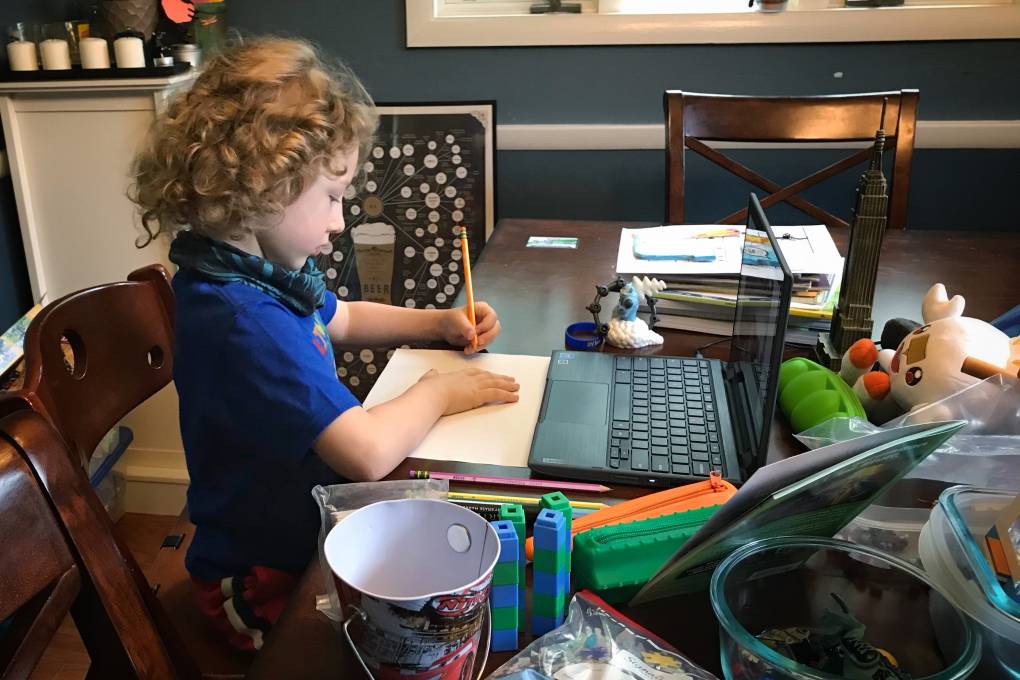
"caption": "“My wife and I have been working from home for 6 months now, and honestly having something productive and interactive for them to do has been a real plus. I still do not know how they are going to learn to read over Zoom.” Brian Stanton on his son Jude’s experience with virtual kindergarten. Kensington, Maryland. ",
"description": null,
"title": "*Lillian - Mongeau-Kindergarten- Brian Stanton",
"credit": "Brian Stanton",
"status": "inherit",
"isLoading": false,
"fetchFailed": false
},
"mindshift_56869": {
"type": "attachments",
"id": "mindshift_56869",
"meta": {
"index": "attachments_1716263798",
"site": "mindshift",
"id": "56869",
"found": true
},
"parent": 56868,
"imgSizes": {
"twentyfourteen-full-width": {
"file": "https://ww2.kqed.org/app/uploads/sites/23/2020/10/gettyimages-1228283495_wide-4f9f7e08dfb4e7f716b5f236a4460b8613b179ed-1038x576.jpg",
"width": 1038,
"mimeType": "image/jpeg",
"height": 576
},
"thumbnail": {
"file": "https://ww2.kqed.org/app/uploads/sites/23/2020/10/gettyimages-1228283495_wide-4f9f7e08dfb4e7f716b5f236a4460b8613b179ed-160x90.jpg",
"width": 160,
"mimeType": "image/jpeg",
"height": 90
},
"post-thumbnail": {
"file": "https://ww2.kqed.org/app/uploads/sites/23/2020/10/gettyimages-1228283495_wide-4f9f7e08dfb4e7f716b5f236a4460b8613b179ed-672x372.jpg",
"width": 672,
"mimeType": "image/jpeg",
"height": 372
},
"kqedFullSize": {
"file": "https://ww2.kqed.org/app/uploads/sites/23/2020/10/gettyimages-1228283495_wide-4f9f7e08dfb4e7f716b5f236a4460b8613b179ed-scaled.jpg",
"width": 2560,
"height": 1440
},
"2048x2048": {
"file": "https://ww2.kqed.org/app/uploads/sites/23/2020/10/gettyimages-1228283495_wide-4f9f7e08dfb4e7f716b5f236a4460b8613b179ed-2048x1152.jpg",
"width": 2048,
"mimeType": "image/jpeg",
"height": 1152
},
"large": {
"file": "https://ww2.kqed.org/app/uploads/sites/23/2020/10/gettyimages-1228283495_wide-4f9f7e08dfb4e7f716b5f236a4460b8613b179ed-1020x574.jpg",
"width": 1020,
"mimeType": "image/jpeg",
"height": 574
},
"1536x1536": {
"file": "https://ww2.kqed.org/app/uploads/sites/23/2020/10/gettyimages-1228283495_wide-4f9f7e08dfb4e7f716b5f236a4460b8613b179ed-1536x864.jpg",
"width": 1536,
"mimeType": "image/jpeg",
"height": 864
},
"full-width": {
"file": "https://ww2.kqed.org/app/uploads/sites/23/2020/10/gettyimages-1228283495_wide-4f9f7e08dfb4e7f716b5f236a4460b8613b179ed-1920x1080.jpg",
"width": 1920,
"mimeType": "image/jpeg",
"height": 1080
},
"medium": {
"file": "https://ww2.kqed.org/app/uploads/sites/23/2020/10/gettyimages-1228283495_wide-4f9f7e08dfb4e7f716b5f236a4460b8613b179ed-800x450.jpg",
"width": 800,
"mimeType": "image/jpeg",
"height": 450
},
"medium_large": {
"file": "https://ww2.kqed.org/app/uploads/sites/23/2020/10/gettyimages-1228283495_wide-4f9f7e08dfb4e7f716b5f236a4460b8613b179ed-768x432.jpg",
"width": 768,
"mimeType": "image/jpeg",
"height": 432
}
},
"publishDate": 1603438100,
"modified": 1603438137,
"caption": "Students at Hillsborough High School in Tampa, Fla., wait in line to have their temperatures checked on Aug. 31. According to an updated tracker, Florida is one of three states that will offer full-time, in-person learning to more than 75% of students by Election Day.\nOctavio Jones/Getty Images\n",
"description": "TAMPA, FL - AUGUST 31: Students at Hillsborough High School wait in line to have temperature checked before entering the building on August 31, 2020 in Tampa, Florida. The Hillsborough County Schools District gives their students the in-class learning option amid the coronavirus pandemic. (Photo by Octavio Jones/Getty Images)",
"title": "Students at Hillsborough High School in Tampa, Fla., wait in line to have their temperatures checked on Aug. 31. According to an updated tracker, Florida is one of three states that will offer full-time, in-person learning to more than 75% of students by Election Day.",
"credit": null,
"status": "inherit",
"isLoading": false,
"fetchFailed": false
},
"mindshift_56856": {
"type": "attachments",
"id": "mindshift_56856",
"meta": {
"index": "attachments_1716263798",
"site": "mindshift",
"id": "56856",
"found": true
},
"parent": 56855,
"imgSizes": {
"twentyfourteen-full-width": {
"file": "https://ww2.kqed.org/app/uploads/sites/23/2020/10/cpornea-npr-fafsa_custom-b7814aa5465aff60ba131bf68badd4a3ded5e8f5-1038x576.jpg",
"width": 1038,
"mimeType": "image/jpeg",
"height": 576
},
"thumbnail": {
"file": "https://ww2.kqed.org/app/uploads/sites/23/2020/10/cpornea-npr-fafsa_custom-b7814aa5465aff60ba131bf68badd4a3ded5e8f5-160x100.jpg",
"width": 160,
"mimeType": "image/jpeg",
"height": 100
},
"post-thumbnail": {
"file": "https://ww2.kqed.org/app/uploads/sites/23/2020/10/cpornea-npr-fafsa_custom-b7814aa5465aff60ba131bf68badd4a3ded5e8f5-672x372.jpg",
"width": 672,
"mimeType": "image/jpeg",
"height": 372
},
"kqedFullSize": {
"file": "https://ww2.kqed.org/app/uploads/sites/23/2020/10/cpornea-npr-fafsa_custom-b7814aa5465aff60ba131bf68badd4a3ded5e8f5-scaled-e1603348281806.jpg",
"width": 1920,
"height": 1199
},
"2048x2048": {
"file": "https://ww2.kqed.org/app/uploads/sites/23/2020/10/cpornea-npr-fafsa_custom-b7814aa5465aff60ba131bf68badd4a3ded5e8f5-2048x1278.jpg",
"width": 2048,
"mimeType": "image/jpeg",
"height": 1278
},
"large": {
"file": "https://ww2.kqed.org/app/uploads/sites/23/2020/10/cpornea-npr-fafsa_custom-b7814aa5465aff60ba131bf68badd4a3ded5e8f5-1020x637.jpg",
"width": 1020,
"mimeType": "image/jpeg",
"height": 637
},
"1536x1536": {
"file": "https://ww2.kqed.org/app/uploads/sites/23/2020/10/cpornea-npr-fafsa_custom-b7814aa5465aff60ba131bf68badd4a3ded5e8f5-1536x959.jpg",
"width": 1536,
"mimeType": "image/jpeg",
"height": 959
},
"full-width": {
"file": "https://ww2.kqed.org/app/uploads/sites/23/2020/10/cpornea-npr-fafsa_custom-b7814aa5465aff60ba131bf68badd4a3ded5e8f5-1920x1198.jpg",
"width": 1920,
"mimeType": "image/jpeg",
"height": 1198
},
"medium": {
"file": "https://ww2.kqed.org/app/uploads/sites/23/2020/10/cpornea-npr-fafsa_custom-b7814aa5465aff60ba131bf68badd4a3ded5e8f5-800x499.jpg",
"width": 800,
"mimeType": "image/jpeg",
"height": 499
},
"medium_large": {
"file": "https://ww2.kqed.org/app/uploads/sites/23/2020/10/cpornea-npr-fafsa_custom-b7814aa5465aff60ba131bf68badd4a3ded5e8f5-768x479.jpg",
"width": 768,
"mimeType": "image/jpeg",
"height": 479
}
},
"publishDate": 1603348205,
"modified": 1603348292,
"caption": null,
"description": null,
"title": "It's FAFSA season!",
"credit": "Cha Pornea for NPR",
"status": "inherit",
"isLoading": false,
"fetchFailed": false
},
"mindshift_56843": {
"type": "attachments",
"id": "mindshift_56843",
"meta": {
"index": "attachments_1716263798",
"site": "mindshift",
"id": "56843",
"found": true
},
"parent": 56842,
"imgSizes": {
"twentyfourteen-full-width": {
"file": "https://ww2.kqed.org/app/uploads/sites/23/2020/10/ap_20252329049519_wide-d8d356715372c2961617c3f3fe7f2668b17cfe2d-1038x576.jpg",
"width": 1038,
"mimeType": "image/jpeg",
"height": 576
},
"thumbnail": {
"file": "https://ww2.kqed.org/app/uploads/sites/23/2020/10/ap_20252329049519_wide-d8d356715372c2961617c3f3fe7f2668b17cfe2d-160x90.jpg",
"width": 160,
"mimeType": "image/jpeg",
"height": 90
},
"post-thumbnail": {
"file": "https://ww2.kqed.org/app/uploads/sites/23/2020/10/ap_20252329049519_wide-d8d356715372c2961617c3f3fe7f2668b17cfe2d-672x372.jpg",
"width": 672,
"mimeType": "image/jpeg",
"height": 372
},
"kqedFullSize": {
"file": "https://ww2.kqed.org/app/uploads/sites/23/2020/10/ap_20252329049519_wide-d8d356715372c2961617c3f3fe7f2668b17cfe2d-scaled-e1603292990780.jpg",
"width": 1920,
"height": 1080
},
"2048x2048": {
"file": "https://ww2.kqed.org/app/uploads/sites/23/2020/10/ap_20252329049519_wide-d8d356715372c2961617c3f3fe7f2668b17cfe2d-2048x1152.jpg",
"width": 2048,
"mimeType": "image/jpeg",
"height": 1152
},
"large": {
"file": "https://ww2.kqed.org/app/uploads/sites/23/2020/10/ap_20252329049519_wide-d8d356715372c2961617c3f3fe7f2668b17cfe2d-1020x574.jpg",
"width": 1020,
"mimeType": "image/jpeg",
"height": 574
},
"1536x1536": {
"file": "https://ww2.kqed.org/app/uploads/sites/23/2020/10/ap_20252329049519_wide-d8d356715372c2961617c3f3fe7f2668b17cfe2d-1536x864.jpg",
"width": 1536,
"mimeType": "image/jpeg",
"height": 864
},
"full-width": {
"file": "https://ww2.kqed.org/app/uploads/sites/23/2020/10/ap_20252329049519_wide-d8d356715372c2961617c3f3fe7f2668b17cfe2d-1920x1080.jpg",
"width": 1920,
"mimeType": "image/jpeg",
"height": 1080
},
"medium": {
"file": "https://ww2.kqed.org/app/uploads/sites/23/2020/10/ap_20252329049519_wide-d8d356715372c2961617c3f3fe7f2668b17cfe2d-800x450.jpg",
"width": 800,
"mimeType": "image/jpeg",
"height": 450
},
"medium_large": {
"file": "https://ww2.kqed.org/app/uploads/sites/23/2020/10/ap_20252329049519_wide-d8d356715372c2961617c3f3fe7f2668b17cfe2d-768x432.jpg",
"width": 768,
"mimeType": "image/jpeg",
"height": 432
}
},
"publishDate": 1603292822,
"modified": 1603293018,
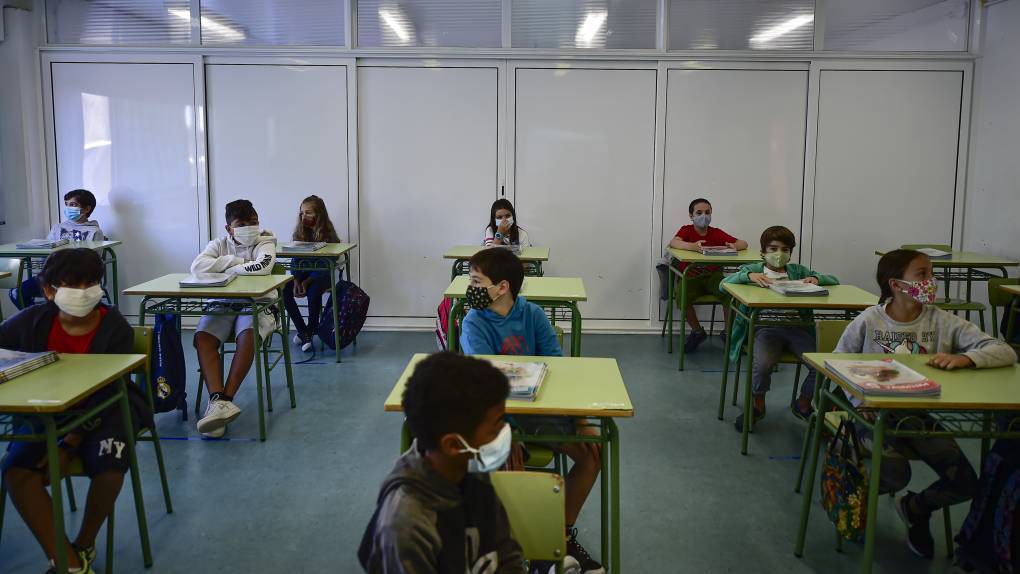
"caption": "A group of young student wearing face masks to prevent the spread of coronavirus, attend their first class, at the Labastida Ikastola school, in the small basque town of Labastida, northern Spain, Tuesday, Sept. 8, 2020. Spanish students return to class for the first time since the pandemic paralyzed Spain six months ago. (AP Photo/Alvaro Barrientos)",
"description": "A group of young student wearing face masks to prevent the spread of coronavirus, attend their first class, at the Labastida Ikastola school, in the small basque town of Labastida, northern Spain, Tuesday, Sept. 8, 2020. Spanish students return to class for the first time since the pandemic paralyzed Spain six months ago. (AP Photo/Alvaro Barrientos)",
"title": "Students attend the first day of school in the small town of Labastida, Spain, on Sept. 8. A recent study found no link between coronavirus spikes and school reopenings in the country.",
"credit": null,
"status": "inherit",
"isLoading": false,
"fetchFailed": false
},
"mindshift_56841": {
"type": "attachments",
"id": "mindshift_56841",
"meta": {
"index": "attachments_1716263798",
"site": "mindshift",
"id": "56841",
"found": true
},
"parent": 56836,
"imgSizes": {
"twentyfourteen-full-width": {
"file": "https://ww2.kqed.org/app/uploads/sites/23/2020/10/iStock-1226393094-1-1038x576.jpg",
"width": 1038,
"mimeType": "image/jpeg",
"height": 576
},
"thumbnail": {
"file": "https://ww2.kqed.org/app/uploads/sites/23/2020/10/iStock-1226393094-1-160x107.jpg",
"width": 160,
"mimeType": "image/jpeg",
"height": 107
},
"post-thumbnail": {
"file": "https://ww2.kqed.org/app/uploads/sites/23/2020/10/iStock-1226393094-1-672x372.jpg",
"width": 672,
"mimeType": "image/jpeg",
"height": 372
},
"kqedFullSize": {
"file": "https://ww2.kqed.org/app/uploads/sites/23/2020/10/iStock-1226393094-1.jpg",
"width": 2121,
"height": 1414
},
"2048x2048": {
"file": "https://ww2.kqed.org/app/uploads/sites/23/2020/10/iStock-1226393094-1-2048x1365.jpg",
"width": 2048,
"mimeType": "image/jpeg",
"height": 1365
},
"large": {
"file": "https://ww2.kqed.org/app/uploads/sites/23/2020/10/iStock-1226393094-1-1020x680.jpg",
"width": 1020,
"mimeType": "image/jpeg",
"height": 680
},
"1536x1536": {
"file": "https://ww2.kqed.org/app/uploads/sites/23/2020/10/iStock-1226393094-1-1536x1024.jpg",
"width": 1536,
"mimeType": "image/jpeg",
"height": 1024
},
"full-width": {
"file": "https://ww2.kqed.org/app/uploads/sites/23/2020/10/iStock-1226393094-1-1920x1280.jpg",
"width": 1920,
"mimeType": "image/jpeg",
"height": 1280
},
"medium": {
"file": "https://ww2.kqed.org/app/uploads/sites/23/2020/10/iStock-1226393094-1-800x533.jpg",
"width": 800,
"mimeType": "image/jpeg",
"height": 533
},
"medium_large": {
"file": "https://ww2.kqed.org/app/uploads/sites/23/2020/10/iStock-1226393094-1-768x512.jpg",
"width": 768,
"mimeType": "image/jpeg",
"height": 512
}
},
"publishDate": 1603176288,
"modified": 1603176324,
"caption": null,
"description": null,
"title": "iStock-1226393094-1",
"credit": "Ponomariova_Maria/iStock",
"status": "inherit",
"isLoading": false,
"fetchFailed": false
},
"mindshift_56792": {
"type": "attachments",
"id": "mindshift_56792",
"meta": {
"index": "attachments_1716263798",
"site": "mindshift",
"id": "56792",
"found": true
},
"parent": 56790,
"imgSizes": {
"thumbnail": {
"file": "https://ww2.kqed.org/app/uploads/sites/23/2020/10/Kinship-160x80.png",
"width": 160,
"mimeType": "image/png",
"height": 80
},
"post-thumbnail": {
"file": "https://ww2.kqed.org/app/uploads/sites/23/2020/10/Kinship-672x372.png",
"width": 672,
"mimeType": "image/png",
"height": 372
},
"kqedFullSize": {
"file": "https://ww2.kqed.org/app/uploads/sites/23/2020/10/Kinship.png",
"width": 950,
"height": 474
},
"medium": {
"file": "https://ww2.kqed.org/app/uploads/sites/23/2020/10/Kinship-800x399.png",
"width": 800,
"mimeType": "image/png",
"height": 399
},
"medium_large": {
"file": "https://ww2.kqed.org/app/uploads/sites/23/2020/10/Kinship-768x383.png",
"width": 768,
"mimeType": "image/png",
"height": 383
}
},
"publishDate": 1602750239,
"modified": 1602750431,
"caption": null,
"description": null,
"title": "Kinship",
"credit": "Fort Lewis College/YouTube ",
"status": "inherit",
"isLoading": false,
"fetchFailed": false
},
"mindshift_56801": {
"type": "attachments",
"id": "mindshift_56801",
"meta": {
"index": "attachments_1716263798",
"site": "mindshift",
"id": "56801",
"found": true
},
"parent": 56800,
"imgSizes": {
"twentyfourteen-full-width": {
"file": "https://ww2.kqed.org/app/uploads/sites/23/2020/10/stress_custom-7477ce31d55242207de02f3427b7f30b947e1b97-1038x576.jpg",
"width": 1038,
"mimeType": "image/jpeg",
"height": 576
},
"thumbnail": {
"file": "https://ww2.kqed.org/app/uploads/sites/23/2020/10/stress_custom-7477ce31d55242207de02f3427b7f30b947e1b97-160x107.jpg",
"width": 160,
"mimeType": "image/jpeg",
"height": 107
},
"post-thumbnail": {
"file": "https://ww2.kqed.org/app/uploads/sites/23/2020/10/stress_custom-7477ce31d55242207de02f3427b7f30b947e1b97-672x372.jpg",
"width": 672,
"mimeType": "image/jpeg",
"height": 372
},
"kqedFullSize": {
"file": "https://ww2.kqed.org/app/uploads/sites/23/2020/10/stress_custom-7477ce31d55242207de02f3427b7f30b947e1b97.jpg",
"width": 2000,
"height": 1334
},
"large": {
"file": "https://ww2.kqed.org/app/uploads/sites/23/2020/10/stress_custom-7477ce31d55242207de02f3427b7f30b947e1b97-1020x680.jpg",
"width": 1020,
"mimeType": "image/jpeg",
"height": 680
},
"1536x1536": {
"file": "https://ww2.kqed.org/app/uploads/sites/23/2020/10/stress_custom-7477ce31d55242207de02f3427b7f30b947e1b97-1536x1025.jpg",
"width": 1536,
"mimeType": "image/jpeg",
"height": 1025
},
"full-width": {
"file": "https://ww2.kqed.org/app/uploads/sites/23/2020/10/stress_custom-7477ce31d55242207de02f3427b7f30b947e1b97-1920x1281.jpg",
"width": 1920,
"mimeType": "image/jpeg",
"height": 1281
},
"medium": {
"file": "https://ww2.kqed.org/app/uploads/sites/23/2020/10/stress_custom-7477ce31d55242207de02f3427b7f30b947e1b97-800x534.jpg",
"width": 800,
"mimeType": "image/jpeg",
"height": 534
},
"medium_large": {
"file": "https://ww2.kqed.org/app/uploads/sites/23/2020/10/stress_custom-7477ce31d55242207de02f3427b7f30b947e1b97-768x512.jpg",
"width": 768,
"mimeType": "image/jpeg",
"height": 512
}
},
"publishDate": 1602833835,
"modified": 1602834127,
"caption": "Amid the pandemic, Americans are experiencing sleeplessness, headaches, stomach upset and more symptoms of chronic stress.\n",
"description": "ROTTERDAM, NETHERLANDS - 2020/05/30: In this photo illustration a woman appears to be stressed as she searches for a job online during the coronavirus economic recession.\nThe global economic impact of coronavirus could leave millions of people jobless. (Photo Illustration by Robin Utrecht/SOPA Images/LightRocket via Getty Images)",
"title": "Amid the pandemic, Americans are experiencing sleeplessness, headaches, stomach upset and more symptoms of chronic stress.",
"credit": "Robin Utrecht/LightRocket via Getty Images",
"status": "inherit",
"isLoading": false,
"fetchFailed": false
},
"mindshift_56807": {
"type": "attachments",
"id": "mindshift_56807",
"meta": {
"index": "attachments_1716263798",
"site": "mindshift",
"id": "56807",
"found": true
},
"parent": 56806,
"imgSizes": {
"twentyfourteen-full-width": {
"file": "https://ww2.kqed.org/app/uploads/sites/23/2020/10/triptych-moms2_wide-0956b206a5aba83aaa0ab28cc53c4cbc4cdb7e8e-1-1038x576.jpg",
"width": 1038,
"mimeType": "image/jpeg",
"height": 576
},
"thumbnail": {
"file": "https://ww2.kqed.org/app/uploads/sites/23/2020/10/triptych-moms2_wide-0956b206a5aba83aaa0ab28cc53c4cbc4cdb7e8e-1-160x90.jpg",
"width": 160,
"mimeType": "image/jpeg",
"height": 90
},
"post-thumbnail": {
"file": "https://ww2.kqed.org/app/uploads/sites/23/2020/10/triptych-moms2_wide-0956b206a5aba83aaa0ab28cc53c4cbc4cdb7e8e-1-672x372.jpg",
"width": 672,
"mimeType": "image/jpeg",
"height": 372
},
"kqedFullSize": {
"file": "https://ww2.kqed.org/app/uploads/sites/23/2020/10/triptych-moms2_wide-0956b206a5aba83aaa0ab28cc53c4cbc4cdb7e8e-1-scaled-e1602834796964.jpg",
"width": 1920,
"height": 1080
},
"2048x2048": {
"file": "https://ww2.kqed.org/app/uploads/sites/23/2020/10/triptych-moms2_wide-0956b206a5aba83aaa0ab28cc53c4cbc4cdb7e8e-1-2048x1152.jpg",
"width": 2048,
"mimeType": "image/jpeg",
"height": 1152
},
"large": {
"file": "https://ww2.kqed.org/app/uploads/sites/23/2020/10/triptych-moms2_wide-0956b206a5aba83aaa0ab28cc53c4cbc4cdb7e8e-1-1020x574.jpg",
"width": 1020,
"mimeType": "image/jpeg",
"height": 574
},
"1536x1536": {
"file": "https://ww2.kqed.org/app/uploads/sites/23/2020/10/triptych-moms2_wide-0956b206a5aba83aaa0ab28cc53c4cbc4cdb7e8e-1-1536x864.jpg",
"width": 1536,
"mimeType": "image/jpeg",
"height": 864
},
"full-width": {
"file": "https://ww2.kqed.org/app/uploads/sites/23/2020/10/triptych-moms2_wide-0956b206a5aba83aaa0ab28cc53c4cbc4cdb7e8e-1-1920x1080.jpg",
"width": 1920,
"mimeType": "image/jpeg",
"height": 1080
},
"medium": {
"file": "https://ww2.kqed.org/app/uploads/sites/23/2020/10/triptych-moms2_wide-0956b206a5aba83aaa0ab28cc53c4cbc4cdb7e8e-1-800x450.jpg",
"width": 800,
"mimeType": "image/jpeg",
"height": 450
},
"medium_large": {
"file": "https://ww2.kqed.org/app/uploads/sites/23/2020/10/triptych-moms2_wide-0956b206a5aba83aaa0ab28cc53c4cbc4cdb7e8e-1-768x432.jpg",
"width": 768,
"mimeType": "image/jpeg",
"height": 432
}
},
"publishDate": 1602834248,
"modified": 1602834822,
"caption": "From left: Sawsan al-Ramemi of Amman, Jordan, is a mom of two — and expecting her third child. Her husband is working in the U.S. Nienke Pastoor of the Netherlands has been juggling her job as a dairy farmer and helping her four teenagers with their online schoolwork. Jessica Barrera of Eau Claire, Wis., is finding ways to spread joy with her son, Niko, who's a virtual student these days.\n",
"description": null,
"title": "From left: Sawsan al-Ramemi of Amman, Jordan, is a mom of two — and expecting her third child. Her husband is working in the U.S. Nienke Pastoor of the Netherlands has been juggling her job as a dairy farmer and helping her four teenagers with their online schoolwork. Jessica Barrera of Eau Claire, Wis., is finding ways to spread joy with her son, Niko, who's a virtual student these days.",
"credit": "Nadia Bseiso, Julia Gunther and Lauren Justice for NPR",
"status": "inherit",
"isLoading": false,
"fetchFailed": false
},
"mindshift_56774": {
"type": "attachments",
"id": "mindshift_56774",
"meta": {
"index": "attachments_1716263798",
"site": "mindshift",
"id": "56774",
"found": true
},
"parent": 56773,
"imgSizes": {
"twentyfourteen-full-width": {
"file": "https://ww2.kqed.org/app/uploads/sites/23/2020/10/final_429_wide-69be2190dcdb30ce5a3441d8443122c4ad464142-1038x576.jpg",
"width": 1038,
"mimeType": "image/jpeg",
"height": 576
},
"thumbnail": {
"file": "https://ww2.kqed.org/app/uploads/sites/23/2020/10/final_429_wide-69be2190dcdb30ce5a3441d8443122c4ad464142-160x90.jpg",
"width": 160,
"mimeType": "image/jpeg",
"height": 90
},
"post-thumbnail": {
"file": "https://ww2.kqed.org/app/uploads/sites/23/2020/10/final_429_wide-69be2190dcdb30ce5a3441d8443122c4ad464142-672x372.jpg",
"width": 672,
"mimeType": "image/jpeg",
"height": 372
},
"kqedFullSize": {
"file": "https://ww2.kqed.org/app/uploads/sites/23/2020/10/final_429_wide-69be2190dcdb30ce5a3441d8443122c4ad464142-scaled-e1602576102862.jpg",
"width": 1920,
"height": 1080
},
"2048x2048": {
"file": "https://ww2.kqed.org/app/uploads/sites/23/2020/10/final_429_wide-69be2190dcdb30ce5a3441d8443122c4ad464142-2048x1152.jpg",
"width": 2048,
"mimeType": "image/jpeg",
"height": 1152
},
"large": {
"file": "https://ww2.kqed.org/app/uploads/sites/23/2020/10/final_429_wide-69be2190dcdb30ce5a3441d8443122c4ad464142-1020x574.jpg",
"width": 1020,
"mimeType": "image/jpeg",
"height": 574
},
"1536x1536": {
"file": "https://ww2.kqed.org/app/uploads/sites/23/2020/10/final_429_wide-69be2190dcdb30ce5a3441d8443122c4ad464142-1536x864.jpg",
"width": 1536,
"mimeType": "image/jpeg",
"height": 864
},
"full-width": {
"file": "https://ww2.kqed.org/app/uploads/sites/23/2020/10/final_429_wide-69be2190dcdb30ce5a3441d8443122c4ad464142-1920x1080.jpg",
"width": 1920,
"mimeType": "image/jpeg",
"height": 1080
},
"medium": {
"file": "https://ww2.kqed.org/app/uploads/sites/23/2020/10/final_429_wide-69be2190dcdb30ce5a3441d8443122c4ad464142-800x450.jpg",
"width": 800,
"mimeType": "image/jpeg",
"height": 450
},
"medium_large": {
"file": "https://ww2.kqed.org/app/uploads/sites/23/2020/10/final_429_wide-69be2190dcdb30ce5a3441d8443122c4ad464142-768x432.jpg",
"width": 768,
"mimeType": "image/jpeg",
"height": 432
}
},
"publishDate": 1602575815,
"modified": 1602576141,
"caption": null,
"description": "7 tips for dealing with uncertainty, from NPR Life Kit.",
"title": "7 tips for dealing with uncertainty, from NPR Life Kit.",
"credit": "Clare Schneider/NPR",
"status": "inherit",
"isLoading": false,
"fetchFailed": false
},
"mindshift_56752": {
"type": "attachments",
"id": "mindshift_56752",
"meta": {
"index": "attachments_1716263798",
"site": "mindshift",
"id": "56752",
"found": true
},
"parent": 56750,
"imgSizes": {
"twentyfourteen-full-width": {
"file": "https://ww2.kqed.org/app/uploads/sites/23/2020/10/20201004_mcgarvey_freda_0038_slide-f4399db197318911acdc7a3c104732f9f33ee8bc-1038x576.jpg",
"width": 1038,
"mimeType": "image/jpeg",
"height": 576
},
"thumbnail": {
"file": "https://ww2.kqed.org/app/uploads/sites/23/2020/10/20201004_mcgarvey_freda_0038_slide-f4399db197318911acdc7a3c104732f9f33ee8bc-160x107.jpg",
"width": 160,
"mimeType": "image/jpeg",
"height": 107
},
"post-thumbnail": {
"file": "https://ww2.kqed.org/app/uploads/sites/23/2020/10/20201004_mcgarvey_freda_0038_slide-f4399db197318911acdc7a3c104732f9f33ee8bc-672x372.jpg",
"width": 672,
"mimeType": "image/jpeg",
"height": 372
},
"kqedFullSize": {
"file": "https://ww2.kqed.org/app/uploads/sites/23/2020/10/20201004_mcgarvey_freda_0038_slide-f4399db197318911acdc7a3c104732f9f33ee8bc-scaled-e1602135753120.jpg",
"width": 1920,
"height": 1280
},
"2048x2048": {
"file": "https://ww2.kqed.org/app/uploads/sites/23/2020/10/20201004_mcgarvey_freda_0038_slide-f4399db197318911acdc7a3c104732f9f33ee8bc-2048x1365.jpg",
"width": 2048,
"mimeType": "image/jpeg",
"height": 1365
},
"large": {
"file": "https://ww2.kqed.org/app/uploads/sites/23/2020/10/20201004_mcgarvey_freda_0038_slide-f4399db197318911acdc7a3c104732f9f33ee8bc-1020x680.jpg",
"width": 1020,
"mimeType": "image/jpeg",
"height": 680
},
"1536x1536": {
"file": "https://ww2.kqed.org/app/uploads/sites/23/2020/10/20201004_mcgarvey_freda_0038_slide-f4399db197318911acdc7a3c104732f9f33ee8bc-1536x1024.jpg",
"width": 1536,
"mimeType": "image/jpeg",
"height": 1024
},
"full-width": {
"file": "https://ww2.kqed.org/app/uploads/sites/23/2020/10/20201004_mcgarvey_freda_0038_slide-f4399db197318911acdc7a3c104732f9f33ee8bc-1920x1280.jpg",
"width": 1920,
"mimeType": "image/jpeg",
"height": 1280
},
"medium": {
"file": "https://ww2.kqed.org/app/uploads/sites/23/2020/10/20201004_mcgarvey_freda_0038_slide-f4399db197318911acdc7a3c104732f9f33ee8bc-800x533.jpg",
"width": 800,
"mimeType": "image/jpeg",
"height": 533
},
"medium_large": {
"file": "https://ww2.kqed.org/app/uploads/sites/23/2020/10/20201004_mcgarvey_freda_0038_slide-f4399db197318911acdc7a3c104732f9f33ee8bc-768x512.jpg",
"width": 768,
"mimeType": "image/jpeg",
"height": 512
}
},
"publishDate": 1602135472,
"modified": 1602135821,
"caption": "Freda and her 9-year-old son visit the Purple People Bridge in Cincinnati. She and her five children have been living in the front room of a friend's apartment, sleeping on pads of bunched-up comforters.\n",
"description": "Freda stands on the Purple People Bridge with her son, 9, in Cincinnati, OH on October 4, 2020. Freda lives in the front room of a friend's one-bedroom apartment in Cincinnati. She and her five children -- ages 17, 13, 11, 9, and 7 -- sleep on the floor. Freda says her children have tablets for school, thanks to their district, and free Wi-Fi, thanks to a partnership between the schools and the service provider Cincinnati Bell. But the download speed is too slow for five children to use at once, Freda says. ÒIt sucks. Bad.Ó",
"title": "Freda and her 9-year-old son visit the Purple People Bridge in Cincinnati. She and her five children have been living in the front room of a friend's apartment, sleeping on pads of bunched-up comforters.",
"credit": "Maddie McGarvey for NPR",
"status": "inherit",
"isLoading": false,
"fetchFailed": false
},
"mindshift_56746": {
"type": "attachments",
"id": "mindshift_56746",
"meta": {
"index": "attachments_1716263798",
"site": "mindshift",
"id": "56746",
"found": true
},
"parent": 56742,
"imgSizes": {
"twentyfourteen-full-width": {
"file": "https://ww2.kqed.org/app/uploads/sites/23/2020/10/32142275523_396dac8592_k-1038x576.jpg",
"width": 1038,
"mimeType": "image/jpeg",
"height": 576
},
"thumbnail": {
"file": "https://ww2.kqed.org/app/uploads/sites/23/2020/10/32142275523_396dac8592_k-160x90.jpg",
"width": 160,
"mimeType": "image/jpeg",
"height": 90
},
"post-thumbnail": {
"file": "https://ww2.kqed.org/app/uploads/sites/23/2020/10/32142275523_396dac8592_k-672x372.jpg",
"width": 672,
"mimeType": "image/jpeg",
"height": 372
},
"kqedFullSize": {
"file": "https://ww2.kqed.org/app/uploads/sites/23/2020/10/32142275523_396dac8592_k-e1602056287578.jpg",
"width": 1920,
"height": 1080
},
"large": {
"file": "https://ww2.kqed.org/app/uploads/sites/23/2020/10/32142275523_396dac8592_k-1020x574.jpg",
"width": 1020,
"mimeType": "image/jpeg",
"height": 574
},
"1536x1536": {
"file": "https://ww2.kqed.org/app/uploads/sites/23/2020/10/32142275523_396dac8592_k-1536x864.jpg",
"width": 1536,
"mimeType": "image/jpeg",
"height": 864
},
"full-width": {
"file": "https://ww2.kqed.org/app/uploads/sites/23/2020/10/32142275523_396dac8592_k-1920x1080.jpg",
"width": 1920,
"mimeType": "image/jpeg",
"height": 1080
},
"medium": {
"file": "https://ww2.kqed.org/app/uploads/sites/23/2020/10/32142275523_396dac8592_k-800x450.jpg",
"width": 800,
"mimeType": "image/jpeg",
"height": 450
},
"medium_large": {
"file": "https://ww2.kqed.org/app/uploads/sites/23/2020/10/32142275523_396dac8592_k-768x432.jpg",
"width": 768,
"mimeType": "image/jpeg",
"height": 432
}
},
"publishDate": 1602056271,
"modified": 1602056313,
"caption": null,
"description": null,
"title": "32142275523_396dac8592_k",
"credit": "\u003ca href=\"https://www.flickr.com/photos/22695384@N06/32142275523/in/photolist-QYiyGc-UZXr-633RPu-zT4iu-7QKNvv-WgqqME-24KnmoZ-5pSBzx-c67gG3-ffEQAs-JQQpe5-51SWXq-5nqqnu-5XBHyx-bGTemp-8UapQC-6xWu1j-236Yri4-JySQfA-bsZEQL-cfEM7b-7YrfQj-nWiUDK-87GrcN-5nGvg-RyfG3v-6a1Zke-rApGmy-6wRJa5-6aWRmw-BfNvy8-2epoBaz-3Twd2-6dfKhQ-7YdGsS-6dge7C-9RukLa-7Lm8oS-6FfVcn-SbtWr-nHR4sF-29GVHTB-5AqvS-6gqRVM-wPLDGD-q2jRFo-dtU9Ra-nRNshp-UxSCPw-edxkjV\">M.K. 2016/Flickr\u003c/a>",
"status": "inherit",
"isLoading": false,
"fetchFailed": false
},
"mindshift_56736": {
"type": "attachments",
"id": "mindshift_56736",
"meta": {
"index": "attachments_1716263798",
"site": "mindshift",
"id": "56736",
"found": true
},
"parent": 56735,
"imgSizes": {
"twentyfourteen-full-width": {
"file": "https://ww2.kqed.org/app/uploads/sites/23/2020/10/5686357214_4b9f464de9_o-1038x576.jpg",
"width": 1038,
"mimeType": "image/jpeg",
"height": 576
},
"thumbnail": {
"file": "https://ww2.kqed.org/app/uploads/sites/23/2020/10/5686357214_4b9f464de9_o-160x107.jpg",
"width": 160,
"mimeType": "image/jpeg",
"height": 107
},
"post-thumbnail": {
"file": "https://ww2.kqed.org/app/uploads/sites/23/2020/10/5686357214_4b9f464de9_o-672x372.jpg",
"width": 672,
"mimeType": "image/jpeg",
"height": 372
},
"kqedFullSize": {
"file": "https://ww2.kqed.org/app/uploads/sites/23/2020/10/5686357214_4b9f464de9_o.jpg",
"width": 1800,
"height": 1200
},
"large": {
"file": "https://ww2.kqed.org/app/uploads/sites/23/2020/10/5686357214_4b9f464de9_o-1020x680.jpg",
"width": 1020,
"mimeType": "image/jpeg",
"height": 680
},
"1536x1536": {
"file": "https://ww2.kqed.org/app/uploads/sites/23/2020/10/5686357214_4b9f464de9_o-1536x1024.jpg",
"width": 1536,
"mimeType": "image/jpeg",
"height": 1024
},
"medium": {
"file": "https://ww2.kqed.org/app/uploads/sites/23/2020/10/5686357214_4b9f464de9_o-800x533.jpg",
"width": 800,
"mimeType": "image/jpeg",
"height": 533
},
"medium_large": {
"file": "https://ww2.kqed.org/app/uploads/sites/23/2020/10/5686357214_4b9f464de9_o-768x512.jpg",
"width": 768,
"mimeType": "image/jpeg",
"height": 512
}
},
"publishDate": 1601972177,
"modified": 1601972296,
"caption": "A Hooded Warbler takes a step at Central Park in New York City.",
"description": null,
"title": "Hooded Warbler",
"credit": "\u003ca href=\"https://www.flickr.com/photos/billy3001/5686357214/in/photolist-UPTuHM-oV5sd-vmh66-Gy3sGr-7EysjC-pQBkZK-8YNWn7-6GFm3E-SwVizS-24MPm8e-3R6HVu-vU2cSn-apkscw-sig573-9Bg28X-87rV1A-oV5n4-26EnWyu-6GFmcs-a4fx8C-nYCnC8-oV5qG-7EyrfG-7p39Ay-zyHcU-7RY8Gn-ecP7GV-WBYWDP-t8XV-xMjL6B-q3RvbM-dZHovP-5uh1ao-9juDcS-qnFtA8-aF3rn9-pQsU-7Eyr9Y-J79MBa-9Ct3uw-pKn5VR-i1dcbn-e2dn1t-276AH5N-21Ef6S3-LEuDv-GE46Sf-9Eu4TC-6rQaZg-F7VVRE\">Bill B/Flickr\u003c/a>",
"status": "inherit",
"isLoading": false,
"fetchFailed": false
}
},
"audioPlayerReducer": {
"postId": "stream_live",
"isPaused": true,
"isPlaying": false,
"pfsActive": false,
"pledgeModalIsOpen": true,
"playerDrawerIsOpen": false,
"liveAudioPlayStartedAt": 0,
"liveAudioPlayContext": ""
},
"authorsReducer": {
"byline_mindshift_56872": {
"type": "authors",
"id": "byline_mindshift_56872",
"meta": {
"override": true
},
"slug": "byline_mindshift_56872",
"name": "\u003ca href=\"https://hechingerreport.org/\">Lillian Mongeau, The Hechinger Report\u003c/a>",
"isLoading": false
},
"byline_mindshift_56868": {
"type": "authors",
"id": "byline_mindshift_56868",
"meta": {
"override": true
},
"slug": "byline_mindshift_56868",
"name": "Anya Kamenetz",
"isLoading": false
},
"byline_mindshift_56855": {
"type": "authors",
"id": "byline_mindshift_56855",
"meta": {
"override": true
},
"slug": "byline_mindshift_56855",
"name": "Elissa Nadworny and Lauren Migaki",
"isLoading": false
},
"byline_mindshift_56842": {
"type": "authors",
"id": "byline_mindshift_56842",
"meta": {
"override": true
},
"slug": "byline_mindshift_56842",
"name": "Anya Kamenetz",
"isLoading": false
},
"byline_mindshift_56795": {
"type": "authors",
"id": "byline_mindshift_56795",
"meta": {
"override": true
},
"slug": "byline_mindshift_56795",
"name": "Jason Gonzales, Chalkbeat Colorado",
"isLoading": false
},
"byline_mindshift_56800": {
"type": "authors",
"id": "byline_mindshift_56800",
"meta": {
"override": true
},
"slug": "byline_mindshift_56800",
"name": "Aneri Pattani",
"isLoading": false
},
"byline_mindshift_56806": {
"type": "authors",
"id": "byline_mindshift_56806",
"meta": {
"override": true
},
"slug": "byline_mindshift_56806",
"name": "NPR Staff",
"isLoading": false
},
"byline_mindshift_56773": {
"type": "authors",
"id": "byline_mindshift_56773",
"meta": {
"override": true
},
"slug": "byline_mindshift_56773",
"name": "Sarah McCammon",
"isLoading": false
},
"byline_mindshift_56750": {
"type": "authors",
"id": "byline_mindshift_56750",
"meta": {
"override": true
},
"slug": "byline_mindshift_56750",
"name": "Cory Turner",
"isLoading": false
},
"kdnewhouse": {
"type": "authors",
"id": "11487",
"meta": {
"index": "authors_1716337520",
"id": "11487",
"found": true
},
"name": "Kara Newhouse",
"firstName": "Kara",
"lastName": "Newhouse",
"slug": "kdnewhouse",
"email": "knewhouse@kqed.org",
"display_author_email": false,
"staff_mastheads": [],
"title": "MindShift Editor",
"bio": null,
"avatar": "https://secure.gravatar.com/avatar/3dceed6fb271527113abfa9a8e9df34e?s=600&d=blank&r=g",
"twitter": null,
"facebook": null,
"instagram": null,
"linkedin": null,
"sites": [
{
"site": "",
"roles": [
"editor"
]
},
{
"site": "mindshift",
"roles": []
}
],
"headData": {
"title": "Kara Newhouse | KQED",
"description": "MindShift Editor",
"ogImgSrc": "https://secure.gravatar.com/avatar/3dceed6fb271527113abfa9a8e9df34e?s=600&d=blank&r=g",
"twImgSrc": "https://secure.gravatar.com/avatar/3dceed6fb271527113abfa9a8e9df34e?s=600&d=blank&r=g"
},
"isLoading": false,
"link": "/author/kdnewhouse"
}
},
"pagesReducer": {
"mindshift_tag_covid-19": {
"type": "terms",
"id": "mindshift_21343",
"meta": {
"index": "terms_1716263798",
"site": "mindshift",
"id": "21343",
"score": 8.558781
},
"featImg": null,
"name": "COVID-19",
"description": null,
"taxonomy": "tag",
"headData": {
"twImgId": null,
"twTitle": null,
"ogTitle": null,
"ogImgId": null,
"twDescription": null,
"description": null,
"title": "COVID-19 Archives - KQED Mindshift",
"ogDescription": null
},
"ttid": 20615,
"slug": "covid-19",
"isLoading": false,
"title": "COVID-19",
"pageMeta": {
"site": "mindshift",
"WpPageTemplate": "page-topic-editorial",
"currentPage": 12
},
"blocks": [
{
"blockName": "kqed/post-list",
"attrs": {
"layout": "cardArticle2",
"query": "posts/mindshift?tag=covid-19",
"seeMore": false,
"paginated": true,
"page": 12
}
},
{
"blockName": "kqed/ad"
}
]
}
},
"pfsSessionReducer": {},
"postsReducer": {
"stream_live": {
"type": "live",
"id": "stream_live",
"audioUrl": "https://streams.kqed.org/kqedradio",
"title": "Live Stream",
"excerpt": "Live Stream information currently unavailable.",
"link": "/radio",
"featImg": "",
"label": {
"name": "KQED Live",
"link": "/"
}
},
"stream_kqedNewscast": {
"type": "posts",
"id": "stream_kqedNewscast",
"audioUrl": "https://www.kqed.org/.stream/anon/radio/RDnews/newscast.mp3?_=1",
"title": "KQED Newscast",
"featImg": "",
"label": {
"name": "88.5 FM",
"link": "/"
}
},
"mindshift_56872": {
"type": "posts",
"id": "mindshift_56872",
"meta": {
"index": "posts_1716263798",
"site": "mindshift",
"id": "56872",
"score": null,
"sort": [
1603784496000
]
},
"parent": 0,
"labelTerm": {
"site": "mindshift"
},
"blocks": [],
"publishDate": 1603784496,
"format": "standard",
"disqusTitle": "What Kindergarten Struggles Could Mean for a Child’s Later Years",
"title": "What Kindergarten Struggles Could Mean for a Child’s Later Years",
"headTitle": "MindShift | KQED News",
"content": "\u003cp>\u003cem>This story about online kindergarten was produced by \u003c/em>\u003ca href=\"http://hechingerreport.org/\">The Hechinger Report\u003c/a>\u003cem>, a nonprofit, independent news organization focused on inequality and innovation in education. Sign up for the \u003c/em>\u003ca href=\"http://hechingerreport.us2.list-manage1.com/subscribe?u=66c306eebb323868c3ce353c1&id=d3ee4c3e04\">\u003cem>Hechinger newsletter\u003c/em>\u003c/a>\u003cem>.\u003c/em>\u003c/p>\n\u003cp>In Greenbrier County, West Virginia, Jennifer Holley began the year teaching nine 5-year-olds in person and 14 online. Her first online kindergarten class was a bit of a mess, she said. Only three children were correctly logged in, while her email and the school’s phone were flooded with requests for technical help from the frantic parents and grandparents of the other kids.\u003c/p>\n\u003cp>“One child was talking away and answering my questions,” Holley said. “The only problem was I couldn’t hear him. It’s very frustrating. I don’t think all of these children are going to get what they need and that frightens me.”\u003c/p>\n\u003cp>Parents are equally overwhelmed, according to email interviews with more than two dozen kindergarten families.\u003c/p>\n\u003cp>“She can't do anything independently,” said Suzanne Parker Miller, 40, of her 5-year-old daughter, Salem. “Not reading yet or knowing how to use a computer or mouse or knowing how to use a keyboard — everything takes longer and requires my help. It has been difficult to manage and — five weeks in — still feels unsustainable.”\u003c/p>\n\u003cp>[ad fullwidth]\u003c/p>\n\u003cp>Miller, who is a pastor and children’s advocate in Raleigh, North Carolina, said \u003ca href=\"https://goodfaithmedia.org/no-playing-politics-with-our-kids-health/\">her family was straining\u003c/a> under the intensity of what she had looked forward to as a seminal year in her child’s life.\u003c/p>\n\u003cp>“I find the grief about the lost semester of school to virtual learning (the social interactions and experiences I can't replicate at home) comes in waves and at unexpected times,” Miller said in her email.\u003c/p>\n\u003cp>Kindergarten is designed for young children, who learn best by doing. And while pre-literacy and math skills are covered, building block towers, playing make-believe and mastering the playground equipment are also key elements of this critical grade.\u003c/p>\n\u003cp>“I don’t want to pit one grade against another,” said Laura Bornfreund, the director of early and elementary education policy at New America, a progressive think tank. “But the foundational knowledge, the skills to be able to learn and do well in school later are so important. Kindergarten matters a lot.”\u003c/p>\n\u003cfigure id=\"attachment_56888\" class=\"wp-caption alignnone\" style=\"max-width: 1920px\">\u003cimg class=\"size-full wp-image-56888\" src=\"https://ww2.kqed.org/app/uploads/sites/23/2020/10/Lillian-Mongeau-Kindergarten-Sadie-Kenzler-scaled-e1603781315997.jpg\" alt=\"\" width=\"1920\" height=\"1440\">\u003cfigcaption class=\"wp-caption-text\">“As a mom and teacher, I have also been realizing more than ever how BIG schools are in kid's lives for childcare, food, mental health care, safety, and so much more.” Sadie Kenzler, whose daughter is attending virtual kindergarten. Portland, Oregon. \u003ccite>(Sadie Kenzler)\u003c/cite>\u003c/figcaption>\u003c/figure>\n\u003cp>Approximately \u003ca href=\"https://nces.ed.gov/programs/digest/d19/tables/dt19_203.10.asp\">3.7 million 5-year-olds\u003c/a> were expected to enroll in kindergarten this fall. In pandemic times, most of them — \u003ca href=\"https://info.burbio.com/press/\">62 percent by one estimate\u003c/a> — were slated to start the school year sitting at home in front of a computer.\u003c/p>\n\u003cp>Asked what 5-year-olds stand to lose if their entire kindergarten experience is moved online, Bornfreund was concise: “All of it.”\u003c/p>\n\u003cp>And children who already have the least stand to lose the most. Research has shown that \u003ca href=\"https://hechingerreport.org/sending-your-boy-to-preschool-is-great-for-your-grandson-new-research-shows/\">high-quality early education benefits children\u003c/a>, especially children from low-income families, through to their adulthood. A strong start can improve academic achievement, financial independence, even heart health. For the most vulnerable students, missing kindergarten could become a permanent handicap.\u003c/p>\n\u003cp>As consensus grows that \u003ca href=\"https://www.npr.org/2020/10/16/924396576/what-health-data-says-about-safely-reopening-schools\">schools are not the superspreaders\u003c/a> of the virus they were initially feared to be, many districts are working to bring their youngest students back to school. However, students of color were the least likely to return to school in person this fall. A September \u003ca href=\"https://www.chalkbeat.org/2020/9/11/21431146/hispanic-and-black-students-more-likely-than-white-students-to-start-the-school-year-online\">survey of 677 school districts\u003c/a> found that 79 percent of Hispanic students, 75 percent of Black students and 51 percent of white students wouldn’t have the option of in-person learning in September, according the survey by the news service AP and Chalkbeat, a nonprofit news organization focused on education.\u003c/p>\n\u003cp>(Schools district plans are changing so rapidly that it is impossible to pin down concrete numbers that can be counted on for the whole year, so snapshots like those provided by surveys offer the best information we have at the moment.)\u003c/p>\n\u003cp>If missing kindergarten “could happen equitably it doesn’t seem like a tragedy to me, but the fact is that kids’ experiences are just going to be incredibly unequal,” said Mimi Engel, an associate professor of education at the University of Colorado, Boulder, who studies how children learn in kindergarten.\u003c/p>\n\u003cp>Nobody is prepared for this, Engel said, including teachers.\u003c/p>\n\u003cp>“We already have something that’s ‘good online kindergarten’ called Sesame Street,” said Engel. “That’s quality programming originally targeted to low-income kids. You’d want something as engaging as that. And to expect a teacher to create that is unreasonable.”\u003c/p>\n\u003cp>What life looks like for 5-year-olds this year will vary immensely depending on where they live, who they live with and whether their schools are offering instruction online or in person. What is certain is that many, if not most, of this year’s kindergartners will enter first grade knowing less than they would have learned in a typical year. And the variation between what different kids know will have grown.\u003c/p>\n\u003cp>“We can’t just ignore going into first grade that kids didn’t have kindergarten,” said Bornfreund. “Without the recognition that this year was just a loss, that’s going to be to the detriment of kids.”\u003c/p>\n\u003cfigure id=\"attachment_56890\" class=\"wp-caption alignnone\" style=\"max-width: 1920px\">\u003cimg class=\"size-full wp-image-56890\" src=\"https://ww2.kqed.org/app/uploads/sites/23/2020/10/Lillian-Mongeau-Kindergarten-Kisha-Young-2-e1603781348934.jpg\" alt=\"\" width=\"1920\" height=\"1440\">\u003cfigcaption class=\"wp-caption-text\">Kariyana Young, 6, attends school virtually from her bedroom in Port Orchard, Washington. \u003ccite>(Kisha Young )\u003c/cite>\u003c/figcaption>\u003c/figure>\n\u003cp>In West Virginia, kindergarten teacher Holley said she feels better about the experience of her in-person students. By early October, two of her online kindergarten students were attending in person and she expected more to follow. Nationally, more than a third of children (about 38 percent) were attending school in person either a few days a week or every day at the start of the school year. Anecdotally, it’s going better than expected.\u003c/p>\n\u003cp>“The kids are handling it remarkably well,” Holley said of her students, two thirds of whom come from families living in poverty. “I think a lot of us thought, ‘Oh the kids will never wear masks.’ They are doing just fine.”\u003c/p>\n\u003cp>Holley said the staff at Rupert Elementary School in Crawley, West Virginia, where she teaches, has pulled together and she’s never felt more supported. She thinks they are doing everything they can to keep in-person learning safe. That doesn’t mean she isn’t terrified sometimes.\u003c/p>\n\u003cp>“My biggest fear is that a child will get the virus, transmit it to their caregiver and then the caregiver will die and the child will have no one,” she said. “Children need to be in school; it’s the most important thing. And it’s a pandemic. This is not going to be a normal year.”\u003c/p>\n\u003cp>Safety concerns plague parents too. And yet, of the many families interviewed for this story, those with kids in school were the happiest.\u003c/p>\n\u003cp>Vivian Olsen, 5, goes to school four days a week in Eagle, Colorado. She thinks of her masks “like an accessory,” said her mom, Robin Olsen, 47, who works remotely for a Dallas-based investment firm. More importantly to Olsen, Vivian comes home each day proclaiming it to have been “the best day of my life.”\u003c/p>\n\u003cp>“We are so grateful for our teachers and educators for showing up EVERY day for our children,” said Olsen by email. “Most of them are parents too — it must be a lot to juggle and I am humbled by their courage.”\u003c/p>\n\u003cp>Adding to the juggling act, some districts are frequently switching schedules. In State College, Pennsylvania, parents are getting a notice each Friday about whether they will have in-person school or virtual school.\u003c/p>\n\u003cp>“It was the first time in almost six months I received a solid block of time to work that was quiet and without interruptions or distractions,” said Tiffany Mathews, 44, of her twins’ first week of kindergarten in State College. Then the Covid-19 infection rate in the area jumped and school moved online.\u003c/p>\n\u003cp>“Their teacher is great and very helpful,” said Mathews, who works as a program coordinator for science education outreach at Penn State. “However, trying to work with kindergarteners going to school at home is chaotic and productivity for my work has hit a wall (again). Not sure how this is going to be sustainable for nine months.”\u003c/p>\n\u003cfigure id=\"attachment_56886\" class=\"wp-caption alignnone\" style=\"max-width: 1920px\">\u003cimg class=\"size-full wp-image-56886\" src=\"https://ww2.kqed.org/app/uploads/sites/23/2020/10/Lillian-Mongeau-Kindergarten-Nicol-Russell-scaled.jpeg\" alt=\"\" width=\"1920\" height=\"2560\" srcset=\"https://ww2.kqed.org/app/uploads/sites/23/2020/10/Lillian-Mongeau-Kindergarten-Nicol-Russell-scaled.jpeg 1920w, https://ww2.kqed.org/app/uploads/sites/23/2020/10/Lillian-Mongeau-Kindergarten-Nicol-Russell-800x1067.jpeg 800w, https://ww2.kqed.org/app/uploads/sites/23/2020/10/Lillian-Mongeau-Kindergarten-Nicol-Russell-1020x1360.jpeg 1020w, https://ww2.kqed.org/app/uploads/sites/23/2020/10/Lillian-Mongeau-Kindergarten-Nicol-Russell-160x213.jpeg 160w, https://ww2.kqed.org/app/uploads/sites/23/2020/10/Lillian-Mongeau-Kindergarten-Nicol-Russell-768x1024.jpeg 768w, https://ww2.kqed.org/app/uploads/sites/23/2020/10/Lillian-Mongeau-Kindergarten-Nicol-Russell-1152x1536.jpeg 1152w, https://ww2.kqed.org/app/uploads/sites/23/2020/10/Lillian-Mongeau-Kindergarten-Nicol-Russell-1536x2048.jpeg 1536w\" sizes=\"(max-width: 1920px) 100vw, 1920px\">\u003cfigcaption class=\"wp-caption-text\">“I know my daughter deserves better than a six-hour day on Zoom with 25 other children. I know her teacher deserves better. And I feel powerless to help make it better. I feel defeated.” Nicol Russell on her daughter Makena’s experience with virtual kindergarten. Phoenix, Arizona. \u003ccite>( Nicol Russell)\u003c/cite>\u003c/figcaption>\u003c/figure>\n\u003cp>For many teachers and parents, however, the risks of in-person school simply feel too high.\u003c/p>\n\u003cp>Jennifer Callahan of Redmond, Oregon has taught kindergarten for 25 years. Her husband’s fragile health made her think she might have to quit her job this fall if teaching in person was her only option. He’s had two recent surgeries and she didn’t feel safe going into a classroom every day and then possibly bringing the virus home.\u003c/p>\n\u003cp>Instead, she volunteered to be her district’s kindergarten teacher for the students who opted to go online all year. Her 42 students come from all eight district elementary schools, she said, representing both the high- and low-income areas of her small city in central Oregon. Their families have chosen the online option, often because of health conditions in their own homes, and signed a contract designating an adult who will supervise learning at home.\u003c/p>\n\u003cp>She said it’s a relief to feel that none of the adults involved expect perfection from each other. “They have asked for grace as well as said they would provide grace on my part,” she said of the parents, grandparents, older siblings and babysitters she’ll be working with all year long. “It was comforting to find out that they wanted that flexibility as well as being willing to provide it.”\u003c/p>\n\u003cp>Callahan has come up with dozens of ways to make online kindergarten work. Kids show they can identify letters by finding them on the keyboard and typing them into the chat box. Callahan leads “brain breaks” mid-lesson so kids stand up and move for a minute. To get to know their classmates, she has kids run to find certain items in their house and then hold them up in front of the camera. There’s crazy hat day, guest speaker day, pet show-and-tell day. She’s hooked her document camera up to her video feed so that kids can see her writing, and a colleague created digital versions of their social-emotional teaching materials. She introduced estimation by explaining to kids that she now keeps chickens — a pandemic hobby — and asks them to estimate the number of eggs in a basket she holds up for them. She hopes to take any student who wants to come on a socially-distanced snowshoe adventure this winter.\u003c/p>\n\u003cp>Callahan said that to preserve her optimism she had to stop paying attention to negative comments about online kindergarten, which can seem ubiquitous on her social media. “We didn’t choose this,” she said. “And we have to find a way to make it work.”\u003c/p>\n\u003cp>Many public school families have already given up trying to make it work and are simply opting out. Firm national figures are not yet available, but\u003ca href=\"https://medium.com/rapid-ec-project\"> a research team based at the University of Oregon\u003c/a> estimates that as many as 600,000 fewer children than expected have enrolled in public kindergarten this fall. If that’s accurate, it would be about a 17 percent decline in kindergarten enrollment. According to the surveys the team conducted, nearly half (47 percent) of parents reported that they could not manage having their child in kindergarten along with their other responsibilities.\u003c/p>\n\u003cp>The trend is widespread. In Los Angeles, \u003ca href=\"https://www.latimes.com/california/story/2020-09-01/lausd-kingergarten-enrollment-drop-online-learning?_amp=true&__twitter_impression=true\">6,000 fewer kindergarteners showed up for school\u003c/a> this fall, a 14 percent drop from fall 2019. \u003ca href=\"https://www.seattletimes.com/education-lab/washington-state-kindergarten-enrollment-drops-14-amid-pandemic-where-are-the-children/\">Washington state saw a 14 percent drop\u003c/a> in kindergarten enrollment as well. In Philadelphia, \u003ca href=\"https://philadelphia.chalkbeat.org/2020/9/15/21439026/principal-leader-says-hite-is-pausing-mass-teacher-transfer-based-on-enrollment\">kindergarten enrollment was down 25 percent\u003c/a>.\u003c/p>\n\u003cp>Michelle Blanchet, 35, a teacher training consultant and mom to a kindergartner and a first grader, has decided to homeschool her kids, at least until the family moves to Switzerland in February. Though they currently live in Leesburg, Virginia, Blanchet’s husband and children are Swiss. The Blanchets had already planned to move, but “the political climate and mismanagement of the pandemic have definitely created more of a sense of urgency,” Blanchet said.\u003c/p>\n\u003cp>In the meantime, Blanchet said she picks a theme each week and makes the lessons age-appropriate so that both of her children are learning at their current levels.\u003c/p>\n\u003cp>“Honestly, I think it takes me a fraction of the time it would to sit with my children and do distance learning (and I think hands on learning is much higher quality),” Blanchet said in an email.\u003c/p>\n\u003cfigure id=\"attachment_56885\" class=\"wp-caption alignnone\" style=\"max-width: 1920px\">\u003cimg class=\"size-full wp-image-56885\" src=\"https://ww2.kqed.org/app/uploads/sites/23/2020/10/Lillian-Mongeau-Kindergarten-Juan-Vazquez-e1603781440929.jpg\" alt=\"\" width=\"1920\" height=\"1440\">\u003cfigcaption class=\"wp-caption-text\">Aaron Vazquez, 5, in his “classroom” on his first day of virtual kindergarten in Ft. Worth, Texas. \u003ccite>(Juan Vazquez )\u003c/cite>\u003c/figcaption>\u003c/figure>\n\u003cp>Some parents who would have used the public schools have enrolled their children in private schools or decided to pay special child care centers to supervise their kids using online public school programs.\u003c/p>\n\u003cp>Teddy Brown, 5, lives a five-minute walk from his local elementary school in Columbia, South Carolina. His parents bought the house precisely because of that short walk, said his mom, Jessica Brown. And yet, this year Teddy started kindergarten at his Catholic parish’s private school. Brown, an economics professor at the University of South Carolina, knows her family is lucky to be able to afford this option. She also thinks it didn’t have to be this way.\u003c/p>\n\u003cp>“I feel a bit abandoned and betrayed by the public schools,” Brown said in an email. “If it’s safe for daycares to be open and caring for 4- and 5-year-olds, then I think they could have at least tried to open kindergarten. Instead, they’re treating it like an all or nothing decision. Either the entire school system is open or it’s closed. We need to do better for our youngest kids.”\u003c/p>\n\u003cp>It remains to be seen whether families like the Browns will return to public schools when they reopen, whenever that may be.\u003c/p>\n\u003cfigure id=\"attachment_56884\" class=\"wp-caption alignnone\" style=\"max-width: 1920px\">\u003cimg class=\"size-full wp-image-56884\" src=\"https://ww2.kqed.org/app/uploads/sites/23/2020/10/Lillian-Mongeau-Kindergarten-Jessica-Hedrich-Brown-scaled-e1603781255498.jpeg\" alt=\"\" width=\"1920\" height=\"2560\" srcset=\"https://ww2.kqed.org/app/uploads/sites/23/2020/10/Lillian-Mongeau-Kindergarten-Jessica-Hedrich-Brown-scaled-e1603781255498.jpeg 1920w, https://ww2.kqed.org/app/uploads/sites/23/2020/10/Lillian-Mongeau-Kindergarten-Jessica-Hedrich-Brown-scaled-e1603781255498-800x1067.jpeg 800w, https://ww2.kqed.org/app/uploads/sites/23/2020/10/Lillian-Mongeau-Kindergarten-Jessica-Hedrich-Brown-scaled-e1603781255498-1020x1360.jpeg 1020w, https://ww2.kqed.org/app/uploads/sites/23/2020/10/Lillian-Mongeau-Kindergarten-Jessica-Hedrich-Brown-scaled-e1603781255498-160x213.jpeg 160w, https://ww2.kqed.org/app/uploads/sites/23/2020/10/Lillian-Mongeau-Kindergarten-Jessica-Hedrich-Brown-scaled-e1603781255498-768x1024.jpeg 768w, https://ww2.kqed.org/app/uploads/sites/23/2020/10/Lillian-Mongeau-Kindergarten-Jessica-Hedrich-Brown-scaled-e1603781255498-1152x1536.jpeg 1152w, https://ww2.kqed.org/app/uploads/sites/23/2020/10/Lillian-Mongeau-Kindergarten-Jessica-Hedrich-Brown-scaled-e1603781255498-1536x2048.jpeg 1536w\" sizes=\"(max-width: 1920px) 100vw, 1920px\">\u003cfigcaption class=\"wp-caption-text\">“We were lucky to get the last spot in our parish’s kindergarten class and to be able to afford it. There are lots of families who don’t have that option.” Jessica Brown on her son Teddy’s experience attending school in person. Columbia, South Carolina. \u003ccite>(Jessica Brown)\u003c/cite>\u003c/figcaption>\u003c/figure>\n\u003cp>And when schools do reopen, this missed year will have to be accounted for, said kindergarten expert Bornfreund. Indeed, first grade teachers should be prepared to start their 2021 school year in more of a kindergarten mindset, she said. She wants to see districts bring kids to school next summer, if it’s safe, to stem learning loss. And she hopes educators use the moment to step back and think deeply about what makes kindergarten so important and then focus on that.\u003c/p>\n\u003cp>In the meantime, she said, offering social-emotional support to young children and their families is going to be paramount for the 2020-21 school year.\u003c/p>\n\u003cp>“Understanding where they are will help the academic learning,” Bornfreund said. “This is just an especially challenging time.”\u003c/p>\n\u003cp>Despite it all, there are some moments worth savoring, said Esther Berg, 46, whose youngest is enrolled in online kindergarten in Springfield, Virginia. Sometimes, during class, her son will reach over and grab her hand.\u003c/p>\n\u003cfigure id=\"attachment_56882\" class=\"wp-caption alignnone\" style=\"max-width: 1080px\">\u003cimg class=\"size-full wp-image-56882\" src=\"https://ww2.kqed.org/app/uploads/sites/23/2020/10/Lillian-Mongeau-Kindergarten-Esther-Rege-Berg.png\" alt=\"\" width=\"1080\" height=\"1920\" srcset=\"https://ww2.kqed.org/app/uploads/sites/23/2020/10/Lillian-Mongeau-Kindergarten-Esther-Rege-Berg.png 1080w, https://ww2.kqed.org/app/uploads/sites/23/2020/10/Lillian-Mongeau-Kindergarten-Esther-Rege-Berg-800x1422.png 800w, https://ww2.kqed.org/app/uploads/sites/23/2020/10/Lillian-Mongeau-Kindergarten-Esther-Rege-Berg-1020x1813.png 1020w, https://ww2.kqed.org/app/uploads/sites/23/2020/10/Lillian-Mongeau-Kindergarten-Esther-Rege-Berg-160x284.png 160w, https://ww2.kqed.org/app/uploads/sites/23/2020/10/Lillian-Mongeau-Kindergarten-Esther-Rege-Berg-768x1365.png 768w, https://ww2.kqed.org/app/uploads/sites/23/2020/10/Lillian-Mongeau-Kindergarten-Esther-Rege-Berg-864x1536.png 864w\" sizes=\"(max-width: 1080px) 100vw, 1080px\">\u003cfigcaption class=\"wp-caption-text\">“Sometimes during class, he’ll reach over and grab my hand.” Esther Berg on her son Julian’s experience with virtual kindergarten. Springfield, Virginia. \u003ccite>(Esther Berg)\u003c/cite>\u003c/figcaption>\u003c/figure>\n\u003cp>“Being able to stay with him and see him throughout the day has been bittersweet for me,” said Berg, who works in communications. “I’m thrilled to be there when he laughs and enjoys different parts of his day, but feel like I’m intruding on a part of his life that should be exclusively his. It’s hard.”\u003c/p>\n\u003cp>It can also get weird. In Boise, Idaho, Elizabeth Lion, 5, opened her phys ed class link recently only to find a YouTube video of someone twerking, a booty-shaking dance move, instead of playing soccer. “My younger boys do the PE classes with my kindergartner and they were confused about why they had to ‘do stuff with their butt,’” said Elizabeth’s mom, Kate Lion, 37.\u003c/p>\n\u003cp>The link, posted by accident, was deleted by school staff as soon as Lion, a stay-at-home parent, alerted them to the error. Overall, she said that to the extent she could drop the idea of Elizabeth getting a “normal” kindergarten year, online school was going pretty well.\u003c/p>\n\u003cp>“I had to realize that my expectations are not hers,” Lion said. “She doesn't know what she is missing so she doesn't miss it.\u003c/p>\n\u003cp>\u003cem>Correction: The story has been updated to correctly state Suzanne Parker Miller's last name, which is Miller.\u003c/em>\u003c/p>\n\u003cp>[ad floatright]\u003c/p>\n\u003cp>\u003cem>This story about online kindergarten was produced by \u003c/em>\u003ca href=\"http://hechingerreport.org/\">The Hechinger Report\u003c/a>\u003cem>, a nonprofit, independent news organization focused on inequality and innovation in education. Sign up for the \u003c/em>\u003ca href=\"http://hechingerreport.us2.list-manage1.com/subscribe?u=66c306eebb323868c3ce353c1&id=d3ee4c3e04\">\u003cem>Hechinger newsletter\u003c/em>\u003c/a>\u003cem>.\u003c/em>\u003c/p>\n\n",
"disqusIdentifier": "56872 https://ww2.kqed.org/mindshift/?p=56872",
"disqusUrl": "https://ww2.kqed.org/mindshift/2020/10/27/what-kindergarten-struggles-could-mean-for-a-childs-later-years/",
"stats": {
"hasVideo": false,
"hasChartOrMap": false,
"hasAudio": false,
"hasPolis": false,
"wordCount": 3028,
"hasGoogleForm": false,
"hasGallery": false,
"hasHearkenModule": false,
"iframeSrcs": [],
"paragraphCount": 56
},
"modified": 1603822862,
"excerpt": "Kindergarten is designed for young children, who learn best by doing. And while pre-literacy and math skills are covered, building block towers, playing make-believe and mastering the playground equipment are also critical elements. ",
"headData": {
"twImgId": "",
"twTitle": "",
"ogTitle": "",
"ogImgId": "",
"twDescription": "",
"description": "Kindergarten is designed for young children, who learn best by doing. And while pre-literacy and math skills are covered, building block towers, playing make-believe and mastering the playground equipment are also critical elements. ",
"title": "What Kindergarten Struggles Could Mean for a Child’s Later Years - MindShift",
"ogDescription": "",
"schema": {
"@context": "https://schema.org",
"@type": "Article",
"headline": "What Kindergarten Struggles Could Mean for a Child’s Later Years",
"datePublished": "2020-10-27T00:41:36-07:00",
"dateModified": "2020-10-27T11:21:02-07:00",
"image": "https://cdn.kqed.org/wp-content/uploads/2020/02/KQED-OG-Image@1x.png"
}
},
"guestAuthors": [],
"slug": "what-kindergarten-struggles-could-mean-for-a-childs-later-years",
"status": "publish",
"nprByline": "\u003ca href=\"https://hechingerreport.org/\">Lillian Mongeau, The Hechinger Report\u003c/a>",
"path": "/mindshift/56872/what-kindergarten-struggles-could-mean-for-a-childs-later-years",
"audioTrackLength": null,
"parsedContent": [
{
"type": "contentString",
"content": "\u003cdiv class=\"post-body\">\u003cp>\u003cp>\u003cem>This story about online kindergarten was produced by \u003c/em>\u003ca href=\"http://hechingerreport.org/\">The Hechinger Report\u003c/a>\u003cem>, a nonprofit, independent news organization focused on inequality and innovation in education. Sign up for the \u003c/em>\u003ca href=\"http://hechingerreport.us2.list-manage1.com/subscribe?u=66c306eebb323868c3ce353c1&id=d3ee4c3e04\">\u003cem>Hechinger newsletter\u003c/em>\u003c/a>\u003cem>.\u003c/em>\u003c/p>\n\u003cp>In Greenbrier County, West Virginia, Jennifer Holley began the year teaching nine 5-year-olds in person and 14 online. Her first online kindergarten class was a bit of a mess, she said. Only three children were correctly logged in, while her email and the school’s phone were flooded with requests for technical help from the frantic parents and grandparents of the other kids.\u003c/p>\n\u003cp>“One child was talking away and answering my questions,” Holley said. “The only problem was I couldn’t hear him. It’s very frustrating. I don’t think all of these children are going to get what they need and that frightens me.”\u003c/p>\n\u003cp>Parents are equally overwhelmed, according to email interviews with more than two dozen kindergarten families.\u003c/p>\n\u003cp>“She can't do anything independently,” said Suzanne Parker Miller, 40, of her 5-year-old daughter, Salem. “Not reading yet or knowing how to use a computer or mouse or knowing how to use a keyboard — everything takes longer and requires my help. It has been difficult to manage and — five weeks in — still feels unsustainable.”\u003c/p>\n\u003cp>\u003c/p>\u003c/div>",
"attributes": {
"named": {},
"numeric": []
}
},
{
"type": "component",
"content": "",
"name": "ad",
"attributes": {
"named": {
"label": "fullwidth"
},
"numeric": [
"fullwidth"
]
}
},
{
"type": "contentString",
"content": "\u003cdiv class=\"post-body\">\u003cp>\u003c/p>\n\u003cp>Miller, who is a pastor and children’s advocate in Raleigh, North Carolina, said \u003ca href=\"https://goodfaithmedia.org/no-playing-politics-with-our-kids-health/\">her family was straining\u003c/a> under the intensity of what she had looked forward to as a seminal year in her child’s life.\u003c/p>\n\u003cp>“I find the grief about the lost semester of school to virtual learning (the social interactions and experiences I can't replicate at home) comes in waves and at unexpected times,” Miller said in her email.\u003c/p>\n\u003cp>Kindergarten is designed for young children, who learn best by doing. And while pre-literacy and math skills are covered, building block towers, playing make-believe and mastering the playground equipment are also key elements of this critical grade.\u003c/p>\n\u003cp>“I don’t want to pit one grade against another,” said Laura Bornfreund, the director of early and elementary education policy at New America, a progressive think tank. “But the foundational knowledge, the skills to be able to learn and do well in school later are so important. Kindergarten matters a lot.”\u003c/p>\n\u003cfigure id=\"attachment_56888\" class=\"wp-caption alignnone\" style=\"max-width: 1920px\">\u003cimg class=\"size-full wp-image-56888\" src=\"https://ww2.kqed.org/app/uploads/sites/23/2020/10/Lillian-Mongeau-Kindergarten-Sadie-Kenzler-scaled-e1603781315997.jpg\" alt=\"\" width=\"1920\" height=\"1440\">\u003cfigcaption class=\"wp-caption-text\">“As a mom and teacher, I have also been realizing more than ever how BIG schools are in kid's lives for childcare, food, mental health care, safety, and so much more.” Sadie Kenzler, whose daughter is attending virtual kindergarten. Portland, Oregon. \u003ccite>(Sadie Kenzler)\u003c/cite>\u003c/figcaption>\u003c/figure>\n\u003cp>Approximately \u003ca href=\"https://nces.ed.gov/programs/digest/d19/tables/dt19_203.10.asp\">3.7 million 5-year-olds\u003c/a> were expected to enroll in kindergarten this fall. In pandemic times, most of them — \u003ca href=\"https://info.burbio.com/press/\">62 percent by one estimate\u003c/a> — were slated to start the school year sitting at home in front of a computer.\u003c/p>\n\u003cp>Asked what 5-year-olds stand to lose if their entire kindergarten experience is moved online, Bornfreund was concise: “All of it.”\u003c/p>\n\u003cp>And children who already have the least stand to lose the most. Research has shown that \u003ca href=\"https://hechingerreport.org/sending-your-boy-to-preschool-is-great-for-your-grandson-new-research-shows/\">high-quality early education benefits children\u003c/a>, especially children from low-income families, through to their adulthood. A strong start can improve academic achievement, financial independence, even heart health. For the most vulnerable students, missing kindergarten could become a permanent handicap.\u003c/p>\n\u003cp>As consensus grows that \u003ca href=\"https://www.npr.org/2020/10/16/924396576/what-health-data-says-about-safely-reopening-schools\">schools are not the superspreaders\u003c/a> of the virus they were initially feared to be, many districts are working to bring their youngest students back to school. However, students of color were the least likely to return to school in person this fall. A September \u003ca href=\"https://www.chalkbeat.org/2020/9/11/21431146/hispanic-and-black-students-more-likely-than-white-students-to-start-the-school-year-online\">survey of 677 school districts\u003c/a> found that 79 percent of Hispanic students, 75 percent of Black students and 51 percent of white students wouldn’t have the option of in-person learning in September, according the survey by the news service AP and Chalkbeat, a nonprofit news organization focused on education.\u003c/p>\n\u003cp>(Schools district plans are changing so rapidly that it is impossible to pin down concrete numbers that can be counted on for the whole year, so snapshots like those provided by surveys offer the best information we have at the moment.)\u003c/p>\n\u003cp>If missing kindergarten “could happen equitably it doesn’t seem like a tragedy to me, but the fact is that kids’ experiences are just going to be incredibly unequal,” said Mimi Engel, an associate professor of education at the University of Colorado, Boulder, who studies how children learn in kindergarten.\u003c/p>\n\u003cp>Nobody is prepared for this, Engel said, including teachers.\u003c/p>\n\u003cp>“We already have something that’s ‘good online kindergarten’ called Sesame Street,” said Engel. “That’s quality programming originally targeted to low-income kids. You’d want something as engaging as that. And to expect a teacher to create that is unreasonable.”\u003c/p>\n\u003cp>What life looks like for 5-year-olds this year will vary immensely depending on where they live, who they live with and whether their schools are offering instruction online or in person. What is certain is that many, if not most, of this year’s kindergartners will enter first grade knowing less than they would have learned in a typical year. And the variation between what different kids know will have grown.\u003c/p>\n\u003cp>“We can’t just ignore going into first grade that kids didn’t have kindergarten,” said Bornfreund. “Without the recognition that this year was just a loss, that’s going to be to the detriment of kids.”\u003c/p>\n\u003cfigure id=\"attachment_56890\" class=\"wp-caption alignnone\" style=\"max-width: 1920px\">\u003cimg class=\"size-full wp-image-56890\" src=\"https://ww2.kqed.org/app/uploads/sites/23/2020/10/Lillian-Mongeau-Kindergarten-Kisha-Young-2-e1603781348934.jpg\" alt=\"\" width=\"1920\" height=\"1440\">\u003cfigcaption class=\"wp-caption-text\">Kariyana Young, 6, attends school virtually from her bedroom in Port Orchard, Washington. \u003ccite>(Kisha Young )\u003c/cite>\u003c/figcaption>\u003c/figure>\n\u003cp>In West Virginia, kindergarten teacher Holley said she feels better about the experience of her in-person students. By early October, two of her online kindergarten students were attending in person and she expected more to follow. Nationally, more than a third of children (about 38 percent) were attending school in person either a few days a week or every day at the start of the school year. Anecdotally, it’s going better than expected.\u003c/p>\n\u003cp>“The kids are handling it remarkably well,” Holley said of her students, two thirds of whom come from families living in poverty. “I think a lot of us thought, ‘Oh the kids will never wear masks.’ They are doing just fine.”\u003c/p>\n\u003cp>Holley said the staff at Rupert Elementary School in Crawley, West Virginia, where she teaches, has pulled together and she’s never felt more supported. She thinks they are doing everything they can to keep in-person learning safe. That doesn’t mean she isn’t terrified sometimes.\u003c/p>\n\u003cp>“My biggest fear is that a child will get the virus, transmit it to their caregiver and then the caregiver will die and the child will have no one,” she said. “Children need to be in school; it’s the most important thing. And it’s a pandemic. This is not going to be a normal year.”\u003c/p>\n\u003cp>Safety concerns plague parents too. And yet, of the many families interviewed for this story, those with kids in school were the happiest.\u003c/p>\n\u003cp>Vivian Olsen, 5, goes to school four days a week in Eagle, Colorado. She thinks of her masks “like an accessory,” said her mom, Robin Olsen, 47, who works remotely for a Dallas-based investment firm. More importantly to Olsen, Vivian comes home each day proclaiming it to have been “the best day of my life.”\u003c/p>\n\u003cp>“We are so grateful for our teachers and educators for showing up EVERY day for our children,” said Olsen by email. “Most of them are parents too — it must be a lot to juggle and I am humbled by their courage.”\u003c/p>\n\u003cp>Adding to the juggling act, some districts are frequently switching schedules. In State College, Pennsylvania, parents are getting a notice each Friday about whether they will have in-person school or virtual school.\u003c/p>\n\u003cp>“It was the first time in almost six months I received a solid block of time to work that was quiet and without interruptions or distractions,” said Tiffany Mathews, 44, of her twins’ first week of kindergarten in State College. Then the Covid-19 infection rate in the area jumped and school moved online.\u003c/p>\n\u003cp>“Their teacher is great and very helpful,” said Mathews, who works as a program coordinator for science education outreach at Penn State. “However, trying to work with kindergarteners going to school at home is chaotic and productivity for my work has hit a wall (again). Not sure how this is going to be sustainable for nine months.”\u003c/p>\n\u003cfigure id=\"attachment_56886\" class=\"wp-caption alignnone\" style=\"max-width: 1920px\">\u003cimg class=\"size-full wp-image-56886\" src=\"https://ww2.kqed.org/app/uploads/sites/23/2020/10/Lillian-Mongeau-Kindergarten-Nicol-Russell-scaled.jpeg\" alt=\"\" width=\"1920\" height=\"2560\" srcset=\"https://ww2.kqed.org/app/uploads/sites/23/2020/10/Lillian-Mongeau-Kindergarten-Nicol-Russell-scaled.jpeg 1920w, https://ww2.kqed.org/app/uploads/sites/23/2020/10/Lillian-Mongeau-Kindergarten-Nicol-Russell-800x1067.jpeg 800w, https://ww2.kqed.org/app/uploads/sites/23/2020/10/Lillian-Mongeau-Kindergarten-Nicol-Russell-1020x1360.jpeg 1020w, https://ww2.kqed.org/app/uploads/sites/23/2020/10/Lillian-Mongeau-Kindergarten-Nicol-Russell-160x213.jpeg 160w, https://ww2.kqed.org/app/uploads/sites/23/2020/10/Lillian-Mongeau-Kindergarten-Nicol-Russell-768x1024.jpeg 768w, https://ww2.kqed.org/app/uploads/sites/23/2020/10/Lillian-Mongeau-Kindergarten-Nicol-Russell-1152x1536.jpeg 1152w, https://ww2.kqed.org/app/uploads/sites/23/2020/10/Lillian-Mongeau-Kindergarten-Nicol-Russell-1536x2048.jpeg 1536w\" sizes=\"(max-width: 1920px) 100vw, 1920px\">\u003cfigcaption class=\"wp-caption-text\">“I know my daughter deserves better than a six-hour day on Zoom with 25 other children. I know her teacher deserves better. And I feel powerless to help make it better. I feel defeated.” Nicol Russell on her daughter Makena’s experience with virtual kindergarten. Phoenix, Arizona. \u003ccite>( Nicol Russell)\u003c/cite>\u003c/figcaption>\u003c/figure>\n\u003cp>For many teachers and parents, however, the risks of in-person school simply feel too high.\u003c/p>\n\u003cp>Jennifer Callahan of Redmond, Oregon has taught kindergarten for 25 years. Her husband’s fragile health made her think she might have to quit her job this fall if teaching in person was her only option. He’s had two recent surgeries and she didn’t feel safe going into a classroom every day and then possibly bringing the virus home.\u003c/p>\n\u003cp>Instead, she volunteered to be her district’s kindergarten teacher for the students who opted to go online all year. Her 42 students come from all eight district elementary schools, she said, representing both the high- and low-income areas of her small city in central Oregon. Their families have chosen the online option, often because of health conditions in their own homes, and signed a contract designating an adult who will supervise learning at home.\u003c/p>\n\u003cp>She said it’s a relief to feel that none of the adults involved expect perfection from each other. “They have asked for grace as well as said they would provide grace on my part,” she said of the parents, grandparents, older siblings and babysitters she’ll be working with all year long. “It was comforting to find out that they wanted that flexibility as well as being willing to provide it.”\u003c/p>\n\u003cp>Callahan has come up with dozens of ways to make online kindergarten work. Kids show they can identify letters by finding them on the keyboard and typing them into the chat box. Callahan leads “brain breaks” mid-lesson so kids stand up and move for a minute. To get to know their classmates, she has kids run to find certain items in their house and then hold them up in front of the camera. There’s crazy hat day, guest speaker day, pet show-and-tell day. She’s hooked her document camera up to her video feed so that kids can see her writing, and a colleague created digital versions of their social-emotional teaching materials. She introduced estimation by explaining to kids that she now keeps chickens — a pandemic hobby — and asks them to estimate the number of eggs in a basket she holds up for them. She hopes to take any student who wants to come on a socially-distanced snowshoe adventure this winter.\u003c/p>\n\u003cp>Callahan said that to preserve her optimism she had to stop paying attention to negative comments about online kindergarten, which can seem ubiquitous on her social media. “We didn’t choose this,” she said. “And we have to find a way to make it work.”\u003c/p>\n\u003cp>Many public school families have already given up trying to make it work and are simply opting out. Firm national figures are not yet available, but\u003ca href=\"https://medium.com/rapid-ec-project\"> a research team based at the University of Oregon\u003c/a> estimates that as many as 600,000 fewer children than expected have enrolled in public kindergarten this fall. If that’s accurate, it would be about a 17 percent decline in kindergarten enrollment. According to the surveys the team conducted, nearly half (47 percent) of parents reported that they could not manage having their child in kindergarten along with their other responsibilities.\u003c/p>\n\u003cp>The trend is widespread. In Los Angeles, \u003ca href=\"https://www.latimes.com/california/story/2020-09-01/lausd-kingergarten-enrollment-drop-online-learning?_amp=true&__twitter_impression=true\">6,000 fewer kindergarteners showed up for school\u003c/a> this fall, a 14 percent drop from fall 2019. \u003ca href=\"https://www.seattletimes.com/education-lab/washington-state-kindergarten-enrollment-drops-14-amid-pandemic-where-are-the-children/\">Washington state saw a 14 percent drop\u003c/a> in kindergarten enrollment as well. In Philadelphia, \u003ca href=\"https://philadelphia.chalkbeat.org/2020/9/15/21439026/principal-leader-says-hite-is-pausing-mass-teacher-transfer-based-on-enrollment\">kindergarten enrollment was down 25 percent\u003c/a>.\u003c/p>\n\u003cp>Michelle Blanchet, 35, a teacher training consultant and mom to a kindergartner and a first grader, has decided to homeschool her kids, at least until the family moves to Switzerland in February. Though they currently live in Leesburg, Virginia, Blanchet’s husband and children are Swiss. The Blanchets had already planned to move, but “the political climate and mismanagement of the pandemic have definitely created more of a sense of urgency,” Blanchet said.\u003c/p>\n\u003cp>In the meantime, Blanchet said she picks a theme each week and makes the lessons age-appropriate so that both of her children are learning at their current levels.\u003c/p>\n\u003cp>“Honestly, I think it takes me a fraction of the time it would to sit with my children and do distance learning (and I think hands on learning is much higher quality),” Blanchet said in an email.\u003c/p>\n\u003cfigure id=\"attachment_56885\" class=\"wp-caption alignnone\" style=\"max-width: 1920px\">\u003cimg class=\"size-full wp-image-56885\" src=\"https://ww2.kqed.org/app/uploads/sites/23/2020/10/Lillian-Mongeau-Kindergarten-Juan-Vazquez-e1603781440929.jpg\" alt=\"\" width=\"1920\" height=\"1440\">\u003cfigcaption class=\"wp-caption-text\">Aaron Vazquez, 5, in his “classroom” on his first day of virtual kindergarten in Ft. Worth, Texas. \u003ccite>(Juan Vazquez )\u003c/cite>\u003c/figcaption>\u003c/figure>\n\u003cp>Some parents who would have used the public schools have enrolled their children in private schools or decided to pay special child care centers to supervise their kids using online public school programs.\u003c/p>\n\u003cp>Teddy Brown, 5, lives a five-minute walk from his local elementary school in Columbia, South Carolina. His parents bought the house precisely because of that short walk, said his mom, Jessica Brown. And yet, this year Teddy started kindergarten at his Catholic parish’s private school. Brown, an economics professor at the University of South Carolina, knows her family is lucky to be able to afford this option. She also thinks it didn’t have to be this way.\u003c/p>\n\u003cp>“I feel a bit abandoned and betrayed by the public schools,” Brown said in an email. “If it’s safe for daycares to be open and caring for 4- and 5-year-olds, then I think they could have at least tried to open kindergarten. Instead, they’re treating it like an all or nothing decision. Either the entire school system is open or it’s closed. We need to do better for our youngest kids.”\u003c/p>\n\u003cp>It remains to be seen whether families like the Browns will return to public schools when they reopen, whenever that may be.\u003c/p>\n\u003cfigure id=\"attachment_56884\" class=\"wp-caption alignnone\" style=\"max-width: 1920px\">\u003cimg class=\"size-full wp-image-56884\" src=\"https://ww2.kqed.org/app/uploads/sites/23/2020/10/Lillian-Mongeau-Kindergarten-Jessica-Hedrich-Brown-scaled-e1603781255498.jpeg\" alt=\"\" width=\"1920\" height=\"2560\" srcset=\"https://ww2.kqed.org/app/uploads/sites/23/2020/10/Lillian-Mongeau-Kindergarten-Jessica-Hedrich-Brown-scaled-e1603781255498.jpeg 1920w, https://ww2.kqed.org/app/uploads/sites/23/2020/10/Lillian-Mongeau-Kindergarten-Jessica-Hedrich-Brown-scaled-e1603781255498-800x1067.jpeg 800w, https://ww2.kqed.org/app/uploads/sites/23/2020/10/Lillian-Mongeau-Kindergarten-Jessica-Hedrich-Brown-scaled-e1603781255498-1020x1360.jpeg 1020w, https://ww2.kqed.org/app/uploads/sites/23/2020/10/Lillian-Mongeau-Kindergarten-Jessica-Hedrich-Brown-scaled-e1603781255498-160x213.jpeg 160w, https://ww2.kqed.org/app/uploads/sites/23/2020/10/Lillian-Mongeau-Kindergarten-Jessica-Hedrich-Brown-scaled-e1603781255498-768x1024.jpeg 768w, https://ww2.kqed.org/app/uploads/sites/23/2020/10/Lillian-Mongeau-Kindergarten-Jessica-Hedrich-Brown-scaled-e1603781255498-1152x1536.jpeg 1152w, https://ww2.kqed.org/app/uploads/sites/23/2020/10/Lillian-Mongeau-Kindergarten-Jessica-Hedrich-Brown-scaled-e1603781255498-1536x2048.jpeg 1536w\" sizes=\"(max-width: 1920px) 100vw, 1920px\">\u003cfigcaption class=\"wp-caption-text\">“We were lucky to get the last spot in our parish’s kindergarten class and to be able to afford it. There are lots of families who don’t have that option.” Jessica Brown on her son Teddy’s experience attending school in person. Columbia, South Carolina. \u003ccite>(Jessica Brown)\u003c/cite>\u003c/figcaption>\u003c/figure>\n\u003cp>And when schools do reopen, this missed year will have to be accounted for, said kindergarten expert Bornfreund. Indeed, first grade teachers should be prepared to start their 2021 school year in more of a kindergarten mindset, she said. She wants to see districts bring kids to school next summer, if it’s safe, to stem learning loss. And she hopes educators use the moment to step back and think deeply about what makes kindergarten so important and then focus on that.\u003c/p>\n\u003cp>In the meantime, she said, offering social-emotional support to young children and their families is going to be paramount for the 2020-21 school year.\u003c/p>\n\u003cp>“Understanding where they are will help the academic learning,” Bornfreund said. “This is just an especially challenging time.”\u003c/p>\n\u003cp>Despite it all, there are some moments worth savoring, said Esther Berg, 46, whose youngest is enrolled in online kindergarten in Springfield, Virginia. Sometimes, during class, her son will reach over and grab her hand.\u003c/p>\n\u003cfigure id=\"attachment_56882\" class=\"wp-caption alignnone\" style=\"max-width: 1080px\">\u003cimg class=\"size-full wp-image-56882\" src=\"https://ww2.kqed.org/app/uploads/sites/23/2020/10/Lillian-Mongeau-Kindergarten-Esther-Rege-Berg.png\" alt=\"\" width=\"1080\" height=\"1920\" srcset=\"https://ww2.kqed.org/app/uploads/sites/23/2020/10/Lillian-Mongeau-Kindergarten-Esther-Rege-Berg.png 1080w, https://ww2.kqed.org/app/uploads/sites/23/2020/10/Lillian-Mongeau-Kindergarten-Esther-Rege-Berg-800x1422.png 800w, https://ww2.kqed.org/app/uploads/sites/23/2020/10/Lillian-Mongeau-Kindergarten-Esther-Rege-Berg-1020x1813.png 1020w, https://ww2.kqed.org/app/uploads/sites/23/2020/10/Lillian-Mongeau-Kindergarten-Esther-Rege-Berg-160x284.png 160w, https://ww2.kqed.org/app/uploads/sites/23/2020/10/Lillian-Mongeau-Kindergarten-Esther-Rege-Berg-768x1365.png 768w, https://ww2.kqed.org/app/uploads/sites/23/2020/10/Lillian-Mongeau-Kindergarten-Esther-Rege-Berg-864x1536.png 864w\" sizes=\"(max-width: 1080px) 100vw, 1080px\">\u003cfigcaption class=\"wp-caption-text\">“Sometimes during class, he’ll reach over and grab my hand.” Esther Berg on her son Julian’s experience with virtual kindergarten. Springfield, Virginia. \u003ccite>(Esther Berg)\u003c/cite>\u003c/figcaption>\u003c/figure>\n\u003cp>“Being able to stay with him and see him throughout the day has been bittersweet for me,” said Berg, who works in communications. “I’m thrilled to be there when he laughs and enjoys different parts of his day, but feel like I’m intruding on a part of his life that should be exclusively his. It’s hard.”\u003c/p>\n\u003cp>It can also get weird. In Boise, Idaho, Elizabeth Lion, 5, opened her phys ed class link recently only to find a YouTube video of someone twerking, a booty-shaking dance move, instead of playing soccer. “My younger boys do the PE classes with my kindergartner and they were confused about why they had to ‘do stuff with their butt,’” said Elizabeth’s mom, Kate Lion, 37.\u003c/p>\n\u003cp>The link, posted by accident, was deleted by school staff as soon as Lion, a stay-at-home parent, alerted them to the error. Overall, she said that to the extent she could drop the idea of Elizabeth getting a “normal” kindergarten year, online school was going pretty well.\u003c/p>\n\u003cp>“I had to realize that my expectations are not hers,” Lion said. “She doesn't know what she is missing so she doesn't miss it.\u003c/p>\n\u003cp>\u003cem>Correction: The story has been updated to correctly state Suzanne Parker Miller's last name, which is Miller.\u003c/em>\u003c/p>\n\u003cp>\u003c/p>\u003c/div>",
"attributes": {
"named": {},
"numeric": []
}
},
{
"type": "component",
"content": "",
"name": "ad",
"attributes": {
"named": {
"label": "floatright"
},
"numeric": [
"floatright"
]
}
},
{
"type": "contentString",
"content": "\u003cdiv class=\"post-body\">\u003cp>\u003c/p>\n\u003cp>\u003cem>This story about online kindergarten was produced by \u003c/em>\u003ca href=\"http://hechingerreport.org/\">The Hechinger Report\u003c/a>\u003cem>, a nonprofit, independent news organization focused on inequality and innovation in education. Sign up for the \u003c/em>\u003ca href=\"http://hechingerreport.us2.list-manage1.com/subscribe?u=66c306eebb323868c3ce353c1&id=d3ee4c3e04\">\u003cem>Hechinger newsletter\u003c/em>\u003c/a>\u003cem>.\u003c/em>\u003c/p>\n\n\u003c/div>\u003c/p>",
"attributes": {
"named": {},
"numeric": []
}
}
],
"link": "/mindshift/56872/what-kindergarten-struggles-could-mean-for-a-childs-later-years",
"authors": [
"byline_mindshift_56872"
],
"categories": [
"mindshift_21345"
],
"tags": [
"mindshift_21344",
"mindshift_21343",
"mindshift_358",
"mindshift_790",
"mindshift_21347",
"mindshift_21359"
],
"featImg": "mindshift_56889",
"label": "mindshift"
},
"mindshift_56868": {
"type": "posts",
"id": "mindshift_56868",
"meta": {
"index": "posts_1716263798",
"site": "mindshift",
"id": "56868",
"score": null,
"sort": [
1603438164000
]
},
"parent": 0,
"labelTerm": {
"site": "mindshift"
},
"blocks": [],
"publishDate": 1603438164,
"format": "standard",
"disqusTitle": "A Rising Number Of U.S. Children Have The Option Of In-Person School",
"title": "A Rising Number Of U.S. Children Have The Option Of In-Person School",
"headTitle": "MindShift | KQED News",
"content": "\u003cp>By Election Day, more than 60% of U.S. K-12 public school students will be attending schools that offer in-person learning at least a few days a week, an updated tracker finds.\u003c/p>\n\u003cp>More and more districts are opening up school buildings this fall, even as coronavirus infection rates \u003ca href=\"https://www.npr.org/sections/health-shots/2020/09/01/816707182/map-tracking-the-spread-of-the-coronavirus-in-the-u-s\">remain high in most states\u003c/a>. That's according to the latest \u003ca href=\"https://cai.burbio.com/school-opening-tracker/\">release\u003c/a> from Burbio, a company that aggregates school and community calendars from the Web.\u003c/p>\n\u003cp>As of Election Day, the report says:\u003c/p>\n\u003cul>\n\u003cli>37.8% of students will be attending schools that only offer virtual learning.\u003c/li>\n\u003cli>35.7% of students will be attending schools offering traditional, in-person learning every day.\u003c/li>\n\u003cli>The remainder, 26.5% will be attending schools that offer a hybrid schedule of two or three in-person days per week.\u003c/li>\n\u003c/ul>\n\u003cp>From Labor Day to Election Day, Burbio calculates the percentage of students with access to at least some in-person school will have grown by 22 percentage points, from 38% to 60%. There are large regional variations, with states like Texas and Florida offering full-time, in-person learning to more than 75% of students, while California, Washington, Maryland, Oregon and Hawaii have more than 90% of their students learning only online.\u003c/p>\n\u003cp>These numbers don't necessarily speak to the full picture of how children are learning. That's because a percentage of students choose virtual learning even where in-person school is offered. For example, in New York City, where schools are hybrid, just under half of students are \u003ca href=\"https://patch.com/new-york/new-york-city/nearly-half-nyc-students-now-opting-remote-learning\">reportedly learning from home\u003c/a>.\u003c/p>\n\u003cp>[ad fullwidth]\u003c/p>\n\u003cp>\u003c/p>\n\u003cp>Burbio says it gathers its information directly from school websites across a national sample of 1,200 districts in all 50 states, including the 200 largest districts in the country.\u003c/p>\n\u003cdiv class=\"fullattribution\">Copyright 2020 NPR. To see more, visit https://www.npr.org.\u003cimg src=\"https://www.google-analytics.com/__utm.gif?utmac=UA-5828686-4&utmdt=A+Rising+Number+Of+U.S.+Children+Have+The+Option+Of+In-Person+School&utme=8(APIKey)9(MDAxOTAwOTE4MDEyMTkxMDAzNjczZDljZA004)\">\u003c/div>\n\n",
"disqusIdentifier": "56868 https://ww2.kqed.org/mindshift/?p=56868",
"disqusUrl": "https://ww2.kqed.org/mindshift/2020/10/23/a-rising-number-of-u-s-children-have-the-option-of-in-person-school/",
"stats": {
"hasVideo": false,
"hasChartOrMap": false,
"hasAudio": false,
"hasPolis": false,
"wordCount": 299,
"hasGoogleForm": false,
"hasGallery": false,
"hasHearkenModule": false,
"iframeSrcs": [],
"paragraphCount": 8
},
"modified": 1603438164,
"excerpt": "By Election Day, more than 60% of public school students will be attending schools that offer in-person learning at least a few days a week, an updated tracker finds.",
"headData": {
"twImgId": "",
"twTitle": "",
"ogTitle": "",
"ogImgId": "",
"twDescription": "",
"description": "By Election Day, more than 60% of public school students will be attending schools that offer in-person learning at least a few days a week, an updated tracker finds.",
"title": "A Rising Number Of U.S. Children Have The Option Of In-Person School - MindShift",
"ogDescription": "",
"schema": {
"@context": "https://schema.org",
"@type": "Article",
"headline": "A Rising Number Of U.S. Children Have The Option Of In-Person School",
"datePublished": "2020-10-23T00:29:24-07:00",
"dateModified": "2020-10-23T00:29:24-07:00",
"image": "https://cdn.kqed.org/wp-content/uploads/2020/02/KQED-OG-Image@1x.png"
}
},
"guestAuthors": [],
"slug": "a-rising-number-of-u-s-children-have-the-option-of-in-person-school",
"status": "publish",
"nprApiLink": "http://api.npr.org/query?id=926757172&apiKey=MDAxOTAwOTE4MDEyMTkxMDAzNjczZDljZA004",
"nprByline": "Anya Kamenetz",
"nprStoryDate": "Thu, 22 Oct 2020 14:10:14 -0400",
"nprLastModifiedDate": "Thu, 22 Oct 2020 14:10:43 -0400",
"nprHtmlLink": "https://www.npr.org/sections/coronavirus-live-updates/2020/10/22/926757172/a-rising-number-of-u-s-children-have-the-option-of-in-person-school?ft=nprml&f=926757172",
"nprImageAgency": "Getty Images",
"nprImageCredit": "Octavio Jones",
"nprStoryId": "926757172",
"nprRetrievedStory": "1",
"nprPubDate": "Thu, 22 Oct 2020 14:10:00 -0400",
"path": "/mindshift/56868/a-rising-number-of-u-s-children-have-the-option-of-in-person-school",
"audioTrackLength": null,
"parsedContent": [
{
"type": "contentString",
"content": "\u003cdiv class=\"post-body\">\u003cp>\u003cp>By Election Day, more than 60% of U.S. K-12 public school students will be attending schools that offer in-person learning at least a few days a week, an updated tracker finds.\u003c/p>\n\u003cp>More and more districts are opening up school buildings this fall, even as coronavirus infection rates \u003ca href=\"https://www.npr.org/sections/health-shots/2020/09/01/816707182/map-tracking-the-spread-of-the-coronavirus-in-the-u-s\">remain high in most states\u003c/a>. That's according to the latest \u003ca href=\"https://cai.burbio.com/school-opening-tracker/\">release\u003c/a> from Burbio, a company that aggregates school and community calendars from the Web.\u003c/p>\n\u003cp>As of Election Day, the report says:\u003c/p>\n\u003cul>\n\u003cli>37.8% of students will be attending schools that only offer virtual learning.\u003c/li>\n\u003cli>35.7% of students will be attending schools offering traditional, in-person learning every day.\u003c/li>\n\u003cli>The remainder, 26.5% will be attending schools that offer a hybrid schedule of two or three in-person days per week.\u003c/li>\n\u003c/ul>\n\u003cp>From Labor Day to Election Day, Burbio calculates the percentage of students with access to at least some in-person school will have grown by 22 percentage points, from 38% to 60%. There are large regional variations, with states like Texas and Florida offering full-time, in-person learning to more than 75% of students, while California, Washington, Maryland, Oregon and Hawaii have more than 90% of their students learning only online.\u003c/p>\n\u003cp>These numbers don't necessarily speak to the full picture of how children are learning. That's because a percentage of students choose virtual learning even where in-person school is offered. For example, in New York City, where schools are hybrid, just under half of students are \u003ca href=\"https://patch.com/new-york/new-york-city/nearly-half-nyc-students-now-opting-remote-learning\">reportedly learning from home\u003c/a>.\u003c/p>\n\u003cp>\u003c/p>\u003c/div>",
"attributes": {
"named": {},
"numeric": []
}
},
{
"type": "component",
"content": "",
"name": "ad",
"attributes": {
"named": {
"label": "fullwidth"
},
"numeric": [
"fullwidth"
]
}
},
{
"type": "contentString",
"content": "\u003cdiv class=\"post-body\">\u003cp>\u003c/p>\n\u003cp>\u003c/p>\n\u003cp>Burbio says it gathers its information directly from school websites across a national sample of 1,200 districts in all 50 states, including the 200 largest districts in the country.\u003c/p>\n\u003cdiv class=\"fullattribution\">Copyright 2020 NPR. To see more, visit https://www.npr.org.\u003cimg src=\"https://www.google-analytics.com/__utm.gif?utmac=UA-5828686-4&utmdt=A+Rising+Number+Of+U.S.+Children+Have+The+Option+Of+In-Person+School&utme=8(APIKey)9(MDAxOTAwOTE4MDEyMTkxMDAzNjczZDljZA004)\">\u003c/div>\n\n\u003c/div>\u003c/p>",
"attributes": {
"named": {},
"numeric": []
}
}
],
"link": "/mindshift/56868/a-rising-number-of-u-s-children-have-the-option-of-in-person-school",
"authors": [
"byline_mindshift_56868"
],
"categories": [
"mindshift_21345"
],
"tags": [
"mindshift_21344",
"mindshift_21343"
],
"featImg": "mindshift_56869",
"label": "mindshift"
},
"mindshift_56855": {
"type": "posts",
"id": "mindshift_56855",
"meta": {
"index": "posts_1716263798",
"site": "mindshift",
"id": "56855",
"score": null,
"sort": [
1603348358000
]
},
"parent": 0,
"labelTerm": {
"site": "mindshift"
},
"blocks": [],
"publishDate": 1603348358,
"format": "standard",
"disqusTitle": "FAFSA Applications Are Open. Here's How To Fill It Out This Year",
"title": "FAFSA Applications Are Open. Here's How To Fill It Out This Year",
"headTitle": "MindShift | KQED News",
"content": "\u003cp>\u003cb data-stringify-type=\"bold\">\u003ci data-stringify-type=\"italic\">\u003ca class=\"c-link\" href=\"https://bit.ly/ComoLlenarLaFAFSA\" target=\"_blank\" rel=\"noopener noreferrer\" data-stringify-link=\"https://bit.ly/ComoLlenarLaFAFSA\" data-sk=\"tooltip_parent\">Leer en español\u003c/a>\u003c/i>\u003c/b>\u003cb data-stringify-type=\"bold\"> \u003c/b>\u003c/p>\n\u003cp>Welcome to FAFSA season.\u003c/p>\n\u003cp>The Free Application For Federal Student Aid opened on Oct. 1 — and if you're planning on going to college next year, or even just toying with the idea of taking classes, you should fill it out.\u003c/p>\n\u003cp>Yes, it's a government form, but it's free, and it's the first step in getting financial aid that \u003cem>could\u003c/em> be the key to going to college. COVID-19 makes everything more tricky, and filling out the FAFSA is no exception — but even if your family has lost a lot of income during the pandemic, there's still hope. Colleges \u003cem>want\u003c/em> you to come to their schools, and this form could be the first step in getting there.\u003c/p>\n\u003cp>Here's how to fill out the FAFSA and why you shouldn't wait to do it.\u003c/p>\n\u003ch3>How It Works\u003c/h3>\n\u003cp>The FAFSA will prompt you to list up to 10 schools that you're interested in attending, and the federal government will send your information to these schools. You'll hear back directly from them — not from the government — about how much financial aid you'll get. This will include grants, scholarships (which you don't have to pay back!) and loans.\u003c/p>\n\u003cp>[ad fullwidth]\u003c/p>\n\u003cp>Lots of schools determine financial aid on a rolling basis, so you could hear back in a few weeks — and some more selective schools won't let students know their financial aid package until their admission results come back in the spring.\u003c/p>\n\u003ch3>Where To Start\u003c/h3>\n\u003cp>Before you start the FAFSA, you'll need to make a Federal Student Aid ID — a username and password that serve as your online signature when you're filling out aid forms through the federal government. \u003ca href=\"https://fsaid.ed.gov/npas/index.htm\">Create an FSA ID here. \u003c/a>\u003c/p>\n\u003cp>You'll need to be prepared with a few things as you sit down to start the application. Have your social security number (or permanent resident card) handy.\u003c/p>\n\u003cp>It's also helpful to have the 2019 federal tax returns for you and your parents. The FAFSA starts by asking demographic questions about you, your family and your high school — and then moves on to financial questions to get a sense of how much money you might need to pay for college. It relies on \u003cem>last year's\u003c/em> tax data for much of this information. The form automatically pulls that information from the IRS, but it's helpful if you can have the taxes accessible while you're filling it out just in case.\u003c/p>\n\u003cp>\"It seems intimidating, but it's really not that bad,\" says Dominique Gunn,\u003ca href=\"https://iknowican.org/\"> a college advisor\u003c/a> in Columbus, Ohio. \"All we're doing is plugging and chugging. Just plugging in information and moving on to the next page.\"\u003c/p>\n\u003cp>Got it all? Now \u003ca href=\"https://studentaid.gov/h/apply-for-aid/fafsa\">go to this website to fill out the FAFSA. \u003c/a>\u003c/p>\n\u003ch3>Deadlines To Remember\u003c/h3>\n\u003cp>The FAFSA opened up on Oct. 1, and it will close on June 30, 2021. That's a big window to apply for financial aid — but if you already know you're thinking about college next fall, you should go ahead and fill out the application now. \"Many states and a lot of institutional funds are first come, first serve,\" says \u003ca href=\"https://www.aspdallas.org/our-staff/\">Sara Urquidez\u003c/a>, who runs a non-profit that guides students in Dallas and Houston through the college process. \"[The] earlier you get in line, the more money you could potentially receive from a particular institution.\"\u003c/p>\n\u003cp>Applying earlier could make a big difference in the funds that you get — and you'll want to know how much financial aid you'll receive before you make a decision about where to go.\u003c/p>\n\u003ch3>What If My Financial Situation Has Changed Since My 2019 Taxes?\u003c/h3>\n\u003cp>The FAFSA always relies on the taxes from the previous year — that's just how the federal form works. This year, that gives an unrealistic picture of lots of families' finances, because so many people have lost jobs and income due to COVID-19. If you're in this situation, you're not alone and colleges know that.\u003c/p>\n\u003cp>Fill out the FAFSA — but then reach out to the colleges you're considering. \"Let them know, '\u003cem>Hey, something's happened. Our finances are just a little bit different now. What can we do to let you know so you can take a second look?\u003c/em>'\" recommends Karla Weber, who works in the financial aid office at the University of Wisconsin, Madison.\u003c/p>\n\u003cp>Colleges know these calls are coming and are ready to adjust financial aid offers.\u003c/p>\n\u003ch3>Where To Go For Help\u003c/h3>\n\u003cp>If you've got questions while you're filling out the form, you can save it and come back to it later. Reach out to your guidance counselor or even your teachers for help. They're the people who know you best.\u003c/p>\n\u003cp>Financial aid offices at the colleges you're interested in attending can also help you. \"The financial aid office is your friend in this process. I think sometimes we get made out to be the ones that are hiding or hoarding this money from students, where it's really just the opposite,\" says Karla Weber at the University of Wisconsin, Madison. It's their \u003cem>job\u003c/em> to get you the money you need.\u003c/p>\n\u003ch3>Once Those Results Come In\u003c/h3>\n\u003cp>Your offer letters from individual schools will spell out the financial aid you receive — but you don't \u003cem>have\u003c/em> to take it. You can always turn the funds down if you choose a different school, or if one school simply isn't offering you enough money to attend.\u003c/p>\n\u003cp>If you need more aid to attend the school you're most interested in, you should reach out to the financial aid office and let them know. Nothing is final in this process, and they may be able to provide more money for you — or even suggest scholarships you can apply for to make it work. You'll never get that extra cash unless you ask.\u003c/p>\n\u003chr>\n\u003cp>\u003cem>The podcast and digital versions of this story were produced by Clare Lombardo.\u003c/em>\u003c/p>\n\u003cp>\u003cem>We'd love to hear from you. Leave us a voicemail at 202-216-9823 with a greeting, your name, your phone number and a random life tip. Or send us an email at \u003c/em>\u003ca href=\"mailto:LifeKit@npr.org\">\u003cem>LifeKit@npr.org\u003c/em>\u003c/a>\u003cem>. It might appear in an upcoming episode.\u003c/em>\u003c/p>\n\u003cp>[ad floatright]\u003c/p>\n\u003cp>\u003cem>For more Life Kit, \u003c/em>\u003ca href=\"https://www.npr.org/newsletter/life-kit\">\u003cem>subscribe to our newsletter\u003c/em>\u003c/a>\u003cem>.\u003c/em>\u003c/p>\n\u003cdiv class=\"fullattribution\">Copyright 2020 NPR. To see more, visit https://www.npr.org.\u003cimg src=\"https://www.google-analytics.com/__utm.gif?utmac=UA-5828686-4&utmdt=FAFSA+Applications+Are+Open.+Here%27s+How+To+Fill+It+Out+This+Year+&utme=8(APIKey)9(MDAxOTAwOTE4MDEyMTkxMDAzNjczZDljZA004)\">\u003c/div>\n\n",
"disqusIdentifier": "56855 https://ww2.kqed.org/mindshift/?p=56855",
"disqusUrl": "https://ww2.kqed.org/mindshift/2020/10/21/fafsa-applications-are-open-heres-how-to-fill-it-out-this-year/",
"stats": {
"hasVideo": false,
"hasChartOrMap": false,
"hasAudio": false,
"hasPolis": false,
"wordCount": 1078,
"hasGoogleForm": false,
"hasGallery": false,
"hasHearkenModule": false,
"iframeSrcs": [],
"paragraphCount": 26
},
"modified": 1614625159,
"excerpt": "The Free Application for Federal Student Aid is now open to potential college students to fill out. Here's how to fill out the form to get money for college — and why you should apply now instead of waiting. ",
"headData": {
"twImgId": "",
"twTitle": "",
"ogTitle": "",
"ogImgId": "",
"twDescription": "",
"description": "The Free Application for Federal Student Aid is now open to potential college students to fill out. Here's how to fill out the form to get money for college — and why you should apply now instead of waiting. ",
"title": "FAFSA Applications Are Open. Here's How To Fill It Out This Year - MindShift",
"ogDescription": "",
"schema": {
"@context": "https://schema.org",
"@type": "Article",
"headline": "FAFSA Applications Are Open. Here's How To Fill It Out This Year",
"datePublished": "2020-10-21T23:32:38-07:00",
"dateModified": "2021-03-01T10:59:19-08:00",
"image": "https://cdn.kqed.org/wp-content/uploads/2020/02/KQED-OG-Image@1x.png"
}
},
"guestAuthors": [],
"slug": "fafsa-applications-are-open-heres-how-to-fill-it-out-this-year",
"status": "publish",
"nprApiLink": "http://api.npr.org/query?id=925739424&profileTypeId=15&apiKey=MDAxOTAwOTE4MDEyMTkxMDAzNjczZDljZA004",
"nprByline": "Elissa Nadworny and Lauren Migaki",
"nprStoryDate": "Thu, 22 Oct 2020 00:03:49 -0400",
"nprLastModifiedDate": "Wed, 21 Oct 2020 22:27:09 -0400",
"nprHtmlLink": "https://www.npr.org/2020/10/20/925739424/fafsa-applications-are-open-heres-how-to-fill-it-out-this-year?ft=nprml&f=925739424",
"nprAudio": "https://ondemand.npr.org/anon.npr-podcasts/podcast/npr/lifekit/2020/10/20201022_lifekit_life_kit_-_fafsa_-_final-d10d951b-01c1-4a88-8dab-3f957de7142b.mp3?orgId=1&topicId=1013&aggIds=676529561&d=904&p=510338&story=925739424&t=podcast&e=925739424&ft=nprml&f=925739424",
"nprImageAgency": "Cha Pornea for NPR",
"nprAudioM3u": "http://api.npr.org/m3u/1926306632-fdc44a.m3u?orgId=1&topicId=1013&aggIds=676529561&d=904&p=510338&story=925739424&t=podcast&e=925739424&ft=nprml&f=925739424",
"nprStoryId": "925739424",
"nprRetrievedStory": "1",
"nprPubDate": "Thu, 22 Oct 2020 00:03:00 -0400",
"path": "/mindshift/56855/fafsa-applications-are-open-heres-how-to-fill-it-out-this-year",
"audioUrl": "https://ondemand.npr.org/anon.npr-podcasts/podcast/npr/lifekit/2020/10/20201022_lifekit_life_kit_-_fafsa_-_final-d10d951b-01c1-4a88-8dab-3f957de7142b.mp3?orgId=1&topicId=1013&aggIds=676529561&d=904&p=510338&story=925739424&t=podcast&e=925739424&ft=nprml&f=925739424",
"audioTrackLength": null,
"parsedContent": [
{
"type": "contentString",
"content": "\u003cdiv class=\"post-body\">\u003cp>\u003cp>\u003cb data-stringify-type=\"bold\">\u003ci data-stringify-type=\"italic\">\u003ca class=\"c-link\" href=\"https://bit.ly/ComoLlenarLaFAFSA\" target=\"_blank\" rel=\"noopener noreferrer\" data-stringify-link=\"https://bit.ly/ComoLlenarLaFAFSA\" data-sk=\"tooltip_parent\">Leer en español\u003c/a>\u003c/i>\u003c/b>\u003cb data-stringify-type=\"bold\"> \u003c/b>\u003c/p>\n\u003cp>Welcome to FAFSA season.\u003c/p>\n\u003cp>The Free Application For Federal Student Aid opened on Oct. 1 — and if you're planning on going to college next year, or even just toying with the idea of taking classes, you should fill it out.\u003c/p>\n\u003cp>Yes, it's a government form, but it's free, and it's the first step in getting financial aid that \u003cem>could\u003c/em> be the key to going to college. COVID-19 makes everything more tricky, and filling out the FAFSA is no exception — but even if your family has lost a lot of income during the pandemic, there's still hope. Colleges \u003cem>want\u003c/em> you to come to their schools, and this form could be the first step in getting there.\u003c/p>\n\u003cp>Here's how to fill out the FAFSA and why you shouldn't wait to do it.\u003c/p>\n\u003ch3>How It Works\u003c/h3>\n\u003cp>The FAFSA will prompt you to list up to 10 schools that you're interested in attending, and the federal government will send your information to these schools. You'll hear back directly from them — not from the government — about how much financial aid you'll get. This will include grants, scholarships (which you don't have to pay back!) and loans.\u003c/p>\n\u003cp>\u003c/p>\u003c/div>",
"attributes": {
"named": {},
"numeric": []
}
},
{
"type": "component",
"content": "",
"name": "ad",
"attributes": {
"named": {
"label": "fullwidth"
},
"numeric": [
"fullwidth"
]
}
},
{
"type": "contentString",
"content": "\u003cdiv class=\"post-body\">\u003cp>\u003c/p>\n\u003cp>Lots of schools determine financial aid on a rolling basis, so you could hear back in a few weeks — and some more selective schools won't let students know their financial aid package until their admission results come back in the spring.\u003c/p>\n\u003ch3>Where To Start\u003c/h3>\n\u003cp>Before you start the FAFSA, you'll need to make a Federal Student Aid ID — a username and password that serve as your online signature when you're filling out aid forms through the federal government. \u003ca href=\"https://fsaid.ed.gov/npas/index.htm\">Create an FSA ID here. \u003c/a>\u003c/p>\n\u003cp>You'll need to be prepared with a few things as you sit down to start the application. Have your social security number (or permanent resident card) handy.\u003c/p>\n\u003cp>It's also helpful to have the 2019 federal tax returns for you and your parents. The FAFSA starts by asking demographic questions about you, your family and your high school — and then moves on to financial questions to get a sense of how much money you might need to pay for college. It relies on \u003cem>last year's\u003c/em> tax data for much of this information. The form automatically pulls that information from the IRS, but it's helpful if you can have the taxes accessible while you're filling it out just in case.\u003c/p>\n\u003cp>\"It seems intimidating, but it's really not that bad,\" says Dominique Gunn,\u003ca href=\"https://iknowican.org/\"> a college advisor\u003c/a> in Columbus, Ohio. \"All we're doing is plugging and chugging. Just plugging in information and moving on to the next page.\"\u003c/p>\n\u003cp>Got it all? Now \u003ca href=\"https://studentaid.gov/h/apply-for-aid/fafsa\">go to this website to fill out the FAFSA. \u003c/a>\u003c/p>\n\u003ch3>Deadlines To Remember\u003c/h3>\n\u003cp>The FAFSA opened up on Oct. 1, and it will close on June 30, 2021. That's a big window to apply for financial aid — but if you already know you're thinking about college next fall, you should go ahead and fill out the application now. \"Many states and a lot of institutional funds are first come, first serve,\" says \u003ca href=\"https://www.aspdallas.org/our-staff/\">Sara Urquidez\u003c/a>, who runs a non-profit that guides students in Dallas and Houston through the college process. \"[The] earlier you get in line, the more money you could potentially receive from a particular institution.\"\u003c/p>\n\u003cp>Applying earlier could make a big difference in the funds that you get — and you'll want to know how much financial aid you'll receive before you make a decision about where to go.\u003c/p>\n\u003ch3>What If My Financial Situation Has Changed Since My 2019 Taxes?\u003c/h3>\n\u003cp>The FAFSA always relies on the taxes from the previous year — that's just how the federal form works. This year, that gives an unrealistic picture of lots of families' finances, because so many people have lost jobs and income due to COVID-19. If you're in this situation, you're not alone and colleges know that.\u003c/p>\n\u003cp>Fill out the FAFSA — but then reach out to the colleges you're considering. \"Let them know, '\u003cem>Hey, something's happened. Our finances are just a little bit different now. What can we do to let you know so you can take a second look?\u003c/em>'\" recommends Karla Weber, who works in the financial aid office at the University of Wisconsin, Madison.\u003c/p>\n\u003cp>Colleges know these calls are coming and are ready to adjust financial aid offers.\u003c/p>\n\u003ch3>Where To Go For Help\u003c/h3>\n\u003cp>If you've got questions while you're filling out the form, you can save it and come back to it later. Reach out to your guidance counselor or even your teachers for help. They're the people who know you best.\u003c/p>\n\u003cp>Financial aid offices at the colleges you're interested in attending can also help you. \"The financial aid office is your friend in this process. I think sometimes we get made out to be the ones that are hiding or hoarding this money from students, where it's really just the opposite,\" says Karla Weber at the University of Wisconsin, Madison. It's their \u003cem>job\u003c/em> to get you the money you need.\u003c/p>\n\u003ch3>Once Those Results Come In\u003c/h3>\n\u003cp>Your offer letters from individual schools will spell out the financial aid you receive — but you don't \u003cem>have\u003c/em> to take it. You can always turn the funds down if you choose a different school, or if one school simply isn't offering you enough money to attend.\u003c/p>\n\u003cp>If you need more aid to attend the school you're most interested in, you should reach out to the financial aid office and let them know. Nothing is final in this process, and they may be able to provide more money for you — or even suggest scholarships you can apply for to make it work. You'll never get that extra cash unless you ask.\u003c/p>\n\u003chr>\n\u003cp>\u003cem>The podcast and digital versions of this story were produced by Clare Lombardo.\u003c/em>\u003c/p>\n\u003cp>\u003cem>We'd love to hear from you. Leave us a voicemail at 202-216-9823 with a greeting, your name, your phone number and a random life tip. Or send us an email at \u003c/em>\u003ca href=\"mailto:LifeKit@npr.org\">\u003cem>LifeKit@npr.org\u003c/em>\u003c/a>\u003cem>. It might appear in an upcoming episode.\u003c/em>\u003c/p>\n\u003cp>\u003c/p>\u003c/div>",
"attributes": {
"named": {},
"numeric": []
}
},
{
"type": "component",
"content": "",
"name": "ad",
"attributes": {
"named": {
"label": "floatright"
},
"numeric": [
"floatright"
]
}
},
{
"type": "contentString",
"content": "\u003cdiv class=\"post-body\">\u003cp>\u003c/p>\n\u003cp>\u003cem>For more Life Kit, \u003c/em>\u003ca href=\"https://www.npr.org/newsletter/life-kit\">\u003cem>subscribe to our newsletter\u003c/em>\u003c/a>\u003cem>.\u003c/em>\u003c/p>\n\u003cdiv class=\"fullattribution\">Copyright 2020 NPR. To see more, visit https://www.npr.org.\u003cimg src=\"https://www.google-analytics.com/__utm.gif?utmac=UA-5828686-4&utmdt=FAFSA+Applications+Are+Open.+Here%27s+How+To+Fill+It+Out+This+Year+&utme=8(APIKey)9(MDAxOTAwOTE4MDEyMTkxMDAzNjczZDljZA004)\">\u003c/div>\n\n\u003c/div>\u003c/p>",
"attributes": {
"named": {},
"numeric": []
}
}
],
"link": "/mindshift/56855/fafsa-applications-are-open-heres-how-to-fill-it-out-this-year",
"authors": [
"byline_mindshift_56855"
],
"categories": [
"mindshift_21345"
],
"tags": [
"mindshift_21343",
"mindshift_21306",
"mindshift_68"
],
"featImg": "mindshift_56856",
"label": "mindshift"
},
"mindshift_56842": {
"type": "posts",
"id": "mindshift_56842",
"meta": {
"index": "posts_1716263798",
"site": "mindshift",
"id": "56842",
"score": null,
"sort": [
1603293479000
]
},
"parent": 0,
"labelTerm": {
"site": "mindshift"
},
"blocks": [],
"publishDate": 1603293479,
"format": "standard",
"disqusTitle": "What the Research Says About School Reopening and COVID-19 Transmission",
"title": "What the Research Says About School Reopening and COVID-19 Transmission",
"headTitle": "MindShift | KQED News",
"content": "\u003cp>Despite widespread concerns, two new international studies show no consistent relationship between in-person K-12 schooling and the spread of the coronavirus. And a third study from the United States shows no elevated risk to childcare workers who stayed on the job.\u003c/p>\n\u003cp>Combined with anecdotal reports from \u003ca href=\"https://www.stltoday.com/news/local/education/early-success-in-containing-virus-prompts-more-st-louis-area-schools-to-bring-students-back/article_f51a746a-4da2-5383-bb87-0fe995dfdf27.html\">a number\u003c/a> of \u003ca href=\"https://www.usatoday.com/story/news/investigations/2020/09/28/florida-schools-reopened-en-mass-feared-covid-surge-hasnt-followed/3557417001/\">U.S. states\u003c/a> where schools are open, as well as a \u003ca href=\"https://statsiq.co1.qualtrics.com/public-dashboard/v0/dashboard/5f62eaee4451ae001535c839#/dashboard/5f62eaee4451ae001535c839?pageId=Page_1ac6a6bc-92b6-423e-9f7a-259a18648318\">crowdsourced dashboard\u003c/a> of around 2,000 U.S. schools, some medical experts are saying it's time to shift the discussion from the risks of opening K-12 schools to the risks of keeping them closed.\u003c/p>\n\u003cp>\"As a pediatrician, I am really seeing the \u003ca href=\"https://jamanetwork.com/journals/jamapediatrics/fullarticle/2766115\">negative impacts\u003c/a> of these school closures on children,\" Dr. Danielle Dooley, a medical director at Children's National Hospital in Washington, D.C., told NPR. She ticked off mental health problems, \u003ca href=\"https://www.npr.org/2020/09/08/908442609/children-are-going-hungry-why-schools-are-struggling-to-feed-students\">hunger\u003c/a>, obesity due to inactivity, missing routine medical care and the risk of child abuse — on top of the loss of education. \"Going to school is really vital for children. They get their meals in school, their physical activity, their health care, their education, of course.\"\u003c/p>\n\u003cp>While agreeing that emerging data is encouraging, other experts said the United States as a whole has made little progress toward practices that would allow schools to make reopening safer — from rapid and regular testing, to contact tracing to identify the source of outbreaks, to reporting school-associated cases publicly, regularly and consistently.\u003c/p>\n\u003cp>\"We are driving with the headlights off, and we've got kids in the car,\" said Melinda Buntin, chair of the Department of Health Policy at Vanderbilt School of Medicine, who \u003ca href=\"https://jamanetwork.com/channels/health-forum/fullarticle/2769782\">has argued\u003c/a> for reopening schools with precautions.\u003c/p>\n\u003cp>[ad fullwidth]\u003c/p>\n\u003cp>\u003cstrong>Emerging evidence\u003c/strong>\u003c/p>\n\u003cp>Enric Álvarez at the Universitat Politècnica de Catalunya looked at different regions within Spain for his \u003ca href=\"https://biocomsc.upc.edu/en/shared/20201002_report_136.pdf\">recent co-authored working paper\u003c/a>. Spain's \u003ca href=\"https://www.nytimes.com/2020/08/31/world/europe/coronavirus-covid-spain-second-wave.html\">second wave\u003c/a> of coronavirus cases started before the school year began in September. Still, cases in one region dropped three weeks after schools reopened, while others continued rising at the same rate as before, and one stayed flat.\u003c/p>\n\u003cp>Nowhere, the research found, was there a spike that coincided with reopening: \"What we found is that the school [being opened] makes absolutely no difference,\" Álvarez told NPR.\u003c/p>\n\u003cp>Spain does extensive contact tracing, so Álvarez was also able to analyze how much schools are contributing to the spread of the coronavirus. Álvarez said his research suggests the answer is: not much. He found that, for all the students and staff who tested positive, 87% of them did not infect anyone else at the school. They were single cases.\u003c/p>\n\u003cp>\"We are not sure that the environments of the schools may not have a small and systematic effect,\" said Álvarez, \"But it's pretty clear that they don't have very major epidemic-changing effects, at least in Spain, with the measures that are being taken in Spain.\"\u003c/p>\n\u003cp>These safety measures include \u003ca href=\"https://www.reuters.com/article/us-health-coronavirus-spain-schools/spain-to-make-children-over-six-wear-masks-at-school-idUSKBN25N27U\">mask-wearing for all children older than 6,\u003c/a> ventilation, keeping students in small groups or \"bubbles,\" and social distancing of 1.5 meters — slightly less than the recommended 6 feet in the United States. When a case is detected, the entire \"bubble\" is sent home for quarantine.\u003c/p>\n\u003cp>Insights for Education is a foundation that advises education ministries around the globe. For their\u003ca href=\"https://education.org/facts-and-insights#f09a6e46-8c5f-4d01-8297-d2a3f6c8f873\"> report\u003c/a>, which was not peer reviewed, they analyzed school reopening dates and coronavirus trends from February through the end of September across 191 countries.\u003c/p>\n\u003cp>\"There is no consistent pattern,\" said Dr. Randa Grob-Zakhary, who heads the organization. \"It's not that closing schools leads to a decrease in cases, or that opening schools leads to a surge in cases.\"\u003c/p>\n\u003cp>Some countries, such as Thailand and South Africa, fully opened when cases were low, with no apparent impact on transmission. Others, such as Vietnam and Gambia, had cases rising during summer break, yet those rates actually dropped after schools reopened. Japan, too, saw cases rise, and then fall again, all while schools were fully reopened. But the United Kingdom saw a strong upward trend that started around the time of reopening schools.\u003c/p>\n\u003cp>\"We're not saying at all that schools have nothing to do with cases,\" Grob-Zakhary said. What the data suggests instead is that opening schools does not inevitably lead to increased case numbers.\u003c/p>\n\u003cp>\u003cstrong>What about the U.S.? \u003c/strong>\u003c/p>\n\u003cp>On Oct. 14, the Infectious Diseases Society of America gave a briefing on safe school reopenings. Bottom line? \"The data so far are not indicating that schools are a superspreader site,\" said Dr. Preeti Malani, an infectious disease specialist at the University of Michigan's medical school.\u003c/p>\n\u003cp>One place in the U.S. where systematic data gathering is happening — Utah — seems to echo the conclusions drawn by the new international studies. Utah's \u003ca href=\"https://coronavirus.utah.gov/case-counts/\">state COVID database\u003c/a> clearly reports school-associated cases by district. And while coronavirus spread is relatively high in the state, State Superintendent of Public Instruction Sydnee Dickson believes that schools are not, for the most part, driving spread.\u003c/p>\n\u003cp>\"Where you see cases on the rise in a neighborhood, in a county, we see that tend to be reflected in a school,\" Dickson said. \"[But] we're not seeing spread by virtue of being in school together.\"\u003c/p>\n\u003cp>Tom Hudachko of the state's health department said that after both colleges and schools reopened in early September, there was a rise in cases among the 15-24 age group. But with targeted public health messaging those cases have started to come down.\u003c/p>\n\u003cp>For the most part, Hudachko said, K-12 school clusters have been concentrated at high schools. \"We have had some outbreaks in middle schools. They've been far less frequent. And elementary school numbers seem to be one-offs here and there.\"\u003c/p>\n\u003cp>And these clusters — including \u003ca href=\"https://www.nytimes.com/2020/10/18/us/coronavirus-schools-reopening-outbreak.html\">one large reported outbreak\u003c/a> with at least 90 cases — have largely been traced to informal social gatherings in homes, not to classrooms. (Álvarez, in Spain, also said that clusters among young people there have been traced to social gatherings, including rooftop and beach parties).\u003c/p>\n\u003cp>Few states are reporting school-related data as clearly as Utah. And that's a shame, said Buntin at Vanderbilt. \"One might argue that we're running really a massive national experiment right now in schools,\" Buntin said, \"and we're not collecting uniform data.\"\u003c/p>\n\u003cp>The \u003ca href=\"https://www.npr.org/2020/09/23/915738935/new-dashboard-tracks-coronavirus-cases-in-schools-across-47-states\">largest centralized effort\u003c/a> at such data collection in the United States — the unofficial, crowdsourced \u003ca href=\"https://statsiq.co1.qualtrics.com/public-dashboard/v0/dashboard/5f62eaee4451ae001535c839#/dashboard/5f62eaee4451ae001535c839?pageId=Page_1ac6a6bc-92b6-423e-9f7a-259a18648318\">COVID-19 School Response Dashboard\u003c/a> — has gotten a lot of publicity. But it is self-reported, not a representative sample of schools.\u003c/p>\n\u003cp>Buntin and other experts said it's likely that the dashboard is biased toward schools that are doing an exemplary job of following safety precautions and are organized enough to share their results. Also, the dashboard doesn't yet offer the ability to compare coronavirus cases reported at schools with local case rates.\u003c/p>\n\u003cp>In the absence of data, there are scary and tragic anecdotes of \u003ca href=\"https://www.ky3.com/2020/10/02/arkansas-elementary-school-teacher-dies-from-covid-19/\">teachers\u003c/a> \u003ca href=\"https://www.beaumontenterprise.com/news/article/Evadale-Elementary-teacher-dies-of-coronavirus-15612718.php\">around\u003c/a> the \u003ca href=\"https://www.lansingstatejournal.com/story/news/local/2020/10/01/we-need-take-seriously-health-official-says-after-teacher-dies-covid-19/5887514002/\">country\u003c/a> \u003ca href=\"https://www.thesnaponline.com/2020/10/04/norwood-teacher-dies-after-contracting-covid-19/\">dying\u003c/a> of COVID-19. But it's hard to extrapolate from these incidents. It's not immediately clear whether the educators contracted the virus at school, whether they are part of school-based clusters, or what safety precautions were or were not followed by the schools in question.\u003c/p>\n\u003cp>A \u003ca href=\"https://news.yale.edu/2020/10/16/child-care-not-associated-spread-covid-19-yale-study-finds\">recent study\u003c/a> from Yale University could potentially shed some light on these questions. It tracked 57,000 childcare workers, located in all 50 states, Washington, D.C., and Puerto Rico, for the first three months of the pandemic in the United States. About half continued caring for very young children, such as the children of essential workers, while the other half stayed home. The study found no difference in the rate of coronavirus infections between the two groups, after accounting for demographic factors.\u003c/p>\n\u003cp>Walter Gilliam, lead author of the study and a professor of psychology at the Yale Child Study Center, cautioned that it's difficult to generalize this report to a K-12 schools setting, because the children were mostly under the age of 6 and kept in very small groups — and, he said, the childcare workers were trained in health and safety and reported following strict protocols around disinfection. However, he said, \"I think it would be great to do this study with school teachers and see what we can find out.\"\u003c/p>\n\u003cp>\u003cstrong>Risk and benefit\u003c/strong>\u003c/p>\n\u003cp>When you add up what we know and even what we still don't know, some doctors and public health advocates said there are powerful arguments for in-person schooling wherever possible, particularly for younger students and those with special needs.\u003c/p>\n\u003cp>\"Children under the age of 10 generally are at quite low risk of acquiring symptomatic disease,\" from the coronavirus, said Dr. Rainu Kaushal of Weill Cornell Medical Center. And they \u003ca href=\"https://jamanetwork.com/channels/health-forum/fullarticle/2767982\">rarely transmit it either\u003c/a>. It's a happy coincidence, Kaushal and others said, that the youngest children face lower risk and are also the ones who have the hardest time with virtual learning.\u003c/p>\n\u003cp>\"I would like to see the students, especially the younger students, get back,\" said Malani at the University of Michigan. \"I feel more encouraged that that can happen in a safe and thoughtful way.\"\u003c/p>\n\u003cp>Chicago Public Schools, one of the largest districts in the country, seemed to take that guidance into consideration when it \u003ca href=\"https://chicago.suntimes.com/education/2020/10/16/21519167/cps-reopening-public-schools-remote-learning-ctu-union\">announced recently\u003c/a> a phased reopening starting with pre-K and special education.\u003c/p>\n\u003cp>Kaushal said it's important to keep in mind that Black, Latinx and Native American communities are much more severely affected by COVID-19. And that many of the \"children that are at the severest risk of disease, are also at the severest risk of not having a school open, whether it be for food security, adult time, security, losing the time to learn or losing the skills that they have acquired over the last year or so.\"\u003c/p>\n\u003cp>[ad floatright]\u003c/p>\n\u003cp>Any decision made on school reopening, she said, has to focus on equity as well as safety. There are no easy trade-offs here.\u003c/p>\n\u003cdiv class=\"fullattribution\">Copyright 2020 NPR. To see more, visit https://www.npr.org.\u003cimg src=\"https://www.google-analytics.com/__utm.gif?utmac=UA-5828686-4&utmdt=Are+The+Risks+Of+Reopening+Schools+Exaggerated%3F&utme=8(APIKey)9(MDAxOTAwOTE4MDEyMTkxMDAzNjczZDljZA004)\">\u003c/div>\n\n",
"disqusIdentifier": "56842 https://ww2.kqed.org/mindshift/?p=56842",
"disqusUrl": "https://ww2.kqed.org/mindshift/2020/10/21/what-the-research-says-about-school-reopening-and-covid-19-transmission/",
"stats": {
"hasVideo": false,
"hasChartOrMap": false,
"hasAudio": false,
"hasPolis": false,
"wordCount": 1675,
"hasGoogleForm": false,
"hasGallery": false,
"hasHearkenModule": false,
"iframeSrcs": [],
"paragraphCount": 37
},
"modified": 1603293479,
"excerpt": "New research has found few links between in-person K-12 schooling and COVID-19 case rates. \"There is no consistent pattern,\" one study author said.",
"headData": {
"twImgId": "",
"twTitle": "",
"ogTitle": "",
"ogImgId": "",
"twDescription": "",
"description": "New research has found few links between in-person K-12 schooling and COVID-19 case rates. "There is no consistent pattern," one study author said.",
"title": "What the Research Says About School Reopening and COVID-19 Transmission - MindShift",
"ogDescription": "",
"schema": {
"@context": "https://schema.org",
"@type": "Article",
"headline": "What the Research Says About School Reopening and COVID-19 Transmission",
"datePublished": "2020-10-21T08:17:59-07:00",
"dateModified": "2020-10-21T08:17:59-07:00",
"image": "https://cdn.kqed.org/wp-content/uploads/2020/02/KQED-OG-Image@1x.png"
}
},
"guestAuthors": [],
"slug": "what-the-research-says-about-school-reopening-and-covid-19-transmission",
"status": "publish",
"nprApiLink": "http://api.npr.org/query?id=925794511&apiKey=MDAxOTAwOTE4MDEyMTkxMDAzNjczZDljZA004",
"nprByline": "Anya Kamenetz",
"nprStoryDate": "Wed, 21 Oct 2020 07:05:51 -0400",
"nprLastModifiedDate": "Wed, 21 Oct 2020 10:54:52 -0400",
"nprHtmlLink": "https://www.npr.org/2020/10/21/925794511/were-the-risks-of-reopening-schools-exaggerated?ft=nprml&f=925794511",
"nprImageAgency": "AP",
"subhead": "Opening schools does not inevitably lead to increased case numbers",
"nprImageCredit": "Alvaro Barrientos",
"nprStoryId": "925794511",
"nprRetrievedStory": "1",
"nprPubDate": "Wed, 21 Oct 2020 10:54:00 -0400",
"path": "/mindshift/56842/what-the-research-says-about-school-reopening-and-covid-19-transmission",
"audioTrackLength": null,
"parsedContent": [
{
"type": "contentString",
"content": "\u003cdiv class=\"post-body\">\u003cp>\u003cp>Despite widespread concerns, two new international studies show no consistent relationship between in-person K-12 schooling and the spread of the coronavirus. And a third study from the United States shows no elevated risk to childcare workers who stayed on the job.\u003c/p>\n\u003cp>Combined with anecdotal reports from \u003ca href=\"https://www.stltoday.com/news/local/education/early-success-in-containing-virus-prompts-more-st-louis-area-schools-to-bring-students-back/article_f51a746a-4da2-5383-bb87-0fe995dfdf27.html\">a number\u003c/a> of \u003ca href=\"https://www.usatoday.com/story/news/investigations/2020/09/28/florida-schools-reopened-en-mass-feared-covid-surge-hasnt-followed/3557417001/\">U.S. states\u003c/a> where schools are open, as well as a \u003ca href=\"https://statsiq.co1.qualtrics.com/public-dashboard/v0/dashboard/5f62eaee4451ae001535c839#/dashboard/5f62eaee4451ae001535c839?pageId=Page_1ac6a6bc-92b6-423e-9f7a-259a18648318\">crowdsourced dashboard\u003c/a> of around 2,000 U.S. schools, some medical experts are saying it's time to shift the discussion from the risks of opening K-12 schools to the risks of keeping them closed.\u003c/p>\n\u003cp>\"As a pediatrician, I am really seeing the \u003ca href=\"https://jamanetwork.com/journals/jamapediatrics/fullarticle/2766115\">negative impacts\u003c/a> of these school closures on children,\" Dr. Danielle Dooley, a medical director at Children's National Hospital in Washington, D.C., told NPR. She ticked off mental health problems, \u003ca href=\"https://www.npr.org/2020/09/08/908442609/children-are-going-hungry-why-schools-are-struggling-to-feed-students\">hunger\u003c/a>, obesity due to inactivity, missing routine medical care and the risk of child abuse — on top of the loss of education. \"Going to school is really vital for children. They get their meals in school, their physical activity, their health care, their education, of course.\"\u003c/p>\n\u003cp>While agreeing that emerging data is encouraging, other experts said the United States as a whole has made little progress toward practices that would allow schools to make reopening safer — from rapid and regular testing, to contact tracing to identify the source of outbreaks, to reporting school-associated cases publicly, regularly and consistently.\u003c/p>\n\u003cp>\"We are driving with the headlights off, and we've got kids in the car,\" said Melinda Buntin, chair of the Department of Health Policy at Vanderbilt School of Medicine, who \u003ca href=\"https://jamanetwork.com/channels/health-forum/fullarticle/2769782\">has argued\u003c/a> for reopening schools with precautions.\u003c/p>\n\u003cp>\u003c/p>\u003c/div>",
"attributes": {
"named": {},
"numeric": []
}
},
{
"type": "component",
"content": "",
"name": "ad",
"attributes": {
"named": {
"label": "fullwidth"
},
"numeric": [
"fullwidth"
]
}
},
{
"type": "contentString",
"content": "\u003cdiv class=\"post-body\">\u003cp>\u003c/p>\n\u003cp>\u003cstrong>Emerging evidence\u003c/strong>\u003c/p>\n\u003cp>Enric Álvarez at the Universitat Politècnica de Catalunya looked at different regions within Spain for his \u003ca href=\"https://biocomsc.upc.edu/en/shared/20201002_report_136.pdf\">recent co-authored working paper\u003c/a>. Spain's \u003ca href=\"https://www.nytimes.com/2020/08/31/world/europe/coronavirus-covid-spain-second-wave.html\">second wave\u003c/a> of coronavirus cases started before the school year began in September. Still, cases in one region dropped three weeks after schools reopened, while others continued rising at the same rate as before, and one stayed flat.\u003c/p>\n\u003cp>Nowhere, the research found, was there a spike that coincided with reopening: \"What we found is that the school [being opened] makes absolutely no difference,\" Álvarez told NPR.\u003c/p>\n\u003cp>Spain does extensive contact tracing, so Álvarez was also able to analyze how much schools are contributing to the spread of the coronavirus. Álvarez said his research suggests the answer is: not much. He found that, for all the students and staff who tested positive, 87% of them did not infect anyone else at the school. They were single cases.\u003c/p>\n\u003cp>\"We are not sure that the environments of the schools may not have a small and systematic effect,\" said Álvarez, \"But it's pretty clear that they don't have very major epidemic-changing effects, at least in Spain, with the measures that are being taken in Spain.\"\u003c/p>\n\u003cp>These safety measures include \u003ca href=\"https://www.reuters.com/article/us-health-coronavirus-spain-schools/spain-to-make-children-over-six-wear-masks-at-school-idUSKBN25N27U\">mask-wearing for all children older than 6,\u003c/a> ventilation, keeping students in small groups or \"bubbles,\" and social distancing of 1.5 meters — slightly less than the recommended 6 feet in the United States. When a case is detected, the entire \"bubble\" is sent home for quarantine.\u003c/p>\n\u003cp>Insights for Education is a foundation that advises education ministries around the globe. For their\u003ca href=\"https://education.org/facts-and-insights#f09a6e46-8c5f-4d01-8297-d2a3f6c8f873\"> report\u003c/a>, which was not peer reviewed, they analyzed school reopening dates and coronavirus trends from February through the end of September across 191 countries.\u003c/p>\n\u003cp>\"There is no consistent pattern,\" said Dr. Randa Grob-Zakhary, who heads the organization. \"It's not that closing schools leads to a decrease in cases, or that opening schools leads to a surge in cases.\"\u003c/p>\n\u003cp>Some countries, such as Thailand and South Africa, fully opened when cases were low, with no apparent impact on transmission. Others, such as Vietnam and Gambia, had cases rising during summer break, yet those rates actually dropped after schools reopened. Japan, too, saw cases rise, and then fall again, all while schools were fully reopened. But the United Kingdom saw a strong upward trend that started around the time of reopening schools.\u003c/p>\n\u003cp>\"We're not saying at all that schools have nothing to do with cases,\" Grob-Zakhary said. What the data suggests instead is that opening schools does not inevitably lead to increased case numbers.\u003c/p>\n\u003cp>\u003cstrong>What about the U.S.? \u003c/strong>\u003c/p>\n\u003cp>On Oct. 14, the Infectious Diseases Society of America gave a briefing on safe school reopenings. Bottom line? \"The data so far are not indicating that schools are a superspreader site,\" said Dr. Preeti Malani, an infectious disease specialist at the University of Michigan's medical school.\u003c/p>\n\u003cp>One place in the U.S. where systematic data gathering is happening — Utah — seems to echo the conclusions drawn by the new international studies. Utah's \u003ca href=\"https://coronavirus.utah.gov/case-counts/\">state COVID database\u003c/a> clearly reports school-associated cases by district. And while coronavirus spread is relatively high in the state, State Superintendent of Public Instruction Sydnee Dickson believes that schools are not, for the most part, driving spread.\u003c/p>\n\u003cp>\"Where you see cases on the rise in a neighborhood, in a county, we see that tend to be reflected in a school,\" Dickson said. \"[But] we're not seeing spread by virtue of being in school together.\"\u003c/p>\n\u003cp>Tom Hudachko of the state's health department said that after both colleges and schools reopened in early September, there was a rise in cases among the 15-24 age group. But with targeted public health messaging those cases have started to come down.\u003c/p>\n\u003cp>For the most part, Hudachko said, K-12 school clusters have been concentrated at high schools. \"We have had some outbreaks in middle schools. They've been far less frequent. And elementary school numbers seem to be one-offs here and there.\"\u003c/p>\n\u003cp>And these clusters — including \u003ca href=\"https://www.nytimes.com/2020/10/18/us/coronavirus-schools-reopening-outbreak.html\">one large reported outbreak\u003c/a> with at least 90 cases — have largely been traced to informal social gatherings in homes, not to classrooms. (Álvarez, in Spain, also said that clusters among young people there have been traced to social gatherings, including rooftop and beach parties).\u003c/p>\n\u003cp>Few states are reporting school-related data as clearly as Utah. And that's a shame, said Buntin at Vanderbilt. \"One might argue that we're running really a massive national experiment right now in schools,\" Buntin said, \"and we're not collecting uniform data.\"\u003c/p>\n\u003cp>The \u003ca href=\"https://www.npr.org/2020/09/23/915738935/new-dashboard-tracks-coronavirus-cases-in-schools-across-47-states\">largest centralized effort\u003c/a> at such data collection in the United States — the unofficial, crowdsourced \u003ca href=\"https://statsiq.co1.qualtrics.com/public-dashboard/v0/dashboard/5f62eaee4451ae001535c839#/dashboard/5f62eaee4451ae001535c839?pageId=Page_1ac6a6bc-92b6-423e-9f7a-259a18648318\">COVID-19 School Response Dashboard\u003c/a> — has gotten a lot of publicity. But it is self-reported, not a representative sample of schools.\u003c/p>\n\u003cp>Buntin and other experts said it's likely that the dashboard is biased toward schools that are doing an exemplary job of following safety precautions and are organized enough to share their results. Also, the dashboard doesn't yet offer the ability to compare coronavirus cases reported at schools with local case rates.\u003c/p>\n\u003cp>In the absence of data, there are scary and tragic anecdotes of \u003ca href=\"https://www.ky3.com/2020/10/02/arkansas-elementary-school-teacher-dies-from-covid-19/\">teachers\u003c/a> \u003ca href=\"https://www.beaumontenterprise.com/news/article/Evadale-Elementary-teacher-dies-of-coronavirus-15612718.php\">around\u003c/a> the \u003ca href=\"https://www.lansingstatejournal.com/story/news/local/2020/10/01/we-need-take-seriously-health-official-says-after-teacher-dies-covid-19/5887514002/\">country\u003c/a> \u003ca href=\"https://www.thesnaponline.com/2020/10/04/norwood-teacher-dies-after-contracting-covid-19/\">dying\u003c/a> of COVID-19. But it's hard to extrapolate from these incidents. It's not immediately clear whether the educators contracted the virus at school, whether they are part of school-based clusters, or what safety precautions were or were not followed by the schools in question.\u003c/p>\n\u003cp>A \u003ca href=\"https://news.yale.edu/2020/10/16/child-care-not-associated-spread-covid-19-yale-study-finds\">recent study\u003c/a> from Yale University could potentially shed some light on these questions. It tracked 57,000 childcare workers, located in all 50 states, Washington, D.C., and Puerto Rico, for the first three months of the pandemic in the United States. About half continued caring for very young children, such as the children of essential workers, while the other half stayed home. The study found no difference in the rate of coronavirus infections between the two groups, after accounting for demographic factors.\u003c/p>\n\u003cp>Walter Gilliam, lead author of the study and a professor of psychology at the Yale Child Study Center, cautioned that it's difficult to generalize this report to a K-12 schools setting, because the children were mostly under the age of 6 and kept in very small groups — and, he said, the childcare workers were trained in health and safety and reported following strict protocols around disinfection. However, he said, \"I think it would be great to do this study with school teachers and see what we can find out.\"\u003c/p>\n\u003cp>\u003cstrong>Risk and benefit\u003c/strong>\u003c/p>\n\u003cp>When you add up what we know and even what we still don't know, some doctors and public health advocates said there are powerful arguments for in-person schooling wherever possible, particularly for younger students and those with special needs.\u003c/p>\n\u003cp>\"Children under the age of 10 generally are at quite low risk of acquiring symptomatic disease,\" from the coronavirus, said Dr. Rainu Kaushal of Weill Cornell Medical Center. And they \u003ca href=\"https://jamanetwork.com/channels/health-forum/fullarticle/2767982\">rarely transmit it either\u003c/a>. It's a happy coincidence, Kaushal and others said, that the youngest children face lower risk and are also the ones who have the hardest time with virtual learning.\u003c/p>\n\u003cp>\"I would like to see the students, especially the younger students, get back,\" said Malani at the University of Michigan. \"I feel more encouraged that that can happen in a safe and thoughtful way.\"\u003c/p>\n\u003cp>Chicago Public Schools, one of the largest districts in the country, seemed to take that guidance into consideration when it \u003ca href=\"https://chicago.suntimes.com/education/2020/10/16/21519167/cps-reopening-public-schools-remote-learning-ctu-union\">announced recently\u003c/a> a phased reopening starting with pre-K and special education.\u003c/p>\n\u003cp>Kaushal said it's important to keep in mind that Black, Latinx and Native American communities are much more severely affected by COVID-19. And that many of the \"children that are at the severest risk of disease, are also at the severest risk of not having a school open, whether it be for food security, adult time, security, losing the time to learn or losing the skills that they have acquired over the last year or so.\"\u003c/p>\n\u003cp>\u003c/p>\u003c/div>",
"attributes": {
"named": {},
"numeric": []
}
},
{
"type": "component",
"content": "",
"name": "ad",
"attributes": {
"named": {
"label": "floatright"
},
"numeric": [
"floatright"
]
}
},
{
"type": "contentString",
"content": "\u003cdiv class=\"post-body\">\u003cp>\u003c/p>\n\u003cp>Any decision made on school reopening, she said, has to focus on equity as well as safety. There are no easy trade-offs here.\u003c/p>\n\u003cdiv class=\"fullattribution\">Copyright 2020 NPR. To see more, visit https://www.npr.org.\u003cimg src=\"https://www.google-analytics.com/__utm.gif?utmac=UA-5828686-4&utmdt=Are+The+Risks+Of+Reopening+Schools+Exaggerated%3F&utme=8(APIKey)9(MDAxOTAwOTE4MDEyMTkxMDAzNjczZDljZA004)\">\u003c/div>\n\n\u003c/div>\u003c/p>",
"attributes": {
"named": {},
"numeric": []
}
}
],
"link": "/mindshift/56842/what-the-research-says-about-school-reopening-and-covid-19-transmission",
"authors": [
"byline_mindshift_56842"
],
"categories": [
"mindshift_21345"
],
"tags": [
"mindshift_21344",
"mindshift_21343",
"mindshift_480",
"mindshift_20865",
"mindshift_21361"
],
"featImg": "mindshift_56843",
"label": "mindshift"
},
"mindshift_56836": {
"type": "posts",
"id": "mindshift_56836",
"meta": {
"index": "posts_1716263798",
"site": "mindshift",
"id": "56836",
"score": null,
"sort": [
1603176500000
]
},
"parent": 0,
"labelTerm": {
"site": "mindshift"
},
"blocks": [],
"publishDate": 1603176500,
"format": "standard",
"disqusTitle": "How Teachers are Leaning on Each Other to Stay Resilient During COVID-19",
"title": "How Teachers are Leaning on Each Other to Stay Resilient During COVID-19",
"headTitle": "MindShift | KQED News",
"content": "\u003cp>\u003cspan style=\"font-weight: 400\">For the first time in her decade of teaching, Coral Zayas is eating lunch every day. It may sound small, but for her, it’s a major victory. “I don't normally eat three meals a day, because I'm usually working and don't even think about it,” Zayas said in September. In addition to her new lunch routine, Zayas, who teaches STEM and social studies at a public school in Leander, Texas, has set a regular time when she turns off her computer at night. “I'm working really hard to put what is in my brain of what balance looks like into reality,” she said.\u003c/span>\u003c/p>\n\u003cp>\u003cspan style=\"font-weight: 400\">“Balanced” is not a word that many educators would use to describe how they feel in 2020. Even before \u003c/span>\u003ca href=\"https://www.kqed.org/mindshift/tag/coronavirus\">\u003cspan style=\"font-weight: 400\">COVID-19\u003c/span>\u003c/a>\u003cspan style=\"font-weight: 400\">, recent studies found that 93% of \u003c/span>\u003ca href=\"https://journals.sagepub.com/doi/10.1177/1098300717732066\">\u003cspan style=\"font-weight: 400\">elementary school teachers\u003c/span>\u003c/a>\u003cspan style=\"font-weight: 400\"> and 94% of \u003c/span>\u003ca href=\"https://www.sciencedirect.com/science/article/pii/S0022440519300937\">\u003cspan style=\"font-weight: 400\">middle school teachers\u003c/span>\u003c/a>\u003cspan style=\"font-weight: 400\"> experience high stress. Add to that a pandemic, upheaval in job duties and ongoing social unrest, and you’ve got plenty to worry mental health professionals. “We were in crisis a year ago, and now the house is on fire,” said Michelle Kinder, a licensed professional counselor and co-author of \"\u003c/span>\u003ca href=\"https://www.wiley.com/en-us/WHOLE:+What+Teachers+Need+to+Help+Students+Thrive-p-9781119651031\">\u003cspan style=\"font-weight: 400\">WHOLE: What Teachers Need to Help Students Thrive\u003c/span>\u003c/a>\u003cspan style=\"font-weight: 400\">.\"\u003c/span>\u003c/p>\n\u003cp>\u003cspan style=\"font-weight: 400\">With that backdrop, how has Zayas managed to prioritize her well being more than any other time in her career? In large part, she attributes it to the support and connection she’s found with other educators. She is part of a group of Texas teachers that formed as a short-term response to school closings last spring and who are now leaning on each other to \u003c/span>\u003ca href=\"https://www.kqed.org/mindshift/tag/resilience\">\u003cspan style=\"font-weight: 400\">stay resilient\u003c/span>\u003c/a>\u003cspan style=\"font-weight: 400\"> as the pandemic persists.\u003c/span>\u003c/p>\n\u003ch2>\u003cb>Filling the gas tank\u003c/b>\u003c/h2>\n\u003cp>\u003cspan style=\"font-weight: 400\">In March, Zayas volunteered to \u003c/span>\u003ca href=\"https://www.kqed.org/mindshift/56068/how-teachers-want-emergency-distance-learning-improved\">\u003cspan style=\"font-weight: 400\">facilitate a teacher support group\u003c/span>\u003c/a>\u003cspan style=\"font-weight: 400\"> organized by \u003c/span>\u003ca href=\"https://teachplus.org/TX\">\u003cspan style=\"font-weight: 400\">Teach Plus Texas\u003c/span>\u003c/a>\u003cspan style=\"font-weight: 400\">, an organization that trains teachers for policy leadership and advocacy. The support group met twice weekly in the spring. When summer arrived, some members wanted to keep it going. They decided to read \"\u003c/span>\u003ca href=\"https://www.onwardthebook.com/about-onward/\">\u003cspan style=\"font-weight: 400\">Onward: Cultivating Emotional Resilience in Educators\u003c/span>\u003c/a>\"\u003cspan style=\"font-weight: 400\"> by Elena Aguilar together.\u003c/span>\u003c/p>\n\u003cp>\u003cspan style=\"font-weight: 400\">The book follows a June to May calendar and includes an accompanying workbook. Each month Zayas and up to seven other teachers meet via Zoom to discuss key takeaways from the last chapter, share what’s going on in their classrooms, and reflect on what they need from themselves or others to be well. That last part is an important part of \u003c/span>\u003ca href=\"https://www.kqed.org/mindshift/tag/social-emotional-learning\">\u003cspan style=\"font-weight: 400\">mental health\u003c/span>\u003c/a>\u003cspan style=\"font-weight: 400\">, according to Kinder, who has worked with educators in individual counseling and at large-scale trainings she led as executive director of the \u003c/span>\u003ca href=\"https://momentousinstitute.org/\">\u003cspan style=\"font-weight: 400\">Momentous Institute\u003c/span>\u003c/a>\u003cspan style=\"font-weight: 400\">.\u003c/span>\u003c/p>\n\u003cp>[ad fullwidth]\u003c/p>\n\u003cp>\u003cspan style=\"font-weight: 400\">Kinder often encourages clients to do a “gas tank audit.” It involves identifying five things that fill you up and considering how often those things show up in your life. Taking time to fill the gas tank \u003c/span>\u003ca href=\"https://www.kqed.org/mindshift/52281/secondary-traumatic-stress-for-educators-understanding-and-mitigating-the-effects\">\u003cspan style=\"font-weight: 400\">can be hard for teachers\u003c/span>\u003c/a>\u003cspan style=\"font-weight: 400\">, she said. “Generally as a rule they're so wired to care for others, to pour themselves into their craft and their profession in a way that can very easily result in depletion. Especially if the system they're in isn't healthy and looking out for them.”\u003c/span>\u003c/p>\n\u003cp>\u003cspan style=\"font-weight: 400\">That’s a familiar story for Ruqayyah Adisa, a member of the Teach Plus group with Zayas. Adisa is a business manager and former librarian at a public charter school in Houston. “I'm always the one listening and giving the advice,” she said during the group’s September meeting. “But then when I'm not having a good day or I need a shoulder to cry on or something like that, I just feel like not all the time do I have someone there for me.”\u003c/span>\u003c/p>\n\u003cp>\u003cspan style=\"font-weight: 400\">Getting and giving mutual support is what draws the members together. Veronica Rivera, a bilingual primary school teacher in San Antonio, said the group’s gatherings and the readings have grounded her and \u003c/span>\u003ca href=\"https://www.kqed.org/mindshift/56773/how-to-manage-feelings-of-uncertainty-about-the-future\">\u003cspan style=\"font-weight: 400\">reduced her anxiety\u003c/span>\u003c/a>\u003cspan style=\"font-weight: 400\">. In September she told the group she was grieving the death of her dog but couldn’t skip their call: “I look forward to this. That's why I was like, I'm going. I'm showing up to this meeting, tear-stained face and all.”\u003c/span>\u003c/p>\n\u003cp>\u003cspan style=\"font-weight: 400\">In the weeks between meetings, the educators stay connected via Slack. They post motivational quotes and \u003c/span>\u003ca href=\"https://www.edutopia.org/article/simple-powerful-class-opening-activity\">\u003cspan style=\"font-weight: 400\">share frustrations or bright spots\u003c/span>\u003c/a>\u003cspan style=\"font-weight: 400\"> from the day, which they refer to as “whines and shines.” They act as accountability buddies for self-care practices by swapping links to yoga videos or celebrating when someone meditates several days in a row.\u003c/span>\u003c/p>\n\u003cp>\u003cspan style=\"font-weight: 400\">“That’s made a huge difference. Just knowing that I feel like my community ... is much, much stronger. It's not just professional relationships. It's like we're building friendships that are going to be sticking together,” said Zayas.\u003c/span>\u003c/p>\n\u003ch2>\u003cb>Community care\u003c/b>\u003c/h2>\n\u003cp>\u003cspan style=\"font-weight: 400\">Self-care has its limits, though. On a recent \u003c/span>\u003ca href=\"https://padlet.com/sheathescholar/ananonymousteacher\">\u003cspan style=\"font-weight: 400\">padlet board\u003c/span>\u003c/a>\u003cspan style=\"font-weight: 400\"> created by teacher \u003c/span>\u003ca href=\"https://twitter.com/sheathescholar\">\u003cspan style=\"font-weight: 400\">shea martin\u003c/span>\u003c/a>\u003cspan style=\"font-weight: 400\">, anonymous teachers described the crushing stress they’re experiencing this year, and many expressed frustration at administrators’ promotion of self-care without real changes to make that possible.\u003c/span>\u003c/p>\n\u003cp>https://twitter.com/sheathescholar/status/1312203368341798912\u003c/p>\n\u003cp>\u003cspan style=\"font-weight: 400\">Teacher workloads have long been “out of touch with reality,” said Rivera. Before the coronavirus outbreak, she and others in the group were advocating for policy changes to improve that. Now the pandemic has thrown a wrench in things. With little hope for greater state or federal investments, the teachers are forging their own path forward. In that way, their group is creating a grassroots form of what Kinder called “community care,” which offers individuals an emotional safety net and the sense of power in reciprocating care.\u003c/span>\u003c/p>\n\u003cp>\u003cspan style=\"font-weight: 400\">The group may not be able to fix large-scale problems, but with so much out of teachers’ control, Rivera said building her own resilience is one area where she can exercise agency: “Our monthly meetings make me feel and know that I’m not alone in all of this. Each session I leave with \u003c/span>\u003ca href=\"https://www.kqed.org/mindshift/56650/were-all-new-this-year-how-advice-for-rookie-teachers-can-help-everyone-during-virtual-learning\">\u003cspan style=\"font-weight: 400\">new ideas\u003c/span>\u003c/a>\u003cspan style=\"font-weight: 400\"> to focus on caring for myself, my family and my students, too. I feel inspired and motivated to continue on when honestly, sometimes I don’t know if it’s worth it to me, especially now.”\u003c/span>\u003c/p>\n\u003cp>\u003c/p>\n\u003cp> \u003c/p>\n\n",
"disqusIdentifier": "56836 https://ww2.kqed.org/mindshift/?p=56836",
"disqusUrl": "https://ww2.kqed.org/mindshift/2020/10/19/how-teachers-are-leaning-on-each-other-to-stay-resilient-during-covid-19/",
"stats": {
"hasVideo": false,
"hasChartOrMap": false,
"hasAudio": false,
"hasPolis": false,
"wordCount": 1061,
"hasGoogleForm": false,
"hasGallery": false,
"hasHearkenModule": false,
"iframeSrcs": [],
"paragraphCount": 15
},
"modified": 1603176500,
"excerpt": "Teachers in one group are supporting one another through regular check-ins while discussing books that help guide their mental health throughout the school year. ",
"headData": {
"twImgId": "",
"twTitle": "",
"ogTitle": "",
"ogImgId": "",
"twDescription": "",
"description": "Teachers in one group are supporting one another through regular check-ins while discussing books that help guide their mental health throughout the school year. ",
"title": "How Teachers are Leaning on Each Other to Stay Resilient During COVID-19 - MindShift",
"ogDescription": "",
"schema": {
"@context": "https://schema.org",
"@type": "Article",
"headline": "How Teachers are Leaning on Each Other to Stay Resilient During COVID-19",
"datePublished": "2020-10-19T23:48:20-07:00",
"dateModified": "2020-10-19T23:48:20-07:00",
"image": "https://cdn.kqed.org/wp-content/uploads/2020/02/KQED-OG-Image@1x.png"
}
},
"guestAuthors": [],
"slug": "how-teachers-are-leaning-on-each-other-to-stay-resilient-during-covid-19",
"status": "publish",
"path": "/mindshift/56836/how-teachers-are-leaning-on-each-other-to-stay-resilient-during-covid-19",
"audioTrackLength": null,
"parsedContent": [
{
"type": "contentString",
"content": "\u003cdiv class=\"post-body\">\u003cp>\u003cp>\u003cspan style=\"font-weight: 400\">For the first time in her decade of teaching, Coral Zayas is eating lunch every day. It may sound small, but for her, it’s a major victory. “I don't normally eat three meals a day, because I'm usually working and don't even think about it,” Zayas said in September. In addition to her new lunch routine, Zayas, who teaches STEM and social studies at a public school in Leander, Texas, has set a regular time when she turns off her computer at night. “I'm working really hard to put what is in my brain of what balance looks like into reality,” she said.\u003c/span>\u003c/p>\n\u003cp>\u003cspan style=\"font-weight: 400\">“Balanced” is not a word that many educators would use to describe how they feel in 2020. Even before \u003c/span>\u003ca href=\"https://www.kqed.org/mindshift/tag/coronavirus\">\u003cspan style=\"font-weight: 400\">COVID-19\u003c/span>\u003c/a>\u003cspan style=\"font-weight: 400\">, recent studies found that 93% of \u003c/span>\u003ca href=\"https://journals.sagepub.com/doi/10.1177/1098300717732066\">\u003cspan style=\"font-weight: 400\">elementary school teachers\u003c/span>\u003c/a>\u003cspan style=\"font-weight: 400\"> and 94% of \u003c/span>\u003ca href=\"https://www.sciencedirect.com/science/article/pii/S0022440519300937\">\u003cspan style=\"font-weight: 400\">middle school teachers\u003c/span>\u003c/a>\u003cspan style=\"font-weight: 400\"> experience high stress. Add to that a pandemic, upheaval in job duties and ongoing social unrest, and you’ve got plenty to worry mental health professionals. “We were in crisis a year ago, and now the house is on fire,” said Michelle Kinder, a licensed professional counselor and co-author of \"\u003c/span>\u003ca href=\"https://www.wiley.com/en-us/WHOLE:+What+Teachers+Need+to+Help+Students+Thrive-p-9781119651031\">\u003cspan style=\"font-weight: 400\">WHOLE: What Teachers Need to Help Students Thrive\u003c/span>\u003c/a>\u003cspan style=\"font-weight: 400\">.\"\u003c/span>\u003c/p>\n\u003cp>\u003cspan style=\"font-weight: 400\">With that backdrop, how has Zayas managed to prioritize her well being more than any other time in her career? In large part, she attributes it to the support and connection she’s found with other educators. She is part of a group of Texas teachers that formed as a short-term response to school closings last spring and who are now leaning on each other to \u003c/span>\u003ca href=\"https://www.kqed.org/mindshift/tag/resilience\">\u003cspan style=\"font-weight: 400\">stay resilient\u003c/span>\u003c/a>\u003cspan style=\"font-weight: 400\"> as the pandemic persists.\u003c/span>\u003c/p>\n\u003ch2>\u003cb>Filling the gas tank\u003c/b>\u003c/h2>\n\u003cp>\u003cspan style=\"font-weight: 400\">In March, Zayas volunteered to \u003c/span>\u003ca href=\"https://www.kqed.org/mindshift/56068/how-teachers-want-emergency-distance-learning-improved\">\u003cspan style=\"font-weight: 400\">facilitate a teacher support group\u003c/span>\u003c/a>\u003cspan style=\"font-weight: 400\"> organized by \u003c/span>\u003ca href=\"https://teachplus.org/TX\">\u003cspan style=\"font-weight: 400\">Teach Plus Texas\u003c/span>\u003c/a>\u003cspan style=\"font-weight: 400\">, an organization that trains teachers for policy leadership and advocacy. The support group met twice weekly in the spring. When summer arrived, some members wanted to keep it going. They decided to read \"\u003c/span>\u003ca href=\"https://www.onwardthebook.com/about-onward/\">\u003cspan style=\"font-weight: 400\">Onward: Cultivating Emotional Resilience in Educators\u003c/span>\u003c/a>\"\u003cspan style=\"font-weight: 400\"> by Elena Aguilar together.\u003c/span>\u003c/p>\n\u003cp>\u003cspan style=\"font-weight: 400\">The book follows a June to May calendar and includes an accompanying workbook. Each month Zayas and up to seven other teachers meet via Zoom to discuss key takeaways from the last chapter, share what’s going on in their classrooms, and reflect on what they need from themselves or others to be well. That last part is an important part of \u003c/span>\u003ca href=\"https://www.kqed.org/mindshift/tag/social-emotional-learning\">\u003cspan style=\"font-weight: 400\">mental health\u003c/span>\u003c/a>\u003cspan style=\"font-weight: 400\">, according to Kinder, who has worked with educators in individual counseling and at large-scale trainings she led as executive director of the \u003c/span>\u003ca href=\"https://momentousinstitute.org/\">\u003cspan style=\"font-weight: 400\">Momentous Institute\u003c/span>\u003c/a>\u003cspan style=\"font-weight: 400\">.\u003c/span>\u003c/p>\n\u003cp>\u003c/p>\u003c/div>",
"attributes": {
"named": {},
"numeric": []
}
},
{
"type": "component",
"content": "",
"name": "ad",
"attributes": {
"named": {
"label": "fullwidth"
},
"numeric": [
"fullwidth"
]
}
},
{
"type": "contentString",
"content": "\u003cdiv class=\"post-body\">\u003cp>\u003c/p>\n\u003cp>\u003cspan style=\"font-weight: 400\">Kinder often encourages clients to do a “gas tank audit.” It involves identifying five things that fill you up and considering how often those things show up in your life. Taking time to fill the gas tank \u003c/span>\u003ca href=\"https://www.kqed.org/mindshift/52281/secondary-traumatic-stress-for-educators-understanding-and-mitigating-the-effects\">\u003cspan style=\"font-weight: 400\">can be hard for teachers\u003c/span>\u003c/a>\u003cspan style=\"font-weight: 400\">, she said. “Generally as a rule they're so wired to care for others, to pour themselves into their craft and their profession in a way that can very easily result in depletion. Especially if the system they're in isn't healthy and looking out for them.”\u003c/span>\u003c/p>\n\u003cp>\u003cspan style=\"font-weight: 400\">That’s a familiar story for Ruqayyah Adisa, a member of the Teach Plus group with Zayas. Adisa is a business manager and former librarian at a public charter school in Houston. “I'm always the one listening and giving the advice,” she said during the group’s September meeting. “But then when I'm not having a good day or I need a shoulder to cry on or something like that, I just feel like not all the time do I have someone there for me.”\u003c/span>\u003c/p>\n\u003cp>\u003cspan style=\"font-weight: 400\">Getting and giving mutual support is what draws the members together. Veronica Rivera, a bilingual primary school teacher in San Antonio, said the group’s gatherings and the readings have grounded her and \u003c/span>\u003ca href=\"https://www.kqed.org/mindshift/56773/how-to-manage-feelings-of-uncertainty-about-the-future\">\u003cspan style=\"font-weight: 400\">reduced her anxiety\u003c/span>\u003c/a>\u003cspan style=\"font-weight: 400\">. In September she told the group she was grieving the death of her dog but couldn’t skip their call: “I look forward to this. That's why I was like, I'm going. I'm showing up to this meeting, tear-stained face and all.”\u003c/span>\u003c/p>\n\u003cp>\u003cspan style=\"font-weight: 400\">In the weeks between meetings, the educators stay connected via Slack. They post motivational quotes and \u003c/span>\u003ca href=\"https://www.edutopia.org/article/simple-powerful-class-opening-activity\">\u003cspan style=\"font-weight: 400\">share frustrations or bright spots\u003c/span>\u003c/a>\u003cspan style=\"font-weight: 400\"> from the day, which they refer to as “whines and shines.” They act as accountability buddies for self-care practices by swapping links to yoga videos or celebrating when someone meditates several days in a row.\u003c/span>\u003c/p>\n\u003cp>\u003cspan style=\"font-weight: 400\">“That’s made a huge difference. Just knowing that I feel like my community ... is much, much stronger. It's not just professional relationships. It's like we're building friendships that are going to be sticking together,” said Zayas.\u003c/span>\u003c/p>\n\u003ch2>\u003cb>Community care\u003c/b>\u003c/h2>\n\u003cp>\u003cspan style=\"font-weight: 400\">Self-care has its limits, though. On a recent \u003c/span>\u003ca href=\"https://padlet.com/sheathescholar/ananonymousteacher\">\u003cspan style=\"font-weight: 400\">padlet board\u003c/span>\u003c/a>\u003cspan style=\"font-weight: 400\"> created by teacher \u003c/span>\u003ca href=\"https://twitter.com/sheathescholar\">\u003cspan style=\"font-weight: 400\">shea martin\u003c/span>\u003c/a>\u003cspan style=\"font-weight: 400\">, anonymous teachers described the crushing stress they’re experiencing this year, and many expressed frustration at administrators’ promotion of self-care without real changes to make that possible.\u003c/span>\u003c/p>\u003c/p>\u003c/div>",
"attributes": {
"named": {},
"numeric": []
}
},
{
"type": "component",
"content": "",
"name": "singleTwitterStatus",
"attributes": {
"named": {
"id": "1312203368341798912"
},
"numeric": []
}
},
{
"type": "contentString",
"content": "\u003cdiv class=\"post-body\">\u003cp>\n\u003cp>\u003cspan style=\"font-weight: 400\">Teacher workloads have long been “out of touch with reality,” said Rivera. Before the coronavirus outbreak, she and others in the group were advocating for policy changes to improve that. Now the pandemic has thrown a wrench in things. With little hope for greater state or federal investments, the teachers are forging their own path forward. In that way, their group is creating a grassroots form of what Kinder called “community care,” which offers individuals an emotional safety net and the sense of power in reciprocating care.\u003c/span>\u003c/p>\n\u003cp>\u003cspan style=\"font-weight: 400\">The group may not be able to fix large-scale problems, but with so much out of teachers’ control, Rivera said building her own resilience is one area where she can exercise agency: “Our monthly meetings make me feel and know that I’m not alone in all of this. Each session I leave with \u003c/span>\u003ca href=\"https://www.kqed.org/mindshift/56650/were-all-new-this-year-how-advice-for-rookie-teachers-can-help-everyone-during-virtual-learning\">\u003cspan style=\"font-weight: 400\">new ideas\u003c/span>\u003c/a>\u003cspan style=\"font-weight: 400\"> to focus on caring for myself, my family and my students, too. I feel inspired and motivated to continue on when honestly, sometimes I don’t know if it’s worth it to me, especially now.”\u003c/span>\u003c/p>\n\u003cp>\u003c/p>\n\u003cp> \u003c/p>\n\n\u003c/div>\u003c/p>",
"attributes": {
"named": {},
"numeric": []
}
}
],
"link": "/mindshift/56836/how-teachers-are-leaning-on-each-other-to-stay-resilient-during-covid-19",
"authors": [
"11487"
],
"categories": [
"mindshift_21280"
],
"tags": [
"mindshift_21344",
"mindshift_21343",
"mindshift_358",
"mindshift_20865",
"mindshift_507",
"mindshift_21038",
"mindshift_21359"
],
"featImg": "mindshift_56841",
"label": "mindshift"
},
"mindshift_56795": {
"type": "posts",
"id": "mindshift_56795",
"meta": {
"index": "posts_1716263798",
"site": "mindshift",
"id": "56795",
"score": null,
"sort": [
1602750723000
]
},
"parent": 0,
"labelTerm": {
"site": "mindshift"
},
"blocks": [],
"publishDate": 1602750723,
"format": "standard",
"disqusTitle": "To Combat COVID, A College Embraces Navajo Principle of Kinship",
"title": "To Combat COVID, A College Embraces Navajo Principle of Kinship",
"headTitle": "MindShift | KQED News",
"content": "\u003cp class=\"c-page-title\">\u003cem>\u003ca href=\"https://co.chalkbeat.org/2020/10/8/21508241/combat-covid-fort-lewis-college-embraces-kinship-students-community-respect\">To combat COVID, Fort Lewis College embraces Navajo principle of kinship\u003c/a> was originally published by Chalkbeat, a nonprofit news organization covering public education. Sign up for their newsletters \u003ca href=\"http://ckbe.at/newsletters\">here\u003c/a>.\u003c/em>\u003c/p>\n\u003cp>\u003ctime>Oct 8, 6:06pm MDT\u003c/time>\u003c/p>\n\u003cp>Fort Lewis College senior Ally Gee watched as COVID-19 devastated the Navajo Nation and took the lives of two loved ones.\u003c/p>\n\u003cp>The overwhelming impact the coronavirus is having on her life prompted her to share with her school in Durango the Diné, or Navajo, concept of K’é, meaning kinship. The philosophy, which Gee said is sacred to the Navajo Nation, is guiding \u003ca href=\"https://www.fortlewis.edu/\">the southwest Colorado college’s\u003c/a> response to \u003ca href=\"https://co.chalkbeat.org/2020/9/3/21422215/colorado-college-remote-learning-highlights-risks-opening-campuses\">staying safe during the pandemic\u003c/a>.\u003c/p>\n\u003cp>Inspired by Gee, Fort Lewis College honed a strategy that so far has tempered the spread of COVID-19. The 3,300-student public college has had 24 cases among students, faculty, and staff this fall. That’s a standout amid \u003ca href=\"https://co.chalkbeat.org/2020/9/24/21455085/denver-enacts-stricter-rules-for-universities-after-covid-outbreaks-campuses\">colleges and universities that are coping with outbreaks\u003c/a>.\u003c/p>\n\u003cp>[ad fullwidth]\u003c/p>\n\u003cp>Broadly, in Indigenous cultures, K’é encompasses mutual respect among all living things. It is demonstrated by making decisions to benefit the greater community, Gee said.\u003c/p>\n\u003cdiv>[youtube https://www.youtube.com/watch?v=EzDvHH099AQ]\u003c/div>\n\u003cp>The school crafted a campaign around the concept that employed social media to promote togetherness and a YouTube video of Gee speaking to students. She cast the best practices in pandemic prevention — wearing masks, keeping a safe social distance, and thinking through their actions to keep others safe — as behaving responsibly to the community.\u003c/p>\n\u003cp>“I’m very passionate about making sure that no one else loses their life to this virus,” said Gee, 21, a public health major. “It’s super important to me that at Fort Lewis we’re taking care of one another.”\u003c/p>\n\u003cp>The approach draws from the strengths of the school’s Indigenous students, empowers students to mold campus culture, and elevates the strategy’s effectiveness, said \u003ca href=\"https://www.fortlewis.edu/about-flc/leadership/presidents-office/presidents-office-home\">Fort Lewis College President Tom Stritikus\u003c/a>.\u003c/p>\n\u003cp>When the idea came to his desk, he said, “it just felt like it was a no-brainer in so many ways.”\u003c/p>\n\u003cp>“The only thing I did here was I just didn’t stand in the way of a good idea,” Stritikus said.\u003c/p>\n\u003cp>In crafting a campus strategy to fight the coronavirus, Sara Newman, a professor specializing in public health, wanted to create something that embodied the school’s identity. At \u003ca href=\"https://www.fortlewis.edu/admission/first-year-students/native-american-students#:~:text=With%20177%20Native%20American%20tribes,broader%20range%20of%20cultural%20diversity.\">Fort Lewis College, about 40% of the school’s population is Native American\u003c/a>, with over 170 tribes represented on the campus, according to the school’s website.\u003c/p>\n\u003cp>“It’s really well documented that America is an individualistic society,” Newman said. “But a strength that we have as an Indigenous-serving institution is that many of our students, their cultural background does place the community higher than the individual.”\u003c/p>\n\u003cp>Although Newman has worked on public health with Native American people since 2009, she said she didn’t have the cultural background to craft a way to reach students. She also didn’t want to stigmatize students already dealing with some of the worst impacts of the coronavirus.\u003c/p>\n\u003cfigure>\u003cimg src=\"https://cdn.vox-cdn.com/uploads/chorus_asset/file/21946671/FLC_Ally_Gee_749.jpg\">Courtesy Fort Lewis College.\u003cfigcaption>Ally Gee\u003c/figcaption>\u003c/figure>\n\u003cp>Newman recruited Gee, a student in her classes and a leader on campus, to help create the plan.\u003c/p>\n\u003cp>The virus has hit the Navajo Nation hard, she said. The Navajo Nation has recorded some of the highest rates of infection in the country. It \u003ca href=\"https://navajotimes.com/coronavirus-updates/covid-19-across-the-navajo-nation/\">has suffered at least 562 deaths\u003c/a> among 10,546 cases, according to the Navajo Times.\u003c/p>\n\u003cp>Stritikus said the school requires masks on campus, \u003ca href=\"https://co.chalkbeat.org/2020/8/26/21403129/regis-university-takes-classrooms-outdoors-during-covid-pandemic\">conducts classes outside\u003c/a>, randomly tests students and staff, and does contact tracing. Fort Lewis also has contracted with hotels to spread out students so they aren’t as densely congregated in campus housing.\u003c/p>\n\u003cp>Fort Lewis’s 24 cases compare with more than 1,500 cases among the University of Colorado Boulder’s students, faculty and staff. \u003ca href=\"https://co.chalkbeat.org/2020/9/21/21450072/university-colorado-boulder-two-week-pause-stop-covid-campus-spread\">CU Boulder\u003c/a> is much larger, but also has had a higher rate of COVID infection.\u003c/p>\n\u003cp>A spike in cases at CU Boulder prompted the administration to move classes online for several weeks, and local public health officials to ban gatherings of people ages 18 to 22. Officials believe off-campus parties were a major driver of the outbreaks, despite a campaign called “Protect Our Herd” to foster individual accountability for students.\u003c/p>\n\u003cp>Cases have since declined, and CU plans to bring back in-person classes in mid-October.\u003c/p>\n\u003cp>Schools across the country have paused in-person instruction or gone fully remote after outbreaks. That’s something Fort Lewis hopes to avoid.\u003c/p>\n\u003cp>Stritikus said the student-driven approach to health is crucial for Fort Lewis College. He expressed gratitude to Gee and other students.\u003c/p>\n\u003cp>“We approach this with a huge degree of humility,” Stritikus said. “We’ve had some success, maybe partially luck. But we also know it can change in a moment’s time.”\u003c/p>\n\u003cp>Gee said she has learned that how she as an Indigenous person views health care is important not only to her, but also to the world. Mental, physical, emotional, and spiritual health are crucial to the Diné, she said.\u003c/p>\n\u003cp>And she is heartened that other students have embraced the concept that everyone is mutually tied together — and that by respecting others, you respect yourself.\u003c/p>\n\u003cp>\u003cem>Chalkbeat is a nonprofit news site covering educational change in public schools.\u003c/em>\u003c/p>\n\u003cp>\u003c/p>\n\u003cp>\u003cem>\u003cimg src=\"http://www.itjon.com/phppt/pixel.php?a=https%3A%2F%2Fco.chalkbeat.org%2F2020%2F10%2F8%2F21508241%2Fcombat-covid-fort-lewis-college-embraces-kinship-students-community-respect\" alt=\"\">\u003c/em>\u003c/p>\n\n",
"disqusIdentifier": "56795 https://ww2.kqed.org/mindshift/?p=56795",
"disqusUrl": "https://ww2.kqed.org/mindshift/2020/10/15/to-combat-covid-a-college-embraces-navajo-principle-of-kinship/",
"stats": {
"hasVideo": true,
"hasChartOrMap": false,
"hasAudio": false,
"hasPolis": false,
"wordCount": 925,
"hasGoogleForm": false,
"hasGallery": false,
"hasHearkenModule": false,
"iframeSrcs": [],
"paragraphCount": 28
},
"modified": 1602750723,
"excerpt": null,
"headData": {
"twImgId": "",
"twTitle": "",
"ogTitle": "",
"ogImgId": "",
"twDescription": "",
"description": "To combat COVID, Fort Lewis College embraces Navajo principle of kinship was originally published by Chalkbeat, a nonprofit news organization covering public education. Sign up for their newsletters here. Oct 8, 6:06pm MDT Fort Lewis College senior Ally Gee watched as COVID-19 devastated the Navajo Nation and took the lives of two loved ones. The",
"title": "To Combat COVID, A College Embraces Navajo Principle of Kinship - MindShift",
"ogDescription": "",
"schema": {
"@context": "https://schema.org",
"@type": "Article",
"headline": "To Combat COVID, A College Embraces Navajo Principle of Kinship",
"datePublished": "2020-10-15T01:32:03-07:00",
"dateModified": "2020-10-15T01:32:03-07:00",
"image": "https://cdn.kqed.org/wp-content/uploads/2020/02/KQED-OG-Image@1x.png"
}
},
"guestAuthors": [],
"slug": "to-combat-covid-a-college-embraces-navajo-principle-of-kinship",
"status": "publish",
"nprByline": "Jason Gonzales, Chalkbeat Colorado",
"path": "/mindshift/56795/to-combat-covid-a-college-embraces-navajo-principle-of-kinship",
"audioTrackLength": null,
"parsedContent": [
{
"type": "contentString",
"content": "\u003cdiv class=\"post-body\">\u003cp>\u003cp class=\"c-page-title\">\u003cem>\u003ca href=\"https://co.chalkbeat.org/2020/10/8/21508241/combat-covid-fort-lewis-college-embraces-kinship-students-community-respect\">To combat COVID, Fort Lewis College embraces Navajo principle of kinship\u003c/a> was originally published by Chalkbeat, a nonprofit news organization covering public education. Sign up for their newsletters \u003ca href=\"http://ckbe.at/newsletters\">here\u003c/a>.\u003c/em>\u003c/p>\n\u003cp>\u003ctime>Oct 8, 6:06pm MDT\u003c/time>\u003c/p>\n\u003cp>Fort Lewis College senior Ally Gee watched as COVID-19 devastated the Navajo Nation and took the lives of two loved ones.\u003c/p>\n\u003cp>The overwhelming impact the coronavirus is having on her life prompted her to share with her school in Durango the Diné, or Navajo, concept of K’é, meaning kinship. The philosophy, which Gee said is sacred to the Navajo Nation, is guiding \u003ca href=\"https://www.fortlewis.edu/\">the southwest Colorado college’s\u003c/a> response to \u003ca href=\"https://co.chalkbeat.org/2020/9/3/21422215/colorado-college-remote-learning-highlights-risks-opening-campuses\">staying safe during the pandemic\u003c/a>.\u003c/p>\n\u003cp>Inspired by Gee, Fort Lewis College honed a strategy that so far has tempered the spread of COVID-19. The 3,300-student public college has had 24 cases among students, faculty, and staff this fall. That’s a standout amid \u003ca href=\"https://co.chalkbeat.org/2020/9/24/21455085/denver-enacts-stricter-rules-for-universities-after-covid-outbreaks-campuses\">colleges and universities that are coping with outbreaks\u003c/a>.\u003c/p>\n\u003cp>\u003c/p>\u003c/div>",
"attributes": {
"named": {},
"numeric": []
}
},
{
"type": "component",
"content": "",
"name": "ad",
"attributes": {
"named": {
"label": "fullwidth"
},
"numeric": [
"fullwidth"
]
}
},
{
"type": "contentString",
"content": "\u003cdiv class=\"post-body\">\u003cp>\u003c/p>\n\u003cp>Broadly, in Indigenous cultures, K’é encompasses mutual respect among all living things. It is demonstrated by making decisions to benefit the greater community, Gee said.\u003c/p>\n\u003cdiv>\u003c/p>\u003cp>\u003cspan class='utils-parseShortcode-shortcodes-__youtubeShortcode__embedYoutube'>\n \u003cspan class='utils-parseShortcode-shortcodes-__youtubeShortcode__embedYoutubeInside'>\n \u003ciframe\n loading='lazy'\n class='utils-parseShortcode-shortcodes-__youtubeShortcode__youtubePlayer'\n type='text/html'\n src='//www.youtube.com/embed/EzDvHH099AQ'\n title='//www.youtube.com/embed/EzDvHH099AQ'\n allowfullscreen='true'\n style='border:0;'>\u003c/iframe>\n \u003c/span>\n \u003c/span>\u003c/p>\u003cp>\u003c/div>\n\u003cp>The school crafted a campaign around the concept that employed social media to promote togetherness and a YouTube video of Gee speaking to students. She cast the best practices in pandemic prevention — wearing masks, keeping a safe social distance, and thinking through their actions to keep others safe — as behaving responsibly to the community.\u003c/p>\n\u003cp>“I’m very passionate about making sure that no one else loses their life to this virus,” said Gee, 21, a public health major. “It’s super important to me that at Fort Lewis we’re taking care of one another.”\u003c/p>\n\u003cp>The approach draws from the strengths of the school’s Indigenous students, empowers students to mold campus culture, and elevates the strategy’s effectiveness, said \u003ca href=\"https://www.fortlewis.edu/about-flc/leadership/presidents-office/presidents-office-home\">Fort Lewis College President Tom Stritikus\u003c/a>.\u003c/p>\n\u003cp>When the idea came to his desk, he said, “it just felt like it was a no-brainer in so many ways.”\u003c/p>\n\u003cp>“The only thing I did here was I just didn’t stand in the way of a good idea,” Stritikus said.\u003c/p>\n\u003cp>In crafting a campus strategy to fight the coronavirus, Sara Newman, a professor specializing in public health, wanted to create something that embodied the school’s identity. At \u003ca href=\"https://www.fortlewis.edu/admission/first-year-students/native-american-students#:~:text=With%20177%20Native%20American%20tribes,broader%20range%20of%20cultural%20diversity.\">Fort Lewis College, about 40% of the school’s population is Native American\u003c/a>, with over 170 tribes represented on the campus, according to the school’s website.\u003c/p>\n\u003cp>“It’s really well documented that America is an individualistic society,” Newman said. “But a strength that we have as an Indigenous-serving institution is that many of our students, their cultural background does place the community higher than the individual.”\u003c/p>\n\u003cp>Although Newman has worked on public health with Native American people since 2009, she said she didn’t have the cultural background to craft a way to reach students. She also didn’t want to stigmatize students already dealing with some of the worst impacts of the coronavirus.\u003c/p>\n\u003cfigure>\u003cimg src=\"https://cdn.vox-cdn.com/uploads/chorus_asset/file/21946671/FLC_Ally_Gee_749.jpg\">Courtesy Fort Lewis College.\u003cfigcaption>Ally Gee\u003c/figcaption>\u003c/figure>\n\u003cp>Newman recruited Gee, a student in her classes and a leader on campus, to help create the plan.\u003c/p>\n\u003cp>The virus has hit the Navajo Nation hard, she said. The Navajo Nation has recorded some of the highest rates of infection in the country. It \u003ca href=\"https://navajotimes.com/coronavirus-updates/covid-19-across-the-navajo-nation/\">has suffered at least 562 deaths\u003c/a> among 10,546 cases, according to the Navajo Times.\u003c/p>\n\u003cp>Stritikus said the school requires masks on campus, \u003ca href=\"https://co.chalkbeat.org/2020/8/26/21403129/regis-university-takes-classrooms-outdoors-during-covid-pandemic\">conducts classes outside\u003c/a>, randomly tests students and staff, and does contact tracing. Fort Lewis also has contracted with hotels to spread out students so they aren’t as densely congregated in campus housing.\u003c/p>\n\u003cp>Fort Lewis’s 24 cases compare with more than 1,500 cases among the University of Colorado Boulder’s students, faculty and staff. \u003ca href=\"https://co.chalkbeat.org/2020/9/21/21450072/university-colorado-boulder-two-week-pause-stop-covid-campus-spread\">CU Boulder\u003c/a> is much larger, but also has had a higher rate of COVID infection.\u003c/p>\n\u003cp>A spike in cases at CU Boulder prompted the administration to move classes online for several weeks, and local public health officials to ban gatherings of people ages 18 to 22. Officials believe off-campus parties were a major driver of the outbreaks, despite a campaign called “Protect Our Herd” to foster individual accountability for students.\u003c/p>\n\u003cp>Cases have since declined, and CU plans to bring back in-person classes in mid-October.\u003c/p>\n\u003cp>Schools across the country have paused in-person instruction or gone fully remote after outbreaks. That’s something Fort Lewis hopes to avoid.\u003c/p>\n\u003cp>Stritikus said the student-driven approach to health is crucial for Fort Lewis College. He expressed gratitude to Gee and other students.\u003c/p>\n\u003cp>“We approach this with a huge degree of humility,” Stritikus said. “We’ve had some success, maybe partially luck. But we also know it can change in a moment’s time.”\u003c/p>\n\u003cp>Gee said she has learned that how she as an Indigenous person views health care is important not only to her, but also to the world. Mental, physical, emotional, and spiritual health are crucial to the Diné, she said.\u003c/p>\n\u003cp>And she is heartened that other students have embraced the concept that everyone is mutually tied together — and that by respecting others, you respect yourself.\u003c/p>\n\u003cp>\u003cem>Chalkbeat is a nonprofit news site covering educational change in public schools.\u003c/em>\u003c/p>\n\u003cp>\u003c/p>\n\u003cp>\u003cem>\u003cimg src=\"http://www.itjon.com/phppt/pixel.php?a=https%3A%2F%2Fco.chalkbeat.org%2F2020%2F10%2F8%2F21508241%2Fcombat-covid-fort-lewis-college-embraces-kinship-students-community-respect\" alt=\"\">\u003c/em>\u003c/p>\n\n\u003c/div>\u003c/p>",
"attributes": {
"named": {},
"numeric": []
}
}
],
"link": "/mindshift/56795/to-combat-covid-a-college-embraces-navajo-principle-of-kinship",
"authors": [
"byline_mindshift_56795"
],
"categories": [
"mindshift_21345"
],
"tags": [
"mindshift_21344",
"mindshift_21343",
"mindshift_21390",
"mindshift_20865",
"mindshift_21025",
"mindshift_21359"
],
"featImg": "mindshift_56792",
"label": "mindshift"
},
"mindshift_56800": {
"type": "posts",
"id": "mindshift_56800",
"meta": {
"index": "posts_1716263798",
"site": "mindshift",
"id": "56800",
"score": null,
"sort": [
1602747442000
]
},
"parent": 0,
"labelTerm": {
"site": "mindshift"
},
"blocks": [],
"publishDate": 1602747442,
"format": "standard",
"disqusTitle": "Sleepless Nights, Hair Loss And Cracked Teeth: Pandemic Stress Takes Its Toll",
"title": "Sleepless Nights, Hair Loss And Cracked Teeth: Pandemic Stress Takes Its Toll",
"headTitle": "MindShift | KQED News",
"content": "\u003cp>In late March, shortly after New York state closed nonessential businesses and asked people to stay home, Ashley Laderer began waking each morning with a throbbing headache.\u003c/p>\n\u003cp>\"The pressure was so intense it felt like my head was going to explode,\" the 27-year-old freelance writer from Long Island recalls.\u003c/p>\n\u003cp>She tried spending less time on the computer and taking over-the-counter pain medication, but the pounding kept breaking through — a constant drumbeat to accompany her equally incessant worries about COVID-19.\u003c/p>\n\u003cp>\"Every day I lived in fear that I was going to get it and I was going to infect my whole family,\" she says.\u003c/p>\n\u003cp>After a month and a half, Laderer decided to visit a neurologist, who ordered an MRI. But the doctor found no physical cause. The scan was clear.\u003c/p>\n\u003cp>[ad fullwidth]\u003c/p>\n\u003cp>Then he asked: Are you under a lot of stress?\u003c/p>\n\u003cp>Throughout the pandemic, people who never had the coronavirus have been reporting a host of seemingly unrelated symptoms: excruciating headaches, episodes of hair loss, upset stomach for weeks on end, sudden outbreaks of shingles and flare-ups of autoimmune disorders. The disparate symptoms, often in otherwise healthy individuals, have puzzled doctors and patients alike, sometimes resulting in a series of visits to specialists with few answers.\u003c/p>\n\u003cp>But it turns out there's a common thread among many of these conditions, one that has been months in the making: chronic stress.\u003c/p>\n\u003cp>Although people often underestimate the influence of the mind on the body, a growing catalog of research shows that high levels of stress over an extended period of time can drastically alter physical function and affect nearly every organ system.\u003c/p>\n\u003cp>Now at least eight months into the pandemic, alongside a divisive election cycle and racial unrest, those effects are showing up in a variety of symptoms.\u003c/p>\n\u003cp>\"The mental health component of COVID is starting to come like a tsunami,\" says Dr. Jennifer Love, a California-based psychiatrist and co-author of \u003ca href=\"https://www.amazon.com/When-Crisis-Strikes-Chronic-Stress/dp/0806540818/ref=sr_1_1?dchild=1&keywords=when+crisis+strikes+love+hovik&qid=1601497600&sr=8-1\">an upcoming book\u003c/a> on how to heal from chronic stress.\u003c/p>\n\u003cp>Nationwide, surveys have found \u003ca href=\"https://www.cdc.gov/mmwr/volumes/69/wr/mm6932a1.htm\">increasing rates of depression, anxiety and suicidal thoughts\u003c/a> during the pandemic. But many medical experts say it's too soon to measure the related physical symptoms since they generally appear months after the stress begins.\u003c/p>\n\u003cp>Data from FAIR Health, a nonprofit database that provides cost information to the health industry and consumers, showed increases in the percentage of medical claims related to conditions triggered or exacerbated by stress, such as multiple sclerosis or shingles. The portion of claims for the autoimmune disease lupus, for example, showed one of the biggest increases — 12% this year — compared with the same period last year (January to August).\u003c/p>\n\u003cp>Express Scripts, a major pharmacy benefit manager, reported that prescriptions for anti-insomnia medications \u003ca href=\"https://corporate-site-labs-prod.s3.us-east-2.amazonaws.com/2020-04/Express%20Scripts%20America%27s%20State%20of%20Mind%20Report%20April%202020%20FINAL_p9%20edits_0.pdf\">increased 15%\u003c/a> early in the pandemic.\u003c/p>\n\u003cp>Perhaps the strongest indicator comes from doctors reporting a growing number of patients with physical symptoms for which they can't determine a cause.\u003c/p>\n\u003cp>Shilpi Khetarpal, a dermatologist at the Cleveland Clinic, used to see about five patients a week with stress-related hair loss. Since mid-June, that number has jumped to 20 or 25. Mostly women, ages 20 to 80, are reporting hair coming out in fistfuls, Khetarpal says.\u003c/p>\n\u003cp>In Houston, at least a dozen patients have told fertility specialist Dr. Rashmi Kudesia they're having irregular menstrual cycles, changes in cervical discharge and breast tenderness, despite normal hormone levels.\u003c/p>\n\u003cp>Stress is also the culprit \u003ca href=\"https://www.nytimes.com/2020/09/08/well/live/dentists-tooth-teeth-cracks-fractures-coronavirus-stress-grinding.html?surface=home-discovery-vi-prg&fellback=false&req_id=81042073&algo=identity&imp_id=54301456&action=click&module=Science%20%20Technology&pgtype=Homepage\">dentists are pointing to\u003c/a> for the rapid increase in patients with teeth grinding, teeth fractures and \u003ca href=\"https://www.mayoclinic.org/diseases-conditions/tmj/symptoms-causes/syc-20350941#:~:text\">temporomandibular joint disorder\u003c/a>.\u003c/p>\n\u003cp>\"We, as humans, like to have the idea that we are in control of our minds and that stress isn't a big deal,\" Love says. \"But it's simply not true.\"\u003c/p>\n\u003cp>\u003cstrong>How mental stress becomes physical\u003c/strong>\u003c/p>\n\u003cp>Stress \u003ca href=\"https://theconversation.com/strange-physical-symptoms-blame-the-chronic-stress-of-life-during-the-covid-19-pandemic-139096\">causes physical changes\u003c/a> in the body that can affect nearly every organ system.\u003c/p>\n\u003cp>Although symptoms of chronic stress are often dismissed as being in one's head, the pain is real, says Kate Harkness, a professor of psychology and psychiatry at Queen's University in Ontario.\u003c/p>\n\u003cp>When the body feels unsafe — whether it's a physical threat of attack or a psychological fear of losing a job or catching a disease — the brain signals adrenal glands to pump stress hormones. Adrenaline and cortisol flood the body, activating the fight-or-flight response. They also disrupt bodily functions that aren't necessary for immediate survival, such as digestion and reproduction.\u003c/p>\n\u003cp>When the danger is over, the hormones return to normal levels. But during chronic stress, such as a pandemic, the body keeps pumping out stress hormones until it tires itself out. This leads to increased inflammation throughout the body and brain, and a poorly functioning immune system.\u003c/p>\n\u003cp>Studies link chronic stress to heart disease, muscle tension, gastrointestinal issues and even \u003ca href=\"https://theconversation.com/how-chronic-stress-changes-the-brain-and-what-you-can-do-to-reverse-the-damage-133194#:~:text=The%20reduced%20hippocampus%20that%20a,cognition%20and%20mood%2C%20including%20serotonin\">physical shrinking of the hippocampus\u003c/a>, an area of the brain associated with memory and learning. As the immune system acts up, some people can even develop new allergic reactions, Harkness says.\u003c/p>\n\u003cp>The good news is that many of these symptoms are reversible. But it's important to recognize them early, especially when it comes to the brain, says Barbara Sahakian, a professor of clinical neuropsychology at the University of Cambridge.\u003c/p>\n\u003cp>\"The brain is plastic, so we can to some extent modify it,\" Sahakian says. \"But we don't know if there's a cliff beyond which you can't reverse a change. So the sooner you catch something, the better.\"\u003c/p>\n\u003cp>\u003cstrong>The day-to-day impact\u003c/strong>\u003c/p>\n\u003cp>In some ways, mental health awareness has increased during the pandemic. TV shows are flush with ads for therapy and meditation apps, such as Talkspace and Calm, and companies are announcing \u003ca href=\"https://www.cnbc.com/2020/09/03/google-tells-employees-to-take-friday-off-for-collective-wellbeing.html\">mental health days off\u003c/a> for staff.\u003c/p>\n\u003cp>But those spurts of attention fail to reveal the full impact of poor mental health on people's daily lives.\u003c/p>\n\u003cp>For Alex Kostka, pandemic-related stress has brought on mood swings, nightmares and jaw pain.\u003c/p>\n\u003cp>He'd been working at a Whole Foods coffee bar in New York City for only about a month before the pandemic hit, suddenly anointing him an essential worker. As deaths in the city soared, Kostka continued riding the subway to work, interacting with co-workers in the store, and working longer hours for just a $2-per-hour wage increase. (Months later, he'd get a $500 bonus.) It left the 28-year-old feeling constantly unsafe and helpless.\u003c/p>\n\u003cp>\"It was hard not to break down on the subway the minute I got on it,\" Kostka says.\u003c/p>\n\u003cp>Soon he began waking in the middle of the night with pain from clenching his jaw so tightly. Often his teeth grinding and chomping were loud enough to wake his girlfriend.\u003c/p>\n\u003cp>Kostka tried Talkspace, an online therapy program, but found texting about his troubles felt impersonal. By the end of the summer, he decided to start using the seven free counseling sessions offered by his employer. That's helped, he says. But as the sessions run out, he worries the symptoms might return if he's unable to find a new therapist covered by his insurance.\u003c/p>\n\u003cp>\"Eventually, I will be able to leave this behind me, but it will take time,\" Kostka says. \"I'm still very much a work in progress.\"\u003c/p>\n\u003cp>\u003cstrong>How to fend off chronic stress\u003c/strong>\u003c/p>\n\u003cp>When it comes to chronic stress, seeing a doctor for stomach pain, headaches or skin rashes may address those physical symptoms. But the root cause is mental, medical experts say.\u003c/p>\n\u003cp>\"We shouldn't think of this stressful situation as a negative sentence for the brain,\" says Harkness, the psychology professor in Ontario. \"Because stress changes the brain, that means positive stuff can change the brain, too. And there is plenty we can do to help ourselves feel better in the face of adversity.\"\u003c/p>\n\u003cp>That means the solution will often involve stress-management techniques. Here are some key evidence-based techniques to try:\u003c/p>\n\u003cp>\u003cstrong>Exercise.\u003c/strong> Even low- to moderate-intensity physical activity can help \u003ca href=\"https://www.livescience.com/59988-exercise-fights-inflammation.html\">counteract stress-induced inflammation\u003c/a> in the body. It can also \u003ca href=\"https://www.scientificamerican.com/article/how-exercise-affects-your-brain/#:~:text=Exercise%20also%20promotes%20brain%20plasticity,to%20grow%20new%20neuronal%20connections.\">increase neuronal connections\u003c/a> in the brain.\u003c/p>\n\u003cp>\u003cstrong>Meditation and mindfulness.\u003c/strong> Research shows this can lead to \u003ca href=\"https://www.everydayhealth.com/meditation/ways-changes-brain/\">positive, structural and functional changes\u003c/a> in the brain.\u003c/p>\n\u003cp>\u003cstrong>Fostering social connections. \u003c/strong>Talking to family and friends, even virtually, or staring into \u003ca href=\"https://science.sciencemag.org/content/348/6232/333\">a pet's eyes\u003c/a> can \u003ca href=\"https://www.psychologytoday.com/us/blog/the-athletes-way/201309/the-love-hormone-drives-human-urge-social-connection\">release a hormone\u003c/a> that may counteract inflammation.\u003c/p>\n\u003cp>\u003cstrong>Learning something new.\u003c/strong> Whether it's a formal class or taking up a casual hobby, \u003ca href=\"https://www.edutopia.org/neuroscience-brain-based-learning-neuroplasticity\">learning supports brain plasticity\u003c/a>, the ability to change and adapt as a result of experience, which can be protective against depression and other mental illness.\u003c/p>\n\u003cp>[ad floatright]\u003c/p>\n\u003cp>\u003ca href=\"http://khn.org/\">\u003cem>KHN\u003c/em>\u003c/a>\u003cem> (Kaiser Health News) is a nonprofit news service covering health issues. It is an editorially independent program of \u003c/em>\u003ca href=\"https://www.kff.org/about-us/\">\u003cem>KFF\u003c/em>\u003c/a>\u003cem> (Kaiser Family Foundation) that is not affiliated with Kaiser Permanente.\u003c/em>\u003c/p>\n\u003cdiv class=\"fullattribution\">Copyright 2020 Kaiser Health News. To see more, visit \u003ca href=\"http://www.kaiserhealthnews.org/\">Kaiser Health News\u003c/a>.\u003cimg src=\"https://www.google-analytics.com/__utm.gif?utmac=UA-5828686-4&utmdt=Sleepless+Nights%2C+Hair+Loss+And+Cracked+Teeth%3A+Pandemic+Stress+Takes+Its+Toll&utme=8(APIKey)9(MDAxOTAwOTE4MDEyMTkxMDAzNjczZDljZA004)\">\u003c/div>\n\n",
"disqusIdentifier": "56800 https://ww2.kqed.org/mindshift/?p=56800",
"disqusUrl": "https://ww2.kqed.org/mindshift/2020/10/15/sleepless-nights-hair-loss-and-cracked-teeth-pandemic-stress-takes-its-toll/",
"stats": {
"hasVideo": false,
"hasChartOrMap": false,
"hasAudio": false,
"hasPolis": false,
"wordCount": 1471,
"hasGoogleForm": false,
"hasGallery": false,
"hasHearkenModule": false,
"iframeSrcs": [],
"paragraphCount": 47
},
"modified": 1602834197,
"excerpt": "Reports are on the rise of symptoms such as headaches, stomach problems and flare-ups of autoimmune disorders. Here's why chronic stress can make our bodies hurt, and what to do about it.",
"headData": {
"twImgId": "",
"twTitle": "",
"ogTitle": "",
"ogImgId": "",
"twDescription": "",
"description": "Reports are on the rise of symptoms such as headaches, stomach problems and flare-ups of autoimmune disorders. Here's why chronic stress can make our bodies hurt, and what to do about it.",
"title": "Sleepless Nights, Hair Loss And Cracked Teeth: Pandemic Stress Takes Its Toll - MindShift",
"ogDescription": "",
"schema": {
"@context": "https://schema.org",
"@type": "Article",
"headline": "Sleepless Nights, Hair Loss And Cracked Teeth: Pandemic Stress Takes Its Toll",
"datePublished": "2020-10-15T00:37:22-07:00",
"dateModified": "2020-10-16T00:43:17-07:00",
"image": "https://cdn.kqed.org/wp-content/uploads/2020/02/KQED-OG-Image@1x.png"
}
},
"guestAuthors": [],
"slug": "sleepless-nights-hair-loss-and-cracked-teeth-pandemic-stress-takes-its-toll",
"status": "publish",
"nprApiLink": "http://api.npr.org/query?id=923672884&apiKey=MDAxOTAwOTE4MDEyMTkxMDAzNjczZDljZA004",
"nprByline": "Aneri Pattani",
"nprStoryDate": "Wed, 14 Oct 2020 13:27:50 -0400",
"nprLastModifiedDate": "Wed, 14 Oct 2020 17:15:44 -0400",
"nprHtmlLink": "https://www.npr.org/sections/health-shots/2020/10/14/923672884/sleepless-nights-hair-loss-and-cracked-teeth-pandemic-stress-takes-its-toll?ft=nprml&f=923672884",
"nprImageAgency": "LightRocket via Getty Images",
"nprImageCredit": "Robin Utrecht",
"nprStoryId": "923672884",
"nprRetrievedStory": "1",
"nprPubDate": "Wed, 14 Oct 2020 17:15:00 -0400",
"path": "/mindshift/56800/sleepless-nights-hair-loss-and-cracked-teeth-pandemic-stress-takes-its-toll",
"audioTrackLength": null,
"parsedContent": [
{
"type": "contentString",
"content": "\u003cdiv class=\"post-body\">\u003cp>\u003cp>In late March, shortly after New York state closed nonessential businesses and asked people to stay home, Ashley Laderer began waking each morning with a throbbing headache.\u003c/p>\n\u003cp>\"The pressure was so intense it felt like my head was going to explode,\" the 27-year-old freelance writer from Long Island recalls.\u003c/p>\n\u003cp>She tried spending less time on the computer and taking over-the-counter pain medication, but the pounding kept breaking through — a constant drumbeat to accompany her equally incessant worries about COVID-19.\u003c/p>\n\u003cp>\"Every day I lived in fear that I was going to get it and I was going to infect my whole family,\" she says.\u003c/p>\n\u003cp>After a month and a half, Laderer decided to visit a neurologist, who ordered an MRI. But the doctor found no physical cause. The scan was clear.\u003c/p>\n\u003cp>\u003c/p>\u003c/div>",
"attributes": {
"named": {},
"numeric": []
}
},
{
"type": "component",
"content": "",
"name": "ad",
"attributes": {
"named": {
"label": "fullwidth"
},
"numeric": [
"fullwidth"
]
}
},
{
"type": "contentString",
"content": "\u003cdiv class=\"post-body\">\u003cp>\u003c/p>\n\u003cp>Then he asked: Are you under a lot of stress?\u003c/p>\n\u003cp>Throughout the pandemic, people who never had the coronavirus have been reporting a host of seemingly unrelated symptoms: excruciating headaches, episodes of hair loss, upset stomach for weeks on end, sudden outbreaks of shingles and flare-ups of autoimmune disorders. The disparate symptoms, often in otherwise healthy individuals, have puzzled doctors and patients alike, sometimes resulting in a series of visits to specialists with few answers.\u003c/p>\n\u003cp>But it turns out there's a common thread among many of these conditions, one that has been months in the making: chronic stress.\u003c/p>\n\u003cp>Although people often underestimate the influence of the mind on the body, a growing catalog of research shows that high levels of stress over an extended period of time can drastically alter physical function and affect nearly every organ system.\u003c/p>\n\u003cp>Now at least eight months into the pandemic, alongside a divisive election cycle and racial unrest, those effects are showing up in a variety of symptoms.\u003c/p>\n\u003cp>\"The mental health component of COVID is starting to come like a tsunami,\" says Dr. Jennifer Love, a California-based psychiatrist and co-author of \u003ca href=\"https://www.amazon.com/When-Crisis-Strikes-Chronic-Stress/dp/0806540818/ref=sr_1_1?dchild=1&keywords=when+crisis+strikes+love+hovik&qid=1601497600&sr=8-1\">an upcoming book\u003c/a> on how to heal from chronic stress.\u003c/p>\n\u003cp>Nationwide, surveys have found \u003ca href=\"https://www.cdc.gov/mmwr/volumes/69/wr/mm6932a1.htm\">increasing rates of depression, anxiety and suicidal thoughts\u003c/a> during the pandemic. But many medical experts say it's too soon to measure the related physical symptoms since they generally appear months after the stress begins.\u003c/p>\n\u003cp>Data from FAIR Health, a nonprofit database that provides cost information to the health industry and consumers, showed increases in the percentage of medical claims related to conditions triggered or exacerbated by stress, such as multiple sclerosis or shingles. The portion of claims for the autoimmune disease lupus, for example, showed one of the biggest increases — 12% this year — compared with the same period last year (January to August).\u003c/p>\n\u003cp>Express Scripts, a major pharmacy benefit manager, reported that prescriptions for anti-insomnia medications \u003ca href=\"https://corporate-site-labs-prod.s3.us-east-2.amazonaws.com/2020-04/Express%20Scripts%20America%27s%20State%20of%20Mind%20Report%20April%202020%20FINAL_p9%20edits_0.pdf\">increased 15%\u003c/a> early in the pandemic.\u003c/p>\n\u003cp>Perhaps the strongest indicator comes from doctors reporting a growing number of patients with physical symptoms for which they can't determine a cause.\u003c/p>\n\u003cp>Shilpi Khetarpal, a dermatologist at the Cleveland Clinic, used to see about five patients a week with stress-related hair loss. Since mid-June, that number has jumped to 20 or 25. Mostly women, ages 20 to 80, are reporting hair coming out in fistfuls, Khetarpal says.\u003c/p>\n\u003cp>In Houston, at least a dozen patients have told fertility specialist Dr. Rashmi Kudesia they're having irregular menstrual cycles, changes in cervical discharge and breast tenderness, despite normal hormone levels.\u003c/p>\n\u003cp>Stress is also the culprit \u003ca href=\"https://www.nytimes.com/2020/09/08/well/live/dentists-tooth-teeth-cracks-fractures-coronavirus-stress-grinding.html?surface=home-discovery-vi-prg&fellback=false&req_id=81042073&algo=identity&imp_id=54301456&action=click&module=Science%20%20Technology&pgtype=Homepage\">dentists are pointing to\u003c/a> for the rapid increase in patients with teeth grinding, teeth fractures and \u003ca href=\"https://www.mayoclinic.org/diseases-conditions/tmj/symptoms-causes/syc-20350941#:~:text\">temporomandibular joint disorder\u003c/a>.\u003c/p>\n\u003cp>\"We, as humans, like to have the idea that we are in control of our minds and that stress isn't a big deal,\" Love says. \"But it's simply not true.\"\u003c/p>\n\u003cp>\u003cstrong>How mental stress becomes physical\u003c/strong>\u003c/p>\n\u003cp>Stress \u003ca href=\"https://theconversation.com/strange-physical-symptoms-blame-the-chronic-stress-of-life-during-the-covid-19-pandemic-139096\">causes physical changes\u003c/a> in the body that can affect nearly every organ system.\u003c/p>\n\u003cp>Although symptoms of chronic stress are often dismissed as being in one's head, the pain is real, says Kate Harkness, a professor of psychology and psychiatry at Queen's University in Ontario.\u003c/p>\n\u003cp>When the body feels unsafe — whether it's a physical threat of attack or a psychological fear of losing a job or catching a disease — the brain signals adrenal glands to pump stress hormones. Adrenaline and cortisol flood the body, activating the fight-or-flight response. They also disrupt bodily functions that aren't necessary for immediate survival, such as digestion and reproduction.\u003c/p>\n\u003cp>When the danger is over, the hormones return to normal levels. But during chronic stress, such as a pandemic, the body keeps pumping out stress hormones until it tires itself out. This leads to increased inflammation throughout the body and brain, and a poorly functioning immune system.\u003c/p>\n\u003cp>Studies link chronic stress to heart disease, muscle tension, gastrointestinal issues and even \u003ca href=\"https://theconversation.com/how-chronic-stress-changes-the-brain-and-what-you-can-do-to-reverse-the-damage-133194#:~:text=The%20reduced%20hippocampus%20that%20a,cognition%20and%20mood%2C%20including%20serotonin\">physical shrinking of the hippocampus\u003c/a>, an area of the brain associated with memory and learning. As the immune system acts up, some people can even develop new allergic reactions, Harkness says.\u003c/p>\n\u003cp>The good news is that many of these symptoms are reversible. But it's important to recognize them early, especially when it comes to the brain, says Barbara Sahakian, a professor of clinical neuropsychology at the University of Cambridge.\u003c/p>\n\u003cp>\"The brain is plastic, so we can to some extent modify it,\" Sahakian says. \"But we don't know if there's a cliff beyond which you can't reverse a change. So the sooner you catch something, the better.\"\u003c/p>\n\u003cp>\u003cstrong>The day-to-day impact\u003c/strong>\u003c/p>\n\u003cp>In some ways, mental health awareness has increased during the pandemic. TV shows are flush with ads for therapy and meditation apps, such as Talkspace and Calm, and companies are announcing \u003ca href=\"https://www.cnbc.com/2020/09/03/google-tells-employees-to-take-friday-off-for-collective-wellbeing.html\">mental health days off\u003c/a> for staff.\u003c/p>\n\u003cp>But those spurts of attention fail to reveal the full impact of poor mental health on people's daily lives.\u003c/p>\n\u003cp>For Alex Kostka, pandemic-related stress has brought on mood swings, nightmares and jaw pain.\u003c/p>\n\u003cp>He'd been working at a Whole Foods coffee bar in New York City for only about a month before the pandemic hit, suddenly anointing him an essential worker. As deaths in the city soared, Kostka continued riding the subway to work, interacting with co-workers in the store, and working longer hours for just a $2-per-hour wage increase. (Months later, he'd get a $500 bonus.) It left the 28-year-old feeling constantly unsafe and helpless.\u003c/p>\n\u003cp>\"It was hard not to break down on the subway the minute I got on it,\" Kostka says.\u003c/p>\n\u003cp>Soon he began waking in the middle of the night with pain from clenching his jaw so tightly. Often his teeth grinding and chomping were loud enough to wake his girlfriend.\u003c/p>\n\u003cp>Kostka tried Talkspace, an online therapy program, but found texting about his troubles felt impersonal. By the end of the summer, he decided to start using the seven free counseling sessions offered by his employer. That's helped, he says. But as the sessions run out, he worries the symptoms might return if he's unable to find a new therapist covered by his insurance.\u003c/p>\n\u003cp>\"Eventually, I will be able to leave this behind me, but it will take time,\" Kostka says. \"I'm still very much a work in progress.\"\u003c/p>\n\u003cp>\u003cstrong>How to fend off chronic stress\u003c/strong>\u003c/p>\n\u003cp>When it comes to chronic stress, seeing a doctor for stomach pain, headaches or skin rashes may address those physical symptoms. But the root cause is mental, medical experts say.\u003c/p>\n\u003cp>\"We shouldn't think of this stressful situation as a negative sentence for the brain,\" says Harkness, the psychology professor in Ontario. \"Because stress changes the brain, that means positive stuff can change the brain, too. And there is plenty we can do to help ourselves feel better in the face of adversity.\"\u003c/p>\n\u003cp>That means the solution will often involve stress-management techniques. Here are some key evidence-based techniques to try:\u003c/p>\n\u003cp>\u003cstrong>Exercise.\u003c/strong> Even low- to moderate-intensity physical activity can help \u003ca href=\"https://www.livescience.com/59988-exercise-fights-inflammation.html\">counteract stress-induced inflammation\u003c/a> in the body. It can also \u003ca href=\"https://www.scientificamerican.com/article/how-exercise-affects-your-brain/#:~:text=Exercise%20also%20promotes%20brain%20plasticity,to%20grow%20new%20neuronal%20connections.\">increase neuronal connections\u003c/a> in the brain.\u003c/p>\n\u003cp>\u003cstrong>Meditation and mindfulness.\u003c/strong> Research shows this can lead to \u003ca href=\"https://www.everydayhealth.com/meditation/ways-changes-brain/\">positive, structural and functional changes\u003c/a> in the brain.\u003c/p>\n\u003cp>\u003cstrong>Fostering social connections. \u003c/strong>Talking to family and friends, even virtually, or staring into \u003ca href=\"https://science.sciencemag.org/content/348/6232/333\">a pet's eyes\u003c/a> can \u003ca href=\"https://www.psychologytoday.com/us/blog/the-athletes-way/201309/the-love-hormone-drives-human-urge-social-connection\">release a hormone\u003c/a> that may counteract inflammation.\u003c/p>\n\u003cp>\u003cstrong>Learning something new.\u003c/strong> Whether it's a formal class or taking up a casual hobby, \u003ca href=\"https://www.edutopia.org/neuroscience-brain-based-learning-neuroplasticity\">learning supports brain plasticity\u003c/a>, the ability to change and adapt as a result of experience, which can be protective against depression and other mental illness.\u003c/p>\n\u003cp>\u003c/p>\u003c/div>",
"attributes": {
"named": {},
"numeric": []
}
},
{
"type": "component",
"content": "",
"name": "ad",
"attributes": {
"named": {
"label": "floatright"
},
"numeric": [
"floatright"
]
}
},
{
"type": "contentString",
"content": "\u003cdiv class=\"post-body\">\u003cp>\u003c/p>\n\u003cp>\u003ca href=\"http://khn.org/\">\u003cem>KHN\u003c/em>\u003c/a>\u003cem> (Kaiser Health News) is a nonprofit news service covering health issues. It is an editorially independent program of \u003c/em>\u003ca href=\"https://www.kff.org/about-us/\">\u003cem>KFF\u003c/em>\u003c/a>\u003cem> (Kaiser Family Foundation) that is not affiliated with Kaiser Permanente.\u003c/em>\u003c/p>\n\u003cdiv class=\"fullattribution\">Copyright 2020 Kaiser Health News. To see more, visit \u003ca href=\"http://www.kaiserhealthnews.org/\">Kaiser Health News\u003c/a>.\u003cimg src=\"https://www.google-analytics.com/__utm.gif?utmac=UA-5828686-4&utmdt=Sleepless+Nights%2C+Hair+Loss+And+Cracked+Teeth%3A+Pandemic+Stress+Takes+Its+Toll&utme=8(APIKey)9(MDAxOTAwOTE4MDEyMTkxMDAzNjczZDljZA004)\">\u003c/div>\n\n\u003c/div>\u003c/p>",
"attributes": {
"named": {},
"numeric": []
}
}
],
"link": "/mindshift/56800/sleepless-nights-hair-loss-and-cracked-teeth-pandemic-stress-takes-its-toll",
"authors": [
"byline_mindshift_56800"
],
"categories": [
"mindshift_21280"
],
"tags": [
"mindshift_21344",
"mindshift_21343",
"mindshift_20865",
"mindshift_21038",
"mindshift_20925"
],
"featImg": "mindshift_56801",
"label": "mindshift"
},
"mindshift_56806": {
"type": "posts",
"id": "mindshift_56806",
"meta": {
"index": "posts_1716263798",
"site": "mindshift",
"id": "56806",
"score": null,
"sort": [
1602747051000
]
},
"parent": 0,
"labelTerm": {
"site": "mindshift"
},
"blocks": [],
"publishDate": 1602747051,
"format": "standard",
"disqusTitle": "Being A Mom Is Tough. Being A Mom In A Pandemic Is Even Tougher",
"title": "Being A Mom Is Tough. Being A Mom In A Pandemic Is Even Tougher",
"headTitle": "MindShift | KQED News",
"content": "\u003cp>When I was growing up, I marveled at how my single mother was able to come home after a long day of work, make dinner, iron our school uniforms and help me and my sister with our homework.\u003c/p>\n\u003cp>I can't imagine how she would have managed during this pandemic.\u003c/p>\n\u003cp>What would she have done if she was laid off from her job at the airport? Would she be able to figure out — or afford — virtual school? How would she keep us safe from the virus?\u003c/p>\n\u003cp>Around the world, mothers have been struggling with these very challenges during the pandemic. We spoke to three mothers who shared how they've been faring: a mom of two in Jordan, expecting her third child and missing the in-person support from family; a dairy farmer with four teenage children — and 165 cows — to look after; and a single mom helping her son, who is on the autism spectrum, find joy in spite of coronavirus restrictions.\u003c/p>\n\u003cp>Read their stories, check out our special report on \u003ca href=\"https://www.npr.org/sections/goatsandsoda/2020/10/09/918815890/portraits-of-resilience-how-19-women-around-the-globe-face-the-pandemic\">19 women facing the coronavirus crisis\u003c/a> — then find out how to nominate a woman to be profiled at the bottom of the story. —\u003cstrong>\u003cem> Malaka Gharib \u003c/em>\u003c/strong>\u003c/p>\n\u003cfigure id=\"attachment_56826\" class=\"wp-caption alignnone\" style=\"max-width: 1100px\">\u003cimg class=\"size-full wp-image-56826\" src=\"https://ww2.kqed.org/app/uploads/sites/23/2020/10/womensproject-5_custom-a140ced9d1cef16f09306a3bb5a61041a697604d-s1100-c85.jpg\" alt=\"\" width=\"1100\" height=\"732\" srcset=\"https://ww2.kqed.org/app/uploads/sites/23/2020/10/womensproject-5_custom-a140ced9d1cef16f09306a3bb5a61041a697604d-s1100-c85.jpg 1100w, https://ww2.kqed.org/app/uploads/sites/23/2020/10/womensproject-5_custom-a140ced9d1cef16f09306a3bb5a61041a697604d-s1100-c85-800x532.jpg 800w, https://ww2.kqed.org/app/uploads/sites/23/2020/10/womensproject-5_custom-a140ced9d1cef16f09306a3bb5a61041a697604d-s1100-c85-1020x679.jpg 1020w, https://ww2.kqed.org/app/uploads/sites/23/2020/10/womensproject-5_custom-a140ced9d1cef16f09306a3bb5a61041a697604d-s1100-c85-160x106.jpg 160w, https://ww2.kqed.org/app/uploads/sites/23/2020/10/womensproject-5_custom-a140ced9d1cef16f09306a3bb5a61041a697604d-s1100-c85-768x511.jpg 768w\" sizes=\"(max-width: 1100px) 100vw, 1100px\">\u003cfigcaption class=\"wp-caption-text\">Nienke Pastoor (40), surrounded by some of her cows, on the 336 acre dairy farm she runs with her husband, Jaap, outside the village of Middelstum, The Netherlands, 2020.\u003cbr>Julia Gunther for NPR \u003ccite>(Julia Gunther for NPR)\u003c/cite>\u003c/figcaption>\u003c/figure>\n\u003ch3>Calm And Juggling On A Dairy Farm\u003c/h3>\n\u003cp>The cows rode around the milking carousel, a circular platform lined with 30 individual holding pens that slowly turn clockwise. In each pen, a black and white Holstein or brown and white Montbéliarde waited to be milked.\u003c/p>\n\u003cp>[ad fullwidth]\u003c/p>\n\u003cp>In the pit below the carousel, 40-year-old Nienke Pastoor stood at udder-height, attaching the milk-extracting pump to each cow as it passed her.\u003c/p>\n\u003cp>Pastoor, her husband Jaap and Henk, an employee, need just 90 minutes to milk all 165 of the farm's dairy cows.\u003c/p>\n\u003cp>Pastoor and her husband co-manage a 336-acre dairy farm. One of her many responsibilities is to help run the daily milking operation. She's also the mother of four teenage children; she cooks and cleans; and she manages the farm's books. She regularly gives tours to schoolchildren from the nearby city of Groningen, taking them around the farm and letting them milk the cows by hand.\u003c/p>\n\u003cfigure id=\"attachment_56829\" class=\"wp-caption alignnone\" style=\"max-width: 1100px\">\u003cimg class=\"wp-image-56829 size-full\" src=\"https://ww2.kqed.org/app/uploads/sites/23/2020/10/womxnsprojectfinal-13_custom-27eb23350d46b82f34f3a4e09ea164229d44730a-s1100-c85.jpg\" alt=\"\" width=\"1100\" height=\"1503\" srcset=\"https://ww2.kqed.org/app/uploads/sites/23/2020/10/womxnsprojectfinal-13_custom-27eb23350d46b82f34f3a4e09ea164229d44730a-s1100-c85.jpg 1100w, https://ww2.kqed.org/app/uploads/sites/23/2020/10/womxnsprojectfinal-13_custom-27eb23350d46b82f34f3a4e09ea164229d44730a-s1100-c85-800x1093.jpg 800w, https://ww2.kqed.org/app/uploads/sites/23/2020/10/womxnsprojectfinal-13_custom-27eb23350d46b82f34f3a4e09ea164229d44730a-s1100-c85-1020x1394.jpg 1020w, https://ww2.kqed.org/app/uploads/sites/23/2020/10/womxnsprojectfinal-13_custom-27eb23350d46b82f34f3a4e09ea164229d44730a-s1100-c85-160x219.jpg 160w, https://ww2.kqed.org/app/uploads/sites/23/2020/10/womxnsprojectfinal-13_custom-27eb23350d46b82f34f3a4e09ea164229d44730a-s1100-c85-768x1049.jpg 768w\" sizes=\"(max-width: 1100px) 100vw, 1100px\">\u003cfigcaption class=\"wp-caption-text\">Pastoor stands in her cow shed with her oldest son, Thomas, left, and her husband, Jaap. Thomas, 17, is studying farming and plans on taking over the family farm. When schools were shut due to the lockdown, Pastoor made sure her kids kept up with their schoolwork. \u003ccite>(Julia Gunther for NPR)\u003c/cite>\u003c/figcaption>\u003c/figure>\n\u003cp>For a while Pastoor cherished the sudden quiet and freedom that COVID-19 brought to the \"Other World\": the name given to the remote farming district in the far north of the Netherlands where the Pastoor family have been dairy farmers for 75 years. \"We established a strange new family rhythm during the lockdown,\" she said on a blustery blue-skied afternoon.\u003c/p>\n\u003cp>The only set routines were the morning and afternoon milking of the cows, and the e-lessons of her children: Thomas, 17, Daniel, 15, and twins Emma and Paulien, 13, who like many students in the Netherlands switched to remote learning in March.\u003c/p>\n\u003cp>\"There was less pressure,\" she said. \"No music lessons or sports games to drive the children to. And because the weather was so nice, life definitely felt a little more relaxed.\" The only visitors to the farm during the lockdown, which lasted from March 15 till June 2, were the truck drivers who came by three times a week to pick up 3,079 gallons of milk, and the vet who visited every two weeks.\u003c/p>\n\u003cp>But the pandemic also added new tasks to Pastoor's farm routine. She suddenly had to help the children with their schoolwork. \"I made sure they were sitting at their laptops when they were supposed to be. I told them, 'We all have responsibilities in life. I have to do things. And so do you. You make sure the thing you are doing is done on time.' \"\u003c/p>\n\u003cp>The children didn't mind the sudden shift to learning at home. They were able to sleep longer in the mornings as they didn't have to bike to school. The only frustration was the frequent technical glitches — no sound, the teacher's screen not working.\u003c/p>\n\u003cp>Pastoor was so busy she couldn't do the books for a month. Work kept piling up on the long wooden kitchen table where she normally sits.\u003c/p>\n\u003cp>\"In the end, I had to tell [Jaap and the children] to get out of the kitchen so I could have some time for myself.\"\u003c/p>\n\u003cp>\"It was difficult being a mother and a farm manager,\" she said, reflecting on lockdown life. \"Everyone expected me to successfully juggle everything.\"\u003c/p>\n\u003cp>But dealing with all these responsibilities didn't concern Pastoor. What truly worried her was how she would cope if her husband were to get COVID-19 and succumb to the virus — and she'd be left to manage the farm on her own. \"The pandemic really brought that home.\"\u003c/p>\n\u003cfigure id=\"attachment_56830\" class=\"wp-caption alignnone\" style=\"max-width: 1100px\">\u003cimg class=\"size-full wp-image-56830\" src=\"https://ww2.kqed.org/app/uploads/sites/23/2020/10/womxnsprojectfinal-14_custom-47d41395c1060cfdc4d5cbdb4c962fb99499fb88-s1100-c85.jpg\" alt=\"\" width=\"1100\" height=\"732\" srcset=\"https://ww2.kqed.org/app/uploads/sites/23/2020/10/womxnsprojectfinal-14_custom-47d41395c1060cfdc4d5cbdb4c962fb99499fb88-s1100-c85.jpg 1100w, https://ww2.kqed.org/app/uploads/sites/23/2020/10/womxnsprojectfinal-14_custom-47d41395c1060cfdc4d5cbdb4c962fb99499fb88-s1100-c85-800x532.jpg 800w, https://ww2.kqed.org/app/uploads/sites/23/2020/10/womxnsprojectfinal-14_custom-47d41395c1060cfdc4d5cbdb4c962fb99499fb88-s1100-c85-1020x679.jpg 1020w, https://ww2.kqed.org/app/uploads/sites/23/2020/10/womxnsprojectfinal-14_custom-47d41395c1060cfdc4d5cbdb4c962fb99499fb88-s1100-c85-160x106.jpg 160w, https://ww2.kqed.org/app/uploads/sites/23/2020/10/womxnsprojectfinal-14_custom-47d41395c1060cfdc4d5cbdb4c962fb99499fb88-s1100-c85-768x511.jpg 768w\" sizes=\"(max-width: 1100px) 100vw, 1100px\">\u003cfigcaption class=\"wp-caption-text\">Pastoor feeds hay to some of her 165 cows after they've been milked.\u003cbr>Julia Gunther for NPR \u003ccite>(Julia Gunther for NPR)\u003c/cite>\u003c/figcaption>\u003c/figure>\n\u003cp>So Pastoor spent as much time as she could learning how to operate the farm's tractors, feeders and other heavy machinery — usually her husband's domain. \"I also told him to write everything down on paper,\" she said. \"Just in case.\"\u003c/p>\n\u003cp>While COVID-19 continues to wreak havoc around the world, life is slowly returning to normal on the Pastoor farm. The children are back at school, the price of milk is stabilizing after dropping dramatically during the lockdown due to a decrease in demand. Last week, Pastoor oversaw the birth of five new calves.\u003c/p>\n\u003cp>\"Nature has a rhythm that dictates life on the farm,\" she reflected. Pandemic or not, cows need to be milked.\u003c/p>\n\u003cp>\u003cem>\u003cstrong>Photos by Julia Gunther. Text by Nick Schönfeld\u003c/strong>\u003c/em>\u003c/p>\n\u003cfigure id=\"attachment_56827\" class=\"wp-caption alignnone\" style=\"max-width: 1100px\">\u003cimg class=\"size-full wp-image-56827\" src=\"https://ww2.kqed.org/app/uploads/sites/23/2020/10/womensproject-7_custom-8a62f8a62c468c44b52c5420d4d69e0862162428-s1100-c85.jpg\" alt=\"\" width=\"1100\" height=\"732\" srcset=\"https://ww2.kqed.org/app/uploads/sites/23/2020/10/womensproject-7_custom-8a62f8a62c468c44b52c5420d4d69e0862162428-s1100-c85.jpg 1100w, https://ww2.kqed.org/app/uploads/sites/23/2020/10/womensproject-7_custom-8a62f8a62c468c44b52c5420d4d69e0862162428-s1100-c85-800x532.jpg 800w, https://ww2.kqed.org/app/uploads/sites/23/2020/10/womensproject-7_custom-8a62f8a62c468c44b52c5420d4d69e0862162428-s1100-c85-1020x679.jpg 1020w, https://ww2.kqed.org/app/uploads/sites/23/2020/10/womensproject-7_custom-8a62f8a62c468c44b52c5420d4d69e0862162428-s1100-c85-160x106.jpg 160w, https://ww2.kqed.org/app/uploads/sites/23/2020/10/womensproject-7_custom-8a62f8a62c468c44b52c5420d4d69e0862162428-s1100-c85-768x511.jpg 768w\" sizes=\"(max-width: 1100px) 100vw, 1100px\">\u003cfigcaption class=\"wp-caption-text\">Jessica Barrera helps her son Niko, 10, with math homework after a day of virtual learning at their home in Eau Claire, Wis. \u003ccite>(Lauren Justice for NPR)\u003c/cite>\u003c/figcaption>\u003c/figure>\n\u003ch3>A Single Mom, Her Son And 'Kindness Rocks'\u003c/h3>\n\u003cp>It was Niko's idea to drop the decorated rocks in the schoolyard. Jessica Barrera, Niko's mother, said it gave him a sense of connection to the school.\u003c/p>\n\u003cp>\"Since he can't be there [in person] at least the rocks could be there from him,\" Barrera said.\u003c/p>\n\u003cp>The rocks are a tradition Barrera started when she realized she needed new ways to get outside with her son. The 40-year-old single mother was laid off from her job at an airport shuttle service in Eau Claire, Wis., in March. Niko finished the last few months of fourth grade virtually. Their list of reasons to leave the house was dwindling.\u003c/p>\n\u003cp>She read about \"kindness rocks\" online — stones decorated with art or inspiring messages and left conspicuously around a community for strangers to find. It sounded like a fun thing to do with Niko; they could go for walks and leave the rocks around town. Their first one had a simple message: \"Be kind.\" They left it in a park at the confluence of the Chippewa and Eau Claire rivers.\u003c/p>\n\u003cfigure id=\"attachment_56828\" class=\"wp-caption alignnone\" style=\"max-width: 1100px\">\u003cimg class=\"size-full wp-image-56828\" src=\"https://ww2.kqed.org/app/uploads/sites/23/2020/10/womensproject-8_custom-97798a979b60958c7543eba0773e97b70b002c64-s1100-c85.jpg\" alt=\"\" width=\"1100\" height=\"721\" srcset=\"https://ww2.kqed.org/app/uploads/sites/23/2020/10/womensproject-8_custom-97798a979b60958c7543eba0773e97b70b002c64-s1100-c85.jpg 1100w, https://ww2.kqed.org/app/uploads/sites/23/2020/10/womensproject-8_custom-97798a979b60958c7543eba0773e97b70b002c64-s1100-c85-800x524.jpg 800w, https://ww2.kqed.org/app/uploads/sites/23/2020/10/womensproject-8_custom-97798a979b60958c7543eba0773e97b70b002c64-s1100-c85-1020x669.jpg 1020w, https://ww2.kqed.org/app/uploads/sites/23/2020/10/womensproject-8_custom-97798a979b60958c7543eba0773e97b70b002c64-s1100-c85-160x105.jpg 160w, https://ww2.kqed.org/app/uploads/sites/23/2020/10/womensproject-8_custom-97798a979b60958c7543eba0773e97b70b002c64-s1100-c85-768x503.jpg 768w\" sizes=\"(max-width: 1100px) 100vw, 1100px\">\u003cfigcaption class=\"wp-caption-text\">Barrera and her son, Niko, place rocks painted with hopeful messages at his school and other places in their community. They hope the rocks will brighten someone's day. \u003ccite>(Lauren Justice for NPR)\u003c/cite>\u003c/figcaption>\u003c/figure>\n\u003cp>Niko is not a morning person. He typically starts his day with a granola bar and orange juice in a coffee mug (always a coffee mug). When he used to go to school, Barrera would sometimes take him to the Kwik Trip gas station, get herself a coffee and get him a hot chocolate in a to-go cup.\u003c/p>\n\u003cp>\"He'd go sit with the teachers — they had their little coffees and he had his Kwik Trip hot chocolate. They were just sitting there talking, like he's like a grown-up,\" Barrera remembered with a chuckle.\u003c/p>\n\u003cp>\"He's an old soul in an 11-year-old body.\"\u003c/p>\n\u003cp>Now Niko, who is on the autism spectrum, is one of the millions of kids learning remotely. After breakfast, Barrera helps Niko connect to his classroom on the iPad the school district sent home. When this school year started, the district gave parents the option for virtual learning or a hybrid model with kids in the classroom twice a week. Barrera chose the virtual option because Niko did well with it in the spring, plus Barrera has a rare blood condition that puts her at high risk for serious complications from the coronavirus.\u003c/p>\n\u003cp>Niko doesn't love it.\u003c/p>\n\u003cfigure id=\"attachment_56831\" class=\"wp-caption alignnone\" style=\"max-width: 1100px\">\u003cimg class=\"size-full wp-image-56831\" src=\"https://ww2.kqed.org/app/uploads/sites/23/2020/10/womxnsprojectfinal-23_custom-7559191d88e351a6fd7483d52784a12bd9c45952-s1100-c85.jpg\" alt=\"\" width=\"1100\" height=\"735\" srcset=\"https://ww2.kqed.org/app/uploads/sites/23/2020/10/womxnsprojectfinal-23_custom-7559191d88e351a6fd7483d52784a12bd9c45952-s1100-c85.jpg 1100w, https://ww2.kqed.org/app/uploads/sites/23/2020/10/womxnsprojectfinal-23_custom-7559191d88e351a6fd7483d52784a12bd9c45952-s1100-c85-800x535.jpg 800w, https://ww2.kqed.org/app/uploads/sites/23/2020/10/womxnsprojectfinal-23_custom-7559191d88e351a6fd7483d52784a12bd9c45952-s1100-c85-1020x682.jpg 1020w, https://ww2.kqed.org/app/uploads/sites/23/2020/10/womxnsprojectfinal-23_custom-7559191d88e351a6fd7483d52784a12bd9c45952-s1100-c85-160x107.jpg 160w, https://ww2.kqed.org/app/uploads/sites/23/2020/10/womxnsprojectfinal-23_custom-7559191d88e351a6fd7483d52784a12bd9c45952-s1100-c85-768x513.jpg 768w\" sizes=\"(max-width: 1100px) 100vw, 1100px\">\u003cfigcaption class=\"wp-caption-text\">Niko sits at the virtual learning workspace that Barrera set up in his bedroom. \u003ccite>(Lauren Justice for NPR)\u003c/cite>\u003c/figcaption>\u003c/figure>\n\u003cp>\"He was like, 'This virtual learning is for the birds,' \" Barrera said.\u003c/p>\n\u003cp>Barrera applied for unemployment benefits for the airport shuttle job but was initially denied regular and federal pandemic benefits by the state unemployment agency because of rules that bar regular aid to laid-off workers who also receive federal disability assistance. (The state subsequently granted her pandemic benefits.)\u003c/p>\n\u003cp>She started working again in June, before she was really comfortable with the idea. After a few months working in the marketing department of a home improvement chain, she found more meaningful work as a job coach for adults with special needs, three days a week.\u003c/p>\n\u003cp>On Sept. 21, the day of the interview, Barrera was home to help Niko count on his fingers to solve math problems as his school day wound to a close. By 2:30 p.m. class was done, and they walked their kindness rocks up to Niko's school. They decorated some with an image of the school's mascot — a panther.\u003c/p>\n\u003cp>The kids learning in-person were lined up outside, waiting to go home. Barrera saw the school's longtime counselor and explained the rocks. He liked the idea and offered to arrange a scavenger hunt of the rocks for the other students.\u003c/p>\n\u003cp>Barrera knows it has been a tough start to fifth grade for Niko. He misses being around the other students. But she tries to reassure him.\u003c/p>\n\u003cp>\"It's a crappy situation all around,\" Barrera said, \"but it's temporary. It's going to get better.\"\u003c/p>\n\u003cp>\u003cem>\u003cstrong>Photos by Lauren Justice. Text by Bram Sable-Smith\u003c/strong>\u003c/em>\u003c/p>\n\u003cfigure id=\"attachment_56832\" class=\"wp-caption alignnone\" style=\"max-width: 1100px\">\u003cimg class=\"size-full wp-image-56832\" src=\"https://ww2.kqed.org/app/uploads/sites/23/2020/10/womxnsprojectfinal-30_custom-ad279c7a9380145817a22ed1d3b6d440df1bcd45-s1100-c85.jpg\" alt=\"\" width=\"1100\" height=\"734\" srcset=\"https://ww2.kqed.org/app/uploads/sites/23/2020/10/womxnsprojectfinal-30_custom-ad279c7a9380145817a22ed1d3b6d440df1bcd45-s1100-c85.jpg 1100w, https://ww2.kqed.org/app/uploads/sites/23/2020/10/womxnsprojectfinal-30_custom-ad279c7a9380145817a22ed1d3b6d440df1bcd45-s1100-c85-800x534.jpg 800w, https://ww2.kqed.org/app/uploads/sites/23/2020/10/womxnsprojectfinal-30_custom-ad279c7a9380145817a22ed1d3b6d440df1bcd45-s1100-c85-1020x681.jpg 1020w, https://ww2.kqed.org/app/uploads/sites/23/2020/10/womxnsprojectfinal-30_custom-ad279c7a9380145817a22ed1d3b6d440df1bcd45-s1100-c85-160x107.jpg 160w, https://ww2.kqed.org/app/uploads/sites/23/2020/10/womxnsprojectfinal-30_custom-ad279c7a9380145817a22ed1d3b6d440df1bcd45-s1100-c85-768x512.jpg 768w\" sizes=\"(max-width: 1100px) 100vw, 1100px\">\u003cfigcaption class=\"wp-caption-text\">Sawsan al-Ramemi with sons Zain, left, and Omer at home in Amman. She is expecting her third child. \u003ccite>(Nadia Bseiso for NPR)\u003c/cite>\u003c/figcaption>\u003c/figure>\n\u003ch3>\u003cstrong>Expecting A Baby In Isolation\u003c/strong>\u003c/h3>\n\u003cp>Sawsan al-Ramemi, 32, is due to have a baby girl in November. But unlike her previous two pregnancies, which she recalls as happy events, this one fills the Jordanian mother with worry.\u003c/p>\n\u003cp>She got pregnant in March just as the pandemic hit Jordan. Ramemi said she wasn't concerned at first because of the low number of cases in the country, which in March imposed one of the strictest lockdowns in the world. But in September, infections climbed dramatically to a high of almost 2,000 a day in a population of about 10 million.\u003c/p>\n\u003cp>\"I've started being afraid as I'm visiting the hospital for pregnancy follow-up,\" said the former electrical engineer. \"I take precautions like wearing gloves and a mask, but I am still afraid when I'm in a taxi going to the hospital.\"\u003c/p>\n\u003cp>And she has a long list of other concerns. Her husband, also an engineer, is working in the United States and is unable to travel home for the delivery. With such high coronavirus rates in the U.S., she worries about her husband contracting it there.\u003c/p>\n\u003cp>While her own extended family would normally help her through the pregnancy, because of social distancing measures she has been left without that help.\u003c/p>\n\u003cp>\"My family supports me,\" she said. \"But now that support is mostly through phone calls.\"\u003c/p>\n\u003cp>Ramemi, dressed in a polka-dot top and leggings with her hair covered with a dusty rose-pink hijab, adjusted the Velcro on the plastic sandals of her 18-month-old son, Zain, as she talked. She thinks about what she will do when the baby is born. She has resolved to keep the infant isolated – a difficult prospect in the effusive Arab culture.\u003c/p>\n\u003cfigure id=\"attachment_56833\" class=\"wp-caption alignnone\" style=\"max-width: 1100px\">\u003cimg class=\"size-full wp-image-56833\" src=\"https://ww2.kqed.org/app/uploads/sites/23/2020/10/womxnsprojectfinal-31_custom-d712a71232516e377d312e8a5ae60c7fce948c27-s1100-c85.jpg\" alt=\"\" width=\"1100\" height=\"732\" srcset=\"https://ww2.kqed.org/app/uploads/sites/23/2020/10/womxnsprojectfinal-31_custom-d712a71232516e377d312e8a5ae60c7fce948c27-s1100-c85.jpg 1100w, https://ww2.kqed.org/app/uploads/sites/23/2020/10/womxnsprojectfinal-31_custom-d712a71232516e377d312e8a5ae60c7fce948c27-s1100-c85-800x532.jpg 800w, https://ww2.kqed.org/app/uploads/sites/23/2020/10/womxnsprojectfinal-31_custom-d712a71232516e377d312e8a5ae60c7fce948c27-s1100-c85-1020x679.jpg 1020w, https://ww2.kqed.org/app/uploads/sites/23/2020/10/womxnsprojectfinal-31_custom-d712a71232516e377d312e8a5ae60c7fce948c27-s1100-c85-160x106.jpg 160w, https://ww2.kqed.org/app/uploads/sites/23/2020/10/womxnsprojectfinal-31_custom-d712a71232516e377d312e8a5ae60c7fce948c27-s1100-c85-768x511.jpg 768w\" sizes=\"(max-width: 1100px) 100vw, 1100px\">\u003cfigcaption class=\"wp-caption-text\">Ramemi attends to her father. She moved in with her parents because her husband is working abroad. \u003ccite>(Nadia Bseiso for NPR)\u003c/cite>\u003c/figcaption>\u003c/figure>\n\u003cp>\"Usually people come to see the baby and they bring gifts,\" she said. \"Suppose they are infected? How can I let them kiss her?\"\u003c/p>\n\u003cp>Ramemi said she is lucky to have a ground-floor apartment with a garden and pavement for Zain and her 5-year-old son, Omer, to run around in. These days, because of the pandemic, they rarely venture beyond the garden with its fig and olive trees and high stone walls.\u003c/p>\n\u003cp>\"Now I don't feel comfortable taking my children to visit public parks and gardens. They are young and I am afraid if they get the virus, they might transmit it to my family,\" she said. When she does see relatives, it's for very brief visits. She worries in particular about her elderly mother, who has cancer\u003cstrong>. \u003c/strong>\"Because of that I really limit my movement outside the house.\"\u003c/p>\n\u003cp>Ramemi said neither her physician nor the clinic she goes to provided information about the effects of COVID-19 on pregnancy, so she scoured the internet. While the Centers for Disease Control says pregnant women \u003ca href=\"https://www.cdc.gov/coronavirus/2019-ncov/cases-updates/special-populations/pregnancy-data-on-covid-19/what-cdc-is-doing.html\">might be at an increased risk\u003c/a> for severe illness from COVID-19, she said the studies she has read have reassured her.\u003c/p>\n\u003cp>\"2020 is full of surprises,\" she said, laughing. \"I wish that I hadn't gotten pregnant during these times.\"\u003c/p>\n\u003cp>Still, she said, she thanks God.\u003c/p>\n\u003cp>\u003cstrong>\u003cem>Photos by Nadia Bseiso. Text by Shereen Nanish and Jane Arraf\u003c/em>\u003c/strong>\u003c/p>\n\u003ch3>Nominate A Woman\u003c/h3>\n\u003cp>\u003cem>We'd like to tell more stories about women's lives in the pandemic.\u003c/em>\u003c/p>\n\u003cp>[ad floatright]\u003c/p>\n\u003cp>\u003cem>Is there a woman in your community who has overcome great challenges in their personal lives? Or is helping others with their challenges? Send an email to \u003c/em>\u003ca href=\"mailto:goatsandsoda@npr.org\">\u003cstrong>\u003cem>goatsandsoda@npr.org\u003c/em>\u003c/strong>\u003c/a>\u003cem>with your nomination, with \"Women's Stories\" in the subject line. We may feature them in a future story on NPR.org.\u003c/em>\u003c/p>\n\u003cdiv class=\"fullattribution\">Copyright 2020 NPR. To see more, visit https://www.npr.org.\u003cimg src=\"https://www.google-analytics.com/__utm.gif?utmac=UA-5828686-4&utmdt=Being+A+Mom+Is+Tough.+Being+A+Mom+In+A+Pandemic+Is+Even+Tougher&utme=8(APIKey)9(MDAxOTAwOTE4MDEyMTkxMDAzNjczZDljZA004)\">\u003c/div>\n\n",
"disqusIdentifier": "56806 https://ww2.kqed.org/mindshift/?p=56806",
"disqusUrl": "https://ww2.kqed.org/mindshift/2020/10/15/being-a-mom-is-tough-being-a-mom-in-a-pandemic-is-even-tougher/",
"stats": {
"hasVideo": false,
"hasChartOrMap": false,
"hasAudio": false,
"hasPolis": false,
"wordCount": 2422,
"hasGoogleForm": false,
"hasGallery": false,
"hasHearkenModule": false,
"iframeSrcs": [],
"paragraphCount": 57
},
"modified": 1602835396,
"excerpt": "Being a mom is challenging enough. Add the pressures of a pandemic — and how do you cope? Mothers in Jordan, the Netherlands and Wisconsin share their stories and strategies.",
"headData": {
"twImgId": "",
"twTitle": "",
"ogTitle": "",
"ogImgId": "",
"twDescription": "",
"description": "Being a mom is challenging enough. Add the pressures of a pandemic — and how do you cope? Mothers in Jordan, the Netherlands and Wisconsin share their stories and strategies.",
"title": "Being A Mom Is Tough. Being A Mom In A Pandemic Is Even Tougher - MindShift",
"ogDescription": "",
"schema": {
"@context": "https://schema.org",
"@type": "Article",
"headline": "Being A Mom Is Tough. Being A Mom In A Pandemic Is Even Tougher",
"datePublished": "2020-10-15T00:30:51-07:00",
"dateModified": "2020-10-16T01:03:16-07:00",
"image": "https://cdn.kqed.org/wp-content/uploads/2020/02/KQED-OG-Image@1x.png"
}
},
"guestAuthors": [],
"slug": "being-a-mom-is-tough-being-a-mom-in-a-pandemic-is-even-tougher",
"status": "publish",
"nprApiLink": "http://api.npr.org/query?id=923716847&apiKey=MDAxOTAwOTE4MDEyMTkxMDAzNjczZDljZA004",
"nprByline": "NPR Staff",
"nprStoryDate": "Thu, 15 Oct 2020 11:41:23 -0400",
"nprLastModifiedDate": "Thu, 15 Oct 2020 18:39:13 -0400",
"nprHtmlLink": "https://www.npr.org/sections/goatsandsoda/2020/10/15/923716847/being-a-mom-is-tough-being-a-mom-in-a-pandemic-is-even-tougher?ft=nprml&f=923716847",
"nprImageAgency": "Nadia Bseiso, Julia Gunther and Lauren Justice for NPR",
"nprStoryId": "923716847",
"nprRetrievedStory": "1",
"nprPubDate": "Thu, 15 Oct 2020 18:39:00 -0400",
"path": "/mindshift/56806/being-a-mom-is-tough-being-a-mom-in-a-pandemic-is-even-tougher",
"audioTrackLength": null,
"parsedContent": [
{
"type": "contentString",
"content": "\u003cdiv class=\"post-body\">\u003cp>\u003cp>When I was growing up, I marveled at how my single mother was able to come home after a long day of work, make dinner, iron our school uniforms and help me and my sister with our homework.\u003c/p>\n\u003cp>I can't imagine how she would have managed during this pandemic.\u003c/p>\n\u003cp>What would she have done if she was laid off from her job at the airport? Would she be able to figure out — or afford — virtual school? How would she keep us safe from the virus?\u003c/p>\n\u003cp>Around the world, mothers have been struggling with these very challenges during the pandemic. We spoke to three mothers who shared how they've been faring: a mom of two in Jordan, expecting her third child and missing the in-person support from family; a dairy farmer with four teenage children — and 165 cows — to look after; and a single mom helping her son, who is on the autism spectrum, find joy in spite of coronavirus restrictions.\u003c/p>\n\u003cp>Read their stories, check out our special report on \u003ca href=\"https://www.npr.org/sections/goatsandsoda/2020/10/09/918815890/portraits-of-resilience-how-19-women-around-the-globe-face-the-pandemic\">19 women facing the coronavirus crisis\u003c/a> — then find out how to nominate a woman to be profiled at the bottom of the story. —\u003cstrong>\u003cem> Malaka Gharib \u003c/em>\u003c/strong>\u003c/p>\n\u003cfigure id=\"attachment_56826\" class=\"wp-caption alignnone\" style=\"max-width: 1100px\">\u003cimg class=\"size-full wp-image-56826\" src=\"https://ww2.kqed.org/app/uploads/sites/23/2020/10/womensproject-5_custom-a140ced9d1cef16f09306a3bb5a61041a697604d-s1100-c85.jpg\" alt=\"\" width=\"1100\" height=\"732\" srcset=\"https://ww2.kqed.org/app/uploads/sites/23/2020/10/womensproject-5_custom-a140ced9d1cef16f09306a3bb5a61041a697604d-s1100-c85.jpg 1100w, https://ww2.kqed.org/app/uploads/sites/23/2020/10/womensproject-5_custom-a140ced9d1cef16f09306a3bb5a61041a697604d-s1100-c85-800x532.jpg 800w, https://ww2.kqed.org/app/uploads/sites/23/2020/10/womensproject-5_custom-a140ced9d1cef16f09306a3bb5a61041a697604d-s1100-c85-1020x679.jpg 1020w, https://ww2.kqed.org/app/uploads/sites/23/2020/10/womensproject-5_custom-a140ced9d1cef16f09306a3bb5a61041a697604d-s1100-c85-160x106.jpg 160w, https://ww2.kqed.org/app/uploads/sites/23/2020/10/womensproject-5_custom-a140ced9d1cef16f09306a3bb5a61041a697604d-s1100-c85-768x511.jpg 768w\" sizes=\"(max-width: 1100px) 100vw, 1100px\">\u003cfigcaption class=\"wp-caption-text\">Nienke Pastoor (40), surrounded by some of her cows, on the 336 acre dairy farm she runs with her husband, Jaap, outside the village of Middelstum, The Netherlands, 2020.\u003cbr>Julia Gunther for NPR \u003ccite>(Julia Gunther for NPR)\u003c/cite>\u003c/figcaption>\u003c/figure>\n\u003ch3>Calm And Juggling On A Dairy Farm\u003c/h3>\n\u003cp>The cows rode around the milking carousel, a circular platform lined with 30 individual holding pens that slowly turn clockwise. In each pen, a black and white Holstein or brown and white Montbéliarde waited to be milked.\u003c/p>\n\u003cp>\u003c/p>\u003c/div>",
"attributes": {
"named": {},
"numeric": []
}
},
{
"type": "component",
"content": "",
"name": "ad",
"attributes": {
"named": {
"label": "fullwidth"
},
"numeric": [
"fullwidth"
]
}
},
{
"type": "contentString",
"content": "\u003cdiv class=\"post-body\">\u003cp>\u003c/p>\n\u003cp>In the pit below the carousel, 40-year-old Nienke Pastoor stood at udder-height, attaching the milk-extracting pump to each cow as it passed her.\u003c/p>\n\u003cp>Pastoor, her husband Jaap and Henk, an employee, need just 90 minutes to milk all 165 of the farm's dairy cows.\u003c/p>\n\u003cp>Pastoor and her husband co-manage a 336-acre dairy farm. One of her many responsibilities is to help run the daily milking operation. She's also the mother of four teenage children; she cooks and cleans; and she manages the farm's books. She regularly gives tours to schoolchildren from the nearby city of Groningen, taking them around the farm and letting them milk the cows by hand.\u003c/p>\n\u003cfigure id=\"attachment_56829\" class=\"wp-caption alignnone\" style=\"max-width: 1100px\">\u003cimg class=\"wp-image-56829 size-full\" src=\"https://ww2.kqed.org/app/uploads/sites/23/2020/10/womxnsprojectfinal-13_custom-27eb23350d46b82f34f3a4e09ea164229d44730a-s1100-c85.jpg\" alt=\"\" width=\"1100\" height=\"1503\" srcset=\"https://ww2.kqed.org/app/uploads/sites/23/2020/10/womxnsprojectfinal-13_custom-27eb23350d46b82f34f3a4e09ea164229d44730a-s1100-c85.jpg 1100w, https://ww2.kqed.org/app/uploads/sites/23/2020/10/womxnsprojectfinal-13_custom-27eb23350d46b82f34f3a4e09ea164229d44730a-s1100-c85-800x1093.jpg 800w, https://ww2.kqed.org/app/uploads/sites/23/2020/10/womxnsprojectfinal-13_custom-27eb23350d46b82f34f3a4e09ea164229d44730a-s1100-c85-1020x1394.jpg 1020w, https://ww2.kqed.org/app/uploads/sites/23/2020/10/womxnsprojectfinal-13_custom-27eb23350d46b82f34f3a4e09ea164229d44730a-s1100-c85-160x219.jpg 160w, https://ww2.kqed.org/app/uploads/sites/23/2020/10/womxnsprojectfinal-13_custom-27eb23350d46b82f34f3a4e09ea164229d44730a-s1100-c85-768x1049.jpg 768w\" sizes=\"(max-width: 1100px) 100vw, 1100px\">\u003cfigcaption class=\"wp-caption-text\">Pastoor stands in her cow shed with her oldest son, Thomas, left, and her husband, Jaap. Thomas, 17, is studying farming and plans on taking over the family farm. When schools were shut due to the lockdown, Pastoor made sure her kids kept up with their schoolwork. \u003ccite>(Julia Gunther for NPR)\u003c/cite>\u003c/figcaption>\u003c/figure>\n\u003cp>For a while Pastoor cherished the sudden quiet and freedom that COVID-19 brought to the \"Other World\": the name given to the remote farming district in the far north of the Netherlands where the Pastoor family have been dairy farmers for 75 years. \"We established a strange new family rhythm during the lockdown,\" she said on a blustery blue-skied afternoon.\u003c/p>\n\u003cp>The only set routines were the morning and afternoon milking of the cows, and the e-lessons of her children: Thomas, 17, Daniel, 15, and twins Emma and Paulien, 13, who like many students in the Netherlands switched to remote learning in March.\u003c/p>\n\u003cp>\"There was less pressure,\" she said. \"No music lessons or sports games to drive the children to. And because the weather was so nice, life definitely felt a little more relaxed.\" The only visitors to the farm during the lockdown, which lasted from March 15 till June 2, were the truck drivers who came by three times a week to pick up 3,079 gallons of milk, and the vet who visited every two weeks.\u003c/p>\n\u003cp>But the pandemic also added new tasks to Pastoor's farm routine. She suddenly had to help the children with their schoolwork. \"I made sure they were sitting at their laptops when they were supposed to be. I told them, 'We all have responsibilities in life. I have to do things. And so do you. You make sure the thing you are doing is done on time.' \"\u003c/p>\n\u003cp>The children didn't mind the sudden shift to learning at home. They were able to sleep longer in the mornings as they didn't have to bike to school. The only frustration was the frequent technical glitches — no sound, the teacher's screen not working.\u003c/p>\n\u003cp>Pastoor was so busy she couldn't do the books for a month. Work kept piling up on the long wooden kitchen table where she normally sits.\u003c/p>\n\u003cp>\"In the end, I had to tell [Jaap and the children] to get out of the kitchen so I could have some time for myself.\"\u003c/p>\n\u003cp>\"It was difficult being a mother and a farm manager,\" she said, reflecting on lockdown life. \"Everyone expected me to successfully juggle everything.\"\u003c/p>\n\u003cp>But dealing with all these responsibilities didn't concern Pastoor. What truly worried her was how she would cope if her husband were to get COVID-19 and succumb to the virus — and she'd be left to manage the farm on her own. \"The pandemic really brought that home.\"\u003c/p>\n\u003cfigure id=\"attachment_56830\" class=\"wp-caption alignnone\" style=\"max-width: 1100px\">\u003cimg class=\"size-full wp-image-56830\" src=\"https://ww2.kqed.org/app/uploads/sites/23/2020/10/womxnsprojectfinal-14_custom-47d41395c1060cfdc4d5cbdb4c962fb99499fb88-s1100-c85.jpg\" alt=\"\" width=\"1100\" height=\"732\" srcset=\"https://ww2.kqed.org/app/uploads/sites/23/2020/10/womxnsprojectfinal-14_custom-47d41395c1060cfdc4d5cbdb4c962fb99499fb88-s1100-c85.jpg 1100w, https://ww2.kqed.org/app/uploads/sites/23/2020/10/womxnsprojectfinal-14_custom-47d41395c1060cfdc4d5cbdb4c962fb99499fb88-s1100-c85-800x532.jpg 800w, https://ww2.kqed.org/app/uploads/sites/23/2020/10/womxnsprojectfinal-14_custom-47d41395c1060cfdc4d5cbdb4c962fb99499fb88-s1100-c85-1020x679.jpg 1020w, https://ww2.kqed.org/app/uploads/sites/23/2020/10/womxnsprojectfinal-14_custom-47d41395c1060cfdc4d5cbdb4c962fb99499fb88-s1100-c85-160x106.jpg 160w, https://ww2.kqed.org/app/uploads/sites/23/2020/10/womxnsprojectfinal-14_custom-47d41395c1060cfdc4d5cbdb4c962fb99499fb88-s1100-c85-768x511.jpg 768w\" sizes=\"(max-width: 1100px) 100vw, 1100px\">\u003cfigcaption class=\"wp-caption-text\">Pastoor feeds hay to some of her 165 cows after they've been milked.\u003cbr>Julia Gunther for NPR \u003ccite>(Julia Gunther for NPR)\u003c/cite>\u003c/figcaption>\u003c/figure>\n\u003cp>So Pastoor spent as much time as she could learning how to operate the farm's tractors, feeders and other heavy machinery — usually her husband's domain. \"I also told him to write everything down on paper,\" she said. \"Just in case.\"\u003c/p>\n\u003cp>While COVID-19 continues to wreak havoc around the world, life is slowly returning to normal on the Pastoor farm. The children are back at school, the price of milk is stabilizing after dropping dramatically during the lockdown due to a decrease in demand. Last week, Pastoor oversaw the birth of five new calves.\u003c/p>\n\u003cp>\"Nature has a rhythm that dictates life on the farm,\" she reflected. Pandemic or not, cows need to be milked.\u003c/p>\n\u003cp>\u003cem>\u003cstrong>Photos by Julia Gunther. Text by Nick Schönfeld\u003c/strong>\u003c/em>\u003c/p>\n\u003cfigure id=\"attachment_56827\" class=\"wp-caption alignnone\" style=\"max-width: 1100px\">\u003cimg class=\"size-full wp-image-56827\" src=\"https://ww2.kqed.org/app/uploads/sites/23/2020/10/womensproject-7_custom-8a62f8a62c468c44b52c5420d4d69e0862162428-s1100-c85.jpg\" alt=\"\" width=\"1100\" height=\"732\" srcset=\"https://ww2.kqed.org/app/uploads/sites/23/2020/10/womensproject-7_custom-8a62f8a62c468c44b52c5420d4d69e0862162428-s1100-c85.jpg 1100w, https://ww2.kqed.org/app/uploads/sites/23/2020/10/womensproject-7_custom-8a62f8a62c468c44b52c5420d4d69e0862162428-s1100-c85-800x532.jpg 800w, https://ww2.kqed.org/app/uploads/sites/23/2020/10/womensproject-7_custom-8a62f8a62c468c44b52c5420d4d69e0862162428-s1100-c85-1020x679.jpg 1020w, https://ww2.kqed.org/app/uploads/sites/23/2020/10/womensproject-7_custom-8a62f8a62c468c44b52c5420d4d69e0862162428-s1100-c85-160x106.jpg 160w, https://ww2.kqed.org/app/uploads/sites/23/2020/10/womensproject-7_custom-8a62f8a62c468c44b52c5420d4d69e0862162428-s1100-c85-768x511.jpg 768w\" sizes=\"(max-width: 1100px) 100vw, 1100px\">\u003cfigcaption class=\"wp-caption-text\">Jessica Barrera helps her son Niko, 10, with math homework after a day of virtual learning at their home in Eau Claire, Wis. \u003ccite>(Lauren Justice for NPR)\u003c/cite>\u003c/figcaption>\u003c/figure>\n\u003ch3>A Single Mom, Her Son And 'Kindness Rocks'\u003c/h3>\n\u003cp>It was Niko's idea to drop the decorated rocks in the schoolyard. Jessica Barrera, Niko's mother, said it gave him a sense of connection to the school.\u003c/p>\n\u003cp>\"Since he can't be there [in person] at least the rocks could be there from him,\" Barrera said.\u003c/p>\n\u003cp>The rocks are a tradition Barrera started when she realized she needed new ways to get outside with her son. The 40-year-old single mother was laid off from her job at an airport shuttle service in Eau Claire, Wis., in March. Niko finished the last few months of fourth grade virtually. Their list of reasons to leave the house was dwindling.\u003c/p>\n\u003cp>She read about \"kindness rocks\" online — stones decorated with art or inspiring messages and left conspicuously around a community for strangers to find. It sounded like a fun thing to do with Niko; they could go for walks and leave the rocks around town. Their first one had a simple message: \"Be kind.\" They left it in a park at the confluence of the Chippewa and Eau Claire rivers.\u003c/p>\n\u003cfigure id=\"attachment_56828\" class=\"wp-caption alignnone\" style=\"max-width: 1100px\">\u003cimg class=\"size-full wp-image-56828\" src=\"https://ww2.kqed.org/app/uploads/sites/23/2020/10/womensproject-8_custom-97798a979b60958c7543eba0773e97b70b002c64-s1100-c85.jpg\" alt=\"\" width=\"1100\" height=\"721\" srcset=\"https://ww2.kqed.org/app/uploads/sites/23/2020/10/womensproject-8_custom-97798a979b60958c7543eba0773e97b70b002c64-s1100-c85.jpg 1100w, https://ww2.kqed.org/app/uploads/sites/23/2020/10/womensproject-8_custom-97798a979b60958c7543eba0773e97b70b002c64-s1100-c85-800x524.jpg 800w, https://ww2.kqed.org/app/uploads/sites/23/2020/10/womensproject-8_custom-97798a979b60958c7543eba0773e97b70b002c64-s1100-c85-1020x669.jpg 1020w, https://ww2.kqed.org/app/uploads/sites/23/2020/10/womensproject-8_custom-97798a979b60958c7543eba0773e97b70b002c64-s1100-c85-160x105.jpg 160w, https://ww2.kqed.org/app/uploads/sites/23/2020/10/womensproject-8_custom-97798a979b60958c7543eba0773e97b70b002c64-s1100-c85-768x503.jpg 768w\" sizes=\"(max-width: 1100px) 100vw, 1100px\">\u003cfigcaption class=\"wp-caption-text\">Barrera and her son, Niko, place rocks painted with hopeful messages at his school and other places in their community. They hope the rocks will brighten someone's day. \u003ccite>(Lauren Justice for NPR)\u003c/cite>\u003c/figcaption>\u003c/figure>\n\u003cp>Niko is not a morning person. He typically starts his day with a granola bar and orange juice in a coffee mug (always a coffee mug). When he used to go to school, Barrera would sometimes take him to the Kwik Trip gas station, get herself a coffee and get him a hot chocolate in a to-go cup.\u003c/p>\n\u003cp>\"He'd go sit with the teachers — they had their little coffees and he had his Kwik Trip hot chocolate. They were just sitting there talking, like he's like a grown-up,\" Barrera remembered with a chuckle.\u003c/p>\n\u003cp>\"He's an old soul in an 11-year-old body.\"\u003c/p>\n\u003cp>Now Niko, who is on the autism spectrum, is one of the millions of kids learning remotely. After breakfast, Barrera helps Niko connect to his classroom on the iPad the school district sent home. When this school year started, the district gave parents the option for virtual learning or a hybrid model with kids in the classroom twice a week. Barrera chose the virtual option because Niko did well with it in the spring, plus Barrera has a rare blood condition that puts her at high risk for serious complications from the coronavirus.\u003c/p>\n\u003cp>Niko doesn't love it.\u003c/p>\n\u003cfigure id=\"attachment_56831\" class=\"wp-caption alignnone\" style=\"max-width: 1100px\">\u003cimg class=\"size-full wp-image-56831\" src=\"https://ww2.kqed.org/app/uploads/sites/23/2020/10/womxnsprojectfinal-23_custom-7559191d88e351a6fd7483d52784a12bd9c45952-s1100-c85.jpg\" alt=\"\" width=\"1100\" height=\"735\" srcset=\"https://ww2.kqed.org/app/uploads/sites/23/2020/10/womxnsprojectfinal-23_custom-7559191d88e351a6fd7483d52784a12bd9c45952-s1100-c85.jpg 1100w, https://ww2.kqed.org/app/uploads/sites/23/2020/10/womxnsprojectfinal-23_custom-7559191d88e351a6fd7483d52784a12bd9c45952-s1100-c85-800x535.jpg 800w, https://ww2.kqed.org/app/uploads/sites/23/2020/10/womxnsprojectfinal-23_custom-7559191d88e351a6fd7483d52784a12bd9c45952-s1100-c85-1020x682.jpg 1020w, https://ww2.kqed.org/app/uploads/sites/23/2020/10/womxnsprojectfinal-23_custom-7559191d88e351a6fd7483d52784a12bd9c45952-s1100-c85-160x107.jpg 160w, https://ww2.kqed.org/app/uploads/sites/23/2020/10/womxnsprojectfinal-23_custom-7559191d88e351a6fd7483d52784a12bd9c45952-s1100-c85-768x513.jpg 768w\" sizes=\"(max-width: 1100px) 100vw, 1100px\">\u003cfigcaption class=\"wp-caption-text\">Niko sits at the virtual learning workspace that Barrera set up in his bedroom. \u003ccite>(Lauren Justice for NPR)\u003c/cite>\u003c/figcaption>\u003c/figure>\n\u003cp>\"He was like, 'This virtual learning is for the birds,' \" Barrera said.\u003c/p>\n\u003cp>Barrera applied for unemployment benefits for the airport shuttle job but was initially denied regular and federal pandemic benefits by the state unemployment agency because of rules that bar regular aid to laid-off workers who also receive federal disability assistance. (The state subsequently granted her pandemic benefits.)\u003c/p>\n\u003cp>She started working again in June, before she was really comfortable with the idea. After a few months working in the marketing department of a home improvement chain, she found more meaningful work as a job coach for adults with special needs, three days a week.\u003c/p>\n\u003cp>On Sept. 21, the day of the interview, Barrera was home to help Niko count on his fingers to solve math problems as his school day wound to a close. By 2:30 p.m. class was done, and they walked their kindness rocks up to Niko's school. They decorated some with an image of the school's mascot — a panther.\u003c/p>\n\u003cp>The kids learning in-person were lined up outside, waiting to go home. Barrera saw the school's longtime counselor and explained the rocks. He liked the idea and offered to arrange a scavenger hunt of the rocks for the other students.\u003c/p>\n\u003cp>Barrera knows it has been a tough start to fifth grade for Niko. He misses being around the other students. But she tries to reassure him.\u003c/p>\n\u003cp>\"It's a crappy situation all around,\" Barrera said, \"but it's temporary. It's going to get better.\"\u003c/p>\n\u003cp>\u003cem>\u003cstrong>Photos by Lauren Justice. Text by Bram Sable-Smith\u003c/strong>\u003c/em>\u003c/p>\n\u003cfigure id=\"attachment_56832\" class=\"wp-caption alignnone\" style=\"max-width: 1100px\">\u003cimg class=\"size-full wp-image-56832\" src=\"https://ww2.kqed.org/app/uploads/sites/23/2020/10/womxnsprojectfinal-30_custom-ad279c7a9380145817a22ed1d3b6d440df1bcd45-s1100-c85.jpg\" alt=\"\" width=\"1100\" height=\"734\" srcset=\"https://ww2.kqed.org/app/uploads/sites/23/2020/10/womxnsprojectfinal-30_custom-ad279c7a9380145817a22ed1d3b6d440df1bcd45-s1100-c85.jpg 1100w, https://ww2.kqed.org/app/uploads/sites/23/2020/10/womxnsprojectfinal-30_custom-ad279c7a9380145817a22ed1d3b6d440df1bcd45-s1100-c85-800x534.jpg 800w, https://ww2.kqed.org/app/uploads/sites/23/2020/10/womxnsprojectfinal-30_custom-ad279c7a9380145817a22ed1d3b6d440df1bcd45-s1100-c85-1020x681.jpg 1020w, https://ww2.kqed.org/app/uploads/sites/23/2020/10/womxnsprojectfinal-30_custom-ad279c7a9380145817a22ed1d3b6d440df1bcd45-s1100-c85-160x107.jpg 160w, https://ww2.kqed.org/app/uploads/sites/23/2020/10/womxnsprojectfinal-30_custom-ad279c7a9380145817a22ed1d3b6d440df1bcd45-s1100-c85-768x512.jpg 768w\" sizes=\"(max-width: 1100px) 100vw, 1100px\">\u003cfigcaption class=\"wp-caption-text\">Sawsan al-Ramemi with sons Zain, left, and Omer at home in Amman. She is expecting her third child. \u003ccite>(Nadia Bseiso for NPR)\u003c/cite>\u003c/figcaption>\u003c/figure>\n\u003ch3>\u003cstrong>Expecting A Baby In Isolation\u003c/strong>\u003c/h3>\n\u003cp>Sawsan al-Ramemi, 32, is due to have a baby girl in November. But unlike her previous two pregnancies, which she recalls as happy events, this one fills the Jordanian mother with worry.\u003c/p>\n\u003cp>She got pregnant in March just as the pandemic hit Jordan. Ramemi said she wasn't concerned at first because of the low number of cases in the country, which in March imposed one of the strictest lockdowns in the world. But in September, infections climbed dramatically to a high of almost 2,000 a day in a population of about 10 million.\u003c/p>\n\u003cp>\"I've started being afraid as I'm visiting the hospital for pregnancy follow-up,\" said the former electrical engineer. \"I take precautions like wearing gloves and a mask, but I am still afraid when I'm in a taxi going to the hospital.\"\u003c/p>\n\u003cp>And she has a long list of other concerns. Her husband, also an engineer, is working in the United States and is unable to travel home for the delivery. With such high coronavirus rates in the U.S., she worries about her husband contracting it there.\u003c/p>\n\u003cp>While her own extended family would normally help her through the pregnancy, because of social distancing measures she has been left without that help.\u003c/p>\n\u003cp>\"My family supports me,\" she said. \"But now that support is mostly through phone calls.\"\u003c/p>\n\u003cp>Ramemi, dressed in a polka-dot top and leggings with her hair covered with a dusty rose-pink hijab, adjusted the Velcro on the plastic sandals of her 18-month-old son, Zain, as she talked. She thinks about what she will do when the baby is born. She has resolved to keep the infant isolated – a difficult prospect in the effusive Arab culture.\u003c/p>\n\u003cfigure id=\"attachment_56833\" class=\"wp-caption alignnone\" style=\"max-width: 1100px\">\u003cimg class=\"size-full wp-image-56833\" src=\"https://ww2.kqed.org/app/uploads/sites/23/2020/10/womxnsprojectfinal-31_custom-d712a71232516e377d312e8a5ae60c7fce948c27-s1100-c85.jpg\" alt=\"\" width=\"1100\" height=\"732\" srcset=\"https://ww2.kqed.org/app/uploads/sites/23/2020/10/womxnsprojectfinal-31_custom-d712a71232516e377d312e8a5ae60c7fce948c27-s1100-c85.jpg 1100w, https://ww2.kqed.org/app/uploads/sites/23/2020/10/womxnsprojectfinal-31_custom-d712a71232516e377d312e8a5ae60c7fce948c27-s1100-c85-800x532.jpg 800w, https://ww2.kqed.org/app/uploads/sites/23/2020/10/womxnsprojectfinal-31_custom-d712a71232516e377d312e8a5ae60c7fce948c27-s1100-c85-1020x679.jpg 1020w, https://ww2.kqed.org/app/uploads/sites/23/2020/10/womxnsprojectfinal-31_custom-d712a71232516e377d312e8a5ae60c7fce948c27-s1100-c85-160x106.jpg 160w, https://ww2.kqed.org/app/uploads/sites/23/2020/10/womxnsprojectfinal-31_custom-d712a71232516e377d312e8a5ae60c7fce948c27-s1100-c85-768x511.jpg 768w\" sizes=\"(max-width: 1100px) 100vw, 1100px\">\u003cfigcaption class=\"wp-caption-text\">Ramemi attends to her father. She moved in with her parents because her husband is working abroad. \u003ccite>(Nadia Bseiso for NPR)\u003c/cite>\u003c/figcaption>\u003c/figure>\n\u003cp>\"Usually people come to see the baby and they bring gifts,\" she said. \"Suppose they are infected? How can I let them kiss her?\"\u003c/p>\n\u003cp>Ramemi said she is lucky to have a ground-floor apartment with a garden and pavement for Zain and her 5-year-old son, Omer, to run around in. These days, because of the pandemic, they rarely venture beyond the garden with its fig and olive trees and high stone walls.\u003c/p>\n\u003cp>\"Now I don't feel comfortable taking my children to visit public parks and gardens. They are young and I am afraid if they get the virus, they might transmit it to my family,\" she said. When she does see relatives, it's for very brief visits. She worries in particular about her elderly mother, who has cancer\u003cstrong>. \u003c/strong>\"Because of that I really limit my movement outside the house.\"\u003c/p>\n\u003cp>Ramemi said neither her physician nor the clinic she goes to provided information about the effects of COVID-19 on pregnancy, so she scoured the internet. While the Centers for Disease Control says pregnant women \u003ca href=\"https://www.cdc.gov/coronavirus/2019-ncov/cases-updates/special-populations/pregnancy-data-on-covid-19/what-cdc-is-doing.html\">might be at an increased risk\u003c/a> for severe illness from COVID-19, she said the studies she has read have reassured her.\u003c/p>\n\u003cp>\"2020 is full of surprises,\" she said, laughing. \"I wish that I hadn't gotten pregnant during these times.\"\u003c/p>\n\u003cp>Still, she said, she thanks God.\u003c/p>\n\u003cp>\u003cstrong>\u003cem>Photos by Nadia Bseiso. Text by Shereen Nanish and Jane Arraf\u003c/em>\u003c/strong>\u003c/p>\n\u003ch3>Nominate A Woman\u003c/h3>\n\u003cp>\u003cem>We'd like to tell more stories about women's lives in the pandemic.\u003c/em>\u003c/p>\n\u003cp>\u003c/p>\u003c/div>",
"attributes": {
"named": {},
"numeric": []
}
},
{
"type": "component",
"content": "",
"name": "ad",
"attributes": {
"named": {
"label": "floatright"
},
"numeric": [
"floatright"
]
}
},
{
"type": "contentString",
"content": "\u003cdiv class=\"post-body\">\u003cp>\u003c/p>\n\u003cp>\u003cem>Is there a woman in your community who has overcome great challenges in their personal lives? Or is helping others with their challenges? Send an email to \u003c/em>\u003ca href=\"mailto:goatsandsoda@npr.org\">\u003cstrong>\u003cem>goatsandsoda@npr.org\u003c/em>\u003c/strong>\u003c/a>\u003cem>with your nomination, with \"Women's Stories\" in the subject line. We may feature them in a future story on NPR.org.\u003c/em>\u003c/p>\n\u003cdiv class=\"fullattribution\">Copyright 2020 NPR. To see more, visit https://www.npr.org.\u003cimg src=\"https://www.google-analytics.com/__utm.gif?utmac=UA-5828686-4&utmdt=Being+A+Mom+Is+Tough.+Being+A+Mom+In+A+Pandemic+Is+Even+Tougher&utme=8(APIKey)9(MDAxOTAwOTE4MDEyMTkxMDAzNjczZDljZA004)\">\u003c/div>\n\n\u003c/div>\u003c/p>",
"attributes": {
"named": {},
"numeric": []
}
}
],
"link": "/mindshift/56806/being-a-mom-is-tough-being-a-mom-in-a-pandemic-is-even-tougher",
"authors": [
"byline_mindshift_56806"
],
"categories": [
"mindshift_21345"
],
"tags": [
"mindshift_21344",
"mindshift_21343",
"mindshift_358",
"mindshift_20568",
"mindshift_21359"
],
"featImg": "mindshift_56807",
"label": "mindshift"
},
"mindshift_56773": {
"type": "posts",
"id": "mindshift_56773",
"meta": {
"index": "posts_1716263798",
"site": "mindshift",
"id": "56773",
"score": null,
"sort": [
1602576236000
]
},
"parent": 0,
"labelTerm": {
"site": "mindshift"
},
"blocks": [],
"publishDate": 1602576236,
"format": "standard",
"disqusTitle": "How to Manage Feelings of Uncertainty About the Future",
"title": "How to Manage Feelings of Uncertainty About the Future",
"headTitle": "MindShift | KQED News",
"content": "\u003cp>We are living in uncertain times. No one knows exactly how or when this coronavirus pandemic will end — or what it will mean for our lives and the lives of our loved ones in the future.\u003c/p>\n\u003cp>There's so much to worry about: health, finances, even our social fabric.\u003c/p>\n\u003cp>I know I'm not the only one lying awake at night asking myself how we get through this and what the world will look like when it's over — or waking up wondering how to get through another day of dealing with all the normal life stuff with constant uncertainty whirring in the background.\u003c/p>\n\u003cp>This pandemic that we're all going through feels unprecedented — but the feeling of uncertainty is not. People live through all kinds of scary things all the time.\u003c/p>\n\u003cp>As this began to unfold, I felt a longing to talk to some folks who've lived day to day with looming uncertainty, to hear how they got through it and to see what we might learn from them right now.\u003c/p>\n\u003cp>[ad fullwidth]\u003c/p>\n\u003cp>So after many hours hearing from people who graciously shared their experiences, here are seven tips I've learned about uncertainty, from people who've been there.\u003c/p>\n\u003ch3>1. Reflect.\u003c/h3>\n\u003cp>Check in with yourself. Allow yourself to get in touch with how you're feeling. Reflect both on what's hard \u003cem>and\u003c/em> on what's still good. Maybe that's in a journal or through a prayer or a conversation with a friend.\u003c/p>\n\u003cp>As a teenager, Robyn Walery faced an uncertain future as wildfires ravaged her neighborhood in San Diego County. She eventually learned the devastating news that her family's home was destroyed. It would be a few years before they rebuilt and life began to return to something resembling normal.\u003c/p>\n\u003cp>Walery says it doesn't matter \u003cem>how\u003c/em> you reflect, just that you find time to pause and take stock in the midst of a crisis.\u003c/p>\n\u003cp>\"I remember I went through a lot of therapy ... and they really wanted me to journal,\" she said. \"For me, journaling didn't work. I felt like, in my head, it's like I have to write a whole diary entry.\"\u003c/p>\n\u003cp>Instead, Walery found that it could be useful to write down just one or two lines about how she was feeling each day.\u003c/p>\n\u003ch3>2. Don't \"should\" on yourself.\u003c/h3>\n\u003cp>There's no right way to get through a difficult time. Some people get super productive. Others, not so much. Walery says to let go of the pressure of other people's expectations.\u003c/p>\n\u003cp>\"There's just so many messages out there of, like, what you should be doing, what you could be doing. And I think something that I learned many years ago that I always fall back on is 'should' is a bad word,\" Walery said. \"So, like, I tell my friends, 'Don't \u003cem>should \u003c/em>on yourself.\"\u003c/p>\n\u003cp>Those are words to remember.\u003c/p>\n\u003ch3>3. Know when to shut it down.\u003c/h3>\n\u003cp>After you stop obsessing about what you \u003cem>should \u003c/em>do, find some things you \u003cem>want \u003c/em>to do — things that take your mind off your worries during uncertain times.\u003c/p>\n\u003cp>\u003ca href=\"https://katebowler.com/\">Kate Bowler\u003c/a>, a \u003ca href=\"https://divinity.duke.edu/faculty/kate-bowler\">historian at Duke Divinity School\u003c/a>, has been living with a late-stage cancer diagnosis since 2015, when she was just 35 and a young mother. She has found that some days are just about surviving — watching trashy TV, listening to gentle music, going to bed early.\u003c/p>\n\u003cp>\"I used to just, like, pick a time and shut it down,\" Bowler said.\u003c/p>\n\u003cp>That might mean zoning out with a movie, ordering takeout, letting the kids eat cereal for dinner — whatever you need to do. Accept that some days, especially when you're under a lot of stress, you have only so much bandwidth.\u003c/p>\n\u003ch3>4. Find your \"best gift\" for the day.\u003c/h3>\n\u003cp>Once you've set aside external expectations and taken time to recharge, that might free up energy to do good, meaningful, even productive things. For Bowler, it was writing books in the waiting room during her chemotherapy treatments.\u003c/p>\n\u003cp>\"So I just always tried to figure out like, 'OK, well, how do I give my best gift inside the economy of this day?' \" Bowler said.\u003c/p>\n\u003cp>Writing history books in the middle of a crisis might feel like a bit much for most of us, but we all have our thing — our \"best gift,\" as Bowler calls it. Maybe for you it's baking a pie or organizing a closet or conquering a video game. Whatever it is, find the \"best gift\" you can give yourself and the world that day.\u003c/p>\n\u003cp>Think about what feels meaningful or gives you a sense of accomplishment and do that.\u003c/p>\n\u003ch3>5. Move past shame.\u003c/h3>\n\u003cp>Uncertain times mean navigating changes in your life that you can't control. They may mean doing things differently, even reaching out for help — that's part of being resilient, and it's nothing to be ashamed of.\u003c/p>\n\u003cp>That's what \u003ca href=\"http://55andfakingnormal.com/about-elizabeth-white/\">Elizabeth White\u003c/a> learned when she found herself in the midst of a financial crisis in her 50s, triggered by the Great Recession of 2008. White is the author of the book \u003ca href=\"https://www.goodreads.com/en/book/show/40539154-55-underemployed-and-faking-normal\">\u003cem>55, Underemployed, and Faking Normal\u003c/em>\u003c/a>.\u003c/p>\n\u003cp>With degrees from Harvard and Johns Hopkins universities and a successful import business, White found her work suddenly drying up. When companies that used to hire her began to retrench, she said, as a contractor, she was the first to go. She had to overcome feelings of shame to take the necessary steps to get through that period of her life.\u003c/p>\n\u003cp>For White, that meant getting a roommate at one point, reaching out to her mother for help and taking gigs that didn't feel like a great fit but helped pay the bills.\u003c/p>\n\u003cp>\"And as a friend of mine said to me at one point, 'Get off your throne.' You have to get off your throne,\" she said.\u003c/p>\n\u003ch3>6. Find your \"resilience circle.\"\u003c/h3>\n\u003cp>White said it was also important to connect with people who could lift her up and point her in the right direction. She called these friends her \"resilience circle.\" Some of them were other people in her age group facing similar financial struggles during the Great Recession.\u003c/p>\n\u003cp>White said it's important to remember we are not alone.\u003c/p>\n\u003cp>If you don't talk to others, \"you'll think you're in a ditch by yourself. You're not understanding that there are millions of Americans who have landed here,\" White said. \"And this is the thing that I think is so significant about this moment in time with the pandemic. It has pulled back the cover. We see all the fault lines that were already there.\"\u003c/p>\n\u003cp>So, call, video-chat or text with a friend; join an online community; or even go old-school and write a letter.\u003c/p>\n\u003ch3>7. Don't try to make sense of things too soon.\u003c/h3>\n\u003cp>Both Bowler and White said it can be tempting to rush through an uncertain situation and try to make it seem certain — to fill in blanks, leap ahead to what might be next. But they both say: Just don't.\u003c/p>\n\u003cp>\"We are just, like, meaning-making creatures,\" Bowler said. \"We can't help drawing lessons and meaning from every single thing we're in.\"\u003c/p>\n\u003cp>Or at least trying to find reasons for things. Sometimes there \u003cem>isn't\u003c/em> a reason. Things are just hard.\u003c/p>\n\u003cp>So the last tip is more about what we should\u003cem> not\u003c/em> do than what we \u003cem>should\u003c/em> do.\u003c/p>\n\u003cp>\"Don't fast-forward,\" says White, \"and run the tape of doom and get sucked into that hole. Don't try to make sense of things too soon.\"\u003c/p>\n\u003cp>That leaves room for new possibilities, White said. She has become a successful author \u003ca href=\"https://www.ted.com/speakers/elizabeth_white\">and speaker\u003c/a>. While she said she has never returned to her previous income level, she has a good life.\u003c/p>\n\u003cp>\"I have a richly textured life that is made up of people and family that I am very invested in,\" White said.\u003c/p>\n\u003chr>\n\u003cp>\u003cem>The audio portion of this story was produced by Audrey Nguyen and Clare Marie Schneider. \u003c/em>\u003c/p>\n\u003cp>\u003cem>This episode originally ran in May 2020. To hear the original audio, \u003c/em>\u003ca href=\"https://podcasts.apple.com/us/podcast/tips-to-help-you-cope-with-an-uncertain-future/id1461493560?i=1000473489990\">\u003cem>click here. \u003c/em>\u003c/a>\u003c/p>\n\u003cp>\u003cem>If you have a life hack you'd love to share, give us a call at 202-216-9823, or email us at \u003c/em>\u003ca href=\"mailto:LifeKit@npr.org\">\u003cem>LifeKit@npr.org\u003c/em>\u003c/a>\u003cem>. Your tip could appear in an upcoming episode.\u003c/em>\u003c/p>\n\u003cp>[ad floatright]\u003c/p>\n\u003cp>\u003cem>If you want more \u003c/em>Life Kit\u003cem>, \u003c/em>\u003ca href=\"https://www.npr.org/newsletter/life-kit\">\u003cem>subscribe to our newsletter\u003c/em>\u003c/a>\u003cem>.\u003c/em>\u003c/p>\n\u003cdiv class=\"fullattribution\">Copyright 2020 NPR. To see more, visit https://www.npr.org.\u003cimg src=\"https://www.google-analytics.com/__utm.gif?utmac=UA-5828686-4&utmdt=Advice+For+Dealing+With+Uncertainty+%E2%80%94+From+People+Who%27ve+Been+There+&utme=8(APIKey)9(MDAxOTAwOTE4MDEyMTkxMDAzNjczZDljZA004)\">\u003c/div>\n\n",
"disqusIdentifier": "56773 https://ww2.kqed.org/mindshift/?p=56773",
"disqusUrl": "https://ww2.kqed.org/mindshift/2020/10/13/how-to-manage-feelings-of-uncertainty-about-the-future/",
"stats": {
"hasVideo": false,
"hasChartOrMap": false,
"hasAudio": false,
"hasPolis": false,
"wordCount": 1416,
"hasGoogleForm": false,
"hasGallery": false,
"hasHearkenModule": false,
"iframeSrcs": [],
"paragraphCount": 44
},
"modified": 1602576236,
"excerpt": "Uncertainty can be hard to live with — especially when it feels never-ending. In this episode, Life Kit hears from three people who have survived tough times and gained perspective.",
"headData": {
"twImgId": "",
"twTitle": "",
"ogTitle": "",
"ogImgId": "",
"twDescription": "",
"description": "Uncertainty can be hard to live with — especially when it feels never-ending. In this episode, Life Kit hears from three people who have survived tough times and gained perspective.",
"title": "How to Manage Feelings of Uncertainty About the Future - MindShift",
"ogDescription": "",
"schema": {
"@context": "https://schema.org",
"@type": "Article",
"headline": "How to Manage Feelings of Uncertainty About the Future",
"datePublished": "2020-10-13T01:03:56-07:00",
"dateModified": "2020-10-13T01:03:56-07:00",
"image": "https://cdn.kqed.org/wp-content/uploads/2020/02/KQED-OG-Image@1x.png"
}
},
"guestAuthors": [],
"slug": "how-to-manage-feelings-of-uncertainty-about-the-future",
"status": "publish",
"nprApiLink": "http://api.npr.org/query?id=849181366&profileTypeId=15&apiKey=MDAxOTAwOTE4MDEyMTkxMDAzNjczZDljZA004",
"nprByline": "Sarah McCammon",
"nprStoryDate": "Mon, 12 Oct 2020 09:00:58 -0400",
"nprLastModifiedDate": "Mon, 12 Oct 2020 09:23:18 -0400",
"nprHtmlLink": "https://www.npr.org/2020/05/01/849181366/advice-for-dealing-with-uncertainty-from-people-whove-been-there?ft=nprml&f=849181366",
"nprAudio": "https://ondemand.npr.org/anon.npr-podcasts/podcast/npr/lifekit/2020/10/20201012_lifekit_life_kit_-_corona_uncertainty__-_final_-_no_survey-51953b0c-d5d4-4e57-895f-992f6c368c61.mp3?orgId=1&topicId=1029&aggIds=812054919,676529561&d=1082&p=510338&story=849181366&t=podcast&e=849181366&ft=nprml&f=849181366",
"nprImageAgency": "Clare Schneider/NPR",
"nprAudioM3u": "http://api.npr.org/m3u/1920812381-ea1cd3.m3u?orgId=1&topicId=1029&aggIds=812054919,676529561&d=1082&p=510338&story=849181366&t=podcast&e=849181366&ft=nprml&f=849181366",
"nprStoryId": "849181366",
"nprRetrievedStory": "1",
"nprPubDate": "Mon, 12 Oct 2020 09:23:00 -0400",
"path": "/mindshift/56773/how-to-manage-feelings-of-uncertainty-about-the-future",
"audioUrl": "https://ondemand.npr.org/anon.npr-podcasts/podcast/npr/lifekit/2020/10/20201012_lifekit_life_kit_-_corona_uncertainty__-_final_-_no_survey-51953b0c-d5d4-4e57-895f-992f6c368c61.mp3?orgId=1&topicId=1029&aggIds=812054919,676529561&d=1082&p=510338&story=849181366&t=podcast&e=849181366&ft=nprml&f=849181366",
"audioTrackLength": null,
"parsedContent": [
{
"type": "contentString",
"content": "\u003cdiv class=\"post-body\">\u003cp>\u003cp>We are living in uncertain times. No one knows exactly how or when this coronavirus pandemic will end — or what it will mean for our lives and the lives of our loved ones in the future.\u003c/p>\n\u003cp>There's so much to worry about: health, finances, even our social fabric.\u003c/p>\n\u003cp>I know I'm not the only one lying awake at night asking myself how we get through this and what the world will look like when it's over — or waking up wondering how to get through another day of dealing with all the normal life stuff with constant uncertainty whirring in the background.\u003c/p>\n\u003cp>This pandemic that we're all going through feels unprecedented — but the feeling of uncertainty is not. People live through all kinds of scary things all the time.\u003c/p>\n\u003cp>As this began to unfold, I felt a longing to talk to some folks who've lived day to day with looming uncertainty, to hear how they got through it and to see what we might learn from them right now.\u003c/p>\n\u003cp>\u003c/p>\u003c/div>",
"attributes": {
"named": {},
"numeric": []
}
},
{
"type": "component",
"content": "",
"name": "ad",
"attributes": {
"named": {
"label": "fullwidth"
},
"numeric": [
"fullwidth"
]
}
},
{
"type": "contentString",
"content": "\u003cdiv class=\"post-body\">\u003cp>\u003c/p>\n\u003cp>So after many hours hearing from people who graciously shared their experiences, here are seven tips I've learned about uncertainty, from people who've been there.\u003c/p>\n\u003ch3>1. Reflect.\u003c/h3>\n\u003cp>Check in with yourself. Allow yourself to get in touch with how you're feeling. Reflect both on what's hard \u003cem>and\u003c/em> on what's still good. Maybe that's in a journal or through a prayer or a conversation with a friend.\u003c/p>\n\u003cp>As a teenager, Robyn Walery faced an uncertain future as wildfires ravaged her neighborhood in San Diego County. She eventually learned the devastating news that her family's home was destroyed. It would be a few years before they rebuilt and life began to return to something resembling normal.\u003c/p>\n\u003cp>Walery says it doesn't matter \u003cem>how\u003c/em> you reflect, just that you find time to pause and take stock in the midst of a crisis.\u003c/p>\n\u003cp>\"I remember I went through a lot of therapy ... and they really wanted me to journal,\" she said. \"For me, journaling didn't work. I felt like, in my head, it's like I have to write a whole diary entry.\"\u003c/p>\n\u003cp>Instead, Walery found that it could be useful to write down just one or two lines about how she was feeling each day.\u003c/p>\n\u003ch3>2. Don't \"should\" on yourself.\u003c/h3>\n\u003cp>There's no right way to get through a difficult time. Some people get super productive. Others, not so much. Walery says to let go of the pressure of other people's expectations.\u003c/p>\n\u003cp>\"There's just so many messages out there of, like, what you should be doing, what you could be doing. And I think something that I learned many years ago that I always fall back on is 'should' is a bad word,\" Walery said. \"So, like, I tell my friends, 'Don't \u003cem>should \u003c/em>on yourself.\"\u003c/p>\n\u003cp>Those are words to remember.\u003c/p>\n\u003ch3>3. Know when to shut it down.\u003c/h3>\n\u003cp>After you stop obsessing about what you \u003cem>should \u003c/em>do, find some things you \u003cem>want \u003c/em>to do — things that take your mind off your worries during uncertain times.\u003c/p>\n\u003cp>\u003ca href=\"https://katebowler.com/\">Kate Bowler\u003c/a>, a \u003ca href=\"https://divinity.duke.edu/faculty/kate-bowler\">historian at Duke Divinity School\u003c/a>, has been living with a late-stage cancer diagnosis since 2015, when she was just 35 and a young mother. She has found that some days are just about surviving — watching trashy TV, listening to gentle music, going to bed early.\u003c/p>\n\u003cp>\"I used to just, like, pick a time and shut it down,\" Bowler said.\u003c/p>\n\u003cp>That might mean zoning out with a movie, ordering takeout, letting the kids eat cereal for dinner — whatever you need to do. Accept that some days, especially when you're under a lot of stress, you have only so much bandwidth.\u003c/p>\n\u003ch3>4. Find your \"best gift\" for the day.\u003c/h3>\n\u003cp>Once you've set aside external expectations and taken time to recharge, that might free up energy to do good, meaningful, even productive things. For Bowler, it was writing books in the waiting room during her chemotherapy treatments.\u003c/p>\n\u003cp>\"So I just always tried to figure out like, 'OK, well, how do I give my best gift inside the economy of this day?' \" Bowler said.\u003c/p>\n\u003cp>Writing history books in the middle of a crisis might feel like a bit much for most of us, but we all have our thing — our \"best gift,\" as Bowler calls it. Maybe for you it's baking a pie or organizing a closet or conquering a video game. Whatever it is, find the \"best gift\" you can give yourself and the world that day.\u003c/p>\n\u003cp>Think about what feels meaningful or gives you a sense of accomplishment and do that.\u003c/p>\n\u003ch3>5. Move past shame.\u003c/h3>\n\u003cp>Uncertain times mean navigating changes in your life that you can't control. They may mean doing things differently, even reaching out for help — that's part of being resilient, and it's nothing to be ashamed of.\u003c/p>\n\u003cp>That's what \u003ca href=\"http://55andfakingnormal.com/about-elizabeth-white/\">Elizabeth White\u003c/a> learned when she found herself in the midst of a financial crisis in her 50s, triggered by the Great Recession of 2008. White is the author of the book \u003ca href=\"https://www.goodreads.com/en/book/show/40539154-55-underemployed-and-faking-normal\">\u003cem>55, Underemployed, and Faking Normal\u003c/em>\u003c/a>.\u003c/p>\n\u003cp>With degrees from Harvard and Johns Hopkins universities and a successful import business, White found her work suddenly drying up. When companies that used to hire her began to retrench, she said, as a contractor, she was the first to go. She had to overcome feelings of shame to take the necessary steps to get through that period of her life.\u003c/p>\n\u003cp>For White, that meant getting a roommate at one point, reaching out to her mother for help and taking gigs that didn't feel like a great fit but helped pay the bills.\u003c/p>\n\u003cp>\"And as a friend of mine said to me at one point, 'Get off your throne.' You have to get off your throne,\" she said.\u003c/p>\n\u003ch3>6. Find your \"resilience circle.\"\u003c/h3>\n\u003cp>White said it was also important to connect with people who could lift her up and point her in the right direction. She called these friends her \"resilience circle.\" Some of them were other people in her age group facing similar financial struggles during the Great Recession.\u003c/p>\n\u003cp>White said it's important to remember we are not alone.\u003c/p>\n\u003cp>If you don't talk to others, \"you'll think you're in a ditch by yourself. You're not understanding that there are millions of Americans who have landed here,\" White said. \"And this is the thing that I think is so significant about this moment in time with the pandemic. It has pulled back the cover. We see all the fault lines that were already there.\"\u003c/p>\n\u003cp>So, call, video-chat or text with a friend; join an online community; or even go old-school and write a letter.\u003c/p>\n\u003ch3>7. Don't try to make sense of things too soon.\u003c/h3>\n\u003cp>Both Bowler and White said it can be tempting to rush through an uncertain situation and try to make it seem certain — to fill in blanks, leap ahead to what might be next. But they both say: Just don't.\u003c/p>\n\u003cp>\"We are just, like, meaning-making creatures,\" Bowler said. \"We can't help drawing lessons and meaning from every single thing we're in.\"\u003c/p>\n\u003cp>Or at least trying to find reasons for things. Sometimes there \u003cem>isn't\u003c/em> a reason. Things are just hard.\u003c/p>\n\u003cp>So the last tip is more about what we should\u003cem> not\u003c/em> do than what we \u003cem>should\u003c/em> do.\u003c/p>\n\u003cp>\"Don't fast-forward,\" says White, \"and run the tape of doom and get sucked into that hole. Don't try to make sense of things too soon.\"\u003c/p>\n\u003cp>That leaves room for new possibilities, White said. She has become a successful author \u003ca href=\"https://www.ted.com/speakers/elizabeth_white\">and speaker\u003c/a>. While she said she has never returned to her previous income level, she has a good life.\u003c/p>\n\u003cp>\"I have a richly textured life that is made up of people and family that I am very invested in,\" White said.\u003c/p>\n\u003chr>\n\u003cp>\u003cem>The audio portion of this story was produced by Audrey Nguyen and Clare Marie Schneider. \u003c/em>\u003c/p>\n\u003cp>\u003cem>This episode originally ran in May 2020. To hear the original audio, \u003c/em>\u003ca href=\"https://podcasts.apple.com/us/podcast/tips-to-help-you-cope-with-an-uncertain-future/id1461493560?i=1000473489990\">\u003cem>click here. \u003c/em>\u003c/a>\u003c/p>\n\u003cp>\u003cem>If you have a life hack you'd love to share, give us a call at 202-216-9823, or email us at \u003c/em>\u003ca href=\"mailto:LifeKit@npr.org\">\u003cem>LifeKit@npr.org\u003c/em>\u003c/a>\u003cem>. Your tip could appear in an upcoming episode.\u003c/em>\u003c/p>\n\u003cp>\u003c/p>\u003c/div>",
"attributes": {
"named": {},
"numeric": []
}
},
{
"type": "component",
"content": "",
"name": "ad",
"attributes": {
"named": {
"label": "floatright"
},
"numeric": [
"floatright"
]
}
},
{
"type": "contentString",
"content": "\u003cdiv class=\"post-body\">\u003cp>\u003c/p>\n\u003cp>\u003cem>If you want more \u003c/em>Life Kit\u003cem>, \u003c/em>\u003ca href=\"https://www.npr.org/newsletter/life-kit\">\u003cem>subscribe to our newsletter\u003c/em>\u003c/a>\u003cem>.\u003c/em>\u003c/p>\n\u003cdiv class=\"fullattribution\">Copyright 2020 NPR. To see more, visit https://www.npr.org.\u003cimg src=\"https://www.google-analytics.com/__utm.gif?utmac=UA-5828686-4&utmdt=Advice+For+Dealing+With+Uncertainty+%E2%80%94+From+People+Who%27ve+Been+There+&utme=8(APIKey)9(MDAxOTAwOTE4MDEyMTkxMDAzNjczZDljZA004)\">\u003c/div>\n\n\u003c/div>\u003c/p>",
"attributes": {
"named": {},
"numeric": []
}
}
],
"link": "/mindshift/56773/how-to-manage-feelings-of-uncertainty-about-the-future",
"authors": [
"byline_mindshift_56773"
],
"categories": [
"mindshift_21280"
],
"tags": [
"mindshift_20589",
"mindshift_21344",
"mindshift_21343",
"mindshift_21070",
"mindshift_20865",
"mindshift_21389"
],
"featImg": "mindshift_56774",
"label": "mindshift"
},
"mindshift_56750": {
"type": "posts",
"id": "mindshift_56750",
"meta": {
"index": "posts_1716263798",
"site": "mindshift",
"id": "56750",
"score": null,
"sort": [
1602136562000
]
},
"parent": 0,
"labelTerm": {
"site": "mindshift"
},
"blocks": [],
"publishDate": 1602136562,
"format": "standard",
"disqusTitle": "Work or Online Learning? Families Experiencing Homelessness Face Impossible Choices",
"title": "Work or Online Learning? Families Experiencing Homelessness Face Impossible Choices",
"headTitle": "MindShift | KQED News",
"content": "\u003cp>The closure of school buildings in response to the coronavirus has been disruptive and inconvenient for many families, but for those living in homeless shelters or hotel rooms — including \u003ca href=\"https://nche.ed.gov/wp-content/uploads/2020/01/Federal-Data-Summary-SY-15.16-to-17.18-Published-1.30.2020.pdf\">roughly 1.5 million\u003c/a> school-aged children — the shuttering of classrooms and cafeterias has been disastrous.\u003c/p>\n\u003cp>For Rachel, a 17-year-old sharing a hotel room in Cincinnati with her mother, the disaster has been academic. Her school gave her a laptop, but \"hotel Wi-Fi is the worst,\" she says. \"Every three seconds [my teacher is] like, 'Rachel, you're glitching. Rachel, you're not moving.'\"\u003c/p>\n\u003cp>For Vanessa Shefer, the disaster has made her feel \"defeated.\" Since May, when the family home burned, she and her four children have stayed in a hotel, a campground and recently left rural New Hampshire to stay with extended family in St. Johnsbury, Vt. Her kids ask, \"When are we going to have a home?\" But Shefer says she can't afford a \"home\" without a good-paying job, and she can't get a job while her kids need help with school.\u003c/p>\n\u003cp>For this story, NPR spoke with students, parents, caregivers, shelter managers and school leaders across the country about what it means, in this moment, to be homeless and schoolless.\u003c/p>\n\u003cfigure id=\"attachment_56753\" class=\"wp-caption alignnone\" style=\"max-width: 1920px\">\u003cimg class=\"size-full wp-image-56753\" src=\"https://ww2.kqed.org/app/uploads/sites/23/2020/10/itjl_vt-49_slide-6cba54068f12a337a80fab9f81493c0ddecd3a9b-scaled-e1602135895714.jpg\" alt=\"Parent walks with child alongside river\" width=\"1920\" height=\"1280\">\u003cfigcaption class=\"wp-caption-text\">Vanessa Shefer (right) walks with her family along the Passumpsic River in St. Johnsbury, Vt. \u003ccite>(Ian Thomas Janssen-Lonnquist for NPR)\u003c/cite>\u003c/figcaption>\u003c/figure>\n\u003cp>\u003cstrong>\"How do you choose between working and ... your child's education?\"\u003c/strong>\u003c/p>\n\u003cp>[ad fullwidth]\u003c/p>\n\u003cp>Remote learning can be difficult for children without an adult at home to supervise everything from logging on to the learning itself. The past six months have put all parents and caregivers in a bind, but many families who are homeless now find themselves in an impossible situation.\u003c/p>\n\u003cp>\"How do you choose between working and providing for your family, and your child's education? I mean, what is your priority?\" says Patricia Rivera, a former Chicago Public Schools social worker and founder of \u003ca href=\"http://www.chicagohopesforkids.org/\">Chicago HOPES For Kids\u003c/a>, an afterschool program for homeless youth.\u003c/p>\n\u003cp>Rivera points out that many homeless shelters don't allow parents to leave their children while they go to work. In the past, kids have simply gone to school or parents have found low-cost childcare. But, because of the pandemic, those options have disappeared for many families.\u003c/p>\n\u003cp>Parents and caregivers experiencing homelessness are also more likely to work low-wage jobs that cannot be done remotely and that offer little schedule flexibility.\u003c/p>\n\u003cp>In May, Vanessa Shefer felt torn between her job at Dollar Tree and helping her kids with remote learning. \"It was just getting crazy,\" she remembers. She would work from 6 a.m. to 2 p.m. \"When the kids were having to log on, I just had to trust that that's what was happening there.\"\u003c/p>\n\u003cfigure id=\"attachment_56754\" class=\"wp-caption alignright\" style=\"max-width: 200px\">\u003cimg class=\"size-full wp-image-56754\" src=\"https://ww2.kqed.org/app/uploads/sites/23/2020/10/itjl_vt-27_custom-4d48fc002076bfaaf4c7cf4f2f776005e5d57c74.jpg\" alt=\"\" width=\"200\" height=\"299\" srcset=\"https://ww2.kqed.org/app/uploads/sites/23/2020/10/itjl_vt-27_custom-4d48fc002076bfaaf4c7cf4f2f776005e5d57c74.jpg 200w, https://ww2.kqed.org/app/uploads/sites/23/2020/10/itjl_vt-27_custom-4d48fc002076bfaaf4c7cf4f2f776005e5d57c74-160x239.jpg 160w\" sizes=\"(max-width: 200px) 100vw, 200px\">\u003cfigcaption class=\"wp-caption-text\">Shefer says she can't afford a home for her kids without a good-paying job — and she can't get a job while her kids need help with school. \u003ccite>(Ian Thomas Jansen-Lonnquist for NPR)\u003c/cite>\u003c/figcaption>\u003c/figure>\n\u003cp>The kids' father dropped in to help, Shefer says, but their two eldest sons struggled. Both have specialized education plans, and both had trouble navigating school online.\u003c/p>\n\u003cp>\"It's hard for them to grasp what to do,\" Shefer says. \"And they get frustrated and give up before they even try... My children were required to have four Zoom meetings a day with different teachers, and all of them assigned work. So it was too much.\"\u003c/p>\n\u003cp>Shefer ultimately chose to quit her job to be with her children full-time.\u003c/p>\n\u003cp>April, a mother in Chatham, N.J., also felt torn about leaving her children, in her case to look for work. She and her four kids were placed in a cramped hotel room earlier this year, after they lost their home. She described her experience to federal lawmakers in a July \u003ca href=\"https://www.youtube.com/watch?v=gvFUSKlKUHc&feature=youtu.be\">online briefing\u003c/a>, in which she was identified only by her first name. She recalled riding the train, looking for work in the midst of the pandemic, and her kids calling, \"complaining, 'We can't log on. The Internet's not working.'\"\u003c/p>\n\u003cp>The hotel was about 45 minutes away from their school, April said. \"My kids had nowhere to go, nowhere to be, no outlet. I found a job, and they were angry at me because I'm leaving and they can't.\"\u003c/p>\n\u003cfigure id=\"attachment_56755\" class=\"wp-caption alignnone\" style=\"max-width: 1920px\">\u003cimg class=\"size-full wp-image-56755\" src=\"https://ww2.kqed.org/app/uploads/sites/23/2020/10/itjl_vt-43_slide-652f06771ef0b80dd771b6e27ba6628edf9c6fc0-scaled-e1602135993567.jpg\" alt=\"Passumpsic River in Saint Johnsbury, Vermont \" width=\"1920\" height=\"1280\">\u003cfigcaption class=\"wp-caption-text\">Shefer and her family moved to St. Johnsbury from rural New Hampshire to stay with extended family. \u003ccite>(Ian Thomas Jansen-Lonnquist for NPR)\u003c/cite>\u003c/figcaption>\u003c/figure>\n\u003cp>\u003cstrong>A struggle to get online\u003c/strong>\u003c/p>\n\u003cp>Even if they don't need adult supervision, every student trying to learn remotely \u003cem>must\u003c/em> have access to a computer and the Internet. While many districts have provided the former, several families experiencing homelessness tell NPR they still struggle to get online.\u003c/p>\n\u003cp>Freda, in Cincinnati, says her five children have tablets, thanks to their district, and free Wi-Fi, thanks to a partnership between the schools and the service provider, Cincinnati Bell. But the download speed is too slow for all of them to use at once, Freda says. \"It sucks. Bad.\" (We aren't using Freda's last name because she and her children say they fear the societal stigma that's sometimes associated with homelessness.)\u003c/p>\n\u003cp>April told lawmakers the poor Wi-Fi at her hotel discouraged her kids from participating in online learning.\u003c/p>\n\u003cp>\"It was just impossible. They just didn't want to do the work at all because they felt so hopeless. I had nothing to take away from them if they didn't do their work. What was I going to take away? Nothing.\"\u003c/p>\n\u003cp>Rebekah Lopez, a mother in Flagstaff, Ariz., is especially worried about her 7-year-old daughter falling behind. They've been living in a camper, without steady Internet. When schools moved online in the spring, learning essentially stopped for Lopez's family.\u003c/p>\n\u003cp>\"I feel like [my children] have kind of regressed since all this has happened because they haven't been in school like they should be,\" Lopez says.\u003c/p>\n\u003cp>Even in districts that are handing out Internet hotspots, families experiencing homelessness may not know about the giveaways because they've moved, often farther from a school, as they search for stable housing, and may not have reliable access to email or a phone.\u003c/p>\n\u003cp>\u003cstrong>The consistency of school\u003c/strong>\u003c/p>\n\u003cp>For children experiencing homelessness, the greatest challenge of remote learning may not be logistical at all — but emotional.\u003c/p>\n\u003cp>Freda and her children — ages 17, 13, 11, 9 and 7 — share the front room of a friend's apartment, sleeping on the floor on pads of bunched-up comforters. A few weeks ago, she and her youngest were watching a cartoon, about a group of friends playing, when her son said, \"I miss school. When are we going back?\"\u003c/p>\n\u003cp>Freda knew immediately what he meant. He missed his friends. He missed his teachers. He missed the familiarity of the building itself.\u003c/p>\n\u003cp>Life in a shelter, hotel or a distant relative's home can be isolating for a child if they're not living near friends. Freda says the place they're living now is far from school, and her kids have not been able to play with friends. Many families don't have transportation either, and, with public transit still disrupted, the social isolation will continue until in-person school resumes.\u003c/p>\n\u003cp>\"[School] gives them that stability,\" says Julie White, who lost her home to Hurricane Harvey in 2017, and is living in a shelter in Bastrop, Texas, with her 18-year-old daughter and 11-year-old granddaughter. A few weeks ago, her granddaughter told her, \"'I really want to go back to school. I just don't like being away from people.'\"\u003c/p>\n\u003cp>Making matters worse, many children living through homelessness had already experienced stress and trauma \u003cem>before\u003c/em> the pandemic — from changing addresses, food insecurity and physical or emotional abuse. That makes the consistency of friends and the kind of adult support a school can provide that much more important — and its absence, that much more destabilizing.\u003c/p>\n\u003cp>\u003cstrong>\"There is nothing equitable about distance learning\"\u003c/strong>\u003c/p>\n\u003cp>None of this is news to school leaders, who say it is these children — their most vulnerable students — who keep them up at night with worry.\u003c/p>\n\u003cp>In Eatonville, Wash., which sits in the shadow of Mount Rainier, school superintendent Krestin Bahr remembers two children in particular. Last spring, with schools closed, they had come to pick up their free meals, then lingered outside the elementary school so they could use the Wi-Fi to work.\u003c/p>\n\u003cp>\"It was freezing cold,\" Bahr remembers. \"They were huddled right in the doorway up against the closed doors... We knew that the family was living in their car, but they didn't have any connectivity. It just tore my heart. I thought, 'You know what? That just cannot happen in America.' \"\u003c/p>\n\u003cp>In her remote town, Bahr says school is the only social safety net for homeless youth. After seeing those two students, huddled in the cold, she told herself: \"We are never closing our doors again... It's our moral obligation.\"\u003c/p>\n\u003cp>This fall, as Bahr has slowly reopened Eatonville's schools, she quickly welcomed her most vulnerable students back into the buildings so they could at least log onto district Wi-Fi and stream their lessons from the safety of the cafeteria.\u003c/p>\n\u003cfigure id=\"attachment_56756\" class=\"wp-caption alignnone\" style=\"max-width: 1920px\">\u003cimg class=\"size-full wp-image-56756\" src=\"https://ww2.kqed.org/app/uploads/sites/23/2020/10/itjl_vt-29_slide-e5e42058a076cd8cd5be9bbb40164840916f1fef-scaled-e1602136060408.jpg\" alt=\"Saint Johnsbury School\" width=\"1920\" height=\"1280\">\u003cfigcaption class=\"wp-caption-text\">Two of Shefer's children recently began attending in-person classes at St. Johnsbury School two to three days a week. With that time, Shefer hopes to re-focus on finding work. \u003ccite>(Ian Thomas Jansen-Lonnquist for NPR)\u003c/cite>\u003c/figcaption>\u003c/figure>\n\u003cp>Several school leaders say the toll of closing schools haunted them this summer, as they debated how and when to reopen. They understood that, for their most at-risk kids, especially students who are homeless, closing schools put them at even greater risk — of falling behind academically, not eating three healthy meals a day and experiencing abuse or trauma.\u003c/p>\n\u003cp>\"There is nothing equitable about distance learning for children and youth who are homeless,\" says Barbara Duffield, the head of \u003ca href=\"https://www.schoolhouseconnection.org/about/our-team/\">SchoolHouse Connection\u003c/a>, a national nonprofit that advocates for homeless youth. \"The cost of keeping everyone safe is costing some children much more.\"\u003c/p>\n\u003cp>Even in a pandemic, Duffield says, schools must do more to serve students experiencing homelessness. It's not only the right thing to do, she says, it's required by the \u003ca href=\"https://www.schoolhouseconnection.org/mckinney-vento-act/\">McKinney-Vento Act\u003c/a>, a federal law that guarantees homeless children the ability to go to school, no matter where they're staying, what paperwork they have or whether they have a parent with them.\u003c/p>\n\u003cp>\"Even though schools are closed right now, it's still a lifeline,\" Duffield says of the law. \"It's been consistent, and it's not implemented everywhere well or at all.\"\u003c/p>\n\u003cp>That's another reason many districts that remain closed for the majority of kids are slowly re-opening for students who are homeless.\u003c/p>\n\u003cp>Vanessa Shefer's new district, in Vermont, is now open part-time. Her kids recently began attending in-person two to three days a week. With that time, Shefer hopes to re-focus on finding work and completing her certification to become an EMT, her dream job.\u003c/p>\n\u003cp>Julie White's granddaughter also just began in-person classes at a new school, full-time. At first, White says, the 11-year-old was scared — of having to make friends and of contracting COVID-19. \"But not anymore,\" her granddaughter says. \"I love the new friends I just made, and I even ran into some old ones.\"\u003c/p>\n\u003cp>In Flagstaff, Rebekah Lopez and her husband now send their two children and niece to a district-run learning center, where they can at least access Wi-Fi while they continue remote learning. It's an improvement, Lopez says, but she's still worried about the ground they lost.\u003c/p>\n\u003cp>\"They're not getting the education that they need.\"\u003c/p>\n\u003cp>And in Cincinnati, where Freda has struggled to work and help her kids with remote learning, plans to reopen schools were \u003ca href=\"https://www.cps-k12.org/news/backtoschool\">recently scuttled\u003c/a> because of rising infection rates.\u003c/p>\n\u003cp>[ad floatright]\u003c/p>\n\u003cp>\"My children are devastated,\" she says. \"\u003cem>I'm\u003c/em> devastated.\"\u003c/p>\n\u003cdiv class=\"fullattribution\">Copyright 2020 NPR. To see more, visit https://www.npr.org.\u003cimg src=\"https://www.google-analytics.com/__utm.gif?utmac=UA-5828686-4&utmdt=Homeless+Families+Struggle+With+Impossible+Choices+As+School+Closures+Continue&utme=8(APIKey)9(MDAxOTAwOTE4MDEyMTkxMDAzNjczZDljZA004)\">\u003c/div>\n\n",
"disqusIdentifier": "56750 https://ww2.kqed.org/mindshift/?p=56750",
"disqusUrl": "https://ww2.kqed.org/mindshift/2020/10/07/work-or-online-learning-families-experiencing-homelessness-face-impossible-choices/",
"stats": {
"hasVideo": false,
"hasChartOrMap": false,
"hasAudio": false,
"hasPolis": false,
"wordCount": 2029,
"hasGoogleForm": false,
"hasGallery": false,
"hasHearkenModule": false,
"iframeSrcs": [],
"paragraphCount": 49
},
"modified": 1602136562,
"excerpt": "Parents and caregivers who are homeless face a difficult decision: Work to try to escape homelessness, or quit their jobs to help their kids with online learning.",
"headData": {
"twImgId": "",
"twTitle": "",
"ogTitle": "",
"ogImgId": "",
"twDescription": "",
"description": "Parents and caregivers who are homeless face a difficult decision: Work to try to escape homelessness, or quit their jobs to help their kids with online learning.",
"title": "Work or Online Learning? Families Experiencing Homelessness Face Impossible Choices - MindShift",
"ogDescription": "",
"schema": {
"@context": "https://schema.org",
"@type": "Article",
"headline": "Work or Online Learning? Families Experiencing Homelessness Face Impossible Choices",
"datePublished": "2020-10-07T22:56:02-07:00",
"dateModified": "2020-10-07T22:56:02-07:00",
"image": "https://cdn.kqed.org/wp-content/uploads/2020/02/KQED-OG-Image@1x.png"
}
},
"guestAuthors": [],
"slug": "work-or-online-learning-families-experiencing-homelessness-face-impossible-choices",
"status": "publish",
"nprApiLink": "http://api.npr.org/query?id=920320592&apiKey=MDAxOTAwOTE4MDEyMTkxMDAzNjczZDljZA004",
"nprByline": "Cory Turner",
"nprStoryDate": "Wed, 07 Oct 2020 05:00:00 -0400",
"nprLastModifiedDate": "Wed, 07 Oct 2020 10:33:51 -0400",
"nprHtmlLink": "https://www.npr.org/2020/10/07/920320592/an-impossible-choice-for-homeless-parents-a-job-or-their-childs-education?ft=nprml&f=920320592",
"nprAudio": "https://ondemand.npr.org/anon.npr-mp3/npr/me/2020/10/20201007_me_homeless_students_in_covid.mp3?orgId=1&topicId=1013&aggIds=812054919&d=236&p=3&story=920320592&ft=nprml&f=920320592",
"nprImageAgency": "Maddie McGarvey for NPR",
"nprAudioM3u": "http://api.npr.org/m3u/1921078031-b44be3.m3u?orgId=1&topicId=1013&aggIds=812054919&d=236&p=3&story=920320592&ft=nprml&f=920320592",
"nprStoryId": "920320592",
"nprRetrievedStory": "1",
"nprPubDate": "Wed, 07 Oct 2020 10:33:00 -0400",
"path": "/mindshift/56750/work-or-online-learning-families-experiencing-homelessness-face-impossible-choices",
"audioUrl": "https://ondemand.npr.org/anon.npr-mp3/npr/me/2020/10/20201007_me_homeless_students_in_covid.mp3?orgId=1&topicId=1013&aggIds=812054919&d=236&p=3&story=920320592&ft=nprml&f=920320592",
"audioTrackLength": null,
"parsedContent": [
{
"type": "contentString",
"content": "\u003cdiv class=\"post-body\">\u003cp>\u003cp>The closure of school buildings in response to the coronavirus has been disruptive and inconvenient for many families, but for those living in homeless shelters or hotel rooms — including \u003ca href=\"https://nche.ed.gov/wp-content/uploads/2020/01/Federal-Data-Summary-SY-15.16-to-17.18-Published-1.30.2020.pdf\">roughly 1.5 million\u003c/a> school-aged children — the shuttering of classrooms and cafeterias has been disastrous.\u003c/p>\n\u003cp>For Rachel, a 17-year-old sharing a hotel room in Cincinnati with her mother, the disaster has been academic. Her school gave her a laptop, but \"hotel Wi-Fi is the worst,\" she says. \"Every three seconds [my teacher is] like, 'Rachel, you're glitching. Rachel, you're not moving.'\"\u003c/p>\n\u003cp>For Vanessa Shefer, the disaster has made her feel \"defeated.\" Since May, when the family home burned, she and her four children have stayed in a hotel, a campground and recently left rural New Hampshire to stay with extended family in St. Johnsbury, Vt. Her kids ask, \"When are we going to have a home?\" But Shefer says she can't afford a \"home\" without a good-paying job, and she can't get a job while her kids need help with school.\u003c/p>\n\u003cp>For this story, NPR spoke with students, parents, caregivers, shelter managers and school leaders across the country about what it means, in this moment, to be homeless and schoolless.\u003c/p>\n\u003cfigure id=\"attachment_56753\" class=\"wp-caption alignnone\" style=\"max-width: 1920px\">\u003cimg class=\"size-full wp-image-56753\" src=\"https://ww2.kqed.org/app/uploads/sites/23/2020/10/itjl_vt-49_slide-6cba54068f12a337a80fab9f81493c0ddecd3a9b-scaled-e1602135895714.jpg\" alt=\"Parent walks with child alongside river\" width=\"1920\" height=\"1280\">\u003cfigcaption class=\"wp-caption-text\">Vanessa Shefer (right) walks with her family along the Passumpsic River in St. Johnsbury, Vt. \u003ccite>(Ian Thomas Janssen-Lonnquist for NPR)\u003c/cite>\u003c/figcaption>\u003c/figure>\n\u003cp>\u003cstrong>\"How do you choose between working and ... your child's education?\"\u003c/strong>\u003c/p>\n\u003cp>\u003c/p>\u003c/div>",
"attributes": {
"named": {},
"numeric": []
}
},
{
"type": "component",
"content": "",
"name": "ad",
"attributes": {
"named": {
"label": "fullwidth"
},
"numeric": [
"fullwidth"
]
}
},
{
"type": "contentString",
"content": "\u003cdiv class=\"post-body\">\u003cp>\u003c/p>\n\u003cp>Remote learning can be difficult for children without an adult at home to supervise everything from logging on to the learning itself. The past six months have put all parents and caregivers in a bind, but many families who are homeless now find themselves in an impossible situation.\u003c/p>\n\u003cp>\"How do you choose between working and providing for your family, and your child's education? I mean, what is your priority?\" says Patricia Rivera, a former Chicago Public Schools social worker and founder of \u003ca href=\"http://www.chicagohopesforkids.org/\">Chicago HOPES For Kids\u003c/a>, an afterschool program for homeless youth.\u003c/p>\n\u003cp>Rivera points out that many homeless shelters don't allow parents to leave their children while they go to work. In the past, kids have simply gone to school or parents have found low-cost childcare. But, because of the pandemic, those options have disappeared for many families.\u003c/p>\n\u003cp>Parents and caregivers experiencing homelessness are also more likely to work low-wage jobs that cannot be done remotely and that offer little schedule flexibility.\u003c/p>\n\u003cp>In May, Vanessa Shefer felt torn between her job at Dollar Tree and helping her kids with remote learning. \"It was just getting crazy,\" she remembers. She would work from 6 a.m. to 2 p.m. \"When the kids were having to log on, I just had to trust that that's what was happening there.\"\u003c/p>\n\u003cfigure id=\"attachment_56754\" class=\"wp-caption alignright\" style=\"max-width: 200px\">\u003cimg class=\"size-full wp-image-56754\" src=\"https://ww2.kqed.org/app/uploads/sites/23/2020/10/itjl_vt-27_custom-4d48fc002076bfaaf4c7cf4f2f776005e5d57c74.jpg\" alt=\"\" width=\"200\" height=\"299\" srcset=\"https://ww2.kqed.org/app/uploads/sites/23/2020/10/itjl_vt-27_custom-4d48fc002076bfaaf4c7cf4f2f776005e5d57c74.jpg 200w, https://ww2.kqed.org/app/uploads/sites/23/2020/10/itjl_vt-27_custom-4d48fc002076bfaaf4c7cf4f2f776005e5d57c74-160x239.jpg 160w\" sizes=\"(max-width: 200px) 100vw, 200px\">\u003cfigcaption class=\"wp-caption-text\">Shefer says she can't afford a home for her kids without a good-paying job — and she can't get a job while her kids need help with school. \u003ccite>(Ian Thomas Jansen-Lonnquist for NPR)\u003c/cite>\u003c/figcaption>\u003c/figure>\n\u003cp>The kids' father dropped in to help, Shefer says, but their two eldest sons struggled. Both have specialized education plans, and both had trouble navigating school online.\u003c/p>\n\u003cp>\"It's hard for them to grasp what to do,\" Shefer says. \"And they get frustrated and give up before they even try... My children were required to have four Zoom meetings a day with different teachers, and all of them assigned work. So it was too much.\"\u003c/p>\n\u003cp>Shefer ultimately chose to quit her job to be with her children full-time.\u003c/p>\n\u003cp>April, a mother in Chatham, N.J., also felt torn about leaving her children, in her case to look for work. She and her four kids were placed in a cramped hotel room earlier this year, after they lost their home. She described her experience to federal lawmakers in a July \u003ca href=\"https://www.youtube.com/watch?v=gvFUSKlKUHc&feature=youtu.be\">online briefing\u003c/a>, in which she was identified only by her first name. She recalled riding the train, looking for work in the midst of the pandemic, and her kids calling, \"complaining, 'We can't log on. The Internet's not working.'\"\u003c/p>\n\u003cp>The hotel was about 45 minutes away from their school, April said. \"My kids had nowhere to go, nowhere to be, no outlet. I found a job, and they were angry at me because I'm leaving and they can't.\"\u003c/p>\n\u003cfigure id=\"attachment_56755\" class=\"wp-caption alignnone\" style=\"max-width: 1920px\">\u003cimg class=\"size-full wp-image-56755\" src=\"https://ww2.kqed.org/app/uploads/sites/23/2020/10/itjl_vt-43_slide-652f06771ef0b80dd771b6e27ba6628edf9c6fc0-scaled-e1602135993567.jpg\" alt=\"Passumpsic River in Saint Johnsbury, Vermont \" width=\"1920\" height=\"1280\">\u003cfigcaption class=\"wp-caption-text\">Shefer and her family moved to St. Johnsbury from rural New Hampshire to stay with extended family. \u003ccite>(Ian Thomas Jansen-Lonnquist for NPR)\u003c/cite>\u003c/figcaption>\u003c/figure>\n\u003cp>\u003cstrong>A struggle to get online\u003c/strong>\u003c/p>\n\u003cp>Even if they don't need adult supervision, every student trying to learn remotely \u003cem>must\u003c/em> have access to a computer and the Internet. While many districts have provided the former, several families experiencing homelessness tell NPR they still struggle to get online.\u003c/p>\n\u003cp>Freda, in Cincinnati, says her five children have tablets, thanks to their district, and free Wi-Fi, thanks to a partnership between the schools and the service provider, Cincinnati Bell. But the download speed is too slow for all of them to use at once, Freda says. \"It sucks. Bad.\" (We aren't using Freda's last name because she and her children say they fear the societal stigma that's sometimes associated with homelessness.)\u003c/p>\n\u003cp>April told lawmakers the poor Wi-Fi at her hotel discouraged her kids from participating in online learning.\u003c/p>\n\u003cp>\"It was just impossible. They just didn't want to do the work at all because they felt so hopeless. I had nothing to take away from them if they didn't do their work. What was I going to take away? Nothing.\"\u003c/p>\n\u003cp>Rebekah Lopez, a mother in Flagstaff, Ariz., is especially worried about her 7-year-old daughter falling behind. They've been living in a camper, without steady Internet. When schools moved online in the spring, learning essentially stopped for Lopez's family.\u003c/p>\n\u003cp>\"I feel like [my children] have kind of regressed since all this has happened because they haven't been in school like they should be,\" Lopez says.\u003c/p>\n\u003cp>Even in districts that are handing out Internet hotspots, families experiencing homelessness may not know about the giveaways because they've moved, often farther from a school, as they search for stable housing, and may not have reliable access to email or a phone.\u003c/p>\n\u003cp>\u003cstrong>The consistency of school\u003c/strong>\u003c/p>\n\u003cp>For children experiencing homelessness, the greatest challenge of remote learning may not be logistical at all — but emotional.\u003c/p>\n\u003cp>Freda and her children — ages 17, 13, 11, 9 and 7 — share the front room of a friend's apartment, sleeping on the floor on pads of bunched-up comforters. A few weeks ago, she and her youngest were watching a cartoon, about a group of friends playing, when her son said, \"I miss school. When are we going back?\"\u003c/p>\n\u003cp>Freda knew immediately what he meant. He missed his friends. He missed his teachers. He missed the familiarity of the building itself.\u003c/p>\n\u003cp>Life in a shelter, hotel or a distant relative's home can be isolating for a child if they're not living near friends. Freda says the place they're living now is far from school, and her kids have not been able to play with friends. Many families don't have transportation either, and, with public transit still disrupted, the social isolation will continue until in-person school resumes.\u003c/p>\n\u003cp>\"[School] gives them that stability,\" says Julie White, who lost her home to Hurricane Harvey in 2017, and is living in a shelter in Bastrop, Texas, with her 18-year-old daughter and 11-year-old granddaughter. A few weeks ago, her granddaughter told her, \"'I really want to go back to school. I just don't like being away from people.'\"\u003c/p>\n\u003cp>Making matters worse, many children living through homelessness had already experienced stress and trauma \u003cem>before\u003c/em> the pandemic — from changing addresses, food insecurity and physical or emotional abuse. That makes the consistency of friends and the kind of adult support a school can provide that much more important — and its absence, that much more destabilizing.\u003c/p>\n\u003cp>\u003cstrong>\"There is nothing equitable about distance learning\"\u003c/strong>\u003c/p>\n\u003cp>None of this is news to school leaders, who say it is these children — their most vulnerable students — who keep them up at night with worry.\u003c/p>\n\u003cp>In Eatonville, Wash., which sits in the shadow of Mount Rainier, school superintendent Krestin Bahr remembers two children in particular. Last spring, with schools closed, they had come to pick up their free meals, then lingered outside the elementary school so they could use the Wi-Fi to work.\u003c/p>\n\u003cp>\"It was freezing cold,\" Bahr remembers. \"They were huddled right in the doorway up against the closed doors... We knew that the family was living in their car, but they didn't have any connectivity. It just tore my heart. I thought, 'You know what? That just cannot happen in America.' \"\u003c/p>\n\u003cp>In her remote town, Bahr says school is the only social safety net for homeless youth. After seeing those two students, huddled in the cold, she told herself: \"We are never closing our doors again... It's our moral obligation.\"\u003c/p>\n\u003cp>This fall, as Bahr has slowly reopened Eatonville's schools, she quickly welcomed her most vulnerable students back into the buildings so they could at least log onto district Wi-Fi and stream their lessons from the safety of the cafeteria.\u003c/p>\n\u003cfigure id=\"attachment_56756\" class=\"wp-caption alignnone\" style=\"max-width: 1920px\">\u003cimg class=\"size-full wp-image-56756\" src=\"https://ww2.kqed.org/app/uploads/sites/23/2020/10/itjl_vt-29_slide-e5e42058a076cd8cd5be9bbb40164840916f1fef-scaled-e1602136060408.jpg\" alt=\"Saint Johnsbury School\" width=\"1920\" height=\"1280\">\u003cfigcaption class=\"wp-caption-text\">Two of Shefer's children recently began attending in-person classes at St. Johnsbury School two to three days a week. With that time, Shefer hopes to re-focus on finding work. \u003ccite>(Ian Thomas Jansen-Lonnquist for NPR)\u003c/cite>\u003c/figcaption>\u003c/figure>\n\u003cp>Several school leaders say the toll of closing schools haunted them this summer, as they debated how and when to reopen. They understood that, for their most at-risk kids, especially students who are homeless, closing schools put them at even greater risk — of falling behind academically, not eating three healthy meals a day and experiencing abuse or trauma.\u003c/p>\n\u003cp>\"There is nothing equitable about distance learning for children and youth who are homeless,\" says Barbara Duffield, the head of \u003ca href=\"https://www.schoolhouseconnection.org/about/our-team/\">SchoolHouse Connection\u003c/a>, a national nonprofit that advocates for homeless youth. \"The cost of keeping everyone safe is costing some children much more.\"\u003c/p>\n\u003cp>Even in a pandemic, Duffield says, schools must do more to serve students experiencing homelessness. It's not only the right thing to do, she says, it's required by the \u003ca href=\"https://www.schoolhouseconnection.org/mckinney-vento-act/\">McKinney-Vento Act\u003c/a>, a federal law that guarantees homeless children the ability to go to school, no matter where they're staying, what paperwork they have or whether they have a parent with them.\u003c/p>\n\u003cp>\"Even though schools are closed right now, it's still a lifeline,\" Duffield says of the law. \"It's been consistent, and it's not implemented everywhere well or at all.\"\u003c/p>\n\u003cp>That's another reason many districts that remain closed for the majority of kids are slowly re-opening for students who are homeless.\u003c/p>\n\u003cp>Vanessa Shefer's new district, in Vermont, is now open part-time. Her kids recently began attending in-person two to three days a week. With that time, Shefer hopes to re-focus on finding work and completing her certification to become an EMT, her dream job.\u003c/p>\n\u003cp>Julie White's granddaughter also just began in-person classes at a new school, full-time. At first, White says, the 11-year-old was scared — of having to make friends and of contracting COVID-19. \"But not anymore,\" her granddaughter says. \"I love the new friends I just made, and I even ran into some old ones.\"\u003c/p>\n\u003cp>In Flagstaff, Rebekah Lopez and her husband now send their two children and niece to a district-run learning center, where they can at least access Wi-Fi while they continue remote learning. It's an improvement, Lopez says, but she's still worried about the ground they lost.\u003c/p>\n\u003cp>\"They're not getting the education that they need.\"\u003c/p>\n\u003cp>And in Cincinnati, where Freda has struggled to work and help her kids with remote learning, plans to reopen schools were \u003ca href=\"https://www.cps-k12.org/news/backtoschool\">recently scuttled\u003c/a> because of rising infection rates.\u003c/p>\n\u003cp>\u003c/p>\u003c/div>",
"attributes": {
"named": {},
"numeric": []
}
},
{
"type": "component",
"content": "",
"name": "ad",
"attributes": {
"named": {
"label": "floatright"
},
"numeric": [
"floatright"
]
}
},
{
"type": "contentString",
"content": "\u003cdiv class=\"post-body\">\u003cp>\u003c/p>\n\u003cp>\"My children are devastated,\" she says. \"\u003cem>I'm\u003c/em> devastated.\"\u003c/p>\n\u003cdiv class=\"fullattribution\">Copyright 2020 NPR. To see more, visit https://www.npr.org.\u003cimg src=\"https://www.google-analytics.com/__utm.gif?utmac=UA-5828686-4&utmdt=Homeless+Families+Struggle+With+Impossible+Choices+As+School+Closures+Continue&utme=8(APIKey)9(MDAxOTAwOTE4MDEyMTkxMDAzNjczZDljZA004)\">\u003c/div>\n\n\u003c/div>\u003c/p>",
"attributes": {
"named": {},
"numeric": []
}
}
],
"link": "/mindshift/56750/work-or-online-learning-families-experiencing-homelessness-face-impossible-choices",
"authors": [
"byline_mindshift_56750"
],
"categories": [
"mindshift_21345"
],
"tags": [
"mindshift_21344",
"mindshift_21343",
"mindshift_358",
"mindshift_20701",
"mindshift_21359"
],
"featImg": "mindshift_56752",
"label": "mindshift"
},
"mindshift_56742": {
"type": "posts",
"id": "mindshift_56742",
"meta": {
"index": "posts_1716263798",
"site": "mindshift",
"id": "56742",
"score": null,
"sort": [
1602056562000
]
},
"parent": 0,
"labelTerm": {
"site": "mindshift"
},
"blocks": [],
"publishDate": 1602056562,
"format": "standard",
"disqusTitle": "5 Tips for Embracing Outdoor Learning in Any Setting",
"title": "5 Tips for Embracing Outdoor Learning in Any Setting",
"headTitle": "MindShift | KQED News",
"content": "\u003cp>\u003cspan style=\"font-weight: 400\">In a year when all schools look different from usual, some teachers are embracing the outdoors as their classroom. The Centers for Disease Control and Prevention included outdoor learning in \u003c/span>\u003ca href=\"https://www.cdc.gov/coronavirus/2019-ncov/community/schools-childcare/reopening-schools-faqs.html\">\u003cspan style=\"font-weight: 400\">recommended strategies\u003c/span>\u003c/a>\u003cspan style=\"font-weight: 400\"> for schools to reduce the spread of COVID-19, and research has shown \u003c/span>\u003ca href=\"https://www.frontiersin.org/articles/10.3389/fpsyg.2019.00305/full\">\u003cspan style=\"font-weight: 400\">positive instructional outcomes\u003c/span>\u003c/a>\u003cspan style=\"font-weight: 400\"> from such methods. Long-time outdoor educators also tout the \u003c/span>\u003ca href=\"https://www.kqed.org/mindshift/56735/how-outdoor-learning-can-bring-curiosity-and-connection-to-education-in-tough-times\">\u003cspan style=\"font-weight: 400\">social and emotional benefits\u003c/span>\u003c/a>\u003cspan style=\"font-weight: 400\">. But getting started can feel daunting. Below are five tips from experienced teachers for trying outdoor learning in any setting.\u003c/span>\u003c/p>\n\u003ch2>\u003cb>Look for possibilities in different spaces\u003c/b>\u003c/h2>\n\u003cp>\u003ca href=\"https://twitter.com/schnekser\">\u003cspan style=\"font-weight: 400\">Becky Schnekser\u003c/span>\u003c/a>\u003cspan style=\"font-weight: 400\"> is teaching K-5 science fully outdoors this year at a private school in Virginia Beach. She has the advantage of a well developed outdoor classroom, but that’s not a prerequisite. “Any outdoor space is an opportunity, whether you have a beautiful wooded area or you have concrete jungle,” she said. From \u003c/span>\u003ca href=\"https://www.kqed.org/mindshift/55961/how-sidewalk-math-cultivates-a-playful-curious-attitude-towards-math\">\u003cspan style=\"font-weight: 400\">sidewalk math\u003c/span>\u003c/a>\u003cspan style=\"font-weight: 400\"> to \u003c/span>\u003ca href=\"https://twitter.com/cath_goulding/status/1306001825158574080\">\u003cspan style=\"font-weight: 400\">history walks\u003c/span>\u003c/a>\u003cspan style=\"font-weight: 400\"> to socially distanced \u003c/span>\u003ca href=\"https://twitter.com/RaquelCoy1/status/1306717781325422593\">\u003cspan style=\"font-weight: 400\">singing\u003c/span>\u003c/a>\u003cspan style=\"font-weight: 400\">, educators are finding ways to teach outdoors \u003c/span>\u003ca href=\"https://www.edutopia.org/article/safety-mind-schools-take-classes-outdoors\">\u003cspan style=\"font-weight: 400\">across environments\u003c/span>\u003c/a>\u003cspan style=\"font-weight: 400\"> and \u003c/span>\u003ca href=\"https://www.edutopia.org/article/simple-ways-bring-learning-outside\">\u003cspan style=\"font-weight: 400\">subjects\u003c/span>\u003c/a>\u003cspan style=\"font-weight: 400\">. It takes thinking differently, which, as Schnekser pointed out, teachers are already doing because of COVID-19. “There are ways to take advantage of that. You just have to flip a little dimmer switch in your mind,” she said. \u003c/span>\u003c/p>\n\u003cp>https://twitter.com/schnekser/status/1299136704847151106\u003c/p>\n\u003cp>\u003cb style=\"font-size: 24px\">Pack like you would for a field trip\u003c/b>\u003c/p>\n\u003cp>\u003cspan style=\"font-weight: 400\">When she’s teaching, Schnekser wears \u003c/span>\u003ca href=\"https://twitter.com/schnekser/status/1299136704847151106/photo/1\">\u003cspan style=\"font-weight: 400\">a toolbelt\u003c/span>\u003c/a>\u003cspan style=\"font-weight: 400\"> that could give Mary Poppins’ purse a run for its money. In it, she keeps duct tape, scissors, a refillable water bottle, gardening gloves, an extra mask, sticky notes, a screwdriver and more — all in easy reach. Even if you’re just going outside to read a story, it’s a good idea to carry a canvas tote bag with essentials such as a medical kit, cell phone and hand sanitizer.\u003c/span>\u003c/p>\n\u003cp>[ad fullwidth]\u003c/p>\n\u003cp>\u003cspan style=\"font-weight: 400\">Footwear is another consideration. Ditch heels, Schnekser said. Comfortable shoes are a must. Students, too, will need to wear clothing to match the weather. When \u003c/span>\u003ca href=\"https://twitter.com/MisterMinor\">\u003cspan style=\"font-weight: 400\">Cornelius Minor\u003c/span>\u003c/a>\u003cspan style=\"font-weight: 400\"> taught in New York City public schools, he kept extra coats and boots in the classroom so that his language arts students could leave the building every day, come rain, snow or sunshine.\u003c/span>\u003c/p>\n\u003ch2>\u003cb>Plan for physical distancing, of course\u003c/b>\u003c/h2>\n\u003cp>\u003cspan style=\"font-weight: 400\">While it’s easier to maintain six feet of separation from peers outside, designing classes for coronavirus safety still takes planning. Educators are using \u003c/span>\u003ca href=\"https://twitter.com/elizabeth_raff/status/1300552478824501249/photo/1\">\u003cspan style=\"font-weight: 400\">individual mats\u003c/span>\u003c/a>\u003cspan style=\"font-weight: 400\"> or even \u003c/span>\u003ca href=\"https://twitter.com/sanford_music/status/1308021115030319104\">\u003cspan style=\"font-weight: 400\">painted lines on concrete\u003c/span>\u003c/a>\u003cspan style=\"font-weight: 400\"> to help students maintain their distance. \u003c/span>\u003c/p>\n\u003cp>https://twitter.com/elizabeth_raff/status/1300552478824501249\u003c/p>\n\u003cp>\u003cspan style=\"font-weight: 400\">Those precautions can bring other challenges, though. In a \u003c/span>\u003ca href=\"https://www.eventbrite.com/e/embrace-the-outdoor-classroom-how-to-stay-safe-create-joyful-learning-tickets-117800569675\">\u003cspan style=\"font-weight: 400\">virtual course\u003c/span>\u003c/a>\u003cspan style=\"font-weight: 400\"> for teachers about outdoor learning, New York City-based educator \u003c/span>\u003ca href=\"https://twitter.com/MsKass1\">\u003cspan style=\"font-weight: 400\">Kass Minor\u003c/span>\u003c/a>\u003cspan style=\"font-weight: 400\"> noted that physical distancing can make it harder for both kids and adults to hear, especially in urban settings. She suggested adopting classwide hand signals or student-created visual cue cards to help communicate common messages, such as “I have an idea” and “I need to use the restroom.”\u003c/span>\u003c/p>\n\u003cp>\u003cspan style=\"font-weight: 400\">For Schnekser, the pandemic has prompted her to restructure hands-on activities. In field studies, “a lot of times you're in the same space, rubbing elbows,” she said. This year, instead of having students try all aspects of a project, she has assigned them to specialized tasks to limit contact with materials and peers. The upside to the change is that it’s \u003c/span>\u003ca href=\"https://www.kqed.org/mindshift/54461/how-to-bring-authenticity-to-learning-that-happens-in-school\">\u003cspan style=\"font-weight: 400\">more authentic\u003c/span>\u003c/a>\u003cspan style=\"font-weight: 400\"> to how scientists operate in the field. “So it has actually forced me to be more purposeful and intentional with what I'm doing with my students,” she said.\u003c/span>\u003c/p>\n\u003cp>\u003cspan style=\"font-weight: 400\">And here’s a fun idea from Minor: foam pool noodles are “a game changer” for physically distanced outdoor games like tag, she said.\u003c/span>\u003c/p>\n\u003ch2>\u003cb>Connect children’s curiosity to content\u003c/b>\u003c/h2>\n\u003cp>\u003cspan style=\"font-weight: 400\">While distractions like street noise can be planned for, others will be unexpected. In those cases, improv skills might come in handy. If a bald eagle flies overhead while your class is outside, you might pause to watch the eagle and then pose a question to \u003c/span>\u003ca href=\"https://www.kqed.org/mindshift/tag/student-centered-learning\">\u003cspan style=\"font-weight: 400\">connect children’s curiosity to content. \u003c/span>\u003c/a>\u003cspan class=\"s1\">If you were reading \"The Mouse and the Motorcycle,\" for example, you might ask, “If this was a book about an eagle, would it ride a motorcycle or something else?”\u003c/span>\u003cspan style=\"font-weight: 400\"> In other words, “find a way to \u003c/span>\u003ca href=\"https://www.kqed.org/mindshift/47223/how-one-teacher-let-go-of-control-to-focus-on-student-centered-approaches\">\u003cspan style=\"font-weight: 400\">embrace it\u003c/span>\u003c/a>\u003cspan style=\"font-weight: 400\">, rather than fight it,” Schnekser said.\u003c/span>\u003c/p>\n\u003ch2>\u003cb>Choose your own adventure\u003c/b>\u003c/h2>\n\u003cp>\u003cspan style=\"font-weight: 400\">In her virtual course, Minor described three levels of outdoor learning. The baseline level includes practices that may already occur in many schools: field trips, recess and traditional lessons held outside in good weather. The next level involves using outdoor experiences to \u003c/span>\u003ca href=\"https://www.kqed.org/mindshift/category/inquiry-learning-2\">\u003cspan style=\"font-weight: 400\">generate questions or ideas\u003c/span>\u003c/a>\u003cspan style=\"font-weight: 400\">, such as taking photos as story prompts. The third level entails thematic units in which students examine environmental or neighborhood issues.\u003c/span>\u003c/p>\n\u003cp>\u003c/p>\n\u003cp>\u003cspan style=\"font-weight: 400\">Minor encouraged teachers to consider their students’ cultures and experiences in their planning and to be gracious with themselves in this difficult year. Any of those three levels is \u003c/span>\u003ca href=\"https://twitter.com/elizabeth_raff/status/1306032569029459969\">\u003cspan style=\"font-weight: 400\">a good place to be\u003c/span>\u003c/a>\u003cspan style=\"font-weight: 400\">, she said. “Simply being outside is a really powerful pedagogical move for children or any person, for that matter, during this time.\"\u003c/span>\u003c/p>\n\n",
"disqusIdentifier": "56742 https://ww2.kqed.org/mindshift/?p=56742",
"disqusUrl": "https://ww2.kqed.org/mindshift/2020/10/07/5-tips-for-embracing-outdoor-learning-in-any-setting/",
"stats": {
"hasVideo": false,
"hasChartOrMap": false,
"hasAudio": false,
"hasPolis": false,
"wordCount": 862,
"hasGoogleForm": false,
"hasGallery": false,
"hasHearkenModule": false,
"iframeSrcs": [],
"paragraphCount": 14
},
"modified": 1602084521,
"excerpt": "School usually happens indoors, but getting outside for fresh air, appreciate our surroundings and feel safer about COVID-19 can help with the learning and teaching. ",
"headData": {
"twImgId": "",
"twTitle": "",
"ogTitle": "",
"ogImgId": "",
"twDescription": "",
"description": "School usually happens indoors, but getting outside for fresh air, appreciate our surroundings and feel safer about COVID-19 can help with the learning and teaching. ",
"title": "5 Tips for Embracing Outdoor Learning in Any Setting - MindShift",
"ogDescription": "",
"schema": {
"@context": "https://schema.org",
"@type": "Article",
"headline": "5 Tips for Embracing Outdoor Learning in Any Setting",
"datePublished": "2020-10-07T00:42:42-07:00",
"dateModified": "2020-10-07T08:28:41-07:00",
"image": "https://cdn.kqed.org/wp-content/uploads/2020/02/KQED-OG-Image@1x.png"
}
},
"guestAuthors": [],
"slug": "5-tips-for-embracing-outdoor-learning-in-any-setting",
"status": "publish",
"path": "/mindshift/56742/5-tips-for-embracing-outdoor-learning-in-any-setting",
"audioTrackLength": null,
"parsedContent": [
{
"type": "contentString",
"content": "\u003cdiv class=\"post-body\">\u003cp>\u003cp>\u003cspan style=\"font-weight: 400\">In a year when all schools look different from usual, some teachers are embracing the outdoors as their classroom. The Centers for Disease Control and Prevention included outdoor learning in \u003c/span>\u003ca href=\"https://www.cdc.gov/coronavirus/2019-ncov/community/schools-childcare/reopening-schools-faqs.html\">\u003cspan style=\"font-weight: 400\">recommended strategies\u003c/span>\u003c/a>\u003cspan style=\"font-weight: 400\"> for schools to reduce the spread of COVID-19, and research has shown \u003c/span>\u003ca href=\"https://www.frontiersin.org/articles/10.3389/fpsyg.2019.00305/full\">\u003cspan style=\"font-weight: 400\">positive instructional outcomes\u003c/span>\u003c/a>\u003cspan style=\"font-weight: 400\"> from such methods. Long-time outdoor educators also tout the \u003c/span>\u003ca href=\"https://www.kqed.org/mindshift/56735/how-outdoor-learning-can-bring-curiosity-and-connection-to-education-in-tough-times\">\u003cspan style=\"font-weight: 400\">social and emotional benefits\u003c/span>\u003c/a>\u003cspan style=\"font-weight: 400\">. But getting started can feel daunting. Below are five tips from experienced teachers for trying outdoor learning in any setting.\u003c/span>\u003c/p>\n\u003ch2>\u003cb>Look for possibilities in different spaces\u003c/b>\u003c/h2>\n\u003cp>\u003ca href=\"https://twitter.com/schnekser\">\u003cspan style=\"font-weight: 400\">Becky Schnekser\u003c/span>\u003c/a>\u003cspan style=\"font-weight: 400\"> is teaching K-5 science fully outdoors this year at a private school in Virginia Beach. She has the advantage of a well developed outdoor classroom, but that’s not a prerequisite. “Any outdoor space is an opportunity, whether you have a beautiful wooded area or you have concrete jungle,” she said. From \u003c/span>\u003ca href=\"https://www.kqed.org/mindshift/55961/how-sidewalk-math-cultivates-a-playful-curious-attitude-towards-math\">\u003cspan style=\"font-weight: 400\">sidewalk math\u003c/span>\u003c/a>\u003cspan style=\"font-weight: 400\"> to \u003c/span>\u003ca href=\"https://twitter.com/cath_goulding/status/1306001825158574080\">\u003cspan style=\"font-weight: 400\">history walks\u003c/span>\u003c/a>\u003cspan style=\"font-weight: 400\"> to socially distanced \u003c/span>\u003ca href=\"https://twitter.com/RaquelCoy1/status/1306717781325422593\">\u003cspan style=\"font-weight: 400\">singing\u003c/span>\u003c/a>\u003cspan style=\"font-weight: 400\">, educators are finding ways to teach outdoors \u003c/span>\u003ca href=\"https://www.edutopia.org/article/safety-mind-schools-take-classes-outdoors\">\u003cspan style=\"font-weight: 400\">across environments\u003c/span>\u003c/a>\u003cspan style=\"font-weight: 400\"> and \u003c/span>\u003ca href=\"https://www.edutopia.org/article/simple-ways-bring-learning-outside\">\u003cspan style=\"font-weight: 400\">subjects\u003c/span>\u003c/a>\u003cspan style=\"font-weight: 400\">. It takes thinking differently, which, as Schnekser pointed out, teachers are already doing because of COVID-19. “There are ways to take advantage of that. You just have to flip a little dimmer switch in your mind,” she said. \u003c/span>\u003c/p>\u003c/p>\u003c/div>",
"attributes": {
"named": {},
"numeric": []
}
},
{
"type": "component",
"content": "",
"name": "singleTwitterStatus",
"attributes": {
"named": {
"id": "1299136704847151106"
},
"numeric": []
}
},
{
"type": "contentString",
"content": "\u003cdiv class=\"post-body\">\u003cp>\n\u003cp>\u003cb style=\"font-size: 24px\">Pack like you would for a field trip\u003c/b>\u003c/p>\n\u003cp>\u003cspan style=\"font-weight: 400\">When she’s teaching, Schnekser wears \u003c/span>\u003ca href=\"https://twitter.com/schnekser/status/1299136704847151106/photo/1\">\u003cspan style=\"font-weight: 400\">a toolbelt\u003c/span>\u003c/a>\u003cspan style=\"font-weight: 400\"> that could give Mary Poppins’ purse a run for its money. In it, she keeps duct tape, scissors, a refillable water bottle, gardening gloves, an extra mask, sticky notes, a screwdriver and more — all in easy reach. Even if you’re just going outside to read a story, it’s a good idea to carry a canvas tote bag with essentials such as a medical kit, cell phone and hand sanitizer.\u003c/span>\u003c/p>\n\u003cp>\u003c/p>\u003c/div>",
"attributes": {
"named": {},
"numeric": []
}
},
{
"type": "component",
"content": "",
"name": "ad",
"attributes": {
"named": {
"label": "fullwidth"
},
"numeric": [
"fullwidth"
]
}
},
{
"type": "contentString",
"content": "\u003cdiv class=\"post-body\">\u003cp>\u003c/p>\n\u003cp>\u003cspan style=\"font-weight: 400\">Footwear is another consideration. Ditch heels, Schnekser said. Comfortable shoes are a must. Students, too, will need to wear clothing to match the weather. When \u003c/span>\u003ca href=\"https://twitter.com/MisterMinor\">\u003cspan style=\"font-weight: 400\">Cornelius Minor\u003c/span>\u003c/a>\u003cspan style=\"font-weight: 400\"> taught in New York City public schools, he kept extra coats and boots in the classroom so that his language arts students could leave the building every day, come rain, snow or sunshine.\u003c/span>\u003c/p>\n\u003ch2>\u003cb>Plan for physical distancing, of course\u003c/b>\u003c/h2>\n\u003cp>\u003cspan style=\"font-weight: 400\">While it’s easier to maintain six feet of separation from peers outside, designing classes for coronavirus safety still takes planning. Educators are using \u003c/span>\u003ca href=\"https://twitter.com/elizabeth_raff/status/1300552478824501249/photo/1\">\u003cspan style=\"font-weight: 400\">individual mats\u003c/span>\u003c/a>\u003cspan style=\"font-weight: 400\"> or even \u003c/span>\u003ca href=\"https://twitter.com/sanford_music/status/1308021115030319104\">\u003cspan style=\"font-weight: 400\">painted lines on concrete\u003c/span>\u003c/a>\u003cspan style=\"font-weight: 400\"> to help students maintain their distance. \u003c/span>\u003c/p>\u003c/p>\u003c/div>",
"attributes": {
"named": {},
"numeric": []
}
},
{
"type": "component",
"content": "",
"name": "singleTwitterStatus",
"attributes": {
"named": {
"id": "1300552478824501249"
},
"numeric": []
}
},
{
"type": "contentString",
"content": "\u003cdiv class=\"post-body\">\u003cp>\n\u003cp>\u003cspan style=\"font-weight: 400\">Those precautions can bring other challenges, though. In a \u003c/span>\u003ca href=\"https://www.eventbrite.com/e/embrace-the-outdoor-classroom-how-to-stay-safe-create-joyful-learning-tickets-117800569675\">\u003cspan style=\"font-weight: 400\">virtual course\u003c/span>\u003c/a>\u003cspan style=\"font-weight: 400\"> for teachers about outdoor learning, New York City-based educator \u003c/span>\u003ca href=\"https://twitter.com/MsKass1\">\u003cspan style=\"font-weight: 400\">Kass Minor\u003c/span>\u003c/a>\u003cspan style=\"font-weight: 400\"> noted that physical distancing can make it harder for both kids and adults to hear, especially in urban settings. She suggested adopting classwide hand signals or student-created visual cue cards to help communicate common messages, such as “I have an idea” and “I need to use the restroom.”\u003c/span>\u003c/p>\n\u003cp>\u003cspan style=\"font-weight: 400\">For Schnekser, the pandemic has prompted her to restructure hands-on activities. In field studies, “a lot of times you're in the same space, rubbing elbows,” she said. This year, instead of having students try all aspects of a project, she has assigned them to specialized tasks to limit contact with materials and peers. The upside to the change is that it’s \u003c/span>\u003ca href=\"https://www.kqed.org/mindshift/54461/how-to-bring-authenticity-to-learning-that-happens-in-school\">\u003cspan style=\"font-weight: 400\">more authentic\u003c/span>\u003c/a>\u003cspan style=\"font-weight: 400\"> to how scientists operate in the field. “So it has actually forced me to be more purposeful and intentional with what I'm doing with my students,” she said.\u003c/span>\u003c/p>\n\u003cp>\u003cspan style=\"font-weight: 400\">And here’s a fun idea from Minor: foam pool noodles are “a game changer” for physically distanced outdoor games like tag, she said.\u003c/span>\u003c/p>\n\u003ch2>\u003cb>Connect children’s curiosity to content\u003c/b>\u003c/h2>\n\u003cp>\u003cspan style=\"font-weight: 400\">While distractions like street noise can be planned for, others will be unexpected. In those cases, improv skills might come in handy. If a bald eagle flies overhead while your class is outside, you might pause to watch the eagle and then pose a question to \u003c/span>\u003ca href=\"https://www.kqed.org/mindshift/tag/student-centered-learning\">\u003cspan style=\"font-weight: 400\">connect children’s curiosity to content. \u003c/span>\u003c/a>\u003cspan class=\"s1\">If you were reading \"The Mouse and the Motorcycle,\" for example, you might ask, “If this was a book about an eagle, would it ride a motorcycle or something else?”\u003c/span>\u003cspan style=\"font-weight: 400\"> In other words, “find a way to \u003c/span>\u003ca href=\"https://www.kqed.org/mindshift/47223/how-one-teacher-let-go-of-control-to-focus-on-student-centered-approaches\">\u003cspan style=\"font-weight: 400\">embrace it\u003c/span>\u003c/a>\u003cspan style=\"font-weight: 400\">, rather than fight it,” Schnekser said.\u003c/span>\u003c/p>\n\u003ch2>\u003cb>Choose your own adventure\u003c/b>\u003c/h2>\n\u003cp>\u003cspan style=\"font-weight: 400\">In her virtual course, Minor described three levels of outdoor learning. The baseline level includes practices that may already occur in many schools: field trips, recess and traditional lessons held outside in good weather. The next level involves using outdoor experiences to \u003c/span>\u003ca href=\"https://www.kqed.org/mindshift/category/inquiry-learning-2\">\u003cspan style=\"font-weight: 400\">generate questions or ideas\u003c/span>\u003c/a>\u003cspan style=\"font-weight: 400\">, such as taking photos as story prompts. The third level entails thematic units in which students examine environmental or neighborhood issues.\u003c/span>\u003c/p>\n\u003cp>\u003c/p>\n\u003cp>\u003cspan style=\"font-weight: 400\">Minor encouraged teachers to consider their students’ cultures and experiences in their planning and to be gracious with themselves in this difficult year. Any of those three levels is \u003c/span>\u003ca href=\"https://twitter.com/elizabeth_raff/status/1306032569029459969\">\u003cspan style=\"font-weight: 400\">a good place to be\u003c/span>\u003c/a>\u003cspan style=\"font-weight: 400\">, she said. “Simply being outside is a really powerful pedagogical move for children or any person, for that matter, during this time.\"\u003c/span>\u003c/p>\n\n\u003c/div>\u003c/p>",
"attributes": {
"named": {},
"numeric": []
}
}
],
"link": "/mindshift/56742/5-tips-for-embracing-outdoor-learning-in-any-setting",
"authors": [
"11487"
],
"categories": [
"mindshift_193"
],
"tags": [
"mindshift_21344",
"mindshift_21343",
"mindshift_392",
"mindshift_20865",
"mindshift_21117",
"mindshift_20712",
"mindshift_21061",
"mindshift_943"
],
"featImg": "mindshift_56746",
"label": "mindshift"
},
"mindshift_56735": {
"type": "posts",
"id": "mindshift_56735",
"meta": {
"index": "posts_1716263798",
"site": "mindshift",
"id": "56735",
"score": null,
"sort": [
1601973021000
]
},
"parent": 0,
"labelTerm": {
"site": "mindshift"
},
"blocks": [],
"publishDate": 1601973021,
"format": "standard",
"disqusTitle": "How Outdoor Learning Can Bring Curiosity and Connection to Education in Tough Times",
"title": "How Outdoor Learning Can Bring Curiosity and Connection to Education in Tough Times",
"headTitle": "MindShift | KQED News",
"content": "\u003cp>\u003cspan style=\"font-weight: 400\">The bird was definitely going to die. The eighth-graders in Cornelius Minor’s class were walking back to their Brooklyn school when someone noticed a young bird struggling for life on the sidewalk. The students — about a dozen boys — broke line formation and huddled around. Some started to cry. Some strategized a rescue. Minor looked at the bird and at his watch. Only a few minutes remained for the creature and for class. Minor tried gently explaining that the bird wouldn’t make it, but the kids would not be moved. They urged Minor to call animal control and their science teacher for help and to notify the office that they would be late for the next period. \u003c/span>\u003c/p>\n\u003cp>\u003cspan style=\"font-weight: 400\">“For me, that was the perfect assessment,” Minor said. “They were using everything that I taught them about empathy. They were using everything that they had learned in science. They were using everything that they had learned about how the city works and about how a city agency works to save the life of this bird.”\u003c/span>\u003c/p>\n\u003cp>\u003cspan style=\"font-weight: 400\">That was 2009. Minor is now a teacher coach, but during his 10 years teaching in New York City public schools he took students outside almost every day. As evidence of \u003c/span>\u003ca href=\"https://www.washingtonpost.com/climate-environment/2020/09/21/no-matter-what-cdc-says-heres-why-many-scientists-think-coronavirus-is-airborne/\">\u003cspan style=\"font-weight: 400\">airborne transmission of coronavirus\u003c/span>\u003c/a>\u003cspan style=\"font-weight: 400\"> has grown, outdoor learning has garnered attention as a safer way to conduct school. In July, the New York Times highlighted how \u003c/span>\u003ca href=\"https://www.nytimes.com/2020/07/17/nyregion/coronavirus-nyc-schools-reopening-outdoors.html\">\u003cspan style=\"font-weight: 400\">open-air classes were held even amid New England winters\u003c/span>\u003c/a>\u003cspan style=\"font-weight: 400\"> to help fight tuberculosis in the early 1900s. A piece in the Atlantic suggested that such plans \u003c/span>\u003ca href=\"https://www.theatlantic.com/health/archive/2020/07/outdoor-schools-coronavirus/614680/\">\u003cspan style=\"font-weight: 400\">might be better for kids\u003c/span>\u003c/a>\u003cspan style=\"font-weight: 400\"> than the isolation and inequities of virtual learning but were unlikely because of bureaucracy. Absent any state or district-wide initiatives, some teachers are \u003c/span>\u003ca href=\"https://twitter.com/elizabeth_raff/status/1308514604876812291\">\u003cspan style=\"font-weight: 400\">taking up the outdoor learning mantle\u003c/span>\u003c/a>\u003cspan style=\"font-weight: 400\"> on their own. \u003c/span>\u003c/p>\n\u003cp>\u003cspan style=\"font-weight: 400\">According to long-time practitioners like Minor, these practices hold promise beyond limiting the spread COVID-19. The curiosity and connection sparked by outdoor learning could be a much-needed antidote to the anxiety and stress of 2020.\u003c/span>\u003c/p>\n\u003ch2>\u003cb>Doable alternatives\u003c/b>\u003c/h2>\n\u003cp>\u003cspan style=\"font-weight: 400\">In a year \u003c/span>\u003ca href=\"https://www.kqed.org/mindshift/56650/were-all-new-this-year-how-advice-for-rookie-teachers-can-help-everyone-during-virtual-learning\">\u003cspan style=\"font-weight: 400\">full of challenges\u003c/span>\u003c/a>\u003cspan style=\"font-weight: 400\">, figuring out how to implement outdoor learning may feel like \u003c/span>\u003ca href=\"https://twitter.com/TheAtlantic/status/1288274341998862336\">\u003cspan style=\"font-weight: 400\">a tall task\u003c/span>\u003c/a>\u003cspan style=\"font-weight: 400\"> for teachers. It’s too hot in Arizona. Too muggy in Mississippi. Too snowy in Maine. And in cities everywhere, “too dangerous.” \u003c/span>\u003ca href=\"https://twitter.com/MsKass1/status/1298002241031491585\">\u003cspan style=\"font-weight: 400\">Kass Minor\u003c/span>\u003c/a>\u003cspan style=\"font-weight: 400\"> has heard many of those objections in recent months. It’s a similar response that comes with “anything that's outside people's experience,” she said, but like her husband, Minor took her students outside regularly when she taught in New York City public schools. She noted that New York City erected \u003c/span>\u003ca href=\"https://www.nytimes.com/2020/04/15/nyregion/coronavirus-central-park-hospital-tent.html\">\u003cspan style=\"font-weight: 400\">a pop-up hospital in Central Park\u003c/span>\u003c/a>\u003cspan style=\"font-weight: 400\"> in just a week this spring and said that with a shift in resources and mindset, similar innovations are possible in education.\u003c/span>\u003c/p>\n\u003cp>[ad fullwidth]\u003c/p>\n\u003cp>\u003cspan style=\"font-weight: 400\">This summer, Minor brought together experienced outdoor educators to create \u003c/span>\u003ca href=\"https://www.eventbrite.com/e/embrace-the-outdoor-classroom-how-to-stay-safe-create-joyful-learning-tickets-117800569675\">\u003cspan style=\"font-weight: 400\">a virtual course\u003c/span>\u003c/a>\u003cspan style=\"font-weight: 400\"> that helps teachers envision and implement outdoor learning wherever they are. The goal, Minor said, is to support teachers in creating “doable” alternatives that “help everyone experience the things that we’re deeply missing about teaching and learning right now, which are those joyful experiences and kids being curious about the world.”\u003c/span>\u003c/p>\n\u003cfigure id=\"attachment_56737\" class=\"wp-caption alignnone\" style=\"max-width: 1920px\">\u003cimg class=\"size-full wp-image-56737\" src=\"https://ww2.kqed.org/app/uploads/sites/23/2020/10/outdoor-classroom-scaled-e1601972558230.jpg\" alt=\"\" width=\"1920\" height=\"1440\">\u003cfigcaption class=\"wp-caption-text\">Set-up of an outdoor program in late August in Fort Greene, Brooklyn. \u003ccite>(Courtesy of Kass Minor)\u003c/cite>\u003c/figcaption>\u003c/figure>\n\u003cp>\u003cspan style=\"font-weight: 400\">That requires rethinking what outdoor learning is and \u003c/span>\u003ca href=\"https://www.kqed.org/mindshift/56660/a-growing-demand-for-wilderness-education-may-widen-learning-inequality\">\u003cspan style=\"font-weight: 400\">who it’s for\u003c/span>\u003c/a>\u003cspan style=\"font-weight: 400\">. Outdoor learning can happen across subjects, and it doesn’t require access to lush gardens or forests. When Cornelius Minor’s students encountered the dying bird, they were on an urban walk to experience how long it took to burn off one gram of sugar. The exercise was part of a short-term health class that Minor was asked to teach, but most of his outdoor teaching was part of language arts.\u003c/span>\u003c/p>\n\u003cp>\u003cspan style=\"font-weight: 400\">“Writing very much has its root in a place,” Minor said, “So when kids show up and say, ‘I don't have anything to write,’ it means that you haven't been outside and really opened your eyes.” He started each year by taking students outside to turn their senses on as writers. The brownstone they passed everyday, the housing project down the block, the corner where they bought popcorn after school — all of those places contain stories, Minor said. “And so really helping kids to mine important places for important stories is an essential component.”\u003c/span>\u003c/p>\n\u003cp>\u003cspan style=\"font-weight: 400\">In his decade of teaching, Minor said he only suspended one student and often saw attendance rates above 95 percent. He attributed those successes to the engagement that comes with getting beyond the classroom walls. “I always feel like a kid is going to come to school if they know that their writing teacher is going to be showing them something weird outside so that they can write about it.” Minor acknowledged that he could not officially prove the connection, but research lends support to his observations. A \u003c/span>\u003ca href=\"https://www.frontiersin.org/articles/10.3389/fpsyg.2019.00305/full\">\u003cspan style=\"font-weight: 400\">2019 research review\u003c/span>\u003c/a>\u003cspan style=\"font-weight: 400\"> published in Frontiers in Psychology found that “nature-based instruction outperforms traditional instruction” for academic outcomes such as standardized test scores and graduation rates. Those benefits may derive from improvements to “attention, levels of stress, self-discipline, interest and enjoyment in learning, and physical activity and fitness,” the authors wrote.\u003c/span>\u003c/p>\n\u003cp>\u003cspan style=\"font-weight: 400\">For \u003c/span>\u003ca href=\"https://www.cinnamonkillsfirst.com/\">\u003cspan style=\"font-weight: 400\">Cinnamon Kills First\u003c/span>\u003c/a>\u003cspan style=\"font-weight: 400\">, a Northern Cheyenne artist and educator, academic research on the benefits of outdoor learning simply confirms what her ancestors have long known. In a session for the virtual course that Kass Minor developed, Kills First described how indigenous traditions hold the earth as a family member to be treated with reciprocity. She encouraged teachers to learn from that wisdom. When European settlers colonized the United States, they “intentionally disconnected people from their natural learning environments” through forced removals and assimilationist practices, such as \u003c/span>\u003ca href=\"https://americanindian.si.edu/education/codetalkers/html/chapter3.html\">\u003cspan style=\"font-weight: 400\">boarding schools\u003c/span>\u003c/a>\u003cspan style=\"font-weight: 400\"> that forbade Native culture, Kills First said in an interview with MindShift. \u003c/span>\u003c/p>\n\u003cp>\u003cspan style=\"font-weight: 400\">“I believe a majority of the social or global issues we face have to do with how humans have mistreated the land. All those decisions are coming back to harm us and our health,” she said. By helping children relate differently to the land and each other, Kills First said teachers can play a role in reversing the damage.\u003c/span>\u003c/p>\n\u003cp>\u003cspan style=\"font-weight: 400\">Minor, too, described his work with outdoor learning as an effort to undo the harm of colonization. “People, especially people of color, especially poor people, have been taught that they have no rights to the land. That's what colonialism has done to us. It's taught us that we have no place. It's taught us that we have no history,” he said. During the first week of school every year, Minor said his students questioned why they were going outside, saying, “That's for white people.” By May, however, they resisted any lessons that were indoors.\u003c/span>\u003c/p>\n\u003ch2>\u003cb>The importance of a bird\u003c/b>\u003c/h2>\n\u003cp>\u003cspan style=\"font-weight: 400\">Back in 2009, after calling the science teacher outside and continuing to brainstorm life-saving methods, Minor’s students slowly realized that they could not rescue the dying bird. As they returned to the school building, the boys packed together in a unit, comforting one another. Although the physical proximity would not be allowed amid the current pandemic, Minor said the spirit of that walk contrasted with how middle school is typically “all about denying your feelings” and how others might label his students as “tough kids.” When he thinks of his best moments in teaching, he remembers those eighth-graders, huddled around a bird, with tears in their eyes, trying to save its life.\u003c/span>\u003c/p>\n\u003cp>[ad floatright]\u003c/p>\n\u003cp>\u003cspan style=\"font-weight: 400\">“When you start to learn how important even a bird is, then you're important,” he said. “So when I think about outdoor education, it’s not just about staying safe in COVID. It's about raising citizens who care for each other. It’s the cornerstone of democracy.”\u003c/span>\u003c/p>\n\n",
"disqusIdentifier": "56735 https://ww2.kqed.org/mindshift/?p=56735",
"disqusUrl": "https://ww2.kqed.org/mindshift/2020/10/06/how-outdoor-learning-can-bring-curiosity-and-connection-to-education-in-tough-times/",
"stats": {
"hasVideo": false,
"hasChartOrMap": false,
"hasAudio": false,
"hasPolis": false,
"wordCount": 1353,
"hasGoogleForm": false,
"hasGallery": false,
"hasHearkenModule": false,
"iframeSrcs": [],
"paragraphCount": 16
},
"modified": 1602037979,
"excerpt": "Getting kids outside, in nature, has always been good for their health and well-being. Finding small ways to get outside can be a helpful way to learn about your world. ",
"headData": {
"twImgId": "",
"twTitle": "",
"ogTitle": "",
"ogImgId": "",
"twDescription": "",
"description": "Getting kids outside, in nature, has always been good for their health and well-being. Finding small ways to get outside can be a helpful way to learn about your world. ",
"title": "How Outdoor Learning Can Bring Curiosity and Connection to Education in Tough Times - MindShift",
"ogDescription": "",
"schema": {
"@context": "https://schema.org",
"@type": "Article",
"headline": "How Outdoor Learning Can Bring Curiosity and Connection to Education in Tough Times",
"datePublished": "2020-10-06T01:30:21-07:00",
"dateModified": "2020-10-06T19:32:59-07:00",
"image": "https://cdn.kqed.org/wp-content/uploads/2020/02/KQED-OG-Image@1x.png"
}
},
"guestAuthors": [],
"slug": "how-outdoor-learning-can-bring-curiosity-and-connection-to-education-in-tough-times",
"status": "publish",
"path": "/mindshift/56735/how-outdoor-learning-can-bring-curiosity-and-connection-to-education-in-tough-times",
"audioTrackLength": null,
"parsedContent": [
{
"type": "contentString",
"content": "\u003cdiv class=\"post-body\">\u003cp>\u003cp>\u003cspan style=\"font-weight: 400\">The bird was definitely going to die. The eighth-graders in Cornelius Minor’s class were walking back to their Brooklyn school when someone noticed a young bird struggling for life on the sidewalk. The students — about a dozen boys — broke line formation and huddled around. Some started to cry. Some strategized a rescue. Minor looked at the bird and at his watch. Only a few minutes remained for the creature and for class. Minor tried gently explaining that the bird wouldn’t make it, but the kids would not be moved. They urged Minor to call animal control and their science teacher for help and to notify the office that they would be late for the next period. \u003c/span>\u003c/p>\n\u003cp>\u003cspan style=\"font-weight: 400\">“For me, that was the perfect assessment,” Minor said. “They were using everything that I taught them about empathy. They were using everything that they had learned in science. They were using everything that they had learned about how the city works and about how a city agency works to save the life of this bird.”\u003c/span>\u003c/p>\n\u003cp>\u003cspan style=\"font-weight: 400\">That was 2009. Minor is now a teacher coach, but during his 10 years teaching in New York City public schools he took students outside almost every day. As evidence of \u003c/span>\u003ca href=\"https://www.washingtonpost.com/climate-environment/2020/09/21/no-matter-what-cdc-says-heres-why-many-scientists-think-coronavirus-is-airborne/\">\u003cspan style=\"font-weight: 400\">airborne transmission of coronavirus\u003c/span>\u003c/a>\u003cspan style=\"font-weight: 400\"> has grown, outdoor learning has garnered attention as a safer way to conduct school. In July, the New York Times highlighted how \u003c/span>\u003ca href=\"https://www.nytimes.com/2020/07/17/nyregion/coronavirus-nyc-schools-reopening-outdoors.html\">\u003cspan style=\"font-weight: 400\">open-air classes were held even amid New England winters\u003c/span>\u003c/a>\u003cspan style=\"font-weight: 400\"> to help fight tuberculosis in the early 1900s. A piece in the Atlantic suggested that such plans \u003c/span>\u003ca href=\"https://www.theatlantic.com/health/archive/2020/07/outdoor-schools-coronavirus/614680/\">\u003cspan style=\"font-weight: 400\">might be better for kids\u003c/span>\u003c/a>\u003cspan style=\"font-weight: 400\"> than the isolation and inequities of virtual learning but were unlikely because of bureaucracy. Absent any state or district-wide initiatives, some teachers are \u003c/span>\u003ca href=\"https://twitter.com/elizabeth_raff/status/1308514604876812291\">\u003cspan style=\"font-weight: 400\">taking up the outdoor learning mantle\u003c/span>\u003c/a>\u003cspan style=\"font-weight: 400\"> on their own. \u003c/span>\u003c/p>\n\u003cp>\u003cspan style=\"font-weight: 400\">According to long-time practitioners like Minor, these practices hold promise beyond limiting the spread COVID-19. The curiosity and connection sparked by outdoor learning could be a much-needed antidote to the anxiety and stress of 2020.\u003c/span>\u003c/p>\n\u003ch2>\u003cb>Doable alternatives\u003c/b>\u003c/h2>\n\u003cp>\u003cspan style=\"font-weight: 400\">In a year \u003c/span>\u003ca href=\"https://www.kqed.org/mindshift/56650/were-all-new-this-year-how-advice-for-rookie-teachers-can-help-everyone-during-virtual-learning\">\u003cspan style=\"font-weight: 400\">full of challenges\u003c/span>\u003c/a>\u003cspan style=\"font-weight: 400\">, figuring out how to implement outdoor learning may feel like \u003c/span>\u003ca href=\"https://twitter.com/TheAtlantic/status/1288274341998862336\">\u003cspan style=\"font-weight: 400\">a tall task\u003c/span>\u003c/a>\u003cspan style=\"font-weight: 400\"> for teachers. It’s too hot in Arizona. Too muggy in Mississippi. Too snowy in Maine. And in cities everywhere, “too dangerous.” \u003c/span>\u003ca href=\"https://twitter.com/MsKass1/status/1298002241031491585\">\u003cspan style=\"font-weight: 400\">Kass Minor\u003c/span>\u003c/a>\u003cspan style=\"font-weight: 400\"> has heard many of those objections in recent months. It’s a similar response that comes with “anything that's outside people's experience,” she said, but like her husband, Minor took her students outside regularly when she taught in New York City public schools. She noted that New York City erected \u003c/span>\u003ca href=\"https://www.nytimes.com/2020/04/15/nyregion/coronavirus-central-park-hospital-tent.html\">\u003cspan style=\"font-weight: 400\">a pop-up hospital in Central Park\u003c/span>\u003c/a>\u003cspan style=\"font-weight: 400\"> in just a week this spring and said that with a shift in resources and mindset, similar innovations are possible in education.\u003c/span>\u003c/p>\n\u003cp>\u003c/p>\u003c/div>",
"attributes": {
"named": {},
"numeric": []
}
},
{
"type": "component",
"content": "",
"name": "ad",
"attributes": {
"named": {
"label": "fullwidth"
},
"numeric": [
"fullwidth"
]
}
},
{
"type": "contentString",
"content": "\u003cdiv class=\"post-body\">\u003cp>\u003c/p>\n\u003cp>\u003cspan style=\"font-weight: 400\">This summer, Minor brought together experienced outdoor educators to create \u003c/span>\u003ca href=\"https://www.eventbrite.com/e/embrace-the-outdoor-classroom-how-to-stay-safe-create-joyful-learning-tickets-117800569675\">\u003cspan style=\"font-weight: 400\">a virtual course\u003c/span>\u003c/a>\u003cspan style=\"font-weight: 400\"> that helps teachers envision and implement outdoor learning wherever they are. The goal, Minor said, is to support teachers in creating “doable” alternatives that “help everyone experience the things that we’re deeply missing about teaching and learning right now, which are those joyful experiences and kids being curious about the world.”\u003c/span>\u003c/p>\n\u003cfigure id=\"attachment_56737\" class=\"wp-caption alignnone\" style=\"max-width: 1920px\">\u003cimg class=\"size-full wp-image-56737\" src=\"https://ww2.kqed.org/app/uploads/sites/23/2020/10/outdoor-classroom-scaled-e1601972558230.jpg\" alt=\"\" width=\"1920\" height=\"1440\">\u003cfigcaption class=\"wp-caption-text\">Set-up of an outdoor program in late August in Fort Greene, Brooklyn. \u003ccite>(Courtesy of Kass Minor)\u003c/cite>\u003c/figcaption>\u003c/figure>\n\u003cp>\u003cspan style=\"font-weight: 400\">That requires rethinking what outdoor learning is and \u003c/span>\u003ca href=\"https://www.kqed.org/mindshift/56660/a-growing-demand-for-wilderness-education-may-widen-learning-inequality\">\u003cspan style=\"font-weight: 400\">who it’s for\u003c/span>\u003c/a>\u003cspan style=\"font-weight: 400\">. Outdoor learning can happen across subjects, and it doesn’t require access to lush gardens or forests. When Cornelius Minor’s students encountered the dying bird, they were on an urban walk to experience how long it took to burn off one gram of sugar. The exercise was part of a short-term health class that Minor was asked to teach, but most of his outdoor teaching was part of language arts.\u003c/span>\u003c/p>\n\u003cp>\u003cspan style=\"font-weight: 400\">“Writing very much has its root in a place,” Minor said, “So when kids show up and say, ‘I don't have anything to write,’ it means that you haven't been outside and really opened your eyes.” He started each year by taking students outside to turn their senses on as writers. The brownstone they passed everyday, the housing project down the block, the corner where they bought popcorn after school — all of those places contain stories, Minor said. “And so really helping kids to mine important places for important stories is an essential component.”\u003c/span>\u003c/p>\n\u003cp>\u003cspan style=\"font-weight: 400\">In his decade of teaching, Minor said he only suspended one student and often saw attendance rates above 95 percent. He attributed those successes to the engagement that comes with getting beyond the classroom walls. “I always feel like a kid is going to come to school if they know that their writing teacher is going to be showing them something weird outside so that they can write about it.” Minor acknowledged that he could not officially prove the connection, but research lends support to his observations. A \u003c/span>\u003ca href=\"https://www.frontiersin.org/articles/10.3389/fpsyg.2019.00305/full\">\u003cspan style=\"font-weight: 400\">2019 research review\u003c/span>\u003c/a>\u003cspan style=\"font-weight: 400\"> published in Frontiers in Psychology found that “nature-based instruction outperforms traditional instruction” for academic outcomes such as standardized test scores and graduation rates. Those benefits may derive from improvements to “attention, levels of stress, self-discipline, interest and enjoyment in learning, and physical activity and fitness,” the authors wrote.\u003c/span>\u003c/p>\n\u003cp>\u003cspan style=\"font-weight: 400\">For \u003c/span>\u003ca href=\"https://www.cinnamonkillsfirst.com/\">\u003cspan style=\"font-weight: 400\">Cinnamon Kills First\u003c/span>\u003c/a>\u003cspan style=\"font-weight: 400\">, a Northern Cheyenne artist and educator, academic research on the benefits of outdoor learning simply confirms what her ancestors have long known. In a session for the virtual course that Kass Minor developed, Kills First described how indigenous traditions hold the earth as a family member to be treated with reciprocity. She encouraged teachers to learn from that wisdom. When European settlers colonized the United States, they “intentionally disconnected people from their natural learning environments” through forced removals and assimilationist practices, such as \u003c/span>\u003ca href=\"https://americanindian.si.edu/education/codetalkers/html/chapter3.html\">\u003cspan style=\"font-weight: 400\">boarding schools\u003c/span>\u003c/a>\u003cspan style=\"font-weight: 400\"> that forbade Native culture, Kills First said in an interview with MindShift. \u003c/span>\u003c/p>\n\u003cp>\u003cspan style=\"font-weight: 400\">“I believe a majority of the social or global issues we face have to do with how humans have mistreated the land. All those decisions are coming back to harm us and our health,” she said. By helping children relate differently to the land and each other, Kills First said teachers can play a role in reversing the damage.\u003c/span>\u003c/p>\n\u003cp>\u003cspan style=\"font-weight: 400\">Minor, too, described his work with outdoor learning as an effort to undo the harm of colonization. “People, especially people of color, especially poor people, have been taught that they have no rights to the land. That's what colonialism has done to us. It's taught us that we have no place. It's taught us that we have no history,” he said. During the first week of school every year, Minor said his students questioned why they were going outside, saying, “That's for white people.” By May, however, they resisted any lessons that were indoors.\u003c/span>\u003c/p>\n\u003ch2>\u003cb>The importance of a bird\u003c/b>\u003c/h2>\n\u003cp>\u003cspan style=\"font-weight: 400\">Back in 2009, after calling the science teacher outside and continuing to brainstorm life-saving methods, Minor’s students slowly realized that they could not rescue the dying bird. As they returned to the school building, the boys packed together in a unit, comforting one another. Although the physical proximity would not be allowed amid the current pandemic, Minor said the spirit of that walk contrasted with how middle school is typically “all about denying your feelings” and how others might label his students as “tough kids.” When he thinks of his best moments in teaching, he remembers those eighth-graders, huddled around a bird, with tears in their eyes, trying to save its life.\u003c/span>\u003c/p>\n\u003cp>\u003c/p>\u003c/div>",
"attributes": {
"named": {},
"numeric": []
}
},
{
"type": "component",
"content": "",
"name": "ad",
"attributes": {
"named": {
"label": "floatright"
},
"numeric": [
"floatright"
]
}
},
{
"type": "contentString",
"content": "\u003cdiv class=\"post-body\">\u003cp>\u003c/p>\n\u003cp>\u003cspan style=\"font-weight: 400\">“When you start to learn how important even a bird is, then you're important,” he said. “So when I think about outdoor education, it’s not just about staying safe in COVID. It's about raising citizens who care for each other. It’s the cornerstone of democracy.”\u003c/span>\u003c/p>\n\n\u003c/div>\u003c/p>",
"attributes": {
"named": {},
"numeric": []
}
}
],
"link": "/mindshift/56735/how-outdoor-learning-can-bring-curiosity-and-connection-to-education-in-tough-times",
"authors": [
"11487"
],
"categories": [
"mindshift_21345"
],
"tags": [
"mindshift_21344",
"mindshift_21343",
"mindshift_20865",
"mindshift_519",
"mindshift_21117",
"mindshift_21061"
],
"featImg": "mindshift_56736",
"label": "mindshift"
}
},
"podcastsReducer": {
"isFetching": false,
"fetchFailed": false,
"hasFetched": false,
"podcasts": {}
},
"radioProgramsReducer": {
"isFetching": false,
"fetchFailed": false,
"hasFetched": false,
"radioPrograms": {}
},
"radioSearchSegmentsReducer": {},
"programsReducer": {
"all-things-considered": {
"id": "all-things-considered",
"title": "All Things Considered",
"info": "Every weekday, \u003cem>All Things Considered\u003c/em> hosts Robert Siegel, Audie Cornish, Ari Shapiro, and Kelly McEvers present the program's trademark mix of news, interviews, commentaries, reviews, and offbeat features. Michel Martin hosts on the weekends.",
"airtime": "MON-FRI 1pm-2pm, 4:30pm-6:30pm\u003cbr />SAT-SUN 5pm-6pm",
"imageSrc": "https://cdn.kqed.org/wp-content/uploads/2024/04/All-Things-Considered-Podcast-Tile-360x360-1.jpg",
"officialWebsiteLink": "https://www.npr.org/programs/all-things-considered/",
"meta": {
"site": "news",
"source": "npr"
},
"link": "/radio/program/all-things-considered"
},
"american-suburb-podcast": {
"id": "american-suburb-podcast",
"title": "American Suburb: The Podcast",
"tagline": "The flip side of gentrification, told through one town",
"info": "Gentrification is changing cities across America, forcing people from neighborhoods they have long called home. Call them the displaced. Now those priced out of the Bay Area are looking for a better life in an unlikely place. American Suburb follows this migration to one California town along the Delta, 45 miles from San Francisco. But is this once sleepy suburb ready for them?",
"imageSrc": "https://cdn.kqed.org/wp-content/uploads/2024/04/American-Suburb-Podcast-Tile-703x703-1.jpg",
"officialWebsiteLink": "/news/series/american-suburb-podcast",
"meta": {
"site": "news",
"source": "kqed",
"order": 19
},
"link": "/news/series/american-suburb-podcast/",
"subscribe": {
"npr": "https://rpb3r.app.goo.gl/RBrW",
"apple": "https://itunes.apple.com/WebObjects/MZStore.woa/wa/viewPodcast?mt=2&id=1287748328",
"tuneIn": "https://tunein.com/radio/American-Suburb-p1086805/",
"rss": "https://ww2.kqed.org/news/series/american-suburb-podcast/feed/podcast",
"google": "https://podcasts.google.com/feed/aHR0cHM6Ly9mZWVkcy5tZWdhcGhvbmUuZm0vS1FJTkMzMDExODgxNjA5"
}
},
"baycurious": {
"id": "baycurious",
"title": "Bay Curious",
"tagline": "Exploring the Bay Area, one question at a time",
"info": "KQED’s new podcast, Bay Curious, gets to the bottom of the mysteries — both profound and peculiar — that give the Bay Area its unique identity. And we’ll do it with your help! You ask the questions. You decide what Bay Curious investigates. And you join us on the journey to find the answers.",
"imageSrc": "https://cdn.kqed.org/wp-content/uploads/2024/04/Bay-Curious-Podcast-Tile-703x703-1.jpg",
"imageAlt": "KQED Bay Curious",
"officialWebsiteLink": "/news/series/baycurious",
"meta": {
"site": "news",
"source": "kqed",
"order": 3
},
"link": "/podcasts/baycurious",
"subscribe": {
"apple": "https://podcasts.apple.com/us/podcast/bay-curious/id1172473406",
"npr": "https://www.npr.org/podcasts/500557090/bay-curious",
"rss": "https://ww2.kqed.org/news/category/bay-curious-podcast/feed/podcast",
"amazon": "https://music.amazon.com/podcasts/9a90d476-aa04-455d-9a4c-0871ed6216d4/bay-curious",
"stitcher": "https://www.stitcher.com/podcast/kqed/bay-curious",
"spotify": "https://open.spotify.com/show/6O76IdmhixfijmhTZLIJ8k"
}
},
"bbc-world-service": {
"id": "bbc-world-service",
"title": "BBC World Service",
"info": "The day's top stories from BBC News compiled twice daily in the week, once at weekends.",
"airtime": "MON-FRI 9pm-10pm, TUE-FRI 1am-2am",
"imageSrc": "https://cdn.kqed.org/wp-content/uploads/2024/04/BBC-World-Service-Podcast-Tile-360x360-1.jpg",
"officialWebsiteLink": "https://www.bbc.co.uk/sounds/play/live:bbc_world_service",
"meta": {
"site": "news",
"source": "BBC World Service"
},
"link": "/radio/program/bbc-world-service",
"subscribe": {
"apple": "https://itunes.apple.com/us/podcast/global-news-podcast/id135067274?mt=2",
"tuneIn": "https://tunein.com/radio/BBC-World-Service-p455581/",
"rss": "https://podcasts.files.bbci.co.uk/p02nq0gn.rss"
}
},
"californiareport": {
"id": "californiareport",
"title": "The California Report",
"tagline": "California, day by day",
"info": "KQED’s statewide radio news program providing daily coverage of issues, trends and public policy decisions.",
"imageSrc": "https://cdn.kqed.org/wp-content/uploads/2024/04/The-California-Report-Podcast-Tile-703x703-1.jpg",
"imageAlt": "KQED The California Report",
"officialWebsiteLink": "/californiareport",
"meta": {
"site": "news",
"source": "kqed",
"order": 8
},
"link": "/californiareport",
"subscribe": {
"apple": "https://podcasts.apple.com/us/podcast/kqeds-the-california-report/id79681292",
"amazon": "https://music.amazon.com/podcasts/26099305-72af-4542-9dde-ac1807fe36d5/kqed-s-the-california-report",
"npr": "https://www.npr.org/podcasts/432285393/the-california-report",
"stitcher": "https://www.stitcher.com/podcast/kqedfm-kqeds-the-california-report-podcast-8838",
"rss": "https://ww2.kqed.org/news/tag/tcram/feed/podcast"
}
},
"californiareportmagazine": {
"id": "californiareportmagazine",
"title": "The California Report Magazine",
"tagline": "Your state, your stories",
"info": "Every week, The California Report Magazine takes you on a road trip for the ears: to visit the places and meet the people who make California unique. The in-depth storytelling podcast from the California Report.",
"airtime": "FRI 4:30pm-5pm, 6:30pm-7pm, 11pm-11:30pm",
"imageSrc": "https://cdn.kqed.org/wp-content/uploads/2024/04/The-California-Report-Magazine-Podcast-Tile-703x703-1.jpg",
"imageAlt": "KQED The California Report Magazine",
"officialWebsiteLink": "/californiareportmagazine",
"meta": {
"site": "news",
"source": "kqed",
"order": 10
},
"link": "/californiareportmagazine",
"subscribe": {
"apple": "https://podcasts.apple.com/us/podcast/the-california-report-magazine/id1314750545",
"google": "https://podcasts.google.com/feed/aHR0cHM6Ly9mZWVkcy5tZWdhcGhvbmUuZm0vS1FJTkM3NjkwNjk1OTAz",
"npr": "https://www.npr.org/podcasts/564733126/the-california-report-magazine",
"stitcher": "https://www.stitcher.com/podcast/kqed/the-california-report-magazine",
"rss": "https://ww2.kqed.org/news/tag/tcrmag/feed/podcast"
}
},
"city-arts": {
"id": "city-arts",
"title": "City Arts & Lectures",
"info": "A one-hour radio program to hear celebrated writers, artists and thinkers address contemporary ideas and values, often discussing the creative process. Please note: tapes or transcripts are not available",
"imageSrc": "https://ww2.kqed.org/radio/wp-content/uploads/sites/50/2018/05/cityartsandlecture-300x300.jpg",
"officialWebsiteLink": "https://www.cityarts.net/",
"airtime": "SUN 1pm-2pm, TUE 10pm, WED 1am",
"meta": {
"site": "news",
"source": "City Arts & Lectures"
},
"link": "https://www.cityarts.net",
"subscribe": {
"tuneIn": "https://tunein.com/radio/City-Arts-and-Lectures-p692/",
"rss": "https://www.cityarts.net/feed/"
}
},
"closealltabs": {
"id": "closealltabs",
"title": "Close All Tabs",
"tagline": "Your irreverent guide to the trends redefining our world",
"info": "Close All Tabs breaks down how digital culture shapes our world through thoughtful insights and irreverent humor.",
"imageSrc": "https://cdn.kqed.org/wp-content/uploads/2025/02/CAT_2_Tile-scaled.jpg",
"imageAlt": "KQED Close All Tabs",
"officialWebsiteLink": "/podcasts/closealltabs",
"meta": {
"site": "news",
"source": "kqed",
"order": 1
},
"link": "/podcasts/closealltabs",
"subscribe": {
"apple": "https://podcasts.apple.com/us/podcast/close-all-tabs/id214663465",
"rss": "https://feeds.megaphone.fm/KQINC6993880386",
"amazon": "https://music.amazon.com/podcasts/92d9d4ac-67a3-4eed-b10a-fb45d45b1ef2/close-all-tabs",
"spotify": "https://open.spotify.com/show/6LAJFHnGK1pYXYzv6SIol6?si=deb0cae19813417c"
}
},
"code-switch-life-kit": {
"id": "code-switch-life-kit",
"title": "Code Switch / Life Kit",
"info": "\u003cem>Code Switch\u003c/em>, which listeners will hear in the first part of the hour, has fearless and much-needed conversations about race. Hosted by journalists of color, the show tackles the subject of race head-on, exploring how it impacts every part of society — from politics and pop culture to history, sports and more.\u003cbr />\u003cbr />\u003cem>Life Kit\u003c/em>, which will be in the second part of the hour, guides you through spaces and feelings no one prepares you for — from finances to mental health, from workplace microaggressions to imposter syndrome, from relationships to parenting. The show features experts with real world experience and shares their knowledge. Because everyone needs a little help being human.\u003cbr />\u003cbr />\u003ca href=\"https://www.npr.org/podcasts/510312/codeswitch\">\u003cem>Code Switch\u003c/em> offical site and podcast\u003c/a>\u003cbr />\u003ca href=\"https://www.npr.org/lifekit\">\u003cem>Life Kit\u003c/em> offical site and podcast\u003c/a>\u003cbr />",
"airtime": "SUN 9pm-10pm",
"imageSrc": "https://cdn.kqed.org/wp-content/uploads/2024/04/Code-Switch-Life-Kit-Podcast-Tile-360x360-1.jpg",
"meta": {
"site": "radio",
"source": "npr"
},
"link": "/radio/program/code-switch-life-kit",
"subscribe": {
"apple": "https://podcasts.apple.com/podcast/1112190608?mt=2&at=11l79Y&ct=nprdirectory",
"google": "https://podcasts.google.com/feed/aHR0cHM6Ly93d3cubnByLm9yZy9yc3MvcG9kY2FzdC5waHA_aWQ9NTEwMzEy",
"spotify": "https://open.spotify.com/show/3bExJ9JQpkwNhoHvaIIuyV",
"rss": "https://feeds.npr.org/510312/podcast.xml"
}
},
"commonwealth-club": {
"id": "commonwealth-club",
"title": "Commonwealth Club of California Podcast",
"info": "The Commonwealth Club of California is the nation's oldest and largest public affairs forum. As a non-partisan forum, The Club brings to the public airwaves diverse viewpoints on important topics. The Club's weekly radio broadcast - the oldest in the U.S., dating back to 1924 - is carried across the nation on public radio stations and is now podcasting. Our website archive features audio of our recent programs, as well as selected speeches from our long and distinguished history. This podcast feed is usually updated twice a week and is always un-edited.",
"airtime": "THU 10pm, FRI 1am",
"imageSrc": "https://cdn.kqed.org/wp-content/uploads/2024/04/Commonwealth-Club-Podcast-Tile-360x360-1.jpg",
"officialWebsiteLink": "https://www.commonwealthclub.org/podcasts",
"meta": {
"site": "news",
"source": "Commonwealth Club of California"
},
"link": "/radio/program/commonwealth-club",
"subscribe": {
"apple": "https://itunes.apple.com/us/podcast/commonwealth-club-of-california-podcast/id976334034?mt=2",
"google": "https://podcasts.google.com/feed/aHR0cDovL3d3dy5jb21tb253ZWFsdGhjbHViLm9yZy9hdWRpby9wb2RjYXN0L3dlZWtseS54bWw",
"tuneIn": "https://tunein.com/radio/Commonwealth-Club-of-California-p1060/"
}
},
"forum": {
"id": "forum",
"title": "Forum",
"tagline": "The conversation starts here",
"info": "KQED’s live call-in program discussing local, state, national and international issues, as well as in-depth interviews.",
"airtime": "MON-FRI 9am-11am, 10pm-11pm",
"imageSrc": "https://cdn.kqed.org/wp-content/uploads/2024/04/Forum-Podcast-Tile-703x703-1.jpg",
"imageAlt": "KQED Forum with Mina Kim and Alexis Madrigal",
"officialWebsiteLink": "/forum",
"meta": {
"site": "news",
"source": "kqed",
"order": 9
},
"link": "/forum",
"subscribe": {
"apple": "https://podcasts.apple.com/us/podcast/kqeds-forum/id73329719",
"google": "https://podcasts.google.com/feed/aHR0cHM6Ly9mZWVkcy5tZWdhcGhvbmUuZm0vS1FJTkM5NTU3MzgxNjMz",
"npr": "https://www.npr.org/podcasts/432307980/forum",
"stitcher": "https://www.stitcher.com/podcast/kqedfm-kqeds-forum-podcast",
"rss": "https://feeds.megaphone.fm/KQINC9557381633"
}
},
"freakonomics-radio": {
"id": "freakonomics-radio",
"title": "Freakonomics Radio",
"info": "Freakonomics Radio is a one-hour award-winning podcast and public-radio project hosted by Stephen Dubner, with co-author Steve Levitt as a regular guest. It is produced in partnership with WNYC.",
"imageSrc": "https://ww2.kqed.org/news/wp-content/uploads/sites/10/2018/05/freakonomicsRadio.png",
"officialWebsiteLink": "http://freakonomics.com/",
"airtime": "SUN 1am-2am, SAT 3pm-4pm",
"meta": {
"site": "radio",
"source": "WNYC"
},
"link": "/radio/program/freakonomics-radio",
"subscribe": {
"npr": "https://rpb3r.app.goo.gl/4s8b",
"apple": "https://itunes.apple.com/us/podcast/freakonomics-radio/id354668519",
"tuneIn": "https://tunein.com/podcasts/WNYC-Podcasts/Freakonomics-Radio-p272293/",
"rss": "https://feeds.feedburner.com/freakonomicsradio"
}
},
"fresh-air": {
"id": "fresh-air",
"title": "Fresh Air",
"info": "Hosted by Terry Gross, \u003cem>Fresh Air from WHYY\u003c/em> is the Peabody Award-winning weekday magazine of contemporary arts and issues. One of public radio's most popular programs, Fresh Air features intimate conversations with today's biggest luminaries.",
"airtime": "MON-FRI 7pm-8pm",
"imageSrc": "https://cdn.kqed.org/wp-content/uploads/2024/04/Fresh-Air-Podcast-Tile-360x360-1.jpg",
"officialWebsiteLink": "https://www.npr.org/programs/fresh-air/",
"meta": {
"site": "radio",
"source": "npr"
},
"link": "/radio/program/fresh-air",
"subscribe": {
"npr": "https://rpb3r.app.goo.gl/4s8b",
"apple": "https://itunes.apple.com/WebObjects/MZStore.woa/wa/viewPodcast?s=143441&mt=2&id=214089682&at=11l79Y&ct=nprdirectory",
"tuneIn": "https://tunein.com/radio/Fresh-Air-p17/",
"rss": "https://feeds.npr.org/381444908/podcast.xml"
}
},
"here-and-now": {
"id": "here-and-now",
"title": "Here & Now",
"info": "A live production of NPR and WBUR Boston, in collaboration with stations across the country, Here & Now reflects the fluid world of news as it's happening in the middle of the day, with timely, in-depth news, interviews and conversation. Hosted by Robin Young, Jeremy Hobson and Tonya Mosley.",
"airtime": "MON-THU 11am-12pm",
"imageSrc": "https://cdn.kqed.org/wp-content/uploads/2024/04/Here-And-Now-Podcast-Tile-360x360-1.jpg",
"officialWebsiteLink": "http://www.wbur.org/hereandnow",
"meta": {
"site": "news",
"source": "npr"
},
"link": "/radio/program/here-and-now",
"subsdcribe": {
"apple": "https://itunes.apple.com/WebObjects/MZStore.woa/wa/viewPodcast?mt=2&id=426698661",
"tuneIn": "https://tunein.com/radio/Here--Now-p211/",
"rss": "https://feeds.npr.org/510051/podcast.xml"
}
},
"hidden-brain": {
"id": "hidden-brain",
"title": "Hidden Brain",
"info": "Shankar Vedantam uses science and storytelling to reveal the unconscious patterns that drive human behavior, shape our choices and direct our relationships.",
"imageSrc": "https://ww2.kqed.org/radio/wp-content/uploads/sites/50/2018/05/hiddenbrain.jpg",
"officialWebsiteLink": "https://www.npr.org/series/423302056/hidden-brain",
"airtime": "SUN 7pm-8pm",
"meta": {
"site": "news",
"source": "NPR"
},
"link": "/radio/program/hidden-brain",
"subscribe": {
"apple": "https://itunes.apple.com/us/podcast/hidden-brain/id1028908750?mt=2",
"tuneIn": "https://tunein.com/podcasts/Science-Podcasts/Hidden-Brain-p787503/",
"rss": "https://feeds.npr.org/510308/podcast.xml"
}
},
"how-i-built-this": {
"id": "how-i-built-this",
"title": "How I Built This with Guy Raz",
"info": "Guy Raz dives into the stories behind some of the world's best known companies. How I Built This weaves a narrative journey about innovators, entrepreneurs and idealists—and the movements they built.",
"imageSrc": "https://ww2.kqed.org/news/wp-content/uploads/sites/10/2018/05/howIBuiltThis.png",
"officialWebsiteLink": "https://www.npr.org/podcasts/510313/how-i-built-this",
"airtime": "SUN 7:30pm-8pm",
"meta": {
"site": "news",
"source": "npr"
},
"link": "/radio/program/how-i-built-this",
"subscribe": {
"npr": "https://rpb3r.app.goo.gl/3zxy",
"apple": "https://itunes.apple.com/us/podcast/how-i-built-this-with-guy-raz/id1150510297?mt=2",
"tuneIn": "https://tunein.com/podcasts/Arts--Culture-Podcasts/How-I-Built-This-p910896/",
"rss": "https://feeds.npr.org/510313/podcast.xml"
}
},
"hyphenacion": {
"id": "hyphenacion",
"title": "Hyphenación",
"tagline": "Where conversation and cultura meet",
"info": "What kind of no sabo word is Hyphenación? For us, it’s about living within a hyphenation. Like being a third-gen Mexican-American from the Texas border now living that Bay Area Chicano life. Like Xorje! Each week we bring together a couple of hyphenated Latinos to talk all about personal life choices: family, careers, relationships, belonging … everything is on the table. ",
"imageSrc": "https://cdn.kqed.org/wp-content/uploads/2025/03/Hyphenacion_FinalAssets_PodcastTile.png",
"imageAlt": "KQED Hyphenación",
"officialWebsiteLink": "/podcasts/hyphenacion",
"meta": {
"site": "news",
"source": "kqed",
"order": 15
},
"link": "/podcasts/hyphenacion",
"subscribe": {
"apple": "https://podcasts.apple.com/us/podcast/hyphenaci%C3%B3n/id1191591838",
"spotify": "https://open.spotify.com/show/2p3Fifq96nw9BPcmFdIq0o?si=39209f7b25774f38",
"youtube": "https://www.youtube.com/c/kqedarts",
"amazon": "https://music.amazon.com/podcasts/6c3dd23c-93fb-4aab-97ba-1725fa6315f1/hyphenaci%C3%B3n",
"rss": "https://feeds.megaphone.fm/KQINC2275451163"
}
},
"jerrybrown": {
"id": "jerrybrown",
"title": "The Political Mind of Jerry Brown",
"tagline": "Lessons from a lifetime in politics",
"info": "The Political Mind of Jerry Brown brings listeners the wisdom of the former Governor, Mayor, and presidential candidate. Scott Shafer interviewed Brown for more than 40 hours, covering the former governor's life and half-century in the political game – and Brown has some lessons he'd like to share. ",
"imageSrc": "https://cdn.kqed.org/wp-content/uploads/2024/04/The-Political-Mind-of-Jerry-Brown-Podcast-Tile-703x703-1.jpg",
"imageAlt": "KQED The Political Mind of Jerry Brown",
"officialWebsiteLink": "/podcasts/jerrybrown",
"meta": {
"site": "news",
"source": "kqed",
"order": 18
},
"link": "/podcasts/jerrybrown",
"subscribe": {
"npr": "https://www.npr.org/podcasts/790253322/the-political-mind-of-jerry-brown",
"apple": "https://itunes.apple.com/us/podcast/id1492194549",
"rss": "https://ww2.kqed.org/news/series/jerrybrown/feed/podcast/",
"tuneIn": "http://tun.in/pjGcK",
"stitcher": "https://www.stitcher.com/podcast/kqed/the-political-mind-of-jerry-brown",
"spotify": "https://open.spotify.com/show/54C1dmuyFyKMFttY6X2j6r?si=K8SgRCoISNK6ZbjpXrX5-w",
"amazon": "https://music.amazon.com/podcasts/44420f75-3b0e-4301-ab3b-16da6b09e543/the-political-mind-of-jerry-brown"
}
},
"latino-usa": {
"id": "latino-usa",
"title": "Latino USA",
"airtime": "MON 1am-2am, SUN 6pm-7pm",
"info": "Latino USA, the radio journal of news and culture, is the only national, English-language radio program produced from a Latino perspective.",
"imageSrc": "https://ww2.kqed.org/radio/wp-content/uploads/sites/50/2018/04/latinoUsa.jpg",
"officialWebsiteLink": "http://latinousa.org/",
"meta": {
"site": "news",
"source": "npr"
},
"link": "/radio/program/latino-usa",
"subscribe": {
"npr": "https://rpb3r.app.goo.gl/xtTd",
"apple": "https://itunes.apple.com/WebObjects/MZStore.woa/wa/viewPodcast?s=143441&mt=2&id=79681317&at=11l79Y&ct=nprdirectory",
"tuneIn": "https://tunein.com/radio/Latino-USA-p621/",
"rss": "https://feeds.npr.org/510016/podcast.xml"
}
},
"marketplace": {
"id": "marketplace",
"title": "Marketplace",
"info": "Our flagship program, helmed by Kai Ryssdal, examines what the day in money delivered, through stories, conversations, newsworthy numbers and more. Updated Monday through Friday at about 3:30 p.m. PT.",
"airtime": "MON-FRI 4pm-4:30pm, MON-WED 6:30pm-7pm",
"imageSrc": "https://cdn.kqed.org/wp-content/uploads/2024/04/Marketplace-Podcast-Tile-360x360-1.jpg",
"officialWebsiteLink": "https://www.marketplace.org/",
"meta": {
"site": "news",
"source": "American Public Media"
},
"link": "/radio/program/marketplace",
"subscribe": {
"apple": "https://itunes.apple.com/WebObjects/MZStore.woa/wa/viewPodcast?s=143441&mt=2&id=201853034&at=11l79Y&ct=nprdirectory",
"tuneIn": "https://tunein.com/radio/APM-Marketplace-p88/",
"rss": "https://feeds.publicradio.org/public_feeds/marketplace-pm/rss/rss"
}
},
"masters-of-scale": {
"id": "masters-of-scale",
"title": "Masters of Scale",
"info": "Masters of Scale is an original podcast in which LinkedIn co-founder and Greylock Partner Reid Hoffman sets out to describe and prove theories that explain how great entrepreneurs take their companies from zero to a gazillion in ingenious fashion.",
"airtime": "Every other Wednesday June 12 through October 16 at 8pm (repeats Thursdays at 2am)",
"imageSrc": "https://cdn.kqed.org/wp-content/uploads/2024/04/Masters-of-Scale-Podcast-Tile-360x360-1.jpg",
"officialWebsiteLink": "https://mastersofscale.com/",
"meta": {
"site": "radio",
"source": "WaitWhat"
},
"link": "/radio/program/masters-of-scale",
"subscribe": {
"apple": "http://mastersofscale.app.link/",
"rss": "https://rss.art19.com/masters-of-scale"
}
},
"mindshift": {
"id": "mindshift",
"title": "MindShift",
"tagline": "A podcast about the future of learning and how we raise our kids",
"info": "The MindShift podcast explores the innovations in education that are shaping how kids learn. Hosts Ki Sung and Katrina Schwartz introduce listeners to educators, researchers, parents and students who are developing effective ways to improve how kids learn. We cover topics like how fed-up administrators are developing surprising tactics to deal with classroom disruptions; how listening to podcasts are helping kids develop reading skills; the consequences of overparenting; and why interdisciplinary learning can engage students on all ends of the traditional achievement spectrum. This podcast is part of the MindShift education site, a division of KQED News. KQED is an NPR/PBS member station based in San Francisco. You can also visit the MindShift website for episodes and supplemental blog posts or tweet us \u003ca href=\"https://twitter.com/MindShiftKQED\">@MindShiftKQED\u003c/a> or visit us at \u003ca href=\"/mindshift\">MindShift.KQED.org\u003c/a>",
"imageSrc": "https://cdn.kqed.org/wp-content/uploads/2024/04/Mindshift-Podcast-Tile-703x703-1.jpg",
"imageAlt": "KQED MindShift: How We Will Learn",
"officialWebsiteLink": "/mindshift/",
"meta": {
"site": "news",
"source": "kqed",
"order": 12
},
"link": "/podcasts/mindshift",
"subscribe": {
"apple": "https://podcasts.apple.com/us/podcast/mindshift-podcast/id1078765985",
"google": "https://podcasts.google.com/feed/aHR0cHM6Ly9mZWVkcy5tZWdhcGhvbmUuZm0vS1FJTkM1NzY0NjAwNDI5",
"npr": "https://www.npr.org/podcasts/464615685/mind-shift-podcast",
"stitcher": "https://www.stitcher.com/podcast/kqed/stories-teachers-share",
"spotify": "https://open.spotify.com/show/0MxSpNYZKNprFLCl7eEtyx"
}
},
"morning-edition": {
"id": "morning-edition",
"title": "Morning Edition",
"info": "\u003cem>Morning Edition\u003c/em> takes listeners around the country and the world with multi-faceted stories and commentaries every weekday. Hosts Steve Inskeep, David Greene and Rachel Martin bring you the latest breaking news and features to prepare you for the day.",
"airtime": "MON-FRI 3am-9am",
"imageSrc": "https://cdn.kqed.org/wp-content/uploads/2024/04/Morning-Edition-Podcast-Tile-360x360-1.jpg",
"officialWebsiteLink": "https://www.npr.org/programs/morning-edition/",
"meta": {
"site": "news",
"source": "npr"
},
"link": "/radio/program/morning-edition"
},
"onourwatch": {
"id": "onourwatch",
"title": "On Our Watch",
"tagline": "Deeply-reported investigative journalism",
"info": "For decades, the process for how police police themselves has been inconsistent – if not opaque. In some states, like California, these proceedings were completely hidden. After a new police transparency law unsealed scores of internal affairs files, our reporters set out to examine these cases and the shadow world of police discipline. On Our Watch brings listeners into the rooms where officers are questioned and witnesses are interrogated to find out who this system is really protecting. Is it the officers, or the public they've sworn to serve?",
"imageSrc": "https://cdn.kqed.org/wp-content/uploads/2024/04/On-Our-Watch-Podcast-Tile-703x703-1.jpg",
"imageAlt": "On Our Watch from NPR and KQED",
"officialWebsiteLink": "/podcasts/onourwatch",
"meta": {
"site": "news",
"source": "kqed",
"order": 11
},
"link": "/podcasts/onourwatch",
"subscribe": {
"apple": "https://podcasts.apple.com/podcast/id1567098962",
"google": "https://podcasts.google.com/feed/aHR0cHM6Ly9mZWVkcy5ucHIub3JnLzUxMDM2MC9wb2RjYXN0LnhtbD9zYz1nb29nbGVwb2RjYXN0cw",
"npr": "https://rpb3r.app.goo.gl/onourwatch",
"spotify": "https://open.spotify.com/show/0OLWoyizopu6tY1XiuX70x",
"tuneIn": "https://tunein.com/radio/On-Our-Watch-p1436229/",
"stitcher": "https://www.stitcher.com/show/on-our-watch",
"rss": "https://feeds.npr.org/510360/podcast.xml"
}
},
"on-the-media": {
"id": "on-the-media",
"title": "On The Media",
"info": "Our weekly podcast explores how the media 'sausage' is made, casts an incisive eye on fluctuations in the marketplace of ideas, and examines threats to the freedom of information and expression in America and abroad. For one hour a week, the show tries to lift the veil from the process of \"making media,\" especially news media, because it's through that lens that we see the world and the world sees us",
"airtime": "SUN 2pm-3pm, MON 12am-1am",
"imageSrc": "https://ww2.kqed.org/radio/wp-content/uploads/sites/50/2018/04/onTheMedia.png",
"officialWebsiteLink": "https://www.wnycstudios.org/shows/otm",
"meta": {
"site": "news",
"source": "wnyc"
},
"link": "/radio/program/on-the-media",
"subscribe": {
"apple": "https://itunes.apple.com/us/podcast/on-the-media/id73330715?mt=2",
"tuneIn": "https://tunein.com/radio/On-the-Media-p69/",
"rss": "http://feeds.wnyc.org/onthemedia"
}
},
"pbs-newshour": {
"id": "pbs-newshour",
"title": "PBS NewsHour",
"info": "Analysis, background reports and updates from the PBS NewsHour putting today's news in context.",
"airtime": "MON-FRI 3pm-4pm",
"imageSrc": "https://cdn.kqed.org/wp-content/uploads/2024/04/PBS-News-Hour-Podcast-Tile-360x360-1.jpg",
"officialWebsiteLink": "https://www.pbs.org/newshour/",
"meta": {
"site": "news",
"source": "pbs"
},
"link": "/radio/program/pbs-newshour",
"subscribe": {
"apple": "https://itunes.apple.com/us/podcast/pbs-newshour-full-show/id394432287?mt=2",
"tuneIn": "https://tunein.com/radio/PBS-NewsHour---Full-Show-p425698/",
"rss": "https://www.pbs.org/newshour/feeds/rss/podcasts/show"
}
},
"perspectives": {
"id": "perspectives",
"title": "Perspectives",
"tagline": "KQED's series of daily listener commentaries since 1991",
"info": "KQED's series of daily listener commentaries since 1991.",
"imageSrc": "https://cdn.kqed.org/wp-content/uploads/2025/01/Perspectives_Tile_Final.jpg",
"imageAlt": "KQED Perspectives",
"officialWebsiteLink": "/perspectives/",
"meta": {
"site": "radio",
"source": "kqed",
"order": 14
},
"link": "/perspectives",
"subscribe": {
"apple": "https://podcasts.apple.com/us/podcast/id73801135",
"npr": "https://www.npr.org/podcasts/432309616/perspectives",
"rss": "https://ww2.kqed.org/perspectives/category/perspectives/feed/",
"google": "https://podcasts.google.com/feed/aHR0cHM6Ly93dzIua3FlZC5vcmcvcGVyc3BlY3RpdmVzL2NhdGVnb3J5L3BlcnNwZWN0aXZlcy9mZWVkLw"
}
},
"planet-money": {
"id": "planet-money",
"title": "Planet Money",
"info": "The economy explained. Imagine you could call up a friend and say, Meet me at the bar and tell me what's going on with the economy. Now imagine that's actually a fun evening.",
"airtime": "SUN 3pm-4pm",
"imageSrc": "https://ww2.kqed.org/radio/wp-content/uploads/sites/50/2018/04/planetmoney.jpg",
"officialWebsiteLink": "https://www.npr.org/sections/money/",
"meta": {
"site": "news",
"source": "npr"
},
"link": "/radio/program/planet-money",
"subscribe": {
"npr": "https://rpb3r.app.goo.gl/M4f5",
"apple": "https://itunes.apple.com/us/podcast/planet-money/id290783428?mt=2",
"tuneIn": "https://tunein.com/podcasts/Business--Economics-Podcasts/Planet-Money-p164680/",
"rss": "https://feeds.npr.org/510289/podcast.xml"
}
},
"politicalbreakdown": {
"id": "politicalbreakdown",
"title": "Political Breakdown",
"tagline": "Politics from a personal perspective",
"info": "Political Breakdown is a new series that explores the political intersection of California and the nation. Each week hosts Scott Shafer and Marisa Lagos are joined with a new special guest to unpack politics -- with personality — and offer an insider’s glimpse at how politics happens.",
"airtime": "THU 6:30pm-7pm",
"imageSrc": "https://cdn.kqed.org/wp-content/uploads/2024/04/Political-Breakdown-2024-Podcast-Tile-703x703-1.jpg",
"imageAlt": "KQED Political Breakdown",
"officialWebsiteLink": "/podcasts/politicalbreakdown",
"meta": {
"site": "radio",
"source": "kqed",
"order": 5
},
"link": "/podcasts/politicalbreakdown",
"subscribe": {
"apple": "https://podcasts.apple.com/us/podcast/political-breakdown/id1327641087",
"amazon": "https://music.amazon.com/podcasts/e0c2d153-ad36-4c8d-901d-f1da6a724824/political-breakdown",
"npr": "https://www.npr.org/podcasts/572155894/political-breakdown",
"stitcher": "https://www.stitcher.com/podcast/kqed/political-breakdown",
"spotify": "https://open.spotify.com/show/07RVyIjIdk2WDuVehvBMoN",
"rss": "https://ww2.kqed.org/news/tag/political-breakdown/feed/podcast"
}
},
"possible": {
"id": "possible",
"title": "Possible",
"info": "Possible is hosted by entrepreneur Reid Hoffman and writer Aria Finger. Together in Possible, Hoffman and Finger lead enlightening discussions about building a brighter collective future. The show features interviews with visionary guests like Trevor Noah, Sam Altman and Janette Sadik-Khan. Possible paints an optimistic portrait of the world we can create through science, policy, business, art and our shared humanity. It asks: What if everything goes right for once? How can we get there? Each episode also includes a short fiction story generated by advanced AI GPT-4, serving as a thought-provoking springboard to speculate how humanity could leverage technology for good.",
"airtime": "SUN 2pm",
"imageSrc": "https://cdn.kqed.org/wp-content/uploads/2024/04/Possible-Podcast-Tile-360x360-1.jpg",
"officialWebsiteLink": "https://www.possible.fm/",
"meta": {
"site": "news",
"source": "Possible"
},
"link": "/radio/program/possible",
"subscribe": {
"apple": "https://podcasts.apple.com/us/podcast/possible/id1677184070",
"spotify": "https://open.spotify.com/show/730YpdUSNlMyPQwNnyjp4k"
}
},
"pri-the-world": {
"id": "pri-the-world",
"title": "PRI's The World: Latest Edition",
"info": "Each weekday, host Marco Werman and his team of producers bring you the world's most interesting stories in an hour of radio that reminds us just how small our planet really is.",
"airtime": "MON-FRI 2pm-3pm",
"imageSrc": "https://cdn.kqed.org/wp-content/uploads/2024/04/The-World-Podcast-Tile-360x360-1.jpg",
"officialWebsiteLink": "https://www.pri.org/programs/the-world",
"meta": {
"site": "news",
"source": "PRI"
},
"link": "/radio/program/pri-the-world",
"subscribe": {
"apple": "https://itunes.apple.com/us/podcast/pris-the-world-latest-edition/id278196007?mt=2",
"tuneIn": "https://tunein.com/podcasts/News--Politics-Podcasts/PRIs-The-World-p24/",
"rss": "http://feeds.feedburner.com/pri/theworld"
}
},
"radiolab": {
"id": "radiolab",
"title": "Radiolab",
"info": "A two-time Peabody Award-winner, Radiolab is an investigation told through sounds and stories, and centered around one big idea. In the Radiolab world, information sounds like music and science and culture collide. Hosted by Jad Abumrad and Robert Krulwich, the show is designed for listeners who demand skepticism, but appreciate wonder. WNYC Studios is the producer of other leading podcasts including Freakonomics Radio, Death, Sex & Money, On the Media and many more.",
"airtime": "SUN 12am-1am, SAT 2pm-3pm",
"imageSrc": "https://ww2.kqed.org/radio/wp-content/uploads/sites/50/2018/04/radiolab1400.png",
"officialWebsiteLink": "https://www.wnycstudios.org/shows/radiolab/",
"meta": {
"site": "science",
"source": "WNYC"
},
"link": "/radio/program/radiolab",
"subscribe": {
"apple": "https://itunes.apple.com/us/podcast/radiolab/id152249110?mt=2",
"tuneIn": "https://tunein.com/radio/RadioLab-p68032/",
"rss": "https://feeds.wnyc.org/radiolab"
}
},
"reveal": {
"id": "reveal",
"title": "Reveal",
"info": "Created by The Center for Investigative Reporting and PRX, Reveal is public radios first one-hour weekly radio show and podcast dedicated to investigative reporting. Credible, fact based and without a partisan agenda, Reveal combines the power and artistry of driveway moment storytelling with data-rich reporting on critically important issues. The result is stories that inform and inspire, arming our listeners with information to right injustices, hold the powerful accountable and improve lives.Reveal is hosted by Al Letson and showcases the award-winning work of CIR and newsrooms large and small across the nation. In a radio and podcast market crowded with choices, Reveal focuses on important and often surprising stories that illuminate the world for our listeners.",
"airtime": "SAT 4pm-5pm",
"imageSrc": "https://ww2.kqed.org/radio/wp-content/uploads/sites/50/2018/04/reveal300px.png",
"officialWebsiteLink": "https://www.revealnews.org/episodes/",
"meta": {
"site": "news",
"source": "npr"
},
"link": "/radio/program/reveal",
"subscribe": {
"apple": "https://itunes.apple.com/us/podcast/reveal/id886009669",
"tuneIn": "https://tunein.com/radio/Reveal-p679597/",
"rss": "http://feeds.revealradio.org/revealpodcast"
}
},
"rightnowish": {
"id": "rightnowish",
"title": "Rightnowish",
"tagline": "Art is where you find it",
"info": "Rightnowish digs into life in the Bay Area right now… ish. Journalist Pendarvis Harshaw takes us to galleries painted on the sides of liquor stores in West Oakland. We'll dance in warehouses in the Bayview, make smoothies with kids in South Berkeley, and listen to classical music in a 1984 Cutlass Supreme in Richmond. Every week, Pen talks to movers and shakers about how the Bay Area shapes what they create, and how they shape the place we call home.",
"imageSrc": "https://cdn.kqed.org/wp-content/uploads/2024/04/Rightnowish-Podcast-Tile-500x500-1.jpg",
"imageAlt": "KQED Rightnowish with Pendarvis Harshaw",
"officialWebsiteLink": "/podcasts/rightnowish",
"meta": {
"site": "arts",
"source": "kqed",
"order": 16
},
"link": "/podcasts/rightnowish",
"subscribe": {
"npr": "https://www.npr.org/podcasts/721590300/rightnowish",
"rss": "https://ww2.kqed.org/arts/programs/rightnowish/feed/podcast",
"apple": "https://podcasts.apple.com/us/podcast/rightnowish/id1482187648",
"stitcher": "https://www.stitcher.com/podcast/kqed/rightnowish",
"google": "https://podcasts.google.com/feed/aHR0cHM6Ly9mZWVkcy5tZWdhcGhvbmUuZm0vS1FJTkMxMjU5MTY3NDc4",
"spotify": "https://open.spotify.com/show/7kEJuafTzTVan7B78ttz1I"
}
},
"science-friday": {
"id": "science-friday",
"title": "Science Friday",
"info": "Science Friday is a weekly science talk show, broadcast live over public radio stations nationwide. Each week, the show focuses on science topics that are in the news and tries to bring an educated, balanced discussion to bear on the scientific issues at hand. Panels of expert guests join host Ira Flatow, a veteran science journalist, to discuss science and to take questions from listeners during the call-in portion of the program.",
"airtime": "FRI 11am-1pm",
"imageSrc": "https://cdn.kqed.org/wp-content/uploads/2024/04/Science-Friday-Podcast-Tile-360x360-1.jpg",
"officialWebsiteLink": "https://www.wnycstudios.org/shows/science-friday",
"meta": {
"site": "news",
"source": "npr"
},
"link": "/radio/program/science-friday",
"subscribe": {
"apple": "https://itunes.apple.com/WebObjects/MZStore.woa/wa/viewPodcast?s=143441&mt=2&id=73329284&at=11l79Y&ct=nprdirectory",
"tuneIn": "https://tunein.com/radio/Science-Friday-p394/",
"rss": "http://feeds.wnyc.org/science-friday"
}
},
"snap-judgment": {
"id": "snap-judgment",
"title": "Snap Judgment",
"tagline": "Real stories with killer beats",
"info": "The Snap Judgment radio show and podcast mixes real stories with killer beats to produce cinematic, dramatic radio. Snap's musical brand of storytelling dares listeners to see the world through the eyes of another. This is storytelling... with a BEAT!! Snap first aired on public radio stations nationwide in July 2010. Today, Snap Judgment airs on over 450 public radio stations and is brought to the airwaves by KQED & PRX.",
"airtime": "SAT 1pm-2pm, 9pm-10pm",
"imageSrc": "https://cdn.kqed.org/wp-content/uploads/2024/05/Snap-Judgment-Podcast-Tile-703x703-1.jpg",
"imageAlt": "KQED Snap Judgment",
"officialWebsiteLink": "https://snapjudgment.org",
"meta": {
"site": "arts",
"source": "kqed",
"order": 4
},
"link": "https://snapjudgment.org",
"subscribe": {
"apple": "https://podcasts.apple.com/us/podcast/snap-judgment/id283657561",
"npr": "https://www.npr.org/podcasts/449018144/snap-judgment",
"stitcher": "https://www.pandora.com/podcast/snap-judgment/PC:241?source=stitcher-sunset",
"spotify": "https://open.spotify.com/show/3Cct7ZWmxHNAtLgBTqjC5v",
"rss": "https://snap.feed.snapjudgment.org/"
}
},
"soldout": {
"id": "soldout",
"title": "SOLD OUT: Rethinking Housing in America",
"tagline": "A new future for housing",
"info": "Sold Out: Rethinking Housing in America",
"imageSrc": "https://cdn.kqed.org/wp-content/uploads/2024/04/Sold-Out-Podcast-Tile-703x703-1.jpg",
"imageAlt": "KQED Sold Out: Rethinking Housing in America",
"officialWebsiteLink": "/podcasts/soldout",
"meta": {
"site": "news",
"source": "kqed",
"order": 13
},
"link": "/podcasts/soldout",
"subscribe": {
"npr": "https://www.npr.org/podcasts/911586047/s-o-l-d-o-u-t-a-new-future-for-housing",
"apple": "https://podcasts.apple.com/us/podcast/introducing-sold-out-rethinking-housing-in-america/id1531354937",
"rss": "https://feeds.megaphone.fm/soldout",
"spotify": "https://open.spotify.com/show/38dTBSk2ISFoPiyYNoKn1X",
"stitcher": "https://www.stitcher.com/podcast/kqed/sold-out-rethinking-housing-in-america",
"tunein": "https://tunein.com/radio/SOLD-OUT-Rethinking-Housing-in-America-p1365871/"
}
},
"spooked": {
"id": "spooked",
"title": "Spooked",
"tagline": "True-life supernatural stories",
"info": "",
"imageSrc": "https://cdn.kqed.org/wp-content/uploads/2024/10/Spooked-Podcast-Tile-703x703-1.jpg",
"imageAlt": "KQED Spooked",
"officialWebsiteLink": "https://spookedpodcast.org/",
"meta": {
"site": "news",
"source": "kqed",
"order": 7
},
"link": "https://spookedpodcast.org/",
"subscribe": {
"apple": "https://podcasts.apple.com/us/podcast/spooked/id1279361017",
"npr": "https://www.npr.org/podcasts/549547848/snap-judgment-presents-spooked",
"spotify": "https://open.spotify.com/show/76571Rfl3m7PLJQZKQIGCT",
"rss": "https://feeds.simplecast.com/TBotaapn"
}
},
"tech-nation": {
"id": "tech-nation",
"title": "Tech Nation Radio Podcast",
"info": "Tech Nation is a weekly public radio program, hosted by Dr. Moira Gunn. Founded in 1993, it has grown from a simple interview show to a multi-faceted production, featuring conversations with noted technology and science leaders, and a weekly science and technology-related commentary.",
"airtime": "FRI 10pm",
"imageSrc": "https://cdn.kqed.org/wp-content/uploads/2024/04/Tech-Nation-Radio-Podcast-Tile-360x360-1.jpg",
"officialWebsiteLink": "http://technation.podomatic.com/",
"meta": {
"site": "science",
"source": "Tech Nation Media"
},
"link": "/radio/program/tech-nation",
"subscribe": {
"rss": "https://technation.podomatic.com/rss2.xml"
}
},
"ted-radio-hour": {
"id": "ted-radio-hour",
"title": "TED Radio Hour",
"info": "The TED Radio Hour is a journey through fascinating ideas, astonishing inventions, fresh approaches to old problems, and new ways to think and create.",
"airtime": "SUN 3pm-4pm, SAT 10pm-11pm",
"imageSrc": "https://ww2.kqed.org/radio/wp-content/uploads/sites/50/2018/04/tedRadioHour.jpg",
"officialWebsiteLink": "https://www.npr.org/programs/ted-radio-hour/?showDate=2018-06-22",
"meta": {
"site": "news",
"source": "npr"
},
"link": "/radio/program/ted-radio-hour",
"subscribe": {
"npr": "https://rpb3r.app.goo.gl/8vsS",
"apple": "https://itunes.apple.com/WebObjects/MZStore.woa/wa/viewPodcast?s=143441&mt=2&id=523121474&at=11l79Y&ct=nprdirectory",
"tuneIn": "https://tunein.com/radio/TED-Radio-Hour-p418021/",
"rss": "https://feeds.npr.org/510298/podcast.xml"
}
},
"thebay": {
"id": "thebay",
"title": "The Bay",
"tagline": "Local news to keep you rooted",
"info": "Host Devin Katayama walks you through the biggest story of the day with reporters and newsmakers.",
"imageSrc": "https://cdn.kqed.org/wp-content/uploads/2024/04/The-Bay-Podcast-Tile-703x703-1.jpg",
"imageAlt": "KQED The Bay",
"officialWebsiteLink": "/podcasts/thebay",
"meta": {
"site": "radio",
"source": "kqed",
"order": 2
},
"link": "/podcasts/thebay",
"subscribe": {
"apple": "https://podcasts.apple.com/us/podcast/the-bay/id1350043452",
"amazon": "https://music.amazon.com/podcasts/d800ea4c-7a2c-42f2-b861-edaf78a5db0b/the-bay",
"npr": "https://www.npr.org/podcasts/586725995/the-bay",
"stitcher": "https://www.stitcher.com/podcast/kqed/the-bay",
"spotify": "https://open.spotify.com/show/4BIKBKIujizLHlIlBNaAqQ",
"rss": "https://feeds.megaphone.fm/KQINC8259786327"
}
},
"thelatest": {
"id": "thelatest",
"title": "The Latest",
"tagline": "Trusted local news in real time",
"info": "",
"imageSrc": "https://cdn.kqed.org/wp-content/uploads/2025/05/The-Latest-2025-Podcast-Tile-703x703-1.jpg",
"imageAlt": "KQED The Latest",
"officialWebsiteLink": "/thelatest",
"meta": {
"site": "news",
"source": "kqed",
"order": 6
},
"link": "/thelatest",
"subscribe": {
"apple": "https://podcasts.apple.com/us/podcast/the-latest-from-kqed/id1197721799",
"npr": "https://www.npr.org/podcasts/1257949365/the-latest-from-k-q-e-d",
"spotify": "https://open.spotify.com/show/5KIIXMgM9GTi5AepwOYvIZ?si=bd3053fec7244dba",
"rss": "https://feeds.megaphone.fm/KQINC9137121918"
}
},
"theleap": {
"id": "theleap",
"title": "The Leap",
"tagline": "What if you closed your eyes, and jumped?",
"info": "Stories about people making dramatic, risky changes, told by award-winning public radio reporter Judy Campbell.",
"imageSrc": "https://cdn.kqed.org/wp-content/uploads/2024/04/The-Leap-Podcast-Tile-703x703-1.jpg",
"imageAlt": "KQED The Leap",
"officialWebsiteLink": "/podcasts/theleap",
"meta": {
"site": "news",
"source": "kqed",
"order": 17
},
"link": "/podcasts/theleap",
"subscribe": {
"apple": "https://podcasts.apple.com/us/podcast/the-leap/id1046668171",
"npr": "https://www.npr.org/podcasts/447248267/the-leap",
"stitcher": "https://www.stitcher.com/podcast/kqed/the-leap",
"spotify": "https://open.spotify.com/show/3sSlVHHzU0ytLwuGs1SD1U",
"rss": "https://ww2.kqed.org/news/programs/the-leap/feed/podcast"
}
},
"the-moth-radio-hour": {
"id": "the-moth-radio-hour",
"title": "The Moth Radio Hour",
"info": "Since its launch in 1997, The Moth has presented thousands of true stories, told live and without notes, to standing-room-only crowds worldwide. Moth storytellers stand alone, under a spotlight, with only a microphone and a roomful of strangers. The storyteller and the audience embark on a high-wire act of shared experience which is both terrifying and exhilarating. Since 2008, The Moth podcast has featured many of our favorite stories told live on Moth stages around the country. For information on all of our programs and live events, visit themoth.org.",
"airtime": "SAT 8pm-9pm and SUN 11am-12pm",
"imageSrc": "https://ww2.kqed.org/radio/wp-content/uploads/sites/50/2018/04/theMoth.jpg",
"officialWebsiteLink": "https://themoth.org/",
"meta": {
"site": "arts",
"source": "prx"
},
"link": "/radio/program/the-moth-radio-hour",
"subscribe": {
"apple": "https://itunes.apple.com/us/podcast/the-moth-podcast/id275699983?mt=2",
"tuneIn": "https://tunein.com/radio/The-Moth-p273888/",
"rss": "http://feeds.themoth.org/themothpodcast"
}
},
"the-new-yorker-radio-hour": {
"id": "the-new-yorker-radio-hour",
"title": "The New Yorker Radio Hour",
"info": "The New Yorker Radio Hour is a weekly program presented by the magazine's editor, David Remnick, and produced by WNYC Studios and The New Yorker. Each episode features a diverse mix of interviews, profiles, storytelling, and an occasional burst of humor inspired by the magazine, and shaped by its writers, artists, and editors. This isn't a radio version of a magazine, but something all its own, reflecting the rich possibilities of audio storytelling and conversation. Theme music for the show was composed and performed by Merrill Garbus of tUnE-YArDs.",
"airtime": "SAT 10am-11am",
"imageSrc": "https://cdn.kqed.org/wp-content/uploads/2024/04/The-New-Yorker-Podcast-Tile-360x360-1.jpg",
"officialWebsiteLink": "https://www.wnycstudios.org/shows/tnyradiohour",
"meta": {
"site": "arts",
"source": "WNYC"
},
"link": "/radio/program/the-new-yorker-radio-hour",
"subscribe": {
"apple": "https://itunes.apple.com/us/podcast/id1050430296",
"tuneIn": "https://tunein.com/podcasts/WNYC-Podcasts/New-Yorker-Radio-Hour-p803804/",
"rss": "https://feeds.feedburner.com/newyorkerradiohour"
}
},
"the-sam-sanders-show": {
"id": "the-sam-sanders-show",
"title": "The Sam Sanders Show",
"info": "One of public radio's most dynamic voices, Sam Sanders helped launch The NPR Politics Podcast and hosted NPR's hit show It's Been A Minute. Now, the award-winning host returns with something brand new, The Sam Sanders Show. Every week, Sam Sanders and friends dig into the culture that shapes our lives: what's driving the biggest trends, how artists really think, and even the memes you can't stop scrolling past. Sam is beloved for his way of unpacking the world and bringing you up close to fresh currents and engaging conversations. The Sam Sanders Show is smart, funny and always a good time.",
"airtime": "FRI 12-1pm AND SAT 11am-12pm",
"imageSrc": "https://cdn.kqed.org/wp-content/uploads/2025/11/The-Sam-Sanders-Show-Podcast-Tile-400x400-1.jpg",
"officialWebsiteLink": "https://www.kcrw.com/shows/the-sam-sanders-show/latest",
"meta": {
"site": "arts",
"source": "KCRW"
},
"link": "https://www.kcrw.com/shows/the-sam-sanders-show/latest",
"subscribe": {
"rss": "https://feed.cdnstream1.com/zjb/feed/download/ac/28/59/ac28594c-e1d0-4231-8728-61865cdc80e8.xml"
}
},
"the-splendid-table": {
"id": "the-splendid-table",
"title": "The Splendid Table",
"info": "\u003cem>The Splendid Table\u003c/em> hosts our nation's conversations about cooking, sustainability and food culture.",
"imageSrc": "https://cdn.kqed.org/wp-content/uploads/2024/04/The-Splendid-Table-Podcast-Tile-360x360-1.jpg",
"officialWebsiteLink": "https://www.splendidtable.org/",
"airtime": "SUN 10-11 pm",
"meta": {
"site": "radio",
"source": "npr"
},
"link": "/radio/program/the-splendid-table"
},
"this-american-life": {
"id": "this-american-life",
"title": "This American Life",
"info": "This American Life is a weekly public radio show, heard by 2.2 million people on more than 500 stations. Another 2.5 million people download the weekly podcast. It is hosted by Ira Glass, produced in collaboration with Chicago Public Media, delivered to stations by PRX The Public Radio Exchange, and has won all of the major broadcasting awards.",
"airtime": "SAT 12pm-1pm, 7pm-8pm",
"imageSrc": "https://ww2.kqed.org/radio/wp-content/uploads/sites/50/2018/04/thisAmericanLife.png",
"officialWebsiteLink": "https://www.thisamericanlife.org/",
"meta": {
"site": "news",
"source": "wbez"
},
"link": "/radio/program/this-american-life",
"subscribe": {
"apple": "https://itunes.apple.com/WebObjects/MZStore.woa/wa/viewPodcast?s=143441&mt=2&id=201671138&at=11l79Y&ct=nprdirectory",
"rss": "https://www.thisamericanlife.org/podcast/rss.xml"
}
},
"tinydeskradio": {
"id": "tinydeskradio",
"title": "Tiny Desk Radio",
"info": "We're bringing the best of Tiny Desk to the airwaves, only on public radio.",
"airtime": "SUN 8pm and SAT 9pm",
"imageSrc": "https://cdn.kqed.org/wp-content/uploads/2025/04/300x300-For-Member-Station-Logo-Tiny-Desk-Radio-@2x.png",
"officialWebsiteLink": "https://www.npr.org/series/g-s1-52030/tiny-desk-radio",
"meta": {
"site": "news",
"source": "npr"
},
"link": "/radio/program/tinydeskradio",
"subscribe": {
"rss": "https://feeds.npr.org/g-s1-52030/rss.xml"
}
},
"wait-wait-dont-tell-me": {
"id": "wait-wait-dont-tell-me",
"title": "Wait Wait... Don't Tell Me!",
"info": "Peter Sagal and Bill Kurtis host the weekly NPR News quiz show alongside some of the best and brightest news and entertainment personalities.",
"airtime": "SUN 10am-11am, SAT 11am-12pm, SAT 6pm-7pm",
"imageSrc": "https://cdn.kqed.org/wp-content/uploads/2024/04/Wait-Wait-Podcast-Tile-300x300-1.jpg",
"officialWebsiteLink": "https://www.npr.org/programs/wait-wait-dont-tell-me/",
"meta": {
"site": "news",
"source": "npr"
},
"link": "/radio/program/wait-wait-dont-tell-me",
"subscribe": {
"npr": "https://rpb3r.app.goo.gl/Xogv",
"apple": "https://itunes.apple.com/WebObjects/MZStore.woa/wa/viewPodcast?s=143441&mt=2&id=121493804&at=11l79Y&ct=nprdirectory",
"tuneIn": "https://tunein.com/radio/Wait-Wait-Dont-Tell-Me-p46/",
"rss": "https://feeds.npr.org/344098539/podcast.xml"
}
},
"weekend-edition-saturday": {
"id": "weekend-edition-saturday",
"title": "Weekend Edition Saturday",
"info": "Weekend Edition Saturday wraps up the week's news and offers a mix of analysis and features on a wide range of topics, including arts, sports, entertainment, and human interest stories. The two-hour program is hosted by NPR's Peabody Award-winning Scott Simon.",
"airtime": "SAT 5am-10am",
"imageSrc": "https://cdn.kqed.org/wp-content/uploads/2024/04/Weekend-Edition-Podcast-Tile-360x360-1.jpg",
"officialWebsiteLink": "https://www.npr.org/programs/weekend-edition-saturday/",
"meta": {
"site": "news",
"source": "npr"
},
"link": "/radio/program/weekend-edition-saturday"
},
"weekend-edition-sunday": {
"id": "weekend-edition-sunday",
"title": "Weekend Edition Sunday",
"info": "Weekend Edition Sunday features interviews with newsmakers, artists, scientists, politicians, musicians, writers, theologians and historians. The program has covered news events from Nelson Mandela's 1990 release from a South African prison to the capture of Saddam Hussein.",
"airtime": "SUN 5am-10am",
"imageSrc": "https://cdn.kqed.org/wp-content/uploads/2024/04/Weekend-Edition-Podcast-Tile-360x360-1.jpg",
"officialWebsiteLink": "https://www.npr.org/programs/weekend-edition-sunday/",
"meta": {
"site": "news",
"source": "npr"
},
"link": "/radio/program/weekend-edition-sunday"
}
},
"racesReducer": {},
"racesGenElectionReducer": {},
"racesGenElection2026Reducer": {},
"racesGenElection2026PresidentialReducer": {},
"radioSchedulesReducer": {},
"listsReducer": {
"posts/mindshift?tag=covid-19": {
"isFetching": false,
"latestQuery": {
"from": 132,
"size": 12
},
"vitalsOnly": false,
"totalRequested": 12,
"isLoading": false,
"isLoadingMore": true,
"total": {
"value": 255,
"relation": "eq"
},
"items": [
"mindshift_56872",
"mindshift_56868",
"mindshift_56855",
"mindshift_56842",
"mindshift_56836",
"mindshift_56795",
"mindshift_56800",
"mindshift_56806",
"mindshift_56773",
"mindshift_56750",
"mindshift_56742",
"mindshift_56735"
],
"complete": true
}
},
"recallGuideReducer": {
"intros": {},
"policy": {},
"candidates": {}
},
"savedArticleReducer": {
"articles": [],
"status": {}
},
"newslettersReducer": {
"isFetching": false,
"fetchFailed": false,
"hasFetched": false,
"newsletters": {},
"isSubscribing": false,
"isUnsubscribing": false,
"subscribedNewsletters": {}
},
"termsReducer": {
"about": {
"name": "About",
"type": "terms",
"id": "about",
"slug": "about",
"link": "/about",
"taxonomy": "site"
},
"arts": {
"name": "Arts & Culture",
"grouping": [
"arts",
"pop",
"trulyca"
],
"description": "KQED Arts provides daily in-depth coverage of the Bay Area's music, art, film, performing arts, literature and arts news, as well as cultural commentary and criticism.",
"type": "terms",
"id": "arts",
"slug": "arts",
"link": "/arts",
"taxonomy": "site"
},
"artschool": {
"name": "Art School",
"parent": "arts",
"type": "terms",
"id": "artschool",
"slug": "artschool",
"link": "/artschool",
"taxonomy": "site"
},
"bayareabites": {
"name": "KQED food",
"grouping": [
"food",
"bayareabites",
"checkplease"
],
"parent": "food",
"type": "terms",
"id": "bayareabites",
"slug": "bayareabites",
"link": "/food",
"taxonomy": "site"
},
"bayareahiphop": {
"name": "Bay Area Hiphop",
"type": "terms",
"id": "bayareahiphop",
"slug": "bayareahiphop",
"link": "/bayareahiphop",
"taxonomy": "site"
},
"campaign21": {
"name": "Campaign 21",
"type": "terms",
"id": "campaign21",
"slug": "campaign21",
"link": "/campaign21",
"taxonomy": "site"
},
"careers": {
"name": "Careers",
"type": "terms",
"id": "careers",
"slug": "careers",
"link": "/careers",
"taxonomy": "site"
},
"checkplease": {
"name": "KQED food",
"grouping": [
"food",
"bayareabites",
"checkplease"
],
"parent": "food",
"type": "terms",
"id": "checkplease",
"slug": "checkplease",
"link": "/food",
"taxonomy": "site"
},
"education": {
"name": "Education",
"grouping": [
"education"
],
"type": "terms",
"id": "education",
"slug": "education",
"link": "/education",
"taxonomy": "site"
},
"elections": {
"name": "Elections",
"type": "terms",
"id": "elections",
"slug": "elections",
"link": "/elections",
"taxonomy": "site"
},
"events": {
"name": "Events",
"type": "terms",
"id": "events",
"slug": "events",
"link": "/events",
"taxonomy": "site"
},
"event": {
"name": "Event",
"alias": "events",
"type": "terms",
"id": "event",
"slug": "event",
"link": "/event",
"taxonomy": "site"
},
"filmschoolshorts": {
"name": "Film School Shorts",
"type": "terms",
"id": "filmschoolshorts",
"slug": "filmschoolshorts",
"link": "/filmschoolshorts",
"taxonomy": "site"
},
"food": {
"name": "KQED food",
"grouping": [
"food",
"bayareabites",
"checkplease"
],
"type": "terms",
"id": "food",
"slug": "food",
"link": "/food",
"taxonomy": "site"
},
"forum": {
"name": "Forum",
"relatedContentQuery": "posts/forum?",
"parent": "news",
"type": "terms",
"id": "forum",
"slug": "forum",
"link": "/forum",
"taxonomy": "site"
},
"futureofyou": {
"name": "Future of You",
"grouping": [
"science",
"futureofyou"
],
"parent": "science",
"type": "terms",
"id": "futureofyou",
"slug": "futureofyou",
"link": "/futureofyou",
"taxonomy": "site"
},
"jpepinheart": {
"name": "KQED food",
"relatedContentQuery": "posts/food,bayareabites,checkplease",
"parent": "food",
"type": "terms",
"id": "jpepinheart",
"slug": "jpepinheart",
"link": "/food",
"taxonomy": "site"
},
"liveblog": {
"name": "Live Blog",
"type": "terms",
"id": "liveblog",
"slug": "liveblog",
"link": "/liveblog",
"taxonomy": "site"
},
"livetv": {
"name": "Live TV",
"parent": "tv",
"type": "terms",
"id": "livetv",
"slug": "livetv",
"link": "/livetv",
"taxonomy": "site"
},
"lowdown": {
"name": "The Lowdown",
"relatedContentQuery": "posts/lowdown?",
"parent": "news",
"type": "terms",
"id": "lowdown",
"slug": "lowdown",
"link": "/lowdown",
"taxonomy": "site"
},
"mindshift": {
"name": "Mindshift",
"parent": "news",
"description": "MindShift explores the future of education by highlighting the innovative – and sometimes counterintuitive – ways educators and parents are helping all children succeed.",
"type": "terms",
"id": "mindshift",
"slug": "mindshift",
"link": "/mindshift",
"taxonomy": "site"
},
"news": {
"name": "News",
"grouping": [
"news",
"forum"
],
"type": "terms",
"id": "news",
"slug": "news",
"link": "/news",
"taxonomy": "site"
},
"newsletters": {
"name": "newsletters",
"type": "terms",
"id": "newsletters",
"slug": "newsletters",
"link": "/newsletters",
"taxonomy": "site"
},
"perspectives": {
"name": "Perspectives",
"parent": "radio",
"type": "terms",
"id": "perspectives",
"slug": "perspectives",
"link": "/perspectives",
"taxonomy": "site"
},
"podcasts": {
"name": "Podcasts",
"type": "terms",
"id": "podcasts",
"slug": "podcasts",
"link": "/podcasts",
"taxonomy": "site"
},
"pop": {
"name": "Pop",
"parent": "arts",
"type": "terms",
"id": "pop",
"slug": "pop",
"link": "/pop",
"taxonomy": "site"
},
"pressroom": {
"name": "Pressroom",
"type": "terms",
"id": "pressroom",
"slug": "pressroom",
"link": "/pressroom",
"taxonomy": "site"
},
"quest": {
"name": "Quest",
"parent": "science",
"type": "terms",
"id": "quest",
"slug": "quest",
"link": "/quest",
"taxonomy": "site"
},
"radio": {
"name": "Radio",
"grouping": [
"forum",
"perspectives"
],
"description": "Listen to KQED Public Radio – home of Forum and The California Report – on 88.5 FM in San Francisco, 89.3 FM in Sacramento, 88.3 FM in Santa Rosa and 88.1 FM in Martinez.",
"type": "terms",
"id": "radio",
"slug": "radio",
"link": "/radio",
"taxonomy": "site"
},
"root": {
"name": "KQED",
"image": "https://ww2.kqed.org/app/uploads/2020/02/KQED-OG-Image@1x.png",
"imageWidth": 1200,
"imageHeight": 630,
"headData": {
"title": "KQED | News, Radio, Podcasts, TV | Public Media for Northern California",
"description": "KQED provides public radio, television, and independent reporting on issues that matter to the Bay Area. We’re the NPR and PBS member station for Northern California."
},
"type": "terms",
"id": "root",
"slug": "root",
"link": "/root",
"taxonomy": "site"
},
"science": {
"name": "Science",
"grouping": [
"science",
"futureofyou"
],
"description": "KQED Science brings you award-winning science and environment coverage from the Bay Area and beyond.",
"type": "terms",
"id": "science",
"slug": "science",
"link": "/science",
"taxonomy": "site"
},
"stateofhealth": {
"name": "State of Health",
"parent": "science",
"type": "terms",
"id": "stateofhealth",
"slug": "stateofhealth",
"link": "/stateofhealth",
"taxonomy": "site"
},
"support": {
"name": "Support",
"type": "terms",
"id": "support",
"slug": "support",
"link": "/support",
"taxonomy": "site"
},
"thedolist": {
"name": "The Do List",
"parent": "arts",
"type": "terms",
"id": "thedolist",
"slug": "thedolist",
"link": "/thedolist",
"taxonomy": "site"
},
"trulyca": {
"name": "Truly CA",
"grouping": [
"arts",
"pop",
"trulyca"
],
"parent": "arts",
"type": "terms",
"id": "trulyca",
"slug": "trulyca",
"link": "/trulyca",
"taxonomy": "site"
},
"tv": {
"name": "TV",
"type": "terms",
"id": "tv",
"slug": "tv",
"link": "/tv",
"taxonomy": "site"
},
"voterguide": {
"name": "Voter Guide",
"parent": "elections",
"alias": "elections",
"type": "terms",
"id": "voterguide",
"slug": "voterguide",
"link": "/voterguide",
"taxonomy": "site"
},
"guiaelectoral": {
"name": "Guia Electoral",
"parent": "elections",
"alias": "elections",
"type": "terms",
"id": "guiaelectoral",
"slug": "guiaelectoral",
"link": "/guiaelectoral",
"taxonomy": "site"
},
"mindshift_tag_covid-19": {
"isLoading": true
},
"mindshift_21343": {
"type": "terms",
"id": "mindshift_21343",
"meta": {
"index": "terms_1716263798",
"site": "mindshift",
"id": "21343",
"found": true
},
"relationships": {},
"featImg": null,
"name": "COVID-19",
"description": null,
"taxonomy": "tag",
"headData": {
"twImgId": null,
"twTitle": null,
"ogTitle": null,
"ogImgId": null,
"twDescription": null,
"description": null,
"title": "COVID-19 Archives - KQED Mindshift",
"ogDescription": null
},
"ttid": 20615,
"slug": "covid-19",
"isLoading": false,
"link": "/mindshift/tag/covid-19"
},
"mindshift_21345": {
"type": "terms",
"id": "mindshift_21345",
"meta": {
"index": "terms_1716263798",
"site": "mindshift",
"id": "21345",
"found": true
},
"relationships": {},
"featImg": null,
"name": "COVID-19",
"description": null,
"taxonomy": "category",
"headData": {
"twImgId": null,
"twTitle": null,
"ogTitle": null,
"ogImgId": null,
"twDescription": null,
"description": null,
"title": "COVID-19 Archives | KQED Mindshift",
"ogDescription": null
},
"ttid": 20617,
"slug": "covid-19",
"isLoading": false,
"link": "/mindshift/category/covid-19"
},
"mindshift_21344": {
"type": "terms",
"id": "mindshift_21344",
"meta": {
"index": "terms_1716263798",
"site": "mindshift",
"id": "21344",
"found": true
},
"relationships": {},
"featImg": null,
"name": "coronavirus",
"description": null,
"taxonomy": "tag",
"headData": {
"twImgId": null,
"twTitle": null,
"ogTitle": null,
"ogImgId": null,
"twDescription": null,
"description": null,
"title": "coronavirus Archives | KQED Mindshift",
"ogDescription": null
},
"ttid": 20616,
"slug": "coronavirus",
"isLoading": false,
"link": "/mindshift/tag/coronavirus"
},
"mindshift_358": {
"type": "terms",
"id": "mindshift_358",
"meta": {
"index": "terms_1716263798",
"site": "mindshift",
"id": "358",
"found": true
},
"relationships": {},
"featImg": null,
"name": "distance learning",
"description": null,
"taxonomy": "tag",
"headData": {
"twImgId": null,
"twTitle": null,
"ogTitle": null,
"ogImgId": null,
"twDescription": null,
"description": null,
"title": "distance learning Archives - KQED Mindshift",
"ogDescription": null
},
"ttid": 359,
"slug": "distance-learning",
"isLoading": false,
"link": "/mindshift/tag/distance-learning"
},
"mindshift_790": {
"type": "terms",
"id": "mindshift_790",
"meta": {
"index": "terms_1716263798",
"site": "mindshift",
"id": "790",
"found": true
},
"relationships": {},
"featImg": null,
"name": "Kindergarten",
"description": null,
"taxonomy": "tag",
"headData": {
"twImgId": null,
"twTitle": null,
"ogTitle": null,
"ogImgId": null,
"twDescription": null,
"description": null,
"title": "Kindergarten Archives | KQED Mindshift",
"ogDescription": null
},
"ttid": 793,
"slug": "kindergarten",
"isLoading": false,
"link": "/mindshift/tag/kindergarten"
},
"mindshift_21347": {
"type": "terms",
"id": "mindshift_21347",
"meta": {
"index": "terms_1716263798",
"site": "mindshift",
"id": "21347",
"found": true
},
"relationships": {},
"featImg": null,
"name": "remote learning",
"description": null,
"taxonomy": "tag",
"headData": {
"twImgId": null,
"twTitle": null,
"ogTitle": null,
"ogImgId": null,
"twDescription": null,
"description": null,
"title": "remote learning Archives | KQED Mindshift",
"ogDescription": null
},
"ttid": 20619,
"slug": "remote-learning",
"isLoading": false,
"link": "/mindshift/tag/remote-learning"
},
"mindshift_21359": {
"type": "terms",
"id": "mindshift_21359",
"meta": {
"index": "terms_1716263798",
"site": "mindshift",
"id": "21359",
"found": true
},
"relationships": {},
"featImg": null,
"name": "social distancing",
"description": null,
"taxonomy": "tag",
"headData": {
"twImgId": null,
"twTitle": null,
"ogTitle": null,
"ogImgId": null,
"twDescription": null,
"description": null,
"title": "social distancing Archives | KQED Mindshift",
"ogDescription": null
},
"ttid": 20631,
"slug": "social-distancing",
"isLoading": false,
"link": "/mindshift/tag/social-distancing"
},
"mindshift_21306": {
"type": "terms",
"id": "mindshift_21306",
"meta": {
"index": "terms_1716263798",
"site": "mindshift",
"id": "21306",
"found": true
},
"relationships": {},
"featImg": null,
"name": "financial aid",
"description": null,
"taxonomy": "tag",
"headData": {
"twImgId": null,
"twTitle": null,
"ogTitle": null,
"ogImgId": null,
"twDescription": null,
"description": null,
"title": "financial aid Archives | KQED Mindshift",
"ogDescription": null
},
"ttid": 20578,
"slug": "financial-aid",
"isLoading": false,
"link": "/mindshift/tag/financial-aid"
},
"mindshift_68": {
"type": "terms",
"id": "mindshift_68",
"meta": {
"index": "terms_1716263798",
"site": "mindshift",
"id": "68",
"found": true
},
"relationships": {},
"featImg": null,
"name": "Higher Education",
"description": null,
"taxonomy": "tag",
"headData": {
"twImgId": null,
"twTitle": null,
"ogTitle": null,
"ogImgId": null,
"twDescription": null,
"description": null,
"title": "Higher Education Archives - KQED Mindshift",
"ogDescription": null
},
"ttid": 68,
"slug": "higher-education",
"isLoading": false,
"link": "/mindshift/tag/higher-education"
},
"mindshift_480": {
"type": "terms",
"id": "mindshift_480",
"meta": {
"index": "terms_1716263798",
"site": "mindshift",
"id": "480",
"found": true
},
"relationships": {},
"featImg": null,
"name": "hybrid learning",
"description": null,
"taxonomy": "tag",
"headData": {
"twImgId": null,
"twTitle": null,
"ogTitle": null,
"ogImgId": null,
"twDescription": null,
"description": null,
"title": "hybrid learning Archives | KQED Mindshift",
"ogDescription": null
},
"ttid": 482,
"slug": "hybrid-learning",
"isLoading": false,
"link": "/mindshift/tag/hybrid-learning"
},
"mindshift_20865": {
"type": "terms",
"id": "mindshift_20865",
"meta": {
"index": "terms_1716263798",
"site": "mindshift",
"id": "20865",
"found": true
},
"relationships": {},
"featImg": null,
"name": "mental health",
"description": null,
"taxonomy": "tag",
"headData": {
"twImgId": null,
"twTitle": null,
"ogTitle": null,
"ogImgId": null,
"twDescription": null,
"description": null,
"title": "mental health Archives - KQED Mindshift",
"ogDescription": null
},
"ttid": 20143,
"slug": "mental-health",
"isLoading": false,
"link": "/mindshift/tag/mental-health"
},
"mindshift_21361": {
"type": "terms",
"id": "mindshift_21361",
"meta": {
"index": "terms_1716263798",
"site": "mindshift",
"id": "21361",
"found": true
},
"relationships": {},
"featImg": null,
"name": "school reopening",
"description": null,
"taxonomy": "tag",
"headData": {
"twImgId": null,
"twTitle": null,
"ogTitle": null,
"ogImgId": null,
"twDescription": null,
"description": null,
"title": "school reopening Archives | KQED Mindshift",
"ogDescription": null
},
"ttid": 20633,
"slug": "school-reopening",
"isLoading": false,
"link": "/mindshift/tag/school-reopening"
},
"mindshift_21280": {
"type": "terms",
"id": "mindshift_21280",
"meta": {
"index": "terms_1716263798",
"site": "mindshift",
"id": "21280",
"found": true
},
"relationships": {},
"featImg": null,
"name": "Mental Health",
"description": null,
"taxonomy": "category",
"headData": {
"twImgId": null,
"twTitle": null,
"ogTitle": null,
"ogImgId": null,
"twDescription": null,
"description": null,
"title": "Mental Health Archives | KQED Mindshift",
"ogDescription": null
},
"ttid": 20552,
"slug": "mental-health",
"isLoading": false,
"link": "/mindshift/category/mental-health"
},
"mindshift_507": {
"type": "terms",
"id": "mindshift_507",
"meta": {
"index": "terms_1716263798",
"site": "mindshift",
"id": "507",
"found": true
},
"relationships": {},
"featImg": null,
"name": "PLN",
"description": null,
"taxonomy": "tag",
"headData": {
"twImgId": null,
"twTitle": null,
"ogTitle": null,
"ogImgId": null,
"twDescription": null,
"description": null,
"title": "PLN Archives | KQED Mindshift",
"ogDescription": null
},
"ttid": 510,
"slug": "pln",
"isLoading": false,
"link": "/mindshift/tag/pln"
},
"mindshift_21038": {
"type": "terms",
"id": "mindshift_21038",
"meta": {
"index": "terms_1716263798",
"site": "mindshift",
"id": "21038",
"found": true
},
"relationships": {},
"featImg": null,
"name": "resilience",
"description": null,
"taxonomy": "tag",
"headData": {
"twImgId": null,
"twTitle": null,
"ogTitle": null,
"ogImgId": null,
"twDescription": null,
"description": null,
"title": "resilience Archives | KQED Mindshift",
"ogDescription": null
},
"ttid": 20310,
"slug": "resilience",
"isLoading": false,
"link": "/mindshift/tag/resilience"
},
"mindshift_21390": {
"type": "terms",
"id": "mindshift_21390",
"meta": {
"index": "terms_1716263798",
"site": "mindshift",
"id": "21390",
"found": true
},
"relationships": {},
"featImg": null,
"name": "indigenous",
"description": null,
"taxonomy": "tag",
"headData": {
"twImgId": null,
"twTitle": null,
"ogTitle": null,
"ogImgId": null,
"twDescription": null,
"description": null,
"title": "indigenous Archives | KQED Mindshift",
"ogDescription": null
},
"ttid": 20662,
"slug": "indigenous",
"isLoading": false,
"link": "/mindshift/tag/indigenous"
},
"mindshift_21025": {
"type": "terms",
"id": "mindshift_21025",
"meta": {
"index": "terms_1716263798",
"site": "mindshift",
"id": "21025",
"found": true
},
"relationships": {},
"featImg": null,
"name": "Native American",
"description": null,
"taxonomy": "tag",
"headData": {
"twImgId": null,
"twTitle": null,
"ogTitle": null,
"ogImgId": null,
"twDescription": null,
"description": null,
"title": "Native American Archives | KQED Mindshift",
"ogDescription": null
},
"ttid": 20297,
"slug": "native-american",
"isLoading": false,
"link": "/mindshift/tag/native-american"
},
"mindshift_20925": {
"type": "terms",
"id": "mindshift_20925",
"meta": {
"index": "terms_1716263798",
"site": "mindshift",
"id": "20925",
"found": true
},
"relationships": {},
"featImg": null,
"name": "stress",
"description": null,
"taxonomy": "tag",
"headData": {
"twImgId": null,
"twTitle": null,
"ogTitle": null,
"ogImgId": null,
"twDescription": null,
"description": null,
"title": "stress Archives | KQED Mindshift",
"ogDescription": null
},
"ttid": 20197,
"slug": "stress",
"isLoading": false,
"link": "/mindshift/tag/stress"
},
"mindshift_20568": {
"type": "terms",
"id": "mindshift_20568",
"meta": {
"index": "terms_1716263798",
"site": "mindshift",
"id": "20568",
"found": true
},
"relationships": {},
"featImg": null,
"name": "parenting",
"description": null,
"taxonomy": "tag",
"headData": {
"twImgId": null,
"twTitle": null,
"ogTitle": null,
"ogImgId": null,
"twDescription": null,
"description": null,
"title": "parenting Archives - KQED Mindshift",
"ogDescription": null
},
"ttid": 19845,
"slug": "parenting",
"isLoading": false,
"link": "/mindshift/tag/parenting"
},
"mindshift_20589": {
"type": "terms",
"id": "mindshift_20589",
"meta": {
"index": "terms_1716263798",
"site": "mindshift",
"id": "20589",
"found": true
},
"relationships": {},
"featImg": null,
"name": "anxiety",
"description": null,
"taxonomy": "tag",
"headData": {
"twImgId": null,
"twTitle": null,
"ogTitle": null,
"ogImgId": null,
"twDescription": null,
"description": null,
"title": "anxiety Archives | KQED Mindshift",
"ogDescription": null
},
"ttid": 19866,
"slug": "anxiety",
"isLoading": false,
"link": "/mindshift/tag/anxiety"
},
"mindshift_21070": {
"type": "terms",
"id": "mindshift_21070",
"meta": {
"index": "terms_1716263798",
"site": "mindshift",
"id": "21070",
"found": true
},
"relationships": {},
"featImg": null,
"name": "depression",
"description": null,
"taxonomy": "tag",
"headData": {
"twImgId": null,
"twTitle": null,
"ogTitle": null,
"ogImgId": null,
"twDescription": null,
"description": null,
"title": "depression Archives | KQED Mindshift",
"ogDescription": null
},
"ttid": 20342,
"slug": "depression",
"isLoading": false,
"link": "/mindshift/tag/depression"
},
"mindshift_21389": {
"type": "terms",
"id": "mindshift_21389",
"meta": {
"index": "terms_1716263798",
"site": "mindshift",
"id": "21389",
"found": true
},
"relationships": {},
"featImg": null,
"name": "uncertainty",
"description": null,
"taxonomy": "tag",
"headData": {
"twImgId": null,
"twTitle": null,
"ogTitle": null,
"ogImgId": null,
"twDescription": null,
"description": null,
"title": "uncertainty Archives | KQED Mindshift",
"ogDescription": null
},
"ttid": 20661,
"slug": "uncertainty",
"isLoading": false,
"link": "/mindshift/tag/uncertainty"
},
"mindshift_20701": {
"type": "terms",
"id": "mindshift_20701",
"meta": {
"index": "terms_1716263798",
"site": "mindshift",
"id": "20701",
"found": true
},
"relationships": {},
"featImg": null,
"name": "equity",
"description": null,
"taxonomy": "tag",
"headData": {
"twImgId": null,
"twTitle": null,
"ogTitle": null,
"ogImgId": null,
"twDescription": null,
"description": null,
"title": "equity Archives - KQED Mindshift",
"ogDescription": null
},
"ttid": 19978,
"slug": "equity",
"isLoading": false,
"link": "/mindshift/tag/equity"
},
"mindshift_193": {
"type": "terms",
"id": "mindshift_193",
"meta": {
"index": "terms_1716263798",
"site": "mindshift",
"id": "193",
"found": true
},
"relationships": {},
"featImg": null,
"name": "Teaching Strategies",
"description": "Innovative ideas - projects, processes, curricula, and more - that are transforming how we teach and learn.",
"taxonomy": "category",
"headData": {
"twImgId": null,
"twTitle": null,
"ogTitle": null,
"ogImgId": null,
"twDescription": null,
"description": "Innovative ideas - projects, processes, curricula, and more - that are transforming how we teach and learn.",
"title": "Teaching Strategies Archives | KQED Mindshift",
"ogDescription": null
},
"ttid": 193,
"slug": "teaching-strategies",
"isLoading": false,
"link": "/mindshift/category/teaching-strategies"
},
"mindshift_392": {
"type": "terms",
"id": "mindshift_392",
"meta": {
"index": "terms_1716263798",
"site": "mindshift",
"id": "392",
"found": true
},
"relationships": {},
"featImg": null,
"name": "math",
"description": null,
"taxonomy": "tag",
"headData": {
"twImgId": null,
"twTitle": null,
"ogTitle": null,
"ogImgId": null,
"twDescription": null,
"description": null,
"title": "math Archives - KQED Mindshift",
"ogDescription": null
},
"ttid": 393,
"slug": "math",
"isLoading": false,
"link": "/mindshift/tag/math"
},
"mindshift_21117": {
"type": "terms",
"id": "mindshift_21117",
"meta": {
"index": "terms_1716263798",
"site": "mindshift",
"id": "21117",
"found": true
},
"relationships": {},
"featImg": null,
"name": "outdoor education",
"description": null,
"taxonomy": "tag",
"headData": {
"twImgId": null,
"twTitle": null,
"ogTitle": null,
"ogImgId": null,
"twDescription": null,
"description": null,
"title": "outdoor education Archives | KQED Mindshift",
"ogDescription": null
},
"ttid": 20389,
"slug": "outdoor-education",
"isLoading": false,
"link": "/mindshift/tag/outdoor-education"
},
"mindshift_20712": {
"type": "terms",
"id": "mindshift_20712",
"meta": {
"index": "terms_1716263798",
"site": "mindshift",
"id": "20712",
"found": true
},
"relationships": {},
"featImg": null,
"name": "outdoor kindergarten",
"description": null,
"taxonomy": "tag",
"headData": {
"twImgId": null,
"twTitle": null,
"ogTitle": null,
"ogImgId": null,
"twDescription": null,
"description": null,
"title": "outdoor kindergarten Archives | KQED Mindshift",
"ogDescription": null
},
"ttid": 19989,
"slug": "outdoor-kindergarten",
"isLoading": false,
"link": "/mindshift/tag/outdoor-kindergarten"
},
"mindshift_21061": {
"type": "terms",
"id": "mindshift_21061",
"meta": {
"index": "terms_1716263798",
"site": "mindshift",
"id": "21061",
"found": true
},
"relationships": {},
"featImg": null,
"name": "outdoors",
"description": null,
"taxonomy": "tag",
"headData": {
"twImgId": null,
"twTitle": null,
"ogTitle": null,
"ogImgId": null,
"twDescription": null,
"description": null,
"title": "outdoors Archives | KQED Mindshift",
"ogDescription": null
},
"ttid": 20333,
"slug": "outdoors",
"isLoading": false,
"link": "/mindshift/tag/outdoors"
},
"mindshift_943": {
"type": "terms",
"id": "mindshift_943",
"meta": {
"index": "terms_1716263798",
"site": "mindshift",
"id": "943",
"found": true
},
"relationships": {},
"featImg": null,
"name": "social emotional learning",
"description": null,
"taxonomy": "tag",
"headData": {
"twImgId": null,
"twTitle": null,
"ogTitle": null,
"ogImgId": null,
"twDescription": null,
"description": null,
"title": "social emotional learning Archives - KQED Mindshift",
"ogDescription": null
},
"ttid": 948,
"slug": "social-emotional-learning",
"isLoading": false,
"link": "/mindshift/tag/social-emotional-learning"
},
"mindshift_519": {
"type": "terms",
"id": "mindshift_519",
"meta": {
"index": "terms_1716263798",
"site": "mindshift",
"id": "519",
"found": true
},
"relationships": {},
"featImg": null,
"name": "Nature Education",
"description": null,
"taxonomy": "tag",
"headData": {
"twImgId": null,
"twTitle": null,
"ogTitle": null,
"ogImgId": null,
"twDescription": null,
"description": null,
"title": "Nature Education Archives | KQED Mindshift",
"ogDescription": null
},
"ttid": 522,
"slug": "nature-education",
"isLoading": false,
"link": "/mindshift/tag/nature-education"
}
},
"userPermissionsReducer": {
"wpLoggedIn": false
},
"eventsReducer": {},
"fssReducer": {},
"tvDailyScheduleReducer": {},
"tvWeeklyScheduleReducer": {},
"tvPrimetimeScheduleReducer": {},
"tvMonthlyScheduleReducer": {},
"userAccountReducer": {
"user": {
"email": null,
"emailStatus": "EMAIL_UNVALIDATED",
"loggedStatus": "LOGGED_OUT",
"loggingChecked": false,
"articles": [],
"firstName": null,
"lastName": null,
"phoneNumber": null,
"fetchingMembership": false,
"membershipError": false,
"memberships": [
{
"id": null,
"startDate": null,
"firstName": null,
"lastName": null,
"familyNumber": null,
"memberNumber": null,
"memberSince": null,
"expirationDate": null,
"pfsEligible": false,
"isSustaining": false,
"membershipLevel": "Prospect",
"membershipStatus": "Non Member",
"lastGiftDate": null,
"renewalDate": null,
"lastDonationAmount": null
}
]
},
"authModal": {
"isOpen": false,
"view": "LANDING_VIEW"
},
"error": null
},
"youthMediaReducer": {},
"checkPleaseReducer": {
"filterData": {
"region": {
"key": "Restaurant Region",
"filters": [
"Any Region"
]
},
"cuisine": {
"key": "Restaurant Cuisine",
"filters": [
"Any Cuisine"
]
}
},
"restaurantDataById": {},
"restaurantIdsSorted": [],
"error": null
},
"userAgentReducer": {
"userAgent": "Mozilla/5.0 AppleWebKit/537.36 (KHTML, like Gecko; compatible; ClaudeBot/1.0; +claudebot@anthropic.com)",
"isBot": true
},
"requestOutcomesReducer": {
"notFound": []
}
}