How Did the Bay Area Vote on Local Races and Ballot Measures?
Airdate: Wednesday, November 3, 2026 at 9 am
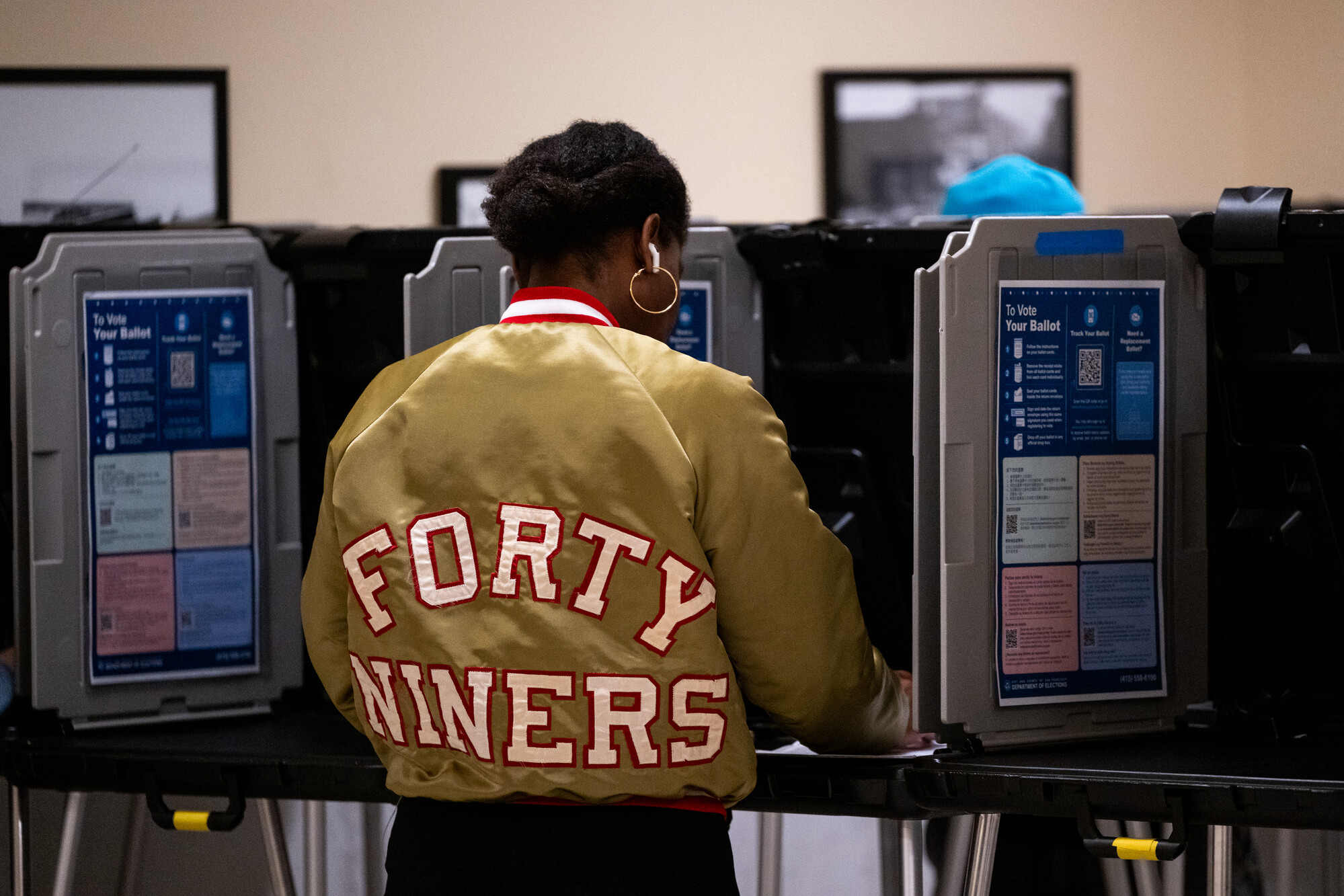
We recap the election results here in the Bay Area. Voters decided on key Congressional races, including who will replace former Speaker Nancy Pelosi and Representative Eric Swalwell. And they weighed in on measures that could increase the mayor’s power in San Francisco and Oakland. We’ll review what races have been called, which are pending and what the results say about the political tide here in the Bay.
Guests:
- Sydney Johnson, general assignment reporter, KQED News
- Scott Shafer, Senior Politics Correspondent and Co-Host, Political Breakdown, KQED
- Guy Marzorati, correspondent, KQED’s California Politics and Government Desk
Episode Transcript
This is a computer-generated transcript. While our team has reviewed it, there may be errors.
Alexis Madrigal: Welcome to Forum. I’m Alexis Madrigal. While not every race has been called, it is clear that Democrats won a crushing victory, retaking the House and Senate, as voters swung left by far larger margins than the rightward movement of, say, the 2024 presidential election.
The only real question is what to call it. This went beyond a blue tide, a blue wave, even a blue tsunami, mega-tsunami, super-tsunami. This is one of those elections that will be remembered. Blue Texas, blue Georgia, blue South Carolina, blue North Carolina, blue Iowa, maybe even — although it’s still close — blue Mississippi.
You’re going to hear a lot more about the national picture in the next hour and everywhere else you listen to media, but the story is so clear that, in some ways, our local races present the more complex and interesting story. Was there actually a progressive wave here in the Bay, for example?
And the other local angle is tech and AI. After 2024, many tech leaders backed Trump. Elon Musk spent half a billion dollars on Republican candidates, who, we should note, got pretty much wiped out. Not only did it not work, it may have backfired, as Democrats very effectively ran against Trump’s tech allies.
Joining us on Back It All are some of the members of KQED’s politics team, who may or may not have slept last night. We’ve got Sydney Johnson, general assignment reporter here at KQED. Welcome. Good morning. I like your purple hat. Go Valks!
We’ve got Scott Shafer, senior politics correspondent and co-host of Political Breakdown. Thanks, Scott, for joining us.
Scott Shafer: Happy to be here.
Alexis Madrigal: And Guy Marzorati, correspondent on the desk as well. Thank you, Guy.
Guy Marzorati: Hey.
Alexis Madrigal: So, Scott, we’re going to get to all the local stuff, but what we saw nationally — I mean, a very historic election. You’ve been covering politics for a long time. How do you put it in context?
Scott Shafer: You know, I think Democrats have been disappointed for so many election cycles. You go back to 2016, when everyone thought Hillary Clinton was going to win. Beto O’Rourke was so close to defeating Ted Cruz in Texas, only to fall short. Kamala Harris. Last night was, like, the first election in quite a while where Democrats really exceeded their wildest hopes, winning in the states that you mentioned — South Carolina, Iowa.
There’s no doubt this was about Trump. I mean, he wanted it to be about him and to pretend he was on the ballot, and I think that was a lot of it. There wasn’t necessarily a big message that Democrats had. It was really that people wanted change. This was a change election with a capital C, and we’re seeing that at all levels. Governors — Gina Hinojosa in Texas knocking off Abbott. I mean, just extraordinary things that I don’t think anybody saw coming as recently as a month ago.
So, you know, this is one of those historic elections, and we don’t want to overstate it, but could this scramble the calculations for 2028? Is Ohio, Texas, potentially in play for the Democrats? Again, don’t want to overstate it. It’s one election, but nonetheless, it’s really a political earthquake. We’ve used a lot of metaphors, disaster metaphors, in the last 24 hours, but it really does shake things up. Yeah.
Guy Marzorati: It did stand out to me, and, I mean, covering some of the congressional races, traveling around California this election cycle, the extent to which the downsides of Trump’s policies, specifically on the economy, really have been concentrated on the exact voters that shifted toward him in 2024. Whether it’s the tariffs, the Iran war, gas prices, the Medicaid cuts — I mean, Trump has had that, what was that phrase he said, “I could shoot someone in…” He tried that from an economic standpoint on these voters that moved toward him in 2024. And I think he found out last night they were not going to stay with him.
Alexis Madrigal: I mean, you look at some of the moves, and they are just stunning. Men 18 to 29, Democratic plus 38 from 2024; Hispanic voters, Democratic plus 28 from 2024; Black men, Democratic plus 16; white non-college voters, this, you know, core of the Trump coalition, Democratic plus 14 from 2024. I mean, I can’t remember — what election would you compare it to, Scott?
Scott Shafer: You know, I was thinking about 1994, and that was the year Proposition 187 was on the ballot here. Pete Wilson was running for reelection against Kathleen Brown. He easily won. Proposition 187 passed. It was widely anti-immigrant, widely seen as targeting people who were here without documents, and that awakened a whole generation of Latinos to politics. Many of the people who are now in leadership positions in Sacramento — Alex Padilla in the U.S. Senate — really got involved in politics then.
And I’m wondering, you know, is this election sort of a shift among Latino voters, bringing more younger Latino voters into the process, maybe people who felt voting wasn’t worthwhile? Because of these harsh deportation efforts that are underway, people see them as cruel. They’re dividing families and communities, and so we’ll see. But that was what came to mind last night, was 1994.
Alexis Madrigal: Yeah, yeah. Which I should point out was Washington — it was a whole other thing. But here in California, it was the beginning, and for the Republican Party —
Scott Shafer: Yeah, yeah.
Alexis Madrigal: It was one that came to me, you know.
Guy Marzorati: 2006, too, right? War, economic concerns, a referendum on the president.
Alexis Madrigal: Yeah, midterm-wise, for sure, right? Let’s talk a little bit about the other big thing, which is we saw all this big tech money. We’re going to talk about it locally, but first let’s talk about it nationally. I mean, Musk sends tons of money into that Texas race, blows up in his face, but also a bunch — his America PAC backed dozens of candidates, almost all of whom went down. What do we think this might do locally here? What do you think, Guy?
Guy Marzorati: I mean, maybe drive the money locally. I think when you look at these Senate races, you see an ability for a candidate to define themselves regardless of the money. I mean, the amount of money that was spent by Musk in Texas was extraordinary. The amount of money spent on the Republican side was extraordinary. It really seemed to have no impact on how voters were viewing the Democrat, James Talarico.
And I think you see in these statewide Senate races an ability for a candidate to kind of create their own brand, message, image. That doesn’t exist at the local level. We can talk about some of the spending in California legislative races, where tech has been very successful and looked to continue to be so last night. And even in local races for something like San Francisco supervisor, those dollars can go a lot further, it seems, when you’re in an environment where voters are maybe not so familiar with the race and the candidates.
Alexis Madrigal: We’re talking about the election results with KQED’s politics team. We’ve got Sydney Johnson here, Scott Shafer, Guy Marzorati. Of course, we’re taking your questions, your comments. Did you pay any attention to the election last night? 866-733-6786. Forum at kqed.org.
Sydney, let’s come to the race here. We had former Speaker Nancy Pelosi’s seat up in San Francisco. Where do we stand between Scott Wiener and Connie Chan, who Pelosi endorsed?
Sydney Johnson: Yeah, so Scott Wiener has a pretty strong lead in this race still, about 55% to Chan’s 45%. And, you know, I went to both parties last night, and Wiener’s was talking as if he had won. It was essentially a victory speech. The place was packed. People were having drinks and dancing, and it really just sort of had this aura of coming away with the win.
Whereas Chan, you know, she spoke pretty late in the evening. She thanked Pelosi for her support. She thanked her supporters also for being there and for backing her in this campaign as sort of the underdog candidate.
Alexis Madrigal: I mean, he’s up 11 points now, right? This one’s pretty much over? We have 50% of the votes counted? I don’t know. What do we think?
Scott Shafer: Fifty percent. I mean, she would have to do extraordinarily well in the remaining ballots, you know. But I wouldn’t say it’s over. I mean, the gap may narrow, especially if these late ballots tend to be a little more progressive, although Wiener really cut into some of the progressive votes that she might have gotten in places like Noe Valley, obviously the Castro. You know, if you look at the map, he did pretty well in most parts of the district, except the far west and a little bit of the beach.
Alexis Madrigal: I mean, this was going to be a really odd coalition for either of them, right? Because Connie Chan had some of those, like, West Side, kind of more NIMBY voters. She was for having the Great Highway reopen during the weekdays and some of the housing stuff. And then they were kind of attacking Wiener on AI legislation, when he actually, to my eye, had been quite forward and progressive on AI legislation.
Sydney Johnson: Yeah, I mean, first of all, to go back to your question about tech and their role in this race and these races nationwide, that was so interesting to watch in this race in particular. One, just because things like data centers, kill switches, AI in general became really a central issue in this race. You know, they dominated all of the advertisements that people were receiving. It certainly was a big topic that took a lot of airtime during debates.
And, like you said, Scott Wiener authored the first AI transparency bill here in California. States have adapted that and replicated it. Connie Chan’s team and her approach was to say that this was watered down, and actually Scott Wiener was receiving funding from tech leaders. He received money from a PAC that was funded by Anthropic.
And so there was a lot of trying to criticize Wiener for his support from AI, saying that actually they see him as their ally. And even if there is going to be regulation, it’s going to be regulation that is sort of in their favor, something that they like. But to your point, yeah, he also did author this years before it was a common, like, kitchen-table topic — the hot-button issue that it is now.
Scott Shafer: Yeah, and, you know, Nancy Pelosi has always been about the art of the possible. What can you get done, not what’s perfect? You know, Scott Wiener sent a bill to Governor Newsom that Nancy Pelosi and others urged him to veto. He vetoed it, and so he got through what could get through.
And I think that that may be a difference between Chan and Wiener. I think he is willing to go back when he loses in terms of a veto or not getting the votes. And I think that’s maybe what voters were looking for: somebody who could go back to D.C. I mean, Nancy Pelosi is a hard act to follow in terms of her prolific nature, her leadership, and so on. And I think when voters looked at the two candidates, they saw Wiener as the one best able to go back and really lead the charge on AI, right?
Alexis Madrigal: I mean, he has been, like him or not like him, he’s been an incredibly prolific guy in Sacramento. It’s like a legislation factory.
Sydney Johnson: Yes.
Alexis Madrigal: You know, you talked to him last night, Sydney. Let’s hear what he told you at his election party last night.
Scott Wiener: The year that Nancy Pelosi was elected to Congress and took to the floor and said she went to Congress to fight AIDS, that was the year that I was a 17-year-old closeted gay kid who admitted to myself I was gay. And so, fast-forward 39 years, there’s no way I would have ever predicted that I would be succeeding Nancy Pelosi.
Alexis Madrigal: That was Scott Wiener at his election party, telling Sydney Johnson about how it felt to be in the driver’s seat in that election.
We are talking election results. We’ve got Sydney Johnson, Scott Shafer, Guy Marzorati, all of KQED, and we’re going to be taking your questions. If you can’t get through on the phone lines and you want to share something with us, try Bluesky, Instagram, Discord, or go to forum at kqed.org and send us an email.
I’m Alexis Madrigal. Stay tuned for more.
Welcome back to Forum. Alexis Madrigal here. We are talking about local election results. We’ve got reporter Sydney Johnson with KQED News, senior politics correspondent and co-host of Political Breakdown, Scott Shafer, and correspondent on KQED’s California Politics and Government Desk, Guy Marzorati.
Let’s bring in Anne in Redwood City. Welcome, Anne.
Anne: Hello, Alexis. First time, long time. I worked the polls for the last four days as a voting assistant, and I was surprised and delighted at how peaceful everything was. We didn’t know what to expect from ICE. Redwood City is heavily Latino, and I haven’t heard about any trouble at all.
Alexis Madrigal: Yeah, and I really appreciate it. Thanks for doing the civic labor there. We all appreciate it here. I mean, this really was kind of like the dog that didn’t bark, right? I mean, there was all this thought that maybe there’d be ICE at polling stations. Well, it barked, but it was —
Scott Shafer: — by the SPCA, or whatever analogy there is. Like the courts. The Supreme Court rejected Trump’s efforts to get those 20,000 ballots segregated, and so at every turn, he was stymied. I mean, maybe that was a prelude to 2028, to see what he could get away with. I don’t know. But, yeah, to Anne’s point, it really went very smoothly everywhere. I really didn’t have any problems in any of the 50 states.
Alexis Madrigal: Yeah, I think there was one thing in Westchester County, you know, there always is. But there was just, you know, it was a ballot machine problem, and that was the only thing they had. So, like, on CNN it was just like, “Ballot problems in Westchester County,” and they’re just like, “I don’t know if this is the place we’re really worried about here.”
Before we move on to some other congressional races, Yee writes in to say, “I would love to hear the panelists’ thoughts on housing last night. From where I sit, with the victory of Wiener, the housing measures passing statewide, and victories in Los Altos against Measure D, and victories for pro-housing candidates in Cupertino, have we finally beat back NIMBYism in California?”
Guy Marzorati: Not entirely, because I’ll take you to Half Moon Bay, where the farmworker Measure Q basically tied right now. I mean, this stemmed from that horrible mass shooting in Half Moon Bay that exposed these really deplorable conditions in farmworker housing. There was an effort to build affordable housing for senior farmworkers downtown. That was approved by the city council, but then challenged by a referendum. And now the vote to enact that housing is just about tied in Half Moon Bay.
So that’s one where it’s hard to think of a more sympathetic case for building affordable housing. But the complaints we typically hear for any kind of new development — not the right place, doesn’t fit with the character of downtown. So I agree, lots of victories for housing around the Bay Area, but this one’s not decided yet.
Scott Shafer: I wouldn’t be shocked if, in the coming years, there’s some sort of a statewide ballot measure to restore some local control that was removed by some of the —
Guy Marzorati: Oh, interesting. You see it go back the other way?
Scott Shafer: It could. I think because there are a lot of people who feel that Sacramento shouldn’t be telling us what to do. Yeah, the way, like, the EU — you know, that’s how people feel in Europe in some of those countries. So we’ll see. I mean, I’m just saying I wouldn’t be surprised.
Alexis Madrigal: I wouldn’t be shocked by it. I mean, you know, maybe a return of some kind of redevelopment possibilities knocked out by Jerry Brown many years ago. But that has always struck me as something like, isn’t that ever going to come back at some point? But I guess not.
Let’s talk about a really interesting race up in the North Bay. Do you want to set it up? We’re talking Eric Jones versus incumbent Representative Mike Thompson. Guy, I know you love this one.
Guy Marzorati: Oh, this one has been fascinating. Our colleague Izzy Bloom has covered this from the beginning. Really interesting race here: two Democrats, Mike Thompson, longtime incumbent, challenged by venture capitalist Eric Jones. Mike Thompson right now — the race is still pretty close, with Jones holding a slight lead.
If I’m Mike Thompson, number one, Zoe Lofgren’s coming off my Christmas card list. Zoe Lofgren, chair of the California congressional delegation, pushed Proposition 50. They redrew this seat, basically put in about half of new voters. For what? I mean, we can talk about whether Prop 50 was even needed in this current environment, but Mike Thompson basically had to reintroduce himself to these voters.
Eric Jones, an incredibly well-funded campaign, rich guy, brought in a lot of his own money, but ran a really smart race. And what really stands out to me in this district, where you have a large Republican electorate in a lot of the more rural Northern California counties, is that Jones ran a campaign where he basically just said popular things. Opposed data centers, opposed congressional stock trading, but also did a lot of outreach to Republicans.
And I think this is a question going forward in these Democrat-on-Democrat races where you do have sizable numbers of Republicans in the district. He made a really concerted outreach to them, to the point where it was hard to even tell where he stood on the political spectrum. He said, “I want a balanced federal budget,” but he was also endorsed by Our Revolution, the Bernie Sanders group.
He made inroads with the Republicans, and he is running way ahead of Thompson in the red counties in this district. So it looks like that outreach, at least, has paid off. This is one we’re going to just have to watch for days as the results come in.
Alexis Madrigal: Yeah, I mean, just to let people know, Thompson’s endorsements are, like, Newsom, Padilla, Nancy Pelosi, Adam Schiff, California Democratic Party, right? He had the entire establishment behind him. But also just —
Guy Marzorati: On that, with the establishment, where were they all summer? I mean, Mike Thompson was sitting under five feet of rubble up in the North Bay, getting pounded by these ads, and Zoe Lofgren and these other folks were spending their time trying to take out Aisha Wahab in an open seat in the East Bay. That took all the attention. Or Scott Wiener — or Scott Wiener. Like, where was the attention on this race until very late in the campaign?
Alexis Madrigal: Yeah, yeah.
Scott Shafer: I think it’s also just kind of the law of unintended consequences, which I always love to talk about. I mean, we were talking last night about the 2018 race for the Senate. Dianne Feinstein runs against Kevin de León, who was to her left. And yet you looked at the map after the election: de León won all the red counties because Republicans were just sick of Feinstein, as maybe some of them are with Thompson. They just voted for the other candidate just because it wasn’t Thompson, or it wasn’t Feinstein.
Alexis Madrigal: Yeah, yeah. Let’s hear this 35-year-old former venture capitalist, Eric Jones, who is currently leading Representative Mike Thompson.
Eric Jones: This country is ready for a new generation of leadership. It’s ready for a new way of doing politics.
Alexis Madrigal: I mean, that was pretty much the argument, right? Yeah, generational change.
Guy Marzorati: Yeah, generational change. This was a total generational change, if Jones wins. I think you’re going to see kind of copycat challenges around the Bay Area, if folks with enough money say, “You know, who’s an incumbent I can pick off here who might not be a strong campaigner or fundraiser?”
I think this kind of sets a precedent for that. But just, yeah, a really smart, well-run campaign with outreach across partisan bases. I mean, we’ve talked about this before. It reminds me a lot of Ro Khanna when he first ran. Now we think of him as this Bernie progressive. In 2014, it was kind of unclear where he stood on the spectrum, other than, “I’m not my opponent.”
Alexis Madrigal: Right, right, right. You know, to your point, Scott, John writes in to say, “Is there any way to tell how the gerrymandering worked out? Did it do what it was supposed to do? Here in California, it seems like it did,” right?
Scott Shafer: Yeah, absolutely. I mean, the Democrats are poised to pick up five seats. The one that’s closest, I guess, would be — I’m trying to think. I mean, Marnie Wilkes in San Diego — Riverside has won. Obviously, Randy Villegas in CD 22 in the Central Valley has won. Gallagher has been defeated by Mike McGuire. Kevin Kiley’s gone. Who am I forgetting? There’s one more. I mean, Valadao looks on his way —
Guy Marzorati: Yeah, Randy Villegas is going to beat him.
Scott Shafer: So, yeah, it’s worked. Perfectly here. There were some unintended consequences, where you have Democrat-on-Democrat races and some generational battles, some of which worked out to the younger candidates’ advantage. Others didn’t, like Doris Matsui. It seems to be hanging on up in the Sacramento area.
Guy Marzorati: Counterpoint: did they even need it? You look across the country, and Democrats are winning seats that Trump won by 10, 11, 12, 13 points. You look at the old maps, before they threw out our independent commission, they were looking at going against Kevin Kiley, Ken Calvert, Young Kim, and Valadao. Those are all districts Trump won by six points or less. So you can completely conceive of a world in which they won four seats under the old map and kept the moral high ground of independent redistricting. I’m not convinced this was even —
Scott Shafer: Counterpoint, though: if they had not redrawn the lines, and let’s say, you know, the environment was very different back when this was — you know, Prop 50 was put on the ballot. It was kind of like a five-alarm fire from Democrats. And also, if they hadn’t changed the lines with it, would it have sucked a lot of money from races in other places across the country, where Democrats have now picked up seats? So, you know, it’s kind of unknowable.
Guy Marzorati: Protect Democrats for the future. What?
Alexis Madrigal: Well, interestingly, the gerrymandering in some states that Republicans did did not work out for them. Texas — in fact, it backfired. Florida, yeah, yeah, absolutely.
Scott Shafer: Yeah, they just made bad calculations about who was going to be voting for the Republican candidate. And obviously, as you said at the very beginning, Alexis, Latinos, younger voters — they’ve all gone way in the other direction from 2024.
Alexis Madrigal: Is it time to talk about Measure EE? I know this is Oakland. I mean, you know, it’s interesting to me as an Oakland resident, but it’s also interesting because we have — this is a charter reform measure. It concentrates some more power in the hands of the mayor. Let’s hear Barbara Lee. She joined us on Forum back in May to talk about why she wanted Measure EE.
Barbara Lee: Oakland is desperately in need of charter reforms. The hybrid system here in Oakland just doesn’t work. No one knows who’s responsible for what. No one knows where the buck stops. No one knows who’s responsible for the delivery of services. You call 311, you just get the runaround.
Alexis Madrigal: So this is really interesting, right? Because that’s the argument for it: Oakland government needs to work better. Former Mayor Sheng Thao happens to be on trial for corruption charges while this election is going on. It couldn’t seem like a worse setup to pass a centralized-power-in-the-mayor charter reform bill. What happened, Guy?
Guy Marzorati: It’s passing by a wide margin, and, you know, I think it’s because people review these measures — and we can talk about this in San Francisco, too, where Daniel Lurie had huge victories in his attempt to give the mayorship more power. People view it through the lens of the current mayor. They’re not — you can put all the theoretical “Well, think about the future” arguments out there, but people are looking at this through Barbara Lee: “Should I give Barbara Lee more power?” Daniel Lurie: “Should I give him more power?”
And guess what, Alexis? We suddenly like our mayors again in the Bay Area. The vibes are, you know, the regional transit measure is headed to victory. The Valkyries parade is later today. People are feeling way better. Could you imagine London Breed and Sheng Thao pushing these measures and getting them passed with these margins two years ago? No. So I think it just speaks to kind of —
Scott Shafer: — where the politics are right now in the Bay. Yeah. Jerry Brown, when he was mayor, the first thing he did before he even took office was get something on the ballot so he didn’t have to attend city council meetings, which passed.
Alexis Madrigal: Sydney, talk to us about San Francisco and Lurie’s measures. These were, like, the — they called them the “Clean Up City Hall” measures, D, E, and F.
Sydney Johnson: Charter reform —
Alexis Madrigal: It’s hard to ref —
Sydney Johnson: Yeah, I mean, Lurie had a good night last night. I actually saw him at Scott Wiener’s election-night party. He stopped by later in the evening, and even though this was a party for Scott Wiener, the people who were here were like, “The mayor’s here!” They huddled over. You know, Wiener didn’t endorse —
Alexis Madrigal: Yeah.
Sydney Johnson: Right. So, of course, that was my first question: “Are you here because you voted for Scott Wiener?”
Alexis Madrigal: What did he say?
Sydney Johnson: He did not say, but he did say that he was looking forward to working with Wiener — or, if Chan had won, if Chan does win, that he would look forward to working with her, too. It’s very diplomatic.
But I think it’s pretty fair to say that Daniel Lurie swept again. He’s had some pretty good election nights so far, in just a couple of years in office. His charter reform measures, D, E, and F, are aimed at making it a bit harder to get items on the ballot, and also centralizing and streamlining city contracting and purchasing. All of these measures are ahead right now to pass.
Alexis Madrigal: Not to mention Prop A.
Sydney Johnson: Another measure — the commission-streamlining measure — is also poised to pass. And, yeah, so, you know, he’s feeling pretty good. He’s still riding that popularity. And I think, like Guy was saying before, if this was just a couple of years ago under a different mayoral system, we might not have seen this. I think it could have been quite different. But Lurie has — with the help, we should point out, of a multimillion-dollar PR apparatus —
Alexis Madrigal: Largely tech money this time around.
Sydney Johnson: — tons and tons of money going into these races that he has supported as well. But, you know, people went for it.
Guy Marzorati: To retire the H-word: honeymoon. It can’t be a honeymoon anymore, right? We’re now — how many elections in a row? Now it’s just a good marriage. People are basically checking off the Daniel Lurie line.
Alexis Madrigal: Yeah, it’s so interesting, so interesting. I wonder how long he’ll be mayor. It’s an interesting thing to think about.
Prop H is an interesting one in San Francisco, too. People were very — I mean, when I was talking to people before the election, both RTM, the regional transit measure, and Prop H, which was the Muni-specific parcel tax for San Francisco, people were worried. When you talk to people at SPUR, they were just like, “Let’s hope.”
I mean, it looks like it’s pretty much a blowout. Prop H looks like it’s way up early. The regional transit measure is in. It’s got to be 50 plus one. It’s sitting at 61.5%, according to kqed.org. So what do we think? What does this say about the city right now and the mood of the region, and passing them?
Scott Shafer: I think people appreciate public transit, whether or not they use it. I mean, even if they drive, they don’t want more cars on the road while they’re commuting from their home to their jobs. And these agencies have been facing a fiscal cliff. And when you compound that with the cuts from the federal government and Trump targeting California in all kinds of ways, this is a real endorsement of public transit, and it couldn’t have come at a better time.
And there were also — BART was very specific about what would happen if these didn’t pass. Muni in San Francisco, same thing. I still feel — how many were there, like 18 different transit agencies in the Bay Area? It’s incredibly inefficient. Nonetheless, people appreciate the services that they have.
Alexis Madrigal: Yeah. Just before we head out of this part, let’s hear Lurie. Our colleague Katie DiBenedetti was at an event in San Francisco for Lurie’s measures. Here’s what the mayor said.
Daniel Lurie: The people of our great city are sending a clear message that is bigger than any one ballot measure. San Franciscans want common-sense government — a government that respects your time and your money, and a City Hall that is accountable for delivering results.
Alexis Madrigal: I just got to say, the whole reason to play that clip is “common-sense government.” The guy going, “Let’s go!” Common-sense government! You’re like, oh, wow, what an applause line here in the city. Can’t say it’s the most soaring rhetoric to say “common-sense government,” but apparently it is. There’s a market for it.
Sydney Johnson: There’s a market for it.
Alexis Madrigal: Yeah, that’s right.
Sydney Johnson: And, you know, it’s still to be determined whether Prop D, for instance, which is supposed to make it harder to get items on the ballot because people are always complaining about how long and thick San Francisco’s ballot is, whether this is actually going to shorten the ballot very much. You know, I think there have been a few analyses that have come out basically showing that there would still be extremely long ballots if we went back and looked at past elections and saw, if this threshold was applied, what actually would not have made it. It doesn’t show that it would shorten it that much, but we’ll see if it changes in the future.
Scott Shafer: And this doesn’t make it the highest threshold of counties in California. It’s sort of, I think, in the middle.
Sydney Johnson: It kind of brings San Francisco in line with many other places in the state, yeah.
Alexis Madrigal: Let’s talk about something that may not pass: the public bank in San Francisco. I mean, this one right now is pretty much tied up. Maybe we won’t know exactly what’s going to happen with this for a while here. It’s 50.1% no right at the moment. And if you want to know more about this, we did do a show on it. It’s basically like a pre-public-bank measure. What do we think happened here? People just weren’t excited? I mean, this one’s —
Sydney Johnson: — still really close. I think this one is definitely too close to call at this point. But it’s interesting, yeah, because this has been something that they’ve been building toward for years — this public bank coalition that’s been talking about it. There was a working group. This is not just some idea that sprung out of nowhere. There’s a state law right now that will expire, and they had to basically get this idea on the ballot now in order to take advantage of this state law that allows cities to create public banks.
But there were, I think, only two supervisors who didn’t support this, so it also had support from the majority of the Board of Supervisors. But I think it’s still just this foreign concept to a lot of people. Unless you’re pretty plugged into some of these issues, maybe it was a step too far.
Alexis Madrigal: Yeah, Berkeley — it seems like the same thing is happening, right?
Sydney Johnson: Yeah, Berkeley’s even further toward defeat right now, getting closer to that. And Berkeley was different. It was actually a tax to fund a bank, whereas San Francisco’s would have just set up this government structure. But, yeah, both have not performed as well as I think their supporters wanted.
Alexis Madrigal: We are talking election results, of course, with KQED’s Sydney Johnson, Scott Shafer, and Guy Marzorati. We’re going to get to a bunch more of your calls and your comments when we get back from the break. I’m Alexis Madrigal. Stay tuned.
Welcome back to Forum. I’m Alexis Madrigal. We are talking election results, like everyone else on Earth right now. We’ve got KQED’s politics folks in the house — Scott Shafer, Guy Marzorati, and reporter Sydney Johnson with us as well.
Let’s bring some of you into this conversation here. Paul in San Francisco, welcome.
Paul: Yes. Anytime we look at San Francisco politics, I think we have to take into consideration the influence of transplant voters who may or may not know the history of the city.
Alexis Madrigal: Interesting. Yeah, I mean, how much — this is a good question, Paul. Scott, how do you think the electorate of San Francisco has changed, you know, in the last —
Scott Shafer: — 10 years? Tremendously. I mean, if you go back a little further, there was a dot-com boom and bust. A lot of people came for the gold rush and left when it crashed, and San Francisco is that kind of place. Now we have an AI boom.
You know, Nancy Pelosi was first elected in 1987. What percentage of the people who voted yesterday were alive, or even voting, or in the city at that time? So it is a transient city. It’s kind of not maybe as bad as, say, Washington, D.C., but, yeah, it definitely turns over. And there aren’t many kids, there aren’t many families in San Francisco, too, and I think that probably affects the way people look at some of these issues.
Alexis Madrigal: Let’s go to Mario in Mountain Ranch. Welcome, Mario.
Mario: Thank you. Appreciate this, man. I’m so relieved at the national level, and I think there’s stuff that happened at the national level that we actually really need to look at here in California locally.
I think a huge thing that I’m just so — I was really, really stressed out, but so hopeful now that people across the board are coming together and waking up, have a different political analysis of what’s going on with the country, that it’s not about right and left. We have to not look right — we have to look up and see what the power — how power is being used.
And I think part of why the Trump administration got into power at the national level was because of what happened with Democrats in the 2021–2023 session, where we had the presidency and both houses of Congress, and it took two people, Joe Manchin and Kyrsten Sinema, I think it was, who received extraordinary funding from AIPAC, blocked all the Democratic initiatives, and people just said, you know, the Democrats — they don’t do anything. And at least this guy’s promising this and this, so let’s take a chance.
So I think now the time is — the analysis has to be that people are waking up across the country. Who follows the money? Who is funding, and what is the impact of it? AIPAC and all the big corporate funders. Corporate Democrats need to be excised from the Democratic Party if we’re going to take the party back. Otherwise, the Democratic Party is going to be more abundant than it’s always been. So I think you really, really have to — that’s part of the analysis of getting rid of people, the old-school Democrats who like being part of machines.
So anyway, that’s my hope for the future. Thanks so much.
Alexis Madrigal: Appreciate your perspective, Mario. Kind of echoing James Talarico’s line from down in Texas, right? The real divide in America isn’t left and right, it’s top and bottom, or something like that.
Scott Shafer: Yeah, that’s a good line for Texas. Stay away from that left-right thing.
Alexis Madrigal: Yeah, yeah. It’s interesting, though. California — it’s muddier here, I think, what’s happening on that score. Don’t you think?
Scott Shafer: Yeah, but the wealth disparity is enormous.
Scott Shafer: I don’t think any state — there are maybe a few states, but California has an enormous number of people who are below the poverty line, and then extraordinary wealth, billionaires. And I think people are beginning, as the caller said, to wake up, like, “Hey, what’s going on? Why are members of Congress getting wealthier and wealthier when I’m struggling to make ends meet month to month?”
So I think that’s why Randy Villegas down in the Central Valley really tapped into that sentiment against David Valadao. I do think people are starting to think that way more.
Alexis Madrigal: I also, you know, the L.A. mayor’s race is something I’ve been tracking a lot. You had Karen Bass, who kind of came up through the ranks. You have Nithya Raman, who’s more in the DSA camp, and Raman is now up and starting to pull away a little bit. She’s up like two, three points here. Really interesting. I mean, do you see any other races like that in California where a progressive is kind of running away from a moderate? I didn’t find that many things in her — I mean, Karen Bass is pretty liberal. She’s not like she’s a conservative.
Scott Shafer: Not Spencer Pratt.
Guy Marzorati: And there are a couple. I mean, Jimmy Gomez in Los Angeles, facing a progressive challenge — he’s had his own kind of scandal issues. I struggle to make this election, looking big-picture, too much about Democrats. I mean, the Democratic Party still has a very strong — exit polls had it at 35% favorable.
I think midterm elections revolve — the sun that they revolve around is the president and how the White House and Congress are doing. And I see it more as kind of a check against that than any move toward the Democratic Party. Individual Democrats — I think, talk to someone like Talarico, they can maybe chart a path forward from a messaging standpoint, how to win in a red area. But I don’t think a takeaway from this election should be that the Democrats have necessarily solved their own branding problem.
Scott Shafer: And I think in L.A., too, Karen Bass’s popularity was so low. I mean, I would not be surprised if she ends up losing. You know, I think people get to the point where they may not like the alternative, but it’s like, “Well, maybe — could she possibly do any worse?” You know? We may find out. But I think that when you’re the challenger, you benefit from that dissatisfaction that was so deep in L.A. over not just the response to the fires, but homelessness and other things. A lot of other stuff.
Alexis Madrigal: You know, we haven’t even talked about, real briefly, the California governor’s race. I mean, did that even happen? You know what I mean? I feel like Steve Hilton ads were around, and Becerra more or less — you know, first Latino governor of the state since —
Scott Shafer: — we were elected? Ever?
Alexis Madrigal: Yeah.
Scott Shafer: The last one was a long time ago.
Alexis Madrigal: Yeah, yeah, in, like, 1854. So it’s wild. What do we think he’s going to do? How’s the state going to change?
Scott Shafer: Well, you know, he was very vague, which is one of the reasons he appealed to so many different parts of the Democratic coalition, I think. I sort of feel like he’s going to benefit from low expectations. People don’t have great expectations for him, for the reasons I just mentioned. He’s not the most charismatic guy. He’s not somebody who is a natural fit for social media. But he has deep experience. You know, Sacramento as attorney general, Washington as congressman. Ran HHS, right? Ran HHS — a little controversial, but nonetheless, he did. That has a huge budget. So we’ll have to see. I mean, he looks like he may have a supermajority in the Legislature.
Guy Marzorati: I mean, that’s one of the things I was following last night, the way in which the blue wave has trickled down to the state Legislature here. The seats the Republicans won in 2024 — those majority-Latino seats in Riverside and Imperial — have flipped back. So I bet Democrats come out of this with more seats in the Assembly than they entered with, which was 60, and more seats in the Senate than they started with, which was 30.
So we’re already talking about massive supermajorities. That’s got to help Becerra, at a certain level, go after his agenda, and a budget that might look pretty good for him next year.
Scott Shafer: Yeah, but I think we can’t underestimate the impact of his being the first Latino governor from working-class roots. One of his parents was an immigrant. He came back and forth across the border. I think it was his dad. That matters. And he is somebody who, I think, has that in his blood, literally and figuratively. I think he’s going to look at a lot of issues differently than previous governors.
I mean, Jerry Brown certainly was not somebody known for his empathy toward working-class folks in general. I think it’s going to be a different point of view.
Alexis Madrigal: And before we turn back to San Francisco, I just want to say, Republicans ran hard against all DEI things, basically, over the last several years. The first elected Latino governor of California, four Black governors, 100 women in the House delegation for Democrats. There was a trans woman elected in the suburbs of Huntsville, Alabama, to go to Congress.
I mean, they’re so hard against all of these things, and yet, in this particular election — and again, not to read too much into representation — Native American candidates had big wins at the state level. The kind of representation that the Democratic Party will have over these next couple of years is totally unprecedented and, at least to me, feels a little bit like a repudiation of the idea that nobody cares about this stuff anymore.
Scott Shafer: Pete Hegseth — yeah, I mean, what he’s been doing with the military, purging a lot of women, people of color. Yeah, yeah. No, this is the country. You know, it’s reflective of who lives here and who’s growing up here. And that is the future, whether you like it or not. You know, it is a diverse country.
Alexis Madrigal: Yeah. Sydney, Great Highway — everyone’s favorite. This is the 17th time it’s been on the ballot. What’s the deal? What’s happening? Prop G — this was not to entirely get rid of the park. This was the half-measure of having the Great Highway be a highway again on weekdays.
Sydney Johnson: The so-called compromise, right? Prop G is going down. It’s essentially been called. The city voted the way it did last time, which was that the majority of voters citywide said they wanted to keep cars off the Great Highway and have it continue to be this boardwalk-type park, a two-mile stretch along Ocean Beach.
And, you know, the maps are interesting because it is quite similar to last time, too, where you have this pocket of people living in the Sunset and the Richmond who voted to put cars back on the Great Highway. But a little bit more this time, we see a strip exactly along the furthest side, closest to the park — you know, people with those beachside homes who kind of like the park and voted to keep it. I think there was some of that before, but it was just a little bit more apparent to me on the maps this time around.
Will this be the last time that we hear about the Great Highway debate? I sure hope so. But with that higher threshold to get things on the ballot, it’s going to be harder to get things on the ballot. You know, we’ve had a supervisor who supported Prop K, which was to keep cars off the Great Highway, and he was recalled. The new supervisor supported the compromise. The compromise did not pass. So we’ll see if there’s some sort of lawsuit and kind of Hail Marys that these pro-car advocates on the West Side throw out there. But I think, for the most part —
Alexis Madrigal: It may be done.
Sydney Johnson: It may be done. I mean, even Daniel Lurie, who did not take a side on this — he did not endorse either way — last night, I asked him, “Do you think this is the end of this debate?” And he said, “I think so.” So, you know, what Daniel Lurie says — maybe, maybe.
Alexis Madrigal: Okay, we want to get to one other thing. Solano County had some interesting elections, kind of seen as a referendum on the effort to build a new city up there, known as California Forever, as well as data centers. What did we learn about what’s going on up there?
Guy Marzorati: So this was interesting, because Measure E in Solano County, which was a tax on data centers, was the only thing we had on the ballot in the Bay Area that was specifically data-center-related. This tax is actually on its way to defeat. It would apply to more things; it also covers battery systems, solar, and wind turbines. So maybe it’s not as neat to say this is an up-or-down vote on data centers, but it’s interesting that Measure E is going down.
And then just some of the — we’ve gotten some attention because of this planned city that’s being discussed out there. The two candidates currently leading, Princess Washington and Katrina Garcia — we’ll still see. It seems like maybe there are more votes to be counted in that race.
Alexis Madrigal: Two other things. I just want to — they’re going to talk more about state stuff in the next hour. So, real quick, Prop 40, the billionaire tax, appears to be going down. This looked like what was going to happen, right? I mean, this has been just massive on the airwaves. Every ad starts out, “Taxing billionaires may seem like a good idea, but actually it’s not.”
Guy Marzorati: The “dot, dot, dot” carried the day.
Alexis Madrigal: Yeah, right. And then Prop 45, which is kind of tied into this data-center-politics issue, in the sense that this was supposed to streamline CEQA reviews, right?
Scott Shafer: Go ahead, Scott. Well, I was just going to say, I think supporters of Prop 45 said it did not apply to data centers. Opponents said it could. Maybe we will never know, because it looks like it’s failing.
But I’ve said this before: I think Prop 45 got caught up in Trump policy, in a way. We’ve seen the EPA and other agencies rolling back air standards and fuel efficiency and other kinds of things related to the environment. And I think voters thought, you know, the state has already done a lot of revision of CEQA around housing and sports arenas, stadiums, and other things, so let’s just hold off.
You know, this was promoted by business, opposed by a lot of the environmental groups. I think it just was bad timing as much as anything.
Guy Marzorati: Yeah, and really hard to —
Guy Marzorati: — get the signal from last night about Silicon Valley and tech in California. Because you have voters rejecting the billionaire wealth tax, which was framed as kind of a repudiation of this tech wealth. You also have, at the national level, the way some big tech players aligned themselves with the GOP, which did not make great investments — Elon Musk in Texas.
At the same time, you have local tech money playing big in a lot of these state legislative races, and candidates doing really well, with one huge exception in Marin County, where the tech-backed candidate is trailing.
You have, up and down the state in California, Chris Larsen, Timothy Draper, this Google-Facebook PAC throwing millions behind these candidates for the state Legislature — moderate Democrats. They all seem to be in really strong positions after last night. So, interesting data point there.
And one more that I’ll just shout out in San Francisco, where Chris Larsen put in $500,000 in a super PAC in District 10 in support of Theo Ellington. That’s when I had our KQED politics correspondent and chief mathematician, Marisa Lagos, crunch the numbers on that: $78 a vote in District 10. I think it may have cost him —
Scott Shafer: — some votes, also. You know, there was a lot of —
Guy Marzorati: We’ll revise our formula.
Sydney Johnson: I mean, but, okay, to your point, I think tech is going to be hopefully doing some self-reflection after this, because there had been this idea, I think, that after some of the success tech billionaires had putting money into San Francisco races and seeing returns on those investments, they were saying, “If we can do this in San Francisco, we can do this anywhere.”
Scott Shafer: Well, you think about Matt Mahan running for governor and all that tech support. Yeah, yeah. He got way down — I forget what he got, single digits, you know. So it was kind of foretelling some of these other things.
Alexis Madrigal: All right, I want to let you guys wrap and get out of here. We have been talking election results with Sydney Johnson, reporter at KQED News. Thank you so much, Sydney.
Sydney Johnson: Thanks for having me.
Alexis Madrigal: Guy Marzorati, correspondent on KQED’s California Politics and Government Desk.
Guy Marzorati: Thank you so much. And shout-out to Sydney — reporter’s dream today: election coverage, and then on to the Valkyries parade.
Alexis Madrigal: Scott Shafer, senior politics correspondent and co-host of Political Breakdown. Thank you so much, Scott.
Scott Shafer: Thank you, Alexis.
Alexis Madrigal: Let’s go live now to Juan Carlos Lara, who is standing by, I believe, on the Embarcadero there at the Valkyries parade. What’s up, Juan Carlos?
Juan Carlos Lara: Hey, Alexis. How’s it going?
Alexis Madrigal: Good, good. Tell us, what’s it like down there? What do we got? Is it a sea of violet?
Juan Carlos Lara: Exactly, yeah. I’m standing here near the Ferry Building, where the parade is set to get started in a little over two hours. As you said, yeah, it’s a sea of violet out here. Fans started lining up — most of them said about an hour ago — to get a spot right up against the barricade. And people are really pumped. The weather is gorgeous, lots of bedazzled jackets and great costumes, like you saw in a lot of the games. Yeah, people are hyped and ready to go.
Alexis Madrigal: And for people who are still interested in going to the parade, what can they do? It goes from the Embarcadero, right at the Ferry Building, all the way down to King. Is that right? Along the Embarcadero?
Juan Carlos Lara: Yeah, that’s right. Team president Jess Smith said that the route was important to replicate the route that players took from their training facility in Oakland to Chase Center when they would head to games. So that’s the route for today, which departs from the normal route for victory parades, which the Warriors would do down Market Street.
Alexis Madrigal: And Juan Carlos, again, for people who are thinking about going down there, is it packed wall to wall, or are there still some spots? If you want to head down now, could you make it and see what’s going on?
Juan Carlos Lara: No, there’s definitely room. Yeah, people who want to show out should definitely come out here. I mean, definitely take public transit, because I imagine all the roads around here are packed. When I took BART out here in the morning, close to 9 a.m., there were lots of fans on the trains. The trains were a little packed, but there’s definitely room.
I mean, from where I’m at at the Ferry Building, looking down, I can see some spots. It is starting to get pretty packed. I imagine as we get closer to noon, it’ll reach a critical mass. But, yeah, people should definitely still come out.
Alexis Madrigal: Awesome. Juan Carlos, we’ll see you there. I’ve got my Valks gear on. Also, go Valks! We won. Sydney, too, and Cohen, maybe even the whole Forum team. Who knows?
I’m Alexis Madrigal. I just want to thank everyone for calling and writing in. One final thought on our election show: Douglas on the Discord writes, “I’m imagining the look you’d get if you told someone the day after the general election in 2024 that in two years, a state was going to elect a transgender lawmaker, and that state was Alabama.”
I’m Alexis Madrigal. Stay tuned for more Forum election coverage.