What's on the Ballot in San Francisco
Airdate: Monday, October 19, 2026 at 9 AM
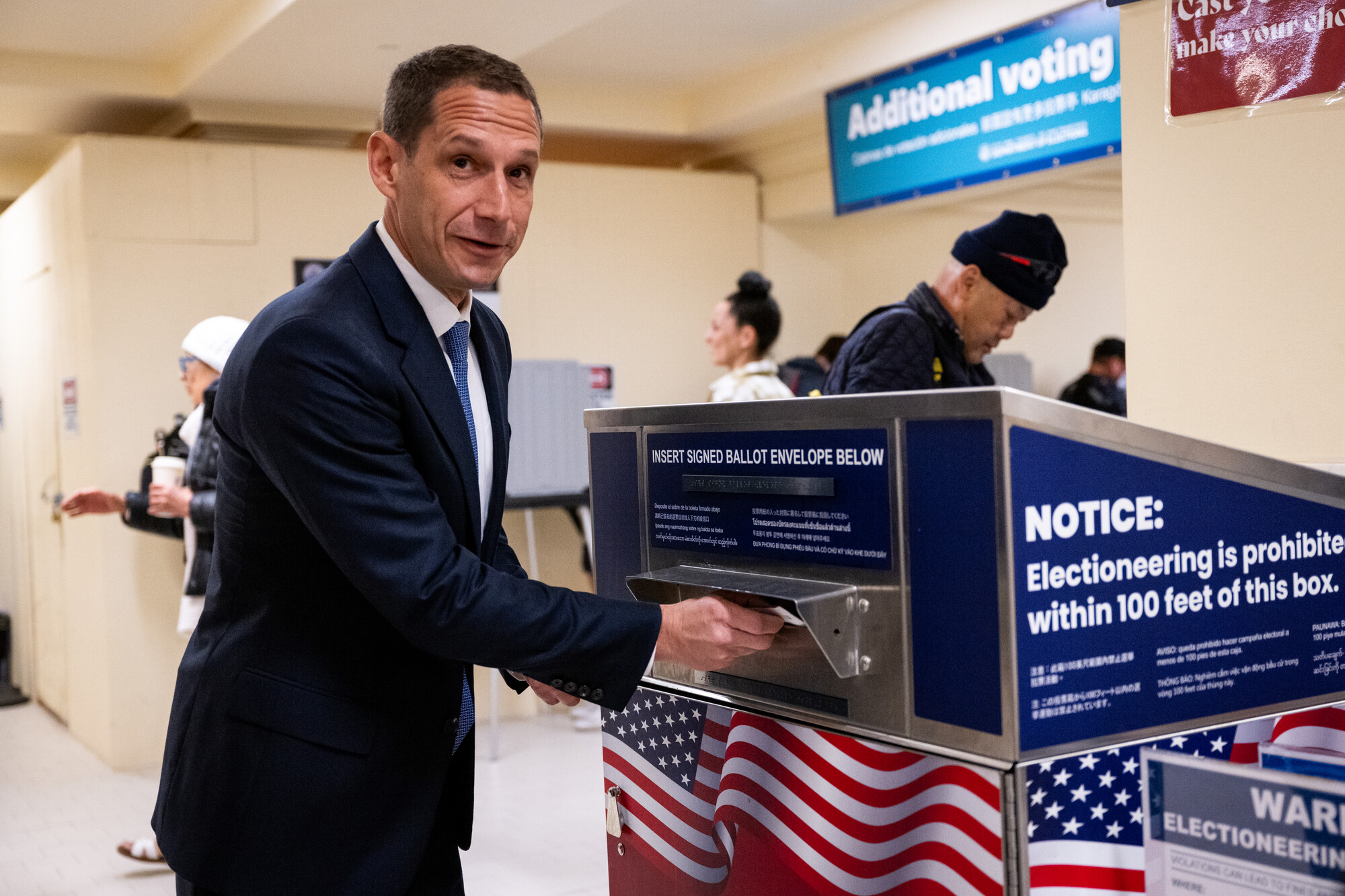
San Francisco Mayor Daniel Lurie joins us to talk about the ballot measures he’s supporting in this year’s election. He’s backing Prop. A, which would reduce the number of city boards and commissions, and Prop. D, which would increase requirements for placing measures on the ballot. San Francisco voters have numerous other propositions and races to decide on such as Prop. B, which asks voters to authorize a public bank. In addition two heavily contested supervisor seats in District 8 and District 10 are also up for grabs. We’ll talk about what’s on San Francisco’s ballot and how wealthy campaign donors are shaping races.
Guests:
- Daniel Lurie, mayor, San Francisco, founder and former CEO of Tipping Point Community, a foundation focused on fighting poverty in the San Francisco Bay Area
- Sydney Johnson, reporter, KQED news
- Joe Eskenazi, managing editor and columnist, Mission Local
- Joe Fitzgerald Rodriguez, politics reporter, The San Francisco Standard
Episode Transcript
This is a computer-generated transcript. While our team has reviewed it, there may be errors.
Alexis Madrigal: Welcome to Forum. I’m Alexis Madrigal. Here we are with Mayor Daniel Lurie, delighted he could make it in and talk with us about the San Francisco ballot measures he’s backing. Welcome, Mayor.
Daniel Lurie: Alexis, it’s good to see you. I know we are on the radio, but if the viewer, if your listeners could see you, he is decked out in violet. He looks amazing. Go Valkyries tonight.
Alexis Madrigal: Thank you, Mayor. We only have the top of the show with him, so if you’ve got a question for the mayor, email us at [email protected].
You are the face of the Clean Up City Hall campaign measures D, E, and F. Why this packet of measures? Let’s assume they pass. What can our city government do that it can’t do right now?
Daniel Lurie: Well, Alexis, let me tell you what I told you off air. When I ran for mayor, I told the voters that the system that was supposed to work for them was the problem. It’s broken. It is run by insiders, it’s gamed by special interests, and frankly, it is corrupt, it’s bloated, and it needs reforming. And that’s what D, E, and F are going to do.
It’s a generational opportunity for us to clean up City Hall, deliver better results, save taxpayer dollars each and every year, and deliver faster services for the people of San Francisco. And I was committed to it three years ago when I started running, and I promised that I would work on it, and this is the result. You know, if you read —
Alexis Madrigal: The San Francisco DSA is against these measures. I mean, they point out it’s like the biggest money in the city is backing the measures. The committee called Daniel Lurie’s Yes on D, E, and F committee has three individual donors who’ve given over a million dollars to the campaign. So I think when people hear you say this is about making sure that people who aren’t insiders have access to the system, they might say to themselves, but, like, who is plausibly more an insider than three people who could give a million dollars and the mayor?
Daniel Lurie: Yeah. No, I, listen, I understand. What I would urge people to understand is we’re the only city in the state that allows a minority of the Board of Supervisors to put something on the ballot. We’re the city in the state that allows the mayor to unilaterally put something on the ballot. And we ask for 80% fewer signatures to get something on the ballot than any other city in this state in terms of the threshold. The threshold across the state of California is to get 10% signatures. We’re asking to go up to 8%.
We had 15 local ballot measures in 2024. San Jose had one. If this passes — Oakland had three, right? Oakland had three. If this passes, we will still have less than our friends in Oakland. We will still have less than our friends down in Los Angeles.
And frankly, we’ve seen it. We’ve seen mayors and supervisors put divisive, misleading ballot measures on competing, and it confuses the voters. I want mayors and supervisors in the future — and I think we’ve done a good job in these first two years, or 20 months that I’ve been in office, of working together — but we haven’t always seen this. And we’ve seen battles at the ballot box that should be done legislatively and worked out between our elected officials. Yeah.
Alexis Madrigal: I mean, the counterargument people have made is that it won’t necessarily cut down on the number of propositions, but it will make sure that the propositions that are on the ballot have more money behind them.
Daniel Lurie: Well, I think they’ll be better-written measures on the ballot. I will remind everybody, it is very much free to get six supervisors to put something on the ballot. Let me tell you, Prop C, an affordable housing measure that I am all in on, worked with Supervisor Myrna Melgar. All 11 supervisors are supporting this, as are affordable housing advocates and tenant groups. It’ll be the largest increase in affordable housing spending in our city. It was done thoughtfully. It was done in collaboration with each other. And we are so excited to see Prop C pass.
Then we had another measure come in. No discussion, no nothing. It could blow a $120 million hole in our budget. It says it’s for affordable housing. And yet, if you really read the fine print, not one unit of affordable housing has to be built for that prop. So once again, you have two measures that now are competing for attention, when one was really thoughtfully planned out and one just kind of did an end run around the system.
Alexis Madrigal: Actually, one of our listeners wrote in really quickly about Prop I, saying opponents of Prop I say that affordable housing funds could technically all be used for acquisitions, operations, and debt service rather than building new housing, which is also true of Prop C. Since the funding decisions are up to the Mayor’s Office of Housing, if Prop C and I pass, how much of the housing production funds will you direct them to spend on construction?
Daniel Lurie: Well, the problem with I is that right now it would just go to a few nonprofits, and there is no mandate for it to build any affordable housing. Whereas Prop C, well thought out, well planned, we will build affordable housing. I will make sure of it. I’ll work with all the supervisors on it as well.
Alexis Madrigal: So if they both pass, right? That was the question. What happens then?
Daniel Lurie: Well, I’m just so focused on passing Prop C. I’ll come back on and we’ll talk after the election.
Alexis Madrigal: Another listener question: Does the mayor support turning Sunset Dunes back into the Great Highway?
Daniel Lurie: I stood my ground three years ago when I was running for office. I’ve said, once again, this is up to the voters. I have not taken a position on this.
Alexis Madrigal: What about in the race to replace Nancy Pelosi?
Daniel Lurie: Staying out of it. Listen, I’ve had a great working relationship with both, and whoever wins, I look forward to working with them when they’re in D.C.
Alexis Madrigal: On Sunset Dunes, I mean, why not take a position, right? I mean, it is an issue that’s kind of critical to the city.
Daniel Lurie: I think D, E, and F are much more critical. I think Prop H is much more critical, to be frank. I want a strong transit system. My attention has been focused on passing D, E, and F and H, and then we can talk about all the other ones.
But I really think this is the third time that this is on the ballot, another example of things just going back to the ballot over and over again and actually dividing the people of our city. It’s been divisive, and that’s really unfortunate. But it’s on the ballot. I’m gonna let the voters decide.
Alexis Madrigal: To the incredibly exciting stuff around contracting and changes to contracting. Very important, though. I do want to ask about the transit measures. RTM, this regional transit measure that we’ve done a show on, if people want to check it out, and Prop H, a sort of corollary measure here in the city. I mean, how critical is this to Muni’s operations? Like, if we — because it’s not, you know, when we’ve done shows on this, I’ve been shocked at how much opposition there has been from people. So if this doesn’t happen, like, what happens to Muni?
Daniel Lurie: I don’t even want to contemplate it. Traffic times will double coming in from the East Bay over the Bay Bridge. We could see cuts to 20% to 30% of our routes here in San Francisco.
I understand people’s feelings on this, on both sides, but I really, really don’t want to kneecap our recovery. Transit is absolutely essential. I believe it’s a public good. We are not getting any support from the state or the federal government at this time, and yet we’re driving the fourth-largest economy in the world. And I don’t wanna mess with our rise.
Our economic recovery is real, but it is fragile. We are at the early stages. And we also have to remember 14,000 of our students take transit each and every day to and from school. Our seniors take it to their medical appointments and to the grocery store. I don’t want to contemplate a world where H doesn’t pass or the regional transit measure doesn’t. So please vote yes on H and RTM.
Alexis Madrigal: We have another question. This is from Mary, who writes in to say, “The mayor’s charter reform initiatives put too much power in the hands of one person. Not healthy for democracy or good government in San Francisco. As a nurse who’s retired from the SF Department of Public Health, I want to have more, not less, say in the rules that govern our health.”
If the initiatives pass, what happens if a future mayor decides to shut down the DPH during a pandemic? And this would be because you’d be able to — the mayor, not just you, but mayors — would be able to deal with department heads directly, fire them, et cetera. What do you think about that, though? Let’s not even say — let’s say, all right, we want Mayor Lurie to have this power, people out there, but what about the next one?
Daniel Lurie: We just have a culture of excuse-making. We also have a system where everybody has a say, and therefore no one is accountable. I mean, we’ve seen past elected leaders say, “Oh, it’s their fault.” “Oh, no, it is their fault.” “Oh, it’s the commission’s fault.” And I want to end the era of excuses. I want clear lines of authority.
And yes, the Board of Supervisors gets more control in some cases, and the mayor does, but I also just told you I’m actually giving up the mayor’s ability to put something on the ballot. It’s actually giving a lot of mayoral control on Prop D when you’re talking about that.
So, listen, when you elect a mayor or you elect a supervisor, you expect them to deliver. And right now, there are too many excuses built in. We had a $1.7 million toilet in Noe Valley. Twelve different departments were able to weigh in on contracting. I want to professionalize contracting in the city administrator’s hands. This is Prop E, and save taxpayer money.
Right now, this bureaucracy is so bloated. No one knows who’s actually in control of different parts of it. And so it allows elected officials like me to be like, “Oh, point the finger there,” or point the finger there.
So I really want to say this to be clear: We have tried to end that era of excuse-making in our first 20 months. We’ve had a good working relationship with all 11 supervisors. So I would actually say in the future, this will make sure that mayors are held accountable, just like we’ve held ourselves accountable these first 20 months.
Alexis Madrigal: Listener Anya writes in to say, “Can Mayor Lurie name a special interest he wants to keep off the ballot who could not afford the new $1.5 million price tag?” This is in reference to Prop D’s increase in necessary signatures.
Daniel Lurie: Yeah, I would just once again point out, Oakland has a lot of powerful interests. They get stuff on the ballot at a 10% threshold. L.A. has a 15% threshold to get stuff on the ballot. Things will, as you pointed out earlier, still be able to get on the ballot, but I think what you want, what we want as San Franciscans, is less divisiveness, less fighting at the ballot box, and more collaboration actually at City Hall. And I believe these measures will do that. Yeah.
Alexis Madrigal: Last thing in our last minute here. I mean, your ally Manny Yekutiel dropped out of the D8 race. Looking back, what would you have done differently?
Daniel Lurie: I said this publicly. I said it to one of the victims. I believed a friend, and I made a mistake. And for that, I apologize. And now we go forward, and the voters of District 8 are going to decide their next supervisor.
Alexis Madrigal: Mayor Daniel Lurie, thanks so much for joining us this morning. I hope to have you back again.
Daniel Lurie: Absolutely, Alexis. Thank you, and go Valkyries.
Alexis Madrigal: Go Valkyries! We’re gonna be back with Sydney Johnson from KQED, Joe Eskenazi from Mission Local, and Joe Fitzgerald Rodriguez, politics reporter with the San Francisco Standard, to talk about the rest of your ballot. I’m Alexis Madrigal. Stay tuned for more.
Welcome back to Forum. Alexis Madrigal here. You might’ve just heard Mayor Daniel Lurie on the show talking about the measures he’s backing, particularly D, E, F, and H.
We’re now joined by Sydney Johnson, general assignment reporter with KQED, who’s covering the election. Welcome, Sydney.
Sydney Johnson: Hey, thanks.
Alexis Madrigal: We’ve got Joe Eskenazi, managing editor and columnist at Mission Local. Welcome, Joe.
Joe Eskenazi: Well, thanks for having me.
Alexis Madrigal: And we’ve got the other Joe, Joe Fitzgerald Rodriguez, politics reporter with the San Francisco Standard.
Joe Fitzgerald Rodriguez: Yo, yo.
Alexis Madrigal: Welcome back. We also want to hear from you about your questions about the mayor’s power, about particular propositions or candidates on the San Francisco ballot. 866-733-6786. That’s 866-733-6786. You can email [email protected]. Social media, Bluesky, Instagram, Discord, we’re KQED Forum.
So I know all three of you were listening to the mayor in here. Sydney, what did you think about — what stood out to you about what the mayor said this morning?
Sydney Johnson: Yeah, I mean, when we’re talking about — let’s start with the Clean Up City Hall Act, kind of the signature package of measures that the mayor is pushing for right now. You know, with Prop D, I think that’s the most controversial of those three measures.
Some of what he said was completely true. San Francisco does have a lower threshold for the number of signatures that are required for citizens to put a measure on the ballot, which often leads to us having these really long ballots. Although, not all of the measures, to be clear, that are on the ballots are from citizen-led initiatives.
But it is true. We have thick ballots. Actually, there were cases of ballots that were ripped in the mail this term. Mine was one of them. And USPS actually said that the reason for that was because San Francisco’s ballots were too thick.
So, yeah, I think that’s something to consider, and that can sometimes leave people a little bit exhausted when they’re going through it. But, you know, in the past, many of these resident-driven ballot measures, they have passed. There’s been support behind them.
Labor unions are not supporting Prop D for the reasons that some of your callers mentioned. It’s making it harder for you to put issues that they care about before voters. And overall, this whole package does consolidate a lot more power in City Hall. As the mayor said, that streamlines authority, but we also are in a democracy, and there are reasons why people support having all of those channels as well.
Alexis Madrigal: Joe Fitz, what do you think about the other ones, like E and F, and where those are likely to land and what they do for the mayor?
Joe Fitzgerald Rodriguez: They’re a little less controversial. E widens contracting authority to the city administrator’s office. And this is kind of a no-brainer in some ways. I mean, the city is sometimes paying multiple times for multiple of the same license. Let’s say if, like, everyone in your — you know, in KQED — got their own Microsoft Teams.
Alexis Madrigal: Yeah, exactly.
Joe Fitzgerald Rodriguez: Like, you should just be buying one Teams, right? Like, it makes little sense. So E is a little, you know, mom and apple pie.
But F is where there’s slightly more criticism, because this consolidates hiring and firing. Right now, department heads are inside the same — right. And most people would assume that the mayor has that ability. Like, if the head of the Department of Public Works, let’s say, is doing something not as bad as corruption, because he could remove him for that, but, you know, is maybe not doing the job he wants, he couldn’t exactly fire him.
Alexis Madrigal: How does it work now?
Joe Fitzgerald Rodriguez: Yeah. So right now, a lot of department heads go through commissions. And so those commissions can make the final decision to remove a department head if someone like the mayor calls for it, but he can’t directly make that happen.
And what the mayor has argued, and others have argued, is that, like, hey, the buck stops with the mayor. People don’t know the names of these commissioners. They can’t hold them accountable.
You know, I remember I did a number of stories about an MTA director something like 10 years ago. Someone had died in the construction of a tunnel. They laid nearly two miles of the wrong steel for the Central Subway, a contractor for MTA. There was all sorts — there was a sexual harassment scandal in there.
And Mayor Breed really wanted the director of MTA to go, but she couldn’t fire him. She had to write a public letter saying, “I believe you should resign for these and these and these reasons.” And he left, but only at the end of his contract.
So there are certainly situations where you could see where someone would want this power. What do you think, Joe Eskenazi?
Joe Eskenazi: I like this mayor. I think that it is very hard to say San Francisco is very well run. So it pains me to say that his arguments are Orwellian. He is saying that there’s a cadre of shadowy insiders within City Hall and that there is corruption that’s preventing him from doing his job.
Who are these insiders? What elements of corruption are preventing this popular mayor, in one of the strongest strong-mayor systems in all of the United States, from doing his job nearly two years into his tenure? I would like to know who they are, and if there are people who can be named, why have they not been taken out by the scruff of their necks and tossed into the street?
I don’t think you need to go to the voters for this.
Alexis Madrigal: But do you like the measures? I mean, outside of the arguments and the sort of rhetoric around these measures, do you actually like the content of these policies?
Joe Eskenazi: I don’t like all of it, and that gets to another thing that he said, about how these are supposed to make the mayor and the Board of Supervisors work together, and we’re supposed to get better legislation. But the mayor and the board did not work together to craft these measures. They were crafted by whomever they were crafted by, and there are elements within them that are dubious.
Alexis Madrigal: Can you talk about something specific around that?
Joe Eskenazi: I don’t understand why the threshold for board review of a contract is now $10 million. I think that seems rather high. And it’s not as if the supervisors were calling for books and books and books of material to be moved around the city so that they could look over every last decimal point. $10 million seems like you could get a lot of things into there that it wouldn’t be bad to have an extra check on.
Alexis Madrigal: Well, I think it was a SPUR report, right? That’s sort of some of the inspiration for this stuff that was written by the longtime city controller of San Francisco. At least that’s my understanding. I don’t know if somebody —
Joe Eskenazi: It was a long team, and both former city controllers of our lifetimes were on it. So, you know, these are not terrible measures in and of themselves, but there are things in here that are weird.
This was a measure that was signature-gathered that will make it harder for you to signature-gather. And, you know, for all the talk of the mayor bringing up San Jose and Oakland, which had one measure and three measures, respectively, in 2024, compared to our 15, if you applied the rules that he’s going for, do you know how many measures we would have had in 2024 instead of 15? We would’ve had 12. So that’s a lot. That’s still a big ballot.
And as for the post office blaming our big ballot, I think that I would blame — I would believe the Department of Elections perhaps cheaped out a bit on the envelope, and I would blame Donald Trump’s post office for maybe hiring the Samsonite gorillas to work.
Sydney Johnson: Why did only some of them get rabid?
Joe Fitzgerald Rodriguez: I mean, there is an irony in the mayor trying to curtail these ballot measures when one of those ballot measures is one of his signature measures on affordability.
When he opened up this year talking about the affordability crisis in San Francisco, he expanded who is eligible for subsidized child care. So in the city, you can get free child care under a certain threshold and a 50% subsidy under a certain threshold.
I’m lucky. My family, my toddler, she’s going to child care with a 50% subsidy because Lurie expanded it. But that pot of money would not exist were it not for a ballot measure that was put on by supervisors in a signature drive, which would be much harder to do under the mayor’s rules.
So something he is touting as his major issue, as his mayoral boast —
Sydney Johnson: Actually, not to take your job, Alexis, but I want to pose a question to one of my colleagues here. You know, Lurie talks about the million-dollar Noe Valley toilet a lot when we talk about the Clean Up City Hall Act.
For those unfamiliar, it was this project to build a new toilet in the center of Noe Valley. It took forever, cost a ton of money, and it has often been referred to as sort of the poster child for why the city needs these reforms.
Joe Eskenazi, you wrote a piece specifically about this. I’m wondering if you can kind of break that down, because it really symbolizes a lot of what’s going on here on both sides.
Joe Eskenazi: I think it’s a poor example for what the mayor wants. And I think that there are definitely problems with how we erect infrastructure and do contracting in San Francisco. But I am dubious, because of this example, that this measure would address it.
And I think something that nobody else seems to, even people who’ve done great work on that particular issue, has noted is that of the $1.7 million, soft costs were 57%. Soft costs were 57%.
Experts told me that 20% should be the ceiling. And that means 57% of that giant number was management. It was people looking over each other’s shoulders. It was people designing things on the inside that didn’t need to happen.
So this gets to a credo of government: You can’t legislate a management issue. This was a management issue, and a lot of that was money that was paid internally from one department to another.
And one of the departments that oversaw construction this way was the Department of Public Works. And you know who was running the Department of Public Works at that time. And you know the culture that was in the Department of Public Works at that time.
These are the shadowy individuals who were supposedly — we have to vote on this to get out. This is something that you could just fix.
Alexis Madrigal: Although, if 12 departments had to weigh in, one imagines that’s one reason why the management costs were high, right? I mean —
Joe Eskenazi: No, the actual numbers there, that’s time, and it’s something that we can fix. But if you go through the line items, which I did in the article, there were tens of thousands and hundreds of thousands of dollars for management issues that shouldn’t have necessarily been there.
Take, for example, also that there was a similar toilet installed in McLaren Park to much less fanfare, and it cost about the same amount of money. So clearly we had an issue with how we did this in the city. You don’t need to reinvent it. It’s not a boutique toilet. It’s just something that you can do.
And another thing is that up until quite recently, we had a well-meaning but ultimately disastrous boycott against 30 of the 50 states in the nation because of their policies against discrimination against LGBTQ people, against voter suppression, and against anti-abortion laws.
Well, if there’s a factor that makes prefabricated toilets in Kentucky, you’re out of luck because it does all of those things, even if the factory is owned by well-meaning liberal people who could be all the things you want.
So that was a scattershot approach to government that didn’t work out well for us. So, yeah, I do have my doubts about this.
Alexis Madrigal: We’re talking about your San Francisco ballot. We’ve got Joe Eskenazi, managing editor and columnist at Mission Local. We’ve got Joe Fitzgerald Rodriguez, politics reporter with the San Francisco Standard, and we’ve got Sydney Johnson, general assignment reporter here at KQED, covering a San Francisco election for us.
If you’ve got questions for them about your ballot, give us a call: 866-733-6786. That’s 866-733-6786. The email’s [email protected]. Find us on social media, Bluesky, Instagram, Discord. We’re KQED Forum.
Let’s bring in Karen in San Francisco. Welcome, Karen.
Karen: Hi, Alexis. Hi, everybody. I’m calling in to say we need to contrast what’s happening in New York City to what’s happening in San Francisco. In New York City, the power is flowing up from the people, and that’s why they’re passing all of these measures that are improving people’s lives and making it more affordable.
In San Francisco, the power is flowing from the billionaires down onto the people. Michael Moritz and Chris Larsen are spending millions of dollars to reform our city in the image they want it to be. And that’s why we have security cameras everywhere, with the feed from the cameras going into Ripple’s office.
This is terrible. I encourage everybody to vote no on these measures. If you’re not a billionaire, these measures don’t help you.
Alexis Madrigal: Thanks so much, Karen, for that perspective.
Joe Fitzgerald Rodriguez, this definitely, like, when you look into the money behind these, it does make one wonder. On their face, they look like good-governance measures, kind of like Progressive Era stuff where you’re like, okay, we want the city government to work in a particular way. Why would it be that the wealthiest people in the city want those measures?
Joe Fitzgerald Rodriguez: I mean, you know, there’s certainly an ethos, right? This is almost like a business-minded ethos, that you want a CEO of the city who can really just cut through things and enact their policies as quickly as possible.
What’s interesting about D, E, and F and the mayor’s charter amendments generally is that the mayor could achieve many of these things through political will. He has a bully pulpit. He has the ability to whip votes. He could make deals.
But this is a mayor who doesn’t like to do that as much. He’s not political. He doesn’t know how to exercise those muscles. So, not having those muscles, he wants to make it — and the people around him want to make it — so that he can just unilaterally do these things.
Alexis Madrigal: I mean, another big-money thing. Maybe, Joe, you’re interested in taking this one. We’ve got, in the District 10 supervisor race, three candidates running, and then a $500,000, single $500,000 donation to Theo Ellington. What do we make of that kind of a donation just dropping into a supervisor race? Oh, it feels like spiking the football.
Joe Eskenazi: And I actually asked Willie Brown about this, and I asked him, did it make it harder for Theo? Because this is so much money. A lower donation would be less eye-catching.
And his answer was everything you’d expect him to say, which was no, it doesn’t make it hard. It just gives him more things to explain.
To be clear, Theo didn’t ask for this, and it went to a PAC supporting him, so it’s not directly to Theo. But it does raise questions.
Alexis Madrigal: It must have been a strange email to wake up to.
Joe Eskenazi: It must have been, right? And I don’t know, honestly, how he felt. You could do well with the money, but it was very gauche, especially in a part of the city that is traditionally underserved, and it felt gratuitous.
And by the way, though, for $500,000 to Chris Larsen, if you take his net worth from Forbes magazine, it’s the equivalent of someone with a $1 million net worth giving $37. So I think that many of the wealthiest in the city were playing $500 ball, giving millions of dollars. And they realized if they gave an order of five to 10 times that, they’re going to win. They’re going to win almost all the time.
Joe Fitzgerald Rodriguez: Yeah, on that explaining, it is fascinating to me that allies of Theo’s in the Bayview and other neighborhoods in that district really went to bat, defending him for having gotten a boost from that money.
There must be some very charged discussion if your allies are coming out and putting on Instagram and Facebook and all over social media, “Don’t worry, Theo is fine. He’s a good guy,” even though he got this money.
Sydney Johnson: Actually, Chris Larsen was here at KQED last week. He was on Political Breakdown, and they asked him directly about this donation and this question of, like, could this actually be baggage for your candidate? You might have to separate himself from this.
And Larsen himself goes, “We have to get money out of politics.” Ironically, he is one of the biggest political funders in the city, if not the nation.
But he also did point out that in other races, like Connie Chan’s race against Phil Howard in the Richmond, he points out that there was, like, $2 million in that —
Joe Eskenazi: Terrible example, because that was a million dollars put in by all of labor over the course of an entire campaign. And this was a $500,000 donation just dropped, like the equivalent of me pulling a dollar out of my wallet and throwing it.
And that was the significance of it: He could give $500,000 tomorrow, and the next day, and the next day.
So yes, there’s a lot of money in San Francisco politics. And yes, the ostensible left-wing people have benefited from big money as well, but not like that. This is the equivalent of the Nola Gay dropping one bomb and taking out an entire city versus a squadron of planes going after a city.
Alexis Madrigal: I mean, it’s so strange, though, because the money is here now, and there’s just going to be more of it, presumably. So what do we do? I mean, our campaign finance system here just seems like it’s not really up to the task of these levels of inequality and wealth.
Joe Fitzgerald Rodriguez: Yeah, well, I mean, it’s not just here, right? Because the rules come from on high, and you can’t change them locally. So we’re kind of stuck with it, unfortunately.
I mean, it’s to the point where there’s so much money in these charter reform measures, for instance, that there’s not really organized opposition to them. Labor has had to say they’ve had to choose their battles. They want to oppose Prop I, but they haven’t organized a huge sum of money because all of their eggs are in pushing for Connie Chan. And this is an in —
Joe Eskenazi: And that may not be the subject of your show, Alexis, but there is almost no organized opposition to the mayor’s measures. It is almost inconceivable to me that they won’t pass, and they won’t pass handily.
Because, again, as Joe said, labor is almost monomaniacally focusing on the congressional race. The mayor can march all the way to the Capitol here.
Alexis Madrigal: And that’s just because there’s essentially, you know, $11 million pro-D, E, and F, right?
Joe Eskenazi: Maybe they can read a poll. Yeah. And, you know, if you want to say, “Do you want to fix the system in San Francisco?” Yeah. Is San Francisco well run? No. Like, maybe that’s all it takes.
Alexis Madrigal: We are here with Joe Eskenazi, managing editor and columnist at Mission Local; Sydney Johnson, reporter with KQED News; and Joe Fitzgerald Rodriguez, politics reporter with the San Francisco Standard.
We’re also taking your questions about your ballot. We’re gonna get to Prop H, we’re gonna get the other district supervisor race, the one in the Castro and Noe Valley. You can give us a call, 866-733-6786, or email [email protected]. Bluesky, Instagram, Discord, we’re KQED Forum.
I’m Alexis Madrigal. Stay tuned.
Well, welcome back to Forum. I’m Alexis Madrigal. We’re talking about the San Francisco ballot. We had Mayor Daniel Lurie on at the top of the show, and now we’re joined by a panel of reporters: Sydney Johnson from KQED, Mission Local’s Joe Eskenazi, and the Standard’s Joe Fitzgerald Rodriguez.
We’re taking your calls and comments as well about power and the ballot in San Francisco: 866-733-6786, [email protected], Bluesky, Instagram, Discord, or KQED Forum there as well.
Let’s bring in Ian in San Francisco. Welcome, Ian.
Ian: Hi, yeah. Thanks for taking my call. I apologize if this is kind of a naive question, but I’ve had a hard time getting good analysis on Prop H. If I understand it correctly, the Yes campaign is being funded almost entirely by these big AI companies, and I’m just wondering what kind of deals have been going on behind the scenes and what AI really has its sights on here.
Alexis Madrigal: Yeah, I mean, it’s a really interesting question. I mean, I guess tech companies and our transit is sort of the question.
Joe Eskenazi: I can answer. I understand the suspicion, but the tech companies have money, and that is, you know, in yesteryear it would have been Warren Hellman or banks that would have given money for this.
Tech companies may yet give to preserve our seawall, but there is not a particular tech interest in the city not being, you know, run over by a tidal wave.
In this particular case, there might have been some kind of deal. There might have been some kind of affinity that leads to the mayor or his people or somebody hitting up the rich people to give money to a measure that really is seen as being for the public good.
Something that I have gleaned is that the worst-case scenarios for not passing Prop H, for not passing Prop RTM, which is for regional transit, are worse than they’re actually saying. Because when they tell you the worst-case scenarios, people don’t believe them, right? The worst-case scenarios are very dark.
Alexis Madrigal: Yeah, and I’ll just say, to your point, Joe, there’s a long and rich history of regional business interests supporting transit. I mean, we got BART via the Bay Area Council initially, right? They were the ones who put together all the initial planning documents and stuff before —
Sydney Johnson: With Prop H, too, like, please, Joe, correct me if I’m missing something here. SFMTA came up with a list of proposals for how we could save Muni. And one of the ideas was to levy taxes on Uber, Lyft, and Waymo, these tech companies. That is not what we have on the ballot.
So is there potentially support there, that they kind of got off the hook and maybe they’re trying to get this passed?
Alexis Madrigal: Right, that’s what I’ve heard about the RTM, right? That it’s a sales tax, which people don’t like because it’s regressive, because poor and working-class people spend more of their money. And that’s true.
Joe Eskenazi: That’s true, but this is also a way that they could get it through the Legislature without a fight. And there would have been a campaign against it if you had taxed business. You can argue that it is regressive, and it is, but it’s also necessary. And they saw this as the safe way forward.
Alexis Madrigal: Ian, that is at least part of what is going on here. The taxes that made it — at least, I know the RTM more than H — were the kind of taxes that the Bay Area Council, for example, and other business leaders wanted to see.
Joe Eskenazi: And by the way, it’s also regressive that I have to pay $2.10 for a BART fare and Elon Musk has to pay $2.10 for a BART fare. So where does it end?
Alexis Madrigal: Wayne writes, “So many props this year and the school bonds in the past force 33% of San Franciscans, the homeowners, to fund them. Doesn’t seem fair at all. Saving Muni this year is the financial duty of every person in San Francisco, not only homeowners, and of course, anyone paying the sales tax will be one of those.”
Do you think, Joe Fitzgerald Rodriguez, that there’s a lot of political sympathy for San Francisco homeowners who’ve experienced some level of appreciation over the past few years, in a town —
Joe Fitzgerald Rodriguez: — of mostly renters? I sincerely doubt it. And there’s a reason that folks can believe that voters will overwhelmingly pass this, because there are mostly tenants.
Joe Eskenazi: I mean, unless we screw around with the state ballot this year and need to have higher thresholds for taxes, this one is a majority tax. So on a bond, where you need two-thirds, you do need to take homeowners’ views into account. In this one, a little less so, and I think most homeowners are probably fine with it. The amount of money is reasonable.
Joe Fitzgerald Rodriguez: Yeah, with H, I mean, they kind of finagled it in a special way so that it depends on the size of your property. So most homeowners are going to see something like between $100 and $200 tacked onto their annual property tax with Prop H. It’s not huge.
Alexis Madrigal: Let’s get to Lynn in San Francisco. Welcome, Lynn.
Lynn: Thank you. Oh, hi. Hello, hello. There’s a couple things. Hi, can you hear me?
Alexis Madrigal: Yes.
Lynn: Okay, okay. I am 83, retired from the city, and worked through different offices, different divisions of the mayor’s office. When I came in, in 1971, the mayor had very little direct — almost really no direct dollars that he or she could control.
And I think the mayors all have too much power. What I saw that I found most disturbing over the years is whenever — and it’s just inevitable — whenever you have a four-year term, or even an eight-year term, the next mayor comes in and they want to do things very differently. And they may or may not be as good as Mayor Lurie, and they may not be as well-intentioned.
The city has been corrupt. We used to have a strong merit system, civil service, so you wouldn’t have someone in these appointed temporary positions who really have to do — you pretty much have to do what the mayor wants, or you can lose your job.
Alexis Madrigal: Yeah, Lynn, I appreciate this. You know, one of my questions was about if we were gonna go after corruption per se, just like, not the general sense of corruption, but trying to prevent corruption in the city of San Francisco, which you hear from many people. What would you all do?
Joe Fitzgerald Rodriguez: I mean, one thing that Newsom didn’t have working with him was a commission. He was able to give so many contracts just solely through himself. And that’s kind of an ironic thing to think about, considering that Lurie is considering taking powers away from those commissions and putting them in the mayor’s office.
Alexis Madrigal: Which is in Prop A, right?
Joe Fitzgerald Rodriguez: Yeah.
Joe Eskenazi: I think that what worries me about this is that it seems like an echo of what happened in 1996, when we wrote a charter. The charter was intended for a mayor with the abilities of Frank Jordan, and instead we got Willie Brown. And ever since then, we’ve kind of been pulling mayoral powers back because Willie didn’t need the help.
And so, you know, Mayor Lurie, as the caller mentioned, is well-intentioned. No matter how things are going and no matter what the effect is, I don’t think that this mayor has malign intent. But we can’t say the same in the future. So that’s my worry here.
Sydney Johnson: Just to go off of what Joe said, the Joe on my left here, yeah, I mean, commissions were essentially set up to do this, to provide civilian oversight.
But, you know, whether it’s a new mayor or a new department head, politics is a process that never ends. There’s always going to be some sort of shifting and turning of power.
We created all these commissions to provide oversight. Now we have an effort to consolidate those commissions. And some of those commissions are staying in place that are incredibly important to do exactly what you’re asking, Alexis: the Police Commission, the Planning Commission.
And then you kind of also get into the weeds of, like, is there corruption among these commissions as well, and who gets selected for them? But I think that that is a really important tool that we still have.
Alexis Madrigal: Totally. Let’s bring in Annie in Oakland. Welcome, Annie.
Annie: Hey, can you hear me?
Alexis Madrigal: Oh, yeah, I can. Go ahead.
Annie: Awesome. I’ve worked in local government, cities and counties over in the Bay Area, for the last 20 years. I just want to share one issue that I’ve observed, which is what I call the shadow power. Those are real. Those are true.
Sometimes upper management creates their own rules, processes, layers of approval, just to show their power and authority, which is not necessarily needed a lot of times. The result is a good idea gets delayed, employees get frustrated, and things are not moving forward, right?
Alexis Madrigal: Yeah, yeah.
Annie: Who ultimately pays the price is the public. Resident projects don’t get done. Really, local government should be able to work together among the departments, which right now have a lot of siloed practices all through Bay Area governments.
I’ve worked in five governments so far, so I want to share my internal experience. Shadow powers are real, and those are things that need to be changed.
Joe Fitzgerald Rodriguez: Yeah, thank you, Annie. Joe Eskenazi?
Joe Eskenazi: Yeah, you know, the caller makes a point. In some instances, having more layers of checks and balances can be helpful, but in others, when you make too many Byzantine rules, like, for instance, with our Department of Building Inspection and Planning Department, you have people like permit expeditors who are hired because they are the only ones who know how to navigate all this. And if you pay them X, Y, Z amounts of money, you can get the permit. It was worth it.
Joe Fitzgerald Rodriguez: The permit expeditors had it set up so that only their calls would be answered. It wasn’t just that they knew what they were doing. It was that they had corrupted the system.
Joe Eskenazi: Oh, completely. And, like, as you have reported, they even had the key to the door of the Department of Building Inspection. They could go behind the desk and get the papers they needed or stamp the stamps they needed.
Joe Fitzgerald Rodriguez: People knew this was happening, and nobody did anything about it, though. That’s the thing.
So, you know, when you go back to your earlier question, Alexis, these were not secrets. There was an old George Carlin joke about how, after many years of investigations and corroboration, a toll taker in a booth who had been pouring boiling gasoline on people’s hands was apprehended. It’s like, but people knew what was happening.
So it just would have taken an effort.
Alexis Madrigal: Yeah, yeah. Let’s make sure we get to one crucial race that people may be thinking about here. District 8, the front-runner, Manny Yekutiel, dropped out after sexual assault allegations. A couple of different ones came out. What’s going on now? Sydney, you want to take this one?
Sydney Johnson: I’m happy to talk about what’s going on right now. I have to give a lot of props to Joe Fitzgerald Rodriguez for really breaking a lot of these stories in a really, really responsible way.
But, yeah, essentially, Manny Yekutiel has dropped out of the race. His name will still be on the ballot because of the timing. But there are three other candidates. Gary McCoy is widely considered the front-runner, but he is also running on a ranked-choice sort of agreement with Darshini Patel and Michael Nguyen, who is part of the Democratic Party. He is an attorney and a drag queen, also.
And so those are our three candidates for District 8. The current sitting supervisor for that district, Rafael Mandelman, is terming out.
And, you know, Yekutiel was very well-connected, aligned with the mayor. Let’s not forget that after one of the first allegations came out, Mayor Daniel Lurie and the Democratic Party endorsed Yekutiel after that. It wasn’t until more allegations came forward that he stepped down and more people rescinded their endorsements and endorsed someone else.
So this whole event has really just shaken up this race in general, and who’s in the lead —
Alexis Madrigal: And Gary McCoy, former vice president of policy and public affairs at HealthRIGHT 360, really interesting candidate. That’s right. That’s Nancy Pelosi’s —
Sydney Johnson: That’s Nancy Pelosi’s endorsement?
Alexis Madrigal: Yeah. I mean, but he would be an unusual candidate and an unusual supervisor if he wins, especially following Mandelman, who was very wired into the city’s political infrastructure.
Joe Fitzgerald Rodriguez: No, absolutely. I mean, you know, he’s a former drug user. He used to be on the streets. He cleaned himself up and climbed the ladder at City Hall, and then worked in Nancy Pelosi’s office.
So he comes with a unique perspective. There is another supervisor who is a former user on the board, Matt Dorsey. But, you know, for McCoy, that is the key issue that is animating people still against him right now, and even for him: the fact that he is one of the lone candidates out there who still has some sympathies for the harm reduction policies around drugs, where you kind of allow people to use while you help them seek care. The belief is that you want to keep them alive, that you want to be there to reverse their overdoses.
And so there’s a group, Grow SF, that’s going to spend hundreds of thousands to combat McCoy, even though he is the front-runner and Yekutiel has pulled out of the race. Who else is in the race?
Joe Eskenazi: Well, I’m glad you brought this up, because that’s my column this morning, which is that Grow SF took the unusual step of endorsing Darshini Patel, even though she’s on the board of HealthRIGHT 360 and agrees with Gary’s harm reduction policies.
And, by the way, they’re both YIMBYs, so policy-wise, it is a very tough nut to crack. And on top of that, Ms. Patel wants you all to know that that endorsement came without her consent, and she’s not thrilled about that.
Consent issues have been a kind of a big deal in this race. So this was something that was deeply unwelcome to her, and she feels that it has kind of invalidated her grassroots appeal, and she’s not happy.
So regardless of who wins this race, it will be someone who has more liberal views on substance abuse and harm reduction than is currently in vogue in this city, and someone who believes in — well, unless it’s Michael Nguyen — it’s going to be someone who believes in a YIMBY philosophy on building.
And no matter what, it is going to be someone who believes in more liberal law enforcement policies. Flock cameras — I think that both McCoy and Darshini Patel would want to cut that contract.
So it’s gonna be interesting. That was a very earth-shattering series of reports from Joe. I don’t know that there was a more banked, put-it-in-the-bank candidate who was going to win than Manny Yekutiel in District 8, and now that’s changed.
Alexis Madrigal: Let’s do a quick check-in on where a couple of other props stand just before we wrap up here. Prop B, the public bank. People want to know. We did an August 19th Forum episode on this. How’s this one looking, Sydney Johnson?
Sydney Johnson: Yeah, I mean, it has support from several boards of supervisors — several supervisors on the board, excuse me. Still having coffee.
And, you know, essentially, I think what’s interesting about this is the idea of a public bank for San Francisco has been around for several years. Supervisor Jackie Fielder really has been pushing for this through the public bank.
But this measure wouldn’t necessarily create the public bank. We wouldn’t have a public bank that you can walk into as early as next year. It would go toward a city-owned municipal finance corporation that would essentially set up — bear with me here — the governance structure for a public bank.
And the reason why they’re pushing for it right now is because there’s a state law that’s allowing cities to set this up. August 19th, all coming back to me. Yeah, exactly. You went way deeper into this.
If you want to know more, go back and listen to that episode. But this is essentially taking advantage of a window in a state law that’s allowing cities to create public banks through 2028. It basically just allows a city to continue to move forward with this process and explore that.
Alexis Madrigal: People should also check out Sydney’s reporting on that.
Okay, last one. Let’s just go around the horn really fast. What do you think is gonna happen with Prop G, Great Highway, again?
Joe Eskenazi: What do you think? Anyone got that? I don’t see any reason why something that was voted on 55-45 in order to create the park is now, after people go to the park and enjoy the park, going to lose.
You know, I have heard people who say, “I voted against this, but I like going to the park.” I’ve not heard a single person say, “I regret voting for the park. I wish I was driving the car.”
So, you know, the people on the west side are very, very upset about this. And there’s people who put Zapruder-like film of 12 people there, saying that the Rec and Park Department is conspiring against us with their phony numbers. I think it’s going to pass, and then we’ll be done with it.
Joe Fitzgerald Rodriguez: I think it was incredibly savvy to put more structures in there ahead of the election.
Alexis Madrigal: Savvy is one way of putting it.
Joe Fitzgerald Rodriguez: Yeah, I mean, the playground there has drawn so much joy. My own toddler loves playing at that Shipwreck Cove playground. It’s like broken ships in the sand. And a lot of people are raving about it.
And some of the people who want the park to go away are like, “How dare they put that up for the election?” It’s getting all this goodwill. That’s as fast as the city can move.
Sydney Johnson: It’s not so easy to move a skate park on and off the Great Highway just for weekends. I think that would actually be —
Alexis Madrigal: Last comment from listener Sue Impalito says, “I know today’s show isn’t about campaign financing, but you’ve been talking about it. The true reform that no politician will support, unfortunately, is that candidates or committees for or against props can only accept donations from individuals who personally vote for that candidate or proposition. No PACs nor corporate donations.”
Earlier, we were joined by Daniel Lurie. We’ve had Sydney Johnson from KQED, Mission Local’s Joe Eskenazi, and the San Francisco Standard’s Joe Fitzgerald Rodriguez. Thank you all so much. Stay tuned for another hour of Forum Ahead with me and Mina.
Announcer: Funds for the production of Forum are provided by the Jenerosity Family Fund and the members of KQED.