Poet and Mellon Foundation President Elizabeth Alexander’s New Book Examines How Art Can Bridge Distances
Airdate: Thursday, October 15, 2026 at 9 AM
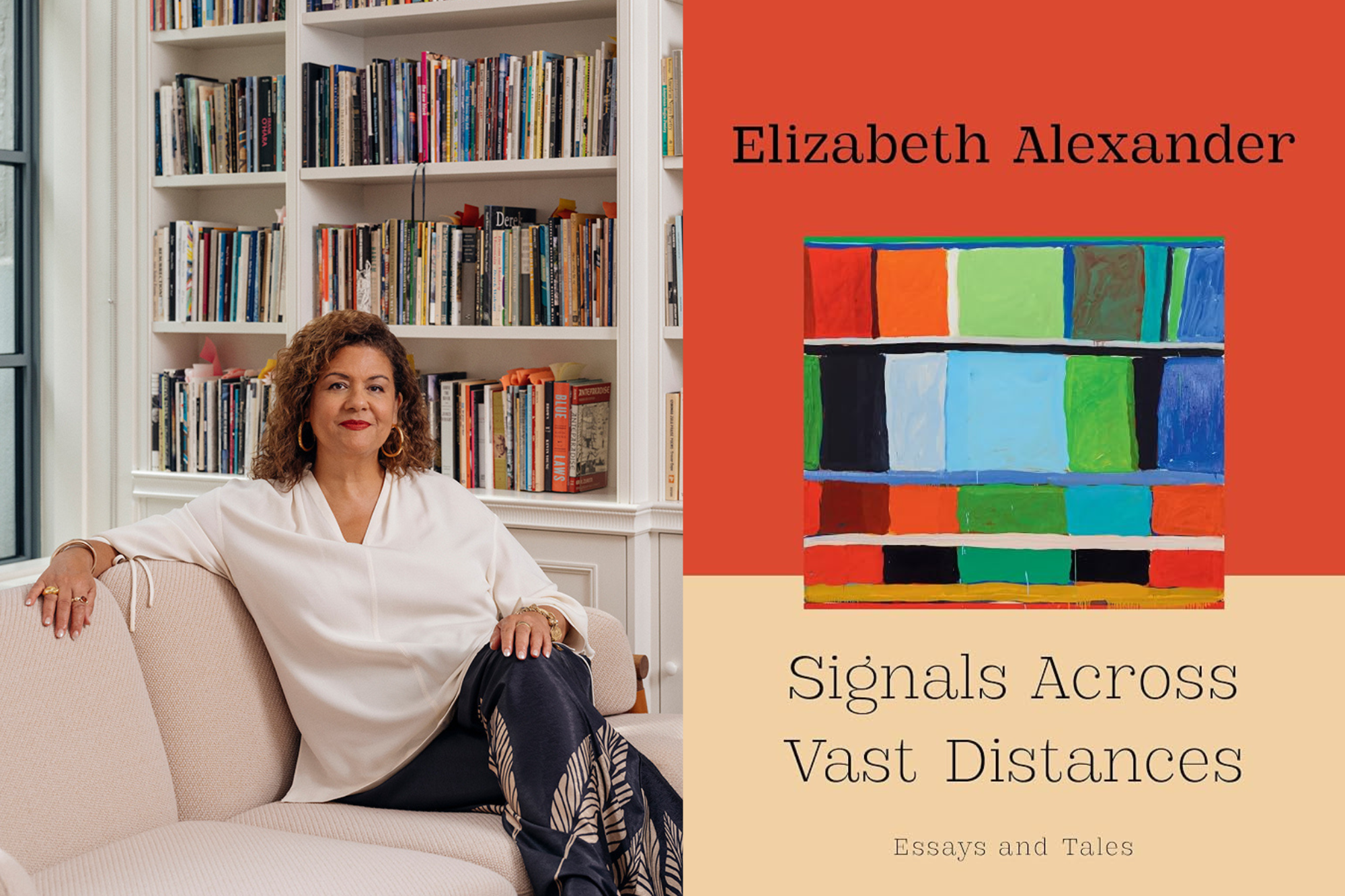
“Poems are not mere breadcrumbs left behind,” writes the acclaimed poet Elizabeth Alexander in her new book “Signals Across Vast Distances: Essays and Talks.” “They are fireflies, a path of light, a way to find our way to each other and know what we have lived.” Alexander, who drew national attention for the poem she read for President Obama’s first inauguration in 2008, is a longtime educator, scholar, and cultural advocate. She now heads the Mellon Foundation, the largest arts funder in the U.S. She joins us to talk about her book, which examines how art, literature and history shape civic life and can help us find our way to each other. As she observes, while these times may seem unprecedented, we have faced these challenges before.
Guests:
- Dr. Elizabeth Alexander, author, poet, educator, cultural advocate, president of Mellon Foundation, latest book is “Signals Across Vast Distances: Essays and Tales”
Episode Transcript
This is a computer-generated transcript. While our team has reviewed it, there may be errors.
Alexis Madrigal: Welcome to Forum. I’m Alexis Madrigal. What is it that poets do? In her new book, Signals Across Vast Distances, Elizabeth Alexander provides a few answers. She writes, quote, “To me, being a poet not only means making poems, it also means being attuned and reverent to the power of distilled, precise words in the form of poems, but also as carriers of souls. Here is my essential self in these words, bone true.”
This is a poet’s book of essays. It takes the form not of a pile of evidence, but an arrangement of different types of true things. It speaks to our moment, this strange, self-contradictory moment, from different angles, drawing power by its movement across terrains. And Elizabeth Alexander joins us this morning. She is, in her adjacent life, the president of the Mellon Foundation. Welcome.
Elizabeth Alexander: I’m really glad to be here.
Alexis Madrigal: Yeah, great to have you. So this new book goes deep in a few different directions. One of them is how art ends up shaping individuals in our society. Do you think, given all the other sources of content and media that exist, do you think art shapes people in the same ways that it did in the past?
Elizabeth Alexander: I think it does even more, actually, because when we say art — and I would mean art that is exceedingly well done — it speaks with so much directness, so much potency, so much power that it can startle us. I think the power of language used absolutely precisely, with the soul force that it carries, which I believe that it makes us turn our heads, makes us know viscerally that something is happening to us and that we’re in the presence of another human being.
And so also when we are looking at sublime dance or sublime visual art, or I think especially when music floods through us, what it also gives us, when it’s very — that people who can make something that powerful possess something that is spiritual and human. And sometimes you see that in other forms of media, but I think that art, at its best, does it at its best.
Alexis Madrigal: I think in this book, the first piece of art that moved you like this that we encounter is this poem called — well, sort of called — “I Lived in the First Century of World Wars.” Do you want to talk to us a little bit about where you encountered the poem, what it’s about, and then we’re going to have you read it for us?
Elizabeth Alexander: Yes. That poem is by the very, very great, the very mighty Muriel Rukeyser, a person who was mighty through the word — poetry, memoir, nonfiction, plays. She wrote all kinds of things, but also mighty in her humanity and in the ways that she wanted always to stand alongside people whose experiences were not necessarily her own and to bear witness, especially to injustice.
So this is someone who grew up in New York City in privilege. When she was 19 years old, at Vassar College, she left — this is the early 1930s — to go to Alabama to witness the Scottsboro Boys trial. She was arrested for protesting. She was put in jail, contracted typhus when she was in jail. Literally put her body on the line to say, “I stand with these other human beings in a very, very different place who are not being treated right by their country, by their government, by the place where they live.”
So I admire her for so many different reasons. She reminds me that we are always in the tides of history, even if we don’t necessarily know it and even if we don’t seek it out. We are always living in history, and so our job is to keep bearing witness.
So, 1967. You know, the country is in — not much going on.
Alexis Madrigal: Yeah, right, right.
Elizabeth Alexander: And I want to — I talked a lot about 1967 because I think that we sometimes mark 1968 as the really big year. But actually, in 1967, there was so much going on as well. Not only conflict, not only the escalating Vietnam War, you know, not only race riots across the country, but also tremendous moments in the culture, tremendous moments of cultural power. Aretha Franklin and “Respect” — it becomes almost an instant anthem. And Dr. Martin Luther King is putting together in his speeches the connections between racial discrimination and economic exploitation and the war. Muhammad Ali is boldly refusing military service and stripped of his heavyweight championship, which was an extraordinary act, a public act of courage.
So Muriel Rukeyser writes this poem that I’m about to read to you, and I’ve always known it, but I think that, um, in the last several years, I would say, if we were to call it an era, we might start — well, we could start in a lot of different places — but I would say certainly the global pandemic, rising concerns about climate change, the so-called racial reckoning of 2020, the return of Trump to the presidency. All of these things have had us in a very heightened state in this country.
This poem became one not only that I turned to, but also that I shared with my colleagues at the Mellon Foundation in the Zoom town halls that we used to stay connected. Oh, God, you just gave me —
Alexis Madrigal: Oh, God, you just gave me, like, an acid flashback. Yeah, that’s — Zoom town hall is enough to send shivers down anyone’s spine. Have to send shivers down anyone’s spine.
Elizabeth Alexander: I know, I know. So I’m going to read the poem because I think that its immediacy is extraordinary. And it is called “Poem, I Lived in the First Century of World Wars,” by Muriel Rukeyser.
“I lived in the first century of world wars. Most mornings I would be more or less insane. The newspapers would arrive with their careless stories. The news would pour out of various devices, interrupted by attempts to sell products to the unseen. I would call my friends on other devices. They would be more or less mad for similar reasons. Slowly I would get to pen and paper, make my poems for others unseen and unborn.
“In the day, I would be reminded of those men and women, brave. Setting up signals across vast distances, considering a nameless way of living of almost unimagined values.
“As the lights darkened, as the lights of night brightened, we would try to imagine them, try to find each other, to construct peace, to make love, to reconcile waking with sleeping, ourselves with each other, ourselves with ourselves. We would try by any means to reach the limits of ourselves, to reach beyond ourselves, to let go the means to wake. I lived in the first century of these wars.”
Alexis Madrigal: God, what a poem that is. “Poem, I Lived in the First Century of World Wars,” by Muriel Rukeyser, read, of course, by Elizabeth Alexander, author, poet, educator, scholar, cultural advocate, president of the Mellon Foundation, and, of course, author of the new book Signals Across Vast Distances: Essays and Tales.
I mean, to your point about language being able to resound across time, I mean, it feels startlingly contemporary, and I think it comes down to that word “devices,” you know.
Elizabeth Alexander: You know, I thought, Muriel, what are you doing to me here? I mean, like, you know, “devices.” She’s talking about the telephone, which would have had a dial and a push button at that point.
Alexis Madrigal: Yeah.
Elizabeth Alexander: And a long curly cord, maybe attached to the kitchen wall. Maybe there was one in the home, and certainly the radio and certainly television. But that wasn’t the word that we used then for those things. It is an accurate word. They are, in fact, devices, but it is as though that language is pushing us, hurtling us forward to a time where there would be a ubiquity of devices, which is different from 1967, and where the news is not only being sought, but is coming at us at all times with those devices that we hold in our hands and that sometimes actually vibrate. And I think of them as sometimes vibrating with the force of the news they carry.
Alexis Madrigal: Mm-hmm.
Elizabeth Alexander: But I don’t want to only think of them as purveyors of woe. I think that those devices today, and this takes me back to the poem, also send out signals across vast distances. They connect us to each other, and not just when you speak to someone you love on the phone. Social media can connect us to each other. Poetry travels very beautifully on devices. You know, there are misuses, but there are also powerful uses when you think about the ways that people can know what other human beings, you know, across town or all around the world, are doing and thinking and struggling with, and thus how we might think of ourselves as connected.
Alexis Madrigal: I mean, the sad thing is, I realize we’re in the second century of these wars, you know?
Elizabeth Alexander: Yes. Well, yeah. In the first century, I mean, that implies, you know, the first, the second, the third. You know, it implies there will be more.
Alexis Madrigal: Yeah. I think the other thing that’s kind of shocking about this poem, or can feel shocking, is I think we like to imagine people from the past maybe had some kind of different interiority, that they were sort of a different kind of person, and maybe made of stronger or weaker stuff, depending on how people want to think about it. But she comes across so clearly. This feels so familiar with the line, “I would call my friends on other devices. They would be more or less mad for similar reasons.” I feel like that might be, like, a quote from my mother-in-law. You know, it’s like just exactly the thing that’s been happening for people.
Elizabeth Alexander: Well, I think what’s interesting, too, is “more or less mad.” So, you know, in a state, but also in a state, you know? We cannot totally retreat into the madness, the more-or-less insane. I think she doesn’t say insane, she doesn’t say mad. So I think that what I take it as a command of that is, is that, like, how are we going to snap out of it? How are we going to, you know, what can we do? First, connect, right? First connect and always connect.
And then, in her case, with her craft, with her trade, slowly I would get to pen and paper and then make my poems. Okay, plain and simple, that’s what you do, for others unseen and unborn. I mean, the poem is plain-spoken, but actually that is grand. She knows that the poem — just as we know that hopefully art outlasts our physical time on Earth.
Alexis Madrigal: Yeah, we’re talking with Elizabeth Alexander, author of the new book of essays Signals Across Vast Distances, also the president of the Mellon Foundation. We want to hear from you. Is there a poem that served as a guiding text, a mantra, a source of comfort for you? 866-733-6786, [email protected]. I’m Alexis Madrigal. We’ll stay tuned.
Welcome back to Forum. Alexis Madrigal here with Elizabeth Alexander, president of the Mellon Foundation, and author, poet, educator, scholar. She’s got a new book out called Signals Across Vast Distances. We want to hear from you. Is there a poem that has reached you across vast distances from some other time or place? Give us a call, 866-733-6786. You can email [email protected]. You can find us on social media, Bluesky, Instagram, Discord, or KQED Forum in all of these places.
So one of the things I want to talk about is one of your poems, which can be glimpsed, say, on YouTube from 17 years ago now. Now, this is a poem that you wrote for Barack Obama’s inauguration. How did that come about? How do you get tapped to be that poet at that moment?
Elizabeth Alexander: Well, I mean, I think to go back to that moment, to set the stage a little bit for that moment, it was really extraordinary to remember how so many people in the country felt, and certainly how I felt at that time. Not only that we had the first elected — the first African American president, that we had broken an important historical barrier — but that we had elected a president with — you’ll remember that the fundraising was, you know, $5 by $5 by $5. It was the largest number of people who had contributed to a presidential campaign, that this was someone who was an extraordinary politician, but also very much about the we, very much about what a powerful, multicultural, beautiful, connected — to take us back to Muriel Rukeyser — America could look like.
So it was a really, really extraordinary moment. And this was a president who also said there will be art at the inaugural. There will be poetry, there will be Yo-Yo Ma, there will be Aretha Franklin, that there were things that poetry and the arts could do that political speech could not do. All of these things were in the tremendous swirl when I got the call on December 18th that this is something I was being asked to do.
Alexis Madrigal: I’ll add one other just bit for people who may have forgotten this, too. I mean, Obama won by almost 10 million votes, 365 electoral votes, biggest landslide victory for a Democratic candidate since Lyndon Johnson, and won Iowa and Indiana and Florida and Ohio and all these places. I mean, if you look at that map, it’s startling.
Elizabeth Alexander: Yes, yes. And the challenge of the poem, speaking to that map, was: What does it mean to write a poem that most people will only hear and not read, first of all, right? Because it’s in the moment. I’ve reproduced it in a book, but unlike everything else I had ever written, I knew that it had to live and do something in that moment.
I knew that I had to, in some way, think about, you know, America, all in capital letters, right? Like, what is this vast place? And how do you offer simple and straightforward words that can both capture the occasion, lift up the occasion?
So, to the title, “Praise Song for the Day,” I was invoking the African idea of a praise song, which is not about saying, “Here’s this wonderful president,” but rather about saying, you know, we are going to praise everything that brought us to this moment. We’re going to — praise meaning lift up — we’re going to lift this up together. We’re going to pause with these words together and look ahead. Look ahead with hope.
It was an extraordinary occasion that, you know, I wrote about in the book, and I, uh — first wrote — I wrote this book over —
Alexis Madrigal: You grew up in D.C., right?
Elizabeth Alexander: I sure did. I grew up six blocks from the Capitol. And that is, you know, so I walked — I grew up walking to the Capitol. There was nothing like the kind of security that you see now. You could wander the grounds freely. You could, you know, go right up to the White House gate and know that, you know, government was present. That gave it quite the sense of the people’s house.
And so, yeah, you know, knowing that I was going to deliver this poem on the steps of the Capitol in my neighborhood, down the street from where I took dance classes for all those years. And I was not doing it alone because it was a moment for American poetry from the people who had lived before. So, of course, I thought about the great Gwendolyn Brooks, Bard of the South Side of Chicago. Had she been living, I’m certain that she’s the one who would have been on that stage.
So I write about reciting a poem of hers at the dress rehearsal. There was a dress rehearsal the day before. And also, you know, thinking about Walt Whitman, who, when he worked as a nurse in the Civil War — I mean, the Mall was an open-air hospital, and he tended to, you know, to dying soldiers right where we looked out on that day. So much history.
And so I wrote and published this particular essay for the first time on the inauguration day for Trump’s first election.
Alexis Madrigal: Because —
Elizabeth Alexander: Because I wanted, you know, I didn’t want to talk about that. I wanted to remind us of an extraordinary moment of hope.
Alexis Madrigal: Listen to this. This is just going to be you reading this back on the Capitol steps in 2009.
Elizabeth Alexander: “We encounter each other in words, words spiny or smooth, whispered or declaimed, words to consider, reconsider. We cross dirt roads and highways that mark the will of someone and then others who said, ‘I need to see what’s on the other side. I know there’s something better down the road. We need to find a place where we are safe.’ We walk into that which we cannot yet see. Say it plain, that many have died for this day.”
Alexis Madrigal: That was Elizabeth Alexander reading her poem “Praise Song for the Day” at President Obama’s first inauguration. That would have been in 2009. You can check out the whole thing on YouTube if you want to get a sense of it.
I think when I was listening to this poem in, you know, 2026, this year —
Elizabeth Alexander: Mm-hmm.
Alexis Madrigal: — a lot of what I was thinking about, and also reading your essay about this, too, was, I think when we were watching President Obama being inaugurated — you much closer, me from afar on television — it felt like the beginning of something. And reading your essay and thinking about all that has come after, it now feels like it was the end of something, like it was the sort of — the movement that began during the Civil Rights Movement of the 1950s, like this version of America kind of peaked right then in that moment, maybe even while you were reading the poem.
And since then, we’ve been in the midst of a sort of reaction and then a kind of defensive position for a lot of people who believe in the equality of all people.
Elizabeth Alexander: Well, we can’t let that be true. I understand what you’re saying, and I think that we are in a period of, you know, we have lost rights that we earned in our lifetime. That is true. “Say it plain, for many have died for this day.” Our right to vote is less assured than it was. That is absolutely true, and many other things that I could talk about.
I mean, I think in listening to that excerpt, I’m glad you chose that excerpt, we know there’s something better down the road. We need to find a place where we are safe. We walk into that which we cannot yet see.
So that, in the present moment, makes me think a lot about — and something I write about in the book, too, in the essay “My Refugee” — about people who are unbelievably courageous, unbelievably courageous, walking into that which they cannot yet see to make a better life for themselves and their children.
And how, you know, in this current moment of ICE and immigration mayhem, they are being treated with so much violence and so much othering and so much hatred and so much racism and so much cruelty. I mean, we could go on and on about that.
But so, all of these things about what we are in now are true, but my emphaticness about we cannot let it be so is maybe the, you know, call to — I wouldn’t say call to arms, call to our actual physical arms, our physical arms linked.
But, you know, what can we do in our communities, in our families, in the — in the way, looking back to that poem, love beyond marital, filial, love that casts a widening pool of light. In that poem, I am talking about the force of love that is not about just romantic love. It’s not about, you know, “I love you, you love me.” It is about a force in the world that takes a lot of different forms.
There is the love and devotion that comes from serving other people, working for others, working for community, in believing that we need to share our resources, in looking at our lives not as zero-sum lives, where you just, you know, got to grab for that crumb, but rather a resource life, when the challenge is just to distribute the resources fairly.
So I want to just extol and exhort that we cannot let that be the pinnacle. But we do need to reinvent. And I think that I was born in 1962, of the generation of President Obama, and we are a generation that watched and participated in so many justice movements, so many progress movements. We saw the civil rights movement. We were raised on that: civil rights movement, women’s movement, gay liberation, all of those things.
And so I think what we have to maybe refigure a little bit is how do you work with the two steps forward, one step back? What are the new strategies for this next period to come out of the backlash?
Alexis Madrigal: Thinking about that line, “I know there’s something better down the road,” that line — you know, no one really knew that during the long struggle.
Elizabeth Alexander: Yeah, that’s right. That is right.
Alexis Madrigal: And I think it reminds me of the piece of your book in which people in New Haven, Black people in New Haven and some abolitionists are imagining a Black college in 1831. So, you know, obviously chattel slavery is still the law of the land in the United States. And here people are imagining this college.
And so sometimes when I get down, I do imagine people, particularly from the sort of, like, Black laboratory tradition. In the midst of all of that that was going on in 1831 America, they’re imagining a college, and you think, like, what right does anyone have to get down about other things, you know?
Elizabeth Alexander: Oh, those people, you know. I mean, those people with the force of imagination. So this is why, you know, I’m dead serious about imagination. And I don’t mean fanciful imagination, right? I mean, you know, the power, the human power of imagination to envision and try to build, and build even if it doesn’t necessarily come to fruition.
And so I think that I’m able to do, as a writer, as an educator — you know, I was a university professor for 30 years, and I still consider myself very fundamentally an educator. I told the story, and tell it in the book, of that dream of an 1831 Black college in New Haven. I told it at giving the Yale commencement speech. And that’s — it’s my — that is my alma mater. That is a school where I taught for many, many — kids’ alma mater.
Alexis Madrigal: Kids’ alma mater, yeah.
Elizabeth Alexander: Kids’ alma mater, you know. Husband went to art school, you know. I mean, it’s a school and also a city. New Haven is my town, you know. It is the city where I have lived longer than anywhere, actually, even though New York is creeping up. I think I got two more years here and then I’ll have eclipsed the New Haven years.
But so I love that city, and I love that university, and I love all that has happened and can happen there. But that university — first of all, the need for the 1831 college was that Yale did not educate Black people at the time. And the reason it did not come to be, even after these Black and white abolitionists had planned it, had a building, had a site, is that the mostly Yale-educated landed townspeople resoundingly voted it down.
And so the act of imagination, and what it means to say that at a Yale graduation, is know the history of the place you come from. Because that’s how you will always ask more of it. You will always try to make it better. You will just face the truth to say, how could we have done that differently?
And I think the force of thinking, what would it mean if from 1831 forward, New Haven, Connecticut, had had Black people who were educated, who were landed, who were politically empowered, all of the things that can come with an education? There would be a very different town-gown dynamic. It would be a richer place for everyone. The university would be a better university for that.
And so I want us to imagine it so we can think then about the equivalence now. And, you know, the analogy that I make is, you know, I talk about one of the Mellon Foundation grants that I’m most proud of, to an organization called Freedom Reads, founded by my very, very, very beloved friend, Dwayne Betts.
And that organization puts 500 book freedom libraries in every single prison in this country. Because I believe I couldn’t have done what I — I couldn’t have been an English teacher and a writer all these years if I did not believe that reading and knowledge empower us and free and strengthen our minds.
And so what does it mean for people who are incarcerated and who will hopefully be able to come out and live their lives richly and productively? What does it mean for them to have access to these books?
Alexis Madrigal: Let’s bring in Julia in San Francisco real quick, who’s got a poem that has stayed with her. Welcome, Julia. Oh, great.
Julia: So thank you so much, thank you for your work, and I’m on my way to deliver a presentation on the intersection of domestic violence and firearms violence. And listening to Forum and Rukeyser’s poem and everything you’ve shared, I’m reminded, of course, of Marge Piercy’s “To Be of Use,” and the last two lines in particular: “A pitcher cries for water and a person for work that is real.” And just the power of those few words in terms of reminding us how important it is for us to be engaged in this kind of work. So thank you so much.
Elizabeth Alexander: Yeah. Oh, Julia, that’s one of my — so that also, at the Zoom town hall, Marge Piercy’s “To Be of Use” was in heavy rotation. And I love that poem. And also when she says so plainly — she’s very — I need to research if she knew or was a colleague of Rukeyser’s, because they have a similar plainspoken strength. “The people I love most,” she says, “are the people who put their wheel to the shoulder, who pitch in, who help.”
Alexis Madrigal: “I love people who harness themselves an ox to a heavy cart, who pull like water buffalo with massive patience, who strain in the mud and the muck to move things forward, who do what has to be done.”
Elizabeth Alexander: Again.
Alexis Madrigal: And again. We’ve got to take a break. We’re talking with Elizabeth Alexander, author, poet, educator, president of the Mellon Foundation. Her latest book of essays is Signals Across Vast Distances. We want to hear from you. Of course, is there a poem that served as a kind of guiding text, or a piece of art that’s helped you process what’s going on in this world right now? You can give us a call, 866-733-6786, [email protected]. I’m Alexis Madrigal. Stay tuned.
Welcome back to Forum. Alexis Madrigal here with Elizabeth Alexander, scholar, cultural advocate, president of the Mellon Foundation, Pulitzer Prize finalist. Her latest book of essays is Signals Across Vast Distances: Essays and Tales.
Marika writes in to say, “I recently read this quote by Kafka, which reminds me of what Ms. Alexander was saying at the beginning of the show: ‘A book should serve as an ax for the frozen sea within us.’ And yes, the word ‘devices’ gave me that feeling when I heard it aloud. The connection between years and experiences felt like an ax, like a Buddhist koan.”
Elizabeth Alexander: Mm, that’s beautiful.
Alexis Madrigal: Um, let’s bring in another person. Uh, let’s bring in — who with a poem? Elizabeth in Gilroy. Welcome.
Elizabeth (Gilroy): Uh, hello. Good morning. Thank you guys so much for this very inspiring poem — program, rather — about poetry. Uh, I wanted to call in and suggest the poem “Recuerdo” by Edna St. Vincent Millay. “Recuerdo,” of course, meaning, like, memory or a memory. To me, it has been a really meaningful poem my entire life. My father sent it to me about 20 years ago when I was living through a very cold winter in Quebec, and just the visuals of the poem, the simple joys that these people took in each other’s company, the connection with humans of all stations of life.
And just the big kind of metaphor, you know, we are all kind of on this ferry floating in our lives, and sort of distilled for me the simplicity and the beauty of these things. And now, in these kind of difficult, world-wearying times that we’re living in, that poem always rings true to me, and especially so as I’m the caretaker for my father, who has memory challenges now. But that poem, like so many others, is still something that links and pulls him out of his forgetfulness. Oh, wow. And it’s a poem that we continue to recite together, and today’s his 86th birthday.
Alexis Madrigal: Oh, man. Happy birthday, Dad. We’ll be sharing some poetry later.
Elizabeth (Gilroy): So thank you so much for the program and for taking my call. I really appreciate it.
Elizabeth Alexander: Wow, Elizabeth. What a beautiful comment. And I don’t know that poem, but I’m gonna look it up right away.
Alexis Madrigal: Yeah, I’ll give you a stanza of it if you want, yeah.
Elizabeth Alexander: Oh, I want that. And I also just wanted to say, I love that the title is “Recuerdo,” that it’s a Spanish title of a poet who writes in English, which to me is the proximity of languages, you know, that you cannot let — if that is not your language, you’re still invited into the poem. And I love —
Alexis Madrigal: Yes, a stanza. This is the middle stanza here:
“We were very tired, we were very merry —
We had gone back and forth all night on the ferry.
And you ate an apple, and I ate a pear,
From a dozen of each we had bought somewhere.
And the sky went wan, and the wind came cold,
And the sun rose dripping a bucketful of gold.”
It has almost this little sing-songiness. I almost feel like Dr. Seuss, but for adults, you know? Or maybe Dr. Seuss was also for adults.
Elizabeth Alexander: Well, but also sound. I mean, I think that that is one of the, you know, obviously the tools, the musical tools that poetry has that can make things memorable and that can, again — we talked earlier about being — I think of it as being like just caught, someone grabs your arm, you know? Caught by the language, but that also you can take it in and memorize it and have it live with you forever. I mean, I feel like all of the poems and lines of poetry that I live with feel like they are now my own language.
Alexis Madrigal: Mm, like you incorporate them in, yeah.
Elizabeth Alexander: Yeah, yeah.
Alexis Madrigal: One of the things that I found fascinating in this book is you actually started out as a dancer. Like, that was kind of your first artistic love. How do you think about dance and poetry as in kind of conversation with each other?
Elizabeth Alexander: Well, I think — and that essay, “Second Spring,” talking about just being so devoted to an art form. So I studied dance very, very, very seriously. It was what I did all the time that I wasn’t in school. It was something that I tried to do professionally and was not good enough.
So here’s one important thing about just the life of an artist, is that you can do everything. You can do all the things. You can devote yourself. If you can love it more than anything that you do, and you still might not be able to do it for your living, and that’s okay, because it means what else do you love that much? What else will you devote that much energy to learning how to do well?
And so I think that, you know, the segue into poetry — and first, for me, it was the segue into other kinds of writing, and then poetry. But, you know, I learned so much about working within constraint to make something that wanted to explode its boundaries from dance training, that the tool of the human body is an extraordinary tool, whether it is moving in space or whether — poetry comes from our breath. It comes from our breath and our brains, right? I mean, we’re making music, or attempting to make music.
And I think that musicality, which of course doesn’t mean, like, sing-song, it just means there are as many different kinds of music as there are poetry. But that sense of music, I think, certainly came from always being trained to learn to move with music and attuned with music.
Alexis Madrigal: And, yeah, the beats, the beat, yeah. Let’s bring in Robert in Santa Rosa. Welcome, Robert.
Robert: Hi, thank you very much, and thank you very much for the program. It’s funny how you forget some of the most important things, and this is one of them. The poem that made something to me, actually, I encountered in life because I went to one of the seminars that Parker Palmer’s group, Courage for Renewal and Change, led, and I was given a poem called “The Way It Is” by William Stafford.
And by realizing when I read this poem that this was actually something I had been doing in my life, but I didn’t really name it this. So it’s a powerful poem for me. The two lines that matter most to me are the last two, which is, “Nothing you can do can stop time’s unfolding. You don’t ever let go of the thread.”
Alexis Madrigal: Mm-hmm.
Robert: The first line is, “There’s a thread you follow.”
Alexis Madrigal: Yeah.
Robert: Anyway, I just wanted to thank you, Elizabeth, and of course, always thank you, Alexis, for reminding me that there are things that guide me, and I don’t know what this one was going to be, and I probably don’t know what the next one’s going to be.
Alexis Madrigal: Thank you for that, Robert.
Elizabeth Alexander: I love that. And I love the recognition, you know, that that always seems miraculous to me, when I read something and feel recognition that could have been created by someone who had a life completely different from mine, in another part of the world, at another moment in time. I mean, how extraordinary is that?
Alexis Madrigal: Yeah, this poem is fantastic. It’s short, so I’ll just read the whole thing here. It says, William Stafford:
“There’s a thread you follow. It