Other Minds Festival Celebrates 30th Year of Highlighting Experimental Music
Airdate: Thursday, October 8, 2026 at 9 AM
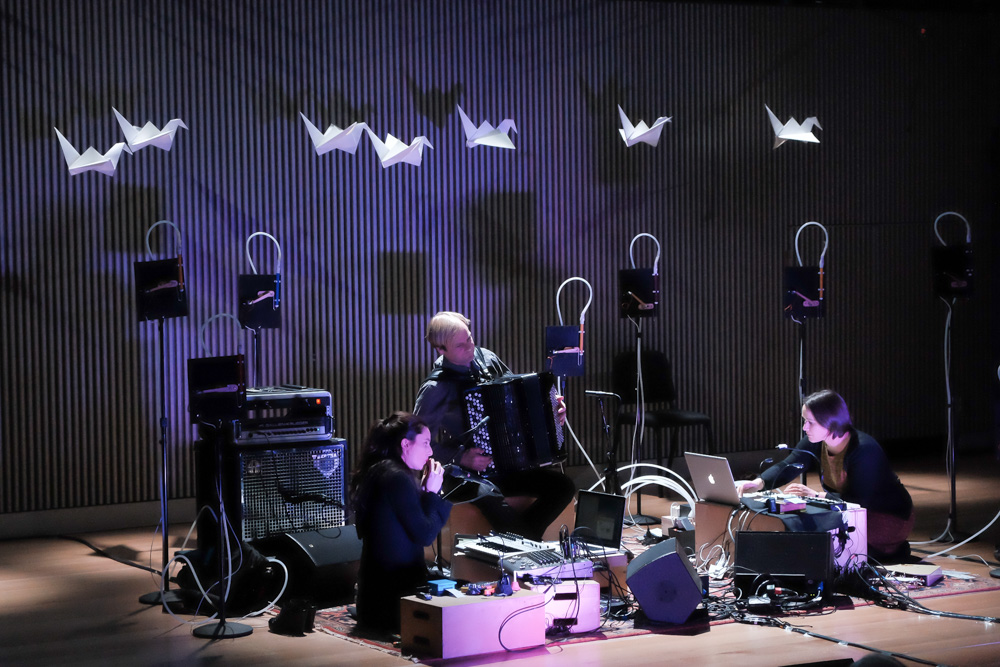
San Francisco’s Other Minds Festival turns 30 this weekend, with four days of music from world renowned experimental composers. There will be improvisation, chord repetition, electronic manipulation, 18th century Armenian music — and a grand piano surrounded by teddy bears. We’ll talk with co-founder and retiring executive and artistic director Charles Amirkhanian and with musicians about why the Bay Area is such a rich site for avant-garde music.
Guest:
- Charles Amirkhanian, co-founder, executive & artistic director, Other Minds, composer of sound poetry and electroacoustic music, former music director of KPFA
- Pamela Z, composer, performer and media artist
- Joseph Bohigian, associate director, Other Minds, musician and composer
- Khatchadour Khatchadourian, Bay Area vocalist and wind instrumentalist
Episode Transcript
This is a computer-generated transcript. While our team has reviewed it, there may be errors.
Alexis Madrigal: Welcome to Forum, I’m Alexis Madrigal. For 30 years, the Other Minds Festival has been bringing together experimental and otherwise unconventional composers and musicians here in the Bay Area. This is music that you won’t easily stumble across on a Spotify playlist or an AI-programmed commercial music station. It’s music that’s art in the way that paintings are art, and it’s not intended to be listened to by the maximum number of people. Much of it is beautiful, strange, haunting, wonderful, unexpected.
And this morning, we’ll talk about individual pieces and composers and the community that they’ve built here in the Bay Area. We’re gonna be joined by Charles Amirkhanian, who’s co-founder and executive and artistic director of Other Minds. He’s actually stepping down as director after 34 years after this festival. Welcome, Charles.
Charles Amirkhanian: Nice to be here. Thank you so much.
Alexis Madrigal: We’ve also got Pamela Z, legendary composer and performer and media artist who lives here in San Francisco. Welcome.
Pamela Z: Thanks for having me.
Alexis Madrigal: We’ve got Joseph Bohigian, who is associate director of Other Minds, gonna take over as artistic director next year. Welcome.
Joseph Bohigian: Thanks, really glad to be here.
Alexis Madrigal: And we have Khatchadour Khatchadourian, who is Bay Area wind instrumentalist and vocalist. Welcome.
Khatchadour Khatchadourian: Thank you so much.
Alexis Madrigal: So, Charles, you’ve been running this music festival for many years. Simple question based on your experience: What is music?
Charles Amirkhanian: What is an interviewer question I should ask you?
Pamela Z: [Laughs.]
Charles Amirkhanian: What is a…
Alexis Madrigal: Host of a radio show. I don’t know, a compilation of cells. I tried another one.
Pamela Z: Yeah, yeah.
Alexis Madrigal: No, okay. Well, how do you think about songs and music relative to how people tend to — when what you’re working with isn’t just gonna be, you know, chorus versus bridge? What makes the kind of music you’re looking for?
Charles Amirkhanian: Well, I remember when I traveled around and I would tell people I’m a composer, and they would say, well, do you do your own lyrics too? As if songs were the only kind of music that we had. And, of course, people who do new music are very familiar with the song form, popular music, and have their likes and dislikes in that area. But sophisticated listeners who have gone beyond that and have looked for something more interesting and with more depth and unpredictability, which is, I think, important, have gravitated toward a field which is roughly called new music.
Now, new music has evolved over the years from the classical tradition through modernism to a kind of expression today that incorporates world music, rock — so all sorts of other influences, not just the Western European tradition. And in the case of jazz musicians who have evolved into free improvisation and other forms, anything goes, and it starts from the emotional core of the person and builds outward. So it’s very hard to characterize what we do because we do so many different things, exemplified by the different composers on this festival.
Alexis Madrigal: Well, let’s talk about one of them. Joseph, your piece is going to be I Am Whose Life and Soul are Torment, premiering at the festival tonight, also opening night. We’re gonna listen to it in just a second, a little piece of it, but can you, like, set it up for us a little?
Joseph Bohigian: The piece is about the Soviet-Armenian filmmaker Sergei Parajanov, who’s most well-known for his film The Color of Pomegranates from 1969. And his films are very abstract, and that got him into a lot of trouble with the Soviet government. So he had a very tumultuous life, and so we’re abstractly telling the story of his life as he would have in his film, using the songs of Sayat-Nova, who is an 18th-century troubadour. And the songs will be sung by Khatchadour.
Alexis Madrigal: Yeah, all right. Let’s listen to a little bit of it now.
Khatchadour Khatchadourian: With war on, we’ll harass your honor, Sibisa lovgano kazazjano Sima havreshmo kazazzano.
Alexis Madrigal: Khatchadour, that is you singing there. I mean, this piece is so interesting. I mean, just the description of it where you’re like, okay, there’s Armenian, there is Georgian, there’s Azeri. This is a Soviet director. We give ourselves so much credit for being such a globalized world now, but you’ve got this bard who’s working in all these languages. How do you think about the sort of border-crossing elements of this piece and even just kind of the linguistic elements of it?
Khatchadour Khatchadourian: I think the bard tradition of the 18th century Armenia included a state of borderlessness in such a way where it’s rather new to us, thinking post-20th-century borders and ideologies. Sayat-Nova, we found that on this project, wrote in four languages: Armenian, Azeri, Georgian, and Farsi. And, of course, it was incumbent upon me to represent the languages and enter the emotional landscapes per language and how it evokes and what it speaks of. So, to go beyond my contemporary identity and how I used to define what Armenian-ness, Armenian artistry, Armenian musicianship is, to explore what Sayat-Nova said about that and crossing the borders.
Alexis Madrigal: That’s also right, as I understand it, this bard tradition is only kind of like one thread of this sort of other — the rest of Armenian music, as I think of it.
Khatchadour Khatchadourian: Yeah.
Alexis Madrigal: Yeah?
Khatchadour Khatchadourian: Yes, Armenian music is quite rich. Armenians have been around for several thousand years and lived across many landscapes — Anatolia, South Caucasus, the Levant, parts of Europe. And I think that informed kind of the musical heritages and the information we carry.
I understand Armenian music in four pillars upon which everything is founded: the classical Armenian music of Father Gomidas, the folk music that Father Gomidas and other ethnomusicologists traveled and captured from all the villages across Anatolia. We have the troubadour tradition, and we have the hokevur tradition, which is the church and sacred music.
Alexis Madrigal: So interesting.
Joseph, some of this stuff sounds like it’s part of these very deep and long traditions. So what would you say qualifies it as new music, then? Definitely the electric guitar.
Joseph Bohigian: Electronics. So, the electronics are performed by my group, Ensemble Decipher, and we perform with laptops and with flight simulator joysticks and accelerometers and all sorts of different electronic controllers.
So we are taking recordings of folk musicians from different minority cultures around the South Caucasus that were recorded by a group called the Sayat-Nova Project. And so these recordings are in Georgian, in Armenian, in Azeri, but also in — there’s a Molokan recording, which is a Russian group in Armenia. There’s all sorts of minority groups in those three republics whose music, whose art isn’t represented by the national culture in each of those places.
And so we’re taking those recordings and sampling them and putting them through different electronic processes and connecting them to our emotions. And so that’s going along with both the existing Sayat-Nova songs in Armenian, but also Khatchadour and I together came up with new melodies for the Sayat-Nova songs in Georgian and Azeri, because those melodies have not survived.
Alexis Madrigal: Wow.
You pretty much go to the Other Minds Festival every year as performer or attendee. Why? What do you find there?
Pamela Z: For me, Other Minds is church. That’s my — it’s my community. It’s where I — and it’s where it’s also just been a foundational piece of my progression as an artist from very early on in the earliest days of the festival. Um, you know, till — till now, I’ve, you know, I’ve met a bunch of amazing artists coming from all over the world. I’ve had the opportunity to perform a number of times and to collaborate sometimes with other really interesting artists. And yeah, so it’s just, and it’s, you know, it’s like, I see a community there every year of people who I always see and who are, you know, driving things forward together.
Alexis Madrigal: Do you remember any of the individual pieces you’ve performed there?
Pamela Z: Yes. So the very first Other Minds Festival that I performed on was in 1997. And I did some solo works for voice and electronics, I think including a piece I made called Bone Music. I think Bone Music was in that concert.
But the main thing that I premiered there was a collaboration with Letitia Tsunami and Donald Swearingen, and it was a piece — and with a Japanese video art duo called Visual Brains. And that piece was commissioned by — actually, I think it was commissioned by the Interlink Festival in Japan.
So I had this opportunity to go to Japan in ’96 with Letitia and Donald and with Charles Amirkhanian and Carol Law, and we were there for the Interlink Festival, and we met our collaborators. But we had collaborated long distance with them, and then we performed that piece in Japan in five different cities. So we brought that back in ’97 and did it at Other Minds.
I also, just last year, to put like a cap on this sandwich, I guess, um, I did a piece called Simultaneous, which is a piece that came out of my Rome Prize Fellowship year. And that piece was actually in three — well, two different iterations, three different iterations, really. One was a sound installation, a 21-channel sound installation. And one was a radio piece, a 45-minute radio piece. And then there was this live performance work that involved my voice and electronics and oboe, cello, percussion, and viola — or no, yeah, viola.
Alexis Madrigal: We’ve got a little bit of Bone Music by Pamela Z to go out on here into the break, one of the first things you mentioned from back in ’97 when you performed at the Other Minds Festival.
We’re joined this morning, we’re talking about the 30th, I guess, edition of the Other Minds Festival. We’ve got Pamela Z, we’ve got Joseph Bohigian, associate director, we’ve got Charles Amirkhanian, and we’ve got Khatchadour Khatchadourian, who is Bay Area wind instrumentalist and vocalist.
Welcome back to Forum. Alexis Madrigal here. We’re talking about the Other Minds Festival. It is an experimental slash new music festival featuring world-renowned composers and musicians, run by the nonprofit and record label Other Minds. The festival turns 30 this year.
We’ve got its director, Charles Amirkhanian. We’ve got Pamela Z, a San Francisco composer, performer, and media artist. We’ve got Joseph Bohigian, who is taking over the Other Minds Festival as artistic director. And we’ve got Khatchadour Khatchadourian, who’s a Bay Area wind instrumentalist and vocalist.
Maybe you out there are an experimental music maker or fan. Have you ever been to the Other Minds Festival? What was your introduction to this music? What do you think makes it different from what other people might listen to on the radio or in their Spotify? 866-733-6786. That’s 866-733-6786. The email is [email protected]. Find us on social media, BlueSky, Instagram, Discord. Of course, we’re KQED Forum.
One of our listeners — you know, when I was listening to Pamela Z talk about this collaboration in Japan, and, you know, we know that there’s people here coming in from all over the world. Charles, what is it that makes the Bay Area sort of a hot site of experimental music?
This actually comes from listener Steve. He says, “I’m particularly interested in that pointed question: Why is the Bay Area such a rich site for avant-garde music? And I’d be interested if there was some thought about whether other arts vibrancy here has a related answer as well.”
Charles Amirkhanian: Well, in the case of music, a lot of the people who were teaching at the conservatory of music in 1950, ’51, ’52, they came from the classical music tradition, but they had also roots in electronic music. And after World War II, with the advent of tape machines, people were exploring sounds and stretching them on tape and so forth.
The radio station KPFA went on the air in the year 1949. And who was the first person to broadcast music on that outlet? It was Robert Erickson, who was a music director of the station, a trained composer, who later founded the music department at UC San Diego. And he was absolutely adamant about having people like Henry Cowell playing music live on the radio, strumming inside the piano. And that harkens back to the early ’20s in the Bay Area, when Charles Seeger was teaching at the University of California and he taught a young Henry Cowell, who lived in Menlo Park, to take the ferry across to the university before he was college age to study with this master musician — absolutely famous because he’s the father of Pete Seeger as well, but he had a classical background.
And from that, Henry Cowell enlisted John Cage and Lou Harrison, also Bay Area people, to study the experimental music that was going on in Europe and how Americans could be different.
So when the Dancers’ Workshop started up in the early ’50s with Anna Halprin, and she brought in Morton Subotnick and other people to found the San Francisco Tape Music Center on Divisadero Street, that was a hub for people to go and hear these things. But meanwhile, they’re being trained on the air at KPFA with the latest experimental music all the way through 1949 to 1960 or so and beyond.
So I think the radio, once again, plays a big role, as does the phonograph in pre-radio days, and before that, the oral tradition. So electronics and radio and communications are all tied up in this.
Alexis Madrigal: Yeah, such an interesting…
Joseph, how do you see this incredible lineage, this kind of base of these things here in the Bay Area? How do you see it continuing on through, you know, let’s say the internet era?
Joseph Bohigian: Yeah, well, I mean, at this point, everyone’s connected to everybody, right? There’s no real geographic boundaries. So I don’t — maybe location is a little bit less important, I think, at this point.
Alexis Madrigal: You think so? What do you think, Pam?
Pamela Z: I think location is still important, but I do think that it’s very interesting how just the sudden advances in our communications in recent years have really blurred those boundaries. But I still feel like there are centers, there are places where people are drawn to go when they are doing adventurous work.
But there are also people in places that no one thinks about as being adventurous places. And now suddenly those people actually have — like, I guess the current state of communications has given rise to voice for some, for people in other places. So, yeah.
Alexis Madrigal: Yeah, it’s just more like a bigger node in a network now rather than just like it’s sort of its own thing.
Pamela, we want to hear a little more of your music. This is a piece called Simultaneous. Let’s listen to it, and then you can — do you want to set it up at all? Or should we listen to a thing? Well, we…
Pamela Z: Well, we can listen to it, then I can talk about it a little bit. It begins when small groups of people are walking side by side and unconsciously start to move together as a unit.
Pamela Z: Step, step, step.
Pamela Z: When London’s Millennium Bridge began to wobble uncontrollably, shortly after its opening in the year 2000, this phenomenon was initially thought to be the cause.
Pamela Z: Fall, fall, crown, fall.
Pamela Z: It begins when small groups of people are walking side by side, and unconsciously start to move together as a unit.
Alexis Madrigal: That was just a snippet of Pamela Z’s work, Simultaneous, that was released by Other Minds Records. And I also didn’t realize you invented ASMR. I could listen to you step and step all day long.
Tell us a little bit about, yeah, like, how do you put this together? How do you perform something like this?
Pamela Z: Well, so this piece, as I mentioned earlier, it has multiple iterations. And one was just a sound installation. So it was just coming out of 21 different speakers. And then another was an actual radio piece that was just fixed media.
But I created a performance version of the piece that involves my voice and electronics. So I’m doing some of the speaking sounds and singing tones live, and also a chamber ensemble. And I also have — I use these gesture-controllable instruments that allow me to trigger sounds by using physical gestures. And so some of the sampled sounds get triggered live by my hand movements.
But yeah, so it’s — but I’ve also altered the piece so the performance version of it doesn’t sound exactly like the recording that Other Minds put out. I should say that the original recorded version, the fixed-media version, was actually commissioned by Deutschlandradio. And I put that together during the lockdown, and it first was aired on their air in Berlin.
But the live performance version of the section that we were hearing, I actually had all the members of the ensemble sit down on chairs on stage so that they could step their feet. And we all started stepping in our own tempi, so there were like five different tempi.
Alexis Madrigal: I did not realize that was the plural, but I’m glad to know it. Yeah.
Pamela Z: And then as the piece progresses, we slowly graduated to our steps, gravitated towards being in unison, so that by the end of the piece, we were all stepping in unison. As I was intoning, there was a tape part that was happening, and then I was intoning some of the vocal sounds in it. So that was one example of how these things are performed.
Alexis Madrigal: As someone who really thinks about voices and thinks about manipulating your own voice in these different scales, how do you think about using electronics or where do you want the voice to be sort of changed? Do you give a lot of thought to that, especially in this new music?
Khatchadour Khatchadourian: I think it’s a conversation, regardless of what you’re trying to say, whether you’re putting electronics with voice, voice with other human elements. And so long as for me there is an emotional transference between the performers and the audience, then it’s done beyond my wildest dreams.
And so I’m very open to experimenting. I have a collection of my guitar pedals that I put my voice on and through and try to think differently outside of the boxes of just a regular vocal performance, let’s say. And working with Joseph Bohigian on this project has certainly pushed me to explore the edges of what is possible and go even beyond. And how there’s this kind of gentle handshake between electronica and voice and how we converse as we’re putting the pieces into shape. Are we transferring emotions, and how are we working with the dynamics of a piece and so on.
Alexis Madrigal: I also remember seeing Pamela Z perform one time and she had like a whole rig. You know, you had this hand gesture rig and stuff, and you mentioned, Joseph, that you have these like flight controllers. Are these things where you all are like building the tools that you’re using?
Joseph Bohigian: Yeah, so a lot of what we do is actually inspired by a lot of Pamela’s work with gesture controllers. We’re often finding pieces of technology that are intended for something else and using it for music.
So we’re using these joysticks that are meant for flight simulators. We are using accelerometers that are on little computer chips that are meant to teach children how to code. And you can send that data to the computer. So, yeah, we’re finding all these little objects that we can repurpose in order to use them as instruments.
Alexis Madrigal: Wow, that’s cool. I mean, given that you have this sort of immersion in technology, right now it feels like every single story is about AI in one way or another. Do you find the possibilities there of working with those tools exciting? Do you find them not exciting? Do you find them horrifying?
Joseph Bohigian: Uh, I think there are definitely opportunities to do creative things with them. Uh, if the AI doesn’t kill us all, uh, but if we survive it.
Alexis Madrigal: Could be cool, could be pretty chilling.
Joseph Bohigian: I think because what we’re doing is experimental and noncommercial, we’re in less danger in our area of the music world of being replaced by AI.
Pamela Z: Close the pod bay doors.
Khatchadour Khatchadourian: And also there is this idea of imperfection of the human touch, whether it’s a voice or technology that’s producing music that has elements that shows you it’s involving humans. And we — if AI could be imperfect, maybe I’ll start worrying, but, you know, you show vulnerability by showing imperfection.
Alexis Madrigal: Yeah. And there’s nothing for the AI to be — there’s no vulnerability, there’s no human, there is no self. There’s no spice.
Khatchadour Khatchadourian: There is no spice. The food is not cooked yet.
Joseph Bohigian: But musicians have been working with artificial intelligence in whatever form it’s existed for a very long time. It’s just in the past few years become far more advanced than it ever was. So I think —
Pamela Z: Now that it’s the flavor of the month. Yeah.
Alexis Madrigal: You’re like, why is the flavor of the m — no, spice, what a weird flavor.
Yeah, you know, Charles, one thing that I wanted to ask you about is about the sort of the role that Other Minds has played in sort of documenting this scene over time. This set of performances that, you know, sometimes are just — that’s the only way, the only time it’s ever going to be performed like that is just at that moment. How much of that is available? Like, where is that art? Is that archive just gonna live?
Charles Amirkhanian: Well, the performances that we present are only seen by a couple hundred people, and when we’re at the Brava Theater and we have 400 seats, that’s too bad because we’d like a couple of hundred more. So we’ve solved that by appearing here this morning on KQED.
But also, we have an archive online with 10,000 hours of audio and video. It’s really important to document these performances and, most importantly, to hear interviews with the composers who produce them because then you get an explanation.
What we have is 4,000 reel-to-reel tapes from KPFA that we’ve digitized over the years with the help from the National Endowment for the Arts and other granting agencies. We spent $2 million preserving those tapes, and they’re available free online. If you go to the otherminds.org website and click on archives, you can hear any of them and see a lot of photographs and other correspondence and physical media that we’ve preserved. It’s really quite fascinating.
Just go to archive at archives.otherminds and put in a name of your favorite musician, and you’re bound to find something come up that’s gonna surprise you.
Alexis Madrigal: Yeah, Olivia Rodrigo, and then maybe not — that’s my name.
Let’s listen to a piece by another person who’s going to be performing, King Britt. This piece is called Hours, and it’s featuring the Puerto Rican Space Program. Let’s — that is Hours, just a little snippet of it by King Britt, featuring Puerto Rican Space Program. Performing at the festival, it begins tonight at the Brava Theater in San Francisco’s Mission District. Of course, it runs through Sunday. There’s performances and interviews and all kinds of things.
What did you hear in that little snippet, Pamela? What were you listening for?
Pamela Z: I try to listen openly so that I’m not listening for something specific, so that whatever’s new there that I haven’t heard before comes to me. But I loved the intertwining of sort of rhythmic patterns with very unusual timbres and things that sounded at once kind of electronic or even synthetic, but at the same time with some kind of pulse of warmth underneath it.
Yeah, there was such a good — yeah, it’s about the layering for me sometimes. Yeah, that’s beautiful.
Alexis Madrigal: We’re talking, of course, with folks associated with the Other Minds Festival. Pamela Z has performed and attended many times. She’s a composer, performer, and media artist.
We also have Charles Amirkhanian, who’s the co-founder of the festival, executive and artistic director of Other Minds, at least for a few more months, when he’ll hand off to Joseph Bohigian, associate director at Other Minds, who is going to take over as artistic director next year. Also a musician and composer, whose piece is going to be premiering tonight with Khatchadour Khatchadourian.
I know, Joseph and Khatchadour, you have to go rehearse. You’re going over to the space right now. Thank you so much to the two of you for joining us.
Joseph Bohigian: Thank you.
Khatchadour Khatchadourian: Thank you so much for having us.
Alexis Madrigal: And, of course, we wanna hear from you. If you’re an experimental or new music fan or maker, how’d you get into it? Do you have questions about the Other Minds Festival or wanna share an experience of one of the performances? We’d love to hear that, too.
The number is 866-733-6786. That’s 866-733-6786. You can also email us, of course, with your questions, [email protected].
I’m Alexis Madrigal. Stay tuned.
Welcome back to Forum. Alexis Madrigal here, talking about the Other Minds Festival with its co-founder, Charles Amirkhanian, and Pamela Z, composer, performer, and media artist who’s been to almost all of them in the 30 years or performed at them.
Charles, where does the name Other Minds come from? I love it as the name of an experimental music festival.
Charles Amirkhanian: Other Minds was co-founded by a brilliant man named Jim Newman, who approached me about doing a music festival after I retired from KPFA. And he was reading in the New Yorker the obituary for this man we revered and knew very well, John Cage, who died in August of ’92. That’s about when we were starting our festival the next year.
So he said, “Did you read this thing?” I think it’s not signed by anybody, but it says, in essence, Cage was not a great composer. He composed music in other people’s minds because he told them to listen to the environment and music’s all around us, and why even compose? A misinterpretation of his aesthetic.
But he said, well, we are the other minds. And I thought, well, that’s fantastic because —
Pamela Z: Because.
Charles Amirkhanian: We can’t use Hardly Strictly Bluegrass, so we might as well come up with something that is a little quizzical. And so it covers a lot of territory.
And yeah, it’s been wonderful to have support from people like Jim and from mainly the visual arts community, because a lot of those art collectors loved what we were doing. Steve Reich, in his early days, the man who just turned 90 this week, got his start playing in galleries in San Francisco and New York, the Hanson Fuller Gallery here and other places where people were not so doctrinaire about their modernism in music.
Alexis Madrigal: Um, Pamela, um, I know that you have a variety of influences, but one of the big ones was John Cage for you, too.
Pamela Z: Yeah, yeah, and I was influenced as much by his ideas as by his music, but very much by his music. A lot of people make a comment, whenever John Cage is mentioned, people often make the comment like, well, you know, it’s not so much his music, it’s his ideas.
But a lot of the people don’t realize that John Cage actually composed a lot of really wonderful music. And so I rather adore that. And I also feel like just his ideas and thoughts about sound and listening gave a lot of us permission to work and think in different ways about music and sound.
Alexis Madrigal: There’s a passage in Jenny Odell’s How to Do Nothing. She hears JTT perform John Cage at the San Francisco Symphony, and she exits and she starts to notice all these other sounds around her and hears them differently, right? I mean, there seems to be something — I actually, it feels like there’s a secondary meaning of Other Minds, which is it’s sort of like, others your mind, you know? It like allows you to move into some other space where you’re hearing things differently.
Pamela Z: Yeah, yeah, yeah.
Charles Amirkhanian: Let me just insert here that we’re pretty open to a lot of different ideas, and when the Valkyries won last night, we decided to make an Other Minds Valkyries hat. So at the festival, we’re selling a limited-edition hat that does not say Valkyries on it, but it’s purple, and it has the OM logo. So, you can walk around saying “OM” and signify Valkyries.
Alexis Madrigal: Charles, you need to set one aside for me.
Charles Amirkhanian: Absolutely.
Alexis Madrigal: You NEED to set aside one aside.
Charles Amirkhanian: Is that part of our contract now?
Alexis Madrigal: That’s it, that’s it. It’s in there now.
Thank you so much. Yeah, let’s hear another song. Let’s hear — Charles, maybe you can set this one up. It’s Ostinato, composed by Julissa, and it’s gonna be performed by Latitude 49. And she’s going to be in attendance for the world premiere of one of her compositions, right? Do you want to talk a little bit about her?
Charles Amirkhanian: Geri is a composer that’s been under the radar and is just starting to emerge. She teaches at Princeton. She has a strong background in just intonation and alternate tuning. So I think that’s what you’ll hear in this piece.
Alexis Madrigal: All right, let’s listen.
That was a little snippet of Julissa’s composition, Ostinato, performed by Latitude 49. When I listen to this, what I hear is jazz, no?
Charles Amirkhanian: Yeah, absolutely.
Alexis Madrigal: Where does jazz fit in in this sort of constellation of new music, experimental music?
Charles Amirkhanian: Well, when the festivals in the ’80s and ’90s called New Music America started presenting new music, we were involved in looking at the tradition that was coming out of Chicago, the composers who were Black, who were writing free improvised music, and they fit right in, in a way, with what we were doing. And so they had brought to their tradition a kind of — this example we just played was not the one I was expecting. I apologize. She has a very strong jazz component to her work as well.
But I think she’s one of the up-and-coming composers that, when you hear her work on our festival, it will be more of the traditional serene string quartet aesthetic, chamber music aesthetic. And she’s the one to watch.
Alexis Madrigal: Yeah, that’s cool.
Pamela Z, one of our listeners writes in to ask — Mike writes in, “Please ask your guest to comment on the loss of Mills College, whose musical director, Fred Frith, was critically important to improvisational music.”
Pamela Z: Well, it’s devastating to all of us. The loss of arts institutions, not just Mills, but just so — like, the Art Institute also is an end. CCA.
Alexis Madrigal: CCA, which used to be CCAC.
Pamela Z: I used to jokingly refer to it as the college without craft. Um, but, um… But, you know, it is devastating to us, and I’ve been really happy to see how Stead Cowart has continued the new music now, or Mills now? What is it called, Charles?
Charles Amirkhanian: Yeah, Mills Music Now.
Pamela Z: Mills Music Now. So that series has continued, and I have gone to see many concerts, some of which were actually produced by Other Minds in that concert hall at Mills. But I don’t know if those are long for this world. I don’t know how long that’s gonna continue because the whole experimental music program there has been dismantled and all of the faculty members that were —
Charles Amirkhanian: It’s not just experimental music that’s being dismantled everywhere. It’s all of the contemporary arts programs across the country in various colleges and universities.
Alexis Madrigal: Yeah. I mean, Charles, do you think that we need it as much as we used to? I mean, earlier we were talking about how everybody is kind of interconnected. Um, do we still need the institutions? I mean, I imagine the answer is yes, but do we need them? Is it going to be possible to continue producing the work maybe in the — through these informal networks still?
Charles Amirkhanian: Oh, I don’t think you’re going to be able to stop it by just shutting down these institutions. The idea of rebellion is something that’s inherent in every 15-year-old. And that’s where a lot of us got started being different, because we heard things differently, we saw things differently.
But to have institutional support is vital because there you get a chance to use instruments that you don’t personally own. You have a concert hall you don’t personally own. Without my years of undergraduate work at Fresno State, where I was an English major studying with Phil Levine and Robert Mezey and some of the other greats of that era, I would sneak over to the music department and I became president of the music fraternity. I organized concerts.
That’s where I got my ideas about putting music together in sequences for a live audience, which is very different from playing music on the radio. So you have to have something that works theatrically on stage. It also has to be absolutely relatable to people who may not be familiar with the form. And that was an experience that catapulted me, without a music degree, into this position I am now, I think. And if it had just been the music degree, that wouldn’t have worked.
But having the freedom to use the equipment and have the facilities and the audience to test things out, that was vital.
Alexis Madrigal: Yeah. You know, Pamela, there’s obviously an incredible lineage to this work, and the times are really changing. I mean, you’ve said that, you know, when it comes to preserving experimental music’s future, we need to focus on the now. Why is that?
Pamela Z: Well, I think that we always get asked this question, like, what do you think the future of this genre is, or of new music, or of art, or whatever? And I always say, I don’t think we can predict that, but we’re making it. We’re making the future by what we do now.
So that’s always kind of my go-to answer about what the future is of it. And I do feel — in spite of the issues that Charles was pointing out, that we really need the support of these institutions — I do feel optimistic because I see how people just continue under the strain of all the different things that are happening, and how you chop off one limb and another one sprouts.
And there’s a very healthy community of people doing these things. There’s, you know, in the Bay Area there’s, you know, there’s the Other Minds Festival that has continued all these years. There’s SFEMF, the San Francisco Electronic Music Festival, that has continued for 25 years. And there’s groups like SF Sound Group that continue to produce, like, the San Francisco Tape Music Festival every year, and the Paul Dresher Ensemble Studio that hosts, you know, concert after concert of experimental music and, uh, combining people who are, you know, pioneers with people who, um, are just starting out and just figuring out new things.
And so that, that, that lifeblood keeps pulsing through the community, and in spite of all of the obstacles that keep being thrown up at us. What do you think about, you —
Alexis Madrigal: Musically or sonically, what do you think is sort of like defining a now that may be a totally new thing, like a new sound that you’re starting to hear out there?
Pamela Z: Mm-hmm. They’re good? Mm-hm.
Charles Amirkhanian: Well, you see the use of ambient sounds in a lot of music now that was not there before. And that’s partially because people responded to John Cage’s dictum to listen to the environment.
And what we have done at Other Minds is to start a series called The Nature of Music. That’s a pun, if you think about it really hard. I don’t — what we do is we invite composers who use ambient sounds in their creative work and have them perform and discuss it before an audience, usually at the David Brower Center in Berkeley, but also in other areas like the Mills Concert Hall.
And it’s really fascinating to think in terms of taking natural sounds as a resource and incorporating them into your creative work. Like painting landscapes, but not with instruments, but with the actual landscape itself.
Alexis Madrigal: I want to get to one more piece of music just because these things are so beautiful to listen to. We have Masa Vadat, she’s going to be playing at the festival this weekend. And I think we have a snippet of her piece Braids of Innocence. Sorry.
Masa Vadat: Chotrikiiisuuu.
Alexis Madrigal: Oh man, what a beautiful…
Charles Amirkhanian: Yes, that’s a woman who’s outlawed in Iran now because females cannot perform vocal music there. And so she had to leave the country, and her status as a female singer was forbidden.
So the censorship, the oppression, the fact that she couldn’t really fight the government effectively made her leave and go to Armenia, Poland, Norway, Turkey, looking for a place to land. She landed in the Bay Area and became more creative, she says, because the Bay Area is so open and diverse, and she’s incorporated all other kinds of things into her music. There wouldn’t have been there.
But it’s based in the poetry of Hafez and other 700-year-old poets. Because poetry plays such an important role in Iranian families. So in Persia you have Muslims, Baha’i, Christians, Jews, and she became addicted to listening to music in a special room in her house where she could sneak off and listen to the gramophone, as she calls it. And she would — she would put on the recordings and listen all day to this music, which is — which is now forbidden.
That is the power of the art world sometimes, that it can transform an entire life because of obstacles that lead you in that.
Alexis Madrigal: Pamela, did you hear a piece of music that you feel like transformed you like that when you were just getting started?
Pamela Z: Oh, gosh. I feel like this is just one of many. But when I was fresh out of college, it was in Boulder, Colorado.
Charles Amirkhanian: Where you studied opera.
Pamela Z: Yes, and I had a radio program on KGNU in Boulder, which was the local NPR affiliate, and I would find these things in the stacks of that radio station, and I found 1750 Arch recordings. This is a label that was out of the building that now houses a Cinemat… Berkeley, California?
Alexis Madrigal: Founder.
Pamela Z: And I found these compilations that had people like Laurie Anderson, John Giorno, I think, was on one of them, and there was a Charles Amirkhanian and a Pauline Oliveros, and what’s the name of the reed player, Rothenberg, Ned Rothenberg — all these interesting people.
And just hearing the diversity of those sounds. And also, I think something that really influenced me strongly at that time was Philip Glass was starting to do these minimalist pieces. And I was listening to things that gave me permission to play with repetition.
Alexis Madrigal: Um, go listen to some things at the 30th annual Other Minds Festival. Begins tonight.
We’ve been joined this morning by Pamela Z. Thank you so much.
Pamela Z: Thank you for having us.
Alexis Madrigal: And we’ve had Charles Amirkhanian, co-founder of the Other Minds Festival. Thank you, Charles.
Charles Amirkhanian: Wonderful to be with you, Madrigal. Thank you.
Alexis Madrigal: So much to all of our callers and listeners. I’m Alexis Madrigal. Stay tuned for another hour ahead with Mina Kim.