Golden State Valkyries Push into the Playoffs, Ready to ‘Put Their V’s Up’
Airdate: Wednesday, September 30, 2026 at 9 am
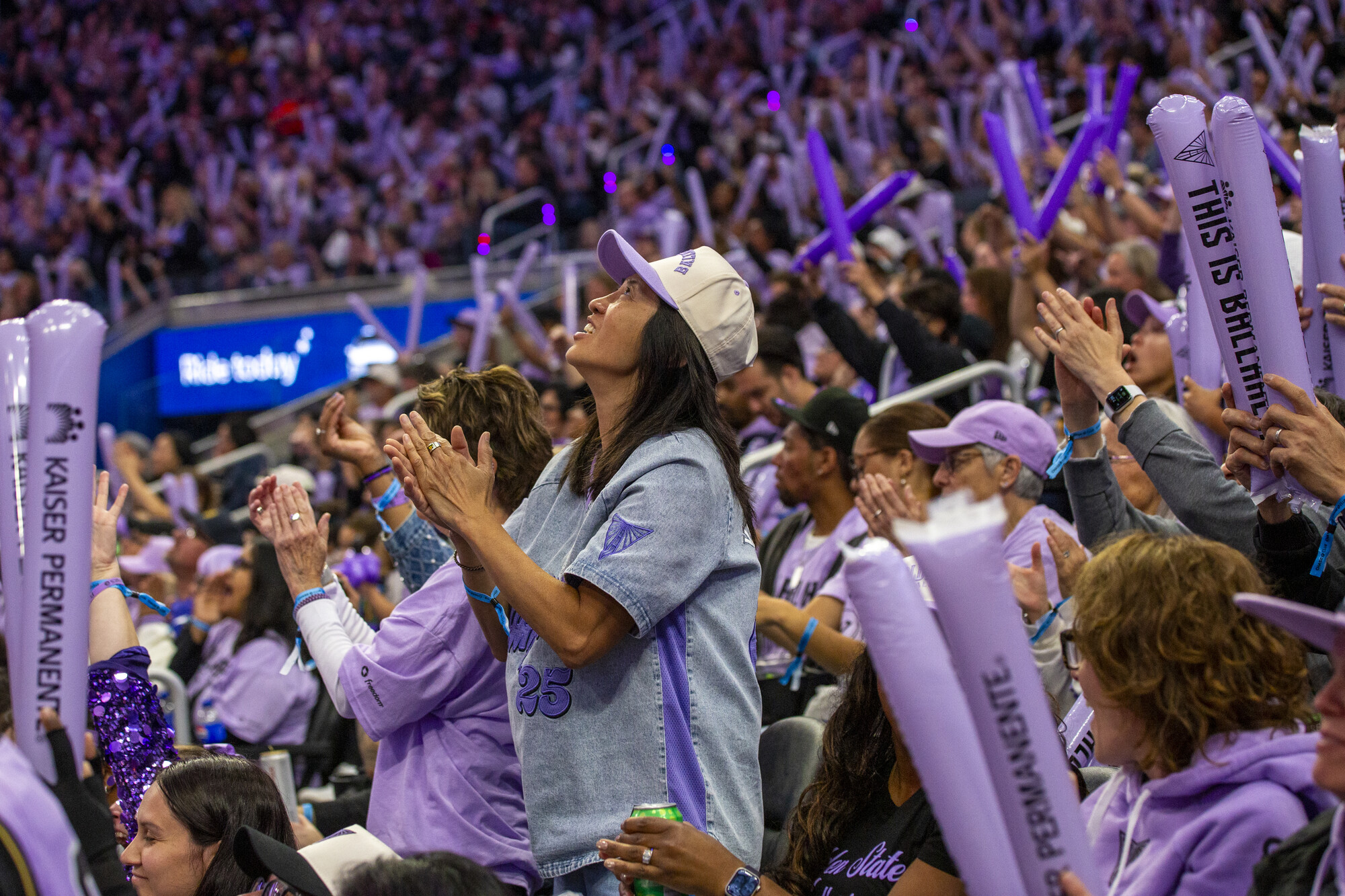
As the crowd in Ballhalla roared, the Golden State Valkyries crushed the Dallas Wings in game 1 of their playoff series Sunday night. Led by coach Natalie Nakase, the team features veteran stars like forwards Gabby Williams and Kayla Thornton but it might be the passionate fan base that sets the team apart. Though only in their second year in the WNBA, the Valkyries have drawn sellout crowds ready to “put their V’s up.” But as the playoffs unfold, the WNBA’s record growth collides with old problems: pay disputes, online harassment and the misogyny that still shadows women’s sports.
Guests:
- Maya Goldberg-Safir, journalist, covers the Golden State Valkyries and writes the newsletter “WNBA Rough Notes”; appears on the KALW podcast, “Bounce,” which covers the rise of women sports
- Tamryn Spruill, author, “The W: A History of the WNBA”; former editor-in-chief, “Swish Appeal”; has written for The Athletic, The New York Times, among other publications
Episode Transcript
This is a computer-generated transcript. While our team has reviewed it, there may be errors.
Alexis Madrigal: Welcome to Forum. I’m Alexis Madrigal. If you’re a Bay Area basketball fan, even a delusional one like me, you know that the Warriors are unlikely to win a title this year or next year or really for the foreseeable future, but you don’t need it to despair. The Golden State Valkyries are the number two seed in this year’s WNBA playoffs, and they look fantastic, with the offense catching up to their historically good defense. So let’s get everyone oriented to the Valkyries as a basketball team and culture. And here to do that, we’re joined by Maya Goldberg-Safir, a journalist who covers the Golden State Valkyries and writes the newsletter WNBA Rough Notes. Welcome.
Maya Goldberg-Safir: Hi, thank you for having me.
Alexis Madrigal: We also have Andrea Fernandez, who’s vice president of marketing for the Golden State Valkyries. Welcome.
Andrea Fernandes: Thank you for having me. So am I.
Alexis Madrigal: Um, are the Valkyries that good? Like, do we have championship potential?
Maya Goldberg-Safir: Yeah. The Valkyries, first of all, good morning, Valkyries fans. This is looking like an exciting morning, in part because the playoffs this year are highly competitive, right? It is wide open. Last night, the number one seed, the Minnesota Lynx, were knocked out by the number eight seed, the New York Liberty, for the first time in WNBA history. And that is just, I think, reflecting the fact that this really is a wide-open field, and the Valkyries have been overall gaining momentum going into this postseason. They are looking — they are playing together, they’re locked in, and their strengths as a team are really coming out. So I do think they have a real chance.
Alexis Madrigal: I mean, one of the things that really struck me, kind of looking at all their stats and the way that they play, I mean, there are two things that stood out. One is, they spread the minutes around a lot, right? You know, they’re not a team — you know, in the old Warriors days, they called it “Strength in Numbers.” You know, they play lots of players. And the other is, they truly, and you link to it in your Substack, they truly have, like, an amazing defense, like maybe the best in WNBA history.
Maya Goldberg-Safir: Right. They have been the top defensive team in the league this year, which was a goal, as stated by Natalie Nakase, the head coach, at the beginning of the year. And I also think it’s important to note that, well, yes, this franchise is only in its second year of existence, and so the fact that we’re talking about a potential championship run is wild. Something that they did really intentionally was that they kept the majority of the roster together from the year to the second year. So we’re looking at a roster that has the most depth in the WNBA and also has this continuity from last season. And I think that’s a big factor, too.
Alexis Madrigal: But of course, I also added the right kind of superstar, right, in Gabby Williams.
Maya Goldberg-Safir: Exactly. Gabby Williams, who partially grew up and played basketball here in the Bay.
Alexis Madrigal: Oakland Bulldogs? Was that her team?
Maya Goldberg-Safir: I think Alameda. I think Alameda, repping the island. Yeah, and Mission Rec in San Francisco. But she’s, you know, has that Bay Area kid in her, which is an incredible fit. She understands the stakes for folks here in the Bay who haven’t had a sustainable pro women’s basketball team, right, for decades. We’ve actually had in Northern California three pro women’s basketball teams that have all failed, dating all the way back to 1980, 1981, and —
Alexis Madrigal: What was that to you?
Maya Goldberg-Safir: That was the San Francisco Pioneers. The San Francisco Pioneers were the first pro women’s basketball team here in the Bay. And they’ve been recognized by the Valkyries. There are players from that team who show up. Anna Johnson, one of the players from Oakland, sits front and center. So, yeah, there’s this historic continuity, even if there hasn’t been a WNBA team here in San Francisco. There was once one in Sacramento. The Monarchs, right? The Monarchs. Can’t forget them. People are just hungry for this and ready for this now. It doesn’t feel like something new. It feels like something sort of soulful.
Alexis Madrigal: Andrea Fernandes, I have one question for you to start out, a big one. What is the origin story of Valhalla? Who came up with that?
Andrea Fernandes: Ballhalla was — it was just, it goes back to the ethos of the Valkyries overall and just the mythological insight of, you know, the Valkyries myth that they, you know, they bring their fallen warriors to Valhalla. So that’s the story behind it. And, you know, people and fans started saying Ballhalla, and we just caught on. It was just kind of one of those moments where people were, you know, just making —
Alexis Madrigal: So you’re telling me you weren’t at the whiteboard —
Andrea Fernandes: No.
Alexis Madrigal: — in a meeting in the Chase Center?
Andrea Fernandes: No, no, not at all. It was definitely something, you know, our fans are very passionate about the Valkyries overall, and it was just a nice way to kind of create this moment and connection to the Valkyries and bringing it to Ballhalla.
Alexis Madrigal: Um, one of the things that’s very notable at Ballhalla and with the overall Valkyries fandom is it’s, like, super creative. You know, something will happen in one game and then, like, the next day, people have posters about it and all these kinds of things. How do you think about it as the Valkyries, like, playing into that fandom, or do you just kind of let the fans do their thing and you guys do, you know, the Valkyries thing?
Andrea Fernandes: I mean, I think we’re always paying attention to what fans are doing and leaning into their excitement and their fandom overall. You know, I think that’s where the origin story of Ballhalla came from. I think it’s something that we’re always looking to pay attention to and amplify in a big way. Our fans are definitely — you’ve heard Coach Nakase say this — they’re our sixth man in a way, where they bring so much energy and joy, um, to the arena that, you know, we’re always leaning into what they’re saying overall and paying attention.
Alexis Madrigal: We want to hear from you. Maybe you’re a Valkyries fan, a longtime Valkyries fan stretching back all the way to last season, or maybe you’re just getting on the bandwagon like some of us here in the playoffs. You can give us a call, 866-733-6786. That’s 866-733-6786. You can email [email protected]. You can find us on social media, BlueSky, Instagram, Discord. I know we got some Valkyries fans out there.
I want to bring in a known fan. Katie Hensel is a season ticket holder with the Golden State Valkyries, also part of the Valkyries Votaries, a fan group. Welcome, Katie.
Katie Hensel: Hi, how are you?
Alexis Madrigal: I’m good. I’m good. How did you become a Valkyries fan?
Katie Hensel: Oh, man. 2025, a friend took me to my first game. And it was actually the first game the Valkyries won. And it was pure joy. It, like, transcended a sport event. And when they won and the streamers came down, it was magic. And to see all these women playing and, like, 18,000 people cheering them, it was so loud, you couldn’t hear anything. I was like — I was in awe because I had never really experienced that in any kind of women’s —
Alexis Madrigal: Sports, yeah. So you’re a season ticket holder? Where are your seats? Are you, like, you know, down on the court hobnobbing with the celebrities?
Katie Hensel: No, I’m in a better seat. I’m actually in the 200s. I am with the real diehards.
Alexis Madrigal: Yeah, women of the people, I understand. Yeah. Were you, like, a WNBA fan before the Valkyries?
Katie Hensel: Um, not that much. I mean, I followed it a little bit. Um, you know, it’s always special to have a team in your hometown. I’ve been, like, a Bay Area sports fan in general, but, um, this, this has been different. I, I, uh, I watched college women’s sports, but I, for whatever reason, I never got really into the WNBA before the Valks.
Alexis Madrigal: Where you had the playoff game on Sunday, first playoff win in Valkyries history.
Katie Hensel: You betcha. How was it? That was one of the best games ever. And it’s so funny, I bumped into people on the street, you know, because everybody’s in their Valks gear and everybody’s like, “Oh, Sunday’s game,” and perfect strangers. Everybody’s like, “Go Valks.” And it’s, it’s been great. That was, that was an amazing game. Am I aware of you?
Alexis Madrigal: And watching games.
Maya Goldberg-Safir: Oh, I’ve been watching games, first of all, right, in Ballhalla, but also, I have been watching games at watch parties in the East Bay, and I love doing that. I will shout out a collective that I am part of called the People’s Watch Party.
Tamryn Spruill: Yes.
Maya Goldberg-Safir: And we came together at the beginning of last season in 2025, a bunch of Oakland-based folks, and we put on these watch parties that I think people have —
Maya Goldberg-Safir: — said it’s like Ballhalla outside of Ballhalla, right? We have our own drum, we have our tradition.
Alexis Madrigal: Because they do this in Ballhalla. They, like, you know, right? Like you mentioned, the, um, the San Francisco Pioneers guard from Oakland, right? I mean, she opened the whole Valkyries thing, like, bang in the drum. You have your own drum. Who, who did it for you?
Maya Goldberg-Safir: Well, so we always have somebody, right, just sort of like with the Valkyries, someone in the community that we really want to highlight. So last game, we had the head coach of the Claremont girls basketball middle school girls basketball team come and bang the drum.
Tamryn Spruill: About time she got her shine.
Maya Goldberg-Safir: Exactly. Shout out to OUSD. Yeah.
Alexis Madrigal: Um, Katie, before we, uh, let you go, we just have to ask: what’s your day job?
Katie Hensel: I’m a pet travel agent, actually.
Alexis Madrigal: Okay, great!
Katie Hensel: Okay, great.
Alexis Madrigal: Thanks. No, I’m just kidding. What do you do? What do you do as a pet travel agent?
Katie Hensel: I run a small business helping people relocate their furry family members to mostly other countries. There’s just a lot of paperwork and a lot of complication, so I help them navigate that.
Alexis Madrigal: Wow, I did not know that was a job.
Maya Goldberg-Safir: That’s the most San Francisco thing, and I will say I met Katie on a street corner while she was grilling hot dogs and handing out free beer out of Valkyries’ game because she and her wife had wanted to do a tailgate all season long, and now they’re doing them, and that’s the kind of new fan tradition that I think is possible here in the Bay. People are just kind of creating their own traditions.
Alexis Madrigal: I love that. Katie, what is your fan group called again?
Katie Hensel: We’re the Valkyries Votaries. We just kind of came up with it on the cuff of “votary,” like somebody who’s extremely devout to a purpose or something, and that’s us. We all got season tickets. We’ve never had season tickets to anything in our lives, so this was a special season for us.
Alexis Madrigal: Um, I love everything about that. Okay. That is so great. Um, thank you so much for, uh, for joining us this morning. Thank you.
Um, Andrea Fernandes, um, just tell me one thing. If people want to get into the Valkyries, what would you recommend? One thing, because you might not be able to get to this point. So what should they do?
Andrea Fernandes: I think one of the things that we have, we have a very robust bar network of 40 local bars around the Bay Area that you can find on our Valkyries bar network. And just go and be with your community and root for the Valkyries, and these bars are handing out some playoff swag. So find a local bar near you and join your community to cheer on the Valks.
Alexis Madrigal: Thanks so much, Andrea Fernandes, Vice President of Marketing with the Golden State Valkyries. Thanks for joining us.
Andrea Fernandes: Thanks for having us.
Alexis Madrigal: We’re, of course, talking about the Golden State Valkyries on a quest for the WNBA Championship. Seated two in the tournament, as we heard earlier, the one seed’s out, so they’re actually technically the highest seed left in the tournament. It’s only their second season. We’re joined by Maya Goldberg-Safir, who’s a journalist covering the Golden State Valkyries and who writes the newsletter WNBA Rough Notes. We’re gonna take calls and questions from Valkyries fans about the team, your experiences with it. 866-733-367. I’m Alexis Madrigal. Stay tuned.
Welcome back to Forum. Alexis Madrigal here with Maya Goldberg-Safir, talking Golden State Valkyries. They are a phenomenon here in the city and across the Bay Area. What do you call their — could you call it lavender?
Maya Goldberg-Safir: I like to call it lavender. I think the official name is violet.
Alexis Madrigal: Yes, all right, I’m calling it lavender, the Valkyries lavender. I just think it’s become such a sign — you’re in a good place. You’re surrounded by that. You know, you’re — we’ve got good people. Natalia in San Francisco, welcome.
Caller (Natalia): Hi, can you hear me?
Alexis Madrigal: Yeah, sure can. Go ahead.
Caller (Natalia): All right. Um, I, uh, yeah, I’m a founding guard. I’ve had season tickets since the first season. I have never had season tickets to anything in my life before this. I am a, you know, WNBA fan, basketball fan, but not really, like, a huge fan to have gotten season tickets, but honestly, best purchase decision ever. The energy, the energy in these, um, in these games at Valhalla is — there’s just absolutely nothing like it. And the thing that I did is I got two season tickets so I could just bring different friends over the last two seasons to experience it with me, and most of them are even, like, less of sports fans than I am, and they will tell you that it’s literally the best event of vintage, and it’s not even just the players and the game, which, by the way, they’re awesome. We have from the beginning had just, like, an incredible team. And our coaches, Coach Nakase is just phenomenal. And I love the players. I love Veronica Burton, especially, shout out, and Gabby this year, this season. But it’s just the fans, it’s the other people and the joy, and it’s a vibe in the arena. And so I’m glad I got to experience it and got a bunch of my friends to wear now Zachary’s Convert.
Alexis Madrigal: I love it. Natalia, thank you so much for calling in. You want to talk a little bit about Veronica Burton?
Maya Goldberg-Safir: Yeah. As a player, yeah. Oh, me, Maya. Yeah. Okay, I thought maybe Natalia wanted to go off on Veronica Burton. That’s totally cool. Veronica Burton is amazing. She really embodies a lot of the qualities of a Valkyries player. She is in it for the team and she’s the point guard. She has been known for her defensive prowess, but she’s turned it on with her offense. She had an incredible arc in the WNBA, right? She went from being cut from the Dallas Wings to — we are, in fact, playing tonight — to then being signed by the Valkyries. And during the first season of the Valks, she was named the Most Improved Player in the WNBA. So she’s sort of been on this journey and is the perfect example of somebody who clearly had not met their ceiling, right? She shattered the previous expectations that folks had of her. And that’s something that Natalie Nakase and the Valkyries front office seem like they are very, very good at. They bring out the best in most all of their players. And I think that Veronica reflects that sort of, like, unknown possibility that’s still there with the team.
Alexis Madrigal: That’s cool. Kristen, Oakland, writes, “Hoping to make it to my first game this season or next. Can your guest speak to the incredible energy of Valkyries games that feel like the old Oracle Warriors days?”
And yet, now a listener writes in to answer this very question on your behalf, Maya, and ours: “I went to my first Valks game this year,” this listener writes, “and it was an insane wall of sound and lavender. It was like Roracle in the old days of the Warriors. They start the game with a guest banging a drum. The game I was at, the guest was Dolores Huerta. And the crowd went absolutely berserk for her, a standing ovation, and the most Bay Area thing ever. I defy the Nordic gods to gather a better crowd. Not possible. Go Valks.”
Maya Goldberg-Safir: I love that. Yeah, it feels like the Bay Area we want to live in a lot of the time, right? There are all these different versions of the Bay in terms of — also, I grew up here in Oakland, and then I lived away for a while, and now I’m back. So I know that there are all of these different sort of versions of, like, what is the Bay Area now? And I think that the Valkyries and Ballhalla bring out this sense of, like, who we want to be together. We want to be joyous and generous and diverse, and we want to be, in a lot of ways, sort of queer-led. You see queer fans constantly all the time on the Jumbotron with signs as really important sort of figures in this. And that’s potentially one difference from the beloved Oracle is that, and as we’ve heard folks saying they haven’t ever had season tickets to something before, there is this, like, influx of newness and of queerness, I think, in pro sports.
Alexis Madrigal: And one of the interesting things is, you know, Gabby Williams, I think it was on the Pride Night game, right? Wins the game and then creates what became like a kind of motto of the season, which was “For the gays.” She said that into the camera, and then that became like — there were posters, there were, you know, this.
Maya Goldberg-Safir: There was the entire arena chanting, “For the gays, for the gays,” which I think is an incredible evolution. I mean, and Gabby also took her credit, right? She said, “I couldn’t lose on Pride Night.” And recently, at the last game, the playoff game, we actually had the rapper Too Short in attendance. Gabby said after the game, “I couldn’t lose in front of Too Short.” So those are her two statements about why she can’t lose: gays and Too Short.
Alexis Madrigal: Um, let’s bring in Tamryn Spruill, author of The W: A History of the WNBA, former editor-in-chief of Swish Appeal, and has written for The Athletic, New York Times, among other publications. Welcome, Tamryn.
Tamryn Spruill: Thanks so much for having me here.
Alexis Madrigal: Yeah, I wanted to bring you in because, you know, if you just tuned into the WNBA as a Valkyries fan, you might think, oh man, the WNBA has always been such a friendly place for queerness and, um, and, and this kind, this new kind of fandom, but that’s not really true, is it?
Tamryn Spruill: That’s not true at all. And before I answer that question, can I just say, as someone who lives in New England, how jealous I am of the fan base that you have, what Maya is describing, what everybody said so far, now that The Sun played their last season. And Veronica Burton, you know, she’s a Newton, Massachusetts, native and played a small stint with The Sun. So you guys really won, and it’s amazing to see her kind of playing towards her side, as Maya commented on.
But yes, the climate was not always like this. Players were not safe and free to be openly who they are. After retirement, Sue Bird admitted that somebody sat her down and said, you know, “You have the look,” which means a person mainstream America might gravitate toward, and that gives you the potential to rack up sponsorships, whereas other players without the look may not be able to do so. So the players very much were presented as athletes with their personal lives and everything kind of in the shadows. The league was very choosy about who got to be the face of the league.
Alexis Madrigal: And what was — what were they looking for, Tamryn? Like, femness? Whiteness?
Tamryn Spruill: Both. Absolutely both. And so when Sue Bird said “the look,” you can look at the lineage of that from Bird. And then, of course, we’re here with Caitlin Clark, and then there’s Sabrina Ionescu. And there are some — you have Maya Moore, who’s very religious and who I would think people would view as non-threatening. Somebody who is covered in tattoos and looks like a stud bud? Not so much. And that has been the case throughout with where so many players have taken issue with how they were treated by their teams. There have been lawsuits where players felt that they were discriminated against for being gay, and things are so different now, and it’s so important that new fans and even the players understand this history and how fragile it is. Because what we take for granted can be taken away. And I think a lot of people in the U.S. today are kind of seeing that with democracy. And so it absolutely applies to the gains that have been won by this league in women’s sports.
Alexis Madrigal: Yeah, because I mean, in your book, you really look at even the prehistory of the WNBA, these previous women’s basketball leagues, what we were talking about just a little bit earlier, which weren’t able to hang on and didn’t become kind of national phenomena. So talk to me a little bit about that history and sort of what the WNBA came out of.
Tamryn Spruill: Well, it’s great to hear Maya speaking about some of the earlier leagues, and the problem historically has been: how do we present these women? And too often it has been through a lens of how do we prioritize that the players are women? And so in earlier leagues, you had players who, during halftime, would have to do, like, a beauty contest. It was very commonplace for women to have to go through kind of, like, a modeling course and makeup lessons and all of these things to amplify that side instead of just letting them play ball.
And the WNBA came out of the ’96 Olympics, and Bay Area founders Gary Cavalli and the American Basketball League. And they were so intentional about that name because they did not want to put “women” in the title. They wanted to create a league where there was a traditional schedule similar to the NBA and that the women were paid more. So in ’96, more of the players who were competing on the USA national team and won in the Atlanta Olympics, the majority of those players first signed to play in the ABL, not the WNBA, because the salaries were much higher. And that league folded, and I do go into, you know, in the book a little bit about how that league saw that they were struggling against the NBA to win sponsorships and really solid broadcasting deals. And they sought ways to ameliorate that, such as a merger, which is not unheard of. We know that the NBA today formed from a merger. And so, but Val Ackerman and the NBA were not about to do that. And as the ABL founder said, he said, “Well, what incentive did the WNBA have to engage us in those talks?” Because if we folded, they could just sign all of our players anyway. And that’s exactly what happened.
Alexis Madrigal: Hmm, oh man. As we go through some of this history, I also don’t wanna forget, it’s a pretty exciting day for Valkyries fans, so let’s bring in Marina in San Francisco with her fan story. Welcome.
Caller (Marina): Hi, I’m Marina from San Francisco, and over the summer I was recuperating at my friend Carol’s house in San Leandro. She’s a founding guard. She reeled me into the Valkyries. I bought a mini plan, and I’d like to do a shout-out to my sales rep Danny Lennon with the Valkyries. And then, as then, I’m part of the LGBT community, and I’m also of Japanese descent. So I went to Japanese Heritage Night, and I did a big shout-out to Coach Natalie Nakase, who is also a Sansei, third-generation Japanese American like myself. And I just find the energy, the inclusiveness, and the community to be so wonderful. I’m now a season ticket holder. And I got the playoff pack, so I went to the game on Sunday. And it’s just a wonderful environment, and I just love it. And I’ve just become an instant fan.
And the key thing about me is, like, I’ve always thought of myself, for the many years that I’ve lived in San Francisco, in Northern California, as not being that — sports was not really a big part of my life here, that I could live a life and not be so where sports is so dominant like in other parts of the country, where it’s like one of the main —
Tamryn Spruill: Mm-hmm.
Caller (Marina): — of sources of activity. But for me, you know, I’ve always prided myself that I can do all these wonderful things in the Bay Area and not be a sports fan, and now all of a sudden —
Alexis Madrigal: Now you’re like, “Oh, I get it.”
Caller (Marina): Yeah, now I get it. And now it’s just — it’s, I mean, the energy at the game on Sunday was just so riveting and electric, and now I’m just like, now I have a lot of merch. I had some jerseys coming in with for Janelle Solon and Veronica Burton, and I have — I have the cats, and I had the freebies —
Alexis Madrigal: Marina, thank you so much. Appreciate this story of a new convert there. Could maybe join the Votaries after that.
Let’s talk a little bit about the coach, Natalie Nakase. Maya, you wrote a substantial piece on sort of Japanese American basketball leagues going all the way back to sort of internment and kind of showing that sort of continuity up to Coach Nakase?
Maya Goldberg-Safir: Yeah, I can talk about that. And also just to say, I think Tamryn and I have something in common, which is our love for the history of women’s basketball. And so you’re getting some of that layered in here, which I think I really appreciate. And I think really just, like, is meant to make you feel more connected to what’s happening right now, right? Sort of like Tamryn talked about, like, not taking things for granted, just having this deep appreciation and excitement about what’s happening right now.
For me, learning more about Natalie Nakase and the legacy of her family really made me just so excited for her to be the head coach of the Valkyries. I wrote this at the beginning of last season. So if you look back on the West Coast, basketball was actually something that Japanese American immigrants, especially Nisei, the second generation, in the early 20th century, that they were playing a lot of here in the U.S. And even before World War II, there were teams out here on the West Coast that were playing in the Young Buddhist Association. And there was a girls’ basketball team from Stockton, California, the Stockton Busy Bees, that were actually traveling to other states and competing against girls’ baseball teams in other states before World War II.
And then, when Japanese Americans were incarcerated during World War II, basketball went with them to the prison camps, and they actually would build their own courts. Sports were a really central part of survival and solidarity, and the Stockton Busy Bees, in fact, were sent to Rowher Camp in Arkansas, which happens to be the same camp that Natalie Nakase’s father — that his family was at.
Alexis Madrigal: Yeah, he was born technically in California and then took the train with his mother, like, a couple days old, to Arkansas.
Maya Goldberg-Safir: Exactly. And after World War II, the Japanese American basketball leagues got much stronger, right? It was really a place of heritage and a place where Japanese Americans could have an important role when they were still being excluded in a lot of ways and facing prejudice.
So her dad, Natalie Nakase’s dad, was a coach and coached Natalie and had her playing — she’s just five foot one. Actually, I’ve heard her say recently, like, it says five-two, she’s like, “I am five-one.” He had her playing up with older players since she was little, and she was the starting point guard for UCLA as a five-one point guard. And so a lot of her approach to basketball, I think her sort of lifelong obsession with it, comes from her dad and from that heritage. And the fact that, yeah, basketball in the U.S., I think Japanese Americans are some of — one of the oldest communities to, like, really embrace it.
Alexis Madrigal: Yeah, I love it. Such a — the coach has such a fascinating backstory and just such a great interview. Every interview I’ve ever seen with her, I’m like, wow.
Maya Goldberg-Safir: She’s an amazing speaker. She says really sort of d—
Alexis Madrigal: Yes!
Maya Goldberg-Safir: She says deep, insightful things, and sometimes you’re like, are you talking about basketball or are you talking about life?
Alexis Madrigal: Life. Why not both? Why not both?
This is, you know, it’s kind of interesting. We have some people who want to talk about — well, Diane writes, in a lecture series on leadership, Steve Kerr was asked what was one thing he would change about the Warriors’ story. He turned to the audience and asked how many people had come to a Warriors game. Less than half raised their hand. He then asked how many people have been to a Valks game. Nearly everyone in this large auditorium raised their hands, and he said, “This is what I wish I could change.”
He didn’t mean that he didn’t want people to go to Valkyries games. Because of still relatively affordable tickets, you see all of San Francisco represented, and it translates into this incredible energy. People are happy, kind, demonstrative, and Ricky’s Bar, the only women’s sports bar in San Francisco, is a great place to watch the Valks as well.
We’re talking about the Golden State Valkyries. They are, of course, San Francisco’s own WNBA team. They’re having a great season. They’re seeded number two in the playoff tournament in just their second season. We’re joined by Maya Goldberg-Safir, who’s a journalist covering the Golden State Valkyries and women’s basketball more generally, with a newsletter called WNBA Rough Notes. She also appears on the KLW podcast, The Bounce, which covers the rise of women’s sports. We’ve also got Tamryn Spruill, author of The W: A History of the WNBA, former editor-in-chief of Swish Appeal, and has written for The Athletic, the New York Times, among other publications.
We wanna hear from you. If you’re a Valkyries fan, you’ve been to Ballhalla, how are you thinking about the WNBA and the growth of women’s basketball? 866-733-6786. Email [email protected]. Find us on BlueSky, Instagram, Discord, or KQED Forum.
Welcome back to Forum. Alexis Madrigal here with Maya Goldberg-Safir, journalist, Tamryn Spruill, author of The W: A History of the WNBA. We’re of course talking about the Golden State Valkyries and the WNBA’s growth. I don’t wanna, even though we’re celebrating the Valkyries and their win and their season, I don’t wanna ignore some of the things that have gone on in the WNBA this season.
Tamryn Spruill, from your perspective, there have been things around Caitlin Clark, who plays for the Indiana Fever, and they’re a star college player, a white woman, and there’s been this whole kind of discourse around her and whiteness and Black players, and it’s been a whole thing. Given your investment in the history of women’s basketball and the WNBA, situate what’s happening there for us in sort of this larger context.
Tamryn Spruill: That’s a great question, and it is unfortunate that in the 30th season, it’s not just celebratory that these are the issues that are coming to the forefront. And I have been kind of pondering all season how, for so many decades, the league was just suppressed into the margins and often ridiculed, and columnists were openly degrading toward the league and its players. And so it finally breaks through into the mainstream. And so then it’s under attack.
And I think that goes straight to the demographics that make the league up. First of all, women, majority Black, heavy percentage are queer. And the people who don’t want to see these people visible in our society then kind of turn on them and want to attack, rather than just letting them play peacefully. There are a lot of things I don’t like in this society and so I don’t engage with them, you know? But when it comes to women and it comes to sports, people somehow take offense by certain groups that they really do not want to succeed and be in the spotlight.
And so it’s pretty unfortunate. It’s longstanding. All of the things that are happening now with Sophie Cunningham, Caitlin Clark’s teammate, about trans athletes and so forth, it’s just another variation of the sexism and misogyny that has just been a through line through the league. So it’s, “Prove you’re a woman and that you’re still marriage material” by appearing in a halftime beauty pageant rather than, you know, engaging with your coach and figuring out the game plan for the second half, all the way to now, who is a — and it’s always the same, um, thread, but just taking on a different form. And the onus is on the league to really set a firm stance on what it will and will not accept. Of course, we want to grow the league, but if it’s, you know, people streaming in who are there to degrade it and the players, then they’re not really welcome.
And you heard from this great fan base. I mean, I remember being at Charlotte’s Sting games in the early 2000s, and I’ve been to, you know, lots of games when The Sun were here, and it’s such a vibrant fan base, so much diversity. People want to feel included. Breanna Stewart even said that. She said that number one is, “We want this to be a place where everybody feels they belong.” And we don’t want these other forces coming in and tampering with that energy because, um, these arenas are, are amazing and they do foster community. Um, and perhaps that’s what’s scary for some, for, for some of the naysayers.
Alexis Madrigal: Yeah, I mean, there is, you know, Caitlin Clark, who played for Iowa and is a fantastic player. You know, people have said that she has kind of changed the league and in some ways brought a lot more viewers, but also a particular fandom has sort of like developed around her. Do you see what’s happening with the Valkyries as being sort of consonant with that Caitlin Clark world, or is it more of an alternative?
Maya Goldberg-Safir: Yeah, it’s really interesting. I think Tamryn pointed to this, too. This is not the first time at all that folks marketing women’s basketball have tried to choose a white woman darling, sort of girl-next-door type vibe, as the face of women’s baseball, right? I think that that has been oftentimes sort of the narrative of the folks who are packaging this game and trying to sell it to a quote broad audience.
But here in the Bay Area, I do think we are seeing the potential for what it looks like. You know, the Valkyries have the highest valuation in the WNBA. They were the quickest franchise to reach a billion dollars in their valuation. And our fan base shows something different. I mean, it demonstrates what happens when you actually acknowledge, like Tamryn was saying, and include these identities of queer folks, of Black-led women’s basketball spaces. And what kind of consumer power, honestly, those communities also have.
We are selling out. The Valkyries are the first team in the history of the WNBA to sell out all of their games in their first two seasons. And so I think that here, especially, and in terms of also, I think this conversation, particularly around, you know, Sophie Cunningham sort of hijacked, I would say, the WNBA season to get her own sort of publicity when she said that she would not want to play sports or girls should not have to play with, quote, “biological men,” right, which is a clear dog whistle not even really to talk about, you know, the rules of women’s basketball or who participates, but really to — towards this anti-trans right-wing movement that’s trying to, you know, end the public rights of trans people and is a really sort of hateful group.
And I think that in terms of that being sort of this headline that has taken over in women’s basketball, here in the Bay Area, we have queer community and trans fans who show up every day for the Valkyries and who feel really recognized and included, right? They are, again, on the Jumbotron, they are founding guards, they are in community with each other. They’re sharing free beers on the corner. I mean, this is a world in which that progressiveness and that queerness is the success of our team. And I think that that’s a way to sort of respond. Yeah, to what some people have sort of pushed as the main narrative of the WNBA.
Alexis Madrigal: Um, let’s bring in another fan here, um, from this great fan base. Emily in San Francisco.
Caller (Emily): Yeah, hey, Super Stokes, you’re doing a whole episode on the Valks. I am also a second-season ticket holder, part of that founding guard from other fans discussed. Similar story, had never really had the chance to be a season ticket holder of our beloved Bay Area sports teams until the Valks came to town. And it’s pretty amazing. I know you’re familiar, Alexis. But for anyone listening, you got to get to Ballhalla.
And my main shout-out is twofold. First, it’s incredible because of the fans and the team. I think there’s, like, a third element that I don’t think anyone’s really gone into. But the entertainment and the Bay Area culture really comes together. I — you probably can resonate with this, but thanks to, like, our amazing in-game host, Ari Waller, and then our two incredible resident DJs. I think DJ Shellheart and DJ Lady Ryan, they really bring the hi-fi to Valhalla and make it what it is. So shout-out to all the people and as well as the Violet Vibes, our incredible dance troupe. So without all of their talents, I don’t think Valhalla would be what it is. Shout out Oakland. And my cousin, yeah, totally. And, um, it’s just amazing. Yeah. You see the Valks gear out. My mailman here in the Mission, Leo, is always rocking his Valks lid and, um, actually trying to help them, you know, get to Valhalla someday soon, maybe for the game on Friday if we don’t win tonight. So just thanks for celebrating this incredible team on the air. And to all the people that make Ballhalla special. All the folks that work, the concessions to all of the entertainment and talent. Thanks.
Alexis Madrigal: Yeah, so appreciate that. I mean, you gotta love the Valkyries fans who wanna make sure the people working concessions are recognized, you know what I mean? It’s like the belonging, the inclusion of the Valks fans is great.
Maya Goldberg-Safir: I mean, even speaking to that, I remember Gabby Williams mentioned when she got here, she grew up playing basketball for a team, the Mission Rec Rebels. And she said that the first time she came to Ballhalla, which was last season, just to watch a game, right? Check it out. She and her mom ran into one of her former teammates who was at a concession stand, and she talked about how much she really appreciated her and seeing her here.
So I think, yeah, we see — I saw an usher when Too Short was performing, mouthing all of the words to the songs. Like, it feels like the folks who are working there have an investment in this thing and that we’re sort of all in it together.
Alexis Madrigal: Yeah, yeah.
Andrea writes in to say, and Tamryn, maybe I’ll bring this one to you, “Looking forward to the day when the connotation NBA is in the presumed men’s sport and women needs to be added on for full equality. It should be the WNBA and the MNBA, not WNBA and NBA, wishing many successful seasons.”
Tamryn Spruill, do you talk to us about sort of pay equality, like how this is going forward?
Tamryn Spruill: I would like to respond to the person who wrote in quickly and say that in my book, I have an author’s note in which I kind of break down some choices that were made. This book is the product of, like, six years of work, and I worked with an amazing editor who also is behind the national team about USA Soccer. And it was important for me to — our language dictates our reality. And so it was important for me to use those terms throughout the book. That it’s sometimes the men’s NBA, sometimes it’s the women’s NBA, and just using those interchangeably for the sake of equality.
In terms of pay, this is — I am just amazed with what the union was able to get done in the most recent CBA. I did not see such a drastic increase. But one of the most meaningful aspects of the CBA is the retroactive payments to former players, honorary payments based on time served.
Alexis Madrigal: CBA, by the way, for folks, it’s just the collective bargaining agreement between the union and the league.
Tamryn Spruill: Exactly. It decides what the salary caps are for individual teams, for the teams, player salary caps based on status and time served in the league and what have you. And to offer those retroactive payments is, you know, it’s kind of a restitution, but it’s warranted.
In the past, there are some reporters who said the pay structure for the WNBA is — I mean, $10,000 a year. In the late ’90s, $25,000 was the average and the low was $10,000. It was, you know, barely livable. It was just above the poverty line. And that feels very intentional to me, that you don’t want to, like, literally on the — on the tables. It’s like just over the line. But if you want to have a professional league, you have to invest in it. And we are finally seeing that page kind of turn to the proper investment, which is producing a much better product and more stability, it seems.
Alexis Madrigal: I also don’t want to lose sight, Maya, of the Valks as a basketball team. We even have a vet who’s almost like, goes across most of this era that we’re talking about here. I mean, Tiffany Hayes is, I think, 37? Is that right? Yeah, born in ’89. Yeah. Yeah, yeah, yeah. I mean, she has been playing in the WNBA for a very long time. Tell us a little bit about her game and her sort of as a bit of an X-factor.
Maya Goldberg-Safir: Yeah, so Tiffany Hayes is a longtime WNBA player. She actually retired at one point and then came out of retirement to play for the Las Vegas Aces, where Natalie Nakase, the head coach of the Valks, was an assistant coach. And she is hungry to win a championship right now, right? There’s this ultimatum from Joe Lacob, the owner of Golden State, who said that the Valkyries are expected to win a championship within the first five seasons. And we are only on season two.
And I do want to say, right, we, as Valkyries fans today, are particularly sort of excited and hopeful. And also, this is an incredibly tough league and field that we are facing, right? There is a lot of parity here, and one team that the Valkyries have not been able to beat this season is the Las Vegas Aces, who could be our next matchup in the semifinal round.
Now, Tiffany Hayes and Natalie Nakase and Kia Stokes, who’s sort of the anchor of our defense and our presence inside, all were with the Las Vegas Aces. So they might be able to sort of strategize, like, the first time that the Golden State Valkyries played the Aces last season, we sort of shut them down. And it felt like maybe there’s some inside knowledge here.
I think Tiffany Hayes is a veteran, but part of what makes her so special is not just her sense of deep knowledge of the game. It’s also that she’s creative and fun, and watching her on the court, it seems like she will do anything. She has sort of a nontraditional dribbling style, the ball comes up pretty high, she has sort of a funky-looking shot, and yet she’s able to make plays and get downhill and sort of trick defenders in this way that’s almost like magic.
And that is, I think, a spirit and a will to win right now that really helps to power the Valkyries. And also, again, is like, we’re not a traditional team, right? We don’t have necessarily one superstar who’s going to, you know, play —
Alexis Madrigal: Take 40% of the shots. Exactly.
Maya Goldberg-Safir: And we’re gonna surprise you in the ways that we can win games.
Alexis Madrigal: We also got a shout-out real quick, Caitlin Chen, who’s been on fire, young player, kind of at the opposite end of her career arc, just getting going, came out of Princeton, then went to UConn, just someone to root for if you’re looking for that player.
Tamryn, obviously we got some Valkyries homers here in the studio, but you as a more objective outside observer, who do you like? Can we win it all?
Tamryn Spruill: I think you absolutely can win it all, and I’ve said it in every interview, in every interview I’ve been asked. And it really comes down to everybody being locked in on the same page and then some teams that have some issues, like you mentioned the Aces. Well, they don’t have the depth on Alyssa Smith is out for the rest of the season, and they kind of got exposed by the Fever last night when they lost Game 2. Um, so if the Valkyries can get it done in Dallas tonight, then that really gives them even more of an upside.
Another very hungry team with veterans, though, is The Dream, with Allisha Gray, and I’ve really got my eye on what they’re able to do. Again, they’re weakened because their center Brianna Jones is out for the rest of the season, and how can they fill that void? Staying healthy and just doing — staying locked into what they’re doing in their plan. I think the Valkyries have a tremendous possibility here.
Alexis Madrigal: Yeah, I mean, like we saw in the NBA with the Knicks, getting hot at the right time, being healthy at the time, it’s all super important.
Maya Goldberg-Safir: We are on sort of a potential, like, crash collision course with New York right now.
Tamryn Spruill: Yeah.
Maya Goldberg-Safir: The Liberty right there heating up. They’re the number eight seed that just knocked out the number one seed, and so, yeah, they’re — they’re kind of getting hot at the right time, too.
Alexis Madrigal: Mike, where are you gonna watch the game tonight?
Maya Goldberg-Safir: I am gonna watch the game at Oakland Athletic Club. Folks are starting up a women’s sports lounge there, and I’m gonna be joined actually by Anna Johnson, the first pro women’s basketball player from Oakland.
Alexis Madrigal: Man, how fun.
Maya Goldberg-Safir: Yeah, it’s gonna be awesome. And then also my buddies from the People’s Watch Party are throwing a watch party at Chingones in downtown Oakland. I know there’s some — there’s Rickey’s in the city. The Valkyries say less. Folks who have a podcast, they are also throwing a watch party. So there’s lots of options.
Alexis Madrigal: Last listener comment: “I’m not surprised that women’s sports teams, whether in basketball or soccer or whatever, bring the best fan energy that’s centered on inclusion and acceptance. Isn’t that what women do? Create community, welcome people to the table, and look at the results. People want more, not less of this. Listen up, sports team billionaires, support women’s sport, bring inclusion to your organizations.”
We’ve been talking about the Golden State Valkyries, future champions of the WNBA, been joined by Maya Goldberg-Safir. Thank you so much for joining us.
Maya Goldberg-Safir: Thank you.
Alexis Madrigal: You can read her newsletter, WNBA Rough Notes. We’ve been joined by Tamryn Spruill as well, author of The W: A History of the WNBA. Thank you. Watch. I’m Alexis Madrigal. Stay tuned for another hour of Forum with Mina Kim. Go Valks.