Bay Area Legends: W. Kamau Bell Asks ‘Who’s With Me?
Airdate: Tuesday, September 29, 2026 at 9 am
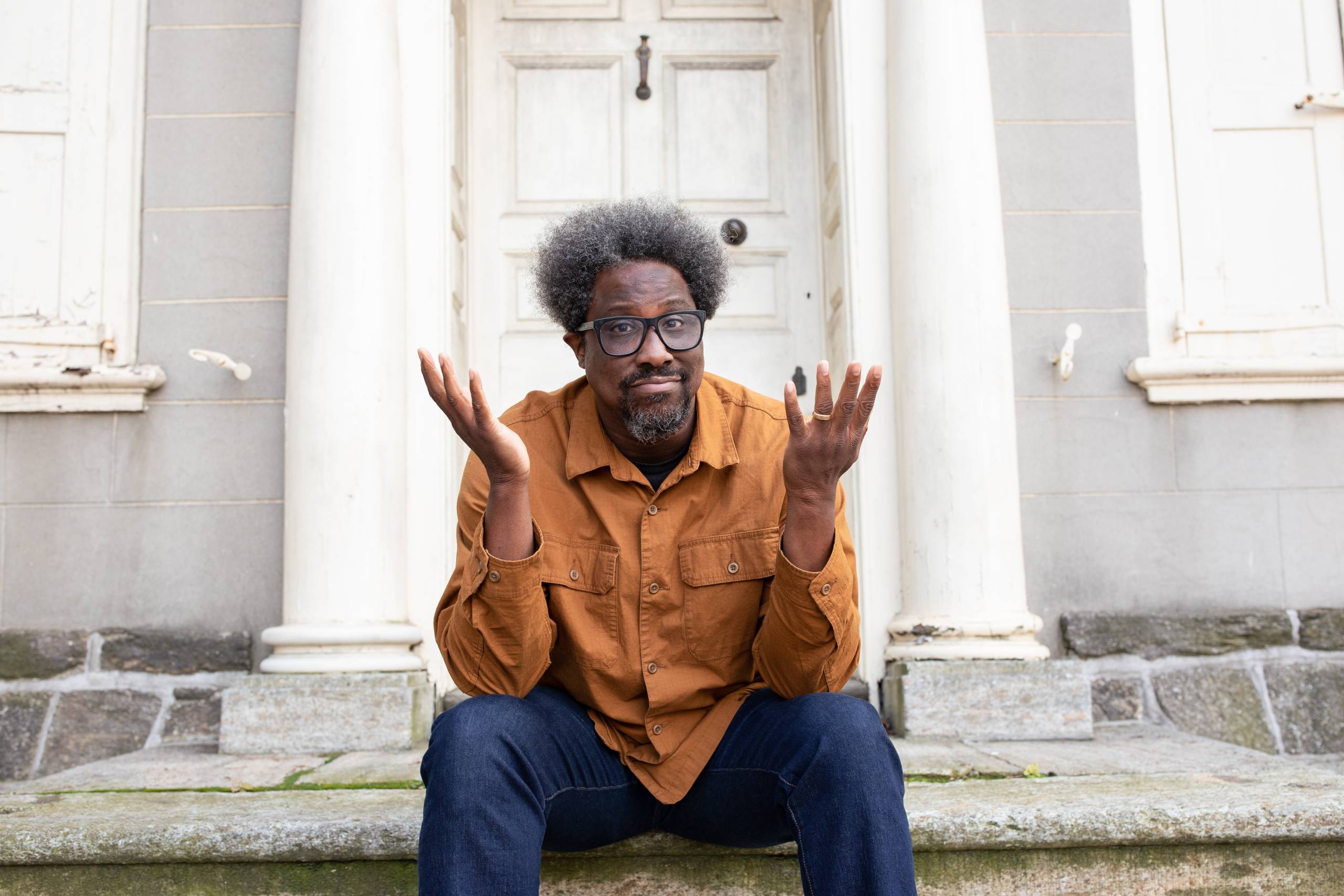
Oakland-based comedian, filmmaker, author and activist W. Kamau Bell is best known for his award-winning series “United Shades of America,” “1000% Me: Growing Up Mixed,” and “We Need To Talk About Cosby.” His touring stand-up set — coming to Stanford’s Memorial Auditorium on Oct. 1 — as well as his Substack and new podcast are all titled with the same question: “Who’s with Me?” Bell says the question “is an invitation to connect, a call to action, and a reassuring pat on the shoulder in these increasingly hectic times.” As part of our Bay Area Legends series, we’ll talk with Bell about forming community and celebrating Oakland.
Guest:
- W. Kamau Bell, comedian, filmmaker, author and activist
Episode Transcript
This is a computer-generated transcript. While our team has reviewed it, there may be errors.
Alexis Madrigal: Welcome to Forum, I’m Alexis Madrigal. W. Kamau Bell is, I guess, in the field of entertainment. When you’re a stand-up comic and have made TV shows and all these things, that shouldn’t feel odd coming off the tongue, but it does a little bit. And that’s because we just do not have an entertainment industry here in the Bay Area. We’ve got writers and artists and dancers and musicians and filmmakers, but entertainment, like, not really, at least not relative to Southern California. So Bell has had to carve a path for himself through that strange Hollywood world while also making a life in the East Bay. And he joins us to talk about both here in the studio. Welcome.
W. Kamau Bell: Thank you. I love that I’m hard to sort of introduce.
Alexis Madrigal: Oh, come on. He’s a comedian, he’s an activist. You’ve also — you’re also a podcaster now.
W. Kamau Bell: Yep, back into podcasting.
Alexis Madrigal: And in one of your podcasts was an interview with Open Mike Eagle. You talked about the concept of living sort of “over there.” Can you explain that for people?
W. Kamau Bell: Yeah. So I think for me, it comes from — it starts with being an only child. So I was by myself a lot, single-parent home with my mom, and so I was always off in my own thoughts and devices, and I was my own best company. And then I would go outside my house and be around other kids and be like, “I don’t feel like I…” This is obviously a hundred thousand years before the internet, so I couldn’t even search for, “Are there other kids like me?” And so I, at some point, felt isolated. And then, as when you get older, you feel like, “Oh, I think this is my superpower.”
And talking to Open Mike Eagle about that, we were not exactly the same, but he had a similar — the way he approaches his craft as a rapper puts him sort of over there. He’s not in the mainstream. He’s a highly acclaimed, highly successful rapper, but not in a mainstream way. Yeah, so I think it’s the idea that, like, you know, the classic is my mom, from a very early age, “Dance to the beat of your own drum,” that quote. My mom said it about me all the time. It’s a way to make me feel better about being over there.
Alexis Madrigal: Man, I just thought it was about living in the East Bay.
W. Kamau Bell: Well, at this point, I think I was living in either Boston or Chicago. So I was way over there.
Alexis Madrigal: Yeah. Um, you did move to the Bay, right? At 24, young, like in the ’90s.
W. Kamau Bell: Yeah, 24.
Alexis Madrigal: Did you immediately feel like, “Oh, this is home, this is my place”? Or were you kind of like —
W. Kamau Bell: No, I mean, I thought I would. I started in comedy in Chicago, did it for three years. At the third year, I was like, “I’m not getting better here.” Moved to the Bay because the San Francisco comedy scene was legendary, and thought, “I’ll be here three years and I’ll move to L.A.” Like, I’ll go to San Francisco, I’ll take over the scene, I’ll move to L.A., and I’ll have my big break somewhere along the way. I’ll go to the Montréal Comedy Festival.
Alexis Madrigal: Yeah, yeah, yeah.
W. Kamau Bell: Go to the Montréal Comedy Festival and get a sitcom, you know, get touring, stand-up, do tonight’s show, and then eventually get a sitcom and be in a Lethal Weapon movie and write a book, was basically what the plan was.
Alexis Madrigal: I mean, you did most of that, I guess.
W. Kamau Bell: I did most of that, yeah. So, yeah, there would have been no reason to even understand why I would stay here, because, as you said, I think there’s more of an industry here than people realize, but there’s not, like, a sustainable live-in-town industry, especially now. Everybody lives where they want to live because of post-pandemic. But back then, there was — the only thing, if you are a comedian who stayed in town, you became known as the in-town headliner, which means you get the headline on the off nights when we’re not selling tickets.
Alexis Madrigal: But now, having spent most of your time — and I spent a couple of years in New York working on that — now you must feel like the Bay is your home, or at least the East Bay.
W. Kamau Bell: No, no. I lived in San Francisco for about 10 years, so now I’m one of those people who comes over here like, “Why is everybody moving so fast?” But, yeah, definitely Oakland is my home. The East Bay is my house. My kids — I mean, I know that because my three daughters wouldn’t live anywhere else. Like, every now and again I’m like, “Man, you know houses in Elk Grove are cheap.” And they’re like, “Yeah, and we see our cousins there, and we’re coming right back home.”
So, yeah, no, my three daughters are the ones who really define me. Because even people from Oakland will remind me that I’m not really from there sometimes because, you know, I didn’t go to high school there. But, you know, my kids are all born there, and they don’t want to go anywhere else.
Alexis Madrigal: Until they moved to New York because they all moved to —
W. Kamau Bell: Yeah.
Alexis Madrigal: Yeah, that’s right. How do you think that living out here has shaped it? I mean, did you already have the politics you have and here it just found words and expression, or do you really think that it really changed?
W. Kamau Bell: I don’t — I didn’t have the politics that I have, for sure, but I was probably headed this direction. I grew up in — I went to high school in Chicago, in Hyde Park. My best friend was, like, a 16-year-old who worked for SANE/FREEZE Nuclear Disarmament and was a Grateful Deadhead who made me go to Grateful Dead concerts, a nice young Jewish boy named Jason. And so I was around sort of — and my mom, the house was all Black books and all Black art, and we would go, “We’re gonna go see Alice Walker.” “Who’s that?” You know what I mean? Like, so the wallpaper of my life, the conversation I was having.
Harold Washington was the mayor of Chicago, so I understood that that was important, first Black mayor. So that stuff was around, but I was not the political one of my friends. Jason was the political one. And then I moved out here.
And I think the best thing that happened to me is that at the time — it’s funny to say this now — San Francisco was too expensive for me to find an apartment. So I found an apartment in a place called Oakland, which I’d only heard of through two short songs. And so I had a job. I lived in Oakland, had a day job in Berkeley at a place called Ned’s Den. So I was around Oakland folks, spending my days at work in Berkeley, which was when Berkeley was still very Berkeley. I think I caught the tail end of that. And then coming to San Francisco every night to do stand-up comedy.
So I got to see a wide swath of the Bay Area from my very early years here and hang out with a wide swath of people. And that’s where I think my politics started to — like, I started to be in conversations where I was like, “I should probably shut up and let these people talk because I have no idea what they’re talking about.”
Alexis Madrigal: Um, you are now making this podcast, and one of the things that I’m excited about for the podcast in general is that there is, for men, this entire manosphere of podcasting. It is just — it’s enormous, and, you know, it has captured so many young men, I think largely by, like, playing to their grievances and insecurities, et cetera. And some of their interests, like —
W. Kamau Bell: Yeah, that’s true. If Joe Rogan didn’t love MMA and instead he loved, you know — I’m trying to think of something that is not as — or as MMA. But if he loved, I don’t know, chamber music.
Alexis Madrigal: Yeah, chamber music.
W. Kamau Bell: That doesn’t capture the audience. But the fact that he’s sort of — and I find he does on purpose — but he loves MMA, and that captures that, that sort of automatically captures that kind of audience.
Alexis Madrigal: What do you think? So what is your approach to try and get to some of those guys? Like, is it a style thing, tone thing?
W. Kamau Bell: I think it’s about clarity and about, like — on the very first podcast, I’ve made sure to include a section of, “Here’s the things I stand for and believe in.” So that if you’re not for that, I’m not necessarily trying to recruit you. If you want Rogan, go to Rogan. Please, God, go to Rogan. Please stay away.
But I think there’s people out there who are like, “I don’t hear strong voices from this side often enough.” You know, there’s always the search for the next Joe Rogan, then they found him. His name was Hasan Piker. And now he’s like, “Not like that. Not that.” That’s not me saying that. I’m saying that’s the response.
Alexis Madrigal: Responses, but —
W. Kamau Bell: I think for me, it’s about clarity through what I’ve learned over the last, especially the last 15 years of my career, just being clear about what I’m for and what I am against. So, you know, the podcast is called Who’s With Me. So if you hear all that and you’re with me, then you’re with me, so we can go.
Alexis Madrigal: Yeah, yeah. I mean, do you think there’s a sort of a version of masculinity that is here in the Bay Area that you feel like would play differently nationally? Like, do you feel you’re, like, an avatar of that, or are you doing something different?
W. Kamau Bell: You’re saying, “Am I — is my masculinity, even, is this specific thing to the Bay Area?”
Alexis Madrigal: Yeah, yeah.
W. Kamau Bell: I don’t think so. I think there are things I’ve learned in the Bay Area, but this is also through — you know, I got a great — like, I got a Ph.D. in America through seven seasons of United Shades of America, so I know my people exist all over this country. And often, like — I remember I did a comedy show in Jackson, Mississippi, years ago. And at the time I was like, “Jackson, Mississippi.” And my dad lived in Alabama, but I had never been to Mississippi. And what happened is, like, all the liberal, progressive people within 500 miles drove to my show.
So I know my people are everywhere. And I know that they need — for a lot of people, like maybe in the Bay Area, it’s like, “Ah, come on.” And then some people are like, “Oh, thank God that guy is saying that, ’cause I don’t hear that anywhere else.” And I hear that when I go on the road, when I talk to people about, like, they feel like I’m giving them something that they’re not getting elsewhere.
So, yeah, I don’t think that — I think we give — I think I’m glad I live in the blue bubble of the Bay Area, although I wish it’d get a little bit bluer. But I don’t think we are unique. I just think we have to — I think the thing we can do is be loud and clear about things that not everybody in the country can be loud or clear about.
Alexis Madrigal: Um, what do you think about our local politics right now? You know, I mean, we’ve got — we got a socialist mayor in New York. We got — I was like, “I don’t think we have socialists.” Seattle. We got the mayor in L.A., or the leading candidates, also socialist, and not here in San Francisco. What do you —
W. Kamau Bell: I mean, I think the job of the people of any — wherever you are in the city is to — I say this, people don’t always like this — is to bully the person who’s in the bully pulpit. I think that’s the idea, is that whoever it is, whoever it ends up being, they should never feel like they are in a comfortable position.
And I don’t mean that in a violent way. I just mean it in a literally adversarial way. Like, you’re not — you need to do better. And so I think even if you look at Mamdani, there have been many times in his short term he’s been like, “Oh, okay, all right,” because he understands, “That’s what I’m here to do. I’m here to listen to the people.”
And I live in Oakland, so I got Barbara Lee. Barbara Lee still speaks for me. And I feel like Barbara Lee has done a great job in her short time in office. And again, often these mayorships in Oakland and San Francisco are used as stepping stones to the next thing. I don’t think Barbara Lee is using the mayorship of Oakland to start her career.
Alexis Madrigal: “I finally could get on the —” like she’s been dreaming of.
W. Kamau Bell: Yeah, “Finally, I get my political career in order.”
So I think it’s a tremendous gift to Oakland that Barbara Lee is doing that, and hopefully allows that next generation to sort of get ready to take over after she’s done.
Alexis Madrigal: I think she’s definitely gonna run again.
W. Kamau Bell: She’s running again.
Alexis Madrigal: Yeah, yeah, yeah.
W. Kamau Bell: And I would say, you know, San Francisco, which I don’t live here anymore, so I’m speaking as an outsider, I guess I’d have to cede my opinions on the mayor of San Francisco to Nato Green.
Alexis Madrigal: Your friend, comedian —
W. Kamau Bell: And labor organizer. Like, you know, I don’t know. Cities, governments, countries should not be run like a business, I think, full stop. So whether the mayor is a billionaire or not, please do not run this — we’re not trying to maximize profits in a city. What we want to do is the thing that services — and San Francisco has already lost its identity over many years because of housing prices and things like that. And this used to be a place where the broke artists came and made their way, and now those broke artists are not moving here. They’re not moving here. They can’t afford it.
So whatever you can do to make sure that the mission stays very mission and that this is a place for artists and it’s supportive, and also supportive of the unhoused community and whatever — that’s what the city’s supposed to be. It’s not supposed to run like a business.
Alexis Madrigal: Um, Chirp writes on our Discord, “I first saw W. Kamau Bell at a gig he had in SF in the basement of a video rental place on Valencia.”
W. Kamau Bell: I agree. That’s hilarious, yeah. That’s funny. That’s not even that — that was after I moved back from New York. So that was me moving back from New York, yeah. What was that place? Yeah, it was the video store. And that was moving back from New York, and I was sort of, like, trying to get my act back together, literally.
Alexis Madrigal: We’re talking with comedian, filmmaker, author, and activist W. Kamau Bell about cultivating community in turbulent times, local politics, lots of other stuff. You may know him from his series United Shades of America, 1000% Me: Growing Up Mixed, and We Need to Talk About Cosby. He’s the co-founder with his wife, Melissa Hudson Bell, of Who Knows Best Productions, a media production company in Oakland. He’s gonna be performing at Stanford Live this Thursday at 7:30. And, of course, we wanna hear from you. What do you wanna ask Kamau Bell? 866-733-6786. That’s 866-733-6786, [email protected]. I’m Alexis Madrigal. Stay tuned.
Welcome back to Forum. Alexis Madrigal here with W. Kamau Bell, talking about cultivating community, turbulent times, politics, et cetera.
Kamau, where are you at with this election? I mean, polling is obviously running strongly towards a Democratic wave, but there’s small waves and there’s big waves. What do you think?
W. Kamau Bell: I mean, I think the biggest thing that we on the left have to sort of make sure we’re clear about is that the right is actively creating a natural voter suppression just by being aggressive and speaking in violent rhetoric and also because ICE is still out there.
So I think that, you know, there’s this idea: Will ICE be running around all the polling places in the South and in Black neighborhoods? Probably not. But are people going to think twice about voting in some of those places because they’re just worried about, like, what it’s going to be like to get there and they don’t want to get caught up? I think that’s certainly true.
So I work with the ACLU, and so I think the idea is to, like, make a voting plan, make sure people in your life are voting. But a voting plan is very important because we don’t know what this — well, no, we actually know exactly what this president is capable of, and we have to be prepared for it.
Alexis Madrigal: I mean, it’s strange, you know, Trump has always been kind of unpopular. If you look at his polling numbers going way back, he’s basically been unpopular except right around Election Day. Do you think Trump — I mean, I want you to kind of use both your political brain and your kind of entertainer brain, too.
W. Kamau Bell: I do that every day.
Alexis Madrigal: Yeah, yeah, yeah. I mean, do you think, like, Trump is, like, a singular figure, or will there be another right-wing figure who can fit themselves into that strange Trump spot in American politics, which didn’t really exist before him?
W. Kamau Bell: I think — I mean, I just interviewed Don Lemon about this, and I was like, you know, Trump every now and again jokes about maybe I need to stay in after the next election, and I don’t think that’s a joke. I think people want to frame it as a joke because otherwise it’s scary, and I’m like, why don’t you be scared? Maybe we should be scared.
Sometimes, so I believe there’s no person they have on the right — J.D. Vance can’t do it, Marco Rubio can’t do it. Even just saying his name makes me laugh. Do you see that clip of him talking about how his favorite rapper was Tupac? And he talked like he was reading a Wikipedia entry.
So the idea being that I think it is — we have to prepare for the fact that sometime around the next presidential election, Trump’s gonna be like, “Guys, I can see that this country’s not ready.”
Alexis Madrigal: Only Trump can do it.
W. Kamau Bell: Yeah, so I don’t think that there’s another Trumpian figure, but I do think that they are actively working to figure out a way that he doesn’t leave. And then if he can embed himself in for one more term, then we’re in a whole new world. And I don’t want us to take that for granted.
Every time I hear the news, and I even hear it from stations like this, “Well, the next election…” I’m like, stop saying that. Like, that’s a thing that is just gonna happen. It’s not just gonna happen.
Alexis Madrigal: I mean, do you imagine, just imagining into a scenario in which there is another really contested election or major challenge to our democracy in a general sense, what do you think happens at that point? Like, do you think we actually take some steps to, like, re-solidify democracy? Do you think —
W. Kamau Bell: Look, if we don’t actually understand that what is needed is structural changes — yeah, like real and institutional changes. Like Supreme Court, you guys maybe get 10, 15 years each and then see if you need to get re-upped for your contract. I don’t think — and, you know, I worked with an organization through my friend Nato Green that was about court expansion. Like, nine Supreme Court justices is just a thing that they did. It’s not a thing that is, like, sort of carved into the text of the Constitution, you know?
So I think that — and if we don’t figure out, like, if you’re running for president, we need it. It is necessary. We get your tax forms. Not a thing we’d like to have. I think we thought a lot of these things because people did it, that they were somehow baked in, and they’re not baked in.
And I think if the next — if let’s say the left does get in and there is an election, whoever’s there, if they don’t really hold people accountable for what happened, I think that we’re just sort of the bouncing ball of America still.
Alexis Madrigal: Um, let’s talk about something that happened here locally. You know, Stanford University centered a controversy for taking a photo of three students and then using generative AI to alter it for its banners, swapping a Hispanic male student with an AI-generated Black woman and altering the appearance of the other two kids to make them skinnier. Take off that freshman 15.
Do you have any — I mean, like, it’s such an interesting kind of microcosm of so many weird things all happening at the same time, and also coming out of a place like St —
W. Kamau Bell: Stanford’s like, didn’t you do enough with Elizabeth Holmes, Stanford? Like, shouldn’t you really be more careful? Aren’t they also kind of responsible for Sam Bankman-Fried? I’m just saying that they are clearly doing the most. They’re doing the most.
And I would say, you know, Stanford, if you want to have Black young women students, why don’t you just admit more Black women students? There’s a way to make that happen. You could admit so many that they were just in all the pictures, so there’s an easy way around.
And I think it also — man, I feel bad. Billy Ramirez is that kid’s name, apparently. I feel for Billy. He’s Latino. “What am I, chopped liver? We’re used to it, it’s fine. I’m not German. What are you doing taking me out of the picture?”
I think it is an indicator of the fact that AI — people, and Stanford is certainly a place where this would come from because of it being in Silicon Valley — people are just embracing AI. There’s no shame around it anymore, and I think that is a problem. There should be shame around it.
And I see people I respect online, and you can see it in YouTube thumbnails of podcasts that I like, hosted by people I respect. We’re like, “That’s AI, and your old thumbnails didn’t used to be AI, so you’ve clearly, like, fired somebody and you’re having now somebody else…” And I think it is — I think it’s anti-life, it’s anti-creativity, it’s anti-what we all should be doing here, and I think it’s dangerous.
And I’ll say this: So my run-in with AI that I think has probably put me off is the day that Charlie Kirk was killed. I was like, “Did me and Charlie Kirk ever have a conversation online?” I was like, because I’ve written to all those people at one point or another. And I Googled it, and the Google AI said, “On the day Charlie Kirk was killed, W. Kamau Bell made a joke about Charlie Kirk and got a lot of pushback on the internet.”
This was the same day. You were like, “That didn’t happen. I didn’t have a stroke?” Like, you know what I mean? Like, so the — it’s called AI hallucination. The AI told me that I had said something about Charlie Kirk that I’d never said and had a link to a thing that linked to something that wasn’t — that did not back it up.
And I was just like, this is what — this is what we’re turning over our bank accounts to. We’re giving it all our information. We’re saying, “Make a picture of me like I looked when I was in the ’80s.” We’re doing all that for the sake of something that is giving us very little value back. My kids, whenever they see —
Alexis Madrigal: Obviously AI things, they go, “What in the AI?” And I just think it’s, like, so funny. And, you know, I just like — they seem, they actually, at least my kids, maybe it’s an East Bay kid thing, they are for you. They are like, “I am anti-AI and all.”
W. Kamau Bell: Of course there’s AI in everything you do. Every time I type a thing in the Google Doc and AI is like, “You could write this better.” You know what I mean? Like, and I’m not anti — it’s the generative AI. I get that there’s a part of AI that is like, “This will make this one better.”
I know that they’re scientists really using AI to try to, like, cure cancer, but they’re using it. They’re not just typing in an AI prompt, “Please cure cancer,” and sitting back and going, “Oh, here’s the cure.” You know? So I think it is a tool that is being overused.
I really think it’s a bummer that a place like Stanford that is about education is just turning itself over to AI and buying into the ad bubble.
Alexis Madrigal: Let’s talk about what you’ve called the post-DEI era. You said, as you were launching your podcast, going direct to the people, you said, “This is me investing in myself because the industry is not investing in people like me anymore.” I mean, I’m not a Hollywood guy. I know nothing about how it works. I know. How intense has that changed been?
W. Kamau Bell: Oh my God. It’s so —
So the production company that you listed at the top, when we started it, we had a deal with a production company and a bigger production company in Los Angeles that was a two-year deal that went away after a year. So I had to lay off — like, I had a small staff, three or four people — and lay off, like, most of them.
And then, like, a year later, Kelly Rafferty, who I love to death and she still helps me on my Substack, who had been with me for like eight years, I had to lay her off. And she — well, no, she found a new job. She works at the Greater Good Foundation in Berkeley. So I didn’t lay her off, she went. And I was like, “Good for you!” Yeah, I couldn’t pay you exactly. “Yeah, do they have health insurance? Can I get a job?”
So it’s absolutely — many projects I did — I had a deal for two seasons of a TV show with a streamer that just went away. Now, they had to pay me out because I’d already signed the contract. But that was a thing that would have led to other things.
I have several — like, every idea I’ve had for the kind of documentaries I’ve done in the past, when I’ve tried to sell them, they’re like, “That’s great. Not here.”
So, I mean, part of the reason why I went back to stand-up was like, thank God I have other skills. A part of the reason I’m like — I’ve always felt fortunate about, like, I’m not relying on any one thing. I got that advice early in my career from Kevin Kataoka. And so I have other things I have to do.
But it is about, like, I’m — you know, my wife is a part of the company, but I’m a one-man band at this point. Like, you know, my office space, Cheryl Dunye has moved in and we share it together. So there’s — it has become a place for other creatives, but it was supposed to be at one point, like, the launching pad for more.
Alexis Madrigal: And do you think that —
W. Kamau Bell: So I’m looking for a job, KQED. That’s what I’m trying to say. I actually came here —
Alexis Madrigal: That’s why we got you on.
W. Kamau Bell: With my LinkedIn. I wish I was kidding. “Open to work.” Open for business.
Alexis Madrigal: Okay, so thumbs up. This is a real offer, okay.
Alexis Madrigal: Um, do you — and, you know, Larry Ellison’s company has also sort of bought many of these things. I mean, do you — obviously, that, I would imagine, would make things worse for somebody.
W. Kamau Bell: Yeah. The political stripe. It’s weird to be like, man, can we sell TikTok back to the Chinese? But that’s actually — I think most people on TikTok would prefer that it went back to Chinese ownership because the platform has suffered since it’s been taken over by Larry Ellison.
And I’m also down with the Committee for the First Amendment, and I’ve been doing stuff with the Block the Merger folks, which Rob Bonta — I don’t know what happened. The idea that this media — not only is this media consolidation just bad, just full stop, because it’s bad, because there’s less choices, but it’s being consolidated by people who don’t have a creative bone in their body, like David Ellison.
Alexis Madrigal: Outside the politics.
W. Kamau Bell: So it’s not even — outside of the politics, it is not like, if Walt Disney consolidates the industry, well, it’s like at least he’s interested in entertainment. I mean, the guy, not the company. But, like, these are people who are clearly — and they don’t even care about profits. They just wanna own everything, and then they have to worry about profit.
So the idea of, like, even though things make money, we’re not gonna do them. We’re gonna destroy 60 Minutes because we don’t like what it’s doing, even though it’s one of the most profitable shows on television.
Alexis Madrigal: Yes, shots at Bari Weiss.
Alexis Madrigal: In the happy scenario for what happens, though, right, is you — let’s say the Substack takes off. Let’s say the podcast, you know, takes — I mean, yeah, I would be clear —
W. Kamau Bell: This independent version of myself is doing well, and it could be better. Although I am still looking for a job at KQED.
Alexis Madrigal: But, like, yes, yes. But there’s this happy scenario where, in some way, you’d be able to do whatever you want, backed directly by the people who love what you do, who’ve come with you. And then maybe you can make —
W. Kamau Bell: Way more stuff. Well, no, for sure. That’s why it was important. Like, when I started Who’s With Me, the podcast, there was a talk at one point of somebody — of, like, a company paying me to do the podcast. And at first I was like, “Yes, I would love to have that check.” And then you go, “Wait a minute.”
And then the industry kept shifting. I was like, I think I need to own it. ‘Cause I need to be in a position where, if it goes well, that the beneficiary is me and my family as opposed to me and a co.
Now, I have partnerships. That’s on Pushkin. Ravagnan Productions helps me do it, but we’re all in partnership together. But I own the podcast, I own the RSS feed and everything.
So, and also, if it goes badly, at least it’s still mine, you know? And I can make this, like, “I did it myself. I don’t need anything.”
Alexis Madrigal: Yeah, yeah, yeah. You’re not getting notes from an executive.
W. Kamau Bell: I just need this podcast, this Substack, and this — that’s a reference to The Jerk, everybody. But, yeah, so — but, yeah, I’ve seen the deals, like Joe Rogan going to Spotify, and I don’t think I’m — you know, is that likely to happen? Probably not to that extent, because I’m not promoting white supremacy and Trump. But I think there is a version of this that I build up, and I’ve seen it happen with other people. So, yeah, I have to bet on myself.
Alexis Madrigal: Let’s bring in Mike in San Francisco here. Welcome, Mike.
Mike: Hi. Um, uh, thanks for the Jerk reference. Really appreciate that.
Alexis Madrigal: You’re welcome. Thank you, Mike.
W. Kamau Bell: You’re with me.
Mike: Yeah, Carrie Fisher was awesome blowing up that gas station. Um, uh, I’m wondering, so we live in — we always forget that we live in historic times, and I think Trump has been a revolutionary for who he is. Um, meaning that, you know, we can also have a progressive revolution on the other side. Do you see any hints of that happening as you travel the world?
W. Kamau Bell: Uh, yeah. So I would say this: I think Mamdani is, like, an example of, like, people going, “We’re, you know, we’re going in the opposite direction.” New York — which, first of all, I think it’s great that it’s New York because we don’t really — we don’t think of New York as being a progressive place, and sort of — but New York was like, “We’re doing the opposite of that.” And Donald Trump’s from here. We want to run in the opposite direction.
So I think this next election will show us. Like, I mean, Abdul El-Sayed, if he wins in Michigan, that’s a big deal. If Angie Nixon wins in Florida, now we’re talking about something, a Black woman winning in Florida at that level like that.
But I do think we, as much as it’s great to think about this revolution, we’re also losing people. There’s also a physical cost. You’re talking like Renee Good and Alex Prettie in Minneapolis. And also, even Nolan Wells is a part of the fact that we’re losing people around this country because of the state of this country.
So I think that, you know, you don’t have to look far to say there’s a casualty of this revolution. So I don’t want to get too caught up in the excitement. And also, I don’t want us to think it’s just gonna happen.
I mean, you know, again, Mamdani had to work real hard and people had to really work real hard for him to get him in that position. And so I don’t think we want to sort of think that, like, “Oh, the revolution’s happening, I can go back to Pilates.” No, you can go to Pilates, but also you gotta get in the streets.
Alexis Madrigal: Swolotariat, you know that?
W. Kamau Bell: Yeah, yeah, yeah.
Alexis Madrigal: We’re talking with comedian, filmmaker, author, activist W. Kamau Bell about our times, our turbulent times. We would love to take your calls, your questions for Kamau Bell. How are you finding community? How has politics changed for you over this time? 866-733-6786. That’s 866-733-6786. Forum at KQED. You can find us on Bluesky, Instagram, Discord, or KQED Forum on all those things.
Here’s a little deep-cut biographical question for you. A listener asked, “I understand W. Kamau Bell attended UChicago Lab School, as did Chesa Boudin and myself. What was your experience like?”
W. Kamau Bell: So I think Lab — it really depends on when you were there. So I was there, I graduated in 1990, which felt very modern back at the time, but now it feels very — so it was 100 kids. It was — every kid had to — was like, I was unique in that I was graduating without college credits. Like, everybody was trying to go to college as a sophomore.
Small Black student group, like, small Black community, and no real developed arts programming at the school. I have been back. There’s Gordon Parks — there’s a Gordon Parks theater, like a Gordon Parks wing at the school now. There’s multiple theaters. I think Sherry Lansing donated — that’s paid for — theater. So there’s a huge arts component to that school that was not there when I was there that would have changed my flipping life if it had been there.
Because I was leaning towards the arts, but there was nothing to grab for. And so they did not take it seriously. So when I go back, I get really jealous of the kids who go there now.
And I got to go back and do the commencement years ago. I was like, “I’m pretty sure I’m the only B-minus student who ever got to come back and do commencement.” But I really — I wish I could go there now, because at the time I felt pretty lost at that school because it was like, “I don’t — I’m not trying to go to college as a sophomore, so I don’t know what else there is for me.” And there weren’t that many Black kids, so I felt lost on that level, too.
Alexis Madrigal: Yeah, yeah, yeah. Let’s talk a little bit — your career as it passed through the DEI moment. Do you think you would do anything differently, like if you could go back and redo those years knowing that it might just be two years of providing support for people like yourself?
W. Kamau Bell: I mean, I think the — so, would I do it differently? It’s funny, I did Megan Rapinoe’s podcast recently and she said something. She didn’t put it this way, but this is the — and I understood she didn’t mean it the way I sort of heard it and understood it. It was like, “It seems like, Kamau, you could be more famous and successful than you are, but you’ve made choices.”
Actually, that’s how I wrote it, but I just said it differently.
Alexis Madrigal: Yeah.
W. Kamau Bell: And was like, fair. I don’t know that I could have made different choices. And let me be clear: the fact that I have gotten — like, if I didn’t have kids, I would just be retired telling the tale of my CNN show and how, like, I had a show on CNN. So it is the fact that I still have my mom, a 90-year-old mom, that I had to be sort of still capitalistic in my endeavors.
But I had seven years of a show on CNN. And at one point, me and Bourdain were like — he was the lead into my show. Like, I don’t know how much better it gets than that, you know? I’ve — when I look back, you know, I want Celebrity Jeopardy.
Alexis Madrigal: That’s right.
W. Kamau Bell: Like, there are things. I think I can only be me because I’m never doing things the way that I’m supposed to do them, Megan Rapinoe. But, and then I end up in places where I’m like, “Huh, hmm.”
So even right now, when I’m not sure what the future holds, I’m still betting on myself. The thing that makes it more stressful now is Trump and having three kids. Like, you know, that makes it more stressful now. But, like, I had those kids on purpose, meanwhile, right? So it’s not gonna — I blame America on Trump. So I can’t — I can take that blame.
But I do look at my career. I don’t think that I’ve — it would be different if I felt like I was the only person who was struggling in show business right now. That’d be one thing. But when you hear Issa Rae talk and Ava DuVernay talk, and you hear them navigating — and I’m like, they’ve accomplished more than I have and they’re also trying to figure it out.
Alexis Madrigal: We’re talking with comedian, filmmaker, author, and activist W. Kamau Bell. Take in your calls and your comments, 866-733-6786, [email protected]. You can catch his stand-up set live at Stanford Live this Thursday at 7:30. I’m Alexis Madrigal. Stay tuned for more of Forum after the break.
Welcome back to Forum. Alexis Madrigal here with comedian, filmmaker, author, and activist W. Kamau Bell. We’ve been talking about politics, we’ve been talking about career stuff, Hollywood.
Let’s talk about the stuff you’ve done with your kids. You made this doc, 1000% Me: Growing Up Mixed, with your daughters, about growing up mixed race in California and the Bay. Did they go back and watch it ever?
W. Kamau Bell: Oh God, no.
Like, my middle kid can’t even look at the poster for it. It’s in my office. She has to walk past it. I mean, I like to say that we caught each of those kids’ last cute day, because after that they became adolescents and young people. And so it certainly holds weight in our family.
We are friends with many of the families from that. We met through the process. I just went to Sumaiya, who’s in the film — we just went to her mom’s birthday party a couple weeks ago. Me and Melissa did. And my eight-year-old, who was like four when that movie came out, plays with Sumaiya’s younger sister, Jalila. Like, they’re friends. And so that’s been one of the long-lasting impacts.
I just ran into Miles at Colin Kaepernick’s event in Berkeley. Miles, who is like one of the stars of the film and is now as tall as I am.
And so, yeah, I mean, I think they sort of know that Dad every now and again is like, “Hey, you wanna do this thing with me?” And they were really proud — I was like, they can’t — they were really proud to be part of the production of the film. Like, they did some set design. And, yeah, yeah. But I don’t know when the last time they watched it.
Alexis Madrigal: You are — you also did a children’s book, though.
W. Kamau Bell: Yeah, and this is another one of me going, “Hey, kids, you wanna do this thing together?” So me and Adam Mansbach, who’s a Berkeley author — most know him for the parody of a children’s book called Go The, I can’t say it on KQED, Go The Sleep.
Alexis Madrigal: Go to sleep to sleep.
W. Kamau Bell: And we’ve been friends for years and done a lot of political PSAs together, and he’s a screenwriter and a children’s book author. He did a book with Matthew McConaughey’s wife, Camila Alves McConaughey, and I jokingly said to him, “Hey, you make me do all these political PSAs, like Dads for Abortion. Can’t we write a kids’ book?”
Alexis Madrigal: So, in Adam’s fashion style. A natural segue.
W. Kamau Bell: Yeah, yeah, yeah. And so he was like — we had breakfast, and then he went home, and that night he was like, “The first draft’s in your email.” “Actually, don’t look at that one. The second draft’s in your email!” And then we started collaborating.
And we had an illustrator named Brianna Chambers, who — it’s all about my family. It’s called Rock, Paper, Scissors, Cheese. And I just wanted to write a fun kids’ book that — people are like, “You wrote the kids’ book about racism?” It’s not kids’ problem. It’s adults’ problem.
And so it’s about a boring day at the house where everybody sort of has lost their marbles, and we all come together to play, to expand upon rock, paper, scissors. So the idea — it is about creativity and defeating boredom and kids’ negotiating skills.
Alexis Madrigal: Oh, yeah, and what role did the kids actually play in it?
W. Kamau Bell: So this is the big part of it.
Alexis Madrigal: Correcting your dialogue?
W. Kamau Bell: No. So there was a joke that my eight-year-old’s like, “I’m not saying that.” I think she had to say — the punch line is either, I think it’s “butt,” and she was like, “I’m not saying that,” so we shifted that.
They were really in it. And then when Brianna, our illustrator, drew them, they were deep into what they were wearing, how they were portrayed, and the big thing was skin tone.
So I have interracial marriage, mixed kids, and it’d be easy to say that my oldest daughter and my youngest daughter have the same skin tone. My middle kid and Melissa are both — like, my middle kid, I’ve talked about a lot, can pass for white in certain situations. You could say her and Melissa have the same skin tone.
But Brianna and my kids worked really closely together to make sure that, like, my oldest and my younger daughter, they’re not exactly the same. Or me and my mom — we’re both African American, Black people — but our skin tone, if you put them next to each other, they’re not the same.
So I’m really proud of the fact that it shows. That’s the thing that I think is about race in there. It shows that this is all one family, but they all can look different.
Alexis Madrigal: Um, we have a good listener question here. A little preview of tomorrow’s show. William writes, “I saw W. Kamau Bell in line for the NBA All-Star game at Chase, but sadly not at the VIP limo entrance as a man of the people. What is his take on the Valkyries’ run or the Warriors’ upcoming season?”
W. Kamau Bell: Look, okay, let’s talk to the Warriors first. Just be grateful we had four championships.
Alexis Madrigal: That’s true.
W. Kamau Bell: Stop. I moved here in the ’90s when they couldn’t give the tickets away. Like, literally, they couldn’t give the ticket away. So when we were like, “Yay, we drafted Todd Fuller,” okay, instead of Kobe Bryant. Let’s be brave. We adopted Todd Fuller over Kobe Bryant.
So, be — I think the — and I think Steph is doing this right. He just signed a big contract. He’s like, “I just want to stay where my family lives, and I like the Bay Area.” And he wants to be competitive, but he knows. You know what I mean?
And I think that’s respectable in the era where LeBron James is like, “Now I play with the Sixers. Now I play with the Sevens and the Eights.” And then, you know, so, so I think that — so, but I think I just wanted Warriors fans to know: just be grateful, ’cause it may never get as good as it got again. And we were lucky. It was serendipitous that it got that good.
So that’s my — I feel like when Klay left, that was really it.
Alexis Madrigal: Yeah, and I think Klay will come back eventually.
W. Kamau Bell: You know, they come back and sign a one-day contract. He’ll be back.
Alexis Madrigal: Yeah, so he can retire.
W. Kamau Bell: Just to be — just to — but, and then the Valkyries, shift your championship attention to the Valkyries because they are — what, they’re two years in, and they made the playoffs in their first year. Second seed this year.
Alexis Madrigal: Second seed this year, won their first game of the playoffs.
W. Kamau Bell: That’s where your championship love goes. And I’ve been to one Valkyries game, and I like the Warriors games. That’s exciting. Steve Kerr is a friend. That’s great.
The Valkyries is such a cool experience. It’s funny to be in the same building and feel like this just feels different. It’s ’cause the fan base is different, because the way that Valkyries sort of run the thing is different. The Valkyries is a great time out. I can’t believe that they got Valhalla to stick.
Alexis Madrigal: You know what I mean? Like, I was like, “That’s no one’s ever gonna say,” and then bam, now everyone says.
W. Kamau Bell: Pretty catchy. It’s pretty catchy. Sometimes things are just corny enough to work.
Alexis Madrigal: Yeah, that’s right. That’s right. One reason — returning to, you know, your Substack and the podcast and kind of going independent in a certain way, some of it at least is trying to get away from social media platforms, right? I mean, a little bit.
W. Kamau Bell: For sure, because you can’t hold your audience on social media platforms. You don’t even — people who — I have 499,000 followers on Instagram. I’m not bragging. It’s actually not — but I can’t guarantee that what I put out is ever gonna — they’re ever gonna see, because the platform is not designed for that.
And if — and this happens to me all the time — suddenly Meta will be like, “You’re done. We’ve closed your account.” And you can take those people with you? You don’t have their email address. You don’t have their contact information.
So Substack, as much as it is not perfect, at least generally you have people’s contact information and you can move them with you if you wanna go somewhere else.
And I think the thing we talked about earlier about me and this place where I’m like, “What if this all builds up?” It only builds up because I have an audience that I can take with me.
And I still am on social media, but I’m generally trying to put the good stuff — and I’m on Substack. So, like, today I released a clip that I had shot in Minneapolis in an independent bookstore, Moon Palace Books. And the three-minute version of the clip is on social media, but the 10-minute version is on Substack.
Alexis Madrigal: Um, but what about what social media does to your brain? You know, I mean, I feel like it’s like vitamins for your brain, right?
W. Kamau Bell: That’s right.
Alexis Madrigal: Yeah, yeah. Totally. Like if you take 10,000 milligrams.
W. Kamau Bell: Yeah, 10,000.
Alexis Madrigal: Yeah, that’s kind of the question, right? Many people I know who’ve had to be in social media, many journalists and celebrity types, et cetera, it kind of drives them crazy after a while. How do you manage that?
W. Kamau Bell: So, first of all, never social media angry, because social media will make you angry. And I think that is the time when I see people really — as they take a crash out — that you can be passionate about what you’re saying, but don’t just start going off.
Like, I think that’s another thing, and actively try to make sure that you’re disrupting your own algorithm by going to find things that are not just trying to come at you, that are just coming to support you.
So I think for me, I’m always trying to make sure that I’m sending out a signal that is not just always, “Look at this horrible thing that happened today.”
Alexis Madrigal: Yeah.
W. Kamau Bell: And so I think for me, I’m also trying to disrupt the algorithm. And, you know, I don’t have a staff doing it. It is me. And so sometimes you’re just like, “Just not today, everybody.” I know it’s hurting my, uh, my whatever — my impressions, my ranking — but I just, I can’t.
The worst thing you can hear your kids say is, “Dad, can you get off your phone?”
Alexis Madrigal: Yeah, yeah. Draw you.
W. Kamau Bell: Uh, but, uh, I also know that it’s like with my oldest kid, we kept her off social media for a long time, but then she got to an age where, like, that’s how kids talk to each other. Even though she has a phone, they’re not necessarily texting each other in their phone number, they’re messaging through the apps. And you have to figure out how to — so I’m way more concerned about her than I am.
And I also understand, like I saw with Nikole Hannah-Jones, what she went through recently with her article in The New York Times, that sort of like, you can write an article in The New York Times, and it’s just over there, but then social media picks it up.
And the one thing I’ve learned — and I really have a lot of empathy for her — social media does not reward vulnerability. Or subtlety.
Alexis Madrigal: Or nuance.
W. Kamau Bell: Or subtlety or nuance. But really, even — I just think vulnerability’s the worst because she really opened herself up.
Alexis Madrigal: Yeah, she did.
W. Kamau Bell: Especially doesn’t — and it also is one of the hardest places for Black women. So, and I, you know, so for me, knowing that, it means I operate in a certain way that, like, there’s just things that I’m not gonna do here because I know it does not pay and I’m already vulnerable enough.
You make a four-hour documentary about Bill Cosby. That’s pretty vulnerable, but I’m gonna be very protective.
Alexis Madrigal: Yeah, I mean, for those who don’t know what we’re talking about, Nikole Hannah-Jones, I guess 10, 12 years ago, wrote an article in The New York Times Magazine. Big article. She had gone to integrated schools. She decided she wanted her daughter to go to public school, largely Black school, and wasn’t trying to jurisdiction-shop and get the very best possible school that she could get for her daughter. She wanted to bring her family into school like that.
Years later, here we are, her daughter’s sort of like, “Why’d you do that to me?” Yep, yep, yep. More or less.
My — you know, reading that article, I met her, liked her a lot. I was like, “You didn’t have to do this to her.” So, like, the second I started reading it, I was worried about her. I was, “You are gonna get the nastiest, worst blowback of all time.”
But you didn’t make a video and call her out, right?
W. Kamau Bell: No, no, no. I just was —
Alexis Madrigal: I just —
W. Kamau Bell: But that’s how I felt too, like, “Ooh, ooh, oh, that’s a lot to put out there.” And then knowing how she already has people coming for her because she’s [the] 1619 Project. So they’re laying — they’re preying on your downfall.
And so for me, I immediately read it. I was like, “Oh, this — if this was the ’90s, we would all read that article. I would talk to you about it when I saw you, and that’s where it ends.”
But people — and also there’s like a think-piece industrial complex and an Instagram Reel industrial complex out there that is like crack. I have — I just — I know my content for the next three weeks now. So — and I just feel I have a lot of empathy for her.
Alexis Madrigal: Not the best for her and her kid, you know, which is what everyone should be rooting for.
W. Kamau Bell: And let’s be clear that we are seeing one window into her relationship with her kid, that her kid’s gonna be fine. You know what I mean? Like, she is a good mom and has good — like, whatever, I don’t even wanna get into all that.
But I just — the idea is that, that’s the thing. How do I do on social media? And I’m not — I think she made the decision for her that is good, and I’m not even with her parenting. That could not be me, as they say.
Alexis Madrigal: I also just think at a certain point, I had to stop being on social media because it made me not like people that I do like in real life, you know what I mean? It’s just like the pressure of those platforms to drive you towards particular — not you specifically, you general — towards particular content.
W. Kamau Bell: Well, also, like you said, you can find out the people that you like in real life. I’m like, “I didn’t know you thought that about that. Now every time I see you, I gotta think about you thought about that?”
Alexis Madrigal: Yeah, yeah, yeah. Exactly.
W. Kamau Bell: If things worked out differently and I was suddenly like — you know, I was gonna say if I suddenly got to do the voice in nine Pixar movies as the new Woody, you know, and didn’t have to be on social media, I would be off. I would just be, “Black Woody, Pixar, come at me.”
But, yeah, I’m not doing it because it’s fun. And I think knowing that it is a part of my job, I will have fun on it, but that fun would not exist if this wasn’t a part of my job.
Alexis Madrigal: Um, I also love — you have a forthcoming book, I understand, right?
W. Kamau Bell: How to Have a Conversation.
Alexis Madrigal: Yeah. It’s called — it feels worth talking about here on Forum, the conversation show. What do you want people to know about that?
W. Kamau Bell: I just think that people have seen me learn how to have conversations in real time. Like, when I got to United Shades, whatever I am as an interviewer now, I was not then, for lots of reasons, and it took me — like, people, even if you go back to Totally Biased, my first show, I was interviewing people in these sort of talk-show formats, and I was horrible at it.
And so for me, learning how to have a conversation was a skill I was like, “I need to get better at this.” And so I was like — I just was like, I started at one point, it was like, “Are there things that I know that I feel like other people don’t know?”
Like, you know, and I think a lot of people would think, “Well, you know a lot about racism or America.” I was like, “No, I actually think I know how to have a conversation.”
And very famously, people always point back to the KKK episode I did with the Klan. And I learned in that, with that conversation in particular, if I’m just quiet and let them rant, they’ll eventually get it all out and we can actually have a real conversation. I just have to be strong enough to deal with the, the “argh!”
And so I’ve learned a lot in conversation that the best thing you can be in a conversation is quiet and wait for people to get in sort of — especially in conversations that might be contentious.
Alexis Madrigal: Difficult.
W. Kamau Bell: Or difficult. It’s like, let people get their thing out because — and then there will be space for a conversation.
Alexis Madrigal: That’s so interesting. I mean, how often do you employ that in real life?
W. Kamau Bell: Every day.
Alexis Madrigal: Yeah.
W. Kamau Bell: I mean, just when I’m walking down the street, like — I mean, and I’m not trying to, but like yesterday, I have people approach me who like my work, and there’s a way to handle that where it’s like, “Thank you,” and keep it moving. But I can tell sometimes this person has something they need to say to me that they’ve been holding for whatever.
I just need to be quiet and take it. And I don’t need to say anything, and once they get it out, I can then move on with my day. Whereas if I somehow try to, like, “Yeah, yeah,” it’s not gonna be a satisfying interaction.
So I think for me it’s — I do use that. I’m also in lots of conversations. Like, I have two podcasts recording after this, and even in the podcast Who’s With Me, there are things I can point to. It was like, that happened because I just was quiet.
Now, I see on YouTube sometimes, he interrupts all the time. I do wanna guide the conversation. I do want to make sure people understand why I’m asking the question I’m asking. But I think at some point you just gotta be quiet.
And I’m done talking on Forum.
Alexis Madrigal: We do have a little lightning round for you of Bay Area this-or-that kind of questions here. Are you ready for it?
W. Kamau Bell: Okay.
Alexis Madrigal: Good, here we go. Berkeley Bowl or Rainbow Grocery?
W. Kamau Bell: Berkeley Bowl. I’ve just done more. I’ve done more in Berkeley Bowl.
Alexis Madrigal: Or Berkeley Bowl West.
W. Kamau Bell: Berkeley Bowl.
Alexis Madrigal: Oh, the original.
W. Kamau Bell: Yeah, I just — I’m old school. That was the first time I ever saw a grocery store like that. So I’m always like, “Oh my God!”
Alexis Madrigal: I mean, I love — I love the original. I’m not mad at Berkeley Bowl.
Yes. Yeah. Polyamory versus raw foodism.
W. Kamau Bell: Polyamory versus monogamy.
Alexis Madrigal: Monogamy versus raw foodism?
W. Kamau Bell: Like, which one is — I just — you just gotta pick. That’s it. It’s just a game.
I’m gonna go raw food. I’m not mature enough for polyamory discussions. And I’m not a fan of raw food, but if I had to choose, polyamory is way more complicated than just saying —
Alexis Madrigal: There you go. You don’t need to cook anymore. It’s fine. Don’t cook that, yeah.
Golden Gate Park versus Lake Merritt.
W. Kamau Bell: Ah, come on. Come on. That’s a tough one. I mean, I have to shoot Lake Merritt, and I used to live outside of Golden Gate Park, and it’s the best. It’s such a great park.
Alexis Madrigal: It’s such a great bite, but you cannot choose Lake Merritt.
W. Kamau Bell: I can walk to Lake Merritt. I can’t walk to Golden Gate Park anymore. That one’s a little bit unfair. Lake Merritt has a totally different purpose.
Alexis Madrigal: In civic life, they don’t have the same purpose.
W. Kamau Bell: They don’t.
Alexis Madrigal: You can — you can buy your whole outfit —
Sonoma versus Napa.
W. Kamau Bell: I’m gonna sound so, like — like Carrie Bradshaw: Napa.
Alexis Madrigal: You don’t go to Napa. You take a Napa.
W. Kamau Bell: Yes. Worst lines in history of television.
Yes, I have — I did not know. It is also my wife’s fault because my wife’s sister used to work at a winery in Napa. She was a pastry chef. So I spent a lot more time in Napa.
Alexis Madrigal: All right, this — I’ll let you have the hook for us. You, at the end of your podcast episodes, you give people homework. Yes. So, do you wanna give our people any homework?
W. Kamau Bell: Make sure that you are registered to vote. Bring up voting with all the people in your life. You can go to ACLU.org/vote to get more information, because I’ve repped the ACLU.
And do — there are voter — there. Make sure you read up on the elections. So when you get to the thing that, you know, especially in these local races — like, there’s a school board race in Oakland, and we don’t want billionaire-adjacent people on the school board. So anybody who’s not funded by billionaires, vote for the person who’s not funded by billionaires.
But, yeah, so read up on the election. So I would say make sure you’re registered to vote and bring — have — be that — be the jerk who has awkward conversations about voting in your community.
Alexis Madrigal: Um, last couple listener comments here. Uh, Katie writes, “I taught a course on understanding race, ethnicity, and social sciences a while back. I used Kamau’s stand-up and some clips from United Shades as grounded examples of what I was teaching. Honorary, honorary degree. Great stuff. I’ve been a fan for a long time. Love when I see him around the town. Would love to see him do some sets in Oakland, but never sure where to see him. Do you ever do any?”
W. Kamau Bell: Uh, you know, it’s funny. I just — I need to reach back out to them. There’s that game shop in Oakland, in Temescal, that does stand-up on Sunday — or Saturday nights. I just had Nato Green set — they actually just emailed me back. I’m trying to figure out — I’m going to do some shows there, I think.
Alexis Madrigal: That would be for people who know where that is. That is mind-blowing.
W. Kamau Bell: Yeah. So that’s — I don’t — because I don’t —
Alexis Madrigal: Keep your eyes out for the secret.
W. Kamau Bell: Yeah, I’ve never even been to the venue. I just have walked past it with my kids, like, they do stand-up in there.
Alexis Madrigal: Dungeons & Dragons and stand-up —
W. Kamau Bell: In the same place. And that’s my vibe, Dungeons & Dragons and stand-up. And Nato said they’re good. So if Nato Green tells me something is worth doing, then I deal with it. That’s just full stop.
Alexis Madrigal: We’ve been talking with comedian, filmmaker, author, and activist W. Kamau Bell. He’s performing this Thursday at Stanford Live at 7:30. You can go get tickets to that. Thanks so much for joining us.
W. Kamau Bell: Thanks for having me.
Alexis Madrigal: I’m Alexis Madrigal. Stay tuned for another hour of Forum ahead with Mina Kim.
Announcer: Funds for the production of Forum are provided by the Jenerosity Family Fund and the members of KQED.