Record-Setting Diesel Prices Put Pressure On Bay Area Businesses and Consumers
Airdate: Monday, September 28, 2026 at 9 am
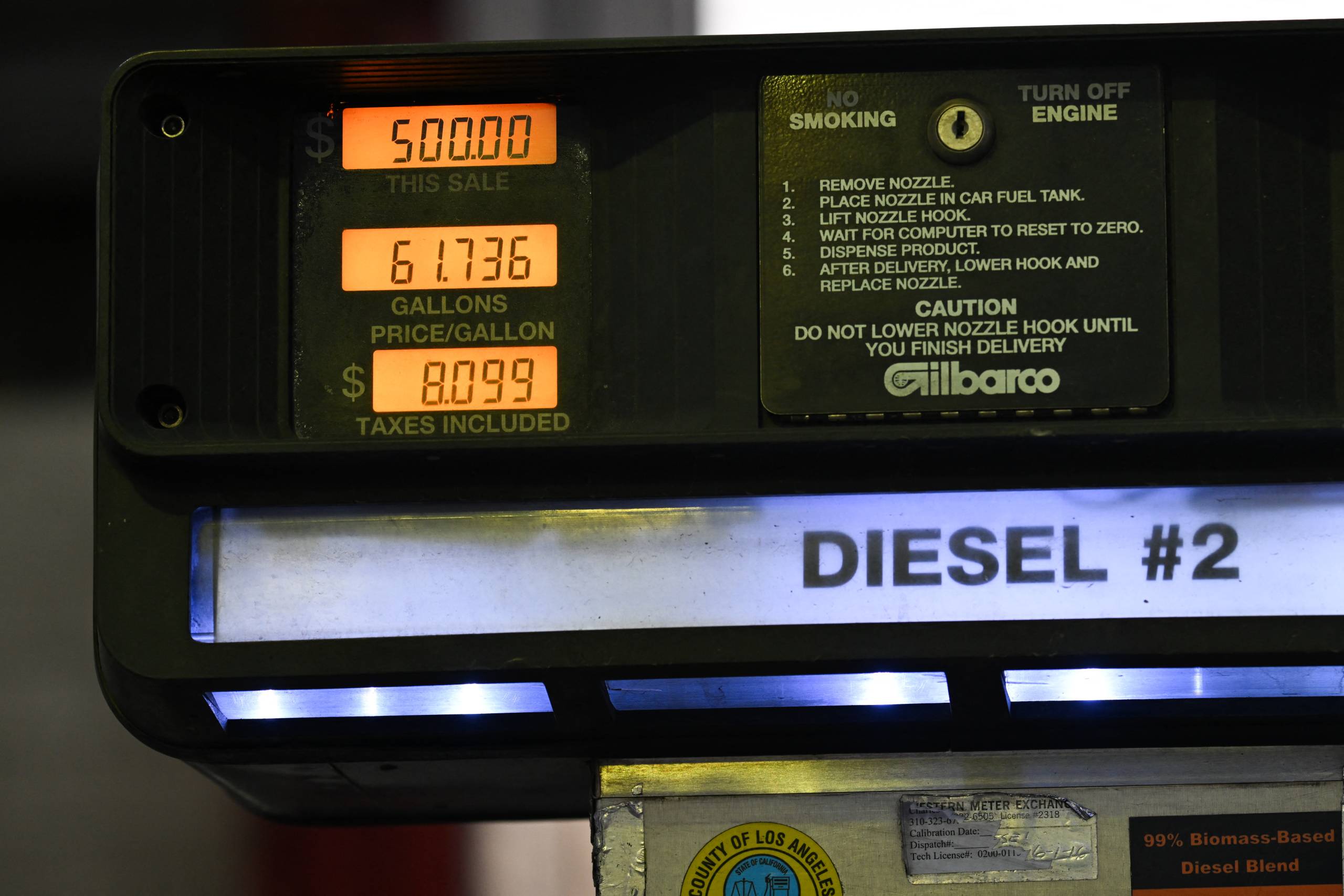
Diesel prices are now well above $8 a gallon in California – higher than they’ve ever been and 63 percent more than a year ago. While most consumers don’t purchase diesel, most of the goods we buy rely on it for transportation. Diesel powers tractors that work farms, trucks that transport the food to a manufacturing facility and trains that distribute products across the country. The steep rise in diesel prices is already putting pressure on businesses and the economy as a whole. Meanwhile, the Trump administration is talking about banning diesel exports as a way to increase domestic supply and lower prices. We’ll talk about why diesel prices have skyrocketed, how that will affect consumers and what could happen next.
Guests:
- Severin Borenstein, Professor at UC Berkeley’s Haas School of Business and a faculty director of The Energy Institute at Haas; member, Board of Governors of the California Independent System Operator
- Kyle Cameron, president, Cameron and Co. Trucking, Inc.
- Shaun Crook, co-owner and vice president, Crook Logging Inc. – He also serves as first vice president for the California Farm Bureau Federation.
- John Coletta, CEO, Clover Sonoma – a maker of dairy products.
Episode Transcript
This is a computer-generated transcript. While our team has reviewed it, there may be errors.
Alexis Madrigal: Welcome to Forum, I’m Alexis Madrigal. You probably don’t think about trucks that often, but it is trucks — long-haul semis, delivery vehicles, drayage trucks in and out of the port — that power so much of our local economy. And these vehicles run on diesel. That means that $8-a-gallon diesel hits so many businesses hard. But, of course, it’s not just the trucks. Diesel is everywhere in our economy, and here to tell us about it, we’ve got Severin Borenstein, professor at UC Berkeley’s Haas School of Business and a faculty director of the Energy Institute at Haas, and a member of the Board of Governors of the California Independent System Operator. Welcome.
Severin Borenstein: Thanks for having me on.
Alexis Madrigal: We’ve also got Kyle Cameron, president of Cameron & Co. Trucking Inc. Welcome, Kyle.
Kyle Cameron: Thank you, sir. Thanks for having me.
Alexis Madrigal: So, you run two businesses that are being hit hard by the cost of diesel. Let’s start with the obvious one, trucking. How much has that business changed for you because of the diesel price spike?
Kyle Cameron: Overall cost, just our largest cost is diesel aside from payroll labor. And so since we’ve had — the fuel’s doubled since last year. I was paying $4.85 to $4.90 a gallon, and now we’re knocking at the door of $8.50. And I’m sometimes fortunate to get a little bit of a discount on the rate because we burn about 10,000 to 12,000 gallons of fuel a month.
And so, I believe last Friday, we were — I filled up, and they email me when I get the — when I swipe the card at the card lock. Tonight, I paid $8.41 for my pickup. Well, yeah.
Alexis Madrigal: I mean, who are your customers? Like, what does this business that’s so dependent on diesel — like, who does it end up serving?
Kyle Cameron: So, our trucking company is pretty much a local trucking company, and we service the construction industry and the agricultural industry, specifically the wine industry. So, on the construction side, we haul dirt, sand and gravel, pre-mixed concrete. So, we service new construction, predominantly, or remodel, but mainly new construction.
Alexis Madrigal: So that’d be like, yeah, you’re just bringing anything you need to build a house, right?
Kyle Cameron: Exactly. Yeah. You bought a lot, you’re building a new home. So we’re doing all the export. So we’re hauling the dirt off and then importing all the septic system if you’re not in city limits and digging the footings and bringing in the drain rock and building the pad. So everything that comes in before the framers come to start framing your house comes on truck from us usually. Yeah.
Alexis Madrigal: Let’s talk about the other business you’ve got, making wine. I mean, people might not associate that as much with diesel, but there’s a bunch of steps along the way, right, that require that.
Kyle Cameron: Oh, certainly. So, yeah, I mean, we grow grapes. I’m a seventh-generation wine grape grower in Sonoma County. And actually, as we’re talking, I’m in my pickup sitting in one of our Chardonnay vineyards in the Russian River Valley. We started this morning at 2 a.m. with diesel tractors getting the grapes out of the field.
So that would be the first time diesel affects our industry in wine grape growing and making wine. So we have diesel tractors working in the fields, then we have a diesel truck on its way right now to pick up these grapes that we picked this morning early, and then that gets shipped to the winery and then it’s processed. And so once it’s processed into finished wine, then it hits a truck again and a tanker. So that’d be the third time it’s moved with a diesel tanker. It takes it to the bottling warehouse where we bottle the wine.
And so the tanker hauls it over there. We make a finished product and palletize it. And then it has to leave the bottling facility to our warehouse facility where we store it. So there’s another move. So that’s number four in the box truck, which is diesel. And then now that it’s in the warehouse, we have to sell our wine to Molly Stone or Oliver’s Market or Safeway or a smaller mom-and-pop shop that is definitely affected. So that’s the fifth time we have to haul it to the store, which is in a diesel truck.
Alexis Madrigal: So how do you deal with it then? I mean, do you just — I guess the obvious thing to do would be you could try to raise the price by whatever percent, or do you eat it and it just cuts into your margins?
Kyle Cameron: Well, with our construction side of the business, with the trucking, we’re an hourly rate for what we do. So we’ve increased our hourly rate by $10 an hour, which isn’t enough, because we’re burning $80, $90 an hour in fuel, usually, when we were burning $40 or $50. So there’s a little bit of a help by that extra $10 that we started charging in. We started that July 1st, and then afterwards, now we’ve also included a fuel surcharge, which we’re now at 15%. So between those two, we still aren’t making the complete difference up. I am eating some of it, but it is helping, just keeping everybody going, because we’re offsetting it, for sure, but not enough to get it where it was a year ago.
Alexis Madrigal: And what about the wine side? And what is your wine company, by the way?
Kyle Cameron: I own Trasini Winery, so we have Cameron Family Ranches, which is my last name, which grows all the grapes, and then Trasini Winery is the winery that produces the fruit for us.
Alexis Madrigal: Uh — and, you know, you don’t know what I think that —
Kyle Cameron: Sales are so soft right now in the downturn of the industry, with less and less folks drinking. Be straight up with that. Less and less people drinking, and younger folks that are drinking are usually going to a premixed cocktail in a can, if you will, or a self-serve.
Kyle Cameron: We haven’t increased, if anything, we actually came down with our pricing as far as wine because sales have come down. So we need to — the folks that are drinking wine, I want them to be attracted by both our quality and our price. Yeah. Well, on that side of things, we haven’t done anything to help us with the fuel prices. So you just eat it, yeah. We’re still doing it. Yeah. This is our family’s 172nd harvest in the Russian River Valley, Sonoma County.
Alexis Madrigal: Oh my God, just can’t give it up now!
Kyle Cameron: We’re not going anywhere because of the field, but we’ve got to just batten down the hatches a little bit and hopefully save it somewhere else. We’ve taken some other alternatives in our farming to offset the pricing, so instead of maybe an extra disking or mowing pass in the vineyard, we’re not doing that to save that way.
Alexis Madrigal: Severin Borenstein, let’s bring you in here. I mean, diesel prices, as we’re hearing, affect so much in our economy, and these are the highest prices we’ve ever had in California. What’s going on? Why is this happening?
Severin Borenstein: Well, yeah, it affects not just trucking and farming, as Kyle said, but also the same sort of phenomenon is happening in other fuels that come from the same part of the barrel, such as jet fuel and fuel for shipping, as well as heating oil for people in the Northeast.
All of these are the type of product that comes out of refineries, as well as gasoline. When you process a barrel of oil, it turns out the refineries in the Middle East and in Russia produce a particularly large share of these what are called middle distillates — diesel and jet fuel and heating oil.
And those refineries are having a hard time, both because in the Middle East they have a time moving their product out, but also in both the Middle East and Russia, we are seeing a lot of attacks on those refineries that are causing a lot of damage. Ukraine has figured out how to use their drones to attack Russian refineries. And in the Middle East, Iran has been attacking refineries in Saudi Arabia and elsewhere.
So we’ve seen a cutback in the ability to process oil into these diesel and other related products at the same time as the price of crude oil, the basic feedstock, has also gone up in price. And if you look at the high price of diesel, both of those are playing a major role. About half of that is the higher price of oil, and about half of it is the scarcity of processing that’s getting into the diesel and the other — well, it’s meaning that we have less diesel on the market. And, of course, when we have less diesel in the market, that drives up prices.
Alexis Madrigal: But California has a very specific kind of fuel environment, right? We have renewable fuel standards, we have different types of efforts by the state government to shape the market, particularly to move away from petroleum-based diesel. So how much is that playing into these kind of high prices at the pump?
Severin Borenstein: Well, California had higher diesel prices before the war started and before all of the international conflict, due to our higher standards for renewable diesel. Basically, users of, or sellers of, diesel are required to have a certain share of renewable diesel, and California has really been successful in this. Over half of the diesel that is used in the state is not based on petroleum.
But the price is still driven by petroleum diesel. These other fuels, the renewable diesels, are subsidized through this requirement process, but the price that they sell for is still the market price of diesel. So while we do have a cleaner diesel environment than the rest of the country, and it has lowered greenhouse gas emissions somewhat, although renewable diesel still has a very significant greenhouse gas footprint, it doesn’t really protect us from these international price movements in diesel.
So we have seen increases along with the rest of the country. We started higher than the rest of the country, and we are still substantially higher.
Alexis Madrigal: I mean, people may have heard about refineries having problems in the state of California. How much does that play into this?
Severin Borenstein: That’s really not playing a role in the high price of diesel right now. It’s being driven by these international factors. We do have issues with refineries closing, but we have been exporting diesel. We don’t have a shortage of diesel.
In fact, the whole U.S. exports a substantial amount of diesel because we produce more diesel than we consume. And the Europeans use a lot of diesel. So we tend to move our diesel into Europe and, to a lesser extent, to Asia. And they, in return, send us gasoline, which we need.
Alexis Madrigal: We’ve been talking about how diesel prices have skyrocketed, why that’s happening, who it’s affecting. We’ve got Severin Borenstein, professor at UC Berkeley’s Haas School of Business and a faculty director of the Energy Institute there at the School of Business. We’ve also got Kyle Cameron, president of Cameron & Co. Trucking.
We want to hear from you. Has the steep increase in diesel prices affected you or your business? Maybe you run a small business and it’s a big part of your cost equation. Give us a call, 866-733-6786. That’s 866-733-6786. [email protected]. Stay tuned for more right after the break.
Alexis Madrigal: Welcome back to Forum. I’m Alexis Madrigal. We’re talking about the price of diesel, which is well over $8 a gallon. Why the price has skyrocketed, how that’s affecting businesses and how it’s affecting all of you.
Maybe you run a small business and diesel is a big part of that. You can give us a call, 866-733-6786. Have you noticed anything changing? Prices are changing because of the rise of diesel. 866-733-6786. The email’s [email protected]. You can find us on social media, Bluesky, Instagram, Discord. Of course, we’re KQED Forum.
Let’s bring in John Coletta, CEO of Clover Sonoma. It’s, of course, a maker of dairy products, the milk I had this morning. They’re based in Petaluma. Welcome.
John Coletta: Thank you, Alexis. Thanks for saying that about the milk as well. Glad to be here.
Alexis Madrigal: Yeah. So just tell us about your company, about where diesel plays a role in the sort of milk and milk industry.
John Coletta: No, you picked a good one because when you think about milk and dairy, the average grocer — it’s such a typical everyday item in the grocery that we tend to be going to a grocer, say, three to four times a week. Perhaps many of the viewers have seen the big Clover trucks driving up and down the highway with good old Clover on the side and Clover’s famous puns, but those trucks all operate on diesel and actually renewable diesel, 100% of them, I’m proud to say.
I was glad to hear the past discussion mentioning California, proud of that as well, and renewable. But we’ve got to get there a bunch, right? And if I were to estimate the total cost of petroleum in all things Clover, it’s probably 3% of sales. So that increase from five to over eight bucks has been a big deal.
Alexis Madrigal: I mean, what does that mean for people who are buying milk, buying yogurt, you know? I mean, are they gonna see an immediate jump in the price of those things?
John Coletta: Well, we’ve been patient, maybe more patient than most. We have not passed anything along. Now that it’s been bouncing around 90 to over 100, we’ve held off. We probably incurred, just to be specific, maybe $100,000 a month, literally, to a bottom line that is not a big bottom line. We are in dairy, a single-digit bottom-line profit rate.
But I tell you what, to be honest, Alexis, most companies are now putting surcharges when you don’t know if something’s long-term. Rather than price it specifically to say a gallon of milk, you tend to take that interim step and call it a surcharge on an invoice, and then a grocer comes along and does what they do.
My best guess, Alexis, is we’re going to start doing that next month, finally. Other people have done it long, you know, months ago. But I’m guessing it’s about a quarter a gallon. I’m guessing it’s 10 to 20 cents an average dairy item.
Alexis Madrigal: Wow. Wow. Yeah.
Alexis Madrigal: You know, Severin, what do we know about how long this could go? I mean, given that you’re saying a big chunk of what’s happening has to do with the war in Iran, has to do with war in Russia and Ukraine, could this mean, I don’t know, if those things end tomorrow, do we see the price of diesel come down, or is this gonna be long-term kind of no matter what?
Severin Borenstein: Well, I think both are true. We would definitely see the price of diesel come down if both of these conflicts ended tomorrow. That seems unlikely, and it’s very hard to forecast what’s gonna happen in either of those wars.
But we would not see it return to pre-war levels. So there are two problems that we’re aware of. One is the shipping of these products, and that would probably loosen up pretty quickly, although it would still take a few weeks to get the tankers in place and so forth.
But the other problem, and probably the bigger, longer-run problem, is the damage to refineries. And we just don’t know how much damage there’s been, but it’s clear there has been damage. And that will not suddenly be fixed if the war ended tomorrow. So the world diesel market would continue to be short of diesel for probably at least many months to come.
Alexis Madrigal: Yeah, I mean, given that we’ve got these sort of long-term factors, John Coletta from Clover Sonoma, did you think about getting off of fuels entirely? Could you go with some of your trucks to electric trucks or something else, or is this sort of capital cost of that sufficiently high that it doesn’t really make sense unless these fuel prices stay there for, you know, X number of years?
John Coletta: I mean, we’ve been dabbling in it, to be honest. It’s probably a matter of time where it becomes a requirement, which wouldn’t be a bad thing per se, but take a truck that’s hauling dairy around. Now take refrigeration. Now take what EVs and electric vehicles are capable of doing for long hauls. It’s not highly functional there.
So we have a couple in our fleet, to be honest. We have a fleet of 50 trucks out there. But starting to look into it, the answer is it would be $10 to $15 million for Clover, who’s not all that big — we’re a mid-sized company — to convert them all.
Alexis Madrigal: How about you, Kyle Cameron? You’ve got 10 trucks out on the road. Have you thought about converting one of them to be electric, or is it just the kind of work that you do, electric trucks don’t really meet your requirements yet?
Kyle Cameron: No, it’s kind of a similar answer in the construction side. We do a lot of specialty trucking. So let’s say we’re paving your driveway that you just put in, and so we have to go to the asphalt plant, and then a lot of times we sit. And with the dumping of the truck, I don’t know if they’ve come with the electric trucks yet with the PTO hydraulic system that is needed to dump the load, right?
And sometimes we’re there for four hours, and sometimes we are there for 16 hours. It depends on — you always come into problems, occasionally you come into a problem, I should say, with the job site. You know, it’s just something’s hanging up. And so we have to wait, and I’m not sure that it’s effective yet enough to use in what we do.
Severin Borenstein: Yeah. Alexis, if I can chime in, this is Severin. It’s not just — or it’s a combination of the higher cost, but the higher demands that these sorts of transportation have, which is the reason they’re using diesel in the first place. Diesel engines deliver a lot of power, a lot of torque. They need that for hauling and for trailers and so forth.
And that is something that, although battery transportation has gotten great for light-duty vehicles, heavy-duty vehicles are still a long ways away from really being able to replicate that without huge battery packs that make it much harder to actually use the equipment.
So, unfortunately, whether it’s tractors, or semis, or air travel, we just aren’t there yet with the technology that’s very competitive. It’s very exciting to see light-duty vehicles so competitive, but I think it’s important to recognize that’s not what diesel is being used for.
Alexis Madrigal: So, I mean, if it sounds like we’re stuck with diesel here and that, you know, for all the reasons that you’re saying, kind of seems like at least our near- to medium-term future, what about the idea that’s been floated by the Trump administration to put export controls? Just kind of putting two things together. You said, you know, we’re — and also, we, as the United States, are a net exporter of diesel. So why don’t we just keep more of the diesel for ourselves? What’s the issue with that?
Severin Borenstein: Well, first of all, our partners elsewhere in the world depend on our diesel exports, and we would really be shafting them right in the middle of a crisis they’re already facing.
But even for the United States, this would have extremely uneven effects. Most of the diesel is produced in the Texas-Louisiana area. They would have a glut of diesel there. They generally move it through ships. There aren’t good pipeline connections, particularly to the West Coast.
They could move it through ships to the West Coast, but there is a law, the Jones Act, that’s been suspended, would have to be continued. But that would be a complete change in the logistics of how diesel is moved around. And that means that it would take quite a while for the glut that would, in the end, sort of smooth out across the rest of the country.
It would eventually lower the price of diesel, but it would also make refining generally less profitable and would likely lead to reductions in refinery runs, which means they also produce less gasoline and could very well end up raising gasoline prices.
Alexis Madrigal: Why would refinery get less productive?
Severin Borenstein: Well, right now they’re making very good profits making diesel. If the price of diesel plummeted, which it would in the Texas area if you banned exports to other countries, they would see that running a barrel of oil through their refinery is now much less profitable.
The way a refinery works is it looks at the profits of all the component parts they get out of it: jet fuel, diesel, gasoline and other products. And if they’re making less profit, they’re less inclined — they will run shorter runs of production and make less of everything. It’s always a balancing act of how much profit they’re making on everything.
Severin Borenstein: And this could very well change —
Alexis Madrigal: The, um, what’s in a barrel of crude oil. Like, you can’t just take a barrel of crude and everything becomes diesel. There’s a variety of different hydrocarbons in there that need to be made into all these different things.
Severin Borenstein: We would see a real mess. It would be really disruptive. It reminds me a bit of the 1970s, where we tried to regulate the price of gasoline and had unintended consequences of causing gas lines.
I think here we would have unintended consequences on what the refineries produce, and the need to completely change the logistics of the oil industry in the United States, of the refining industry in order to move that product.
So, I think we would see a massive scramble, at first a big glut in the Texas-Louisiana area and possibly in the longer run reduction or an increase in gasoline prices. At the same time, the diesel market and the rest of the world would just skyrocket, and that, of course, would include countries like in Europe that we are depending on for assistance in the war in Iran and who are already taking the lead in helping Ukraine.
Kyle Cameron: So, this quick little story. My late grandfather, Al Cameron, who had Cameron and Cameron Trucking, we had about 50 trucks at that time. He owned the business. And in his later, last few years of his life, he was always intrigued with asking me every time I’d see him, “What’s the price of diesel? Where’s the price of diesel?” You know, he always wanted to know because he was in the business for his whole life. You know, early, late ’50s, he started.
And he often told me that when he was in the late ’50s, early ’60s, and everything was moving on diesel then too, the price of diesel — he wouldn’t even hardly factor it into a cost because it was so less expensive. I don’t know if the word “cheap” is appropriate. Anyways, he always wanted to know what the price of diesel was.
So I’m wondering now, okay, we’re 50, 60 years later, and it always was less than a gallon of gas, but now we’re more than a gallon of gas. So what changed, I wonder, between then and now? I mean, we’re still burning diesel doing all our freight, but now we’re higher than the gas.
Alexis Madrigal: Yeah? Yeah, no. What the fu—
Kyle Cameron: One at a time was somewhat of a less expensive —
Alexis Madrigal: Yeah, that’s it, yeah. Severin, what a great question. Severin, you wanna take that?
Severin Borenstein: I wish I had a good answer for that. I mean, the diesel we use is quite different than the diesel 50 years ago. It’s ultra-low sulfur, and that probably contributes something to it. And the refining process has changed quite a bit, but I’m just not enough of a petroleum engineer — I’m not a petroleum engineer — to know how that actually has changed the costs in the system.
That’s interesting. That’s interesting. And, Alexis —
John Coletta: Oh, I would just say again, I’m estimating all things petroleum are probably 3% of our sales, packaging, et cetera. I would venture to say it was far less. I would venture to say it was probably a percent or so looking back as the costs had come up. So across the entire P&L, it’s not just diesel, it’s petroleum.
Alexis Madrigal: And that’s your — that’s John Coletta, of course, CEO of Clover Sonoma. We’ve also got Kyle Cameron, president of Cameron & Co. Trucking. We’ve got Severin Borenstein, professor at UC Berkeley’s Haas School of Business.
Let’s get another business owner here. Shaun Crook, co-owner and vice president of Crook Logging, Inc. Also serves as the first vice president for the California Farm Bureau Federation. Welcome, Shaun.
Shaun Crook: Well, good morning, everybody. Thank you.
Alexis Madrigal: Yeah. And Shaun, tell us about, you know, logging. I would imagine the big place for diesel there is in the logging trucks.
Shaun Crook: Yeah, definitely in the logging trucks that you see on the highway, but more importantly for our operation, all of the equipment that’s used to get that log onto a truck is diesel-powered, and it’s extremely high-horsepower equipment as well that does consume quite a bit of fuel. So our entire process runs on diesel.
Alexis Madrigal: And is it kind of like what we’ve been hearing these other things, like it’s a single-digit percentage of the overall cost of your business kind of thing?
Shaun Crook: It’s one of those that the way I figure our business, being that we’re seasonal and so we’re dependent on the weather — so, you know, the old saying, you’ve got to make that — make a sunshine, and that’s a little misnomer. A lot of times we’re baling hay in the dark when the moisture is right.
We have to work when the weather allows us to work. And so we can’t really be too concerned about that as far as a percent. But the way I view it is we need to have revenue of a certain dollar amount a day, just for a round number. Say it needs to be $15,000 a day while we’re working to be able to cover all of our costs throughout the year.
Because, again, we only get to work 180, sometimes 200 days a year. And with the increase from just, say, $6 to $8, what that’s doing is that’s increasing our cost around $600 a day. That’s what happens when we have a price jump like that.
Alexis Madrigal: I mean, how have you dealt with this in the past? You know, the price of diesel has gone up in years past and it’s gone back down, so what do you do in that time?
Shaun Crook: Yeah, and we were in a position where when we sell logs, most of those contracts are signed six months, a year in advance type of thing. Or if we bid on a project that’s service work, fuel reduction, say, just mastication, where you’re just kind of rearranging the brush out there, you’re not selling an actual product, most of those are for a year or two and we have to bid on those jobs, and you’re normally doing those jobs at a per-acre price.
And so a lot of it’s just kind of trying to, for — you know, for lack of something very scientific, is your best guess on where prices are going to go. You kind of have an idea of what happens historically. And then if you have a major market disruption, a lot of times there’s not much you can do about that, depending on who you’re working for.
There’s rare instances where we’re able to either add that surcharge or talk about, you know, a force majeure clause in a contract that are at everybody’s control. So it just usually doesn’t work that way.
So, like most of production agriculture, when you’re producing that raw commodity, you’re the ultimate price taker to start with. And so you’re already at the bottom of the barrel. And it’s just not something that you’re able to pass on as far as the surcharge would go.
Alexis Madrigal: I mean, are you concerned about the long-term viability of what you’re doing, if diesel prices stay here, or is it just more like it’s just a worse business? It’s like it was before, but a little bit worse.
Shaun Crook: Well, as far as the log market goes, this is some of the worst timber prices I’ve ever seen in my lifetime. And our measure is by the thousand board feet is how we sell timber. And 25 years ago, we were receiving $900 a thousand board feet for timber. Right now the sawmill is only offering $150 a board foot for that same timber.
So that’s what’s happened to the value of our commodity in that time. And so that’s a much larger concern to me than the price of diesel, because if there’s no market to sell the timber, it doesn’t matter what the diesel price is, I can’t work at all.
Alexis Madrigal: And what drives that, just like the number of new houses being built?
Shaun Crook: It’s definitely a global issue, but yes, housing is a big one with where interest rates are, but it’s really the cost of construction. Just there in the Sacramento market, saw on the news there about two months ago, you’re around $100,000 in permit fees for every new home they wanted to construct.
So we in California have added a lot of regulation that has a lot of dollars to it, and that doesn’t build any bedrooms onto the house. And so when all those costs get spread out, it definitely hurts the demand for dimensional lumber.
Alexis Madrigal: We’re talking about why diesel prices have gone up, what kind of effects it’s having across our economy, talking with a bunch of different business owners. We’ve got Kyle Cameron from Cameron & Co. Trucking. We’ve got Shaun Crook, who you just heard, co-owner and vice president of Crook Logging, Inc. We’ve got John Coletta, CEO of Clover Sonoma, of course, maker of dairy products based in Petaluma. And we’ve got Severin Borenstein, professor at UC Berkeley’s Haas School of Business.
We’ll be back with more right after the break.
Alexis Madrigal: Welcome back to Forum. Alexis Madrigal here, talking diesel. You may have seen diesel prices are up over $8 a gallon, highest they’ve ever been and up 60% from last year.
We’ve got three local business owners, Kyle Cameron from Cameron & Co. Trucking, John Coletta from Clover Sonoma, Shaun Crook from Crook Logging, Inc. We’ve also got UC Berkeley’s Severin Borenstein, and we want to get you into this conversation. To Phil in San Francisco, welcome to Forum.
Caller: Good morning. I used to be a small biodiesel producer in the early days of biodiesel. My question is two-part. So, the refineries, like Unical and, I believe, another one in the Bay Area, have been converted to renewable fuels, which should have nothing to do with the straight-up fossil fuels, other than I guess it might be an international commodity at this point. But Unical certainly has been raising their prices along with the price of petroleum diesel.
And then my other question is, so Formula One racing now runs off of synthetically derived fuel that’s made from ambient carbon dioxide and hydrogen obtained from water using green electricity. And I’m wondering why California isn’t just jumping on creating synthetic carbon-neutral fuels.
Alexis Madrigal: This is really — thank you for this, Phil. Severin, let’s go to you on this, because I have to admit I’m a little confused about this as well, only because I didn’t realize quite how much California had gone all in on renewable diesel, now consuming a ton of it. We’re taking huge amounts of production from Louisiana and North Dakota and other places.
Why is it that that hasn’t helped us? I mean, it does feel like — I don’t know, wouldn’t this be an opportunity for renewable diesel producers to take more market share by lowering their price? They don’t have to sell at the market price of diesel, right? It’s just more of a — they want to.
Severin Borenstein: Well, I think that they tend to be small producers individually, and the market price gets driven up to the price of petroleum diesel because it’s a substitute. And so as soon as — if it were cheaper, there would be a big move into renewable diesel and there wouldn’t be enough supply, and it would drive the price up.
So those prices tend to move very closely together. And this is part of the global transportation fuels phenomenon, which is we have global markets. So, for instance, when the price of oil or when oil shipping is blocked in the Strait of Hormuz, an oil producer in the middle of California raises their price because what they’re producing has become more valuable because it’s more scarce.
And that is the general phenomenon with renewable diesel: that it tends to become more valuable and the price goes up. There are these alternative technologies for producing synthetic fuels, and I hope at some point they will become cost competitive, but they’re just not right now. In fact, they’re pretty far out of the money.
I have been hearing about them for more than 20 years, and it’s great that we’re working on them, but the progress has been frustratingly slow.
Alexis Madrigal: One, what would the feedstocks be anyway for that? What would they be made out of?
Severin Borenstein: Oh, in some cases, as the caller said, they can be made out of green electricity and hydrogen and so forth. The problem is that — and we can do that. Formula One racing has done some of that. Airlines are flying occasionally on renewable fuels, but they still cost a lot more.
And when you look at the blowback we’re getting to fuel prices now, I think it would be substantially larger if California said we’re going all in on synthetic fuels that are made in green processes, even if it raises the price by two or three times.
John Coletta: Alexis, hey, John from Clover, just real quick, sharing — I have a dream for what’s the feedstock.
Alexis Madrigal: Oh, yeah. Let’s hear it.
John Coletta: Manure from a cow. There is, literally, if we can do our job right, we can not only have dairy, but one cow with — you know, NASCAR used to operate on methanol, for example. They stopped doing it, but manure is capable of a lot of energy, enough to do 20 loads of laundry a day, 100 miles of the right kind of fuel.
So, Severin, maybe you and I can work on — we have a dream.
Alexis Madrigal: That’s right. I mean, I guess that’s right. There’s plenty of hydrocarbons in manure, yeah.
Let’s bring in William in Santa Rosa. Welcome. Hey, William, welcome. Yeah. So, yeah, as I understand it, you’re a farmer, right?
William: Yeah, I’m a fourth-generation farmer in Vacaville, actually, and we grow peaches, apricots, plums and commercial prunes. Half of our operation is direct-to-consumer, and the commercial prune goes through Sunsweet.
Alexis Madrigal: Oh, man. So in that business, diesel comes in, I guess, in the movement of things, but maybe also in the drying of the prunes.
William: The prunes are actually done with natural gas. The dehydrators and winders that we use actually have a natural gas line that comes directly from PG&E.
But for our operation, we’re on diesel for all of our tractors and harvesting equipment. And that’s something that we’re luckily done with harvest now, but we typically top off all of our fuel tanks on the ranch, and we’re currently hoping that the prices will come down to where it is actually feasible for us to do that.
Alexis Madrigal: Yeah. What does — what has this fuel price change looked like from your perspective? I mean, as I understand it, right, farms don’t necessarily have to go to the same, you know, diesel station as a semi truck.
William: No, typically we’ll have it delivered on-site. So for us we have some on-site fuel tanks, and we’ll have a company like Ramos Oil come and deliver red-dyed diesel to us, and we receive the bill in the mail.
And, like, for us, we’re really expecting getting some of our post-harvest activities that we normally do, just because of the increased cost of the diesel fuel.
Alexis Madrigal: Yeah, like what would those be, like just stuff for the health of the fields and running all your —
William: So one of those key ones is post-harvest nutrients for the trees. After we pull the fruit load off of our trees, the trees are actually generally at a deficit for the nutrients that set them up for success the next year.
And so right now we’re looking at how we can maybe cut a couple of corners on that. Maybe we only do our nutrient application in every other row that we cover, half the trees versus the full tree getting coverage.
Another thing we’re looking at is normally we do a cover crop application. Cover crops we plant in the rows to help with soil health, and it’s usually — requires quite a bit of tillage and other work in the orchard, and we’re not sure that we’ll be doing that this year either.
Alexis Madrigal: William, thanks so much. I really appreciate hearing another perspective on where diesel prices end up reverberating through the economy. Thanks so much!
Severin Borenstein: Yeah, thank you. Appreciate it. Alexis, this is Severin. If I can just point out, this has been a great presentation of the ways in which diesel does affect these small companies, and it does flow through to consumers, but if you look at the actual amount of diesel the U.S. uses, we use about two and a half times more gasoline every day than diesel.
And so the typical consumers — and this is, I think, why diesel tends to fly below the radar — the typical consumer not only is hit in the face as you drive down the street with the rising price of gasoline, it actually overall is not hitting them as much. There are these specific industries that are really getting wiped out by the high price of diesel.
But most consumers, if you look at where this is hitting their finances, the gasoline increase, even though it’s a smaller increase, is actually raising their costs more than the diesel. Together they are raising costs quite substantially. I did a calculation that of the 3.4% inflation over the last year, almost a full percentage point is due to rising prices of gasoline and diesel.
Alexis Madrigal: Joe writes on the Discord: “Given how this is exacerbating the general cost-of-living crisis we’ve been seeing these past few years, how much further do you think prices could go up? It seems that a lot of people are already being squeezed to their limit here.”
Severin, you can take that one.
Severin Borenstein: Yeah, I think, unfortunately, the prices could go up substantially more if the wars go the wrong direction. There will be some what’s called demand destruction, which means people start consuming less.
That doesn’t tend to happen in wealthier nations as much as in poorer countries. In poorer countries, when the price of oil and the price of these refined products goes up, there are a lot of people who just can’t afford it. And so they have no choice but to cut back.
And so we see a bigger cutback in lower-income countries. But there are certainly plenty of people in the United States who also are running on very tight budgets and suddenly find that they can’t, for instance, a long commute to a job. And suddenly that job is just not viable anymore.
Alexis Madrigal: Yeah, yeah. Um, let’s bring in Rainy up in Boonville. It’s been a while since I got a Boonville call. Welcome, Rainy.
Rainy: Hi. Yeah, I’m a new rancher. I’m just starting my business this year. And we were hoping to use more electric vehicles on the ranch, looking into an electric ATV, electric tractor, an electric truck.
And we’re finding that there’s one electric tractor that was made as, I think, a partnership between Mondavi and New Holland, and they pulled the plug on it. I’m sure there are multiple reasons for that. And the electric ATVs also are very much more expensive and don’t come with very stable service records.
And so we’ve bought gasoline ATVs. Looks like we’re buying a diesel tractor, too. And it’s a shame, and I think, you know, part of it is the administration we’re dealing with right now. I’m not supporting electric vehicles in any way. But just looking at the cost of it, it’s not the greatest time to be getting into the diesel business, but here we are.
Alexis Madrigal: Yeah. Hey, Rainy, really appreciate that on-the-ground perspective there on sort of what happens if you’re setting up new and you can — you can do it, it still isn’t working.
Let’s bring in Greg in Redwood City too. Welcome, Greg.
Greg: Good morning. Yeah, we’re a small business in Redwood City, and we deliver a lot of mulch and also do some farming. And it’s, you know, it’s just killing us. It’s not like the consumer is, you know, pinched to the limit and just not spending money. I mean, our sales are down like 80% this year.
But it’s also the increase in the cost of equipment. You know, like the tractors, they were $50,000, now they’re $80,000. But, you know, to fill our truck, it’s, you know — when it’s totally full, it’s five miles per gallon. So you do the math on that, and we tried to pass it on to the consumer and it further hindered sales.
So we basically just scaled back everything and just gonna be in a holding pattern because we’re tired of getting calls like, “Why is it so much more expensive than last year?” So it’s really killing us, not only the diesel prices, but the tariffs and the unpredictability of, are you gonna be spending $40,000 on a piece of equipment that was a few years ago so much less expensive.
And it’s not only us, but it’s our producers that are in equipment that are a million-plus to produce the mulch. And when they start getting sales reductions, then that’s their bills that can’t be paid.
So it’s just a trickle effect that I’m just shocked to see. This is the first year I’ve ever seen it so bad, that it’s happening so fast and so bad, that it is just mind-blowing.
Alexis Madrigal: What are you gonna do?
Greg: Like I said, I’m scaling back and I just take in the reality that this is not going to get better anytime soon. So we’re really sort of kind of pivoting the business into other things and, yeah, just really scaling back into, you know, like expecting a recession. So, yeah, not good.
Alexis Madrigal: Oh, man. Greg, sorry to hear that scary report from the front lines of business there.
Maybe I’ll come back to you, Kyle Cameron, as somebody who’s just working in trucking and working in the vineyards. I mean, the unpredictability of these things is something that seems like it must be really difficult to manage as a local businessperson. So what are you going to do for this next year or so?
Kyle Cameron: Well, we’re going to keep on farming and trucking, that’s for sure. I mean, that is all we know how to do, really. But back to the logging, too, I mean, he made a good point.
A lot of our contracts with — not directly with Caltrans, per se, but with whichever construction company they’re using for road improvements and stuff like that — we bid the same idea. Like, you know, I knew a year and a half ago what we were doing today on some of these jobs, and at that point, we didn’t know that fuel was gonna be where it’s at.
And so you gotta kinda take it. I mean, that’s not their fault, it’s not my fault, but I’m the guy that gave them a number and I got the work, so we have to keep going.
And hopefully, now obviously I’m bidding jobs for 2027 and ’28 with the fuel prices right now, so I mean, I’m looking at it like, well, maybe I’ll get lucky and fuel will come down. But my rates right now are still thinking it’s the same as right now. You know, I’m hoping then I can fill that deficit from what we’re doing today from a year and a half ago’s bid. I’m open to fill that deficit that way.
Other than that, with the farming side, with the Trasini Winery and the ranches, you have to disk, you have to spray, and you have to prune, and have to mow after you’ve pruned. So those things need to continue.
And whether diesel is $8.50 or my red-dye diesel, so off-road diesel, is $6.70, I think we filled tanks the same like the other gentleman was saying. We have on-site tanks, and they come once a month and fill them. It is what it is, really, with that side of the business.
And, um — and another thing, like back to the forestry and logging, the Chardonnay that we picked this morning that I’m still looking at, wondering where my diesel truck is, come pick it up.
Kyle Cameron: I’m talking to you. Yeah, wondering where he is, can’t call him. But anyway, the Chardonnay price right now is the same as 20 years ago. And our labor rates, aside from diesel, our labor rate have went from $9.50, $9.75 an hour to $20-plus an hour for our labor. And our product is still at the same price as it was mid-’80s, mid-’90s, excuse me.
Kyle Cameron: Early 2000s, the price per ton for our fruit is very similar to then, just because of the definitely overproduction and then less consumption is a problem.
Alexis Madrigal: Aw, man. Yeah.
Kyle Cameron: Yeah, everything else is well over doubled and our price is the same.
Alexis Madrigal: Good thing you love it, you know?
Kyle Cameron: Yeah, no, it’s a passion for sure, and I’m seventh generation in this vineyard, so —
Alexis Madrigal: Gotta keep going, like you said. Yeah.
We have been talking about why diesel prices have gone up and how they are reverberating through our economy. Talking with a variety of small business owners.
Kyle Cameron, president of Cameron & Co. Trucking, thanks so much for joining us.
Kyle Cameron: Thank you.
Alexis Madrigal: Shaun Crook, thank you. I think we lost him. John Coletta, CEO of Clover Sonoma, thank you.
John Coletta: Thank you, Alexis.
Alexis Madrigal: And Severin Borenstein from UC Berkeley, thank you as well.
Severin Borenstein: Thanks, Alexis.
Alexis Madrigal: Thank you so much to all of our callers and listeners and commenters. Really appreciate you. I’m Alexis Madrigal. Stay tuned for another hour of Forum Ahead with me, Nick Kim.
Announcer: Funds for the production of Forum are provided by the Jenerosity Family Fund and the members of KQED.