Regional Ballot Measure is a $14 Billion Bet on Bay Area Transit
Airdate: Thursday, September 24, 2026 at 9 am
Years after the pandemic emptied trains and buses, Bay Area transit agencies still face anemic
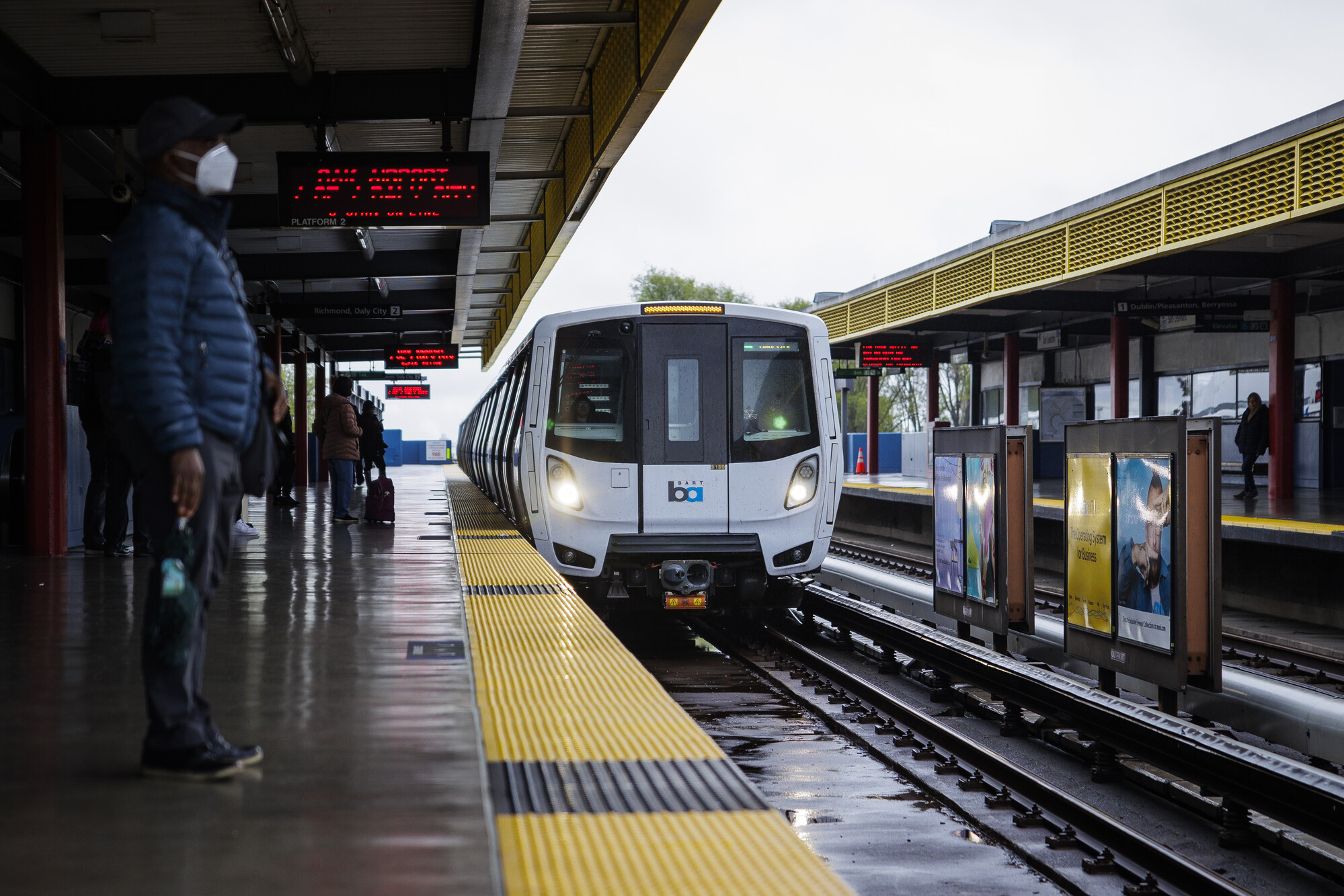
ridership and rising costs. A new regional transit measure that voters put on the November ballot aims to shift the tides. It would add a 0.5% sales tax in Alameda, Contra Costa, San Mateo, and Santa Clara counties and 1% in San Francisco, to raise an estimated $14 billion over 14 years. Supporters hope it will fund BART, Muni, Caltrain, SamTrans, VTA and AC Transit and better connect the systems, while critics call it a regressive tax that hits lower-income residents hardest. We’ll talk about how we got here and the future of public transit with – or without – these funds.
Guest:
- Azul Dahlstrom-Eckman, reporter, KQED News
- Libby Schaaf, president and CEO, Bay Area Council, served as the mayor of Oakland from 2015 to 2022
- Laura Tolkoff, transportation policy director, SPUR
- Murphy McCalley, board member and vice president, AC Transit Board of Director
Episode Transcript
This is a computer-generated transcript. While our team has reviewed it, there may be errors.
Alexis Madrigal: Welcome to Forum, I’m Alexis Madrigal. I should probably just say this: The urban think tank SPUR estimates that if this new transit tax measure that we’re talking about this morning doesn’t pass, commutes across the Bay Bridge by car could increase by 30 to 40 minutes. Getting through the Caldecott Tunnel could take 20 to 27 more minutes, meaning if you live there in Walnut Creek, my word, you might be looking at an extra hour on top of what was already a grueling commute.
That’s because the way people get around the Bay Area is a combination of modes. Most prominently, people driving in their cars, but transit takes pressure off the roads. If the transit measure fails, that’ll put more people on the roads and you’ll get more traffic. That won’t be the only effect, as we’ll also hear today. On the other side of it, the regional transit measure would push sales tax over 11% in some jurisdictions in, for example, Alameda County. Yikes.
Here to talk with us about the bind our local leaders are in, we’re joined by Azul Dahlstrom-Eckman, transit reporter here at KQED. Welcome.
Azul Dahlstrom-Eckman: Hey, Alexis.
Alexis Madrigal: We’ve got Laura Tolkoff, transportation policy director with SPUR. Welcome.
Laura Tolkoff: Good morning.
Alexis Madrigal: We’ve got Libby Schaaf, president and CEO of the Bay Area Council, and also, importantly for the show, former mayor of Oakland. Welcome.
Libby Schaaf: Good morning.
Alexis Madrigal: And we’ve got Murphy McCauley, board member with AC Transit. Welcome, Murphy.
Murphy McCauley: Good morning.
Alexis Madrigal: All right, Azul, why don’t you set us up here? You know, in these post-pandemic years, it feels like our transit systems have been under so much pressure. Tell us what this regional transit measure is and what it hopes to do.
Azul Dahlstrom-Eckman: Yeah. Well, the regional transit measure, as you said, would create a sales tax in five Bay Area counties. That’s Alameda, Contra Costa, San Mateo, Santa Clara, and San Francisco. And the idea is basically to, uh, fund transit long-term, basically to give transit, uh, sort of a new business model, if you will.
Um, that’s because pandemic riders, post-pandemic ridership still hasn’t rebounded to pre-pandemic levels. Uh, let’s talk about BART, for instance, since everyone loves to talk about BART. Fifty percent, around 50%, is currently where BART’s at for, um, average weekday ridership. At the same time, operating expenses have continued to rise. So it’s, that’s really where transit agencies are in the sort of bind where costs are going up and their previous, uh, business model is no longer working.
What are the big costs that are going on? Um, it’s, it, it — it’s operating expenses. I mean, it’s labor, you know? Typically every year, uh, expenses continued, like labor expenses, such as employee salaries, benefits, retirement, you know? I think those are the things that we’re sort of seeing, uh, really driving up costs at transit agencies.
Alexis Madrigal: Yeah, like if you look at the numbers for BART, say, because they have retiree pensions, they’ve gotta pay the labor costs on, for total labor costs, you know, people working now and people who are retired have gone up like quite substantially.
Azul Dahlstrom-Eckman: Yeah. I mean, the operating expenses are set to rise over the next five fiscal years, uh, consistently.
Alexis Madrigal: So which are the transit agencies that would then benefit from this RTM measure, and how are they dividing the pie up?
Azul Dahlstrom-Eckman: Yeah. So there’s four main agencies that would, you know, sort of get the lion’s share of the revenue. That’s BART, AC Transit, Caltrain, and the SFMTA, which runs Muni. Um, they collectively are responsible for about 80% of all transit ridership in the region, but some other agencies would also get money. We’re talking about the VTA. We’re talking about, you know, smaller East Bay, uh, transit operators such as LAVTA and Union City Transit, as well as Golden Gate Transit, San Francisco Bay Ferry.
And I think that’s sort of, to get this sort of regional support that this measure needs, right? So it’s a five-county measure. So you need Santa Clara County’s buy-in. So VTA has to get a little money as well. And then there’s the county transit agencies that are also getting money for that. And the amount of money that goes to each agency differs based on — so if X amount collected in Santa Clara County will go to VTA. Obviously more money will go to VTA. Alameda County, you know, more money will go to BART. San Francisco, more money will go to Muni.
Alexis Madrigal: Got it. Laura, how much would this measure cost people? It’s a sales tax, so obviously, you know, it’s hard to do it as precisely as a parcel tax, but roughly speaking, average person, what’s it going to cost them?
Laura Tolkoff: Sure. We estimated what the cost would be to people who earned 80% of the median regional income. And we’re looking at about $7 for anyone who’s paying at the half-cent rate per month, or $82 a year.
Now, that really is just — pales in comparison to what people would have to pay, though, if we did not have transit. So we also looked at what are the increased costs that riders would have to pay if they have to drive more often and found that that came out to about $3,300 a year, which is 40 times the cost that people would be paying in the cost of the sales tax.
Alexis Madrigal: Uh, Murphy, let’s come to you as a board member for AC Transit. You know, grew up in a transit-dependent home. Uh, I hear 57 is your favorite bus line. Um, what we’re looking at with AC Transit, right, is like a $50 million shortfall for each of the next four years on a budget of about $600 million. Where does the gap come from? Is it just like we don’t get enough from the fare box? Like what’s the, why is there this kind of structural gap?
Murphy McCauley: Yeah, it’s kind of all of the above. I think we’ve hit a perfect storm. AC Transit during COVID, as all the transit agencies, were able to receive federal dollars, ARPA funds, to help weather the storm when ridership declined, when people weren’t traveling due to COVID.
And so AC Transit was very judicious with how we managed those funds and basically ran out of the ARPA funds last fiscal year, excuse me, yeah, last fiscal year. The current fiscal year, we were looking at about a $50 million shortfall, and we were able to make that up through a loan from the state. And we’re projecting to have $50 billion, approximately $50 to $53 million shortfall for the next four years.
And it’s a combination of what’s driving that. You talked a little bit about labor. That’s 70% of our cost for most transit agencies is labor. Public transportation is very labor-intensive. So labor is clearly a factor. But it’s also, you know, diesel fuel has gone up with the tariffs, the various parts we need to buy to keep our buses in operating condition has gone up, our insurance has gone up, health care costs have gone up.
So it’s basically the — and ridership is not, like is mentioned, is not come back to where we’re at about, for AC Transit, about 80% of where we were pre-COVID.
Alexis Madrigal: Libby Schaaf, with your Bay Area Council hat on here, like why is Bay Area Council interested in this? I mean, Bay Area Council, for those who don’t know, is kind of a big business representative here in the Bay Area.
Libby Schaaf: Well, I would say we’re the civic voice of business, Alexis. There you go. We were formed more than 80 years ago, and we’re the first organization that actually fought to establish and build a BART system. So champion public transit is part of our DNA.
We got involved in this because we are all about a strong economy and strong communities. And there’s nothing that knits those two things together like our public transit system and our overall transportation system.
You started this segment by talking about the relationship between, you know, even if you never ride transit, your commute is going to be even more miserable than it is right now if people were not riding transit. So it’s good for business, it’s good for the community, and this is part of our mission for more than 80 years.
Alexis Madrigal: You know, Laura Tolkoff, the obvious kind of rejoinder to a new tax measure is to say something like, well, maybe our Bay Area transit agencies just aren’t efficient with their dollars. I mean, I do believe there’s too many Bay Area transit agencies, and most people do. But if we look at each individual agency, how is it doing relative to its peer agencies in other cities? Do we have a uniquely inefficient system or not?
Laura Tolkoff: I wouldn’t say we have a uniquely inefficient system. I think we have systems that were uniquely hit by the pandemic because they were very commute-oriented, particularly BART and Caltrain, and because more people in our economy are able to work from home as part of their jobs. And so we have fewer people who are commuting five days a week than there were pre-pandemic. And so that has really hit the revenues.
And one of the things that was also very unique, and Azul was touching on this, which is we need a new business model. And what was unique about our agencies is that they were actually relatively self-sufficient pre-pandemic. If you remember those crush loads on those morning commutes, right? You know, our agencies, you know, BART in particular, got over 70% of their operating revenue from fares, not from public subsidies, not from the state.
What is unique is that our agencies actually rely less on the state than in other states. And that, because of the particular way that the pandemic and remote work has hit our region, we are left with a more severe and lasting deficit. But really, there is no region that is immune. Other regions, Chicago, D.C., Philadelphia, New York, of course, are all struggling, sort of at different rates.
The other thing I’ll mention is that our agencies have been very good about stretching the limited public dollars and rescue dollars that they have gotten. So an early financial efficiency review that came out this year found that over the last five years, our four agencies that are the four biggest beneficiaries of this measure have actually shaved a billion dollars off of their operating costs over the past five years through one-time and ongoing expenditures.
BART in particular, despite inflation and the tariffs and all the things that Murphy referenced, has actually kept their cost growth below CPI, which I think is one of those things that we look at to make sure we are seeing a healthy and efficient — below, yeah, below CPI. And so that’s one of the things we look when we think about how well are our agencies managing their costs.
Alexis Madrigal: And if you’re wondering out there the right way to measure sort of the efficiency of these things, I think people tend to like cost per hour of service as a measure. And in all those things, essentially, BART, Muni, AC Transit, et cetera, are all more or less mid-pack in terms of the cost, even though we have very high prevailing wages here in the Bay Area, so for what it’s worth.
We’re hearing the case for the regional transit measure on the November ballot. And levies a sales tax to support Bay Area transit in five counties. We’ve got Laura Tolkoff from SPUR, we’ve got KQED’s Azul Dahlstrom-Eckman, we’ve got the Bay Area Council’s Libby Schaaf, and we’ve got AC Transit’s Murphy McCauley.
We’ll invite you into the conversation as well. You can give us a call, 866-733-6786. I’m Alexis Madrigal, stay tuned.
Welcome back to Forum, Alexis Madrigal here. We’re talking about the regional transit measure that you’re gonna see on your November ballot. Got some folks who are supporting it here. Laura Tolkoff, Transportation Policy Director with SPUR. We’ve got Libby Schaaf, President of the Bay Area Council, former Mayor of Oakland. We’ve got Murphy McCauley, Board Member with AC Transit. And of course we’ve got KQED’s Transit Reporter, Azul Dahlstrom-Eckman.
We’re gonna get you all into this conversation about this measure. We’ve already got a comment here, Libby, this one is going to come to you. Megan writes, the proposed sales tax increase on this year’s ballot is yet another regressive revenue-generating effort that doesn’t seem to address the Bay Area’s changing public transit needs.
Can you address the extent to which these various regional transit agencies are or are not looking at cost-cutting measures through consolidation and if and how they are making changes in response to how and where the public currently uses and relies on public transit? So what I’m interested in here is your answer, both as in your Bay Area Council role, but also thinking about the role of transit in Oakland and serving the people of Oakland and whether or not you think AC Transit has been able to and will be able to do that better in the future.
Libby Schaaf: Yeah, I love this question. So I’m hearing two parts. One, why a sales tax? And two, how are things gonna change to meet people’s needs today?
So on the sales tax, it is true that sales taxes are regressive and boy, as a mayor of Oakland, I could just feel how hard people were struggling with affordability. That’s real. But sales tax is something that’s not just paid by you and me. It’s paid by businesses. It’s paid by tourists and visitors. And in California, it’s less regressive than it is in just about any other state. We exempt all the basic needs, food, medicine, medical devices. California even exempts feminine products, diapers. It really is being paid most by the big consumers and consumers of luxury items. So I will just give that caveat on that selection.
And then the second thing about how is this going to give us time to adjust? The question perfectly is lifting up something that I find really great about this tax. It is only a 14-year tax. It is giving the agencies time to adjust to what is a new reality.
And I’ll give you an example. Caltrain recently changed its schedule, one to have more frequent service, but also to really increase service on evenings and weekends, because while people are not working the same five-day-a-week, nine-to-five in the own towns, they’re playing more in our towns. They’re taking transit to sporting events and cultural events. And so shifting that schedule, Caltrain has seen a huge recovery recently in ridership.
BART recently had its highest rider satisfaction survey results in its history. So we are seeing the fruits of the labor. But we need those 14 years to get to this new business model. I love how Laura pointed out that we’re an outlier compared to other parts of the country. And I’ll give you an example. In Philadelphia, New York, and Boston, those state governments subsidize the operating budgets of those metro transit systems between 30% and 50%. BART gets 5% of its operating budget from the state of California.
So maybe over these 14 years, we’re going to need to advocate for the state to play a stronger role as the operational changes are made to really build ridership to meet the needs that people have today.
Alexis Madrigal: Um, Laura, one thing that I want to get into here is what cuts would happen. Like when we talk about these increased commute, you know, across the bridge through the Caldecott Tunnel, coming up from Silicon Valley into the city, um, that’s premised on the idea that they’re going to be a bunch of service cuts. Um, can you, like, you, without going through station by station, how did you sort of determine where the cuts would come and how big the impacts would be?
Laura Tolkoff: Sure. So earlier this year, each of the agencies looked at their budget and said, here’s how much service we would need to cut in order to have a more balanced budget. And using that, we forecasted what the human toll of those impacts would be.
And so just to summarize kind of what those look like, you’re looking at Caltrain cutting service back during peak hours by 75%, from four trains an hour to one train an hour, right? We’re talking about eliminating weekend service on Caltrain.
BART would have to close up to 15 stations, really only run three of its five lines for the majority of the time. So they would take two lines, the red, the red line and the green line, and only run those in the peak hour in the peak direction, and for everything else you’d be down to two trains an hour. And eventually they would have to close entire segments of their system to secure it and reduce their costs.
Muni is looking at cutting services by at least 30%, cutting their frequent and rapid routes in half, you know, and canceling their special event service, among other changes. And so you’re looking at very, very severe cuts.
And what we did is we took that and we forecasted what those human impacts would be in terms of traffic, access and independence, and cost and carbon emissions.
Alexis Madrigal: Man, we’re going to get into more of this as we keep going on, but let’s bring in some callers here. Bob in San Francisco, welcome.
Caller: Uh… Good morning. Thank you for taking my call. So, uh… My question is related to inefficiencies with having multiple transit systems here in the Bay Area. Uh… Just to give you an example, it took 20 years and close to half a billion dollars to introduce an integrated payment system where you can tap a credit card. In contrast, in Germany, the same thing they accomplished in six months for a couple of million dollars.
So, you know, it’s this kind of unbelievable waste that leads to these cost overruns and just total inefficiency.
Alexis Madrigal: Well, and I’ll just note, I appreciate that, Bob. I’m gonna take that to Laura. Also, I just wanted to note the numbers earlier, which is they’re sort of middle of the pack in terms of operating costs for the whole country. So, despite all these things, and I don’t think any transit engineer would set up the system that we have, Laura, what do you think could be wrung out of more efficiency if we did, say, just have one or two or even three major transportation networks here? Thank you.
Laura Tolkoff: Yeah, thank you. You know, I think one of the things to remember is that the reason we have so many agencies is because in other places the state or the federal government actually funds the existence of a major predominant agency, and here so much of that really has to be locally raised. And so, you know, this is symptomatic of that general higher-level failure to fund transit at a meaningful level.
The second thing I want to say is that, you know, I think the agencies have been doing a lot to become more accountable, more efficient, more transparent, and more resourceful. And I think we shouldn’t overlook that. And I — thanks. You know, a lot of people will set this measure up as really a choice between preserving transit and having more efficient transit. And that’s just not true. This measure actually has a huge and very robust accountability and oversight structure that forces the agencies to continue being more and more efficient.
And so I think, you know, we have to remember that the agencies actually are doing a lot with what they have. So as an example, they have been coordinating since the pandemic. They meet every single Monday to coordinate schedules. They have addressed and simplified their payment and fare structure. They have worked together on thinking through how do they address labor costs going forward.
They’re really, um, working hard to, um, act, uh, together, um, and to be a much more seamless system than we have seen in the past. And so I think, you know, the transit systems that we experienced in 2021, um, are not the same ones that we have today. There is a huge, huge shift, um, that’s been underway.
Alexis Madrigal: Libby Schaaf, I want to ask you this. Let’s say this measure does not pass and many of the, you know, the worst impacts that SPUR has estimated come to fruition and we see massive gridlock everywhere. Do you think that forces a kind of major change to transit, maybe the kind that’s needed, maybe it’s consolidation, maybe it sees various other things, or? Do you think it would be more likely to push us into a death spiral for our transit agencies?
Libby Schaaf: Oh, death spiral for sure. I mean, the severity of this fiscal cliff is so cataclysmic. It’s not something that just tomorrow these agencies can recover from.
And let me just stress how we did not let a crisis go to waste. The famous saying, never let a good crisis go away. You know, the Bay Area Council was part of the effort to make sure that the state law authorizing this regional measure actually requires that 5% of all the sales tax collected has to go into the very kind of seamless integration activities that your caller just asked about. So that’s mandated by this measure. If this measure doesn’t pass, you miss out on that mandate.
This measure mandates a fiscal efficiency process that, in my 30 years in public service, I have never seen a measure include, where an outside expert actually evaluates fiscal efficiency opportunities in all of the agencies. The agencies have to commit to a fiscal efficiency plan. And if they fail to meet the measurements in that plan, the funds get withheld. I’ve never seen something with that strong a set of teeth in a ballot measure before.
So it’s not just that these agencies will fall off a fiscal cliff that probably will lead to a death spiral of ending transit as we know it in this region. But we also miss out on these opportunities to improve this overall system.
Alexis Madrigal: A little more pushback from listeners here, Laura, coming to you here. Michael writes, I think it would help you report if you could find a traffic nightmare prediction that came true after a related funding bill that didn’t pass. Case in point is a recent Measure E in Oakland, which predicted nightmare scenarios if a funding measure for emergency services didn’t pass. The measure, which was a proposed parcel tax, didn’t pass, and the scenarios never materialized.
Voters shouldn’t trust these scare tactics. Another much older example of this scare tactic concerned the removal of the Oak and Fowl Street off-ramps. When that issue was up for a vote, Caltrans predicted traffic would back up to Treasure Island if the ramps were removed. Almost 30 years later, that prediction still hasn’t materialized.
So let’s talk a little bit about, give people a little more insight into the methodology of the report.
Laura Tolkoff: Sure. And, you know, one of the things I want to say is, actually, we have had some real-life examples of major disruptions in the last year that really did cause quite a bit of backup on exactly the places that we studied. So, you know, that we have some real-life examples of what that looked like in a much smaller, more contained setting in that the agencies were able to get back up, get service running again, but it really does check out for us.
The other thing is, I hear you, nobody loves a scare tactic, but I will say in all honesty that we were very conservative in all parts of our analysis, and I’ll explain why.
So first off, you know, we only looked at really a handful of traffic hotspots in the region. We didn’t look at traffic in local roads when people are getting off of those highways. We didn’t look at every single segment of highway. We didn’t look at local arterials. And so this is not a representation of how bad traffic will be in the Bay Area writ large. It is just at those specific spots where we already have congestion and that are gonna go from bad to worse.
Another example in which we were very conservative is we did not assume that every rider would just shift to driving. We actually varied our assumptions, assuming some people would stay home, some people will continue to make that trip. Some people would drive, and that’s based on the type of trip, where they were going, how bad the traffic was on alternative routes, and many other ways.
Even our cost estimates, $3,300 in additional transportation costs, was conservative. It’s just mileage, fuel, tolls, and parking less the cost of transit fares. So it is assuming someone has access to a vehicle that they already lease, their own, that they already pay insurance on. So you can imagine those costs being much, much higher.
So, you know, we were very conservative throughout. This is not a scare tactic. This is just a forecast of what we think is likely to happen. And in many ways, it’s an ugly picture, and it is still the best-case scenario.
Alexis Madrigal: Azul, I just want to get, before we get to the break, then we’re going to get to a bunch more listener comments and calls coming in here. In San Francisco, there’s also a Muni-specific funding proposition called Prop H. What does that do and what are proponents saying about why it needs to be passed in addition to this other regional transit measure?
Azul Dahlstrom-Eckman: Yeah, so that’s right. So there’s two tax measures that are going to go before San Francisco voters this November. The first is the regional transit measure we’ve been discussing. But because Muni’s deficit is so large, I mean, it’s $300 million this fiscal year, set to balloon to over $400 million in the next few years, Muni also needs this parcel tax in order to prevent service cuts.
So that’s basically — it goes to residential property owners, multifamily property owners, and then non-residential. So essentially commercial or vacant lots. And $129 for a single-family homeowner, a little bit more for multifamily, and then up to $799 for a commercial property owner. That’s a 15-year parcel tax.
So yeah, so that would essentially prevent Muni. So Muni has — you know, it says if either of these measures essentially fail, then we’re going to see service cuts.
Alexis Madrigal: To remind me again why Muni has such a huge deficit, is it because they had parking fee loss? Is that a big chunk of it?
Azul Dahlstrom-Eckman: Right, so Muni is run by SFMTA, and so SFMTA also has this parking program, which they depend on for revenue. We’re continuing to see remote work, so less people coming into the city.
Muni’s actually one of the success stories coming out of the pandemic. Their weekend ridership is actually above pre-pandemic levels. Got there earlier this year. So they are seeing, but weekday ridership is still, I think, in the 80%. So, you know, it’s again, it sort of this tax revenue. You know, Muni also makes other revenue out of taxes. So it’s sort of these ongoing impacts of the pandemic continuing to affect their bottom line. Thanks for that.
Alexis Madrigal: We’re talking about the regional transit measure on the November ballot. That’s gonna involve San Francisco, Santa Clara, San Mateo, and Contra Costa counties. We’re joined by Azul Dahlstrom-Eckman, transit reporter here at KQED. We have Laura Tolkoff, transportation policy director at SPUR. We’ve got Libby Schaaf, president and CEO of the Bay Area Council and former mayor of Oakland. And we have Murphy McCauley, board member with AC Transit.
What questions do you have about the new regional transit measure or how things are working with our transportation systems? 866-733-6786. If you can’t get through there, email us, forum at kqed.org. I’m Alexis Madrigal. Stay tuned.
Welcome back to Forum, Alexis Madrigal here, talking about the regional transit measure. Gonna be on your November ballot if you’re in San Francisco, Santa Clara, San Mateo, Contra Costa, or Alameda County. We’re joined by Murphy McCauley from AC Transit, Libby Schaaf from the Bay Area Council, Laura Tolkoff from SPUR, and our own Azul Dahlstrom-Eckman.
Of course, bringing you into the conversation as well. Let’s bring in Steve in San Francisco.
Caller: Hey, how you doing this morning?
Alexis Madrigal: Hey, welcome!
Caller: Yeah, so my thing is, the reason why ridership is down, to me, with the Bay Area transit is the introduction of rideshare. I mean, every rideshare car that I see is always just have one person in it, and it’s built in San Francisco. I mean, you can’t turn a corner without seeing a rideshare or a taxi.
So, pre-pandemic… Yeah, they weren’t as popular, but when the pandemic happened, everybody decided to get into an Uber or Lyft, because they don’t have to be on a crowded bus or a BART. So now, if I had a choice, going to work and I’m late, I’m going to do rideshare. I have my own car, I am willing to pay the extra cost. So is any of that tax also going towards the rideshare? So now, it’ll make people at least think twice before they have their own private car.
Libby Schaaf: Mmm, mmm, Steve.
Caller: Because to me, the introduction of rideshare, it causes two things. It allows people not only to have their own car, but it also allows other people who never driven before to get a car and work.
Alexis Madrigal: Yeah, no, Steve. I really appreciate this, right? I mean, the pandemic didn’t only change, you know, the — didn’t really change this one thing about the transit system. It also did increase the use of rideshare and other things as well. What do we know about the relationship between rideshare and our public transit system?
Azul Dahlstrom-Eckman: Well, certainly, I mean, I think that, you know, that could be, you know, the — it’s sort of like the last-mile trips, right? It’s like, how do I, if I take BART into the city and I need to get to my job, what’s the way that I choose to get to that last mile, right? And that’s kind of the classic public transit conundrum.
And I think in places like San Francisco, like sure, that’s an ideal way to do it. But you know, I’m not so sure that, like, people coming in from Walnut Creek or Concord or Antioch are, you know, going to be taking rideshare instead of public transit. So I think it’s really, you know, it’s part of the equation, certainly, but, um, for a lot of rides for a lot of public transit riders, you know, it’s, it’s, it’s — it’s part of the journey, not the whole journey.
Alexis Madrigal: Laura, I mean, I can imagine a mega-happy scenario where people take transit and then there’s just like, they take a little rideshare at the end or something like that, but does it scoop some of the heart out of the transit riding?
Laura Tolkoff: You know, it’s hard to tell, because the companies don’t publish much data. But SFCTA certainly did a study a couple of years ago that found that it did have an impact on ridership.
I do think, though, you know, you are talking about things with very, very different price points. Um, in particular, so, you know, taking a rideshare is 10 times the cost of the same trip on BART. Um, not everybody’s going to do that on a regular basis.
Alexis Madrigal: Yeah, yeah. Let’s get to answering a couple little questions before we get to the big ones. Azul, this one is coming to you. Leslie writes: Why does the tax rate vary by county? This measure has San Francisco paying double of the other counties. That’s true, 1% rather than 0.5% for the other four counties. San Francisco is already the most expensive city to live in, and I believe it already has the highest sales tax.
Azul Dahlstrom-Eckman: Yeah, I think that’s because San Francisco has, you know, all of these transit agencies coming to it, you know? Whereas if you live in, you know, um, one county, like you might be only getting two or three of these transit services.
Alexis Madrigal: Alameda County, no Caltrain.
Azul Dahlstrom-Eckman: Exactly. So if you’re in San Francisco, then you are getting the full complement of BART, Caltrain, AC Transit, and Muni. So you’re then taking on, you know, more of that, uh, that cost. Again, also because Muni has a very large budget deficit, and it — and so they split the amount that goes, you know, a little less goes to Muni in the transit measure because they’re also getting that parcel tax measure.
So yes, San Franciscans are being asked to, uh, sort of shoulder more of a tax burden this November.
Alexis Madrigal: Libby, this one’s coming to you. Stephanie writes, will this new tax measure further support infrastructure needs for transit? Taxpayers have already approved multiple measures over the years.
Libby Schaaf: Very little. This measure is really focused on operations. I mentioned the 5% that’s going into the seamless integration, and that includes discounted fares for our low-income riders.
But there is some what we call return to source. So, you know, to the previous question about why is San Francisco paying a little bit more, it’s because they’re getting a little bit more. And remember, it’s also where tourists spend their money. So we love other people’s money, right?
But the measure is designed to allow taxes collected in a county to actually go to projects in that county once the major needs of the larger transit systems that are used in that county are met. And particularly in Santa Clara, their needs are less.
The board there has declared, by the way, that not a dime of this money is going towards the BART extension to San Jose, if anybody cares about that. But they actually do have the opportunity to invest some of this. It can’t be more than a third of what goes to them. But some of that can be invested in some capital projects, particularly ones that are going to improve efficiency.
And I know VTA has some plans that would allow it to bring service levels back to, like, 2001 levels, which today is greatly reduced from what they previously used to do. But there’s some capital projects that would enable that.
Alexis Madrigal: Um, Patience writes in to say, how will transit cutbacks affect the statewide mandate for transit hub housing that is being imposed on all of our communities? This one’s going to you, Laura.
Laura Tolkoff: Great question. So all of those different incentives, mandates, requirements are based on, are really anchored in high-quality transit that goes multiple times an hour, three, four times an hour. And what you have is, if BART and Caltrain are cutting their stations, you’re going to have a lot fewer places that can really benefit from those housing incentives. And so I would imagine that our housing shortage and our housing crisis really gets worse.
Alexis Madrigal: Although my sense of Patience’s question was maybe she didn’t like the transit hub housing incentive. So perhaps for her, that would be a bonus of voting against.
We’ve gotten several comments in this stream. Listener on Discord writes, we’re the third or fourth largest economy in the world. Maybe, just maybe, we could tax mega-corporations and the ultra-wealthy and fund public transit without forcing everyone to pay for it.
Glenn writes, I’m voting no on the regional transit measure. Get the money from Giant Stadium, Warrior Stadium, Apple, Microsoft, MetaGoogle. We’re not paying for this.
And let’s go to Omar in San Francisco as well. Welcome, Omar.
Caller: Good morning, Alexis. So I have a question, and I don’t even know if they still let them ride and roll at the rate they do. They were letting them ride and roll out of our stops and transit areas at a dollar a bus.
Alexis Madrigal: Oh, are you talking about the corporate shuttles?
Caller: The corporate shuttle. They take away a lot from local transit. Um, I was wondering if there’s any way to raise more money from that or, or surcharge them for, for a higher rate, for utilizing not only the roads with those big buses because they do create traffic, granted they do take a lot of cars off the road, um, but it, it’s had a benefit, uh, to them and a loss.
Um, I said yesterday, I called yesterday, I said, yesterday, I call them the F-off buses because it allows them to do whatever they want and avoid the city, um, as much as possible yet live in the city.
Alexis Madrigal: Yeah, Omar, I appreciate that. Laura, what do we know about the possibilities? I mean, as Omar was noting, there’s some bonuses in taking cars off the road of these corporate shuttles, but how much are they kicking into the sort of common wheel?
Laura Tolkoff: I’m actually going to have to give that one to Libby if that’s okay.
Alexis Madrigal: Okay. Yeah, sure. Sure.
Libby Schaaf: I’m not sure I’ll do much better, but look, the corporate shuttles are taking cars off the road. They’re making life better for all of us. And believe me, if they had better transit service — and I’ve heard this directly from corporate leaders — if they had better public transit connections to their offices, they would reduce the private shuttles. They want their people to ride public transit, but sometimes the service, the schedules, the locations are not quite serving their employees’ needs.
And then as far as taxing one sports team, or even the tiny handful of companies that have shuttles for their employees, that is just not going to generate the type of revenue that will actually address this problem.
As I mentioned before, sales tax in California is actually far more progressive than nearly any other state. And it is paid for by businesses, by tourists. It is a little bit from everybody and it hits the highest consumers, particularly of luxury goods, the most.
Alexis Madrigal: Um, oh, go ahead.
Laura Tolkoff: Sorry, I can also offer that, you know, there is a program called Caltrain Go Pass and also Clipper Bay Pass that are programs that companies and institutions buy into as bulk passes for employees or students. And those have been quite successful for the agencies. It’s a program that’s really grown and also grown ridership.
But, you know, just echoing what Libby said, most of those companies would prefer a better alternative and not to have to run their own transit companies. And, you know, these passes are one way, but we really have to improve our transit system. But we can’t improve our transit system without first, you know, stopping the bleeding and stabilizing it, which is about what this measure is.
But I do want to just reference that other way that companies are partnering with transit agencies to take employees off the road and out of their own shuttles.
Alexis Madrigal: Um, Murphy McCauley, um, board member with AC Transit. I want to come back to you to just sort of stay in the, what does it feel like in the local transit agency right now? Um, how do you feel about the kind of state of state funding that you get right now?
Murphy McCauley: Well, I just wanted to make a comment because we touched on earlier about the state fundings and how a number of states, particularly on the East Coast, provide more funding to the public transit agencies.
In California, there’s a funding source called the TDA, Transportation Development Act. It’s a quarter percent of the sales tax, statewide sales tax. And that hasn’t been adjusted since 1970.
And some of the things that have been brought up about, you know, taxing maybe stadiums or Ubers and Lyfts and things of that nature. You know, we need to sort of revisit some of those discussions about, you know, statewide, what could we do? Could we tax rental cars, put a little surcharge on rental cars? Is there other areas that we could add to that transportation tax that could help to fund statewide transit agencies statewide?
So that’s something I think we ought to be looking at statewide.
Alexis Madrigal: Yeah. You know, we have a listener, Adriana, and, you know, there’s a variety of questions, but one thing that she’s pointing out is that AC Transit reliability is currently at an all-time low. This is something that’s been kind of widely reported, that their operator, like, missing operators, and so we have lines not running and things like that. How can AC Transit fill those gaps and make sure that these additional funds shore up service?
Murphy McCauley: Well, first of all, we feel your pain, and that’s an area that we’ve been focusing on with laser focus to try to improve our on-time performance and services that’s actually provided.
So one of the issues that we’re facing, and I think a lot of folks have been facing, is just operator availability. You know, AC Transit competes with, you know, Amazon and UPS and all of these other companies that have operated — bus drivers, or drivers, rather — and so we’re struggling to get in as many operators as we need for our service.
In addition to that, we’ve been caught, like everybody else has, in the great tsunami. So we’ve had a large number of our baby boomers who are now at retirement ages and so have been retiring.
So one of the struggles that we’ve been working with is trying to make sure we have enough staffing on board so that we can provide the service and also provide it in a reliable fashion. So clearly, that’s an area we need to focus on. We’re working on that, and we’re trying to make some improvements there.
Alexis Madrigal: Um, last two, uh, kind of statements, uh, pro and con from listeners, uh, both named John, actually.
One John writes, I’m a longtime Bay Area transit writer and an environmentalist, but I’m also aware of how regressive sales taxes are on an already highly taxed population. Labor is the huge cost on our transit, especially BART. I do not want to give more money to BART. I’ve approved many past bond and tax measures unless we as a community and state are ready to get serious about reducing the immense cost of labor and their very generous pension and benefits programs.
Many of the riders using the transit for their lower-paid jobs do not get such cushy benefits that union transit workers do. I am most hesitant to support giving more tax dollars for BART when I see escalators out of commission for years. Are BART maintenance workers working?
The other John writes, I have served for 15 years on the BART Bicycle Advisory Task Force and have seen their operations from the inside. I’m 74 and bicycle, take transit, and drive to get where I need to go. BART has always been efficient and pre-COVID paid almost 70% of its operations budget from farebox revenues. The best rate in the country.
BART staff have always operated efficiently and the system is now cut to the core without reducing service, but huge cuts are coming if the regional transit measure does not pass. I hope all the people who drive all the time on their 70% subsidized, tax-funded roadways will share a few bucks to keep their drive time sane and keep Bay Area transit systems running to serve the people who cannot drive.
Azul, I wanna just ask you, I know for something like this, it’s not like there’s gonna be a ton of public polling. But what do we know about where this measure, it has to just get 50% plus one, right?
Azul Dahlstrom-Eckman: Right. That’s, that’s correct. And I, uh, latest, you know, recent polls — there hasn’t been a poll recently, but, you know, it shows it with, with a, with the slim margin in favor of, of passing.
I do want to note, ’cause we’re talking a lot about, um, the different kinds of taxes that could have been, you know, this is coming to a head right now in 2026, and it’s kind of feels like this, this last moment for us to save transit. But, you know, State Senator Scott Wiener back in 2024 tried to get this through the Legislature, and there was a lot of disagreement about what kind of tax it was gonna be.
You know, people were saying, let’s do an income tax. Let’s do a payroll tax. You know, that was opposed by a lot of business groups. So, you know, this has been a while coming, but it seems like what they could get through the Legislature and what they could give to voters and try to get passed to save transit was a sales tax.
Interestingly, VTA has a sales tax. Currently, they fund up over 80% of their operations through a sales tax, and they’re also facing a budget deficit this year and in coming years. So I think there’s, and, you know, what’s driving that sales tax is actually, you know, a downturn in tax revenue.
So I — that’s something interesting to consider looking, going forward is, you know, we have this example of a transit agency funded by a sales tax, but they’re also facing some hardship. So what does that mean for the future of transit?
Alexis Madrigal: Last comment from Lynn. She writes, regarding this discussion about transit, I think we need to stop expecting transit to be profitable and see it as part of service to the public and part of infrastructure. No one ever expects a road to turn a profit.
We’ve been talking about the regional transit measure on the November ballot. We’re joined by Azul Dahlstrom-Eckman, transit reporter at KQED. Thanks so much, Azul.
Azul Dahlstrom-Eckman: Yeah, you’re welcome.
Alexis Madrigal: Laura Tolkoff, transportation policy director at SPUR. Thank you.
Laura Tolkoff: Thank you for having me.
Alexis Madrigal: Libby Schaaf, president and CEO of the Bay Area Council and former mayor of Oakland. Thank you, Libby.
Libby Schaaf: Let’s go measure RTM.
Alexis Madrigal: And Murphy McCauley, board member with AC Transit. Thank you.
Murphy McCauley: Thank you!
Alexis Madrigal: I’m Alexis Madrigal. Thanks for the spirited discussion, everyone. Stay tuned for another hour of Forum Ahead with Mina Kim.