A Changing Mission District and Intergenerational Friendship Center Tomas Moniz’s Novel ‘The King of Aloe Vera’
Airdate: Monday, September 21, 2026 at 9 am
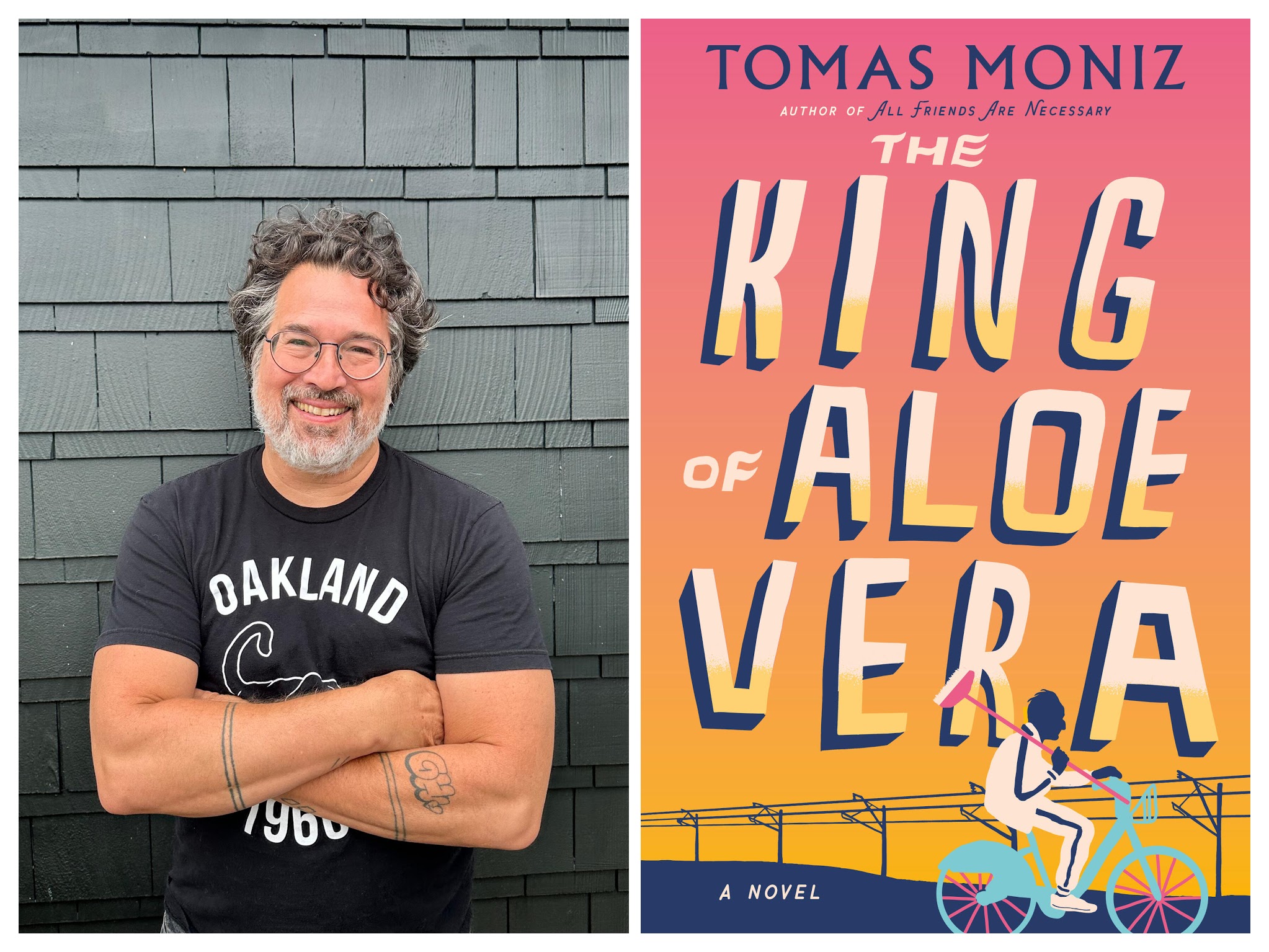
In Tomas Moniz’s new novel “The King of Aloe Vera,” seventy-five-year-old Rey has one month left in his longtime Mission District home when he befriends Q, a young woman on probation who is about to lose her housing. The novel unspools as a love letter to the Mission District of San Francisco and its longtime residents—housed and unhoused alike— as they find themselves in a neighborhood that’s changing in so many ways. We’ll talk with Moniz about the Mission and Latinos, housing activism, and intergenerational friendship.
Guest:
- Tomas Moniz, author, “King of Aloe Vera”
Episode Transcript
This is a computer-generated transcript. While our team has reviewed it, there may be errors.
Alexis Madrigal: Welcome to Forum. I’m Alexis Madrigal. We are out of pledge drive, everyone. Thanks for sticking with us. This morning, we are talking with Tomas Moniz. Tomas Moniz’s The King of Aloe Vera has got to be the novel set closest to KQED headquarters here in San Francisco. On my walk into the office today from BART, I passed half of the book’s key locations, from the park on 17th to Shotwell to ODC, the dance studio. This book could not be more locally rooted here in the Mission, a place that’s a symbol of different things to different people: Latino life, tech-world change, the problems of the street, the flood of wealth. Tomas Moniz is here this morning in spitting distance to the action of the novel. Welcome, Tomas.
Tomas Moniz: Thank you so much for having me here. I appreciate it.
Alexis Madrigal: So this book really all works through Ray, our 75-year-old main character, a lover of ODC and the Mission branch of the San Francisco Public Library. Just introduce us to Ray.
Tomas Moniz: Yeah, Ray is a — he’s an elder, and I really was trying to, like, think about what it means to, you know, survive and get to that age. I know so many of us are raising children and having — thinking about, like, how we want to make the world better. So what does it mean to, like, get to the end? You know? And so with Ray, I just wanted a little bit of some curmudgeonly, playful, irreverent kind of views of the world. And he’s been in the Mission for a long time, so he’s kind of seen it change. He’s struggling with his own place in it and his kind of future. So that’s right.
Alexis Madrigal: What makes it difficult for Ray in the Mission? Like, what are the factors at play for him?
Tomas Moniz: Well, I think part of it is a lack of community, for the biggest part. I think his larger plan to move out of the Mission and into this retirement community, which I had so much fun naming, which is, like, the San Leandro Rolling Hills Retirement Estates and Community, right? Like, I wanted this huge name. And so he’s in the space of, like, I’ve got this plan in motion, but I don’t quite know if I still believe in it.
And a lot of times, I think our elders tend to be, I don’t know, left out of a lot of our thinking and planning. And so he’s trying to find ways in, but, you know, his only real community connection is sweeping his stairs, volunteering at the library and ODC, which I love.
Alexis Madrigal: Yeah. I mean, it’s interesting, right? Because part of it is that he’s had this personal loss. He lost his beloved wife, who he still thinks about a lot in the book, but part of it is that the world around him, yeah, it really has not just changed, but it feels to him like he doesn’t always fit into it.
Tomas Moniz: Yeah. I mean, I remember thinking about writing scenes with him, like, walking those streets and, like, you know, the way we live in such a vibrant, amazing community with all the messiness and beauty that comes with that, right? And so I wanted Ray’s trying to continue to see all of that. So what does it mean to walk past the unhoused who are living in, you know, those areas, right? And what does that mean to kind of see the kids grow up and see, you know, of course, all the spandex and the rented scooters and the bikes, right? And so where does he, you know, how does this make sense to him anymore?
Alexis Madrigal: Yeah, yeah, yeah. I was curious, where did Ray come from? Did you sort of meet an elder on the stoop in Shotwell, or was it just sort of like a composite of some different Mission characters you’d run across?
Tomas Moniz: Yeah, it was a little bit of all of that. I mean, I really was trying to imagine, because I think, uh, you know, I think I lost a few elders in my life and I started realizing, like, God, you know, I’m going to hopefully get to that stage, right? And, you know, what is it I’m going to leave behind? Because I was also kind of going through the legacy that they left me.
And so I really started thinking, like, okay, I tend to write all these characters in their thirties and forties, like, you know, single dads trying to raise kids, trying to find relationships, trying to find community. So what does it mean to be on the back end of that? And so that’s where Ray came from.
And I really wanted him to — I wanted also something playful and, like, beyond the kind of stereotypes of what I think sometimes elders get represented as, but I also wanted that loneliness and that kind of disconnect. And so, you know, I think when I got the framework for the last month of his existence in the Mission Street Apartments, yeah, I was like, there you go. I got 30 days. There’s one day, you know, one chapter a day. And it’s like, let’s have some fun and see, you know, how he’s either trying to wrap things up or he’s trying to kind of extend himself out. Yeah.
Alexis Madrigal: Um, yeah, it’s interesting because, of course, there have been many nonfiction books and there’s been a lot of talk about the quote-unquote male loneliness epidemic. A lot of it, though, doesn’t have the sort of, like, positive spirit of this book in some ways. You know, a lot of it is pretty grim, pretty dark. There’s a lot — yeah, there’s a lot of factors in it. And in our case, Ray just seems like someone who may be done. You know, we find that out very early in the book. It’s not a spoiler, right? He just thinks, like, I might have just reached the end.
Tomas Moniz: Yeah. Yeah. I mean, that’s one — when I got to the idea of him, like, having to decide either to, you know, move and start totally again at this retirement community, or he’s been saving these pills, right, and thinking about how he wants to go out on his own terms. And so that was kind of the framework. And then I came up with that to-do list of things he needs, needs to do, right? And I love — there’s a moment when it changes to a list of things he wants to do, right? So that’s the growth of that character where maybe he begins to feel less lonely, less disconnected.
But when I think about the writing I’ve been doing for, you know, since Rad Dad and Rad Family, my early nonfiction anthologies about parenting, it seems like masculinity has been kind of the primary theme of my writing. And so Ray felt like a really nice kind of — not culmination, but, like, where it’s led. An extension, sort of.
Alexis Madrigal: Exactly, exactly. Yeah, yeah, that makes a lot of sense.
We are talking with Tomas Moniz about his new book, The King of Aloe Vera, set in a changing Mission District. He’s also the author of Big Familia and All Friends Are Necessary. He lives in East Oakland. And this new book, The King of Aloe Vera, comes out next week.
We want to hear from you. If you’ve lived in the Mission for a long time, how have you seen things change? What are the ways in which your neighborhood has changed due to gentrification, displacement, just neighborhood change? You can give us a call. The number is 866-733-6786. That’s 866-733-6786. Of course, you can email Forum at KQED.org. You can find us on social media, BlueSky, Instagram. We’re KQED Forum.
The action in this book really turns — I mean, Ray is the presence that we’re with, but the action really turns on his sort of budding friendship with Q, who’s sort of his young queer neighbor. I’m a sucker for intergenerational friendship, as you’ll hear in this show, but what was it that you wanted to explore between them in that friendship?
Tomas Moniz: Yeah, I mean, as someone who raised two daughters now into adulthood, I just loved that kind of camaraderie and the way you build the relationship that’s based on kind of love and kindness and respect. And so I wanted this moment where Ray is, you know, he’s got to learn to see her.
He has all these assumptions kind of about her early on. Like, he remembers her running around the street, but he doesn’t know her as a person, as an individual, as a young — and, you know, in some ways, she’s got to also learn to see him a little bit as well. And so they start off a little adversarially, and I kind of had fun writing these scenes where she gives him a bunch of crap about his behavior and he’s trying to get to the bottom of some reason why she’s behaving in a certain way on the street.
But they come to, I don’t know, find ways to support each other that I thought were really, for me at least, a pleasure to write and explore.
Alexis Madrigal: Yeah, it’s interesting too, because Ray has no children of his own, right? So there’s a way in which he’s kind of encountering this particular young person without kind of the background that you have of having raised a couple of daughters. And he’s like — there’s — but one thing that I love about him is, like, his curiosity is genuine, right? You know, he’s not just, like, trying to, I don’t know, get her to do something. He’s just sort of like, who is this person?
Tomas Moniz: Right. Yeah. And it was funny. That was a real, uh, like, risk for me, I thought, writing a character that wasn’t a parent. Because I mean, when I look back at everything I’ve ever written, any male character is always a father, right? And so it’s so clearly ways in which I can connect and think about, you know, interacting with the world.
So Ray was a really specific decision to think about his relationship to the world, not just to the family. Because I think sometimes that’s such a — you know, it’s easy to say, well, you know, if you’ve got kids, you should think this way, right? Or you care about things in this way. But I wanted Ray to kind of come to his, you know, fatherly view of the world as an elder.
And I love that, you know, people in the book keep calling him Abuelo, right? So — and he’s like, no, you don’t — like, he’s got to, like, do I tell him? Do I not? How do I deal with this? And so, yeah, I really want Ray to kind of grapple with a connection and community that was slightly outside my experience of understanding how important that is to —
Alexis Madrigal: Well, and I love that he, despite not having kids, he volunteers in the kids section at the Mission District branch. There’s a lot of love for the Mission District library branch here. It’s just like, you like this.
Tomas Moniz: Yes, I do. And the first thing I did when I got a copy was send it to the main city library, and I was like, guys, this book is in this library.
And they shut down the Mission branch. They’re renovating it, right? And so I couldn’t go back in as I was revising it. And I definitely had architectural poetic license with the setting of the library in the book.
But I had so much fun just thinking about volunteering in a library and his ideas about shelving that, you know, um, uh, cause, uh, Alma, his supervisor, to, you know, remind him how he should be shelving books. But — and that’s, and I think that’s a good example, again, of the ways in which he’s got a view of the world and it’s kind of at odds with other people’s views of the world. And he’s gotta try and figure out, like, how do I, how do I allow others to influence me as opposed to me always trying to get my way in the world.
Alexis Madrigal: I also like, too, that his, you know, linguistically, he’s a little out of sorts. He doesn’t, he doesn’t have all the new language, but what’s kind of lovely is the sense that he is — his heart is in the right place. He’s doing the right thing. You know, and the people around him, I think, do sense that and they, they don’t — you know, there isn’t, like, a Ray purity test where he gets, like, bounced, and said people are very appreciative. Right. I like.
Tomas Moniz: Right, yeah, yeah, yeah. That was a lot of fun, too, like, talking about — well, I love that he’s a subscriber to the Chronicle for 30 years, and that’s, like, his primary, right, way he’s understanding the world. And so, yeah, he references, like, the articles he’s read as a way to talk about issues that are, you know, when he’s in conversation with other characters in the book. So, yeah, I had fun with that. That’s cool.
Alexis Madrigal: We are talking with Tomas Moniz about his new book, comes out next week. It’s called The King of Aloe Vera. It is set in the Mission District as we follow 75-year-old Ray in his last month in the Mission. Moniz is also the author of Big Familia and All Friends Are Necessary. Lives in East Oakland.
We also want to hear from you around the experience of intergenerational friendship. I mean, do you have friends who are much older or much younger than you? How does that relationship inform your life? The number here is 866-733-6786. We’re also taking your call still on the Mission and your neighborhood change. 866-733-6786. The email is [email protected], and social media, BlueSky, Instagram, Discord. We’re KQED Forum.
I’m Alexis Madrigal. Stay tuned.