Claudia Rankine on the Friendships That Unsettle and Sustain Us
Airdate: Thursday, September 10, 2026 at 9am
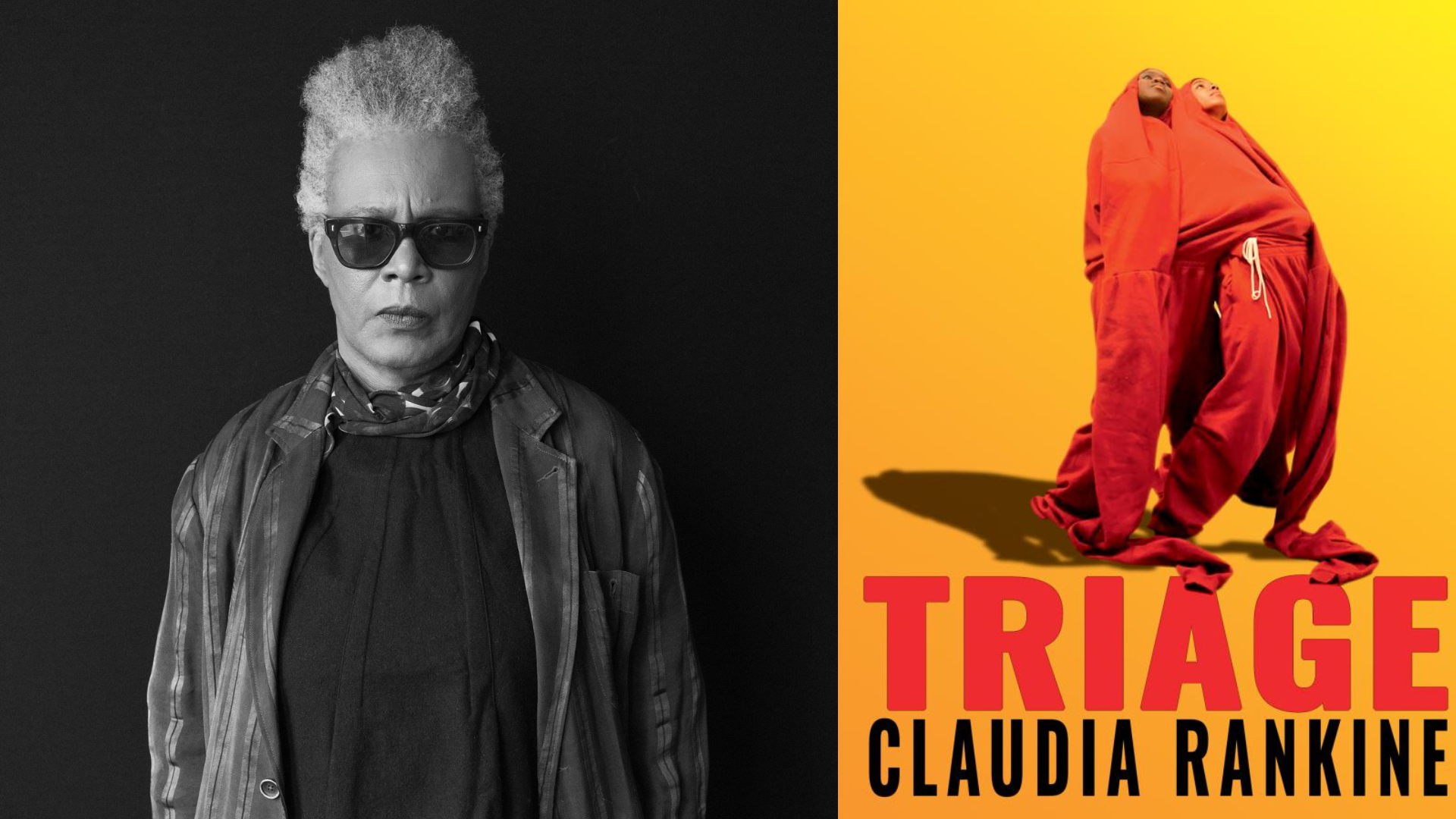
Acclaimed poet and essayist Claudia Rankine’s new book, “Triage,” follows the turbulent, decades long friendship between a Black woman and a nonbinary Palestinian who meet in college and invent a ritual of collapsing to the ground whenever they see each other. Over time, that act of collapse comes to hold new meaning as they reckon with wounded histories, political violence and the strain of loving someone who can also unsettle you. Blending memoir, criticism, essay and visual art, “Triage” is Rankine’s first book after her celebrated American trilogy and some of her most personal writing yet. Rankine joins us to talk about friendship, grieving, and what it means to keep acting – and relating – in a time of relentless personal and global loss.
Guests:
- Claudia Rankine, poet, playwright and author, her new book is “Triage”, professor of Creative Writing at NYU; a MacArthur “Genius” grant recipient
Episode Transcript
This is a computer-generated transcript. While our team has reviewed it, there may be errors.
Alexis Madrigal: Alexis Madrigal here. As you probably know, this is the first day of our membership drive, our pledge drive during this time of the year. We’re not gonna be doing One Good Things, these little things that I read, these little odes to different parts of the Bay Area every single day. However, today we are, in fact, going to do one.
This actually came from my newsletter, which is also called One Good Thing, which you can subscribe to at kqed.org/onegoodthing. And it’s about a tree in my neighborhood.
This tree is monumental. I’m standing at its base, redwood bark seeming to flow down, down until it finally gets to ground, where I can’t help but see something elephantine in the way it bulges where it touches earth. I don’t have to imagine the roots. The infrastructure of this place has had to accommodate itself to this tree. The sidewalk is covered in a spongy material to prevent the inevitable cracking of concrete by root.
Strange to think that concrete, which, if you’ve ever hit a slab of it with a sledgehammer, feels adamantine and everlasting, will always yield to the redwood root. The asphalt of the road beyond the sidewalk knows, too. It’s cracked along a line that suggests the tree below.
This tree has no name that I know of, though stay tuned because I found out the tree’s name. It stands on a small side street in Berkeley near the Claremont neighborhood. Lovely area, trees abound, including a smattering of other redwoods. But none of the other redwoods are like this one, which feels out of scale for a neighborhood of single-family homes.
I’m filled with wonder and envy that someone lives with this tree in their front yard. Every day they go about their business in the understory of this remarkable living creature, forgetting their keys in the glory of creation, telling a kid to hurry if they’ll be late under the majestic branches.
I don’t know much about the tree. Must be old, but how old? Was it here in 1926, 1776? Before, could Indigenous residents have known this tree when it was a small sapling? No. In the presence of a giant like this, the brain can get scrambled. I know better.
The Uplands neighborhood nearby was created in the early 20th century out of ranch land. And it seems unlikely that there were huge numbers of redwoods on or near that ranch. The house that shares the redwood’s property was built in 1906, which probably means it was planted around then. Just guessing here. Could it be just 120 years old? Guess that’s not so young.
On the outside, maybe it settled into ranch land in the decades before the subdivision. But regardless of the precise history, this redwood, as grand and majestic as it is, is a planting. It’s a co-creation of the people who have lived on that street and its own magnificent possibilities.
Somehow it feels weirder to think that someone’s lovingly tended this tree. They could not have known they’d picked the very perfect spot for a redwood. And yet they did.
This magnificent tree is not a remnant or an area of preservation, but an attempt at repair. People have worked to keep it here, despite the complexities it must introduce into life in an American house.
This tree is grown up in this neighborhood. Same as my kids.
This week, I’m gonna send out a follow-up with the tree’s name.
Welcome to Forum. I’m Alexis Madrigal. One thing I love about Claudia Rankine’s books, and this new book, Triage, in particular, is that each one seems to create its own genre.
Triage reads kind of like an experimental novel or long poem or an essay or a memoir. What is this thing between the two covers of the book? Without a doubt, it does what a book should do, refine and press a generous span of thinking. But it isn’t quite like anything I’ve read before.
Triage is a book for confronting the self in a time of global cruelty and tragedy. In a very rough sense, it’s a novelistic book about friendship and grief and the state of the world. And this work asks, how do our own personal losses grind us into the particular shape that we use to confront the world and its endless variations of loss?
And also, maybe its author, Claudia Rankine, winner of myriad awards, a certified MacArthur genius, also an NYU professor, joins us this morning.
Welcome back to Forum, Claudia.
Claudia Rankine: Thank you, Alexis. It’s so good to have you.
Alexis Madrigal: As we’re settling in here, I want you to maybe confront the sort of basics of this book, which has a quite complicated form. It’s quite very interesting. But our book opens with our narrator watching their old friend, referred to in the book as the theorist, deliver a lecture. And it’s the narrator’s 60th birthday. It’s a friend from college who they haven’t seen in a long time.
And during a Q&A, someone asked the theorist how they feel, given all that’s going on in the world today. You can even see them, like, doing that thing with their hands we all do. And the theorist pauses and says, “Sometimes I want to throw myself in front of a speeding car.”
So this book really is responding to that feeling in the world right now. How do you see it showing up for you, that sense of too much?
Claudia Rankine: Well, yeah, I think it is a moment when everything is happening and nothing is happening. And we’re caught in this sort of liminal space where we see what should be done, but we cannot do it. And it’s a strange dynamic, I think, to understand that things are happening and we have no control to stop them, things that are impossible, that you have lived your life thinking, “This is not possible,” and yet it is possible, and it is now happening, and it’s now.
Alexis Madrigal: There’s a repeated line in the book which I found quite chilling: “The choices are not choices.” This sense that the political and even personal possibility for things has shrunk to the point where the choices are not choices.
Claudia Rankine: You know, I don’t know about you, but we all grew up with Anne Frank and thinking, if this ever happened, if we were ever in this place, we are very clear about what we would do.
Alexis Madrigal: Oh, man.
Claudia Rankine: And suddenly we are just watching disaster after disaster. There are wars, there is genocide, there’s climate change. And we’re just continuing on as if we stay quiet, it will reverse things. And I don’t think that has ever been the way.
Alexis Madrigal: One of the sort of wonders and the mechanism of this book for me is that in this book, the narrator comes across as a version of you. Maybe not exactly, maybe not fully, but like in the multiverse, some Rankine out there. And yet it’s really that character who’s sort of paralyzed, who is not doing the things.
So you’ve kind of taken the person that we want to identify with as, you know, oh, this is whose consciousness we’re with, and given her the difficult task of not doing the things that we wish we would do.
Claudia Rankine: I know. I think some people are disappointed. They think I’ve tricked them somehow. They’re like, “Gotcha!” But it is the dynamic I personally found myself in, where I have one idea about what is right and what my moral stance is and who I am, and then the reality is there in front of us, that there is little we can do, or at least so we think.
And then you see what’s happening in Minnesota, and you’re like, oh, okay, there are other ways.
Alexis Madrigal: Yeah, there was a line, I think the review in The Atlantic pulled it out, too. It struck me as well, that people find themselves in a state where, quote, “nothing else functions but one’s grief.” And it does feel like part of this book is trying to somehow maybe get to the end of that grief, get to, what does it mean to feel it all the way, to somehow move past it?
Claudia Rankine: And move through it. And also, you know, there’s a sense that you can’t get past it. We’re in a dynamic now —
Alexis Madrigal: We’re —
Claudia Rankine: — where there is no end. And so, you know, let’s take climate change. We, I guess, we are now, the U.S. is now reclassified as a tropical climate, which, you know, September in the 80s, you kind of believe it.
So whatever the trajectory is, it’s happening. So the new question is, the new way of being is, how do you live within it? What are your responsibilities to the moment when you know that there is no end to it?
Alexis Madrigal: Um.
Claudia Rankine: So, and that’s, you know, that’s hard to hold in terms of not having a plan that has a solution. You need a plan, but it might not be a solution.
Alexis Madrigal: I mean, the theorist in this book has an answer, which is essentially sort of action first, right? That’s kind of the theorist’s answer is, well, we gotta do something. What’s the sort of narrator’s position on that position?
Claudia Rankine: Well, Daenerys’ position on that position, I believe, is maybe you’re right, but am I the one to do it? And that’s the other thing. Is it our job to police the actions of others rather than to do what each of us can do to the point that we can do it?
Alexis Madrigal: The phrase that kept occurring to me — there’s regular listeners of this program who will wonder why I’ve brought up many times Zygmunt Bauman, a Polish philosopher, who has this amazing line about our times, that anything can happen, but nothing can be done. And that’s sort of the state of power in the world, what he calls liquid modernity.
And that line really resonated throughout this book for me, this sense of that.
We’re talking with poet, playwright, and essayist Claudia Rankine about her new book, Triage. She is, of course, also the author of the American Trilogy, including Citizen and Just Us, professor of creative writing at NYU and a MacArthur Genius Grant recipient.
I want to hear from you. Can you relate to the feeling of too-muchness in the world today, or the kind of only mechanism that’s working in being your grief? How are you responding to those feelings or trying to move through them?
You can give us a call, 866-733-6786. That’s 866-733-6786. The email is [email protected]. I’m Alexis Madrigal. Stay tuned.