Trump Administration Scrambles to Expand Immigration Detention Centers
Airdate: Tuesday, September 8, 2026 at 9am
The federal government has been scrambling to find places to send immigrants that have been arrested at record levels – close to 50,000 in July alone. Trump’s rush to detain immigrants has led to inadequate and overcrowded facilities and out-of-state transfers. Some immigrants have been held for days in unsanitary conditions at San Francisco International Airport. Meanwhile, Gilroy residents have been fighting a proposed field office for Immigration and Customs Enforcement. But those are just blips in the broader landscape of immigration detention. As the Trump administration plans to pour up to $45 billion in the next few years into locking up immigrants, we’ll dive into the immigration detention ecosystem in the Bay Area and nationwide.
Guests:
- Tyche Hendricks, senior editor covering immigration, KQED
- Doug MacMillan, Reporter covering corporate accountability, The Washington Post
- Sara DiNatale, reporter covering politics and the impacts of the Trump administration’s policies on the Bay Area and California, San Francisco Chronicle
Episode Transcript
This is a computer-generated transcript. While our team has reviewed it, there may be errors.
Alexis Madrigal: Welcome to Forum, I’m Alexis Madrigal. The Trump administration came into office promising to transform immigration in America, and they have endeavored to do so, arresting and deporting entirely different groups of people than previous administrations. Immigration agents arrested close to 50,000 people in July alone. So where do all those people go?
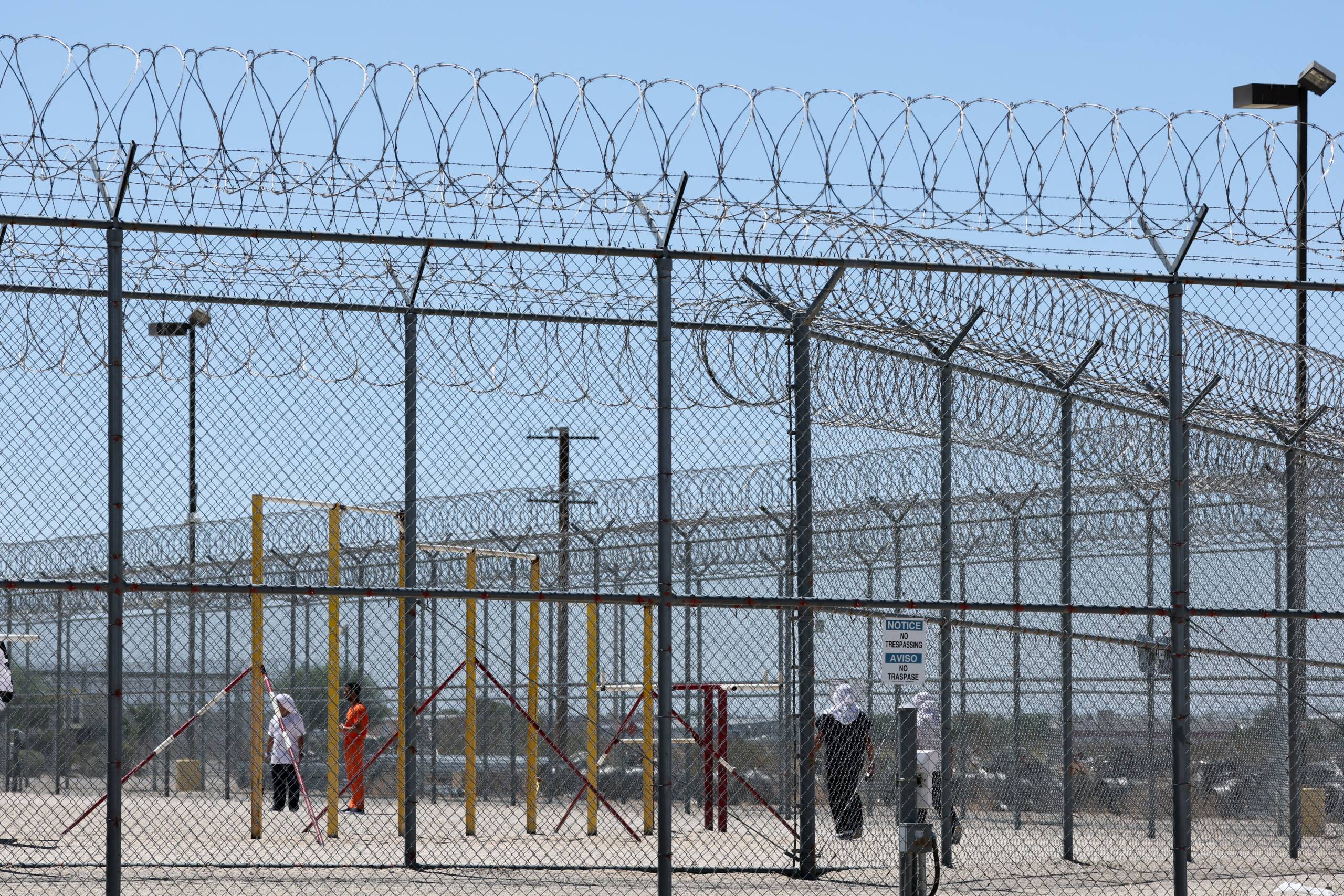
In Northern California, it’s not a simple situation. We don’t have a big ICE facility nearby. In fact, the closest one is a converted prison in California City, out in the Mojave Desert. We’re gonna talk about the network of facilities that exist now, and that may get built with the surge of money that the Trump administration is plowing into ICE.
Joining us first, we’ve got Tyche Hendricks, senior editor covering immigration here at KQED. Welcome, Tyche.
Tyche Hendricks: Glad to be here.
Alexis Madrigal: And we’ve got Sara DiNatale, who is a reporter covering politics and the impacts of the Trump administration’s policies on the Bay Area and California at the San Francisco Chronicle. Hey. So, Tyche, just kind of give us an overview here. Like, how is immigration detention supposed to work? How did it, generally speaking, work in the past, and sort of what’s different now?
Tyche Hendricks: Sure. Well, I mean, I think at the get-go we should say immigration detention is civil detention. It’s not punishment for a crime. It’s not supposed to be punitive. It is primarily aimed at people who are a flight risk or a danger, who, you know, the government feels should be held in custody until they go through their immigration court proceeding, deportation proceeding.
There are some people subject to mandatory detention, people, for example, who have certain criminal convictions. And this administration and this Republican Congress have vastly expanded, you know, who they think should be mandatorily detained, which is part of why we’re seeing this huge increase in people in detention facilities.
But, yeah, arrests are coming up to record numbers, and detention also is near a record high. And one thing we should say, even though in California there are some really high numbers, we’re the third highest in arrests after Florida, and Texas is number one. And in those places, it’s ramped up significantly.
So partly because we have these sanctuary laws that mean that when you have a traffic stop with a police officer, you’re not necessarily gonna be handed over to ICE as you would be in those other states, right?
Alexis Madrigal: Yeah. You know, what about the, you know, we’ve seen many of these arrests, either the viral ones and the many more that occur out of the public eye. Where do people actually go? Like, if you got detained — there was someone detained on Telegraph Avenue, you know, a few weeks ago or a month ago. What are the kind of pathways that someone might go through there?
Tyche Hendricks: Sure. I mean, typically, you would go to an ICE office where there are sort of short-term hold rooms in San Francisco. It’s at the ICE sort of field headquarters at 630 Sansome Street, where we’ve seen a lot of protests. And those are hold rooms meant for like a 12-hour processing, you know, short-term, not for overnight.
And then you would be taken on to a long-term detention facility. As you say, there are none currently in Northern California. So the closest are down in Southern Kern County.
But I will say that there was kind of a bottleneck with the short-term hold rooms. And people were being held there for days and days without proper medical care, medical screening, without bedding, without proper food and hygiene. And a court order has now said, that’s no good. And so ICE has sort of fallen back and tried to regroup.
Alexis Madrigal: Sara, you were reporting on what’s been happening at SFO, which seems like exactly an example of one of these situations, right? Where it’s supposed to be short-term detention, but as you discovered talking to people who were actually held there, it has not been.
Sara DiNatale: Yeah, exactly. So what’s happening at SFO, one, I mean, I think people have seen the viral videos of domestic terminal arrests. So what we’re talking about with people actually being held at the airport is happening in the international terminal.
So these are a lot less typically a lot more visible because it’s happening when an immigrant is reentering the country through customs, where they often would be — it’s not abnormal to have a secondary inspection interview. Those happen behind closed doors, you don’t have your cell phone, you’re kind of going over your particulars with a federal agent.
But what’s happening is folks, and a lot of green card holders included, are being flagged, going through that secondary inspection interview, being told like, hey, you have an old arrest on your record and we need to investigate it further. And rather than releasing them on something called parole, which essentially is like, hey, come back for a follow-up appointment, they’re holding them at the airport.
And they’re keeping them in a — they call it a lounge, to be clear. That is their language. They call it an in-transit lounge, and it is by Customs and Border Protection policy only supposed to be used for 72 hours. I would say from the people I’ve spoken to have been held there, they would say like 72 hours is still way too long.
There’s not beds. They’re mainly chairs. They renovated recently, and now they have couch-like benches, which is a step up from before, when people told me they were sleeping upright for up to eight days.
So these holds are really long. Essentially, agents are deciding what to do with them based on their arrest history and following Trump’s executive order about detaining people if they’re deemed potentially inadmissible. And eventually, after that process at the airport, they’re transferred to California City, which is that big holding facility in the Mojave Desert.
Alexis Madrigal: So talk to me, Sara, about Gilroy and what’s been happening down there. There’s this proposed facility that’s just outside the city limit, as I understand it, right? So it’s in Santa Clara County. What is that supposed to be? Is that gonna be a California City-type thing, or is it something, some intermediate kind of facility?
Sara DiNatale: Yeah, the details are not like super specific. Shout-outs to San Jose Spotlight for unearthing some of these internal documents and things that found that they had plans to house up to 150 people. So it’s kind of like not quite as large as California City, but it is still not — it would be more than something like we’re seeing at Sansome.
Alexis Madrigal: More than a lounge, private prison.
Sara DiNatale: Um, the current status right now is that construction is on hold. There’s actually a court hearing today where a judge will decide potentially what the future of that site could be.
But essentially, because it’s in Santa Clara County and not the city of Gilroy, Santa Clara County is the one that’s actually suing the federal government, arguing that the land that’s being used is zoned agriculturally and shouldn’t be used for — whether it’s a holding center or a detention facility, whatever verbiage you want to use. It would be a nice facility, and they are against that. Yeah.
Alexis Madrigal: Tyche, the one that I had heard about and saw protests around was out there in the East Bay, right? In Dublin, former women’s prison, right? What’s been going on with that?
Tyche Hendricks: Yeah, that’s been a little quiet recently. This was the, right, this former women’s prison that was closed down for, like, horrible rape abuses and sexual violence against the inmates. ICE did take a tour, I think, at one point. And the city council and a lot of elected officials really raised a hue and cry and said, no ICE facility here.
ICE told me some months ago that they were not looking at it, so it’s kind of quiet at this point. But that is a federally owned prison in the Bay Area. And, you know, Homeland Security officials have said that they’re looking for something that’s closer into San Francisco, which is a big ICE headquarters in California.
Alexis Madrigal: I mean, do we feel like detention is actually a bottleneck? Like, is the fact that we don’t, you know, if California City was actually in Dublin, Pleasanton, do you think we’d see more arrests? Like, what do we know about the relationship between those two things?
Tyche Hendricks: You — I mean, I think there is an argument that advocates are making that the more detention space there is in the area, the easier it is for people to be locked up there.
Certainly this administration — well, this Republican Congress — has been sort of throwing money at ICE and immigration enforcement more broadly. And so there is, you’re seeing around the country a vast ramp-up in detention, and people are also flown, you know, from here to there to here to there, channeled into detention facilities in Texas and other places.
Alexis Madrigal: I mean, Sara, I think this is kind of my question on this. I mean, it has seemed to many people in the Bay Area like it’s odd that we’ve had less immigration enforcement action here than in other parts of the country, given the way that the Trump administration has tended to operate and that this is like a stronghold of anti-Trump sentiment.
Do you think it’s sanctuary city policy? Do you think it’s a lack of detention centers? I mean, do you have any sense of the role that these various factors are playing?
Sara DiNatale: Yeah, I would say it’s probably somewhere in the middle. Like, there’s probably — like, both things, I think, can be true.
I know lawmakers especially have said that they think part of the reason we have had less enforcement efforts is because we don’t have a place to put people easily. It requires more coordination. That has come up in response to the center outside of Gilroy.
Now, some cities and counties in Northern California have proactively been creating ordinances that would make it more difficult for ICE to open new facilities in their areas, just by amplifying existing land-use laws and environmental impact requirements. Things that would just make it, like, more annoying to open a new facility. And they are very candid about that’s why they’re creating these new local laws.
And when you talk to those local city leaders, like the mayor of San Jose, they’re pretty explicit and like, yeah, we think that this is part of why we haven’t had as big of a nice crackdown in our community, because we don’t have that infrastructure.
So it’s definitely a belief that people carry. I mean, in my reporting, I haven’t found a definitive answer, but I think there are logical conclusions that are easy to reach between both those things.
Alexis Madrigal: We’re talking about the network of immigration detention facilities in the Bay Area. In our next segment, we’re gonna kind of take it nationwide and look at what’s happening everywhere else.
We’re joined this morning by Tyche Hendricks, a senior editor covering immigration. We also have Sara DiNatale, who you just heard, a reporter covering politics and the impacts of the Trump administration’s policies on the Bay Area and California for the San Francisco Chronicle. And, of course, we would love to hear from you.
Maybe you live near Gilroy or Dublin or another community where a detention center has been proposed. Tell us what you’ve seen on the ground. Tell us you’ve heard from your neighbors. What do you think about how your local and state leaders are responding?
And give us a call now. The number is 866-733-6786. You can email Forum at kqed.org. You can find us on Bluesky, Instagram, Discord, or KQED Forum and all those places.
I’m Alexis Madrigal. Stay tuned for more.