In Daniel Mason’s Comic Novel ‘Country People,’ California Collides with New England
Airdate: Thursday, September 3, 2026 at 9am
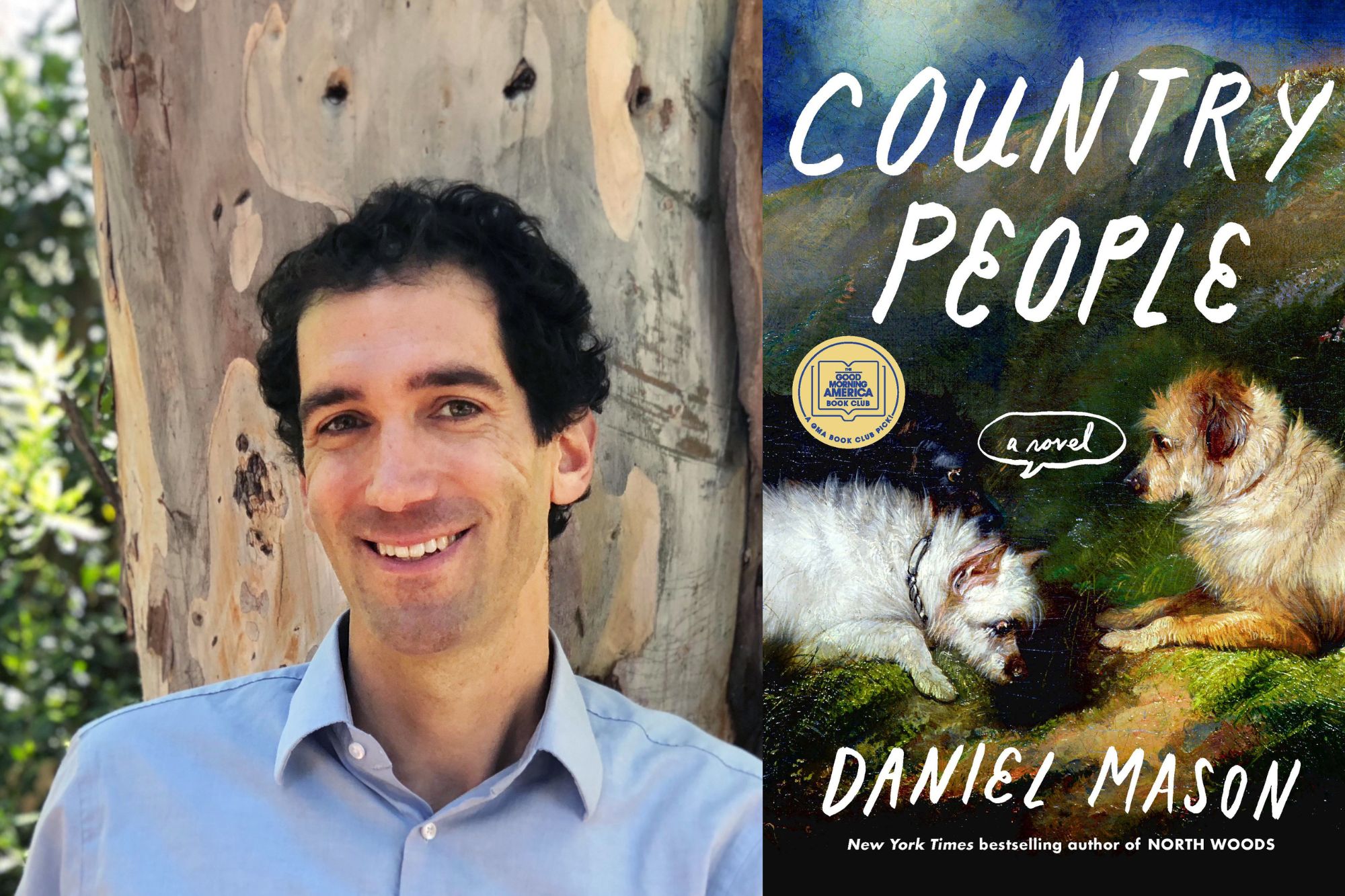
Acclaimed novelist Daniel Mason’s latest book, “Country People,” centers on Miles, a stalled PhD student of Russian folklore, who is married to a brilliant academic. A visiting stint at a prestigious liberal arts college in rural Vermont sends their family of four, plus the perfect dog, careening through a different America of Slim Jims, forests, and local legends. It’s both a sendup of academia—Mason’s a Stanford professor of psychiatry, after all— and those intrepid Californians, like himself, who head to New England in the summer.
Guests:
- Daniel Mason, Novelist, Mason’s newest novel is “Country People.” He is also the author of “North Woods,” “The Piano Tuner,” and “The Winter Soldier,” among other novels. He is an assistant professor of psychiatry at Stanford
Episode Transcript
This is a computer-generated transcript. While our team has reviewed it, there may be errors.
Alexis Madrigal: Welcome to Forum. I’m Alexis Madrigal. When you’re here, it’s easy not to notice what makes the Bay Area different: our food, our diverse peoples, our facility with pronouns, our ease with all kinds of unconventional lifestyles, our annoying AI billboards. But take a Bay Area person like a 14th-year literature student in his 40s with two kids and a tenured wife and place them in the wilds of Vermont. And while, yes, it becomes very obvious, both to Daniel Mason’s lovely narrator Miles and to all of us, exactly who we are. Which is to say, yes, Country People is a New England novel filled with river swimming and deciduous forests and skiing, and it’s also a novel about a particular kind of California consciousness encountering the world out there, where there are seasons and Slim Jims are breakfast food. Which makes sense, as Daniel Mason is an associate professor of psychiatry at Stanford who joins us this morning from New England. Welcome, Daniel.
Thanks so much. Lovely to be here. So just tell us a little bit more about Miles, our lovely long-suffering dissertation writer. He’s also pretty chill, though.
Daniel Mason: He is. So poor Miles is a person who life has not been so easy to in terms of the career that he’s wanted to get. Now he’s a guy who’s interested in anything. Since he started his studies, has studied many different topics, has sort of ranged around in his choice of literatures that he wants to write about. But 14 years in has changed his dissertation topic probably about that many times.
In a way, this is a virtue, though. It’s because he’s someone who just gets distracted and drawn into anything. And so he’s the person who we follow mostly in Country People, although his wife’s the one who’s invited to teach at this college in New England. They think that this will be a good year for him to finish up his dissertation, which is on a peasant in Russian folktales, because they have this notion that somehow they’re going to be able to learn about the Russian peasant by — by — we’re all folks somewhere for a moment.
Alexis Madrigal: Russian peasant, no less.
That’s right, that’s right. Um, you know, I happened, just like by pure happenstance, I happened to read the Nabokov novel Pnin last week, right before this one. And that book has a similar kind of extremely lovable loser as a protagonist, if not a narrator in that book. Did you go about to write a book that had this kind of lovable loser at the core? Or did it just kind of shake out that this is who Miles became, was this person who could never quite decide on a path?
Daniel Mason: It’s hard to say when I start out what I’m intending to do, but I think I’m mostly just trying to write something. I find it so hard at the beginning. So it’s more like what kind of character draws me in and who do I want to stay with.
At the beginning, I had the choice between the two of them, and his wife is a very effective person, knows a lot. I came to like her a lot too. But it was really Miles that drew me in, and I think that in many ways that I feel a lot like him. Like, all, um… I go down rabbit holes constantly. He’s sort of a great companion who gets interested in anything, as long as it’s interesting. And then the second he finds something else that’s more interesting, he heads off in that direction, which is a wonderful personality trait.
And I mean, it doesn’t necessarily get you very far in academia, but as a person and as a father, as a husband, as a friend — and he felt like a friend by the end of the book — it’s a lovely trait. I mean…
Alexis Madrigal: Do you share this trait? Because, I mean, you are a Stanford professor as well as an acclaimed novelist, a totally separate field. So you can’t have too many of Miles’ character traits, but you seem to have maybe some familial bond with him in fields like…
Daniel Mason: Well, I mean, I think that secretly I think that Miles would make a wonderful fiction writer because I think in some ways, and maybe one reason I guess I’ve gravitated to fiction over time, is that it’s a great profession for someone who has a short attention span. Because if you have a really long attention span, actually that may not be great for a knowledge, right? If you have longer attention span than your reader has an attention span, then you might be writing something that doesn’t quite draw people in.
But I found it. And of course, there are times my attention span is short-story length, but I think for a novel sometimes I feel very much like someone like Miles who’s interested in something very intensely for a period of time until something else—
Alexis Madrigal: Comes along. I mean, part of why this book works so well is just Miles is an incredible narrator of his experiences in this kind of de-familiarized world that he’s living in, in rural Vermont. So why don’t we have you kind of just read just a little bit so people can get a feel of what it’s like to kind of walk a mile with Miles.
Daniel Mason: Sure. Thank you.
So this is a moment from the second chapter of the book. And basically the book begins with them, you know, this husband and the wife and their children sort of fairy-tale-like taking off across the country. It follows them across the country until they eventually land in the small town. They’re astonished by it, sort of by the natural beauty of it.
And, you know, especially for a Californian who’s very used to the dry landscapes that we have, the lushness of a New England summer is really quite striking. And they arrive, they wake up their first morning, and they decide they’re going to go out and get breakfast, something pretty easy for someone in the Bay Area on a Sunday morning, but not something that’s quite so easy in rural Vermont. So they head out at six to get something to eat.
“17 miles away at a gas station, they found themselves in a land of culinary abundance. What exotic flavors, what strange delectations raised in the land of the unprocessed and the organic. Attending public schools that maintained their own gardens, never had the children tasted of the Slurpee, the Twinkie, or the pepperoni pizza cracker. Pringles they knew, but only in a distance. The friendly werewolf smiling on the chicken-flavored puffs was still a stranger. Could they guess the central ingredient of the Corn Nut? Who was this Sara Lee of such extraordinary industry? Or Slim Jim? And why were his meat sticks packaged in the same color scheme as Penn’s oil?
“The choices: Flamin’ Hot Limon Cheetos beckoned with throbbing colors. There were pink weepers, jelly blossoms, real pork crunchers, jumpin’ beans as bright as windshield wiper fluid. Hot dogs, the colors of an old lady’s nail polish, spun gleaming on greased rollers.
“And the refrigerator aisle. It was 6:30 and already one could choose from two dozen different kinds of chicken and tuna salad sandwiches packaged in perfect little plastic containers, ready to be washed down with wine coolers in kid-friendly hues of pink and lime or energy drinks with fascist fonts.”
Alexis Madrigal: That was Daniel Mason reading from his latest book, entitled Country People, comedy about a family of academics who moved from California to Vermont for at least one year.
We, of course, will take your questions if you’re a big Daniel Mason fan. We’d love to hear from you: 866-733-6786. Maybe you’ve experienced some cultural dissonance between your life in California, eating the organic and seasonal, and going to some other rural locale where those things are maybe more difficult to access. The number is 866-733-6786. The email’s [email protected]. And of course, all the social media things were kqdforum there as well.
I mean, one of the sort of wonders of this book, I think, is that you kind of take this character who you could make fun of a lot, but don’t really. And you take this sort of rural landscape, which, again, you sort of poke fun at, but in a kind of loving, wide-eyed kind of way. And it’s almost like the mean parts get canceled out, and so you get this kind of really loving portrait of kind of these two, a person in this place.
Daniel Mason: Yeah, I think that this was something when I started out that I very much got myself drawn to. I mean, most of the time when I open up my computer and look at the news, it’s something that leaves me quite a bit more worried or sad from when I close it. And so I don’t know whether it was I set out deciding to do this or whether the notes that I was taking at the beginning happened to be humorous ones or light ones, or I could say kind of comedic ones.
But, you know, as time went on, I found that this was — and maybe in the beginning, it felt a little bit like an escape from what was going on around. But at the same time, I think the more and more I thought about comedy and, you know, how comedy helps me engage with the world and how so many of the books that, even the serious books that I love, actually sometimes are very funny in moments, that became, I think, the goal.
And part of this, I think, is working with a character like Miles who really has an open mind and sees the best in people. It’s nice, I think it’s nice being a writer kind of by yourself. You can look out at the world, you can grumble a bit about it. And so he, as a companion, kind of helped. I think he sees the sort of central premise of the book, which is that it’s awfully hard to be a person sometimes. And a lot of people are doing their best, and he just had a way of seeing that.
Alexis Madrigal: Yeah, I mean, there’s really a sense to — and she does grapple with one of the most difficult things in life, which is also figuring out who you are relative to who you think you might be. And because he thinks he might be anything, you know, it makes it quite difficult for him to actually see himself for who he actually is.
Daniel Mason: Yeah, I mean, I think about this a lot because we’re at this funny moment in history where we choose who we are. Historically, for most of the time human beings have been around, who we’re going to be is pre-decided by the community that you grow up in, the family that you’re born into, maybe the career that’s handed down to you.
And yet this world that we live in is one filled with choice. And not only college-age people sort of embarking on a career, but increasingly younger and younger people, and I think this is something that people in the Bay Area are probably very familiar with, have to decide what their narrative’s gonna be, have to decide what their future’s gonna be.
And Country People pokes some fun about this, but it’s tough to have to have decided, especially so early. And so I think of Miles as somebody who — he doesn’t know the answer to what he wants to be. Um, he’s happy being a dad. He’s happy married to his wife. He loves reading. Um, but none of these is a clue to answer the sort of question of what you are.
And, um, you know, very, very often, you know, at least in the United States and, you know, and particularly in a high-pressure environment like the Bay Area, when a person says, like, you know, “What do you do?” their meaning is, is what do you do as a career? Of course, there’s many other ways to answer that question. What do you do? With my kids, I read to my kids. I walk my dog. But that’s usually not what people are asking.
So Miles could answer that, “What do you do?” But he doesn’t know yet what he does, so to speak, as a kind of career. And in many ways, like, this wouldn’t be a failing in many other contexts, but growing up in the sort of hyper-competitive, hyper-determined environment that he does, it is one that begins to gnaw on him a lot over time.
Alexis Madrigal: We’re talking with novelist Daniel Mason about his latest book. It’s called Country People. He’s a psychiatry professor at Stanford and also the author of Northwoods. I’m Alexis Madrigal. Stay tuned for more right after the break.