What Does Bay Area Democratic Socialism Look Like?
Airdate: Tuesday, September 1, 2026
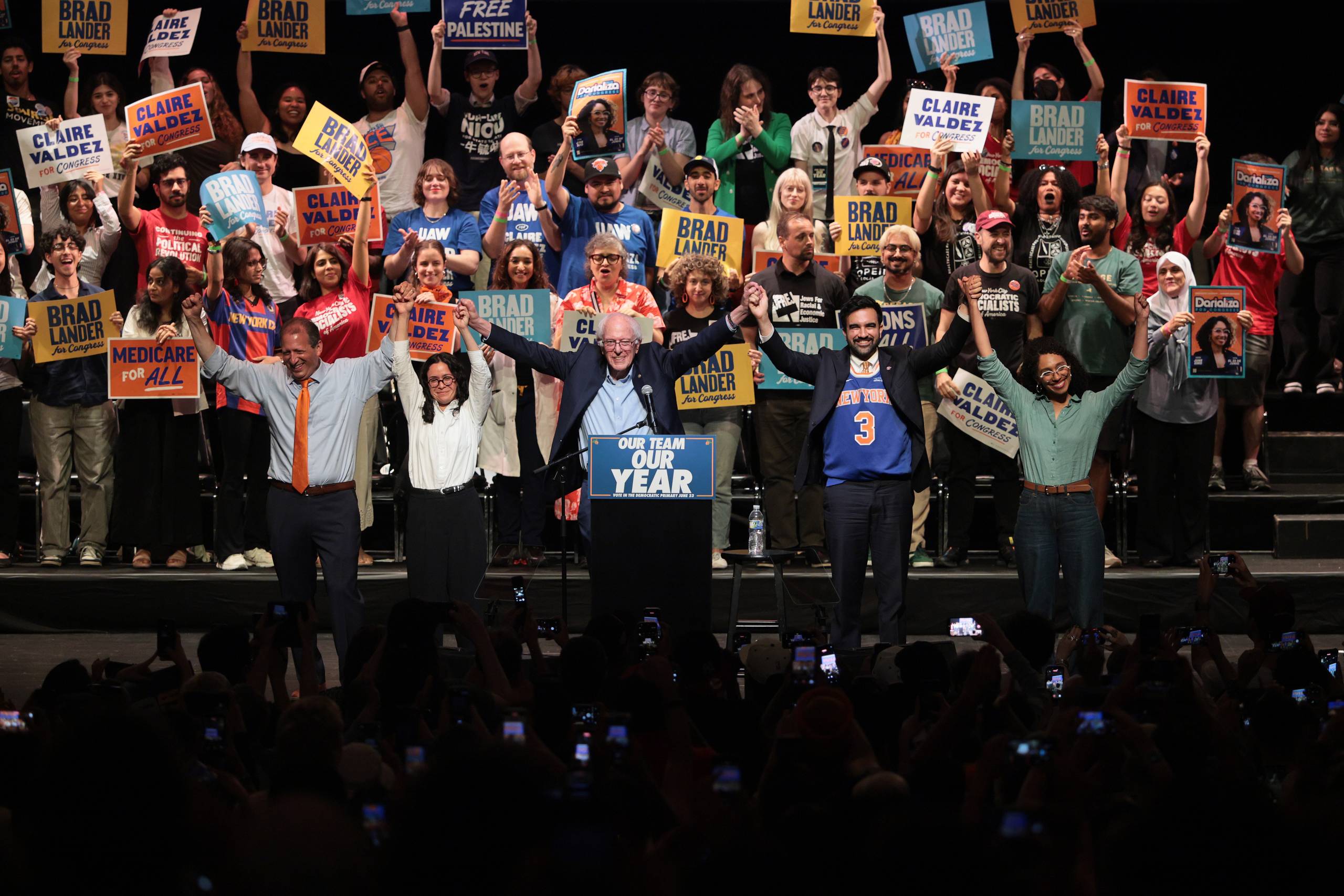
Democratic socialists are on a winning streak. Candidates back by the Democratic Socialists of America have toppled establishment Democrats in primaries from New York to Florida, and national membership has surged past 120,000. In California, DSA candidates are running for mayor in Los Angeles and Richmond, and current incumbents like Assemblyman Alex Lee are members. We talk about what the party stands for and how its politicians and policies — credited with pushing the Democratic Party left — are making local impacts.
Guests:
- Alex Lee, assemblymember, California State Assembly – represents California’s 24th Assembly District which includes the Alameda County communities of Fremont, Newark, and Sunol, and the Santa Clara County communities of Milpitas and San Jose
- Charles Homans, writer, New York Times – His latest piece for the New York Times Magazine is titled “Moderates See Socialists as a Threat to the Democratic Party. Socialists Agree”
- Cecilia Lunaparra, councilmember, Berkeley City Council – Lunaparra is the first undergraduate elected to Berkeley City Council
Episode Transcript
This is a computer-generated transcript. While our team has reviewed it, there may be errors.
Alexis Madrigal: Welcome to Forum. I’m Alexis Madrigal. Time was that even the word capitalism was untouchable in American politics. To whisper socialism was to invite disaster. Decades of anti-communist efforts and the wild political triumph of Ronald Reagan — you remember, he won every state except Minnesota — cemented the idea that the U.S. was a right-of-center country, and the left flank of serious politics was, I don’t know, Al Gore.
But as wealth inequality has skyrocketed since those days, as housing costs have spiraled out of control, as AI pandemonium looms, as hard-right forces have taken over the Republican Party, a new style of socialism has evolved and started to win. The Democratic Socialists of America count AOC and Zohran Mamdani among their number, perhaps the two most charismatic politicians on the left. They’ve got Mayor Katie Wilson in Seattle and a serious candidate for mayor in L.A., Nithya Raman. In Richmond, DSA’s Claudia Jimenez got the most votes in the primary for that city’s mayorship.
So we’re talking about the DSA and the midterms, and whether all this left energy is helping or hurting the Democrats. Up first, we’ve got Charles Homans. He wrote a great story for the New York Times called “Moderates See Socialists as a Threat to the Democratic Party. Socialists Agree.” Welcome to the show, Charlie.
Charles Homans: Thanks for having me.
Alexis Madrigal: So, I do like that some Democrats are calling this your hot, sexy Socialism summer, and also some Republicans are calling this Democratic Socialism Summer. Give us a little overview on how DSA-backed candidates have done across the country.
Charles Homans: You know, this has really been a pretty remarkable year for DSA. And, you know, beginning, I think you really want to start last year with Zohran Mamdani’s win in New York. But so far this year, DSA-backed candidates have won five congressional primaries, just since June, all over the country, really. As you mentioned, you have one DSA candidate who is in a runoff for mayor of Los Angeles. Another is likely, is almost certain to be the next mayor of Washington. In Florida, Angie Nixon won in a really kind of stunning upset in the Democratic primary for the Senate.
You know, this is better than socialists have done electorally in this country in, you know, arguably a hundred-some years. Like 1920.
Alexis Madrigal: Right.
Charles Homans: Yeah. I mean, you could say the last high watermark really was probably 1912, if you want to be pedantic about it, but this is really showing that we’ve just not seen really ever.
Alexis Madrigal: Yeah.
Alexis Madrigal: I mean, this is interesting. Is it the party itself? Is it the DSA, you think, or is it that there is just a kind of new energy on the left and the DSA has kind of become the sort of channeling force for some of that?
Charles Homans: I do think there is a sort of right-place, right-time aspect to it. DSA has done important, I think, organizational work on behalf of these candidates. In some cities, like New York, for instance, has really produced some pretty successful politicians. Obviously, AOC and Mamdani are at the top of that list.
But also, DSA has been in a position to benefit from, I think, a real sort of place in the Democratic Party and a real discontent with that party. Around a couple of issues in particular, but also, I think, with a kind of general sort of dissatisfaction with what the Democratic Party seems to be these days on behalf of people who would like to vote against Republicans.
Alexis Madrigal: Let me kind of trace this history through the Bernie Sanders campaign, yeah?
Charles Homans: Yeah, and, you know, Bernie’s campaign in 2016 — to get into a little bit of the history here — DSA is an organization that started in the early ’80s. It was founded by Michael Harrington, who was this well-known mid-century public intellectual, was a kind of founding figure, inspiring figure in the War on Poverty, things like that.
But this was really a kind of almost sort of intellectual society with no real political weight to speak of until Bernie ran in 2016. And after he ran, Bernie was not a member of DSA, but he was a self-identified democratic socialist. And after he lost that primary, people who came out of that moment and out of his campaign and the energy that was sort of created around that, a lot of them went into DSA and really reinvigorated this organization and made it something much more electorally engaged, sort of dispersed across the country.
Alexis Madrigal: And when we think about the DSA, again, as a sort of institution, it’s got a ton of different chapters. Like I’ve even noticed East Bay DSA and San Francisco DSA are quite different. So what can we say about the actual kind of structure of the party and how it works on a local level?
Charles Homans: It is, I think, genuinely bewildering and often misunderstood by people who are not actively involved in these politics. You know, it is a very horizontal and dispersed organization, as you say. You know, most of the decision-making happens really at the local chapter level or the state chapter level. And these chapters are pretty different across the country.
There’s a lot of different factions within DSA that have very different views of not only what they should stand for as an organization, but how they should even think about politics. And, you know, for instance, the New York chapter, which has probably been the most electorally successful in terms of its national profile, you know, is kind of on the conservative end, you know, people in DSA would describe it. Whereas some of the, you know, the Bay Area chapters you’re describing are often, you know, pretty far to the left on even the sort of spectrum within DSA.
So there’s really a lot of variation, not only just about what people believe politically, but also about what they think they should be doing. Should they be running candidates as Democrats or shouldn’t they?
Alexis Madrigal: Yeah. You know, one of the things that really struck me in reading your work and also just in watching the rise of the DSA is that, you know, the Democratic Party for pretty much my whole life has tried so hard not to believe in things that were unpopular in the suburbs of Philadelphia or like a diner in Western Pennsylvania. And it feels to me that one of things that these DSA chapters have done is to just say, hey, we want universal health care. We want to reverse the massive accumulation of wealth. We want, you know, rights for gay and trans people. And without really paying attention to some of the people that were cited in your story, like the third-way folks who have tried to sort of moderate the Democratic Party.
Charles Homans: Yeah, I mean, I think there’s sort of two critiques of DSA from within the Democratic Party. One is, you referenced third way, there is a real ideological critique of them from people who see the Democratic Party as a party that simply shouldn’t be a home for socialism. And these are people often going back to kind of the Clinton years, who actually made, in that time period, made a real concerted effort to sort of write the farther left out of the Democratic coalition.
Then I think you have people who are more pragmatic-minded, who see themselves as reformers who just would like the Democrats to be able to win elections. And they point out that some of these policies that DSA advocates for are just not very popular, nor is the idea of socialism with the general electorate.
And their argument is that this is a movement that is going to cost us votes. They may be tapping into an energy on the left that does potentially have a home in the Democratic Party, but that doesn’t really do the party any good if this is going to cost Democrats seats in general elections.
Alexis Madrigal: Is it true, though, that there are many left positions that are, in fact, quite popular by polling and politically, that the Democratic Party doesn’t adopt because of other issues with the way the Democratic Party works?
Charles Homans: I think that’s certainly right. And it’s interesting. I mean, DSA has specifically really gained ground in some of these primaries based on a couple of particular issues that, you know, in some cases are left-right issues and in some cases are not, but where the Democratic Party and what the Democratic Party feels like it can say out loud is pretty different from where Democratic voters are.
You know, one of those is certainly Israel-Palestine, where the DSA is really taking a very pro-Palestinian position. And I think that’s allowed them to benefit as sentiment among Democratic voters has really shifted very dramatically since the October 7 attacks, as Israel’s war in Gaza has dragged on.
Another is data centers, which has clearly become a proxy for people’s broader misgivings about AI, about the weight in new public policy of the big technology companies. This is something where Democrats, I think, have been very slow to catch up to where there’s a fairly bipartisan animus towards these projects. And DSA candidates have really been out in front of those and very vocal at a time when Democrats, more broadly, are conspicuously quiet and clearly kind of waiting to figure out what they should be saying about this.
Alexis Madrigal: You know, can we say, just as a result of the way that the DSA works as an institution and also the fact that there is so much local decision-making, I mean, can we say that there are, you know, these planks of, like, DSA policy that you, traveling the country, are able to say these are the things that you feel like the DSA wants and these are things that DSA does not want, or do you feel it’s more local than that or less clear than that?
Charles Homans: I think that there is broad agreement on most of the ideas, certainly that appear in the national DSA’s platform. So part of this is to kind of break it down. You have things that are familiar from the Bernie campaigns or from AOC. This is Medicare for All, housing for all, these sort of Green New Deal things like that that we’ve been sort of familiar with in the political discourse over the past decade.
On foreign policy, DSA has really become an almost single-issue movement, very much dedicated to the pro-Palestinian position. This really eclipses — if you look at their foreign policy positions, a lot of it is this sort of all-purpose general anti-militarism, anti-American imperialism. They believe that the U.S. should not be in NATO. They don’t believe in arming Ukraine. They tend to be pretty defensive of left-wing governments in certainly Latin America, even when they’re not especially democratic, but really the overwhelming issue is Israel-Palestine for them.
And then you have a whole suite of things like abolishing the Senate, which has gotten a lot of attention, abolishing prisons, abolish the police. These are all things that I think people in DSA broadly agree on, although there’s really no way of proving that one way or the other.
But I think there are very different theories about how you go about pursuing this political platform, which is where you see most of the friction within DSA.
Alexis Madrigal: What do you mean by that?
Charles Homans: You know, to very broadly simplify what is the dynamics within the organization. There are a lot of these kind of caucuses and factions within DSA, but I think you can broadly categorize them in sort of one of two groups.
A group that is sort of the Bernie-AOC wing of the movement, which really believes in pursuing these objectives through elections and specifically through running people in Democratic primaries, which is a door that Bernie really opened up in 2016, and which DSA has pursued to great effect in a number of cities.
On the other side, you have people who I think have a more kind of pre-Bernie left-wing activist view, which there’s a ceiling to how much they can ever achieve in the two-party system. They either should be a third party or should pursue aims through, whether it’s union organizing or direct actions, things outside of the electoral system.
And that’s sort of, I think, to really, again, broadly simplify the politics, that is sort of the main split within DSA.
Alexis Madrigal: We’re talking about the rise of the Democratic Socialists, what that looks like on the national and on the local levels. We’re joined first this morning by Charlie Homans, who’s a writer at the New York Times, and his latest piece for the New York Times Magazine is titled, “Moderates See Socialists as a Threat to the Democratic Party. Socialists Agree.”
We want to hear from you. Maybe you’re a Democratic Socialist. Are you part of DSA? What are the policies of the DSA that you’re in favor of? Would you like to see the Democrats move left in advance of the midterms? Do you have any concerns about prospectively moving left in light of those midterms?
You can give us a call. The number is 866-733-6786. That’s 866-733-6786. The email is [email protected], or you can find us on all the social media things for KQED Forum there.
I’m Alexis Madrigal. Stay tuned for more right after the break.