Trump Trade War with Canada Pits the U.S. Against a Once-Staunch Ally
Airdate: Thursday, August 27, 2026 at 9 AM
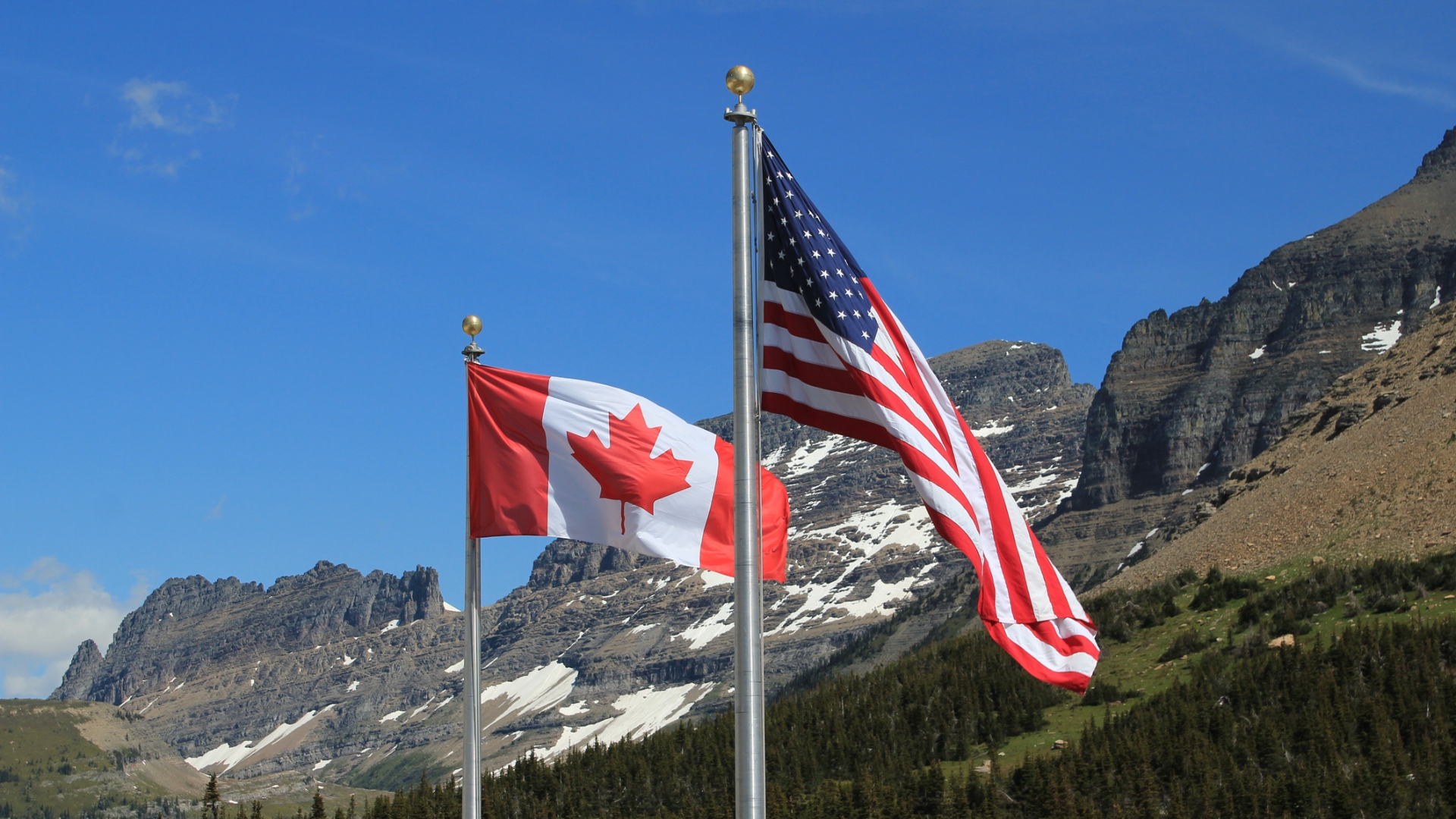
Canada was once one of America’s staunchest allies, but a trade war between the two nations has put the friendship under strain. Following a collapse in trade talks, the Trump administration is hitting Canada with a 50% tariff that targets hockey equipment, cement, dairy, and plywood. Canada vowed to strike back dollar for dollar, issuing nearly $28 billion in tariffs on American steel, seafood, appliances, electronics and more. Canadians are boycotting U.S. products and cancelling trips south. We look at what this means for the two economies, consumers and the future of America’s trade relationships.
Guests:
- Kyle Handley, Associate Professor of Economics at the School of Global Policy & Strategy and Director of the Center for Commerce and Diplomacy, UC San Diego
- Daniel Desrochers, international trade reporter, Politico
- Matina Stevis-Gridneff, Canada bureau chief, New York Times
Episode Transcript
This is a computer-generated transcript. While our team has reviewed it, there may be errors.
Alexis Madrigal: Welcome to Forum. I’m Alexis Madrigal. Well, here we are, talking about tariffs again. Donald Trump’s favorite foreign policy has been a constant feature of his time in office. But this time around, he’s targeted not just China, but many longtime American allies like Canada. This has managed to make the Canadians angry, transforming their internal politics and creating the conditions for an all-out trade war.
In any case, let’s figure out what’s going on with the tariffs. This time we’re joined this morning by Kyle Handley, associate professor of economics and director of the Center for Commerce and Diplomacy at the School of Global Policy and Strategy at UC San Diego. Welcome, Kyle.
Kyle Handley: Thank you.
Alexis Madrigal: We’re also joined by Daniel Desrochers, who’s international trade reporter at POLITICO. Welcome, Daniel.
Daniel Desrochers: Thank you for having me.
Alexis Madrigal: And we’ve got Matina Stevis-Gridneff, who’s Canada bureau chief for The New York Times and based in Toronto. Welcome, Matina.
Matina Stevis-Gridneff: Great to be here.
Alexis Madrigal: So let’s just dive in. Daniel, Canada has largely been a quite friendly neighbor to the north over the entire history of these countries. Now we’re in a trade war with this ally. What are the current tariffs that we are imposing on Canada before all this stuff goes into effect?
Daniel Desrochers: So you kind of have to go through the laundry list here, right? So for a pretty long time, about like March or April of last year, we’ve had tariffs on steel, aluminum, and automobiles and auto parts from Canada. And those have been tariffs that have been on the rest of the world, and Canada has been included in that.
Generally, most products that are shipped under a North American trade agreement called USMCA, those products have been exempt from tariffs. Now, what happened this week or this weekend is the Trump administration went through with putting a 50 percent tariff on about $20 billion worth of products. That’s things like furs and hockey equipment, but also things like paper and paper products and wood.
And so those, you know, where often these tariffs that the U.S. has threatened on Canada, you can say that most of the products were exempted. This was kind of the first, you know, non-steel, aluminum, automobile tariff where just everyday items, you know, businesses that before had no tariffs, now they are facing a 50 percent tariff. And so it’s kind of an escalation in what we saw before.
Alexis Madrigal: I mean, is this something where Americans could see sort of immediate price changes on things where we get a lot of a particular product from Canada, like, for example, toilet paper?
Daniel Desrochers: Uh, yeah, I mean, it depends on the item. So, yeah, toilet paper might be a big one. Um, you know, a lot of newspapers used to be printed up in Canada. Newsprint would have been one of those items that is a big one.
But at the end of the day, this is a kind of targeted measure, right? They didn’t go after some of the things that Canada exports to us the most or that are the most important to the U.S., like energy, for example. That’s a really huge one that has remained exempt.
They also didn’t go after potash, which is a key component of fertilizer that would have been really devastating for farmers. And so if you talk to the U.S. side, they’d say this is a pretty kind of measured attack — or not attack, you know, pretty measured package that they’re going after here.
But that’s it. I mean, if you’re in the cement industry, if you were in the wood industry, yeah, this is a big deal.
Alexis Madrigal: So Canada says after this, hey, we’re going to respond dollar for dollar with tariffs. So what American goods then have the Canadians decided to tar?
Daniel Desrochers: Yeah, so the Canadians are also trying to be strategic, and they were really going after kind of the swing states that they’re trying to make a political message. So one of those big examples would be washers and dryers.
Washers and dryers are made out of a Whirlpool factory in Ohio. Ohio is a key swing state that might control — might determine the control of the Senate this year. You know, the U.S. Trade Representative has gone and toured the Whirlpool factory in Ohio.
And so it was items like that. There’s also clothing items that they went after. They went after steel and raised those up to 50 percent.
But already we’re seeing that Canada has walked back some of their tariffs. So they had originally gone after the seafood industry, and that would have hit Maine. Maine is obviously a key state that will help determine control of the Senate. And they already pulled that back after the Canadian seafood industry was outraged by it because those products are sent back and forth over the border.
So Canada is still making their adjustments. Theirs don’t go into effect until September 8th. But yes, they’re trying, you know, it’s $20 billion worth of goods, and they’re trying to be strategic about what they’re hitting.
Alexis Madrigal: Matina, you and a colleague at The New York Times have a fantastic sort of TikTok on what happened here with these trade talks, because at least my understanding is, as recently as last week, it seemed like a trade deal was going to be put into place, but then Canadian Prime Minister Mark Carney pulled the team back. What happened?
Matina Stevis-Gridneff: Yeah, no, I think that’s right. And thanks for acknowledging our work. You know, there was just a lot of noise and mis- or disinfo in the space. But really, the two sides have signed a confidentiality agreement over the talks. And so it was hard to wade through what happened, especially quite an emotional situation, because trade talks, I know, sound boring. But actually, they’re not that boring, particularly at the very end.
So I think an accounting of what happened last week is that the broad strokes of an agreement were in place by Monday, Tuesday. There were two phone calls between Prime Minister Mark Carney and President Trump. And that was at the back of three and a half weeks of talks in Washington by the negotiating teams of both sides. And then they had to get down to business and resolve those final things.
And my understanding, or our understanding with Anna Swanson, who covers trade for The New York Times in Washington, is that things began to fall apart. There was a lot of volatility on things that were settled or appeared to have been verbally settled.
And I think it’s important for people to understand the physicality of trade talks. So all these people are kind of cooped up in the USTR building just across from the White House, but they break up in little teams and they go to different rooms. And then there’s kind of like aides going between the rooms and listening in and then typing up the notes and then printing off, and there’s draft upon draft.
So it’s not a neat and tidy process. And unlike what one might expect toward the end, instead of things becoming settled, resolved and sort of the emotional elements going low and settling, actually it’s the opposite. Teams try and grab whatever they can at the last minute.
Our understanding is that there were a number of outstanding issues toward the end, which were not shocking or new. They had been lurking as problems throughout the talks. And broadly speaking, I would say they pertained to the tariffs on steel, tariffs on autos and auto parts, and then there were secondary issues such as control of content online, particularly with U.S. streamers.
Alexis Madrigal: Mm-hmm.
Matina Stevis-Gridneff: Which are regulated here in Canada. And then over all of those topics that started being kind of thrown into disarray toward the last 48 hours, there was the question of trust and sovereignty.
And so the United States, not just toward Canada, but toward all its partners, demands a certain leeway, a certain latitude as to what they do next. They don’t want to commit to not changing their mind tomorrow, particularly this administration.
And eventually Prime Minister Carney would call this the signature of the U.S. in pencil. But this really started to creep into the kind of atmosphere in the talks.
And on top of that, I think the Canadians were seeking sufficient reductions in tariffs, particularly in those strategic industries of steel and autos, that would make it worth their while to allow the United States to set effectively tariff rates Canada would take out on other partners, let’s say Brazil or Turkey. And those were, you know, focused on steel.
But I think had a general philosophy that if we’re going to create a free or semi-free trading zone between the United States and Canada, the fence between the two countries, those tariffs should be really, really low. And then together, we can erect higher walls to the outside.
And ultimately, that fence that the U.S. side was offering was just not low enough to make it worth Canada’s while, and Carney walked away.
Alexis Madrigal: Which is sort of in keeping, or at least to me, it resonated with Mark Carney’s speech at Davos, which really came in response to President Trump saying, claiming the U.S. should annex Greenland and just kind of building up all this stuff about Canada as a 51st state, very offensive to many Canadians.
I just wanna listen to a cut here on Mark Carney talking about sort of the sovereignty and integrity of smaller countries that are not the United States.
Mark Carney: In a world of great power rivalry, the countries in between have a choice: compete with each other for favor or to combine to create a third path with impact. We shouldn’t allow the rise of hard power to blind us to the fact that the power of legitimacy, integrity and rules will remain strong if we choose to wield them together.
Alexis Madrigal: Kyle Handley, how much do you think that particular sentiment informed this round of trade talks between the U.S. and Canada?
Kyle Handley: I think that that was probably a major factor in why the talks broke down right at the end, especially Canada feeling like they’re being pushed around by the United States. And also what Mark Carney is saying is, hey, a lot of countries are being pushed around by the economic size of the United States.
And I think — I don’t want to say I know what Mark Carney is thinking, but there’s an element to this where he was given an excuse to maybe discontinue these negotiations on terms that he could explain to the Canadians as like, we’re standing up for ourselves, because obviously they’re not very happy about this.
And that, you know, maybe — I mean, I think they’ll eventually get back to the negotiating table.
And I think what the issue is, is that Canada doesn’t want to put all these concessions on the table and then have the United States in four months’ time or after the election say, “Oh, we actually want to raise the tariff on this, and by the way, we want you to raise your tariff on China or, you know, on this particular good,” and just ceding some of that control.
And so I think that is a big issue for the Canadians.
Alexis Madrigal: Kind of hard to be a leader of the third way if, in fact, you’re sort of just a hand of the United States.
Yeah, we’re talking about the trade war between the U.S. and Canada, what it means for our economy, for their economy and for the security of the United States. We are joined by Kyle Handley, associate professor of economics at UC San Diego; we’ve got Daniel Desrochers, international trade reporter at POLITICO; and we’ve got Matina Stevis-Gridneff, who’s the Canada bureau chief at The New York Times.
Of course, we’ll take your comments, your questions, your concerns about these tariffs. Maybe you’re a Canadian expat, or you have family in Canada. How’s all this stuff playing up there? Give us a call. 866-733-6786. That’s 866-733-6786, [email protected]. I’m Alexis Madrigal. Stay tuned.