Rep. Jared Huffman Warns about the Power of Christian Nationalism in Congress
Airdate: Tuesday, August 18, 2026 at 10 AM
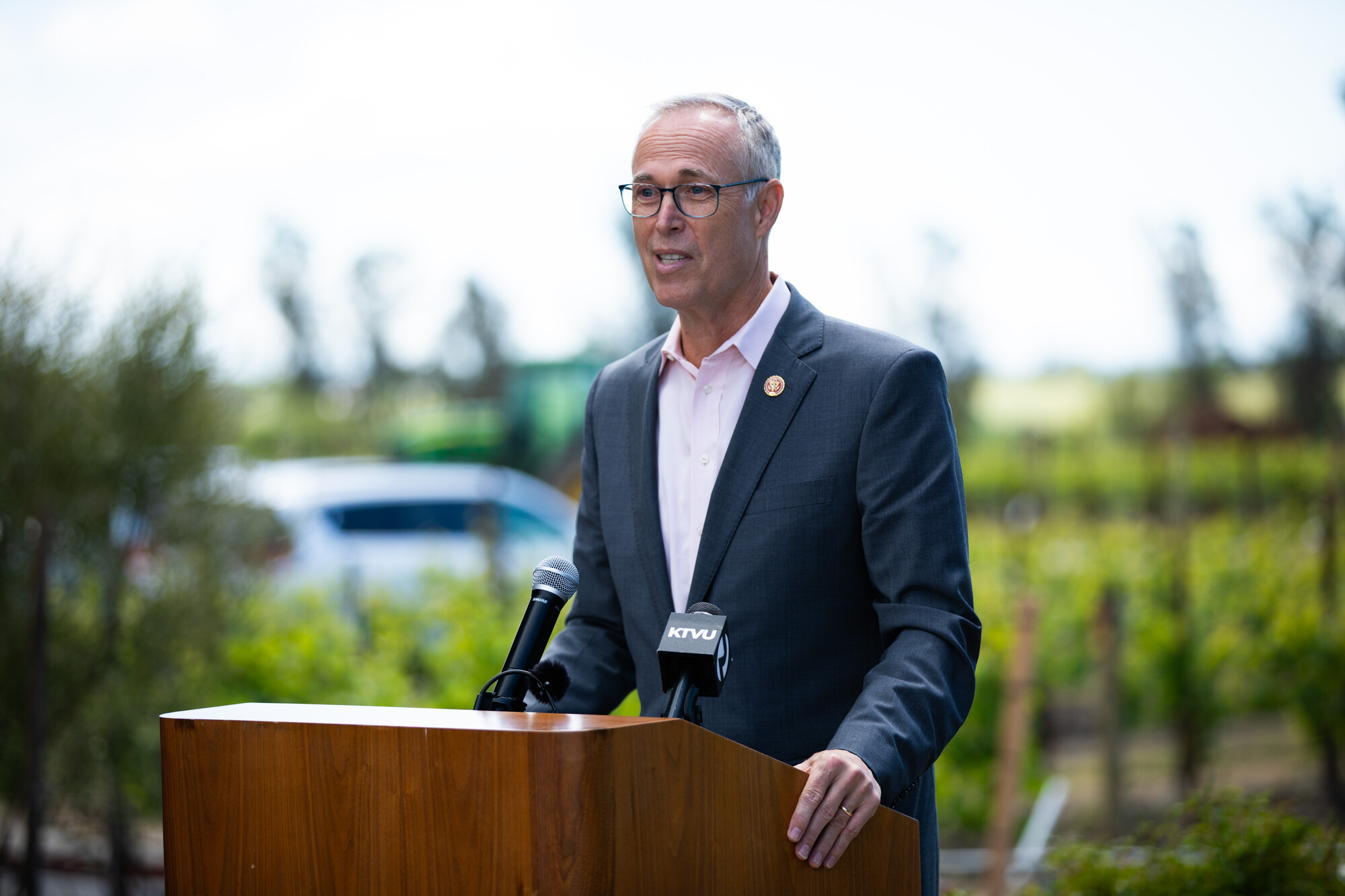
Jared Huffman is the only member of Congress to publicly state that he does not believe in any god. In politics, disavowing religion can be a liability, but Huffman argues that more than ever, the separation of church and state is vital. A formerly devout Mormon, he sees Christian nationalism as America’s most dangerous political movement, especially after witnessing the January 6 insurrection up close and seeing the “ministry-industrial complex” at work in the halls of Congress. Huffman lays out his arguments and calls for a secular democracy in his new book “No Prophets.”
Guest:
- Jared Huffman, U.S. Representative, California’s 2nd congressional district – Which covers six counties including all of Marin and Mendocino and much of Sonoma; author, “No Prophets: The Fight to Save Democracy from Christian Nationalism”
Episode Transcript
This is a computer-generated transcript. While our team has reviewed it, there may be errors.
Alexis Madrigal: Welcome to Forum. I’m Alexis Madrigal. There have long been wild religious movements in the United States. Some remain confined to the revival tent. Others have harnessed the power of then-new media like radio and television to grow into national movements. But Christian nationalism, Congressman Jared Huffman argues, is different — both in its explicit political goals, how it works, and also the level of success it has had in capturing the Republican Party, from the congressmen across the hall from him all the way up to Speaker Mike Johnson and President Trump’s inner circle.
He writes about what he’s seeing from inside the halls of power in a new book, No Profits: The Fight to Save Democracy from Christian Nationalism. And he joins us here in the studio this morning. Welcome.
Good morning, Alexis. Thanks for having me.
So you’re the ranking member on the Natural Resources Committee, former attorney for the NRDC, and many of your constituents probably know you as someone who has fought for a long time to protect the environment, speak out about climate change. But you also grew up in a Mormon family, in a particular branch of the Latter-day Saints, and religion played a really huge part in your life until it didn’t. Can you talk a little bit about the community you were raised in and what led you to actually stop being religious?
Jared Huffman: Sure. I grew up in Independence, Missouri, known for a couple things — Harry Truman’s hometown, for one, but also the world headquarters of the Reorganized Church of Jesus Christ of Latter-day Saints, which was the name of the denomination that I grew up in, believed in, was ordained into the priesthood of that denomination when I was a young man. The church has since changed its name. It goes by Community of Christ now, and they’ve evolved quite a bit, actually, since I grew up. They’re very progressive these days.
So that was the religious upbringing that I took with me to UC Santa Barbara, and one or two years into college, it stopped working for me.
Alexis Madrigal: I mean, was the community that you grew up with — wow — how did it relate to the scripture and spiritual belief? Would you consider it to be something that was, at least as you knew it, to have been on this sort of extreme end of American religion?
Jared Huffman: No. In fact, I write in the book that it was very apolitical. And it’s one of the reasons, when I took courses in college studying what, at that time, was called the New Religious Right, or the Moral Majority, some people would associate with it, it was jarring for me to hear all of these televangelists and these right-wing Christians being so political.
In the church I grew up in, we never talked politics, never talked about the Supreme Court or abortion, or even really cared or knew what party anybody belonged to.
Alexis Madrigal: Huh, that’s interesting. In your political career, sort of long after you’d become a congressman, you decided in 2017 — so, you know, this would have been in the wake of the election of Donald Trump — to publicly announce that you didn’t believe in any gods. I mean, how’d you come to the decision?
Jared Huffman: Well, I already alluded to the fact that I lost religion when I was about 20 years old. And, you know, it’s hard to lose your religion. You spend many — people, I did at least — spend years really reckoning with, you know, what is my place in the world? What does all of this mean?
And eventually I figured out that the things I liked about my religious upbringing, the moral framework, are available as universal values from many different faith perspectives, including humanism, which is one that I now embrace as my faith label.
Nothing’s supernatural. Humanists believe we have a moral obligation to each other, but it is just grounded in being a human and living in the here and now, in this one planet we know of that sustains life. That, once you accept it on those terms, becomes kind of sacred. But no afterlife. No fear of hell, no inducement of heaven. We just sort of take life as it comes at us and try to look for evidence and inquiry and reason as our guideposts.
Alexis Madrigal: For many of our listeners, I bet that does not sound like a far-out belief system. And yet, in Congress, you’re kind of the only one.
Jared Huffman: Oh, I’m an oddball. Yeah. Yeah, the only one, and certainly the only one who has publicly admitted that I don’t have a God belief.
We can talk about how I decided to take that leap of non-faith, if you will. But I am getting some company now. I have two new freshman members of Congress, one of whom from Washington state answers the question about religion that she’s non-religious. And the other, Yasamin Ansari from Phoenix, is an agnostic, openly, so it’s perhaps changing a little.
Alexis Madrigal: Right, right. Well, you point out in the book that in the United States, the fastest-growing sort of spiritual label has been the “nones,” right? People who don’t associate with any faith tradition.
Jared Huffman: Absolutely, yeah. That started — that shift began in about the early 1990s. Prior to that, America was a monolith. We were 90% white and 90% Christian, and a number of things contributed to the change. But people started leaving churches in the early 1990s. We became much more diverse, there were waves of immigration, and there’s just been a steady decline in religiosity ever since.
Alexis Madrigal: Meanwhile, as probably not coincidentally, there has been the rise of Christian nationalism in that exact same period of time. And why don’t you just define for people in your book, how do you look at Christian nationalism?
Jared Huffman: So sociologists would define Christian nationalism as the fusion of conservative Christian identity with conservative politics or Republican politics. And it is rooted in this false narrative that the United States was founded as a Christian nation, and therefore Christians must have privileged status in law, in institutions, in society at large — even to run for political office.
There are many Christian nationalists who believe only Christians should hold public office, and one very high-profile one is Doug Wilson, who is Pete Hegseth’s pastor.
Alexis Madrigal: You know, in some descriptions that I have heard of this sort of belief system, people call it white Christian nationalism. Do you think that’s a sort of necessary adjective in there?
Jared Huffman: There is a racial thread in Christian nationalism, for sure. And you can go back in history — the KKK was an expression of Christian nationalism. The Confederacy was justified in very Christian nationalist terms. Those were obviously very racial movements.
And today’s Christian nationalism includes some of that, for sure. The reason I don’t add the word “white” when I talk about Christian nationalism is there are threads of Christian nationalism, especially the independent charismatic evangelicals, which is really the dominant faction, that have gotten a surprising amount of traction in Black and brown communities.
Alexis Madrigal: How different is Christian nationalism from, you know, we’ve been talking about in American politics white evangelicals for a very long time. How different is what you’re talking about from sort of that broader group?
Jared Huffman: Well, I think there was a fundamental shift in right-wing Christianity, with white evangelicals really being the dominant faction. But the shift happened when the New Religious Right or the Moral Majority movement of the 1980s collapsed.
And it really collapsed when the Cold War ended. The Cold War was the cohesion for that movement. It allowed us to contrast our religiosity against the godless communists of the Soviet Union. And when they went away, and when Bill Clinton was elected in 1992, everything just sort of fell apart.
And from the pieces of that broken movement emerged something far more militant and far more explicitly theocratic. It took a decade or two. We went through the militia movements of the 1990s and all of the violence, Ruby Ridge and Waco and so many other flashpoints.
But it is basically the historic arc of how we get to today’s mega Christian nationalism, which is far more militant and explicitly theocratic, definitely on a collision course with democracy.
So the way I write about it in the book, the Moral Majority was trying to wage a culture war within the system of democracy. Today’s mega-Christian nationalists are trying to burn it down.
Alexis Madrigal: I think many people might be thinking, like, but these people don’t actually want the country to be a theocracy. One of the most surprising things about the book is you go through the sort of combined theology and politics of these various components of the Christian nationalist movement. Is this kind of daunting realization?
Jared Huffman: Nope. They mean it. They really do. Theocracy. That’s it. It’s explicitly anti-democratic in many cases.
At full stop, they really mean it, and I thought it was very important to show people what they say in their own words. I just mentioned Doug Wilson, who is the head of one of the three ascendant religious subcultures within MAGA Christian nationalism. He’s kind of cute with his words. He will call it theonomy, right, as if there’s some distinction. It’s theocracy, and it is very authoritarian.
He wants to rewrite the Constitution and make us an explicitly Christian nation. Only Christians can hold public office. In fact, only Protestants are in charge under his theonomy. And women are in real trouble because he thinks the 19th Amendment was a mistake and that we should revert to household voting so that only men cast votes and they vote for everyone in the household. Good stuff.
Alexis Madrigal: Also, when we’re talking about some of these characters, you know, up at the top, there also are people who have felt called to this kind of — among sort of rank-and-file Christian nationalists — and you really open the book talking about seeing some of them and talking, kind of understanding where they came from during January 6th, like during the insurrection. That there were many people from this tradition who were at the Capitol during that time.
Jared Huffman: Yeah, this is such an important point, and it’s one that is just lost on most people in the country. Most people I talk to even today don’t understand that the January 6th insurrection was a Christian coup.
I saw it unfolding in real time. I saw the crosses and the worship symbols and everything else that was going on, the right-wing pastors on the ground, issuing prophecies, leading people in hymns. And, you know, thousands of intensely devoted Christians don’t just show up at the Capitol and try to topple the government. This was very choreographed, and the more I looked into it, the more came to understand that these extreme fanatics, these faith leaders, were involved at every stage of the radicalization of the mob, the planning of the insurrection, and carrying out of the riot.
And we still haven’t reckoned with that fact.
Alexis Madrigal: And we’re gonna talk about how exactly we didn’t reckon with that fact, despite having all these hearings in Congress, et cetera.
We’re talking with Representative Jared Huffman, represents the second district in Congress. Stretches from Marin to the Oregon border. And, of course, we wanna hear from you. Have you noticed the separation between church and state breaking down? Give us a call, 866-733-6786, [email protected]. I’m Alexis Madrigal. Stay tuned.