Dorothy Lazard on the Ambitious Mission of Libraries and the People that Make them Function
Airdate: Monday, August 17, 2026 at 9 AM
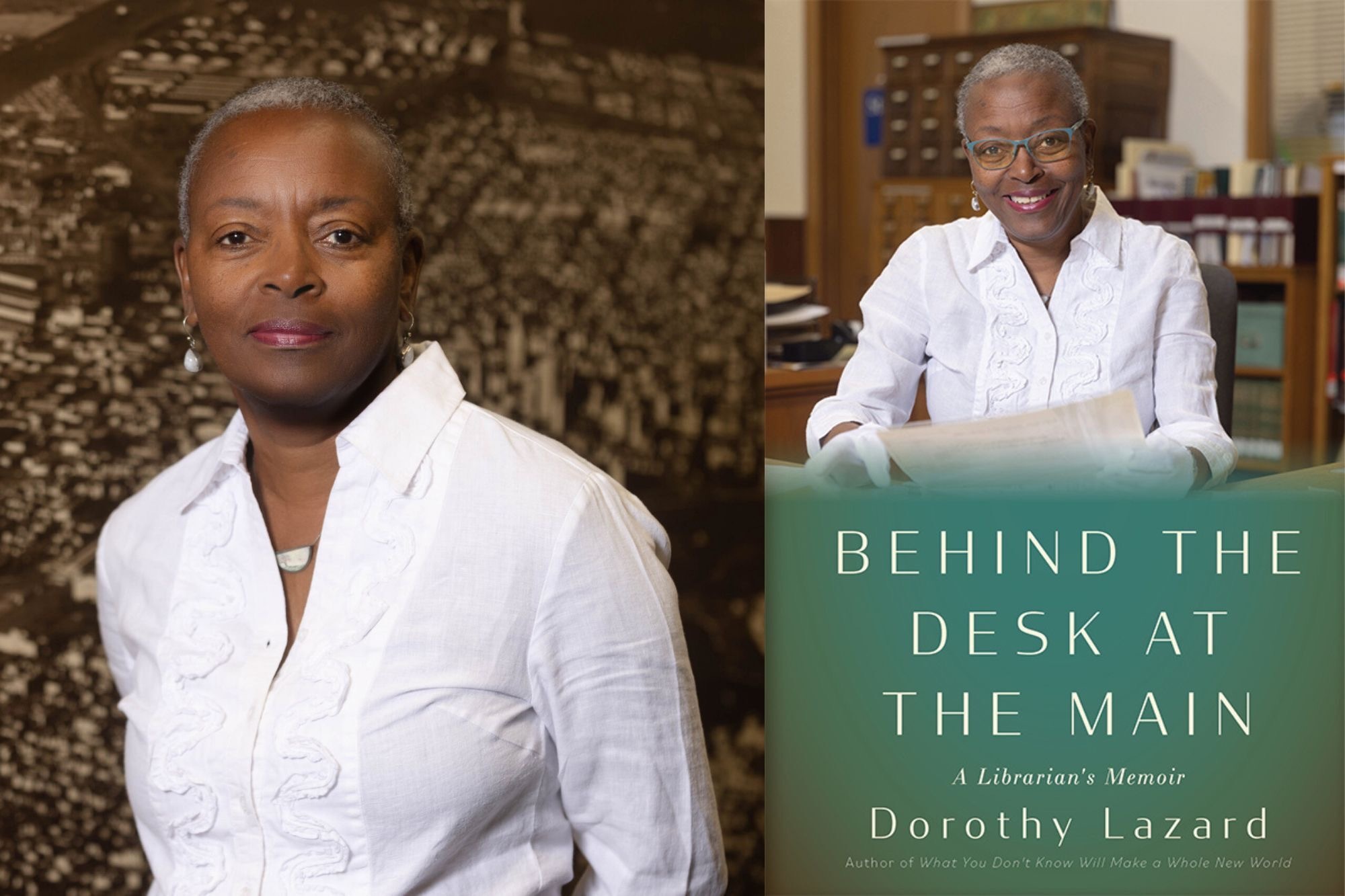
“The public library is our country’s last truly democratic institution,” writes celebrated librarian and public historian Dorothy Lazard. In her 40-year career, half at Oakland’s main branch, Lazard was on the front lines of libraries’ mission to provide free access to all and to serve as a hub of civic life. She was also witness to book bans, financial crises and the many challenges that threaten the institution. Her new book, “Behind the Desk at the Main: A Librarian’s Memoir,” offers a personal portrait of how libraries work and the people that keep them functioning, and a rousing call to protect them.
Guest:
- Dorothy Lazard, author, Behind the Desk at the Main: A Librarian’s Memoir; former head librarian, Oakland History Center; author, What You Don’t Know Will Make a Whole New World
Episode Transcript
This is a computer-generated transcript. While our team has reviewed it, there may be errors.
Alexis Madrigal: Welcome to Forum, I’m Alexis Madrigal. It’s good to be back with you, and many thanks to the guest hosts and producers who held it down while I was on vacation.
Today, we’re talking public libraries. Everything happens at the library because everyone can be at the library. I often think about how utopian the library is, how it’s one of the very few institutions in modern American life that still presumes that everyone in a city is or could be a patron, a user of the facility, a member of that community. You walk in, get given a free card, and that free card enables you to all this other free stuff. Nothing works quite like the library.
But as we read in Dorothy Lazard’s new book, Behind the Desk at the Main, being the last truly democratic institution when the rest of American society has abandoned even attempting to address itself to capital-E everyone is not easy. In fact, it’s nearly impossible. “Chaos vibrates at the edges of public libraries,” Lazard writes. The cruel realities of the outside world — poverty, dispossession, irresponsibility, mental illness, and me-first attitudes — come rushing into the organized world of the library as soon as the doors open.
Today, we talk with Lazard about that tension between order and chaos, access and comfort, rules and freedom. What is the complex ecosystem that keeps libraries able to be places of both knowledge and refuge? And as the world outside the library gets more polarized and unequal, can libraries sustain the utopian experiment?
Dorothy Lazard is the author of two books now and counting. Her latest is Behind the Desk at the Main: A Librarian’s Memoir. It publishes tomorrow from Hay Day Books. Welcome, Dorothy. Good morning. So good to have you.
I want to start out with the work of being a librarian as you describe it in the book. And I think a lot of people don’t think about that. When you were working at the Oakland Main Branch, when you were behind the desk at the Main, at the reference desk and maintaining collections, like, what did you actually do?
Ha ha ha!
Dorothy Lazard: Well, thank you for asking. I’ll take you through a typical day. I would come in, get situated, find out what I left undone the previous day, answer emails, answer reference questions via email sometimes, meet with staff members if we were working on a joint project, like a program, an event.
I’d also go through many of our librarian magazines to find out what books have been published. Because you’ve got to build collections. That’s what librarians do. The way things get into libraries is that we’re constantly reading, learning about new authors, learning new books, reading book reviews, and evaluating our collections that are currently on the shelves. What needs to be replaced, what needs to be updated. And so that was just an ongoing thing that you did just daily.
Alexis Madrigal: How did you decide what a community needed in its library?
Dorothy Lazard: Well, the community tells you. We’re like old-school DJs. We take requests. And the public is telling you. There’s also places on most libraries’ websites where the public can say, “Can you buy this book?” Or, “This book is coming out.”
It’s really a community, a collaborative process with the community, because they’re always telling you what they want to read, what they’re eager to read.
There are also resources at the library that librarians use, like What to Read Next is a book that librarians use and make available to the public to find out, you know, if people are following a series, for example. You know, we want to keep up with those series. Because people are — we have many, many voracious readers and many series followers, too.
Alexis Madrigal: So that’s the fun part, buying the new things. What about the hard part? I mean, I at my at-home library — yeah, I have a hard time throwing away books or gifting them or other things. But of course, in a collection like, you know, the Oakland Public Library, you also have to cull lots of stuff. So how do you decide? What is going to the recycling bin or to the sale or however else you get rid of the book?
Dorothy Lazard: Well, a few go through the recycling bin. Many libraries are in partnership with other community agencies to pass their books on to those agencies.
And so, you decide by a number of things. You decide by the book’s condition, the book’s age, the book’s usage. You know, we do a use count every time a book is used. Even if it’s not checked out but just left on the table, that somebody used it that day, we’ll do a use count. And over time you find out, well, are people even reading this book, or did we buy, you know, too many copies of Tina Fey’s Bossypants and now people aren’t reading it as much as they were when it came out, you know, six or 12 months ago?
No shade to Tina Fey.
Alexis Madrigal: Yeah, yeah, yeah. Could there be too many copies?
Dorothy Lazard: But that’s just an example. Yes, I felt like there were too many copies of that book. And so there are a number of things that we take into account, like, should it be removed from the active shelves and put into storage? Because there might be some value for it, that people will still want to refer to this book.
So there are a number of criteria that you have to go through. And sometimes — a lot of times — books just get worn out and you physically have to get rid of it because nobody’s gonna want it because pages are missing or it’s been marked in so much that it’s hard to read.
Alexis Madrigal: Um, one thing I love about this memoir is that you were a reference librarian, which meant people could just walk in off the street and just ask you anything. And, um, apparently in this part of your career, you were, like, keeping notes on your favorite reference questions. And you provide us an appendix in this book with a hundred questions that you fielded that you thought were interesting.
Here’s just a brief selection, just five of them that I love: What were people doing in California on January 24th, 1848? Is catalepsy the same as zombie-ism, and what venom is used to induce it? When and where did the flamenco start? Can you find a picture of the Frenchetti Castle in the Dolomites? Is Olympic sprinter Bobby Morrow still alive? Did he ever play for the NFL?
And there’s 95 others, just as intriguing as that. You also had some favorites from that list, too, though, yeah?
Dorothy Lazard: Yeah. One of my favorites was from a guy who called quite a lot when I first started working at the Main back in the early 2000s. And he was an English language learner, I soon found out. And he gave me one of my favorite questions, which is, “What do you call the man who has seen your girlfriend? Would you call him your date?”
I was like, no, sir, you would not call him the date.
Um, so, and then some of the questions are very fact-based.
Alexis Madrigal: Yeah, yeah.
Dorothy Lazard: Um, but that was certainly one of my favorites.
Alexis Madrigal: Librarians still get these questions. Do you think — or do you think people just ask ChatGPT, or —
Dorothy Lazard: Oh, no. We’re still being asked, you know, about — you know, one of my favorite patrons would call and ask about some AAU, you know, track and field statistic from like the late ’60s or early ’70s or something.
So we’re still getting questions on how to pronounce words or how to spell things or, you know, and sometimes people are calling us from bars to settle bar bets. You know, so despite the predominance of the Internet in our lives, we’re still getting lots and lots of questions from lots and lots of people all day.
Alexis Madrigal: There’s also, I think, there’s something different about being able to talk one-on-one with a reference librarian about some question, in part because it’s like the opposite of AI, right? It’s not a magic box in that way. It’s a human being, and that human being not only wants to find you the answer, but I feel like most librarians I’ve ever engaged, they also want to show you how you can find answers yourself.
Dorothy Lazard: A hundred percent. This is what we’re — this is also a part of the job. You asked me, what do librarians do? We teach people how to navigate and also how to interpret information. Like, is this a trustworthy source that I’m going to for my information? How to navigate online encyclopedias and databases and things like that.
And so we’re teaching people how to approach this flood of information that we’re all — we all have — inundated with. We’re drowning in — we are drowning in information. But what can I trust, and where should I go to get that information? So there’s that.
Alexis Madrigal: We’re talking with former head librarian of the Oakland History Center, Dorothy Lazard, about her career as a librarian and her new book, Behind the Desk at the Main: A Librarian’s Memoir. She’s also the author of What You Don’t Know Will Make a Whole New World.
We want to hear from you. What do you want a public library to be in today’s day and age? Also, maybe you are a librarian. I know we have some librarian Forum listeners. What do you think about the way that things have changed or not changed in libraries in response to social conditions and the Internet? Give us a call. The number is 866-733-6786. I’ve missed all you callers. That’s 866-733-6786. The email is [email protected]. Find us on social media, BlueSky, Instagram, Discord, et cetera. We’re KQED Forum.
You know, kind of real quick, how different do you think the work of sort of Oakland Public Library or San Francisco Public or San Jose Public Library is from the work that you did earlier in your career at Berkeley, where you worked more in archives in that way?
Dorothy Lazard: Well, just to be clear, I wasn’t working in an archive. I was actually working at UC Berkeley at two very small campus libraries. They were traditional in the sense that they were archives and that you couldn’t check anything out, I guess. But how are they different? Is that what you’re asking?
Alexis Madrigal: Yeah, I mean, it seems like it’s pretty different to be working in just like a big urban library.
Dorothy Lazard: A big urban library is different. I felt like I was meeting — even though I had grown up in Oakland and had lived in Oakland by then, 40 years by the time I started at Main — I felt I was, like, meeting Oaklanders for the first time because you saw the depth and breadth of their interest. They were interested in all manner of things.
You know, and so you’re constantly learning. Every day there’s an opportunity to learn something because, unlike a campus library that was very subject-specific, you know, my last nine years at Cal I worked at the Women’s Studies thing.
Alexis Madrigal: At the public library, you get all kinds of questions. It’s everybody. It is everybody. Here comes everybody.
We’re talking with Dorothy Lazard about her new memoir, Behind the Desk at the Main. We’ll be back with more right after the break.