Global Dissidents Give Lessons In Courage
Airdate: Thursday, July 30, 2026 at 10 AM
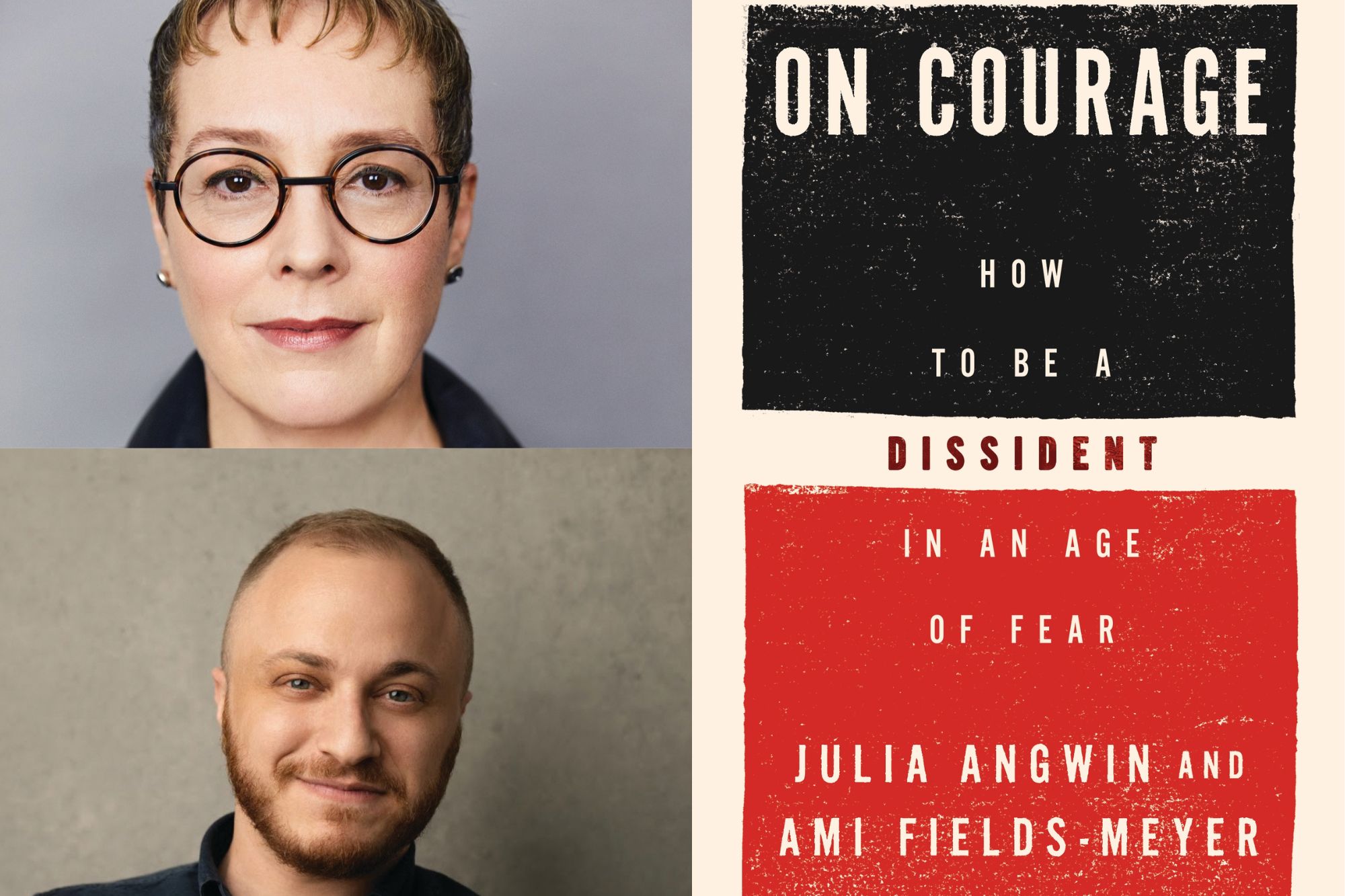
How can ordinary people stand up to authoritarianism? For a new book called “On Courage,”
investigative journalist Julia Angwin and political strategist Ami Fields-Meyer interviewed more than 100 dissidents from around the world about how they overcome fear, protect themselves against intimidation and persuade others to join their cause. We’ll talk to the authors about the practical lessons they uncovered—and why they think courage is not innate, but learned.
Guests:
- Julia Angwin, Pulitzer Prize-winning investigative journalist
- Ami Fields-Meyer, former White House senior policy advisor
Episode Transcript
This is a computer-generated transcript. While our team has reviewed it, there may be errors.
Scott Shafer: This is Forum. I’m Scott Shafer. Since Donald Trump returned to the White House, thousands of people across the country have participated in No Kings protests or other kinds of nonviolent demonstrations of opposition to the rising authoritarianism coming from the Trump administration.
At the same time, some wonder whether it makes a difference or what else can be done to register objections to the administration’s policies around immigration, deportation, and more.
Well, for their new book titled On Courage, investigative journalist Julia Angwin and political strategist Ami Fields-Meyer interviewed more than a hundred dissidents from around the world to hear what they did and what they learned about resisting the heavy hand of repression. They looked at examples from Russia and China to Venezuela to assess how those lessons and tools might be applied here in the United States at a time when so many basic freedoms are being threatened.
Ami and Julia, welcome to Forum.
Julia Angwin: It’s great to be here.
Scott Shafer: Let me begin with sort of a personal question, because I understand this book began as kind of a project for both of you. Describe a little bit more about that, Ami.
Ami Fields-Meyer: Julia, as you said, is a journalist. I have worked in politics and government for a long time. But when the 2024 election happened, it became clear to both of us, from our unique vantage points, that democracy as we know it was beginning to change.
The mood certainly was changing, but also even the tools that many of us use in a democracy — elections, courts, litigation, legislation, everything — began to feel less meaningful because we had a person who had come to office who had essentially promised to govern as an authoritarian.
So Julia and I both felt like our threat models for what it means to live in a country like this had changed, had evolved, and that we were going to need new tools. Not just that we would need new tools, but that the people around us needed to be engaged in politics in a world where everything felt a little bit more fearful, where risk entered the equation more and more, where speaking out very quickly at the beginning of the Trump administration in your workplace or university setting began to carry more risk. It required a new set of tools.
And so we actually just began calling people all over the world — people who had faced repression, who had come from authoritarian societies — not because we felt like what was happening in the United States was exactly the same, but because it was time to learn a different language and a different kind of activism. And that’s how this project began.
Yeah, Julia?
Julia Angwin: I mean, yeah, as Ami said, we’re kind of an unlikely duo for this, to be honest.
Scott Shafer: How did you pair up?
Julia Angwin: Yeah, I mean, I’m a tech investigative reporter. I grew up here in the Bay Area, in Palo Alto. I learned to code in fifth grade and went on to cover the tech companies for decades.
I had a real model in my mind. I started covering the tech companies thinking they would be this empowering force. I then pivoted toward chronicling the harms and the ways they were abusing their power.
I knew Ami through the tech policy world because he was doing policy in the White House. We met at an AI conference, and then we sort of kept in touch. When I woke up the morning after the election with this thought that we needed a new threat model, I knew Ami was at the Harvard Kennedy School at the Ash Center, where dissidents basically, when they’ve been kicked out of their country, go to study democracy and write papers.
So I was like, “Ami, you’re with all these dissidents. Can we start asking them questions? Can you just grab some of them and bring them into a Zoom?”
So we really started with this curiosity about what they were going to tell us. It was really interesting for me because I think, as a reporter, oftentimes I might go into a project thinking I know what I’m going to find out. In this case, I didn’t really have a hypothesis. I just wanted to know everything they wanted to tell us.
Scott Shafer: How hard was it, Ami, to get them to open up and tell you what they did, what they learned?
Ami Fields-Meyer: Well, it’s funny. At the beginning of the administration, we started interviewing people from, as you said, Scott, everyone from Venezuela to Russia and beyond. Our first interview was January 20. It was Inauguration Day.
At the beginning, the response to the premise of the project — which was that Americans have something to learn from foreign dissidents — was, I would say, light scorn. People felt, “That’s cute. You don’t know how good you have it.” Like, these two Americans were suddenly interested in our struggles. That’s adorable.
That was actually a genuine challenge at the beginning. It wasn’t so much that people didn’t want to share. It was that they would share, but they felt they were doing so in a more theoretical way.
What changed very rapidly, I would say by the end of March, was that it had become clear students were being rounded up for deportation, law firms were being coerced into agreements, and other things like that. The tenor of those conversations changed, and we started hearing rapid-fire advice.
It was very important to us to tell stories in a way that kept people safe, and there were moments where we needed to be sensitive to the specific stories people told and some of the details.
But I will say that over and over again, I was surprised that people who had done courageous things wanted to talk about them, not because they wanted their stories told as much as they wanted people to learn the lessons they had learned.
Scott Shafer: And yet you write in the book that some of them were uncomfortable with the notion that they were courageous.
Julia Angwin: Yeah. Actually, everyone wanted to be called not courageous. And almost everybody said they’re not a dissident.
Why? You know, “dissident” is a weird word. It implies a negative thing. It’s like, “I’m against something.”
One of the insights we had talking to these people is that they were acting on their values for something. We open the book with a civil rights lawyer in the Department of Housing and Urban Development in Washington, D.C. He had been enforcing the Fair Housing Act, and that was his job. Then the administration came in and told him they wanted to transfer him to other duties and dismantle his whole office.
He was like, “I can’t allow this to happen. My job is to enforce the civil rights laws, and we need to enforce these laws.”
In his mind, he was just acting on his values. Now, the world around him had changed, so it looked like he was a dissident, that he was saying no. But from his perspective, he was acting positively.
He also said, “I’m not courageous. I’m just doing what I have to do, what needs to be done.”
Everyone sort of said it that way. They felt called by their own values to this work.
So we struggled a little bit with the word because it was hard to choose a word that the people we were covering didn’t like. But it also has a shorthand effect for political courage that we couldn’t find a good substitute for. So we sort of apologize to all of them that we are using this word.
We write in the book that we know they don’t actually recognize themselves that way. They see themselves more as acting in service of their values.
Scott Shafer: So, Ami, as you began talking to these folks, what were you hoping to get? I think in the book you say you were looking for tools that were practical, spiritual, and strategic. Was it all of the above — any lessons you could glean that might be applicable to this time we’re living in now in the United States?
Ami Fields-Meyer: Yeah. It’s easy when you’re writing the introduction of a book to say what you were looking for. And that’s true to some extent.
We were really looking for hope.
It was a very dark moment, certainly for the people who were being ripped away from family members. But even for those of us who were witnessing it, it just felt different. Certainly we have a history in this country of political repression, but this felt like a different class of it.
As we began talking to people, I think the questions we were asking were more technical. We were asking for spycraft. How do you make sure that if you’re trying to go to a protest, you can stay safe? How do you make sure the government that we know is surveilling us won’t use our data in nefarious ways?
We found there is stuff in the book about those things — different passcodes, different apps, different procedures.
But the reason we use the word “spiritual” is because, over and over again, people came back to community.
The book is really a taxonomy of dissent. How is it that when you have what we call a moral collision — a moment where you realize that your inner values are not matching what’s happening on the outside, something’s going on in your office, something’s going on in your country, and you feel the need to speak out — why is it that people actually do that? What empowers people to go against what is, I think, a very natural instinct, which is just to put your head down?
What we found over and over again is that it’s other people around you who feel the same way.
On every continent, the people we talked to — and throughout history — emphasized this. The Soviet dissident movement never grew to more than about a thousand people at one time. These were people facing much greater repression than many people in the United States. They were smuggling out samizdat, smuggling out writings, and continuing to speak out against their government and in favor of the Soviet Constitution, which had enshrined rights they were not actually being granted.
Those people also talked about the fact that gathering with others served two purposes.
One was practical: you could get together and figure out what to do.
The other was spiritual. Everything about authoritarianism is about lies. It’s about gaslighting. It’s about someone saying, “You thought you saw Alexei Navalny shot in the street? No, you didn’t.”
The other thing gathering with people does isn’t just practical. It’s psychological. You can look at other people and ask, “Are you seeing what I’m seeing?”
That’s really important in order to sustain courage over a longer period of time.
Scott Shafer: And when you think, Julia, about all the things you learned and heard from these folks, at what point in the process of writing the book did you feel like, “Wow, this is really becoming more relevant here”? It’s not a stretch. Ami said around March 2025. Was that true for you as well?
Julia Angwin: Yeah, absolutely.
I think especially as we saw the way authoritarianism plays out these days, it’s not usually the dramatic military coup you think of from history books. It’s the erosion of democratic institutions.
You still have elections, but they’re not free and fair. You still have the media, but it’s biased. You still have the courts, but they’re weakened.
As we saw DOGE coming in and aggressively trying to dismantle these institutions, we realized this was the moment where we thought, “Okay, it’s on a speed run right now.”
Scott Shafer: All right. We are going to continue our conversation about the new book On Courage: How to Be a Dissident in an Age of Fear with Julia Angwin and Ami Fields-Meyer.
And we’d love to hear from you. You can email your comments and questions to [email protected], or you can find us on Bluesky, Facebook, and Instagram. We’re @KQEDForum. Or give us a call at 866-733-6786. That’s 866-733-6786.