‘Backrooms’ Director Kane Parsons on Why San Jose is a Rich Setting for Horror
Airdate: Wednesday, July 29, 2026 at 9 AM
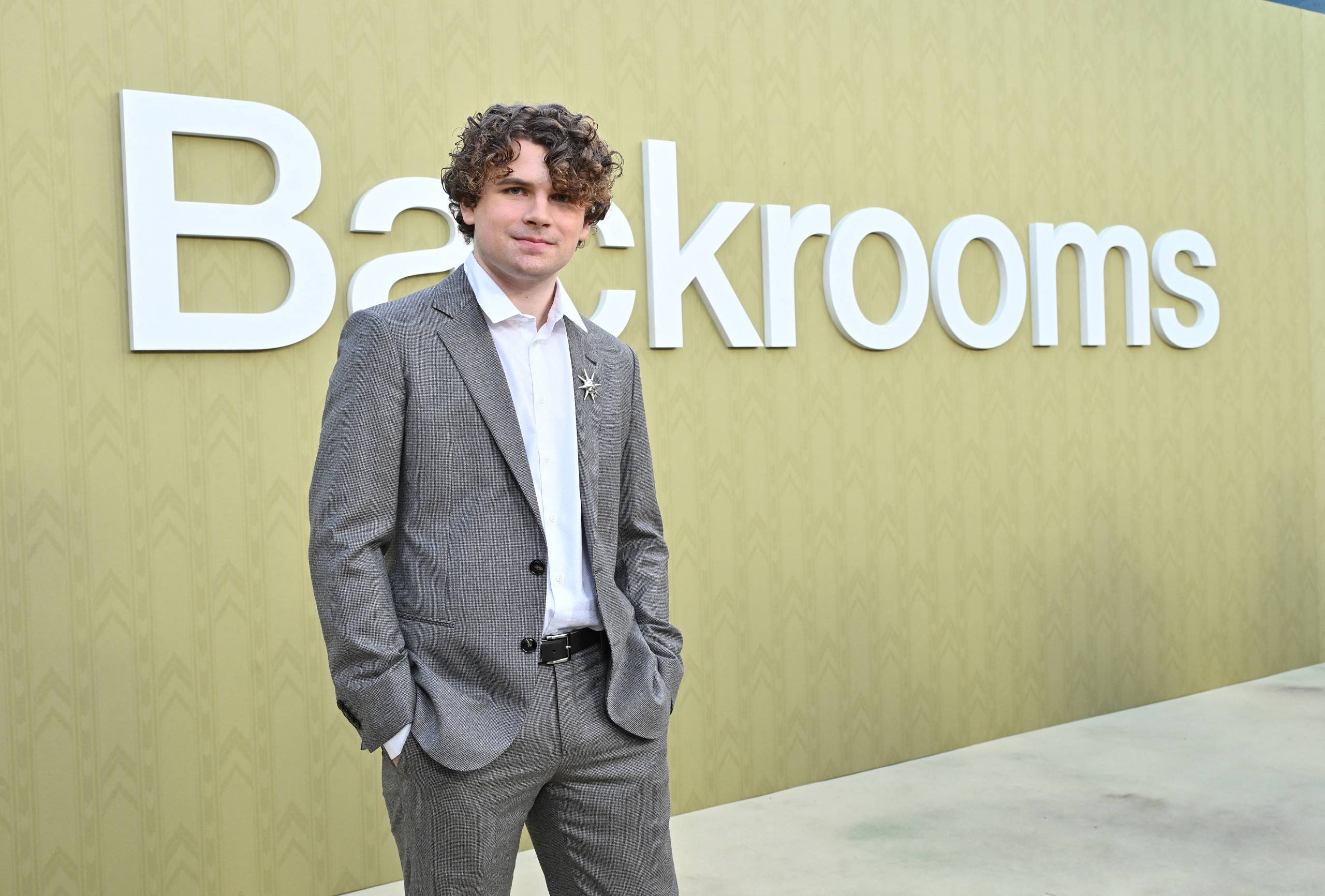
Kane Parsons, the 21-year-old director of this summer’s hit horror film “Backrooms,” began his career not in film school, but by making short videos on YouTube while attending middle and high school in the North Bay. He stumbled upon an online photo of creepy, yellow-tinted empty rooms being called “the backrooms,” read the accompanying internet lore and contributed to it with his own web series, which garnered him an A24 directing gig at just 17. Now, Parsons’ San Jose-set feature film has been credited with revitalizing Hollywood and with capturing existential, generational fears. We’ll talk with Parsons about why Silicon Valley is such a rich site for horror, and with film professors about how horror films have long documented the key anxieties of every generation.
Guests:
- Kane Parsons, filmmaker and director, “Backrooms”
- Katherine Guerra, assistant professor of cinematic arts, Cal State Long Beach
- James Francis Jr., instructional associate professor of English literature, Texas A&M University
Episode Transcript
This is a computer-generated transcript. While our team has reviewed it, there may be errors.
Alexis Madrigal: Welcome to Forum. I’m Alexis Madrigal. The horror film Backrooms has grossed nearly $400 million on a budget of just $10 million and has been credited with bringing Gen Z back to the movies. That’s in part because the film is an expansion of a web series, many of them watched on YouTube, and in part because the film’s director, Kane Parsons, is himself in Gen Z, having turned 21 just last month.
But the movie is more than a Hollywood business story. As industrialization was taking off in the early 19th century, Mary Shelley’s Frankenstein became the metaphor to describe an emerging set of fears about science creating things that humans could not control. It gave a name and a story to an amorphous feeling.
And Backrooms is that same kind of metaphor for our times: an endless and irresistibly fascinating, self-generating realm of cursed spaces built from the compressed wreckage of our own minds — social media, first-person shooters, YouTube itself, and, of course, generative AI. This is the six-fingered, hallucinated freakiness of our times.
Backrooms follows the owner of a furniture store into his store’s basement, through a wall, and then into another dimension: a world of bleak, yellow-wallpapered, mostly empty rooms with fluorescent, humming lighting where everything is familiar but not quite right.
Here’s Clark, the main character, describing it to his therapist.
Clark: Okay, so you go in, and at first it just looks like an office building. Like a huge office building, you know? But then you keep going, and then you realize that none of it makes any sense. It’s like, imagine describing a dog to someone who’s never seen one before and then asking them to draw it. They might get some things right, you know, but there’s no way they’d get everything right. The devil’s in the details.
Alexis Madrigal: And, of course, this film is set in San Jose, which one Letterboxd user said the horror film so beautifully captures the spirit of San Jose on screen.
Joining us this morning, we’ve got Kane Parsons, filmmaker and director of Backrooms. Welcome.
Kane Parsons: Hello. Thanks for having me.
Alexis Madrigal: So, Kane, how would you describe San Jose to a person who’s never seen it before?
Kane Parsons: Well, I’ve grown up in Petaluma, so my childhood isn’t truly rooted in San Jose, despite having, you know, a decent bit of familiarity.
Alexis Madrigal: You’ve driven there.
Kane Parsons: Yes, of course.
I would say, for me, there’s sort of, like, I’m always by the periphery of any of these areas, sort of right on the line of agricultural land and where you start to get the outer limits of what could be considered broader urban Silicon Valley and whatnot.
So I do find, for me, the thing that I’ve found most exciting is this sort of air of technical mystique somehow wafting over a very pristine green — just overwhelmingly green. I mean, it depends what month it is.
Alexis Madrigal: They water down there. They water. It’s always green.
Kane Parsons: But, you know, I think there’s just a real feeling — and it’s changed over the years — but there’s something humming beneath the surface nearby. When you look around, it’s a pretty visually docile place. There’s something powerful but very understated about the area.
Alexis Madrigal: Low-slung, symmetrical, like window after window after window, trees out front of it, exactly in the same kind of format.
Maybe, in brief, for people who haven’t followed the lore of Backrooms, could you catch us up with the creepy pasta of the Backrooms? How you encountered the original post, what it was, where this all comes from.
Kane Parsons: Yeah. So back in May of 2019, there was a 4chan post that circulated, which was really the conjoining of two separate posts. But since it’s all anonymous, it’s essentially impossible to trace who did what and where it was sourced.
There was a photo of a dingy sort of off-yellow — it was unclear whether it was an office space or, eventually, over the years, in 2024, people figured out it was a furniture store.
Alexis Madrigal: Or an extra store.
Kane Parsons: Yes, exactly. It was being renovated. But I think not knowing that helped propel it quite a bit because it was such an abstract, generic space where you have this ugly yellow chevron wallpaper pattern, murky carpet, and then a drop ceiling.
It’s all very universal architectural features. I mean, the plug sockets are there, so you can tell it’s the United States, but it’s very diffuse in its association.
So when people see that and the caption that accompanies it talking about how, if you “noclip” out of reality — so if you phase out of the world in the wrong areas — you’ll end up in the Backrooms, it gives a name to this place and really sets it up as nothing more than… it’s quite simple but effective.
Imagine that space — that really benign space that you probably have a hard time imagining someone feeling sentimental about. It’s like you set up a workspace, you move in, you work there for a few months or a few years, and then you move out, and you never think about that place again. But that place remains, and it has a character.
Imagine it just goes on in all directions forever, and you can accidentally end up there with little hope of getting out. That’s sort of what that post set up.
So it circulated as just a really bleak meme. I mean, it was humorous. I don’t think people were getting—
Alexis Madrigal: Dark humor.
Kane Parsons: Yeah. I don’t even know how you would classify it exactly. It was just very amusing. It appealed strongly to myself and a lot of other people, and it mostly manifested in a humorous context. But during the pandemic—
Alexis Madrigal: Yeah. I guess I was going to say, what’s funny about it to me is you haven’t had to sit in a cubicle for 12 hours a day under fluorescent light.
So it was almost like, to me, the reading of that post for a young person is, “Oh, I could make the wrong decisions in my life, and this is where I end up.”
Kane Parsons: Yeah. I think there’s probably a reading of that.
I think those sorts of spaces, partially in not being able to identify it strictly as an office building, allow for other associations that one can make, whatever is applicable to their own life.
But I think that’s certainly a version of the main reading people took.
I was learning Blender in 2020 during the pandemic when I was a student at Novato High School, and I was really into architectural projects because animating people is hard. You can put the interesting stuff in front of the camera and put the human behind it. That really has its benefits in terms of the learning curve.
One of the first projects I did was trying to adapt that space as a sci-fi megastructure with its own rules and sort of nature to it, while keeping all of that just behind the scenes. The viewer can tell there’s a thought-out system to it all, but really you’re just watching people encounter this place and slowly try to work through it. Some of them are more coordinated than others, but generally that’s it.
Alexis Madrigal: It’s also kind of amazing that in your early work on YouTube, as you’re saying, you’re using Blender and doing this on a computer.
But for the film itself, this was all built out, right? In Canada? This is an actual physical space you can go to.
Kane Parsons: Yeah. We did 30,000 square feet of sets. There’s still a fair bit of Blender work in some of the found-footage sections that I did with VFX supervisor Douglas to work with other vendors to flesh it out.
But generally speaking, everything the actors interact with — any time you see them physically stepping on a carpet — that’s a real carpet. Most of it’s real.
Alexis Madrigal: Most of it is real. Oh, my God.
The other thing is the sound of this movie. I mean, you did the score, as I understand it, but it’s also the hum of that fluorescence.
Where did you find that particular hum? Did you generate it? Did you go to office buildings and record the most horrifying fluorescent light hum you could find?
Kane Parsons: Well, we used four different hums, and I believe, as prevalent as they are in there, I’m not actually sure I could tell you exactly what building they were recorded in because they were…
I love the specificity of these things, so I’m glad you’re asking me that, but I’m humiliated to say I don’t actually know what building they came from, or what model of light produced that, or what ballast produced that vibration. They were stock sounds, essentially, from giant libraries.
Alexis Madrigal: It’s a really good one, I have to say.
Many people have read this film as kind of a parable about the dangers of generative AI — the sense of our entire world being compressed and then spit back out at us in this uncanny and not quite right way.
Did you think about it like that? I feel like when you first started working on this film, there were some of those early generative AI visual models that were spitting out all kinds of things with too many fingers and too many eyes everywhere.
Kane Parsons: Yeah.
I don’t think that was ever the driving factor. It was never built as an analogy for it. It definitely became more relevant the longer the project went on.
I think the comparisons come to a head with these still-life character designs where they have too many fingers. It’s very evocative of some early generative models around 2021.
But I think, generally, the whole project is speaking more to broader, unspecific trends that obviously produced where we’re at now but have been going on forever.
When you build these giant systems, no one person can really lead the charge. It’s a system that drives everyone, driven by lots of individual actions. It’s so hard to really tip the scale in a meaningful way because it’s gigantic.
I think it’s the building of a system that has produced a reality where there’s such a feeling of the ghost of a past.
I was born in 2005, so I’m always feeling as though — and I think this is dramatized to a degree that I wouldn’t necessarily agree with — but there’s this feeling expressed quite a bit that reality ended at the turn of the century. The ’90s were tangible and alive, and then things started to turn a little gray.
Now it feels like we’re in a recursive spiral of role-playing as the past in some ways. So it’s like looking at a place that is essentially reflecting — without getting into the lore mechanics or narrative stuff — a giant conglomerate of structures from decades throughout the past.
Because all that stuff is very specific, and my audience will probably find it and pick it apart.
But it gives people a way to search for something they left behind, and maybe there’s a real desire to tear apart this web of noise in the hope of finding something constructed and meaningful that they can actually bring into the future.
But it’s kind of an eternal present. Everything has been compressed into a single present moment that is harder and harder to walk out of.
Alexis Madrigal: We’re talking about Backrooms with Kane Parsons, its director. We’ll be back with more right after the break.