Historian Stephanie Coontz on the Myth of Traditional Marriage
Airdate: Thursday, July 23 9 AM
Polls find growing ambivalence in young adults’ views towards marriage — even as society
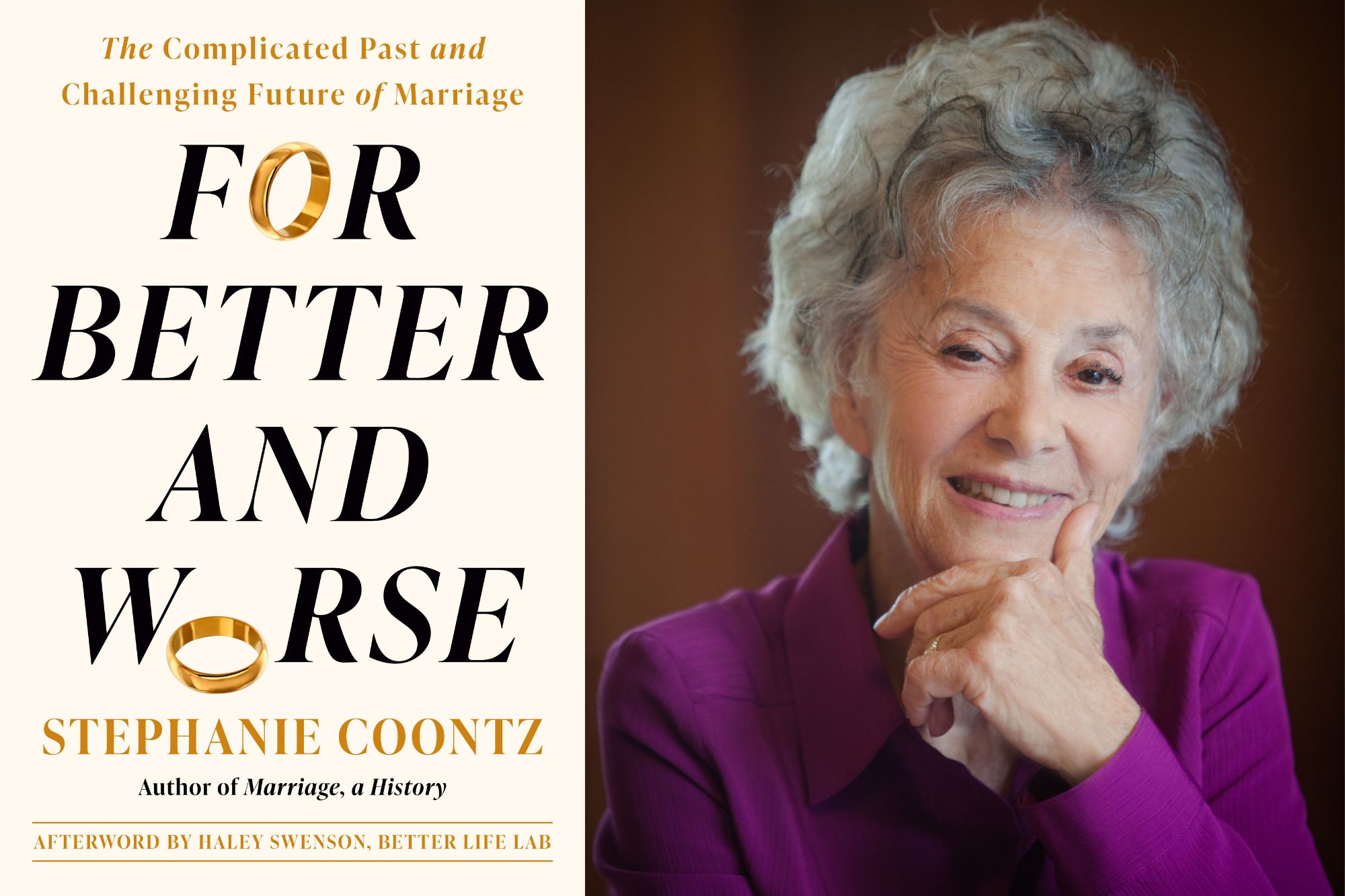
continues to grant greater privileges and respect to married people. This comes as the right pushes for a return to “traditional marriage” — an idea which historian Stephanie Coontz says isn’t actually based in history, as expectations of marriage, monogamy, gender roles and even the title “Mrs.” have drastically changed over time and across cultures. We’ll talk with Coontz about how socioeconomic factors have shaped expectations and laws around gender roles, marriage and love and about her new book, “For Better and Worse: The Complicated Past and Challenging Future of Marriage.”
Guests:
- Stephanie Coontz, Director of Research and Public Education, Council on Contemporary Families; author
Episode Transcript
This is a computer-generated transcript. While our team has reviewed it, there may be errors.
Alexis Madrigal: Welcome to Forum. I’m Alexis Madrigal. A friend of mine, a therapist, told me that the word that most often occurs to him to describe the married life of the people he sees on a daily basis is “carnage.” Even for high-education, high-income, mid-career, Bay Area heterosexual couples, married life is fraught with challenges around work, sex, mental load, and children.
More people are forgoing marriage altogether, especially those with lower incomes. We’re in a moment of great change in what being married means and how marriages work. Historian Stephanie Coontz is here to provide some historical context for our times. She shows that marriage — to say nothing of broader notions of two humans pair-bonding — has not been one fixed institution over the last several hundred or thousand years.
Her new book, describing this multiplicity and evolution, is called For Better and Worse: The Complicated Past and Challenging Future of Marriage. Thanks so much for joining us, Stephanie.
Stephanie Coontz: Oh, thank you.
Alexis Madrigal: Let’s just start with the basics. You write that there is no such thing as the traditional marriage. What do you mean?
Stephanie Coontz: Well, of course, most people think of traditional marriage as a kind of Leave It to Beaver male breadwinner, female homemaker arrangement. The term “male breadwinner” wasn’t even invented until the 1820s. That kind of marriage was probably the least traditional — or at least the shortest-lived — in all of history.
There have been many, many types of marriage, ranging from the one that’s quoted most often in the Bible — one man, several women. At least 50 societies have had one woman, several men.
Mainly, through most of history, marriage was a co-producer relationship. It wasn’t the co-equal relationship that we have been moving toward now, but the idea that women were supported by their husbands and that the men did all of the production and providing for the children — that’s just insane, to be honest.
Alexis Madrigal: I mean, it’s interesting. Your book really tries to take a look — and I would say a fairly caustic, appropriately caustic, look — at the way evolutionary psychologists have looked into deep human history and said, “Ah, yes, this is natural.”
They’ve tried to naturalize the male breadwinner by saying, “Oh, men hunted and women stayed home with the kids.” What is the actual evidentiary basis around long-range human societies? What does it say about what pair-bonding looked like deep in time?
Stephanie Coontz: Well, there was a division of labor, but it was certainly not one where the men did all of the providing or the protecting.
In most band-level societies we know of, and from the archaeological evidence about ones that came earlier — the way our Stone Age ancestors lived for thousands of years — it looks like pair-bonding was a successful way of raising children, but it didn’t rely on the model we do.
There are plenty of societies where women do go out hunting, but generally when there’s big game involved and you have to be gone for a while, it’s the men who do the hunting.
What the evolutionary psychologists got wrong is the idea that the men went out, did the hunting, brought it back to their individual families, and served it to the women and children. In band-level societies, food from big-game hunting is generally distributed by the group. In fact, the hunter who brought it down very seldom is given the first credit, and he certainly doesn’t get the bulk of the meat to take home.
When they’ve done studies of contemporary band-level societies, they find that children of men who are bad hunters, or children of single mothers whose fathers have died, are just as healthy and just as well fed as the children of the best hunters.
Alexis Madrigal: Kind of showing that the basic unit for society was this band — this broader set of kinship networks that people had.
One fascinating part of the book was around child care, where you note that everyone sort of took care of everyone’s kids. It wasn’t as if, in these contemporary hunter-gatherer societies or deep in the past, the women were just staying home watching children the whole time.
Stephanie Coontz: That’s exactly right.
Now, it wasn’t some kind of modern commune where everybody circulated, but most studies of band-level societies find that children are passed around. There are a couple of studies where researchers actually noted how many times, once the kids are mobile, they were eating at somebody else’s camp rather than their own, and it’s quite a few.
One of the things that we find is that marriage was actually a way not to bring people together into this little nuclear unit that protects itself. It was a way of reaching out, involving more people you had obligations to — and who had obligations to you — and passing those obligations down through time.
In band-level societies, their definition of in-laws is often much broader than our modern one.
So when people tell me, “Was marriage invented to oppress women or to protect women?” I think both of those are wrong. I think it was basically invented to get in-laws and to extend cooperation.
But, of course, that changed when inequality developed and people didn’t want their kids to marry just anyone. They wanted them to marry someone with equal or greater access to resources, and at that point marriage became a way of consolidating resources.
Alexis Madrigal: Yeah, I was fascinated by that era. I guess we’d call it the early modern period, or the agrarian societies of Europe and eventually the United States, where people were running small farms.
We kind of forget how many people were just farmers. Everybody was farming all the time. In that context, what does marriage become?
Stephanie Coontz: Well, in those areas where most people were farmers, you’re also talking about the period when rising inequality created a class that had other people working for them and was able to accumulate power and wealth.
In those circumstances, you get real class differences in the function of marriage.
For people working their own farms or small businesses, marriage was definitely a partnership. For thousands of years, love was important but not critical — or at least not the first priority. The idea was that you should marry someone who could work with you, who had a good reputation in the community, and whom you could perhaps learn to love.
In the upper classes, marriage became an incredible instrument for making alliances — military alliances, family alliances — and denying any obligation to a man who might have fathered your daughter’s child if you didn’t approve of his family.
That’s where you get the invention of illegitimacy, a concept unknown in band-level societies. Illegitimacy meant that if a woman had a child with a man she didn’t have permission to marry, that child was what they called in England a filius nullius — literally, a child of no one, related to no one and owed nothing.
So it’s a very different situation once you get inequality and the use of family alliances as a way to build wealth.
Alexis Madrigal: When producer Caroline and I were talking about the book’s core framework, it seemed like the economic factors you’re describing — and the way they played out across societies — really determine, maybe not exclusively but very nearly, how people have ended up acting in marriages. Do you think that’s a fair restatement?
Stephanie Coontz: Yes, though not in the sense that people are totally instrumental in what they believe and think.
Love, for example — people have always fallen in love and wanted to marry someone they loved. But for thousands of years, marriage was such an important political and economic institution that this was often impossible.
The idea was that you had to subordinate romantic love.
There were stories of romantic love, but it’s very interesting that up until recently they almost always ended in tragedy. People got together, but then they had to commit suicide because they weren’t allowed to marry, or they died in some other way.
Alexis Madrigal: Yeah. Where do you think we should start thinking about our modern version of marriage? What’s a good starting point?
Stephanie Coontz: My gosh. Well, of course, in my book I do try to get there, but it takes me several chapters.
I think where we really need to start is by recognizing how variable marriage has been.
We can look back to the aristocratic, patriarchal societies that preceded the development of the market economy and wage labor, but one of the main things I tried to do was show that we’ve had so many different versions of marriage, so many different versions of what love ought to be, of what men ought to do and what women ought to do, that we’ve accumulated institutions, myths, and mythologies about what is natural.
We have ideas about what we should feel — emotional cues. I call them “earworms” in my book.
One of the things I try to do is show that we have a lot more leeway than we realize because of the variation that has existed. As we increasingly want more egalitarian relationships — and most people do, even if they define egalitarianism in slightly different ways — it’s very difficult to achieve that when we have these older ideas echoing in our heads and we don’t have support systems organized around those newer ideals.
Alexis Madrigal: And you think knowing these origins, and knowing that these ideas about marriage came from somewhere — rather than from some innate biological quality — helps us dismantle those notions?
Stephanie Coontz: I think it does.
When I was young, people would tell me, “You intellectualize too much.” Women weren’t supposed to be overly intellectual.
But actually, knowing this historical and sociological background can take the heat out of some of the conflicts we have today.
I’ll give you a very personal example.
For years I’ve talked about how, in the 18th and 19th centuries, a new idea of women’s and men’s roles arose. Women, instead of being co-producers and deputy husbands who were proud of their productive skills, were supposed to take pride in their nurturing skills, their parenting skills, and how the house looked.
One of the things left over from that — and one of the conflicts in marriage today — is something I’ve inherited myself.
The first time my husband was holding our grandson, when he was about six or seven months old, the baby started to cry. I was in the kitchen, and I came swooping in and grabbed him out of my husband’s hands.
He was furious. He said, “What do you know?”
But because he’d also read and edited some of the chapters in my book, he said, “You’re gatekeeping, though. Isn’t that what you call it? Gatekeeping?”
Alexis Madrigal: Yeah. We’ll be back with more with Stephanie Coontz talking about the history of marriage right after the break.