With FEMA Cuts, Is There a New Disaster Relief Economy?
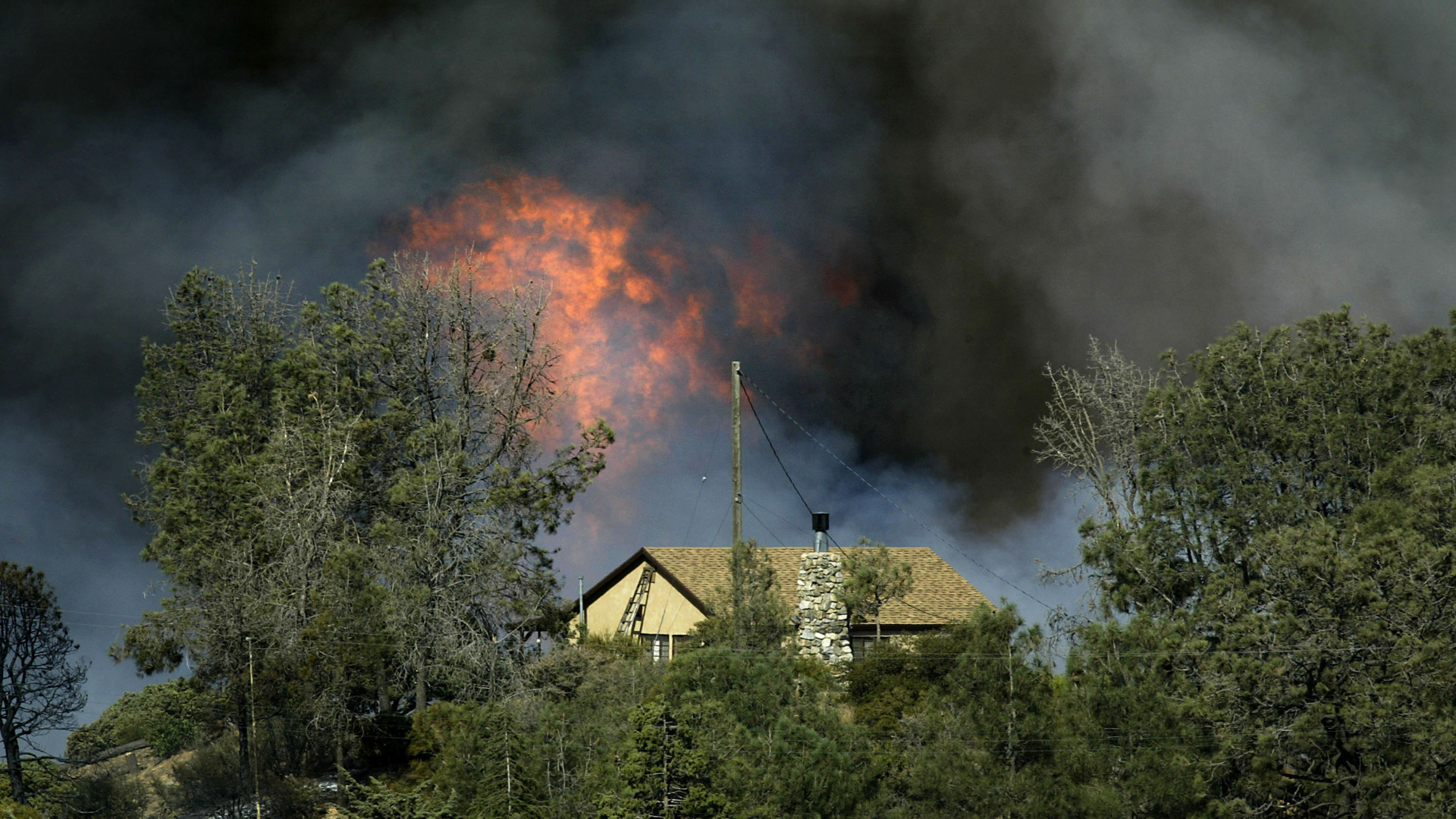
The mandate of the Federal Emergency Management Agency has long been to help states and local governments meet the needs of communities after disaster strikes. But since the Trump Administration took office, the agency has been threatened with closure and has suffered massive budget and staff cuts, essentially crippling its ability to respond to catastrophic events. As natural disasters intensify as a result of climate change, who will step in to help our region recover if a huge wildfire or earthquake happens here? We discuss the impacts of a weakened FEMA, the growth of a private disaster relief industry, and talk through what it would take for FEMA to turn things around as an agency.
Guests:
- Scott Dance, climate adaptation correspondent, New York Times
- Jennifer Gray Thompson, founder and CEO, After the Fire USA
- Bryan Koon, President and CEO, IEM
Episode Transcript
This is a computer-generated transcript. While our team has reviewed it, there may be errors.
Alexis Madrigal: Welcome to Forum. I’m Alexis Madrigal.
FEMA has not always had the best reputation. Disaster response is a tough job, and sometimes FEMA has shouldered massive blame for the government’s response to — just to take a few examples here — Hurricane Katrina, Hurricane Maria, and the flooding in Texas last year. But in this administration, FEMA itself is in the midst of an emergency, as deep cuts have hurt the agency’s ability to respond to disasters. Its entire mission and future seem up for grabs.
As we face wildfire season here in California and continue to just not think too hard about the real possibility of a damaging earthquake, we’re taking a look at the changes to FEMA and what they could mean for us if the worst comes to pass.
We’re joined this morning by Jennifer Gray Thompson, founder and CEO of After the Fire USA. Welcome, Jennifer.
Jennifer Gray Thompson: Welcome. Thank you so much for having me.
Alexis Madrigal: We’re also joined by Bryan Koon, President and CEO of IEM. Welcome.
Bryan Koon: Thank you very much.
Alexis Madrigal: And we’ve got Scott Dance, climate adaptation correspondent with The New York Times. Welcome, Scott.
Thank you.
So, Scott, among other things, you’ve been covering FEMA for the Times. Can you just give us — for people who have not… there’s been a lot of things going on during the Trump administration. Take us back to January 2025. The Trump administration comes into office. What happens to FEMA?
Scott Dance: Yeah, I mean, like many other federal agencies, it saw a lot of cuts, a lot of upheaval, a lot of new policies that really limited its ability to send reimbursements — money to communities and individuals that were recovering from disasters.
We saw, you know, with the Texas floods, thousands of calls unanswered from flood victims calling FEMA seeking information or help.
Alexis Madrigal: Last year’s Texas floods, right?
Scott Dance: Correct. Correct, yes — a year ago, yeah.
And, you know, they were unable to get some help.
I mean, otherwise, it is still responding to active disasters in the way that it always has. But the DOGE cuts that took place across the federal government left FEMA 20% smaller, took away a lot of its most experienced disaster managers and people who are the sort of go-betweens between the federal government and the communities, the state governments, and local governments that need FEMA’s help.
Alexis Madrigal: I think one of the things that shook people up early in the second Trump administration was President Trump maybe just trial-ballooning, maybe just talking, saying something like FEMA could just go away and the federal government could just pay states directly.
Scott Dance: Yeah, there was a big question about whether FEMA even had a future in this administration. The president and the former Homeland Security secretary, Kristi Noem, both floated that idea.
The president made very clear that he thinks FEMA is too expensive, it’s too inefficient. And that’s a viewpoint that’s shared by people who are not necessarily aligned with the administration on other things.
There’s long been problems with FEMA — the amount of time that it takes to get long-term help, questions about mission creep, and whether FEMA has become too focused on longer-term recovery and maybe it should just stick to the more immediate disaster work.
But yeah, that ended up sort of settling out with: they’re not going to get rid of FEMA, but it’s still very much a question of what are they going to change, and how are they going to change the work that it does.
Alexis Madrigal: Bryan Koon, just from your perspective, how much has FEMA been changed in this last 18 months? Is it a lot? A little? Drastically? What’s the word you’d put to it?
Bryan Koon: I would put it that it is an evolving change.
I don’t think we know yet exactly what the outcomes are going to be because of the changes that have occurred. Certainly, you see a reduction in staff and some of the capability.
But based on what we have seen — the recommendations coming through the FEMA Review Council and the FEMA Act in Congress — I think some of the larger changes are yet to be enacted.
So I think over the next couple of years we shall see what is the administration’s desire to continue changing the balance of how it is that we react to emergencies and recover from disasters in the country.
Alexis Madrigal: And we’re going to get to more about the different levels of hierarchy and the ecosystem that evolves when we do respond to disasters — the local, the state, the federal.
But let’s bring in Jennifer Gray Thompson here.
You started your organization, After the Fire USA, after witnessing the 2017 North Bay fires in your hometown. What did you see then that made you want to create this organization?
Jennifer Gray Thompson: What I saw is gaps that I had no idea existed before undergoing a massive disaster.
Our megafires in 2017 were really the first out the gate, opening up the era of megafire. Previously, I thought they would come in, it was the cavalry, they would tell me what to do, and I could just follow along.
But what I learned is FEMA’s role is somewhat limited, and it really is up to the local community to walk each other home.
FEMA is a long-term partner, but there certainly aren’t boots on the ground in the way that the community is. And the process is very opaque. It’s really hard to navigate. It is a new language. It is an incredible learning curve. It is so difficult.
So we have this organization so that we can go in and teach communities the language and the process of disaster. They know their community, but they don’t know the language of the process.
Alexis Madrigal: So it’s interesting. Obviously, 2017 predates the second Trump administration. During the first one, what did you think FEMA’s role should have been in those fires?
And if you think FEMA should be reformed, do you think what’s been happening during the second Trump administration has been helpful for what you would hope would happen, or hurtful?
Jennifer Gray Thompson: Well, in the second administration, I think it’s been hurtful.
I think that FEMA is actually one of the crown jewels of the American system. However, there isn’t a person who’s interacted with FEMA or who has worked at FEMA who doesn’t think that it needs to be modernized and reformed and made more efficient and less opaque.
There are a lot of things that actually we can do with AI, and I look forward to some of those implementations to sort of walk people through. And by people, I also mean public officials.
In the first Trump administration, we didn’t really see much of a difference. He really did show up, and he didn’t politicize it in the same way he is in the second Trump administration.
And as a California resident, it’s been particularly painful in this work to watch the very meager response in the Los Angeles fires.
I was kind of learning FEMA in the first few years, so I can’t exactly say because there’s a bit of a fog of war. But I was shocked to learn how opaque it is and how it’s like a game of fish. You have to know the right questions in order to get the right answers in order to give the service that your community deserves.
That puts communities, particularly rural communities, at a distinct disadvantage.
So yes, we should keep FEMA, absolutely, but I really think they’re missing an opportunity to elevate it and really meet the moment.
Our disasters are increasing, and when disasters are increasing, the answer is not to decrease support. That’s like saying heart attacks are increasing, so we need to get rid of all of our cardiologists. It doesn’t make any sense.
Our cardiologists talk to us about health. We need to lean into resiliency and home hardening, the built environment, and wildland management. There are many things we can do.
But one of the things we absolutely should never do is get rid of FEMA.
Canada would love to have a FEMA. They’ve told me this many times.
So we should be really modernizing it, figuring out more best practices, listening to the community about what the barriers are, and implementing some AI with people in order to make the job easier, so we have things like common applications.
Alexis Madrigal: Bryan, I know that you have been the head of one of the organizations of emergency managers across the world, one of these international agencies. What is special about FEMA relative to what they have in Canada or some other country?
Bryan Koon: Alexis, you said Scott, but were you talking to me on that one?
Alexis Madrigal: Oh yeah, I was talking to you!
Bryan Koon: That’s okay.
The great thing about the American system is that it’s really a layered system. FEMA is just one component in the emergency management spectrum.
Every state, every territory, and virtually every county, every city, every tribe has an emergency management organization, and they deal on a daily basis with the vast majority of the disasters that occur across the country.
It’s only when their capacity is exceeded that it bumps up to the next level.
So the great thing about FEMA is that it helps provide that coordinating body for all of the federal resources that can be brought to bear in a situation.
If it’s the Texas floods, they can get helicopters. If it’s an earthquake, they can provide urban search-and-rescue organizations from across the country.
Each layer backs up the other layer.
And then the other thing is that they can provide the funding that would strip a state’s budget.
As today, I’m working at our office in San Juan, Puerto Rico, which received nearly $100 billion after Maria, which is multiple times the territory’s annual budget.
So it is really the ultimate backstop for those state and local jurisdictions and gives them the assurance that they’re going to be able to deal with that situation.
That is, I think, what Canada or any other country that doesn’t have that system would love to have — the assurance that they know they’re going to be able to prepare for, respond to, and recover from the kinds of disasters that are occurring across the world.
Alexis Madrigal: I guess I just imagine other countries do, in fact, have the ability to respond, but it’s something about FEMA’s level of coordination or level of integration into the federal government.
Bryan Koon: That is correct.
It’s a repeatable process that is practiced every day.
Other countries, it’s more of an ad hoc approach to dealing with each individual situation.
That’s what the United States had before the formation of FEMA in the 1970s.
What we have now is a process that allows us to respond more quickly and more efficiently.
Now, there’s still lots of room for improvement, as Jennifer has pointed out, but it is far better than trying to figure out what to do once the situation has occurred.
Alexis Madrigal: Thank you so much.
Bryan Koon, President and CEO of IEM.
We’re also joined by Scott Dance, climate adaptation correspondent with The New York Times, as well as Jennifer Gray Thompson, founder and CEO of After the Fire USA.
We, of course, want to hear from you. Have you had any experience dealing with FEMA? How did it go?
And if there were a huge earthquake here or another set of megafires, who within the government would you expect to help you recover?
Give us a call: 866-733-6786.
Actually, maybe you’re an emergency manager for one of our cities or municipalities or counties here. We’d love to hear from you as well on how you think it’s going at FEMA.
866-733-6786.
Email [email protected]. You can find us on social media — Bluesky, Instagram, Discord. We’re KQED Forum there too.
I’m Alexis Madrigal. Stay tuned.