How the U.S. Auto Industry Is Losing the EV Race
Airdate: Tuesday, July 21, 2026 at 9 AM
There was a time when U.S. automakers dominated the global car industry with their products and innovations. But when it comes to electric vehicles, which accounted for a quarter of global auto sales in 2025, the U.S. is barely a player. China now builds roughly three-quarters of the world’s EVs; the United States about five percent. We’ll talk about how the widening technology gap and lukewarm federal support for clean vehicles threatens the entire U.S. auto industry with obsolescence, and what California is doing about it.
Guests:
- Ethan Elkind, director of the climate program at the Center for Law, Energy and the Environment, UC Berkeley School of Law; host, Climate Break podcast
- Susan Helper, economics professor, Weatherhead School of Management at Case Western University; formerly Chief Economist for the Commerce Department during the Obama Administration
- Matthew Shaer, contributing writer, New York Times Magazine
Episode Transcript
This is a computer-generated transcript. While our team has reviewed it, there may be errors.
Alexis Madrigal: Welcome to Forum. I’m Alexis Madrigal.
In a big new story in The New York Times Magazine, the American EV has been crushed. Will it take the auto industry with it?
Matthew Shaer asks an important question about the future of the world: If the globe goes electric, but the U.S. remains wedded to internal combustion engines, what happens to our carmakers?
Already, Chinese-made cars represent 75% of new electric cars made on Earth, while U.S. companies make a small fraction of that. With that dominance comes dominance in battery and charging technologies, among other things. Already, Chinese electric cars have better range and faster charging than American ones, and they’re cheaper.
It’s almost like a rerun of the Japanese arrival on the global automobile scene, but with even higher stakes. The damage is already occurring. For example, in 2016, Ford and GM sold 11 million cars abroad. By 2024, that number had fallen 50%. That’s made U.S. carmakers more dependent on the U.S. market at exactly the moment when our country is diverging from the global norm.
So here to talk with us about what might happen to Detroit if these trends continue, we’re joined by Matthew Shaer, contributing writer at The New York Times Magazine, who wrote the piece. Thanks so much for joining us.
Matthew Shaer: Thanks for having me.
Alexis Madrigal: We’re also joined by Susan Helper, an economics professor in the Weatherhead School of Management at Case Western Reserve University. Helper served as the chief economist for the Commerce Department during the Obama administration.
And we’ve got Ethan Elkind, who’s director of the climate program at the Center for Law, Energy, and the Environment at UC Berkeley School of Law and host of the podcast Climate Break. Welcome back, Ethan.
Ethan Elkind: Thank you. Good to be back with you.
Alexis Madrigal: So, Matt, let’s start with you. Your piece starts out with one of the most, maybe, tragicomic stories about electric vehicles. Ford touted this particular SUV as, quote, “your personal bullet train.” What was that car, what happened to it, and how is this symbolic, for you, of what’s going on with our car industry?
Matthew Shaer: Yeah, I spent a long time thinking about how to lead off this piece, what the perfect example for the case I wanted to make was. And I settled on this car that was unveiled at a Ford investor event a few years ago.
It was going to be a three-row EV, so a pretty big EV, an SUV. It was going to have a big battery. It was going to carry a whole family something like 350 miles, which at the time was a big claim for a battery.
Ford sunk tens of millions, hundreds of millions, into the development of EVs — this EV and EVs like it. They had hired away this guy, Doug Field, from Tesla — and before that he’d been at Apple — to oversee it.
They roll it out. They say, “This is going to change everything. This is what America has been waiting for.”
And sure enough, a year goes by: “Actually, we’re a little delayed. The costs are running over.”
Another year goes by: “Actually, we’re going to cancel it. We’re going to can this thing altogether because it’s too much money.”
Well, let me step back. The reason I use this as the example is that between when Ford unveiled the “bullet train” and the time they canceled it, everything changed.
We have guests here who are considerably smarter about this than I am, but the world changed. We went from a very rosy view of what might be possible for the American EV industry to utter chaos.
So this car gets canceled. A lot of cars get canceled. After this, in the story, I just kind of go through a laundry list of all these vehicles that have been delayed or canceled. And it brings us to where we are today.
Anyway, I’ll stop talking.
Alexis Madrigal: This all makes a ton of sense. I mean, one of the things that changed, though, right, is that basically Chinese EV manufacturing, both for their domestic market and around the world, just takes off.
Matthew Shaer: Yeah, it takes off. It’s really two things at once.
China’s business takes off. They’ve been pouring resources into this business for a while, and they’re finally achieving this critical momentum.
At the same time, in the U.S., we’re — I’m going to quote one of your other guests, who gave me a great quote about what it’s like to be a U.S. automaker. I was talking to Susan about this, and she said, “It’s like trying to turn around a warship in a tiny space.”
The U.S. industry is trying to anticipate what’s going to come out of Washington in terms of EV policy and trying to adjust. One minute we’re hot for EVs; the next minute we’re bringing back coal and gas-guzzling trucks forever.
If you’re a carmaker, that’s hard.
So yes, it’s China, but it’s also what’s happening in D.C. at the same time.
Alexis Madrigal: Susan Helper, you’ve been following the American automobile industry since, I think, 1982, when you began writing your Ph.D. dissertation on the industry. So you’ve seen several waves of innovation. You’ve seen several waves of foreign competition in the U.S. domestic market. We’ve seen the rise of Tesla. We’ve seen all these things.
What do you think is most significant about the particular moment that we’re in right now in 2026?
Susan Helper: Well, I think one thing that’s different from the previous crises in the auto industry — and I guess I was writing about the auto industry during the time of the first Japanese challenge to the behemoth of the American auto industry — is that I feel like the automakers are very aware of the challenge.
When the Japanese were coming up, it was kind of like they went through all the stages of grief — denial, bargaining, and finally acceptance.
I feel like — I mean, I have some quibbles with some of their product strategies and also their financial strategies — but I feel they are very aware of what the Chinese are doing and, unfortunately, are struggling to meet that challenge.
Alexis Madrigal: One of the things I find so interesting is that you have this big report that you released on the EV industry with some colleagues, which described U.S. automakers as existing on, quote, “a shrinking island of ICE” — ICE in this case being internal combustion engines, not immigration enforcement.
What would that future look like if the U.S. continues to pump out tons of oil and remains this petro-dominant economy and automotive industry while the rest of the world moves quite rapidly toward EVs?
Susan Helper: I think that would be bad for U.S. consumers of autos, for automakers, and for the nation as a whole.
I can say why for each.
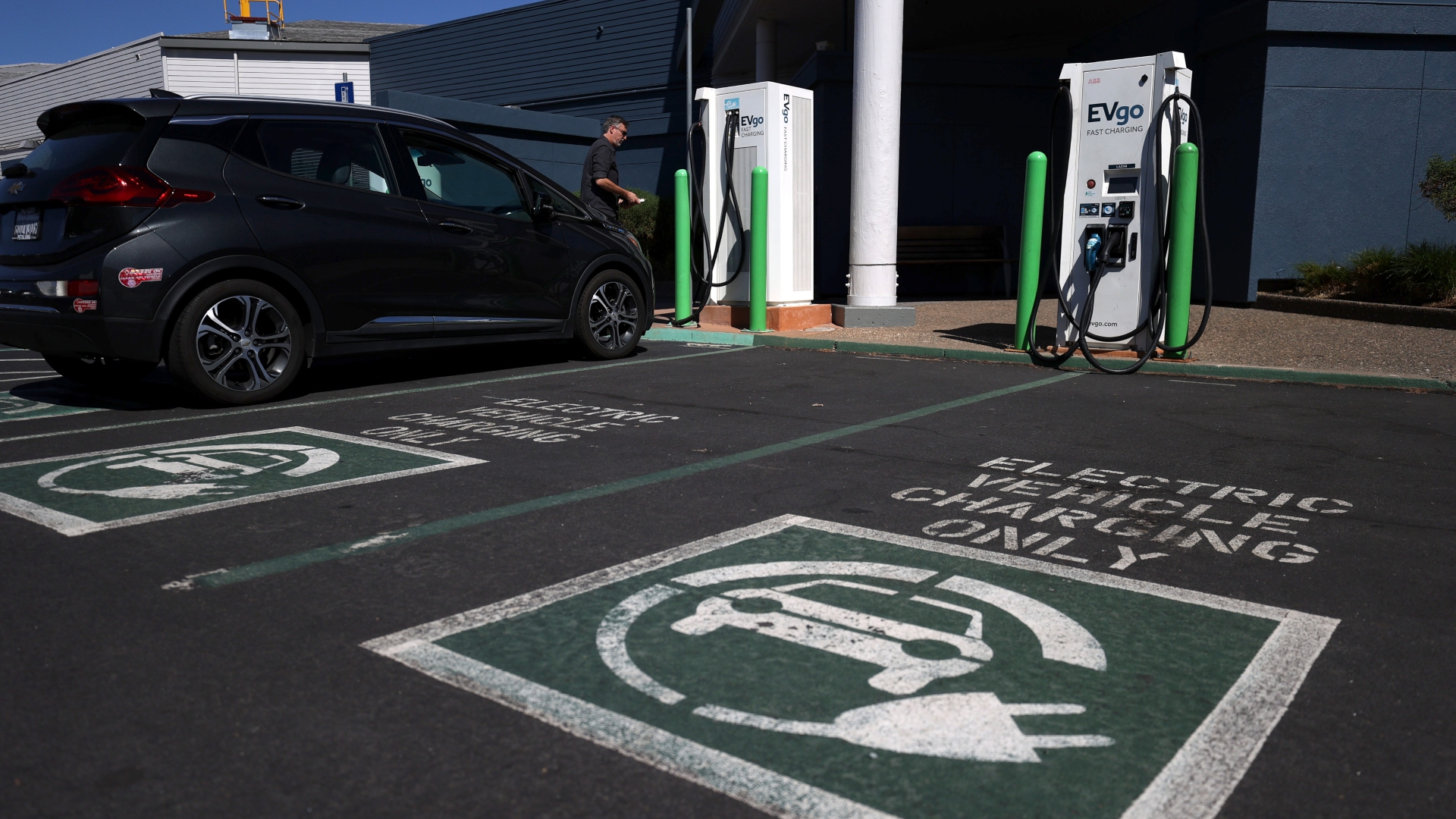
Electric vehicles are simply a superior product. Once we deal with the range anxiety and get the charging built out, electric vehicles are quieter, they accelerate better, and they require less maintenance.
Eventually they’re going to overcome the cost differential and the range issues that we have, particularly in the U.S.
That’s bad because it hamstrings U.S. automakers in their foreign markets. It also hamstrings the U.S. supply chain as a whole.
And I think this is important for your listeners here in California. I should point out that all of my co-authors except me are in California — longtime California residents. They, like me, are very worried about the development of what we call the electric tech stack: batteries, motors, chips.
Autos are just huge volume — 16 million cars a year. Nothing else begins to approach that.
So if you have autos, you have enormous economies of scale for your products and these dynaAlexis Madrigal: Let’s bring in Ethan here. I mean, California is a place we focus on a lot, at least for us here on Forum. Can the so-called fourth-largest economy in the world just sort of make up for U.S. national policy? Can California become its own EV market?
Ethan Elkind: Well, that used to be the case, that California really was leading the country and sort of dragging the country along on the electric vehicle revolution.
We had really strong policies requiring automakers to produce and sell electric vehicles, and we had generous incentives. But we’re hamstrung at this point because we live within the borders of the United States.
We’re dealing with tariff policies. We’re dealing with rollbacks of federal policies. Specifically, the federal tax credit, which really helped bolster California’s goals, was eliminated by Congress last year, and that played a major role in decreasing demand.
We’ve since backfilled that with a new state incentive program, which we can talk about.
Also, what Congress did last year that was really devastating to California was vote to invalidate our mandate requiring automakers to produce zero-emission vehicles. That mandate was central to the rise of the electric vehicle industry.
Companies like Tesla made billions because other automakers couldn’t comply with the standard and paid Tesla for the credits it generated by exceeding California’s standard. It was such a central policy, and it’s been invalidated by Congress.
It’s being litigated now. I think there’s a strong case that the action Congress took was not legal, but we’re relying on very conservative courts to make that decision.
So California is still doing what it can with the tools it has to invest and subsidize, but we’ve lost a lot of tools because of the Trump administration and Republicans in Congress.
Alexis Madrigal: These federal incentive programs — how crucial were they? How cost-sensitive, how price-sensitive, is the EV buyer out there?
Ethan Elkind: Well, we saw a major shift when the federal tax credit went away. As I said, it was eliminated last year in the Republican tax bill, and it expired after the third quarter.
We saw a massive amount of demand pulled into the third quarter, and then sales absolutely plummeted in the fourth quarter without that federal tax credit.
Now, Susan, as an economist, could weigh in on this, but some would argue that it simply pulled a lot of demand forward. We still saw depressed sales in the first quarter as well, though now they’re starting to come back up.
So there is the possibility that some of these incentives were overly generous, and the automakers that are still selling EVs are able to price them more competitively.
For example, we’re seeing Rivian come out with its R2 vehicle, which a lot of people think is going to be a really big seller. Tesla has also been able to discount some of its products to make up for the loss of the tax credit.
But there’s no doubt that it made a big difference for people. Taking a few thousand dollars off a new vehicle can make a huge difference and make these electric vehicles cost-competitive with their internal combustion counterparts.
I do agree with Susan that, in the long run, the way battery technology is going, these cars are going to become so much cheaper than internal combustion engine vehicles.
We really just needed that federal tax credit to accelerate the market. That transformation will happen anyway — just at a slower pace now.
Alexis Madrigal: We’re talking about electric vehicles and the failure of the American auto industry to come out with EVs that rival Chinese brands like BYD and Geely.
We’re joined by Ethan Elkind, director of the Climate Program at the Center for Law, Energy, and the Environment at UC Berkeley School of Law.
We’ve got Susan Helper from Case Western Reserve University, and Matthew Shaer, contributing writer at The New York Times Magazine.