California Has Extreme Income Inequality. Why Do We Treat It As Normal?
Airdate: July 14, 2026 at 9 AM
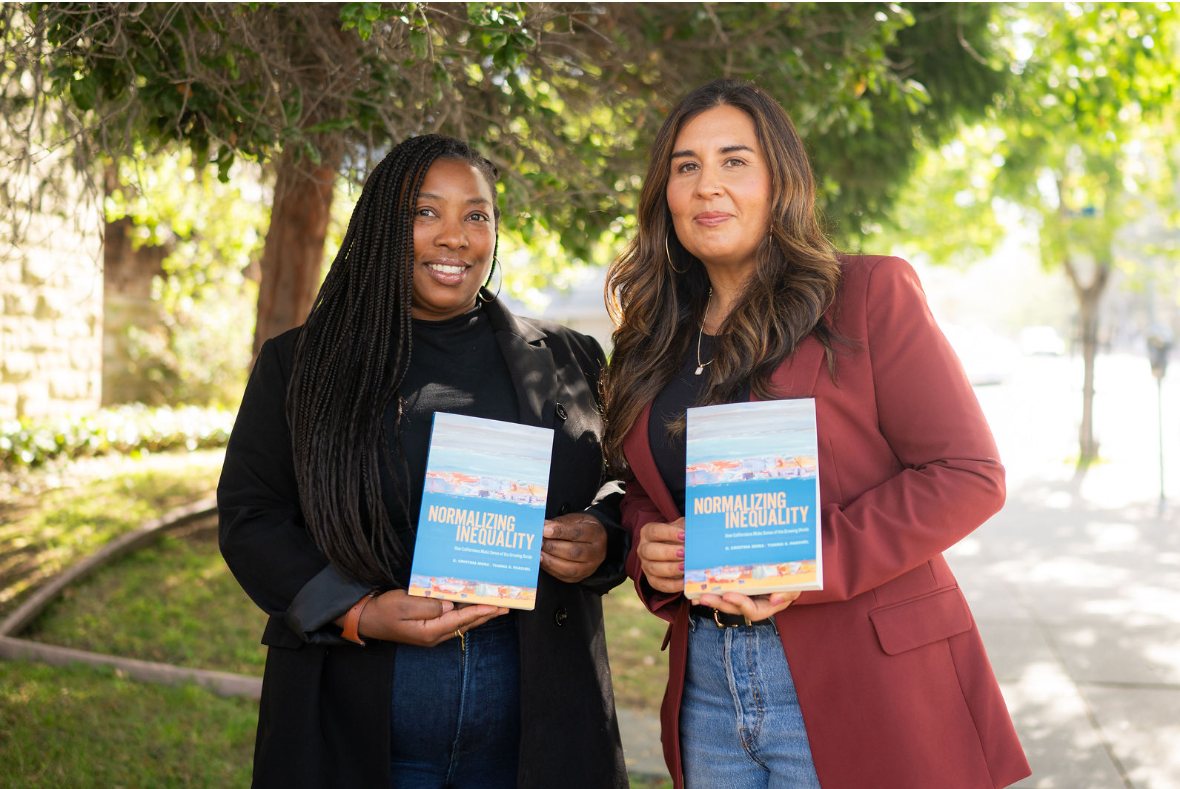
California is one of the most unequal states in the country with extreme disparities between people living in poverty and those at the top of the income spectrum. Given the visibility of the problem, with homeless encampments and multimillion dollar houses populating our landscape while the middle class shrinks, UC Berkeley professors Cristina Mora and Tianna Paschel set out to find out why Californians are “aware of inequality but not incensed about it.” They interviewed 136 Californians in the state’s “precarious middle class” — people who were getting by, but barely – and surveyed thousands more for their book, “Normalizing Inequality: How Californians Make Sense of the Growing Divide.” We’ll talk with Mora and Paschel about why income inequality is on the rise in California, and the perils of accepting it.
Guests:
- G. Cristina Mora, Chancellor’s professor of sociology and Chicano/Latino Studies and co-director of the Institute of Governmental Studies, University of California, Berkeley; author of the book, “Making Hispanics”; coauthor of the book “Normalizing Inequality: How Californians Make Sense of the Growing Divide”
- Tianna Paschel, associate professor of African American Studies, University of California, Berkeley; coauthor of the book, “Normalizing Inequality: How Californians Make Sense of the Growing Divide”
This partial transcript was computer-generated. While our team has reviewed it, there may be errors.
Alexis Madrigal: Welcome to Forum. I’m Alexis Madrigal. We all tell ourselves stories about the way the world works. Some of it’s based on education or some set of facts we’ve learned, but a lot of it is just personal experience — things we’ve heard from someone, vibes. Our world is wildly complex, and so we make sense of it with imperfect information. So how do you get at those beliefs?
G. Cristina Mora and Tianna Paschel have co-authored a new book, Normalizing Inequality: How Californians Make Sense of the Growing Divide, and it uses deep interviews and a big survey to understand how Californians in the precarious middle class make sense of the inequality they see all around them. Mora is a professor of sociology and the co-director of the Institute of Governmental Studies at UC Berkeley. Welcome.
G. Cristina Mora: Thank you, it’s great to be here.
Alexis Madrigal: Great to have you. And Tianna Paschel is associate professor in the Department of African American Studies at Berkeley. Welcome.
Tianna Paschel: Thank you, thanks for having me.
Alexis Madrigal: So before you were professionals who studied these things, before you were professors at Berkeley, when you were just growing up, how did you make sense of the inequality that you grew up with? Cristina, you want to start us off?
G. Cristina Mora: Yeah, I’m from northeast LA, a small little part of LA called Pacoima. And if anyone knows it, they know that in the ’80s and ’90s, and even now today, it’s a highly segregated small segment of LA, mainly Latino working class. And I think part of my everyday life was just seeing people that looked like me, people that knew my parents, people that came from the same town as my parents and worked in manufacturing or gardening or any sort of the service sectors.
The first time I started thinking about inequality at a broader level — I turned on Beverly Hills, 90210. I turned on Saved by the Bell. That was supposed to be Southern California teenager life, and it’s like, that is an awesome show — nobody looks like me. Where are we? And so it was that great disconnect between what was going on in my everyday life and what I saw around me, and how that was sort of a hidden secret, at least in the media. And what was wild to me is that these shows were being filmed maybe 10, 15 miles from where I was, and so thinking through what does this mean about whether we are truly American, whether this is truly the U.S., whether I’m just a part of LA but not a part of this larger picture of who we are and what Southern California is.
And I think that’s what started it. And then, of course, when you become more mobile — middle school, high school — and you start going out to the west side, you’re like, hey, that high school looks a lot better than my high school. Those stores, the police aren’t there as much, they’re not going to sleep with the helicopters. And that’s very starkly juxtaposed — the way California and many of its major cities can be so diverse and yet so segregated in its diversity, both class and racially. That was just sort of hard to put together, and it opened up a lot of questions about who’s really American, who really belongs here, and who’s living on the winning side in some ways.
Alexis Madrigal: Tianna, you grew up in a slightly different place. Why don’t you tell us a little bit about that?
Tianna Paschel: So I grew up mostly in Sacramento, but I also spent a lot of time growing up in Fresno and in Bakersfield. In Sacramento, I feel like I had the exact opposite of your experience on some level, but a similar one in another. I grew up in apartment buildings, kind of working-class neighborhoods in Sacramento. I feel like they’re kind of the epitome of the kind of Northern California — racially integrated but not quite white — places. So I grew up in blocks and blocks of apartment buildings with Vietnamese folks, Salvadoran folks, Mexican folks, Black folks, where white folks were hard to find, right? It felt really racially integrated amongst us folks of color, and at the same time, kind of a world apart from where all the wealth in the city was.
I think the moment where I realized that whatever I was living was not what other people were living was when I was bused out of my neighborhood to go to school — what felt like the other side of town, but recently I looked on a map and it’s like a couple miles away. It felt a world away. I remember the first time being on the bus on the other side of town, going to a school that had an International Baccalaureate program. I had been in kind of GATE and honors — all these segregated spaces, actually, within my school so far. And I get to this school, and on the way I see airplanes in people’s driveways.
Alexis Madrigal: That would be shocking even now.
Tianna Paschel: So there’s a private airport by the school in Mira Loma that I went to in Sacramento, and that was the first kind of moment of, like, what is this? First it’s all houses — where are the apartments? And then, okay, this is normal, this is the neighborhood around my school. And if there were people of color at that school, they were largely not in this program — I think there were like one or two my freshman year of high school.
So going back and forth between my neighborhood, where folks that I grew up with went to very different schools than the one that I went to, was jarring. And I would say, as I’ve experienced social mobility, there is this way in which the inequality in this place is a dizzying phenomenon, because of course we’ve experienced — we are really fortunate, and we’ve worked hard too, but we’ve been fortunate to experience a lot of social mobility. And yet our families haven’t all experienced that same mobility. So we’re constantly both seeing inequality around us but also kind of experiencing it within our familiar relationships as well.
Alexis Madrigal: I mean, one thing about the Bay Area that’s really true is that the inequality is really close together, right? If you drive not 10 miles, one mile, in any part of the Bay Area, basically, you can see homeless encampments, $3 million homes, and oftentimes separated by a block or two streets. Well, let’s get at how the people you talked to started to make sense of this. A lot of the people you interviewed were sort of upper working class or lower middle class — in a little band around the average median income, right? This is like, “How did I end up here?” — is basically the question, right?
G. Cristina Mora: Yeah, and I guess we had a few questions when thinking about how do everyday people make sense of this. If you think about the way we think about inequality in the United States, in the globe, but especially in California, which is one of the most unequal states in America, you might think that you’ll study inequality by looking at big shifts in the economy at some macro level, or you might think that you’ll study it by looking at the everyday lives of some of the poorest of the poor — those with no safety nets, perhaps those that are being evicted or unhoused. But where we wanted to come in is to really understand how average, everyday working people make sense of this crazy rat race and these larger trends.
And the larger trend is that you’re seeing an increasingly shrinking middle class. We don’t know if it’s an exodus, but we do know that it’s shrinking. And yet they’re also not witnessing the promises that original paths to mobility have promised young folks — especially if you go to college, get a degree, become a teacher, you’ll be fine; become a social worker, you’ll be fine. We were finding teachers that are moonlighting as delivery drivers, or those renting out rooms, and many, many more who couldn’t think about ever having a home, even though they had stable homes, many of them had college degrees.
So from that perspective is where we wanted to think about how they’re making sense of all this. And you might think that, on the one hand, they just don’t see it — they’re blind to it. We’re all in our own social media worlds, we’re all in our echo chambers, perhaps they don’t see it, or they don’t care about it, or they just don’t know about it. And I think the biggest finding for us is: no, they know. They see it.
Alexis Madrigal: Yeah, right.
G. Cristina Mora: They are not blind to this at all, and they can often talk about it in some eloquent ways. They talk about the rich getting richer, the poor getting poorer. They talk about the racial underpinnings of a lot of this. They know the good neighborhoods.
Alexis Madrigal: Like the cross-race is people face.
G. Cristina Mora: Exactly, exactly. They see this.
Tianna Paschel: But yeah, I mean, they can talk about even policies, right, and why it is that the tax code is rigged in a particular way. They understand structural inequalities, for the most part, and this was across racial groups. I think the part that surprised us is that they would very quickly, after kind of reciting these things about structural inequalities, fall back on kind of good old-fashioned American liberalism, on individual ideas, on ideas about merit, on ideas that maybe if they just work hard enough, or they bide their time, they’ll be okay, or that this place is okay if certain things happen.
So I think that was the part that surprised us a bit — that they had the language, but they also fell back on things. And there was this tendency to kind of — California, specifically — to lean into certain myths. In the book, we talk about the myth of opportunity here, the myth of multiracial promise, and the myth of sanctuary. We don’t want to say that there aren’t ingredients to California that make it special, but in a way, our book is really highlighting the fact that California is almost like America on steroids, in its inequality and in the stories that it tells itself. And I think storytelling, as you know, is so important to our everyday lives, but it’s also important to the reproduction of the status quo, right?
Alexis Madrigal: What story do you tell yourself about that inequality that you just mentioned, that is so close? You have to tell yourself something. You have to tell your kids something, right?
Tianna Paschel: And we think that it’s really important, the stories, because we know that there’s no power regime, there’s no inequality that operates purely by force. It requires storytelling. So storytelling is happening always. And so what do we tell ourselves about the world around us? Do we naturalize it? Do we normalize it? Do we dismiss it? Do we minimize it? And so that is part of what we wanted to get at. And if we do, what do we do that with, right? What are the ingredients of our storytelling? Where does it come from, and how do we get out of it?
Alexis Madrigal: We’re talking with the authors of the new book Normalizing Inequality: How Californians Make Sense of the Growing Divide. We’ll be back with more right after the break.