This partial transcript was computer-generated. While our team has reviewed it, there may be errors.
Alexis Madrigal: Welcome to Forum. I’m Alexis Madrigal.
There are a lot of people trying to sell you happiness, or at least a plan to achieve it. There may be an equal number of people trying to sell you mindfulness, a way of being more present in a given moment.
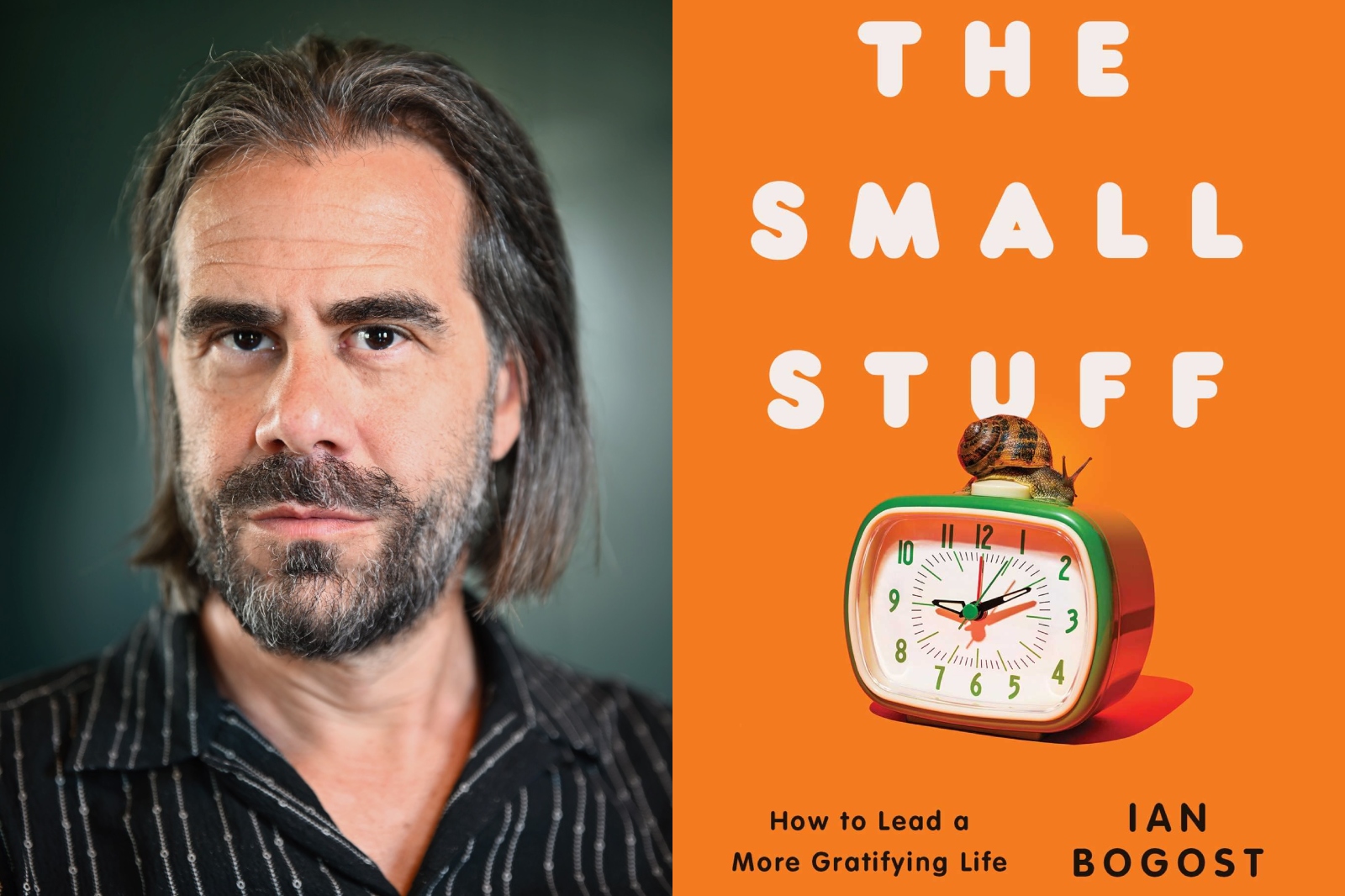
But in his new book, The Small Stuff, Ian Bogost is trying to do something different. He argues that we need to re-enchant the physical world by directing our attention to the simple pleasures of everyday life.
You may think you’ve gotten this advice before: smelling roses, attending to the wonders of the natural world. But Bogost is working with a different substrate: paper towel dispensers, stick shifts, coffee cups, stroopwafels, towels, bubble wrap, plastic film, buttons, and door handles.
As he writes, “Our culture makes wonder at the flora and fauna of the natural world easier because such admiration is directed at supposedly wholesome things that exist before and beyond our solid human civilization. But why withhold wonder, respect, and admiration for the world that humankind has constructed and the one that people live inside every day? The machines, the infrastructure, the shops, the tools, and everything else that you might find are no less susceptible to awe than flowers or caterpillars.”
Ian Bogost joins us here this morning. He’s a contributing writer at The Atlantic as well as a professor at Washington University in St. Louis. Welcome, Ian.
Ian Bogost: Oh, it’s great to be here, Alexis.
Alexis Madrigal: Great to have you. I’m so glad.
Why don’t you just lay out the basic idea for us? What are you really arguing for here?
Ian Bogost: There’s two ideas that work in the book.
The first is that we got disconnected from the physical world. And that happened through technology and bureaucracy and economics and all sorts of other factors. It happened slowly. You probably didn’t notice it. It’s not really your fault. But a lot of things that used to give us the pleasure of direct contact with your senses have kind of fallen away.
That’s one idea.
The second is the thing that you lost along the way: a type of contentment, a type of pleasure I call gratification that’s easy, that’s instant, and that’s the sensory enchantment of everyday life, as I put it. It’s that good feeling of connecting your senses with the world around you.
It’s fundamentally different to me than happiness or satisfaction, and it’s really, really underrated. We have not given it the credit it deserves in our lives, and as a result, we’re just kind of less happy.
Alexis Madrigal: I feel like in this book, and also in life and your other writing, you’re very good at the specificity of these types of interactions, which are important to your idea in and of themselves.
Can you just give us a couple examples of the sort of thing you’re thinking about?
Ian Bogost: So one of the examples that everyone, I think, has experienced is if you go to, like, a convention center or an airport or any public building, really, and you need to go to the restroom, you no longer touch anything.
And you may think, “I don’t want to touch things in the restroom.” But then you put your hands under the faucet, and there’s a sensor, and it kind of doesn’t work. Or maybe it works a little bit, and then it stops. And the soap is like that, and the towel is like that. The toilet might flush with you still on it because it thinks you’re all done.
Alexis Madrigal: Terrifying the children.
Ian Bogost: It’s terrifying. My young daughter, when she was like three, she called these “magic potties” and couldn’t stand them.
That’s one example.
Another is doors. I mean, it seems like, what’s wrong with doors? But sometimes you go to open them, and they’re motorized now. And there’s a button you can press, which is great for accessibility. But that sense of being able to understand how you approach the door, where it’s going to pull, and then how it’s going to feel, and whether you can physically open it or if you’re struggling to do so — that’s another example.
Every day you use doors, right? And that’s kind of fallen away as well.
So those kinds of ordinary things feel like furniture. They feel like they shouldn’t matter, or they should disappear into the background. But they make up the moments of your life. And when they don’t feel as good, when you feel disconnected from them, when you’re physically prevented from using them because technology has changed them, that’s a loss.
I really miss closing the hatch of automobiles. Now you just press a button and it’s motorized, and it’ll beep at you, irritated, if you try to pull it closed with your hand.
That’s another example. You don’t turn on the car at all. You don’t turn the ignition with your keys. You just keep them in your pocket, and it opens the door for you automatically, which is nice if your hands are full of groceries. But then you don’t get to jingle those keys in your hand like you used to.
So it’s kind of everywhere, that feeling of dematerialization. And then the flip side of it, which is the gratification of engaging with your senses.
Alexis Madrigal: So what do you — and we’re going to go into the door example in particular a little bit later in greater depth — but what do you think the components of a gratifying physical experience are?
Ian Bogost: One of them is control, a sense that you are together with something else. And it’s not a control that puts you above it or something, but that you’re collaborating with the world in some way.
So when I put the key into the ignition of my automobile, which still uses a key, and it accepts it, I can kind of feel the play between the metal of the key and the ignition. Then I turn it, and there’s a give to it, and I hear the engine turn over. Then I reach down to shift the car, to clutch in.
Those experiences are telling you — they’re giving you information that, hey, the car is saying, “I’m here. You’re using me.” And you’re like, “Great. I am also here. Let’s do this.”
Alexis Madrigal: [Laughs.]
Ian Bogost: So that’s part of it.
Another is just the sense of sensation itself. As I’m sitting here talking to you, if I pay attention to it, I can feel the smoothness of the table in front of me. Eventually that kind of vanishes into the background so I don’t lose my mind.
But have you ever done that with your fingertips, where you’re just kind of gesturing at or sort of tousling the object that surrounds you? There’s not really a reason for it. Rather, it’s just so that you, as a physical body in the world — which we all are; we’re not digital uploads — can feel that you exist and that your sensations are active and activated.
I think another part of it is just the idea that the world is there, and it’s constantly delivering these little miracles one after the other all the time. There’s a surplus of that kind of delight.
We often feel that we are missing out on something, that there isn’t enough delight or happiness or contentment in the world. So to be able to remind yourself at any moment, no, it’s always right there, and it feels good even if it’s very small, and even if you move beyond it right away — that’s just an incredible gift.
Alexis Madrigal: Yeah. You know, there’s also one element of it in the book that seems to be the right tool for the right job or something like that.
I was thinking about it this morning. I mean, people can probably hear this. I have a little Bonne Maman jar — you know, people know the jelly brand — but it’s not the standard size, and it’s not the little mini one you might get in a pack. It’s a sort of larger one, and it’s just perfect for shaking up a little protein shake.
We only have one of these in the house, and I go search it out anytime I want to shake something up. It’s like, this is the most perfect thing because it’s got room to move in there, but because it is bigger, you’ve also got enough room to actually put stuff in it.
As I was shaking it this morning, right before the show, I was like, this is it. This is a gratifying experience, to have the perfect-sized vessel to do this job of shaking things up.
Ian Bogost: Yeah, and there’s kind of two sides to it.
One of them is what designers call fitness for purpose, which is kind of what you’re describing. Does a thing do what it should, or what you expect, or what it ought to? Was it made with intention such that it delivers some kind of utility?
But there’s another side to gratification which doesn’t care about purpose or outcomes at all. It’s just kind of the sense of a thing being the thing that it is.
I have a little water bottle here, and it has that — I can crinkle it, you know what I mean, where it kind of has a little bit of give. It’s designed that way so the plastic can cost less because it’s not as hard, and so there’s not much material, and so on. But I still love just depressing it every now and then. That doesn’t have any utility at all.
So I think one of the interesting things about gratification is that it’s always kind of doing a dance between being for something — having purpose — and being purposeless, just existing.
We’re very tempted in our lives to always look for a reason why something exists, or why we’re using it, or to justify it, or to self-justify our engagement. And that’s fine because sometimes, as you said, you want to make a protein shake and you want it to be delightful.
But other times it’s just, I don’t know, there’s something about this I’m going to allow myself to contact.
Alexis Madrigal: Maybe I’m lying to myself. Maybe I just like that this particular one is slightly bulbous toward the top, and then it kind of comes in for the actual lid mechanism. But it feels good in the hand. It’s strange. It’s almost got a little bit of goblet quality to it.
Maybe that’s it. Maybe I needed to make it feel like it was about being fit for purpose to enjoy it.
Ian Bogost: Some of what you’re identifying here, Alexis, is this idea that the world is enough, which is what I believe.
We can simply accept the goblet-y vessel as a thing that’s delightful.
What feels weird about that — gratification feels weird sometimes. You’re like, “I don’t know. It’s kind of embarrassing to talk about. I need this to be…”
Alexis Madrigal: Wait till I ask you about the plastic film.
Ian Bogost: Yeah.
By talking about it — I recommend this in the book, and we’re doing it right now — these things become more normal.
What I found as I’ve been researching, writing, and reporting the book, but also just living its message over the last few years, is that when I have a conversation with someone about whatever it is — the bulbous protein-shake device they’re using — they’re right there with me. They’re like, “Oh, I get it immediately, intuitively.”
And of course they get it, because we all live in the world of things all the time. We’re engaged with them, and we know that they matter and that they’re delivering meaning. But somehow we’ve suppressed that.
So giving ourselves a little bit of room to discuss it, to give it a sense of space, and also to normalize the idea that everyone else is kind of feeling that sense of gratification too, but they’ve been trained to think that it’s odd or inappropriate.
Alexis Madrigal: Yeah. We will get to this, the sense of Andy Rooney-ness of the world.
We’re talking with author Ian Bogost about his new book, The Small Stuff: How to Lead a More Gratifying Life.
And listeners, this is an assignment for you. I know you’re going to nail it.
What’s a simple interaction you have with the physical world that you find just pleasurable? Maybe for no reason at all. Maybe for some reason. Just a simple interaction you have with the physical world.
866-733-6786. That’s 866-733-6786.
Maybe there’s an action you used to do in the physical world, like shifting gears or turning a key in the ignition, that’s been taken away from you by automation or so-called progress.
866-733-6786, or email [email protected].
I’m Alexis Madrigal. Stay tuned.