window.__IS_SSR__=true
window.__INITIAL_STATE__={
"attachmentsReducer": {
"audio_0": {
"type": "attachments",
"id": "audio_0",
"imgSizes": {
"kqedFullSize": {
"file": "https://ww2.kqed.org/news/wp-content/themes/KQED-unified/img/audio_bgs/background0.jpg"
}
}
},
"audio_1": {
"type": "attachments",
"id": "audio_1",
"imgSizes": {
"kqedFullSize": {
"file": "https://ww2.kqed.org/news/wp-content/themes/KQED-unified/img/audio_bgs/background1.jpg"
}
}
},
"audio_2": {
"type": "attachments",
"id": "audio_2",
"imgSizes": {
"kqedFullSize": {
"file": "https://ww2.kqed.org/news/wp-content/themes/KQED-unified/img/audio_bgs/background2.jpg"
}
}
},
"audio_3": {
"type": "attachments",
"id": "audio_3",
"imgSizes": {
"kqedFullSize": {
"file": "https://ww2.kqed.org/news/wp-content/themes/KQED-unified/img/audio_bgs/background3.jpg"
}
}
},
"audio_4": {
"type": "attachments",
"id": "audio_4",
"imgSizes": {
"kqedFullSize": {
"file": "https://ww2.kqed.org/news/wp-content/themes/KQED-unified/img/audio_bgs/background4.jpg"
}
}
},
"placeholder": {
"type": "attachments",
"id": "placeholder",
"imgSizes": {
"thumbnail": {
"file": "https://cdn.kqed.org/wp-content/uploads/2024/12/KQED-Default-Image-816638274-2000x1333-1-160x107.jpg",
"width": 160,
"height": 107,
"mimeType": "image/jpeg"
},
"medium": {
"file": "https://cdn.kqed.org/wp-content/uploads/2024/12/KQED-Default-Image-816638274-2000x1333-1-800x533.jpg",
"width": 800,
"height": 533,
"mimeType": "image/jpeg"
},
"medium_large": {
"file": "https://cdn.kqed.org/wp-content/uploads/2024/12/KQED-Default-Image-816638274-2000x1333-1-768x512.jpg",
"width": 768,
"height": 512,
"mimeType": "image/jpeg"
},
"large": {
"file": "https://cdn.kqed.org/wp-content/uploads/2024/12/KQED-Default-Image-816638274-2000x1333-1-1020x680.jpg",
"width": 1020,
"height": 680,
"mimeType": "image/jpeg"
},
"1536x1536": {
"file": "https://cdn.kqed.org/wp-content/uploads/2024/12/KQED-Default-Image-816638274-2000x1333-1-1536x1024.jpg",
"width": 1536,
"height": 1024,
"mimeType": "image/jpeg"
},
"fd-lrg": {
"file": "https://cdn.kqed.org/wp-content/uploads/2024/12/KQED-Default-Image-816638274-2000x1333-1-1536x1024.jpg",
"width": 1536,
"height": 1024,
"mimeType": "image/jpeg"
},
"fd-med": {
"file": "https://cdn.kqed.org/wp-content/uploads/2024/12/KQED-Default-Image-816638274-2000x1333-1-1020x680.jpg",
"width": 1020,
"height": 680,
"mimeType": "image/jpeg"
},
"fd-sm": {
"file": "https://cdn.kqed.org/wp-content/uploads/2024/12/KQED-Default-Image-816638274-2000x1333-1-800x533.jpg",
"width": 800,
"height": 533,
"mimeType": "image/jpeg"
},
"post-thumbnail": {
"file": "https://cdn.kqed.org/wp-content/uploads/2024/12/KQED-Default-Image-816638274-2000x1333-1-672x372.jpg",
"width": 672,
"height": 372,
"mimeType": "image/jpeg"
},
"twentyfourteen-full-width": {
"file": "https://cdn.kqed.org/wp-content/uploads/2024/12/KQED-Default-Image-816638274-2000x1333-1-1038x576.jpg",
"width": 1038,
"height": 576,
"mimeType": "image/jpeg"
},
"xxsmall": {
"file": "https://cdn.kqed.org/wp-content/uploads/2024/12/KQED-Default-Image-816638274-2000x1333-1-160x107.jpg",
"width": 160,
"height": 107,
"mimeType": "image/jpeg"
},
"xsmall": {
"file": "https://cdn.kqed.org/wp-content/uploads/2024/12/KQED-Default-Image-816638274-2000x1333-1-672x372.jpg",
"width": 672,
"height": 372,
"mimeType": "image/jpeg"
},
"small": {
"file": "https://cdn.kqed.org/wp-content/uploads/2024/12/KQED-Default-Image-816638274-2000x1333-1-672x372.jpg",
"width": 672,
"height": 372,
"mimeType": "image/jpeg"
},
"xlarge": {
"file": "https://cdn.kqed.org/wp-content/uploads/2024/12/KQED-Default-Image-816638274-2000x1333-1-1020x680.jpg",
"width": 1020,
"height": 680,
"mimeType": "image/jpeg"
},
"full-width": {
"file": "https://cdn.kqed.org/wp-content/uploads/2024/12/KQED-Default-Image-816638274-2000x1333-1-1920x1280.jpg",
"width": 1920,
"height": 1280,
"mimeType": "image/jpeg"
},
"guest-author-32": {
"file": "https://cdn.kqed.org/wp-content/uploads/2025/01/KQED-Default-Image-816638274-1333x1333-1-160x160.jpg",
"width": 32,
"height": 32,
"mimeType": "image/jpeg"
},
"guest-author-50": {
"file": "https://cdn.kqed.org/wp-content/uploads/2025/01/KQED-Default-Image-816638274-1333x1333-1-160x160.jpg",
"width": 50,
"height": 50,
"mimeType": "image/jpeg"
},
"guest-author-64": {
"file": "https://cdn.kqed.org/wp-content/uploads/2025/01/KQED-Default-Image-816638274-1333x1333-1-160x160.jpg",
"width": 64,
"height": 64,
"mimeType": "image/jpeg"
},
"guest-author-96": {
"file": "https://cdn.kqed.org/wp-content/uploads/2025/01/KQED-Default-Image-816638274-1333x1333-1-160x160.jpg",
"width": 96,
"height": 96,
"mimeType": "image/jpeg"
},
"guest-author-128": {
"file": "https://cdn.kqed.org/wp-content/uploads/2025/01/KQED-Default-Image-816638274-1333x1333-1-160x160.jpg",
"width": 128,
"height": 128,
"mimeType": "image/jpeg"
},
"detail": {
"file": "https://cdn.kqed.org/wp-content/uploads/2025/01/KQED-Default-Image-816638274-1333x1333-1-160x160.jpg",
"width": 160,
"height": 160,
"mimeType": "image/jpeg"
},
"kqedFullSize": {
"file": "https://cdn.kqed.org/wp-content/uploads/2024/12/KQED-Default-Image-816638274-2000x1333-1.jpg",
"width": 2000,
"height": 1333
}
}
},
"bayareabites_48834": {
"type": "attachments",
"id": "bayareabites_48834",
"meta": {
"index": "attachments_1716263798",
"site": "bayareabites",
"id": "48834",
"found": true
},
"parent": 48819,
"imgSizes": {
"kqedFullSize": {
"file": "https://ww2.kqed.org/app/uploads/sites/24/2012/09/aileen-suzara1.jpg",
"width": 400,
"height": 513
}
},
"publishDate": 1347588823,
"modified": 1347588823,
"caption": null,
"description": null,
"title": "aileen suzara",
"credit": null,
"status": "inherit",
"isLoading": false,
"fetchFailed": false
},
"bayareabites_48117": {
"type": "attachments",
"id": "bayareabites_48117",
"meta": {
"index": "attachments_1716263798",
"site": "bayareabites",
"id": "48117",
"found": true
},
"parent": 47986,
"imgSizes": {
"kqedFullSize": {
"file": "https://ww2.kqed.org/app/uploads/sites/24/2012/08/400BABLauraWerlin.jpg",
"width": 400,
"height": 600
}
},
"publishDate": 1345599032,
"modified": 1345599032,
"caption": null,
"description": null,
"title": "Laura Werlin",
"credit": null,
"status": "inherit",
"isLoading": false,
"fetchFailed": false
},
"bayareabites_46918": {
"type": "attachments",
"id": "bayareabites_46918",
"meta": {
"index": "attachments_1716263798",
"site": "bayareabites",
"id": "46918",
"found": true
},
"parent": 46669,
"imgSizes": {
"kqedFullSize": {
"file": "https://ww2.kqed.org/app/uploads/sites/24/2012/08/french-chef-onionsoup.jpg",
"width": 560,
"height": 439
}
},
"publishDate": 1344414064,
"modified": 1344414064,
"caption": null,
"description": null,
"title": "Julia Child from The French Chef making French onion soup",
"credit": null,
"status": "inherit",
"isLoading": false,
"fetchFailed": false
},
"bayareabites_46832": {
"type": "attachments",
"id": "bayareabites_46832",
"meta": {
"index": "attachments_1716263798",
"site": "bayareabites",
"id": "46832",
"found": true
},
"parent": 46711,
"imgSizes": {
"kqedFullSize": {
"file": "https://ww2.kqed.org/app/uploads/sites/24/2012/08/coffee-platform.jpg",
"width": 560,
"height": 420
}
},
"publishDate": 1344299842,
"modified": 1344299842,
"caption": null,
"description": null,
"title": "coffee platform",
"credit": null,
"status": "inherit",
"isLoading": false,
"fetchFailed": false
},
"bayareabites_45407": {
"type": "attachments",
"id": "bayareabites_45407",
"meta": {
"index": "attachments_1716263798",
"site": "bayareabites",
"id": "45407",
"found": true
},
"parent": 45243,
"imgSizes": {
"kqedFullSize": {
"file": "https://ww2.kqed.org/app/uploads/sites/24/2012/06/davidlawrence_group500.jpg",
"width": 500,
"height": 357
}
},
"publishDate": 1341277217,
"modified": 1341277217,
"caption": null,
"description": null,
"title": "Peter Osborne from Pedro’s Cantina, Pedro’s Cantina chef and David Lawrence photo courtesy of SF Chefs",
"credit": null,
"status": "inherit",
"isLoading": false,
"fetchFailed": false
},
"bayareabites_44931": {
"type": "attachments",
"id": "bayareabites_44931",
"meta": {
"index": "attachments_1716263798",
"site": "bayareabites",
"id": "44931",
"found": true
},
"parent": 44631,
"imgSizes": {
"kqedFullSize": {
"file": "https://ww2.kqed.org/app/uploads/sites/24/2012/06/Thy-Tran1.jpg",
"width": 400,
"height": 509
}
},
"publishDate": 1340389938,
"modified": 1340389938,
"caption": null,
"description": null,
"title": "Thy Tran",
"credit": null,
"status": "inherit",
"isLoading": false,
"fetchFailed": false
},
"bayareabites_44595": {
"type": "attachments",
"id": "bayareabites_44595",
"meta": {
"index": "attachments_1716263798",
"site": "bayareabites",
"id": "44595",
"found": true
},
"parent": 44551,
"imgSizes": {
"kqedFullSize": {
"file": "https://ww2.kqed.org/app/uploads/sites/24/2012/06/tattooed-dad.jpg",
"width": 354,
"height": 500
}
},
"publishDate": 1339952603,
"modified": 1339952603,
"caption": null,
"description": null,
"title": "My Tattooed Dad",
"credit": null,
"status": "inherit",
"isLoading": false,
"fetchFailed": false
},
"bayareabites_43504": {
"type": "attachments",
"id": "bayareabites_43504",
"meta": {
"index": "attachments_1716263798",
"site": "bayareabites",
"id": "43504",
"found": true
},
"parent": 43145,
"imgSizes": {
"kqedFullSize": {
"file": "https://ww2.kqed.org/app/uploads/sites/24/2012/05/daymaru.jpg",
"width": 560,
"height": 411
}
},
"publishDate": 1337622950,
"modified": 1337622950,
"caption": null,
"description": null,
"title": "Japanese sweet",
"credit": null,
"status": "inherit",
"isLoading": false,
"fetchFailed": false
},
"bayareabites_42104": {
"type": "attachments",
"id": "bayareabites_42104",
"meta": {
"index": "attachments_1716263798",
"site": "bayareabites",
"id": "42104",
"found": true
},
"parent": 42027,
"imgSizes": {
"kqedFullSize": {
"file": "https://ww2.kqed.org/app/uploads/sites/24/2012/04/flowers800.jpg",
"width": 800,
"height": 600
}
},
"publishDate": 1335066389,
"modified": 1335066389,
"caption": null,
"description": null,
"title": "flowers",
"credit": null,
"status": "inherit",
"isLoading": false,
"fetchFailed": false
},
"bayareabites_41405": {
"type": "attachments",
"id": "bayareabites_41405",
"meta": {
"index": "attachments_1716263798",
"site": "bayareabites",
"id": "41405",
"found": true
},
"parent": 40960,
"imgSizes": {
"kqedFullSize": {
"file": "https://ww2.kqed.org/app/uploads/sites/24/2012/04/pine-point-cookingschool.jpg",
"width": 360,
"height": 480
}
},
"publishDate": 1333761504,
"modified": 1333761504,
"caption": null,
"description": null,
"title": "Photo courtesy of Pine Point Cooking School",
"credit": null,
"status": "inherit",
"isLoading": false,
"fetchFailed": false
},
"bayareabites_40860": {
"type": "attachments",
"id": "bayareabites_40860",
"meta": {
"index": "attachments_1716263798",
"site": "bayareabites",
"id": "40860",
"found": true
},
"parent": 40843,
"imgSizes": {
"kqedFullSize": {
"file": "https://ww2.kqed.org/app/uploads/sites/24/2012/03/isointro560.jpg",
"width": 560,
"height": 375
}
},
"publishDate": 1332911208,
"modified": 1332911208,
"caption": null,
"description": null,
"title": "Iso Rabins",
"credit": null,
"status": "inherit",
"isLoading": false,
"fetchFailed": false
},
"bayareabites_40028": {
"type": "attachments",
"id": "bayareabites_40028",
"meta": {
"index": "attachments_1716263798",
"site": "bayareabites",
"id": "40028",
"found": true
},
"parent": 39991,
"imgSizes": {
"kqedFullSize": {
"file": "https://ww2.kqed.org/app/uploads/sites/24/2012/03/sheep-collateral560.jpg",
"width": 560,
"height": 420
}
},
"publishDate": 1331145881,
"modified": 1331145881,
"caption": null,
"description": null,
"title": "Baserri label",
"credit": null,
"status": "inherit",
"isLoading": false,
"fetchFailed": false
}
},
"audioPlayerReducer": {
"postId": "stream_live",
"isPaused": true,
"isPlaying": false,
"pfsActive": false,
"pledgeModalIsOpen": true,
"playerDrawerIsOpen": false,
"liveAudioPlayStartedAt": 0,
"liveAudioPlayContext": ""
},
"authorsReducer": {
"stephanie-rosenbaum": {
"type": "authors",
"id": "5038",
"meta": {
"index": "authors_1716337520",
"id": "5038",
"found": true
},
"name": "Stephanie Rosenbaum Klassen",
"firstName": "Stephanie",
"lastName": "Rosenbaum Klassen",
"slug": "stephanie-rosenbaum",
"email": "dixieday@aol.com",
"display_author_email": false,
"staff_mastheads": [],
"title": "KQED Contributor",
"bio": "Stephanie Rosenbaum Klassen is a longtime local food writer, author, and cook. Her books include The Art of Vintage Cocktails (Egg & Dart Press), World of Doughnuts (Egg & Dart Press); Kids in the Kitchen: Fun Food (Williams Sonoma); Honey from Flower to Table (Chronicle Books) and The Astrology Cookbook: A Cosmic Guide to Feasts of Love (Manic D Press). She has studied organic farming at UCSC and holds a certificate in Ecological Horticulture from the Center for Agroecology and Sustainable Food Systems. She does frequent cooking demonstrations at local farmers’ markets and has taught food writing at Media Alliance in San Francisco and the Continuing Education program at Stanford University. She has been the lead restaurant critic for the San Francisco Bay Guardian as well as for San Francisco magazine. She has been an assistant chef at the Headlands Center for the Arts, an artists' residency program located in the Marin Headlands, and a production cook at the Marin Sun Farms Cafe in Pt Reyes Station. After some 20 years in San Francisco interspersed with stints in Oakland, Santa Cruz, Brooklyn, and Manhattan, she recently moved to Sonoma county but still writes in San Francisco several days a week.",
"avatar": "https://secure.gravatar.com/avatar/26520681f950a766c2c0eb9872646dec42b88de07cc4cdd65958385671e93cf7?s=600&d=mm&r=g",
"twitter": "sjrosenbaum",
"bluesky": null,
"facebook": null,
"instagram": null,
"linkedin": null,
"sites": [
{
"site": "bayareabites",
"roles": [
"subscriber"
]
},
{
"site": "food",
"roles": [
"subscriber"
]
}
],
"headData": {
"title": "Stephanie Rosenbaum Klassen | KQED",
"description": "KQED Contributor",
"ogImgSrc": "https://secure.gravatar.com/avatar/26520681f950a766c2c0eb9872646dec42b88de07cc4cdd65958385671e93cf7?s=600&d=mm&r=g",
"twImgSrc": "https://secure.gravatar.com/avatar/26520681f950a766c2c0eb9872646dec42b88de07cc4cdd65958385671e93cf7?s=600&d=mm&r=g"
},
"isLoading": false,
"link": "/author/stephanie-rosenbaum"
},
"maryladd": {
"type": "authors",
"id": "5092",
"meta": {
"index": "authors_1716337520",
"id": "5092",
"found": true
},
"name": "Mary Ladd",
"firstName": "Mary",
"lastName": "Ladd",
"slug": "maryladd",
"email": "writereadeat@gmail.com",
"display_author_email": false,
"staff_mastheads": [],
"title": null,
"bio": "Mary Ladd is a freelance writer and event professional based in her hometown of San Francisco. Her writing has been featured in SF Weekly, Tasting Table, the San Francisco Chronicle and elsewhere. She has shuttled \u003ca href=\"http://sf.eater.com/archives/2009/03/26/eater_map_mr_bourdains_san_francisco_whereabouts.php\">Anthony Bourdain\u003c/a> around town and mastered the art of properly loading a catering van in a flash. Mary has eaten the world’s hottest burger and loves to cook and eat. Follow her at \u003ca href=\"https://twitter.com/mladdfood\">@mladdfood\u003c/a>",
"avatar": "https://secure.gravatar.com/avatar/dab53b49e4e893d0d1e6a7ec6ed29e27?s=600&d=blank&r=g",
"twitter": "mladdfood",
"facebook": null,
"instagram": null,
"linkedin": null,
"sites": [
{
"site": "bayareabites",
"roles": [
"contributor"
]
}
],
"headData": {
"title": "Mary Ladd | KQED",
"description": null,
"ogImgSrc": "https://secure.gravatar.com/avatar/dab53b49e4e893d0d1e6a7ec6ed29e27?s=600&d=blank&r=g",
"twImgSrc": "https://secure.gravatar.com/avatar/dab53b49e4e893d0d1e6a7ec6ed29e27?s=600&d=blank&r=g"
},
"isLoading": false,
"link": "/author/maryladd"
},
"annamindess": {
"type": "authors",
"id": "5283",
"meta": {
"index": "authors_1716337520",
"id": "5283",
"found": true
},
"name": "Anna Mindess",
"firstName": "Anna",
"lastName": "Mindess",
"slug": "annamindess",
"email": "amindess@aol.com",
"display_author_email": false,
"staff_mastheads": [],
"title": "KQED Contributor",
"bio": "My passion is exploring the connections between food, travel and culture. I am a regular contributor to AFAR, Edible East Bay Magazine, Oakland Magazine, Berkeleyside's NOSH and other publications. I usually take a route that's slightly off the beaten path, like \u003ca href=\"http://edibleeastbay.com/online-magazine/fall-harvest-2017/fun-with-food-insults/\">collecting food-related insults\u003c/a> around the world or \u003ca href=\"https://www.afar.com/magazine/what-i-learned-hawking-sweet-potatoes-with-a-street-vendor-in-taiwan?email=amindess%40aol.com&utm_source=Sailthru&utm_medium=email&utm_campaign=Doctors%20Without%20Borders&utm_term=Daily%20Wander%20Newsletter\">volunteering with a Sweet Potato Mama\u003c/a> (street food seller) in Tapei.\r\n\r\nCulture is the thread that ties together my several careers. I also work as a sign language interpreter, educator and author. My study of Deaf culture has taken me around the world, where I am always on a quest to find Deaf-owned restaurants. I love making connections between my different worlds, for example in this AFAR story where I share \u003ca href=\"https://www.afar.com/magazine/tips-from-a-sign-language-interpreter-for-overcoming-language-barriers\">tips for communicating across cultures\u003c/a> that I learned from the real experts, Deaf people. Or this \u003ca href=\"http://edibleeastbay.com/online-magazine/fall-harvest-2017/deaf-chefs-compete/\">profile of a Deaf chef and culinary arts instructor\u003c/a> at the California School for the Deaf.\r\n\r\nTo see my visual/edible take on the world, follow me on Instagram: \u003ca href=\"https://www.instagram.com/annamindess/\">annamindess. \u003c/a>\r\n\r\nFor more of my stories: visit Contently \u003ca href=\"http://annamindess.contently.com\">annamindess.contently.com\u003c/a>",
"avatar": "https://secure.gravatar.com/avatar/23c79f04bf3d58b2e727d35ca471d184e8945f6ed82e41a0c062eab5e7dc2bb5?s=600&d=blank&r=g",
"twitter": null,
"bluesky": null,
"facebook": null,
"instagram": null,
"linkedin": null,
"sites": [
{
"site": "arts",
"roles": [
"subscriber"
]
},
{
"site": "bayareabites",
"roles": [
"author"
]
},
{
"site": "food",
"roles": [
"contributor"
]
}
],
"headData": {
"title": "Anna Mindess | KQED",
"description": "KQED Contributor",
"ogImgSrc": "https://secure.gravatar.com/avatar/23c79f04bf3d58b2e727d35ca471d184e8945f6ed82e41a0c062eab5e7dc2bb5?s=600&d=blank&r=g",
"twImgSrc": "https://secure.gravatar.com/avatar/23c79f04bf3d58b2e727d35ca471d184e8945f6ed82e41a0c062eab5e7dc2bb5?s=600&d=blank&r=g"
},
"isLoading": false,
"link": "/author/annamindess"
},
"ellalawrence": {
"type": "authors",
"id": "5325",
"meta": {
"index": "authors_1716337520",
"id": "5325",
"found": true
},
"name": "Ella Lawrence",
"firstName": "Ella",
"lastName": "Lawrence",
"slug": "ellalawrence",
"email": "ella.lawrence@gmail.com",
"display_author_email": false,
"staff_mastheads": [],
"title": null,
"bio": "Ella Lawrence is a freelance writer based out of San Francisco, California. She has written for Sunset magazine, San Francisco magazine, Time Out, and the San Francisco Chronicle, among other national and international publications. Ella’s ten-year stint as a champagne-fueled, designer-jeans-wearing waitress in some of the nation’s finest restaurants has given her an expert food and wine background, which she writes about with such gusto that she received an AAN Award in 2006.",
"avatar": "https://secure.gravatar.com/avatar/89b4cd8780d763b79202b9de03226d01?s=600&d=blank&r=g",
"twitter": null,
"facebook": null,
"instagram": null,
"linkedin": null,
"sites": [
{
"site": "bayareabites",
"roles": [
"contributor"
]
}
],
"headData": {
"title": "Ella Lawrence | KQED",
"description": null,
"ogImgSrc": "https://secure.gravatar.com/avatar/89b4cd8780d763b79202b9de03226d01?s=600&d=blank&r=g",
"twImgSrc": "https://secure.gravatar.com/avatar/89b4cd8780d763b79202b9de03226d01?s=600&d=blank&r=g"
},
"isLoading": false,
"link": "/author/ellalawrence"
}
},
"pagesReducer": {
"bayareabites_category_culinary-education": {
"type": "terms",
"id": "bayareabites_64",
"meta": {
"index": "terms_1716263798",
"site": "bayareabites",
"id": "64",
"score": 14.405492
},
"featImg": null,
"name": "culinary education and classes",
"description": null,
"taxonomy": "category",
"headData": {
"twImgId": null,
"twTitle": null,
"ogTitle": null,
"ogImgId": null,
"twDescription": null,
"description": null,
"title": "culinary education and classes Archives | KQED Bay Area Bites",
"ogDescription": null
},
"ttid": 28,
"slug": "culinary-education",
"isLoading": false,
"title": "culinary education and classes",
"pageMeta": {
"site": "bayareabites",
"WpPageTemplate": "page-topic-editorial",
"currentPage": 6
},
"blocks": [
{
"blockName": "kqed/post-list",
"attrs": {
"layout": "cardArticle2",
"query": "posts/bayareabites?category=culinary-education",
"seeMore": false,
"paginated": true,
"page": 6
}
},
{
"blockName": "kqed/ad"
}
]
}
},
"pfsSessionReducer": {},
"postsReducer": {
"stream_live": {
"type": "live",
"id": "stream_live",
"audioUrl": "https://hls.kqed.org/hls/kqed_app/playlist.m3u8",
"title": "Live Stream",
"excerpt": "Live Stream information currently unavailable.",
"link": "/radio",
"featImg": "",
"label": {
"name": "KQED Live",
"link": "/"
}
},
"stream_kqedNewscast": {
"type": "posts",
"id": "stream_kqedNewscast",
"audioUrl": "https://www.kqed.org/.stream/anon/radio/RDnews/newscast.mp3?_=1",
"title": "KQED Newscast",
"featImg": "",
"label": {
"name": "88.5 FM",
"link": "/"
}
},
"bayareabites_48819": {
"type": "posts",
"id": "bayareabites_48819",
"meta": {
"index": "posts_1716263798",
"site": "bayareabites",
"id": "48819",
"score": null,
"sort": [
1348239551000
]
},
"parent": 0,
"labelTerm": {
"site": "bayareabites"
},
"blocks": [],
"publishDate": 1348239551,
"format": "aside",
"disqusTitle": "Aileen Suzara Cracks Open Filipino Cuisine in Coconut Cooking Class",
"title": "Aileen Suzara Cracks Open Filipino Cuisine in Coconut Cooking Class",
"headTitle": "Bay Area Bites | KQED Food",
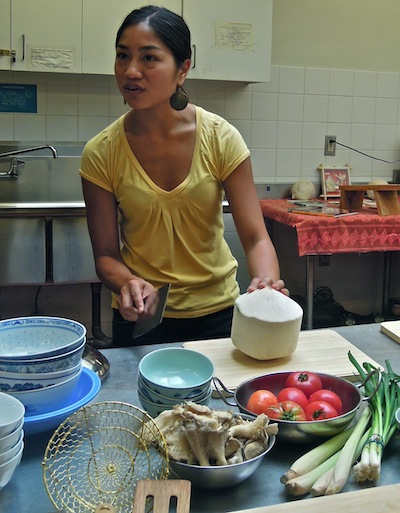
"content": "\u003cp>\u003ca href=\"http://ww2.kqed.org/bayareabites/wp-content/uploads/sites/24/2012/09/aileen-suzara.jpg\">\u003cimg class=\"alignnone size-full wp-image-48820\" title=\"Aileen Suzara\" src=\"http://ww2.kqed.org/bayareabites/wp-content/uploads/sites/24/2012/09/aileen-suzara.jpg\" alt=\"Aileen Suzara\" width=\"400\" height=\"513\">\u003c/a>\u003c/p>\n\u003cp>Coconut is the new pomegranate. Touted for \u003ca href=\"http://www.huffingtonpost.com/dr-mercola/coconut-oil-benefits_b_821453.html\">its health benefits\u003c/a>, it’s popping up everywhere. Electrolyte-rich coconut water has replaced Gatorade as the new sports drink and claims abound that coconut oil boosts the immune system, thyroid and heart. But the reason I took the Cooking with Coconut class at \u003ca href=\"http://www.oacc.cc/\">Oakland’s Asian Cultural Cente\u003c/a>r (OACC) was less about health and more about taste. I’m cuckoo for coconuts (the unsweetened natural stuff). I also wanted to broaden my knowledge of Filipino cuisine, beyond adobo and lumpia.\u003c/p>\n\u003cp>I know it’s risky to spread the word on the insider \u003ca href=\"http://www.oacc.cc/programs/classes/culinaryworkshops.html\">cooking classes at OACC\u003c/a>, because they may all sell out before I get a ticket, but this is an amazing hidden pearl for DIY ethnic food fans: intimate hands-on workshops, most priced under $50 for a three-hour class that includes lunch. (A few months ago, I savored \u003ca href=\"http://ww2.kqed.org/bayareabites/2012/06/22/thy-tran%E2%80%99s-asian-themed-classes-empower-cooks-on-both-sides-of-bay/\">Thy Tran’s Steamed Asian Sweets class\u003c/a> at OACC.)\u003c/p>\n\u003cp>When I arrived in OACC’s kitchen on a recent Sunday and surveyed the ingredients for Cooking with Coconut arranged on tables around the room, I was puzzled by the absence of the familiar brown hairy globes. Turned out we were using young or immature coconuts, which take the form of squat white cylinders with pointed tops.\u003c/p>\n\u003cp>\u003ca href=\"http://ww2.kqed.org/bayareabites/wp-content/uploads/sites/24/2012/09/young-cocunuts-Collage.jpg\">\u003cimg class=\"alignnone size-full wp-image-48821\" title=\"young coconuts Collage\" src=\"http://ww2.kqed.org/bayareabites/wp-content/uploads/sites/24/2012/09/young-cocunuts-Collage.jpg\" alt=\"young coconuts Collage\" width=\"560\" height=\"434\">\u003c/a>\u003c/p>\n\u003cp>[ad fullwidth]\u003c/p>\n\u003cp>Aileen Suzara, a 2nd generation Filipina American, guided eight of us through three coconut-centric recipes from her culture:\u003c/p>\n\u003cp>\u003cem>Binakol\u003c/em>: a chicken soup, featuring fresh coconut water, shallot, garlic, ginger, mushrooms and young coconut slices.\u003c/p>\n\u003cp>\u003cem>Laing\u003c/em>: a green vegetable dish traditionally made with taro leaves, coconut milk and chilis. Suzara opted for fresh kale leaves instead of taro and upped the ante with coconut cream, plus plenty of garlic and ginger.\u003c/p>\n\u003cp>And for dessert, \u003cem>Palitaw\u003c/em>: simple rice flour dumplings rolled in sesame seeds and chopped coconut.\u003c/p>\n\u003cp>To round out the meal, she shared some precious heirloom black rice a friend had brought back from the Philippines.\u003c/p>\n\u003cp>Against a background of resounding drumbeats from OACC’s Lion Dance class next door, Suzara demonstrated the ease of cracking open the stocky, young coconuts. A few decisive whacks of a cleaver, and coconut water came gushing forth. Then she showed how easy it is to scoop out the soft, slimy white flesh with just a spoon. While some of us scraped out coconut meat, others chopped ginger, as directed by Suzara, “in pieces big enough to slap you in the face with a burst of ginger.”\u003c/p>\n\u003cp>\u003ca href=\"http://ww2.kqed.org/bayareabites/wp-content/uploads/sites/24/2012/09/busy-hands.jpg\">\u003cimg class=\"alignnone size-full wp-image-48830\" title=\"busy hands\" src=\"http://ww2.kqed.org/bayareabites/wp-content/uploads/sites/24/2012/09/busy-hands.jpg\" alt=\"busy hands\" width=\"560\" height=\"429\">\u003c/a>\u003c/p>\n\u003cp>As soon as Suzara spooned a dollop of coconut oil into the hot wok, followed by the chopped shallots, ginger and garlic, a symphony of aromas filled the room. Chicken thighs browned and then slowly simmered in the coconut water collected from the half-dozen young coconuts. Black peppercorns, and lemongrass were added to the soup and finally oyster mushrooms and the white coconut meat.\u003c/p>\n\u003cp>\u003ca href=\"http://ww2.kqed.org/bayareabites/wp-content/uploads/sites/24/2012/09/adding-coconut-Collage.jpg\">\u003cimg class=\"alignnone size-full wp-image-48822\" title=\"adding coconut Collage\" src=\"http://ww2.kqed.org/bayareabites/wp-content/uploads/sites/24/2012/09/adding-coconut-Collage.jpg\" alt=\"adding coconut Collage\" width=\"560\" height=\"353\">\u003c/a>\u003cbr>\n\u003cem>Adding coconut cream to the laing and young coconut meat to the binakol\u003c/em>\u003c/p>\n\u003cp>Suzara, who encouraged us to cook with our senses instead of relying exclusively on recipes, modeled how to cheerfully roll with the punches of a few kitchen mishaps. These “teaching moments” -- as she referred to the pop-up surprises -- included: a little cut here, a minor burnt wooden board there and a rice flour mixture that was too liquid, so she changed desserts mid-course.\u003c/p>\n\u003cp>\u003ca href=\"http://ww2.kqed.org/bayareabites/wp-content/uploads/sites/24/2012/09/serving-time.jpg\">\u003cimg class=\"alignnone size-full wp-image-48831\" title=\"serving time\" src=\"http://ww2.kqed.org/bayareabites/wp-content/uploads/sites/24/2012/09/serving-time.jpg\" alt=\"serving time\" width=\"560\" height=\"450\">\u003c/a>\u003cbr>\n\u003cem>Our lunch of binakol, laing and palitaw\u003c/em>\u003c/p>\n\u003cp>While we enjoyed our collectively created lunch, Suzara shared a little about herself. After studying environmental science, she worked with non-profits on environmental re-education, catered Filipino cooking and completed a program at UC Santa Cruz in \u003ca href=\"http://casfs.ucsc.edu/apprentice-training\">ecological horticulture\u003c/a>.\u003c/p>\n\u003cp>She is active in social justice and agricultural education and wants to help her community make wise food choices. She cites the impact that 400 years of Spanish and US colonization has had on the traditional Filipino diet, resulting in, for example, a switch to refined flour and convenience foods and fried dishes which were traditionally enjoyed for just for special celebrations (like lumpia) that have become defining dishes of the cuisine.\u003c/p>\n\u003cp>(This reminded me of a similar struggle in African American food culture portrayed in the film, \u003ca href=\"http://ww2.kqed.org/bayareabites/2012/06/25/film-soul-food-junkies-examines-african-american-cuisine-and-culture/\">Soul Food Junkies\u003c/a>.)\u003c/p>\n\u003cp>As we cleaned up the kitchen, I interviewed Suzara about how she learned to cook Filipino food, her involvement in agricultural education and her future plans.\u003c/p>\n\u003cp>\u003ca href=\"http://ww2.kqed.org/bayareabites/wp-content/uploads/sites/24/2012/09/aileen-Collage.jpg\">\u003cimg class=\"alignnone size-full wp-image-48826\" title=\"aileen Collage\" src=\"http://ww2.kqed.org/bayareabites/wp-content/uploads/sites/24/2012/09/aileen-Collage.jpg\" alt=\"aileen Collage\" width=\"560\" height=\"348\">\u003c/a>\u003c/p>\n\u003cp>\u003cstrong>Why did you pick coconut as the focus of this class?\u003c/strong>\u003c/p>\n\u003cp>Coconut is close to my heart. My father is from Bicol, a region of the Philippines famous for its coconut dishes, so cooking with coconut is in my blood. In the Philippines, coconut is called the “Tree of Life” because you can use every part of it. Its trunk and leaves provide building materials and home décor, its oil is used in beauty products and is very healthy for cooking, coconut sugar is better for diabetics and coconut milk is used all over South East Asia, the Philippines and the Pacific Islands.\u003c/p>\n\u003cp>I grew up in five different states but spent my adolescence on The Big Island Hawaii, so I ate the local coconuts there. When I was a freshman, they held a school “Olympics” with running and swimming events but somehow even though I was the scrawniest 14-year old, they put me in the coconut cracking and husking competition. Of course, I was slower and lost to a bunch of big boys, but I got the process down.\u003c/p>\n\u003cp>\u003cstrong>Did you learn to cook Filipino specialties from your parents?\u003c/strong>\u003c/p>\n\u003cp>Yes and no, I’m somewhat self-taught. My hardworking parents worked long hours as a nurse and doctor. When I was about eight, they gave me free reign in the kitchen and I started cooking for the family. At first I did scrambled eggs but later moved on to soups and stews. Then I found some old Filipino cookbooks, including one that my mom brought when she immigrated at 23. It was in English but there were all these words for ingredients that I had never seen before. I wanted to learn what it all meant.\u003c/p>\n\u003cp>Growing up, meals were flavored by my parents’ ‘post-WWII diet’ of American imports -- things like Spam, Vienna sausage, corned beef -- and of course, fish and rice. So that’s the kind of thing they cooked. But when I was eight, we took a trip back to the Philippines and I met my grandparents and extended family. They took me to these huge markets. I tasted everything and fell in love.\u003c/p>\n\u003cp>\u003cstrong>Didn’t you just come back from living and working on a farm?\u003c/strong>\u003c/p>\n\u003cp>Yes, first, I spent six months in an \u003ca href=\"http://casfs.ucsc.edu/apprentice-training\">apprenticeship program\u003c/a> at UC Santa Cruz in ecological horticulture. \u003cem>(Here’s a video from the Filipino channel interviewing Aileen about her experience working on the organic farm.)\u003c/em>\u003c/p>\n\u003cp>\u003ciframe src=\"http://player.vimeo.com/video/36876509\" frameborder=\"0\" width=\"500\" height=\"281\">\u003c/iframe>\u003c/p>\n\u003cp>\u003ca href=\"http://vimeo.com/36876509\">ADOBO NATION. Sustainable Farming.\u003c/a> from \u003ca href=\"http://vimeo.com/jeremiahysip\">Jeremiah Ysip\u003c/a>.\u003c/p>\n\u003cp>And I just returned from \u003ca href=\"http://www.pieranch.org/\">Pie Ranch\u003c/a>, an educational farm in Pescadero with a youth program that teaches young people to learn where their food comes from. I helped care for their 250 chickens, goats and 15+ acres of wheat, squash and other crops.\u003c/p>\n\u003cp>\u003cstrong>What are some of your future plans?\u003c/strong>\u003c/p>\n\u003cp>If there’s anything I learned from experiences in the food world, it’s that we need more culturally relevant models. I hope to be part of developing new programs to engage Asian-Pacific youth. Filipinos have a long history of leadership in the food movement that unfortunately, not enough people are aware of. In the early 1900s thousands came and worked on California farms. And while many people have heard of the \u003ca href=\"http://en.wikipedia.org/wiki/United_Farm_Workers\">United Farm Workers\u003c/a>, they may not know of Filipino organizers like \u003ca href=\"http://truth-out.org/opinion/item/8211-the-farm-workers-filipino-american-champion\">Larry Itliong\u003c/a>, who worked alongside Cesar Chavez and co-founded the movement.\u003c/p>\n\u003cp>I’d like to grow traditional ingredients used in Filipino cuisine and work with my community for more access to healthy fresh food and on health issues linked to food. It’s the immigrant paradox, as what we may now think of as a typical Filipino diet has steered away from plant-based foods, which have always been part of our traditions, one reason why heart disease, type 2 diabetes and hypertension have all become so common.\u003c/p>\n\u003cp>I just moved back to Oakland. This week, I start my new job as Garden Coordinator for a green school program at a San Francisco elementary school.\u003c/p>\n\u003cp>\u003cem>Watch for Aileen Suzara to teach more classes at OACC and share her cooking in a pop-up sponsored by Oakland’s People's Kitchen to celebrate Filipino American History Month in October. And on \u003ca href=\"http://http://pawablog.wordpress.com/2012/08/31/10132012-pawa-and-irmas-present-for-litcrawl-sf/\">October 13, catch her at a Litcrawl Reading\u003c/a> at Irma's (one of San Francisco's oldest Filipino restaurants), sponsored by PAWA (Philippine American Writers and Artists).\u003c/em>\u003c/p>\n\u003cp>[ad floatright]\u003c/p>\n\u003cp>Aileen Suzara's website: \u003ca href=\"http://www.kitchenkwento.com/\">Kitchen Kwento\u003c/a>\u003cbr>\nTwitter: \u003ca href=\"https://twitter.com/kitchenkwento\">@kitchenkwento\u003c/a>\u003c/p>\n\n",
"disqusIdentifier": "48819 http://blogs.kqed.org/bayareabites/?p=48819",
"disqusUrl": "https://ww2.kqed.org/bayareabites/2012/09/21/aileen-suzara-cracks-open-filipino-cuisine-in-coconut-cooking-class/",
"stats": {
"hasVideo": true,
"hasChartOrMap": true,
"hasAudio": false,
"hasPolis": false,
"wordCount": 1484,
"hasGoogleForm": false,
"hasGallery": false,
"hasHearkenModule": false,
"iframeSrcs": [
"http://player.vimeo.com/video/36876509"
],
"paragraphCount": 40
},
"modified": 1348631614,
"excerpt": "Coconut is the new pomegranate, prized not only for it's flavor and versatility, but its health benefits as well. Coconut is also plays an important role in traditional Filipino cuisine. Second generation Filipina American, Aileen Suzara recently taught Cooking with Coconut class at the Oakland Asian Cultural Center, featuring binakol, laing and palitaw.",
"headData": {
"twImgId": "",
"twTitle": "",
"ogTitle": "",
"ogImgId": "",
"twDescription": "",
"description": "Coconut is the new pomegranate, prized not only for it's flavor and versatility, but its health benefits as well. Coconut is also plays an important role in traditional Filipino cuisine. Second generation Filipina American, Aileen Suzara recently taught Cooking with Coconut class at the Oakland Asian Cultural Center, featuring binakol, laing and palitaw.",
"title": "Aileen Suzara Cracks Open Filipino Cuisine in Coconut Cooking Class | KQED",
"ogDescription": "",
"schema": {
"@context": "https://schema.org",
"@type": "Article",
"headline": "Aileen Suzara Cracks Open Filipino Cuisine in Coconut Cooking Class",
"datePublished": "2012-09-21T07:59:11-07:00",
"dateModified": "2012-09-25T20:53:34-07:00",
"image": "https://cdn.kqed.org/wp-content/uploads/2020/02/KQED-OG-Image@1x.png"
}
},
"guestAuthors": [],
"slug": "aileen-suzara-cracks-open-filipino-cuisine-in-coconut-cooking-class",
"status": "publish",
"path": "/bayareabites/48819/aileen-suzara-cracks-open-filipino-cuisine-in-coconut-cooking-class",
"audioTrackLength": null,
"parsedContent": [
{
"type": "contentString",
"content": "\u003cdiv class=\"post-body\">\u003cp>\u003cp>\u003ca href=\"http://ww2.kqed.org/bayareabites/wp-content/uploads/sites/24/2012/09/aileen-suzara.jpg\">\u003cimg class=\"alignnone size-full wp-image-48820\" title=\"Aileen Suzara\" src=\"http://ww2.kqed.org/bayareabites/wp-content/uploads/sites/24/2012/09/aileen-suzara.jpg\" alt=\"Aileen Suzara\" width=\"400\" height=\"513\">\u003c/a>\u003c/p>\n\u003cp>Coconut is the new pomegranate. Touted for \u003ca href=\"http://www.huffingtonpost.com/dr-mercola/coconut-oil-benefits_b_821453.html\">its health benefits\u003c/a>, it’s popping up everywhere. Electrolyte-rich coconut water has replaced Gatorade as the new sports drink and claims abound that coconut oil boosts the immune system, thyroid and heart. But the reason I took the Cooking with Coconut class at \u003ca href=\"http://www.oacc.cc/\">Oakland’s Asian Cultural Cente\u003c/a>r (OACC) was less about health and more about taste. I’m cuckoo for coconuts (the unsweetened natural stuff). I also wanted to broaden my knowledge of Filipino cuisine, beyond adobo and lumpia.\u003c/p>\n\u003cp>I know it’s risky to spread the word on the insider \u003ca href=\"http://www.oacc.cc/programs/classes/culinaryworkshops.html\">cooking classes at OACC\u003c/a>, because they may all sell out before I get a ticket, but this is an amazing hidden pearl for DIY ethnic food fans: intimate hands-on workshops, most priced under $50 for a three-hour class that includes lunch. (A few months ago, I savored \u003ca href=\"http://ww2.kqed.org/bayareabites/2012/06/22/thy-tran%E2%80%99s-asian-themed-classes-empower-cooks-on-both-sides-of-bay/\">Thy Tran’s Steamed Asian Sweets class\u003c/a> at OACC.)\u003c/p>\n\u003cp>When I arrived in OACC’s kitchen on a recent Sunday and surveyed the ingredients for Cooking with Coconut arranged on tables around the room, I was puzzled by the absence of the familiar brown hairy globes. Turned out we were using young or immature coconuts, which take the form of squat white cylinders with pointed tops.\u003c/p>\n\u003cp>\u003ca href=\"http://ww2.kqed.org/bayareabites/wp-content/uploads/sites/24/2012/09/young-cocunuts-Collage.jpg\">\u003cimg class=\"alignnone size-full wp-image-48821\" title=\"young coconuts Collage\" src=\"http://ww2.kqed.org/bayareabites/wp-content/uploads/sites/24/2012/09/young-cocunuts-Collage.jpg\" alt=\"young coconuts Collage\" width=\"560\" height=\"434\">\u003c/a>\u003c/p>\n\u003cp>\u003c/p>\u003c/div>",
"attributes": {
"named": {},
"numeric": []
}
},
{
"type": "component",
"content": "",
"name": "ad",
"attributes": {
"named": {
"label": "fullwidth"
},
"numeric": [
"fullwidth"
]
}
},
{
"type": "contentString",
"content": "\u003cdiv class=\"post-body\">\u003cp>\u003c/p>\n\u003cp>Aileen Suzara, a 2nd generation Filipina American, guided eight of us through three coconut-centric recipes from her culture:\u003c/p>\n\u003cp>\u003cem>Binakol\u003c/em>: a chicken soup, featuring fresh coconut water, shallot, garlic, ginger, mushrooms and young coconut slices.\u003c/p>\n\u003cp>\u003cem>Laing\u003c/em>: a green vegetable dish traditionally made with taro leaves, coconut milk and chilis. Suzara opted for fresh kale leaves instead of taro and upped the ante with coconut cream, plus plenty of garlic and ginger.\u003c/p>\n\u003cp>And for dessert, \u003cem>Palitaw\u003c/em>: simple rice flour dumplings rolled in sesame seeds and chopped coconut.\u003c/p>\n\u003cp>To round out the meal, she shared some precious heirloom black rice a friend had brought back from the Philippines.\u003c/p>\n\u003cp>Against a background of resounding drumbeats from OACC’s Lion Dance class next door, Suzara demonstrated the ease of cracking open the stocky, young coconuts. A few decisive whacks of a cleaver, and coconut water came gushing forth. Then she showed how easy it is to scoop out the soft, slimy white flesh with just a spoon. While some of us scraped out coconut meat, others chopped ginger, as directed by Suzara, “in pieces big enough to slap you in the face with a burst of ginger.”\u003c/p>\n\u003cp>\u003ca href=\"http://ww2.kqed.org/bayareabites/wp-content/uploads/sites/24/2012/09/busy-hands.jpg\">\u003cimg class=\"alignnone size-full wp-image-48830\" title=\"busy hands\" src=\"http://ww2.kqed.org/bayareabites/wp-content/uploads/sites/24/2012/09/busy-hands.jpg\" alt=\"busy hands\" width=\"560\" height=\"429\">\u003c/a>\u003c/p>\n\u003cp>As soon as Suzara spooned a dollop of coconut oil into the hot wok, followed by the chopped shallots, ginger and garlic, a symphony of aromas filled the room. Chicken thighs browned and then slowly simmered in the coconut water collected from the half-dozen young coconuts. Black peppercorns, and lemongrass were added to the soup and finally oyster mushrooms and the white coconut meat.\u003c/p>\n\u003cp>\u003ca href=\"http://ww2.kqed.org/bayareabites/wp-content/uploads/sites/24/2012/09/adding-coconut-Collage.jpg\">\u003cimg class=\"alignnone size-full wp-image-48822\" title=\"adding coconut Collage\" src=\"http://ww2.kqed.org/bayareabites/wp-content/uploads/sites/24/2012/09/adding-coconut-Collage.jpg\" alt=\"adding coconut Collage\" width=\"560\" height=\"353\">\u003c/a>\u003cbr>\n\u003cem>Adding coconut cream to the laing and young coconut meat to the binakol\u003c/em>\u003c/p>\n\u003cp>Suzara, who encouraged us to cook with our senses instead of relying exclusively on recipes, modeled how to cheerfully roll with the punches of a few kitchen mishaps. These “teaching moments” -- as she referred to the pop-up surprises -- included: a little cut here, a minor burnt wooden board there and a rice flour mixture that was too liquid, so she changed desserts mid-course.\u003c/p>\n\u003cp>\u003ca href=\"http://ww2.kqed.org/bayareabites/wp-content/uploads/sites/24/2012/09/serving-time.jpg\">\u003cimg class=\"alignnone size-full wp-image-48831\" title=\"serving time\" src=\"http://ww2.kqed.org/bayareabites/wp-content/uploads/sites/24/2012/09/serving-time.jpg\" alt=\"serving time\" width=\"560\" height=\"450\">\u003c/a>\u003cbr>\n\u003cem>Our lunch of binakol, laing and palitaw\u003c/em>\u003c/p>\n\u003cp>While we enjoyed our collectively created lunch, Suzara shared a little about herself. After studying environmental science, she worked with non-profits on environmental re-education, catered Filipino cooking and completed a program at UC Santa Cruz in \u003ca href=\"http://casfs.ucsc.edu/apprentice-training\">ecological horticulture\u003c/a>.\u003c/p>\n\u003cp>She is active in social justice and agricultural education and wants to help her community make wise food choices. She cites the impact that 400 years of Spanish and US colonization has had on the traditional Filipino diet, resulting in, for example, a switch to refined flour and convenience foods and fried dishes which were traditionally enjoyed for just for special celebrations (like lumpia) that have become defining dishes of the cuisine.\u003c/p>\n\u003cp>(This reminded me of a similar struggle in African American food culture portrayed in the film, \u003ca href=\"http://ww2.kqed.org/bayareabites/2012/06/25/film-soul-food-junkies-examines-african-american-cuisine-and-culture/\">Soul Food Junkies\u003c/a>.)\u003c/p>\n\u003cp>As we cleaned up the kitchen, I interviewed Suzara about how she learned to cook Filipino food, her involvement in agricultural education and her future plans.\u003c/p>\n\u003cp>\u003ca href=\"http://ww2.kqed.org/bayareabites/wp-content/uploads/sites/24/2012/09/aileen-Collage.jpg\">\u003cimg class=\"alignnone size-full wp-image-48826\" title=\"aileen Collage\" src=\"http://ww2.kqed.org/bayareabites/wp-content/uploads/sites/24/2012/09/aileen-Collage.jpg\" alt=\"aileen Collage\" width=\"560\" height=\"348\">\u003c/a>\u003c/p>\n\u003cp>\u003cstrong>Why did you pick coconut as the focus of this class?\u003c/strong>\u003c/p>\n\u003cp>Coconut is close to my heart. My father is from Bicol, a region of the Philippines famous for its coconut dishes, so cooking with coconut is in my blood. In the Philippines, coconut is called the “Tree of Life” because you can use every part of it. Its trunk and leaves provide building materials and home décor, its oil is used in beauty products and is very healthy for cooking, coconut sugar is better for diabetics and coconut milk is used all over South East Asia, the Philippines and the Pacific Islands.\u003c/p>\n\u003cp>I grew up in five different states but spent my adolescence on The Big Island Hawaii, so I ate the local coconuts there. When I was a freshman, they held a school “Olympics” with running and swimming events but somehow even though I was the scrawniest 14-year old, they put me in the coconut cracking and husking competition. Of course, I was slower and lost to a bunch of big boys, but I got the process down.\u003c/p>\n\u003cp>\u003cstrong>Did you learn to cook Filipino specialties from your parents?\u003c/strong>\u003c/p>\n\u003cp>Yes and no, I’m somewhat self-taught. My hardworking parents worked long hours as a nurse and doctor. When I was about eight, they gave me free reign in the kitchen and I started cooking for the family. At first I did scrambled eggs but later moved on to soups and stews. Then I found some old Filipino cookbooks, including one that my mom brought when she immigrated at 23. It was in English but there were all these words for ingredients that I had never seen before. I wanted to learn what it all meant.\u003c/p>\n\u003cp>Growing up, meals were flavored by my parents’ ‘post-WWII diet’ of American imports -- things like Spam, Vienna sausage, corned beef -- and of course, fish and rice. So that’s the kind of thing they cooked. But when I was eight, we took a trip back to the Philippines and I met my grandparents and extended family. They took me to these huge markets. I tasted everything and fell in love.\u003c/p>\n\u003cp>\u003cstrong>Didn’t you just come back from living and working on a farm?\u003c/strong>\u003c/p>\n\u003cp>Yes, first, I spent six months in an \u003ca href=\"http://casfs.ucsc.edu/apprentice-training\">apprenticeship program\u003c/a> at UC Santa Cruz in ecological horticulture. \u003cem>(Here’s a video from the Filipino channel interviewing Aileen about her experience working on the organic farm.)\u003c/em>\u003c/p>\n\u003cp>\u003ciframe src=\"http://player.vimeo.com/video/36876509\" frameborder=\"0\" width=\"500\" height=\"281\">\u003c/iframe>\u003c/p>\n\u003cp>\u003ca href=\"http://vimeo.com/36876509\">ADOBO NATION. Sustainable Farming.\u003c/a> from \u003ca href=\"http://vimeo.com/jeremiahysip\">Jeremiah Ysip\u003c/a>.\u003c/p>\n\u003cp>And I just returned from \u003ca href=\"http://www.pieranch.org/\">Pie Ranch\u003c/a>, an educational farm in Pescadero with a youth program that teaches young people to learn where their food comes from. I helped care for their 250 chickens, goats and 15+ acres of wheat, squash and other crops.\u003c/p>\n\u003cp>\u003cstrong>What are some of your future plans?\u003c/strong>\u003c/p>\n\u003cp>If there’s anything I learned from experiences in the food world, it’s that we need more culturally relevant models. I hope to be part of developing new programs to engage Asian-Pacific youth. Filipinos have a long history of leadership in the food movement that unfortunately, not enough people are aware of. In the early 1900s thousands came and worked on California farms. And while many people have heard of the \u003ca href=\"http://en.wikipedia.org/wiki/United_Farm_Workers\">United Farm Workers\u003c/a>, they may not know of Filipino organizers like \u003ca href=\"http://truth-out.org/opinion/item/8211-the-farm-workers-filipino-american-champion\">Larry Itliong\u003c/a>, who worked alongside Cesar Chavez and co-founded the movement.\u003c/p>\n\u003cp>I’d like to grow traditional ingredients used in Filipino cuisine and work with my community for more access to healthy fresh food and on health issues linked to food. It’s the immigrant paradox, as what we may now think of as a typical Filipino diet has steered away from plant-based foods, which have always been part of our traditions, one reason why heart disease, type 2 diabetes and hypertension have all become so common.\u003c/p>\n\u003cp>I just moved back to Oakland. This week, I start my new job as Garden Coordinator for a green school program at a San Francisco elementary school.\u003c/p>\n\u003cp>\u003cem>Watch for Aileen Suzara to teach more classes at OACC and share her cooking in a pop-up sponsored by Oakland’s People's Kitchen to celebrate Filipino American History Month in October. And on \u003ca href=\"http://http://pawablog.wordpress.com/2012/08/31/10132012-pawa-and-irmas-present-for-litcrawl-sf/\">October 13, catch her at a Litcrawl Reading\u003c/a> at Irma's (one of San Francisco's oldest Filipino restaurants), sponsored by PAWA (Philippine American Writers and Artists).\u003c/em>\u003c/p>\n\u003cp>\u003c/p>\u003c/div>",
"attributes": {
"named": {},
"numeric": []
}
},
{
"type": "component",
"content": "",
"name": "ad",
"attributes": {
"named": {
"label": "floatright"
},
"numeric": [
"floatright"
]
}
},
{
"type": "contentString",
"content": "\u003cdiv class=\"post-body\">\u003cp>\u003c/p>\n\u003cp>Aileen Suzara's website: \u003ca href=\"http://www.kitchenkwento.com/\">Kitchen Kwento\u003c/a>\u003cbr>\nTwitter: \u003ca href=\"https://twitter.com/kitchenkwento\">@kitchenkwento\u003c/a>\u003c/p>\n\n\u003c/div>\u003c/p>",
"attributes": {
"named": {},
"numeric": []
}
}
],
"link": "/bayareabites/48819/aileen-suzara-cracks-open-filipino-cuisine-in-coconut-cooking-class",
"authors": [
"5283"
],
"categories": [
"bayareabites_2998",
"bayareabites_109",
"bayareabites_752",
"bayareabites_63",
"bayareabites_2695",
"bayareabites_64",
"bayareabites_1874",
"bayareabites_2554",
"bayareabites_1245"
],
"tags": [
"bayareabites_10737",
"bayareabites_2700",
"bayareabites_9067",
"bayareabites_10208",
"bayareabites_10738",
"bayareabites_3435",
"bayareabites_10739",
"bayareabites_10543",
"bayareabites_10518"
],
"featImg": "bayareabites_48834",
"label": "bayareabites"
},
"bayareabites_47986": {
"type": "posts",
"id": "bayareabites_47986",
"meta": {
"index": "posts_1716263798",
"site": "bayareabites",
"id": "47986",
"score": null,
"sort": [
1346252458000
]
},
"parent": 0,
"labelTerm": {
"site": "bayareabites"
},
"blocks": [],
"publishDate": 1346252458,
"format": "aside",
"disqusTitle": "Cheese Expert Laura Werlin Talks about Seasonality, Books and Travel",
"title": "Cheese Expert Laura Werlin Talks about Seasonality, Books and Travel",
"headTitle": "Bay Area Bites | KQED Food",
"content": "\u003cp>\u003ca href=\"http://ww2.kqed.org/bayareabites/wp-content/uploads/sites/24/2012/08/400BABLauraWerlin.jpg\">\u003cimg class=\"alignnone size-full wp-image-48117\" title=\"Laura Werlin. Photo courtesy of Maren Caruso\" src=\"http://ww2.kqed.org/bayareabites/wp-content/uploads/sites/24/2012/08/400BABLauraWerlin.jpg\" alt=\"Laura Werlin. Photo courtesy of Maren Caruso\" width=\"400\" height=\"600\">\u003c/a>\u003cbr>\n\u003cem>Laura Werlin. Photo courtesy of Maren Caruso\u003c/em>\u003c/p>\n\u003cp>Perhaps the best way to get a hold of cheese expert Laura Werlin is first checking her \u003ca href=\"https://twitter.com/cheezelady\">Twitter\u003c/a> and \u003ca href=\"https://www.facebook.com/pages/Laura-Werlin/108896749140707\">Facebook\u003c/a> accounts to find out which city or country she’s in. Werlin is a one-woman show in cheese and spends her time speaking, researching, cooking, writing, and teaching. You may have seen her talking about cheese in a down to earth, knowledgeable yet fun style on CNN, QVC, the Martha Stewart Show, the CBS Early Show or \u003ca href=\"http://www.chow.com/search?query=laura+werlin&type=\">CHOW.com\u003c/a>; her written work pops up nationally in Food & Wine, Fine Cooking, Saveur, and Cooking Light magazines.\u003c/p>\n\u003cp>Werlin’s forays to industry conferences keep her up to date on the latest and greatest in cheese. She has written five cheese-centric books and nabbed a James Beard award for \u003ca href=\"http://laurawerlin.com/The-All-American-Cheese-and-Wine-Book\">The All American Cheese and Wine Book\u003c/a>. Her sixth book \u003ca href=\"http://www.barnesandnoble.com/w/mac-cheese-please-laura-werlin/1111938316\">Mac & Cheese, Please!\u003c/a> will be released at the end of the year. Werlin is an instructor at \u003ca href=\"http://www.cheeseschoolsf.com/\">The Cheese School of San Francisco\u003c/a>, and will be teaching an American cheese class there on October 9th.\u003c/p>\n\u003cp>Ever since I signed up for cooking school in San Francisco in 2000, I’ve seen how Werlin’s professional work is often brought up in discussions about cheese. I was curious to know how exactly she got into working full-time with cheese. (Doesn’t it sound like a fun job?) We first worked together indirectly when I supplied her with volunteers for a cooking demo when I was an Event Manager for SF Chefs in 2010. Last year, I did paid content work for her website. For this Bay Area Bites piece, I interviewed Werlin via telephone and email. Her comments have been edited for clarity and length.\u003c/p>\n\u003cp>\u003cstrong>Bay Area Bites: You’ve been a cheese expert since 2000, but what got you into cheese?\u003c/strong>\u003c/p>\n\u003cp>[ad fullwidth]\u003c/p>\n\u003cp>\u003cstrong>Werlin:\u003c/strong> I studied Mass Communications at Cal with the dream of being on TV news. I worked at KRON news and bounced around in the news. Then I got a job in the field in Bakersfield. Later at KPIX I was the assignment manager and would figure out what to assign to reporters. I ended my time at KGO as a field producer for women in business, where I went out and interviewed people. TV news was my love and I did my best to do stories on food and wine people because that was also my love. After many years in the TV news business, I decided I was tired of it so I struck out to be a food writer. I ended up getting a couple of general food articles published that had nothing to do with cheese.\u003c/p>\n\u003cp>I feel like cheese found me. I wasn’t looking for a subject, and cheese found me. The first story was my book, where I got inspired to write about cheese. I knew instantly that my subject would be cheese. I’ve been lucky and had a charmed life as an author. I found an agent who found a publisher who liked the idea of a book on American cheese by an unknown author. That’s when my first book came out \u003ca href=\"http://www.amazon.com/The-American-Cheese-Laura-Werlin/dp/1556709900\">The New American Cheese\u003c/a>.\u003c/p>\n\u003cp>The way you become an expert is to write a book about it. I didn’t come to cheese because I knew about it. It was something I was very passionate about but I knew nothing about it. In the course of writing it, that was when I started really learning about it. And the learning never stopped.\u003c/p>\n\u003cp>\u003cstrong>Bay Area Bites: Where do you get your information about cheese? What’s on your nightstand reading pile?\u003c/strong>\u003c/p>\n\u003cp>\u003cstrong>Werlin:\u003c/strong> I get a lot of info at the cheese counter. It almost doesn’t matter where that is: a cheese shop, a Whole Foods…. If something looks intriguing, I buy it.\u003c/p>\n\u003cp>There’s one book that I think is great called Mastering Cheese by \u003ca href=\"http://www.maxmccalman.com/\">Max McMalman\u003c/a> who is Maître Fromager in New York. Also I go to conferences and get information there.\u003c/p>\n\u003cp>I took a trip to Holland to learn about Dutch cheese. I go to farms as much as possible but ironically with my travel schedule being what it is, I do that less and less.\u003c/p>\n\u003cp>Often I will call a cheese maker. There isn’t one way -- you just learn about it. I like a book called \u003ca href=\"http://www.amazon.com/Growing-Farmer-Learned-Live-Land/dp/0393070859\">Growing a Farmer\u003c/a> and it’s the story of how Kurt Timmermeister came to be a cheese maker. He was an unlikely person from Vashon Island for that to happen.\u003c/p>\n\u003cp>\u003cstrong>Bay Area Bites: Earlier this month, you were at the \u003ca href=\"http://www.lafw.com/\">Los Angeles Food & Wine Festival\u003c/a>. Events and travel make up much of your work. What’s that like?\u003c/strong>\u003c/p>\n\u003cp>\u003cstrong>Werlin:\u003c/strong> I do travel for cheese, that’s for sure. This is the second year for me at the LA Food & Wine Fest. That’s indicative of a lot of what I do. For the \u003ca href=\"http://www.foodandwine.com/classic\">Food & Wine Classic at Aspen\u003c/a>, this is my 7th year. I do the \u003ca href=\"http://corporate.sobefest.com/\">South Beach Wine and Food Festival\u003c/a> and The \u003ca href=\"http://www.santafewineandchile.org/\">Santa Fe Wine & Chile Fiesta\u003c/a>, which is in its 21st year.\u003c/p>\n\u003cp>In between I always wonder what I do each day. I’m never doing anything fun or frivolous. I consider myself an educator basically making cheese fun and psychologically accessible. People are wary and they buy the same cheese. They feel like there’s a right and wrong and they get hung up on that.\u003c/p>\n\u003cp>\u003cstrong>Bay Area Bites: Do you think pronunciation has something to do with people’s fear... similar to not ordering wine because you’re not sure how to say it to the waiter?\u003c/strong>\u003c/p>\n\u003cp>\u003cstrong>Werlin:\u003c/strong> I think it’s a foreign word and I do the same thing with imported wine. With cheese, it’s more being afraid that it’s foreign and they’re not going to like it. I wouldn’t call us Americans a courageous lot. There has to be some familiarity or someone close by who can vouch for it. When you have cheeses that are like the gym socks that you haven’t washed -- it’s counterintuitive. Never mind that it can be transcendent to eat that gym sock cheese.\u003c/p>\n\u003cp>\u003cstrong>Bay Area Bites: Who are your mentors?\u003c/strong>\u003c/p>\n\u003cp>\u003cstrong>Werlin:\u003c/strong> I can’t say that I have any mentors. What I would say is the thing that has motivated me all along are the cheese makers themselves. When I used to go to the old farmers' market before it came the ferry building, I made a beeline to the cheese makers. I loved talking to them and I loved what they do and I still feel that way. They’re my inspiration.\u003c/p>\n\u003cp>They are not mentors but people I was inspired early on by are \u003ca href=\"http://www.kqed.org/food/juliachild/\">Julia Child\u003c/a> and \u003ca href=\"http://www.kqed.org/food/jacquespepin/\">Jacques Pépin\u003c/a> because I met them at McEvoy Olive oil and I was at their table. I was familiar but I thought they were a God and Goddess and I just wanted to be like them. [Laughs.] Hasn’t happened but it’s an inspiration.\u003c/p>\n\u003cp>What impressed me was they were really accessible as people and they were so quietly confident. They knew their stuff. Particularly in this day and age, anyone can call themselves a cook. It mattered to them. Don't get me wrong I think food TV is great -- and PBS is a pioneer. Like anything that gets popular, it gets dumbed down and it’s hard to ferret out who’s good at what they do and who’s good at being on television.\u003c/p>\n\u003cp>\u003cstrong>Bay Area Bites: What are your thoughts on the state of cheese in the Bay Area? Where are we with cheese knowledge and cheese appreciation?\u003c/strong>\u003c/p>\n\u003cp>\u003cstrong>Werlin:\u003c/strong> We're more sophisticated than the rest of the country. No matter what neighborhood you live in, it's near a cheese shop or a Whole Foods. Also, we're just down the road from Pt. Reyes and see the cheese made at \u003ca href=\"http://www.cowgirlcreamery.com/\">Cowgirl Creamery\u003c/a>. We have access to the cheese makers. That’s helpful in breaking down the intimidation factor and helps increase our desire to include cheese in our every day lives.\u003c/p>\n\u003cp>We have a lot of farmers’ markets and that’s a great leveling opportunity. It’s a chance to taste cheese from the cheese maker.\u003c/p>\n\u003cp>\u003cstrong>Bay Area Bites: What cheeses are good for September -- at home and for picnics?\u003c/strong>\u003c/p>\n\u003cp>\u003cstrong>Werlin:\u003c/strong> Cheese ages at different rates. Sometimes a cheese made in last September is coming ripe in this September. You have a year-old cheese that could be great fun. I like a cheese called \u003ca href=\"http://www.uplandscheese.com/cheese.html\">Pleasant Ridge Reserve\u003c/a> anywhere in the 12-14 month range. Sometimes, you need to be looking back a year. Ask the cheese monger, “What was made last year, what’s good now?”\u003c/p>\n\u003cp>Also you’ve had the entire spring and summer where there are cheeses like a fresh chevre. Or try a sheep milk ricotta from \u003ca href=\"http://www.bellwetherfarms.com/\">Bellwether Farms\u003c/a> that is awesome.\u003c/p>\n\u003cp>Or cheese from June and July are coming to perfection. It’s a little bit of looking back and using your cheese monger as help.\u003c/p>\n\u003cp>If it’s hot, I tend to go for a lighter cheese like \u003ca href=\"http://www.cypressgrovechevre.com/cheeses/ripened-cheeses/humboldt-fog.html\">Humboldt Fog\u003c/a> which is creamy and delicious. Maybe don't go for a bandage wrapped cheddar. During the day that wouldn’t be my go-to cheese. In the end what you want to surround yourself with is a variety of maybe three cheeses from different milks.\u003c/p>\n\u003cp>Specifically for September, go for sheep and goats milk that are less changed. They start drying up later in the fall. If you want something fresh and seasonal, our cows here have opposite seasons. The grasses out in February then dry up in summertime. It’s okay because there’s still grass. Cows milk cheese made in February or March may be particularly delicious from California.\u003c/p>\n\u003cp>\u003cstrong>Bay Area Bites: Do you have any foods that are a guilty pleasure?\u003c/strong>\u003c/p>\n\u003cp>\u003cstrong>Werlin:\u003c/strong> It’s not really a guilty pleasure but I’m totally in love with beef jerky. I can’t tell you why. There’s the texture and the flavor and it’s often like ingesting leather.\u003c/p>\n\u003cp>I’m a big peanut butter fan and will eat a \u003ca href=\"http://www.hersheys.com/reeses/products.aspx#/REESE'S-Peanut-Butter-Cups\">Reese’s\u003c/a> anytime.\u003c/p>\n\u003cp>I’ve never met a potato chip I don't like. I’m more of a salty girl than a sweet one, although I try to be sweet!\u003c/p>\n\u003cp>\u003ca href=\"http://www.chow.com/food-news/55147/how-to-make-grilled-cheese-with-laura-werlin/\">\u003cstrong>How to Make Grilled Cheese with Laura Werlin\u003c/strong>\u003c/a> (CHOW)\u003c/p>\n\u003cp>[ad floatright]\u003c/p>\n\u003cp>\u003cobject width=\"480\" height=\"270\">\u003cparam name=\"movie\" value=\"http://canstatic.cbs.com/chrome/canplayer.swf?pid=BL1Igbf5Fw6g&partner=chow&gen=1\">\u003cparam name=\"allowFullScreen\" value=\"true\">\u003cparam name=\"allowScriptAccess\" value=\"always\">\u003cembed width=\"480\" height=\"270\" src=\"http://canstatic.cbs.com/chrome/canplayer.swf?pid=BL1Igbf5Fw6g&partner=chow&gen=1\" allowfullscreen=\"true\" allowscriptaccess=\"always\" type=\"application/x-shockwave-flash\">\u003c/embed>\u003c/object>\u003c/p>\n\n",
"disqusIdentifier": "47986 http://blogs.kqed.org/bayareabites/?p=47986",
"disqusUrl": "https://ww2.kqed.org/bayareabites/2012/08/29/cheese-expert-laura-werlin-talks-about-seasonality-books-and-travel/",
"stats": {
"hasVideo": false,
"hasChartOrMap": false,
"hasAudio": false,
"hasPolis": false,
"wordCount": 1816,
"hasGoogleForm": false,
"hasGallery": false,
"hasHearkenModule": false,
"iframeSrcs": [],
"paragraphCount": 39
},
"modified": 1428689106,
"excerpt": "Mary Ladd interviews Laura Werlin, who is an award-winning cheese educator, author and expert who lives in San Francisco when she’s not on the road. Werlin dishes on the best questions to ask at the cheese counter and shares why she got into cheese back in 2000 after a news media career path.",
"headData": {
"twImgId": "",
"twTitle": "",
"ogTitle": "",
"ogImgId": "",
"twDescription": "",
"description": "Mary Ladd interviews Laura Werlin, who is an award-winning cheese educator, author and expert who lives in San Francisco when she’s not on the road. Werlin dishes on the best questions to ask at the cheese counter and shares why she got into cheese back in 2000 after a news media career path.",
"title": "Cheese Expert Laura Werlin Talks about Seasonality, Books and Travel | KQED",
"ogDescription": "",
"schema": {
"@context": "https://schema.org",
"@type": "Article",
"headline": "Cheese Expert Laura Werlin Talks about Seasonality, Books and Travel",
"datePublished": "2012-08-29T08:00:58-07:00",
"dateModified": "2015-04-10T11:05:06-07:00",
"image": "https://cdn.kqed.org/wp-content/uploads/2020/02/KQED-OG-Image@1x.png"
}
},
"guestAuthors": [],
"slug": "cheese-expert-laura-werlin-talks-about-seasonality-books-and-travel",
"status": "publish",
"path": "/bayareabites/47986/cheese-expert-laura-werlin-talks-about-seasonality-books-and-travel",
"audioTrackLength": null,
"parsedContent": [
{
"type": "contentString",
"content": "\u003cdiv class=\"post-body\">\u003cp>\u003cp>\u003ca href=\"http://ww2.kqed.org/bayareabites/wp-content/uploads/sites/24/2012/08/400BABLauraWerlin.jpg\">\u003cimg class=\"alignnone size-full wp-image-48117\" title=\"Laura Werlin. Photo courtesy of Maren Caruso\" src=\"http://ww2.kqed.org/bayareabites/wp-content/uploads/sites/24/2012/08/400BABLauraWerlin.jpg\" alt=\"Laura Werlin. Photo courtesy of Maren Caruso\" width=\"400\" height=\"600\">\u003c/a>\u003cbr>\n\u003cem>Laura Werlin. Photo courtesy of Maren Caruso\u003c/em>\u003c/p>\n\u003cp>Perhaps the best way to get a hold of cheese expert Laura Werlin is first checking her \u003ca href=\"https://twitter.com/cheezelady\">Twitter\u003c/a> and \u003ca href=\"https://www.facebook.com/pages/Laura-Werlin/108896749140707\">Facebook\u003c/a> accounts to find out which city or country she’s in. Werlin is a one-woman show in cheese and spends her time speaking, researching, cooking, writing, and teaching. You may have seen her talking about cheese in a down to earth, knowledgeable yet fun style on CNN, QVC, the Martha Stewart Show, the CBS Early Show or \u003ca href=\"http://www.chow.com/search?query=laura+werlin&type=\">CHOW.com\u003c/a>; her written work pops up nationally in Food & Wine, Fine Cooking, Saveur, and Cooking Light magazines.\u003c/p>\n\u003cp>Werlin’s forays to industry conferences keep her up to date on the latest and greatest in cheese. She has written five cheese-centric books and nabbed a James Beard award for \u003ca href=\"http://laurawerlin.com/The-All-American-Cheese-and-Wine-Book\">The All American Cheese and Wine Book\u003c/a>. Her sixth book \u003ca href=\"http://www.barnesandnoble.com/w/mac-cheese-please-laura-werlin/1111938316\">Mac & Cheese, Please!\u003c/a> will be released at the end of the year. Werlin is an instructor at \u003ca href=\"http://www.cheeseschoolsf.com/\">The Cheese School of San Francisco\u003c/a>, and will be teaching an American cheese class there on October 9th.\u003c/p>\n\u003cp>Ever since I signed up for cooking school in San Francisco in 2000, I’ve seen how Werlin’s professional work is often brought up in discussions about cheese. I was curious to know how exactly she got into working full-time with cheese. (Doesn’t it sound like a fun job?) We first worked together indirectly when I supplied her with volunteers for a cooking demo when I was an Event Manager for SF Chefs in 2010. Last year, I did paid content work for her website. For this Bay Area Bites piece, I interviewed Werlin via telephone and email. Her comments have been edited for clarity and length.\u003c/p>\n\u003cp>\u003cstrong>Bay Area Bites: You’ve been a cheese expert since 2000, but what got you into cheese?\u003c/strong>\u003c/p>\n\u003cp>\u003c/p>\u003c/div>",
"attributes": {
"named": {},
"numeric": []
}
},
{
"type": "component",
"content": "",
"name": "ad",
"attributes": {
"named": {
"label": "fullwidth"
},
"numeric": [
"fullwidth"
]
}
},
{
"type": "contentString",
"content": "\u003cdiv class=\"post-body\">\u003cp>\u003c/p>\n\u003cp>\u003cstrong>Werlin:\u003c/strong> I studied Mass Communications at Cal with the dream of being on TV news. I worked at KRON news and bounced around in the news. Then I got a job in the field in Bakersfield. Later at KPIX I was the assignment manager and would figure out what to assign to reporters. I ended my time at KGO as a field producer for women in business, where I went out and interviewed people. TV news was my love and I did my best to do stories on food and wine people because that was also my love. After many years in the TV news business, I decided I was tired of it so I struck out to be a food writer. I ended up getting a couple of general food articles published that had nothing to do with cheese.\u003c/p>\n\u003cp>I feel like cheese found me. I wasn’t looking for a subject, and cheese found me. The first story was my book, where I got inspired to write about cheese. I knew instantly that my subject would be cheese. I’ve been lucky and had a charmed life as an author. I found an agent who found a publisher who liked the idea of a book on American cheese by an unknown author. That’s when my first book came out \u003ca href=\"http://www.amazon.com/The-American-Cheese-Laura-Werlin/dp/1556709900\">The New American Cheese\u003c/a>.\u003c/p>\n\u003cp>The way you become an expert is to write a book about it. I didn’t come to cheese because I knew about it. It was something I was very passionate about but I knew nothing about it. In the course of writing it, that was when I started really learning about it. And the learning never stopped.\u003c/p>\n\u003cp>\u003cstrong>Bay Area Bites: Where do you get your information about cheese? What’s on your nightstand reading pile?\u003c/strong>\u003c/p>\n\u003cp>\u003cstrong>Werlin:\u003c/strong> I get a lot of info at the cheese counter. It almost doesn’t matter where that is: a cheese shop, a Whole Foods…. If something looks intriguing, I buy it.\u003c/p>\n\u003cp>There’s one book that I think is great called Mastering Cheese by \u003ca href=\"http://www.maxmccalman.com/\">Max McMalman\u003c/a> who is Maître Fromager in New York. Also I go to conferences and get information there.\u003c/p>\n\u003cp>I took a trip to Holland to learn about Dutch cheese. I go to farms as much as possible but ironically with my travel schedule being what it is, I do that less and less.\u003c/p>\n\u003cp>Often I will call a cheese maker. There isn’t one way -- you just learn about it. I like a book called \u003ca href=\"http://www.amazon.com/Growing-Farmer-Learned-Live-Land/dp/0393070859\">Growing a Farmer\u003c/a> and it’s the story of how Kurt Timmermeister came to be a cheese maker. He was an unlikely person from Vashon Island for that to happen.\u003c/p>\n\u003cp>\u003cstrong>Bay Area Bites: Earlier this month, you were at the \u003ca href=\"http://www.lafw.com/\">Los Angeles Food & Wine Festival\u003c/a>. Events and travel make up much of your work. What’s that like?\u003c/strong>\u003c/p>\n\u003cp>\u003cstrong>Werlin:\u003c/strong> I do travel for cheese, that’s for sure. This is the second year for me at the LA Food & Wine Fest. That’s indicative of a lot of what I do. For the \u003ca href=\"http://www.foodandwine.com/classic\">Food & Wine Classic at Aspen\u003c/a>, this is my 7th year. I do the \u003ca href=\"http://corporate.sobefest.com/\">South Beach Wine and Food Festival\u003c/a> and The \u003ca href=\"http://www.santafewineandchile.org/\">Santa Fe Wine & Chile Fiesta\u003c/a>, which is in its 21st year.\u003c/p>\n\u003cp>In between I always wonder what I do each day. I’m never doing anything fun or frivolous. I consider myself an educator basically making cheese fun and psychologically accessible. People are wary and they buy the same cheese. They feel like there’s a right and wrong and they get hung up on that.\u003c/p>\n\u003cp>\u003cstrong>Bay Area Bites: Do you think pronunciation has something to do with people’s fear... similar to not ordering wine because you’re not sure how to say it to the waiter?\u003c/strong>\u003c/p>\n\u003cp>\u003cstrong>Werlin:\u003c/strong> I think it’s a foreign word and I do the same thing with imported wine. With cheese, it’s more being afraid that it’s foreign and they’re not going to like it. I wouldn’t call us Americans a courageous lot. There has to be some familiarity or someone close by who can vouch for it. When you have cheeses that are like the gym socks that you haven’t washed -- it’s counterintuitive. Never mind that it can be transcendent to eat that gym sock cheese.\u003c/p>\n\u003cp>\u003cstrong>Bay Area Bites: Who are your mentors?\u003c/strong>\u003c/p>\n\u003cp>\u003cstrong>Werlin:\u003c/strong> I can’t say that I have any mentors. What I would say is the thing that has motivated me all along are the cheese makers themselves. When I used to go to the old farmers' market before it came the ferry building, I made a beeline to the cheese makers. I loved talking to them and I loved what they do and I still feel that way. They’re my inspiration.\u003c/p>\n\u003cp>They are not mentors but people I was inspired early on by are \u003ca href=\"http://www.kqed.org/food/juliachild/\">Julia Child\u003c/a> and \u003ca href=\"http://www.kqed.org/food/jacquespepin/\">Jacques Pépin\u003c/a> because I met them at McEvoy Olive oil and I was at their table. I was familiar but I thought they were a God and Goddess and I just wanted to be like them. [Laughs.] Hasn’t happened but it’s an inspiration.\u003c/p>\n\u003cp>What impressed me was they were really accessible as people and they were so quietly confident. They knew their stuff. Particularly in this day and age, anyone can call themselves a cook. It mattered to them. Don't get me wrong I think food TV is great -- and PBS is a pioneer. Like anything that gets popular, it gets dumbed down and it’s hard to ferret out who’s good at what they do and who’s good at being on television.\u003c/p>\n\u003cp>\u003cstrong>Bay Area Bites: What are your thoughts on the state of cheese in the Bay Area? Where are we with cheese knowledge and cheese appreciation?\u003c/strong>\u003c/p>\n\u003cp>\u003cstrong>Werlin:\u003c/strong> We're more sophisticated than the rest of the country. No matter what neighborhood you live in, it's near a cheese shop or a Whole Foods. Also, we're just down the road from Pt. Reyes and see the cheese made at \u003ca href=\"http://www.cowgirlcreamery.com/\">Cowgirl Creamery\u003c/a>. We have access to the cheese makers. That’s helpful in breaking down the intimidation factor and helps increase our desire to include cheese in our every day lives.\u003c/p>\n\u003cp>We have a lot of farmers’ markets and that’s a great leveling opportunity. It’s a chance to taste cheese from the cheese maker.\u003c/p>\n\u003cp>\u003cstrong>Bay Area Bites: What cheeses are good for September -- at home and for picnics?\u003c/strong>\u003c/p>\n\u003cp>\u003cstrong>Werlin:\u003c/strong> Cheese ages at different rates. Sometimes a cheese made in last September is coming ripe in this September. You have a year-old cheese that could be great fun. I like a cheese called \u003ca href=\"http://www.uplandscheese.com/cheese.html\">Pleasant Ridge Reserve\u003c/a> anywhere in the 12-14 month range. Sometimes, you need to be looking back a year. Ask the cheese monger, “What was made last year, what’s good now?”\u003c/p>\n\u003cp>Also you’ve had the entire spring and summer where there are cheeses like a fresh chevre. Or try a sheep milk ricotta from \u003ca href=\"http://www.bellwetherfarms.com/\">Bellwether Farms\u003c/a> that is awesome.\u003c/p>\n\u003cp>Or cheese from June and July are coming to perfection. It’s a little bit of looking back and using your cheese monger as help.\u003c/p>\n\u003cp>If it’s hot, I tend to go for a lighter cheese like \u003ca href=\"http://www.cypressgrovechevre.com/cheeses/ripened-cheeses/humboldt-fog.html\">Humboldt Fog\u003c/a> which is creamy and delicious. Maybe don't go for a bandage wrapped cheddar. During the day that wouldn’t be my go-to cheese. In the end what you want to surround yourself with is a variety of maybe three cheeses from different milks.\u003c/p>\n\u003cp>Specifically for September, go for sheep and goats milk that are less changed. They start drying up later in the fall. If you want something fresh and seasonal, our cows here have opposite seasons. The grasses out in February then dry up in summertime. It’s okay because there’s still grass. Cows milk cheese made in February or March may be particularly delicious from California.\u003c/p>\n\u003cp>\u003cstrong>Bay Area Bites: Do you have any foods that are a guilty pleasure?\u003c/strong>\u003c/p>\n\u003cp>\u003cstrong>Werlin:\u003c/strong> It’s not really a guilty pleasure but I’m totally in love with beef jerky. I can’t tell you why. There’s the texture and the flavor and it’s often like ingesting leather.\u003c/p>\n\u003cp>I’m a big peanut butter fan and will eat a \u003ca href=\"http://www.hersheys.com/reeses/products.aspx#/REESE'S-Peanut-Butter-Cups\">Reese’s\u003c/a> anytime.\u003c/p>\n\u003cp>I’ve never met a potato chip I don't like. I’m more of a salty girl than a sweet one, although I try to be sweet!\u003c/p>\n\u003cp>\u003ca href=\"http://www.chow.com/food-news/55147/how-to-make-grilled-cheese-with-laura-werlin/\">\u003cstrong>How to Make Grilled Cheese with Laura Werlin\u003c/strong>\u003c/a> (CHOW)\u003c/p>\n\u003cp>\u003c/p>\u003c/div>",
"attributes": {
"named": {},
"numeric": []
}
},
{
"type": "component",
"content": "",
"name": "ad",
"attributes": {
"named": {
"label": "floatright"
},
"numeric": [
"floatright"
]
}
},
{
"type": "contentString",
"content": "\u003cdiv class=\"post-body\">\u003cp>\u003c/p>\n\u003cp>\u003cobject width=\"480\" height=\"270\">\u003cparam name=\"movie\" value=\"http://canstatic.cbs.com/chrome/canplayer.swf?pid=BL1Igbf5Fw6g&partner=chow&gen=1\">\u003cparam name=\"allowFullScreen\" value=\"true\">\u003cparam name=\"allowScriptAccess\" value=\"always\">\u003cembed width=\"480\" height=\"270\" src=\"http://canstatic.cbs.com/chrome/canplayer.swf?pid=BL1Igbf5Fw6g&partner=chow&gen=1\" allowfullscreen=\"true\" allowscriptaccess=\"always\" type=\"application/x-shockwave-flash\">\u003c/embed>\u003c/object>\u003c/p>\n\n\u003c/div>\u003c/p>",
"attributes": {
"named": {},
"numeric": []
}
}
],
"link": "/bayareabites/47986/cheese-expert-laura-werlin-talks-about-seasonality-books-and-travel",
"authors": [
"5092"
],
"categories": [
"bayareabites_109",
"bayareabites_752",
"bayareabites_64",
"bayareabites_2407",
"bayareabites_2090",
"bayareabites_1875",
"bayareabites_1927"
],
"tags": [
"bayareabites_14750",
"bayareabites_10690",
"bayareabites_404",
"bayareabites_10692",
"bayareabites_130",
"bayareabites_9257",
"bayareabites_10620",
"bayareabites_10691"
],
"featImg": "bayareabites_48117",
"label": "bayareabites"
},
"bayareabites_46669": {
"type": "posts",
"id": "bayareabites_46669",
"meta": {
"index": "posts_1716263798",
"site": "bayareabites",
"id": "46669",
"score": null,
"sort": [
1344517214000
]
},
"parent": 0,
"labelTerm": {
"site": "bayareabites"
},
"blocks": [],
"publishDate": 1344517214,
"format": "aside",
"disqusTitle": "Celebrating Julia Child's Centennial: How \"The French Chef\" Became TV's First Hit Cooking Show",
"title": "Celebrating Julia Child's Centennial: How \"The French Chef\" Became TV's First Hit Cooking Show",
"headTitle": "Bay Area Bites | KQED Food",
"content": "\u003cp>\u003ca href=\"http://ww2.kqed.org/bayareabites/wp-content/uploads/sites/24/2012/08/french-chef-onionsoup.jpg\">\u003cimg src=\"http://ww2.kqed.org/bayareabites/wp-content/uploads/sites/24/2012/08/french-chef-onionsoup.jpg\" alt=\"Julia Child on The French Chef making French Onion Soup\" title=\"Julia Child on The French Chef making French Onion Soup\" width=\"560\" height=\"439\" class=\"alignnone size-full wp-image-46918\">\u003c/a>\u003cbr>\n\u003cem>Julia Child on The French Chef making French Onion Soup\u003c/em>\u003c/p>\n\u003cp>Julia Child would have been 100 years old this month. In her honor, \u003ca href=\"http://www.kqed.org/food/juliachild/\">KQED\u003c/a> and \u003ca href=\"http://www.pbs.org/food/julia-child-100-birthday/\">PBS\u003c/a> will be celebrating her centennial in the weeks leading up to her birthday on August 15. Thinking about Child's many contributions to the way we eat, talk, and think about food, it's instructive to go back to see how her original television show, \u003ca href=\"http://www.pbs.org/food/shows/the-french-chef/\">The French Chef\u003c/a>, became a hit. In its cookbook tie-in, \u003ca href=\"http://www.amazon.com/exec/obidos/ASIN/037571006X/kqedorg-20\">The French Chef Cookbook\u003c/a>, Child explains the unexpected way that her \u003ca href=\"http://www.juliachildfoundation.org/timeline.html\">fifty-year career\u003c/a> in television got its start. \u003c/p>\n\u003cp>All it took were twenty-seven letters sent to the studios of Boston's public television station, \u003ca href=\"http://www.wgbh.org/topics/Julia-Child-100-371\">WGBH-TV\u003c/a>. At the time \u003ca href=\"http://www.amazon.com/exec/obidos/ASIN/0375413405/kqedorg-20\"> Mastering the Art of French Cooking\u003c/a> was published, a Parisian friend of the Childs, Beatrice Braude, was working at the station. Braude suggested promoting the book with an appearance by Julia on one of the station's book-review programs. Julia agreed, and hoping to \"liven things up a little,\" arrived for her interview bearing a dozen eggs and an eye-catchingly huge copper bowl. During the talk, Child pulled out a whisk, grabbed her enormous bowl, and showed how the right flick of the wrist could turn a few egg whites into a mountain of billowing froth. Much to everyone's surprise, more than two dozen viewers wrote in, asking for more from the French chef with the flutey voice and American attitude. \u003c/p>\n\u003cp>\u003ca href=\"http://ww2.kqed.org/bayareabites/wp-content/uploads/sites/24/2012/08/french-chef-tart.jpg\">\u003cimg src=\"http://ww2.kqed.org/bayareabites/wp-content/uploads/sites/24/2012/08/french-chef-tart.jpg\" alt=\"Julia Child on The French Chef making French Tarts, Apple Style\" title=\"Julia Child on The French Chef making French Tarts, Apple Style\" width=\"560\" height=\"435\" class=\"alignnone size-full wp-image-46917\">\u003c/a>\u003cbr>\n\u003cem>Julia Child on The French Chef making French Tarts, Apple Style\u003c/em>\u003c/p>\n\u003cp>This was the early 1960s. French chef \u003ca href=\"http://www.sfgate.com/restaurants/article/Rene-Verdon-French-chef-for-JFK-White-House-dies-2477797.php\">Rene Verdon\u003c/a> was cooking in the White House. First Lady Jacqueline Kennedy spoke French to European heads of state while wearing Chanel and Givenchy. Jet travel was booming; suddenly, for those who could afford it, a trip to Europe meant a few hours on a plane, not a week on a ship. In the right place at the right time came Julia, an indomitable, sunny-faced Californian able to translate the elegant mysteries of French cuisine for television-watching, supermarket-shopping Americans. WGBH asked Julia if she'd like to try making three pilot shows, each thirty minutes, demonstrating the French way of cooking. Julia agreed, only to find out that the station's studio had burned to the ground a few months before. They found makeshift accomodation in a display kitchen at the Boston Gas Company. Equipment was loaded into the Childs' station wagon, unloaded in the gas company's lobby, and with barely a rehearsal, the first show was taped. As Child wrote,\u003c/p>\n\u003cblockquote>\u003cp>It was out of the question for us to film a live show since we had only two cameras attached by long cables to a mobile bus. Besides, with an absolutely amateur performer, it would have been far too risky. We decided, however, that it would be taped as though it were live. Unless the sky fell in, the camera failed or the lights went off, there would be no stops, and no corrections--just a straight thirty minutes from start to finish. This was a good fundamental decision, I think. I hate to stop. . . Besides, I would far prefer to have things happen as they naturally do, such as the mousse refusing to leave the mold, the potatoes sticking to the skillet, the apple charlotte slowly collapsing. One the secrets of cooking is to learn to correct something if you can, and bear with it if you cannot.\"\u003c/p>\u003c/blockquote>\n\u003cp>Watching that first show, which aired on July 26, 1962, Child wrote,\u003c/p>\n\u003cblockquote>\u003cp>There was this woman tossing French omelettes, splashing eggs about the place, brandishing big knives, panting heavily as she careened around the stove, and WGBH-TV lurched into educational TV's first cooking program.\"\u003c/p>\u003c/blockquote>\n\u003cp>Because the genre was so new, the station gave Child free rein to develop the show her own way, without focus groups or media training.The show found a semi-permanent home in the Cambridge Electric Company's display kitchen, located in a spacious loft that, conveniently, had three entrances: a front stairway, a freight elevator, and a fire escape descending into the parking lot. \u003c/p>\n\u003cblockquote>\u003cp>Nobody at WGBH had the slightest idea what we were cooking in our loft until the cameras were lugged up the outside fire escape at 10 o'clock on Wednesdays and Fridays to beging the tapings. . . [Assistant Producer] Ruth Lockwood and I had complete freedom to work up anything we wished and to present it in any manner we chose.\" \u003c/p>\u003c/blockquote>\n\u003cp>Since this was educational television, however, Child wanted \"to demonstrate that [French cooking] is not merely good cooking, but that it follows definite rules...I, myself, will not do anything unless I know why.\" She didn't just sauté and flambé, she explained the whys and hows for whipping egg whites, perfecting emulsions like mayonnaise or hollandaise sauce, or clarifying a stock, all as a means of \"taking the bugaboo out of French cooking.\" \u003c/p>\n\u003cp>[ad fullwidth]\u003c/p>\n\u003cp>The first 13 shows that Child shot are no longer available; at the time, \"The French Chef\" was limited only to local viewers watching WGBH on Channel 2 in New England. By the time other public television stations started requesting the show, the original tapes were worn out. Child didn't regret their loss; instead, she revisited almost all of the same recipes later in the series, when she was more comfortable in front of the camera. Here you can see Child slicing onions like mad for \u003cem>Your Own French Onion Soup,\u003c/em> one of the earliest shows.\u003c/p>\n\u003cp>https://youtu.be/dw0Ij1Fxgq4\u003c/p>\n\u003cp>Shot in black and white, with pots and pans supplied from the Childs' own kitchen, the show is remarkably lacking in nearly everything we've come to expect in the cooking shows that now run back-to-back for hours on TV. There's no flash, no fast cutting, no sexing up the tomatoes. Hot sauce is nowhere to found. Nothing is barbecued or piled on top of a doughnut. Behind the scenes, instead of a squadron of interns chopping and washing in an unseen prep kitchen, there was Julia's husband Paul, dishwasher, equipment-hauler, and general factotum. She talked off the cuff, and was more than willing to crack herself up being downright goofy, as this fabulously wacky clip (shot after the show had moved into color) about roast chicken proves. \u003c/p>\n\u003cp>http://www.youtube.com/embed/h8prY-yHYoE\u003c/p>\n\u003cp>And yet, viewers tuned in, week after week, and learned to make buttery pastry crusts, \u003ca href=\"http://www.wgbh.org/articles/The-French-Chef-Coq-au-Vin-6970\">coq au vin\u003c/a>, bouillabaisse, even \"hamburgers à la française\" dolled up with red-wine and bone-marrow sauce bordelaise. As she says in \u003cem>French Tarts, Apple Style\u003c/em>, \"It's not too difficult to do if you've seen it done.\" That was what made her popular: she believed that anyone, anywhere, could learn to cook delicious French food. All you needed to do was pay attention and practice, just as she had. \u003c/p>\n\u003cp>https://youtu.be/DH3IoEEvzlw\u003c/p>\n\u003cp>Happy birthday, Julia Child. Let's warm up these foggy August nights with a bubbling-hot bowl of her classic, cheese-topped onion soup. \u003c/p>\n\u003cp>\u003cstrong>Soupe à l'Oignon Gratinée (Onion Soup Gratinéed with Cheese)\u003c/strong>\u003cbr>\nIntroducing this recipe in \u003ca href=\"http://www.amazon.com/exec/obidos/ASIN/037571006X/kqedorg-20\">The French Chef Cookbook\u003c/a>, Child writes, \"Soupe à l'oignon, a large bowl of it bubbling under a brown crust of cheese, is practically a meal in itself. Serve it after a football game, at a Sunday night supper, or as a midnight snack. Its rich aroma, wonderful flavor and savor, have made French onion soup a word favorite.\" Given that this was the early 60s, she also suggested that by adding wine, a bay leaf, and a pinch of thyme, readers could give a little French flair even to canned or dehydrated onion soup. And while encouraging readers to start with a homemade beef bouillon--\"beef bones and shank meat simmered for several hours with the usual carrots, onions, celery, seasonings, and herbs\"--she also acknowledged that canned bouillon could be used instead, \"if your own bouillon is lacking.\"\u003c/p>\n\u003cp>\u003cem>Adapted from The French Chef Cookbook by Julia Child.\u003c/em>\u003c/p>\n\u003cp>\u003cstrong>Ingredients\u003c/strong>\u003cbr>\n3 tablespoons butter\u003cbr>\n1 tablespoon olive oil\u003cbr>\n5-6 cups thinly sliced yellow onions (1 1/2 lbs)\u003cbr>\n1 teaspoon salt\u003cbr>\n1/2 teaspoon sugar\u003cbr>\n3 tablespoons flour\u003cbr>\n2 quarts hot beef bouillon (if using canned bouillon, dilute with 2 cups of water)\u003cbr>\n1 cup red or white wine\u003cbr>\n1 bay leaf\u003cbr>\n1/2 teaspoon sage\u003cbr>\nSalt and pepper to taste\u003c/p>\n\u003cp>\u003cstrong>For Croûtes and Cheese Topping:\u003c/strong>\u003cbr>\n1 sweet baguette\u003cbr>\nOlive oil or melted butter\u003cbr>\n1/4 cup cognac, optional\u003cbr>\n1 small (2-inch) onion or shallot, peeled\u003cbr>\nA 2-ounce piece Swiss cheese\u003cbr>\n1 1/2 cups grated Swiss and Parmesan cheese, mixed\u003c/p>\n\u003col>\n\u003cstrong>Preparation\u003c/strong>\n\u003cli>Melt the butter and oil in a large, deep saucepan; add the onions and stir to coat with the butter. Cover the pan and cook over moderately low heat for 15-20 minutes, stirring occasionally, until onions are tender and translucent.\u003c/li>\n\u003cli>Uncover the pan, raise heat to medium high, and stir in the salt and sugar. (Sugar, by caramelizing, helps onions to brown.) Cook for about 30 minutes, stirring frequently, until onions have turned an even deep golden brown.\u003c/li>\n\u003cli>Lower heat to medium, stir in flour, and add a bit more butter if flour does not absorb into a paste with the onions. Cook, stirring continually, for about 2 minutes to brown flour lightly.\u003c/li>\n\u003cli>In a separate pot, heat bouillon. Pour about a cup of hot bouillon into onion mixture, whisking to combine. Add the rest of the bouillon and the wine, bay and sage, and bring to a simmer. Simmer slowly for 30-40 minutes. Season to taste with salt and pepper.\u003c/li>\n\u003cli>While soup is simmering, make the croûtes. Preheat oven to 325°F. Cut bread into slices 1 inch thick, paint lightly with oil or butter and arrange in one layer on a baking sheet. Bake in the oven for 15-20 minutes, until beginning to brown lightly; turn slices and brown lightly for 15-20 minutes on the other side. Remove croûtes from oven. Turn oven up to 350°F.\u003c/li>\n\u003cli>Add the optional cognac and grate in the onion. Pour the hot soup into a serving casserole, baking dish, or into individual oven-proof bowls. Shave the 2-ounce piece of cheese into fine slivers and strew over the soup.\u003c/li>\n\u003cli>Place a closely packed layer of croûtes over the top of the soup and spread on the grated cheese, covering the croûtes completely. (If using individual bowls, top each bowl with one or two croutes as needed to cover the top of soup. Divide the cheese between the bowls.) Sprinkle a tablespoon of oil or butter over the cheese, and set soup on the middle rack of the oven. (If using individual bowls, place bowls on a baking sheet.) Bake for about 30 minutes, until soup is bubbling slowly and cheese has melted.\u003c/li>\n\u003cli>Meanwhile, preheat your broiler. Just before serving, run the soup under the broiler for a moment to brown the cheese lightly. Pass the remaining croûtes in a bread tray along with the soup.\u003c/li>\n\u003c/ol>\n\u003cp>[ad floatright]\u003c/p>\n\u003cp>\u003cstrong>For more Julia Child recipes, videos, audio interviews, books and resources check out \u003ca href=\"http://www.kqed.org/food/juliachild/\">KQED's Julia Child portal\u003c/a> in KQED Food.\u003c/strong>\u003c/p>\n\n",
"disqusIdentifier": "46669 http://blogs.kqed.org/bayareabites/?p=46669",
"disqusUrl": "https://ww2.kqed.org/bayareabites/2012/08/09/celebrating-julia-childs-centennial-how-the-french-chef-became-tvs-first-hit-cooking-show/",
"stats": {
"hasVideo": true,
"hasChartOrMap": false,
"hasAudio": false,
"hasPolis": false,
"wordCount": 1894,
"hasGoogleForm": false,
"hasGallery": false,
"hasHearkenModule": false,
"iframeSrcs": [],
"paragraphCount": 22
},
"modified": 1439654509,
"excerpt": "How did Julia Child get her start as one of television's most iconic chefs? In honor of Child's upcoming centennial, we've got two classic black-and-white shows from her original series, The French Chef, plus her recipe for bubbling, cheese-topped French onion soup. ",
"headData": {
"twImgId": "",
"twTitle": "",
"ogTitle": "",
"ogImgId": "",
"twDescription": "",
"description": "How did Julia Child get her start as one of television's most iconic chefs? In honor of Child's upcoming centennial, we've got two classic black-and-white shows from her original series, The French Chef, plus her recipe for bubbling, cheese-topped French onion soup. ",
"title": "Celebrating Julia Child's Centennial: How \"The French Chef\" Became TV's First Hit Cooking Show | KQED",
"ogDescription": "",
"schema": {
"@context": "https://schema.org",
"@type": "Article",
"headline": "Celebrating Julia Child's Centennial: How \"The French Chef\" Became TV's First Hit Cooking Show",
"datePublished": "2012-08-09T06:00:14-07:00",
"dateModified": "2015-08-15T09:01:49-07:00",
"image": "https://cdn.kqed.org/wp-content/uploads/2020/02/KQED-OG-Image@1x.png"
}
},
"guestAuthors": [],
"slug": "celebrating-julia-childs-centennial-how-the-french-chef-became-tvs-first-hit-cooking-show",
"status": "publish",
"path": "/bayareabites/46669/celebrating-julia-childs-centennial-how-the-french-chef-became-tvs-first-hit-cooking-show",
"audioTrackLength": null,
"parsedContent": [
{
"type": "contentString",
"content": "\u003cdiv class=\"post-body\">\u003cp>\u003cp>\u003ca href=\"http://ww2.kqed.org/bayareabites/wp-content/uploads/sites/24/2012/08/french-chef-onionsoup.jpg\">\u003cimg src=\"http://ww2.kqed.org/bayareabites/wp-content/uploads/sites/24/2012/08/french-chef-onionsoup.jpg\" alt=\"Julia Child on The French Chef making French Onion Soup\" title=\"Julia Child on The French Chef making French Onion Soup\" width=\"560\" height=\"439\" class=\"alignnone size-full wp-image-46918\">\u003c/a>\u003cbr>\n\u003cem>Julia Child on The French Chef making French Onion Soup\u003c/em>\u003c/p>\n\u003cp>Julia Child would have been 100 years old this month. In her honor, \u003ca href=\"http://www.kqed.org/food/juliachild/\">KQED\u003c/a> and \u003ca href=\"http://www.pbs.org/food/julia-child-100-birthday/\">PBS\u003c/a> will be celebrating her centennial in the weeks leading up to her birthday on August 15. Thinking about Child's many contributions to the way we eat, talk, and think about food, it's instructive to go back to see how her original television show, \u003ca href=\"http://www.pbs.org/food/shows/the-french-chef/\">The French Chef\u003c/a>, became a hit. In its cookbook tie-in, \u003ca href=\"http://www.amazon.com/exec/obidos/ASIN/037571006X/kqedorg-20\">The French Chef Cookbook\u003c/a>, Child explains the unexpected way that her \u003ca href=\"http://www.juliachildfoundation.org/timeline.html\">fifty-year career\u003c/a> in television got its start. \u003c/p>\n\u003cp>All it took were twenty-seven letters sent to the studios of Boston's public television station, \u003ca href=\"http://www.wgbh.org/topics/Julia-Child-100-371\">WGBH-TV\u003c/a>. At the time \u003ca href=\"http://www.amazon.com/exec/obidos/ASIN/0375413405/kqedorg-20\"> Mastering the Art of French Cooking\u003c/a> was published, a Parisian friend of the Childs, Beatrice Braude, was working at the station. Braude suggested promoting the book with an appearance by Julia on one of the station's book-review programs. Julia agreed, and hoping to \"liven things up a little,\" arrived for her interview bearing a dozen eggs and an eye-catchingly huge copper bowl. During the talk, Child pulled out a whisk, grabbed her enormous bowl, and showed how the right flick of the wrist could turn a few egg whites into a mountain of billowing froth. Much to everyone's surprise, more than two dozen viewers wrote in, asking for more from the French chef with the flutey voice and American attitude. \u003c/p>\n\u003cp>\u003ca href=\"http://ww2.kqed.org/bayareabites/wp-content/uploads/sites/24/2012/08/french-chef-tart.jpg\">\u003cimg src=\"http://ww2.kqed.org/bayareabites/wp-content/uploads/sites/24/2012/08/french-chef-tart.jpg\" alt=\"Julia Child on The French Chef making French Tarts, Apple Style\" title=\"Julia Child on The French Chef making French Tarts, Apple Style\" width=\"560\" height=\"435\" class=\"alignnone size-full wp-image-46917\">\u003c/a>\u003cbr>\n\u003cem>Julia Child on The French Chef making French Tarts, Apple Style\u003c/em>\u003c/p>\n\u003cp>This was the early 1960s. French chef \u003ca href=\"http://www.sfgate.com/restaurants/article/Rene-Verdon-French-chef-for-JFK-White-House-dies-2477797.php\">Rene Verdon\u003c/a> was cooking in the White House. First Lady Jacqueline Kennedy spoke French to European heads of state while wearing Chanel and Givenchy. Jet travel was booming; suddenly, for those who could afford it, a trip to Europe meant a few hours on a plane, not a week on a ship. In the right place at the right time came Julia, an indomitable, sunny-faced Californian able to translate the elegant mysteries of French cuisine for television-watching, supermarket-shopping Americans. WGBH asked Julia if she'd like to try making three pilot shows, each thirty minutes, demonstrating the French way of cooking. Julia agreed, only to find out that the station's studio had burned to the ground a few months before. They found makeshift accomodation in a display kitchen at the Boston Gas Company. Equipment was loaded into the Childs' station wagon, unloaded in the gas company's lobby, and with barely a rehearsal, the first show was taped. As Child wrote,\u003c/p>\n\u003cblockquote>\u003cp>It was out of the question for us to film a live show since we had only two cameras attached by long cables to a mobile bus. Besides, with an absolutely amateur performer, it would have been far too risky. We decided, however, that it would be taped as though it were live. Unless the sky fell in, the camera failed or the lights went off, there would be no stops, and no corrections--just a straight thirty minutes from start to finish. This was a good fundamental decision, I think. I hate to stop. . . Besides, I would far prefer to have things happen as they naturally do, such as the mousse refusing to leave the mold, the potatoes sticking to the skillet, the apple charlotte slowly collapsing. One the secrets of cooking is to learn to correct something if you can, and bear with it if you cannot.\"\u003c/p>\u003c/blockquote>\n\u003cp>Watching that first show, which aired on July 26, 1962, Child wrote,\u003c/p>\n\u003cblockquote>\u003cp>There was this woman tossing French omelettes, splashing eggs about the place, brandishing big knives, panting heavily as she careened around the stove, and WGBH-TV lurched into educational TV's first cooking program.\"\u003c/p>\u003c/blockquote>\n\u003cp>Because the genre was so new, the station gave Child free rein to develop the show her own way, without focus groups or media training.The show found a semi-permanent home in the Cambridge Electric Company's display kitchen, located in a spacious loft that, conveniently, had three entrances: a front stairway, a freight elevator, and a fire escape descending into the parking lot. \u003c/p>\n\u003cblockquote>\u003cp>Nobody at WGBH had the slightest idea what we were cooking in our loft until the cameras were lugged up the outside fire escape at 10 o'clock on Wednesdays and Fridays to beging the tapings. . . [Assistant Producer] Ruth Lockwood and I had complete freedom to work up anything we wished and to present it in any manner we chose.\" \u003c/p>\u003c/blockquote>\n\u003cp>Since this was educational television, however, Child wanted \"to demonstrate that [French cooking] is not merely good cooking, but that it follows definite rules...I, myself, will not do anything unless I know why.\" She didn't just sauté and flambé, she explained the whys and hows for whipping egg whites, perfecting emulsions like mayonnaise or hollandaise sauce, or clarifying a stock, all as a means of \"taking the bugaboo out of French cooking.\" \u003c/p>\n\u003cp>\u003c/p>\u003c/div>",
"attributes": {
"named": {},
"numeric": []
}
},
{
"type": "component",
"content": "",
"name": "ad",
"attributes": {
"named": {
"label": "fullwidth"
},
"numeric": [
"fullwidth"
]
}
},
{
"type": "contentString",
"content": "\u003cdiv class=\"post-body\">\u003cp>\u003c/p>\n\u003cp>The first 13 shows that Child shot are no longer available; at the time, \"The French Chef\" was limited only to local viewers watching WGBH on Channel 2 in New England. By the time other public television stations started requesting the show, the original tapes were worn out. Child didn't regret their loss; instead, she revisited almost all of the same recipes later in the series, when she was more comfortable in front of the camera. Here you can see Child slicing onions like mad for \u003cem>Your Own French Onion Soup,\u003c/em> one of the earliest shows.\u003c/p>\u003c/p>\u003cp>\u003cspan class='utils-parseShortcode-shortcodes-__youtubeShortcode__embedYoutube'>\n \u003cspan class='utils-parseShortcode-shortcodes-__youtubeShortcode__embedYoutubeInside'>\n \u003ciframe\n loading='lazy'\n class='utils-parseShortcode-shortcodes-__youtubeShortcode__youtubePlayer'\n type='text/html'\n src='//www.youtube.com/embed/dw0Ij1Fxgq4'\n title='//www.youtube.com/embed/dw0Ij1Fxgq4'\n allowfullscreen='true'\n style='border:0;'>\u003c/iframe>\n \u003c/span>\n \u003c/span>\u003c/p>\u003cp>\u003cp>Shot in black and white, with pots and pans supplied from the Childs' own kitchen, the show is remarkably lacking in nearly everything we've come to expect in the cooking shows that now run back-to-back for hours on TV. There's no flash, no fast cutting, no sexing up the tomatoes. Hot sauce is nowhere to found. Nothing is barbecued or piled on top of a doughnut. Behind the scenes, instead of a squadron of interns chopping and washing in an unseen prep kitchen, there was Julia's husband Paul, dishwasher, equipment-hauler, and general factotum. She talked off the cuff, and was more than willing to crack herself up being downright goofy, as this fabulously wacky clip (shot after the show had moved into color) about roast chicken proves. \u003c/p>\u003c/p>\u003cp>\u003cspan class='utils-parseShortcode-shortcodes-__youtubeShortcode__embedYoutube'>\n \u003cspan class='utils-parseShortcode-shortcodes-__youtubeShortcode__embedYoutubeInside'>\n \u003ciframe\n loading='lazy'\n class='utils-parseShortcode-shortcodes-__youtubeShortcode__youtubePlayer'\n type='text/html'\n src='//www.youtube.com/embed/h8prY-yHYoE'\n title='//www.youtube.com/embed/h8prY-yHYoE'\n allowfullscreen='true'\n style='border:0;'>\u003c/iframe>\n \u003c/span>\n \u003c/span>\u003c/p>\u003cp>\u003cp>And yet, viewers tuned in, week after week, and learned to make buttery pastry crusts, \u003ca href=\"http://www.wgbh.org/articles/The-French-Chef-Coq-au-Vin-6970\">coq au vin\u003c/a>, bouillabaisse, even \"hamburgers à la française\" dolled up with red-wine and bone-marrow sauce bordelaise. As she says in \u003cem>French Tarts, Apple Style\u003c/em>, \"It's not too difficult to do if you've seen it done.\" That was what made her popular: she believed that anyone, anywhere, could learn to cook delicious French food. All you needed to do was pay attention and practice, just as she had. \u003c/p>\u003c/p>\u003cp>\u003cspan class='utils-parseShortcode-shortcodes-__youtubeShortcode__embedYoutube'>\n \u003cspan class='utils-parseShortcode-shortcodes-__youtubeShortcode__embedYoutubeInside'>\n \u003ciframe\n loading='lazy'\n class='utils-parseShortcode-shortcodes-__youtubeShortcode__youtubePlayer'\n type='text/html'\n src='//www.youtube.com/embed/DH3IoEEvzlw'\n title='//www.youtube.com/embed/DH3IoEEvzlw'\n allowfullscreen='true'\n style='border:0;'>\u003c/iframe>\n \u003c/span>\n \u003c/span>\u003c/p>\u003cp>\u003cp>Happy birthday, Julia Child. Let's warm up these foggy August nights with a bubbling-hot bowl of her classic, cheese-topped onion soup. \u003c/p>\n\u003cp>\u003cstrong>Soupe à l'Oignon Gratinée (Onion Soup Gratinéed with Cheese)\u003c/strong>\u003cbr>\nIntroducing this recipe in \u003ca href=\"http://www.amazon.com/exec/obidos/ASIN/037571006X/kqedorg-20\">The French Chef Cookbook\u003c/a>, Child writes, \"Soupe à l'oignon, a large bowl of it bubbling under a brown crust of cheese, is practically a meal in itself. Serve it after a football game, at a Sunday night supper, or as a midnight snack. Its rich aroma, wonderful flavor and savor, have made French onion soup a word favorite.\" Given that this was the early 60s, she also suggested that by adding wine, a bay leaf, and a pinch of thyme, readers could give a little French flair even to canned or dehydrated onion soup. And while encouraging readers to start with a homemade beef bouillon--\"beef bones and shank meat simmered for several hours with the usual carrots, onions, celery, seasonings, and herbs\"--she also acknowledged that canned bouillon could be used instead, \"if your own bouillon is lacking.\"\u003c/p>\n\u003cp>\u003cem>Adapted from The French Chef Cookbook by Julia Child.\u003c/em>\u003c/p>\n\u003cp>\u003cstrong>Ingredients\u003c/strong>\u003cbr>\n3 tablespoons butter\u003cbr>\n1 tablespoon olive oil\u003cbr>\n5-6 cups thinly sliced yellow onions (1 1/2 lbs)\u003cbr>\n1 teaspoon salt\u003cbr>\n1/2 teaspoon sugar\u003cbr>\n3 tablespoons flour\u003cbr>\n2 quarts hot beef bouillon (if using canned bouillon, dilute with 2 cups of water)\u003cbr>\n1 cup red or white wine\u003cbr>\n1 bay leaf\u003cbr>\n1/2 teaspoon sage\u003cbr>\nSalt and pepper to taste\u003c/p>\n\u003cp>\u003cstrong>For Croûtes and Cheese Topping:\u003c/strong>\u003cbr>\n1 sweet baguette\u003cbr>\nOlive oil or melted butter\u003cbr>\n1/4 cup cognac, optional\u003cbr>\n1 small (2-inch) onion or shallot, peeled\u003cbr>\nA 2-ounce piece Swiss cheese\u003cbr>\n1 1/2 cups grated Swiss and Parmesan cheese, mixed\u003c/p>\n\u003col>\n\u003cstrong>Preparation\u003c/strong>\n\u003cli>Melt the butter and oil in a large, deep saucepan; add the onions and stir to coat with the butter. Cover the pan and cook over moderately low heat for 15-20 minutes, stirring occasionally, until onions are tender and translucent.\u003c/li>\n\u003cli>Uncover the pan, raise heat to medium high, and stir in the salt and sugar. (Sugar, by caramelizing, helps onions to brown.) Cook for about 30 minutes, stirring frequently, until onions have turned an even deep golden brown.\u003c/li>\n\u003cli>Lower heat to medium, stir in flour, and add a bit more butter if flour does not absorb into a paste with the onions. Cook, stirring continually, for about 2 minutes to brown flour lightly.\u003c/li>\n\u003cli>In a separate pot, heat bouillon. Pour about a cup of hot bouillon into onion mixture, whisking to combine. Add the rest of the bouillon and the wine, bay and sage, and bring to a simmer. Simmer slowly for 30-40 minutes. Season to taste with salt and pepper.\u003c/li>\n\u003cli>While soup is simmering, make the croûtes. Preheat oven to 325°F. Cut bread into slices 1 inch thick, paint lightly with oil or butter and arrange in one layer on a baking sheet. Bake in the oven for 15-20 minutes, until beginning to brown lightly; turn slices and brown lightly for 15-20 minutes on the other side. Remove croûtes from oven. Turn oven up to 350°F.\u003c/li>\n\u003cli>Add the optional cognac and grate in the onion. Pour the hot soup into a serving casserole, baking dish, or into individual oven-proof bowls. Shave the 2-ounce piece of cheese into fine slivers and strew over the soup.\u003c/li>\n\u003cli>Place a closely packed layer of croûtes over the top of the soup and spread on the grated cheese, covering the croûtes completely. (If using individual bowls, top each bowl with one or two croutes as needed to cover the top of soup. Divide the cheese between the bowls.) Sprinkle a tablespoon of oil or butter over the cheese, and set soup on the middle rack of the oven. (If using individual bowls, place bowls on a baking sheet.) Bake for about 30 minutes, until soup is bubbling slowly and cheese has melted.\u003c/li>\n\u003cli>Meanwhile, preheat your broiler. Just before serving, run the soup under the broiler for a moment to brown the cheese lightly. Pass the remaining croûtes in a bread tray along with the soup.\u003c/li>\n\u003c/ol>\n\u003cp>\u003c/p>\u003c/div>",
"attributes": {
"named": {},
"numeric": []
}
},
{
"type": "component",
"content": "",
"name": "ad",
"attributes": {
"named": {
"label": "floatright"
},
"numeric": [
"floatright"
]
}
},
{
"type": "contentString",
"content": "\u003cdiv class=\"post-body\">\u003cp>\u003c/p>\n\u003cp>\u003cstrong>For more Julia Child recipes, videos, audio interviews, books and resources check out \u003ca href=\"http://www.kqed.org/food/juliachild/\">KQED's Julia Child portal\u003c/a> in KQED Food.\u003c/strong>\u003c/p>\n\n\u003c/div>\u003c/p>",
"attributes": {
"named": {},
"numeric": []
}
}
],
"link": "/bayareabites/46669/celebrating-julia-childs-centennial-how-the-french-chef-became-tvs-first-hit-cooking-show",
"authors": [
"5038"
],
"categories": [
"bayareabites_752",
"bayareabites_2254",
"bayareabites_588",
"bayareabites_64",
"bayareabites_2090",
"bayareabites_45",
"bayareabites_12",
"bayareabites_1593"
],
"tags": [
"bayareabites_10655",
"bayareabites_83",
"bayareabites_10656",
"bayareabites_276",
"bayareabites_10657"
],
"featImg": "bayareabites_46918",
"label": "bayareabites"
},
"bayareabites_46711": {
"type": "posts",
"id": "bayareabites_46711",
"meta": {
"index": "posts_1716263798",
"site": "bayareabites",
"id": "46711",
"score": null,
"sort": [
1344351606000
]
},
"parent": 0,
"labelTerm": {
"site": "bayareabites"
},
"blocks": [],
"publishDate": 1344351606,
"format": "aside",
"disqusTitle": " Traditional Ethiopian Coffee Ceremony Brewed Up by Chef Marcus Samuelsson and Cafe Colucci at SF Chefs",
"title": " Traditional Ethiopian Coffee Ceremony Brewed Up by Chef Marcus Samuelsson and Cafe Colucci at SF Chefs",
"headTitle": "Bay Area Bites | KQED Food",
"content": "\u003cp>\u003ca href=\"http://ww2.kqed.org/bayareabites/wp-content/uploads/sites/24/2012/08/flat-basket-funnel.jpg\">\u003cimg src=\"http://ww2.kqed.org/bayareabites/wp-content/uploads/sites/24/2012/08/flat-basket-funnel.jpg\" alt=\"Hiwot Tadesse makes coffee\" title=\"Hiwot Tadesse makes coffee\" width=\"500\" height=\"535\" class=\"alignnone size-full wp-image-46715\">\u003c/a>\u003cbr>\n\u003cem>Hiwot Tadesse makes coffee, the Ethiopian way\u003c/em>\u003c/p>\n\u003cp>It's 10am and I'm part of a crowd in the middle of one of the Financial District’s temples to the caffeine-fueled lifestyle. But instead of jittery office workers gulping their lattes, I see an incongruous cultural scene for a downtown java joint. Flanking the gleaming espresso bar, a raised platform is strewn with long grasses and bright yellow flowers, set with baskets, carved wooden boxes and trays of tiny white cups. Just like the mothers and grandmothers of many generations have done before her, a lovely Ethiopian woman in an embroidered dress stirs a pan of coffee beans over a blue flame, while aromatic curls of incense waft across the room.\u003c/p>\n\u003cp>On the last day of the \u003ca href=\"http://sfchefsfoodwine.com/\">SF Chefs Festival\u003c/a>, 30 attendees (and almost as many photographers) squeeze into \u003ca href=\"http://www.yelp.com/biz/espressamente-iily-san-francisco\">Espressamente Illy \u003c/a>to enjoy a rarely seen ritual that is still practiced in most Ethiopian households, the traditional Ethiopian Coffee Ceremony, hosted by Chef Marcus Samuelsson. \u003c/p>\n\u003cp>Just a few weeks ago, \u003ca href=\"http://ww2.kqed.org/bayareabites/2012/07/18/just-say-yes-to-marcus-samuelsson%E2%80%99s-memoir-yes-chef/\">Samuelsson was in town\u003c/a> promoting his new autobiography, \u003ca href=\"http://www.amazon.com/gp/product/0385342608/ref=as_li_qf_sp_asin_il_tl?ie=UTF8&tag=marcusamue-20&linkCode=as2&camp=1789&creative=9325&creativeASIN=0385342608\">Yes Chef\u003c/a>, and now he returns in one of his \u003ca href=\"http://www.nytimes.com/2012/08/05/business/marcus-samuelsson-both-a-chef-and-a-brand.html?_r=1&hpw\">many other roles\u003c/a>, as an ambassador for Illy’s new line of single origin coffees, including one from Ethiopia. \u003c/p>\n\u003cp>\u003ca href=\"http://ww2.kqed.org/bayareabites/wp-content/uploads/sites/24/2012/08/marcus-and-fetlework.jpg\">\u003cimg src=\"http://ww2.kqed.org/bayareabites/wp-content/uploads/sites/24/2012/08/marcus-and-fetlework.jpg\" alt=\"marcus and fetlework\" title=\"marcus and fetlework\" width=\"560\" height=\"450\" class=\"alignnone size-full wp-image-46717\">\u003c/a>\u003cbr>\n\u003cem>Fetlework Tefferi and Marcus Samuelsson\u003c/em>\u003c/p>\n\u003cp>[ad fullwidth]\u003c/p>\n\u003cp>Ethiopian-born Samuelsson, who grew up in a loving adoptive family in Sweden after becoming an orphan at an early age, returned to Ethiopia only twelve years ago. He is an enthusiastic supporter of authentic ethnic culture for its “tradition, value and meaning.” Samuelsson adds, \u003c/p>\n\u003cblockquote>\u003cp>\"The way to understand a culture is to know what they eat and drink. I didn’t know very much about the Ethiopian coffee ritual when I visited Ethiopia, but now I want to introduce a friend who knows everything.”\u003c/p>\u003c/blockquote>\n\u003cp>\u003ca href=\"http://ww2.kqed.org/bayareabites/wp-content/uploads/sites/24/2012/08/coffee-Collage.jpg\">\u003cimg src=\"http://ww2.kqed.org/bayareabites/wp-content/uploads/sites/24/2012/08/coffee-Collage.jpg\" alt=\"coffee Collage\" title=\"coffee Collage\" width=\"560\" height=\"560\" class=\"alignnone size-full wp-image-46716\">\u003c/a>\u003cbr>\n\u003cem>Roasting, grinding and brewing coffee, the Ethiopian way\u003c/em>\u003c/p>\n\u003cp>So Fetlework Tefferi of Oakland’s award-winning \u003ca href=\"http://www.cafecolucci.com/\">Café Colucci\u003c/a> takes a bowl with lighted incense and gently waves it among the gathered visitors while a group of women from the East Bay Ethiopian community who work with Tefferi begin to roast the green coffee beans. Two ways of roasting the beans are demonstrated: stirring them on a flat bottomed pan or shaking them in a shallow pan until they sweat and turn a shiny dark brown, being careful not to let them burn. The hot roasted beans are poured onto a flat basket to cool and then passed around so the crowd can appreciate their deep, rich aroma. The next step in the ritual, as narrated by Tefferi, is grinding the cooled beans by hand with a wooden mortar and pestle.\u003c/p>\n\u003cp>\u003ca href=\"http://ww2.kqed.org/bayareabites/wp-content/uploads/sites/24/2012/08/jebena.jpg\">\u003cimg src=\"http://ww2.kqed.org/bayareabites/wp-content/uploads/sites/24/2012/08/jebena.jpg\" alt=\"jebena\" title=\"jebena\" width=\"560\" height=\"420\" class=\"alignnone size-full wp-image-46718\">\u003c/a>\u003cbr>\n\u003cem>Traditional Ethiopian clay jebena coffee pot\u003c/em>\u003c/p>\n\u003cp>The ground coffee is then boiled with water in a special long–necked, handmade, black clay pot, called a \u003cem>jebena\u003c/em>, which Samuelsson remembers seeing sold by artisans in markets on his trips to Ethiopia. When the brew is judged to be ready (which may necessitate some back and forth decanting from the jebena into another vessel), the finished coffee is poured from the jebena held high above a tray of cups, which are then passed around the crowd. Samuelsson advises that this coffee is best drunk black, the better to notice the hints of lavender, citrus and blueberry. As one who usually takes my mug with plenty of milk and sugar, I am delightfully surprised at the smooth, velvety brew. Tefferi adds that in Ethiopia some people may add salt or spiced butter to their coffee. Snacks, such as roasted barley, peanuts, or popcorn are typically eaten with the coffee and a basket of barley and seeds is also passed around the room. \u003c/p>\n\u003cp>\u003ca href=\"http://ww2.kqed.org/bayareabites/2012/08/07/traditional-ethiopian-coffee-ceremony-brewed-up-by-chef-marcus-samuelsson-and-cafe-colucci/food-collage/\" rel=\"attachment wp-att-46719\">\u003cimg src=\"http://ww2.kqed.org/bayareabites/wp-content/uploads/sites/24/2012/08/food-Collage.jpg\" alt=\"food Collage\" title=\"food Collage\" width=\"560\" height=\"560\" class=\"alignnone size-full wp-image-46719\">\u003c/a>\u003cbr>\n\u003cem>Rolls of injera, doro wot with eggs, buffet of azifa and buticha, baklava\u003c/em> \u003c/p>\n\u003cp>After our coffee and roasted barley, Tefferi introduces us to the waiting Ethiopian brunch specialties from her Oakland restaurant and its sister spice store \u003ca href=\"https://brundo.com/\">Brundo\u003c/a> that line the buffet: \u003cem>inkulal\u003c/em> \u003cem>firfir\u003c/em> (scrambled eggs with jalapenos and clarified butter), \u003cem>doro wot fitfit\u003c/em>, chicken simmered in such a fiery berbere sauce that she cautions diners to be careful, homemade cheese, \u003cem>azifa\u003c/em> (lavender hued soft cooked lentils with garlic, onions, lemon) and a pale yellow dish called \u003cem>buticha\u003c/em>. “Americans tell me they dream about buticha,\" says Tefferi.\"People swear there's cream in it, but it's actually vegan and really seems to resonate with the America palate.\" I try the buticha and Tefferi is absolutely right. It's a creamy cloud of chickpea flour, olive oil, garlic and onions and a hint of jalapeno, the texture of soft-cooked scrambled eggs. Sweets include traditional dates and baklava-like pastries with pistachios or lavender. As a final touch, glasses of glowing-orange honey wine are handed out.\u003c/p>\n\u003cp>Ethiopian food is traditionally \u003ca href=\"http://ww2.kqed.org/bayareabites/2012/02/22/eat-with-your-hands-for-a-sensuous-intimate-mindful-meal/\">eaten by hand\u003c/a>, served with rolls of injera (a crepe-like bread with which to pick up the meats and vegetables). Although forks are also provided for novice diners, Chef Samuelsson eats his doro wot appropriately by hand, making small bites in ripped off bits of injera.\u003c/p>\n\u003cp>To complete the hospitality, Ethiopian music fills the room and the women demonstrate a style of dancing where they shake their shoulders with the music. “I’ve been in Sweden too long,” quips Samuelsson, trying to keep up.\u003c/p>\n\u003cp>As things begin to wrap up, I look at my watch and see that it's only 11am, even though the event was billed to last until noon. Somehow the coffee ceremony seems to have sped by. So I ask Hiwot Tadesse, the woman who roasted the beans on the platorm, to explain a little more about how the ritual works in her native Ethiopia. \"Is this something that happens only after dinner?\" I ask. \u003c/p>\n\u003cp>She smiles and shakes her head. “Coffee happens two or three times a day, morning, noon and night. People leave their doors open and when someone starts to make coffee, the aroma circulates, effectively acting like an invitation for neighbors to drop over,” she explains. Ironically -- given our speeded up version -- the point of the Ethiopian coffee roasting ceremony is to slow down and take time to chat with friends and family about everything from politics to gossip. The entire ritual, I learn, may take a couple of hours from lighting incense, washing and drying the green coffee beans, roasting them in a special pan, passing them around to enjoy the aroma, grinding them, boiling them with water, then checking the brew by pouring out the liquid and pouring it back for more brewing. The full ceremony consists of serving three rounds of coffee, which each have a distinct name. The third cup is called \u003cem>baraka\u003c/em>, which means blessing. Traditionally in Ethiopia, it is only women who make the coffee and part of the ritual is to praise their coffee making ability. Women in Ethiopian households invite family and neighbors for coffee, calling out “\u003cem>Buna Derswal\u003c/em>!” (The Coffee is ready).\u003c/p>\n\u003cp>So the next time I dash in to grab a quick latte, I hope the sweet memories of this measured Ethiopian Coffee ritual will give me pause.\u003c/p>\n\u003cp>[ad floatright]\u003c/p>\n\u003cp>\u003ca href=\"http://ww2.kqed.org/bayareabites/wp-content/uploads/sites/24/2012/08/coffee-platform.jpg\">\u003cimg src=\"http://ww2.kqed.org/bayareabites/wp-content/uploads/sites/24/2012/08/coffee-platform.jpg\" alt=\"coffee platform\" title=\"coffee platform\" width=\"560\" height=\"420\" class=\"alignnone size-full wp-image-46832\">\u003c/a>\u003c/p>\n\n",
"disqusIdentifier": "46711 http://blogs.kqed.org/bayareabites/?p=46711",
"disqusUrl": "https://ww2.kqed.org/bayareabites/2012/08/07/traditional-ethiopian-coffee-ceremony-brewed-up-by-chef-marcus-samuelsson-and-cafe-colucci/",
"stats": {
"hasVideo": false,
"hasChartOrMap": false,
"hasAudio": false,
"hasPolis": false,
"wordCount": 1196,
"hasGoogleForm": false,
"hasGallery": false,
"hasHearkenModule": false,
"iframeSrcs": [],
"paragraphCount": 21
},
"modified": 1344393961,
"excerpt": "A traditional Ethiopian coffee ceremony was presented for SF Chefs by Chef Marcus Samuelsson and Fetlework Tefferi of Oakland's Cafe Colucci. The bean roasting demo was followed by a brunch of Ethiopian specialties.",
"headData": {
"twImgId": "",
"twTitle": "",
"ogTitle": "",
"ogImgId": "",
"twDescription": "",
"description": "A traditional Ethiopian coffee ceremony was presented for SF Chefs by Chef Marcus Samuelsson and Fetlework Tefferi of Oakland's Cafe Colucci. The bean roasting demo was followed by a brunch of Ethiopian specialties.",
"title": "Traditional Ethiopian Coffee Ceremony Brewed Up by Chef Marcus Samuelsson and Cafe Colucci at SF Chefs | KQED",
"ogDescription": "",
"schema": {
"@context": "https://schema.org",
"@type": "Article",
"headline": " Traditional Ethiopian Coffee Ceremony Brewed Up by Chef Marcus Samuelsson and Cafe Colucci at SF Chefs",
"datePublished": "2012-08-07T08:00:06-07:00",
"dateModified": "2012-08-07T19:46:01-07:00",
"image": "https://cdn.kqed.org/wp-content/uploads/2020/02/KQED-OG-Image@1x.png"
}
},
"guestAuthors": [],
"slug": "traditional-ethiopian-coffee-ceremony-brewed-up-by-chef-marcus-samuelsson-and-cafe-colucci",
"status": "publish",
"path": "/bayareabites/46711/traditional-ethiopian-coffee-ceremony-brewed-up-by-chef-marcus-samuelsson-and-cafe-colucci",
"audioTrackLength": null,
"parsedContent": [
{
"type": "contentString",
"content": "\u003cdiv class=\"post-body\">\u003cp>\u003cp>\u003ca href=\"http://ww2.kqed.org/bayareabites/wp-content/uploads/sites/24/2012/08/flat-basket-funnel.jpg\">\u003cimg src=\"http://ww2.kqed.org/bayareabites/wp-content/uploads/sites/24/2012/08/flat-basket-funnel.jpg\" alt=\"Hiwot Tadesse makes coffee\" title=\"Hiwot Tadesse makes coffee\" width=\"500\" height=\"535\" class=\"alignnone size-full wp-image-46715\">\u003c/a>\u003cbr>\n\u003cem>Hiwot Tadesse makes coffee, the Ethiopian way\u003c/em>\u003c/p>\n\u003cp>It's 10am and I'm part of a crowd in the middle of one of the Financial District’s temples to the caffeine-fueled lifestyle. But instead of jittery office workers gulping their lattes, I see an incongruous cultural scene for a downtown java joint. Flanking the gleaming espresso bar, a raised platform is strewn with long grasses and bright yellow flowers, set with baskets, carved wooden boxes and trays of tiny white cups. Just like the mothers and grandmothers of many generations have done before her, a lovely Ethiopian woman in an embroidered dress stirs a pan of coffee beans over a blue flame, while aromatic curls of incense waft across the room.\u003c/p>\n\u003cp>On the last day of the \u003ca href=\"http://sfchefsfoodwine.com/\">SF Chefs Festival\u003c/a>, 30 attendees (and almost as many photographers) squeeze into \u003ca href=\"http://www.yelp.com/biz/espressamente-iily-san-francisco\">Espressamente Illy \u003c/a>to enjoy a rarely seen ritual that is still practiced in most Ethiopian households, the traditional Ethiopian Coffee Ceremony, hosted by Chef Marcus Samuelsson. \u003c/p>\n\u003cp>Just a few weeks ago, \u003ca href=\"http://ww2.kqed.org/bayareabites/2012/07/18/just-say-yes-to-marcus-samuelsson%E2%80%99s-memoir-yes-chef/\">Samuelsson was in town\u003c/a> promoting his new autobiography, \u003ca href=\"http://www.amazon.com/gp/product/0385342608/ref=as_li_qf_sp_asin_il_tl?ie=UTF8&tag=marcusamue-20&linkCode=as2&camp=1789&creative=9325&creativeASIN=0385342608\">Yes Chef\u003c/a>, and now he returns in one of his \u003ca href=\"http://www.nytimes.com/2012/08/05/business/marcus-samuelsson-both-a-chef-and-a-brand.html?_r=1&hpw\">many other roles\u003c/a>, as an ambassador for Illy’s new line of single origin coffees, including one from Ethiopia. \u003c/p>\n\u003cp>\u003ca href=\"http://ww2.kqed.org/bayareabites/wp-content/uploads/sites/24/2012/08/marcus-and-fetlework.jpg\">\u003cimg src=\"http://ww2.kqed.org/bayareabites/wp-content/uploads/sites/24/2012/08/marcus-and-fetlework.jpg\" alt=\"marcus and fetlework\" title=\"marcus and fetlework\" width=\"560\" height=\"450\" class=\"alignnone size-full wp-image-46717\">\u003c/a>\u003cbr>\n\u003cem>Fetlework Tefferi and Marcus Samuelsson\u003c/em>\u003c/p>\n\u003cp>\u003c/p>\u003c/div>",
"attributes": {
"named": {},
"numeric": []
}
},
{
"type": "component",
"content": "",
"name": "ad",
"attributes": {
"named": {
"label": "fullwidth"
},
"numeric": [
"fullwidth"
]
}
},
{
"type": "contentString",
"content": "\u003cdiv class=\"post-body\">\u003cp>\u003c/p>\n\u003cp>Ethiopian-born Samuelsson, who grew up in a loving adoptive family in Sweden after becoming an orphan at an early age, returned to Ethiopia only twelve years ago. He is an enthusiastic supporter of authentic ethnic culture for its “tradition, value and meaning.” Samuelsson adds, \u003c/p>\n\u003cblockquote>\u003cp>\"The way to understand a culture is to know what they eat and drink. I didn’t know very much about the Ethiopian coffee ritual when I visited Ethiopia, but now I want to introduce a friend who knows everything.”\u003c/p>\u003c/blockquote>\n\u003cp>\u003ca href=\"http://ww2.kqed.org/bayareabites/wp-content/uploads/sites/24/2012/08/coffee-Collage.jpg\">\u003cimg src=\"http://ww2.kqed.org/bayareabites/wp-content/uploads/sites/24/2012/08/coffee-Collage.jpg\" alt=\"coffee Collage\" title=\"coffee Collage\" width=\"560\" height=\"560\" class=\"alignnone size-full wp-image-46716\">\u003c/a>\u003cbr>\n\u003cem>Roasting, grinding and brewing coffee, the Ethiopian way\u003c/em>\u003c/p>\n\u003cp>So Fetlework Tefferi of Oakland’s award-winning \u003ca href=\"http://www.cafecolucci.com/\">Café Colucci\u003c/a> takes a bowl with lighted incense and gently waves it among the gathered visitors while a group of women from the East Bay Ethiopian community who work with Tefferi begin to roast the green coffee beans. Two ways of roasting the beans are demonstrated: stirring them on a flat bottomed pan or shaking them in a shallow pan until they sweat and turn a shiny dark brown, being careful not to let them burn. The hot roasted beans are poured onto a flat basket to cool and then passed around so the crowd can appreciate their deep, rich aroma. The next step in the ritual, as narrated by Tefferi, is grinding the cooled beans by hand with a wooden mortar and pestle.\u003c/p>\n\u003cp>\u003ca href=\"http://ww2.kqed.org/bayareabites/wp-content/uploads/sites/24/2012/08/jebena.jpg\">\u003cimg src=\"http://ww2.kqed.org/bayareabites/wp-content/uploads/sites/24/2012/08/jebena.jpg\" alt=\"jebena\" title=\"jebena\" width=\"560\" height=\"420\" class=\"alignnone size-full wp-image-46718\">\u003c/a>\u003cbr>\n\u003cem>Traditional Ethiopian clay jebena coffee pot\u003c/em>\u003c/p>\n\u003cp>The ground coffee is then boiled with water in a special long–necked, handmade, black clay pot, called a \u003cem>jebena\u003c/em>, which Samuelsson remembers seeing sold by artisans in markets on his trips to Ethiopia. When the brew is judged to be ready (which may necessitate some back and forth decanting from the jebena into another vessel), the finished coffee is poured from the jebena held high above a tray of cups, which are then passed around the crowd. Samuelsson advises that this coffee is best drunk black, the better to notice the hints of lavender, citrus and blueberry. As one who usually takes my mug with plenty of milk and sugar, I am delightfully surprised at the smooth, velvety brew. Tefferi adds that in Ethiopia some people may add salt or spiced butter to their coffee. Snacks, such as roasted barley, peanuts, or popcorn are typically eaten with the coffee and a basket of barley and seeds is also passed around the room. \u003c/p>\n\u003cp>\u003ca href=\"http://ww2.kqed.org/bayareabites/2012/08/07/traditional-ethiopian-coffee-ceremony-brewed-up-by-chef-marcus-samuelsson-and-cafe-colucci/food-collage/\" rel=\"attachment wp-att-46719\">\u003cimg src=\"http://ww2.kqed.org/bayareabites/wp-content/uploads/sites/24/2012/08/food-Collage.jpg\" alt=\"food Collage\" title=\"food Collage\" width=\"560\" height=\"560\" class=\"alignnone size-full wp-image-46719\">\u003c/a>\u003cbr>\n\u003cem>Rolls of injera, doro wot with eggs, buffet of azifa and buticha, baklava\u003c/em> \u003c/p>\n\u003cp>After our coffee and roasted barley, Tefferi introduces us to the waiting Ethiopian brunch specialties from her Oakland restaurant and its sister spice store \u003ca href=\"https://brundo.com/\">Brundo\u003c/a> that line the buffet: \u003cem>inkulal\u003c/em> \u003cem>firfir\u003c/em> (scrambled eggs with jalapenos and clarified butter), \u003cem>doro wot fitfit\u003c/em>, chicken simmered in such a fiery berbere sauce that she cautions diners to be careful, homemade cheese, \u003cem>azifa\u003c/em> (lavender hued soft cooked lentils with garlic, onions, lemon) and a pale yellow dish called \u003cem>buticha\u003c/em>. “Americans tell me they dream about buticha,\" says Tefferi.\"People swear there's cream in it, but it's actually vegan and really seems to resonate with the America palate.\" I try the buticha and Tefferi is absolutely right. It's a creamy cloud of chickpea flour, olive oil, garlic and onions and a hint of jalapeno, the texture of soft-cooked scrambled eggs. Sweets include traditional dates and baklava-like pastries with pistachios or lavender. As a final touch, glasses of glowing-orange honey wine are handed out.\u003c/p>\n\u003cp>Ethiopian food is traditionally \u003ca href=\"http://ww2.kqed.org/bayareabites/2012/02/22/eat-with-your-hands-for-a-sensuous-intimate-mindful-meal/\">eaten by hand\u003c/a>, served with rolls of injera (a crepe-like bread with which to pick up the meats and vegetables). Although forks are also provided for novice diners, Chef Samuelsson eats his doro wot appropriately by hand, making small bites in ripped off bits of injera.\u003c/p>\n\u003cp>To complete the hospitality, Ethiopian music fills the room and the women demonstrate a style of dancing where they shake their shoulders with the music. “I’ve been in Sweden too long,” quips Samuelsson, trying to keep up.\u003c/p>\n\u003cp>As things begin to wrap up, I look at my watch and see that it's only 11am, even though the event was billed to last until noon. Somehow the coffee ceremony seems to have sped by. So I ask Hiwot Tadesse, the woman who roasted the beans on the platorm, to explain a little more about how the ritual works in her native Ethiopia. \"Is this something that happens only after dinner?\" I ask. \u003c/p>\n\u003cp>She smiles and shakes her head. “Coffee happens two or three times a day, morning, noon and night. People leave their doors open and when someone starts to make coffee, the aroma circulates, effectively acting like an invitation for neighbors to drop over,” she explains. Ironically -- given our speeded up version -- the point of the Ethiopian coffee roasting ceremony is to slow down and take time to chat with friends and family about everything from politics to gossip. The entire ritual, I learn, may take a couple of hours from lighting incense, washing and drying the green coffee beans, roasting them in a special pan, passing them around to enjoy the aroma, grinding them, boiling them with water, then checking the brew by pouring out the liquid and pouring it back for more brewing. The full ceremony consists of serving three rounds of coffee, which each have a distinct name. The third cup is called \u003cem>baraka\u003c/em>, which means blessing. Traditionally in Ethiopia, it is only women who make the coffee and part of the ritual is to praise their coffee making ability. Women in Ethiopian households invite family and neighbors for coffee, calling out “\u003cem>Buna Derswal\u003c/em>!” (The Coffee is ready).\u003c/p>\n\u003cp>So the next time I dash in to grab a quick latte, I hope the sweet memories of this measured Ethiopian Coffee ritual will give me pause.\u003c/p>\n\u003cp>\u003c/p>\u003c/div>",
"attributes": {
"named": {},
"numeric": []
}
},
{
"type": "component",
"content": "",
"name": "ad",
"attributes": {
"named": {
"label": "floatright"
},
"numeric": [
"floatright"
]
}
},
{
"type": "contentString",
"content": "\u003cdiv class=\"post-body\">\u003cp>\u003c/p>\n\u003cp>\u003ca href=\"http://ww2.kqed.org/bayareabites/wp-content/uploads/sites/24/2012/08/coffee-platform.jpg\">\u003cimg src=\"http://ww2.kqed.org/bayareabites/wp-content/uploads/sites/24/2012/08/coffee-platform.jpg\" alt=\"coffee platform\" title=\"coffee platform\" width=\"560\" height=\"420\" class=\"alignnone size-full wp-image-46832\">\u003c/a>\u003c/p>\n\n\u003c/div>\u003c/p>",
"attributes": {
"named": {},
"numeric": []
}
}
],
"link": "/bayareabites/46711/traditional-ethiopian-coffee-ceremony-brewed-up-by-chef-marcus-samuelsson-and-cafe-colucci",
"authors": [
"5283"
],
"categories": [
"bayareabites_109",
"bayareabites_752",
"bayareabites_63",
"bayareabites_64",
"bayareabites_50",
"bayareabites_1763",
"bayareabites_1875",
"bayareabites_1807",
"bayareabites_1248"
],
"tags": [
"bayareabites_1718",
"bayareabites_9860",
"bayareabites_10652",
"bayareabites_10651",
"bayareabites_10159",
"bayareabites_10168",
"bayareabites_10653",
"bayareabites_10606",
"bayareabites_9581",
"bayareabites_10654"
],
"featImg": "bayareabites_46832",
"label": "bayareabites"
},
"bayareabites_45243": {
"type": "posts",
"id": "bayareabites_45243",
"meta": {
"index": "posts_1716263798",
"site": "bayareabites",
"id": "45243",
"score": null,
"sort": [
1341339478000
]
},
"parent": 0,
"labelTerm": {
"site": "bayareabites"
},
"blocks": [],
"publishDate": 1341339478,
"format": "aside",
"disqusTitle": "SF Chefs Lets You Eat, Drink and Ogle Chefs and Their Goods",
"title": "SF Chefs Lets You Eat, Drink and Ogle Chefs and Their Goods",
"headTitle": "Bay Area Bites | KQED Food",
"content": "\u003cp>\u003ca href=\"http://ww2.kqed.org/bayareabites/wp-content/uploads/sites/24/2012/06/davidlawrence_group500.jpg\">\u003cimg src=\"http://ww2.kqed.org/bayareabites/wp-content/uploads/sites/24/2012/06/davidlawrence_group500.jpg\" alt=\"Peter Osborne from Pedro’s Cantina, Pedro’s Cantina chef and David Lawrence photo courtesy of SF Chefs\" title=\"Peter Osborne from Pedro’s Cantina, Pedro’s Cantina chef and David Lawrence photo courtesy of SF Chefs\" width=\"500\" height=\"357\" class=\"alignnone size-full wp-image-45407\">\u003c/a>\u003cbr>\n\u003cem>Peter Osborne from Pedro’s Cantina, Pedro’s Cantina chef (middle) and David Lawrence Photo courtesy of SF Chefs\u003c/em> \u003c/p>\n\u003cp>That cooking school mantra is so true: we eat with the eyes first. If your heart quickens (even a little) at the chance of also batting an eye at a known chef who happens to be plating your food, San Francisco event planners have something for you. August 3 to August 5, the fourth-annual \u003ca href=\"http://sfchefsfoodwine.com/events/grand-tasting-tent/\">SF Chefs Grand Tasting tent\u003c/a> is slated to turn Union Square into an urban garden party swirl with food, cocktails, wine tastes from 30 wineries, mixologists, and of course chefs. It's a good way to, say, check out the latest molecular gastronomy dish at one table and stroll over for a nibble of seafood ceviche in the next breath. Pacing is everything, and taking breaks and staying hydrated will give you more staying power. There are also classes, food pairings, volunteer opportunities, cooking competitions and a full menu of culinary and sweet offerings from 25 chefs, including \u003ca href=\"http://ww2.kqed.org/bayareabites/2012/03/23/chef-dominique-crenn-talks-about-her-dialogue-dinners-book-project-and-guy-savoy/\">Dominique\u003c/a> \u003ca href=\"http://ww2.kqed.org/bayareabites/2010/08/07/dominique-crenns-iron-chef-appearance-bay-area-eats/\">Crenn\u003c/a>, Arnold Wong, Hoss Zare, Traci Des Jardins, Chris Cosentino, Tyler Florence (TyFlo), Ryan Scott, Thomas McNaughton and Staffan Terje. Dinners and related events are happening throughout the city leading up to late July, and a \u003ca href=\"http://sfchefsfoodwine.com/events/all/\">full list of events\u003c/a> is available on the SF Chefs website. Check out the \u003ca href=\"http://www.epicuring.com/california/event/sf-chefs-food-wine-spirits-week-july-7-aug-5-25-special-epicuring-discount/\">discount code\u003c/a> available for many events via Epicuring.\u003c/p>\n\u003cp>\u003ca href=\"http://ww2.kqed.org/bayareabites/wp-content/uploads/sites/24/2012/07/emilywithchefs500.jpg\">\u003cimg src=\"http://ww2.kqed.org/bayareabites/wp-content/uploads/sites/24/2012/07/emilywithchefs500.jpg\" alt=\"Chef Mark Dommen and Chef Emily Luchetti with other chefs at SF Chefs. Photo: Isabelle Aspera, Courtesy of SF Chefs\" title=\"Chef Mark Dommen and Chef Emily Luchetti with other chefs at SF Chefs. Photo: Isabelle Aspera, Courtesy of SF Chefs\" width=\"500\" height=\"333\" class=\"alignnone size-full wp-image-45581\">\u003c/a>\u003cbr>\n\u003cem>Emily Luchetti (far right) with other chefs at SF Chefs. Photo: Isabelle Aspera, courtesy of SF Chefs\u003c/em>\u003c/p>\n\u003cp>I have \u003ca href=\"http://ww2.kqed.org/bayareabites/2010/08/14/sf-chefs-goes-whole-hog/\">written about\u003c/a> and \u003ca href=\"http://ww2.kqed.org/bayareabites/2010/08/13/sf-chefs-hospitalitarianism-panel-forget-the-trays/\">worked for SF Chefs\u003c/a> for the three past years. It brings a particular emphasis on our local products, people and places, from farms to restaurants. I was a paid production staff member of the 2010 SF Chefs, and saw that the story behind \u003cem>why\u003c/em> SF Chefs came into being doesn't seem well-known or talked about. The \u003ca href=\"http://ggra.org/\">Golden Gate Restaurant Association\u003c/a> is a key player in SF Chefs history, and GGRA members say they've had their say from the start on how the events will happen. SF Chefs raises scholarship funds for lower income kids to build the next generation of culinary professionals. Many of the volunteers I managed for SF Chefs were referred by Kevin Westlye and were generally young and enthusiastic about the world of hospitality.\u003c/p>\n\u003cp>To tell the story of SF Chefs, in person and phone interviews were held with the Golden Gate Restaurant Association’s (GGRA) Executive Director \u003ca href=\"http://ggra.org/about/staff/\">Rob Black\u003c/a> and GGRA Board Member and former Executive Director \u003ca href=\"http://ggra.org/about/board/\">Kevin Westlye\u003c/a>, publicist \u003ca href=\"http://www.afandco.com/about-us/andrew-freeman/\">Andrew Freeman\u003c/a>, chefs \u003ca href=\"http://www.1300fillmore.com/\">David Lawrence\u003c/a> (1300 Fillmore), \u003ca href=\"http://www.emilyluchetti.com/\">Emily Luchetti\u003c/a> (Waterbar and Farallon), \u003ca href=\"http://ww2.kqed.org/bayareabites/2010/05/07/urban-chef-report-craig-stolls-favorite-bay-area-eats/\">Craig Stoll\u003c/a> (Delfina, Locanda, Pizzeria Delfina), \u003ca href=\"http://ww2.kqed.org/bayareabites/2011/03/11/food-secrets-of-chefrestaurateur-staffan-terje/\">Staffan Terje\u003c/a> (Perbacco and Barbacco) and \u003ca href=\"http://www.joanneweir.com/index.php\">Joanne Weir\u003c/a> (\u003ca href=\"http://ww2.kqed.org/bayareabites/2012/04/29/copita-tequileria-y-comida-joanne-weir-and-larry-mindel%E2%80%99s-mexico-in-sausalito/\">Copita\u003c/a>). \u003c/p>\n\u003cp>[ad fullwidth]\u003c/p>\n\u003cp>\u003cstrong>How did SF Chefs get started?\u003c/strong> \u003c/p>\n\u003cp>\u003cstrong>Kevin Westlye:\u003c/strong> The genesis of the event was looking at San Francisco, the Bay Area and northern California and not seeing a celebratory event that put together artisan products of the region with our incredible chef talent. We also looked at the other festivals that existed -- the Food & Wine Classic in Aspen, South Beach to a certain degree, and Pebble Beach. For all of those events, the chefs were brought into a community for three to four days. They'd have an incredible event and then leave. With our events, the public can come and taste from 25-30 local chefs at a time. \u003c/p>\n\u003cp>\u003cstrong>Craig Stoll:\u003c/strong> I was excited and got involved right away because I thought it was important for San Francisco to have its own food and wine festival. At the start, it was a “duh” moment: why hadn’t we had our own food and wine festival before, of all cities? It’s about showing San Francisco off as a food city. \u003c/p>\n\u003cp>\u003cstrong>Andrew Freeman:\u003c/strong> It was definitely the inspiration of the GGRA Board under Kevin Westlye. There was a lot going on with food and wine festivals happening all over the country. We had a feeling that San Francisco is the epicenter and a culinary Mecca and that we didn't want to lose our position as that leader. Our original meeting was a brainstorming session. We noticed that people in New York and then Las Vegas at that point were comparing themselves to San Francisco. We have Napa and Sonoma, and the start of the farm to table movement with Alice Waters. If we could pull it off, we’d highlight the chefs of San Francisco. It took time to find sponsors--always a challenge, plan it and get the space. \u003c/p>\n\u003cp>\u003cstrong>Joanne Weir:\u003c/strong> I’ve been involved since the beginning because I’m such a supporter of anything San Francisco. We all hear about New York, London and Paris but we really have an incredible food culture here. \u003c/p>\n\u003cp>\u003cstrong>David Lawrence:\u003c/strong> The event came about around the importance of San Francisco as a national brand. I came here in the late 80s from London. When you talked about food then, you talked about New York and San Francisco. SF Chefs helped elevate our brand nationally. It’s a period of time to come and taste under one roof. A lot of people love this. Maybe they can’t always afford to come to all of the restaurants that are involved. The event lets you sample or taste from chefs and restaurants and is just a perfect marriage.\u003c/p>\n\u003cp>\u003cstrong>Community is a strong reason for SF Chefs to exist and grow. How has community come into play in your experience with SF Chefs?\u003c/strong>\u003c/p>\n\u003cp>\u003cstrong>David Lawrence:\u003c/strong> The community element has always been a part of the history of SF Chefs. I’m very proud of it and how it has evolved. \u003c/p>\n\u003cp>\u003cstrong>Staffan Terje:\u003c/strong> It really gets us to connect with each other and exchange ideas. People get to see chefs they know being out there and having fun. Our regular guests get to connect with us. People who haven’t been to the restaurant connect with us. \u003c/p>\n\u003cp>\u003cstrong>Joanne Weir:\u003c/strong> This is where people are all talking about “Did you taste this?” or “Did you see what \u003ca href=\"http://www.aziza-sf.com/mourad_book.html\">Mourad\u003c/a> is doing?” I love the camaraderie. We all do the same thing and get so caught up in our little world. I am at SF Chefs ‘til late at night each year because I love seeing all my friends. \u003c/p>\n\u003cp>We’re really building on the relationships we have with the farmers, and where we get our wine and get our spirits. Chefs cook, but without the farmers, there’s nothing. \u003c/p>\n\u003cp>\u003ca href=\"http://ww2.kqed.org/bayareabites/wp-content/uploads/sites/24/2012/06/AndrewFreemanMayorLeeRobBlack500.jpg\">\u003cimg src=\"http://ww2.kqed.org/bayareabites/wp-content/uploads/sites/24/2012/06/AndrewFreemanMayorLeeRobBlack500.jpg\" alt=\"Andrew Freeman, Mayor Ed Lee and Rob Black. Photo: Marc Fiorito, courtesy of SF Chefs\" title=\"Andrew Freeman, Mayor Ed Lee and Rob Black. Photo: Marc Fiorito, courtesy of SF Chefs\" width=\"500\" height=\"331\" class=\"alignnone size-full wp-image-45406\">\u003c/a>\u003cbr>\n\u003cem>Andrew Freeman, Mayor Ed Lee and Rob Black. Photo: Marc Fiorito, courtesy of SF Chefs\u003c/em>\u003c/p>\n\u003cp>\u003cstrong>Andrew Freeman:\u003c/strong> From the start, to pull this off, we had to come together around the idea that we are a community about food and wine. Media sponsors donate space and we keep it organic and real and about the chefs, for the chefs. We have our rising stars and we decided “let’s make this about the community,” and also look to our scene leaders.\u003c/p>\n\u003cp>\u003cstrong>Craig Stoll:\u003c/strong> It’s always a schmooze fest.\u003c/p>\n\u003cp>\u003cstrong>Emily Luchetti:\u003c/strong> It’s an opportunity for people to see each other and visit. If there’s some chef you haven’t met, you have a good opportunity to try their food. Networking is work and you make connections but this is like a fun-fest almost. For the people who attend and buy tickets, yes we're working our table but it’s fun to be there, and not just work.\u003c/p>\n\u003cp>\u003cstrong>Rob Black:\u003c/strong> We’re all about fostering community in our culinary world and see people in each others kitchens, sharing recipes, farms and vendors. We also have \u003ca href=\"http://sfchefsfoodwine.com/events/dinner-party-project/\">dinner party projects\u003c/a> to showcase innovation and creativity from our community. One of the great ones will be \u003ca href=\"http://sfchefsfoodwine.com/events/07/8/\">Dominique Crenn cooking with Jason Fox\u003c/a>. We asked her “What would be fun for you?” and she said that he would be someone she’d like to work with. [EDITOR’S NOTE: In March 2012, Chef Crenn shared with Bay Area Bites that she was a \u003ca href=\"http://ww2.kqed.org/bayareabites/2012/03/23/chef-dominique-crenn-talks-about-her-dialogue-dinners-book-project-and-guy-savoy/\">fan of Jason Fox’s cooking at Commonwealth\u003c/a>]. \u003c/p>\n\u003cp>\u003cstrong>What’s on the menu for this year?\u003c/strong>\u003c/p>\n\u003cp>\u003cstrong>Andrew Freeman:\u003c/strong> Sliders are really popular. I think people want that safe adventure and to know that for the ticket price, they’ll get enough to eat and enough wine.\u003c/p>\n\u003cp>\u003cstrong>David Lawrence:\u003c/strong> I’m deciding what to serve. I’m known for grits and short ribs and fried green tomatoes. Last year, I did white grits with pesto, white grits with BBQ chicken and goat cheese. It’s a Southern style dish with California sophistication. The year before I did grits with bleu cheese. People say “Wow this is good.” The idea is to never run out.\u003c/p>\n\u003cp>\u003ca href=\"http://ww2.kqed.org/bayareabites/wp-content/uploads/sites/24/2012/07/EmilyLuchetti300.jpg\">\u003cimg src=\"http://ww2.kqed.org/bayareabites/wp-content/uploads/sites/24/2012/07/EmilyLuchetti300.jpg\" alt=\"Emily Luchetti at SF Chefs. Photo: Isabelle Aspera, courtesy of SF Chefs\" title=\"Emily Luchetti at SF Chefs. Photo: Isabelle Aspera, courtesy of SF Chefs\" width=\"300\" height=\"450\" class=\"alignnone size-full wp-image-45582\">\u003c/a>\u003cbr>\n\u003cem>Emily Luchetti at SF Chefs. Photo: Isabelle Aspera, courtesy of SF Chefs\u003c/em>\u003c/p>\n\u003cp>\u003cstrong>Emily Luchetti:\u003c/strong> We usually do something fruit-related because it’s summer and you want to take advantage of fruit and also serve a lot of people with no fork. They’re holding a dish and glass of wine sometimes. I do something tried and true that I know they’ll like.\u003c/p>\n\u003cp>\u003cstrong>Any bloopers from past SF Chefs events?\u003c/strong>\u003c/p>\n\u003cp>\u003cstrong>Andrew Freeman:\u003c/strong> Last year, the ribbon cutting with \u003ca href=\"http://ww2.kqed.org/bayareabites/2011/02/11/valentines-treats-food-secrets-of-baker-banker/\">Baker & Banker\u003c/a> involved an incredible cake. The wind was so intense that pieces of the cake were blowing up. We were trying to act like it’s not cold and learned to do the ribbon cutting inside, on the stage. Each year we learn how to make it better.\u003c/p>\n\u003cp>[ad floatright]\u003c/p>\n\u003cp>The first year, we scheduled a cooking demo at Macy’s and no one checked to see if the store would be open that early. It wasn’t open for the demo. There was one big line and we checked with security and did an impromptu “let’s bring everyone in,” and the guests thought it was really cool. \u003c/p>\n\n",
"disqusIdentifier": "45243 http://blogs.kqed.org/bayareabites/?p=45243",
"disqusUrl": "https://ww2.kqed.org/bayareabites/2012/07/03/a-festival-by-chefs-and-for-chefs-sf-chefs-lets-you-eat-drink-and-ogle-chefs-and-their-goods/",
"stats": {
"hasVideo": false,
"hasChartOrMap": false,
"hasAudio": false,
"hasPolis": false,
"wordCount": 1679,
"hasGoogleForm": false,
"hasGallery": false,
"hasHearkenModule": false,
"iframeSrcs": [],
"paragraphCount": 31
},
"modified": 1341341054,
"excerpt": "Mary Ladd reports on the history behind the SF Chefs food festival, which is celebrating its fourth year this summer with a bounty of dinners, tastings, classes, and cooking demos. SF Chefs is the brainchild of the Golden Gate Restaurant Association and celebrates our culinary community.",
"headData": {
"twImgId": "",
"twTitle": "",
"ogTitle": "",
"ogImgId": "",
"twDescription": "",
"description": "Mary Ladd reports on the history behind the SF Chefs food festival, which is celebrating its fourth year this summer with a bounty of dinners, tastings, classes, and cooking demos. SF Chefs is the brainchild of the Golden Gate Restaurant Association and celebrates our culinary community.",
"title": "SF Chefs Lets You Eat, Drink and Ogle Chefs and Their Goods | KQED",
"ogDescription": "",
"schema": {
"@context": "https://schema.org",
"@type": "Article",
"headline": "SF Chefs Lets You Eat, Drink and Ogle Chefs and Their Goods",
"datePublished": "2012-07-03T11:17:58-07:00",
"dateModified": "2012-07-03T11:44:14-07:00",
"image": "https://cdn.kqed.org/wp-content/uploads/2020/02/KQED-OG-Image@1x.png"
}
},
"guestAuthors": [],
"slug": "a-festival-by-chefs-and-for-chefs-sf-chefs-lets-you-eat-drink-and-ogle-chefs-and-their-goods",
"status": "publish",
"path": "/bayareabites/45243/a-festival-by-chefs-and-for-chefs-sf-chefs-lets-you-eat-drink-and-ogle-chefs-and-their-goods",
"audioTrackLength": null,
"parsedContent": [
{
"type": "contentString",
"content": "\u003cdiv class=\"post-body\">\u003cp>\u003cp>\u003ca href=\"http://ww2.kqed.org/bayareabites/wp-content/uploads/sites/24/2012/06/davidlawrence_group500.jpg\">\u003cimg src=\"http://ww2.kqed.org/bayareabites/wp-content/uploads/sites/24/2012/06/davidlawrence_group500.jpg\" alt=\"Peter Osborne from Pedro’s Cantina, Pedro’s Cantina chef and David Lawrence photo courtesy of SF Chefs\" title=\"Peter Osborne from Pedro’s Cantina, Pedro’s Cantina chef and David Lawrence photo courtesy of SF Chefs\" width=\"500\" height=\"357\" class=\"alignnone size-full wp-image-45407\">\u003c/a>\u003cbr>\n\u003cem>Peter Osborne from Pedro’s Cantina, Pedro’s Cantina chef (middle) and David Lawrence Photo courtesy of SF Chefs\u003c/em> \u003c/p>\n\u003cp>That cooking school mantra is so true: we eat with the eyes first. If your heart quickens (even a little) at the chance of also batting an eye at a known chef who happens to be plating your food, San Francisco event planners have something for you. August 3 to August 5, the fourth-annual \u003ca href=\"http://sfchefsfoodwine.com/events/grand-tasting-tent/\">SF Chefs Grand Tasting tent\u003c/a> is slated to turn Union Square into an urban garden party swirl with food, cocktails, wine tastes from 30 wineries, mixologists, and of course chefs. It's a good way to, say, check out the latest molecular gastronomy dish at one table and stroll over for a nibble of seafood ceviche in the next breath. Pacing is everything, and taking breaks and staying hydrated will give you more staying power. There are also classes, food pairings, volunteer opportunities, cooking competitions and a full menu of culinary and sweet offerings from 25 chefs, including \u003ca href=\"http://ww2.kqed.org/bayareabites/2012/03/23/chef-dominique-crenn-talks-about-her-dialogue-dinners-book-project-and-guy-savoy/\">Dominique\u003c/a> \u003ca href=\"http://ww2.kqed.org/bayareabites/2010/08/07/dominique-crenns-iron-chef-appearance-bay-area-eats/\">Crenn\u003c/a>, Arnold Wong, Hoss Zare, Traci Des Jardins, Chris Cosentino, Tyler Florence (TyFlo), Ryan Scott, Thomas McNaughton and Staffan Terje. Dinners and related events are happening throughout the city leading up to late July, and a \u003ca href=\"http://sfchefsfoodwine.com/events/all/\">full list of events\u003c/a> is available on the SF Chefs website. Check out the \u003ca href=\"http://www.epicuring.com/california/event/sf-chefs-food-wine-spirits-week-july-7-aug-5-25-special-epicuring-discount/\">discount code\u003c/a> available for many events via Epicuring.\u003c/p>\n\u003cp>\u003ca href=\"http://ww2.kqed.org/bayareabites/wp-content/uploads/sites/24/2012/07/emilywithchefs500.jpg\">\u003cimg src=\"http://ww2.kqed.org/bayareabites/wp-content/uploads/sites/24/2012/07/emilywithchefs500.jpg\" alt=\"Chef Mark Dommen and Chef Emily Luchetti with other chefs at SF Chefs. Photo: Isabelle Aspera, Courtesy of SF Chefs\" title=\"Chef Mark Dommen and Chef Emily Luchetti with other chefs at SF Chefs. Photo: Isabelle Aspera, Courtesy of SF Chefs\" width=\"500\" height=\"333\" class=\"alignnone size-full wp-image-45581\">\u003c/a>\u003cbr>\n\u003cem>Emily Luchetti (far right) with other chefs at SF Chefs. Photo: Isabelle Aspera, courtesy of SF Chefs\u003c/em>\u003c/p>\n\u003cp>I have \u003ca href=\"http://ww2.kqed.org/bayareabites/2010/08/14/sf-chefs-goes-whole-hog/\">written about\u003c/a> and \u003ca href=\"http://ww2.kqed.org/bayareabites/2010/08/13/sf-chefs-hospitalitarianism-panel-forget-the-trays/\">worked for SF Chefs\u003c/a> for the three past years. It brings a particular emphasis on our local products, people and places, from farms to restaurants. I was a paid production staff member of the 2010 SF Chefs, and saw that the story behind \u003cem>why\u003c/em> SF Chefs came into being doesn't seem well-known or talked about. The \u003ca href=\"http://ggra.org/\">Golden Gate Restaurant Association\u003c/a> is a key player in SF Chefs history, and GGRA members say they've had their say from the start on how the events will happen. SF Chefs raises scholarship funds for lower income kids to build the next generation of culinary professionals. Many of the volunteers I managed for SF Chefs were referred by Kevin Westlye and were generally young and enthusiastic about the world of hospitality.\u003c/p>\n\u003cp>To tell the story of SF Chefs, in person and phone interviews were held with the Golden Gate Restaurant Association’s (GGRA) Executive Director \u003ca href=\"http://ggra.org/about/staff/\">Rob Black\u003c/a> and GGRA Board Member and former Executive Director \u003ca href=\"http://ggra.org/about/board/\">Kevin Westlye\u003c/a>, publicist \u003ca href=\"http://www.afandco.com/about-us/andrew-freeman/\">Andrew Freeman\u003c/a>, chefs \u003ca href=\"http://www.1300fillmore.com/\">David Lawrence\u003c/a> (1300 Fillmore), \u003ca href=\"http://www.emilyluchetti.com/\">Emily Luchetti\u003c/a> (Waterbar and Farallon), \u003ca href=\"http://ww2.kqed.org/bayareabites/2010/05/07/urban-chef-report-craig-stolls-favorite-bay-area-eats/\">Craig Stoll\u003c/a> (Delfina, Locanda, Pizzeria Delfina), \u003ca href=\"http://ww2.kqed.org/bayareabites/2011/03/11/food-secrets-of-chefrestaurateur-staffan-terje/\">Staffan Terje\u003c/a> (Perbacco and Barbacco) and \u003ca href=\"http://www.joanneweir.com/index.php\">Joanne Weir\u003c/a> (\u003ca href=\"http://ww2.kqed.org/bayareabites/2012/04/29/copita-tequileria-y-comida-joanne-weir-and-larry-mindel%E2%80%99s-mexico-in-sausalito/\">Copita\u003c/a>). \u003c/p>\n\u003cp>\u003c/p>\u003c/div>",
"attributes": {
"named": {},
"numeric": []
}
},
{
"type": "component",
"content": "",
"name": "ad",
"attributes": {
"named": {
"label": "fullwidth"
},
"numeric": [
"fullwidth"
]
}
},
{
"type": "contentString",
"content": "\u003cdiv class=\"post-body\">\u003cp>\u003c/p>\n\u003cp>\u003cstrong>How did SF Chefs get started?\u003c/strong> \u003c/p>\n\u003cp>\u003cstrong>Kevin Westlye:\u003c/strong> The genesis of the event was looking at San Francisco, the Bay Area and northern California and not seeing a celebratory event that put together artisan products of the region with our incredible chef talent. We also looked at the other festivals that existed -- the Food & Wine Classic in Aspen, South Beach to a certain degree, and Pebble Beach. For all of those events, the chefs were brought into a community for three to four days. They'd have an incredible event and then leave. With our events, the public can come and taste from 25-30 local chefs at a time. \u003c/p>\n\u003cp>\u003cstrong>Craig Stoll:\u003c/strong> I was excited and got involved right away because I thought it was important for San Francisco to have its own food and wine festival. At the start, it was a “duh” moment: why hadn’t we had our own food and wine festival before, of all cities? It’s about showing San Francisco off as a food city. \u003c/p>\n\u003cp>\u003cstrong>Andrew Freeman:\u003c/strong> It was definitely the inspiration of the GGRA Board under Kevin Westlye. There was a lot going on with food and wine festivals happening all over the country. We had a feeling that San Francisco is the epicenter and a culinary Mecca and that we didn't want to lose our position as that leader. Our original meeting was a brainstorming session. We noticed that people in New York and then Las Vegas at that point were comparing themselves to San Francisco. We have Napa and Sonoma, and the start of the farm to table movement with Alice Waters. If we could pull it off, we’d highlight the chefs of San Francisco. It took time to find sponsors--always a challenge, plan it and get the space. \u003c/p>\n\u003cp>\u003cstrong>Joanne Weir:\u003c/strong> I’ve been involved since the beginning because I’m such a supporter of anything San Francisco. We all hear about New York, London and Paris but we really have an incredible food culture here. \u003c/p>\n\u003cp>\u003cstrong>David Lawrence:\u003c/strong> The event came about around the importance of San Francisco as a national brand. I came here in the late 80s from London. When you talked about food then, you talked about New York and San Francisco. SF Chefs helped elevate our brand nationally. It’s a period of time to come and taste under one roof. A lot of people love this. Maybe they can’t always afford to come to all of the restaurants that are involved. The event lets you sample or taste from chefs and restaurants and is just a perfect marriage.\u003c/p>\n\u003cp>\u003cstrong>Community is a strong reason for SF Chefs to exist and grow. How has community come into play in your experience with SF Chefs?\u003c/strong>\u003c/p>\n\u003cp>\u003cstrong>David Lawrence:\u003c/strong> The community element has always been a part of the history of SF Chefs. I’m very proud of it and how it has evolved. \u003c/p>\n\u003cp>\u003cstrong>Staffan Terje:\u003c/strong> It really gets us to connect with each other and exchange ideas. People get to see chefs they know being out there and having fun. Our regular guests get to connect with us. People who haven’t been to the restaurant connect with us. \u003c/p>\n\u003cp>\u003cstrong>Joanne Weir:\u003c/strong> This is where people are all talking about “Did you taste this?” or “Did you see what \u003ca href=\"http://www.aziza-sf.com/mourad_book.html\">Mourad\u003c/a> is doing?” I love the camaraderie. We all do the same thing and get so caught up in our little world. I am at SF Chefs ‘til late at night each year because I love seeing all my friends. \u003c/p>\n\u003cp>We’re really building on the relationships we have with the farmers, and where we get our wine and get our spirits. Chefs cook, but without the farmers, there’s nothing. \u003c/p>\n\u003cp>\u003ca href=\"http://ww2.kqed.org/bayareabites/wp-content/uploads/sites/24/2012/06/AndrewFreemanMayorLeeRobBlack500.jpg\">\u003cimg src=\"http://ww2.kqed.org/bayareabites/wp-content/uploads/sites/24/2012/06/AndrewFreemanMayorLeeRobBlack500.jpg\" alt=\"Andrew Freeman, Mayor Ed Lee and Rob Black. Photo: Marc Fiorito, courtesy of SF Chefs\" title=\"Andrew Freeman, Mayor Ed Lee and Rob Black. Photo: Marc Fiorito, courtesy of SF Chefs\" width=\"500\" height=\"331\" class=\"alignnone size-full wp-image-45406\">\u003c/a>\u003cbr>\n\u003cem>Andrew Freeman, Mayor Ed Lee and Rob Black. Photo: Marc Fiorito, courtesy of SF Chefs\u003c/em>\u003c/p>\n\u003cp>\u003cstrong>Andrew Freeman:\u003c/strong> From the start, to pull this off, we had to come together around the idea that we are a community about food and wine. Media sponsors donate space and we keep it organic and real and about the chefs, for the chefs. We have our rising stars and we decided “let’s make this about the community,” and also look to our scene leaders.\u003c/p>\n\u003cp>\u003cstrong>Craig Stoll:\u003c/strong> It’s always a schmooze fest.\u003c/p>\n\u003cp>\u003cstrong>Emily Luchetti:\u003c/strong> It’s an opportunity for people to see each other and visit. If there’s some chef you haven’t met, you have a good opportunity to try their food. Networking is work and you make connections but this is like a fun-fest almost. For the people who attend and buy tickets, yes we're working our table but it’s fun to be there, and not just work.\u003c/p>\n\u003cp>\u003cstrong>Rob Black:\u003c/strong> We’re all about fostering community in our culinary world and see people in each others kitchens, sharing recipes, farms and vendors. We also have \u003ca href=\"http://sfchefsfoodwine.com/events/dinner-party-project/\">dinner party projects\u003c/a> to showcase innovation and creativity from our community. One of the great ones will be \u003ca href=\"http://sfchefsfoodwine.com/events/07/8/\">Dominique Crenn cooking with Jason Fox\u003c/a>. We asked her “What would be fun for you?” and she said that he would be someone she’d like to work with. [EDITOR’S NOTE: In March 2012, Chef Crenn shared with Bay Area Bites that she was a \u003ca href=\"http://ww2.kqed.org/bayareabites/2012/03/23/chef-dominique-crenn-talks-about-her-dialogue-dinners-book-project-and-guy-savoy/\">fan of Jason Fox’s cooking at Commonwealth\u003c/a>]. \u003c/p>\n\u003cp>\u003cstrong>What’s on the menu for this year?\u003c/strong>\u003c/p>\n\u003cp>\u003cstrong>Andrew Freeman:\u003c/strong> Sliders are really popular. I think people want that safe adventure and to know that for the ticket price, they’ll get enough to eat and enough wine.\u003c/p>\n\u003cp>\u003cstrong>David Lawrence:\u003c/strong> I’m deciding what to serve. I’m known for grits and short ribs and fried green tomatoes. Last year, I did white grits with pesto, white grits with BBQ chicken and goat cheese. It’s a Southern style dish with California sophistication. The year before I did grits with bleu cheese. People say “Wow this is good.” The idea is to never run out.\u003c/p>\n\u003cp>\u003ca href=\"http://ww2.kqed.org/bayareabites/wp-content/uploads/sites/24/2012/07/EmilyLuchetti300.jpg\">\u003cimg src=\"http://ww2.kqed.org/bayareabites/wp-content/uploads/sites/24/2012/07/EmilyLuchetti300.jpg\" alt=\"Emily Luchetti at SF Chefs. Photo: Isabelle Aspera, courtesy of SF Chefs\" title=\"Emily Luchetti at SF Chefs. Photo: Isabelle Aspera, courtesy of SF Chefs\" width=\"300\" height=\"450\" class=\"alignnone size-full wp-image-45582\">\u003c/a>\u003cbr>\n\u003cem>Emily Luchetti at SF Chefs. Photo: Isabelle Aspera, courtesy of SF Chefs\u003c/em>\u003c/p>\n\u003cp>\u003cstrong>Emily Luchetti:\u003c/strong> We usually do something fruit-related because it’s summer and you want to take advantage of fruit and also serve a lot of people with no fork. They’re holding a dish and glass of wine sometimes. I do something tried and true that I know they’ll like.\u003c/p>\n\u003cp>\u003cstrong>Any bloopers from past SF Chefs events?\u003c/strong>\u003c/p>\n\u003cp>\u003cstrong>Andrew Freeman:\u003c/strong> Last year, the ribbon cutting with \u003ca href=\"http://ww2.kqed.org/bayareabites/2011/02/11/valentines-treats-food-secrets-of-baker-banker/\">Baker & Banker\u003c/a> involved an incredible cake. The wind was so intense that pieces of the cake were blowing up. We were trying to act like it’s not cold and learned to do the ribbon cutting inside, on the stage. Each year we learn how to make it better.\u003c/p>\n\u003cp>\u003c/p>\u003c/div>",
"attributes": {
"named": {},
"numeric": []
}
},
{
"type": "component",
"content": "",
"name": "ad",
"attributes": {
"named": {
"label": "floatright"
},
"numeric": [
"floatright"
]
}
},
{
"type": "contentString",
"content": "\u003cdiv class=\"post-body\">\u003cp>\u003c/p>\n\u003cp>The first year, we scheduled a cooking demo at Macy’s and no one checked to see if the store would be open that early. It wasn’t open for the demo. There was one big line and we checked with security and did an impromptu “let’s bring everyone in,” and the guests thought it was really cool. \u003c/p>\n\n\u003c/div>\u003c/p>",
"attributes": {
"named": {},
"numeric": []
}
}
],
"link": "/bayareabites/45243/a-festival-by-chefs-and-for-chefs-sf-chefs-lets-you-eat-drink-and-ogle-chefs-and-their-goods",
"authors": [
"5092"
],
"categories": [
"bayareabites_2998",
"bayareabites_1516",
"bayareabites_109",
"bayareabites_752",
"bayareabites_63",
"bayareabites_1244",
"bayareabites_2695",
"bayareabites_64",
"bayareabites_1653",
"bayareabites_50",
"bayareabites_2090",
"bayareabites_1146",
"bayareabites_1875",
"bayareabites_1807",
"bayareabites_90",
"bayareabites_119"
],
"tags": [
"bayareabites_4017",
"bayareabites_10560",
"bayareabites_8316",
"bayareabites_4301",
"bayareabites_8386",
"bayareabites_4302",
"bayareabites_10561",
"bayareabites_9581",
"bayareabites_9104"
],
"featImg": "bayareabites_45407",
"label": "bayareabites"
},
"bayareabites_44631": {
"type": "posts",
"id": "bayareabites_44631",
"meta": {
"index": "posts_1716263798",
"site": "bayareabites",
"id": "44631",
"score": null,
"sort": [
1340388176000
]
},
"parent": 0,
"labelTerm": {
"site": "bayareabites"
},
"blocks": [],
"publishDate": 1340388176,
"format": "aside",
"disqusTitle": "Thy Tran’s Asian-Themed Classes Empower Cooks on Both Sides of Bay",
"title": "Thy Tran’s Asian-Themed Classes Empower Cooks on Both Sides of Bay",
"headTitle": "Bay Area Bites | KQED Food",
"content": "\u003cp>\u003ca href=\"http://ww2.kqed.org/bayareabites/wp-content/uploads/sites/24/2012/06/Thy-Tran1.jpg\">\u003cimg src=\"http://ww2.kqed.org/bayareabites/wp-content/uploads/sites/24/2012/06/Thy-Tran1.jpg\" alt=\"Thy Tran\" title=\"Thy Tran\" width=\"400\" height=\"509\" class=\"alignnone size-full wp-image-44931\">\u003c/a>\u003cbr>\n\u003cem>Thy Tran in \u003ca href=\"http://fancyham.com/shirts/Fancy_Shirts/This_is_how_I_roll.html\">shirt designed by her husband\u003c/a>\u003c/em>\u003c/p>\n\u003cp>I’m freaking out. The layered \u003cem>pandan\u003c/em> rice cake--for which I so carefully poured 6 alternating colored layers--is totally stuck to the pan. No worries. \u003ca href=\"http://www.wanderingspoon.com/ws/Wandering_Spoon_-_A_World_of_Food_-_Thy_Tran.html\">Thy Tran\u003c/a>, instructor of this Steamed Asian Sweets class at the \u003ca href=\"http://www.oacc.cc/programs/classes/culinaryworkshops.html\">Oakland Asian Cultural Center\u003c/a>, calmly comes to my rescue, directing me to put the cake in the frig for a quick cool-down, after which it effortlessly peels out of the pan.\u003c/p>\n\u003cp>\u003ca href=\"http://ww2.kqed.org/bayareabites/wp-content/uploads/sites/24/2012/06/pandan-layerd-rice-cake1.jpg\">\u003cimg src=\"http://ww2.kqed.org/bayareabites/wp-content/uploads/sites/24/2012/06/pandan-layerd-rice-cake1.jpg\" alt=\"pandan layered rice cake\" title=\"pandan layered rice cake\" width=\"560\" height=\"420\" class=\"alignnone size-full wp-image-44936\">\u003c/a>\u003cbr>\n\u003cem>Pandan layered rice cake\u003c/em>\u003c/p>\n\u003cp>After months of hearing about the wonderful range of Asian Cooking classes at OACC, I finally make it here for a four-hour class in their Oakland Chinatown kitchen. Sadly, it turns out this is the last class in a series entitled Cooking with the Senses, Fundamentals of Asian Food. \u003c/p>\n\u003cp>Previous classes centered on handmade noodles, flatbreads and crepes, wok cookery, fearless frying, all taught by noted chef, author, educator (and \u003ca href=\"http://ww2.kqed.org/bayareabites/author/thy-tran/\">Bay Area Bites blogger\u003c/a>) Thy Tran. Lucky for me, she saves dessert until last. Actually, Tran explains in her introductory remarks, “dessert” is a misnomer, because after a big Asian meal, the most common final course would be fruit. These sweet dishes are more often eaten as mid-morning or mid-afternoon snacks. Our class will be making 3 sweets: Thai coconut sticky rice with mango, Chinese burnt sugar teacup cakes and classic South East Asian layered rice cakes, flavored with fragrant \u003cem>pandan\u003c/em> leaves, which Tran calls, “the vanilla of South East Asia.”\u003c/p>\n\u003cp>[ad fullwidth]\u003c/p>\n\u003cp>\u003ca href=\"http://ww2.kqed.org/bayareabites/wp-content/uploads/sites/24/2012/06/pandan-Collage.jpg\">\u003cimg src=\"http://ww2.kqed.org/bayareabites/wp-content/uploads/sites/24/2012/06/pandan-Collage.jpg\" alt=\"pandan leaves and extract\" title=\"pandan leaves and extract\" width=\"560\" height=\"262\" class=\"alignnone size-full wp-image-44638\">\u003c/a>\u003cbr>\n\u003cem>Pandan leaves, extract and after chopping, blending and straining\u003c/em>\u003c/p>\n\u003cp>But first, an explanation of the benefits of steaming from Tran, who admits to being “wonky about food. I like how the science explains what’s happening in the kitchen.” This healthful way of cooking, she tells the eight of us, offers moist heat at a controllable 212 degrees that results in subtle flavors and textures. Traditionally, most people in Asia do not have ovens, and steaming their cakes and other sweets also conserves fuel.\u003c/p>\n\u003cp>\u003ca href=\"http://ww2.kqed.org/bayareabites/wp-content/uploads/sites/24/2012/06/tools.jpg\">\u003cimg src=\"http://ww2.kqed.org/bayareabites/wp-content/uploads/sites/24/2012/06/tools.jpg\" alt=\"tools\" title=\"tools\" width=\"560\" height=\"420\" class=\"alignnone size-full wp-image-44639\">\u003c/a>\u003c/p>\n\u003cp>After introducing us to a range of bamboo and metal steaming pans, Tran describes the ingredients we will be using today, including the pandan leaves, a Southeast Asian staple that has the option of a convenient bottled extract. Then, it’s on to tools and techniques. To easily split coconuts, Tran demonstrates how to turn a coconut with one hand, as you give it a series of smart thwacks along its “equator” with the back of a kitchen cleaver, until the sound changes, signaling an imminent split. Then one sits on a special coconut stool with a zig-zaggedy sharp tool held between the knees to scrape out the white flesh.\u003c/p>\n\u003cp>\u003ca href=\"http://ww2.kqed.org/bayareabites/wp-content/uploads/sites/24/2012/06/coconut.jpg\">\u003cimg src=\"http://ww2.kqed.org/bayareabites/wp-content/uploads/sites/24/2012/06/coconut.jpg\" alt=\"coconut\" title=\"coconut\" width=\"560\" height=\"420\" class=\"alignnone size-full wp-image-44641\">\u003c/a>\u003c/p>\n\u003cp>With that, we are on our own, in two teams, to make the three recipes on the sheets provided. Tran keeps a close eye on us, clarifying, adding information, or helping a stuck student (like me with my stubborn pandan cake). The enticing aroma of fresh coconut rides the steamy hot air above the range top, set with our steaming covered pans and pots. Magically, we see our teacups of batter sprout into puffy little cake mushrooms after their steam bath. \u003c/p>\n\u003cp>\u003ca href=\"http://ww2.kqed.org/bayareabites/wp-content/uploads/sites/24/2012/06/burnt-sugar-teacup-cakes.jpg\">\u003cimg src=\"http://ww2.kqed.org/bayareabites/wp-content/uploads/sites/24/2012/06/burnt-sugar-teacup-cakes.jpg\" alt=\"burnt sugar teacup cakes\" title=\"burnt sugar teacup cakes\" width=\"560\" height=\"280\" class=\"alignnone size-full wp-image-44637\">\u003c/a>\u003cbr>\n\u003cem>Chinese burnt sugar teacup cakes before and after their steam bath\u003c/em>\u003c/p>\n\u003cp>After enjoying the cakes and sticky rice with mango, I interview Tran about her cooking philosophy and upcoming classes, including a three class Sunday series in July at San Francisco’s \u003ca href=\"http://18reasons.org/\">18 Reasons\u003c/a>, entitled Fundamental Techniques of Asian Cooking: Fish, Chicken and Eggs.\u003c/p>\n\u003cp>\u003ca href=\"http://ww2.kqed.org/bayareabites/wp-content/uploads/sites/24/2012/06/steamed-sweets-Collage1.jpg\">\u003cimg src=\"http://ww2.kqed.org/bayareabites/wp-content/uploads/sites/24/2012/06/steamed-sweets-Collage1.jpg\" alt=\"steamed sweets Collage\" title=\"steamed sweets Collage\" width=\"560\" height=\"280\" class=\"alignnone size-full wp-image-44645\">\u003c/a>\u003cbr>\n\u003cem>Coconut sticky rice with mango and layered pandan rice cake\u003c/em>\u003c/p>\n\u003cp>\u003cstrong>I noticed that your classes tend to focus on teaching techniques, rather than a single dish or menu. Why is that?\u003c/strong>\u003c/p>\n\u003cp>My goal in focusing on techniques is to wean people away from a dependence on the literal words in a cookbook and empower them to trust what’s in front of them, and rely on their senses. If you are just learning how to cook a specific recipe and don't understand the techniques involved, that won’t necessarily build confidence. The way to dissipate fear is through practice, so students learn to view cooking as a cause and effect process: if I do this, then I can expect that to happen. It’s also true that the move away from prepared foods to whole, organic ingredients adds unpredictability. Non-engineered tomatoes come in a range of sizes, textures and flavors.\u003c/p>\n\u003cp>In my private classes I often teach a meal-based menu, but I love teaching a series because students can build on their skills. The three classes at 18 Reasons spotlight fundamental techniques in Asian cuisines, organized around three common ingredients, fish, chicken and eggs. It’s empowering to teach students a technique that they can use for a lifetime, even in non-Asian cooking. I think to myself, if I were stuck on an island, which would I rather have: a Thai cookbook or the knowledge of how to gut a fish and combine it with heat and salt?\u003c/p>\n\u003cp>\u003cstrong>How do your two current teaching venues compare?\u003c/strong>\u003c/p>\n\u003cp>I love working at both \u003ca href=\"http://www.oacc.cc/programs/classes/culinaryworkshops.html\">OACC\u003c/a> and \u003ca href=\"http://18reasons.org/\">18 Reasons\u003c/a> because they are both consciously working at building community in different ways. \u003c/p>\n\u003cp>OACC attracts mostly young Asian Americans, often from as far away as San Jose or even Santa Cruz. It's very community based and offers quite reasonably priced classes. The students are predominately young Asian Americans who are learning how to cook the foods they might have grown up with but never learned to prepare themselves. The younger generation is interested in all kinds of Asian foods, so I try to incorporate a variety of flavor profiles into each class.\u003c/p>\n\u003cp>18 Reasons has a more general approach regarding engaging our community through food and art. They also just moved and have a great new kitchen. They are really open to a wide range of issues and embrace fully the complexity of food. My classes there attract typical San Francisco foodies and that also happens to be a really diverse group.\u003c/p>\n\u003cp>\u003cstrong>What prompted your move to the Bay Area?\u003c/strong>\u003c/p>\n\u003cp>I grew up in the Midwest and after kind of burning-out working in community-based non-profits, I decided to take my life in a new direction. I came to the Bay Area in 1995 to attend cooking school. But I’ve always been comfortable in the kitchen. As the oldest child, I was my mother’s prep cook since I was 5 years old. The kitchen was where she told me her stories of growing up in Vietnam. Since she worked nights, I started making dinners at age 8. And my birthday gifts always were connected to food. I remember the thrill of getting a Peugeot pepper grinder for my 16th birthday! After culinary school, I worked in restaurants, but found it very isolating. I would put this plate of food up in the window and it would be taken away and I would never know who ate it. Since I think food is such an important way to build connections and since I want to instill confidence and courage, I decided that teaching was a better place for me.\u003c/p>\n\u003cp>\u003cstrong>Are you planning any future projects at the Oakland Asian Cultural Center?\u003c/strong>\u003c/p>\n\u003cp>We’re talking about a series of classes with an intergenerational focus, to facilitate a sense of learning about food and cooking within the family. We’re trying to create a space where parents and kids can learn together, where parents can relax and not feel pressure to be the expert on traditional dishes, because, quite honestly, they might not know how to make the dishes. Instead, they can experience how easy it is to include kids in their cooking time. It’s just so convenient to go out and have someone else make your wontons or mochi or spring rolls. Important skills and stories are being lost, though, so we’d like to encourage families to begin incorporating a little of that cooking-together time back into their lives in a fun and nonjudgmental way.\u003c/p>\n\u003cp>\u003cstrong>You are also the founder and director of the \u003ca href=\"http://www.asianculinaryforum.org/home\">Asian Culinary Forum\u003c/a>. How does that relate to your teaching?\u003c/strong>\u003c/p>\n\u003cp>[ad floatright]\u003c/p>\n\u003cp>ACForum grew out of my work in the cookbook publishing industry, actually. My co-founders, Ruta Kahate and Andrea Nguyen, are also cookbook authors. We realized that there was a need for discussions about Asian cuisine from a more matter-of-fact point of view, to explore innovation and change as well as history and culture. And to do it in a way that’s relevant to an extremely diverse audience. There are some pretty predictable tropes out there on ethnic food, and we wanted to dig deeper. Every other year, we host a symposium where we bring together experts across a multitude of disciplines to share their work. This year, we’re studying how Asian and Latino communities have influenced each other and how their common experiences influence our food here in California, from the strawberry fields to high-end restaurants to street food. It’s a huge topic and we’re still figuring out how best to present it, but we’re really excited about it!\u003c/p>\n\n",
"disqusIdentifier": "44631 http://blogs.kqed.org/bayareabites/?p=44631",
"disqusUrl": "https://ww2.kqed.org/bayareabites/2012/06/22/thy-tran%e2%80%99s-asian-themed-classes-empower-cooks-on-both-sides-of-bay/",
"stats": {
"hasVideo": false,
"hasChartOrMap": false,
"hasAudio": false,
"hasPolis": false,
"wordCount": 1553,
"hasGoogleForm": false,
"hasGallery": false,
"hasHearkenModule": false,
"iframeSrcs": [],
"paragraphCount": 29
},
"modified": 1546990965,
"excerpt": "Thy Tran's classes in Asian cooking focus on techniques to empower her students. Besides imparting the secrets to making tasty dishes from a range of Asian cuisines, the knowledgeable chef and author includes history, culture and science. ",
"headData": {
"twImgId": "",
"twTitle": "",
"ogTitle": "",
"ogImgId": "",
"twDescription": "",
"description": "Thy Tran's classes in Asian cooking focus on techniques to empower her students. Besides imparting the secrets to making tasty dishes from a range of Asian cuisines, the knowledgeable chef and author includes history, culture and science. ",
"title": "Thy Tran’s Asian-Themed Classes Empower Cooks on Both Sides of Bay | KQED",
"ogDescription": "",
"schema": {
"@context": "https://schema.org",
"@type": "Article",
"headline": "Thy Tran’s Asian-Themed Classes Empower Cooks on Both Sides of Bay",
"datePublished": "2012-06-22T11:02:56-07:00",
"dateModified": "2019-01-08T15:42:45-08:00",
"image": "https://cdn.kqed.org/wp-content/uploads/2020/02/KQED-OG-Image@1x.png"
}
},
"guestAuthors": [],
"slug": "thy-tran%e2%80%99s-asian-themed-classes-empower-cooks-on-both-sides-of-bay",
"status": "publish",
"path": "/bayareabites/44631/thy-tran%e2%80%99s-asian-themed-classes-empower-cooks-on-both-sides-of-bay",
"audioTrackLength": null,
"parsedContent": [
{
"type": "contentString",
"content": "\u003cdiv class=\"post-body\">\u003cp>\u003cp>\u003ca href=\"http://ww2.kqed.org/bayareabites/wp-content/uploads/sites/24/2012/06/Thy-Tran1.jpg\">\u003cimg src=\"http://ww2.kqed.org/bayareabites/wp-content/uploads/sites/24/2012/06/Thy-Tran1.jpg\" alt=\"Thy Tran\" title=\"Thy Tran\" width=\"400\" height=\"509\" class=\"alignnone size-full wp-image-44931\">\u003c/a>\u003cbr>\n\u003cem>Thy Tran in \u003ca href=\"http://fancyham.com/shirts/Fancy_Shirts/This_is_how_I_roll.html\">shirt designed by her husband\u003c/a>\u003c/em>\u003c/p>\n\u003cp>I’m freaking out. The layered \u003cem>pandan\u003c/em> rice cake--for which I so carefully poured 6 alternating colored layers--is totally stuck to the pan. No worries. \u003ca href=\"http://www.wanderingspoon.com/ws/Wandering_Spoon_-_A_World_of_Food_-_Thy_Tran.html\">Thy Tran\u003c/a>, instructor of this Steamed Asian Sweets class at the \u003ca href=\"http://www.oacc.cc/programs/classes/culinaryworkshops.html\">Oakland Asian Cultural Center\u003c/a>, calmly comes to my rescue, directing me to put the cake in the frig for a quick cool-down, after which it effortlessly peels out of the pan.\u003c/p>\n\u003cp>\u003ca href=\"http://ww2.kqed.org/bayareabites/wp-content/uploads/sites/24/2012/06/pandan-layerd-rice-cake1.jpg\">\u003cimg src=\"http://ww2.kqed.org/bayareabites/wp-content/uploads/sites/24/2012/06/pandan-layerd-rice-cake1.jpg\" alt=\"pandan layered rice cake\" title=\"pandan layered rice cake\" width=\"560\" height=\"420\" class=\"alignnone size-full wp-image-44936\">\u003c/a>\u003cbr>\n\u003cem>Pandan layered rice cake\u003c/em>\u003c/p>\n\u003cp>After months of hearing about the wonderful range of Asian Cooking classes at OACC, I finally make it here for a four-hour class in their Oakland Chinatown kitchen. Sadly, it turns out this is the last class in a series entitled Cooking with the Senses, Fundamentals of Asian Food. \u003c/p>\n\u003cp>Previous classes centered on handmade noodles, flatbreads and crepes, wok cookery, fearless frying, all taught by noted chef, author, educator (and \u003ca href=\"http://ww2.kqed.org/bayareabites/author/thy-tran/\">Bay Area Bites blogger\u003c/a>) Thy Tran. Lucky for me, she saves dessert until last. Actually, Tran explains in her introductory remarks, “dessert” is a misnomer, because after a big Asian meal, the most common final course would be fruit. These sweet dishes are more often eaten as mid-morning or mid-afternoon snacks. Our class will be making 3 sweets: Thai coconut sticky rice with mango, Chinese burnt sugar teacup cakes and classic South East Asian layered rice cakes, flavored with fragrant \u003cem>pandan\u003c/em> leaves, which Tran calls, “the vanilla of South East Asia.”\u003c/p>\n\u003cp>\u003c/p>\u003c/div>",
"attributes": {
"named": {},
"numeric": []
}
},
{
"type": "component",
"content": "",
"name": "ad",
"attributes": {
"named": {
"label": "fullwidth"
},
"numeric": [
"fullwidth"
]
}
},
{
"type": "contentString",
"content": "\u003cdiv class=\"post-body\">\u003cp>\u003c/p>\n\u003cp>\u003ca href=\"http://ww2.kqed.org/bayareabites/wp-content/uploads/sites/24/2012/06/pandan-Collage.jpg\">\u003cimg src=\"http://ww2.kqed.org/bayareabites/wp-content/uploads/sites/24/2012/06/pandan-Collage.jpg\" alt=\"pandan leaves and extract\" title=\"pandan leaves and extract\" width=\"560\" height=\"262\" class=\"alignnone size-full wp-image-44638\">\u003c/a>\u003cbr>\n\u003cem>Pandan leaves, extract and after chopping, blending and straining\u003c/em>\u003c/p>\n\u003cp>But first, an explanation of the benefits of steaming from Tran, who admits to being “wonky about food. I like how the science explains what’s happening in the kitchen.” This healthful way of cooking, she tells the eight of us, offers moist heat at a controllable 212 degrees that results in subtle flavors and textures. Traditionally, most people in Asia do not have ovens, and steaming their cakes and other sweets also conserves fuel.\u003c/p>\n\u003cp>\u003ca href=\"http://ww2.kqed.org/bayareabites/wp-content/uploads/sites/24/2012/06/tools.jpg\">\u003cimg src=\"http://ww2.kqed.org/bayareabites/wp-content/uploads/sites/24/2012/06/tools.jpg\" alt=\"tools\" title=\"tools\" width=\"560\" height=\"420\" class=\"alignnone size-full wp-image-44639\">\u003c/a>\u003c/p>\n\u003cp>After introducing us to a range of bamboo and metal steaming pans, Tran describes the ingredients we will be using today, including the pandan leaves, a Southeast Asian staple that has the option of a convenient bottled extract. Then, it’s on to tools and techniques. To easily split coconuts, Tran demonstrates how to turn a coconut with one hand, as you give it a series of smart thwacks along its “equator” with the back of a kitchen cleaver, until the sound changes, signaling an imminent split. Then one sits on a special coconut stool with a zig-zaggedy sharp tool held between the knees to scrape out the white flesh.\u003c/p>\n\u003cp>\u003ca href=\"http://ww2.kqed.org/bayareabites/wp-content/uploads/sites/24/2012/06/coconut.jpg\">\u003cimg src=\"http://ww2.kqed.org/bayareabites/wp-content/uploads/sites/24/2012/06/coconut.jpg\" alt=\"coconut\" title=\"coconut\" width=\"560\" height=\"420\" class=\"alignnone size-full wp-image-44641\">\u003c/a>\u003c/p>\n\u003cp>With that, we are on our own, in two teams, to make the three recipes on the sheets provided. Tran keeps a close eye on us, clarifying, adding information, or helping a stuck student (like me with my stubborn pandan cake). The enticing aroma of fresh coconut rides the steamy hot air above the range top, set with our steaming covered pans and pots. Magically, we see our teacups of batter sprout into puffy little cake mushrooms after their steam bath. \u003c/p>\n\u003cp>\u003ca href=\"http://ww2.kqed.org/bayareabites/wp-content/uploads/sites/24/2012/06/burnt-sugar-teacup-cakes.jpg\">\u003cimg src=\"http://ww2.kqed.org/bayareabites/wp-content/uploads/sites/24/2012/06/burnt-sugar-teacup-cakes.jpg\" alt=\"burnt sugar teacup cakes\" title=\"burnt sugar teacup cakes\" width=\"560\" height=\"280\" class=\"alignnone size-full wp-image-44637\">\u003c/a>\u003cbr>\n\u003cem>Chinese burnt sugar teacup cakes before and after their steam bath\u003c/em>\u003c/p>\n\u003cp>After enjoying the cakes and sticky rice with mango, I interview Tran about her cooking philosophy and upcoming classes, including a three class Sunday series in July at San Francisco’s \u003ca href=\"http://18reasons.org/\">18 Reasons\u003c/a>, entitled Fundamental Techniques of Asian Cooking: Fish, Chicken and Eggs.\u003c/p>\n\u003cp>\u003ca href=\"http://ww2.kqed.org/bayareabites/wp-content/uploads/sites/24/2012/06/steamed-sweets-Collage1.jpg\">\u003cimg src=\"http://ww2.kqed.org/bayareabites/wp-content/uploads/sites/24/2012/06/steamed-sweets-Collage1.jpg\" alt=\"steamed sweets Collage\" title=\"steamed sweets Collage\" width=\"560\" height=\"280\" class=\"alignnone size-full wp-image-44645\">\u003c/a>\u003cbr>\n\u003cem>Coconut sticky rice with mango and layered pandan rice cake\u003c/em>\u003c/p>\n\u003cp>\u003cstrong>I noticed that your classes tend to focus on teaching techniques, rather than a single dish or menu. Why is that?\u003c/strong>\u003c/p>\n\u003cp>My goal in focusing on techniques is to wean people away from a dependence on the literal words in a cookbook and empower them to trust what’s in front of them, and rely on their senses. If you are just learning how to cook a specific recipe and don't understand the techniques involved, that won’t necessarily build confidence. The way to dissipate fear is through practice, so students learn to view cooking as a cause and effect process: if I do this, then I can expect that to happen. It’s also true that the move away from prepared foods to whole, organic ingredients adds unpredictability. Non-engineered tomatoes come in a range of sizes, textures and flavors.\u003c/p>\n\u003cp>In my private classes I often teach a meal-based menu, but I love teaching a series because students can build on their skills. The three classes at 18 Reasons spotlight fundamental techniques in Asian cuisines, organized around three common ingredients, fish, chicken and eggs. It’s empowering to teach students a technique that they can use for a lifetime, even in non-Asian cooking. I think to myself, if I were stuck on an island, which would I rather have: a Thai cookbook or the knowledge of how to gut a fish and combine it with heat and salt?\u003c/p>\n\u003cp>\u003cstrong>How do your two current teaching venues compare?\u003c/strong>\u003c/p>\n\u003cp>I love working at both \u003ca href=\"http://www.oacc.cc/programs/classes/culinaryworkshops.html\">OACC\u003c/a> and \u003ca href=\"http://18reasons.org/\">18 Reasons\u003c/a> because they are both consciously working at building community in different ways. \u003c/p>\n\u003cp>OACC attracts mostly young Asian Americans, often from as far away as San Jose or even Santa Cruz. It's very community based and offers quite reasonably priced classes. The students are predominately young Asian Americans who are learning how to cook the foods they might have grown up with but never learned to prepare themselves. The younger generation is interested in all kinds of Asian foods, so I try to incorporate a variety of flavor profiles into each class.\u003c/p>\n\u003cp>18 Reasons has a more general approach regarding engaging our community through food and art. They also just moved and have a great new kitchen. They are really open to a wide range of issues and embrace fully the complexity of food. My classes there attract typical San Francisco foodies and that also happens to be a really diverse group.\u003c/p>\n\u003cp>\u003cstrong>What prompted your move to the Bay Area?\u003c/strong>\u003c/p>\n\u003cp>I grew up in the Midwest and after kind of burning-out working in community-based non-profits, I decided to take my life in a new direction. I came to the Bay Area in 1995 to attend cooking school. But I’ve always been comfortable in the kitchen. As the oldest child, I was my mother’s prep cook since I was 5 years old. The kitchen was where she told me her stories of growing up in Vietnam. Since she worked nights, I started making dinners at age 8. And my birthday gifts always were connected to food. I remember the thrill of getting a Peugeot pepper grinder for my 16th birthday! After culinary school, I worked in restaurants, but found it very isolating. I would put this plate of food up in the window and it would be taken away and I would never know who ate it. Since I think food is such an important way to build connections and since I want to instill confidence and courage, I decided that teaching was a better place for me.\u003c/p>\n\u003cp>\u003cstrong>Are you planning any future projects at the Oakland Asian Cultural Center?\u003c/strong>\u003c/p>\n\u003cp>We’re talking about a series of classes with an intergenerational focus, to facilitate a sense of learning about food and cooking within the family. We’re trying to create a space where parents and kids can learn together, where parents can relax and not feel pressure to be the expert on traditional dishes, because, quite honestly, they might not know how to make the dishes. Instead, they can experience how easy it is to include kids in their cooking time. It’s just so convenient to go out and have someone else make your wontons or mochi or spring rolls. Important skills and stories are being lost, though, so we’d like to encourage families to begin incorporating a little of that cooking-together time back into their lives in a fun and nonjudgmental way.\u003c/p>\n\u003cp>\u003cstrong>You are also the founder and director of the \u003ca href=\"http://www.asianculinaryforum.org/home\">Asian Culinary Forum\u003c/a>. How does that relate to your teaching?\u003c/strong>\u003c/p>\n\u003cp>\u003c/p>\u003c/div>",
"attributes": {
"named": {},
"numeric": []
}
},
{
"type": "component",
"content": "",
"name": "ad",
"attributes": {
"named": {
"label": "floatright"
},
"numeric": [
"floatright"
]
}
},
{
"type": "contentString",
"content": "\u003cdiv class=\"post-body\">\u003cp>\u003c/p>\n\u003cp>ACForum grew out of my work in the cookbook publishing industry, actually. My co-founders, Ruta Kahate and Andrea Nguyen, are also cookbook authors. We realized that there was a need for discussions about Asian cuisine from a more matter-of-fact point of view, to explore innovation and change as well as history and culture. And to do it in a way that’s relevant to an extremely diverse audience. There are some pretty predictable tropes out there on ethnic food, and we wanted to dig deeper. Every other year, we host a symposium where we bring together experts across a multitude of disciplines to share their work. This year, we’re studying how Asian and Latino communities have influenced each other and how their common experiences influence our food here in California, from the strawberry fields to high-end restaurants to street food. It’s a huge topic and we’re still figuring out how best to present it, but we’re really excited about it!\u003c/p>\n\n\u003c/div>\u003c/p>",
"attributes": {
"named": {},
"numeric": []
}
}
],
"link": "/bayareabites/44631/thy-tran%e2%80%99s-asian-themed-classes-empower-cooks-on-both-sides-of-bay",
"authors": [
"5283"
],
"categories": [
"bayareabites_2998",
"bayareabites_109",
"bayareabites_752",
"bayareabites_63",
"bayareabites_64",
"bayareabites_50"
],
"tags": [
"bayareabites_14453",
"bayareabites_2386",
"bayareabites_987",
"bayareabites_1121",
"bayareabites_1190"
],
"featImg": "bayareabites_44931",
"label": "bayareabites"
},
"bayareabites_44551": {
"type": "posts",
"id": "bayareabites_44551",
"meta": {
"index": "posts_1716263798",
"site": "bayareabites",
"id": "44551",
"score": null,
"sort": [
1339953160000
]
},
"parent": 0,
"labelTerm": {
"site": "bayareabites"
},
"blocks": [],
"publishDate": 1339953160,
"format": "aside",
"disqusTitle": "Father's Day: Beer, Bacon, & Books",
"title": "Father's Day: Beer, Bacon, & Books",
"headTitle": "Bay Area Bites | KQED Food",
"content": "\u003cp>\u003ca href=\"http://www.amazon.com/exec/obidos/ASIN/1554981093/kqedorg-20\">\u003cimg src=\"http://ww2.kqed.org/bayareabites/wp-content/uploads/sites/24/2012/06/tattooed-dad.jpg\" alt=\"My Tattooed Dad\" title=\"My Tattooed Dad\" width=\"354\" height=\"500\" class=\"alignnone size-full wp-image-44595\">\u003c/a>\u003c/p>\n\u003cp>Happy Father's Day, guys! Nobody gives Dad an ugly tie and an Old Spice gift pack anymore, do they? Not in these days of Hip Dad, Dual Dads, \u003ca href=\"http://www.amazon.com/exec/obidos/ASIN/1554981093/kqedorg-20\">Tattooed Dad\u003c/a>, Home-Brewing Dad, and kale-buying, sling-wearing Temescal Farmers' Market Dad. So, what do all these Dads really want, besides an uninterrupted nap on the couch? \u003c/p>\n\u003cp>Bacon, of course! Even Microwave Dad can make bacon (in the microwave, natch). There's no shortage of the good stuff to fry up for Sunday's family breakfast in Dad's honor. You can get a pastured pork belly and a smoker (or smoker attachment for the grill) and encourage Urban Homestead Dad to \u003ca href=\"http://ww2.kqed.org/bayareabites/2011/10/09/makin-bacon-at-the-headlands/\">make his own\u003c/a> (hey, it only takes a week to cure and a few hours to smoke) or load up at the \u003ca href=\"http://fattedcalf.com/\">Fatted Calf\u003c/a> or \u003ca href=\"http://prmeatco.com/our-meats/products/\">Prather Ranch\u003c/a>, two of our best local sources. Sadly, the rest of this year's whole-hog butchery classes are sold out at Fatted Calf, but there's still room in some of fall's terrines and pates, duck, and offal classes. There are monthly butchery classes at \u003ca href=\"http://www.avedanos.com\">Avedano's Holly Park Meat Market\u003c/a> in Bernal Heights, including curing, cutting and carving, sausage making, and basic and advanced butchery. \u003c/p>\n\u003cp>And what goes with all that meaty goodness like a nice cold brew? Especially one that Dad's brewed himself. \u003ca href=\"http://www.sanfranciscobrewcraft.com/\">San Francisco Brewcraft\u003c/a> has nifty home-brewing kits and free intro classes every Monday night. You could also sign Dad up for a hands-on classes at \u003ca href=\"http://www.workshopsf.org\">Workshop\u003c/a> in San Francisco. Choose from \u003ca href=\"http://www.workshopsf.org/?page_id=140&id=1141\">DIY Mixology: Limoncello, Atholl Brose, and Absinthe\u003c/a> on June 27, or \u003ca href=\"http://www.workshopsf.org/?page_id=140&id=1110&date=2012-06-30\">Beer Making at Home\u003c/a> on June 30. (Or, if you're Single Dad looking for that special lady, sign up to make \u003ca href=\"http://www.workshopsf.org/?page_id=140&id=1134\">Pie in a Jar\u003c/a> instead. I think I can pretty much guarantee you very good odds of being the only guy in the room.)\u003c/p>\n\u003cp>\u003ca href=\"http://www.amazon.com/exec/obidos/ASIN/0982761015/kqedorg-20\">\u003cimg src=\"http://ww2.kqed.org/bayareabites/wp-content/uploads/sites/24/2012/06/modernist-cuisine-home300.jpg\" alt=\"Modernist Cuisine at Home\" title=\"Modernist Cuisine at Home\" width=\"300\" height=\"390\" class=\"alignnone size-full wp-image-44597\">\u003c/a>\u003c/p>\n\u003cp>[ad fullwidth]\u003c/p>\n\u003cp>It'll take more than the kids' allowance to get Dad a copy of \u003ca href=\"http://www.amazon.com/exec/obidos/ASIN/0982761015/kqedorg-20\"> Modernist Cuisine at Home\u003c/a>, but if he's already dog-eared all the Harold McGee in the house, spring for it. Given the highly scientific, super-professional focus of the 2,438-page original, I'd think this title was an oxymoron, if I didn't know a whole lot of tech-dude home cooks who already own the collected works of Achatz, Adria, Blumenthal, and Keller, and hang out at \u003ca href=\"http://www.le-sanctuaire.com\">Le Sanctuaire\u003c/a> like they used to at Amoeba Records. \u003c/p>\n\u003cp>These are gadget guys, and what they want to geek out about are knives--French, Japanese, or custom-made by a \u003ca href=\"http://kramerknives.com/\">guy in Seattle\u003c/a> with a 10-year waiting list. A good place for Heavy Metal Dad to talk shop is \u003ca href=\"http://www.bernalcutlery.com\">Bernal Cutlery\u003c/a>, which offers both Western and Japanese knives, plus knife skills and sharpening classes. \u003ca href=\"http://www.hidatool.com\">Hida Tool\u003c/a> in Berkeley specializes in Japanese knives but also carries an assortment of small, useful, high-quality kitchen tools, including a perfect peeler and sturdy fish-bone tweezers. \u003c/p>\n\u003cp>\u003ca href=\"http://www.amazon.com/exec/obidos/ASIN/0061554200/kqedorg-20\">\u003cimg src=\"http://ww2.kqed.org/bayareabites/wp-content/uploads/sites/24/2012/06/eat-with-your-hands300.jpg\" alt=\"Eat with Your Hands\" title=\"Eat with Your Hands\" width=\"300\" height=\"378\" class=\"alignnone size-full wp-image-44599\">\u003c/a>\u003c/p>\n\u003cp>But what if Dad's more of a party guy? Try Zakary Pelaccio's messy, exuberant, salty-talking \u003ca href=\"http://www.amazon.com/exec/obidos/ASIN/0061554200/kqedorg-20\">Eat with Your Hands\u003c/a>. As the chef of New York City's popular \u003ca href=\"http://www.fattycrew.com\">Fatty Crab and Fatty 'Cue\u003c/a> restaurants, Pelaccio cooks big, full-flavored, turn-up-the-heat dishes, inspired in equal part by his Italian-American heritage and the spicy-sweet, irresistible cooking of Southeast Asia and beyond. (His beef rendang is still on my short list of Best Things I Have Ever Eaten--and happily, the recipe's in the book.) He's a fearless eater and an excitable cook who loves pig's ears, pig jowls, fresh sardine omelets, lardo, tuna belly, rabbit, goat, basically anything with a bone worth gnawing. About Whole Smoked Pig (The Guy), he writes, \u003c/p>\n\u003cblockquote>\u003cp>A whole animal means a party. An animal of this size means a serious party involving serious excess. Divest yourself of inhibition. Have a real good time. Toward that end, serve the pig with some salty Oil-Cured Chiles, Pineapple Red Curry, Chile Sauce, or hell, anything you want. I can't think of one condiment from the condiment chapter that would suck with this. Some boiled and grilled fingerling potatoes and maybe corn too if it's a summer party. As with most of my cooking, nothing is precisely the same each time I make it, but the marinade here is almost always what I use when I smoke up those fatties.\"\u003c/p>\u003c/blockquote>\n\u003cp>He then goes on to give a list of the \"bare necessities\" for the 24-hour cooking adventure, including \"2 cases of beer on ice, cans, not bottles; a couple joints; 2 bottles bourbon; plastic cups; iPod and portable docking station, fully charged; batteries for everything; head lamps; 4 folding chairs; a foldable tarp in case of rain; 40 pieces of hardwood; and 3 friends who like to stay up all night,\" plus, of course, the pig, which gets massaged all over with a killer cilantro/ginger/garlic/lime/coconut/chile marinade. In other words, awesome cooking for Bro Dad, courtesy of a really fun guy who knows his stuff and gives music and booze recommendations for every dish. One trip to \u003ca href=\"http://ww2.kqed.org/bayareabites/2012/06/04/immerse-yourself-in-asian-flavors-at-richmond%E2%80%99s-pacific-east-mall/\">Pacific East Mall\u003c/a> should stock Dad's pantry sufficiently. \u003c/p>\n\u003cp> \u003ca href=\"http://www.amazon.com/exec/obidos/ASIN/1936365154/kqedorg-20\">\u003cimg src=\"http://ww2.kqed.org/bayareabites/wp-content/uploads/sites/24/2012/06/mission-street-food300.jpg\" alt=\"Mission Street Food\" title=\"Mission Street Food\" width=\"300\" height=\"380\" class=\"alignnone size-full wp-image-44601\">\u003c/a>\u003c/p>\n\u003cp>Still searching? Celia Sacks of \u003ca href=\"http://www.omnivorebooks.com\">Omnivore Books\u003c/a> suggests giving the too-predictable booze and barbecue books a miss, and looking at food history, Spanish cuisine (\"manly!\") and \u003ca href=\"http://www.amazon.com/exec/obidos/ASIN/1936365154/kqedorg-20\">Mission Street Food\u003c/a> (\"ditto\") instead. Right now, she's recommending last year's excellent, technique-driven \u003ca href=\"http://www.amazon.com/exec/obidos/ASIN/0714860824/kqedorg-20\">Paella\u003c/a>, \u003ca href=\"http://www.amazon.com/exec/obidos/ASIN/1607740052/kqedorg-20\">The River Cottage Fish Book\u003c/a>, and Bill Buford's sweaty, meaty \u003ca href=\"http://www.amazon.com/exec/obidos/ASIN/1400034477/kqedorg-20\">Heat\u003c/a>.\u003c/p>\n\u003cp>\u003ca href=\"http://www.amazon.com/exec/obidos/ASIN/1605293202/kqedorg-20\">\u003cimg src=\"http://ww2.kqed.org/bayareabites/wp-content/uploads/sites/24/2012/06/hunt-gather-cook300.jpg\" alt=\"Hunt, Gather, Cook\" title=\"Hunt, Gather, Cook\" width=\"300\" height=\"370\" class=\"alignnone size-full wp-image-44603\">\u003c/a>\u003c/p>\n\u003cp>To which I might add, for Non-Vegan Dad, Hank Shaw's \u003ca href=\"http://www.amazon.com/exec/obidos/ASIN/1605293202/kqedorg-20\">Hunt, Gather, Cook\u003c/a>. I had great success last year giving my own Reader/Eater Dad \u003ca href=\"http://www.amazon.com/exec/obidos/ASIN/140006547X/kqedorg-20\">Secret Ingredients: The New Yorker Book of Food and Drink\u003c/a>, which mixes classic pieces by A.J.Liebling and Calvin Trillan with more contemporary essays by Adam Gopnik, Peter Hessler, and Anthony Bourdain. And yes, there are cartoons.\u003c/p>\n\u003cp>\u003c/p>\n\u003cp>\u003ca href=\"http://www.amazon.com/exec/obidos/ASIN/140006547X/kqedorg-20\">\u003cimg src=\"http://ww2.kqed.org/bayareabites/wp-content/uploads/sites/24/2012/06/secret-ingredients-newyorker.jpg\" alt=\"Secret Ingredients - The New Yorker \" title=\"Secret Ingredients - The New Yorker \" width=\"296\" height=\"450\" class=\"alignnone size-full wp-image-44604\">\u003c/a>\u003c/p>\n\n",
"disqusIdentifier": "44551 http://blogs.kqed.org/bayareabites/?p=44551",
"disqusUrl": "https://ww2.kqed.org/bayareabites/2012/06/17/fathers-day-beer-bacon-books/",
"stats": {
"hasVideo": false,
"hasChartOrMap": false,
"hasAudio": false,
"hasPolis": false,
"wordCount": 993,
"hasGoogleForm": false,
"hasGallery": false,
"hasHearkenModule": false,
"iframeSrcs": [],
"paragraphCount": 18
},
"modified": 1339998736,
"excerpt": "What does Dad really want, besides an uninterrupted nap on the couch? Beer, bacon, and a few really good reads. ",
"headData": {
"twImgId": "",
"twTitle": "",
"ogTitle": "",
"ogImgId": "",
"twDescription": "",
"description": "What does Dad really want, besides an uninterrupted nap on the couch? Beer, bacon, and a few really good reads. ",
"title": "Father's Day: Beer, Bacon, & Books | KQED",
"ogDescription": "",
"schema": {
"@context": "https://schema.org",
"@type": "Article",
"headline": "Father's Day: Beer, Bacon, & Books",
"datePublished": "2012-06-17T10:12:40-07:00",
"dateModified": "2012-06-17T22:52:16-07:00",
"image": "https://cdn.kqed.org/wp-content/uploads/2020/02/KQED-OG-Image@1x.png"
}
},
"guestAuthors": [],
"slug": "fathers-day-beer-bacon-books",
"status": "publish",
"path": "/bayareabites/44551/fathers-day-beer-bacon-books",
"audioTrackLength": null,
"parsedContent": [
{
"type": "contentString",
"content": "\u003cdiv class=\"post-body\">\u003cp>\u003cp>\u003ca href=\"http://www.amazon.com/exec/obidos/ASIN/1554981093/kqedorg-20\">\u003cimg src=\"http://ww2.kqed.org/bayareabites/wp-content/uploads/sites/24/2012/06/tattooed-dad.jpg\" alt=\"My Tattooed Dad\" title=\"My Tattooed Dad\" width=\"354\" height=\"500\" class=\"alignnone size-full wp-image-44595\">\u003c/a>\u003c/p>\n\u003cp>Happy Father's Day, guys! Nobody gives Dad an ugly tie and an Old Spice gift pack anymore, do they? Not in these days of Hip Dad, Dual Dads, \u003ca href=\"http://www.amazon.com/exec/obidos/ASIN/1554981093/kqedorg-20\">Tattooed Dad\u003c/a>, Home-Brewing Dad, and kale-buying, sling-wearing Temescal Farmers' Market Dad. So, what do all these Dads really want, besides an uninterrupted nap on the couch? \u003c/p>\n\u003cp>Bacon, of course! Even Microwave Dad can make bacon (in the microwave, natch). There's no shortage of the good stuff to fry up for Sunday's family breakfast in Dad's honor. You can get a pastured pork belly and a smoker (or smoker attachment for the grill) and encourage Urban Homestead Dad to \u003ca href=\"http://ww2.kqed.org/bayareabites/2011/10/09/makin-bacon-at-the-headlands/\">make his own\u003c/a> (hey, it only takes a week to cure and a few hours to smoke) or load up at the \u003ca href=\"http://fattedcalf.com/\">Fatted Calf\u003c/a> or \u003ca href=\"http://prmeatco.com/our-meats/products/\">Prather Ranch\u003c/a>, two of our best local sources. Sadly, the rest of this year's whole-hog butchery classes are sold out at Fatted Calf, but there's still room in some of fall's terrines and pates, duck, and offal classes. There are monthly butchery classes at \u003ca href=\"http://www.avedanos.com\">Avedano's Holly Park Meat Market\u003c/a> in Bernal Heights, including curing, cutting and carving, sausage making, and basic and advanced butchery. \u003c/p>\n\u003cp>And what goes with all that meaty goodness like a nice cold brew? Especially one that Dad's brewed himself. \u003ca href=\"http://www.sanfranciscobrewcraft.com/\">San Francisco Brewcraft\u003c/a> has nifty home-brewing kits and free intro classes every Monday night. You could also sign Dad up for a hands-on classes at \u003ca href=\"http://www.workshopsf.org\">Workshop\u003c/a> in San Francisco. Choose from \u003ca href=\"http://www.workshopsf.org/?page_id=140&id=1141\">DIY Mixology: Limoncello, Atholl Brose, and Absinthe\u003c/a> on June 27, or \u003ca href=\"http://www.workshopsf.org/?page_id=140&id=1110&date=2012-06-30\">Beer Making at Home\u003c/a> on June 30. (Or, if you're Single Dad looking for that special lady, sign up to make \u003ca href=\"http://www.workshopsf.org/?page_id=140&id=1134\">Pie in a Jar\u003c/a> instead. I think I can pretty much guarantee you very good odds of being the only guy in the room.)\u003c/p>\n\u003cp>\u003ca href=\"http://www.amazon.com/exec/obidos/ASIN/0982761015/kqedorg-20\">\u003cimg src=\"http://ww2.kqed.org/bayareabites/wp-content/uploads/sites/24/2012/06/modernist-cuisine-home300.jpg\" alt=\"Modernist Cuisine at Home\" title=\"Modernist Cuisine at Home\" width=\"300\" height=\"390\" class=\"alignnone size-full wp-image-44597\">\u003c/a>\u003c/p>\n\u003cp>\u003c/p>\u003c/div>",
"attributes": {
"named": {},
"numeric": []
}
},
{
"type": "component",
"content": "",
"name": "ad",
"attributes": {
"named": {
"label": "fullwidth"
},
"numeric": [
"fullwidth"
]
}
},
{
"type": "contentString",
"content": "\u003cdiv class=\"post-body\">\u003cp>\u003c/p>\n\u003cp>It'll take more than the kids' allowance to get Dad a copy of \u003ca href=\"http://www.amazon.com/exec/obidos/ASIN/0982761015/kqedorg-20\"> Modernist Cuisine at Home\u003c/a>, but if he's already dog-eared all the Harold McGee in the house, spring for it. Given the highly scientific, super-professional focus of the 2,438-page original, I'd think this title was an oxymoron, if I didn't know a whole lot of tech-dude home cooks who already own the collected works of Achatz, Adria, Blumenthal, and Keller, and hang out at \u003ca href=\"http://www.le-sanctuaire.com\">Le Sanctuaire\u003c/a> like they used to at Amoeba Records. \u003c/p>\n\u003cp>These are gadget guys, and what they want to geek out about are knives--French, Japanese, or custom-made by a \u003ca href=\"http://kramerknives.com/\">guy in Seattle\u003c/a> with a 10-year waiting list. A good place for Heavy Metal Dad to talk shop is \u003ca href=\"http://www.bernalcutlery.com\">Bernal Cutlery\u003c/a>, which offers both Western and Japanese knives, plus knife skills and sharpening classes. \u003ca href=\"http://www.hidatool.com\">Hida Tool\u003c/a> in Berkeley specializes in Japanese knives but also carries an assortment of small, useful, high-quality kitchen tools, including a perfect peeler and sturdy fish-bone tweezers. \u003c/p>\n\u003cp>\u003ca href=\"http://www.amazon.com/exec/obidos/ASIN/0061554200/kqedorg-20\">\u003cimg src=\"http://ww2.kqed.org/bayareabites/wp-content/uploads/sites/24/2012/06/eat-with-your-hands300.jpg\" alt=\"Eat with Your Hands\" title=\"Eat with Your Hands\" width=\"300\" height=\"378\" class=\"alignnone size-full wp-image-44599\">\u003c/a>\u003c/p>\n\u003cp>But what if Dad's more of a party guy? Try Zakary Pelaccio's messy, exuberant, salty-talking \u003ca href=\"http://www.amazon.com/exec/obidos/ASIN/0061554200/kqedorg-20\">Eat with Your Hands\u003c/a>. As the chef of New York City's popular \u003ca href=\"http://www.fattycrew.com\">Fatty Crab and Fatty 'Cue\u003c/a> restaurants, Pelaccio cooks big, full-flavored, turn-up-the-heat dishes, inspired in equal part by his Italian-American heritage and the spicy-sweet, irresistible cooking of Southeast Asia and beyond. (His beef rendang is still on my short list of Best Things I Have Ever Eaten--and happily, the recipe's in the book.) He's a fearless eater and an excitable cook who loves pig's ears, pig jowls, fresh sardine omelets, lardo, tuna belly, rabbit, goat, basically anything with a bone worth gnawing. About Whole Smoked Pig (The Guy), he writes, \u003c/p>\n\u003cblockquote>\u003cp>A whole animal means a party. An animal of this size means a serious party involving serious excess. Divest yourself of inhibition. Have a real good time. Toward that end, serve the pig with some salty Oil-Cured Chiles, Pineapple Red Curry, Chile Sauce, or hell, anything you want. I can't think of one condiment from the condiment chapter that would suck with this. Some boiled and grilled fingerling potatoes and maybe corn too if it's a summer party. As with most of my cooking, nothing is precisely the same each time I make it, but the marinade here is almost always what I use when I smoke up those fatties.\"\u003c/p>\u003c/blockquote>\n\u003cp>He then goes on to give a list of the \"bare necessities\" for the 24-hour cooking adventure, including \"2 cases of beer on ice, cans, not bottles; a couple joints; 2 bottles bourbon; plastic cups; iPod and portable docking station, fully charged; batteries for everything; head lamps; 4 folding chairs; a foldable tarp in case of rain; 40 pieces of hardwood; and 3 friends who like to stay up all night,\" plus, of course, the pig, which gets massaged all over with a killer cilantro/ginger/garlic/lime/coconut/chile marinade. In other words, awesome cooking for Bro Dad, courtesy of a really fun guy who knows his stuff and gives music and booze recommendations for every dish. One trip to \u003ca href=\"http://ww2.kqed.org/bayareabites/2012/06/04/immerse-yourself-in-asian-flavors-at-richmond%E2%80%99s-pacific-east-mall/\">Pacific East Mall\u003c/a> should stock Dad's pantry sufficiently. \u003c/p>\n\u003cp> \u003ca href=\"http://www.amazon.com/exec/obidos/ASIN/1936365154/kqedorg-20\">\u003cimg src=\"http://ww2.kqed.org/bayareabites/wp-content/uploads/sites/24/2012/06/mission-street-food300.jpg\" alt=\"Mission Street Food\" title=\"Mission Street Food\" width=\"300\" height=\"380\" class=\"alignnone size-full wp-image-44601\">\u003c/a>\u003c/p>\n\u003cp>Still searching? Celia Sacks of \u003ca href=\"http://www.omnivorebooks.com\">Omnivore Books\u003c/a> suggests giving the too-predictable booze and barbecue books a miss, and looking at food history, Spanish cuisine (\"manly!\") and \u003ca href=\"http://www.amazon.com/exec/obidos/ASIN/1936365154/kqedorg-20\">Mission Street Food\u003c/a> (\"ditto\") instead. Right now, she's recommending last year's excellent, technique-driven \u003ca href=\"http://www.amazon.com/exec/obidos/ASIN/0714860824/kqedorg-20\">Paella\u003c/a>, \u003ca href=\"http://www.amazon.com/exec/obidos/ASIN/1607740052/kqedorg-20\">The River Cottage Fish Book\u003c/a>, and Bill Buford's sweaty, meaty \u003ca href=\"http://www.amazon.com/exec/obidos/ASIN/1400034477/kqedorg-20\">Heat\u003c/a>.\u003c/p>\n\u003cp>\u003ca href=\"http://www.amazon.com/exec/obidos/ASIN/1605293202/kqedorg-20\">\u003cimg src=\"http://ww2.kqed.org/bayareabites/wp-content/uploads/sites/24/2012/06/hunt-gather-cook300.jpg\" alt=\"Hunt, Gather, Cook\" title=\"Hunt, Gather, Cook\" width=\"300\" height=\"370\" class=\"alignnone size-full wp-image-44603\">\u003c/a>\u003c/p>\n\u003cp>To which I might add, for Non-Vegan Dad, Hank Shaw's \u003ca href=\"http://www.amazon.com/exec/obidos/ASIN/1605293202/kqedorg-20\">Hunt, Gather, Cook\u003c/a>. I had great success last year giving my own Reader/Eater Dad \u003ca href=\"http://www.amazon.com/exec/obidos/ASIN/140006547X/kqedorg-20\">Secret Ingredients: The New Yorker Book of Food and Drink\u003c/a>, which mixes classic pieces by A.J.Liebling and Calvin Trillan with more contemporary essays by Adam Gopnik, Peter Hessler, and Anthony Bourdain. And yes, there are cartoons.\u003c/p>\n\u003cp>\u003c/p>\n\u003cp>\u003ca href=\"http://www.amazon.com/exec/obidos/ASIN/140006547X/kqedorg-20\">\u003cimg src=\"http://ww2.kqed.org/bayareabites/wp-content/uploads/sites/24/2012/06/secret-ingredients-newyorker.jpg\" alt=\"Secret Ingredients - The New Yorker \" title=\"Secret Ingredients - The New Yorker \" width=\"296\" height=\"450\" class=\"alignnone size-full wp-image-44604\">\u003c/a>\u003c/p>\n\n\u003c/div>\u003c/p>",
"attributes": {
"named": {},
"numeric": []
}
}
],
"link": "/bayareabites/44551/fathers-day-beer-bacon-books",
"authors": [
"5038"
],
"categories": [
"bayareabites_109",
"bayareabites_752",
"bayareabites_301",
"bayareabites_2254",
"bayareabites_588",
"bayareabites_64",
"bayareabites_1763",
"bayareabites_1246",
"bayareabites_1875"
],
"tags": [
"bayareabites_278",
"bayareabites_14753",
"bayareabites_987",
"bayareabites_2304",
"bayareabites_8437",
"bayareabites_3484",
"bayareabites_2214"
],
"featImg": "bayareabites_44595",
"label": "bayareabites"
},
"bayareabites_43145": {
"type": "posts",
"id": "bayareabites_43145",
"meta": {
"index": "posts_1716263798",
"site": "bayareabites",
"id": "43145",
"score": null,
"sort": [
1337621479000
]
},
"parent": 0,
"labelTerm": {
"site": "bayareabites"
},
"blocks": [],
"publishDate": 1337621479,
"format": "aside",
"disqusTitle": "Hands-On Food Adventures in Kyoto",
"title": "Hands-On Food Adventures in Kyoto",
"headTitle": "Bay Area Bites | KQED Food",
"content": "\u003cp>\u003ca href=\"http://ww2.kqed.org/bayareabites/wp-content/uploads/sites/24/2012/05/daymaru.jpg\">\u003cimg src=\"http://ww2.kqed.org/bayareabites/wp-content/uploads/sites/24/2012/05/daymaru.jpg\" alt=\"Japanese sweet\" title=\"Japanese sweet\" width=\"560\" height=\"411\" class=\"alignnone size-full wp-image-43504\">\u003c/a>\u003cbr>\n\u003cem>Kyoto springtime sweet\u003c/em>\u003c/p>\n\u003cp>I’m up to my wrists in \u003cem>nukadoko\u003c/em>—a squishy, yeasty mulch of rice bran, miso, salted water, seaweed and red peppers—in a class on pickling vegetables at one of Kyoto’s premier pickle purveyors, the 95-year old \u003ca href=\"http://www.kawakatu.com/\">Kawakatu\u003c/a> company.\u003c/p>\n\u003cp>The instructor, Mr. Akazawa, a master of the art of preserving more than a hundred veggies from eggplant to giant radish, explains that only a few decades ago, Japanese housewives routinely prepared their own pickles, but with women’s recent migration to the workplace, more people are purchasing this daily staple of Japanese cuisine. \u003c/p>\n\u003cp>He is actually explaining this all in Japanese, but luckily I have the gracious interpreting services of Tomoko Yoshihara, one of the \u003ca href=\"http://kyotofreeguide.sakura.ne.jp/\">Kyoto Free Guides\u003c/a> -- a generous group of volunteers who enjoy practicing their English by kindly taking tourists to visit gardens, temples or tearooms -- (Tomoko did say I was the first to ask for pickle making). \u003c/p>\n\u003cp>While my husband is here teaching at a local university for two weeks, I’ve decided that besides admiring the traditional wooden houses which line Kyoto’s charming narrow lanes, I want to appreciate the legendary food of this ancient city, known as “the historical and cultural heart of Japan,” not only by sampling its specialties, but by learning how to make a few of them.\u003c/p>\n\u003cp>[ad fullwidth]\u003c/p>\n\u003cp>\u003ca href=\"http://ww2.kqed.org/bayareabites/wp-content/uploads/sites/24/2012/05/pickle-Collage-2.jpg\">\u003cimg src=\"http://ww2.kqed.org/bayareabites/wp-content/uploads/sites/24/2012/05/pickle-Collage-2.jpg\" alt=\"pickle making class\" title=\"pickle making class\" width=\"560\" height=\"560\" class=\"alignnone size-full wp-image-43155\">\u003c/a>\u003cbr>\n\u003cem>Pickle making class and homework=lunch\u003c/em>\u003c/p>\n\u003cp>After salting the daikon, cabbage, eggplant and cucumber, I bury them in my tub of rice bran mush, as directed by Mr. Akazawa. He tells me that once I take my container home, I should keep it covered, mix up the \u003cem>nukadoko\u003c/em> everyday and specifies how long to wait before each veggie will be properly pickled. The problem, I realize, is that the tub weighs over 10 pounds and there is no way I can lug it around on the bus all day. Tomoko and I have another class scheduled for the afternoon in \u003cem>wagashi\u003c/em> (sweet) making. No problem, says Mr. Akazawa, Kawakatu will be happy to deliver the tub of pickles to my door tomorrow morning -- and they do. Like so much in Kyoto, from white-gloved drivers in immaculate taxis with lace covered headrests to super helpful subway station agents, exceptional service is part of the cultural landscape.\u003c/p>\n\u003cp>\u003ca href=\"http://ww2.kqed.org/bayareabites/wp-content/uploads/sites/24/2012/05/yuba-soup1.jpg\">\u003cimg src=\"http://ww2.kqed.org/bayareabites/wp-content/uploads/sites/24/2012/05/yuba-soup1.jpg\" alt=\"yuba soup\" title=\"yuba soup\" width=\"560\" height=\"420\" class=\"alignnone size-full wp-image-43497\">\u003c/a>\u003cbr>\n\u003cem>Soba soup topped with yuba\u003c/em>\u003c/p>\n\u003cp>Since Kyoto’s climate makes it an ideal vegetable growing center and home to carrots and radishes only cultivated in this region, its pickles are particularly prized -- an item that Japanese visitors from other parts of the country often bring back as souvenirs. I taste a host other Kyoto specialties in coming days, including \u003cem>yuba\u003c/em>, paper-thin, dried, soybean milk skin and a rainbow of exquisitely shaped sweets made with rice flour mochi. It’s springtime, so the sweets, reflecting the Japanese reverence for nature, take the form of flowers, young green leaves and cherry blossoms.\u003c/p>\n\u003cp>\u003ca href=\"http://ww2.kqed.org/bayareabites/wp-content/uploads/sites/24/2012/05/wagashi-making-class1.jpg\">\u003cimg src=\"http://ww2.kqed.org/bayareabites/wp-content/uploads/sites/24/2012/05/wagashi-making-class1.jpg\" alt=\"wagashi making class\" title=\"wagashi making class\" width=\"560\" height=\"469\" class=\"alignnone size-full wp-image-43499\">\u003c/a>\u003cbr>\n\u003cem>Sweets and tea\u003c/em>\u003c/p>\n\u003cp>In the \u003ca href=\"http://www.kanshundo.co.jp/museum/make/annai_e.htm\">\u003cem>wagashi\u003c/em> making class\u003c/a>, we learn how to encase a marble of red bean paste with pearly white mochi to make a smooth globe (it’s harder than it looks). Pressing the ball with a spiral form leaves a circular imprint that we accent with a tiny pink petal. Tomoko tells me this represents a fallen cherry blossom in a pool of water. We sample our sweets the traditional way: with a bowl of matcha green tea.\u003c/p>\n\u003cp>\u003ca href=\"http://ww2.kqed.org/bayareabites/wp-content/uploads/sites/24/2012/05/nishiki-Collage.jpg\">\u003cimg src=\"http://ww2.kqed.org/bayareabites/wp-content/uploads/sites/24/2012/05/nishiki-Collage.jpg\" alt=\"Nishiki Market\" title=\"Nishiki Market\" width=\"560\" height=\"560\" class=\"alignnone size-full wp-image-43157\">\u003c/a>\u003cbr>\n\u003cem>Nishiki Market wares: from tofu to turban shells\u003c/em>\u003c/p>\n\u003cp>The best place to see and savor Kyoto’s locally produced, fabulous foodstuffs is the \u003ca href=\"http://www.kyoto-nishiki.or.jp/english/\">Nishiki Market\u003c/a>, a long covered hall whose sides are lined with fish sellers, pickle peddlers, dried fruit dealers, and tofu vendors, many offering free samples. I tour the market on another day with Kyoto Free Guide, Ririko Yoneda, who has thoughtfully prepared a mini-dictionary so she can answer my inevitable “What’s that?” with the appropriate “conger eel” or “turban-shell.” \u003c/p>\n\u003cp>\u003ca href=\"http://ww2.kqed.org/bayareabites/wp-content/uploads/sites/24/2012/05/fish-pop1.jpg\">\u003cimg src=\"http://ww2.kqed.org/bayareabites/wp-content/uploads/sites/24/2012/05/fish-pop1.jpg\" alt=\"Fish paste pop\" title=\"Fish paste pop\" width=\"400\" height=\"499\" class=\"alignnone size-full wp-image-43501\">\u003c/a>\u003cbr>\n\u003cem>Fish paste pop\u003c/em>\u003c/p>\n\u003cp>We stop for a snack of flavored fish paste on a stick. My sweet potato pop is yummy. \u003c/p>\n\u003cp>\u003ca href=\"http://ww2.kqed.org/bayareabites/wp-content/uploads/sites/24/2012/05/Okonomiyaki-Collage.jpg\">\u003cimg src=\"http://ww2.kqed.org/bayareabites/wp-content/uploads/sites/24/2012/05/Okonomiyaki-Collage.jpg\" alt=\"Okonomiyaki \" title=\"Okonomiyaki \" width=\"560\" height=\"560\" class=\"alignnone size-full wp-image-43158\">\u003c/a>\u003cbr>\n\u003cem>DIY lunch: okonomiyaki\u003c/em>\u003c/p>\n\u003cp>Somehow still feeling hungry, we head to a restaurant where we mix and then cook our lunch of \u003cem>okonomiyaki\u003c/em> on a hot grill. It’s a thick pancake made of cabbage, egg, ginger, green onions, flour and your choice of meat.\u003c/p>\n\u003cp>After lunch, Ririko and I take the old-fashioned \u003ca href=\"http://www.kyopro.kufs.ac.jp/dp/dp01.nsf/b7eb328e75d9627a49256feb00103b33/79fc17e94504d9b94925748f002b74c2!OpenDocument\">Randem tram\u003c/a> to a little \u003ca href=\"http://translate.google.com/translate?hl=en&sl=ja&u=http://home2.netpalace.jp/oisii-soba_daisuki/&ei=2ripT9LjB-mpiALpoKnSAg&sa=X&oi=translate&ct=result&resnum=1&ved=0CDEQ7gEwAA&prev=/search%3Fq%3Dhome2.netpalace.jp/oisii%26hl%3Den%26client%3Dsafari%26rls%3Den%26prmd%3Dimvns\">soba shop\u003c/a> run by Mr. Umehara, who provides a lesson in making these popular buckwheat noodles. \u003c/p>\n\u003cp>\u003ca href=\"http://ww2.kqed.org/bayareabites/wp-content/uploads/sites/24/2012/05/soba-Collage.jpg\">\u003cimg src=\"http://ww2.kqed.org/bayareabites/wp-content/uploads/sites/24/2012/05/soba-Collage.jpg\" alt=\"soba making\" title=\"soba making\" width=\"560\" height=\"560\" class=\"alignnone size-full wp-image-43160\">\u003c/a>\u003cbr>\n\u003cem>Making buckwheat soba noodles with help from Mr. Umehara\u003c/em>\u003c/p>\n\u003cp>Although Ririko is a fine interpreter, the young soba chef and I find that words are not really necessary, as I attempt to copy his movements mixing, kneading and rolling out the stiff dough. He charmingly resorts to drawing in the flour to explain that my circle needs to become a square and then a long rectangle. Not surprisingly, the rolling requires a lot of muscle. The hardest part is cutting the noodles into uniform skinny strips with a huge, heavy knife, an art that I gather takes months or years to master. \u003c/p>\n\u003cp>After my labors, Ririko and I enjoy a plate of cold cooked soba noodles that we dip into a tangy sauce enlivened with wasabi and green onions. Then Mr. Umehara brings over a pitcher of milky water. Ririko explains that this is \u003cem>yu\u003c/em>, the cooking liquid from the soba noodles. We pour a generous amount into our dipping sauce bowls and the resulting soup is the perfect capper to our afternoon soba snack.\u003c/p>\n\u003cp>\u003ca href=\"http://ww2.kqed.org/bayareabites/wp-content/uploads/sites/24/2012/05/daimaru-Collage.jpg\">\u003cimg src=\"http://ww2.kqed.org/bayareabites/wp-content/uploads/sites/24/2012/05/daimaru-Collage.jpg\" alt=\"Daimaru Collage\" title=\"Daimaru Collage\" width=\"560\" height=\"560\" class=\"alignnone size-full wp-image-43162\">\u003c/a>\u003cbr>\n\u003cem> Daimaru Market's delicacies and tiny taste of seaweed salads\u003c/em>\u003c/p>\n\u003cp>Another day, I venture out on my own to the food floor of \u003ca href=\"http://daimaru.web.transer.com/bb_url_ej.php?ctw_=sT,eCR-JE,bF,hT,uaHR0cDovL3d3dy5kYWltYXJ1LmNvLmpwL2ZvcmVpZ24va3lvdG8v,oaHR0cDovL3d3dy5kYWltYXJ1LmNvLmpwL2ZvcmVpZ24va3lvdG8=,f20120508133138-0,cVVRGLTg=,\">Daimaru department store\u003c/a>, where the selection is overwhelming: dozens of gorgeous salads, pastries, fried vegetables, again with plenty of tastes. The lovely thing about lunching in this living food museum is that a foreign visitor doesn’t need to struggle with a menu—just point.\u003c/p>\n\u003cp>\u003ca href=\"http://ww2.kqed.org/bayareabites/wp-content/uploads/sites/24/2012/05/Emi-Collage.jpg\">\u003cimg src=\"http://ww2.kqed.org/bayareabites/wp-content/uploads/sites/24/2012/05/Emi-Collage.jpg\" alt=\"Emi Cooking class\" title=\"Emi Cooking class\" width=\"560\" height=\"560\" class=\"alignnone size-full wp-image-43164\">\u003c/a>\u003cbr>\n\u003cem>Cooking class: fish, fu, yuba and plum wine with Emi\u003c/em>\u003c/p>\n\u003cp>For my last food adventure, I’ve lined up a \u003ca href=\"www.kyotouzuki.com\">cooking class\u003c/a> given by Emi Hirayama in her home kitchen. She usually teaches 3-4 students at a time, but the other couple scheduled to attend got sick so I have the delightful Emi all to myself. In 3 hours we make and eat 5 different dishes that highlight spring flavors, such as prawn and sugar snap salad with white miso dressing and grilled sea bream. Emi has prepared ingredients in a dozen little bowls spread across her kitchen table and puts me to work grating a Japanese yam that becomes a sticky jelly, deboning fish and chopping \u003cem>sansho\u003c/em> pepper leaves. This accomplished cook also introduces me to 3 kinds of miso, mugwort and black sesame flavored \u003cem>fu\u003c/em> (wheat gluten) and explains why the sea bream is considered a lucky fish (its name in Japanese is a pun on the word for “celebrate”). \u003c/p>\n\u003cp>Although Emi’s English is very good, as she maneuvers around her cozy kitchen pulling out a multitude of dishes to hold the many elements of the meal, she endearingly murmurs to herself in Japanese (as I know I do in English, trying to keep my place in a complicated recipe). She emphasizes presentation, so we make “little mountains” of the peas and prawns. We end the meal with tiny glasses of plum wine that she has—of course—made herself and clink our glasses with a toast: \u003cem>Kanpai!\u003c/em> And so I toast Emi, Tomoko, Ririko and Kyoto for the gift of these culinary adventures— \u003cem>Kanpai!\u003c/em>\u003c/p>\n\u003cp>[ad floatright]\u003c/p>\n\u003cp>\u003ca href=\"http://ww2.kqed.org/bayareabites/wp-content/uploads/sites/24/2012/05/noodle-love.jpg\">\u003cimg src=\"http://ww2.kqed.org/bayareabites/wp-content/uploads/sites/24/2012/05/noodle-love.jpg\" alt=\"noodle love\" title=\"noodle love\" width=\"560\" height=\"420\" class=\"alignnone size-full wp-image-43165\">\u003c/a>\u003cbr>\n\u003cem>A bowl of Kyoto noodle love\u003c/em>\u003c/p>\n\n",
"disqusIdentifier": "43145 http://blogs.kqed.org/bayareabites/?p=43145",
"disqusUrl": "https://ww2.kqed.org/bayareabites/2012/05/21/hands-on-food-adventures-in-kyoto/",
"stats": {
"hasVideo": false,
"hasChartOrMap": false,
"hasAudio": false,
"hasPolis": false,
"wordCount": 1294,
"hasGoogleForm": false,
"hasGallery": false,
"hasHearkenModule": false,
"iframeSrcs": [],
"paragraphCount": 29
},
"modified": 1337839879,
"excerpt": "Kyoto is known for its refined cuisine. Besides dining out, I want to take a hands-on approach to sampling its delicacies.With the help of Kyoto Free Guides to translate, I take classes in pickle, soba and sweet making and finally a five course cooking class in a home kitchen.",
"headData": {
"twImgId": "",
"twTitle": "",
"ogTitle": "",
"ogImgId": "",
"twDescription": "",
"description": "Kyoto is known for its refined cuisine. Besides dining out, I want to take a hands-on approach to sampling its delicacies.With the help of Kyoto Free Guides to translate, I take classes in pickle, soba and sweet making and finally a five course cooking class in a home kitchen.",
"title": "Hands-On Food Adventures in Kyoto | KQED",
"ogDescription": "",
"schema": {
"@context": "https://schema.org",
"@type": "Article",
"headline": "Hands-On Food Adventures in Kyoto",
"datePublished": "2012-05-21T10:31:19-07:00",
"dateModified": "2012-05-23T23:11:19-07:00",
"image": "https://cdn.kqed.org/wp-content/uploads/2020/02/KQED-OG-Image@1x.png"
}
},
"guestAuthors": [],
"slug": "hands-on-food-adventures-in-kyoto",
"status": "publish",
"path": "/bayareabites/43145/hands-on-food-adventures-in-kyoto",
"audioTrackLength": null,
"parsedContent": [
{
"type": "contentString",
"content": "\u003cdiv class=\"post-body\">\u003cp>\u003cp>\u003ca href=\"http://ww2.kqed.org/bayareabites/wp-content/uploads/sites/24/2012/05/daymaru.jpg\">\u003cimg src=\"http://ww2.kqed.org/bayareabites/wp-content/uploads/sites/24/2012/05/daymaru.jpg\" alt=\"Japanese sweet\" title=\"Japanese sweet\" width=\"560\" height=\"411\" class=\"alignnone size-full wp-image-43504\">\u003c/a>\u003cbr>\n\u003cem>Kyoto springtime sweet\u003c/em>\u003c/p>\n\u003cp>I’m up to my wrists in \u003cem>nukadoko\u003c/em>—a squishy, yeasty mulch of rice bran, miso, salted water, seaweed and red peppers—in a class on pickling vegetables at one of Kyoto’s premier pickle purveyors, the 95-year old \u003ca href=\"http://www.kawakatu.com/\">Kawakatu\u003c/a> company.\u003c/p>\n\u003cp>The instructor, Mr. Akazawa, a master of the art of preserving more than a hundred veggies from eggplant to giant radish, explains that only a few decades ago, Japanese housewives routinely prepared their own pickles, but with women’s recent migration to the workplace, more people are purchasing this daily staple of Japanese cuisine. \u003c/p>\n\u003cp>He is actually explaining this all in Japanese, but luckily I have the gracious interpreting services of Tomoko Yoshihara, one of the \u003ca href=\"http://kyotofreeguide.sakura.ne.jp/\">Kyoto Free Guides\u003c/a> -- a generous group of volunteers who enjoy practicing their English by kindly taking tourists to visit gardens, temples or tearooms -- (Tomoko did say I was the first to ask for pickle making). \u003c/p>\n\u003cp>While my husband is here teaching at a local university for two weeks, I’ve decided that besides admiring the traditional wooden houses which line Kyoto’s charming narrow lanes, I want to appreciate the legendary food of this ancient city, known as “the historical and cultural heart of Japan,” not only by sampling its specialties, but by learning how to make a few of them.\u003c/p>\n\u003cp>\u003c/p>\u003c/div>",
"attributes": {
"named": {},
"numeric": []
}
},
{
"type": "component",
"content": "",
"name": "ad",
"attributes": {
"named": {
"label": "fullwidth"
},
"numeric": [
"fullwidth"
]
}
},
{
"type": "contentString",
"content": "\u003cdiv class=\"post-body\">\u003cp>\u003c/p>\n\u003cp>\u003ca href=\"http://ww2.kqed.org/bayareabites/wp-content/uploads/sites/24/2012/05/pickle-Collage-2.jpg\">\u003cimg src=\"http://ww2.kqed.org/bayareabites/wp-content/uploads/sites/24/2012/05/pickle-Collage-2.jpg\" alt=\"pickle making class\" title=\"pickle making class\" width=\"560\" height=\"560\" class=\"alignnone size-full wp-image-43155\">\u003c/a>\u003cbr>\n\u003cem>Pickle making class and homework=lunch\u003c/em>\u003c/p>\n\u003cp>After salting the daikon, cabbage, eggplant and cucumber, I bury them in my tub of rice bran mush, as directed by Mr. Akazawa. He tells me that once I take my container home, I should keep it covered, mix up the \u003cem>nukadoko\u003c/em> everyday and specifies how long to wait before each veggie will be properly pickled. The problem, I realize, is that the tub weighs over 10 pounds and there is no way I can lug it around on the bus all day. Tomoko and I have another class scheduled for the afternoon in \u003cem>wagashi\u003c/em> (sweet) making. No problem, says Mr. Akazawa, Kawakatu will be happy to deliver the tub of pickles to my door tomorrow morning -- and they do. Like so much in Kyoto, from white-gloved drivers in immaculate taxis with lace covered headrests to super helpful subway station agents, exceptional service is part of the cultural landscape.\u003c/p>\n\u003cp>\u003ca href=\"http://ww2.kqed.org/bayareabites/wp-content/uploads/sites/24/2012/05/yuba-soup1.jpg\">\u003cimg src=\"http://ww2.kqed.org/bayareabites/wp-content/uploads/sites/24/2012/05/yuba-soup1.jpg\" alt=\"yuba soup\" title=\"yuba soup\" width=\"560\" height=\"420\" class=\"alignnone size-full wp-image-43497\">\u003c/a>\u003cbr>\n\u003cem>Soba soup topped with yuba\u003c/em>\u003c/p>\n\u003cp>Since Kyoto’s climate makes it an ideal vegetable growing center and home to carrots and radishes only cultivated in this region, its pickles are particularly prized -- an item that Japanese visitors from other parts of the country often bring back as souvenirs. I taste a host other Kyoto specialties in coming days, including \u003cem>yuba\u003c/em>, paper-thin, dried, soybean milk skin and a rainbow of exquisitely shaped sweets made with rice flour mochi. It’s springtime, so the sweets, reflecting the Japanese reverence for nature, take the form of flowers, young green leaves and cherry blossoms.\u003c/p>\n\u003cp>\u003ca href=\"http://ww2.kqed.org/bayareabites/wp-content/uploads/sites/24/2012/05/wagashi-making-class1.jpg\">\u003cimg src=\"http://ww2.kqed.org/bayareabites/wp-content/uploads/sites/24/2012/05/wagashi-making-class1.jpg\" alt=\"wagashi making class\" title=\"wagashi making class\" width=\"560\" height=\"469\" class=\"alignnone size-full wp-image-43499\">\u003c/a>\u003cbr>\n\u003cem>Sweets and tea\u003c/em>\u003c/p>\n\u003cp>In the \u003ca href=\"http://www.kanshundo.co.jp/museum/make/annai_e.htm\">\u003cem>wagashi\u003c/em> making class\u003c/a>, we learn how to encase a marble of red bean paste with pearly white mochi to make a smooth globe (it’s harder than it looks). Pressing the ball with a spiral form leaves a circular imprint that we accent with a tiny pink petal. Tomoko tells me this represents a fallen cherry blossom in a pool of water. We sample our sweets the traditional way: with a bowl of matcha green tea.\u003c/p>\n\u003cp>\u003ca href=\"http://ww2.kqed.org/bayareabites/wp-content/uploads/sites/24/2012/05/nishiki-Collage.jpg\">\u003cimg src=\"http://ww2.kqed.org/bayareabites/wp-content/uploads/sites/24/2012/05/nishiki-Collage.jpg\" alt=\"Nishiki Market\" title=\"Nishiki Market\" width=\"560\" height=\"560\" class=\"alignnone size-full wp-image-43157\">\u003c/a>\u003cbr>\n\u003cem>Nishiki Market wares: from tofu to turban shells\u003c/em>\u003c/p>\n\u003cp>The best place to see and savor Kyoto’s locally produced, fabulous foodstuffs is the \u003ca href=\"http://www.kyoto-nishiki.or.jp/english/\">Nishiki Market\u003c/a>, a long covered hall whose sides are lined with fish sellers, pickle peddlers, dried fruit dealers, and tofu vendors, many offering free samples. I tour the market on another day with Kyoto Free Guide, Ririko Yoneda, who has thoughtfully prepared a mini-dictionary so she can answer my inevitable “What’s that?” with the appropriate “conger eel” or “turban-shell.” \u003c/p>\n\u003cp>\u003ca href=\"http://ww2.kqed.org/bayareabites/wp-content/uploads/sites/24/2012/05/fish-pop1.jpg\">\u003cimg src=\"http://ww2.kqed.org/bayareabites/wp-content/uploads/sites/24/2012/05/fish-pop1.jpg\" alt=\"Fish paste pop\" title=\"Fish paste pop\" width=\"400\" height=\"499\" class=\"alignnone size-full wp-image-43501\">\u003c/a>\u003cbr>\n\u003cem>Fish paste pop\u003c/em>\u003c/p>\n\u003cp>We stop for a snack of flavored fish paste on a stick. My sweet potato pop is yummy. \u003c/p>\n\u003cp>\u003ca href=\"http://ww2.kqed.org/bayareabites/wp-content/uploads/sites/24/2012/05/Okonomiyaki-Collage.jpg\">\u003cimg src=\"http://ww2.kqed.org/bayareabites/wp-content/uploads/sites/24/2012/05/Okonomiyaki-Collage.jpg\" alt=\"Okonomiyaki \" title=\"Okonomiyaki \" width=\"560\" height=\"560\" class=\"alignnone size-full wp-image-43158\">\u003c/a>\u003cbr>\n\u003cem>DIY lunch: okonomiyaki\u003c/em>\u003c/p>\n\u003cp>Somehow still feeling hungry, we head to a restaurant where we mix and then cook our lunch of \u003cem>okonomiyaki\u003c/em> on a hot grill. It’s a thick pancake made of cabbage, egg, ginger, green onions, flour and your choice of meat.\u003c/p>\n\u003cp>After lunch, Ririko and I take the old-fashioned \u003ca href=\"http://www.kyopro.kufs.ac.jp/dp/dp01.nsf/b7eb328e75d9627a49256feb00103b33/79fc17e94504d9b94925748f002b74c2!OpenDocument\">Randem tram\u003c/a> to a little \u003ca href=\"http://translate.google.com/translate?hl=en&sl=ja&u=http://home2.netpalace.jp/oisii-soba_daisuki/&ei=2ripT9LjB-mpiALpoKnSAg&sa=X&oi=translate&ct=result&resnum=1&ved=0CDEQ7gEwAA&prev=/search%3Fq%3Dhome2.netpalace.jp/oisii%26hl%3Den%26client%3Dsafari%26rls%3Den%26prmd%3Dimvns\">soba shop\u003c/a> run by Mr. Umehara, who provides a lesson in making these popular buckwheat noodles. \u003c/p>\n\u003cp>\u003ca href=\"http://ww2.kqed.org/bayareabites/wp-content/uploads/sites/24/2012/05/soba-Collage.jpg\">\u003cimg src=\"http://ww2.kqed.org/bayareabites/wp-content/uploads/sites/24/2012/05/soba-Collage.jpg\" alt=\"soba making\" title=\"soba making\" width=\"560\" height=\"560\" class=\"alignnone size-full wp-image-43160\">\u003c/a>\u003cbr>\n\u003cem>Making buckwheat soba noodles with help from Mr. Umehara\u003c/em>\u003c/p>\n\u003cp>Although Ririko is a fine interpreter, the young soba chef and I find that words are not really necessary, as I attempt to copy his movements mixing, kneading and rolling out the stiff dough. He charmingly resorts to drawing in the flour to explain that my circle needs to become a square and then a long rectangle. Not surprisingly, the rolling requires a lot of muscle. The hardest part is cutting the noodles into uniform skinny strips with a huge, heavy knife, an art that I gather takes months or years to master. \u003c/p>\n\u003cp>After my labors, Ririko and I enjoy a plate of cold cooked soba noodles that we dip into a tangy sauce enlivened with wasabi and green onions. Then Mr. Umehara brings over a pitcher of milky water. Ririko explains that this is \u003cem>yu\u003c/em>, the cooking liquid from the soba noodles. We pour a generous amount into our dipping sauce bowls and the resulting soup is the perfect capper to our afternoon soba snack.\u003c/p>\n\u003cp>\u003ca href=\"http://ww2.kqed.org/bayareabites/wp-content/uploads/sites/24/2012/05/daimaru-Collage.jpg\">\u003cimg src=\"http://ww2.kqed.org/bayareabites/wp-content/uploads/sites/24/2012/05/daimaru-Collage.jpg\" alt=\"Daimaru Collage\" title=\"Daimaru Collage\" width=\"560\" height=\"560\" class=\"alignnone size-full wp-image-43162\">\u003c/a>\u003cbr>\n\u003cem> Daimaru Market's delicacies and tiny taste of seaweed salads\u003c/em>\u003c/p>\n\u003cp>Another day, I venture out on my own to the food floor of \u003ca href=\"http://daimaru.web.transer.com/bb_url_ej.php?ctw_=sT,eCR-JE,bF,hT,uaHR0cDovL3d3dy5kYWltYXJ1LmNvLmpwL2ZvcmVpZ24va3lvdG8v,oaHR0cDovL3d3dy5kYWltYXJ1LmNvLmpwL2ZvcmVpZ24va3lvdG8=,f20120508133138-0,cVVRGLTg=,\">Daimaru department store\u003c/a>, where the selection is overwhelming: dozens of gorgeous salads, pastries, fried vegetables, again with plenty of tastes. The lovely thing about lunching in this living food museum is that a foreign visitor doesn’t need to struggle with a menu—just point.\u003c/p>\n\u003cp>\u003ca href=\"http://ww2.kqed.org/bayareabites/wp-content/uploads/sites/24/2012/05/Emi-Collage.jpg\">\u003cimg src=\"http://ww2.kqed.org/bayareabites/wp-content/uploads/sites/24/2012/05/Emi-Collage.jpg\" alt=\"Emi Cooking class\" title=\"Emi Cooking class\" width=\"560\" height=\"560\" class=\"alignnone size-full wp-image-43164\">\u003c/a>\u003cbr>\n\u003cem>Cooking class: fish, fu, yuba and plum wine with Emi\u003c/em>\u003c/p>\n\u003cp>For my last food adventure, I’ve lined up a \u003ca href=\"www.kyotouzuki.com\">cooking class\u003c/a> given by Emi Hirayama in her home kitchen. She usually teaches 3-4 students at a time, but the other couple scheduled to attend got sick so I have the delightful Emi all to myself. In 3 hours we make and eat 5 different dishes that highlight spring flavors, such as prawn and sugar snap salad with white miso dressing and grilled sea bream. Emi has prepared ingredients in a dozen little bowls spread across her kitchen table and puts me to work grating a Japanese yam that becomes a sticky jelly, deboning fish and chopping \u003cem>sansho\u003c/em> pepper leaves. This accomplished cook also introduces me to 3 kinds of miso, mugwort and black sesame flavored \u003cem>fu\u003c/em> (wheat gluten) and explains why the sea bream is considered a lucky fish (its name in Japanese is a pun on the word for “celebrate”). \u003c/p>\n\u003cp>Although Emi’s English is very good, as she maneuvers around her cozy kitchen pulling out a multitude of dishes to hold the many elements of the meal, she endearingly murmurs to herself in Japanese (as I know I do in English, trying to keep my place in a complicated recipe). She emphasizes presentation, so we make “little mountains” of the peas and prawns. We end the meal with tiny glasses of plum wine that she has—of course—made herself and clink our glasses with a toast: \u003cem>Kanpai!\u003c/em> And so I toast Emi, Tomoko, Ririko and Kyoto for the gift of these culinary adventures— \u003cem>Kanpai!\u003c/em>\u003c/p>\n\u003cp>\u003c/p>\u003c/div>",
"attributes": {
"named": {},
"numeric": []
}
},
{
"type": "component",
"content": "",
"name": "ad",
"attributes": {
"named": {
"label": "floatright"
},
"numeric": [
"floatright"
]
}
},
{
"type": "contentString",
"content": "\u003cdiv class=\"post-body\">\u003cp>\u003c/p>\n\u003cp>\u003ca href=\"http://ww2.kqed.org/bayareabites/wp-content/uploads/sites/24/2012/05/noodle-love.jpg\">\u003cimg src=\"http://ww2.kqed.org/bayareabites/wp-content/uploads/sites/24/2012/05/noodle-love.jpg\" alt=\"noodle love\" title=\"noodle love\" width=\"560\" height=\"420\" class=\"alignnone size-full wp-image-43165\">\u003c/a>\u003cbr>\n\u003cem>A bowl of Kyoto noodle love\u003c/em>\u003c/p>\n\n\u003c/div>\u003c/p>",
"attributes": {
"named": {},
"numeric": []
}
}
],
"link": "/bayareabites/43145/hands-on-food-adventures-in-kyoto",
"authors": [
"5283"
],
"categories": [
"bayareabites_2998",
"bayareabites_752",
"bayareabites_64",
"bayareabites_61"
],
"tags": [
"bayareabites_10111",
"bayareabites_9862",
"bayareabites_10422",
"bayareabites_10423",
"bayareabites_3588",
"bayareabites_8633",
"bayareabites_10421"
],
"featImg": "bayareabites_43504",
"label": "bayareabites"
},
"bayareabites_42027": {
"type": "posts",
"id": "bayareabites_42027",
"meta": {
"index": "posts_1716263798",
"site": "bayareabites",
"id": "42027",
"score": null,
"sort": [
1335078092000
]
},
"parent": 0,
"labelTerm": {
"site": "bayareabites"
},
"blocks": [],
"publishDate": 1335078092,
"format": "aside",
"disqusTitle": "Earth Day 2012: Ways to Celebrate in the Bay Area",
"title": "Earth Day 2012: Ways to Celebrate in the Bay Area",
"headTitle": "Bay Area Bites | KQED Food",
"content": "\u003cp>\u003ca href=\"http://ww2.kqed.org/bayareabites/wp-content/uploads/sites/24/2012/04/raspberries800.jpg\">\u003cimg src=\"http://ww2.kqed.org/bayareabites/wp-content/uploads/sites/24/2012/04/raspberries800-150x150.jpg\" alt=\"raspberries\" title=\"raspberries\" width=\"150\" height=\"150\" class=\"alignnone size-thumbnail wp-image-42102\">\u003c/a>\u003ca href=\"http://ww2.kqed.org/bayareabites/wp-content/uploads/sites/24/2012/04/flowers800.jpg\">\u003cimg src=\"http://ww2.kqed.org/bayareabites/wp-content/uploads/sites/24/2012/04/flowers800-150x150.jpg\" alt=\"flowers\" title=\"flowers\" width=\"150\" height=\"150\" class=\"alignnone size-thumbnail wp-image-42104\">\u003c/a>\u003ca href=\"http://ww2.kqed.org/bayareabites/wp-content/uploads/sites/24/2012/04/chix800.jpg\">\u003cimg src=\"http://ww2.kqed.org/bayareabites/wp-content/uploads/sites/24/2012/04/chix800-150x150.jpg\" alt=\"chickens\" title=\"chickens\" width=\"150\" height=\"150\" class=\"alignnone size-thumbnail wp-image-42103\">\u003c/a>\u003ca href=\"http://ww2.kqed.org/bayareabites/wp-content/uploads/sites/24/2012/04/flowers800a.jpg\">\u003cimg src=\"http://ww2.kqed.org/bayareabites/wp-content/uploads/sites/24/2012/04/flowers800a-150x150.jpg\" alt=\"flowers\" title=\"flowers\" width=\"150\" height=\"150\" class=\"alignnone size-thumbnail wp-image-42105\">\u003c/a>\u003c/p>\n\u003cp>Foraged dinners, urban farm workdays, community-garden bike tours, farm-to-table cooking classes, beekeeping workshops: with the wealth of hands-on, eco-conscious events happening all around us, every day can feel like Earth Day in the Bay Area. Naturally, that means the planet-conscious among us have to step it up to make this April 22, the \u003ca href=\"http://www.earthday.org/earth-day-history-movement\">32nd annual Earth Day\u003c/a>, special. \u003c/p>\n\u003cp>So, what can you do to make the ways you cook, shop, and eat more environmentally conscious, more community-connected and planet-aware? \u003c/p>\n\u003cp>\u003cstrong>Eat More Plants\u003c/strong> At the big Earth Day dance party/expo in Civic Center on April 22, check out the line-up of \u003ca href=\"http://www.earthdaysf.org/organic-chef-demos_2.html\">vegan, raw, and vegetarian chefs\u003c/a> demonstrating everything from \"Rawlforf Salad with Avo Mayo\" (a vegan, un-fat-cat version of Waldorf Salad, presumably) to \"Goddess Mash & Coconut Kefir Elixir.\" The Sustainable Chef Showcase goes on from 11am to 5:45pm. In Berkeley, there's a \u003ca href=\"http://www.berkeleyveganearthday.com/\">vegan expo and fair\u003c/a> on the UC Berkeley campus at Wurster Hall, $15 admission for adults, $10 for students. \u003c/p>\n\u003cp>\u003ca href=\"http://www.sustainablelafayette.org/?page_id=2724\">Sustainable Lafayette\u003c/a> will be hosting an afternoon of Earth Day fun and awareness from 11am-3pm. The excellent Fist of Flour pizza truck will be feeding the multitudes from its handmade wood-fired oven, and there will be community-garden tours, a \"Self-Propelled Parade\" for bikes, wagons, skateboards, and whatever else you can move without an engine, and films and presentations about water conservation, rain harvesting and grey water use. And yes, it's the far East Bay, but everything downtown is an easy walk from BART, so taking public transit (and avoiding the town's extra- zealous parking-ticket enforcers) is a good idea. \u003c/p>\n\u003cp>[ad fullwidth]\u003c/p>\n\u003cp>At 1pm at the big \u003ca href=\"http://www.earthdaymarin.com\">Earth Day Marin\u003c/a> festival on April 22, Francisco Torre of \u003ca href=\"http://www.331fish.com\">Fish\u003c/a> restaurant in Sausalito will go Iron Chef-to-chef with Massimo Covello of the upcoming Per Te in Larkspur. The winning chef earns a donation from Whole Foods to either \u003ca href=\"http://www.seastewards.org\">Sea Stewards\u003c/a> (Torre) or \u003ca href=\"http://www.marinorganic.org\">Marin Organic\u003c/a> (Covello). \u003c/p>\n\u003cp>\u003cstrong>Get Dirty\u003c/strong> That's not dirt, it's soil, and it's a living thing. Sink your hands into the earth at \u003ca href=\"http://www.alemanyfarm.org/celebrate-earth-day-at-alemany-farm/\">Alemany Farm's Earth Day work day and celebration\u003c/a> on April 22 from 10:30am to sunset. Join the good folks at this sprawling urban farm on the southern edge of Bernal Heights in planting tomatoes, thinning the new apple crop, and weeding. In between, there will be live music, face-painting, garden tours, and a potluck BBQ with a whole pastured pig plus veggie burgers and dogs. Can't make it this Sunday? The farm has open work days every weekend; check their \u003ca href=\"http://www.alemanyfarm.org/get-involved/\"> website\u003c/a> for details. \u003c/p>\n\u003cp>EcoSF will be holding a free \u003ca href=\"http://www.eco-sf.org/program/workshops\"> Natural Building workshop\u003c/a> and Earth Day celebration from 11am-5pm on April 22. Help EcoSF staff and friends create some \u003ca href=\"http://en.wikipedia.org/wiki/Cob_%28material%29\">cob\u003c/a> and build up their garden walls. Enjoy pizzas from the wood-fired outdoor oven, and check out the solar-oven and pedal-power demonstrations. \u003c/p>\n\u003cp>\u003cstrong>Make Stuff \u003c/strong>What do you eat or drink a lot of? Kombucha? Whole-grain bread? Bacon? Going DIY, that's where you want to start. No point in fussing around making 25 jars of kumquat-cardamom marmalade when you're a fried-eggs-and-sausage kind of guy, or in commandeering the back steps for sauerkraut buckets when what you really need is a steady source of morning yogurt. (You probably already know how to support your ice-cream habit, but if not, we've got a super-simple \u003ca href=\"http://ww2.kqed.org/bayareabites/2010/05/30/ice-cream/\">strawberry ice-cream recipe\u003c/a> for you.) \u003c/p>\n\u003cp>Learning to make something you eat frequently will not only save you the most cash, it will give you the most opportunity to practice making the same thing over and over again, learning the tips and tricks that make it better as well as the tasty options (like yogurt made with goat's milk, or maple-cured bacon) that keep things interesting in the kitchen. We've got good recipes for \u003ca href=\"http://ww2.kqed.org/bayareabites/2010/06/07/homemade-yogurt-cucumber-soup/\">yogurt\u003c/a>, \u003ca href=\"http://ww2.kqed.org/bayareabites/2010/01/09/easy-multi-grain-bread-draft/\">whole-grain bread\u003c/a>, \u003ca href=\"http://ww2.kqed.org/bayareabites/2011/10/09/makin-bacon-at-the-headlands/\">bacon,\u003c/a> and more. \u003c/p>\n\u003cp>\u003cstrong>Trade, Barter, Share Your Skills\u003c/strong> A friend took care of my girlfriend's cats last week; this week, she got homemade scones and lemon-ginger marmalade as a thank-you. Another friend gave me a half-gallon jar of some fabulously rich, ivory-hued raw milk from her Jersey cow; she got strawberry jam, and I made a batch of truly awesome homemade yogurt. \u003c/p>\n\u003cp>I've gotten Meyer lemons, Blenheim apricots, dripping-ripe golden plums, and Gravenstein apples from many backyard trees, repaying the bounty with lemon pound cake, lemon chutney, \u003ca href=\"http://ww2.kqed.org/bayareabites/2009/06/13/recipe-apricot-jam/\">apricot jam\u003c/a>, plum preserves, apple pie and apple butter. A group of us helped some cheesemaking pals muck out their lambing barn; they gave us cheese. \u003c/p>\n\u003cp>\u003c/p>\n\u003cp>Whether you're bringing over a batch of cookies or a growler of homemade beer, teaching someone how to bake bread or make gravlax, spreading the kitchen love gets things done and makes people happy. Want to share with strangers and make new friends? Sign up or start a food swap, like the ones described by writer Sarah Henry in her 2011 piece, \u003ca href=\"http://ww2.kqed.org/bayareabites/2011/04/11/food-swaps-sharing-goodies-stocking-pantries-one-trade-at-a-time/\">Food Swaps: Sharing Goodies, Stocking Pantries One Trade at a Time\u003c/a>. \u003c/p>\n\n",
"disqusIdentifier": "42027 http://blogs.kqed.org/bayareabites/?p=42027",
"disqusUrl": "https://ww2.kqed.org/bayareabites/2012/04/22/earth-day-2012-ways-to-celebrate-in-the-bay-area/",
"stats": {
"hasVideo": false,
"hasChartOrMap": false,
"hasAudio": false,
"hasPolis": false,
"wordCount": 860,
"hasGoogleForm": false,
"hasGallery": false,
"hasHearkenModule": false,
"iframeSrcs": [],
"paragraphCount": 15
},
"modified": 1335163724,
"excerpt": "Happy Earth Day! Check out our listings of fun, tasty, and educational events happening Sunday, April 22 all around the Bay. ",
"headData": {
"twImgId": "",
"twTitle": "",
"ogTitle": "",
"ogImgId": "",
"twDescription": "",
"description": "Happy Earth Day! Check out our listings of fun, tasty, and educational events happening Sunday, April 22 all around the Bay. ",
"title": "Earth Day 2012: Ways to Celebrate in the Bay Area | KQED",
"ogDescription": "",
"schema": {
"@context": "https://schema.org",
"@type": "Article",
"headline": "Earth Day 2012: Ways to Celebrate in the Bay Area",
"datePublished": "2012-04-22T00:01:32-07:00",
"dateModified": "2012-04-22T23:48:44-07:00",
"image": "https://cdn.kqed.org/wp-content/uploads/2020/02/KQED-OG-Image@1x.png"
}
},
"guestAuthors": [],
"slug": "earth-day-2012-ways-to-celebrate-in-the-bay-area",
"status": "publish",
"path": "/bayareabites/42027/earth-day-2012-ways-to-celebrate-in-the-bay-area",
"audioTrackLength": null,
"parsedContent": [
{
"type": "contentString",
"content": "\u003cdiv class=\"post-body\">\u003cp>\u003cp>\u003ca href=\"http://ww2.kqed.org/bayareabites/wp-content/uploads/sites/24/2012/04/raspberries800.jpg\">\u003cimg src=\"http://ww2.kqed.org/bayareabites/wp-content/uploads/sites/24/2012/04/raspberries800-150x150.jpg\" alt=\"raspberries\" title=\"raspberries\" width=\"150\" height=\"150\" class=\"alignnone size-thumbnail wp-image-42102\">\u003c/a>\u003ca href=\"http://ww2.kqed.org/bayareabites/wp-content/uploads/sites/24/2012/04/flowers800.jpg\">\u003cimg src=\"http://ww2.kqed.org/bayareabites/wp-content/uploads/sites/24/2012/04/flowers800-150x150.jpg\" alt=\"flowers\" title=\"flowers\" width=\"150\" height=\"150\" class=\"alignnone size-thumbnail wp-image-42104\">\u003c/a>\u003ca href=\"http://ww2.kqed.org/bayareabites/wp-content/uploads/sites/24/2012/04/chix800.jpg\">\u003cimg src=\"http://ww2.kqed.org/bayareabites/wp-content/uploads/sites/24/2012/04/chix800-150x150.jpg\" alt=\"chickens\" title=\"chickens\" width=\"150\" height=\"150\" class=\"alignnone size-thumbnail wp-image-42103\">\u003c/a>\u003ca href=\"http://ww2.kqed.org/bayareabites/wp-content/uploads/sites/24/2012/04/flowers800a.jpg\">\u003cimg src=\"http://ww2.kqed.org/bayareabites/wp-content/uploads/sites/24/2012/04/flowers800a-150x150.jpg\" alt=\"flowers\" title=\"flowers\" width=\"150\" height=\"150\" class=\"alignnone size-thumbnail wp-image-42105\">\u003c/a>\u003c/p>\n\u003cp>Foraged dinners, urban farm workdays, community-garden bike tours, farm-to-table cooking classes, beekeeping workshops: with the wealth of hands-on, eco-conscious events happening all around us, every day can feel like Earth Day in the Bay Area. Naturally, that means the planet-conscious among us have to step it up to make this April 22, the \u003ca href=\"http://www.earthday.org/earth-day-history-movement\">32nd annual Earth Day\u003c/a>, special. \u003c/p>\n\u003cp>So, what can you do to make the ways you cook, shop, and eat more environmentally conscious, more community-connected and planet-aware? \u003c/p>\n\u003cp>\u003cstrong>Eat More Plants\u003c/strong> At the big Earth Day dance party/expo in Civic Center on April 22, check out the line-up of \u003ca href=\"http://www.earthdaysf.org/organic-chef-demos_2.html\">vegan, raw, and vegetarian chefs\u003c/a> demonstrating everything from \"Rawlforf Salad with Avo Mayo\" (a vegan, un-fat-cat version of Waldorf Salad, presumably) to \"Goddess Mash & Coconut Kefir Elixir.\" The Sustainable Chef Showcase goes on from 11am to 5:45pm. In Berkeley, there's a \u003ca href=\"http://www.berkeleyveganearthday.com/\">vegan expo and fair\u003c/a> on the UC Berkeley campus at Wurster Hall, $15 admission for adults, $10 for students. \u003c/p>\n\u003cp>\u003ca href=\"http://www.sustainablelafayette.org/?page_id=2724\">Sustainable Lafayette\u003c/a> will be hosting an afternoon of Earth Day fun and awareness from 11am-3pm. The excellent Fist of Flour pizza truck will be feeding the multitudes from its handmade wood-fired oven, and there will be community-garden tours, a \"Self-Propelled Parade\" for bikes, wagons, skateboards, and whatever else you can move without an engine, and films and presentations about water conservation, rain harvesting and grey water use. And yes, it's the far East Bay, but everything downtown is an easy walk from BART, so taking public transit (and avoiding the town's extra- zealous parking-ticket enforcers) is a good idea. \u003c/p>\n\u003cp>\u003c/p>\u003c/div>",
"attributes": {
"named": {},
"numeric": []
}
},
{
"type": "component",
"content": "",
"name": "ad",
"attributes": {
"named": {
"label": "fullwidth"
},
"numeric": [
"fullwidth"
]
}
},
{
"type": "contentString",
"content": "\u003cdiv class=\"post-body\">\u003cp>\u003c/p>\n\u003cp>At 1pm at the big \u003ca href=\"http://www.earthdaymarin.com\">Earth Day Marin\u003c/a> festival on April 22, Francisco Torre of \u003ca href=\"http://www.331fish.com\">Fish\u003c/a> restaurant in Sausalito will go Iron Chef-to-chef with Massimo Covello of the upcoming Per Te in Larkspur. The winning chef earns a donation from Whole Foods to either \u003ca href=\"http://www.seastewards.org\">Sea Stewards\u003c/a> (Torre) or \u003ca href=\"http://www.marinorganic.org\">Marin Organic\u003c/a> (Covello). \u003c/p>\n\u003cp>\u003cstrong>Get Dirty\u003c/strong> That's not dirt, it's soil, and it's a living thing. Sink your hands into the earth at \u003ca href=\"http://www.alemanyfarm.org/celebrate-earth-day-at-alemany-farm/\">Alemany Farm's Earth Day work day and celebration\u003c/a> on April 22 from 10:30am to sunset. Join the good folks at this sprawling urban farm on the southern edge of Bernal Heights in planting tomatoes, thinning the new apple crop, and weeding. In between, there will be live music, face-painting, garden tours, and a potluck BBQ with a whole pastured pig plus veggie burgers and dogs. Can't make it this Sunday? The farm has open work days every weekend; check their \u003ca href=\"http://www.alemanyfarm.org/get-involved/\"> website\u003c/a> for details. \u003c/p>\n\u003cp>EcoSF will be holding a free \u003ca href=\"http://www.eco-sf.org/program/workshops\"> Natural Building workshop\u003c/a> and Earth Day celebration from 11am-5pm on April 22. Help EcoSF staff and friends create some \u003ca href=\"http://en.wikipedia.org/wiki/Cob_%28material%29\">cob\u003c/a> and build up their garden walls. Enjoy pizzas from the wood-fired outdoor oven, and check out the solar-oven and pedal-power demonstrations. \u003c/p>\n\u003cp>\u003cstrong>Make Stuff \u003c/strong>What do you eat or drink a lot of? Kombucha? Whole-grain bread? Bacon? Going DIY, that's where you want to start. No point in fussing around making 25 jars of kumquat-cardamom marmalade when you're a fried-eggs-and-sausage kind of guy, or in commandeering the back steps for sauerkraut buckets when what you really need is a steady source of morning yogurt. (You probably already know how to support your ice-cream habit, but if not, we've got a super-simple \u003ca href=\"http://ww2.kqed.org/bayareabites/2010/05/30/ice-cream/\">strawberry ice-cream recipe\u003c/a> for you.) \u003c/p>\n\u003cp>Learning to make something you eat frequently will not only save you the most cash, it will give you the most opportunity to practice making the same thing over and over again, learning the tips and tricks that make it better as well as the tasty options (like yogurt made with goat's milk, or maple-cured bacon) that keep things interesting in the kitchen. We've got good recipes for \u003ca href=\"http://ww2.kqed.org/bayareabites/2010/06/07/homemade-yogurt-cucumber-soup/\">yogurt\u003c/a>, \u003ca href=\"http://ww2.kqed.org/bayareabites/2010/01/09/easy-multi-grain-bread-draft/\">whole-grain bread\u003c/a>, \u003ca href=\"http://ww2.kqed.org/bayareabites/2011/10/09/makin-bacon-at-the-headlands/\">bacon,\u003c/a> and more. \u003c/p>\n\u003cp>\u003cstrong>Trade, Barter, Share Your Skills\u003c/strong> A friend took care of my girlfriend's cats last week; this week, she got homemade scones and lemon-ginger marmalade as a thank-you. Another friend gave me a half-gallon jar of some fabulously rich, ivory-hued raw milk from her Jersey cow; she got strawberry jam, and I made a batch of truly awesome homemade yogurt. \u003c/p>\n\u003cp>I've gotten Meyer lemons, Blenheim apricots, dripping-ripe golden plums, and Gravenstein apples from many backyard trees, repaying the bounty with lemon pound cake, lemon chutney, \u003ca href=\"http://ww2.kqed.org/bayareabites/2009/06/13/recipe-apricot-jam/\">apricot jam\u003c/a>, plum preserves, apple pie and apple butter. A group of us helped some cheesemaking pals muck out their lambing barn; they gave us cheese. \u003c/p>\n\u003cp>\u003c/p>\n\u003cp>Whether you're bringing over a batch of cookies or a growler of homemade beer, teaching someone how to bake bread or make gravlax, spreading the kitchen love gets things done and makes people happy. Want to share with strangers and make new friends? Sign up or start a food swap, like the ones described by writer Sarah Henry in her 2011 piece, \u003ca href=\"http://ww2.kqed.org/bayareabites/2011/04/11/food-swaps-sharing-goodies-stocking-pantries-one-trade-at-a-time/\">Food Swaps: Sharing Goodies, Stocking Pantries One Trade at a Time\u003c/a>. \u003c/p>\n\n\u003c/div>\u003c/p>",
"attributes": {
"named": {},
"numeric": []
}
}
],
"link": "/bayareabites/42027/earth-day-2012-ways-to-celebrate-in-the-bay-area",
"authors": [
"5038"
],
"categories": [
"bayareabites_752",
"bayareabites_64",
"bayareabites_2638",
"bayareabites_2554",
"bayareabites_1763",
"bayareabites_1246",
"bayareabites_90",
"bayareabites_60"
],
"tags": [
"bayareabites_14753",
"bayareabites_987",
"bayareabites_3905",
"bayareabites_9181",
"bayareabites_347",
"bayareabites_2890"
],
"featImg": "bayareabites_42104",
"label": "bayareabites"
},
"bayareabites_40960": {
"type": "posts",
"id": "bayareabites_40960",
"meta": {
"index": "posts_1716263798",
"site": "bayareabites",
"id": "40960",
"score": null,
"sort": [
1333860591000
]
},
"parent": 0,
"labelTerm": {
"site": "bayareabites"
},
"blocks": [],
"publishDate": 1333860591,
"format": "aside",
"disqusTitle": "Summer Food and Farming Camps for Kids",
"title": "Summer Food and Farming Camps for Kids",
"headTitle": "Bay Area Bites | KQED Food",
"content": "\u003cp>\u003ca href=\"http://ww2.kqed.org/bayareabites/wp-content/uploads/sites/24/2012/04/pine-point-cookingschool.jpg\">\u003cimg src=\"http://ww2.kqed.org/bayareabites/wp-content/uploads/sites/24/2012/04/pine-point-cookingschool.jpg\" alt=\"Photo courtesy of Pine Point Cooking School\" title=\"Photo courtesy of Pine Point Cooking School\" width=\"360\" height=\"480\" class=\"alignnone size-full wp-image-41405\">\u003c/a>\u003cbr>\n\u003cem>Photo courtesy of Pine Point Cooking School\u003c/em>\u003c/p>\n\u003cp>Easter and Passover might be early this year, but bringing out the eggs and afikomen means that that summer's coming soon. Which means, parents, that now's the time to make plans for your kids' school's-out activities. For adults, workshops and events revolving around thinking, writing, making, cooking, and growing food are more popular than ever, so it's no surprise that food- and farming-themed kids' camps are springing up throughout the Bay Area. Some are one-day excursions, others week-long adventures, but all involve a lively, hands-on, and, we hope, deliciously messy foray into real farm-to-table, dirt-to-dining discoveries. (Plus, petting goats!)\u003c/p>\n\u003cp>\u003ca href=\"http://www.takemywordforit.net\">Take My Word for It\u003c/a>, which teaches a variety of writing programs for kids, is presenting half-day, week-long versions of Peanut Butter and the Pen, its popular food-writing course for 8 to 12 year olds, at three locations this summer. June 18 thru June 22, the camp will be in residence at \u003ca href=\"http://www.18reasons.org\">18 Reasons\u003c/a> in San Francisco's Mission District. The theme? Fairytales reimagined, and come to think of it, there's a lot of eating in all those bedtime stories, from the big bad wolf dining on grandmother to Snow White and the poisoned apple. Take My Word for It will also be offering more general food-writing camps for kids at the \u003ca href=\"http://www.ci.piedmont.ca.us/recreation/catalog.shtml\">Piedmont Recreation Center\u003c/a> in Oakland (June 18-22) as well as at \u003ca href=\"http://www.seesawsf.com\">Seesaw\u003c/a> in Hayes Valley. \u003c/p>\n\u003cp>The Piedmont Recreation Center also offers three hands-on cooking classes. 5 to 6 year olds can get started at Beginning Cooking Camp, where they'll learn basic skills--and some eating etiquette--with instructor Jane Backus. At Little Spoons Cafe (8-12 year olds), kids work with \u003ca href=\"http://www.baumancollege.org/\">Bauman College\u003c/a>-trained chef Eric Pomert to make family-pleasing recipes like Indian carrot cake muffins, bang bang chicken, hazelnut chocolate macaroons, and yes, Mom's favorite, crunchy kale chips. Meanwhile, Cre8tive Design (9-11 year olds) takes cooking and sewing, those old home-ec staples, into the 21st century by combining fashion design with culinary creation in a Project-Runway-meets-Top-Chef explosion of teamwork, baking, and outfit-making. You don't have to live in Piedmont to attend, although residents do get a slightly reduced price. (Download the online catalog for dates, times, prices, and registration information.)\u003c/p>\n\u003cp>Your kids can take Michael Pollan's dictum to \"eat...mostly plants\" to heart at \u003ca href=\"http://www.18reasons.org\">18 Reasons\u003c/a>' \u003ca href=\"http://www.brownpapertickets.com/event/234352\">All Plant Parts Gardening and Cooking Camp\u003c/a> at Sanchez School this summer. The four-day, half-day program for 9 to 12 year olds teaches basic botany by way of the garden and kitchen, as kids learn to identify, taste, and cook all the edible parts of many different plants, making easy dishes like trail mix, popcorn, fava-bean hummus, and whole-grain flatbreads. \u003c/p>\n\u003cp>[ad fullwidth]\u003c/p>\n\u003cp>Want your third-grader to be a bona fide San Francisco foodie? Sign him or her up for \u003ca href=\"http://www.jccsf.org/programs/camps/summer-camp/specialty-camps/#culinary\">SF Foodies\u003c/a> at the \u003ca href=\"http://www.jccsf.org\">JCC\u003c/a>, a four-day session filled with field trips to City hot spots and food trucks, followed by recipe exploration in the kitchen. The JCC has seven other cooking camps this summer, ranging from Pizzas Around the World and Famous Chefs to Farm to Table (did you know the JCC has a rooftop garden?) and, for aspiring Harold McGees and Nathan Myhrvolds, Food Science. At the \u003ca href=\"http://www.marinjcc.org\">Marin JCC\u003c/a>, the week-long \u003ca href=\"http://www.marinjcc.org/camp/summer-camp\">cooking day camps\u003c/a> include Junior Chefs (basic techniques plus a trip to the farmers' market) for grades 1-4, and Cake Capades (cake decorating) and Master Chefs (international recipes and a \"friendly competition\") for grades 4-6. \u003c/p>\n\u003cp>\u003ca href=\"http://www.hiddenvilla.org/programs/summer-camps\">Hidden Villa\u003c/a>, a non-profit educational farm, ranch, and wilderness area in Los Altos offers a variety of sleepaway and day camp options. Each camp includes gardening and taking care of the farm animals, plus hiking, swimming, art projects, storytelling, and more (like ice-cream making and blackberry picking), with a mandate towards promoting social justice, a healthy environment, and a sustainable future. \u003c/p>\n\u003cp>The Junior Farmers programs at \u003ca href=\"http://www.slideranch.org/programs/camp.html\">Slide Ranch\u003c/a> in Muir Beach are already sold out (although you can ask to be put on the waiting list), but there's still room in their other farm, livestock, and garden-based day camps. According to their website, their camps include \"milking goats, feeding and collecting eggs from chickens, carding and spinning wool from our sheep, creating nature-based crafts, preparing compost, planting seeds, and harvesting and cooking from our organic garden.\" Most of the camps are half days for children 5-12 years old; there's also a Junior Camp Counselor Program for teens 13-18 years old. \u003c/p>\n\u003cp>The \u003ca href=\"http://www.ymcasf.org/marin/what_we_offer/for_kids/camp#contentTab_719-tab\">Marin YMCA\u003c/a> has two hands-on, week-long cooking classes, including La Petite Chef (Aug 6-10, 9am-4pm), teaching basic skills for children in grades K-2, and Global Eats (June 18-22, 9am-4pm), which promises fun with international recipes for 3rd through 5th graders. Both classes include time out of the kitchen for hikes, nature walks, and swimming. \u003c/p>\n\u003cp>\u003ca href=\"http://dges.org/\"> DGES Educational Services\u003c/a>, which operates in conjunction with \u003ca href=\"http://www.devilsgulchranch.com\">Devil's Gulch Ranch\u003c/a> in Nicasio (known particularly for its \u003ca href=\"http://ww2.kqed.org/bayareabites/2011/04/06/bunny-on-the-table/\">tasty rabbit\u003c/a>) is partnering with the Marin Y to offer seven week-long \u003ca href=\"http://www.ymcasf.org/marin/what_we_offer/for_kids/camp#contentTab_1057-tab\">DGES day camp sessions\u003c/a> where campers participate in farm chores, livestock care, and gardening on a working ranch, followed by lots of nature exploration in nearby Samuel P. Taylor State Park along with traditional skill-building, including pottery, rope-making, basket-weaving, jewelry making with horns and bones, drum making, and hide tanning. \u003c/p>\n\u003cp>\u003ca href=\"http://windrushfarm.wordpress.com\"> Windrush Farm\u003c/a> in Petaluma has nine four-day day-camp sessions this summer for kids 7 to 12. At the farm, kids get busy in the garden, gather eggs from the chickens, tend the goats, cows, and llamas, create wool crafts, splash in the pond, and make pizza in the wood-burning outdoor oven. \u003c/p>\n\u003cp>[ad floatright]\u003c/p>\n\u003cp>Back in my teen years, I would have \u003cem>loved\u003c/em> the chance to go to a very personalized (only 6 students per session, grouped by grades 5-7 or 8-10) summer cooking school like the one offered by Mediterranean chef Adrianna Dinihanian at her \u003ca href=\"http://pinepointcooking.com\"> Pine Point Cooking School\u003c/a> in Sausalito. Instead, I got my first job making pasta primavera and stuffing cherry tomatoes at a fancy little gourmet take-out shop downtown. It was a lot of chopping onions, then and now, but why not have your kids learn to make what you'd love to eat, without sending them straight into the grubby, repetitive reality that is actual paid kitchen work? The cooking sessions, which include a farmers' market trip to San Francisco, change seasonally, but might include risotto, savory galettes, Mediterranean-inspired dips and spreads, gelatos, cookies, and lots more. \u003c/p>\n\n",
"disqusIdentifier": "40960 http://blogs.kqed.org/bayareabites/?p=40960",
"disqusUrl": "https://ww2.kqed.org/bayareabites/2012/04/07/summer-food-and-farming-camps-for-kids/",
"stats": {
"hasVideo": false,
"hasChartOrMap": false,
"hasAudio": false,
"hasPolis": false,
"wordCount": 1125,
"hasGoogleForm": false,
"hasGallery": false,
"hasHearkenModule": false,
"iframeSrcs": [],
"paragraphCount": 14
},
"modified": 1546982605,
"excerpt": "What are your kids doing this summer? Cooking, gardening, and farming camps for children and teens are more popular than ever. Check out our handy summer guide to where to gather eggs, pet a goat, learn from a llama, whip up a risotto, or write your own restaurant review. ",
"headData": {
"twImgId": "",
"twTitle": "",
"ogTitle": "",
"ogImgId": "",
"twDescription": "",
"description": "What are your kids doing this summer? Cooking, gardening, and farming camps for children and teens are more popular than ever. Check out our handy summer guide to where to gather eggs, pet a goat, learn from a llama, whip up a risotto, or write your own restaurant review. ",
"title": "Summer Food and Farming Camps for Kids | KQED",
"ogDescription": "",
"schema": {
"@context": "https://schema.org",
"@type": "Article",
"headline": "Summer Food and Farming Camps for Kids",
"datePublished": "2012-04-07T21:49:51-07:00",
"dateModified": "2019-01-08T13:23:25-08:00",
"image": "https://cdn.kqed.org/wp-content/uploads/2020/02/KQED-OG-Image@1x.png"
}
},
"guestAuthors": [],
"slug": "summer-food-and-farming-camps-for-kids",
"status": "publish",
"path": "/bayareabites/40960/summer-food-and-farming-camps-for-kids",
"audioTrackLength": null,
"parsedContent": [
{
"type": "contentString",
"content": "\u003cdiv class=\"post-body\">\u003cp>\u003cp>\u003ca href=\"http://ww2.kqed.org/bayareabites/wp-content/uploads/sites/24/2012/04/pine-point-cookingschool.jpg\">\u003cimg src=\"http://ww2.kqed.org/bayareabites/wp-content/uploads/sites/24/2012/04/pine-point-cookingschool.jpg\" alt=\"Photo courtesy of Pine Point Cooking School\" title=\"Photo courtesy of Pine Point Cooking School\" width=\"360\" height=\"480\" class=\"alignnone size-full wp-image-41405\">\u003c/a>\u003cbr>\n\u003cem>Photo courtesy of Pine Point Cooking School\u003c/em>\u003c/p>\n\u003cp>Easter and Passover might be early this year, but bringing out the eggs and afikomen means that that summer's coming soon. Which means, parents, that now's the time to make plans for your kids' school's-out activities. For adults, workshops and events revolving around thinking, writing, making, cooking, and growing food are more popular than ever, so it's no surprise that food- and farming-themed kids' camps are springing up throughout the Bay Area. Some are one-day excursions, others week-long adventures, but all involve a lively, hands-on, and, we hope, deliciously messy foray into real farm-to-table, dirt-to-dining discoveries. (Plus, petting goats!)\u003c/p>\n\u003cp>\u003ca href=\"http://www.takemywordforit.net\">Take My Word for It\u003c/a>, which teaches a variety of writing programs for kids, is presenting half-day, week-long versions of Peanut Butter and the Pen, its popular food-writing course for 8 to 12 year olds, at three locations this summer. June 18 thru June 22, the camp will be in residence at \u003ca href=\"http://www.18reasons.org\">18 Reasons\u003c/a> in San Francisco's Mission District. The theme? Fairytales reimagined, and come to think of it, there's a lot of eating in all those bedtime stories, from the big bad wolf dining on grandmother to Snow White and the poisoned apple. Take My Word for It will also be offering more general food-writing camps for kids at the \u003ca href=\"http://www.ci.piedmont.ca.us/recreation/catalog.shtml\">Piedmont Recreation Center\u003c/a> in Oakland (June 18-22) as well as at \u003ca href=\"http://www.seesawsf.com\">Seesaw\u003c/a> in Hayes Valley. \u003c/p>\n\u003cp>The Piedmont Recreation Center also offers three hands-on cooking classes. 5 to 6 year olds can get started at Beginning Cooking Camp, where they'll learn basic skills--and some eating etiquette--with instructor Jane Backus. At Little Spoons Cafe (8-12 year olds), kids work with \u003ca href=\"http://www.baumancollege.org/\">Bauman College\u003c/a>-trained chef Eric Pomert to make family-pleasing recipes like Indian carrot cake muffins, bang bang chicken, hazelnut chocolate macaroons, and yes, Mom's favorite, crunchy kale chips. Meanwhile, Cre8tive Design (9-11 year olds) takes cooking and sewing, those old home-ec staples, into the 21st century by combining fashion design with culinary creation in a Project-Runway-meets-Top-Chef explosion of teamwork, baking, and outfit-making. You don't have to live in Piedmont to attend, although residents do get a slightly reduced price. (Download the online catalog for dates, times, prices, and registration information.)\u003c/p>\n\u003cp>Your kids can take Michael Pollan's dictum to \"eat...mostly plants\" to heart at \u003ca href=\"http://www.18reasons.org\">18 Reasons\u003c/a>' \u003ca href=\"http://www.brownpapertickets.com/event/234352\">All Plant Parts Gardening and Cooking Camp\u003c/a> at Sanchez School this summer. The four-day, half-day program for 9 to 12 year olds teaches basic botany by way of the garden and kitchen, as kids learn to identify, taste, and cook all the edible parts of many different plants, making easy dishes like trail mix, popcorn, fava-bean hummus, and whole-grain flatbreads. \u003c/p>\n\u003cp>\u003c/p>\u003c/div>",
"attributes": {
"named": {},
"numeric": []
}
},
{
"type": "component",
"content": "",
"name": "ad",
"attributes": {
"named": {
"label": "fullwidth"
},
"numeric": [
"fullwidth"
]
}
},
{
"type": "contentString",
"content": "\u003cdiv class=\"post-body\">\u003cp>\u003c/p>\n\u003cp>Want your third-grader to be a bona fide San Francisco foodie? Sign him or her up for \u003ca href=\"http://www.jccsf.org/programs/camps/summer-camp/specialty-camps/#culinary\">SF Foodies\u003c/a> at the \u003ca href=\"http://www.jccsf.org\">JCC\u003c/a>, a four-day session filled with field trips to City hot spots and food trucks, followed by recipe exploration in the kitchen. The JCC has seven other cooking camps this summer, ranging from Pizzas Around the World and Famous Chefs to Farm to Table (did you know the JCC has a rooftop garden?) and, for aspiring Harold McGees and Nathan Myhrvolds, Food Science. At the \u003ca href=\"http://www.marinjcc.org\">Marin JCC\u003c/a>, the week-long \u003ca href=\"http://www.marinjcc.org/camp/summer-camp\">cooking day camps\u003c/a> include Junior Chefs (basic techniques plus a trip to the farmers' market) for grades 1-4, and Cake Capades (cake decorating) and Master Chefs (international recipes and a \"friendly competition\") for grades 4-6. \u003c/p>\n\u003cp>\u003ca href=\"http://www.hiddenvilla.org/programs/summer-camps\">Hidden Villa\u003c/a>, a non-profit educational farm, ranch, and wilderness area in Los Altos offers a variety of sleepaway and day camp options. Each camp includes gardening and taking care of the farm animals, plus hiking, swimming, art projects, storytelling, and more (like ice-cream making and blackberry picking), with a mandate towards promoting social justice, a healthy environment, and a sustainable future. \u003c/p>\n\u003cp>The Junior Farmers programs at \u003ca href=\"http://www.slideranch.org/programs/camp.html\">Slide Ranch\u003c/a> in Muir Beach are already sold out (although you can ask to be put on the waiting list), but there's still room in their other farm, livestock, and garden-based day camps. According to their website, their camps include \"milking goats, feeding and collecting eggs from chickens, carding and spinning wool from our sheep, creating nature-based crafts, preparing compost, planting seeds, and harvesting and cooking from our organic garden.\" Most of the camps are half days for children 5-12 years old; there's also a Junior Camp Counselor Program for teens 13-18 years old. \u003c/p>\n\u003cp>The \u003ca href=\"http://www.ymcasf.org/marin/what_we_offer/for_kids/camp#contentTab_719-tab\">Marin YMCA\u003c/a> has two hands-on, week-long cooking classes, including La Petite Chef (Aug 6-10, 9am-4pm), teaching basic skills for children in grades K-2, and Global Eats (June 18-22, 9am-4pm), which promises fun with international recipes for 3rd through 5th graders. Both classes include time out of the kitchen for hikes, nature walks, and swimming. \u003c/p>\n\u003cp>\u003ca href=\"http://dges.org/\"> DGES Educational Services\u003c/a>, which operates in conjunction with \u003ca href=\"http://www.devilsgulchranch.com\">Devil's Gulch Ranch\u003c/a> in Nicasio (known particularly for its \u003ca href=\"http://ww2.kqed.org/bayareabites/2011/04/06/bunny-on-the-table/\">tasty rabbit\u003c/a>) is partnering with the Marin Y to offer seven week-long \u003ca href=\"http://www.ymcasf.org/marin/what_we_offer/for_kids/camp#contentTab_1057-tab\">DGES day camp sessions\u003c/a> where campers participate in farm chores, livestock care, and gardening on a working ranch, followed by lots of nature exploration in nearby Samuel P. Taylor State Park along with traditional skill-building, including pottery, rope-making, basket-weaving, jewelry making with horns and bones, drum making, and hide tanning. \u003c/p>\n\u003cp>\u003ca href=\"http://windrushfarm.wordpress.com\"> Windrush Farm\u003c/a> in Petaluma has nine four-day day-camp sessions this summer for kids 7 to 12. At the farm, kids get busy in the garden, gather eggs from the chickens, tend the goats, cows, and llamas, create wool crafts, splash in the pond, and make pizza in the wood-burning outdoor oven. \u003c/p>\n\u003cp>\u003c/p>\u003c/div>",
"attributes": {
"named": {},
"numeric": []
}
},
{
"type": "component",
"content": "",
"name": "ad",
"attributes": {
"named": {
"label": "floatright"
},
"numeric": [
"floatright"
]
}
},
{
"type": "contentString",
"content": "\u003cdiv class=\"post-body\">\u003cp>\u003c/p>\n\u003cp>Back in my teen years, I would have \u003cem>loved\u003c/em> the chance to go to a very personalized (only 6 students per session, grouped by grades 5-7 or 8-10) summer cooking school like the one offered by Mediterranean chef Adrianna Dinihanian at her \u003ca href=\"http://pinepointcooking.com\"> Pine Point Cooking School\u003c/a> in Sausalito. Instead, I got my first job making pasta primavera and stuffing cherry tomatoes at a fancy little gourmet take-out shop downtown. It was a lot of chopping onions, then and now, but why not have your kids learn to make what you'd love to eat, without sending them straight into the grubby, repetitive reality that is actual paid kitchen work? The cooking sessions, which include a farmers' market trip to San Francisco, change seasonally, but might include risotto, savory galettes, Mediterranean-inspired dips and spreads, gelatos, cookies, and lots more. \u003c/p>\n\n\u003c/div>\u003c/p>",
"attributes": {
"named": {},
"numeric": []
}
}
],
"link": "/bayareabites/40960/summer-food-and-farming-camps-for-kids",
"authors": [
"5038"
],
"categories": [
"bayareabites_752",
"bayareabites_64",
"bayareabites_2638",
"bayareabites_2554",
"bayareabites_1246",
"bayareabites_60"
],
"tags": [
"bayareabites_14453",
"bayareabites_1121",
"bayareabites_16267"
],
"featImg": "bayareabites_41405",
"label": "bayareabites"
},
"bayareabites_40843": {
"type": "posts",
"id": "bayareabites_40843",
"meta": {
"index": "posts_1716263798",
"site": "bayareabites",
"id": "40843",
"score": null,
"sort": [
1333060649000
]
},
"parent": 0,
"labelTerm": {
"site": "bayareabites"
},
"blocks": [],
"publishDate": 1333060649,
"format": "aside",
"disqusTitle": "Iso Rabins of forageSF plans his next “foodtrepreneur” venture: Forage Kitchen",
"title": "Iso Rabins of forageSF plans his next “foodtrepreneur” venture: Forage Kitchen",
"headTitle": "Bay Area Bites | KQED Food",
"content": "\u003cp>\u003ca href=\"http://ww2.kqed.org/bayareabites/wp-content/uploads/sites/24/2012/03/isointro560.jpg\">\u003cimg src=\"http://ww2.kqed.org/bayareabites/wp-content/uploads/sites/24/2012/03/isointro560.jpg\" alt=\"Iso Rabins\" title=\"Iso Rabins\" width=\"560\" height=\"375\" class=\"alignnone size-full wp-image-40860\">\u003c/a>\u003cbr>\n\u003cem>\u003ca href=\"http://foragesf.com/\">forageSF\u003c/a> founder Iso Rabins. All photos courtesy forageSF.\u003cbr>\n\u003c/em>\u003cbr>\nBorn in Santa Cruz and raised on the East Coast, Iso Rabins always knew he wanted to return to California after college. What he didn’t know was that he’d be making a living out of what he found in the woods. Staying with his father in the woods east of Eureka, CA, Rabins learned to forage mushrooms and began to drive them down to San Francisco to sell at the back doors of restaurants.\u003c/p>\n\u003cp>“Black trumpets, hedgehogs, chanterelles,” Rabins recalls. “\u003ca href=\"http://www.offalgood.com/\">Chris Cosentino\u003c/a> was one of the first guys to buy from me. He seemed pretty into it.”\u003c/p>\n\u003cp>\u003ca href=\"http://ww2.kqed.org/bayareabites/wp-content/uploads/sites/24/2012/03/mushies5601.jpg\">\u003cimg src=\"http://ww2.kqed.org/bayareabites/wp-content/uploads/sites/24/2012/03/mushies5601.jpg\" alt=\"Foraged mushrooms\" title=\"Foraged mushrooms\" width=\"560\" height=\"420\" class=\"alignnone size-full wp-image-40864\">\u003c/a>\u003cbr>\n\u003cem>Foraged mushrooms ready for sale.\u003c/em>\u003c/p>\n\u003cp>Rabins, who would “cold call chefs and show up at the back door with a flat of mushrooms,” counted \u003ca href=\"http://www.chezpanisse.com/intro.php\">Chez Panisse\u003c/a>, \u003ca href=\"http://www.pizzaiolooakland.com/\">Pizzaiolo\u003c/a>, and \u003ca href=\"http://emmysspaghettishack.com/\">Emmy's Spaghetti Shack\u003c/a> among his regular clients. \u003c/p>\n\u003cp>But mushroom season is short in California, and Rabins had a knack for foraging.\u003c/p>\n\u003cp>[ad fullwidth]\u003c/p>\n\u003cp>“I realized that for rest of the year, you can forage too!” he says. Wild greens, acorns, and seaweed made it onto his short list of items to gather in the woods. \u003c/p>\n\u003cp>“I grew up in Vermont but I wasn't really a woods guy,” says Rabins. “It's cool when I go back now to visit my mom, I see so much more than I saw before. There are ramps everywhere!”\u003c/p>\n\u003cblockquote>\u003cp>“Foraging gives you a real awareness of your surroundings. You notice things you'd never seen before.”\u003c/p>\u003c/blockquote>\n\u003cp>Rabins started a “CSF” (Community Supported Forage) box program, similar to a \u003ca href=\"http://en.wikipedia.org/wiki/Community-supported_agricultur\">CSA\u003c/a> box you’d get from a farm. \u003c/p>\n\u003cp>“I wanted to sell at the farmer's markets but people get freaked out by wild mushrooms,” he said. So then, he started the \u003ca href=\"http://foragesf.com/market/\">underground market\u003c/a>. The event, which ran for eighteen months, was a space for people who are making food at home to be able to sell it. Morphing from a \u003ca href=\"http://ww2.kqed.org/bayareabites/2010/01/29/underground-farmers-market/\">private house in the Mission\u003c/a>, to which 150 people showed up to a 2,500 person private club held at \u003ca href=\"http://publicsf.com/\">Public Works\u003c/a>, the underground market was eventually shut down by the Health Department. \u003c/p>\n\u003cp>\u003ca href=\"http://ww2.kqed.org/bayareabites/wp-content/uploads/sites/24/2012/03/food-market560.jpg\">\u003cimg src=\"http://ww2.kqed.org/bayareabites/wp-content/uploads/sites/24/2012/03/food-market560.jpg\" alt=\"Underground Market\" title=\"Underground Market\" width=\"560\" height=\"400\" class=\"alignnone size-full wp-image-40867\">\u003c/a>\u003cbr>\n\u003cem>Hungry patrons wait outside the Underground Market in 2010.\u003cbr>\n\u003c/em>\u003cbr>\nThree years ago, Rabins started the \u003ca href=\"http://wildkitchen.wordpress.com/\">Wild Kitchen\u003c/a>, a series of wild foraged underground dinners. Each of the eight courses focuses on a couple of wild ingredients that Rabins collects; he cooks with co-chef Thomas Martinez, formerly of \u003ca href=\"http://www.missionbeachcafesf.com/\">Mission Beach Cafe\u003c/a> and \u003ca href=\"http://www.bartartine.com/\">Bar Tartine\u003c/a>. \u003c/p>\n\u003cp>The focus for Rabins and the rest of the \u003ca href=\"http://foragesf.com/\">forageSF\u003c/a> crew now, is shifting toward an “incubator kitchen,” a concept Rabins is developing based off of the model of \u003ca href=\"http://techshop.ws/\">Tech Shop\u003c/a>. For around $100 monthly, members can use industrial design equipment and receive help with their projects. \u003c/p>\n\u003cblockquote>\u003cp>“Commercial kitchens aren't welcoming to non-professionals,” Rabins explains. “We all have these little apartment kitchens, which are not cohesive to cooking large amounts of food.”\n\u003c/p>\u003c/blockquote>\n\u003cp>\u003ca href=\"http://foragesf.com/an-incubator-kitchen/fundraising-for-forage-kitchen/\">Forage Kitchen\u003c/a> is intended to be a “hub for food.” The shared-use commercial kitchen will have office space and offer consulting to people who are starting their own food businesses. \u003c/p>\n\u003cp>“When you're starting your own food business there is so much bureaucracy and red tape,” says Rabins. “There is so much hassle and you're generally trying to do it all on your own, so it's really disheartening.”\u003c/p>\n\u003cp>Forage Kitchen will be a space for people to work alongside each other. “People talk a lot about the food community in SF, but more realistically it's a lot of people doing the same stuff on their own in the same city,” Rabins says. A lot of small-business food entrepreneurs, Rabins says, know each other but don’t meet up. Being around others who “are going through the same stuff, and learning the same stuff” will be beneficial to both the small businesspeople and to the larger SF food community as a whole. Beyond Forage Kitchen being for small businesses, though, Rabins sees it as a welcoming space for individuals.\u003c/p>\n\u003cp>Though Forage Kitchen is still several months away from opening, Rabins is just starting to fundraise now. He hasn’t begun applying for any licenses yet but there is a space the foragers are eyeballing. “Think 10,000 square feet in SOMA, with space for a rooftop garden and a temperature-controlled room to hang meats and cure prosciutto,” Rabins says. \u003c/p>\n\u003cp>\u003ca href=\"http://ww2.kqed.org/bayareabites/wp-content/uploads/sites/24/2012/03/utopia560.jpg\">\u003cimg src=\"http://ww2.kqed.org/bayareabites/wp-content/uploads/sites/24/2012/03/utopia560.jpg\" alt=\"utopia\" title=\"utopia\" width=\"560\" height=\"375\" class=\"alignnone size-full wp-image-40869\">\u003c/a>\u003cbr>\n\u003cem>Diners will eventually enjoy the fruits of local labor at the Forage Kitchen.\u003cbr>\n\u003c/em>\u003cbr>\nAnother dream is to have a “home brew room,” where novice brewmeisters can produce beer, and a café in front that will sell the wares made on site. When will this utopian place open? “Hopefully within a year,” Rabins says. “It’s amazing how difficult the city makes these things,” he sighs. \u003c/p>\n\u003cp>Though getting an independent food business off the ground in San Francisco can be filled with trials and tribulations, Rabins has persevered. His methods of success?\u003c/p>\n\u003cp>“I've always kept my business really light,” he explains. “If I was doing something, and it wasn't working, I could easily change course. I have tried to follow my interests the whole way.\"\u003c/p>\n\u003cblockquote>\u003cp>\"I think the most important thing to be successful is to follow your own passion.”\n\u003c/p>\u003c/blockquote>\n\u003cp>For now, Rabins is getting the word out about the \u003ca href=\"http://foragesf.com/an-incubator-kitchen/fundraising-for-forage-kitchen/\">Forage Kitchen\u003c/a> through forageSF events like Wild-boar scavenger hunts, “Gypsy Jazz pig roasts,” and Basque family-style feasts. Although this weekend’s Basque feasts are sold out there will be future fundraising events to get the Forage Kitchen project off the ground. To be among the first to know about upcoming events subscribe to the \u003ca href=\"http://foragesf.com/\">forageSF email list\u003c/a>.\u003c/p>\n\u003cp>\u003cstrong>Related Links:\u003c/strong>\u003cbr>\nforageSF: \u003ca href=\"http://foragesf.com/wild-kitchen/health-department-blues-2/\">Health Department Blues\u003c/a>\u003c/p>\n\u003cp>\u003c/p>\n\u003cp>Bay Citizen: \u003ca href=\"http://www.baycitizen.org/blogs/culturefeed/foragesf-founder-says-health-department/\">ForageSF Founder Accuses Health Department of Harassment\u003c/a> (UPDATED)\u003c/p>\n\n",
"disqusIdentifier": "40843 http://blogs.kqed.org/bayareabites/?p=40843",
"disqusUrl": "https://ww2.kqed.org/bayareabites/2012/03/29/iso-rabins-of-foragesf-plans-his-next-%e2%80%9cfoodtrepreneur%e2%80%9d-venture-forage-kitchen/",
"stats": {
"hasVideo": false,
"hasChartOrMap": false,
"hasAudio": false,
"hasPolis": false,
"wordCount": 1008,
"hasGoogleForm": false,
"hasGallery": false,
"hasHearkenModule": false,
"iframeSrcs": [],
"paragraphCount": 26
},
"modified": 1333219157,
"excerpt": "Iso Rabins of forageSF is the mind behind an underground food market, wild foraging walks and scavenger hunts, plus several series of underground dinners. We dig into what's next on his plate: a cooperative Forage Kitchen.",
"headData": {
"twImgId": "",
"twTitle": "",
"ogTitle": "",
"ogImgId": "",
"twDescription": "",
"description": "Iso Rabins of forageSF is the mind behind an underground food market, wild foraging walks and scavenger hunts, plus several series of underground dinners. We dig into what's next on his plate: a cooperative Forage Kitchen.",
"title": "Iso Rabins of forageSF plans his next “foodtrepreneur” venture: Forage Kitchen | KQED",
"ogDescription": "",
"schema": {
"@context": "https://schema.org",
"@type": "Article",
"headline": "Iso Rabins of forageSF plans his next “foodtrepreneur” venture: Forage Kitchen",
"datePublished": "2012-03-29T15:37:29-07:00",
"dateModified": "2012-03-31T11:39:17-07:00",
"image": "https://cdn.kqed.org/wp-content/uploads/2020/02/KQED-OG-Image@1x.png"
}
},
"guestAuthors": [],
"slug": "iso-rabins-of-foragesf-plans-his-next-%e2%80%9cfoodtrepreneur%e2%80%9d-venture-forage-kitchen",
"status": "publish",
"path": "/bayareabites/40843/iso-rabins-of-foragesf-plans-his-next-%e2%80%9cfoodtrepreneur%e2%80%9d-venture-forage-kitchen",
"audioTrackLength": null,
"parsedContent": [
{
"type": "contentString",
"content": "\u003cdiv class=\"post-body\">\u003cp>\u003cp>\u003ca href=\"http://ww2.kqed.org/bayareabites/wp-content/uploads/sites/24/2012/03/isointro560.jpg\">\u003cimg src=\"http://ww2.kqed.org/bayareabites/wp-content/uploads/sites/24/2012/03/isointro560.jpg\" alt=\"Iso Rabins\" title=\"Iso Rabins\" width=\"560\" height=\"375\" class=\"alignnone size-full wp-image-40860\">\u003c/a>\u003cbr>\n\u003cem>\u003ca href=\"http://foragesf.com/\">forageSF\u003c/a> founder Iso Rabins. All photos courtesy forageSF.\u003cbr>\n\u003c/em>\u003cbr>\nBorn in Santa Cruz and raised on the East Coast, Iso Rabins always knew he wanted to return to California after college. What he didn’t know was that he’d be making a living out of what he found in the woods. Staying with his father in the woods east of Eureka, CA, Rabins learned to forage mushrooms and began to drive them down to San Francisco to sell at the back doors of restaurants.\u003c/p>\n\u003cp>“Black trumpets, hedgehogs, chanterelles,” Rabins recalls. “\u003ca href=\"http://www.offalgood.com/\">Chris Cosentino\u003c/a> was one of the first guys to buy from me. He seemed pretty into it.”\u003c/p>\n\u003cp>\u003ca href=\"http://ww2.kqed.org/bayareabites/wp-content/uploads/sites/24/2012/03/mushies5601.jpg\">\u003cimg src=\"http://ww2.kqed.org/bayareabites/wp-content/uploads/sites/24/2012/03/mushies5601.jpg\" alt=\"Foraged mushrooms\" title=\"Foraged mushrooms\" width=\"560\" height=\"420\" class=\"alignnone size-full wp-image-40864\">\u003c/a>\u003cbr>\n\u003cem>Foraged mushrooms ready for sale.\u003c/em>\u003c/p>\n\u003cp>Rabins, who would “cold call chefs and show up at the back door with a flat of mushrooms,” counted \u003ca href=\"http://www.chezpanisse.com/intro.php\">Chez Panisse\u003c/a>, \u003ca href=\"http://www.pizzaiolooakland.com/\">Pizzaiolo\u003c/a>, and \u003ca href=\"http://emmysspaghettishack.com/\">Emmy's Spaghetti Shack\u003c/a> among his regular clients. \u003c/p>\n\u003cp>But mushroom season is short in California, and Rabins had a knack for foraging.\u003c/p>\n\u003cp>\u003c/p>\u003c/div>",
"attributes": {
"named": {},
"numeric": []
}
},
{
"type": "component",
"content": "",
"name": "ad",
"attributes": {
"named": {
"label": "fullwidth"
},
"numeric": [
"fullwidth"
]
}
},
{
"type": "contentString",
"content": "\u003cdiv class=\"post-body\">\u003cp>\u003c/p>\n\u003cp>“I realized that for rest of the year, you can forage too!” he says. Wild greens, acorns, and seaweed made it onto his short list of items to gather in the woods. \u003c/p>\n\u003cp>“I grew up in Vermont but I wasn't really a woods guy,” says Rabins. “It's cool when I go back now to visit my mom, I see so much more than I saw before. There are ramps everywhere!”\u003c/p>\n\u003cblockquote>\u003cp>“Foraging gives you a real awareness of your surroundings. You notice things you'd never seen before.”\u003c/p>\u003c/blockquote>\n\u003cp>Rabins started a “CSF” (Community Supported Forage) box program, similar to a \u003ca href=\"http://en.wikipedia.org/wiki/Community-supported_agricultur\">CSA\u003c/a> box you’d get from a farm. \u003c/p>\n\u003cp>“I wanted to sell at the farmer's markets but people get freaked out by wild mushrooms,” he said. So then, he started the \u003ca href=\"http://foragesf.com/market/\">underground market\u003c/a>. The event, which ran for eighteen months, was a space for people who are making food at home to be able to sell it. Morphing from a \u003ca href=\"http://ww2.kqed.org/bayareabites/2010/01/29/underground-farmers-market/\">private house in the Mission\u003c/a>, to which 150 people showed up to a 2,500 person private club held at \u003ca href=\"http://publicsf.com/\">Public Works\u003c/a>, the underground market was eventually shut down by the Health Department. \u003c/p>\n\u003cp>\u003ca href=\"http://ww2.kqed.org/bayareabites/wp-content/uploads/sites/24/2012/03/food-market560.jpg\">\u003cimg src=\"http://ww2.kqed.org/bayareabites/wp-content/uploads/sites/24/2012/03/food-market560.jpg\" alt=\"Underground Market\" title=\"Underground Market\" width=\"560\" height=\"400\" class=\"alignnone size-full wp-image-40867\">\u003c/a>\u003cbr>\n\u003cem>Hungry patrons wait outside the Underground Market in 2010.\u003cbr>\n\u003c/em>\u003cbr>\nThree years ago, Rabins started the \u003ca href=\"http://wildkitchen.wordpress.com/\">Wild Kitchen\u003c/a>, a series of wild foraged underground dinners. Each of the eight courses focuses on a couple of wild ingredients that Rabins collects; he cooks with co-chef Thomas Martinez, formerly of \u003ca href=\"http://www.missionbeachcafesf.com/\">Mission Beach Cafe\u003c/a> and \u003ca href=\"http://www.bartartine.com/\">Bar Tartine\u003c/a>. \u003c/p>\n\u003cp>The focus for Rabins and the rest of the \u003ca href=\"http://foragesf.com/\">forageSF\u003c/a> crew now, is shifting toward an “incubator kitchen,” a concept Rabins is developing based off of the model of \u003ca href=\"http://techshop.ws/\">Tech Shop\u003c/a>. For around $100 monthly, members can use industrial design equipment and receive help with their projects. \u003c/p>\n\u003cblockquote>\u003cp>“Commercial kitchens aren't welcoming to non-professionals,” Rabins explains. “We all have these little apartment kitchens, which are not cohesive to cooking large amounts of food.”\n\u003c/p>\u003c/blockquote>\n\u003cp>\u003ca href=\"http://foragesf.com/an-incubator-kitchen/fundraising-for-forage-kitchen/\">Forage Kitchen\u003c/a> is intended to be a “hub for food.” The shared-use commercial kitchen will have office space and offer consulting to people who are starting their own food businesses. \u003c/p>\n\u003cp>“When you're starting your own food business there is so much bureaucracy and red tape,” says Rabins. “There is so much hassle and you're generally trying to do it all on your own, so it's really disheartening.”\u003c/p>\n\u003cp>Forage Kitchen will be a space for people to work alongside each other. “People talk a lot about the food community in SF, but more realistically it's a lot of people doing the same stuff on their own in the same city,” Rabins says. A lot of small-business food entrepreneurs, Rabins says, know each other but don’t meet up. Being around others who “are going through the same stuff, and learning the same stuff” will be beneficial to both the small businesspeople and to the larger SF food community as a whole. Beyond Forage Kitchen being for small businesses, though, Rabins sees it as a welcoming space for individuals.\u003c/p>\n\u003cp>Though Forage Kitchen is still several months away from opening, Rabins is just starting to fundraise now. He hasn’t begun applying for any licenses yet but there is a space the foragers are eyeballing. “Think 10,000 square feet in SOMA, with space for a rooftop garden and a temperature-controlled room to hang meats and cure prosciutto,” Rabins says. \u003c/p>\n\u003cp>\u003ca href=\"http://ww2.kqed.org/bayareabites/wp-content/uploads/sites/24/2012/03/utopia560.jpg\">\u003cimg src=\"http://ww2.kqed.org/bayareabites/wp-content/uploads/sites/24/2012/03/utopia560.jpg\" alt=\"utopia\" title=\"utopia\" width=\"560\" height=\"375\" class=\"alignnone size-full wp-image-40869\">\u003c/a>\u003cbr>\n\u003cem>Diners will eventually enjoy the fruits of local labor at the Forage Kitchen.\u003cbr>\n\u003c/em>\u003cbr>\nAnother dream is to have a “home brew room,” where novice brewmeisters can produce beer, and a café in front that will sell the wares made on site. When will this utopian place open? “Hopefully within a year,” Rabins says. “It’s amazing how difficult the city makes these things,” he sighs. \u003c/p>\n\u003cp>Though getting an independent food business off the ground in San Francisco can be filled with trials and tribulations, Rabins has persevered. His methods of success?\u003c/p>\n\u003cp>“I've always kept my business really light,” he explains. “If I was doing something, and it wasn't working, I could easily change course. I have tried to follow my interests the whole way.\"\u003c/p>\n\u003cblockquote>\u003cp>\"I think the most important thing to be successful is to follow your own passion.”\n\u003c/p>\u003c/blockquote>\n\u003cp>For now, Rabins is getting the word out about the \u003ca href=\"http://foragesf.com/an-incubator-kitchen/fundraising-for-forage-kitchen/\">Forage Kitchen\u003c/a> through forageSF events like Wild-boar scavenger hunts, “Gypsy Jazz pig roasts,” and Basque family-style feasts. Although this weekend’s Basque feasts are sold out there will be future fundraising events to get the Forage Kitchen project off the ground. To be among the first to know about upcoming events subscribe to the \u003ca href=\"http://foragesf.com/\">forageSF email list\u003c/a>.\u003c/p>\n\u003cp>\u003cstrong>Related Links:\u003c/strong>\u003cbr>\nforageSF: \u003ca href=\"http://foragesf.com/wild-kitchen/health-department-blues-2/\">Health Department Blues\u003c/a>\u003c/p>\n\u003cp>\u003c/p>\n\u003cp>Bay Citizen: \u003ca href=\"http://www.baycitizen.org/blogs/culturefeed/foragesf-founder-says-health-department/\">ForageSF Founder Accuses Health Department of Harassment\u003c/a> (UPDATED)\u003c/p>\n\n\u003c/div>\u003c/p>",
"attributes": {
"named": {},
"numeric": []
}
}
],
"link": "/bayareabites/40843/iso-rabins-of-foragesf-plans-his-next-%e2%80%9cfoodtrepreneur%e2%80%9d-venture-forage-kitchen",
"authors": [
"5325"
],
"categories": [
"bayareabites_109",
"bayareabites_752",
"bayareabites_301",
"bayareabites_64",
"bayareabites_2638",
"bayareabites_50",
"bayareabites_2554",
"bayareabites_1875",
"bayareabites_90",
"bayareabites_181",
"bayareabites_60"
],
"tags": [
"bayareabites_10271",
"bayareabites_10273",
"bayareabites_10270",
"bayareabites_8734",
"bayareabites_3389"
],
"featImg": "bayareabites_40860",
"label": "bayareabites"
},
"bayareabites_39991": {
"type": "posts",
"id": "bayareabites_39991",
"meta": {
"index": "posts_1716263798",
"site": "bayareabites",
"id": "39991",
"score": null,
"sort": [
1331654439000
]
},
"parent": 0,
"labelTerm": {
"site": "bayareabites"
},
"blocks": [],
"publishDate": 1331654439,
"format": "aside",
"disqusTitle": "Barinaga Ranch: Cheesemaking tradition from Basque Country to West Marin",
"title": "Barinaga Ranch: Cheesemaking tradition from Basque Country to West Marin",
"headTitle": "Bay Area Bites | KQED Food",
"content": "\u003cp>\u003ca href=\"http://ww2.kqed.org/bayareabites/wp-content/uploads/sites/24/2012/03/1baserri560.jpg\">\u003cimg src=\"http://ww2.kqed.org/bayareabites/wp-content/uploads/sites/24/2012/03/1baserri560.jpg\" alt=\"Marcia Barinaga with Baserri\" title=\"Marcia Barinaga with Baserri\" width=\"560\" height=\"420\" class=\"alignnone size-full wp-image-40023\">\u003c/a>\u003cbr>\n\u003cem>Marcia Barinaga with her Basque-style sheep's milk cheese, Baserri.\u003c/em>\u003c/p>\n\u003cp>On a steep hill above Marshall, CA a gorgeous rolling sheep ranch sits on 800 acres of land. Its owner Marcia \u003ca href=\"http://barinagaranch.com/\">Barinaga\u003c/a>, a third-generation American Basque, bought it with her husband when she decided to “take a break” from her career as a science journalist and retire on the land they had grown to love since purchasing a shore house in Marshall in 1993. \u003c/p>\n\u003cp>\u003ca href=\"http://ww2.kqed.org/bayareabites/wp-content/uploads/sites/24/2012/03/2ewes560.jpg\">\u003cimg src=\"http://ww2.kqed.org/bayareabites/wp-content/uploads/sites/24/2012/03/2ewes560.jpg\" alt=\"Ewes on the ranch\" title=\"Ewes on the ranch\" width=\"560\" height=\"547\" class=\"alignnone size-full wp-image-40026\">\u003c/a>\u003cbr>\n\u003cem>Pregnant ewes resting at Barinaga Ranch. Photo: Liza Shaw\u003c/em>\u003c/p>\n\u003cp>While Barinaga’s original intention was to retire, she is not a woman who sits still easily. The compact, well-spoken cheesemaker with a doctorate in molecular biology was not sure what she wanted to do with the land. But her Basque roots run deep and slowly the idea of making sheep’s milk cheese took hold of her. “When we bought the ranch I had never even touched a sheep and there were no buildings here,” she laughs. But Barinaga is a quick learner and within a few years she had traveled to Basque country to learn shepherding and cheesemaking from her distant relatives; built a milking parlor and a small creamery; and by 2008 began producing two types of distinctly Basque cheeses. \u003c/p>\n\u003cp>On a recent tour of Barinaga Ranch and creamery, Marcia was asked by a visitor, \"What kind of cheese did they have in your father's Idaho sheep camp?\" \u003c/p>\n\u003cp>[ad fullwidth]\u003c/p>\n\u003cp>She laughed and responded, \"Big blocks of orange American cheese. They never thought to make cheese with their sheep's milk!”\u003c/p>\n\u003cp>Barinaga’s grandparents arrived from \u003ca href=\"http://en.wikipedia.org/wiki/Markina-Xemein\">Markina\u003c/a> and \u003ca href=\"http://www.chinci.com/travel/pax/e/3130017/Angiozar/ES/Spain/0/\">Angoziar\u003c/a> in the Basque country to Mountain Home, Idaho in the early 1900s. Her father grew up on a ranch with 5,000 sheep where the main products were lamb and wool. At that time cheesemaking from a herd of ranch sheep was unheard of in Idaho though it was a common practice in the Basque country. \u003c/p>\n\u003cp>Barinaga’s father eventually left the ranch to become a mechanical engineer in upstate New York where Marcia was raised. “He was unique because he worked for General Electric and he spoke fluent Basque,” she explained. “My father traveled on business to Bilbao for his entire working life, and business trips to Europe in the 1960s lasted at least a month. He got to know all of his Basque family,” unlike his siblings that still worked on the Idaho ranch and were only able to travel to the Basque country once in their lifetime. \u003c/p>\n\u003cp>\u003ca href=\"http://ww2.kqed.org/bayareabites/wp-content/uploads/sites/24/2012/03/sheep-collateral560.jpg\">\u003cimg src=\"http://ww2.kqed.org/bayareabites/wp-content/uploads/sites/24/2012/03/sheep-collateral560.jpg\" alt=\"Baserri label\" title=\"Baserri label\" width=\"560\" height=\"420\" class=\"alignnone size-full wp-image-40028\">\u003c/a>\u003cbr>\n\u003cem>Barinaga shows the label for her Baserri cheese.\u003c/em>\u003c/p>\n\u003cp>Barinaga herself traveled to the Basque country for the first time at age 12, and has since returned five times. “My family there doesn’t speak English, and I don't speak Basque, so we communicate in Spanish--which they speak well, and I speak poorly,\" she says. \"There's a limit to the degree we know each other, but there's love and a great affection.” \u003c/p>\n\u003cp>And so it was these shepherding cousins that Barinaga turned to when she decided to try her hand at cheesemaking. Shepherding is synonymous with cheesemaking in the Basque country--it would be unheard of to have sheep there and not make cheese from their milk. \u003c/p>\n\u003cp>When she contacted a cousin to ask for advice on how to begin her new career path, Barinaga says, “He wrote me this email in Spanish, saying:\u003c/p>\n\u003cblockquote>\u003cp>‘I am so happy you have chosen the life of the baserri. It is not a wealthy life, but it is a rich life.’\"\u003c/p>\u003c/blockquote>\n\u003cp>Baserri, in Basque, means both “farmhouse” and can refer to the 'farming life.' Barinaga named her first cheese, a pressed, raw-milk cheese “Baserri.” It’s made in the same manner that \u003ca href=\"http://www.artisanalcheese.com/cheeses/Idiazabal\">Idiazabal\u003c/a>, the traditional Basque cheese that has its own \u003ca href=\"http://en.wikipedia.org/wiki/Denominaci%C3%B3n_de_Origen\">DOC\u003c/a> (Denomination de Origen, like a wine appellation) is made on both sides of the Pyrenees. On the French side, it's called \u003ca href=\"http://en.wikipedia.org/wiki/Ossau-Iraty\">Ossau-Iraty\u003c/a>. A newer addition to the Barinaga cheese lineup is the “Txiki,” (meaning “small”) a miniature version of the Baserri. Both cheeses have a pleasantly nutty taste, a firm texture, and lend themselves well to being eaten on their own in triangles with an accompaniment of figs or chutney, or to being melted into a decadent sandwich.\u003c/p>\n\u003cp>\u003ca href=\"http://ww2.kqed.org/bayareabites/wp-content/uploads/sites/24/2012/03/8baserri-txiki560.jpg\">\u003cimg src=\"http://ww2.kqed.org/bayareabites/wp-content/uploads/sites/24/2012/03/8baserri-txiki560.jpg\" alt=\"Both Barinaga Cheeses\" title=\"Both Barinaga Cheeses\" width=\"560\" height=\"420\" class=\"alignnone size-full wp-image-40030\">\u003c/a>\u003cbr>\n\u003cem>Both of Barinaga's sheep's milk cheeses.\u003c/em>\u003c/p>\n\u003cp>Barinaga also learned aspects of cheesemaking on the French side of the Pyrenees from Luxi and Arno Oxandabarats who taught renowned Vermont cheesemakers Cindy and David Major the tricks to making their acclaimed \u003ca href=\"http://www.vermontshepherd.com/\">Vermont Shepherd Cheese\u003c/a>. Also in Vermont, Barinaga did an internship of sorts at \u003ca href=\"http://www.eatwellguide.org/listing/detail/25743\">Hope Farm Sheep Cheese\u003c/a>. “I went for a week to learn how to milk sheep,” she explains, “and I learned so much there. So many of my key ideas came from the wonderful generosity and creativity of Harvey and Barb Levin,” she attributes. Among them, a one-of-a-kind cheese press that Harvey Levin designed for her, slanted at a slight angle to provide optimum pressure on the rounds of curds, so that the whey drains evenly from the forms. \u003c/p>\n\u003cblockquote>\u003cp>“I’m trying to use my PhD in as many ways as I can before I die,” she says of her scientific approach to making cheese.\u003c/p>\u003c/blockquote>\n\u003cp>\u003ca href=\"http://ww2.kqed.org/bayareabites/wp-content/uploads/sites/24/2012/03/6cheese-press400.jpg\">\u003cimg src=\"http://ww2.kqed.org/bayareabites/wp-content/uploads/sites/24/2012/03/6cheese-press400.jpg\" alt=\"Cheese Press\" title=\"Cheese Press\" width=\"400\" height=\"533\" class=\"size-full wp-image-40037\">\u003c/a>\u003cbr>\n\u003cem>The scientifically-designed cheese press.\u003c/em>\u003c/p>\n\u003cp>\u003ca href=\"http://ww2.kqed.org/bayareabites/wp-content/uploads/sites/24/2012/03/3creamery-container560.jpg\">\u003cimg src=\"http://ww2.kqed.org/bayareabites/wp-content/uploads/sites/24/2012/03/3creamery-container560.jpg\" alt=\"The Creamery\" title=\"The Creamery\" width=\"560\" height=\"420\" class=\"alignnone size-full wp-image-40033\">\u003c/a>\u003cbr>\n\u003cem>Barinaga Ranch's Creamery\u003c/em>\u003c/p>\n\u003cp>\u003ca href=\"http://ww2.kqed.org/bayareabites/wp-content/uploads/sites/24/2012/03/4creamery-inside560.jpg\">\u003cimg src=\"http://ww2.kqed.org/bayareabites/wp-content/uploads/sites/24/2012/03/4creamery-inside560.jpg\" alt=\"Creamery interior\" title=\"Creamery interior\" width=\"560\" height=\"420\" class=\"alignnone size-full wp-image-40034\">\u003c/a>\u003cbr>\n\u003cem>The creamery's interior\u003c/em>\u003c/p>\n\u003cp>\u003ca href=\"http://ww2.kqed.org/bayareabites/wp-content/uploads/sites/24/2012/03/5drying-rags560.jpg\">\u003cimg src=\"http://ww2.kqed.org/bayareabites/wp-content/uploads/sites/24/2012/03/5drying-rags560.jpg\" alt=\"Window Rags\" title=\"Window Rags\" width=\"560\" height=\"420\" class=\"alignnone size-full wp-image-40035\">\u003c/a>\u003cbr>\n\u003cem>Everything is squeaky clean in the creamery.\u003c/em>\u003c/p>\n\u003cp>Barinaga Ranch’s creamery is made of several shipping containers, a cool modern use of space. It’s clear that Barinaga has great love and respect for her animals. All of the sheep featured on the marketing collateral are actually from her flock. She recognizes and has given many of the 86 ewes names and ensures they are humanely slaughtered once their lambing days are over. Locally made sausage is available for purchase when you tour Barinaga Ranch and you can expect to see Barinaga Ranch charceuterie on a few select San Francisco restaurant menus in the coming year. \u003c/p>\n\u003cp>\u003ca href=\"http://ww2.kqed.org/bayareabites/wp-content/uploads/sites/24/2012/03/9sausages560.jpg\">\u003cimg src=\"http://ww2.kqed.org/bayareabites/wp-content/uploads/sites/24/2012/03/9sausages560.jpg\" alt=\"Fresh Sausage\" title=\"Fresh Sausage\" width=\"560\" height=\"420\" class=\"alignnone size-full wp-image-40036\">\u003c/a>\u003cbr>\n\u003cem>Freshly-made Barinaga Ranch sausage.\u003c/em>\u003c/p>\n\u003cblockquote>\u003cp>“I’ll never send my ewes off to a slaughterhouse to be made into dog food,” she avers. “They have served me faithfully and they deserve better than that.”\n\u003c/p>\u003c/blockquote>\n\u003cp>Barinaga Ranch cheeses are made from April through early October when the ewes are in their prime milking season, though Saturday tours of the ranch and the creamery are available year-round. On a tour, which can accommodate up to 15 people, visitors can meet the ewes, view a milking session, and perhaps even pet a lamb. \u003ca href=\"http://barinagaranch.com/app/tours\">Tours\u003c/a> are $20 per person, and include a tasting of both Barinaga Ranch cheeses. Should a visitor choose to purchase a wheel of cheese, the price of the tour will be deducted from the price of the cheese. The cheese is available to the consumer once it has aged at least 60 days. From June through December, the 'young' cheese is available, aged 2-3 months. From October through March or April, Barinaga's 'extra-aged' cheese is available, aged 6-9 months.\u003c/p>\n\u003cp>As for her future plans? Barinaga says, “I would like to rest a little more...but a sheep dairy is certainly not a retirement occupation!”\u003c/p>\n\u003cp>\u003ca href=\"http://ww2.kqed.org/bayareabites/wp-content/uploads/sites/24/2012/03/10group-tour560.jpg\">\u003cimg src=\"http://ww2.kqed.org/bayareabites/wp-content/uploads/sites/24/2012/03/10group-tour560.jpg\" alt=\"Tour Group\" title=\"Tour Group\" width=\"560\" height=\"420\" class=\"alignnone size-full wp-image-40040\">\u003c/a>\u003cbr>\n\u003cem>SF chefs, sommeliers, wine importers, and cheesemongers at a tour of Barinaga Ranch.\u003c/em> \u003c/p>\n\u003cp>[ad floatright]\u003c/p>\n\u003cp>\u003ca href=\"http://barinagaranch.com/\">Barinaga Ranch\u003c/a>\u003cbr>\nAddress: \u003ca href=\"http://g.co/maps/3x5hj\">Map\u003c/a>\u003cbr>\n9059 Marshall Petaluma Road, Marshall, CA 94940\u003cbr>\nPhone: 415-663-8638\u003cbr>\nFacebook: \u003ca href=\"https://www.facebook.com/pages/Barinaga-Ranch/214103988646213?ref=ts&sk=wall\">Barinaga Ranch\u003c/a>\u003c/p>\n\n",
"disqusIdentifier": "39991 http://blogs.kqed.org/bayareabites/?p=39991",
"disqusUrl": "https://ww2.kqed.org/bayareabites/2012/03/13/barinaga-ranch-cheesemaking-tradition-from-basque-country-to-west-marin/",
"stats": {
"hasVideo": false,
"hasChartOrMap": false,
"hasAudio": false,
"hasPolis": false,
"wordCount": 1268,
"hasGoogleForm": false,
"hasGallery": false,
"hasHearkenModule": false,
"iframeSrcs": [],
"paragraphCount": 30
},
"modified": 1331655511,
"excerpt": "Raw sheep's milk cheese made in the traditional Basque style is a rarity in Northern California. We took a tour of Barinaga Ranch to learn about the ancient process directly from the source. ",
"headData": {
"twImgId": "",
"twTitle": "",
"ogTitle": "",
"ogImgId": "",
"twDescription": "",
"description": "Raw sheep's milk cheese made in the traditional Basque style is a rarity in Northern California. We took a tour of Barinaga Ranch to learn about the ancient process directly from the source. ",
"title": "Barinaga Ranch: Cheesemaking tradition from Basque Country to West Marin | KQED",
"ogDescription": "",
"schema": {
"@context": "https://schema.org",
"@type": "Article",
"headline": "Barinaga Ranch: Cheesemaking tradition from Basque Country to West Marin",
"datePublished": "2012-03-13T09:00:39-07:00",
"dateModified": "2012-03-13T09:18:31-07:00",
"image": "https://cdn.kqed.org/wp-content/uploads/2020/02/KQED-OG-Image@1x.png"
}
},
"guestAuthors": [],
"slug": "barinaga-ranch-cheesemaking-tradition-from-basque-country-to-west-marin",
"status": "publish",
"path": "/bayareabites/39991/barinaga-ranch-cheesemaking-tradition-from-basque-country-to-west-marin",
"audioTrackLength": null,
"parsedContent": [
{
"type": "contentString",
"content": "\u003cdiv class=\"post-body\">\u003cp>\u003cp>\u003ca href=\"http://ww2.kqed.org/bayareabites/wp-content/uploads/sites/24/2012/03/1baserri560.jpg\">\u003cimg src=\"http://ww2.kqed.org/bayareabites/wp-content/uploads/sites/24/2012/03/1baserri560.jpg\" alt=\"Marcia Barinaga with Baserri\" title=\"Marcia Barinaga with Baserri\" width=\"560\" height=\"420\" class=\"alignnone size-full wp-image-40023\">\u003c/a>\u003cbr>\n\u003cem>Marcia Barinaga with her Basque-style sheep's milk cheese, Baserri.\u003c/em>\u003c/p>\n\u003cp>On a steep hill above Marshall, CA a gorgeous rolling sheep ranch sits on 800 acres of land. Its owner Marcia \u003ca href=\"http://barinagaranch.com/\">Barinaga\u003c/a>, a third-generation American Basque, bought it with her husband when she decided to “take a break” from her career as a science journalist and retire on the land they had grown to love since purchasing a shore house in Marshall in 1993. \u003c/p>\n\u003cp>\u003ca href=\"http://ww2.kqed.org/bayareabites/wp-content/uploads/sites/24/2012/03/2ewes560.jpg\">\u003cimg src=\"http://ww2.kqed.org/bayareabites/wp-content/uploads/sites/24/2012/03/2ewes560.jpg\" alt=\"Ewes on the ranch\" title=\"Ewes on the ranch\" width=\"560\" height=\"547\" class=\"alignnone size-full wp-image-40026\">\u003c/a>\u003cbr>\n\u003cem>Pregnant ewes resting at Barinaga Ranch. Photo: Liza Shaw\u003c/em>\u003c/p>\n\u003cp>While Barinaga’s original intention was to retire, she is not a woman who sits still easily. The compact, well-spoken cheesemaker with a doctorate in molecular biology was not sure what she wanted to do with the land. But her Basque roots run deep and slowly the idea of making sheep’s milk cheese took hold of her. “When we bought the ranch I had never even touched a sheep and there were no buildings here,” she laughs. But Barinaga is a quick learner and within a few years she had traveled to Basque country to learn shepherding and cheesemaking from her distant relatives; built a milking parlor and a small creamery; and by 2008 began producing two types of distinctly Basque cheeses. \u003c/p>\n\u003cp>On a recent tour of Barinaga Ranch and creamery, Marcia was asked by a visitor, \"What kind of cheese did they have in your father's Idaho sheep camp?\" \u003c/p>\n\u003cp>\u003c/p>\u003c/div>",
"attributes": {
"named": {},
"numeric": []
}
},
{
"type": "component",
"content": "",
"name": "ad",
"attributes": {
"named": {
"label": "fullwidth"
},
"numeric": [
"fullwidth"
]
}
},
{
"type": "contentString",
"content": "\u003cdiv class=\"post-body\">\u003cp>\u003c/p>\n\u003cp>She laughed and responded, \"Big blocks of orange American cheese. They never thought to make cheese with their sheep's milk!”\u003c/p>\n\u003cp>Barinaga’s grandparents arrived from \u003ca href=\"http://en.wikipedia.org/wiki/Markina-Xemein\">Markina\u003c/a> and \u003ca href=\"http://www.chinci.com/travel/pax/e/3130017/Angiozar/ES/Spain/0/\">Angoziar\u003c/a> in the Basque country to Mountain Home, Idaho in the early 1900s. Her father grew up on a ranch with 5,000 sheep where the main products were lamb and wool. At that time cheesemaking from a herd of ranch sheep was unheard of in Idaho though it was a common practice in the Basque country. \u003c/p>\n\u003cp>Barinaga’s father eventually left the ranch to become a mechanical engineer in upstate New York where Marcia was raised. “He was unique because he worked for General Electric and he spoke fluent Basque,” she explained. “My father traveled on business to Bilbao for his entire working life, and business trips to Europe in the 1960s lasted at least a month. He got to know all of his Basque family,” unlike his siblings that still worked on the Idaho ranch and were only able to travel to the Basque country once in their lifetime. \u003c/p>\n\u003cp>\u003ca href=\"http://ww2.kqed.org/bayareabites/wp-content/uploads/sites/24/2012/03/sheep-collateral560.jpg\">\u003cimg src=\"http://ww2.kqed.org/bayareabites/wp-content/uploads/sites/24/2012/03/sheep-collateral560.jpg\" alt=\"Baserri label\" title=\"Baserri label\" width=\"560\" height=\"420\" class=\"alignnone size-full wp-image-40028\">\u003c/a>\u003cbr>\n\u003cem>Barinaga shows the label for her Baserri cheese.\u003c/em>\u003c/p>\n\u003cp>Barinaga herself traveled to the Basque country for the first time at age 12, and has since returned five times. “My family there doesn’t speak English, and I don't speak Basque, so we communicate in Spanish--which they speak well, and I speak poorly,\" she says. \"There's a limit to the degree we know each other, but there's love and a great affection.” \u003c/p>\n\u003cp>And so it was these shepherding cousins that Barinaga turned to when she decided to try her hand at cheesemaking. Shepherding is synonymous with cheesemaking in the Basque country--it would be unheard of to have sheep there and not make cheese from their milk. \u003c/p>\n\u003cp>When she contacted a cousin to ask for advice on how to begin her new career path, Barinaga says, “He wrote me this email in Spanish, saying:\u003c/p>\n\u003cblockquote>\u003cp>‘I am so happy you have chosen the life of the baserri. It is not a wealthy life, but it is a rich life.’\"\u003c/p>\u003c/blockquote>\n\u003cp>Baserri, in Basque, means both “farmhouse” and can refer to the 'farming life.' Barinaga named her first cheese, a pressed, raw-milk cheese “Baserri.” It’s made in the same manner that \u003ca href=\"http://www.artisanalcheese.com/cheeses/Idiazabal\">Idiazabal\u003c/a>, the traditional Basque cheese that has its own \u003ca href=\"http://en.wikipedia.org/wiki/Denominaci%C3%B3n_de_Origen\">DOC\u003c/a> (Denomination de Origen, like a wine appellation) is made on both sides of the Pyrenees. On the French side, it's called \u003ca href=\"http://en.wikipedia.org/wiki/Ossau-Iraty\">Ossau-Iraty\u003c/a>. A newer addition to the Barinaga cheese lineup is the “Txiki,” (meaning “small”) a miniature version of the Baserri. Both cheeses have a pleasantly nutty taste, a firm texture, and lend themselves well to being eaten on their own in triangles with an accompaniment of figs or chutney, or to being melted into a decadent sandwich.\u003c/p>\n\u003cp>\u003ca href=\"http://ww2.kqed.org/bayareabites/wp-content/uploads/sites/24/2012/03/8baserri-txiki560.jpg\">\u003cimg src=\"http://ww2.kqed.org/bayareabites/wp-content/uploads/sites/24/2012/03/8baserri-txiki560.jpg\" alt=\"Both Barinaga Cheeses\" title=\"Both Barinaga Cheeses\" width=\"560\" height=\"420\" class=\"alignnone size-full wp-image-40030\">\u003c/a>\u003cbr>\n\u003cem>Both of Barinaga's sheep's milk cheeses.\u003c/em>\u003c/p>\n\u003cp>Barinaga also learned aspects of cheesemaking on the French side of the Pyrenees from Luxi and Arno Oxandabarats who taught renowned Vermont cheesemakers Cindy and David Major the tricks to making their acclaimed \u003ca href=\"http://www.vermontshepherd.com/\">Vermont Shepherd Cheese\u003c/a>. Also in Vermont, Barinaga did an internship of sorts at \u003ca href=\"http://www.eatwellguide.org/listing/detail/25743\">Hope Farm Sheep Cheese\u003c/a>. “I went for a week to learn how to milk sheep,” she explains, “and I learned so much there. So many of my key ideas came from the wonderful generosity and creativity of Harvey and Barb Levin,” she attributes. Among them, a one-of-a-kind cheese press that Harvey Levin designed for her, slanted at a slight angle to provide optimum pressure on the rounds of curds, so that the whey drains evenly from the forms. \u003c/p>\n\u003cblockquote>\u003cp>“I’m trying to use my PhD in as many ways as I can before I die,” she says of her scientific approach to making cheese.\u003c/p>\u003c/blockquote>\n\u003cp>\u003ca href=\"http://ww2.kqed.org/bayareabites/wp-content/uploads/sites/24/2012/03/6cheese-press400.jpg\">\u003cimg src=\"http://ww2.kqed.org/bayareabites/wp-content/uploads/sites/24/2012/03/6cheese-press400.jpg\" alt=\"Cheese Press\" title=\"Cheese Press\" width=\"400\" height=\"533\" class=\"size-full wp-image-40037\">\u003c/a>\u003cbr>\n\u003cem>The scientifically-designed cheese press.\u003c/em>\u003c/p>\n\u003cp>\u003ca href=\"http://ww2.kqed.org/bayareabites/wp-content/uploads/sites/24/2012/03/3creamery-container560.jpg\">\u003cimg src=\"http://ww2.kqed.org/bayareabites/wp-content/uploads/sites/24/2012/03/3creamery-container560.jpg\" alt=\"The Creamery\" title=\"The Creamery\" width=\"560\" height=\"420\" class=\"alignnone size-full wp-image-40033\">\u003c/a>\u003cbr>\n\u003cem>Barinaga Ranch's Creamery\u003c/em>\u003c/p>\n\u003cp>\u003ca href=\"http://ww2.kqed.org/bayareabites/wp-content/uploads/sites/24/2012/03/4creamery-inside560.jpg\">\u003cimg src=\"http://ww2.kqed.org/bayareabites/wp-content/uploads/sites/24/2012/03/4creamery-inside560.jpg\" alt=\"Creamery interior\" title=\"Creamery interior\" width=\"560\" height=\"420\" class=\"alignnone size-full wp-image-40034\">\u003c/a>\u003cbr>\n\u003cem>The creamery's interior\u003c/em>\u003c/p>\n\u003cp>\u003ca href=\"http://ww2.kqed.org/bayareabites/wp-content/uploads/sites/24/2012/03/5drying-rags560.jpg\">\u003cimg src=\"http://ww2.kqed.org/bayareabites/wp-content/uploads/sites/24/2012/03/5drying-rags560.jpg\" alt=\"Window Rags\" title=\"Window Rags\" width=\"560\" height=\"420\" class=\"alignnone size-full wp-image-40035\">\u003c/a>\u003cbr>\n\u003cem>Everything is squeaky clean in the creamery.\u003c/em>\u003c/p>\n\u003cp>Barinaga Ranch’s creamery is made of several shipping containers, a cool modern use of space. It’s clear that Barinaga has great love and respect for her animals. All of the sheep featured on the marketing collateral are actually from her flock. She recognizes and has given many of the 86 ewes names and ensures they are humanely slaughtered once their lambing days are over. Locally made sausage is available for purchase when you tour Barinaga Ranch and you can expect to see Barinaga Ranch charceuterie on a few select San Francisco restaurant menus in the coming year. \u003c/p>\n\u003cp>\u003ca href=\"http://ww2.kqed.org/bayareabites/wp-content/uploads/sites/24/2012/03/9sausages560.jpg\">\u003cimg src=\"http://ww2.kqed.org/bayareabites/wp-content/uploads/sites/24/2012/03/9sausages560.jpg\" alt=\"Fresh Sausage\" title=\"Fresh Sausage\" width=\"560\" height=\"420\" class=\"alignnone size-full wp-image-40036\">\u003c/a>\u003cbr>\n\u003cem>Freshly-made Barinaga Ranch sausage.\u003c/em>\u003c/p>\n\u003cblockquote>\u003cp>“I’ll never send my ewes off to a slaughterhouse to be made into dog food,” she avers. “They have served me faithfully and they deserve better than that.”\n\u003c/p>\u003c/blockquote>\n\u003cp>Barinaga Ranch cheeses are made from April through early October when the ewes are in their prime milking season, though Saturday tours of the ranch and the creamery are available year-round. On a tour, which can accommodate up to 15 people, visitors can meet the ewes, view a milking session, and perhaps even pet a lamb. \u003ca href=\"http://barinagaranch.com/app/tours\">Tours\u003c/a> are $20 per person, and include a tasting of both Barinaga Ranch cheeses. Should a visitor choose to purchase a wheel of cheese, the price of the tour will be deducted from the price of the cheese. The cheese is available to the consumer once it has aged at least 60 days. From June through December, the 'young' cheese is available, aged 2-3 months. From October through March or April, Barinaga's 'extra-aged' cheese is available, aged 6-9 months.\u003c/p>\n\u003cp>As for her future plans? Barinaga says, “I would like to rest a little more...but a sheep dairy is certainly not a retirement occupation!”\u003c/p>\n\u003cp>\u003ca href=\"http://ww2.kqed.org/bayareabites/wp-content/uploads/sites/24/2012/03/10group-tour560.jpg\">\u003cimg src=\"http://ww2.kqed.org/bayareabites/wp-content/uploads/sites/24/2012/03/10group-tour560.jpg\" alt=\"Tour Group\" title=\"Tour Group\" width=\"560\" height=\"420\" class=\"alignnone size-full wp-image-40040\">\u003c/a>\u003cbr>\n\u003cem>SF chefs, sommeliers, wine importers, and cheesemongers at a tour of Barinaga Ranch.\u003c/em> \u003c/p>\n\u003cp>\u003c/p>\u003c/div>",
"attributes": {
"named": {},
"numeric": []
}
},
{
"type": "component",
"content": "",
"name": "ad",
"attributes": {
"named": {
"label": "floatright"
},
"numeric": [
"floatright"
]
}
},
{
"type": "contentString",
"content": "\u003cdiv class=\"post-body\">\u003cp>\u003c/p>\n\u003cp>\u003ca href=\"http://barinagaranch.com/\">Barinaga Ranch\u003c/a>\u003cbr>\nAddress: \u003ca href=\"http://g.co/maps/3x5hj\">Map\u003c/a>\u003cbr>\n9059 Marshall Petaluma Road, Marshall, CA 94940\u003cbr>\nPhone: 415-663-8638\u003cbr>\nFacebook: \u003ca href=\"https://www.facebook.com/pages/Barinaga-Ranch/214103988646213?ref=ts&sk=wall\">Barinaga Ranch\u003c/a>\u003c/p>\n\n\u003c/div>\u003c/p>",
"attributes": {
"named": {},
"numeric": []
}
}
],
"link": "/bayareabites/39991/barinaga-ranch-cheesemaking-tradition-from-basque-country-to-west-marin",
"authors": [
"5325"
],
"categories": [
"bayareabites_2998",
"bayareabites_109",
"bayareabites_752",
"bayareabites_64",
"bayareabites_1874",
"bayareabites_1875",
"bayareabites_60"
],
"tags": [
"bayareabites_10210",
"bayareabites_14750",
"bayareabites_367",
"bayareabites_65",
"bayareabites_10209"
],
"featImg": "bayareabites_40028",
"label": "bayareabites"
}
},
"podcastsReducer": {
"isFetching": false,
"fetchFailed": false,
"hasFetched": false,
"podcasts": {}
},
"radioProgramsReducer": {
"isFetching": false,
"fetchFailed": false,
"hasFetched": false,
"radioPrograms": {}
},
"radioSearchSegmentsReducer": {},
"programsReducer": {
"all-things-considered": {
"id": "all-things-considered",
"title": "All Things Considered",
"info": "Every weekday, \u003cem>All Things Considered\u003c/em> hosts Robert Siegel, Audie Cornish, Ari Shapiro, and Kelly McEvers present the program's trademark mix of news, interviews, commentaries, reviews, and offbeat features. Michel Martin hosts on the weekends.",
"airtime": "MON-FRI 1pm-2pm, 4:30pm-6:30pm\u003cbr />SAT-SUN 5pm-6pm",
"imageSrc": "https://cdn.kqed.org/wp-content/uploads/2024/04/All-Things-Considered-Podcast-Tile-360x360-1.jpg",
"officialWebsiteLink": "https://www.npr.org/programs/all-things-considered/",
"meta": {
"site": "news",
"source": "npr"
},
"link": "/radio/program/all-things-considered"
},
"american-suburb-podcast": {
"id": "american-suburb-podcast",
"title": "American Suburb: The Podcast",
"tagline": "The flip side of gentrification, told through one town",
"info": "Gentrification is changing cities across America, forcing people from neighborhoods they have long called home. Call them the displaced. Now those priced out of the Bay Area are looking for a better life in an unlikely place. American Suburb follows this migration to one California town along the Delta, 45 miles from San Francisco. But is this once sleepy suburb ready for them?",
"imageSrc": "https://cdn.kqed.org/wp-content/uploads/2024/04/American-Suburb-Podcast-Tile-703x703-1.jpg",
"officialWebsiteLink": "/news/series/american-suburb-podcast",
"meta": {
"site": "news",
"source": "kqed",
"order": 19
},
"link": "/news/series/american-suburb-podcast/",
"subscribe": {
"npr": "https://rpb3r.app.goo.gl/RBrW",
"apple": "https://itunes.apple.com/WebObjects/MZStore.woa/wa/viewPodcast?mt=2&id=1287748328",
"tuneIn": "https://tunein.com/radio/American-Suburb-p1086805/",
"rss": "https://ww2.kqed.org/news/series/american-suburb-podcast/feed/podcast",
"google": "https://podcasts.google.com/feed/aHR0cHM6Ly9mZWVkcy5tZWdhcGhvbmUuZm0vS1FJTkMzMDExODgxNjA5"
}
},
"baycurious": {
"id": "baycurious",
"title": "Bay Curious",
"tagline": "Exploring the Bay Area, one question at a time",
"info": "KQED’s new podcast, Bay Curious, gets to the bottom of the mysteries — both profound and peculiar — that give the Bay Area its unique identity. And we’ll do it with your help! You ask the questions. You decide what Bay Curious investigates. And you join us on the journey to find the answers.",
"imageSrc": "https://cdn.kqed.org/wp-content/uploads/2024/04/Bay-Curious-Podcast-Tile-703x703-1.jpg",
"imageAlt": "KQED Bay Curious",
"officialWebsiteLink": "/news/series/baycurious",
"meta": {
"site": "news",
"source": "kqed",
"order": 3
},
"link": "/podcasts/baycurious",
"subscribe": {
"apple": "https://podcasts.apple.com/us/podcast/bay-curious/id1172473406",
"npr": "https://www.npr.org/podcasts/500557090/bay-curious",
"rss": "https://ww2.kqed.org/news/category/bay-curious-podcast/feed/podcast",
"amazon": "https://music.amazon.com/podcasts/9a90d476-aa04-455d-9a4c-0871ed6216d4/bay-curious",
"stitcher": "https://www.stitcher.com/podcast/kqed/bay-curious",
"spotify": "https://open.spotify.com/show/6O76IdmhixfijmhTZLIJ8k"
}
},
"bbc-world-service": {
"id": "bbc-world-service",
"title": "BBC World Service",
"info": "The day's top stories from BBC News compiled twice daily in the week, once at weekends.",
"airtime": "MON-FRI 9pm-10pm, TUE-FRI 1am-2am",
"imageSrc": "https://cdn.kqed.org/wp-content/uploads/2024/04/BBC-World-Service-Podcast-Tile-360x360-1.jpg",
"officialWebsiteLink": "https://www.bbc.co.uk/sounds/play/live:bbc_world_service",
"meta": {
"site": "news",
"source": "BBC World Service"
},
"link": "/radio/program/bbc-world-service",
"subscribe": {
"apple": "https://itunes.apple.com/us/podcast/global-news-podcast/id135067274?mt=2",
"tuneIn": "https://tunein.com/radio/BBC-World-Service-p455581/",
"rss": "https://podcasts.files.bbci.co.uk/p02nq0gn.rss"
}
},
"californiareport": {
"id": "californiareport",
"title": "The California Report",
"tagline": "California, day by day",
"info": "KQED’s statewide radio news program providing daily coverage of issues, trends and public policy decisions.",
"imageSrc": "https://cdn.kqed.org/wp-content/uploads/2024/04/The-California-Report-Podcast-Tile-703x703-1.jpg",
"imageAlt": "KQED The California Report",
"officialWebsiteLink": "/californiareport",
"meta": {
"site": "news",
"source": "kqed",
"order": 8
},
"link": "/californiareport",
"subscribe": {
"apple": "https://podcasts.apple.com/us/podcast/kqeds-the-california-report/id79681292",
"amazon": "https://music.amazon.com/podcasts/26099305-72af-4542-9dde-ac1807fe36d5/kqed-s-the-california-report",
"npr": "https://www.npr.org/podcasts/432285393/the-california-report",
"stitcher": "https://www.stitcher.com/podcast/kqedfm-kqeds-the-california-report-podcast-8838",
"rss": "https://ww2.kqed.org/news/tag/tcram/feed/podcast"
}
},
"californiareportmagazine": {
"id": "californiareportmagazine",
"title": "The California Report Magazine",
"tagline": "Your state, your stories",
"info": "Every week, The California Report Magazine takes you on a road trip for the ears: to visit the places and meet the people who make California unique. The in-depth storytelling podcast from the California Report.",
"airtime": "FRI 4:30pm-5pm, 6:30pm-7pm, 11pm-11:30pm",
"imageSrc": "https://cdn.kqed.org/wp-content/uploads/2024/04/The-California-Report-Magazine-Podcast-Tile-703x703-1.jpg",
"imageAlt": "KQED The California Report Magazine",
"officialWebsiteLink": "/californiareportmagazine",
"meta": {
"site": "news",
"source": "kqed",
"order": 10
},
"link": "/californiareportmagazine",
"subscribe": {
"apple": "https://podcasts.apple.com/us/podcast/the-california-report-magazine/id1314750545",
"google": "https://podcasts.google.com/feed/aHR0cHM6Ly9mZWVkcy5tZWdhcGhvbmUuZm0vS1FJTkM3NjkwNjk1OTAz",
"npr": "https://www.npr.org/podcasts/564733126/the-california-report-magazine",
"stitcher": "https://www.stitcher.com/podcast/kqed/the-california-report-magazine",
"rss": "https://ww2.kqed.org/news/tag/tcrmag/feed/podcast"
}
},
"city-arts": {
"id": "city-arts",
"title": "City Arts & Lectures",
"info": "A one-hour radio program to hear celebrated writers, artists and thinkers address contemporary ideas and values, often discussing the creative process. Please note: tapes or transcripts are not available",
"imageSrc": "https://ww2.kqed.org/radio/wp-content/uploads/sites/50/2018/05/cityartsandlecture-300x300.jpg",
"officialWebsiteLink": "https://www.cityarts.net/",
"airtime": "SUN 1pm-2pm, TUE 10pm, WED 1am",
"meta": {
"site": "news",
"source": "City Arts & Lectures"
},
"link": "https://www.cityarts.net",
"subscribe": {
"tuneIn": "https://tunein.com/radio/City-Arts-and-Lectures-p692/",
"rss": "https://www.cityarts.net/feed/"
}
},
"closealltabs": {
"id": "closealltabs",
"title": "Close All Tabs",
"tagline": "Your irreverent guide to the trends redefining our world",
"info": "Close All Tabs breaks down how digital culture shapes our world through thoughtful insights and irreverent humor.",
"imageSrc": "https://cdn.kqed.org/wp-content/uploads/2025/02/CAT_2_Tile-scaled.jpg",
"imageAlt": "KQED Close All Tabs",
"officialWebsiteLink": "/podcasts/closealltabs",
"meta": {
"site": "news",
"source": "kqed",
"order": 1
},
"link": "/podcasts/closealltabs",
"subscribe": {
"apple": "https://podcasts.apple.com/us/podcast/close-all-tabs/id214663465",
"rss": "https://feeds.megaphone.fm/KQINC6993880386",
"amazon": "https://music.amazon.com/podcasts/92d9d4ac-67a3-4eed-b10a-fb45d45b1ef2/close-all-tabs",
"spotify": "https://open.spotify.com/show/6LAJFHnGK1pYXYzv6SIol6?si=deb0cae19813417c"
}
},
"code-switch-life-kit": {
"id": "code-switch-life-kit",
"title": "Code Switch / Life Kit",
"info": "\u003cem>Code Switch\u003c/em>, which listeners will hear in the first part of the hour, has fearless and much-needed conversations about race. Hosted by journalists of color, the show tackles the subject of race head-on, exploring how it impacts every part of society — from politics and pop culture to history, sports and more.\u003cbr />\u003cbr />\u003cem>Life Kit\u003c/em>, which will be in the second part of the hour, guides you through spaces and feelings no one prepares you for — from finances to mental health, from workplace microaggressions to imposter syndrome, from relationships to parenting. The show features experts with real world experience and shares their knowledge. Because everyone needs a little help being human.\u003cbr />\u003cbr />\u003ca href=\"https://www.npr.org/podcasts/510312/codeswitch\">\u003cem>Code Switch\u003c/em> offical site and podcast\u003c/a>\u003cbr />\u003ca href=\"https://www.npr.org/lifekit\">\u003cem>Life Kit\u003c/em> offical site and podcast\u003c/a>\u003cbr />",
"airtime": "SUN 9pm-10pm",
"imageSrc": "https://cdn.kqed.org/wp-content/uploads/2024/04/Code-Switch-Life-Kit-Podcast-Tile-360x360-1.jpg",
"meta": {
"site": "radio",
"source": "npr"
},
"link": "/radio/program/code-switch-life-kit",
"subscribe": {
"apple": "https://podcasts.apple.com/podcast/1112190608?mt=2&at=11l79Y&ct=nprdirectory",
"google": "https://podcasts.google.com/feed/aHR0cHM6Ly93d3cubnByLm9yZy9yc3MvcG9kY2FzdC5waHA_aWQ9NTEwMzEy",
"spotify": "https://open.spotify.com/show/3bExJ9JQpkwNhoHvaIIuyV",
"rss": "https://feeds.npr.org/510312/podcast.xml"
}
},
"commonwealth-club": {
"id": "commonwealth-club",
"title": "Commonwealth Club of California Podcast",
"info": "The Commonwealth Club of California is the nation's oldest and largest public affairs forum. As a non-partisan forum, The Club brings to the public airwaves diverse viewpoints on important topics. The Club's weekly radio broadcast - the oldest in the U.S., dating back to 1924 - is carried across the nation on public radio stations and is now podcasting. Our website archive features audio of our recent programs, as well as selected speeches from our long and distinguished history. This podcast feed is usually updated twice a week and is always un-edited.",
"airtime": "THU 10pm, FRI 1am",
"imageSrc": "https://cdn.kqed.org/wp-content/uploads/2024/04/Commonwealth-Club-Podcast-Tile-360x360-1.jpg",
"officialWebsiteLink": "https://www.commonwealthclub.org/podcasts",
"meta": {
"site": "news",
"source": "Commonwealth Club of California"
},
"link": "/radio/program/commonwealth-club",
"subscribe": {
"apple": "https://itunes.apple.com/us/podcast/commonwealth-club-of-california-podcast/id976334034?mt=2",
"google": "https://podcasts.google.com/feed/aHR0cDovL3d3dy5jb21tb253ZWFsdGhjbHViLm9yZy9hdWRpby9wb2RjYXN0L3dlZWtseS54bWw",
"tuneIn": "https://tunein.com/radio/Commonwealth-Club-of-California-p1060/"
}
},
"forum": {
"id": "forum",
"title": "Forum",
"tagline": "The conversation starts here",
"info": "KQED’s live call-in program discussing local, state, national and international issues, as well as in-depth interviews.",
"airtime": "MON-FRI 9am-11am, 10pm-11pm",
"imageSrc": "https://cdn.kqed.org/wp-content/uploads/2024/04/Forum-Podcast-Tile-703x703-1.jpg",
"imageAlt": "KQED Forum with Mina Kim and Alexis Madrigal",
"officialWebsiteLink": "/forum",
"meta": {
"site": "news",
"source": "kqed",
"order": 9
},
"link": "/forum",
"subscribe": {
"apple": "https://podcasts.apple.com/us/podcast/kqeds-forum/id73329719",
"google": "https://podcasts.google.com/feed/aHR0cHM6Ly9mZWVkcy5tZWdhcGhvbmUuZm0vS1FJTkM5NTU3MzgxNjMz",
"npr": "https://www.npr.org/podcasts/432307980/forum",
"stitcher": "https://www.stitcher.com/podcast/kqedfm-kqeds-forum-podcast",
"rss": "https://feeds.megaphone.fm/KQINC9557381633"
}
},
"freakonomics-radio": {
"id": "freakonomics-radio",
"title": "Freakonomics Radio",
"info": "Freakonomics Radio is a one-hour award-winning podcast and public-radio project hosted by Stephen Dubner, with co-author Steve Levitt as a regular guest. It is produced in partnership with WNYC.",
"imageSrc": "https://ww2.kqed.org/news/wp-content/uploads/sites/10/2018/05/freakonomicsRadio.png",
"officialWebsiteLink": "http://freakonomics.com/",
"airtime": "SUN 1am-2am, SAT 3pm-4pm",
"meta": {
"site": "radio",
"source": "WNYC"
},
"link": "/radio/program/freakonomics-radio",
"subscribe": {
"npr": "https://rpb3r.app.goo.gl/4s8b",
"apple": "https://itunes.apple.com/us/podcast/freakonomics-radio/id354668519",
"tuneIn": "https://tunein.com/podcasts/WNYC-Podcasts/Freakonomics-Radio-p272293/",
"rss": "https://feeds.feedburner.com/freakonomicsradio"
}
},
"fresh-air": {
"id": "fresh-air",
"title": "Fresh Air",
"info": "Hosted by Terry Gross, \u003cem>Fresh Air from WHYY\u003c/em> is the Peabody Award-winning weekday magazine of contemporary arts and issues. One of public radio's most popular programs, Fresh Air features intimate conversations with today's biggest luminaries.",
"airtime": "MON-FRI 7pm-8pm",
"imageSrc": "https://cdn.kqed.org/wp-content/uploads/2024/04/Fresh-Air-Podcast-Tile-360x360-1.jpg",
"officialWebsiteLink": "https://www.npr.org/programs/fresh-air/",
"meta": {
"site": "radio",
"source": "npr"
},
"link": "/radio/program/fresh-air",
"subscribe": {
"npr": "https://rpb3r.app.goo.gl/4s8b",
"apple": "https://itunes.apple.com/WebObjects/MZStore.woa/wa/viewPodcast?s=143441&mt=2&id=214089682&at=11l79Y&ct=nprdirectory",
"tuneIn": "https://tunein.com/radio/Fresh-Air-p17/",
"rss": "https://feeds.npr.org/381444908/podcast.xml"
}
},
"here-and-now": {
"id": "here-and-now",
"title": "Here & Now",
"info": "A live production of NPR and WBUR Boston, in collaboration with stations across the country, Here & Now reflects the fluid world of news as it's happening in the middle of the day, with timely, in-depth news, interviews and conversation. Hosted by Robin Young, Jeremy Hobson and Tonya Mosley.",
"airtime": "MON-THU 11am-12pm",
"imageSrc": "https://cdn.kqed.org/wp-content/uploads/2024/04/Here-And-Now-Podcast-Tile-360x360-1.jpg",
"officialWebsiteLink": "http://www.wbur.org/hereandnow",
"meta": {
"site": "news",
"source": "npr"
},
"link": "/radio/program/here-and-now",
"subsdcribe": {
"apple": "https://itunes.apple.com/WebObjects/MZStore.woa/wa/viewPodcast?mt=2&id=426698661",
"tuneIn": "https://tunein.com/radio/Here--Now-p211/",
"rss": "https://feeds.npr.org/510051/podcast.xml"
}
},
"hidden-brain": {
"id": "hidden-brain",
"title": "Hidden Brain",
"info": "Shankar Vedantam uses science and storytelling to reveal the unconscious patterns that drive human behavior, shape our choices and direct our relationships.",
"imageSrc": "https://ww2.kqed.org/radio/wp-content/uploads/sites/50/2018/05/hiddenbrain.jpg",
"officialWebsiteLink": "https://www.npr.org/series/423302056/hidden-brain",
"airtime": "SUN 7pm-8pm",
"meta": {
"site": "news",
"source": "NPR"
},
"link": "/radio/program/hidden-brain",
"subscribe": {
"apple": "https://itunes.apple.com/us/podcast/hidden-brain/id1028908750?mt=2",
"tuneIn": "https://tunein.com/podcasts/Science-Podcasts/Hidden-Brain-p787503/",
"rss": "https://feeds.npr.org/510308/podcast.xml"
}
},
"how-i-built-this": {
"id": "how-i-built-this",
"title": "How I Built This with Guy Raz",
"info": "Guy Raz dives into the stories behind some of the world's best known companies. How I Built This weaves a narrative journey about innovators, entrepreneurs and idealists—and the movements they built.",
"imageSrc": "https://ww2.kqed.org/news/wp-content/uploads/sites/10/2018/05/howIBuiltThis.png",
"officialWebsiteLink": "https://www.npr.org/podcasts/510313/how-i-built-this",
"airtime": "SUN 7:30pm-8pm",
"meta": {
"site": "news",
"source": "npr"
},
"link": "/radio/program/how-i-built-this",
"subscribe": {
"npr": "https://rpb3r.app.goo.gl/3zxy",
"apple": "https://itunes.apple.com/us/podcast/how-i-built-this-with-guy-raz/id1150510297?mt=2",
"tuneIn": "https://tunein.com/podcasts/Arts--Culture-Podcasts/How-I-Built-This-p910896/",
"rss": "https://feeds.npr.org/510313/podcast.xml"
}
},
"hyphenacion": {
"id": "hyphenacion",
"title": "Hyphenación",
"tagline": "Where conversation and cultura meet",
"info": "What kind of no sabo word is Hyphenación? For us, it’s about living within a hyphenation. Like being a third-gen Mexican-American from the Texas border now living that Bay Area Chicano life. Like Xorje! Each week we bring together a couple of hyphenated Latinos to talk all about personal life choices: family, careers, relationships, belonging … everything is on the table. ",
"imageSrc": "https://cdn.kqed.org/wp-content/uploads/2025/03/Hyphenacion_FinalAssets_PodcastTile.png",
"imageAlt": "KQED Hyphenación",
"officialWebsiteLink": "/podcasts/hyphenacion",
"meta": {
"site": "news",
"source": "kqed",
"order": 15
},
"link": "/podcasts/hyphenacion",
"subscribe": {
"apple": "https://podcasts.apple.com/us/podcast/hyphenaci%C3%B3n/id1191591838",
"spotify": "https://open.spotify.com/show/2p3Fifq96nw9BPcmFdIq0o?si=39209f7b25774f38",
"youtube": "https://www.youtube.com/c/kqedarts",
"amazon": "https://music.amazon.com/podcasts/6c3dd23c-93fb-4aab-97ba-1725fa6315f1/hyphenaci%C3%B3n",
"rss": "https://feeds.megaphone.fm/KQINC2275451163"
}
},
"jerrybrown": {
"id": "jerrybrown",
"title": "The Political Mind of Jerry Brown",
"tagline": "Lessons from a lifetime in politics",
"info": "The Political Mind of Jerry Brown brings listeners the wisdom of the former Governor, Mayor, and presidential candidate. Scott Shafer interviewed Brown for more than 40 hours, covering the former governor's life and half-century in the political game – and Brown has some lessons he'd like to share. ",
"imageSrc": "https://cdn.kqed.org/wp-content/uploads/2024/04/The-Political-Mind-of-Jerry-Brown-Podcast-Tile-703x703-1.jpg",
"imageAlt": "KQED The Political Mind of Jerry Brown",
"officialWebsiteLink": "/podcasts/jerrybrown",
"meta": {
"site": "news",
"source": "kqed",
"order": 18
},
"link": "/podcasts/jerrybrown",
"subscribe": {
"npr": "https://www.npr.org/podcasts/790253322/the-political-mind-of-jerry-brown",
"apple": "https://itunes.apple.com/us/podcast/id1492194549",
"rss": "https://ww2.kqed.org/news/series/jerrybrown/feed/podcast/",
"tuneIn": "http://tun.in/pjGcK",
"stitcher": "https://www.stitcher.com/podcast/kqed/the-political-mind-of-jerry-brown",
"spotify": "https://open.spotify.com/show/54C1dmuyFyKMFttY6X2j6r?si=K8SgRCoISNK6ZbjpXrX5-w",
"amazon": "https://music.amazon.com/podcasts/44420f75-3b0e-4301-ab3b-16da6b09e543/the-political-mind-of-jerry-brown"
}
},
"latino-usa": {
"id": "latino-usa",
"title": "Latino USA",
"airtime": "MON 1am-2am, SUN 6pm-7pm",
"info": "Latino USA, the radio journal of news and culture, is the only national, English-language radio program produced from a Latino perspective.",
"imageSrc": "https://ww2.kqed.org/radio/wp-content/uploads/sites/50/2018/04/latinoUsa.jpg",
"officialWebsiteLink": "http://latinousa.org/",
"meta": {
"site": "news",
"source": "npr"
},
"link": "/radio/program/latino-usa",
"subscribe": {
"npr": "https://rpb3r.app.goo.gl/xtTd",
"apple": "https://itunes.apple.com/WebObjects/MZStore.woa/wa/viewPodcast?s=143441&mt=2&id=79681317&at=11l79Y&ct=nprdirectory",
"tuneIn": "https://tunein.com/radio/Latino-USA-p621/",
"rss": "https://feeds.npr.org/510016/podcast.xml"
}
},
"marketplace": {
"id": "marketplace",
"title": "Marketplace",
"info": "Our flagship program, helmed by Kai Ryssdal, examines what the day in money delivered, through stories, conversations, newsworthy numbers and more. Updated Monday through Friday at about 3:30 p.m. PT.",
"airtime": "MON-FRI 4pm-4:30pm, MON-WED 6:30pm-7pm",
"imageSrc": "https://cdn.kqed.org/wp-content/uploads/2024/04/Marketplace-Podcast-Tile-360x360-1.jpg",
"officialWebsiteLink": "https://www.marketplace.org/",
"meta": {
"site": "news",
"source": "American Public Media"
},
"link": "/radio/program/marketplace",
"subscribe": {
"apple": "https://itunes.apple.com/WebObjects/MZStore.woa/wa/viewPodcast?s=143441&mt=2&id=201853034&at=11l79Y&ct=nprdirectory",
"tuneIn": "https://tunein.com/radio/APM-Marketplace-p88/",
"rss": "https://feeds.publicradio.org/public_feeds/marketplace-pm/rss/rss"
}
},
"masters-of-scale": {
"id": "masters-of-scale",
"title": "Masters of Scale",
"info": "Masters of Scale is an original podcast in which LinkedIn co-founder and Greylock Partner Reid Hoffman sets out to describe and prove theories that explain how great entrepreneurs take their companies from zero to a gazillion in ingenious fashion.",
"airtime": "Every other Wednesday June 12 through October 16 at 8pm (repeats Thursdays at 2am)",
"imageSrc": "https://cdn.kqed.org/wp-content/uploads/2024/04/Masters-of-Scale-Podcast-Tile-360x360-1.jpg",
"officialWebsiteLink": "https://mastersofscale.com/",
"meta": {
"site": "radio",
"source": "WaitWhat"
},
"link": "/radio/program/masters-of-scale",
"subscribe": {
"apple": "http://mastersofscale.app.link/",
"rss": "https://rss.art19.com/masters-of-scale"
}
},
"mindshift": {
"id": "mindshift",
"title": "MindShift",
"tagline": "A podcast about the future of learning and how we raise our kids",
"info": "The MindShift podcast explores the innovations in education that are shaping how kids learn. Hosts Ki Sung and Katrina Schwartz introduce listeners to educators, researchers, parents and students who are developing effective ways to improve how kids learn. We cover topics like how fed-up administrators are developing surprising tactics to deal with classroom disruptions; how listening to podcasts are helping kids develop reading skills; the consequences of overparenting; and why interdisciplinary learning can engage students on all ends of the traditional achievement spectrum. This podcast is part of the MindShift education site, a division of KQED News. KQED is an NPR/PBS member station based in San Francisco. You can also visit the MindShift website for episodes and supplemental blog posts or tweet us \u003ca href=\"https://twitter.com/MindShiftKQED\">@MindShiftKQED\u003c/a> or visit us at \u003ca href=\"/mindshift\">MindShift.KQED.org\u003c/a>",
"imageSrc": "https://cdn.kqed.org/wp-content/uploads/2024/04/Mindshift-Podcast-Tile-703x703-1.jpg",
"imageAlt": "KQED MindShift: How We Will Learn",
"officialWebsiteLink": "/mindshift/",
"meta": {
"site": "news",
"source": "kqed",
"order": 12
},
"link": "/podcasts/mindshift",
"subscribe": {
"apple": "https://podcasts.apple.com/us/podcast/mindshift-podcast/id1078765985",
"google": "https://podcasts.google.com/feed/aHR0cHM6Ly9mZWVkcy5tZWdhcGhvbmUuZm0vS1FJTkM1NzY0NjAwNDI5",
"npr": "https://www.npr.org/podcasts/464615685/mind-shift-podcast",
"stitcher": "https://www.stitcher.com/podcast/kqed/stories-teachers-share",
"spotify": "https://open.spotify.com/show/0MxSpNYZKNprFLCl7eEtyx"
}
},
"morning-edition": {
"id": "morning-edition",
"title": "Morning Edition",
"info": "\u003cem>Morning Edition\u003c/em> takes listeners around the country and the world with multi-faceted stories and commentaries every weekday. Hosts Steve Inskeep, David Greene and Rachel Martin bring you the latest breaking news and features to prepare you for the day.",
"airtime": "MON-FRI 3am-9am",
"imageSrc": "https://cdn.kqed.org/wp-content/uploads/2024/04/Morning-Edition-Podcast-Tile-360x360-1.jpg",
"officialWebsiteLink": "https://www.npr.org/programs/morning-edition/",
"meta": {
"site": "news",
"source": "npr"
},
"link": "/radio/program/morning-edition"
},
"onourwatch": {
"id": "onourwatch",
"title": "On Our Watch",
"tagline": "Deeply-reported investigative journalism",
"info": "For decades, the process for how police police themselves has been inconsistent – if not opaque. In some states, like California, these proceedings were completely hidden. After a new police transparency law unsealed scores of internal affairs files, our reporters set out to examine these cases and the shadow world of police discipline. On Our Watch brings listeners into the rooms where officers are questioned and witnesses are interrogated to find out who this system is really protecting. Is it the officers, or the public they've sworn to serve?",
"imageSrc": "https://cdn.kqed.org/wp-content/uploads/2024/04/On-Our-Watch-Podcast-Tile-703x703-1.jpg",
"imageAlt": "On Our Watch from NPR and KQED",
"officialWebsiteLink": "/podcasts/onourwatch",
"meta": {
"site": "news",
"source": "kqed",
"order": 11
},
"link": "/podcasts/onourwatch",
"subscribe": {
"apple": "https://podcasts.apple.com/podcast/id1567098962",
"google": "https://podcasts.google.com/feed/aHR0cHM6Ly9mZWVkcy5ucHIub3JnLzUxMDM2MC9wb2RjYXN0LnhtbD9zYz1nb29nbGVwb2RjYXN0cw",
"npr": "https://rpb3r.app.goo.gl/onourwatch",
"spotify": "https://open.spotify.com/show/0OLWoyizopu6tY1XiuX70x",
"tuneIn": "https://tunein.com/radio/On-Our-Watch-p1436229/",
"stitcher": "https://www.stitcher.com/show/on-our-watch",
"rss": "https://feeds.npr.org/510360/podcast.xml"
}
},
"on-the-media": {
"id": "on-the-media",
"title": "On The Media",
"info": "Our weekly podcast explores how the media 'sausage' is made, casts an incisive eye on fluctuations in the marketplace of ideas, and examines threats to the freedom of information and expression in America and abroad. For one hour a week, the show tries to lift the veil from the process of \"making media,\" especially news media, because it's through that lens that we see the world and the world sees us",
"airtime": "SUN 2pm-3pm, MON 12am-1am",
"imageSrc": "https://ww2.kqed.org/radio/wp-content/uploads/sites/50/2018/04/onTheMedia.png",
"officialWebsiteLink": "https://www.wnycstudios.org/shows/otm",
"meta": {
"site": "news",
"source": "wnyc"
},
"link": "/radio/program/on-the-media",
"subscribe": {
"apple": "https://itunes.apple.com/us/podcast/on-the-media/id73330715?mt=2",
"tuneIn": "https://tunein.com/radio/On-the-Media-p69/",
"rss": "http://feeds.wnyc.org/onthemedia"
}
},
"pbs-newshour": {
"id": "pbs-newshour",
"title": "PBS NewsHour",
"info": "Analysis, background reports and updates from the PBS NewsHour putting today's news in context.",
"airtime": "MON-FRI 3pm-4pm",
"imageSrc": "https://cdn.kqed.org/wp-content/uploads/2024/04/PBS-News-Hour-Podcast-Tile-360x360-1.jpg",
"officialWebsiteLink": "https://www.pbs.org/newshour/",
"meta": {
"site": "news",
"source": "pbs"
},
"link": "/radio/program/pbs-newshour",
"subscribe": {
"apple": "https://itunes.apple.com/us/podcast/pbs-newshour-full-show/id394432287?mt=2",
"tuneIn": "https://tunein.com/radio/PBS-NewsHour---Full-Show-p425698/",
"rss": "https://www.pbs.org/newshour/feeds/rss/podcasts/show"
}
},
"perspectives": {
"id": "perspectives",
"title": "Perspectives",
"tagline": "KQED's series of daily listener commentaries since 1991",
"info": "KQED's series of daily listener commentaries since 1991.",
"imageSrc": "https://cdn.kqed.org/wp-content/uploads/2025/01/Perspectives_Tile_Final.jpg",
"imageAlt": "KQED Perspectives",
"officialWebsiteLink": "/perspectives/",
"meta": {
"site": "radio",
"source": "kqed",
"order": 14
},
"link": "/perspectives",
"subscribe": {
"apple": "https://podcasts.apple.com/us/podcast/id73801135",
"npr": "https://www.npr.org/podcasts/432309616/perspectives",
"rss": "https://ww2.kqed.org/perspectives/category/perspectives/feed/",
"google": "https://podcasts.google.com/feed/aHR0cHM6Ly93dzIua3FlZC5vcmcvcGVyc3BlY3RpdmVzL2NhdGVnb3J5L3BlcnNwZWN0aXZlcy9mZWVkLw"
}
},
"planet-money": {
"id": "planet-money",
"title": "Planet Money",
"info": "The economy explained. Imagine you could call up a friend and say, Meet me at the bar and tell me what's going on with the economy. Now imagine that's actually a fun evening.",
"airtime": "SUN 3pm-4pm",
"imageSrc": "https://ww2.kqed.org/radio/wp-content/uploads/sites/50/2018/04/planetmoney.jpg",
"officialWebsiteLink": "https://www.npr.org/sections/money/",
"meta": {
"site": "news",
"source": "npr"
},
"link": "/radio/program/planet-money",
"subscribe": {
"npr": "https://rpb3r.app.goo.gl/M4f5",
"apple": "https://itunes.apple.com/us/podcast/planet-money/id290783428?mt=2",
"tuneIn": "https://tunein.com/podcasts/Business--Economics-Podcasts/Planet-Money-p164680/",
"rss": "https://feeds.npr.org/510289/podcast.xml"
}
},
"politicalbreakdown": {
"id": "politicalbreakdown",
"title": "Political Breakdown",
"tagline": "Politics from a personal perspective",
"info": "Political Breakdown is a new series that explores the political intersection of California and the nation. Each week hosts Scott Shafer and Marisa Lagos are joined with a new special guest to unpack politics -- with personality — and offer an insider’s glimpse at how politics happens.",
"airtime": "THU 6:30pm-7pm",
"imageSrc": "https://cdn.kqed.org/wp-content/uploads/2024/04/Political-Breakdown-2024-Podcast-Tile-703x703-1.jpg",
"imageAlt": "KQED Political Breakdown",
"officialWebsiteLink": "/podcasts/politicalbreakdown",
"meta": {
"site": "radio",
"source": "kqed",
"order": 5
},
"link": "/podcasts/politicalbreakdown",
"subscribe": {
"apple": "https://podcasts.apple.com/us/podcast/political-breakdown/id1327641087",
"amazon": "https://music.amazon.com/podcasts/e0c2d153-ad36-4c8d-901d-f1da6a724824/political-breakdown",
"npr": "https://www.npr.org/podcasts/572155894/political-breakdown",
"stitcher": "https://www.stitcher.com/podcast/kqed/political-breakdown",
"spotify": "https://open.spotify.com/show/07RVyIjIdk2WDuVehvBMoN",
"rss": "https://ww2.kqed.org/news/tag/political-breakdown/feed/podcast"
}
},
"possible": {
"id": "possible",
"title": "Possible",
"info": "Possible is hosted by entrepreneur Reid Hoffman and writer Aria Finger. Together in Possible, Hoffman and Finger lead enlightening discussions about building a brighter collective future. The show features interviews with visionary guests like Trevor Noah, Sam Altman and Janette Sadik-Khan. Possible paints an optimistic portrait of the world we can create through science, policy, business, art and our shared humanity. It asks: What if everything goes right for once? How can we get there? Each episode also includes a short fiction story generated by advanced AI GPT-4, serving as a thought-provoking springboard to speculate how humanity could leverage technology for good.",
"airtime": "SUN 2pm",
"imageSrc": "https://cdn.kqed.org/wp-content/uploads/2024/04/Possible-Podcast-Tile-360x360-1.jpg",
"officialWebsiteLink": "https://www.possible.fm/",
"meta": {
"site": "news",
"source": "Possible"
},
"link": "/radio/program/possible",
"subscribe": {
"apple": "https://podcasts.apple.com/us/podcast/possible/id1677184070",
"spotify": "https://open.spotify.com/show/730YpdUSNlMyPQwNnyjp4k"
}
},
"pri-the-world": {
"id": "pri-the-world",
"title": "PRI's The World: Latest Edition",
"info": "Each weekday, host Marco Werman and his team of producers bring you the world's most interesting stories in an hour of radio that reminds us just how small our planet really is.",
"airtime": "MON-FRI 2pm-3pm",
"imageSrc": "https://cdn.kqed.org/wp-content/uploads/2024/04/The-World-Podcast-Tile-360x360-1.jpg",
"officialWebsiteLink": "https://www.pri.org/programs/the-world",
"meta": {
"site": "news",
"source": "PRI"
},
"link": "/radio/program/pri-the-world",
"subscribe": {
"apple": "https://itunes.apple.com/us/podcast/pris-the-world-latest-edition/id278196007?mt=2",
"tuneIn": "https://tunein.com/podcasts/News--Politics-Podcasts/PRIs-The-World-p24/",
"rss": "http://feeds.feedburner.com/pri/theworld"
}
},
"radiolab": {
"id": "radiolab",
"title": "Radiolab",
"info": "A two-time Peabody Award-winner, Radiolab is an investigation told through sounds and stories, and centered around one big idea. In the Radiolab world, information sounds like music and science and culture collide. Hosted by Jad Abumrad and Robert Krulwich, the show is designed for listeners who demand skepticism, but appreciate wonder. WNYC Studios is the producer of other leading podcasts including Freakonomics Radio, Death, Sex & Money, On the Media and many more.",
"airtime": "SUN 12am-1am, SAT 2pm-3pm",
"imageSrc": "https://ww2.kqed.org/radio/wp-content/uploads/sites/50/2018/04/radiolab1400.png",
"officialWebsiteLink": "https://www.wnycstudios.org/shows/radiolab/",
"meta": {
"site": "science",
"source": "WNYC"
},
"link": "/radio/program/radiolab",
"subscribe": {
"apple": "https://itunes.apple.com/us/podcast/radiolab/id152249110?mt=2",
"tuneIn": "https://tunein.com/radio/RadioLab-p68032/",
"rss": "https://feeds.wnyc.org/radiolab"
}
},
"reveal": {
"id": "reveal",
"title": "Reveal",
"info": "Created by The Center for Investigative Reporting and PRX, Reveal is public radios first one-hour weekly radio show and podcast dedicated to investigative reporting. Credible, fact based and without a partisan agenda, Reveal combines the power and artistry of driveway moment storytelling with data-rich reporting on critically important issues. The result is stories that inform and inspire, arming our listeners with information to right injustices, hold the powerful accountable and improve lives.Reveal is hosted by Al Letson and showcases the award-winning work of CIR and newsrooms large and small across the nation. In a radio and podcast market crowded with choices, Reveal focuses on important and often surprising stories that illuminate the world for our listeners.",
"airtime": "SAT 4pm-5pm",
"imageSrc": "https://ww2.kqed.org/radio/wp-content/uploads/sites/50/2018/04/reveal300px.png",
"officialWebsiteLink": "https://www.revealnews.org/episodes/",
"meta": {
"site": "news",
"source": "npr"
},
"link": "/radio/program/reveal",
"subscribe": {
"apple": "https://itunes.apple.com/us/podcast/reveal/id886009669",
"tuneIn": "https://tunein.com/radio/Reveal-p679597/",
"rss": "http://feeds.revealradio.org/revealpodcast"
}
},
"rightnowish": {
"id": "rightnowish",
"title": "Rightnowish",
"tagline": "Art is where you find it",
"info": "Rightnowish digs into life in the Bay Area right now… ish. Journalist Pendarvis Harshaw takes us to galleries painted on the sides of liquor stores in West Oakland. We'll dance in warehouses in the Bayview, make smoothies with kids in South Berkeley, and listen to classical music in a 1984 Cutlass Supreme in Richmond. Every week, Pen talks to movers and shakers about how the Bay Area shapes what they create, and how they shape the place we call home.",
"imageSrc": "https://cdn.kqed.org/wp-content/uploads/2024/04/Rightnowish-Podcast-Tile-500x500-1.jpg",
"imageAlt": "KQED Rightnowish with Pendarvis Harshaw",
"officialWebsiteLink": "/podcasts/rightnowish",
"meta": {
"site": "arts",
"source": "kqed",
"order": 16
},
"link": "/podcasts/rightnowish",
"subscribe": {
"npr": "https://www.npr.org/podcasts/721590300/rightnowish",
"rss": "https://ww2.kqed.org/arts/programs/rightnowish/feed/podcast",
"apple": "https://podcasts.apple.com/us/podcast/rightnowish/id1482187648",
"stitcher": "https://www.stitcher.com/podcast/kqed/rightnowish",
"google": "https://podcasts.google.com/feed/aHR0cHM6Ly9mZWVkcy5tZWdhcGhvbmUuZm0vS1FJTkMxMjU5MTY3NDc4",
"spotify": "https://open.spotify.com/show/7kEJuafTzTVan7B78ttz1I"
}
},
"science-friday": {
"id": "science-friday",
"title": "Science Friday",
"info": "Science Friday is a weekly science talk show, broadcast live over public radio stations nationwide. Each week, the show focuses on science topics that are in the news and tries to bring an educated, balanced discussion to bear on the scientific issues at hand. Panels of expert guests join host Ira Flatow, a veteran science journalist, to discuss science and to take questions from listeners during the call-in portion of the program.",
"airtime": "FRI 11am-1pm",
"imageSrc": "https://cdn.kqed.org/wp-content/uploads/2024/04/Science-Friday-Podcast-Tile-360x360-1.jpg",
"officialWebsiteLink": "https://www.wnycstudios.org/shows/science-friday",
"meta": {
"site": "news",
"source": "npr"
},
"link": "/radio/program/science-friday",
"subscribe": {
"apple": "https://itunes.apple.com/WebObjects/MZStore.woa/wa/viewPodcast?s=143441&mt=2&id=73329284&at=11l79Y&ct=nprdirectory",
"tuneIn": "https://tunein.com/radio/Science-Friday-p394/",
"rss": "http://feeds.wnyc.org/science-friday"
}
},
"snap-judgment": {
"id": "snap-judgment",
"title": "Snap Judgment",
"tagline": "Real stories with killer beats",
"info": "The Snap Judgment radio show and podcast mixes real stories with killer beats to produce cinematic, dramatic radio. Snap's musical brand of storytelling dares listeners to see the world through the eyes of another. This is storytelling... with a BEAT!! Snap first aired on public radio stations nationwide in July 2010. Today, Snap Judgment airs on over 450 public radio stations and is brought to the airwaves by KQED & PRX.",
"airtime": "SAT 1pm-2pm, 9pm-10pm",
"imageSrc": "https://cdn.kqed.org/wp-content/uploads/2024/05/Snap-Judgment-Podcast-Tile-703x703-1.jpg",
"imageAlt": "KQED Snap Judgment",
"officialWebsiteLink": "https://snapjudgment.org",
"meta": {
"site": "arts",
"source": "kqed",
"order": 4
},
"link": "https://snapjudgment.org",
"subscribe": {
"apple": "https://podcasts.apple.com/us/podcast/snap-judgment/id283657561",
"npr": "https://www.npr.org/podcasts/449018144/snap-judgment",
"stitcher": "https://www.pandora.com/podcast/snap-judgment/PC:241?source=stitcher-sunset",
"spotify": "https://open.spotify.com/show/3Cct7ZWmxHNAtLgBTqjC5v",
"rss": "https://snap.feed.snapjudgment.org/"
}
},
"soldout": {
"id": "soldout",
"title": "SOLD OUT: Rethinking Housing in America",
"tagline": "A new future for housing",
"info": "Sold Out: Rethinking Housing in America",
"imageSrc": "https://cdn.kqed.org/wp-content/uploads/2024/04/Sold-Out-Podcast-Tile-703x703-1.jpg",
"imageAlt": "KQED Sold Out: Rethinking Housing in America",
"officialWebsiteLink": "/podcasts/soldout",
"meta": {
"site": "news",
"source": "kqed",
"order": 13
},
"link": "/podcasts/soldout",
"subscribe": {
"npr": "https://www.npr.org/podcasts/911586047/s-o-l-d-o-u-t-a-new-future-for-housing",
"apple": "https://podcasts.apple.com/us/podcast/introducing-sold-out-rethinking-housing-in-america/id1531354937",
"rss": "https://feeds.megaphone.fm/soldout",
"spotify": "https://open.spotify.com/show/38dTBSk2ISFoPiyYNoKn1X",
"stitcher": "https://www.stitcher.com/podcast/kqed/sold-out-rethinking-housing-in-america",
"tunein": "https://tunein.com/radio/SOLD-OUT-Rethinking-Housing-in-America-p1365871/"
}
},
"spooked": {
"id": "spooked",
"title": "Spooked",
"tagline": "True-life supernatural stories",
"info": "",
"imageSrc": "https://cdn.kqed.org/wp-content/uploads/2024/10/Spooked-Podcast-Tile-703x703-1.jpg",
"imageAlt": "KQED Spooked",
"officialWebsiteLink": "https://spookedpodcast.org/",
"meta": {
"site": "news",
"source": "kqed",
"order": 7
},
"link": "https://spookedpodcast.org/",
"subscribe": {
"apple": "https://podcasts.apple.com/us/podcast/spooked/id1279361017",
"npr": "https://www.npr.org/podcasts/549547848/snap-judgment-presents-spooked",
"spotify": "https://open.spotify.com/show/76571Rfl3m7PLJQZKQIGCT",
"rss": "https://feeds.simplecast.com/TBotaapn"
}
},
"tech-nation": {
"id": "tech-nation",
"title": "Tech Nation Radio Podcast",
"info": "Tech Nation is a weekly public radio program, hosted by Dr. Moira Gunn. Founded in 1993, it has grown from a simple interview show to a multi-faceted production, featuring conversations with noted technology and science leaders, and a weekly science and technology-related commentary.",
"airtime": "FRI 10pm",
"imageSrc": "https://cdn.kqed.org/wp-content/uploads/2024/04/Tech-Nation-Radio-Podcast-Tile-360x360-1.jpg",
"officialWebsiteLink": "http://technation.podomatic.com/",
"meta": {
"site": "science",
"source": "Tech Nation Media"
},
"link": "/radio/program/tech-nation",
"subscribe": {
"rss": "https://technation.podomatic.com/rss2.xml"
}
},
"ted-radio-hour": {
"id": "ted-radio-hour",
"title": "TED Radio Hour",
"info": "The TED Radio Hour is a journey through fascinating ideas, astonishing inventions, fresh approaches to old problems, and new ways to think and create.",
"airtime": "SUN 3pm-4pm, SAT 10pm-11pm",
"imageSrc": "https://ww2.kqed.org/radio/wp-content/uploads/sites/50/2018/04/tedRadioHour.jpg",
"officialWebsiteLink": "https://www.npr.org/programs/ted-radio-hour/?showDate=2018-06-22",
"meta": {
"site": "news",
"source": "npr"
},
"link": "/radio/program/ted-radio-hour",
"subscribe": {
"npr": "https://rpb3r.app.goo.gl/8vsS",
"apple": "https://itunes.apple.com/WebObjects/MZStore.woa/wa/viewPodcast?s=143441&mt=2&id=523121474&at=11l79Y&ct=nprdirectory",
"tuneIn": "https://tunein.com/radio/TED-Radio-Hour-p418021/",
"rss": "https://feeds.npr.org/510298/podcast.xml"
}
},
"thebay": {
"id": "thebay",
"title": "The Bay",
"tagline": "Local news to keep you rooted",
"info": "Host Devin Katayama walks you through the biggest story of the day with reporters and newsmakers.",
"imageSrc": "https://cdn.kqed.org/wp-content/uploads/2024/04/The-Bay-Podcast-Tile-703x703-1.jpg",
"imageAlt": "KQED The Bay",
"officialWebsiteLink": "/podcasts/thebay",
"meta": {
"site": "radio",
"source": "kqed",
"order": 2
},
"link": "/podcasts/thebay",
"subscribe": {
"apple": "https://podcasts.apple.com/us/podcast/the-bay/id1350043452",
"amazon": "https://music.amazon.com/podcasts/d800ea4c-7a2c-42f2-b861-edaf78a5db0b/the-bay",
"npr": "https://www.npr.org/podcasts/586725995/the-bay",
"stitcher": "https://www.stitcher.com/podcast/kqed/the-bay",
"spotify": "https://open.spotify.com/show/4BIKBKIujizLHlIlBNaAqQ",
"rss": "https://feeds.megaphone.fm/KQINC8259786327"
}
},
"thelatest": {
"id": "thelatest",
"title": "The Latest",
"tagline": "Trusted local news in real time",
"info": "",
"imageSrc": "https://cdn.kqed.org/wp-content/uploads/2025/05/The-Latest-2025-Podcast-Tile-703x703-1.jpg",
"imageAlt": "KQED The Latest",
"officialWebsiteLink": "/thelatest",
"meta": {
"site": "news",
"source": "kqed",
"order": 6
},
"link": "/thelatest",
"subscribe": {
"apple": "https://podcasts.apple.com/us/podcast/the-latest-from-kqed/id1197721799",
"npr": "https://www.npr.org/podcasts/1257949365/the-latest-from-k-q-e-d",
"spotify": "https://open.spotify.com/show/5KIIXMgM9GTi5AepwOYvIZ?si=bd3053fec7244dba",
"rss": "https://feeds.megaphone.fm/KQINC9137121918"
}
},
"theleap": {
"id": "theleap",
"title": "The Leap",
"tagline": "What if you closed your eyes, and jumped?",
"info": "Stories about people making dramatic, risky changes, told by award-winning public radio reporter Judy Campbell.",
"imageSrc": "https://cdn.kqed.org/wp-content/uploads/2024/04/The-Leap-Podcast-Tile-703x703-1.jpg",
"imageAlt": "KQED The Leap",
"officialWebsiteLink": "/podcasts/theleap",
"meta": {
"site": "news",
"source": "kqed",
"order": 17
},
"link": "/podcasts/theleap",
"subscribe": {
"apple": "https://podcasts.apple.com/us/podcast/the-leap/id1046668171",
"npr": "https://www.npr.org/podcasts/447248267/the-leap",
"stitcher": "https://www.stitcher.com/podcast/kqed/the-leap",
"spotify": "https://open.spotify.com/show/3sSlVHHzU0ytLwuGs1SD1U",
"rss": "https://ww2.kqed.org/news/programs/the-leap/feed/podcast"
}
},
"the-moth-radio-hour": {
"id": "the-moth-radio-hour",
"title": "The Moth Radio Hour",
"info": "Since its launch in 1997, The Moth has presented thousands of true stories, told live and without notes, to standing-room-only crowds worldwide. Moth storytellers stand alone, under a spotlight, with only a microphone and a roomful of strangers. The storyteller and the audience embark on a high-wire act of shared experience which is both terrifying and exhilarating. Since 2008, The Moth podcast has featured many of our favorite stories told live on Moth stages around the country. For information on all of our programs and live events, visit themoth.org.",
"airtime": "SAT 8pm-9pm and SUN 11am-12pm",
"imageSrc": "https://ww2.kqed.org/radio/wp-content/uploads/sites/50/2018/04/theMoth.jpg",
"officialWebsiteLink": "https://themoth.org/",
"meta": {
"site": "arts",
"source": "prx"
},
"link": "/radio/program/the-moth-radio-hour",
"subscribe": {
"apple": "https://itunes.apple.com/us/podcast/the-moth-podcast/id275699983?mt=2",
"tuneIn": "https://tunein.com/radio/The-Moth-p273888/",
"rss": "http://feeds.themoth.org/themothpodcast"
}
},
"the-new-yorker-radio-hour": {
"id": "the-new-yorker-radio-hour",
"title": "The New Yorker Radio Hour",
"info": "The New Yorker Radio Hour is a weekly program presented by the magazine's editor, David Remnick, and produced by WNYC Studios and The New Yorker. Each episode features a diverse mix of interviews, profiles, storytelling, and an occasional burst of humor inspired by the magazine, and shaped by its writers, artists, and editors. This isn't a radio version of a magazine, but something all its own, reflecting the rich possibilities of audio storytelling and conversation. Theme music for the show was composed and performed by Merrill Garbus of tUnE-YArDs.",
"airtime": "SAT 10am-11am",
"imageSrc": "https://cdn.kqed.org/wp-content/uploads/2024/04/The-New-Yorker-Podcast-Tile-360x360-1.jpg",
"officialWebsiteLink": "https://www.wnycstudios.org/shows/tnyradiohour",
"meta": {
"site": "arts",
"source": "WNYC"
},
"link": "/radio/program/the-new-yorker-radio-hour",
"subscribe": {
"apple": "https://itunes.apple.com/us/podcast/id1050430296",
"tuneIn": "https://tunein.com/podcasts/WNYC-Podcasts/New-Yorker-Radio-Hour-p803804/",
"rss": "https://feeds.feedburner.com/newyorkerradiohour"
}
},
"the-sam-sanders-show": {
"id": "the-sam-sanders-show",
"title": "The Sam Sanders Show",
"info": "One of public radio's most dynamic voices, Sam Sanders helped launch The NPR Politics Podcast and hosted NPR's hit show It's Been A Minute. Now, the award-winning host returns with something brand new, The Sam Sanders Show. Every week, Sam Sanders and friends dig into the culture that shapes our lives: what's driving the biggest trends, how artists really think, and even the memes you can't stop scrolling past. Sam is beloved for his way of unpacking the world and bringing you up close to fresh currents and engaging conversations. The Sam Sanders Show is smart, funny and always a good time.",
"airtime": "FRI 12-1pm AND SAT 11am-12pm",
"imageSrc": "https://cdn.kqed.org/wp-content/uploads/2025/11/The-Sam-Sanders-Show-Podcast-Tile-400x400-1.jpg",
"officialWebsiteLink": "https://www.kcrw.com/shows/the-sam-sanders-show/latest",
"meta": {
"site": "arts",
"source": "KCRW"
},
"link": "https://www.kcrw.com/shows/the-sam-sanders-show/latest",
"subscribe": {
"rss": "https://feed.cdnstream1.com/zjb/feed/download/ac/28/59/ac28594c-e1d0-4231-8728-61865cdc80e8.xml"
}
},
"the-splendid-table": {
"id": "the-splendid-table",
"title": "The Splendid Table",
"info": "\u003cem>The Splendid Table\u003c/em> hosts our nation's conversations about cooking, sustainability and food culture.",
"imageSrc": "https://cdn.kqed.org/wp-content/uploads/2024/04/The-Splendid-Table-Podcast-Tile-360x360-1.jpg",
"officialWebsiteLink": "https://www.splendidtable.org/",
"airtime": "SUN 10-11 pm",
"meta": {
"site": "radio",
"source": "npr"
},
"link": "/radio/program/the-splendid-table"
},
"this-american-life": {
"id": "this-american-life",
"title": "This American Life",
"info": "This American Life is a weekly public radio show, heard by 2.2 million people on more than 500 stations. Another 2.5 million people download the weekly podcast. It is hosted by Ira Glass, produced in collaboration with Chicago Public Media, delivered to stations by PRX The Public Radio Exchange, and has won all of the major broadcasting awards.",
"airtime": "SAT 12pm-1pm, 7pm-8pm",
"imageSrc": "https://ww2.kqed.org/radio/wp-content/uploads/sites/50/2018/04/thisAmericanLife.png",
"officialWebsiteLink": "https://www.thisamericanlife.org/",
"meta": {
"site": "news",
"source": "wbez"
},
"link": "/radio/program/this-american-life",
"subscribe": {
"apple": "https://itunes.apple.com/WebObjects/MZStore.woa/wa/viewPodcast?s=143441&mt=2&id=201671138&at=11l79Y&ct=nprdirectory",
"rss": "https://www.thisamericanlife.org/podcast/rss.xml"
}
},
"tinydeskradio": {
"id": "tinydeskradio",
"title": "Tiny Desk Radio",
"info": "We're bringing the best of Tiny Desk to the airwaves, only on public radio.",
"airtime": "SUN 8pm and SAT 9pm",
"imageSrc": "https://cdn.kqed.org/wp-content/uploads/2025/04/300x300-For-Member-Station-Logo-Tiny-Desk-Radio-@2x.png",
"officialWebsiteLink": "https://www.npr.org/series/g-s1-52030/tiny-desk-radio",
"meta": {
"site": "news",
"source": "npr"
},
"link": "/radio/program/tinydeskradio",
"subscribe": {
"rss": "https://feeds.npr.org/g-s1-52030/rss.xml"
}
},
"wait-wait-dont-tell-me": {
"id": "wait-wait-dont-tell-me",
"title": "Wait Wait... Don't Tell Me!",
"info": "Peter Sagal and Bill Kurtis host the weekly NPR News quiz show alongside some of the best and brightest news and entertainment personalities.",
"airtime": "SUN 10am-11am, SAT 11am-12pm, SAT 6pm-7pm",
"imageSrc": "https://cdn.kqed.org/wp-content/uploads/2024/04/Wait-Wait-Podcast-Tile-300x300-1.jpg",
"officialWebsiteLink": "https://www.npr.org/programs/wait-wait-dont-tell-me/",
"meta": {
"site": "news",
"source": "npr"
},
"link": "/radio/program/wait-wait-dont-tell-me",
"subscribe": {
"npr": "https://rpb3r.app.goo.gl/Xogv",
"apple": "https://itunes.apple.com/WebObjects/MZStore.woa/wa/viewPodcast?s=143441&mt=2&id=121493804&at=11l79Y&ct=nprdirectory",
"tuneIn": "https://tunein.com/radio/Wait-Wait-Dont-Tell-Me-p46/",
"rss": "https://feeds.npr.org/344098539/podcast.xml"
}
},
"weekend-edition-saturday": {
"id": "weekend-edition-saturday",
"title": "Weekend Edition Saturday",
"info": "Weekend Edition Saturday wraps up the week's news and offers a mix of analysis and features on a wide range of topics, including arts, sports, entertainment, and human interest stories. The two-hour program is hosted by NPR's Peabody Award-winning Scott Simon.",
"airtime": "SAT 5am-10am",
"imageSrc": "https://cdn.kqed.org/wp-content/uploads/2024/04/Weekend-Edition-Podcast-Tile-360x360-1.jpg",
"officialWebsiteLink": "https://www.npr.org/programs/weekend-edition-saturday/",
"meta": {
"site": "news",
"source": "npr"
},
"link": "/radio/program/weekend-edition-saturday"
},
"weekend-edition-sunday": {
"id": "weekend-edition-sunday",
"title": "Weekend Edition Sunday",
"info": "Weekend Edition Sunday features interviews with newsmakers, artists, scientists, politicians, musicians, writers, theologians and historians. The program has covered news events from Nelson Mandela's 1990 release from a South African prison to the capture of Saddam Hussein.",
"airtime": "SUN 5am-10am",
"imageSrc": "https://cdn.kqed.org/wp-content/uploads/2024/04/Weekend-Edition-Podcast-Tile-360x360-1.jpg",
"officialWebsiteLink": "https://www.npr.org/programs/weekend-edition-sunday/",
"meta": {
"site": "news",
"source": "npr"
},
"link": "/radio/program/weekend-edition-sunday"
}
},
"racesReducer": {},
"racesGenElectionReducer": {},
"racesGenElection2026Reducer": {},
"racesGenElection2026PresidentialReducer": {},
"radioSchedulesReducer": {},
"listsReducer": {
"posts/bayareabites?category=culinary-education": {
"isFetching": false,
"latestQuery": {
"from": 60,
"size": 12
},
"vitalsOnly": false,
"totalRequested": 12,
"isLoading": false,
"isLoadingMore": true,
"total": {
"value": 123,
"relation": "eq"
},
"items": [
"bayareabites_48819",
"bayareabites_47986",
"bayareabites_46669",
"bayareabites_46711",
"bayareabites_45243",
"bayareabites_44631",
"bayareabites_44551",
"bayareabites_43145",
"bayareabites_42027",
"bayareabites_40960",
"bayareabites_40843",
"bayareabites_39991"
],
"complete": true
}
},
"recallGuideReducer": {
"intros": {},
"policy": {},
"candidates": {}
},
"savedArticleReducer": {
"articles": [],
"status": {}
},
"newslettersReducer": {
"isFetching": false,
"fetchFailed": false,
"hasFetched": false,
"newsletters": {},
"isSubscribing": false,
"isUnsubscribing": false,
"subscribedNewsletters": {}
},
"termsReducer": {
"about": {
"name": "About",
"type": "terms",
"id": "about",
"slug": "about",
"link": "/about",
"taxonomy": "site"
},
"arts": {
"name": "Arts & Culture",
"grouping": [
"arts",
"pop",
"trulyca"
],
"description": "KQED Arts provides daily in-depth coverage of the Bay Area's music, art, film, performing arts, literature and arts news, as well as cultural commentary and criticism.",
"type": "terms",
"id": "arts",
"slug": "arts",
"link": "/arts",
"taxonomy": "site"
},
"artschool": {
"name": "Art School",
"parent": "arts",
"type": "terms",
"id": "artschool",
"slug": "artschool",
"link": "/artschool",
"taxonomy": "site"
},
"bayareabites": {
"name": "KQED food",
"grouping": [
"food",
"bayareabites",
"checkplease"
],
"parent": "food",
"type": "terms",
"id": "bayareabites",
"slug": "bayareabites",
"link": "/food",
"taxonomy": "site"
},
"bayareahiphop": {
"name": "Bay Area Hiphop",
"type": "terms",
"id": "bayareahiphop",
"slug": "bayareahiphop",
"link": "/bayareahiphop",
"taxonomy": "site"
},
"campaign21": {
"name": "Campaign 21",
"type": "terms",
"id": "campaign21",
"slug": "campaign21",
"link": "/campaign21",
"taxonomy": "site"
},
"careers": {
"name": "Careers",
"type": "terms",
"id": "careers",
"slug": "careers",
"link": "/careers",
"taxonomy": "site"
},
"checkplease": {
"name": "KQED food",
"grouping": [
"food",
"bayareabites",
"checkplease"
],
"parent": "food",
"type": "terms",
"id": "checkplease",
"slug": "checkplease",
"link": "/food",
"taxonomy": "site"
},
"education": {
"name": "Education",
"grouping": [
"education"
],
"type": "terms",
"id": "education",
"slug": "education",
"link": "/education",
"taxonomy": "site"
},
"elections": {
"name": "Elections",
"type": "terms",
"id": "elections",
"slug": "elections",
"link": "/elections",
"taxonomy": "site"
},
"events": {
"name": "Events",
"type": "terms",
"id": "events",
"slug": "events",
"link": "/events",
"taxonomy": "site"
},
"event": {
"name": "Event",
"alias": "events",
"type": "terms",
"id": "event",
"slug": "event",
"link": "/event",
"taxonomy": "site"
},
"filmschoolshorts": {
"name": "Film School Shorts",
"type": "terms",
"id": "filmschoolshorts",
"slug": "filmschoolshorts",
"link": "/filmschoolshorts",
"taxonomy": "site"
},
"food": {
"name": "KQED food",
"grouping": [
"food",
"bayareabites",
"checkplease"
],
"type": "terms",
"id": "food",
"slug": "food",
"link": "/food",
"taxonomy": "site"
},
"forum": {
"name": "Forum",
"relatedContentQuery": "posts/forum?",
"parent": "news",
"type": "terms",
"id": "forum",
"slug": "forum",
"link": "/forum",
"taxonomy": "site"
},
"futureofyou": {
"name": "Future of You",
"grouping": [
"science",
"futureofyou"
],
"parent": "science",
"type": "terms",
"id": "futureofyou",
"slug": "futureofyou",
"link": "/futureofyou",
"taxonomy": "site"
},
"jpepinheart": {
"name": "KQED food",
"relatedContentQuery": "posts/food,bayareabites,checkplease",
"parent": "food",
"type": "terms",
"id": "jpepinheart",
"slug": "jpepinheart",
"link": "/food",
"taxonomy": "site"
},
"liveblog": {
"name": "Live Blog",
"type": "terms",
"id": "liveblog",
"slug": "liveblog",
"link": "/liveblog",
"taxonomy": "site"
},
"livetv": {
"name": "Live TV",
"parent": "tv",
"type": "terms",
"id": "livetv",
"slug": "livetv",
"link": "/livetv",
"taxonomy": "site"
},
"lowdown": {
"name": "The Lowdown",
"relatedContentQuery": "posts/lowdown?",
"parent": "news",
"type": "terms",
"id": "lowdown",
"slug": "lowdown",
"link": "/lowdown",
"taxonomy": "site"
},
"mindshift": {
"name": "Mindshift",
"parent": "news",
"description": "MindShift explores the future of education by highlighting the innovative – and sometimes counterintuitive – ways educators and parents are helping all children succeed.",
"type": "terms",
"id": "mindshift",
"slug": "mindshift",
"link": "/mindshift",
"taxonomy": "site"
},
"news": {
"name": "News",
"grouping": [
"news",
"forum"
],
"type": "terms",
"id": "news",
"slug": "news",
"link": "/news",
"taxonomy": "site"
},
"newsletters": {
"name": "newsletters",
"type": "terms",
"id": "newsletters",
"slug": "newsletters",
"link": "/newsletters",
"taxonomy": "site"
},
"perspectives": {
"name": "Perspectives",
"parent": "radio",
"type": "terms",
"id": "perspectives",
"slug": "perspectives",
"link": "/perspectives",
"taxonomy": "site"
},
"podcasts": {
"name": "Podcasts",
"type": "terms",
"id": "podcasts",
"slug": "podcasts",
"link": "/podcasts",
"taxonomy": "site"
},
"pop": {
"name": "Pop",
"parent": "arts",
"type": "terms",
"id": "pop",
"slug": "pop",
"link": "/pop",
"taxonomy": "site"
},
"pressroom": {
"name": "Pressroom",
"type": "terms",
"id": "pressroom",
"slug": "pressroom",
"link": "/pressroom",
"taxonomy": "site"
},
"quest": {
"name": "Quest",
"parent": "science",
"type": "terms",
"id": "quest",
"slug": "quest",
"link": "/quest",
"taxonomy": "site"
},
"radio": {
"name": "Radio",
"grouping": [
"forum",
"perspectives"
],
"description": "Listen to KQED Public Radio – home of Forum and The California Report – on 88.5 FM in San Francisco, 89.3 FM in Sacramento, 88.3 FM in Santa Rosa and 88.1 FM in Martinez.",
"type": "terms",
"id": "radio",
"slug": "radio",
"link": "/radio",
"taxonomy": "site"
},
"root": {
"name": "KQED",
"image": "https://ww2.kqed.org/app/uploads/2020/02/KQED-OG-Image@1x.png",
"imageWidth": 1200,
"imageHeight": 630,
"headData": {
"title": "KQED | News, Radio, Podcasts, TV | Public Media for Northern California",
"description": "KQED provides public radio, television, and independent reporting on issues that matter to the Bay Area. We’re the NPR and PBS member station for Northern California."
},
"type": "terms",
"id": "root",
"slug": "root",
"link": "/root",
"taxonomy": "site"
},
"science": {
"name": "Science",
"grouping": [
"science",
"futureofyou"
],
"description": "KQED Science brings you award-winning science and environment coverage from the Bay Area and beyond.",
"type": "terms",
"id": "science",
"slug": "science",
"link": "/science",
"taxonomy": "site"
},
"stateofhealth": {
"name": "State of Health",
"parent": "science",
"type": "terms",
"id": "stateofhealth",
"slug": "stateofhealth",
"link": "/stateofhealth",
"taxonomy": "site"
},
"support": {
"name": "Support",
"type": "terms",
"id": "support",
"slug": "support",
"link": "/support",
"taxonomy": "site"
},
"thedolist": {
"name": "The Do List",
"parent": "arts",
"type": "terms",
"id": "thedolist",
"slug": "thedolist",
"link": "/thedolist",
"taxonomy": "site"
},
"trulyca": {
"name": "Truly CA",
"grouping": [
"arts",
"pop",
"trulyca"
],
"parent": "arts",
"type": "terms",
"id": "trulyca",
"slug": "trulyca",
"link": "/trulyca",
"taxonomy": "site"
},
"tv": {
"name": "TV",
"type": "terms",
"id": "tv",
"slug": "tv",
"link": "/tv",
"taxonomy": "site"
},
"voterguide": {
"name": "Voter Guide",
"parent": "elections",
"alias": "elections",
"type": "terms",
"id": "voterguide",
"slug": "voterguide",
"link": "/voterguide",
"taxonomy": "site"
},
"guiaelectoral": {
"name": "Guia Electoral",
"parent": "elections",
"alias": "elections",
"type": "terms",
"id": "guiaelectoral",
"slug": "guiaelectoral",
"link": "/guiaelectoral",
"taxonomy": "site"
},
"bayareabites_category_culinary-education": {
"isLoading": true
},
"bayareabites_64": {
"type": "terms",
"id": "bayareabites_64",
"meta": {
"index": "terms_1716263798",
"site": "bayareabites",
"id": "64",
"found": true
},
"relationships": {},
"featImg": null,
"name": "culinary education and classes",
"description": null,
"taxonomy": "category",
"headData": {
"twImgId": null,
"twTitle": null,
"ogTitle": null,
"ogImgId": null,
"twDescription": null,
"description": null,
"title": "culinary education and classes Archives | KQED Bay Area Bites",
"ogDescription": null
},
"ttid": 28,
"slug": "culinary-education",
"isLoading": false,
"link": "/bayareabites/category/culinary-education"
},
"bayareabites_2998": {
"type": "terms",
"id": "bayareabites_2998",
"meta": {
"index": "terms_1716263798",
"site": "bayareabites",
"id": "2998",
"found": true
},
"relationships": {},
"featImg": null,
"name": "asian food and drink",
"description": null,
"taxonomy": "category",
"headData": {
"twImgId": null,
"twTitle": null,
"ogTitle": null,
"ogImgId": null,
"twDescription": null,
"description": null,
"title": "asian food and drink Archives | KQED Bay Area Bites",
"ogDescription": null
},
"ttid": 58,
"slug": "asian-food-and-drink",
"isLoading": false,
"link": "/bayareabites/category/asian-food-and-drink"
},
"bayareabites_109": {
"type": "terms",
"id": "bayareabites_109",
"meta": {
"index": "terms_1716263798",
"site": "bayareabites",
"id": "109",
"found": true
},
"relationships": {},
"featImg": null,
"name": "bay area",
"description": null,
"taxonomy": "category",
"headData": {
"twImgId": null,
"twTitle": null,
"ogTitle": null,
"ogImgId": null,
"twDescription": null,
"description": null,
"title": "bay area Archives | KQED Bay Area Bites",
"ogDescription": null
},
"ttid": 73,
"slug": "bay-area",
"isLoading": false,
"link": "/bayareabites/category/bay-area"
},
"bayareabites_752": {
"type": "terms",
"id": "bayareabites_752",
"meta": {
"index": "terms_1716263798",
"site": "bayareabites",
"id": "752",
"found": true
},
"relationships": {},
"featImg": null,
"name": "Bay Area Bites Food + Drink",
"description": null,
"taxonomy": "category",
"headData": {
"twImgId": null,
"twTitle": null,
"ogTitle": null,
"ogImgId": null,
"twDescription": null,
"description": null,
"title": "Bay Area Bites Food + Drink Archives | KQED Bay Area Bites",
"ogDescription": null
},
"ttid": 1,
"slug": "food-and-drink",
"isLoading": false,
"link": "/bayareabites/category/food-and-drink"
},
"bayareabites_63": {
"type": "terms",
"id": "bayareabites_63",
"meta": {
"index": "terms_1716263798",
"site": "bayareabites",
"id": "63",
"found": true
},
"relationships": {},
"featImg": null,
"name": "chefs",
"description": null,
"taxonomy": "category",
"headData": {
"twImgId": null,
"twTitle": null,
"ogTitle": null,
"ogImgId": null,
"twDescription": null,
"description": null,
"title": "chefs Archives | KQED Bay Area Bites",
"ogDescription": null
},
"ttid": 27,
"slug": "chefs",
"isLoading": false,
"link": "/bayareabites/category/chefs"
},
"bayareabites_2695": {
"type": "terms",
"id": "bayareabites_2695",
"meta": {
"index": "terms_1716263798",
"site": "bayareabites",
"id": "2695",
"found": true
},
"relationships": {},
"featImg": null,
"name": "cooking techniques and tips",
"description": null,
"taxonomy": "category",
"headData": {
"twImgId": null,
"twTitle": null,
"ogTitle": null,
"ogImgId": null,
"twDescription": null,
"description": null,
"title": "cooking techniques and tips Archives | KQED Bay Area Bites",
"ogDescription": null
},
"ttid": 1905,
"slug": "cooking-techniques-and-tips",
"isLoading": false,
"link": "/bayareabites/category/cooking-techniques-and-tips"
},
"bayareabites_1874": {
"type": "terms",
"id": "bayareabites_1874",
"meta": {
"index": "terms_1716263798",
"site": "bayareabites",
"id": "1874",
"found": true
},
"relationships": {},
"featImg": null,
"name": "farmers and farms",
"description": null,
"taxonomy": "category",
"headData": {
"twImgId": null,
"twTitle": null,
"ogTitle": null,
"ogImgId": null,
"twDescription": null,
"description": null,
"title": "farmers and farms Archives | KQED Bay Area Bites",
"ogDescription": null
},
"ttid": 1452,
"slug": "farmers-farmers-markets",
"isLoading": false,
"link": "/bayareabites/category/farmers-farmers-markets"
},
"bayareabites_2554": {
"type": "terms",
"id": "bayareabites_2554",
"meta": {
"index": "terms_1716263798",
"site": "bayareabites",
"id": "2554",
"found": true
},
"relationships": {},
"featImg": null,
"name": "gardening and urban farming",
"description": null,
"taxonomy": "category",
"headData": {
"twImgId": null,
"twTitle": null,
"ogTitle": null,
"ogImgId": null,
"twDescription": null,
"description": null,
"title": "gardening and urban farming Archives | KQED Bay Area Bites",
"ogDescription": null
},
"ttid": 1016,
"slug": "gardening-and-urban-farming",
"isLoading": false,
"link": "/bayareabites/category/gardening-and-urban-farming"
},
"bayareabites_1245": {
"type": "terms",
"id": "bayareabites_1245",
"meta": {
"index": "terms_1716263798",
"site": "bayareabites",
"id": "1245",
"found": true
},
"relationships": {},
"featImg": null,
"name": "health and nutrition",
"description": null,
"taxonomy": "category",
"headData": {
"twImgId": null,
"twTitle": null,
"ogTitle": null,
"ogImgId": null,
"twDescription": null,
"description": null,
"title": "health and nutrition Archives | KQED Bay Area Bites",
"ogDescription": null
},
"ttid": 1078,
"slug": "health-and-nutrition",
"isLoading": false,
"link": "/bayareabites/category/health-and-nutrition"
},
"bayareabites_10737": {
"type": "terms",
"id": "bayareabites_10737",
"meta": {
"index": "terms_1716263798",
"site": "bayareabites",
"id": "10737",
"found": true
},
"relationships": {},
"featImg": null,
"name": "Aileen Suzara",
"description": null,
"taxonomy": "tag",
"headData": {
"twImgId": null,
"twTitle": null,
"ogTitle": null,
"ogImgId": null,
"twDescription": null,
"description": null,
"title": "Aileen Suzara Archives | KQED Bay Area Bites",
"ogDescription": null
},
"ttid": 5191,
"slug": "aileen-suzara",
"isLoading": false,
"link": "/bayareabites/tag/aileen-suzara"
},
"bayareabites_2700": {
"type": "terms",
"id": "bayareabites_2700",
"meta": {
"index": "terms_1716263798",
"site": "bayareabites",
"id": "2700",
"found": true
},
"relationships": {},
"featImg": null,
"name": "coconut",
"description": null,
"taxonomy": "tag",
"headData": {
"twImgId": null,
"twTitle": null,
"ogTitle": null,
"ogImgId": null,
"twDescription": null,
"description": null,
"title": "coconut Archives | KQED Bay Area Bites",
"ogDescription": null
},
"ttid": 1911,
"slug": "coconut",
"isLoading": false,
"link": "/bayareabites/tag/coconut"
},
"bayareabites_9067": {
"type": "terms",
"id": "bayareabites_9067",
"meta": {
"index": "terms_1716263798",
"site": "bayareabites",
"id": "9067",
"found": true
},
"relationships": {},
"featImg": null,
"name": "coconut milk",
"description": null,
"taxonomy": "tag",
"headData": {
"twImgId": null,
"twTitle": null,
"ogTitle": null,
"ogImgId": null,
"twDescription": null,
"description": null,
"title": "coconut milk Archives | KQED Bay Area Bites",
"ogDescription": null
},
"ttid": 3521,
"slug": "coconut-milk",
"isLoading": false,
"link": "/bayareabites/tag/coconut-milk"
},
"bayareabites_10208": {
"type": "terms",
"id": "bayareabites_10208",
"meta": {
"index": "terms_1716263798",
"site": "bayareabites",
"id": "10208",
"found": true
},
"relationships": {},
"featImg": null,
"name": "coconut oil",
"description": null,
"taxonomy": "tag",
"headData": {
"twImgId": null,
"twTitle": null,
"ogTitle": null,
"ogImgId": null,
"twDescription": null,
"description": null,
"title": "coconut oil Archives | KQED Bay Area Bites",
"ogDescription": null
},
"ttid": 4662,
"slug": "coconut-oil",
"isLoading": false,
"link": "/bayareabites/tag/coconut-oil"
},
"bayareabites_10738": {
"type": "terms",
"id": "bayareabites_10738",
"meta": {
"index": "terms_1716263798",
"site": "bayareabites",
"id": "10738",
"found": true
},
"relationships": {},
"featImg": null,
"name": "coconut water",
"description": null,
"taxonomy": "tag",
"headData": {
"twImgId": null,
"twTitle": null,
"ogTitle": null,
"ogImgId": null,
"twDescription": null,
"description": null,
"title": "coconut water Archives | KQED Bay Area Bites",
"ogDescription": null
},
"ttid": 5192,
"slug": "coconut-water",
"isLoading": false,
"link": "/bayareabites/tag/coconut-water"
},
"bayareabites_3435": {
"type": "terms",
"id": "bayareabites_3435",
"meta": {
"index": "terms_1716263798",
"site": "bayareabites",
"id": "3435",
"found": true
},
"relationships": {},
"featImg": null,
"name": "cooking classes",
"description": null,
"taxonomy": "tag",
"headData": {
"twImgId": null,
"twTitle": null,
"ogTitle": null,
"ogImgId": null,
"twDescription": null,
"description": null,
"title": "cooking classes Archives | KQED Bay Area Bites",
"ogDescription": null
},
"ttid": 2303,
"slug": "cooking-classes",
"isLoading": false,
"link": "/bayareabites/tag/cooking-classes"
},
"bayareabites_10739": {
"type": "terms",
"id": "bayareabites_10739",
"meta": {
"index": "terms_1716263798",
"site": "bayareabites",
"id": "10739",
"found": true
},
"relationships": {},
"featImg": null,
"name": "Filipino cuisine",
"description": null,
"taxonomy": "tag",
"headData": {
"twImgId": null,
"twTitle": null,
"ogTitle": null,
"ogImgId": null,
"twDescription": null,
"description": null,
"title": "Filipino cuisine Archives | KQED Bay Area Bites",
"ogDescription": null
},
"ttid": 5193,
"slug": "filipino-cuisine",
"isLoading": false,
"link": "/bayareabites/tag/filipino-cuisine"
},
"bayareabites_10543": {
"type": "terms",
"id": "bayareabites_10543",
"meta": {
"index": "terms_1716263798",
"site": "bayareabites",
"id": "10543",
"found": true
},
"relationships": {},
"featImg": null,
"name": "OACC",
"description": null,
"taxonomy": "tag",
"headData": {
"twImgId": null,
"twTitle": null,
"ogTitle": null,
"ogImgId": null,
"twDescription": null,
"description": null,
"title": "OACC Archives | KQED Bay Area Bites",
"ogDescription": null
},
"ttid": 4997,
"slug": "oacc",
"isLoading": false,
"link": "/bayareabites/tag/oacc"
},
"bayareabites_10518": {
"type": "terms",
"id": "bayareabites_10518",
"meta": {
"index": "terms_1716263798",
"site": "bayareabites",
"id": "10518",
"found": true
},
"relationships": {},
"featImg": null,
"name": "Oakland Asian Cultural Center",
"description": null,
"taxonomy": "tag",
"headData": {
"twImgId": null,
"twTitle": null,
"ogTitle": null,
"ogImgId": null,
"twDescription": null,
"description": null,
"title": "Oakland Asian Cultural Center Archives | KQED Bay Area Bites",
"ogDescription": null
},
"ttid": 4972,
"slug": "oakland-asian-cultural-center",
"isLoading": false,
"link": "/bayareabites/tag/oakland-asian-cultural-center"
},
"bayareabites_2407": {
"type": "terms",
"id": "bayareabites_2407",
"meta": {
"index": "terms_1716263798",
"site": "bayareabites",
"id": "2407",
"found": true
},
"relationships": {},
"featImg": null,
"name": "food art, writing, music, dance",
"description": null,
"taxonomy": "category",
"headData": {
"twImgId": null,
"twTitle": null,
"ogTitle": null,
"ogImgId": null,
"twDescription": null,
"description": null,
"title": "food art, writing, music, dance Archives | KQED Bay Area Bites",
"ogDescription": null
},
"ttid": 941,
"slug": "food-art-writing-music",
"isLoading": false,
"link": "/bayareabites/category/food-art-writing-music"
},
"bayareabites_2090": {
"type": "terms",
"id": "bayareabites_2090",
"meta": {
"index": "terms_1716263798",
"site": "bayareabites",
"id": "2090",
"found": true
},
"relationships": {},
"featImg": null,
"name": "food history and celebrities",
"description": null,
"taxonomy": "category",
"headData": {
"twImgId": null,
"twTitle": null,
"ogTitle": null,
"ogImgId": null,
"twDescription": null,
"description": null,
"title": "food history and celebrities Archives | KQED Bay Area Bites",
"ogDescription": null
},
"ttid": 1561,
"slug": "food-history-and-celebrities",
"isLoading": false,
"link": "/bayareabites/category/food-history-and-celebrities"
},
"bayareabites_1875": {
"type": "terms",
"id": "bayareabites_1875",
"meta": {
"index": "terms_1716263798",
"site": "bayareabites",
"id": "1875",
"found": true
},
"relationships": {},
"featImg": null,
"name": "local food businesses",
"description": null,
"taxonomy": "category",
"headData": {
"twImgId": null,
"twTitle": null,
"ogTitle": null,
"ogImgId": null,
"twDescription": null,
"description": null,
"title": "local food businesses Archives | KQED Bay Area Bites",
"ogDescription": null
},
"ttid": 1453,
"slug": "local-food-businesses",
"isLoading": false,
"link": "/bayareabites/category/local-food-businesses"
},
"bayareabites_1927": {
"type": "terms",
"id": "bayareabites_1927",
"meta": {
"index": "terms_1716263798",
"site": "bayareabites",
"id": "1927",
"found": true
},
"relationships": {},
"featImg": null,
"name": "online marketplaces and food sites",
"description": null,
"taxonomy": "category",
"headData": {
"twImgId": null,
"twTitle": null,
"ogTitle": null,
"ogImgId": null,
"twDescription": null,
"description": null,
"title": "online marketplaces and food sites Archives | KQED Bay Area Bites",
"ogDescription": null
},
"ttid": 1472,
"slug": "online-marketplaces-and-food-sites",
"isLoading": false,
"link": "/bayareabites/category/online-marketplaces-and-food-sites"
},
"bayareabites_14750": {
"type": "terms",
"id": "bayareabites_14750",
"meta": {
"index": "terms_1716263798",
"site": "bayareabites",
"id": "14750",
"found": true
},
"relationships": {},
"featImg": null,
"name": "cheese",
"description": null,
"taxonomy": "tag",
"headData": {
"twImgId": null,
"twTitle": null,
"ogTitle": null,
"ogImgId": null,
"twDescription": null,
"description": null,
"title": "cheese Archives | KQED Bay Area Bites",
"ogDescription": null
},
"ttid": 153,
"slug": "cheese",
"isLoading": false,
"link": "/bayareabites/tag/cheese"
},
"bayareabites_10690": {
"type": "terms",
"id": "bayareabites_10690",
"meta": {
"index": "terms_1716263798",
"site": "bayareabites",
"id": "10690",
"found": true
},
"relationships": {},
"featImg": null,
"name": "cheese plus",
"description": null,
"taxonomy": "tag",
"headData": {
"twImgId": null,
"twTitle": null,
"ogTitle": null,
"ogImgId": null,
"twDescription": null,
"description": null,
"title": "cheese plus Archives | KQED Bay Area Bites",
"ogDescription": null
},
"ttid": 5144,
"slug": "cheese-plus",
"isLoading": false,
"link": "/bayareabites/tag/cheese-plus"
},
"bayareabites_404": {
"type": "terms",
"id": "bayareabites_404",
"meta": {
"index": "terms_1716263798",
"site": "bayareabites",
"id": "404",
"found": true
},
"relationships": {},
"featImg": null,
"name": "cowgirl creamery",
"description": null,
"taxonomy": "tag",
"headData": {
"twImgId": null,
"twTitle": null,
"ogTitle": null,
"ogImgId": null,
"twDescription": null,
"description": null,
"title": "cowgirl creamery Archives | KQED Bay Area Bites",
"ogDescription": null
},
"ttid": 369,
"slug": "cowgirl-creamery",
"isLoading": false,
"link": "/bayareabites/tag/cowgirl-creamery"
},
"bayareabites_10692": {
"type": "terms",
"id": "bayareabites_10692",
"meta": {
"index": "terms_1716263798",
"site": "bayareabites",
"id": "10692",
"found": true
},
"relationships": {},
"featImg": null,
"name": "Delicious Karma",
"description": null,
"taxonomy": "tag",
"headData": {
"twImgId": null,
"twTitle": null,
"ogTitle": null,
"ogImgId": null,
"twDescription": null,
"description": null,
"title": "Delicious Karma Archives | KQED Bay Area Bites",
"ogDescription": null
},
"ttid": 5146,
"slug": "delicious-karma",
"isLoading": false,
"link": "/bayareabites/tag/delicious-karma"
},
"bayareabites_130": {
"type": "terms",
"id": "bayareabites_130",
"meta": {
"index": "terms_1716263798",
"site": "bayareabites",
"id": "130",
"found": true
},
"relationships": {},
"featImg": null,
"name": "james beard awards",
"description": null,
"taxonomy": "tag",
"headData": {
"twImgId": null,
"twTitle": null,
"ogTitle": null,
"ogImgId": null,
"twDescription": null,
"description": null,
"title": "james beard awards Archives | KQED Bay Area Bites",
"ogDescription": null
},
"ttid": 94,
"slug": "james-beard-awards",
"isLoading": false,
"link": "/bayareabites/tag/james-beard-awards"
},
"bayareabites_9257": {
"type": "terms",
"id": "bayareabites_9257",
"meta": {
"index": "terms_1716263798",
"site": "bayareabites",
"id": "9257",
"found": true
},
"relationships": {},
"featImg": null,
"name": "McEvoy Olive Oil",
"description": null,
"taxonomy": "tag",
"headData": {
"twImgId": null,
"twTitle": null,
"ogTitle": null,
"ogImgId": null,
"twDescription": null,
"description": null,
"title": "McEvoy Olive Oil Archives | KQED Bay Area Bites",
"ogDescription": null
},
"ttid": 3711,
"slug": "mcevoy-olive-oil",
"isLoading": false,
"link": "/bayareabites/tag/mcevoy-olive-oil"
},
"bayareabites_10620": {
"type": "terms",
"id": "bayareabites_10620",
"meta": {
"index": "terms_1716263798",
"site": "bayareabites",
"id": "10620",
"found": true
},
"relationships": {},
"featImg": null,
"name": "Mission Cheese",
"description": null,
"taxonomy": "tag",
"headData": {
"twImgId": null,
"twTitle": null,
"ogTitle": null,
"ogImgId": null,
"twDescription": null,
"description": null,
"title": "Mission Cheese Archives | KQED Bay Area Bites",
"ogDescription": null
},
"ttid": 5074,
"slug": "mission-cheese",
"isLoading": false,
"link": "/bayareabites/tag/mission-cheese"
},
"bayareabites_10691": {
"type": "terms",
"id": "bayareabites_10691",
"meta": {
"index": "terms_1716263798",
"site": "bayareabites",
"id": "10691",
"found": true
},
"relationships": {},
"featImg": null,
"name": "san francisco cheese school",
"description": null,
"taxonomy": "tag",
"headData": {
"twImgId": null,
"twTitle": null,
"ogTitle": null,
"ogImgId": null,
"twDescription": null,
"description": null,
"title": "san francisco cheese school Archives | KQED Bay Area Bites",
"ogDescription": null
},
"ttid": 5145,
"slug": "san-francisco-cheese-school",
"isLoading": false,
"link": "/bayareabites/tag/san-francisco-cheese-school"
},
"bayareabites_2254": {
"type": "terms",
"id": "bayareabites_2254",
"meta": {
"index": "terms_1716263798",
"site": "bayareabites",
"id": "2254",
"found": true
},
"relationships": {},
"featImg": null,
"name": "books, magazines, newspapers",
"description": null,
"taxonomy": "category",
"headData": {
"twImgId": null,
"twTitle": null,
"ogTitle": null,
"ogImgId": null,
"twDescription": null,
"description": null,
"title": "books, magazines, newspapers Archives | KQED Bay Area Bites",
"ogDescription": null
},
"ttid": 11,
"slug": "books-and-magazines",
"isLoading": false,
"link": "/bayareabites/category/books-and-magazines"
},
"bayareabites_588": {
"type": "terms",
"id": "bayareabites_588",
"meta": {
"index": "terms_1716263798",
"site": "bayareabites",
"id": "588",
"found": true
},
"relationships": {},
"featImg": null,
"name": "cookbooks",
"description": null,
"taxonomy": "category",
"headData": {
"twImgId": null,
"twTitle": null,
"ogTitle": null,
"ogImgId": null,
"twDescription": null,
"description": null,
"title": "cookbooks Archives | KQED Bay Area Bites",
"ogDescription": null
},
"ttid": 76,
"slug": "cookbooks",
"isLoading": false,
"link": "/bayareabites/category/cookbooks"
},
"bayareabites_45": {
"type": "terms",
"id": "bayareabites_45",
"meta": {
"index": "terms_1716263798",
"site": "bayareabites",
"id": "45",
"found": true
},
"relationships": {},
"featImg": null,
"name": "KQED",
"description": null,
"taxonomy": "category",
"headData": {
"twImgId": null,
"twTitle": null,
"ogTitle": null,
"ogImgId": null,
"twDescription": null,
"description": null,
"title": "KQED Archives | KQED Bay Area Bites",
"ogDescription": null
},
"ttid": 7,
"slug": "kqed",
"isLoading": false,
"link": "/bayareabites/category/kqed"
},
"bayareabites_12": {
"type": "terms",
"id": "bayareabites_12",
"meta": {
"index": "terms_1716263798",
"site": "bayareabites",
"id": "12",
"found": true
},
"relationships": {},
"featImg": null,
"name": "recipes",
"description": null,
"taxonomy": "category",
"headData": {
"twImgId": null,
"twTitle": null,
"ogTitle": null,
"ogImgId": null,
"twDescription": null,
"description": null,
"title": "recipes Archives | KQED Bay Area Bites",
"ogDescription": null
},
"ttid": 10,
"slug": "recipes",
"isLoading": false,
"link": "/bayareabites/category/recipes"
},
"bayareabites_1593": {
"type": "terms",
"id": "bayareabites_1593",
"meta": {
"index": "terms_1716263798",
"site": "bayareabites",
"id": "1593",
"found": true
},
"relationships": {},
"featImg": null,
"name": "tv, film, video, photography",
"description": null,
"taxonomy": "category",
"headData": {
"twImgId": null,
"twTitle": null,
"ogTitle": null,
"ogImgId": null,
"twDescription": null,
"description": null,
"title": "tv, film, video, photography Archives | KQED Bay Area Bites",
"ogDescription": null
},
"ttid": 9,
"slug": "tv-film-video",
"isLoading": false,
"link": "/bayareabites/category/tv-film-video"
},
"bayareabites_10655": {
"type": "terms",
"id": "bayareabites_10655",
"meta": {
"index": "terms_1716263798",
"site": "bayareabites",
"id": "10655",
"found": true
},
"relationships": {},
"featImg": null,
"name": "cooking shows",
"description": null,
"taxonomy": "tag",
"headData": {
"twImgId": null,
"twTitle": null,
"ogTitle": null,
"ogImgId": null,
"twDescription": null,
"description": null,
"title": "cooking shows Archives | KQED Bay Area Bites",
"ogDescription": null
},
"ttid": 5109,
"slug": "cooking-shows",
"isLoading": false,
"link": "/bayareabites/tag/cooking-shows"
},
"bayareabites_83": {
"type": "terms",
"id": "bayareabites_83",
"meta": {
"index": "terms_1716263798",
"site": "bayareabites",
"id": "83",
"found": true
},
"relationships": {},
"featImg": null,
"name": "julia child",
"description": null,
"taxonomy": "tag",
"headData": {
"twImgId": null,
"twTitle": null,
"ogTitle": null,
"ogImgId": null,
"twDescription": null,
"description": null,
"title": "julia child Archives | KQED Bay Area Bites",
"ogDescription": null
},
"ttid": 47,
"slug": "julia-child",
"isLoading": false,
"link": "/bayareabites/tag/julia-child"
},
"bayareabites_10656": {
"type": "terms",
"id": "bayareabites_10656",
"meta": {
"index": "terms_1716263798",
"site": "bayareabites",
"id": "10656",
"found": true
},
"relationships": {},
"featImg": null,
"name": "Mastering the Art of French Cooking",
"description": null,
"taxonomy": "tag",
"headData": {
"twImgId": null,
"twTitle": null,
"ogTitle": null,
"ogImgId": null,
"twDescription": null,
"description": null,
"title": "Mastering the Art of French Cooking Archives | KQED Bay Area Bites",
"ogDescription": null
},
"ttid": 5110,
"slug": "mastering-the-art-of-french-cooking",
"isLoading": false,
"link": "/bayareabites/tag/mastering-the-art-of-french-cooking"
},
"bayareabites_276": {
"type": "terms",
"id": "bayareabites_276",
"meta": {
"index": "terms_1716263798",
"site": "bayareabites",
"id": "276",
"found": true
},
"relationships": {},
"featImg": null,
"name": "television",
"description": null,
"taxonomy": "tag",
"headData": {
"twImgId": null,
"twTitle": null,
"ogTitle": null,
"ogImgId": null,
"twDescription": null,
"description": null,
"title": "television Archives | KQED Bay Area Bites",
"ogDescription": null
},
"ttid": 241,
"slug": "television",
"isLoading": false,
"link": "/bayareabites/tag/television"
},
"bayareabites_10657": {
"type": "terms",
"id": "bayareabites_10657",
"meta": {
"index": "terms_1716263798",
"site": "bayareabites",
"id": "10657",
"found": true
},
"relationships": {},
"featImg": null,
"name": "The French Chef",
"description": null,
"taxonomy": "tag",
"headData": {
"twImgId": null,
"twTitle": null,
"ogTitle": null,
"ogImgId": null,
"twDescription": null,
"description": null,
"title": "The French Chef Archives | KQED Bay Area Bites",
"ogDescription": null
},
"ttid": 5111,
"slug": "the-french-chef",
"isLoading": false,
"link": "/bayareabites/tag/the-french-chef"
},
"bayareabites_50": {
"type": "terms",
"id": "bayareabites_50",
"meta": {
"index": "terms_1716263798",
"site": "bayareabites",
"id": "50",
"found": true
},
"relationships": {},
"featImg": null,
"name": "events",
"description": null,
"taxonomy": "category",
"headData": {
"twImgId": null,
"twTitle": null,
"ogTitle": null,
"ogImgId": null,
"twDescription": null,
"description": null,
"title": "events Archives | KQED Bay Area Bites",
"ogDescription": null
},
"ttid": 750,
"slug": "events",
"isLoading": false,
"link": "/bayareabites/category/events"
},
"bayareabites_1763": {
"type": "terms",
"id": "bayareabites_1763",
"meta": {
"index": "terms_1716263798",
"site": "bayareabites",
"id": "1763",
"found": true
},
"relationships": {},
"featImg": null,
"name": "holidays and traditions",
"description": null,
"taxonomy": "category",
"headData": {
"twImgId": null,
"twTitle": null,
"ogTitle": null,
"ogImgId": null,
"twDescription": null,
"description": null,
"title": "holidays and traditions Archives | KQED Bay Area Bites",
"ogDescription": null
},
"ttid": 1254,
"slug": "holidays-and-traditions",
"isLoading": false,
"link": "/bayareabites/category/holidays-and-traditions"
},
"bayareabites_1807": {
"type": "terms",
"id": "bayareabites_1807",
"meta": {
"index": "terms_1716263798",
"site": "bayareabites",
"id": "1807",
"found": true
},
"relationships": {},
"featImg": null,
"name": "restaurants, bars, cafes, pop-ups",
"description": null,
"taxonomy": "category",
"headData": {
"twImgId": null,
"twTitle": null,
"ogTitle": null,
"ogImgId": null,
"twDescription": null,
"description": null,
"title": "restaurants, bars, cafes, pop-ups Archives | KQED Bay Area Bites",
"ogDescription": null
},
"ttid": 56,
"slug": "restaurants-and-bars",
"isLoading": false,
"link": "/bayareabites/category/restaurants-and-bars"
},
"bayareabites_1248": {
"type": "terms",
"id": "bayareabites_1248",
"meta": {
"index": "terms_1716263798",
"site": "bayareabites",
"id": "1248",
"found": true
},
"relationships": {},
"featImg": null,
"name": "tea and coffee",
"description": null,
"taxonomy": "category",
"headData": {
"twImgId": null,
"twTitle": null,
"ogTitle": null,
"ogImgId": null,
"twDescription": null,
"description": null,
"title": "tea and coffee Archives | KQED Bay Area Bites",
"ogDescription": null
},
"ttid": 1086,
"slug": "tea-and-coffee",
"isLoading": false,
"link": "/bayareabites/category/tea-and-coffee"
},
"bayareabites_1718": {
"type": "terms",
"id": "bayareabites_1718",
"meta": {
"index": "terms_1716263798",
"site": "bayareabites",
"id": "1718",
"found": true
},
"relationships": {},
"featImg": null,
"name": "cafe",
"description": null,
"taxonomy": "tag",
"headData": {
"twImgId": null,
"twTitle": null,
"ogTitle": null,
"ogImgId": null,
"twDescription": null,
"description": null,
"title": "cafe Archives | KQED Bay Area Bites",
"ogDescription": null
},
"ttid": 2281,
"slug": "cafe",
"isLoading": false,
"link": "/bayareabites/tag/cafe"
},
"bayareabites_9860": {
"type": "terms",
"id": "bayareabites_9860",
"meta": {
"index": "terms_1716263798",
"site": "bayareabites",
"id": "9860",
"found": true
},
"relationships": {},
"featImg": null,
"name": "Cafe Colucci",
"description": null,
"taxonomy": "tag",
"headData": {
"twImgId": null,
"twTitle": null,
"ogTitle": null,
"ogImgId": null,
"twDescription": null,
"description": null,
"title": "Cafe Colucci Archives | KQED Bay Area Bites",
"ogDescription": null
},
"ttid": 4314,
"slug": "cafe-colucci",
"isLoading": false,
"link": "/bayareabites/tag/cafe-colucci"
},
"bayareabites_10652": {
"type": "terms",
"id": "bayareabites_10652",
"meta": {
"index": "terms_1716263798",
"site": "bayareabites",
"id": "10652",
"found": true
},
"relationships": {},
"featImg": null,
"name": "coffee roasting",
"description": null,
"taxonomy": "tag",
"headData": {
"twImgId": null,
"twTitle": null,
"ogTitle": null,
"ogImgId": null,
"twDescription": null,
"description": null,
"title": "coffee roasting Archives | KQED Bay Area Bites",
"ogDescription": null
},
"ttid": 5106,
"slug": "coffee-roasting",
"isLoading": false,
"link": "/bayareabites/tag/coffee-roasting"
},
"bayareabites_10651": {
"type": "terms",
"id": "bayareabites_10651",
"meta": {
"index": "terms_1716263798",
"site": "bayareabites",
"id": "10651",
"found": true
},
"relationships": {},
"featImg": null,
"name": "Ethiopian coffee ceremony",
"description": null,
"taxonomy": "tag",
"headData": {
"twImgId": null,
"twTitle": null,
"ogTitle": null,
"ogImgId": null,
"twDescription": null,
"description": null,
"title": "Ethiopian coffee ceremony Archives | KQED Bay Area Bites",
"ogDescription": null
},
"ttid": 5105,
"slug": "ethiopian-coffee-ceremony",
"isLoading": false,
"link": "/bayareabites/tag/ethiopian-coffee-ceremony"
},
"bayareabites_10159": {
"type": "terms",
"id": "bayareabites_10159",
"meta": {
"index": "terms_1716263798",
"site": "bayareabites",
"id": "10159",
"found": true
},
"relationships": {},
"featImg": null,
"name": "Ethiopian food",
"description": null,
"taxonomy": "tag",
"headData": {
"twImgId": null,
"twTitle": null,
"ogTitle": null,
"ogImgId": null,
"twDescription": null,
"description": null,
"title": "Ethiopian food Archives | KQED Bay Area Bites",
"ogDescription": null
},
"ttid": 4613,
"slug": "ethiopian-food",
"isLoading": false,
"link": "/bayareabites/tag/ethiopian-food"
},
"bayareabites_10168": {
"type": "terms",
"id": "bayareabites_10168",
"meta": {
"index": "terms_1716263798",
"site": "bayareabites",
"id": "10168",
"found": true
},
"relationships": {},
"featImg": null,
"name": "Fetlework Tefferi",
"description": null,
"taxonomy": "tag",
"headData": {
"twImgId": null,
"twTitle": null,
"ogTitle": null,
"ogImgId": null,
"twDescription": null,
"description": null,
"title": "Fetlework Tefferi Archives | KQED Bay Area Bites",
"ogDescription": null
},
"ttid": 4622,
"slug": "fetlework-tefferi",
"isLoading": false,
"link": "/bayareabites/tag/fetlework-tefferi"
},
"bayareabites_10653": {
"type": "terms",
"id": "bayareabites_10653",
"meta": {
"index": "terms_1716263798",
"site": "bayareabites",
"id": "10653",
"found": true
},
"relationships": {},
"featImg": null,
"name": "illy",
"description": null,
"taxonomy": "tag",
"headData": {
"twImgId": null,
"twTitle": null,
"ogTitle": null,
"ogImgId": null,
"twDescription": null,
"description": null,
"title": "illy Archives | KQED Bay Area Bites",
"ogDescription": null
},
"ttid": 5107,
"slug": "illy",
"isLoading": false,
"link": "/bayareabites/tag/illy"
},
"bayareabites_10606": {
"type": "terms",
"id": "bayareabites_10606",
"meta": {
"index": "terms_1716263798",
"site": "bayareabites",
"id": "10606",
"found": true
},
"relationships": {},
"featImg": null,
"name": "Marcus Samuelsson",
"description": null,
"taxonomy": "tag",
"headData": {
"twImgId": null,
"twTitle": null,
"ogTitle": null,
"ogImgId": null,
"twDescription": null,
"description": null,
"title": "Marcus Samuelsson Archives | KQED Bay Area Bites",
"ogDescription": null
},
"ttid": 5060,
"slug": "marcus-samuelsson",
"isLoading": false,
"link": "/bayareabites/tag/marcus-samuelsson"
},
"bayareabites_9581": {
"type": "terms",
"id": "bayareabites_9581",
"meta": {
"index": "terms_1716263798",
"site": "bayareabites",
"id": "9581",
"found": true
},
"relationships": {},
"featImg": null,
"name": "sf chefs",
"description": null,
"taxonomy": "tag",
"headData": {
"twImgId": null,
"twTitle": null,
"ogTitle": null,
"ogImgId": null,
"twDescription": null,
"description": null,
"title": "sf chefs Archives | KQED Bay Area Bites",
"ogDescription": null
},
"ttid": 4035,
"slug": "sf-chefs",
"isLoading": false,
"link": "/bayareabites/tag/sf-chefs"
},
"bayareabites_10654": {
"type": "terms",
"id": "bayareabites_10654",
"meta": {
"index": "terms_1716263798",
"site": "bayareabites",
"id": "10654",
"found": true
},
"relationships": {},
"featImg": null,
"name": "sf chefs 2012",
"description": null,
"taxonomy": "tag",
"headData": {
"twImgId": null,
"twTitle": null,
"ogTitle": null,
"ogImgId": null,
"twDescription": null,
"description": null,
"title": "sf chefs 2012 Archives | KQED Bay Area Bites",
"ogDescription": null
},
"ttid": 5108,
"slug": "sf-chefs-2012",
"isLoading": false,
"link": "/bayareabites/tag/sf-chefs-2012"
},
"bayareabites_1516": {
"type": "terms",
"id": "bayareabites_1516",
"meta": {
"index": "terms_1716263798",
"site": "bayareabites",
"id": "1516",
"found": true
},
"relationships": {},
"featImg": null,
"name": "baking and bakeries",
"description": null,
"taxonomy": "category",
"headData": {
"twImgId": null,
"twTitle": null,
"ogTitle": null,
"ogImgId": null,
"twDescription": null,
"description": null,
"title": "baking and bakeries Archives | KQED Bay Area Bites",
"ogDescription": null
},
"ttid": 1253,
"slug": "baking-and-bakeries",
"isLoading": false,
"link": "/bayareabites/category/baking-and-bakeries"
},
"bayareabites_1244": {
"type": "terms",
"id": "bayareabites_1244",
"meta": {
"index": "terms_1716263798",
"site": "bayareabites",
"id": "1244",
"found": true
},
"relationships": {},
"featImg": null,
"name": "cocktails and spirits",
"description": null,
"taxonomy": "category",
"headData": {
"twImgId": null,
"twTitle": null,
"ogTitle": null,
"ogImgId": null,
"twDescription": null,
"description": null,
"title": "cocktails and spirits Archives | KQED Bay Area Bites",
"ogDescription": null
},
"ttid": 53,
"slug": "cocktails-and-spirits",
"isLoading": false,
"link": "/bayareabites/category/cocktails-and-spirits"
},
"bayareabites_1653": {
"type": "terms",
"id": "bayareabites_1653",
"meta": {
"index": "terms_1716263798",
"site": "bayareabites",
"id": "1653",
"found": true
},
"relationships": {},
"featImg": null,
"name": "dessert and chocolate",
"description": null,
"taxonomy": "category",
"headData": {
"twImgId": null,
"twTitle": null,
"ogTitle": null,
"ogImgId": null,
"twDescription": null,
"description": null,
"title": "dessert and chocolate Archives | KQED Bay Area Bites",
"ogDescription": null
},
"ttid": 12,
"slug": "dessert-and-chocolate",
"isLoading": false,
"link": "/bayareabites/category/dessert-and-chocolate"
},
"bayareabites_1146": {
"type": "terms",
"id": "bayareabites_1146",
"meta": {
"index": "terms_1716263798",
"site": "bayareabites",
"id": "1146",
"found": true
},
"relationships": {},
"featImg": null,
"name": "hospitality",
"description": null,
"taxonomy": "category",
"headData": {
"twImgId": null,
"twTitle": null,
"ogTitle": null,
"ogImgId": null,
"twDescription": null,
"description": null,
"title": "hospitality Archives | KQED Bay Area Bites",
"ogDescription": null
},
"ttid": 1460,
"slug": "hospitality",
"isLoading": false,
"link": "/bayareabites/category/hospitality"
},
"bayareabites_90": {
"type": "terms",
"id": "bayareabites_90",
"meta": {
"index": "terms_1716263798",
"site": "bayareabites",
"id": "90",
"found": true
},
"relationships": {},
"featImg": null,
"name": "san francisco",
"description": null,
"taxonomy": "category",
"headData": {
"twImgId": null,
"twTitle": null,
"ogTitle": null,
"ogImgId": null,
"twDescription": null,
"description": null,
"title": "san francisco Archives | KQED Bay Area Bites",
"ogDescription": null
},
"ttid": 54,
"slug": "san-francisco",
"isLoading": false,
"link": "/bayareabites/category/san-francisco"
},
"bayareabites_119": {
"type": "terms",
"id": "bayareabites_119",
"meta": {
"index": "terms_1716263798",
"site": "bayareabites",
"id": "119",
"found": true
},
"relationships": {},
"featImg": null,
"name": "wine",
"description": null,
"taxonomy": "category",
"headData": {
"twImgId": null,
"twTitle": null,
"ogTitle": null,
"ogImgId": null,
"twDescription": null,
"description": null,
"title": "wine Archives | KQED Bay Area Bites",
"ogDescription": null
},
"ttid": 83,
"slug": "wine",
"isLoading": false,
"link": "/bayareabites/category/wine"
},
"bayareabites_4017": {
"type": "terms",
"id": "bayareabites_4017",
"meta": {
"index": "terms_1716263798",
"site": "bayareabites",
"id": "4017",
"found": true
},
"relationships": {},
"featImg": null,
"name": "craig stoll",
"description": null,
"taxonomy": "tag",
"headData": {
"twImgId": null,
"twTitle": null,
"ogTitle": null,
"ogImgId": null,
"twDescription": null,
"description": null,
"title": "craig stoll Archives | KQED Bay Area Bites",
"ogDescription": null
},
"ttid": 2537,
"slug": "craig-stoll",
"isLoading": false,
"link": "/bayareabites/tag/craig-stoll"
},
"bayareabites_10560": {
"type": "terms",
"id": "bayareabites_10560",
"meta": {
"index": "terms_1716263798",
"site": "bayareabites",
"id": "10560",
"found": true
},
"relationships": {},
"featImg": null,
"name": "david lawrence",
"description": null,
"taxonomy": "tag",
"headData": {
"twImgId": null,
"twTitle": null,
"ogTitle": null,
"ogImgId": null,
"twDescription": null,
"description": null,
"title": "david lawrence Archives | KQED Bay Area Bites",
"ogDescription": null
},
"ttid": 5014,
"slug": "david-lawrence",
"isLoading": false,
"link": "/bayareabites/tag/david-lawrence"
},
"bayareabites_8316": {
"type": "terms",
"id": "bayareabites_8316",
"meta": {
"index": "terms_1716263798",
"site": "bayareabites",
"id": "8316",
"found": true
},
"relationships": {},
"featImg": null,
"name": "Dominique Crenn",
"description": null,
"taxonomy": "tag",
"headData": {
"twImgId": null,
"twTitle": null,
"ogTitle": null,
"ogImgId": null,
"twDescription": null,
"description": null,
"title": "Dominique Crenn Archives | KQED Bay Area Bites",
"ogDescription": null
},
"ttid": 2769,
"slug": "dominique-crenn",
"isLoading": false,
"link": "/bayareabites/tag/dominique-crenn"
},
"bayareabites_4301": {
"type": "terms",
"id": "bayareabites_4301",
"meta": {
"index": "terms_1716263798",
"site": "bayareabites",
"id": "4301",
"found": true
},
"relationships": {},
"featImg": null,
"name": "emily luchetti",
"description": null,
"taxonomy": "tag",
"headData": {
"twImgId": null,
"twTitle": null,
"ogTitle": null,
"ogImgId": null,
"twDescription": null,
"description": null,
"title": "emily luchetti Archives | KQED Bay Area Bites",
"ogDescription": null
},
"ttid": 2678,
"slug": "emily-luchetti",
"isLoading": false,
"link": "/bayareabites/tag/emily-luchetti"
},
"bayareabites_8386": {
"type": "terms",
"id": "bayareabites_8386",
"meta": {
"index": "terms_1716263798",
"site": "bayareabites",
"id": "8386",
"found": true
},
"relationships": {},
"featImg": null,
"name": "food festivals",
"description": null,
"taxonomy": "tag",
"headData": {
"twImgId": null,
"twTitle": null,
"ogTitle": null,
"ogImgId": null,
"twDescription": null,
"description": null,
"title": "food festivals Archives | KQED Bay Area Bites",
"ogDescription": null
},
"ttid": 2839,
"slug": "food-festivals",
"isLoading": false,
"link": "/bayareabites/tag/food-festivals"
},
"bayareabites_4302": {
"type": "terms",
"id": "bayareabites_4302",
"meta": {
"index": "terms_1716263798",
"site": "bayareabites",
"id": "4302",
"found": true
},
"relationships": {},
"featImg": null,
"name": "joanne weir",
"description": null,
"taxonomy": "tag",
"headData": {
"twImgId": null,
"twTitle": null,
"ogTitle": null,
"ogImgId": null,
"twDescription": null,
"description": null,
"title": "joanne weir Archives | KQED Bay Area Bites",
"ogDescription": null
},
"ttid": 2679,
"slug": "joanne-weir",
"isLoading": false,
"link": "/bayareabites/tag/joanne-weir"
},
"bayareabites_10561": {
"type": "terms",
"id": "bayareabites_10561",
"meta": {
"index": "terms_1716263798",
"site": "bayareabites",
"id": "10561",
"found": true
},
"relationships": {},
"featImg": null,
"name": "kevin westlye",
"description": null,
"taxonomy": "tag",
"headData": {
"twImgId": null,
"twTitle": null,
"ogTitle": null,
"ogImgId": null,
"twDescription": null,
"description": null,
"title": "kevin westlye Archives | KQED Bay Area Bites",
"ogDescription": null
},
"ttid": 5015,
"slug": "kevin-westlye",
"isLoading": false,
"link": "/bayareabites/tag/kevin-westlye"
},
"bayareabites_9104": {
"type": "terms",
"id": "bayareabites_9104",
"meta": {
"index": "terms_1716263798",
"site": "bayareabites",
"id": "9104",
"found": true
},
"relationships": {},
"featImg": null,
"name": "Staffan Terje",
"description": null,
"taxonomy": "tag",
"headData": {
"twImgId": null,
"twTitle": null,
"ogTitle": null,
"ogImgId": null,
"twDescription": null,
"description": null,
"title": "Staffan Terje Archives | KQED Bay Area Bites",
"ogDescription": null
},
"ttid": 3558,
"slug": "staffan-terje",
"isLoading": false,
"link": "/bayareabites/tag/staffan-terje"
},
"bayareabites_14453": {
"type": "terms",
"id": "bayareabites_14453",
"meta": {
"index": "terms_1716263798",
"site": "bayareabites",
"id": "14453",
"found": true
},
"relationships": {},
"featImg": null,
"name": "bay area",
"description": null,
"taxonomy": "tag",
"headData": {
"twImgId": null,
"twTitle": null,
"ogTitle": null,
"ogImgId": null,
"twDescription": null,
"description": null,
"title": "bay area Archives | KQED Bay Area Bites",
"ogDescription": null
},
"ttid": 98829,
"slug": "bay-area",
"isLoading": false,
"link": "/bayareabites/tag/bay-area"
},
"bayareabites_2386": {
"type": "terms",
"id": "bayareabites_2386",
"meta": {
"index": "terms_1716263798",
"site": "bayareabites",
"id": "2386",
"found": true
},
"relationships": {},
"featImg": null,
"name": "chinese food",
"description": null,
"taxonomy": "tag",
"headData": {
"twImgId": null,
"twTitle": null,
"ogTitle": null,
"ogImgId": null,
"twDescription": null,
"description": null,
"title": "chinese food Archives | KQED Bay Area Bites",
"ogDescription": null
},
"ttid": 1773,
"slug": "chinese-food",
"isLoading": false,
"link": "/bayareabites/tag/chinese-food"
},
"bayareabites_987": {
"type": "terms",
"id": "bayareabites_987",
"meta": {
"index": "terms_1716263798",
"site": "bayareabites",
"id": "987",
"found": true
},
"relationships": {},
"featImg": null,
"name": "DIY",
"description": null,
"taxonomy": "tag",
"headData": {
"twImgId": null,
"twTitle": null,
"ogTitle": null,
"ogImgId": null,
"twDescription": null,
"description": null,
"title": "DIY Archives | KQED Bay Area Bites",
"ogDescription": null
},
"ttid": 898,
"slug": "diy",
"isLoading": false,
"link": "/bayareabites/tag/diy"
},
"bayareabites_1121": {
"type": "terms",
"id": "bayareabites_1121",
"meta": {
"index": "terms_1716263798",
"site": "bayareabites",
"id": "1121",
"found": true
},
"relationships": {},
"featImg": null,
"name": "event",
"description": null,
"taxonomy": "tag",
"headData": {
"twImgId": null,
"twTitle": null,
"ogTitle": null,
"ogImgId": null,
"twDescription": null,
"description": null,
"title": "event Archives | KQED Bay Area Bites",
"ogDescription": null
},
"ttid": 1000,
"slug": "event",
"isLoading": false,
"link": "/bayareabites/tag/event"
},
"bayareabites_1190": {
"type": "terms",
"id": "bayareabites_1190",
"meta": {
"index": "terms_1716263798",
"site": "bayareabites",
"id": "1190",
"found": true
},
"relationships": {},
"featImg": null,
"name": "thai food",
"description": null,
"taxonomy": "tag",
"headData": {
"twImgId": null,
"twTitle": null,
"ogTitle": null,
"ogImgId": null,
"twDescription": null,
"description": null,
"title": "thai food Archives | KQED Bay Area Bites",
"ogDescription": null
},
"ttid": 1049,
"slug": "thai-food",
"isLoading": false,
"link": "/bayareabites/tag/thai-food"
},
"bayareabites_301": {
"type": "terms",
"id": "bayareabites_301",
"meta": {
"index": "terms_1716263798",
"site": "bayareabites",
"id": "301",
"found": true
},
"relationships": {},
"featImg": null,
"name": "beer",
"description": "Beer",
"taxonomy": "category",
"headData": {
"twImgId": null,
"twTitle": null,
"ogTitle": null,
"ogImgId": null,
"twDescription": null,
"description": "beer",
"title": "beer Archives | KQED Bay Area Bites",
"ogDescription": null
},
"ttid": 1071,
"slug": "beer",
"isLoading": false,
"link": "/bayareabites/category/beer"
},
"bayareabites_1246": {
"type": "terms",
"id": "bayareabites_1246",
"meta": {
"index": "terms_1716263798",
"site": "bayareabites",
"id": "1246",
"found": true
},
"relationships": {},
"featImg": null,
"name": "kids and family",
"description": null,
"taxonomy": "category",
"headData": {
"twImgId": null,
"twTitle": null,
"ogTitle": null,
"ogImgId": null,
"twDescription": null,
"description": null,
"title": "kids and family Archives | KQED Bay Area Bites",
"ogDescription": null
},
"ttid": 1085,
"slug": "kids-and-family",
"isLoading": false,
"link": "/bayareabites/category/kids-and-family"
},
"bayareabites_278": {
"type": "terms",
"id": "bayareabites_278",
"meta": {
"index": "terms_1716263798",
"site": "bayareabites",
"id": "278",
"found": true
},
"relationships": {},
"featImg": null,
"name": "bacon",
"description": null,
"taxonomy": "tag",
"headData": {
"twImgId": null,
"twTitle": null,
"ogTitle": null,
"ogImgId": null,
"twDescription": null,
"description": null,
"title": "bacon Archives | KQED Bay Area Bites",
"ogDescription": null
},
"ttid": 243,
"slug": "bacon",
"isLoading": false,
"link": "/bayareabites/tag/bacon"
},
"bayareabites_14753": {
"type": "terms",
"id": "bayareabites_14753",
"meta": {
"index": "terms_1716263798",
"site": "bayareabites",
"id": "14753",
"found": true
},
"relationships": {},
"featImg": null,
"name": "beer",
"description": null,
"taxonomy": "tag",
"headData": {
"twImgId": null,
"twTitle": null,
"ogTitle": null,
"ogImgId": null,
"twDescription": null,
"description": null,
"title": "beer Archives | KQED Bay Area Bites",
"ogDescription": null
},
"ttid": 266,
"slug": "beer",
"isLoading": false,
"link": "/bayareabites/tag/beer"
},
"bayareabites_2304": {
"type": "terms",
"id": "bayareabites_2304",
"meta": {
"index": "terms_1716263798",
"site": "bayareabites",
"id": "2304",
"found": true
},
"relationships": {},
"featImg": null,
"name": "father's day",
"description": null,
"taxonomy": "tag",
"headData": {
"twImgId": null,
"twTitle": null,
"ogTitle": null,
"ogImgId": null,
"twDescription": null,
"description": null,
"title": "father's day Archives | KQED Bay Area Bites",
"ogDescription": null
},
"ttid": 1716,
"slug": "fathers-day",
"isLoading": false,
"link": "/bayareabites/tag/fathers-day"
},
"bayareabites_8437": {
"type": "terms",
"id": "bayareabites_8437",
"meta": {
"index": "terms_1716263798",
"site": "bayareabites",
"id": "8437",
"found": true
},
"relationships": {},
"featImg": null,
"name": "Hank Shaw",
"description": null,
"taxonomy": "tag",
"headData": {
"twImgId": null,
"twTitle": null,
"ogTitle": null,
"ogImgId": null,
"twDescription": null,
"description": null,
"title": "Hank Shaw Archives | KQED Bay Area Bites",
"ogDescription": null
},
"ttid": 2890,
"slug": "hank-shaw",
"isLoading": false,
"link": "/bayareabites/tag/hank-shaw"
},
"bayareabites_3484": {
"type": "terms",
"id": "bayareabites_3484",
"meta": {
"index": "terms_1716263798",
"site": "bayareabites",
"id": "3484",
"found": true
},
"relationships": {},
"featImg": null,
"name": "mission street food",
"description": null,
"taxonomy": "tag",
"headData": {
"twImgId": null,
"twTitle": null,
"ogTitle": null,
"ogImgId": null,
"twDescription": null,
"description": null,
"title": "mission street food Archives | KQED Bay Area Bites",
"ogDescription": null
},
"ttid": 2325,
"slug": "mission-street-food",
"isLoading": false,
"link": "/bayareabites/tag/mission-street-food"
},
"bayareabites_2214": {
"type": "terms",
"id": "bayareabites_2214",
"meta": {
"index": "terms_1716263798",
"site": "bayareabites",
"id": "2214",
"found": true
},
"relationships": {},
"featImg": null,
"name": "tattoo",
"description": null,
"taxonomy": "tag",
"headData": {
"twImgId": null,
"twTitle": null,
"ogTitle": null,
"ogImgId": null,
"twDescription": null,
"description": null,
"title": "tattoo Archives | KQED Bay Area Bites",
"ogDescription": null
},
"ttid": 1646,
"slug": "tattoo",
"isLoading": false,
"link": "/bayareabites/tag/tattoo"
},
"bayareabites_61": {
"type": "terms",
"id": "bayareabites_61",
"meta": {
"index": "terms_1716263798",
"site": "bayareabites",
"id": "61",
"found": true
},
"relationships": {},
"featImg": null,
"name": "travel",
"description": null,
"taxonomy": "category",
"headData": {
"twImgId": null,
"twTitle": null,
"ogTitle": null,
"ogImgId": null,
"twDescription": null,
"description": null,
"title": "travel Archives | KQED Bay Area Bites",
"ogDescription": null
},
"ttid": 1216,
"slug": "travel",
"isLoading": false,
"link": "/bayareabites/category/travel"
},
"bayareabites_10111": {
"type": "terms",
"id": "bayareabites_10111",
"meta": {
"index": "terms_1716263798",
"site": "bayareabites",
"id": "10111",
"found": true
},
"relationships": {},
"featImg": null,
"name": "cooking class",
"description": null,
"taxonomy": "tag",
"headData": {
"twImgId": null,
"twTitle": null,
"ogTitle": null,
"ogImgId": null,
"twDescription": null,
"description": null,
"title": "cooking class Archives | KQED Bay Area Bites",
"ogDescription": null
},
"ttid": 4565,
"slug": "cooking-class",
"isLoading": false,
"link": "/bayareabites/tag/cooking-class"
},
"bayareabites_9862": {
"type": "terms",
"id": "bayareabites_9862",
"meta": {
"index": "terms_1716263798",
"site": "bayareabites",
"id": "9862",
"found": true
},
"relationships": {},
"featImg": null,
"name": "Ethnic cooking classes",
"description": null,
"taxonomy": "tag",
"headData": {
"twImgId": null,
"twTitle": null,
"ogTitle": null,
"ogImgId": null,
"twDescription": null,
"description": null,
"title": "Ethnic cooking classes Archives | KQED Bay Area Bites",
"ogDescription": null
},
"ttid": 4316,
"slug": "ethnic-cooking-classes",
"isLoading": false,
"link": "/bayareabites/tag/ethnic-cooking-classes"
},
"bayareabites_10422": {
"type": "terms",
"id": "bayareabites_10422",
"meta": {
"index": "terms_1716263798",
"site": "bayareabites",
"id": "10422",
"found": true
},
"relationships": {},
"featImg": null,
"name": "Japanese food",
"description": null,
"taxonomy": "tag",
"headData": {
"twImgId": null,
"twTitle": null,
"ogTitle": null,
"ogImgId": null,
"twDescription": null,
"description": null,
"title": "Japanese food Archives | KQED Bay Area Bites",
"ogDescription": null
},
"ttid": 4876,
"slug": "japanese-food",
"isLoading": false,
"link": "/bayareabites/tag/japanese-food"
},
"bayareabites_10423": {
"type": "terms",
"id": "bayareabites_10423",
"meta": {
"index": "terms_1716263798",
"site": "bayareabites",
"id": "10423",
"found": true
},
"relationships": {},
"featImg": null,
"name": "Japanese pickles",
"description": null,
"taxonomy": "tag",
"headData": {
"twImgId": null,
"twTitle": null,
"ogTitle": null,
"ogImgId": null,
"twDescription": null,
"description": null,
"title": "Japanese pickles Archives | KQED Bay Area Bites",
"ogDescription": null
},
"ttid": 4877,
"slug": "japanese-pickles",
"isLoading": false,
"link": "/bayareabites/tag/japanese-pickles"
},
"bayareabites_3588": {
"type": "terms",
"id": "bayareabites_3588",
"meta": {
"index": "terms_1716263798",
"site": "bayareabites",
"id": "3588",
"found": true
},
"relationships": {},
"featImg": null,
"name": "kyoto",
"description": null,
"taxonomy": "tag",
"headData": {
"twImgId": null,
"twTitle": null,
"ogTitle": null,
"ogImgId": null,
"twDescription": null,
"description": null,
"title": "kyoto Archives | KQED Bay Area Bites",
"ogDescription": null
},
"ttid": 2376,
"slug": "kyoto",
"isLoading": false,
"link": "/bayareabites/tag/kyoto"
},
"bayareabites_8633": {
"type": "terms",
"id": "bayareabites_8633",
"meta": {
"index": "terms_1716263798",
"site": "bayareabites",
"id": "8633",
"found": true
},
"relationships": {},
"featImg": null,
"name": "soba",
"description": null,
"taxonomy": "tag",
"headData": {
"twImgId": null,
"twTitle": null,
"ogTitle": null,
"ogImgId": null,
"twDescription": null,
"description": null,
"title": "soba Archives | KQED Bay Area Bites",
"ogDescription": null
},
"ttid": 3086,
"slug": "soba",
"isLoading": false,
"link": "/bayareabites/tag/soba"
},
"bayareabites_10421": {
"type": "terms",
"id": "bayareabites_10421",
"meta": {
"index": "terms_1716263798",
"site": "bayareabites",
"id": "10421",
"found": true
},
"relationships": {},
"featImg": null,
"name": "wagashi",
"description": null,
"taxonomy": "tag",
"headData": {
"twImgId": null,
"twTitle": null,
"ogTitle": null,
"ogImgId": null,
"twDescription": null,
"description": null,
"title": "wagashi Archives | KQED Bay Area Bites",
"ogDescription": null
},
"ttid": 4875,
"slug": "wagashi",
"isLoading": false,
"link": "/bayareabites/tag/wagashi"
},
"bayareabites_2638": {
"type": "terms",
"id": "bayareabites_2638",
"meta": {
"index": "terms_1716263798",
"site": "bayareabites",
"id": "2638",
"found": true
},
"relationships": {},
"featImg": null,
"name": "DIY, foraging, urban homesteading",
"description": null,
"taxonomy": "category",
"headData": {
"twImgId": null,
"twTitle": null,
"ogTitle": null,
"ogImgId": null,
"twDescription": null,
"description": null,
"title": "DIY, foraging, urban homesteading Archives | KQED Bay Area Bites",
"ogDescription": null
},
"ttid": 1880,
"slug": "diy-and-urban-homesteading",
"isLoading": false,
"link": "/bayareabites/category/diy-and-urban-homesteading"
},
"bayareabites_60": {
"type": "terms",
"id": "bayareabites_60",
"meta": {
"index": "terms_1716263798",
"site": "bayareabites",
"id": "60",
"found": true
},
"relationships": {},
"featImg": null,
"name": "sustainability, environment, climate change",
"description": null,
"taxonomy": "category",
"headData": {
"twImgId": null,
"twTitle": null,
"ogTitle": null,
"ogImgId": null,
"twDescription": null,
"description": null,
"title": "sustainability, environment, climate change Archives | KQED Bay Area Bites",
"ogDescription": null
},
"ttid": 23,
"slug": "sustainability",
"isLoading": false,
"link": "/bayareabites/category/sustainability"
},
"bayareabites_3905": {
"type": "terms",
"id": "bayareabites_3905",
"meta": {
"index": "terms_1716263798",
"site": "bayareabites",
"id": "3905",
"found": true
},
"relationships": {},
"featImg": null,
"name": "earth day",
"description": null,
"taxonomy": "tag",
"headData": {
"twImgId": null,
"twTitle": null,
"ogTitle": null,
"ogImgId": null,
"twDescription": null,
"description": null,
"title": "earth day Archives | KQED Bay Area Bites",
"ogDescription": null
},
"ttid": 2492,
"slug": "earth-day",
"isLoading": false,
"link": "/bayareabites/tag/earth-day"
},
"bayareabites_9181": {
"type": "terms",
"id": "bayareabites_9181",
"meta": {
"index": "terms_1716263798",
"site": "bayareabites",
"id": "9181",
"found": true
},
"relationships": {},
"featImg": null,
"name": "food swaps",
"description": null,
"taxonomy": "tag",
"headData": {
"twImgId": null,
"twTitle": null,
"ogTitle": null,
"ogImgId": null,
"twDescription": null,
"description": null,
"title": "food swaps Archives | KQED Bay Area Bites",
"ogDescription": null
},
"ttid": 3635,
"slug": "food-swaps",
"isLoading": false,
"link": "/bayareabites/tag/food-swaps"
},
"bayareabites_347": {
"type": "terms",
"id": "bayareabites_347",
"meta": {
"index": "terms_1716263798",
"site": "bayareabites",
"id": "347",
"found": true
},
"relationships": {},
"featImg": null,
"name": "jam",
"description": null,
"taxonomy": "tag",
"headData": {
"twImgId": null,
"twTitle": null,
"ogTitle": null,
"ogImgId": null,
"twDescription": null,
"description": null,
"title": "jam Archives | KQED Bay Area Bites",
"ogDescription": null
},
"ttid": 312,
"slug": "jam",
"isLoading": false,
"link": "/bayareabites/tag/jam"
},
"bayareabites_2890": {
"type": "terms",
"id": "bayareabites_2890",
"meta": {
"index": "terms_1716263798",
"site": "bayareabites",
"id": "2890",
"found": true
},
"relationships": {},
"featImg": null,
"name": "yogurt",
"description": null,
"taxonomy": "tag",
"headData": {
"twImgId": null,
"twTitle": null,
"ogTitle": null,
"ogImgId": null,
"twDescription": null,
"description": null,
"title": "yogurt Archives | KQED Bay Area Bites",
"ogDescription": null
},
"ttid": 2019,
"slug": "yogurt",
"isLoading": false,
"link": "/bayareabites/tag/yogurt"
},
"bayareabites_16267": {
"type": "terms",
"id": "bayareabites_16267",
"meta": {
"index": "terms_1716263798",
"site": "bayareabites",
"id": "16267",
"found": true
},
"relationships": {},
"featImg": null,
"name": "kid-friendly",
"description": null,
"taxonomy": "tag",
"headData": {
"twImgId": null,
"twTitle": null,
"ogTitle": null,
"ogImgId": null,
"twDescription": null,
"description": null,
"title": "kid-friendly Archives | KQED Bay Area Bites",
"ogDescription": null
},
"ttid": 100597,
"slug": "kid-friendly",
"isLoading": false,
"link": "/bayareabites/tag/kid-friendly"
},
"bayareabites_181": {
"type": "terms",
"id": "bayareabites_181",
"meta": {
"index": "terms_1716263798",
"site": "bayareabites",
"id": "181",
"found": true
},
"relationships": {},
"featImg": null,
"name": "street food and fast food",
"description": null,
"taxonomy": "category",
"headData": {
"twImgId": null,
"twTitle": null,
"ogTitle": null,
"ogImgId": null,
"twDescription": null,
"description": null,
"title": "street food and fast food Archives | KQED Bay Area Bites",
"ogDescription": null
},
"ttid": 1872,
"slug": "street-food",
"isLoading": false,
"link": "/bayareabites/category/street-food"
},
"bayareabites_10271": {
"type": "terms",
"id": "bayareabites_10271",
"meta": {
"index": "terms_1716263798",
"site": "bayareabites",
"id": "10271",
"found": true
},
"relationships": {},
"featImg": null,
"name": "forage",
"description": null,
"taxonomy": "tag",
"headData": {
"twImgId": null,
"twTitle": null,
"ogTitle": null,
"ogImgId": null,
"twDescription": null,
"description": null,
"title": "forage Archives | KQED Bay Area Bites",
"ogDescription": null
},
"ttid": 4725,
"slug": "forage",
"isLoading": false,
"link": "/bayareabites/tag/forage"
},
"bayareabites_10273": {
"type": "terms",
"id": "bayareabites_10273",
"meta": {
"index": "terms_1716263798",
"site": "bayareabites",
"id": "10273",
"found": true
},
"relationships": {},
"featImg": null,
"name": "forage kitchen",
"description": null,
"taxonomy": "tag",
"headData": {
"twImgId": null,
"twTitle": null,
"ogTitle": null,
"ogImgId": null,
"twDescription": null,
"description": null,
"title": "forage kitchen Archives | KQED Bay Area Bites",
"ogDescription": null
},
"ttid": 4727,
"slug": "forage-kitchen",
"isLoading": false,
"link": "/bayareabites/tag/forage-kitchen"
},
"bayareabites_10270": {
"type": "terms",
"id": "bayareabites_10270",
"meta": {
"index": "terms_1716263798",
"site": "bayareabites",
"id": "10270",
"found": true
},
"relationships": {},
"featImg": null,
"name": "Iso Rabins. foragesf",
"description": null,
"taxonomy": "tag",
"headData": {
"twImgId": null,
"twTitle": null,
"ogTitle": null,
"ogImgId": null,
"twDescription": null,
"description": null,
"title": "Iso Rabins. foragesf Archives | KQED Bay Area Bites",
"ogDescription": null
},
"ttid": 4724,
"slug": "iso-rabins-foragesf",
"isLoading": false,
"link": "/bayareabites/tag/iso-rabins-foragesf"
},
"bayareabites_8734": {
"type": "terms",
"id": "bayareabites_8734",
"meta": {
"index": "terms_1716263798",
"site": "bayareabites",
"id": "8734",
"found": true
},
"relationships": {},
"featImg": null,
"name": "sf underground market",
"description": null,
"taxonomy": "tag",
"headData": {
"twImgId": null,
"twTitle": null,
"ogTitle": null,
"ogImgId": null,
"twDescription": null,
"description": null,
"title": "sf underground market Archives | KQED Bay Area Bites",
"ogDescription": null
},
"ttid": 3187,
"slug": "sf-underground-market",
"isLoading": false,
"link": "/bayareabites/tag/sf-underground-market"
},
"bayareabites_3389": {
"type": "terms",
"id": "bayareabites_3389",
"meta": {
"index": "terms_1716263798",
"site": "bayareabites",
"id": "3389",
"found": true
},
"relationships": {},
"featImg": null,
"name": "underground farmers market",
"description": null,
"taxonomy": "tag",
"headData": {
"twImgId": null,
"twTitle": null,
"ogTitle": null,
"ogImgId": null,
"twDescription": null,
"description": null,
"title": "underground farmers market Archives | KQED Bay Area Bites",
"ogDescription": null
},
"ttid": 2277,
"slug": "underground-farmers-market",
"isLoading": false,
"link": "/bayareabites/tag/underground-farmers-market"
},
"bayareabites_10210": {
"type": "terms",
"id": "bayareabites_10210",
"meta": {
"index": "terms_1716263798",
"site": "bayareabites",
"id": "10210",
"found": true
},
"relationships": {},
"featImg": null,
"name": "barinaga ranch",
"description": null,
"taxonomy": "tag",
"headData": {
"twImgId": null,
"twTitle": null,
"ogTitle": null,
"ogImgId": null,
"twDescription": null,
"description": null,
"title": "barinaga ranch Archives | KQED Bay Area Bites",
"ogDescription": null
},
"ttid": 4664,
"slug": "barinaga-ranch",
"isLoading": false,
"link": "/bayareabites/tag/barinaga-ranch"
},
"bayareabites_367": {
"type": "terms",
"id": "bayareabites_367",
"meta": {
"index": "terms_1716263798",
"site": "bayareabites",
"id": "367",
"found": true
},
"relationships": {},
"featImg": null,
"name": "Marin",
"description": null,
"taxonomy": "tag",
"headData": {
"twImgId": null,
"twTitle": null,
"ogTitle": null,
"ogImgId": null,
"twDescription": null,
"description": null,
"title": "Marin Archives | KQED Bay Area Bites",
"ogDescription": null
},
"ttid": 332,
"slug": "marin",
"isLoading": false,
"link": "/bayareabites/tag/marin"
},
"bayareabites_65": {
"type": "terms",
"id": "bayareabites_65",
"meta": {
"index": "terms_1716263798",
"site": "bayareabites",
"id": "65",
"found": true
},
"relationships": {},
"featImg": null,
"name": "organic",
"description": null,
"taxonomy": "tag",
"headData": {
"twImgId": null,
"twTitle": null,
"ogTitle": null,
"ogImgId": null,
"twDescription": null,
"description": null,
"title": "organic Archives | KQED Bay Area Bites",
"ogDescription": null
},
"ttid": 29,
"slug": "organic",
"isLoading": false,
"link": "/bayareabites/tag/organic"
},
"bayareabites_10209": {
"type": "terms",
"id": "bayareabites_10209",
"meta": {
"index": "terms_1716263798",
"site": "bayareabites",
"id": "10209",
"found": true
},
"relationships": {},
"featImg": null,
"name": "sheep cheese",
"description": null,
"taxonomy": "tag",
"headData": {
"twImgId": null,
"twTitle": null,
"ogTitle": null,
"ogImgId": null,
"twDescription": null,
"description": null,
"title": "sheep cheese Archives | KQED Bay Area Bites",
"ogDescription": null
},
"ttid": 4663,
"slug": "sheep-cheese",
"isLoading": false,
"link": "/bayareabites/tag/sheep-cheese"
}
},
"userPermissionsReducer": {
"wpLoggedIn": false
},
"eventsReducer": {},
"fssReducer": {},
"tvDailyScheduleReducer": {},
"tvWeeklyScheduleReducer": {},
"tvPrimetimeScheduleReducer": {},
"tvMonthlyScheduleReducer": {},
"userAccountReducer": {
"user": {
"email": null,
"emailStatus": "EMAIL_UNVALIDATED",
"loggedStatus": "LOGGED_OUT",
"loggingChecked": false,
"articles": [],
"firstName": null,
"lastName": null,
"phoneNumber": null,
"fetchingMembership": false,
"membershipError": false,
"memberships": [
{
"id": null,
"startDate": null,
"firstName": null,
"lastName": null,
"familyNumber": null,
"memberNumber": null,
"memberSince": null,
"expirationDate": null,
"pfsEligible": false,
"isSustaining": false,
"membershipLevel": "Prospect",
"membershipStatus": "Non Member",
"lastGiftDate": null,
"renewalDate": null,
"lastDonationAmount": null
}
]
},
"authModal": {
"isOpen": false,
"view": "LANDING_VIEW"
},
"error": null
},
"youthMediaReducer": {},
"checkPleaseReducer": {
"filterData": {
"region": {
"key": "Restaurant Region",
"filters": [
"Any Region"
]
},
"cuisine": {
"key": "Restaurant Cuisine",
"filters": [
"Any Cuisine"
]
}
},
"restaurantDataById": {},
"restaurantIdsSorted": [],
"error": null
},
"userAgentReducer": {
"userAgent": "Mozilla/5.0 AppleWebKit/537.36 (KHTML, like Gecko; compatible; ClaudeBot/1.0; +claudebot@anthropic.com)",
"isBot": true
},
"requestOutcomesReducer": {
"notFound": []
},
"navPromosReducer": {
"isFetching": false,
"fetchFailed": false,
"hasFetched": true,
"promos": {
"news": {
"name": "2026 Voter Guide",
"link": "/voterguide",
"imageURL": "https://cdn.kqed.org/wp-content/uploads/2026/10/Nav-News-Nov2026ElectionCoverage@2x-7bd4aad4.png",
"description": "Get informed in minutes with our Voter Guide for California’s November 3 election."
},
"podcasts-radio": {},
"video-tv": {},
"events": {},
"support": {}
}
}
}