window.__IS_SSR__=true
window.__INITIAL_STATE__={
"attachmentsReducer": {
"audio_0": {
"type": "attachments",
"id": "audio_0",
"imgSizes": {
"kqedFullSize": {
"file": "https://ww2.kqed.org/news/wp-content/themes/KQED-unified/img/audio_bgs/background0.jpg"
}
}
},
"audio_1": {
"type": "attachments",
"id": "audio_1",
"imgSizes": {
"kqedFullSize": {
"file": "https://ww2.kqed.org/news/wp-content/themes/KQED-unified/img/audio_bgs/background1.jpg"
}
}
},
"audio_2": {
"type": "attachments",
"id": "audio_2",
"imgSizes": {
"kqedFullSize": {
"file": "https://ww2.kqed.org/news/wp-content/themes/KQED-unified/img/audio_bgs/background2.jpg"
}
}
},
"audio_3": {
"type": "attachments",
"id": "audio_3",
"imgSizes": {
"kqedFullSize": {
"file": "https://ww2.kqed.org/news/wp-content/themes/KQED-unified/img/audio_bgs/background3.jpg"
}
}
},
"audio_4": {
"type": "attachments",
"id": "audio_4",
"imgSizes": {
"kqedFullSize": {
"file": "https://ww2.kqed.org/news/wp-content/themes/KQED-unified/img/audio_bgs/background4.jpg"
}
}
},
"placeholder": {
"type": "attachments",
"id": "placeholder",
"imgSizes": {
"thumbnail": {
"file": "https://cdn.kqed.org/wp-content/uploads/2024/12/KQED-Default-Image-816638274-2000x1333-1-160x107.jpg",
"width": 160,
"height": 107,
"mimeType": "image/jpeg"
},
"medium": {
"file": "https://cdn.kqed.org/wp-content/uploads/2024/12/KQED-Default-Image-816638274-2000x1333-1-800x533.jpg",
"width": 800,
"height": 533,
"mimeType": "image/jpeg"
},
"medium_large": {
"file": "https://cdn.kqed.org/wp-content/uploads/2024/12/KQED-Default-Image-816638274-2000x1333-1-768x512.jpg",
"width": 768,
"height": 512,
"mimeType": "image/jpeg"
},
"large": {
"file": "https://cdn.kqed.org/wp-content/uploads/2024/12/KQED-Default-Image-816638274-2000x1333-1-1020x680.jpg",
"width": 1020,
"height": 680,
"mimeType": "image/jpeg"
},
"1536x1536": {
"file": "https://cdn.kqed.org/wp-content/uploads/2024/12/KQED-Default-Image-816638274-2000x1333-1-1536x1024.jpg",
"width": 1536,
"height": 1024,
"mimeType": "image/jpeg"
},
"fd-lrg": {
"file": "https://cdn.kqed.org/wp-content/uploads/2024/12/KQED-Default-Image-816638274-2000x1333-1-1536x1024.jpg",
"width": 1536,
"height": 1024,
"mimeType": "image/jpeg"
},
"fd-med": {
"file": "https://cdn.kqed.org/wp-content/uploads/2024/12/KQED-Default-Image-816638274-2000x1333-1-1020x680.jpg",
"width": 1020,
"height": 680,
"mimeType": "image/jpeg"
},
"fd-sm": {
"file": "https://cdn.kqed.org/wp-content/uploads/2024/12/KQED-Default-Image-816638274-2000x1333-1-800x533.jpg",
"width": 800,
"height": 533,
"mimeType": "image/jpeg"
},
"post-thumbnail": {
"file": "https://cdn.kqed.org/wp-content/uploads/2024/12/KQED-Default-Image-816638274-2000x1333-1-672x372.jpg",
"width": 672,
"height": 372,
"mimeType": "image/jpeg"
},
"twentyfourteen-full-width": {
"file": "https://cdn.kqed.org/wp-content/uploads/2024/12/KQED-Default-Image-816638274-2000x1333-1-1038x576.jpg",
"width": 1038,
"height": 576,
"mimeType": "image/jpeg"
},
"xxsmall": {
"file": "https://cdn.kqed.org/wp-content/uploads/2024/12/KQED-Default-Image-816638274-2000x1333-1-160x107.jpg",
"width": 160,
"height": 107,
"mimeType": "image/jpeg"
},
"xsmall": {
"file": "https://cdn.kqed.org/wp-content/uploads/2024/12/KQED-Default-Image-816638274-2000x1333-1-672x372.jpg",
"width": 672,
"height": 372,
"mimeType": "image/jpeg"
},
"small": {
"file": "https://cdn.kqed.org/wp-content/uploads/2024/12/KQED-Default-Image-816638274-2000x1333-1-672x372.jpg",
"width": 672,
"height": 372,
"mimeType": "image/jpeg"
},
"xlarge": {
"file": "https://cdn.kqed.org/wp-content/uploads/2024/12/KQED-Default-Image-816638274-2000x1333-1-1020x680.jpg",
"width": 1020,
"height": 680,
"mimeType": "image/jpeg"
},
"full-width": {
"file": "https://cdn.kqed.org/wp-content/uploads/2024/12/KQED-Default-Image-816638274-2000x1333-1-1920x1280.jpg",
"width": 1920,
"height": 1280,
"mimeType": "image/jpeg"
},
"guest-author-32": {
"file": "https://cdn.kqed.org/wp-content/uploads/2025/01/KQED-Default-Image-816638274-1333x1333-1-160x160.jpg",
"width": 32,
"height": 32,
"mimeType": "image/jpeg"
},
"guest-author-50": {
"file": "https://cdn.kqed.org/wp-content/uploads/2025/01/KQED-Default-Image-816638274-1333x1333-1-160x160.jpg",
"width": 50,
"height": 50,
"mimeType": "image/jpeg"
},
"guest-author-64": {
"file": "https://cdn.kqed.org/wp-content/uploads/2025/01/KQED-Default-Image-816638274-1333x1333-1-160x160.jpg",
"width": 64,
"height": 64,
"mimeType": "image/jpeg"
},
"guest-author-96": {
"file": "https://cdn.kqed.org/wp-content/uploads/2025/01/KQED-Default-Image-816638274-1333x1333-1-160x160.jpg",
"width": 96,
"height": 96,
"mimeType": "image/jpeg"
},
"guest-author-128": {
"file": "https://cdn.kqed.org/wp-content/uploads/2025/01/KQED-Default-Image-816638274-1333x1333-1-160x160.jpg",
"width": 128,
"height": 128,
"mimeType": "image/jpeg"
},
"detail": {
"file": "https://cdn.kqed.org/wp-content/uploads/2025/01/KQED-Default-Image-816638274-1333x1333-1-160x160.jpg",
"width": 160,
"height": 160,
"mimeType": "image/jpeg"
},
"kqedFullSize": {
"file": "https://cdn.kqed.org/wp-content/uploads/2024/12/KQED-Default-Image-816638274-2000x1333-1.jpg",
"width": 2000,
"height": 1333
}
}
},
"arts_13971916": {
"type": "attachments",
"id": "arts_13971916",
"meta": {
"index": "attachments_1716263798",
"site": "arts",
"id": "13971916",
"found": true
},
"title": "2023_CripEcstasy_RobbieSweeny_24 (1)-cropped",
"publishDate": 1739557823,
"status": "inherit",
"parent": 13971906,
"modified": 1739557884,
"caption": "Iman performs at Crip Ecstasy 2023. The artist, who mentors deaf and hard-of-hearing drag performers, will return to Crip Ecstasy's next party on Feb. 20 at The Stud.",
"credit": "Robbie Sweeny",
"altTag": "A drag performer with a beard wears a reflective, sculptural outfit with a cape.",
"description": null,
"imgSizes": {
"medium": {
"file": "https://cdn.kqed.org/wp-content/uploads/sites/2/2025/02/2023_CripEcstasy_RobbieSweeny_24-1-cropped-800x450.jpg",
"width": 800,
"height": 450,
"mimeType": "image/jpeg"
},
"large": {
"file": "https://cdn.kqed.org/wp-content/uploads/sites/2/2025/02/2023_CripEcstasy_RobbieSweeny_24-1-cropped-1020x574.jpg",
"width": 1020,
"height": 574,
"mimeType": "image/jpeg"
},
"thumbnail": {
"file": "https://cdn.kqed.org/wp-content/uploads/sites/2/2025/02/2023_CripEcstasy_RobbieSweeny_24-1-cropped-160x90.jpg",
"width": 160,
"height": 90,
"mimeType": "image/jpeg"
},
"medium_large": {
"file": "https://cdn.kqed.org/wp-content/uploads/sites/2/2025/02/2023_CripEcstasy_RobbieSweeny_24-1-cropped-768x432.jpg",
"width": 768,
"height": 432,
"mimeType": "image/jpeg"
},
"1536x1536": {
"file": "https://cdn.kqed.org/wp-content/uploads/sites/2/2025/02/2023_CripEcstasy_RobbieSweeny_24-1-cropped-1536x864.jpg",
"width": 1536,
"height": 864,
"mimeType": "image/jpeg"
},
"2048x2048": {
"file": "https://cdn.kqed.org/wp-content/uploads/sites/2/2025/02/2023_CripEcstasy_RobbieSweeny_24-1-cropped-2048x1152.jpg",
"width": 2048,
"height": 1152,
"mimeType": "image/jpeg"
},
"post-thumbnail": {
"file": "https://cdn.kqed.org/wp-content/uploads/sites/2/2025/02/2023_CripEcstasy_RobbieSweeny_24-1-cropped-672x372.jpg",
"width": 672,
"height": 372,
"mimeType": "image/jpeg"
},
"twentyfourteen-full-width": {
"file": "https://cdn.kqed.org/wp-content/uploads/sites/2/2025/02/2023_CripEcstasy_RobbieSweeny_24-1-cropped-1038x576.jpg",
"width": 1038,
"height": 576,
"mimeType": "image/jpeg"
},
"full-width": {
"file": "https://cdn.kqed.org/wp-content/uploads/sites/2/2025/02/2023_CripEcstasy_RobbieSweeny_24-1-cropped-1920x1080.jpg",
"width": 1920,
"height": 1080,
"mimeType": "image/jpeg"
},
"kqedFullSize": {
"file": "https://cdn.kqed.org/wp-content/uploads/sites/2/2025/02/2023_CripEcstasy_RobbieSweeny_24-1-cropped-scaled.jpg",
"width": 2560,
"height": 1440
}
},
"isLoading": false,
"fetchFailed": false
},
"arts_13971245": {
"type": "attachments",
"id": "arts_13971245",
"meta": {
"index": "attachments_1716263798",
"site": "arts",
"id": "13971245",
"found": true
},
"title": "250129-TenderloinMuseum-33-BL_qed (1)",
"publishDate": 1738630502,
"status": "inherit",
"parent": 13971214,
"modified": 1738630925,
"caption": "San Francisco's Tenderloin Museum in opened its doors in 2015, dedicated to local history, activism and culture.",
"credit": "Beth LaBerge/KQED",
"altTag": "old corner building with 'tenderloin' neon sign attached, 'tenderloin museum' sign in window",
"description": null,
"imgSizes": {
"medium": {
"file": "https://cdn.kqed.org/wp-content/uploads/sites/2/2025/02/250129-TenderloinMuseum-33-BL_qed-1-800x533.jpg",
"width": 800,
"height": 533,
"mimeType": "image/jpeg"
},
"large": {
"file": "https://cdn.kqed.org/wp-content/uploads/sites/2/2025/02/250129-TenderloinMuseum-33-BL_qed-1-1020x680.jpg",
"width": 1020,
"height": 680,
"mimeType": "image/jpeg"
},
"thumbnail": {
"file": "https://cdn.kqed.org/wp-content/uploads/sites/2/2025/02/250129-TenderloinMuseum-33-BL_qed-1-160x107.jpg",
"width": 160,
"height": 107,
"mimeType": "image/jpeg"
},
"medium_large": {
"file": "https://cdn.kqed.org/wp-content/uploads/sites/2/2025/02/250129-TenderloinMuseum-33-BL_qed-1-768x512.jpg",
"width": 768,
"height": 512,
"mimeType": "image/jpeg"
},
"1536x1536": {
"file": "https://cdn.kqed.org/wp-content/uploads/sites/2/2025/02/250129-TenderloinMuseum-33-BL_qed-1-1536x1024.jpg",
"width": 1536,
"height": 1024,
"mimeType": "image/jpeg"
},
"post-thumbnail": {
"file": "https://cdn.kqed.org/wp-content/uploads/sites/2/2025/02/250129-TenderloinMuseum-33-BL_qed-1-672x372.jpg",
"width": 672,
"height": 372,
"mimeType": "image/jpeg"
},
"twentyfourteen-full-width": {
"file": "https://cdn.kqed.org/wp-content/uploads/sites/2/2025/02/250129-TenderloinMuseum-33-BL_qed-1-1038x576.jpg",
"width": 1038,
"height": 576,
"mimeType": "image/jpeg"
},
"full-width": {
"file": "https://cdn.kqed.org/wp-content/uploads/sites/2/2025/02/250129-TenderloinMuseum-33-BL_qed-1-1920x1280.jpg",
"width": 1920,
"height": 1280,
"mimeType": "image/jpeg"
},
"kqedFullSize": {
"file": "https://cdn.kqed.org/wp-content/uploads/sites/2/2025/02/250129-TenderloinMuseum-33-BL_qed-1.jpg",
"width": 1999,
"height": 1333
}
},
"isLoading": false,
"fetchFailed": false
},
"arts_13970989": {
"type": "attachments",
"id": "arts_13970989",
"meta": {
"index": "attachments_1716263798",
"site": "arts",
"id": "13970989",
"found": true
},
"title": "Artwork by Midori",
"publishDate": 1738185896,
"status": "inherit",
"parent": 13970982,
"modified": 1738617666,
"caption": "Midori, 'Placemat – Where Is Sam Wo?' 2022. ",
"credit": "Midori",
"altTag": "An image of a pink revolver gun, five pink-spotted bullets and a placemat.",
"description": null,
"imgSizes": {
"medium": {
"file": "https://cdn.kqed.org/wp-content/uploads/sites/2/2025/01/NOTHING-NEW-PRINTS49-e1738617437649-800x559.png",
"width": 800,
"height": 559,
"mimeType": "image/png"
},
"large": {
"file": "https://cdn.kqed.org/wp-content/uploads/sites/2/2025/01/NOTHING-NEW-PRINTS49-e1738617437649-1020x713.png",
"width": 1020,
"height": 713,
"mimeType": "image/png"
},
"thumbnail": {
"file": "https://cdn.kqed.org/wp-content/uploads/sites/2/2025/01/NOTHING-NEW-PRINTS49-e1738617437649-160x112.png",
"width": 160,
"height": 112,
"mimeType": "image/png"
},
"medium_large": {
"file": "https://cdn.kqed.org/wp-content/uploads/sites/2/2025/01/NOTHING-NEW-PRINTS49-e1738617437649-768x537.png",
"width": 768,
"height": 537,
"mimeType": "image/png"
},
"1536x1536": {
"file": "https://cdn.kqed.org/wp-content/uploads/sites/2/2025/01/NOTHING-NEW-PRINTS49-e1738617437649-1536x1074.png",
"width": 1536,
"height": 1074,
"mimeType": "image/png"
},
"2048x2048": {
"file": "https://cdn.kqed.org/wp-content/uploads/sites/2/2025/01/NOTHING-NEW-PRINTS49-2048x1610.png",
"width": 2048,
"height": 1610,
"mimeType": "image/png"
},
"post-thumbnail": {
"file": "https://cdn.kqed.org/wp-content/uploads/sites/2/2025/01/NOTHING-NEW-PRINTS49-e1738617437649-672x372.png",
"width": 672,
"height": 372,
"mimeType": "image/png"
},
"twentyfourteen-full-width": {
"file": "https://cdn.kqed.org/wp-content/uploads/sites/2/2025/01/NOTHING-NEW-PRINTS49-e1738617437649-1038x576.png",
"width": 1038,
"height": 576,
"mimeType": "image/png"
},
"full-width": {
"file": "https://cdn.kqed.org/wp-content/uploads/sites/2/2025/01/NOTHING-NEW-PRINTS49-e1738617437649-1920x1342.png",
"width": 1920,
"height": 1342,
"mimeType": "image/png"
},
"kqedFullSize": {
"file": "https://cdn.kqed.org/wp-content/uploads/sites/2/2025/01/NOTHING-NEW-PRINTS49-e1738617437649.png",
"width": 1937,
"height": 1354
}
},
"isLoading": false,
"fetchFailed": false
},
"arts_13970978": {
"type": "attachments",
"id": "arts_13970978",
"meta": {
"index": "attachments_1716263798",
"site": "arts",
"id": "13970978",
"found": true
},
"title": "SF-Gay-Freedom-Day-1977-—-Gay-USA_2000",
"publishDate": 1738179781,
"status": "inherit",
"parent": 13970787,
"modified": 1738179966,
"caption": "Marchers in the San Francisco Gay Freedom Day in 1977, a still from Arthur J. Bressan Jr.'s 'Gay USA,' 1977.",
"credit": "Courtesy of Frameline",
"altTag": "man marching in front of pride banner with raised first",
"description": null,
"imgSizes": {
"medium": {
"file": "https://cdn.kqed.org/wp-content/uploads/sites/2/2025/01/SF-Gay-Freedom-Day-1977-—-Gay-USA_2000-800x539.jpg",
"width": 800,
"height": 539,
"mimeType": "image/jpeg"
},
"large": {
"file": "https://cdn.kqed.org/wp-content/uploads/sites/2/2025/01/SF-Gay-Freedom-Day-1977-—-Gay-USA_2000-1020x687.jpg",
"width": 1020,
"height": 687,
"mimeType": "image/jpeg"
},
"thumbnail": {
"file": "https://cdn.kqed.org/wp-content/uploads/sites/2/2025/01/SF-Gay-Freedom-Day-1977-—-Gay-USA_2000-160x108.jpg",
"width": 160,
"height": 108,
"mimeType": "image/jpeg"
},
"medium_large": {
"file": "https://cdn.kqed.org/wp-content/uploads/sites/2/2025/01/SF-Gay-Freedom-Day-1977-—-Gay-USA_2000-768x517.jpg",
"width": 768,
"height": 517,
"mimeType": "image/jpeg"
},
"1536x1536": {
"file": "https://cdn.kqed.org/wp-content/uploads/sites/2/2025/01/SF-Gay-Freedom-Day-1977-—-Gay-USA_2000-1536x1034.jpg",
"width": 1536,
"height": 1034,
"mimeType": "image/jpeg"
},
"post-thumbnail": {
"file": "https://cdn.kqed.org/wp-content/uploads/sites/2/2025/01/SF-Gay-Freedom-Day-1977-—-Gay-USA_2000-672x372.jpg",
"width": 672,
"height": 372,
"mimeType": "image/jpeg"
},
"twentyfourteen-full-width": {
"file": "https://cdn.kqed.org/wp-content/uploads/sites/2/2025/01/SF-Gay-Freedom-Day-1977-—-Gay-USA_2000-1038x576.jpg",
"width": 1038,
"height": 576,
"mimeType": "image/jpeg"
},
"full-width": {
"file": "https://cdn.kqed.org/wp-content/uploads/sites/2/2025/01/SF-Gay-Freedom-Day-1977-—-Gay-USA_2000-1920x1293.jpg",
"width": 1920,
"height": 1293,
"mimeType": "image/jpeg"
},
"kqedFullSize": {
"file": "https://cdn.kqed.org/wp-content/uploads/sites/2/2025/01/SF-Gay-Freedom-Day-1977-—-Gay-USA_2000.jpg",
"width": 2000,
"height": 1347
}
},
"isLoading": false,
"fetchFailed": false
},
"arts_13970360": {
"type": "attachments",
"id": "arts_13970360",
"meta": {
"index": "attachments_1716263798",
"site": "arts",
"id": "13970360",
"found": true
},
"title": "composite",
"publishDate": 1736977594,
"status": "inherit",
"parent": 13970352,
"modified": 1736977724,
"caption": "Eight of the Bay Area's top drag performers will face off at the High Princx Pageant at Oasis in San Francisco on Jan. 18 and 25. ",
"credit": "Chantel Beam",
"altTag": null,
"description": null,
"imgSizes": {
"medium": {
"file": "https://cdn.kqed.org/wp-content/uploads/sites/2/2025/01/composite-800x453.jpg",
"width": 800,
"height": 453,
"mimeType": "image/jpeg"
},
"large": {
"file": "https://cdn.kqed.org/wp-content/uploads/sites/2/2025/01/composite-1020x578.jpg",
"width": 1020,
"height": 578,
"mimeType": "image/jpeg"
},
"thumbnail": {
"file": "https://cdn.kqed.org/wp-content/uploads/sites/2/2025/01/composite-160x91.jpg",
"width": 160,
"height": 91,
"mimeType": "image/jpeg"
},
"medium_large": {
"file": "https://cdn.kqed.org/wp-content/uploads/sites/2/2025/01/composite-768x435.jpg",
"width": 768,
"height": 435,
"mimeType": "image/jpeg"
},
"1536x1536": {
"file": "https://cdn.kqed.org/wp-content/uploads/sites/2/2025/01/composite-1536x871.jpg",
"width": 1536,
"height": 871,
"mimeType": "image/jpeg"
},
"2048x2048": {
"file": "https://cdn.kqed.org/wp-content/uploads/sites/2/2025/01/composite-2048x1161.jpg",
"width": 2048,
"height": 1161,
"mimeType": "image/jpeg"
},
"post-thumbnail": {
"file": "https://cdn.kqed.org/wp-content/uploads/sites/2/2025/01/composite-672x372.jpg",
"width": 672,
"height": 372,
"mimeType": "image/jpeg"
},
"twentyfourteen-full-width": {
"file": "https://cdn.kqed.org/wp-content/uploads/sites/2/2025/01/composite-1038x576.jpg",
"width": 1038,
"height": 576,
"mimeType": "image/jpeg"
},
"full-width": {
"file": "https://cdn.kqed.org/wp-content/uploads/sites/2/2025/01/composite-1920x1088.jpg",
"width": 1920,
"height": 1088,
"mimeType": "image/jpeg"
},
"kqedFullSize": {
"file": "https://cdn.kqed.org/wp-content/uploads/sites/2/2025/01/composite-scaled.jpg",
"width": 2560,
"height": 1451
}
},
"isLoading": false,
"fetchFailed": false
},
"arts_13969388": {
"type": "attachments",
"id": "arts_13969388",
"meta": {
"index": "attachments_1716263798",
"site": "arts",
"id": "13969388",
"found": true
},
"title": "IMG_0370",
"publishDate": 1733965865,
"status": "inherit",
"parent": 13969349,
"modified": 1733965997,
"caption": "Surfers at Queer Surf camp in Carlsbad, California, Nov. 9, 2024.",
"credit": "heidi andrea restrepo rhodes",
"altTag": null,
"description": null,
"imgSizes": {
"medium": {
"file": "https://cdn.kqed.org/wp-content/uploads/sites/2/2024/12/IMG_0370-800x600.jpg",
"width": 800,
"height": 600,
"mimeType": "image/jpeg"
},
"large": {
"file": "https://cdn.kqed.org/wp-content/uploads/sites/2/2024/12/IMG_0370-1020x765.jpg",
"width": 1020,
"height": 765,
"mimeType": "image/jpeg"
},
"thumbnail": {
"file": "https://cdn.kqed.org/wp-content/uploads/sites/2/2024/12/IMG_0370-160x120.jpg",
"width": 160,
"height": 120,
"mimeType": "image/jpeg"
},
"medium_large": {
"file": "https://cdn.kqed.org/wp-content/uploads/sites/2/2024/12/IMG_0370-768x576.jpg",
"width": 768,
"height": 576,
"mimeType": "image/jpeg"
},
"1536x1536": {
"file": "https://cdn.kqed.org/wp-content/uploads/sites/2/2024/12/IMG_0370-1536x1152.jpg",
"width": 1536,
"height": 1152,
"mimeType": "image/jpeg"
},
"2048x2048": {
"file": "https://cdn.kqed.org/wp-content/uploads/sites/2/2024/12/IMG_0370-2048x1536.jpg",
"width": 2048,
"height": 1536,
"mimeType": "image/jpeg"
},
"post-thumbnail": {
"file": "https://cdn.kqed.org/wp-content/uploads/sites/2/2024/12/IMG_0370-672x372.jpg",
"width": 672,
"height": 372,
"mimeType": "image/jpeg"
},
"twentyfourteen-full-width": {
"file": "https://cdn.kqed.org/wp-content/uploads/sites/2/2024/12/IMG_0370-1038x576.jpg",
"width": 1038,
"height": 576,
"mimeType": "image/jpeg"
},
"full-width": {
"file": "https://cdn.kqed.org/wp-content/uploads/sites/2/2024/12/IMG_0370-1920x1440.jpg",
"width": 1920,
"height": 1440,
"mimeType": "image/jpeg"
},
"kqedFullSize": {
"file": "https://cdn.kqed.org/wp-content/uploads/sites/2/2024/12/IMG_0370-scaled.jpg",
"width": 2560,
"height": 1920
}
},
"isLoading": false,
"fetchFailed": false
},
"arts_13968747": {
"type": "attachments",
"id": "arts_13968747",
"meta": {
"index": "attachments_1716263798",
"site": "arts",
"id": "13968747",
"found": true
},
"title": "queer",
"publishDate": 1732729220,
"status": "inherit",
"parent": 13968744,
"modified": 1732729323,
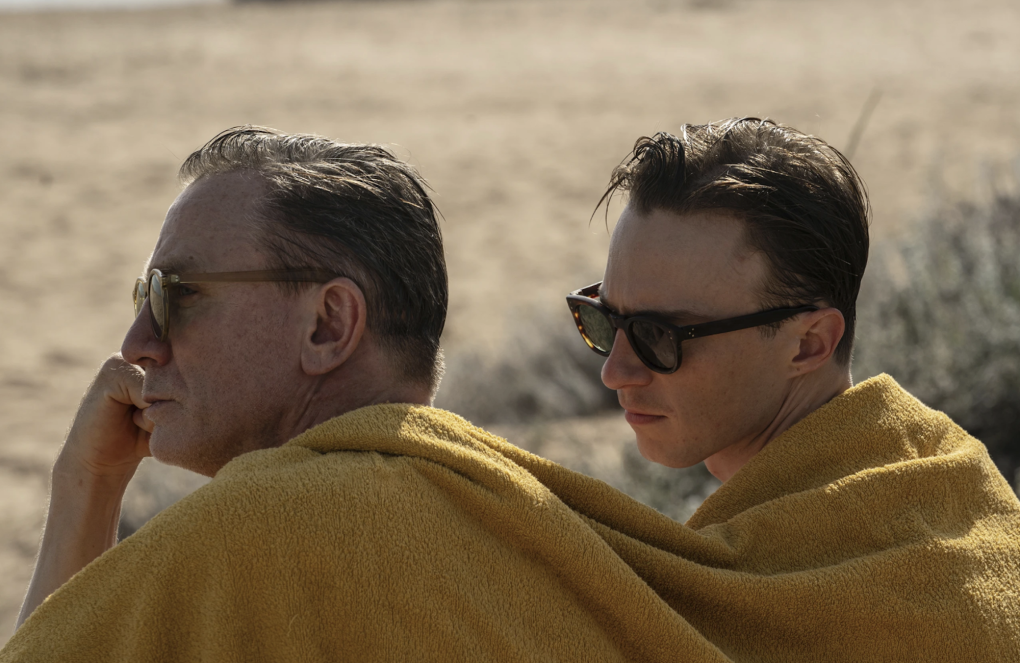
"caption": "Daniel Craig (L) and Drew Starkey, starring in ‘Queer.’",
"credit": "Yannis Drakoulidis/A24 via AP",
"altTag": "Two men sit under a yellow blanket on a beach.",
"description": null,
"imgSizes": {
"medium": {
"file": "https://cdn.kqed.org/wp-content/uploads/sites/2/2024/11/queer-800x520.png",
"width": 800,
"height": 520,
"mimeType": "image/png"
},
"large": {
"file": "https://cdn.kqed.org/wp-content/uploads/sites/2/2024/11/queer-1020x663.png",
"width": 1020,
"height": 663,
"mimeType": "image/png"
},
"thumbnail": {
"file": "https://cdn.kqed.org/wp-content/uploads/sites/2/2024/11/queer-160x104.png",
"width": 160,
"height": 104,
"mimeType": "image/png"
},
"medium_large": {
"file": "https://cdn.kqed.org/wp-content/uploads/sites/2/2024/11/queer-768x499.png",
"width": 768,
"height": 499,
"mimeType": "image/png"
},
"1536x1536": {
"file": "https://cdn.kqed.org/wp-content/uploads/sites/2/2024/11/queer-1536x998.png",
"width": 1536,
"height": 998,
"mimeType": "image/png"
},
"post-thumbnail": {
"file": "https://cdn.kqed.org/wp-content/uploads/sites/2/2024/11/queer-672x372.png",
"width": 672,
"height": 372,
"mimeType": "image/png"
},
"twentyfourteen-full-width": {
"file": "https://cdn.kqed.org/wp-content/uploads/sites/2/2024/11/queer-1038x576.png",
"width": 1038,
"height": 576,
"mimeType": "image/png"
},
"full-width": {
"file": "https://cdn.kqed.org/wp-content/uploads/sites/2/2024/11/queer-1920x1248.png",
"width": 1920,
"height": 1248,
"mimeType": "image/png"
},
"kqedFullSize": {
"file": "https://cdn.kqed.org/wp-content/uploads/sites/2/2024/11/queer.png",
"width": 2000,
"height": 1300
}
},
"isLoading": false,
"fetchFailed": false
},
"arts_13968506": {
"type": "attachments",
"id": "arts_13968506",
"meta": {
"index": "attachments_1716263798",
"site": "arts",
"id": "13968506",
"found": true
},
"title": "KQEDBALL_EstefanyGonzalez14",
"publishDate": 1732303278,
"status": "inherit",
"parent": 13968489,
"modified": 1732309419,
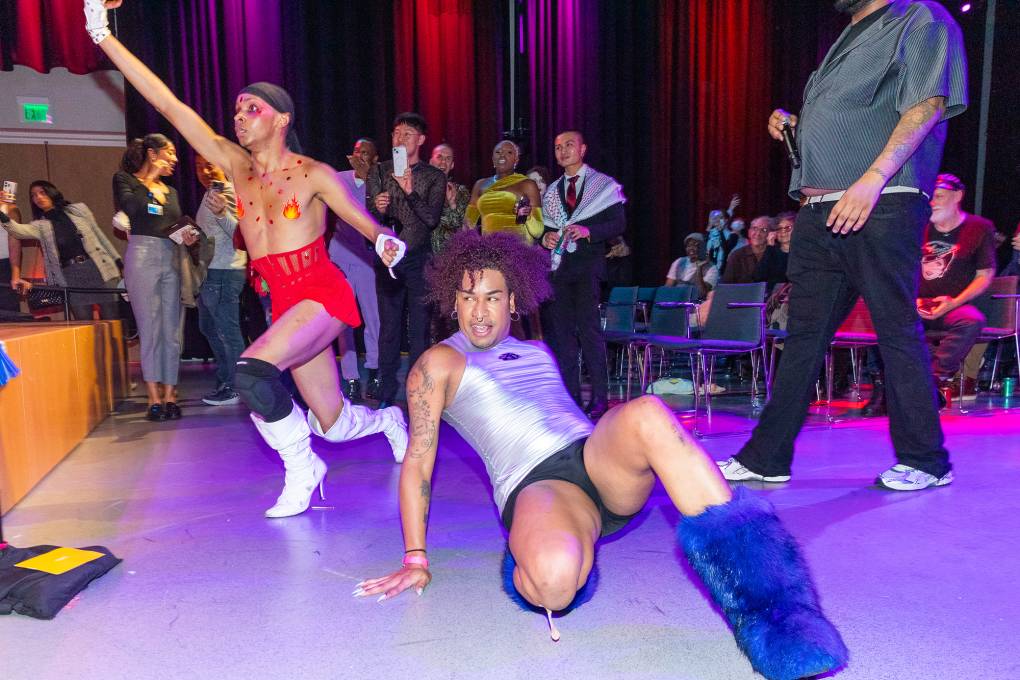
"caption": "\"Performance — Climate Change\" was the last category in Oakland to All's Mini-Ball held at KQED Commons in San Francisco, Calif., on Nov, 21, 2024. Event organizers wanted participants in this category to \"STORM the runway inspired by one of the 5 components of nature: Earth, Water, Fire, Air, or Space,\" and take into account the impacts of climate change in their performance.",
"credit": "Estefany Gonzalez for KQED",
"altTag": "Two people dance in the middle of a crowded auditorium.",
"description": null,
"imgSizes": {
"medium": {
"file": "https://cdn.kqed.org/wp-content/uploads/sites/2/2024/11/KQEDBALL_EstefanyGonzalez14-800x533.jpg",
"width": 800,
"height": 533,
"mimeType": "image/jpeg"
},
"large": {
"file": "https://cdn.kqed.org/wp-content/uploads/sites/2/2024/11/KQEDBALL_EstefanyGonzalez14-1020x680.jpg",
"width": 1020,
"height": 680,
"mimeType": "image/jpeg"
},
"thumbnail": {
"file": "https://cdn.kqed.org/wp-content/uploads/sites/2/2024/11/KQEDBALL_EstefanyGonzalez14-160x107.jpg",
"width": 160,
"height": 107,
"mimeType": "image/jpeg"
},
"medium_large": {
"file": "https://cdn.kqed.org/wp-content/uploads/sites/2/2024/11/KQEDBALL_EstefanyGonzalez14-768x512.jpg",
"width": 768,
"height": 512,
"mimeType": "image/jpeg"
},
"1536x1536": {
"file": "https://cdn.kqed.org/wp-content/uploads/sites/2/2024/11/KQEDBALL_EstefanyGonzalez14-1536x1024.jpg",
"width": 1536,
"height": 1024,
"mimeType": "image/jpeg"
},
"post-thumbnail": {
"file": "https://cdn.kqed.org/wp-content/uploads/sites/2/2024/11/KQEDBALL_EstefanyGonzalez14-672x372.jpg",
"width": 672,
"height": 372,
"mimeType": "image/jpeg"
},
"twentyfourteen-full-width": {
"file": "https://cdn.kqed.org/wp-content/uploads/sites/2/2024/11/KQEDBALL_EstefanyGonzalez14-1038x576.jpg",
"width": 1038,
"height": 576,
"mimeType": "image/jpeg"
},
"full-width": {
"file": "https://cdn.kqed.org/wp-content/uploads/sites/2/2024/11/KQEDBALL_EstefanyGonzalez14-1920x1280.jpg",
"width": 1920,
"height": 1280,
"mimeType": "image/jpeg"
},
"kqedFullSize": {
"file": "https://cdn.kqed.org/wp-content/uploads/sites/2/2024/11/KQEDBALL_EstefanyGonzalez14.jpg",
"width": 2000,
"height": 1333
}
},
"isLoading": false,
"fetchFailed": false
},
"arts_13937238": {
"type": "attachments",
"id": "arts_13937238",
"meta": {
"index": "attachments_1716263798",
"site": "arts",
"id": "13937238",
"found": true
},
"title": "Mama Ganuush performs at For Palestine, a fundraiser in support of Palestinian liberation, at the Continental Club on Sunday, Oct. 29, 2023.",
"publishDate": 1698694268,
"status": "inherit",
"parent": 0,
"modified": 1730241551,
"caption": "Mama Ganuush performs at For Palestine, a fundraiser in support of the Palestinian Children's Relief Fund, at the Continental Club on Sunday, Oct. 29, 2023.",
"credit": "Estefany Gonzalez for KQED",
"altTag": null,
"description": "Mama Ganuush performs at For Palestine, a fundraiser in support of Palestinian liberation, at the Continental Club on Sunday, Oct. 29, 2023.",
"imgSizes": {
"medium": {
"file": "https://cdn.kqed.org/wp-content/uploads/sites/2/2023/10/231029_ForPalestineBenefit_EG-50-800x533.jpg",
"width": 800,
"height": 533,
"mimeType": "image/jpeg"
},
"large": {
"file": "https://cdn.kqed.org/wp-content/uploads/sites/2/2023/10/231029_ForPalestineBenefit_EG-50-1020x680.jpg",
"width": 1020,
"height": 680,
"mimeType": "image/jpeg"
},
"thumbnail": {
"file": "https://cdn.kqed.org/wp-content/uploads/sites/2/2023/10/231029_ForPalestineBenefit_EG-50-160x107.jpg",
"width": 160,
"height": 107,
"mimeType": "image/jpeg"
},
"medium_large": {
"file": "https://cdn.kqed.org/wp-content/uploads/sites/2/2023/10/231029_ForPalestineBenefit_EG-50-768x512.jpg",
"width": 768,
"height": 512,
"mimeType": "image/jpeg"
},
"1536x1536": {
"file": "https://cdn.kqed.org/wp-content/uploads/sites/2/2023/10/231029_ForPalestineBenefit_EG-50-1536x1024.jpg",
"width": 1536,
"height": 1024,
"mimeType": "image/jpeg"
},
"post-thumbnail": {
"file": "https://cdn.kqed.org/wp-content/uploads/sites/2/2023/10/231029_ForPalestineBenefit_EG-50-672x372.jpg",
"width": 672,
"height": 372,
"mimeType": "image/jpeg"
},
"twentyfourteen-full-width": {
"file": "https://cdn.kqed.org/wp-content/uploads/sites/2/2023/10/231029_ForPalestineBenefit_EG-50-1038x576.jpg",
"width": 1038,
"height": 576,
"mimeType": "image/jpeg"
},
"kqedFullSize": {
"file": "https://cdn.kqed.org/wp-content/uploads/sites/2/2023/10/231029_ForPalestineBenefit_EG-50.jpg",
"width": 1920,
"height": 1280
}
},
"isLoading": false,
"fetchFailed": false
},
"arts_13967305": {
"type": "attachments",
"id": "arts_13967305",
"meta": {
"index": "attachments_1716263798",
"site": "arts",
"id": "13967305",
"found": true
},
"title": "adela vasquez by marcel pardo ariza 2",
"publishDate": 1729889245,
"status": "inherit",
"parent": 0,
"modified": 1729891163,
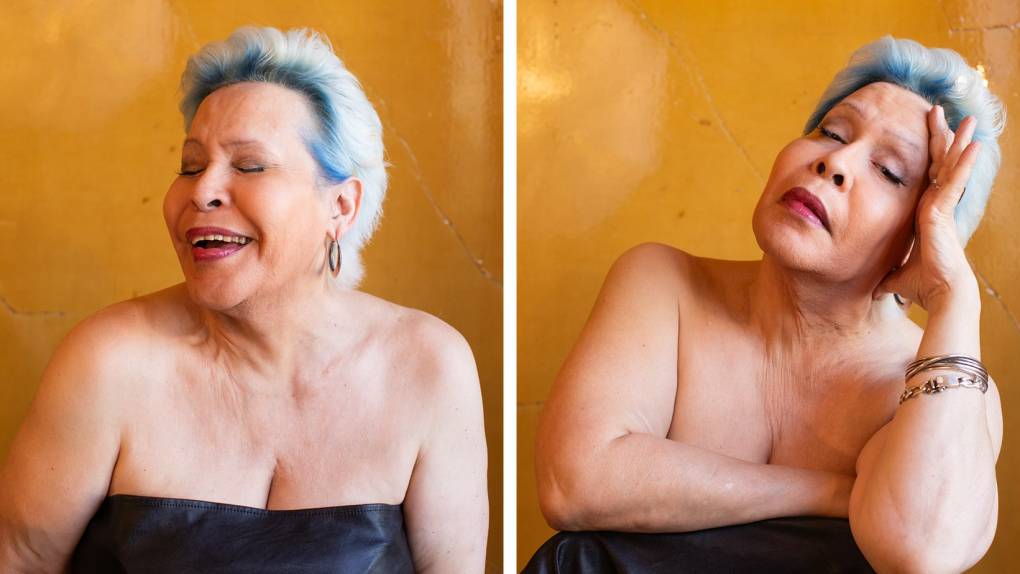
"caption": "Originally from Cuba, Adela Vázquez spent decades advocating for HIV/AIDS healthcare in the Latinx community in San Francisco. ",
"credit": "Marcel Pardo Ariza",
"altTag": null,
"description": null,
"imgSizes": {
"medium": {
"file": "https://cdn.kqed.org/wp-content/uploads/sites/2/2024/10/adela-vasquez-by-marcel-pardo-ariza-2-800x450.jpg",
"width": 800,
"height": 450,
"mimeType": "image/jpeg"
},
"large": {
"file": "https://cdn.kqed.org/wp-content/uploads/sites/2/2024/10/adela-vasquez-by-marcel-pardo-ariza-2-1020x574.jpg",
"width": 1020,
"height": 574,
"mimeType": "image/jpeg"
},
"thumbnail": {
"file": "https://cdn.kqed.org/wp-content/uploads/sites/2/2024/10/adela-vasquez-by-marcel-pardo-ariza-2-160x90.jpg",
"width": 160,
"height": 90,
"mimeType": "image/jpeg"
},
"medium_large": {
"file": "https://cdn.kqed.org/wp-content/uploads/sites/2/2024/10/adela-vasquez-by-marcel-pardo-ariza-2-768x432.jpg",
"width": 768,
"height": 432,
"mimeType": "image/jpeg"
},
"1536x1536": {
"file": "https://cdn.kqed.org/wp-content/uploads/sites/2/2024/10/adela-vasquez-by-marcel-pardo-ariza-2-1536x864.jpg",
"width": 1536,
"height": 864,
"mimeType": "image/jpeg"
},
"post-thumbnail": {
"file": "https://cdn.kqed.org/wp-content/uploads/sites/2/2024/10/adela-vasquez-by-marcel-pardo-ariza-2-672x372.jpg",
"width": 672,
"height": 372,
"mimeType": "image/jpeg"
},
"twentyfourteen-full-width": {
"file": "https://cdn.kqed.org/wp-content/uploads/sites/2/2024/10/adela-vasquez-by-marcel-pardo-ariza-2-1038x576.jpg",
"width": 1038,
"height": 576,
"mimeType": "image/jpeg"
},
"kqedFullSize": {
"file": "https://cdn.kqed.org/wp-content/uploads/sites/2/2024/10/adela-vasquez-by-marcel-pardo-ariza-2.jpg",
"width": 1641,
"height": 923
}
},
"isLoading": false,
"fetchFailed": false
},
"arts_13966177": {
"type": "attachments",
"id": "arts_13966177",
"meta": {
"index": "attachments_1716263798",
"site": "arts",
"id": "13966177",
"found": true
},
"title": "_006William-Schmidt-as-Pharus-with-Choir-Boy-Ensemble",
"publishDate": 1728323479,
"status": "inherit",
"parent": 13966174,
"modified": 1728323985,
"caption": "William Schmidt (center) as Pharus in Shotgun Players’ production of Tarell Alvin McCraney’s ‘Choir Boy.’",
"credit": "Ben Krantz/Courtesy Shotgun Players",
"altTag": "A young Black male student in a blue private school uniform with a red striped tie sings in front of a backing choir of four, similarly dressed.",
"description": null,
"imgSizes": {
"medium": {
"file": "https://cdn.kqed.org/wp-content/uploads/sites/2/2024/10/006William-Schmidt-as-Pharus-with-Choir-Boy-Ensemble-800x532.jpg",
"width": 800,
"height": 532,
"mimeType": "image/jpeg"
},
"large": {
"file": "https://cdn.kqed.org/wp-content/uploads/sites/2/2024/10/006William-Schmidt-as-Pharus-with-Choir-Boy-Ensemble-1020x679.jpg",
"width": 1020,
"height": 679,
"mimeType": "image/jpeg"
},
"thumbnail": {
"file": "https://cdn.kqed.org/wp-content/uploads/sites/2/2024/10/006William-Schmidt-as-Pharus-with-Choir-Boy-Ensemble-160x106.jpg",
"width": 160,
"height": 106,
"mimeType": "image/jpeg"
},
"medium_large": {
"file": "https://cdn.kqed.org/wp-content/uploads/sites/2/2024/10/006William-Schmidt-as-Pharus-with-Choir-Boy-Ensemble-768x511.jpg",
"width": 768,
"height": 511,
"mimeType": "image/jpeg"
},
"1536x1536": {
"file": "https://cdn.kqed.org/wp-content/uploads/sites/2/2024/10/006William-Schmidt-as-Pharus-with-Choir-Boy-Ensemble-1536x1022.jpg",
"width": 1536,
"height": 1022,
"mimeType": "image/jpeg"
},
"post-thumbnail": {
"file": "https://cdn.kqed.org/wp-content/uploads/sites/2/2024/10/006William-Schmidt-as-Pharus-with-Choir-Boy-Ensemble-672x372.jpg",
"width": 672,
"height": 372,
"mimeType": "image/jpeg"
},
"twentyfourteen-full-width": {
"file": "https://cdn.kqed.org/wp-content/uploads/sites/2/2024/10/006William-Schmidt-as-Pharus-with-Choir-Boy-Ensemble-1038x576.jpg",
"width": 1038,
"height": 576,
"mimeType": "image/jpeg"
},
"full-width": {
"file": "https://cdn.kqed.org/wp-content/uploads/sites/2/2024/10/006William-Schmidt-as-Pharus-with-Choir-Boy-Ensemble-1920x1278.jpg",
"width": 1920,
"height": 1278,
"mimeType": "image/jpeg"
},
"kqedFullSize": {
"file": "https://cdn.kqed.org/wp-content/uploads/sites/2/2024/10/006William-Schmidt-as-Pharus-with-Choir-Boy-Ensemble.jpg",
"width": 2000,
"height": 1331
}
},
"isLoading": false,
"fetchFailed": false
},
"arts_13966102": {
"type": "attachments",
"id": "arts_13966102",
"meta": {
"index": "attachments_1716263798",
"site": "arts",
"id": "13966102",
"found": true
},
"title": "Diego Gómez in drag as ‘bearded cosplay queen’ Trangela Lansbury.",
"publishDate": 1728067050,
"status": "inherit",
"parent": 13966100,
"modified": 1728067213,
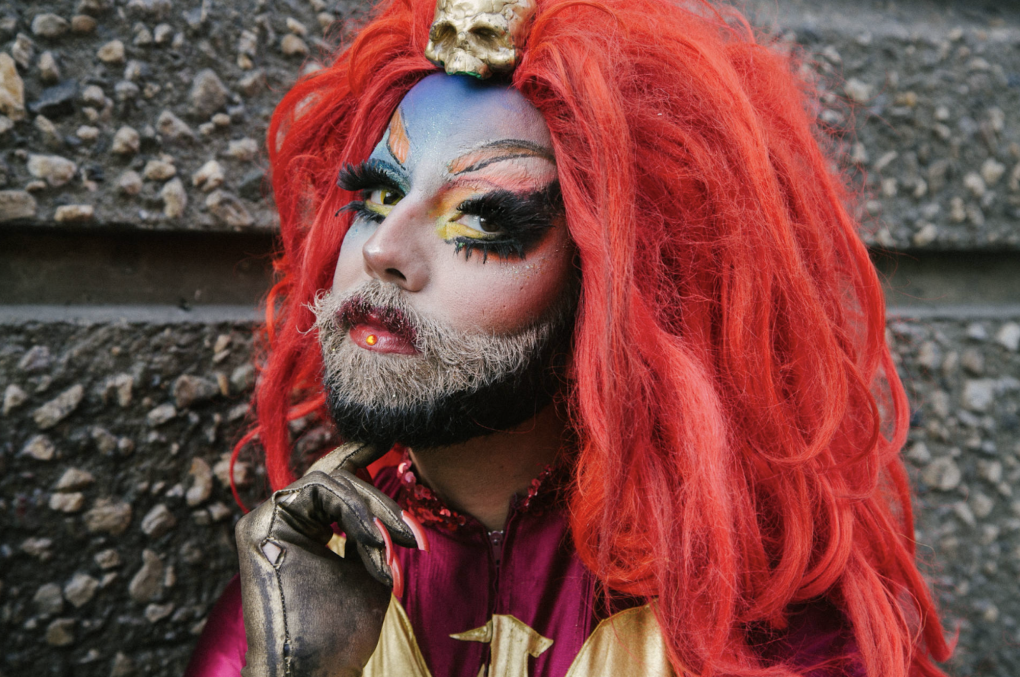
"caption": "Diego Gómez in drag as ‘bearded cosplay queen’ Trangela Lansbury.",
"credit": "Christina Campbell",
"altTag": "A bearded man in flamboyant makeup, large red wig and gloves with attached long fingernails.",
"description": null,
"imgSizes": {
"medium": {
"file": "https://cdn.kqed.org/wp-content/uploads/sites/2/2024/10/tran-lan-800x531.png",
"width": 800,
"height": 531,
"mimeType": "image/png"
},
"large": {
"file": "https://cdn.kqed.org/wp-content/uploads/sites/2/2024/10/tran-lan-1020x677.png",
"width": 1020,
"height": 677,
"mimeType": "image/png"
},
"thumbnail": {
"file": "https://cdn.kqed.org/wp-content/uploads/sites/2/2024/10/tran-lan-160x106.png",
"width": 160,
"height": 106,
"mimeType": "image/png"
},
"medium_large": {
"file": "https://cdn.kqed.org/wp-content/uploads/sites/2/2024/10/tran-lan-768x510.png",
"width": 768,
"height": 510,
"mimeType": "image/png"
},
"1536x1536": {
"file": "https://cdn.kqed.org/wp-content/uploads/sites/2/2024/10/tran-lan-1536x1019.png",
"width": 1536,
"height": 1019,
"mimeType": "image/png"
},
"post-thumbnail": {
"file": "https://cdn.kqed.org/wp-content/uploads/sites/2/2024/10/tran-lan-672x372.png",
"width": 672,
"height": 372,
"mimeType": "image/png"
},
"twentyfourteen-full-width": {
"file": "https://cdn.kqed.org/wp-content/uploads/sites/2/2024/10/tran-lan-1038x576.png",
"width": 1038,
"height": 576,
"mimeType": "image/png"
},
"full-width": {
"file": "https://cdn.kqed.org/wp-content/uploads/sites/2/2024/10/tran-lan-1920x1274.png",
"width": 1920,
"height": 1274,
"mimeType": "image/png"
},
"kqedFullSize": {
"file": "https://cdn.kqed.org/wp-content/uploads/sites/2/2024/10/tran-lan.png",
"width": 2000,
"height": 1327
}
},
"isLoading": false,
"fetchFailed": false
}
},
"audioPlayerReducer": {
"postId": "stream_live",
"isPaused": true,
"isPlaying": false,
"pfsActive": false,
"pledgeModalIsOpen": true,
"playerDrawerIsOpen": false,
"liveAudioPlayStartedAt": 0,
"liveAudioPlayContext": ""
},
"authorsReducer": {
"byline_arts_13968744": {
"type": "authors",
"id": "byline_arts_13968744",
"meta": {
"override": true
},
"slug": "byline_arts_13968744",
"name": "Mark Kennedy, Associated Press",
"isLoading": false
},
"shotchkiss": {
"type": "authors",
"id": "61",
"meta": {
"index": "authors_1716337520",
"id": "61",
"found": true
},
"name": "Sarah Hotchkiss",
"firstName": "Sarah",
"lastName": "Hotchkiss",
"slug": "shotchkiss",
"email": "shotchkiss@kqed.org",
"display_author_email": true,
"staff_mastheads": [
"arts"
],
"title": "Senior Editor",
"bio": "Sarah Hotchkiss is a San Francisco \u003ca href=\"http://www.sarahhotchkiss.com\">artist\u003c/a> and arts writer. In 2019, she received the Dorothea & Leo Rabkin Foundation grant for visual art journalism and in 2020 she received a Society of Professional Journalists, Northern California award for excellence in arts and culture reporting.",
"avatar": "https://secure.gravatar.com/avatar/bc662df144b3d27fd8b1b6f1c2a420d34e91e53154d411bb7ad353cc8b6cea8d?s=600&d=blank&r=g",
"twitter": null,
"bluesky": null,
"facebook": null,
"instagram": null,
"linkedin": null,
"sites": [
{
"site": "",
"roles": [
"editor"
]
},
{
"site": "arts",
"roles": [
"Contributor",
"administrator"
]
},
{
"site": "artschool",
"roles": [
"administrator"
]
},
{
"site": "news",
"roles": [
"editor"
]
},
{
"site": "pop",
"roles": [
"administrator"
]
},
{
"site": "bayareabites",
"roles": [
"editor"
]
},
{
"site": "spark",
"roles": [
"editor"
]
},
{
"site": "checkplease",
"roles": [
"editor"
]
}
],
"headData": {
"title": "Sarah Hotchkiss | KQED",
"description": "Senior Editor",
"ogImgSrc": "https://secure.gravatar.com/avatar/bc662df144b3d27fd8b1b6f1c2a420d34e91e53154d411bb7ad353cc8b6cea8d?s=600&d=blank&r=g",
"twImgSrc": "https://secure.gravatar.com/avatar/bc662df144b3d27fd8b1b6f1c2a420d34e91e53154d411bb7ad353cc8b6cea8d?s=600&d=blank&r=g"
},
"isLoading": false,
"link": "/author/shotchkiss"
},
"ralexandra": {
"type": "authors",
"id": "11242",
"meta": {
"index": "authors_1716337520",
"id": "11242",
"found": true
},
"name": "Rae Alexandra",
"firstName": "Rae",
"lastName": "Alexandra",
"slug": "ralexandra",
"email": "ralexandra@kqed.org",
"display_author_email": true,
"staff_mastheads": [],
"title": "Reporter/Producer",
"bio": "Rae Alexandra is a Reporter/Producer for KQED Arts & Culture, and the creator/author of the \u003ca href=\"https://www.kqed.org/arts/program/rebel-girls-from-bay-area-history\">Rebel Girls From Bay Area History\u003c/a> and \u003ca href=\"https://www.kqed.org/bizarrebayarea\">Bizarre Bay Area\u003c/a> series. Her debut book, \u003ca href=\"https://citylights.com/politics-current-events-history/unsung-heroines35-women-who-changed/\">Unsung Heroines: 35 Women Who Changed the Bay Area\u003c/a> was published by City Lights in March 2026. In 2023, Rae was awarded an SPJ Excellence in Journalism Award for Arts & Culture. Rae was born and raised in Wales and subsequently — even after two decades in Northern California — still uses phrases that regularly baffle her coworkers.",
"avatar": "https://secure.gravatar.com/avatar/edfee8176c80cc0a382b051190f5341997df378a934a5774dcb0977732dfd401?s=600&d=blank&r=g",
"twitter": null,
"bluesky": null,
"facebook": null,
"instagram": null,
"linkedin": null,
"sites": [
{
"site": "arts",
"roles": [
"subscriber"
]
},
{
"site": "news",
"roles": [
"subscriber"
]
},
{
"site": "pop",
"roles": [
"subscriber"
]
},
{
"site": "bayareabites",
"roles": [
"subscriber"
]
},
{
"site": "science",
"roles": [
"subscriber"
]
}
],
"headData": {
"title": "Rae Alexandra | KQED",
"description": "Reporter/Producer",
"ogImgSrc": "https://secure.gravatar.com/avatar/edfee8176c80cc0a382b051190f5341997df378a934a5774dcb0977732dfd401?s=600&d=blank&r=g",
"twImgSrc": "https://secure.gravatar.com/avatar/edfee8176c80cc0a382b051190f5341997df378a934a5774dcb0977732dfd401?s=600&d=blank&r=g"
},
"isLoading": false,
"link": "/author/ralexandra"
},
"nvoynovskaya": {
"type": "authors",
"id": "11387",
"meta": {
"index": "authors_1716337520",
"id": "11387",
"found": true
},
"name": "Nastia Voynovskaya",
"firstName": "Nastia",
"lastName": "Voynovskaya",
"slug": "nvoynovskaya",
"email": "nvoynovskaya@kqed.org",
"display_author_email": false,
"staff_mastheads": [
"arts"
],
"title": "Editor and reporter",
"bio": "Nastia Voynovskaya is a reporter, editor and host at KQED Arts & Culture. She's been covering the arts in the Bay Area for over a decade, with a focus on music, queer culture, labor issues and grassroots organizing. She has edited KQED story series such as Trans Bay: A History of San Francisco's Gender-Diverse Community, and co-created KQED's Bay Area hip-hop history project, That's My Word. Nastia's work has been recognized by the Society of Professional Journalists and San Francisco Press Club. She regularly appears on podcasts and radio programs, including NPR's All Songs Considered, and hosts live events where music, culture and conversation meet.",
"avatar": "https://secure.gravatar.com/avatar/5025ee460e5a85d69ca20ea6c6f2f80d7e17795c828f61ea3aecfcd924e9042e?s=600&d=blank&r=g",
"twitter": null,
"bluesky": null,
"facebook": null,
"instagram": "https://www.instagram.com/nananastia/",
"linkedin": null,
"sites": [
{
"site": "",
"roles": [
"editor"
]
},
{
"site": "arts",
"roles": [
"administrator"
]
},
{
"site": "news",
"roles": [
"editor"
]
},
{
"site": "pop",
"roles": [
"administrator"
]
},
{
"site": "bayareabites",
"roles": [
"editor"
]
},
{
"site": "podcasts",
"roles": [
"editor"
]
},
{
"site": "hiphop",
"roles": [
"editor"
]
}
],
"headData": {
"title": "Nastia Voynovskaya | KQED",
"description": "Editor and reporter",
"ogImgSrc": "https://secure.gravatar.com/avatar/5025ee460e5a85d69ca20ea6c6f2f80d7e17795c828f61ea3aecfcd924e9042e?s=600&d=blank&r=g",
"twImgSrc": "https://secure.gravatar.com/avatar/5025ee460e5a85d69ca20ea6c6f2f80d7e17795c828f61ea3aecfcd924e9042e?s=600&d=blank&r=g"
},
"isLoading": false,
"link": "/author/nvoynovskaya"
},
"ogpenn": {
"type": "authors",
"id": "11491",
"meta": {
"index": "authors_1716337520",
"id": "11491",
"found": true
},
"name": "Pendarvis Harshaw",
"firstName": "Pendarvis",
"lastName": "Harshaw",
"slug": "ogpenn",
"email": "ogpenn@gmail.com",
"display_author_email": false,
"staff_mastheads": [
"arts"
],
"title": "Community Engagement Reporter",
"bio": "Pendarvis Harshaw is an educator, host and writer with KQED Arts.",
"avatar": "https://secure.gravatar.com/avatar/972b77ee8e3f346ae2b00622661187fbfabd059b5693bbdc1475ea7a722fd4cd?s=600&d=blank&r=g",
"twitter": null,
"bluesky": null,
"facebook": null,
"instagram": "ogpenn",
"linkedin": null,
"sites": [
{
"site": "arts",
"roles": [
"administrator"
]
},
{
"site": "news",
"roles": [
"editor"
]
},
{
"site": "bayareabites",
"roles": [
"author"
]
},
{
"site": "hiphop",
"roles": [
"editor"
]
}
],
"headData": {
"title": "Pendarvis Harshaw | KQED",
"description": "Community Engagement Reporter",
"ogImgSrc": "https://secure.gravatar.com/avatar/972b77ee8e3f346ae2b00622661187fbfabd059b5693bbdc1475ea7a722fd4cd?s=600&d=blank&r=g",
"twImgSrc": "https://secure.gravatar.com/avatar/972b77ee8e3f346ae2b00622661187fbfabd059b5693bbdc1475ea7a722fd4cd?s=600&d=blank&r=g"
},
"isLoading": false,
"link": "/author/ogpenn"
},
"ccabreralomeli": {
"type": "authors",
"id": "11708",
"meta": {
"index": "authors_1716337520",
"id": "11708",
"found": true
},
"name": "Carlos Cabrera-Lomelí",
"firstName": "Carlos",
"lastName": "Cabrera-Lomelí",
"slug": "ccabreralomeli",
"email": "ccabreralomeli@KQED.org",
"display_author_email": true,
"staff_mastheads": [
"news"
],
"title": "Community Reporter",
"bio": "Carlos Cabrera-Lomelí is a community reporter with KQED's digital engagement team. He also reports and co-produces for KQED's bilingual news hub KQED en Español. He grew up in San Francisco's Mission District and has previously worked with Univision, 48 Hills and REFORMA in Mexico City.",
"avatar": "https://secure.gravatar.com/avatar/c309be9665e484f887b818c89e273ecc673004f426f36b24d00a4d813a2e0518?s=600&d=blank&r=g",
"twitter": "@LomeliCabrera",
"bluesky": null,
"facebook": null,
"instagram": null,
"linkedin": null,
"sites": [
{
"site": "arts",
"roles": [
"editor"
]
},
{
"site": "news",
"roles": [
"editor"
]
},
{
"site": "about",
"roles": [
"editor"
]
},
{
"site": "science",
"roles": [
"editor"
]
},
{
"site": "perspectives",
"roles": [
"editor"
]
},
{
"site": "elections",
"roles": [
"editor"
]
},
{
"site": "liveblog",
"roles": [
"contributor"
]
}
],
"headData": {
"title": "Carlos Cabrera-Lomelí | KQED",
"description": "Community Reporter",
"ogImgSrc": "https://secure.gravatar.com/avatar/c309be9665e484f887b818c89e273ecc673004f426f36b24d00a4d813a2e0518?s=600&d=blank&r=g",
"twImgSrc": "https://secure.gravatar.com/avatar/c309be9665e484f887b818c89e273ecc673004f426f36b24d00a4d813a2e0518?s=600&d=blank&r=g"
},
"isLoading": false,
"link": "/author/ccabreralomeli"
},
"bshoot": {
"type": "authors",
"id": "11715",
"meta": {
"index": "authors_1716337520",
"id": "11715",
"found": true
},
"name": "Britta Shoot",
"firstName": "Britta",
"lastName": "Shoot",
"slug": "bshoot",
"email": "workywork@brittashoot.com",
"display_author_email": false,
"staff_mastheads": [],
"title": "KQED Contributor",
"bio": "Britta Shoot is a writer and editor in San Francisco.",
"avatar": "https://secure.gravatar.com/avatar/a5014572686e67b024406bf7aa9afebcff2ca8953c3a04fd312e42cc60d56b8c?s=600&d=blank&r=g",
"twitter": "brittashoot",
"bluesky": null,
"facebook": null,
"instagram": null,
"linkedin": null,
"sites": [
{
"site": "arts",
"roles": [
"contributor"
]
}
],
"headData": {
"title": "Britta Shoot | KQED",
"description": "KQED Contributor",
"ogImgSrc": "https://secure.gravatar.com/avatar/a5014572686e67b024406bf7aa9afebcff2ca8953c3a04fd312e42cc60d56b8c?s=600&d=blank&r=g",
"twImgSrc": "https://secure.gravatar.com/avatar/a5014572686e67b024406bf7aa9afebcff2ca8953c3a04fd312e42cc60d56b8c?s=600&d=blank&r=g"
},
"isLoading": false,
"link": "/author/bshoot"
},
"djchavez": {
"type": "authors",
"id": "11905",
"meta": {
"index": "authors_1716337520",
"id": "11905",
"found": true
},
"name": "David John Chávez",
"firstName": "David John",
"lastName": "Chávez",
"slug": "djchavez",
"email": "theatrechavez@gmail.com",
"display_author_email": false,
"staff_mastheads": [],
"title": "KQED Contributor",
"bio": "Based in San José, David is a theater critic and reporter who who served as Executive Chair of the American Theatre Critics/Journalists Association (’22-’25), as well as a regular theater contributor to The Mercury News, San Francisco Chronicle, American Theatre Magazine and KQED, among other publications. He is a two-time juror for the Pulitzer Prize for Drama (’22-’23) and a 2020 fellow of the Eugene O'Neill National Critics Institute.",
"avatar": "https://secure.gravatar.com/avatar/5eaa3ce994228213820907c390795c28f7b97165c2b575f46d15fc9273a132b7?s=600&d=blank&r=g",
"twitter": null,
"bluesky": null,
"facebook": "https://www.facebook.com/bydavidjchavez",
"instagram": "https://www.instagram.com/davidjchavez/",
"linkedin": null,
"sites": [
{
"site": "arts",
"roles": [
"contributor"
]
}
],
"headData": {
"title": "David John Chávez | KQED",
"description": "KQED Contributor",
"ogImgSrc": "https://secure.gravatar.com/avatar/5eaa3ce994228213820907c390795c28f7b97165c2b575f46d15fc9273a132b7?s=600&d=blank&r=g",
"twImgSrc": "https://secure.gravatar.com/avatar/5eaa3ce994228213820907c390795c28f7b97165c2b575f46d15fc9273a132b7?s=600&d=blank&r=g"
},
"isLoading": false,
"link": "/author/djchavez"
}
},
"pagesReducer": {
"arts_tag_lgbtq": {
"type": "terms",
"id": "arts_3226",
"meta": {
"index": "terms_1716263798",
"site": "arts",
"id": "3226",
"score": 8.28313
},
"name": "LGBTQ+",
"slug": "lgbtq",
"taxonomy": "tag",
"description": null,
"featImg": null,
"headData": {
"title": "LGBTQ+ | KQED Arts",
"description": null,
"ogTitle": null,
"ogDescription": null,
"ogImgId": null,
"twTitle": null,
"twDescription": null,
"twImgId": null
},
"ttid": 3238,
"isLoading": false,
"title": "LGBTQ+",
"pageMeta": {
"site": "arts",
"WpPageTemplate": "page-topic-editorial",
"currentPage": 6
},
"blocks": [
{
"blockName": "kqed/post-list",
"attrs": {
"layout": "cardArticle2",
"query": "posts/arts?tag=lgbtq",
"seeMore": false,
"paginated": true,
"page": 6
}
},
{
"blockName": "kqed/ad"
}
]
}
},
"pfsSessionReducer": {},
"postsReducer": {
"stream_live": {
"type": "live",
"id": "stream_live",
"audioUrl": "https://streams.kqed.org/kqedradio",
"title": "Live Stream",
"excerpt": "Live Stream information currently unavailable.",
"link": "/radio",
"featImg": "",
"label": {
"name": "KQED Live",
"link": "/"
}
},
"stream_kqedNewscast": {
"type": "posts",
"id": "stream_kqedNewscast",
"audioUrl": "https://www.kqed.org/.stream/anon/radio/RDnews/newscast.mp3?_=1",
"title": "KQED Newscast",
"featImg": "",
"label": {
"name": "88.5 FM",
"link": "/"
}
},
"arts_13971906": {
"type": "posts",
"id": "arts_13971906",
"meta": {
"index": "posts_1716263798",
"site": "arts",
"id": "13971906",
"score": null,
"sort": [
1739558185000
]
},
"guestAuthors": [],
"slug": "crip-ecstasy-san-francisco-accessibility-disability-justice",
"title": "Disabled Drag Artists and Ravers Join Forces for Crip Ecstasy",
"publishDate": 1739558185,
"format": "aside",
"headTitle": "Disabled Drag Artists and Ravers Join Forces for Crip Ecstasy | KQED",
"labelTerm": {
"term": 140,
"site": "arts"
},
"content": "\u003cfigure id=\"attachment_13971911\" class=\"wp-caption aligncenter\" style=\"max-width: 1707px\">\u003cimg loading=\"lazy\" decoding=\"async\" class=\"size-full wp-image-13971911\" src=\"https://cdn.kqed.org/wp-content/uploads/sites/2/2025/02/2023_CripEcstasy_RobbieSweeny_24-1-scaled.jpg\" alt=\"A drag performer with a beard wears a reflective, sculptural outfit with a cape.\" width=\"1707\" height=\"2560\" srcset=\"https://cdn.kqed.org/wp-content/uploads/sites/2/2025/02/2023_CripEcstasy_RobbieSweeny_24-1-scaled.jpg 1707w, https://cdn.kqed.org/wp-content/uploads/sites/2/2025/02/2023_CripEcstasy_RobbieSweeny_24-1-800x1200.jpg 800w, https://cdn.kqed.org/wp-content/uploads/sites/2/2025/02/2023_CripEcstasy_RobbieSweeny_24-1-1020x1530.jpg 1020w, https://cdn.kqed.org/wp-content/uploads/sites/2/2025/02/2023_CripEcstasy_RobbieSweeny_24-1-160x240.jpg 160w, https://cdn.kqed.org/wp-content/uploads/sites/2/2025/02/2023_CripEcstasy_RobbieSweeny_24-1-768x1152.jpg 768w, https://cdn.kqed.org/wp-content/uploads/sites/2/2025/02/2023_CripEcstasy_RobbieSweeny_24-1-1024x1536.jpg 1024w, https://cdn.kqed.org/wp-content/uploads/sites/2/2025/02/2023_CripEcstasy_RobbieSweeny_24-1-1365x2048.jpg 1365w, https://cdn.kqed.org/wp-content/uploads/sites/2/2025/02/2023_CripEcstasy_RobbieSweeny_24-1-1920x2880.jpg 1920w\" sizes=\"auto, (max-width: 1707px) 100vw, 1707px\">\u003cfigcaption class=\"wp-caption-text\">Iman performs at Crip Ecstasy 2023. The artist, who mentors deaf and hard-of-hearing drag performers, will return to Crip Ecstasy’s next party on Feb. 20 at The Stud. \u003ccite>(Robbie Sweeny)\u003c/cite>\u003c/figcaption>\u003c/figure>\n\u003cp>At their warehouse party last Halloween, \u003ca href=\"https://www.instagram.com/octavia__rose/\">Octavia Rose Hingle\u003c/a> finally felt free to get lost in the music. They reclined on a daybed on the dance floor, waving their arms as the DJ blended an intoxicating mix of house grooves and sexy lyrics from Charli XCX and Ice Spice. For Hingle, who deals with mobility issues, spaces that allow them to dance comfortably are exceedingly rare. That’s why they created Crip Ecstasy, a dance party and drag night that caters to attendees with different access needs.\u003c/p>\n\u003cp>\u003ca href=\"https://www.union.fit/events/kh-fresh-festival-rot-festival-x-crip-ecstasy-x-the-stud-sf-drag-show/performances/8sh8ap53\">The party’s next installment\u003c/a>, at The Stud in San Francisco, gets underway on Feb. 20 as part of \u003ca href=\"https://www.freshfestival.org/\">Rot Festival\u003c/a>, an experimental dance and performance showcase. Not only is the legendary queer bar wheelchair-accessible, but the party offers numerous seating options, including beanbags and wide-legged chairs. Masks are required when not drinking. All performances have ASL interpretations and audio descriptions, and blind and visually impaired guests can touch the space and performers’ costumes in a haptic tour organized by \u003ca href=\"https://www.kqed.org/arts/13921184/jess-curtis-gravity-dance-accessibility-disability-justice\">Gravity Access Services\u003c/a> before the show.\u003c/p>\n\u003cp>“It’s really magical to experience what it’s like when people’s access needs are centered. I feel like it really shifts the space in so many ways,” says Hingle. “Just to know that you belong and that people are there to support you and your experience, versus you having to fight to get a seat, or [getting] crammed into the back of the club because you need to sit down and your friends are up front dancing.”\u003c/p>\n\u003cfigure id=\"attachment_13971909\" class=\"wp-caption aligncenter\" style=\"max-width: 2000px\">\u003cimg loading=\"lazy\" decoding=\"async\" class=\"size-full wp-image-13971909\" src=\"https://cdn.kqed.org/wp-content/uploads/sites/2/2025/02/2023_CripEcstasy_RobbieSweeny_99.jpg\" alt=\"Two dancers in shorts and crop tops, one of whom is using a wheelchair, move to the music while a DJ spins. \" width=\"2000\" height=\"1333\" srcset=\"https://cdn.kqed.org/wp-content/uploads/sites/2/2025/02/2023_CripEcstasy_RobbieSweeny_99.jpg 2000w, https://cdn.kqed.org/wp-content/uploads/sites/2/2025/02/2023_CripEcstasy_RobbieSweeny_99-800x533.jpg 800w, https://cdn.kqed.org/wp-content/uploads/sites/2/2025/02/2023_CripEcstasy_RobbieSweeny_99-1020x680.jpg 1020w, https://cdn.kqed.org/wp-content/uploads/sites/2/2025/02/2023_CripEcstasy_RobbieSweeny_99-160x107.jpg 160w, https://cdn.kqed.org/wp-content/uploads/sites/2/2025/02/2023_CripEcstasy_RobbieSweeny_99-768x512.jpg 768w, https://cdn.kqed.org/wp-content/uploads/sites/2/2025/02/2023_CripEcstasy_RobbieSweeny_99-1536x1024.jpg 1536w, https://cdn.kqed.org/wp-content/uploads/sites/2/2025/02/2023_CripEcstasy_RobbieSweeny_99-1920x1280.jpg 1920w\" sizes=\"auto, (max-width: 2000px) 100vw, 2000px\">\u003cfigcaption class=\"wp-caption-text\">NEVE and Saira Barbaric dance at Crip Ecstasy at CounterPulse in 2023. \u003ccite>(Robbie Sweeny)\u003c/cite>\u003c/figcaption>\u003c/figure>\n\u003cp>By day, Hingle works at \u003ca href=\"https://ww2.kqed.org/spark/axis-dance-company/\">AXIS Dance Company\u003c/a>, known for stunning choreography that centers performers with diverse body types and physical abilities. They first fell in love with nightlife in the 2010s at parties like \u003ca href=\"https://www.kqed.org/arts/12642450/middle-east-meets-west-oakland-at-party-on-the-rise-club-chai\">Club Chai\u003c/a>, a multicultural and trans-inclusive space where the Bay’s different subcultures mingled. After hearing about accessible parties like Crip Rave in Toronto and Remote Access online, they threw the first Crip Ecstasy at San Francisco performing arts space CounterPulse in 2023.\u003c/p>\n\u003cp>For Hingle, imagining ways to make a party accessible presents an opportunity to get creative. “We were able to bring in visual artists to do sensory room installations for people who needed some space to de-stimulate,” they recall from the first event. Projection designers created psychedelic displays where interpreters typed descriptions of the music, live. “That added an interesting poetic element to the dance music for everybody.”\u003c/p>\n\u003cfigure id=\"attachment_13971910\" class=\"wp-caption aligncenter\" style=\"max-width: 2000px\">\u003cimg loading=\"lazy\" decoding=\"async\" class=\"size-full wp-image-13971910\" src=\"https://cdn.kqed.org/wp-content/uploads/sites/2/2025/02/2023_CripEcstasy_RobbieSweeny_130.jpg\" alt=\"A large crowd dances in front of a DJ playing music on CDJs. There's a projection on the wall with a psychedelic swirling pattern, and the text description of the music says "hard bass dance vibes."\" width=\"2000\" height=\"1055\" srcset=\"https://cdn.kqed.org/wp-content/uploads/sites/2/2025/02/2023_CripEcstasy_RobbieSweeny_130.jpg 2000w, https://cdn.kqed.org/wp-content/uploads/sites/2/2025/02/2023_CripEcstasy_RobbieSweeny_130-800x422.jpg 800w, https://cdn.kqed.org/wp-content/uploads/sites/2/2025/02/2023_CripEcstasy_RobbieSweeny_130-1020x538.jpg 1020w, https://cdn.kqed.org/wp-content/uploads/sites/2/2025/02/2023_CripEcstasy_RobbieSweeny_130-160x84.jpg 160w, https://cdn.kqed.org/wp-content/uploads/sites/2/2025/02/2023_CripEcstasy_RobbieSweeny_130-768x405.jpg 768w, https://cdn.kqed.org/wp-content/uploads/sites/2/2025/02/2023_CripEcstasy_RobbieSweeny_130-1536x810.jpg 1536w, https://cdn.kqed.org/wp-content/uploads/sites/2/2025/02/2023_CripEcstasy_RobbieSweeny_130-1920x1013.jpg 1920w\" sizes=\"auto, (max-width: 2000px) 100vw, 2000px\">\u003cfigcaption class=\"wp-caption-text\">DJ Ladybug spins at Crip Ecstasy in 2023 with projections by Miaccuicatl Alexander and Anum Awan. \u003ccite>(Robbie Sweeny)\u003c/cite>\u003c/figcaption>\u003c/figure>\n\u003cp>\u003ca href=\"https://www.instagram.com/djfridge_/\">DJ Fridge\u003c/a>, whose real name is Ben Cook, played at that first event, and has since come on as a co-producer of Crip Ecstasy. They became enamored with the Bay Area’s underground electronic music scene as a UC Santa Cruz student when events started back up after COVID shutdowns. But as their chronic pain worsened, they realized they couldn’t always go to raves in far-flung, industrial locations that required laborious treks.\u003c/p>\n\u003cp>[ad fullwidth]\u003c/p>\n\u003cp>“I think especially in dance music, there’s this attitude of almost embracing like, ‘Yeah, this is a dirty, disgusting warehouse and there’s nowhere to sit down. This is hard for hardcore ravers,’” Cook reflects. “I kind of subscribed to that when I was younger. And then, as my own disability got worse, it totally forced this paradigm shift in me.”\u003c/p>\n\u003cfigure id=\"attachment_13971913\" class=\"wp-caption aligncenter\" style=\"max-width: 2560px\">\u003cimg loading=\"lazy\" decoding=\"async\" class=\"size-full wp-image-13971913\" src=\"https://cdn.kqed.org/wp-content/uploads/sites/2/2025/02/2023_CripEcstasy_RobbieSweeny_1-1-scaled.jpg\" alt=\"Dancers wearing masks and sparkly outfits move to the music under dim club lights.\" width=\"2560\" height=\"1707\" srcset=\"https://cdn.kqed.org/wp-content/uploads/sites/2/2025/02/2023_CripEcstasy_RobbieSweeny_1-1-scaled.jpg 2560w, https://cdn.kqed.org/wp-content/uploads/sites/2/2025/02/2023_CripEcstasy_RobbieSweeny_1-1-800x533.jpg 800w, https://cdn.kqed.org/wp-content/uploads/sites/2/2025/02/2023_CripEcstasy_RobbieSweeny_1-1-1020x680.jpg 1020w, https://cdn.kqed.org/wp-content/uploads/sites/2/2025/02/2023_CripEcstasy_RobbieSweeny_1-1-160x107.jpg 160w, https://cdn.kqed.org/wp-content/uploads/sites/2/2025/02/2023_CripEcstasy_RobbieSweeny_1-1-768x512.jpg 768w, https://cdn.kqed.org/wp-content/uploads/sites/2/2025/02/2023_CripEcstasy_RobbieSweeny_1-1-1536x1024.jpg 1536w, https://cdn.kqed.org/wp-content/uploads/sites/2/2025/02/2023_CripEcstasy_RobbieSweeny_1-1-2048x1365.jpg 2048w, https://cdn.kqed.org/wp-content/uploads/sites/2/2025/02/2023_CripEcstasy_RobbieSweeny_1-1-1920x1280.jpg 1920w\" sizes=\"auto, (max-width: 2560px) 100vw, 2560px\">\u003cfigcaption class=\"wp-caption-text\">Crip Ecstasy party-goers in 2023. The event returns at The Stud in San Francisco on Feb. 20. \u003ccite>(Robbie Sweeny)\u003c/cite>\u003c/figcaption>\u003c/figure>\n\u003cp>Historically and today, nightlife has been an important way for queer people to find themselves and their community — and Cook and Hingle knew they weren’t the only disabled people yearning for that kind of connection. Many of the performers at the upcoming Feb. 20 Crip Ecstasy party also advocate for accessibility on and off the stage.\u003c/p>\n\u003cp>\u003ca href=\"https://www.instagram.com/glamputee/?hl=en\">Glamputee\u003c/a>, for instance, \u003ca href=\"https://www.kqed.org/arts/13885614/drag-performers-champion-anti-racism-disability-justice-at-oaklash\">leads disability justice workshops\u003c/a> when they’re not lip-syncing in drag. And \u003ca href=\"https://www.instagram.com/therealiman84/\">Iman\u003c/a> is the leader of the Deaf Drag Empowerment Residency & Showcase, an incubator for new talent. Contemporary dancer and drag artist \u003ca href=\"https://www.instagram.com/janpistar/\">JanpiStar\u003c/a> works with Hingle at AXIS Dance. \u003ca href=\"https://www.instagram.com/kochinarude/?hl=en\">Kochina Rude\u003c/a> is a regular at Oasis, where, in addition to supplying plenty of punky, glamorous looks, \u003ca href=\"https://www.kqed.org/arts/13961839/drag-queens-overdose-prevention-narcan-san-francisco\">she has championed safer partying practices\u003c/a> like free fentanyl test strips and Narcan.\u003c/p>\n\u003cfigure id=\"attachment_13971912\" class=\"wp-caption aligncenter\" style=\"max-width: 1365px\">\u003cimg loading=\"lazy\" decoding=\"async\" class=\"size-full wp-image-13971912\" src=\"https://cdn.kqed.org/wp-content/uploads/sites/2/2025/02/CripEcstasy_Producers_BlairHammond_4.jpg\" alt=\"Two people in sunglasses and blazers strut in front of a brutalist building. The person on the left is using one crutch and the person on the right is using a cane.\" width=\"1365\" height=\"2048\" srcset=\"https://cdn.kqed.org/wp-content/uploads/sites/2/2025/02/CripEcstasy_Producers_BlairHammond_4.jpg 1365w, https://cdn.kqed.org/wp-content/uploads/sites/2/2025/02/CripEcstasy_Producers_BlairHammond_4-800x1200.jpg 800w, https://cdn.kqed.org/wp-content/uploads/sites/2/2025/02/CripEcstasy_Producers_BlairHammond_4-1020x1530.jpg 1020w, https://cdn.kqed.org/wp-content/uploads/sites/2/2025/02/CripEcstasy_Producers_BlairHammond_4-160x240.jpg 160w, https://cdn.kqed.org/wp-content/uploads/sites/2/2025/02/CripEcstasy_Producers_BlairHammond_4-768x1152.jpg 768w, https://cdn.kqed.org/wp-content/uploads/sites/2/2025/02/CripEcstasy_Producers_BlairHammond_4-1024x1536.jpg 1024w\" sizes=\"auto, (max-width: 1365px) 100vw, 1365px\">\u003cfigcaption class=\"wp-caption-text\">Crip Ecstasy producers Octavia Rose Hingle (left) and Ben Cook, a.k.a. DJ Fridge (right). \u003ccite>(Blair Hammond)\u003c/cite>\u003c/figcaption>\u003c/figure>\n\u003cp>“I’m happy and proud to be a part of what is a bigger movement happening right now in nightlife, both in the Bay Area and beyond,” says Cook.\u003c/p>\n\u003cp>Ainsley Tharp, co-organizer of Rot Festival, which co-presents this edition of Crip Ecstasy, says she was blown away when she attended the first party two years ago. “It feels important to have events like these where people can feel fully embodied in themselves,” she says, noting that accessibility is one of her organization’s pillars.\u003c/p>\n\u003cp>Hingle and Cook are dreaming up more parties for the coming year, and reaching out to DJ crews for collaborations. They often seek community input, and humble themselves to the fact that not every event will meet every need. A future goal of theirs is greater COVID safety.\u003c/p>\n\u003cp>“A big lesson is that it is almost impossible to have a party that’s going to be 100% accessible for every single person,” Hingle says. “And so, wanting to be transparent that we’re trying our best, but we might make mistakes, we’re still learning and we’re always open to feedback.”\u003c/p>\n\u003chr>\n\u003cp>\u003c/p>\n\u003cp>\u003cem>\u003cbr>\nCrip Ecstasy takes place at The Stud in San Francisco on Thursday, Feb. 20, 7 p.m.–12 a.m. \u003ca href=\"https://www.union.fit/events/kh-fresh-festival-rot-festival-x-crip-ecstasy-x-the-stud-sf-drag-show/performances/8sh8ap53\">Tickets and details here\u003c/a>. \u003c/em>\u003c/p>\n\n",
"blocks": [],
"excerpt": "The party at The Stud in San Francisco invites those with different access needs to let loose. ",
"status": "publish",
"parent": 0,
"modified": 1739561631,
"stats": {
"hasAudio": false,
"hasVideo": false,
"hasChartOrMap": false,
"iframeSrcs": [],
"hasGoogleForm": false,
"hasGallery": false,
"hasHearkenModule": false,
"hasPolis": false,
"paragraphCount": 16,
"wordCount": 1031
},
"headData": {
"title": "Disabled Drag Artists and Ravers Join Forces for Crip Ecstasy | KQED",
"description": "The party at The Stud in San Francisco invites those with different access needs to let loose. ",
"ogTitle": "",
"ogDescription": "",
"ogImgId": "",
"twTitle": "",
"twDescription": "",
"twImgId": "",
"schema": {
"@context": "https://schema.org",
"@type": "Article",
"headline": "Disabled Drag Artists and Ravers Join Forces for Crip Ecstasy",
"datePublished": "2025-02-14T10:36:25-08:00",
"dateModified": "2025-02-14T11:33:51-08:00",
"image": "https://cdn.kqed.org/wp-content/uploads/2020/02/KQED-OG-Image@1x.png"
}
},
"sticky": false,
"nprStoryId": "kqed-13971906",
"templateType": "standard",
"featuredImageType": "standard",
"excludeFromSiteSearch": "Include",
"articleAge": "0",
"path": "/arts/13971906/crip-ecstasy-san-francisco-accessibility-disability-justice",
"audioTrackLength": null,
"parsedContent": [
{
"type": "contentString",
"content": "\u003cdiv class=\"post-body\">\u003cp>\u003cfigure id=\"attachment_13971911\" class=\"wp-caption aligncenter\" style=\"max-width: 1707px\">\u003cimg loading=\"lazy\" decoding=\"async\" class=\"size-full wp-image-13971911\" src=\"https://cdn.kqed.org/wp-content/uploads/sites/2/2025/02/2023_CripEcstasy_RobbieSweeny_24-1-scaled.jpg\" alt=\"A drag performer with a beard wears a reflective, sculptural outfit with a cape.\" width=\"1707\" height=\"2560\" srcset=\"https://cdn.kqed.org/wp-content/uploads/sites/2/2025/02/2023_CripEcstasy_RobbieSweeny_24-1-scaled.jpg 1707w, https://cdn.kqed.org/wp-content/uploads/sites/2/2025/02/2023_CripEcstasy_RobbieSweeny_24-1-800x1200.jpg 800w, https://cdn.kqed.org/wp-content/uploads/sites/2/2025/02/2023_CripEcstasy_RobbieSweeny_24-1-1020x1530.jpg 1020w, https://cdn.kqed.org/wp-content/uploads/sites/2/2025/02/2023_CripEcstasy_RobbieSweeny_24-1-160x240.jpg 160w, https://cdn.kqed.org/wp-content/uploads/sites/2/2025/02/2023_CripEcstasy_RobbieSweeny_24-1-768x1152.jpg 768w, https://cdn.kqed.org/wp-content/uploads/sites/2/2025/02/2023_CripEcstasy_RobbieSweeny_24-1-1024x1536.jpg 1024w, https://cdn.kqed.org/wp-content/uploads/sites/2/2025/02/2023_CripEcstasy_RobbieSweeny_24-1-1365x2048.jpg 1365w, https://cdn.kqed.org/wp-content/uploads/sites/2/2025/02/2023_CripEcstasy_RobbieSweeny_24-1-1920x2880.jpg 1920w\" sizes=\"auto, (max-width: 1707px) 100vw, 1707px\">\u003cfigcaption class=\"wp-caption-text\">Iman performs at Crip Ecstasy 2023. The artist, who mentors deaf and hard-of-hearing drag performers, will return to Crip Ecstasy’s next party on Feb. 20 at The Stud. \u003ccite>(Robbie Sweeny)\u003c/cite>\u003c/figcaption>\u003c/figure>\n\u003cp>At their warehouse party last Halloween, \u003ca href=\"https://www.instagram.com/octavia__rose/\">Octavia Rose Hingle\u003c/a> finally felt free to get lost in the music. They reclined on a daybed on the dance floor, waving their arms as the DJ blended an intoxicating mix of house grooves and sexy lyrics from Charli XCX and Ice Spice. For Hingle, who deals with mobility issues, spaces that allow them to dance comfortably are exceedingly rare. That’s why they created Crip Ecstasy, a dance party and drag night that caters to attendees with different access needs.\u003c/p>\n\u003cp>\u003ca href=\"https://www.union.fit/events/kh-fresh-festival-rot-festival-x-crip-ecstasy-x-the-stud-sf-drag-show/performances/8sh8ap53\">The party’s next installment\u003c/a>, at The Stud in San Francisco, gets underway on Feb. 20 as part of \u003ca href=\"https://www.freshfestival.org/\">Rot Festival\u003c/a>, an experimental dance and performance showcase. Not only is the legendary queer bar wheelchair-accessible, but the party offers numerous seating options, including beanbags and wide-legged chairs. Masks are required when not drinking. All performances have ASL interpretations and audio descriptions, and blind and visually impaired guests can touch the space and performers’ costumes in a haptic tour organized by \u003ca href=\"https://www.kqed.org/arts/13921184/jess-curtis-gravity-dance-accessibility-disability-justice\">Gravity Access Services\u003c/a> before the show.\u003c/p>\n\u003cp>“It’s really magical to experience what it’s like when people’s access needs are centered. I feel like it really shifts the space in so many ways,” says Hingle. “Just to know that you belong and that people are there to support you and your experience, versus you having to fight to get a seat, or [getting] crammed into the back of the club because you need to sit down and your friends are up front dancing.”\u003c/p>\n\u003cfigure id=\"attachment_13971909\" class=\"wp-caption aligncenter\" style=\"max-width: 2000px\">\u003cimg loading=\"lazy\" decoding=\"async\" class=\"size-full wp-image-13971909\" src=\"https://cdn.kqed.org/wp-content/uploads/sites/2/2025/02/2023_CripEcstasy_RobbieSweeny_99.jpg\" alt=\"Two dancers in shorts and crop tops, one of whom is using a wheelchair, move to the music while a DJ spins. \" width=\"2000\" height=\"1333\" srcset=\"https://cdn.kqed.org/wp-content/uploads/sites/2/2025/02/2023_CripEcstasy_RobbieSweeny_99.jpg 2000w, https://cdn.kqed.org/wp-content/uploads/sites/2/2025/02/2023_CripEcstasy_RobbieSweeny_99-800x533.jpg 800w, https://cdn.kqed.org/wp-content/uploads/sites/2/2025/02/2023_CripEcstasy_RobbieSweeny_99-1020x680.jpg 1020w, https://cdn.kqed.org/wp-content/uploads/sites/2/2025/02/2023_CripEcstasy_RobbieSweeny_99-160x107.jpg 160w, https://cdn.kqed.org/wp-content/uploads/sites/2/2025/02/2023_CripEcstasy_RobbieSweeny_99-768x512.jpg 768w, https://cdn.kqed.org/wp-content/uploads/sites/2/2025/02/2023_CripEcstasy_RobbieSweeny_99-1536x1024.jpg 1536w, https://cdn.kqed.org/wp-content/uploads/sites/2/2025/02/2023_CripEcstasy_RobbieSweeny_99-1920x1280.jpg 1920w\" sizes=\"auto, (max-width: 2000px) 100vw, 2000px\">\u003cfigcaption class=\"wp-caption-text\">NEVE and Saira Barbaric dance at Crip Ecstasy at CounterPulse in 2023. \u003ccite>(Robbie Sweeny)\u003c/cite>\u003c/figcaption>\u003c/figure>\n\u003cp>By day, Hingle works at \u003ca href=\"https://ww2.kqed.org/spark/axis-dance-company/\">AXIS Dance Company\u003c/a>, known for stunning choreography that centers performers with diverse body types and physical abilities. They first fell in love with nightlife in the 2010s at parties like \u003ca href=\"https://www.kqed.org/arts/12642450/middle-east-meets-west-oakland-at-party-on-the-rise-club-chai\">Club Chai\u003c/a>, a multicultural and trans-inclusive space where the Bay’s different subcultures mingled. After hearing about accessible parties like Crip Rave in Toronto and Remote Access online, they threw the first Crip Ecstasy at San Francisco performing arts space CounterPulse in 2023.\u003c/p>\n\u003cp>For Hingle, imagining ways to make a party accessible presents an opportunity to get creative. “We were able to bring in visual artists to do sensory room installations for people who needed some space to de-stimulate,” they recall from the first event. Projection designers created psychedelic displays where interpreters typed descriptions of the music, live. “That added an interesting poetic element to the dance music for everybody.”\u003c/p>\n\u003cfigure id=\"attachment_13971910\" class=\"wp-caption aligncenter\" style=\"max-width: 2000px\">\u003cimg loading=\"lazy\" decoding=\"async\" class=\"size-full wp-image-13971910\" src=\"https://cdn.kqed.org/wp-content/uploads/sites/2/2025/02/2023_CripEcstasy_RobbieSweeny_130.jpg\" alt=\"A large crowd dances in front of a DJ playing music on CDJs. There's a projection on the wall with a psychedelic swirling pattern, and the text description of the music says "hard bass dance vibes."\" width=\"2000\" height=\"1055\" srcset=\"https://cdn.kqed.org/wp-content/uploads/sites/2/2025/02/2023_CripEcstasy_RobbieSweeny_130.jpg 2000w, https://cdn.kqed.org/wp-content/uploads/sites/2/2025/02/2023_CripEcstasy_RobbieSweeny_130-800x422.jpg 800w, https://cdn.kqed.org/wp-content/uploads/sites/2/2025/02/2023_CripEcstasy_RobbieSweeny_130-1020x538.jpg 1020w, https://cdn.kqed.org/wp-content/uploads/sites/2/2025/02/2023_CripEcstasy_RobbieSweeny_130-160x84.jpg 160w, https://cdn.kqed.org/wp-content/uploads/sites/2/2025/02/2023_CripEcstasy_RobbieSweeny_130-768x405.jpg 768w, https://cdn.kqed.org/wp-content/uploads/sites/2/2025/02/2023_CripEcstasy_RobbieSweeny_130-1536x810.jpg 1536w, https://cdn.kqed.org/wp-content/uploads/sites/2/2025/02/2023_CripEcstasy_RobbieSweeny_130-1920x1013.jpg 1920w\" sizes=\"auto, (max-width: 2000px) 100vw, 2000px\">\u003cfigcaption class=\"wp-caption-text\">DJ Ladybug spins at Crip Ecstasy in 2023 with projections by Miaccuicatl Alexander and Anum Awan. \u003ccite>(Robbie Sweeny)\u003c/cite>\u003c/figcaption>\u003c/figure>\n\u003cp>\u003ca href=\"https://www.instagram.com/djfridge_/\">DJ Fridge\u003c/a>, whose real name is Ben Cook, played at that first event, and has since come on as a co-producer of Crip Ecstasy. They became enamored with the Bay Area’s underground electronic music scene as a UC Santa Cruz student when events started back up after COVID shutdowns. But as their chronic pain worsened, they realized they couldn’t always go to raves in far-flung, industrial locations that required laborious treks.\u003c/p>\n\u003cp>\u003c/p>\u003c/div>",
"attributes": {
"named": {},
"numeric": []
}
},
{
"type": "component",
"content": "",
"name": "ad",
"attributes": {
"named": {
"label": "fullwidth"
},
"numeric": [
"fullwidth"
]
}
},
{
"type": "contentString",
"content": "\u003cdiv class=\"post-body\">\u003cp>\u003c/p>\n\u003cp>“I think especially in dance music, there’s this attitude of almost embracing like, ‘Yeah, this is a dirty, disgusting warehouse and there’s nowhere to sit down. This is hard for hardcore ravers,’” Cook reflects. “I kind of subscribed to that when I was younger. And then, as my own disability got worse, it totally forced this paradigm shift in me.”\u003c/p>\n\u003cfigure id=\"attachment_13971913\" class=\"wp-caption aligncenter\" style=\"max-width: 2560px\">\u003cimg loading=\"lazy\" decoding=\"async\" class=\"size-full wp-image-13971913\" src=\"https://cdn.kqed.org/wp-content/uploads/sites/2/2025/02/2023_CripEcstasy_RobbieSweeny_1-1-scaled.jpg\" alt=\"Dancers wearing masks and sparkly outfits move to the music under dim club lights.\" width=\"2560\" height=\"1707\" srcset=\"https://cdn.kqed.org/wp-content/uploads/sites/2/2025/02/2023_CripEcstasy_RobbieSweeny_1-1-scaled.jpg 2560w, https://cdn.kqed.org/wp-content/uploads/sites/2/2025/02/2023_CripEcstasy_RobbieSweeny_1-1-800x533.jpg 800w, https://cdn.kqed.org/wp-content/uploads/sites/2/2025/02/2023_CripEcstasy_RobbieSweeny_1-1-1020x680.jpg 1020w, https://cdn.kqed.org/wp-content/uploads/sites/2/2025/02/2023_CripEcstasy_RobbieSweeny_1-1-160x107.jpg 160w, https://cdn.kqed.org/wp-content/uploads/sites/2/2025/02/2023_CripEcstasy_RobbieSweeny_1-1-768x512.jpg 768w, https://cdn.kqed.org/wp-content/uploads/sites/2/2025/02/2023_CripEcstasy_RobbieSweeny_1-1-1536x1024.jpg 1536w, https://cdn.kqed.org/wp-content/uploads/sites/2/2025/02/2023_CripEcstasy_RobbieSweeny_1-1-2048x1365.jpg 2048w, https://cdn.kqed.org/wp-content/uploads/sites/2/2025/02/2023_CripEcstasy_RobbieSweeny_1-1-1920x1280.jpg 1920w\" sizes=\"auto, (max-width: 2560px) 100vw, 2560px\">\u003cfigcaption class=\"wp-caption-text\">Crip Ecstasy party-goers in 2023. The event returns at The Stud in San Francisco on Feb. 20. \u003ccite>(Robbie Sweeny)\u003c/cite>\u003c/figcaption>\u003c/figure>\n\u003cp>Historically and today, nightlife has been an important way for queer people to find themselves and their community — and Cook and Hingle knew they weren’t the only disabled people yearning for that kind of connection. Many of the performers at the upcoming Feb. 20 Crip Ecstasy party also advocate for accessibility on and off the stage.\u003c/p>\n\u003cp>\u003ca href=\"https://www.instagram.com/glamputee/?hl=en\">Glamputee\u003c/a>, for instance, \u003ca href=\"https://www.kqed.org/arts/13885614/drag-performers-champion-anti-racism-disability-justice-at-oaklash\">leads disability justice workshops\u003c/a> when they’re not lip-syncing in drag. And \u003ca href=\"https://www.instagram.com/therealiman84/\">Iman\u003c/a> is the leader of the Deaf Drag Empowerment Residency & Showcase, an incubator for new talent. Contemporary dancer and drag artist \u003ca href=\"https://www.instagram.com/janpistar/\">JanpiStar\u003c/a> works with Hingle at AXIS Dance. \u003ca href=\"https://www.instagram.com/kochinarude/?hl=en\">Kochina Rude\u003c/a> is a regular at Oasis, where, in addition to supplying plenty of punky, glamorous looks, \u003ca href=\"https://www.kqed.org/arts/13961839/drag-queens-overdose-prevention-narcan-san-francisco\">she has championed safer partying practices\u003c/a> like free fentanyl test strips and Narcan.\u003c/p>\n\u003cfigure id=\"attachment_13971912\" class=\"wp-caption aligncenter\" style=\"max-width: 1365px\">\u003cimg loading=\"lazy\" decoding=\"async\" class=\"size-full wp-image-13971912\" src=\"https://cdn.kqed.org/wp-content/uploads/sites/2/2025/02/CripEcstasy_Producers_BlairHammond_4.jpg\" alt=\"Two people in sunglasses and blazers strut in front of a brutalist building. The person on the left is using one crutch and the person on the right is using a cane.\" width=\"1365\" height=\"2048\" srcset=\"https://cdn.kqed.org/wp-content/uploads/sites/2/2025/02/CripEcstasy_Producers_BlairHammond_4.jpg 1365w, https://cdn.kqed.org/wp-content/uploads/sites/2/2025/02/CripEcstasy_Producers_BlairHammond_4-800x1200.jpg 800w, https://cdn.kqed.org/wp-content/uploads/sites/2/2025/02/CripEcstasy_Producers_BlairHammond_4-1020x1530.jpg 1020w, https://cdn.kqed.org/wp-content/uploads/sites/2/2025/02/CripEcstasy_Producers_BlairHammond_4-160x240.jpg 160w, https://cdn.kqed.org/wp-content/uploads/sites/2/2025/02/CripEcstasy_Producers_BlairHammond_4-768x1152.jpg 768w, https://cdn.kqed.org/wp-content/uploads/sites/2/2025/02/CripEcstasy_Producers_BlairHammond_4-1024x1536.jpg 1024w\" sizes=\"auto, (max-width: 1365px) 100vw, 1365px\">\u003cfigcaption class=\"wp-caption-text\">Crip Ecstasy producers Octavia Rose Hingle (left) and Ben Cook, a.k.a. DJ Fridge (right). \u003ccite>(Blair Hammond)\u003c/cite>\u003c/figcaption>\u003c/figure>\n\u003cp>“I’m happy and proud to be a part of what is a bigger movement happening right now in nightlife, both in the Bay Area and beyond,” says Cook.\u003c/p>\n\u003cp>Ainsley Tharp, co-organizer of Rot Festival, which co-presents this edition of Crip Ecstasy, says she was blown away when she attended the first party two years ago. “It feels important to have events like these where people can feel fully embodied in themselves,” she says, noting that accessibility is one of her organization’s pillars.\u003c/p>\n\u003cp>Hingle and Cook are dreaming up more parties for the coming year, and reaching out to DJ crews for collaborations. They often seek community input, and humble themselves to the fact that not every event will meet every need. A future goal of theirs is greater COVID safety.\u003c/p>\n\u003cp>“A big lesson is that it is almost impossible to have a party that’s going to be 100% accessible for every single person,” Hingle says. “And so, wanting to be transparent that we’re trying our best, but we might make mistakes, we’re still learning and we’re always open to feedback.”\u003c/p>\n\u003chr>\n\u003cp>\u003c/p>\n\u003cp>\u003cem>\u003cbr>\nCrip Ecstasy takes place at The Stud in San Francisco on Thursday, Feb. 20, 7 p.m.–12 a.m. \u003ca href=\"https://www.union.fit/events/kh-fresh-festival-rot-festival-x-crip-ecstasy-x-the-stud-sf-drag-show/performances/8sh8ap53\">Tickets and details here\u003c/a>. \u003c/em>\u003c/p>\n\n\u003c/div>\u003c/p>",
"attributes": {
"named": {},
"numeric": []
}
}
],
"link": "/arts/13971906/crip-ecstasy-san-francisco-accessibility-disability-justice",
"authors": [
"11387"
],
"programs": [
"arts_140"
],
"categories": [
"arts_1",
"arts_69"
],
"tags": [
"arts_9693",
"arts_10278",
"arts_3226",
"arts_5351",
"arts_585"
],
"featImg": "arts_13971916",
"label": "arts_140"
},
"arts_13971214": {
"type": "posts",
"id": "arts_13971214",
"meta": {
"index": "posts_1716263798",
"site": "arts",
"id": "13971214",
"score": null,
"sort": [
1738684856000
]
},
"guestAuthors": [],
"slug": "tenderloin-museum-expansion-comptons-cafeteria-riot-play",
"title": "The Tenderloin Museum to Expand, Bucking Local Trends",
"publishDate": 1738684856,
"format": "standard",
"headTitle": "The Tenderloin Museum to Expand, Bucking Local Trends | KQED",
"labelTerm": {
"site": "arts"
},
"content": "\u003cp>In early 2024, the \u003ca href=\"https://www.tenderloinmuseum.org/\">Tenderloin Museum\u003c/a>’s plans for the future were thrown into thrilling disarray. Executive Director Katie Conry was getting ready to expand from the ground floor into the basement of the Cadillac Hotel, where the museum currently occupies about 3,200 square feet at the corner of Leavenworth and Eddy. \u003c/p>\n\u003cp>Kathy Looper, longtime owner of the Cadillac and the museum’s board president, came over with the news. The childcare center next door had closed. Would Conry be interested in taking a look?\u003c/p>\n\u003cp>“You could see the light bulbs going off in all of our heads as we walked around the space,” Looper remembers. “Much better than a basement.”\u003c/p>\n\u003cp>Underneath an elegant glass ceiling, they surveyed what had once been the hotel’s formal dining room, built in 1907, and later became \u003ca href=\"https://www.sfheritage.org/news/landmark-tuesdays-the-cadillac-hotel/\">Newman’s Gym\u003c/a>, where boxers Muhammad Ali, Jack Dempsey, George Foreman and Sugar Ray Robinson all trained or competed. (The floor still shows the boxing ring’s outline.)\u003c/p>\n\u003cfigure id=\"attachment_13971229\" class=\"wp-caption aligncenter\" style=\"max-width: 2000px\">\u003cimg loading=\"lazy\" decoding=\"async\" src=\"https://cdn.kqed.org/wp-content/uploads/sites/2/2025/02/250129-TenderloinMuseum-10-BL_qed.jpg\" alt=\"large indoor space under glass ceiling\" width=\"2000\" height=\"1333\" class=\"size-full wp-image-13971229\" srcset=\"https://cdn.kqed.org/wp-content/uploads/sites/2/2025/02/250129-TenderloinMuseum-10-BL_qed.jpg 2000w, https://cdn.kqed.org/wp-content/uploads/sites/2/2025/02/250129-TenderloinMuseum-10-BL_qed-800x533.jpg 800w, https://cdn.kqed.org/wp-content/uploads/sites/2/2025/02/250129-TenderloinMuseum-10-BL_qed-1020x680.jpg 1020w, https://cdn.kqed.org/wp-content/uploads/sites/2/2025/02/250129-TenderloinMuseum-10-BL_qed-160x107.jpg 160w, https://cdn.kqed.org/wp-content/uploads/sites/2/2025/02/250129-TenderloinMuseum-10-BL_qed-768x512.jpg 768w, https://cdn.kqed.org/wp-content/uploads/sites/2/2025/02/250129-TenderloinMuseum-10-BL_qed-1536x1024.jpg 1536w, https://cdn.kqed.org/wp-content/uploads/sites/2/2025/02/250129-TenderloinMuseum-10-BL_qed-1920x1280.jpg 1920w\" sizes=\"auto, (max-width: 2000px) 100vw, 2000px\">\u003cfigcaption class=\"wp-caption-text\">The former childcare center was the Cadillac Hotel’s dining room, and later a boxing gym. \u003ccite>(Beth LaBerge/KQED)\u003c/cite>\u003c/figcaption>\u003c/figure>\n\u003cp>At 6,850 square feet, it was so much more space than the museum had ever hoped to gain. And with that space, they could entertain some of their wildest dreams. The opportunity was too good to pass up. \u003c/p>\n\u003cp>[ad fullwidth]\u003c/p>\n\u003cp>An expansion project would be plenty of work for most museums, especially when so many other San Francisco cultural institutions are struggling with attendance and fundraising. But the Tenderloin Museum is now producing a play, building out an off-site theater venue \u003ci>and\u003c/i> launching a capital campaign that seeks to raise $4.2 million over the next three years. The plan is to open the expanded museum in early 2026. \u003c/p>\n\u003cp>All of this work aims to tell a different, more in-depth story about the Tenderloin — and those who have shaped it.\u003c/p>\n\u003cp>“For me, it’s all about enhancing people’s understanding of the community,” Looper says. “Instead of the Tenderloin being a negative thing, it could be a positive. We are \u003ci>literally\u003c/i> the best cut, the tenderloin of the city.”\u003c/p>\n\u003cfigure id=\"attachment_13971244\" class=\"wp-caption aligncenter\" style=\"max-width: 2000px\">\u003cimg loading=\"lazy\" decoding=\"async\" src=\"https://cdn.kqed.org/wp-content/uploads/sites/2/2025/02/250129-TenderloinMuseum-16-BL_qed.jpg\" alt=\"white woman in black poses at table in museum gallery\" width=\"2000\" height=\"1333\" class=\"size-full wp-image-13971244\" srcset=\"https://cdn.kqed.org/wp-content/uploads/sites/2/2025/02/250129-TenderloinMuseum-16-BL_qed.jpg 2000w, https://cdn.kqed.org/wp-content/uploads/sites/2/2025/02/250129-TenderloinMuseum-16-BL_qed-800x533.jpg 800w, https://cdn.kqed.org/wp-content/uploads/sites/2/2025/02/250129-TenderloinMuseum-16-BL_qed-1020x680.jpg 1020w, https://cdn.kqed.org/wp-content/uploads/sites/2/2025/02/250129-TenderloinMuseum-16-BL_qed-160x107.jpg 160w, https://cdn.kqed.org/wp-content/uploads/sites/2/2025/02/250129-TenderloinMuseum-16-BL_qed-768x512.jpg 768w, https://cdn.kqed.org/wp-content/uploads/sites/2/2025/02/250129-TenderloinMuseum-16-BL_qed-1536x1024.jpg 1536w, https://cdn.kqed.org/wp-content/uploads/sites/2/2025/02/250129-TenderloinMuseum-16-BL_qed-1920x1280.jpg 1920w\" sizes=\"auto, (max-width: 2000px) 100vw, 2000px\">\u003cfigcaption class=\"wp-caption-text\">Executive Director Katie Conry at the Tenderloin Museum on Jan. 30, 2025. \u003ccite>(Beth LaBerge/KQED)\u003c/cite>\u003c/figcaption>\u003c/figure>\n\u003ch2>Room for a more nuanced history\u003c/h2>\n\u003cp>If Conry has learned one thing during her decade at the museum, it’s that there is so much more to the Tenderloin than the current displays can capture. The museum’s main gallery covers the neighborhood’s vibrant history as an entertainment zone, immigrant hub and center for numerous social movements. On the ceiling, a delightful three-dimensional light-up map shows the Tenderloin’s buildings and intersections. \u003c/p>\n\u003cp>But in the lobby, just one wall is available for contemporary art shows. Recent history is radically condensed. Space isn’t just an issue for displays, either; staff offices are essentially a closet, making it tricky to have private or sensitive conversations — or solicit donors.\u003c/p>\n\u003cp>With this expansion, the museum will more than triple in size. The permanent exhibition space will move into the old childcare center, to be replaced by a new neon art gallery, with pieces borrowed from Jim Rizzo’s \u003ca href=\"http://www.neonwks.com/\">Neon Works\u003c/a> collection. \u003c/p>\n\u003cfigure id=\"attachment_13971239\" class=\"wp-caption aligncenter\" style=\"max-width: 1999px\">\u003cimg loading=\"lazy\" decoding=\"async\" src=\"https://cdn.kqed.org/wp-content/uploads/sites/2/2025/02/250129-TenderloinMuseum-03-BL_qed.jpg\" alt=\"framed photos and text on red patterned wallpaper\" width=\"1999\" height=\"1333\" class=\"size-full wp-image-13971239\" srcset=\"https://cdn.kqed.org/wp-content/uploads/sites/2/2025/02/250129-TenderloinMuseum-03-BL_qed.jpg 1999w, https://cdn.kqed.org/wp-content/uploads/sites/2/2025/02/250129-TenderloinMuseum-03-BL_qed-800x533.jpg 800w, https://cdn.kqed.org/wp-content/uploads/sites/2/2025/02/250129-TenderloinMuseum-03-BL_qed-1020x680.jpg 1020w, https://cdn.kqed.org/wp-content/uploads/sites/2/2025/02/250129-TenderloinMuseum-03-BL_qed-160x107.jpg 160w, https://cdn.kqed.org/wp-content/uploads/sites/2/2025/02/250129-TenderloinMuseum-03-BL_qed-768x512.jpg 768w, https://cdn.kqed.org/wp-content/uploads/sites/2/2025/02/250129-TenderloinMuseum-03-BL_qed-1536x1024.jpg 1536w, https://cdn.kqed.org/wp-content/uploads/sites/2/2025/02/250129-TenderloinMuseum-03-BL_qed-1920x1280.jpg 1920w\" sizes=\"auto, (max-width: 1999px) 100vw, 1999px\">\u003cfigcaption class=\"wp-caption-text\">A display in the current main gallery of the Tenderloin Museum. After the expansion, this area will become part of a neon gallery. \u003ccite>(Beth LaBerge/KQED)\u003c/cite>\u003c/figcaption>\u003c/figure>\n\u003cp>Two generous galleries behind the permanent exhibition will host contemporary art exhibitions and a long-term installation on South Asian immigrants in the hotel industry. There is also a kitchen, extra bathrooms, a future youth-focused library, and plenty of room to host private events (and hopefully bring in additional revenue). \u003c/p>\n\u003cp>[aside postID='arts_13970919,arts_13968003']On a tour through the emptied-out childcare center, which still boasts a diminutive door next to an adult-sized one, the word that kept coming out of my mouth was, “Wow.”\u003c/p>\n\u003cp>The museum hopes to be closed for only the loudest part of the construction process — just a month or two, this spring. And despite the challenges ahead, Conry is optimistic they can buck local trends, which see San Francisco museums closing either temporarily or permanently. “I think we’re a unique space that has a dedicated following,” she says. “We’re able to be a bit more nimble than the larger organizations.”\u003c/p>\n\u003cp>That said, she wants the museum to be even more financially stable. Enter, stage left, another income stream: \u003ca href=\"https://www.comptonscafeteriariot.com/\">an ambitious play\u003c/a> based on the indelible neighborhood story of the Compton’s Cafeteria riot.\u003c/p>\n\u003cfigure id=\"attachment_13971242\" class=\"wp-caption aligncenter\" style=\"max-width: 2000px\">\u003cimg loading=\"lazy\" decoding=\"async\" src=\"https://cdn.kqed.org/wp-content/uploads/sites/2/2025/02/250129-TenderloinMuseum-61-BL_qed.jpg\" alt=\"person looks at notebook of dialogue while holding chin\" width=\"2000\" height=\"1333\" class=\"size-full wp-image-13971242\" srcset=\"https://cdn.kqed.org/wp-content/uploads/sites/2/2025/02/250129-TenderloinMuseum-61-BL_qed.jpg 2000w, https://cdn.kqed.org/wp-content/uploads/sites/2/2025/02/250129-TenderloinMuseum-61-BL_qed-800x533.jpg 800w, https://cdn.kqed.org/wp-content/uploads/sites/2/2025/02/250129-TenderloinMuseum-61-BL_qed-1020x680.jpg 1020w, https://cdn.kqed.org/wp-content/uploads/sites/2/2025/02/250129-TenderloinMuseum-61-BL_qed-160x107.jpg 160w, https://cdn.kqed.org/wp-content/uploads/sites/2/2025/02/250129-TenderloinMuseum-61-BL_qed-768x512.jpg 768w, https://cdn.kqed.org/wp-content/uploads/sites/2/2025/02/250129-TenderloinMuseum-61-BL_qed-1536x1024.jpg 1536w, https://cdn.kqed.org/wp-content/uploads/sites/2/2025/02/250129-TenderloinMuseum-61-BL_qed-1920x1280.jpg 1920w\" sizes=\"auto, (max-width: 2000px) 100vw, 2000px\">\u003cfigcaption class=\"wp-caption-text\">Director Ezra Reaves works with the cast of ‘Compton’s Cafeteria Riot’ during a rehearsal on Jan. 30, 2025. \u003ccite>(Beth LaBerge/KQED)\u003c/cite>\u003c/figcaption>\u003c/figure>\n\u003ch2>Art in service of a larger goal\u003c/h2>\n\u003cp>Five blocks away from the museum, an energetic team of theater professionals is rehearsing lines, blocking fight choreography and turning 835 Larkin St. into a semi-functional 1960s diner. \u003c/p>\n\u003cp>[aside postID='arts_13835520,arts_11838357']The play, written by Collette LeGrande, Mark Nassar and Donna Personna, initially premiered at \u003ca href=\"https://www.kqed.org/arts/13835520/a-new-generation-gathers-strength-from-the-courageous-queens-of-the-comptons-cafeteria-riot\">New Village Cafe in 2018\u003c/a> and sold out its two-month-plus run.\u003c/p>\n\u003cp>\u003ci>Compton’s Cafeteria Riot\u003c/i> takes place on an August night in 1966, at a 24-hour diner on the corner of Turk and Taylor. There, fed-up trans women, drag queens and sex workers rebelled in what \u003ca href=\"https://www.kqed.org/arts/11838357/in-66-on-one-hot-august-night-trans-women-fought-for-their-rights\">historian Susan Stryker\u003c/a> identifies as the “first known instance of collective militant queer resistance to police harassment in United States history.”\u003c/p>\n\u003cp>The play, drawn largely from LeGrande and Personna’s own experiences, collapses the distance between audience and performer, lived history and theatrical retelling. Action takes place throughout the diner as audience members sit elbow-to-elbow with actors, or get a plate of pancakes from them.\u003c/p>\n\u003cp>“This is by far the most ambitious thing I’ve ever done,” says director Ezra Reaves, who has a background in immersive theater. “Every element needs so much more time than a traditional play because we have to build it out in extreme detail.”\u003c/p>\n\u003cfigure id=\"attachment_13971235\" class=\"wp-caption aligncenter\" style=\"max-width: 2000px\">\u003cimg loading=\"lazy\" decoding=\"async\" src=\"https://cdn.kqed.org/wp-content/uploads/sites/2/2025/02/250129-TenderloinMuseum-69-BL_qed.jpg\" alt=\"people look at person speaking, holding hands in emphasis, in a table-filled space\" width=\"2000\" height=\"1333\" class=\"size-full wp-image-13971235\" srcset=\"https://cdn.kqed.org/wp-content/uploads/sites/2/2025/02/250129-TenderloinMuseum-69-BL_qed.jpg 2000w, https://cdn.kqed.org/wp-content/uploads/sites/2/2025/02/250129-TenderloinMuseum-69-BL_qed-800x533.jpg 800w, https://cdn.kqed.org/wp-content/uploads/sites/2/2025/02/250129-TenderloinMuseum-69-BL_qed-1020x680.jpg 1020w, https://cdn.kqed.org/wp-content/uploads/sites/2/2025/02/250129-TenderloinMuseum-69-BL_qed-160x107.jpg 160w, https://cdn.kqed.org/wp-content/uploads/sites/2/2025/02/250129-TenderloinMuseum-69-BL_qed-768x512.jpg 768w, https://cdn.kqed.org/wp-content/uploads/sites/2/2025/02/250129-TenderloinMuseum-69-BL_qed-1536x1024.jpg 1536w, https://cdn.kqed.org/wp-content/uploads/sites/2/2025/02/250129-TenderloinMuseum-69-BL_qed-1920x1280.jpg 1920w\" sizes=\"auto, (max-width: 2000px) 100vw, 2000px\">\u003cfigcaption class=\"wp-caption-text\">Director Ezra Reaves (center) and the cast of ‘Compton’s Cafeteria Riot’ during rehearsal in a Larkin Street storefront converted to look like a 1960s diner. \u003ccite>(Beth LaBerge/KQED)\u003c/cite>\u003c/figcaption>\u003c/figure>\n\u003cp>In addition to drag, live singing, a violent confrontation and harrowing, real stories, \u003ci>Compton’s Cafeteria Riot\u003c/i> comes with the sights, smells and tastes of breakfast (for dinner). The venue’s ongoing transformation from empty concrete box to 1960s diner is remarkable. Set designer \u003ca href=\"https://www.instagram.com/neogirlneon/\">Roxy Rose\u003c/a> is working on a neon sign for the storefront, and helped source the furnishings — booths, a cash register, bar, stools, jukebox and cigarette machine — that give the space its authentic ambiance.\u003c/p>\n\u003cp>Reaves says they brought LeGrande and Personna to Amoeba Records to select songs from the time period. “They picked a lot of Lesley Gore, which I love, and we put in a lot of Dionne Warwick,” Reaves says. “So we’ve got plenty of divas in the show.”\u003c/p>\n\u003cp>It’s been a difficult seven-year journey to bring the play back to audiences, largely due to the pandemic and the team’s commitment to immersive theater, which led to a year of permitting delays. But the importance of the production kept everyone focused on the end goal. “We died on this hill,” Conry says with a laugh.\u003c/p>\n\u003cfigure id=\"attachment_13971237\" class=\"wp-caption aligncenter\" style=\"max-width: 2000px\">\u003cimg loading=\"lazy\" decoding=\"async\" src=\"https://cdn.kqed.org/wp-content/uploads/sites/2/2025/02/250129-TenderloinMuseum-45-BL_qed.jpg\" alt=\"two people stand in front of jukebox looking to right\" width=\"2000\" height=\"1333\" class=\"size-full wp-image-13971237\" srcset=\"https://cdn.kqed.org/wp-content/uploads/sites/2/2025/02/250129-TenderloinMuseum-45-BL_qed.jpg 2000w, https://cdn.kqed.org/wp-content/uploads/sites/2/2025/02/250129-TenderloinMuseum-45-BL_qed-800x533.jpg 800w, https://cdn.kqed.org/wp-content/uploads/sites/2/2025/02/250129-TenderloinMuseum-45-BL_qed-1020x680.jpg 1020w, https://cdn.kqed.org/wp-content/uploads/sites/2/2025/02/250129-TenderloinMuseum-45-BL_qed-160x107.jpg 160w, https://cdn.kqed.org/wp-content/uploads/sites/2/2025/02/250129-TenderloinMuseum-45-BL_qed-768x512.jpg 768w, https://cdn.kqed.org/wp-content/uploads/sites/2/2025/02/250129-TenderloinMuseum-45-BL_qed-1536x1024.jpg 1536w, https://cdn.kqed.org/wp-content/uploads/sites/2/2025/02/250129-TenderloinMuseum-45-BL_qed-1920x1280.jpg 1920w\" sizes=\"auto, (max-width: 2000px) 100vw, 2000px\">\u003cfigcaption class=\"wp-caption-text\">Jaylyn Abergas (left) and Shane Zaldivar, members of the ‘Compton’s Cafeteria Riot’ cast, rehearse on Jan. 30, 2025. \u003ccite>(Beth LaBerge/KQED)\u003c/cite>\u003c/figcaption>\u003c/figure>\n\u003cp>\u003ci>Compton’s Cafeteria Riot\u003c/i> is, Nassar points out proudly, a “trans-centric production.” Conry sees it as an investment in the neighborhood. Reaves echoes the sentiment.\u003c/p>\n\u003cp>“It’s been my mission to not just make a show for entertainment, but to create a community here,” they say. “To create a piece of art that will continue to bring more people into the fold, and ultimately be an engine of creativity and employment for trans people in the community.”\u003c/p>\n\u003cp>As national politicians turn trans rights into a wedge issue, Conry says, works of art like \u003ci>Compton’s Cafeteria Riot\u003c/i> can bridge divides with understanding and empathy. So much of what the museum does — whether through exhibitions, walking tours, or, now, live theater — is about correcting misconceptions drawn from dominant, damaging narratives.\u003c/p>\n\u003cp>[ad floatright]\u003c/p>\n\u003cp>“There’s so many people who think they’ve never met a trans person, so they don’t know anything about their experience,” Conry says. “The arts really have the ability to change people’s hearts and minds. And when you see the play, you’re really there.”\u003c/p>\n\n",
"blocks": [],
"excerpt": "The 10-year-old history museum is tripling in size and restaging its immersive ‘Compton’s Cafeteria Riot’ play.",
"status": "publish",
"parent": 0,
"modified": 1739387971,
"stats": {
"hasAudio": false,
"hasVideo": false,
"hasChartOrMap": false,
"iframeSrcs": [],
"hasGoogleForm": false,
"hasGallery": false,
"hasHearkenModule": false,
"hasPolis": false,
"paragraphCount": 29,
"wordCount": 1485
},
"headData": {
"title": "The Tenderloin Museum to Expand, Bucking Local Trends | KQED",
"description": "The 10-year-old history museum is tripling in size and restaging its immersive ‘Compton’s Cafeteria Riot’ play.",
"ogTitle": "",
"ogDescription": "",
"ogImgId": "",
"twTitle": "",
"twDescription": "",
"twImgId": "",
"schema": {
"@context": "https://schema.org",
"@type": "Article",
"headline": "The Tenderloin Museum to Expand, Bucking Local Trends",
"datePublished": "2025-02-04T08:00:56-08:00",
"dateModified": "2025-02-12T11:19:31-08:00",
"image": "https://cdn.kqed.org/wp-content/uploads/2020/02/KQED-OG-Image@1x.png"
}
},
"audioUrl": "https://traffic.omny.fm/d/clips/0af137ef-751e-4b19-a055-aaef00d2d578/ffca7e9f-6831-41c5-bcaf-aaef00f5a073/b06087d4-f241-4563-92d3-b27c01073d18/audio.mp3",
"sticky": false,
"nprStoryId": "kqed-13971214",
"templateType": "standard",
"featuredImageType": "standard",
"excludeFromSiteSearch": "Include",
"articleAge": "0",
"path": "/arts/13971214/tenderloin-museum-expansion-comptons-cafeteria-riot-play",
"audioTrackLength": null,
"parsedContent": [
{
"type": "contentString",
"content": "\u003cdiv class=\"post-body\">\u003cp>\u003cp>In early 2024, the \u003ca href=\"https://www.tenderloinmuseum.org/\">Tenderloin Museum\u003c/a>’s plans for the future were thrown into thrilling disarray. Executive Director Katie Conry was getting ready to expand from the ground floor into the basement of the Cadillac Hotel, where the museum currently occupies about 3,200 square feet at the corner of Leavenworth and Eddy. \u003c/p>\n\u003cp>Kathy Looper, longtime owner of the Cadillac and the museum’s board president, came over with the news. The childcare center next door had closed. Would Conry be interested in taking a look?\u003c/p>\n\u003cp>“You could see the light bulbs going off in all of our heads as we walked around the space,” Looper remembers. “Much better than a basement.”\u003c/p>\n\u003cp>Underneath an elegant glass ceiling, they surveyed what had once been the hotel’s formal dining room, built in 1907, and later became \u003ca href=\"https://www.sfheritage.org/news/landmark-tuesdays-the-cadillac-hotel/\">Newman’s Gym\u003c/a>, where boxers Muhammad Ali, Jack Dempsey, George Foreman and Sugar Ray Robinson all trained or competed. (The floor still shows the boxing ring’s outline.)\u003c/p>\n\u003cfigure id=\"attachment_13971229\" class=\"wp-caption aligncenter\" style=\"max-width: 2000px\">\u003cimg loading=\"lazy\" decoding=\"async\" src=\"https://cdn.kqed.org/wp-content/uploads/sites/2/2025/02/250129-TenderloinMuseum-10-BL_qed.jpg\" alt=\"large indoor space under glass ceiling\" width=\"2000\" height=\"1333\" class=\"size-full wp-image-13971229\" srcset=\"https://cdn.kqed.org/wp-content/uploads/sites/2/2025/02/250129-TenderloinMuseum-10-BL_qed.jpg 2000w, https://cdn.kqed.org/wp-content/uploads/sites/2/2025/02/250129-TenderloinMuseum-10-BL_qed-800x533.jpg 800w, https://cdn.kqed.org/wp-content/uploads/sites/2/2025/02/250129-TenderloinMuseum-10-BL_qed-1020x680.jpg 1020w, https://cdn.kqed.org/wp-content/uploads/sites/2/2025/02/250129-TenderloinMuseum-10-BL_qed-160x107.jpg 160w, https://cdn.kqed.org/wp-content/uploads/sites/2/2025/02/250129-TenderloinMuseum-10-BL_qed-768x512.jpg 768w, https://cdn.kqed.org/wp-content/uploads/sites/2/2025/02/250129-TenderloinMuseum-10-BL_qed-1536x1024.jpg 1536w, https://cdn.kqed.org/wp-content/uploads/sites/2/2025/02/250129-TenderloinMuseum-10-BL_qed-1920x1280.jpg 1920w\" sizes=\"auto, (max-width: 2000px) 100vw, 2000px\">\u003cfigcaption class=\"wp-caption-text\">The former childcare center was the Cadillac Hotel’s dining room, and later a boxing gym. \u003ccite>(Beth LaBerge/KQED)\u003c/cite>\u003c/figcaption>\u003c/figure>\n\u003cp>At 6,850 square feet, it was so much more space than the museum had ever hoped to gain. And with that space, they could entertain some of their wildest dreams. The opportunity was too good to pass up. \u003c/p>\n\u003cp>\u003c/p>\u003c/div>",
"attributes": {
"named": {},
"numeric": []
}
},
{
"type": "component",
"content": "",
"name": "ad",
"attributes": {
"named": {
"label": "fullwidth"
},
"numeric": [
"fullwidth"
]
}
},
{
"type": "contentString",
"content": "\u003cdiv class=\"post-body\">\u003cp>\u003c/p>\n\u003cp>An expansion project would be plenty of work for most museums, especially when so many other San Francisco cultural institutions are struggling with attendance and fundraising. But the Tenderloin Museum is now producing a play, building out an off-site theater venue \u003ci>and\u003c/i> launching a capital campaign that seeks to raise $4.2 million over the next three years. The plan is to open the expanded museum in early 2026. \u003c/p>\n\u003cp>All of this work aims to tell a different, more in-depth story about the Tenderloin — and those who have shaped it.\u003c/p>\n\u003cp>“For me, it’s all about enhancing people’s understanding of the community,” Looper says. “Instead of the Tenderloin being a negative thing, it could be a positive. We are \u003ci>literally\u003c/i> the best cut, the tenderloin of the city.”\u003c/p>\n\u003cfigure id=\"attachment_13971244\" class=\"wp-caption aligncenter\" style=\"max-width: 2000px\">\u003cimg loading=\"lazy\" decoding=\"async\" src=\"https://cdn.kqed.org/wp-content/uploads/sites/2/2025/02/250129-TenderloinMuseum-16-BL_qed.jpg\" alt=\"white woman in black poses at table in museum gallery\" width=\"2000\" height=\"1333\" class=\"size-full wp-image-13971244\" srcset=\"https://cdn.kqed.org/wp-content/uploads/sites/2/2025/02/250129-TenderloinMuseum-16-BL_qed.jpg 2000w, https://cdn.kqed.org/wp-content/uploads/sites/2/2025/02/250129-TenderloinMuseum-16-BL_qed-800x533.jpg 800w, https://cdn.kqed.org/wp-content/uploads/sites/2/2025/02/250129-TenderloinMuseum-16-BL_qed-1020x680.jpg 1020w, https://cdn.kqed.org/wp-content/uploads/sites/2/2025/02/250129-TenderloinMuseum-16-BL_qed-160x107.jpg 160w, https://cdn.kqed.org/wp-content/uploads/sites/2/2025/02/250129-TenderloinMuseum-16-BL_qed-768x512.jpg 768w, https://cdn.kqed.org/wp-content/uploads/sites/2/2025/02/250129-TenderloinMuseum-16-BL_qed-1536x1024.jpg 1536w, https://cdn.kqed.org/wp-content/uploads/sites/2/2025/02/250129-TenderloinMuseum-16-BL_qed-1920x1280.jpg 1920w\" sizes=\"auto, (max-width: 2000px) 100vw, 2000px\">\u003cfigcaption class=\"wp-caption-text\">Executive Director Katie Conry at the Tenderloin Museum on Jan. 30, 2025. \u003ccite>(Beth LaBerge/KQED)\u003c/cite>\u003c/figcaption>\u003c/figure>\n\u003ch2>Room for a more nuanced history\u003c/h2>\n\u003cp>If Conry has learned one thing during her decade at the museum, it’s that there is so much more to the Tenderloin than the current displays can capture. The museum’s main gallery covers the neighborhood’s vibrant history as an entertainment zone, immigrant hub and center for numerous social movements. On the ceiling, a delightful three-dimensional light-up map shows the Tenderloin’s buildings and intersections. \u003c/p>\n\u003cp>But in the lobby, just one wall is available for contemporary art shows. Recent history is radically condensed. Space isn’t just an issue for displays, either; staff offices are essentially a closet, making it tricky to have private or sensitive conversations — or solicit donors.\u003c/p>\n\u003cp>With this expansion, the museum will more than triple in size. The permanent exhibition space will move into the old childcare center, to be replaced by a new neon art gallery, with pieces borrowed from Jim Rizzo’s \u003ca href=\"http://www.neonwks.com/\">Neon Works\u003c/a> collection. \u003c/p>\n\u003cfigure id=\"attachment_13971239\" class=\"wp-caption aligncenter\" style=\"max-width: 1999px\">\u003cimg loading=\"lazy\" decoding=\"async\" src=\"https://cdn.kqed.org/wp-content/uploads/sites/2/2025/02/250129-TenderloinMuseum-03-BL_qed.jpg\" alt=\"framed photos and text on red patterned wallpaper\" width=\"1999\" height=\"1333\" class=\"size-full wp-image-13971239\" srcset=\"https://cdn.kqed.org/wp-content/uploads/sites/2/2025/02/250129-TenderloinMuseum-03-BL_qed.jpg 1999w, https://cdn.kqed.org/wp-content/uploads/sites/2/2025/02/250129-TenderloinMuseum-03-BL_qed-800x533.jpg 800w, https://cdn.kqed.org/wp-content/uploads/sites/2/2025/02/250129-TenderloinMuseum-03-BL_qed-1020x680.jpg 1020w, https://cdn.kqed.org/wp-content/uploads/sites/2/2025/02/250129-TenderloinMuseum-03-BL_qed-160x107.jpg 160w, https://cdn.kqed.org/wp-content/uploads/sites/2/2025/02/250129-TenderloinMuseum-03-BL_qed-768x512.jpg 768w, https://cdn.kqed.org/wp-content/uploads/sites/2/2025/02/250129-TenderloinMuseum-03-BL_qed-1536x1024.jpg 1536w, https://cdn.kqed.org/wp-content/uploads/sites/2/2025/02/250129-TenderloinMuseum-03-BL_qed-1920x1280.jpg 1920w\" sizes=\"auto, (max-width: 1999px) 100vw, 1999px\">\u003cfigcaption class=\"wp-caption-text\">A display in the current main gallery of the Tenderloin Museum. After the expansion, this area will become part of a neon gallery. \u003ccite>(Beth LaBerge/KQED)\u003c/cite>\u003c/figcaption>\u003c/figure>\n\u003cp>Two generous galleries behind the permanent exhibition will host contemporary art exhibitions and a long-term installation on South Asian immigrants in the hotel industry. There is also a kitchen, extra bathrooms, a future youth-focused library, and plenty of room to host private events (and hopefully bring in additional revenue). \u003c/p>\n\u003cp>\u003c/p>\u003c/div>",
"attributes": {
"named": {},
"numeric": []
}
},
{
"type": "component",
"content": "",
"name": "aside",
"attributes": {
"named": {
"postid": "arts_13970919,arts_13968003",
"label": ""
},
"numeric": []
}
},
{
"type": "contentString",
"content": "\u003cdiv class=\"post-body\">\u003cp>On a tour through the emptied-out childcare center, which still boasts a diminutive door next to an adult-sized one, the word that kept coming out of my mouth was, “Wow.”\u003c/p>\n\u003cp>The museum hopes to be closed for only the loudest part of the construction process — just a month or two, this spring. And despite the challenges ahead, Conry is optimistic they can buck local trends, which see San Francisco museums closing either temporarily or permanently. “I think we’re a unique space that has a dedicated following,” she says. “We’re able to be a bit more nimble than the larger organizations.”\u003c/p>\n\u003cp>That said, she wants the museum to be even more financially stable. Enter, stage left, another income stream: \u003ca href=\"https://www.comptonscafeteriariot.com/\">an ambitious play\u003c/a> based on the indelible neighborhood story of the Compton’s Cafeteria riot.\u003c/p>\n\u003cfigure id=\"attachment_13971242\" class=\"wp-caption aligncenter\" style=\"max-width: 2000px\">\u003cimg loading=\"lazy\" decoding=\"async\" src=\"https://cdn.kqed.org/wp-content/uploads/sites/2/2025/02/250129-TenderloinMuseum-61-BL_qed.jpg\" alt=\"person looks at notebook of dialogue while holding chin\" width=\"2000\" height=\"1333\" class=\"size-full wp-image-13971242\" srcset=\"https://cdn.kqed.org/wp-content/uploads/sites/2/2025/02/250129-TenderloinMuseum-61-BL_qed.jpg 2000w, https://cdn.kqed.org/wp-content/uploads/sites/2/2025/02/250129-TenderloinMuseum-61-BL_qed-800x533.jpg 800w, https://cdn.kqed.org/wp-content/uploads/sites/2/2025/02/250129-TenderloinMuseum-61-BL_qed-1020x680.jpg 1020w, https://cdn.kqed.org/wp-content/uploads/sites/2/2025/02/250129-TenderloinMuseum-61-BL_qed-160x107.jpg 160w, https://cdn.kqed.org/wp-content/uploads/sites/2/2025/02/250129-TenderloinMuseum-61-BL_qed-768x512.jpg 768w, https://cdn.kqed.org/wp-content/uploads/sites/2/2025/02/250129-TenderloinMuseum-61-BL_qed-1536x1024.jpg 1536w, https://cdn.kqed.org/wp-content/uploads/sites/2/2025/02/250129-TenderloinMuseum-61-BL_qed-1920x1280.jpg 1920w\" sizes=\"auto, (max-width: 2000px) 100vw, 2000px\">\u003cfigcaption class=\"wp-caption-text\">Director Ezra Reaves works with the cast of ‘Compton’s Cafeteria Riot’ during a rehearsal on Jan. 30, 2025. \u003ccite>(Beth LaBerge/KQED)\u003c/cite>\u003c/figcaption>\u003c/figure>\n\u003ch2>Art in service of a larger goal\u003c/h2>\n\u003cp>Five blocks away from the museum, an energetic team of theater professionals is rehearsing lines, blocking fight choreography and turning 835 Larkin St. into a semi-functional 1960s diner. \u003c/p>\n\u003cp>\u003c/p>\u003c/div>",
"attributes": {
"named": {},
"numeric": []
}
},
{
"type": "component",
"content": "",
"name": "aside",
"attributes": {
"named": {
"postid": "arts_13835520,arts_11838357",
"label": ""
},
"numeric": []
}
},
{
"type": "contentString",
"content": "\u003cdiv class=\"post-body\">\u003cp>The play, written by Collette LeGrande, Mark Nassar and Donna Personna, initially premiered at \u003ca href=\"https://www.kqed.org/arts/13835520/a-new-generation-gathers-strength-from-the-courageous-queens-of-the-comptons-cafeteria-riot\">New Village Cafe in 2018\u003c/a> and sold out its two-month-plus run.\u003c/p>\n\u003cp>\u003ci>Compton’s Cafeteria Riot\u003c/i> takes place on an August night in 1966, at a 24-hour diner on the corner of Turk and Taylor. There, fed-up trans women, drag queens and sex workers rebelled in what \u003ca href=\"https://www.kqed.org/arts/11838357/in-66-on-one-hot-august-night-trans-women-fought-for-their-rights\">historian Susan Stryker\u003c/a> identifies as the “first known instance of collective militant queer resistance to police harassment in United States history.”\u003c/p>\n\u003cp>The play, drawn largely from LeGrande and Personna’s own experiences, collapses the distance between audience and performer, lived history and theatrical retelling. Action takes place throughout the diner as audience members sit elbow-to-elbow with actors, or get a plate of pancakes from them.\u003c/p>\n\u003cp>“This is by far the most ambitious thing I’ve ever done,” says director Ezra Reaves, who has a background in immersive theater. “Every element needs so much more time than a traditional play because we have to build it out in extreme detail.”\u003c/p>\n\u003cfigure id=\"attachment_13971235\" class=\"wp-caption aligncenter\" style=\"max-width: 2000px\">\u003cimg loading=\"lazy\" decoding=\"async\" src=\"https://cdn.kqed.org/wp-content/uploads/sites/2/2025/02/250129-TenderloinMuseum-69-BL_qed.jpg\" alt=\"people look at person speaking, holding hands in emphasis, in a table-filled space\" width=\"2000\" height=\"1333\" class=\"size-full wp-image-13971235\" srcset=\"https://cdn.kqed.org/wp-content/uploads/sites/2/2025/02/250129-TenderloinMuseum-69-BL_qed.jpg 2000w, https://cdn.kqed.org/wp-content/uploads/sites/2/2025/02/250129-TenderloinMuseum-69-BL_qed-800x533.jpg 800w, https://cdn.kqed.org/wp-content/uploads/sites/2/2025/02/250129-TenderloinMuseum-69-BL_qed-1020x680.jpg 1020w, https://cdn.kqed.org/wp-content/uploads/sites/2/2025/02/250129-TenderloinMuseum-69-BL_qed-160x107.jpg 160w, https://cdn.kqed.org/wp-content/uploads/sites/2/2025/02/250129-TenderloinMuseum-69-BL_qed-768x512.jpg 768w, https://cdn.kqed.org/wp-content/uploads/sites/2/2025/02/250129-TenderloinMuseum-69-BL_qed-1536x1024.jpg 1536w, https://cdn.kqed.org/wp-content/uploads/sites/2/2025/02/250129-TenderloinMuseum-69-BL_qed-1920x1280.jpg 1920w\" sizes=\"auto, (max-width: 2000px) 100vw, 2000px\">\u003cfigcaption class=\"wp-caption-text\">Director Ezra Reaves (center) and the cast of ‘Compton’s Cafeteria Riot’ during rehearsal in a Larkin Street storefront converted to look like a 1960s diner. \u003ccite>(Beth LaBerge/KQED)\u003c/cite>\u003c/figcaption>\u003c/figure>\n\u003cp>In addition to drag, live singing, a violent confrontation and harrowing, real stories, \u003ci>Compton’s Cafeteria Riot\u003c/i> comes with the sights, smells and tastes of breakfast (for dinner). The venue’s ongoing transformation from empty concrete box to 1960s diner is remarkable. Set designer \u003ca href=\"https://www.instagram.com/neogirlneon/\">Roxy Rose\u003c/a> is working on a neon sign for the storefront, and helped source the furnishings — booths, a cash register, bar, stools, jukebox and cigarette machine — that give the space its authentic ambiance.\u003c/p>\n\u003cp>Reaves says they brought LeGrande and Personna to Amoeba Records to select songs from the time period. “They picked a lot of Lesley Gore, which I love, and we put in a lot of Dionne Warwick,” Reaves says. “So we’ve got plenty of divas in the show.”\u003c/p>\n\u003cp>It’s been a difficult seven-year journey to bring the play back to audiences, largely due to the pandemic and the team’s commitment to immersive theater, which led to a year of permitting delays. But the importance of the production kept everyone focused on the end goal. “We died on this hill,” Conry says with a laugh.\u003c/p>\n\u003cfigure id=\"attachment_13971237\" class=\"wp-caption aligncenter\" style=\"max-width: 2000px\">\u003cimg loading=\"lazy\" decoding=\"async\" src=\"https://cdn.kqed.org/wp-content/uploads/sites/2/2025/02/250129-TenderloinMuseum-45-BL_qed.jpg\" alt=\"two people stand in front of jukebox looking to right\" width=\"2000\" height=\"1333\" class=\"size-full wp-image-13971237\" srcset=\"https://cdn.kqed.org/wp-content/uploads/sites/2/2025/02/250129-TenderloinMuseum-45-BL_qed.jpg 2000w, https://cdn.kqed.org/wp-content/uploads/sites/2/2025/02/250129-TenderloinMuseum-45-BL_qed-800x533.jpg 800w, https://cdn.kqed.org/wp-content/uploads/sites/2/2025/02/250129-TenderloinMuseum-45-BL_qed-1020x680.jpg 1020w, https://cdn.kqed.org/wp-content/uploads/sites/2/2025/02/250129-TenderloinMuseum-45-BL_qed-160x107.jpg 160w, https://cdn.kqed.org/wp-content/uploads/sites/2/2025/02/250129-TenderloinMuseum-45-BL_qed-768x512.jpg 768w, https://cdn.kqed.org/wp-content/uploads/sites/2/2025/02/250129-TenderloinMuseum-45-BL_qed-1536x1024.jpg 1536w, https://cdn.kqed.org/wp-content/uploads/sites/2/2025/02/250129-TenderloinMuseum-45-BL_qed-1920x1280.jpg 1920w\" sizes=\"auto, (max-width: 2000px) 100vw, 2000px\">\u003cfigcaption class=\"wp-caption-text\">Jaylyn Abergas (left) and Shane Zaldivar, members of the ‘Compton’s Cafeteria Riot’ cast, rehearse on Jan. 30, 2025. \u003ccite>(Beth LaBerge/KQED)\u003c/cite>\u003c/figcaption>\u003c/figure>\n\u003cp>\u003ci>Compton’s Cafeteria Riot\u003c/i> is, Nassar points out proudly, a “trans-centric production.” Conry sees it as an investment in the neighborhood. Reaves echoes the sentiment.\u003c/p>\n\u003cp>“It’s been my mission to not just make a show for entertainment, but to create a community here,” they say. “To create a piece of art that will continue to bring more people into the fold, and ultimately be an engine of creativity and employment for trans people in the community.”\u003c/p>\n\u003cp>As national politicians turn trans rights into a wedge issue, Conry says, works of art like \u003ci>Compton’s Cafeteria Riot\u003c/i> can bridge divides with understanding and empathy. So much of what the museum does — whether through exhibitions, walking tours, or, now, live theater — is about correcting misconceptions drawn from dominant, damaging narratives.\u003c/p>\n\u003cp>\u003c/p>\u003c/div>",
"attributes": {
"named": {},
"numeric": []
}
},
{
"type": "component",
"content": "",
"name": "ad",
"attributes": {
"named": {
"label": "floatright"
},
"numeric": [
"floatright"
]
}
},
{
"type": "contentString",
"content": "\u003cdiv class=\"post-body\">\u003cp>\u003c/p>\n\u003cp>“There’s so many people who think they’ve never met a trans person, so they don’t know anything about their experience,” Conry says. “The arts really have the ability to change people’s hearts and minds. And when you see the play, you’re really there.”\u003c/p>\n\n\u003c/div>\u003c/p>",
"attributes": {
"named": {},
"numeric": []
}
}
],
"link": "/arts/13971214/tenderloin-museum-expansion-comptons-cafeteria-riot-play",
"authors": [
"61"
],
"categories": [
"arts_1",
"arts_7862",
"arts_967"
],
"tags": [
"arts_10342",
"arts_10278",
"arts_3226",
"arts_1020",
"arts_5066"
],
"featImg": "arts_13971245",
"label": "arts"
},
"arts_13970982": {
"type": "posts",
"id": "arts_13970982",
"meta": {
"index": "posts_1716263798",
"site": "arts",
"id": "13970982",
"score": null,
"sort": [
1738618101000
]
},
"guestAuthors": [],
"slug": "465-collective-exhibition-immigrant-queer-nothing-new",
"title": "In SF Art Show, Anti-Immigrant and Anti-Queer Policies Are ‘Nothing New’",
"publishDate": 1738618101,
"format": "standard",
"headTitle": "In SF Art Show, Anti-Immigrant and Anti-Queer Policies Are ‘Nothing New’ | KQED",
"labelTerm": {
"term": 140,
"site": "arts"
},
"content": "\u003cp>As the new administration announces policies targeting immigrants and members of the queer community, local artists are responding with an exhibition highlighting the groups’ unity. From Feb. 15–March 16, the show \u003ci>NOTHING NEW\u003c/i> will be on view at the new 465 Collective Space Gallery in San Francisco.\u003c/p>\n\u003cp>The collection of works by artists across the country will be the first event hosted at this location by the \u003ca href=\"https://48hills.org/2024/12/new-sf-arts-collective-465-introduces-itself/\">465 Collective\u003c/a>, led by BlackMaria Microcinema (Maria Judice), Alchemy Film Foundation (Madison Young), Ginger Yifan Chen, EARTH Lab SF (Beth Stephens), Lydia Daniller, and Jason Wyman / Queerly Complex.\u003c/p>\n\u003cfigure id=\"attachment_13970992\" class=\"wp-caption aligncenter\" style=\"max-width: 1166px\">\u003cimg loading=\"lazy\" decoding=\"async\" src=\"https://cdn.kqed.org/wp-content/uploads/sites/2/2025/01/NOTHING-NEW-PRINTS31-e1738617554268.png\" alt=\"Brightly colored images of people in clown makeup holding signs with political messages.\" width=\"1166\" height=\"1540\" class=\"size-full wp-image-13970992\" srcset=\"https://cdn.kqed.org/wp-content/uploads/sites/2/2025/01/NOTHING-NEW-PRINTS31-e1738617554268.png 1166w, https://cdn.kqed.org/wp-content/uploads/sites/2/2025/01/NOTHING-NEW-PRINTS31-e1738617554268-800x1057.png 800w, https://cdn.kqed.org/wp-content/uploads/sites/2/2025/01/NOTHING-NEW-PRINTS31-e1738617554268-1020x1347.png 1020w, https://cdn.kqed.org/wp-content/uploads/sites/2/2025/01/NOTHING-NEW-PRINTS31-e1738617554268-160x211.png 160w, https://cdn.kqed.org/wp-content/uploads/sites/2/2025/01/NOTHING-NEW-PRINTS31-e1738617554268-768x1014.png 768w, https://cdn.kqed.org/wp-content/uploads/sites/2/2025/01/NOTHING-NEW-PRINTS31-e1738617554268-1163x1536.png 1163w\" sizes=\"auto, (max-width: 1166px) 100vw, 1166px\">\u003cfigcaption class=\"wp-caption-text\">Jason Wyman, ‘Political Clowns,’ 2017-Current. \u003ccite>(Jason Wyman)\u003c/cite>\u003c/figcaption>\u003c/figure>\n\u003cp>Existing as both an installation of prints and a digital catalog, the exhibition will feature the works of over 60 immigrant and queer artists. At the gallery, poetry will be displayed alongside images of sculptures, portraits of dancers and banners with political messaging.\u003c/p>\n\u003cp>Co-curated by local artist \u003ca href=\"https://www.instagram.com/bushragill_art/\">Bushra Gill\u003c/a> and organizer \u003ca href=\"https://www.instagram.com/queerlycomplex/\">Jason Wyman\u003c/a>, the exhibition, much like the issues it’s combating, has been years in the making. When asked about the show’s origin, Wyman says, “In order to talk about that I need to go back five years.”\u003c/p>\n\u003cp>Just before the COVID-19 pandemic, Wyman was working with friend and artist Rupy C. Tut to create \u003ca href=\"https://www.immigrantartistnetwork.com/\">The Immigrant Artist Network\u003c/a>, a nationwide collection of artists. “We wanted to find ways to bring immigrants and their comrades together to talk about art,” says Wyman.\u003c/p>\n\u003cfigure id=\"attachment_13970990\" class=\"wp-caption aligncenter\" style=\"max-width: 1020px\">\u003cimg loading=\"lazy\" decoding=\"async\" src=\"https://cdn.kqed.org/wp-content/uploads/sites/2/2025/01/NOTHING-NEW-PRINTS51-e1738617487546.png\" alt=\"An image of a person on one foot as they leap, wearing a red garment.\" width=\"1020\" height=\"1528\" class=\"size-full wp-image-13970990\" srcset=\"https://cdn.kqed.org/wp-content/uploads/sites/2/2025/01/NOTHING-NEW-PRINTS51-e1738617487546.png 1020w, https://cdn.kqed.org/wp-content/uploads/sites/2/2025/01/NOTHING-NEW-PRINTS51-e1738617487546-800x1198.png 800w, https://cdn.kqed.org/wp-content/uploads/sites/2/2025/01/NOTHING-NEW-PRINTS51-e1738617487546-160x240.png 160w, https://cdn.kqed.org/wp-content/uploads/sites/2/2025/01/NOTHING-NEW-PRINTS51-e1738617487546-768x1150.png 768w\" sizes=\"auto, (max-width: 1020px) 100vw, 1020px\">\u003cfigcaption class=\"wp-caption-text\">Nitya Narasimhan, ‘Steps Worn by Time,’ 2023. \u003ccite>(Nitya Narasimhan)\u003c/cite>\u003c/figcaption>\u003c/figure>\n\u003cp>During the pandemic-induced lockdown, immigrant artists — unable to show or in some cases produce work — had trouble retaining their visas, so the collective began throwing virtual events. Over the past five years the community has stayed in contact, periodically convening and hosting salons.\u003c/p>\n\u003cp>[ad fullwidth]\u003c/p>\n\u003cp>This year, as President Trump took office, the network of artists began to discuss the national political landscape.\u003c/p>\n\u003cp>As a queer person, Wyman says they asked themself the question: “How can I work with immigrants in order to craft something that speaks to this political moment in some way, shape or form?”\u003c/p>\n\u003cp>When they landed on the idea of exhibiting queer and immigrant artists, exhibition co-curator Gill pointed out a huge barrier artists face when submitting work.\u003c/p>\n\u003cfigure id=\"attachment_13970991\" class=\"wp-caption aligncenter\" style=\"max-width: 1166px\">\u003cimg loading=\"lazy\" decoding=\"async\" src=\"https://cdn.kqed.org/wp-content/uploads/sites/2/2025/01/NOTHING-NEW-PRINTS12-e1738617515147.png\" alt=\"An abstract indigo circular image.\" width=\"1166\" height=\"1534\" class=\"size-full wp-image-13970991\" srcset=\"https://cdn.kqed.org/wp-content/uploads/sites/2/2025/01/NOTHING-NEW-PRINTS12-e1738617515147.png 1166w, https://cdn.kqed.org/wp-content/uploads/sites/2/2025/01/NOTHING-NEW-PRINTS12-e1738617515147-800x1052.png 800w, https://cdn.kqed.org/wp-content/uploads/sites/2/2025/01/NOTHING-NEW-PRINTS12-e1738617515147-1020x1342.png 1020w, https://cdn.kqed.org/wp-content/uploads/sites/2/2025/01/NOTHING-NEW-PRINTS12-e1738617515147-160x210.png 160w, https://cdn.kqed.org/wp-content/uploads/sites/2/2025/01/NOTHING-NEW-PRINTS12-e1738617515147-768x1010.png 768w\" sizes=\"auto, (max-width: 1166px) 100vw, 1166px\">\u003cfigcaption class=\"wp-caption-text\">Bushra Gill, ‘In Plain Sight,’ 2022. \u003ccite>(Bushra Gill)\u003c/cite>\u003c/figcaption>\u003c/figure>\n\u003cp>“A lot of times shows have some sort of theme to them,” says Wyman, lamenting how that practice causes artists to create new work or not submit to shows at all. “So we decided to play off this idea of ‘nothing new.’”\u003c/p>\n\u003cp>“The assault on queer and immigrant folks is actually nothing new in this country,” they add. “It’s nothing new globally, as well.”\u003c/p>\n\u003cp>The idea of “nothing new” applied to the work shown, as well as the application process. Artists were asked to submit works that could be shown on an 8 1/2″ x 11″ sheet of paper, “with no new works, and no new words at all,” says Wyman.\u003c/p>\n\u003cp>The goal of the exhibition is to not only show how queer folks and immigrants are coming together as an act of solidarity, but also to preserve this work for future generations.\u003c/p>\n\u003cfigure id=\"attachment_13970993\" class=\"wp-caption aligncenter\" style=\"max-width: 1177px\">\u003cimg loading=\"lazy\" decoding=\"async\" src=\"https://cdn.kqed.org/wp-content/uploads/sites/2/2025/01/NOTHING-NEW-PRINTS60-e1738617720181.png\" alt=\"A short poem written below a painted image of a body that has grown a flower where the head should be as well as one at the abdomen region.\" width=\"1177\" height=\"1517\" class=\"size-full wp-image-13970993\" srcset=\"https://cdn.kqed.org/wp-content/uploads/sites/2/2025/01/NOTHING-NEW-PRINTS60-e1738617720181.png 1177w, https://cdn.kqed.org/wp-content/uploads/sites/2/2025/01/NOTHING-NEW-PRINTS60-e1738617720181-800x1031.png 800w, https://cdn.kqed.org/wp-content/uploads/sites/2/2025/01/NOTHING-NEW-PRINTS60-e1738617720181-1020x1315.png 1020w, https://cdn.kqed.org/wp-content/uploads/sites/2/2025/01/NOTHING-NEW-PRINTS60-e1738617720181-160x206.png 160w, https://cdn.kqed.org/wp-content/uploads/sites/2/2025/01/NOTHING-NEW-PRINTS60-e1738617720181-768x990.png 768w\" sizes=\"auto, (max-width: 1177px) 100vw, 1177px\">\u003cfigcaption class=\"wp-caption-text\">Taneesh Kaur, ‘Embodying Kali-ma,’ 2024 \u003ccite>(Taneesh Kaur)\u003c/cite>\u003c/figcaption>\u003c/figure>\n\u003cp>Wyman has submitted every piece in the show to the Internet Archive, and they plan on submitting the project to \u003ca href=\"https://sfpl.org/locations/main-library/book-arts-special-collections/little-magazine-collection\">San Francisco’s Zine Archive\u003c/a> as well.\u003c/p>\n\u003cp>“Artists are notoriously terrible at archiving their work,” says Wyman with a laugh. But as the federal government works to erase the stories of immigrants and queer people, this work is more serious than ever, they said.\u003c/p>\n\u003cp>“I’ve been doing convening work for a real long time,” says Wyman, who has a background in peer exchanges and nonhierarchical leadership models. “My real hope is that we continue to deepen our conversation among groups of people that are under direct political attack, so that when we see each other in the streets, when those attacks get amped up, we know other people that we can talk to and reach out to.”\u003c/p>\n\u003chr>\n\u003cp>\u003c/p>\n\u003cp>\u003cem>‘NOTHING NEW’ is on view Feb. 15–March 16, 2025 at the 465 Collective Space Gallery (465 S. Van Ness Ave., San Francisco). \u003ca href=\"https://www.queerlycomplex.com/event-details-registration/nothing-new-opening-reception\">Details here\u003c/a>.\u003c/em>\u003c/p>\n\n",
"blocks": [],
"excerpt": "The 465 Collective Space Gallery hosts work by over 60 immigrant and queer artists.",
"status": "publish",
"parent": 0,
"modified": 1738618198,
"stats": {
"hasAudio": false,
"hasVideo": false,
"hasChartOrMap": false,
"iframeSrcs": [],
"hasGoogleForm": false,
"hasGallery": false,
"hasHearkenModule": false,
"hasPolis": false,
"paragraphCount": 19,
"wordCount": 745
},
"headData": {
"title": "In SF Art Show, Anti-Immigrant and Anti-Queer Policies Are ‘Nothing New’ | KQED",
"description": "The 465 Collective Space Gallery hosts work by over 60 immigrant and queer artists.",
"ogTitle": "",
"ogDescription": "",
"ogImgId": "",
"twTitle": "",
"twDescription": "",
"twImgId": "",
"schema": {
"@context": "https://schema.org",
"@type": "Article",
"headline": "In SF Art Show, Anti-Immigrant and Anti-Queer Policies Are ‘Nothing New’",
"datePublished": "2025-02-03T13:28:21-08:00",
"dateModified": "2025-02-03T13:29:58-08:00",
"image": "https://cdn.kqed.org/wp-content/uploads/2020/02/KQED-OG-Image@1x.png"
}
},
"sticky": false,
"WpOldSlug": "in-sf-art-show-anti-immigrant-and-anti-queer-policies-are-nothing-new",
"nprStoryId": "kqed-13970982",
"templateType": "standard",
"featuredImageType": "standard",
"excludeFromSiteSearch": "Include",
"articleAge": "0",
"path": "/arts/13970982/465-collective-exhibition-immigrant-queer-nothing-new",
"audioTrackLength": null,
"parsedContent": [
{
"type": "contentString",
"content": "\u003cdiv class=\"post-body\">\u003cp>\u003cp>As the new administration announces policies targeting immigrants and members of the queer community, local artists are responding with an exhibition highlighting the groups’ unity. From Feb. 15–March 16, the show \u003ci>NOTHING NEW\u003c/i> will be on view at the new 465 Collective Space Gallery in San Francisco.\u003c/p>\n\u003cp>The collection of works by artists across the country will be the first event hosted at this location by the \u003ca href=\"https://48hills.org/2024/12/new-sf-arts-collective-465-introduces-itself/\">465 Collective\u003c/a>, led by BlackMaria Microcinema (Maria Judice), Alchemy Film Foundation (Madison Young), Ginger Yifan Chen, EARTH Lab SF (Beth Stephens), Lydia Daniller, and Jason Wyman / Queerly Complex.\u003c/p>\n\u003cfigure id=\"attachment_13970992\" class=\"wp-caption aligncenter\" style=\"max-width: 1166px\">\u003cimg loading=\"lazy\" decoding=\"async\" src=\"https://cdn.kqed.org/wp-content/uploads/sites/2/2025/01/NOTHING-NEW-PRINTS31-e1738617554268.png\" alt=\"Brightly colored images of people in clown makeup holding signs with political messages.\" width=\"1166\" height=\"1540\" class=\"size-full wp-image-13970992\" srcset=\"https://cdn.kqed.org/wp-content/uploads/sites/2/2025/01/NOTHING-NEW-PRINTS31-e1738617554268.png 1166w, https://cdn.kqed.org/wp-content/uploads/sites/2/2025/01/NOTHING-NEW-PRINTS31-e1738617554268-800x1057.png 800w, https://cdn.kqed.org/wp-content/uploads/sites/2/2025/01/NOTHING-NEW-PRINTS31-e1738617554268-1020x1347.png 1020w, https://cdn.kqed.org/wp-content/uploads/sites/2/2025/01/NOTHING-NEW-PRINTS31-e1738617554268-160x211.png 160w, https://cdn.kqed.org/wp-content/uploads/sites/2/2025/01/NOTHING-NEW-PRINTS31-e1738617554268-768x1014.png 768w, https://cdn.kqed.org/wp-content/uploads/sites/2/2025/01/NOTHING-NEW-PRINTS31-e1738617554268-1163x1536.png 1163w\" sizes=\"auto, (max-width: 1166px) 100vw, 1166px\">\u003cfigcaption class=\"wp-caption-text\">Jason Wyman, ‘Political Clowns,’ 2017-Current. \u003ccite>(Jason Wyman)\u003c/cite>\u003c/figcaption>\u003c/figure>\n\u003cp>Existing as both an installation of prints and a digital catalog, the exhibition will feature the works of over 60 immigrant and queer artists. At the gallery, poetry will be displayed alongside images of sculptures, portraits of dancers and banners with political messaging.\u003c/p>\n\u003cp>Co-curated by local artist \u003ca href=\"https://www.instagram.com/bushragill_art/\">Bushra Gill\u003c/a> and organizer \u003ca href=\"https://www.instagram.com/queerlycomplex/\">Jason Wyman\u003c/a>, the exhibition, much like the issues it’s combating, has been years in the making. When asked about the show’s origin, Wyman says, “In order to talk about that I need to go back five years.”\u003c/p>\n\u003cp>Just before the COVID-19 pandemic, Wyman was working with friend and artist Rupy C. Tut to create \u003ca href=\"https://www.immigrantartistnetwork.com/\">The Immigrant Artist Network\u003c/a>, a nationwide collection of artists. “We wanted to find ways to bring immigrants and their comrades together to talk about art,” says Wyman.\u003c/p>\n\u003cfigure id=\"attachment_13970990\" class=\"wp-caption aligncenter\" style=\"max-width: 1020px\">\u003cimg loading=\"lazy\" decoding=\"async\" src=\"https://cdn.kqed.org/wp-content/uploads/sites/2/2025/01/NOTHING-NEW-PRINTS51-e1738617487546.png\" alt=\"An image of a person on one foot as they leap, wearing a red garment.\" width=\"1020\" height=\"1528\" class=\"size-full wp-image-13970990\" srcset=\"https://cdn.kqed.org/wp-content/uploads/sites/2/2025/01/NOTHING-NEW-PRINTS51-e1738617487546.png 1020w, https://cdn.kqed.org/wp-content/uploads/sites/2/2025/01/NOTHING-NEW-PRINTS51-e1738617487546-800x1198.png 800w, https://cdn.kqed.org/wp-content/uploads/sites/2/2025/01/NOTHING-NEW-PRINTS51-e1738617487546-160x240.png 160w, https://cdn.kqed.org/wp-content/uploads/sites/2/2025/01/NOTHING-NEW-PRINTS51-e1738617487546-768x1150.png 768w\" sizes=\"auto, (max-width: 1020px) 100vw, 1020px\">\u003cfigcaption class=\"wp-caption-text\">Nitya Narasimhan, ‘Steps Worn by Time,’ 2023. \u003ccite>(Nitya Narasimhan)\u003c/cite>\u003c/figcaption>\u003c/figure>\n\u003cp>During the pandemic-induced lockdown, immigrant artists — unable to show or in some cases produce work — had trouble retaining their visas, so the collective began throwing virtual events. Over the past five years the community has stayed in contact, periodically convening and hosting salons.\u003c/p>\n\u003cp>\u003c/p>\u003c/div>",
"attributes": {
"named": {},
"numeric": []
}
},
{
"type": "component",
"content": "",
"name": "ad",
"attributes": {
"named": {
"label": "fullwidth"
},
"numeric": [
"fullwidth"
]
}
},
{
"type": "contentString",
"content": "\u003cdiv class=\"post-body\">\u003cp>\u003c/p>\n\u003cp>This year, as President Trump took office, the network of artists began to discuss the national political landscape.\u003c/p>\n\u003cp>As a queer person, Wyman says they asked themself the question: “How can I work with immigrants in order to craft something that speaks to this political moment in some way, shape or form?”\u003c/p>\n\u003cp>When they landed on the idea of exhibiting queer and immigrant artists, exhibition co-curator Gill pointed out a huge barrier artists face when submitting work.\u003c/p>\n\u003cfigure id=\"attachment_13970991\" class=\"wp-caption aligncenter\" style=\"max-width: 1166px\">\u003cimg loading=\"lazy\" decoding=\"async\" src=\"https://cdn.kqed.org/wp-content/uploads/sites/2/2025/01/NOTHING-NEW-PRINTS12-e1738617515147.png\" alt=\"An abstract indigo circular image.\" width=\"1166\" height=\"1534\" class=\"size-full wp-image-13970991\" srcset=\"https://cdn.kqed.org/wp-content/uploads/sites/2/2025/01/NOTHING-NEW-PRINTS12-e1738617515147.png 1166w, https://cdn.kqed.org/wp-content/uploads/sites/2/2025/01/NOTHING-NEW-PRINTS12-e1738617515147-800x1052.png 800w, https://cdn.kqed.org/wp-content/uploads/sites/2/2025/01/NOTHING-NEW-PRINTS12-e1738617515147-1020x1342.png 1020w, https://cdn.kqed.org/wp-content/uploads/sites/2/2025/01/NOTHING-NEW-PRINTS12-e1738617515147-160x210.png 160w, https://cdn.kqed.org/wp-content/uploads/sites/2/2025/01/NOTHING-NEW-PRINTS12-e1738617515147-768x1010.png 768w\" sizes=\"auto, (max-width: 1166px) 100vw, 1166px\">\u003cfigcaption class=\"wp-caption-text\">Bushra Gill, ‘In Plain Sight,’ 2022. \u003ccite>(Bushra Gill)\u003c/cite>\u003c/figcaption>\u003c/figure>\n\u003cp>“A lot of times shows have some sort of theme to them,” says Wyman, lamenting how that practice causes artists to create new work or not submit to shows at all. “So we decided to play off this idea of ‘nothing new.’”\u003c/p>\n\u003cp>“The assault on queer and immigrant folks is actually nothing new in this country,” they add. “It’s nothing new globally, as well.”\u003c/p>\n\u003cp>The idea of “nothing new” applied to the work shown, as well as the application process. Artists were asked to submit works that could be shown on an 8 1/2″ x 11″ sheet of paper, “with no new works, and no new words at all,” says Wyman.\u003c/p>\n\u003cp>The goal of the exhibition is to not only show how queer folks and immigrants are coming together as an act of solidarity, but also to preserve this work for future generations.\u003c/p>\n\u003cfigure id=\"attachment_13970993\" class=\"wp-caption aligncenter\" style=\"max-width: 1177px\">\u003cimg loading=\"lazy\" decoding=\"async\" src=\"https://cdn.kqed.org/wp-content/uploads/sites/2/2025/01/NOTHING-NEW-PRINTS60-e1738617720181.png\" alt=\"A short poem written below a painted image of a body that has grown a flower where the head should be as well as one at the abdomen region.\" width=\"1177\" height=\"1517\" class=\"size-full wp-image-13970993\" srcset=\"https://cdn.kqed.org/wp-content/uploads/sites/2/2025/01/NOTHING-NEW-PRINTS60-e1738617720181.png 1177w, https://cdn.kqed.org/wp-content/uploads/sites/2/2025/01/NOTHING-NEW-PRINTS60-e1738617720181-800x1031.png 800w, https://cdn.kqed.org/wp-content/uploads/sites/2/2025/01/NOTHING-NEW-PRINTS60-e1738617720181-1020x1315.png 1020w, https://cdn.kqed.org/wp-content/uploads/sites/2/2025/01/NOTHING-NEW-PRINTS60-e1738617720181-160x206.png 160w, https://cdn.kqed.org/wp-content/uploads/sites/2/2025/01/NOTHING-NEW-PRINTS60-e1738617720181-768x990.png 768w\" sizes=\"auto, (max-width: 1177px) 100vw, 1177px\">\u003cfigcaption class=\"wp-caption-text\">Taneesh Kaur, ‘Embodying Kali-ma,’ 2024 \u003ccite>(Taneesh Kaur)\u003c/cite>\u003c/figcaption>\u003c/figure>\n\u003cp>Wyman has submitted every piece in the show to the Internet Archive, and they plan on submitting the project to \u003ca href=\"https://sfpl.org/locations/main-library/book-arts-special-collections/little-magazine-collection\">San Francisco’s Zine Archive\u003c/a> as well.\u003c/p>\n\u003cp>“Artists are notoriously terrible at archiving their work,” says Wyman with a laugh. But as the federal government works to erase the stories of immigrants and queer people, this work is more serious than ever, they said.\u003c/p>\n\u003cp>“I’ve been doing convening work for a real long time,” says Wyman, who has a background in peer exchanges and nonhierarchical leadership models. “My real hope is that we continue to deepen our conversation among groups of people that are under direct political attack, so that when we see each other in the streets, when those attacks get amped up, we know other people that we can talk to and reach out to.”\u003c/p>\n\u003chr>\n\u003cp>\u003c/p>\n\u003cp>\u003cem>‘NOTHING NEW’ is on view Feb. 15–March 16, 2025 at the 465 Collective Space Gallery (465 S. Van Ness Ave., San Francisco). \u003ca href=\"https://www.queerlycomplex.com/event-details-registration/nothing-new-opening-reception\">Details here\u003c/a>.\u003c/em>\u003c/p>\n\n\u003c/div>\u003c/p>",
"attributes": {
"named": {},
"numeric": []
}
}
],
"link": "/arts/13970982/465-collective-exhibition-immigrant-queer-nothing-new",
"authors": [
"11491"
],
"programs": [
"arts_140"
],
"categories": [
"arts_1",
"arts_22352",
"arts_22313",
"arts_70"
],
"tags": [
"arts_1773",
"arts_3226",
"arts_1146",
"arts_585"
],
"featImg": "arts_13970989",
"label": "arts_140"
},
"arts_13970787": {
"type": "posts",
"id": "arts_13970787",
"meta": {
"index": "posts_1716263798",
"site": "arts",
"id": "13970787",
"score": null,
"sort": [
1738181780000
]
},
"guestAuthors": [],
"slug": "jenni-olson-arthur-bressan-queer-film-bampfa-roxie-4-star",
"title": "Filmmaker Jenni Olson Is Bringing Landmark Queer Films Back to Screens",
"publishDate": 1738181780,
"format": "standard",
"headTitle": "Filmmaker Jenni Olson Is Bringing Landmark Queer Films Back to Screens | KQED",
"labelTerm": {
"term": 140,
"site": "arts"
},
"content": "\u003cp>Like most good stories about underappreciated artists, filmmaker Arthur J. Bressan Jr.’s revival begins with a pile of cardboard boxes. Specifically, crates of scripts, correspondence and film reels sitting in a \u003ca href=\"https://www.frameline.org\">Frameline\u003c/a> office in 1992. In that pile, Jenni Olson, Bay Area filmmaker, curator, archivist, online pioneer and then-Frameline festival co-director, discovered what would become one of her biggest undertakings: bringing Bressan’s work back to audiences.\u003c/p>\n\u003cp>[aside postID='arts_13970047,arts_13970799']As with many tales of this kind, even after the physical media was rediscovered, copyright issues kept Bressan’s films in limbo for several more decades. Only recently has his powerful oeuvre begun to receive the praise it deserves, thanks to \u003ca href=\"https://bressanproject.wixsite.com/website\">The Bressan Project\u003c/a>, an ongoing effort by Olson and Bressan’s sister, Roe Bressan, to preserve, restore and distribute the work of the late filmmaker. \u003c/p>\n\u003cp>Before he died of AIDS in 1987, at age 44, Bressan was a filmmaker’s filmmaker, creating a vivid range of work including documentaries, narrative-driven pornography, and his 1985 landmark feature, \u003cem>Buddies\u003c/em>, the first dramatic film to focus on the HIV/AIDS pandemic.\u003c/p>\n\u003cfigure id=\"attachment_13970983\" class=\"wp-caption aligncenter\" style=\"max-width: 1500px\">\u003cimg loading=\"lazy\" decoding=\"async\" src=\"https://cdn.kqed.org/wp-content/uploads/sites/2/2025/01/Buddies-color-production-still-with-Geoff-and-David_crop.jpg\" alt=\"man in hospital smock and mask looks down at man on hospital bed\" width=\"1500\" height=\"1124\" class=\"size-full wp-image-13970983\" srcset=\"https://cdn.kqed.org/wp-content/uploads/sites/2/2025/01/Buddies-color-production-still-with-Geoff-and-David_crop.jpg 1500w, https://cdn.kqed.org/wp-content/uploads/sites/2/2025/01/Buddies-color-production-still-with-Geoff-and-David_crop-800x599.jpg 800w, https://cdn.kqed.org/wp-content/uploads/sites/2/2025/01/Buddies-color-production-still-with-Geoff-and-David_crop-1020x764.jpg 1020w, https://cdn.kqed.org/wp-content/uploads/sites/2/2025/01/Buddies-color-production-still-with-Geoff-and-David_crop-160x120.jpg 160w, https://cdn.kqed.org/wp-content/uploads/sites/2/2025/01/Buddies-color-production-still-with-Geoff-and-David_crop-768x575.jpg 768w\" sizes=\"auto, (max-width: 1500px) 100vw, 1500px\">\u003cfigcaption class=\"wp-caption-text\">A still from Arthur J. Bressan’s ‘Buddies,’ 1985, screening at the Roxie on Feb. 22, 2025 as part of ’40 Years of Queer.’ \u003ccite>(Courtesy of Frameline)\u003c/cite>\u003c/figcaption>\u003c/figure>\n\u003cp>“He was very proud that he made all kinds of movies. He felt it was all part of filmmaking,” Olson explains. “All of his work is instilled with a gay liberation ethos, even the porn films.” In the adult film \u003cem>Passing Strangers\u003c/em>, the characters march down Polk Street in the real-life 1974 Gay Freedom Day parade.\u003c/p>\n\u003cp>In Bressan’s commitment to depictions of joyful queer life set in San Francisco, Olson has an antecedent. Her own multihyphenate career is as much about preserving and presenting the work of others as it is about creating what she describes as “urban landscape essay films,” most of which feature San Francisco or California history as a character all its own.\u003c/p>\n\u003cp>[ad fullwidth]\u003c/p>\n\u003cp>“I always say my films are about a butch dyke pining over unavailable women, and some other topic,” she laughs.\u003c/p>\n\u003cp>In addition to spearheading Bressan’s revival, Olson is enjoying several retrospectives of her own work — both feature and short films — while curating multiple series on both sides of the Bay. Over the next few months, both filmmakers are getting their due, and local audiences are getting a chance to take in rare and important examples of queer cinema at the Berkeley Art Museum and Pacific Film Archive, the Roxie and 4 Star Theater. \u003c/p>\n\u003cfigure id=\"attachment_13970796\" class=\"wp-caption aligncenter\" style=\"max-width: 2000px\">\u003cimg loading=\"lazy\" decoding=\"async\" src=\"https://cdn.kqed.org/wp-content/uploads/sites/2/2025/01/Portrait_Jenni-Olson_005_2000.jpg\" alt=\"portrait of person in plaid shirt with short gray hair, hand on chin\" width=\"2000\" height=\"2500\" class=\"size-full wp-image-13970796\" srcset=\"https://cdn.kqed.org/wp-content/uploads/sites/2/2025/01/Portrait_Jenni-Olson_005_2000.jpg 2000w, https://cdn.kqed.org/wp-content/uploads/sites/2/2025/01/Portrait_Jenni-Olson_005_2000-800x1000.jpg 800w, https://cdn.kqed.org/wp-content/uploads/sites/2/2025/01/Portrait_Jenni-Olson_005_2000-1020x1275.jpg 1020w, https://cdn.kqed.org/wp-content/uploads/sites/2/2025/01/Portrait_Jenni-Olson_005_2000-160x200.jpg 160w, https://cdn.kqed.org/wp-content/uploads/sites/2/2025/01/Portrait_Jenni-Olson_005_2000-768x960.jpg 768w, https://cdn.kqed.org/wp-content/uploads/sites/2/2025/01/Portrait_Jenni-Olson_005_2000-1229x1536.jpg 1229w, https://cdn.kqed.org/wp-content/uploads/sites/2/2025/01/Portrait_Jenni-Olson_005_2000-1638x2048.jpg 1638w, https://cdn.kqed.org/wp-content/uploads/sites/2/2025/01/Portrait_Jenni-Olson_005_2000-1920x2400.jpg 1920w\" sizes=\"auto, (max-width: 2000px) 100vw, 2000px\">\u003cfigcaption class=\"wp-caption-text\">Filmmaker, curator, archivist and online pioneer Jenni Olson is the force behind much of the queer cinema gracing Bay Area screens this winter and spring. \u003ccite>(Courtesy of BAMPFA)\u003c/cite>\u003c/figcaption>\u003c/figure>\n\u003ch2>Queer film in the spotlight\u003c/h2>\n\u003cp>Through Feb. 23, BAMPFA is presenting the Olson-curated series \u003ca href=\"https://bampfa.org/program/masc-ii\">Masc II: Mascs plus Muchachas\u003c/a>, a celebration of masc, butch, and trans-focused films (a follow-up to \u003ca href=\"https://www.kqed.org/arts/13950600/bampfa-film-masc-trans-men-butch-dykes-gender-nonconforming-heroes\">last year’s Masc series\u003c/a>, co-curated by Olson). \u003c/p>\n\u003cp>This year’s lineup includes several remarkable rarities, including Shusuke Kaneko’s 1988 soft-focus fantasy \u003cem>Summer Vacation 1999\u003c/em>, a gender-bending melodrama that largely fell out of circulation in the past three decades. And screening in the Bay Area for the first time in 74 years, \u003cem>Muchachas de uniforme\u003c/em> is a 1951 Mexico remake of \u003cem>Mädchen in Uniform\u003c/em>, a cult classic considered the first openly lesbian film.\u003c/p>\n\u003cp>On Monday, Feb. 24 — the day after the BAMPFA series wraps — the 4 Star Theater screens \u003cem>\u003ca href=\"https://www.4-star-movies.com/calendar-of-events/juice-7-pm-a-post-screening-discussion-with-queer-archivistfilmmaker-jenni-olson\">Juice\u003c/a>\u003c/em>, Bressan’s final adult film, to an audience 18 and over. (Yes, attendees will be carded.) Olson will introduce and then lead a post-screening discussion.\u003c/p>\n\u003cfigure id=\"attachment_13970793\" class=\"wp-caption aligncenter\" style=\"max-width: 1920px\">\u003cimg loading=\"lazy\" decoding=\"async\" src=\"https://cdn.kqed.org/wp-content/uploads/sites/2/2025/01/Kaneko_Summer-Vacation-1999_004.jpg\" alt=\"a person in a uniform sits on a windowsill reading\" width=\"1920\" height=\"1080\" class=\"size-full wp-image-13970793\" srcset=\"https://cdn.kqed.org/wp-content/uploads/sites/2/2025/01/Kaneko_Summer-Vacation-1999_004.jpg 1920w, https://cdn.kqed.org/wp-content/uploads/sites/2/2025/01/Kaneko_Summer-Vacation-1999_004-800x450.jpg 800w, https://cdn.kqed.org/wp-content/uploads/sites/2/2025/01/Kaneko_Summer-Vacation-1999_004-1020x574.jpg 1020w, https://cdn.kqed.org/wp-content/uploads/sites/2/2025/01/Kaneko_Summer-Vacation-1999_004-160x90.jpg 160w, https://cdn.kqed.org/wp-content/uploads/sites/2/2025/01/Kaneko_Summer-Vacation-1999_004-768x432.jpg 768w, https://cdn.kqed.org/wp-content/uploads/sites/2/2025/01/Kaneko_Summer-Vacation-1999_004-1536x864.jpg 1536w\" sizes=\"auto, (max-width: 1920px) 100vw, 1920px\">\u003cfigcaption class=\"wp-caption-text\">A still from Shusuke Kaneko’s 1988 film ‘Summer Vacation 1999.’ \u003ccite>(Courtesy of BAMPFA)\u003c/cite>\u003c/figcaption>\u003c/figure>\n\u003cp>And starting Feb. 16 and spanning several months this spring, moviegoers have the opportunity to take in Olson’s exciting lineup, \u003ca href=\"https://roxie.com/series/40-years-of-queer/\">40 Years of Queer\u003c/a>, co-curated with Roxie Executive Director Lex Sloan. Included in the program is Bressan’s \u003cem>Buddies\u003c/em>.\u003c/p>\n\u003cp>Centered on two gay men who connect through an HIV hospice support program, \u003cem>Buddies\u003c/em> feels like both a time capsule and timeless. It’s a beautifully simple narrative film with an invaluable premise: We can and do change one another’s lives, especially when pandemics force us to face our own purpose and mortality. (If you miss the Roxie screening, \u003cem>Buddies\u003c/em> is currently on the \u003ca href=\"https://www.criterionchannel.com/buddies\">Criterion Channel\u003c/a>, and the San Francisco Public Library has both the DVD and Blu-ray discs.)\u003c/p>\n\u003cp>The Roxie series is rounded out with April screenings of Olson’s own lyrical features, \u003cem>\u003ca href=\"https://roxie.com/film/the-royal-road-2015-575-castro-st-2008/\">The Royal Road\u003c/a>\u003c/em> and \u003cem>\u003ca href=\"https://roxie.com/film/the-joy-of-life-2005-blue-diary-1998/\">The Joy of Life\u003c/a>\u003c/em>. Each is paired with a short film, \u003cem>575 Castro Street\u003c/em> and \u003cem>Blue Diary\u003c/em>, respectively, the latter featuring notable time markers such as sub-$2-a-gallon fuel prices and the \u003ca href=\"https://www.foundsf.org/index.php?title=17_Reasons_Remembered\">17 Reasons Why! sign\u003c/a>, formerly located at 17th and Mission.\u003c/p>\n\u003cfigure id=\"attachment_13970981\" class=\"wp-caption aligncenter\" style=\"max-width: 1435px\">\u003cimg loading=\"lazy\" decoding=\"async\" src=\"https://cdn.kqed.org/wp-content/uploads/sites/2/2025/01/Blue-Diary-production-still-1-Copyright-1998-Jenni-Olson.png\" alt=\"San Francisco city street in shadow with '17 Reasons Why!' sign at center\" width=\"1435\" height=\"1075\" class=\"size-full wp-image-13970981\" srcset=\"https://cdn.kqed.org/wp-content/uploads/sites/2/2025/01/Blue-Diary-production-still-1-Copyright-1998-Jenni-Olson.png 1435w, https://cdn.kqed.org/wp-content/uploads/sites/2/2025/01/Blue-Diary-production-still-1-Copyright-1998-Jenni-Olson-800x599.png 800w, https://cdn.kqed.org/wp-content/uploads/sites/2/2025/01/Blue-Diary-production-still-1-Copyright-1998-Jenni-Olson-1020x764.png 1020w, https://cdn.kqed.org/wp-content/uploads/sites/2/2025/01/Blue-Diary-production-still-1-Copyright-1998-Jenni-Olson-160x120.png 160w, https://cdn.kqed.org/wp-content/uploads/sites/2/2025/01/Blue-Diary-production-still-1-Copyright-1998-Jenni-Olson-768x575.png 768w\" sizes=\"auto, (max-width: 1435px) 100vw, 1435px\">\u003cfigcaption class=\"wp-caption-text\">A production still from Jenni Olson’s short film ‘Blue Diary,’ 1998. \u003ccite>(Courtesy of Jenni Olson)\u003c/cite>\u003c/figcaption>\u003c/figure>\n\u003ch2>A filmmaking conversation across time\u003c/h2>\n\u003cp>Olson has been shooting 16mm film in the Bay Area since 1997. Her films draw on a rich reservoir of hyperlocal landmarks and iconography, so similar to the way Bressan pulled from elements of queer life in real time. \u003c/p>\n\u003cp>“My work is so anchored in the Bay Area, so I’m particularly excited for my films to show at the Roxie and BAMPFA and connect with audiences who appreciate this is the \u003cem>real\u003c/em> Bay Area,” Olson says. These screenings and Q&As may double as gentle promotion for her next feature, \u003cem>\u003ca href=\"https://tellmeeverythingwillbeokay.weebly.com\">Tell Me Everything Will Be Okay\u003c/a>\u003c/em>, currently in the early stages of production.\u003c/p>\n\u003cp>Thanks to Olson’s stewardship, the contents of those once-neglected boxes found in the Frameline offices have joined proper archives, with Bressan’s papers now part of Cornell University’s \u003ca href=\"https://rare.library.cornell.edu/human-sexuality-collection/\">Human Sexuality Collection\u003c/a>, and his films preserved and restored by the \u003ca href=\"https://www.cinema.ucla.edu\">UCLA Film and Television Archive\u003c/a>. \u003c/p>\n\u003cp>https://vimeo.com/444287121\u003c/p>\n\u003cp>Increasingly, his films are moving onto digital platforms and reaching even more audiences. The Criterion Channel is currently streaming the restored documentary \u003cem>\u003ca href=\"https://www.criterionchannel.com/gay-usa\">Gay USA\u003c/a>\u003c/em>, a 72-minute collage of 1977 Gay Freedom Day march footage from six cities, including evocative and delightful interviews set against San Francisco’s Market Street and Civic Center.\u003c/p>\n\u003cp>Even though they never met, Olson’s and Bressan’s films speak to each other. Both draw inspiration from Frank Capra melodramas, but their work commits to a sincerity that makes audiences feel deeply. Neither veers into maudlin territory. \u003c/p>\n\u003cp>“My work is very engaged with vulnerability on a lot of levels, and in that way it is ambitious and courageous,” Olson explains. Similarly, Bressan’s films are boldly queer-positive and earnestly romantic, especially his plot-driven adult films. It’s no surprise that audiences, including Olson, connect deeply with his work. \u003c/p>\n\u003cp>As Olson says, “I never knew Arthur, but I feel so close to him.”\u003c/p>\n\u003chr>\n\u003cp>[ad floatright]\u003c/p>\n\u003cp>\u003ci>‘\u003ca href=\"https://bampfa.org/program/masc-ii\">Masc II: Mascs plus Muchachas\u003c/a>,’ a film series curated by Jenni Olson, continues at the Berkeley Art Museum and Pacific Film Archive through Feb. 23. Arthur J. Bressan Jr.’s ‘\u003ca href=\"https://www.4-star-movies.com/calendar-of-events/juice-jenni-olson\">Juice\u003c/a>’ plays at the 4 Star Theater with a post-screening conversation with Olson on Feb. 24. ‘\u003ca href=\"https://roxie.com/series/40-years-of-queer/\">40 Years of Queer\u003c/a>’ plays at the Roxie Theater Feb. 16–April 8.\u003c/i>\u003c/p>\n\n",
"blocks": [],
"excerpt": "Olson’s work on The Bressan Project, and series at BAMPFA and the Roxie, present a rich spectrum of LGBTQ+ cinema.",
"status": "publish",
"parent": 0,
"modified": 1738181891,
"stats": {
"hasAudio": false,
"hasVideo": false,
"hasChartOrMap": false,
"iframeSrcs": [],
"hasGoogleForm": false,
"hasGallery": false,
"hasHearkenModule": false,
"hasPolis": false,
"paragraphCount": 23,
"wordCount": 1267
},
"headData": {
"title": "Landmark Queer Films Screen at BAMPFA, Roxie & 4 Star | KQED",
"description": "Olson’s work on The Bressan Project, and series at BAMPFA and the Roxie, present a rich spectrum of LGBTQ+ cinema.",
"ogTitle": "Filmmaker Jenni Olson Is Bringing Landmark Queer Films Back to Screens",
"ogDescription": "",
"ogImgId": "",
"twTitle": "Filmmaker Jenni Olson Is Bringing Landmark Queer Films Back to Screens",
"twDescription": "",
"twImgId": "",
"socialTitle": "Landmark Queer Films Screen at BAMPFA, Roxie & 4 Star %%page%% %%sep%% KQED",
"schema": {
"@context": "https://schema.org",
"@type": "Article",
"headline": "Filmmaker Jenni Olson Is Bringing Landmark Queer Films Back to Screens",
"datePublished": "2025-01-29T12:16:20-08:00",
"dateModified": "2025-01-29T12:18:11-08:00",
"image": "https://cdn.kqed.org/wp-content/uploads/2020/02/KQED-OG-Image@1x.png"
}
},
"sticky": false,
"nprStoryId": "kqed-13970787",
"templateType": "standard",
"featuredImageType": "standard",
"excludeFromSiteSearch": "Include",
"articleAge": "0",
"path": "/arts/13970787/jenni-olson-arthur-bressan-queer-film-bampfa-roxie-4-star",
"audioTrackLength": null,
"parsedContent": [
{
"type": "contentString",
"content": "\u003cdiv class=\"post-body\">\u003cp>\u003cp>Like most good stories about underappreciated artists, filmmaker Arthur J. Bressan Jr.’s revival begins with a pile of cardboard boxes. Specifically, crates of scripts, correspondence and film reels sitting in a \u003ca href=\"https://www.frameline.org\">Frameline\u003c/a> office in 1992. In that pile, Jenni Olson, Bay Area filmmaker, curator, archivist, online pioneer and then-Frameline festival co-director, discovered what would become one of her biggest undertakings: bringing Bressan’s work back to audiences.\u003c/p>\n\u003cp>\u003c/p>\u003c/div>",
"attributes": {
"named": {},
"numeric": []
}
},
{
"type": "component",
"content": "",
"name": "aside",
"attributes": {
"named": {
"postid": "arts_13970047,arts_13970799",
"label": ""
},
"numeric": []
}
},
{
"type": "contentString",
"content": "\u003cdiv class=\"post-body\">\u003cp>As with many tales of this kind, even after the physical media was rediscovered, copyright issues kept Bressan’s films in limbo for several more decades. Only recently has his powerful oeuvre begun to receive the praise it deserves, thanks to \u003ca href=\"https://bressanproject.wixsite.com/website\">The Bressan Project\u003c/a>, an ongoing effort by Olson and Bressan’s sister, Roe Bressan, to preserve, restore and distribute the work of the late filmmaker. \u003c/p>\n\u003cp>Before he died of AIDS in 1987, at age 44, Bressan was a filmmaker’s filmmaker, creating a vivid range of work including documentaries, narrative-driven pornography, and his 1985 landmark feature, \u003cem>Buddies\u003c/em>, the first dramatic film to focus on the HIV/AIDS pandemic.\u003c/p>\n\u003cfigure id=\"attachment_13970983\" class=\"wp-caption aligncenter\" style=\"max-width: 1500px\">\u003cimg loading=\"lazy\" decoding=\"async\" src=\"https://cdn.kqed.org/wp-content/uploads/sites/2/2025/01/Buddies-color-production-still-with-Geoff-and-David_crop.jpg\" alt=\"man in hospital smock and mask looks down at man on hospital bed\" width=\"1500\" height=\"1124\" class=\"size-full wp-image-13970983\" srcset=\"https://cdn.kqed.org/wp-content/uploads/sites/2/2025/01/Buddies-color-production-still-with-Geoff-and-David_crop.jpg 1500w, https://cdn.kqed.org/wp-content/uploads/sites/2/2025/01/Buddies-color-production-still-with-Geoff-and-David_crop-800x599.jpg 800w, https://cdn.kqed.org/wp-content/uploads/sites/2/2025/01/Buddies-color-production-still-with-Geoff-and-David_crop-1020x764.jpg 1020w, https://cdn.kqed.org/wp-content/uploads/sites/2/2025/01/Buddies-color-production-still-with-Geoff-and-David_crop-160x120.jpg 160w, https://cdn.kqed.org/wp-content/uploads/sites/2/2025/01/Buddies-color-production-still-with-Geoff-and-David_crop-768x575.jpg 768w\" sizes=\"auto, (max-width: 1500px) 100vw, 1500px\">\u003cfigcaption class=\"wp-caption-text\">A still from Arthur J. Bressan’s ‘Buddies,’ 1985, screening at the Roxie on Feb. 22, 2025 as part of ’40 Years of Queer.’ \u003ccite>(Courtesy of Frameline)\u003c/cite>\u003c/figcaption>\u003c/figure>\n\u003cp>“He was very proud that he made all kinds of movies. He felt it was all part of filmmaking,” Olson explains. “All of his work is instilled with a gay liberation ethos, even the porn films.” In the adult film \u003cem>Passing Strangers\u003c/em>, the characters march down Polk Street in the real-life 1974 Gay Freedom Day parade.\u003c/p>\n\u003cp>In Bressan’s commitment to depictions of joyful queer life set in San Francisco, Olson has an antecedent. Her own multihyphenate career is as much about preserving and presenting the work of others as it is about creating what she describes as “urban landscape essay films,” most of which feature San Francisco or California history as a character all its own.\u003c/p>\n\u003cp>\u003c/p>\u003c/div>",
"attributes": {
"named": {},
"numeric": []
}
},
{
"type": "component",
"content": "",
"name": "ad",
"attributes": {
"named": {
"label": "fullwidth"
},
"numeric": [
"fullwidth"
]
}
},
{
"type": "contentString",
"content": "\u003cdiv class=\"post-body\">\u003cp>\u003c/p>\n\u003cp>“I always say my films are about a butch dyke pining over unavailable women, and some other topic,” she laughs.\u003c/p>\n\u003cp>In addition to spearheading Bressan’s revival, Olson is enjoying several retrospectives of her own work — both feature and short films — while curating multiple series on both sides of the Bay. Over the next few months, both filmmakers are getting their due, and local audiences are getting a chance to take in rare and important examples of queer cinema at the Berkeley Art Museum and Pacific Film Archive, the Roxie and 4 Star Theater. \u003c/p>\n\u003cfigure id=\"attachment_13970796\" class=\"wp-caption aligncenter\" style=\"max-width: 2000px\">\u003cimg loading=\"lazy\" decoding=\"async\" src=\"https://cdn.kqed.org/wp-content/uploads/sites/2/2025/01/Portrait_Jenni-Olson_005_2000.jpg\" alt=\"portrait of person in plaid shirt with short gray hair, hand on chin\" width=\"2000\" height=\"2500\" class=\"size-full wp-image-13970796\" srcset=\"https://cdn.kqed.org/wp-content/uploads/sites/2/2025/01/Portrait_Jenni-Olson_005_2000.jpg 2000w, https://cdn.kqed.org/wp-content/uploads/sites/2/2025/01/Portrait_Jenni-Olson_005_2000-800x1000.jpg 800w, https://cdn.kqed.org/wp-content/uploads/sites/2/2025/01/Portrait_Jenni-Olson_005_2000-1020x1275.jpg 1020w, https://cdn.kqed.org/wp-content/uploads/sites/2/2025/01/Portrait_Jenni-Olson_005_2000-160x200.jpg 160w, https://cdn.kqed.org/wp-content/uploads/sites/2/2025/01/Portrait_Jenni-Olson_005_2000-768x960.jpg 768w, https://cdn.kqed.org/wp-content/uploads/sites/2/2025/01/Portrait_Jenni-Olson_005_2000-1229x1536.jpg 1229w, https://cdn.kqed.org/wp-content/uploads/sites/2/2025/01/Portrait_Jenni-Olson_005_2000-1638x2048.jpg 1638w, https://cdn.kqed.org/wp-content/uploads/sites/2/2025/01/Portrait_Jenni-Olson_005_2000-1920x2400.jpg 1920w\" sizes=\"auto, (max-width: 2000px) 100vw, 2000px\">\u003cfigcaption class=\"wp-caption-text\">Filmmaker, curator, archivist and online pioneer Jenni Olson is the force behind much of the queer cinema gracing Bay Area screens this winter and spring. \u003ccite>(Courtesy of BAMPFA)\u003c/cite>\u003c/figcaption>\u003c/figure>\n\u003ch2>Queer film in the spotlight\u003c/h2>\n\u003cp>Through Feb. 23, BAMPFA is presenting the Olson-curated series \u003ca href=\"https://bampfa.org/program/masc-ii\">Masc II: Mascs plus Muchachas\u003c/a>, a celebration of masc, butch, and trans-focused films (a follow-up to \u003ca href=\"https://www.kqed.org/arts/13950600/bampfa-film-masc-trans-men-butch-dykes-gender-nonconforming-heroes\">last year’s Masc series\u003c/a>, co-curated by Olson). \u003c/p>\n\u003cp>This year’s lineup includes several remarkable rarities, including Shusuke Kaneko’s 1988 soft-focus fantasy \u003cem>Summer Vacation 1999\u003c/em>, a gender-bending melodrama that largely fell out of circulation in the past three decades. And screening in the Bay Area for the first time in 74 years, \u003cem>Muchachas de uniforme\u003c/em> is a 1951 Mexico remake of \u003cem>Mädchen in Uniform\u003c/em>, a cult classic considered the first openly lesbian film.\u003c/p>\n\u003cp>On Monday, Feb. 24 — the day after the BAMPFA series wraps — the 4 Star Theater screens \u003cem>\u003ca href=\"https://www.4-star-movies.com/calendar-of-events/juice-7-pm-a-post-screening-discussion-with-queer-archivistfilmmaker-jenni-olson\">Juice\u003c/a>\u003c/em>, Bressan’s final adult film, to an audience 18 and over. (Yes, attendees will be carded.) Olson will introduce and then lead a post-screening discussion.\u003c/p>\n\u003cfigure id=\"attachment_13970793\" class=\"wp-caption aligncenter\" style=\"max-width: 1920px\">\u003cimg loading=\"lazy\" decoding=\"async\" src=\"https://cdn.kqed.org/wp-content/uploads/sites/2/2025/01/Kaneko_Summer-Vacation-1999_004.jpg\" alt=\"a person in a uniform sits on a windowsill reading\" width=\"1920\" height=\"1080\" class=\"size-full wp-image-13970793\" srcset=\"https://cdn.kqed.org/wp-content/uploads/sites/2/2025/01/Kaneko_Summer-Vacation-1999_004.jpg 1920w, https://cdn.kqed.org/wp-content/uploads/sites/2/2025/01/Kaneko_Summer-Vacation-1999_004-800x450.jpg 800w, https://cdn.kqed.org/wp-content/uploads/sites/2/2025/01/Kaneko_Summer-Vacation-1999_004-1020x574.jpg 1020w, https://cdn.kqed.org/wp-content/uploads/sites/2/2025/01/Kaneko_Summer-Vacation-1999_004-160x90.jpg 160w, https://cdn.kqed.org/wp-content/uploads/sites/2/2025/01/Kaneko_Summer-Vacation-1999_004-768x432.jpg 768w, https://cdn.kqed.org/wp-content/uploads/sites/2/2025/01/Kaneko_Summer-Vacation-1999_004-1536x864.jpg 1536w\" sizes=\"auto, (max-width: 1920px) 100vw, 1920px\">\u003cfigcaption class=\"wp-caption-text\">A still from Shusuke Kaneko’s 1988 film ‘Summer Vacation 1999.’ \u003ccite>(Courtesy of BAMPFA)\u003c/cite>\u003c/figcaption>\u003c/figure>\n\u003cp>And starting Feb. 16 and spanning several months this spring, moviegoers have the opportunity to take in Olson’s exciting lineup, \u003ca href=\"https://roxie.com/series/40-years-of-queer/\">40 Years of Queer\u003c/a>, co-curated with Roxie Executive Director Lex Sloan. Included in the program is Bressan’s \u003cem>Buddies\u003c/em>.\u003c/p>\n\u003cp>Centered on two gay men who connect through an HIV hospice support program, \u003cem>Buddies\u003c/em> feels like both a time capsule and timeless. It’s a beautifully simple narrative film with an invaluable premise: We can and do change one another’s lives, especially when pandemics force us to face our own purpose and mortality. (If you miss the Roxie screening, \u003cem>Buddies\u003c/em> is currently on the \u003ca href=\"https://www.criterionchannel.com/buddies\">Criterion Channel\u003c/a>, and the San Francisco Public Library has both the DVD and Blu-ray discs.)\u003c/p>\n\u003cp>The Roxie series is rounded out with April screenings of Olson’s own lyrical features, \u003cem>\u003ca href=\"https://roxie.com/film/the-royal-road-2015-575-castro-st-2008/\">The Royal Road\u003c/a>\u003c/em> and \u003cem>\u003ca href=\"https://roxie.com/film/the-joy-of-life-2005-blue-diary-1998/\">The Joy of Life\u003c/a>\u003c/em>. Each is paired with a short film, \u003cem>575 Castro Street\u003c/em> and \u003cem>Blue Diary\u003c/em>, respectively, the latter featuring notable time markers such as sub-$2-a-gallon fuel prices and the \u003ca href=\"https://www.foundsf.org/index.php?title=17_Reasons_Remembered\">17 Reasons Why! sign\u003c/a>, formerly located at 17th and Mission.\u003c/p>\n\u003cfigure id=\"attachment_13970981\" class=\"wp-caption aligncenter\" style=\"max-width: 1435px\">\u003cimg loading=\"lazy\" decoding=\"async\" src=\"https://cdn.kqed.org/wp-content/uploads/sites/2/2025/01/Blue-Diary-production-still-1-Copyright-1998-Jenni-Olson.png\" alt=\"San Francisco city street in shadow with '17 Reasons Why!' sign at center\" width=\"1435\" height=\"1075\" class=\"size-full wp-image-13970981\" srcset=\"https://cdn.kqed.org/wp-content/uploads/sites/2/2025/01/Blue-Diary-production-still-1-Copyright-1998-Jenni-Olson.png 1435w, https://cdn.kqed.org/wp-content/uploads/sites/2/2025/01/Blue-Diary-production-still-1-Copyright-1998-Jenni-Olson-800x599.png 800w, https://cdn.kqed.org/wp-content/uploads/sites/2/2025/01/Blue-Diary-production-still-1-Copyright-1998-Jenni-Olson-1020x764.png 1020w, https://cdn.kqed.org/wp-content/uploads/sites/2/2025/01/Blue-Diary-production-still-1-Copyright-1998-Jenni-Olson-160x120.png 160w, https://cdn.kqed.org/wp-content/uploads/sites/2/2025/01/Blue-Diary-production-still-1-Copyright-1998-Jenni-Olson-768x575.png 768w\" sizes=\"auto, (max-width: 1435px) 100vw, 1435px\">\u003cfigcaption class=\"wp-caption-text\">A production still from Jenni Olson’s short film ‘Blue Diary,’ 1998. \u003ccite>(Courtesy of Jenni Olson)\u003c/cite>\u003c/figcaption>\u003c/figure>\n\u003ch2>A filmmaking conversation across time\u003c/h2>\n\u003cp>Olson has been shooting 16mm film in the Bay Area since 1997. Her films draw on a rich reservoir of hyperlocal landmarks and iconography, so similar to the way Bressan pulled from elements of queer life in real time. \u003c/p>\n\u003cp>“My work is so anchored in the Bay Area, so I’m particularly excited for my films to show at the Roxie and BAMPFA and connect with audiences who appreciate this is the \u003cem>real\u003c/em> Bay Area,” Olson says. These screenings and Q&As may double as gentle promotion for her next feature, \u003cem>\u003ca href=\"https://tellmeeverythingwillbeokay.weebly.com\">Tell Me Everything Will Be Okay\u003c/a>\u003c/em>, currently in the early stages of production.\u003c/p>\n\u003cp>Thanks to Olson’s stewardship, the contents of those once-neglected boxes found in the Frameline offices have joined proper archives, with Bressan’s papers now part of Cornell University’s \u003ca href=\"https://rare.library.cornell.edu/human-sexuality-collection/\">Human Sexuality Collection\u003c/a>, and his films preserved and restored by the \u003ca href=\"https://www.cinema.ucla.edu\">UCLA Film and Television Archive\u003c/a>. \u003c/p>\u003c/p>\u003c/div>",
"attributes": {
"named": {},
"numeric": []
}
},
{
"type": "component",
"content": "",
"name": "vimeoLink",
"attributes": {
"named": {
"vimeoId": "444287121"
},
"numeric": []
}
},
{
"type": "contentString",
"content": "\u003cdiv class=\"post-body\">\u003cp>\u003cp>Increasingly, his films are moving onto digital platforms and reaching even more audiences. The Criterion Channel is currently streaming the restored documentary \u003cem>\u003ca href=\"https://www.criterionchannel.com/gay-usa\">Gay USA\u003c/a>\u003c/em>, a 72-minute collage of 1977 Gay Freedom Day march footage from six cities, including evocative and delightful interviews set against San Francisco’s Market Street and Civic Center.\u003c/p>\n\u003cp>Even though they never met, Olson’s and Bressan’s films speak to each other. Both draw inspiration from Frank Capra melodramas, but their work commits to a sincerity that makes audiences feel deeply. Neither veers into maudlin territory. \u003c/p>\n\u003cp>“My work is very engaged with vulnerability on a lot of levels, and in that way it is ambitious and courageous,” Olson explains. Similarly, Bressan’s films are boldly queer-positive and earnestly romantic, especially his plot-driven adult films. It’s no surprise that audiences, including Olson, connect deeply with his work. \u003c/p>\n\u003cp>As Olson says, “I never knew Arthur, but I feel so close to him.”\u003c/p>\n\u003chr>\n\u003cp>\u003c/p>\u003c/div>",
"attributes": {
"named": {},
"numeric": []
}
},
{
"type": "component",
"content": "",
"name": "ad",
"attributes": {
"named": {
"label": "floatright"
},
"numeric": [
"floatright"
]
}
},
{
"type": "contentString",
"content": "\u003cdiv class=\"post-body\">\u003cp>\u003c/p>\n\u003cp>\u003ci>‘\u003ca href=\"https://bampfa.org/program/masc-ii\">Masc II: Mascs plus Muchachas\u003c/a>,’ a film series curated by Jenni Olson, continues at the Berkeley Art Museum and Pacific Film Archive through Feb. 23. Arthur J. Bressan Jr.’s ‘\u003ca href=\"https://www.4-star-movies.com/calendar-of-events/juice-jenni-olson\">Juice\u003c/a>’ plays at the 4 Star Theater with a post-screening conversation with Olson on Feb. 24. ‘\u003ca href=\"https://roxie.com/series/40-years-of-queer/\">40 Years of Queer\u003c/a>’ plays at the Roxie Theater Feb. 16–April 8.\u003c/i>\u003c/p>\n\n\u003c/div>\u003c/p>",
"attributes": {
"named": {},
"numeric": []
}
}
],
"link": "/arts/13970787/jenni-olson-arthur-bressan-queer-film-bampfa-roxie-4-star",
"authors": [
"11715"
],
"programs": [
"arts_140"
],
"categories": [
"arts_1",
"arts_74",
"arts_22313"
],
"tags": [
"arts_10278",
"arts_977",
"arts_3226",
"arts_585"
],
"featImg": "arts_13970978",
"label": "arts_140"
},
"arts_13970352": {
"type": "posts",
"id": "arts_13970352",
"meta": {
"index": "posts_1716263798",
"site": "arts",
"id": "13970352",
"score": null,
"sort": [
1736982027000
]
},
"guestAuthors": [],
"slug": "high-princx-pageant-drag-competition-san-francisco-2024",
"title": "San Francisco’s High Princx Pageant Promises a Drag Competition for the Ages",
"publishDate": 1736982027,
"format": "standard",
"headTitle": "San Francisco’s High Princx Pageant Promises a Drag Competition for the Ages | KQED",
"labelTerm": {
"term": 140,
"site": "arts"
},
"content": "\u003cp>Last year at the High Princx Pageant, \u003ca href=\"https://www.instagram.com/hello.sassi.fran/\">Sassi Fran\u003c/a> knew she’d be competing against some of the Bay Area’s best drag performers — and getting judged by them, too. So she and her friends spent hours hand-making dozens of delicate tulle flowers that would make up the robe she’d wear on stage. She was preparing for a moment that would make everyone gasp: On the runway, she dropped her robe and revealed a luminescent mushroom outfit that changed color under the blacklight.\u003c/p>\n\u003cp>Sassi got a top score that night; the following week, with a high-drama number that incorporated Filipino folk dance, she clinched the victory. Looking back as she gets ready to relinquish her crown when the \u003ca href=\"https://www.eventbrite.com/e/the-high-princx-pageant-2025-w-pattie-gonia-118-tickets-1070805300479\">pageant returns this weekend\u003c/a>, she says the two-weekend competition gave her the motivation she needed to take her drag to new creative and technical heights.\u003c/p>\n\u003cp>“I created something that really pushed myself further than I have before,” she reflects. Indeed, her victory led to high-profile gigs, including opening for \u003cem>RuPaul’s Drag Race\u003c/em> royalty Crystal Methyd and Alaska at major venues like San Francisco’s Palace of Fine Arts and Bimbo’s 365 Club.\u003c/p>\n\u003cfigure id=\"attachment_13970361\" class=\"wp-caption aligncenter\" style=\"max-width: 2560px\">\u003cimg loading=\"lazy\" decoding=\"async\" class=\"size-full wp-image-13970361\" src=\"https://cdn.kqed.org/wp-content/uploads/sites/2/2025/01/IMG_9637-scaled.jpeg\" alt=\"\" width=\"2560\" height=\"2129\" srcset=\"https://cdn.kqed.org/wp-content/uploads/sites/2/2025/01/IMG_9637-scaled.jpeg 2560w, https://cdn.kqed.org/wp-content/uploads/sites/2/2025/01/IMG_9637-800x665.jpeg 800w, https://cdn.kqed.org/wp-content/uploads/sites/2/2025/01/IMG_9637-1020x848.jpeg 1020w, https://cdn.kqed.org/wp-content/uploads/sites/2/2025/01/IMG_9637-160x133.jpeg 160w, https://cdn.kqed.org/wp-content/uploads/sites/2/2025/01/IMG_9637-768x639.jpeg 768w, https://cdn.kqed.org/wp-content/uploads/sites/2/2025/01/IMG_9637-1536x1277.jpeg 1536w, https://cdn.kqed.org/wp-content/uploads/sites/2/2025/01/IMG_9637-2048x1703.jpeg 2048w, https://cdn.kqed.org/wp-content/uploads/sites/2/2025/01/IMG_9637-1920x1597.jpeg 1920w\" sizes=\"auto, (max-width: 2560px) 100vw, 2560px\">\u003cfigcaption class=\"wp-caption-text\">Sassi Fran, the winner of the 2024 High Princx Pageant, struts the runway in her mushroom look. \u003ccite>(Rachel Ziegler)\u003c/cite>\u003c/figcaption>\u003c/figure>\n\u003cp>Providing a stage for drag performers to elevate their craft is exactly what the pageant’s founder, \u003ca href=\"https://www.instagram.com/tito.so.to/?hl=en\">Tito Soto\u003c/a>, envisioned when he devised it as an offshoot of his popular Saturday night party at Oasis, \u003ca href=\"https://www.sfoasis.com/princess?gad_source=1&gclid=Cj0KCQiA1p28BhCBARIsADP9HrNS-G81gNbA5oC2zO8Q8i-jhzM8v4OklhyNun8HFK_NFZuiYAHAU-IaAkZEEALw_wcB\">Princess\u003c/a>. Since the pandemic, Princess has become San Francisco’s go-to destination for nationally touring drag performers and high-caliber local artists.\u003c/p>\n\u003cp>Whether a performer wants to levitate above the crowd using a scissor lift, pop confetti on cue with a beat drop or envelop the stage in plumes of fog, Oasis has the technical setup for the “wow” moments fans crave. “It wasn’t until I started doing drag in San Francisco and found Oasis that I realized, this is where I need to be, this is where I can flourish,” says Soto, who had a past life as a theme-park designer in Los Angeles. “This venue gives me the capabilities to use all the tech I need in order to execute the vision that I want to put on a big drag spectacular.”\u003c/p>\n\u003cp>[ad fullwidth]\u003c/p>\n\u003cp>On Jan. 18, Princess party-goers will meet this year’s eight High Princx contestants, who include \u003ca href=\"https://www.instagram.com/jeteguevaraog/\">Jeté Guevara\u003c/a>, a veteran performer of 30 years with a rockstar energy; \u003ca href=\"https://www.instagram.com/sadiecreekwoodsparkles/\">Sadie Creekwood\u003c/a>, who pushes the limits of campy horror; and \u003ca href=\"https://www.instagram.com/pangaeas_planet/\">Pangaea\u003c/a>, a performance artist who delivers surrealist looks with a side of activism. Also gunning for the crown are \u003ca href=\"https://www.instagram.com/vicky.cristinabarcelona/\">Vicky Cristina Barcelona\u003c/a>, whose high-femme fashions often rep Puerto Rican pride; \u003ca href=\"https://www.instagram.com/itsmaryvice/\">Mary Vice\u003c/a>, a queen-about-town who hosts Pillows at Powerhouse and The Hot Boxxx Girls at Aunt Charlie’s; \u003ca href=\"https://www.instagram.com/elmasjota/\">Jota Mercury\u003c/a>, an award-winning drag king who “puts the cheese in machismo”; \u003ca href=\"https://www.instagram.com/themojocarter/\">Mojo Carter\u003c/a>, a rising star with a face to kill; and \u003ca href=\"https://www.instagram.com/delilahbefierce20/\">Delilah Befierce\u003c/a>, who goes all the way with her cosplayish ensembles (see: her recent glamorous take on the Grinch).[aside postid='arts_13970321']\u003c/p>\n\u003cp>“We want to highlight all the different kinds of drag that you can see, and all different kinds of gender expression and mini scenes,” says Soto. “There’s many different ways of expressing the art form. So we make sure that our cast represents the whole amalgam.”\u003c/p>\n\u003cp>After delivering their best “creative presentation” runway looks and charming the audience during a Q&A portion, contestants will face off in a lip-sync battle on Jan. 18. The competition will continue with a high-stakes talent showcase on Jan. 25 where performers will pull out all the stops for the finale.\u003c/p>\n\u003cp>“They are allowed to tell their story, however they want to tell it, in their biggest and grandest and most impactful way,” Soto explains. “And that is the category with the most points.”\u003c/p>\n\u003cfigure id=\"attachment_13970359\" class=\"wp-caption aligncenter\" style=\"max-width: 1707px\">\u003cimg loading=\"lazy\" decoding=\"async\" class=\"size-full wp-image-13970359\" src=\"https://cdn.kqed.org/wp-content/uploads/sites/2/2025/01/Tito-and-Hosts-Nicki-Kochina-and-Lisa-scaled.jpg\" alt=\"Four drag artists pose in dramatic pink outfits. \" width=\"1707\" height=\"2560\" srcset=\"https://cdn.kqed.org/wp-content/uploads/sites/2/2025/01/Tito-and-Hosts-Nicki-Kochina-and-Lisa-scaled.jpg 1707w, https://cdn.kqed.org/wp-content/uploads/sites/2/2025/01/Tito-and-Hosts-Nicki-Kochina-and-Lisa-800x1200.jpg 800w, https://cdn.kqed.org/wp-content/uploads/sites/2/2025/01/Tito-and-Hosts-Nicki-Kochina-and-Lisa-1020x1530.jpg 1020w, https://cdn.kqed.org/wp-content/uploads/sites/2/2025/01/Tito-and-Hosts-Nicki-Kochina-and-Lisa-160x240.jpg 160w, https://cdn.kqed.org/wp-content/uploads/sites/2/2025/01/Tito-and-Hosts-Nicki-Kochina-and-Lisa-768x1152.jpg 768w, https://cdn.kqed.org/wp-content/uploads/sites/2/2025/01/Tito-and-Hosts-Nicki-Kochina-and-Lisa-1024x1536.jpg 1024w, https://cdn.kqed.org/wp-content/uploads/sites/2/2025/01/Tito-and-Hosts-Nicki-Kochina-and-Lisa-1365x2048.jpg 1365w, https://cdn.kqed.org/wp-content/uploads/sites/2/2025/01/Tito-and-Hosts-Nicki-Kochina-and-Lisa-1920x2880.jpg 1920w\" sizes=\"auto, (max-width: 1707px) 100vw, 1707px\">\u003cfigcaption class=\"wp-caption-text\">Princess producer Tito Soto (center, seated) with High Princx Pageant hosts Kochina Rude, Nicki Jizz and Lisa Frankenstein (left to right). \u003ccite>(Chantel Beam)\u003c/cite>\u003c/figcaption>\u003c/figure>\n\u003cp>The star-studded judges’ panel includes acclaimed drag queen and environmentalist Pattie Gonia; Rock M Sakura, who repped San Francisco on \u003cem>RuPaul’s Drag Race\u003c/em> season 12; Oasis owner and San Francisco’s first Drag Laureate, \u003ca href=\"https://www.kqed.org/arts/13930404/drag-laureate-darcy-drollinger-pride-san-francisco-oasis-nightclub\">D’Arcy Drollinger\u003c/a>; \u003ca href=\"https://www.kqed.org/arts/13919897/san-francisco-arts-commission-juanita-more-30-years\">Juanita MORE!\u003c/a>, a local legend whose activist endeavors are only outnumbered by her many couture looks; Soto himself and more.\u003c/p>\n\u003cp>As far as what the judges are looking for? “I want my jaw on the floor,” says Nicki Jizz, who will host the first weekend and judge the second. “I want to see numbers that are moving, sad, funny, ridiculous — sometimes I want all of it at once.” [aside postid='arts_13970297']\u003c/p>\n\u003cp>In addition to big hair, acrobatic choreography and surprise reveals, it’s likely that some performances will include social and political commentary — especially as the incoming presidential administration threatens to strip away trans rights. Over the past four years, Princess has become an avenue for activism on and off the stage. Each week, party co-host Kochina Rude gives a short talk about Narcan and safe partying, which inspired the city to create a \u003ca href=\"https://www.kqed.org/arts/13961839/drag-queens-overdose-prevention-narcan-san-francisco\">drag-powered overdose prevention campaign\u003c/a> led by Rude and Nicki Jizz.\u003c/p>\n\u003cp>“I think drag in the Bay Area is always pushing boundaries,” reflects Jizz on the art form’s growing influence. “It’s always evolving. It’s strong, it’s powerful and it can never be stopped.”\u003c/p>\n\u003cp>It’s that sort of scene — with equal parts glamor and heart — that Soto wants the High Princx Pageant to nurture.\u003c/p>\n\u003cp>“When so many people that care so much about the community work together in their own ways to uplift each other,” he says, “then you see the magic happen.”\u003c/p>\n\u003chr>\n\u003cp>\u003c/p>\n\u003cp>\u003cem>The High Princx Pageant gets underway at Oasis Jan. 18 and 25. \u003ca href=\"https://www.eventbrite.com/e/the-high-princx-pageant-2025-w-pattie-gonia-118-tickets-1070807848099\">Tickets and details here\u003c/a>.\u003c/em>\u003c/p>\n\n",
"blocks": [],
"excerpt": "Eight of the Bay Area's top drag performers will face off at Oasis over the course of two weekends.",
"status": "publish",
"parent": 0,
"modified": 1736982027,
"stats": {
"hasAudio": false,
"hasVideo": false,
"hasChartOrMap": false,
"iframeSrcs": [],
"hasGoogleForm": false,
"hasGallery": false,
"hasHearkenModule": false,
"hasPolis": false,
"paragraphCount": 18,
"wordCount": 1040
},
"headData": {
"title": "San Francisco’s High Princx Pageant Promises a Drag Competition for the Ages | KQED",
"description": "Eight of the Bay Area's top drag performers will face off at Oasis over the course of two weekends.",
"ogTitle": "",
"ogDescription": "",
"ogImgId": "",
"twTitle": "",
"twDescription": "",
"twImgId": "",
"schema": {
"@context": "https://schema.org",
"@type": "Article",
"headline": "San Francisco’s High Princx Pageant Promises a Drag Competition for the Ages",
"datePublished": "2025-01-15T15:00:27-08:00",
"dateModified": "2025-01-15T15:00:27-08:00",
"image": "https://cdn.kqed.org/wp-content/uploads/2020/02/KQED-OG-Image@1x.png"
}
},
"sticky": false,
"nprStoryId": "kqed-13970352",
"templateType": "standard",
"featuredImageType": "standard",
"excludeFromSiteSearch": "Include",
"articleAge": "0",
"path": "/arts/13970352/high-princx-pageant-drag-competition-san-francisco-2024",
"audioTrackLength": null,
"parsedContent": [
{
"type": "contentString",
"content": "\u003cdiv class=\"post-body\">\u003cp>\u003cp>Last year at the High Princx Pageant, \u003ca href=\"https://www.instagram.com/hello.sassi.fran/\">Sassi Fran\u003c/a> knew she’d be competing against some of the Bay Area’s best drag performers — and getting judged by them, too. So she and her friends spent hours hand-making dozens of delicate tulle flowers that would make up the robe she’d wear on stage. She was preparing for a moment that would make everyone gasp: On the runway, she dropped her robe and revealed a luminescent mushroom outfit that changed color under the blacklight.\u003c/p>\n\u003cp>Sassi got a top score that night; the following week, with a high-drama number that incorporated Filipino folk dance, she clinched the victory. Looking back as she gets ready to relinquish her crown when the \u003ca href=\"https://www.eventbrite.com/e/the-high-princx-pageant-2025-w-pattie-gonia-118-tickets-1070805300479\">pageant returns this weekend\u003c/a>, she says the two-weekend competition gave her the motivation she needed to take her drag to new creative and technical heights.\u003c/p>\n\u003cp>“I created something that really pushed myself further than I have before,” she reflects. Indeed, her victory led to high-profile gigs, including opening for \u003cem>RuPaul’s Drag Race\u003c/em> royalty Crystal Methyd and Alaska at major venues like San Francisco’s Palace of Fine Arts and Bimbo’s 365 Club.\u003c/p>\n\u003cfigure id=\"attachment_13970361\" class=\"wp-caption aligncenter\" style=\"max-width: 2560px\">\u003cimg loading=\"lazy\" decoding=\"async\" class=\"size-full wp-image-13970361\" src=\"https://cdn.kqed.org/wp-content/uploads/sites/2/2025/01/IMG_9637-scaled.jpeg\" alt=\"\" width=\"2560\" height=\"2129\" srcset=\"https://cdn.kqed.org/wp-content/uploads/sites/2/2025/01/IMG_9637-scaled.jpeg 2560w, https://cdn.kqed.org/wp-content/uploads/sites/2/2025/01/IMG_9637-800x665.jpeg 800w, https://cdn.kqed.org/wp-content/uploads/sites/2/2025/01/IMG_9637-1020x848.jpeg 1020w, https://cdn.kqed.org/wp-content/uploads/sites/2/2025/01/IMG_9637-160x133.jpeg 160w, https://cdn.kqed.org/wp-content/uploads/sites/2/2025/01/IMG_9637-768x639.jpeg 768w, https://cdn.kqed.org/wp-content/uploads/sites/2/2025/01/IMG_9637-1536x1277.jpeg 1536w, https://cdn.kqed.org/wp-content/uploads/sites/2/2025/01/IMG_9637-2048x1703.jpeg 2048w, https://cdn.kqed.org/wp-content/uploads/sites/2/2025/01/IMG_9637-1920x1597.jpeg 1920w\" sizes=\"auto, (max-width: 2560px) 100vw, 2560px\">\u003cfigcaption class=\"wp-caption-text\">Sassi Fran, the winner of the 2024 High Princx Pageant, struts the runway in her mushroom look. \u003ccite>(Rachel Ziegler)\u003c/cite>\u003c/figcaption>\u003c/figure>\n\u003cp>Providing a stage for drag performers to elevate their craft is exactly what the pageant’s founder, \u003ca href=\"https://www.instagram.com/tito.so.to/?hl=en\">Tito Soto\u003c/a>, envisioned when he devised it as an offshoot of his popular Saturday night party at Oasis, \u003ca href=\"https://www.sfoasis.com/princess?gad_source=1&gclid=Cj0KCQiA1p28BhCBARIsADP9HrNS-G81gNbA5oC2zO8Q8i-jhzM8v4OklhyNun8HFK_NFZuiYAHAU-IaAkZEEALw_wcB\">Princess\u003c/a>. Since the pandemic, Princess has become San Francisco’s go-to destination for nationally touring drag performers and high-caliber local artists.\u003c/p>\n\u003cp>Whether a performer wants to levitate above the crowd using a scissor lift, pop confetti on cue with a beat drop or envelop the stage in plumes of fog, Oasis has the technical setup for the “wow” moments fans crave. “It wasn’t until I started doing drag in San Francisco and found Oasis that I realized, this is where I need to be, this is where I can flourish,” says Soto, who had a past life as a theme-park designer in Los Angeles. “This venue gives me the capabilities to use all the tech I need in order to execute the vision that I want to put on a big drag spectacular.”\u003c/p>\n\u003cp>\u003c/p>\u003c/div>",
"attributes": {
"named": {},
"numeric": []
}
},
{
"type": "component",
"content": "",
"name": "ad",
"attributes": {
"named": {
"label": "fullwidth"
},
"numeric": [
"fullwidth"
]
}
},
{
"type": "contentString",
"content": "\u003cdiv class=\"post-body\">\u003cp>\u003c/p>\n\u003cp>On Jan. 18, Princess party-goers will meet this year’s eight High Princx contestants, who include \u003ca href=\"https://www.instagram.com/jeteguevaraog/\">Jeté Guevara\u003c/a>, a veteran performer of 30 years with a rockstar energy; \u003ca href=\"https://www.instagram.com/sadiecreekwoodsparkles/\">Sadie Creekwood\u003c/a>, who pushes the limits of campy horror; and \u003ca href=\"https://www.instagram.com/pangaeas_planet/\">Pangaea\u003c/a>, a performance artist who delivers surrealist looks with a side of activism. Also gunning for the crown are \u003ca href=\"https://www.instagram.com/vicky.cristinabarcelona/\">Vicky Cristina Barcelona\u003c/a>, whose high-femme fashions often rep Puerto Rican pride; \u003ca href=\"https://www.instagram.com/itsmaryvice/\">Mary Vice\u003c/a>, a queen-about-town who hosts Pillows at Powerhouse and The Hot Boxxx Girls at Aunt Charlie’s; \u003ca href=\"https://www.instagram.com/elmasjota/\">Jota Mercury\u003c/a>, an award-winning drag king who “puts the cheese in machismo”; \u003ca href=\"https://www.instagram.com/themojocarter/\">Mojo Carter\u003c/a>, a rising star with a face to kill; and \u003ca href=\"https://www.instagram.com/delilahbefierce20/\">Delilah Befierce\u003c/a>, who goes all the way with her cosplayish ensembles (see: her recent glamorous take on the Grinch).\u003c/p>\u003c/div>",
"attributes": {
"named": {},
"numeric": []
}
},
{
"type": "component",
"content": "",
"name": "aside",
"attributes": {
"named": {
"postid": "arts_13970321",
"label": ""
},
"numeric": []
}
},
{
"type": "contentString",
"content": "\u003cdiv class=\"post-body\">\u003cp>\u003c/p>\n\u003cp>“We want to highlight all the different kinds of drag that you can see, and all different kinds of gender expression and mini scenes,” says Soto. “There’s many different ways of expressing the art form. So we make sure that our cast represents the whole amalgam.”\u003c/p>\n\u003cp>After delivering their best “creative presentation” runway looks and charming the audience during a Q&A portion, contestants will face off in a lip-sync battle on Jan. 18. The competition will continue with a high-stakes talent showcase on Jan. 25 where performers will pull out all the stops for the finale.\u003c/p>\n\u003cp>“They are allowed to tell their story, however they want to tell it, in their biggest and grandest and most impactful way,” Soto explains. “And that is the category with the most points.”\u003c/p>\n\u003cfigure id=\"attachment_13970359\" class=\"wp-caption aligncenter\" style=\"max-width: 1707px\">\u003cimg loading=\"lazy\" decoding=\"async\" class=\"size-full wp-image-13970359\" src=\"https://cdn.kqed.org/wp-content/uploads/sites/2/2025/01/Tito-and-Hosts-Nicki-Kochina-and-Lisa-scaled.jpg\" alt=\"Four drag artists pose in dramatic pink outfits. \" width=\"1707\" height=\"2560\" srcset=\"https://cdn.kqed.org/wp-content/uploads/sites/2/2025/01/Tito-and-Hosts-Nicki-Kochina-and-Lisa-scaled.jpg 1707w, https://cdn.kqed.org/wp-content/uploads/sites/2/2025/01/Tito-and-Hosts-Nicki-Kochina-and-Lisa-800x1200.jpg 800w, https://cdn.kqed.org/wp-content/uploads/sites/2/2025/01/Tito-and-Hosts-Nicki-Kochina-and-Lisa-1020x1530.jpg 1020w, https://cdn.kqed.org/wp-content/uploads/sites/2/2025/01/Tito-and-Hosts-Nicki-Kochina-and-Lisa-160x240.jpg 160w, https://cdn.kqed.org/wp-content/uploads/sites/2/2025/01/Tito-and-Hosts-Nicki-Kochina-and-Lisa-768x1152.jpg 768w, https://cdn.kqed.org/wp-content/uploads/sites/2/2025/01/Tito-and-Hosts-Nicki-Kochina-and-Lisa-1024x1536.jpg 1024w, https://cdn.kqed.org/wp-content/uploads/sites/2/2025/01/Tito-and-Hosts-Nicki-Kochina-and-Lisa-1365x2048.jpg 1365w, https://cdn.kqed.org/wp-content/uploads/sites/2/2025/01/Tito-and-Hosts-Nicki-Kochina-and-Lisa-1920x2880.jpg 1920w\" sizes=\"auto, (max-width: 1707px) 100vw, 1707px\">\u003cfigcaption class=\"wp-caption-text\">Princess producer Tito Soto (center, seated) with High Princx Pageant hosts Kochina Rude, Nicki Jizz and Lisa Frankenstein (left to right). \u003ccite>(Chantel Beam)\u003c/cite>\u003c/figcaption>\u003c/figure>\n\u003cp>The star-studded judges’ panel includes acclaimed drag queen and environmentalist Pattie Gonia; Rock M Sakura, who repped San Francisco on \u003cem>RuPaul’s Drag Race\u003c/em> season 12; Oasis owner and San Francisco’s first Drag Laureate, \u003ca href=\"https://www.kqed.org/arts/13930404/drag-laureate-darcy-drollinger-pride-san-francisco-oasis-nightclub\">D’Arcy Drollinger\u003c/a>; \u003ca href=\"https://www.kqed.org/arts/13919897/san-francisco-arts-commission-juanita-more-30-years\">Juanita MORE!\u003c/a>, a local legend whose activist endeavors are only outnumbered by her many couture looks; Soto himself and more.\u003c/p>\n\u003cp>As far as what the judges are looking for? “I want my jaw on the floor,” says Nicki Jizz, who will host the first weekend and judge the second. “I want to see numbers that are moving, sad, funny, ridiculous — sometimes I want all of it at once.” \u003c/p>\u003c/div>",
"attributes": {
"named": {},
"numeric": []
}
},
{
"type": "component",
"content": "",
"name": "aside",
"attributes": {
"named": {
"postid": "arts_13970297",
"label": ""
},
"numeric": []
}
},
{
"type": "contentString",
"content": "\u003cdiv class=\"post-body\">\u003cp>\u003c/p>\n\u003cp>In addition to big hair, acrobatic choreography and surprise reveals, it’s likely that some performances will include social and political commentary — especially as the incoming presidential administration threatens to strip away trans rights. Over the past four years, Princess has become an avenue for activism on and off the stage. Each week, party co-host Kochina Rude gives a short talk about Narcan and safe partying, which inspired the city to create a \u003ca href=\"https://www.kqed.org/arts/13961839/drag-queens-overdose-prevention-narcan-san-francisco\">drag-powered overdose prevention campaign\u003c/a> led by Rude and Nicki Jizz.\u003c/p>\n\u003cp>“I think drag in the Bay Area is always pushing boundaries,” reflects Jizz on the art form’s growing influence. “It’s always evolving. It’s strong, it’s powerful and it can never be stopped.”\u003c/p>\n\u003cp>It’s that sort of scene — with equal parts glamor and heart — that Soto wants the High Princx Pageant to nurture.\u003c/p>\n\u003cp>“When so many people that care so much about the community work together in their own ways to uplift each other,” he says, “then you see the magic happen.”\u003c/p>\n\u003chr>\n\u003cp>\u003c/p>\n\u003cp>\u003cem>The High Princx Pageant gets underway at Oasis Jan. 18 and 25. \u003ca href=\"https://www.eventbrite.com/e/the-high-princx-pageant-2025-w-pattie-gonia-118-tickets-1070807848099\">Tickets and details here\u003c/a>.\u003c/em>\u003c/p>\n\n\u003c/div>\u003c/p>",
"attributes": {
"named": {},
"numeric": []
}
}
],
"link": "/arts/13970352/high-princx-pageant-drag-competition-san-francisco-2024",
"authors": [
"11387"
],
"programs": [
"arts_140"
],
"categories": [
"arts_1",
"arts_967"
],
"tags": [
"arts_1556",
"arts_10278",
"arts_3226",
"arts_585"
],
"featImg": "arts_13970360",
"label": "arts_140"
},
"arts_13969349": {
"type": "posts",
"id": "arts_13969349",
"meta": {
"index": "posts_1716263798",
"site": "arts",
"id": "13969349",
"score": null,
"sort": [
1734019215000
]
},
"guestAuthors": [],
"slug": "queer-surfers-saved-me-from-a-stingray-and-reminded-me-of-hope",
"title": "Queer Surfers Saved Me From a Stingray and Reminded Me of Hope",
"publishDate": 1734019215,
"format": "standard",
"headTitle": "Queer Surfers Saved Me From a Stingray and Reminded Me of Hope | KQED",
"labelTerm": {},
"content": "\u003cp>\u003cem>This week, as we near the end of 2024, the writers and editors of KQED Arts & Culture are reflecting on \u003ca href=\"https://www.kqed.org/arts/tag/one-beautiful-thing\">One Beautiful Thing\u003c/a> from the year.\u003c/em>\u003c/p>\n\u003cp>[dropcap]O[/dropcap]n a cliffside in Carlsbad, a hundred feet above the lapping waves of the Pacific Ocean, about two dozen strangers unloaded surfboards and strung up their tents. In glitter boots and overalls, muscle tanks and Tevas, the experienced campers lent helping hands to us city folk tangling ourselves in polyester and vinyl.\u003c/p>\n\u003cp>We had signed up for this trip months before through Queer Surf, a scrappy San Francisco-based org that gets queer and trans people riding waves. It just so happened to be days after Donald Trump won the presidential election. After watching his campaign run on an explicitly anti-trans agenda, with plans to roll back legal protections and civil liberties, the mood in Carlsbad was anxious. That first night, we huddled together around the campfire in our puffer jackets and beanies, clutching mugs of tea. At neighboring campsites, Trump flags gleefully flew from RVs and pick-up trucks.\u003c/p>\n\u003cp>Processing this new reality over the next few days, we created a buoy of hope through a thousand simple acts of kindness. The early risers catching waves at the break of dawn would switch on the coffee machine; those who got up later scrambled eggs and fried potatoes for our collective breakfasts. Any sense of social anxiety dissipated each time I plopped down on a picnic table and joined a conversation about books, love, the ocean, family or our cultural backgrounds. For that weekend, we all committed to caring for one another — and became friends.\u003c/p>\n\u003cfigure id=\"attachment_13969390\" class=\"wp-caption aligncenter\" style=\"max-width: 2560px\">\u003cimg loading=\"lazy\" decoding=\"async\" class=\"size-full wp-image-13969390\" src=\"https://cdn.kqed.org/wp-content/uploads/sites/2/2024/12/IMG_0486-scaled.jpg\" alt=\"\" width=\"2560\" height=\"1920\" srcset=\"https://cdn.kqed.org/wp-content/uploads/sites/2/2024/12/IMG_0486-scaled.jpg 2560w, https://cdn.kqed.org/wp-content/uploads/sites/2/2024/12/IMG_0486-800x600.jpg 800w, https://cdn.kqed.org/wp-content/uploads/sites/2/2024/12/IMG_0486-1020x765.jpg 1020w, https://cdn.kqed.org/wp-content/uploads/sites/2/2024/12/IMG_0486-160x120.jpg 160w, https://cdn.kqed.org/wp-content/uploads/sites/2/2024/12/IMG_0486-768x576.jpg 768w, https://cdn.kqed.org/wp-content/uploads/sites/2/2024/12/IMG_0486-1536x1152.jpg 1536w, https://cdn.kqed.org/wp-content/uploads/sites/2/2024/12/IMG_0486-2048x1536.jpg 2048w, https://cdn.kqed.org/wp-content/uploads/sites/2/2024/12/IMG_0486-1920x1440.jpg 1920w\" sizes=\"auto, (max-width: 2560px) 100vw, 2560px\">\u003cfigcaption class=\"wp-caption-text\">Surfers at Queer Surf camp in Carlsbad, California, Nov. 9, 2024. \u003ccite>(heidi andrea restrepo rhodes)\u003c/cite>\u003c/figcaption>\u003c/figure>\n\u003cp>Camp life settled into a luxuriously slow rhythm. Between surfing sessions where we’d cheer each other on — whether someone pulled off a complicated maneuver or caught a wave for the first time — people offered up their skills. One friend led a yoga session in the afternoon sun while another invited everyone to join them for a Chinese tea ceremony. Another friend French braided people’s hair while someone else shared poetry prompts.\u003c/p>\n\u003cp>[ad fullwidth]\u003c/p>\n\u003cp>We swapped stories and jokes, and napped at our leisure. We marveled as dolphins in pods of three or six leapt out of the water during a sunset surf. I had come to camp with my best friend of 14 years, and we drew a picture of ourselves in chalk, surfing under a rainbow. Our inner children were happy. [aside postid='arts_13969210']\u003c/p>\n\u003cp>On the third day of surfing, after riding a particularly satisfying wave to the shore, I stepped off my board and felt a sharp pain in my foot. It took me a moment to process what I saw: There was a baby stingray attached to me (a California round ray, I’d learn later). I screamed and waved to my best friend, starting a chain reaction of helpfulness that ended with my fellow surfers rushing to me with a giant thermos of hot water for my foot. Back at camp, everyone stopped by to check on me. Fortunately, it turned out the stingray didn’t get me that badly because I had been wearing surf booties. After a couple hours, the pain was mostly gone. [aside postid='arts_13969221']\u003c/p>\n\u003cp>After that shocking encounter with nature, I felt grateful to be the recipient of such love and support. From my bestie, yes, and also from so many new friends. As queer people, many of us have a strong belief in collective care, in chosen families. In the way they showed up for me, that sense of solidarity wasn’t just a nice concept — I felt it deeply.\u003c/p>\n\u003cp>\u003c/p>\n\u003cp>My time at Queer Surf Camp showed me that no matter what happens in 2025, personally or politically, we have each other, and we can create that sense of belonging and hope through a thousand simple acts of kindness.\u003c/p>\n\n",
"blocks": [],
"excerpt": "On a camping trip after the election, I experienced the true meaning of collective care. ",
"status": "publish",
"parent": 0,
"modified": 1733966741,
"stats": {
"hasAudio": false,
"hasVideo": false,
"hasChartOrMap": false,
"iframeSrcs": [],
"hasGoogleForm": false,
"hasGallery": false,
"hasHearkenModule": false,
"hasPolis": false,
"paragraphCount": 11,
"wordCount": 673
},
"headData": {
"title": "Queer Surfers Saved Me From a Stingray and Reminded Me of Hope | KQED",
"description": "On a camping trip after the election, I experienced the true meaning of collective care. ",
"ogTitle": "",
"ogDescription": "",
"ogImgId": "",
"twTitle": "",
"twDescription": "",
"twImgId": "",
"schema": {
"@context": "https://schema.org",
"@type": "Article",
"headline": "Queer Surfers Saved Me From a Stingray and Reminded Me of Hope",
"datePublished": "2024-12-12T08:00:15-08:00",
"dateModified": "2024-12-11T17:25:41-08:00",
"image": "https://cdn.kqed.org/wp-content/uploads/2020/02/KQED-OG-Image@1x.png"
}
},
"source": "One Beautiful Thing",
"sourceUrl": "https://www.kqed.org/arts/tag/one-beautiful-thing",
"sticky": false,
"templateType": "standard",
"featuredImageType": "standard",
"excludeFromSiteSearch": "Include",
"articleAge": "0",
"path": "/arts/13969349/queer-surfers-saved-me-from-a-stingray-and-reminded-me-of-hope",
"audioTrackLength": null,
"parsedContent": [
{
"type": "contentString",
"content": "\u003cdiv class=\"post-body\">\u003cp>\u003cp>\u003cem>This week, as we near the end of 2024, the writers and editors of KQED Arts & Culture are reflecting on \u003ca href=\"https://www.kqed.org/arts/tag/one-beautiful-thing\">One Beautiful Thing\u003c/a> from the year.\u003c/em>\u003c/p>\n\u003cp>\u003c/p>\u003cp>\u003cspan class=\"utils-parseShortcode-shortcodes-__dropcapShortcode__dropcap\">O\u003c/span>\u003c/p>\u003cp>n a cliffside in Carlsbad, a hundred feet above the lapping waves of the Pacific Ocean, about two dozen strangers unloaded surfboards and strung up their tents. In glitter boots and overalls, muscle tanks and Tevas, the experienced campers lent helping hands to us city folk tangling ourselves in polyester and vinyl.\u003c/p>\n\u003cp>We had signed up for this trip months before through Queer Surf, a scrappy San Francisco-based org that gets queer and trans people riding waves. It just so happened to be days after Donald Trump won the presidential election. After watching his campaign run on an explicitly anti-trans agenda, with plans to roll back legal protections and civil liberties, the mood in Carlsbad was anxious. That first night, we huddled together around the campfire in our puffer jackets and beanies, clutching mugs of tea. At neighboring campsites, Trump flags gleefully flew from RVs and pick-up trucks.\u003c/p>\n\u003cp>Processing this new reality over the next few days, we created a buoy of hope through a thousand simple acts of kindness. The early risers catching waves at the break of dawn would switch on the coffee machine; those who got up later scrambled eggs and fried potatoes for our collective breakfasts. Any sense of social anxiety dissipated each time I plopped down on a picnic table and joined a conversation about books, love, the ocean, family or our cultural backgrounds. For that weekend, we all committed to caring for one another — and became friends.\u003c/p>\n\u003cfigure id=\"attachment_13969390\" class=\"wp-caption aligncenter\" style=\"max-width: 2560px\">\u003cimg loading=\"lazy\" decoding=\"async\" class=\"size-full wp-image-13969390\" src=\"https://cdn.kqed.org/wp-content/uploads/sites/2/2024/12/IMG_0486-scaled.jpg\" alt=\"\" width=\"2560\" height=\"1920\" srcset=\"https://cdn.kqed.org/wp-content/uploads/sites/2/2024/12/IMG_0486-scaled.jpg 2560w, https://cdn.kqed.org/wp-content/uploads/sites/2/2024/12/IMG_0486-800x600.jpg 800w, https://cdn.kqed.org/wp-content/uploads/sites/2/2024/12/IMG_0486-1020x765.jpg 1020w, https://cdn.kqed.org/wp-content/uploads/sites/2/2024/12/IMG_0486-160x120.jpg 160w, https://cdn.kqed.org/wp-content/uploads/sites/2/2024/12/IMG_0486-768x576.jpg 768w, https://cdn.kqed.org/wp-content/uploads/sites/2/2024/12/IMG_0486-1536x1152.jpg 1536w, https://cdn.kqed.org/wp-content/uploads/sites/2/2024/12/IMG_0486-2048x1536.jpg 2048w, https://cdn.kqed.org/wp-content/uploads/sites/2/2024/12/IMG_0486-1920x1440.jpg 1920w\" sizes=\"auto, (max-width: 2560px) 100vw, 2560px\">\u003cfigcaption class=\"wp-caption-text\">Surfers at Queer Surf camp in Carlsbad, California, Nov. 9, 2024. \u003ccite>(heidi andrea restrepo rhodes)\u003c/cite>\u003c/figcaption>\u003c/figure>\n\u003cp>Camp life settled into a luxuriously slow rhythm. Between surfing sessions where we’d cheer each other on — whether someone pulled off a complicated maneuver or caught a wave for the first time — people offered up their skills. One friend led a yoga session in the afternoon sun while another invited everyone to join them for a Chinese tea ceremony. Another friend French braided people’s hair while someone else shared poetry prompts.\u003c/p>\n\u003cp>\u003c/p>\u003c/div>",
"attributes": {
"named": {},
"numeric": []
}
},
{
"type": "component",
"content": "",
"name": "ad",
"attributes": {
"named": {
"label": "fullwidth"
},
"numeric": [
"fullwidth"
]
}
},
{
"type": "contentString",
"content": "\u003cdiv class=\"post-body\">\u003cp>\u003c/p>\n\u003cp>We swapped stories and jokes, and napped at our leisure. We marveled as dolphins in pods of three or six leapt out of the water during a sunset surf. I had come to camp with my best friend of 14 years, and we drew a picture of ourselves in chalk, surfing under a rainbow. Our inner children were happy. \u003c/p>\u003c/div>",
"attributes": {
"named": {},
"numeric": []
}
},
{
"type": "component",
"content": "",
"name": "aside",
"attributes": {
"named": {
"postid": "arts_13969210",
"label": ""
},
"numeric": []
}
},
{
"type": "contentString",
"content": "\u003cdiv class=\"post-body\">\u003cp>\u003c/p>\n\u003cp>On the third day of surfing, after riding a particularly satisfying wave to the shore, I stepped off my board and felt a sharp pain in my foot. It took me a moment to process what I saw: There was a baby stingray attached to me (a California round ray, I’d learn later). I screamed and waved to my best friend, starting a chain reaction of helpfulness that ended with my fellow surfers rushing to me with a giant thermos of hot water for my foot. Back at camp, everyone stopped by to check on me. Fortunately, it turned out the stingray didn’t get me that badly because I had been wearing surf booties. After a couple hours, the pain was mostly gone. \u003c/p>\u003c/div>",
"attributes": {
"named": {},
"numeric": []
}
},
{
"type": "component",
"content": "",
"name": "aside",
"attributes": {
"named": {
"postid": "arts_13969221",
"label": ""
},
"numeric": []
}
},
{
"type": "contentString",
"content": "\u003cdiv class=\"post-body\">\u003cp>\u003c/p>\n\u003cp>After that shocking encounter with nature, I felt grateful to be the recipient of such love and support. From my bestie, yes, and also from so many new friends. As queer people, many of us have a strong belief in collective care, in chosen families. In the way they showed up for me, that sense of solidarity wasn’t just a nice concept — I felt it deeply.\u003c/p>\n\u003cp>\u003c/p>\n\u003cp>My time at Queer Surf Camp showed me that no matter what happens in 2025, personally or politically, we have each other, and we can create that sense of belonging and hope through a thousand simple acts of kindness.\u003c/p>\n\n\u003c/div>\u003c/p>",
"attributes": {
"named": {},
"numeric": []
}
}
],
"link": "/arts/13969349/queer-surfers-saved-me-from-a-stingray-and-reminded-me-of-hope",
"authors": [
"11387"
],
"categories": [
"arts_1",
"arts_13238"
],
"tags": [
"arts_10278",
"arts_3226",
"arts_19127",
"arts_22238"
],
"featImg": "arts_13969388",
"label": "source_arts_13969349"
},
"arts_13968744": {
"type": "posts",
"id": "arts_13968744",
"meta": {
"index": "posts_1716263798",
"site": "arts",
"id": "13968744",
"score": null,
"sort": [
1732736730000
]
},
"guestAuthors": [],
"slug": "queer-movie-review-william-burroughs-daniel-craig-mexico-lgbtq-1950s",
"title": "Daniel Craig Is a Revelation in ‘Queer,’ a Trippy Tale of Longing",
"publishDate": 1732736730,
"format": "standard",
"headTitle": "Daniel Craig Is a Revelation in ‘Queer,’ a Trippy Tale of Longing | KQED",
"labelTerm": {
"term": 140,
"site": "arts"
},
"content": "\u003cp>One of the first real signs that \u003cem>Queer\u003c/em> is going to be an unconventional movie is when Daniel Craig in a linen suit saunters through Mexico City during the early ‘50s and the soundtrack blasts a song by Nirvana.\u003c/p>\n\u003cp>It’s a pretty nifty way to explain this story of a man unmoored by time, geography and himself. Craig plays William Lee, an American hiding out in Mexico who spends his time going from bar to bar, knocking back tequila or mescal.\u003c/p>\n\u003cp>[aside postid='arts_13968738']Why is he hiding out? For one thing, he’s a junkie and Mexico is more permissive about heroin use than the States at this time. He’s also gay when being gay was considered abhorrent and Mexico was, again, more permissive. Lee is part of a wealthy expat contingent that fritters away the days stewed in liquor and gossip.\u003c/p>\n\u003cp>He doesn’t just sound like a William S. Burroughs hero, he’s partly Burroughs himself — \u003cem>Queer\u003c/em> was a confessional novella written long before his breakthrough novel \u003cem>Naked Lunch\u003c/em>. So buckle up. You’re going to see some weird stuff.\u003c/p>\n\u003cp>\u003cem>Queer\u003c/em> is best when it’s a character study of Lee, who in Craig’s hands is charming, selfish, arrogant, abrasive, foppish and sometimes unable to read a room. It’s a million miles from 007, even if Lee carries a pistol. Craig allows us to see the yearning for real love that Lee numbs with shot glasses and needles. That Nirvana song is “Come as You Are.”\u003c/p>\n\u003cp>[ad fullwidth]\u003c/p>\n\u003cp>One day that real love suddenly appears in the form of the younger Eugene Allerton (a superb, icy Drew Starkey), who unlocks something in Lee. Could Eugene be the one to make Lee whole? Could they ride off into the sunset? Don’t be silly. This is a Burroughs story.\u003c/p>\n\u003cp>Eugene is on-again, off-again, sometimes loving Lee and sometimes preferring a woman’s company. Part of Eugene seems to dislike Lee or being seen with him. Lee’s voracious need — shown with vigorous lovemaking scenes — is overpowering.\u003c/p>\n\u003cp>One scene has the two men walking down a street and Eugene subtly shakes off the older man’s hand on his shoulder. “Is he a queer?” Lee asks a friend. “I can’t tell.” One drunken night he approaches his source of adoration and confesses he wants to speak without speaking. He soon will try.\u003c/p>\n\u003cp>https://www.youtube.com/watch?v=ltinrfX03S4\u003c/p>\n\u003cp>Director Luca Guadagnino and screenwriter Justin Kuritzkes, who teamed up for \u003cem>Challengers\u003c/em>, face enormous challenges in adapting Burroughs’s words to the screen and yet they manage it, lyrically.\u003c/p>\n\u003cp>[aside postid='arts_13968600']There is a single-take scene in which Lee assembles the equipment necessary to inject himself with heroin and the camera watches as he gets high, slowing his body down to become a sort of pathetic statue at the kitchen table.\u003c/p>\n\u003cp>Symbols — a wriggling bug, snakes and mirrors — combine with trippy techniques meant to show Lee’s interior life, like his arm superimposed onto a scene tenderly touching his paramour when, in reality, it is hanging still. And there is a late moment of surreal beauty as the lovers climb into each other’s bodies, hands under the skin.\u003c/p>\n\u003cp>\u003cem>Queer\u003c/em> — broken up into three chapters and an epilogue — gets trippier in the later stages, when Lee and Eugene leave Mexico in search of a South American plant that apparently gives users telepathic powers. Lee is clearly trying to find a shortcut into the soul, bypassing the messiness of human interactions. “You think it can fix things for you,” he is told.\u003c/p>\n\u003cp>But this part isn’t well integrated with the first half, almost like a movie fragment, and the filmmakers fumble an attempt to deal with the death of Burroughs’ wife, Joan Vollmer. Guadagnino seems to unnecessarily channel Stanley Kubrick as the movie wobbles to its end, with scenes filled with deafening sound, then pregnant silence and an artificial momentousness.\u003c/p>\n\u003cp>[aside postid='arts_13968446']The score by Trent Reznor and Atticus Ross is vibrant but it gets a chef’s kiss with the addition of songs by Prince, New Order and Lydia Mendoza, mixed with contemporary songs by Benny Goodman, Eddie Cantor, Frankie Lane and Cole Porter.\u003c/p>\n\u003cp>The weight of it all comes down to Craig, and he’s a wonder in a fedora, dirt stains on his linen pants. \u003cem>Queer\u003c/em> is a reminder of how good an actor he is and how brave he can be — naked, needy and noxious. You’ll be shaken and stirred.\u003c/p>\n\u003chr>\n\u003cp>\u003c/p>\n\u003cp>\u003cem>‘Queer’ opens in Bay Area theaters on Dec. 5, 2024 and nationwide on Dec. 13.\u003c/em>\u003c/p>\n\n",
"blocks": [],
"excerpt": "The lyrical film is based on a confessional novella written by William S. Burroughs, years before he found fame.",
"status": "publish",
"parent": 0,
"modified": 1732729754,
"stats": {
"hasAudio": false,
"hasVideo": true,
"hasChartOrMap": false,
"iframeSrcs": [],
"hasGoogleForm": false,
"hasGallery": false,
"hasHearkenModule": false,
"hasPolis": false,
"paragraphCount": 18,
"wordCount": 811
},
"headData": {
"title": "Movie Review: ‘Queer’ Is One of Daniel Craig’s Best Roles | KQED",
"description": "The lyrical film is based on a confessional novella written by William S. Burroughs, years before he found fame.",
"ogTitle": "Daniel Craig Is a Revelation in ‘Queer,’ a Trippy Tale of Longing",
"ogDescription": "",
"ogImgId": "",
"twTitle": "Daniel Craig Is a Revelation in ‘Queer,’ a Trippy Tale of Longing",
"twDescription": "",
"twImgId": "",
"socialTitle": "Movie Review: ‘Queer’ Is One of Daniel Craig’s Best Roles %%page%% %%sep%% KQED",
"schema": {
"@context": "https://schema.org",
"@type": "Article",
"headline": "Daniel Craig Is a Revelation in ‘Queer,’ a Trippy Tale of Longing",
"datePublished": "2024-11-27T11:45:30-08:00",
"dateModified": "2024-11-27T09:49:14-08:00",
"image": "https://cdn.kqed.org/wp-content/uploads/2020/02/KQED-OG-Image@1x.png"
}
},
"sticky": false,
"nprByline": "Mark Kennedy, Associated Press",
"templateType": "standard",
"featuredImageType": "standard",
"excludeFromSiteSearch": "Include",
"showOnAuthorArchivePages": "No",
"articleAge": "0",
"path": "/arts/13968744/queer-movie-review-william-burroughs-daniel-craig-mexico-lgbtq-1950s",
"audioTrackLength": null,
"parsedContent": [
{
"type": "contentString",
"content": "\u003cdiv class=\"post-body\">\u003cp>\u003cp>One of the first real signs that \u003cem>Queer\u003c/em> is going to be an unconventional movie is when Daniel Craig in a linen suit saunters through Mexico City during the early ‘50s and the soundtrack blasts a song by Nirvana.\u003c/p>\n\u003cp>It’s a pretty nifty way to explain this story of a man unmoored by time, geography and himself. Craig plays William Lee, an American hiding out in Mexico who spends his time going from bar to bar, knocking back tequila or mescal.\u003c/p>\n\u003cp>\u003c/p>\u003c/div>",
"attributes": {
"named": {},
"numeric": []
}
},
{
"type": "component",
"content": "",
"name": "aside",
"attributes": {
"named": {
"postid": "arts_13968738",
"label": ""
},
"numeric": []
}
},
{
"type": "contentString",
"content": "\u003cdiv class=\"post-body\">\u003cp>Why is he hiding out? For one thing, he’s a junkie and Mexico is more permissive about heroin use than the States at this time. He’s also gay when being gay was considered abhorrent and Mexico was, again, more permissive. Lee is part of a wealthy expat contingent that fritters away the days stewed in liquor and gossip.\u003c/p>\n\u003cp>He doesn’t just sound like a William S. Burroughs hero, he’s partly Burroughs himself — \u003cem>Queer\u003c/em> was a confessional novella written long before his breakthrough novel \u003cem>Naked Lunch\u003c/em>. So buckle up. You’re going to see some weird stuff.\u003c/p>\n\u003cp>\u003cem>Queer\u003c/em> is best when it’s a character study of Lee, who in Craig’s hands is charming, selfish, arrogant, abrasive, foppish and sometimes unable to read a room. It’s a million miles from 007, even if Lee carries a pistol. Craig allows us to see the yearning for real love that Lee numbs with shot glasses and needles. That Nirvana song is “Come as You Are.”\u003c/p>\n\u003cp>\u003c/p>\u003c/div>",
"attributes": {
"named": {},
"numeric": []
}
},
{
"type": "component",
"content": "",
"name": "ad",
"attributes": {
"named": {
"label": "fullwidth"
},
"numeric": [
"fullwidth"
]
}
},
{
"type": "contentString",
"content": "\u003cdiv class=\"post-body\">\u003cp>\u003c/p>\n\u003cp>One day that real love suddenly appears in the form of the younger Eugene Allerton (a superb, icy Drew Starkey), who unlocks something in Lee. Could Eugene be the one to make Lee whole? Could they ride off into the sunset? Don’t be silly. This is a Burroughs story.\u003c/p>\n\u003cp>Eugene is on-again, off-again, sometimes loving Lee and sometimes preferring a woman’s company. Part of Eugene seems to dislike Lee or being seen with him. Lee’s voracious need — shown with vigorous lovemaking scenes — is overpowering.\u003c/p>\n\u003cp>One scene has the two men walking down a street and Eugene subtly shakes off the older man’s hand on his shoulder. “Is he a queer?” Lee asks a friend. “I can’t tell.” One drunken night he approaches his source of adoration and confesses he wants to speak without speaking. He soon will try.\u003c/p>\u003c/p>\u003cp>\u003cspan class='utils-parseShortcode-shortcodes-__youtubeShortcode__embedYoutube'>\n \u003cspan class='utils-parseShortcode-shortcodes-__youtubeShortcode__embedYoutubeInside'>\n \u003ciframe\n loading='lazy'\n class='utils-parseShortcode-shortcodes-__youtubeShortcode__youtubePlayer'\n type='text/html'\n src='//www.youtube.com/embed/ltinrfX03S4'\n title='//www.youtube.com/embed/ltinrfX03S4'\n allowfullscreen='true'\n style='border:0;'>\u003c/iframe>\n \u003c/span>\n \u003c/span>\u003c/p>\u003cp>\u003cp>Director Luca Guadagnino and screenwriter Justin Kuritzkes, who teamed up for \u003cem>Challengers\u003c/em>, face enormous challenges in adapting Burroughs’s words to the screen and yet they manage it, lyrically.\u003c/p>\n\u003cp>\u003c/p>\u003c/div>",
"attributes": {
"named": {},
"numeric": []
}
},
{
"type": "component",
"content": "",
"name": "aside",
"attributes": {
"named": {
"postid": "arts_13968600",
"label": ""
},
"numeric": []
}
},
{
"type": "contentString",
"content": "\u003cdiv class=\"post-body\">\u003cp>There is a single-take scene in which Lee assembles the equipment necessary to inject himself with heroin and the camera watches as he gets high, slowing his body down to become a sort of pathetic statue at the kitchen table.\u003c/p>\n\u003cp>Symbols — a wriggling bug, snakes and mirrors — combine with trippy techniques meant to show Lee’s interior life, like his arm superimposed onto a scene tenderly touching his paramour when, in reality, it is hanging still. And there is a late moment of surreal beauty as the lovers climb into each other’s bodies, hands under the skin.\u003c/p>\n\u003cp>\u003cem>Queer\u003c/em> — broken up into three chapters and an epilogue — gets trippier in the later stages, when Lee and Eugene leave Mexico in search of a South American plant that apparently gives users telepathic powers. Lee is clearly trying to find a shortcut into the soul, bypassing the messiness of human interactions. “You think it can fix things for you,” he is told.\u003c/p>\n\u003cp>But this part isn’t well integrated with the first half, almost like a movie fragment, and the filmmakers fumble an attempt to deal with the death of Burroughs’ wife, Joan Vollmer. Guadagnino seems to unnecessarily channel Stanley Kubrick as the movie wobbles to its end, with scenes filled with deafening sound, then pregnant silence and an artificial momentousness.\u003c/p>\n\u003cp>\u003c/p>\u003c/div>",
"attributes": {
"named": {},
"numeric": []
}
},
{
"type": "component",
"content": "",
"name": "aside",
"attributes": {
"named": {
"postid": "arts_13968446",
"label": ""
},
"numeric": []
}
},
{
"type": "contentString",
"content": "\u003cdiv class=\"post-body\">\u003cp>The score by Trent Reznor and Atticus Ross is vibrant but it gets a chef’s kiss with the addition of songs by Prince, New Order and Lydia Mendoza, mixed with contemporary songs by Benny Goodman, Eddie Cantor, Frankie Lane and Cole Porter.\u003c/p>\n\u003cp>The weight of it all comes down to Craig, and he’s a wonder in a fedora, dirt stains on his linen pants. \u003cem>Queer\u003c/em> is a reminder of how good an actor he is and how brave he can be — naked, needy and noxious. You’ll be shaken and stirred.\u003c/p>\n\u003chr>\n\u003cp>\u003c/p>\n\u003cp>\u003cem>‘Queer’ opens in Bay Area theaters on Dec. 5, 2024 and nationwide on Dec. 13.\u003c/em>\u003c/p>\n\n\u003c/div>\u003c/p>",
"attributes": {
"named": {},
"numeric": []
}
}
],
"link": "/arts/13968744/queer-movie-review-william-burroughs-daniel-craig-mexico-lgbtq-1950s",
"authors": [
"byline_arts_13968744"
],
"programs": [
"arts_140"
],
"categories": [
"arts_1",
"arts_74",
"arts_75",
"arts_22313"
],
"tags": [
"arts_10772",
"arts_8905",
"arts_3226",
"arts_769",
"arts_585"
],
"featImg": "arts_13968747",
"label": "arts_140"
},
"arts_13968489": {
"type": "posts",
"id": "arts_13968489",
"meta": {
"index": "posts_1716263798",
"site": "arts",
"id": "13968489",
"score": null,
"sort": [
1732315105000
]
},
"guestAuthors": [],
"slug": "bay-area-ballroom-vogueing-oakland-to-all-ball",
"title": "Watch a Ballroom Takeover at KQED’s Headquarters",
"publishDate": 1732315105,
"format": "video",
"headTitle": "Watch a Ballroom Takeover at KQED’s Headquarters | KQED",
"labelTerm": {
"site": "arts"
},
"content": "\u003cp>With style, dips and duckwalks, Oakland to All \u003ca href=\"https://www.kqed.org/event/4650\">took over KQED’s San Francisco headquarters\u003c/a> on Nov. 21 for a panel discussion on the state of the ballroom scene in the Bay Area. The night also featured the first-ever ballroom competition held at Northern California’s largest public media station.\u003c/p>\n\u003cp>Founded in 2020 by Shireen Rahimi, Ashlee Banks, Guerrilla Davis and Tremaine Wheaton, \u003ca href=\"https://www.kqed.org/arts/13913584/oakland-to-all-ballroom-vogue-lgbtq-mental-health\">Oakland to All\u003c/a> promotes ballroom, an artistic and cultural movement first formed in 1970s New York City by queer and trans people of color seeking spaces for creative expression safe from homophobia and transphobia. Ballroom has since expanded around the globe with the mainstream success of documentaries like \u003cem>\u003ca href=\"https://www.youtube.com/watch?v=9SqvD1-0odY\">Paris is Burning\u003c/a>\u003c/em> and FX’s Emmy Award-winning show \u003cem>Pose\u003c/em>.\u003c/p>\n\u003cp>Within ballroom, queer people from different generations come together to form houses — chosen families that provide emotional and material support and celebrate each other’s growth as dancers, musicians and artists. Houses face off in competitions known as balls, where members compete across different categories like vogue performance, runway, face and realness, while an MC keeps the energy high with fast-paced rhymes and quick-witted commentary.\u003c/p>\n\u003cfigure id=\"attachment_13968493\" class=\"wp-caption aligncenter\" style=\"max-width: 2000px\">\u003cimg loading=\"lazy\" decoding=\"async\" class=\"wp-image-13968493 size-full\" src=\"https://cdn.kqed.org/wp-content/uploads/sites/2/2024/11/KQEDBALL_EstefanyGonzalez001.jpg\" alt=\"Three people stand on a large indoor stage. They smile and look away from the camera.\" width=\"2000\" height=\"1333\" srcset=\"https://cdn.kqed.org/wp-content/uploads/sites/2/2024/11/KQEDBALL_EstefanyGonzalez001.jpg 2000w, https://cdn.kqed.org/wp-content/uploads/sites/2/2024/11/KQEDBALL_EstefanyGonzalez001-800x533.jpg 800w, https://cdn.kqed.org/wp-content/uploads/sites/2/2024/11/KQEDBALL_EstefanyGonzalez001-1020x680.jpg 1020w, https://cdn.kqed.org/wp-content/uploads/sites/2/2024/11/KQEDBALL_EstefanyGonzalez001-160x107.jpg 160w, https://cdn.kqed.org/wp-content/uploads/sites/2/2024/11/KQEDBALL_EstefanyGonzalez001-768x512.jpg 768w, https://cdn.kqed.org/wp-content/uploads/sites/2/2024/11/KQEDBALL_EstefanyGonzalez001-1536x1024.jpg 1536w, https://cdn.kqed.org/wp-content/uploads/sites/2/2024/11/KQEDBALL_EstefanyGonzalez001-1920x1280.jpg 1920w\" sizes=\"auto, (max-width: 2000px) 100vw, 2000px\">\u003cfigcaption class=\"wp-caption-text\">From left to right: Ashlee Banks, Shireen Rahimi and Guerrilla Davis., at KQED Commons in San Francisco, Calif., on Nov. 21, 2024 The three, along with Tremaine Wheaton founded Oakland to All in 2020. \u003ccite>(Estefany Gonzalez for KQED)\u003c/cite>\u003c/figcaption>\u003c/figure>\n\u003cp>“Oakland has a ballroom scene again. It did not just die down,” said Rahimi, on stage at the start of the event, with Banks and Davis standing next to her. “We are here, and what you’re going to see today is a whole new generation.”\u003c/p>\n\u003cp>Before the competition, Rahimi clarified that its common description as a “Vogue Ball” is a misnomer, and that voguing is just one part of ballroom. Then Davis — along with \u003ca href=\"https://www.npr.org/people/1143683347/corey-antonio-rose\">NPR’s Corey Antonio Rose\u003c/a>, who has recently become part of the ballroom scene — moderated a panel discussion with four key figures in the development of ballroom in Northern California: Envy Tisci, father of the Bay Area House of Tisci, ballroom icon Dhalimu Moschino, and OTA’s Banks and Wheaton.\u003c/p>\n\u003cfigure id=\"attachment_13968496\" class=\"wp-caption aligncenter\" style=\"max-width: 2000px\">\u003cimg loading=\"lazy\" decoding=\"async\" class=\"size-full wp-image-13968496\" src=\"https://cdn.kqed.org/wp-content/uploads/sites/2/2024/11/KQEDBALL_EstefanyGonzalez04.jpg\" alt='Six people sit on chairs on an indoor stage with a large projection behind them that reads, \"Oakland to All.\"' width=\"2000\" height=\"1333\" srcset=\"https://cdn.kqed.org/wp-content/uploads/sites/2/2024/11/KQEDBALL_EstefanyGonzalez04.jpg 2000w, https://cdn.kqed.org/wp-content/uploads/sites/2/2024/11/KQEDBALL_EstefanyGonzalez04-800x533.jpg 800w, https://cdn.kqed.org/wp-content/uploads/sites/2/2024/11/KQEDBALL_EstefanyGonzalez04-1020x680.jpg 1020w, https://cdn.kqed.org/wp-content/uploads/sites/2/2024/11/KQEDBALL_EstefanyGonzalez04-160x107.jpg 160w, https://cdn.kqed.org/wp-content/uploads/sites/2/2024/11/KQEDBALL_EstefanyGonzalez04-768x512.jpg 768w, https://cdn.kqed.org/wp-content/uploads/sites/2/2024/11/KQEDBALL_EstefanyGonzalez04-1536x1024.jpg 1536w, https://cdn.kqed.org/wp-content/uploads/sites/2/2024/11/KQEDBALL_EstefanyGonzalez04-1920x1280.jpg 1920w\" sizes=\"auto, (max-width: 2000px) 100vw, 2000px\">\u003cfigcaption class=\"wp-caption-text\">From left to right: Dhalimu Moschino, Envy Tisci, Ashlee Basquiat, Tremaine Wheaton, Guerrilla Davis and Corey Antonio Rose, at KQED Commons in San Francisco, Calif., on Nov. 21, 2024. \u003ccite>(Estefany Gonzalez for KQED)\u003c/cite>\u003c/figcaption>\u003c/figure>\n\u003cp>One of the topics in the hour-long conversation was the pivotal role of SMAAC (Sexual Minority Alliance of Alameda County) played in the early ballroom scene in the Bay Area during the 1990s and early 2000s. SMAAC was an Oakland-based nonprofit that offered mentorship and public health services to thousands of young queer people, as well as a physical space for folks to practice and teach each other about ballroom.\u003c/p>\n\u003cp>In 2012, a fire \u003ca href=\"https://www.ebar.com/story.php?ch=news&id=242732\">destroyed the building that housed SMAAC\u003c/a>. The group was unable to recover, and the Bay Area’s ballroom scene had a hard time bouncing back, Banks said. “That time when SMAAC was gone, there was no way for the community to congregate,” she explained. “That safe space wasn’t there.”\u003c/p>\n\u003cp>[ad fullwidth]\u003c/p>\n\u003cp>When she and other OTA founders began organizing outdoor practice sessions at Lake Merritt in 2020, Banks says the group wanted to recreate that same sense of safety and trust SMAAC had provided.\u003c/p>\n\u003cp>“We have to engage with the youth, and they have to want to trust us,” she said. “They have to trust that where they’re going is a safe place: ‘When I come to vogue class, I’ll be able to vogue and feel comfortable and feel safe and be able to go home after.’”\u003c/p>\n\u003cfigure id=\"attachment_13968494\" class=\"wp-caption aligncenter\" style=\"max-width: 2000px\">\u003cimg loading=\"lazy\" decoding=\"async\" class=\"wp-image-13968494 size-full\" src=\"https://cdn.kqed.org/wp-content/uploads/sites/2/2024/11/KQEDBALL_EstefanyGonzalez002.jpg\" alt=\"One person wearing a suit and holding a microphone stands on an indoor stage in front of a crowd. There is another person to the side sitting in front of a DJ table.\" width=\"2000\" height=\"1333\" srcset=\"https://cdn.kqed.org/wp-content/uploads/sites/2/2024/11/KQEDBALL_EstefanyGonzalez002.jpg 2000w, https://cdn.kqed.org/wp-content/uploads/sites/2/2024/11/KQEDBALL_EstefanyGonzalez002-800x533.jpg 800w, https://cdn.kqed.org/wp-content/uploads/sites/2/2024/11/KQEDBALL_EstefanyGonzalez002-1020x680.jpg 1020w, https://cdn.kqed.org/wp-content/uploads/sites/2/2024/11/KQEDBALL_EstefanyGonzalez002-160x107.jpg 160w, https://cdn.kqed.org/wp-content/uploads/sites/2/2024/11/KQEDBALL_EstefanyGonzalez002-768x512.jpg 768w, https://cdn.kqed.org/wp-content/uploads/sites/2/2024/11/KQEDBALL_EstefanyGonzalez002-1536x1024.jpg 1536w, https://cdn.kqed.org/wp-content/uploads/sites/2/2024/11/KQEDBALL_EstefanyGonzalez002-1920x1280.jpg 1920w\" sizes=\"auto, (max-width: 2000px) 100vw, 2000px\">\u003cfigcaption class=\"wp-caption-text\">Corey Antonio Rose, standing, welcomes the audience to the event, “Oakland to All Mini-Ball: Fashion, Runway and Vogue Competition,” held at KQED Commons in San Francisco, Calif., on Nov. 21, 2024. To the right, Alora LeMalu, alias DJ Blossom Chanel, performed as DJ throughout the night. \u003ccite>(Estefany Gonzalez for KQED)\u003c/cite>\u003c/figcaption>\u003c/figure>\n\u003cp>In the past four years, OTA has grown from practice sessions once a month to organizing dozens of events, including the annual Hella Hyphy Ball, the region’s first and only annual ball — now \u003ca href=\"https://oaklandside.org/2024/09/10/hella-hyphy-ball-oakland-pride/\">a major event\u003c/a> with competitors from all over the West Coast.\u003c/p>\n\u003cp>Many young people who didn’t have prior ballroom experience but got involved through OTA have become so skilled that they’re now part of nationally recognized houses. OTA’s goal is to eventually register as a nonprofit that can connect queer youth to housing and other social services, in line with OTA’s mission to \u003ca href=\"https://www.kqed.org/arts/13913584/oakland-to-all-ballroom-vogue-lgbtq-mental-health\">connect ballroom to the issues that impact its participants\u003c/a>.\u003c/p>\n\u003cp>[aside postID=\"arts_13913584\" hero=\"https://ww2.kqed.org/app/uploads/sites/2/2022/05/WORKING-FILE-Our-Creative-Futures-Featured-Image-1-1020x574.jpg\"]\u003c/p>\n\u003cp>Even ballroom veterans such as Dhalimu Moschino, who came up in the New York scene, have once again found a safe space in ballroom through OTA. “There is such a love of the art form … [it] is not taken advantage of, it is not appropriated, it’s just really, really beautiful to see,” he said, adding jokingly that, “The Bay Area has made New York jealous.”\u003c/p>\n\u003cp>But the Bay is not just talk — the future of the region’s ballroom scene \u003cem>showed up\u003c/em> after the panel to compete in four categories, each inspired by a different facet of journalism and mass media (we’re at KQED, after all). With Karma Versace as the MC, the categories were face, realness, runway and vogue performance.\u003c/p>\n\u003cp>KQED spoke with the winners from each category, all hailing from a different part of the Bay Area — a reflection of the impact Oakland to All has had beyond the East Bay.\u003c/p>\n\u003ch2>OTA FACE — News Break\u003c/h2>\n\u003cp>Category description: Politicians are utilizing beauty influencers to increase their reach across different demographics and persuade younger U.S. citizens to vote. Bring us your beautiful face and incorporate a political message, and no beauty influencer is set without product placement.\u003c/p>\n\u003cfigure id=\"attachment_13968498\" class=\"wp-caption aligncenter\" style=\"max-width: 2000px\">\u003cimg loading=\"lazy\" decoding=\"async\" class=\"wp-image-13968498 size-full\" src=\"https://cdn.kqed.org/wp-content/uploads/sites/2/2024/11/KQEDBALL_EstefanyGonzalez06.jpg\" alt=\"\" width=\"2000\" height=\"1333\" srcset=\"https://cdn.kqed.org/wp-content/uploads/sites/2/2024/11/KQEDBALL_EstefanyGonzalez06.jpg 2000w, https://cdn.kqed.org/wp-content/uploads/sites/2/2024/11/KQEDBALL_EstefanyGonzalez06-800x533.jpg 800w, https://cdn.kqed.org/wp-content/uploads/sites/2/2024/11/KQEDBALL_EstefanyGonzalez06-1020x680.jpg 1020w, https://cdn.kqed.org/wp-content/uploads/sites/2/2024/11/KQEDBALL_EstefanyGonzalez06-160x107.jpg 160w, https://cdn.kqed.org/wp-content/uploads/sites/2/2024/11/KQEDBALL_EstefanyGonzalez06-768x512.jpg 768w, https://cdn.kqed.org/wp-content/uploads/sites/2/2024/11/KQEDBALL_EstefanyGonzalez06-1536x1024.jpg 1536w, https://cdn.kqed.org/wp-content/uploads/sites/2/2024/11/KQEDBALL_EstefanyGonzalez06-1920x1280.jpg 1920w\" sizes=\"auto, (max-width: 2000px) 100vw, 2000px\">\u003cfigcaption class=\"wp-caption-text\">Tyler-Avery Lewis, alias Butterfly Garçon, to the right in the foreground, won the “Face — News Break” category at Oakland to All’s Mini-Ball held at KQED Commons in San Francisco, Calif., on Nov. 21, 2024. \u003ccite>(Estefany Gonzalez for KQED)\u003c/cite>\u003c/figcaption>\u003c/figure>\n\u003cp>\u003cstrong>Winner: Tyler-Avery Lewis, alias Butterfly Garçon\u003c/strong>\u003cbr>\n\u003cem>From New Iberia, Louisiana; now living in Santa Rosa\u003c/em>\u003c/p>\n\u003cp>Lewis participated in the face category to bring attention to mass incarceration, an issue she says is prevalent in her home state of Louisiana. “My category called for a political statement with product placement,” she said. “I wore a green dress to represent money. I wore chains to represent mass incarceration and my product was some setting spray because if you don’t have it, your face will melt.”\u003c/p>\n\u003cfigure id=\"attachment_13968501\" class=\"wp-caption aligncenter\" style=\"max-width: 2000px\">\u003cimg loading=\"lazy\" decoding=\"async\" class=\"wp-image-13968501 size-full\" src=\"https://cdn.kqed.org/wp-content/uploads/sites/2/2024/11/KQEDBALL_EstefanyGonzalez09.jpg\" alt=\"Two people perform in front of a group of judges that are sitting down inside an indoor auditorium. A large crowd sits behind them.\" width=\"2000\" height=\"1333\" srcset=\"https://cdn.kqed.org/wp-content/uploads/sites/2/2024/11/KQEDBALL_EstefanyGonzalez09.jpg 2000w, https://cdn.kqed.org/wp-content/uploads/sites/2/2024/11/KQEDBALL_EstefanyGonzalez09-800x533.jpg 800w, https://cdn.kqed.org/wp-content/uploads/sites/2/2024/11/KQEDBALL_EstefanyGonzalez09-1020x680.jpg 1020w, https://cdn.kqed.org/wp-content/uploads/sites/2/2024/11/KQEDBALL_EstefanyGonzalez09-160x107.jpg 160w, https://cdn.kqed.org/wp-content/uploads/sites/2/2024/11/KQEDBALL_EstefanyGonzalez09-768x512.jpg 768w, https://cdn.kqed.org/wp-content/uploads/sites/2/2024/11/KQEDBALL_EstefanyGonzalez09-1536x1024.jpg 1536w, https://cdn.kqed.org/wp-content/uploads/sites/2/2024/11/KQEDBALL_EstefanyGonzalez09-1920x1280.jpg 1920w\" sizes=\"auto, (max-width: 2000px) 100vw, 2000px\">\u003cfigcaption class=\"wp-caption-text\">One of the categories in Oakland to All’s Mini-Ball held at KQED Commons on Nov. 21, 2024, in San Francisco, Calif., was “Realness — Inside Scoop,” where participants needed to “bring it as a broadcast journalist.” \u003ccite>(Estefany Gonzalez for KQED)\u003c/cite>\u003c/figcaption>\u003c/figure>\n\u003ch2>OTA REALNESS — Inside Scoop\u003c/h2>\n\u003cp>Category description: Queer icons Don Lemon and Anderson Cooper brought us the hottest topics at CNN. This powerful commentary served its right-wingers left & right. But behind the scenes, though they both fought for what’s right (or left if you will), they had a strained relationship at CNN. Tonight, bring it as a broadcast journalist.\u003c/p>\n\u003cfigure id=\"attachment_13968502\" class=\"wp-caption aligncenter\" style=\"max-width: 2000px\">\u003cimg loading=\"lazy\" decoding=\"async\" class=\"wp-image-13968502 size-full\" src=\"https://cdn.kqed.org/wp-content/uploads/sites/2/2024/11/KQEDBALL_EstefanyGonzalez10.jpg\" alt=\"A person holds up a plaque in a crowded auditorium and smiles at the camera.\" width=\"2000\" height=\"1333\" srcset=\"https://cdn.kqed.org/wp-content/uploads/sites/2/2024/11/KQEDBALL_EstefanyGonzalez10.jpg 2000w, https://cdn.kqed.org/wp-content/uploads/sites/2/2024/11/KQEDBALL_EstefanyGonzalez10-800x533.jpg 800w, https://cdn.kqed.org/wp-content/uploads/sites/2/2024/11/KQEDBALL_EstefanyGonzalez10-1020x680.jpg 1020w, https://cdn.kqed.org/wp-content/uploads/sites/2/2024/11/KQEDBALL_EstefanyGonzalez10-160x107.jpg 160w, https://cdn.kqed.org/wp-content/uploads/sites/2/2024/11/KQEDBALL_EstefanyGonzalez10-768x512.jpg 768w, https://cdn.kqed.org/wp-content/uploads/sites/2/2024/11/KQEDBALL_EstefanyGonzalez10-1536x1024.jpg 1536w, https://cdn.kqed.org/wp-content/uploads/sites/2/2024/11/KQEDBALL_EstefanyGonzalez10-1920x1280.jpg 1920w\" sizes=\"auto, (max-width: 2000px) 100vw, 2000px\">\u003cfigcaption class=\"wp-caption-text\">Kyla Kitagawa, alias Kyla Celine Saint Laurent, won the “Realness — Inside Scoop” category at Oakland to All’s Mini-Ball held at KQED Commons in San Francisco, Calif., on Nov. 21, 2024. \u003ccite>(Estefany Gonzalez for KQED)\u003c/cite>\u003c/figcaption>\u003c/figure>\n\u003cp>\u003cstrong>Winner: Kyla Kitagawa, alias Kyla Celine Saint Laurent\u003c/strong>\u003cbr>\n\u003cem>From San José and Oakland\u003c/em>\u003c/p>\n\u003cp>Kitagawa says it’s rare to see categories that require business formal presentation in the Bay Area, but adds that because she has recently started a “more corporate job,” this was her chance to bring together her professional and ballroom universes. She says that she’s been involved with OTA for a few years now, thanks to her sister who got her involved. “She knew that this was a space that was meant for me as well,” she added. “It’s addictive. The community feels right.”\u003c/p>\n\u003ch2>OTA RUNWAY — Fake News\u003c/h2>\n\u003cp>Category description: The FIDM museum has decided to curate a Musical Legends Retrospective that will include stage costumes of the most inspirational artists from each decade. Some of the most outrageous costumes from the likes of David Bowie, Michael Jackson, Little Richard, and more will be a part of the exhibit. Recreate a look worn by a departed music legend and bring it to the runway.\u003c/p>\n\u003cfigure id=\"attachment_13968504\" class=\"wp-caption aligncenter\" style=\"max-width: 2000px\">\u003cimg loading=\"lazy\" decoding=\"async\" class=\"wp-image-13968504 size-full\" src=\"https://cdn.kqed.org/wp-content/uploads/sites/2/2024/11/KQEDBALL_EstefanyGonzalez12.jpg\" alt=\"Two people stand in the middle of an auditorium and hold a plaque.\" width=\"2000\" height=\"1333\" srcset=\"https://cdn.kqed.org/wp-content/uploads/sites/2/2024/11/KQEDBALL_EstefanyGonzalez12.jpg 2000w, https://cdn.kqed.org/wp-content/uploads/sites/2/2024/11/KQEDBALL_EstefanyGonzalez12-800x533.jpg 800w, https://cdn.kqed.org/wp-content/uploads/sites/2/2024/11/KQEDBALL_EstefanyGonzalez12-1020x680.jpg 1020w, https://cdn.kqed.org/wp-content/uploads/sites/2/2024/11/KQEDBALL_EstefanyGonzalez12-160x107.jpg 160w, https://cdn.kqed.org/wp-content/uploads/sites/2/2024/11/KQEDBALL_EstefanyGonzalez12-768x512.jpg 768w, https://cdn.kqed.org/wp-content/uploads/sites/2/2024/11/KQEDBALL_EstefanyGonzalez12-1536x1024.jpg 1536w, https://cdn.kqed.org/wp-content/uploads/sites/2/2024/11/KQEDBALL_EstefanyGonzalez12-1920x1280.jpg 1920w\" sizes=\"auto, (max-width: 2000px) 100vw, 2000px\">\u003cfigcaption class=\"wp-caption-text\">Scarlet, left, and Soho Tisci, right, both won the “Runway — Fake News” category at Oakland to All’s Mini-Ball held at KQED Commons in San Francisco, Calif., on Nov. 21, 2024. \u003ccite>(Estefany Gonzalez for KQED)\u003c/cite>\u003c/figcaption>\u003c/figure>\n\u003cp>\u003cstrong>Winner: Scarlet Tisci and Soho Tisci\u003c/strong>\u003cbr>\n\u003cem>From San José and Richmond, respectively\u003c/em>\u003c/p>\n\u003cp>Scarlet says that she actually didn’t expect to participate in this ball as she had just flown in from New York, but after looking at the category description, thought of Tina Turner as someone she could quickly embody. Soho, who competed in the category as their version of David Bowie, says that they first got involved in ballroom 15 years ago in New York. “Ballroom has always been about the community at the end of the day,” they say, “providing a safe space for them to come and be themselves while also helping with daily life.”\u003c/p>\n\u003cfigure id=\"attachment_13968506\" class=\"wp-caption aligncenter\" style=\"max-width: 2000px\">\u003cimg loading=\"lazy\" decoding=\"async\" class=\"size-full wp-image-13968506\" src=\"https://cdn.kqed.org/wp-content/uploads/sites/2/2024/11/KQEDBALL_EstefanyGonzalez14.jpg\" alt=\"Two people dance in the middle of a crowded auditorium.\" width=\"2000\" height=\"1333\" srcset=\"https://cdn.kqed.org/wp-content/uploads/sites/2/2024/11/KQEDBALL_EstefanyGonzalez14.jpg 2000w, https://cdn.kqed.org/wp-content/uploads/sites/2/2024/11/KQEDBALL_EstefanyGonzalez14-800x533.jpg 800w, https://cdn.kqed.org/wp-content/uploads/sites/2/2024/11/KQEDBALL_EstefanyGonzalez14-1020x680.jpg 1020w, https://cdn.kqed.org/wp-content/uploads/sites/2/2024/11/KQEDBALL_EstefanyGonzalez14-160x107.jpg 160w, https://cdn.kqed.org/wp-content/uploads/sites/2/2024/11/KQEDBALL_EstefanyGonzalez14-768x512.jpg 768w, https://cdn.kqed.org/wp-content/uploads/sites/2/2024/11/KQEDBALL_EstefanyGonzalez14-1536x1024.jpg 1536w, https://cdn.kqed.org/wp-content/uploads/sites/2/2024/11/KQEDBALL_EstefanyGonzalez14-1920x1280.jpg 1920w\" sizes=\"auto, (max-width: 2000px) 100vw, 2000px\">\u003cfigcaption class=\"wp-caption-text\">“Performance — Climate Change” was the last category in Oakland to All’s Mini-Ball held at KQED Commons in San Francisco, Calif., on Nov, 21, 2024. Event organizers wanted participants in this category to “STORM the runway inspired by one of the 5 components of nature: Earth, Water, Fire, Air, or Space,” and take into account the impacts of climate change in their performance. \u003ccite>(Estefany Gonzalez for KQED)\u003c/cite>\u003c/figcaption>\u003c/figure>\n\u003ch2>OTA PERFORMANCE — Climate Change\u003c/h2>\n\u003cp>Category description: Deforestation and climate change have tree huggers on edge! Activists are seeking more executive orders to protect forests across the country that would aid their mission of environmental activism. For this category we want to see you STORM the runway inspired by one of the 5 components of nature: Earth, Water, Fire, Air, or Space.\u003c/p>\n\u003cfigure id=\"attachment_13968508\" class=\"wp-caption aligncenter\" style=\"max-width: 2000px\">\u003cimg loading=\"lazy\" decoding=\"async\" class=\"wp-image-13968508 size-full\" src=\"https://cdn.kqed.org/wp-content/uploads/sites/2/2024/11/KQEDBALL_EstefanyGonzalez16.jpg\" alt=\"A person poses on top of a stage in an auditorium and holds up a plaque.\" width=\"2000\" height=\"1333\" srcset=\"https://cdn.kqed.org/wp-content/uploads/sites/2/2024/11/KQEDBALL_EstefanyGonzalez16.jpg 2000w, https://cdn.kqed.org/wp-content/uploads/sites/2/2024/11/KQEDBALL_EstefanyGonzalez16-800x533.jpg 800w, https://cdn.kqed.org/wp-content/uploads/sites/2/2024/11/KQEDBALL_EstefanyGonzalez16-1020x680.jpg 1020w, https://cdn.kqed.org/wp-content/uploads/sites/2/2024/11/KQEDBALL_EstefanyGonzalez16-160x107.jpg 160w, https://cdn.kqed.org/wp-content/uploads/sites/2/2024/11/KQEDBALL_EstefanyGonzalez16-768x512.jpg 768w, https://cdn.kqed.org/wp-content/uploads/sites/2/2024/11/KQEDBALL_EstefanyGonzalez16-1536x1024.jpg 1536w, https://cdn.kqed.org/wp-content/uploads/sites/2/2024/11/KQEDBALL_EstefanyGonzalez16-1920x1280.jpg 1920w\" sizes=\"auto, (max-width: 2000px) 100vw, 2000px\">\u003cfigcaption class=\"wp-caption-text\">Aurris Garçon won the “Performance — Climate Change” category at Oakland to All’s Mini-Ball held at KQED Commons in San Francisco, Calif., on Nov. 21, 2024. \u003ccite>(Estefany Gonzalez for KQED)\u003c/cite>\u003c/figcaption>\u003c/figure>\n\u003cp>\u003cstrong>Winner: Aurris Garçon\u003c/strong>\u003cbr>\n\u003cem>From San Francisco and Oakland\u003c/em>\u003c/p>\n\u003cp>For the final event of the night, Garçon brought the heat — literally. In response the category, Garçon wanted to embody the “ever-increasing heat” California is experiencing due to climate change. “Global warming is probably one of the biggest issues in our world today, but yet we’re focused on who’s fighting who for political office,” Garçon said. “And in reality, we only got about 15 years left on this bitch before we burn up.”\u003c/p>\n\u003cp>[ad fullwidth]\u003c/p>\n\u003cp>[ad floatright]\u003c/p>\n",
"blocks": [],
"excerpt": "A ballroom competition and panel discussion led by Oakland To All showed that the scene is stronger than ever in the Bay Area.",
"status": "publish",
"parent": 0,
"modified": 1733611294,
"stats": {
"hasAudio": false,
"hasVideo": false,
"hasChartOrMap": false,
"iframeSrcs": [],
"hasGoogleForm": false,
"hasGallery": false,
"hasHearkenModule": false,
"hasPolis": false,
"paragraphCount": 30,
"wordCount": 1939
},
"headData": {
"title": "Watch a Ballroom Takeover at KQED’s Headquarters | KQED",
"description": "A ballroom competition and panel discussion led by Oakland To All showed that the scene is stronger than ever in the Bay Area.",
"ogTitle": "",
"ogDescription": "",
"ogImgId": "",
"twTitle": "",
"twDescription": "",
"twImgId": "",
"schema": {
"@context": "https://schema.org",
"@type": "Article",
"headline": "Watch a Ballroom Takeover at KQED’s Headquarters",
"datePublished": "2024-11-22T14:38:25-08:00",
"dateModified": "2024-12-07T14:41:34-08:00",
"image": "https://cdn.kqed.org/wp-content/uploads/2020/02/KQED-OG-Image@1x.png"
}
},
"videoEmbed": "https://www.youtube.com/watch?v=ww6QZTdETn4",
"sticky": false,
"nprStoryId": "kqed-13968489",
"templateType": "standard",
"featuredImageType": "standard",
"excludeFromSiteSearch": "Include",
"articleAge": "0",
"path": "/arts/13968489/bay-area-ballroom-vogueing-oakland-to-all-ball",
"audioTrackLength": null,
"parsedContent": [
{
"type": "contentString",
"content": "\u003cdiv class=\"post-body\">\u003cp>\u003cp>With style, dips and duckwalks, Oakland to All \u003ca href=\"https://www.kqed.org/event/4650\">took over KQED’s San Francisco headquarters\u003c/a> on Nov. 21 for a panel discussion on the state of the ballroom scene in the Bay Area. The night also featured the first-ever ballroom competition held at Northern California’s largest public media station.\u003c/p>\n\u003cp>Founded in 2020 by Shireen Rahimi, Ashlee Banks, Guerrilla Davis and Tremaine Wheaton, \u003ca href=\"https://www.kqed.org/arts/13913584/oakland-to-all-ballroom-vogue-lgbtq-mental-health\">Oakland to All\u003c/a> promotes ballroom, an artistic and cultural movement first formed in 1970s New York City by queer and trans people of color seeking spaces for creative expression safe from homophobia and transphobia. Ballroom has since expanded around the globe with the mainstream success of documentaries like \u003cem>\u003ca href=\"https://www.youtube.com/watch?v=9SqvD1-0odY\">Paris is Burning\u003c/a>\u003c/em> and FX’s Emmy Award-winning show \u003cem>Pose\u003c/em>.\u003c/p>\n\u003cp>Within ballroom, queer people from different generations come together to form houses — chosen families that provide emotional and material support and celebrate each other’s growth as dancers, musicians and artists. Houses face off in competitions known as balls, where members compete across different categories like vogue performance, runway, face and realness, while an MC keeps the energy high with fast-paced rhymes and quick-witted commentary.\u003c/p>\n\u003cfigure id=\"attachment_13968493\" class=\"wp-caption aligncenter\" style=\"max-width: 2000px\">\u003cimg loading=\"lazy\" decoding=\"async\" class=\"wp-image-13968493 size-full\" src=\"https://cdn.kqed.org/wp-content/uploads/sites/2/2024/11/KQEDBALL_EstefanyGonzalez001.jpg\" alt=\"Three people stand on a large indoor stage. They smile and look away from the camera.\" width=\"2000\" height=\"1333\" srcset=\"https://cdn.kqed.org/wp-content/uploads/sites/2/2024/11/KQEDBALL_EstefanyGonzalez001.jpg 2000w, https://cdn.kqed.org/wp-content/uploads/sites/2/2024/11/KQEDBALL_EstefanyGonzalez001-800x533.jpg 800w, https://cdn.kqed.org/wp-content/uploads/sites/2/2024/11/KQEDBALL_EstefanyGonzalez001-1020x680.jpg 1020w, https://cdn.kqed.org/wp-content/uploads/sites/2/2024/11/KQEDBALL_EstefanyGonzalez001-160x107.jpg 160w, https://cdn.kqed.org/wp-content/uploads/sites/2/2024/11/KQEDBALL_EstefanyGonzalez001-768x512.jpg 768w, https://cdn.kqed.org/wp-content/uploads/sites/2/2024/11/KQEDBALL_EstefanyGonzalez001-1536x1024.jpg 1536w, https://cdn.kqed.org/wp-content/uploads/sites/2/2024/11/KQEDBALL_EstefanyGonzalez001-1920x1280.jpg 1920w\" sizes=\"auto, (max-width: 2000px) 100vw, 2000px\">\u003cfigcaption class=\"wp-caption-text\">From left to right: Ashlee Banks, Shireen Rahimi and Guerrilla Davis., at KQED Commons in San Francisco, Calif., on Nov. 21, 2024 The three, along with Tremaine Wheaton founded Oakland to All in 2020. \u003ccite>(Estefany Gonzalez for KQED)\u003c/cite>\u003c/figcaption>\u003c/figure>\n\u003cp>“Oakland has a ballroom scene again. It did not just die down,” said Rahimi, on stage at the start of the event, with Banks and Davis standing next to her. “We are here, and what you’re going to see today is a whole new generation.”\u003c/p>\n\u003cp>Before the competition, Rahimi clarified that its common description as a “Vogue Ball” is a misnomer, and that voguing is just one part of ballroom. Then Davis — along with \u003ca href=\"https://www.npr.org/people/1143683347/corey-antonio-rose\">NPR’s Corey Antonio Rose\u003c/a>, who has recently become part of the ballroom scene — moderated a panel discussion with four key figures in the development of ballroom in Northern California: Envy Tisci, father of the Bay Area House of Tisci, ballroom icon Dhalimu Moschino, and OTA’s Banks and Wheaton.\u003c/p>\n\u003cfigure id=\"attachment_13968496\" class=\"wp-caption aligncenter\" style=\"max-width: 2000px\">\u003cimg loading=\"lazy\" decoding=\"async\" class=\"size-full wp-image-13968496\" src=\"https://cdn.kqed.org/wp-content/uploads/sites/2/2024/11/KQEDBALL_EstefanyGonzalez04.jpg\" alt='Six people sit on chairs on an indoor stage with a large projection behind them that reads, \"Oakland to All.\"' width=\"2000\" height=\"1333\" srcset=\"https://cdn.kqed.org/wp-content/uploads/sites/2/2024/11/KQEDBALL_EstefanyGonzalez04.jpg 2000w, https://cdn.kqed.org/wp-content/uploads/sites/2/2024/11/KQEDBALL_EstefanyGonzalez04-800x533.jpg 800w, https://cdn.kqed.org/wp-content/uploads/sites/2/2024/11/KQEDBALL_EstefanyGonzalez04-1020x680.jpg 1020w, https://cdn.kqed.org/wp-content/uploads/sites/2/2024/11/KQEDBALL_EstefanyGonzalez04-160x107.jpg 160w, https://cdn.kqed.org/wp-content/uploads/sites/2/2024/11/KQEDBALL_EstefanyGonzalez04-768x512.jpg 768w, https://cdn.kqed.org/wp-content/uploads/sites/2/2024/11/KQEDBALL_EstefanyGonzalez04-1536x1024.jpg 1536w, https://cdn.kqed.org/wp-content/uploads/sites/2/2024/11/KQEDBALL_EstefanyGonzalez04-1920x1280.jpg 1920w\" sizes=\"auto, (max-width: 2000px) 100vw, 2000px\">\u003cfigcaption class=\"wp-caption-text\">From left to right: Dhalimu Moschino, Envy Tisci, Ashlee Basquiat, Tremaine Wheaton, Guerrilla Davis and Corey Antonio Rose, at KQED Commons in San Francisco, Calif., on Nov. 21, 2024. \u003ccite>(Estefany Gonzalez for KQED)\u003c/cite>\u003c/figcaption>\u003c/figure>\n\u003cp>One of the topics in the hour-long conversation was the pivotal role of SMAAC (Sexual Minority Alliance of Alameda County) played in the early ballroom scene in the Bay Area during the 1990s and early 2000s. SMAAC was an Oakland-based nonprofit that offered mentorship and public health services to thousands of young queer people, as well as a physical space for folks to practice and teach each other about ballroom.\u003c/p>\n\u003cp>In 2012, a fire \u003ca href=\"https://www.ebar.com/story.php?ch=news&id=242732\">destroyed the building that housed SMAAC\u003c/a>. The group was unable to recover, and the Bay Area’s ballroom scene had a hard time bouncing back, Banks said. “That time when SMAAC was gone, there was no way for the community to congregate,” she explained. “That safe space wasn’t there.”\u003c/p>\n\u003cp>\u003c/p>\u003c/div>",
"attributes": {
"named": {},
"numeric": []
}
},
{
"type": "component",
"content": "",
"name": "ad",
"attributes": {
"named": {
"label": "fullwidth"
},
"numeric": [
"fullwidth"
]
}
},
{
"type": "contentString",
"content": "\u003cdiv class=\"post-body\">\u003cp>\u003c/p>\n\u003cp>When she and other OTA founders began organizing outdoor practice sessions at Lake Merritt in 2020, Banks says the group wanted to recreate that same sense of safety and trust SMAAC had provided.\u003c/p>\n\u003cp>“We have to engage with the youth, and they have to want to trust us,” she said. “They have to trust that where they’re going is a safe place: ‘When I come to vogue class, I’ll be able to vogue and feel comfortable and feel safe and be able to go home after.’”\u003c/p>\n\u003cfigure id=\"attachment_13968494\" class=\"wp-caption aligncenter\" style=\"max-width: 2000px\">\u003cimg loading=\"lazy\" decoding=\"async\" class=\"wp-image-13968494 size-full\" src=\"https://cdn.kqed.org/wp-content/uploads/sites/2/2024/11/KQEDBALL_EstefanyGonzalez002.jpg\" alt=\"One person wearing a suit and holding a microphone stands on an indoor stage in front of a crowd. There is another person to the side sitting in front of a DJ table.\" width=\"2000\" height=\"1333\" srcset=\"https://cdn.kqed.org/wp-content/uploads/sites/2/2024/11/KQEDBALL_EstefanyGonzalez002.jpg 2000w, https://cdn.kqed.org/wp-content/uploads/sites/2/2024/11/KQEDBALL_EstefanyGonzalez002-800x533.jpg 800w, https://cdn.kqed.org/wp-content/uploads/sites/2/2024/11/KQEDBALL_EstefanyGonzalez002-1020x680.jpg 1020w, https://cdn.kqed.org/wp-content/uploads/sites/2/2024/11/KQEDBALL_EstefanyGonzalez002-160x107.jpg 160w, https://cdn.kqed.org/wp-content/uploads/sites/2/2024/11/KQEDBALL_EstefanyGonzalez002-768x512.jpg 768w, https://cdn.kqed.org/wp-content/uploads/sites/2/2024/11/KQEDBALL_EstefanyGonzalez002-1536x1024.jpg 1536w, https://cdn.kqed.org/wp-content/uploads/sites/2/2024/11/KQEDBALL_EstefanyGonzalez002-1920x1280.jpg 1920w\" sizes=\"auto, (max-width: 2000px) 100vw, 2000px\">\u003cfigcaption class=\"wp-caption-text\">Corey Antonio Rose, standing, welcomes the audience to the event, “Oakland to All Mini-Ball: Fashion, Runway and Vogue Competition,” held at KQED Commons in San Francisco, Calif., on Nov. 21, 2024. To the right, Alora LeMalu, alias DJ Blossom Chanel, performed as DJ throughout the night. \u003ccite>(Estefany Gonzalez for KQED)\u003c/cite>\u003c/figcaption>\u003c/figure>\n\u003cp>In the past four years, OTA has grown from practice sessions once a month to organizing dozens of events, including the annual Hella Hyphy Ball, the region’s first and only annual ball — now \u003ca href=\"https://oaklandside.org/2024/09/10/hella-hyphy-ball-oakland-pride/\">a major event\u003c/a> with competitors from all over the West Coast.\u003c/p>\n\u003cp>Many young people who didn’t have prior ballroom experience but got involved through OTA have become so skilled that they’re now part of nationally recognized houses. OTA’s goal is to eventually register as a nonprofit that can connect queer youth to housing and other social services, in line with OTA’s mission to \u003ca href=\"https://www.kqed.org/arts/13913584/oakland-to-all-ballroom-vogue-lgbtq-mental-health\">connect ballroom to the issues that impact its participants\u003c/a>.\u003c/p>\n\u003cp>\u003c/p>\u003c/div>",
"attributes": {
"named": {},
"numeric": []
}
},
{
"type": "component",
"content": "",
"name": "aside",
"attributes": {
"named": {
"postid": "arts_13913584",
"hero": "https://ww2.kqed.org/app/uploads/sites/2/2022/05/WORKING-FILE-Our-Creative-Futures-Featured-Image-1-1020x574.jpg",
"label": ""
},
"numeric": []
}
},
{
"type": "contentString",
"content": "\u003cdiv class=\"post-body\">\u003cp>\u003c/p>\n\u003cp>Even ballroom veterans such as Dhalimu Moschino, who came up in the New York scene, have once again found a safe space in ballroom through OTA. “There is such a love of the art form … [it] is not taken advantage of, it is not appropriated, it’s just really, really beautiful to see,” he said, adding jokingly that, “The Bay Area has made New York jealous.”\u003c/p>\n\u003cp>But the Bay is not just talk — the future of the region’s ballroom scene \u003cem>showed up\u003c/em> after the panel to compete in four categories, each inspired by a different facet of journalism and mass media (we’re at KQED, after all). With Karma Versace as the MC, the categories were face, realness, runway and vogue performance.\u003c/p>\n\u003cp>KQED spoke with the winners from each category, all hailing from a different part of the Bay Area — a reflection of the impact Oakland to All has had beyond the East Bay.\u003c/p>\n\u003ch2>OTA FACE — News Break\u003c/h2>\n\u003cp>Category description: Politicians are utilizing beauty influencers to increase their reach across different demographics and persuade younger U.S. citizens to vote. Bring us your beautiful face and incorporate a political message, and no beauty influencer is set without product placement.\u003c/p>\n\u003cfigure id=\"attachment_13968498\" class=\"wp-caption aligncenter\" style=\"max-width: 2000px\">\u003cimg loading=\"lazy\" decoding=\"async\" class=\"wp-image-13968498 size-full\" src=\"https://cdn.kqed.org/wp-content/uploads/sites/2/2024/11/KQEDBALL_EstefanyGonzalez06.jpg\" alt=\"\" width=\"2000\" height=\"1333\" srcset=\"https://cdn.kqed.org/wp-content/uploads/sites/2/2024/11/KQEDBALL_EstefanyGonzalez06.jpg 2000w, https://cdn.kqed.org/wp-content/uploads/sites/2/2024/11/KQEDBALL_EstefanyGonzalez06-800x533.jpg 800w, https://cdn.kqed.org/wp-content/uploads/sites/2/2024/11/KQEDBALL_EstefanyGonzalez06-1020x680.jpg 1020w, https://cdn.kqed.org/wp-content/uploads/sites/2/2024/11/KQEDBALL_EstefanyGonzalez06-160x107.jpg 160w, https://cdn.kqed.org/wp-content/uploads/sites/2/2024/11/KQEDBALL_EstefanyGonzalez06-768x512.jpg 768w, https://cdn.kqed.org/wp-content/uploads/sites/2/2024/11/KQEDBALL_EstefanyGonzalez06-1536x1024.jpg 1536w, https://cdn.kqed.org/wp-content/uploads/sites/2/2024/11/KQEDBALL_EstefanyGonzalez06-1920x1280.jpg 1920w\" sizes=\"auto, (max-width: 2000px) 100vw, 2000px\">\u003cfigcaption class=\"wp-caption-text\">Tyler-Avery Lewis, alias Butterfly Garçon, to the right in the foreground, won the “Face — News Break” category at Oakland to All’s Mini-Ball held at KQED Commons in San Francisco, Calif., on Nov. 21, 2024. \u003ccite>(Estefany Gonzalez for KQED)\u003c/cite>\u003c/figcaption>\u003c/figure>\n\u003cp>\u003cstrong>Winner: Tyler-Avery Lewis, alias Butterfly Garçon\u003c/strong>\u003cbr>\n\u003cem>From New Iberia, Louisiana; now living in Santa Rosa\u003c/em>\u003c/p>\n\u003cp>Lewis participated in the face category to bring attention to mass incarceration, an issue she says is prevalent in her home state of Louisiana. “My category called for a political statement with product placement,” she said. “I wore a green dress to represent money. I wore chains to represent mass incarceration and my product was some setting spray because if you don’t have it, your face will melt.”\u003c/p>\n\u003cfigure id=\"attachment_13968501\" class=\"wp-caption aligncenter\" style=\"max-width: 2000px\">\u003cimg loading=\"lazy\" decoding=\"async\" class=\"wp-image-13968501 size-full\" src=\"https://cdn.kqed.org/wp-content/uploads/sites/2/2024/11/KQEDBALL_EstefanyGonzalez09.jpg\" alt=\"Two people perform in front of a group of judges that are sitting down inside an indoor auditorium. A large crowd sits behind them.\" width=\"2000\" height=\"1333\" srcset=\"https://cdn.kqed.org/wp-content/uploads/sites/2/2024/11/KQEDBALL_EstefanyGonzalez09.jpg 2000w, https://cdn.kqed.org/wp-content/uploads/sites/2/2024/11/KQEDBALL_EstefanyGonzalez09-800x533.jpg 800w, https://cdn.kqed.org/wp-content/uploads/sites/2/2024/11/KQEDBALL_EstefanyGonzalez09-1020x680.jpg 1020w, https://cdn.kqed.org/wp-content/uploads/sites/2/2024/11/KQEDBALL_EstefanyGonzalez09-160x107.jpg 160w, https://cdn.kqed.org/wp-content/uploads/sites/2/2024/11/KQEDBALL_EstefanyGonzalez09-768x512.jpg 768w, https://cdn.kqed.org/wp-content/uploads/sites/2/2024/11/KQEDBALL_EstefanyGonzalez09-1536x1024.jpg 1536w, https://cdn.kqed.org/wp-content/uploads/sites/2/2024/11/KQEDBALL_EstefanyGonzalez09-1920x1280.jpg 1920w\" sizes=\"auto, (max-width: 2000px) 100vw, 2000px\">\u003cfigcaption class=\"wp-caption-text\">One of the categories in Oakland to All’s Mini-Ball held at KQED Commons on Nov. 21, 2024, in San Francisco, Calif., was “Realness — Inside Scoop,” where participants needed to “bring it as a broadcast journalist.” \u003ccite>(Estefany Gonzalez for KQED)\u003c/cite>\u003c/figcaption>\u003c/figure>\n\u003ch2>OTA REALNESS — Inside Scoop\u003c/h2>\n\u003cp>Category description: Queer icons Don Lemon and Anderson Cooper brought us the hottest topics at CNN. This powerful commentary served its right-wingers left & right. But behind the scenes, though they both fought for what’s right (or left if you will), they had a strained relationship at CNN. Tonight, bring it as a broadcast journalist.\u003c/p>\n\u003cfigure id=\"attachment_13968502\" class=\"wp-caption aligncenter\" style=\"max-width: 2000px\">\u003cimg loading=\"lazy\" decoding=\"async\" class=\"wp-image-13968502 size-full\" src=\"https://cdn.kqed.org/wp-content/uploads/sites/2/2024/11/KQEDBALL_EstefanyGonzalez10.jpg\" alt=\"A person holds up a plaque in a crowded auditorium and smiles at the camera.\" width=\"2000\" height=\"1333\" srcset=\"https://cdn.kqed.org/wp-content/uploads/sites/2/2024/11/KQEDBALL_EstefanyGonzalez10.jpg 2000w, https://cdn.kqed.org/wp-content/uploads/sites/2/2024/11/KQEDBALL_EstefanyGonzalez10-800x533.jpg 800w, https://cdn.kqed.org/wp-content/uploads/sites/2/2024/11/KQEDBALL_EstefanyGonzalez10-1020x680.jpg 1020w, https://cdn.kqed.org/wp-content/uploads/sites/2/2024/11/KQEDBALL_EstefanyGonzalez10-160x107.jpg 160w, https://cdn.kqed.org/wp-content/uploads/sites/2/2024/11/KQEDBALL_EstefanyGonzalez10-768x512.jpg 768w, https://cdn.kqed.org/wp-content/uploads/sites/2/2024/11/KQEDBALL_EstefanyGonzalez10-1536x1024.jpg 1536w, https://cdn.kqed.org/wp-content/uploads/sites/2/2024/11/KQEDBALL_EstefanyGonzalez10-1920x1280.jpg 1920w\" sizes=\"auto, (max-width: 2000px) 100vw, 2000px\">\u003cfigcaption class=\"wp-caption-text\">Kyla Kitagawa, alias Kyla Celine Saint Laurent, won the “Realness — Inside Scoop” category at Oakland to All’s Mini-Ball held at KQED Commons in San Francisco, Calif., on Nov. 21, 2024. \u003ccite>(Estefany Gonzalez for KQED)\u003c/cite>\u003c/figcaption>\u003c/figure>\n\u003cp>\u003cstrong>Winner: Kyla Kitagawa, alias Kyla Celine Saint Laurent\u003c/strong>\u003cbr>\n\u003cem>From San José and Oakland\u003c/em>\u003c/p>\n\u003cp>Kitagawa says it’s rare to see categories that require business formal presentation in the Bay Area, but adds that because she has recently started a “more corporate job,” this was her chance to bring together her professional and ballroom universes. She says that she’s been involved with OTA for a few years now, thanks to her sister who got her involved. “She knew that this was a space that was meant for me as well,” she added. “It’s addictive. The community feels right.”\u003c/p>\n\u003ch2>OTA RUNWAY — Fake News\u003c/h2>\n\u003cp>Category description: The FIDM museum has decided to curate a Musical Legends Retrospective that will include stage costumes of the most inspirational artists from each decade. Some of the most outrageous costumes from the likes of David Bowie, Michael Jackson, Little Richard, and more will be a part of the exhibit. Recreate a look worn by a departed music legend and bring it to the runway.\u003c/p>\n\u003cfigure id=\"attachment_13968504\" class=\"wp-caption aligncenter\" style=\"max-width: 2000px\">\u003cimg loading=\"lazy\" decoding=\"async\" class=\"wp-image-13968504 size-full\" src=\"https://cdn.kqed.org/wp-content/uploads/sites/2/2024/11/KQEDBALL_EstefanyGonzalez12.jpg\" alt=\"Two people stand in the middle of an auditorium and hold a plaque.\" width=\"2000\" height=\"1333\" srcset=\"https://cdn.kqed.org/wp-content/uploads/sites/2/2024/11/KQEDBALL_EstefanyGonzalez12.jpg 2000w, https://cdn.kqed.org/wp-content/uploads/sites/2/2024/11/KQEDBALL_EstefanyGonzalez12-800x533.jpg 800w, https://cdn.kqed.org/wp-content/uploads/sites/2/2024/11/KQEDBALL_EstefanyGonzalez12-1020x680.jpg 1020w, https://cdn.kqed.org/wp-content/uploads/sites/2/2024/11/KQEDBALL_EstefanyGonzalez12-160x107.jpg 160w, https://cdn.kqed.org/wp-content/uploads/sites/2/2024/11/KQEDBALL_EstefanyGonzalez12-768x512.jpg 768w, https://cdn.kqed.org/wp-content/uploads/sites/2/2024/11/KQEDBALL_EstefanyGonzalez12-1536x1024.jpg 1536w, https://cdn.kqed.org/wp-content/uploads/sites/2/2024/11/KQEDBALL_EstefanyGonzalez12-1920x1280.jpg 1920w\" sizes=\"auto, (max-width: 2000px) 100vw, 2000px\">\u003cfigcaption class=\"wp-caption-text\">Scarlet, left, and Soho Tisci, right, both won the “Runway — Fake News” category at Oakland to All’s Mini-Ball held at KQED Commons in San Francisco, Calif., on Nov. 21, 2024. \u003ccite>(Estefany Gonzalez for KQED)\u003c/cite>\u003c/figcaption>\u003c/figure>\n\u003cp>\u003cstrong>Winner: Scarlet Tisci and Soho Tisci\u003c/strong>\u003cbr>\n\u003cem>From San José and Richmond, respectively\u003c/em>\u003c/p>\n\u003cp>Scarlet says that she actually didn’t expect to participate in this ball as she had just flown in from New York, but after looking at the category description, thought of Tina Turner as someone she could quickly embody. Soho, who competed in the category as their version of David Bowie, says that they first got involved in ballroom 15 years ago in New York. “Ballroom has always been about the community at the end of the day,” they say, “providing a safe space for them to come and be themselves while also helping with daily life.”\u003c/p>\n\u003cfigure id=\"attachment_13968506\" class=\"wp-caption aligncenter\" style=\"max-width: 2000px\">\u003cimg loading=\"lazy\" decoding=\"async\" class=\"size-full wp-image-13968506\" src=\"https://cdn.kqed.org/wp-content/uploads/sites/2/2024/11/KQEDBALL_EstefanyGonzalez14.jpg\" alt=\"Two people dance in the middle of a crowded auditorium.\" width=\"2000\" height=\"1333\" srcset=\"https://cdn.kqed.org/wp-content/uploads/sites/2/2024/11/KQEDBALL_EstefanyGonzalez14.jpg 2000w, https://cdn.kqed.org/wp-content/uploads/sites/2/2024/11/KQEDBALL_EstefanyGonzalez14-800x533.jpg 800w, https://cdn.kqed.org/wp-content/uploads/sites/2/2024/11/KQEDBALL_EstefanyGonzalez14-1020x680.jpg 1020w, https://cdn.kqed.org/wp-content/uploads/sites/2/2024/11/KQEDBALL_EstefanyGonzalez14-160x107.jpg 160w, https://cdn.kqed.org/wp-content/uploads/sites/2/2024/11/KQEDBALL_EstefanyGonzalez14-768x512.jpg 768w, https://cdn.kqed.org/wp-content/uploads/sites/2/2024/11/KQEDBALL_EstefanyGonzalez14-1536x1024.jpg 1536w, https://cdn.kqed.org/wp-content/uploads/sites/2/2024/11/KQEDBALL_EstefanyGonzalez14-1920x1280.jpg 1920w\" sizes=\"auto, (max-width: 2000px) 100vw, 2000px\">\u003cfigcaption class=\"wp-caption-text\">“Performance — Climate Change” was the last category in Oakland to All’s Mini-Ball held at KQED Commons in San Francisco, Calif., on Nov, 21, 2024. Event organizers wanted participants in this category to “STORM the runway inspired by one of the 5 components of nature: Earth, Water, Fire, Air, or Space,” and take into account the impacts of climate change in their performance. \u003ccite>(Estefany Gonzalez for KQED)\u003c/cite>\u003c/figcaption>\u003c/figure>\n\u003ch2>OTA PERFORMANCE — Climate Change\u003c/h2>\n\u003cp>Category description: Deforestation and climate change have tree huggers on edge! Activists are seeking more executive orders to protect forests across the country that would aid their mission of environmental activism. For this category we want to see you STORM the runway inspired by one of the 5 components of nature: Earth, Water, Fire, Air, or Space.\u003c/p>\n\u003cfigure id=\"attachment_13968508\" class=\"wp-caption aligncenter\" style=\"max-width: 2000px\">\u003cimg loading=\"lazy\" decoding=\"async\" class=\"wp-image-13968508 size-full\" src=\"https://cdn.kqed.org/wp-content/uploads/sites/2/2024/11/KQEDBALL_EstefanyGonzalez16.jpg\" alt=\"A person poses on top of a stage in an auditorium and holds up a plaque.\" width=\"2000\" height=\"1333\" srcset=\"https://cdn.kqed.org/wp-content/uploads/sites/2/2024/11/KQEDBALL_EstefanyGonzalez16.jpg 2000w, https://cdn.kqed.org/wp-content/uploads/sites/2/2024/11/KQEDBALL_EstefanyGonzalez16-800x533.jpg 800w, https://cdn.kqed.org/wp-content/uploads/sites/2/2024/11/KQEDBALL_EstefanyGonzalez16-1020x680.jpg 1020w, https://cdn.kqed.org/wp-content/uploads/sites/2/2024/11/KQEDBALL_EstefanyGonzalez16-160x107.jpg 160w, https://cdn.kqed.org/wp-content/uploads/sites/2/2024/11/KQEDBALL_EstefanyGonzalez16-768x512.jpg 768w, https://cdn.kqed.org/wp-content/uploads/sites/2/2024/11/KQEDBALL_EstefanyGonzalez16-1536x1024.jpg 1536w, https://cdn.kqed.org/wp-content/uploads/sites/2/2024/11/KQEDBALL_EstefanyGonzalez16-1920x1280.jpg 1920w\" sizes=\"auto, (max-width: 2000px) 100vw, 2000px\">\u003cfigcaption class=\"wp-caption-text\">Aurris Garçon won the “Performance — Climate Change” category at Oakland to All’s Mini-Ball held at KQED Commons in San Francisco, Calif., on Nov. 21, 2024. \u003ccite>(Estefany Gonzalez for KQED)\u003c/cite>\u003c/figcaption>\u003c/figure>\n\u003cp>\u003cstrong>Winner: Aurris Garçon\u003c/strong>\u003cbr>\n\u003cem>From San Francisco and Oakland\u003c/em>\u003c/p>\n\u003cp>For the final event of the night, Garçon brought the heat — literally. In response the category, Garçon wanted to embody the “ever-increasing heat” California is experiencing due to climate change. “Global warming is probably one of the biggest issues in our world today, but yet we’re focused on who’s fighting who for political office,” Garçon said. “And in reality, we only got about 15 years left on this bitch before we burn up.”\u003c/p>\n\u003cp>\u003c/p>\u003c/div>",
"attributes": {
"named": {},
"numeric": []
}
},
{
"type": "component",
"content": "",
"name": "ad",
"attributes": {
"named": {
"label": "fullwidth"
},
"numeric": [
"fullwidth"
]
}
},
{
"type": "contentString",
"content": "\u003cdiv class=\"post-body\">\u003cp>\u003c/p>\n\u003cp>\u003c/p>\u003c/div>",
"attributes": {
"named": {},
"numeric": []
}
},
{
"type": "component",
"content": "",
"name": "ad",
"attributes": {
"named": {
"label": "floatright"
},
"numeric": [
"floatright"
]
}
},
{
"type": "contentString",
"content": "\u003cdiv class=\"post-body\">\u003cp>\u003c/p>\n\u003c/div>\u003c/p>",
"attributes": {
"named": {},
"numeric": []
}
}
],
"link": "/arts/13968489/bay-area-ballroom-vogueing-oakland-to-all-ball",
"authors": [
"11708"
],
"categories": [
"arts_1",
"arts_966",
"arts_76",
"arts_75"
],
"tags": [
"arts_22372",
"arts_10278",
"arts_3226",
"arts_1143"
],
"featImg": "arts_13968506",
"label": "arts"
},
"arts_13967427": {
"type": "posts",
"id": "arts_13967427",
"meta": {
"index": "posts_1716263798",
"site": "arts",
"id": "13967427",
"score": null,
"sort": [
1730244349000
]
},
"guestAuthors": [],
"slug": "sf-drag-artist-leads-hunger-strike-against-us-funding-of-israel",
"title": "SF Drag Artist Leads Hunger Strike Against US Funding of Israel",
"publishDate": 1730244349,
"format": "standard",
"headTitle": "SF Drag Artist Leads Hunger Strike Against US Funding of Israel | KQED",
"labelTerm": {
"site": "arts"
},
"content": "\u003cp>San Francisco drag performer \u003ca href=\"https://www.instagram.com/mamaganuush/?hl=en\">Mama Ganuush\u003c/a> has spent the past year \u003ca href=\"https://www.kqed.org/news/11969701/this-is-resistance-how-queer-palestinian-artists-and-activists-in-the-bay-area-are-making-themselves-heard\">marching\u003c/a>, writing to elected officials and performing at \u003ca href=\"https://www.kqed.org/arts/13937219/bay-area-artists-palestinian-childrens-relief-fund-continental-club\">fundraisers for humanitarian aid in Gaza\u003c/a>. They even joined a \u003ca href=\"https://ccrjustice.org/DCIP-v-Biden\">lawsuit against the Biden\u003c/a> administration for funding Israel’s ongoing bombardment of Gaza.\u003c/p>\n\u003cp>Meanwhile, the artist says, the Israeli military has killed 211 members of their extended family in Gaza over the past year. So Mama Ganuush decided to resort to a more extreme form of protest: a hunger strike.\u003c/p>\n\u003cp>[aside postid='arts_13967344']“This is not a figurative thing that I’m asking Blinken, Biden and Harris to stop the raping, the killing, the starving and the kidnaping of my people,” Mama Ganuush explains, pointing to a \u003ca href=\"https://home.watson.brown.edu/sites/default/files/Research/Research%20Briefs/2024/Costs%20of%20War_US%20Support%20Since%20Oct%207%20FINAL.pdf\">recent study from Brown University\u003c/a> showing that the U.S. has given $22.76 billion in military aid to Israel since October 2023, by far the highest amount this country has sent to Israel in a single year.\u003c/p>\n\u003cp>Mama Ganuush announced the hunger strike on Oct. 19, and has been posting video updates and rallying others to join on Instagram. They went eight days without food, subsisting on only fluids. As their health began to deteriorate (the artist lives with multiple sclerosis), other community members began to step in for 24 hours each to continue the strike in solidarity. The ongoing effort is now on its 11th day, and has no end date in sight.\u003c/p>\n\u003cp>[aside postid='arts_13967293']“There’s seven people that have been participating and starting this cycle of their own sequence of hunger strikes,” Mama Ganuush says. “In this way, we want to continue passing this on so Palestinian people are not forgotten. And the request is for Joe Biden, for Blinken and for Harris, because they are the people who could stop Israel from killing Palestinians.”\u003c/p>\n\u003cp>[ad fullwidth]\u003c/p>\n\u003cp>Mama Ganuush was born in Egypt to Palestinian refugee parents. Aunts, uncles and cousins they grew up with returned to Gaza in 1993 — and most of those family members have been killed in the recent bombings. “We only have 35 people carrying my family name because of this genocide,” Mama Ganuush says.\u003c/p>\n\u003cp>[aside postid='arts_13966738']They recount the horrific process of checking on family members over the past 12 months. “If I don’t see them on WhatsApp groups, I start checking the the Palestinian Ministry of Health records of dead people,” they say, “and I go on Telegram to check any updates on bombings that happened in specific neighborhoods in Gaza, to kind of do the math and understand whether or not my family has been murdered or not yet. It’s really difficult.”\u003c/p>\n\u003cp>Mama Ganuush tells the story of their cousin Iman; they heard she was taken with her daughters by Israeli soldiers in northern Gaza two weeks ago. They say their other female cousins have been asking for birth control pills so they won’t get pregnant if \u003ca href=\"https://www.aljazeera.com/news/2024/8/9/everything-is-legitimate-israeli-leaders-defend-soldiers-accused-of-rape\">sexually assaulted by soldiers\u003c/a>.\u003c/p>\n\u003cp>[aside postid='arts_13966771']In December of 2023, another of Mama Ganuush’s cousins, Muhammad, was one of the \u003ca href=\"https://www.aljazeera.com/news/2023/12/21/idf-executed-palestinian-men-in-front-of-their-families-un-confirms\">11 unarmed Palestinian men killed by Israeli soldiers in front of their families\u003c/a>, in an incident the U.N. has called a “possible war crime.”\u003c/p>\n\u003cp>In recent weeks, Israel has \u003ca href=\"https://apnews.com/article/israel-palestinians-hamas-war-lebanon-hezbollah-iran-news-10-29-2024-befe1b42ef25599539198fa04e089f04\">increased its airstrikes and ground invasion of northern Gaza\u003c/a>. Israeli lawmakers also passed two laws \u003ca href=\"https://www.nbcnews.com/news/world/israel-bans-unrwa-un-relief-agency-palestinian-refugees-rcna177707\">banning UNRWA\u003c/a>, the chief agency bringing food and aid into Gaza.\u003c/p>\n\u003cp>\u003c/p>\n\u003cp>“It’s not PTSD, because we’re living in the trauma,” Mama Ganuush says. “If somebody wakes me up, I get really scared because I don’t know if I’ll hear another [piece of] news.”\u003c/p>\n\n",
"blocks": [],
"excerpt": "Over 200 of Mama Ganuush's relatives have been killed in Israel's bombardment of Gaza over the past year, the artist says.",
"status": "publish",
"parent": 0,
"modified": 1730245057,
"stats": {
"hasAudio": false,
"hasVideo": false,
"hasChartOrMap": false,
"iframeSrcs": [],
"hasGoogleForm": false,
"hasGallery": false,
"hasHearkenModule": false,
"hasPolis": false,
"paragraphCount": 13,
"wordCount": 623
},
"headData": {
"title": "SF Drag Artist Leads Hunger Strike Against US Funding of Israel | KQED",
"description": "Over 200 of Mama Ganuush's relatives have been killed in Israel's bombardment of Gaza over the past year, the artist says.",
"ogTitle": "",
"ogDescription": "",
"ogImgId": "",
"twTitle": "",
"twDescription": "",
"twImgId": "",
"schema": {
"@context": "https://schema.org",
"@type": "Article",
"headline": "SF Drag Artist Leads Hunger Strike Against US Funding of Israel",
"datePublished": "2024-10-29T16:25:49-07:00",
"dateModified": "2024-10-29T16:37:37-07:00",
"image": "https://cdn.kqed.org/wp-content/uploads/2020/02/KQED-OG-Image@1x.png"
}
},
"sticky": false,
"nprStoryId": "kqed-13967427",
"templateType": "standard",
"featuredImageType": "standard",
"excludeFromSiteSearch": "Include",
"articleAge": "0",
"path": "/arts/13967427/sf-drag-artist-leads-hunger-strike-against-us-funding-of-israel",
"audioTrackLength": null,
"parsedContent": [
{
"type": "contentString",
"content": "\u003cdiv class=\"post-body\">\u003cp>\u003cp>San Francisco drag performer \u003ca href=\"https://www.instagram.com/mamaganuush/?hl=en\">Mama Ganuush\u003c/a> has spent the past year \u003ca href=\"https://www.kqed.org/news/11969701/this-is-resistance-how-queer-palestinian-artists-and-activists-in-the-bay-area-are-making-themselves-heard\">marching\u003c/a>, writing to elected officials and performing at \u003ca href=\"https://www.kqed.org/arts/13937219/bay-area-artists-palestinian-childrens-relief-fund-continental-club\">fundraisers for humanitarian aid in Gaza\u003c/a>. They even joined a \u003ca href=\"https://ccrjustice.org/DCIP-v-Biden\">lawsuit against the Biden\u003c/a> administration for funding Israel’s ongoing bombardment of Gaza.\u003c/p>\n\u003cp>Meanwhile, the artist says, the Israeli military has killed 211 members of their extended family in Gaza over the past year. So Mama Ganuush decided to resort to a more extreme form of protest: a hunger strike.\u003c/p>\n\u003cp>\u003c/p>\u003c/div>",
"attributes": {
"named": {},
"numeric": []
}
},
{
"type": "component",
"content": "",
"name": "aside",
"attributes": {
"named": {
"postid": "arts_13967344",
"label": ""
},
"numeric": []
}
},
{
"type": "contentString",
"content": "\u003cdiv class=\"post-body\">\u003cp>“This is not a figurative thing that I’m asking Blinken, Biden and Harris to stop the raping, the killing, the starving and the kidnaping of my people,” Mama Ganuush explains, pointing to a \u003ca href=\"https://home.watson.brown.edu/sites/default/files/Research/Research%20Briefs/2024/Costs%20of%20War_US%20Support%20Since%20Oct%207%20FINAL.pdf\">recent study from Brown University\u003c/a> showing that the U.S. has given $22.76 billion in military aid to Israel since October 2023, by far the highest amount this country has sent to Israel in a single year.\u003c/p>\n\u003cp>Mama Ganuush announced the hunger strike on Oct. 19, and has been posting video updates and rallying others to join on Instagram. They went eight days without food, subsisting on only fluids. As their health began to deteriorate (the artist lives with multiple sclerosis), other community members began to step in for 24 hours each to continue the strike in solidarity. The ongoing effort is now on its 11th day, and has no end date in sight.\u003c/p>\n\u003cp>\u003c/p>\u003c/div>",
"attributes": {
"named": {},
"numeric": []
}
},
{
"type": "component",
"content": "",
"name": "aside",
"attributes": {
"named": {
"postid": "arts_13967293",
"label": ""
},
"numeric": []
}
},
{
"type": "contentString",
"content": "\u003cdiv class=\"post-body\">\u003cp>“There’s seven people that have been participating and starting this cycle of their own sequence of hunger strikes,” Mama Ganuush says. “In this way, we want to continue passing this on so Palestinian people are not forgotten. And the request is for Joe Biden, for Blinken and for Harris, because they are the people who could stop Israel from killing Palestinians.”\u003c/p>\n\u003cp>\u003c/p>\u003c/div>",
"attributes": {
"named": {},
"numeric": []
}
},
{
"type": "component",
"content": "",
"name": "ad",
"attributes": {
"named": {
"label": "fullwidth"
},
"numeric": [
"fullwidth"
]
}
},
{
"type": "contentString",
"content": "\u003cdiv class=\"post-body\">\u003cp>\u003c/p>\n\u003cp>Mama Ganuush was born in Egypt to Palestinian refugee parents. Aunts, uncles and cousins they grew up with returned to Gaza in 1993 — and most of those family members have been killed in the recent bombings. “We only have 35 people carrying my family name because of this genocide,” Mama Ganuush says.\u003c/p>\n\u003cp>\u003c/p>\u003c/div>",
"attributes": {
"named": {},
"numeric": []
}
},
{
"type": "component",
"content": "",
"name": "aside",
"attributes": {
"named": {
"postid": "arts_13966738",
"label": ""
},
"numeric": []
}
},
{
"type": "contentString",
"content": "\u003cdiv class=\"post-body\">\u003cp>They recount the horrific process of checking on family members over the past 12 months. “If I don’t see them on WhatsApp groups, I start checking the the Palestinian Ministry of Health records of dead people,” they say, “and I go on Telegram to check any updates on bombings that happened in specific neighborhoods in Gaza, to kind of do the math and understand whether or not my family has been murdered or not yet. It’s really difficult.”\u003c/p>\n\u003cp>Mama Ganuush tells the story of their cousin Iman; they heard she was taken with her daughters by Israeli soldiers in northern Gaza two weeks ago. They say their other female cousins have been asking for birth control pills so they won’t get pregnant if \u003ca href=\"https://www.aljazeera.com/news/2024/8/9/everything-is-legitimate-israeli-leaders-defend-soldiers-accused-of-rape\">sexually assaulted by soldiers\u003c/a>.\u003c/p>\n\u003cp>\u003c/p>\u003c/div>",
"attributes": {
"named": {},
"numeric": []
}
},
{
"type": "component",
"content": "",
"name": "aside",
"attributes": {
"named": {
"postid": "arts_13966771",
"label": ""
},
"numeric": []
}
},
{
"type": "contentString",
"content": "\u003cdiv class=\"post-body\">\u003cp>In December of 2023, another of Mama Ganuush’s cousins, Muhammad, was one of the \u003ca href=\"https://www.aljazeera.com/news/2023/12/21/idf-executed-palestinian-men-in-front-of-their-families-un-confirms\">11 unarmed Palestinian men killed by Israeli soldiers in front of their families\u003c/a>, in an incident the U.N. has called a “possible war crime.”\u003c/p>\n\u003cp>In recent weeks, Israel has \u003ca href=\"https://apnews.com/article/israel-palestinians-hamas-war-lebanon-hezbollah-iran-news-10-29-2024-befe1b42ef25599539198fa04e089f04\">increased its airstrikes and ground invasion of northern Gaza\u003c/a>. Israeli lawmakers also passed two laws \u003ca href=\"https://www.nbcnews.com/news/world/israel-bans-unrwa-un-relief-agency-palestinian-refugees-rcna177707\">banning UNRWA\u003c/a>, the chief agency bringing food and aid into Gaza.\u003c/p>\n\u003cp>\u003c/p>\n\u003cp>“It’s not PTSD, because we’re living in the trauma,” Mama Ganuush says. “If somebody wakes me up, I get really scared because I don’t know if I’ll hear another [piece of] news.”\u003c/p>\n\n\u003c/div>\u003c/p>",
"attributes": {
"named": {},
"numeric": []
}
}
],
"link": "/arts/13967427/sf-drag-artist-leads-hunger-strike-against-us-funding-of-israel",
"authors": [
"11387"
],
"categories": [
"arts_1"
],
"tags": [
"arts_10278",
"arts_8838",
"arts_3226"
],
"featImg": "arts_13937238",
"label": "arts"
},
"arts_13967317": {
"type": "posts",
"id": "arts_13967317",
"meta": {
"index": "posts_1716263798",
"site": "arts",
"id": "13967317",
"score": null,
"sort": [
1729891554000
]
},
"guestAuthors": [],
"slug": "remembering-adela-vazquez-beloved-trans-activist-and-performer",
"title": "Remembering Adela Vázquez, Beloved Trans Activist and Performer",
"publishDate": 1729891554,
"format": "standard",
"headTitle": "Remembering Adela Vázquez, Beloved Trans Activist and Performer | KQED",
"labelTerm": {},
"content": "\u003cp>Adela Vázquez, a beloved San Francisco transgender activist, died on Oct. 11 at 66 years old, her chosen family confirmed to KQED. The cause of death was a heart attack. Vázquez dedicated her career to advocating for HIV/AIDS healthcare and prevention, and paved the way for transgender Latinas in nightlife with her performance group, Las AtreDivas.\u003c/p>\n\u003cp>Vázquez studied to be a teacher in her native Cuba before arriving to the U.S. by boat as an asylum seeker in 1980. In the early ’80s, she made her way from Florida to a refugee center in Arkansas, then to Dallas and Los Angeles, where she began her gender transition.\u003c/p>\n\u003cp>In Dallas, she became roommates with Catherine Nelson D’Alerta, a drag performer who arrived from Cuba the same year. D’Alerta put Vázquez in drag and invited her to perform for the first time. When D’Alerta moved to San Francisco, Vázquez joined her in 1983.\u003c/p>\n\u003cp>In San Francisco, the charismatic, stylish Vázquez became instantly popular. “She was everywhere, everybody knows her,” D’Alerta said. “It was amazing.”\u003c/p>\n\u003cfigure id=\"attachment_13967308\" class=\"wp-caption aligncenter\" style=\"max-width: 720px\">\u003cimg loading=\"lazy\" decoding=\"async\" class=\"size-full wp-image-13967308\" src=\"https://cdn.kqed.org/wp-content/uploads/sites/2/2024/10/Miss_Gay_Latina_1993.jpg\" alt=\"\" width=\"720\" height=\"510\" srcset=\"https://cdn.kqed.org/wp-content/uploads/sites/2/2024/10/Miss_Gay_Latina_1993.jpg 720w, https://cdn.kqed.org/wp-content/uploads/sites/2/2024/10/Miss_Gay_Latina_1993-160x113.jpg 160w\" sizes=\"auto, (max-width: 720px) 100vw, 720px\">\u003cfigcaption class=\"wp-caption-text\">Adela Vázquez began her health advocacy after being crowned Miss Gay Latina in 1992. \u003ccite>(Wikimedia Commons)\u003c/cite>\u003c/figcaption>\u003c/figure>\n\u003cp>In 1992, Vázquez won the title of Miss Gay Latina from the community health organization Instituto Familiar de la Raza, which led her to her calling in health advocacy. As the AIDS epidemic raged on, she lost friends and loved ones, and decided to devote herself to uplifting trans people who were being misgendered, mistreated or ignored in the healthcare system.\u003c/p>\n\u003cp>[ad fullwidth]\u003c/p>\n\u003cp>“At the time there were hospitals that were housing people that were dying of AIDS,” Vázquez told KQED in a 2023 interview. “And I found the transgender people were unhappy in these places because they were not represented. They know that they didn’t have a voice in the community yet. So I thought to myself, ‘I need to get involved with it,’ because it bothered me.”\u003c/p>\n\u003cp>Vázquez joined forces with a Mexican performer who went by La Condonera (the Condom Queen), who’d hand out free condoms to queer people and sex workers. Together with several other trans and gender-nonconforming Latinas, they founded Las AtreDivas (the Daring Divas). The drag group would use their 1:30 a.m. performance slot at the gay Latinx bar Esta Noche to educate people about safer sex. They also fundraised for the HIV/AIDS healthcare organization Proyecto ContraSIDA Por Vida, where Vázquez eventually got a job to further her community outreach.\u003c/p>\n\u003cfigure id=\"attachment_13967307\" class=\"wp-caption aligncenter\" style=\"max-width: 604px\">\u003cimg loading=\"lazy\" decoding=\"async\" class=\"size-full wp-image-13967307\" src=\"https://cdn.kqed.org/wp-content/uploads/sites/2/2024/10/AtreDivas.jpg\" alt=\"\" width=\"604\" height=\"448\" srcset=\"https://cdn.kqed.org/wp-content/uploads/sites/2/2024/10/AtreDivas.jpg 604w, https://cdn.kqed.org/wp-content/uploads/sites/2/2024/10/AtreDivas-160x119.jpg 160w\" sizes=\"auto, (max-width: 604px) 100vw, 604px\">\u003cfigcaption class=\"wp-caption-text\">Adela Vázquez performing with Las AtreDivas in the early ’90s. \u003ccite>(Wikimedia Commons)\u003c/cite>\u003c/figcaption>\u003c/figure>\n\u003cp>“She was one of the people who was [breaking] ceilings, being the first trans Latina to do a bunch of things, including talking for the first time in front of the Human Rights Commission to advocate for trans people in hospices,” said writer Julian Delgado Lopera in a speech at San Francisco Pride’s Ken Jones Awards earlier this year, when Vázquez received the José Sarria History Maker award.\u003c/p>\n\u003cp>Vázquez’s care for others also extended to her personal life. She was a mother figure to several queer and trans immigrants from Latin America.\u003c/p>\n\u003cp>“When I met her 13 years ago, I was running away, like many queer kids in San Francisco, from homophobia and transphobia in my family,” said Delgado Lopera, who grew up in Colombia, when presenting the award. “I found my mom. And in my mom, I found somebody who really taught me how to say, ‘I don’t give a fuck.’ I have so much love and so much respect for this woman who has really taught me how to hustle, how to be a bad bitch and how to love unconditionally.”\u003c/p>\n\u003cp>Vázquez and D’Alerta were roommates for over 30 years and became a chosen family. D’Alerta recalls Vázquez playing flamenco records and cooking delicious Cuban dishes like roasted pork. “Every morning she’d wake up singing and making jokes,” D’Alerta said. “She was amazing to me. Never a problem. She took care of me like she was my mother.”\u003c/p>\n\u003cp>Artist Marcel Pardo Ariza, who also became part of the family, featured Vázquez in several of their projects. Portraits they shot of her appeared in their 2022 SECA Award show at SFMOMA. At Pardo Ariza’s \u003ca href=\"https://www.kqed.org/arts/13936474/marcel-pardo-ariza-orquideas-500-capp-street\">exhibition about transgender history last year at 500 Capp Street\u003c/a>, they invited Vázquez for an AtreDivas revival performance.\u003c/p>\n\u003cp>“Hearing from someone who left their home country to be who they are and to be in San Francisco and to organize for the trans community felt so inspiring to me,” said Pardo Ariza, who is originally from Colombia.\u003c/p>\n\u003cp>“It almost always felt like she was just really in one way or another looking out for us,” they added. “And she just loved to cook. She loved to dance. She used to love to party.”\u003c/p>\n\u003cfigure id=\"attachment_13936482\" class=\"wp-caption aligncenter\" style=\"max-width: 1456px\">\u003cimg loading=\"lazy\" decoding=\"async\" class=\"size-full wp-image-13936482\" src=\"https://cdn.kqed.org/wp-content/uploads/sites/2/2023/10/Photo-by-Freddie-Niem.png\" alt=\"Flyer with event info, black text on cream paper, photos of three storytellers at top of page\" width=\"1456\" height=\"1928\" srcset=\"https://cdn.kqed.org/wp-content/uploads/sites/2/2023/10/Photo-by-Freddie-Niem.png 1456w, https://cdn.kqed.org/wp-content/uploads/sites/2/2023/10/Photo-by-Freddie-Niem-800x1059.png 800w, https://cdn.kqed.org/wp-content/uploads/sites/2/2023/10/Photo-by-Freddie-Niem-1020x1351.png 1020w, https://cdn.kqed.org/wp-content/uploads/sites/2/2023/10/Photo-by-Freddie-Niem-160x212.png 160w, https://cdn.kqed.org/wp-content/uploads/sites/2/2023/10/Photo-by-Freddie-Niem-768x1017.png 768w, https://cdn.kqed.org/wp-content/uploads/sites/2/2023/10/Photo-by-Freddie-Niem-1160x1536.png 1160w\" sizes=\"auto, (max-width: 1456px) 100vw, 1456px\">\u003cfigcaption class=\"wp-caption-text\">A 1997 flyer by Laylani Wong (photo by Freddie Niems) for Adela Vázquez, Tamara Ching and Connie Amarathithada’s live storytelling event promoting safe sex behavior. \u003ccite>(Courtesy Adela Vázquez)\u003c/cite>\u003c/figcaption>\u003c/figure>\n\u003cp>Pardo Ariza’s projects weren’t the first time Vázquez’s life inspired works of art. Artist Jaime Cortez published a graphic novel based on her life, \u003ci>Sexile/Sexilio\u003c/i>, in 2004. Her story was also featured in \u003ci>¡Cuéntamelo!: Oral Histories by LGBT Latino Immigrants\u003c/i>, edited by Delgado Lopera; \u003ci>Queer Brown Voices\u003c/i>, edited by Letitia Gomez, Uriel Quesada and Salvador Vidal-Ortiz; and Juana Maria Rodriguez’s 2023 book, \u003ci>Puta Life: Seeing Latinas, Working Sex\u003c/i>.\u003c/p>\n\u003cp>After decades of working in community health and nightlife, Vázquez retired but found herself feeling lonely. In 2023, she started 50 and Fabulous, a support group for transgender women over 50 at the San Francisco AIDS Foundation. As facilitator, she’d bring the women clothes and throw them birthday parties.\u003c/p>\n\u003cp>“It’s a lot of fun. I found community again. It’s so fantastic,” Vázquez told KQED last year. “It’s a group that has no form. Sometimes we talk; sometimes we eat; sometimes we cry. I don’t think transgender people over a certain age have a lot of representation … So now they have a place.”\u003c/p>\n\u003cp>Pardo Ariza and Delgado Lopera have plans to tell Vázquez’s story through their trans historical archive, \u003ca href=\"https://www.juliandlopera.com/memoria-trans-sf\">Memoria Trans SF\u003c/a>. Vázquez’s loved ones are \u003ca href=\"https://www.gofundme.com/f/help-us-give-adela-vazquez-a-dignified-farewell\">fundraising for burial costs on GoFundMe\u003c/a>, and on Oct. 27 at the Women’s Building in San Francisco, there will be a celebration of life open to the public.\u003c/p>\n\u003cp>“She was very private,” said D’Alerta, “but the community needs to say goodbye to somebody so special.”\u003c/p>\n\u003chr>\n\u003cp>[ad floatright]\u003c/p>\n\u003cp>\u003cem>Adela Vázquez’s celebration of life takes place at the Women’s Building in San Francisco on Oct. 27 at 4 p.m.\u003c/em>\u003c/p>\n\n",
"blocks": [],
"excerpt": "The vivacious advocate, mentor and artist pushed HIV/AIDS healthcare forward for the trans community.",
"status": "publish",
"parent": 0,
"modified": 1749513006,
"stats": {
"hasAudio": false,
"hasVideo": false,
"hasChartOrMap": false,
"iframeSrcs": [],
"hasGoogleForm": false,
"hasGallery": false,
"hasHearkenModule": false,
"hasPolis": false,
"paragraphCount": 22,
"wordCount": 1236
},
"headData": {
"title": "Remembering Adela Vázquez, Beloved Trans Activist and Performer | KQED",
"description": "The vivacious advocate, mentor and artist pushed HIV/AIDS healthcare forward for the trans community.",
"ogTitle": "",
"ogDescription": "",
"ogImgId": "",
"twTitle": "",
"twDescription": "",
"twImgId": "",
"schema": {
"@context": "https://schema.org",
"@type": "Article",
"headline": "Remembering Adela Vázquez, Beloved Trans Activist and Performer",
"datePublished": "2024-10-25T14:25:54-07:00",
"dateModified": "2025-06-09T16:50:06-07:00",
"image": "https://cdn.kqed.org/wp-content/uploads/2020/02/KQED-OG-Image@1x.png"
}
},
"source": "Trans Bay",
"sourceUrl": "https://www.kqed.org/transhistory",
"sticky": false,
"nprStoryId": "kqed-13967317",
"templateType": "standard",
"featuredImageType": "standard",
"excludeFromSiteSearch": "Include",
"articleAge": "0",
"path": "/arts/13967317/remembering-adela-vazquez-beloved-trans-activist-and-performer",
"audioTrackLength": null,
"parsedContent": [
{
"type": "contentString",
"content": "\u003cdiv class=\"post-body\">\u003cp>\u003cp>Adela Vázquez, a beloved San Francisco transgender activist, died on Oct. 11 at 66 years old, her chosen family confirmed to KQED. The cause of death was a heart attack. Vázquez dedicated her career to advocating for HIV/AIDS healthcare and prevention, and paved the way for transgender Latinas in nightlife with her performance group, Las AtreDivas.\u003c/p>\n\u003cp>Vázquez studied to be a teacher in her native Cuba before arriving to the U.S. by boat as an asylum seeker in 1980. In the early ’80s, she made her way from Florida to a refugee center in Arkansas, then to Dallas and Los Angeles, where she began her gender transition.\u003c/p>\n\u003cp>In Dallas, she became roommates with Catherine Nelson D’Alerta, a drag performer who arrived from Cuba the same year. D’Alerta put Vázquez in drag and invited her to perform for the first time. When D’Alerta moved to San Francisco, Vázquez joined her in 1983.\u003c/p>\n\u003cp>In San Francisco, the charismatic, stylish Vázquez became instantly popular. “She was everywhere, everybody knows her,” D’Alerta said. “It was amazing.”\u003c/p>\n\u003cfigure id=\"attachment_13967308\" class=\"wp-caption aligncenter\" style=\"max-width: 720px\">\u003cimg loading=\"lazy\" decoding=\"async\" class=\"size-full wp-image-13967308\" src=\"https://cdn.kqed.org/wp-content/uploads/sites/2/2024/10/Miss_Gay_Latina_1993.jpg\" alt=\"\" width=\"720\" height=\"510\" srcset=\"https://cdn.kqed.org/wp-content/uploads/sites/2/2024/10/Miss_Gay_Latina_1993.jpg 720w, https://cdn.kqed.org/wp-content/uploads/sites/2/2024/10/Miss_Gay_Latina_1993-160x113.jpg 160w\" sizes=\"auto, (max-width: 720px) 100vw, 720px\">\u003cfigcaption class=\"wp-caption-text\">Adela Vázquez began her health advocacy after being crowned Miss Gay Latina in 1992. \u003ccite>(Wikimedia Commons)\u003c/cite>\u003c/figcaption>\u003c/figure>\n\u003cp>In 1992, Vázquez won the title of Miss Gay Latina from the community health organization Instituto Familiar de la Raza, which led her to her calling in health advocacy. As the AIDS epidemic raged on, she lost friends and loved ones, and decided to devote herself to uplifting trans people who were being misgendered, mistreated or ignored in the healthcare system.\u003c/p>\n\u003cp>\u003c/p>\u003c/div>",
"attributes": {
"named": {},
"numeric": []
}
},
{
"type": "component",
"content": "",
"name": "ad",
"attributes": {
"named": {
"label": "fullwidth"
},
"numeric": [
"fullwidth"
]
}
},
{
"type": "contentString",
"content": "\u003cdiv class=\"post-body\">\u003cp>\u003c/p>\n\u003cp>“At the time there were hospitals that were housing people that were dying of AIDS,” Vázquez told KQED in a 2023 interview. “And I found the transgender people were unhappy in these places because they were not represented. They know that they didn’t have a voice in the community yet. So I thought to myself, ‘I need to get involved with it,’ because it bothered me.”\u003c/p>\n\u003cp>Vázquez joined forces with a Mexican performer who went by La Condonera (the Condom Queen), who’d hand out free condoms to queer people and sex workers. Together with several other trans and gender-nonconforming Latinas, they founded Las AtreDivas (the Daring Divas). The drag group would use their 1:30 a.m. performance slot at the gay Latinx bar Esta Noche to educate people about safer sex. They also fundraised for the HIV/AIDS healthcare organization Proyecto ContraSIDA Por Vida, where Vázquez eventually got a job to further her community outreach.\u003c/p>\n\u003cfigure id=\"attachment_13967307\" class=\"wp-caption aligncenter\" style=\"max-width: 604px\">\u003cimg loading=\"lazy\" decoding=\"async\" class=\"size-full wp-image-13967307\" src=\"https://cdn.kqed.org/wp-content/uploads/sites/2/2024/10/AtreDivas.jpg\" alt=\"\" width=\"604\" height=\"448\" srcset=\"https://cdn.kqed.org/wp-content/uploads/sites/2/2024/10/AtreDivas.jpg 604w, https://cdn.kqed.org/wp-content/uploads/sites/2/2024/10/AtreDivas-160x119.jpg 160w\" sizes=\"auto, (max-width: 604px) 100vw, 604px\">\u003cfigcaption class=\"wp-caption-text\">Adela Vázquez performing with Las AtreDivas in the early ’90s. \u003ccite>(Wikimedia Commons)\u003c/cite>\u003c/figcaption>\u003c/figure>\n\u003cp>“She was one of the people who was [breaking] ceilings, being the first trans Latina to do a bunch of things, including talking for the first time in front of the Human Rights Commission to advocate for trans people in hospices,” said writer Julian Delgado Lopera in a speech at San Francisco Pride’s Ken Jones Awards earlier this year, when Vázquez received the José Sarria History Maker award.\u003c/p>\n\u003cp>Vázquez’s care for others also extended to her personal life. She was a mother figure to several queer and trans immigrants from Latin America.\u003c/p>\n\u003cp>“When I met her 13 years ago, I was running away, like many queer kids in San Francisco, from homophobia and transphobia in my family,” said Delgado Lopera, who grew up in Colombia, when presenting the award. “I found my mom. And in my mom, I found somebody who really taught me how to say, ‘I don’t give a fuck.’ I have so much love and so much respect for this woman who has really taught me how to hustle, how to be a bad bitch and how to love unconditionally.”\u003c/p>\n\u003cp>Vázquez and D’Alerta were roommates for over 30 years and became a chosen family. D’Alerta recalls Vázquez playing flamenco records and cooking delicious Cuban dishes like roasted pork. “Every morning she’d wake up singing and making jokes,” D’Alerta said. “She was amazing to me. Never a problem. She took care of me like she was my mother.”\u003c/p>\n\u003cp>Artist Marcel Pardo Ariza, who also became part of the family, featured Vázquez in several of their projects. Portraits they shot of her appeared in their 2022 SECA Award show at SFMOMA. At Pardo Ariza’s \u003ca href=\"https://www.kqed.org/arts/13936474/marcel-pardo-ariza-orquideas-500-capp-street\">exhibition about transgender history last year at 500 Capp Street\u003c/a>, they invited Vázquez for an AtreDivas revival performance.\u003c/p>\n\u003cp>“Hearing from someone who left their home country to be who they are and to be in San Francisco and to organize for the trans community felt so inspiring to me,” said Pardo Ariza, who is originally from Colombia.\u003c/p>\n\u003cp>“It almost always felt like she was just really in one way or another looking out for us,” they added. “And she just loved to cook. She loved to dance. She used to love to party.”\u003c/p>\n\u003cfigure id=\"attachment_13936482\" class=\"wp-caption aligncenter\" style=\"max-width: 1456px\">\u003cimg loading=\"lazy\" decoding=\"async\" class=\"size-full wp-image-13936482\" src=\"https://cdn.kqed.org/wp-content/uploads/sites/2/2023/10/Photo-by-Freddie-Niem.png\" alt=\"Flyer with event info, black text on cream paper, photos of three storytellers at top of page\" width=\"1456\" height=\"1928\" srcset=\"https://cdn.kqed.org/wp-content/uploads/sites/2/2023/10/Photo-by-Freddie-Niem.png 1456w, https://cdn.kqed.org/wp-content/uploads/sites/2/2023/10/Photo-by-Freddie-Niem-800x1059.png 800w, https://cdn.kqed.org/wp-content/uploads/sites/2/2023/10/Photo-by-Freddie-Niem-1020x1351.png 1020w, https://cdn.kqed.org/wp-content/uploads/sites/2/2023/10/Photo-by-Freddie-Niem-160x212.png 160w, https://cdn.kqed.org/wp-content/uploads/sites/2/2023/10/Photo-by-Freddie-Niem-768x1017.png 768w, https://cdn.kqed.org/wp-content/uploads/sites/2/2023/10/Photo-by-Freddie-Niem-1160x1536.png 1160w\" sizes=\"auto, (max-width: 1456px) 100vw, 1456px\">\u003cfigcaption class=\"wp-caption-text\">A 1997 flyer by Laylani Wong (photo by Freddie Niems) for Adela Vázquez, Tamara Ching and Connie Amarathithada’s live storytelling event promoting safe sex behavior. \u003ccite>(Courtesy Adela Vázquez)\u003c/cite>\u003c/figcaption>\u003c/figure>\n\u003cp>Pardo Ariza’s projects weren’t the first time Vázquez’s life inspired works of art. Artist Jaime Cortez published a graphic novel based on her life, \u003ci>Sexile/Sexilio\u003c/i>, in 2004. Her story was also featured in \u003ci>¡Cuéntamelo!: Oral Histories by LGBT Latino Immigrants\u003c/i>, edited by Delgado Lopera; \u003ci>Queer Brown Voices\u003c/i>, edited by Letitia Gomez, Uriel Quesada and Salvador Vidal-Ortiz; and Juana Maria Rodriguez’s 2023 book, \u003ci>Puta Life: Seeing Latinas, Working Sex\u003c/i>.\u003c/p>\n\u003cp>After decades of working in community health and nightlife, Vázquez retired but found herself feeling lonely. In 2023, she started 50 and Fabulous, a support group for transgender women over 50 at the San Francisco AIDS Foundation. As facilitator, she’d bring the women clothes and throw them birthday parties.\u003c/p>\n\u003cp>“It’s a lot of fun. I found community again. It’s so fantastic,” Vázquez told KQED last year. “It’s a group that has no form. Sometimes we talk; sometimes we eat; sometimes we cry. I don’t think transgender people over a certain age have a lot of representation … So now they have a place.”\u003c/p>\n\u003cp>Pardo Ariza and Delgado Lopera have plans to tell Vázquez’s story through their trans historical archive, \u003ca href=\"https://www.juliandlopera.com/memoria-trans-sf\">Memoria Trans SF\u003c/a>. Vázquez’s loved ones are \u003ca href=\"https://www.gofundme.com/f/help-us-give-adela-vazquez-a-dignified-farewell\">fundraising for burial costs on GoFundMe\u003c/a>, and on Oct. 27 at the Women’s Building in San Francisco, there will be a celebration of life open to the public.\u003c/p>\n\u003cp>“She was very private,” said D’Alerta, “but the community needs to say goodbye to somebody so special.”\u003c/p>\n\u003chr>\n\u003cp>\u003c/p>\u003c/div>",
"attributes": {
"named": {},
"numeric": []
}
},
{
"type": "component",
"content": "",
"name": "ad",
"attributes": {
"named": {
"label": "floatright"
},
"numeric": [
"floatright"
]
}
},
{
"type": "contentString",
"content": "\u003cdiv class=\"post-body\">\u003cp>\u003c/p>\n\u003cp>\u003cem>Adela Vázquez’s celebration of life takes place at the Women’s Building in San Francisco on Oct. 27 at 4 p.m.\u003c/em>\u003c/p>\n\n\u003c/div>\u003c/p>",
"attributes": {
"named": {},
"numeric": []
}
}
],
"link": "/arts/13967317/remembering-adela-vazquez-beloved-trans-activist-and-performer",
"authors": [
"11387"
],
"series": [
"arts_22492"
],
"categories": [
"arts_1",
"arts_1564"
],
"tags": [
"arts_10342",
"arts_10278",
"arts_3226",
"arts_21789",
"arts_22041"
],
"featImg": "arts_13967305",
"label": "source_arts_13967317"
},
"arts_13966174": {
"type": "posts",
"id": "arts_13966174",
"meta": {
"index": "posts_1716263798",
"site": "arts",
"id": "13966174",
"score": null,
"sort": [
1728325594000
]
},
"guestAuthors": [],
"slug": "review-choir-boy-shotgun-players-berkeley",
"title": "‘Choir Boy’ Sings to the Heavens at Shotgun Players",
"publishDate": 1728325594,
"format": "standard",
"headTitle": "‘Choir Boy’ Sings to the Heavens at Shotgun Players | KQED",
"labelTerm": {
"term": 140,
"site": "arts"
},
"content": "\u003cp>Pharus Jonathan Young is gifted beyond measure, and affirms that fact every time he opens his mouth to sing. \u003c/p>\n\u003cp>You see, there’s a sheen on his pipes, informed by his ancestry, the self-assured values of his theology and the knowledge that he, and no one else, needs to be the centerpiece of the choir at Charles R. Drew Preparatory School for Boys.\u003c/p>\n\u003cp>But young men who aren’t terribly masculine-presenting don’t get the privilege of being themselves. While Pharus’ quick and sly tongue matches his perfect pitch, every note he sings with persuasion is a threat to the other young Black men at the school.\u003c/p>\n\u003cfigure id=\"attachment_13966179\" class=\"wp-caption aligncenter\" style=\"max-width: 2000px\">\u003cimg loading=\"lazy\" decoding=\"async\" src=\"https://cdn.kqed.org/wp-content/uploads/sites/2/2024/10/221_Miles_Meckling_Lockeroom.jpg\" alt=\"\" width=\"2000\" height=\"1331\" class=\"size-full wp-image-13966179\" srcset=\"https://cdn.kqed.org/wp-content/uploads/sites/2/2024/10/221_Miles_Meckling_Lockeroom.jpg 2000w, https://cdn.kqed.org/wp-content/uploads/sites/2/2024/10/221_Miles_Meckling_Lockeroom-800x532.jpg 800w, https://cdn.kqed.org/wp-content/uploads/sites/2/2024/10/221_Miles_Meckling_Lockeroom-1020x679.jpg 1020w, https://cdn.kqed.org/wp-content/uploads/sites/2/2024/10/221_Miles_Meckling_Lockeroom-160x106.jpg 160w, https://cdn.kqed.org/wp-content/uploads/sites/2/2024/10/221_Miles_Meckling_Lockeroom-768x511.jpg 768w, https://cdn.kqed.org/wp-content/uploads/sites/2/2024/10/221_Miles_Meckling_Lockeroom-1536x1022.jpg 1536w, https://cdn.kqed.org/wp-content/uploads/sites/2/2024/10/221_Miles_Meckling_Lockeroom-1920x1278.jpg 1920w\" sizes=\"(max-width: 2000px) 100vw, 2000px\">\u003cfigcaption class=\"wp-caption-text\">Miles Meckling as Bobby in Shotgun Players’ production of Tarell Alvin McCraney’s ‘Choir Boy.’ \u003ccite>(Ben Krantz/Courtesy Shotgun Players)\u003c/cite>\u003c/figcaption>\u003c/figure>\n\u003cp>In Shotgun Players’ tension-rich production of Tarell Alvin McCraney’s \u003cem>Choir Boy\u003c/em>, a young, effeminate teen faces self-imposed pressure. But the weight he creates for himself can’t compare to the heaviness placed on him by others. \u003c/p>\n\u003cp>With a voice built and blessed by the Lord, Pharus (William Schmidt) is a high school junior who is chosen to lead the choir at commencement exercises. Yet after Pharus decides to react onstage to a homophobic slur quietly delivered mid-song by Bobby (Miles Meckling), Headmaster Marrow (Fred Pitts) must take punitive action. After all, the audience had been loaded with well-connected Drew men, and words like “honor” and “integrity” are bandied about constantly at Drew, issued to students as a way of life.\u003c/p>\n\u003cp>[ad fullwidth]\u003c/p>\n\u003cp>While the headmaster demands answers, Pharus’ commitment to being all-Drew through and through means that outing the homophobe isn’t an option. \u003c/p>\n\u003cp>It is too simplistic to suggest Choir Boy is a coming-of-age tale, but the nuances of similar plays about teens navigating very specific challenges are present in McCraney’s story. Director Darryl V. Jones implements an insightful staging that allows the flow of information and ideas to move smoothly through 110 consecutive minutes, even with a fair share of different locations. And while at times the acting can be uneven, even a little hokey, the devices that tell the story are implemented with a keen, sharp eye. \u003c/p>\n\u003cfigure id=\"attachment_13966178\" class=\"wp-caption aligncenter\" style=\"max-width: 2000px\">\u003cimg loading=\"lazy\" decoding=\"async\" src=\"https://cdn.kqed.org/wp-content/uploads/sites/2/2024/10/122_BoysDancing.jpg\" alt=\"\" width=\"2000\" height=\"1185\" class=\"size-full wp-image-13966178\" srcset=\"https://cdn.kqed.org/wp-content/uploads/sites/2/2024/10/122_BoysDancing.jpg 2000w, https://cdn.kqed.org/wp-content/uploads/sites/2/2024/10/122_BoysDancing-800x474.jpg 800w, https://cdn.kqed.org/wp-content/uploads/sites/2/2024/10/122_BoysDancing-1020x604.jpg 1020w, https://cdn.kqed.org/wp-content/uploads/sites/2/2024/10/122_BoysDancing-160x95.jpg 160w, https://cdn.kqed.org/wp-content/uploads/sites/2/2024/10/122_BoysDancing-768x455.jpg 768w, https://cdn.kqed.org/wp-content/uploads/sites/2/2024/10/122_BoysDancing-1536x910.jpg 1536w, https://cdn.kqed.org/wp-content/uploads/sites/2/2024/10/122_BoysDancing-1920x1138.jpg 1920w\" sizes=\"(max-width: 2000px) 100vw, 2000px\">\u003cfigcaption class=\"wp-caption-text\">(L–R) William Schmidt as Pharus, Omar Stewart as David, Wesley Barker as AJ, Brandon DiPaola – Ensemble, Miles Meckling as Bobby and Chachi Delgado as Junior in Shotgun Players’ production of Tarell Alvin McCraney’s ‘Choir Boy.’ \u003ccite>(Ben Krantz/Courtesy Shotgun Players)\u003c/cite>\u003c/figcaption>\u003c/figure>\n\u003cp>A highlight is how music and dance is built to express the richness of the story, and its intersection of religion and sexuality. Luscious harmonies are carefully crafted by music director Daniel Alley, and recordings of multiple numbers, brilliantly engineered by Michael Kelly, create a smoking-hot fusion of sound that houses many surprises expressed through Ashby Stage’s speakers. The stepping in the show, driven home with a thunderous, authoritative boom, is masterful in the hands of choreographer AeJay Anotonis Marquis.\u003c/p>\n\u003cp>The strength of McCraney’s script, as well as Jones implementing his specific vision, is found in the fact that stock characteristics of teenage students do not dominate the storytelling. The students have piercing conversations about a variety of topics: how honor and trust applies in real time, gospel’s true role during chattel slavery, how to live an authentic life while not asking and not telling. Their brittle hearts break with each new discovery that shapes their future worldview, but those same hearts soar when the clouds of adolescence part for even the briefest of moments. \u003c/p>\n\u003cp>The unsung hero is AJ (Wesley Barker), who feels no threat by having a roommate many others would never allow in their presence. AJ is playful, handsome and deep. With AJ, Pharus can embrace his full self, accepting the soft in his dorm room as he deals constantly with the rough everywhere else. Barker advocates beautifully for AJ in a perceptive performance.\u003c/p>\n\u003cfigure id=\"attachment_13966180\" class=\"wp-caption aligncenter\" style=\"max-width: 2000px\">\u003cimg loading=\"lazy\" decoding=\"async\" src=\"https://cdn.kqed.org/wp-content/uploads/sites/2/2024/10/076Wesley_Barker_as_AJ.jpg\" alt=\"\" width=\"2000\" height=\"1408\" class=\"size-full wp-image-13966180\" srcset=\"https://cdn.kqed.org/wp-content/uploads/sites/2/2024/10/076Wesley_Barker_as_AJ.jpg 2000w, https://cdn.kqed.org/wp-content/uploads/sites/2/2024/10/076Wesley_Barker_as_AJ-800x563.jpg 800w, https://cdn.kqed.org/wp-content/uploads/sites/2/2024/10/076Wesley_Barker_as_AJ-1020x718.jpg 1020w, https://cdn.kqed.org/wp-content/uploads/sites/2/2024/10/076Wesley_Barker_as_AJ-160x113.jpg 160w, https://cdn.kqed.org/wp-content/uploads/sites/2/2024/10/076Wesley_Barker_as_AJ-768x541.jpg 768w, https://cdn.kqed.org/wp-content/uploads/sites/2/2024/10/076Wesley_Barker_as_AJ-1536x1081.jpg 1536w, https://cdn.kqed.org/wp-content/uploads/sites/2/2024/10/076Wesley_Barker_as_AJ-1920x1352.jpg 1920w\" sizes=\"(max-width: 2000px) 100vw, 2000px\">\u003cfigcaption class=\"wp-caption-text\">Wesley Barker as AJ in Shotgun Players’ production of Tarell Alvin McCraney’s ‘Choir Boy.’ \u003ccite>(Ben Krantz/Courtesy Shotgun Players)\u003c/cite>\u003c/figcaption>\u003c/figure>\n\u003cp>Others round out the cast swimmingly. David (Omar Stewart) carries a mysterious bent, harboring secrets of his own, with Stewart keeping his David on the periphery of fuller engagement. Yet his voice is unmistakable, each note coming from a darker and more guttural place that ultimately leads to his brutal gut punch.\u003c/p>\n\u003cp>As Mr. Pendleton, the only white character, Malcolm B. Rodgers is able to offer the cringiest cringe while still assuring that his turn as the bumbling teacher has some depth. And as the headmaster, Pitts nicely portrays conflicts that so many carry when reckoning with the issues of authority, morality and tolerance. \u003c/p>\n\u003cp>In one of the play’s tenderest and most poignant moments, AJ invites Pharus into his bed at the end of a long day. It turns out, with the weight of the world on Pharus’ broad, suffocated shoulders, the offer of a shared pillow and some sweet bonding over a good night’s sleep is the most beautiful gift one friend can offer the other.\u003c/p>\n\u003chr>\n\u003cp>\u003c/p>\n\u003cp>\u003cem>‘Choir Boy’ runs through Oct. 26 at Shotgun Players’ Ashby Stage in Berkeley. \u003ca href=\"https://shotgunplayers.org/Online/default.asp\">Details here\u003c/a>.\u003c/em> \u003c/p>\n\n",
"blocks": [],
"excerpt": "Terrell Alvin McCraney's play about an effeminate singer at a rigorous preparatory school runs through Oct. 26 in Berkeley.",
"status": "publish",
"parent": 0,
"modified": 1728325594,
"stats": {
"hasAudio": false,
"hasVideo": false,
"hasChartOrMap": false,
"iframeSrcs": [],
"hasGoogleForm": false,
"hasGallery": false,
"hasHearkenModule": false,
"hasPolis": false,
"paragraphCount": 16,
"wordCount": 896
},
"headData": {
"title": "Review: ‘Choir Boy’ Sings to the Heavens at Shotgun Players | KQED",
"description": "Terrell Alvin McCraney's play about an effeminate singer at a rigorous preparatory school runs through Oct. 26 in Berkeley.",
"ogTitle": "‘Choir Boy’ Sings to the Heavens at Shotgun Players",
"ogDescription": "",
"ogImgId": "",
"twTitle": "Review: ‘Choir Boy’ Sings to the Heavens at Shotgun Players",
"twDescription": "",
"twImgId": "",
"socialTitle": "Review: ‘Choir Boy’ Sings to the Heavens at Shotgun Players %%page%% %%sep%% KQED",
"schema": {
"@context": "https://schema.org",
"@type": "Article",
"headline": "‘Choir Boy’ Sings to the Heavens at Shotgun Players",
"datePublished": "2024-10-07T11:26:34-07:00",
"dateModified": "2024-10-07T11:26:34-07:00",
"image": "https://cdn.kqed.org/wp-content/uploads/2020/02/KQED-OG-Image@1x.png"
}
},
"sticky": false,
"nprStoryId": "kqed-13966174",
"templateType": "standard",
"featuredImageType": "standard",
"excludeFromSiteSearch": "Include",
"articleAge": "0",
"path": "/arts/13966174/review-choir-boy-shotgun-players-berkeley",
"audioTrackLength": null,
"parsedContent": [
{
"type": "contentString",
"content": "\u003cdiv class=\"post-body\">\u003cp>\u003cp>Pharus Jonathan Young is gifted beyond measure, and affirms that fact every time he opens his mouth to sing. \u003c/p>\n\u003cp>You see, there’s a sheen on his pipes, informed by his ancestry, the self-assured values of his theology and the knowledge that he, and no one else, needs to be the centerpiece of the choir at Charles R. Drew Preparatory School for Boys.\u003c/p>\n\u003cp>But young men who aren’t terribly masculine-presenting don’t get the privilege of being themselves. While Pharus’ quick and sly tongue matches his perfect pitch, every note he sings with persuasion is a threat to the other young Black men at the school.\u003c/p>\n\u003cfigure id=\"attachment_13966179\" class=\"wp-caption aligncenter\" style=\"max-width: 2000px\">\u003cimg loading=\"lazy\" decoding=\"async\" src=\"https://cdn.kqed.org/wp-content/uploads/sites/2/2024/10/221_Miles_Meckling_Lockeroom.jpg\" alt=\"\" width=\"2000\" height=\"1331\" class=\"size-full wp-image-13966179\" srcset=\"https://cdn.kqed.org/wp-content/uploads/sites/2/2024/10/221_Miles_Meckling_Lockeroom.jpg 2000w, https://cdn.kqed.org/wp-content/uploads/sites/2/2024/10/221_Miles_Meckling_Lockeroom-800x532.jpg 800w, https://cdn.kqed.org/wp-content/uploads/sites/2/2024/10/221_Miles_Meckling_Lockeroom-1020x679.jpg 1020w, https://cdn.kqed.org/wp-content/uploads/sites/2/2024/10/221_Miles_Meckling_Lockeroom-160x106.jpg 160w, https://cdn.kqed.org/wp-content/uploads/sites/2/2024/10/221_Miles_Meckling_Lockeroom-768x511.jpg 768w, https://cdn.kqed.org/wp-content/uploads/sites/2/2024/10/221_Miles_Meckling_Lockeroom-1536x1022.jpg 1536w, https://cdn.kqed.org/wp-content/uploads/sites/2/2024/10/221_Miles_Meckling_Lockeroom-1920x1278.jpg 1920w\" sizes=\"(max-width: 2000px) 100vw, 2000px\">\u003cfigcaption class=\"wp-caption-text\">Miles Meckling as Bobby in Shotgun Players’ production of Tarell Alvin McCraney’s ‘Choir Boy.’ \u003ccite>(Ben Krantz/Courtesy Shotgun Players)\u003c/cite>\u003c/figcaption>\u003c/figure>\n\u003cp>In Shotgun Players’ tension-rich production of Tarell Alvin McCraney’s \u003cem>Choir Boy\u003c/em>, a young, effeminate teen faces self-imposed pressure. But the weight he creates for himself can’t compare to the heaviness placed on him by others. \u003c/p>\n\u003cp>With a voice built and blessed by the Lord, Pharus (William Schmidt) is a high school junior who is chosen to lead the choir at commencement exercises. Yet after Pharus decides to react onstage to a homophobic slur quietly delivered mid-song by Bobby (Miles Meckling), Headmaster Marrow (Fred Pitts) must take punitive action. After all, the audience had been loaded with well-connected Drew men, and words like “honor” and “integrity” are bandied about constantly at Drew, issued to students as a way of life.\u003c/p>\n\u003cp>\u003c/p>\u003c/div>",
"attributes": {
"named": {},
"numeric": []
}
},
{
"type": "component",
"content": "",
"name": "ad",
"attributes": {
"named": {
"label": "fullwidth"
},
"numeric": [
"fullwidth"
]
}
},
{
"type": "contentString",
"content": "\u003cdiv class=\"post-body\">\u003cp>\u003c/p>\n\u003cp>While the headmaster demands answers, Pharus’ commitment to being all-Drew through and through means that outing the homophobe isn’t an option. \u003c/p>\n\u003cp>It is too simplistic to suggest Choir Boy is a coming-of-age tale, but the nuances of similar plays about teens navigating very specific challenges are present in McCraney’s story. Director Darryl V. Jones implements an insightful staging that allows the flow of information and ideas to move smoothly through 110 consecutive minutes, even with a fair share of different locations. And while at times the acting can be uneven, even a little hokey, the devices that tell the story are implemented with a keen, sharp eye. \u003c/p>\n\u003cfigure id=\"attachment_13966178\" class=\"wp-caption aligncenter\" style=\"max-width: 2000px\">\u003cimg loading=\"lazy\" decoding=\"async\" src=\"https://cdn.kqed.org/wp-content/uploads/sites/2/2024/10/122_BoysDancing.jpg\" alt=\"\" width=\"2000\" height=\"1185\" class=\"size-full wp-image-13966178\" srcset=\"https://cdn.kqed.org/wp-content/uploads/sites/2/2024/10/122_BoysDancing.jpg 2000w, https://cdn.kqed.org/wp-content/uploads/sites/2/2024/10/122_BoysDancing-800x474.jpg 800w, https://cdn.kqed.org/wp-content/uploads/sites/2/2024/10/122_BoysDancing-1020x604.jpg 1020w, https://cdn.kqed.org/wp-content/uploads/sites/2/2024/10/122_BoysDancing-160x95.jpg 160w, https://cdn.kqed.org/wp-content/uploads/sites/2/2024/10/122_BoysDancing-768x455.jpg 768w, https://cdn.kqed.org/wp-content/uploads/sites/2/2024/10/122_BoysDancing-1536x910.jpg 1536w, https://cdn.kqed.org/wp-content/uploads/sites/2/2024/10/122_BoysDancing-1920x1138.jpg 1920w\" sizes=\"(max-width: 2000px) 100vw, 2000px\">\u003cfigcaption class=\"wp-caption-text\">(L–R) William Schmidt as Pharus, Omar Stewart as David, Wesley Barker as AJ, Brandon DiPaola – Ensemble, Miles Meckling as Bobby and Chachi Delgado as Junior in Shotgun Players’ production of Tarell Alvin McCraney’s ‘Choir Boy.’ \u003ccite>(Ben Krantz/Courtesy Shotgun Players)\u003c/cite>\u003c/figcaption>\u003c/figure>\n\u003cp>A highlight is how music and dance is built to express the richness of the story, and its intersection of religion and sexuality. Luscious harmonies are carefully crafted by music director Daniel Alley, and recordings of multiple numbers, brilliantly engineered by Michael Kelly, create a smoking-hot fusion of sound that houses many surprises expressed through Ashby Stage’s speakers. The stepping in the show, driven home with a thunderous, authoritative boom, is masterful in the hands of choreographer AeJay Anotonis Marquis.\u003c/p>\n\u003cp>The strength of McCraney’s script, as well as Jones implementing his specific vision, is found in the fact that stock characteristics of teenage students do not dominate the storytelling. The students have piercing conversations about a variety of topics: how honor and trust applies in real time, gospel’s true role during chattel slavery, how to live an authentic life while not asking and not telling. Their brittle hearts break with each new discovery that shapes their future worldview, but those same hearts soar when the clouds of adolescence part for even the briefest of moments. \u003c/p>\n\u003cp>The unsung hero is AJ (Wesley Barker), who feels no threat by having a roommate many others would never allow in their presence. AJ is playful, handsome and deep. With AJ, Pharus can embrace his full self, accepting the soft in his dorm room as he deals constantly with the rough everywhere else. Barker advocates beautifully for AJ in a perceptive performance.\u003c/p>\n\u003cfigure id=\"attachment_13966180\" class=\"wp-caption aligncenter\" style=\"max-width: 2000px\">\u003cimg loading=\"lazy\" decoding=\"async\" src=\"https://cdn.kqed.org/wp-content/uploads/sites/2/2024/10/076Wesley_Barker_as_AJ.jpg\" alt=\"\" width=\"2000\" height=\"1408\" class=\"size-full wp-image-13966180\" srcset=\"https://cdn.kqed.org/wp-content/uploads/sites/2/2024/10/076Wesley_Barker_as_AJ.jpg 2000w, https://cdn.kqed.org/wp-content/uploads/sites/2/2024/10/076Wesley_Barker_as_AJ-800x563.jpg 800w, https://cdn.kqed.org/wp-content/uploads/sites/2/2024/10/076Wesley_Barker_as_AJ-1020x718.jpg 1020w, https://cdn.kqed.org/wp-content/uploads/sites/2/2024/10/076Wesley_Barker_as_AJ-160x113.jpg 160w, https://cdn.kqed.org/wp-content/uploads/sites/2/2024/10/076Wesley_Barker_as_AJ-768x541.jpg 768w, https://cdn.kqed.org/wp-content/uploads/sites/2/2024/10/076Wesley_Barker_as_AJ-1536x1081.jpg 1536w, https://cdn.kqed.org/wp-content/uploads/sites/2/2024/10/076Wesley_Barker_as_AJ-1920x1352.jpg 1920w\" sizes=\"(max-width: 2000px) 100vw, 2000px\">\u003cfigcaption class=\"wp-caption-text\">Wesley Barker as AJ in Shotgun Players’ production of Tarell Alvin McCraney’s ‘Choir Boy.’ \u003ccite>(Ben Krantz/Courtesy Shotgun Players)\u003c/cite>\u003c/figcaption>\u003c/figure>\n\u003cp>Others round out the cast swimmingly. David (Omar Stewart) carries a mysterious bent, harboring secrets of his own, with Stewart keeping his David on the periphery of fuller engagement. Yet his voice is unmistakable, each note coming from a darker and more guttural place that ultimately leads to his brutal gut punch.\u003c/p>\n\u003cp>As Mr. Pendleton, the only white character, Malcolm B. Rodgers is able to offer the cringiest cringe while still assuring that his turn as the bumbling teacher has some depth. And as the headmaster, Pitts nicely portrays conflicts that so many carry when reckoning with the issues of authority, morality and tolerance. \u003c/p>\n\u003cp>In one of the play’s tenderest and most poignant moments, AJ invites Pharus into his bed at the end of a long day. It turns out, with the weight of the world on Pharus’ broad, suffocated shoulders, the offer of a shared pillow and some sweet bonding over a good night’s sleep is the most beautiful gift one friend can offer the other.\u003c/p>\n\u003chr>\n\u003cp>\u003c/p>\n\u003cp>\u003cem>‘Choir Boy’ runs through Oct. 26 at Shotgun Players’ Ashby Stage in Berkeley. \u003ca href=\"https://shotgunplayers.org/Online/default.asp\">Details here\u003c/a>.\u003c/em> \u003c/p>\n\n\u003c/div>\u003c/p>",
"attributes": {
"named": {},
"numeric": []
}
}
],
"link": "/arts/13966174/review-choir-boy-shotgun-players-berkeley",
"authors": [
"11905"
],
"programs": [
"arts_140"
],
"categories": [
"arts_1",
"arts_22313",
"arts_967"
],
"tags": [
"arts_1270",
"arts_10278",
"arts_3226",
"arts_769",
"arts_2360",
"arts_585"
],
"featImg": "arts_13966177",
"label": "arts_140"
},
"arts_13966100": {
"type": "posts",
"id": "arts_13966100",
"meta": {
"index": "posts_1716263798",
"site": "arts",
"id": "13966100",
"score": null,
"sort": [
1728072066000
]
},
"guestAuthors": [],
"slug": "diego-gomez-go-fund-me-queer-artist-recovering-tenderloin-attack",
"title": "San Francisco Rallies Around Queer Artist Diego Gómez After Tenderloin Attack",
"publishDate": 1728072066,
"format": "standard",
"headTitle": "San Francisco Rallies Around Queer Artist Diego Gómez After Tenderloin Attack | KQED",
"labelTerm": {
"site": "arts"
},
"content": "\u003cp>A fundraiser has been set up to assist beloved San Francisco artist \u003ca href=\"https://www.diegodiegodiego.com/home\">Diego Gómez\u003c/a> after he was brutally attacked in the Tenderloin on Sept. 30. Well over 300 donations have poured into the \u003ca href=\"https://www.gofundme.com/f/join-us-in-uplifting-diego-in-his-recovery\">GoFundMe page\u003c/a> since it was set up on Oct. 2, so far raising $20,000.\u003c/p>\n\u003cp>Gómez is best known for his joyful murals (including the view of the Bay that decorates \u003ca href=\"https://www.instagram.com/p/DAoe4VSyb1n/\">Oasis nightclub’s roofdeck\u003c/a>), \u003ca href=\"https://store.silversprocket.net/products/1963-is-not-an-end-but-a-beginning-by-diego-gomez?srsltid=AfmBOoqHZRHochxlt-CYSTdiUmBl5TwMvyiblLa_CwM6i69WNVRX23e_\">graphic novels\u003c/a> and drag persona, \u003ca href=\"https://www.kqed.org/arts/13835510/bearded-drag-queen-trangela-lansbury-paints-herself-into-a-comic-book-universe\">Trangela Lansbury\u003c/a> — whom KQED once described as a “bearded cosplay queen.”\u003c/p>\n\u003cblockquote class=\"tiktok-embed\" style=\"max-width: 605px;min-width: 325px\" cite=\"https://www.tiktok.com/@designnurd/video/7074781562595937582\" data-video-id=\"7074781562595937582\">\n\u003csection>\u003ca title=\"@designnurd\" href=\"https://www.tiktok.com/@designnurd?refer=embed\" target=\"_blank\" rel=\"noopener\">@designnurd\u003c/a> \u003ca title=\"sourcandy\" href=\"https://www.tiktok.com/tag/sourcandy?refer=embed\" target=\"_blank\" rel=\"noopener\">#sourcandy\u003c/a> \u003ca title=\"sourcandychallange\" href=\"https://www.tiktok.com/tag/sourcandychallange?refer=embed\" target=\"_blank\" rel=\"noopener\">#sourcandychallange\u003c/a> \u003ca title=\"pastel\" href=\"https://www.tiktok.com/tag/pastel?refer=embed\" target=\"_blank\" rel=\"noopener\">#pastel\u003c/a> \u003ca title=\"lisafrank\" href=\"https://www.tiktok.com/tag/lisafrank?refer=embed\" target=\"_blank\" rel=\"noopener\">#lisafrank\u003c/a> \u003ca title=\"billboard\" href=\"https://www.tiktok.com/tag/billboard?refer=embed\" target=\"_blank\" rel=\"noopener\">#billboard\u003c/a> \u003ca title=\"billboardart\" href=\"https://www.tiktok.com/tag/billboardart?refer=embed\" target=\"_blank\" rel=\"noopener\">#billboardart\u003c/a> \u003ca title=\"oasis\" href=\"https://www.tiktok.com/tag/oasis?refer=embed\" target=\"_blank\" rel=\"noopener\">#oasis\u003c/a> \u003ca title=\"sfoasis\" href=\"https://www.tiktok.com/tag/sfoasis?refer=embed\" target=\"_blank\" rel=\"noopener\">#sfoasis\u003c/a> \u003ca title=\"oasissf\" href=\"https://www.tiktok.com/tag/oasissf?refer=embed\" target=\"_blank\" rel=\"noopener\">#oasissf\u003c/a> \u003ca title=\"fantasy\" href=\"https://www.tiktok.com/tag/fantasy?refer=embed\" target=\"_blank\" rel=\"noopener\">#fantasy\u003c/a> \u003ca title=\"barbie\" href=\"https://www.tiktok.com/tag/barbie?refer=embed\" target=\"_blank\" rel=\"noopener\">#barbie\u003c/a> \u003ca title=\"barbiegirl\" href=\"https://www.tiktok.com/tag/barbiegirl?refer=embed\" target=\"_blank\" rel=\"noopener\">#barbiegirl\u003c/a> \u003ca title=\"shera\" href=\"https://www.tiktok.com/tag/shera?refer=embed\" target=\"_blank\" rel=\"noopener\">#shera\u003c/a> \u003ca title=\"jemandtheholograms\" href=\"https://www.tiktok.com/tag/jemandtheholograms?refer=embed\" target=\"_blank\" rel=\"noopener\">#jemandtheholograms\u003c/a> \u003ca title=\"rainbow\" href=\"https://www.tiktok.com/tag/rainbow?refer=embed\" target=\"_blank\" rel=\"noopener\">#rainbow\u003c/a> \u003ca title=\"unicorn\" href=\"https://www.tiktok.com/tag/unicorn?refer=embed\" target=\"_blank\" rel=\"noopener\">#unicorn\u003c/a> \u003ca title=\"pegasus\" href=\"https://www.tiktok.com/tag/pegasus?refer=embed\" target=\"_blank\" rel=\"noopener\">#pegasus\u003c/a> \u003ca title=\"darkhorse\" href=\"https://www.tiktok.com/tag/darkhorse?refer=embed\" target=\"_blank\" rel=\"noopener\">#darkhorse\u003c/a> \u003ca title=\"queerart\" href=\"https://www.tiktok.com/tag/queerart?refer=embed\" target=\"_blank\" rel=\"noopener\">#queerart\u003c/a> \u003ca title=\"blackpink\" href=\"https://www.tiktok.com/tag/blackpink?refer=embed\" target=\"_blank\" rel=\"noopener\">#blackpink\u003c/a> \u003ca title=\"gaga\" href=\"https://www.tiktok.com/tag/gaga?refer=embed\" target=\"_blank\" rel=\"noopener\">#gaga\u003c/a> \u003ca title=\"ladygaga\" href=\"https://www.tiktok.com/tag/ladygaga?refer=embed\" target=\"_blank\" rel=\"noopener\">#ladygaga\u003c/a> \u003ca title=\"blackpinkinyourarea\" href=\"https://www.tiktok.com/tag/blackpinkinyourarea?refer=embed\" target=\"_blank\" rel=\"noopener\">#blackpinkinyourarea\u003c/a> @ladygaga @blackpinkofficial \u003ca title=\"psychedelic\" href=\"https://www.tiktok.com/tag/psychedelic?refer=embed\" target=\"_blank\" rel=\"noopener\">#psychedelic\u003c/a> \u003ca title=\"psychedelicart\" href=\"https://www.tiktok.com/tag/psychedelicart?refer=embed\" target=\"_blank\" rel=\"noopener\">#psychedelicart\u003c/a> \u003ca title=\"oillamp\" href=\"https://www.tiktok.com/tag/oillamp?refer=embed\" target=\"_blank\" rel=\"noopener\">#oillamp\u003c/a> \u003ca title=\"arcoiris\" href=\"https://www.tiktok.com/tag/arcoiris?refer=embed\" target=\"_blank\" rel=\"noopener\">#arcoiris\u003c/a> \u003ca title=\"🌈\" href=\"https://www.tiktok.com/tag/%F0%9F%8C%88?refer=embed\" target=\"_blank\" rel=\"noopener\">#🌈\u003c/a> \u003ca title=\"🦄\" href=\"https://www.tiktok.com/tag/%F0%9F%A6%84?refer=embed\" target=\"_blank\" rel=\"noopener\">#🦄\u003c/a> \u003ca title=\"💫\" href=\"https://www.tiktok.com/tag/%F0%9F%92%AB?refer=embed\" target=\"_blank\" rel=\"noopener\">#💫\u003c/a> \u003ca title=\"♬ Sour Candy - Lady Gaga & BLACKPINK\" href=\"https://www.tiktok.com/music/Sour-Candy-6831979598612285442?refer=embed\" target=\"_blank\" rel=\"noopener\">♬ Sour Candy – Lady Gaga & BLACKPINK\u003c/a>\u003c/section>\n\u003c/blockquote>\n\u003cp>[tiktok]\u003c/p>\n\u003cp>Gómez is also well-known in local art communities for his ability to turn George Washington, Abraham Lincoln or Andrew Jackson — as seen on the one, five and 20 dollar bills, specifically — into any public figure of his choosing with a few flicks of his paint brush.\u003c/p>\n\u003cblockquote class=\"tiktok-embed\" style=\"max-width: 605px;min-width: 325px\" cite=\"https://www.tiktok.com/@designnurd/video/6912651051321625861\" data-video-id=\"6912651051321625861\">\n\u003csection>\u003ca title=\"@designnurd\" href=\"https://www.tiktok.com/@designnurd?refer=embed\" target=\"_blank\" rel=\"noopener\">@designnurd\u003c/a> And justice for ALL.✊🏿✊🏾✊🏽✊🏼✊🏻✊#\u003ca title=\"justiceforgeorgefloyd\" href=\"https://www.tiktok.com/tag/justiceforgeorgefloyd?refer=embed\" target=\"_blank\" rel=\"noopener\">justiceforgeorgefloyd \u003c/a>#\u003ca title=\"arrestderekchauvin\" href=\"https://www.tiktok.com/tag/arrestderekchauvin?refer=embed\" target=\"_blank\" rel=\"noopener\">arrestderekchauvin \u003c/a>#\u003ca title=\"blacklivesmatter\" href=\"https://www.tiktok.com/tag/blacklivesmatter?refer=embed\" target=\"_blank\" rel=\"noopener\">blacklivesmatter \u003c/a> #\u003ca title=\"georgefloyd\" href=\"https://www.tiktok.com/tag/georgefloyd?refer=embed\" target=\"_blank\" rel=\"noopener\">georgefloyd \u003c/a>#\u003ca title=\"20dollarbill\" href=\"https://www.tiktok.com/tag/20dollarbill?refer=embed\" target=\"_blank\" rel=\"noopener\">20dollarbill \u003c/a>#\u003ca title=\"timelapseportrait\" href=\"https://www.tiktok.com/tag/timelapseportrait?refer=embed\" target=\"_blank\" rel=\"noopener\">timelapseportrait\u003c/a> \u003ca title=\"♬ original sound - Designnurd\" href=\"https://www.tiktok.com/music/original-sound-6912650998720842502?refer=embed\" target=\"_blank\" rel=\"noopener\">♬ original sound – Designnurd\u003c/a>\u003c/section>\n\u003c/blockquote>\n\u003cp>[tiktok]\u003c/p>\n\u003cp>Gómez’s friend Lauri Green, who set up the GoFundMe for Gómez’s birthday, explained on the page that Gómez had been treated for “multiple facial fractures” at the neurological ICU at San Francisco General Hospital.\u003c/p>\n\u003cp>[ad fullwidth]\u003c/p>\n\u003cp>“Diego has a long road to recovery ahead of him and we are unsure when he will be able to return to work,” Green wrote. “Medical bills and living expenses in San Francisco can be overwhelming, and we want to ensure he has the support he needs to focus on healing.”\u003c/p>\n\u003cp>[aside postid='arts_13819139']A later update from Green stated that Gómez was sent home on Oct. 4 and was recuperating with family members. “Thank you all so much for your outpouring of support,” Green said. “It means so much to Diego! He is very grateful.”\u003c/p>\n\u003cp>\u003c/p>\n\u003cp>Green’s final goal is to raise $35,000 to assist Gómez.\u003c/p>\n\n",
"blocks": [],
"excerpt": "The muralist and drag performer was recently released from SF General's neurological ICU.",
"status": "publish",
"parent": 0,
"modified": 1741366761,
"stats": {
"hasAudio": false,
"hasVideo": false,
"hasChartOrMap": false,
"iframeSrcs": [],
"hasGoogleForm": false,
"hasGallery": false,
"hasHearkenModule": false,
"hasPolis": false,
"paragraphCount": 11,
"wordCount": 383
},
"headData": {
"title": "Beloved SF Artist Diego Gómez Attacked in Tenderloin | KQED",
"description": "The muralist and drag performer was recently released from SF General's neurological ICU.",
"ogTitle": "San Francisco Rallies Around Queer Artist Diego Gómez, After Tenderloin Attack",
"ogDescription": "",
"ogImgId": "",
"twTitle": "San Francisco Rallies Around Queer Artist Diego Gómez, After Tenderloin Attack",
"twDescription": "",
"twImgId": "",
"socialTitle": "Beloved SF Artist Diego Gómez Attacked in Tenderloin %%page%% %%sep%% KQED",
"schema": {
"@context": "https://schema.org",
"@type": "Article",
"headline": "San Francisco Rallies Around Queer Artist Diego Gómez After Tenderloin Attack",
"datePublished": "2024-10-04T13:01:06-07:00",
"dateModified": "2025-03-07T08:59:21-08:00",
"image": "https://cdn.kqed.org/wp-content/uploads/2020/02/KQED-OG-Image@1x.png"
}
},
"sticky": false,
"nprStoryId": "kqed-13966100",
"templateType": "standard",
"featuredImageType": "standard",
"excludeFromSiteSearch": "Include",
"articleAge": "0",
"path": "/arts/13966100/diego-gomez-go-fund-me-queer-artist-recovering-tenderloin-attack",
"audioTrackLength": null,
"parsedContent": [
{
"type": "contentString",
"content": "\u003cdiv class=\"post-body\">\u003cp>\u003cp>A fundraiser has been set up to assist beloved San Francisco artist \u003ca href=\"https://www.diegodiegodiego.com/home\">Diego Gómez\u003c/a> after he was brutally attacked in the Tenderloin on Sept. 30. Well over 300 donations have poured into the \u003ca href=\"https://www.gofundme.com/f/join-us-in-uplifting-diego-in-his-recovery\">GoFundMe page\u003c/a> since it was set up on Oct. 2, so far raising $20,000.\u003c/p>\n\u003cp>Gómez is best known for his joyful murals (including the view of the Bay that decorates \u003ca href=\"https://www.instagram.com/p/DAoe4VSyb1n/\">Oasis nightclub’s roofdeck\u003c/a>), \u003ca href=\"https://store.silversprocket.net/products/1963-is-not-an-end-but-a-beginning-by-diego-gomez?srsltid=AfmBOoqHZRHochxlt-CYSTdiUmBl5TwMvyiblLa_CwM6i69WNVRX23e_\">graphic novels\u003c/a> and drag persona, \u003ca href=\"https://www.kqed.org/arts/13835510/bearded-drag-queen-trangela-lansbury-paints-herself-into-a-comic-book-universe\">Trangela Lansbury\u003c/a> — whom KQED once described as a “bearded cosplay queen.”\u003c/p>\n\u003cblockquote class=\"tiktok-embed\" style=\"max-width: 605px;min-width: 325px\" cite=\"https://www.tiktok.com/@designnurd/video/7074781562595937582\" data-video-id=\"7074781562595937582\">\n\u003csection>\u003ca title=\"@designnurd\" href=\"https://www.tiktok.com/@designnurd?refer=embed\" target=\"_blank\" rel=\"noopener\">@designnurd\u003c/a> \u003ca title=\"sourcandy\" href=\"https://www.tiktok.com/tag/sourcandy?refer=embed\" target=\"_blank\" rel=\"noopener\">#sourcandy\u003c/a> \u003ca title=\"sourcandychallange\" href=\"https://www.tiktok.com/tag/sourcandychallange?refer=embed\" target=\"_blank\" rel=\"noopener\">#sourcandychallange\u003c/a> \u003ca title=\"pastel\" href=\"https://www.tiktok.com/tag/pastel?refer=embed\" target=\"_blank\" rel=\"noopener\">#pastel\u003c/a> \u003ca title=\"lisafrank\" href=\"https://www.tiktok.com/tag/lisafrank?refer=embed\" target=\"_blank\" rel=\"noopener\">#lisafrank\u003c/a> \u003ca title=\"billboard\" href=\"https://www.tiktok.com/tag/billboard?refer=embed\" target=\"_blank\" rel=\"noopener\">#billboard\u003c/a> \u003ca title=\"billboardart\" href=\"https://www.tiktok.com/tag/billboardart?refer=embed\" target=\"_blank\" rel=\"noopener\">#billboardart\u003c/a> \u003ca title=\"oasis\" href=\"https://www.tiktok.com/tag/oasis?refer=embed\" target=\"_blank\" rel=\"noopener\">#oasis\u003c/a> \u003ca title=\"sfoasis\" href=\"https://www.tiktok.com/tag/sfoasis?refer=embed\" target=\"_blank\" rel=\"noopener\">#sfoasis\u003c/a> \u003ca title=\"oasissf\" href=\"https://www.tiktok.com/tag/oasissf?refer=embed\" target=\"_blank\" rel=\"noopener\">#oasissf\u003c/a> \u003ca title=\"fantasy\" href=\"https://www.tiktok.com/tag/fantasy?refer=embed\" target=\"_blank\" rel=\"noopener\">#fantasy\u003c/a> \u003ca title=\"barbie\" href=\"https://www.tiktok.com/tag/barbie?refer=embed\" target=\"_blank\" rel=\"noopener\">#barbie\u003c/a> \u003ca title=\"barbiegirl\" href=\"https://www.tiktok.com/tag/barbiegirl?refer=embed\" target=\"_blank\" rel=\"noopener\">#barbiegirl\u003c/a> \u003ca title=\"shera\" href=\"https://www.tiktok.com/tag/shera?refer=embed\" target=\"_blank\" rel=\"noopener\">#shera\u003c/a> \u003ca title=\"jemandtheholograms\" href=\"https://www.tiktok.com/tag/jemandtheholograms?refer=embed\" target=\"_blank\" rel=\"noopener\">#jemandtheholograms\u003c/a> \u003ca title=\"rainbow\" href=\"https://www.tiktok.com/tag/rainbow?refer=embed\" target=\"_blank\" rel=\"noopener\">#rainbow\u003c/a> \u003ca title=\"unicorn\" href=\"https://www.tiktok.com/tag/unicorn?refer=embed\" target=\"_blank\" rel=\"noopener\">#unicorn\u003c/a> \u003ca title=\"pegasus\" href=\"https://www.tiktok.com/tag/pegasus?refer=embed\" target=\"_blank\" rel=\"noopener\">#pegasus\u003c/a> \u003ca title=\"darkhorse\" href=\"https://www.tiktok.com/tag/darkhorse?refer=embed\" target=\"_blank\" rel=\"noopener\">#darkhorse\u003c/a> \u003ca title=\"queerart\" href=\"https://www.tiktok.com/tag/queerart?refer=embed\" target=\"_blank\" rel=\"noopener\">#queerart\u003c/a> \u003ca title=\"blackpink\" href=\"https://www.tiktok.com/tag/blackpink?refer=embed\" target=\"_blank\" rel=\"noopener\">#blackpink\u003c/a> \u003ca title=\"gaga\" href=\"https://www.tiktok.com/tag/gaga?refer=embed\" target=\"_blank\" rel=\"noopener\">#gaga\u003c/a> \u003ca title=\"ladygaga\" href=\"https://www.tiktok.com/tag/ladygaga?refer=embed\" target=\"_blank\" rel=\"noopener\">#ladygaga\u003c/a> \u003ca title=\"blackpinkinyourarea\" href=\"https://www.tiktok.com/tag/blackpinkinyourarea?refer=embed\" target=\"_blank\" rel=\"noopener\">#blackpinkinyourarea\u003c/a> @ladygaga @blackpinkofficial \u003ca title=\"psychedelic\" href=\"https://www.tiktok.com/tag/psychedelic?refer=embed\" target=\"_blank\" rel=\"noopener\">#psychedelic\u003c/a> \u003ca title=\"psychedelicart\" href=\"https://www.tiktok.com/tag/psychedelicart?refer=embed\" target=\"_blank\" rel=\"noopener\">#psychedelicart\u003c/a> \u003ca title=\"oillamp\" href=\"https://www.tiktok.com/tag/oillamp?refer=embed\" target=\"_blank\" rel=\"noopener\">#oillamp\u003c/a> \u003ca title=\"arcoiris\" href=\"https://www.tiktok.com/tag/arcoiris?refer=embed\" target=\"_blank\" rel=\"noopener\">#arcoiris\u003c/a> \u003ca title=\"🌈\" href=\"https://www.tiktok.com/tag/%F0%9F%8C%88?refer=embed\" target=\"_blank\" rel=\"noopener\">#🌈\u003c/a> \u003ca title=\"🦄\" href=\"https://www.tiktok.com/tag/%F0%9F%A6%84?refer=embed\" target=\"_blank\" rel=\"noopener\">#🦄\u003c/a> \u003ca title=\"💫\" href=\"https://www.tiktok.com/tag/%F0%9F%92%AB?refer=embed\" target=\"_blank\" rel=\"noopener\">#💫\u003c/a> \u003ca title=\"♬ Sour Candy - Lady Gaga & BLACKPINK\" href=\"https://www.tiktok.com/music/Sour-Candy-6831979598612285442?refer=embed\" target=\"_blank\" rel=\"noopener\">♬ Sour Candy – Lady Gaga & BLACKPINK\u003c/a>\u003c/section>\n\u003c/blockquote>\n\u003cp>\u003c/p>\u003c/div>",
"attributes": {
"named": {},
"numeric": []
}
},
{
"type": "component",
"content": "",
"name": "tiktok",
"attributes": {
"named": {
"label": ""
},
"numeric": []
}
},
{
"type": "contentString",
"content": "\u003cdiv class=\"post-body\">\u003cp>\u003c/p>\n\u003cp>Gómez is also well-known in local art communities for his ability to turn George Washington, Abraham Lincoln or Andrew Jackson — as seen on the one, five and 20 dollar bills, specifically — into any public figure of his choosing with a few flicks of his paint brush.\u003c/p>\n\u003cblockquote class=\"tiktok-embed\" style=\"max-width: 605px;min-width: 325px\" cite=\"https://www.tiktok.com/@designnurd/video/6912651051321625861\" data-video-id=\"6912651051321625861\">\n\u003csection>\u003ca title=\"@designnurd\" href=\"https://www.tiktok.com/@designnurd?refer=embed\" target=\"_blank\" rel=\"noopener\">@designnurd\u003c/a> And justice for ALL.✊🏿✊🏾✊🏽✊🏼✊🏻✊#\u003ca title=\"justiceforgeorgefloyd\" href=\"https://www.tiktok.com/tag/justiceforgeorgefloyd?refer=embed\" target=\"_blank\" rel=\"noopener\">justiceforgeorgefloyd \u003c/a>#\u003ca title=\"arrestderekchauvin\" href=\"https://www.tiktok.com/tag/arrestderekchauvin?refer=embed\" target=\"_blank\" rel=\"noopener\">arrestderekchauvin \u003c/a>#\u003ca title=\"blacklivesmatter\" href=\"https://www.tiktok.com/tag/blacklivesmatter?refer=embed\" target=\"_blank\" rel=\"noopener\">blacklivesmatter \u003c/a> #\u003ca title=\"georgefloyd\" href=\"https://www.tiktok.com/tag/georgefloyd?refer=embed\" target=\"_blank\" rel=\"noopener\">georgefloyd \u003c/a>#\u003ca title=\"20dollarbill\" href=\"https://www.tiktok.com/tag/20dollarbill?refer=embed\" target=\"_blank\" rel=\"noopener\">20dollarbill \u003c/a>#\u003ca title=\"timelapseportrait\" href=\"https://www.tiktok.com/tag/timelapseportrait?refer=embed\" target=\"_blank\" rel=\"noopener\">timelapseportrait\u003c/a> \u003ca title=\"♬ original sound - Designnurd\" href=\"https://www.tiktok.com/music/original-sound-6912650998720842502?refer=embed\" target=\"_blank\" rel=\"noopener\">♬ original sound – Designnurd\u003c/a>\u003c/section>\n\u003c/blockquote>\n\u003cp>\u003c/p>\u003c/div>",
"attributes": {
"named": {},
"numeric": []
}
},
{
"type": "component",
"content": "",
"name": "tiktok",
"attributes": {
"named": {
"label": ""
},
"numeric": []
}
},
{
"type": "contentString",
"content": "\u003cdiv class=\"post-body\">\u003cp>\u003c/p>\n\u003cp>Gómez’s friend Lauri Green, who set up the GoFundMe for Gómez’s birthday, explained on the page that Gómez had been treated for “multiple facial fractures” at the neurological ICU at San Francisco General Hospital.\u003c/p>\n\u003cp>\u003c/p>\u003c/div>",
"attributes": {
"named": {},
"numeric": []
}
},
{
"type": "component",
"content": "",
"name": "ad",
"attributes": {
"named": {
"label": "fullwidth"
},
"numeric": [
"fullwidth"
]
}
},
{
"type": "contentString",
"content": "\u003cdiv class=\"post-body\">\u003cp>\u003c/p>\n\u003cp>“Diego has a long road to recovery ahead of him and we are unsure when he will be able to return to work,” Green wrote. “Medical bills and living expenses in San Francisco can be overwhelming, and we want to ensure he has the support he needs to focus on healing.”\u003c/p>\n\u003cp>\u003c/p>\u003c/div>",
"attributes": {
"named": {},
"numeric": []
}
},
{
"type": "component",
"content": "",
"name": "aside",
"attributes": {
"named": {
"postid": "arts_13819139",
"label": ""
},
"numeric": []
}
},
{
"type": "contentString",
"content": "\u003cdiv class=\"post-body\">\u003cp>A later update from Green stated that Gómez was sent home on Oct. 4 and was recuperating with family members. “Thank you all so much for your outpouring of support,” Green said. “It means so much to Diego! He is very grateful.”\u003c/p>\n\u003cp>\u003c/p>\n\u003cp>Green’s final goal is to raise $35,000 to assist Gómez.\u003c/p>\n\n\u003c/div>\u003c/p>",
"attributes": {
"named": {},
"numeric": []
}
}
],
"link": "/arts/13966100/diego-gomez-go-fund-me-queer-artist-recovering-tenderloin-attack",
"authors": [
"11242"
],
"categories": [
"arts_1",
"arts_235"
],
"tags": [
"arts_21822",
"arts_1556",
"arts_10629",
"arts_3226",
"arts_1146",
"arts_1020"
],
"featImg": "arts_13966102",
"label": "arts"
}
},
"podcastsReducer": {
"isFetching": false,
"fetchFailed": false,
"hasFetched": false,
"podcasts": {}
},
"radioProgramsReducer": {
"isFetching": false,
"fetchFailed": false,
"hasFetched": false,
"radioPrograms": {}
},
"radioSearchSegmentsReducer": {},
"programsReducer": {
"all-things-considered": {
"id": "all-things-considered",
"title": "All Things Considered",
"info": "Every weekday, \u003cem>All Things Considered\u003c/em> hosts Robert Siegel, Audie Cornish, Ari Shapiro, and Kelly McEvers present the program's trademark mix of news, interviews, commentaries, reviews, and offbeat features. Michel Martin hosts on the weekends.",
"airtime": "MON-FRI 1pm-2pm, 4:30pm-6:30pm\u003cbr />SAT-SUN 5pm-6pm",
"imageSrc": "https://cdn.kqed.org/wp-content/uploads/2024/04/All-Things-Considered-Podcast-Tile-360x360-1.jpg",
"officialWebsiteLink": "https://www.npr.org/programs/all-things-considered/",
"meta": {
"site": "news",
"source": "npr"
},
"link": "/radio/program/all-things-considered"
},
"american-suburb-podcast": {
"id": "american-suburb-podcast",
"title": "American Suburb: The Podcast",
"tagline": "The flip side of gentrification, told through one town",
"info": "Gentrification is changing cities across America, forcing people from neighborhoods they have long called home. Call them the displaced. Now those priced out of the Bay Area are looking for a better life in an unlikely place. American Suburb follows this migration to one California town along the Delta, 45 miles from San Francisco. But is this once sleepy suburb ready for them?",
"imageSrc": "https://cdn.kqed.org/wp-content/uploads/2024/04/American-Suburb-Podcast-Tile-703x703-1.jpg",
"officialWebsiteLink": "/news/series/american-suburb-podcast",
"meta": {
"site": "news",
"source": "kqed",
"order": 19
},
"link": "/news/series/american-suburb-podcast/",
"subscribe": {
"npr": "https://rpb3r.app.goo.gl/RBrW",
"apple": "https://itunes.apple.com/WebObjects/MZStore.woa/wa/viewPodcast?mt=2&id=1287748328",
"tuneIn": "https://tunein.com/radio/American-Suburb-p1086805/",
"rss": "https://ww2.kqed.org/news/series/american-suburb-podcast/feed/podcast",
"google": "https://podcasts.google.com/feed/aHR0cHM6Ly9mZWVkcy5tZWdhcGhvbmUuZm0vS1FJTkMzMDExODgxNjA5"
}
},
"baycurious": {
"id": "baycurious",
"title": "Bay Curious",
"tagline": "Exploring the Bay Area, one question at a time",
"info": "KQED’s new podcast, Bay Curious, gets to the bottom of the mysteries — both profound and peculiar — that give the Bay Area its unique identity. And we’ll do it with your help! You ask the questions. You decide what Bay Curious investigates. And you join us on the journey to find the answers.",
"imageSrc": "https://cdn.kqed.org/wp-content/uploads/2024/04/Bay-Curious-Podcast-Tile-703x703-1.jpg",
"imageAlt": "KQED Bay Curious",
"officialWebsiteLink": "/news/series/baycurious",
"meta": {
"site": "news",
"source": "kqed",
"order": 3
},
"link": "/podcasts/baycurious",
"subscribe": {
"apple": "https://podcasts.apple.com/us/podcast/bay-curious/id1172473406",
"npr": "https://www.npr.org/podcasts/500557090/bay-curious",
"rss": "https://ww2.kqed.org/news/category/bay-curious-podcast/feed/podcast",
"amazon": "https://music.amazon.com/podcasts/9a90d476-aa04-455d-9a4c-0871ed6216d4/bay-curious",
"stitcher": "https://www.stitcher.com/podcast/kqed/bay-curious",
"spotify": "https://open.spotify.com/show/6O76IdmhixfijmhTZLIJ8k"
}
},
"bbc-world-service": {
"id": "bbc-world-service",
"title": "BBC World Service",
"info": "The day's top stories from BBC News compiled twice daily in the week, once at weekends.",
"airtime": "MON-FRI 9pm-10pm, TUE-FRI 1am-2am",
"imageSrc": "https://cdn.kqed.org/wp-content/uploads/2024/04/BBC-World-Service-Podcast-Tile-360x360-1.jpg",
"officialWebsiteLink": "https://www.bbc.co.uk/sounds/play/live:bbc_world_service",
"meta": {
"site": "news",
"source": "BBC World Service"
},
"link": "/radio/program/bbc-world-service",
"subscribe": {
"apple": "https://itunes.apple.com/us/podcast/global-news-podcast/id135067274?mt=2",
"tuneIn": "https://tunein.com/radio/BBC-World-Service-p455581/",
"rss": "https://podcasts.files.bbci.co.uk/p02nq0gn.rss"
}
},
"californiareport": {
"id": "californiareport",
"title": "The California Report",
"tagline": "California, day by day",
"info": "KQED’s statewide radio news program providing daily coverage of issues, trends and public policy decisions.",
"imageSrc": "https://cdn.kqed.org/wp-content/uploads/2024/04/The-California-Report-Podcast-Tile-703x703-1.jpg",
"imageAlt": "KQED The California Report",
"officialWebsiteLink": "/californiareport",
"meta": {
"site": "news",
"source": "kqed",
"order": 8
},
"link": "/californiareport",
"subscribe": {
"apple": "https://podcasts.apple.com/us/podcast/kqeds-the-california-report/id79681292",
"amazon": "https://music.amazon.com/podcasts/26099305-72af-4542-9dde-ac1807fe36d5/kqed-s-the-california-report",
"npr": "https://www.npr.org/podcasts/432285393/the-california-report",
"stitcher": "https://www.stitcher.com/podcast/kqedfm-kqeds-the-california-report-podcast-8838",
"rss": "https://ww2.kqed.org/news/tag/tcram/feed/podcast"
}
},
"californiareportmagazine": {
"id": "californiareportmagazine",
"title": "The California Report Magazine",
"tagline": "Your state, your stories",
"info": "Every week, The California Report Magazine takes you on a road trip for the ears: to visit the places and meet the people who make California unique. The in-depth storytelling podcast from the California Report.",
"airtime": "FRI 4:30pm-5pm, 6:30pm-7pm, 11pm-11:30pm",
"imageSrc": "https://cdn.kqed.org/wp-content/uploads/2024/04/The-California-Report-Magazine-Podcast-Tile-703x703-1.jpg",
"imageAlt": "KQED The California Report Magazine",
"officialWebsiteLink": "/californiareportmagazine",
"meta": {
"site": "news",
"source": "kqed",
"order": 10
},
"link": "/californiareportmagazine",
"subscribe": {
"apple": "https://podcasts.apple.com/us/podcast/the-california-report-magazine/id1314750545",
"google": "https://podcasts.google.com/feed/aHR0cHM6Ly9mZWVkcy5tZWdhcGhvbmUuZm0vS1FJTkM3NjkwNjk1OTAz",
"npr": "https://www.npr.org/podcasts/564733126/the-california-report-magazine",
"stitcher": "https://www.stitcher.com/podcast/kqed/the-california-report-magazine",
"rss": "https://ww2.kqed.org/news/tag/tcrmag/feed/podcast"
}
},
"city-arts": {
"id": "city-arts",
"title": "City Arts & Lectures",
"info": "A one-hour radio program to hear celebrated writers, artists and thinkers address contemporary ideas and values, often discussing the creative process. Please note: tapes or transcripts are not available",
"imageSrc": "https://ww2.kqed.org/radio/wp-content/uploads/sites/50/2018/05/cityartsandlecture-300x300.jpg",
"officialWebsiteLink": "https://www.cityarts.net/",
"airtime": "SUN 1pm-2pm, TUE 10pm, WED 1am",
"meta": {
"site": "news",
"source": "City Arts & Lectures"
},
"link": "https://www.cityarts.net",
"subscribe": {
"tuneIn": "https://tunein.com/radio/City-Arts-and-Lectures-p692/",
"rss": "https://www.cityarts.net/feed/"
}
},
"closealltabs": {
"id": "closealltabs",
"title": "Close All Tabs",
"tagline": "Your irreverent guide to the trends redefining our world",
"info": "Close All Tabs breaks down how digital culture shapes our world through thoughtful insights and irreverent humor.",
"imageSrc": "https://cdn.kqed.org/wp-content/uploads/2025/02/CAT_2_Tile-scaled.jpg",
"imageAlt": "KQED Close All Tabs",
"officialWebsiteLink": "/podcasts/closealltabs",
"meta": {
"site": "news",
"source": "kqed",
"order": 1
},
"link": "/podcasts/closealltabs",
"subscribe": {
"apple": "https://podcasts.apple.com/us/podcast/close-all-tabs/id214663465",
"rss": "https://feeds.megaphone.fm/KQINC6993880386",
"amazon": "https://music.amazon.com/podcasts/92d9d4ac-67a3-4eed-b10a-fb45d45b1ef2/close-all-tabs",
"spotify": "https://open.spotify.com/show/6LAJFHnGK1pYXYzv6SIol6?si=deb0cae19813417c"
}
},
"code-switch-life-kit": {
"id": "code-switch-life-kit",
"title": "Code Switch / Life Kit",
"info": "\u003cem>Code Switch\u003c/em>, which listeners will hear in the first part of the hour, has fearless and much-needed conversations about race. Hosted by journalists of color, the show tackles the subject of race head-on, exploring how it impacts every part of society — from politics and pop culture to history, sports and more.\u003cbr />\u003cbr />\u003cem>Life Kit\u003c/em>, which will be in the second part of the hour, guides you through spaces and feelings no one prepares you for — from finances to mental health, from workplace microaggressions to imposter syndrome, from relationships to parenting. The show features experts with real world experience and shares their knowledge. Because everyone needs a little help being human.\u003cbr />\u003cbr />\u003ca href=\"https://www.npr.org/podcasts/510312/codeswitch\">\u003cem>Code Switch\u003c/em> offical site and podcast\u003c/a>\u003cbr />\u003ca href=\"https://www.npr.org/lifekit\">\u003cem>Life Kit\u003c/em> offical site and podcast\u003c/a>\u003cbr />",
"airtime": "SUN 9pm-10pm",
"imageSrc": "https://cdn.kqed.org/wp-content/uploads/2024/04/Code-Switch-Life-Kit-Podcast-Tile-360x360-1.jpg",
"meta": {
"site": "radio",
"source": "npr"
},
"link": "/radio/program/code-switch-life-kit",
"subscribe": {
"apple": "https://podcasts.apple.com/podcast/1112190608?mt=2&at=11l79Y&ct=nprdirectory",
"google": "https://podcasts.google.com/feed/aHR0cHM6Ly93d3cubnByLm9yZy9yc3MvcG9kY2FzdC5waHA_aWQ9NTEwMzEy",
"spotify": "https://open.spotify.com/show/3bExJ9JQpkwNhoHvaIIuyV",
"rss": "https://feeds.npr.org/510312/podcast.xml"
}
},
"commonwealth-club": {
"id": "commonwealth-club",
"title": "Commonwealth Club of California Podcast",
"info": "The Commonwealth Club of California is the nation's oldest and largest public affairs forum. As a non-partisan forum, The Club brings to the public airwaves diverse viewpoints on important topics. The Club's weekly radio broadcast - the oldest in the U.S., dating back to 1924 - is carried across the nation on public radio stations and is now podcasting. Our website archive features audio of our recent programs, as well as selected speeches from our long and distinguished history. This podcast feed is usually updated twice a week and is always un-edited.",
"airtime": "THU 10pm, FRI 1am",
"imageSrc": "https://cdn.kqed.org/wp-content/uploads/2024/04/Commonwealth-Club-Podcast-Tile-360x360-1.jpg",
"officialWebsiteLink": "https://www.commonwealthclub.org/podcasts",
"meta": {
"site": "news",
"source": "Commonwealth Club of California"
},
"link": "/radio/program/commonwealth-club",
"subscribe": {
"apple": "https://itunes.apple.com/us/podcast/commonwealth-club-of-california-podcast/id976334034?mt=2",
"google": "https://podcasts.google.com/feed/aHR0cDovL3d3dy5jb21tb253ZWFsdGhjbHViLm9yZy9hdWRpby9wb2RjYXN0L3dlZWtseS54bWw",
"tuneIn": "https://tunein.com/radio/Commonwealth-Club-of-California-p1060/"
}
},
"forum": {
"id": "forum",
"title": "Forum",
"tagline": "The conversation starts here",
"info": "KQED’s live call-in program discussing local, state, national and international issues, as well as in-depth interviews.",
"airtime": "MON-FRI 9am-11am, 10pm-11pm",
"imageSrc": "https://cdn.kqed.org/wp-content/uploads/2024/04/Forum-Podcast-Tile-703x703-1.jpg",
"imageAlt": "KQED Forum with Mina Kim and Alexis Madrigal",
"officialWebsiteLink": "/forum",
"meta": {
"site": "news",
"source": "kqed",
"order": 9
},
"link": "/forum",
"subscribe": {
"apple": "https://podcasts.apple.com/us/podcast/kqeds-forum/id73329719",
"google": "https://podcasts.google.com/feed/aHR0cHM6Ly9mZWVkcy5tZWdhcGhvbmUuZm0vS1FJTkM5NTU3MzgxNjMz",
"npr": "https://www.npr.org/podcasts/432307980/forum",
"stitcher": "https://www.stitcher.com/podcast/kqedfm-kqeds-forum-podcast",
"rss": "https://feeds.megaphone.fm/KQINC9557381633"
}
},
"freakonomics-radio": {
"id": "freakonomics-radio",
"title": "Freakonomics Radio",
"info": "Freakonomics Radio is a one-hour award-winning podcast and public-radio project hosted by Stephen Dubner, with co-author Steve Levitt as a regular guest. It is produced in partnership with WNYC.",
"imageSrc": "https://ww2.kqed.org/news/wp-content/uploads/sites/10/2018/05/freakonomicsRadio.png",
"officialWebsiteLink": "http://freakonomics.com/",
"airtime": "SUN 1am-2am, SAT 3pm-4pm",
"meta": {
"site": "radio",
"source": "WNYC"
},
"link": "/radio/program/freakonomics-radio",
"subscribe": {
"npr": "https://rpb3r.app.goo.gl/4s8b",
"apple": "https://itunes.apple.com/us/podcast/freakonomics-radio/id354668519",
"tuneIn": "https://tunein.com/podcasts/WNYC-Podcasts/Freakonomics-Radio-p272293/",
"rss": "https://feeds.feedburner.com/freakonomicsradio"
}
},
"fresh-air": {
"id": "fresh-air",
"title": "Fresh Air",
"info": "Hosted by Terry Gross, \u003cem>Fresh Air from WHYY\u003c/em> is the Peabody Award-winning weekday magazine of contemporary arts and issues. One of public radio's most popular programs, Fresh Air features intimate conversations with today's biggest luminaries.",
"airtime": "MON-FRI 7pm-8pm",
"imageSrc": "https://cdn.kqed.org/wp-content/uploads/2024/04/Fresh-Air-Podcast-Tile-360x360-1.jpg",
"officialWebsiteLink": "https://www.npr.org/programs/fresh-air/",
"meta": {
"site": "radio",
"source": "npr"
},
"link": "/radio/program/fresh-air",
"subscribe": {
"npr": "https://rpb3r.app.goo.gl/4s8b",
"apple": "https://itunes.apple.com/WebObjects/MZStore.woa/wa/viewPodcast?s=143441&mt=2&id=214089682&at=11l79Y&ct=nprdirectory",
"tuneIn": "https://tunein.com/radio/Fresh-Air-p17/",
"rss": "https://feeds.npr.org/381444908/podcast.xml"
}
},
"here-and-now": {
"id": "here-and-now",
"title": "Here & Now",
"info": "A live production of NPR and WBUR Boston, in collaboration with stations across the country, Here & Now reflects the fluid world of news as it's happening in the middle of the day, with timely, in-depth news, interviews and conversation. Hosted by Robin Young, Jeremy Hobson and Tonya Mosley.",
"airtime": "MON-THU 11am-12pm",
"imageSrc": "https://cdn.kqed.org/wp-content/uploads/2024/04/Here-And-Now-Podcast-Tile-360x360-1.jpg",
"officialWebsiteLink": "http://www.wbur.org/hereandnow",
"meta": {
"site": "news",
"source": "npr"
},
"link": "/radio/program/here-and-now",
"subsdcribe": {
"apple": "https://itunes.apple.com/WebObjects/MZStore.woa/wa/viewPodcast?mt=2&id=426698661",
"tuneIn": "https://tunein.com/radio/Here--Now-p211/",
"rss": "https://feeds.npr.org/510051/podcast.xml"
}
},
"hidden-brain": {
"id": "hidden-brain",
"title": "Hidden Brain",
"info": "Shankar Vedantam uses science and storytelling to reveal the unconscious patterns that drive human behavior, shape our choices and direct our relationships.",
"imageSrc": "https://ww2.kqed.org/radio/wp-content/uploads/sites/50/2018/05/hiddenbrain.jpg",
"officialWebsiteLink": "https://www.npr.org/series/423302056/hidden-brain",
"airtime": "SUN 7pm-8pm",
"meta": {
"site": "news",
"source": "NPR"
},
"link": "/radio/program/hidden-brain",
"subscribe": {
"apple": "https://itunes.apple.com/us/podcast/hidden-brain/id1028908750?mt=2",
"tuneIn": "https://tunein.com/podcasts/Science-Podcasts/Hidden-Brain-p787503/",
"rss": "https://feeds.npr.org/510308/podcast.xml"
}
},
"how-i-built-this": {
"id": "how-i-built-this",
"title": "How I Built This with Guy Raz",
"info": "Guy Raz dives into the stories behind some of the world's best known companies. How I Built This weaves a narrative journey about innovators, entrepreneurs and idealists—and the movements they built.",
"imageSrc": "https://ww2.kqed.org/news/wp-content/uploads/sites/10/2018/05/howIBuiltThis.png",
"officialWebsiteLink": "https://www.npr.org/podcasts/510313/how-i-built-this",
"airtime": "SUN 7:30pm-8pm",
"meta": {
"site": "news",
"source": "npr"
},
"link": "/radio/program/how-i-built-this",
"subscribe": {
"npr": "https://rpb3r.app.goo.gl/3zxy",
"apple": "https://itunes.apple.com/us/podcast/how-i-built-this-with-guy-raz/id1150510297?mt=2",
"tuneIn": "https://tunein.com/podcasts/Arts--Culture-Podcasts/How-I-Built-This-p910896/",
"rss": "https://feeds.npr.org/510313/podcast.xml"
}
},
"hyphenacion": {
"id": "hyphenacion",
"title": "Hyphenación",
"tagline": "Where conversation and cultura meet",
"info": "What kind of no sabo word is Hyphenación? For us, it’s about living within a hyphenation. Like being a third-gen Mexican-American from the Texas border now living that Bay Area Chicano life. Like Xorje! Each week we bring together a couple of hyphenated Latinos to talk all about personal life choices: family, careers, relationships, belonging … everything is on the table. ",
"imageSrc": "https://cdn.kqed.org/wp-content/uploads/2025/03/Hyphenacion_FinalAssets_PodcastTile.png",
"imageAlt": "KQED Hyphenación",
"officialWebsiteLink": "/podcasts/hyphenacion",
"meta": {
"site": "news",
"source": "kqed",
"order": 15
},
"link": "/podcasts/hyphenacion",
"subscribe": {
"apple": "https://podcasts.apple.com/us/podcast/hyphenaci%C3%B3n/id1191591838",
"spotify": "https://open.spotify.com/show/2p3Fifq96nw9BPcmFdIq0o?si=39209f7b25774f38",
"youtube": "https://www.youtube.com/c/kqedarts",
"amazon": "https://music.amazon.com/podcasts/6c3dd23c-93fb-4aab-97ba-1725fa6315f1/hyphenaci%C3%B3n",
"rss": "https://feeds.megaphone.fm/KQINC2275451163"
}
},
"jerrybrown": {
"id": "jerrybrown",
"title": "The Political Mind of Jerry Brown",
"tagline": "Lessons from a lifetime in politics",
"info": "The Political Mind of Jerry Brown brings listeners the wisdom of the former Governor, Mayor, and presidential candidate. Scott Shafer interviewed Brown for more than 40 hours, covering the former governor's life and half-century in the political game – and Brown has some lessons he'd like to share. ",
"imageSrc": "https://cdn.kqed.org/wp-content/uploads/2024/04/The-Political-Mind-of-Jerry-Brown-Podcast-Tile-703x703-1.jpg",
"imageAlt": "KQED The Political Mind of Jerry Brown",
"officialWebsiteLink": "/podcasts/jerrybrown",
"meta": {
"site": "news",
"source": "kqed",
"order": 18
},
"link": "/podcasts/jerrybrown",
"subscribe": {
"npr": "https://www.npr.org/podcasts/790253322/the-political-mind-of-jerry-brown",
"apple": "https://itunes.apple.com/us/podcast/id1492194549",
"rss": "https://ww2.kqed.org/news/series/jerrybrown/feed/podcast/",
"tuneIn": "http://tun.in/pjGcK",
"stitcher": "https://www.stitcher.com/podcast/kqed/the-political-mind-of-jerry-brown",
"spotify": "https://open.spotify.com/show/54C1dmuyFyKMFttY6X2j6r?si=K8SgRCoISNK6ZbjpXrX5-w",
"amazon": "https://music.amazon.com/podcasts/44420f75-3b0e-4301-ab3b-16da6b09e543/the-political-mind-of-jerry-brown"
}
},
"latino-usa": {
"id": "latino-usa",
"title": "Latino USA",
"airtime": "MON 1am-2am, SUN 6pm-7pm",
"info": "Latino USA, the radio journal of news and culture, is the only national, English-language radio program produced from a Latino perspective.",
"imageSrc": "https://ww2.kqed.org/radio/wp-content/uploads/sites/50/2018/04/latinoUsa.jpg",
"officialWebsiteLink": "http://latinousa.org/",
"meta": {
"site": "news",
"source": "npr"
},
"link": "/radio/program/latino-usa",
"subscribe": {
"npr": "https://rpb3r.app.goo.gl/xtTd",
"apple": "https://itunes.apple.com/WebObjects/MZStore.woa/wa/viewPodcast?s=143441&mt=2&id=79681317&at=11l79Y&ct=nprdirectory",
"tuneIn": "https://tunein.com/radio/Latino-USA-p621/",
"rss": "https://feeds.npr.org/510016/podcast.xml"
}
},
"marketplace": {
"id": "marketplace",
"title": "Marketplace",
"info": "Our flagship program, helmed by Kai Ryssdal, examines what the day in money delivered, through stories, conversations, newsworthy numbers and more. Updated Monday through Friday at about 3:30 p.m. PT.",
"airtime": "MON-FRI 4pm-4:30pm, MON-WED 6:30pm-7pm",
"imageSrc": "https://cdn.kqed.org/wp-content/uploads/2024/04/Marketplace-Podcast-Tile-360x360-1.jpg",
"officialWebsiteLink": "https://www.marketplace.org/",
"meta": {
"site": "news",
"source": "American Public Media"
},
"link": "/radio/program/marketplace",
"subscribe": {
"apple": "https://itunes.apple.com/WebObjects/MZStore.woa/wa/viewPodcast?s=143441&mt=2&id=201853034&at=11l79Y&ct=nprdirectory",
"tuneIn": "https://tunein.com/radio/APM-Marketplace-p88/",
"rss": "https://feeds.publicradio.org/public_feeds/marketplace-pm/rss/rss"
}
},
"masters-of-scale": {
"id": "masters-of-scale",
"title": "Masters of Scale",
"info": "Masters of Scale is an original podcast in which LinkedIn co-founder and Greylock Partner Reid Hoffman sets out to describe and prove theories that explain how great entrepreneurs take their companies from zero to a gazillion in ingenious fashion.",
"airtime": "Every other Wednesday June 12 through October 16 at 8pm (repeats Thursdays at 2am)",
"imageSrc": "https://cdn.kqed.org/wp-content/uploads/2024/04/Masters-of-Scale-Podcast-Tile-360x360-1.jpg",
"officialWebsiteLink": "https://mastersofscale.com/",
"meta": {
"site": "radio",
"source": "WaitWhat"
},
"link": "/radio/program/masters-of-scale",
"subscribe": {
"apple": "http://mastersofscale.app.link/",
"rss": "https://rss.art19.com/masters-of-scale"
}
},
"mindshift": {
"id": "mindshift",
"title": "MindShift",
"tagline": "A podcast about the future of learning and how we raise our kids",
"info": "The MindShift podcast explores the innovations in education that are shaping how kids learn. Hosts Ki Sung and Katrina Schwartz introduce listeners to educators, researchers, parents and students who are developing effective ways to improve how kids learn. We cover topics like how fed-up administrators are developing surprising tactics to deal with classroom disruptions; how listening to podcasts are helping kids develop reading skills; the consequences of overparenting; and why interdisciplinary learning can engage students on all ends of the traditional achievement spectrum. This podcast is part of the MindShift education site, a division of KQED News. KQED is an NPR/PBS member station based in San Francisco. You can also visit the MindShift website for episodes and supplemental blog posts or tweet us \u003ca href=\"https://twitter.com/MindShiftKQED\">@MindShiftKQED\u003c/a> or visit us at \u003ca href=\"/mindshift\">MindShift.KQED.org\u003c/a>",
"imageSrc": "https://cdn.kqed.org/wp-content/uploads/2024/04/Mindshift-Podcast-Tile-703x703-1.jpg",
"imageAlt": "KQED MindShift: How We Will Learn",
"officialWebsiteLink": "/mindshift/",
"meta": {
"site": "news",
"source": "kqed",
"order": 12
},
"link": "/podcasts/mindshift",
"subscribe": {
"apple": "https://podcasts.apple.com/us/podcast/mindshift-podcast/id1078765985",
"google": "https://podcasts.google.com/feed/aHR0cHM6Ly9mZWVkcy5tZWdhcGhvbmUuZm0vS1FJTkM1NzY0NjAwNDI5",
"npr": "https://www.npr.org/podcasts/464615685/mind-shift-podcast",
"stitcher": "https://www.stitcher.com/podcast/kqed/stories-teachers-share",
"spotify": "https://open.spotify.com/show/0MxSpNYZKNprFLCl7eEtyx"
}
},
"morning-edition": {
"id": "morning-edition",
"title": "Morning Edition",
"info": "\u003cem>Morning Edition\u003c/em> takes listeners around the country and the world with multi-faceted stories and commentaries every weekday. Hosts Steve Inskeep, David Greene and Rachel Martin bring you the latest breaking news and features to prepare you for the day.",
"airtime": "MON-FRI 3am-9am",
"imageSrc": "https://cdn.kqed.org/wp-content/uploads/2024/04/Morning-Edition-Podcast-Tile-360x360-1.jpg",
"officialWebsiteLink": "https://www.npr.org/programs/morning-edition/",
"meta": {
"site": "news",
"source": "npr"
},
"link": "/radio/program/morning-edition"
},
"onourwatch": {
"id": "onourwatch",
"title": "On Our Watch",
"tagline": "Deeply-reported investigative journalism",
"info": "For decades, the process for how police police themselves has been inconsistent – if not opaque. In some states, like California, these proceedings were completely hidden. After a new police transparency law unsealed scores of internal affairs files, our reporters set out to examine these cases and the shadow world of police discipline. On Our Watch brings listeners into the rooms where officers are questioned and witnesses are interrogated to find out who this system is really protecting. Is it the officers, or the public they've sworn to serve?",
"imageSrc": "https://cdn.kqed.org/wp-content/uploads/2024/04/On-Our-Watch-Podcast-Tile-703x703-1.jpg",
"imageAlt": "On Our Watch from NPR and KQED",
"officialWebsiteLink": "/podcasts/onourwatch",
"meta": {
"site": "news",
"source": "kqed",
"order": 11
},
"link": "/podcasts/onourwatch",
"subscribe": {
"apple": "https://podcasts.apple.com/podcast/id1567098962",
"google": "https://podcasts.google.com/feed/aHR0cHM6Ly9mZWVkcy5ucHIub3JnLzUxMDM2MC9wb2RjYXN0LnhtbD9zYz1nb29nbGVwb2RjYXN0cw",
"npr": "https://rpb3r.app.goo.gl/onourwatch",
"spotify": "https://open.spotify.com/show/0OLWoyizopu6tY1XiuX70x",
"tuneIn": "https://tunein.com/radio/On-Our-Watch-p1436229/",
"stitcher": "https://www.stitcher.com/show/on-our-watch",
"rss": "https://feeds.npr.org/510360/podcast.xml"
}
},
"on-the-media": {
"id": "on-the-media",
"title": "On The Media",
"info": "Our weekly podcast explores how the media 'sausage' is made, casts an incisive eye on fluctuations in the marketplace of ideas, and examines threats to the freedom of information and expression in America and abroad. For one hour a week, the show tries to lift the veil from the process of \"making media,\" especially news media, because it's through that lens that we see the world and the world sees us",
"airtime": "SUN 2pm-3pm, MON 12am-1am",
"imageSrc": "https://ww2.kqed.org/radio/wp-content/uploads/sites/50/2018/04/onTheMedia.png",
"officialWebsiteLink": "https://www.wnycstudios.org/shows/otm",
"meta": {
"site": "news",
"source": "wnyc"
},
"link": "/radio/program/on-the-media",
"subscribe": {
"apple": "https://itunes.apple.com/us/podcast/on-the-media/id73330715?mt=2",
"tuneIn": "https://tunein.com/radio/On-the-Media-p69/",
"rss": "http://feeds.wnyc.org/onthemedia"
}
},
"pbs-newshour": {
"id": "pbs-newshour",
"title": "PBS NewsHour",
"info": "Analysis, background reports and updates from the PBS NewsHour putting today's news in context.",
"airtime": "MON-FRI 3pm-4pm",
"imageSrc": "https://cdn.kqed.org/wp-content/uploads/2024/04/PBS-News-Hour-Podcast-Tile-360x360-1.jpg",
"officialWebsiteLink": "https://www.pbs.org/newshour/",
"meta": {
"site": "news",
"source": "pbs"
},
"link": "/radio/program/pbs-newshour",
"subscribe": {
"apple": "https://itunes.apple.com/us/podcast/pbs-newshour-full-show/id394432287?mt=2",
"tuneIn": "https://tunein.com/radio/PBS-NewsHour---Full-Show-p425698/",
"rss": "https://www.pbs.org/newshour/feeds/rss/podcasts/show"
}
},
"perspectives": {
"id": "perspectives",
"title": "Perspectives",
"tagline": "KQED's series of daily listener commentaries since 1991",
"info": "KQED's series of daily listener commentaries since 1991.",
"imageSrc": "https://cdn.kqed.org/wp-content/uploads/2025/01/Perspectives_Tile_Final.jpg",
"imageAlt": "KQED Perspectives",
"officialWebsiteLink": "/perspectives/",
"meta": {
"site": "radio",
"source": "kqed",
"order": 14
},
"link": "/perspectives",
"subscribe": {
"apple": "https://podcasts.apple.com/us/podcast/id73801135",
"npr": "https://www.npr.org/podcasts/432309616/perspectives",
"rss": "https://ww2.kqed.org/perspectives/category/perspectives/feed/",
"google": "https://podcasts.google.com/feed/aHR0cHM6Ly93dzIua3FlZC5vcmcvcGVyc3BlY3RpdmVzL2NhdGVnb3J5L3BlcnNwZWN0aXZlcy9mZWVkLw"
}
},
"planet-money": {
"id": "planet-money",
"title": "Planet Money",
"info": "The economy explained. Imagine you could call up a friend and say, Meet me at the bar and tell me what's going on with the economy. Now imagine that's actually a fun evening.",
"airtime": "SUN 3pm-4pm",
"imageSrc": "https://ww2.kqed.org/radio/wp-content/uploads/sites/50/2018/04/planetmoney.jpg",
"officialWebsiteLink": "https://www.npr.org/sections/money/",
"meta": {
"site": "news",
"source": "npr"
},
"link": "/radio/program/planet-money",
"subscribe": {
"npr": "https://rpb3r.app.goo.gl/M4f5",
"apple": "https://itunes.apple.com/us/podcast/planet-money/id290783428?mt=2",
"tuneIn": "https://tunein.com/podcasts/Business--Economics-Podcasts/Planet-Money-p164680/",
"rss": "https://feeds.npr.org/510289/podcast.xml"
}
},
"politicalbreakdown": {
"id": "politicalbreakdown",
"title": "Political Breakdown",
"tagline": "Politics from a personal perspective",
"info": "Political Breakdown is a new series that explores the political intersection of California and the nation. Each week hosts Scott Shafer and Marisa Lagos are joined with a new special guest to unpack politics -- with personality — and offer an insider’s glimpse at how politics happens.",
"airtime": "THU 6:30pm-7pm",
"imageSrc": "https://cdn.kqed.org/wp-content/uploads/2024/04/Political-Breakdown-2024-Podcast-Tile-703x703-1.jpg",
"imageAlt": "KQED Political Breakdown",
"officialWebsiteLink": "/podcasts/politicalbreakdown",
"meta": {
"site": "radio",
"source": "kqed",
"order": 5
},
"link": "/podcasts/politicalbreakdown",
"subscribe": {
"apple": "https://podcasts.apple.com/us/podcast/political-breakdown/id1327641087",
"amazon": "https://music.amazon.com/podcasts/e0c2d153-ad36-4c8d-901d-f1da6a724824/political-breakdown",
"npr": "https://www.npr.org/podcasts/572155894/political-breakdown",
"stitcher": "https://www.stitcher.com/podcast/kqed/political-breakdown",
"spotify": "https://open.spotify.com/show/07RVyIjIdk2WDuVehvBMoN",
"rss": "https://ww2.kqed.org/news/tag/political-breakdown/feed/podcast"
}
},
"possible": {
"id": "possible",
"title": "Possible",
"info": "Possible is hosted by entrepreneur Reid Hoffman and writer Aria Finger. Together in Possible, Hoffman and Finger lead enlightening discussions about building a brighter collective future. The show features interviews with visionary guests like Trevor Noah, Sam Altman and Janette Sadik-Khan. Possible paints an optimistic portrait of the world we can create through science, policy, business, art and our shared humanity. It asks: What if everything goes right for once? How can we get there? Each episode also includes a short fiction story generated by advanced AI GPT-4, serving as a thought-provoking springboard to speculate how humanity could leverage technology for good.",
"airtime": "SUN 2pm",
"imageSrc": "https://cdn.kqed.org/wp-content/uploads/2024/04/Possible-Podcast-Tile-360x360-1.jpg",
"officialWebsiteLink": "https://www.possible.fm/",
"meta": {
"site": "news",
"source": "Possible"
},
"link": "/radio/program/possible",
"subscribe": {
"apple": "https://podcasts.apple.com/us/podcast/possible/id1677184070",
"spotify": "https://open.spotify.com/show/730YpdUSNlMyPQwNnyjp4k"
}
},
"pri-the-world": {
"id": "pri-the-world",
"title": "PRI's The World: Latest Edition",
"info": "Each weekday, host Marco Werman and his team of producers bring you the world's most interesting stories in an hour of radio that reminds us just how small our planet really is.",
"airtime": "MON-FRI 2pm-3pm",
"imageSrc": "https://cdn.kqed.org/wp-content/uploads/2024/04/The-World-Podcast-Tile-360x360-1.jpg",
"officialWebsiteLink": "https://www.pri.org/programs/the-world",
"meta": {
"site": "news",
"source": "PRI"
},
"link": "/radio/program/pri-the-world",
"subscribe": {
"apple": "https://itunes.apple.com/us/podcast/pris-the-world-latest-edition/id278196007?mt=2",
"tuneIn": "https://tunein.com/podcasts/News--Politics-Podcasts/PRIs-The-World-p24/",
"rss": "http://feeds.feedburner.com/pri/theworld"
}
},
"radiolab": {
"id": "radiolab",
"title": "Radiolab",
"info": "A two-time Peabody Award-winner, Radiolab is an investigation told through sounds and stories, and centered around one big idea. In the Radiolab world, information sounds like music and science and culture collide. Hosted by Jad Abumrad and Robert Krulwich, the show is designed for listeners who demand skepticism, but appreciate wonder. WNYC Studios is the producer of other leading podcasts including Freakonomics Radio, Death, Sex & Money, On the Media and many more.",
"airtime": "SUN 12am-1am, SAT 2pm-3pm",
"imageSrc": "https://ww2.kqed.org/radio/wp-content/uploads/sites/50/2018/04/radiolab1400.png",
"officialWebsiteLink": "https://www.wnycstudios.org/shows/radiolab/",
"meta": {
"site": "science",
"source": "WNYC"
},
"link": "/radio/program/radiolab",
"subscribe": {
"apple": "https://itunes.apple.com/us/podcast/radiolab/id152249110?mt=2",
"tuneIn": "https://tunein.com/radio/RadioLab-p68032/",
"rss": "https://feeds.wnyc.org/radiolab"
}
},
"reveal": {
"id": "reveal",
"title": "Reveal",
"info": "Created by The Center for Investigative Reporting and PRX, Reveal is public radios first one-hour weekly radio show and podcast dedicated to investigative reporting. Credible, fact based and without a partisan agenda, Reveal combines the power and artistry of driveway moment storytelling with data-rich reporting on critically important issues. The result is stories that inform and inspire, arming our listeners with information to right injustices, hold the powerful accountable and improve lives.Reveal is hosted by Al Letson and showcases the award-winning work of CIR and newsrooms large and small across the nation. In a radio and podcast market crowded with choices, Reveal focuses on important and often surprising stories that illuminate the world for our listeners.",
"airtime": "SAT 4pm-5pm",
"imageSrc": "https://ww2.kqed.org/radio/wp-content/uploads/sites/50/2018/04/reveal300px.png",
"officialWebsiteLink": "https://www.revealnews.org/episodes/",
"meta": {
"site": "news",
"source": "npr"
},
"link": "/radio/program/reveal",
"subscribe": {
"apple": "https://itunes.apple.com/us/podcast/reveal/id886009669",
"tuneIn": "https://tunein.com/radio/Reveal-p679597/",
"rss": "http://feeds.revealradio.org/revealpodcast"
}
},
"rightnowish": {
"id": "rightnowish",
"title": "Rightnowish",
"tagline": "Art is where you find it",
"info": "Rightnowish digs into life in the Bay Area right now… ish. Journalist Pendarvis Harshaw takes us to galleries painted on the sides of liquor stores in West Oakland. We'll dance in warehouses in the Bayview, make smoothies with kids in South Berkeley, and listen to classical music in a 1984 Cutlass Supreme in Richmond. Every week, Pen talks to movers and shakers about how the Bay Area shapes what they create, and how they shape the place we call home.",
"imageSrc": "https://cdn.kqed.org/wp-content/uploads/2024/04/Rightnowish-Podcast-Tile-500x500-1.jpg",
"imageAlt": "KQED Rightnowish with Pendarvis Harshaw",
"officialWebsiteLink": "/podcasts/rightnowish",
"meta": {
"site": "arts",
"source": "kqed",
"order": 16
},
"link": "/podcasts/rightnowish",
"subscribe": {
"npr": "https://www.npr.org/podcasts/721590300/rightnowish",
"rss": "https://ww2.kqed.org/arts/programs/rightnowish/feed/podcast",
"apple": "https://podcasts.apple.com/us/podcast/rightnowish/id1482187648",
"stitcher": "https://www.stitcher.com/podcast/kqed/rightnowish",
"google": "https://podcasts.google.com/feed/aHR0cHM6Ly9mZWVkcy5tZWdhcGhvbmUuZm0vS1FJTkMxMjU5MTY3NDc4",
"spotify": "https://open.spotify.com/show/7kEJuafTzTVan7B78ttz1I"
}
},
"science-friday": {
"id": "science-friday",
"title": "Science Friday",
"info": "Science Friday is a weekly science talk show, broadcast live over public radio stations nationwide. Each week, the show focuses on science topics that are in the news and tries to bring an educated, balanced discussion to bear on the scientific issues at hand. Panels of expert guests join host Ira Flatow, a veteran science journalist, to discuss science and to take questions from listeners during the call-in portion of the program.",
"airtime": "FRI 11am-1pm",
"imageSrc": "https://cdn.kqed.org/wp-content/uploads/2024/04/Science-Friday-Podcast-Tile-360x360-1.jpg",
"officialWebsiteLink": "https://www.wnycstudios.org/shows/science-friday",
"meta": {
"site": "news",
"source": "npr"
},
"link": "/radio/program/science-friday",
"subscribe": {
"apple": "https://itunes.apple.com/WebObjects/MZStore.woa/wa/viewPodcast?s=143441&mt=2&id=73329284&at=11l79Y&ct=nprdirectory",
"tuneIn": "https://tunein.com/radio/Science-Friday-p394/",
"rss": "http://feeds.wnyc.org/science-friday"
}
},
"snap-judgment": {
"id": "snap-judgment",
"title": "Snap Judgment",
"tagline": "Real stories with killer beats",
"info": "The Snap Judgment radio show and podcast mixes real stories with killer beats to produce cinematic, dramatic radio. Snap's musical brand of storytelling dares listeners to see the world through the eyes of another. This is storytelling... with a BEAT!! Snap first aired on public radio stations nationwide in July 2010. Today, Snap Judgment airs on over 450 public radio stations and is brought to the airwaves by KQED & PRX.",
"airtime": "SAT 1pm-2pm, 9pm-10pm",
"imageSrc": "https://cdn.kqed.org/wp-content/uploads/2024/05/Snap-Judgment-Podcast-Tile-703x703-1.jpg",
"imageAlt": "KQED Snap Judgment",
"officialWebsiteLink": "https://snapjudgment.org",
"meta": {
"site": "arts",
"source": "kqed",
"order": 4
},
"link": "https://snapjudgment.org",
"subscribe": {
"apple": "https://podcasts.apple.com/us/podcast/snap-judgment/id283657561",
"npr": "https://www.npr.org/podcasts/449018144/snap-judgment",
"stitcher": "https://www.pandora.com/podcast/snap-judgment/PC:241?source=stitcher-sunset",
"spotify": "https://open.spotify.com/show/3Cct7ZWmxHNAtLgBTqjC5v",
"rss": "https://snap.feed.snapjudgment.org/"
}
},
"soldout": {
"id": "soldout",
"title": "SOLD OUT: Rethinking Housing in America",
"tagline": "A new future for housing",
"info": "Sold Out: Rethinking Housing in America",
"imageSrc": "https://cdn.kqed.org/wp-content/uploads/2024/04/Sold-Out-Podcast-Tile-703x703-1.jpg",
"imageAlt": "KQED Sold Out: Rethinking Housing in America",
"officialWebsiteLink": "/podcasts/soldout",
"meta": {
"site": "news",
"source": "kqed",
"order": 13
},
"link": "/podcasts/soldout",
"subscribe": {
"npr": "https://www.npr.org/podcasts/911586047/s-o-l-d-o-u-t-a-new-future-for-housing",
"apple": "https://podcasts.apple.com/us/podcast/introducing-sold-out-rethinking-housing-in-america/id1531354937",
"rss": "https://feeds.megaphone.fm/soldout",
"spotify": "https://open.spotify.com/show/38dTBSk2ISFoPiyYNoKn1X",
"stitcher": "https://www.stitcher.com/podcast/kqed/sold-out-rethinking-housing-in-america",
"tunein": "https://tunein.com/radio/SOLD-OUT-Rethinking-Housing-in-America-p1365871/"
}
},
"spooked": {
"id": "spooked",
"title": "Spooked",
"tagline": "True-life supernatural stories",
"info": "",
"imageSrc": "https://cdn.kqed.org/wp-content/uploads/2024/10/Spooked-Podcast-Tile-703x703-1.jpg",
"imageAlt": "KQED Spooked",
"officialWebsiteLink": "https://spookedpodcast.org/",
"meta": {
"site": "news",
"source": "kqed",
"order": 7
},
"link": "https://spookedpodcast.org/",
"subscribe": {
"apple": "https://podcasts.apple.com/us/podcast/spooked/id1279361017",
"npr": "https://www.npr.org/podcasts/549547848/snap-judgment-presents-spooked",
"spotify": "https://open.spotify.com/show/76571Rfl3m7PLJQZKQIGCT",
"rss": "https://feeds.simplecast.com/TBotaapn"
}
},
"tech-nation": {
"id": "tech-nation",
"title": "Tech Nation Radio Podcast",
"info": "Tech Nation is a weekly public radio program, hosted by Dr. Moira Gunn. Founded in 1993, it has grown from a simple interview show to a multi-faceted production, featuring conversations with noted technology and science leaders, and a weekly science and technology-related commentary.",
"airtime": "FRI 10pm",
"imageSrc": "https://cdn.kqed.org/wp-content/uploads/2024/04/Tech-Nation-Radio-Podcast-Tile-360x360-1.jpg",
"officialWebsiteLink": "http://technation.podomatic.com/",
"meta": {
"site": "science",
"source": "Tech Nation Media"
},
"link": "/radio/program/tech-nation",
"subscribe": {
"rss": "https://technation.podomatic.com/rss2.xml"
}
},
"ted-radio-hour": {
"id": "ted-radio-hour",
"title": "TED Radio Hour",
"info": "The TED Radio Hour is a journey through fascinating ideas, astonishing inventions, fresh approaches to old problems, and new ways to think and create.",
"airtime": "SUN 3pm-4pm, SAT 10pm-11pm",
"imageSrc": "https://ww2.kqed.org/radio/wp-content/uploads/sites/50/2018/04/tedRadioHour.jpg",
"officialWebsiteLink": "https://www.npr.org/programs/ted-radio-hour/?showDate=2018-06-22",
"meta": {
"site": "news",
"source": "npr"
},
"link": "/radio/program/ted-radio-hour",
"subscribe": {
"npr": "https://rpb3r.app.goo.gl/8vsS",
"apple": "https://itunes.apple.com/WebObjects/MZStore.woa/wa/viewPodcast?s=143441&mt=2&id=523121474&at=11l79Y&ct=nprdirectory",
"tuneIn": "https://tunein.com/radio/TED-Radio-Hour-p418021/",
"rss": "https://feeds.npr.org/510298/podcast.xml"
}
},
"thebay": {
"id": "thebay",
"title": "The Bay",
"tagline": "Local news to keep you rooted",
"info": "Host Devin Katayama walks you through the biggest story of the day with reporters and newsmakers.",
"imageSrc": "https://cdn.kqed.org/wp-content/uploads/2024/04/The-Bay-Podcast-Tile-703x703-1.jpg",
"imageAlt": "KQED The Bay",
"officialWebsiteLink": "/podcasts/thebay",
"meta": {
"site": "radio",
"source": "kqed",
"order": 2
},
"link": "/podcasts/thebay",
"subscribe": {
"apple": "https://podcasts.apple.com/us/podcast/the-bay/id1350043452",
"amazon": "https://music.amazon.com/podcasts/d800ea4c-7a2c-42f2-b861-edaf78a5db0b/the-bay",
"npr": "https://www.npr.org/podcasts/586725995/the-bay",
"stitcher": "https://www.stitcher.com/podcast/kqed/the-bay",
"spotify": "https://open.spotify.com/show/4BIKBKIujizLHlIlBNaAqQ",
"rss": "https://feeds.megaphone.fm/KQINC8259786327"
}
},
"thelatest": {
"id": "thelatest",
"title": "The Latest",
"tagline": "Trusted local news in real time",
"info": "",
"imageSrc": "https://cdn.kqed.org/wp-content/uploads/2025/05/The-Latest-2025-Podcast-Tile-703x703-1.jpg",
"imageAlt": "KQED The Latest",
"officialWebsiteLink": "/thelatest",
"meta": {
"site": "news",
"source": "kqed",
"order": 6
},
"link": "/thelatest",
"subscribe": {
"apple": "https://podcasts.apple.com/us/podcast/the-latest-from-kqed/id1197721799",
"npr": "https://www.npr.org/podcasts/1257949365/the-latest-from-k-q-e-d",
"spotify": "https://open.spotify.com/show/5KIIXMgM9GTi5AepwOYvIZ?si=bd3053fec7244dba",
"rss": "https://feeds.megaphone.fm/KQINC9137121918"
}
},
"theleap": {
"id": "theleap",
"title": "The Leap",
"tagline": "What if you closed your eyes, and jumped?",
"info": "Stories about people making dramatic, risky changes, told by award-winning public radio reporter Judy Campbell.",
"imageSrc": "https://cdn.kqed.org/wp-content/uploads/2024/04/The-Leap-Podcast-Tile-703x703-1.jpg",
"imageAlt": "KQED The Leap",
"officialWebsiteLink": "/podcasts/theleap",
"meta": {
"site": "news",
"source": "kqed",
"order": 17
},
"link": "/podcasts/theleap",
"subscribe": {
"apple": "https://podcasts.apple.com/us/podcast/the-leap/id1046668171",
"npr": "https://www.npr.org/podcasts/447248267/the-leap",
"stitcher": "https://www.stitcher.com/podcast/kqed/the-leap",
"spotify": "https://open.spotify.com/show/3sSlVHHzU0ytLwuGs1SD1U",
"rss": "https://ww2.kqed.org/news/programs/the-leap/feed/podcast"
}
},
"the-moth-radio-hour": {
"id": "the-moth-radio-hour",
"title": "The Moth Radio Hour",
"info": "Since its launch in 1997, The Moth has presented thousands of true stories, told live and without notes, to standing-room-only crowds worldwide. Moth storytellers stand alone, under a spotlight, with only a microphone and a roomful of strangers. The storyteller and the audience embark on a high-wire act of shared experience which is both terrifying and exhilarating. Since 2008, The Moth podcast has featured many of our favorite stories told live on Moth stages around the country. For information on all of our programs and live events, visit themoth.org.",
"airtime": "SAT 8pm-9pm and SUN 11am-12pm",
"imageSrc": "https://ww2.kqed.org/radio/wp-content/uploads/sites/50/2018/04/theMoth.jpg",
"officialWebsiteLink": "https://themoth.org/",
"meta": {
"site": "arts",
"source": "prx"
},
"link": "/radio/program/the-moth-radio-hour",
"subscribe": {
"apple": "https://itunes.apple.com/us/podcast/the-moth-podcast/id275699983?mt=2",
"tuneIn": "https://tunein.com/radio/The-Moth-p273888/",
"rss": "http://feeds.themoth.org/themothpodcast"
}
},
"the-new-yorker-radio-hour": {
"id": "the-new-yorker-radio-hour",
"title": "The New Yorker Radio Hour",
"info": "The New Yorker Radio Hour is a weekly program presented by the magazine's editor, David Remnick, and produced by WNYC Studios and The New Yorker. Each episode features a diverse mix of interviews, profiles, storytelling, and an occasional burst of humor inspired by the magazine, and shaped by its writers, artists, and editors. This isn't a radio version of a magazine, but something all its own, reflecting the rich possibilities of audio storytelling and conversation. Theme music for the show was composed and performed by Merrill Garbus of tUnE-YArDs.",
"airtime": "SAT 10am-11am",
"imageSrc": "https://cdn.kqed.org/wp-content/uploads/2024/04/The-New-Yorker-Podcast-Tile-360x360-1.jpg",
"officialWebsiteLink": "https://www.wnycstudios.org/shows/tnyradiohour",
"meta": {
"site": "arts",
"source": "WNYC"
},
"link": "/radio/program/the-new-yorker-radio-hour",
"subscribe": {
"apple": "https://itunes.apple.com/us/podcast/id1050430296",
"tuneIn": "https://tunein.com/podcasts/WNYC-Podcasts/New-Yorker-Radio-Hour-p803804/",
"rss": "https://feeds.feedburner.com/newyorkerradiohour"
}
},
"the-sam-sanders-show": {
"id": "the-sam-sanders-show",
"title": "The Sam Sanders Show",
"info": "One of public radio's most dynamic voices, Sam Sanders helped launch The NPR Politics Podcast and hosted NPR's hit show It's Been A Minute. Now, the award-winning host returns with something brand new, The Sam Sanders Show. Every week, Sam Sanders and friends dig into the culture that shapes our lives: what's driving the biggest trends, how artists really think, and even the memes you can't stop scrolling past. Sam is beloved for his way of unpacking the world and bringing you up close to fresh currents and engaging conversations. The Sam Sanders Show is smart, funny and always a good time.",
"airtime": "FRI 12-1pm AND SAT 11am-12pm",
"imageSrc": "https://cdn.kqed.org/wp-content/uploads/2025/11/The-Sam-Sanders-Show-Podcast-Tile-400x400-1.jpg",
"officialWebsiteLink": "https://www.kcrw.com/shows/the-sam-sanders-show/latest",
"meta": {
"site": "arts",
"source": "KCRW"
},
"link": "https://www.kcrw.com/shows/the-sam-sanders-show/latest",
"subscribe": {
"rss": "https://feed.cdnstream1.com/zjb/feed/download/ac/28/59/ac28594c-e1d0-4231-8728-61865cdc80e8.xml"
}
},
"the-splendid-table": {
"id": "the-splendid-table",
"title": "The Splendid Table",
"info": "\u003cem>The Splendid Table\u003c/em> hosts our nation's conversations about cooking, sustainability and food culture.",
"imageSrc": "https://cdn.kqed.org/wp-content/uploads/2024/04/The-Splendid-Table-Podcast-Tile-360x360-1.jpg",
"officialWebsiteLink": "https://www.splendidtable.org/",
"airtime": "SUN 10-11 pm",
"meta": {
"site": "radio",
"source": "npr"
},
"link": "/radio/program/the-splendid-table"
},
"this-american-life": {
"id": "this-american-life",
"title": "This American Life",
"info": "This American Life is a weekly public radio show, heard by 2.2 million people on more than 500 stations. Another 2.5 million people download the weekly podcast. It is hosted by Ira Glass, produced in collaboration with Chicago Public Media, delivered to stations by PRX The Public Radio Exchange, and has won all of the major broadcasting awards.",
"airtime": "SAT 12pm-1pm, 7pm-8pm",
"imageSrc": "https://ww2.kqed.org/radio/wp-content/uploads/sites/50/2018/04/thisAmericanLife.png",
"officialWebsiteLink": "https://www.thisamericanlife.org/",
"meta": {
"site": "news",
"source": "wbez"
},
"link": "/radio/program/this-american-life",
"subscribe": {
"apple": "https://itunes.apple.com/WebObjects/MZStore.woa/wa/viewPodcast?s=143441&mt=2&id=201671138&at=11l79Y&ct=nprdirectory",
"rss": "https://www.thisamericanlife.org/podcast/rss.xml"
}
},
"tinydeskradio": {
"id": "tinydeskradio",
"title": "Tiny Desk Radio",
"info": "We're bringing the best of Tiny Desk to the airwaves, only on public radio.",
"airtime": "SUN 8pm and SAT 9pm",
"imageSrc": "https://cdn.kqed.org/wp-content/uploads/2025/04/300x300-For-Member-Station-Logo-Tiny-Desk-Radio-@2x.png",
"officialWebsiteLink": "https://www.npr.org/series/g-s1-52030/tiny-desk-radio",
"meta": {
"site": "news",
"source": "npr"
},
"link": "/radio/program/tinydeskradio",
"subscribe": {
"rss": "https://feeds.npr.org/g-s1-52030/rss.xml"
}
},
"wait-wait-dont-tell-me": {
"id": "wait-wait-dont-tell-me",
"title": "Wait Wait... Don't Tell Me!",
"info": "Peter Sagal and Bill Kurtis host the weekly NPR News quiz show alongside some of the best and brightest news and entertainment personalities.",
"airtime": "SUN 10am-11am, SAT 11am-12pm, SAT 6pm-7pm",
"imageSrc": "https://cdn.kqed.org/wp-content/uploads/2024/04/Wait-Wait-Podcast-Tile-300x300-1.jpg",
"officialWebsiteLink": "https://www.npr.org/programs/wait-wait-dont-tell-me/",
"meta": {
"site": "news",
"source": "npr"
},
"link": "/radio/program/wait-wait-dont-tell-me",
"subscribe": {
"npr": "https://rpb3r.app.goo.gl/Xogv",
"apple": "https://itunes.apple.com/WebObjects/MZStore.woa/wa/viewPodcast?s=143441&mt=2&id=121493804&at=11l79Y&ct=nprdirectory",
"tuneIn": "https://tunein.com/radio/Wait-Wait-Dont-Tell-Me-p46/",
"rss": "https://feeds.npr.org/344098539/podcast.xml"
}
},
"weekend-edition-saturday": {
"id": "weekend-edition-saturday",
"title": "Weekend Edition Saturday",
"info": "Weekend Edition Saturday wraps up the week's news and offers a mix of analysis and features on a wide range of topics, including arts, sports, entertainment, and human interest stories. The two-hour program is hosted by NPR's Peabody Award-winning Scott Simon.",
"airtime": "SAT 5am-10am",
"imageSrc": "https://cdn.kqed.org/wp-content/uploads/2024/04/Weekend-Edition-Podcast-Tile-360x360-1.jpg",
"officialWebsiteLink": "https://www.npr.org/programs/weekend-edition-saturday/",
"meta": {
"site": "news",
"source": "npr"
},
"link": "/radio/program/weekend-edition-saturday"
},
"weekend-edition-sunday": {
"id": "weekend-edition-sunday",
"title": "Weekend Edition Sunday",
"info": "Weekend Edition Sunday features interviews with newsmakers, artists, scientists, politicians, musicians, writers, theologians and historians. The program has covered news events from Nelson Mandela's 1990 release from a South African prison to the capture of Saddam Hussein.",
"airtime": "SUN 5am-10am",
"imageSrc": "https://cdn.kqed.org/wp-content/uploads/2024/04/Weekend-Edition-Podcast-Tile-360x360-1.jpg",
"officialWebsiteLink": "https://www.npr.org/programs/weekend-edition-sunday/",
"meta": {
"site": "news",
"source": "npr"
},
"link": "/radio/program/weekend-edition-sunday"
}
},
"racesReducer": {},
"racesGenElectionReducer": {},
"racesGenElection2026Reducer": {},
"radioSchedulesReducer": {},
"listsReducer": {
"posts/arts?tag=lgbtq": {
"isFetching": false,
"latestQuery": {
"from": 60,
"size": 12
},
"vitalsOnly": false,
"totalRequested": 12,
"isLoading": false,
"isLoadingMore": true,
"total": {
"value": 307,
"relation": "eq"
},
"items": [
"arts_13971906",
"arts_13971214",
"arts_13970982",
"arts_13970787",
"arts_13970352",
"arts_13969349",
"arts_13968744",
"arts_13968489",
"arts_13967427",
"arts_13967317",
"arts_13966174",
"arts_13966100"
],
"complete": true
}
},
"recallGuideReducer": {
"intros": {},
"policy": {},
"candidates": {}
},
"savedArticleReducer": {
"articles": [],
"status": {}
},
"newslettersReducer": {
"isFetching": false,
"fetchFailed": false,
"hasFetched": false,
"newsletters": {},
"isSubscribing": false,
"isUnsubscribing": false,
"subscribedNewsletters": {}
},
"termsReducer": {
"about": {
"name": "About",
"type": "terms",
"id": "about",
"slug": "about",
"link": "/about",
"taxonomy": "site"
},
"arts": {
"name": "Arts & Culture",
"grouping": [
"arts",
"pop",
"trulyca"
],
"description": "KQED Arts provides daily in-depth coverage of the Bay Area's music, art, film, performing arts, literature and arts news, as well as cultural commentary and criticism.",
"type": "terms",
"id": "arts",
"slug": "arts",
"link": "/arts",
"taxonomy": "site"
},
"artschool": {
"name": "Art School",
"parent": "arts",
"type": "terms",
"id": "artschool",
"slug": "artschool",
"link": "/artschool",
"taxonomy": "site"
},
"bayareabites": {
"name": "KQED food",
"grouping": [
"food",
"bayareabites",
"checkplease"
],
"parent": "food",
"type": "terms",
"id": "bayareabites",
"slug": "bayareabites",
"link": "/food",
"taxonomy": "site"
},
"bayareahiphop": {
"name": "Bay Area Hiphop",
"type": "terms",
"id": "bayareahiphop",
"slug": "bayareahiphop",
"link": "/bayareahiphop",
"taxonomy": "site"
},
"campaign21": {
"name": "Campaign 21",
"type": "terms",
"id": "campaign21",
"slug": "campaign21",
"link": "/campaign21",
"taxonomy": "site"
},
"careers": {
"name": "Careers",
"type": "terms",
"id": "careers",
"slug": "careers",
"link": "/careers",
"taxonomy": "site"
},
"checkplease": {
"name": "KQED food",
"grouping": [
"food",
"bayareabites",
"checkplease"
],
"parent": "food",
"type": "terms",
"id": "checkplease",
"slug": "checkplease",
"link": "/food",
"taxonomy": "site"
},
"education": {
"name": "Education",
"grouping": [
"education"
],
"type": "terms",
"id": "education",
"slug": "education",
"link": "/education",
"taxonomy": "site"
},
"elections": {
"name": "Elections",
"type": "terms",
"id": "elections",
"slug": "elections",
"link": "/elections",
"taxonomy": "site"
},
"events": {
"name": "Events",
"type": "terms",
"id": "events",
"slug": "events",
"link": "/events",
"taxonomy": "site"
},
"event": {
"name": "Event",
"alias": "events",
"type": "terms",
"id": "event",
"slug": "event",
"link": "/event",
"taxonomy": "site"
},
"filmschoolshorts": {
"name": "Film School Shorts",
"type": "terms",
"id": "filmschoolshorts",
"slug": "filmschoolshorts",
"link": "/filmschoolshorts",
"taxonomy": "site"
},
"food": {
"name": "KQED food",
"grouping": [
"food",
"bayareabites",
"checkplease"
],
"type": "terms",
"id": "food",
"slug": "food",
"link": "/food",
"taxonomy": "site"
},
"forum": {
"name": "Forum",
"relatedContentQuery": "posts/forum?",
"parent": "news",
"type": "terms",
"id": "forum",
"slug": "forum",
"link": "/forum",
"taxonomy": "site"
},
"futureofyou": {
"name": "Future of You",
"grouping": [
"science",
"futureofyou"
],
"parent": "science",
"type": "terms",
"id": "futureofyou",
"slug": "futureofyou",
"link": "/futureofyou",
"taxonomy": "site"
},
"jpepinheart": {
"name": "KQED food",
"relatedContentQuery": "posts/food,bayareabites,checkplease",
"parent": "food",
"type": "terms",
"id": "jpepinheart",
"slug": "jpepinheart",
"link": "/food",
"taxonomy": "site"
},
"liveblog": {
"name": "Live Blog",
"type": "terms",
"id": "liveblog",
"slug": "liveblog",
"link": "/liveblog",
"taxonomy": "site"
},
"livetv": {
"name": "Live TV",
"parent": "tv",
"type": "terms",
"id": "livetv",
"slug": "livetv",
"link": "/livetv",
"taxonomy": "site"
},
"lowdown": {
"name": "The Lowdown",
"relatedContentQuery": "posts/lowdown?",
"parent": "news",
"type": "terms",
"id": "lowdown",
"slug": "lowdown",
"link": "/lowdown",
"taxonomy": "site"
},
"mindshift": {
"name": "Mindshift",
"parent": "news",
"description": "MindShift explores the future of education by highlighting the innovative – and sometimes counterintuitive – ways educators and parents are helping all children succeed.",
"type": "terms",
"id": "mindshift",
"slug": "mindshift",
"link": "/mindshift",
"taxonomy": "site"
},
"news": {
"name": "News",
"grouping": [
"news",
"forum"
],
"type": "terms",
"id": "news",
"slug": "news",
"link": "/news",
"taxonomy": "site"
},
"newsletters": {
"name": "newsletters",
"type": "terms",
"id": "newsletters",
"slug": "newsletters",
"link": "/newsletters",
"taxonomy": "site"
},
"perspectives": {
"name": "Perspectives",
"parent": "radio",
"type": "terms",
"id": "perspectives",
"slug": "perspectives",
"link": "/perspectives",
"taxonomy": "site"
},
"podcasts": {
"name": "Podcasts",
"type": "terms",
"id": "podcasts",
"slug": "podcasts",
"link": "/podcasts",
"taxonomy": "site"
},
"pop": {
"name": "Pop",
"parent": "arts",
"type": "terms",
"id": "pop",
"slug": "pop",
"link": "/pop",
"taxonomy": "site"
},
"pressroom": {
"name": "Pressroom",
"type": "terms",
"id": "pressroom",
"slug": "pressroom",
"link": "/pressroom",
"taxonomy": "site"
},
"quest": {
"name": "Quest",
"parent": "science",
"type": "terms",
"id": "quest",
"slug": "quest",
"link": "/quest",
"taxonomy": "site"
},
"radio": {
"name": "Radio",
"grouping": [
"forum",
"perspectives"
],
"description": "Listen to KQED Public Radio – home of Forum and The California Report – on 88.5 FM in San Francisco, 89.3 FM in Sacramento, 88.3 FM in Santa Rosa and 88.1 FM in Martinez.",
"type": "terms",
"id": "radio",
"slug": "radio",
"link": "/radio",
"taxonomy": "site"
},
"root": {
"name": "KQED",
"image": "https://ww2.kqed.org/app/uploads/2020/02/KQED-OG-Image@1x.png",
"imageWidth": 1200,
"imageHeight": 630,
"headData": {
"title": "KQED | News, Radio, Podcasts, TV | Public Media for Northern California",
"description": "KQED provides public radio, television, and independent reporting on issues that matter to the Bay Area. We’re the NPR and PBS member station for Northern California."
},
"type": "terms",
"id": "root",
"slug": "root",
"link": "/root",
"taxonomy": "site"
},
"science": {
"name": "Science",
"grouping": [
"science",
"futureofyou"
],
"description": "KQED Science brings you award-winning science and environment coverage from the Bay Area and beyond.",
"type": "terms",
"id": "science",
"slug": "science",
"link": "/science",
"taxonomy": "site"
},
"stateofhealth": {
"name": "State of Health",
"parent": "science",
"type": "terms",
"id": "stateofhealth",
"slug": "stateofhealth",
"link": "/stateofhealth",
"taxonomy": "site"
},
"support": {
"name": "Support",
"type": "terms",
"id": "support",
"slug": "support",
"link": "/support",
"taxonomy": "site"
},
"thedolist": {
"name": "The Do List",
"parent": "arts",
"type": "terms",
"id": "thedolist",
"slug": "thedolist",
"link": "/thedolist",
"taxonomy": "site"
},
"trulyca": {
"name": "Truly CA",
"grouping": [
"arts",
"pop",
"trulyca"
],
"parent": "arts",
"type": "terms",
"id": "trulyca",
"slug": "trulyca",
"link": "/trulyca",
"taxonomy": "site"
},
"tv": {
"name": "TV",
"type": "terms",
"id": "tv",
"slug": "tv",
"link": "/tv",
"taxonomy": "site"
},
"voterguide": {
"name": "Voter Guide",
"parent": "elections",
"alias": "elections",
"type": "terms",
"id": "voterguide",
"slug": "voterguide",
"link": "/voterguide",
"taxonomy": "site"
},
"guiaelectoral": {
"name": "Guia Electoral",
"parent": "elections",
"alias": "elections",
"type": "terms",
"id": "guiaelectoral",
"slug": "guiaelectoral",
"link": "/guiaelectoral",
"taxonomy": "site"
},
"arts_tag_lgbtq": {
"isLoading": true
},
"arts_3226": {
"type": "terms",
"id": "arts_3226",
"meta": {
"index": "terms_1716263798",
"site": "arts",
"id": "3226",
"found": true
},
"relationships": {},
"name": "LGBTQ+",
"slug": "lgbtq",
"taxonomy": "tag",
"description": null,
"featImg": null,
"headData": {
"title": "LGBTQ+ | KQED Arts",
"description": null,
"ogTitle": null,
"ogDescription": null,
"ogImgId": null,
"twTitle": null,
"twDescription": null,
"twImgId": null
},
"ttid": 3238,
"isLoading": false,
"link": "/arts/tag/lgbtq"
},
"source_arts_13969349": {
"type": "terms",
"id": "source_arts_13969349",
"meta": {
"override": true
},
"name": "One Beautiful Thing",
"link": "https://www.kqed.org/arts/tag/one-beautiful-thing",
"isLoading": false
},
"source_arts_13967317": {
"type": "terms",
"id": "source_arts_13967317",
"meta": {
"override": true
},
"name": "Trans Bay",
"link": "https://www.kqed.org/transhistory",
"isLoading": false
},
"arts_140": {
"type": "terms",
"id": "arts_140",
"meta": {
"index": "terms_1716263798",
"site": "arts",
"id": "140",
"found": true
},
"relationships": {},
"name": "The Do List",
"slug": "the-do-list",
"taxonomy": "program",
"description": null,
"featImg": "https://cdn.kqed.org/wp-content/uploads/sites/2/2015/11/The-Do-LIst-logo-2014-horizontal-015.png",
"headData": {
"title": "The Do List Archives | KQED Arts",
"description": null,
"ogTitle": null,
"ogDescription": null,
"ogImgId": null,
"twTitle": null,
"twDescription": null,
"twImgId": null
},
"ttid": 141,
"isLoading": false,
"link": "/arts/program/the-do-list"
},
"arts_1": {
"type": "terms",
"id": "arts_1",
"meta": {
"index": "terms_1716263798",
"site": "arts",
"id": "1",
"found": true
},
"relationships": {},
"featImg": null,
"name": "Arts",
"description": null,
"taxonomy": "category",
"headData": {
"twImgId": null,
"twTitle": null,
"ogTitle": null,
"ogImgId": null,
"twDescription": null,
"description": null,
"title": "Arts Archives | KQED Arts",
"ogDescription": null
},
"ttid": 1,
"slug": "arts",
"isLoading": false,
"link": "/arts/category/arts"
},
"arts_69": {
"type": "terms",
"id": "arts_69",
"meta": {
"index": "terms_1716263798",
"site": "arts",
"id": "69",
"found": true
},
"relationships": {},
"featImg": null,
"name": "Music",
"description": null,
"taxonomy": "category",
"headData": {
"twImgId": null,
"twTitle": null,
"ogTitle": null,
"ogImgId": null,
"twDescription": null,
"description": null,
"title": "Music Archives | KQED Arts",
"ogDescription": null
},
"ttid": 70,
"slug": "music",
"isLoading": false,
"link": "/arts/category/music"
},
"arts_9693": {
"type": "terms",
"id": "arts_9693",
"meta": {
"index": "terms_1716263798",
"site": "arts",
"id": "9693",
"found": true
},
"relationships": {},
"featImg": null,
"name": "disability",
"description": null,
"taxonomy": "tag",
"headData": {
"twImgId": null,
"twTitle": null,
"ogTitle": null,
"ogImgId": null,
"twDescription": null,
"description": null,
"title": "disability Archives | KQED Arts",
"ogDescription": null
},
"ttid": 9705,
"slug": "disability",
"isLoading": false,
"link": "/arts/tag/disability"
},
"arts_10278": {
"type": "terms",
"id": "arts_10278",
"meta": {
"index": "terms_1716263798",
"site": "arts",
"id": "10278",
"found": true
},
"relationships": {},
"featImg": null,
"name": "featured-arts",
"description": null,
"taxonomy": "tag",
"headData": {
"twImgId": null,
"twTitle": null,
"ogTitle": null,
"ogImgId": null,
"twDescription": null,
"description": null,
"title": "featured-arts Archives | KQED Arts",
"ogDescription": null
},
"ttid": 10290,
"slug": "featured-arts",
"isLoading": false,
"link": "/arts/tag/featured-arts"
},
"arts_5351": {
"type": "terms",
"id": "arts_5351",
"meta": {
"index": "terms_1716263798",
"site": "arts",
"id": "5351",
"found": true
},
"relationships": {},
"featImg": null,
"name": "nightlife",
"description": null,
"taxonomy": "tag",
"headData": {
"twImgId": null,
"twTitle": null,
"ogTitle": null,
"ogImgId": null,
"twDescription": null,
"description": null,
"title": "nightlife Archives | KQED Arts",
"ogDescription": null
},
"ttid": 5363,
"slug": "nightlife",
"isLoading": false,
"link": "/arts/tag/nightlife"
},
"arts_585": {
"type": "terms",
"id": "arts_585",
"meta": {
"index": "terms_1716263798",
"site": "arts",
"id": "585",
"found": true
},
"relationships": {},
"featImg": null,
"name": "thedolist",
"description": null,
"taxonomy": "tag",
"headData": {
"twImgId": null,
"twTitle": null,
"ogTitle": null,
"ogImgId": null,
"twDescription": null,
"description": null,
"title": "thedolist Archives | KQED Arts",
"ogDescription": null
},
"ttid": 590,
"slug": "thedolist",
"isLoading": false,
"link": "/arts/tag/thedolist"
},
"arts_21866": {
"type": "terms",
"id": "arts_21866",
"meta": {
"index": "terms_1716263798",
"site": "arts",
"id": "21866",
"found": true
},
"relationships": {},
"featImg": null,
"name": "Arts and Culture",
"description": null,
"taxonomy": "interest",
"headData": {
"twImgId": null,
"twTitle": null,
"ogTitle": null,
"ogImgId": null,
"twDescription": null,
"description": null,
"title": "Arts and Culture Archives | KQED Arts",
"ogDescription": null
},
"ttid": 21878,
"slug": "arts-and-culture",
"isLoading": false,
"link": "/arts/interest/arts-and-culture"
},
"arts_21879": {
"type": "terms",
"id": "arts_21879",
"meta": {
"index": "terms_1716263798",
"site": "arts",
"id": "21879",
"found": true
},
"relationships": {},
"featImg": null,
"name": "Entertainment",
"description": null,
"taxonomy": "interest",
"headData": {
"twImgId": null,
"twTitle": null,
"ogTitle": null,
"ogImgId": null,
"twDescription": null,
"description": null,
"title": "Entertainment Archives | KQED Arts",
"ogDescription": null
},
"ttid": 21891,
"slug": "entertainment",
"isLoading": false,
"link": "/arts/interest/entertainment"
},
"arts_21859": {
"type": "terms",
"id": "arts_21859",
"meta": {
"index": "terms_1716263798",
"site": "arts",
"id": "21859",
"found": true
},
"relationships": {},
"featImg": null,
"name": "San Francisco",
"description": null,
"taxonomy": "interest",
"headData": {
"twImgId": null,
"twTitle": null,
"ogTitle": null,
"ogImgId": null,
"twDescription": null,
"description": null,
"title": "San Francisco Archives | KQED Arts",
"ogDescription": null
},
"ttid": 21871,
"slug": "san-francisco",
"isLoading": false,
"link": "/arts/interest/san-francisco"
},
"arts_7862": {
"type": "terms",
"id": "arts_7862",
"meta": {
"index": "terms_1716263798",
"site": "arts",
"id": "7862",
"found": true
},
"relationships": {},
"featImg": null,
"name": "History",
"description": null,
"taxonomy": "category",
"headData": {
"twImgId": null,
"twTitle": null,
"ogTitle": null,
"ogImgId": null,
"twDescription": null,
"description": null,
"title": "History Archives | KQED Arts",
"ogDescription": null
},
"ttid": 7874,
"slug": "history",
"isLoading": false,
"link": "/arts/category/history"
},
"arts_967": {
"type": "terms",
"id": "arts_967",
"meta": {
"index": "terms_1716263798",
"site": "arts",
"id": "967",
"found": true
},
"relationships": {},
"featImg": null,
"name": "Theater",
"description": null,
"taxonomy": "category",
"headData": {
"twImgId": null,
"twTitle": null,
"ogTitle": null,
"ogImgId": null,
"twDescription": null,
"description": null,
"title": "Theater Archives | KQED Arts",
"ogDescription": null
},
"ttid": 985,
"slug": "theater",
"isLoading": false,
"link": "/arts/category/theater"
},
"arts_10342": {
"type": "terms",
"id": "arts_10342",
"meta": {
"index": "terms_1716263798",
"site": "arts",
"id": "10342",
"found": true
},
"relationships": {},
"featImg": null,
"name": "editorspick",
"description": null,
"taxonomy": "tag",
"headData": {
"twImgId": null,
"twTitle": null,
"ogTitle": null,
"ogImgId": null,
"twDescription": null,
"description": null,
"title": "editorspick Archives | KQED Arts",
"ogDescription": null
},
"ttid": 10354,
"slug": "editorspick",
"isLoading": false,
"link": "/arts/tag/editorspick"
},
"arts_1020": {
"type": "terms",
"id": "arts_1020",
"meta": {
"index": "terms_1716263798",
"site": "arts",
"id": "1020",
"found": true
},
"relationships": {},
"featImg": null,
"name": "Tenderloin",
"description": null,
"taxonomy": "tag",
"headData": {
"twImgId": null,
"twTitle": null,
"ogTitle": null,
"ogImgId": null,
"twDescription": null,
"description": null,
"title": "Tenderloin Archives | KQED Arts",
"ogDescription": null
},
"ttid": 1037,
"slug": "tenderloin",
"isLoading": false,
"link": "/arts/tag/tenderloin"
},
"arts_5066": {
"type": "terms",
"id": "arts_5066",
"meta": {
"index": "terms_1716263798",
"site": "arts",
"id": "5066",
"found": true
},
"relationships": {},
"featImg": null,
"name": "Tenderloin Museum",
"description": null,
"taxonomy": "tag",
"headData": {
"twImgId": null,
"twTitle": null,
"ogTitle": null,
"ogImgId": null,
"twDescription": null,
"description": null,
"title": "Tenderloin Museum Archives | KQED Arts",
"ogDescription": null
},
"ttid": 5078,
"slug": "tenderloin-museum",
"isLoading": false,
"link": "/arts/tag/tenderloin-museum"
},
"arts_22352": {
"type": "terms",
"id": "arts_22352",
"meta": {
"index": "terms_1716263798",
"site": "arts",
"id": "22352",
"found": true
},
"relationships": {},
"name": "Immigration",
"slug": "immigration",
"taxonomy": "category",
"description": null,
"featImg": null,
"headData": {
"title": "Immigration | KQED Arts",
"description": null,
"ogTitle": null,
"ogDescription": null,
"ogImgId": null,
"twTitle": null,
"twDescription": null,
"twImgId": null
},
"ttid": 22364,
"isLoading": false,
"link": "/arts/category/immigration"
},
"arts_22313": {
"type": "terms",
"id": "arts_22313",
"meta": {
"index": "terms_1716263798",
"site": "arts",
"id": "22313",
"found": true
},
"relationships": {},
"name": "The Do List",
"slug": "the-do-list",
"taxonomy": "category",
"description": null,
"featImg": null,
"headData": {
"title": "The Do List | KQED Arts",
"description": null,
"ogTitle": null,
"ogDescription": null,
"ogImgId": null,
"twTitle": null,
"twDescription": null,
"twImgId": null
},
"ttid": 22325,
"isLoading": false,
"link": "/arts/category/the-do-list"
},
"arts_70": {
"type": "terms",
"id": "arts_70",
"meta": {
"index": "terms_1716263798",
"site": "arts",
"id": "70",
"found": true
},
"relationships": {},
"featImg": null,
"name": "Visual Arts",
"description": null,
"taxonomy": "category",
"headData": {
"twImgId": null,
"twTitle": null,
"ogTitle": null,
"ogImgId": null,
"twDescription": null,
"description": null,
"title": "Visual Arts Archives | KQED Arts",
"ogDescription": null
},
"ttid": 71,
"slug": "visualarts",
"isLoading": false,
"link": "/arts/category/visualarts"
},
"arts_1773": {
"type": "terms",
"id": "arts_1773",
"meta": {
"index": "terms_1716263798",
"site": "arts",
"id": "1773",
"found": true
},
"relationships": {},
"featImg": null,
"name": "immigration",
"description": null,
"taxonomy": "tag",
"headData": {
"twImgId": null,
"twTitle": null,
"ogTitle": null,
"ogImgId": null,
"twDescription": null,
"description": null,
"title": "immigration Archives | KQED Arts",
"ogDescription": null
},
"ttid": 1785,
"slug": "immigration",
"isLoading": false,
"link": "/arts/tag/immigration"
},
"arts_1146": {
"type": "terms",
"id": "arts_1146",
"meta": {
"index": "terms_1716263798",
"site": "arts",
"id": "1146",
"found": true
},
"relationships": {},
"featImg": null,
"name": "San Francisco",
"description": null,
"taxonomy": "tag",
"headData": {
"twImgId": null,
"twTitle": null,
"ogTitle": null,
"ogImgId": null,
"twDescription": null,
"description": null,
"title": "San Francisco Archives | KQED Arts",
"ogDescription": null
},
"ttid": 701,
"slug": "san-francisco",
"isLoading": false,
"link": "/arts/tag/san-francisco"
},
"arts_21870": {
"type": "terms",
"id": "arts_21870",
"meta": {
"index": "terms_1716263798",
"site": "arts",
"id": "21870",
"found": true
},
"relationships": {},
"featImg": null,
"name": "Events",
"description": null,
"taxonomy": "interest",
"headData": {
"twImgId": null,
"twTitle": null,
"ogTitle": null,
"ogImgId": null,
"twDescription": null,
"description": null,
"title": "Events Archives | KQED Arts",
"ogDescription": null
},
"ttid": 21882,
"slug": "events",
"isLoading": false,
"link": "/arts/interest/events"
},
"arts_74": {
"type": "terms",
"id": "arts_74",
"meta": {
"index": "terms_1716263798",
"site": "arts",
"id": "74",
"found": true
},
"relationships": {},
"featImg": null,
"name": "Movies",
"description": null,
"taxonomy": "category",
"headData": {
"twImgId": null,
"twTitle": null,
"ogTitle": null,
"ogImgId": null,
"twDescription": null,
"description": null,
"title": "Movies Archives | KQED Arts",
"ogDescription": null
},
"ttid": 75,
"slug": "movies",
"isLoading": false,
"link": "/arts/category/movies"
},
"arts_977": {
"type": "terms",
"id": "arts_977",
"meta": {
"index": "terms_1716263798",
"site": "arts",
"id": "977",
"found": true
},
"relationships": {},
"name": "Film",
"slug": "film",
"taxonomy": "tag",
"description": null,
"featImg": null,
"headData": {
"title": "Film Archives | KQED Arts",
"description": null,
"ogTitle": null,
"ogDescription": null,
"ogImgId": null,
"twTitle": null,
"twDescription": null,
"twImgId": null
},
"ttid": 995,
"isLoading": false,
"link": "/arts/tag/film"
},
"arts_21872": {
"type": "terms",
"id": "arts_21872",
"meta": {
"index": "terms_1716263798",
"site": "arts",
"id": "21872",
"found": true
},
"relationships": {},
"featImg": null,
"name": "Berkeley",
"description": null,
"taxonomy": "interest",
"headData": {
"twImgId": null,
"twTitle": null,
"ogTitle": null,
"ogImgId": null,
"twDescription": null,
"description": null,
"title": "Berkeley Archives | KQED Arts",
"ogDescription": null
},
"ttid": 21884,
"slug": "berkeley",
"isLoading": false,
"link": "/arts/interest/berkeley"
},
"arts_21871": {
"type": "terms",
"id": "arts_21871",
"meta": {
"index": "terms_1716263798",
"site": "arts",
"id": "21871",
"found": true
},
"relationships": {},
"featImg": null,
"name": "East Bay",
"description": null,
"taxonomy": "interest",
"headData": {
"twImgId": null,
"twTitle": null,
"ogTitle": null,
"ogImgId": null,
"twDescription": null,
"description": null,
"title": "East Bay Archives | KQED Arts",
"ogDescription": null
},
"ttid": 21883,
"slug": "east-bay",
"isLoading": false,
"link": "/arts/interest/east-bay"
},
"arts_1556": {
"type": "terms",
"id": "arts_1556",
"meta": {
"index": "terms_1716263798",
"site": "arts",
"id": "1556",
"found": true
},
"relationships": {},
"featImg": null,
"name": "drag",
"description": null,
"taxonomy": "tag",
"headData": {
"twImgId": null,
"twTitle": null,
"ogTitle": null,
"ogImgId": null,
"twDescription": null,
"description": null,
"title": "drag Archives | KQED Arts",
"ogDescription": null
},
"ttid": 1568,
"slug": "drag",
"isLoading": false,
"link": "/arts/tag/drag"
},
"arts_13238": {
"type": "terms",
"id": "arts_13238",
"meta": {
"index": "terms_1716263798",
"site": "arts",
"id": "13238",
"found": true
},
"relationships": {},
"featImg": null,
"name": "Sports",
"description": null,
"taxonomy": "category",
"headData": {
"twImgId": null,
"twTitle": null,
"ogTitle": null,
"ogImgId": null,
"twDescription": null,
"description": null,
"title": "Sports Archives | KQED Arts",
"ogDescription": null
},
"ttid": 13250,
"slug": "sports",
"isLoading": false,
"link": "/arts/category/sports"
},
"arts_19127": {
"type": "terms",
"id": "arts_19127",
"meta": {
"index": "terms_1716263798",
"site": "arts",
"id": "19127",
"found": true
},
"relationships": {},
"name": "One Beautiful Thing",
"slug": "one-beautiful-thing",
"taxonomy": "tag",
"description": null,
"featImg": null,
"headData": {
"title": "One Beautiful Thing | KQED Arts",
"description": null,
"ogTitle": null,
"ogDescription": null,
"ogImgId": null,
"twTitle": null,
"twDescription": null,
"twImgId": null
},
"ttid": 19139,
"isLoading": false,
"link": "/arts/tag/one-beautiful-thing"
},
"arts_22238": {
"type": "terms",
"id": "arts_22238",
"meta": {
"index": "terms_1716263798",
"site": "arts",
"id": "22238",
"found": true
},
"relationships": {},
"name": "surfing",
"slug": "surfing",
"taxonomy": "tag",
"description": null,
"featImg": null,
"headData": {
"title": "surfing Archives | KQED Arts",
"description": null,
"ogTitle": null,
"ogDescription": null,
"ogImgId": null,
"twTitle": null,
"twDescription": null,
"twImgId": null
},
"ttid": 22250,
"isLoading": false,
"link": "/arts/tag/surfing"
},
"arts_21868": {
"type": "terms",
"id": "arts_21868",
"meta": {
"index": "terms_1716263798",
"site": "arts",
"id": "21868",
"found": true
},
"relationships": {},
"featImg": null,
"name": "California",
"description": null,
"taxonomy": "interest",
"headData": {
"twImgId": null,
"twTitle": null,
"ogTitle": null,
"ogImgId": null,
"twDescription": null,
"description": null,
"title": "California Archives | KQED Arts",
"ogDescription": null
},
"ttid": 21880,
"slug": "california",
"isLoading": false,
"link": "/arts/interest/california"
},
"arts_75": {
"type": "terms",
"id": "arts_75",
"meta": {
"index": "terms_1716263798",
"site": "arts",
"id": "75",
"found": true
},
"relationships": {},
"featImg": null,
"name": "Pop Culture",
"description": null,
"taxonomy": "category",
"headData": {
"twImgId": null,
"twTitle": null,
"ogTitle": null,
"ogImgId": null,
"twDescription": null,
"description": null,
"title": "Pop Culture Archives | KQED Arts",
"ogDescription": null
},
"ttid": 76,
"slug": "popculture",
"isLoading": false,
"link": "/arts/category/popculture"
},
"arts_10772": {
"type": "terms",
"id": "arts_10772",
"meta": {
"index": "terms_1716263798",
"site": "arts",
"id": "10772",
"found": true
},
"relationships": {},
"name": "1950s",
"slug": "1950s",
"taxonomy": "tag",
"description": null,
"featImg": null,
"headData": {
"title": "1950s | KQED Arts",
"description": null,
"ogTitle": null,
"ogDescription": null,
"ogImgId": null,
"twTitle": null,
"twDescription": null,
"twImgId": null
},
"ttid": 10784,
"isLoading": false,
"link": "/arts/tag/1950s"
},
"arts_8905": {
"type": "terms",
"id": "arts_8905",
"meta": {
"index": "terms_1716263798",
"site": "arts",
"id": "8905",
"found": true
},
"relationships": {},
"featImg": null,
"name": "drama",
"description": null,
"taxonomy": "tag",
"headData": {
"twImgId": null,
"twTitle": null,
"ogTitle": null,
"ogImgId": null,
"twDescription": null,
"description": null,
"title": "drama Archives | KQED Arts",
"ogDescription": null
},
"ttid": 8917,
"slug": "drama",
"isLoading": false,
"link": "/arts/tag/drama"
},
"arts_769": {
"type": "terms",
"id": "arts_769",
"meta": {
"index": "terms_1716263798",
"site": "arts",
"id": "769",
"found": true
},
"relationships": {},
"featImg": null,
"name": "review",
"description": null,
"taxonomy": "tag",
"headData": {
"twImgId": null,
"twTitle": null,
"ogTitle": null,
"ogImgId": null,
"twDescription": null,
"description": null,
"title": "review Archives | KQED Arts",
"ogDescription": null
},
"ttid": 787,
"slug": "review",
"isLoading": false,
"link": "/arts/tag/review"
},
"arts_966": {
"type": "terms",
"id": "arts_966",
"meta": {
"index": "terms_1716263798",
"site": "arts",
"id": "966",
"found": true
},
"relationships": {},
"featImg": null,
"name": "Dance",
"description": null,
"taxonomy": "category",
"headData": {
"twImgId": null,
"twTitle": null,
"ogTitle": null,
"ogImgId": null,
"twDescription": null,
"description": null,
"title": "Dance Archives | KQED Arts",
"ogDescription": null
},
"ttid": 984,
"slug": "dance",
"isLoading": false,
"link": "/arts/category/dance"
},
"arts_76": {
"type": "terms",
"id": "arts_76",
"meta": {
"index": "terms_1716263798",
"site": "arts",
"id": "76",
"found": true
},
"relationships": {},
"featImg": null,
"name": "Fashion/Design",
"description": null,
"taxonomy": "category",
"headData": {
"twImgId": null,
"twTitle": null,
"ogTitle": null,
"ogImgId": null,
"twDescription": null,
"description": null,
"title": "Fashion/Design Archives | KQED Arts",
"ogDescription": null
},
"ttid": 77,
"slug": "design",
"isLoading": false,
"link": "/arts/category/design"
},
"arts_22372": {
"type": "terms",
"id": "arts_22372",
"meta": {
"index": "terms_1716263798",
"site": "arts",
"id": "22372",
"found": true
},
"relationships": {},
"name": "ballroom",
"slug": "ballroom",
"taxonomy": "tag",
"description": null,
"featImg": null,
"headData": {
"title": "ballroom | KQED Arts",
"description": null,
"ogTitle": null,
"ogDescription": null,
"ogImgId": null,
"twTitle": null,
"twDescription": null,
"twImgId": null
},
"ttid": 22384,
"isLoading": false,
"link": "/arts/tag/ballroom"
},
"arts_1143": {
"type": "terms",
"id": "arts_1143",
"meta": {
"index": "terms_1716263798",
"site": "arts",
"id": "1143",
"found": true
},
"relationships": {},
"featImg": null,
"name": "Oakland",
"description": null,
"taxonomy": "tag",
"headData": {
"twImgId": null,
"twTitle": null,
"ogTitle": null,
"ogImgId": null,
"twDescription": null,
"description": null,
"title": "Oakland Archives | KQED Arts",
"ogDescription": null
},
"ttid": 692,
"slug": "oakland",
"isLoading": false,
"link": "/arts/tag/oakland"
},
"arts_21860": {
"type": "terms",
"id": "arts_21860",
"meta": {
"index": "terms_1716263798",
"site": "arts",
"id": "21860",
"found": true
},
"relationships": {},
"featImg": null,
"name": "Oakland",
"description": null,
"taxonomy": "interest",
"headData": {
"twImgId": null,
"twTitle": null,
"ogTitle": null,
"ogImgId": null,
"twDescription": null,
"description": null,
"title": "Oakland Archives | KQED Arts",
"ogDescription": null
},
"ttid": 21872,
"slug": "oakland",
"isLoading": false,
"link": "/arts/interest/oakland"
},
"arts_8838": {
"type": "terms",
"id": "arts_8838",
"meta": {
"index": "terms_1716263798",
"site": "arts",
"id": "8838",
"found": true
},
"relationships": {},
"featImg": null,
"name": "gaza",
"description": null,
"taxonomy": "tag",
"headData": {
"twImgId": null,
"twTitle": null,
"ogTitle": null,
"ogImgId": null,
"twDescription": null,
"description": null,
"title": "gaza Archives | KQED Arts",
"ogDescription": null
},
"ttid": 8850,
"slug": "gaza",
"isLoading": false,
"link": "/arts/tag/gaza"
},
"arts_22492": {
"type": "terms",
"id": "arts_22492",
"meta": {
"index": "terms_1716263798",
"site": "arts",
"id": "22492",
"found": true
},
"relationships": {},
"name": "Trans Bay",
"slug": "trans-bay",
"taxonomy": "series",
"description": null,
"featImg": null,
"headData": {
"title": "Trans Bay | KQED Arts",
"description": null,
"ogTitle": null,
"ogDescription": null,
"ogImgId": null,
"twTitle": null,
"twDescription": null,
"twImgId": null
},
"ttid": 22504,
"isLoading": false,
"link": "/arts/series/trans-bay"
},
"arts_1564": {
"type": "terms",
"id": "arts_1564",
"meta": {
"index": "terms_1716263798",
"site": "arts",
"id": "1564",
"found": true
},
"relationships": {},
"featImg": null,
"name": "Remembrance",
"description": null,
"taxonomy": "category",
"headData": {
"twImgId": null,
"twTitle": null,
"ogTitle": null,
"ogImgId": null,
"twDescription": null,
"description": null,
"title": "Remembrance Archives | KQED Arts",
"ogDescription": null
},
"ttid": 1576,
"slug": "remembrance",
"isLoading": false,
"link": "/arts/category/remembrance"
},
"arts_21789": {
"type": "terms",
"id": "arts_21789",
"meta": {
"index": "terms_1716263798",
"site": "arts",
"id": "21789",
"found": true
},
"relationships": {},
"featImg": null,
"name": "obituary",
"description": null,
"taxonomy": "tag",
"headData": {
"twImgId": null,
"twTitle": null,
"ogTitle": null,
"ogImgId": null,
"twDescription": null,
"description": null,
"title": "obituary Archives | KQED Arts",
"ogDescription": null
},
"ttid": 21801,
"slug": "obituary",
"isLoading": false,
"link": "/arts/tag/obituary"
},
"arts_22041": {
"type": "terms",
"id": "arts_22041",
"meta": {
"index": "terms_1716263798",
"site": "arts",
"id": "22041",
"found": true
},
"relationships": {},
"featImg": null,
"name": "remembrance",
"description": null,
"taxonomy": "tag",
"headData": {
"twImgId": null,
"twTitle": null,
"ogTitle": null,
"ogImgId": null,
"twDescription": null,
"description": null,
"title": "remembrance Archives | KQED Arts",
"ogDescription": null
},
"ttid": 22053,
"slug": "remembrance",
"isLoading": false,
"link": "/arts/tag/remembrance"
},
"arts_1270": {
"type": "terms",
"id": "arts_1270",
"meta": {
"index": "terms_1716263798",
"site": "arts",
"id": "1270",
"found": true
},
"relationships": {},
"featImg": null,
"name": "Berkeley",
"description": null,
"taxonomy": "tag",
"headData": {
"twImgId": null,
"twTitle": null,
"ogTitle": null,
"ogImgId": null,
"twDescription": null,
"description": null,
"title": "Berkeley Archives | KQED Arts",
"ogDescription": null
},
"ttid": 1282,
"slug": "berkeley",
"isLoading": false,
"link": "/arts/tag/berkeley"
},
"arts_2360": {
"type": "terms",
"id": "arts_2360",
"meta": {
"index": "terms_1716263798",
"site": "arts",
"id": "2360",
"found": true
},
"relationships": {},
"featImg": null,
"name": "Shotgun Players",
"description": null,
"taxonomy": "tag",
"headData": {
"twImgId": null,
"twTitle": null,
"socialTitle": "Experience Raw & Daring Theatre: Shotgun Players, Berkeley's Gem",
"ogTitle": null,
"ogImgId": null,
"twDescription": null,
"description": "Dive into the electrifying world of Shotgun Players, Berkeley's acclaimed theatre company. Discover immersive productions & intimate experiences.",
"metaRobotsNoIndex": "index",
"title": "Experience Raw & Daring Theatre: Shotgun Players, Berkeley's Gem",
"ogDescription": null
},
"ttid": 2372,
"slug": "shotgun-players",
"isLoading": false,
"link": "/arts/tag/shotgun-players"
},
"arts_235": {
"type": "terms",
"id": "arts_235",
"meta": {
"index": "terms_1716263798",
"site": "arts",
"id": "235",
"found": true
},
"relationships": {},
"featImg": null,
"name": "News",
"description": null,
"taxonomy": "category",
"headData": {
"twImgId": null,
"twTitle": null,
"ogTitle": null,
"ogImgId": null,
"twDescription": null,
"description": null,
"title": "News Archives | KQED Arts",
"ogDescription": null
},
"ttid": 236,
"slug": "news",
"isLoading": false,
"link": "/arts/category/news"
},
"arts_21822": {
"type": "terms",
"id": "arts_21822",
"meta": {
"index": "terms_1716263798",
"site": "arts",
"id": "21822",
"found": true
},
"relationships": {},
"featImg": null,
"name": "Crime",
"description": null,
"taxonomy": "tag",
"headData": {
"twImgId": null,
"twTitle": null,
"ogTitle": null,
"ogImgId": null,
"twDescription": null,
"description": null,
"title": "Crime Archives | KQED Arts",
"ogDescription": null
},
"ttid": 21834,
"slug": "crime",
"isLoading": false,
"link": "/arts/tag/crime"
},
"arts_10629": {
"type": "terms",
"id": "arts_10629",
"meta": {
"index": "terms_1716263798",
"site": "arts",
"id": "10629",
"found": true
},
"relationships": {},
"name": "Graphic Novels",
"slug": "graphic-novels",
"taxonomy": "tag",
"description": null,
"featImg": null,
"headData": {
"title": "Graphic Novels | KQED Arts",
"description": null,
"ogTitle": null,
"ogDescription": null,
"ogImgId": null,
"twTitle": null,
"twDescription": null,
"twImgId": null
},
"ttid": 10641,
"isLoading": false,
"link": "/arts/tag/graphic-novels"
},
"arts_21863": {
"type": "terms",
"id": "arts_21863",
"meta": {
"index": "terms_1716263798",
"site": "arts",
"id": "21863",
"found": true
},
"relationships": {},
"featImg": null,
"name": "News",
"description": null,
"taxonomy": "interest",
"headData": {
"twImgId": null,
"twTitle": null,
"ogTitle": null,
"ogImgId": null,
"twDescription": null,
"description": null,
"title": "News Archives | KQED Arts",
"ogDescription": null
},
"ttid": 21875,
"slug": "news",
"isLoading": false,
"link": "/arts/interest/news"
}
},
"userPermissionsReducer": {
"wpLoggedIn": false
},
"eventsReducer": {},
"fssReducer": {},
"tvDailyScheduleReducer": {},
"tvWeeklyScheduleReducer": {},
"tvPrimetimeScheduleReducer": {},
"tvMonthlyScheduleReducer": {},
"userAccountReducer": {
"user": {
"email": null,
"emailStatus": "EMAIL_UNVALIDATED",
"loggedStatus": "LOGGED_OUT",
"loggingChecked": false,
"articles": [],
"firstName": null,
"lastName": null,
"phoneNumber": null,
"fetchingMembership": false,
"membershipError": false,
"memberships": [
{
"id": null,
"startDate": null,
"firstName": null,
"lastName": null,
"familyNumber": null,
"memberNumber": null,
"memberSince": null,
"expirationDate": null,
"pfsEligible": false,
"isSustaining": false,
"membershipLevel": "Prospect",
"membershipStatus": "Non Member",
"lastGiftDate": null,
"renewalDate": null,
"lastDonationAmount": null
}
]
},
"authModal": {
"isOpen": false,
"view": "LANDING_VIEW"
},
"error": null
},
"youthMediaReducer": {},
"checkPleaseReducer": {
"filterData": {
"region": {
"key": "Restaurant Region",
"filters": [
"Any Region"
]
},
"cuisine": {
"key": "Restaurant Cuisine",
"filters": [
"Any Cuisine"
]
}
},
"restaurantDataById": {},
"restaurantIdsSorted": [],
"error": null
},
"userAgentReducer": {
"userAgent": "Mozilla/5.0 AppleWebKit/537.36 (KHTML, like Gecko; compatible; ClaudeBot/1.0; +claudebot@anthropic.com)",
"isBot": true
},
"requestOutcomesReducer": {
"notFound": []
}
}