window.__IS_SSR__=true
window.__INITIAL_STATE__={
"attachmentsReducer": {
"audio_0": {
"type": "attachments",
"id": "audio_0",
"imgSizes": {
"kqedFullSize": {
"file": "https://ww2.kqed.org/news/wp-content/themes/KQED-unified/img/audio_bgs/background0.jpg"
}
}
},
"audio_1": {
"type": "attachments",
"id": "audio_1",
"imgSizes": {
"kqedFullSize": {
"file": "https://ww2.kqed.org/news/wp-content/themes/KQED-unified/img/audio_bgs/background1.jpg"
}
}
},
"audio_2": {
"type": "attachments",
"id": "audio_2",
"imgSizes": {
"kqedFullSize": {
"file": "https://ww2.kqed.org/news/wp-content/themes/KQED-unified/img/audio_bgs/background2.jpg"
}
}
},
"audio_3": {
"type": "attachments",
"id": "audio_3",
"imgSizes": {
"kqedFullSize": {
"file": "https://ww2.kqed.org/news/wp-content/themes/KQED-unified/img/audio_bgs/background3.jpg"
}
}
},
"audio_4": {
"type": "attachments",
"id": "audio_4",
"imgSizes": {
"kqedFullSize": {
"file": "https://ww2.kqed.org/news/wp-content/themes/KQED-unified/img/audio_bgs/background4.jpg"
}
}
},
"placeholder": {
"type": "attachments",
"id": "placeholder",
"imgSizes": {
"thumbnail": {
"file": "https://cdn.kqed.org/wp-content/uploads/2024/12/KQED-Default-Image-816638274-2000x1333-1-160x107.jpg",
"width": 160,
"height": 107,
"mimeType": "image/jpeg"
},
"medium": {
"file": "https://cdn.kqed.org/wp-content/uploads/2024/12/KQED-Default-Image-816638274-2000x1333-1-800x533.jpg",
"width": 800,
"height": 533,
"mimeType": "image/jpeg"
},
"medium_large": {
"file": "https://cdn.kqed.org/wp-content/uploads/2024/12/KQED-Default-Image-816638274-2000x1333-1-768x512.jpg",
"width": 768,
"height": 512,
"mimeType": "image/jpeg"
},
"large": {
"file": "https://cdn.kqed.org/wp-content/uploads/2024/12/KQED-Default-Image-816638274-2000x1333-1-1020x680.jpg",
"width": 1020,
"height": 680,
"mimeType": "image/jpeg"
},
"1536x1536": {
"file": "https://cdn.kqed.org/wp-content/uploads/2024/12/KQED-Default-Image-816638274-2000x1333-1-1536x1024.jpg",
"width": 1536,
"height": 1024,
"mimeType": "image/jpeg"
},
"fd-lrg": {
"file": "https://cdn.kqed.org/wp-content/uploads/2024/12/KQED-Default-Image-816638274-2000x1333-1-1536x1024.jpg",
"width": 1536,
"height": 1024,
"mimeType": "image/jpeg"
},
"fd-med": {
"file": "https://cdn.kqed.org/wp-content/uploads/2024/12/KQED-Default-Image-816638274-2000x1333-1-1020x680.jpg",
"width": 1020,
"height": 680,
"mimeType": "image/jpeg"
},
"fd-sm": {
"file": "https://cdn.kqed.org/wp-content/uploads/2024/12/KQED-Default-Image-816638274-2000x1333-1-800x533.jpg",
"width": 800,
"height": 533,
"mimeType": "image/jpeg"
},
"post-thumbnail": {
"file": "https://cdn.kqed.org/wp-content/uploads/2024/12/KQED-Default-Image-816638274-2000x1333-1-672x372.jpg",
"width": 672,
"height": 372,
"mimeType": "image/jpeg"
},
"twentyfourteen-full-width": {
"file": "https://cdn.kqed.org/wp-content/uploads/2024/12/KQED-Default-Image-816638274-2000x1333-1-1038x576.jpg",
"width": 1038,
"height": 576,
"mimeType": "image/jpeg"
},
"xxsmall": {
"file": "https://cdn.kqed.org/wp-content/uploads/2024/12/KQED-Default-Image-816638274-2000x1333-1-160x107.jpg",
"width": 160,
"height": 107,
"mimeType": "image/jpeg"
},
"xsmall": {
"file": "https://cdn.kqed.org/wp-content/uploads/2024/12/KQED-Default-Image-816638274-2000x1333-1-672x372.jpg",
"width": 672,
"height": 372,
"mimeType": "image/jpeg"
},
"small": {
"file": "https://cdn.kqed.org/wp-content/uploads/2024/12/KQED-Default-Image-816638274-2000x1333-1-672x372.jpg",
"width": 672,
"height": 372,
"mimeType": "image/jpeg"
},
"xlarge": {
"file": "https://cdn.kqed.org/wp-content/uploads/2024/12/KQED-Default-Image-816638274-2000x1333-1-1020x680.jpg",
"width": 1020,
"height": 680,
"mimeType": "image/jpeg"
},
"full-width": {
"file": "https://cdn.kqed.org/wp-content/uploads/2024/12/KQED-Default-Image-816638274-2000x1333-1-1920x1280.jpg",
"width": 1920,
"height": 1280,
"mimeType": "image/jpeg"
},
"guest-author-32": {
"file": "https://cdn.kqed.org/wp-content/uploads/2025/01/KQED-Default-Image-816638274-1333x1333-1-160x160.jpg",
"width": 32,
"height": 32,
"mimeType": "image/jpeg"
},
"guest-author-50": {
"file": "https://cdn.kqed.org/wp-content/uploads/2025/01/KQED-Default-Image-816638274-1333x1333-1-160x160.jpg",
"width": 50,
"height": 50,
"mimeType": "image/jpeg"
},
"guest-author-64": {
"file": "https://cdn.kqed.org/wp-content/uploads/2025/01/KQED-Default-Image-816638274-1333x1333-1-160x160.jpg",
"width": 64,
"height": 64,
"mimeType": "image/jpeg"
},
"guest-author-96": {
"file": "https://cdn.kqed.org/wp-content/uploads/2025/01/KQED-Default-Image-816638274-1333x1333-1-160x160.jpg",
"width": 96,
"height": 96,
"mimeType": "image/jpeg"
},
"guest-author-128": {
"file": "https://cdn.kqed.org/wp-content/uploads/2025/01/KQED-Default-Image-816638274-1333x1333-1-160x160.jpg",
"width": 128,
"height": 128,
"mimeType": "image/jpeg"
},
"detail": {
"file": "https://cdn.kqed.org/wp-content/uploads/2025/01/KQED-Default-Image-816638274-1333x1333-1-160x160.jpg",
"width": 160,
"height": 160,
"mimeType": "image/jpeg"
},
"kqedFullSize": {
"file": "https://cdn.kqed.org/wp-content/uploads/2024/12/KQED-Default-Image-816638274-2000x1333-1.jpg",
"width": 2000,
"height": 1333
}
}
},
"arts_13935899": {
"type": "attachments",
"id": "arts_13935899",
"meta": {
"index": "attachments_1716263798",
"site": "arts",
"id": "13935899",
"found": true
},
"parent": 13935854,
"imgSizes": {
"twentyfourteen-full-width": {
"file": "https://ww2.kqed.org/app/uploads/sites/2/2023/10/RPT1719-qut-crop-1038x576.jpg",
"width": 1038,
"mimeType": "image/jpeg",
"height": 576
},
"thumbnail": {
"file": "https://ww2.kqed.org/app/uploads/sites/2/2023/10/RPT1719-qut-crop-160x100.jpg",
"width": 160,
"mimeType": "image/jpeg",
"height": 100
},
"post-thumbnail": {
"file": "https://ww2.kqed.org/app/uploads/sites/2/2023/10/RPT1719-qut-crop-672x372.jpg",
"width": 672,
"mimeType": "image/jpeg",
"height": 372
},
"kqedFullSize": {
"file": "https://ww2.kqed.org/app/uploads/sites/2/2023/10/RPT1719-qut-crop.jpg",
"width": 1920,
"height": 1200
},
"large": {
"file": "https://ww2.kqed.org/app/uploads/sites/2/2023/10/RPT1719-qut-crop-1020x638.jpg",
"width": 1020,
"mimeType": "image/jpeg",
"height": 638
},
"1536x1536": {
"file": "https://ww2.kqed.org/app/uploads/sites/2/2023/10/RPT1719-qut-crop-1536x960.jpg",
"width": 1536,
"mimeType": "image/jpeg",
"height": 960
},
"medium": {
"file": "https://ww2.kqed.org/app/uploads/sites/2/2023/10/RPT1719-qut-crop-800x500.jpg",
"width": 800,
"mimeType": "image/jpeg",
"height": 500
},
"medium_large": {
"file": "https://ww2.kqed.org/app/uploads/sites/2/2023/10/RPT1719-qut-crop-768x480.jpg",
"width": 768,
"mimeType": "image/jpeg",
"height": 480
}
},
"publishDate": 1696526243,
"modified": 1696526310,
"caption": "The author holds a container of miso during a class at Aedan Koji Kitchen in the Mission.",
"description": null,
"title": "_RPT1719-qut-crop",
"credit": "Raphael Timmons/KQED",
"status": "inherit",
"altTag": "A person with a goatee smiles while holding a plastic container filled with a dark paste.",
"isLoading": false,
"fetchFailed": false
},
"arts_13934892": {
"type": "attachments",
"id": "arts_13934892",
"meta": {
"index": "attachments_1716263798",
"site": "arts",
"id": "13934892",
"found": true
},
"parent": 13934852,
"imgSizes": {
"twentyfourteen-full-width": {
"file": "https://ww2.kqed.org/app/uploads/sites/2/2023/09/8-Over-80-—-Thumbnail-1920-x-1080-2-1-1038x576.png",
"width": 1038,
"mimeType": "image/png",
"height": 576
},
"thumbnail": {
"file": "https://ww2.kqed.org/app/uploads/sites/2/2023/09/8-Over-80-—-Thumbnail-1920-x-1080-2-1-160x90.png",
"width": 160,
"mimeType": "image/png",
"height": 90
},
"post-thumbnail": {
"file": "https://ww2.kqed.org/app/uploads/sites/2/2023/09/8-Over-80-—-Thumbnail-1920-x-1080-2-1-672x372.png",
"width": 672,
"mimeType": "image/png",
"height": 372
},
"kqedFullSize": {
"file": "https://ww2.kqed.org/app/uploads/sites/2/2023/09/8-Over-80-—-Thumbnail-1920-x-1080-2-1.png",
"width": 1920,
"height": 1080
},
"large": {
"file": "https://ww2.kqed.org/app/uploads/sites/2/2023/09/8-Over-80-—-Thumbnail-1920-x-1080-2-1-1020x574.png",
"width": 1020,
"mimeType": "image/png",
"height": 574
},
"1536x1536": {
"file": "https://ww2.kqed.org/app/uploads/sites/2/2023/09/8-Over-80-—-Thumbnail-1920-x-1080-2-1-1536x864.png",
"width": 1536,
"mimeType": "image/png",
"height": 864
},
"medium": {
"file": "https://ww2.kqed.org/app/uploads/sites/2/2023/09/8-Over-80-—-Thumbnail-1920-x-1080-2-1-800x450.png",
"width": 800,
"mimeType": "image/png",
"height": 450
},
"medium_large": {
"file": "https://ww2.kqed.org/app/uploads/sites/2/2023/09/8-Over-80-—-Thumbnail-1920-x-1080-2-1-768x432.png",
"width": 768,
"mimeType": "image/png",
"height": 432
}
},
"publishDate": 1695062508,
"modified": 1695069280,
"caption": "Lena Turner, 93, sits for a portrait in her now-closed restaurant, Chika and Sake. Turner has been a restauranteur in San Francisco's Japantown for almost five decades now.",
"description": null,
"title": "8 Over 80 — Thumbnail (1920 x 1080) (2)",
"credit": "Juliana Yamada/KQED",
"status": "inherit",
"altTag": "An older woman smiles while sitting at a table, the text \"8 Over 80\" and \"Lena Turner\" is overlaid",
"isLoading": false,
"fetchFailed": false
},
"arts_13934930": {
"type": "attachments",
"id": "arts_13934930",
"meta": {
"index": "attachments_1716263798",
"site": "arts",
"id": "13934930",
"found": true
},
"parent": 13934852,
"imgSizes": {
"twentyfourteen-full-width": {
"file": "https://ww2.kqed.org/app/uploads/sites/2/2023/09/20230727-LenaTurner-26-JY-qut-1038x576.jpg",
"width": 1038,
"mimeType": "image/jpeg",
"height": 576
},
"thumbnail": {
"file": "https://ww2.kqed.org/app/uploads/sites/2/2023/09/20230727-LenaTurner-26-JY-qut-160x107.jpg",
"width": 160,
"mimeType": "image/jpeg",
"height": 107
},
"post-thumbnail": {
"file": "https://ww2.kqed.org/app/uploads/sites/2/2023/09/20230727-LenaTurner-26-JY-qut-672x372.jpg",
"width": 672,
"mimeType": "image/jpeg",
"height": 372
},
"kqedFullSize": {
"file": "https://ww2.kqed.org/app/uploads/sites/2/2023/09/20230727-LenaTurner-26-JY-qut.jpg",
"width": 1920,
"height": 1280
},
"large": {
"file": "https://ww2.kqed.org/app/uploads/sites/2/2023/09/20230727-LenaTurner-26-JY-qut-1020x680.jpg",
"width": 1020,
"mimeType": "image/jpeg",
"height": 680
},
"1536x1536": {
"file": "https://ww2.kqed.org/app/uploads/sites/2/2023/09/20230727-LenaTurner-26-JY-qut-1536x1024.jpg",
"width": 1536,
"mimeType": "image/jpeg",
"height": 1024
},
"medium": {
"file": "https://ww2.kqed.org/app/uploads/sites/2/2023/09/20230727-LenaTurner-26-JY-qut-800x533.jpg",
"width": 800,
"mimeType": "image/jpeg",
"height": 533
},
"medium_large": {
"file": "https://ww2.kqed.org/app/uploads/sites/2/2023/09/20230727-LenaTurner-26-JY-qut-768x512.jpg",
"width": 768,
"mimeType": "image/jpeg",
"height": 512
}
},
"publishDate": 1695078885,
"modified": 1695079537,
"caption": "Lena Turner, 93, sits inside her now-closed restaurant, Chika & Sake. Turner has been a restauranteur in San Francisco’s Japantown for almost five decades.",
"description": null,
"title": "20230727-LenaTurner-26-JY-qut",
"credit": "Juliana Yamada/KQED",
"status": "inherit",
"altTag": "An older woman in a white shawl smiles while seated in front of a stack of old photos.",
"isLoading": false,
"fetchFailed": false
},
"arts_13933769": {
"type": "attachments",
"id": "arts_13933769",
"meta": {
"index": "attachments_1716263798",
"site": "arts",
"id": "13933769",
"found": true
},
"parent": 13933745,
"imgSizes": {
"twentyfourteen-full-width": {
"file": "https://ww2.kqed.org/app/uploads/sites/2/2023/08/tigon-banh-hoi-crop_LT-1038x576.jpg",
"width": 1038,
"mimeType": "image/jpeg",
"height": 576
},
"thumbnail": {
"file": "https://ww2.kqed.org/app/uploads/sites/2/2023/08/tigon-banh-hoi-crop_LT-160x100.jpg",
"width": 160,
"mimeType": "image/jpeg",
"height": 100
},
"post-thumbnail": {
"file": "https://ww2.kqed.org/app/uploads/sites/2/2023/08/tigon-banh-hoi-crop_LT-672x372.jpg",
"width": 672,
"mimeType": "image/jpeg",
"height": 372
},
"kqedFullSize": {
"file": "https://ww2.kqed.org/app/uploads/sites/2/2023/08/tigon-banh-hoi-crop_LT.jpg",
"width": 1920,
"height": 1200
},
"large": {
"file": "https://ww2.kqed.org/app/uploads/sites/2/2023/08/tigon-banh-hoi-crop_LT-1020x638.jpg",
"width": 1020,
"mimeType": "image/jpeg",
"height": 638
},
"1536x1536": {
"file": "https://ww2.kqed.org/app/uploads/sites/2/2023/08/tigon-banh-hoi-crop_LT-1536x960.jpg",
"width": 1536,
"mimeType": "image/jpeg",
"height": 960
},
"medium": {
"file": "https://ww2.kqed.org/app/uploads/sites/2/2023/08/tigon-banh-hoi-crop_LT-800x500.jpg",
"width": 800,
"mimeType": "image/jpeg",
"height": 500
},
"medium_large": {
"file": "https://ww2.kqed.org/app/uploads/sites/2/2023/08/tigon-banh-hoi-crop_LT-768x480.jpg",
"width": 768,
"mimeType": "image/jpeg",
"height": 480
}
},
"publishDate": 1692836117,
"modified": 1692836307,
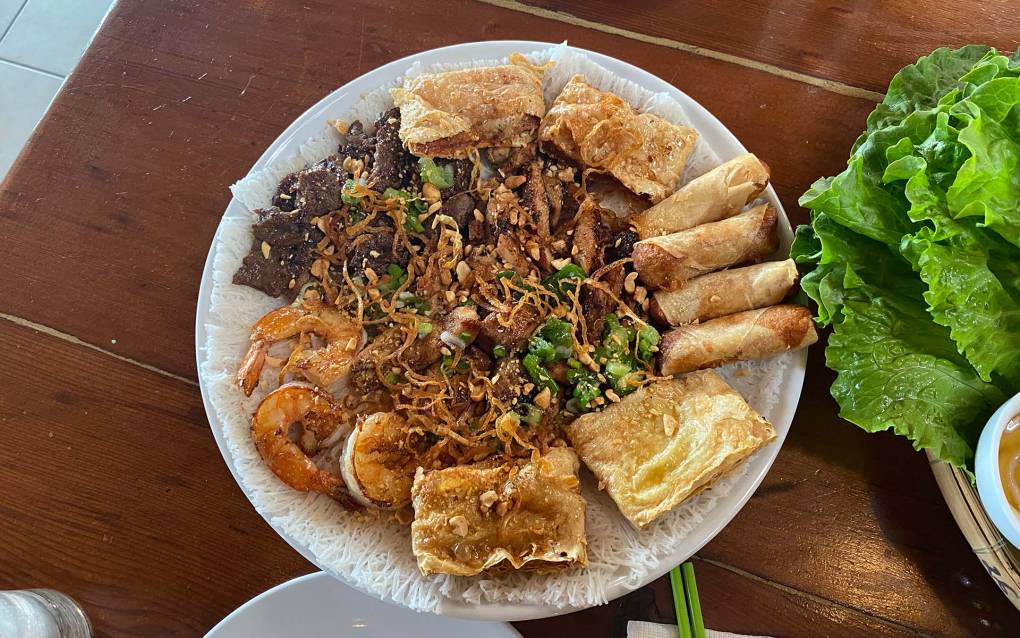
"caption": "Tigon's make-your-own-spring-roll spread makes for a fun and refreshing communal dining experience.",
"description": null,
"title": "tigon banh hoi-crop_LT",
"credit": "Luke Tsai/KQED",
"status": "inherit",
"altTag": "An abundant platter of fillings for make-your-own Vietnamese spring rolls, with shrimp, beef, fried egg rolls and more.",
"isLoading": false,
"fetchFailed": false
},
"arts_13933018": {
"type": "attachments",
"id": "arts_13933018",
"meta": {
"index": "attachments_1716263798",
"site": "arts",
"id": "13933018",
"found": true
},
"parent": 13933006,
"imgSizes": {
"twentyfourteen-full-width": {
"file": "https://ww2.kqed.org/app/uploads/sites/2/2023/08/hina-yakitori-skewers-1038x576.jpg",
"width": 1038,
"mimeType": "image/jpeg",
"height": 576
},
"thumbnail": {
"file": "https://ww2.kqed.org/app/uploads/sites/2/2023/08/hina-yakitori-skewers-160x90.jpg",
"width": 160,
"mimeType": "image/jpeg",
"height": 90
},
"post-thumbnail": {
"file": "https://ww2.kqed.org/app/uploads/sites/2/2023/08/hina-yakitori-skewers-672x372.jpg",
"width": 672,
"mimeType": "image/jpeg",
"height": 372
},
"kqedFullSize": {
"file": "https://ww2.kqed.org/app/uploads/sites/2/2023/08/hina-yakitori-skewers.jpg",
"width": 1920,
"height": 1080
},
"large": {
"file": "https://ww2.kqed.org/app/uploads/sites/2/2023/08/hina-yakitori-skewers-1020x574.jpg",
"width": 1020,
"mimeType": "image/jpeg",
"height": 574
},
"1536x1536": {
"file": "https://ww2.kqed.org/app/uploads/sites/2/2023/08/hina-yakitori-skewers-1536x864.jpg",
"width": 1536,
"mimeType": "image/jpeg",
"height": 864
},
"medium": {
"file": "https://ww2.kqed.org/app/uploads/sites/2/2023/08/hina-yakitori-skewers-800x450.jpg",
"width": 800,
"mimeType": "image/jpeg",
"height": 450
},
"medium_large": {
"file": "https://ww2.kqed.org/app/uploads/sites/2/2023/08/hina-yakitori-skewers-768x432.jpg",
"width": 768,
"mimeType": "image/jpeg",
"height": 432
}
},
"publishDate": 1691776172,
"modified": 1691776372,
"caption": "A trio of skewered chicken parts from a June 2023 dinner at San Francisco's Hina Yakitori, where about 15 different cuts of chicken are served over the course of an omakase-style tasting menu. The restaurant's last day of business will be Aug. 31.",
"description": null,
"title": "hina yakitori skewers",
"credit": "Janice Tsai",
"status": "inherit",
"altTag": "Three side-by-side images of chicken skewers: a thigh with green onion, the bisection of a sausage with whole grain mustard, and the crispy skin.",
"isLoading": false,
"fetchFailed": false
},
"arts_13926240": {
"type": "attachments",
"id": "arts_13926240",
"meta": {
"index": "attachments_1716263798",
"site": "arts",
"id": "13926240",
"found": true
},
"parent": 13926203,
"imgSizes": {
"twentyfourteen-full-width": {
"file": "https://cdn.kqed.org/wp-content/uploads/sites/2/2023/03/ramen-champ_lead-1038x576.jpg",
"width": 1038,
"mimeType": "image/jpeg",
"height": 576
},
"thumbnail": {
"file": "https://cdn.kqed.org/wp-content/uploads/sites/2/2023/03/ramen-champ_lead-160x110.jpg",
"width": 160,
"mimeType": "image/jpeg",
"height": 110
},
"post-thumbnail": {
"file": "https://cdn.kqed.org/wp-content/uploads/sites/2/2023/03/ramen-champ_lead-672x372.jpg",
"width": 672,
"mimeType": "image/jpeg",
"height": 372
},
"kqedFullSize": {
"file": "https://cdn.kqed.org/wp-content/uploads/sites/2/2023/03/ramen-champ_lead.jpg",
"width": 1920,
"height": 1320
},
"large": {
"file": "https://cdn.kqed.org/wp-content/uploads/sites/2/2023/03/ramen-champ_lead-1020x701.jpg",
"width": 1020,
"mimeType": "image/jpeg",
"height": 701
},
"1536x1536": {
"file": "https://cdn.kqed.org/wp-content/uploads/sites/2/2023/03/ramen-champ_lead-1536x1056.jpg",
"width": 1536,
"mimeType": "image/jpeg",
"height": 1056
},
"medium": {
"file": "https://cdn.kqed.org/wp-content/uploads/sites/2/2023/03/ramen-champ_lead-800x550.jpg",
"width": 800,
"mimeType": "image/jpeg",
"height": 550
},
"medium_large": {
"file": "https://cdn.kqed.org/wp-content/uploads/sites/2/2023/03/ramen-champ_lead-768x528.jpg",
"width": 768,
"mimeType": "image/jpeg",
"height": 528
}
},
"publishDate": 1678819973,
"modified": 1702068529,
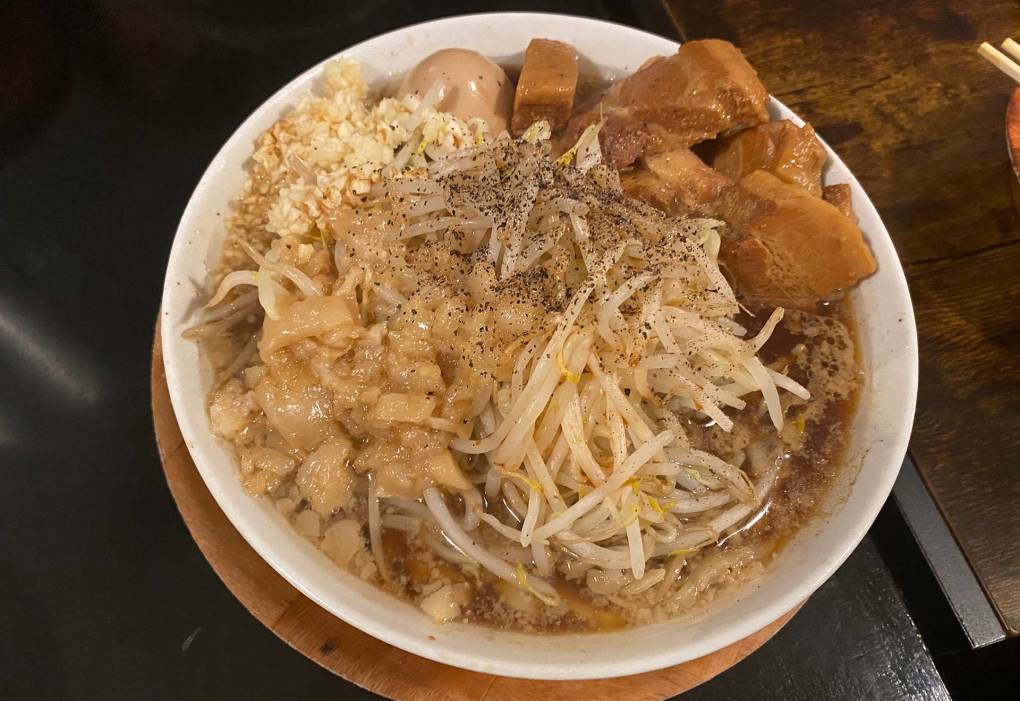
"caption": "Inspired by Tokyo's legendary Ramen Jiro, the Buta MAX at Ramen Champ in San Jose comes overloaded with decadent toppings.",
"description": null,
"title": "ramen champ_lead",
"credit": "Luke Tsai/KQED",
"status": "inherit",
"altTag": "Bowl of ramen with an exorbitant amount of toppings: bean sprouts, chopped raw garlic, pork belly, pork fat and marinated egg.",
"isLoading": false,
"fetchFailed": false
},
"arts_13925721": {
"type": "attachments",
"id": "arts_13925721",
"meta": {
"index": "attachments_1716263798",
"site": "arts",
"id": "13925721",
"found": true
},
"parent": 13925701,
"imgSizes": {
"twentyfourteen-full-width": {
"file": "https://ww2.kqed.org/app/uploads/sites/2/2023/02/masabistro_brokedamouf-1038x576.jpg",
"width": 1038,
"mimeType": "image/jpeg",
"height": 576
},
"thumbnail": {
"file": "https://ww2.kqed.org/app/uploads/sites/2/2023/02/masabistro_brokedamouf-160x110.jpg",
"width": 160,
"mimeType": "image/jpeg",
"height": 110
},
"post-thumbnail": {
"file": "https://ww2.kqed.org/app/uploads/sites/2/2023/02/masabistro_brokedamouf-672x372.jpg",
"width": 672,
"mimeType": "image/jpeg",
"height": 372
},
"kqedFullSize": {
"file": "https://ww2.kqed.org/app/uploads/sites/2/2023/02/masabistro_brokedamouf.jpg",
"width": 1920,
"height": 1320
},
"large": {
"file": "https://ww2.kqed.org/app/uploads/sites/2/2023/02/masabistro_brokedamouf-1020x701.jpg",
"width": 1020,
"mimeType": "image/jpeg",
"height": 701
},
"1536x1536": {
"file": "https://ww2.kqed.org/app/uploads/sites/2/2023/02/masabistro_brokedamouf-1536x1056.jpg",
"width": 1536,
"mimeType": "image/jpeg",
"height": 1056
},
"medium": {
"file": "https://ww2.kqed.org/app/uploads/sites/2/2023/02/masabistro_brokedamouf-800x550.jpg",
"width": 800,
"mimeType": "image/jpeg",
"height": 550
},
"medium_large": {
"file": "https://ww2.kqed.org/app/uploads/sites/2/2023/02/masabistro_brokedamouf-768x528.jpg",
"width": 768,
"mimeType": "image/jpeg",
"height": 528
}
},
"publishDate": 1677545336,
"modified": 1677545496,
"caption": "Even though Masa Ramen Bistro's signature \"Broke Da Mouf\" ramen doesn't have Hawaiian ingredients, the over-the-top spirit behind the dish is quintessentially Hawaiian.",
"description": null,
"title": "masabistro_brokedamouf",
"credit": "Luke Tsai",
"status": "inherit",
"altTag": "A bowl of ramen: red-tinted broth topped with pork chashu, egg, scallions and a flurry of grated Parmesan cheese.",
"isLoading": false,
"fetchFailed": false
},
"arts_13923842": {
"type": "attachments",
"id": "arts_13923842",
"meta": {
"index": "attachments_1716263798",
"site": "arts",
"id": "13923842",
"found": true
},
"parent": 13923840,
"imgSizes": {
"twentyfourteen-full-width": {
"file": "https://ww2.kqed.org/app/uploads/sites/2/2023/01/noka_lead-cropped-1038x576.jpg",
"width": 1038,
"mimeType": "image/jpeg",
"height": 576
},
"thumbnail": {
"file": "https://ww2.kqed.org/app/uploads/sites/2/2023/01/noka_lead-cropped-160x90.jpg",
"width": 160,
"mimeType": "image/jpeg",
"height": 90
},
"post-thumbnail": {
"file": "https://ww2.kqed.org/app/uploads/sites/2/2023/01/noka_lead-cropped-672x372.jpg",
"width": 672,
"mimeType": "image/jpeg",
"height": 372
},
"kqedFullSize": {
"file": "https://ww2.kqed.org/app/uploads/sites/2/2023/01/noka_lead-cropped.jpg",
"width": 1920,
"height": 1080
},
"large": {
"file": "https://ww2.kqed.org/app/uploads/sites/2/2023/01/noka_lead-cropped-1020x574.jpg",
"width": 1020,
"mimeType": "image/jpeg",
"height": 574
},
"1536x1536": {
"file": "https://ww2.kqed.org/app/uploads/sites/2/2023/01/noka_lead-cropped-1536x864.jpg",
"width": 1536,
"mimeType": "image/jpeg",
"height": 864
},
"medium": {
"file": "https://ww2.kqed.org/app/uploads/sites/2/2023/01/noka_lead-cropped-800x450.jpg",
"width": 800,
"mimeType": "image/jpeg",
"height": 450
},
"medium_large": {
"file": "https://ww2.kqed.org/app/uploads/sites/2/2023/01/noka_lead-cropped-768x432.jpg",
"width": 768,
"mimeType": "image/jpeg",
"height": 432
}
},
"publishDate": 1674151762,
"modified": 1674159527,
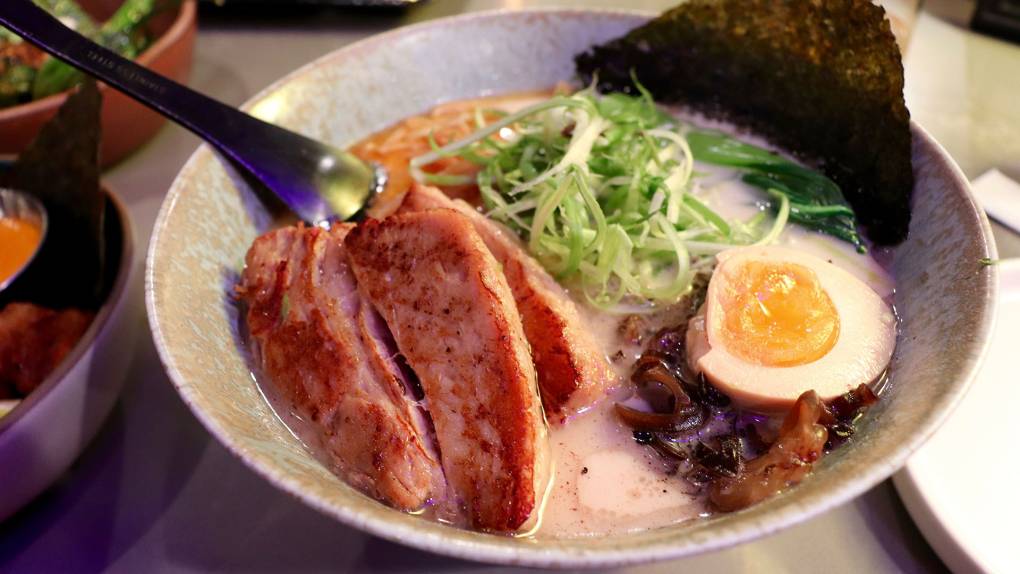
"caption": "The classic tonkotsu (pork belly, bean sprouts, bok choy, mushrooms, seaweed, noodles, egg) is a signature at Noka Ramen.",
"description": null,
"title": "noka_lead-cropped",
"credit": "Alan Chazaro",
"status": "inherit",
"altTag": "a bowl of ramen, with pork belly, seaweed, bean sprouts and more",
"isLoading": false,
"fetchFailed": false
},
"arts_13923021": {
"type": "attachments",
"id": "arts_13923021",
"meta": {
"index": "attachments_1716263798",
"site": "arts",
"id": "13923021",
"found": true
},
"parent": 13923005,
"imgSizes": {
"twentyfourteen-full-width": {
"file": "https://ww2.kqed.org/app/uploads/sites/2/2022/12/osechi_chikuzenni-1038x576.jpg",
"width": 1038,
"mimeType": "image/jpeg",
"height": 576
},
"thumbnail": {
"file": "https://ww2.kqed.org/app/uploads/sites/2/2022/12/osechi_chikuzenni-160x110.jpg",
"width": 160,
"mimeType": "image/jpeg",
"height": 110
},
"post-thumbnail": {
"file": "https://ww2.kqed.org/app/uploads/sites/2/2022/12/osechi_chikuzenni-672x372.jpg",
"width": 672,
"mimeType": "image/jpeg",
"height": 372
},
"kqedFullSize": {
"file": "https://ww2.kqed.org/app/uploads/sites/2/2022/12/osechi_chikuzenni.jpg",
"width": 1920,
"height": 1318
},
"large": {
"file": "https://ww2.kqed.org/app/uploads/sites/2/2022/12/osechi_chikuzenni-1020x700.jpg",
"width": 1020,
"mimeType": "image/jpeg",
"height": 700
},
"1536x1536": {
"file": "https://ww2.kqed.org/app/uploads/sites/2/2022/12/osechi_chikuzenni-1536x1054.jpg",
"width": 1536,
"mimeType": "image/jpeg",
"height": 1054
},
"medium": {
"file": "https://ww2.kqed.org/app/uploads/sites/2/2022/12/osechi_chikuzenni-800x549.jpg",
"width": 800,
"mimeType": "image/jpeg",
"height": 549
},
"medium_large": {
"file": "https://ww2.kqed.org/app/uploads/sites/2/2022/12/osechi_chikuzenni-768x527.jpg",
"width": 768,
"mimeType": "image/jpeg",
"height": 527
}
},
"publishDate": 1671562485,
"modified": 1671562731,
"caption": "Chikuzenni, or simmered chicken with root vegetables, is one of the traditional dishes that chef Yuji Ishikata will be featuring in his Japanese New Year's pop-up.",
"description": null,
"title": "osechi_chikuzenni",
"credit": "Courtesy of J-Sei",
"status": "inherit",
"altTag": "Overhead view of wooden Japanese New Year's boxes filled with simmered chicken and root vegetables.",
"isLoading": false,
"fetchFailed": false
},
"arts_13920733": {
"type": "attachments",
"id": "arts_13920733",
"meta": {
"index": "attachments_1716263798",
"site": "arts",
"id": "13920733",
"found": true
},
"parent": 0,
"imgSizes": {
"twentyfourteen-full-width": {
"file": "https://ww2.kqed.org/app/uploads/sites/2/2022/10/RS58863_049_KQED_JustOneCookbook_09202022-qut-1-1038x576.jpg",
"width": 1038,
"mimeType": "image/jpeg",
"height": 576
},
"thumbnail": {
"file": "https://ww2.kqed.org/app/uploads/sites/2/2022/10/RS58863_049_KQED_JustOneCookbook_09202022-qut-1-160x90.jpg",
"width": 160,
"mimeType": "image/jpeg",
"height": 90
},
"post-thumbnail": {
"file": "https://ww2.kqed.org/app/uploads/sites/2/2022/10/RS58863_049_KQED_JustOneCookbook_09202022-qut-1-672x372.jpg",
"width": 672,
"mimeType": "image/jpeg",
"height": 372
},
"kqedFullSize": {
"file": "https://ww2.kqed.org/app/uploads/sites/2/2022/10/RS58863_049_KQED_JustOneCookbook_09202022-qut-1.jpg",
"width": 1920,
"height": 1080
},
"large": {
"file": "https://ww2.kqed.org/app/uploads/sites/2/2022/10/RS58863_049_KQED_JustOneCookbook_09202022-qut-1-1020x574.jpg",
"width": 1020,
"mimeType": "image/jpeg",
"height": 574
},
"1536x1536": {
"file": "https://ww2.kqed.org/app/uploads/sites/2/2022/10/RS58863_049_KQED_JustOneCookbook_09202022-qut-1-1536x864.jpg",
"width": 1536,
"mimeType": "image/jpeg",
"height": 864
},
"medium": {
"file": "https://ww2.kqed.org/app/uploads/sites/2/2022/10/RS58863_049_KQED_JustOneCookbook_09202022-qut-1-800x450.jpg",
"width": 800,
"mimeType": "image/jpeg",
"height": 450
},
"medium_large": {
"file": "https://ww2.kqed.org/app/uploads/sites/2/2022/10/RS58863_049_KQED_JustOneCookbook_09202022-qut-1-768x432.jpg",
"width": 768,
"mimeType": "image/jpeg",
"height": 432
}
},
"publishDate": 1666394562,
"modified": 1666395873,
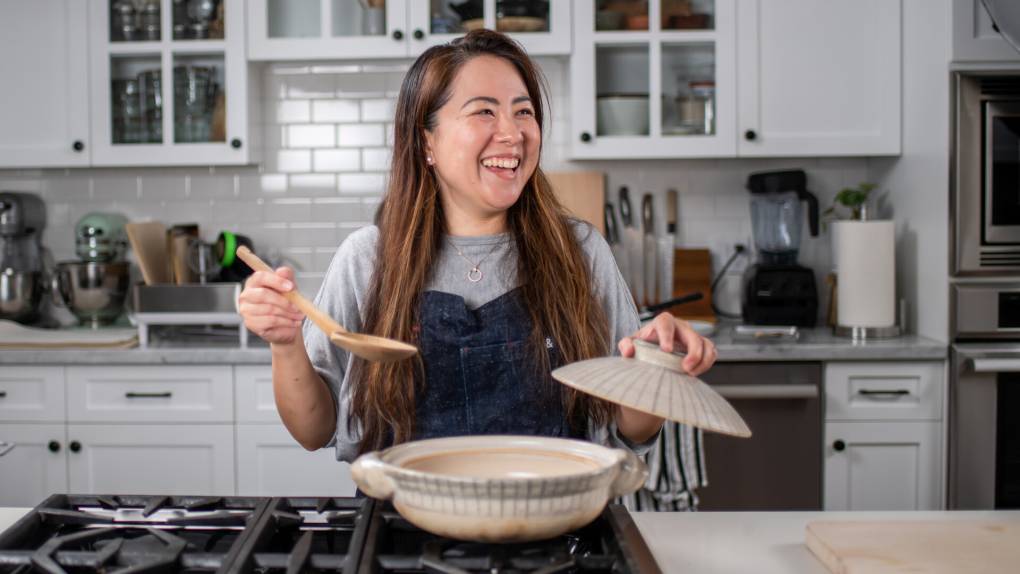
"caption": "Namiko Chen shoots all of the photos and videos for her blog Just One Cookbook at her home in the Peninsula. In the 11 years since she started the site, it has grown to become the internet's most popular English-language resource on Japanese home cooking.",
"description": null,
"title": "RS58863_049_KQED_JustOneCookbook_09202022-qut",
"credit": "Beth LaBerge/KQED",
"status": "inherit",
"altTag": "An Asian woman in a dark blue apron smiles while standing at the stove with a ladle and a pot lid in her hands.",
"isLoading": false,
"fetchFailed": false
},
"arts_13912640": {
"type": "attachments",
"id": "arts_13912640",
"meta": {
"index": "attachments_1716263798",
"site": "arts",
"id": "13912640",
"found": true
},
"parent": 13912639,
"imgSizes": {
"twentyfourteen-full-width": {
"file": "https://ww2.kqed.org/app/uploads/sites/2/2022/04/yuraku_crop-1038x576.jpg",
"width": 1038,
"mimeType": "image/jpeg",
"height": 576
},
"thumbnail": {
"file": "https://ww2.kqed.org/app/uploads/sites/2/2022/04/yuraku_crop-160x90.jpg",
"width": 160,
"mimeType": "image/jpeg",
"height": 90
},
"post-thumbnail": {
"file": "https://ww2.kqed.org/app/uploads/sites/2/2022/04/yuraku_crop-672x372.jpg",
"width": 672,
"mimeType": "image/jpeg",
"height": 372
},
"kqedFullSize": {
"file": "https://ww2.kqed.org/app/uploads/sites/2/2022/04/yuraku_crop-scaled.jpg",
"width": 2560,
"height": 1440
},
"2048x2048": {
"file": "https://ww2.kqed.org/app/uploads/sites/2/2022/04/yuraku_crop-2048x1152.jpg",
"width": 2048,
"mimeType": "image/jpeg",
"height": 1152
},
"large": {
"file": "https://ww2.kqed.org/app/uploads/sites/2/2022/04/yuraku_crop-1020x574.jpg",
"width": 1020,
"mimeType": "image/jpeg",
"height": 574
},
"1536x1536": {
"file": "https://ww2.kqed.org/app/uploads/sites/2/2022/04/yuraku_crop-1536x864.jpg",
"width": 1536,
"mimeType": "image/jpeg",
"height": 864
},
"full-width": {
"file": "https://ww2.kqed.org/app/uploads/sites/2/2022/04/yuraku_crop-1920x1080.jpg",
"width": 1920,
"mimeType": "image/jpeg",
"height": 1080
},
"medium": {
"file": "https://ww2.kqed.org/app/uploads/sites/2/2022/04/yuraku_crop-800x450.jpg",
"width": 800,
"mimeType": "image/jpeg",
"height": 450
},
"medium_large": {
"file": "https://ww2.kqed.org/app/uploads/sites/2/2022/04/yuraku_crop-768x432.jpg",
"width": 768,
"mimeType": "image/jpeg",
"height": 432
}
},
"publishDate": 1651176410,
"modified": 1651176498,
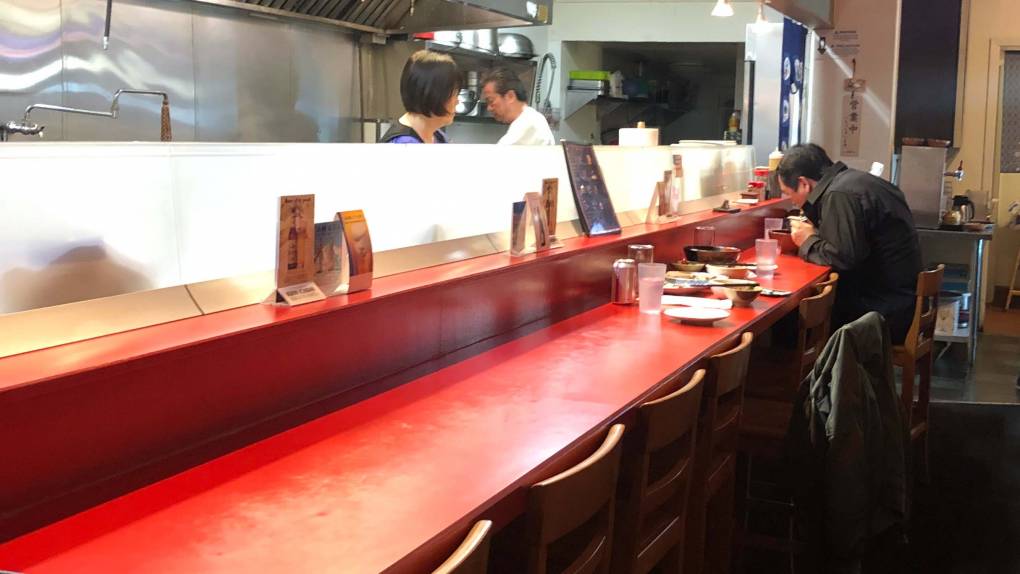
"caption": "The cozy red diner counter at San Mateo's Yu-Raku, one of the Bay Area's only restaurants specializing in Japanese-style Chinese food.",
"description": null,
"title": "yuraku_crop",
"credit": "Thien Pham",
"status": "inherit",
"altTag": "A red diner counter facing toward a restaurant's open kitchen area.",
"isLoading": false,
"fetchFailed": false
},
"arts_13906465": {
"type": "attachments",
"id": "arts_13906465",
"meta": {
"index": "attachments_1716263798",
"site": "arts",
"id": "13906465",
"found": true
},
"parent": 13906456,
"imgSizes": {
"twentyfourteen-full-width": {
"file": "https://ww2.kqed.org/app/uploads/sites/2/2021/11/Aoba_lena_alex-zhu-1038x576.jpg",
"width": 1038,
"mimeType": "image/jpeg",
"height": 576
},
"thumbnail": {
"file": "https://ww2.kqed.org/app/uploads/sites/2/2021/11/Aoba_lena_alex-zhu-160x90.jpg",
"width": 160,
"mimeType": "image/jpeg",
"height": 90
},
"post-thumbnail": {
"file": "https://ww2.kqed.org/app/uploads/sites/2/2021/11/Aoba_lena_alex-zhu-672x372.jpg",
"width": 672,
"mimeType": "image/jpeg",
"height": 372
},
"kqedFullSize": {
"file": "https://ww2.kqed.org/app/uploads/sites/2/2021/11/Aoba_lena_alex-zhu-scaled.jpg",
"width": 2560,
"height": 1440
},
"2048x2048": {
"file": "https://ww2.kqed.org/app/uploads/sites/2/2021/11/Aoba_lena_alex-zhu-2048x1152.jpg",
"width": 2048,
"mimeType": "image/jpeg",
"height": 1152
},
"large": {
"file": "https://ww2.kqed.org/app/uploads/sites/2/2021/11/Aoba_lena_alex-zhu-1020x574.jpg",
"width": 1020,
"mimeType": "image/jpeg",
"height": 574
},
"1536x1536": {
"file": "https://ww2.kqed.org/app/uploads/sites/2/2021/11/Aoba_lena_alex-zhu-1536x864.jpg",
"width": 1536,
"mimeType": "image/jpeg",
"height": 864
},
"full-width": {
"file": "https://ww2.kqed.org/app/uploads/sites/2/2021/11/Aoba_lena_alex-zhu-1920x1080.jpg",
"width": 1920,
"mimeType": "image/jpeg",
"height": 1080
},
"medium": {
"file": "https://ww2.kqed.org/app/uploads/sites/2/2021/11/Aoba_lena_alex-zhu-800x450.jpg",
"width": 800,
"mimeType": "image/jpeg",
"height": 450
},
"medium_large": {
"file": "https://ww2.kqed.org/app/uploads/sites/2/2021/11/Aoba_lena_alex-zhu-768x432.jpg",
"width": 768,
"mimeType": "image/jpeg",
"height": 432
}
},
"publishDate": 1637713653,
"modified": 1637713733,
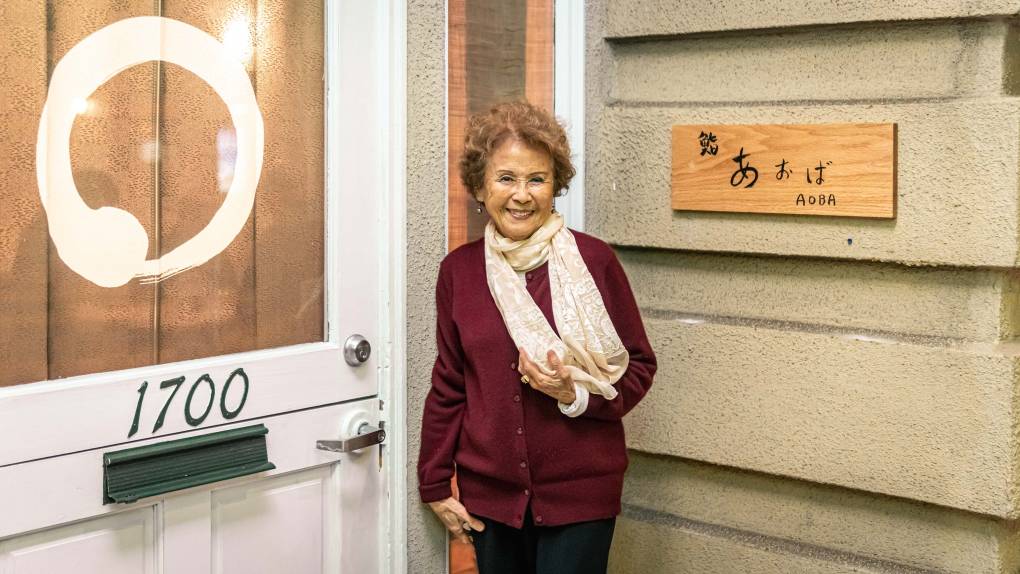
"caption": "Even at 91 years old, Aoba owner Lena Turner doesn't feel close to ready to retire.",
"description": null,
"title": "Aoba_lena_alex zhu",
"credit": "Alex Zhu",
"status": "inherit",
"altTag": "An older woman in a white scarf stands next to the entrance to Aoba restaurant.",
"isLoading": false,
"fetchFailed": false
},
"arts_13898744": {
"type": "attachments",
"id": "arts_13898744",
"meta": {
"index": "attachments_1716263798",
"site": "arts",
"id": "13898744",
"found": true
},
"parent": 13898743,
"imgSizes": {
"twentyfourteen-full-width": {
"file": "https://ww2.kqed.org/app/uploads/sites/2/2021/06/NoodleHaystack_wagyu-cropped-1038x576.jpg",
"width": 1038,
"mimeType": "image/jpeg",
"height": 576
},
"thumbnail": {
"file": "https://ww2.kqed.org/app/uploads/sites/2/2021/06/NoodleHaystack_wagyu-cropped-160x90.jpg",
"width": 160,
"mimeType": "image/jpeg",
"height": 90
},
"post-thumbnail": {
"file": "https://ww2.kqed.org/app/uploads/sites/2/2021/06/NoodleHaystack_wagyu-cropped-672x372.jpg",
"width": 672,
"mimeType": "image/jpeg",
"height": 372
},
"kqedFullSize": {
"file": "https://ww2.kqed.org/app/uploads/sites/2/2021/06/NoodleHaystack_wagyu-cropped.jpg",
"width": 2049,
"height": 1152
},
"large": {
"file": "https://ww2.kqed.org/app/uploads/sites/2/2021/06/NoodleHaystack_wagyu-cropped-1020x573.jpg",
"width": 1020,
"mimeType": "image/jpeg",
"height": 573
},
"1536x1536": {
"file": "https://ww2.kqed.org/app/uploads/sites/2/2021/06/NoodleHaystack_wagyu-cropped-1536x864.jpg",
"width": 1536,
"mimeType": "image/jpeg",
"height": 864
},
"full-width": {
"file": "https://ww2.kqed.org/app/uploads/sites/2/2021/06/NoodleHaystack_wagyu-cropped-1920x1079.jpg",
"width": 1920,
"mimeType": "image/jpeg",
"height": 1079
},
"medium": {
"file": "https://ww2.kqed.org/app/uploads/sites/2/2021/06/NoodleHaystack_wagyu-cropped-800x450.jpg",
"width": 800,
"mimeType": "image/jpeg",
"height": 450
},
"medium_large": {
"file": "https://ww2.kqed.org/app/uploads/sites/2/2021/06/NoodleHaystack_wagyu-cropped-768x432.jpg",
"width": 768,
"mimeType": "image/jpeg",
"height": 432
}
},
"publishDate": 1623428226,
"modified": 1623428406,
"caption": "Wagyu beef ramen at one of Noodle in a Haystack's pop-ups.",
"description": "Wagyu beef ramen at one of Noodle in a Haystack's pop-ups.",
"title": "NoodleHaystack_wagyu-cropped",
"credit": "Wendy Lin",
"status": "inherit",
"altTag": "Bowl of ramen topped with slices of pink wagyu beef and a tangle of herbs.",
"isLoading": false,
"fetchFailed": false
}
},
"audioPlayerReducer": {
"postId": "stream_live",
"isPaused": true,
"isPlaying": false,
"pfsActive": false,
"pledgeModalIsOpen": true,
"playerDrawerIsOpen": false,
"liveAudioPlayStartedAt": 0,
"liveAudioPlayContext": ""
},
"authorsReducer": {
"byline_arts_13935854": {
"type": "authors",
"id": "byline_arts_13935854",
"meta": {
"override": true
},
"slug": "byline_arts_13935854",
"name": "Kofi Ansong",
"isLoading": false
},
"ltsai": {
"type": "authors",
"id": "11743",
"meta": {
"index": "authors_1716337520",
"id": "11743",
"found": true
},
"name": "Luke Tsai",
"firstName": "Luke",
"lastName": "Tsai",
"slug": "ltsai",
"email": "ltsai@kqed.org",
"display_author_email": true,
"staff_mastheads": [
"arts"
],
"title": "Food Editor",
"bio": "Luke Tsai is KQED's food editor and resident stinky tofu connoisseur. Prior to KQED, he was an editor at Eater SF, \u003cem>San Francisco \u003c/em>magazine, and the \u003cem>East Bay Express\u003c/em>, and his work has also appeared in TASTE, the \u003cem>San Francisco Chronicle\u003c/em>, and the \u003cem>Best Food Writing\u003c/em> anthology. When he isn't writing or editing, you'll find him eating most everything he can get his hands on.",
"avatar": "https://secure.gravatar.com/avatar/1e59b45bf191526e7339d6ba46e33a57b2030d25c27660ecc64ea3cb863e34f7?s=600&d=blank&r=g",
"twitter": "theluketsai",
"bluesky": null,
"facebook": null,
"instagram": null,
"linkedin": null,
"sites": [
{
"site": "",
"roles": [
"editor"
]
},
{
"site": "arts",
"roles": [
"administrator"
]
},
{
"site": "news",
"roles": [
"editor",
"contributor"
]
},
{
"site": "bayareabites",
"roles": [
"editor"
]
},
{
"site": "food",
"roles": [
"editor"
]
}
],
"headData": {
"title": "Luke Tsai | KQED",
"description": "Food Editor",
"ogImgSrc": "https://secure.gravatar.com/avatar/1e59b45bf191526e7339d6ba46e33a57b2030d25c27660ecc64ea3cb863e34f7?s=600&d=blank&r=g",
"twImgSrc": "https://secure.gravatar.com/avatar/1e59b45bf191526e7339d6ba46e33a57b2030d25c27660ecc64ea3cb863e34f7?s=600&d=blank&r=g"
},
"isLoading": false,
"link": "/author/ltsai"
},
"achazaro": {
"type": "authors",
"id": "11748",
"meta": {
"index": "authors_1716337520",
"id": "11748",
"found": true
},
"name": "Alan Chazaro",
"firstName": "Alan",
"lastName": "Chazaro",
"slug": "achazaro",
"email": "agchazaro@gmail.com",
"display_author_email": true,
"staff_mastheads": [],
"title": "Food Writer and Reporter",
"bio": "Alan Chazaro is the author of \u003cem>This Is Not a Frank Ocean Cover Album\u003c/em> (Black Lawrence Press, 2019), \u003cem>Piñata Theory\u003c/em> (Black Lawrence Press, 2020), and \u003cem>Notes from the Eastern Span of the Bay Bridge\u003c/em> (Ghost City Press, 2021). He is a graduate of June Jordan’s Poetry for the People program at UC Berkeley and a former Lawrence Ferlinghetti Fellow at the University of San Francisco. He writes about sports, food, art, music, education, and culture while repping the Bay on \u003ca href=\"https://twitter.com/alan_chazaro\">Twitter\u003c/a> and \u003ca href=\"https://www.instagram.com/alan_chazaro/?hl=en\">Instagram\u003c/a> at @alan_chazaro.",
"avatar": "https://secure.gravatar.com/avatar/ea8b6dd970fc5c29e7a188e7d5861df7?s=600&d=blank&r=g",
"twitter": "alan_chazaro",
"facebook": null,
"instagram": null,
"linkedin": null,
"sites": [
{
"site": "arts",
"roles": [
"contributor"
]
},
{
"site": "news",
"roles": [
"editor"
]
}
],
"headData": {
"title": "Alan Chazaro | KQED",
"description": "Food Writer and Reporter",
"ogImgSrc": "https://secure.gravatar.com/avatar/ea8b6dd970fc5c29e7a188e7d5861df7?s=600&d=blank&r=g",
"twImgSrc": "https://secure.gravatar.com/avatar/ea8b6dd970fc5c29e7a188e7d5861df7?s=600&d=blank&r=g"
},
"isLoading": false,
"link": "/author/achazaro"
},
"ksong": {
"type": "authors",
"id": "11813",
"meta": {
"index": "authors_1716337520",
"id": "11813",
"found": true
},
"name": "Kristie Song",
"firstName": "Kristie",
"lastName": "Song",
"slug": "ksong",
"email": "ksong@kqed.org",
"display_author_email": false,
"staff_mastheads": [],
"title": "Editorial Intern ",
"bio": "Kristie Song is an Arts & Culture Intern at KQED. She is currently a graduate student at UC Berkeley, where she studies audio and multimedia journalism. Previously, she covered the local community for Oakland North, produced episodes for The Science of Happiness, and served as news director for KUCI, UC Irvine’s radio station. Outside of reporting, she likes drawing comics, listening to angsty rock, and practicing the guitar.",
"avatar": "https://secure.gravatar.com/avatar/c1149e78c3c44f92d4945a8ab0711af6?s=600&d=blank&r=g",
"twitter": null,
"facebook": null,
"instagram": null,
"linkedin": null,
"sites": [
{
"site": "arts",
"roles": [
"editor"
]
}
],
"headData": {
"title": "Kristie Song | KQED",
"description": "Editorial Intern ",
"ogImgSrc": "https://secure.gravatar.com/avatar/c1149e78c3c44f92d4945a8ab0711af6?s=600&d=blank&r=g",
"twImgSrc": "https://secure.gravatar.com/avatar/c1149e78c3c44f92d4945a8ab0711af6?s=600&d=blank&r=g"
},
"isLoading": false,
"link": "/author/ksong"
}
},
"pagesReducer": {
"arts_tag_japanese-food": {
"type": "terms",
"id": "arts_21732",
"meta": {
"index": "terms_1716263798",
"site": "arts",
"id": "21732",
"score": 9.556034
},
"featImg": null,
"name": "japanese food",
"description": null,
"taxonomy": "tag",
"headData": {
"twImgId": null,
"twTitle": null,
"ogTitle": null,
"ogImgId": null,
"twDescription": null,
"description": null,
"title": "japanese food Archives | KQED Arts",
"ogDescription": null
},
"ttid": 21744,
"slug": "japanese-food",
"isLoading": false,
"title": "japanese food",
"pageMeta": {
"site": "arts",
"WpPageTemplate": "page-topic-editorial",
"currentPage": 2
},
"blocks": [
{
"blockName": "kqed/post-list",
"attrs": {
"layout": "cardArticle2",
"query": "posts/arts?tag=japanese-food",
"seeMore": false,
"paginated": true,
"page": 2
}
},
{
"blockName": "kqed/ad"
}
]
}
},
"pfsSessionReducer": {},
"postsReducer": {
"stream_live": {
"type": "live",
"id": "stream_live",
"audioUrl": "https://streams.kqed.org/kqedradio",
"title": "Live Stream",
"excerpt": "Live Stream information currently unavailable.",
"link": "/radio",
"featImg": "",
"label": {
"name": "KQED Live",
"link": "/"
}
},
"stream_kqedNewscast": {
"type": "posts",
"id": "stream_kqedNewscast",
"audioUrl": "https://www.kqed.org/.stream/anon/radio/RDnews/newscast.mp3?_=1",
"title": "KQED Newscast",
"featImg": "",
"label": {
"name": "88.5 FM",
"link": "/"
}
},
"arts_13935854": {
"type": "posts",
"id": "arts_13935854",
"meta": {
"index": "posts_1716263798",
"site": "arts",
"id": "13935854",
"score": null,
"sort": [
1696531294000
]
},
"parent": 0,
"labelTerm": {},
"blocks": [],
"publishDate": 1696531294,
"format": "aside",
"title": "How Miso Helped Me Find My Community in San Francisco",
"headTitle": "How Miso Helped Me Find My Community in San Francisco | KQED",
"content": "\u003cfigure id=\"attachment_13934485\" class=\"wp-caption alignnone\" style=\"max-width: 2000px\">\u003cimg loading=\"lazy\" decoding=\"async\" class=\"size-full wp-image-13934485\" src=\"https://ww2.kqed.org/app/uploads/sites/2/2023/09/RS68729__RPT2423-Enhanced-NR-KQED.jpg\" alt=\"A person sits on the hood of a car parked on the side of a street.\" width=\"2000\" height=\"1333\" srcset=\"https://cdn.kqed.org/wp-content/uploads/sites/2/2023/09/RS68729__RPT2423-Enhanced-NR-KQED.jpg 2000w, https://cdn.kqed.org/wp-content/uploads/sites/2/2023/09/RS68729__RPT2423-Enhanced-NR-KQED-800x533.jpg 800w, https://cdn.kqed.org/wp-content/uploads/sites/2/2023/09/RS68729__RPT2423-Enhanced-NR-KQED-1020x680.jpg 1020w, https://cdn.kqed.org/wp-content/uploads/sites/2/2023/09/RS68729__RPT2423-Enhanced-NR-KQED-160x107.jpg 160w, https://cdn.kqed.org/wp-content/uploads/sites/2/2023/09/RS68729__RPT2423-Enhanced-NR-KQED-768x512.jpg 768w, https://cdn.kqed.org/wp-content/uploads/sites/2/2023/09/RS68729__RPT2423-Enhanced-NR-KQED-1536x1024.jpg 1536w, https://cdn.kqed.org/wp-content/uploads/sites/2/2023/09/RS68729__RPT2423-Enhanced-NR-KQED-1920x1280.jpg 1920w\" sizes=\"(max-width: 2000px) 100vw, 2000px\">\u003cfigcaption class=\"wp-caption-text\">Kofi Ansong grabs a seat in front of Aedan Koji Kitchen, the fermented foods shop that helped him cultivate his newfound passion for miso. \u003ccite>(Raphael Timmons/KQED)\u003c/cite>\u003c/figcaption>\u003c/figure>\n\u003cp>[dropcap]I[/dropcap] knew nothing about miso when I moved to San Francisco.\u003c/p>\n\u003cp>For the whole first year, I felt out of place meandering the city’s foggy hills and longed to feel at home — or, short of that, to at least recreate the life I had back in New England. Instead of reaching out to new acquaintances, I socialized primarily through FaceTime calls with friends back East. Instead of exploring the city’s food scene, I frequently Ubered to familiar chain restaurants like Shake Shack. And when I cooked for myself, it was exclusively a spaghetti recipe I’d learned in high school.\u003c/p>\n\u003cp>This was back in 2021, and as I grappled with my own displacement, I was also becoming aware of the displacement around me. My new neighbors in the Mission consisted of well-to-do transplants and the houseless people that I passed by every day, splayed out along the sidewalks. The worst thing about it was my sense that I was becoming numb to these sights of human suffering. Was I doing anything to make San Francisco a better place? If not, I felt leaving the Bay was the only contribution I could make.\u003c/p>\n\u003cp>Amidst these tormented thoughts, one day I noticed my neighbor was reselling the Japanese chef’s Maori Murota’s book \u003ci>Japanese Home Cooking\u003c/i>. Honestly, I had no intention of breaking our tacit vow to only ever nod silently at one another. But the book’s cover had a drawing of a bowl of ramen — the preferred meal of my favorite childhood manga character, Naruto. Immediately, I wanted nothing more but to forget my present worries, binge-watch the Chunin Exams arc and scarf down a big bowl of noodles. I finally introduced myself to the neighbor, an interior designer named Seth, and bought the book.\u003c/p>\n\u003cfigure id=\"attachment_13935911\" class=\"wp-caption alignnone\" style=\"max-width: 1920px\">\u003cimg loading=\"lazy\" decoding=\"async\" class=\"size-full wp-image-13935911\" src=\"https://ww2.kqed.org/app/uploads/sites/2/2023/10/japanese-cookbook-cover_kofi.jpg\" alt=\"The cover of a cookbook titled 'Japanese Home Cooking' by Maori Murota. The cover illustration depicts a pair of chopsticks lifting half a soft-boiled egg from a bowl of ramen noodles.\" width=\"1920\" height=\"2400\" srcset=\"https://cdn.kqed.org/wp-content/uploads/sites/2/2023/10/japanese-cookbook-cover_kofi.jpg 1920w, https://cdn.kqed.org/wp-content/uploads/sites/2/2023/10/japanese-cookbook-cover_kofi-800x1000.jpg 800w, https://cdn.kqed.org/wp-content/uploads/sites/2/2023/10/japanese-cookbook-cover_kofi-1020x1275.jpg 1020w, https://cdn.kqed.org/wp-content/uploads/sites/2/2023/10/japanese-cookbook-cover_kofi-160x200.jpg 160w, https://cdn.kqed.org/wp-content/uploads/sites/2/2023/10/japanese-cookbook-cover_kofi-768x960.jpg 768w, https://cdn.kqed.org/wp-content/uploads/sites/2/2023/10/japanese-cookbook-cover_kofi-1229x1536.jpg 1229w, https://cdn.kqed.org/wp-content/uploads/sites/2/2023/10/japanese-cookbook-cover_kofi-1638x2048.jpg 1638w\" sizes=\"(max-width: 1920px) 100vw, 1920px\">\u003cfigcaption class=\"wp-caption-text\">The book that launched Ansong’s yearlong exploration of miso. \u003ccite>(Courtesy of Kofi Ansong)\u003c/cite>\u003c/figcaption>\u003c/figure>\n\u003cp>One obstacle remained: Murota’s instructions for preparing the broth, which called for hours of simmering and many different pots, intimidated novice-cook me. In contrast, Murota’s brown miso vegetable soup seemed more approachable, with a simple dashi base made by soaking shiitake mushrooms and kombu in water overnight. I was relieved that my local grocery store carried the soup’s key ingredient: brown miso paste.\u003c/p>\n\u003cp>[ad fullwidth]\u003c/p>\n\u003cp>Still, I wasn’t sure what to expect. Growing up in the suburbs of Connecticut didn’t lend itself to exposure to Japanese cuisine. My mother cooked foods from our Ghanaian heritage like banku, a ball of corn dough served in rich stew, and I understood it was the fermenting of the corn’s starches that gave the banku its bittersweetness. This thick, salty paste, made from fermented soybeans, was something different.\u003c/p>\n\u003cp>As it turned out, the vegetables I’d selected for the soup emerged transformed and delicious after being steeped in the miso broth. The radishes had mellowed and were now earthy rather than spicy. Tender potatoes made the soup creamy. The broth itself was excellent, each sip full of savory umami yet still refreshing. In short, I was hooked on miso.\u003c/p>\n\u003cfigure id=\"attachment_13934483\" class=\"wp-caption alignnone\" style=\"max-width: 2000px\">\u003cimg loading=\"lazy\" decoding=\"async\" class=\"size-full wp-image-13934483\" src=\"https://ww2.kqed.org/app/uploads/sites/2/2023/09/RS68712__RPT2207-KQED.jpg\" alt=\"A collection of mason jars of beans and preserves.\" width=\"2000\" height=\"1333\" srcset=\"https://cdn.kqed.org/wp-content/uploads/sites/2/2023/09/RS68712__RPT2207-KQED.jpg 2000w, https://cdn.kqed.org/wp-content/uploads/sites/2/2023/09/RS68712__RPT2207-KQED-800x533.jpg 800w, https://cdn.kqed.org/wp-content/uploads/sites/2/2023/09/RS68712__RPT2207-KQED-1020x680.jpg 1020w, https://cdn.kqed.org/wp-content/uploads/sites/2/2023/09/RS68712__RPT2207-KQED-160x107.jpg 160w, https://cdn.kqed.org/wp-content/uploads/sites/2/2023/09/RS68712__RPT2207-KQED-768x512.jpg 768w, https://cdn.kqed.org/wp-content/uploads/sites/2/2023/09/RS68712__RPT2207-KQED-1536x1024.jpg 1536w, https://cdn.kqed.org/wp-content/uploads/sites/2/2023/09/RS68712__RPT2207-KQED-1920x1280.jpg 1920w\" sizes=\"(max-width: 2000px) 100vw, 2000px\">\u003cfigcaption class=\"wp-caption-text\">Miso ingredients and products at San Francisco’s Aedan Koji Kitchen. \u003ccite>(Raphael Timmons/KQED)\u003c/cite>\u003c/figcaption>\u003c/figure>\n\u003cp>I soon began exploring more dishes I could make with the seasoning paste. Murota’s book contains a recipe for Japanese curry, and I found that adding miso deepened the sweetness from the apple and brought out the stew’s mouth-watering aromas. On another occasion, when I was recovering from a cold, I soothed myself with a cup of steaming hot water mixed with miso. I liked the nutty concoction so much that I now alternate between it and tea for breakfast.\u003c/p>\n\u003cp>Miso’s brilliance comes from both its versatility and complexity. It has an intricate flavor, and it’s also easy and rewarding to use. And my success with these new recipes encouraged me to embrace changes that extended beyond cooking.\u003c/p>\n\u003cp>For example, I wanted to share my newfound interest with others — and FaceTiming my friends on the East Coast was no longer cutting it. Two classmates I vaguely knew from college had also moved to San Francisco, and I decided to invite them to my first dinner party. I prepared a pot of my miso curry.\u003c/p>\n\u003cp>Before I knew it, Jason and I were discussing the merits of our respective approaches to chopping onions. As I squeezed a packet of miso into the stew, Daniel lamented that he forgot to bring the miso he had been cooking with.\u003c/p>\n\u003cfigure id=\"attachment_13934484\" class=\"wp-caption alignnone\" style=\"max-width: 2000px\">\u003cimg loading=\"lazy\" decoding=\"async\" class=\"size-full wp-image-13934484\" src=\"https://ww2.kqed.org/app/uploads/sites/2/2023/09/RS68722__RPT2326-KQED.jpg\" alt=\"People stick toothpicks into balls of rice covered in toppings.\" width=\"2000\" height=\"1333\" srcset=\"https://cdn.kqed.org/wp-content/uploads/sites/2/2023/09/RS68722__RPT2326-KQED.jpg 2000w, https://cdn.kqed.org/wp-content/uploads/sites/2/2023/09/RS68722__RPT2326-KQED-800x533.jpg 800w, https://cdn.kqed.org/wp-content/uploads/sites/2/2023/09/RS68722__RPT2326-KQED-1020x680.jpg 1020w, https://cdn.kqed.org/wp-content/uploads/sites/2/2023/09/RS68722__RPT2326-KQED-160x107.jpg 160w, https://cdn.kqed.org/wp-content/uploads/sites/2/2023/09/RS68722__RPT2326-KQED-768x512.jpg 768w, https://cdn.kqed.org/wp-content/uploads/sites/2/2023/09/RS68722__RPT2326-KQED-1536x1024.jpg 1536w, https://cdn.kqed.org/wp-content/uploads/sites/2/2023/09/RS68722__RPT2326-KQED-1920x1280.jpg 1920w\" sizes=\"(max-width: 2000px) 100vw, 2000px\">\u003cfigcaption class=\"wp-caption-text\">Rice balls topped with miso and other ingredients at Aedan Koji Kitchen. \u003ccite>(Raphael Timmons/KQED)\u003c/cite>\u003c/figcaption>\u003c/figure>\n\u003cp>Once we realized we were all aspiring cooks, any initial awkwardness melted away. The conversation rapidly bounced around from miso to cooking more generally to cooking memes and, finally, to whatever crossed our minds. Once we started eating the curry, however, the only sounds were our collective “mmms,” “wows” and slurps. We finished the meal so satisfied that we decided to start a biweekly dinner series, which has since become a cornerstone of my time in the Bay. These home-cooked meals provide the stability and comfort I longed for.\u003c/p>\n\u003cp>\u003cspan style=\"font-weight: 400\">[aside postID='arts_13929177,arts_13920714,arts_13929836']\u003c/span>The dinners have also introduced me to a host of new foods and people. It turned out that the miso Daniel had forgotten to bring was from \u003ca href=\"https://www.aedansf.com/koji-kitchen\">Aedan Koji Kitchen\u003c/a>, a specialty shop in the Mission that makes and sells Japanese fermented foods. He claimed that it was the best miso he had ever eaten. Later that week I purchased a tub of their country miso, fermented with barley. Dumping a spoonful into a new batch of curry gave it a hint of seaweed taste. I thought to myself, \u003ci>yeah, Daniel was right\u003c/i>. It really was the best miso I’d ever had.\u003c/p>\n\u003cp>Eventually, I took Koji Kitchen’s \u003ca href=\"https://www.aedansf.com/classes\">miso-making course\u003c/a>, taught by the store’s friendly, theatrical owner, Mariko Grady. As participants in the class pressed freshly fermented soybeans into mason jars, Grady exclaimed that the blend of bacteria on our hands would render each person’s miso unique, gesturing her hands in a claw-like motion to impersonate our hand germs. She instructed us only to make miso when we are happy because vibes — along with the germs — wind up getting imparted into the miso.\u003c/p>\n\u003cfigure id=\"attachment_13934480\" class=\"wp-caption alignnone\" style=\"max-width: 2000px\">\u003cimg loading=\"lazy\" decoding=\"async\" class=\"size-full wp-image-13934480\" src=\"https://ww2.kqed.org/app/uploads/sites/2/2023/09/RS68689__RPT1565-KQED.jpg\" alt=\"A person with a headband and glasses speaks in front of a group of people seated at a table in an indoor setting.\" width=\"2000\" height=\"1333\" srcset=\"https://cdn.kqed.org/wp-content/uploads/sites/2/2023/09/RS68689__RPT1565-KQED.jpg 2000w, https://cdn.kqed.org/wp-content/uploads/sites/2/2023/09/RS68689__RPT1565-KQED-800x533.jpg 800w, https://cdn.kqed.org/wp-content/uploads/sites/2/2023/09/RS68689__RPT1565-KQED-1020x680.jpg 1020w, https://cdn.kqed.org/wp-content/uploads/sites/2/2023/09/RS68689__RPT1565-KQED-160x107.jpg 160w, https://cdn.kqed.org/wp-content/uploads/sites/2/2023/09/RS68689__RPT1565-KQED-768x512.jpg 768w, https://cdn.kqed.org/wp-content/uploads/sites/2/2023/09/RS68689__RPT1565-KQED-1536x1024.jpg 1536w, https://cdn.kqed.org/wp-content/uploads/sites/2/2023/09/RS68689__RPT1565-KQED-1920x1280.jpg 1920w\" sizes=\"(max-width: 2000px) 100vw, 2000px\">\u003cfigcaption class=\"wp-caption-text\">Mariko Grady (center), owner of Aedan Koji Kitchen, explains the basics of making miso to the class. \u003ccite>(Raphael Timmons/KQED)\u003c/cite>\u003c/figcaption>\u003c/figure>\n\u003cp>Later, I learned that Grady had in fact co-founded a Japanese theater troupe with her college friends, and that she had acted with the troupe for 30 years before settling down in SF with her family. She never considered miso to be a big part of her life until she sold homemade miso to raise money for victims of the 2011 earthquake in Japan. The demand was so high that she embraced miso-making as a new career. She founded Aedan Fermented Foods as a farmers market stand in 2012 and opened her physical store in 2022. She’s now arguably the \u003ca href=\"https://www.sfchronicle.com/food/article/San-Francisco-is-getting-a-new-store-devoted-to-17076201.php\">most widely\u003c/a> \u003ca href=\"https://www.insidehook.com/article/food-drink-san-francisco/mariko-grady-aedan-miso\">acclaimed\u003c/a> \u003ca href=\"https://www.foodandwine.com/seasonings/aedan-miso-san-francisco-koji\">miso maker\u003c/a> in the Bay. For Grady, making miso has never been a predictable or solitary journey; her actions unexpectedly changed her and those around her.\u003c/p>\n\u003cp>This has been my experience with miso as well: More than anything, my interest in miso has provided me with a hobby to anchor myself in this strange and new city. It has emboldened me to cook whatever intrigues me, to embrace change more generally and to invite friends to accompany me along the way.\u003c/p>\n\u003cfigure id=\"attachment_13934481\" class=\"wp-caption alignnone\" style=\"max-width: 2000px\">\u003cimg loading=\"lazy\" decoding=\"async\" class=\"size-full wp-image-13934481\" src=\"https://ww2.kqed.org/app/uploads/sites/2/2023/09/RS68695__RPT1719-KQED.jpg\" alt=\"A person with a goatee smiles while holding a plastic container filled with a dark paste.\" width=\"2000\" height=\"1333\" srcset=\"https://cdn.kqed.org/wp-content/uploads/sites/2/2023/09/RS68695__RPT1719-KQED.jpg 2000w, https://cdn.kqed.org/wp-content/uploads/sites/2/2023/09/RS68695__RPT1719-KQED-800x533.jpg 800w, https://cdn.kqed.org/wp-content/uploads/sites/2/2023/09/RS68695__RPT1719-KQED-1020x680.jpg 1020w, https://cdn.kqed.org/wp-content/uploads/sites/2/2023/09/RS68695__RPT1719-KQED-160x107.jpg 160w, https://cdn.kqed.org/wp-content/uploads/sites/2/2023/09/RS68695__RPT1719-KQED-768x512.jpg 768w, https://cdn.kqed.org/wp-content/uploads/sites/2/2023/09/RS68695__RPT1719-KQED-1536x1024.jpg 1536w, https://cdn.kqed.org/wp-content/uploads/sites/2/2023/09/RS68695__RPT1719-KQED-1920x1280.jpg 1920w\" sizes=\"(max-width: 2000px) 100vw, 2000px\">\u003cfigcaption class=\"wp-caption-text\">The author holds a container of miso during a class at Aedan Koji Kitchen. \u003ccite>(Raphael Timmons/KQED)\u003c/cite>\u003c/figcaption>\u003c/figure>\n\u003cp>Just the other week, Jason and I took BART to Berkeley’s Tokyo Fish Market, determined to recreate a smoked toro, or tuna belly, that we had tried at a friend’s house. Back at my apartment, as the tendrils of smoke rose from the slices of blowtorched fish, Jason remarked that a day like this would have surprised him a year ago. I couldn’t have agreed more.\u003c/p>\n\u003cp>[ad floatright]\u003c/p>\n\u003cp>It had been over a year since I had Ubered to Shake Shack, and calling friends back East was no longer my default weekend activity. Because of miso, San Francisco has become a lot less lonely and a lot more tasty. And I am excited for whatever changes come next.\u003c/p>\n\n",
"stats": {
"hasVideo": false,
"hasChartOrMap": false,
"hasAudio": false,
"hasPolis": false,
"wordCount": 1460,
"hasGoogleForm": false,
"hasGallery": false,
"hasHearkenModule": false,
"iframeSrcs": [],
"paragraphCount": 20
},
"modified": 1705003272,
"excerpt": "A year of dinner parties and miso-making classes finally made me feel like I belonged.",
"headData": {
"twImgId": "",
"twTitle": "",
"ogTitle": "",
"ogImgId": "",
"twDescription": "",
"description": "A year of dinner parties and miso-making classes finally made me feel like I belonged.",
"title": "How Miso Helped Me Find My Community in San Francisco | KQED",
"ogDescription": "",
"schema": {
"@context": "https://schema.org",
"@type": "Article",
"headline": "How Miso Helped Me Find My Community in San Francisco",
"datePublished": "2023-10-05T11:41:34-07:00",
"dateModified": "2024-01-11T12:01:12-08:00",
"image": "https://cdn.kqed.org/wp-content/uploads/2020/02/KQED-OG-Image@1x.png"
}
},
"guestAuthors": [],
"slug": "miso-aedan-koji-kitchen-community-sf",
"status": "publish",
"sourceUrl": "https://www.kqed.org/food/",
"nprByline": "Kofi Ansong",
"excludeFromSiteSearch": "Include",
"sticky": false,
"source": "Food",
"showOnAuthorArchivePages": "No",
"articleAge": "0",
"path": "/arts/13935854/miso-aedan-koji-kitchen-community-sf",
"audioTrackLength": null,
"parsedContent": [
{
"type": "contentString",
"content": "\u003cdiv class=\"post-body\">\u003cp>\u003cfigure id=\"attachment_13934485\" class=\"wp-caption alignnone\" style=\"max-width: 2000px\">\u003cimg loading=\"lazy\" decoding=\"async\" class=\"size-full wp-image-13934485\" src=\"https://ww2.kqed.org/app/uploads/sites/2/2023/09/RS68729__RPT2423-Enhanced-NR-KQED.jpg\" alt=\"A person sits on the hood of a car parked on the side of a street.\" width=\"2000\" height=\"1333\" srcset=\"https://cdn.kqed.org/wp-content/uploads/sites/2/2023/09/RS68729__RPT2423-Enhanced-NR-KQED.jpg 2000w, https://cdn.kqed.org/wp-content/uploads/sites/2/2023/09/RS68729__RPT2423-Enhanced-NR-KQED-800x533.jpg 800w, https://cdn.kqed.org/wp-content/uploads/sites/2/2023/09/RS68729__RPT2423-Enhanced-NR-KQED-1020x680.jpg 1020w, https://cdn.kqed.org/wp-content/uploads/sites/2/2023/09/RS68729__RPT2423-Enhanced-NR-KQED-160x107.jpg 160w, https://cdn.kqed.org/wp-content/uploads/sites/2/2023/09/RS68729__RPT2423-Enhanced-NR-KQED-768x512.jpg 768w, https://cdn.kqed.org/wp-content/uploads/sites/2/2023/09/RS68729__RPT2423-Enhanced-NR-KQED-1536x1024.jpg 1536w, https://cdn.kqed.org/wp-content/uploads/sites/2/2023/09/RS68729__RPT2423-Enhanced-NR-KQED-1920x1280.jpg 1920w\" sizes=\"(max-width: 2000px) 100vw, 2000px\">\u003cfigcaption class=\"wp-caption-text\">Kofi Ansong grabs a seat in front of Aedan Koji Kitchen, the fermented foods shop that helped him cultivate his newfound passion for miso. \u003ccite>(Raphael Timmons/KQED)\u003c/cite>\u003c/figcaption>\u003c/figure>\n\u003cp>\u003c/p>\u003cp>\u003cspan class=\"utils-parseShortcode-shortcodes-__dropcapShortcode__dropcap\">I\u003c/span>\u003c/p>\u003cp> knew nothing about miso when I moved to San Francisco.\u003c/p>\n\u003cp>For the whole first year, I felt out of place meandering the city’s foggy hills and longed to feel at home — or, short of that, to at least recreate the life I had back in New England. Instead of reaching out to new acquaintances, I socialized primarily through FaceTime calls with friends back East. Instead of exploring the city’s food scene, I frequently Ubered to familiar chain restaurants like Shake Shack. And when I cooked for myself, it was exclusively a spaghetti recipe I’d learned in high school.\u003c/p>\n\u003cp>This was back in 2021, and as I grappled with my own displacement, I was also becoming aware of the displacement around me. My new neighbors in the Mission consisted of well-to-do transplants and the houseless people that I passed by every day, splayed out along the sidewalks. The worst thing about it was my sense that I was becoming numb to these sights of human suffering. Was I doing anything to make San Francisco a better place? If not, I felt leaving the Bay was the only contribution I could make.\u003c/p>\n\u003cp>Amidst these tormented thoughts, one day I noticed my neighbor was reselling the Japanese chef’s Maori Murota’s book \u003ci>Japanese Home Cooking\u003c/i>. Honestly, I had no intention of breaking our tacit vow to only ever nod silently at one another. But the book’s cover had a drawing of a bowl of ramen — the preferred meal of my favorite childhood manga character, Naruto. Immediately, I wanted nothing more but to forget my present worries, binge-watch the Chunin Exams arc and scarf down a big bowl of noodles. I finally introduced myself to the neighbor, an interior designer named Seth, and bought the book.\u003c/p>\n\u003cfigure id=\"attachment_13935911\" class=\"wp-caption alignnone\" style=\"max-width: 1920px\">\u003cimg loading=\"lazy\" decoding=\"async\" class=\"size-full wp-image-13935911\" src=\"https://ww2.kqed.org/app/uploads/sites/2/2023/10/japanese-cookbook-cover_kofi.jpg\" alt=\"The cover of a cookbook titled 'Japanese Home Cooking' by Maori Murota. The cover illustration depicts a pair of chopsticks lifting half a soft-boiled egg from a bowl of ramen noodles.\" width=\"1920\" height=\"2400\" srcset=\"https://cdn.kqed.org/wp-content/uploads/sites/2/2023/10/japanese-cookbook-cover_kofi.jpg 1920w, https://cdn.kqed.org/wp-content/uploads/sites/2/2023/10/japanese-cookbook-cover_kofi-800x1000.jpg 800w, https://cdn.kqed.org/wp-content/uploads/sites/2/2023/10/japanese-cookbook-cover_kofi-1020x1275.jpg 1020w, https://cdn.kqed.org/wp-content/uploads/sites/2/2023/10/japanese-cookbook-cover_kofi-160x200.jpg 160w, https://cdn.kqed.org/wp-content/uploads/sites/2/2023/10/japanese-cookbook-cover_kofi-768x960.jpg 768w, https://cdn.kqed.org/wp-content/uploads/sites/2/2023/10/japanese-cookbook-cover_kofi-1229x1536.jpg 1229w, https://cdn.kqed.org/wp-content/uploads/sites/2/2023/10/japanese-cookbook-cover_kofi-1638x2048.jpg 1638w\" sizes=\"(max-width: 1920px) 100vw, 1920px\">\u003cfigcaption class=\"wp-caption-text\">The book that launched Ansong’s yearlong exploration of miso. \u003ccite>(Courtesy of Kofi Ansong)\u003c/cite>\u003c/figcaption>\u003c/figure>\n\u003cp>One obstacle remained: Murota’s instructions for preparing the broth, which called for hours of simmering and many different pots, intimidated novice-cook me. In contrast, Murota’s brown miso vegetable soup seemed more approachable, with a simple dashi base made by soaking shiitake mushrooms and kombu in water overnight. I was relieved that my local grocery store carried the soup’s key ingredient: brown miso paste.\u003c/p>\n\u003cp>\u003c/p>\u003c/div>",
"attributes": {
"named": {},
"numeric": []
}
},
{
"type": "component",
"content": "",
"name": "ad",
"attributes": {
"named": {
"label": "fullwidth"
},
"numeric": [
"fullwidth"
]
}
},
{
"type": "contentString",
"content": "\u003cdiv class=\"post-body\">\u003cp>\u003c/p>\n\u003cp>Still, I wasn’t sure what to expect. Growing up in the suburbs of Connecticut didn’t lend itself to exposure to Japanese cuisine. My mother cooked foods from our Ghanaian heritage like banku, a ball of corn dough served in rich stew, and I understood it was the fermenting of the corn’s starches that gave the banku its bittersweetness. This thick, salty paste, made from fermented soybeans, was something different.\u003c/p>\n\u003cp>As it turned out, the vegetables I’d selected for the soup emerged transformed and delicious after being steeped in the miso broth. The radishes had mellowed and were now earthy rather than spicy. Tender potatoes made the soup creamy. The broth itself was excellent, each sip full of savory umami yet still refreshing. In short, I was hooked on miso.\u003c/p>\n\u003cfigure id=\"attachment_13934483\" class=\"wp-caption alignnone\" style=\"max-width: 2000px\">\u003cimg loading=\"lazy\" decoding=\"async\" class=\"size-full wp-image-13934483\" src=\"https://ww2.kqed.org/app/uploads/sites/2/2023/09/RS68712__RPT2207-KQED.jpg\" alt=\"A collection of mason jars of beans and preserves.\" width=\"2000\" height=\"1333\" srcset=\"https://cdn.kqed.org/wp-content/uploads/sites/2/2023/09/RS68712__RPT2207-KQED.jpg 2000w, https://cdn.kqed.org/wp-content/uploads/sites/2/2023/09/RS68712__RPT2207-KQED-800x533.jpg 800w, https://cdn.kqed.org/wp-content/uploads/sites/2/2023/09/RS68712__RPT2207-KQED-1020x680.jpg 1020w, https://cdn.kqed.org/wp-content/uploads/sites/2/2023/09/RS68712__RPT2207-KQED-160x107.jpg 160w, https://cdn.kqed.org/wp-content/uploads/sites/2/2023/09/RS68712__RPT2207-KQED-768x512.jpg 768w, https://cdn.kqed.org/wp-content/uploads/sites/2/2023/09/RS68712__RPT2207-KQED-1536x1024.jpg 1536w, https://cdn.kqed.org/wp-content/uploads/sites/2/2023/09/RS68712__RPT2207-KQED-1920x1280.jpg 1920w\" sizes=\"(max-width: 2000px) 100vw, 2000px\">\u003cfigcaption class=\"wp-caption-text\">Miso ingredients and products at San Francisco’s Aedan Koji Kitchen. \u003ccite>(Raphael Timmons/KQED)\u003c/cite>\u003c/figcaption>\u003c/figure>\n\u003cp>I soon began exploring more dishes I could make with the seasoning paste. Murota’s book contains a recipe for Japanese curry, and I found that adding miso deepened the sweetness from the apple and brought out the stew’s mouth-watering aromas. On another occasion, when I was recovering from a cold, I soothed myself with a cup of steaming hot water mixed with miso. I liked the nutty concoction so much that I now alternate between it and tea for breakfast.\u003c/p>\n\u003cp>Miso’s brilliance comes from both its versatility and complexity. It has an intricate flavor, and it’s also easy and rewarding to use. And my success with these new recipes encouraged me to embrace changes that extended beyond cooking.\u003c/p>\n\u003cp>For example, I wanted to share my newfound interest with others — and FaceTiming my friends on the East Coast was no longer cutting it. Two classmates I vaguely knew from college had also moved to San Francisco, and I decided to invite them to my first dinner party. I prepared a pot of my miso curry.\u003c/p>\n\u003cp>Before I knew it, Jason and I were discussing the merits of our respective approaches to chopping onions. As I squeezed a packet of miso into the stew, Daniel lamented that he forgot to bring the miso he had been cooking with.\u003c/p>\n\u003cfigure id=\"attachment_13934484\" class=\"wp-caption alignnone\" style=\"max-width: 2000px\">\u003cimg loading=\"lazy\" decoding=\"async\" class=\"size-full wp-image-13934484\" src=\"https://ww2.kqed.org/app/uploads/sites/2/2023/09/RS68722__RPT2326-KQED.jpg\" alt=\"People stick toothpicks into balls of rice covered in toppings.\" width=\"2000\" height=\"1333\" srcset=\"https://cdn.kqed.org/wp-content/uploads/sites/2/2023/09/RS68722__RPT2326-KQED.jpg 2000w, https://cdn.kqed.org/wp-content/uploads/sites/2/2023/09/RS68722__RPT2326-KQED-800x533.jpg 800w, https://cdn.kqed.org/wp-content/uploads/sites/2/2023/09/RS68722__RPT2326-KQED-1020x680.jpg 1020w, https://cdn.kqed.org/wp-content/uploads/sites/2/2023/09/RS68722__RPT2326-KQED-160x107.jpg 160w, https://cdn.kqed.org/wp-content/uploads/sites/2/2023/09/RS68722__RPT2326-KQED-768x512.jpg 768w, https://cdn.kqed.org/wp-content/uploads/sites/2/2023/09/RS68722__RPT2326-KQED-1536x1024.jpg 1536w, https://cdn.kqed.org/wp-content/uploads/sites/2/2023/09/RS68722__RPT2326-KQED-1920x1280.jpg 1920w\" sizes=\"(max-width: 2000px) 100vw, 2000px\">\u003cfigcaption class=\"wp-caption-text\">Rice balls topped with miso and other ingredients at Aedan Koji Kitchen. \u003ccite>(Raphael Timmons/KQED)\u003c/cite>\u003c/figcaption>\u003c/figure>\n\u003cp>Once we realized we were all aspiring cooks, any initial awkwardness melted away. The conversation rapidly bounced around from miso to cooking more generally to cooking memes and, finally, to whatever crossed our minds. Once we started eating the curry, however, the only sounds were our collective “mmms,” “wows” and slurps. We finished the meal so satisfied that we decided to start a biweekly dinner series, which has since become a cornerstone of my time in the Bay. These home-cooked meals provide the stability and comfort I longed for.\u003c/p>\n\u003cp>\u003cspan style=\"font-weight: 400\">\u003c/p>\u003c/div>",
"attributes": {
"named": {},
"numeric": []
}
},
{
"type": "component",
"content": "",
"name": "aside",
"attributes": {
"named": {
"postid": "arts_13929177,arts_13920714,arts_13929836",
"label": ""
},
"numeric": []
}
},
{
"type": "contentString",
"content": "\u003cdiv class=\"post-body\">\u003cp>\u003c/span>The dinners have also introduced me to a host of new foods and people. It turned out that the miso Daniel had forgotten to bring was from \u003ca href=\"https://www.aedansf.com/koji-kitchen\">Aedan Koji Kitchen\u003c/a>, a specialty shop in the Mission that makes and sells Japanese fermented foods. He claimed that it was the best miso he had ever eaten. Later that week I purchased a tub of their country miso, fermented with barley. Dumping a spoonful into a new batch of curry gave it a hint of seaweed taste. I thought to myself, \u003ci>yeah, Daniel was right\u003c/i>. It really was the best miso I’d ever had.\u003c/p>\n\u003cp>Eventually, I took Koji Kitchen’s \u003ca href=\"https://www.aedansf.com/classes\">miso-making course\u003c/a>, taught by the store’s friendly, theatrical owner, Mariko Grady. As participants in the class pressed freshly fermented soybeans into mason jars, Grady exclaimed that the blend of bacteria on our hands would render each person’s miso unique, gesturing her hands in a claw-like motion to impersonate our hand germs. She instructed us only to make miso when we are happy because vibes — along with the germs — wind up getting imparted into the miso.\u003c/p>\n\u003cfigure id=\"attachment_13934480\" class=\"wp-caption alignnone\" style=\"max-width: 2000px\">\u003cimg loading=\"lazy\" decoding=\"async\" class=\"size-full wp-image-13934480\" src=\"https://ww2.kqed.org/app/uploads/sites/2/2023/09/RS68689__RPT1565-KQED.jpg\" alt=\"A person with a headband and glasses speaks in front of a group of people seated at a table in an indoor setting.\" width=\"2000\" height=\"1333\" srcset=\"https://cdn.kqed.org/wp-content/uploads/sites/2/2023/09/RS68689__RPT1565-KQED.jpg 2000w, https://cdn.kqed.org/wp-content/uploads/sites/2/2023/09/RS68689__RPT1565-KQED-800x533.jpg 800w, https://cdn.kqed.org/wp-content/uploads/sites/2/2023/09/RS68689__RPT1565-KQED-1020x680.jpg 1020w, https://cdn.kqed.org/wp-content/uploads/sites/2/2023/09/RS68689__RPT1565-KQED-160x107.jpg 160w, https://cdn.kqed.org/wp-content/uploads/sites/2/2023/09/RS68689__RPT1565-KQED-768x512.jpg 768w, https://cdn.kqed.org/wp-content/uploads/sites/2/2023/09/RS68689__RPT1565-KQED-1536x1024.jpg 1536w, https://cdn.kqed.org/wp-content/uploads/sites/2/2023/09/RS68689__RPT1565-KQED-1920x1280.jpg 1920w\" sizes=\"(max-width: 2000px) 100vw, 2000px\">\u003cfigcaption class=\"wp-caption-text\">Mariko Grady (center), owner of Aedan Koji Kitchen, explains the basics of making miso to the class. \u003ccite>(Raphael Timmons/KQED)\u003c/cite>\u003c/figcaption>\u003c/figure>\n\u003cp>Later, I learned that Grady had in fact co-founded a Japanese theater troupe with her college friends, and that she had acted with the troupe for 30 years before settling down in SF with her family. She never considered miso to be a big part of her life until she sold homemade miso to raise money for victims of the 2011 earthquake in Japan. The demand was so high that she embraced miso-making as a new career. She founded Aedan Fermented Foods as a farmers market stand in 2012 and opened her physical store in 2022. She’s now arguably the \u003ca href=\"https://www.sfchronicle.com/food/article/San-Francisco-is-getting-a-new-store-devoted-to-17076201.php\">most widely\u003c/a> \u003ca href=\"https://www.insidehook.com/article/food-drink-san-francisco/mariko-grady-aedan-miso\">acclaimed\u003c/a> \u003ca href=\"https://www.foodandwine.com/seasonings/aedan-miso-san-francisco-koji\">miso maker\u003c/a> in the Bay. For Grady, making miso has never been a predictable or solitary journey; her actions unexpectedly changed her and those around her.\u003c/p>\n\u003cp>This has been my experience with miso as well: More than anything, my interest in miso has provided me with a hobby to anchor myself in this strange and new city. It has emboldened me to cook whatever intrigues me, to embrace change more generally and to invite friends to accompany me along the way.\u003c/p>\n\u003cfigure id=\"attachment_13934481\" class=\"wp-caption alignnone\" style=\"max-width: 2000px\">\u003cimg loading=\"lazy\" decoding=\"async\" class=\"size-full wp-image-13934481\" src=\"https://ww2.kqed.org/app/uploads/sites/2/2023/09/RS68695__RPT1719-KQED.jpg\" alt=\"A person with a goatee smiles while holding a plastic container filled with a dark paste.\" width=\"2000\" height=\"1333\" srcset=\"https://cdn.kqed.org/wp-content/uploads/sites/2/2023/09/RS68695__RPT1719-KQED.jpg 2000w, https://cdn.kqed.org/wp-content/uploads/sites/2/2023/09/RS68695__RPT1719-KQED-800x533.jpg 800w, https://cdn.kqed.org/wp-content/uploads/sites/2/2023/09/RS68695__RPT1719-KQED-1020x680.jpg 1020w, https://cdn.kqed.org/wp-content/uploads/sites/2/2023/09/RS68695__RPT1719-KQED-160x107.jpg 160w, https://cdn.kqed.org/wp-content/uploads/sites/2/2023/09/RS68695__RPT1719-KQED-768x512.jpg 768w, https://cdn.kqed.org/wp-content/uploads/sites/2/2023/09/RS68695__RPT1719-KQED-1536x1024.jpg 1536w, https://cdn.kqed.org/wp-content/uploads/sites/2/2023/09/RS68695__RPT1719-KQED-1920x1280.jpg 1920w\" sizes=\"(max-width: 2000px) 100vw, 2000px\">\u003cfigcaption class=\"wp-caption-text\">The author holds a container of miso during a class at Aedan Koji Kitchen. \u003ccite>(Raphael Timmons/KQED)\u003c/cite>\u003c/figcaption>\u003c/figure>\n\u003cp>Just the other week, Jason and I took BART to Berkeley’s Tokyo Fish Market, determined to recreate a smoked toro, or tuna belly, that we had tried at a friend’s house. Back at my apartment, as the tendrils of smoke rose from the slices of blowtorched fish, Jason remarked that a day like this would have surprised him a year ago. I couldn’t have agreed more.\u003c/p>\n\u003cp>\u003c/p>\u003c/div>",
"attributes": {
"named": {},
"numeric": []
}
},
{
"type": "component",
"content": "",
"name": "ad",
"attributes": {
"named": {
"label": "floatright"
},
"numeric": [
"floatright"
]
}
},
{
"type": "contentString",
"content": "\u003cdiv class=\"post-body\">\u003cp>\u003c/p>\n\u003cp>It had been over a year since I had Ubered to Shake Shack, and calling friends back East was no longer my default weekend activity. Because of miso, San Francisco has become a lot less lonely and a lot more tasty. And I am excited for whatever changes come next.\u003c/p>\n\n\u003c/div>\u003c/p>",
"attributes": {
"named": {},
"numeric": []
}
}
],
"link": "/arts/13935854/miso-aedan-koji-kitchen-community-sf",
"authors": [
"byline_arts_13935854"
],
"categories": [
"arts_1",
"arts_12276"
],
"tags": [
"arts_12830",
"arts_10278",
"arts_20052",
"arts_1297",
"arts_10685",
"arts_21732",
"arts_10426",
"arts_1146"
],
"featImg": "arts_13935899",
"label": "source_arts_13935854"
},
"arts_13934852": {
"type": "posts",
"id": "arts_13934852",
"meta": {
"index": "posts_1716263798",
"site": "arts",
"id": "13934852",
"score": null,
"sort": [
1695132020000
]
},
"guestAuthors": [],
"slug": "8-over-80-lena-turner",
"title": "How Lena Turner, a 93-Year-Old Japantown Legend, Brought Ramen to San Francisco",
"publishDate": 1695132020,
"format": "aside",
"headTitle": "How Lena Turner, a 93-Year-Old Japantown Legend, Brought Ramen to San Francisco | KQED",
"labelTerm": {},
"content": "\u003cfigure id=\"attachment_13934930\" class=\"wp-caption alignnone\" style=\"max-width: 1920px\">\u003cimg loading=\"lazy\" decoding=\"async\" class=\"size-full wp-image-13934930\" src=\"https://ww2.kqed.org/app/uploads/sites/2/2023/09/20230727-LenaTurner-26-JY-qut.jpg\" alt=\"An older woman in a white shawl smiles while seated in front of a stack of old photos.\" width=\"1920\" height=\"1280\" srcset=\"https://cdn.kqed.org/wp-content/uploads/sites/2/2023/09/20230727-LenaTurner-26-JY-qut.jpg 1920w, https://cdn.kqed.org/wp-content/uploads/sites/2/2023/09/20230727-LenaTurner-26-JY-qut-800x533.jpg 800w, https://cdn.kqed.org/wp-content/uploads/sites/2/2023/09/20230727-LenaTurner-26-JY-qut-1020x680.jpg 1020w, https://cdn.kqed.org/wp-content/uploads/sites/2/2023/09/20230727-LenaTurner-26-JY-qut-160x107.jpg 160w, https://cdn.kqed.org/wp-content/uploads/sites/2/2023/09/20230727-LenaTurner-26-JY-qut-768x512.jpg 768w, https://cdn.kqed.org/wp-content/uploads/sites/2/2023/09/20230727-LenaTurner-26-JY-qut-1536x1024.jpg 1536w\" sizes=\"(max-width: 1920px) 100vw, 1920px\">\u003cfigcaption class=\"wp-caption-text\">Lena Turner, 93, sits inside her now-closed restaurant, Chika & Sake. Turner has been a restauranteur in San Francisco’s Japantown for almost five decades. \u003ccite>(Juliana Yamada/KQED)\u003c/cite>\u003c/figcaption>\u003c/figure>\n\u003cp>\u003ci>This story is part of the series \u003ca href=\"http://kqed.org/8over80\">8 Over 80\u003c/a>, celebrating artists and cultural figures over the age of 80 who continue to shape the greater Bay Area.\u003c/i>\u003c/p>\n\u003cp>[dropcap]O[/dropcap]f all the ways to sum up the remarkable life of legendary San Francisco Japantown restaurateur Lena Turner, perhaps the simplest one is this: She was born to do business.\u003c/p>\n\u003cp>Still spry and active at the age of 93, Turner has been a Japantown fixture for nearly 50 years. She’s best known for opening Sapporo-ya, almost certainly San Francisco’s first ramen shop, in 1976. At the time, it was one of just a handful of restaurants in the U.S. specializing in what was, for most Americans, an obscure noodle dish. Sapporo-ya was also the first restaurant to open in Japantown’s shiny new Japan Center mall, helping lay the foundation for the neighborhood’s vibrant Japanese food scene of today.\u003c/p>\n\u003cp>In the decades since, Turner has opened and closed at least a half a dozen other restaurants, mostly in Japantown — the last one, \u003ca href=\"https://sf.eater.com/2022/11/10/23451369/new-sake-koryori-bar-san-francisco-japantown-chika\">Chika & Sake\u003c/a>, closed earlier this year. Even well into her 90s, she’d show up for work every day, taste the food, make small talk with the regulars. Anyone who’s done business in Japantown for more than a minute knows her by name.\u003c/p>\n\u003cp>Over lunch at Sanraku, a quiet sushi restaurant on the edge of Union Square, Turner worries over me like I’m her own kin. The tonkatsu is quite good, she tells me — and, after we both order it, insists on trading to give me the larger portion.\u003c/p>\n\u003cp>[ad fullwidth]\u003c/p>\n\u003cp>“I like business,” Turner says. “I don’t like depending on someone else’s money.”\u003c/p>\n\u003cp>Even when she was a young girl growing up in World War II–era Japan, she was already showing signs of that entrepreneurial, can-do spirit: As American fire bombs rained down on Tokyo, Turner was the one who, at just 13 or 14 years old, dodged strafing bullets, scoured the black market and bartered with local farmers — all to secure food for her family.\u003c/p>\n\u003cfigure id=\"attachment_13934865\" class=\"wp-caption alignnone\" style=\"max-width: 1920px\">\u003cimg loading=\"lazy\" decoding=\"async\" class=\"size-full wp-image-13934865\" src=\"https://ww2.kqed.org/app/uploads/sites/2/2023/09/20230727-LenaTurner-14-JY-qut.jpg\" alt=\"An older woman looks off into the distance while standing in the doorway of a restaurant.\" width=\"1920\" height=\"1280\" srcset=\"https://cdn.kqed.org/wp-content/uploads/sites/2/2023/09/20230727-LenaTurner-14-JY-qut.jpg 1920w, https://cdn.kqed.org/wp-content/uploads/sites/2/2023/09/20230727-LenaTurner-14-JY-qut-800x533.jpg 800w, https://cdn.kqed.org/wp-content/uploads/sites/2/2023/09/20230727-LenaTurner-14-JY-qut-1020x680.jpg 1020w, https://cdn.kqed.org/wp-content/uploads/sites/2/2023/09/20230727-LenaTurner-14-JY-qut-160x107.jpg 160w, https://cdn.kqed.org/wp-content/uploads/sites/2/2023/09/20230727-LenaTurner-14-JY-qut-768x512.jpg 768w, https://cdn.kqed.org/wp-content/uploads/sites/2/2023/09/20230727-LenaTurner-14-JY-qut-1536x1024.jpg 1536w\" sizes=\"(max-width: 1920px) 100vw, 1920px\">\u003cfigcaption class=\"wp-caption-text\">Turner opened and closed at least a half a dozen restaurants over the course of her career, the most famous of which was Sapporo-ya, likely San Francisco’s first ramen shop. \u003ccite>(Juliana Yamada/KQED)\u003c/cite>\u003c/figcaption>\u003c/figure>\n\u003cp>Outside of Japantown, not very many people know Turner’s name. But it’s for good reason that so many within the community look to her as a role model and an inspiration — and it isn’t \u003ci>just \u003c/i>because of her sharp business sense.\u003c/p>\n\u003cp>As her son, Eric Turner, told me again and again when asked to describe his mother: “She was fearless.”\u003c/p>\n\u003ch2>The smell of war\u003c/h2>\n\u003cp>Born in 1930, Turner (birth name Kamata Aoba) was the youngest daughter of a wealthy family in Tokyo’s Kojimachi district. Turner’s father, a professor, died when she was quite young, so by the time Japan entered World War II, her mother was teaching flower arrangement classes to support her three children.\u003c/p>\n\u003cp>Around that time, Hideki Tojo, Japan’s ultranationalist military leader (and, later, convicted war criminal) visited Turner’s junior high school, which his daughter also attended. His message to the teachers there? No more English was to be spoken or taught. And so, Turner says, “I could smell the war starting.”\u003c/p>\n\u003cp>[aside tag='8over80' label='More 8 Over 80']Before long, the American firebombing raids in Tokyo started in earnest. “Planes would come,” Turner recalls. “The sky is all red — everything burning, burning.” Soon, the family was forced to evacuate to an uncle’s house in the countryside.\u003c/p>\n\u003cp>Those two years Turner spent on the outskirts of Tokyo were a precursor to her long and distinguished career. Her brother had been drafted into the military, and her older sister, Midori, was very shy. But the family needed food to survive, so Turner — barely a teenager at the time — volunteered to travel back into the city to procure kimonos and other valuables from their home, jumping off the train before it reached the station so she could reuse the same ticket. These were dangerous excursions: Sometimes she’d dive onto the ground to avoid machine gun fire from war planes flying overhead.\u003c/p>\n\u003cp>Back in the countryside, Turner began to hone her business acumen, trading her cargo with local farmers in exchange for food and other necessities. It made sense, then, that after the war ended, Turner also became the family emissary to the black markets that many Japanese depended on for survival during those lean post-war years.\u003c/p>\n\u003cp>About a decade later, in 1956, Turner parlayed those early connections to buy up a large supply of mahjong dice and other trinkets and transported them to Brazil, where her brother had opened a Japanese souvenir shop — her first time dabbling in a big business venture.\u003c/p>\n\u003cfigure id=\"attachment_13934868\" class=\"wp-caption alignnone\" style=\"max-width: 1920px\">\u003cimg loading=\"lazy\" decoding=\"async\" class=\"size-full wp-image-13934868\" src=\"https://ww2.kqed.org/app/uploads/sites/2/2023/09/20230727-LenaTurner-29-JY-qut.jpg\" alt=\"Inside an album of old photos, a black-and-white photo of an Asian woman with tousled curls and hoop earrings.\" width=\"1920\" height=\"1280\" srcset=\"https://cdn.kqed.org/wp-content/uploads/sites/2/2023/09/20230727-LenaTurner-29-JY-qut.jpg 1920w, https://cdn.kqed.org/wp-content/uploads/sites/2/2023/09/20230727-LenaTurner-29-JY-qut-800x533.jpg 800w, https://cdn.kqed.org/wp-content/uploads/sites/2/2023/09/20230727-LenaTurner-29-JY-qut-1020x680.jpg 1020w, https://cdn.kqed.org/wp-content/uploads/sites/2/2023/09/20230727-LenaTurner-29-JY-qut-160x107.jpg 160w, https://cdn.kqed.org/wp-content/uploads/sites/2/2023/09/20230727-LenaTurner-29-JY-qut-768x512.jpg 768w, https://cdn.kqed.org/wp-content/uploads/sites/2/2023/09/20230727-LenaTurner-29-JY-qut-1536x1024.jpg 1536w\" sizes=\"(max-width: 1920px) 100vw, 1920px\">\u003cfigcaption class=\"wp-caption-text\">A photo of a young, glamorous Lena Turner, from when she worked as a model in her 20s. \u003ccite>(Juliana Yamada/KQED)\u003c/cite>\u003c/figcaption>\u003c/figure>\n\u003ch2>A legacy of love\u003c/h2>\n\u003cp>It would be another 20 years before she started her restaurant career in San Francisco — and in that time Turner lived a whole other life. In Tokyo in her 20s, she was a striking beauty who took on modeling jobs and went out dancing all the time. In photos from back then, she looks like a movie star — big, flashy hoop earrings, hair done up in stylishly tousled curls.\u003c/p>\n\u003cp>Naturally, all of the men in her life were in love with her. And so when Turner talks about those years now, she talks about a series of grand romances. There was the Russian, Alex, who would later go on to work for the KGB, and whom she credits for helping her to escape from her first, ill-fated marriage to an abusive Japanese man. She turned down Alex’s own proposal; a marriage would have included a move to the Soviet Union. (“I cannot stay in that cold place,” she remembers telling him.)\u003c/p>\n\u003cp>There was the handsome American Air Force pilot she met at a nightclub, whom she still talks about as her “best boyfriend,” with a dreamy look in her eye. And then there was Martin — poor Martin — the young Dutchman she fell in love with on the way to Brazil. He was working as an engineer on the boat, and by the end of the 42-day voyage, the two had gotten engaged. (“Every day I snuck into his room.”) Turner went back to Japan to wait for him, but right before he was supposed to visit, she got word that he had died in a tragic accident — hit by a car in Rotterdam. He was only 21.\u003c/p>\n\u003cp>It’s no wonder, then, that when I ask Turner what she hopes her lasting legacy will be, she doesn’t say anything about her restaurant empire or the various businesses that she has opened and closed. “Love,” she says instead. “And joy. That’s the best life I had. I’ve met very nice people.”\u003c/p>\n\u003cfigure id=\"attachment_13932218\" class=\"wp-caption alignnone\" style=\"max-width: 2000px\">\u003cimg loading=\"lazy\" decoding=\"async\" class=\"size-full wp-image-13932218\" src=\"https://ww2.kqed.org/app/uploads/sites/2/2023/07/RS67321_20230727-LenaTurner-18-JY-KQED.jpg\" alt=\"A photo of a young woman wearing a dress and a swimsuit in a photo album.\" width=\"2000\" height=\"1333\" srcset=\"https://cdn.kqed.org/wp-content/uploads/sites/2/2023/07/RS67321_20230727-LenaTurner-18-JY-KQED.jpg 2000w, https://cdn.kqed.org/wp-content/uploads/sites/2/2023/07/RS67321_20230727-LenaTurner-18-JY-KQED-800x533.jpg 800w, https://cdn.kqed.org/wp-content/uploads/sites/2/2023/07/RS67321_20230727-LenaTurner-18-JY-KQED-1020x680.jpg 1020w, https://cdn.kqed.org/wp-content/uploads/sites/2/2023/07/RS67321_20230727-LenaTurner-18-JY-KQED-160x107.jpg 160w, https://cdn.kqed.org/wp-content/uploads/sites/2/2023/07/RS67321_20230727-LenaTurner-18-JY-KQED-768x512.jpg 768w, https://cdn.kqed.org/wp-content/uploads/sites/2/2023/07/RS67321_20230727-LenaTurner-18-JY-KQED-1536x1024.jpg 1536w, https://cdn.kqed.org/wp-content/uploads/sites/2/2023/07/RS67321_20230727-LenaTurner-18-JY-KQED-1920x1280.jpg 1920w\" sizes=\"(max-width: 2000px) 100vw, 2000px\">\u003cfigcaption class=\"wp-caption-text\">By the time she opened her first restaurant in San Francisco, Turner had lived a whole other life that was full of romance. \u003ccite>(Juliana Yamada/KQED)\u003c/cite>\u003c/figcaption>\u003c/figure>\n\u003ch2>The accidental restaurateur\u003c/h2>\n\u003cp>It was love, finally, that brought Turner to the Bay Area in the early ’60s. She met her last husband, Jack Turner, an English jazz drummer, while she was helping her brother-in-law run a nightclub in Tokyo. The couple bounced around Oakland, Santa Monica and San José for a few years before Turner decided she would try to apply her business savvy in San Francisco’s Japantown.\u003c/p>\n\u003cp>“I didn’t have any money because musicians don’t make money,” she says. “My husband — you know, he’s an artist.”\u003c/p>\n\u003cp>[pullquote size='large']“I’m very good at sales. Anything I sell, everybody buys from me.”[/pullquote]It largely fell on Turner, then, to support her family. In Japantown, her first job was as a salesgirl selling reclining massage chairs, and she immediately found that all those years she’d spent negotiating with vendors on Tokyo’s black market had served her well. “I’m very good at sales,” she says. “Anything I sell, everybody buys from me. I sold \u003ci>a lot \u003c/i>of massage chairs.” For each one sold, she would get a $100 cash commission.\u003c/p>\n\u003cp>Encouraged by that success, Turner opened the first business of her own in 1969 — Kamata Pearls, a pearl oyster shop on Fisherman’s Wharf. Tourists would pay a couple bucks for an oyster from the tanks to see how many pearls were inside. Then, Turner would work her sales magic, convincing customers to turn their treasure into custom pendants or rings.\u003c/p>\n\u003cp>The business was so lucrative that copycats sprung up all along the Wharf and Pier 39, so, after a few years, Turner started looking for other opportunities. One of her jewelry contacts recommended her to Gido Shibata, the founder of the original Sapporo-ya in Los Angeles, likely the \u003ca href=\"https://www.sgvtribune.com/2016/07/25/where-restaurants-and-la-history-meet-at-delicious-little-tokyo/\">first ramen restaurant in America\u003c/a>. He was looking to expand to San Francisco and wanted Turner to partner with him.\u003c/p>\n\u003cp>It was a risky proposition. “I had never been a waitress,” Turner recalls. “I didn’t know anything about the restaurant business.” And ramen, specifically, was still an unknown quantity to American customers.\u003c/p>\n\u003cfigure id=\"attachment_13934871\" class=\"wp-caption alignnone\" style=\"max-width: 1920px\">\u003cimg loading=\"lazy\" decoding=\"async\" class=\"size-full wp-image-13934871\" src=\"https://ww2.kqed.org/app/uploads/sites/2/2023/09/20230727-LenaTurner-25-JY-qut.jpg\" alt=\"An older woman, seated, gestures with her hands as she tells a story. In front of her on the table is a stack of old photographs.\" width=\"1920\" height=\"1280\" srcset=\"https://cdn.kqed.org/wp-content/uploads/sites/2/2023/09/20230727-LenaTurner-25-JY-qut.jpg 1920w, https://cdn.kqed.org/wp-content/uploads/sites/2/2023/09/20230727-LenaTurner-25-JY-qut-800x533.jpg 800w, https://cdn.kqed.org/wp-content/uploads/sites/2/2023/09/20230727-LenaTurner-25-JY-qut-1020x680.jpg 1020w, https://cdn.kqed.org/wp-content/uploads/sites/2/2023/09/20230727-LenaTurner-25-JY-qut-160x107.jpg 160w, https://cdn.kqed.org/wp-content/uploads/sites/2/2023/09/20230727-LenaTurner-25-JY-qut-768x512.jpg 768w, https://cdn.kqed.org/wp-content/uploads/sites/2/2023/09/20230727-LenaTurner-25-JY-qut-1536x1024.jpg 1536w\" sizes=\"(max-width: 1920px) 100vw, 1920px\">\u003cfigcaption class=\"wp-caption-text\">With a stack of old photos in front of her, Turner reminisces about her early years in Japan. \u003ccite>(Juliana Yamada/KQED)\u003c/cite>\u003c/figcaption>\u003c/figure>\n\u003cp>Turner, forever undaunted, decided to give it a go. In the still-nascent Japan Center mall, she found a space that had previously been a training center for the Kikkoman soy sauce company. She brought in a ramen machine from Japan and set it up right next to the front window so passersby could see the noodles being made fresh every morning. Shibata sent a talented, hard-working chef, Yoshiaki, who got along with Turner so well that he wound up staying at the restaurant until she sold it in 2014. (“Forty years and we never got in a fight!” she exclaims.)\u003c/p>\n\u003cp>These days, there are at least six ramen shops within a one-block radius of the Japantown Peace Plaza. But when Sapporo-ya opened in 1976, it was the only one — and, as Turner recalls, the restaurant quickly became something of a sensation, with customers lining up outside before it opened each morning. At Sapporo-ya, the \u003ci>San Francisco Examiner \u003c/i>food critic Patricia Unterman wrote in her \u003ca href=\"https://www.newspapers.com/image/460907356/\">1983 review\u003c/a> of the restaurant, “the Japanese version of noodles and soup reaches new heights.” The dining room stayed busy late into the night — until 2 a.m. in those early years.\u003c/p>\n\u003cp>The restaurant’s success also helped mark a turning point for Japantown as a whole, on the heels of a \u003ca href=\"https://scholarworks.calstate.edu/downloads/dr26xz18v\">contentious redevelopment project\u003c/a>. When it first opened, the Japan Center mall had a decidedly corporate vibe, with much of its square footage dedicated to showrooms for big Japanese conglomerates like Hitachi and Mitsubishi. But with the advent of restaurants like Sapporo-ya and other small retail stores in the mid-’70s, the mall gradually shifted its focus to what we see today: mostly small local businesses rooted in Japanese and Japanese American cultural products.\u003c/p>\n\u003cfigure id=\"attachment_13934896\" class=\"wp-caption aligncenter\" style=\"max-width: 2000px\">\u003cimg loading=\"lazy\" decoding=\"async\" class=\"size-full wp-image-13934896\" src=\"https://ww2.kqed.org/app/uploads/sites/2/2023/09/PostWebster_Restaurants.jpg\" alt=\"Color photograph of long two-story white building with dark trim and cars parked along curb\" width=\"2000\" height=\"1359\" srcset=\"https://cdn.kqed.org/wp-content/uploads/sites/2/2023/09/PostWebster_Restaurants.jpg 2000w, https://cdn.kqed.org/wp-content/uploads/sites/2/2023/09/PostWebster_Restaurants-800x544.jpg 800w, https://cdn.kqed.org/wp-content/uploads/sites/2/2023/09/PostWebster_Restaurants-1020x693.jpg 1020w, https://cdn.kqed.org/wp-content/uploads/sites/2/2023/09/PostWebster_Restaurants-160x109.jpg 160w, https://cdn.kqed.org/wp-content/uploads/sites/2/2023/09/PostWebster_Restaurants-768x522.jpg 768w, https://cdn.kqed.org/wp-content/uploads/sites/2/2023/09/PostWebster_Restaurants-1536x1044.jpg 1536w, https://cdn.kqed.org/wp-content/uploads/sites/2/2023/09/PostWebster_Restaurants-1920x1305.jpg 1920w\" sizes=\"(max-width: 2000px) 100vw, 2000px\">\u003cfigcaption class=\"wp-caption-text\">The view southwest from Post and Webster Streets circa 1978. A sign for Fuku-Sushi and Sopporo-ya hangs near the entrance to the Japan Center mall. \u003ccite>(\u003ca href=\"https://digitalsf.org/islandora/object/islandora%3A202581?solr_nav%5Bid%5D=8729f00417c1be1bd5b7&solr_nav%5Bpage%5D=9&solr_nav%5Boffset%5D=6\">San Francisco History Center, San Francisco Public Library\u003c/a>)\u003c/cite>\u003c/figcaption>\u003c/figure>\n\u003cp>For Turner, the ramen shop was just the beginning. Within a couple of years, she’d opened a sushi restaurant called Fuku-Sushi in the same building, and then a bar and restaurant called Momiji. (By this point, the \u003ci>Examiner \u003c/i>was calling her “Japantown’s queen of sushi bars.”) For a while, she also had a fur coat business in the Japan Center, an outpost of her pearl shop in Redondo Beach, in Southern California, and another sushi restaurant, Nobuyuki, in the Outer Richmond. The Turner restaurant that recent Japantown visitors are probably most familiar with is \u003ca href=\"https://sf.eater.com/2020/10/23/21530789/takara-japantown-nari-japanese-comfort-food-outdoor-seating\">Takara\u003c/a>, a longtime Japan Center favorite for lunch bentos, which she bought a couple of years before the pandemic.\u003c/p>\n\u003cp>The glory years, though, were when Sapporo-ya and Fuku-Sushi were at the peak of their popularity, in the ’70s, ’80s and ’90s. Fuku, in particular, was a magnet for celebrities: Robin Williams, Keanu Reeves, Tony Curtis and Francis Ford Coppola all ate there. But while Turner collected their autographed photos to display, she was never especially starstruck. One time, she recalls, she came back to close the restaurant after having gone out dancing at the Tonga Room and her staff told her that Yoko Ono had stopped by — she’d requested a tatami room and walked into the restaurant barefoot. The time Keanu visited, Turner remembers one of her servers was so happy she burst into tears.\u003c/p>\n\u003cp>“I didn’t care,” Turner says. “I talked about the menu. I took his order.”\u003c/p>\n\u003cfigure id=\"attachment_13934949\" class=\"wp-caption alignnone\" style=\"max-width: 1707px\">\u003cimg loading=\"lazy\" decoding=\"async\" class=\"size-full wp-image-13934949\" src=\"https://ww2.kqed.org/app/uploads/sites/2/2023/09/20230727-LenaTurner-49-JY-qut-scaled.jpg\" alt=\"A black-and-white photo in an old photo album shows a young chef in a headband straining noodles over a big pot.\" width=\"1707\" height=\"2560\" srcset=\"https://cdn.kqed.org/wp-content/uploads/sites/2/2023/09/20230727-LenaTurner-49-JY-qut-scaled.jpg 1707w, https://cdn.kqed.org/wp-content/uploads/sites/2/2023/09/20230727-LenaTurner-49-JY-qut-800x1200.jpg 800w, https://cdn.kqed.org/wp-content/uploads/sites/2/2023/09/20230727-LenaTurner-49-JY-qut-1020x1530.jpg 1020w, https://cdn.kqed.org/wp-content/uploads/sites/2/2023/09/20230727-LenaTurner-49-JY-qut-160x240.jpg 160w, https://cdn.kqed.org/wp-content/uploads/sites/2/2023/09/20230727-LenaTurner-49-JY-qut-768x1152.jpg 768w, https://cdn.kqed.org/wp-content/uploads/sites/2/2023/09/20230727-LenaTurner-49-JY-qut-1024x1536.jpg 1024w, https://cdn.kqed.org/wp-content/uploads/sites/2/2023/09/20230727-LenaTurner-49-JY-qut-1365x2048.jpg 1365w\" sizes=\"(max-width: 1707px) 100vw, 1707px\">\u003cfigcaption class=\"wp-caption-text\">A photo of Yoshiaki, the ramen chef at Lena Turner’s restaurant Sapporo-ya, straining a batch of noodles during the restaurant’s early days. He and Turner worked together for nearly 40 years. \u003ccite>(Juliana Yamada/KQED)\u003c/cite>\u003c/figcaption>\u003c/figure>\n\u003cp>Mostly, Turner is just happy that she was able to provide a good life for her two children. She says it as though that were an easy thing. But her son, Eric, a real estate agent in San Francisco, remembers his mother being a superhero-like figure. He was about 11 years old when she opened Sapporo-ya, and the family was living in San Rafael at the time. Turner would get up early in the morning to fry fresh chicken for sandwiches — to, as Eric puts it, “send us off to school with the best meal she could give us.” Then she would drive back and forth between San Rafael and the city, often twice a day, so that she could spend time with the kids when they got home from school before heading back to the restaurant at night.\u003c/p>\n\u003cp>“She never complained,” Eric recalls. “There was no hesitation.”\u003c/p>\n\u003cp>Mostly, Eric says, he’s inspired by how strong his mother has always been. Even starting in a new industry that she’d never had any experience with, she moved forward with complete confidence.\u003c/p>\n\u003cp>“I look back on her legacy as someone who had no fear,” Eric says. “She was all of five foot tall, 100 pounds — no worries. She was all guts.”\u003c/p>\n\u003cfigure id=\"attachment_13932219\" class=\"wp-caption alignnone\" style=\"max-width: 2000px\">\u003cimg loading=\"lazy\" decoding=\"async\" class=\"size-full wp-image-13932219\" src=\"https://ww2.kqed.org/app/uploads/sites/2/2023/07/RS67327_20230727-LenaTurner-23-JY-KQED.jpg\" alt=\"Bottles and posters sit on shelves along a wall.\" width=\"2000\" height=\"1333\" srcset=\"https://cdn.kqed.org/wp-content/uploads/sites/2/2023/07/RS67327_20230727-LenaTurner-23-JY-KQED.jpg 2000w, https://cdn.kqed.org/wp-content/uploads/sites/2/2023/07/RS67327_20230727-LenaTurner-23-JY-KQED-800x533.jpg 800w, https://cdn.kqed.org/wp-content/uploads/sites/2/2023/07/RS67327_20230727-LenaTurner-23-JY-KQED-1020x680.jpg 1020w, https://cdn.kqed.org/wp-content/uploads/sites/2/2023/07/RS67327_20230727-LenaTurner-23-JY-KQED-160x107.jpg 160w, https://cdn.kqed.org/wp-content/uploads/sites/2/2023/07/RS67327_20230727-LenaTurner-23-JY-KQED-768x512.jpg 768w, https://cdn.kqed.org/wp-content/uploads/sites/2/2023/07/RS67327_20230727-LenaTurner-23-JY-KQED-1536x1024.jpg 1536w, https://cdn.kqed.org/wp-content/uploads/sites/2/2023/07/RS67327_20230727-LenaTurner-23-JY-KQED-1920x1280.jpg 1920w\" sizes=\"(max-width: 2000px) 100vw, 2000px\">\u003cfigcaption class=\"wp-caption-text\">Bottles of sake decorate the interior of the now-closed Chika & Sake, Turner’s final restaurant — at least for now. \u003ccite>(Juliana Yamada/KQED)\u003c/cite>\u003c/figcaption>\u003c/figure>\n\u003ch2>The next chapter\u003c/h2>\n\u003cp>In recent years, the difficulties of the pandemic have soured Turner on the restaurant industry. At the height of lockdown, she and the other tenants of Japan Center West were entangled in \u003ca href=\"https://sf.eater.com/21524071/japantown-japan-center-restaurants-sf-rent-negotiations-takara-kui-shin-bo\">prolonged dispute with their landlord\u003c/a>, a Beverly Hills–based developer that refused to give tenants any discount on back rent or maintenance fees, demanding the full amount — close to $20,000 a month for Takara — even when businesses in the mall weren’t allowed to open. The situation was so grim that when I spoke to Turner at the time, she essentially pronounced the neighborhood dead. “\u003ca href=\"https://sf.eater.com/21524071/japantown-japan-center-restaurants-sf-rent-negotiations-takara-kui-shin-bo\">I think Japantown is no more\u003c/a>,” she told me.\u003c/p>\n\u003cp>In the end, she wound up \u003ca href=\"https://sf.eater.com/2021/1/29/22254711/takara-sf-japantown-permanent-closure-japan-center-kiss-seafood\">closing Takara\u003c/a>. She opened a new restaurant, \u003ca href=\"https://www.kqed.org/arts/13906456/aoba-japantown-japanese-restaurant-lena-turner-takara\">Sushi Aoba\u003c/a>, a few blocks away on Laguna Street, then later rebranded it as \u003ca href=\"https://sf.eater.com/2022/11/10/23451369/new-sake-koryori-bar-san-francisco-japantown-chika\">Chika & Sake\u003c/a>, partnering with a local sake expert. But neither project worked out the way that Turner had hoped, and by this past spring she’d shuttered the space altogether.\u003c/p>\n\u003cp>Still, even at 93, Turner shows no signs of wanting to retire. Over the course of the many weeks we communicated for this story, she spoke constantly about wanting to find some new project. She says she’s sworn off restaurants for good — that there’s no way to make any money doing it. The young people she sees crowding into Japantown every weekend? “They have ice cream — they don’t eat food, young people.”\u003c/p>\n\u003cp>Eric, her son, wouldn’t rule anything out. Who’s to say she won’t get the itch a few months from now to bring San Francisco some new dish the city has never seen? Or that she won’t dive head-first into a completely different business?\u003c/p>\n\u003cp>“I always want to do different things,” she says. “Nobody was doing ramen. Nobody was doing jewelry shops. So I want to do it.”\u003c/p>\n\u003cfigure id=\"attachment_13932215\" class=\"wp-caption alignnone\" style=\"max-width: 2000px\">\u003cimg loading=\"lazy\" decoding=\"async\" class=\"size-full wp-image-13932215\" src=\"https://ww2.kqed.org/app/uploads/sites/2/2023/07/RS67307_20230727-LenaTurner-05-JY-KQED.jpg\" alt=\"An older person sits at counter indoors with posters hung on the wall behind them.\" width=\"2000\" height=\"1333\" srcset=\"https://cdn.kqed.org/wp-content/uploads/sites/2/2023/07/RS67307_20230727-LenaTurner-05-JY-KQED.jpg 2000w, https://cdn.kqed.org/wp-content/uploads/sites/2/2023/07/RS67307_20230727-LenaTurner-05-JY-KQED-800x533.jpg 800w, https://cdn.kqed.org/wp-content/uploads/sites/2/2023/07/RS67307_20230727-LenaTurner-05-JY-KQED-1020x680.jpg 1020w, https://cdn.kqed.org/wp-content/uploads/sites/2/2023/07/RS67307_20230727-LenaTurner-05-JY-KQED-160x107.jpg 160w, https://cdn.kqed.org/wp-content/uploads/sites/2/2023/07/RS67307_20230727-LenaTurner-05-JY-KQED-768x512.jpg 768w, https://cdn.kqed.org/wp-content/uploads/sites/2/2023/07/RS67307_20230727-LenaTurner-05-JY-KQED-1536x1024.jpg 1536w, https://cdn.kqed.org/wp-content/uploads/sites/2/2023/07/RS67307_20230727-LenaTurner-05-JY-KQED-1920x1280.jpg 1920w\" sizes=\"(max-width: 2000px) 100vw, 2000px\">\u003cfigcaption class=\"wp-caption-text\">Turner sits for a portrait in her now-closed Japantown restaurant, Chika and Sake. Even at 93, she’s still contemplating her next business move. \u003ccite>(Juliana Yamada/KQED)\u003c/cite>\u003c/figcaption>\u003c/figure>\n\u003cp>Mostly, she says, she feels gratitude for the amazing life that she has led — for all the people who have loved her, for this country that she now calls home. “When I hear the American national anthem, I am like this,” Turner says, clenching her fist on her chest. “This country raised me, not Japan.”\u003c/p>\n\u003cp>[ad floatright]\u003c/p>\n\u003cp>When she talks, it’s easy to see the young girl who bravely dodged bullets and jumped off moving trains to provide for her family — who never turned down an adventure. That willingness to try new things has made her a bedrock of the neighborhood. Turner still walks down to the Japan Center every day from her home on Van Ness. Every day, she’ll run into someone she knows — someone who’ll call out, “Lena! Lena!” and have a piece of gossip to share. Every day, she has a new story to tell.\u003c/p>\n\n",
"blocks": [],
"excerpt": "With a business sense honed in post-WWII black markets, she’s run restaurants in Japantown for nearly 50 years.",
"status": "publish",
"parent": 0,
"modified": 1726767280,
"stats": {
"hasAudio": false,
"hasVideo": false,
"hasChartOrMap": false,
"iframeSrcs": [],
"hasGoogleForm": false,
"hasGallery": false,
"hasHearkenModule": false,
"hasPolis": false,
"paragraphCount": 44,
"wordCount": 3113
},
"headData": {
"title": "How Lena Turner Brought Ramen to San Francisco | KQED",
"description": "With a business sense honed in post-WWII black markets, she’s run restaurants in Japantown for nearly 50 years.",
"ogTitle": "How Lena Turner, a 93-Year-Old Japantown Legend, Brought Ramen to San Francisco",
"ogDescription": "",
"ogImgId": "arts_13934930",
"twTitle": "How Lena Turner, a 93-Year-Old Japantown Legend, Brought Ramen to San Francisco",
"twDescription": "",
"twImgId": "arts_13934930",
"socialTitle": "How Lena Turner Brought Ramen to San Francisco %%page%% %%sep%% KQED",
"schema": {
"@context": "https://schema.org",
"@type": "Article",
"headline": "How Lena Turner, a 93-Year-Old Japantown Legend, Brought Ramen to San Francisco",
"datePublished": "2023-09-19T07:00:20-07:00",
"dateModified": "2024-09-19T10:34:40-07:00",
"image": "https://cdn.kqed.org/wp-content/uploads/2020/02/KQED-OG-Image@1x.png"
}
},
"source": "8 Over 80",
"sourceUrl": "https://www.kqed.org/8over80",
"sticky": false,
"templateType": "standard",
"featuredImageType": "standard",
"excludeFromSiteSearch": "Include",
"articleAge": "0",
"path": "/arts/13934852/8-over-80-lena-turner",
"audioTrackLength": null,
"parsedContent": [
{
"type": "contentString",
"content": "\u003cdiv class=\"post-body\">\u003cp>\u003cfigure id=\"attachment_13934930\" class=\"wp-caption alignnone\" style=\"max-width: 1920px\">\u003cimg loading=\"lazy\" decoding=\"async\" class=\"size-full wp-image-13934930\" src=\"https://ww2.kqed.org/app/uploads/sites/2/2023/09/20230727-LenaTurner-26-JY-qut.jpg\" alt=\"An older woman in a white shawl smiles while seated in front of a stack of old photos.\" width=\"1920\" height=\"1280\" srcset=\"https://cdn.kqed.org/wp-content/uploads/sites/2/2023/09/20230727-LenaTurner-26-JY-qut.jpg 1920w, https://cdn.kqed.org/wp-content/uploads/sites/2/2023/09/20230727-LenaTurner-26-JY-qut-800x533.jpg 800w, https://cdn.kqed.org/wp-content/uploads/sites/2/2023/09/20230727-LenaTurner-26-JY-qut-1020x680.jpg 1020w, https://cdn.kqed.org/wp-content/uploads/sites/2/2023/09/20230727-LenaTurner-26-JY-qut-160x107.jpg 160w, https://cdn.kqed.org/wp-content/uploads/sites/2/2023/09/20230727-LenaTurner-26-JY-qut-768x512.jpg 768w, https://cdn.kqed.org/wp-content/uploads/sites/2/2023/09/20230727-LenaTurner-26-JY-qut-1536x1024.jpg 1536w\" sizes=\"(max-width: 1920px) 100vw, 1920px\">\u003cfigcaption class=\"wp-caption-text\">Lena Turner, 93, sits inside her now-closed restaurant, Chika & Sake. Turner has been a restauranteur in San Francisco’s Japantown for almost five decades. \u003ccite>(Juliana Yamada/KQED)\u003c/cite>\u003c/figcaption>\u003c/figure>\n\u003cp>\u003ci>This story is part of the series \u003ca href=\"http://kqed.org/8over80\">8 Over 80\u003c/a>, celebrating artists and cultural figures over the age of 80 who continue to shape the greater Bay Area.\u003c/i>\u003c/p>\n\u003cp>\u003c/p>\u003cp>\u003cspan class=\"utils-parseShortcode-shortcodes-__dropcapShortcode__dropcap\">O\u003c/span>\u003c/p>\u003cp>f all the ways to sum up the remarkable life of legendary San Francisco Japantown restaurateur Lena Turner, perhaps the simplest one is this: She was born to do business.\u003c/p>\n\u003cp>Still spry and active at the age of 93, Turner has been a Japantown fixture for nearly 50 years. She’s best known for opening Sapporo-ya, almost certainly San Francisco’s first ramen shop, in 1976. At the time, it was one of just a handful of restaurants in the U.S. specializing in what was, for most Americans, an obscure noodle dish. Sapporo-ya was also the first restaurant to open in Japantown’s shiny new Japan Center mall, helping lay the foundation for the neighborhood’s vibrant Japanese food scene of today.\u003c/p>\n\u003cp>In the decades since, Turner has opened and closed at least a half a dozen other restaurants, mostly in Japantown — the last one, \u003ca href=\"https://sf.eater.com/2022/11/10/23451369/new-sake-koryori-bar-san-francisco-japantown-chika\">Chika & Sake\u003c/a>, closed earlier this year. Even well into her 90s, she’d show up for work every day, taste the food, make small talk with the regulars. Anyone who’s done business in Japantown for more than a minute knows her by name.\u003c/p>\n\u003cp>Over lunch at Sanraku, a quiet sushi restaurant on the edge of Union Square, Turner worries over me like I’m her own kin. The tonkatsu is quite good, she tells me — and, after we both order it, insists on trading to give me the larger portion.\u003c/p>\n\u003cp>\u003c/p>\u003c/div>",
"attributes": {
"named": {},
"numeric": []
}
},
{
"type": "component",
"content": "",
"name": "ad",
"attributes": {
"named": {
"label": "fullwidth"
},
"numeric": [
"fullwidth"
]
}
},
{
"type": "contentString",
"content": "\u003cdiv class=\"post-body\">\u003cp>\u003c/p>\n\u003cp>“I like business,” Turner says. “I don’t like depending on someone else’s money.”\u003c/p>\n\u003cp>Even when she was a young girl growing up in World War II–era Japan, she was already showing signs of that entrepreneurial, can-do spirit: As American fire bombs rained down on Tokyo, Turner was the one who, at just 13 or 14 years old, dodged strafing bullets, scoured the black market and bartered with local farmers — all to secure food for her family.\u003c/p>\n\u003cfigure id=\"attachment_13934865\" class=\"wp-caption alignnone\" style=\"max-width: 1920px\">\u003cimg loading=\"lazy\" decoding=\"async\" class=\"size-full wp-image-13934865\" src=\"https://ww2.kqed.org/app/uploads/sites/2/2023/09/20230727-LenaTurner-14-JY-qut.jpg\" alt=\"An older woman looks off into the distance while standing in the doorway of a restaurant.\" width=\"1920\" height=\"1280\" srcset=\"https://cdn.kqed.org/wp-content/uploads/sites/2/2023/09/20230727-LenaTurner-14-JY-qut.jpg 1920w, https://cdn.kqed.org/wp-content/uploads/sites/2/2023/09/20230727-LenaTurner-14-JY-qut-800x533.jpg 800w, https://cdn.kqed.org/wp-content/uploads/sites/2/2023/09/20230727-LenaTurner-14-JY-qut-1020x680.jpg 1020w, https://cdn.kqed.org/wp-content/uploads/sites/2/2023/09/20230727-LenaTurner-14-JY-qut-160x107.jpg 160w, https://cdn.kqed.org/wp-content/uploads/sites/2/2023/09/20230727-LenaTurner-14-JY-qut-768x512.jpg 768w, https://cdn.kqed.org/wp-content/uploads/sites/2/2023/09/20230727-LenaTurner-14-JY-qut-1536x1024.jpg 1536w\" sizes=\"(max-width: 1920px) 100vw, 1920px\">\u003cfigcaption class=\"wp-caption-text\">Turner opened and closed at least a half a dozen restaurants over the course of her career, the most famous of which was Sapporo-ya, likely San Francisco’s first ramen shop. \u003ccite>(Juliana Yamada/KQED)\u003c/cite>\u003c/figcaption>\u003c/figure>\n\u003cp>Outside of Japantown, not very many people know Turner’s name. But it’s for good reason that so many within the community look to her as a role model and an inspiration — and it isn’t \u003ci>just \u003c/i>because of her sharp business sense.\u003c/p>\n\u003cp>As her son, Eric Turner, told me again and again when asked to describe his mother: “She was fearless.”\u003c/p>\n\u003ch2>The smell of war\u003c/h2>\n\u003cp>Born in 1930, Turner (birth name Kamata Aoba) was the youngest daughter of a wealthy family in Tokyo’s Kojimachi district. Turner’s father, a professor, died when she was quite young, so by the time Japan entered World War II, her mother was teaching flower arrangement classes to support her three children.\u003c/p>\n\u003cp>Around that time, Hideki Tojo, Japan’s ultranationalist military leader (and, later, convicted war criminal) visited Turner’s junior high school, which his daughter also attended. His message to the teachers there? No more English was to be spoken or taught. And so, Turner says, “I could smell the war starting.”\u003c/p>\n\u003cp>\u003c/p>\u003c/div>",
"attributes": {
"named": {},
"numeric": []
}
},
{
"type": "component",
"content": "",
"name": "aside",
"attributes": {
"named": {
"tag": "8over80",
"label": "More 8 Over 80 "
},
"numeric": []
}
},
{
"type": "contentString",
"content": "\u003cdiv class=\"post-body\">\u003cp>Before long, the American firebombing raids in Tokyo started in earnest. “Planes would come,” Turner recalls. “The sky is all red — everything burning, burning.” Soon, the family was forced to evacuate to an uncle’s house in the countryside.\u003c/p>\n\u003cp>Those two years Turner spent on the outskirts of Tokyo were a precursor to her long and distinguished career. Her brother had been drafted into the military, and her older sister, Midori, was very shy. But the family needed food to survive, so Turner — barely a teenager at the time — volunteered to travel back into the city to procure kimonos and other valuables from their home, jumping off the train before it reached the station so she could reuse the same ticket. These were dangerous excursions: Sometimes she’d dive onto the ground to avoid machine gun fire from war planes flying overhead.\u003c/p>\n\u003cp>Back in the countryside, Turner began to hone her business acumen, trading her cargo with local farmers in exchange for food and other necessities. It made sense, then, that after the war ended, Turner also became the family emissary to the black markets that many Japanese depended on for survival during those lean post-war years.\u003c/p>\n\u003cp>About a decade later, in 1956, Turner parlayed those early connections to buy up a large supply of mahjong dice and other trinkets and transported them to Brazil, where her brother had opened a Japanese souvenir shop — her first time dabbling in a big business venture.\u003c/p>\n\u003cfigure id=\"attachment_13934868\" class=\"wp-caption alignnone\" style=\"max-width: 1920px\">\u003cimg loading=\"lazy\" decoding=\"async\" class=\"size-full wp-image-13934868\" src=\"https://ww2.kqed.org/app/uploads/sites/2/2023/09/20230727-LenaTurner-29-JY-qut.jpg\" alt=\"Inside an album of old photos, a black-and-white photo of an Asian woman with tousled curls and hoop earrings.\" width=\"1920\" height=\"1280\" srcset=\"https://cdn.kqed.org/wp-content/uploads/sites/2/2023/09/20230727-LenaTurner-29-JY-qut.jpg 1920w, https://cdn.kqed.org/wp-content/uploads/sites/2/2023/09/20230727-LenaTurner-29-JY-qut-800x533.jpg 800w, https://cdn.kqed.org/wp-content/uploads/sites/2/2023/09/20230727-LenaTurner-29-JY-qut-1020x680.jpg 1020w, https://cdn.kqed.org/wp-content/uploads/sites/2/2023/09/20230727-LenaTurner-29-JY-qut-160x107.jpg 160w, https://cdn.kqed.org/wp-content/uploads/sites/2/2023/09/20230727-LenaTurner-29-JY-qut-768x512.jpg 768w, https://cdn.kqed.org/wp-content/uploads/sites/2/2023/09/20230727-LenaTurner-29-JY-qut-1536x1024.jpg 1536w\" sizes=\"(max-width: 1920px) 100vw, 1920px\">\u003cfigcaption class=\"wp-caption-text\">A photo of a young, glamorous Lena Turner, from when she worked as a model in her 20s. \u003ccite>(Juliana Yamada/KQED)\u003c/cite>\u003c/figcaption>\u003c/figure>\n\u003ch2>A legacy of love\u003c/h2>\n\u003cp>It would be another 20 years before she started her restaurant career in San Francisco — and in that time Turner lived a whole other life. In Tokyo in her 20s, she was a striking beauty who took on modeling jobs and went out dancing all the time. In photos from back then, she looks like a movie star — big, flashy hoop earrings, hair done up in stylishly tousled curls.\u003c/p>\n\u003cp>Naturally, all of the men in her life were in love with her. And so when Turner talks about those years now, she talks about a series of grand romances. There was the Russian, Alex, who would later go on to work for the KGB, and whom she credits for helping her to escape from her first, ill-fated marriage to an abusive Japanese man. She turned down Alex’s own proposal; a marriage would have included a move to the Soviet Union. (“I cannot stay in that cold place,” she remembers telling him.)\u003c/p>\n\u003cp>There was the handsome American Air Force pilot she met at a nightclub, whom she still talks about as her “best boyfriend,” with a dreamy look in her eye. And then there was Martin — poor Martin — the young Dutchman she fell in love with on the way to Brazil. He was working as an engineer on the boat, and by the end of the 42-day voyage, the two had gotten engaged. (“Every day I snuck into his room.”) Turner went back to Japan to wait for him, but right before he was supposed to visit, she got word that he had died in a tragic accident — hit by a car in Rotterdam. He was only 21.\u003c/p>\n\u003cp>It’s no wonder, then, that when I ask Turner what she hopes her lasting legacy will be, she doesn’t say anything about her restaurant empire or the various businesses that she has opened and closed. “Love,” she says instead. “And joy. That’s the best life I had. I’ve met very nice people.”\u003c/p>\n\u003cfigure id=\"attachment_13932218\" class=\"wp-caption alignnone\" style=\"max-width: 2000px\">\u003cimg loading=\"lazy\" decoding=\"async\" class=\"size-full wp-image-13932218\" src=\"https://ww2.kqed.org/app/uploads/sites/2/2023/07/RS67321_20230727-LenaTurner-18-JY-KQED.jpg\" alt=\"A photo of a young woman wearing a dress and a swimsuit in a photo album.\" width=\"2000\" height=\"1333\" srcset=\"https://cdn.kqed.org/wp-content/uploads/sites/2/2023/07/RS67321_20230727-LenaTurner-18-JY-KQED.jpg 2000w, https://cdn.kqed.org/wp-content/uploads/sites/2/2023/07/RS67321_20230727-LenaTurner-18-JY-KQED-800x533.jpg 800w, https://cdn.kqed.org/wp-content/uploads/sites/2/2023/07/RS67321_20230727-LenaTurner-18-JY-KQED-1020x680.jpg 1020w, https://cdn.kqed.org/wp-content/uploads/sites/2/2023/07/RS67321_20230727-LenaTurner-18-JY-KQED-160x107.jpg 160w, https://cdn.kqed.org/wp-content/uploads/sites/2/2023/07/RS67321_20230727-LenaTurner-18-JY-KQED-768x512.jpg 768w, https://cdn.kqed.org/wp-content/uploads/sites/2/2023/07/RS67321_20230727-LenaTurner-18-JY-KQED-1536x1024.jpg 1536w, https://cdn.kqed.org/wp-content/uploads/sites/2/2023/07/RS67321_20230727-LenaTurner-18-JY-KQED-1920x1280.jpg 1920w\" sizes=\"(max-width: 2000px) 100vw, 2000px\">\u003cfigcaption class=\"wp-caption-text\">By the time she opened her first restaurant in San Francisco, Turner had lived a whole other life that was full of romance. \u003ccite>(Juliana Yamada/KQED)\u003c/cite>\u003c/figcaption>\u003c/figure>\n\u003ch2>The accidental restaurateur\u003c/h2>\n\u003cp>It was love, finally, that brought Turner to the Bay Area in the early ’60s. She met her last husband, Jack Turner, an English jazz drummer, while she was helping her brother-in-law run a nightclub in Tokyo. The couple bounced around Oakland, Santa Monica and San José for a few years before Turner decided she would try to apply her business savvy in San Francisco’s Japantown.\u003c/p>\n\u003cp>“I didn’t have any money because musicians don’t make money,” she says. “My husband — you know, he’s an artist.”\u003c/p>\n\u003cp>\u003c/p>\u003c/div>",
"attributes": {
"named": {},
"numeric": []
}
},
{
"type": "component",
"content": "“I’m very good at sales. Anything I sell, everybody buys from me.”",
"name": "pullquote",
"attributes": {
"named": {
"size": "large",
"label": ""
},
"numeric": []
}
},
{
"type": "contentString",
"content": "\u003cdiv class=\"post-body\">\u003cp>It largely fell on Turner, then, to support her family. In Japantown, her first job was as a salesgirl selling reclining massage chairs, and she immediately found that all those years she’d spent negotiating with vendors on Tokyo’s black market had served her well. “I’m very good at sales,” she says. “Anything I sell, everybody buys from me. I sold \u003ci>a lot \u003c/i>of massage chairs.” For each one sold, she would get a $100 cash commission.\u003c/p>\n\u003cp>Encouraged by that success, Turner opened the first business of her own in 1969 — Kamata Pearls, a pearl oyster shop on Fisherman’s Wharf. Tourists would pay a couple bucks for an oyster from the tanks to see how many pearls were inside. Then, Turner would work her sales magic, convincing customers to turn their treasure into custom pendants or rings.\u003c/p>\n\u003cp>The business was so lucrative that copycats sprung up all along the Wharf and Pier 39, so, after a few years, Turner started looking for other opportunities. One of her jewelry contacts recommended her to Gido Shibata, the founder of the original Sapporo-ya in Los Angeles, likely the \u003ca href=\"https://www.sgvtribune.com/2016/07/25/where-restaurants-and-la-history-meet-at-delicious-little-tokyo/\">first ramen restaurant in America\u003c/a>. He was looking to expand to San Francisco and wanted Turner to partner with him.\u003c/p>\n\u003cp>It was a risky proposition. “I had never been a waitress,” Turner recalls. “I didn’t know anything about the restaurant business.” And ramen, specifically, was still an unknown quantity to American customers.\u003c/p>\n\u003cfigure id=\"attachment_13934871\" class=\"wp-caption alignnone\" style=\"max-width: 1920px\">\u003cimg loading=\"lazy\" decoding=\"async\" class=\"size-full wp-image-13934871\" src=\"https://ww2.kqed.org/app/uploads/sites/2/2023/09/20230727-LenaTurner-25-JY-qut.jpg\" alt=\"An older woman, seated, gestures with her hands as she tells a story. In front of her on the table is a stack of old photographs.\" width=\"1920\" height=\"1280\" srcset=\"https://cdn.kqed.org/wp-content/uploads/sites/2/2023/09/20230727-LenaTurner-25-JY-qut.jpg 1920w, https://cdn.kqed.org/wp-content/uploads/sites/2/2023/09/20230727-LenaTurner-25-JY-qut-800x533.jpg 800w, https://cdn.kqed.org/wp-content/uploads/sites/2/2023/09/20230727-LenaTurner-25-JY-qut-1020x680.jpg 1020w, https://cdn.kqed.org/wp-content/uploads/sites/2/2023/09/20230727-LenaTurner-25-JY-qut-160x107.jpg 160w, https://cdn.kqed.org/wp-content/uploads/sites/2/2023/09/20230727-LenaTurner-25-JY-qut-768x512.jpg 768w, https://cdn.kqed.org/wp-content/uploads/sites/2/2023/09/20230727-LenaTurner-25-JY-qut-1536x1024.jpg 1536w\" sizes=\"(max-width: 1920px) 100vw, 1920px\">\u003cfigcaption class=\"wp-caption-text\">With a stack of old photos in front of her, Turner reminisces about her early years in Japan. \u003ccite>(Juliana Yamada/KQED)\u003c/cite>\u003c/figcaption>\u003c/figure>\n\u003cp>Turner, forever undaunted, decided to give it a go. In the still-nascent Japan Center mall, she found a space that had previously been a training center for the Kikkoman soy sauce company. She brought in a ramen machine from Japan and set it up right next to the front window so passersby could see the noodles being made fresh every morning. Shibata sent a talented, hard-working chef, Yoshiaki, who got along with Turner so well that he wound up staying at the restaurant until she sold it in 2014. (“Forty years and we never got in a fight!” she exclaims.)\u003c/p>\n\u003cp>These days, there are at least six ramen shops within a one-block radius of the Japantown Peace Plaza. But when Sapporo-ya opened in 1976, it was the only one — and, as Turner recalls, the restaurant quickly became something of a sensation, with customers lining up outside before it opened each morning. At Sapporo-ya, the \u003ci>San Francisco Examiner \u003c/i>food critic Patricia Unterman wrote in her \u003ca href=\"https://www.newspapers.com/image/460907356/\">1983 review\u003c/a> of the restaurant, “the Japanese version of noodles and soup reaches new heights.” The dining room stayed busy late into the night — until 2 a.m. in those early years.\u003c/p>\n\u003cp>The restaurant’s success also helped mark a turning point for Japantown as a whole, on the heels of a \u003ca href=\"https://scholarworks.calstate.edu/downloads/dr26xz18v\">contentious redevelopment project\u003c/a>. When it first opened, the Japan Center mall had a decidedly corporate vibe, with much of its square footage dedicated to showrooms for big Japanese conglomerates like Hitachi and Mitsubishi. But with the advent of restaurants like Sapporo-ya and other small retail stores in the mid-’70s, the mall gradually shifted its focus to what we see today: mostly small local businesses rooted in Japanese and Japanese American cultural products.\u003c/p>\n\u003cfigure id=\"attachment_13934896\" class=\"wp-caption aligncenter\" style=\"max-width: 2000px\">\u003cimg loading=\"lazy\" decoding=\"async\" class=\"size-full wp-image-13934896\" src=\"https://ww2.kqed.org/app/uploads/sites/2/2023/09/PostWebster_Restaurants.jpg\" alt=\"Color photograph of long two-story white building with dark trim and cars parked along curb\" width=\"2000\" height=\"1359\" srcset=\"https://cdn.kqed.org/wp-content/uploads/sites/2/2023/09/PostWebster_Restaurants.jpg 2000w, https://cdn.kqed.org/wp-content/uploads/sites/2/2023/09/PostWebster_Restaurants-800x544.jpg 800w, https://cdn.kqed.org/wp-content/uploads/sites/2/2023/09/PostWebster_Restaurants-1020x693.jpg 1020w, https://cdn.kqed.org/wp-content/uploads/sites/2/2023/09/PostWebster_Restaurants-160x109.jpg 160w, https://cdn.kqed.org/wp-content/uploads/sites/2/2023/09/PostWebster_Restaurants-768x522.jpg 768w, https://cdn.kqed.org/wp-content/uploads/sites/2/2023/09/PostWebster_Restaurants-1536x1044.jpg 1536w, https://cdn.kqed.org/wp-content/uploads/sites/2/2023/09/PostWebster_Restaurants-1920x1305.jpg 1920w\" sizes=\"(max-width: 2000px) 100vw, 2000px\">\u003cfigcaption class=\"wp-caption-text\">The view southwest from Post and Webster Streets circa 1978. A sign for Fuku-Sushi and Sopporo-ya hangs near the entrance to the Japan Center mall. \u003ccite>(\u003ca href=\"https://digitalsf.org/islandora/object/islandora%3A202581?solr_nav%5Bid%5D=8729f00417c1be1bd5b7&solr_nav%5Bpage%5D=9&solr_nav%5Boffset%5D=6\">San Francisco History Center, San Francisco Public Library\u003c/a>)\u003c/cite>\u003c/figcaption>\u003c/figure>\n\u003cp>For Turner, the ramen shop was just the beginning. Within a couple of years, she’d opened a sushi restaurant called Fuku-Sushi in the same building, and then a bar and restaurant called Momiji. (By this point, the \u003ci>Examiner \u003c/i>was calling her “Japantown’s queen of sushi bars.”) For a while, she also had a fur coat business in the Japan Center, an outpost of her pearl shop in Redondo Beach, in Southern California, and another sushi restaurant, Nobuyuki, in the Outer Richmond. The Turner restaurant that recent Japantown visitors are probably most familiar with is \u003ca href=\"https://sf.eater.com/2020/10/23/21530789/takara-japantown-nari-japanese-comfort-food-outdoor-seating\">Takara\u003c/a>, a longtime Japan Center favorite for lunch bentos, which she bought a couple of years before the pandemic.\u003c/p>\n\u003cp>The glory years, though, were when Sapporo-ya and Fuku-Sushi were at the peak of their popularity, in the ’70s, ’80s and ’90s. Fuku, in particular, was a magnet for celebrities: Robin Williams, Keanu Reeves, Tony Curtis and Francis Ford Coppola all ate there. But while Turner collected their autographed photos to display, she was never especially starstruck. One time, she recalls, she came back to close the restaurant after having gone out dancing at the Tonga Room and her staff told her that Yoko Ono had stopped by — she’d requested a tatami room and walked into the restaurant barefoot. The time Keanu visited, Turner remembers one of her servers was so happy she burst into tears.\u003c/p>\n\u003cp>“I didn’t care,” Turner says. “I talked about the menu. I took his order.”\u003c/p>\n\u003cfigure id=\"attachment_13934949\" class=\"wp-caption alignnone\" style=\"max-width: 1707px\">\u003cimg loading=\"lazy\" decoding=\"async\" class=\"size-full wp-image-13934949\" src=\"https://ww2.kqed.org/app/uploads/sites/2/2023/09/20230727-LenaTurner-49-JY-qut-scaled.jpg\" alt=\"A black-and-white photo in an old photo album shows a young chef in a headband straining noodles over a big pot.\" width=\"1707\" height=\"2560\" srcset=\"https://cdn.kqed.org/wp-content/uploads/sites/2/2023/09/20230727-LenaTurner-49-JY-qut-scaled.jpg 1707w, https://cdn.kqed.org/wp-content/uploads/sites/2/2023/09/20230727-LenaTurner-49-JY-qut-800x1200.jpg 800w, https://cdn.kqed.org/wp-content/uploads/sites/2/2023/09/20230727-LenaTurner-49-JY-qut-1020x1530.jpg 1020w, https://cdn.kqed.org/wp-content/uploads/sites/2/2023/09/20230727-LenaTurner-49-JY-qut-160x240.jpg 160w, https://cdn.kqed.org/wp-content/uploads/sites/2/2023/09/20230727-LenaTurner-49-JY-qut-768x1152.jpg 768w, https://cdn.kqed.org/wp-content/uploads/sites/2/2023/09/20230727-LenaTurner-49-JY-qut-1024x1536.jpg 1024w, https://cdn.kqed.org/wp-content/uploads/sites/2/2023/09/20230727-LenaTurner-49-JY-qut-1365x2048.jpg 1365w\" sizes=\"(max-width: 1707px) 100vw, 1707px\">\u003cfigcaption class=\"wp-caption-text\">A photo of Yoshiaki, the ramen chef at Lena Turner’s restaurant Sapporo-ya, straining a batch of noodles during the restaurant’s early days. He and Turner worked together for nearly 40 years. \u003ccite>(Juliana Yamada/KQED)\u003c/cite>\u003c/figcaption>\u003c/figure>\n\u003cp>Mostly, Turner is just happy that she was able to provide a good life for her two children. She says it as though that were an easy thing. But her son, Eric, a real estate agent in San Francisco, remembers his mother being a superhero-like figure. He was about 11 years old when she opened Sapporo-ya, and the family was living in San Rafael at the time. Turner would get up early in the morning to fry fresh chicken for sandwiches — to, as Eric puts it, “send us off to school with the best meal she could give us.” Then she would drive back and forth between San Rafael and the city, often twice a day, so that she could spend time with the kids when they got home from school before heading back to the restaurant at night.\u003c/p>\n\u003cp>“She never complained,” Eric recalls. “There was no hesitation.”\u003c/p>\n\u003cp>Mostly, Eric says, he’s inspired by how strong his mother has always been. Even starting in a new industry that she’d never had any experience with, she moved forward with complete confidence.\u003c/p>\n\u003cp>“I look back on her legacy as someone who had no fear,” Eric says. “She was all of five foot tall, 100 pounds — no worries. She was all guts.”\u003c/p>\n\u003cfigure id=\"attachment_13932219\" class=\"wp-caption alignnone\" style=\"max-width: 2000px\">\u003cimg loading=\"lazy\" decoding=\"async\" class=\"size-full wp-image-13932219\" src=\"https://ww2.kqed.org/app/uploads/sites/2/2023/07/RS67327_20230727-LenaTurner-23-JY-KQED.jpg\" alt=\"Bottles and posters sit on shelves along a wall.\" width=\"2000\" height=\"1333\" srcset=\"https://cdn.kqed.org/wp-content/uploads/sites/2/2023/07/RS67327_20230727-LenaTurner-23-JY-KQED.jpg 2000w, https://cdn.kqed.org/wp-content/uploads/sites/2/2023/07/RS67327_20230727-LenaTurner-23-JY-KQED-800x533.jpg 800w, https://cdn.kqed.org/wp-content/uploads/sites/2/2023/07/RS67327_20230727-LenaTurner-23-JY-KQED-1020x680.jpg 1020w, https://cdn.kqed.org/wp-content/uploads/sites/2/2023/07/RS67327_20230727-LenaTurner-23-JY-KQED-160x107.jpg 160w, https://cdn.kqed.org/wp-content/uploads/sites/2/2023/07/RS67327_20230727-LenaTurner-23-JY-KQED-768x512.jpg 768w, https://cdn.kqed.org/wp-content/uploads/sites/2/2023/07/RS67327_20230727-LenaTurner-23-JY-KQED-1536x1024.jpg 1536w, https://cdn.kqed.org/wp-content/uploads/sites/2/2023/07/RS67327_20230727-LenaTurner-23-JY-KQED-1920x1280.jpg 1920w\" sizes=\"(max-width: 2000px) 100vw, 2000px\">\u003cfigcaption class=\"wp-caption-text\">Bottles of sake decorate the interior of the now-closed Chika & Sake, Turner’s final restaurant — at least for now. \u003ccite>(Juliana Yamada/KQED)\u003c/cite>\u003c/figcaption>\u003c/figure>\n\u003ch2>The next chapter\u003c/h2>\n\u003cp>In recent years, the difficulties of the pandemic have soured Turner on the restaurant industry. At the height of lockdown, she and the other tenants of Japan Center West were entangled in \u003ca href=\"https://sf.eater.com/21524071/japantown-japan-center-restaurants-sf-rent-negotiations-takara-kui-shin-bo\">prolonged dispute with their landlord\u003c/a>, a Beverly Hills–based developer that refused to give tenants any discount on back rent or maintenance fees, demanding the full amount — close to $20,000 a month for Takara — even when businesses in the mall weren’t allowed to open. The situation was so grim that when I spoke to Turner at the time, she essentially pronounced the neighborhood dead. “\u003ca href=\"https://sf.eater.com/21524071/japantown-japan-center-restaurants-sf-rent-negotiations-takara-kui-shin-bo\">I think Japantown is no more\u003c/a>,” she told me.\u003c/p>\n\u003cp>In the end, she wound up \u003ca href=\"https://sf.eater.com/2021/1/29/22254711/takara-sf-japantown-permanent-closure-japan-center-kiss-seafood\">closing Takara\u003c/a>. She opened a new restaurant, \u003ca href=\"https://www.kqed.org/arts/13906456/aoba-japantown-japanese-restaurant-lena-turner-takara\">Sushi Aoba\u003c/a>, a few blocks away on Laguna Street, then later rebranded it as \u003ca href=\"https://sf.eater.com/2022/11/10/23451369/new-sake-koryori-bar-san-francisco-japantown-chika\">Chika & Sake\u003c/a>, partnering with a local sake expert. But neither project worked out the way that Turner had hoped, and by this past spring she’d shuttered the space altogether.\u003c/p>\n\u003cp>Still, even at 93, Turner shows no signs of wanting to retire. Over the course of the many weeks we communicated for this story, she spoke constantly about wanting to find some new project. She says she’s sworn off restaurants for good — that there’s no way to make any money doing it. The young people she sees crowding into Japantown every weekend? “They have ice cream — they don’t eat food, young people.”\u003c/p>\n\u003cp>Eric, her son, wouldn’t rule anything out. Who’s to say she won’t get the itch a few months from now to bring San Francisco some new dish the city has never seen? Or that she won’t dive head-first into a completely different business?\u003c/p>\n\u003cp>“I always want to do different things,” she says. “Nobody was doing ramen. Nobody was doing jewelry shops. So I want to do it.”\u003c/p>\n\u003cfigure id=\"attachment_13932215\" class=\"wp-caption alignnone\" style=\"max-width: 2000px\">\u003cimg loading=\"lazy\" decoding=\"async\" class=\"size-full wp-image-13932215\" src=\"https://ww2.kqed.org/app/uploads/sites/2/2023/07/RS67307_20230727-LenaTurner-05-JY-KQED.jpg\" alt=\"An older person sits at counter indoors with posters hung on the wall behind them.\" width=\"2000\" height=\"1333\" srcset=\"https://cdn.kqed.org/wp-content/uploads/sites/2/2023/07/RS67307_20230727-LenaTurner-05-JY-KQED.jpg 2000w, https://cdn.kqed.org/wp-content/uploads/sites/2/2023/07/RS67307_20230727-LenaTurner-05-JY-KQED-800x533.jpg 800w, https://cdn.kqed.org/wp-content/uploads/sites/2/2023/07/RS67307_20230727-LenaTurner-05-JY-KQED-1020x680.jpg 1020w, https://cdn.kqed.org/wp-content/uploads/sites/2/2023/07/RS67307_20230727-LenaTurner-05-JY-KQED-160x107.jpg 160w, https://cdn.kqed.org/wp-content/uploads/sites/2/2023/07/RS67307_20230727-LenaTurner-05-JY-KQED-768x512.jpg 768w, https://cdn.kqed.org/wp-content/uploads/sites/2/2023/07/RS67307_20230727-LenaTurner-05-JY-KQED-1536x1024.jpg 1536w, https://cdn.kqed.org/wp-content/uploads/sites/2/2023/07/RS67307_20230727-LenaTurner-05-JY-KQED-1920x1280.jpg 1920w\" sizes=\"(max-width: 2000px) 100vw, 2000px\">\u003cfigcaption class=\"wp-caption-text\">Turner sits for a portrait in her now-closed Japantown restaurant, Chika and Sake. Even at 93, she’s still contemplating her next business move. \u003ccite>(Juliana Yamada/KQED)\u003c/cite>\u003c/figcaption>\u003c/figure>\n\u003cp>Mostly, she says, she feels gratitude for the amazing life that she has led — for all the people who have loved her, for this country that she now calls home. “When I hear the American national anthem, I am like this,” Turner says, clenching her fist on her chest. “This country raised me, not Japan.”\u003c/p>\n\u003cp>\u003c/p>\u003c/div>",
"attributes": {
"named": {},
"numeric": []
}
},
{
"type": "component",
"content": "",
"name": "ad",
"attributes": {
"named": {
"label": "floatright"
},
"numeric": [
"floatright"
]
}
},
{
"type": "contentString",
"content": "\u003cdiv class=\"post-body\">\u003cp>\u003c/p>\n\u003cp>When she talks, it’s easy to see the young girl who bravely dodged bullets and jumped off moving trains to provide for her family — who never turned down an adventure. That willingness to try new things has made her a bedrock of the neighborhood. Turner still walks down to the Japan Center every day from her home on Van Ness. Every day, she’ll run into someone she knows — someone who’ll call out, “Lena! Lena!” and have a piece of gossip to share. Every day, she has a new story to tell.\u003c/p>\n\n\u003c/div>\u003c/p>",
"attributes": {
"named": {},
"numeric": []
}
}
],
"link": "/arts/13934852/8-over-80-lena-turner",
"authors": [
"11743"
],
"series": [
"arts_22317"
],
"categories": [
"arts_1",
"arts_12276",
"arts_235"
],
"tags": [
"arts_21553",
"arts_10278",
"arts_1297",
"arts_21732",
"arts_14294",
"arts_16173",
"arts_13915",
"arts_1146"
],
"featImg": "arts_13934892",
"label": "source_arts_13934852"
},
"arts_13933745": {
"type": "posts",
"id": "arts_13933745",
"meta": {
"index": "posts_1716263798",
"site": "arts",
"id": "13933745",
"score": null,
"sort": [
1692897902000
]
},
"parent": 0,
"labelTerm": {},
"blocks": [],
"publishDate": 1692897902,
"format": "standard",
"title": "A Bay Area Guide to Cold Dishes for Hot Weather",
"headTitle": "A Bay Area Guide to Cold Dishes for Hot Weather | KQED",
"content": "\u003cp>\u003cstrong>\u003cem>Find more of KQED’s picks for the \u003ca href=\"https://www.kqed.org/fallguide2023\">best fall 2023 events here\u003c/a>.\u003c/em>\u003c/strong>\u003c/p>\n\u003cp>Heading into fall, there are certain fundamental truths every Bay Arean knows: that summer here is (mostly) a lie. That September tomatoes are sacrosanct. And that the hottest damned day of the year often falls on some random weekday in October. This is the season of \u003ci>not\u003c/i> lighting our stoves, when mostly all we want to do is drink aguas frescas inside an air-conditioned room.\u003c/p>\n\u003cp>Thankfully, our local food scene is well prepared for this seasonal scorching. Here are 10 of my favorite dishes to beat the heat.\u003c/p>\n\u003cfigure id=\"attachment_13933770\" class=\"wp-caption alignnone\" style=\"max-width: 1920px\">\u003cimg loading=\"lazy\" decoding=\"async\" class=\"size-full wp-image-13933770\" src=\"https://ww2.kqed.org/app/uploads/sites/2/2023/08/soba-ichi-cold-soba_LT.jpg\" alt=\"A plate of cold soba with dipping sauce and a side of tempura.\" width=\"1920\" height=\"1440\" srcset=\"https://cdn.kqed.org/wp-content/uploads/sites/2/2023/08/soba-ichi-cold-soba_LT.jpg 1920w, https://cdn.kqed.org/wp-content/uploads/sites/2/2023/08/soba-ichi-cold-soba_LT-800x600.jpg 800w, https://cdn.kqed.org/wp-content/uploads/sites/2/2023/08/soba-ichi-cold-soba_LT-1020x765.jpg 1020w, https://cdn.kqed.org/wp-content/uploads/sites/2/2023/08/soba-ichi-cold-soba_LT-160x120.jpg 160w, https://cdn.kqed.org/wp-content/uploads/sites/2/2023/08/soba-ichi-cold-soba_LT-768x576.jpg 768w, https://cdn.kqed.org/wp-content/uploads/sites/2/2023/08/soba-ichi-cold-soba_LT-1536x1152.jpg 1536w\" sizes=\"(max-width: 1920px) 100vw, 1920px\">\u003cfigcaption class=\"wp-caption-text\">Slurping cold, slippery soba on a hot day is an A+ sensory experience. \u003ccite>(Luke Tsai/KQED)\u003c/cite>\u003c/figcaption>\u003c/figure>\n\u003ch2>Cold Soba at Soba Ichi\u003c/h2>\n\u003cp>\u003cem>2311A Magnolia St., Oakland\u003c/em>\u003c/p>\n\u003cp>Hot days were simply \u003ci>made \u003c/i>for cold noodles — or is it the other way around? Either way, it’s hard for me to separate the two, and the few times a year when Bay Area temperatures edge toward triple digits, I start thinking about heading to West Oakland’s \u003ca href=\"https://www.instagram.com/sobaichi_oakland/?hl=en\">Soba Ichi\u003c/a> for a plate of soba. The restaurant serves these traditional buckwheat noodles a number of ways, of course, but my favorite is when the noodles are served cold with a dashi-based dipping sauce. Slurping those cold, slippery noodles while the sweat drips down your face: That’s an A+ sensory experience right there. An ice-cold lemon chu-hi also doesn’t hurt.\u003c/p>\n\u003cfigure id=\"attachment_13933775\" class=\"wp-caption alignnone\" style=\"max-width: 1920px\">\u003cimg loading=\"lazy\" decoding=\"async\" class=\"size-full wp-image-13933775\" src=\"https://ww2.kqed.org/app/uploads/sites/2/2023/08/pucquio-cebiche_LT.jpg\" alt=\"An elegantly plated Peruvian cebiche: raw fish topped with a crinkled piece of fried trout skin, with trout roe and assorted seaweeds arranged on the plate.\" width=\"1920\" height=\"1440\" srcset=\"https://cdn.kqed.org/wp-content/uploads/sites/2/2023/08/pucquio-cebiche_LT.jpg 1920w, https://cdn.kqed.org/wp-content/uploads/sites/2/2023/08/pucquio-cebiche_LT-800x600.jpg 800w, https://cdn.kqed.org/wp-content/uploads/sites/2/2023/08/pucquio-cebiche_LT-1020x765.jpg 1020w, https://cdn.kqed.org/wp-content/uploads/sites/2/2023/08/pucquio-cebiche_LT-160x120.jpg 160w, https://cdn.kqed.org/wp-content/uploads/sites/2/2023/08/pucquio-cebiche_LT-768x576.jpg 768w, https://cdn.kqed.org/wp-content/uploads/sites/2/2023/08/pucquio-cebiche_LT-1536x1152.jpg 1536w\" sizes=\"(max-width: 1920px) 100vw, 1920px\">\u003cfigcaption class=\"wp-caption-text\">The trout cebiche is notable for its undercurrent of briny ocean umami. \u003ccite>(Luke Tsai/KQED)\u003c/cite>\u003c/figcaption>\u003c/figure>\n\u003ch2>Cebiche at Pucquio\u003c/h2>\n\u003cp>\u003cem>5337 College Ave., Oakland\u003c/em>\u003c/p>\n\u003cp>[ad fullwidth]\u003c/p>\n\u003cp>On a sweltering hot day, sometimes the only thing I want to eat is chilled seafood — say, a simple poke bowl or a classic, caper-studded “Sicilian sashimi” from Swan Oyster Depot (if I didn’t have to wait in line for two hours). For me, the apex of this genre can be found at \u003ca href=\"https://www.pucquio.com/\">Pucquio\u003c/a>, an often-slept-on Peruvian joint where every cebiche on the menu is a stone cold killer. You’ll want to get a couple of them to share: The classic cebiche de pescado (made with rockfish during my recent visit) is bright and bracing, super-charged with a zip of citrusy ají limo chile heat. My favorite, though, is the comparatively mellow trout cebiche, which comes topped with crispy trout skin, as well as marinated trout roe that adds an undercurrent of briny ocean umami. Eat with a spoon so you can get a bit of each component in every bite.\u003c/p>\n\u003cfigure id=\"attachment_13933777\" class=\"wp-caption alignnone\" style=\"max-width: 1920px\">\u003cimg loading=\"lazy\" decoding=\"async\" class=\"size-full wp-image-13933777\" src=\"https://ww2.kqed.org/app/uploads/sites/2/2023/08/tigon-banh-hoi-2_LT.jpg\" alt=\"A spread of Vietnamese spring roll fillings next to a plate covered with lettuce and herbs.\" width=\"1920\" height=\"1280\" srcset=\"https://cdn.kqed.org/wp-content/uploads/sites/2/2023/08/tigon-banh-hoi-2_LT.jpg 1920w, https://cdn.kqed.org/wp-content/uploads/sites/2/2023/08/tigon-banh-hoi-2_LT-800x533.jpg 800w, https://cdn.kqed.org/wp-content/uploads/sites/2/2023/08/tigon-banh-hoi-2_LT-1020x680.jpg 1020w, https://cdn.kqed.org/wp-content/uploads/sites/2/2023/08/tigon-banh-hoi-2_LT-160x107.jpg 160w, https://cdn.kqed.org/wp-content/uploads/sites/2/2023/08/tigon-banh-hoi-2_LT-768x512.jpg 768w, https://cdn.kqed.org/wp-content/uploads/sites/2/2023/08/tigon-banh-hoi-2_LT-1536x1024.jpg 1536w\" sizes=\"(max-width: 1920px) 100vw, 1920px\">\u003cfigcaption class=\"wp-caption-text\">Fresh herbs and vegetables keep Tigon’s bánh hỏi light and refreshing. \u003ccite>(Luke Tsai/KQED)\u003c/cite>\u003c/figcaption>\u003c/figure>\n\u003ch2>Bánh Hỏi Dặc Biệt at Tigon\u003c/h2>\n\u003cp>\u003cem>10086 San Pablo Ave., El Cerrito\u003c/em>\u003c/p>\n\u003cp>You might already know that fresh spring rolls are a Vietnamese hot-weather staple — something about the combination of pliable rice paper wrapping, crisp lettuce, fresh herbs and, often, cold meat or shrimp that makes for such a refreshing bite. The bánh hỏi đặc biệt platter at El Cerrito’s criminally underrated \u003ca href=\"https://eatattigon.com/\">Tigon\u003c/a> takes this general principle and kicks it up eight or nine notches. The base of the platter is the tidy little rice noodle bundles known as bánh hỏi, on top of which the chef has arranged a huge spread of beef, chicken, shrimp, crispy egg rolls and fried bean curd. You dip a round of rice paper in warm water; arrange your meats, noodles and fresh herbs and vegetables on top; and voilà — a make-your-own spring roll party that’s festive and communal, without anyone having to break a sweat. Note well: The $38.50 đặc biệt platter is probably enough food to feed a family of four, but there’s also an option to pick just one or two proteins if you come in a smaller group.\u003c/p>\n\u003cfigure id=\"attachment_13933772\" class=\"wp-caption alignnone\" style=\"max-width: 1920px\">\u003cimg loading=\"lazy\" decoding=\"async\" class=\"size-full wp-image-13933772\" src=\"https://ww2.kqed.org/app/uploads/sites/2/2023/08/fil-am-cuisine-skewers_LT.jpg\" alt=\"Hand holding a white plastic takeout container of saucy meat skewers arranged over a bed of white rice.\" width=\"1920\" height=\"1440\" srcset=\"https://cdn.kqed.org/wp-content/uploads/sites/2/2023/08/fil-am-cuisine-skewers_LT.jpg 1920w, https://cdn.kqed.org/wp-content/uploads/sites/2/2023/08/fil-am-cuisine-skewers_LT-800x600.jpg 800w, https://cdn.kqed.org/wp-content/uploads/sites/2/2023/08/fil-am-cuisine-skewers_LT-1020x765.jpg 1020w, https://cdn.kqed.org/wp-content/uploads/sites/2/2023/08/fil-am-cuisine-skewers_LT-160x120.jpg 160w, https://cdn.kqed.org/wp-content/uploads/sites/2/2023/08/fil-am-cuisine-skewers_LT-768x576.jpg 768w, https://cdn.kqed.org/wp-content/uploads/sites/2/2023/08/fil-am-cuisine-skewers_LT-1536x1152.jpg 1536w\" sizes=\"(max-width: 1920px) 100vw, 1920px\">\u003cfigcaption class=\"wp-caption-text\">Daly City’s Fil-Am Cuisine offers exquisite summer barbecue vibes all year round. \u003ccite>(Luke Tsai/KQED)\u003c/cite>\u003c/figcaption>\u003c/figure>\n\u003ch2>BBQ Skewers at Fil-Am Cuisine\u003c/h2>\n\u003cp>\u003cem>66 School St., Daly City\u003c/em>\u003c/p>\n\u003cp>Every time I step inside this Daly City meat stick institution, the smell of a \u003ca href=\"https://www.kqed.org/arts/13915306/bbq-in-the-bay-series-intro-multicultural-barbecue-bay-area\">summer barbecue\u003c/a> hits me like a tidal wave of nostalgia. Fil-Am Cuisine boasts the same kind of sweet, charred meat and friendly Asian aunties that I associate with family get-togethers from when I was a kid. Even the prices seem like they’ve been time-warped from the early ’90s. Connoisseurs of crispy, carbonized edges, this is your spot. And whether you walk away with a fistful of skewered chicken or pork (why not both?), you can’t go wrong. Cash only.\u003c/p>\n\u003cfigure id=\"attachment_13933771\" class=\"wp-caption alignnone\" style=\"max-width: 1920px\">\u003cimg loading=\"lazy\" decoding=\"async\" class=\"size-full wp-image-13933771\" src=\"https://ww2.kqed.org/app/uploads/sites/2/2023/08/messob-veggie-combo_LT.jpg\" alt=\"An Ethiopian veggie combo: six colorful spreads dolloped on an injera-lined metal plate.\" width=\"1920\" height=\"1440\" srcset=\"https://cdn.kqed.org/wp-content/uploads/sites/2/2023/08/messob-veggie-combo_LT.jpg 1920w, https://cdn.kqed.org/wp-content/uploads/sites/2/2023/08/messob-veggie-combo_LT-800x600.jpg 800w, https://cdn.kqed.org/wp-content/uploads/sites/2/2023/08/messob-veggie-combo_LT-1020x765.jpg 1020w, https://cdn.kqed.org/wp-content/uploads/sites/2/2023/08/messob-veggie-combo_LT-160x120.jpg 160w, https://cdn.kqed.org/wp-content/uploads/sites/2/2023/08/messob-veggie-combo_LT-768x576.jpg 768w, https://cdn.kqed.org/wp-content/uploads/sites/2/2023/08/messob-veggie-combo_LT-1536x1152.jpg 1536w\" sizes=\"(max-width: 1920px) 100vw, 1920px\">\u003cfigcaption class=\"wp-caption-text\">The cool, garlicky buticha — the scrambled egg–like dip in the front-left quadrant — is part of what makes Messob’s veggie combo one of the best around. \u003ccite>(Luke Tsai/KQED)\u003c/cite>\u003c/figcaption>\u003c/figure>\n\u003ch2>Buticha at Messob\u003c/h2>\n\u003cp>\u003cem>4301 Piedmont Ave., Oakland\u003c/em>\u003c/p>\n\u003cp>My friend and \u003ca href=\"https://www.kqed.org/author/rgebreyesus\">former KQED food writer\u003c/a> Ruth Gebreyesus first \u003ca href=\"https://eastbayexpress.com/the-curious-history-of-the-eritrean-and-ethiopian-veggie-combo-2-1/\">turned me on to\u003c/a> the buticha at \u003ca href=\"https://www.facebook.com/messobethiopianrestaurant/\">Messob\u003c/a>. This easy-to-miss slip of an Ethiopian restaurant serves what might be my favorite veggie combo in the Bay — especially the iteration that comes with a scoop of cool, refreshing buticha. At lesser restaurants, this cold chickpea flour dip often resembles an onion-y hummus, or a bland egg salad of sorts. Messob’s buticha is more flavorful by several orders of magnitude, with a texture akin to soft-scrambled eggs and a garlicky punch that had me dipping my injera back into it again and again.\u003c/p>\n\u003cp>https://www.instagram.com/p/CctQwzzPfZE/\u003c/p>\n\u003ch2>Some Like It Harra at Reem’s\u003c/h2>\n\u003cp>\u003cem>2901 Mission St., San Francisco\u003c/em>\u003c/p>\n\u003cp>There’s something uniquely pleasing about scooping up a cool dip or spread with a hunk of warm, fresh bread. In some ways, that’s the whole organizing principle around \u003ca href=\"https://www.reemscalifornia.com/\">Reem’s\u003c/a>, an Arab bakery where the hot pita alone is worth the trip to the Mission. One of my favorite ways to eat it is with \u003ca href=\"https://www.kcet.org/shows/the-migrant-kitchen/reem-assils-labneh\">labneh\u003c/a>, a strained yogurt dish that’s a classic hot-weather treat in much of the Arab world. For her “Some Like It Harra,” chef Reem Assil spices up the labneh with garlic chile morita oil, toasted sesame seeds and a jammy soft-boiled egg. Perfect for \u003ca href=\"https://www.instagram.com/p/CjHGICVJbv5/?hl=en\">pita dunking\u003c/a>. (\u003cem>Note: Reem’s Mission location is temporarily closed and is expected to reopen after Labor Day weekend. Its smaller kiosk in the Ferry Building remains open.\u003c/em>)\u003c/p>\n\u003cfigure id=\"attachment_13933779\" class=\"wp-caption alignnone\" style=\"max-width: 1920px\">\u003cimg loading=\"lazy\" decoding=\"async\" class=\"size-full wp-image-13933779\" src=\"https://ww2.kqed.org/app/uploads/sites/2/2023/08/mandalay-tea-leaf-salad_courtesyFB.jpg\" alt=\"A Burmese tea leaf salad, premixing, with piles of various seeds and nuts arranged on the plate.\" width=\"1920\" height=\"1914\" srcset=\"https://cdn.kqed.org/wp-content/uploads/sites/2/2023/08/mandalay-tea-leaf-salad_courtesyFB.jpg 1920w, https://cdn.kqed.org/wp-content/uploads/sites/2/2023/08/mandalay-tea-leaf-salad_courtesyFB-800x798.jpg 800w, https://cdn.kqed.org/wp-content/uploads/sites/2/2023/08/mandalay-tea-leaf-salad_courtesyFB-1020x1017.jpg 1020w, https://cdn.kqed.org/wp-content/uploads/sites/2/2023/08/mandalay-tea-leaf-salad_courtesyFB-160x160.jpg 160w, https://cdn.kqed.org/wp-content/uploads/sites/2/2023/08/mandalay-tea-leaf-salad_courtesyFB-768x766.jpg 768w, https://cdn.kqed.org/wp-content/uploads/sites/2/2023/08/mandalay-tea-leaf-salad_courtesyFB-1536x1531.jpg 1536w\" sizes=\"(max-width: 1920px) 100vw, 1920px\">\u003cfigcaption class=\"wp-caption-text\">Mandalay’s fermented tea leaf salad is probably the most flavorful version in San Francisco. \u003ccite>(Courtesy of Mandalay/Facebook)\u003c/cite>\u003c/figcaption>\u003c/figure>\n\u003ch2>Tea Leaf Salad at Mandalay\u003c/h2>\n\u003cp>\u003cem>4348 California St., San Francisco\u003c/em>\u003c/p>\n\u003cp>If you tell me it’s so hot that you just want to eat salad for dinner, I’ll take that to mean we should go out for Burmese food. After all, Burmese tea leaf salads are one of the jewels of the Bay Area’s immigrant food scene. My favorite is \u003ca href=\"https://www.mandalaysf.com/\">Mandalay’s\u003c/a> extra-pungent version, which isn’t cut with any lettuce — just cabbage, a huge dollop of fermented tea leaves, lime, shrimp powder and an assortment of nuts, seeds and other crunchy-toasty things. Forget your boring tossed salads: Here’s a salad that manages to be refreshing, nutritious \u003ci>and \u003c/i>righteously funky.\u003c/p>\n\u003cfigure id=\"attachment_13933773\" class=\"wp-caption alignnone\" style=\"max-width: 1920px\">\u003cimg loading=\"lazy\" decoding=\"async\" class=\"size-full wp-image-13933773\" src=\"https://ww2.kqed.org/app/uploads/sites/2/2023/08/shugetsu-tsukemen_LT.jpg\" alt=\"A bowl of cold ramen noodles topped with grilled pork belly and a halved soft-boiled egg, with dipping broth served in a separate small bowl on the side.\" width=\"1920\" height=\"1440\" srcset=\"https://cdn.kqed.org/wp-content/uploads/sites/2/2023/08/shugetsu-tsukemen_LT.jpg 1920w, https://cdn.kqed.org/wp-content/uploads/sites/2/2023/08/shugetsu-tsukemen_LT-800x600.jpg 800w, https://cdn.kqed.org/wp-content/uploads/sites/2/2023/08/shugetsu-tsukemen_LT-1020x765.jpg 1020w, https://cdn.kqed.org/wp-content/uploads/sites/2/2023/08/shugetsu-tsukemen_LT-160x120.jpg 160w, https://cdn.kqed.org/wp-content/uploads/sites/2/2023/08/shugetsu-tsukemen_LT-768x576.jpg 768w, https://cdn.kqed.org/wp-content/uploads/sites/2/2023/08/shugetsu-tsukemen_LT-1536x1152.jpg 1536w\" sizes=\"(max-width: 1920px) 100vw, 1920px\">\u003cfigcaption class=\"wp-caption-text\">For many ramen aficionados, tsukemen is the preferred choice for muggy days when you don’t want to drink a steaming-hot bowl of soup. \u003ccite>(Luke Tsai/KQED)\u003c/cite>\u003c/figcaption>\u003c/figure>\n\u003ch2>Tsukemen at Shugetsu\u003c/h2>\n\u003cp>\u003cem>2944 S. Norfolk St., San Mateo\u003c/em>\u003c/p>\n\u003cp>I don’t know if there’s such a thing as “too hot for ramen,” but if I’m sweating even \u003ci>before\u003c/i> I sit down at the noodle counter, I’ll look to see if the menu includes tsukemen, or dipping noodles. Just like the best tsukemen shops in Tokyo, \u003ca href=\"https://shugetsu-ca.com/\">Shugetsu\u003c/a> lets you have whatever size bowl of thick, house-made noodles you want (regular, large or XL) for the same price, with the option to request them cold, as is traditional — both for cooling-off purposes and so that the noodles maintain their springy texture. The idea with tsukemen is to dip the noodles into a super-concentrated broth, too salty and intense to drink on its own, coating each bite with the perfect amount of flavor and fat. This is where Shugetsu shines: The rich, tangy dipping broth, blasted with dried-scallop umami, is simply fantastic. Pro tip: When you’ve slurped up your last noodle, ask the server for the “soup-wari,” a kettle of plain chicken soup that they pour into your remaining dipping broth — diluting it just enough so you can drink it like a normal, if uncommonly tasty, soup.\u003c/p>\n\u003cfigure id=\"attachment_13933776\" class=\"wp-caption alignnone\" style=\"max-width: 1920px\">\u003cimg loading=\"lazy\" decoding=\"async\" class=\"size-full wp-image-13933776\" src=\"https://ww2.kqed.org/app/uploads/sites/2/2023/08/oks-deli-tuna-salad_LT.jpg\" alt=\"The cross section of a tuna salad sandwich made with thick slices of milkbread.\" width=\"1920\" height=\"1440\" srcset=\"https://cdn.kqed.org/wp-content/uploads/sites/2/2023/08/oks-deli-tuna-salad_LT.jpg 1920w, https://cdn.kqed.org/wp-content/uploads/sites/2/2023/08/oks-deli-tuna-salad_LT-800x600.jpg 800w, https://cdn.kqed.org/wp-content/uploads/sites/2/2023/08/oks-deli-tuna-salad_LT-1020x765.jpg 1020w, https://cdn.kqed.org/wp-content/uploads/sites/2/2023/08/oks-deli-tuna-salad_LT-160x120.jpg 160w, https://cdn.kqed.org/wp-content/uploads/sites/2/2023/08/oks-deli-tuna-salad_LT-768x576.jpg 768w, https://cdn.kqed.org/wp-content/uploads/sites/2/2023/08/oks-deli-tuna-salad_LT-1536x1152.jpg 1536w\" sizes=\"(max-width: 1920px) 100vw, 1920px\">\u003cfigcaption class=\"wp-caption-text\">The conbini-style tuna salad sandwich features Kewpie-style mayonnaise and thick, bouncy milkbread. \u003ccite>(Luke Tsai/KQED)\u003c/cite>\u003c/figcaption>\u003c/figure>\n\u003ch2>Konbini Tuna Salad Sandwich at Ok’s Deli\u003c/h2>\n\u003cp>\u003cem>3932 Telegraph Ave., Oakland\u003c/em>\u003c/p>\n\u003cp>Deli sandwich weather means a short break from our usual programming of cheesesteaks and hot pastrami: It’s cold cut weather. Egg salad weather. At Oakland’s newish \u003ca href=\"https://www.instagram.com/oksdeli/\">Ok’s Deli\u003c/a>, most of the sandwiches have some Asian American twist — and just about every one of them is a certified hit. Lately, I’ve been especially enamored with the deli’s take on a tuna salad sandwich, which takes all of the classic elements — line-caught tuna; pickles, onion and celery chopped super-fine; and lots and lots of mayo — and Asia-fies them ever so slightly through the lens of Japan’s incredible convenience store sandwiches. So, the house mayo is \u003ca href=\"https://thetakeout.com/my-chemical-dependence-on-japanese-kewpie-mayo-1798251538\">Kewpie\u003c/a>-adjacent. The bread is Ok’s delightfully bouncy house-made milk bread. And the sandwich, as a whole? Refreshing as a cool blast of convenience store AC.\u003c/p>\n\u003cfigure id=\"attachment_13933778\" class=\"wp-caption alignnone\" style=\"max-width: 1920px\">\u003cimg loading=\"lazy\" decoding=\"async\" class=\"size-full wp-image-13933778\" src=\"https://ww2.kqed.org/app/uploads/sites/2/2023/08/bn-chicken-samgyetang_lt.jpg\" alt=\"A steaming vessel of chicken ginseng soup with a whole cornish hen.\" width=\"1920\" height=\"1440\" srcset=\"https://cdn.kqed.org/wp-content/uploads/sites/2/2023/08/bn-chicken-samgyetang_lt.jpg 1920w, https://cdn.kqed.org/wp-content/uploads/sites/2/2023/08/bn-chicken-samgyetang_lt-800x600.jpg 800w, https://cdn.kqed.org/wp-content/uploads/sites/2/2023/08/bn-chicken-samgyetang_lt-1020x765.jpg 1020w, https://cdn.kqed.org/wp-content/uploads/sites/2/2023/08/bn-chicken-samgyetang_lt-160x120.jpg 160w, https://cdn.kqed.org/wp-content/uploads/sites/2/2023/08/bn-chicken-samgyetang_lt-768x576.jpg 768w, https://cdn.kqed.org/wp-content/uploads/sites/2/2023/08/bn-chicken-samgyetang_lt-1536x1152.jpg 1536w\" sizes=\"(max-width: 1920px) 100vw, 1920px\">\u003cfigcaption class=\"wp-caption-text\">‘Fight fire with fire’ with BN Chicken’s soul-replenishing samgyetang. \u003ccite>(Luke Tsai/KQED)\u003c/cite>\u003c/figcaption>\u003c/figure>\n\u003ch2>Samgyetang at BN Chicken\u003c/h2>\n\u003cp>\u003cem>2725 El Camino Real, Santa Clara\u003c/em>\u003c/p>\n\u003cp>[ad floatright]\u003c/p>\n\u003cp>For those who like to zig when everyone else is zagging, consider that in Korea, it’s customary to eat samgyetang — a bubbling-hot chicken and ginseng soup — on the very hottest days of the year. The idea is that causing yourself to sweat \u003ci>more\u003c/i> actually cools you down; meanwhile, the medicinal properties of the soup’s ginseng, garlic and dried jujubes help refill your stamina bar. It’s “\u003ca href=\"https://tastecooking.com/summer-koreans-fight-fire-fire/\">fighting fire with fire\u003c/a>,” as Koreans are fond of saying. And there’s no better place to do it than at Santa Clara’s \u003ca href=\"http://bnchicken.com/\">BN Chicken\u003c/a>, an entire restaurant dedicated to the steamy, soul-replenishing pleasures of samgyetang. The soup comes in a stone bowl, which keeps things boiling-hot for the duration of your meal. Rip into the whole Cornish hen to dig into the glutinous rice and aromatics stuffed inside, and dip chunks of the tender meat in salt as you go. And if the hot soup approach isn’t working for you? Not to worry: BN Chicken also serves a top-notch version of the bracingly vinegary, ice-cold noodle soup known as naengmyeon.\u003c/p>\n\n",
"stats": {
"hasVideo": false,
"hasChartOrMap": false,
"hasAudio": false,
"hasPolis": false,
"wordCount": 1910,
"hasGoogleForm": false,
"hasGallery": false,
"hasHearkenModule": false,
"iframeSrcs": [],
"paragraphCount": 25
},
"modified": 1705005108,
"excerpt": "What to eat this fall (when it’s actually hot).",
"headData": {
"twImgId": "",
"twTitle": "A Bay Area Guide to Cold Dishes for Hot Weather",
"socialTitle": "The Bay Area's Best Cold Dishes to Eat in Hot Weather %%page%% %%sep%% KQED",
"ogTitle": "A Bay Area Guide to Cold Dishes for Hot Weather",
"ogImgId": "",
"twDescription": "",
"description": "What to eat this fall (when it’s actually hot).",
"title": "The Bay Area's Best Cold Dishes to Eat in Hot Weather | KQED",
"ogDescription": "",
"schema": {
"@context": "https://schema.org",
"@type": "Article",
"headline": "A Bay Area Guide to Cold Dishes for Hot Weather",
"datePublished": "2023-08-24T10:25:02-07:00",
"dateModified": "2024-01-11T12:31:48-08:00",
"image": "https://cdn.kqed.org/wp-content/uploads/2020/02/KQED-OG-Image@1x.png"
}
},
"guestAuthors": [],
"slug": "cold-food-hot-weather-sf-bay-area-fall-2023",
"status": "publish",
"sourceUrl": "https://www.kqed.org/fallguide2023",
"templateType": "standard",
"excludeFromSiteSearch": "Include",
"featuredImageType": "standard",
"sticky": false,
"source": "Fall Guide 2023",
"articleAge": "0",
"path": "/arts/13933745/cold-food-hot-weather-sf-bay-area-fall-2023",
"audioTrackLength": null,
"parsedContent": [
{
"type": "contentString",
"content": "\u003cdiv class=\"post-body\">\u003cp>\u003cp>\u003cstrong>\u003cem>Find more of KQED’s picks for the \u003ca href=\"https://www.kqed.org/fallguide2023\">best fall 2023 events here\u003c/a>.\u003c/em>\u003c/strong>\u003c/p>\n\u003cp>Heading into fall, there are certain fundamental truths every Bay Arean knows: that summer here is (mostly) a lie. That September tomatoes are sacrosanct. And that the hottest damned day of the year often falls on some random weekday in October. This is the season of \u003ci>not\u003c/i> lighting our stoves, when mostly all we want to do is drink aguas frescas inside an air-conditioned room.\u003c/p>\n\u003cp>Thankfully, our local food scene is well prepared for this seasonal scorching. Here are 10 of my favorite dishes to beat the heat.\u003c/p>\n\u003cfigure id=\"attachment_13933770\" class=\"wp-caption alignnone\" style=\"max-width: 1920px\">\u003cimg loading=\"lazy\" decoding=\"async\" class=\"size-full wp-image-13933770\" src=\"https://ww2.kqed.org/app/uploads/sites/2/2023/08/soba-ichi-cold-soba_LT.jpg\" alt=\"A plate of cold soba with dipping sauce and a side of tempura.\" width=\"1920\" height=\"1440\" srcset=\"https://cdn.kqed.org/wp-content/uploads/sites/2/2023/08/soba-ichi-cold-soba_LT.jpg 1920w, https://cdn.kqed.org/wp-content/uploads/sites/2/2023/08/soba-ichi-cold-soba_LT-800x600.jpg 800w, https://cdn.kqed.org/wp-content/uploads/sites/2/2023/08/soba-ichi-cold-soba_LT-1020x765.jpg 1020w, https://cdn.kqed.org/wp-content/uploads/sites/2/2023/08/soba-ichi-cold-soba_LT-160x120.jpg 160w, https://cdn.kqed.org/wp-content/uploads/sites/2/2023/08/soba-ichi-cold-soba_LT-768x576.jpg 768w, https://cdn.kqed.org/wp-content/uploads/sites/2/2023/08/soba-ichi-cold-soba_LT-1536x1152.jpg 1536w\" sizes=\"(max-width: 1920px) 100vw, 1920px\">\u003cfigcaption class=\"wp-caption-text\">Slurping cold, slippery soba on a hot day is an A+ sensory experience. \u003ccite>(Luke Tsai/KQED)\u003c/cite>\u003c/figcaption>\u003c/figure>\n\u003ch2>Cold Soba at Soba Ichi\u003c/h2>\n\u003cp>\u003cem>2311A Magnolia St., Oakland\u003c/em>\u003c/p>\n\u003cp>Hot days were simply \u003ci>made \u003c/i>for cold noodles — or is it the other way around? Either way, it’s hard for me to separate the two, and the few times a year when Bay Area temperatures edge toward triple digits, I start thinking about heading to West Oakland’s \u003ca href=\"https://www.instagram.com/sobaichi_oakland/?hl=en\">Soba Ichi\u003c/a> for a plate of soba. The restaurant serves these traditional buckwheat noodles a number of ways, of course, but my favorite is when the noodles are served cold with a dashi-based dipping sauce. Slurping those cold, slippery noodles while the sweat drips down your face: That’s an A+ sensory experience right there. An ice-cold lemon chu-hi also doesn’t hurt.\u003c/p>\n\u003cfigure id=\"attachment_13933775\" class=\"wp-caption alignnone\" style=\"max-width: 1920px\">\u003cimg loading=\"lazy\" decoding=\"async\" class=\"size-full wp-image-13933775\" src=\"https://ww2.kqed.org/app/uploads/sites/2/2023/08/pucquio-cebiche_LT.jpg\" alt=\"An elegantly plated Peruvian cebiche: raw fish topped with a crinkled piece of fried trout skin, with trout roe and assorted seaweeds arranged on the plate.\" width=\"1920\" height=\"1440\" srcset=\"https://cdn.kqed.org/wp-content/uploads/sites/2/2023/08/pucquio-cebiche_LT.jpg 1920w, https://cdn.kqed.org/wp-content/uploads/sites/2/2023/08/pucquio-cebiche_LT-800x600.jpg 800w, https://cdn.kqed.org/wp-content/uploads/sites/2/2023/08/pucquio-cebiche_LT-1020x765.jpg 1020w, https://cdn.kqed.org/wp-content/uploads/sites/2/2023/08/pucquio-cebiche_LT-160x120.jpg 160w, https://cdn.kqed.org/wp-content/uploads/sites/2/2023/08/pucquio-cebiche_LT-768x576.jpg 768w, https://cdn.kqed.org/wp-content/uploads/sites/2/2023/08/pucquio-cebiche_LT-1536x1152.jpg 1536w\" sizes=\"(max-width: 1920px) 100vw, 1920px\">\u003cfigcaption class=\"wp-caption-text\">The trout cebiche is notable for its undercurrent of briny ocean umami. \u003ccite>(Luke Tsai/KQED)\u003c/cite>\u003c/figcaption>\u003c/figure>\n\u003ch2>Cebiche at Pucquio\u003c/h2>\n\u003cp>\u003cem>5337 College Ave., Oakland\u003c/em>\u003c/p>\n\u003cp>\u003c/p>\u003c/div>",
"attributes": {
"named": {},
"numeric": []
}
},
{
"type": "component",
"content": "",
"name": "ad",
"attributes": {
"named": {
"label": "fullwidth"
},
"numeric": [
"fullwidth"
]
}
},
{
"type": "contentString",
"content": "\u003cdiv class=\"post-body\">\u003cp>\u003c/p>\n\u003cp>On a sweltering hot day, sometimes the only thing I want to eat is chilled seafood — say, a simple poke bowl or a classic, caper-studded “Sicilian sashimi” from Swan Oyster Depot (if I didn’t have to wait in line for two hours). For me, the apex of this genre can be found at \u003ca href=\"https://www.pucquio.com/\">Pucquio\u003c/a>, an often-slept-on Peruvian joint where every cebiche on the menu is a stone cold killer. You’ll want to get a couple of them to share: The classic cebiche de pescado (made with rockfish during my recent visit) is bright and bracing, super-charged with a zip of citrusy ají limo chile heat. My favorite, though, is the comparatively mellow trout cebiche, which comes topped with crispy trout skin, as well as marinated trout roe that adds an undercurrent of briny ocean umami. Eat with a spoon so you can get a bit of each component in every bite.\u003c/p>\n\u003cfigure id=\"attachment_13933777\" class=\"wp-caption alignnone\" style=\"max-width: 1920px\">\u003cimg loading=\"lazy\" decoding=\"async\" class=\"size-full wp-image-13933777\" src=\"https://ww2.kqed.org/app/uploads/sites/2/2023/08/tigon-banh-hoi-2_LT.jpg\" alt=\"A spread of Vietnamese spring roll fillings next to a plate covered with lettuce and herbs.\" width=\"1920\" height=\"1280\" srcset=\"https://cdn.kqed.org/wp-content/uploads/sites/2/2023/08/tigon-banh-hoi-2_LT.jpg 1920w, https://cdn.kqed.org/wp-content/uploads/sites/2/2023/08/tigon-banh-hoi-2_LT-800x533.jpg 800w, https://cdn.kqed.org/wp-content/uploads/sites/2/2023/08/tigon-banh-hoi-2_LT-1020x680.jpg 1020w, https://cdn.kqed.org/wp-content/uploads/sites/2/2023/08/tigon-banh-hoi-2_LT-160x107.jpg 160w, https://cdn.kqed.org/wp-content/uploads/sites/2/2023/08/tigon-banh-hoi-2_LT-768x512.jpg 768w, https://cdn.kqed.org/wp-content/uploads/sites/2/2023/08/tigon-banh-hoi-2_LT-1536x1024.jpg 1536w\" sizes=\"(max-width: 1920px) 100vw, 1920px\">\u003cfigcaption class=\"wp-caption-text\">Fresh herbs and vegetables keep Tigon’s bánh hỏi light and refreshing. \u003ccite>(Luke Tsai/KQED)\u003c/cite>\u003c/figcaption>\u003c/figure>\n\u003ch2>Bánh Hỏi Dặc Biệt at Tigon\u003c/h2>\n\u003cp>\u003cem>10086 San Pablo Ave., El Cerrito\u003c/em>\u003c/p>\n\u003cp>You might already know that fresh spring rolls are a Vietnamese hot-weather staple — something about the combination of pliable rice paper wrapping, crisp lettuce, fresh herbs and, often, cold meat or shrimp that makes for such a refreshing bite. The bánh hỏi đặc biệt platter at El Cerrito’s criminally underrated \u003ca href=\"https://eatattigon.com/\">Tigon\u003c/a> takes this general principle and kicks it up eight or nine notches. The base of the platter is the tidy little rice noodle bundles known as bánh hỏi, on top of which the chef has arranged a huge spread of beef, chicken, shrimp, crispy egg rolls and fried bean curd. You dip a round of rice paper in warm water; arrange your meats, noodles and fresh herbs and vegetables on top; and voilà — a make-your-own spring roll party that’s festive and communal, without anyone having to break a sweat. Note well: The $38.50 đặc biệt platter is probably enough food to feed a family of four, but there’s also an option to pick just one or two proteins if you come in a smaller group.\u003c/p>\n\u003cfigure id=\"attachment_13933772\" class=\"wp-caption alignnone\" style=\"max-width: 1920px\">\u003cimg loading=\"lazy\" decoding=\"async\" class=\"size-full wp-image-13933772\" src=\"https://ww2.kqed.org/app/uploads/sites/2/2023/08/fil-am-cuisine-skewers_LT.jpg\" alt=\"Hand holding a white plastic takeout container of saucy meat skewers arranged over a bed of white rice.\" width=\"1920\" height=\"1440\" srcset=\"https://cdn.kqed.org/wp-content/uploads/sites/2/2023/08/fil-am-cuisine-skewers_LT.jpg 1920w, https://cdn.kqed.org/wp-content/uploads/sites/2/2023/08/fil-am-cuisine-skewers_LT-800x600.jpg 800w, https://cdn.kqed.org/wp-content/uploads/sites/2/2023/08/fil-am-cuisine-skewers_LT-1020x765.jpg 1020w, https://cdn.kqed.org/wp-content/uploads/sites/2/2023/08/fil-am-cuisine-skewers_LT-160x120.jpg 160w, https://cdn.kqed.org/wp-content/uploads/sites/2/2023/08/fil-am-cuisine-skewers_LT-768x576.jpg 768w, https://cdn.kqed.org/wp-content/uploads/sites/2/2023/08/fil-am-cuisine-skewers_LT-1536x1152.jpg 1536w\" sizes=\"(max-width: 1920px) 100vw, 1920px\">\u003cfigcaption class=\"wp-caption-text\">Daly City’s Fil-Am Cuisine offers exquisite summer barbecue vibes all year round. \u003ccite>(Luke Tsai/KQED)\u003c/cite>\u003c/figcaption>\u003c/figure>\n\u003ch2>BBQ Skewers at Fil-Am Cuisine\u003c/h2>\n\u003cp>\u003cem>66 School St., Daly City\u003c/em>\u003c/p>\n\u003cp>Every time I step inside this Daly City meat stick institution, the smell of a \u003ca href=\"https://www.kqed.org/arts/13915306/bbq-in-the-bay-series-intro-multicultural-barbecue-bay-area\">summer barbecue\u003c/a> hits me like a tidal wave of nostalgia. Fil-Am Cuisine boasts the same kind of sweet, charred meat and friendly Asian aunties that I associate with family get-togethers from when I was a kid. Even the prices seem like they’ve been time-warped from the early ’90s. Connoisseurs of crispy, carbonized edges, this is your spot. And whether you walk away with a fistful of skewered chicken or pork (why not both?), you can’t go wrong. Cash only.\u003c/p>\n\u003cfigure id=\"attachment_13933771\" class=\"wp-caption alignnone\" style=\"max-width: 1920px\">\u003cimg loading=\"lazy\" decoding=\"async\" class=\"size-full wp-image-13933771\" src=\"https://ww2.kqed.org/app/uploads/sites/2/2023/08/messob-veggie-combo_LT.jpg\" alt=\"An Ethiopian veggie combo: six colorful spreads dolloped on an injera-lined metal plate.\" width=\"1920\" height=\"1440\" srcset=\"https://cdn.kqed.org/wp-content/uploads/sites/2/2023/08/messob-veggie-combo_LT.jpg 1920w, https://cdn.kqed.org/wp-content/uploads/sites/2/2023/08/messob-veggie-combo_LT-800x600.jpg 800w, https://cdn.kqed.org/wp-content/uploads/sites/2/2023/08/messob-veggie-combo_LT-1020x765.jpg 1020w, https://cdn.kqed.org/wp-content/uploads/sites/2/2023/08/messob-veggie-combo_LT-160x120.jpg 160w, https://cdn.kqed.org/wp-content/uploads/sites/2/2023/08/messob-veggie-combo_LT-768x576.jpg 768w, https://cdn.kqed.org/wp-content/uploads/sites/2/2023/08/messob-veggie-combo_LT-1536x1152.jpg 1536w\" sizes=\"(max-width: 1920px) 100vw, 1920px\">\u003cfigcaption class=\"wp-caption-text\">The cool, garlicky buticha — the scrambled egg–like dip in the front-left quadrant — is part of what makes Messob’s veggie combo one of the best around. \u003ccite>(Luke Tsai/KQED)\u003c/cite>\u003c/figcaption>\u003c/figure>\n\u003ch2>Buticha at Messob\u003c/h2>\n\u003cp>\u003cem>4301 Piedmont Ave., Oakland\u003c/em>\u003c/p>\n\u003cp>My friend and \u003ca href=\"https://www.kqed.org/author/rgebreyesus\">former KQED food writer\u003c/a> Ruth Gebreyesus first \u003ca href=\"https://eastbayexpress.com/the-curious-history-of-the-eritrean-and-ethiopian-veggie-combo-2-1/\">turned me on to\u003c/a> the buticha at \u003ca href=\"https://www.facebook.com/messobethiopianrestaurant/\">Messob\u003c/a>. This easy-to-miss slip of an Ethiopian restaurant serves what might be my favorite veggie combo in the Bay — especially the iteration that comes with a scoop of cool, refreshing buticha. At lesser restaurants, this cold chickpea flour dip often resembles an onion-y hummus, or a bland egg salad of sorts. Messob’s buticha is more flavorful by several orders of magnitude, with a texture akin to soft-scrambled eggs and a garlicky punch that had me dipping my injera back into it again and again.\u003c/p>\u003c/p>\u003c/div>",
"attributes": {
"named": {},
"numeric": []
}
},
{
"type": "component",
"content": "",
"name": "instagramLink",
"attributes": {
"named": {
"instagramUrl": "https://www.instagram.com/p/CctQwzzPfZE/"
},
"numeric": []
}
},
{
"type": "contentString",
"content": "\u003cdiv class=\"post-body\">\u003cp>\u003ch2>Some Like It Harra at Reem’s\u003c/h2>\n\u003cp>\u003cem>2901 Mission St., San Francisco\u003c/em>\u003c/p>\n\u003cp>There’s something uniquely pleasing about scooping up a cool dip or spread with a hunk of warm, fresh bread. In some ways, that’s the whole organizing principle around \u003ca href=\"https://www.reemscalifornia.com/\">Reem’s\u003c/a>, an Arab bakery where the hot pita alone is worth the trip to the Mission. One of my favorite ways to eat it is with \u003ca href=\"https://www.kcet.org/shows/the-migrant-kitchen/reem-assils-labneh\">labneh\u003c/a>, a strained yogurt dish that’s a classic hot-weather treat in much of the Arab world. For her “Some Like It Harra,” chef Reem Assil spices up the labneh with garlic chile morita oil, toasted sesame seeds and a jammy soft-boiled egg. Perfect for \u003ca href=\"https://www.instagram.com/p/CjHGICVJbv5/?hl=en\">pita dunking\u003c/a>. (\u003cem>Note: Reem’s Mission location is temporarily closed and is expected to reopen after Labor Day weekend. Its smaller kiosk in the Ferry Building remains open.\u003c/em>)\u003c/p>\n\u003cfigure id=\"attachment_13933779\" class=\"wp-caption alignnone\" style=\"max-width: 1920px\">\u003cimg loading=\"lazy\" decoding=\"async\" class=\"size-full wp-image-13933779\" src=\"https://ww2.kqed.org/app/uploads/sites/2/2023/08/mandalay-tea-leaf-salad_courtesyFB.jpg\" alt=\"A Burmese tea leaf salad, premixing, with piles of various seeds and nuts arranged on the plate.\" width=\"1920\" height=\"1914\" srcset=\"https://cdn.kqed.org/wp-content/uploads/sites/2/2023/08/mandalay-tea-leaf-salad_courtesyFB.jpg 1920w, https://cdn.kqed.org/wp-content/uploads/sites/2/2023/08/mandalay-tea-leaf-salad_courtesyFB-800x798.jpg 800w, https://cdn.kqed.org/wp-content/uploads/sites/2/2023/08/mandalay-tea-leaf-salad_courtesyFB-1020x1017.jpg 1020w, https://cdn.kqed.org/wp-content/uploads/sites/2/2023/08/mandalay-tea-leaf-salad_courtesyFB-160x160.jpg 160w, https://cdn.kqed.org/wp-content/uploads/sites/2/2023/08/mandalay-tea-leaf-salad_courtesyFB-768x766.jpg 768w, https://cdn.kqed.org/wp-content/uploads/sites/2/2023/08/mandalay-tea-leaf-salad_courtesyFB-1536x1531.jpg 1536w\" sizes=\"(max-width: 1920px) 100vw, 1920px\">\u003cfigcaption class=\"wp-caption-text\">Mandalay’s fermented tea leaf salad is probably the most flavorful version in San Francisco. \u003ccite>(Courtesy of Mandalay/Facebook)\u003c/cite>\u003c/figcaption>\u003c/figure>\n\u003ch2>Tea Leaf Salad at Mandalay\u003c/h2>\n\u003cp>\u003cem>4348 California St., San Francisco\u003c/em>\u003c/p>\n\u003cp>If you tell me it’s so hot that you just want to eat salad for dinner, I’ll take that to mean we should go out for Burmese food. After all, Burmese tea leaf salads are one of the jewels of the Bay Area’s immigrant food scene. My favorite is \u003ca href=\"https://www.mandalaysf.com/\">Mandalay’s\u003c/a> extra-pungent version, which isn’t cut with any lettuce — just cabbage, a huge dollop of fermented tea leaves, lime, shrimp powder and an assortment of nuts, seeds and other crunchy-toasty things. Forget your boring tossed salads: Here’s a salad that manages to be refreshing, nutritious \u003ci>and \u003c/i>righteously funky.\u003c/p>\n\u003cfigure id=\"attachment_13933773\" class=\"wp-caption alignnone\" style=\"max-width: 1920px\">\u003cimg loading=\"lazy\" decoding=\"async\" class=\"size-full wp-image-13933773\" src=\"https://ww2.kqed.org/app/uploads/sites/2/2023/08/shugetsu-tsukemen_LT.jpg\" alt=\"A bowl of cold ramen noodles topped with grilled pork belly and a halved soft-boiled egg, with dipping broth served in a separate small bowl on the side.\" width=\"1920\" height=\"1440\" srcset=\"https://cdn.kqed.org/wp-content/uploads/sites/2/2023/08/shugetsu-tsukemen_LT.jpg 1920w, https://cdn.kqed.org/wp-content/uploads/sites/2/2023/08/shugetsu-tsukemen_LT-800x600.jpg 800w, https://cdn.kqed.org/wp-content/uploads/sites/2/2023/08/shugetsu-tsukemen_LT-1020x765.jpg 1020w, https://cdn.kqed.org/wp-content/uploads/sites/2/2023/08/shugetsu-tsukemen_LT-160x120.jpg 160w, https://cdn.kqed.org/wp-content/uploads/sites/2/2023/08/shugetsu-tsukemen_LT-768x576.jpg 768w, https://cdn.kqed.org/wp-content/uploads/sites/2/2023/08/shugetsu-tsukemen_LT-1536x1152.jpg 1536w\" sizes=\"(max-width: 1920px) 100vw, 1920px\">\u003cfigcaption class=\"wp-caption-text\">For many ramen aficionados, tsukemen is the preferred choice for muggy days when you don’t want to drink a steaming-hot bowl of soup. \u003ccite>(Luke Tsai/KQED)\u003c/cite>\u003c/figcaption>\u003c/figure>\n\u003ch2>Tsukemen at Shugetsu\u003c/h2>\n\u003cp>\u003cem>2944 S. Norfolk St., San Mateo\u003c/em>\u003c/p>\n\u003cp>I don’t know if there’s such a thing as “too hot for ramen,” but if I’m sweating even \u003ci>before\u003c/i> I sit down at the noodle counter, I’ll look to see if the menu includes tsukemen, or dipping noodles. Just like the best tsukemen shops in Tokyo, \u003ca href=\"https://shugetsu-ca.com/\">Shugetsu\u003c/a> lets you have whatever size bowl of thick, house-made noodles you want (regular, large or XL) for the same price, with the option to request them cold, as is traditional — both for cooling-off purposes and so that the noodles maintain their springy texture. The idea with tsukemen is to dip the noodles into a super-concentrated broth, too salty and intense to drink on its own, coating each bite with the perfect amount of flavor and fat. This is where Shugetsu shines: The rich, tangy dipping broth, blasted with dried-scallop umami, is simply fantastic. Pro tip: When you’ve slurped up your last noodle, ask the server for the “soup-wari,” a kettle of plain chicken soup that they pour into your remaining dipping broth — diluting it just enough so you can drink it like a normal, if uncommonly tasty, soup.\u003c/p>\n\u003cfigure id=\"attachment_13933776\" class=\"wp-caption alignnone\" style=\"max-width: 1920px\">\u003cimg loading=\"lazy\" decoding=\"async\" class=\"size-full wp-image-13933776\" src=\"https://ww2.kqed.org/app/uploads/sites/2/2023/08/oks-deli-tuna-salad_LT.jpg\" alt=\"The cross section of a tuna salad sandwich made with thick slices of milkbread.\" width=\"1920\" height=\"1440\" srcset=\"https://cdn.kqed.org/wp-content/uploads/sites/2/2023/08/oks-deli-tuna-salad_LT.jpg 1920w, https://cdn.kqed.org/wp-content/uploads/sites/2/2023/08/oks-deli-tuna-salad_LT-800x600.jpg 800w, https://cdn.kqed.org/wp-content/uploads/sites/2/2023/08/oks-deli-tuna-salad_LT-1020x765.jpg 1020w, https://cdn.kqed.org/wp-content/uploads/sites/2/2023/08/oks-deli-tuna-salad_LT-160x120.jpg 160w, https://cdn.kqed.org/wp-content/uploads/sites/2/2023/08/oks-deli-tuna-salad_LT-768x576.jpg 768w, https://cdn.kqed.org/wp-content/uploads/sites/2/2023/08/oks-deli-tuna-salad_LT-1536x1152.jpg 1536w\" sizes=\"(max-width: 1920px) 100vw, 1920px\">\u003cfigcaption class=\"wp-caption-text\">The conbini-style tuna salad sandwich features Kewpie-style mayonnaise and thick, bouncy milkbread. \u003ccite>(Luke Tsai/KQED)\u003c/cite>\u003c/figcaption>\u003c/figure>\n\u003ch2>Konbini Tuna Salad Sandwich at Ok’s Deli\u003c/h2>\n\u003cp>\u003cem>3932 Telegraph Ave., Oakland\u003c/em>\u003c/p>\n\u003cp>Deli sandwich weather means a short break from our usual programming of cheesesteaks and hot pastrami: It’s cold cut weather. Egg salad weather. At Oakland’s newish \u003ca href=\"https://www.instagram.com/oksdeli/\">Ok’s Deli\u003c/a>, most of the sandwiches have some Asian American twist — and just about every one of them is a certified hit. Lately, I’ve been especially enamored with the deli’s take on a tuna salad sandwich, which takes all of the classic elements — line-caught tuna; pickles, onion and celery chopped super-fine; and lots and lots of mayo — and Asia-fies them ever so slightly through the lens of Japan’s incredible convenience store sandwiches. So, the house mayo is \u003ca href=\"https://thetakeout.com/my-chemical-dependence-on-japanese-kewpie-mayo-1798251538\">Kewpie\u003c/a>-adjacent. The bread is Ok’s delightfully bouncy house-made milk bread. And the sandwich, as a whole? Refreshing as a cool blast of convenience store AC.\u003c/p>\n\u003cfigure id=\"attachment_13933778\" class=\"wp-caption alignnone\" style=\"max-width: 1920px\">\u003cimg loading=\"lazy\" decoding=\"async\" class=\"size-full wp-image-13933778\" src=\"https://ww2.kqed.org/app/uploads/sites/2/2023/08/bn-chicken-samgyetang_lt.jpg\" alt=\"A steaming vessel of chicken ginseng soup with a whole cornish hen.\" width=\"1920\" height=\"1440\" srcset=\"https://cdn.kqed.org/wp-content/uploads/sites/2/2023/08/bn-chicken-samgyetang_lt.jpg 1920w, https://cdn.kqed.org/wp-content/uploads/sites/2/2023/08/bn-chicken-samgyetang_lt-800x600.jpg 800w, https://cdn.kqed.org/wp-content/uploads/sites/2/2023/08/bn-chicken-samgyetang_lt-1020x765.jpg 1020w, https://cdn.kqed.org/wp-content/uploads/sites/2/2023/08/bn-chicken-samgyetang_lt-160x120.jpg 160w, https://cdn.kqed.org/wp-content/uploads/sites/2/2023/08/bn-chicken-samgyetang_lt-768x576.jpg 768w, https://cdn.kqed.org/wp-content/uploads/sites/2/2023/08/bn-chicken-samgyetang_lt-1536x1152.jpg 1536w\" sizes=\"(max-width: 1920px) 100vw, 1920px\">\u003cfigcaption class=\"wp-caption-text\">‘Fight fire with fire’ with BN Chicken’s soul-replenishing samgyetang. \u003ccite>(Luke Tsai/KQED)\u003c/cite>\u003c/figcaption>\u003c/figure>\n\u003ch2>Samgyetang at BN Chicken\u003c/h2>\n\u003cp>\u003cem>2725 El Camino Real, Santa Clara\u003c/em>\u003c/p>\n\u003cp>\u003c/p>\u003c/div>",
"attributes": {
"named": {},
"numeric": []
}
},
{
"type": "component",
"content": "",
"name": "ad",
"attributes": {
"named": {
"label": "floatright"
},
"numeric": [
"floatright"
]
}
},
{
"type": "contentString",
"content": "\u003cdiv class=\"post-body\">\u003cp>\u003c/p>\n\u003cp>For those who like to zig when everyone else is zagging, consider that in Korea, it’s customary to eat samgyetang — a bubbling-hot chicken and ginseng soup — on the very hottest days of the year. The idea is that causing yourself to sweat \u003ci>more\u003c/i> actually cools you down; meanwhile, the medicinal properties of the soup’s ginseng, garlic and dried jujubes help refill your stamina bar. It’s “\u003ca href=\"https://tastecooking.com/summer-koreans-fight-fire-fire/\">fighting fire with fire\u003c/a>,” as Koreans are fond of saying. And there’s no better place to do it than at Santa Clara’s \u003ca href=\"http://bnchicken.com/\">BN Chicken\u003c/a>, an entire restaurant dedicated to the steamy, soul-replenishing pleasures of samgyetang. The soup comes in a stone bowl, which keeps things boiling-hot for the duration of your meal. Rip into the whole Cornish hen to dig into the glutinous rice and aromatics stuffed inside, and dip chunks of the tender meat in salt as you go. And if the hot soup approach isn’t working for you? Not to worry: BN Chicken also serves a top-notch version of the bracingly vinegary, ice-cold noodle soup known as naengmyeon.\u003c/p>\n\n\u003c/div>\u003c/p>",
"attributes": {
"named": {},
"numeric": []
}
}
],
"link": "/arts/13933745/cold-food-hot-weather-sf-bay-area-fall-2023",
"authors": [
"11743"
],
"programs": [
"arts_140"
],
"categories": [
"arts_1",
"arts_12276"
],
"tags": [
"arts_2854",
"arts_19355",
"arts_21761",
"arts_21522",
"arts_10278",
"arts_14183",
"arts_1297",
"arts_21732",
"arts_1143",
"arts_1146",
"arts_585",
"arts_15126"
],
"featImg": "arts_13933769",
"label": "source_arts_13933745"
},
"arts_13933006": {
"type": "posts",
"id": "arts_13933006",
"meta": {
"index": "posts_1716263798",
"site": "arts",
"id": "13933006",
"score": null,
"sort": [
1691778153000
]
},
"parent": 0,
"labelTerm": {},
"blocks": [],
"publishDate": 1691778153,
"format": "standard",
"title": "Why Hina Yakitori Won’t Reopen in San Francisco",
"headTitle": "Why Hina Yakitori Won’t Reopen in San Francisco | KQED",
"content": "\u003cp>When \u003ca href=\"https://www.instagram.com/hinayakitori/\">Hina Yakitori\u003c/a> first opened on Divisadero Street in 2019, San Francisco’s general dining public had a hard time making heads or tails of the place. Here, it seemed, was a restaurant specializing in the kind of grilled chicken skewers you could find for $5 or $6 a pop at any izakaya in town. But at Hina, there wasn’t any a la carte menu at all — just an “omakase style” tasting menu that would run you well over $100 a person for about half a pasture-raised chicken’s worth of food.\u003c/p>\n\u003cp>As far as anyone could tell, it was the \u003ca href=\"https://sf.eater.com/2019/9/26/20883995/hina-yakitori-sf-open-japanese-chicken-skewer-restaurant-omakase\">first restaurant of its kind in the U.S.\u003c/a>\u003c/p>\n\u003cp>Of course, even back in 2019, anyone who’d eaten at a high-end yakitori restaurant in Japan understood, immediately, what kind of restaurant Hina was striving to be. And anyone who had eaten at chef Tommy Cleary’s earlier, more casual version of Hina in Oakland understood that Cleary was a chicken magician — and that once you saw, \u003ca href=\"https://eastbayexpress.com/hina-yakitori-in-oakland-works-magic-with-whole-chickens-and-a-charcoal-grill-2-1/\">as I’d seen\u003c/a>, how delicious he could make the “crisp-edged, earthy chicken heart and the fatty, cartilaginous tail,” you could never again think of grilled chicken as a boring menu option.\u003c/p>\n\u003cp>But now, after four years and a host of accolades, Hina Yakitori — or this iteration of it, at least — is shutting it down. Last week, the restaurant announced that its \u003ca href=\"https://www.instagram.com/p/CvizrtXpWnY/\">last day of dinner service will be Aug. 31\u003c/a>.\u003c/p>\n\u003cfigure id=\"attachment_13933019\" class=\"wp-caption alignnone\" style=\"max-width: 1920px\">\u003cimg loading=\"lazy\" decoding=\"async\" class=\"size-full wp-image-13933019\" src=\"https://ww2.kqed.org/app/uploads/sites/2/2023/08/hina_tommy-cleary.jpg\" alt=\"A yakitori chef in a baseball cap and apron turns chicken skewers over a smoky charcoal gril.\" width=\"1920\" height=\"2539\" srcset=\"https://cdn.kqed.org/wp-content/uploads/sites/2/2023/08/hina_tommy-cleary.jpg 1920w, https://cdn.kqed.org/wp-content/uploads/sites/2/2023/08/hina_tommy-cleary-800x1058.jpg 800w, https://cdn.kqed.org/wp-content/uploads/sites/2/2023/08/hina_tommy-cleary-1020x1349.jpg 1020w, https://cdn.kqed.org/wp-content/uploads/sites/2/2023/08/hina_tommy-cleary-160x212.jpg 160w, https://cdn.kqed.org/wp-content/uploads/sites/2/2023/08/hina_tommy-cleary-768x1016.jpg 768w, https://cdn.kqed.org/wp-content/uploads/sites/2/2023/08/hina_tommy-cleary-1162x1536.jpg 1162w, https://cdn.kqed.org/wp-content/uploads/sites/2/2023/08/hina_tommy-cleary-1549x2048.jpg 1549w\" sizes=\"(max-width: 1920px) 100vw, 1920px\">\u003cfigcaption class=\"wp-caption-text\">Chef Tommy Cleary has been on the vanguard of a burgeoning yakitori movement here in the U.S. \u003ccite>(Courtesy of Hina Yakitori)\u003c/cite>\u003c/figcaption>\u003c/figure>\n\u003cp>Cleary says the ownership group’s decision to close can largely be attributed to a particularly brutal July when, for the first time in the four years since Hina opened, the restaurant had empty seats even on Friday and Saturday nights. “It just fell off a cliff,” he says.\u003c/p>\n\u003cp>[ad fullwidth]\u003c/p>\n\u003cp>And at least anecdotally, it isn’t just Hina that’s struggling. Cleary says all of his friends who run restaurants in San Francisco have seen similar drop-offs in business. Even at the buzziest, most highly acclaimed fine-dining restaurants, Cleary says, “you can just walk in.”\u003c/p>\n\u003cp>While it’s hard to pinpoint a single root cause, Cleary says he can’t help but feel like Hina’s recent doldrums are somehow connected to the broader narrative about San Francisco that’s getting blasted out in the media and \u003ca href=\"https://sfstandard.com/2022/06/04/total-recall-the-wechat-infowars-over-chesa-boudin/\">across WeChat group chats\u003c/a> right now — that the whole city has turned into some kind of \u003ca href=\"https://www.kqed.org/news/11880951/sf-leaders-say-robbery-and-theft-are-down-despite-narratives-of-rampant-crime\">lawless wasteland\u003c/a>. “The image that’s portrayed of San Francisco is not a good one,” he says. “For people outside the area, it’s like a punching bag.”\u003c/p>\n\u003cfigure id=\"attachment_13933022\" class=\"wp-caption alignnone\" style=\"max-width: 1920px\">\u003cimg loading=\"lazy\" decoding=\"async\" class=\"size-full wp-image-13933022\" src=\"https://ww2.kqed.org/app/uploads/sites/2/2023/08/hina_crackling.jpg\" alt=\"A square of crispy chicken skin topped with caviar.\" width=\"1920\" height=\"1280\" srcset=\"https://cdn.kqed.org/wp-content/uploads/sites/2/2023/08/hina_crackling.jpg 1920w, https://cdn.kqed.org/wp-content/uploads/sites/2/2023/08/hina_crackling-800x533.jpg 800w, https://cdn.kqed.org/wp-content/uploads/sites/2/2023/08/hina_crackling-1020x680.jpg 1020w, https://cdn.kqed.org/wp-content/uploads/sites/2/2023/08/hina_crackling-160x107.jpg 160w, https://cdn.kqed.org/wp-content/uploads/sites/2/2023/08/hina_crackling-768x512.jpg 768w, https://cdn.kqed.org/wp-content/uploads/sites/2/2023/08/hina_crackling-1536x1024.jpg 1536w\" sizes=\"(max-width: 1920px) 100vw, 1920px\">\u003cfigcaption class=\"wp-caption-text\">A non-skewer course featured crispy chicken skin topped with caviar. \u003ccite>(Luke Tsai)\u003c/cite>\u003c/figcaption>\u003c/figure>\n\u003cp>For a restaurant like Hina — a destination, special occasion spot for most diners — the downtick in out-of-town visitors has taken its toll. For instance, Cleary says he used to get a big chunk of business from overseas Chinese tourists, but all of that has dried up in the past year. “Even my uncle in Japan was like, ‘What’s going on in San Francisco?’”\u003c/p>\n\u003cp>Now, Cleary says he’s certain he doesn’t want to open another restaurant in San Francisco in the foreseeable future. But that doesn’t necessarily mean the end of the road for Hina. Cleary says he’s mulling over four different options at this point: He might reopen Hina more or less as it was — a tiny, boutique, omakase-style yakitori restaurant. Alternatively, he might open a more casual 40- or 50-seat izakaya. Or he might revive the fried chicken sandwich concept that he’d pivoted to during the height of the pandemic, when his \u003ca href=\"https://sf.eater.com/2021/1/21/22241119/hina-yakitori-yagenbori-nashville-hot-chicken-japanese-shichimi-togarashi\">take on Nashville hot chicken\u003c/a>, seasoned with a Japanese shichimi togarashi spice blend, was one of San Francisco’s most delicious lunchtime takeout options. Whichever restaurant concept he settles on, he’ll look for a space somewhere in the East Bay or in the San Mateo area, where he grew up.\u003c/p>\n\u003cfigure id=\"attachment_13907206\" class=\"wp-caption alignnone\" style=\"max-width: 2560px\">\u003cimg loading=\"lazy\" decoding=\"async\" class=\"size-full wp-image-13907206\" src=\"https://ww2.kqed.org/app/uploads/sites/2/2021/12/hina_sandwich_LT-scaled.jpg\" alt=\"A fried chicken sandwich in a plastic takeout container.\" width=\"2560\" height=\"1920\" srcset=\"https://cdn.kqed.org/wp-content/uploads/sites/2/2021/12/hina_sandwich_LT-scaled.jpg 2560w, https://cdn.kqed.org/wp-content/uploads/sites/2/2021/12/hina_sandwich_LT-800x600.jpg 800w, https://cdn.kqed.org/wp-content/uploads/sites/2/2021/12/hina_sandwich_LT-1020x765.jpg 1020w, https://cdn.kqed.org/wp-content/uploads/sites/2/2021/12/hina_sandwich_LT-160x120.jpg 160w, https://cdn.kqed.org/wp-content/uploads/sites/2/2021/12/hina_sandwich_LT-768x576.jpg 768w, https://cdn.kqed.org/wp-content/uploads/sites/2/2021/12/hina_sandwich_LT-1536x1152.jpg 1536w, https://cdn.kqed.org/wp-content/uploads/sites/2/2021/12/hina_sandwich_LT-2048x1536.jpg 2048w, https://cdn.kqed.org/wp-content/uploads/sites/2/2021/12/hina_sandwich_LT-1920x1440.jpg 1920w\" sizes=\"(max-width: 2560px) 100vw, 2560px\">\u003cfigcaption class=\"wp-caption-text\">Cleary’s Yogenbori fried chicken sandwich is a Tokyo-Nashville hybrid. \u003ccite>(Luke Tsai)\u003c/cite>\u003c/figcaption>\u003c/figure>\n\u003cp>The fourth option would be the most unexpected: Cleary is getting married in Thailand this winter, and he says he might just pack everything up and move there outright. Hina Yakitori would do pretty well in Thailand, he thinks.\u003c/p>\n\u003cp>What has felt especially bittersweet, Cleary says, is how many longtime customers rushed to make reservations after the initial closure \u003ca href=\"https://www.instagram.com/p/CvizrtXpWnY/\">announcement\u003c/a>. Within a day and half, they were fully booked for the rest of the month — a last gasp of business that came too late to save the restaurant.\u003c/p>\n\u003cp>\u003cspan style=\"font-weight: 400\">[aside postID='arts_13907197,arts_13926203,arts_13929494']\u003c/span>Meanwhile, Cleary had already planned a whole month’s worth of\u003ca href=\"https://www.instagram.com/p/CvgpFjIr1M6/?img_index=1\"> special collaboration dinners\u003c/a> in August featuring yakitori chefs from around the country. The original idea was to hype the restaurant up during this sluggish stretch, but the dinners were also meant to be a showcase for the burgeoning yakitori movement here in the U.S. These days, a growing number of pop-ups and restaurants are helping to expand people’s consciousness of the wide range of artistry one can achieve with hot charcoal and skewered chicken parts.\u003c/p>\n\u003cp>Take one of the guest chefs, Ozzie Mendoza Diaz, a Puerto Rican chef who did street-side yakitori pop-ups in New Orleans for years and is now in the process of opening a yakitori-focused izakaya called \u003ca href=\"https://www.instagram.com/fowlmouth_pr/\">Fowlmouth\u003c/a> on the island, in San Juan. A self-taught chef, Mendoza Diaz says he was inspired by the similarity between yakitori and pinchos — Puerto Rico’s own version of grilled meat on a stick. “Meat on a stick is cross-cultural as hell,” he tells me. And so his take on yakitori expresses traditional Puerto Rican flavors through the lens of techniques that are distinctly Japanese: His chicken oyster skewer with pigeon pea miso is a play on Puerto Rican arroz con gandules; his “pincho de pega’o” rice cake skewer celebrates Puerto Rican and Japanese people’s mutual love for the crunchy rice at the bottom of the pot.\u003c/p>\n\u003cp>https://www.instagram.com/p/CU71KkZFrxT/\u003c/p>\n\u003cp>While Hina is already completely booked for its Aug. 17 collab dinner with Mendoza Diaz — as it is through the end of its run — diners desperate for one last meal can still put themselves \u003ca href=\"https://www.exploretock.com/hinayakitori\">on a waitlist\u003c/a>.\u003c/p>\n\u003cp>Hina, of course, has been on the vanguard of this new yakitori movement. Though the guest chef dinners weren’t originally planned as an out-with-a-bang farewell celebration, Cleary believes they’ll show how vibrant and diverse the American yakitori scene is becoming — and how much it’s already grown since Hina first opened on Divisadero with the city’s unlikeliest omakase menu.\u003c/p>\n\u003cp>“We were almost there,” Cleary says. “The whole idea was to elevate that style to show people that yakitori is not just a cheap street food. It’s up there with people who do sushi — it’s just as respectable.”\u003c/p>\n\u003cp>\u003cimg loading=\"lazy\" decoding=\"async\" class=\"alignnone size-full wp-image-12127869\" src=\"https://ww2.kqed.org/app/uploads/sites/2/2016/09/Q.Logo_.Break_.jpg\" alt=\"\" width=\"800\" height=\"78\" srcset=\"https://cdn.kqed.org/wp-content/uploads/sites/2/2016/09/Q.Logo_.Break_.jpg 800w, https://cdn.kqed.org/wp-content/uploads/sites/2/2016/09/Q.Logo_.Break_-400x39.jpg 400w, https://cdn.kqed.org/wp-content/uploads/sites/2/2016/09/Q.Logo_.Break_-768x75.jpg 768w\" sizes=\"(max-width: 800px) 100vw, 800px\">\u003c/p>\n\u003cp>[ad floatright]\u003c/p>\n\u003cp>\u003ca href=\"https://www.instagram.com/hinayakitori/\">\u003ci>Hina Yakitori’s\u003c/i>\u003c/a>\u003ci> last official day of business at 808 Divisadero St., San Francisco, is Aug. 31. The standard omakase-style yakitori tasting menu is $165 per person; the special collaboration dinners are $200 per person. While the restaurant is currently fully booked through the end of its run, customers can put themselves on a waitlist through \u003c/i>\u003ca href=\"https://www.exploretock.com/hinayakitori\">\u003ci>Tock\u003c/i>\u003c/a>\u003ci>. \u003c/i>\u003c/p>\n\n",
"stats": {
"hasVideo": false,
"hasChartOrMap": false,
"hasAudio": false,
"hasPolis": false,
"wordCount": 1303,
"hasGoogleForm": false,
"hasGallery": false,
"hasHearkenModule": false,
"iframeSrcs": [],
"paragraphCount": 20
},
"modified": 1705005159,
"excerpt": "The groundbreaking yakitori restaurant changed the way diners thought about grilled chicken on a stick.",
"headData": {
"twImgId": "",
"twTitle": "Why Hina Yakitori Won’t Reopen in San Francisco",
"socialTitle": "Hina Yakitori, SF's Chicken Omakase Restaurant, Is Closing%%page%% %%sep%% KQED",
"ogTitle": "Why Hina Yakitori Won’t Reopen in San Francisco",
"ogImgId": "",
"twDescription": "",
"description": "The groundbreaking yakitori restaurant changed the way diners thought about grilled chicken on a stick.",
"title": "Hina Yakitori, SF's Chicken Omakase Restaurant, Is Closing | KQED",
"ogDescription": "",
"schema": {
"@context": "https://schema.org",
"@type": "Article",
"headline": "Why Hina Yakitori Won’t Reopen in San Francisco",
"datePublished": "2023-08-11T11:22:33-07:00",
"dateModified": "2024-01-11T12:32:39-08:00",
"image": "https://cdn.kqed.org/wp-content/uploads/2020/02/KQED-OG-Image@1x.png"
}
},
"guestAuthors": [],
"slug": "hina-yakitori-closing-grilled-chicken-omakase-san-francisco",
"status": "publish",
"sourceUrl": "https://www.kqed.org/food",
"excludeFromSiteSearch": "Include",
"sticky": false,
"source": "Food",
"articleAge": "0",
"path": "/arts/13933006/hina-yakitori-closing-grilled-chicken-omakase-san-francisco",
"audioTrackLength": null,
"parsedContent": [
{
"type": "contentString",
"content": "\u003cdiv class=\"post-body\">\u003cp>\u003cp>When \u003ca href=\"https://www.instagram.com/hinayakitori/\">Hina Yakitori\u003c/a> first opened on Divisadero Street in 2019, San Francisco’s general dining public had a hard time making heads or tails of the place. Here, it seemed, was a restaurant specializing in the kind of grilled chicken skewers you could find for $5 or $6 a pop at any izakaya in town. But at Hina, there wasn’t any a la carte menu at all — just an “omakase style” tasting menu that would run you well over $100 a person for about half a pasture-raised chicken’s worth of food.\u003c/p>\n\u003cp>As far as anyone could tell, it was the \u003ca href=\"https://sf.eater.com/2019/9/26/20883995/hina-yakitori-sf-open-japanese-chicken-skewer-restaurant-omakase\">first restaurant of its kind in the U.S.\u003c/a>\u003c/p>\n\u003cp>Of course, even back in 2019, anyone who’d eaten at a high-end yakitori restaurant in Japan understood, immediately, what kind of restaurant Hina was striving to be. And anyone who had eaten at chef Tommy Cleary’s earlier, more casual version of Hina in Oakland understood that Cleary was a chicken magician — and that once you saw, \u003ca href=\"https://eastbayexpress.com/hina-yakitori-in-oakland-works-magic-with-whole-chickens-and-a-charcoal-grill-2-1/\">as I’d seen\u003c/a>, how delicious he could make the “crisp-edged, earthy chicken heart and the fatty, cartilaginous tail,” you could never again think of grilled chicken as a boring menu option.\u003c/p>\n\u003cp>But now, after four years and a host of accolades, Hina Yakitori — or this iteration of it, at least — is shutting it down. Last week, the restaurant announced that its \u003ca href=\"https://www.instagram.com/p/CvizrtXpWnY/\">last day of dinner service will be Aug. 31\u003c/a>.\u003c/p>\n\u003cfigure id=\"attachment_13933019\" class=\"wp-caption alignnone\" style=\"max-width: 1920px\">\u003cimg loading=\"lazy\" decoding=\"async\" class=\"size-full wp-image-13933019\" src=\"https://ww2.kqed.org/app/uploads/sites/2/2023/08/hina_tommy-cleary.jpg\" alt=\"A yakitori chef in a baseball cap and apron turns chicken skewers over a smoky charcoal gril.\" width=\"1920\" height=\"2539\" srcset=\"https://cdn.kqed.org/wp-content/uploads/sites/2/2023/08/hina_tommy-cleary.jpg 1920w, https://cdn.kqed.org/wp-content/uploads/sites/2/2023/08/hina_tommy-cleary-800x1058.jpg 800w, https://cdn.kqed.org/wp-content/uploads/sites/2/2023/08/hina_tommy-cleary-1020x1349.jpg 1020w, https://cdn.kqed.org/wp-content/uploads/sites/2/2023/08/hina_tommy-cleary-160x212.jpg 160w, https://cdn.kqed.org/wp-content/uploads/sites/2/2023/08/hina_tommy-cleary-768x1016.jpg 768w, https://cdn.kqed.org/wp-content/uploads/sites/2/2023/08/hina_tommy-cleary-1162x1536.jpg 1162w, https://cdn.kqed.org/wp-content/uploads/sites/2/2023/08/hina_tommy-cleary-1549x2048.jpg 1549w\" sizes=\"(max-width: 1920px) 100vw, 1920px\">\u003cfigcaption class=\"wp-caption-text\">Chef Tommy Cleary has been on the vanguard of a burgeoning yakitori movement here in the U.S. \u003ccite>(Courtesy of Hina Yakitori)\u003c/cite>\u003c/figcaption>\u003c/figure>\n\u003cp>Cleary says the ownership group’s decision to close can largely be attributed to a particularly brutal July when, for the first time in the four years since Hina opened, the restaurant had empty seats even on Friday and Saturday nights. “It just fell off a cliff,” he says.\u003c/p>\n\u003cp>\u003c/p>\u003c/div>",
"attributes": {
"named": {},
"numeric": []
}
},
{
"type": "component",
"content": "",
"name": "ad",
"attributes": {
"named": {
"label": "fullwidth"
},
"numeric": [
"fullwidth"
]
}
},
{
"type": "contentString",
"content": "\u003cdiv class=\"post-body\">\u003cp>\u003c/p>\n\u003cp>And at least anecdotally, it isn’t just Hina that’s struggling. Cleary says all of his friends who run restaurants in San Francisco have seen similar drop-offs in business. Even at the buzziest, most highly acclaimed fine-dining restaurants, Cleary says, “you can just walk in.”\u003c/p>\n\u003cp>While it’s hard to pinpoint a single root cause, Cleary says he can’t help but feel like Hina’s recent doldrums are somehow connected to the broader narrative about San Francisco that’s getting blasted out in the media and \u003ca href=\"https://sfstandard.com/2022/06/04/total-recall-the-wechat-infowars-over-chesa-boudin/\">across WeChat group chats\u003c/a> right now — that the whole city has turned into some kind of \u003ca href=\"https://www.kqed.org/news/11880951/sf-leaders-say-robbery-and-theft-are-down-despite-narratives-of-rampant-crime\">lawless wasteland\u003c/a>. “The image that’s portrayed of San Francisco is not a good one,” he says. “For people outside the area, it’s like a punching bag.”\u003c/p>\n\u003cfigure id=\"attachment_13933022\" class=\"wp-caption alignnone\" style=\"max-width: 1920px\">\u003cimg loading=\"lazy\" decoding=\"async\" class=\"size-full wp-image-13933022\" src=\"https://ww2.kqed.org/app/uploads/sites/2/2023/08/hina_crackling.jpg\" alt=\"A square of crispy chicken skin topped with caviar.\" width=\"1920\" height=\"1280\" srcset=\"https://cdn.kqed.org/wp-content/uploads/sites/2/2023/08/hina_crackling.jpg 1920w, https://cdn.kqed.org/wp-content/uploads/sites/2/2023/08/hina_crackling-800x533.jpg 800w, https://cdn.kqed.org/wp-content/uploads/sites/2/2023/08/hina_crackling-1020x680.jpg 1020w, https://cdn.kqed.org/wp-content/uploads/sites/2/2023/08/hina_crackling-160x107.jpg 160w, https://cdn.kqed.org/wp-content/uploads/sites/2/2023/08/hina_crackling-768x512.jpg 768w, https://cdn.kqed.org/wp-content/uploads/sites/2/2023/08/hina_crackling-1536x1024.jpg 1536w\" sizes=\"(max-width: 1920px) 100vw, 1920px\">\u003cfigcaption class=\"wp-caption-text\">A non-skewer course featured crispy chicken skin topped with caviar. \u003ccite>(Luke Tsai)\u003c/cite>\u003c/figcaption>\u003c/figure>\n\u003cp>For a restaurant like Hina — a destination, special occasion spot for most diners — the downtick in out-of-town visitors has taken its toll. For instance, Cleary says he used to get a big chunk of business from overseas Chinese tourists, but all of that has dried up in the past year. “Even my uncle in Japan was like, ‘What’s going on in San Francisco?’”\u003c/p>\n\u003cp>Now, Cleary says he’s certain he doesn’t want to open another restaurant in San Francisco in the foreseeable future. But that doesn’t necessarily mean the end of the road for Hina. Cleary says he’s mulling over four different options at this point: He might reopen Hina more or less as it was — a tiny, boutique, omakase-style yakitori restaurant. Alternatively, he might open a more casual 40- or 50-seat izakaya. Or he might revive the fried chicken sandwich concept that he’d pivoted to during the height of the pandemic, when his \u003ca href=\"https://sf.eater.com/2021/1/21/22241119/hina-yakitori-yagenbori-nashville-hot-chicken-japanese-shichimi-togarashi\">take on Nashville hot chicken\u003c/a>, seasoned with a Japanese shichimi togarashi spice blend, was one of San Francisco’s most delicious lunchtime takeout options. Whichever restaurant concept he settles on, he’ll look for a space somewhere in the East Bay or in the San Mateo area, where he grew up.\u003c/p>\n\u003cfigure id=\"attachment_13907206\" class=\"wp-caption alignnone\" style=\"max-width: 2560px\">\u003cimg loading=\"lazy\" decoding=\"async\" class=\"size-full wp-image-13907206\" src=\"https://ww2.kqed.org/app/uploads/sites/2/2021/12/hina_sandwich_LT-scaled.jpg\" alt=\"A fried chicken sandwich in a plastic takeout container.\" width=\"2560\" height=\"1920\" srcset=\"https://cdn.kqed.org/wp-content/uploads/sites/2/2021/12/hina_sandwich_LT-scaled.jpg 2560w, https://cdn.kqed.org/wp-content/uploads/sites/2/2021/12/hina_sandwich_LT-800x600.jpg 800w, https://cdn.kqed.org/wp-content/uploads/sites/2/2021/12/hina_sandwich_LT-1020x765.jpg 1020w, https://cdn.kqed.org/wp-content/uploads/sites/2/2021/12/hina_sandwich_LT-160x120.jpg 160w, https://cdn.kqed.org/wp-content/uploads/sites/2/2021/12/hina_sandwich_LT-768x576.jpg 768w, https://cdn.kqed.org/wp-content/uploads/sites/2/2021/12/hina_sandwich_LT-1536x1152.jpg 1536w, https://cdn.kqed.org/wp-content/uploads/sites/2/2021/12/hina_sandwich_LT-2048x1536.jpg 2048w, https://cdn.kqed.org/wp-content/uploads/sites/2/2021/12/hina_sandwich_LT-1920x1440.jpg 1920w\" sizes=\"(max-width: 2560px) 100vw, 2560px\">\u003cfigcaption class=\"wp-caption-text\">Cleary’s Yogenbori fried chicken sandwich is a Tokyo-Nashville hybrid. \u003ccite>(Luke Tsai)\u003c/cite>\u003c/figcaption>\u003c/figure>\n\u003cp>The fourth option would be the most unexpected: Cleary is getting married in Thailand this winter, and he says he might just pack everything up and move there outright. Hina Yakitori would do pretty well in Thailand, he thinks.\u003c/p>\n\u003cp>What has felt especially bittersweet, Cleary says, is how many longtime customers rushed to make reservations after the initial closure \u003ca href=\"https://www.instagram.com/p/CvizrtXpWnY/\">announcement\u003c/a>. Within a day and half, they were fully booked for the rest of the month — a last gasp of business that came too late to save the restaurant.\u003c/p>\n\u003cp>\u003cspan style=\"font-weight: 400\">\u003c/p>\u003c/div>",
"attributes": {
"named": {},
"numeric": []
}
},
{
"type": "component",
"content": "",
"name": "aside",
"attributes": {
"named": {
"postid": "arts_13907197,arts_13926203,arts_13929494",
"label": ""
},
"numeric": []
}
},
{
"type": "contentString",
"content": "\u003cdiv class=\"post-body\">\u003cp>\u003c/span>Meanwhile, Cleary had already planned a whole month’s worth of\u003ca href=\"https://www.instagram.com/p/CvgpFjIr1M6/?img_index=1\"> special collaboration dinners\u003c/a> in August featuring yakitori chefs from around the country. The original idea was to hype the restaurant up during this sluggish stretch, but the dinners were also meant to be a showcase for the burgeoning yakitori movement here in the U.S. These days, a growing number of pop-ups and restaurants are helping to expand people’s consciousness of the wide range of artistry one can achieve with hot charcoal and skewered chicken parts.\u003c/p>\n\u003cp>Take one of the guest chefs, Ozzie Mendoza Diaz, a Puerto Rican chef who did street-side yakitori pop-ups in New Orleans for years and is now in the process of opening a yakitori-focused izakaya called \u003ca href=\"https://www.instagram.com/fowlmouth_pr/\">Fowlmouth\u003c/a> on the island, in San Juan. A self-taught chef, Mendoza Diaz says he was inspired by the similarity between yakitori and pinchos — Puerto Rico’s own version of grilled meat on a stick. “Meat on a stick is cross-cultural as hell,” he tells me. And so his take on yakitori expresses traditional Puerto Rican flavors through the lens of techniques that are distinctly Japanese: His chicken oyster skewer with pigeon pea miso is a play on Puerto Rican arroz con gandules; his “pincho de pega’o” rice cake skewer celebrates Puerto Rican and Japanese people’s mutual love for the crunchy rice at the bottom of the pot.\u003c/p>\u003c/p>\u003c/div>",
"attributes": {
"named": {},
"numeric": []
}
},
{
"type": "component",
"content": "",
"name": "instagramLink",
"attributes": {
"named": {
"instagramUrl": "https://www.instagram.com/p/CU71KkZFrxT/"
},
"numeric": []
}
},
{
"type": "contentString",
"content": "\u003cdiv class=\"post-body\">\u003cp>\u003cp>While Hina is already completely booked for its Aug. 17 collab dinner with Mendoza Diaz — as it is through the end of its run — diners desperate for one last meal can still put themselves \u003ca href=\"https://www.exploretock.com/hinayakitori\">on a waitlist\u003c/a>.\u003c/p>\n\u003cp>Hina, of course, has been on the vanguard of this new yakitori movement. Though the guest chef dinners weren’t originally planned as an out-with-a-bang farewell celebration, Cleary believes they’ll show how vibrant and diverse the American yakitori scene is becoming — and how much it’s already grown since Hina first opened on Divisadero with the city’s unlikeliest omakase menu.\u003c/p>\n\u003cp>“We were almost there,” Cleary says. “The whole idea was to elevate that style to show people that yakitori is not just a cheap street food. It’s up there with people who do sushi — it’s just as respectable.”\u003c/p>\n\u003cp>\u003cimg loading=\"lazy\" decoding=\"async\" class=\"alignnone size-full wp-image-12127869\" src=\"https://ww2.kqed.org/app/uploads/sites/2/2016/09/Q.Logo_.Break_.jpg\" alt=\"\" width=\"800\" height=\"78\" srcset=\"https://cdn.kqed.org/wp-content/uploads/sites/2/2016/09/Q.Logo_.Break_.jpg 800w, https://cdn.kqed.org/wp-content/uploads/sites/2/2016/09/Q.Logo_.Break_-400x39.jpg 400w, https://cdn.kqed.org/wp-content/uploads/sites/2/2016/09/Q.Logo_.Break_-768x75.jpg 768w\" sizes=\"(max-width: 800px) 100vw, 800px\">\u003c/p>\n\u003cp>\u003c/p>\u003c/div>",
"attributes": {
"named": {},
"numeric": []
}
},
{
"type": "component",
"content": "",
"name": "ad",
"attributes": {
"named": {
"label": "floatright"
},
"numeric": [
"floatright"
]
}
},
{
"type": "contentString",
"content": "\u003cdiv class=\"post-body\">\u003cp>\u003c/p>\n\u003cp>\u003ca href=\"https://www.instagram.com/hinayakitori/\">\u003ci>Hina Yakitori’s\u003c/i>\u003c/a>\u003ci> last official day of business at 808 Divisadero St., San Francisco, is Aug. 31. The standard omakase-style yakitori tasting menu is $165 per person; the special collaboration dinners are $200 per person. While the restaurant is currently fully booked through the end of its run, customers can put themselves on a waitlist through \u003c/i>\u003ca href=\"https://www.exploretock.com/hinayakitori\">\u003ci>Tock\u003c/i>\u003c/a>\u003ci>. \u003c/i>\u003c/p>\n\n\u003c/div>\u003c/p>",
"attributes": {
"named": {},
"numeric": []
}
}
],
"link": "/arts/13933006/hina-yakitori-closing-grilled-chicken-omakase-san-francisco",
"authors": [
"11743"
],
"programs": [
"arts_140"
],
"categories": [
"arts_1",
"arts_12276"
],
"tags": [
"arts_10278",
"arts_1297",
"arts_21732",
"arts_1146",
"arts_18250",
"arts_585",
"arts_20006"
],
"featImg": "arts_13933018",
"label": "source_arts_13933006"
},
"arts_13926203": {
"type": "posts",
"id": "arts_13926203",
"meta": {
"index": "posts_1716263798",
"site": "arts",
"id": "13926203",
"score": null,
"sort": [
1678821092000
]
},
"parent": 0,
"labelTerm": {},
"blocks": [],
"publishDate": 1678821092,
"format": "audio",
"title": "One of Tokyo’s Most Extreme Ramen Styles Finds a Home in San Jose",
"headTitle": "One of Tokyo’s Most Extreme Ramen Styles Finds a Home in San Jose | KQED",
"content": "\u003cp>San Jose’s most extreme bowl of ramen comes topped with a mountain of bean sprouts so massive, you can barely see the broth underneath. Everything about the “Buta MAX” ramen at \u003ca href=\"https://www.instagram.com/ramenchampsj/\">Ramen Champ\u003c/a> is extra: the noodles and pork that are cut extra, extra thick. The vampire-murdering portion of raw garlic. The portion size, in general, abundant to the point of intimidation.\u003c/p>\n\u003cp>It’s a meal you would eat to prepare yourself for a long winter hibernation. And it also happens to be one of the most delicious things I’ve eaten this year.\u003c/p>\n\u003cp>Cloistered away in an anonymous South San Jose shopping plaza, in a \u003ca href=\"https://www.kqed.org/arts/13904835/san-jose-immigrant-food\">city jam-packed with similar-looking strip malls\u003c/a>, Ramen Champ is the only Bay Area ramen shop I’m aware of that specializes in what’s known in Japan as “Jiro-style” ramen. The restaurant is the creation of chef-owner Shogo Hara, who opened Ramen Champ in December of 2021 after spending the past several years working at other South Bay and Peninsula ramen shops while also running a \u003ca href=\"https://www.fujibentosc.com/\">bento box catering business\u003c/a>.\u003c/p>\n\u003cp>“[Chef Shogo] wanted to have a different style of ramen, as opposed to the very neat-looking ramen styles,” explains Kento Takahashi, a Ramen Champ employee who helped translate for Hara and spoke on his behalf. “The Jiro style was very visually appealing.”\u003c/p>\n\u003cfigure id=\"attachment_13926241\" class=\"wp-caption alignnone\" style=\"max-width: 1920px\">\u003cimg loading=\"lazy\" decoding=\"async\" class=\"size-full wp-image-13926241\" src=\"https://ww2.kqed.org/app/uploads/sites/2/2023/03/ramen-champ_exterior.jpg\" alt='Exterior of a ramen restaurant. The sign reads \"CHAMP\" in bold yellow lettering, with \"Japanese Ramen\" in white underneath.' width=\"1920\" height=\"1320\" srcset=\"https://cdn.kqed.org/wp-content/uploads/sites/2/2023/03/ramen-champ_exterior.jpg 1920w, https://cdn.kqed.org/wp-content/uploads/sites/2/2023/03/ramen-champ_exterior-800x550.jpg 800w, https://cdn.kqed.org/wp-content/uploads/sites/2/2023/03/ramen-champ_exterior-1020x701.jpg 1020w, https://cdn.kqed.org/wp-content/uploads/sites/2/2023/03/ramen-champ_exterior-160x110.jpg 160w, https://cdn.kqed.org/wp-content/uploads/sites/2/2023/03/ramen-champ_exterior-768x528.jpg 768w, https://cdn.kqed.org/wp-content/uploads/sites/2/2023/03/ramen-champ_exterior-1536x1056.jpg 1536w\" sizes=\"(max-width: 1920px) 100vw, 1920px\">\u003cfigcaption class=\"wp-caption-text\">Ramen Champ is located in an anonymous-looking strip mall in San Jose. \u003ccite>(Luke Tsai)\u003c/cite>\u003c/figcaption>\u003c/figure>\n\u003cp>To really understand the legend of Jiro ramen, however, you have to trace the style back to its origins in Tokyo, where it enjoys a cult following that’s unusually fervent even in a nation of dedicated ramen heads. Yamada Takumi opened the original Ramen Jiro in the Meguro neighborhood in 1968, but the shop’s popularity didn’t take off until a few years later when it moved to a storefront near Keio University. There, it carved out a niche \u003ca href=\"https://sabukaru.online/articles/ramen-jiro\">selling huge, relatively inexpensive bowls of ramen to frugal college kids\u003c/a>. That in itself wasn’t exactly groundbreaking, but the specifics of the ramen style that Yamada developed were: the absurdly large mound of bean sprouts and cabbage, the raw garlic, the nubs of soft pork fat and generous quantity of braised pork belly, which came in big chunks instead of your typical sliced chashu.\u003c/p>\n\u003cp>[ad fullwidth]\u003c/p>\n\u003cp>Ramen Jiro soon came to be known as a quintessential \u003ca href=\"https://www.sankei.com/article/20220323-MAIBUZRJA5GI3CAUP5SV74LWHE/\">soul food for Tokyo’s university students\u003c/a>. The style is probably too heavy and rich — and the portions too large — for it to achieve broad mainstream popularity. (One skeptical Japanese food writer even \u003ca href=\"https://web.archive.org/web/20120610052321/http://ss-foodlabo.com/series/series_001_03.html\">speculated\u003c/a> that 90 percent of the people in Japan \u003ci>don’t \u003c/i>like Ramen Jiro.) But the shop has a legion of devotees who call themselves “\u003ca href=\"https://sabukaru.online/articles/ramen-jiro\">Jirorians\u003c/a>” and consider it a point of pride to visit \u003ca href=\"https://www.sankei.com/article/20220323-MAIBUZRJA5GI3CAUP5SV74LWHE/\">all 42 of the restaurant’s current locations\u003c/a>, each offering its own slight variation on the style. \u003ca href=\"https://gigazine.net/news/20090419_ramen_jiro/\">Online reviews\u003c/a> tend to focus on what a monumental challenge it is to even finish the bowl.\u003c/p>\n\u003cp>“You either love it or you don’t,” says chef Tommy Cleary of San Francisco’s \u003ca href=\"https://www.instagram.com/hinayakitori/?hl=en\">Hina Yakitori\u003c/a>, who is a fan of the style. He first came across Ramen Jiro in 2009 when he was working as an apprentice at a yakitori restaurant in Tokyo.\u003c/p>\n\u003cp>“Being a lot younger, I was totally into eating huge amounts of food, and I was broke. Seeing [the Jiro ramen] was like looking at a piece of art for the first time,” he says, recalling how awestruck he was by the portion size. “I’ve never seen anything like it before or since — it’s a one-of-a-kind creation.”\u003c/p>\n\u003cp>https://www.instagram.com/p/CZ7wCBRPbG0/\u003c/p>\n\u003cp>The Bay Area has no shortage of stunt ramen — the five-pound bowl you have to finish within a fixed time limit in order to win a T-shirt, or the various wallet-busting versions that come topped with every luxury ingredient under the sun.\u003c/p>\n\u003cp>[aside postID='arts_13925701,arts_13898743,arts_13923840']Ramen Champ isn’t that kind of shop. The other more traditional styles that it offers, like its tonkotsu and its soupless, fat-slicked mazesoba, are all top of the line for the Bay Area. As for the Jiro-style Buta MAX, once I got past the shock factor of the portion size, all I could do was marvel at what a well balanced and artfully crafted bowl of ramen it was.\u003c/p>\n\u003cp>Like the original Jiro ramen, its foundation is a clear, shoyu (soy sauce-based) pork broth that’s surprisingly light on the palate. The little nubs of slow-simmered pork fat, perhaps the most luxurious of the toppings, serve a secondary function of flavoring the soup while it steeps, so that the broth becomes richer and more intense over the course of the meal. The noodles are custom-made by Iseya Craft Noodle, \u003ca href=\"https://www.sfchronicle.com/food/restaurants/article/ramen-noodles-iseya-17547602.php\">a Hayward-based noodle maker\u003c/a> that provides fresh ramen noodles for a handful of top-tier Bay Area ramen shops. In the classic Jiro style, the noodles are thick and wide so that they can hold their texture while you work your way through the mountain of vegetables. They have a delightful bounce and chew that remind me of hand-pulled Chinese noodles.\u003c/p>\n\u003cfigure id=\"attachment_13926244\" class=\"wp-caption alignnone\" style=\"max-width: 1920px\">\u003cimg loading=\"lazy\" decoding=\"async\" class=\"size-full wp-image-13926244\" src=\"https://ww2.kqed.org/app/uploads/sites/2/2023/03/ramen-champ_cucumber.jpg\" alt=\"A plate of sliced cucumber served as an appetizer.\" width=\"1920\" height=\"1440\" srcset=\"https://cdn.kqed.org/wp-content/uploads/sites/2/2023/03/ramen-champ_cucumber.jpg 1920w, https://cdn.kqed.org/wp-content/uploads/sites/2/2023/03/ramen-champ_cucumber-800x600.jpg 800w, https://cdn.kqed.org/wp-content/uploads/sites/2/2023/03/ramen-champ_cucumber-1020x765.jpg 1020w, https://cdn.kqed.org/wp-content/uploads/sites/2/2023/03/ramen-champ_cucumber-160x120.jpg 160w, https://cdn.kqed.org/wp-content/uploads/sites/2/2023/03/ramen-champ_cucumber-768x576.jpg 768w, https://cdn.kqed.org/wp-content/uploads/sites/2/2023/03/ramen-champ_cucumber-1536x1152.jpg 1536w\" sizes=\"(max-width: 1920px) 100vw, 1920px\">\u003cfigcaption class=\"wp-caption-text\">A cucumber appetizer at Ramen Champ. \u003ccite>(Luke Tsai)\u003c/cite>\u003c/figcaption>\u003c/figure>\n\u003cp>Mostly, though, what makes the Buta MAX memorable are those toppings — the classic combination of well-seasoned bean sprouts and tender, fatty pork and the addicting pungency of the raw garlic, which keeps you coming back for another spoonful, and then another, until, to your great surprise, you’ve somehow managed to finish the entire massive bowl. By the time you trudge back to your car, slightly woozy, you’re already thinking about when you’ll come back.\u003c/p>\n\u003cp>Could such an extreme style of ramen be the next big food trend here in Northern California? In the copycat world of Bay Area ramen, stranger things have happened. Already, Ramen Champ’s Takahashi says, a couple of other South Bay ramen shops have added versions to their menu. But for now, their restaurant is the only one that truly specializes in the Jiro style.\u003c/p>\n\u003cp>“It’s our bestseller,” Takahashi says.\u003c/p>\n\u003cp>\u003cimg loading=\"lazy\" decoding=\"async\" class=\"aligncenter size-full wp-image-12904247\" src=\"https://ww2.kqed.org/app/uploads/sites/2/2017/03/Q.Logo_.Break_-400x39.jpg\" alt=\"\" width=\"400\" height=\"39\" srcset=\"https://cdn.kqed.org/wp-content/uploads/sites/2/2017/03/Q.Logo_.Break_-400x39.jpg 400w, https://cdn.kqed.org/wp-content/uploads/sites/2/2017/03/Q.Logo_.Break_-400x39-160x16.jpg 160w, https://cdn.kqed.org/wp-content/uploads/sites/2/2017/03/Q.Logo_.Break_-400x39-240x23.jpg 240w, https://cdn.kqed.org/wp-content/uploads/sites/2/2017/03/Q.Logo_.Break_-400x39-375x37.jpg 375w\" sizes=\"(max-width: 400px) 100vw, 400px\">\u003c/p>\n\u003cp>[ad floatright]\u003c/p>\n\u003cp>\u003ca href=\"https://www.instagram.com/ramenchampsj/\">\u003ci>Ramen Champ\u003c/i>\u003c/a>\u003ci> is located at 6229 Santa Teresa Blvd. in San Jose. It opens at 11:30 a.m. daily — check the \u003c/i>\u003ca href=\"https://www.ramen-champ.com/\">\u003ci>restaurant’s website\u003c/i>\u003c/a>\u003ci> for exact hours.\u003c/i>\u003c/p>\n\n",
"stats": {
"hasVideo": false,
"hasChartOrMap": false,
"hasAudio": false,
"hasPolis": false,
"wordCount": 1108,
"hasGoogleForm": false,
"hasGallery": false,
"hasHearkenModule": false,
"iframeSrcs": [],
"paragraphCount": 18
},
"modified": 1705005744,
"excerpt": "Ramen Champ and the ultra-rich, toppings-laden cult of ‘Jiro-style’ ramen.",
"headData": {
"twImgId": "",
"twTitle": "One of Tokyo’s Most Extreme Ramen Styles Finds a Home in San Jose",
"socialTitle": "Ramen Champ in San Jose Serves Tokyo's Legendary 'Jiro-Style' Ramen%%page%% %%sep%% KQED",
"ogTitle": "One of Tokyo’s Most Extreme Ramen Styles Finds a Home in San Jose",
"ogImgId": "",
"twDescription": "",
"description": "Ramen Champ and the ultra-rich, toppings-laden cult of ‘Jiro-style’ ramen.",
"title": "Ramen Champ in San Jose Serves Tokyo's Legendary 'Jiro-Style' Ramen | KQED",
"ogDescription": "",
"schema": {
"@context": "https://schema.org",
"@type": "Article",
"headline": "One of Tokyo’s Most Extreme Ramen Styles Finds a Home in San Jose",
"datePublished": "2023-03-14T12:11:32-07:00",
"dateModified": "2024-01-11T12:42:24-08:00",
"image": "https://cdn.kqed.org/wp-content/uploads/2020/02/KQED-OG-Image@1x.png"
}
},
"guestAuthors": [],
"slug": "ramen-champ-jiro-style-ramen-cult-san-jose-tokyo",
"status": "publish",
"sourceUrl": "https://www.kqed.org/food/",
"audioUrl": "https://traffic.omny.fm/d/clips/0af137ef-751e-4b19-a055-aaef00d2d578/ffca7e9f-6831-41c5-bcaf-aaef00f5a073/3d285506-ce99-48db-af28-afd40159afec/audio.mp3",
"excludeFromSiteSearch": "Include",
"sticky": false,
"source": "Food",
"articleAge": "0",
"path": "/arts/13926203/ramen-champ-jiro-style-ramen-cult-san-jose-tokyo",
"audioTrackLength": null,
"parsedContent": [
{
"type": "contentString",
"content": "\u003cdiv class=\"post-body\">\u003cp>\u003cp>San Jose’s most extreme bowl of ramen comes topped with a mountain of bean sprouts so massive, you can barely see the broth underneath. Everything about the “Buta MAX” ramen at \u003ca href=\"https://www.instagram.com/ramenchampsj/\">Ramen Champ\u003c/a> is extra: the noodles and pork that are cut extra, extra thick. The vampire-murdering portion of raw garlic. The portion size, in general, abundant to the point of intimidation.\u003c/p>\n\u003cp>It’s a meal you would eat to prepare yourself for a long winter hibernation. And it also happens to be one of the most delicious things I’ve eaten this year.\u003c/p>\n\u003cp>Cloistered away in an anonymous South San Jose shopping plaza, in a \u003ca href=\"https://www.kqed.org/arts/13904835/san-jose-immigrant-food\">city jam-packed with similar-looking strip malls\u003c/a>, Ramen Champ is the only Bay Area ramen shop I’m aware of that specializes in what’s known in Japan as “Jiro-style” ramen. The restaurant is the creation of chef-owner Shogo Hara, who opened Ramen Champ in December of 2021 after spending the past several years working at other South Bay and Peninsula ramen shops while also running a \u003ca href=\"https://www.fujibentosc.com/\">bento box catering business\u003c/a>.\u003c/p>\n\u003cp>“[Chef Shogo] wanted to have a different style of ramen, as opposed to the very neat-looking ramen styles,” explains Kento Takahashi, a Ramen Champ employee who helped translate for Hara and spoke on his behalf. “The Jiro style was very visually appealing.”\u003c/p>\n\u003cfigure id=\"attachment_13926241\" class=\"wp-caption alignnone\" style=\"max-width: 1920px\">\u003cimg loading=\"lazy\" decoding=\"async\" class=\"size-full wp-image-13926241\" src=\"https://ww2.kqed.org/app/uploads/sites/2/2023/03/ramen-champ_exterior.jpg\" alt='Exterior of a ramen restaurant. The sign reads \"CHAMP\" in bold yellow lettering, with \"Japanese Ramen\" in white underneath.' width=\"1920\" height=\"1320\" srcset=\"https://cdn.kqed.org/wp-content/uploads/sites/2/2023/03/ramen-champ_exterior.jpg 1920w, https://cdn.kqed.org/wp-content/uploads/sites/2/2023/03/ramen-champ_exterior-800x550.jpg 800w, https://cdn.kqed.org/wp-content/uploads/sites/2/2023/03/ramen-champ_exterior-1020x701.jpg 1020w, https://cdn.kqed.org/wp-content/uploads/sites/2/2023/03/ramen-champ_exterior-160x110.jpg 160w, https://cdn.kqed.org/wp-content/uploads/sites/2/2023/03/ramen-champ_exterior-768x528.jpg 768w, https://cdn.kqed.org/wp-content/uploads/sites/2/2023/03/ramen-champ_exterior-1536x1056.jpg 1536w\" sizes=\"(max-width: 1920px) 100vw, 1920px\">\u003cfigcaption class=\"wp-caption-text\">Ramen Champ is located in an anonymous-looking strip mall in San Jose. \u003ccite>(Luke Tsai)\u003c/cite>\u003c/figcaption>\u003c/figure>\n\u003cp>To really understand the legend of Jiro ramen, however, you have to trace the style back to its origins in Tokyo, where it enjoys a cult following that’s unusually fervent even in a nation of dedicated ramen heads. Yamada Takumi opened the original Ramen Jiro in the Meguro neighborhood in 1968, but the shop’s popularity didn’t take off until a few years later when it moved to a storefront near Keio University. There, it carved out a niche \u003ca href=\"https://sabukaru.online/articles/ramen-jiro\">selling huge, relatively inexpensive bowls of ramen to frugal college kids\u003c/a>. That in itself wasn’t exactly groundbreaking, but the specifics of the ramen style that Yamada developed were: the absurdly large mound of bean sprouts and cabbage, the raw garlic, the nubs of soft pork fat and generous quantity of braised pork belly, which came in big chunks instead of your typical sliced chashu.\u003c/p>\n\u003cp>\u003c/p>\u003c/div>",
"attributes": {
"named": {},
"numeric": []
}
},
{
"type": "component",
"content": "",
"name": "ad",
"attributes": {
"named": {
"label": "fullwidth"
},
"numeric": [
"fullwidth"
]
}
},
{
"type": "contentString",
"content": "\u003cdiv class=\"post-body\">\u003cp>\u003c/p>\n\u003cp>Ramen Jiro soon came to be known as a quintessential \u003ca href=\"https://www.sankei.com/article/20220323-MAIBUZRJA5GI3CAUP5SV74LWHE/\">soul food for Tokyo’s university students\u003c/a>. The style is probably too heavy and rich — and the portions too large — for it to achieve broad mainstream popularity. (One skeptical Japanese food writer even \u003ca href=\"https://web.archive.org/web/20120610052321/http://ss-foodlabo.com/series/series_001_03.html\">speculated\u003c/a> that 90 percent of the people in Japan \u003ci>don’t \u003c/i>like Ramen Jiro.) But the shop has a legion of devotees who call themselves “\u003ca href=\"https://sabukaru.online/articles/ramen-jiro\">Jirorians\u003c/a>” and consider it a point of pride to visit \u003ca href=\"https://www.sankei.com/article/20220323-MAIBUZRJA5GI3CAUP5SV74LWHE/\">all 42 of the restaurant’s current locations\u003c/a>, each offering its own slight variation on the style. \u003ca href=\"https://gigazine.net/news/20090419_ramen_jiro/\">Online reviews\u003c/a> tend to focus on what a monumental challenge it is to even finish the bowl.\u003c/p>\n\u003cp>“You either love it or you don’t,” says chef Tommy Cleary of San Francisco’s \u003ca href=\"https://www.instagram.com/hinayakitori/?hl=en\">Hina Yakitori\u003c/a>, who is a fan of the style. He first came across Ramen Jiro in 2009 when he was working as an apprentice at a yakitori restaurant in Tokyo.\u003c/p>\n\u003cp>“Being a lot younger, I was totally into eating huge amounts of food, and I was broke. Seeing [the Jiro ramen] was like looking at a piece of art for the first time,” he says, recalling how awestruck he was by the portion size. “I’ve never seen anything like it before or since — it’s a one-of-a-kind creation.”\u003c/p>\u003c/p>\u003c/div>",
"attributes": {
"named": {},
"numeric": []
}
},
{
"type": "component",
"content": "",
"name": "instagramLink",
"attributes": {
"named": {
"instagramUrl": "https://www.instagram.com/p/CZ7wCBRPbG0/"
},
"numeric": []
}
},
{
"type": "contentString",
"content": "\u003cdiv class=\"post-body\">\u003cp>\u003cp>The Bay Area has no shortage of stunt ramen — the five-pound bowl you have to finish within a fixed time limit in order to win a T-shirt, or the various wallet-busting versions that come topped with every luxury ingredient under the sun.\u003c/p>\n\u003cp>\u003c/p>\u003c/div>",
"attributes": {
"named": {},
"numeric": []
}
},
{
"type": "component",
"content": "",
"name": "aside",
"attributes": {
"named": {
"postid": "arts_13925701,arts_13898743,arts_13923840",
"label": ""
},
"numeric": []
}
},
{
"type": "contentString",
"content": "\u003cdiv class=\"post-body\">\u003cp>Ramen Champ isn’t that kind of shop. The other more traditional styles that it offers, like its tonkotsu and its soupless, fat-slicked mazesoba, are all top of the line for the Bay Area. As for the Jiro-style Buta MAX, once I got past the shock factor of the portion size, all I could do was marvel at what a well balanced and artfully crafted bowl of ramen it was.\u003c/p>\n\u003cp>Like the original Jiro ramen, its foundation is a clear, shoyu (soy sauce-based) pork broth that’s surprisingly light on the palate. The little nubs of slow-simmered pork fat, perhaps the most luxurious of the toppings, serve a secondary function of flavoring the soup while it steeps, so that the broth becomes richer and more intense over the course of the meal. The noodles are custom-made by Iseya Craft Noodle, \u003ca href=\"https://www.sfchronicle.com/food/restaurants/article/ramen-noodles-iseya-17547602.php\">a Hayward-based noodle maker\u003c/a> that provides fresh ramen noodles for a handful of top-tier Bay Area ramen shops. In the classic Jiro style, the noodles are thick and wide so that they can hold their texture while you work your way through the mountain of vegetables. They have a delightful bounce and chew that remind me of hand-pulled Chinese noodles.\u003c/p>\n\u003cfigure id=\"attachment_13926244\" class=\"wp-caption alignnone\" style=\"max-width: 1920px\">\u003cimg loading=\"lazy\" decoding=\"async\" class=\"size-full wp-image-13926244\" src=\"https://ww2.kqed.org/app/uploads/sites/2/2023/03/ramen-champ_cucumber.jpg\" alt=\"A plate of sliced cucumber served as an appetizer.\" width=\"1920\" height=\"1440\" srcset=\"https://cdn.kqed.org/wp-content/uploads/sites/2/2023/03/ramen-champ_cucumber.jpg 1920w, https://cdn.kqed.org/wp-content/uploads/sites/2/2023/03/ramen-champ_cucumber-800x600.jpg 800w, https://cdn.kqed.org/wp-content/uploads/sites/2/2023/03/ramen-champ_cucumber-1020x765.jpg 1020w, https://cdn.kqed.org/wp-content/uploads/sites/2/2023/03/ramen-champ_cucumber-160x120.jpg 160w, https://cdn.kqed.org/wp-content/uploads/sites/2/2023/03/ramen-champ_cucumber-768x576.jpg 768w, https://cdn.kqed.org/wp-content/uploads/sites/2/2023/03/ramen-champ_cucumber-1536x1152.jpg 1536w\" sizes=\"(max-width: 1920px) 100vw, 1920px\">\u003cfigcaption class=\"wp-caption-text\">A cucumber appetizer at Ramen Champ. \u003ccite>(Luke Tsai)\u003c/cite>\u003c/figcaption>\u003c/figure>\n\u003cp>Mostly, though, what makes the Buta MAX memorable are those toppings — the classic combination of well-seasoned bean sprouts and tender, fatty pork and the addicting pungency of the raw garlic, which keeps you coming back for another spoonful, and then another, until, to your great surprise, you’ve somehow managed to finish the entire massive bowl. By the time you trudge back to your car, slightly woozy, you’re already thinking about when you’ll come back.\u003c/p>\n\u003cp>Could such an extreme style of ramen be the next big food trend here in Northern California? In the copycat world of Bay Area ramen, stranger things have happened. Already, Ramen Champ’s Takahashi says, a couple of other South Bay ramen shops have added versions to their menu. But for now, their restaurant is the only one that truly specializes in the Jiro style.\u003c/p>\n\u003cp>“It’s our bestseller,” Takahashi says.\u003c/p>\n\u003cp>\u003cimg loading=\"lazy\" decoding=\"async\" class=\"aligncenter size-full wp-image-12904247\" src=\"https://ww2.kqed.org/app/uploads/sites/2/2017/03/Q.Logo_.Break_-400x39.jpg\" alt=\"\" width=\"400\" height=\"39\" srcset=\"https://cdn.kqed.org/wp-content/uploads/sites/2/2017/03/Q.Logo_.Break_-400x39.jpg 400w, https://cdn.kqed.org/wp-content/uploads/sites/2/2017/03/Q.Logo_.Break_-400x39-160x16.jpg 160w, https://cdn.kqed.org/wp-content/uploads/sites/2/2017/03/Q.Logo_.Break_-400x39-240x23.jpg 240w, https://cdn.kqed.org/wp-content/uploads/sites/2/2017/03/Q.Logo_.Break_-400x39-375x37.jpg 375w\" sizes=\"(max-width: 400px) 100vw, 400px\">\u003c/p>\n\u003cp>\u003c/p>\u003c/div>",
"attributes": {
"named": {},
"numeric": []
}
},
{
"type": "component",
"content": "",
"name": "ad",
"attributes": {
"named": {
"label": "floatright"
},
"numeric": [
"floatright"
]
}
},
{
"type": "contentString",
"content": "\u003cdiv class=\"post-body\">\u003cp>\u003c/p>\n\u003cp>\u003ca href=\"https://www.instagram.com/ramenchampsj/\">\u003ci>Ramen Champ\u003c/i>\u003c/a>\u003ci> is located at 6229 Santa Teresa Blvd. in San Jose. It opens at 11:30 a.m. daily — check the \u003c/i>\u003ca href=\"https://www.ramen-champ.com/\">\u003ci>restaurant’s website\u003c/i>\u003c/a>\u003ci> for exact hours.\u003c/i>\u003c/p>\n\n\u003c/div>\u003c/p>",
"attributes": {
"named": {},
"numeric": []
}
}
],
"link": "/arts/13926203/ramen-champ-jiro-style-ramen-cult-san-jose-tokyo",
"authors": [
"11743"
],
"categories": [
"arts_1",
"arts_12276"
],
"tags": [
"arts_10278",
"arts_21732",
"arts_13915",
"arts_1084",
"arts_20006"
],
"featImg": "arts_13926240",
"label": "source_arts_13926203"
},
"arts_13925701": {
"type": "posts",
"id": "arts_13925701",
"meta": {
"index": "posts_1716263798",
"site": "arts",
"id": "13925701",
"score": null,
"sort": [
1677600041000
]
},
"parent": 0,
"labelTerm": {},
"blocks": [],
"publishDate": 1677600041,
"format": "standard",
"title": "One of the East Bay’s Best Ramen Shops Takes Its Cues From Hawaii",
"headTitle": "One of the East Bay’s Best Ramen Shops Takes Its Cues From Hawaii | KQED",
"content": "\u003cp>\u003cspan style=\"font-weight: 400\">At Berkeley’s \u003ca href=\"https://www.instagram.com/masaramenbistro/?hl=en\">Masa Ramen Bistro\u003c/a>, one vintage travel poster on the wall depicts a woman in a stylized kimono. In another, a young man crouches on a surfboard, riding a wave alongside a school of flying fish. “Fly to Hawaii,” the poster reads, and that’s also the promise that the restaurant offers to prospective diners: It’s a marriage between Japanese traditionalism and chill island vibes — between tonkotsu on one side of the menu and Spam musubi on the other. \u003c/span>\u003c/p>\n\u003cp>Not for nothing, the restaurant also serves some of the tastiest ramen in the East Bay.\u003c/p>\n\u003cp>Open since September on University Avenue, a few blocks away from the UC Berkeley campus, Masa Ramen is the brainchild of its namesake, chef Tim Masa Kawamoto. He and his partners in the venture, Clyde and Jackie Ulep, were born and raised in the Honolulu area, and upon arriving on the mainland, they identified what seemed like a surefire business opportunity. They met a lot of Hawaiians who’d relocated to the Bay Area, and, at the same time, they hadn’t been very impressed with the local ramen scene.\u003c/p>\n\u003cp>“We just felt like there was a niche for it,” Kawamoto says.\u003c/p>\n\u003cp>So Kawamoto, who is Japanese and has spent the better part of his career cooking at Japanese restaurants in Hawaii, set out to create his own unique mix of the two culinary traditions. Hawaii itself has its own rich ramen culture, Kawamoto explains. Because there are so many people of Japanese descent who live there — and many Japanese tourists who visit — there are a lot of high-quality traditional ramen shops, which span many of the different regional styles that are popular in Japan. At the same time, Hawaii has its own local style known as saimin, a noodle soup created by Chinese and Japanese workers on the pineapple plantations during the early 20th century.\u003c/p>\n\u003cfigure id=\"attachment_13925722\" class=\"wp-caption alignnone\" style=\"max-width: 1920px\">\u003cimg loading=\"lazy\" decoding=\"async\" class=\"size-full wp-image-13925722\" src=\"https://ww2.kqed.org/app/uploads/sites/2/2023/02/masabistro_michiko.jpg\" alt=\"A plate of Hawaiian-style mochiko fried chicken with shredded cabbage and lemon wedges on the side.\" width=\"1920\" height=\"1440\" srcset=\"https://cdn.kqed.org/wp-content/uploads/sites/2/2023/02/masabistro_michiko.jpg 1920w, https://cdn.kqed.org/wp-content/uploads/sites/2/2023/02/masabistro_michiko-800x600.jpg 800w, https://cdn.kqed.org/wp-content/uploads/sites/2/2023/02/masabistro_michiko-1020x765.jpg 1020w, https://cdn.kqed.org/wp-content/uploads/sites/2/2023/02/masabistro_michiko-160x120.jpg 160w, https://cdn.kqed.org/wp-content/uploads/sites/2/2023/02/masabistro_michiko-768x576.jpg 768w, https://cdn.kqed.org/wp-content/uploads/sites/2/2023/02/masabistro_michiko-1536x1152.jpg 1536w\" sizes=\"(max-width: 1920px) 100vw, 1920px\">\u003cfigcaption class=\"wp-caption-text\">The restaurant serves both Japanese-style karaage and Hawaiian-style mochiko fried chicken — the crunchy, sweet-and-savory version pictured here. \u003ccite>(Luke Tsai)\u003c/cite>\u003c/figcaption>\u003c/figure>\n\u003cp>Masa Ramen Bistro doesn’t serve saimin. And, for the most part, it doesn’t really aspire to serve “Hawaiian ramen,” in that literal sense. If anything, the focus of the menu is comfort food, both Hawaiian and Japanese — but the two sides are mostly kept separate. The Hawaiian side includes things like mochiko (sweet rice flour) fried chicken, Spam musubi and loco moco. On the Japanese side, the restaurant serves curry plates and karaage-style fried chicken, in addition to its daily lineup of six or seven different ramens.\u003c/p>\n\u003cp>[ad fullwidth]\u003c/p>\n\u003cp>Meanwhile, Kawamoto says he wouldn’t necessarily characterize the ramen itself as any kind of “fusion” food. The Diamond Head, for instance, is a straight-ahead tonkotsu ramen, and it’s about as satisfying a version as you’ll find in the area — rich without being overly heavy. But that’s not to say that the ramens don’t have a certain Hawaiian sensibility to them as well.\u003c/p>\n\u003cp>Take the restaurant’s signature “Broke Da Mouf” ramen, for instance, which takes its name from a Hawaiian expression used to describe something very, very delicious. (Or, as Kawamoto puts it, “It’s just so good, you can’t wait to have it.”) The base of the dish, again, is Kawamoto’s creamy tonkotsu broth, which he spikes with black garlic oil, garlic butter and chili sauce, all made in-house. Thin, straight ramen noodles are custom-made for the restaurant by \u003ca href=\"https://www.instagram.com/iseya_craft_noodle/?hl=en\">Iseya Craft Noodle\u003c/a>, the same Hayward-based noodle maker that supplies San Francisco’s \u003ca href=\"https://www.kqed.org/arts/13898743/noodle-in-a-haystack-ramen-pop-up-sf-richmond\">Noodle in a Haystack\u003c/a> and \u003ca href=\"https://www.sfchronicle.com/food/restaurants/article/ramen-noodles-iseya-17547602.php\">a few other highly touted ramen shops\u003c/a>. Most striking, a little mound of hand-grated Parmesan cheese sits on top, providing an extra layer of unctuousness once you mix it into the broth. It’s a bold bowl of ramen, both in its flavors and in the way it manages to strike just the right balance between so many disparate components.\u003c/p>\n\u003cp>[aside postID='arts_13911062,arts_13898743,arts_13923840']There’s nothing Hawaiian per se about any of those ingredients, Kawamoto explains. But the everything-but-the-kitchen-sink spirit behind the dish \u003ci>is\u003c/i> purely Hawaiian. “You know how they say in Texas, everything is bigger?” he says. “In Hawaii, the term is ‘go for broke.’ If you’re going to go, then go all the way. If you’re going to eat, then \u003ci>eat.\u003c/i>”\u003c/p>\n\u003cp>Another nod to Hawaii’s multicultural food traditions: The restaurant serves oxtail soup, a slow-simmered, star anise–fragrant dish that came out of Hawaii’s Chinese immigrant community. Masa Ramen Bistro serves the soup in the traditional way, with a side of white rice. But, fittingly for a Hawaiian ramen restaurant, you can also order it over ramen noodles.\u003c/p>\n\u003cp>In the five months since it has been open, the restaurant has already picked up a devoted following among Cal students and folks who live in the surrounding neighborhood. Kawamoto says he understands why some hardcore ramen heads may have been a little bit skeptical at first, perhaps worried that the “Hawaiian ramen” concept was just a gimmick.\u003c/p>\n\u003cp>There is one demographic, however, that Kawamoto says has embraced the restaurant from the start: “Japanese people love Hawaii,” he says. “For them, it’s the best of both worlds.”\u003c/p>\n\u003cfigure id=\"attachment_13925724\" class=\"wp-caption alignnone\" style=\"max-width: 1920px\">\u003cimg loading=\"lazy\" decoding=\"async\" class=\"size-full wp-image-13925724\" src=\"https://ww2.kqed.org/app/uploads/sites/2/2023/02/masabistro_spam.jpg\" alt=\"Spam musubi — spam and rice wrapped in a large piece of toasted seaweed — served on a black plate.\" width=\"1920\" height=\"1440\" srcset=\"https://cdn.kqed.org/wp-content/uploads/sites/2/2023/02/masabistro_spam.jpg 1920w, https://cdn.kqed.org/wp-content/uploads/sites/2/2023/02/masabistro_spam-800x600.jpg 800w, https://cdn.kqed.org/wp-content/uploads/sites/2/2023/02/masabistro_spam-1020x765.jpg 1020w, https://cdn.kqed.org/wp-content/uploads/sites/2/2023/02/masabistro_spam-160x120.jpg 160w, https://cdn.kqed.org/wp-content/uploads/sites/2/2023/02/masabistro_spam-768x576.jpg 768w, https://cdn.kqed.org/wp-content/uploads/sites/2/2023/02/masabistro_spam-1536x1152.jpg 1536w\" sizes=\"(max-width: 1920px) 100vw, 1920px\">\u003cfigcaption class=\"wp-caption-text\">Spam musubi, Masa Ramen Bistro style. \u003ccite>(Luke Tsai)\u003c/cite>\u003c/figcaption>\u003c/figure>\n\u003cp>\u003cimg loading=\"lazy\" decoding=\"async\" class=\"aligncenter size-full wp-image-12904247\" src=\"https://ww2.kqed.org/app/uploads/sites/2/2017/03/Q.Logo_.Break_-400x39.jpg\" alt=\"\" width=\"400\" height=\"39\" srcset=\"https://cdn.kqed.org/wp-content/uploads/sites/2/2017/03/Q.Logo_.Break_-400x39.jpg 400w, https://cdn.kqed.org/wp-content/uploads/sites/2/2017/03/Q.Logo_.Break_-400x39-160x16.jpg 160w, https://cdn.kqed.org/wp-content/uploads/sites/2/2017/03/Q.Logo_.Break_-400x39-240x23.jpg 240w, https://cdn.kqed.org/wp-content/uploads/sites/2/2017/03/Q.Logo_.Break_-400x39-375x37.jpg 375w\" sizes=\"(max-width: 400px) 100vw, 400px\">\u003c/p>\n\u003cp>\u003c/p>\n\u003cp>\u003ci>Masa Ramen Bistro is open Tuesday through Sunday, 11:30 a.m.–2:45 p.m. and 5–8:30 p.m., at 1923 University Ave. in Berkeley.\u003cbr>\n\u003c/i>\u003c/p>\n\n",
"stats": {
"hasVideo": false,
"hasChartOrMap": false,
"hasAudio": false,
"hasPolis": false,
"wordCount": 972,
"hasGoogleForm": false,
"hasGallery": false,
"hasHearkenModule": false,
"iframeSrcs": [],
"paragraphCount": 16
},
"modified": 1705005796,
"excerpt": "At Berkeley’s Masa Ramen Shop, comfort food comes in the form of Spam musubi, Japanese curry and some of the Bay Area’s most delicious ramen.",
"headData": {
"twImgId": "",
"twTitle": "",
"ogTitle": "",
"ogImgId": "",
"twDescription": "",
"description": "At Berkeley’s Masa Ramen Shop, comfort food comes in the form of Spam musubi, Japanese curry and some of the Bay Area’s most delicious ramen.",
"title": "One of the East Bay’s Best Ramen Shops Takes Its Cues From Hawaii | KQED",
"ogDescription": "",
"schema": {
"@context": "https://schema.org",
"@type": "Article",
"headline": "One of the East Bay’s Best Ramen Shops Takes Its Cues From Hawaii",
"datePublished": "2023-02-28T08:00:41-08:00",
"dateModified": "2024-01-11T12:43:16-08:00",
"image": "https://cdn.kqed.org/wp-content/uploads/2020/02/KQED-OG-Image@1x.png"
}
},
"guestAuthors": [],
"slug": "masa-ramen-bistro-hawaiian-ramen-shop-berkeley-broke-da-mouf",
"status": "publish",
"sourceUrl": "https://www.kqed.org/food/",
"excludeFromSiteSearch": "Include",
"sticky": false,
"source": "Food",
"articleAge": "0",
"path": "/arts/13925701/masa-ramen-bistro-hawaiian-ramen-shop-berkeley-broke-da-mouf",
"audioTrackLength": null,
"parsedContent": [
{
"type": "contentString",
"content": "\u003cdiv class=\"post-body\">\u003cp>\u003cp>\u003cspan style=\"font-weight: 400\">At Berkeley’s \u003ca href=\"https://www.instagram.com/masaramenbistro/?hl=en\">Masa Ramen Bistro\u003c/a>, one vintage travel poster on the wall depicts a woman in a stylized kimono. In another, a young man crouches on a surfboard, riding a wave alongside a school of flying fish. “Fly to Hawaii,” the poster reads, and that’s also the promise that the restaurant offers to prospective diners: It’s a marriage between Japanese traditionalism and chill island vibes — between tonkotsu on one side of the menu and Spam musubi on the other. \u003c/span>\u003c/p>\n\u003cp>Not for nothing, the restaurant also serves some of the tastiest ramen in the East Bay.\u003c/p>\n\u003cp>Open since September on University Avenue, a few blocks away from the UC Berkeley campus, Masa Ramen is the brainchild of its namesake, chef Tim Masa Kawamoto. He and his partners in the venture, Clyde and Jackie Ulep, were born and raised in the Honolulu area, and upon arriving on the mainland, they identified what seemed like a surefire business opportunity. They met a lot of Hawaiians who’d relocated to the Bay Area, and, at the same time, they hadn’t been very impressed with the local ramen scene.\u003c/p>\n\u003cp>“We just felt like there was a niche for it,” Kawamoto says.\u003c/p>\n\u003cp>So Kawamoto, who is Japanese and has spent the better part of his career cooking at Japanese restaurants in Hawaii, set out to create his own unique mix of the two culinary traditions. Hawaii itself has its own rich ramen culture, Kawamoto explains. Because there are so many people of Japanese descent who live there — and many Japanese tourists who visit — there are a lot of high-quality traditional ramen shops, which span many of the different regional styles that are popular in Japan. At the same time, Hawaii has its own local style known as saimin, a noodle soup created by Chinese and Japanese workers on the pineapple plantations during the early 20th century.\u003c/p>\n\u003cfigure id=\"attachment_13925722\" class=\"wp-caption alignnone\" style=\"max-width: 1920px\">\u003cimg loading=\"lazy\" decoding=\"async\" class=\"size-full wp-image-13925722\" src=\"https://ww2.kqed.org/app/uploads/sites/2/2023/02/masabistro_michiko.jpg\" alt=\"A plate of Hawaiian-style mochiko fried chicken with shredded cabbage and lemon wedges on the side.\" width=\"1920\" height=\"1440\" srcset=\"https://cdn.kqed.org/wp-content/uploads/sites/2/2023/02/masabistro_michiko.jpg 1920w, https://cdn.kqed.org/wp-content/uploads/sites/2/2023/02/masabistro_michiko-800x600.jpg 800w, https://cdn.kqed.org/wp-content/uploads/sites/2/2023/02/masabistro_michiko-1020x765.jpg 1020w, https://cdn.kqed.org/wp-content/uploads/sites/2/2023/02/masabistro_michiko-160x120.jpg 160w, https://cdn.kqed.org/wp-content/uploads/sites/2/2023/02/masabistro_michiko-768x576.jpg 768w, https://cdn.kqed.org/wp-content/uploads/sites/2/2023/02/masabistro_michiko-1536x1152.jpg 1536w\" sizes=\"(max-width: 1920px) 100vw, 1920px\">\u003cfigcaption class=\"wp-caption-text\">The restaurant serves both Japanese-style karaage and Hawaiian-style mochiko fried chicken — the crunchy, sweet-and-savory version pictured here. \u003ccite>(Luke Tsai)\u003c/cite>\u003c/figcaption>\u003c/figure>\n\u003cp>Masa Ramen Bistro doesn’t serve saimin. And, for the most part, it doesn’t really aspire to serve “Hawaiian ramen,” in that literal sense. If anything, the focus of the menu is comfort food, both Hawaiian and Japanese — but the two sides are mostly kept separate. The Hawaiian side includes things like mochiko (sweet rice flour) fried chicken, Spam musubi and loco moco. On the Japanese side, the restaurant serves curry plates and karaage-style fried chicken, in addition to its daily lineup of six or seven different ramens.\u003c/p>\n\u003cp>\u003c/p>\u003c/div>",
"attributes": {
"named": {},
"numeric": []
}
},
{
"type": "component",
"content": "",
"name": "ad",
"attributes": {
"named": {
"label": "fullwidth"
},
"numeric": [
"fullwidth"
]
}
},
{
"type": "contentString",
"content": "\u003cdiv class=\"post-body\">\u003cp>\u003c/p>\n\u003cp>Meanwhile, Kawamoto says he wouldn’t necessarily characterize the ramen itself as any kind of “fusion” food. The Diamond Head, for instance, is a straight-ahead tonkotsu ramen, and it’s about as satisfying a version as you’ll find in the area — rich without being overly heavy. But that’s not to say that the ramens don’t have a certain Hawaiian sensibility to them as well.\u003c/p>\n\u003cp>Take the restaurant’s signature “Broke Da Mouf” ramen, for instance, which takes its name from a Hawaiian expression used to describe something very, very delicious. (Or, as Kawamoto puts it, “It’s just so good, you can’t wait to have it.”) The base of the dish, again, is Kawamoto’s creamy tonkotsu broth, which he spikes with black garlic oil, garlic butter and chili sauce, all made in-house. Thin, straight ramen noodles are custom-made for the restaurant by \u003ca href=\"https://www.instagram.com/iseya_craft_noodle/?hl=en\">Iseya Craft Noodle\u003c/a>, the same Hayward-based noodle maker that supplies San Francisco’s \u003ca href=\"https://www.kqed.org/arts/13898743/noodle-in-a-haystack-ramen-pop-up-sf-richmond\">Noodle in a Haystack\u003c/a> and \u003ca href=\"https://www.sfchronicle.com/food/restaurants/article/ramen-noodles-iseya-17547602.php\">a few other highly touted ramen shops\u003c/a>. Most striking, a little mound of hand-grated Parmesan cheese sits on top, providing an extra layer of unctuousness once you mix it into the broth. It’s a bold bowl of ramen, both in its flavors and in the way it manages to strike just the right balance between so many disparate components.\u003c/p>\n\u003cp>\u003c/p>\u003c/div>",
"attributes": {
"named": {},
"numeric": []
}
},
{
"type": "component",
"content": "",
"name": "aside",
"attributes": {
"named": {
"postid": "arts_13911062,arts_13898743,arts_13923840",
"label": ""
},
"numeric": []
}
},
{
"type": "contentString",
"content": "\u003cdiv class=\"post-body\">\u003cp>There’s nothing Hawaiian per se about any of those ingredients, Kawamoto explains. But the everything-but-the-kitchen-sink spirit behind the dish \u003ci>is\u003c/i> purely Hawaiian. “You know how they say in Texas, everything is bigger?” he says. “In Hawaii, the term is ‘go for broke.’ If you’re going to go, then go all the way. If you’re going to eat, then \u003ci>eat.\u003c/i>”\u003c/p>\n\u003cp>Another nod to Hawaii’s multicultural food traditions: The restaurant serves oxtail soup, a slow-simmered, star anise–fragrant dish that came out of Hawaii’s Chinese immigrant community. Masa Ramen Bistro serves the soup in the traditional way, with a side of white rice. But, fittingly for a Hawaiian ramen restaurant, you can also order it over ramen noodles.\u003c/p>\n\u003cp>In the five months since it has been open, the restaurant has already picked up a devoted following among Cal students and folks who live in the surrounding neighborhood. Kawamoto says he understands why some hardcore ramen heads may have been a little bit skeptical at first, perhaps worried that the “Hawaiian ramen” concept was just a gimmick.\u003c/p>\n\u003cp>There is one demographic, however, that Kawamoto says has embraced the restaurant from the start: “Japanese people love Hawaii,” he says. “For them, it’s the best of both worlds.”\u003c/p>\n\u003cfigure id=\"attachment_13925724\" class=\"wp-caption alignnone\" style=\"max-width: 1920px\">\u003cimg loading=\"lazy\" decoding=\"async\" class=\"size-full wp-image-13925724\" src=\"https://ww2.kqed.org/app/uploads/sites/2/2023/02/masabistro_spam.jpg\" alt=\"Spam musubi — spam and rice wrapped in a large piece of toasted seaweed — served on a black plate.\" width=\"1920\" height=\"1440\" srcset=\"https://cdn.kqed.org/wp-content/uploads/sites/2/2023/02/masabistro_spam.jpg 1920w, https://cdn.kqed.org/wp-content/uploads/sites/2/2023/02/masabistro_spam-800x600.jpg 800w, https://cdn.kqed.org/wp-content/uploads/sites/2/2023/02/masabistro_spam-1020x765.jpg 1020w, https://cdn.kqed.org/wp-content/uploads/sites/2/2023/02/masabistro_spam-160x120.jpg 160w, https://cdn.kqed.org/wp-content/uploads/sites/2/2023/02/masabistro_spam-768x576.jpg 768w, https://cdn.kqed.org/wp-content/uploads/sites/2/2023/02/masabistro_spam-1536x1152.jpg 1536w\" sizes=\"(max-width: 1920px) 100vw, 1920px\">\u003cfigcaption class=\"wp-caption-text\">Spam musubi, Masa Ramen Bistro style. \u003ccite>(Luke Tsai)\u003c/cite>\u003c/figcaption>\u003c/figure>\n\u003cp>\u003cimg loading=\"lazy\" decoding=\"async\" class=\"aligncenter size-full wp-image-12904247\" src=\"https://ww2.kqed.org/app/uploads/sites/2/2017/03/Q.Logo_.Break_-400x39.jpg\" alt=\"\" width=\"400\" height=\"39\" srcset=\"https://cdn.kqed.org/wp-content/uploads/sites/2/2017/03/Q.Logo_.Break_-400x39.jpg 400w, https://cdn.kqed.org/wp-content/uploads/sites/2/2017/03/Q.Logo_.Break_-400x39-160x16.jpg 160w, https://cdn.kqed.org/wp-content/uploads/sites/2/2017/03/Q.Logo_.Break_-400x39-240x23.jpg 240w, https://cdn.kqed.org/wp-content/uploads/sites/2/2017/03/Q.Logo_.Break_-400x39-375x37.jpg 375w\" sizes=\"(max-width: 400px) 100vw, 400px\">\u003c/p>\n\u003cp>\u003c/p>\n\u003cp>\u003ci>Masa Ramen Bistro is open Tuesday through Sunday, 11:30 a.m.–2:45 p.m. and 5–8:30 p.m., at 1923 University Ave. in Berkeley.\u003cbr>\n\u003c/i>\u003c/p>\n\n\u003c/div>\u003c/p>",
"attributes": {
"named": {},
"numeric": []
}
}
],
"link": "/arts/13925701/masa-ramen-bistro-hawaiian-ramen-shop-berkeley-broke-da-mouf",
"authors": [
"11743"
],
"categories": [
"arts_1",
"arts_12276"
],
"tags": [
"arts_10278",
"arts_1297",
"arts_21732",
"arts_5779"
],
"featImg": "arts_13925721",
"label": "source_arts_13925701"
},
"arts_13923840": {
"type": "posts",
"id": "arts_13923840",
"meta": {
"index": "posts_1716263798",
"site": "arts",
"id": "13923840",
"score": null,
"sort": [
1674161371000
]
},
"guestAuthors": [],
"slug": "noka-ramen-power-rangers-spicy-miso-oakland-hella-hungry",
"title": "A Power Rangers-Inspired Ramen Shop Is Mastering the Art of Kick-Ass Noodles",
"publishDate": 1674161371,
"format": "standard",
"headTitle": "A Power Rangers-Inspired Ramen Shop Is Mastering the Art of Kick-Ass Noodles | KQED",
"labelTerm": {},
"content": "\u003cp>\u003ci>¡Hella Hungry! is a column about Bay Area foodmakers, exploring the region’s culinary cultures through the mouth of a first-generation local.\u003c/i>\u003c/p>\n\u003cp>If you scan ramen threads on Reddit or Twitter, you’ll find the occasional hater who claims that the Bay Area’s ramen “sucks” or is “overrated” (particularly when compared to LA’s offerings). I don’t \u003ci>completely\u003c/i> disagree with those statements. Many times I’ve been told about a top ramen joint in NorCal only to be underwhelmed by spaghetti-like noodles or an odd ratio of toppings that overpower the actual ramen.\u003c/p>\n\u003cp>Occasionally, though, I’ll find a spot here that reminds me of the top-tier ramen I experienced during a trip to Tokyo, where each brothy spoonful delivered a soulful warmth that transcended any language barrier.\u003c/p>\n\u003cp>That’s exactly the kind of good vibe I found at \u003ca href=\"https://nokaramen.com/\">Noka Ramen\u003c/a> in Oakland’s Jack London Square. You may recall the restaurant going viral last fall, when its staff stopped a man from assaulting a woman inside the dining room — \u003ca href=\"https://twitter.com/ppirapokin/status/1581147164591329280\">while dressed up as Power Rangers\u003c/a>. As the story made the rounds on social media, it also brought attention to the eatery’s flamboyant staff and quirky decor. The establishment’s most essential element — its actual ramen — was given a well-deserved signal boost, too. They haven’t held back any punches since then.\u003c/p>\n\u003cp>Since it opened in the summer of 2022, Noka has been serving up some of the tastiest (and spiciest) ramen in the East Bay. The colorful shop has mastered the art of flavorful presentation, with its stylish Power Ranger–themed tiki drinks, anime playing in the background and over-the-top menu items like the Ikari Steak Ramen, which features slow–cooked beef rib confit, creamy spicy miso and a splash of 151 rum that’s been lit on fire ($36).\u003c/p>\n\u003cfigure id=\"attachment_13923844\" class=\"wp-caption alignnone\" style=\"max-width: 800px\">\u003cimg loading=\"lazy\" decoding=\"async\" class=\"size-medium wp-image-13923844\" src=\"https://ww2.kqed.org/app/uploads/sites/2/2023/01/noka_uniform-800x533.jpg\" alt=\"an employee at Noka Ramen wears his uniform while serving a customer\" width=\"800\" height=\"533\" srcset=\"https://cdn.kqed.org/wp-content/uploads/sites/2/2023/01/noka_uniform-800x533.jpg 800w, https://cdn.kqed.org/wp-content/uploads/sites/2/2023/01/noka_uniform-1020x680.jpg 1020w, https://cdn.kqed.org/wp-content/uploads/sites/2/2023/01/noka_uniform-160x107.jpg 160w, https://cdn.kqed.org/wp-content/uploads/sites/2/2023/01/noka_uniform-768x512.jpg 768w, https://cdn.kqed.org/wp-content/uploads/sites/2/2023/01/noka_uniform-1536x1024.jpg 1536w, https://cdn.kqed.org/wp-content/uploads/sites/2/2023/01/noka_uniform.jpg 1920w\" sizes=\"(max-width: 800px) 100vw, 800px\">\u003cfigcaption class=\"wp-caption-text\">A server at Noka Ramen embodies the restaurant’s stylish vibe. \u003ccite>(Alan Chazaro)\u003c/cite>\u003c/figcaption>\u003c/figure>\n\u003cp>But for me, it’s the simpler ramen dishes that keep me coming back for more. The spicy miso ramen, in particular, is one of the fiercest broths I’ve found in the Bay and packs more than enough heat (hack: order the shishito pepper appetizer and mix some of its spicy sauce into your bowl for an extra kick).\u003c/p>\n\u003cp>[ad fullwidth]\u003c/p>\n\u003cp>What helps Noka stand out from the competition is the vision of Pop-Kasem Saengsawang, the creative owner of a local Thai restaurant mini-empire that includes \u003ca href=\"https://www.instagram.com/thaifarmhouse/?hl=en\">Farmhouse Kitchen\u003c/a>, \u003ca href=\"https://www.instagram.com/sonandgarden/?hl=en\">Son & Garden\u003c/a> and \u003ca href=\"https://www.instagram.com/daughterthaikitchen/?hl=en\">Daughter Thai Kitchen\u003c/a>. With the help of Kenichi Ota, the consultant and teacher behind the Los Angeles-based \u003ca href=\"https://www.ramenschoolusa.com/\">Ramen School USA\u003c/a>, Saengsawang is now adding his own spin to the ramen circuit.\u003c/p>\n\u003cp>Here’s what the two collaborators and friends had to say about serving noodles on the docks of the Frisco Bay.\u003c/p>\n\u003cp>\u003ci>This interview has been edited for length and clarity.\u003c/i>\u003c/p>\n\u003cp style=\"text-align: center\">\u003ci>********\u003c/i>\u003c/p>\n\u003cp>\u003cb>ALAN CHAZARO: You both grew up in Asia before immigrating to California. What brought you here, and what has been your experience with the U.S. food industry?\u003c/b>\u003c/p>\n\u003cp>\u003cb>POP-KASEM SAENGSAWANG: \u003c/b>I’m originally from Thailand. I moved to the States with the hope of becoming Bill Gates (laughs). I was a computer scientist and moved here to continue my studies. During college, I had to start working and learn how to live on my own. I worked in a kitchen and served as a manager for six years and fell in love with food. I opened my first restaurant back then, but only nine months later it closed down (laughs). I was 26 years old. It was a Japanese sushi restaurant. My chef taught me a lot about raw fish, sauces and to care about the traditions. It was all new to me. One day my chef didn’t show up, and I realized that I didn’t understand it well enough, that I needed to learn more. Eventually I opened Farmhouse Kitchen. It was fun. My wife [Ing Kumo] and I enjoyed that, because it was totally us.\u003c/p>\n\u003cp>\u003cb>KENICHI OTA: \u003c/b>I came 18 years ago and started working at a Japanese grocery shop in San Jose. I eventually opened a ramen shop of my own, but I had some issues at the time and had to return to Japan, so I closed it down. Five years ago, after I returned, I wanted to enter the ramen market, but nobody was making the sort of ramen that I wanted to make. I decided that I could help others who wanted to learn how to make ramen. I thought, let’s try to support the restaurants who have a passion for Japanese food and products and who want to learn to make it. That’s when I started to do consulting and teaching.\u003c/p>\n\u003cp>\u003cb>Why did you decide to open Noka? Why ramen?\u003c/b>\u003c/p>\n\u003cp>\u003cb>SAENGSAWANG: \u003c/b>After the pandemic, I learned a lot about comfort food and what people wanted. I was always dreaming about a noodle bar for so long. I grew up in Thailand, [where] the two key ingredients are rice and noodles. I had time to learn and study during [the pandemic]. I went to different noodle shops, tried to get a feel, talked to the chefs. But I didn’t have the answers until I found Ken. The way he taught me is to jump in and make it your own experience. I feel like it’s something that I really enjoyed and could adapt and turn into my own recipes. With his knowledge and help, we created a beautiful broth and chewy noodles. I didn’t want my ramen shop to feel like traditional ramen, so I added lobster, short ribs, those kinds of things to the menu. I didn’t want to mix with Thai or anything else, though. I wanted it to be Japanese ramen. Over many months, Ken returned to check the recipe and make it better. I’m super grateful for him.\u003c/p>\n\u003cp>\u003cb>OTA: \u003c/b>For Japanese people, ramen is an important part of food. I started making ramen about 14 years ago. I was working at the grocery store and making ramen there. I was working with ramen chefs to make it and started going to outside events and pop-ups as well. People think ramen is just general. But it’s a whole process with many varieties and styles. It’s about details and careful directions, but the whole process is enjoyable. It’s not stressful for me. Making ramen is simply fun.\u003c/p>\n\u003cfigure id=\"attachment_13923843\" class=\"wp-caption alignnone\" style=\"max-width: 800px\">\u003cimg loading=\"lazy\" decoding=\"async\" class=\"size-medium wp-image-13923843\" src=\"https://ww2.kqed.org/app/uploads/sites/2/2023/01/noka_spicy-800x1200.jpg\" alt=\"a bowl of spicy miso ramen, with spicy ground pork, egg, corn and more\" width=\"800\" height=\"1200\" srcset=\"https://cdn.kqed.org/wp-content/uploads/sites/2/2023/01/noka_spicy-800x1200.jpg 800w, https://cdn.kqed.org/wp-content/uploads/sites/2/2023/01/noka_spicy-1020x1530.jpg 1020w, https://cdn.kqed.org/wp-content/uploads/sites/2/2023/01/noka_spicy-160x240.jpg 160w, https://cdn.kqed.org/wp-content/uploads/sites/2/2023/01/noka_spicy-768x1152.jpg 768w, https://cdn.kqed.org/wp-content/uploads/sites/2/2023/01/noka_spicy-1024x1536.jpg 1024w, https://cdn.kqed.org/wp-content/uploads/sites/2/2023/01/noka_spicy-1365x2048.jpg 1365w, https://cdn.kqed.org/wp-content/uploads/sites/2/2023/01/noka_spicy-scaled.jpg 1707w\" sizes=\"(max-width: 800px) 100vw, 800px\">\u003cfigcaption class=\"wp-caption-text\">The Spicy Miso Ramen (spicy ground pork, chili paste, bamboo shoot, corn, egg, thin noodles) is a personal favorite for this writer. \u003ccite>(Alan Chazaro)\u003c/cite>\u003c/figcaption>\u003c/figure>\n\u003cp>\u003cb>Where did the whole Power Rangers concept come from?\u003c/b>\u003c/p>\n\u003cp>\u003cb>SAENGSAWANG: \u003c/b>The Power Rangers idea is about having fun, first of all. It’s also a good look. I grew up with Japanese cosplay, so I really enjoy the Power Rangers. The Power Rangers don’t have just one guy or person — it’s a team. That was our goal. Then my wife, Ing Kumo, created the Power Ranger cocktail. When we bring it out, the server might do the Power Ranger move (chops the air). We might as well wear it and have fun. For our shyest servers, they become different people when they wear it. Customers can’t see you. It changed the way they walked from when they would dress regularly. It just brings a unique experience to everyone — customers and workers. At first everyone laughed and didn’t want to wear it. But now they love to pick their colors each week: pink, black, green, white.\u003c/p>\n\u003cp>\u003cb>Noka Ramen \u003c/b>\u003ca href=\"https://twitter.com/ppirapokin/status/1581147164591329280\">\u003cb>went viral last year\u003c/b>\u003c/a>\u003cb> after an incident involving staff members dressed as Power Rangers — when your employees helped to end a physical altercation in public. How did you all deal with that and in what ways did it affect the community?\u003c/b>\u003c/p>\n\u003cp>\u003cb>SAENGSAWANG: \u003c/b>The first couple of days I told everyone I don’t want to say that we were heroes. I don’t want to twist it since we weren’t really sure what was going on with the gentleman and lady who were fighting in our restaurant. Our goal is to protect our customers, always. The cosplay heroes were the story that day by coincidence. My manager pushed the guy out of the restaurant. It’s difficult because we don’t expect our staff to fight like that. It’s dangerous. There is one instance in San Francisco where a worker was stabbed because they ran after a customer who didn’t pay. I told everyone that we didn’t want to celebrate or share what happened because it’s a tricky situation. When \u003ca href=\"https://sf.eater.com/2022/10/18/23411764/noka-ramen-power-rangers-oakland\">the media came\u003c/a>, I didn’t want to put my workers in the spotlight. What if the man came back and tried to attack my workers? So we focused on what we serve, how we value the customers.\u003c/p>\n\u003cp>[pullquote size=\"large\" align=\"right\" citation=\"Pop-Kasem Saengsawang\"]“Our goal is to protect our customers, always. It’s difficult because we don’t expect our staff to fight like that. It’s dangerous. … So we focused on what we serve, how we value the customers.”[/pullquote]We went to court as witnesses, and we had to make sure the woman who was attacked got the support she needed. We hired a lawyer to make sure that one of our employees wasn’t involved [with any charges]. We were just trying to protect ourselves and everyone. That guy who attacked went to other locations nearby; he was also at Plank, and the police were involved there and arrested him. We don’t want our employees to be in those situations, but we appreciate the community that keeps supporting us because they feel like it was a heroic thing. It turned out positive. In Oakland, we have many people who are protecting the community and making sure no one gets hurt here in this city.\u003c/p>\n\u003cp>\u003cb>That incident brought a lot of positive attention to Noka and put it on many people’s radars as a ramen destination. What are your thoughts on the ramen scene in the Bay Area, and what is Noka doing differently, besides dressing up as Power Rangers, to stand out?\u003c/b>\u003c/p>\n\u003cp>\u003cb>OTA: \u003c/b>There is high-quality ramen in San Francisco, and there is a huge market in the Bay Area. It’s competitive for the United States. Noka is joining that market later, so Pop and I talked about concepts. We don’t need to only follow the exact authentic recipes. It’s not our goal. Our goal is to have ramen lovers come back; maybe they’re new to ramen. We focused on the mix of American people here and what we could do to make them like Noka. That’s how we approached it.\u003c/p>\n\u003cp>\u003cb>SAENGSAWANG: \u003c/b>To my understanding, when people experience something and they enjoy it, they want to return because they liked it, whether it’s traditional or non-traditional. Some people grew up with ramen being cooked at home by mom. Noka Ramen can’t recreate that. Noka Ramen is about bringing a fun new experience. Ramen is about joy and we try our best to represent that feeling. Of course, we can’t replicate the most traditional. It can’t ever be exactly like home-cooked ramen. There are too many factors. So we focus on providing a good experience with noodles with love and joy. That’s the concept.\u003c/p>\n\u003cp>We don’t like to compare ourselves with others. Every ramen [shop] has their own unique story of making ramen. Some restaurants here are owned by Koreans, so they add kimchi. Some are Chinese-owned and have catfish or ingredients mixed from Chinese culture. That’s great. The generations that grew up with mixed cultures can adapt and adventure easier. But I told Ken that I wanted Noka to be Japanese without any Thai [influence].\u003c/p>\n\u003cfigure id=\"attachment_13923845\" class=\"wp-caption alignnone\" style=\"max-width: 800px\">\u003cimg loading=\"lazy\" decoding=\"async\" class=\"size-medium wp-image-13923845\" src=\"https://ww2.kqed.org/app/uploads/sites/2/2023/01/noka_sign-800x1200.jpg\" alt='a neon \"Noka\" sign hangs in front of the restaurant at night' width=\"800\" height=\"1200\" srcset=\"https://cdn.kqed.org/wp-content/uploads/sites/2/2023/01/noka_sign-800x1200.jpg 800w, https://cdn.kqed.org/wp-content/uploads/sites/2/2023/01/noka_sign-1020x1530.jpg 1020w, https://cdn.kqed.org/wp-content/uploads/sites/2/2023/01/noka_sign-160x240.jpg 160w, https://cdn.kqed.org/wp-content/uploads/sites/2/2023/01/noka_sign-768x1152.jpg 768w, https://cdn.kqed.org/wp-content/uploads/sites/2/2023/01/noka_sign-1024x1536.jpg 1024w, https://cdn.kqed.org/wp-content/uploads/sites/2/2023/01/noka_sign-1365x2048.jpg 1365w, https://cdn.kqed.org/wp-content/uploads/sites/2/2023/01/noka_sign-scaled.jpg 1707w\" sizes=\"(max-width: 800px) 100vw, 800px\">\u003cfigcaption class=\"wp-caption-text\">Noka, which is the Thai owner’s ode to Japanese cosplay and culinary traditions, translates into “farmhouse.” \u003ccite>(Alan Chazaro)\u003c/cite>\u003c/figcaption>\u003c/figure>\n\u003cp>\u003cb>What’s the secret to making good ramen?\u003c/b>\u003c/p>\n\u003cp>\u003cb>OTA: \u003c/b>My teaching program is about making everything from scratch and using premium ingredients. Everything from scratch, including appetizers and other dishes. Lots of people use [pre-made] concentrated stuff, and the broth isn’t as good. Or [they use] cheap ingredients. We use so many steps to make our ramen that it’s almost too much to follow (laughs).\u003c/p>\n\u003cp>[aside postID='arts_13922141,arts_13898743,arts_13908798']\u003cb>SAENGSAWANG: \u003c/b>We probably use about 40 pounds of bones or more in each batch of our broth, and it takes about six hours just to make the broth. Ken brought his technique to Noka, which is the high-pressure machine. We use that, too. Ken imported that from Japan. Traditional style uses an open-faced pot, but this high-pressure pot pushes all the ingredients into water and makes it super creamy. That makes it different and isn’t a common technique here. Ken’s [noodle] recipe is really unique. It’s high-end flour imported from Japan. I also purchased a noodle machine from Japan. Everything is written in Japanese and I can’t read it (laughs). Google Translate didn’t help. Ken came in and showed us the steps and how to operate it.\u003c/p>\n\u003cp>I thought you could just buy noodles and put it in a broth (laughs). Not at all. It’s all worth it though. I want our customers to eat with love. That’s our goal.\u003c/p>\n\u003cp>\u003cb>Besides Noka, where is your favorite place to get ramen in the Bay Area?\u003c/b>\u003c/p>\n\u003cp>\u003cb>SAENGSAWANG: \u003c/b>My spot to go for ramen is Nagi Ramen in San Mateo.\u003c/p>\n\u003cp>\u003cb>OTA: \u003c/b>Yes, Nagi is good. Very unique ramen. They come from Japan. I enjoy it. But also I have to say: Go Noka!\u003c/p>\n\u003cp>\u003cimg loading=\"lazy\" decoding=\"async\" class=\"size-full wp-image-12904247 aligncenter\" src=\"https://ww2.kqed.org/app/uploads/sites/2/2017/03/Q.Logo_.Break_-400x39.jpg\" alt=\"\" width=\"400\" height=\"39\" srcset=\"https://cdn.kqed.org/wp-content/uploads/sites/2/2017/03/Q.Logo_.Break_-400x39.jpg 400w, https://cdn.kqed.org/wp-content/uploads/sites/2/2017/03/Q.Logo_.Break_-400x39-160x16.jpg 160w, https://cdn.kqed.org/wp-content/uploads/sites/2/2017/03/Q.Logo_.Break_-400x39-240x23.jpg 240w, https://cdn.kqed.org/wp-content/uploads/sites/2/2017/03/Q.Logo_.Break_-400x39-375x37.jpg 375w\" sizes=\"(max-width: 400px) 100vw, 400px\">\u003c/p>\n\u003cp>[ad floatright]\u003c/p>\n\u003cp>\u003ca href=\"https://nokaramen.com/\">\u003ci>Noka Ramen\u003c/i>\u003c/a>\u003ci> is open Mon. through Fri. from 11 a.m.–2 pm and 5–9 p.m., and Sat. and Sun. from noon–3 p.m. and 5–9 p.m. The restaurant is located at 90 Franklin St. in Oakland.\u003c/i>\u003c/p>\n\n",
"blocks": [],
"excerpt": "Oakland's Noka Ramen serves chewy noodles, creative cocktails and some of the spiciest ramen broth in the Bay.",
"status": "publish",
"parent": 0,
"modified": 1727131907,
"stats": {
"hasAudio": false,
"hasVideo": false,
"hasChartOrMap": false,
"iframeSrcs": [],
"hasGoogleForm": false,
"hasGallery": false,
"hasHearkenModule": false,
"hasPolis": false,
"paragraphCount": 35,
"wordCount": 2439
},
"headData": {
"title": "A Power Rangers-Inspired Ramen Shop Is Mastering the Art of Kick-Ass Noodles | KQED",
"description": "Oakland's Noka Ramen serves chewy noodles, creative cocktails and some of the spiciest ramen broth in the Bay.",
"ogTitle": "",
"ogDescription": "",
"ogImgId": "",
"twTitle": "",
"twDescription": "",
"twImgId": "",
"schema": {
"@context": "https://schema.org",
"@type": "Article",
"headline": "A Power Rangers-Inspired Ramen Shop Is Mastering the Art of Kick-Ass Noodles",
"datePublished": "2023-01-19T12:49:31-08:00",
"dateModified": "2024-09-23T15:51:47-07:00",
"image": "https://cdn.kqed.org/wp-content/uploads/2020/02/KQED-OG-Image@1x.png"
}
},
"source": "Food",
"sourceUrl": "https://www.kqed.org/food",
"sticky": false,
"excludeFromSiteSearch": "Include",
"articleAge": "0",
"path": "/arts/13923840/noka-ramen-power-rangers-spicy-miso-oakland-hella-hungry",
"audioTrackLength": null,
"parsedContent": [
{
"type": "contentString",
"content": "\u003cdiv class=\"post-body\">\u003cp>\u003cp>\u003ci>¡Hella Hungry! is a column about Bay Area foodmakers, exploring the region’s culinary cultures through the mouth of a first-generation local.\u003c/i>\u003c/p>\n\u003cp>If you scan ramen threads on Reddit or Twitter, you’ll find the occasional hater who claims that the Bay Area’s ramen “sucks” or is “overrated” (particularly when compared to LA’s offerings). I don’t \u003ci>completely\u003c/i> disagree with those statements. Many times I’ve been told about a top ramen joint in NorCal only to be underwhelmed by spaghetti-like noodles or an odd ratio of toppings that overpower the actual ramen.\u003c/p>\n\u003cp>Occasionally, though, I’ll find a spot here that reminds me of the top-tier ramen I experienced during a trip to Tokyo, where each brothy spoonful delivered a soulful warmth that transcended any language barrier.\u003c/p>\n\u003cp>That’s exactly the kind of good vibe I found at \u003ca href=\"https://nokaramen.com/\">Noka Ramen\u003c/a> in Oakland’s Jack London Square. You may recall the restaurant going viral last fall, when its staff stopped a man from assaulting a woman inside the dining room — \u003ca href=\"https://twitter.com/ppirapokin/status/1581147164591329280\">while dressed up as Power Rangers\u003c/a>. As the story made the rounds on social media, it also brought attention to the eatery’s flamboyant staff and quirky decor. The establishment’s most essential element — its actual ramen — was given a well-deserved signal boost, too. They haven’t held back any punches since then.\u003c/p>\n\u003cp>Since it opened in the summer of 2022, Noka has been serving up some of the tastiest (and spiciest) ramen in the East Bay. The colorful shop has mastered the art of flavorful presentation, with its stylish Power Ranger–themed tiki drinks, anime playing in the background and over-the-top menu items like the Ikari Steak Ramen, which features slow–cooked beef rib confit, creamy spicy miso and a splash of 151 rum that’s been lit on fire ($36).\u003c/p>\n\u003cfigure id=\"attachment_13923844\" class=\"wp-caption alignnone\" style=\"max-width: 800px\">\u003cimg loading=\"lazy\" decoding=\"async\" class=\"size-medium wp-image-13923844\" src=\"https://ww2.kqed.org/app/uploads/sites/2/2023/01/noka_uniform-800x533.jpg\" alt=\"an employee at Noka Ramen wears his uniform while serving a customer\" width=\"800\" height=\"533\" srcset=\"https://cdn.kqed.org/wp-content/uploads/sites/2/2023/01/noka_uniform-800x533.jpg 800w, https://cdn.kqed.org/wp-content/uploads/sites/2/2023/01/noka_uniform-1020x680.jpg 1020w, https://cdn.kqed.org/wp-content/uploads/sites/2/2023/01/noka_uniform-160x107.jpg 160w, https://cdn.kqed.org/wp-content/uploads/sites/2/2023/01/noka_uniform-768x512.jpg 768w, https://cdn.kqed.org/wp-content/uploads/sites/2/2023/01/noka_uniform-1536x1024.jpg 1536w, https://cdn.kqed.org/wp-content/uploads/sites/2/2023/01/noka_uniform.jpg 1920w\" sizes=\"(max-width: 800px) 100vw, 800px\">\u003cfigcaption class=\"wp-caption-text\">A server at Noka Ramen embodies the restaurant’s stylish vibe. \u003ccite>(Alan Chazaro)\u003c/cite>\u003c/figcaption>\u003c/figure>\n\u003cp>But for me, it’s the simpler ramen dishes that keep me coming back for more. The spicy miso ramen, in particular, is one of the fiercest broths I’ve found in the Bay and packs more than enough heat (hack: order the shishito pepper appetizer and mix some of its spicy sauce into your bowl for an extra kick).\u003c/p>\n\u003cp>\u003c/p>\u003c/div>",
"attributes": {
"named": {},
"numeric": []
}
},
{
"type": "component",
"content": "",
"name": "ad",
"attributes": {
"named": {
"label": "fullwidth"
},
"numeric": [
"fullwidth"
]
}
},
{
"type": "contentString",
"content": "\u003cdiv class=\"post-body\">\u003cp>\u003c/p>\n\u003cp>What helps Noka stand out from the competition is the vision of Pop-Kasem Saengsawang, the creative owner of a local Thai restaurant mini-empire that includes \u003ca href=\"https://www.instagram.com/thaifarmhouse/?hl=en\">Farmhouse Kitchen\u003c/a>, \u003ca href=\"https://www.instagram.com/sonandgarden/?hl=en\">Son & Garden\u003c/a> and \u003ca href=\"https://www.instagram.com/daughterthaikitchen/?hl=en\">Daughter Thai Kitchen\u003c/a>. With the help of Kenichi Ota, the consultant and teacher behind the Los Angeles-based \u003ca href=\"https://www.ramenschoolusa.com/\">Ramen School USA\u003c/a>, Saengsawang is now adding his own spin to the ramen circuit.\u003c/p>\n\u003cp>Here’s what the two collaborators and friends had to say about serving noodles on the docks of the Frisco Bay.\u003c/p>\n\u003cp>\u003ci>This interview has been edited for length and clarity.\u003c/i>\u003c/p>\n\u003cp style=\"text-align: center\">\u003ci>********\u003c/i>\u003c/p>\n\u003cp>\u003cb>ALAN CHAZARO: You both grew up in Asia before immigrating to California. What brought you here, and what has been your experience with the U.S. food industry?\u003c/b>\u003c/p>\n\u003cp>\u003cb>POP-KASEM SAENGSAWANG: \u003c/b>I’m originally from Thailand. I moved to the States with the hope of becoming Bill Gates (laughs). I was a computer scientist and moved here to continue my studies. During college, I had to start working and learn how to live on my own. I worked in a kitchen and served as a manager for six years and fell in love with food. I opened my first restaurant back then, but only nine months later it closed down (laughs). I was 26 years old. It was a Japanese sushi restaurant. My chef taught me a lot about raw fish, sauces and to care about the traditions. It was all new to me. One day my chef didn’t show up, and I realized that I didn’t understand it well enough, that I needed to learn more. Eventually I opened Farmhouse Kitchen. It was fun. My wife [Ing Kumo] and I enjoyed that, because it was totally us.\u003c/p>\n\u003cp>\u003cb>KENICHI OTA: \u003c/b>I came 18 years ago and started working at a Japanese grocery shop in San Jose. I eventually opened a ramen shop of my own, but I had some issues at the time and had to return to Japan, so I closed it down. Five years ago, after I returned, I wanted to enter the ramen market, but nobody was making the sort of ramen that I wanted to make. I decided that I could help others who wanted to learn how to make ramen. I thought, let’s try to support the restaurants who have a passion for Japanese food and products and who want to learn to make it. That’s when I started to do consulting and teaching.\u003c/p>\n\u003cp>\u003cb>Why did you decide to open Noka? Why ramen?\u003c/b>\u003c/p>\n\u003cp>\u003cb>SAENGSAWANG: \u003c/b>After the pandemic, I learned a lot about comfort food and what people wanted. I was always dreaming about a noodle bar for so long. I grew up in Thailand, [where] the two key ingredients are rice and noodles. I had time to learn and study during [the pandemic]. I went to different noodle shops, tried to get a feel, talked to the chefs. But I didn’t have the answers until I found Ken. The way he taught me is to jump in and make it your own experience. I feel like it’s something that I really enjoyed and could adapt and turn into my own recipes. With his knowledge and help, we created a beautiful broth and chewy noodles. I didn’t want my ramen shop to feel like traditional ramen, so I added lobster, short ribs, those kinds of things to the menu. I didn’t want to mix with Thai or anything else, though. I wanted it to be Japanese ramen. Over many months, Ken returned to check the recipe and make it better. I’m super grateful for him.\u003c/p>\n\u003cp>\u003cb>OTA: \u003c/b>For Japanese people, ramen is an important part of food. I started making ramen about 14 years ago. I was working at the grocery store and making ramen there. I was working with ramen chefs to make it and started going to outside events and pop-ups as well. People think ramen is just general. But it’s a whole process with many varieties and styles. It’s about details and careful directions, but the whole process is enjoyable. It’s not stressful for me. Making ramen is simply fun.\u003c/p>\n\u003cfigure id=\"attachment_13923843\" class=\"wp-caption alignnone\" style=\"max-width: 800px\">\u003cimg loading=\"lazy\" decoding=\"async\" class=\"size-medium wp-image-13923843\" src=\"https://ww2.kqed.org/app/uploads/sites/2/2023/01/noka_spicy-800x1200.jpg\" alt=\"a bowl of spicy miso ramen, with spicy ground pork, egg, corn and more\" width=\"800\" height=\"1200\" srcset=\"https://cdn.kqed.org/wp-content/uploads/sites/2/2023/01/noka_spicy-800x1200.jpg 800w, https://cdn.kqed.org/wp-content/uploads/sites/2/2023/01/noka_spicy-1020x1530.jpg 1020w, https://cdn.kqed.org/wp-content/uploads/sites/2/2023/01/noka_spicy-160x240.jpg 160w, https://cdn.kqed.org/wp-content/uploads/sites/2/2023/01/noka_spicy-768x1152.jpg 768w, https://cdn.kqed.org/wp-content/uploads/sites/2/2023/01/noka_spicy-1024x1536.jpg 1024w, https://cdn.kqed.org/wp-content/uploads/sites/2/2023/01/noka_spicy-1365x2048.jpg 1365w, https://cdn.kqed.org/wp-content/uploads/sites/2/2023/01/noka_spicy-scaled.jpg 1707w\" sizes=\"(max-width: 800px) 100vw, 800px\">\u003cfigcaption class=\"wp-caption-text\">The Spicy Miso Ramen (spicy ground pork, chili paste, bamboo shoot, corn, egg, thin noodles) is a personal favorite for this writer. \u003ccite>(Alan Chazaro)\u003c/cite>\u003c/figcaption>\u003c/figure>\n\u003cp>\u003cb>Where did the whole Power Rangers concept come from?\u003c/b>\u003c/p>\n\u003cp>\u003cb>SAENGSAWANG: \u003c/b>The Power Rangers idea is about having fun, first of all. It’s also a good look. I grew up with Japanese cosplay, so I really enjoy the Power Rangers. The Power Rangers don’t have just one guy or person — it’s a team. That was our goal. Then my wife, Ing Kumo, created the Power Ranger cocktail. When we bring it out, the server might do the Power Ranger move (chops the air). We might as well wear it and have fun. For our shyest servers, they become different people when they wear it. Customers can’t see you. It changed the way they walked from when they would dress regularly. It just brings a unique experience to everyone — customers and workers. At first everyone laughed and didn’t want to wear it. But now they love to pick their colors each week: pink, black, green, white.\u003c/p>\n\u003cp>\u003cb>Noka Ramen \u003c/b>\u003ca href=\"https://twitter.com/ppirapokin/status/1581147164591329280\">\u003cb>went viral last year\u003c/b>\u003c/a>\u003cb> after an incident involving staff members dressed as Power Rangers — when your employees helped to end a physical altercation in public. How did you all deal with that and in what ways did it affect the community?\u003c/b>\u003c/p>\n\u003cp>\u003cb>SAENGSAWANG: \u003c/b>The first couple of days I told everyone I don’t want to say that we were heroes. I don’t want to twist it since we weren’t really sure what was going on with the gentleman and lady who were fighting in our restaurant. Our goal is to protect our customers, always. The cosplay heroes were the story that day by coincidence. My manager pushed the guy out of the restaurant. It’s difficult because we don’t expect our staff to fight like that. It’s dangerous. There is one instance in San Francisco where a worker was stabbed because they ran after a customer who didn’t pay. I told everyone that we didn’t want to celebrate or share what happened because it’s a tricky situation. When \u003ca href=\"https://sf.eater.com/2022/10/18/23411764/noka-ramen-power-rangers-oakland\">the media came\u003c/a>, I didn’t want to put my workers in the spotlight. What if the man came back and tried to attack my workers? So we focused on what we serve, how we value the customers.\u003c/p>\n\u003cp>\u003c/p>\u003c/div>",
"attributes": {
"named": {},
"numeric": []
}
},
{
"type": "component",
"content": "“Our goal is to protect our customers, always. It’s difficult because we don’t expect our staff to fight like that. It’s dangerous. … So we focused on what we serve, how we value the customers.”",
"name": "pullquote",
"attributes": {
"named": {
"size": "large",
"align": "right",
"citation": "Pop-Kasem Saengsawang",
"label": ""
},
"numeric": []
}
},
{
"type": "contentString",
"content": "\u003cdiv class=\"post-body\">\u003cp>We went to court as witnesses, and we had to make sure the woman who was attacked got the support she needed. We hired a lawyer to make sure that one of our employees wasn’t involved [with any charges]. We were just trying to protect ourselves and everyone. That guy who attacked went to other locations nearby; he was also at Plank, and the police were involved there and arrested him. We don’t want our employees to be in those situations, but we appreciate the community that keeps supporting us because they feel like it was a heroic thing. It turned out positive. In Oakland, we have many people who are protecting the community and making sure no one gets hurt here in this city.\u003c/p>\n\u003cp>\u003cb>That incident brought a lot of positive attention to Noka and put it on many people’s radars as a ramen destination. What are your thoughts on the ramen scene in the Bay Area, and what is Noka doing differently, besides dressing up as Power Rangers, to stand out?\u003c/b>\u003c/p>\n\u003cp>\u003cb>OTA: \u003c/b>There is high-quality ramen in San Francisco, and there is a huge market in the Bay Area. It’s competitive for the United States. Noka is joining that market later, so Pop and I talked about concepts. We don’t need to only follow the exact authentic recipes. It’s not our goal. Our goal is to have ramen lovers come back; maybe they’re new to ramen. We focused on the mix of American people here and what we could do to make them like Noka. That’s how we approached it.\u003c/p>\n\u003cp>\u003cb>SAENGSAWANG: \u003c/b>To my understanding, when people experience something and they enjoy it, they want to return because they liked it, whether it’s traditional or non-traditional. Some people grew up with ramen being cooked at home by mom. Noka Ramen can’t recreate that. Noka Ramen is about bringing a fun new experience. Ramen is about joy and we try our best to represent that feeling. Of course, we can’t replicate the most traditional. It can’t ever be exactly like home-cooked ramen. There are too many factors. So we focus on providing a good experience with noodles with love and joy. That’s the concept.\u003c/p>\n\u003cp>We don’t like to compare ourselves with others. Every ramen [shop] has their own unique story of making ramen. Some restaurants here are owned by Koreans, so they add kimchi. Some are Chinese-owned and have catfish or ingredients mixed from Chinese culture. That’s great. The generations that grew up with mixed cultures can adapt and adventure easier. But I told Ken that I wanted Noka to be Japanese without any Thai [influence].\u003c/p>\n\u003cfigure id=\"attachment_13923845\" class=\"wp-caption alignnone\" style=\"max-width: 800px\">\u003cimg loading=\"lazy\" decoding=\"async\" class=\"size-medium wp-image-13923845\" src=\"https://ww2.kqed.org/app/uploads/sites/2/2023/01/noka_sign-800x1200.jpg\" alt='a neon \"Noka\" sign hangs in front of the restaurant at night' width=\"800\" height=\"1200\" srcset=\"https://cdn.kqed.org/wp-content/uploads/sites/2/2023/01/noka_sign-800x1200.jpg 800w, https://cdn.kqed.org/wp-content/uploads/sites/2/2023/01/noka_sign-1020x1530.jpg 1020w, https://cdn.kqed.org/wp-content/uploads/sites/2/2023/01/noka_sign-160x240.jpg 160w, https://cdn.kqed.org/wp-content/uploads/sites/2/2023/01/noka_sign-768x1152.jpg 768w, https://cdn.kqed.org/wp-content/uploads/sites/2/2023/01/noka_sign-1024x1536.jpg 1024w, https://cdn.kqed.org/wp-content/uploads/sites/2/2023/01/noka_sign-1365x2048.jpg 1365w, https://cdn.kqed.org/wp-content/uploads/sites/2/2023/01/noka_sign-scaled.jpg 1707w\" sizes=\"(max-width: 800px) 100vw, 800px\">\u003cfigcaption class=\"wp-caption-text\">Noka, which is the Thai owner’s ode to Japanese cosplay and culinary traditions, translates into “farmhouse.” \u003ccite>(Alan Chazaro)\u003c/cite>\u003c/figcaption>\u003c/figure>\n\u003cp>\u003cb>What’s the secret to making good ramen?\u003c/b>\u003c/p>\n\u003cp>\u003cb>OTA: \u003c/b>My teaching program is about making everything from scratch and using premium ingredients. Everything from scratch, including appetizers and other dishes. Lots of people use [pre-made] concentrated stuff, and the broth isn’t as good. Or [they use] cheap ingredients. We use so many steps to make our ramen that it’s almost too much to follow (laughs).\u003c/p>\n\u003cp>\u003c/p>\u003c/div>",
"attributes": {
"named": {},
"numeric": []
}
},
{
"type": "component",
"content": "",
"name": "aside",
"attributes": {
"named": {
"postid": "arts_13922141,arts_13898743,arts_13908798",
"label": ""
},
"numeric": []
}
},
{
"type": "contentString",
"content": "\u003cdiv class=\"post-body\">\u003cp>\u003cb>SAENGSAWANG: \u003c/b>We probably use about 40 pounds of bones or more in each batch of our broth, and it takes about six hours just to make the broth. Ken brought his technique to Noka, which is the high-pressure machine. We use that, too. Ken imported that from Japan. Traditional style uses an open-faced pot, but this high-pressure pot pushes all the ingredients into water and makes it super creamy. That makes it different and isn’t a common technique here. Ken’s [noodle] recipe is really unique. It’s high-end flour imported from Japan. I also purchased a noodle machine from Japan. Everything is written in Japanese and I can’t read it (laughs). Google Translate didn’t help. Ken came in and showed us the steps and how to operate it.\u003c/p>\n\u003cp>I thought you could just buy noodles and put it in a broth (laughs). Not at all. It’s all worth it though. I want our customers to eat with love. That’s our goal.\u003c/p>\n\u003cp>\u003cb>Besides Noka, where is your favorite place to get ramen in the Bay Area?\u003c/b>\u003c/p>\n\u003cp>\u003cb>SAENGSAWANG: \u003c/b>My spot to go for ramen is Nagi Ramen in San Mateo.\u003c/p>\n\u003cp>\u003cb>OTA: \u003c/b>Yes, Nagi is good. Very unique ramen. They come from Japan. I enjoy it. But also I have to say: Go Noka!\u003c/p>\n\u003cp>\u003cimg loading=\"lazy\" decoding=\"async\" class=\"size-full wp-image-12904247 aligncenter\" src=\"https://ww2.kqed.org/app/uploads/sites/2/2017/03/Q.Logo_.Break_-400x39.jpg\" alt=\"\" width=\"400\" height=\"39\" srcset=\"https://cdn.kqed.org/wp-content/uploads/sites/2/2017/03/Q.Logo_.Break_-400x39.jpg 400w, https://cdn.kqed.org/wp-content/uploads/sites/2/2017/03/Q.Logo_.Break_-400x39-160x16.jpg 160w, https://cdn.kqed.org/wp-content/uploads/sites/2/2017/03/Q.Logo_.Break_-400x39-240x23.jpg 240w, https://cdn.kqed.org/wp-content/uploads/sites/2/2017/03/Q.Logo_.Break_-400x39-375x37.jpg 375w\" sizes=\"(max-width: 400px) 100vw, 400px\">\u003c/p>\n\u003cp>\u003c/p>\u003c/div>",
"attributes": {
"named": {},
"numeric": []
}
},
{
"type": "component",
"content": "",
"name": "ad",
"attributes": {
"named": {
"label": "floatright"
},
"numeric": [
"floatright"
]
}
},
{
"type": "contentString",
"content": "\u003cdiv class=\"post-body\">\u003cp>\u003c/p>\n\u003cp>\u003ca href=\"https://nokaramen.com/\">\u003ci>Noka Ramen\u003c/i>\u003c/a>\u003ci> is open Mon. through Fri. from 11 a.m.–2 pm and 5–9 p.m., and Sat. and Sun. from noon–3 p.m. and 5–9 p.m. The restaurant is located at 90 Franklin St. in Oakland.\u003c/i>\u003c/p>\n\n\u003c/div>\u003c/p>",
"attributes": {
"named": {},
"numeric": []
}
}
],
"link": "/arts/13923840/noka-ramen-power-rangers-spicy-miso-oakland-hella-hungry",
"authors": [
"11748"
],
"series": [
"arts_22307"
],
"categories": [
"arts_1",
"arts_12276"
],
"tags": [
"arts_10278",
"arts_1297",
"arts_17573",
"arts_21732",
"arts_1143",
"arts_13915"
],
"featImg": "arts_13923842",
"label": "source_arts_13923840"
},
"arts_13923005": {
"type": "posts",
"id": "arts_13923005",
"meta": {
"index": "posts_1716263798",
"site": "arts",
"id": "13923005",
"score": null,
"sort": [
1671570087000
]
},
"parent": 0,
"labelTerm": {},
"blocks": [],
"publishDate": 1671570087,
"format": "standard",
"title": "An East Bay Chef's Japanese New Year Meals Celebrate Intergenerational Joy",
"headTitle": "An East Bay Chef’s Japanese New Year Meals Celebrate Intergenerational Joy | KQED",
"content": "\u003cp>As a teenager growing up in the East Bay, Yuji Ishikata veered away from formal schooling. Instead, he gained his education by working at local restaurants and grocery stores, including Berkeley Bowl and \u003ca href=\"https://www.tokyofish.net/\">Tokyo Fish Market\u003c/a>. As a Yonsei — a fourth-generation Japanese American — that’s where he embraced his community of elders and peers while developing a love for culinary expression.\u003c/p>\n\u003cp>Now a chef with over 15 years of experience in the food industry, Ishikata is inviting others to experience the tight-knit traditions he was raised around. And for him, there’s nothing more representative of those traditions than Japanese New Year, which he’ll ring in with a \u003ca href=\"https://www.instagram.com/p/CmW4euKvEBN/?hl=en\">one-day pop-up\u003c/a> featuring dishes rooted in the childhood nostalgia and intergenerational joy inherent to the holiday.\u003c/p>\n\u003cp>“There’s so many different types of foods that represent different aspects of life in Japanese culture,” says Ishikata, who currently works as the Nutrition Program Chef at \u003ca href=\"https://j-sei.org/\">J-Sei\u003c/a>, a senior-focused Asian American cultural center. “I remember those smells. These are things my grandma, aunties and uncles cooked every New Year. I want to modernize it and introduce it to anyone who wants food that represents the Japanese New Year with love and soul put into it.”\u003c/p>\n\u003cfigure id=\"attachment_13923024\" class=\"wp-caption alignnone\" style=\"max-width: 1920px\">\u003cimg loading=\"lazy\" decoding=\"async\" class=\"size-full wp-image-13923024\" src=\"https://ww2.kqed.org/app/uploads/sites/2/2022/12/osechi_chefyuji.jpg\" alt=\"Chef in a baseball cap and a sleeve tattoo leans over a table of Japanese New Year's boxes that he's preparing.\" width=\"1920\" height=\"1440\" srcset=\"https://cdn.kqed.org/wp-content/uploads/sites/2/2022/12/osechi_chefyuji.jpg 1920w, https://cdn.kqed.org/wp-content/uploads/sites/2/2022/12/osechi_chefyuji-800x600.jpg 800w, https://cdn.kqed.org/wp-content/uploads/sites/2/2022/12/osechi_chefyuji-1020x765.jpg 1020w, https://cdn.kqed.org/wp-content/uploads/sites/2/2022/12/osechi_chefyuji-160x120.jpg 160w, https://cdn.kqed.org/wp-content/uploads/sites/2/2022/12/osechi_chefyuji-768x576.jpg 768w, https://cdn.kqed.org/wp-content/uploads/sites/2/2022/12/osechi_chefyuji-1536x1152.jpg 1536w\" sizes=\"(max-width: 1920px) 100vw, 1920px\">\u003cfigcaption class=\"wp-caption-text\">Chef Yuji Ishikata cut his teeth in the food industry as an East Bay teen, working at places like Berkeley Bowl and Tokyo Fish Market. \u003ccite>(J-Sei)\u003c/cite>\u003c/figcaption>\u003c/figure>\n\u003cp>Ishikata recalls an open-door policy among older Japanese immigrants and Japanese American neighbors who would serve special holiday dishes for friends and guests as a way to start the calendar year with community, intention and gratitude. That’s the spirit Ishikata is bringing to his New Year’s pop-up, a collaboration with Berkeley’s Tokyo Fish Market that he’s calling “\u003ca href=\"https://www.instagram.com/p/Clm30ckLEHb/\">Oshogatsu Offering.\u003c/a>”\u003c/p>\n\u003cp>The menu will offer four meal options: an ozoni soup kit, for making a fish broth–based mochi soup that Japanese households eat on New Year’s Day; hamachi kama (the fatty, oily collar of yellowtail fish marinated in sake pulp); a temaki hand roll kit — a create-your-own-adventure food experience that allows diners to make their own sushi with spicy tuna, salmon skin and roe, pickled plums, shiso and more; and the osechi ryori box, the traditional full-fledged holiday meal whose components — including chikuzenni (simmered chicken and root vegetables), umami no ebi (simmered shrimp) and namasu (daikon and carrot salad) — are served up in decorative boxes.\u003c/p>\n\u003cp>[ad fullwidth]\u003c/p>\n\u003cp>It’s no accident that the foods are steeped in shareability and customization, a reflection of a generous collective mindset and language of exchange. In Ishikata’s rendition, an order of one of the large meals will feed four to six people; ordering all four meals can feed up to 20. The experience is meant to highlight the holiday’s flair as much as its large flavors.\u003c/p>\n\u003cfigure id=\"attachment_13923025\" class=\"wp-caption alignnone\" style=\"max-width: 1920px\">\u003cimg loading=\"lazy\" decoding=\"async\" class=\"size-full wp-image-13923025\" src=\"https://ww2.kqed.org/app/uploads/sites/2/2022/12/osechi_salad.jpg\" alt=\"Many wooden boxes filled with traditional Japanese New Year's dishes, including colorful fish cakes, daikon and carrot salad, and sweet black soybeans.\" width=\"1920\" height=\"2560\" srcset=\"https://cdn.kqed.org/wp-content/uploads/sites/2/2022/12/osechi_salad.jpg 1920w, https://cdn.kqed.org/wp-content/uploads/sites/2/2022/12/osechi_salad-800x1067.jpg 800w, https://cdn.kqed.org/wp-content/uploads/sites/2/2022/12/osechi_salad-1020x1360.jpg 1020w, https://cdn.kqed.org/wp-content/uploads/sites/2/2022/12/osechi_salad-160x213.jpg 160w, https://cdn.kqed.org/wp-content/uploads/sites/2/2022/12/osechi_salad-768x1024.jpg 768w, https://cdn.kqed.org/wp-content/uploads/sites/2/2022/12/osechi_salad-1152x1536.jpg 1152w, https://cdn.kqed.org/wp-content/uploads/sites/2/2022/12/osechi_salad-1536x2048.jpg 1536w\" sizes=\"(max-width: 1920px) 100vw, 1920px\">\u003cfigcaption class=\"wp-caption-text\">Namasu (daikon and carrot salad), sweet black soybeans and other traditional New Year’s dishes. \u003ccite>(J-Sei)\u003c/cite>\u003c/figcaption>\u003c/figure>\n\u003cp>“When you open the box, it’s a celebratory time,” says Ishikata. “I want to be able to share this New Year’s thing because I want to make it special for everybody. It was always a big party.”\u003c/p>\n\u003cp>[aside postID='arts_13920714,arts_13921917,arts_13904788']Each meal is carefully prepared with attention to “Japanese aesthetics,” like floral patterns on the vegetables created with delicate knife-work meant to elicit the individual beauty of each ingredient. Ishikata is also deliberate with where he sources his produce, having built a relationship with Japanese-owned \u003ca href=\"https://www.goodeggs.com/hikarifarms\">Hikari Farms\u003c/a> in Watsonville. Though the farm’s founders are now 99 and 101 years old, Ishikata hopes to continue their legacy by working with the new owner who has inherited her family’s mission.\u003c/p>\n\u003cp>“As a chef, this is a special place to me. I’ve taken it seriously as my responsibility to represent for us, regardless of our ethnicity, to be that voice to show that our generation cares about these things,” he says. “If we don’t, who will?”\u003c/p>\n\u003cp>\u003cimg loading=\"lazy\" decoding=\"async\" class=\"aligncenter size-full wp-image-12904247\" src=\"https://ww2.kqed.org/app/uploads/sites/2/2017/03/Q.Logo_.Break_-400x39.jpg\" alt=\"\" width=\"400\" height=\"39\" srcset=\"https://cdn.kqed.org/wp-content/uploads/sites/2/2017/03/Q.Logo_.Break_-400x39.jpg 400w, https://cdn.kqed.org/wp-content/uploads/sites/2/2017/03/Q.Logo_.Break_-400x39-160x16.jpg 160w, https://cdn.kqed.org/wp-content/uploads/sites/2/2017/03/Q.Logo_.Break_-400x39-240x23.jpg 240w, https://cdn.kqed.org/wp-content/uploads/sites/2/2017/03/Q.Logo_.Break_-400x39-375x37.jpg 375w\" sizes=\"(max-width: 400px) 100vw, 400px\">\u003c/p>\n\u003cp>\u003c/p>\n\u003cp>\u003ci>The Oshogatsu Offering Japanese New Year’s meals are available to order at Tokyo Fish Market (1220 San Pablo Ave., Berkeley) from now through Dec. 24. Pickups will take place at J-Sei (1285 66th St., Emeryville) on Jan. 1, 2023, at noon, 1 p.m., and 2 p.m. Prices vary from $15–300. For further details or inquiries, contact Yuji Ishikata on \u003c/i>\u003ca href=\"https://www.instagram.com/ishikatanotabekata/?hl=en\">\u003ci>Instagram\u003c/i>\u003c/a>\u003ci>.\u003c/i>\u003c/p>\n\n",
"stats": {
"hasVideo": false,
"hasChartOrMap": false,
"hasAudio": false,
"hasPolis": false,
"wordCount": 777,
"hasGoogleForm": false,
"hasGallery": false,
"hasHearkenModule": false,
"iframeSrcs": [],
"paragraphCount": 13
},
"modified": 1705006038,
"excerpt": "Osechi ryori boxes, mochi soup and sushi hand roll kits sold in collaboration with Berkeley's Tokyo Fish Market.",
"headData": {
"twImgId": "",
"twTitle": "",
"ogTitle": "",
"ogImgId": "",
"twDescription": "",
"description": "Osechi ryori boxes, mochi soup and sushi hand roll kits sold in collaboration with Berkeley's Tokyo Fish Market.",
"title": "An East Bay Chef's Japanese New Year Meals Celebrate Intergenerational Joy | KQED",
"ogDescription": "",
"schema": {
"@context": "https://schema.org",
"@type": "Article",
"headline": "An East Bay Chef's Japanese New Year Meals Celebrate Intergenerational Joy",
"datePublished": "2022-12-20T13:01:27-08:00",
"dateModified": "2024-01-11T12:47:18-08:00",
"image": "https://cdn.kqed.org/wp-content/uploads/2020/02/KQED-OG-Image@1x.png"
}
},
"guestAuthors": [],
"slug": "japanese-new-year-osechi-boxes-tokyo-fish-market-yuji-ishikata-berkeley",
"status": "publish",
"sourceUrl": "https://www.kqed.org/food/",
"excludeFromSiteSearch": "Include",
"sticky": false,
"source": "Food",
"articleAge": "0",
"path": "/arts/13923005/japanese-new-year-osechi-boxes-tokyo-fish-market-yuji-ishikata-berkeley",
"audioTrackLength": null,
"parsedContent": [
{
"type": "contentString",
"content": "\u003cdiv class=\"post-body\">\u003cp>\u003cp>As a teenager growing up in the East Bay, Yuji Ishikata veered away from formal schooling. Instead, he gained his education by working at local restaurants and grocery stores, including Berkeley Bowl and \u003ca href=\"https://www.tokyofish.net/\">Tokyo Fish Market\u003c/a>. As a Yonsei — a fourth-generation Japanese American — that’s where he embraced his community of elders and peers while developing a love for culinary expression.\u003c/p>\n\u003cp>Now a chef with over 15 years of experience in the food industry, Ishikata is inviting others to experience the tight-knit traditions he was raised around. And for him, there’s nothing more representative of those traditions than Japanese New Year, which he’ll ring in with a \u003ca href=\"https://www.instagram.com/p/CmW4euKvEBN/?hl=en\">one-day pop-up\u003c/a> featuring dishes rooted in the childhood nostalgia and intergenerational joy inherent to the holiday.\u003c/p>\n\u003cp>“There’s so many different types of foods that represent different aspects of life in Japanese culture,” says Ishikata, who currently works as the Nutrition Program Chef at \u003ca href=\"https://j-sei.org/\">J-Sei\u003c/a>, a senior-focused Asian American cultural center. “I remember those smells. These are things my grandma, aunties and uncles cooked every New Year. I want to modernize it and introduce it to anyone who wants food that represents the Japanese New Year with love and soul put into it.”\u003c/p>\n\u003cfigure id=\"attachment_13923024\" class=\"wp-caption alignnone\" style=\"max-width: 1920px\">\u003cimg loading=\"lazy\" decoding=\"async\" class=\"size-full wp-image-13923024\" src=\"https://ww2.kqed.org/app/uploads/sites/2/2022/12/osechi_chefyuji.jpg\" alt=\"Chef in a baseball cap and a sleeve tattoo leans over a table of Japanese New Year's boxes that he's preparing.\" width=\"1920\" height=\"1440\" srcset=\"https://cdn.kqed.org/wp-content/uploads/sites/2/2022/12/osechi_chefyuji.jpg 1920w, https://cdn.kqed.org/wp-content/uploads/sites/2/2022/12/osechi_chefyuji-800x600.jpg 800w, https://cdn.kqed.org/wp-content/uploads/sites/2/2022/12/osechi_chefyuji-1020x765.jpg 1020w, https://cdn.kqed.org/wp-content/uploads/sites/2/2022/12/osechi_chefyuji-160x120.jpg 160w, https://cdn.kqed.org/wp-content/uploads/sites/2/2022/12/osechi_chefyuji-768x576.jpg 768w, https://cdn.kqed.org/wp-content/uploads/sites/2/2022/12/osechi_chefyuji-1536x1152.jpg 1536w\" sizes=\"(max-width: 1920px) 100vw, 1920px\">\u003cfigcaption class=\"wp-caption-text\">Chef Yuji Ishikata cut his teeth in the food industry as an East Bay teen, working at places like Berkeley Bowl and Tokyo Fish Market. \u003ccite>(J-Sei)\u003c/cite>\u003c/figcaption>\u003c/figure>\n\u003cp>Ishikata recalls an open-door policy among older Japanese immigrants and Japanese American neighbors who would serve special holiday dishes for friends and guests as a way to start the calendar year with community, intention and gratitude. That’s the spirit Ishikata is bringing to his New Year’s pop-up, a collaboration with Berkeley’s Tokyo Fish Market that he’s calling “\u003ca href=\"https://www.instagram.com/p/Clm30ckLEHb/\">Oshogatsu Offering.\u003c/a>”\u003c/p>\n\u003cp>The menu will offer four meal options: an ozoni soup kit, for making a fish broth–based mochi soup that Japanese households eat on New Year’s Day; hamachi kama (the fatty, oily collar of yellowtail fish marinated in sake pulp); a temaki hand roll kit — a create-your-own-adventure food experience that allows diners to make their own sushi with spicy tuna, salmon skin and roe, pickled plums, shiso and more; and the osechi ryori box, the traditional full-fledged holiday meal whose components — including chikuzenni (simmered chicken and root vegetables), umami no ebi (simmered shrimp) and namasu (daikon and carrot salad) — are served up in decorative boxes.\u003c/p>\n\u003cp>\u003c/p>\u003c/div>",
"attributes": {
"named": {},
"numeric": []
}
},
{
"type": "component",
"content": "",
"name": "ad",
"attributes": {
"named": {
"label": "fullwidth"
},
"numeric": [
"fullwidth"
]
}
},
{
"type": "contentString",
"content": "\u003cdiv class=\"post-body\">\u003cp>\u003c/p>\n\u003cp>It’s no accident that the foods are steeped in shareability and customization, a reflection of a generous collective mindset and language of exchange. In Ishikata’s rendition, an order of one of the large meals will feed four to six people; ordering all four meals can feed up to 20. The experience is meant to highlight the holiday’s flair as much as its large flavors.\u003c/p>\n\u003cfigure id=\"attachment_13923025\" class=\"wp-caption alignnone\" style=\"max-width: 1920px\">\u003cimg loading=\"lazy\" decoding=\"async\" class=\"size-full wp-image-13923025\" src=\"https://ww2.kqed.org/app/uploads/sites/2/2022/12/osechi_salad.jpg\" alt=\"Many wooden boxes filled with traditional Japanese New Year's dishes, including colorful fish cakes, daikon and carrot salad, and sweet black soybeans.\" width=\"1920\" height=\"2560\" srcset=\"https://cdn.kqed.org/wp-content/uploads/sites/2/2022/12/osechi_salad.jpg 1920w, https://cdn.kqed.org/wp-content/uploads/sites/2/2022/12/osechi_salad-800x1067.jpg 800w, https://cdn.kqed.org/wp-content/uploads/sites/2/2022/12/osechi_salad-1020x1360.jpg 1020w, https://cdn.kqed.org/wp-content/uploads/sites/2/2022/12/osechi_salad-160x213.jpg 160w, https://cdn.kqed.org/wp-content/uploads/sites/2/2022/12/osechi_salad-768x1024.jpg 768w, https://cdn.kqed.org/wp-content/uploads/sites/2/2022/12/osechi_salad-1152x1536.jpg 1152w, https://cdn.kqed.org/wp-content/uploads/sites/2/2022/12/osechi_salad-1536x2048.jpg 1536w\" sizes=\"(max-width: 1920px) 100vw, 1920px\">\u003cfigcaption class=\"wp-caption-text\">Namasu (daikon and carrot salad), sweet black soybeans and other traditional New Year’s dishes. \u003ccite>(J-Sei)\u003c/cite>\u003c/figcaption>\u003c/figure>\n\u003cp>“When you open the box, it’s a celebratory time,” says Ishikata. “I want to be able to share this New Year’s thing because I want to make it special for everybody. It was always a big party.”\u003c/p>\n\u003cp>\u003c/p>\u003c/div>",
"attributes": {
"named": {},
"numeric": []
}
},
{
"type": "component",
"content": "",
"name": "aside",
"attributes": {
"named": {
"postid": "arts_13920714,arts_13921917,arts_13904788",
"label": ""
},
"numeric": []
}
},
{
"type": "contentString",
"content": "\u003cdiv class=\"post-body\">\u003cp>Each meal is carefully prepared with attention to “Japanese aesthetics,” like floral patterns on the vegetables created with delicate knife-work meant to elicit the individual beauty of each ingredient. Ishikata is also deliberate with where he sources his produce, having built a relationship with Japanese-owned \u003ca href=\"https://www.goodeggs.com/hikarifarms\">Hikari Farms\u003c/a> in Watsonville. Though the farm’s founders are now 99 and 101 years old, Ishikata hopes to continue their legacy by working with the new owner who has inherited her family’s mission.\u003c/p>\n\u003cp>“As a chef, this is a special place to me. I’ve taken it seriously as my responsibility to represent for us, regardless of our ethnicity, to be that voice to show that our generation cares about these things,” he says. “If we don’t, who will?”\u003c/p>\n\u003cp>\u003cimg loading=\"lazy\" decoding=\"async\" class=\"aligncenter size-full wp-image-12904247\" src=\"https://ww2.kqed.org/app/uploads/sites/2/2017/03/Q.Logo_.Break_-400x39.jpg\" alt=\"\" width=\"400\" height=\"39\" srcset=\"https://cdn.kqed.org/wp-content/uploads/sites/2/2017/03/Q.Logo_.Break_-400x39.jpg 400w, https://cdn.kqed.org/wp-content/uploads/sites/2/2017/03/Q.Logo_.Break_-400x39-160x16.jpg 160w, https://cdn.kqed.org/wp-content/uploads/sites/2/2017/03/Q.Logo_.Break_-400x39-240x23.jpg 240w, https://cdn.kqed.org/wp-content/uploads/sites/2/2017/03/Q.Logo_.Break_-400x39-375x37.jpg 375w\" sizes=\"(max-width: 400px) 100vw, 400px\">\u003c/p>\n\u003cp>\u003c/p>\n\u003cp>\u003ci>The Oshogatsu Offering Japanese New Year’s meals are available to order at Tokyo Fish Market (1220 San Pablo Ave., Berkeley) from now through Dec. 24. Pickups will take place at J-Sei (1285 66th St., Emeryville) on Jan. 1, 2023, at noon, 1 p.m., and 2 p.m. Prices vary from $15–300. For further details or inquiries, contact Yuji Ishikata on \u003c/i>\u003ca href=\"https://www.instagram.com/ishikatanotabekata/?hl=en\">\u003ci>Instagram\u003c/i>\u003c/a>\u003ci>.\u003c/i>\u003c/p>\n\n\u003c/div>\u003c/p>",
"attributes": {
"named": {},
"numeric": []
}
}
],
"link": "/arts/13923005/japanese-new-year-osechi-boxes-tokyo-fish-market-yuji-ishikata-berkeley",
"authors": [
"11748"
],
"programs": [
"arts_140"
],
"categories": [
"arts_1",
"arts_12276"
],
"tags": [
"arts_4672",
"arts_1270",
"arts_6357",
"arts_10278",
"arts_1297",
"arts_21732",
"arts_585"
],
"featImg": "arts_13923021",
"label": "source_arts_13923005"
},
"arts_13920714": {
"type": "posts",
"id": "arts_13920714",
"meta": {
"index": "posts_1716263798",
"site": "arts",
"id": "13920714",
"score": null,
"sort": [
1666634008000
]
},
"parent": 0,
"labelTerm": {},
"blocks": [],
"publishDate": 1666634008,
"format": "standard",
"title": "The Quiet Star Behind Just One Cookbook, the Internet's Favorite Japanese Recipe Blog",
"headTitle": "The Quiet Star Behind Just One Cookbook, the Internet’s Favorite Japanese Recipe Blog | KQED",
"content": "\u003cp>[dropcap]A[/dropcap]t first glance, Namiko “Nami” Hirasawa Chen is like any other friendly neighborhood mother. Her cheeks are flushed and crinkled with a smile, and her home is warm and open, smelling of fresh soap and whatever is cooking in the kitchen. Dressed in a loose gray shirt and dark blue apron wrapped neatly around her waist, she scurries back and forth between you and the kitchen, the pitter-patter of her bare feet across the wood floor ever present. Each time, she returns with a new snack and refreshment in hand.\u003c/p>\n\u003cp>As Nami steps up onto a small stool in front of the stove to poke at slivers of ginger cooking in sesame oil, she’s preparing a meal that will not only feed her family of four — but also her online audience of five million readers.\u003c/p>\n\u003cp>From her home, tucked away in rolling hills of lush shrub on the Peninsula, about 20 miles south of San Francisco, Nami runs the esteemed food blog, \u003ca href=\"https://www.justonecookbook.com/\">Just One Cookbook\u003c/a>. Here, she shares staples of Japanese home cooking, including savory classics like gyudon and fluffy loaves of shokupan. If you Google the name of any home-cooked Japanese dish, one of Nami’s recipes is often in the top search results — if not the very top listing. With over a thousand recipes, the blog is quite possibly the most popular English-language resource on Japanese cooking on the entire internet.\u003c/p>\n\u003cp>Though it has yet to achieve the same level of mainstream name recognition as the most famous recipe blogs (say, a \u003ca href=\"https://www.nytimes.com/2015/06/03/dining/maangchi-youtube-korean-julia-child.html\">Maangchi\u003c/a> or a \u003ca href=\"https://www.newyorker.com/culture/annals-of-gastronomy/an-unabashed-appreciation-of-smitten-kitchen-the-ur-food-blog\">Smitten Kitchen\u003c/a>), Just One Cookbook has a cult following of dedicated followers who turn to the blog on the weariest of evenings in search of simple, comforting Japanese meals — and are quick to sing its praises.\u003c/p>\n\u003cp>“[The recipes] always work and they work really well,” says \u003ca href=\"https://twitter.com/megmccarron\">Meghan McCarron\u003c/a>, senior correspondent at Eater, who recommended the blog in an \u003ca href=\"https://www.eater.com/2020/4/3/21203517/easy-cooking-recipes-tips-tricks-roast-chicken-vegetables-rice-beans\">early-pandemic guide\u003c/a> that she wrote for novices learning to cook at home for the first time. “I do think Just One Cookbook is one of the most authoritative and complete and ever-updating sources for how to do this kind of cooking that’s so homey, so satisfying.”\u003c/p>\n\u003cp>[ad fullwidth]\u003c/p>\n\u003cp>Bay Area-based freelance writer \u003ca href=\"https://twitter.com/jjjjacq\">Jacquelyn Tran\u003c/a> is one of the many millennial digital natives who look to the internet for cooking inspiration and who refer to Nami as their default resource for Japanese recipes. “Every time I was curious about any recipe — she came up,” says Tran. “She became sort of a staple in my learning how to cook Japanese food and just cooking in general.”\u003c/p>\n\u003cfigure id=\"attachment_13920731\" class=\"wp-caption alignnone\" style=\"max-width: 1920px\">\u003cimg loading=\"lazy\" decoding=\"async\" class=\"size-full wp-image-13920731\" src=\"https://ww2.kqed.org/app/uploads/sites/2/2022/10/RS58856_037_KQED_JustOneCookbook_09202022-qut.jpg\" alt=\"A woman preps food in the kitchen while a man photographs what she's doing; there's a double exposure of this image.\" width=\"1920\" height=\"1280\" srcset=\"https://cdn.kqed.org/wp-content/uploads/sites/2/2022/10/RS58856_037_KQED_JustOneCookbook_09202022-qut.jpg 1920w, https://cdn.kqed.org/wp-content/uploads/sites/2/2022/10/RS58856_037_KQED_JustOneCookbook_09202022-qut-800x533.jpg 800w, https://cdn.kqed.org/wp-content/uploads/sites/2/2022/10/RS58856_037_KQED_JustOneCookbook_09202022-qut-1020x680.jpg 1020w, https://cdn.kqed.org/wp-content/uploads/sites/2/2022/10/RS58856_037_KQED_JustOneCookbook_09202022-qut-160x107.jpg 160w, https://cdn.kqed.org/wp-content/uploads/sites/2/2022/10/RS58856_037_KQED_JustOneCookbook_09202022-qut-768x512.jpg 768w, https://cdn.kqed.org/wp-content/uploads/sites/2/2022/10/RS58856_037_KQED_JustOneCookbook_09202022-qut-1536x1024.jpg 1536w\" sizes=\"(max-width: 1920px) 100vw, 1920px\">\u003cfigcaption class=\"wp-caption-text\">Twice a week, the Nami and Shen Chens’ home kitchen transforms into a photo set. \u003ccite>(Beth LaBerge/KQED)\u003c/cite>\u003c/figcaption>\u003c/figure>\n\u003cp>And \u003ca href=\"https://twitter.com/rzhongnotes?ref_src=twsrc%5Egoogle%7Ctwcamp%5Eserp%7Ctwgr%5Eauthor\">Rui Zhong\u003c/a>, a writer for World Politics Review, often returns to Nami’s \u003ca href=\"https://www.justonecookbook.com/simple-chicken-curry/\">curry dish\u003c/a> or \u003ca href=\"https://www.justonecookbook.com/somen-noodle-soup/\">somen noodle soup\u003c/a> which, like many of Just One Cookbook’s other recipes, are accessible and customizable, making use of things like store-bought curry cubes.\u003c/p>\n\u003cp>“She’s not Chrissy Teigen,” Zhong says. “The recipes are very no-frills and they’re approachable for someone at my cooking level, which is not terrible but not like a fancy home cook. She gives people the confidence that they can make their own stuff.”\u003c/p>\n\u003ch2>\u003cb>When Cooking Was a Chore\u003c/b>\u003c/h2>\n\u003cp>Raised in Yokohama, Japan, Nami grew up in a family that was embedded in the local restaurant scene. Her grandfather ran a Chinese restaurant and a Teppanyaki style steak house, something she says influenced her family’s “very picky” taste in food. Then, as an early teen, her mother inducted her into the kitchen. Together, around 4:30 every afternoon, they’d stand side by side, her mother rattling off orders and Nami hurrying to keep up.\u003c/p>\n\u003cp>[pullquote size=\"large\" align=\"right\" citation=\"Rui Zhong\"]“The recipes are very no-frills and they’re approachable for someone at my cooking level … She gives people the confidence that they can make their own stuff.”[/pullquote]“It wasn’t a choice,” she says. “I wanted to read or something, but then my mom would say to come and help. So cooking was actually not my favorite thing — because it was a chore. There was no proper training or something like that. It was more like I just picked up from watching her.”\u003c/p>\n\u003cp>But when Nami turned 20 and was preparing to head to California alone to pursue her studies, those nights spent dreading cooking alongside her mother became her reprieve. Five thousand miles apart, her mother’s presence lingered in the air as Nami cooked the simple meals of her childhood. She’d make Japanese-style pasta and reminisce about her mother’s korroke — crispy croquettes breaded in panko and filled with soft potato mash and tender beef. No grocery store or restaurant could quite replicate her mother’s handiwork, so she stopped seeking that nostalgic taste outside.\u003c/p>\n\u003cfigure id=\"attachment_13920726\" class=\"wp-caption alignnone\" style=\"max-width: 1920px\">\u003cimg loading=\"lazy\" decoding=\"async\" class=\"size-full wp-image-13920726\" src=\"https://ww2.kqed.org/app/uploads/sites/2/2022/10/RS58864_045_KQED_JustOneCookbook_09202022-qut.jpg\" alt='A handwritten ingredient list for \"Taiwan mezesoba.\"' width=\"1920\" height=\"1280\" srcset=\"https://cdn.kqed.org/wp-content/uploads/sites/2/2022/10/RS58864_045_KQED_JustOneCookbook_09202022-qut.jpg 1920w, https://cdn.kqed.org/wp-content/uploads/sites/2/2022/10/RS58864_045_KQED_JustOneCookbook_09202022-qut-800x533.jpg 800w, https://cdn.kqed.org/wp-content/uploads/sites/2/2022/10/RS58864_045_KQED_JustOneCookbook_09202022-qut-1020x680.jpg 1020w, https://cdn.kqed.org/wp-content/uploads/sites/2/2022/10/RS58864_045_KQED_JustOneCookbook_09202022-qut-160x107.jpg 160w, https://cdn.kqed.org/wp-content/uploads/sites/2/2022/10/RS58864_045_KQED_JustOneCookbook_09202022-qut-768x512.jpg 768w, https://cdn.kqed.org/wp-content/uploads/sites/2/2022/10/RS58864_045_KQED_JustOneCookbook_09202022-qut-1536x1024.jpg 1536w\" sizes=\"(max-width: 1920px) 100vw, 1920px\">\u003cfigcaption class=\"wp-caption-text\">Even as the author of the internet’s authoritative English-language Japanese cookbook, Nami still relies on handwritten ingredient lists. \u003ccite>(Beth LaBerge/KQED)\u003c/cite>\u003c/figcaption>\u003c/figure>\n\u003cp>Upon arriving in the States, Nami studied environmental studies with a focus on geography and geology at Saint Mary’s College in Moraga. She ate dorm food with gusto and spent free time exploring the American culture she had previously only experienced through film and television, rarely feeling homesick. After graduating, she found work as a digital map specialist and met Shen Chen, a colleague with a similar love for food. They began dating and married shortly after.\u003c/p>\n\u003cp>In 2011, both had left their mapping jobs and Shen was working for an online marketing company while Nami cared for their two children at home. She began to think about how she would compile her recipes in one place for her kids to use when they were old enough. It was also at this time that Shen’s friends had been asking her for simple Japanese meals to cook.\u003c/p>\n\u003cp>“So I was helping them by emailing. And that became too much work. So I was sharing on Facebook, and Facebook started to have kind of different UI,” says Nami. “And then somebody suggested, ‘Oh, you should start a food blog.’ And I never had a blog before. But I think that’s how we started.”\u003c/p>\n\u003cp>When Nami published \u003ca href=\"https://www.justonecookbook.com/first-post/\">her first entry\u003c/a> on New Year’s Day in 2011, she was excited but unsure. “I haven’t told anyone about this website yet,” she wrote in the post. “There’s so much to learn … but my 2011 resolution will be to continue adding new recipes to my collection and update my website.”\u003c/p>\n\u003cfigure id=\"attachment_13920736\" class=\"wp-caption alignnone\" style=\"max-width: 1920px\">\u003cimg loading=\"lazy\" decoding=\"async\" class=\"size-full wp-image-13920736\" src=\"https://ww2.kqed.org/app/uploads/sites/2/2022/10/RS58857_034_KQED_JustOneCookbook_09202022-qut.jpg\" alt=\"A woman carefully pours a separated egg yolk into a bowl.\" width=\"1920\" height=\"1280\" srcset=\"https://cdn.kqed.org/wp-content/uploads/sites/2/2022/10/RS58857_034_KQED_JustOneCookbook_09202022-qut.jpg 1920w, https://cdn.kqed.org/wp-content/uploads/sites/2/2022/10/RS58857_034_KQED_JustOneCookbook_09202022-qut-800x533.jpg 800w, https://cdn.kqed.org/wp-content/uploads/sites/2/2022/10/RS58857_034_KQED_JustOneCookbook_09202022-qut-1020x680.jpg 1020w, https://cdn.kqed.org/wp-content/uploads/sites/2/2022/10/RS58857_034_KQED_JustOneCookbook_09202022-qut-160x107.jpg 160w, https://cdn.kqed.org/wp-content/uploads/sites/2/2022/10/RS58857_034_KQED_JustOneCookbook_09202022-qut-768x512.jpg 768w, https://cdn.kqed.org/wp-content/uploads/sites/2/2022/10/RS58857_034_KQED_JustOneCookbook_09202022-qut-1536x1024.jpg 1536w\" sizes=\"(max-width: 1920px) 100vw, 1920px\">\u003cfigcaption class=\"wp-caption-text\">Nami scoops an egg yolk onto a dish while her husband, Shen, looks on. \u003ccite>(Beth LaBerge/KQED)\u003c/cite>\u003c/figcaption>\u003c/figure>\n\u003cp>During this time, the food blogging landscape was dominated by elaborate remixes of American mainstays like Caesar salad and roast chicken as well as the desire to infuse bacon into everything. Trends faded as quickly as they arrived, and the same could be said about the most popular sites of the time. The magazine \u003ci>Saveur\u003c/i> handed out awards to a number of blogs that have since become dormant or completely defunct.\u003c/p>\n\u003cp>So, when Nami was starting out, there was practically no one to model herself after. In the early 2010s, most blogs related to Japanese cuisine were review- and travel-centered: DIY Blogspot or WordPress pages with diary-like entries and photos of everyday life sprinkled with ruminations on ramen and sushi the writers had tried abroad. There was a \u003ca href=\"http://japanesesnackreviews.blogspot.com/2011/\">site\u003c/a> that documented Japanese hospital food, \u003ca href=\"https://lunchbreakjpn.wordpress.com/2012/10/25/school-lunch-for-october-25th-2012/\">another\u003c/a> that doted on school lunches of natto and miso soup — and yet very few that provided actual recipes for Japanese home cooking.\u003c/p>\n\u003cp>From the beginning, Shen pushed for a savvier approach. Because of his experience with SEM and SEO, he was particular about keywords, the site name \u003ci>and\u003c/i> the headers being used. He was wary of the typical “diary” style of blogging common during the time. Still, this inception period was certainly not the Just One Cookbook readers are familiar with today. Scrappy and born from a spark of earnest excitement, those early posts featured grainy photos that were taken in dim lighting at dinner. But after the first year, the blog gained traction and the couple began investing into better gear. Since Shen was still working full time, the two had to cram their photo shoots to weekends, when they’d often work until 2 in the morning.\u003c/p>\n\u003cp>The hardest part was that their growing success coincided with the growth of their children, whom they often had to sacrifice spending time with in order to work on the blog. Their friends also stopped calling, knowing that the couple would be busy creating content all weekend long.\u003c/p>\n\u003cp>“But when I put my mind [to something], I don’t give up,” says Nami. “I said, ‘We have to do this.’”\u003c/p>\n\u003cfigure id=\"attachment_13920723\" class=\"wp-caption alignnone\" style=\"max-width: 1920px\">\u003cimg loading=\"lazy\" decoding=\"async\" class=\"size-full wp-image-13920723\" src=\"https://ww2.kqed.org/app/uploads/sites/2/2022/10/RS58858_043_KQED_JustOneCookbook_09202022-qut.jpg\" alt=\"A woman uses her cellphone to take a photo of a picture of a bowl of noodles that's projected onto a large flat-screen monitor.\" width=\"1920\" height=\"1280\" srcset=\"https://cdn.kqed.org/wp-content/uploads/sites/2/2022/10/RS58858_043_KQED_JustOneCookbook_09202022-qut.jpg 1920w, https://cdn.kqed.org/wp-content/uploads/sites/2/2022/10/RS58858_043_KQED_JustOneCookbook_09202022-qut-800x533.jpg 800w, https://cdn.kqed.org/wp-content/uploads/sites/2/2022/10/RS58858_043_KQED_JustOneCookbook_09202022-qut-1020x680.jpg 1020w, https://cdn.kqed.org/wp-content/uploads/sites/2/2022/10/RS58858_043_KQED_JustOneCookbook_09202022-qut-160x107.jpg 160w, https://cdn.kqed.org/wp-content/uploads/sites/2/2022/10/RS58858_043_KQED_JustOneCookbook_09202022-qut-768x512.jpg 768w, https://cdn.kqed.org/wp-content/uploads/sites/2/2022/10/RS58858_043_KQED_JustOneCookbook_09202022-qut-1536x1024.jpg 1536w\" sizes=\"(max-width: 1920px) 100vw, 1920px\">\u003cfigcaption class=\"wp-caption-text\">Part of what sets Just One Cookbook apart is how thorough the recipes are, with one or two photos that accompany each and every step of the cooking process. \u003ccite>(Beth LaBerge/KQED)\u003c/cite>\u003c/figcaption>\u003c/figure>\n\u003ch2>\u003cb>An Online Cook at Work \u003c/b>\u003c/h2>\n\u003cp>At the end of the day, Just One Cookbook’s popularity can be attributed almost entirely to the quality of the recipes themselves. Each one is crafted with a level of detail and care that sets it apart from the crowd of food blogs hustling to appease an evasive algorithm, increase output and play to trends. It isn’t one of those minimalistic recipe pages with little more than a polished image of the final dish and perhaps a few brief personal anecdotes sprinkled throughout. Few bloggers go through the painstaking effort that Nami does to document each step of the process of making a dish.\u003c/p>\n\u003cp>“She’s just so thorough,” says Eater writer McCarron, who notes that while food media has expanded across platforms like TikTok and YouTube, the written food blog format is unique in that it allows writers to be as longform as they’d like. “I think she’s such a great example of what a blog can do and why those long contextual recipe head notes are so helpful.”\u003c/p>\n\u003cp>Take, for example, her post on \u003ca href=\"https://www.justonecookbook.com/shio-ramen/\">shio ramen\u003c/a>. Aside from a very brief introduction, it’s all business. There’s a section that distinguishes this ramen style’s salt-based broth from other types and a detailed breakdown of the dish’s five most important components. Keeping in mind her varied audience, some of whom do not have ready access to Japanese ingredients, Nami offers alternatives, substitutions and resources early on. She includes a clear ingredient list, with time frames for each step of the cooking process. And she offers practical tips that strip away any sense of intimidation or mystique — “simmer the stock, do not boil.”\u003c/p>\n\u003cp>In another recipe, for \u003ca href=\"https://www.justonecookbook.com/crispy-baked-chicken/#h-what-is-chicken-katsu\">baked chicken katsu\u003c/a>, Nami walks readers through kannon-biraki, a traditional Japanese cutting technique used to achieve a tender and evenly cooked cutlet. She describes in great detail the proper way to score a chicken breast: “Stop before you cut all the way through the edge; then, open it like a book.”\u003c/p>\n\u003cp>[pullquote size=\"large\" align=\"right\"]“Her writing voice is warm and approachable but not overly sentimental … The focus remains on the food and its history rather than her own.”[/pullquote]At the bottom of each recipe page, a printable instruction manual includes one or two photos for each and every step of the process — even seemingly basic ones, like exactly how thinly she slices the ginger and what a stock should look like at various stages of simmering.\u003c/p>\n\u003cp>Because of this attention to detail, Just One Cookbook’s recipes are both exhaustive and flexible, comprehensive and moldable. Nami offers historical and cultural context for dishes that are simpler to make than they look — or that her extensive instructions at least make doable. Her writing voice is warm and approachable but not overly sentimental the way blog posts can often be. The focus remains on the food and its history rather than her own.\u003c/p>\n\u003cp>Even in \u003ca href=\"https://www.justonecookbook.com/moms-korokke-croquette/\">her self-described favorite recipe\u003c/a>, for Japanese croquettes, she doesn’t allow herself to indulge in much sentimentality. She simply remarks that this is the one meal she must have when visiting her parents. “It is the most delicious and comforting reminder of home,” she writes, before immediately diving into a list of key ingredients.\u003c/p>\n\u003cfigure id=\"attachment_13920721\" class=\"wp-caption alignnone\" style=\"max-width: 1920px\">\u003cimg loading=\"lazy\" decoding=\"async\" class=\"size-full wp-image-13920721\" src=\"https://ww2.kqed.org/app/uploads/sites/2/2022/10/RS58843_023_KQED_JustOneCookbook_09202022-qut.jpg\" alt=\"A husband and wife discuss the dish they are photographing while standing on either side of the kitchen island.\" width=\"1920\" height=\"1280\" srcset=\"https://cdn.kqed.org/wp-content/uploads/sites/2/2022/10/RS58843_023_KQED_JustOneCookbook_09202022-qut.jpg 1920w, https://cdn.kqed.org/wp-content/uploads/sites/2/2022/10/RS58843_023_KQED_JustOneCookbook_09202022-qut-800x533.jpg 800w, https://cdn.kqed.org/wp-content/uploads/sites/2/2022/10/RS58843_023_KQED_JustOneCookbook_09202022-qut-1020x680.jpg 1020w, https://cdn.kqed.org/wp-content/uploads/sites/2/2022/10/RS58843_023_KQED_JustOneCookbook_09202022-qut-160x107.jpg 160w, https://cdn.kqed.org/wp-content/uploads/sites/2/2022/10/RS58843_023_KQED_JustOneCookbook_09202022-qut-768x512.jpg 768w, https://cdn.kqed.org/wp-content/uploads/sites/2/2022/10/RS58843_023_KQED_JustOneCookbook_09202022-qut-1536x1024.jpg 1536w\" sizes=\"(max-width: 1920px) 100vw, 1920px\">\u003cfigcaption class=\"wp-caption-text\">Nami’s husband Shen Chen (left) quit his job in 2018 to help her with the blog full-time. \u003ccite>(Beth LaBerge/KQED)\u003c/cite>\u003c/figcaption>\u003c/figure>\n\u003cp>The hectic pace of the blog’s early years finally began to ease up when Shen quit his marketing day job in 2018 to work on Just One Cookbook full time. Nowadays, Nami tests recipes on Mondays, Wednesdays and Fridays while juggling meetings and calls with Shen. On Tuesdays and Thursdays, they shoot photos and videos together from 9 a.m. until 3 p.m., when it’s time to pick up their kids.\u003c/p>\n\u003cp>[aside postID='arts_13915004,arts_13906189,arts_13905293']In the kitchen, the two work in perfect synchronicity. With her lips slightly pursed, Nami’s bubbly, nervous energy dissipates at the cutting board, where her ingredients are laid out. As she prepares a variety of toppings for \u003ca href=\"https://www.justonecookbook.com/mazesoba/\">mazemen\u003c/a>, a mixed noodle dish, she pauses in between each step so that Shen can take photos. The room is silent except for a few words mumbled between the two.\u003c/p>\n\u003cp>\u003ci>Click, chop. \u003c/i>“Move your hand.” \u003ci>Click and repeat. \u003c/i>\u003c/p>\n\u003cp>When the cooking is completed, the two arrange the noodles in front of a large window near the dining table and discuss what items would look good in the background. “Tea!” Nami says, running to a cabinet. “Tea, tea, tea!” she repeats, each word crescendoing as she nears her favorite part of the cooking process.\u003c/p>\n\u003cp>After all, if you ask Nami what she loves most about preparing a meal, it’s not the testing, the prepping or the stewing. “I actually prefer eating,” Nami laughs. “If somebody can cook, I’d rather do the dishwashing.” In that way, she’s not so different from many of her followers. She, too, is hesitant to call herself a chef.\u003c/p>\n\u003cfigure id=\"attachment_13920729\" class=\"wp-caption alignnone\" style=\"max-width: 1920px\">\u003cimg loading=\"lazy\" decoding=\"async\" class=\"size-full wp-image-13920729\" src=\"https://ww2.kqed.org/app/uploads/sites/2/2022/10/RS58868_047_KQED_JustOneCookbook_09202022-qut.jpg\" alt=\"A woman sits down to eat a bowl of sauceless, egg yolk-topped ramen arranged on a table next to the window.\" width=\"1920\" height=\"1280\" srcset=\"https://cdn.kqed.org/wp-content/uploads/sites/2/2022/10/RS58868_047_KQED_JustOneCookbook_09202022-qut.jpg 1920w, https://cdn.kqed.org/wp-content/uploads/sites/2/2022/10/RS58868_047_KQED_JustOneCookbook_09202022-qut-800x533.jpg 800w, https://cdn.kqed.org/wp-content/uploads/sites/2/2022/10/RS58868_047_KQED_JustOneCookbook_09202022-qut-1020x680.jpg 1020w, https://cdn.kqed.org/wp-content/uploads/sites/2/2022/10/RS58868_047_KQED_JustOneCookbook_09202022-qut-160x107.jpg 160w, https://cdn.kqed.org/wp-content/uploads/sites/2/2022/10/RS58868_047_KQED_JustOneCookbook_09202022-qut-768x512.jpg 768w, https://cdn.kqed.org/wp-content/uploads/sites/2/2022/10/RS58868_047_KQED_JustOneCookbook_09202022-qut-1536x1024.jpg 1536w\" sizes=\"(max-width: 1920px) 100vw, 1920px\">\u003cfigcaption class=\"wp-caption-text\">Getting ready to photograph — and then, finally, eat — the completed bowl of mazemen, a type of sauceless ramen. \u003ccite>(Beth LaBerge/KQED)\u003c/cite>\u003c/figcaption>\u003c/figure>\n\u003cp>After the photos are squared away, we sit over bowls of noodles mixed with pork, green onion, pasteurized egg yolks and doubanjiang. Nami apologizes that the dish has gone cold, but upon first bite, it’s rich and hearty — the ground pork is savory and soft while the green onions add a fresh and crisp contrast. Tipping the bowl, I use my chopsticks to shovel every last morsel into my mouth: a move saved for an especially delicious home-cooked meal. It’s been ages since I’ve eaten cooking that wasn’t my own.\u003c/p>\n\u003cp>With a full belly, I offer to help with dishes and Nami vehemently refuses, waving her hand back and forth in a way that feels familiar and comforting. Just as she had greeted me at the start, she waves goodbye with a wide smile and shakes my hands.\u003c/p>\n\u003cp>[ad floatright]\u003c/p>\n\u003cp>“I think my goal is to help other people cook Japanese food. So it doesn’t matter to me if I’m the center of attention. It doesn’t have to be me,” she says. “My website is doing well, helping others. I’m good.”\u003c/p>\n\n",
"stats": {
"hasVideo": false,
"hasChartOrMap": false,
"hasAudio": false,
"hasPolis": false,
"wordCount": 2699,
"hasGoogleForm": false,
"hasGallery": false,
"hasHearkenModule": false,
"iframeSrcs": [],
"paragraphCount": 37
},
"modified": 1705006239,
"excerpt": "How Namiko Chen is teaching the world how to make home-cooked Japanese food from her Bay Area home.",
"headData": {
"twImgId": "",
"twTitle": "",
"ogTitle": "",
"ogImgId": "",
"twDescription": "",
"description": "How Namiko Chen is teaching the world how to make home-cooked Japanese food from her Bay Area home.",
"title": "The Quiet Star Behind Just One Cookbook, the Internet's Favorite Japanese Recipe Blog | KQED",
"ogDescription": "",
"schema": {
"@context": "https://schema.org",
"@type": "Article",
"headline": "The Quiet Star Behind Just One Cookbook, the Internet's Favorite Japanese Recipe Blog",
"datePublished": "2022-10-24T10:53:28-07:00",
"dateModified": "2024-01-11T12:50:39-08:00",
"image": "https://cdn.kqed.org/wp-content/uploads/2020/02/KQED-OG-Image@1x.png"
}
},
"guestAuthors": [],
"slug": "just-one-cookbook-japanese-recipe-food-blog-namiko-chen",
"status": "publish",
"sourceUrl": "https://www.kqed.org/food/",
"excludeFromSiteSearch": "Include",
"sticky": false,
"source": "Food",
"articleAge": "0",
"path": "/arts/13920714/just-one-cookbook-japanese-recipe-food-blog-namiko-chen",
"audioTrackLength": null,
"parsedContent": [
{
"type": "contentString",
"content": "\u003cdiv class=\"post-body\">\u003cp>\u003cp>\u003c/p>\u003cp>\u003cspan class=\"utils-parseShortcode-shortcodes-__dropcapShortcode__dropcap\">A\u003c/span>\u003c/p>\u003cp>t first glance, Namiko “Nami” Hirasawa Chen is like any other friendly neighborhood mother. Her cheeks are flushed and crinkled with a smile, and her home is warm and open, smelling of fresh soap and whatever is cooking in the kitchen. Dressed in a loose gray shirt and dark blue apron wrapped neatly around her waist, she scurries back and forth between you and the kitchen, the pitter-patter of her bare feet across the wood floor ever present. Each time, she returns with a new snack and refreshment in hand.\u003c/p>\n\u003cp>As Nami steps up onto a small stool in front of the stove to poke at slivers of ginger cooking in sesame oil, she’s preparing a meal that will not only feed her family of four — but also her online audience of five million readers.\u003c/p>\n\u003cp>From her home, tucked away in rolling hills of lush shrub on the Peninsula, about 20 miles south of San Francisco, Nami runs the esteemed food blog, \u003ca href=\"https://www.justonecookbook.com/\">Just One Cookbook\u003c/a>. Here, she shares staples of Japanese home cooking, including savory classics like gyudon and fluffy loaves of shokupan. If you Google the name of any home-cooked Japanese dish, one of Nami’s recipes is often in the top search results — if not the very top listing. With over a thousand recipes, the blog is quite possibly the most popular English-language resource on Japanese cooking on the entire internet.\u003c/p>\n\u003cp>Though it has yet to achieve the same level of mainstream name recognition as the most famous recipe blogs (say, a \u003ca href=\"https://www.nytimes.com/2015/06/03/dining/maangchi-youtube-korean-julia-child.html\">Maangchi\u003c/a> or a \u003ca href=\"https://www.newyorker.com/culture/annals-of-gastronomy/an-unabashed-appreciation-of-smitten-kitchen-the-ur-food-blog\">Smitten Kitchen\u003c/a>), Just One Cookbook has a cult following of dedicated followers who turn to the blog on the weariest of evenings in search of simple, comforting Japanese meals — and are quick to sing its praises.\u003c/p>\n\u003cp>“[The recipes] always work and they work really well,” says \u003ca href=\"https://twitter.com/megmccarron\">Meghan McCarron\u003c/a>, senior correspondent at Eater, who recommended the blog in an \u003ca href=\"https://www.eater.com/2020/4/3/21203517/easy-cooking-recipes-tips-tricks-roast-chicken-vegetables-rice-beans\">early-pandemic guide\u003c/a> that she wrote for novices learning to cook at home for the first time. “I do think Just One Cookbook is one of the most authoritative and complete and ever-updating sources for how to do this kind of cooking that’s so homey, so satisfying.”\u003c/p>\n\u003cp>\u003c/p>\u003c/div>",
"attributes": {
"named": {},
"numeric": []
}
},
{
"type": "component",
"content": "",
"name": "ad",
"attributes": {
"named": {
"label": "fullwidth"
},
"numeric": [
"fullwidth"
]
}
},
{
"type": "contentString",
"content": "\u003cdiv class=\"post-body\">\u003cp>\u003c/p>\n\u003cp>Bay Area-based freelance writer \u003ca href=\"https://twitter.com/jjjjacq\">Jacquelyn Tran\u003c/a> is one of the many millennial digital natives who look to the internet for cooking inspiration and who refer to Nami as their default resource for Japanese recipes. “Every time I was curious about any recipe — she came up,” says Tran. “She became sort of a staple in my learning how to cook Japanese food and just cooking in general.”\u003c/p>\n\u003cfigure id=\"attachment_13920731\" class=\"wp-caption alignnone\" style=\"max-width: 1920px\">\u003cimg loading=\"lazy\" decoding=\"async\" class=\"size-full wp-image-13920731\" src=\"https://ww2.kqed.org/app/uploads/sites/2/2022/10/RS58856_037_KQED_JustOneCookbook_09202022-qut.jpg\" alt=\"A woman preps food in the kitchen while a man photographs what she's doing; there's a double exposure of this image.\" width=\"1920\" height=\"1280\" srcset=\"https://cdn.kqed.org/wp-content/uploads/sites/2/2022/10/RS58856_037_KQED_JustOneCookbook_09202022-qut.jpg 1920w, https://cdn.kqed.org/wp-content/uploads/sites/2/2022/10/RS58856_037_KQED_JustOneCookbook_09202022-qut-800x533.jpg 800w, https://cdn.kqed.org/wp-content/uploads/sites/2/2022/10/RS58856_037_KQED_JustOneCookbook_09202022-qut-1020x680.jpg 1020w, https://cdn.kqed.org/wp-content/uploads/sites/2/2022/10/RS58856_037_KQED_JustOneCookbook_09202022-qut-160x107.jpg 160w, https://cdn.kqed.org/wp-content/uploads/sites/2/2022/10/RS58856_037_KQED_JustOneCookbook_09202022-qut-768x512.jpg 768w, https://cdn.kqed.org/wp-content/uploads/sites/2/2022/10/RS58856_037_KQED_JustOneCookbook_09202022-qut-1536x1024.jpg 1536w\" sizes=\"(max-width: 1920px) 100vw, 1920px\">\u003cfigcaption class=\"wp-caption-text\">Twice a week, the Nami and Shen Chens’ home kitchen transforms into a photo set. \u003ccite>(Beth LaBerge/KQED)\u003c/cite>\u003c/figcaption>\u003c/figure>\n\u003cp>And \u003ca href=\"https://twitter.com/rzhongnotes?ref_src=twsrc%5Egoogle%7Ctwcamp%5Eserp%7Ctwgr%5Eauthor\">Rui Zhong\u003c/a>, a writer for World Politics Review, often returns to Nami’s \u003ca href=\"https://www.justonecookbook.com/simple-chicken-curry/\">curry dish\u003c/a> or \u003ca href=\"https://www.justonecookbook.com/somen-noodle-soup/\">somen noodle soup\u003c/a> which, like many of Just One Cookbook’s other recipes, are accessible and customizable, making use of things like store-bought curry cubes.\u003c/p>\n\u003cp>“She’s not Chrissy Teigen,” Zhong says. “The recipes are very no-frills and they’re approachable for someone at my cooking level, which is not terrible but not like a fancy home cook. She gives people the confidence that they can make their own stuff.”\u003c/p>\n\u003ch2>\u003cb>When Cooking Was a Chore\u003c/b>\u003c/h2>\n\u003cp>Raised in Yokohama, Japan, Nami grew up in a family that was embedded in the local restaurant scene. Her grandfather ran a Chinese restaurant and a Teppanyaki style steak house, something she says influenced her family’s “very picky” taste in food. Then, as an early teen, her mother inducted her into the kitchen. Together, around 4:30 every afternoon, they’d stand side by side, her mother rattling off orders and Nami hurrying to keep up.\u003c/p>\n\u003cp>\u003c/p>\u003c/div>",
"attributes": {
"named": {},
"numeric": []
}
},
{
"type": "component",
"content": "“The recipes are very no-frills and they’re approachable for someone at my cooking level … She gives people the confidence that they can make their own stuff.”",
"name": "pullquote",
"attributes": {
"named": {
"size": "large",
"align": "right",
"citation": "Rui Zhong",
"label": ""
},
"numeric": []
}
},
{
"type": "contentString",
"content": "\u003cdiv class=\"post-body\">\u003cp>“It wasn’t a choice,” she says. “I wanted to read or something, but then my mom would say to come and help. So cooking was actually not my favorite thing — because it was a chore. There was no proper training or something like that. It was more like I just picked up from watching her.”\u003c/p>\n\u003cp>But when Nami turned 20 and was preparing to head to California alone to pursue her studies, those nights spent dreading cooking alongside her mother became her reprieve. Five thousand miles apart, her mother’s presence lingered in the air as Nami cooked the simple meals of her childhood. She’d make Japanese-style pasta and reminisce about her mother’s korroke — crispy croquettes breaded in panko and filled with soft potato mash and tender beef. No grocery store or restaurant could quite replicate her mother’s handiwork, so she stopped seeking that nostalgic taste outside.\u003c/p>\n\u003cfigure id=\"attachment_13920726\" class=\"wp-caption alignnone\" style=\"max-width: 1920px\">\u003cimg loading=\"lazy\" decoding=\"async\" class=\"size-full wp-image-13920726\" src=\"https://ww2.kqed.org/app/uploads/sites/2/2022/10/RS58864_045_KQED_JustOneCookbook_09202022-qut.jpg\" alt='A handwritten ingredient list for \"Taiwan mezesoba.\"' width=\"1920\" height=\"1280\" srcset=\"https://cdn.kqed.org/wp-content/uploads/sites/2/2022/10/RS58864_045_KQED_JustOneCookbook_09202022-qut.jpg 1920w, https://cdn.kqed.org/wp-content/uploads/sites/2/2022/10/RS58864_045_KQED_JustOneCookbook_09202022-qut-800x533.jpg 800w, https://cdn.kqed.org/wp-content/uploads/sites/2/2022/10/RS58864_045_KQED_JustOneCookbook_09202022-qut-1020x680.jpg 1020w, https://cdn.kqed.org/wp-content/uploads/sites/2/2022/10/RS58864_045_KQED_JustOneCookbook_09202022-qut-160x107.jpg 160w, https://cdn.kqed.org/wp-content/uploads/sites/2/2022/10/RS58864_045_KQED_JustOneCookbook_09202022-qut-768x512.jpg 768w, https://cdn.kqed.org/wp-content/uploads/sites/2/2022/10/RS58864_045_KQED_JustOneCookbook_09202022-qut-1536x1024.jpg 1536w\" sizes=\"(max-width: 1920px) 100vw, 1920px\">\u003cfigcaption class=\"wp-caption-text\">Even as the author of the internet’s authoritative English-language Japanese cookbook, Nami still relies on handwritten ingredient lists. \u003ccite>(Beth LaBerge/KQED)\u003c/cite>\u003c/figcaption>\u003c/figure>\n\u003cp>Upon arriving in the States, Nami studied environmental studies with a focus on geography and geology at Saint Mary’s College in Moraga. She ate dorm food with gusto and spent free time exploring the American culture she had previously only experienced through film and television, rarely feeling homesick. After graduating, she found work as a digital map specialist and met Shen Chen, a colleague with a similar love for food. They began dating and married shortly after.\u003c/p>\n\u003cp>In 2011, both had left their mapping jobs and Shen was working for an online marketing company while Nami cared for their two children at home. She began to think about how she would compile her recipes in one place for her kids to use when they were old enough. It was also at this time that Shen’s friends had been asking her for simple Japanese meals to cook.\u003c/p>\n\u003cp>“So I was helping them by emailing. And that became too much work. So I was sharing on Facebook, and Facebook started to have kind of different UI,” says Nami. “And then somebody suggested, ‘Oh, you should start a food blog.’ And I never had a blog before. But I think that’s how we started.”\u003c/p>\n\u003cp>When Nami published \u003ca href=\"https://www.justonecookbook.com/first-post/\">her first entry\u003c/a> on New Year’s Day in 2011, she was excited but unsure. “I haven’t told anyone about this website yet,” she wrote in the post. “There’s so much to learn … but my 2011 resolution will be to continue adding new recipes to my collection and update my website.”\u003c/p>\n\u003cfigure id=\"attachment_13920736\" class=\"wp-caption alignnone\" style=\"max-width: 1920px\">\u003cimg loading=\"lazy\" decoding=\"async\" class=\"size-full wp-image-13920736\" src=\"https://ww2.kqed.org/app/uploads/sites/2/2022/10/RS58857_034_KQED_JustOneCookbook_09202022-qut.jpg\" alt=\"A woman carefully pours a separated egg yolk into a bowl.\" width=\"1920\" height=\"1280\" srcset=\"https://cdn.kqed.org/wp-content/uploads/sites/2/2022/10/RS58857_034_KQED_JustOneCookbook_09202022-qut.jpg 1920w, https://cdn.kqed.org/wp-content/uploads/sites/2/2022/10/RS58857_034_KQED_JustOneCookbook_09202022-qut-800x533.jpg 800w, https://cdn.kqed.org/wp-content/uploads/sites/2/2022/10/RS58857_034_KQED_JustOneCookbook_09202022-qut-1020x680.jpg 1020w, https://cdn.kqed.org/wp-content/uploads/sites/2/2022/10/RS58857_034_KQED_JustOneCookbook_09202022-qut-160x107.jpg 160w, https://cdn.kqed.org/wp-content/uploads/sites/2/2022/10/RS58857_034_KQED_JustOneCookbook_09202022-qut-768x512.jpg 768w, https://cdn.kqed.org/wp-content/uploads/sites/2/2022/10/RS58857_034_KQED_JustOneCookbook_09202022-qut-1536x1024.jpg 1536w\" sizes=\"(max-width: 1920px) 100vw, 1920px\">\u003cfigcaption class=\"wp-caption-text\">Nami scoops an egg yolk onto a dish while her husband, Shen, looks on. \u003ccite>(Beth LaBerge/KQED)\u003c/cite>\u003c/figcaption>\u003c/figure>\n\u003cp>During this time, the food blogging landscape was dominated by elaborate remixes of American mainstays like Caesar salad and roast chicken as well as the desire to infuse bacon into everything. Trends faded as quickly as they arrived, and the same could be said about the most popular sites of the time. The magazine \u003ci>Saveur\u003c/i> handed out awards to a number of blogs that have since become dormant or completely defunct.\u003c/p>\n\u003cp>So, when Nami was starting out, there was practically no one to model herself after. In the early 2010s, most blogs related to Japanese cuisine were review- and travel-centered: DIY Blogspot or WordPress pages with diary-like entries and photos of everyday life sprinkled with ruminations on ramen and sushi the writers had tried abroad. There was a \u003ca href=\"http://japanesesnackreviews.blogspot.com/2011/\">site\u003c/a> that documented Japanese hospital food, \u003ca href=\"https://lunchbreakjpn.wordpress.com/2012/10/25/school-lunch-for-october-25th-2012/\">another\u003c/a> that doted on school lunches of natto and miso soup — and yet very few that provided actual recipes for Japanese home cooking.\u003c/p>\n\u003cp>From the beginning, Shen pushed for a savvier approach. Because of his experience with SEM and SEO, he was particular about keywords, the site name \u003ci>and\u003c/i> the headers being used. He was wary of the typical “diary” style of blogging common during the time. Still, this inception period was certainly not the Just One Cookbook readers are familiar with today. Scrappy and born from a spark of earnest excitement, those early posts featured grainy photos that were taken in dim lighting at dinner. But after the first year, the blog gained traction and the couple began investing into better gear. Since Shen was still working full time, the two had to cram their photo shoots to weekends, when they’d often work until 2 in the morning.\u003c/p>\n\u003cp>The hardest part was that their growing success coincided with the growth of their children, whom they often had to sacrifice spending time with in order to work on the blog. Their friends also stopped calling, knowing that the couple would be busy creating content all weekend long.\u003c/p>\n\u003cp>“But when I put my mind [to something], I don’t give up,” says Nami. “I said, ‘We have to do this.’”\u003c/p>\n\u003cfigure id=\"attachment_13920723\" class=\"wp-caption alignnone\" style=\"max-width: 1920px\">\u003cimg loading=\"lazy\" decoding=\"async\" class=\"size-full wp-image-13920723\" src=\"https://ww2.kqed.org/app/uploads/sites/2/2022/10/RS58858_043_KQED_JustOneCookbook_09202022-qut.jpg\" alt=\"A woman uses her cellphone to take a photo of a picture of a bowl of noodles that's projected onto a large flat-screen monitor.\" width=\"1920\" height=\"1280\" srcset=\"https://cdn.kqed.org/wp-content/uploads/sites/2/2022/10/RS58858_043_KQED_JustOneCookbook_09202022-qut.jpg 1920w, https://cdn.kqed.org/wp-content/uploads/sites/2/2022/10/RS58858_043_KQED_JustOneCookbook_09202022-qut-800x533.jpg 800w, https://cdn.kqed.org/wp-content/uploads/sites/2/2022/10/RS58858_043_KQED_JustOneCookbook_09202022-qut-1020x680.jpg 1020w, https://cdn.kqed.org/wp-content/uploads/sites/2/2022/10/RS58858_043_KQED_JustOneCookbook_09202022-qut-160x107.jpg 160w, https://cdn.kqed.org/wp-content/uploads/sites/2/2022/10/RS58858_043_KQED_JustOneCookbook_09202022-qut-768x512.jpg 768w, https://cdn.kqed.org/wp-content/uploads/sites/2/2022/10/RS58858_043_KQED_JustOneCookbook_09202022-qut-1536x1024.jpg 1536w\" sizes=\"(max-width: 1920px) 100vw, 1920px\">\u003cfigcaption class=\"wp-caption-text\">Part of what sets Just One Cookbook apart is how thorough the recipes are, with one or two photos that accompany each and every step of the cooking process. \u003ccite>(Beth LaBerge/KQED)\u003c/cite>\u003c/figcaption>\u003c/figure>\n\u003ch2>\u003cb>An Online Cook at Work \u003c/b>\u003c/h2>\n\u003cp>At the end of the day, Just One Cookbook’s popularity can be attributed almost entirely to the quality of the recipes themselves. Each one is crafted with a level of detail and care that sets it apart from the crowd of food blogs hustling to appease an evasive algorithm, increase output and play to trends. It isn’t one of those minimalistic recipe pages with little more than a polished image of the final dish and perhaps a few brief personal anecdotes sprinkled throughout. Few bloggers go through the painstaking effort that Nami does to document each step of the process of making a dish.\u003c/p>\n\u003cp>“She’s just so thorough,” says Eater writer McCarron, who notes that while food media has expanded across platforms like TikTok and YouTube, the written food blog format is unique in that it allows writers to be as longform as they’d like. “I think she’s such a great example of what a blog can do and why those long contextual recipe head notes are so helpful.”\u003c/p>\n\u003cp>Take, for example, her post on \u003ca href=\"https://www.justonecookbook.com/shio-ramen/\">shio ramen\u003c/a>. Aside from a very brief introduction, it’s all business. There’s a section that distinguishes this ramen style’s salt-based broth from other types and a detailed breakdown of the dish’s five most important components. Keeping in mind her varied audience, some of whom do not have ready access to Japanese ingredients, Nami offers alternatives, substitutions and resources early on. She includes a clear ingredient list, with time frames for each step of the cooking process. And she offers practical tips that strip away any sense of intimidation or mystique — “simmer the stock, do not boil.”\u003c/p>\n\u003cp>In another recipe, for \u003ca href=\"https://www.justonecookbook.com/crispy-baked-chicken/#h-what-is-chicken-katsu\">baked chicken katsu\u003c/a>, Nami walks readers through kannon-biraki, a traditional Japanese cutting technique used to achieve a tender and evenly cooked cutlet. She describes in great detail the proper way to score a chicken breast: “Stop before you cut all the way through the edge; then, open it like a book.”\u003c/p>\n\u003cp>\u003c/p>\u003c/div>",
"attributes": {
"named": {},
"numeric": []
}
},
{
"type": "component",
"content": "“Her writing voice is warm and approachable but not overly sentimental … The focus remains on the food and its history rather than her own.”",
"name": "pullquote",
"attributes": {
"named": {
"size": "large",
"align": "right",
"label": ""
},
"numeric": []
}
},
{
"type": "contentString",
"content": "\u003cdiv class=\"post-body\">\u003cp>At the bottom of each recipe page, a printable instruction manual includes one or two photos for each and every step of the process — even seemingly basic ones, like exactly how thinly she slices the ginger and what a stock should look like at various stages of simmering.\u003c/p>\n\u003cp>Because of this attention to detail, Just One Cookbook’s recipes are both exhaustive and flexible, comprehensive and moldable. Nami offers historical and cultural context for dishes that are simpler to make than they look — or that her extensive instructions at least make doable. Her writing voice is warm and approachable but not overly sentimental the way blog posts can often be. The focus remains on the food and its history rather than her own.\u003c/p>\n\u003cp>Even in \u003ca href=\"https://www.justonecookbook.com/moms-korokke-croquette/\">her self-described favorite recipe\u003c/a>, for Japanese croquettes, she doesn’t allow herself to indulge in much sentimentality. She simply remarks that this is the one meal she must have when visiting her parents. “It is the most delicious and comforting reminder of home,” she writes, before immediately diving into a list of key ingredients.\u003c/p>\n\u003cfigure id=\"attachment_13920721\" class=\"wp-caption alignnone\" style=\"max-width: 1920px\">\u003cimg loading=\"lazy\" decoding=\"async\" class=\"size-full wp-image-13920721\" src=\"https://ww2.kqed.org/app/uploads/sites/2/2022/10/RS58843_023_KQED_JustOneCookbook_09202022-qut.jpg\" alt=\"A husband and wife discuss the dish they are photographing while standing on either side of the kitchen island.\" width=\"1920\" height=\"1280\" srcset=\"https://cdn.kqed.org/wp-content/uploads/sites/2/2022/10/RS58843_023_KQED_JustOneCookbook_09202022-qut.jpg 1920w, https://cdn.kqed.org/wp-content/uploads/sites/2/2022/10/RS58843_023_KQED_JustOneCookbook_09202022-qut-800x533.jpg 800w, https://cdn.kqed.org/wp-content/uploads/sites/2/2022/10/RS58843_023_KQED_JustOneCookbook_09202022-qut-1020x680.jpg 1020w, https://cdn.kqed.org/wp-content/uploads/sites/2/2022/10/RS58843_023_KQED_JustOneCookbook_09202022-qut-160x107.jpg 160w, https://cdn.kqed.org/wp-content/uploads/sites/2/2022/10/RS58843_023_KQED_JustOneCookbook_09202022-qut-768x512.jpg 768w, https://cdn.kqed.org/wp-content/uploads/sites/2/2022/10/RS58843_023_KQED_JustOneCookbook_09202022-qut-1536x1024.jpg 1536w\" sizes=\"(max-width: 1920px) 100vw, 1920px\">\u003cfigcaption class=\"wp-caption-text\">Nami’s husband Shen Chen (left) quit his job in 2018 to help her with the blog full-time. \u003ccite>(Beth LaBerge/KQED)\u003c/cite>\u003c/figcaption>\u003c/figure>\n\u003cp>The hectic pace of the blog’s early years finally began to ease up when Shen quit his marketing day job in 2018 to work on Just One Cookbook full time. Nowadays, Nami tests recipes on Mondays, Wednesdays and Fridays while juggling meetings and calls with Shen. On Tuesdays and Thursdays, they shoot photos and videos together from 9 a.m. until 3 p.m., when it’s time to pick up their kids.\u003c/p>\n\u003cp>\u003c/p>\u003c/div>",
"attributes": {
"named": {},
"numeric": []
}
},
{
"type": "component",
"content": "",
"name": "aside",
"attributes": {
"named": {
"postid": "arts_13915004,arts_13906189,arts_13905293",
"label": ""
},
"numeric": []
}
},
{
"type": "contentString",
"content": "\u003cdiv class=\"post-body\">\u003cp>In the kitchen, the two work in perfect synchronicity. With her lips slightly pursed, Nami’s bubbly, nervous energy dissipates at the cutting board, where her ingredients are laid out. As she prepares a variety of toppings for \u003ca href=\"https://www.justonecookbook.com/mazesoba/\">mazemen\u003c/a>, a mixed noodle dish, she pauses in between each step so that Shen can take photos. The room is silent except for a few words mumbled between the two.\u003c/p>\n\u003cp>\u003ci>Click, chop. \u003c/i>“Move your hand.” \u003ci>Click and repeat. \u003c/i>\u003c/p>\n\u003cp>When the cooking is completed, the two arrange the noodles in front of a large window near the dining table and discuss what items would look good in the background. “Tea!” Nami says, running to a cabinet. “Tea, tea, tea!” she repeats, each word crescendoing as she nears her favorite part of the cooking process.\u003c/p>\n\u003cp>After all, if you ask Nami what she loves most about preparing a meal, it’s not the testing, the prepping or the stewing. “I actually prefer eating,” Nami laughs. “If somebody can cook, I’d rather do the dishwashing.” In that way, she’s not so different from many of her followers. She, too, is hesitant to call herself a chef.\u003c/p>\n\u003cfigure id=\"attachment_13920729\" class=\"wp-caption alignnone\" style=\"max-width: 1920px\">\u003cimg loading=\"lazy\" decoding=\"async\" class=\"size-full wp-image-13920729\" src=\"https://ww2.kqed.org/app/uploads/sites/2/2022/10/RS58868_047_KQED_JustOneCookbook_09202022-qut.jpg\" alt=\"A woman sits down to eat a bowl of sauceless, egg yolk-topped ramen arranged on a table next to the window.\" width=\"1920\" height=\"1280\" srcset=\"https://cdn.kqed.org/wp-content/uploads/sites/2/2022/10/RS58868_047_KQED_JustOneCookbook_09202022-qut.jpg 1920w, https://cdn.kqed.org/wp-content/uploads/sites/2/2022/10/RS58868_047_KQED_JustOneCookbook_09202022-qut-800x533.jpg 800w, https://cdn.kqed.org/wp-content/uploads/sites/2/2022/10/RS58868_047_KQED_JustOneCookbook_09202022-qut-1020x680.jpg 1020w, https://cdn.kqed.org/wp-content/uploads/sites/2/2022/10/RS58868_047_KQED_JustOneCookbook_09202022-qut-160x107.jpg 160w, https://cdn.kqed.org/wp-content/uploads/sites/2/2022/10/RS58868_047_KQED_JustOneCookbook_09202022-qut-768x512.jpg 768w, https://cdn.kqed.org/wp-content/uploads/sites/2/2022/10/RS58868_047_KQED_JustOneCookbook_09202022-qut-1536x1024.jpg 1536w\" sizes=\"(max-width: 1920px) 100vw, 1920px\">\u003cfigcaption class=\"wp-caption-text\">Getting ready to photograph — and then, finally, eat — the completed bowl of mazemen, a type of sauceless ramen. \u003ccite>(Beth LaBerge/KQED)\u003c/cite>\u003c/figcaption>\u003c/figure>\n\u003cp>After the photos are squared away, we sit over bowls of noodles mixed with pork, green onion, pasteurized egg yolks and doubanjiang. Nami apologizes that the dish has gone cold, but upon first bite, it’s rich and hearty — the ground pork is savory and soft while the green onions add a fresh and crisp contrast. Tipping the bowl, I use my chopsticks to shovel every last morsel into my mouth: a move saved for an especially delicious home-cooked meal. It’s been ages since I’ve eaten cooking that wasn’t my own.\u003c/p>\n\u003cp>With a full belly, I offer to help with dishes and Nami vehemently refuses, waving her hand back and forth in a way that feels familiar and comforting. Just as she had greeted me at the start, she waves goodbye with a wide smile and shakes my hands.\u003c/p>\n\u003cp>\u003c/p>\u003c/div>",
"attributes": {
"named": {},
"numeric": []
}
},
{
"type": "component",
"content": "",
"name": "ad",
"attributes": {
"named": {
"label": "floatright"
},
"numeric": [
"floatright"
]
}
},
{
"type": "contentString",
"content": "\u003cdiv class=\"post-body\">\u003cp>\u003c/p>\n\u003cp>“I think my goal is to help other people cook Japanese food. So it doesn’t matter to me if I’m the center of attention. It doesn’t have to be me,” she says. “My website is doing well, helping others. I’m good.”\u003c/p>\n\n\u003c/div>\u003c/p>",
"attributes": {
"named": {},
"numeric": []
}
}
],
"link": "/arts/13920714/just-one-cookbook-japanese-recipe-food-blog-namiko-chen",
"authors": [
"11813"
],
"categories": [
"arts_1",
"arts_12276"
],
"tags": [
"arts_10342",
"arts_10278",
"arts_1297",
"arts_21732",
"arts_1401"
],
"featImg": "arts_13920733",
"label": "source_arts_13920714"
},
"arts_13912639": {
"type": "posts",
"id": "arts_13912639",
"meta": {
"index": "posts_1716263798",
"site": "arts",
"id": "13912639",
"score": null,
"sort": [
1651183213000
]
},
"parent": 0,
"labelTerm": {},
"blocks": [],
"publishDate": 1651183213,
"format": "standard",
"title": "Yu-Raku, One of the Bay Area’s Only Japanese-Chinese Restaurants, Is Closing",
"headTitle": "Yu-Raku, One of the Bay Area’s Only Japanese-Chinese Restaurants, Is Closing | KQED",
"content": "\u003cp>For nearly a dozen years, Sakae Yuizumi has stood behind the red diner counter at \u003ca href=\"https://www.yurakusanmateo.com/\">Yu-Raku\u003c/a> in San Mateo to dish out saucy mabo dofu and steaming-hot bowls of champon—an impressive repertoire of Chinese comfort foods, all cooked to suit Japanese tastes. In a city known for being the region’s \u003ca href=\"https://sf.eater.com/2019/9/5/20847635/san-mateo-japanese-food-guide-history-restaurants-markets\">epicenter of Japanese food culture\u003c/a>, there might not be any single restaurant that is more beloved among the Japanese expats and immigrants who make up the bulk of its customer base.\u003c/p>\n\u003cp>Now, all that is coming to an end: Yu-Raku will close next month so that Yuizumi and his wife Yoko, who runs the restaurant with him, can retire. The last day of service will be on Sunday, May 15.\u003c/p>\n\u003cp>“We have the most Japanese customers here of any place in the Bay Area,” Yuizumi says in Mandarin when reached by phone at the end of a busy lunch shift. (He’s Japanese but was born and raised in Shanghai before his family moved back to Japan’s Shizuoka prefecture when he was 13.)\u003c/p>\n\u003cfigure id=\"attachment_13912641\" class=\"wp-caption alignnone\" style=\"max-width: 1920px\">\u003cimg loading=\"lazy\" decoding=\"async\" class=\"size-full wp-image-13912641\" src=\"https://ww2.kqed.org/app/uploads/sites/2/2022/04/yuraku_mabodofu-scaled.jpg\" alt=\"A bowl of saucy Japanese-style mapo tofu: cubes of soft tofu in a meaty brown sauce topped with green onions.\" width=\"1920\" height=\"2560\" srcset=\"https://cdn.kqed.org/wp-content/uploads/sites/2/2022/04/yuraku_mabodofu-scaled.jpg 1920w, https://cdn.kqed.org/wp-content/uploads/sites/2/2022/04/yuraku_mabodofu-800x1067.jpg 800w, https://cdn.kqed.org/wp-content/uploads/sites/2/2022/04/yuraku_mabodofu-1020x1360.jpg 1020w, https://cdn.kqed.org/wp-content/uploads/sites/2/2022/04/yuraku_mabodofu-160x213.jpg 160w, https://cdn.kqed.org/wp-content/uploads/sites/2/2022/04/yuraku_mabodofu-768x1024.jpg 768w, https://cdn.kqed.org/wp-content/uploads/sites/2/2022/04/yuraku_mabodofu-1152x1536.jpg 1152w, https://cdn.kqed.org/wp-content/uploads/sites/2/2022/04/yuraku_mabodofu-1536x2048.jpg 1536w\" sizes=\"(max-width: 1920px) 100vw, 1920px\">\u003cfigcaption class=\"wp-caption-text\">The Japanese style of mabo dofu (aka mapo tofu) isn’t very spicy, but it is delightful to eat over white rice. \u003ccite>(Thien Pham)\u003c/cite>\u003c/figcaption>\u003c/figure>\n\u003cp>It’s for good reason that Yu-Raku is so popular among Japanese expats even as it’s less well known to the broader public. The cozy little restaurant in downtown San Mateo is one of the very few restaurants in Northern California that specializes in chuka ryori, or Japanese-style Chinese food. It’s the type of Chinese food that you can find in Yokohama’s historic Chinatown, for instance. For many Japanese people, the cuisine is one of their most nostalgic comfort foods—all the more so here in the Bay Area because there are so few restaurants that offer it.\u003c/p>\n\u003cp>So, Yuizumi says, Yu-Raku routinely gets customers who will drive up from Sunnyvale or Santa Clara for dinner. On any given night, you’re likely to hear more Japanese being spoken in the dining room than English.\u003c/p>\n\u003cfigure id=\"attachment_13912642\" class=\"wp-caption alignnone\" style=\"max-width: 2560px\">\u003cimg loading=\"lazy\" decoding=\"async\" class=\"size-full wp-image-13912642\" src=\"https://ww2.kqed.org/app/uploads/sites/2/2022/04/yuraku_banbanji-scaled.jpg\" alt=\"A plate of cold shredded chicken coated in a garlicky sesame sauce.\" width=\"2560\" height=\"2560\" srcset=\"https://cdn.kqed.org/wp-content/uploads/sites/2/2022/04/yuraku_banbanji-scaled.jpg 2560w, https://cdn.kqed.org/wp-content/uploads/sites/2/2022/04/yuraku_banbanji-800x800.jpg 800w, https://cdn.kqed.org/wp-content/uploads/sites/2/2022/04/yuraku_banbanji-1020x1020.jpg 1020w, https://cdn.kqed.org/wp-content/uploads/sites/2/2022/04/yuraku_banbanji-160x160.jpg 160w, https://cdn.kqed.org/wp-content/uploads/sites/2/2022/04/yuraku_banbanji-768x768.jpg 768w, https://cdn.kqed.org/wp-content/uploads/sites/2/2022/04/yuraku_banbanji-1536x1536.jpg 1536w, https://cdn.kqed.org/wp-content/uploads/sites/2/2022/04/yuraku_banbanji-2048x2048.jpg 2048w, https://cdn.kqed.org/wp-content/uploads/sites/2/2022/04/yuraku_banbanji-1920x1920.jpg 1920w\" sizes=\"(max-width: 2560px) 100vw, 2560px\">\u003cfigcaption class=\"wp-caption-text\">The ban ban ji is a Japanese version of a Chinese-style cold poached chicken salad. \u003ccite>(Thien Pham)\u003c/cite>\u003c/figcaption>\u003c/figure>\n\u003cp>[aside postID='arts_13906456,arts_13904788']Much like the titular restaurant in the popular Japanese drama \u003ci>Midnight Diner\u003c/i>, Yu-Raku boasts a lengthy repertoire of homey, idiosyncratic dishes. Yuizumi’s mabo dofu (aka mapo tofu) is a much less spicy take on the dish compared to the traditional Sichuan version—but one that’s so satisfyingly savory when heaped over white rice. His champon—a kind of cross between a gravy, a stir-fry and a noodle soup—has a large following. So does his hearty, home-style ramen, which Yuizumi says is meant to fill you with energy when you eat it.\u003c/p>\n\u003cp>[ad fullwidth]\u003c/p>\n\u003cp>Yuizumi says he and his wife originally wanted to retire and move back to Japan two or three years ago. (“I only wanted to work until I turned 60,” he says.) Of course, COVID wound up putting a damper on those plans, but Yuizumi says the business thrived even through the worst of the pandemic. During the past few months, in particular, the restaurant has been as busy as it has ever been, and longtime customers keep telling him how sad they are that they’ll no longer be able to eat his food.\u003c/p>\n\u003cp>“But there’s nothing I can do,” Yuizumi says. “I’m tired!”\u003c/p>\n\u003cp>\u003cem>Correction: An earlier version of this article misspelled Sakae Yuizumi’s last name.\u003c/em>\u003c/p>\n\u003cp>\u003cimg loading=\"lazy\" decoding=\"async\" class=\"aligncenter size-full wp-image-12127869\" src=\"https://ww2.kqed.org/app/uploads/sites/2/2016/09/Q.Logo_.Break_.jpg\" alt=\"\" width=\"800\" height=\"78\" srcset=\"https://cdn.kqed.org/wp-content/uploads/sites/2/2016/09/Q.Logo_.Break_.jpg 800w, https://cdn.kqed.org/wp-content/uploads/sites/2/2016/09/Q.Logo_.Break_-400x39.jpg 400w, https://cdn.kqed.org/wp-content/uploads/sites/2/2016/09/Q.Logo_.Break_-768x75.jpg 768w\" sizes=\"(max-width: 800px) 100vw, 800px\">\u003c/p>\n\u003cp>\u003c/p>\n\u003cp>\u003cem>\u003ca href=\"https://www.yurakusanmateo.com/\">Yu-Raku\u003c/a> is open Wednesday through Monday, 11:30am–1:30pm and 5:30–7:30pm (and until 8pm on Fridays and Saturdays) at 104 S. El Camino Real in San Mateo. \u003c/em>\u003c/p>\n\n",
"stats": {
"hasVideo": false,
"hasChartOrMap": false,
"hasAudio": false,
"hasPolis": false,
"wordCount": 647,
"hasGoogleForm": false,
"hasGallery": false,
"hasHearkenModule": false,
"iframeSrcs": [],
"paragraphCount": 13
},
"modified": 1705006913,
"excerpt": "The San Mateo restaurant has been a nostalgic comfort food destination for Japanese expats.",
"headData": {
"twImgId": "",
"twTitle": "Yu-Raku, One of the Bay Area’s Only Japanese-Chinese Restaurants, Is Closing",
"socialTitle": "Yu-Raku, One of the Bay Area’s Only Japanese-Chinese Restaurants, Is Closing in San Mateo %%page%% %%sep%% KQED",
"ogTitle": "Yu-Raku, One of the Bay Area’s Only Japanese-Chinese Restaurants, Is Closing",
"ogImgId": "",
"twDescription": "",
"description": "The San Mateo restaurant has been a nostalgic comfort food destination for Japanese expats.",
"title": "Yu-Raku, One of the Bay Area’s Only Japanese-Chinese Restaurants, Is Closing in San Mateo | KQED",
"ogDescription": "",
"schema": {
"@context": "https://schema.org",
"@type": "Article",
"headline": "Yu-Raku, One of the Bay Area’s Only Japanese-Chinese Restaurants, Is Closing",
"datePublished": "2022-04-28T15:00:13-07:00",
"dateModified": "2024-01-11T13:01:53-08:00",
"image": "https://cdn.kqed.org/wp-content/uploads/2020/02/KQED-OG-Image@1x.png"
}
},
"guestAuthors": [],
"slug": "yu-raku-closing-japanese-chinese-san-mateo",
"status": "publish",
"sourceUrl": "https://www.kqed.org/food/",
"templateType": "standard",
"excludeFromSiteSearch": "Include",
"featuredImageType": "standard",
"sticky": false,
"source": "Food",
"articleAge": "0",
"path": "/arts/13912639/yu-raku-closing-japanese-chinese-san-mateo",
"audioTrackLength": null,
"parsedContent": [
{
"type": "contentString",
"content": "\u003cdiv class=\"post-body\">\u003cp>\u003cp>For nearly a dozen years, Sakae Yuizumi has stood behind the red diner counter at \u003ca href=\"https://www.yurakusanmateo.com/\">Yu-Raku\u003c/a> in San Mateo to dish out saucy mabo dofu and steaming-hot bowls of champon—an impressive repertoire of Chinese comfort foods, all cooked to suit Japanese tastes. In a city known for being the region’s \u003ca href=\"https://sf.eater.com/2019/9/5/20847635/san-mateo-japanese-food-guide-history-restaurants-markets\">epicenter of Japanese food culture\u003c/a>, there might not be any single restaurant that is more beloved among the Japanese expats and immigrants who make up the bulk of its customer base.\u003c/p>\n\u003cp>Now, all that is coming to an end: Yu-Raku will close next month so that Yuizumi and his wife Yoko, who runs the restaurant with him, can retire. The last day of service will be on Sunday, May 15.\u003c/p>\n\u003cp>“We have the most Japanese customers here of any place in the Bay Area,” Yuizumi says in Mandarin when reached by phone at the end of a busy lunch shift. (He’s Japanese but was born and raised in Shanghai before his family moved back to Japan’s Shizuoka prefecture when he was 13.)\u003c/p>\n\u003cfigure id=\"attachment_13912641\" class=\"wp-caption alignnone\" style=\"max-width: 1920px\">\u003cimg loading=\"lazy\" decoding=\"async\" class=\"size-full wp-image-13912641\" src=\"https://ww2.kqed.org/app/uploads/sites/2/2022/04/yuraku_mabodofu-scaled.jpg\" alt=\"A bowl of saucy Japanese-style mapo tofu: cubes of soft tofu in a meaty brown sauce topped with green onions.\" width=\"1920\" height=\"2560\" srcset=\"https://cdn.kqed.org/wp-content/uploads/sites/2/2022/04/yuraku_mabodofu-scaled.jpg 1920w, https://cdn.kqed.org/wp-content/uploads/sites/2/2022/04/yuraku_mabodofu-800x1067.jpg 800w, https://cdn.kqed.org/wp-content/uploads/sites/2/2022/04/yuraku_mabodofu-1020x1360.jpg 1020w, https://cdn.kqed.org/wp-content/uploads/sites/2/2022/04/yuraku_mabodofu-160x213.jpg 160w, https://cdn.kqed.org/wp-content/uploads/sites/2/2022/04/yuraku_mabodofu-768x1024.jpg 768w, https://cdn.kqed.org/wp-content/uploads/sites/2/2022/04/yuraku_mabodofu-1152x1536.jpg 1152w, https://cdn.kqed.org/wp-content/uploads/sites/2/2022/04/yuraku_mabodofu-1536x2048.jpg 1536w\" sizes=\"(max-width: 1920px) 100vw, 1920px\">\u003cfigcaption class=\"wp-caption-text\">The Japanese style of mabo dofu (aka mapo tofu) isn’t very spicy, but it is delightful to eat over white rice. \u003ccite>(Thien Pham)\u003c/cite>\u003c/figcaption>\u003c/figure>\n\u003cp>It’s for good reason that Yu-Raku is so popular among Japanese expats even as it’s less well known to the broader public. The cozy little restaurant in downtown San Mateo is one of the very few restaurants in Northern California that specializes in chuka ryori, or Japanese-style Chinese food. It’s the type of Chinese food that you can find in Yokohama’s historic Chinatown, for instance. For many Japanese people, the cuisine is one of their most nostalgic comfort foods—all the more so here in the Bay Area because there are so few restaurants that offer it.\u003c/p>\n\u003cp>So, Yuizumi says, Yu-Raku routinely gets customers who will drive up from Sunnyvale or Santa Clara for dinner. On any given night, you’re likely to hear more Japanese being spoken in the dining room than English.\u003c/p>\n\u003cfigure id=\"attachment_13912642\" class=\"wp-caption alignnone\" style=\"max-width: 2560px\">\u003cimg loading=\"lazy\" decoding=\"async\" class=\"size-full wp-image-13912642\" src=\"https://ww2.kqed.org/app/uploads/sites/2/2022/04/yuraku_banbanji-scaled.jpg\" alt=\"A plate of cold shredded chicken coated in a garlicky sesame sauce.\" width=\"2560\" height=\"2560\" srcset=\"https://cdn.kqed.org/wp-content/uploads/sites/2/2022/04/yuraku_banbanji-scaled.jpg 2560w, https://cdn.kqed.org/wp-content/uploads/sites/2/2022/04/yuraku_banbanji-800x800.jpg 800w, https://cdn.kqed.org/wp-content/uploads/sites/2/2022/04/yuraku_banbanji-1020x1020.jpg 1020w, https://cdn.kqed.org/wp-content/uploads/sites/2/2022/04/yuraku_banbanji-160x160.jpg 160w, https://cdn.kqed.org/wp-content/uploads/sites/2/2022/04/yuraku_banbanji-768x768.jpg 768w, https://cdn.kqed.org/wp-content/uploads/sites/2/2022/04/yuraku_banbanji-1536x1536.jpg 1536w, https://cdn.kqed.org/wp-content/uploads/sites/2/2022/04/yuraku_banbanji-2048x2048.jpg 2048w, https://cdn.kqed.org/wp-content/uploads/sites/2/2022/04/yuraku_banbanji-1920x1920.jpg 1920w\" sizes=\"(max-width: 2560px) 100vw, 2560px\">\u003cfigcaption class=\"wp-caption-text\">The ban ban ji is a Japanese version of a Chinese-style cold poached chicken salad. \u003ccite>(Thien Pham)\u003c/cite>\u003c/figcaption>\u003c/figure>\n\u003cp>\u003c/p>\u003c/div>",
"attributes": {
"named": {},
"numeric": []
}
},
{
"type": "component",
"content": "",
"name": "aside",
"attributes": {
"named": {
"postid": "arts_13906456,arts_13904788",
"label": ""
},
"numeric": []
}
},
{
"type": "contentString",
"content": "\u003cdiv class=\"post-body\">\u003cp>Much like the titular restaurant in the popular Japanese drama \u003ci>Midnight Diner\u003c/i>, Yu-Raku boasts a lengthy repertoire of homey, idiosyncratic dishes. Yuizumi’s mabo dofu (aka mapo tofu) is a much less spicy take on the dish compared to the traditional Sichuan version—but one that’s so satisfyingly savory when heaped over white rice. His champon—a kind of cross between a gravy, a stir-fry and a noodle soup—has a large following. So does his hearty, home-style ramen, which Yuizumi says is meant to fill you with energy when you eat it.\u003c/p>\n\u003cp>\u003c/p>\u003c/div>",
"attributes": {
"named": {},
"numeric": []
}
},
{
"type": "component",
"content": "",
"name": "ad",
"attributes": {
"named": {
"label": "fullwidth"
},
"numeric": [
"fullwidth"
]
}
},
{
"type": "contentString",
"content": "\u003cdiv class=\"post-body\">\u003cp>\u003c/p>\n\u003cp>Yuizumi says he and his wife originally wanted to retire and move back to Japan two or three years ago. (“I only wanted to work until I turned 60,” he says.) Of course, COVID wound up putting a damper on those plans, but Yuizumi says the business thrived even through the worst of the pandemic. During the past few months, in particular, the restaurant has been as busy as it has ever been, and longtime customers keep telling him how sad they are that they’ll no longer be able to eat his food.\u003c/p>\n\u003cp>“But there’s nothing I can do,” Yuizumi says. “I’m tired!”\u003c/p>\n\u003cp>\u003cem>Correction: An earlier version of this article misspelled Sakae Yuizumi’s last name.\u003c/em>\u003c/p>\n\u003cp>\u003cimg loading=\"lazy\" decoding=\"async\" class=\"aligncenter size-full wp-image-12127869\" src=\"https://ww2.kqed.org/app/uploads/sites/2/2016/09/Q.Logo_.Break_.jpg\" alt=\"\" width=\"800\" height=\"78\" srcset=\"https://cdn.kqed.org/wp-content/uploads/sites/2/2016/09/Q.Logo_.Break_.jpg 800w, https://cdn.kqed.org/wp-content/uploads/sites/2/2016/09/Q.Logo_.Break_-400x39.jpg 400w, https://cdn.kqed.org/wp-content/uploads/sites/2/2016/09/Q.Logo_.Break_-768x75.jpg 768w\" sizes=\"(max-width: 800px) 100vw, 800px\">\u003c/p>\n\u003cp>\u003c/p>\n\u003cp>\u003cem>\u003ca href=\"https://www.yurakusanmateo.com/\">Yu-Raku\u003c/a> is open Wednesday through Monday, 11:30am–1:30pm and 5:30–7:30pm (and until 8pm on Fridays and Saturdays) at 104 S. El Camino Real in San Mateo. \u003c/em>\u003c/p>\n\n\u003c/div>\u003c/p>",
"attributes": {
"named": {},
"numeric": []
}
}
],
"link": "/arts/13912639/yu-raku-closing-japanese-chinese-san-mateo",
"authors": [
"11743"
],
"categories": [
"arts_1",
"arts_12276"
],
"tags": [
"arts_21727",
"arts_10278",
"arts_1297",
"arts_21732",
"arts_13915"
],
"featImg": "arts_13912640",
"label": "source_arts_13912639"
},
"arts_13906456": {
"type": "posts",
"id": "arts_13906456",
"meta": {
"index": "posts_1716263798",
"site": "arts",
"id": "13906456",
"score": null,
"sort": [
1637773531000
]
},
"parent": 0,
"labelTerm": {},
"blocks": [],
"publishDate": 1637773531,
"format": "standard",
"title": "This 91-Year-Old Japantown Legend Has One More Restaurant Up Her Sleeve",
"headTitle": "This 91-Year-Old Japantown Legend Has One More Restaurant Up Her Sleeve | KQED",
"content": "\u003cp>When Lena Turner \u003ca href=\"https://sf.eater.com/2021/1/29/22254711/takara-sf-japantown-permanent-closure-japan-center-kiss-seafood\" target=\"_blank\" rel=\"noopener noreferrer\">closed Takara, her 20-year-old Japantown restaurant, earlier this year\u003c/a> after a months-long rent dispute, it marked the end of an era. The restaurant was a favorite among locals who’d gotten hooked on its generous bento boxes, impeccably fried tempura and other unfussy, homestyle Japanese dishes. And Turner herself was, in many ways, the face of San Francisco’s Japantown. In 1976, she opened the Japan Center mall’s very first restaurant, Sapporo-ya Ramen. All of the local merchants knew her and had stories about how she’d regale them with tales of the time she served Yoko Ono, for instance.\u003c/p>\n\u003cp>Even at 91 years old, she didn’t even feel close to being ready to retire.\u003c/p>\n\u003cp>Everyone loves a good comeback story, though, and this one is sweeter than most: On Nov. 26, Turner will open a new omakase-style sushi restaurant called Sushi Aoba helmed by acclaimed sushi chef Sachio Kojima. Located on the edge of Japantown, in the former location of Kiss Seafood, it will be the seventh restaurant that Turner has opened in the neighborhood over the past four decades.\u003c/p>\n\u003cp>“I had jewelry shops before that,” she says. “I’ve done so much in my life.”\u003c/p>\n\u003cfigure id=\"attachment_13906472\" class=\"wp-caption alignnone\" style=\"max-width: 2560px\">\u003cimg loading=\"lazy\" decoding=\"async\" class=\"size-full wp-image-13906472\" src=\"https://ww2.kqed.org/app/uploads/sites/2/2021/11/Aoba_sashimi_alex-zhu-scaled.jpg\" alt=\"Artfully arranged sashimi on a dark gray serving tray.\" width=\"2560\" height=\"1440\" srcset=\"https://cdn.kqed.org/wp-content/uploads/sites/2/2021/11/Aoba_sashimi_alex-zhu-scaled.jpg 2560w, https://cdn.kqed.org/wp-content/uploads/sites/2/2021/11/Aoba_sashimi_alex-zhu-800x450.jpg 800w, https://cdn.kqed.org/wp-content/uploads/sites/2/2021/11/Aoba_sashimi_alex-zhu-1020x574.jpg 1020w, https://cdn.kqed.org/wp-content/uploads/sites/2/2021/11/Aoba_sashimi_alex-zhu-160x90.jpg 160w, https://cdn.kqed.org/wp-content/uploads/sites/2/2021/11/Aoba_sashimi_alex-zhu-768x432.jpg 768w, https://cdn.kqed.org/wp-content/uploads/sites/2/2021/11/Aoba_sashimi_alex-zhu-1536x864.jpg 1536w, https://cdn.kqed.org/wp-content/uploads/sites/2/2021/11/Aoba_sashimi_alex-zhu-2048x1152.jpg 2048w, https://cdn.kqed.org/wp-content/uploads/sites/2/2021/11/Aoba_sashimi_alex-zhu-1920x1080.jpg 1920w\" sizes=\"(max-width: 2560px) 100vw, 2560px\">\u003cfigcaption class=\"wp-caption-text\">Artfully arranged sashimi will be part of the omakase experience at Sushi Aoba. \u003ccite>(Alex Zhu)\u003c/cite>\u003c/figcaption>\u003c/figure>\n\u003cp>In some ways, the new restaurant feels like a form of vindication, especially since the circumstances surrounding Takara’s closure were so grim. Like so many other businesses in the three Japan Center malls, Takara was forced to close entirely for several months at the start of the pandemic because the malls themselves weren’t open to the public. Still, 3D Investments, the Beverly Hills-based real estate developer that owns the Japan Center East and West buildings, insisted on charging the full rent and maintenance fees even for the time the malls were closed. In Takara’s case, that \u003ca href=\"https://sf.eater.com/2021/1/29/22254711/takara-sf-japantown-permanent-closure-japan-center-kiss-seafood\" target=\"_blank\" rel=\"noopener noreferrer\">came out to nearly $20,000 a month\u003c/a> during a time when the restaurant had no income whatsoever.\u003c/p>\n\u003cp>[ad fullwidth]\u003c/p>\n\u003cp>In Turner’s view, the rent disputes—which have affected nearly all of the 50 or so small businesses in the Japan Center malls—pose a threat to the entire neighborhood’s survival. “I think Japantown is no more,” she \u003ca href=\"https://sf.eater.com/21524071/japantown-japan-center-restaurants-sf-rent-negotiations-takara-kui-shin-bo\" target=\"_blank\" rel=\"noopener noreferrer\">told Eater SF at the time\u003c/a>.\u003c/p>\n\u003cp>In the end, Turner was able to negotiate a deal with the landlord that allowed her to exit her lease with a discounted back rent payment. “I just don’t like to owe anybody in my life,” Turner says. Meanwhile, she says, her peers in the Japan Center are still struggling to negotiate terms that will allow them to keep their businesses alive.\u003c/p>\n\u003cfigure id=\"attachment_13906470\" class=\"wp-caption alignnone\" style=\"max-width: 2560px\">\u003cimg loading=\"lazy\" decoding=\"async\" class=\"size-full wp-image-13906470\" src=\"https://ww2.kqed.org/app/uploads/sites/2/2021/11/Aoba_chef-sachio_alex-zhu-scaled.jpg\" alt=\"A sushi chef holds a pair of long chopsticks behind the sushi counter.\" width=\"2560\" height=\"1440\" srcset=\"https://cdn.kqed.org/wp-content/uploads/sites/2/2021/11/Aoba_chef-sachio_alex-zhu-scaled.jpg 2560w, https://cdn.kqed.org/wp-content/uploads/sites/2/2021/11/Aoba_chef-sachio_alex-zhu-800x450.jpg 800w, https://cdn.kqed.org/wp-content/uploads/sites/2/2021/11/Aoba_chef-sachio_alex-zhu-1020x574.jpg 1020w, https://cdn.kqed.org/wp-content/uploads/sites/2/2021/11/Aoba_chef-sachio_alex-zhu-160x90.jpg 160w, https://cdn.kqed.org/wp-content/uploads/sites/2/2021/11/Aoba_chef-sachio_alex-zhu-768x432.jpg 768w, https://cdn.kqed.org/wp-content/uploads/sites/2/2021/11/Aoba_chef-sachio_alex-zhu-1536x864.jpg 1536w, https://cdn.kqed.org/wp-content/uploads/sites/2/2021/11/Aoba_chef-sachio_alex-zhu-2048x1152.jpg 2048w, https://cdn.kqed.org/wp-content/uploads/sites/2/2021/11/Aoba_chef-sachio_alex-zhu-1920x1080.jpg 1920w\" sizes=\"(max-width: 2560px) 100vw, 2560px\">\u003cfigcaption class=\"wp-caption-text\">Sachio Kojima was considered San Francisco’s top sushi chef for much of the ’80s and ’90s. \u003ccite>(Alex Zhu)\u003c/cite>\u003c/figcaption>\u003c/figure>\n\u003cfigure id=\"attachment_13906597\" class=\"wp-caption alignnone\" style=\"max-width: 2560px\">\u003cimg loading=\"lazy\" decoding=\"async\" class=\"size-full wp-image-13906597\" src=\"https://ww2.kqed.org/app/uploads/sites/2/2021/11/Aoba_uni_alex-zhu-scaled.jpg\" alt=\"Bright orange uni nigiri served in a bowl with toasted seaweed and salmon roe.\" width=\"2560\" height=\"1441\" srcset=\"https://cdn.kqed.org/wp-content/uploads/sites/2/2021/11/Aoba_uni_alex-zhu-scaled.jpg 2560w, https://cdn.kqed.org/wp-content/uploads/sites/2/2021/11/Aoba_uni_alex-zhu-800x450.jpg 800w, https://cdn.kqed.org/wp-content/uploads/sites/2/2021/11/Aoba_uni_alex-zhu-1020x574.jpg 1020w, https://cdn.kqed.org/wp-content/uploads/sites/2/2021/11/Aoba_uni_alex-zhu-160x90.jpg 160w, https://cdn.kqed.org/wp-content/uploads/sites/2/2021/11/Aoba_uni_alex-zhu-768x432.jpg 768w, https://cdn.kqed.org/wp-content/uploads/sites/2/2021/11/Aoba_uni_alex-zhu-1536x864.jpg 1536w, https://cdn.kqed.org/wp-content/uploads/sites/2/2021/11/Aoba_uni_alex-zhu-2048x1152.jpg 2048w, https://cdn.kqed.org/wp-content/uploads/sites/2/2021/11/Aoba_uni_alex-zhu-1920x1080.jpg 1920w\" sizes=\"(max-width: 2560px) 100vw, 2560px\">\u003cfigcaption class=\"wp-caption-text\">Uni nigiri at Aoba. \u003ccite>(Alex Zhu)\u003c/cite>\u003c/figcaption>\u003c/figure>\n\u003cp>When it opens this Friday, Turner’s new restaurant, Sushi Aoba, will have a very different vibe from Takara. The tiny dining room seats just 10 to 12 people at a time, and the only menu option will be a high-end omakase experience—$165 per person for a long sequence of sashimi, nigiri and elegant appetizers like chawanmushi.\u003c/p>\n\u003cp>[aside postID='arts_13896729,news_11837511']And Sachio Kojima, the chef Turner has hired to preside over the sushi counter, is something of a local legend in his own right: For much of the 1980s and ’90s, Kamio was “the acknowledged master of sushi in San Francisco,” as \u003ci>SF Weekly\u003c/i> put it in a \u003ca href=\"https://archives.sfweekly.com/sanfrancisco/hecho-sushi-and-tequila-make-strange-bedfellows/Content?oid=2184436\" target=\"_blank\" rel=\"noopener noreferrer\">2012 review\u003c/a>, and his restaurant, \u003ca href=\"http://kabutosf.com/\">Kabuto\u003c/a>, was often touted as the best sushi restaurant in the city. After a six-year sojourn in Shasta County, Kojima could most recently be found working the sushi counter at well-respected spots like Sausalito’s Sushi Ran and Michelin-starred Omakase in the Design District. At Aoba, he’ll once again run the whole show.\u003c/p>\n\u003cp>“I was just looking for the best chef,” Turner says. “Japanese people, everybody knows about Sachio.”\u003c/p>\n\u003cp>\u003cimg loading=\"lazy\" decoding=\"async\" class=\"aligncenter size-full wp-image-12904247\" src=\"https://ww2.kqed.org/app/uploads/sites/2/2017/03/Q.Logo_.Break_-400x39.jpg\" alt=\"\" width=\"400\" height=\"39\" srcset=\"https://cdn.kqed.org/wp-content/uploads/sites/2/2017/03/Q.Logo_.Break_-400x39.jpg 400w, https://cdn.kqed.org/wp-content/uploads/sites/2/2017/03/Q.Logo_.Break_-400x39-160x16.jpg 160w, https://cdn.kqed.org/wp-content/uploads/sites/2/2017/03/Q.Logo_.Break_-400x39-240x23.jpg 240w, https://cdn.kqed.org/wp-content/uploads/sites/2/2017/03/Q.Logo_.Break_-400x39-375x37.jpg 375w\" sizes=\"(max-width: 400px) 100vw, 400px\">\u003c/p>\n\u003cp>\u003ci>Aoba will be open at 700 Laguna St. in San Francisco, Tuesday–Saturday, 5–9pm, starting Nov. 26. Call 415-517-1339 to make a reservation. See the opening menu below:\u003cbr>\n\u003c/i>\u003c/p>\n\u003cp>\u003c/p>\n\u003cp>\u003cimg loading=\"lazy\" decoding=\"async\" class=\"alignnone size-full wp-image-13906473\" src=\"https://ww2.kqed.org/app/uploads/sites/2/2021/11/aoba-menu-scaled.jpg\" alt=\"The menu for Sushi Aoba.\" width=\"1978\" height=\"2560\" srcset=\"https://cdn.kqed.org/wp-content/uploads/sites/2/2021/11/aoba-menu-scaled.jpg 1978w, https://cdn.kqed.org/wp-content/uploads/sites/2/2021/11/aoba-menu-800x1035.jpg 800w, https://cdn.kqed.org/wp-content/uploads/sites/2/2021/11/aoba-menu-1020x1320.jpg 1020w, https://cdn.kqed.org/wp-content/uploads/sites/2/2021/11/aoba-menu-160x207.jpg 160w, https://cdn.kqed.org/wp-content/uploads/sites/2/2021/11/aoba-menu-768x994.jpg 768w, https://cdn.kqed.org/wp-content/uploads/sites/2/2021/11/aoba-menu-1187x1536.jpg 1187w, https://cdn.kqed.org/wp-content/uploads/sites/2/2021/11/aoba-menu-1583x2048.jpg 1583w, https://cdn.kqed.org/wp-content/uploads/sites/2/2021/11/aoba-menu-1920x2485.jpg 1920w\" sizes=\"(max-width: 1978px) 100vw, 1978px\">\u003c/p>\n\n",
"stats": {
"hasVideo": false,
"hasChartOrMap": false,
"hasAudio": false,
"hasPolis": false,
"wordCount": 734,
"hasGoogleForm": false,
"hasGallery": false,
"hasHearkenModule": false,
"iframeSrcs": [],
"paragraphCount": 15
},
"modified": 1705007453,
"excerpt": "Aoba, a new sushi spot, opens after a COVID-era rent dispute shut down Lena Turner’s last restaurant, Takara.",
"headData": {
"twImgId": "",
"twTitle": "",
"ogTitle": "",
"ogImgId": "",
"twDescription": "",
"description": "Aoba, a new sushi spot, opens after a COVID-era rent dispute shut down Lena Turner’s last restaurant, Takara.",
"title": "This 91-Year-Old Japantown Legend Has One More Restaurant Up Her Sleeve | KQED",
"ogDescription": "",
"schema": {
"@context": "https://schema.org",
"@type": "Article",
"headline": "This 91-Year-Old Japantown Legend Has One More Restaurant Up Her Sleeve",
"datePublished": "2021-11-24T09:05:31-08:00",
"dateModified": "2024-01-11T13:10:53-08:00",
"image": "https://cdn.kqed.org/wp-content/uploads/2020/02/KQED-OG-Image@1x.png"
}
},
"guestAuthors": [],
"slug": "aoba-japantown-japanese-restaurant-lena-turner-takara",
"status": "publish",
"sourceUrl": "https://www.kqed.org/food/",
"templateType": "standard",
"excludeFromSiteSearch": "Include",
"featuredImageType": "standard",
"sticky": false,
"source": "Food",
"articleAge": "0",
"path": "/arts/13906456/aoba-japantown-japanese-restaurant-lena-turner-takara",
"audioTrackLength": null,
"parsedContent": [
{
"type": "contentString",
"content": "\u003cdiv class=\"post-body\">\u003cp>\u003cp>When Lena Turner \u003ca href=\"https://sf.eater.com/2021/1/29/22254711/takara-sf-japantown-permanent-closure-japan-center-kiss-seafood\" target=\"_blank\" rel=\"noopener noreferrer\">closed Takara, her 20-year-old Japantown restaurant, earlier this year\u003c/a> after a months-long rent dispute, it marked the end of an era. The restaurant was a favorite among locals who’d gotten hooked on its generous bento boxes, impeccably fried tempura and other unfussy, homestyle Japanese dishes. And Turner herself was, in many ways, the face of San Francisco’s Japantown. In 1976, she opened the Japan Center mall’s very first restaurant, Sapporo-ya Ramen. All of the local merchants knew her and had stories about how she’d regale them with tales of the time she served Yoko Ono, for instance.\u003c/p>\n\u003cp>Even at 91 years old, she didn’t even feel close to being ready to retire.\u003c/p>\n\u003cp>Everyone loves a good comeback story, though, and this one is sweeter than most: On Nov. 26, Turner will open a new omakase-style sushi restaurant called Sushi Aoba helmed by acclaimed sushi chef Sachio Kojima. Located on the edge of Japantown, in the former location of Kiss Seafood, it will be the seventh restaurant that Turner has opened in the neighborhood over the past four decades.\u003c/p>\n\u003cp>“I had jewelry shops before that,” she says. “I’ve done so much in my life.”\u003c/p>\n\u003cfigure id=\"attachment_13906472\" class=\"wp-caption alignnone\" style=\"max-width: 2560px\">\u003cimg loading=\"lazy\" decoding=\"async\" class=\"size-full wp-image-13906472\" src=\"https://ww2.kqed.org/app/uploads/sites/2/2021/11/Aoba_sashimi_alex-zhu-scaled.jpg\" alt=\"Artfully arranged sashimi on a dark gray serving tray.\" width=\"2560\" height=\"1440\" srcset=\"https://cdn.kqed.org/wp-content/uploads/sites/2/2021/11/Aoba_sashimi_alex-zhu-scaled.jpg 2560w, https://cdn.kqed.org/wp-content/uploads/sites/2/2021/11/Aoba_sashimi_alex-zhu-800x450.jpg 800w, https://cdn.kqed.org/wp-content/uploads/sites/2/2021/11/Aoba_sashimi_alex-zhu-1020x574.jpg 1020w, https://cdn.kqed.org/wp-content/uploads/sites/2/2021/11/Aoba_sashimi_alex-zhu-160x90.jpg 160w, https://cdn.kqed.org/wp-content/uploads/sites/2/2021/11/Aoba_sashimi_alex-zhu-768x432.jpg 768w, https://cdn.kqed.org/wp-content/uploads/sites/2/2021/11/Aoba_sashimi_alex-zhu-1536x864.jpg 1536w, https://cdn.kqed.org/wp-content/uploads/sites/2/2021/11/Aoba_sashimi_alex-zhu-2048x1152.jpg 2048w, https://cdn.kqed.org/wp-content/uploads/sites/2/2021/11/Aoba_sashimi_alex-zhu-1920x1080.jpg 1920w\" sizes=\"(max-width: 2560px) 100vw, 2560px\">\u003cfigcaption class=\"wp-caption-text\">Artfully arranged sashimi will be part of the omakase experience at Sushi Aoba. \u003ccite>(Alex Zhu)\u003c/cite>\u003c/figcaption>\u003c/figure>\n\u003cp>In some ways, the new restaurant feels like a form of vindication, especially since the circumstances surrounding Takara’s closure were so grim. Like so many other businesses in the three Japan Center malls, Takara was forced to close entirely for several months at the start of the pandemic because the malls themselves weren’t open to the public. Still, 3D Investments, the Beverly Hills-based real estate developer that owns the Japan Center East and West buildings, insisted on charging the full rent and maintenance fees even for the time the malls were closed. In Takara’s case, that \u003ca href=\"https://sf.eater.com/2021/1/29/22254711/takara-sf-japantown-permanent-closure-japan-center-kiss-seafood\" target=\"_blank\" rel=\"noopener noreferrer\">came out to nearly $20,000 a month\u003c/a> during a time when the restaurant had no income whatsoever.\u003c/p>\n\u003cp>\u003c/p>\u003c/div>",
"attributes": {
"named": {},
"numeric": []
}
},
{
"type": "component",
"content": "",
"name": "ad",
"attributes": {
"named": {
"label": "fullwidth"
},
"numeric": [
"fullwidth"
]
}
},
{
"type": "contentString",
"content": "\u003cdiv class=\"post-body\">\u003cp>\u003c/p>\n\u003cp>In Turner’s view, the rent disputes—which have affected nearly all of the 50 or so small businesses in the Japan Center malls—pose a threat to the entire neighborhood’s survival. “I think Japantown is no more,” she \u003ca href=\"https://sf.eater.com/21524071/japantown-japan-center-restaurants-sf-rent-negotiations-takara-kui-shin-bo\" target=\"_blank\" rel=\"noopener noreferrer\">told Eater SF at the time\u003c/a>.\u003c/p>\n\u003cp>In the end, Turner was able to negotiate a deal with the landlord that allowed her to exit her lease with a discounted back rent payment. “I just don’t like to owe anybody in my life,” Turner says. Meanwhile, she says, her peers in the Japan Center are still struggling to negotiate terms that will allow them to keep their businesses alive.\u003c/p>\n\u003cfigure id=\"attachment_13906470\" class=\"wp-caption alignnone\" style=\"max-width: 2560px\">\u003cimg loading=\"lazy\" decoding=\"async\" class=\"size-full wp-image-13906470\" src=\"https://ww2.kqed.org/app/uploads/sites/2/2021/11/Aoba_chef-sachio_alex-zhu-scaled.jpg\" alt=\"A sushi chef holds a pair of long chopsticks behind the sushi counter.\" width=\"2560\" height=\"1440\" srcset=\"https://cdn.kqed.org/wp-content/uploads/sites/2/2021/11/Aoba_chef-sachio_alex-zhu-scaled.jpg 2560w, https://cdn.kqed.org/wp-content/uploads/sites/2/2021/11/Aoba_chef-sachio_alex-zhu-800x450.jpg 800w, https://cdn.kqed.org/wp-content/uploads/sites/2/2021/11/Aoba_chef-sachio_alex-zhu-1020x574.jpg 1020w, https://cdn.kqed.org/wp-content/uploads/sites/2/2021/11/Aoba_chef-sachio_alex-zhu-160x90.jpg 160w, https://cdn.kqed.org/wp-content/uploads/sites/2/2021/11/Aoba_chef-sachio_alex-zhu-768x432.jpg 768w, https://cdn.kqed.org/wp-content/uploads/sites/2/2021/11/Aoba_chef-sachio_alex-zhu-1536x864.jpg 1536w, https://cdn.kqed.org/wp-content/uploads/sites/2/2021/11/Aoba_chef-sachio_alex-zhu-2048x1152.jpg 2048w, https://cdn.kqed.org/wp-content/uploads/sites/2/2021/11/Aoba_chef-sachio_alex-zhu-1920x1080.jpg 1920w\" sizes=\"(max-width: 2560px) 100vw, 2560px\">\u003cfigcaption class=\"wp-caption-text\">Sachio Kojima was considered San Francisco’s top sushi chef for much of the ’80s and ’90s. \u003ccite>(Alex Zhu)\u003c/cite>\u003c/figcaption>\u003c/figure>\n\u003cfigure id=\"attachment_13906597\" class=\"wp-caption alignnone\" style=\"max-width: 2560px\">\u003cimg loading=\"lazy\" decoding=\"async\" class=\"size-full wp-image-13906597\" src=\"https://ww2.kqed.org/app/uploads/sites/2/2021/11/Aoba_uni_alex-zhu-scaled.jpg\" alt=\"Bright orange uni nigiri served in a bowl with toasted seaweed and salmon roe.\" width=\"2560\" height=\"1441\" srcset=\"https://cdn.kqed.org/wp-content/uploads/sites/2/2021/11/Aoba_uni_alex-zhu-scaled.jpg 2560w, https://cdn.kqed.org/wp-content/uploads/sites/2/2021/11/Aoba_uni_alex-zhu-800x450.jpg 800w, https://cdn.kqed.org/wp-content/uploads/sites/2/2021/11/Aoba_uni_alex-zhu-1020x574.jpg 1020w, https://cdn.kqed.org/wp-content/uploads/sites/2/2021/11/Aoba_uni_alex-zhu-160x90.jpg 160w, https://cdn.kqed.org/wp-content/uploads/sites/2/2021/11/Aoba_uni_alex-zhu-768x432.jpg 768w, https://cdn.kqed.org/wp-content/uploads/sites/2/2021/11/Aoba_uni_alex-zhu-1536x864.jpg 1536w, https://cdn.kqed.org/wp-content/uploads/sites/2/2021/11/Aoba_uni_alex-zhu-2048x1152.jpg 2048w, https://cdn.kqed.org/wp-content/uploads/sites/2/2021/11/Aoba_uni_alex-zhu-1920x1080.jpg 1920w\" sizes=\"(max-width: 2560px) 100vw, 2560px\">\u003cfigcaption class=\"wp-caption-text\">Uni nigiri at Aoba. \u003ccite>(Alex Zhu)\u003c/cite>\u003c/figcaption>\u003c/figure>\n\u003cp>When it opens this Friday, Turner’s new restaurant, Sushi Aoba, will have a very different vibe from Takara. The tiny dining room seats just 10 to 12 people at a time, and the only menu option will be a high-end omakase experience—$165 per person for a long sequence of sashimi, nigiri and elegant appetizers like chawanmushi.\u003c/p>\n\u003cp>\u003c/p>\u003c/div>",
"attributes": {
"named": {},
"numeric": []
}
},
{
"type": "component",
"content": "",
"name": "aside",
"attributes": {
"named": {
"postid": "arts_13896729,news_11837511",
"label": ""
},
"numeric": []
}
},
{
"type": "contentString",
"content": "\u003cdiv class=\"post-body\">\u003cp>And Sachio Kojima, the chef Turner has hired to preside over the sushi counter, is something of a local legend in his own right: For much of the 1980s and ’90s, Kamio was “the acknowledged master of sushi in San Francisco,” as \u003ci>SF Weekly\u003c/i> put it in a \u003ca href=\"https://archives.sfweekly.com/sanfrancisco/hecho-sushi-and-tequila-make-strange-bedfellows/Content?oid=2184436\" target=\"_blank\" rel=\"noopener noreferrer\">2012 review\u003c/a>, and his restaurant, \u003ca href=\"http://kabutosf.com/\">Kabuto\u003c/a>, was often touted as the best sushi restaurant in the city. After a six-year sojourn in Shasta County, Kojima could most recently be found working the sushi counter at well-respected spots like Sausalito’s Sushi Ran and Michelin-starred Omakase in the Design District. At Aoba, he’ll once again run the whole show.\u003c/p>\n\u003cp>“I was just looking for the best chef,” Turner says. “Japanese people, everybody knows about Sachio.”\u003c/p>\n\u003cp>\u003cimg loading=\"lazy\" decoding=\"async\" class=\"aligncenter size-full wp-image-12904247\" src=\"https://ww2.kqed.org/app/uploads/sites/2/2017/03/Q.Logo_.Break_-400x39.jpg\" alt=\"\" width=\"400\" height=\"39\" srcset=\"https://cdn.kqed.org/wp-content/uploads/sites/2/2017/03/Q.Logo_.Break_-400x39.jpg 400w, https://cdn.kqed.org/wp-content/uploads/sites/2/2017/03/Q.Logo_.Break_-400x39-160x16.jpg 160w, https://cdn.kqed.org/wp-content/uploads/sites/2/2017/03/Q.Logo_.Break_-400x39-240x23.jpg 240w, https://cdn.kqed.org/wp-content/uploads/sites/2/2017/03/Q.Logo_.Break_-400x39-375x37.jpg 375w\" sizes=\"(max-width: 400px) 100vw, 400px\">\u003c/p>\n\u003cp>\u003ci>Aoba will be open at 700 Laguna St. in San Francisco, Tuesday–Saturday, 5–9pm, starting Nov. 26. Call 415-517-1339 to make a reservation. See the opening menu below:\u003cbr>\n\u003c/i>\u003c/p>\n\u003cp>\u003c/p>\n\u003cp>\u003cimg loading=\"lazy\" decoding=\"async\" class=\"alignnone size-full wp-image-13906473\" src=\"https://ww2.kqed.org/app/uploads/sites/2/2021/11/aoba-menu-scaled.jpg\" alt=\"The menu for Sushi Aoba.\" width=\"1978\" height=\"2560\" srcset=\"https://cdn.kqed.org/wp-content/uploads/sites/2/2021/11/aoba-menu-scaled.jpg 1978w, https://cdn.kqed.org/wp-content/uploads/sites/2/2021/11/aoba-menu-800x1035.jpg 800w, https://cdn.kqed.org/wp-content/uploads/sites/2/2021/11/aoba-menu-1020x1320.jpg 1020w, https://cdn.kqed.org/wp-content/uploads/sites/2/2021/11/aoba-menu-160x207.jpg 160w, https://cdn.kqed.org/wp-content/uploads/sites/2/2021/11/aoba-menu-768x994.jpg 768w, https://cdn.kqed.org/wp-content/uploads/sites/2/2021/11/aoba-menu-1187x1536.jpg 1187w, https://cdn.kqed.org/wp-content/uploads/sites/2/2021/11/aoba-menu-1583x2048.jpg 1583w, https://cdn.kqed.org/wp-content/uploads/sites/2/2021/11/aoba-menu-1920x2485.jpg 1920w\" sizes=\"(max-width: 1978px) 100vw, 1978px\">\u003c/p>\n\n\u003c/div>\u003c/p>",
"attributes": {
"named": {},
"numeric": []
}
}
],
"link": "/arts/13906456/aoba-japantown-japanese-restaurant-lena-turner-takara",
"authors": [
"11743"
],
"categories": [
"arts_1",
"arts_12276"
],
"tags": [
"arts_10342",
"arts_10278",
"arts_1297",
"arts_21673",
"arts_21732",
"arts_14294",
"arts_16173"
],
"featImg": "arts_13906465",
"label": "source_arts_13906456"
},
"arts_13898743": {
"type": "posts",
"id": "arts_13898743",
"meta": {
"index": "posts_1716263798",
"site": "arts",
"id": "13898743",
"score": null,
"sort": [
1623443678000
]
},
"parent": 0,
"labelTerm": {},
"blocks": [],
"publishDate": 1623443678,
"format": "standard",
"title": "SF’s Most Exciting New Ramen Restaurant Is Moving Out of the Living Room",
"headTitle": "SF’s Most Exciting New Ramen Restaurant Is Moving Out of the Living Room | KQED",
"content": "\u003cp>\u003cspan style=\"font-weight: 400\">[dropcap]F[/dropcap]or the better part of the past six years, Clint and Yoko Tan have welcomed customers into their Daly City home for a blowout, multi-course ramen dinner. The pop-up, \u003c/span>\u003ca href=\"http://www.noodleinhaystack.com/\">\u003cspan style=\"font-weight: 400\">Noodle in a Haystack\u003c/span>\u003c/a>\u003cspan style=\"font-weight: 400\">, started out small: six guests seated around the dining room table a couple of nights each month. Tickets started selling out so quickly, though, that the Tans soon expanded. They squeezed two more guests on either side of a little folding table—then three more in their living room, on a snug Ikea sofa they dubbed the “VIP couch,” where the Tans’ dog, Toto, often joined the fray. \u003c/span>\u003c/p>\n\u003cp>\u003cspan style=\"font-weight: 400\">“Legalities aside,” Clint says, “the whole atmosphere of it felt more akin to eating at our favorite restaurants in Japan.” Or, perhaps more apt, like a rollicking dinner party that they might host for a group of friends. \u003c/span>\u003c/p>\n\u003cp>\u003cspan style=\"font-weight: 400\">Noodle in a Haystack quickly became an underground favorite, both for its atmosphere and for what many ramen connoisseurs considered to be some of the finest bowls of ramen in the Bay—labor-intensive dishes like their brothless wagyu beef abura soba, their duck shoyu ramen or the bright yuzu shio ramen that earned the couple a finalist’s spot at one of Japan’s biggest ramen competitions, the \u003c/span>\u003ca href=\"https://www.facebook.com/1576692412647548/videos/1902941763355943\">\u003cspan style=\"font-weight: 400\">2017 World Ramen Grand Prix held in Osaka\u003c/span>\u003c/a>\u003cspan style=\"font-weight: 400\">.\u003c/span>\u003c/p>\n\u003cp>\u003cspan style=\"font-weight: 400\">Then COVID happened, and, with no viable way to continue serving guests at home, the pop-up went into an extended hibernation. \u003c/span>\u003c/p>\n\u003cp>\u003cspan style=\"font-weight: 400\">Now, as the \u003c/span>\u003ca href=\"https://www.sfchronicle.com/food/article/Noodle-in-a-Haystack-is-bringing-its-mind-blowing-16217062.php\">\u003ci>\u003cspan style=\"font-weight: 400\">San Francisco Chronicle \u003c/span>\u003c/i>\u003cspan style=\"font-weight: 400\">first reported\u003c/span>\u003c/a>\u003cspan style=\"font-weight: 400\">, Noodle in a Haystack will open as a standalone restaurant in the Inner Richmond, in the space recently vacated by the Japanese curry shop Konomama. The Tans hope to open as early as August or September of this year—though given the amount of renovation work they need to do, they say the end of 2021 might be a more realistic target.\u003c/span>\u003c/p>\n\u003cp>[ad fullwidth]\u003c/p>\n\u003cp>\u003cspan style=\"font-weight: 400\">The Tans plan for the restaurant to be different from any other ramen spot in the city: It will be a tiny, intimate operation, likely serving no more than 20 customers a night. Instead of cranking out hundreds of bowls a night at $12 or $15 a pop, the restaurant will serve one of the Bay Area’s most unique tasting menus: $100 for six to eight courses, with a bowl of ramen—a different style each month, laboriously prepared over the course of three or four days—as the main event. \u003c/span>\u003c/p>\n\u003cfigure id=\"attachment_13898768\" class=\"wp-caption alignnone\" style=\"max-width: 2049px\">\u003cimg loading=\"lazy\" decoding=\"async\" class=\"size-full wp-image-13898768\" src=\"https://ww2.kqed.org/app/uploads/sites/2/2021/06/NoodleHaystack_clearbroth.jpg\" alt=\"Yuzu shio ramen topped with thin slices of chicken in a white bowl.\" width=\"2049\" height=\"1537\" srcset=\"https://cdn.kqed.org/wp-content/uploads/sites/2/2021/06/NoodleHaystack_clearbroth.jpg 2049w, https://cdn.kqed.org/wp-content/uploads/sites/2/2021/06/NoodleHaystack_clearbroth-800x600.jpg 800w, https://cdn.kqed.org/wp-content/uploads/sites/2/2021/06/NoodleHaystack_clearbroth-1020x765.jpg 1020w, https://cdn.kqed.org/wp-content/uploads/sites/2/2021/06/NoodleHaystack_clearbroth-160x120.jpg 160w, https://cdn.kqed.org/wp-content/uploads/sites/2/2021/06/NoodleHaystack_clearbroth-768x576.jpg 768w, https://cdn.kqed.org/wp-content/uploads/sites/2/2021/06/NoodleHaystack_clearbroth-1536x1152.jpg 1536w, https://cdn.kqed.org/wp-content/uploads/sites/2/2021/06/NoodleHaystack_clearbroth-1920x1440.jpg 1920w\" sizes=\"(max-width: 2049px) 100vw, 2049px\">\u003cfigcaption class=\"wp-caption-text\">A version of the pop-up’s internationally recognized yuzu shio ramen. \u003ccite>(Noodle in a Haystack)\u003c/cite>\u003c/figcaption>\u003c/figure>\n\u003cp>\u003cspan style=\"font-weight: 400\">Clint, who was born and raised in San Francisco, first met Yoko, a Tokyo native, in 2008, shortly after he’d moved to Tokyo, where he worked as a salaryman for six years before returning to the Bay Area. The self-taught chefs started their at-home pop-up as a way to recapture the local ramen culture they’d both fallen in love with in Japan. \u003c/span>\u003c/p>\n\u003cp>\u003cspan style=\"font-weight: 400\">“Watching people take a slurp of the ramen, they give you that look,” Clint says. “There’s nothing better in the world than seeing that reaction. That was a drug to us.”\u003c/span>\u003c/p>\n\u003cp>\u003cspan style=\"font-weight: 400\">[dropcap]S[/dropcap]o much of the pandemic hinged on the luck of timing. There were splashy new restaurants that opened, with a sad trombone sound, just days before the first shelter-in-place order shut them down right away. For others, permitting snafus and construction delays proved to be their saving grace—they wound up sitting out the worst of the ordeal. \u003c/span>\u003c/p>\n\u003cp>\u003cspan style=\"font-weight: 400\">In the case of Noodle in a Haystack, the timing could scarcely have been worse: A couple of months before the pandemic hit the Bay Area, \u003c/span>\u003ci>\u003cspan style=\"font-weight: 400\">Chron \u003c/span>\u003c/i>\u003cspan style=\"font-weight: 400\">food critic Soleil Ho shouted out the at-home pop-up as the \u003c/span>\u003ca href=\"https://sf.eater.com/2019/12/30/21039826/best-restaurant-meals-sf-2019\">\u003cspan style=\"font-weight: 400\">best meal she ate all year\u003c/span>\u003c/a>\u003cspan style=\"font-weight: 400\">, saying what she ate there “destroys every bowl of ramen in the Bay.” A couple of weeks later, Ho included the pop-up’s deep-fried pork belly in her list of \u003c/span>\u003ca href=\"https://projects.sfchronicle.com/2020/25-must-eats/\">\u003cspan style=\"font-weight: 400\">“must-eat” dishes for 2020\u003c/span>\u003c/a>\u003cspan style=\"font-weight: 400\">. Already a hot ticket, a seat at one of Noodle in a Haystack’s ramen dinners became nearly impossible to snag, often selling out some five minutes after they were posted each month. \u003c/span>\u003c/p>\n\u003cfigure id=\"attachment_13898770\" class=\"wp-caption alignnone\" style=\"max-width: 2048px\">\u003cimg loading=\"lazy\" decoding=\"async\" class=\"size-full wp-image-13898770\" src=\"https://ww2.kqed.org/app/uploads/sites/2/2021/06/Noodle_Haystack_belly.jpg\" alt=\"Cubes of deep-fried pork belly and salad greens on a blue plate.\" width=\"2048\" height=\"1365\" srcset=\"https://cdn.kqed.org/wp-content/uploads/sites/2/2021/06/Noodle_Haystack_belly.jpg 2048w, https://cdn.kqed.org/wp-content/uploads/sites/2/2021/06/Noodle_Haystack_belly-800x533.jpg 800w, https://cdn.kqed.org/wp-content/uploads/sites/2/2021/06/Noodle_Haystack_belly-1020x680.jpg 1020w, https://cdn.kqed.org/wp-content/uploads/sites/2/2021/06/Noodle_Haystack_belly-160x107.jpg 160w, https://cdn.kqed.org/wp-content/uploads/sites/2/2021/06/Noodle_Haystack_belly-768x512.jpg 768w, https://cdn.kqed.org/wp-content/uploads/sites/2/2021/06/Noodle_Haystack_belly-1536x1024.jpg 1536w, https://cdn.kqed.org/wp-content/uploads/sites/2/2021/06/Noodle_Haystack_belly-1920x1280.jpg 1920w\" sizes=\"(max-width: 2048px) 100vw, 2048px\">\u003cfigcaption class=\"wp-caption-text\">The pork belly kakuni karaage was one of the pop-up’s signature dishes. \u003ccite>(Jason Wang and Grace Chen, @cityfoodsters)\u003c/cite>\u003c/figcaption>\u003c/figure>\n\u003cp>\u003cspan style=\"font-weight: 400\">“We were on the highest of highs,” Clint recalls. “We were going to come out from that rock that we were hiding under.” The Tans started looking for a space where they could turn Noodle in a Haystack into a real restaurant. Then, right at the peak of the pop-up’s popularity, everything got shut down. \u003c/span>\u003c/p>\n\u003cp>\u003cspan style=\"font-weight: 400\">“It was a tough pill to swallow. We didn’t know if we were ever going to cook again,” Clint recalls. \u003c/span>\u003c/p>\n\u003cp>\u003cspan style=\"font-weight: 400\">[aside postID='arts_13894844' label='More Ramen']The Tans never stopped looking for a restaurant space, but they couldn’t ever quite \u003c/span>\u003cspan style=\"font-weight: 400\">bring themselves to pull the trigger on signing a lease, especially as COVID numbers around the Bay looked worse and worse. “You would expect there to be fire sales with all these empty properties, all these businesses that closed down,” Clint says. “The crazy thing is the prices never really changed.” \u003c/span>\u003c/p>\n\u003cp>\u003cspan style=\"font-weight: 400\">They thought about moving back to Japan, where, even at the height of the pandemic, friends of theirs were able to open a new bar or restaurant in a matter of months. (Perhaps the only thing that stopped them, Yoko notes, was the fact that their aging dog wouldn’t have been able to make the trip.) \u003c/span>\u003c/p>\n\u003cp>\u003cspan style=\"font-weight: 400\">Then, rather quickly and unexpectedly, the space at 4601 Geary Boulevard fell into their laps. It isn’t necessarily the ideal space; it has a kitchen that, as it’s currently set up, isn’t equipped to cook anything much more complicated than “curry in a bag,” Clint says. Already, the Tans are expecting many months of permitting headaches. The good thing about having done pop-ups for so many years, they say, is that they’re used to bootstrapping together a kitchen.\u003c/span>\u003c/p>\n\u003cfigure id=\"attachment_13898772\" class=\"wp-caption alignnone\" style=\"max-width: 1080px\">\u003cimg loading=\"lazy\" decoding=\"async\" class=\"size-full wp-image-13898772\" src=\"https://ww2.kqed.org/app/uploads/sites/2/2021/06/NoodleHaystack_tans.jpg\" alt=\"Yoko and Clint Tan wearing Noodle in a Haystack t-shirts.\" width=\"1080\" height=\"1350\" srcset=\"https://cdn.kqed.org/wp-content/uploads/sites/2/2021/06/NoodleHaystack_tans.jpg 1080w, https://cdn.kqed.org/wp-content/uploads/sites/2/2021/06/NoodleHaystack_tans-800x1000.jpg 800w, https://cdn.kqed.org/wp-content/uploads/sites/2/2021/06/NoodleHaystack_tans-1020x1275.jpg 1020w, https://cdn.kqed.org/wp-content/uploads/sites/2/2021/06/NoodleHaystack_tans-160x200.jpg 160w, https://cdn.kqed.org/wp-content/uploads/sites/2/2021/06/NoodleHaystack_tans-768x960.jpg 768w\" sizes=\"(max-width: 1080px) 100vw, 1080px\">\u003cfigcaption class=\"wp-caption-text\">Yoko and Clint Tan at a fundraiser event in 2017. \u003ccite>(Noodle in a Haystack)\u003c/cite>\u003c/figcaption>\u003c/figure>\n\u003cp>\u003cspan style=\"font-weight: 400\">Perhaps the even bigger challenge, then, will be maintaining the intimacy of Noodle in a Haystack’s pop-up incarnation. After all, Clint says, “eating in America, even at the best meals, feels transactional at best. There’s this invisible, tangible wall that you can’t get past with the way food is made here.” That wall by and large didn’t exist at Noodle in a Haystack’s home pop-ups—not when customers sat inches away from the kitchen and could poke their heads in at any time to watch the Tans prepping the meal.\u003c/span>\u003c/p>\n\u003cp>\u003cspan style=\"font-weight: 400\">How, then, to translate that experience? The Tans’ solution, counterintuitively, is to make the restaurant even smaller in scale, serving their tasting menu to just eight to 10 customers at a time, with two seatings a night, three or four nights a week. “To people in the industry here, it’s ludicrous,” Clint says. “In America, businesses like that just don’t work.” \u003c/span>\u003c/p>\n\u003cp>\u003cspan style=\"font-weight: 400\">It’s worth noting, too, that dinner at Noodle in a Haystack will be a more expensive meal than what you’d find at your typical a la carte ramen shop—again, probably about $100 a person for the six- to eight-course tasting menu. \u003c/span>\u003c/p>\n\u003cfigure id=\"attachment_13898773\" class=\"wp-caption alignnone\" style=\"max-width: 2049px\">\u003cimg loading=\"lazy\" decoding=\"async\" class=\"size-full wp-image-13898773\" src=\"https://ww2.kqed.org/app/uploads/sites/2/2021/06/IMG_0014.jpg\" alt=\"A bowl of Thai-inspired tom yum paitan ramen in a red bowl, topped with a large shrimp and a lime wedge.\" width=\"2049\" height=\"2049\" srcset=\"https://cdn.kqed.org/wp-content/uploads/sites/2/2021/06/IMG_0014.jpg 2049w, https://cdn.kqed.org/wp-content/uploads/sites/2/2021/06/IMG_0014-800x800.jpg 800w, https://cdn.kqed.org/wp-content/uploads/sites/2/2021/06/IMG_0014-1020x1020.jpg 1020w, https://cdn.kqed.org/wp-content/uploads/sites/2/2021/06/IMG_0014-160x160.jpg 160w, https://cdn.kqed.org/wp-content/uploads/sites/2/2021/06/IMG_0014-768x768.jpg 768w, https://cdn.kqed.org/wp-content/uploads/sites/2/2021/06/IMG_0014-1536x1536.jpg 1536w, https://cdn.kqed.org/wp-content/uploads/sites/2/2021/06/IMG_0014-1920x1920.jpg 1920w\" sizes=\"(max-width: 2049px) 100vw, 2049px\">\u003cfigcaption class=\"wp-caption-text\">The tom yum paitan ramen is one of the pop-up’s original creations. \u003ccite>(Colin Ma @eatfreakz)\u003c/cite>\u003c/figcaption>\u003c/figure>\n\u003cp>\u003cspan style=\"font-weight: 400\">There isn’t, at this point, much to add to the ramen pricing discourse, wherein the Yelp review–writing masses collectively lose their minds anytime a ramen shop charges more than $15 or $16 for a bowl. There’s something to be said for ramen’s origins as an affordable working-class staple in Japan, but in the United States, the arguments in favor of paying \u003c/span>\u003ci>\u003cspan style=\"font-weight: 400\">more \u003c/span>\u003c/i>\u003cspan style=\"font-weight: 400\">for the kind of highly labor-intensive ramen made by Noodle in a Haystack are hard to refute—especially when the dining public seems perfectly content spending $20 or $30 for a simple plate of pasta. \u003c/span>\u003c/p>\n\u003cp>\u003cspan style=\"font-weight: 400\">“That’s really the running joke in our pop-up: Maybe we should be selling carbonara instead,” Clint says. “If I put those same noodles in bacon and eggs, someone will be fine spending $30; I don’t need to be spending three days making [ramen].”\u003c/span>\u003c/p>\n\u003cp>\u003cspan style=\"font-weight: 400\">That’s part of the reason why the Tans have no intention of opening a conventional ramen shop: They just don’t think it’s a viable business model in the Bay Area—not with rent being as expensive as it is, and not, as Clint says, considering “what it costs to make a properly, legitimately, thoughtfully made bowl of ramen here.”\u003c/span>\u003c/p>\n\u003cp>\u003cspan style=\"font-weight: 400\">“We’re not for everybody,” he says. “And that’s fine.”\u003c/span>\u003c/p>\n\u003cp>\u003cspan style=\"font-weight: 400\">The meals won’t be strictly Japanese either—though “living in the Bay Area, missing Japanese food” will be the driving aesthetic. Certain staples of the pop-up will probably be part of every meal: a deviled ramen egg that starts each meal, for instance, and seasonal dorayaki (stuffed pancakes) that Yoko makes for dessert. Mostly, Clint says, they’ll just cook whatever they’re into at the moment.\u003c/span>\u003c/p>\n\u003cfigure id=\"attachment_13898775\" class=\"wp-caption alignnone\" style=\"max-width: 2049px\">\u003cimg loading=\"lazy\" decoding=\"async\" class=\"size-full wp-image-13898775\" src=\"https://ww2.kqed.org/app/uploads/sites/2/2021/06/NoodleHaystack_dorayaki.jpg\" alt=\"Many dorayaki (Japanese pancakes) on a wooden board.\" width=\"2049\" height=\"1537\" srcset=\"https://cdn.kqed.org/wp-content/uploads/sites/2/2021/06/NoodleHaystack_dorayaki.jpg 2049w, https://cdn.kqed.org/wp-content/uploads/sites/2/2021/06/NoodleHaystack_dorayaki-800x600.jpg 800w, https://cdn.kqed.org/wp-content/uploads/sites/2/2021/06/NoodleHaystack_dorayaki-1020x765.jpg 1020w, https://cdn.kqed.org/wp-content/uploads/sites/2/2021/06/NoodleHaystack_dorayaki-160x120.jpg 160w, https://cdn.kqed.org/wp-content/uploads/sites/2/2021/06/NoodleHaystack_dorayaki-768x576.jpg 768w, https://cdn.kqed.org/wp-content/uploads/sites/2/2021/06/NoodleHaystack_dorayaki-1536x1152.jpg 1536w, https://cdn.kqed.org/wp-content/uploads/sites/2/2021/06/NoodleHaystack_dorayaki-1920x1440.jpg 1920w\" sizes=\"(max-width: 2049px) 100vw, 2049px\">\u003cfigcaption class=\"wp-caption-text\">Cheesecake dorayaki with salted brown butter crumble. \u003ccite>(Noodle in a Haystack)\u003c/cite>\u003c/figcaption>\u003c/figure>\n\u003cp>\u003cspan style=\"font-weight: 400\">Given all of the hoops they expect they’ll need to jump through, the Tans admit the August–September opening \u003c/span>\u003ca href=\"https://www.sfchronicle.com/food/article/Noodle-in-a-Haystack-is-bringing-its-mind-blowing-16217062.php\">\u003cspan style=\"font-weight: 400\">they were originally shooting for\u003c/span>\u003c/a>\u003cspan style=\"font-weight: 400\"> is probably unrealistic, though they hope to be able to open in some form during that time frame, even if it’s only to sell the take-home ramen kits they offered periodically during lockdown. It’s likely that the restaurant will fully open closer to December.\u003c/span>\u003c/p>\n\u003cp>\u003cspan style=\"font-weight: 400\">Fortunately, Noodle in a Haystack’s fan base appears to be unwavering in its enthusiasm. Earlier this month, the Tans launched a \u003c/span>\u003ca href=\"https://www.kickstarter.com/projects/noodleinhaystack/noodle-in-a-haystack\">\u003cspan style=\"font-weight: 400\">Kickstarter campaign\u003c/span>\u003c/a>\u003cspan style=\"font-weight: 400\"> to help mitigate the expense of those likely delays—and to pay for expensive equipment like the kind of special Pi water filter that’s used by Japan’s top ramen restaurants. At publication time, they’ve already raised nearly $100,000, more than tripling their target.\u003c/span>\u003c/p>\n\u003cp>\u003cimg loading=\"lazy\" decoding=\"async\" class=\"aligncenter size-full wp-image-12904247\" src=\"https://ww2.kqed.org/app/uploads/sites/2/2017/03/Q.Logo_.Break_-400x39.jpg\" alt=\"\" width=\"400\" height=\"39\" srcset=\"https://cdn.kqed.org/wp-content/uploads/sites/2/2017/03/Q.Logo_.Break_-400x39.jpg 400w, https://cdn.kqed.org/wp-content/uploads/sites/2/2017/03/Q.Logo_.Break_-400x39-160x16.jpg 160w, https://cdn.kqed.org/wp-content/uploads/sites/2/2017/03/Q.Logo_.Break_-400x39-240x23.jpg 240w, https://cdn.kqed.org/wp-content/uploads/sites/2/2017/03/Q.Logo_.Break_-400x39-375x37.jpg 375w\" sizes=\"(max-width: 400px) 100vw, 400px\">\u003c/p>\n\u003cp>[ad floatright]\u003c/p>\n\u003cp>\u003cem>Noodle in a Haystack will open at \u003cspan style=\"font-weight: 400\">4601 Geary Blvd. in San Francisco.\u003c/span>\u003c/em>\u003c/p>\n\n",
"stats": {
"hasVideo": false,
"hasChartOrMap": false,
"hasAudio": false,
"hasPolis": false,
"wordCount": 1830,
"hasGoogleForm": false,
"hasGallery": false,
"hasHearkenModule": false,
"iframeSrcs": [],
"paragraphCount": 29
},
"modified": 1705008218,
"excerpt": "Noodle in a Haystack will bring its critically acclaimed, internationally recognized ramen to the Inner Richmond.",
"headData": {
"twImgId": "",
"twTitle": "",
"ogTitle": "",
"ogImgId": "",
"twDescription": "",
"description": "Noodle in a Haystack will bring its critically acclaimed, internationally recognized ramen to the Inner Richmond.",
"title": "SF’s Most Exciting New Ramen Restaurant Is Moving Out of the Living Room | KQED",
"ogDescription": "",
"schema": {
"@context": "https://schema.org",
"@type": "Article",
"headline": "SF’s Most Exciting New Ramen Restaurant Is Moving Out of the Living Room",
"datePublished": "2021-06-11T13:34:38-07:00",
"dateModified": "2024-01-11T13:23:38-08:00",
"image": "https://cdn.kqed.org/wp-content/uploads/2020/02/KQED-OG-Image@1x.png"
}
},
"guestAuthors": [],
"slug": "noodle-in-a-haystack-ramen-pop-up-sf-richmond",
"status": "publish",
"sourceUrl": "https://www.kqed.org/food",
"templateType": "standard",
"excludeFromSiteSearch": "Include",
"featuredImageType": "standard",
"sticky": false,
"source": "Food",
"articleAge": "0",
"path": "/arts/13898743/noodle-in-a-haystack-ramen-pop-up-sf-richmond",
"audioTrackLength": null,
"parsedContent": [
{
"type": "contentString",
"content": "\u003cdiv class=\"post-body\">\u003cp>\u003cp>\u003cspan style=\"font-weight: 400\">\u003c/p>\u003cp>\u003cspan class=\"utils-parseShortcode-shortcodes-__dropcapShortcode__dropcap\">F\u003c/span>\u003c/p>\u003cp>or the better part of the past six years, Clint and Yoko Tan have welcomed customers into their Daly City home for a blowout, multi-course ramen dinner. The pop-up, \u003c/span>\u003ca href=\"http://www.noodleinhaystack.com/\">\u003cspan style=\"font-weight: 400\">Noodle in a Haystack\u003c/span>\u003c/a>\u003cspan style=\"font-weight: 400\">, started out small: six guests seated around the dining room table a couple of nights each month. Tickets started selling out so quickly, though, that the Tans soon expanded. They squeezed two more guests on either side of a little folding table—then three more in their living room, on a snug Ikea sofa they dubbed the “VIP couch,” where the Tans’ dog, Toto, often joined the fray. \u003c/span>\u003c/p>\n\u003cp>\u003cspan style=\"font-weight: 400\">“Legalities aside,” Clint says, “the whole atmosphere of it felt more akin to eating at our favorite restaurants in Japan.” Or, perhaps more apt, like a rollicking dinner party that they might host for a group of friends. \u003c/span>\u003c/p>\n\u003cp>\u003cspan style=\"font-weight: 400\">Noodle in a Haystack quickly became an underground favorite, both for its atmosphere and for what many ramen connoisseurs considered to be some of the finest bowls of ramen in the Bay—labor-intensive dishes like their brothless wagyu beef abura soba, their duck shoyu ramen or the bright yuzu shio ramen that earned the couple a finalist’s spot at one of Japan’s biggest ramen competitions, the \u003c/span>\u003ca href=\"https://www.facebook.com/1576692412647548/videos/1902941763355943\">\u003cspan style=\"font-weight: 400\">2017 World Ramen Grand Prix held in Osaka\u003c/span>\u003c/a>\u003cspan style=\"font-weight: 400\">.\u003c/span>\u003c/p>\n\u003cp>\u003cspan style=\"font-weight: 400\">Then COVID happened, and, with no viable way to continue serving guests at home, the pop-up went into an extended hibernation. \u003c/span>\u003c/p>\n\u003cp>\u003cspan style=\"font-weight: 400\">Now, as the \u003c/span>\u003ca href=\"https://www.sfchronicle.com/food/article/Noodle-in-a-Haystack-is-bringing-its-mind-blowing-16217062.php\">\u003ci>\u003cspan style=\"font-weight: 400\">San Francisco Chronicle \u003c/span>\u003c/i>\u003cspan style=\"font-weight: 400\">first reported\u003c/span>\u003c/a>\u003cspan style=\"font-weight: 400\">, Noodle in a Haystack will open as a standalone restaurant in the Inner Richmond, in the space recently vacated by the Japanese curry shop Konomama. The Tans hope to open as early as August or September of this year—though given the amount of renovation work they need to do, they say the end of 2021 might be a more realistic target.\u003c/span>\u003c/p>\n\u003cp>\u003c/p>\u003c/div>",
"attributes": {
"named": {},
"numeric": []
}
},
{
"type": "component",
"content": "",
"name": "ad",
"attributes": {
"named": {
"label": "fullwidth"
},
"numeric": [
"fullwidth"
]
}
},
{
"type": "contentString",
"content": "\u003cdiv class=\"post-body\">\u003cp>\u003c/p>\n\u003cp>\u003cspan style=\"font-weight: 400\">The Tans plan for the restaurant to be different from any other ramen spot in the city: It will be a tiny, intimate operation, likely serving no more than 20 customers a night. Instead of cranking out hundreds of bowls a night at $12 or $15 a pop, the restaurant will serve one of the Bay Area’s most unique tasting menus: $100 for six to eight courses, with a bowl of ramen—a different style each month, laboriously prepared over the course of three or four days—as the main event. \u003c/span>\u003c/p>\n\u003cfigure id=\"attachment_13898768\" class=\"wp-caption alignnone\" style=\"max-width: 2049px\">\u003cimg loading=\"lazy\" decoding=\"async\" class=\"size-full wp-image-13898768\" src=\"https://ww2.kqed.org/app/uploads/sites/2/2021/06/NoodleHaystack_clearbroth.jpg\" alt=\"Yuzu shio ramen topped with thin slices of chicken in a white bowl.\" width=\"2049\" height=\"1537\" srcset=\"https://cdn.kqed.org/wp-content/uploads/sites/2/2021/06/NoodleHaystack_clearbroth.jpg 2049w, https://cdn.kqed.org/wp-content/uploads/sites/2/2021/06/NoodleHaystack_clearbroth-800x600.jpg 800w, https://cdn.kqed.org/wp-content/uploads/sites/2/2021/06/NoodleHaystack_clearbroth-1020x765.jpg 1020w, https://cdn.kqed.org/wp-content/uploads/sites/2/2021/06/NoodleHaystack_clearbroth-160x120.jpg 160w, https://cdn.kqed.org/wp-content/uploads/sites/2/2021/06/NoodleHaystack_clearbroth-768x576.jpg 768w, https://cdn.kqed.org/wp-content/uploads/sites/2/2021/06/NoodleHaystack_clearbroth-1536x1152.jpg 1536w, https://cdn.kqed.org/wp-content/uploads/sites/2/2021/06/NoodleHaystack_clearbroth-1920x1440.jpg 1920w\" sizes=\"(max-width: 2049px) 100vw, 2049px\">\u003cfigcaption class=\"wp-caption-text\">A version of the pop-up’s internationally recognized yuzu shio ramen. \u003ccite>(Noodle in a Haystack)\u003c/cite>\u003c/figcaption>\u003c/figure>\n\u003cp>\u003cspan style=\"font-weight: 400\">Clint, who was born and raised in San Francisco, first met Yoko, a Tokyo native, in 2008, shortly after he’d moved to Tokyo, where he worked as a salaryman for six years before returning to the Bay Area. The self-taught chefs started their at-home pop-up as a way to recapture the local ramen culture they’d both fallen in love with in Japan. \u003c/span>\u003c/p>\n\u003cp>\u003cspan style=\"font-weight: 400\">“Watching people take a slurp of the ramen, they give you that look,” Clint says. “There’s nothing better in the world than seeing that reaction. That was a drug to us.”\u003c/span>\u003c/p>\n\u003cp>\u003cspan style=\"font-weight: 400\">\u003c/p>\u003cp>\u003cspan class=\"utils-parseShortcode-shortcodes-__dropcapShortcode__dropcap\">S\u003c/span>\u003c/p>\u003cp>o much of the pandemic hinged on the luck of timing. There were splashy new restaurants that opened, with a sad trombone sound, just days before the first shelter-in-place order shut them down right away. For others, permitting snafus and construction delays proved to be their saving grace—they wound up sitting out the worst of the ordeal. \u003c/span>\u003c/p>\n\u003cp>\u003cspan style=\"font-weight: 400\">In the case of Noodle in a Haystack, the timing could scarcely have been worse: A couple of months before the pandemic hit the Bay Area, \u003c/span>\u003ci>\u003cspan style=\"font-weight: 400\">Chron \u003c/span>\u003c/i>\u003cspan style=\"font-weight: 400\">food critic Soleil Ho shouted out the at-home pop-up as the \u003c/span>\u003ca href=\"https://sf.eater.com/2019/12/30/21039826/best-restaurant-meals-sf-2019\">\u003cspan style=\"font-weight: 400\">best meal she ate all year\u003c/span>\u003c/a>\u003cspan style=\"font-weight: 400\">, saying what she ate there “destroys every bowl of ramen in the Bay.” A couple of weeks later, Ho included the pop-up’s deep-fried pork belly in her list of \u003c/span>\u003ca href=\"https://projects.sfchronicle.com/2020/25-must-eats/\">\u003cspan style=\"font-weight: 400\">“must-eat” dishes for 2020\u003c/span>\u003c/a>\u003cspan style=\"font-weight: 400\">. Already a hot ticket, a seat at one of Noodle in a Haystack’s ramen dinners became nearly impossible to snag, often selling out some five minutes after they were posted each month. \u003c/span>\u003c/p>\n\u003cfigure id=\"attachment_13898770\" class=\"wp-caption alignnone\" style=\"max-width: 2048px\">\u003cimg loading=\"lazy\" decoding=\"async\" class=\"size-full wp-image-13898770\" src=\"https://ww2.kqed.org/app/uploads/sites/2/2021/06/Noodle_Haystack_belly.jpg\" alt=\"Cubes of deep-fried pork belly and salad greens on a blue plate.\" width=\"2048\" height=\"1365\" srcset=\"https://cdn.kqed.org/wp-content/uploads/sites/2/2021/06/Noodle_Haystack_belly.jpg 2048w, https://cdn.kqed.org/wp-content/uploads/sites/2/2021/06/Noodle_Haystack_belly-800x533.jpg 800w, https://cdn.kqed.org/wp-content/uploads/sites/2/2021/06/Noodle_Haystack_belly-1020x680.jpg 1020w, https://cdn.kqed.org/wp-content/uploads/sites/2/2021/06/Noodle_Haystack_belly-160x107.jpg 160w, https://cdn.kqed.org/wp-content/uploads/sites/2/2021/06/Noodle_Haystack_belly-768x512.jpg 768w, https://cdn.kqed.org/wp-content/uploads/sites/2/2021/06/Noodle_Haystack_belly-1536x1024.jpg 1536w, https://cdn.kqed.org/wp-content/uploads/sites/2/2021/06/Noodle_Haystack_belly-1920x1280.jpg 1920w\" sizes=\"(max-width: 2048px) 100vw, 2048px\">\u003cfigcaption class=\"wp-caption-text\">The pork belly kakuni karaage was one of the pop-up’s signature dishes. \u003ccite>(Jason Wang and Grace Chen, @cityfoodsters)\u003c/cite>\u003c/figcaption>\u003c/figure>\n\u003cp>\u003cspan style=\"font-weight: 400\">“We were on the highest of highs,” Clint recalls. “We were going to come out from that rock that we were hiding under.” The Tans started looking for a space where they could turn Noodle in a Haystack into a real restaurant. Then, right at the peak of the pop-up’s popularity, everything got shut down. \u003c/span>\u003c/p>\n\u003cp>\u003cspan style=\"font-weight: 400\">“It was a tough pill to swallow. We didn’t know if we were ever going to cook again,” Clint recalls. \u003c/span>\u003c/p>\n\u003cp>\u003cspan style=\"font-weight: 400\">\u003c/p>\u003c/div>",
"attributes": {
"named": {},
"numeric": []
}
},
{
"type": "component",
"content": "",
"name": "aside",
"attributes": {
"named": {
"postid": "arts_13894844",
"label": "More Ramen "
},
"numeric": []
}
},
{
"type": "contentString",
"content": "\u003cdiv class=\"post-body\">\u003cp>The Tans never stopped looking for a restaurant space, but they couldn’t ever quite \u003c/span>\u003cspan style=\"font-weight: 400\">bring themselves to pull the trigger on signing a lease, especially as COVID numbers around the Bay looked worse and worse. “You would expect there to be fire sales with all these empty properties, all these businesses that closed down,” Clint says. “The crazy thing is the prices never really changed.” \u003c/span>\u003c/p>\n\u003cp>\u003cspan style=\"font-weight: 400\">They thought about moving back to Japan, where, even at the height of the pandemic, friends of theirs were able to open a new bar or restaurant in a matter of months. (Perhaps the only thing that stopped them, Yoko notes, was the fact that their aging dog wouldn’t have been able to make the trip.) \u003c/span>\u003c/p>\n\u003cp>\u003cspan style=\"font-weight: 400\">Then, rather quickly and unexpectedly, the space at 4601 Geary Boulevard fell into their laps. It isn’t necessarily the ideal space; it has a kitchen that, as it’s currently set up, isn’t equipped to cook anything much more complicated than “curry in a bag,” Clint says. Already, the Tans are expecting many months of permitting headaches. The good thing about having done pop-ups for so many years, they say, is that they’re used to bootstrapping together a kitchen.\u003c/span>\u003c/p>\n\u003cfigure id=\"attachment_13898772\" class=\"wp-caption alignnone\" style=\"max-width: 1080px\">\u003cimg loading=\"lazy\" decoding=\"async\" class=\"size-full wp-image-13898772\" src=\"https://ww2.kqed.org/app/uploads/sites/2/2021/06/NoodleHaystack_tans.jpg\" alt=\"Yoko and Clint Tan wearing Noodle in a Haystack t-shirts.\" width=\"1080\" height=\"1350\" srcset=\"https://cdn.kqed.org/wp-content/uploads/sites/2/2021/06/NoodleHaystack_tans.jpg 1080w, https://cdn.kqed.org/wp-content/uploads/sites/2/2021/06/NoodleHaystack_tans-800x1000.jpg 800w, https://cdn.kqed.org/wp-content/uploads/sites/2/2021/06/NoodleHaystack_tans-1020x1275.jpg 1020w, https://cdn.kqed.org/wp-content/uploads/sites/2/2021/06/NoodleHaystack_tans-160x200.jpg 160w, https://cdn.kqed.org/wp-content/uploads/sites/2/2021/06/NoodleHaystack_tans-768x960.jpg 768w\" sizes=\"(max-width: 1080px) 100vw, 1080px\">\u003cfigcaption class=\"wp-caption-text\">Yoko and Clint Tan at a fundraiser event in 2017. \u003ccite>(Noodle in a Haystack)\u003c/cite>\u003c/figcaption>\u003c/figure>\n\u003cp>\u003cspan style=\"font-weight: 400\">Perhaps the even bigger challenge, then, will be maintaining the intimacy of Noodle in a Haystack’s pop-up incarnation. After all, Clint says, “eating in America, even at the best meals, feels transactional at best. There’s this invisible, tangible wall that you can’t get past with the way food is made here.” That wall by and large didn’t exist at Noodle in a Haystack’s home pop-ups—not when customers sat inches away from the kitchen and could poke their heads in at any time to watch the Tans prepping the meal.\u003c/span>\u003c/p>\n\u003cp>\u003cspan style=\"font-weight: 400\">How, then, to translate that experience? The Tans’ solution, counterintuitively, is to make the restaurant even smaller in scale, serving their tasting menu to just eight to 10 customers at a time, with two seatings a night, three or four nights a week. “To people in the industry here, it’s ludicrous,” Clint says. “In America, businesses like that just don’t work.” \u003c/span>\u003c/p>\n\u003cp>\u003cspan style=\"font-weight: 400\">It’s worth noting, too, that dinner at Noodle in a Haystack will be a more expensive meal than what you’d find at your typical a la carte ramen shop—again, probably about $100 a person for the six- to eight-course tasting menu. \u003c/span>\u003c/p>\n\u003cfigure id=\"attachment_13898773\" class=\"wp-caption alignnone\" style=\"max-width: 2049px\">\u003cimg loading=\"lazy\" decoding=\"async\" class=\"size-full wp-image-13898773\" src=\"https://ww2.kqed.org/app/uploads/sites/2/2021/06/IMG_0014.jpg\" alt=\"A bowl of Thai-inspired tom yum paitan ramen in a red bowl, topped with a large shrimp and a lime wedge.\" width=\"2049\" height=\"2049\" srcset=\"https://cdn.kqed.org/wp-content/uploads/sites/2/2021/06/IMG_0014.jpg 2049w, https://cdn.kqed.org/wp-content/uploads/sites/2/2021/06/IMG_0014-800x800.jpg 800w, https://cdn.kqed.org/wp-content/uploads/sites/2/2021/06/IMG_0014-1020x1020.jpg 1020w, https://cdn.kqed.org/wp-content/uploads/sites/2/2021/06/IMG_0014-160x160.jpg 160w, https://cdn.kqed.org/wp-content/uploads/sites/2/2021/06/IMG_0014-768x768.jpg 768w, https://cdn.kqed.org/wp-content/uploads/sites/2/2021/06/IMG_0014-1536x1536.jpg 1536w, https://cdn.kqed.org/wp-content/uploads/sites/2/2021/06/IMG_0014-1920x1920.jpg 1920w\" sizes=\"(max-width: 2049px) 100vw, 2049px\">\u003cfigcaption class=\"wp-caption-text\">The tom yum paitan ramen is one of the pop-up’s original creations. \u003ccite>(Colin Ma @eatfreakz)\u003c/cite>\u003c/figcaption>\u003c/figure>\n\u003cp>\u003cspan style=\"font-weight: 400\">There isn’t, at this point, much to add to the ramen pricing discourse, wherein the Yelp review–writing masses collectively lose their minds anytime a ramen shop charges more than $15 or $16 for a bowl. There’s something to be said for ramen’s origins as an affordable working-class staple in Japan, but in the United States, the arguments in favor of paying \u003c/span>\u003ci>\u003cspan style=\"font-weight: 400\">more \u003c/span>\u003c/i>\u003cspan style=\"font-weight: 400\">for the kind of highly labor-intensive ramen made by Noodle in a Haystack are hard to refute—especially when the dining public seems perfectly content spending $20 or $30 for a simple plate of pasta. \u003c/span>\u003c/p>\n\u003cp>\u003cspan style=\"font-weight: 400\">“That’s really the running joke in our pop-up: Maybe we should be selling carbonara instead,” Clint says. “If I put those same noodles in bacon and eggs, someone will be fine spending $30; I don’t need to be spending three days making [ramen].”\u003c/span>\u003c/p>\n\u003cp>\u003cspan style=\"font-weight: 400\">That’s part of the reason why the Tans have no intention of opening a conventional ramen shop: They just don’t think it’s a viable business model in the Bay Area—not with rent being as expensive as it is, and not, as Clint says, considering “what it costs to make a properly, legitimately, thoughtfully made bowl of ramen here.”\u003c/span>\u003c/p>\n\u003cp>\u003cspan style=\"font-weight: 400\">“We’re not for everybody,” he says. “And that’s fine.”\u003c/span>\u003c/p>\n\u003cp>\u003cspan style=\"font-weight: 400\">The meals won’t be strictly Japanese either—though “living in the Bay Area, missing Japanese food” will be the driving aesthetic. Certain staples of the pop-up will probably be part of every meal: a deviled ramen egg that starts each meal, for instance, and seasonal dorayaki (stuffed pancakes) that Yoko makes for dessert. Mostly, Clint says, they’ll just cook whatever they’re into at the moment.\u003c/span>\u003c/p>\n\u003cfigure id=\"attachment_13898775\" class=\"wp-caption alignnone\" style=\"max-width: 2049px\">\u003cimg loading=\"lazy\" decoding=\"async\" class=\"size-full wp-image-13898775\" src=\"https://ww2.kqed.org/app/uploads/sites/2/2021/06/NoodleHaystack_dorayaki.jpg\" alt=\"Many dorayaki (Japanese pancakes) on a wooden board.\" width=\"2049\" height=\"1537\" srcset=\"https://cdn.kqed.org/wp-content/uploads/sites/2/2021/06/NoodleHaystack_dorayaki.jpg 2049w, https://cdn.kqed.org/wp-content/uploads/sites/2/2021/06/NoodleHaystack_dorayaki-800x600.jpg 800w, https://cdn.kqed.org/wp-content/uploads/sites/2/2021/06/NoodleHaystack_dorayaki-1020x765.jpg 1020w, https://cdn.kqed.org/wp-content/uploads/sites/2/2021/06/NoodleHaystack_dorayaki-160x120.jpg 160w, https://cdn.kqed.org/wp-content/uploads/sites/2/2021/06/NoodleHaystack_dorayaki-768x576.jpg 768w, https://cdn.kqed.org/wp-content/uploads/sites/2/2021/06/NoodleHaystack_dorayaki-1536x1152.jpg 1536w, https://cdn.kqed.org/wp-content/uploads/sites/2/2021/06/NoodleHaystack_dorayaki-1920x1440.jpg 1920w\" sizes=\"(max-width: 2049px) 100vw, 2049px\">\u003cfigcaption class=\"wp-caption-text\">Cheesecake dorayaki with salted brown butter crumble. \u003ccite>(Noodle in a Haystack)\u003c/cite>\u003c/figcaption>\u003c/figure>\n\u003cp>\u003cspan style=\"font-weight: 400\">Given all of the hoops they expect they’ll need to jump through, the Tans admit the August–September opening \u003c/span>\u003ca href=\"https://www.sfchronicle.com/food/article/Noodle-in-a-Haystack-is-bringing-its-mind-blowing-16217062.php\">\u003cspan style=\"font-weight: 400\">they were originally shooting for\u003c/span>\u003c/a>\u003cspan style=\"font-weight: 400\"> is probably unrealistic, though they hope to be able to open in some form during that time frame, even if it’s only to sell the take-home ramen kits they offered periodically during lockdown. It’s likely that the restaurant will fully open closer to December.\u003c/span>\u003c/p>\n\u003cp>\u003cspan style=\"font-weight: 400\">Fortunately, Noodle in a Haystack’s fan base appears to be unwavering in its enthusiasm. Earlier this month, the Tans launched a \u003c/span>\u003ca href=\"https://www.kickstarter.com/projects/noodleinhaystack/noodle-in-a-haystack\">\u003cspan style=\"font-weight: 400\">Kickstarter campaign\u003c/span>\u003c/a>\u003cspan style=\"font-weight: 400\"> to help mitigate the expense of those likely delays—and to pay for expensive equipment like the kind of special Pi water filter that’s used by Japan’s top ramen restaurants. At publication time, they’ve already raised nearly $100,000, more than tripling their target.\u003c/span>\u003c/p>\n\u003cp>\u003cimg loading=\"lazy\" decoding=\"async\" class=\"aligncenter size-full wp-image-12904247\" src=\"https://ww2.kqed.org/app/uploads/sites/2/2017/03/Q.Logo_.Break_-400x39.jpg\" alt=\"\" width=\"400\" height=\"39\" srcset=\"https://cdn.kqed.org/wp-content/uploads/sites/2/2017/03/Q.Logo_.Break_-400x39.jpg 400w, https://cdn.kqed.org/wp-content/uploads/sites/2/2017/03/Q.Logo_.Break_-400x39-160x16.jpg 160w, https://cdn.kqed.org/wp-content/uploads/sites/2/2017/03/Q.Logo_.Break_-400x39-240x23.jpg 240w, https://cdn.kqed.org/wp-content/uploads/sites/2/2017/03/Q.Logo_.Break_-400x39-375x37.jpg 375w\" sizes=\"(max-width: 400px) 100vw, 400px\">\u003c/p>\n\u003cp>\u003c/p>\u003c/div>",
"attributes": {
"named": {},
"numeric": []
}
},
{
"type": "component",
"content": "",
"name": "ad",
"attributes": {
"named": {
"label": "floatright"
},
"numeric": [
"floatright"
]
}
},
{
"type": "contentString",
"content": "\u003cdiv class=\"post-body\">\u003cp>\u003c/p>\n\u003cp>\u003cem>Noodle in a Haystack will open at \u003cspan style=\"font-weight: 400\">4601 Geary Blvd. in San Francisco.\u003c/span>\u003c/em>\u003c/p>\n\n\u003c/div>\u003c/p>",
"attributes": {
"named": {},
"numeric": []
}
}
],
"link": "/arts/13898743/noodle-in-a-haystack-ramen-pop-up-sf-richmond",
"authors": [
"11743"
],
"categories": [
"arts_1",
"arts_12276"
],
"tags": [
"arts_10342",
"arts_10278",
"arts_1297",
"arts_21732",
"arts_14089",
"arts_13915",
"arts_1146"
],
"featImg": "arts_13898744",
"label": "source_arts_13898743"
}
},
"podcastsReducer": {
"isFetching": false,
"fetchFailed": false,
"hasFetched": false,
"podcasts": {}
},
"radioProgramsReducer": {
"isFetching": false,
"fetchFailed": false,
"hasFetched": false,
"radioPrograms": {}
},
"radioSearchSegmentsReducer": {},
"programsReducer": {
"all-things-considered": {
"id": "all-things-considered",
"title": "All Things Considered",
"info": "Every weekday, \u003cem>All Things Considered\u003c/em> hosts Robert Siegel, Audie Cornish, Ari Shapiro, and Kelly McEvers present the program's trademark mix of news, interviews, commentaries, reviews, and offbeat features. Michel Martin hosts on the weekends.",
"airtime": "MON-FRI 1pm-2pm, 4:30pm-6:30pm\u003cbr />SAT-SUN 5pm-6pm",
"imageSrc": "https://cdn.kqed.org/wp-content/uploads/2024/04/All-Things-Considered-Podcast-Tile-360x360-1.jpg",
"officialWebsiteLink": "https://www.npr.org/programs/all-things-considered/",
"meta": {
"site": "news",
"source": "npr"
},
"link": "/radio/program/all-things-considered"
},
"american-suburb-podcast": {
"id": "american-suburb-podcast",
"title": "American Suburb: The Podcast",
"tagline": "The flip side of gentrification, told through one town",
"info": "Gentrification is changing cities across America, forcing people from neighborhoods they have long called home. Call them the displaced. Now those priced out of the Bay Area are looking for a better life in an unlikely place. American Suburb follows this migration to one California town along the Delta, 45 miles from San Francisco. But is this once sleepy suburb ready for them?",
"imageSrc": "https://cdn.kqed.org/wp-content/uploads/2024/04/American-Suburb-Podcast-Tile-703x703-1.jpg",
"officialWebsiteLink": "/news/series/american-suburb-podcast",
"meta": {
"site": "news",
"source": "kqed",
"order": 19
},
"link": "/news/series/american-suburb-podcast/",
"subscribe": {
"npr": "https://rpb3r.app.goo.gl/RBrW",
"apple": "https://itunes.apple.com/WebObjects/MZStore.woa/wa/viewPodcast?mt=2&id=1287748328",
"tuneIn": "https://tunein.com/radio/American-Suburb-p1086805/",
"rss": "https://ww2.kqed.org/news/series/american-suburb-podcast/feed/podcast",
"google": "https://podcasts.google.com/feed/aHR0cHM6Ly9mZWVkcy5tZWdhcGhvbmUuZm0vS1FJTkMzMDExODgxNjA5"
}
},
"baycurious": {
"id": "baycurious",
"title": "Bay Curious",
"tagline": "Exploring the Bay Area, one question at a time",
"info": "KQED’s new podcast, Bay Curious, gets to the bottom of the mysteries — both profound and peculiar — that give the Bay Area its unique identity. And we’ll do it with your help! You ask the questions. You decide what Bay Curious investigates. And you join us on the journey to find the answers.",
"imageSrc": "https://cdn.kqed.org/wp-content/uploads/2024/04/Bay-Curious-Podcast-Tile-703x703-1.jpg",
"imageAlt": "KQED Bay Curious",
"officialWebsiteLink": "/news/series/baycurious",
"meta": {
"site": "news",
"source": "kqed",
"order": 3
},
"link": "/podcasts/baycurious",
"subscribe": {
"apple": "https://podcasts.apple.com/us/podcast/bay-curious/id1172473406",
"npr": "https://www.npr.org/podcasts/500557090/bay-curious",
"rss": "https://ww2.kqed.org/news/category/bay-curious-podcast/feed/podcast",
"amazon": "https://music.amazon.com/podcasts/9a90d476-aa04-455d-9a4c-0871ed6216d4/bay-curious",
"stitcher": "https://www.stitcher.com/podcast/kqed/bay-curious",
"spotify": "https://open.spotify.com/show/6O76IdmhixfijmhTZLIJ8k"
}
},
"bbc-world-service": {
"id": "bbc-world-service",
"title": "BBC World Service",
"info": "The day's top stories from BBC News compiled twice daily in the week, once at weekends.",
"airtime": "MON-FRI 9pm-10pm, TUE-FRI 1am-2am",
"imageSrc": "https://cdn.kqed.org/wp-content/uploads/2024/04/BBC-World-Service-Podcast-Tile-360x360-1.jpg",
"officialWebsiteLink": "https://www.bbc.co.uk/sounds/play/live:bbc_world_service",
"meta": {
"site": "news",
"source": "BBC World Service"
},
"link": "/radio/program/bbc-world-service",
"subscribe": {
"apple": "https://itunes.apple.com/us/podcast/global-news-podcast/id135067274?mt=2",
"tuneIn": "https://tunein.com/radio/BBC-World-Service-p455581/",
"rss": "https://podcasts.files.bbci.co.uk/p02nq0gn.rss"
}
},
"californiareport": {
"id": "californiareport",
"title": "The California Report",
"tagline": "California, day by day",
"info": "KQED’s statewide radio news program providing daily coverage of issues, trends and public policy decisions.",
"imageSrc": "https://cdn.kqed.org/wp-content/uploads/2024/04/The-California-Report-Podcast-Tile-703x703-1.jpg",
"imageAlt": "KQED The California Report",
"officialWebsiteLink": "/californiareport",
"meta": {
"site": "news",
"source": "kqed",
"order": 8
},
"link": "/californiareport",
"subscribe": {
"apple": "https://podcasts.apple.com/us/podcast/kqeds-the-california-report/id79681292",
"amazon": "https://music.amazon.com/podcasts/26099305-72af-4542-9dde-ac1807fe36d5/kqed-s-the-california-report",
"npr": "https://www.npr.org/podcasts/432285393/the-california-report",
"stitcher": "https://www.stitcher.com/podcast/kqedfm-kqeds-the-california-report-podcast-8838",
"rss": "https://ww2.kqed.org/news/tag/tcram/feed/podcast"
}
},
"californiareportmagazine": {
"id": "californiareportmagazine",
"title": "The California Report Magazine",
"tagline": "Your state, your stories",
"info": "Every week, The California Report Magazine takes you on a road trip for the ears: to visit the places and meet the people who make California unique. The in-depth storytelling podcast from the California Report.",
"airtime": "FRI 4:30pm-5pm, 6:30pm-7pm, 11pm-11:30pm",
"imageSrc": "https://cdn.kqed.org/wp-content/uploads/2024/04/The-California-Report-Magazine-Podcast-Tile-703x703-1.jpg",
"imageAlt": "KQED The California Report Magazine",
"officialWebsiteLink": "/californiareportmagazine",
"meta": {
"site": "news",
"source": "kqed",
"order": 10
},
"link": "/californiareportmagazine",
"subscribe": {
"apple": "https://podcasts.apple.com/us/podcast/the-california-report-magazine/id1314750545",
"google": "https://podcasts.google.com/feed/aHR0cHM6Ly9mZWVkcy5tZWdhcGhvbmUuZm0vS1FJTkM3NjkwNjk1OTAz",
"npr": "https://www.npr.org/podcasts/564733126/the-california-report-magazine",
"stitcher": "https://www.stitcher.com/podcast/kqed/the-california-report-magazine",
"rss": "https://ww2.kqed.org/news/tag/tcrmag/feed/podcast"
}
},
"city-arts": {
"id": "city-arts",
"title": "City Arts & Lectures",
"info": "A one-hour radio program to hear celebrated writers, artists and thinkers address contemporary ideas and values, often discussing the creative process. Please note: tapes or transcripts are not available",
"imageSrc": "https://ww2.kqed.org/radio/wp-content/uploads/sites/50/2018/05/cityartsandlecture-300x300.jpg",
"officialWebsiteLink": "https://www.cityarts.net/",
"airtime": "SUN 1pm-2pm, TUE 10pm, WED 1am",
"meta": {
"site": "news",
"source": "City Arts & Lectures"
},
"link": "https://www.cityarts.net",
"subscribe": {
"tuneIn": "https://tunein.com/radio/City-Arts-and-Lectures-p692/",
"rss": "https://www.cityarts.net/feed/"
}
},
"closealltabs": {
"id": "closealltabs",
"title": "Close All Tabs",
"tagline": "Your irreverent guide to the trends redefining our world",
"info": "Close All Tabs breaks down how digital culture shapes our world through thoughtful insights and irreverent humor.",
"imageSrc": "https://cdn.kqed.org/wp-content/uploads/2025/02/CAT_2_Tile-scaled.jpg",
"imageAlt": "KQED Close All Tabs",
"officialWebsiteLink": "/podcasts/closealltabs",
"meta": {
"site": "news",
"source": "kqed",
"order": 1
},
"link": "/podcasts/closealltabs",
"subscribe": {
"apple": "https://podcasts.apple.com/us/podcast/close-all-tabs/id214663465",
"rss": "https://feeds.megaphone.fm/KQINC6993880386",
"amazon": "https://music.amazon.com/podcasts/92d9d4ac-67a3-4eed-b10a-fb45d45b1ef2/close-all-tabs",
"spotify": "https://open.spotify.com/show/6LAJFHnGK1pYXYzv6SIol6?si=deb0cae19813417c"
}
},
"code-switch-life-kit": {
"id": "code-switch-life-kit",
"title": "Code Switch / Life Kit",
"info": "\u003cem>Code Switch\u003c/em>, which listeners will hear in the first part of the hour, has fearless and much-needed conversations about race. Hosted by journalists of color, the show tackles the subject of race head-on, exploring how it impacts every part of society — from politics and pop culture to history, sports and more.\u003cbr />\u003cbr />\u003cem>Life Kit\u003c/em>, which will be in the second part of the hour, guides you through spaces and feelings no one prepares you for — from finances to mental health, from workplace microaggressions to imposter syndrome, from relationships to parenting. The show features experts with real world experience and shares their knowledge. Because everyone needs a little help being human.\u003cbr />\u003cbr />\u003ca href=\"https://www.npr.org/podcasts/510312/codeswitch\">\u003cem>Code Switch\u003c/em> offical site and podcast\u003c/a>\u003cbr />\u003ca href=\"https://www.npr.org/lifekit\">\u003cem>Life Kit\u003c/em> offical site and podcast\u003c/a>\u003cbr />",
"airtime": "SUN 9pm-10pm",
"imageSrc": "https://cdn.kqed.org/wp-content/uploads/2024/04/Code-Switch-Life-Kit-Podcast-Tile-360x360-1.jpg",
"meta": {
"site": "radio",
"source": "npr"
},
"link": "/radio/program/code-switch-life-kit",
"subscribe": {
"apple": "https://podcasts.apple.com/podcast/1112190608?mt=2&at=11l79Y&ct=nprdirectory",
"google": "https://podcasts.google.com/feed/aHR0cHM6Ly93d3cubnByLm9yZy9yc3MvcG9kY2FzdC5waHA_aWQ9NTEwMzEy",
"spotify": "https://open.spotify.com/show/3bExJ9JQpkwNhoHvaIIuyV",
"rss": "https://feeds.npr.org/510312/podcast.xml"
}
},
"commonwealth-club": {
"id": "commonwealth-club",
"title": "Commonwealth Club of California Podcast",
"info": "The Commonwealth Club of California is the nation's oldest and largest public affairs forum. As a non-partisan forum, The Club brings to the public airwaves diverse viewpoints on important topics. The Club's weekly radio broadcast - the oldest in the U.S., dating back to 1924 - is carried across the nation on public radio stations and is now podcasting. Our website archive features audio of our recent programs, as well as selected speeches from our long and distinguished history. This podcast feed is usually updated twice a week and is always un-edited.",
"airtime": "THU 10pm, FRI 1am",
"imageSrc": "https://cdn.kqed.org/wp-content/uploads/2024/04/Commonwealth-Club-Podcast-Tile-360x360-1.jpg",
"officialWebsiteLink": "https://www.commonwealthclub.org/podcasts",
"meta": {
"site": "news",
"source": "Commonwealth Club of California"
},
"link": "/radio/program/commonwealth-club",
"subscribe": {
"apple": "https://itunes.apple.com/us/podcast/commonwealth-club-of-california-podcast/id976334034?mt=2",
"google": "https://podcasts.google.com/feed/aHR0cDovL3d3dy5jb21tb253ZWFsdGhjbHViLm9yZy9hdWRpby9wb2RjYXN0L3dlZWtseS54bWw",
"tuneIn": "https://tunein.com/radio/Commonwealth-Club-of-California-p1060/"
}
},
"forum": {
"id": "forum",
"title": "Forum",
"tagline": "The conversation starts here",
"info": "KQED’s live call-in program discussing local, state, national and international issues, as well as in-depth interviews.",
"airtime": "MON-FRI 9am-11am, 10pm-11pm",
"imageSrc": "https://cdn.kqed.org/wp-content/uploads/2024/04/Forum-Podcast-Tile-703x703-1.jpg",
"imageAlt": "KQED Forum with Mina Kim and Alexis Madrigal",
"officialWebsiteLink": "/forum",
"meta": {
"site": "news",
"source": "kqed",
"order": 9
},
"link": "/forum",
"subscribe": {
"apple": "https://podcasts.apple.com/us/podcast/kqeds-forum/id73329719",
"google": "https://podcasts.google.com/feed/aHR0cHM6Ly9mZWVkcy5tZWdhcGhvbmUuZm0vS1FJTkM5NTU3MzgxNjMz",
"npr": "https://www.npr.org/podcasts/432307980/forum",
"stitcher": "https://www.stitcher.com/podcast/kqedfm-kqeds-forum-podcast",
"rss": "https://feeds.megaphone.fm/KQINC9557381633"
}
},
"freakonomics-radio": {
"id": "freakonomics-radio",
"title": "Freakonomics Radio",
"info": "Freakonomics Radio is a one-hour award-winning podcast and public-radio project hosted by Stephen Dubner, with co-author Steve Levitt as a regular guest. It is produced in partnership with WNYC.",
"imageSrc": "https://ww2.kqed.org/news/wp-content/uploads/sites/10/2018/05/freakonomicsRadio.png",
"officialWebsiteLink": "http://freakonomics.com/",
"airtime": "SUN 1am-2am, SAT 3pm-4pm",
"meta": {
"site": "radio",
"source": "WNYC"
},
"link": "/radio/program/freakonomics-radio",
"subscribe": {
"npr": "https://rpb3r.app.goo.gl/4s8b",
"apple": "https://itunes.apple.com/us/podcast/freakonomics-radio/id354668519",
"tuneIn": "https://tunein.com/podcasts/WNYC-Podcasts/Freakonomics-Radio-p272293/",
"rss": "https://feeds.feedburner.com/freakonomicsradio"
}
},
"fresh-air": {
"id": "fresh-air",
"title": "Fresh Air",
"info": "Hosted by Terry Gross, \u003cem>Fresh Air from WHYY\u003c/em> is the Peabody Award-winning weekday magazine of contemporary arts and issues. One of public radio's most popular programs, Fresh Air features intimate conversations with today's biggest luminaries.",
"airtime": "MON-FRI 7pm-8pm",
"imageSrc": "https://cdn.kqed.org/wp-content/uploads/2024/04/Fresh-Air-Podcast-Tile-360x360-1.jpg",
"officialWebsiteLink": "https://www.npr.org/programs/fresh-air/",
"meta": {
"site": "radio",
"source": "npr"
},
"link": "/radio/program/fresh-air",
"subscribe": {
"npr": "https://rpb3r.app.goo.gl/4s8b",
"apple": "https://itunes.apple.com/WebObjects/MZStore.woa/wa/viewPodcast?s=143441&mt=2&id=214089682&at=11l79Y&ct=nprdirectory",
"tuneIn": "https://tunein.com/radio/Fresh-Air-p17/",
"rss": "https://feeds.npr.org/381444908/podcast.xml"
}
},
"here-and-now": {
"id": "here-and-now",
"title": "Here & Now",
"info": "A live production of NPR and WBUR Boston, in collaboration with stations across the country, Here & Now reflects the fluid world of news as it's happening in the middle of the day, with timely, in-depth news, interviews and conversation. Hosted by Robin Young, Jeremy Hobson and Tonya Mosley.",
"airtime": "MON-THU 11am-12pm",
"imageSrc": "https://cdn.kqed.org/wp-content/uploads/2024/04/Here-And-Now-Podcast-Tile-360x360-1.jpg",
"officialWebsiteLink": "http://www.wbur.org/hereandnow",
"meta": {
"site": "news",
"source": "npr"
},
"link": "/radio/program/here-and-now",
"subsdcribe": {
"apple": "https://itunes.apple.com/WebObjects/MZStore.woa/wa/viewPodcast?mt=2&id=426698661",
"tuneIn": "https://tunein.com/radio/Here--Now-p211/",
"rss": "https://feeds.npr.org/510051/podcast.xml"
}
},
"hidden-brain": {
"id": "hidden-brain",
"title": "Hidden Brain",
"info": "Shankar Vedantam uses science and storytelling to reveal the unconscious patterns that drive human behavior, shape our choices and direct our relationships.",
"imageSrc": "https://ww2.kqed.org/radio/wp-content/uploads/sites/50/2018/05/hiddenbrain.jpg",
"officialWebsiteLink": "https://www.npr.org/series/423302056/hidden-brain",
"airtime": "SUN 7pm-8pm",
"meta": {
"site": "news",
"source": "NPR"
},
"link": "/radio/program/hidden-brain",
"subscribe": {
"apple": "https://itunes.apple.com/us/podcast/hidden-brain/id1028908750?mt=2",
"tuneIn": "https://tunein.com/podcasts/Science-Podcasts/Hidden-Brain-p787503/",
"rss": "https://feeds.npr.org/510308/podcast.xml"
}
},
"how-i-built-this": {
"id": "how-i-built-this",
"title": "How I Built This with Guy Raz",
"info": "Guy Raz dives into the stories behind some of the world's best known companies. How I Built This weaves a narrative journey about innovators, entrepreneurs and idealists—and the movements they built.",
"imageSrc": "https://ww2.kqed.org/news/wp-content/uploads/sites/10/2018/05/howIBuiltThis.png",
"officialWebsiteLink": "https://www.npr.org/podcasts/510313/how-i-built-this",
"airtime": "SUN 7:30pm-8pm",
"meta": {
"site": "news",
"source": "npr"
},
"link": "/radio/program/how-i-built-this",
"subscribe": {
"npr": "https://rpb3r.app.goo.gl/3zxy",
"apple": "https://itunes.apple.com/us/podcast/how-i-built-this-with-guy-raz/id1150510297?mt=2",
"tuneIn": "https://tunein.com/podcasts/Arts--Culture-Podcasts/How-I-Built-This-p910896/",
"rss": "https://feeds.npr.org/510313/podcast.xml"
}
},
"hyphenacion": {
"id": "hyphenacion",
"title": "Hyphenación",
"tagline": "Where conversation and cultura meet",
"info": "What kind of no sabo word is Hyphenación? For us, it’s about living within a hyphenation. Like being a third-gen Mexican-American from the Texas border now living that Bay Area Chicano life. Like Xorje! Each week we bring together a couple of hyphenated Latinos to talk all about personal life choices: family, careers, relationships, belonging … everything is on the table. ",
"imageSrc": "https://cdn.kqed.org/wp-content/uploads/2025/03/Hyphenacion_FinalAssets_PodcastTile.png",
"imageAlt": "KQED Hyphenación",
"officialWebsiteLink": "/podcasts/hyphenacion",
"meta": {
"site": "news",
"source": "kqed",
"order": 15
},
"link": "/podcasts/hyphenacion",
"subscribe": {
"apple": "https://podcasts.apple.com/us/podcast/hyphenaci%C3%B3n/id1191591838",
"spotify": "https://open.spotify.com/show/2p3Fifq96nw9BPcmFdIq0o?si=39209f7b25774f38",
"youtube": "https://www.youtube.com/c/kqedarts",
"amazon": "https://music.amazon.com/podcasts/6c3dd23c-93fb-4aab-97ba-1725fa6315f1/hyphenaci%C3%B3n",
"rss": "https://feeds.megaphone.fm/KQINC2275451163"
}
},
"jerrybrown": {
"id": "jerrybrown",
"title": "The Political Mind of Jerry Brown",
"tagline": "Lessons from a lifetime in politics",
"info": "The Political Mind of Jerry Brown brings listeners the wisdom of the former Governor, Mayor, and presidential candidate. Scott Shafer interviewed Brown for more than 40 hours, covering the former governor's life and half-century in the political game – and Brown has some lessons he'd like to share. ",
"imageSrc": "https://cdn.kqed.org/wp-content/uploads/2024/04/The-Political-Mind-of-Jerry-Brown-Podcast-Tile-703x703-1.jpg",
"imageAlt": "KQED The Political Mind of Jerry Brown",
"officialWebsiteLink": "/podcasts/jerrybrown",
"meta": {
"site": "news",
"source": "kqed",
"order": 18
},
"link": "/podcasts/jerrybrown",
"subscribe": {
"npr": "https://www.npr.org/podcasts/790253322/the-political-mind-of-jerry-brown",
"apple": "https://itunes.apple.com/us/podcast/id1492194549",
"rss": "https://ww2.kqed.org/news/series/jerrybrown/feed/podcast/",
"tuneIn": "http://tun.in/pjGcK",
"stitcher": "https://www.stitcher.com/podcast/kqed/the-political-mind-of-jerry-brown",
"spotify": "https://open.spotify.com/show/54C1dmuyFyKMFttY6X2j6r?si=K8SgRCoISNK6ZbjpXrX5-w",
"amazon": "https://music.amazon.com/podcasts/44420f75-3b0e-4301-ab3b-16da6b09e543/the-political-mind-of-jerry-brown"
}
},
"latino-usa": {
"id": "latino-usa",
"title": "Latino USA",
"airtime": "MON 1am-2am, SUN 6pm-7pm",
"info": "Latino USA, the radio journal of news and culture, is the only national, English-language radio program produced from a Latino perspective.",
"imageSrc": "https://ww2.kqed.org/radio/wp-content/uploads/sites/50/2018/04/latinoUsa.jpg",
"officialWebsiteLink": "http://latinousa.org/",
"meta": {
"site": "news",
"source": "npr"
},
"link": "/radio/program/latino-usa",
"subscribe": {
"npr": "https://rpb3r.app.goo.gl/xtTd",
"apple": "https://itunes.apple.com/WebObjects/MZStore.woa/wa/viewPodcast?s=143441&mt=2&id=79681317&at=11l79Y&ct=nprdirectory",
"tuneIn": "https://tunein.com/radio/Latino-USA-p621/",
"rss": "https://feeds.npr.org/510016/podcast.xml"
}
},
"marketplace": {
"id": "marketplace",
"title": "Marketplace",
"info": "Our flagship program, helmed by Kai Ryssdal, examines what the day in money delivered, through stories, conversations, newsworthy numbers and more. Updated Monday through Friday at about 3:30 p.m. PT.",
"airtime": "MON-FRI 4pm-4:30pm, MON-WED 6:30pm-7pm",
"imageSrc": "https://cdn.kqed.org/wp-content/uploads/2024/04/Marketplace-Podcast-Tile-360x360-1.jpg",
"officialWebsiteLink": "https://www.marketplace.org/",
"meta": {
"site": "news",
"source": "American Public Media"
},
"link": "/radio/program/marketplace",
"subscribe": {
"apple": "https://itunes.apple.com/WebObjects/MZStore.woa/wa/viewPodcast?s=143441&mt=2&id=201853034&at=11l79Y&ct=nprdirectory",
"tuneIn": "https://tunein.com/radio/APM-Marketplace-p88/",
"rss": "https://feeds.publicradio.org/public_feeds/marketplace-pm/rss/rss"
}
},
"masters-of-scale": {
"id": "masters-of-scale",
"title": "Masters of Scale",
"info": "Masters of Scale is an original podcast in which LinkedIn co-founder and Greylock Partner Reid Hoffman sets out to describe and prove theories that explain how great entrepreneurs take their companies from zero to a gazillion in ingenious fashion.",
"airtime": "Every other Wednesday June 12 through October 16 at 8pm (repeats Thursdays at 2am)",
"imageSrc": "https://cdn.kqed.org/wp-content/uploads/2024/04/Masters-of-Scale-Podcast-Tile-360x360-1.jpg",
"officialWebsiteLink": "https://mastersofscale.com/",
"meta": {
"site": "radio",
"source": "WaitWhat"
},
"link": "/radio/program/masters-of-scale",
"subscribe": {
"apple": "http://mastersofscale.app.link/",
"rss": "https://rss.art19.com/masters-of-scale"
}
},
"mindshift": {
"id": "mindshift",
"title": "MindShift",
"tagline": "A podcast about the future of learning and how we raise our kids",
"info": "The MindShift podcast explores the innovations in education that are shaping how kids learn. Hosts Ki Sung and Katrina Schwartz introduce listeners to educators, researchers, parents and students who are developing effective ways to improve how kids learn. We cover topics like how fed-up administrators are developing surprising tactics to deal with classroom disruptions; how listening to podcasts are helping kids develop reading skills; the consequences of overparenting; and why interdisciplinary learning can engage students on all ends of the traditional achievement spectrum. This podcast is part of the MindShift education site, a division of KQED News. KQED is an NPR/PBS member station based in San Francisco. You can also visit the MindShift website for episodes and supplemental blog posts or tweet us \u003ca href=\"https://twitter.com/MindShiftKQED\">@MindShiftKQED\u003c/a> or visit us at \u003ca href=\"/mindshift\">MindShift.KQED.org\u003c/a>",
"imageSrc": "https://cdn.kqed.org/wp-content/uploads/2024/04/Mindshift-Podcast-Tile-703x703-1.jpg",
"imageAlt": "KQED MindShift: How We Will Learn",
"officialWebsiteLink": "/mindshift/",
"meta": {
"site": "news",
"source": "kqed",
"order": 12
},
"link": "/podcasts/mindshift",
"subscribe": {
"apple": "https://podcasts.apple.com/us/podcast/mindshift-podcast/id1078765985",
"google": "https://podcasts.google.com/feed/aHR0cHM6Ly9mZWVkcy5tZWdhcGhvbmUuZm0vS1FJTkM1NzY0NjAwNDI5",
"npr": "https://www.npr.org/podcasts/464615685/mind-shift-podcast",
"stitcher": "https://www.stitcher.com/podcast/kqed/stories-teachers-share",
"spotify": "https://open.spotify.com/show/0MxSpNYZKNprFLCl7eEtyx"
}
},
"morning-edition": {
"id": "morning-edition",
"title": "Morning Edition",
"info": "\u003cem>Morning Edition\u003c/em> takes listeners around the country and the world with multi-faceted stories and commentaries every weekday. Hosts Steve Inskeep, David Greene and Rachel Martin bring you the latest breaking news and features to prepare you for the day.",
"airtime": "MON-FRI 3am-9am",
"imageSrc": "https://cdn.kqed.org/wp-content/uploads/2024/04/Morning-Edition-Podcast-Tile-360x360-1.jpg",
"officialWebsiteLink": "https://www.npr.org/programs/morning-edition/",
"meta": {
"site": "news",
"source": "npr"
},
"link": "/radio/program/morning-edition"
},
"onourwatch": {
"id": "onourwatch",
"title": "On Our Watch",
"tagline": "Deeply-reported investigative journalism",
"info": "For decades, the process for how police police themselves has been inconsistent – if not opaque. In some states, like California, these proceedings were completely hidden. After a new police transparency law unsealed scores of internal affairs files, our reporters set out to examine these cases and the shadow world of police discipline. On Our Watch brings listeners into the rooms where officers are questioned and witnesses are interrogated to find out who this system is really protecting. Is it the officers, or the public they've sworn to serve?",
"imageSrc": "https://cdn.kqed.org/wp-content/uploads/2024/04/On-Our-Watch-Podcast-Tile-703x703-1.jpg",
"imageAlt": "On Our Watch from NPR and KQED",
"officialWebsiteLink": "/podcasts/onourwatch",
"meta": {
"site": "news",
"source": "kqed",
"order": 11
},
"link": "/podcasts/onourwatch",
"subscribe": {
"apple": "https://podcasts.apple.com/podcast/id1567098962",
"google": "https://podcasts.google.com/feed/aHR0cHM6Ly9mZWVkcy5ucHIub3JnLzUxMDM2MC9wb2RjYXN0LnhtbD9zYz1nb29nbGVwb2RjYXN0cw",
"npr": "https://rpb3r.app.goo.gl/onourwatch",
"spotify": "https://open.spotify.com/show/0OLWoyizopu6tY1XiuX70x",
"tuneIn": "https://tunein.com/radio/On-Our-Watch-p1436229/",
"stitcher": "https://www.stitcher.com/show/on-our-watch",
"rss": "https://feeds.npr.org/510360/podcast.xml"
}
},
"on-the-media": {
"id": "on-the-media",
"title": "On The Media",
"info": "Our weekly podcast explores how the media 'sausage' is made, casts an incisive eye on fluctuations in the marketplace of ideas, and examines threats to the freedom of information and expression in America and abroad. For one hour a week, the show tries to lift the veil from the process of \"making media,\" especially news media, because it's through that lens that we see the world and the world sees us",
"airtime": "SUN 2pm-3pm, MON 12am-1am",
"imageSrc": "https://ww2.kqed.org/radio/wp-content/uploads/sites/50/2018/04/onTheMedia.png",
"officialWebsiteLink": "https://www.wnycstudios.org/shows/otm",
"meta": {
"site": "news",
"source": "wnyc"
},
"link": "/radio/program/on-the-media",
"subscribe": {
"apple": "https://itunes.apple.com/us/podcast/on-the-media/id73330715?mt=2",
"tuneIn": "https://tunein.com/radio/On-the-Media-p69/",
"rss": "http://feeds.wnyc.org/onthemedia"
}
},
"pbs-newshour": {
"id": "pbs-newshour",
"title": "PBS NewsHour",
"info": "Analysis, background reports and updates from the PBS NewsHour putting today's news in context.",
"airtime": "MON-FRI 3pm-4pm",
"imageSrc": "https://cdn.kqed.org/wp-content/uploads/2024/04/PBS-News-Hour-Podcast-Tile-360x360-1.jpg",
"officialWebsiteLink": "https://www.pbs.org/newshour/",
"meta": {
"site": "news",
"source": "pbs"
},
"link": "/radio/program/pbs-newshour",
"subscribe": {
"apple": "https://itunes.apple.com/us/podcast/pbs-newshour-full-show/id394432287?mt=2",
"tuneIn": "https://tunein.com/radio/PBS-NewsHour---Full-Show-p425698/",
"rss": "https://www.pbs.org/newshour/feeds/rss/podcasts/show"
}
},
"perspectives": {
"id": "perspectives",
"title": "Perspectives",
"tagline": "KQED's series of daily listener commentaries since 1991",
"info": "KQED's series of daily listener commentaries since 1991.",
"imageSrc": "https://cdn.kqed.org/wp-content/uploads/2025/01/Perspectives_Tile_Final.jpg",
"imageAlt": "KQED Perspectives",
"officialWebsiteLink": "/perspectives/",
"meta": {
"site": "radio",
"source": "kqed",
"order": 14
},
"link": "/perspectives",
"subscribe": {
"apple": "https://podcasts.apple.com/us/podcast/id73801135",
"npr": "https://www.npr.org/podcasts/432309616/perspectives",
"rss": "https://ww2.kqed.org/perspectives/category/perspectives/feed/",
"google": "https://podcasts.google.com/feed/aHR0cHM6Ly93dzIua3FlZC5vcmcvcGVyc3BlY3RpdmVzL2NhdGVnb3J5L3BlcnNwZWN0aXZlcy9mZWVkLw"
}
},
"planet-money": {
"id": "planet-money",
"title": "Planet Money",
"info": "The economy explained. Imagine you could call up a friend and say, Meet me at the bar and tell me what's going on with the economy. Now imagine that's actually a fun evening.",
"airtime": "SUN 3pm-4pm",
"imageSrc": "https://ww2.kqed.org/radio/wp-content/uploads/sites/50/2018/04/planetmoney.jpg",
"officialWebsiteLink": "https://www.npr.org/sections/money/",
"meta": {
"site": "news",
"source": "npr"
},
"link": "/radio/program/planet-money",
"subscribe": {
"npr": "https://rpb3r.app.goo.gl/M4f5",
"apple": "https://itunes.apple.com/us/podcast/planet-money/id290783428?mt=2",
"tuneIn": "https://tunein.com/podcasts/Business--Economics-Podcasts/Planet-Money-p164680/",
"rss": "https://feeds.npr.org/510289/podcast.xml"
}
},
"politicalbreakdown": {
"id": "politicalbreakdown",
"title": "Political Breakdown",
"tagline": "Politics from a personal perspective",
"info": "Political Breakdown is a new series that explores the political intersection of California and the nation. Each week hosts Scott Shafer and Marisa Lagos are joined with a new special guest to unpack politics -- with personality — and offer an insider’s glimpse at how politics happens.",
"airtime": "THU 6:30pm-7pm",
"imageSrc": "https://cdn.kqed.org/wp-content/uploads/2024/04/Political-Breakdown-2024-Podcast-Tile-703x703-1.jpg",
"imageAlt": "KQED Political Breakdown",
"officialWebsiteLink": "/podcasts/politicalbreakdown",
"meta": {
"site": "radio",
"source": "kqed",
"order": 5
},
"link": "/podcasts/politicalbreakdown",
"subscribe": {
"apple": "https://podcasts.apple.com/us/podcast/political-breakdown/id1327641087",
"amazon": "https://music.amazon.com/podcasts/e0c2d153-ad36-4c8d-901d-f1da6a724824/political-breakdown",
"npr": "https://www.npr.org/podcasts/572155894/political-breakdown",
"stitcher": "https://www.stitcher.com/podcast/kqed/political-breakdown",
"spotify": "https://open.spotify.com/show/07RVyIjIdk2WDuVehvBMoN",
"rss": "https://ww2.kqed.org/news/tag/political-breakdown/feed/podcast"
}
},
"possible": {
"id": "possible",
"title": "Possible",
"info": "Possible is hosted by entrepreneur Reid Hoffman and writer Aria Finger. Together in Possible, Hoffman and Finger lead enlightening discussions about building a brighter collective future. The show features interviews with visionary guests like Trevor Noah, Sam Altman and Janette Sadik-Khan. Possible paints an optimistic portrait of the world we can create through science, policy, business, art and our shared humanity. It asks: What if everything goes right for once? How can we get there? Each episode also includes a short fiction story generated by advanced AI GPT-4, serving as a thought-provoking springboard to speculate how humanity could leverage technology for good.",
"airtime": "SUN 2pm",
"imageSrc": "https://cdn.kqed.org/wp-content/uploads/2024/04/Possible-Podcast-Tile-360x360-1.jpg",
"officialWebsiteLink": "https://www.possible.fm/",
"meta": {
"site": "news",
"source": "Possible"
},
"link": "/radio/program/possible",
"subscribe": {
"apple": "https://podcasts.apple.com/us/podcast/possible/id1677184070",
"spotify": "https://open.spotify.com/show/730YpdUSNlMyPQwNnyjp4k"
}
},
"pri-the-world": {
"id": "pri-the-world",
"title": "PRI's The World: Latest Edition",
"info": "Each weekday, host Marco Werman and his team of producers bring you the world's most interesting stories in an hour of radio that reminds us just how small our planet really is.",
"airtime": "MON-FRI 2pm-3pm",
"imageSrc": "https://cdn.kqed.org/wp-content/uploads/2024/04/The-World-Podcast-Tile-360x360-1.jpg",
"officialWebsiteLink": "https://www.pri.org/programs/the-world",
"meta": {
"site": "news",
"source": "PRI"
},
"link": "/radio/program/pri-the-world",
"subscribe": {
"apple": "https://itunes.apple.com/us/podcast/pris-the-world-latest-edition/id278196007?mt=2",
"tuneIn": "https://tunein.com/podcasts/News--Politics-Podcasts/PRIs-The-World-p24/",
"rss": "http://feeds.feedburner.com/pri/theworld"
}
},
"radiolab": {
"id": "radiolab",
"title": "Radiolab",
"info": "A two-time Peabody Award-winner, Radiolab is an investigation told through sounds and stories, and centered around one big idea. In the Radiolab world, information sounds like music and science and culture collide. Hosted by Jad Abumrad and Robert Krulwich, the show is designed for listeners who demand skepticism, but appreciate wonder. WNYC Studios is the producer of other leading podcasts including Freakonomics Radio, Death, Sex & Money, On the Media and many more.",
"airtime": "SUN 12am-1am, SAT 2pm-3pm",
"imageSrc": "https://ww2.kqed.org/radio/wp-content/uploads/sites/50/2018/04/radiolab1400.png",
"officialWebsiteLink": "https://www.wnycstudios.org/shows/radiolab/",
"meta": {
"site": "science",
"source": "WNYC"
},
"link": "/radio/program/radiolab",
"subscribe": {
"apple": "https://itunes.apple.com/us/podcast/radiolab/id152249110?mt=2",
"tuneIn": "https://tunein.com/radio/RadioLab-p68032/",
"rss": "https://feeds.wnyc.org/radiolab"
}
},
"reveal": {
"id": "reveal",
"title": "Reveal",
"info": "Created by The Center for Investigative Reporting and PRX, Reveal is public radios first one-hour weekly radio show and podcast dedicated to investigative reporting. Credible, fact based and without a partisan agenda, Reveal combines the power and artistry of driveway moment storytelling with data-rich reporting on critically important issues. The result is stories that inform and inspire, arming our listeners with information to right injustices, hold the powerful accountable and improve lives.Reveal is hosted by Al Letson and showcases the award-winning work of CIR and newsrooms large and small across the nation. In a radio and podcast market crowded with choices, Reveal focuses on important and often surprising stories that illuminate the world for our listeners.",
"airtime": "SAT 4pm-5pm",
"imageSrc": "https://ww2.kqed.org/radio/wp-content/uploads/sites/50/2018/04/reveal300px.png",
"officialWebsiteLink": "https://www.revealnews.org/episodes/",
"meta": {
"site": "news",
"source": "npr"
},
"link": "/radio/program/reveal",
"subscribe": {
"apple": "https://itunes.apple.com/us/podcast/reveal/id886009669",
"tuneIn": "https://tunein.com/radio/Reveal-p679597/",
"rss": "http://feeds.revealradio.org/revealpodcast"
}
},
"rightnowish": {
"id": "rightnowish",
"title": "Rightnowish",
"tagline": "Art is where you find it",
"info": "Rightnowish digs into life in the Bay Area right now… ish. Journalist Pendarvis Harshaw takes us to galleries painted on the sides of liquor stores in West Oakland. We'll dance in warehouses in the Bayview, make smoothies with kids in South Berkeley, and listen to classical music in a 1984 Cutlass Supreme in Richmond. Every week, Pen talks to movers and shakers about how the Bay Area shapes what they create, and how they shape the place we call home.",
"imageSrc": "https://cdn.kqed.org/wp-content/uploads/2024/04/Rightnowish-Podcast-Tile-500x500-1.jpg",
"imageAlt": "KQED Rightnowish with Pendarvis Harshaw",
"officialWebsiteLink": "/podcasts/rightnowish",
"meta": {
"site": "arts",
"source": "kqed",
"order": 16
},
"link": "/podcasts/rightnowish",
"subscribe": {
"npr": "https://www.npr.org/podcasts/721590300/rightnowish",
"rss": "https://ww2.kqed.org/arts/programs/rightnowish/feed/podcast",
"apple": "https://podcasts.apple.com/us/podcast/rightnowish/id1482187648",
"stitcher": "https://www.stitcher.com/podcast/kqed/rightnowish",
"google": "https://podcasts.google.com/feed/aHR0cHM6Ly9mZWVkcy5tZWdhcGhvbmUuZm0vS1FJTkMxMjU5MTY3NDc4",
"spotify": "https://open.spotify.com/show/7kEJuafTzTVan7B78ttz1I"
}
},
"science-friday": {
"id": "science-friday",
"title": "Science Friday",
"info": "Science Friday is a weekly science talk show, broadcast live over public radio stations nationwide. Each week, the show focuses on science topics that are in the news and tries to bring an educated, balanced discussion to bear on the scientific issues at hand. Panels of expert guests join host Ira Flatow, a veteran science journalist, to discuss science and to take questions from listeners during the call-in portion of the program.",
"airtime": "FRI 11am-1pm",
"imageSrc": "https://cdn.kqed.org/wp-content/uploads/2024/04/Science-Friday-Podcast-Tile-360x360-1.jpg",
"officialWebsiteLink": "https://www.wnycstudios.org/shows/science-friday",
"meta": {
"site": "news",
"source": "npr"
},
"link": "/radio/program/science-friday",
"subscribe": {
"apple": "https://itunes.apple.com/WebObjects/MZStore.woa/wa/viewPodcast?s=143441&mt=2&id=73329284&at=11l79Y&ct=nprdirectory",
"tuneIn": "https://tunein.com/radio/Science-Friday-p394/",
"rss": "http://feeds.wnyc.org/science-friday"
}
},
"snap-judgment": {
"id": "snap-judgment",
"title": "Snap Judgment",
"tagline": "Real stories with killer beats",
"info": "The Snap Judgment radio show and podcast mixes real stories with killer beats to produce cinematic, dramatic radio. Snap's musical brand of storytelling dares listeners to see the world through the eyes of another. This is storytelling... with a BEAT!! Snap first aired on public radio stations nationwide in July 2010. Today, Snap Judgment airs on over 450 public radio stations and is brought to the airwaves by KQED & PRX.",
"airtime": "SAT 1pm-2pm, 9pm-10pm",
"imageSrc": "https://cdn.kqed.org/wp-content/uploads/2024/05/Snap-Judgment-Podcast-Tile-703x703-1.jpg",
"imageAlt": "KQED Snap Judgment",
"officialWebsiteLink": "https://snapjudgment.org",
"meta": {
"site": "arts",
"source": "kqed",
"order": 4
},
"link": "https://snapjudgment.org",
"subscribe": {
"apple": "https://podcasts.apple.com/us/podcast/snap-judgment/id283657561",
"npr": "https://www.npr.org/podcasts/449018144/snap-judgment",
"stitcher": "https://www.pandora.com/podcast/snap-judgment/PC:241?source=stitcher-sunset",
"spotify": "https://open.spotify.com/show/3Cct7ZWmxHNAtLgBTqjC5v",
"rss": "https://snap.feed.snapjudgment.org/"
}
},
"soldout": {
"id": "soldout",
"title": "SOLD OUT: Rethinking Housing in America",
"tagline": "A new future for housing",
"info": "Sold Out: Rethinking Housing in America",
"imageSrc": "https://cdn.kqed.org/wp-content/uploads/2024/04/Sold-Out-Podcast-Tile-703x703-1.jpg",
"imageAlt": "KQED Sold Out: Rethinking Housing in America",
"officialWebsiteLink": "/podcasts/soldout",
"meta": {
"site": "news",
"source": "kqed",
"order": 13
},
"link": "/podcasts/soldout",
"subscribe": {
"npr": "https://www.npr.org/podcasts/911586047/s-o-l-d-o-u-t-a-new-future-for-housing",
"apple": "https://podcasts.apple.com/us/podcast/introducing-sold-out-rethinking-housing-in-america/id1531354937",
"rss": "https://feeds.megaphone.fm/soldout",
"spotify": "https://open.spotify.com/show/38dTBSk2ISFoPiyYNoKn1X",
"stitcher": "https://www.stitcher.com/podcast/kqed/sold-out-rethinking-housing-in-america",
"tunein": "https://tunein.com/radio/SOLD-OUT-Rethinking-Housing-in-America-p1365871/"
}
},
"spooked": {
"id": "spooked",
"title": "Spooked",
"tagline": "True-life supernatural stories",
"info": "",
"imageSrc": "https://cdn.kqed.org/wp-content/uploads/2024/10/Spooked-Podcast-Tile-703x703-1.jpg",
"imageAlt": "KQED Spooked",
"officialWebsiteLink": "https://spookedpodcast.org/",
"meta": {
"site": "news",
"source": "kqed",
"order": 7
},
"link": "https://spookedpodcast.org/",
"subscribe": {
"apple": "https://podcasts.apple.com/us/podcast/spooked/id1279361017",
"npr": "https://www.npr.org/podcasts/549547848/snap-judgment-presents-spooked",
"spotify": "https://open.spotify.com/show/76571Rfl3m7PLJQZKQIGCT",
"rss": "https://feeds.simplecast.com/TBotaapn"
}
},
"tech-nation": {
"id": "tech-nation",
"title": "Tech Nation Radio Podcast",
"info": "Tech Nation is a weekly public radio program, hosted by Dr. Moira Gunn. Founded in 1993, it has grown from a simple interview show to a multi-faceted production, featuring conversations with noted technology and science leaders, and a weekly science and technology-related commentary.",
"airtime": "FRI 10pm",
"imageSrc": "https://cdn.kqed.org/wp-content/uploads/2024/04/Tech-Nation-Radio-Podcast-Tile-360x360-1.jpg",
"officialWebsiteLink": "http://technation.podomatic.com/",
"meta": {
"site": "science",
"source": "Tech Nation Media"
},
"link": "/radio/program/tech-nation",
"subscribe": {
"rss": "https://technation.podomatic.com/rss2.xml"
}
},
"ted-radio-hour": {
"id": "ted-radio-hour",
"title": "TED Radio Hour",
"info": "The TED Radio Hour is a journey through fascinating ideas, astonishing inventions, fresh approaches to old problems, and new ways to think and create.",
"airtime": "SUN 3pm-4pm, SAT 10pm-11pm",
"imageSrc": "https://ww2.kqed.org/radio/wp-content/uploads/sites/50/2018/04/tedRadioHour.jpg",
"officialWebsiteLink": "https://www.npr.org/programs/ted-radio-hour/?showDate=2018-06-22",
"meta": {
"site": "news",
"source": "npr"
},
"link": "/radio/program/ted-radio-hour",
"subscribe": {
"npr": "https://rpb3r.app.goo.gl/8vsS",
"apple": "https://itunes.apple.com/WebObjects/MZStore.woa/wa/viewPodcast?s=143441&mt=2&id=523121474&at=11l79Y&ct=nprdirectory",
"tuneIn": "https://tunein.com/radio/TED-Radio-Hour-p418021/",
"rss": "https://feeds.npr.org/510298/podcast.xml"
}
},
"thebay": {
"id": "thebay",
"title": "The Bay",
"tagline": "Local news to keep you rooted",
"info": "Host Devin Katayama walks you through the biggest story of the day with reporters and newsmakers.",
"imageSrc": "https://cdn.kqed.org/wp-content/uploads/2024/04/The-Bay-Podcast-Tile-703x703-1.jpg",
"imageAlt": "KQED The Bay",
"officialWebsiteLink": "/podcasts/thebay",
"meta": {
"site": "radio",
"source": "kqed",
"order": 2
},
"link": "/podcasts/thebay",
"subscribe": {
"apple": "https://podcasts.apple.com/us/podcast/the-bay/id1350043452",
"amazon": "https://music.amazon.com/podcasts/d800ea4c-7a2c-42f2-b861-edaf78a5db0b/the-bay",
"npr": "https://www.npr.org/podcasts/586725995/the-bay",
"stitcher": "https://www.stitcher.com/podcast/kqed/the-bay",
"spotify": "https://open.spotify.com/show/4BIKBKIujizLHlIlBNaAqQ",
"rss": "https://feeds.megaphone.fm/KQINC8259786327"
}
},
"thelatest": {
"id": "thelatest",
"title": "The Latest",
"tagline": "Trusted local news in real time",
"info": "",
"imageSrc": "https://cdn.kqed.org/wp-content/uploads/2025/05/The-Latest-2025-Podcast-Tile-703x703-1.jpg",
"imageAlt": "KQED The Latest",
"officialWebsiteLink": "/thelatest",
"meta": {
"site": "news",
"source": "kqed",
"order": 6
},
"link": "/thelatest",
"subscribe": {
"apple": "https://podcasts.apple.com/us/podcast/the-latest-from-kqed/id1197721799",
"npr": "https://www.npr.org/podcasts/1257949365/the-latest-from-k-q-e-d",
"spotify": "https://open.spotify.com/show/5KIIXMgM9GTi5AepwOYvIZ?si=bd3053fec7244dba",
"rss": "https://feeds.megaphone.fm/KQINC9137121918"
}
},
"theleap": {
"id": "theleap",
"title": "The Leap",
"tagline": "What if you closed your eyes, and jumped?",
"info": "Stories about people making dramatic, risky changes, told by award-winning public radio reporter Judy Campbell.",
"imageSrc": "https://cdn.kqed.org/wp-content/uploads/2024/04/The-Leap-Podcast-Tile-703x703-1.jpg",
"imageAlt": "KQED The Leap",
"officialWebsiteLink": "/podcasts/theleap",
"meta": {
"site": "news",
"source": "kqed",
"order": 17
},
"link": "/podcasts/theleap",
"subscribe": {
"apple": "https://podcasts.apple.com/us/podcast/the-leap/id1046668171",
"npr": "https://www.npr.org/podcasts/447248267/the-leap",
"stitcher": "https://www.stitcher.com/podcast/kqed/the-leap",
"spotify": "https://open.spotify.com/show/3sSlVHHzU0ytLwuGs1SD1U",
"rss": "https://ww2.kqed.org/news/programs/the-leap/feed/podcast"
}
},
"the-moth-radio-hour": {
"id": "the-moth-radio-hour",
"title": "The Moth Radio Hour",
"info": "Since its launch in 1997, The Moth has presented thousands of true stories, told live and without notes, to standing-room-only crowds worldwide. Moth storytellers stand alone, under a spotlight, with only a microphone and a roomful of strangers. The storyteller and the audience embark on a high-wire act of shared experience which is both terrifying and exhilarating. Since 2008, The Moth podcast has featured many of our favorite stories told live on Moth stages around the country. For information on all of our programs and live events, visit themoth.org.",
"airtime": "SAT 8pm-9pm and SUN 11am-12pm",
"imageSrc": "https://ww2.kqed.org/radio/wp-content/uploads/sites/50/2018/04/theMoth.jpg",
"officialWebsiteLink": "https://themoth.org/",
"meta": {
"site": "arts",
"source": "prx"
},
"link": "/radio/program/the-moth-radio-hour",
"subscribe": {
"apple": "https://itunes.apple.com/us/podcast/the-moth-podcast/id275699983?mt=2",
"tuneIn": "https://tunein.com/radio/The-Moth-p273888/",
"rss": "http://feeds.themoth.org/themothpodcast"
}
},
"the-new-yorker-radio-hour": {
"id": "the-new-yorker-radio-hour",
"title": "The New Yorker Radio Hour",
"info": "The New Yorker Radio Hour is a weekly program presented by the magazine's editor, David Remnick, and produced by WNYC Studios and The New Yorker. Each episode features a diverse mix of interviews, profiles, storytelling, and an occasional burst of humor inspired by the magazine, and shaped by its writers, artists, and editors. This isn't a radio version of a magazine, but something all its own, reflecting the rich possibilities of audio storytelling and conversation. Theme music for the show was composed and performed by Merrill Garbus of tUnE-YArDs.",
"airtime": "SAT 10am-11am",
"imageSrc": "https://cdn.kqed.org/wp-content/uploads/2024/04/The-New-Yorker-Podcast-Tile-360x360-1.jpg",
"officialWebsiteLink": "https://www.wnycstudios.org/shows/tnyradiohour",
"meta": {
"site": "arts",
"source": "WNYC"
},
"link": "/radio/program/the-new-yorker-radio-hour",
"subscribe": {
"apple": "https://itunes.apple.com/us/podcast/id1050430296",
"tuneIn": "https://tunein.com/podcasts/WNYC-Podcasts/New-Yorker-Radio-Hour-p803804/",
"rss": "https://feeds.feedburner.com/newyorkerradiohour"
}
},
"the-sam-sanders-show": {
"id": "the-sam-sanders-show",
"title": "The Sam Sanders Show",
"info": "One of public radio's most dynamic voices, Sam Sanders helped launch The NPR Politics Podcast and hosted NPR's hit show It's Been A Minute. Now, the award-winning host returns with something brand new, The Sam Sanders Show. Every week, Sam Sanders and friends dig into the culture that shapes our lives: what's driving the biggest trends, how artists really think, and even the memes you can't stop scrolling past. Sam is beloved for his way of unpacking the world and bringing you up close to fresh currents and engaging conversations. The Sam Sanders Show is smart, funny and always a good time.",
"airtime": "FRI 12-1pm AND SAT 11am-12pm",
"imageSrc": "https://cdn.kqed.org/wp-content/uploads/2025/11/The-Sam-Sanders-Show-Podcast-Tile-400x400-1.jpg",
"officialWebsiteLink": "https://www.kcrw.com/shows/the-sam-sanders-show/latest",
"meta": {
"site": "arts",
"source": "KCRW"
},
"link": "https://www.kcrw.com/shows/the-sam-sanders-show/latest",
"subscribe": {
"rss": "https://feed.cdnstream1.com/zjb/feed/download/ac/28/59/ac28594c-e1d0-4231-8728-61865cdc80e8.xml"
}
},
"the-splendid-table": {
"id": "the-splendid-table",
"title": "The Splendid Table",
"info": "\u003cem>The Splendid Table\u003c/em> hosts our nation's conversations about cooking, sustainability and food culture.",
"imageSrc": "https://cdn.kqed.org/wp-content/uploads/2024/04/The-Splendid-Table-Podcast-Tile-360x360-1.jpg",
"officialWebsiteLink": "https://www.splendidtable.org/",
"airtime": "SUN 10-11 pm",
"meta": {
"site": "radio",
"source": "npr"
},
"link": "/radio/program/the-splendid-table"
},
"this-american-life": {
"id": "this-american-life",
"title": "This American Life",
"info": "This American Life is a weekly public radio show, heard by 2.2 million people on more than 500 stations. Another 2.5 million people download the weekly podcast. It is hosted by Ira Glass, produced in collaboration with Chicago Public Media, delivered to stations by PRX The Public Radio Exchange, and has won all of the major broadcasting awards.",
"airtime": "SAT 12pm-1pm, 7pm-8pm",
"imageSrc": "https://ww2.kqed.org/radio/wp-content/uploads/sites/50/2018/04/thisAmericanLife.png",
"officialWebsiteLink": "https://www.thisamericanlife.org/",
"meta": {
"site": "news",
"source": "wbez"
},
"link": "/radio/program/this-american-life",
"subscribe": {
"apple": "https://itunes.apple.com/WebObjects/MZStore.woa/wa/viewPodcast?s=143441&mt=2&id=201671138&at=11l79Y&ct=nprdirectory",
"rss": "https://www.thisamericanlife.org/podcast/rss.xml"
}
},
"tinydeskradio": {
"id": "tinydeskradio",
"title": "Tiny Desk Radio",
"info": "We're bringing the best of Tiny Desk to the airwaves, only on public radio.",
"airtime": "SUN 8pm and SAT 9pm",
"imageSrc": "https://cdn.kqed.org/wp-content/uploads/2025/04/300x300-For-Member-Station-Logo-Tiny-Desk-Radio-@2x.png",
"officialWebsiteLink": "https://www.npr.org/series/g-s1-52030/tiny-desk-radio",
"meta": {
"site": "news",
"source": "npr"
},
"link": "/radio/program/tinydeskradio",
"subscribe": {
"rss": "https://feeds.npr.org/g-s1-52030/rss.xml"
}
},
"wait-wait-dont-tell-me": {
"id": "wait-wait-dont-tell-me",
"title": "Wait Wait... Don't Tell Me!",
"info": "Peter Sagal and Bill Kurtis host the weekly NPR News quiz show alongside some of the best and brightest news and entertainment personalities.",
"airtime": "SUN 10am-11am, SAT 11am-12pm, SAT 6pm-7pm",
"imageSrc": "https://cdn.kqed.org/wp-content/uploads/2024/04/Wait-Wait-Podcast-Tile-300x300-1.jpg",
"officialWebsiteLink": "https://www.npr.org/programs/wait-wait-dont-tell-me/",
"meta": {
"site": "news",
"source": "npr"
},
"link": "/radio/program/wait-wait-dont-tell-me",
"subscribe": {
"npr": "https://rpb3r.app.goo.gl/Xogv",
"apple": "https://itunes.apple.com/WebObjects/MZStore.woa/wa/viewPodcast?s=143441&mt=2&id=121493804&at=11l79Y&ct=nprdirectory",
"tuneIn": "https://tunein.com/radio/Wait-Wait-Dont-Tell-Me-p46/",
"rss": "https://feeds.npr.org/344098539/podcast.xml"
}
},
"weekend-edition-saturday": {
"id": "weekend-edition-saturday",
"title": "Weekend Edition Saturday",
"info": "Weekend Edition Saturday wraps up the week's news and offers a mix of analysis and features on a wide range of topics, including arts, sports, entertainment, and human interest stories. The two-hour program is hosted by NPR's Peabody Award-winning Scott Simon.",
"airtime": "SAT 5am-10am",
"imageSrc": "https://cdn.kqed.org/wp-content/uploads/2024/04/Weekend-Edition-Podcast-Tile-360x360-1.jpg",
"officialWebsiteLink": "https://www.npr.org/programs/weekend-edition-saturday/",
"meta": {
"site": "news",
"source": "npr"
},
"link": "/radio/program/weekend-edition-saturday"
},
"weekend-edition-sunday": {
"id": "weekend-edition-sunday",
"title": "Weekend Edition Sunday",
"info": "Weekend Edition Sunday features interviews with newsmakers, artists, scientists, politicians, musicians, writers, theologians and historians. The program has covered news events from Nelson Mandela's 1990 release from a South African prison to the capture of Saddam Hussein.",
"airtime": "SUN 5am-10am",
"imageSrc": "https://cdn.kqed.org/wp-content/uploads/2024/04/Weekend-Edition-Podcast-Tile-360x360-1.jpg",
"officialWebsiteLink": "https://www.npr.org/programs/weekend-edition-sunday/",
"meta": {
"site": "news",
"source": "npr"
},
"link": "/radio/program/weekend-edition-sunday"
}
},
"racesReducer": {},
"racesGenElectionReducer": {},
"racesGenElection2026Reducer": {},
"radioSchedulesReducer": {},
"listsReducer": {
"posts/arts?tag=japanese-food": {
"isFetching": false,
"latestQuery": {
"from": 12,
"size": 12
},
"vitalsOnly": false,
"totalRequested": 12,
"isLoading": false,
"isLoadingMore": true,
"total": {
"value": 25,
"relation": "eq"
},
"items": [
"arts_13935854",
"arts_13934852",
"arts_13933745",
"arts_13933006",
"arts_13926203",
"arts_13925701",
"arts_13923840",
"arts_13923005",
"arts_13920714",
"arts_13912639",
"arts_13906456",
"arts_13898743"
],
"complete": true
}
},
"recallGuideReducer": {
"intros": {},
"policy": {},
"candidates": {}
},
"savedArticleReducer": {
"articles": [],
"status": {}
},
"newslettersReducer": {
"isFetching": false,
"fetchFailed": false,
"hasFetched": false,
"newsletters": {},
"isSubscribing": false,
"isUnsubscribing": false,
"subscribedNewsletters": {}
},
"termsReducer": {
"about": {
"name": "About",
"type": "terms",
"id": "about",
"slug": "about",
"link": "/about",
"taxonomy": "site"
},
"arts": {
"name": "Arts & Culture",
"grouping": [
"arts",
"pop",
"trulyca"
],
"description": "KQED Arts provides daily in-depth coverage of the Bay Area's music, art, film, performing arts, literature and arts news, as well as cultural commentary and criticism.",
"type": "terms",
"id": "arts",
"slug": "arts",
"link": "/arts",
"taxonomy": "site"
},
"artschool": {
"name": "Art School",
"parent": "arts",
"type": "terms",
"id": "artschool",
"slug": "artschool",
"link": "/artschool",
"taxonomy": "site"
},
"bayareabites": {
"name": "KQED food",
"grouping": [
"food",
"bayareabites",
"checkplease"
],
"parent": "food",
"type": "terms",
"id": "bayareabites",
"slug": "bayareabites",
"link": "/food",
"taxonomy": "site"
},
"bayareahiphop": {
"name": "Bay Area Hiphop",
"type": "terms",
"id": "bayareahiphop",
"slug": "bayareahiphop",
"link": "/bayareahiphop",
"taxonomy": "site"
},
"campaign21": {
"name": "Campaign 21",
"type": "terms",
"id": "campaign21",
"slug": "campaign21",
"link": "/campaign21",
"taxonomy": "site"
},
"careers": {
"name": "Careers",
"type": "terms",
"id": "careers",
"slug": "careers",
"link": "/careers",
"taxonomy": "site"
},
"checkplease": {
"name": "KQED food",
"grouping": [
"food",
"bayareabites",
"checkplease"
],
"parent": "food",
"type": "terms",
"id": "checkplease",
"slug": "checkplease",
"link": "/food",
"taxonomy": "site"
},
"education": {
"name": "Education",
"grouping": [
"education"
],
"type": "terms",
"id": "education",
"slug": "education",
"link": "/education",
"taxonomy": "site"
},
"elections": {
"name": "Elections",
"type": "terms",
"id": "elections",
"slug": "elections",
"link": "/elections",
"taxonomy": "site"
},
"events": {
"name": "Events",
"type": "terms",
"id": "events",
"slug": "events",
"link": "/events",
"taxonomy": "site"
},
"event": {
"name": "Event",
"alias": "events",
"type": "terms",
"id": "event",
"slug": "event",
"link": "/event",
"taxonomy": "site"
},
"filmschoolshorts": {
"name": "Film School Shorts",
"type": "terms",
"id": "filmschoolshorts",
"slug": "filmschoolshorts",
"link": "/filmschoolshorts",
"taxonomy": "site"
},
"food": {
"name": "KQED food",
"grouping": [
"food",
"bayareabites",
"checkplease"
],
"type": "terms",
"id": "food",
"slug": "food",
"link": "/food",
"taxonomy": "site"
},
"forum": {
"name": "Forum",
"relatedContentQuery": "posts/forum?",
"parent": "news",
"type": "terms",
"id": "forum",
"slug": "forum",
"link": "/forum",
"taxonomy": "site"
},
"futureofyou": {
"name": "Future of You",
"grouping": [
"science",
"futureofyou"
],
"parent": "science",
"type": "terms",
"id": "futureofyou",
"slug": "futureofyou",
"link": "/futureofyou",
"taxonomy": "site"
},
"jpepinheart": {
"name": "KQED food",
"relatedContentQuery": "posts/food,bayareabites,checkplease",
"parent": "food",
"type": "terms",
"id": "jpepinheart",
"slug": "jpepinheart",
"link": "/food",
"taxonomy": "site"
},
"liveblog": {
"name": "Live Blog",
"type": "terms",
"id": "liveblog",
"slug": "liveblog",
"link": "/liveblog",
"taxonomy": "site"
},
"livetv": {
"name": "Live TV",
"parent": "tv",
"type": "terms",
"id": "livetv",
"slug": "livetv",
"link": "/livetv",
"taxonomy": "site"
},
"lowdown": {
"name": "The Lowdown",
"relatedContentQuery": "posts/lowdown?",
"parent": "news",
"type": "terms",
"id": "lowdown",
"slug": "lowdown",
"link": "/lowdown",
"taxonomy": "site"
},
"mindshift": {
"name": "Mindshift",
"parent": "news",
"description": "MindShift explores the future of education by highlighting the innovative – and sometimes counterintuitive – ways educators and parents are helping all children succeed.",
"type": "terms",
"id": "mindshift",
"slug": "mindshift",
"link": "/mindshift",
"taxonomy": "site"
},
"news": {
"name": "News",
"grouping": [
"news",
"forum"
],
"type": "terms",
"id": "news",
"slug": "news",
"link": "/news",
"taxonomy": "site"
},
"newsletters": {
"name": "newsletters",
"type": "terms",
"id": "newsletters",
"slug": "newsletters",
"link": "/newsletters",
"taxonomy": "site"
},
"perspectives": {
"name": "Perspectives",
"parent": "radio",
"type": "terms",
"id": "perspectives",
"slug": "perspectives",
"link": "/perspectives",
"taxonomy": "site"
},
"podcasts": {
"name": "Podcasts",
"type": "terms",
"id": "podcasts",
"slug": "podcasts",
"link": "/podcasts",
"taxonomy": "site"
},
"pop": {
"name": "Pop",
"parent": "arts",
"type": "terms",
"id": "pop",
"slug": "pop",
"link": "/pop",
"taxonomy": "site"
},
"pressroom": {
"name": "Pressroom",
"type": "terms",
"id": "pressroom",
"slug": "pressroom",
"link": "/pressroom",
"taxonomy": "site"
},
"quest": {
"name": "Quest",
"parent": "science",
"type": "terms",
"id": "quest",
"slug": "quest",
"link": "/quest",
"taxonomy": "site"
},
"radio": {
"name": "Radio",
"grouping": [
"forum",
"perspectives"
],
"description": "Listen to KQED Public Radio – home of Forum and The California Report – on 88.5 FM in San Francisco, 89.3 FM in Sacramento, 88.3 FM in Santa Rosa and 88.1 FM in Martinez.",
"type": "terms",
"id": "radio",
"slug": "radio",
"link": "/radio",
"taxonomy": "site"
},
"root": {
"name": "KQED",
"image": "https://ww2.kqed.org/app/uploads/2020/02/KQED-OG-Image@1x.png",
"imageWidth": 1200,
"imageHeight": 630,
"headData": {
"title": "KQED | News, Radio, Podcasts, TV | Public Media for Northern California",
"description": "KQED provides public radio, television, and independent reporting on issues that matter to the Bay Area. We’re the NPR and PBS member station for Northern California."
},
"type": "terms",
"id": "root",
"slug": "root",
"link": "/root",
"taxonomy": "site"
},
"science": {
"name": "Science",
"grouping": [
"science",
"futureofyou"
],
"description": "KQED Science brings you award-winning science and environment coverage from the Bay Area and beyond.",
"type": "terms",
"id": "science",
"slug": "science",
"link": "/science",
"taxonomy": "site"
},
"stateofhealth": {
"name": "State of Health",
"parent": "science",
"type": "terms",
"id": "stateofhealth",
"slug": "stateofhealth",
"link": "/stateofhealth",
"taxonomy": "site"
},
"support": {
"name": "Support",
"type": "terms",
"id": "support",
"slug": "support",
"link": "/support",
"taxonomy": "site"
},
"thedolist": {
"name": "The Do List",
"parent": "arts",
"type": "terms",
"id": "thedolist",
"slug": "thedolist",
"link": "/thedolist",
"taxonomy": "site"
},
"trulyca": {
"name": "Truly CA",
"grouping": [
"arts",
"pop",
"trulyca"
],
"parent": "arts",
"type": "terms",
"id": "trulyca",
"slug": "trulyca",
"link": "/trulyca",
"taxonomy": "site"
},
"tv": {
"name": "TV",
"type": "terms",
"id": "tv",
"slug": "tv",
"link": "/tv",
"taxonomy": "site"
},
"voterguide": {
"name": "Voter Guide",
"parent": "elections",
"alias": "elections",
"type": "terms",
"id": "voterguide",
"slug": "voterguide",
"link": "/voterguide",
"taxonomy": "site"
},
"guiaelectoral": {
"name": "Guia Electoral",
"parent": "elections",
"alias": "elections",
"type": "terms",
"id": "guiaelectoral",
"slug": "guiaelectoral",
"link": "/guiaelectoral",
"taxonomy": "site"
},
"arts_tag_japanese-food": {
"isLoading": true
},
"arts_21732": {
"type": "terms",
"id": "arts_21732",
"meta": {
"index": "terms_1716263798",
"site": "arts",
"id": "21732",
"found": true
},
"relationships": {},
"featImg": null,
"name": "japanese food",
"description": null,
"taxonomy": "tag",
"headData": {
"twImgId": null,
"twTitle": null,
"ogTitle": null,
"ogImgId": null,
"twDescription": null,
"description": null,
"title": "japanese food Archives | KQED Arts",
"ogDescription": null
},
"ttid": 21744,
"slug": "japanese-food",
"isLoading": false,
"link": "/arts/tag/japanese-food"
},
"source_arts_13935854": {
"type": "terms",
"id": "source_arts_13935854",
"meta": {
"override": true
},
"name": "Food",
"link": "https://www.kqed.org/food/",
"isLoading": false
},
"source_arts_13934852": {
"type": "terms",
"id": "source_arts_13934852",
"meta": {
"override": true
},
"name": "8 Over 80",
"link": "https://www.kqed.org/8over80",
"isLoading": false
},
"source_arts_13933745": {
"type": "terms",
"id": "source_arts_13933745",
"meta": {
"override": true
},
"name": "Fall Guide 2023",
"link": "https://www.kqed.org/fallguide2023",
"isLoading": false
},
"source_arts_13933006": {
"type": "terms",
"id": "source_arts_13933006",
"meta": {
"override": true
},
"name": "Food",
"link": "https://www.kqed.org/food",
"isLoading": false
},
"source_arts_13926203": {
"type": "terms",
"id": "source_arts_13926203",
"meta": {
"override": true
},
"name": "Food",
"link": "https://www.kqed.org/food/",
"isLoading": false
},
"source_arts_13925701": {
"type": "terms",
"id": "source_arts_13925701",
"meta": {
"override": true
},
"name": "Food",
"link": "https://www.kqed.org/food/",
"isLoading": false
},
"source_arts_13923840": {
"type": "terms",
"id": "source_arts_13923840",
"meta": {
"override": true
},
"name": "Food",
"link": "https://www.kqed.org/food",
"isLoading": false
},
"source_arts_13923005": {
"type": "terms",
"id": "source_arts_13923005",
"meta": {
"override": true
},
"name": "Food",
"link": "https://www.kqed.org/food/",
"isLoading": false
},
"source_arts_13920714": {
"type": "terms",
"id": "source_arts_13920714",
"meta": {
"override": true
},
"name": "Food",
"link": "https://www.kqed.org/food/",
"isLoading": false
},
"source_arts_13912639": {
"type": "terms",
"id": "source_arts_13912639",
"meta": {
"override": true
},
"name": "Food",
"link": "https://www.kqed.org/food/",
"isLoading": false
},
"source_arts_13906456": {
"type": "terms",
"id": "source_arts_13906456",
"meta": {
"override": true
},
"name": "Food",
"link": "https://www.kqed.org/food/",
"isLoading": false
},
"source_arts_13898743": {
"type": "terms",
"id": "source_arts_13898743",
"meta": {
"override": true
},
"name": "Food",
"link": "https://www.kqed.org/food",
"isLoading": false
},
"arts_1": {
"type": "terms",
"id": "arts_1",
"meta": {
"index": "terms_1716263798",
"site": "arts",
"id": "1",
"found": true
},
"relationships": {},
"featImg": null,
"name": "Arts",
"description": null,
"taxonomy": "category",
"headData": {
"twImgId": null,
"twTitle": null,
"ogTitle": null,
"ogImgId": null,
"twDescription": null,
"description": null,
"title": "Arts Archives | KQED Arts",
"ogDescription": null
},
"ttid": 1,
"slug": "arts",
"isLoading": false,
"link": "/arts/category/arts"
},
"arts_12276": {
"type": "terms",
"id": "arts_12276",
"meta": {
"index": "terms_1716263798",
"site": "arts",
"id": "12276",
"found": true
},
"relationships": {},
"featImg": null,
"name": "Food",
"description": null,
"taxonomy": "category",
"headData": {
"twImgId": null,
"twTitle": null,
"ogTitle": null,
"ogImgId": null,
"twDescription": null,
"description": "Explore the Bay Area culinary scene through KQED's food stories, recipes, dining experiences, and stories from the diverse tastemakers that define the Bay's cuisines.",
"title": "Bay Area Food Archives, Articles, News, and Reviews | KQED",
"ogDescription": null
},
"ttid": 12288,
"slug": "food",
"isLoading": false,
"link": "/arts/category/food"
},
"arts_12830": {
"type": "terms",
"id": "arts_12830",
"meta": {
"index": "terms_1716263798",
"site": "arts",
"id": "12830",
"found": true
},
"relationships": {},
"featImg": null,
"name": "cooking",
"description": null,
"taxonomy": "tag",
"headData": {
"twImgId": null,
"twTitle": null,
"ogTitle": null,
"ogImgId": null,
"twDescription": null,
"description": null,
"title": "cooking Archives | KQED Arts",
"ogDescription": null
},
"ttid": 12842,
"slug": "cooking",
"isLoading": false,
"link": "/arts/tag/cooking"
},
"arts_10278": {
"type": "terms",
"id": "arts_10278",
"meta": {
"index": "terms_1716263798",
"site": "arts",
"id": "10278",
"found": true
},
"relationships": {},
"featImg": null,
"name": "featured-arts",
"description": null,
"taxonomy": "tag",
"headData": {
"twImgId": null,
"twTitle": null,
"ogTitle": null,
"ogImgId": null,
"twDescription": null,
"description": null,
"title": "featured-arts Archives | KQED Arts",
"ogDescription": null
},
"ttid": 10290,
"slug": "featured-arts",
"isLoading": false,
"link": "/arts/tag/featured-arts"
},
"arts_20052": {
"type": "terms",
"id": "arts_20052",
"meta": {
"index": "terms_1716263798",
"site": "arts",
"id": "20052",
"found": true
},
"relationships": {},
"featImg": null,
"name": "fermentation",
"description": null,
"taxonomy": "tag",
"headData": {
"twImgId": null,
"twTitle": null,
"ogTitle": null,
"ogImgId": null,
"twDescription": null,
"description": null,
"title": "fermentation Archives | KQED Arts",
"ogDescription": null
},
"ttid": 20064,
"slug": "fermentation",
"isLoading": false,
"link": "/arts/tag/fermentation"
},
"arts_1297": {
"type": "terms",
"id": "arts_1297",
"meta": {
"index": "terms_1716263798",
"site": "arts",
"id": "1297",
"found": true
},
"relationships": {},
"featImg": null,
"name": "food",
"description": null,
"taxonomy": "tag",
"headData": {
"twImgId": null,
"twTitle": null,
"ogTitle": null,
"ogImgId": null,
"twDescription": null,
"description": null,
"title": "food Archives | KQED Arts",
"ogDescription": null
},
"ttid": 1309,
"slug": "food",
"isLoading": false,
"link": "/arts/tag/food"
},
"arts_10685": {
"type": "terms",
"id": "arts_10685",
"meta": {
"index": "terms_1716263798",
"site": "arts",
"id": "10685",
"found": true
},
"relationships": {},
"featImg": null,
"name": "Home Cooking",
"description": null,
"taxonomy": "tag",
"headData": {
"twImgId": null,
"twTitle": null,
"ogTitle": null,
"ogImgId": null,
"twDescription": null,
"description": null,
"title": "Home Cooking Archives | KQED Arts",
"ogDescription": null
},
"ttid": 10697,
"slug": "home-cooking",
"isLoading": false,
"link": "/arts/tag/home-cooking"
},
"arts_10426": {
"type": "terms",
"id": "arts_10426",
"meta": {
"index": "terms_1716263798",
"site": "arts",
"id": "10426",
"found": true
},
"relationships": {},
"featImg": null,
"name": "personal essay",
"description": null,
"taxonomy": "tag",
"headData": {
"twImgId": null,
"twTitle": null,
"ogTitle": null,
"ogImgId": null,
"twDescription": null,
"description": null,
"title": "personal essay Archives | KQED Arts",
"ogDescription": null
},
"ttid": 10438,
"slug": "personal-essay",
"isLoading": false,
"link": "/arts/tag/personal-essay"
},
"arts_1146": {
"type": "terms",
"id": "arts_1146",
"meta": {
"index": "terms_1716263798",
"site": "arts",
"id": "1146",
"found": true
},
"relationships": {},
"featImg": null,
"name": "San Francisco",
"description": null,
"taxonomy": "tag",
"headData": {
"twImgId": null,
"twTitle": null,
"ogTitle": null,
"ogImgId": null,
"twDescription": null,
"description": null,
"title": "San Francisco Archives | KQED Arts",
"ogDescription": null
},
"ttid": 701,
"slug": "san-francisco",
"isLoading": false,
"link": "/arts/tag/san-francisco"
},
"arts_22317": {
"type": "terms",
"id": "arts_22317",
"meta": {
"index": "terms_1716263798",
"site": "arts",
"id": "22317",
"found": true
},
"relationships": {},
"name": "8 Over 80",
"slug": "8-over-80",
"taxonomy": "series",
"description": null,
"featImg": null,
"headData": {
"title": "8 Over 80 | KQED Arts",
"description": null,
"ogTitle": null,
"ogDescription": null,
"ogImgId": null,
"twTitle": null,
"twDescription": null,
"twImgId": null
},
"ttid": 22329,
"isLoading": false,
"link": "/arts/series/8-over-80"
},
"arts_235": {
"type": "terms",
"id": "arts_235",
"meta": {
"index": "terms_1716263798",
"site": "arts",
"id": "235",
"found": true
},
"relationships": {},
"featImg": null,
"name": "News",
"description": null,
"taxonomy": "category",
"headData": {
"twImgId": null,
"twTitle": null,
"ogTitle": null,
"ogImgId": null,
"twDescription": null,
"description": null,
"title": "News Archives | KQED Arts",
"ogDescription": null
},
"ttid": 236,
"slug": "news",
"isLoading": false,
"link": "/arts/category/news"
},
"arts_21553": {
"type": "terms",
"id": "arts_21553",
"meta": {
"index": "terms_1716263798",
"site": "arts",
"id": "21553",
"found": true
},
"relationships": {},
"featImg": null,
"name": "8over80",
"description": null,
"taxonomy": "tag",
"headData": {
"twImgId": null,
"twTitle": null,
"ogTitle": null,
"ogImgId": null,
"twDescription": null,
"description": null,
"title": "8over80 Archives | KQED Arts",
"ogDescription": null
},
"ttid": 21565,
"slug": "8over80",
"isLoading": false,
"link": "/arts/tag/8over80"
},
"arts_14294": {
"type": "terms",
"id": "arts_14294",
"meta": {
"index": "terms_1716263798",
"site": "arts",
"id": "14294",
"found": true
},
"relationships": {},
"featImg": null,
"name": "japantown",
"description": null,
"taxonomy": "tag",
"headData": {
"twImgId": null,
"twTitle": null,
"ogTitle": null,
"ogImgId": null,
"twDescription": null,
"description": null,
"title": "japantown Archives | KQED Arts",
"ogDescription": null
},
"ttid": 14306,
"slug": "japantown",
"isLoading": false,
"link": "/arts/tag/japantown"
},
"arts_16173": {
"type": "terms",
"id": "arts_16173",
"meta": {
"index": "terms_1716263798",
"site": "arts",
"id": "16173",
"found": true
},
"relationships": {},
"featImg": null,
"name": "lena turner",
"description": null,
"taxonomy": "tag",
"headData": {
"twImgId": null,
"twTitle": null,
"ogTitle": null,
"ogImgId": null,
"twDescription": null,
"description": null,
"title": "lena turner Archives | KQED Arts",
"ogDescription": null
},
"ttid": 16185,
"slug": "lena-turner",
"isLoading": false,
"link": "/arts/tag/lena-turner"
},
"arts_13915": {
"type": "terms",
"id": "arts_13915",
"meta": {
"index": "terms_1716263798",
"site": "arts",
"id": "13915",
"found": true
},
"relationships": {},
"featImg": null,
"name": "ramen",
"description": null,
"taxonomy": "tag",
"headData": {
"twImgId": null,
"twTitle": null,
"ogTitle": null,
"ogImgId": null,
"twDescription": null,
"description": null,
"title": "ramen Archives | KQED Arts",
"ogDescription": null
},
"ttid": 13927,
"slug": "ramen",
"isLoading": false,
"link": "/arts/tag/ramen"
},
"arts_140": {
"type": "terms",
"id": "arts_140",
"meta": {
"index": "terms_1716263798",
"site": "arts",
"id": "140",
"found": true
},
"relationships": {},
"name": "The Do List",
"slug": "the-do-list",
"taxonomy": "program",
"description": null,
"featImg": "https://cdn.kqed.org/wp-content/uploads/sites/2/2015/11/The-Do-LIst-logo-2014-horizontal-015.png",
"headData": {
"title": "The Do List Archives | KQED Arts",
"description": null,
"ogTitle": null,
"ogDescription": null,
"ogImgId": null,
"twTitle": null,
"twDescription": null,
"twImgId": null
},
"ttid": 141,
"isLoading": false,
"link": "/arts/program/the-do-list"
},
"arts_2854": {
"type": "terms",
"id": "arts_2854",
"meta": {
"index": "terms_1716263798",
"site": "arts",
"id": "2854",
"found": true
},
"relationships": {},
"featImg": null,
"name": "daly city",
"description": null,
"taxonomy": "tag",
"headData": {
"twImgId": null,
"twTitle": null,
"ogTitle": null,
"ogImgId": null,
"twDescription": null,
"description": null,
"title": "daly city Archives | KQED Arts",
"ogDescription": null
},
"ttid": 2866,
"slug": "daly-city",
"isLoading": false,
"link": "/arts/tag/daly-city"
},
"arts_19355": {
"type": "terms",
"id": "arts_19355",
"meta": {
"index": "terms_1716263798",
"site": "arts",
"id": "19355",
"found": true
},
"relationships": {},
"featImg": null,
"name": "El Cerrito",
"description": null,
"taxonomy": "tag",
"headData": {
"twImgId": null,
"twTitle": null,
"ogTitle": null,
"ogImgId": null,
"twDescription": null,
"description": null,
"title": "El Cerrito Archives | KQED Arts",
"ogDescription": null
},
"ttid": 19367,
"slug": "el-cerrito",
"isLoading": false,
"link": "/arts/tag/el-cerrito"
},
"arts_21761": {
"type": "terms",
"id": "arts_21761",
"meta": {
"index": "terms_1716263798",
"site": "arts",
"id": "21761",
"found": true
},
"relationships": {},
"featImg": null,
"name": "ethiopian food",
"description": null,
"taxonomy": "tag",
"headData": {
"twImgId": null,
"twTitle": null,
"ogTitle": null,
"ogImgId": null,
"twDescription": null,
"description": null,
"title": "ethiopian food Archives | KQED Arts",
"ogDescription": null
},
"ttid": 21773,
"slug": "ethiopian-food",
"isLoading": false,
"link": "/arts/tag/ethiopian-food"
},
"arts_21522": {
"type": "terms",
"id": "arts_21522",
"meta": {
"index": "terms_1716263798",
"site": "arts",
"id": "21522",
"found": true
},
"relationships": {},
"featImg": null,
"name": "fallguide2023",
"description": null,
"taxonomy": "tag",
"headData": {
"twImgId": null,
"twTitle": null,
"ogTitle": null,
"ogImgId": null,
"twDescription": null,
"description": null,
"title": "fallguide2023 Archives | KQED Arts",
"ogDescription": null
},
"ttid": 21534,
"slug": "fallguide2023",
"isLoading": false,
"link": "/arts/tag/fallguide2023"
},
"arts_14183": {
"type": "terms",
"id": "arts_14183",
"meta": {
"index": "terms_1716263798",
"site": "arts",
"id": "14183",
"found": true
},
"relationships": {},
"featImg": null,
"name": "Filipino food",
"description": null,
"taxonomy": "tag",
"headData": {
"twImgId": null,
"twTitle": null,
"ogTitle": null,
"ogImgId": null,
"twDescription": null,
"description": null,
"title": "Filipino food Archives | KQED Arts",
"ogDescription": null
},
"ttid": 14195,
"slug": "filipino-food",
"isLoading": false,
"link": "/arts/tag/filipino-food"
},
"arts_1143": {
"type": "terms",
"id": "arts_1143",
"meta": {
"index": "terms_1716263798",
"site": "arts",
"id": "1143",
"found": true
},
"relationships": {},
"featImg": null,
"name": "Oakland",
"description": null,
"taxonomy": "tag",
"headData": {
"twImgId": null,
"twTitle": null,
"ogTitle": null,
"ogImgId": null,
"twDescription": null,
"description": null,
"title": "Oakland Archives | KQED Arts",
"ogDescription": null
},
"ttid": 692,
"slug": "oakland",
"isLoading": false,
"link": "/arts/tag/oakland"
},
"arts_585": {
"type": "terms",
"id": "arts_585",
"meta": {
"index": "terms_1716263798",
"site": "arts",
"id": "585",
"found": true
},
"relationships": {},
"featImg": null,
"name": "thedolist",
"description": null,
"taxonomy": "tag",
"headData": {
"twImgId": null,
"twTitle": null,
"ogTitle": null,
"ogImgId": null,
"twDescription": null,
"description": null,
"title": "thedolist Archives | KQED Arts",
"ogDescription": null
},
"ttid": 590,
"slug": "thedolist",
"isLoading": false,
"link": "/arts/tag/thedolist"
},
"arts_15126": {
"type": "terms",
"id": "arts_15126",
"meta": {
"index": "terms_1716263798",
"site": "arts",
"id": "15126",
"found": true
},
"relationships": {},
"featImg": null,
"name": "vietnamese food",
"description": null,
"taxonomy": "tag",
"headData": {
"twImgId": null,
"twTitle": null,
"ogTitle": null,
"ogImgId": null,
"twDescription": null,
"description": null,
"title": "vietnamese food Archives | KQED Arts",
"ogDescription": null
},
"ttid": 15138,
"slug": "vietnamese-food",
"isLoading": false,
"link": "/arts/tag/vietnamese-food"
},
"arts_18250": {
"type": "terms",
"id": "arts_18250",
"meta": {
"index": "terms_1716263798",
"site": "arts",
"id": "18250",
"found": true
},
"relationships": {},
"featImg": null,
"name": "tasting menu",
"description": null,
"taxonomy": "tag",
"headData": {
"twImgId": null,
"twTitle": null,
"ogTitle": null,
"ogImgId": null,
"twDescription": null,
"description": null,
"title": "tasting menu Archives | KQED Arts",
"ogDescription": null
},
"ttid": 18262,
"slug": "tasting-menu",
"isLoading": false,
"link": "/arts/tag/tasting-menu"
},
"arts_20006": {
"type": "terms",
"id": "arts_20006",
"meta": {
"index": "terms_1716263798",
"site": "arts",
"id": "20006",
"found": true
},
"relationships": {},
"featImg": null,
"name": "Tommy Cleary",
"description": null,
"taxonomy": "tag",
"headData": {
"twImgId": null,
"twTitle": null,
"ogTitle": null,
"ogImgId": null,
"twDescription": null,
"description": null,
"title": "Tommy Cleary Archives | KQED Arts",
"ogDescription": null
},
"ttid": 20018,
"slug": "tommy-cleary",
"isLoading": false,
"link": "/arts/tag/tommy-cleary"
},
"arts_1084": {
"type": "terms",
"id": "arts_1084",
"meta": {
"index": "terms_1716263798",
"site": "arts",
"id": "1084",
"found": true
},
"relationships": {},
"featImg": null,
"name": "San Jose",
"description": null,
"taxonomy": "tag",
"headData": {
"twImgId": null,
"twTitle": null,
"ogTitle": null,
"ogImgId": null,
"twDescription": null,
"description": null,
"title": "San Jose Archives | KQED Arts",
"ogDescription": null
},
"ttid": 1101,
"slug": "san-jose",
"isLoading": false,
"link": "/arts/tag/san-jose"
},
"arts_5779": {
"type": "terms",
"id": "arts_5779",
"meta": {
"index": "terms_1716263798",
"site": "arts",
"id": "5779",
"found": true
},
"relationships": {},
"featImg": null,
"name": "sacramento",
"description": null,
"taxonomy": "tag",
"headData": {
"twImgId": null,
"twTitle": null,
"ogTitle": null,
"ogImgId": null,
"twDescription": null,
"description": null,
"title": "sacramento Archives | KQED Arts",
"ogDescription": null
},
"ttid": 5791,
"slug": "sacramento",
"isLoading": false,
"link": "/arts/tag/sacramento"
},
"arts_22307": {
"type": "terms",
"id": "arts_22307",
"meta": {
"index": "terms_1716263798",
"site": "arts",
"id": "22307",
"found": true
},
"relationships": {},
"name": "¡Hella Hungry!",
"slug": "hella-hungry",
"taxonomy": "series",
"description": null,
"featImg": null,
"headData": {
"title": "¡Hella Hungry! | KQED Arts",
"description": null,
"ogTitle": null,
"ogDescription": null,
"ogImgId": null,
"twTitle": null,
"twDescription": null,
"twImgId": null
},
"ttid": 22319,
"isLoading": false,
"link": "/arts/series/hella-hungry"
},
"arts_17573": {
"type": "terms",
"id": "arts_17573",
"meta": {
"index": "terms_1716263798",
"site": "arts",
"id": "17573",
"found": true
},
"relationships": {},
"featImg": null,
"name": "hella hungry",
"description": null,
"taxonomy": "tag",
"headData": {
"twImgId": null,
"twTitle": null,
"socialTitle": "From Tamales to Trendy Toasts: Hella Hungry Tours Bay Area Flavors",
"ogTitle": null,
"ogImgId": null,
"twDescription": null,
"description": "KQED's food blog, Hella Hungry, dives into the Bay Area's diverse culinary scene. Discover hidden gems, meet passionate chefs, and explore the stories behind the flavors.",
"metaRobotsNoIndex": "index",
"title": "From Tamales to Trendy Toasts: Hella Hungry Tours Bay Area Flavors",
"ogDescription": null
},
"ttid": 17585,
"slug": "hella-hungry",
"isLoading": false,
"link": "/arts/tag/hella-hungry"
},
"arts_4672": {
"type": "terms",
"id": "arts_4672",
"meta": {
"index": "terms_1716263798",
"site": "arts",
"id": "4672",
"found": true
},
"relationships": {},
"featImg": null,
"name": "Asian American",
"description": null,
"taxonomy": "tag",
"headData": {
"twImgId": null,
"twTitle": null,
"ogTitle": null,
"ogImgId": null,
"twDescription": null,
"description": null,
"title": "Asian American Archives | KQED Arts",
"ogDescription": null
},
"ttid": 4684,
"slug": "asian-american",
"isLoading": false,
"link": "/arts/tag/asian-american"
},
"arts_1270": {
"type": "terms",
"id": "arts_1270",
"meta": {
"index": "terms_1716263798",
"site": "arts",
"id": "1270",
"found": true
},
"relationships": {},
"featImg": null,
"name": "Berkeley",
"description": null,
"taxonomy": "tag",
"headData": {
"twImgId": null,
"twTitle": null,
"ogTitle": null,
"ogImgId": null,
"twDescription": null,
"description": null,
"title": "Berkeley Archives | KQED Arts",
"ogDescription": null
},
"ttid": 1282,
"slug": "berkeley",
"isLoading": false,
"link": "/arts/tag/berkeley"
},
"arts_6357": {
"type": "terms",
"id": "arts_6357",
"meta": {
"index": "terms_1716263798",
"site": "arts",
"id": "6357",
"found": true
},
"relationships": {},
"featImg": null,
"name": "emeryville",
"description": null,
"taxonomy": "tag",
"headData": {
"twImgId": null,
"twTitle": null,
"ogTitle": null,
"ogImgId": null,
"twDescription": null,
"description": null,
"title": "emeryville Archives | KQED Arts",
"ogDescription": null
},
"ttid": 6369,
"slug": "emeryville",
"isLoading": false,
"link": "/arts/tag/emeryville"
},
"arts_10342": {
"type": "terms",
"id": "arts_10342",
"meta": {
"index": "terms_1716263798",
"site": "arts",
"id": "10342",
"found": true
},
"relationships": {},
"featImg": null,
"name": "editorspick",
"description": null,
"taxonomy": "tag",
"headData": {
"twImgId": null,
"twTitle": null,
"ogTitle": null,
"ogImgId": null,
"twDescription": null,
"description": null,
"title": "editorspick Archives | KQED Arts",
"ogDescription": null
},
"ttid": 10354,
"slug": "editorspick",
"isLoading": false,
"link": "/arts/tag/editorspick"
},
"arts_1401": {
"type": "terms",
"id": "arts_1401",
"meta": {
"index": "terms_1716263798",
"site": "arts",
"id": "1401",
"found": true
},
"relationships": {},
"featImg": null,
"name": "profile",
"description": null,
"taxonomy": "tag",
"headData": {
"twImgId": null,
"twTitle": null,
"ogTitle": null,
"ogImgId": null,
"twDescription": null,
"description": null,
"title": "profile Archives | KQED Arts",
"ogDescription": null
},
"ttid": 1413,
"slug": "profile",
"isLoading": false,
"link": "/arts/tag/profile"
},
"arts_21727": {
"type": "terms",
"id": "arts_21727",
"meta": {
"index": "terms_1716263798",
"site": "arts",
"id": "21727",
"found": true
},
"relationships": {},
"featImg": null,
"name": "chinese food",
"description": null,
"taxonomy": "tag",
"headData": {
"twImgId": null,
"twTitle": null,
"ogTitle": null,
"ogImgId": null,
"twDescription": null,
"description": null,
"title": "chinese food Archives | KQED Arts",
"ogDescription": null
},
"ttid": 21739,
"slug": "chinese-food",
"isLoading": false,
"link": "/arts/tag/chinese-food"
},
"arts_21673": {
"type": "terms",
"id": "arts_21673",
"meta": {
"index": "terms_1716263798",
"site": "arts",
"id": "21673",
"found": true
},
"relationships": {},
"featImg": null,
"name": "japanese american",
"description": null,
"taxonomy": "tag",
"headData": {
"twImgId": null,
"twTitle": null,
"ogTitle": null,
"ogImgId": null,
"twDescription": null,
"description": null,
"title": "japanese american Archives | KQED Arts",
"ogDescription": null
},
"ttid": 21685,
"slug": "japanese-american",
"isLoading": false,
"link": "/arts/tag/japanese-american"
},
"arts_14089": {
"type": "terms",
"id": "arts_14089",
"meta": {
"index": "terms_1716263798",
"site": "arts",
"id": "14089",
"found": true
},
"relationships": {},
"featImg": null,
"name": "pop-up",
"description": null,
"taxonomy": "tag",
"headData": {
"twImgId": null,
"twTitle": null,
"ogTitle": null,
"ogImgId": null,
"twDescription": null,
"description": null,
"title": "pop-up Archives | KQED Arts",
"ogDescription": null
},
"ttid": 14101,
"slug": "pop-up",
"isLoading": false,
"link": "/arts/tag/pop-up"
}
},
"userPermissionsReducer": {
"wpLoggedIn": false
},
"eventsReducer": {},
"fssReducer": {},
"tvDailyScheduleReducer": {},
"tvWeeklyScheduleReducer": {},
"tvPrimetimeScheduleReducer": {},
"tvMonthlyScheduleReducer": {},
"userAccountReducer": {
"user": {
"email": null,
"emailStatus": "EMAIL_UNVALIDATED",
"loggedStatus": "LOGGED_OUT",
"loggingChecked": false,
"articles": [],
"firstName": null,
"lastName": null,
"phoneNumber": null,
"fetchingMembership": false,
"membershipError": false,
"memberships": [
{
"id": null,
"startDate": null,
"firstName": null,
"lastName": null,
"familyNumber": null,
"memberNumber": null,
"memberSince": null,
"expirationDate": null,
"pfsEligible": false,
"isSustaining": false,
"membershipLevel": "Prospect",
"membershipStatus": "Non Member",
"lastGiftDate": null,
"renewalDate": null,
"lastDonationAmount": null
}
]
},
"authModal": {
"isOpen": false,
"view": "LANDING_VIEW"
},
"error": null
},
"youthMediaReducer": {},
"checkPleaseReducer": {
"filterData": {
"region": {
"key": "Restaurant Region",
"filters": [
"Any Region"
]
},
"cuisine": {
"key": "Restaurant Cuisine",
"filters": [
"Any Cuisine"
]
}
},
"restaurantDataById": {},
"restaurantIdsSorted": [],
"error": null
},
"userAgentReducer": {
"userAgent": "Mozilla/5.0 AppleWebKit/537.36 (KHTML, like Gecko; compatible; ClaudeBot/1.0; +claudebot@anthropic.com)",
"isBot": true
},
"requestOutcomesReducer": {
"notFound": []
}
}