window.__IS_SSR__=true
window.__INITIAL_STATE__={
"attachmentsReducer": {
"audio_0": {
"type": "attachments",
"id": "audio_0",
"imgSizes": {
"kqedFullSize": {
"file": "https://ww2.kqed.org/news/wp-content/themes/KQED-unified/img/audio_bgs/background0.jpg"
}
}
},
"audio_1": {
"type": "attachments",
"id": "audio_1",
"imgSizes": {
"kqedFullSize": {
"file": "https://ww2.kqed.org/news/wp-content/themes/KQED-unified/img/audio_bgs/background1.jpg"
}
}
},
"audio_2": {
"type": "attachments",
"id": "audio_2",
"imgSizes": {
"kqedFullSize": {
"file": "https://ww2.kqed.org/news/wp-content/themes/KQED-unified/img/audio_bgs/background2.jpg"
}
}
},
"audio_3": {
"type": "attachments",
"id": "audio_3",
"imgSizes": {
"kqedFullSize": {
"file": "https://ww2.kqed.org/news/wp-content/themes/KQED-unified/img/audio_bgs/background3.jpg"
}
}
},
"audio_4": {
"type": "attachments",
"id": "audio_4",
"imgSizes": {
"kqedFullSize": {
"file": "https://ww2.kqed.org/news/wp-content/themes/KQED-unified/img/audio_bgs/background4.jpg"
}
}
},
"placeholder": {
"type": "attachments",
"id": "placeholder",
"imgSizes": {
"thumbnail": {
"file": "https://cdn.kqed.org/wp-content/uploads/2024/12/KQED-Default-Image-816638274-2000x1333-1-160x107.jpg",
"width": 160,
"height": 107,
"mimeType": "image/jpeg"
},
"medium": {
"file": "https://cdn.kqed.org/wp-content/uploads/2024/12/KQED-Default-Image-816638274-2000x1333-1-800x533.jpg",
"width": 800,
"height": 533,
"mimeType": "image/jpeg"
},
"medium_large": {
"file": "https://cdn.kqed.org/wp-content/uploads/2024/12/KQED-Default-Image-816638274-2000x1333-1-768x512.jpg",
"width": 768,
"height": 512,
"mimeType": "image/jpeg"
},
"large": {
"file": "https://cdn.kqed.org/wp-content/uploads/2024/12/KQED-Default-Image-816638274-2000x1333-1-1020x680.jpg",
"width": 1020,
"height": 680,
"mimeType": "image/jpeg"
},
"1536x1536": {
"file": "https://cdn.kqed.org/wp-content/uploads/2024/12/KQED-Default-Image-816638274-2000x1333-1-1536x1024.jpg",
"width": 1536,
"height": 1024,
"mimeType": "image/jpeg"
},
"fd-lrg": {
"file": "https://cdn.kqed.org/wp-content/uploads/2024/12/KQED-Default-Image-816638274-2000x1333-1-1536x1024.jpg",
"width": 1536,
"height": 1024,
"mimeType": "image/jpeg"
},
"fd-med": {
"file": "https://cdn.kqed.org/wp-content/uploads/2024/12/KQED-Default-Image-816638274-2000x1333-1-1020x680.jpg",
"width": 1020,
"height": 680,
"mimeType": "image/jpeg"
},
"fd-sm": {
"file": "https://cdn.kqed.org/wp-content/uploads/2024/12/KQED-Default-Image-816638274-2000x1333-1-800x533.jpg",
"width": 800,
"height": 533,
"mimeType": "image/jpeg"
},
"post-thumbnail": {
"file": "https://cdn.kqed.org/wp-content/uploads/2024/12/KQED-Default-Image-816638274-2000x1333-1-672x372.jpg",
"width": 672,
"height": 372,
"mimeType": "image/jpeg"
},
"twentyfourteen-full-width": {
"file": "https://cdn.kqed.org/wp-content/uploads/2024/12/KQED-Default-Image-816638274-2000x1333-1-1038x576.jpg",
"width": 1038,
"height": 576,
"mimeType": "image/jpeg"
},
"xxsmall": {
"file": "https://cdn.kqed.org/wp-content/uploads/2024/12/KQED-Default-Image-816638274-2000x1333-1-160x107.jpg",
"width": 160,
"height": 107,
"mimeType": "image/jpeg"
},
"xsmall": {
"file": "https://cdn.kqed.org/wp-content/uploads/2024/12/KQED-Default-Image-816638274-2000x1333-1-672x372.jpg",
"width": 672,
"height": 372,
"mimeType": "image/jpeg"
},
"small": {
"file": "https://cdn.kqed.org/wp-content/uploads/2024/12/KQED-Default-Image-816638274-2000x1333-1-672x372.jpg",
"width": 672,
"height": 372,
"mimeType": "image/jpeg"
},
"xlarge": {
"file": "https://cdn.kqed.org/wp-content/uploads/2024/12/KQED-Default-Image-816638274-2000x1333-1-1020x680.jpg",
"width": 1020,
"height": 680,
"mimeType": "image/jpeg"
},
"full-width": {
"file": "https://cdn.kqed.org/wp-content/uploads/2024/12/KQED-Default-Image-816638274-2000x1333-1-1920x1280.jpg",
"width": 1920,
"height": 1280,
"mimeType": "image/jpeg"
},
"guest-author-32": {
"file": "https://cdn.kqed.org/wp-content/uploads/2025/01/KQED-Default-Image-816638274-1333x1333-1-160x160.jpg",
"width": 32,
"height": 32,
"mimeType": "image/jpeg"
},
"guest-author-50": {
"file": "https://cdn.kqed.org/wp-content/uploads/2025/01/KQED-Default-Image-816638274-1333x1333-1-160x160.jpg",
"width": 50,
"height": 50,
"mimeType": "image/jpeg"
},
"guest-author-64": {
"file": "https://cdn.kqed.org/wp-content/uploads/2025/01/KQED-Default-Image-816638274-1333x1333-1-160x160.jpg",
"width": 64,
"height": 64,
"mimeType": "image/jpeg"
},
"guest-author-96": {
"file": "https://cdn.kqed.org/wp-content/uploads/2025/01/KQED-Default-Image-816638274-1333x1333-1-160x160.jpg",
"width": 96,
"height": 96,
"mimeType": "image/jpeg"
},
"guest-author-128": {
"file": "https://cdn.kqed.org/wp-content/uploads/2025/01/KQED-Default-Image-816638274-1333x1333-1-160x160.jpg",
"width": 128,
"height": 128,
"mimeType": "image/jpeg"
},
"detail": {
"file": "https://cdn.kqed.org/wp-content/uploads/2025/01/KQED-Default-Image-816638274-1333x1333-1-160x160.jpg",
"width": 160,
"height": 160,
"mimeType": "image/jpeg"
},
"kqedFullSize": {
"file": "https://cdn.kqed.org/wp-content/uploads/2024/12/KQED-Default-Image-816638274-2000x1333-1.jpg",
"width": 2000,
"height": 1333
}
}
},
"arts_13920486": {
"type": "attachments",
"id": "arts_13920486",
"meta": {
"index": "attachments_1716263798",
"site": "arts",
"id": "13920486",
"found": true
},
"parent": 13920483,
"imgSizes": {
"twentyfourteen-full-width": {
"file": "https://ww2.kqed.org/app/uploads/sites/2/2022/10/flor_food-1038x576.jpg",
"width": 1038,
"mimeType": "image/jpeg",
"height": 576
},
"thumbnail": {
"file": "https://ww2.kqed.org/app/uploads/sites/2/2022/10/flor_food-160x90.jpg",
"width": 160,
"mimeType": "image/jpeg",
"height": 90
},
"post-thumbnail": {
"file": "https://ww2.kqed.org/app/uploads/sites/2/2022/10/flor_food-672x372.jpg",
"width": 672,
"mimeType": "image/jpeg",
"height": 372
},
"kqedFullSize": {
"file": "https://ww2.kqed.org/app/uploads/sites/2/2022/10/flor_food.jpg",
"width": 2048,
"height": 1152
},
"large": {
"file": "https://ww2.kqed.org/app/uploads/sites/2/2022/10/flor_food-1020x574.jpg",
"width": 1020,
"mimeType": "image/jpeg",
"height": 574
},
"1536x1536": {
"file": "https://ww2.kqed.org/app/uploads/sites/2/2022/10/flor_food-1536x864.jpg",
"width": 1536,
"mimeType": "image/jpeg",
"height": 864
},
"full-width": {
"file": "https://ww2.kqed.org/app/uploads/sites/2/2022/10/flor_food-1920x1080.jpg",
"width": 1920,
"mimeType": "image/jpeg",
"height": 1080
},
"medium": {
"file": "https://ww2.kqed.org/app/uploads/sites/2/2022/10/flor_food-800x450.jpg",
"width": 800,
"mimeType": "image/jpeg",
"height": 450
},
"medium_large": {
"file": "https://ww2.kqed.org/app/uploads/sites/2/2022/10/flor_food-768x432.jpg",
"width": 768,
"mimeType": "image/jpeg",
"height": 432
}
},
"publishDate": 1666112403,
"modified": 1666113030,
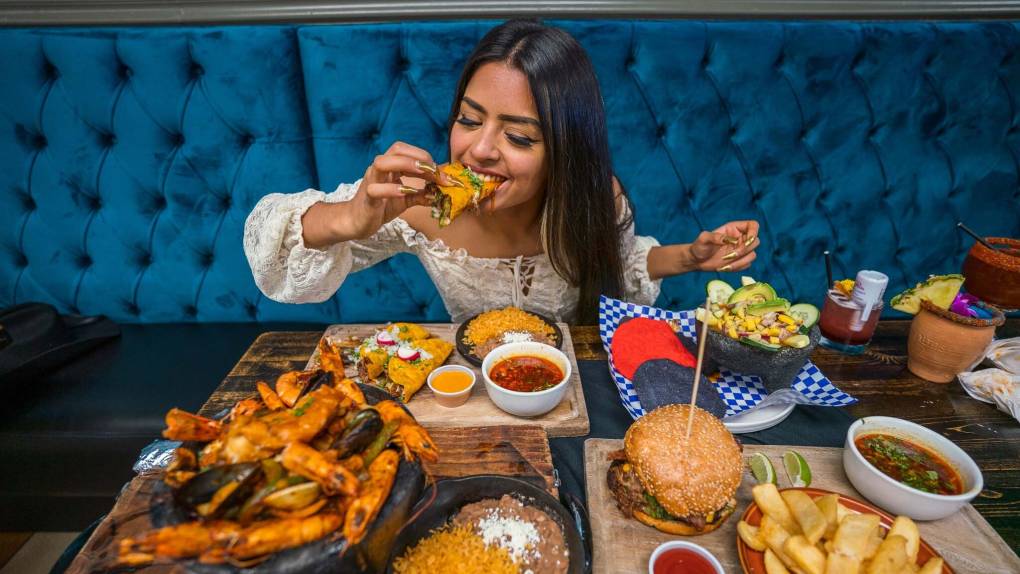
"caption": "Flor Martinez Zaragoza frequently supports Latino-owned businesses in her city, such as Tostadas, which serves items such as their original \"birria burger.\"",
"description": null,
"title": "flor_food",
"credit": "Jordan Hayes",
"status": "inherit",
"altTag": "Flor Martinez Zaragoza enjoys a table of Mexican foods, including ceviche, a birria burger and tacos",
"isLoading": false,
"fetchFailed": false
},
"arts_13920077": {
"type": "attachments",
"id": "arts_13920077",
"meta": {
"index": "attachments_1716263798",
"site": "arts",
"id": "13920077",
"found": true
},
"parent": 13920076,
"imgSizes": {
"twentyfourteen-full-width": {
"file": "https://ww2.kqed.org/app/uploads/sites/2/2022/10/provecho_featured-crop_alanchazaro-1038x576.jpg",
"width": 1038,
"mimeType": "image/jpeg",
"height": 576
},
"thumbnail": {
"file": "https://ww2.kqed.org/app/uploads/sites/2/2022/10/provecho_featured-crop_alanchazaro-160x90.jpg",
"width": 160,
"mimeType": "image/jpeg",
"height": 90
},
"post-thumbnail": {
"file": "https://ww2.kqed.org/app/uploads/sites/2/2022/10/provecho_featured-crop_alanchazaro-672x372.jpg",
"width": 672,
"mimeType": "image/jpeg",
"height": 372
},
"kqedFullSize": {
"file": "https://ww2.kqed.org/app/uploads/sites/2/2022/10/provecho_featured-crop_alanchazaro-scaled.jpg",
"width": 2560,
"height": 1440
},
"2048x2048": {
"file": "https://ww2.kqed.org/app/uploads/sites/2/2022/10/provecho_featured-crop_alanchazaro-2048x1152.jpg",
"width": 2048,
"mimeType": "image/jpeg",
"height": 1152
},
"large": {
"file": "https://ww2.kqed.org/app/uploads/sites/2/2022/10/provecho_featured-crop_alanchazaro-1020x574.jpg",
"width": 1020,
"mimeType": "image/jpeg",
"height": 574
},
"1536x1536": {
"file": "https://ww2.kqed.org/app/uploads/sites/2/2022/10/provecho_featured-crop_alanchazaro-1536x864.jpg",
"width": 1536,
"mimeType": "image/jpeg",
"height": 864
},
"full-width": {
"file": "https://ww2.kqed.org/app/uploads/sites/2/2022/10/provecho_featured-crop_alanchazaro-1920x1080.jpg",
"width": 1920,
"mimeType": "image/jpeg",
"height": 1080
},
"medium": {
"file": "https://ww2.kqed.org/app/uploads/sites/2/2022/10/provecho_featured-crop_alanchazaro-800x450.jpg",
"width": 800,
"mimeType": "image/jpeg",
"height": 450
},
"medium_large": {
"file": "https://ww2.kqed.org/app/uploads/sites/2/2022/10/provecho_featured-crop_alanchazaro-768x432.jpg",
"width": 768,
"mimeType": "image/jpeg",
"height": 432
}
},
"publishDate": 1665080239,
"modified": 1665080749,
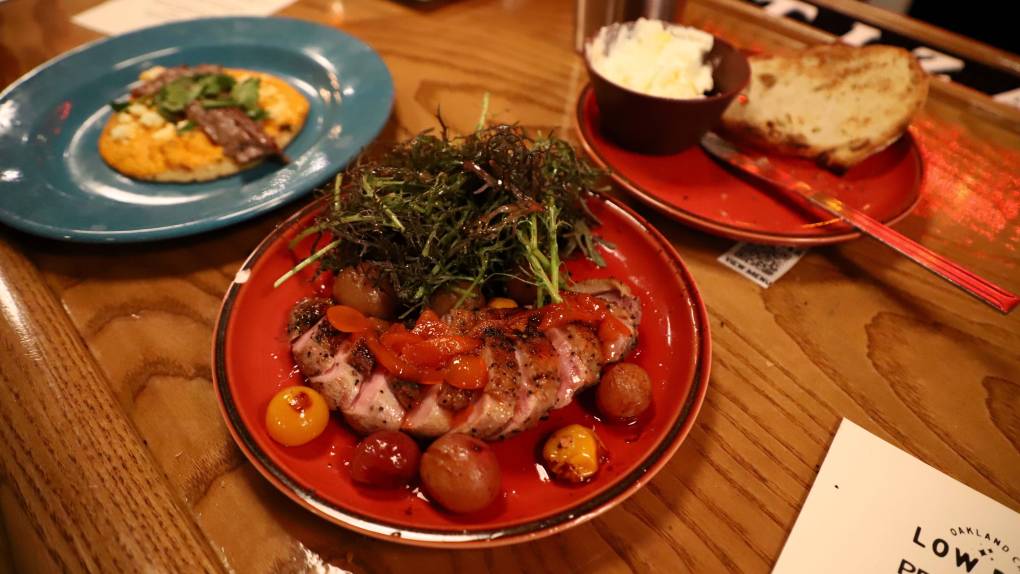
"caption": "Elegant dishes, such as the pan seared duck breast (center) and memelas de cecina (left), are Provecho's main attraction.",
"description": null,
"title": "provecho_featured-crop_alanchazaro",
"credit": "Alan Chazaro",
"status": "inherit",
"altTag": "three colorful plates of food, including pan seared duck, are on display at Low Bar in Oakland",
"isLoading": false,
"fetchFailed": false
},
"arts_13919033": {
"type": "attachments",
"id": "arts_13919033",
"meta": {
"index": "attachments_1716263798",
"site": "arts",
"id": "13919033",
"found": true
},
"parent": 13919032,
"imgSizes": {
"twentyfourteen-full-width": {
"file": "https://ww2.kqed.org/app/uploads/sites/2/2022/09/norte54_raquel_plating_cropped-1038x576.jpg",
"width": 1038,
"mimeType": "image/jpeg",
"height": 576
},
"thumbnail": {
"file": "https://ww2.kqed.org/app/uploads/sites/2/2022/09/norte54_raquel_plating_cropped-160x90.jpg",
"width": 160,
"mimeType": "image/jpeg",
"height": 90
},
"post-thumbnail": {
"file": "https://ww2.kqed.org/app/uploads/sites/2/2022/09/norte54_raquel_plating_cropped-672x372.jpg",
"width": 672,
"mimeType": "image/jpeg",
"height": 372
},
"kqedFullSize": {
"file": "https://ww2.kqed.org/app/uploads/sites/2/2022/09/norte54_raquel_plating_cropped-scaled.jpg",
"width": 2560,
"height": 1440
},
"2048x2048": {
"file": "https://ww2.kqed.org/app/uploads/sites/2/2022/09/norte54_raquel_plating_cropped-2048x1152.jpg",
"width": 2048,
"mimeType": "image/jpeg",
"height": 1152
},
"large": {
"file": "https://ww2.kqed.org/app/uploads/sites/2/2022/09/norte54_raquel_plating_cropped-1020x574.jpg",
"width": 1020,
"mimeType": "image/jpeg",
"height": 574
},
"1536x1536": {
"file": "https://ww2.kqed.org/app/uploads/sites/2/2022/09/norte54_raquel_plating_cropped-1536x864.jpg",
"width": 1536,
"mimeType": "image/jpeg",
"height": 864
},
"full-width": {
"file": "https://ww2.kqed.org/app/uploads/sites/2/2022/09/norte54_raquel_plating_cropped-1920x1080.jpg",
"width": 1920,
"mimeType": "image/jpeg",
"height": 1080
},
"medium": {
"file": "https://ww2.kqed.org/app/uploads/sites/2/2022/09/norte54_raquel_plating_cropped-800x450.jpg",
"width": 800,
"mimeType": "image/jpeg",
"height": 450
},
"medium_large": {
"file": "https://ww2.kqed.org/app/uploads/sites/2/2022/09/norte54_raquel_plating_cropped-768x432.jpg",
"width": 768,
"mimeType": "image/jpeg",
"height": 432
}
},
"publishDate": 1663028189,
"modified": 1663028413,
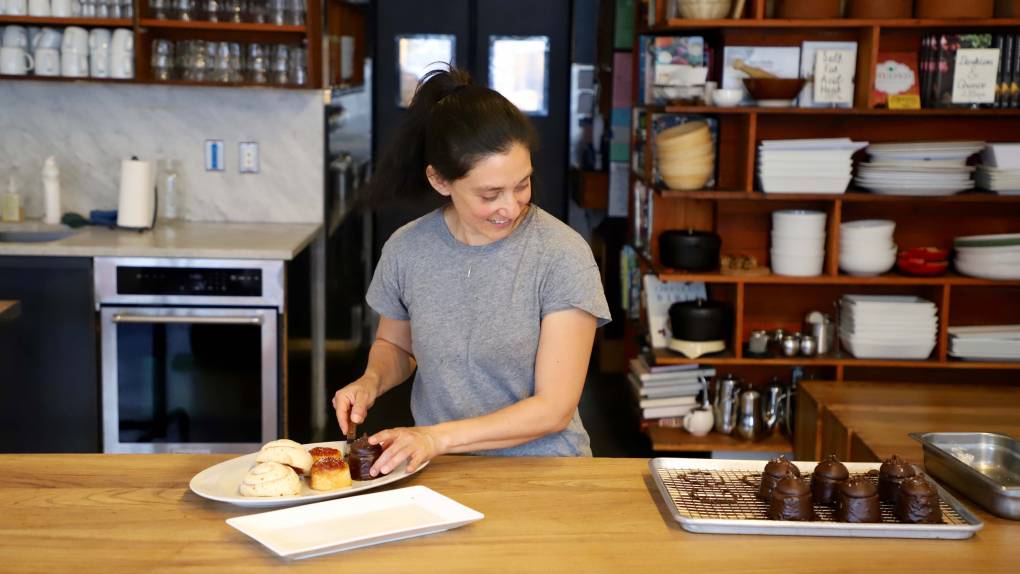
"caption": "Norte 54's founder, Raquel Goldman, plates pan dulce at Nopalito's 18th St. location.",
"description": null,
"title": "norte54_raquel_plating_cropped",
"credit": "Alan Chazaro",
"status": "inherit",
"altTag": "woman stands at a large wooden table, serving Mexican American pastries with a knife",
"isLoading": false,
"fetchFailed": false
},
"arts_13919034": {
"type": "attachments",
"id": "arts_13919034",
"meta": {
"index": "attachments_1716263798",
"site": "arts",
"id": "13919034",
"found": true
},
"parent": 13919032,
"imgSizes": {
"twentyfourteen-full-width": {
"file": "https://ww2.kqed.org/app/uploads/sites/2/2022/09/norte54_box-1038x576.jpg",
"width": 1038,
"mimeType": "image/jpeg",
"height": 576
},
"thumbnail": {
"file": "https://ww2.kqed.org/app/uploads/sites/2/2022/09/norte54_box-160x107.jpg",
"width": 160,
"mimeType": "image/jpeg",
"height": 107
},
"post-thumbnail": {
"file": "https://ww2.kqed.org/app/uploads/sites/2/2022/09/norte54_box-672x372.jpg",
"width": 672,
"mimeType": "image/jpeg",
"height": 372
},
"kqedFullSize": {
"file": "https://ww2.kqed.org/app/uploads/sites/2/2022/09/norte54_box-scaled.jpg",
"width": 2560,
"height": 1707
},
"2048x2048": {
"file": "https://ww2.kqed.org/app/uploads/sites/2/2022/09/norte54_box-2048x1365.jpg",
"width": 2048,
"mimeType": "image/jpeg",
"height": 1365
},
"large": {
"file": "https://ww2.kqed.org/app/uploads/sites/2/2022/09/norte54_box-1020x680.jpg",
"width": 1020,
"mimeType": "image/jpeg",
"height": 680
},
"1536x1536": {
"file": "https://ww2.kqed.org/app/uploads/sites/2/2022/09/norte54_box-1536x1024.jpg",
"width": 1536,
"mimeType": "image/jpeg",
"height": 1024
},
"full-width": {
"file": "https://ww2.kqed.org/app/uploads/sites/2/2022/09/norte54_box-1920x1280.jpg",
"width": 1920,
"mimeType": "image/jpeg",
"height": 1280
},
"medium": {
"file": "https://ww2.kqed.org/app/uploads/sites/2/2022/09/norte54_box-800x533.jpg",
"width": 800,
"mimeType": "image/jpeg",
"height": 533
},
"medium_large": {
"file": "https://ww2.kqed.org/app/uploads/sites/2/2022/09/norte54_box-768x512.jpg",
"width": 768,
"mimeType": "image/jpeg",
"height": 512
}
},
"publishDate": 1663028867,
"modified": 1663028945,
"caption": "A to-go box filled with a variety of Mexican pastries.",
"description": null,
"title": "norte54_box",
"credit": "Alan Chazaro",
"status": "inherit",
"altTag": "a to-go box filled with a variety of Mexican pastries",
"isLoading": false,
"fetchFailed": false
},
"arts_13917123": {
"type": "attachments",
"id": "arts_13917123",
"meta": {
"index": "attachments_1716263798",
"site": "arts",
"id": "13917123",
"found": true
},
"parent": 13917120,
"imgSizes": {
"twentyfourteen-full-width": {
"file": "https://ww2.kqed.org/app/uploads/sites/2/2022/08/IMG_1161-1038x576.jpg",
"width": 1038,
"mimeType": "image/jpeg",
"height": 576
},
"thumbnail": {
"file": "https://ww2.kqed.org/app/uploads/sites/2/2022/08/IMG_1161-160x107.jpg",
"width": 160,
"mimeType": "image/jpeg",
"height": 107
},
"post-thumbnail": {
"file": "https://ww2.kqed.org/app/uploads/sites/2/2022/08/IMG_1161-672x372.jpg",
"width": 672,
"mimeType": "image/jpeg",
"height": 372
},
"kqedFullSize": {
"file": "https://ww2.kqed.org/app/uploads/sites/2/2022/08/IMG_1161-scaled.jpg",
"width": 2560,
"height": 1707
},
"2048x2048": {
"file": "https://ww2.kqed.org/app/uploads/sites/2/2022/08/IMG_1161-2048x1365.jpg",
"width": 2048,
"mimeType": "image/jpeg",
"height": 1365
},
"large": {
"file": "https://ww2.kqed.org/app/uploads/sites/2/2022/08/IMG_1161-1020x680.jpg",
"width": 1020,
"mimeType": "image/jpeg",
"height": 680
},
"1536x1536": {
"file": "https://ww2.kqed.org/app/uploads/sites/2/2022/08/IMG_1161-1536x1024.jpg",
"width": 1536,
"mimeType": "image/jpeg",
"height": 1024
},
"full-width": {
"file": "https://ww2.kqed.org/app/uploads/sites/2/2022/08/IMG_1161-1920x1280.jpg",
"width": 1920,
"mimeType": "image/jpeg",
"height": 1280
},
"medium": {
"file": "https://ww2.kqed.org/app/uploads/sites/2/2022/08/IMG_1161-800x533.jpg",
"width": 800,
"mimeType": "image/jpeg",
"height": 533
},
"medium_large": {
"file": "https://ww2.kqed.org/app/uploads/sites/2/2022/08/IMG_1161-768x512.jpg",
"width": 768,
"mimeType": "image/jpeg",
"height": 512
}
},
"publishDate": 1659640750,
"modified": 1659664260,
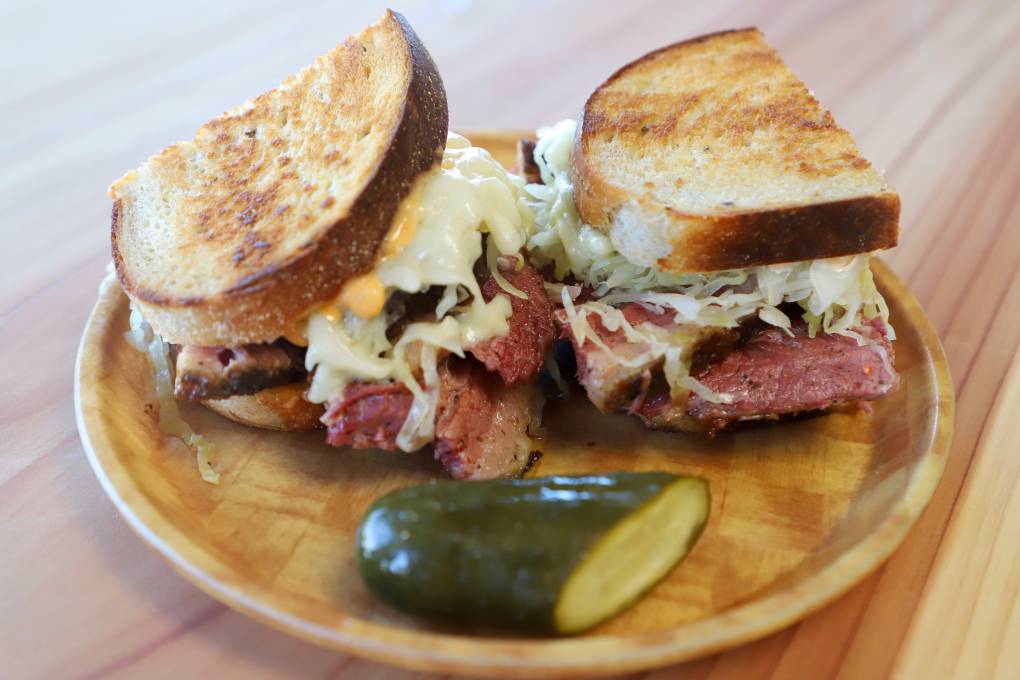
"caption": "The Reuben Sandwich is a pastrami-loaded favorite served at Delirama.",
"description": null,
"title": "IMG_1161",
"credit": "Alan Chazaro",
"status": "inherit",
"altTag": "a pastrami sandwich with coleslaw, cheese, and dressing served on a wooden plate with a pickle",
"isLoading": false,
"fetchFailed": false
},
"arts_13916566": {
"type": "attachments",
"id": "arts_13916566",
"meta": {
"index": "attachments_1716263798",
"site": "arts",
"id": "13916566",
"found": true
},
"parent": 13916301,
"imgSizes": {
"twentyfourteen-full-width": {
"file": "https://ww2.kqed.org/app/uploads/sites/2/2022/07/stix_crop_achazaro-1038x576.jpg",
"width": 1038,
"mimeType": "image/jpeg",
"height": 576
},
"thumbnail": {
"file": "https://ww2.kqed.org/app/uploads/sites/2/2022/07/stix_crop_achazaro-160x90.jpg",
"width": 160,
"mimeType": "image/jpeg",
"height": 90
},
"post-thumbnail": {
"file": "https://ww2.kqed.org/app/uploads/sites/2/2022/07/stix_crop_achazaro-672x372.jpg",
"width": 672,
"mimeType": "image/jpeg",
"height": 372
},
"kqedFullSize": {
"file": "https://ww2.kqed.org/app/uploads/sites/2/2022/07/stix_crop_achazaro.jpg",
"width": 1920,
"height": 1080
},
"large": {
"file": "https://ww2.kqed.org/app/uploads/sites/2/2022/07/stix_crop_achazaro-1020x574.jpg",
"width": 1020,
"mimeType": "image/jpeg",
"height": 574
},
"1536x1536": {
"file": "https://ww2.kqed.org/app/uploads/sites/2/2022/07/stix_crop_achazaro-1536x864.jpg",
"width": 1536,
"mimeType": "image/jpeg",
"height": 864
},
"medium": {
"file": "https://ww2.kqed.org/app/uploads/sites/2/2022/07/stix_crop_achazaro-800x450.jpg",
"width": 800,
"mimeType": "image/jpeg",
"height": 450
},
"medium_large": {
"file": "https://ww2.kqed.org/app/uploads/sites/2/2022/07/stix_crop_achazaro-768x432.jpg",
"width": 768,
"mimeType": "image/jpeg",
"height": 432
}
},
"publishDate": 1658510454,
"modified": 1658510491,
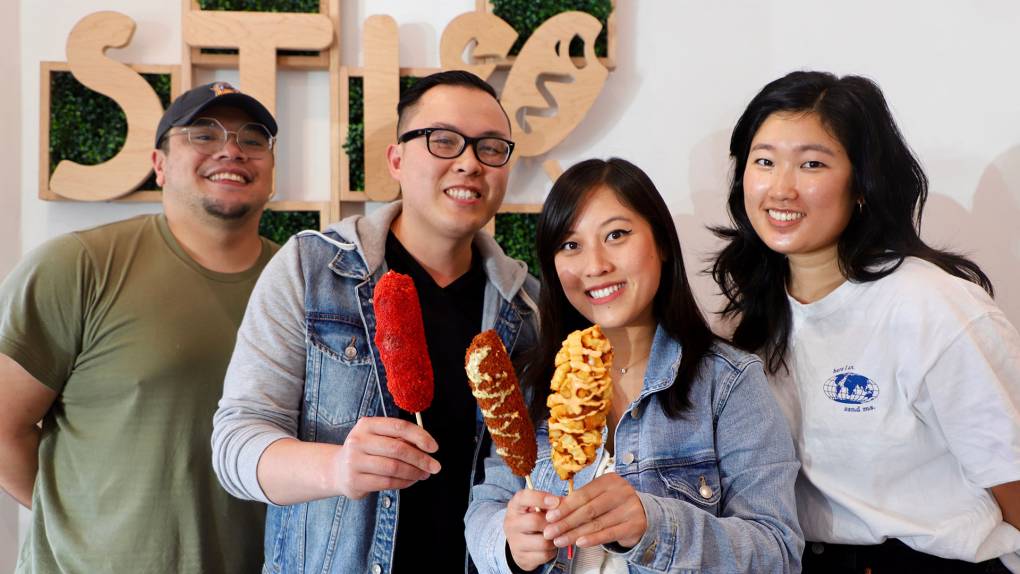
"caption": "STIX owners, Michael and Emily Hui (center) at their Burlingame location, with two employees by their sides.",
"description": null,
"title": "stix_crop_achazaro",
"credit": "Alan Chazaro",
"status": "inherit",
"altTag": "the owners of STIX hold two Korean corn dogs in their store, with two of their employees standing by their sides; behind them, STIX is printed on the wall",
"isLoading": false,
"fetchFailed": false
},
"arts_13916070": {
"type": "attachments",
"id": "arts_13916070",
"meta": {
"index": "attachments_1716263798",
"site": "arts",
"id": "13916070",
"found": true
},
"parent": 13916044,
"imgSizes": {
"twentyfourteen-full-width": {
"file": "https://ww2.kqed.org/app/uploads/sites/2/2022/07/IMG_1445-1-1038x576.jpg",
"width": 1038,
"mimeType": "image/jpeg",
"height": 576
},
"thumbnail": {
"file": "https://ww2.kqed.org/app/uploads/sites/2/2022/07/IMG_1445-1-160x107.jpg",
"width": 160,
"mimeType": "image/jpeg",
"height": 107
},
"post-thumbnail": {
"file": "https://ww2.kqed.org/app/uploads/sites/2/2022/07/IMG_1445-1-672x372.jpg",
"width": 672,
"mimeType": "image/jpeg",
"height": 372
},
"kqedFullSize": {
"file": "https://ww2.kqed.org/app/uploads/sites/2/2022/07/IMG_1445-1-scaled-e1657741392430.jpg",
"width": 1920,
"height": 1280
},
"2048x2048": {
"file": "https://ww2.kqed.org/app/uploads/sites/2/2022/07/IMG_1445-1-2048x1365.jpg",
"width": 2048,
"mimeType": "image/jpeg",
"height": 1365
},
"large": {
"file": "https://ww2.kqed.org/app/uploads/sites/2/2022/07/IMG_1445-1-1020x680.jpg",
"width": 1020,
"mimeType": "image/jpeg",
"height": 680
},
"1536x1536": {
"file": "https://ww2.kqed.org/app/uploads/sites/2/2022/07/IMG_1445-1-1536x1024.jpg",
"width": 1536,
"mimeType": "image/jpeg",
"height": 1024
},
"full-width": {
"file": "https://ww2.kqed.org/app/uploads/sites/2/2022/07/IMG_1445-1-1920x1280.jpg",
"width": 1920,
"mimeType": "image/jpeg",
"height": 1280
},
"medium": {
"file": "https://ww2.kqed.org/app/uploads/sites/2/2022/07/IMG_1445-1-800x533.jpg",
"width": 800,
"mimeType": "image/jpeg",
"height": 533
},
"medium_large": {
"file": "https://ww2.kqed.org/app/uploads/sites/2/2022/07/IMG_1445-1-768x512.jpg",
"width": 768,
"mimeType": "image/jpeg",
"height": 512
}
},
"publishDate": 1657741266,
"modified": 1657825951,
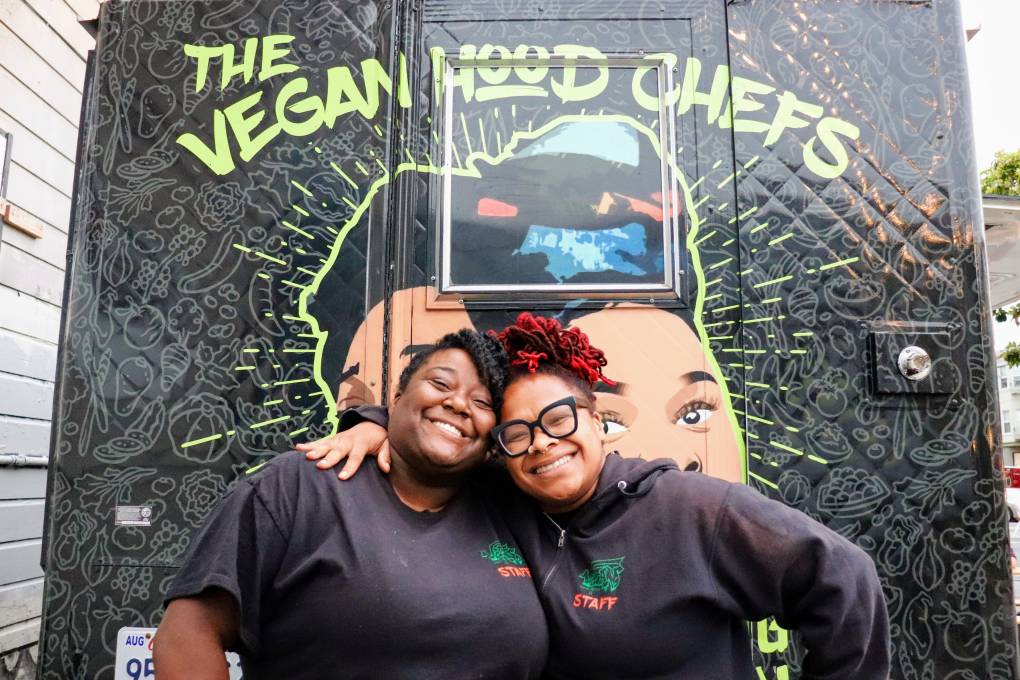
"caption": "Rheema Calloway, left, and Ronnishia Johnson-Hasan, right, hug it out in front of their food truck.",
"description": null,
"title": "IMG_1445",
"credit": "Briana Chazaro",
"status": "inherit",
"altTag": "two women, known as the Vegan Hood Chefs, hugging in front of a food truck with the logo \"The Vegan Hood Chefs\"",
"isLoading": false,
"fetchFailed": false
},
"arts_13914587": {
"type": "attachments",
"id": "arts_13914587",
"meta": {
"index": "attachments_1716263798",
"site": "arts",
"id": "13914587",
"found": true
},
"parent": 13914585,
"imgSizes": {
"twentyfourteen-full-width": {
"file": "https://ww2.kqed.org/app/uploads/sites/2/2022/06/halhotdog_lead-1038x576.jpg",
"width": 1038,
"mimeType": "image/jpeg",
"height": 576
},
"thumbnail": {
"file": "https://ww2.kqed.org/app/uploads/sites/2/2022/06/halhotdog_lead-160x90.jpg",
"width": 160,
"mimeType": "image/jpeg",
"height": 90
},
"post-thumbnail": {
"file": "https://ww2.kqed.org/app/uploads/sites/2/2022/06/halhotdog_lead-672x372.jpg",
"width": 672,
"mimeType": "image/jpeg",
"height": 372
},
"kqedFullSize": {
"file": "https://ww2.kqed.org/app/uploads/sites/2/2022/06/halhotdog_lead-scaled.jpg",
"width": 2560,
"height": 1440
},
"2048x2048": {
"file": "https://ww2.kqed.org/app/uploads/sites/2/2022/06/halhotdog_lead-2048x1152.jpg",
"width": 2048,
"mimeType": "image/jpeg",
"height": 1152
},
"large": {
"file": "https://ww2.kqed.org/app/uploads/sites/2/2022/06/halhotdog_lead-1020x574.jpg",
"width": 1020,
"mimeType": "image/jpeg",
"height": 574
},
"1536x1536": {
"file": "https://ww2.kqed.org/app/uploads/sites/2/2022/06/halhotdog_lead-1536x864.jpg",
"width": 1536,
"mimeType": "image/jpeg",
"height": 864
},
"full-width": {
"file": "https://ww2.kqed.org/app/uploads/sites/2/2022/06/halhotdog_lead-1920x1080.jpg",
"width": 1920,
"mimeType": "image/jpeg",
"height": 1080
},
"medium": {
"file": "https://ww2.kqed.org/app/uploads/sites/2/2022/06/halhotdog_lead-800x450.jpg",
"width": 800,
"mimeType": "image/jpeg",
"height": 450
},
"medium_large": {
"file": "https://ww2.kqed.org/app/uploads/sites/2/2022/06/halhotdog_lead-768x432.jpg",
"width": 768,
"mimeType": "image/jpeg",
"height": 432
}
},
"publishDate": 1654795124,
"modified": 1663791696,
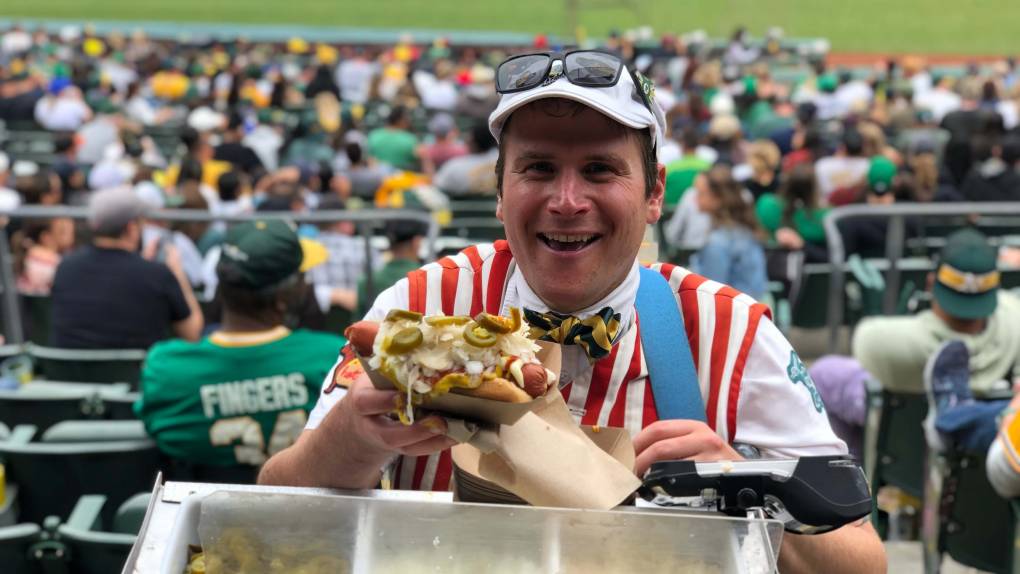
"caption": "Hal the Hot Dog Guy serves a fresh hot dog at the Oakland Coliseum.",
"description": null,
"title": "halhotdog_lead",
"credit": "Briana Chazaro",
"status": "inherit",
"altTag": "Man holds up a hot dog at a baseball game, with fans cheering behind him",
"isLoading": false,
"fetchFailed": false
},
"arts_13914043": {
"type": "attachments",
"id": "arts_13914043",
"meta": {
"index": "attachments_1716263798",
"site": "arts",
"id": "13914043",
"found": true
},
"parent": 13914042,
"imgSizes": {
"twentyfourteen-full-width": {
"file": "https://ww2.kqed.org/app/uploads/sites/2/2022/05/smax-okonomiyaki-1038x576.jpg",
"width": 1038,
"mimeType": "image/jpeg",
"height": 576
},
"thumbnail": {
"file": "https://ww2.kqed.org/app/uploads/sites/2/2022/05/smax-okonomiyaki-160x90.jpg",
"width": 160,
"mimeType": "image/jpeg",
"height": 90
},
"post-thumbnail": {
"file": "https://ww2.kqed.org/app/uploads/sites/2/2022/05/smax-okonomiyaki-672x372.jpg",
"width": 672,
"mimeType": "image/jpeg",
"height": 372
},
"kqedFullSize": {
"file": "https://ww2.kqed.org/app/uploads/sites/2/2022/05/smax-okonomiyaki-scaled.jpg",
"width": 2560,
"height": 1440
},
"2048x2048": {
"file": "https://ww2.kqed.org/app/uploads/sites/2/2022/05/smax-okonomiyaki-2048x1152.jpg",
"width": 2048,
"mimeType": "image/jpeg",
"height": 1152
},
"large": {
"file": "https://ww2.kqed.org/app/uploads/sites/2/2022/05/smax-okonomiyaki-1020x574.jpg",
"width": 1020,
"mimeType": "image/jpeg",
"height": 574
},
"1536x1536": {
"file": "https://ww2.kqed.org/app/uploads/sites/2/2022/05/smax-okonomiyaki-1536x864.jpg",
"width": 1536,
"mimeType": "image/jpeg",
"height": 864
},
"full-width": {
"file": "https://ww2.kqed.org/app/uploads/sites/2/2022/05/smax-okonomiyaki-1920x1080.jpg",
"width": 1920,
"mimeType": "image/jpeg",
"height": 1080
},
"medium": {
"file": "https://ww2.kqed.org/app/uploads/sites/2/2022/05/smax-okonomiyaki-800x450.jpg",
"width": 800,
"mimeType": "image/jpeg",
"height": 450
},
"medium_large": {
"file": "https://ww2.kqed.org/app/uploads/sites/2/2022/05/smax-okonomiyaki-768x432.jpg",
"width": 768,
"mimeType": "image/jpeg",
"height": 432
}
},
"publishDate": 1653588620,
"modified": 1653591155,
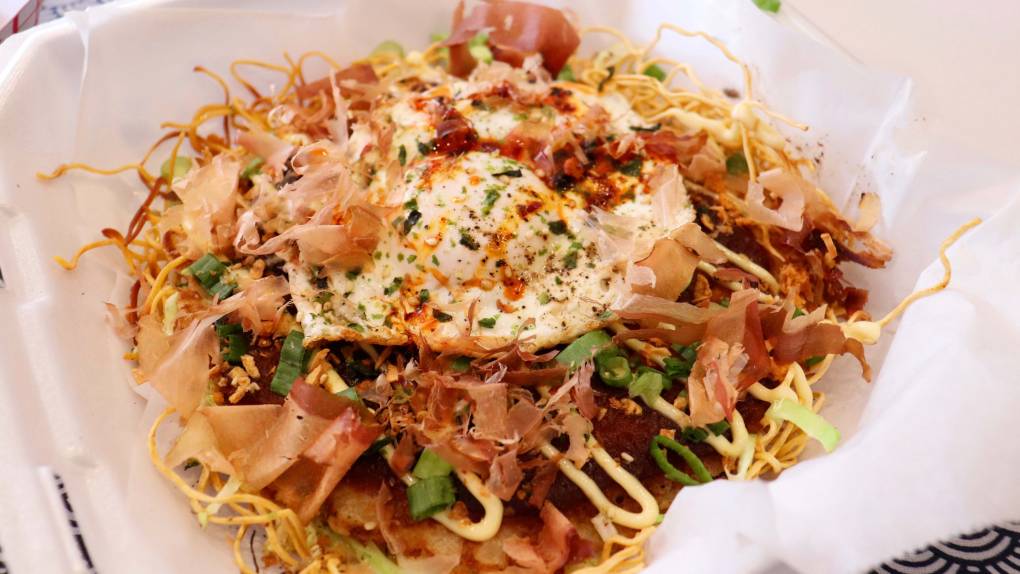
"caption": "The signature \"Animal Style\" okonomiyaki at SMAX—a veggie pancake with crispy noodles, secret sauce, bacon and more.",
"description": null,
"title": "smax-okonomiyaki",
"credit": "Alan Chazaro",
"status": "inherit",
"altTag": "A plate of okonomiyaki, which is a Japanese style pancake. The ingredients include a fried egg, dried fish, mayonnaise, and scallions, all drizzled on top.",
"isLoading": false,
"fetchFailed": false
},
"arts_13913596": {
"type": "attachments",
"id": "arts_13913596",
"meta": {
"index": "attachments_1716263798",
"site": "arts",
"id": "13913596",
"found": true
},
"parent": 13913592,
"imgSizes": {
"twentyfourteen-full-width": {
"file": "https://ww2.kqed.org/app/uploads/sites/2/2022/05/chefbob_birria_crop-1038x576.jpg",
"width": 1038,
"mimeType": "image/jpeg",
"height": 576
},
"thumbnail": {
"file": "https://ww2.kqed.org/app/uploads/sites/2/2022/05/chefbob_birria_crop-160x90.jpg",
"width": 160,
"mimeType": "image/jpeg",
"height": 90
},
"post-thumbnail": {
"file": "https://ww2.kqed.org/app/uploads/sites/2/2022/05/chefbob_birria_crop-672x372.jpg",
"width": 672,
"mimeType": "image/jpeg",
"height": 372
},
"kqedFullSize": {
"file": "https://ww2.kqed.org/app/uploads/sites/2/2022/05/chefbob_birria_crop.jpg",
"width": 1920,
"height": 1080
},
"large": {
"file": "https://ww2.kqed.org/app/uploads/sites/2/2022/05/chefbob_birria_crop-1020x574.jpg",
"width": 1020,
"mimeType": "image/jpeg",
"height": 574
},
"1536x1536": {
"file": "https://ww2.kqed.org/app/uploads/sites/2/2022/05/chefbob_birria_crop-1536x864.jpg",
"width": 1536,
"mimeType": "image/jpeg",
"height": 864
},
"medium": {
"file": "https://ww2.kqed.org/app/uploads/sites/2/2022/05/chefbob_birria_crop-800x450.jpg",
"width": 800,
"mimeType": "image/jpeg",
"height": 450
},
"medium_large": {
"file": "https://ww2.kqed.org/app/uploads/sites/2/2022/05/chefbob_birria_crop-768x432.jpg",
"width": 768,
"mimeType": "image/jpeg",
"height": 432
}
},
"publishDate": 1652920593,
"modified": 1652920923,
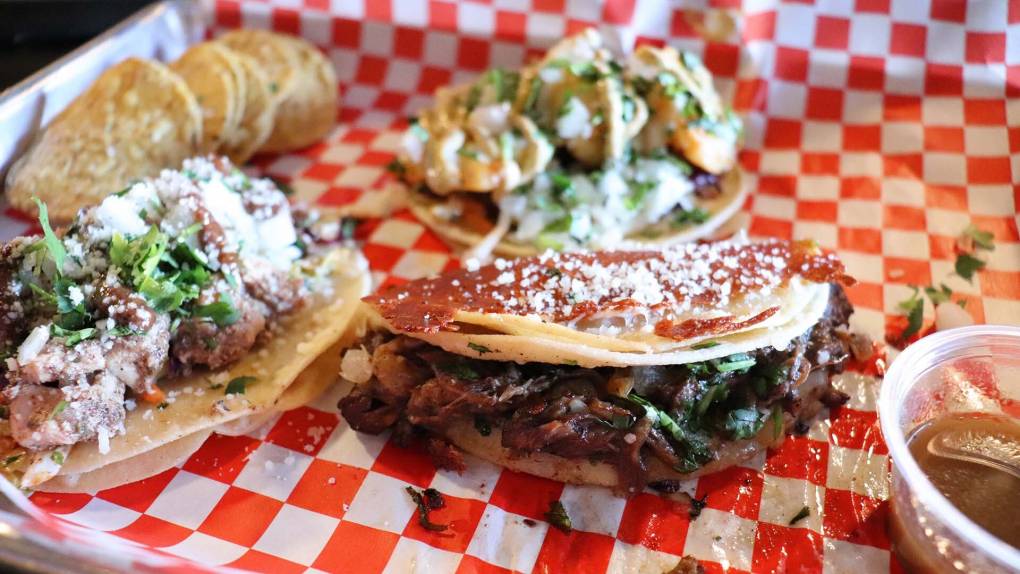
"caption": "Oxtail birria taco (bottom), jerk chicken taco (left) and habanero shrimp taco (top) with a side of tortilla chips and consomé.",
"description": null,
"title": "chefbob_birria_crop",
"credit": "Alan Chazaro",
"status": "inherit",
"altTag": "A food tray with an oxtail birria taco, a habanero shrimp taco, and a Jamaican jerk chicken taco, with a side of nachos",
"isLoading": false,
"fetchFailed": false
}
},
"audioPlayerReducer": {
"postId": "stream_live",
"isPaused": true,
"isPlaying": false,
"pfsActive": false,
"pledgeModalIsOpen": true,
"playerDrawerIsOpen": false,
"liveAudioPlayStartedAt": 0,
"liveAudioPlayContext": ""
},
"authorsReducer": {
"achazaro": {
"type": "authors",
"id": "11748",
"meta": {
"index": "authors_1716337520",
"id": "11748",
"found": true
},
"name": "Alan Chazaro",
"firstName": "Alan",
"lastName": "Chazaro",
"slug": "achazaro",
"email": "agchazaro@gmail.com",
"display_author_email": true,
"staff_mastheads": [],
"title": "Food Writer and Reporter",
"bio": "Alan Chazaro is the author of \u003cem>This Is Not a Frank Ocean Cover Album\u003c/em> (Black Lawrence Press, 2019), \u003cem>Piñata Theory\u003c/em> (Black Lawrence Press, 2020), and \u003cem>Notes from the Eastern Span of the Bay Bridge\u003c/em> (Ghost City Press, 2021). He is a graduate of June Jordan’s Poetry for the People program at UC Berkeley and a former Lawrence Ferlinghetti Fellow at the University of San Francisco. He writes about sports, food, art, music, education, and culture while repping the Bay on \u003ca href=\"https://twitter.com/alan_chazaro\">Twitter\u003c/a> and \u003ca href=\"https://www.instagram.com/alan_chazaro/?hl=en\">Instagram\u003c/a> at @alan_chazaro.",
"avatar": "https://secure.gravatar.com/avatar/ea8b6dd970fc5c29e7a188e7d5861df7?s=600&d=blank&r=g",
"twitter": "alan_chazaro",
"facebook": null,
"instagram": null,
"linkedin": null,
"sites": [
{
"site": "arts",
"roles": [
"contributor"
]
},
{
"site": "news",
"roles": [
"editor"
]
}
],
"headData": {
"title": "Alan Chazaro | KQED",
"description": "Food Writer and Reporter",
"ogImgSrc": "https://secure.gravatar.com/avatar/ea8b6dd970fc5c29e7a188e7d5861df7?s=600&d=blank&r=g",
"twImgSrc": "https://secure.gravatar.com/avatar/ea8b6dd970fc5c29e7a188e7d5861df7?s=600&d=blank&r=g"
},
"isLoading": false,
"link": "/author/achazaro"
}
},
"pagesReducer": {
"arts_tag_hella-hungry": {
"type": "terms",
"id": "arts_17573",
"meta": {
"index": "terms_1716263798",
"site": "arts",
"id": "17573",
"score": 9.557308
},
"featImg": null,
"name": "hella hungry",
"description": null,
"taxonomy": "tag",
"headData": {
"twImgId": null,
"twTitle": null,
"socialTitle": "From Tamales to Trendy Toasts: Hella Hungry Tours Bay Area Flavors",
"ogTitle": null,
"ogImgId": null,
"twDescription": null,
"description": "KQED's food blog, Hella Hungry, dives into the Bay Area's diverse culinary scene. Discover hidden gems, meet passionate chefs, and explore the stories behind the flavors.",
"metaRobotsNoIndex": "index",
"title": "From Tamales to Trendy Toasts: Hella Hungry Tours Bay Area Flavors",
"ogDescription": null
},
"ttid": 17585,
"slug": "hella-hungry",
"isLoading": false,
"title": "hella hungry",
"pageMeta": {
"site": "arts",
"WpPageTemplate": "page-topic-editorial",
"currentPage": 3
},
"blocks": [
{
"blockName": "kqed/post-list",
"attrs": {
"layout": "cardArticle2",
"query": "posts/arts?tag=hella-hungry",
"seeMore": false,
"paginated": true,
"page": 3
}
},
{
"blockName": "kqed/ad"
}
]
}
},
"pfsSessionReducer": {},
"postsReducer": {
"stream_live": {
"type": "live",
"id": "stream_live",
"audioUrl": "https://streams.kqed.org/kqedradio",
"title": "Live Stream",
"excerpt": "Live Stream information currently unavailable.",
"link": "/radio",
"featImg": "",
"label": {
"name": "KQED Live",
"link": "/"
}
},
"stream_kqedNewscast": {
"type": "posts",
"id": "stream_kqedNewscast",
"audioUrl": "https://www.kqed.org/.stream/anon/radio/RDnews/newscast.mp3?_=1",
"title": "KQED Newscast",
"featImg": "",
"label": {
"name": "88.5 FM",
"link": "/"
}
},
"arts_13920483": {
"type": "posts",
"id": "arts_13920483",
"meta": {
"index": "posts_1716263798",
"site": "arts",
"id": "13920483",
"score": null,
"sort": [
1666124238000
]
},
"guestAuthors": [],
"slug": "flor-martinez-zaragoza-instagram-influencer-activist-farm-workers-immigrants-daca-hella-hungry",
"title": "Meet The San Jose Influencer Using Her Platform to Support Farm Workers and Undocumented Immigrants",
"publishDate": 1666124238,
"format": "standard",
"headTitle": "Meet The San Jose Influencer Using Her Platform to Support Farm Workers and Undocumented Immigrants | KQED",
"labelTerm": {},
"content": "\u003cp>\u003cb>\u003ci>¡Hella Hungry! is a column about Bay Area foodmakers, exploring the region’s culinary cultures through the mouth of a first-generation local.\u003c/i>\u003c/b>\u003c/p>\n\u003cp>\u003cspan style=\"font-weight: 400\">When most people think of Silicon Valley, they tend to think of the white-collar aspects — the self-driving Teslas, search engine startups and mega-billionaire corporations. But who is in those office buildings after hours, wiping down desks and taking out the trash? Who is cooking meals for campuses filled with six- and seven-figure earning employees? Who is tending the nearby fields and orchards? And why is \u003ca href=\"https://sanjosespotlight.com/joint-venture-report-highlights-silicon-valley-wealth-gaps-and-tech-booms-san-jose-santa-clara-county/\">the gap here between the affluent and working class, particularly in Spanish-speaking households\u003c/a>, among the worst in the nation?\u003c/span>\u003c/p>\n\u003cp>\u003cspan style=\"font-weight: 400\">Flor Martinez Zaragoza, a 27-year-old activist, influencer and community advocate — probably best known for her Instagram account, \u003c/span>\u003ca href=\"https://www.instagram.com/flowerinspanish/\">\u003cspan style=\"font-weight: 400\">@flowerinspanish\u003c/span>\u003c/a>\u003cspan style=\"font-weight: 400\">, where she has 128,000 followers — has long been acutely aware of those discrepancies. She grew up in San Martin, a small town 25 miles south of San Jose that felt worlds apart from the ritzy tech campuses of Apple, Facebook and Google. \u003c/span>\u003c/p>\n\u003cp>\u003cspan style=\"font-weight: 400\">“Living outside of the city, there’s a crazy cultural difference driving around [Highway] 101,” she says. “It’s all farmworkers from Gilroy towards Salinas. Then you get to San Jose, Oakland, SF and it’s more industrial.”\u003c/span>\u003c/p>\n\u003cp>\u003cspan style=\"font-weight: 400\">As an undocumented immigrant with \u003c/span>\u003ca href=\"https://www.kqed.org/news/11917125/bay-area-daca-recipients-have-mixed-emotions-on-10-year-anniversary\">Deferred Action for Childhood Arrivals\u003c/a>\u003cspan style=\"font-weight: 400\"> (DACA) status, Martinez Zaragoza picked grapes for wineries during her summers as a teenager, along with her family. Throughout her life, she has had to toggle between being an undocumented Mexicana with deep Bay Area roots and just trying to make ends meet in one of the world’s most expensive places to live. \u003c/span>\u003c/p>\n\u003cp>[ad fullwidth]\u003c/p>\n\u003cp>\u003cspan style=\"font-weight: 400\">For immigrants like her, it can feel impossible to voice any concerns, as they’re largely overshadowed by the larger forces of Silicon Valley and being undocumented. But \u003c/span>\u003cspan style=\"font-weight: 400\">Martinez Zaragoza is no longer keeping quiet about her community’s needs. In 2020 — as wildfires swept across Northern California, putting thousands of mostly undocumented farm workers in harm’s way — she began using social media as a tool to educate others about the hardships of a workforce population that is, and has been, aggressively exploited. It’s where she comes from.\u003c/span>\u003c/p>\n\u003cp>\u003cspan style=\"font-weight: 400\">Since then, she has used her \u003ca href=\"https://www.tiktok.com/@flowerinspanish\">rising platform\u003c/a> to spotlight farm workers, undocumented business owners and independent, immigrant-owned restaurants around Northern and Central California. Her goal is to change California laws and improve pathways for thousands like her. I hung out with Flor at a few of her favorite restaurants around San Jo to learn more about her work and mission.\u003c/span>\u003c/p>\n\u003cp>\u003ci>\u003cspan style=\"font-weight: 400\">This interview has been edited for length and clarity.\u003c/span>\u003c/i>\u003c/p>\n\u003cp>\u003cspan style=\"font-weight: 400\">********\u003c/span>\u003c/p>\n\u003cp>\u003cb>KQED: \u003c/b>\u003ca href=\"https://www.kqed.org/news/11923693/farmworkers-24-day-march-culminates-in-sacramento-pressuring-newsom-to-sign-union-bill\">\u003cb>You participated in a 24-day United Farm Workers march\u003c/b>\u003c/a>\u003cb> that ended in Sacramento — a protest that successfully pressured Governor Gavin Newsom to sign \u003c/b>\u003ca href=\"https://openstates.org/ca/bills/20212022/AB2183/\">\u003cb>a piece of legislation expanding farm workers’ union rights\u003c/b>\u003c/a>\u003cb>. Can you tell us about that bill and your role in it?\u003c/b>\u003c/p>\n\u003cp>\u003cspan style=\"font-weight: 400\">The bill, AB 2183, is for farm workers to vote for union representation freely and fairly without fear of intimidation or threat from employers. Many of them are undocumented. They’ve been able to unionize before, but [in the past] they’ve been fearful about it. Many leaders who work in the field would be dismissed or fired [for their involvement]. They didn’t have much protection: They had to vote on site, in the field. But now this bill allows farm workers to vote from home and use their voice without being targeted. They’re the most vulnerable workforce in the nation. That bill passed right before they were about to go on strike.\u003c/span>\u003c/p>\n\u003cp>\u003cb>How did you get involved in this work?\u003c/b>\u003c/p>\n\u003cp>\u003cspan style=\"font-weight: 400\">I migrated to the U.S. [from Jalisco, México] when I was three, but I’ve lived in the Bay Area for most of my life. I’ve mostly lived in Gilroy and San Martin, near Morgan Hill, and I moved to San Jose six years ago. I used to be a farm worker when I was 14 years old. I worked in Gilroy, Watsonville and Santa Cruz, picking wine grapes with my parents and sister. I did it for a couple summers and then I had to focus on high school and stopped working in the fields. My grandpa was a \u003c/span>\u003ca href=\"https://video.kqed.org/video/oregon-experience-the-braceros/\">\u003cspan style=\"font-weight: 400\">bracero\u003c/span>\u003c/a>\u003cspan style=\"font-weight: 400\">, too. He worked in Lodi, where we [recently] marched through. My grandpa broke his rib when he was working, and they sent him back to México. No compensation. They’re still treated like that today. If a worker gets hurt on the job, they don’t have work insurance. They’re so undervalued — sprayed with pesticides, without representation. They don’t have the money to get health care. There are lots of Mexicanos and Central Americans in the fields. They’re undocumented. There’s no hazard pay.\u003c/span>\u003c/p>\n\u003cp>https://www.instagram.com/p/ChfIb_jFZhL/\u003c/p>\n\u003cp>\u003cb>What’s your inspiration?\u003c/b>\u003c/p>\n\u003cp>\u003cspan style=\"font-weight: 400\">I was probably about 12 years old when I started advocating for immigration reform. My mom has always been a big advocate for educational rights for marginalized students. I would go to district meetings and events and use my English to speak for the women who only spoke in Spanish. I was their voice, and it introduced me to public speaking and advocating for others at an early age. Seeing my mom speaking broken English for women who spoke no English … that inspired me. They fought for charter schools to support students who didn’t know English — they would just get put into special ed, and it impacted their futures. A group of Latina moms fought for smaller classes with more attention and resources. And they won. I was a part of that. They sent me to Nashville and I was part of a leadership convention summit. I was the youngest one there with other leaders around the country. I learned how to be a voice and help my people. I’ve just been non-stop ever since.\u003c/span>\u003c/p>\n\u003cp>\u003cb>How has social media helped you to share your messages and experiences with others?\u003c/b>\u003c/p>\n\u003cp>\u003cspan style=\"font-weight: 400\">It’s a tool that previous generations didn’t have. The bill that just passed for farmworkers was largely due to social media. The United Farm Workers introduced the bill, and the farmworkers supported it. Many people told me they learned about what was happening because of the content being put out on social media. \u003c/span>\u003c/p>\n\u003cp>\u003cspan style=\"font-weight: 400\">[pullquote size=\"large\" align=\"right\" citation=\"Flor Martinez Zaragoza\"]“There’s no reason those who feed us should be hungry. They’re the lowest paid workforce in the nation.”[/pullquote]If some of us didn’t go hard on social media, lots of people wouldn’t be aware. TikTok platforms allow younger generations to listen and tell their story and others can be more active. I’ve seen the immense difference in how this younger generation stands up and makes videos. It’s about the education of people and spreading the message as influencers on [social media]. \u003c/span>\u003c/p>\n\u003cp>\u003cb>You’re vocal about supporting local businesses like \u003c/b>\u003ca href=\"https://www.instagram.com/tostadas.sj/\">\u003cb>Tostadas\u003c/b>\u003c/a>\u003cb> and its sister restaurants, the coffeeshop \u003c/b>\u003ca href=\"https://www.instagram.com/conazucarcafe/\">\u003cb>Con Azúcar Cafe\u003c/b>\u003c/a>\u003cb> and the newly opened \u003c/b>\u003ca href=\"https://www.instagram.com/tostadasprime/\">\u003cb>Tostadas Prime\u003c/b>\u003c/a>\u003cb>. What do you like about these restaurants?\u003c/b>\u003c/p>\n\u003cp>\u003cspan style=\"font-weight: 400\">These locations are Latino-owned. When we put money back into our communities instead of corporations, that’s a resource. Our communities don’t always have much of it. These places provide jobs for people, and they outsource their ingredients responsibly. Having a Latino coffee shop [like Con Azúcar] is important. There are thousands of Starbucks in San Jose. But you can go around the corner and keep the money in your community. These places are doing it responsibly and giving back. For example, they support my nonprofit, \u003c/span>\u003ca href=\"https://opencorporates.com/companies/us_ca/C4574861\">\u003cspan style=\"font-weight: 400\">Celebration Nation Inc\u003c/span>\u003c/a>\u003cspan style=\"font-weight: 400\">. We have had multiple times when they let me borrow equipment for my toy drive. We help each other, repost our stuff, anything we need from each other. The owners have \u003c/span>\u003ca href=\"https://www.kqed.org/news/11917125/bay-area-daca-recipients-have-mixed-emotions-on-10-year-anniversary\">DACA\u003c/a>\u003cspan style=\"font-weight: 400\"> like me.\u003c/span>\u003c/p>\n\u003cp>\u003cspan style=\"font-weight: 400\">Tostadas is one of my favorite places. They’ve been around for a while. They have vegan options, and it’s very cultural. The pandemic took a hit on them, but they’re still around. \u003ca href=\"https://www.instagram.com/reel/CjtyUQrNYsG/?utm_source=ig_web_copy_link\">Tostadas Prime\u003c/a>] is more luxury. If people order a certain dish, a percentage will go to a nonprofit and help farm workers. \u003c/span>\u003c/p>\n\u003cp>\u003cspan style=\"font-weight: 400\">These restaurants employ around 200 people. It’s important to put money back into our community. When we shop for food, it’s usually corporate. It’s a business and there are lots of chains. It takes a toll on our bodies and health. They’re mass producing on demand and introducing pesticides and poison. I’m vocal about eating organic. It helps us and the farm workers. Big corporations profit from us. We need to go back to how our ancestors were eating, harvesting whatever they could and sharing it with their neighbors, keeping it local and small batch. If San Jose had its own food system, that would be massive.\u003c/span>\u003c/p>\n\u003cfigure id=\"attachment_13920530\" class=\"wp-caption alignnone\" style=\"max-width: 1928px\">\u003cimg loading=\"lazy\" decoding=\"async\" class=\"size-full wp-image-13920530\" src=\"https://ww2.kqed.org/app/uploads/sites/2/2022/10/flor-mural.jpg\" alt=\"A young Latina stands in front of a mural painted inside a restaurant, depicting two undocumented Latino brothers shaking hands\" width=\"1928\" height=\"1271\" srcset=\"https://cdn.kqed.org/wp-content/uploads/sites/2/2022/10/flor-mural.jpg 1928w, https://cdn.kqed.org/wp-content/uploads/sites/2/2022/10/flor-mural-800x527.jpg 800w, https://cdn.kqed.org/wp-content/uploads/sites/2/2022/10/flor-mural-1020x672.jpg 1020w, https://cdn.kqed.org/wp-content/uploads/sites/2/2022/10/flor-mural-160x105.jpg 160w, https://cdn.kqed.org/wp-content/uploads/sites/2/2022/10/flor-mural-768x506.jpg 768w, https://cdn.kqed.org/wp-content/uploads/sites/2/2022/10/flor-mural-1536x1013.jpg 1536w, https://cdn.kqed.org/wp-content/uploads/sites/2/2022/10/flor-mural-1920x1266.jpg 1920w\" sizes=\"(max-width: 1928px) 100vw, 1928px\">\u003cfigcaption class=\"wp-caption-text\">One of Martinez Zaragoza’s favorite restaurants, Tostadas, is owned by DACA recipient brothers Alex and Victor Garcia, portrayed here in a mural. \u003ccite>(Jordan Hayes)\u003c/cite>\u003c/figcaption>\u003c/figure>\n\u003cp>\u003cb>You mentioned your nonprofit. Tell us more about it.\u003c/b>\u003c/p>\n\u003cp>\u003cspan style=\"font-weight: 400\">I started a nonprofit [\u003ca href=\"https://www.celebration-nation.org/\">Celebration Nation\u003c/a>] to support farm workers. We have a food bank program for them. We serve about 10,000 workers every month, across six towns in California. It’s volunteer-run. It’s basically to fill the gap around food insecurity with farm workers. There’s no reason those who feed us should be hungry. They’re the lowest paid workforce in the nation. Their families suffer. [They usually get served] food that lacks nutrition, which leads to health issues in the future. \u003c/span>\u003c/p>\n\u003cp>\u003cspan style=\"font-weight: 400\">We serve different languages, including Triqui and Mixtec. We have translators to prevent language barriers for accessing food banks. There are lots of reasons that farm workers get excluded from assistance. Having worked in the field helps me to get trust and know what’s going on. I went viral in 2020 during the fires, smoke, heat waves, pandemic. \u003c/span>\u003ca href=\"https://www.instagram.com/p/CDzEYHhpbEC/?utm_source=ig_web_copy_link\">\u003cspan style=\"font-weight: 400\">I expressed my frustration during the conditions\u003c/span>\u003c/a>\u003cspan style=\"font-weight: 400\">, and \u003ca href=\"https://www.instagram.com/p/CEGjH1_pNjz/?utm_source=ig_web_copy_link\">I was telling people to pick their own vegetables\u003c/a>. I used to be a worker so I have insight into the details.\u003c/span>\u003c/p>\n\u003cp>Our next project is creating an educational program accessible on Web.3 and we will be utilizing blockchain technology to educate marginalized youth.\u003c/p>\n\u003cp>\u003cb>You currently have \u003c/b>\u003ca href=\"https://www.kqed.org/news/11917125/bay-area-daca-recipients-have-mixed-emotions-on-10-year-anniversary\">\u003cb>DACA\u003c/b>\u003c/a>\u003cb>. How has that impacted your life?\u003c/b>\u003c/p>\n\u003cp>\u003cspan style=\"font-weight: 400\">It has honestly helped me so much. It allowed me to get a driver’s license and a Social Security number. It shielded me from deportation. It lets me go about my day more comfortably. I have to renew it every two years. Having [Social Security] literally allows me to do business, to apply for loans, to apply for government grants. During the pandemic my event company was able to get a government grant because of my social. Also, I was able to get a stimulus check, unlike many farm workers who are undocumented. It definitely changed my life, and it sucks that it’s not available for more people. \u003c/span>\u003c/p>\n\u003cp>https://www.instagram.com/p/CjV0S5PJM9k/\u003c/p>\n\u003cp>\u003cspan style=\"font-weight: 400\">DACA stopped accepting new applicants about two years ago. Trump was pushing the issue, trying to get rid of it every year. He left a lasting impact on the status of DACA, and \u003c/span>\u003ca href=\"https://www.texastribune.org/2021/07/16/new-article-1626468650daca-texas-judge/\">\u003cspan style=\"font-weight: 400\">a Texas judge ended applications\u003c/span>\u003c/a>\u003cspan style=\"font-weight: 400\">. DACA doesn’t exist for the new generation. This month we’re waiting to see what happens — they’re supposed to \u003ca href=\"https://www.npr.org/2022/10/05/1127107147/an-appeals-court-rules-against-daca-but-the-program-continues-for-now\">share new information\u003c/a>. There is so much uncertainty, it sucks. We work for our communities, we’re contributing to the economy, doing our part for San Jose, providing jobs. This is people’s livelihoods. It’s about making an impact on the city, state, nation. We’re dreamers but we don’t sleep. \u003c/span>\u003c/p>\n\u003cp>\u003cb>What are you currently working on, and what’s on your mind?\u003c/b>\u003c/p>\n\u003cp>\u003cspan style=\"font-weight: 400\">[aside postID='arts_13918088,arts_13920076,arts_13919032']I have a food company that’s coming soon. I haven’t announced it officially yet, but we’re going to sell chiles secos, spices, nuts and cultura from México. It’ll have its roots in México.\u003c/span>\u003c/p>\n\u003cp>\u003cspan style=\"font-weight: 400\">At the end of the day I have DACA. I have to create my own path and be in control of my future. I have to make choices that help me and my community. DACA and immigration reform are important. Immigration reform could help 11 to 12 million people, including our parents and the next generation. I organize rallies in San Jose and collaborate with other social justice groups like \u003c/span>\u003ca href=\"https://www.pactsj.org/\">\u003cspan style=\"font-weight: 400\">PACT [People Acting in Community Together]\u003c/span>\u003c/a>\u003cspan style=\"font-weight: 400\">. They’ve always included me and my mom. She’s in Mexico now and can’t come back. But when she was here she had a community with PACT and had an outlet to advocate as an immigrant mom. \u003c/span>\u003c/p>\n\u003cp>\u003cspan style=\"font-weight: 400\">I try to provide that for women in my nonprofit. We’re run by moms and volunteers. They have a community and they throw their own parties. I like to lead the way when I can and step up. I wouldn’t change it. \u003c/span>\u003c/p>\n\u003cp>\u003cimg loading=\"lazy\" decoding=\"async\" class=\"alignnone size-full wp-image-12904247\" src=\"https://ww2.kqed.org/app/uploads/sites/2/2017/03/Q.Logo_.Break_-400x39.jpg\" alt=\"\" width=\"400\" height=\"39\" srcset=\"https://cdn.kqed.org/wp-content/uploads/sites/2/2017/03/Q.Logo_.Break_-400x39.jpg 400w, https://cdn.kqed.org/wp-content/uploads/sites/2/2017/03/Q.Logo_.Break_-400x39-160x16.jpg 160w, https://cdn.kqed.org/wp-content/uploads/sites/2/2017/03/Q.Logo_.Break_-400x39-240x23.jpg 240w, https://cdn.kqed.org/wp-content/uploads/sites/2/2017/03/Q.Logo_.Break_-400x39-375x37.jpg 375w\" sizes=\"(max-width: 400px) 100vw, 400px\">\u003c/p>\n\u003cp>[ad floatright]\u003c/p>\n\u003cp>\u003ci>\u003cspan style=\"font-weight: 400\">Flor’s work can be seen \u003c/span>\u003c/i>\u003ca href=\"https://www.instagram.com/flowerinspanish/\">\u003ci>\u003cspan style=\"font-weight: 400\">online\u003c/span>\u003c/i>\u003c/a>\u003ci>\u003cspan style=\"font-weight: 400\"> and at her nonprofit, \u003c/span>\u003c/i>\u003ca href=\"https://www.celebration-nation.org/\">\u003ci>\u003cspan style=\"font-weight: 400\">Celebration Nation\u003c/span>\u003c/i>\u003c/a>\u003ci>\u003cspan style=\"font-weight: 400\"> (3031 Tisch Way, 110 Plaza West, San Jose). \u003c/span>\u003c/i>\u003ca href=\"https://www.instagram.com/conazucarcafe/\">\u003ci>\u003cspan style=\"font-weight: 400\">Con Azúcar Cafe\u003c/span>\u003c/i>\u003c/a>\u003ci>\u003cspan style=\"font-weight: 400\"> is open M–F from 6 a.m. to 6 p.m. and Sat.–Sun. 7 a.m. to 6 p.m. (101 E Santa Clara St., San Jose). Tostadas has two locations in San Jose and a newly opened Tostadas Prime in Santa Clara. \u003c/span>\u003c/i>\u003ca href=\"https://www.instagram.com/tostadas.sj/\">\u003ci>\u003cspan style=\"font-weight: 400\">Check their page\u003c/span>\u003c/i>\u003c/a>\u003ci>\u003cspan style=\"font-weight: 400\"> for updates. Special thanks to \u003ca href=\"https://www.instagram.com/imrealbasic/\">Jordan Hayes\u003c/a> for his photography and videography.\u003c/span>\u003c/i>\u003c/p>\n\n",
"blocks": [],
"excerpt": "Flor Martinez Zaragoza uses Instagram and TikTok as vehicles for her activism.",
"status": "publish",
"parent": 0,
"modified": 1729111923,
"stats": {
"hasAudio": false,
"hasVideo": false,
"hasChartOrMap": false,
"iframeSrcs": [],
"hasGoogleForm": false,
"hasGallery": false,
"hasHearkenModule": false,
"hasPolis": false,
"paragraphCount": 37,
"wordCount": 2361
},
"headData": {
"title": "Meet The San Jose Influencer Using Her Platform to Support Farm Workers and Undocumented Immigrants | KQED",
"description": "Flor Martinez Zaragoza uses Instagram and TikTok as vehicles for her activism.",
"ogTitle": "",
"ogDescription": "",
"ogImgId": "",
"twTitle": "",
"twDescription": "",
"twImgId": "",
"schema": {
"@context": "https://schema.org",
"@type": "Article",
"headline": "Meet The San Jose Influencer Using Her Platform to Support Farm Workers and Undocumented Immigrants",
"datePublished": "2022-10-18T13:17:18-07:00",
"dateModified": "2024-10-16T13:52:03-07:00",
"image": "https://cdn.kqed.org/wp-content/uploads/2020/02/KQED-OG-Image@1x.png"
}
},
"source": "Food",
"sourceUrl": "https://www.kqed.org/food",
"sticky": false,
"templateType": "standard",
"featuredImageType": "standard",
"excludeFromSiteSearch": "Include",
"articleAge": "0",
"path": "/arts/13920483/flor-martinez-zaragoza-instagram-influencer-activist-farm-workers-immigrants-daca-hella-hungry",
"audioTrackLength": null,
"parsedContent": [
{
"type": "contentString",
"content": "\u003cdiv class=\"post-body\">\u003cp>\u003cp>\u003cb>\u003ci>¡Hella Hungry! is a column about Bay Area foodmakers, exploring the region’s culinary cultures through the mouth of a first-generation local.\u003c/i>\u003c/b>\u003c/p>\n\u003cp>\u003cspan style=\"font-weight: 400\">When most people think of Silicon Valley, they tend to think of the white-collar aspects — the self-driving Teslas, search engine startups and mega-billionaire corporations. But who is in those office buildings after hours, wiping down desks and taking out the trash? Who is cooking meals for campuses filled with six- and seven-figure earning employees? Who is tending the nearby fields and orchards? And why is \u003ca href=\"https://sanjosespotlight.com/joint-venture-report-highlights-silicon-valley-wealth-gaps-and-tech-booms-san-jose-santa-clara-county/\">the gap here between the affluent and working class, particularly in Spanish-speaking households\u003c/a>, among the worst in the nation?\u003c/span>\u003c/p>\n\u003cp>\u003cspan style=\"font-weight: 400\">Flor Martinez Zaragoza, a 27-year-old activist, influencer and community advocate — probably best known for her Instagram account, \u003c/span>\u003ca href=\"https://www.instagram.com/flowerinspanish/\">\u003cspan style=\"font-weight: 400\">@flowerinspanish\u003c/span>\u003c/a>\u003cspan style=\"font-weight: 400\">, where she has 128,000 followers — has long been acutely aware of those discrepancies. She grew up in San Martin, a small town 25 miles south of San Jose that felt worlds apart from the ritzy tech campuses of Apple, Facebook and Google. \u003c/span>\u003c/p>\n\u003cp>\u003cspan style=\"font-weight: 400\">“Living outside of the city, there’s a crazy cultural difference driving around [Highway] 101,” she says. “It’s all farmworkers from Gilroy towards Salinas. Then you get to San Jose, Oakland, SF and it’s more industrial.”\u003c/span>\u003c/p>\n\u003cp>\u003cspan style=\"font-weight: 400\">As an undocumented immigrant with \u003c/span>\u003ca href=\"https://www.kqed.org/news/11917125/bay-area-daca-recipients-have-mixed-emotions-on-10-year-anniversary\">Deferred Action for Childhood Arrivals\u003c/a>\u003cspan style=\"font-weight: 400\"> (DACA) status, Martinez Zaragoza picked grapes for wineries during her summers as a teenager, along with her family. Throughout her life, she has had to toggle between being an undocumented Mexicana with deep Bay Area roots and just trying to make ends meet in one of the world’s most expensive places to live. \u003c/span>\u003c/p>\n\u003cp>\u003c/p>\u003c/div>",
"attributes": {
"named": {},
"numeric": []
}
},
{
"type": "component",
"content": "",
"name": "ad",
"attributes": {
"named": {
"label": "fullwidth"
},
"numeric": [
"fullwidth"
]
}
},
{
"type": "contentString",
"content": "\u003cdiv class=\"post-body\">\u003cp>\u003c/p>\n\u003cp>\u003cspan style=\"font-weight: 400\">For immigrants like her, it can feel impossible to voice any concerns, as they’re largely overshadowed by the larger forces of Silicon Valley and being undocumented. But \u003c/span>\u003cspan style=\"font-weight: 400\">Martinez Zaragoza is no longer keeping quiet about her community’s needs. In 2020 — as wildfires swept across Northern California, putting thousands of mostly undocumented farm workers in harm’s way — she began using social media as a tool to educate others about the hardships of a workforce population that is, and has been, aggressively exploited. It’s where she comes from.\u003c/span>\u003c/p>\n\u003cp>\u003cspan style=\"font-weight: 400\">Since then, she has used her \u003ca href=\"https://www.tiktok.com/@flowerinspanish\">rising platform\u003c/a> to spotlight farm workers, undocumented business owners and independent, immigrant-owned restaurants around Northern and Central California. Her goal is to change California laws and improve pathways for thousands like her. I hung out with Flor at a few of her favorite restaurants around San Jo to learn more about her work and mission.\u003c/span>\u003c/p>\n\u003cp>\u003ci>\u003cspan style=\"font-weight: 400\">This interview has been edited for length and clarity.\u003c/span>\u003c/i>\u003c/p>\n\u003cp>\u003cspan style=\"font-weight: 400\">********\u003c/span>\u003c/p>\n\u003cp>\u003cb>KQED: \u003c/b>\u003ca href=\"https://www.kqed.org/news/11923693/farmworkers-24-day-march-culminates-in-sacramento-pressuring-newsom-to-sign-union-bill\">\u003cb>You participated in a 24-day United Farm Workers march\u003c/b>\u003c/a>\u003cb> that ended in Sacramento — a protest that successfully pressured Governor Gavin Newsom to sign \u003c/b>\u003ca href=\"https://openstates.org/ca/bills/20212022/AB2183/\">\u003cb>a piece of legislation expanding farm workers’ union rights\u003c/b>\u003c/a>\u003cb>. Can you tell us about that bill and your role in it?\u003c/b>\u003c/p>\n\u003cp>\u003cspan style=\"font-weight: 400\">The bill, AB 2183, is for farm workers to vote for union representation freely and fairly without fear of intimidation or threat from employers. Many of them are undocumented. They’ve been able to unionize before, but [in the past] they’ve been fearful about it. Many leaders who work in the field would be dismissed or fired [for their involvement]. They didn’t have much protection: They had to vote on site, in the field. But now this bill allows farm workers to vote from home and use their voice without being targeted. They’re the most vulnerable workforce in the nation. That bill passed right before they were about to go on strike.\u003c/span>\u003c/p>\n\u003cp>\u003cb>How did you get involved in this work?\u003c/b>\u003c/p>\n\u003cp>\u003cspan style=\"font-weight: 400\">I migrated to the U.S. [from Jalisco, México] when I was three, but I’ve lived in the Bay Area for most of my life. I’ve mostly lived in Gilroy and San Martin, near Morgan Hill, and I moved to San Jose six years ago. I used to be a farm worker when I was 14 years old. I worked in Gilroy, Watsonville and Santa Cruz, picking wine grapes with my parents and sister. I did it for a couple summers and then I had to focus on high school and stopped working in the fields. My grandpa was a \u003c/span>\u003ca href=\"https://video.kqed.org/video/oregon-experience-the-braceros/\">\u003cspan style=\"font-weight: 400\">bracero\u003c/span>\u003c/a>\u003cspan style=\"font-weight: 400\">, too. He worked in Lodi, where we [recently] marched through. My grandpa broke his rib when he was working, and they sent him back to México. No compensation. They’re still treated like that today. If a worker gets hurt on the job, they don’t have work insurance. They’re so undervalued — sprayed with pesticides, without representation. They don’t have the money to get health care. There are lots of Mexicanos and Central Americans in the fields. They’re undocumented. There’s no hazard pay.\u003c/span>\u003c/p>\u003c/p>\u003c/div>",
"attributes": {
"named": {},
"numeric": []
}
},
{
"type": "component",
"content": "",
"name": "instagramLink",
"attributes": {
"named": {
"instagramUrl": "https://www.instagram.com/p/ChfIb_jFZhL/"
},
"numeric": []
}
},
{
"type": "contentString",
"content": "\u003cdiv class=\"post-body\">\u003cp>\u003cp>\u003cb>What’s your inspiration?\u003c/b>\u003c/p>\n\u003cp>\u003cspan style=\"font-weight: 400\">I was probably about 12 years old when I started advocating for immigration reform. My mom has always been a big advocate for educational rights for marginalized students. I would go to district meetings and events and use my English to speak for the women who only spoke in Spanish. I was their voice, and it introduced me to public speaking and advocating for others at an early age. Seeing my mom speaking broken English for women who spoke no English … that inspired me. They fought for charter schools to support students who didn’t know English — they would just get put into special ed, and it impacted their futures. A group of Latina moms fought for smaller classes with more attention and resources. And they won. I was a part of that. They sent me to Nashville and I was part of a leadership convention summit. I was the youngest one there with other leaders around the country. I learned how to be a voice and help my people. I’ve just been non-stop ever since.\u003c/span>\u003c/p>\n\u003cp>\u003cb>How has social media helped you to share your messages and experiences with others?\u003c/b>\u003c/p>\n\u003cp>\u003cspan style=\"font-weight: 400\">It’s a tool that previous generations didn’t have. The bill that just passed for farmworkers was largely due to social media. The United Farm Workers introduced the bill, and the farmworkers supported it. Many people told me they learned about what was happening because of the content being put out on social media. \u003c/span>\u003c/p>\n\u003cp>\u003cspan style=\"font-weight: 400\">\u003c/p>\u003c/div>",
"attributes": {
"named": {},
"numeric": []
}
},
{
"type": "component",
"content": "“There’s no reason those who feed us should be hungry. They’re the lowest paid workforce in the nation.”",
"name": "pullquote",
"attributes": {
"named": {
"size": "large",
"align": "right",
"citation": "Flor Martinez Zaragoza",
"label": ""
},
"numeric": []
}
},
{
"type": "contentString",
"content": "\u003cdiv class=\"post-body\">\u003cp>If some of us didn’t go hard on social media, lots of people wouldn’t be aware. TikTok platforms allow younger generations to listen and tell their story and others can be more active. I’ve seen the immense difference in how this younger generation stands up and makes videos. It’s about the education of people and spreading the message as influencers on [social media]. \u003c/span>\u003c/p>\n\u003cp>\u003cb>You’re vocal about supporting local businesses like \u003c/b>\u003ca href=\"https://www.instagram.com/tostadas.sj/\">\u003cb>Tostadas\u003c/b>\u003c/a>\u003cb> and its sister restaurants, the coffeeshop \u003c/b>\u003ca href=\"https://www.instagram.com/conazucarcafe/\">\u003cb>Con Azúcar Cafe\u003c/b>\u003c/a>\u003cb> and the newly opened \u003c/b>\u003ca href=\"https://www.instagram.com/tostadasprime/\">\u003cb>Tostadas Prime\u003c/b>\u003c/a>\u003cb>. What do you like about these restaurants?\u003c/b>\u003c/p>\n\u003cp>\u003cspan style=\"font-weight: 400\">These locations are Latino-owned. When we put money back into our communities instead of corporations, that’s a resource. Our communities don’t always have much of it. These places provide jobs for people, and they outsource their ingredients responsibly. Having a Latino coffee shop [like Con Azúcar] is important. There are thousands of Starbucks in San Jose. But you can go around the corner and keep the money in your community. These places are doing it responsibly and giving back. For example, they support my nonprofit, \u003c/span>\u003ca href=\"https://opencorporates.com/companies/us_ca/C4574861\">\u003cspan style=\"font-weight: 400\">Celebration Nation Inc\u003c/span>\u003c/a>\u003cspan style=\"font-weight: 400\">. We have had multiple times when they let me borrow equipment for my toy drive. We help each other, repost our stuff, anything we need from each other. The owners have \u003c/span>\u003ca href=\"https://www.kqed.org/news/11917125/bay-area-daca-recipients-have-mixed-emotions-on-10-year-anniversary\">DACA\u003c/a>\u003cspan style=\"font-weight: 400\"> like me.\u003c/span>\u003c/p>\n\u003cp>\u003cspan style=\"font-weight: 400\">Tostadas is one of my favorite places. They’ve been around for a while. They have vegan options, and it’s very cultural. The pandemic took a hit on them, but they’re still around. \u003ca href=\"https://www.instagram.com/reel/CjtyUQrNYsG/?utm_source=ig_web_copy_link\">Tostadas Prime\u003c/a>] is more luxury. If people order a certain dish, a percentage will go to a nonprofit and help farm workers. \u003c/span>\u003c/p>\n\u003cp>\u003cspan style=\"font-weight: 400\">These restaurants employ around 200 people. It’s important to put money back into our community. When we shop for food, it’s usually corporate. It’s a business and there are lots of chains. It takes a toll on our bodies and health. They’re mass producing on demand and introducing pesticides and poison. I’m vocal about eating organic. It helps us and the farm workers. Big corporations profit from us. We need to go back to how our ancestors were eating, harvesting whatever they could and sharing it with their neighbors, keeping it local and small batch. If San Jose had its own food system, that would be massive.\u003c/span>\u003c/p>\n\u003cfigure id=\"attachment_13920530\" class=\"wp-caption alignnone\" style=\"max-width: 1928px\">\u003cimg loading=\"lazy\" decoding=\"async\" class=\"size-full wp-image-13920530\" src=\"https://ww2.kqed.org/app/uploads/sites/2/2022/10/flor-mural.jpg\" alt=\"A young Latina stands in front of a mural painted inside a restaurant, depicting two undocumented Latino brothers shaking hands\" width=\"1928\" height=\"1271\" srcset=\"https://cdn.kqed.org/wp-content/uploads/sites/2/2022/10/flor-mural.jpg 1928w, https://cdn.kqed.org/wp-content/uploads/sites/2/2022/10/flor-mural-800x527.jpg 800w, https://cdn.kqed.org/wp-content/uploads/sites/2/2022/10/flor-mural-1020x672.jpg 1020w, https://cdn.kqed.org/wp-content/uploads/sites/2/2022/10/flor-mural-160x105.jpg 160w, https://cdn.kqed.org/wp-content/uploads/sites/2/2022/10/flor-mural-768x506.jpg 768w, https://cdn.kqed.org/wp-content/uploads/sites/2/2022/10/flor-mural-1536x1013.jpg 1536w, https://cdn.kqed.org/wp-content/uploads/sites/2/2022/10/flor-mural-1920x1266.jpg 1920w\" sizes=\"(max-width: 1928px) 100vw, 1928px\">\u003cfigcaption class=\"wp-caption-text\">One of Martinez Zaragoza’s favorite restaurants, Tostadas, is owned by DACA recipient brothers Alex and Victor Garcia, portrayed here in a mural. \u003ccite>(Jordan Hayes)\u003c/cite>\u003c/figcaption>\u003c/figure>\n\u003cp>\u003cb>You mentioned your nonprofit. Tell us more about it.\u003c/b>\u003c/p>\n\u003cp>\u003cspan style=\"font-weight: 400\">I started a nonprofit [\u003ca href=\"https://www.celebration-nation.org/\">Celebration Nation\u003c/a>] to support farm workers. We have a food bank program for them. We serve about 10,000 workers every month, across six towns in California. It’s volunteer-run. It’s basically to fill the gap around food insecurity with farm workers. There’s no reason those who feed us should be hungry. They’re the lowest paid workforce in the nation. Their families suffer. [They usually get served] food that lacks nutrition, which leads to health issues in the future. \u003c/span>\u003c/p>\n\u003cp>\u003cspan style=\"font-weight: 400\">We serve different languages, including Triqui and Mixtec. We have translators to prevent language barriers for accessing food banks. There are lots of reasons that farm workers get excluded from assistance. Having worked in the field helps me to get trust and know what’s going on. I went viral in 2020 during the fires, smoke, heat waves, pandemic. \u003c/span>\u003ca href=\"https://www.instagram.com/p/CDzEYHhpbEC/?utm_source=ig_web_copy_link\">\u003cspan style=\"font-weight: 400\">I expressed my frustration during the conditions\u003c/span>\u003c/a>\u003cspan style=\"font-weight: 400\">, and \u003ca href=\"https://www.instagram.com/p/CEGjH1_pNjz/?utm_source=ig_web_copy_link\">I was telling people to pick their own vegetables\u003c/a>. I used to be a worker so I have insight into the details.\u003c/span>\u003c/p>\n\u003cp>Our next project is creating an educational program accessible on Web.3 and we will be utilizing blockchain technology to educate marginalized youth.\u003c/p>\n\u003cp>\u003cb>You currently have \u003c/b>\u003ca href=\"https://www.kqed.org/news/11917125/bay-area-daca-recipients-have-mixed-emotions-on-10-year-anniversary\">\u003cb>DACA\u003c/b>\u003c/a>\u003cb>. How has that impacted your life?\u003c/b>\u003c/p>\n\u003cp>\u003cspan style=\"font-weight: 400\">It has honestly helped me so much. It allowed me to get a driver’s license and a Social Security number. It shielded me from deportation. It lets me go about my day more comfortably. I have to renew it every two years. Having [Social Security] literally allows me to do business, to apply for loans, to apply for government grants. During the pandemic my event company was able to get a government grant because of my social. Also, I was able to get a stimulus check, unlike many farm workers who are undocumented. It definitely changed my life, and it sucks that it’s not available for more people. \u003c/span>\u003c/p>\u003c/p>\u003c/div>",
"attributes": {
"named": {},
"numeric": []
}
},
{
"type": "component",
"content": "",
"name": "instagramLink",
"attributes": {
"named": {
"instagramUrl": "https://www.instagram.com/p/CjV0S5PJM9k/"
},
"numeric": []
}
},
{
"type": "contentString",
"content": "\u003cdiv class=\"post-body\">\u003cp>\u003cp>\u003cspan style=\"font-weight: 400\">DACA stopped accepting new applicants about two years ago. Trump was pushing the issue, trying to get rid of it every year. He left a lasting impact on the status of DACA, and \u003c/span>\u003ca href=\"https://www.texastribune.org/2021/07/16/new-article-1626468650daca-texas-judge/\">\u003cspan style=\"font-weight: 400\">a Texas judge ended applications\u003c/span>\u003c/a>\u003cspan style=\"font-weight: 400\">. DACA doesn’t exist for the new generation. This month we’re waiting to see what happens — they’re supposed to \u003ca href=\"https://www.npr.org/2022/10/05/1127107147/an-appeals-court-rules-against-daca-but-the-program-continues-for-now\">share new information\u003c/a>. There is so much uncertainty, it sucks. We work for our communities, we’re contributing to the economy, doing our part for San Jose, providing jobs. This is people’s livelihoods. It’s about making an impact on the city, state, nation. We’re dreamers but we don’t sleep. \u003c/span>\u003c/p>\n\u003cp>\u003cb>What are you currently working on, and what’s on your mind?\u003c/b>\u003c/p>\n\u003cp>\u003cspan style=\"font-weight: 400\">\u003c/p>\u003c/div>",
"attributes": {
"named": {},
"numeric": []
}
},
{
"type": "component",
"content": "",
"name": "aside",
"attributes": {
"named": {
"postid": "arts_13918088,arts_13920076,arts_13919032",
"label": ""
},
"numeric": []
}
},
{
"type": "contentString",
"content": "\u003cdiv class=\"post-body\">\u003cp>I have a food company that’s coming soon. I haven’t announced it officially yet, but we’re going to sell chiles secos, spices, nuts and cultura from México. It’ll have its roots in México.\u003c/span>\u003c/p>\n\u003cp>\u003cspan style=\"font-weight: 400\">At the end of the day I have DACA. I have to create my own path and be in control of my future. I have to make choices that help me and my community. DACA and immigration reform are important. Immigration reform could help 11 to 12 million people, including our parents and the next generation. I organize rallies in San Jose and collaborate with other social justice groups like \u003c/span>\u003ca href=\"https://www.pactsj.org/\">\u003cspan style=\"font-weight: 400\">PACT [People Acting in Community Together]\u003c/span>\u003c/a>\u003cspan style=\"font-weight: 400\">. They’ve always included me and my mom. She’s in Mexico now and can’t come back. But when she was here she had a community with PACT and had an outlet to advocate as an immigrant mom. \u003c/span>\u003c/p>\n\u003cp>\u003cspan style=\"font-weight: 400\">I try to provide that for women in my nonprofit. We’re run by moms and volunteers. They have a community and they throw their own parties. I like to lead the way when I can and step up. I wouldn’t change it. \u003c/span>\u003c/p>\n\u003cp>\u003cimg loading=\"lazy\" decoding=\"async\" class=\"alignnone size-full wp-image-12904247\" src=\"https://ww2.kqed.org/app/uploads/sites/2/2017/03/Q.Logo_.Break_-400x39.jpg\" alt=\"\" width=\"400\" height=\"39\" srcset=\"https://cdn.kqed.org/wp-content/uploads/sites/2/2017/03/Q.Logo_.Break_-400x39.jpg 400w, https://cdn.kqed.org/wp-content/uploads/sites/2/2017/03/Q.Logo_.Break_-400x39-160x16.jpg 160w, https://cdn.kqed.org/wp-content/uploads/sites/2/2017/03/Q.Logo_.Break_-400x39-240x23.jpg 240w, https://cdn.kqed.org/wp-content/uploads/sites/2/2017/03/Q.Logo_.Break_-400x39-375x37.jpg 375w\" sizes=\"(max-width: 400px) 100vw, 400px\">\u003c/p>\n\u003cp>\u003c/p>\u003c/div>",
"attributes": {
"named": {},
"numeric": []
}
},
{
"type": "component",
"content": "",
"name": "ad",
"attributes": {
"named": {
"label": "floatright"
},
"numeric": [
"floatright"
]
}
},
{
"type": "contentString",
"content": "\u003cdiv class=\"post-body\">\u003cp>\u003c/p>\n\u003cp>\u003ci>\u003cspan style=\"font-weight: 400\">Flor’s work can be seen \u003c/span>\u003c/i>\u003ca href=\"https://www.instagram.com/flowerinspanish/\">\u003ci>\u003cspan style=\"font-weight: 400\">online\u003c/span>\u003c/i>\u003c/a>\u003ci>\u003cspan style=\"font-weight: 400\"> and at her nonprofit, \u003c/span>\u003c/i>\u003ca href=\"https://www.celebration-nation.org/\">\u003ci>\u003cspan style=\"font-weight: 400\">Celebration Nation\u003c/span>\u003c/i>\u003c/a>\u003ci>\u003cspan style=\"font-weight: 400\"> (3031 Tisch Way, 110 Plaza West, San Jose). \u003c/span>\u003c/i>\u003ca href=\"https://www.instagram.com/conazucarcafe/\">\u003ci>\u003cspan style=\"font-weight: 400\">Con Azúcar Cafe\u003c/span>\u003c/i>\u003c/a>\u003ci>\u003cspan style=\"font-weight: 400\"> is open M–F from 6 a.m. to 6 p.m. and Sat.–Sun. 7 a.m. to 6 p.m. (101 E Santa Clara St., San Jose). Tostadas has two locations in San Jose and a newly opened Tostadas Prime in Santa Clara. \u003c/span>\u003c/i>\u003ca href=\"https://www.instagram.com/tostadas.sj/\">\u003ci>\u003cspan style=\"font-weight: 400\">Check their page\u003c/span>\u003c/i>\u003c/a>\u003ci>\u003cspan style=\"font-weight: 400\"> for updates. Special thanks to \u003ca href=\"https://www.instagram.com/imrealbasic/\">Jordan Hayes\u003c/a> for his photography and videography.\u003c/span>\u003c/i>\u003c/p>\n\n\u003c/div>\u003c/p>",
"attributes": {
"named": {},
"numeric": []
}
}
],
"link": "/arts/13920483/flor-martinez-zaragoza-instagram-influencer-activist-farm-workers-immigrants-daca-hella-hungry",
"authors": [
"11748"
],
"series": [
"arts_22307"
],
"categories": [
"arts_1",
"arts_12276",
"arts_22352"
],
"tags": [
"arts_2370",
"arts_10342",
"arts_10278",
"arts_17573",
"arts_1773",
"arts_1084",
"arts_3001"
],
"featImg": "arts_13920486",
"label": "source_arts_13920483"
},
"arts_13920076": {
"type": "posts",
"id": "arts_13920076",
"meta": {
"index": "posts_1716263798",
"site": "arts",
"id": "13920076",
"score": null,
"sort": [
1665159320000
]
},
"guestAuthors": [],
"slug": "provecho-oakland-oaxacan-pop-up-eder-ramirez-hella-hungry",
"title": "Oaxacan Elegance Is the Highlight at This Mexican American Pop-Up",
"publishDate": 1665159320,
"format": "standard",
"headTitle": "Oaxacan Elegance Is the Highlight at This Mexican American Pop-Up | KQED",
"labelTerm": {},
"content": "\u003cp>\u003cb>\u003ci>¡Hella Hungry! is a column about Bay Area foodmakers, exploring the region’s culinary cultures through the mouth of a first-generation local.\u003c/i>\u003c/b>\u003c/p>\n\u003cp>Mexican food in the United States often gets simplified into a handful of basic, delicious categories: tacos, burritos and maybe tamales or enchiladas.\u003c/p>\n\u003cp>But if you peel away the regional layers of Mexican cuisine, you’ll begin to discover the limitless multiverses that exist. Corn or flour tortillas? Salsa-bathed burrito or grilled? Corn husk or banana leaf to wrap your tamales? Stewed or deep fried chicharron? And that doesn’t even begin to scratch the surface. In truth, Mexico is one of the most complex culinary regions of the world: Each pueblo or city has its own palate of flavors, techniques and local ingredients.\u003c/p>\n\u003cp>Perhaps more than any other region, Oaxaca is a delicious microcosm of this wildly vast kaleidoscope. From specialty sauces like Oaxacan black mole to pizza-like tlayudas, Oaxaca is viewed, within Mexico, as the country’s gem of culinary tradition, serving dishes that can only be found along the country’s southern coast.\u003c/p>\n\u003cp>As the rich flavors of Oaxacan food have gained an international following, chefs like Ramirez who have familial ties to that region feel an even deeper connection to the cuisine — and a desire to maintain the area’s indigenous history.\u003c/p>\n\u003cp>[ad fullwidth]\u003c/p>\n\u003cp>“It’s about pride, hella pride,” says chef Eder Ramirez, who runs a \u003ca href=\"https://www.instagram.com/pro_ve_cho/\">Oaxacan-inspired food pop-up, Provecho\u003c/a>, around the Bay Area. “As soon as I think about what it means to be Oaxacan, culturally, it’s pride. Our food is a part of that.”\u003c/p>\n\u003cfigure id=\"attachment_13920078\" class=\"wp-caption alignnone\" style=\"max-width: 800px\">\u003cimg loading=\"lazy\" decoding=\"async\" class=\"size-medium wp-image-13920078\" src=\"https://ww2.kqed.org/app/uploads/sites/2/2022/10/provecho_eder_ramirez_alanchazaro-800x533.jpg\" alt=\"Chef Eder Ramirez stands in the kitchen while giving a peace sign\" width=\"800\" height=\"533\" srcset=\"https://cdn.kqed.org/wp-content/uploads/sites/2/2022/10/provecho_eder_ramirez_alanchazaro-800x533.jpg 800w, https://cdn.kqed.org/wp-content/uploads/sites/2/2022/10/provecho_eder_ramirez_alanchazaro-1020x680.jpg 1020w, https://cdn.kqed.org/wp-content/uploads/sites/2/2022/10/provecho_eder_ramirez_alanchazaro-160x107.jpg 160w, https://cdn.kqed.org/wp-content/uploads/sites/2/2022/10/provecho_eder_ramirez_alanchazaro-768x512.jpg 768w, https://cdn.kqed.org/wp-content/uploads/sites/2/2022/10/provecho_eder_ramirez_alanchazaro-1536x1024.jpg 1536w, https://cdn.kqed.org/wp-content/uploads/sites/2/2022/10/provecho_eder_ramirez_alanchazaro-2048x1365.jpg 2048w, https://cdn.kqed.org/wp-content/uploads/sites/2/2022/10/provecho_eder_ramirez_alanchazaro-1920x1280.jpg 1920w\" sizes=\"(max-width: 800px) 100vw, 800px\">\u003cfigcaption class=\"wp-caption-text\">Chef Eder Ramirez showcases his pride inside Low Bar’s kitchen. \u003ccite>(Alan Chazaro)\u003c/cite>\u003c/figcaption>\u003c/figure>\n\u003cp>His boldness and passion for Oaxacan traditions come across in the risks he takes in the kitchen. Known for experimentally-savvy dishes like confit leg of lamb with mint mole or pilte de pollo envuelto en yerba santa (chicken marinated in Mexican mother sauce, wrapped in yerba santa and encased in banana leaf), Ramirez is putting a multicultural, Northern Californian touch on family favorites.\u003c/p>\n\u003cp>I linked up with the Bay Area-based Oaxaqueño to learn about his connection to his homeland and how he uses Oaxacan inspiration to feed his community. Like Mexicans always say before enjoying a delicious meal, “provecho.”\u003c/p>\n\u003cp>\u003ci>This interview has been edited for length and clarity.\u003c/i>\u003c/p>\n\u003cp style=\"text-align: center\">********\u003c/p>\n\u003cp>\u003cb>KQED: How would you explain Oaxacan food for those who are unfamiliar with that region of Southern Mexican cuisine? We’re not just talking about tacos and burritos here.\u003c/b>\u003c/p>\n\u003cp>Southern Mexican food is personally my favorite. Oaxaca, but also the Yucatan. They have so many wild things that most people don’t know about — wild flavors. It’s special. They’re not heavily colonized so they’re not filled with bread and tons of fat. It relies more on herbs and freshness. It’s not as greasy. It’s floral. It’s hoja santa, hoja de agucate. It’s the difference of our pipian [a mole-like paste that uses pumpkin seeds and puréed greens] from others. Our pipian uses hoja santa. We also like to use guajes [river tamarind]; it’s a long pod, like a bean, but it’s a seed. These flavors are so unique. They almost seem foreign. That’s Oaxacan food for me.\u003c/p>\n\u003cp>\u003cb>What’s your connection to Oaxaca and how do you use that to inspire your work as a chef who serves a mix of clientele in the Bay Area?\u003c/b>\u003c/p>\n\u003cp>I’m from Madera in Central California — I was born here [in California] but got family over there [in Oaxaca]. I have immediate family there, in the Mixteca region. It’s funny, I have this one inspiration, Enrique Rivera, who was one of the first to put Mexican food on TV. He said, “I don’t need to make my grandmother’s dish.” I feel the same. He inspired me to think about Mexican food as something that can be elevated, not just tacos. At its core what I’m making is Oaxacan, but I’m also Californian. They are similar places in many ways. It’s about being resourceful with the bounty around you. Nowadays, everyone is getting their culinary game from Oaxaca. There’s a lot of hype for that region. But I didn’t know how special it all was until I left my home.\u003c/p>\n\u003cfigure id=\"attachment_13920079\" class=\"wp-caption alignnone\" style=\"max-width: 800px\">\u003cimg loading=\"lazy\" decoding=\"async\" class=\"size-medium wp-image-13920079\" src=\"https://ww2.kqed.org/app/uploads/sites/2/2022/10/provecho_ceviche_alanchazaro-800x1200.jpg\" alt=\"a white plate of raw tuna fish with floral and fruit garnishes\" width=\"800\" height=\"1200\" srcset=\"https://cdn.kqed.org/wp-content/uploads/sites/2/2022/10/provecho_ceviche_alanchazaro-800x1200.jpg 800w, https://cdn.kqed.org/wp-content/uploads/sites/2/2022/10/provecho_ceviche_alanchazaro-1020x1530.jpg 1020w, https://cdn.kqed.org/wp-content/uploads/sites/2/2022/10/provecho_ceviche_alanchazaro-160x240.jpg 160w, https://cdn.kqed.org/wp-content/uploads/sites/2/2022/10/provecho_ceviche_alanchazaro-768x1152.jpg 768w, https://cdn.kqed.org/wp-content/uploads/sites/2/2022/10/provecho_ceviche_alanchazaro-1024x1536.jpg 1024w, https://cdn.kqed.org/wp-content/uploads/sites/2/2022/10/provecho_ceviche_alanchazaro-1365x2048.jpg 1365w, https://cdn.kqed.org/wp-content/uploads/sites/2/2022/10/provecho_ceviche_alanchazaro-1920x2880.jpg 1920w, https://cdn.kqed.org/wp-content/uploads/sites/2/2022/10/provecho_ceviche_alanchazaro-scaled.jpg 1707w\" sizes=\"(max-width: 800px) 100vw, 800px\">\u003cfigcaption class=\"wp-caption-text\">Tuna, passion fruit leche de tigre, kumquat and gooseberries are an example of elevated Oaxacan inspiration. \u003ccite>(Alan Chazaro)\u003c/cite>\u003c/figcaption>\u003c/figure>\n\u003cp>\u003cb>When did you fall in love with cooking? When did it become your profession?\u003c/b>\u003c/p>\n\u003cp>Growing up, I always helped my grandmother — most of my family grew up doing farm labor — but my grandma was in the kitchen, making masa. I saw it as a chore. Once I arrived in the Bay Area in 2007, when I was 21, I started cooking for myself. Simple things: Trader Joe’s groceries. I was fresh here in San Francisco, a typical 20 year old, eating out. Going to the Mission to eat Mexican food — Farolito, Guadalajara. It felt different to me. What hit is that the Mexican food here just wasn’t the same. I don’t want to talk shit, but in the Valley, it’s a straight influx of Mexicans. It tastes like home cooking. Here, it didn’t feel like that to me. So I called my mom and spoke with my grandma to ask how to make certain dishes.\u003c/p>\n\u003cp>Around that time, I moved into a vegan household. I started trying more things, using meat substitutes. There weren’t too many vegan restaurants at the time back then. My journey started because I needed to cook for myself. How do I make a chile relleno but vegan? It pushed me to make food that is supposed to be super fatty but making it healthy. How do you do that? It was all home cooking.\u003c/p>\n\u003cp>I came to the Bay to do art, and I consider myself to be an artist still. I bounced around until a chef friend of mine invited me to work with her in 2016 at B Restaurant and Bar. They were doing oyster events, and it was all Mexicans and Central Americans in the kitchen. They took me in and put me on. I was watching YouTube; I didn’t go to culinary school. I was very creative and I wanted to learn. I get nerdy and obsess over things I want to become good at. The chef there gave me a chance as a line cook. I learned each day by just jumping in headstrong, without any formal training in restaurants.\u003c/p>\n\u003cp>After that, it felt really cool. It took off and I blossomed from there. My friends who were doing art shows asked me to sell food at their events. You just gotta have that Bay Area grind mentality where you’re working but also doing side work. I came up with a quick name [at the time]: Cocina Maiz. After that it became something I really liked and I started popping up regularly at \u003ca href=\"https://www.instagram.com/elismilehighclub/\">Eli’s Mile High Club\u003c/a>. If you want it, you can go get it. I just made it happen.\u003c/p>\n\u003cp>\u003cb>You add dashes of fusion to your dishes. What are some examples of dishes you’ve made that explore these cultural remixes, and why is that important to you?\u003c/b>\u003c/p>\n\u003cp>Technique is important. Watching my grandmother and remembering her cooking process — if you’ve been to a rancho, that is hard work. Making masa? That’s so much labor. And that’s just one aspect. You also have salsas and all that stuff. I gained all that growing up. Once I started working in other spaces, I began to learn other tools and techniques, like French fine dining or fast casual. That involved OG French brigade style. I learned about new things I was capable of making.\u003c/p>\n\u003cp>My oxtail dish, for example, that’s a very French thing to do. It’s braised with mezcal. I grew up eating caldo de res with bones in the soup. That’s Mexican. But the French thing to do is cutting it lengthwise and maybe add green sauce. I found that to be cool, but how would I do that with Mexican rice? So I made lamb chops with green mole — that felt European to me, lamb chops with mint sauce. Mexicans eat lamb, too — barbacoa, birria. But it’s prepared differently. We grew up eating borrego cooked in holes in the earth. But how can I do that in other contexts, Americanized? You’re constantly translating. You’re using other techniques for these things.\u003c/p>\n\u003cp>I just also happen to love Japanese food, so I allow that to pop up as tempura Baja tacos. There’s a lot of intersection with other cultures, and I want that to hit on that. I’m always trying to figure out how to do shit I like and bring that over into Mexican food without making it look like a Chevy’s (laughs).\u003c/p>\n\u003cfigure id=\"attachment_13920080\" class=\"wp-caption alignnone\" style=\"max-width: 800px\">\u003cimg loading=\"lazy\" decoding=\"async\" class=\"size-medium wp-image-13920080\" src=\"https://ww2.kqed.org/app/uploads/sites/2/2022/10/provecho_memela_alanchazaro-800x1200.jpg\" alt=\"a blue plate displays a Oaxacan empanada, which resembles a Mexican quesadilla\" width=\"800\" height=\"1200\" srcset=\"https://cdn.kqed.org/wp-content/uploads/sites/2/2022/10/provecho_memela_alanchazaro-800x1200.jpg 800w, https://cdn.kqed.org/wp-content/uploads/sites/2/2022/10/provecho_memela_alanchazaro-1020x1530.jpg 1020w, https://cdn.kqed.org/wp-content/uploads/sites/2/2022/10/provecho_memela_alanchazaro-160x240.jpg 160w, https://cdn.kqed.org/wp-content/uploads/sites/2/2022/10/provecho_memela_alanchazaro-768x1152.jpg 768w, https://cdn.kqed.org/wp-content/uploads/sites/2/2022/10/provecho_memela_alanchazaro-1024x1536.jpg 1024w, https://cdn.kqed.org/wp-content/uploads/sites/2/2022/10/provecho_memela_alanchazaro-1365x2048.jpg 1365w, https://cdn.kqed.org/wp-content/uploads/sites/2/2022/10/provecho_memela_alanchazaro-1920x2880.jpg 1920w, https://cdn.kqed.org/wp-content/uploads/sites/2/2022/10/provecho_memela_alanchazaro-scaled.jpg 1707w\" sizes=\"(max-width: 800px) 100vw, 800px\">\u003cfigcaption class=\"wp-caption-text\">Provecho’s Oaxacan empanada is a quesadilla with quesillo and pistachio salsa macha. \u003ccite>(Alan Chazaro)\u003c/cite>\u003c/figcaption>\u003c/figure>\n\u003cp>\u003cb>You use the phrase “Native powered” on social media. I’m drawn to it. What does that concept mean for you?\u003c/b>\u003c/p>\n\u003cp>There’s different areas in Oaxaca. There are about eight areas. The two biggest groups are Mixtec and Zapotec. You’ll see lots of villages speaking indigenous languages there. My parents weren’t taught Mixteco, but I had family members who spoke Mixteco and Trique, which is a dialect of Mixteco. So I grew up around that. But because of heavy racism in the States, I felt ashamed of these things. I wouldn’t even want to wear my huaraches. Unless you have a strong circle of elders to tell you it’s OK, most of us don’t feel connected to those traditions here in the U.S. We don’t have the time to articulate our feelings.\u003c/p>\n\u003cp>\u003cspan style=\"font-weight: 400\">[pullquote size=\"large\" align=\"right\" citation=\"Eder Ramirez, Provecho\"]“We are byproducts of our ancestors, and it’s ingrained in our DNA to know certain things. … My way of teaching or showing or offering to others is to preserve culture, and for me, it’s through food. It’s gonna be Mexican as fuck.”[/pullquote]\u003c/span>It wasn’t until I got older and started educating myself, reading and researching about people who resisted. That’s what native powered means to me. A resistance. In the U.S. and Mexico, we don’t always see ourselves as indigenous. Some “Whitexicans” might want to claim their Spanish side more. But for me, Mexico is the world’s biggest reservation. Once you delve past the ritzy hotel towns, you see what it is. Once you get to these areas, you get to your ancestors. Milpas are where you grow corn, beans, squash — replenishing the Earth without destroying the soil. It’s the way to grow symbiotically. It’s everywhere in Mexico, and it looks like a mess, but it’s synergy.\u003c/p>\n\u003cp>That’s all about education, sharing, representation, connecting with the youth. Everyone has their gifts. We are byproducts of our ancestors, and it’s ingrained in our DNA to know certain things. They’re memories passed on. My way of teaching or showing or offering to others is to preserve culture, and for me, it’s through food. It’s gonna be Mexican as fuck.\u003c/p>\n\u003cp>\u003cb>Memelas are a common Oaxacan dish you make. What are they?\u003c/b>\u003c/p>\n\u003cp>\u003cspan style=\"font-weight: 400\">[aside postID='arts_13919032,arts_13896221,arts_13913592']\u003c/span>I didn’t eat memelas growing up. I serve them, but because, since when you talk about Mexican food there’s so many regions, this is Oaxacan. When you get to Oaxaca, it goes even further into more regions. You have your moles, tlayudas, memelas, mezcal. That’s Oaxaca to most people. But every region in Oaxaca has their own ways of doing all of this.\u003c/p>\n\u003cp>Memelas are like picadas, or picadas Veracruzanas. It’s a thick tortilla with pinched sides, almost like a sope [a Mexican dish of a fried masa with mixed toppings; imagine an open-faced pupusa]. [Memelas are] even thinner, with pinched sides and a canal in the middle. You can eat them for breakfast or lunch. You add a little bit of oil and a Oaxacan lard mixed with pieces of chicharon, called asiento.Then some salsa y queso. I wanted to bring that, I wanted that to be my shit. My menu rotates, but I was told I should keep an item or two for consistency. Memelas are here to stay, and they’re Oaxacan.\u003c/p>\n\u003cp>\u003cb>How has the Bay Area influenced your cooking as a Mexican American?\u003c/b>\u003c/p>\n\u003cp>It’s not something I overtly think about, but it’s inherent in where I am. I’m using ingredients that are grown an hour north of me, in the North Bay. I get my fish from this region, too. And these things I make? They are sometimes a little extra. I’m doing a smoked pork belly taco… c’mon that’s extra as fuck. And what’s more extra than Bay Area culture? Bay Area culture is the most. You gotta have attitude; it’s not for the meek. You gotta have sazon in your energy. I can be calm and super chill, but when I do food, I am the most. I eat food like a motherfucker. Eating in East Oakland, everywhere.\u003c/p>\n\u003cp>You just get influenced by friends, by love, by your surroundings, and that’s all the Bay: this beautiful landscape. You drive past that gnarly part of the [Highway] 80 near Emeryville, then there’s this fuckin’ beautiful water right next to you. I pay a tax to be somewhere dope, and this place provides that. It shows up in what I cook.\u003c/p>\n\u003cp>\u003cimg loading=\"lazy\" decoding=\"async\" class=\"alignnone size-full wp-image-12904247\" src=\"https://ww2.kqed.org/app/uploads/sites/2/2017/03/Q.Logo_.Break_-400x39.jpg\" alt=\"\" width=\"400\" height=\"39\" srcset=\"https://cdn.kqed.org/wp-content/uploads/sites/2/2017/03/Q.Logo_.Break_-400x39.jpg 400w, https://cdn.kqed.org/wp-content/uploads/sites/2/2017/03/Q.Logo_.Break_-400x39-160x16.jpg 160w, https://cdn.kqed.org/wp-content/uploads/sites/2/2017/03/Q.Logo_.Break_-400x39-240x23.jpg 240w, https://cdn.kqed.org/wp-content/uploads/sites/2/2017/03/Q.Logo_.Break_-400x39-375x37.jpg 375w\" sizes=\"(max-width: 400px) 100vw, 400px\">\u003c/p>\n\u003cp>[ad floatright]\u003c/p>\n\u003cp>\u003ca href=\"https://www.instagram.com/pro_ve_cho/\">\u003ci>Provecho\u003c/i>\u003c/a>\u003ci> rotates locations weekly. Tuesdays at \u003c/i>\u003ca href=\"https://www.instagram.com/lowbaroakland/\">\u003ci>Low Bar\u003c/i>\u003c/a>\u003ci> (2300 Webster St., Oakland) from 5 p.m. until sell out. One Friday every month at \u003c/i>\u003ca href=\"https://www.instagram.com/crybabyoakland/\">\u003ci>Cry Baby\u003c/i>\u003c/a>\u003ci> (1928 Telegraph Ave., Oakland) from 5 p.m. until sell out. Supper Club, in Rockridge, is Ramirez’s monthly underground food event; \u003c/i>\u003ca href=\"https://www.instagram.com/p/CinqZmZP4h9/?utm_source=ig_web_copy_link\">\u003ci>limited tickets\u003c/i>\u003c/a>\u003ci> must be purchased in advance. He also serves private meal orders.\u003c/i>\u003c/p>\n\n",
"blocks": [],
"excerpt": "Provecho chef Eder Ramirez leans into Oaxacan pride with his menu of memelas, pilte de pollo and other 'elevated' regional dishes.",
"status": "publish",
"parent": 0,
"modified": 1727131928,
"stats": {
"hasAudio": false,
"hasVideo": false,
"hasChartOrMap": false,
"iframeSrcs": [],
"hasGoogleForm": false,
"hasGallery": false,
"hasHearkenModule": false,
"hasPolis": false,
"paragraphCount": 36,
"wordCount": 2484
},
"headData": {
"title": "Provecho, a Mexican American Pop-Up in Oakland, Serves Oaxacan Elegance | KQED",
"description": "Provecho chef Eder Ramirez leans into Oaxacan pride with his menu of memelas, pilte de pollo and other 'elevated' regional dishes.",
"ogTitle": "Oaxacan Elegance Is the Highlight at This Mexican American Pop-Up",
"ogDescription": "",
"ogImgId": "",
"twTitle": "Oaxacan Elegance Is the Highlight at This Mexican American Pop-Up",
"twDescription": "",
"twImgId": "",
"socialTitle": "Provecho, a Mexican American Pop-Up in Oakland, Serves Oaxacan Elegance %%page%% %%sep%% KQED",
"schema": {
"@context": "https://schema.org",
"@type": "Article",
"headline": "Oaxacan Elegance Is the Highlight at This Mexican American Pop-Up",
"datePublished": "2022-10-07T09:15:20-07:00",
"dateModified": "2024-09-23T15:52:08-07:00",
"image": "https://cdn.kqed.org/wp-content/uploads/2020/02/KQED-OG-Image@1x.png"
}
},
"source": "Food",
"sourceUrl": "https://www.kqed.org/food",
"sticky": false,
"excludeFromSiteSearch": "Include",
"articleAge": "0",
"path": "/arts/13920076/provecho-oakland-oaxacan-pop-up-eder-ramirez-hella-hungry",
"audioTrackLength": null,
"parsedContent": [
{
"type": "contentString",
"content": "\u003cdiv class=\"post-body\">\u003cp>\u003cp>\u003cb>\u003ci>¡Hella Hungry! is a column about Bay Area foodmakers, exploring the region’s culinary cultures through the mouth of a first-generation local.\u003c/i>\u003c/b>\u003c/p>\n\u003cp>Mexican food in the United States often gets simplified into a handful of basic, delicious categories: tacos, burritos and maybe tamales or enchiladas.\u003c/p>\n\u003cp>But if you peel away the regional layers of Mexican cuisine, you’ll begin to discover the limitless multiverses that exist. Corn or flour tortillas? Salsa-bathed burrito or grilled? Corn husk or banana leaf to wrap your tamales? Stewed or deep fried chicharron? And that doesn’t even begin to scratch the surface. In truth, Mexico is one of the most complex culinary regions of the world: Each pueblo or city has its own palate of flavors, techniques and local ingredients.\u003c/p>\n\u003cp>Perhaps more than any other region, Oaxaca is a delicious microcosm of this wildly vast kaleidoscope. From specialty sauces like Oaxacan black mole to pizza-like tlayudas, Oaxaca is viewed, within Mexico, as the country’s gem of culinary tradition, serving dishes that can only be found along the country’s southern coast.\u003c/p>\n\u003cp>As the rich flavors of Oaxacan food have gained an international following, chefs like Ramirez who have familial ties to that region feel an even deeper connection to the cuisine — and a desire to maintain the area’s indigenous history.\u003c/p>\n\u003cp>\u003c/p>\u003c/div>",
"attributes": {
"named": {},
"numeric": []
}
},
{
"type": "component",
"content": "",
"name": "ad",
"attributes": {
"named": {
"label": "fullwidth"
},
"numeric": [
"fullwidth"
]
}
},
{
"type": "contentString",
"content": "\u003cdiv class=\"post-body\">\u003cp>\u003c/p>\n\u003cp>“It’s about pride, hella pride,” says chef Eder Ramirez, who runs a \u003ca href=\"https://www.instagram.com/pro_ve_cho/\">Oaxacan-inspired food pop-up, Provecho\u003c/a>, around the Bay Area. “As soon as I think about what it means to be Oaxacan, culturally, it’s pride. Our food is a part of that.”\u003c/p>\n\u003cfigure id=\"attachment_13920078\" class=\"wp-caption alignnone\" style=\"max-width: 800px\">\u003cimg loading=\"lazy\" decoding=\"async\" class=\"size-medium wp-image-13920078\" src=\"https://ww2.kqed.org/app/uploads/sites/2/2022/10/provecho_eder_ramirez_alanchazaro-800x533.jpg\" alt=\"Chef Eder Ramirez stands in the kitchen while giving a peace sign\" width=\"800\" height=\"533\" srcset=\"https://cdn.kqed.org/wp-content/uploads/sites/2/2022/10/provecho_eder_ramirez_alanchazaro-800x533.jpg 800w, https://cdn.kqed.org/wp-content/uploads/sites/2/2022/10/provecho_eder_ramirez_alanchazaro-1020x680.jpg 1020w, https://cdn.kqed.org/wp-content/uploads/sites/2/2022/10/provecho_eder_ramirez_alanchazaro-160x107.jpg 160w, https://cdn.kqed.org/wp-content/uploads/sites/2/2022/10/provecho_eder_ramirez_alanchazaro-768x512.jpg 768w, https://cdn.kqed.org/wp-content/uploads/sites/2/2022/10/provecho_eder_ramirez_alanchazaro-1536x1024.jpg 1536w, https://cdn.kqed.org/wp-content/uploads/sites/2/2022/10/provecho_eder_ramirez_alanchazaro-2048x1365.jpg 2048w, https://cdn.kqed.org/wp-content/uploads/sites/2/2022/10/provecho_eder_ramirez_alanchazaro-1920x1280.jpg 1920w\" sizes=\"(max-width: 800px) 100vw, 800px\">\u003cfigcaption class=\"wp-caption-text\">Chef Eder Ramirez showcases his pride inside Low Bar’s kitchen. \u003ccite>(Alan Chazaro)\u003c/cite>\u003c/figcaption>\u003c/figure>\n\u003cp>His boldness and passion for Oaxacan traditions come across in the risks he takes in the kitchen. Known for experimentally-savvy dishes like confit leg of lamb with mint mole or pilte de pollo envuelto en yerba santa (chicken marinated in Mexican mother sauce, wrapped in yerba santa and encased in banana leaf), Ramirez is putting a multicultural, Northern Californian touch on family favorites.\u003c/p>\n\u003cp>I linked up with the Bay Area-based Oaxaqueño to learn about his connection to his homeland and how he uses Oaxacan inspiration to feed his community. Like Mexicans always say before enjoying a delicious meal, “provecho.”\u003c/p>\n\u003cp>\u003ci>This interview has been edited for length and clarity.\u003c/i>\u003c/p>\n\u003cp style=\"text-align: center\">********\u003c/p>\n\u003cp>\u003cb>KQED: How would you explain Oaxacan food for those who are unfamiliar with that region of Southern Mexican cuisine? We’re not just talking about tacos and burritos here.\u003c/b>\u003c/p>\n\u003cp>Southern Mexican food is personally my favorite. Oaxaca, but also the Yucatan. They have so many wild things that most people don’t know about — wild flavors. It’s special. They’re not heavily colonized so they’re not filled with bread and tons of fat. It relies more on herbs and freshness. It’s not as greasy. It’s floral. It’s hoja santa, hoja de agucate. It’s the difference of our pipian [a mole-like paste that uses pumpkin seeds and puréed greens] from others. Our pipian uses hoja santa. We also like to use guajes [river tamarind]; it’s a long pod, like a bean, but it’s a seed. These flavors are so unique. They almost seem foreign. That’s Oaxacan food for me.\u003c/p>\n\u003cp>\u003cb>What’s your connection to Oaxaca and how do you use that to inspire your work as a chef who serves a mix of clientele in the Bay Area?\u003c/b>\u003c/p>\n\u003cp>I’m from Madera in Central California — I was born here [in California] but got family over there [in Oaxaca]. I have immediate family there, in the Mixteca region. It’s funny, I have this one inspiration, Enrique Rivera, who was one of the first to put Mexican food on TV. He said, “I don’t need to make my grandmother’s dish.” I feel the same. He inspired me to think about Mexican food as something that can be elevated, not just tacos. At its core what I’m making is Oaxacan, but I’m also Californian. They are similar places in many ways. It’s about being resourceful with the bounty around you. Nowadays, everyone is getting their culinary game from Oaxaca. There’s a lot of hype for that region. But I didn’t know how special it all was until I left my home.\u003c/p>\n\u003cfigure id=\"attachment_13920079\" class=\"wp-caption alignnone\" style=\"max-width: 800px\">\u003cimg loading=\"lazy\" decoding=\"async\" class=\"size-medium wp-image-13920079\" src=\"https://ww2.kqed.org/app/uploads/sites/2/2022/10/provecho_ceviche_alanchazaro-800x1200.jpg\" alt=\"a white plate of raw tuna fish with floral and fruit garnishes\" width=\"800\" height=\"1200\" srcset=\"https://cdn.kqed.org/wp-content/uploads/sites/2/2022/10/provecho_ceviche_alanchazaro-800x1200.jpg 800w, https://cdn.kqed.org/wp-content/uploads/sites/2/2022/10/provecho_ceviche_alanchazaro-1020x1530.jpg 1020w, https://cdn.kqed.org/wp-content/uploads/sites/2/2022/10/provecho_ceviche_alanchazaro-160x240.jpg 160w, https://cdn.kqed.org/wp-content/uploads/sites/2/2022/10/provecho_ceviche_alanchazaro-768x1152.jpg 768w, https://cdn.kqed.org/wp-content/uploads/sites/2/2022/10/provecho_ceviche_alanchazaro-1024x1536.jpg 1024w, https://cdn.kqed.org/wp-content/uploads/sites/2/2022/10/provecho_ceviche_alanchazaro-1365x2048.jpg 1365w, https://cdn.kqed.org/wp-content/uploads/sites/2/2022/10/provecho_ceviche_alanchazaro-1920x2880.jpg 1920w, https://cdn.kqed.org/wp-content/uploads/sites/2/2022/10/provecho_ceviche_alanchazaro-scaled.jpg 1707w\" sizes=\"(max-width: 800px) 100vw, 800px\">\u003cfigcaption class=\"wp-caption-text\">Tuna, passion fruit leche de tigre, kumquat and gooseberries are an example of elevated Oaxacan inspiration. \u003ccite>(Alan Chazaro)\u003c/cite>\u003c/figcaption>\u003c/figure>\n\u003cp>\u003cb>When did you fall in love with cooking? When did it become your profession?\u003c/b>\u003c/p>\n\u003cp>Growing up, I always helped my grandmother — most of my family grew up doing farm labor — but my grandma was in the kitchen, making masa. I saw it as a chore. Once I arrived in the Bay Area in 2007, when I was 21, I started cooking for myself. Simple things: Trader Joe’s groceries. I was fresh here in San Francisco, a typical 20 year old, eating out. Going to the Mission to eat Mexican food — Farolito, Guadalajara. It felt different to me. What hit is that the Mexican food here just wasn’t the same. I don’t want to talk shit, but in the Valley, it’s a straight influx of Mexicans. It tastes like home cooking. Here, it didn’t feel like that to me. So I called my mom and spoke with my grandma to ask how to make certain dishes.\u003c/p>\n\u003cp>Around that time, I moved into a vegan household. I started trying more things, using meat substitutes. There weren’t too many vegan restaurants at the time back then. My journey started because I needed to cook for myself. How do I make a chile relleno but vegan? It pushed me to make food that is supposed to be super fatty but making it healthy. How do you do that? It was all home cooking.\u003c/p>\n\u003cp>I came to the Bay to do art, and I consider myself to be an artist still. I bounced around until a chef friend of mine invited me to work with her in 2016 at B Restaurant and Bar. They were doing oyster events, and it was all Mexicans and Central Americans in the kitchen. They took me in and put me on. I was watching YouTube; I didn’t go to culinary school. I was very creative and I wanted to learn. I get nerdy and obsess over things I want to become good at. The chef there gave me a chance as a line cook. I learned each day by just jumping in headstrong, without any formal training in restaurants.\u003c/p>\n\u003cp>After that, it felt really cool. It took off and I blossomed from there. My friends who were doing art shows asked me to sell food at their events. You just gotta have that Bay Area grind mentality where you’re working but also doing side work. I came up with a quick name [at the time]: Cocina Maiz. After that it became something I really liked and I started popping up regularly at \u003ca href=\"https://www.instagram.com/elismilehighclub/\">Eli’s Mile High Club\u003c/a>. If you want it, you can go get it. I just made it happen.\u003c/p>\n\u003cp>\u003cb>You add dashes of fusion to your dishes. What are some examples of dishes you’ve made that explore these cultural remixes, and why is that important to you?\u003c/b>\u003c/p>\n\u003cp>Technique is important. Watching my grandmother and remembering her cooking process — if you’ve been to a rancho, that is hard work. Making masa? That’s so much labor. And that’s just one aspect. You also have salsas and all that stuff. I gained all that growing up. Once I started working in other spaces, I began to learn other tools and techniques, like French fine dining or fast casual. That involved OG French brigade style. I learned about new things I was capable of making.\u003c/p>\n\u003cp>My oxtail dish, for example, that’s a very French thing to do. It’s braised with mezcal. I grew up eating caldo de res with bones in the soup. That’s Mexican. But the French thing to do is cutting it lengthwise and maybe add green sauce. I found that to be cool, but how would I do that with Mexican rice? So I made lamb chops with green mole — that felt European to me, lamb chops with mint sauce. Mexicans eat lamb, too — barbacoa, birria. But it’s prepared differently. We grew up eating borrego cooked in holes in the earth. But how can I do that in other contexts, Americanized? You’re constantly translating. You’re using other techniques for these things.\u003c/p>\n\u003cp>I just also happen to love Japanese food, so I allow that to pop up as tempura Baja tacos. There’s a lot of intersection with other cultures, and I want that to hit on that. I’m always trying to figure out how to do shit I like and bring that over into Mexican food without making it look like a Chevy’s (laughs).\u003c/p>\n\u003cfigure id=\"attachment_13920080\" class=\"wp-caption alignnone\" style=\"max-width: 800px\">\u003cimg loading=\"lazy\" decoding=\"async\" class=\"size-medium wp-image-13920080\" src=\"https://ww2.kqed.org/app/uploads/sites/2/2022/10/provecho_memela_alanchazaro-800x1200.jpg\" alt=\"a blue plate displays a Oaxacan empanada, which resembles a Mexican quesadilla\" width=\"800\" height=\"1200\" srcset=\"https://cdn.kqed.org/wp-content/uploads/sites/2/2022/10/provecho_memela_alanchazaro-800x1200.jpg 800w, https://cdn.kqed.org/wp-content/uploads/sites/2/2022/10/provecho_memela_alanchazaro-1020x1530.jpg 1020w, https://cdn.kqed.org/wp-content/uploads/sites/2/2022/10/provecho_memela_alanchazaro-160x240.jpg 160w, https://cdn.kqed.org/wp-content/uploads/sites/2/2022/10/provecho_memela_alanchazaro-768x1152.jpg 768w, https://cdn.kqed.org/wp-content/uploads/sites/2/2022/10/provecho_memela_alanchazaro-1024x1536.jpg 1024w, https://cdn.kqed.org/wp-content/uploads/sites/2/2022/10/provecho_memela_alanchazaro-1365x2048.jpg 1365w, https://cdn.kqed.org/wp-content/uploads/sites/2/2022/10/provecho_memela_alanchazaro-1920x2880.jpg 1920w, https://cdn.kqed.org/wp-content/uploads/sites/2/2022/10/provecho_memela_alanchazaro-scaled.jpg 1707w\" sizes=\"(max-width: 800px) 100vw, 800px\">\u003cfigcaption class=\"wp-caption-text\">Provecho’s Oaxacan empanada is a quesadilla with quesillo and pistachio salsa macha. \u003ccite>(Alan Chazaro)\u003c/cite>\u003c/figcaption>\u003c/figure>\n\u003cp>\u003cb>You use the phrase “Native powered” on social media. I’m drawn to it. What does that concept mean for you?\u003c/b>\u003c/p>\n\u003cp>There’s different areas in Oaxaca. There are about eight areas. The two biggest groups are Mixtec and Zapotec. You’ll see lots of villages speaking indigenous languages there. My parents weren’t taught Mixteco, but I had family members who spoke Mixteco and Trique, which is a dialect of Mixteco. So I grew up around that. But because of heavy racism in the States, I felt ashamed of these things. I wouldn’t even want to wear my huaraches. Unless you have a strong circle of elders to tell you it’s OK, most of us don’t feel connected to those traditions here in the U.S. We don’t have the time to articulate our feelings.\u003c/p>\n\u003cp>\u003cspan style=\"font-weight: 400\">\u003c/p>\u003c/div>",
"attributes": {
"named": {},
"numeric": []
}
},
{
"type": "component",
"content": "“We are byproducts of our ancestors, and it’s ingrained in our DNA to know certain things. … My way of teaching or showing or offering to others is to preserve culture, and for me, it’s through food. It’s gonna be Mexican as fuck.”",
"name": "pullquote",
"attributes": {
"named": {
"size": "large",
"align": "right",
"citation": "Eder Ramirez, Provecho",
"label": ""
},
"numeric": []
}
},
{
"type": "contentString",
"content": "\u003cdiv class=\"post-body\">\u003cp>\u003c/span>It wasn’t until I got older and started educating myself, reading and researching about people who resisted. That’s what native powered means to me. A resistance. In the U.S. and Mexico, we don’t always see ourselves as indigenous. Some “Whitexicans” might want to claim their Spanish side more. But for me, Mexico is the world’s biggest reservation. Once you delve past the ritzy hotel towns, you see what it is. Once you get to these areas, you get to your ancestors. Milpas are where you grow corn, beans, squash — replenishing the Earth without destroying the soil. It’s the way to grow symbiotically. It’s everywhere in Mexico, and it looks like a mess, but it’s synergy.\u003c/p>\n\u003cp>That’s all about education, sharing, representation, connecting with the youth. Everyone has their gifts. We are byproducts of our ancestors, and it’s ingrained in our DNA to know certain things. They’re memories passed on. My way of teaching or showing or offering to others is to preserve culture, and for me, it’s through food. It’s gonna be Mexican as fuck.\u003c/p>\n\u003cp>\u003cb>Memelas are a common Oaxacan dish you make. What are they?\u003c/b>\u003c/p>\n\u003cp>\u003cspan style=\"font-weight: 400\">\u003c/p>\u003c/div>",
"attributes": {
"named": {},
"numeric": []
}
},
{
"type": "component",
"content": "",
"name": "aside",
"attributes": {
"named": {
"postid": "arts_13919032,arts_13896221,arts_13913592",
"label": ""
},
"numeric": []
}
},
{
"type": "contentString",
"content": "\u003cdiv class=\"post-body\">\u003cp>\u003c/span>I didn’t eat memelas growing up. I serve them, but because, since when you talk about Mexican food there’s so many regions, this is Oaxacan. When you get to Oaxaca, it goes even further into more regions. You have your moles, tlayudas, memelas, mezcal. That’s Oaxaca to most people. But every region in Oaxaca has their own ways of doing all of this.\u003c/p>\n\u003cp>Memelas are like picadas, or picadas Veracruzanas. It’s a thick tortilla with pinched sides, almost like a sope [a Mexican dish of a fried masa with mixed toppings; imagine an open-faced pupusa]. [Memelas are] even thinner, with pinched sides and a canal in the middle. You can eat them for breakfast or lunch. You add a little bit of oil and a Oaxacan lard mixed with pieces of chicharon, called asiento.Then some salsa y queso. I wanted to bring that, I wanted that to be my shit. My menu rotates, but I was told I should keep an item or two for consistency. Memelas are here to stay, and they’re Oaxacan.\u003c/p>\n\u003cp>\u003cb>How has the Bay Area influenced your cooking as a Mexican American?\u003c/b>\u003c/p>\n\u003cp>It’s not something I overtly think about, but it’s inherent in where I am. I’m using ingredients that are grown an hour north of me, in the North Bay. I get my fish from this region, too. And these things I make? They are sometimes a little extra. I’m doing a smoked pork belly taco… c’mon that’s extra as fuck. And what’s more extra than Bay Area culture? Bay Area culture is the most. You gotta have attitude; it’s not for the meek. You gotta have sazon in your energy. I can be calm and super chill, but when I do food, I am the most. I eat food like a motherfucker. Eating in East Oakland, everywhere.\u003c/p>\n\u003cp>You just get influenced by friends, by love, by your surroundings, and that’s all the Bay: this beautiful landscape. You drive past that gnarly part of the [Highway] 80 near Emeryville, then there’s this fuckin’ beautiful water right next to you. I pay a tax to be somewhere dope, and this place provides that. It shows up in what I cook.\u003c/p>\n\u003cp>\u003cimg loading=\"lazy\" decoding=\"async\" class=\"alignnone size-full wp-image-12904247\" src=\"https://ww2.kqed.org/app/uploads/sites/2/2017/03/Q.Logo_.Break_-400x39.jpg\" alt=\"\" width=\"400\" height=\"39\" srcset=\"https://cdn.kqed.org/wp-content/uploads/sites/2/2017/03/Q.Logo_.Break_-400x39.jpg 400w, https://cdn.kqed.org/wp-content/uploads/sites/2/2017/03/Q.Logo_.Break_-400x39-160x16.jpg 160w, https://cdn.kqed.org/wp-content/uploads/sites/2/2017/03/Q.Logo_.Break_-400x39-240x23.jpg 240w, https://cdn.kqed.org/wp-content/uploads/sites/2/2017/03/Q.Logo_.Break_-400x39-375x37.jpg 375w\" sizes=\"(max-width: 400px) 100vw, 400px\">\u003c/p>\n\u003cp>\u003c/p>\u003c/div>",
"attributes": {
"named": {},
"numeric": []
}
},
{
"type": "component",
"content": "",
"name": "ad",
"attributes": {
"named": {
"label": "floatright"
},
"numeric": [
"floatright"
]
}
},
{
"type": "contentString",
"content": "\u003cdiv class=\"post-body\">\u003cp>\u003c/p>\n\u003cp>\u003ca href=\"https://www.instagram.com/pro_ve_cho/\">\u003ci>Provecho\u003c/i>\u003c/a>\u003ci> rotates locations weekly. Tuesdays at \u003c/i>\u003ca href=\"https://www.instagram.com/lowbaroakland/\">\u003ci>Low Bar\u003c/i>\u003c/a>\u003ci> (2300 Webster St., Oakland) from 5 p.m. until sell out. One Friday every month at \u003c/i>\u003ca href=\"https://www.instagram.com/crybabyoakland/\">\u003ci>Cry Baby\u003c/i>\u003c/a>\u003ci> (1928 Telegraph Ave., Oakland) from 5 p.m. until sell out. Supper Club, in Rockridge, is Ramirez’s monthly underground food event; \u003c/i>\u003ca href=\"https://www.instagram.com/p/CinqZmZP4h9/?utm_source=ig_web_copy_link\">\u003ci>limited tickets\u003c/i>\u003c/a>\u003ci> must be purchased in advance. He also serves private meal orders.\u003c/i>\u003c/p>\n\n\u003c/div>\u003c/p>",
"attributes": {
"named": {},
"numeric": []
}
}
],
"link": "/arts/13920076/provecho-oakland-oaxacan-pop-up-eder-ramirez-hella-hungry",
"authors": [
"11748"
],
"series": [
"arts_22307"
],
"categories": [
"arts_1",
"arts_12276"
],
"tags": [
"arts_2546",
"arts_10278",
"arts_1297",
"arts_17573",
"arts_877",
"arts_14985"
],
"featImg": "arts_13920077",
"label": "source_arts_13920076"
},
"arts_13919032": {
"type": "posts",
"id": "arts_13919032",
"meta": {
"index": "posts_1716263798",
"site": "arts",
"id": "13919032",
"score": null,
"sort": [
1663096404000
]
},
"guestAuthors": [],
"slug": "norte-54-modern-mexican-american-bakery-conchas-pan-dulce-san-francisco",
"title": "Norte 54 Is Innovating Pan Dulce for Today’s Bay Area",
"publishDate": 1663096404,
"format": "standard",
"headTitle": "Norte 54 Is Innovating Pan Dulce for Today’s Bay Area | KQED",
"labelTerm": {},
"content": "\u003cp>\u003cstrong>\u003ci>¡Hella Hungry! is a column about Bay Area foodmakers, exploring the region’s culinary cultures through the mouth of a first-generation local.\u003c/i>\u003c/strong>\u003c/p>\n\u003cp>\u003cspan style=\"font-weight: 400\">Here’s an outright confession: I’m not a morning pastries kind of guy. Coffee and a bagel? Sure. But when it comes to morning sweets, it takes a certain kind of treat to really get me out of bed. The French and Italian stuff just doesn’t do it for me. I need Mexican pan dulce. \u003c/span>\u003c/p>\n\u003cp>\u003cspan style=\"font-weight: 400\">If you’ve ever bitten into a pillowy, freshly warmed concha, then you know why it’s the most popular morning (and late night) snack for millions of Mexicans of all ages. From the classic chocolate brown and vanilla white flavors to versions whose swirling pinks and oranges resemble a rainbow sherbet spillage, conchas—along with the many other varieties of pan dulce—are a must-have for any madrugada.\u003c/span>\u003c/p>\n\u003cp>\u003cspan style=\"font-weight: 400\">So when I heard about \u003c/span>\u003ca href=\"https://www.instagram.com/norte.54/?hl=en\">\u003cspan style=\"font-weight: 400\">Norte 54, a pop-up bakery\u003c/span>\u003c/a>\u003cspan style=\"font-weight: 400\"> founded in 2020 by former Nopa pastry assistant Raquel Goldman, I knew I had to tap in. Here, the conchas come with decadent, nontraditional toppings like salted caramel, Duvalin (a Mexican candy) and strawberry—some are even filled with fruit. These modernized conchas are just one part of how Goldman is leading the way for a new wave of Mexican baked goods in San Francisco.\u003c/span>\u003c/p>\n\u003cp>\u003cspan style=\"font-weight: 400\">Born in Mexico City, Goldman was mostly raised in Miami before moving to the Bay Area as an adult. While living in the Bay, she discovered the joy of baking and cultural self-expression. She attended the San Francisco Cooking School’s culinary and pastry program in 2018 and has since built a reputation as one of the 415’s most forward-thinking Mexican American bakers. \u003c/span>\u003c/p>\n\u003cp>[ad fullwidth]\u003c/p>\n\u003cp>\u003cspan style=\"font-weight: 400\">With original creations like her Poli cake (a sophisticated interpretation of a famous Twinkie-like Mexican cake) and her rendition of a Mexico City-style Garibaldi, the Cole Valley resident isn’t trying to compete with the classic panaderias of the Mission. Instead, she’s creating her own lane, unique to her identity as a “chilanga” who grew up visiting her family in Mexico City but never felt fully seen as a Mexicana. Now, Goldman is reclaiming her roots and serving up some of the hottest pan dulces in the Bay Area. \u003c/span>\u003c/p>\n\u003cp>\u003cspan style=\"font-weight: 400\">The pan dulce at Norte 54 was more than enough to get me out of bed and across the Bay Bridge for a morning conversation about heritage, home and concha-shaped happiness.\u003c/span>\u003c/p>\n\u003cp>\u003ci>\u003cspan style=\"font-weight: 400\">This interview has been edited for length and clarity.\u003c/span>\u003c/i>\u003c/p>\n\u003cp style=\"text-align: center\">\u003cspan style=\"font-weight: 400\">********\u003c/span>\u003c/p>\n\u003cp>\u003cb>KQED: What’s the story behind Norte 54?\u003c/b>\u003c/p>\n\u003cp>\u003cspan style=\"font-weight: 400\">Norte 54 is the name of the house where my grandmother lives in Colonia Emiliano Zapata in Mexico City. I started Norte 54 in 2020, baking from my home [in San Francisco] for the first three months of the pandemic. My former boss and co-owner of Nopalito\u003c/span> \u003cspan style=\"font-weight: 400\">found out and asked me where I was baking. When I told her I was doing it from home, she told me they had space at Nopalito. Everyone was pivoting at that time. Nopalito had just opened a street-serving window on 18th St. to figure out a way to keep going. So I started serving my conchas there and used their kitchen.\u003c/span>\u003c/p>\n\u003cfigure id=\"attachment_13919034\" class=\"wp-caption alignnone\" style=\"max-width: 800px\">\u003cimg loading=\"lazy\" decoding=\"async\" class=\"wp-image-13919034 size-medium\" src=\"https://ww2.kqed.org/app/uploads/sites/2/2022/09/norte54_box-800x533.jpg\" alt=\"a to-go box filled with a variety of Mexican pastries \" width=\"800\" height=\"533\" srcset=\"https://cdn.kqed.org/wp-content/uploads/sites/2/2022/09/norte54_box-800x533.jpg 800w, https://cdn.kqed.org/wp-content/uploads/sites/2/2022/09/norte54_box-1020x680.jpg 1020w, https://cdn.kqed.org/wp-content/uploads/sites/2/2022/09/norte54_box-160x107.jpg 160w, https://cdn.kqed.org/wp-content/uploads/sites/2/2022/09/norte54_box-768x512.jpg 768w, https://cdn.kqed.org/wp-content/uploads/sites/2/2022/09/norte54_box-1536x1024.jpg 1536w, https://cdn.kqed.org/wp-content/uploads/sites/2/2022/09/norte54_box-2048x1365.jpg 2048w, https://cdn.kqed.org/wp-content/uploads/sites/2/2022/09/norte54_box-1920x1280.jpg 1920w\" sizes=\"(max-width: 800px) 100vw, 800px\">\u003cfigcaption class=\"wp-caption-text\">A to-go box filled with a variety of Mexican pastries (top: conchas; bottom left: Garibaldis; bottom right: Poli Cakes). \u003ccite>(Alan Chazaro)\u003c/cite>\u003c/figcaption>\u003c/figure>\n\u003cp>\u003cb>Can you explain your “modern Mexican baked goods” approach?\u003c/b>\u003c/p>\n\u003cp>\u003cspan style=\"font-weight: 400\">It’s kind of ironic. Conchas have been around for centuries, essentially. There’s nothing modern about that, really. It’s more about leaning into things that I want to look good visually, graphically. That’s a modern design aspect. And we’re in California—I’m trying to tap into local ingredients and highlight seasonal produce. In that sense, it’s modern. I want to stay classic—I don’t want to do anything that is too trendy, I guess. I want to pay homage to a classic panaderia—chocolate, vanilla—as much as possible. I have other ideas and I love what’s happening outside of that in other places, but I want to stay clean and simple. And delicious.\u003c/span>\u003c/p>\n\u003cp>\u003cb>What are “Garibaldis”? I’ve never heard of those pastries, but I’m guessing they’re connected to Plaza Garibaldi in Mexico City?\u003c/b>\u003c/p>\n\u003cp>\u003cspan style=\"font-weight: 400\">Garibaldi was an Italian revolutionary, a Civil War hero in Italy. Mexico has ties to that because many Italians left Italy during that time, and that’s why Garibaldi Plaza [in Mexico City] is named after him. Once Mexico went into their own Civil War, many Italians left that area. But there was a panaderia in Garibaldi called \u003c/span>\u003ca href=\"https://www.elglobo.com.mx/\">\u003cspan style=\"font-weight: 400\">El Globo\u003c/span>\u003c/a>\u003cspan style=\"font-weight: 400\"> that survived. The original location opened at Plaza Garibaldi but then became a national chain. The traditional Garibaldi [pastry] is a pound cake with apricot jam and covered in sprinkles. They’re typical in Mexico City. Mine isn’t covered in sprinkles, though. I use amaranth, and instead of only using apricot jam, I use seasonal fruits. I cycle through whatever is available. This week is stone fruit. Heading into fall, I’ll most likely use apple butter or pear compote. Whatever fruits I can get.\u003c/span>\u003c/p>\n\u003cp>\u003cb>What are some of the most popular menu items that define your bakery? \u003c/b>\u003c/p>\n\u003cp>\u003cspan style=\"font-weight: 400\">Conchas, Garibaldis, novias [sugar buns]. These are pastries I enjoyed while learning techniques from a Mexican baker online. I was exposed to lots of the things he made. Novias are always the same. Conchas I change the topping flavor. And I have a stuffed concha with changing fruit inside. Also, Poli cakes. That’s my version of \u003c/span>\u003ca href=\"https://www.youtube.com/watch?v=m2EqosUo9uQ\">\u003cspan style=\"font-weight: 400\">a Gansito—with jam, marshmallow and chocolate\u003c/span>\u003c/a>\u003cspan style=\"font-weight: 400\">. I get my berries from a local strawberry farmer at the market. “Poli” is his name. He jokingly told me to make Gansitos. So I did and dedicated it to him. I rolled out the Poli cake a year and a half ago. Nothing has its own following like that.\u003c/span>\u003c/p>\n\u003cfigure id=\"attachment_13919035\" class=\"wp-caption aligncenter\" style=\"max-width: 2560px\">\u003cimg loading=\"lazy\" decoding=\"async\" class=\"size-full wp-image-13919035\" src=\"https://ww2.kqed.org/app/uploads/sites/2/2022/09/norte54_poli-scaled.jpg\" alt=\"a knife slices a Mexican chocolate pastry in half, revealing layers of marshmallow, cake and strawberry jam inside\" width=\"2560\" height=\"1707\" srcset=\"https://cdn.kqed.org/wp-content/uploads/sites/2/2022/09/norte54_poli-scaled.jpg 2560w, https://cdn.kqed.org/wp-content/uploads/sites/2/2022/09/norte54_poli-800x533.jpg 800w, https://cdn.kqed.org/wp-content/uploads/sites/2/2022/09/norte54_poli-1020x680.jpg 1020w, https://cdn.kqed.org/wp-content/uploads/sites/2/2022/09/norte54_poli-160x107.jpg 160w, https://cdn.kqed.org/wp-content/uploads/sites/2/2022/09/norte54_poli-768x512.jpg 768w, https://cdn.kqed.org/wp-content/uploads/sites/2/2022/09/norte54_poli-1536x1024.jpg 1536w, https://cdn.kqed.org/wp-content/uploads/sites/2/2022/09/norte54_poli-2048x1365.jpg 2048w, https://cdn.kqed.org/wp-content/uploads/sites/2/2022/09/norte54_poli-1920x1280.jpg 1920w\" sizes=\"(max-width: 2560px) 100vw, 2560px\">\u003cfigcaption class=\"wp-caption-text\">Goldman slices open a Poli cake to reveal layers of marshmallow, cake and strawberry jam. \u003ccite>(Alan Chazaro)\u003c/cite>\u003c/figcaption>\u003c/figure>\n\u003cp>\u003cb>Tell me about your “churro donut.” I’ve never eaten one before.\u003c/b>\u003c/p>\n\u003cp>\u003cspan style=\"font-weight: 400\">It’s a seasonal item, usually for October. It’s a cake doughnut that gets tossed in cinnamon sugar. I like doughnuts, and I like churros, so I thought making this cake doughnut could be fun. Doughnuts aren’t extremely common in Mexico, but I found a way to justify having them. I want to appeal to the core values of Mexicano culture and flavor. It’s a good marriage of straddling both cultures. Who doesn’t love fried dough?\u003c/span>\u003c/p>\n\u003cp>\u003cb>San Francisco, particularly the Mission, has a strong lineage of panaderias. How have you been able to learn from what’s already available here while still adding your own touches and flavors? \u003c/b>\u003c/p>\n\u003cp>\u003cspan style=\"font-weight: 400\">[aside postID='arts_13899700,arts_13917120']I know many panaderias exist. La Mejor, La Victoria, Luna. They have great pan, conchas, everything. But to be honest, I haven’t bothered too much in seeing what others are doing. I appreciate and enjoy them, but I like to stay in my lane and do my own thing. I’m not trying to do what they’re doing, and I’m not at that scale yet anyways. I’m still operating on a micro level and doing things how I’m able to.\u003c/span>\u003c/p>\n\u003cp>\u003cb>Can you tell us more about your Mexican pastry box delivery service? It reminds me of panaderos in Mexico who sell their goods by going door to door in the neighborhood.\u003c/b>\u003c/p>\n\u003cp>\u003cspan style=\"font-weight: 400\">It’s a box with five items (there’s also a mini version for pickup on Sundays at Grand Coffee). It always has a concha, granola and a chocolate chip cookie. The other two items are rotating specials: maybe tres leches, Garibaldis, or Poli cakes. If I want to try something exciting, I might make a pie de queso (cheesecake). Those are items that won’t come out at markets; they’re just for the box orders and available for one-time orders or subscription. It’s a fun way to play around and experiment. I only offer SF delivery at this time.\u003c/span>\u003c/p>\n\u003cp>\u003cb>What’s next at Norte 54?\u003c/b>\u003c/p>\n\u003cp>\u003cspan style=\"font-weight: 400\">October is Latinx Heritage Month so there will be lots to look forward to. I’ll be rolling out pan de muerto and these cute little calaveras. It’s a challenging but fun time, since I make so many during that time. It’s just another way for me to tap into my culture.\u003c/span>\u003c/p>\n\u003cp>\u003cimg loading=\"lazy\" decoding=\"async\" class=\"size-full wp-image-12904247 aligncenter\" src=\"https://ww2.kqed.org/app/uploads/sites/2/2017/03/Q.Logo_.Break_-400x39.jpg\" alt=\"\" width=\"400\" height=\"39\" srcset=\"https://cdn.kqed.org/wp-content/uploads/sites/2/2017/03/Q.Logo_.Break_-400x39.jpg 400w, https://cdn.kqed.org/wp-content/uploads/sites/2/2017/03/Q.Logo_.Break_-400x39-160x16.jpg 160w, https://cdn.kqed.org/wp-content/uploads/sites/2/2017/03/Q.Logo_.Break_-400x39-240x23.jpg 240w, https://cdn.kqed.org/wp-content/uploads/sites/2/2017/03/Q.Logo_.Break_-400x39-375x37.jpg 375w\" sizes=\"(max-width: 400px) 100vw, 400px\">\u003c/p>\n\u003cp>[ad floatright]\u003c/p>\n\u003cp>\u003ca href=\"https://www.norte54.com/\">\u003ci>\u003cspan style=\"font-weight: 400\">Norte 54\u003c/span>\u003c/i>\u003c/a>\u003ci>\u003cspan style=\"font-weight: 400\"> is open on Tuesdays 10am–2pm at Ferry Plaza Market; Thursdays 3–7pm at \u003ca href=\"http://missioncommunitymarket.org/\">Mission Mercado\u003c/a> (March to November); Tues.–Sun. 11:30am until sold out at Nopalito (306 Broderick St., San Francisco); Wed.–Sun. noon until sold out at Nopalito To Go (3690 18th St., San Francisco); Mexican pastry \u003c/span>\u003c/i>\u003ca href=\"https://www.norte54.com/plans-pricing\">\u003ci>\u003cspan style=\"font-weight: 400\">box delivery available weekly\u003c/span>\u003c/i>\u003c/a>\u003ci>\u003cspan style=\"font-weight: 400\"> (SF only).\u003c/span>\u003c/i>\u003c/p>\n\n",
"blocks": [],
"excerpt": "Norte 54’s Raquel Goldman carves out her own lane with churro doughnuts and creative conchas.",
"status": "publish",
"parent": 0,
"modified": 1727131935,
"stats": {
"hasAudio": false,
"hasVideo": false,
"hasChartOrMap": false,
"iframeSrcs": [],
"hasGoogleForm": false,
"hasGallery": false,
"hasHearkenModule": false,
"hasPolis": false,
"paragraphCount": 28,
"wordCount": 1560
},
"headData": {
"title": "SF's Norte 54 Makes Mexican American Pan Dulce for Today’s Bay Area | KQED",
"description": "Norte 54’s Raquel Goldman carves out her own lane with churro doughnuts and creative conchas.",
"ogTitle": "A Mexican American Baker Is Innovating Pan Dulce for Today’s Bay Area",
"ogDescription": "",
"ogImgId": "arts_13919034",
"twTitle": "A Mexican American Baker Is Innovating Pan Dulce for Today’s Bay Area",
"twDescription": "",
"twImgId": "arts_13919034",
"socialTitle": "SF's Norte 54 Makes Mexican American Pan Dulce for Today’s Bay Area %%page%% %%sep%% KQED",
"schema": {
"@context": "https://schema.org",
"@type": "Article",
"headline": "Norte 54 Is Innovating Pan Dulce for Today’s Bay Area",
"datePublished": "2022-09-13T12:13:24-07:00",
"dateModified": "2024-09-23T15:52:15-07:00",
"image": "https://cdn.kqed.org/wp-content/uploads/2020/02/KQED-OG-Image@1x.png"
}
},
"source": "Food",
"sourceUrl": "https://www.kqed.org/food",
"sticky": false,
"excludeFromSiteSearch": "Include",
"articleAge": "0",
"path": "/arts/13919032/norte-54-modern-mexican-american-bakery-conchas-pan-dulce-san-francisco",
"audioTrackLength": null,
"parsedContent": [
{
"type": "contentString",
"content": "\u003cdiv class=\"post-body\">\u003cp>\u003cp>\u003cstrong>\u003ci>¡Hella Hungry! is a column about Bay Area foodmakers, exploring the region’s culinary cultures through the mouth of a first-generation local.\u003c/i>\u003c/strong>\u003c/p>\n\u003cp>\u003cspan style=\"font-weight: 400\">Here’s an outright confession: I’m not a morning pastries kind of guy. Coffee and a bagel? Sure. But when it comes to morning sweets, it takes a certain kind of treat to really get me out of bed. The French and Italian stuff just doesn’t do it for me. I need Mexican pan dulce. \u003c/span>\u003c/p>\n\u003cp>\u003cspan style=\"font-weight: 400\">If you’ve ever bitten into a pillowy, freshly warmed concha, then you know why it’s the most popular morning (and late night) snack for millions of Mexicans of all ages. From the classic chocolate brown and vanilla white flavors to versions whose swirling pinks and oranges resemble a rainbow sherbet spillage, conchas—along with the many other varieties of pan dulce—are a must-have for any madrugada.\u003c/span>\u003c/p>\n\u003cp>\u003cspan style=\"font-weight: 400\">So when I heard about \u003c/span>\u003ca href=\"https://www.instagram.com/norte.54/?hl=en\">\u003cspan style=\"font-weight: 400\">Norte 54, a pop-up bakery\u003c/span>\u003c/a>\u003cspan style=\"font-weight: 400\"> founded in 2020 by former Nopa pastry assistant Raquel Goldman, I knew I had to tap in. Here, the conchas come with decadent, nontraditional toppings like salted caramel, Duvalin (a Mexican candy) and strawberry—some are even filled with fruit. These modernized conchas are just one part of how Goldman is leading the way for a new wave of Mexican baked goods in San Francisco.\u003c/span>\u003c/p>\n\u003cp>\u003cspan style=\"font-weight: 400\">Born in Mexico City, Goldman was mostly raised in Miami before moving to the Bay Area as an adult. While living in the Bay, she discovered the joy of baking and cultural self-expression. She attended the San Francisco Cooking School’s culinary and pastry program in 2018 and has since built a reputation as one of the 415’s most forward-thinking Mexican American bakers. \u003c/span>\u003c/p>\n\u003cp>\u003c/p>\u003c/div>",
"attributes": {
"named": {},
"numeric": []
}
},
{
"type": "component",
"content": "",
"name": "ad",
"attributes": {
"named": {
"label": "fullwidth"
},
"numeric": [
"fullwidth"
]
}
},
{
"type": "contentString",
"content": "\u003cdiv class=\"post-body\">\u003cp>\u003c/p>\n\u003cp>\u003cspan style=\"font-weight: 400\">With original creations like her Poli cake (a sophisticated interpretation of a famous Twinkie-like Mexican cake) and her rendition of a Mexico City-style Garibaldi, the Cole Valley resident isn’t trying to compete with the classic panaderias of the Mission. Instead, she’s creating her own lane, unique to her identity as a “chilanga” who grew up visiting her family in Mexico City but never felt fully seen as a Mexicana. Now, Goldman is reclaiming her roots and serving up some of the hottest pan dulces in the Bay Area. \u003c/span>\u003c/p>\n\u003cp>\u003cspan style=\"font-weight: 400\">The pan dulce at Norte 54 was more than enough to get me out of bed and across the Bay Bridge for a morning conversation about heritage, home and concha-shaped happiness.\u003c/span>\u003c/p>\n\u003cp>\u003ci>\u003cspan style=\"font-weight: 400\">This interview has been edited for length and clarity.\u003c/span>\u003c/i>\u003c/p>\n\u003cp style=\"text-align: center\">\u003cspan style=\"font-weight: 400\">********\u003c/span>\u003c/p>\n\u003cp>\u003cb>KQED: What’s the story behind Norte 54?\u003c/b>\u003c/p>\n\u003cp>\u003cspan style=\"font-weight: 400\">Norte 54 is the name of the house where my grandmother lives in Colonia Emiliano Zapata in Mexico City. I started Norte 54 in 2020, baking from my home [in San Francisco] for the first three months of the pandemic. My former boss and co-owner of Nopalito\u003c/span> \u003cspan style=\"font-weight: 400\">found out and asked me where I was baking. When I told her I was doing it from home, she told me they had space at Nopalito. Everyone was pivoting at that time. Nopalito had just opened a street-serving window on 18th St. to figure out a way to keep going. So I started serving my conchas there and used their kitchen.\u003c/span>\u003c/p>\n\u003cfigure id=\"attachment_13919034\" class=\"wp-caption alignnone\" style=\"max-width: 800px\">\u003cimg loading=\"lazy\" decoding=\"async\" class=\"wp-image-13919034 size-medium\" src=\"https://ww2.kqed.org/app/uploads/sites/2/2022/09/norte54_box-800x533.jpg\" alt=\"a to-go box filled with a variety of Mexican pastries \" width=\"800\" height=\"533\" srcset=\"https://cdn.kqed.org/wp-content/uploads/sites/2/2022/09/norte54_box-800x533.jpg 800w, https://cdn.kqed.org/wp-content/uploads/sites/2/2022/09/norte54_box-1020x680.jpg 1020w, https://cdn.kqed.org/wp-content/uploads/sites/2/2022/09/norte54_box-160x107.jpg 160w, https://cdn.kqed.org/wp-content/uploads/sites/2/2022/09/norte54_box-768x512.jpg 768w, https://cdn.kqed.org/wp-content/uploads/sites/2/2022/09/norte54_box-1536x1024.jpg 1536w, https://cdn.kqed.org/wp-content/uploads/sites/2/2022/09/norte54_box-2048x1365.jpg 2048w, https://cdn.kqed.org/wp-content/uploads/sites/2/2022/09/norte54_box-1920x1280.jpg 1920w\" sizes=\"(max-width: 800px) 100vw, 800px\">\u003cfigcaption class=\"wp-caption-text\">A to-go box filled with a variety of Mexican pastries (top: conchas; bottom left: Garibaldis; bottom right: Poli Cakes). \u003ccite>(Alan Chazaro)\u003c/cite>\u003c/figcaption>\u003c/figure>\n\u003cp>\u003cb>Can you explain your “modern Mexican baked goods” approach?\u003c/b>\u003c/p>\n\u003cp>\u003cspan style=\"font-weight: 400\">It’s kind of ironic. Conchas have been around for centuries, essentially. There’s nothing modern about that, really. It’s more about leaning into things that I want to look good visually, graphically. That’s a modern design aspect. And we’re in California—I’m trying to tap into local ingredients and highlight seasonal produce. In that sense, it’s modern. I want to stay classic—I don’t want to do anything that is too trendy, I guess. I want to pay homage to a classic panaderia—chocolate, vanilla—as much as possible. I have other ideas and I love what’s happening outside of that in other places, but I want to stay clean and simple. And delicious.\u003c/span>\u003c/p>\n\u003cp>\u003cb>What are “Garibaldis”? I’ve never heard of those pastries, but I’m guessing they’re connected to Plaza Garibaldi in Mexico City?\u003c/b>\u003c/p>\n\u003cp>\u003cspan style=\"font-weight: 400\">Garibaldi was an Italian revolutionary, a Civil War hero in Italy. Mexico has ties to that because many Italians left Italy during that time, and that’s why Garibaldi Plaza [in Mexico City] is named after him. Once Mexico went into their own Civil War, many Italians left that area. But there was a panaderia in Garibaldi called \u003c/span>\u003ca href=\"https://www.elglobo.com.mx/\">\u003cspan style=\"font-weight: 400\">El Globo\u003c/span>\u003c/a>\u003cspan style=\"font-weight: 400\"> that survived. The original location opened at Plaza Garibaldi but then became a national chain. The traditional Garibaldi [pastry] is a pound cake with apricot jam and covered in sprinkles. They’re typical in Mexico City. Mine isn’t covered in sprinkles, though. I use amaranth, and instead of only using apricot jam, I use seasonal fruits. I cycle through whatever is available. This week is stone fruit. Heading into fall, I’ll most likely use apple butter or pear compote. Whatever fruits I can get.\u003c/span>\u003c/p>\n\u003cp>\u003cb>What are some of the most popular menu items that define your bakery? \u003c/b>\u003c/p>\n\u003cp>\u003cspan style=\"font-weight: 400\">Conchas, Garibaldis, novias [sugar buns]. These are pastries I enjoyed while learning techniques from a Mexican baker online. I was exposed to lots of the things he made. Novias are always the same. Conchas I change the topping flavor. And I have a stuffed concha with changing fruit inside. Also, Poli cakes. That’s my version of \u003c/span>\u003ca href=\"https://www.youtube.com/watch?v=m2EqosUo9uQ\">\u003cspan style=\"font-weight: 400\">a Gansito—with jam, marshmallow and chocolate\u003c/span>\u003c/a>\u003cspan style=\"font-weight: 400\">. I get my berries from a local strawberry farmer at the market. “Poli” is his name. He jokingly told me to make Gansitos. So I did and dedicated it to him. I rolled out the Poli cake a year and a half ago. Nothing has its own following like that.\u003c/span>\u003c/p>\n\u003cfigure id=\"attachment_13919035\" class=\"wp-caption aligncenter\" style=\"max-width: 2560px\">\u003cimg loading=\"lazy\" decoding=\"async\" class=\"size-full wp-image-13919035\" src=\"https://ww2.kqed.org/app/uploads/sites/2/2022/09/norte54_poli-scaled.jpg\" alt=\"a knife slices a Mexican chocolate pastry in half, revealing layers of marshmallow, cake and strawberry jam inside\" width=\"2560\" height=\"1707\" srcset=\"https://cdn.kqed.org/wp-content/uploads/sites/2/2022/09/norte54_poli-scaled.jpg 2560w, https://cdn.kqed.org/wp-content/uploads/sites/2/2022/09/norte54_poli-800x533.jpg 800w, https://cdn.kqed.org/wp-content/uploads/sites/2/2022/09/norte54_poli-1020x680.jpg 1020w, https://cdn.kqed.org/wp-content/uploads/sites/2/2022/09/norte54_poli-160x107.jpg 160w, https://cdn.kqed.org/wp-content/uploads/sites/2/2022/09/norte54_poli-768x512.jpg 768w, https://cdn.kqed.org/wp-content/uploads/sites/2/2022/09/norte54_poli-1536x1024.jpg 1536w, https://cdn.kqed.org/wp-content/uploads/sites/2/2022/09/norte54_poli-2048x1365.jpg 2048w, https://cdn.kqed.org/wp-content/uploads/sites/2/2022/09/norte54_poli-1920x1280.jpg 1920w\" sizes=\"(max-width: 2560px) 100vw, 2560px\">\u003cfigcaption class=\"wp-caption-text\">Goldman slices open a Poli cake to reveal layers of marshmallow, cake and strawberry jam. \u003ccite>(Alan Chazaro)\u003c/cite>\u003c/figcaption>\u003c/figure>\n\u003cp>\u003cb>Tell me about your “churro donut.” I’ve never eaten one before.\u003c/b>\u003c/p>\n\u003cp>\u003cspan style=\"font-weight: 400\">It’s a seasonal item, usually for October. It’s a cake doughnut that gets tossed in cinnamon sugar. I like doughnuts, and I like churros, so I thought making this cake doughnut could be fun. Doughnuts aren’t extremely common in Mexico, but I found a way to justify having them. I want to appeal to the core values of Mexicano culture and flavor. It’s a good marriage of straddling both cultures. Who doesn’t love fried dough?\u003c/span>\u003c/p>\n\u003cp>\u003cb>San Francisco, particularly the Mission, has a strong lineage of panaderias. How have you been able to learn from what’s already available here while still adding your own touches and flavors? \u003c/b>\u003c/p>\n\u003cp>\u003cspan style=\"font-weight: 400\">\u003c/p>\u003c/div>",
"attributes": {
"named": {},
"numeric": []
}
},
{
"type": "component",
"content": "",
"name": "aside",
"attributes": {
"named": {
"postid": "arts_13899700,arts_13917120",
"label": ""
},
"numeric": []
}
},
{
"type": "contentString",
"content": "\u003cdiv class=\"post-body\">\u003cp>I know many panaderias exist. La Mejor, La Victoria, Luna. They have great pan, conchas, everything. But to be honest, I haven’t bothered too much in seeing what others are doing. I appreciate and enjoy them, but I like to stay in my lane and do my own thing. I’m not trying to do what they’re doing, and I’m not at that scale yet anyways. I’m still operating on a micro level and doing things how I’m able to.\u003c/span>\u003c/p>\n\u003cp>\u003cb>Can you tell us more about your Mexican pastry box delivery service? It reminds me of panaderos in Mexico who sell their goods by going door to door in the neighborhood.\u003c/b>\u003c/p>\n\u003cp>\u003cspan style=\"font-weight: 400\">It’s a box with five items (there’s also a mini version for pickup on Sundays at Grand Coffee). It always has a concha, granola and a chocolate chip cookie. The other two items are rotating specials: maybe tres leches, Garibaldis, or Poli cakes. If I want to try something exciting, I might make a pie de queso (cheesecake). Those are items that won’t come out at markets; they’re just for the box orders and available for one-time orders or subscription. It’s a fun way to play around and experiment. I only offer SF delivery at this time.\u003c/span>\u003c/p>\n\u003cp>\u003cb>What’s next at Norte 54?\u003c/b>\u003c/p>\n\u003cp>\u003cspan style=\"font-weight: 400\">October is Latinx Heritage Month so there will be lots to look forward to. I’ll be rolling out pan de muerto and these cute little calaveras. It’s a challenging but fun time, since I make so many during that time. It’s just another way for me to tap into my culture.\u003c/span>\u003c/p>\n\u003cp>\u003cimg loading=\"lazy\" decoding=\"async\" class=\"size-full wp-image-12904247 aligncenter\" src=\"https://ww2.kqed.org/app/uploads/sites/2/2017/03/Q.Logo_.Break_-400x39.jpg\" alt=\"\" width=\"400\" height=\"39\" srcset=\"https://cdn.kqed.org/wp-content/uploads/sites/2/2017/03/Q.Logo_.Break_-400x39.jpg 400w, https://cdn.kqed.org/wp-content/uploads/sites/2/2017/03/Q.Logo_.Break_-400x39-160x16.jpg 160w, https://cdn.kqed.org/wp-content/uploads/sites/2/2017/03/Q.Logo_.Break_-400x39-240x23.jpg 240w, https://cdn.kqed.org/wp-content/uploads/sites/2/2017/03/Q.Logo_.Break_-400x39-375x37.jpg 375w\" sizes=\"(max-width: 400px) 100vw, 400px\">\u003c/p>\n\u003cp>\u003c/p>\u003c/div>",
"attributes": {
"named": {},
"numeric": []
}
},
{
"type": "component",
"content": "",
"name": "ad",
"attributes": {
"named": {
"label": "floatright"
},
"numeric": [
"floatright"
]
}
},
{
"type": "contentString",
"content": "\u003cdiv class=\"post-body\">\u003cp>\u003c/p>\n\u003cp>\u003ca href=\"https://www.norte54.com/\">\u003ci>\u003cspan style=\"font-weight: 400\">Norte 54\u003c/span>\u003c/i>\u003c/a>\u003ci>\u003cspan style=\"font-weight: 400\"> is open on Tuesdays 10am–2pm at Ferry Plaza Market; Thursdays 3–7pm at \u003ca href=\"http://missioncommunitymarket.org/\">Mission Mercado\u003c/a> (March to November); Tues.–Sun. 11:30am until sold out at Nopalito (306 Broderick St., San Francisco); Wed.–Sun. noon until sold out at Nopalito To Go (3690 18th St., San Francisco); Mexican pastry \u003c/span>\u003c/i>\u003ca href=\"https://www.norte54.com/plans-pricing\">\u003ci>\u003cspan style=\"font-weight: 400\">box delivery available weekly\u003c/span>\u003c/i>\u003c/a>\u003ci>\u003cspan style=\"font-weight: 400\"> (SF only).\u003c/span>\u003c/i>\u003c/p>\n\n\u003c/div>\u003c/p>",
"attributes": {
"named": {},
"numeric": []
}
}
],
"link": "/arts/13919032/norte-54-modern-mexican-american-bakery-conchas-pan-dulce-san-francisco",
"authors": [
"11748"
],
"series": [
"arts_22307"
],
"categories": [
"arts_1",
"arts_12276"
],
"tags": [
"arts_10278",
"arts_1297",
"arts_17573",
"arts_877",
"arts_5573",
"arts_1257",
"arts_1146"
],
"featImg": "arts_13919033",
"label": "source_arts_13919032"
},
"arts_13917120": {
"type": "posts",
"id": "arts_13917120",
"meta": {
"index": "posts_1716263798",
"site": "arts",
"id": "13917120",
"score": null,
"sort": [
1659643774000
]
},
"guestAuthors": [],
"slug": "delirama-pastrami-berkeley-opening-hella-hungry",
"title": "Berkeley’s Delirama Is Putting Pastrami on Everything",
"publishDate": 1659643774,
"format": "standard",
"headTitle": "Berkeley’s Delirama Is Putting Pastrami on Everything | KQED",
"labelTerm": {},
"content": "\u003cp>\u003cb>\u003ci>¡Hella Hungry! is a column about Bay Area foodmakers, exploring the region’s culinary cultures through the mouth of a first-generation local.\u003c/i>\u003c/b>\u003c/p>\n\u003cp>\u003cspan style=\"font-weight: 400\">Although \u003c/span>\u003ca href=\"https://www.instagram.com/deliramaofficial/\">\u003cspan style=\"font-weight: 400\">Delirama\u003c/span>\u003c/a>\u003cspan style=\"font-weight: 400\">—a new, independently-owned deli in North Berkeley—won’t officially open its doors until Monday, August 8, the place is already poppin’ with pastrami.\u003c/span>\u003c/p>\n\u003cp>\u003cspan style=\"font-weight: 400\">That’s because it’s owned by Cash Caris and Anahita Cann, the innovative couple who delivered popular Oakland pop-ups \u003c/span>\u003ca href=\"https://www.instagram.com/pyrospastrami/\">\u003cspan style=\"font-weight: 400\">Pyro’s Pastrami\u003c/span>\u003c/a>\u003cspan style=\"font-weight: 400\"> and \u003c/span>\u003ca href=\"https://www.instagram.com/psychedelic_pizza_/\">\u003cspan style=\"font-weight: 400\">Psychedelic Pizza\u003c/span>\u003c/a>\u003cspan style=\"font-weight: 400\">. Both ventures earned an underground reputation for their \u003c/span>\u003ca href=\"https://www.youtube.com/watch?v=yonU4-77Pgg\">\u003cspan style=\"font-weight: 400\">unique, pastrami-loaded offerings\u003c/span>\u003c/a>\u003cspan style=\"font-weight: 400\">—pastrami pizza, pastrami bagels, pastrami cream cheese and even pastrami tacos. The pop-ups birthed a religious following of pastrami worshippers who have since been anticipating Delirama’s debut.\u003c/span>\u003c/p>\n\u003cp>\u003cspan style=\"font-weight: 400\">When I stopped by to chat with Caris at the funky, retro-inspired Solano Avenue restaurant, we kept getting interrupted by hopeful patrons who thought the deli was open. One listened intently as Caris described the initial menu before promising to return for lunch on opening day, saving notes on her phone’s calendar. Another gentleman just kept peering in longingly from the street. Between the two of them, I’d never seen so much eagerness to consume pastrami.\u003c/span>\u003c/p>\n\u003cp>https://www.instagram.com/p/CgU6I1ZPy5I/\u003c/p>\n\u003cp>[ad fullwidth]\u003c/p>\n\u003cp>\u003cspan style=\"font-weight: 400\">That’s the kind of gravity Delirama has. In just a few days, they’ll start serving their constellation of quirky, homestyle pastrami goodies like “the OG Sandwich”—beef pastrami (or a vegan version made with celery root) on rye, with Thousand Island dressing, gruyere cheese and coleslaw. The opening menu also includes a Hawaiian- and childhood-inspired “POG Juice” and fresh-baked bagels and bialys (a “cousin” of the bagel with an indentation in the middle that Delirama fills with caramelized onions and pastrami bits).\u003c/span>\u003c/p>\n\u003cp>\u003cspan style=\"font-weight: 400\">During my visit, Caris told me about the magic that goes into making pastrami—a laborious process that takes an average of 30 days—and his journey into the food industry over 15 years ago. He also hopped into the kitchen to make me one of his favorite dishes, the Reuben.\u003c/span>\u003c/p>\n\u003cp>\u003cspan style=\"font-weight: 400\">“[Pastrami] really is like a spiritual experience,” he told me while grilling fresh slices of meat to heavenly perfection. After one bite, I agreed.\u003c/span>\u003c/p>\n\u003cfigure id=\"attachment_13917125\" class=\"wp-caption alignnone\" style=\"max-width: 800px\">\u003cimg loading=\"lazy\" decoding=\"async\" class=\"size-medium wp-image-13917125\" src=\"https://ww2.kqed.org/app/uploads/sites/2/2022/08/IMG_1150-800x533.jpg\" alt=\"pastrami being cooked on the grill in Delirama's kitchen, with slices of bread being toasted nearby\" width=\"800\" height=\"533\" srcset=\"https://cdn.kqed.org/wp-content/uploads/sites/2/2022/08/IMG_1150-800x533.jpg 800w, https://cdn.kqed.org/wp-content/uploads/sites/2/2022/08/IMG_1150-1020x680.jpg 1020w, https://cdn.kqed.org/wp-content/uploads/sites/2/2022/08/IMG_1150-160x107.jpg 160w, https://cdn.kqed.org/wp-content/uploads/sites/2/2022/08/IMG_1150-768x512.jpg 768w, https://cdn.kqed.org/wp-content/uploads/sites/2/2022/08/IMG_1150-1536x1024.jpg 1536w, https://cdn.kqed.org/wp-content/uploads/sites/2/2022/08/IMG_1150-2048x1365.jpg 2048w, https://cdn.kqed.org/wp-content/uploads/sites/2/2022/08/IMG_1150-1920x1280.jpg 1920w\" sizes=\"(max-width: 800px) 100vw, 800px\">\u003cfigcaption class=\"wp-caption-text\">A “spiritual experience” being prepared by chef Cash Caris. \u003ccite>(Alan Chazaro)\u003c/cite>\u003c/figcaption>\u003c/figure>\n\u003cp>\u003ci>\u003cspan style=\"font-weight: 400\">This interview has been edited for length and clarity.\u003c/span>\u003c/i>\u003c/p>\n\u003cp style=\"text-align: center\">\u003cspan style=\"font-weight: 400\">********\u003c/span>\u003c/p>\n\u003cp>\u003cb>KQED: It seems like you’ve had a long love affair with pastrami. When did that begin?\u003c/b>\u003c/p>\n\u003cp>\u003cspan style=\"font-weight: 400\">(Laughs) We’ve definitely had a long affair. The first pastrami I remember eating as a kid was from those 10-cent packs at Lucky’s. You could get thin cured meats for real cheap. My grandma would always get one pack of pastrami and I would fry it in a pan. Then, when I worked at Togo’s later on, when I was probably like 16, I saw pastrami again. I ate pastrami there every day for free. It was completely different from what I knew. I just got interested and started tinkering at home with it. I never made it in a restaurant, though, because it’s very time-consuming. When I got older, I did a cross country trip with Anahita. I started to think about different types of cuisines I could do for a food pop-up. I thought about doing tacos, American food, fresh Italian pasta, burgers. I can make it all. But the one thing I realized that I had the strongest connection to was pastrami. I could live without any of the others, but I would never want to live without pastrami, rye bread and mustard. \u003c/span>\u003c/p>\n\u003cp>\u003cb>What’s your connection to the Bay Area, and how does your food reflect that?\u003c/b>\u003c/p>\n\u003cp>\u003cspan style=\"font-weight: 400\">I was born and raised in the South Bay; I’ve spent the largest portion of my life in San Jose. I love it, but it’s not a place for pastrami right now, unfortunately. That time is nearing though. It’s something I want to do—open more Deliramas.\u003c/span>\u003c/p>\n\u003cp>\u003cspan style=\"font-weight: 400\">As far as pastrami fitting into the food scene, the Bay is so food-centric, but pastrami itself doesn’t exist much here. The fact that it’s not here as much as I want it to be, that’s what gave us our purpose. The Bay needs pastrami. We are putting in the time and love to provide it. Certain communities already know about pastrami, but we want to spread it. Doing this with craft and originality, that’s what it deserves. I’ll never use injection or anything in the meat to speed up the process. It is owed the time and energy that it takes. It’s not easily done. To make 2,000 pounds of it and flip it and constantly check it and watch the temperatures. It’s the hardest thing I’ve ever done, to be honest, but also the most rewarding. We want to integrate our California roots with the deli style of the East Coast.\u003c/span>\u003c/p>\n\u003cp>\u003cb>What’s the most popular item that you’re bringing to your menu?\u003c/b>\u003c/p>\n\u003cp>\u003cspan style=\"font-weight: 400\">The OG [sandwich]. That’s the original, in California, in terms of pastrami. We use rye bread, Thousand Island dressing, coleslaw and gruyere cheese on pastrami. We also add “Dad’s mustard”—our house mustard. So many people have really gravitated towards it [at Pyro’s]. We’re giving them a peek into the [pastrami making] process and what goes into it. We’re not just ripping open a pack and steaming it and slicing it.\u003c/span>\u003c/p>\n\u003cp>\u003cb>I heard that you’re also planning to do pastrami tacos. I’m very intrigued.\u003c/b>\u003c/p>\n\u003cp>\u003cspan style=\"font-weight: 400\">Have you had a Crunchy Taco Supreme at Taco Bell? It’s sort of like that, but not exactly. We take parts of the pastrami, those little bits and pieces that don’t go into the sandwich, and we cook it— adding aromatics and spices, lettuce, sour cream and shredded sharp cheddar. Nostalgia catches people’s eyes, so that’s why I mention Taco Bell. It also taps into my roots [as a Mexican American]. My family is from SoCal and the Bay, but my great great grandparents were from Mexico on my mom’s side. The tacos taste incredible, but we won’t add that to the menu until September. People have always been asking me to do tacos, so I think they’ll be popular.\u003c/span>\u003c/p>\n\u003cfigure id=\"attachment_13917127\" class=\"wp-caption alignnone\" style=\"max-width: 800px\">\u003cimg loading=\"lazy\" decoding=\"async\" class=\"size-medium wp-image-13917127\" src=\"https://ww2.kqed.org/app/uploads/sites/2/2022/08/IMG_1090-800x1200.jpg\" alt=\"a row of pastrami-topped bialys (a type of bagel) on a rack displayed for customers inside Delirama\" width=\"800\" height=\"1200\" srcset=\"https://cdn.kqed.org/wp-content/uploads/sites/2/2022/08/IMG_1090-800x1200.jpg 800w, https://cdn.kqed.org/wp-content/uploads/sites/2/2022/08/IMG_1090-1020x1530.jpg 1020w, https://cdn.kqed.org/wp-content/uploads/sites/2/2022/08/IMG_1090-160x240.jpg 160w, https://cdn.kqed.org/wp-content/uploads/sites/2/2022/08/IMG_1090-768x1152.jpg 768w, https://cdn.kqed.org/wp-content/uploads/sites/2/2022/08/IMG_1090-1024x1536.jpg 1024w, https://cdn.kqed.org/wp-content/uploads/sites/2/2022/08/IMG_1090-1365x2048.jpg 1365w, https://cdn.kqed.org/wp-content/uploads/sites/2/2022/08/IMG_1090-1920x2880.jpg 1920w, https://cdn.kqed.org/wp-content/uploads/sites/2/2022/08/IMG_1090-scaled.jpg 1707w\" sizes=\"(max-width: 800px) 100vw, 800px\">\u003cfigcaption class=\"wp-caption-text\">Freshly baked bialys with pastrami await at Delirama. \u003ccite>(Alan Chazaro)\u003c/cite>\u003c/figcaption>\u003c/figure>\n\u003cp>\u003cb>I recently kicked it with the \u003c/b>\u003ca href=\"https://www.kqed.org/arts/13916044/sucka-free-soul-the-vegan-hood-chefs-honor-southern-heritage-with-a-frisco-twist\">\u003cb>Vegan Hood Chefs\u003c/b>\u003c/a>\u003cb>; I’m sure they’d be hyped to see your vegan options. Can you tell us how your vegan pastrami is made?\u003c/b>\u003c/p>\n\u003cp>\u003cspan style=\"font-weight: 400\">I used to live in Portland and was vegan. When we thought of Delirama, we knew we needed to have vegan options—at least 50% vegan and vegetarian on the menu—for the sake of the planet, the people. I didn’t want to use any soy or texturized protein. I wanted it all to be 100% plant-based and non-refined. Our vegan pastrami is made from celery root. It’s definitely a versatile root that is overlooked. We take the root, we brine it, smoke it, steam it. It’s chilled, then sliced super, super thin. It’s cooked al dente. We brine it again. It has this really great umami, smoky, salty savoriness. It makes for an amazing reuben sandwich. We throw it on our vegan rye, and our vegan Thousand Island sauce, get that all nice and melty with vegan cheese; it’s delicious. You feel good after it. A seitan is pure gluten and sodium. It’s like bread on bread. But this is fresh. You can never replace the meat fully, but it’s a delicious option and opens up the pastrami experience to people who wouldn’t expect to get something substantial at a deli. \u003c/span>\u003c/p>\n\u003cp>\u003cb>Where are your favorite delis in the Bay?\u003c/b>\u003c/p>\n\u003cp>\u003cspan style=\"font-weight: 400\">A really well-done deli that comes to mind is \u003c/span>\u003ca href=\"https://oksdeli.com/\">\u003cspan style=\"font-weight: 400\">Ok’s Deli\u003c/span>\u003c/a>\u003cspan style=\"font-weight: 400\">. They do everything from scratch and have extremely talented people working there. That’s up and coming for sure. It’s off Telegraph. They started as a pop-up as well. \u003c/span>\u003c/p>\n\u003cp>\u003cspan style=\"font-weight: 400\">There’s also \u003c/span>\u003ca href=\"https://www.picnicrotisserie.com/\">\u003cspan style=\"font-weight: 400\">Picnic\u003c/span>\u003c/a>\u003cspan style=\"font-weight: 400\">. It isn’t a deli though. It’s a woman-owned rotisserie. They make pastrami, too. They serve it on a baguette with coleslaw. Their pastrami is underrated. They have some of the best pastrami in the Bay. I don’t think people know about it, to be honest. They don’t blast it out.\u003c/span>\u003c/p>\n\u003cp>\u003cspan style=\"font-weight: 400\">In San Francisco, we like the pastrami sandwich at \u003c/span>\u003ca href=\"https://www.thelittleredwindow.com/\">\u003cspan style=\"font-weight: 400\">Little Red Window\u003c/span>\u003c/a>\u003cspan style=\"font-weight: 400\">. For nostalgia, we go to \u003c/span>\u003ca href=\"https://molinaridelisf.com/41085\">\u003cspan style=\"font-weight: 400\">Molinari\u003c/span>\u003c/a>\u003cspan style=\"font-weight: 400\"> for sandwiches. We’re also going to check out the \u003c/span>\u003ca href=\"https://www.instagram.com/sandwich_saint/?hl=en\">\u003cspan style=\"font-weight: 400\">Saint Sandwich\u003c/span>\u003c/a>\u003cspan style=\"font-weight: 400\"> shop next. We haven’t been yet, but we keep hearing great things about it. \u003c/span>\u003c/p>\n\u003cp>\u003cb>You’ve operated successful pop-ups and now you’re about to open your first brick-and-mortar deli in a few days. How does it feel?\u003c/b>\u003c/p>\n\u003cp>\u003cspan style=\"font-weight: 400\">[aside postID='arts_13913592,arts_13916044,arts_13914585']It’s emotional. We’re days away from opening and it almost doesn’t feel real. It’s here though, it’s gonna happen, but it’s still hard to believe. There have been a lot of roadblocks. We tried for a while to get a brick-and-mortar. We [previously] had another spot locked down, and it was ripped from underneath us. It was a local spot. We were paying back our [loans] and everything looked set, but it got sabotaged. If we didn’t find a new spot within 5 months, we wouldn’t have been able to survive. We had used up most of our capital. It was a scary feeling. To be here now is amazing. I’m confident in what we can do, and I have pure intentions with this brand and vision. It all happened for a reason. It was a blessing in disguise because we’re sitting here now.\u003c/span>\u003c/p>\n\u003cp>\u003cb>What early experiences have shaped your connection to the local food industry?\u003c/b>\u003c/p>\n\u003cp>\u003cspan style=\"font-weight: 400\">When I was a teenager, I raised some money to go to the SF Academy of Arts for Motion Picture and Television Production. But I needed a job. I didn’t have much experience, but I found a weird posting about an Israeli caterer in Santa Clara. It was a strange place with a dark, dingy kitchen. The couple running it didn’t speak English. But it smelled good. I was introduced to foods I’ve never seen before. Different spices and aromas. It took me by surprise. They hired me on the spot. I just washed dishes at first. I was young and without experience; I had to earn everything. Two months into it, the owner’s wife came over. She pointed at two bags of onions that needed to be chopped. That’s how I got into the kitchen, and I just stayed there. I eventually moved to an assistant on the hot line and kept moving up. We only communicated with body language the entire time. It was bonding, but not much guidance was given. Then I had to make a choice one day: Do I stay in the kitchen or keep making films? I was barely scraping by, but I just couldn’t stop thinking about the kitchen. So I went all in.\u003c/span>\u003c/p>\n\u003cp>\u003cimg loading=\"lazy\" decoding=\"async\" class=\"alignnone size-medium wp-image-13917129\" src=\"https://ww2.kqed.org/app/uploads/sites/2/2022/08/IMG_1136-800x533.jpg\" alt=\"a tray of sliced pastrami in the kitchen of Delirama, waiting to be used for sandwiches, pizzas, and more\" width=\"800\" height=\"533\" srcset=\"https://cdn.kqed.org/wp-content/uploads/sites/2/2022/08/IMG_1136-800x533.jpg 800w, https://cdn.kqed.org/wp-content/uploads/sites/2/2022/08/IMG_1136-1020x680.jpg 1020w, https://cdn.kqed.org/wp-content/uploads/sites/2/2022/08/IMG_1136-160x107.jpg 160w, https://cdn.kqed.org/wp-content/uploads/sites/2/2022/08/IMG_1136-768x512.jpg 768w, https://cdn.kqed.org/wp-content/uploads/sites/2/2022/08/IMG_1136-1536x1024.jpg 1536w, https://cdn.kqed.org/wp-content/uploads/sites/2/2022/08/IMG_1136-2048x1365.jpg 2048w, https://cdn.kqed.org/wp-content/uploads/sites/2/2022/08/IMG_1136-1920x1280.jpg 1920w\" sizes=\"(max-width: 800px) 100vw, 800px\">\u003c/p>\n\u003cp>\u003cspan style=\"font-weight: 400\">\u003cimg loading=\"lazy\" decoding=\"async\" class=\"alignnone size-full wp-image-12904247\" src=\"https://ww2.kqed.org/app/uploads/sites/2/2017/03/Q.Logo_.Break_-400x39.jpg\" alt=\"\" width=\"400\" height=\"39\" srcset=\"https://cdn.kqed.org/wp-content/uploads/sites/2/2017/03/Q.Logo_.Break_-400x39.jpg 400w, https://cdn.kqed.org/wp-content/uploads/sites/2/2017/03/Q.Logo_.Break_-400x39-160x16.jpg 160w, https://cdn.kqed.org/wp-content/uploads/sites/2/2017/03/Q.Logo_.Break_-400x39-240x23.jpg 240w, https://cdn.kqed.org/wp-content/uploads/sites/2/2017/03/Q.Logo_.Break_-400x39-375x37.jpg 375w\" sizes=\"(max-width: 400px) 100vw, 400px\">\u003c/span>\u003c/p>\n\u003cp>[ad floatright]\u003c/p>\n\u003cp>\u003ca href=\"https://www.instagram.com/deliramaofficial/\">\u003ci>\u003cspan style=\"font-weight: 400\">Delirama\u003c/span>\u003c/i>\u003c/a>\u003ci>\u003cspan style=\"font-weight: 400\"> (1746 Solano Ave, Berkeley) opens on Monday, August 8. Service will begin at 7 am until 3 pm (or until sold out). They will open every Mon., Thu. & Fri. 7 am–3 pm and Sat. & Sun. 9 am–5 pm (or until sold out).\u003c/span>\u003c/i>\u003c/p>\n\n",
"blocks": [],
"excerpt": "Pastrami pizza. Pastrami bagels. Even pastrami tacos.",
"status": "publish",
"parent": 0,
"modified": 1727131943,
"stats": {
"hasAudio": false,
"hasVideo": false,
"hasChartOrMap": false,
"iframeSrcs": [],
"hasGoogleForm": false,
"hasGallery": false,
"hasHearkenModule": false,
"hasPolis": false,
"paragraphCount": 32,
"wordCount": 2033
},
"headData": {
"title": "Berkeley’s Delirama Is Putting Pastrami on Everything | KQED",
"description": "Pastrami pizza. Pastrami bagels. Even pastrami tacos.",
"ogTitle": "",
"ogDescription": "",
"ogImgId": "",
"twTitle": "",
"twDescription": "",
"twImgId": "",
"schema": {
"@context": "https://schema.org",
"@type": "Article",
"headline": "Berkeley’s Delirama Is Putting Pastrami on Everything",
"datePublished": "2022-08-04T13:09:34-07:00",
"dateModified": "2024-09-23T15:52:23-07:00",
"image": "https://cdn.kqed.org/wp-content/uploads/2020/02/KQED-OG-Image@1x.png"
}
},
"source": "Food",
"sourceUrl": "https://www.kqed.org/food",
"sticky": false,
"excludeFromSiteSearch": "Include",
"articleAge": "0",
"path": "/arts/13917120/delirama-pastrami-berkeley-opening-hella-hungry",
"audioTrackLength": null,
"parsedContent": [
{
"type": "contentString",
"content": "\u003cdiv class=\"post-body\">\u003cp>\u003cp>\u003cb>\u003ci>¡Hella Hungry! is a column about Bay Area foodmakers, exploring the region’s culinary cultures through the mouth of a first-generation local.\u003c/i>\u003c/b>\u003c/p>\n\u003cp>\u003cspan style=\"font-weight: 400\">Although \u003c/span>\u003ca href=\"https://www.instagram.com/deliramaofficial/\">\u003cspan style=\"font-weight: 400\">Delirama\u003c/span>\u003c/a>\u003cspan style=\"font-weight: 400\">—a new, independently-owned deli in North Berkeley—won’t officially open its doors until Monday, August 8, the place is already poppin’ with pastrami.\u003c/span>\u003c/p>\n\u003cp>\u003cspan style=\"font-weight: 400\">That’s because it’s owned by Cash Caris and Anahita Cann, the innovative couple who delivered popular Oakland pop-ups \u003c/span>\u003ca href=\"https://www.instagram.com/pyrospastrami/\">\u003cspan style=\"font-weight: 400\">Pyro’s Pastrami\u003c/span>\u003c/a>\u003cspan style=\"font-weight: 400\"> and \u003c/span>\u003ca href=\"https://www.instagram.com/psychedelic_pizza_/\">\u003cspan style=\"font-weight: 400\">Psychedelic Pizza\u003c/span>\u003c/a>\u003cspan style=\"font-weight: 400\">. Both ventures earned an underground reputation for their \u003c/span>\u003ca href=\"https://www.youtube.com/watch?v=yonU4-77Pgg\">\u003cspan style=\"font-weight: 400\">unique, pastrami-loaded offerings\u003c/span>\u003c/a>\u003cspan style=\"font-weight: 400\">—pastrami pizza, pastrami bagels, pastrami cream cheese and even pastrami tacos. The pop-ups birthed a religious following of pastrami worshippers who have since been anticipating Delirama’s debut.\u003c/span>\u003c/p>\n\u003cp>\u003cspan style=\"font-weight: 400\">When I stopped by to chat with Caris at the funky, retro-inspired Solano Avenue restaurant, we kept getting interrupted by hopeful patrons who thought the deli was open. One listened intently as Caris described the initial menu before promising to return for lunch on opening day, saving notes on her phone’s calendar. Another gentleman just kept peering in longingly from the street. Between the two of them, I’d never seen so much eagerness to consume pastrami.\u003c/span>\u003c/p>\u003c/p>\u003c/div>",
"attributes": {
"named": {},
"numeric": []
}
},
{
"type": "component",
"content": "",
"name": "instagramLink",
"attributes": {
"named": {
"instagramUrl": "https://www.instagram.com/p/CgU6I1ZPy5I/"
},
"numeric": []
}
},
{
"type": "contentString",
"content": "\u003cdiv class=\"post-body\">\u003cp>\u003cp>\u003c/p>\u003c/div>",
"attributes": {
"named": {},
"numeric": []
}
},
{
"type": "component",
"content": "",
"name": "ad",
"attributes": {
"named": {
"label": "fullwidth"
},
"numeric": [
"fullwidth"
]
}
},
{
"type": "contentString",
"content": "\u003cdiv class=\"post-body\">\u003cp>\u003c/p>\n\u003cp>\u003cspan style=\"font-weight: 400\">That’s the kind of gravity Delirama has. In just a few days, they’ll start serving their constellation of quirky, homestyle pastrami goodies like “the OG Sandwich”—beef pastrami (or a vegan version made with celery root) on rye, with Thousand Island dressing, gruyere cheese and coleslaw. The opening menu also includes a Hawaiian- and childhood-inspired “POG Juice” and fresh-baked bagels and bialys (a “cousin” of the bagel with an indentation in the middle that Delirama fills with caramelized onions and pastrami bits).\u003c/span>\u003c/p>\n\u003cp>\u003cspan style=\"font-weight: 400\">During my visit, Caris told me about the magic that goes into making pastrami—a laborious process that takes an average of 30 days—and his journey into the food industry over 15 years ago. He also hopped into the kitchen to make me one of his favorite dishes, the Reuben.\u003c/span>\u003c/p>\n\u003cp>\u003cspan style=\"font-weight: 400\">“[Pastrami] really is like a spiritual experience,” he told me while grilling fresh slices of meat to heavenly perfection. After one bite, I agreed.\u003c/span>\u003c/p>\n\u003cfigure id=\"attachment_13917125\" class=\"wp-caption alignnone\" style=\"max-width: 800px\">\u003cimg loading=\"lazy\" decoding=\"async\" class=\"size-medium wp-image-13917125\" src=\"https://ww2.kqed.org/app/uploads/sites/2/2022/08/IMG_1150-800x533.jpg\" alt=\"pastrami being cooked on the grill in Delirama's kitchen, with slices of bread being toasted nearby\" width=\"800\" height=\"533\" srcset=\"https://cdn.kqed.org/wp-content/uploads/sites/2/2022/08/IMG_1150-800x533.jpg 800w, https://cdn.kqed.org/wp-content/uploads/sites/2/2022/08/IMG_1150-1020x680.jpg 1020w, https://cdn.kqed.org/wp-content/uploads/sites/2/2022/08/IMG_1150-160x107.jpg 160w, https://cdn.kqed.org/wp-content/uploads/sites/2/2022/08/IMG_1150-768x512.jpg 768w, https://cdn.kqed.org/wp-content/uploads/sites/2/2022/08/IMG_1150-1536x1024.jpg 1536w, https://cdn.kqed.org/wp-content/uploads/sites/2/2022/08/IMG_1150-2048x1365.jpg 2048w, https://cdn.kqed.org/wp-content/uploads/sites/2/2022/08/IMG_1150-1920x1280.jpg 1920w\" sizes=\"(max-width: 800px) 100vw, 800px\">\u003cfigcaption class=\"wp-caption-text\">A “spiritual experience” being prepared by chef Cash Caris. \u003ccite>(Alan Chazaro)\u003c/cite>\u003c/figcaption>\u003c/figure>\n\u003cp>\u003ci>\u003cspan style=\"font-weight: 400\">This interview has been edited for length and clarity.\u003c/span>\u003c/i>\u003c/p>\n\u003cp style=\"text-align: center\">\u003cspan style=\"font-weight: 400\">********\u003c/span>\u003c/p>\n\u003cp>\u003cb>KQED: It seems like you’ve had a long love affair with pastrami. When did that begin?\u003c/b>\u003c/p>\n\u003cp>\u003cspan style=\"font-weight: 400\">(Laughs) We’ve definitely had a long affair. The first pastrami I remember eating as a kid was from those 10-cent packs at Lucky’s. You could get thin cured meats for real cheap. My grandma would always get one pack of pastrami and I would fry it in a pan. Then, when I worked at Togo’s later on, when I was probably like 16, I saw pastrami again. I ate pastrami there every day for free. It was completely different from what I knew. I just got interested and started tinkering at home with it. I never made it in a restaurant, though, because it’s very time-consuming. When I got older, I did a cross country trip with Anahita. I started to think about different types of cuisines I could do for a food pop-up. I thought about doing tacos, American food, fresh Italian pasta, burgers. I can make it all. But the one thing I realized that I had the strongest connection to was pastrami. I could live without any of the others, but I would never want to live without pastrami, rye bread and mustard. \u003c/span>\u003c/p>\n\u003cp>\u003cb>What’s your connection to the Bay Area, and how does your food reflect that?\u003c/b>\u003c/p>\n\u003cp>\u003cspan style=\"font-weight: 400\">I was born and raised in the South Bay; I’ve spent the largest portion of my life in San Jose. I love it, but it’s not a place for pastrami right now, unfortunately. That time is nearing though. It’s something I want to do—open more Deliramas.\u003c/span>\u003c/p>\n\u003cp>\u003cspan style=\"font-weight: 400\">As far as pastrami fitting into the food scene, the Bay is so food-centric, but pastrami itself doesn’t exist much here. The fact that it’s not here as much as I want it to be, that’s what gave us our purpose. The Bay needs pastrami. We are putting in the time and love to provide it. Certain communities already know about pastrami, but we want to spread it. Doing this with craft and originality, that’s what it deserves. I’ll never use injection or anything in the meat to speed up the process. It is owed the time and energy that it takes. It’s not easily done. To make 2,000 pounds of it and flip it and constantly check it and watch the temperatures. It’s the hardest thing I’ve ever done, to be honest, but also the most rewarding. We want to integrate our California roots with the deli style of the East Coast.\u003c/span>\u003c/p>\n\u003cp>\u003cb>What’s the most popular item that you’re bringing to your menu?\u003c/b>\u003c/p>\n\u003cp>\u003cspan style=\"font-weight: 400\">The OG [sandwich]. That’s the original, in California, in terms of pastrami. We use rye bread, Thousand Island dressing, coleslaw and gruyere cheese on pastrami. We also add “Dad’s mustard”—our house mustard. So many people have really gravitated towards it [at Pyro’s]. We’re giving them a peek into the [pastrami making] process and what goes into it. We’re not just ripping open a pack and steaming it and slicing it.\u003c/span>\u003c/p>\n\u003cp>\u003cb>I heard that you’re also planning to do pastrami tacos. I’m very intrigued.\u003c/b>\u003c/p>\n\u003cp>\u003cspan style=\"font-weight: 400\">Have you had a Crunchy Taco Supreme at Taco Bell? It’s sort of like that, but not exactly. We take parts of the pastrami, those little bits and pieces that don’t go into the sandwich, and we cook it— adding aromatics and spices, lettuce, sour cream and shredded sharp cheddar. Nostalgia catches people’s eyes, so that’s why I mention Taco Bell. It also taps into my roots [as a Mexican American]. My family is from SoCal and the Bay, but my great great grandparents were from Mexico on my mom’s side. The tacos taste incredible, but we won’t add that to the menu until September. People have always been asking me to do tacos, so I think they’ll be popular.\u003c/span>\u003c/p>\n\u003cfigure id=\"attachment_13917127\" class=\"wp-caption alignnone\" style=\"max-width: 800px\">\u003cimg loading=\"lazy\" decoding=\"async\" class=\"size-medium wp-image-13917127\" src=\"https://ww2.kqed.org/app/uploads/sites/2/2022/08/IMG_1090-800x1200.jpg\" alt=\"a row of pastrami-topped bialys (a type of bagel) on a rack displayed for customers inside Delirama\" width=\"800\" height=\"1200\" srcset=\"https://cdn.kqed.org/wp-content/uploads/sites/2/2022/08/IMG_1090-800x1200.jpg 800w, https://cdn.kqed.org/wp-content/uploads/sites/2/2022/08/IMG_1090-1020x1530.jpg 1020w, https://cdn.kqed.org/wp-content/uploads/sites/2/2022/08/IMG_1090-160x240.jpg 160w, https://cdn.kqed.org/wp-content/uploads/sites/2/2022/08/IMG_1090-768x1152.jpg 768w, https://cdn.kqed.org/wp-content/uploads/sites/2/2022/08/IMG_1090-1024x1536.jpg 1024w, https://cdn.kqed.org/wp-content/uploads/sites/2/2022/08/IMG_1090-1365x2048.jpg 1365w, https://cdn.kqed.org/wp-content/uploads/sites/2/2022/08/IMG_1090-1920x2880.jpg 1920w, https://cdn.kqed.org/wp-content/uploads/sites/2/2022/08/IMG_1090-scaled.jpg 1707w\" sizes=\"(max-width: 800px) 100vw, 800px\">\u003cfigcaption class=\"wp-caption-text\">Freshly baked bialys with pastrami await at Delirama. \u003ccite>(Alan Chazaro)\u003c/cite>\u003c/figcaption>\u003c/figure>\n\u003cp>\u003cb>I recently kicked it with the \u003c/b>\u003ca href=\"https://www.kqed.org/arts/13916044/sucka-free-soul-the-vegan-hood-chefs-honor-southern-heritage-with-a-frisco-twist\">\u003cb>Vegan Hood Chefs\u003c/b>\u003c/a>\u003cb>; I’m sure they’d be hyped to see your vegan options. Can you tell us how your vegan pastrami is made?\u003c/b>\u003c/p>\n\u003cp>\u003cspan style=\"font-weight: 400\">I used to live in Portland and was vegan. When we thought of Delirama, we knew we needed to have vegan options—at least 50% vegan and vegetarian on the menu—for the sake of the planet, the people. I didn’t want to use any soy or texturized protein. I wanted it all to be 100% plant-based and non-refined. Our vegan pastrami is made from celery root. It’s definitely a versatile root that is overlooked. We take the root, we brine it, smoke it, steam it. It’s chilled, then sliced super, super thin. It’s cooked al dente. We brine it again. It has this really great umami, smoky, salty savoriness. It makes for an amazing reuben sandwich. We throw it on our vegan rye, and our vegan Thousand Island sauce, get that all nice and melty with vegan cheese; it’s delicious. You feel good after it. A seitan is pure gluten and sodium. It’s like bread on bread. But this is fresh. You can never replace the meat fully, but it’s a delicious option and opens up the pastrami experience to people who wouldn’t expect to get something substantial at a deli. \u003c/span>\u003c/p>\n\u003cp>\u003cb>Where are your favorite delis in the Bay?\u003c/b>\u003c/p>\n\u003cp>\u003cspan style=\"font-weight: 400\">A really well-done deli that comes to mind is \u003c/span>\u003ca href=\"https://oksdeli.com/\">\u003cspan style=\"font-weight: 400\">Ok’s Deli\u003c/span>\u003c/a>\u003cspan style=\"font-weight: 400\">. They do everything from scratch and have extremely talented people working there. That’s up and coming for sure. It’s off Telegraph. They started as a pop-up as well. \u003c/span>\u003c/p>\n\u003cp>\u003cspan style=\"font-weight: 400\">There’s also \u003c/span>\u003ca href=\"https://www.picnicrotisserie.com/\">\u003cspan style=\"font-weight: 400\">Picnic\u003c/span>\u003c/a>\u003cspan style=\"font-weight: 400\">. It isn’t a deli though. It’s a woman-owned rotisserie. They make pastrami, too. They serve it on a baguette with coleslaw. Their pastrami is underrated. They have some of the best pastrami in the Bay. I don’t think people know about it, to be honest. They don’t blast it out.\u003c/span>\u003c/p>\n\u003cp>\u003cspan style=\"font-weight: 400\">In San Francisco, we like the pastrami sandwich at \u003c/span>\u003ca href=\"https://www.thelittleredwindow.com/\">\u003cspan style=\"font-weight: 400\">Little Red Window\u003c/span>\u003c/a>\u003cspan style=\"font-weight: 400\">. For nostalgia, we go to \u003c/span>\u003ca href=\"https://molinaridelisf.com/41085\">\u003cspan style=\"font-weight: 400\">Molinari\u003c/span>\u003c/a>\u003cspan style=\"font-weight: 400\"> for sandwiches. We’re also going to check out the \u003c/span>\u003ca href=\"https://www.instagram.com/sandwich_saint/?hl=en\">\u003cspan style=\"font-weight: 400\">Saint Sandwich\u003c/span>\u003c/a>\u003cspan style=\"font-weight: 400\"> shop next. We haven’t been yet, but we keep hearing great things about it. \u003c/span>\u003c/p>\n\u003cp>\u003cb>You’ve operated successful pop-ups and now you’re about to open your first brick-and-mortar deli in a few days. How does it feel?\u003c/b>\u003c/p>\n\u003cp>\u003cspan style=\"font-weight: 400\">\u003c/p>\u003c/div>",
"attributes": {
"named": {},
"numeric": []
}
},
{
"type": "component",
"content": "",
"name": "aside",
"attributes": {
"named": {
"postid": "arts_13913592,arts_13916044,arts_13914585",
"label": ""
},
"numeric": []
}
},
{
"type": "contentString",
"content": "\u003cdiv class=\"post-body\">\u003cp>It’s emotional. We’re days away from opening and it almost doesn’t feel real. It’s here though, it’s gonna happen, but it’s still hard to believe. There have been a lot of roadblocks. We tried for a while to get a brick-and-mortar. We [previously] had another spot locked down, and it was ripped from underneath us. It was a local spot. We were paying back our [loans] and everything looked set, but it got sabotaged. If we didn’t find a new spot within 5 months, we wouldn’t have been able to survive. We had used up most of our capital. It was a scary feeling. To be here now is amazing. I’m confident in what we can do, and I have pure intentions with this brand and vision. It all happened for a reason. It was a blessing in disguise because we’re sitting here now.\u003c/span>\u003c/p>\n\u003cp>\u003cb>What early experiences have shaped your connection to the local food industry?\u003c/b>\u003c/p>\n\u003cp>\u003cspan style=\"font-weight: 400\">When I was a teenager, I raised some money to go to the SF Academy of Arts for Motion Picture and Television Production. But I needed a job. I didn’t have much experience, but I found a weird posting about an Israeli caterer in Santa Clara. It was a strange place with a dark, dingy kitchen. The couple running it didn’t speak English. But it smelled good. I was introduced to foods I’ve never seen before. Different spices and aromas. It took me by surprise. They hired me on the spot. I just washed dishes at first. I was young and without experience; I had to earn everything. Two months into it, the owner’s wife came over. She pointed at two bags of onions that needed to be chopped. That’s how I got into the kitchen, and I just stayed there. I eventually moved to an assistant on the hot line and kept moving up. We only communicated with body language the entire time. It was bonding, but not much guidance was given. Then I had to make a choice one day: Do I stay in the kitchen or keep making films? I was barely scraping by, but I just couldn’t stop thinking about the kitchen. So I went all in.\u003c/span>\u003c/p>\n\u003cp>\u003cimg loading=\"lazy\" decoding=\"async\" class=\"alignnone size-medium wp-image-13917129\" src=\"https://ww2.kqed.org/app/uploads/sites/2/2022/08/IMG_1136-800x533.jpg\" alt=\"a tray of sliced pastrami in the kitchen of Delirama, waiting to be used for sandwiches, pizzas, and more\" width=\"800\" height=\"533\" srcset=\"https://cdn.kqed.org/wp-content/uploads/sites/2/2022/08/IMG_1136-800x533.jpg 800w, https://cdn.kqed.org/wp-content/uploads/sites/2/2022/08/IMG_1136-1020x680.jpg 1020w, https://cdn.kqed.org/wp-content/uploads/sites/2/2022/08/IMG_1136-160x107.jpg 160w, https://cdn.kqed.org/wp-content/uploads/sites/2/2022/08/IMG_1136-768x512.jpg 768w, https://cdn.kqed.org/wp-content/uploads/sites/2/2022/08/IMG_1136-1536x1024.jpg 1536w, https://cdn.kqed.org/wp-content/uploads/sites/2/2022/08/IMG_1136-2048x1365.jpg 2048w, https://cdn.kqed.org/wp-content/uploads/sites/2/2022/08/IMG_1136-1920x1280.jpg 1920w\" sizes=\"(max-width: 800px) 100vw, 800px\">\u003c/p>\n\u003cp>\u003cspan style=\"font-weight: 400\">\u003cimg loading=\"lazy\" decoding=\"async\" class=\"alignnone size-full wp-image-12904247\" src=\"https://ww2.kqed.org/app/uploads/sites/2/2017/03/Q.Logo_.Break_-400x39.jpg\" alt=\"\" width=\"400\" height=\"39\" srcset=\"https://cdn.kqed.org/wp-content/uploads/sites/2/2017/03/Q.Logo_.Break_-400x39.jpg 400w, https://cdn.kqed.org/wp-content/uploads/sites/2/2017/03/Q.Logo_.Break_-400x39-160x16.jpg 160w, https://cdn.kqed.org/wp-content/uploads/sites/2/2017/03/Q.Logo_.Break_-400x39-240x23.jpg 240w, https://cdn.kqed.org/wp-content/uploads/sites/2/2017/03/Q.Logo_.Break_-400x39-375x37.jpg 375w\" sizes=\"(max-width: 400px) 100vw, 400px\">\u003c/span>\u003c/p>\n\u003cp>\u003c/p>\u003c/div>",
"attributes": {
"named": {},
"numeric": []
}
},
{
"type": "component",
"content": "",
"name": "ad",
"attributes": {
"named": {
"label": "floatright"
},
"numeric": [
"floatright"
]
}
},
{
"type": "contentString",
"content": "\u003cdiv class=\"post-body\">\u003cp>\u003c/p>\n\u003cp>\u003ca href=\"https://www.instagram.com/deliramaofficial/\">\u003ci>\u003cspan style=\"font-weight: 400\">Delirama\u003c/span>\u003c/i>\u003c/a>\u003ci>\u003cspan style=\"font-weight: 400\"> (1746 Solano Ave, Berkeley) opens on Monday, August 8. Service will begin at 7 am until 3 pm (or until sold out). They will open every Mon., Thu. & Fri. 7 am–3 pm and Sat. & Sun. 9 am–5 pm (or until sold out).\u003c/span>\u003c/i>\u003c/p>\n\n\u003c/div>\u003c/p>",
"attributes": {
"named": {},
"numeric": []
}
}
],
"link": "/arts/13917120/delirama-pastrami-berkeley-opening-hella-hungry",
"authors": [
"11748"
],
"series": [
"arts_22307"
],
"categories": [
"arts_1",
"arts_12276"
],
"tags": [
"arts_1270",
"arts_10278",
"arts_1297",
"arts_17573",
"arts_18242",
"arts_14730",
"arts_14089",
"arts_22211",
"arts_14984",
"arts_14087"
],
"featImg": "arts_13917123",
"label": "source_arts_13917120"
},
"arts_13916301": {
"type": "posts",
"id": "arts_13916301",
"meta": {
"index": "posts_1716263798",
"site": "arts",
"id": "13916301",
"score": null,
"sort": [
1658513350000
]
},
"guestAuthors": [],
"slug": "enter-the-wildly-cheesy-world-of-korean-corn-dogs-at-stix",
"title": "Enter the Wildly Cheesy World of Korean Corn Dogs at STIX",
"publishDate": 1658513350,
"format": "standard",
"headTitle": "Enter the Wildly Cheesy World of Korean Corn Dogs at STIX | KQED",
"labelTerm": {},
"content": "\u003cp>\u003cb>\u003ci>¡Hella Hungry! is a column about Bay Area foodmakers, exploring the region’s culinary cultures through the mouth of a first-generation local.\u003c/i>\u003c/b>\u003c/p>\n\u003cp>\u003cspan style=\"font-weight: 400\">Korean corn dogs are not for the faint of stomach. With eye-popping size and a multitude of customizable ingredients, the show-stopping dogs on a stick have earned their keep among Instagrammers and TikTokers from Seoul to San Francisco with their fun geometric shapes and extra-stretchy cheese fillings. \u003c/span>\u003ci>\u003cspan style=\"font-weight: 400\">Bon Appétit \u003c/span>\u003c/i>\u003cspan style=\"font-weight: 400\">even officially named 2021 “\u003c/span>\u003ca href=\"https://www.bonappetit.com/story/korean-corn-dogs\">\u003cspan style=\"font-weight: 400\">the Year of the Korean Corn Dog.\u003c/span>\u003c/a>\u003cspan style=\"font-weight: 400\">” \u003c/span>\u003c/p>\n\u003cp>\u003cspan style=\"font-weight: 400\">Popularized on social media through videos of the \u003ca href=\"https://www.instagram.com/p/B0BXjLZBq2j/\">slow-motion pull of cheese\u003c/a> with each bite, these corn dogs are a hyperized version of the American corn dog, with bigger, bolder and chewier options. You might get a ramen dog coated in panko with mozzarella cheese and wasabi mayo. Or, you can try a sugar-dusted fried-potato version with a beef wiener that’s drizzled with mustard. You can also mix up your options, like adding a half-beef, half-cheese filling, with Hot Cheetos crumbs and spicy mayo as dressing. There are no limits to the culinary imagination you can fit into your stomach. \u003c/span>\u003c/p>\n\u003cp>https://www.instagram.com/p/CUVm_upPL9Q/\u003c/p>\n\u003cp>\u003cspan style=\"font-weight: 400\">These stylized takes on the corn dog have been a staple in South Korea since 2016, but until recently they’ve been relatively elusive in the Bay. \u003ca href=\"https://www.instagram.com/myungranghotdogcupertino/?hl=en\">The Korean originator of these corn dogs, the Myungrang Hot Dog\u003c/a> chain, opened its first Bay Area location in Cupertino last summer, but \u003ca href=\"https://www.stixcorndogs.com/\">STIX\u003c/a>—a locally-owned take on the doggies—was the first to bring the craze to San Francisco proper in 2019. Between massive bites of a cornflake-and-sugar crusted corn dog, I caught up with STIX co-founder Emily Hui at her new shop in Burlingame to chat about how she brought one of social media’s biggest food trends to our region.\u003c/span>\u003c/p>\n\u003cp>[ad fullwidth]\u003c/p>\n\u003cp>\u003ci>\u003cspan style=\"font-weight: 400\">This interview has been edited for length and clarity.\u003c/span>\u003c/i>\u003c/p>\n\u003cp>\u003cspan style=\"font-weight: 400\">********\u003c/span>\u003c/p>\n\u003cp>\u003cb>KQED: How would you describe a Korean corn dog to someone who doesn’t know what it is?\u003c/b>\u003c/p>\n\u003cp>\u003cspan style=\"font-weight: 400\">We get a lot of customers who don’t know what it is, actually—but afterwards they love it. American corn dogs use cornmeal for batter, but Korean uses regular flour and primarily rice flour. With rice flour, it gives the dough a really light, crispy and slightly chewy texture that is similar to mochi. For the interior we use all-beef hot dogs or mozzarella cheese. We serve a combo dog as well, which is half and half. But what makes Korean corn dogs special is that after skewering the hot dogs and cheese, the corn dogs are rolled in different toppings. Depending on what the customer wants, we have panko, french fries, Hot Cheetos, cornflakes, sugar and various other toppings to add to the texture and flavor. \u003c/span>\u003c/p>\n\u003cp>\u003c/p>\u003ccenter>\u003ciframe loading=\"lazy\" width=\"981\" height=\"557\" src=\"https://www.youtube.com/embed/7hzzap33Bhs\" title=\"Best Sandwich in San Francisco\" frameborder=\"0\" allow=\"accelerometer; clipboard-write; encrypted-media; gyroscope; picture-in-picture\" allowfullscreen>\u003c/iframe>\u003c/center>\n\u003cp>\u003cb>When did the original STIX in the Sunset District open, and when did you add the Burlingame location? \u003c/b>\u003c/p>\n\u003cp>\u003cspan style=\"font-weight: 400\">My husband [Michael] and I opened the Sunset location in 2019. My husband grew up in San Francisco and went to high school right up the street, at Lincoln. There are a lot of mom-and-pop shops around here. When we first visualized starting a business, we wanted to do something together, just for us. We wanted to create something that was all our own. The Sunset was the perfect location. It’s very family oriented and neighborhood friendly—it feels personal. We only do to-go orders from there, since it’s a smaller storefront. \u003c/span>\u003c/p>\n\u003cp>\u003cspan style=\"font-weight: 400\">We opened the Burlingame location in February [2022]. Downtown Burlingame is more high-end, and there’s big chains there. You can dine in at that location and the interior is remodeled. It seems like less people know what Korean corn dogs are, but they come in surprised and leave loving our food. It makes me feel really happy when we can introduce people to them.\u003c/span>\u003c/p>\n\u003cfigure id=\"attachment_13916486\" class=\"wp-caption alignnone\" style=\"max-width: 800px\">\u003cimg loading=\"lazy\" decoding=\"async\" class=\"wp-image-13916486 size-medium\" src=\"https://ww2.kqed.org/app/uploads/sites/2/2022/07/IMG_0946-800x1299.jpg\" alt=\"menu displaying the many food and drink options available at STIX in Burlingame\" width=\"800\" height=\"1299\" srcset=\"https://cdn.kqed.org/wp-content/uploads/sites/2/2022/07/IMG_0946-800x1299.jpg 800w, https://cdn.kqed.org/wp-content/uploads/sites/2/2022/07/IMG_0946-1020x1656.jpg 1020w, https://cdn.kqed.org/wp-content/uploads/sites/2/2022/07/IMG_0946-160x260.jpg 160w, https://cdn.kqed.org/wp-content/uploads/sites/2/2022/07/IMG_0946-768x1247.jpg 768w, https://cdn.kqed.org/wp-content/uploads/sites/2/2022/07/IMG_0946-946x1536.jpg 946w, https://cdn.kqed.org/wp-content/uploads/sites/2/2022/07/IMG_0946-1262x2048.jpg 1262w, https://cdn.kqed.org/wp-content/uploads/sites/2/2022/07/IMG_0946-1920x3117.jpg 1920w, https://cdn.kqed.org/wp-content/uploads/sites/2/2022/07/IMG_0946-scaled.jpg 1577w\" sizes=\"(max-width: 800px) 100vw, 800px\">\u003cfigcaption class=\"wp-caption-text\">STIX menu is a choose-your-own-adventure experience for adventurous foodies. \u003ccite>(Alan Chazaro)\u003c/cite>\u003c/figcaption>\u003c/figure>\n\u003cp>\u003cb>What inspired you to bring Korean corn dogs to the Bay Area?\u003c/b>\u003c/p>\n\u003cp>\u003cspan style=\"font-weight: 400\">I always wanted to open a restaurant but wasn’t sure what food to serve. I’m a foodie, so I’m on Instagram checking out the food trends and what new restaurants are out there. In 2018, the Korean corn dog was already starting to trend in the U.S. There were a few spots in LA but there wasn’t much in the Bay Area—and it was only in the South Bay. It’s funny because you think of San Francisco having a diverse foodie scene, but I was surprised that no one had opened a Korean corn dog restaurant. That’s when we decided to just do it ourselves. We had to bring it to San Francisco, and we did. It took trial and error to get the recipe right—the batter and the amount of it. But we eventually figured it out. \u003c/span>\u003c/p>\n\u003cp>\u003cb>Do you know the origin of the Korean corn dog?\u003c/b>\u003c/p>\n\u003cp>\u003cspan style=\"font-weight: 400\">It’s originally from South Korea’s night market scene. Street food [in Asia] is just big—lots of fun, creative foods. The first time we tried the corn dog was actually on a trip to Asia in 2019. It was all over in Taiwan, Japan, Hong Kong. We ate one in Japan. It was wow, just really delicious and I wanted more.\u003c/span>\u003c/p>\n\u003cp>\u003cb>You also serve boba and french fries, in addition to corn dogs. What are some of your most popular side items?\u003c/b>\u003c/p>\n\u003cp>\u003cspan style=\"font-weight: 400\">[aside postID='arts_13916044,arts_13914585,arts_13913985']We serve curly fries. The deluxe version has nacho cheese and Hot Cheetos crumbs. That’s on the menu because I just like curly fries a lot (laughs). I also love nacho cheese and Hot Cheetos. People really love it as well. For our drinks, we have varieties of lemonades like mango, strawberry, and the pink guava cooler, which is popular. It’s just a sweet and refreshing juice. We also have typical milk teas that are flavored. The house special is the banana milk. It’s blended with a fresh banana and milk; it’s very creamy and fresh. We added it to the menu because corn dogs are heavy, fried foods. So it’s nice to have a refreshing drink with it.\u003c/span>\u003c/p>\n\u003cp>\u003cb>What’s your personal favorite combo to order?\u003c/b>\u003c/p>\n\u003cp>\u003cspan style=\"font-weight: 400\">Potato is our best seller. It’s just a fun crust option and goes with anything. But I surprisingly like the regular. It’s panko covered. It’s crispy and not too heavy when you eat it. My husband likes the Flamin’ Hot Dog. It’s a Flamin’ Hot Cheetos corn dog. You can’t go wrong with that. \u003c/span>\u003c/p>\n\u003cp>\u003cb>Whenever you’re not eating Korean corn dogs, what are some of your favorite places for other Asian-inspired foods in the Bay Area?\u003c/b>\u003c/p>\n\u003cp>We really love ramen\u003cspan style=\"font-weight: 400\">—we go to HiroNori in San Mateo for that. There’s also a really good \u003ca href=\"https://www.kqed.org/checkplease/21299/check-please-you-gotta-try-this-reviews-swedish-pancakes-kalbijjim-lamb-beef-shawarma\">Korean braised beef dish at Daeho Kalbijjim & Beef Soup\u003c/a>. And for Japanese curry, we go to Volcano Kitchen. We try to support small, independent businesses in the area as much as we can.\u003c/span>\u003c/p>\n\u003cfigure id=\"attachment_13916487\" class=\"wp-caption alignnone\" style=\"max-width: 800px\">\u003cimg loading=\"lazy\" decoding=\"async\" class=\"wp-image-13916487 size-medium\" src=\"https://ww2.kqed.org/app/uploads/sites/2/2022/07/IMG_0983-800x533.jpg\" alt=\"neon signage displayed on the restaurant's wall that reads: "That's what cheese said!"\" width=\"800\" height=\"533\" srcset=\"https://cdn.kqed.org/wp-content/uploads/sites/2/2022/07/IMG_0983-800x533.jpg 800w, https://cdn.kqed.org/wp-content/uploads/sites/2/2022/07/IMG_0983-1020x680.jpg 1020w, https://cdn.kqed.org/wp-content/uploads/sites/2/2022/07/IMG_0983-160x107.jpg 160w, https://cdn.kqed.org/wp-content/uploads/sites/2/2022/07/IMG_0983-768x512.jpg 768w, https://cdn.kqed.org/wp-content/uploads/sites/2/2022/07/IMG_0983-1536x1024.jpg 1536w, https://cdn.kqed.org/wp-content/uploads/sites/2/2022/07/IMG_0983-2048x1365.jpg 2048w, https://cdn.kqed.org/wp-content/uploads/sites/2/2022/07/IMG_0983-1920x1280.jpg 1920w\" sizes=\"(max-width: 800px) 100vw, 800px\">\u003cfigcaption class=\"wp-caption-text\">Decorations inside the shop. \u003ccite>(Alan Chazaro)\u003c/cite>\u003c/figcaption>\u003c/figure>\n\u003cp>[ad floatright]\u003c/p>\n\u003cp>\u003cimg loading=\"lazy\" decoding=\"async\" class=\"size-full wp-image-12904247 aligncenter\" src=\"https://ww2.kqed.org/app/uploads/sites/2/2017/03/Q.Logo_.Break_-400x39.jpg\" alt=\"\" width=\"400\" height=\"39\" srcset=\"https://cdn.kqed.org/wp-content/uploads/sites/2/2017/03/Q.Logo_.Break_-400x39.jpg 400w, https://cdn.kqed.org/wp-content/uploads/sites/2/2017/03/Q.Logo_.Break_-400x39-160x16.jpg 160w, https://cdn.kqed.org/wp-content/uploads/sites/2/2017/03/Q.Logo_.Break_-400x39-240x23.jpg 240w, https://cdn.kqed.org/wp-content/uploads/sites/2/2017/03/Q.Logo_.Break_-400x39-375x37.jpg 375w\" sizes=\"(max-width: 400px) 100vw, 400px\">\u003c/p>\n\u003carticle class=\"routes-Site-routes-Post-components-Post-components-PostMinisite-___PostMinisite__mpost\">\n\u003cdiv class=\"post-body\">\n\u003cp style=\"text-align: left\">\u003cem>\u003ca href=\"https://www.instagram.com/stixsf/?hl=en\">STIX\u003c/a> San Francisco (\u003cspan class=\"LrzXr\">1353 Taraval St.) \u003c/span>is open every day except Wednesday; STIX Burlingame (\u003cspan class=\"LrzXr\">355 Broadway)\u003c/span> is open every day except Tuesday. Check their page for specific hours, which vary from noon to 6:30 or 7 pm closing.\u003c/em>\u003c/p>\n\u003c/div>\n\u003c/article>\n\n",
"blocks": [],
"excerpt": "The Instagram and TikTok sensation has found a home in the Bay Area.",
"status": "publish",
"parent": 0,
"modified": 1727131950,
"stats": {
"hasAudio": false,
"hasVideo": true,
"hasChartOrMap": false,
"iframeSrcs": [],
"hasGoogleForm": false,
"hasGallery": false,
"hasHearkenModule": false,
"hasPolis": false,
"paragraphCount": 25,
"wordCount": 1292
},
"headData": {
"title": "Enter the Wildly Cheesy World of Korean Corn Dogs at STIX | KQED",
"description": "The Instagram and TikTok sensation has found a home in the Bay Area.",
"ogTitle": "",
"ogDescription": "",
"ogImgId": "",
"twTitle": "",
"twDescription": "",
"twImgId": "",
"schema": {
"@context": "https://schema.org",
"@type": "Article",
"headline": "Enter the Wildly Cheesy World of Korean Corn Dogs at STIX",
"datePublished": "2022-07-22T11:09:10-07:00",
"dateModified": "2024-09-23T15:52:30-07:00",
"image": "https://cdn.kqed.org/wp-content/uploads/2020/02/KQED-OG-Image@1x.png"
}
},
"source": "Food",
"sourceUrl": "https://www.kqed.org/food",
"sticky": false,
"templateType": "standard",
"featuredImageType": "standard",
"excludeFromSiteSearch": "Include",
"path": "/arts/13916301/enter-the-wildly-cheesy-world-of-korean-corn-dogs-at-stix",
"audioTrackLength": null,
"parsedContent": [
{
"type": "contentString",
"content": "\u003cdiv class=\"post-body\">\u003cp>\u003cp>\u003cb>\u003ci>¡Hella Hungry! is a column about Bay Area foodmakers, exploring the region’s culinary cultures through the mouth of a first-generation local.\u003c/i>\u003c/b>\u003c/p>\n\u003cp>\u003cspan style=\"font-weight: 400\">Korean corn dogs are not for the faint of stomach. With eye-popping size and a multitude of customizable ingredients, the show-stopping dogs on a stick have earned their keep among Instagrammers and TikTokers from Seoul to San Francisco with their fun geometric shapes and extra-stretchy cheese fillings. \u003c/span>\u003ci>\u003cspan style=\"font-weight: 400\">Bon Appétit \u003c/span>\u003c/i>\u003cspan style=\"font-weight: 400\">even officially named 2021 “\u003c/span>\u003ca href=\"https://www.bonappetit.com/story/korean-corn-dogs\">\u003cspan style=\"font-weight: 400\">the Year of the Korean Corn Dog.\u003c/span>\u003c/a>\u003cspan style=\"font-weight: 400\">” \u003c/span>\u003c/p>\n\u003cp>\u003cspan style=\"font-weight: 400\">Popularized on social media through videos of the \u003ca href=\"https://www.instagram.com/p/B0BXjLZBq2j/\">slow-motion pull of cheese\u003c/a> with each bite, these corn dogs are a hyperized version of the American corn dog, with bigger, bolder and chewier options. You might get a ramen dog coated in panko with mozzarella cheese and wasabi mayo. Or, you can try a sugar-dusted fried-potato version with a beef wiener that’s drizzled with mustard. You can also mix up your options, like adding a half-beef, half-cheese filling, with Hot Cheetos crumbs and spicy mayo as dressing. There are no limits to the culinary imagination you can fit into your stomach. \u003c/span>\u003c/p>\u003c/p>\u003c/div>",
"attributes": {
"named": {},
"numeric": []
}
},
{
"type": "component",
"content": "",
"name": "instagramLink",
"attributes": {
"named": {
"instagramUrl": "https://www.instagram.com/p/CUVm_upPL9Q/"
},
"numeric": []
}
},
{
"type": "contentString",
"content": "\u003cdiv class=\"post-body\">\u003cp>\u003cp>\u003cspan style=\"font-weight: 400\">These stylized takes on the corn dog have been a staple in South Korea since 2016, but until recently they’ve been relatively elusive in the Bay. \u003ca href=\"https://www.instagram.com/myungranghotdogcupertino/?hl=en\">The Korean originator of these corn dogs, the Myungrang Hot Dog\u003c/a> chain, opened its first Bay Area location in Cupertino last summer, but \u003ca href=\"https://www.stixcorndogs.com/\">STIX\u003c/a>—a locally-owned take on the doggies—was the first to bring the craze to San Francisco proper in 2019. Between massive bites of a cornflake-and-sugar crusted corn dog, I caught up with STIX co-founder Emily Hui at her new shop in Burlingame to chat about how she brought one of social media’s biggest food trends to our region.\u003c/span>\u003c/p>\n\u003cp>\u003c/p>\u003c/div>",
"attributes": {
"named": {},
"numeric": []
}
},
{
"type": "component",
"content": "",
"name": "ad",
"attributes": {
"named": {
"label": "fullwidth"
},
"numeric": [
"fullwidth"
]
}
},
{
"type": "contentString",
"content": "\u003cdiv class=\"post-body\">\u003cp>\u003c/p>\n\u003cp>\u003ci>\u003cspan style=\"font-weight: 400\">This interview has been edited for length and clarity.\u003c/span>\u003c/i>\u003c/p>\n\u003cp>\u003cspan style=\"font-weight: 400\">********\u003c/span>\u003c/p>\n\u003cp>\u003cb>KQED: How would you describe a Korean corn dog to someone who doesn’t know what it is?\u003c/b>\u003c/p>\n\u003cp>\u003cspan style=\"font-weight: 400\">We get a lot of customers who don’t know what it is, actually—but afterwards they love it. American corn dogs use cornmeal for batter, but Korean uses regular flour and primarily rice flour. With rice flour, it gives the dough a really light, crispy and slightly chewy texture that is similar to mochi. For the interior we use all-beef hot dogs or mozzarella cheese. We serve a combo dog as well, which is half and half. But what makes Korean corn dogs special is that after skewering the hot dogs and cheese, the corn dogs are rolled in different toppings. Depending on what the customer wants, we have panko, french fries, Hot Cheetos, cornflakes, sugar and various other toppings to add to the texture and flavor. \u003c/span>\u003c/p>\n\u003cp>\u003c/p>\u003ccenter>\u003ciframe loading=\"lazy\" width=\"981\" height=\"557\" src=\"https://www.youtube.com/embed/7hzzap33Bhs\" title=\"Best Sandwich in San Francisco\" frameborder=\"0\" allow=\"accelerometer; clipboard-write; encrypted-media; gyroscope; picture-in-picture\" allowfullscreen>\u003c/iframe>\u003c/center>\n\u003cp>\u003cb>When did the original STIX in the Sunset District open, and when did you add the Burlingame location? \u003c/b>\u003c/p>\n\u003cp>\u003cspan style=\"font-weight: 400\">My husband [Michael] and I opened the Sunset location in 2019. My husband grew up in San Francisco and went to high school right up the street, at Lincoln. There are a lot of mom-and-pop shops around here. When we first visualized starting a business, we wanted to do something together, just for us. We wanted to create something that was all our own. The Sunset was the perfect location. It’s very family oriented and neighborhood friendly—it feels personal. We only do to-go orders from there, since it’s a smaller storefront. \u003c/span>\u003c/p>\n\u003cp>\u003cspan style=\"font-weight: 400\">We opened the Burlingame location in February [2022]. Downtown Burlingame is more high-end, and there’s big chains there. You can dine in at that location and the interior is remodeled. It seems like less people know what Korean corn dogs are, but they come in surprised and leave loving our food. It makes me feel really happy when we can introduce people to them.\u003c/span>\u003c/p>\n\u003cfigure id=\"attachment_13916486\" class=\"wp-caption alignnone\" style=\"max-width: 800px\">\u003cimg loading=\"lazy\" decoding=\"async\" class=\"wp-image-13916486 size-medium\" src=\"https://ww2.kqed.org/app/uploads/sites/2/2022/07/IMG_0946-800x1299.jpg\" alt=\"menu displaying the many food and drink options available at STIX in Burlingame\" width=\"800\" height=\"1299\" srcset=\"https://cdn.kqed.org/wp-content/uploads/sites/2/2022/07/IMG_0946-800x1299.jpg 800w, https://cdn.kqed.org/wp-content/uploads/sites/2/2022/07/IMG_0946-1020x1656.jpg 1020w, https://cdn.kqed.org/wp-content/uploads/sites/2/2022/07/IMG_0946-160x260.jpg 160w, https://cdn.kqed.org/wp-content/uploads/sites/2/2022/07/IMG_0946-768x1247.jpg 768w, https://cdn.kqed.org/wp-content/uploads/sites/2/2022/07/IMG_0946-946x1536.jpg 946w, https://cdn.kqed.org/wp-content/uploads/sites/2/2022/07/IMG_0946-1262x2048.jpg 1262w, https://cdn.kqed.org/wp-content/uploads/sites/2/2022/07/IMG_0946-1920x3117.jpg 1920w, https://cdn.kqed.org/wp-content/uploads/sites/2/2022/07/IMG_0946-scaled.jpg 1577w\" sizes=\"(max-width: 800px) 100vw, 800px\">\u003cfigcaption class=\"wp-caption-text\">STIX menu is a choose-your-own-adventure experience for adventurous foodies. \u003ccite>(Alan Chazaro)\u003c/cite>\u003c/figcaption>\u003c/figure>\n\u003cp>\u003cb>What inspired you to bring Korean corn dogs to the Bay Area?\u003c/b>\u003c/p>\n\u003cp>\u003cspan style=\"font-weight: 400\">I always wanted to open a restaurant but wasn’t sure what food to serve. I’m a foodie, so I’m on Instagram checking out the food trends and what new restaurants are out there. In 2018, the Korean corn dog was already starting to trend in the U.S. There were a few spots in LA but there wasn’t much in the Bay Area—and it was only in the South Bay. It’s funny because you think of San Francisco having a diverse foodie scene, but I was surprised that no one had opened a Korean corn dog restaurant. That’s when we decided to just do it ourselves. We had to bring it to San Francisco, and we did. It took trial and error to get the recipe right—the batter and the amount of it. But we eventually figured it out. \u003c/span>\u003c/p>\n\u003cp>\u003cb>Do you know the origin of the Korean corn dog?\u003c/b>\u003c/p>\n\u003cp>\u003cspan style=\"font-weight: 400\">It’s originally from South Korea’s night market scene. Street food [in Asia] is just big—lots of fun, creative foods. The first time we tried the corn dog was actually on a trip to Asia in 2019. It was all over in Taiwan, Japan, Hong Kong. We ate one in Japan. It was wow, just really delicious and I wanted more.\u003c/span>\u003c/p>\n\u003cp>\u003cb>You also serve boba and french fries, in addition to corn dogs. What are some of your most popular side items?\u003c/b>\u003c/p>\n\u003cp>\u003cspan style=\"font-weight: 400\">\u003c/p>\u003c/div>",
"attributes": {
"named": {},
"numeric": []
}
},
{
"type": "component",
"content": "",
"name": "aside",
"attributes": {
"named": {
"postid": "arts_13916044,arts_13914585,arts_13913985",
"label": ""
},
"numeric": []
}
},
{
"type": "contentString",
"content": "\u003cdiv class=\"post-body\">\u003cp>We serve curly fries. The deluxe version has nacho cheese and Hot Cheetos crumbs. That’s on the menu because I just like curly fries a lot (laughs). I also love nacho cheese and Hot Cheetos. People really love it as well. For our drinks, we have varieties of lemonades like mango, strawberry, and the pink guava cooler, which is popular. It’s just a sweet and refreshing juice. We also have typical milk teas that are flavored. The house special is the banana milk. It’s blended with a fresh banana and milk; it’s very creamy and fresh. We added it to the menu because corn dogs are heavy, fried foods. So it’s nice to have a refreshing drink with it.\u003c/span>\u003c/p>\n\u003cp>\u003cb>What’s your personal favorite combo to order?\u003c/b>\u003c/p>\n\u003cp>\u003cspan style=\"font-weight: 400\">Potato is our best seller. It’s just a fun crust option and goes with anything. But I surprisingly like the regular. It’s panko covered. It’s crispy and not too heavy when you eat it. My husband likes the Flamin’ Hot Dog. It’s a Flamin’ Hot Cheetos corn dog. You can’t go wrong with that. \u003c/span>\u003c/p>\n\u003cp>\u003cb>Whenever you’re not eating Korean corn dogs, what are some of your favorite places for other Asian-inspired foods in the Bay Area?\u003c/b>\u003c/p>\n\u003cp>We really love ramen\u003cspan style=\"font-weight: 400\">—we go to HiroNori in San Mateo for that. There’s also a really good \u003ca href=\"https://www.kqed.org/checkplease/21299/check-please-you-gotta-try-this-reviews-swedish-pancakes-kalbijjim-lamb-beef-shawarma\">Korean braised beef dish at Daeho Kalbijjim & Beef Soup\u003c/a>. And for Japanese curry, we go to Volcano Kitchen. We try to support small, independent businesses in the area as much as we can.\u003c/span>\u003c/p>\n\u003cfigure id=\"attachment_13916487\" class=\"wp-caption alignnone\" style=\"max-width: 800px\">\u003cimg loading=\"lazy\" decoding=\"async\" class=\"wp-image-13916487 size-medium\" src=\"https://ww2.kqed.org/app/uploads/sites/2/2022/07/IMG_0983-800x533.jpg\" alt=\"neon signage displayed on the restaurant's wall that reads: "That's what cheese said!"\" width=\"800\" height=\"533\" srcset=\"https://cdn.kqed.org/wp-content/uploads/sites/2/2022/07/IMG_0983-800x533.jpg 800w, https://cdn.kqed.org/wp-content/uploads/sites/2/2022/07/IMG_0983-1020x680.jpg 1020w, https://cdn.kqed.org/wp-content/uploads/sites/2/2022/07/IMG_0983-160x107.jpg 160w, https://cdn.kqed.org/wp-content/uploads/sites/2/2022/07/IMG_0983-768x512.jpg 768w, https://cdn.kqed.org/wp-content/uploads/sites/2/2022/07/IMG_0983-1536x1024.jpg 1536w, https://cdn.kqed.org/wp-content/uploads/sites/2/2022/07/IMG_0983-2048x1365.jpg 2048w, https://cdn.kqed.org/wp-content/uploads/sites/2/2022/07/IMG_0983-1920x1280.jpg 1920w\" sizes=\"(max-width: 800px) 100vw, 800px\">\u003cfigcaption class=\"wp-caption-text\">Decorations inside the shop. \u003ccite>(Alan Chazaro)\u003c/cite>\u003c/figcaption>\u003c/figure>\n\u003cp>\u003c/p>\u003c/div>",
"attributes": {
"named": {},
"numeric": []
}
},
{
"type": "component",
"content": "",
"name": "ad",
"attributes": {
"named": {
"label": "floatright"
},
"numeric": [
"floatright"
]
}
},
{
"type": "contentString",
"content": "\u003cdiv class=\"post-body\">\u003cp>\u003c/p>\n\u003cp>\u003cimg loading=\"lazy\" decoding=\"async\" class=\"size-full wp-image-12904247 aligncenter\" src=\"https://ww2.kqed.org/app/uploads/sites/2/2017/03/Q.Logo_.Break_-400x39.jpg\" alt=\"\" width=\"400\" height=\"39\" srcset=\"https://cdn.kqed.org/wp-content/uploads/sites/2/2017/03/Q.Logo_.Break_-400x39.jpg 400w, https://cdn.kqed.org/wp-content/uploads/sites/2/2017/03/Q.Logo_.Break_-400x39-160x16.jpg 160w, https://cdn.kqed.org/wp-content/uploads/sites/2/2017/03/Q.Logo_.Break_-400x39-240x23.jpg 240w, https://cdn.kqed.org/wp-content/uploads/sites/2/2017/03/Q.Logo_.Break_-400x39-375x37.jpg 375w\" sizes=\"(max-width: 400px) 100vw, 400px\">\u003c/p>\n\u003carticle class=\"routes-Site-routes-Post-components-Post-components-PostMinisite-___PostMinisite__mpost\">\n\u003cdiv class=\"post-body\">\n\u003cp style=\"text-align: left\">\u003cem>\u003ca href=\"https://www.instagram.com/stixsf/?hl=en\">STIX\u003c/a> San Francisco (\u003cspan class=\"LrzXr\">1353 Taraval St.) \u003c/span>is open every day except Wednesday; STIX Burlingame (\u003cspan class=\"LrzXr\">355 Broadway)\u003c/span> is open every day except Tuesday. Check their page for specific hours, which vary from noon to 6:30 or 7 pm closing.\u003c/em>\u003c/p>\n\u003c/div>\n\u003c/article>\n\n\u003c/div>\u003c/p>",
"attributes": {
"named": {},
"numeric": []
}
}
],
"link": "/arts/13916301/enter-the-wildly-cheesy-world-of-korean-corn-dogs-at-stix",
"authors": [
"11748"
],
"series": [
"arts_22307"
],
"categories": [
"arts_1",
"arts_12276"
],
"tags": [
"arts_14423",
"arts_5400",
"arts_10278",
"arts_1297",
"arts_17573",
"arts_2098",
"arts_1146"
],
"featImg": "arts_13916566",
"label": "source_arts_13916301"
},
"arts_13916044": {
"type": "posts",
"id": "arts_13916044",
"meta": {
"index": "posts_1716263798",
"site": "arts",
"id": "13916044",
"score": null,
"sort": [
1657821557000
]
},
"guestAuthors": [],
"slug": "sucka-free-soul-the-vegan-hood-chefs-honor-southern-heritage-with-a-frisco-twist",
"title": "Sucka Free Soul: The Vegan Hood Chefs Honor Southern Heritage With a Frisco Twist",
"publishDate": 1657821557,
"format": "standard",
"headTitle": "Sucka Free Soul: The Vegan Hood Chefs Honor Southern Heritage With a Frisco Twist | KQED",
"labelTerm": {},
"content": "\u003cp>\u003cb>\u003ci>¡Hella Hungry! is a column about Bay Area foodmakers, exploring the region’s culinary cultures through the mouth of a first-generation local.\u003c/i>\u003c/b>\u003c/p>\n\u003cp>I’ve been on a vegan kick lately. Maybe after visiting my family in Mexico—a trip that began with tacos al pastor, continued with tacos al pastor and ended with tacos al pastor—I subconsciously reverted to a cleaner, lighter diet upon my return to California. Luckily, the Bay Area is one of the country’s leading regions for vegan options, as evidenced by events like \u003ca href=\"https://www.kqed.org/arts/13915889/berkeley-vegan-food-festival-bizerkeley-vegan\">The Bizerkeley Food Festival\u003c/a> later this summer.\u003c/p>\n\u003cp>This week I linked up with \u003ca href=\"https://www.instagram.com/theveganhoodchefs/?hl=en\">The Vegan Hood Chefs\u003c/a>, a popular duo from San Francisco who serve bomb, Southern-inspired comfort foods while “revolutionizing hood nutrition.” They are part of a larger wave of Black vegan entrepreneurs in the Bay Area, including \u003ca href=\"https://souleyvegan.com/\">Souley Vegan\u003c/a> and \u003ca href=\"https://veganmob.biz/\">Vegan Mob\u003c/a>, who are redefining what vegan food can be for diverse communities.\u003c/p>\n\u003cp>Plant-based po’ boys with oyster mushrooms? Giant plates of jambalaya using vegan sausage, bell peppers, onions, garlic, rice and celery? Marinated chunks of breaded jackfruit fried in Cajun spices? The Vegan Hood Chefs have got it all. And like any true Bay Area hustlers, they’re everywhere with it, posting up in the Mission, Stockton, Oakland and beyond—anywhere they can serve their flavorful heritage to hungry folks who might not yet know the pleasures of veganism.\u003c/p>\n\u003cfigure id=\"attachment_13916056\" class=\"wp-caption alignnone\" style=\"max-width: 800px\">\u003cimg loading=\"lazy\" decoding=\"async\" class=\"wp-image-13916056 size-medium\" src=\"https://ww2.kqed.org/app/uploads/sites/2/2022/07/IMG_1388-800x533.jpg\" alt='two plates of vegan french fries on a table outside in front of the Vegan Hood Chefs food truck. A printed slogan on the side of the truck says \"revolutionizing hood nutrition\"' width=\"800\" height=\"533\" srcset=\"https://cdn.kqed.org/wp-content/uploads/sites/2/2022/07/IMG_1388-800x533.jpg 800w, https://cdn.kqed.org/wp-content/uploads/sites/2/2022/07/IMG_1388-1020x680.jpg 1020w, https://cdn.kqed.org/wp-content/uploads/sites/2/2022/07/IMG_1388-160x107.jpg 160w, https://cdn.kqed.org/wp-content/uploads/sites/2/2022/07/IMG_1388-768x512.jpg 768w, https://cdn.kqed.org/wp-content/uploads/sites/2/2022/07/IMG_1388-1536x1024.jpg 1536w, https://cdn.kqed.org/wp-content/uploads/sites/2/2022/07/IMG_1388-2048x1365.jpg 2048w, https://cdn.kqed.org/wp-content/uploads/sites/2/2022/07/IMG_1388-1920x1280.jpg 1920w\" sizes=\"(max-width: 800px) 100vw, 800px\">\u003cfigcaption class=\"wp-caption-text\">Jambalaya fries, left, and birria fries, right, served by the Vegan Hood Chefs \u003ccite>(Briana Chazaro)\u003c/cite>\u003c/figcaption>\u003c/figure>\n\u003cp>When I met them in a parking lot on 18th and Valencia, \u003cspan style=\"font-weight: 400\">Ronnishia Johnson-Hasan \u003c/span>(a licensed clinical social worker, mother and family caretaker from Hunters Point) and her business partner, Rheema Calloway (chef, caretaker and community organizer from Lakeview), were blasting Bay Area anthems from a sound system and dishing up mounds of vegan goodies, including four varieties of “loaded” french fries: Jackfruit Birria (spiced jackfruit, cilantro, diced onions, and vegan cheese sauce), Surf and Turf (Konjac Root Skrimp and Lions Maine “steak” with creamy Alfredo sauce), Jambalaya (vegan parmesan garlic butter and vegan jambalaya) and Poke (coconut-marinated papaya, seaweed, wasabi mayo and hearts of palm “Krab”).\u003c/p>\n\u003cp>[ad fullwidth]\u003c/p>\n\u003cp>It was more than enough to excite any vegan eater—whether full-time, part-time, or first-time. I took a seat with them to hear about how it all started.\u003c/p>\n\u003cp>\u003ci>This interview has been edited for length and clarity.\u003c/i>\u003c/p>\n\u003cp style=\"text-align: center\">*****\u003c/p>\n\u003cp>\u003cb>KQED: When did you each begin your individual journeys as vegans?\u003c/b>\u003c/p>\n\u003cp>Ronnishia: I started my transition into veganism in 2010, 2011. I was an undergrad at Texas Southern University, and we were roommates. I had hypertension blood pressure, so my boyfriend at the time educated me on a plant-based diet, my weight and overall health. I did more research and I started the process. I cut out red meat, and eventually over 10 to 12 years I became full vegan.\u003c/p>\n\u003cp>Rheema: We were best friends. When she started her transition in college I thought she was crazy—she was eating differently and cut all her hair off. But when we graduated and came home [to San Francisco], we started to learn more about food justice. She challenged me to do a fast with her, so we did it for 30 days. I realized how much energy I had and how good I felt afterward. I was a struggling pescatarian at first, and then around 2012 I transitioned to being vegan.\u003c/p>\n\u003cp>\u003cb>How did The Vegan Hood Chefs start?\u003c/b>\u003c/p>\n\u003cp>Ronnishia: It started in 2017. We started this journey by wanting to eat healthy. We lived in a food desert as Black folks. Most of our work is in our own communities, which are food deserts, where people aren’t having conversations around veganism in a culturally connected way. We wanted our families and folks we love to join the conversation about food justice. And we didn’t see people like us leading those conversations.\u003c/p>\n\u003cp>At first, we started a food page on Instagram to raise awareness on what we were eating and cooking. We didn’t plan to start a business at all. Then, one of our friends at the time was hosting an event and their caterer backed out at the last minute, so she asked us to do it instead. At the time, we had a partner in culinary school—my cousin—and we figured we could try to do it together. My day job used a kitchen whenever we needed to cook for kids, so we used that. [That first event] we cooked for 200 people and it sold out. That spread through word of mouth and online and it took off from there. It just filled a need in the community around veganism and eating healthy as a healing practice in Black and Brown communities.\u003c/p>\n\u003cp>\u003cb>What’s an example of a dish on your menu that is popular?\u003c/b>\u003c/p>\n\u003cp>Rheema: The Sucka Free Poboy is special. We’re intentional about naming our items. It’s based on San Francisco [“Sucka Free City”] and how we speak here, but inspired by our grandmothers, who are both from Louisiana. We grew up eating this. Our Po’boy uses oyster mushrooms battered in the way our grandmothers would do it. It’s fried, with lettuce, tomatoes, purple cabbage, green onions and topped with our house sauce.\u003c/p>\n\u003cp>Ronnishia: Also, the bread we use is super awesome. It’s from Acme, a local bakery. \u003cspan style=\"font-weight: 400\">Our mushrooms are sourced by Far West Fungi!\u003c/span>\u003c/p>\n\u003cp>\u003cb>How does your food reflect your connection to the Bay Area?\u003c/b>\u003c/p>\n\u003cp>Ronnishia: I’m from Hunters Point and Rheema is from Lakeview. It’s printed on our truck. We have a deep connection to our heritage and culture, but also to The City. A lot of families migrated here from the South to work in the shipyards, so there’s a deep relationship to places like Louisiana and Texas. We bring that out in our food with the names and ingredients we choose. We want you to get our experience as Black folks living in San Francisco.\u003c/p>\n\u003cp>Rheema: We’re all over the Bay, too. The beauty of the truck is that we get to honor who we are, but also meet people where they’re at. We’ve been from S.F. to Richmond to Oakland to Stockton to Sacramento to Santa Cruz to San Ramon to Sonoma County and back. It’s dope. We’re popping up everywhere. We also did that when we didn’t have the truck, but now it’s about giving more accessibility in our communities. We’ve also been partnering with Bay Area businesses like \u003cspan style=\"font-weight: 400\">Natrully Herbs\u003c/span> in Richmond, a Black-owned collaborative space with smoothies and alkaline foods, which is a step above vegan.\u003c/p>\n\u003cp>\u003cb>What challenges have you overcome with running an independent business?\u003c/b>\u003c/p>\n\u003cp>Ronnishia: Lack of representation. We started off in this industry without any real knowledge around how to run a food business. Fortunately, we picked that up along the way. But it’s often difficult for communities of color to have the capital to start a business, even when we’re being innovative. It makes you doubt yourself. Lacking access to mentorship and support, we had to figure out how we do it all as we go.\u003c/p>\n\u003cp>Also, it’s difficult to be a Black woman in a male-dominated industry. It feels like we have to work 10 times as hard to be taken seriously and have the same opportunities. The food industry is fast-paced and changing, so there’s always a need to pivot and keep your business sustainable. During the pandemic we were affected—before we had a food truck—and we had to completely revamp our model from pop-ups and home events to using social media more and engaging our audience. It’s hard to find good, reliable staff too. That’s happening all over the food industry right now.\u003c/p>\n\u003cfigure id=\"attachment_13916057\" class=\"wp-caption alignnone\" style=\"max-width: 800px\">\u003cimg loading=\"lazy\" decoding=\"async\" class=\"wp-image-13916057 size-medium\" src=\"https://ww2.kqed.org/app/uploads/sites/2/2022/07/IMG_1412-800x533.jpg\" alt=\"one side of the Vegan Hood Chefs' truck shares their mission, which is to honor the heritage, sacredness and practices of cultural foods\" width=\"800\" height=\"533\" srcset=\"https://cdn.kqed.org/wp-content/uploads/sites/2/2022/07/IMG_1412-800x533.jpg 800w, https://cdn.kqed.org/wp-content/uploads/sites/2/2022/07/IMG_1412-1020x680.jpg 1020w, https://cdn.kqed.org/wp-content/uploads/sites/2/2022/07/IMG_1412-160x107.jpg 160w, https://cdn.kqed.org/wp-content/uploads/sites/2/2022/07/IMG_1412-768x512.jpg 768w, https://cdn.kqed.org/wp-content/uploads/sites/2/2022/07/IMG_1412-1536x1024.jpg 1536w, https://cdn.kqed.org/wp-content/uploads/sites/2/2022/07/IMG_1412-2048x1365.jpg 2048w, https://cdn.kqed.org/wp-content/uploads/sites/2/2022/07/IMG_1412-1920x1280.jpg 1920w\" sizes=\"(max-width: 800px) 100vw, 800px\">\u003cfigcaption class=\"wp-caption-text\">The Vegan Hood Chefs are on a mission to “honor the heritage, sacredness, and practices of cultural foods.” \u003ccite>(Briana Chazaro)\u003c/cite>\u003c/figcaption>\u003c/figure>\n\u003cp>\u003cb>When you’re not eating your own food, where do you go to grub on vegan dishes?\u003c/b>\u003c/p>\n\u003cp>Rheema: Our top favorite is Om Sabor, on Grove Street [in San Francisco]. It’s Latinx inspired and influenced. They make the best muthafuckin’ \u003cspan style=\"font-weight: 400\">krab sushi and food fusions\u003c/span>. The enchiladas there are hella good. They do vegan plates that you can share in groups. Golden Lotus, in Oakland. Comidadejen, Casa Borinqueña and \u003cspan style=\"font-weight: 400\">Koquito\u003c/span>, Puerto Rican-infused places.\u003c/p>\n\u003cp>Ronnishia: Malibu Burgers in Piedmont is good. We go to Wildseed a lot; they have a delicious mushroom pizza we love. There’s great Ethiopian food like Oasis Cafe in Fillmore. \u003ca href=\"https://www.caferomanat.com/\">\u003cspan style=\"font-weight: 400\">Café Romanat\u003c/span>\u003c/a> in Oakland. Vegan Solstice in Stockton, which hosts pop-ups. Vegan Heat, Black-owned, that’s a pop-up.\u003c/p>\n\u003cp>Rheema: Oh, what’s our favorite ice cream place called? \u003cspan style=\"font-weight: 400\">Kubè Nice Cream in Oakland\u003c/span>. They have this coconut and key lime ice cream. Oh my gosh. It’s hella good. Makes you wanna slap your momma.\u003c/p>\n\u003cp>\u003cb>What are you cooking up next?\u003c/b>\u003c/p>\n\u003cp>Ronnishia: We’re working on a cookbook that should be coming out towards the end of this year. We’re working on more online content as well—we want to tap into creating more video content, to provide resources around how to shop and where to start being vegan. This work is something we really enjoy, and these are the conversations we have with people from our communities who visit our truck. We have a blog we utilize somewhat—which the Bizerkeley Vegan used to write for—but we haven’t been able to do that as much lately. Our main mission is to just keep connecting and educating our community, and to cook in as many ways as possible.\u003c/p>\n\u003cp>Rheema: We’re in the Mission a lot. You can’t miss us.\u003c/p>\n\u003cp>\u003cspan style=\"font-weight: 400\">\u003cimg loading=\"lazy\" decoding=\"async\" class=\"alignnone size-full wp-image-12904247\" src=\"https://ww2.kqed.org/app/uploads/sites/2/2017/03/Q.Logo_.Break_-400x39.jpg\" alt=\"\" width=\"400\" height=\"39\" srcset=\"https://cdn.kqed.org/wp-content/uploads/sites/2/2017/03/Q.Logo_.Break_-400x39.jpg 400w, https://cdn.kqed.org/wp-content/uploads/sites/2/2017/03/Q.Logo_.Break_-400x39-160x16.jpg 160w, https://cdn.kqed.org/wp-content/uploads/sites/2/2017/03/Q.Logo_.Break_-400x39-240x23.jpg 240w, https://cdn.kqed.org/wp-content/uploads/sites/2/2017/03/Q.Logo_.Break_-400x39-375x37.jpg 375w\" sizes=\"(max-width: 400px) 100vw, 400px\">\u003c/span>\u003c/p>\n\u003cp>[ad floatright]\u003c/p>\n\u003cp>\u003cem>\u003ca href=\"https://www.instagram.com/theveganhoodchefs/\">\u003cspan style=\"font-weight: 400\">The Vegan Hood Chefs\u003c/span>\u003c/a>\u003cspan style=\"font-weight: 400\"> regularly rotate menus and locations. Check their social media pages for updates on where they’ll be next.\u003c/span>\u003c/em>\u003c/p>\n\n",
"blocks": [],
"excerpt": "The owners of the cult-favorite vegan food truck draw inspiration from their Louisiana grandmothers—while bringing healthy fare to food deserts. ",
"status": "publish",
"parent": 0,
"modified": 1727131958,
"stats": {
"hasAudio": false,
"hasVideo": false,
"hasChartOrMap": false,
"iframeSrcs": [],
"hasGoogleForm": false,
"hasGallery": false,
"hasHearkenModule": false,
"hasPolis": false,
"paragraphCount": 33,
"wordCount": 1737
},
"headData": {
"title": "Sucka Free Soul: The Vegan Hood Chefs Honor Southern Heritage With a Frisco Twist | KQED",
"description": "The owners of the cult-favorite vegan food truck draw inspiration from their Louisiana grandmothers—while bringing healthy fare to food deserts. ",
"ogTitle": "",
"ogDescription": "",
"ogImgId": "",
"twTitle": "",
"twDescription": "",
"twImgId": "",
"schema": {
"@context": "https://schema.org",
"@type": "Article",
"headline": "Sucka Free Soul: The Vegan Hood Chefs Honor Southern Heritage With a Frisco Twist",
"datePublished": "2022-07-14T10:59:17-07:00",
"dateModified": "2024-09-23T15:52:38-07:00",
"image": "https://cdn.kqed.org/wp-content/uploads/2020/02/KQED-OG-Image@1x.png"
}
},
"source": "Food",
"sourceUrl": "https://www.kqed.org/food",
"sticky": false,
"excludeFromSiteSearch": "Include",
"path": "/arts/13916044/sucka-free-soul-the-vegan-hood-chefs-honor-southern-heritage-with-a-frisco-twist",
"audioTrackLength": null,
"parsedContent": [
{
"type": "contentString",
"content": "\u003cdiv class=\"post-body\">\u003cp>\u003cp>\u003cb>\u003ci>¡Hella Hungry! is a column about Bay Area foodmakers, exploring the region’s culinary cultures through the mouth of a first-generation local.\u003c/i>\u003c/b>\u003c/p>\n\u003cp>I’ve been on a vegan kick lately. Maybe after visiting my family in Mexico—a trip that began with tacos al pastor, continued with tacos al pastor and ended with tacos al pastor—I subconsciously reverted to a cleaner, lighter diet upon my return to California. Luckily, the Bay Area is one of the country’s leading regions for vegan options, as evidenced by events like \u003ca href=\"https://www.kqed.org/arts/13915889/berkeley-vegan-food-festival-bizerkeley-vegan\">The Bizerkeley Food Festival\u003c/a> later this summer.\u003c/p>\n\u003cp>This week I linked up with \u003ca href=\"https://www.instagram.com/theveganhoodchefs/?hl=en\">The Vegan Hood Chefs\u003c/a>, a popular duo from San Francisco who serve bomb, Southern-inspired comfort foods while “revolutionizing hood nutrition.” They are part of a larger wave of Black vegan entrepreneurs in the Bay Area, including \u003ca href=\"https://souleyvegan.com/\">Souley Vegan\u003c/a> and \u003ca href=\"https://veganmob.biz/\">Vegan Mob\u003c/a>, who are redefining what vegan food can be for diverse communities.\u003c/p>\n\u003cp>Plant-based po’ boys with oyster mushrooms? Giant plates of jambalaya using vegan sausage, bell peppers, onions, garlic, rice and celery? Marinated chunks of breaded jackfruit fried in Cajun spices? The Vegan Hood Chefs have got it all. And like any true Bay Area hustlers, they’re everywhere with it, posting up in the Mission, Stockton, Oakland and beyond—anywhere they can serve their flavorful heritage to hungry folks who might not yet know the pleasures of veganism.\u003c/p>\n\u003cfigure id=\"attachment_13916056\" class=\"wp-caption alignnone\" style=\"max-width: 800px\">\u003cimg loading=\"lazy\" decoding=\"async\" class=\"wp-image-13916056 size-medium\" src=\"https://ww2.kqed.org/app/uploads/sites/2/2022/07/IMG_1388-800x533.jpg\" alt='two plates of vegan french fries on a table outside in front of the Vegan Hood Chefs food truck. A printed slogan on the side of the truck says \"revolutionizing hood nutrition\"' width=\"800\" height=\"533\" srcset=\"https://cdn.kqed.org/wp-content/uploads/sites/2/2022/07/IMG_1388-800x533.jpg 800w, https://cdn.kqed.org/wp-content/uploads/sites/2/2022/07/IMG_1388-1020x680.jpg 1020w, https://cdn.kqed.org/wp-content/uploads/sites/2/2022/07/IMG_1388-160x107.jpg 160w, https://cdn.kqed.org/wp-content/uploads/sites/2/2022/07/IMG_1388-768x512.jpg 768w, https://cdn.kqed.org/wp-content/uploads/sites/2/2022/07/IMG_1388-1536x1024.jpg 1536w, https://cdn.kqed.org/wp-content/uploads/sites/2/2022/07/IMG_1388-2048x1365.jpg 2048w, https://cdn.kqed.org/wp-content/uploads/sites/2/2022/07/IMG_1388-1920x1280.jpg 1920w\" sizes=\"(max-width: 800px) 100vw, 800px\">\u003cfigcaption class=\"wp-caption-text\">Jambalaya fries, left, and birria fries, right, served by the Vegan Hood Chefs \u003ccite>(Briana Chazaro)\u003c/cite>\u003c/figcaption>\u003c/figure>\n\u003cp>When I met them in a parking lot on 18th and Valencia, \u003cspan style=\"font-weight: 400\">Ronnishia Johnson-Hasan \u003c/span>(a licensed clinical social worker, mother and family caretaker from Hunters Point) and her business partner, Rheema Calloway (chef, caretaker and community organizer from Lakeview), were blasting Bay Area anthems from a sound system and dishing up mounds of vegan goodies, including four varieties of “loaded” french fries: Jackfruit Birria (spiced jackfruit, cilantro, diced onions, and vegan cheese sauce), Surf and Turf (Konjac Root Skrimp and Lions Maine “steak” with creamy Alfredo sauce), Jambalaya (vegan parmesan garlic butter and vegan jambalaya) and Poke (coconut-marinated papaya, seaweed, wasabi mayo and hearts of palm “Krab”).\u003c/p>\n\u003cp>\u003c/p>\u003c/div>",
"attributes": {
"named": {},
"numeric": []
}
},
{
"type": "component",
"content": "",
"name": "ad",
"attributes": {
"named": {
"label": "fullwidth"
},
"numeric": [
"fullwidth"
]
}
},
{
"type": "contentString",
"content": "\u003cdiv class=\"post-body\">\u003cp>\u003c/p>\n\u003cp>It was more than enough to excite any vegan eater—whether full-time, part-time, or first-time. I took a seat with them to hear about how it all started.\u003c/p>\n\u003cp>\u003ci>This interview has been edited for length and clarity.\u003c/i>\u003c/p>\n\u003cp style=\"text-align: center\">*****\u003c/p>\n\u003cp>\u003cb>KQED: When did you each begin your individual journeys as vegans?\u003c/b>\u003c/p>\n\u003cp>Ronnishia: I started my transition into veganism in 2010, 2011. I was an undergrad at Texas Southern University, and we were roommates. I had hypertension blood pressure, so my boyfriend at the time educated me on a plant-based diet, my weight and overall health. I did more research and I started the process. I cut out red meat, and eventually over 10 to 12 years I became full vegan.\u003c/p>\n\u003cp>Rheema: We were best friends. When she started her transition in college I thought she was crazy—she was eating differently and cut all her hair off. But when we graduated and came home [to San Francisco], we started to learn more about food justice. She challenged me to do a fast with her, so we did it for 30 days. I realized how much energy I had and how good I felt afterward. I was a struggling pescatarian at first, and then around 2012 I transitioned to being vegan.\u003c/p>\n\u003cp>\u003cb>How did The Vegan Hood Chefs start?\u003c/b>\u003c/p>\n\u003cp>Ronnishia: It started in 2017. We started this journey by wanting to eat healthy. We lived in a food desert as Black folks. Most of our work is in our own communities, which are food deserts, where people aren’t having conversations around veganism in a culturally connected way. We wanted our families and folks we love to join the conversation about food justice. And we didn’t see people like us leading those conversations.\u003c/p>\n\u003cp>At first, we started a food page on Instagram to raise awareness on what we were eating and cooking. We didn’t plan to start a business at all. Then, one of our friends at the time was hosting an event and their caterer backed out at the last minute, so she asked us to do it instead. At the time, we had a partner in culinary school—my cousin—and we figured we could try to do it together. My day job used a kitchen whenever we needed to cook for kids, so we used that. [That first event] we cooked for 200 people and it sold out. That spread through word of mouth and online and it took off from there. It just filled a need in the community around veganism and eating healthy as a healing practice in Black and Brown communities.\u003c/p>\n\u003cp>\u003cb>What’s an example of a dish on your menu that is popular?\u003c/b>\u003c/p>\n\u003cp>Rheema: The Sucka Free Poboy is special. We’re intentional about naming our items. It’s based on San Francisco [“Sucka Free City”] and how we speak here, but inspired by our grandmothers, who are both from Louisiana. We grew up eating this. Our Po’boy uses oyster mushrooms battered in the way our grandmothers would do it. It’s fried, with lettuce, tomatoes, purple cabbage, green onions and topped with our house sauce.\u003c/p>\n\u003cp>Ronnishia: Also, the bread we use is super awesome. It’s from Acme, a local bakery. \u003cspan style=\"font-weight: 400\">Our mushrooms are sourced by Far West Fungi!\u003c/span>\u003c/p>\n\u003cp>\u003cb>How does your food reflect your connection to the Bay Area?\u003c/b>\u003c/p>\n\u003cp>Ronnishia: I’m from Hunters Point and Rheema is from Lakeview. It’s printed on our truck. We have a deep connection to our heritage and culture, but also to The City. A lot of families migrated here from the South to work in the shipyards, so there’s a deep relationship to places like Louisiana and Texas. We bring that out in our food with the names and ingredients we choose. We want you to get our experience as Black folks living in San Francisco.\u003c/p>\n\u003cp>Rheema: We’re all over the Bay, too. The beauty of the truck is that we get to honor who we are, but also meet people where they’re at. We’ve been from S.F. to Richmond to Oakland to Stockton to Sacramento to Santa Cruz to San Ramon to Sonoma County and back. It’s dope. We’re popping up everywhere. We also did that when we didn’t have the truck, but now it’s about giving more accessibility in our communities. We’ve also been partnering with Bay Area businesses like \u003cspan style=\"font-weight: 400\">Natrully Herbs\u003c/span> in Richmond, a Black-owned collaborative space with smoothies and alkaline foods, which is a step above vegan.\u003c/p>\n\u003cp>\u003cb>What challenges have you overcome with running an independent business?\u003c/b>\u003c/p>\n\u003cp>Ronnishia: Lack of representation. We started off in this industry without any real knowledge around how to run a food business. Fortunately, we picked that up along the way. But it’s often difficult for communities of color to have the capital to start a business, even when we’re being innovative. It makes you doubt yourself. Lacking access to mentorship and support, we had to figure out how we do it all as we go.\u003c/p>\n\u003cp>Also, it’s difficult to be a Black woman in a male-dominated industry. It feels like we have to work 10 times as hard to be taken seriously and have the same opportunities. The food industry is fast-paced and changing, so there’s always a need to pivot and keep your business sustainable. During the pandemic we were affected—before we had a food truck—and we had to completely revamp our model from pop-ups and home events to using social media more and engaging our audience. It’s hard to find good, reliable staff too. That’s happening all over the food industry right now.\u003c/p>\n\u003cfigure id=\"attachment_13916057\" class=\"wp-caption alignnone\" style=\"max-width: 800px\">\u003cimg loading=\"lazy\" decoding=\"async\" class=\"wp-image-13916057 size-medium\" src=\"https://ww2.kqed.org/app/uploads/sites/2/2022/07/IMG_1412-800x533.jpg\" alt=\"one side of the Vegan Hood Chefs' truck shares their mission, which is to honor the heritage, sacredness and practices of cultural foods\" width=\"800\" height=\"533\" srcset=\"https://cdn.kqed.org/wp-content/uploads/sites/2/2022/07/IMG_1412-800x533.jpg 800w, https://cdn.kqed.org/wp-content/uploads/sites/2/2022/07/IMG_1412-1020x680.jpg 1020w, https://cdn.kqed.org/wp-content/uploads/sites/2/2022/07/IMG_1412-160x107.jpg 160w, https://cdn.kqed.org/wp-content/uploads/sites/2/2022/07/IMG_1412-768x512.jpg 768w, https://cdn.kqed.org/wp-content/uploads/sites/2/2022/07/IMG_1412-1536x1024.jpg 1536w, https://cdn.kqed.org/wp-content/uploads/sites/2/2022/07/IMG_1412-2048x1365.jpg 2048w, https://cdn.kqed.org/wp-content/uploads/sites/2/2022/07/IMG_1412-1920x1280.jpg 1920w\" sizes=\"(max-width: 800px) 100vw, 800px\">\u003cfigcaption class=\"wp-caption-text\">The Vegan Hood Chefs are on a mission to “honor the heritage, sacredness, and practices of cultural foods.” \u003ccite>(Briana Chazaro)\u003c/cite>\u003c/figcaption>\u003c/figure>\n\u003cp>\u003cb>When you’re not eating your own food, where do you go to grub on vegan dishes?\u003c/b>\u003c/p>\n\u003cp>Rheema: Our top favorite is Om Sabor, on Grove Street [in San Francisco]. It’s Latinx inspired and influenced. They make the best muthafuckin’ \u003cspan style=\"font-weight: 400\">krab sushi and food fusions\u003c/span>. The enchiladas there are hella good. They do vegan plates that you can share in groups. Golden Lotus, in Oakland. Comidadejen, Casa Borinqueña and \u003cspan style=\"font-weight: 400\">Koquito\u003c/span>, Puerto Rican-infused places.\u003c/p>\n\u003cp>Ronnishia: Malibu Burgers in Piedmont is good. We go to Wildseed a lot; they have a delicious mushroom pizza we love. There’s great Ethiopian food like Oasis Cafe in Fillmore. \u003ca href=\"https://www.caferomanat.com/\">\u003cspan style=\"font-weight: 400\">Café Romanat\u003c/span>\u003c/a> in Oakland. Vegan Solstice in Stockton, which hosts pop-ups. Vegan Heat, Black-owned, that’s a pop-up.\u003c/p>\n\u003cp>Rheema: Oh, what’s our favorite ice cream place called? \u003cspan style=\"font-weight: 400\">Kubè Nice Cream in Oakland\u003c/span>. They have this coconut and key lime ice cream. Oh my gosh. It’s hella good. Makes you wanna slap your momma.\u003c/p>\n\u003cp>\u003cb>What are you cooking up next?\u003c/b>\u003c/p>\n\u003cp>Ronnishia: We’re working on a cookbook that should be coming out towards the end of this year. We’re working on more online content as well—we want to tap into creating more video content, to provide resources around how to shop and where to start being vegan. This work is something we really enjoy, and these are the conversations we have with people from our communities who visit our truck. We have a blog we utilize somewhat—which the Bizerkeley Vegan used to write for—but we haven’t been able to do that as much lately. Our main mission is to just keep connecting and educating our community, and to cook in as many ways as possible.\u003c/p>\n\u003cp>Rheema: We’re in the Mission a lot. You can’t miss us.\u003c/p>\n\u003cp>\u003cspan style=\"font-weight: 400\">\u003cimg loading=\"lazy\" decoding=\"async\" class=\"alignnone size-full wp-image-12904247\" src=\"https://ww2.kqed.org/app/uploads/sites/2/2017/03/Q.Logo_.Break_-400x39.jpg\" alt=\"\" width=\"400\" height=\"39\" srcset=\"https://cdn.kqed.org/wp-content/uploads/sites/2/2017/03/Q.Logo_.Break_-400x39.jpg 400w, https://cdn.kqed.org/wp-content/uploads/sites/2/2017/03/Q.Logo_.Break_-400x39-160x16.jpg 160w, https://cdn.kqed.org/wp-content/uploads/sites/2/2017/03/Q.Logo_.Break_-400x39-240x23.jpg 240w, https://cdn.kqed.org/wp-content/uploads/sites/2/2017/03/Q.Logo_.Break_-400x39-375x37.jpg 375w\" sizes=\"(max-width: 400px) 100vw, 400px\">\u003c/span>\u003c/p>\n\u003cp>\u003c/p>\u003c/div>",
"attributes": {
"named": {},
"numeric": []
}
},
{
"type": "component",
"content": "",
"name": "ad",
"attributes": {
"named": {
"label": "floatright"
},
"numeric": [
"floatright"
]
}
},
{
"type": "contentString",
"content": "\u003cdiv class=\"post-body\">\u003cp>\u003c/p>\n\u003cp>\u003cem>\u003ca href=\"https://www.instagram.com/theveganhoodchefs/\">\u003cspan style=\"font-weight: 400\">The Vegan Hood Chefs\u003c/span>\u003c/a>\u003cspan style=\"font-weight: 400\"> regularly rotate menus and locations. Check their social media pages for updates on where they’ll be next.\u003c/span>\u003c/em>\u003c/p>\n\n\u003c/div>\u003c/p>",
"attributes": {
"named": {},
"numeric": []
}
}
],
"link": "/arts/13916044/sucka-free-soul-the-vegan-hood-chefs-honor-southern-heritage-with-a-frisco-twist",
"authors": [
"11748"
],
"series": [
"arts_22307"
],
"categories": [
"arts_1",
"arts_12276"
],
"tags": [
"arts_10278",
"arts_1297",
"arts_17573",
"arts_1146",
"arts_14729",
"arts_14087"
],
"featImg": "arts_13916070",
"label": "source_arts_13916044"
},
"arts_13914585": {
"type": "posts",
"id": "arts_13914585",
"meta": {
"index": "posts_1716263798",
"site": "arts",
"id": "13914585",
"score": null,
"sort": [
1654804104000
]
},
"guestAuthors": [],
"slug": "hal-the-hot-dog-guy-oakland-coliseum-hella-hungry",
"title": "Why This Hot Dog Vendor Is the Oakland Coliseum’s Biggest Hit",
"publishDate": 1654804104,
"format": "standard",
"headTitle": "Why This Hot Dog Vendor Is the Oakland Coliseum’s Biggest Hit | KQED",
"labelTerm": {},
"content": "\u003cp>\u003cb>\u003ci>¡Hella Hungry! is a weekly conversation with Bay Area foodmakers, exploring the region’s culinary culture through the mouth of a first-generation local.\u003c/i>\u003c/b>\u003c/p>\n\u003cp>With the Oakland Athletics’ losing record and a ruthless cycle of bashing the team’s paltry stadium this season in \u003ca href=\"https://www.nytimes.com/2022/05/15/sports/baseball/oakland-athletics-attendance.html\">national\u003c/a> and \u003ca href=\"https://oaklandside.org/2022/06/01/cat-feces-cobwebs-moths-oakland-as-complain-about-coliseum-conditions/\">local media outlets \u003c/a>(sorry, Jose Canseco and Mark McGwire, but you’ve been out-bashed), there’s at least one statistic where the A’s remain undefeated: hot dogs.\u003c/p>\n\u003cp>That’s because the A’s, who can’t seem to win back their fans, are currently being sustained by Hal Gordon, an all-star hot dog vendor with an entire lineup of nicknames. He’s Hal the Pal, Hal the Hot Dog Guy and Hal the Hot Dog Economist—\u003ca href=\"https://twitter.com/AsHotDog/status/1519352157308293121\">he even has a set of trading cards\u003c/a> and sponsored pins he signs and gives out to fans. It’s no stretch to say this red-and-white-stripe uniformed food purveyor is more popular than the current players on the field. \u003ca href=\"https://twitter.com/AsHotDog/status/1529963148492476416\">Hal even brings his own extra condiments\u003c/a> like jalapeño mustard and capers to serve fans, since they aren’t provided otherwise, making him a beloved fixture with A’s diehards and first-timers alike.\u003c/p>\n\u003cp>\u003ca href=\"https://www.kqed.org/forum/2010101889374/for-oakland-as-fans-its-not-been-a-field-of-dreams\">Hal recently appeared with me as a guest on \u003ci>Forum\u003c/i>, hosted by KQED’s Alexis Madrigal\u003c/a>, to speak with baseball experts and fans about the team’s dire situation. (He is a PhD student at UC Berkeley studying economics, after all). But besides the drama surrounding this team, there’s a playfulness to Hal and what he delivers—and it’s served from a 53-pound steamer he lugs around for approximately 8,340 steps each game.\u003c/p>\n\u003cp>I caught up with him while the Boston Red Sox were in town to discuss his favorite style of dogs and his love for Bay Area food. Here’s what baseball’s celebrity food slinger had to say.\u003c/p>\n\u003cp>[ad fullwidth]\u003c/p>\n\u003cp>\u003ci>This interview has been edited for length and clarity.\u003c/i>\u003c/p>\n\u003cp>********\u003c/p>\n\u003cp>\u003cb>KQED: What are your early memories of hot dogs at baseball games?\u003c/b>\u003c/p>\n\u003cp>I’m from Chicago, so I remember being a kid at Wrigley Field. There are weird rules around hot dogs [in Chicago]. Kids are allowed to have ketchup on the hot dog. But once you turn 13, you’re supposed to get rid of the ketchup.\u003c/p>\n\u003cfigure id=\"attachment_13914588\" class=\"wp-caption alignnone\" style=\"max-width: 800px\">\u003cimg loading=\"lazy\" decoding=\"async\" class=\"wp-image-13914588 size-medium\" src=\"https://ww2.kqed.org/app/uploads/sites/2/2022/06/hotdoghal_dog-800x1067.jpg\" alt=\"woman holds a hot dog with jalapenos, onions, and ketchup at a baseball game\" width=\"800\" height=\"1067\" srcset=\"https://cdn.kqed.org/wp-content/uploads/sites/2/2022/06/hotdoghal_dog-800x1067.jpg 800w, https://cdn.kqed.org/wp-content/uploads/sites/2/2022/06/hotdoghal_dog-1020x1360.jpg 1020w, https://cdn.kqed.org/wp-content/uploads/sites/2/2022/06/hotdoghal_dog-160x213.jpg 160w, https://cdn.kqed.org/wp-content/uploads/sites/2/2022/06/hotdoghal_dog-768x1024.jpg 768w, https://cdn.kqed.org/wp-content/uploads/sites/2/2022/06/hotdoghal_dog-1152x1536.jpg 1152w, https://cdn.kqed.org/wp-content/uploads/sites/2/2022/06/hotdoghal_dog-1536x2048.jpg 1536w, https://cdn.kqed.org/wp-content/uploads/sites/2/2022/06/hotdoghal_dog-scaled.jpg 1920w\" sizes=\"(max-width: 800px) 100vw, 800px\">\u003cfigcaption class=\"wp-caption-text\">An Oakland A’s fan shows off her hot dog with speciality toppings like capers, mayonnaise and more \u003ccite>(Briana Chazaro)\u003c/cite>\u003c/figcaption>\u003c/figure>\n\u003cp>\u003cb>What differentiates your hot dogs from the concession stands?\u003c/b>\u003c/p>\n\u003cp>The hot dog itself starts the same. But when it’s delivered in the steamer, the hot dogs are plumper than when you cook them. Steaming allows water to get into the hot dog and puffs it up as opposed to grilling it. When most people vend hot dogs, they are already pre-rolled. The hot dog is in a bun and rolled up in foil. Those lose their temperature, and the buns also get soggy. Besides that, the differences are mostly the condiments I offer. And bringing the service right to your seat.\u003c/p>\n\u003cp>\u003cem>Hear Hal the Hot Dog Guy in action:\u003c/em>\u003cbr>\n\u003caudio controls=\"controls\">\u003c/audio>\u003c/p>\n\u003cp>\u003c/p>\n\u003cp>\u003cb>Can you list off each condiment and topping you offer? How many varieties of hot dogs can you prepare? \u003c/b>\u003c/p>\n\u003cp>I’ve got ketchup, mustard, relish, mayo, Sriracha, onions, sauerkraut, jalapeños [and] capers. Of the mustards, I have four right now. Regular yellow, golden brown, and on the super secret menu I have two more—one is a hot jalapeño mustard, and the other is called Coney Island mustard, which is honey mustard with chunks of onions and tomatoes. That last one is shipped from Oregon. Oh, and I have sweet relish and dill relish. That’s 13 different condiments. That’s about [\u003cem>takes a long pause, mumbles calculations\u003c/em>] 8,192 ways to serve a hot dog. Right?\u003c/p>\n\u003cp>\u003cb>You bring your own condiments to the games. How did that start?\u003c/b>\u003c/p>\n\u003cp>When I started out, I used whatever the Coliseum had. We had yellow and brown mustard, ketchup, sweet relish, sauerkraut, jalapeño and onions. I added some mustards for variety, and one day someone asked for mayo, so I brought that. It grew from there. Last year when COVID hit, the Coliseum wasn’t able to provide any condiments, so I wanted to make sure the fans got what they need. The vending company reimburses me, so it’s not exactly on my dime. But I go to the restaurant supply stores myself and bring big cases of condiments myself. At the beginning of the last homestand I ran out of some ingredients, so I grabbed my backpacking backpack and filled it with the giant gallon bottles of sauerkraut and took BART.\u003c/p>\n\u003cp>\u003cb>What are some of the less popular hot dog styles you’ve dished out?\u003c/b>\u003c/p>\n\u003cp>The rarest thing is when someone only orders toppings and no sauce. Someone once asked me to pile on onions only, all my onions. Another guy only orders the spicy items: Sriracha, jalapeños, jalapeño mustard, with extra of each. One fan brings her own gluten-free buns because she’s gluten intolerant. She’ll pull out a sandwich baggie with a bun and hand it to me. Some of the hot dog pros will ask me to put the condiments first and the dog on top. There’s less spillage. I know when someone knows their way around a hot dog when they ask for that.\u003c/p>\n\u003cp>https://twitter.com/AsHotDog/status/1529963148492476416\u003c/p>\n\u003cp>\u003cb>You’re famously vegetarian. Why don’t you serve veggie dogs?\u003c/b>\u003c/p>\n\u003cp>I’m hoping to get veggie dogs soon. The problem is the steamer; it’s a pan with a small flame beneath it and about an inch of water. The steam water gets meaty, full of dissolved hot dog fat. If you put a veggie dog in the same steamer, it would get covered in animal fat. Recently, I’ve been working with a welder to try and design a pan that has a water tight divider. Normally, I can fit 40 hot dogs in my steamer. In this pan we’re designing, I could fit maybe 35 regulars and 5 veggies, with a separate compartment. I’m hoping that I’ll have that pan sometime in the next month. In the Bay Area, I bet I could sell a couple a game. I’d like to offer that because I myself am vegetarian, but also, the whole idea of my existence as the hot dog guy is that this is a fan service. It’s a fan-centered experience. When they ask for something, it becomes my goal to provide it.\u003c/p>\n\u003cp>\u003cb>Where do you go to get the best veggie dogs in the Bay Area?\u003c/b>\u003c/p>\n\u003cp>\u003ca href=\"http://topdoghotdogs.com/\">Top Dog\u003c/a> in Berkeley. Instead of a bun, it’s served on a French loaf. That’s such a great touch. They also have at least 10 other types of sausages and dogs and a huge condiment bar. As someone who grew up in Chicago with the dogs there and all the condiments on a Chicago dog, it really taught me that hot dogs aren’t just good, but what’s most fun about the food is that it becomes a canvas for whatever flavors you want. I also want to say: I don’t eat bacon-wrapped Mission dogs because of the meat, but whether you get them near the BART or in San Francisco, it’s great to see. Shout out to all those vendors who work with those flat tops making fresh bacon dogs. It’s a good hustle. It just ticks me off when I see stories about the cops harassing those guys. That’s part of the Bay Area culture.\u003c/p>\n\u003cp>\u003cb>Besides hot dogs, what do you most appreciate from the Bay Area’s food spectrum?\u003c/b>\u003c/p>\n\u003cp>[aside postID='arts_13914042,arts_13913985']The burrito is the best food here. Growing up in Chicago, getting a burrito for me meant going to Taco Bell. And I can still remember the first time they opened a Chipotle in my suburb. I haven’t been to a Chipotle since moving here. Fifty years ago, if you were to say what’s the iconic American food, you’d probably say the hot dog or maybe the cheeseburger. But now, honestly, I think there’s an argument to be made that a burrito from the Mission is a more iconic American food. Vallarta in the Mission has a killer eggplant or nopal veggie burrito.\u003c/p>\n\u003cp>\u003cb>What do you enjoy about serving hot dogs at baseball games?\u003c/b>\u003c/p>\n\u003cp>Going to sporting events is so evocative of all our childhoods. It’s about remembering what we remembered as kids and getting excited about it. A while back there were only two vendors: hot dogs and beer. The steamer I use, it’s definitely older than me. I actually tried looking it up before, and it’s made somewhere in New Jersey; I can’t find any evidence of that company even existing anymore. That makes it fun. It used to be how hot dogs were sold decades ago in this Coliseum.\u003c/p>\n\u003cp>\u003cb>I almost forgot to ask: ketchup or mustard only?\u003c/b>\u003c/p>\n\u003cp>Listen, like any self-respecting Chicagoan, I don’t put ketchup on my hot dog. But like any good server, there’s no judgment from me. Like I said, what’s nice about ordering a hot dog is that you’re always in the driver’s seat.\u003c/p>\n\u003cp>https://twitter.com/AsHotDog/status/1525329866698027008\u003c/p>\n\u003cp>\u003cimg loading=\"lazy\" decoding=\"async\" class=\"aligncenter size-full wp-image-12127869\" src=\"https://ww2.kqed.org/app/uploads/sites/2/2016/09/Q.Logo_.Break_.jpg\" alt=\"\" width=\"800\" height=\"78\" srcset=\"https://cdn.kqed.org/wp-content/uploads/sites/2/2016/09/Q.Logo_.Break_.jpg 800w, https://cdn.kqed.org/wp-content/uploads/sites/2/2016/09/Q.Logo_.Break_-400x39.jpg 400w, https://cdn.kqed.org/wp-content/uploads/sites/2/2016/09/Q.Logo_.Break_-768x75.jpg 768w\" sizes=\"(max-width: 800px) 100vw, 800px\">\u003c/p>\n\u003cp>[ad floatright]\u003c/p>\n\u003cp>\u003ci>Find Hal yelling and chanting his way around Ring Central Coliseum on 7000 Coliseum Way, Oakland. Check \u003ca href=\"https://www.mlb.com/athletics/schedule/2022-06\">the A’s schedule\u003c/a> for home games.\u003c/i>\u003c/p>\n\n",
"blocks": [],
"excerpt": "Hal the Hot Dog Guy dishes out his takes on veggie dogs, secret condiments and baseball nostalgia.",
"status": "publish",
"parent": 0,
"modified": 1727131964,
"stats": {
"hasAudio": false,
"hasVideo": false,
"hasChartOrMap": false,
"iframeSrcs": [],
"hasGoogleForm": false,
"hasGallery": false,
"hasHearkenModule": false,
"hasPolis": false,
"paragraphCount": 33,
"wordCount": 1673
},
"headData": {
"title": "Why Hal the Hot Dog Guy Is the Oakland Coliseum's Biggest Hit | KQED",
"description": "Hal the Hot Dog Guy dishes out his takes on veggie dogs, secret condiments and baseball nostalgia.",
"ogTitle": "Why This Hot Dog Vendor Is the Oakland Coliseum's Biggest Hit",
"ogDescription": "",
"ogImgId": "",
"twTitle": "Why This Hot Dog Vendor Is the Oakland Coliseum's Biggest Hit",
"twDescription": "",
"twImgId": "",
"socialTitle": "Why Hal the Hot Dog Guy Is the Oakland Coliseum's Biggest Hit %%page%% %%sep%% KQED",
"schema": {
"@context": "https://schema.org",
"@type": "Article",
"headline": "Why This Hot Dog Vendor Is the Oakland Coliseum’s Biggest Hit",
"datePublished": "2022-06-09T12:48:24-07:00",
"dateModified": "2024-09-23T15:52:44-07:00",
"image": "https://cdn.kqed.org/wp-content/uploads/2020/02/KQED-OG-Image@1x.png"
}
},
"source": "Food",
"sourceUrl": "https://www.kqed.org/food",
"sticky": false,
"templateType": "standard",
"featuredImageType": "standard",
"excludeFromSiteSearch": "Include",
"articleAge": "0",
"path": "/arts/13914585/hal-the-hot-dog-guy-oakland-coliseum-hella-hungry",
"audioTrackLength": null,
"parsedContent": [
{
"type": "contentString",
"content": "\u003cdiv class=\"post-body\">\u003cp>\u003cp>\u003cb>\u003ci>¡Hella Hungry! is a weekly conversation with Bay Area foodmakers, exploring the region’s culinary culture through the mouth of a first-generation local.\u003c/i>\u003c/b>\u003c/p>\n\u003cp>With the Oakland Athletics’ losing record and a ruthless cycle of bashing the team’s paltry stadium this season in \u003ca href=\"https://www.nytimes.com/2022/05/15/sports/baseball/oakland-athletics-attendance.html\">national\u003c/a> and \u003ca href=\"https://oaklandside.org/2022/06/01/cat-feces-cobwebs-moths-oakland-as-complain-about-coliseum-conditions/\">local media outlets \u003c/a>(sorry, Jose Canseco and Mark McGwire, but you’ve been out-bashed), there’s at least one statistic where the A’s remain undefeated: hot dogs.\u003c/p>\n\u003cp>That’s because the A’s, who can’t seem to win back their fans, are currently being sustained by Hal Gordon, an all-star hot dog vendor with an entire lineup of nicknames. He’s Hal the Pal, Hal the Hot Dog Guy and Hal the Hot Dog Economist—\u003ca href=\"https://twitter.com/AsHotDog/status/1519352157308293121\">he even has a set of trading cards\u003c/a> and sponsored pins he signs and gives out to fans. It’s no stretch to say this red-and-white-stripe uniformed food purveyor is more popular than the current players on the field. \u003ca href=\"https://twitter.com/AsHotDog/status/1529963148492476416\">Hal even brings his own extra condiments\u003c/a> like jalapeño mustard and capers to serve fans, since they aren’t provided otherwise, making him a beloved fixture with A’s diehards and first-timers alike.\u003c/p>\n\u003cp>\u003ca href=\"https://www.kqed.org/forum/2010101889374/for-oakland-as-fans-its-not-been-a-field-of-dreams\">Hal recently appeared with me as a guest on \u003ci>Forum\u003c/i>, hosted by KQED’s Alexis Madrigal\u003c/a>, to speak with baseball experts and fans about the team’s dire situation. (He is a PhD student at UC Berkeley studying economics, after all). But besides the drama surrounding this team, there’s a playfulness to Hal and what he delivers—and it’s served from a 53-pound steamer he lugs around for approximately 8,340 steps each game.\u003c/p>\n\u003cp>I caught up with him while the Boston Red Sox were in town to discuss his favorite style of dogs and his love for Bay Area food. Here’s what baseball’s celebrity food slinger had to say.\u003c/p>\n\u003cp>\u003c/p>\u003c/div>",
"attributes": {
"named": {},
"numeric": []
}
},
{
"type": "component",
"content": "",
"name": "ad",
"attributes": {
"named": {
"label": "fullwidth"
},
"numeric": [
"fullwidth"
]
}
},
{
"type": "contentString",
"content": "\u003cdiv class=\"post-body\">\u003cp>\u003c/p>\n\u003cp>\u003ci>This interview has been edited for length and clarity.\u003c/i>\u003c/p>\n\u003cp>********\u003c/p>\n\u003cp>\u003cb>KQED: What are your early memories of hot dogs at baseball games?\u003c/b>\u003c/p>\n\u003cp>I’m from Chicago, so I remember being a kid at Wrigley Field. There are weird rules around hot dogs [in Chicago]. Kids are allowed to have ketchup on the hot dog. But once you turn 13, you’re supposed to get rid of the ketchup.\u003c/p>\n\u003cfigure id=\"attachment_13914588\" class=\"wp-caption alignnone\" style=\"max-width: 800px\">\u003cimg loading=\"lazy\" decoding=\"async\" class=\"wp-image-13914588 size-medium\" src=\"https://ww2.kqed.org/app/uploads/sites/2/2022/06/hotdoghal_dog-800x1067.jpg\" alt=\"woman holds a hot dog with jalapenos, onions, and ketchup at a baseball game\" width=\"800\" height=\"1067\" srcset=\"https://cdn.kqed.org/wp-content/uploads/sites/2/2022/06/hotdoghal_dog-800x1067.jpg 800w, https://cdn.kqed.org/wp-content/uploads/sites/2/2022/06/hotdoghal_dog-1020x1360.jpg 1020w, https://cdn.kqed.org/wp-content/uploads/sites/2/2022/06/hotdoghal_dog-160x213.jpg 160w, https://cdn.kqed.org/wp-content/uploads/sites/2/2022/06/hotdoghal_dog-768x1024.jpg 768w, https://cdn.kqed.org/wp-content/uploads/sites/2/2022/06/hotdoghal_dog-1152x1536.jpg 1152w, https://cdn.kqed.org/wp-content/uploads/sites/2/2022/06/hotdoghal_dog-1536x2048.jpg 1536w, https://cdn.kqed.org/wp-content/uploads/sites/2/2022/06/hotdoghal_dog-scaled.jpg 1920w\" sizes=\"(max-width: 800px) 100vw, 800px\">\u003cfigcaption class=\"wp-caption-text\">An Oakland A’s fan shows off her hot dog with speciality toppings like capers, mayonnaise and more \u003ccite>(Briana Chazaro)\u003c/cite>\u003c/figcaption>\u003c/figure>\n\u003cp>\u003cb>What differentiates your hot dogs from the concession stands?\u003c/b>\u003c/p>\n\u003cp>The hot dog itself starts the same. But when it’s delivered in the steamer, the hot dogs are plumper than when you cook them. Steaming allows water to get into the hot dog and puffs it up as opposed to grilling it. When most people vend hot dogs, they are already pre-rolled. The hot dog is in a bun and rolled up in foil. Those lose their temperature, and the buns also get soggy. Besides that, the differences are mostly the condiments I offer. And bringing the service right to your seat.\u003c/p>\n\u003cp>\u003cem>Hear Hal the Hot Dog Guy in action:\u003c/em>\u003cbr>\n\u003caudio controls=\"controls\">\u003c/audio>\u003c/p>\n\u003cp>\u003c/p>\n\u003cp>\u003cb>Can you list off each condiment and topping you offer? How many varieties of hot dogs can you prepare? \u003c/b>\u003c/p>\n\u003cp>I’ve got ketchup, mustard, relish, mayo, Sriracha, onions, sauerkraut, jalapeños [and] capers. Of the mustards, I have four right now. Regular yellow, golden brown, and on the super secret menu I have two more—one is a hot jalapeño mustard, and the other is called Coney Island mustard, which is honey mustard with chunks of onions and tomatoes. That last one is shipped from Oregon. Oh, and I have sweet relish and dill relish. That’s 13 different condiments. That’s about [\u003cem>takes a long pause, mumbles calculations\u003c/em>] 8,192 ways to serve a hot dog. Right?\u003c/p>\n\u003cp>\u003cb>You bring your own condiments to the games. How did that start?\u003c/b>\u003c/p>\n\u003cp>When I started out, I used whatever the Coliseum had. We had yellow and brown mustard, ketchup, sweet relish, sauerkraut, jalapeño and onions. I added some mustards for variety, and one day someone asked for mayo, so I brought that. It grew from there. Last year when COVID hit, the Coliseum wasn’t able to provide any condiments, so I wanted to make sure the fans got what they need. The vending company reimburses me, so it’s not exactly on my dime. But I go to the restaurant supply stores myself and bring big cases of condiments myself. At the beginning of the last homestand I ran out of some ingredients, so I grabbed my backpacking backpack and filled it with the giant gallon bottles of sauerkraut and took BART.\u003c/p>\n\u003cp>\u003cb>What are some of the less popular hot dog styles you’ve dished out?\u003c/b>\u003c/p>\n\u003cp>The rarest thing is when someone only orders toppings and no sauce. Someone once asked me to pile on onions only, all my onions. Another guy only orders the spicy items: Sriracha, jalapeños, jalapeño mustard, with extra of each. One fan brings her own gluten-free buns because she’s gluten intolerant. She’ll pull out a sandwich baggie with a bun and hand it to me. Some of the hot dog pros will ask me to put the condiments first and the dog on top. There’s less spillage. I know when someone knows their way around a hot dog when they ask for that.\u003c/p>\u003c/p>\u003c/div>",
"attributes": {
"named": {},
"numeric": []
}
},
{
"type": "component",
"content": "",
"name": "singleTwitterStatus",
"attributes": {
"named": {
"id": "1529963148492476416"
},
"numeric": []
}
},
{
"type": "contentString",
"content": "\u003cdiv class=\"post-body\">\u003cp>\n\u003cp>\u003cb>You’re famously vegetarian. Why don’t you serve veggie dogs?\u003c/b>\u003c/p>\n\u003cp>I’m hoping to get veggie dogs soon. The problem is the steamer; it’s a pan with a small flame beneath it and about an inch of water. The steam water gets meaty, full of dissolved hot dog fat. If you put a veggie dog in the same steamer, it would get covered in animal fat. Recently, I’ve been working with a welder to try and design a pan that has a water tight divider. Normally, I can fit 40 hot dogs in my steamer. In this pan we’re designing, I could fit maybe 35 regulars and 5 veggies, with a separate compartment. I’m hoping that I’ll have that pan sometime in the next month. In the Bay Area, I bet I could sell a couple a game. I’d like to offer that because I myself am vegetarian, but also, the whole idea of my existence as the hot dog guy is that this is a fan service. It’s a fan-centered experience. When they ask for something, it becomes my goal to provide it.\u003c/p>\n\u003cp>\u003cb>Where do you go to get the best veggie dogs in the Bay Area?\u003c/b>\u003c/p>\n\u003cp>\u003ca href=\"http://topdoghotdogs.com/\">Top Dog\u003c/a> in Berkeley. Instead of a bun, it’s served on a French loaf. That’s such a great touch. They also have at least 10 other types of sausages and dogs and a huge condiment bar. As someone who grew up in Chicago with the dogs there and all the condiments on a Chicago dog, it really taught me that hot dogs aren’t just good, but what’s most fun about the food is that it becomes a canvas for whatever flavors you want. I also want to say: I don’t eat bacon-wrapped Mission dogs because of the meat, but whether you get them near the BART or in San Francisco, it’s great to see. Shout out to all those vendors who work with those flat tops making fresh bacon dogs. It’s a good hustle. It just ticks me off when I see stories about the cops harassing those guys. That’s part of the Bay Area culture.\u003c/p>\n\u003cp>\u003cb>Besides hot dogs, what do you most appreciate from the Bay Area’s food spectrum?\u003c/b>\u003c/p>\n\u003cp>\u003c/p>\u003c/div>",
"attributes": {
"named": {},
"numeric": []
}
},
{
"type": "component",
"content": "",
"name": "aside",
"attributes": {
"named": {
"postid": "arts_13914042,arts_13913985",
"label": ""
},
"numeric": []
}
},
{
"type": "contentString",
"content": "\u003cdiv class=\"post-body\">\u003cp>The burrito is the best food here. Growing up in Chicago, getting a burrito for me meant going to Taco Bell. And I can still remember the first time they opened a Chipotle in my suburb. I haven’t been to a Chipotle since moving here. Fifty years ago, if you were to say what’s the iconic American food, you’d probably say the hot dog or maybe the cheeseburger. But now, honestly, I think there’s an argument to be made that a burrito from the Mission is a more iconic American food. Vallarta in the Mission has a killer eggplant or nopal veggie burrito.\u003c/p>\n\u003cp>\u003cb>What do you enjoy about serving hot dogs at baseball games?\u003c/b>\u003c/p>\n\u003cp>Going to sporting events is so evocative of all our childhoods. It’s about remembering what we remembered as kids and getting excited about it. A while back there were only two vendors: hot dogs and beer. The steamer I use, it’s definitely older than me. I actually tried looking it up before, and it’s made somewhere in New Jersey; I can’t find any evidence of that company even existing anymore. That makes it fun. It used to be how hot dogs were sold decades ago in this Coliseum.\u003c/p>\n\u003cp>\u003cb>I almost forgot to ask: ketchup or mustard only?\u003c/b>\u003c/p>\n\u003cp>Listen, like any self-respecting Chicagoan, I don’t put ketchup on my hot dog. But like any good server, there’s no judgment from me. Like I said, what’s nice about ordering a hot dog is that you’re always in the driver’s seat.\u003c/p>\u003c/p>\u003c/div>",
"attributes": {
"named": {},
"numeric": []
}
},
{
"type": "component",
"content": "",
"name": "singleTwitterStatus",
"attributes": {
"named": {
"id": "1525329866698027008"
},
"numeric": []
}
},
{
"type": "contentString",
"content": "\u003cdiv class=\"post-body\">\u003cp>\n\u003cp>\u003cimg loading=\"lazy\" decoding=\"async\" class=\"aligncenter size-full wp-image-12127869\" src=\"https://ww2.kqed.org/app/uploads/sites/2/2016/09/Q.Logo_.Break_.jpg\" alt=\"\" width=\"800\" height=\"78\" srcset=\"https://cdn.kqed.org/wp-content/uploads/sites/2/2016/09/Q.Logo_.Break_.jpg 800w, https://cdn.kqed.org/wp-content/uploads/sites/2/2016/09/Q.Logo_.Break_-400x39.jpg 400w, https://cdn.kqed.org/wp-content/uploads/sites/2/2016/09/Q.Logo_.Break_-768x75.jpg 768w\" sizes=\"(max-width: 800px) 100vw, 800px\">\u003c/p>\n\u003cp>\u003c/p>\u003c/div>",
"attributes": {
"named": {},
"numeric": []
}
},
{
"type": "component",
"content": "",
"name": "ad",
"attributes": {
"named": {
"label": "floatright"
},
"numeric": [
"floatright"
]
}
},
{
"type": "contentString",
"content": "\u003cdiv class=\"post-body\">\u003cp>\u003c/p>\n\u003cp>\u003ci>Find Hal yelling and chanting his way around Ring Central Coliseum on 7000 Coliseum Way, Oakland. Check \u003ca href=\"https://www.mlb.com/athletics/schedule/2022-06\">the A’s schedule\u003c/a> for home games.\u003c/i>\u003c/p>\n\n\u003c/div>\u003c/p>",
"attributes": {
"named": {},
"numeric": []
}
}
],
"link": "/arts/13914585/hal-the-hot-dog-guy-oakland-coliseum-hella-hungry",
"authors": [
"11748"
],
"series": [
"arts_22307"
],
"categories": [
"arts_1",
"arts_12276"
],
"tags": [
"arts_10092",
"arts_10278",
"arts_1297",
"arts_17573",
"arts_1551",
"arts_5489",
"arts_4506"
],
"featImg": "arts_13914587",
"label": "source_arts_13914585"
},
"arts_13914042": {
"type": "posts",
"id": "arts_13914042",
"meta": {
"index": "posts_1716263798",
"site": "arts",
"id": "13914042",
"score": null,
"sort": [
1653591793000
]
},
"guestAuthors": [],
"slug": "smax-okonomiyaki-chopped-cheese-asian-american-pop-up-vallejo-san-francisco",
"title": "At Roving Pop-Up SMAX, the Okonomiyaki Comes Animal Style—and Yes, It Smacks",
"publishDate": 1653591793,
"format": "standard",
"headTitle": "At Roving Pop-Up SMAX, the Okonomiyaki Comes Animal Style—and Yes, It Smacks | KQED",
"labelTerm": {},
"content": "\u003cp>\u003cb>\u003ci>¡Hella Hungry! is a weekly conversation with Bay Area foodmakers, exploring the region’s culinary culture through the mouth of a first-generation local.\u003c/i>\u003c/b>\u003c/p>\n\u003cp>\u003cspan style=\"font-weight: 400\">When it comes to local food and culture, there are certain rules and codes that Baydestrians abide by.\u003c/span>\u003c/p>\n\u003cp>\u003cspan style=\"font-weight: 400\">The DO’s: Share the love. In the words of rising Vallejo rapper, LaRussell, the Bay is a place where we \u003c/span>\u003ca href=\"https://eastbayexpress.com/cook-together-eat-together-larussels-latest-album-harkens-back-to-bay-area-tradition-while-shining-a-light-on-the-future-with-a-passed-torch/\">\u003ci>\u003cspan style=\"font-weight: 400\">Cook Together, Eat Together\u003c/span>\u003c/i>\u003c/a>\u003cspan style=\"font-weight: 400\">. Around here, it’s all about breaking bread with your folks and feeding your kin.\u003c/span>\u003c/p>\n\u003cp>\u003cspan style=\"font-weight: 400\">The DON’T’s: Do not say “food slaps.” As the Yay Area’s leading chef, E-40, made clear on his Verzuz appearance with Too $hort, \u003c/span>\u003ca href=\"https://www.kqed.org/arts/13908052/food-doesnt-slap\">\u003cspan style=\"font-weight: 400\">“food don’t slap”\u003c/span>\u003c/a>\u003cspan style=\"font-weight: 400\">—a mantra which \u003c/span>\u003ca href=\"https://www.kqed.org/arts/13908052/food-doesnt-slap\">\u003cspan style=\"font-weight: 400\">fellow KQED writer Pendarvis Harshaw\u003c/span>\u003c/a>\u003cspan style=\"font-weight: 400\"> emphatically supports.\u003c/span>\u003c/p>\n\u003cp>\u003cspan style=\"font-weight: 400\">Instead, Bay Area food “smacks,” “shhhhmacks” or “SMAX.” And when done right, it’s something we can all appreciate.\u003c/span>\u003c/p>\n\u003cp>[ad fullwidth]\u003c/p>\n\u003cp>\u003cspan style=\"font-weight: 400\">Such is the art of delivering delicious cuisine—and teaching proper Bay Area slanguage—at \u003c/span>\u003ca href=\"https://www.instagram.com/that_smax/?hl=en\">\u003cspan style=\"font-weight: 400\">SMAX, a pop-up and test kitchen\u003c/span>\u003c/a>\u003cspan style=\"font-weight: 400\"> that focuses on creatively assembled sandwiches and treats served by Paris and Joog, two friends from San Francisco and Vallejo, respectively. Usually posted up at events like \u003c/span>\u003ca href=\"https://www.kqed.org/arts/13911888/415-day-san-francisco-rap-rbl-posse-stunnaman02-fillmore-hunters-point\">\u003cspan style=\"font-weight: 400\">District Six’s 415 Day\u003c/span>\u003c/a>\u003cspan style=\"font-weight: 400\">, you’ll find P running the kitchen and Joog overseeing operations and management.\u003c/span>\u003c/p>\n\u003cp>\u003cspan style=\"font-weight: 400\">Together, the duo draws from their Asian American upbringing and nostalgia to provide a rotating menu of wildly reimagined flavors. Their foods are artfully expressive creations in which identity, dreams, culture, friendship and flavor mingle in each bite.\u003c/span>\u003c/p>\n\u003cp>\u003cspan style=\"font-weight: 400\">A beefy, bodega-certified chopped cheese? Got that. Guava BBQ chicken banh mi made with freshly whipped fruits? You already know. And perhaps the most inventive of their ideas, honey walnut shrimp like you can only find at your neighborhood Chinese joint, now reincarnated as a katsu sandwich? Smackin’.\u003c/span>\u003c/p>\n\u003cfigure id=\"attachment_13914044\" class=\"wp-caption alignnone\" style=\"max-width: 800px\">\u003cimg loading=\"lazy\" decoding=\"async\" class=\"size-medium wp-image-13914044\" src=\"https://ww2.kqed.org/app/uploads/sites/2/2022/05/smax_islandboi2-800x533.jpg\" alt=\"A sandwich with spam, American cheese, egg, and mac salad, being served on a food tray\" width=\"800\" height=\"533\" srcset=\"https://cdn.kqed.org/wp-content/uploads/sites/2/2022/05/smax_islandboi2-800x533.jpg 800w, https://cdn.kqed.org/wp-content/uploads/sites/2/2022/05/smax_islandboi2-1020x680.jpg 1020w, https://cdn.kqed.org/wp-content/uploads/sites/2/2022/05/smax_islandboi2-160x107.jpg 160w, https://cdn.kqed.org/wp-content/uploads/sites/2/2022/05/smax_islandboi2-768x512.jpg 768w, https://cdn.kqed.org/wp-content/uploads/sites/2/2022/05/smax_islandboi2-1536x1024.jpg 1536w, https://cdn.kqed.org/wp-content/uploads/sites/2/2022/05/smax_islandboi2.jpg 1920w\" sizes=\"(max-width: 800px) 100vw, 800px\">\u003cfigcaption class=\"wp-caption-text\">The Island Boi features house-made spam, American cheese and mac salad on a sweet pineapple bun. \u003ccite>(Alan Chazaro)\u003c/cite>\u003c/figcaption>\u003c/figure>\n\u003cp>\u003cspan style=\"font-weight: 400\">If you’re looking for more than a flavorful sando, they don’t just stack bread at this roving pop-up; they also dish up savory plates and sugary desserts while providing \u003c/span>\u003ca href=\"https://thatsmax.bigcartel.com/product/smax-chili-oil-og-not-spicy\">\u003cspan style=\"font-weight: 400\">take-home sauces\u003c/span>\u003c/a>\u003cspan style=\"font-weight: 400\"> and \u003c/span>\u003ca href=\"https://thatsmax.bigcartel.com/product/fooddontslap\">\u003cspan style=\"font-weight: 400\">merch\u003c/span>\u003c/a>\u003cspan style=\"font-weight: 400\">.\u003c/span>\u003c/p>\n\u003cp>\u003cspan style=\"font-weight: 400\">They’ve experimented with an “Oko scallion pancake”—a Chinese-style green onion pancake topped with Japanese okonomiyaki ingredients such as cabbage, thick-cut bacon, mayonnaise and a fried egg.\u003c/span>\u003c/p>\n\u003cp>\u003cspan style=\"font-weight: 400\">They’ve also messed around with pastrami fried rice—a New York City twist on the Chinese food staple, fueled by their summer trips to the East Coast after late-night DJ runs at the club. (In true Bay fashion, \u003c/span>\u003ca href=\"https://soundcloud.com/djjoog\">\u003cspan style=\"font-weight: 400\">DJ Joog has a music side hustle\u003c/span>\u003c/a>\u003cspan style=\"font-weight: 400\">.) Oh, and you can’t forget their orange creamsicle cookies to cap off your culinary nostalgia, like a late-night liquor store run.\u003c/span>\u003c/p>\n\u003cp>\u003cspan style=\"font-weight: 400\">Personally, I came for the “Animal Style” okonomiyaki—a version of the traditional Japanese hotcakes made with In-N-Out style dressing and bacon—and “The Island Boi”—a Hawaiian-inspired sandwich with house-made Spam, melted American cheese, egg and mac salad between chewy Hong Kong-style pineapple buns. I paired that with a sweet, sesame-filled ube mochi.\u003c/span>\u003c/p>\n\u003cp>\u003cspan style=\"font-weight: 400\">I slid by \u003c/span>\u003ca href=\"https://www.instagram.com/thisisbabas.house/?hl=en\">\u003cspan style=\"font-weight: 400\">Baba’s House\u003c/span>\u003c/a>\u003cspan style=\"font-weight: 400\">—a restaurant and specialty Asian snack store that doubles as one of SMAX’s temporary locations in the East Bay—where I had the privilege to taste these delicacies that the friends have been offering for the past five years.\u003c/span>\u003c/p>\n\u003cp>\u003ci>\u003cspan style=\"font-weight: 400\">This interview has been edited for length and clarity.\u003c/span>\u003c/i>\u003c/p>\n\u003cp>\u003cspan style=\"font-weight: 400\">********\u003c/span>\u003c/p>\n\u003cp>\u003cb>KQED: How would you describe the food at SMAX?\u003c/b>\u003c/p>\n\u003cp>\u003cspan style=\"font-weight: 400\">PARIS: We make specialty sandwiches that are rooted in the nostalgic dishes we really enjoy eating or that we grew up on. We talk about what we used to eat around the neighborhood, and that inspires us for our new dishes. We want to bring folks back to better times, when we were all younger, and we just package that all in our food with new ideas.\u003c/span>\u003c/p>\n\u003cfigure id=\"attachment_13914045\" class=\"wp-caption alignnone\" style=\"max-width: 800px\">\u003cimg loading=\"lazy\" decoding=\"async\" class=\"size-medium wp-image-13914045\" src=\"https://ww2.kqed.org/app/uploads/sites/2/2022/05/smax_chefs-800x533.jpg\" alt=\"Two young men, Paris and Joog, stand in front of Baba's House Kitchen. Joog is wearing a shirt that says "food don't slap" while P is beside him, pointing at the shirt.\" width=\"800\" height=\"533\" srcset=\"https://cdn.kqed.org/wp-content/uploads/sites/2/2022/05/smax_chefs-800x533.jpg 800w, https://cdn.kqed.org/wp-content/uploads/sites/2/2022/05/smax_chefs-1020x680.jpg 1020w, https://cdn.kqed.org/wp-content/uploads/sites/2/2022/05/smax_chefs-160x107.jpg 160w, https://cdn.kqed.org/wp-content/uploads/sites/2/2022/05/smax_chefs-768x512.jpg 768w, https://cdn.kqed.org/wp-content/uploads/sites/2/2022/05/smax_chefs-1536x1024.jpg 1536w, https://cdn.kqed.org/wp-content/uploads/sites/2/2022/05/smax_chefs.jpg 1920w\" sizes=\"(max-width: 800px) 100vw, 800px\">\u003cfigcaption class=\"wp-caption-text\">Joog (left) and P (right) stand in front of Baba’s House, rocking a “Food Don’t Slap” tee available on their site. \u003ccite>(Alan Chazaro)\u003c/cite>\u003c/figcaption>\u003c/figure>\n\u003cp>\u003cb>With such a vast rotating menu, what’s been your most popular item?\u003c/b>\u003c/p>\n\u003cp>\u003cspan style=\"font-weight: 400\">JOOG: We’re constantly shifting and experimenting. One [item] that got the best reviews is the “chopped cheese.” We plan to do that more regularly with rotating specials. It was a new way to present a New York burger that people in the Bay haven’t seen before. We love that sandwich.\u003c/span>\u003c/p>\n\u003cp>\u003cspan style=\"font-weight: 400\">P: Chopped cheese, for sure. But all around, people have been fucking with all our crazy creations. People get excited for the new things we create. We like to get feedback and see how people interact with a new sandwich, but then we might only do it once and keep inventing new things.\u003c/span>\u003c/p>\n\u003cp>\u003cb>How does your food reflect the Bay Area you grew up in?\u003c/b>\u003c/p>\n\u003cp>\u003cspan style=\"font-weight: 400\">J: I’m from Vallejo. We always want it to be accessible to our folks, to serve the communities that we care about. That shows up in our food because we’re always looking to serve other creative independent people, anyone trying to just do something on their own. It’s hard to be financially independent in the Bay. But we want to provide that community and good feeling for folks without ever seeming exclusive. Whoever is doing their own hustle and doing their thing, that’s inspiring. Whether it’s art, music or organizing the community. Those are all valid and influence how we cook because those are the people we serve.\u003c/span>\u003c/p>\n\u003cp>\u003cspan style=\"font-weight: 400\">P: I’m from San Francisco. It’s just about looking out for others here. We might not be available for a pop up, but we’ll hook someone up with another person who is. Artists, vendors, DJs, it’s all a big community of putting each other on so we can all eat. Meeting new creatives and finding new products that local people sell is dope, and we strive to make those connections with others, especially since we’re all from the same soil here.\u003c/span>\u003c/p>\n\u003cp>https://www.instagram.com/p/CbDSCMll08O/\u003c/p>\n\u003cp>\u003cb>What’s been the biggest challenge in being a pop-up over the past half decade?\u003c/b>\u003c/p>\n\u003cp>\u003cspan style=\"font-weight: 400\">J: It’s hard to keep up with overhead and set our roots down as an independent business in the Bay. It’s almost impossible to buy a house or have property. We’ve always wanted a place to permanently be in, but it’s really hard to make that transition from mobile to having our own spot. We’ve been in this for so long and have hella experience, but [running a business like this] is a lot harder because we’re in the Bay Area. \u003c/span>\u003c/p>\n\u003cp>\u003cspan style=\"font-weight: 400\">P: Our food menus are a form of creative expression. That’s why we switch it up. If you miss an item, you might not see it again. It’s our artistic expression in the moment. But we also realize we need to have some idea or main menu item that folks can hold on to as well. We need to provide consistent service but express ourselves as chefs. It’s a slower route for us to convince folks because we might switch it up. It’s a challenge, but people seem to enjoy trying our new stuff.\u003c/span>\u003c/p>\n\u003cp>\u003cb>What are your thoughts on the whole “slaps” versus “smacks” food war?\u003c/b>\u003c/p>\n\u003cp>\u003cspan style=\"font-weight: 400\">[aside postID='arts_13913592,arts_13908052']P: Food definitely smacks. We wanted a name that was fun and encapsulated our energy and the vibe we were going for. What’s a word that people out here really connect with, especially with food? Smacks. The funny thing is that at first we were actually called “Slaps and Smacks” because we did events with DJs at first, too.\u003c/span>\u003c/p>\n\u003cp>\u003cspan style=\"font-weight: 400\">J: We broke away from the “Slaps” part and stopped having DJs, and we just became “Smacks.” After a few years, we wanted our own personality to stand out so we changed the spelling to “SMAX.” \u003c/span>\u003c/p>\n\u003cp>\u003cspan style=\"font-weight: 400\">P: Now, we see more and more pop-ups with smacks in the name, so I’m kinda glad we pivoted and changed up the spelling early on.\u003c/span>\u003c/p>\n\u003cp>\u003cspan style=\"font-weight: 400\">J: At the end of the day, we want our food to be rooted in the Bay. We can do that because we’re from out here, and we will always push that culture. \u003c/span>\u003c/p>\n\u003cfigure id=\"attachment_13914046\" class=\"wp-caption alignnone\" style=\"max-width: 800px\">\u003cimg loading=\"lazy\" decoding=\"async\" class=\"size-medium wp-image-13914046\" src=\"https://ww2.kqed.org/app/uploads/sites/2/2022/05/smax-yee-800x533.jpg\" alt=\"A cartoon mural of an Asian cat wearing a beanie, sunglasses, and holding chopsticks. The mural is located inside Baba's House Kitchen restuarant.\" width=\"800\" height=\"533\" srcset=\"https://cdn.kqed.org/wp-content/uploads/sites/2/2022/05/smax-yee-800x533.jpg 800w, https://cdn.kqed.org/wp-content/uploads/sites/2/2022/05/smax-yee-1020x680.jpg 1020w, https://cdn.kqed.org/wp-content/uploads/sites/2/2022/05/smax-yee-160x107.jpg 160w, https://cdn.kqed.org/wp-content/uploads/sites/2/2022/05/smax-yee-768x512.jpg 768w, https://cdn.kqed.org/wp-content/uploads/sites/2/2022/05/smax-yee-1536x1024.jpg 1536w, https://cdn.kqed.org/wp-content/uploads/sites/2/2022/05/smax-yee.jpg 1920w\" sizes=\"(max-width: 800px) 100vw, 800px\">\u003cfigcaption class=\"wp-caption-text\">An Illuminaries mural provides authentic Bay vibes inside Baba’s House. \u003ccite>(Alan Chazaro)\u003c/cite>\u003c/figcaption>\u003c/figure>\n\u003cp>\u003cimg loading=\"lazy\" decoding=\"async\" class=\"aligncenter size-full wp-image-12904247\" src=\"https://ww2.kqed.org/app/uploads/sites/2/2017/03/Q.Logo_.Break_-400x39.jpg\" alt=\"\" width=\"400\" height=\"39\" srcset=\"https://cdn.kqed.org/wp-content/uploads/sites/2/2017/03/Q.Logo_.Break_-400x39.jpg 400w, https://cdn.kqed.org/wp-content/uploads/sites/2/2017/03/Q.Logo_.Break_-400x39-160x16.jpg 160w, https://cdn.kqed.org/wp-content/uploads/sites/2/2017/03/Q.Logo_.Break_-400x39-240x23.jpg 240w, https://cdn.kqed.org/wp-content/uploads/sites/2/2017/03/Q.Logo_.Break_-400x39-375x37.jpg 375w\" sizes=\"(max-width: 400px) 100vw, 400px\">\u003c/p>\n\u003cp>[ad floatright]\u003c/p>\n\u003cp>\u003ci>\u003cspan style=\"font-weight: 400\">Upcoming events: June 5 at \u003ca href=\"https://www.instagram.com/birdhausbeergarden/?hl=en\">Birdhaus Beer Garden\u003c/a>, 3821 Smith St., Union City from 11 am to 4 pm. June 12th at \u003ca href=\"https://www.instagram.com/p/CdJT4stFZOB/\">Grow Off Market\u003c/a>, 400 Contra Costa St., Vallejo from 10 am to 4 pm. For future updates, follow \u003c/span>\u003c/i>\u003ca href=\"https://www.instagram.com/that_smax/?hl=en\">\u003ci>\u003cspan style=\"font-weight: 400\">SMAX on Instagram\u003c/span>\u003c/i>\u003c/a>\u003ci>\u003cspan style=\"font-weight: 400\">. \u003c/span>\u003c/i>\u003c/p>\n\n",
"blocks": [],
"excerpt": "The wildly creative menu draws on Asian American nostalgia.",
"status": "publish",
"parent": 0,
"modified": 1727131969,
"stats": {
"hasAudio": false,
"hasVideo": false,
"hasChartOrMap": false,
"iframeSrcs": [],
"hasGoogleForm": false,
"hasGallery": false,
"hasHearkenModule": false,
"hasPolis": false,
"paragraphCount": 35,
"wordCount": 1533
},
"headData": {
"title": "At Roving Pop-Up SMAX, the Okonomiyaki Comes Animal Style—and Yes, It Smacks | KQED",
"description": "The wildly creative menu draws on Asian American nostalgia.",
"ogTitle": "",
"ogDescription": "",
"ogImgId": "",
"twTitle": "",
"twDescription": "",
"twImgId": "",
"schema": {
"@context": "https://schema.org",
"@type": "Article",
"headline": "At Roving Pop-Up SMAX, the Okonomiyaki Comes Animal Style—and Yes, It Smacks",
"datePublished": "2022-05-26T12:03:13-07:00",
"dateModified": "2024-09-23T15:52:49-07:00",
"image": "https://cdn.kqed.org/wp-content/uploads/2020/02/KQED-OG-Image@1x.png"
}
},
"source": "Food",
"sourceUrl": "https://www.kqed.org/food",
"sticky": false,
"excludeFromSiteSearch": "Include",
"path": "/arts/13914042/smax-okonomiyaki-chopped-cheese-asian-american-pop-up-vallejo-san-francisco",
"audioTrackLength": null,
"parsedContent": [
{
"type": "contentString",
"content": "\u003cdiv class=\"post-body\">\u003cp>\u003cp>\u003cb>\u003ci>¡Hella Hungry! is a weekly conversation with Bay Area foodmakers, exploring the region’s culinary culture through the mouth of a first-generation local.\u003c/i>\u003c/b>\u003c/p>\n\u003cp>\u003cspan style=\"font-weight: 400\">When it comes to local food and culture, there are certain rules and codes that Baydestrians abide by.\u003c/span>\u003c/p>\n\u003cp>\u003cspan style=\"font-weight: 400\">The DO’s: Share the love. In the words of rising Vallejo rapper, LaRussell, the Bay is a place where we \u003c/span>\u003ca href=\"https://eastbayexpress.com/cook-together-eat-together-larussels-latest-album-harkens-back-to-bay-area-tradition-while-shining-a-light-on-the-future-with-a-passed-torch/\">\u003ci>\u003cspan style=\"font-weight: 400\">Cook Together, Eat Together\u003c/span>\u003c/i>\u003c/a>\u003cspan style=\"font-weight: 400\">. Around here, it’s all about breaking bread with your folks and feeding your kin.\u003c/span>\u003c/p>\n\u003cp>\u003cspan style=\"font-weight: 400\">The DON’T’s: Do not say “food slaps.” As the Yay Area’s leading chef, E-40, made clear on his Verzuz appearance with Too $hort, \u003c/span>\u003ca href=\"https://www.kqed.org/arts/13908052/food-doesnt-slap\">\u003cspan style=\"font-weight: 400\">“food don’t slap”\u003c/span>\u003c/a>\u003cspan style=\"font-weight: 400\">—a mantra which \u003c/span>\u003ca href=\"https://www.kqed.org/arts/13908052/food-doesnt-slap\">\u003cspan style=\"font-weight: 400\">fellow KQED writer Pendarvis Harshaw\u003c/span>\u003c/a>\u003cspan style=\"font-weight: 400\"> emphatically supports.\u003c/span>\u003c/p>\n\u003cp>\u003cspan style=\"font-weight: 400\">Instead, Bay Area food “smacks,” “shhhhmacks” or “SMAX.” And when done right, it’s something we can all appreciate.\u003c/span>\u003c/p>\n\u003cp>\u003c/p>\u003c/div>",
"attributes": {
"named": {},
"numeric": []
}
},
{
"type": "component",
"content": "",
"name": "ad",
"attributes": {
"named": {
"label": "fullwidth"
},
"numeric": [
"fullwidth"
]
}
},
{
"type": "contentString",
"content": "\u003cdiv class=\"post-body\">\u003cp>\u003c/p>\n\u003cp>\u003cspan style=\"font-weight: 400\">Such is the art of delivering delicious cuisine—and teaching proper Bay Area slanguage—at \u003c/span>\u003ca href=\"https://www.instagram.com/that_smax/?hl=en\">\u003cspan style=\"font-weight: 400\">SMAX, a pop-up and test kitchen\u003c/span>\u003c/a>\u003cspan style=\"font-weight: 400\"> that focuses on creatively assembled sandwiches and treats served by Paris and Joog, two friends from San Francisco and Vallejo, respectively. Usually posted up at events like \u003c/span>\u003ca href=\"https://www.kqed.org/arts/13911888/415-day-san-francisco-rap-rbl-posse-stunnaman02-fillmore-hunters-point\">\u003cspan style=\"font-weight: 400\">District Six’s 415 Day\u003c/span>\u003c/a>\u003cspan style=\"font-weight: 400\">, you’ll find P running the kitchen and Joog overseeing operations and management.\u003c/span>\u003c/p>\n\u003cp>\u003cspan style=\"font-weight: 400\">Together, the duo draws from their Asian American upbringing and nostalgia to provide a rotating menu of wildly reimagined flavors. Their foods are artfully expressive creations in which identity, dreams, culture, friendship and flavor mingle in each bite.\u003c/span>\u003c/p>\n\u003cp>\u003cspan style=\"font-weight: 400\">A beefy, bodega-certified chopped cheese? Got that. Guava BBQ chicken banh mi made with freshly whipped fruits? You already know. And perhaps the most inventive of their ideas, honey walnut shrimp like you can only find at your neighborhood Chinese joint, now reincarnated as a katsu sandwich? Smackin’.\u003c/span>\u003c/p>\n\u003cfigure id=\"attachment_13914044\" class=\"wp-caption alignnone\" style=\"max-width: 800px\">\u003cimg loading=\"lazy\" decoding=\"async\" class=\"size-medium wp-image-13914044\" src=\"https://ww2.kqed.org/app/uploads/sites/2/2022/05/smax_islandboi2-800x533.jpg\" alt=\"A sandwich with spam, American cheese, egg, and mac salad, being served on a food tray\" width=\"800\" height=\"533\" srcset=\"https://cdn.kqed.org/wp-content/uploads/sites/2/2022/05/smax_islandboi2-800x533.jpg 800w, https://cdn.kqed.org/wp-content/uploads/sites/2/2022/05/smax_islandboi2-1020x680.jpg 1020w, https://cdn.kqed.org/wp-content/uploads/sites/2/2022/05/smax_islandboi2-160x107.jpg 160w, https://cdn.kqed.org/wp-content/uploads/sites/2/2022/05/smax_islandboi2-768x512.jpg 768w, https://cdn.kqed.org/wp-content/uploads/sites/2/2022/05/smax_islandboi2-1536x1024.jpg 1536w, https://cdn.kqed.org/wp-content/uploads/sites/2/2022/05/smax_islandboi2.jpg 1920w\" sizes=\"(max-width: 800px) 100vw, 800px\">\u003cfigcaption class=\"wp-caption-text\">The Island Boi features house-made spam, American cheese and mac salad on a sweet pineapple bun. \u003ccite>(Alan Chazaro)\u003c/cite>\u003c/figcaption>\u003c/figure>\n\u003cp>\u003cspan style=\"font-weight: 400\">If you’re looking for more than a flavorful sando, they don’t just stack bread at this roving pop-up; they also dish up savory plates and sugary desserts while providing \u003c/span>\u003ca href=\"https://thatsmax.bigcartel.com/product/smax-chili-oil-og-not-spicy\">\u003cspan style=\"font-weight: 400\">take-home sauces\u003c/span>\u003c/a>\u003cspan style=\"font-weight: 400\"> and \u003c/span>\u003ca href=\"https://thatsmax.bigcartel.com/product/fooddontslap\">\u003cspan style=\"font-weight: 400\">merch\u003c/span>\u003c/a>\u003cspan style=\"font-weight: 400\">.\u003c/span>\u003c/p>\n\u003cp>\u003cspan style=\"font-weight: 400\">They’ve experimented with an “Oko scallion pancake”—a Chinese-style green onion pancake topped with Japanese okonomiyaki ingredients such as cabbage, thick-cut bacon, mayonnaise and a fried egg.\u003c/span>\u003c/p>\n\u003cp>\u003cspan style=\"font-weight: 400\">They’ve also messed around with pastrami fried rice—a New York City twist on the Chinese food staple, fueled by their summer trips to the East Coast after late-night DJ runs at the club. (In true Bay fashion, \u003c/span>\u003ca href=\"https://soundcloud.com/djjoog\">\u003cspan style=\"font-weight: 400\">DJ Joog has a music side hustle\u003c/span>\u003c/a>\u003cspan style=\"font-weight: 400\">.) Oh, and you can’t forget their orange creamsicle cookies to cap off your culinary nostalgia, like a late-night liquor store run.\u003c/span>\u003c/p>\n\u003cp>\u003cspan style=\"font-weight: 400\">Personally, I came for the “Animal Style” okonomiyaki—a version of the traditional Japanese hotcakes made with In-N-Out style dressing and bacon—and “The Island Boi”—a Hawaiian-inspired sandwich with house-made Spam, melted American cheese, egg and mac salad between chewy Hong Kong-style pineapple buns. I paired that with a sweet, sesame-filled ube mochi.\u003c/span>\u003c/p>\n\u003cp>\u003cspan style=\"font-weight: 400\">I slid by \u003c/span>\u003ca href=\"https://www.instagram.com/thisisbabas.house/?hl=en\">\u003cspan style=\"font-weight: 400\">Baba’s House\u003c/span>\u003c/a>\u003cspan style=\"font-weight: 400\">—a restaurant and specialty Asian snack store that doubles as one of SMAX’s temporary locations in the East Bay—where I had the privilege to taste these delicacies that the friends have been offering for the past five years.\u003c/span>\u003c/p>\n\u003cp>\u003ci>\u003cspan style=\"font-weight: 400\">This interview has been edited for length and clarity.\u003c/span>\u003c/i>\u003c/p>\n\u003cp>\u003cspan style=\"font-weight: 400\">********\u003c/span>\u003c/p>\n\u003cp>\u003cb>KQED: How would you describe the food at SMAX?\u003c/b>\u003c/p>\n\u003cp>\u003cspan style=\"font-weight: 400\">PARIS: We make specialty sandwiches that are rooted in the nostalgic dishes we really enjoy eating or that we grew up on. We talk about what we used to eat around the neighborhood, and that inspires us for our new dishes. We want to bring folks back to better times, when we were all younger, and we just package that all in our food with new ideas.\u003c/span>\u003c/p>\n\u003cfigure id=\"attachment_13914045\" class=\"wp-caption alignnone\" style=\"max-width: 800px\">\u003cimg loading=\"lazy\" decoding=\"async\" class=\"size-medium wp-image-13914045\" src=\"https://ww2.kqed.org/app/uploads/sites/2/2022/05/smax_chefs-800x533.jpg\" alt=\"Two young men, Paris and Joog, stand in front of Baba's House Kitchen. Joog is wearing a shirt that says "food don't slap" while P is beside him, pointing at the shirt.\" width=\"800\" height=\"533\" srcset=\"https://cdn.kqed.org/wp-content/uploads/sites/2/2022/05/smax_chefs-800x533.jpg 800w, https://cdn.kqed.org/wp-content/uploads/sites/2/2022/05/smax_chefs-1020x680.jpg 1020w, https://cdn.kqed.org/wp-content/uploads/sites/2/2022/05/smax_chefs-160x107.jpg 160w, https://cdn.kqed.org/wp-content/uploads/sites/2/2022/05/smax_chefs-768x512.jpg 768w, https://cdn.kqed.org/wp-content/uploads/sites/2/2022/05/smax_chefs-1536x1024.jpg 1536w, https://cdn.kqed.org/wp-content/uploads/sites/2/2022/05/smax_chefs.jpg 1920w\" sizes=\"(max-width: 800px) 100vw, 800px\">\u003cfigcaption class=\"wp-caption-text\">Joog (left) and P (right) stand in front of Baba’s House, rocking a “Food Don’t Slap” tee available on their site. \u003ccite>(Alan Chazaro)\u003c/cite>\u003c/figcaption>\u003c/figure>\n\u003cp>\u003cb>With such a vast rotating menu, what’s been your most popular item?\u003c/b>\u003c/p>\n\u003cp>\u003cspan style=\"font-weight: 400\">JOOG: We’re constantly shifting and experimenting. One [item] that got the best reviews is the “chopped cheese.” We plan to do that more regularly with rotating specials. It was a new way to present a New York burger that people in the Bay haven’t seen before. We love that sandwich.\u003c/span>\u003c/p>\n\u003cp>\u003cspan style=\"font-weight: 400\">P: Chopped cheese, for sure. But all around, people have been fucking with all our crazy creations. People get excited for the new things we create. We like to get feedback and see how people interact with a new sandwich, but then we might only do it once and keep inventing new things.\u003c/span>\u003c/p>\n\u003cp>\u003cb>How does your food reflect the Bay Area you grew up in?\u003c/b>\u003c/p>\n\u003cp>\u003cspan style=\"font-weight: 400\">J: I’m from Vallejo. We always want it to be accessible to our folks, to serve the communities that we care about. That shows up in our food because we’re always looking to serve other creative independent people, anyone trying to just do something on their own. It’s hard to be financially independent in the Bay. But we want to provide that community and good feeling for folks without ever seeming exclusive. Whoever is doing their own hustle and doing their thing, that’s inspiring. Whether it’s art, music or organizing the community. Those are all valid and influence how we cook because those are the people we serve.\u003c/span>\u003c/p>\n\u003cp>\u003cspan style=\"font-weight: 400\">P: I’m from San Francisco. It’s just about looking out for others here. We might not be available for a pop up, but we’ll hook someone up with another person who is. Artists, vendors, DJs, it’s all a big community of putting each other on so we can all eat. Meeting new creatives and finding new products that local people sell is dope, and we strive to make those connections with others, especially since we’re all from the same soil here.\u003c/span>\u003c/p>\u003c/p>\u003c/div>",
"attributes": {
"named": {},
"numeric": []
}
},
{
"type": "component",
"content": "",
"name": "instagramLink",
"attributes": {
"named": {
"instagramUrl": "https://www.instagram.com/p/CbDSCMll08O/"
},
"numeric": []
}
},
{
"type": "contentString",
"content": "\u003cdiv class=\"post-body\">\u003cp>\u003cp>\u003cb>What’s been the biggest challenge in being a pop-up over the past half decade?\u003c/b>\u003c/p>\n\u003cp>\u003cspan style=\"font-weight: 400\">J: It’s hard to keep up with overhead and set our roots down as an independent business in the Bay. It’s almost impossible to buy a house or have property. We’ve always wanted a place to permanently be in, but it’s really hard to make that transition from mobile to having our own spot. We’ve been in this for so long and have hella experience, but [running a business like this] is a lot harder because we’re in the Bay Area. \u003c/span>\u003c/p>\n\u003cp>\u003cspan style=\"font-weight: 400\">P: Our food menus are a form of creative expression. That’s why we switch it up. If you miss an item, you might not see it again. It’s our artistic expression in the moment. But we also realize we need to have some idea or main menu item that folks can hold on to as well. We need to provide consistent service but express ourselves as chefs. It’s a slower route for us to convince folks because we might switch it up. It’s a challenge, but people seem to enjoy trying our new stuff.\u003c/span>\u003c/p>\n\u003cp>\u003cb>What are your thoughts on the whole “slaps” versus “smacks” food war?\u003c/b>\u003c/p>\n\u003cp>\u003cspan style=\"font-weight: 400\">\u003c/p>\u003c/div>",
"attributes": {
"named": {},
"numeric": []
}
},
{
"type": "component",
"content": "",
"name": "aside",
"attributes": {
"named": {
"postid": "arts_13913592,arts_13908052",
"label": ""
},
"numeric": []
}
},
{
"type": "contentString",
"content": "\u003cdiv class=\"post-body\">\u003cp>P: Food definitely smacks. We wanted a name that was fun and encapsulated our energy and the vibe we were going for. What’s a word that people out here really connect with, especially with food? Smacks. The funny thing is that at first we were actually called “Slaps and Smacks” because we did events with DJs at first, too.\u003c/span>\u003c/p>\n\u003cp>\u003cspan style=\"font-weight: 400\">J: We broke away from the “Slaps” part and stopped having DJs, and we just became “Smacks.” After a few years, we wanted our own personality to stand out so we changed the spelling to “SMAX.” \u003c/span>\u003c/p>\n\u003cp>\u003cspan style=\"font-weight: 400\">P: Now, we see more and more pop-ups with smacks in the name, so I’m kinda glad we pivoted and changed up the spelling early on.\u003c/span>\u003c/p>\n\u003cp>\u003cspan style=\"font-weight: 400\">J: At the end of the day, we want our food to be rooted in the Bay. We can do that because we’re from out here, and we will always push that culture. \u003c/span>\u003c/p>\n\u003cfigure id=\"attachment_13914046\" class=\"wp-caption alignnone\" style=\"max-width: 800px\">\u003cimg loading=\"lazy\" decoding=\"async\" class=\"size-medium wp-image-13914046\" src=\"https://ww2.kqed.org/app/uploads/sites/2/2022/05/smax-yee-800x533.jpg\" alt=\"A cartoon mural of an Asian cat wearing a beanie, sunglasses, and holding chopsticks. The mural is located inside Baba's House Kitchen restuarant.\" width=\"800\" height=\"533\" srcset=\"https://cdn.kqed.org/wp-content/uploads/sites/2/2022/05/smax-yee-800x533.jpg 800w, https://cdn.kqed.org/wp-content/uploads/sites/2/2022/05/smax-yee-1020x680.jpg 1020w, https://cdn.kqed.org/wp-content/uploads/sites/2/2022/05/smax-yee-160x107.jpg 160w, https://cdn.kqed.org/wp-content/uploads/sites/2/2022/05/smax-yee-768x512.jpg 768w, https://cdn.kqed.org/wp-content/uploads/sites/2/2022/05/smax-yee-1536x1024.jpg 1536w, https://cdn.kqed.org/wp-content/uploads/sites/2/2022/05/smax-yee.jpg 1920w\" sizes=\"(max-width: 800px) 100vw, 800px\">\u003cfigcaption class=\"wp-caption-text\">An Illuminaries mural provides authentic Bay vibes inside Baba’s House. \u003ccite>(Alan Chazaro)\u003c/cite>\u003c/figcaption>\u003c/figure>\n\u003cp>\u003cimg loading=\"lazy\" decoding=\"async\" class=\"aligncenter size-full wp-image-12904247\" src=\"https://ww2.kqed.org/app/uploads/sites/2/2017/03/Q.Logo_.Break_-400x39.jpg\" alt=\"\" width=\"400\" height=\"39\" srcset=\"https://cdn.kqed.org/wp-content/uploads/sites/2/2017/03/Q.Logo_.Break_-400x39.jpg 400w, https://cdn.kqed.org/wp-content/uploads/sites/2/2017/03/Q.Logo_.Break_-400x39-160x16.jpg 160w, https://cdn.kqed.org/wp-content/uploads/sites/2/2017/03/Q.Logo_.Break_-400x39-240x23.jpg 240w, https://cdn.kqed.org/wp-content/uploads/sites/2/2017/03/Q.Logo_.Break_-400x39-375x37.jpg 375w\" sizes=\"(max-width: 400px) 100vw, 400px\">\u003c/p>\n\u003cp>\u003c/p>\u003c/div>",
"attributes": {
"named": {},
"numeric": []
}
},
{
"type": "component",
"content": "",
"name": "ad",
"attributes": {
"named": {
"label": "floatright"
},
"numeric": [
"floatright"
]
}
},
{
"type": "contentString",
"content": "\u003cdiv class=\"post-body\">\u003cp>\u003c/p>\n\u003cp>\u003ci>\u003cspan style=\"font-weight: 400\">Upcoming events: June 5 at \u003ca href=\"https://www.instagram.com/birdhausbeergarden/?hl=en\">Birdhaus Beer Garden\u003c/a>, 3821 Smith St., Union City from 11 am to 4 pm. June 12th at \u003ca href=\"https://www.instagram.com/p/CdJT4stFZOB/\">Grow Off Market\u003c/a>, 400 Contra Costa St., Vallejo from 10 am to 4 pm. For future updates, follow \u003c/span>\u003c/i>\u003ca href=\"https://www.instagram.com/that_smax/?hl=en\">\u003ci>\u003cspan style=\"font-weight: 400\">SMAX on Instagram\u003c/span>\u003c/i>\u003c/a>\u003ci>\u003cspan style=\"font-weight: 400\">. \u003c/span>\u003c/i>\u003c/p>\n\n\u003c/div>\u003c/p>",
"attributes": {
"named": {},
"numeric": []
}
}
],
"link": "/arts/13914042/smax-okonomiyaki-chopped-cheese-asian-american-pop-up-vallejo-san-francisco",
"authors": [
"11748"
],
"series": [
"arts_22307"
],
"categories": [
"arts_1",
"arts_12276"
],
"tags": [
"arts_4672",
"arts_16433",
"arts_17573",
"arts_14089",
"arts_1146",
"arts_3800"
],
"featImg": "arts_13914043",
"label": "source_arts_13914042"
},
"arts_13913592": {
"type": "posts",
"id": "arts_13913592",
"meta": {
"index": "posts_1716263798",
"site": "arts",
"id": "13913592",
"score": null,
"sort": [
1652992785000
]
},
"guestAuthors": [],
"slug": "gumbo-tacos-and-oxtail-birria-feed-the-people-at-this-word-of-mouth-pop-up",
"title": "Gumbo Tacos and Oxtail Birria Feed the People at This Word-of-Mouth Pop-Up in Oakland",
"publishDate": 1652992785,
"format": "standard",
"headTitle": "Gumbo Tacos and Oxtail Birria Feed the People at This Word-of-Mouth Pop-Up in Oakland | KQED",
"labelTerm": {},
"content": "\u003cp>\u003cb>\u003ci>¡Hella Hungry! is a weekly conversation with Bay Area foodmakers, exploring the region’s culinary culture through the mouth of a first-generation local.\u003c/i>\u003c/b>\u003c/p>\n\u003cp>\u003cspan style=\"font-weight: 400\">You won’t find any tasteless gimmicks at YumBobYum’s Taco Tuesday pop-up inside \u003c/span>\u003ca href=\"https://www.smokinwoodsbbq.com/\">\u003cspan style=\"font-weight: 400\">Smokin Woods BBQ\u003c/span>\u003c/a>\u003cspan style=\"font-weight: 400\"> on Telegraph Ave. in Oakland. Instead, you’ll find a neighborhood of folks converging over daps, playful shit talking and life-giving doses of habanero shrimp.\u003c/span>\u003c/p>\n\u003cp>\u003cspan style=\"font-weight: 400\">Each week, the Black-owned barbecue joint becomes a makeshift taqueria operated by \u003c/span>\u003ca href=\"https://www.instagram.com/yumbobyum/\">\u003cspan style=\"font-weight: 400\">Chef Bob\u003c/span>\u003c/a>\u003cspan style=\"font-weight: 400\"> (real name Gibran Garcia) and his staff of helpers who feed Oaklanders plates of his Southern Creole, Jamaican and Mexican remixes.\u003c/span>\u003c/p>\n\u003cp>\u003cspan style=\"font-weight: 400\">You’ll feel jubilant while filling up on jerk chicken tacos—made with harmonizing notes of smoked spices, sweet tang and Red Stripe-marinated pollo piled over two chewy tortillas. With a full bar available, you might order a round of dark Mexican lagers and a shot of tequila to go with it.\u003c/span>\u003c/p>\n\u003cp>\u003cspan style=\"font-weight: 400\">But the real showstopper is the gumbo taco, which Garcia prepares using his family’s Creole roux recipe and includes shrimp, crab, chicken, rice and a variety of slow-simmered veggies. It’s the only spot in the Bay where the magic of a gumbo pot gets strained then poured into an edible corn vessel.\u003c/span>\u003c/p>\n\u003cp>[ad fullwidth]\u003c/p>\n\u003cp>\u003cspan style=\"font-weight: 400\">That’s not this chef’s only claim to fame, though. The dude offers an array of other out-the-trunk specials, including his original oxtail birria tacos with consomé (made with whole oxtails that he chops and stews for 5 hours), elote popper fritters and fried cheese quesadillas that come with your choice of protein—I recommend the vegan soyrizo to balance out the carne you’ll be sure to consume your body weight in during your stay. \u003c/span>\u003c/p>\n\u003cp>https://www.instagram.com/p/Cah_RhsPjz2/\u003c/p>\n\u003cp>\u003cspan style=\"font-weight: 400\">If you’re unaccustomed to the combination of a grilled flour tortilla with an outer layer of crunchy double-fried cheese, the gooey warmth of additional melted cheeses inside and a dash of red salsa on top, it’s a peak nirvana I’d argue no traditional quesadilla can achieve.\u003c/span>\u003c/p>\n\u003cp>\u003cspan style=\"font-weight: 400\">With enough clout to attract regular customers from as far away as Sacramento, this really is that spot—a word-of-mouth function with a lively sports bar atmosphere, where homies gather to hold space and joy despite all of life’s stressors.\u003c/span>\u003c/p>\n\u003cp>\u003cspan style=\"font-weight: 400\">And Chef Bob is just getting started. Eventually, he plans on selling his own gumbo seasoning, as well as a homestyle carne asada rub and an all-purpose spice. \u003c/span>\u003c/p>\n\u003cp>\u003cspan style=\"font-weight: 400\">Here’s what he has to say as an underground king of the Bay Area’s gumbo game.\u003c/span>\u003c/p>\n\u003cp>\u003ci>\u003cspan style=\"font-weight: 400\">This interview has been edited for length and clarity.\u003c/span>\u003c/i>\u003c/p>\n\u003cp style=\"text-align: center\">\u003cspan style=\"font-weight: 400\">********\u003c/span>\u003c/p>\n\u003cp>\u003cb>KQED: How did you become interested in culinary arts?\u003c/b>\u003c/p>\n\u003cp>\u003cspan style=\"font-weight: 400\">I started off cooking at home with my mom. Food is big in my family, so my mom taught me her grandmother’s recipes from Louisiana—Creole style cooking. Later, my first actual job was at Cheeseboard Pizza Collective in North Berkeley. I got fired because I was a high school kid who didn’t take it seriously; a few no shows and no calls and they kicked me out. Then, about 8 years ago, I started cooking my family’s gumbo—a two-pot gumbo—during Christmas. That was a big step for me. I was in college studying film at the time, and food was in my life but not really a serious passion yet. I worked at Raleigh’s on Telegraph [for a few years] and learned a lot. Then, I worked at Smokin Woods BBQ. During the pandemic, I wanted to make more money so that’s when I started selling plates from my house and it kicked off. I still work [at Smokin Woods] as a line cook on Wednesdays through Fridays.\u003c/span>\u003c/p>\n\u003cfigure id=\"attachment_13913599\" class=\"wp-caption alignnone\" style=\"max-width: 800px\">\u003cimg loading=\"lazy\" decoding=\"async\" class=\"size-medium wp-image-13913599\" src=\"https://ww2.kqed.org/app/uploads/sites/2/2022/05/chefbob_bob-800x1200.jpg\" alt=\"The chef, Gibran Garcia, holds a food tray of freshly made gumbo tacos while standing in the kitchen, with two cooks behind him\" width=\"800\" height=\"1200\" srcset=\"https://cdn.kqed.org/wp-content/uploads/sites/2/2022/05/chefbob_bob-800x1200.jpg 800w, https://cdn.kqed.org/wp-content/uploads/sites/2/2022/05/chefbob_bob-1020x1530.jpg 1020w, https://cdn.kqed.org/wp-content/uploads/sites/2/2022/05/chefbob_bob-160x240.jpg 160w, https://cdn.kqed.org/wp-content/uploads/sites/2/2022/05/chefbob_bob-768x1152.jpg 768w, https://cdn.kqed.org/wp-content/uploads/sites/2/2022/05/chefbob_bob-1024x1536.jpg 1024w, https://cdn.kqed.org/wp-content/uploads/sites/2/2022/05/chefbob_bob-1365x2048.jpg 1365w, https://cdn.kqed.org/wp-content/uploads/sites/2/2022/05/chefbob_bob-1920x2880.jpg 1920w, https://cdn.kqed.org/wp-content/uploads/sites/2/2022/05/chefbob_bob-scaled.jpg 1707w\" sizes=\"(max-width: 800px) 100vw, 800px\">\u003cfigcaption class=\"wp-caption-text\">Chef Bob holding his gumbo taco creation, with a side of roux. \u003ccite>(Alan Chazaro)\u003c/cite>\u003c/figcaption>\u003c/figure>\n\u003cp>\u003cb>Where does your name Bob (or YumBobYum) come from?\u003c/b>\u003c/p>\n\u003cp>\u003cspan style=\"font-weight: 400\">That’s just a nickname I came up with out of nowhere in high school and it stuck. People just know me as that. When I got into cooking more seriously, I added the “chef” part because I felt like I deserved it.\u003c/span>\u003c/p>\n\u003cp>\u003cb>What inspired you to combine elements of Southern cuisine and Caribbean flavors with Mexican food here in the Bay?\u003c/b>\u003c/p>\n\u003cp>\u003cspan style=\"font-weight: 400\">I was born in Berkeley. My dad lived in Oakland. My mom’s side is Black Creole from Louisiana, where I learned how to cook. My dad’s side is Black and Filipino. My dad was actually born in the Philippines and moved here as a young kid. A lot of what I cook is what I like about the Bay’s food scene. It’s a giant melting pot. There are so many different mixtures of people from different backgrounds. You can Yelp any random country’s type of food and cuisine and find a place within a short drive of where you live. I like to do that. I always eat all types of food. Brazilian, Peruvian, Sengalese. That’s the Bay. I grew up going to taco trucks and taquerias. My dad used to live in the 40s in East Oakland, and my friend’s mom used to always make us Mexican food. \u003c/span>\u003c/p>\n\u003cp>\u003cspan style=\"font-weight: 400\">[aside postID='arts_13913201,arts_13896380']People assume [my food is] just gonna be the same Creole or Cajun twist, but it’s not just that. It’s my personal twist. I just like to make things that I enjoy eating myself. Like the oxtail, that’s Jamaican. I’ve never been to Jamaica, but I just love the food. I make things up. Anytime I debut a new menu item, it’s a great experience for me. I have a new menu item for this week, which is a chicken flauta. I usually get inspiration from elsewhere, but the flauta idea was just like, I haven’t had a flauta in hella long and we just fixed the deep fryer so I wanted to test that out. I had the ingredients and just made one from scratch on the spot. Usually what I end up doing if I have down time on my break is I’ll just make things for my coworkers or bartenders to try. I said fuck it, why not. I’ve never made a flauta.\u003c/span>\u003c/p>\n\u003cp>\u003cb>Where do you go to find good gumbo, oxtail and birria around here?\u003c/b>\u003c/p>\n\u003cp>\u003cspan style=\"font-weight: 400\">I don’t really eat gumbo unless it’s made at home with my family. There are so many things that can go wrong, and I’m accustomed to the way we make it. Oxtail in the Bay is one of the hardest things to find, too. It’s just hard to find a place where the consistency is solid. There’s a truck by Lake Merritt that serves oxtails. I forget the name, but it’s the best I’ve had out here over the years. As far as birria, my favorite place started as a pop-up called La Santa Torta in Jack London. It’s one of the few birrias where I don’t need the consomé. I could just straight-up eat the birria by itself. \u003c/span>\u003c/p>\n\u003cp>\u003cb>What are the struggles and challenges you’ve experienced in the Bay Area’s food industry as an independent foodmaker?\u003c/b>\u003c/p>\n\u003cp>\u003cspan style=\"font-weight: 400\">A lot of places don’t have soul anymore in the Bay. With gentrification, it’s hard to keep authentic places going. Some pop-ups will lose their space because rent went up, or because people in the area didn’t catch on quick enough and their finances didn’t last. We lose out on some good food for that reason. That sucks to see.\u003c/span>\u003c/p>\n\u003cp>https://www.instagram.com/p/CW6kcvqBkWe/\u003c/p>\n\u003cp>\u003cimg loading=\"lazy\" decoding=\"async\" class=\"alignnone size-full wp-image-12904247\" src=\"https://ww2.kqed.org/app/uploads/sites/2/2017/03/Q.Logo_.Break_-400x39.jpg\" alt=\"\" width=\"400\" height=\"39\" srcset=\"https://cdn.kqed.org/wp-content/uploads/sites/2/2017/03/Q.Logo_.Break_-400x39.jpg 400w, https://cdn.kqed.org/wp-content/uploads/sites/2/2017/03/Q.Logo_.Break_-400x39-160x16.jpg 160w, https://cdn.kqed.org/wp-content/uploads/sites/2/2017/03/Q.Logo_.Break_-400x39-240x23.jpg 240w, https://cdn.kqed.org/wp-content/uploads/sites/2/2017/03/Q.Logo_.Break_-400x39-375x37.jpg 375w\" sizes=\"(max-width: 400px) 100vw, 400px\">\u003c/p>\n\u003cp>[ad floatright]\u003c/p>\n\u003cp>\u003ca href=\"https://www.instagram.com/yumbobyum/\">\u003ci>\u003cspan style=\"font-weight: 400\">YumBobYum’s\u003c/span>\u003c/i>\u003c/a>\u003ci>\u003cspan style=\"font-weight: 400\"> pop-up is every Tuesday, 5 to 10 pm at 4307 Telegraph Ave. in Oakland.\u003c/span>\u003c/i>\u003c/p>\n\n",
"blocks": [],
"excerpt": "YumBobYum pops up at Temescal's Smokin Woods BBQ every Tuesday night.",
"status": "publish",
"parent": 0,
"modified": 1727131978,
"stats": {
"hasAudio": false,
"hasVideo": false,
"hasChartOrMap": false,
"iframeSrcs": [],
"hasGoogleForm": false,
"hasGallery": false,
"hasHearkenModule": false,
"hasPolis": false,
"paragraphCount": 26,
"wordCount": 1374
},
"headData": {
"title": "Gumbo Tacos and Oxtail Birria Shine at YumBobYum's Oakland Pop-Up | KQED",
"description": "YumBobYum pops up at Temescal's Smokin Woods BBQ every Tuesday night.",
"ogTitle": "Gumbo Tacos and Oxtail Birria Feed the People at This Word-of-Mouth Pop-Up",
"ogDescription": "",
"ogImgId": "",
"twTitle": "Gumbo Tacos and Oxtail Birria Feed the People at This Word-of-Mouth Pop-Up",
"twDescription": "",
"twImgId": "",
"socialTitle": "Gumbo Tacos and Oxtail Birria Shine at YumBobYum's Oakland Pop-Up %%page%% %%sep%% KQED",
"schema": {
"@context": "https://schema.org",
"@type": "Article",
"headline": "Gumbo Tacos and Oxtail Birria Feed the People at This Word-of-Mouth Pop-Up in Oakland",
"datePublished": "2022-05-19T13:39:45-07:00",
"dateModified": "2024-09-23T15:52:58-07:00",
"image": "https://cdn.kqed.org/wp-content/uploads/2020/02/KQED-OG-Image@1x.png"
}
},
"source": "Food",
"sourceUrl": "https://www.kqed.org/food",
"sticky": false,
"excludeFromSiteSearch": "Include",
"path": "/arts/13913592/gumbo-tacos-and-oxtail-birria-feed-the-people-at-this-word-of-mouth-pop-up",
"audioTrackLength": null,
"parsedContent": [
{
"type": "contentString",
"content": "\u003cdiv class=\"post-body\">\u003cp>\u003cp>\u003cb>\u003ci>¡Hella Hungry! is a weekly conversation with Bay Area foodmakers, exploring the region’s culinary culture through the mouth of a first-generation local.\u003c/i>\u003c/b>\u003c/p>\n\u003cp>\u003cspan style=\"font-weight: 400\">You won’t find any tasteless gimmicks at YumBobYum’s Taco Tuesday pop-up inside \u003c/span>\u003ca href=\"https://www.smokinwoodsbbq.com/\">\u003cspan style=\"font-weight: 400\">Smokin Woods BBQ\u003c/span>\u003c/a>\u003cspan style=\"font-weight: 400\"> on Telegraph Ave. in Oakland. Instead, you’ll find a neighborhood of folks converging over daps, playful shit talking and life-giving doses of habanero shrimp.\u003c/span>\u003c/p>\n\u003cp>\u003cspan style=\"font-weight: 400\">Each week, the Black-owned barbecue joint becomes a makeshift taqueria operated by \u003c/span>\u003ca href=\"https://www.instagram.com/yumbobyum/\">\u003cspan style=\"font-weight: 400\">Chef Bob\u003c/span>\u003c/a>\u003cspan style=\"font-weight: 400\"> (real name Gibran Garcia) and his staff of helpers who feed Oaklanders plates of his Southern Creole, Jamaican and Mexican remixes.\u003c/span>\u003c/p>\n\u003cp>\u003cspan style=\"font-weight: 400\">You’ll feel jubilant while filling up on jerk chicken tacos—made with harmonizing notes of smoked spices, sweet tang and Red Stripe-marinated pollo piled over two chewy tortillas. With a full bar available, you might order a round of dark Mexican lagers and a shot of tequila to go with it.\u003c/span>\u003c/p>\n\u003cp>\u003cspan style=\"font-weight: 400\">But the real showstopper is the gumbo taco, which Garcia prepares using his family’s Creole roux recipe and includes shrimp, crab, chicken, rice and a variety of slow-simmered veggies. It’s the only spot in the Bay where the magic of a gumbo pot gets strained then poured into an edible corn vessel.\u003c/span>\u003c/p>\n\u003cp>\u003c/p>\u003c/div>",
"attributes": {
"named": {},
"numeric": []
}
},
{
"type": "component",
"content": "",
"name": "ad",
"attributes": {
"named": {
"label": "fullwidth"
},
"numeric": [
"fullwidth"
]
}
},
{
"type": "contentString",
"content": "\u003cdiv class=\"post-body\">\u003cp>\u003c/p>\n\u003cp>\u003cspan style=\"font-weight: 400\">That’s not this chef’s only claim to fame, though. The dude offers an array of other out-the-trunk specials, including his original oxtail birria tacos with consomé (made with whole oxtails that he chops and stews for 5 hours), elote popper fritters and fried cheese quesadillas that come with your choice of protein—I recommend the vegan soyrizo to balance out the carne you’ll be sure to consume your body weight in during your stay. \u003c/span>\u003c/p>\u003c/p>\u003c/div>",
"attributes": {
"named": {},
"numeric": []
}
},
{
"type": "component",
"content": "",
"name": "instagramLink",
"attributes": {
"named": {
"instagramUrl": "https://www.instagram.com/p/Cah_RhsPjz2/"
},
"numeric": []
}
},
{
"type": "contentString",
"content": "\u003cdiv class=\"post-body\">\u003cp>\u003cp>\u003cspan style=\"font-weight: 400\">If you’re unaccustomed to the combination of a grilled flour tortilla with an outer layer of crunchy double-fried cheese, the gooey warmth of additional melted cheeses inside and a dash of red salsa on top, it’s a peak nirvana I’d argue no traditional quesadilla can achieve.\u003c/span>\u003c/p>\n\u003cp>\u003cspan style=\"font-weight: 400\">With enough clout to attract regular customers from as far away as Sacramento, this really is that spot—a word-of-mouth function with a lively sports bar atmosphere, where homies gather to hold space and joy despite all of life’s stressors.\u003c/span>\u003c/p>\n\u003cp>\u003cspan style=\"font-weight: 400\">And Chef Bob is just getting started. Eventually, he plans on selling his own gumbo seasoning, as well as a homestyle carne asada rub and an all-purpose spice. \u003c/span>\u003c/p>\n\u003cp>\u003cspan style=\"font-weight: 400\">Here’s what he has to say as an underground king of the Bay Area’s gumbo game.\u003c/span>\u003c/p>\n\u003cp>\u003ci>\u003cspan style=\"font-weight: 400\">This interview has been edited for length and clarity.\u003c/span>\u003c/i>\u003c/p>\n\u003cp style=\"text-align: center\">\u003cspan style=\"font-weight: 400\">********\u003c/span>\u003c/p>\n\u003cp>\u003cb>KQED: How did you become interested in culinary arts?\u003c/b>\u003c/p>\n\u003cp>\u003cspan style=\"font-weight: 400\">I started off cooking at home with my mom. Food is big in my family, so my mom taught me her grandmother’s recipes from Louisiana—Creole style cooking. Later, my first actual job was at Cheeseboard Pizza Collective in North Berkeley. I got fired because I was a high school kid who didn’t take it seriously; a few no shows and no calls and they kicked me out. Then, about 8 years ago, I started cooking my family’s gumbo—a two-pot gumbo—during Christmas. That was a big step for me. I was in college studying film at the time, and food was in my life but not really a serious passion yet. I worked at Raleigh’s on Telegraph [for a few years] and learned a lot. Then, I worked at Smokin Woods BBQ. During the pandemic, I wanted to make more money so that’s when I started selling plates from my house and it kicked off. I still work [at Smokin Woods] as a line cook on Wednesdays through Fridays.\u003c/span>\u003c/p>\n\u003cfigure id=\"attachment_13913599\" class=\"wp-caption alignnone\" style=\"max-width: 800px\">\u003cimg loading=\"lazy\" decoding=\"async\" class=\"size-medium wp-image-13913599\" src=\"https://ww2.kqed.org/app/uploads/sites/2/2022/05/chefbob_bob-800x1200.jpg\" alt=\"The chef, Gibran Garcia, holds a food tray of freshly made gumbo tacos while standing in the kitchen, with two cooks behind him\" width=\"800\" height=\"1200\" srcset=\"https://cdn.kqed.org/wp-content/uploads/sites/2/2022/05/chefbob_bob-800x1200.jpg 800w, https://cdn.kqed.org/wp-content/uploads/sites/2/2022/05/chefbob_bob-1020x1530.jpg 1020w, https://cdn.kqed.org/wp-content/uploads/sites/2/2022/05/chefbob_bob-160x240.jpg 160w, https://cdn.kqed.org/wp-content/uploads/sites/2/2022/05/chefbob_bob-768x1152.jpg 768w, https://cdn.kqed.org/wp-content/uploads/sites/2/2022/05/chefbob_bob-1024x1536.jpg 1024w, https://cdn.kqed.org/wp-content/uploads/sites/2/2022/05/chefbob_bob-1365x2048.jpg 1365w, https://cdn.kqed.org/wp-content/uploads/sites/2/2022/05/chefbob_bob-1920x2880.jpg 1920w, https://cdn.kqed.org/wp-content/uploads/sites/2/2022/05/chefbob_bob-scaled.jpg 1707w\" sizes=\"(max-width: 800px) 100vw, 800px\">\u003cfigcaption class=\"wp-caption-text\">Chef Bob holding his gumbo taco creation, with a side of roux. \u003ccite>(Alan Chazaro)\u003c/cite>\u003c/figcaption>\u003c/figure>\n\u003cp>\u003cb>Where does your name Bob (or YumBobYum) come from?\u003c/b>\u003c/p>\n\u003cp>\u003cspan style=\"font-weight: 400\">That’s just a nickname I came up with out of nowhere in high school and it stuck. People just know me as that. When I got into cooking more seriously, I added the “chef” part because I felt like I deserved it.\u003c/span>\u003c/p>\n\u003cp>\u003cb>What inspired you to combine elements of Southern cuisine and Caribbean flavors with Mexican food here in the Bay?\u003c/b>\u003c/p>\n\u003cp>\u003cspan style=\"font-weight: 400\">I was born in Berkeley. My dad lived in Oakland. My mom’s side is Black Creole from Louisiana, where I learned how to cook. My dad’s side is Black and Filipino. My dad was actually born in the Philippines and moved here as a young kid. A lot of what I cook is what I like about the Bay’s food scene. It’s a giant melting pot. There are so many different mixtures of people from different backgrounds. You can Yelp any random country’s type of food and cuisine and find a place within a short drive of where you live. I like to do that. I always eat all types of food. Brazilian, Peruvian, Sengalese. That’s the Bay. I grew up going to taco trucks and taquerias. My dad used to live in the 40s in East Oakland, and my friend’s mom used to always make us Mexican food. \u003c/span>\u003c/p>\n\u003cp>\u003cspan style=\"font-weight: 400\">\u003c/p>\u003c/div>",
"attributes": {
"named": {},
"numeric": []
}
},
{
"type": "component",
"content": "",
"name": "aside",
"attributes": {
"named": {
"postid": "arts_13913201,arts_13896380",
"label": ""
},
"numeric": []
}
},
{
"type": "contentString",
"content": "\u003cdiv class=\"post-body\">\u003cp>People assume [my food is] just gonna be the same Creole or Cajun twist, but it’s not just that. It’s my personal twist. I just like to make things that I enjoy eating myself. Like the oxtail, that’s Jamaican. I’ve never been to Jamaica, but I just love the food. I make things up. Anytime I debut a new menu item, it’s a great experience for me. I have a new menu item for this week, which is a chicken flauta. I usually get inspiration from elsewhere, but the flauta idea was just like, I haven’t had a flauta in hella long and we just fixed the deep fryer so I wanted to test that out. I had the ingredients and just made one from scratch on the spot. Usually what I end up doing if I have down time on my break is I’ll just make things for my coworkers or bartenders to try. I said fuck it, why not. I’ve never made a flauta.\u003c/span>\u003c/p>\n\u003cp>\u003cb>Where do you go to find good gumbo, oxtail and birria around here?\u003c/b>\u003c/p>\n\u003cp>\u003cspan style=\"font-weight: 400\">I don’t really eat gumbo unless it’s made at home with my family. There are so many things that can go wrong, and I’m accustomed to the way we make it. Oxtail in the Bay is one of the hardest things to find, too. It’s just hard to find a place where the consistency is solid. There’s a truck by Lake Merritt that serves oxtails. I forget the name, but it’s the best I’ve had out here over the years. As far as birria, my favorite place started as a pop-up called La Santa Torta in Jack London. It’s one of the few birrias where I don’t need the consomé. I could just straight-up eat the birria by itself. \u003c/span>\u003c/p>\n\u003cp>\u003cb>What are the struggles and challenges you’ve experienced in the Bay Area’s food industry as an independent foodmaker?\u003c/b>\u003c/p>\n\u003cp>\u003cspan style=\"font-weight: 400\">A lot of places don’t have soul anymore in the Bay. With gentrification, it’s hard to keep authentic places going. Some pop-ups will lose their space because rent went up, or because people in the area didn’t catch on quick enough and their finances didn’t last. We lose out on some good food for that reason. That sucks to see.\u003c/span>\u003c/p>\u003c/p>\u003c/div>",
"attributes": {
"named": {},
"numeric": []
}
},
{
"type": "component",
"content": "",
"name": "instagramLink",
"attributes": {
"named": {
"instagramUrl": "https://www.instagram.com/p/CW6kcvqBkWe/"
},
"numeric": []
}
},
{
"type": "contentString",
"content": "\u003cdiv class=\"post-body\">\u003cp>\u003cp>\u003cimg loading=\"lazy\" decoding=\"async\" class=\"alignnone size-full wp-image-12904247\" src=\"https://ww2.kqed.org/app/uploads/sites/2/2017/03/Q.Logo_.Break_-400x39.jpg\" alt=\"\" width=\"400\" height=\"39\" srcset=\"https://cdn.kqed.org/wp-content/uploads/sites/2/2017/03/Q.Logo_.Break_-400x39.jpg 400w, https://cdn.kqed.org/wp-content/uploads/sites/2/2017/03/Q.Logo_.Break_-400x39-160x16.jpg 160w, https://cdn.kqed.org/wp-content/uploads/sites/2/2017/03/Q.Logo_.Break_-400x39-240x23.jpg 240w, https://cdn.kqed.org/wp-content/uploads/sites/2/2017/03/Q.Logo_.Break_-400x39-375x37.jpg 375w\" sizes=\"(max-width: 400px) 100vw, 400px\">\u003c/p>\n\u003cp>\u003c/p>\u003c/div>",
"attributes": {
"named": {},
"numeric": []
}
},
{
"type": "component",
"content": "",
"name": "ad",
"attributes": {
"named": {
"label": "floatright"
},
"numeric": [
"floatright"
]
}
},
{
"type": "contentString",
"content": "\u003cdiv class=\"post-body\">\u003cp>\u003c/p>\n\u003cp>\u003ca href=\"https://www.instagram.com/yumbobyum/\">\u003ci>\u003cspan style=\"font-weight: 400\">YumBobYum’s\u003c/span>\u003c/i>\u003c/a>\u003ci>\u003cspan style=\"font-weight: 400\"> pop-up is every Tuesday, 5 to 10 pm at 4307 Telegraph Ave. in Oakland.\u003c/span>\u003c/i>\u003c/p>\n\n\u003c/div>\u003c/p>",
"attributes": {
"named": {},
"numeric": []
}
}
],
"link": "/arts/13913592/gumbo-tacos-and-oxtail-birria-feed-the-people-at-this-word-of-mouth-pop-up",
"authors": [
"11748"
],
"series": [
"arts_22307"
],
"categories": [
"arts_1",
"arts_12276"
],
"tags": [
"arts_13831",
"arts_17546",
"arts_10278",
"arts_1297",
"arts_15129",
"arts_17573",
"arts_1143",
"arts_14984"
],
"featImg": "arts_13913596",
"label": "source_arts_13913592"
}
},
"podcastsReducer": {
"isFetching": false,
"fetchFailed": false,
"hasFetched": false,
"podcasts": {}
},
"radioProgramsReducer": {
"isFetching": false,
"fetchFailed": false,
"hasFetched": false,
"radioPrograms": {}
},
"radioSearchSegmentsReducer": {},
"programsReducer": {
"all-things-considered": {
"id": "all-things-considered",
"title": "All Things Considered",
"info": "Every weekday, \u003cem>All Things Considered\u003c/em> hosts Robert Siegel, Audie Cornish, Ari Shapiro, and Kelly McEvers present the program's trademark mix of news, interviews, commentaries, reviews, and offbeat features. Michel Martin hosts on the weekends.",
"airtime": "MON-FRI 1pm-2pm, 4:30pm-6:30pm\u003cbr />SAT-SUN 5pm-6pm",
"imageSrc": "https://cdn.kqed.org/wp-content/uploads/2024/04/All-Things-Considered-Podcast-Tile-360x360-1.jpg",
"officialWebsiteLink": "https://www.npr.org/programs/all-things-considered/",
"meta": {
"site": "news",
"source": "npr"
},
"link": "/radio/program/all-things-considered"
},
"american-suburb-podcast": {
"id": "american-suburb-podcast",
"title": "American Suburb: The Podcast",
"tagline": "The flip side of gentrification, told through one town",
"info": "Gentrification is changing cities across America, forcing people from neighborhoods they have long called home. Call them the displaced. Now those priced out of the Bay Area are looking for a better life in an unlikely place. American Suburb follows this migration to one California town along the Delta, 45 miles from San Francisco. But is this once sleepy suburb ready for them?",
"imageSrc": "https://cdn.kqed.org/wp-content/uploads/2024/04/American-Suburb-Podcast-Tile-703x703-1.jpg",
"officialWebsiteLink": "/news/series/american-suburb-podcast",
"meta": {
"site": "news",
"source": "kqed",
"order": 19
},
"link": "/news/series/american-suburb-podcast/",
"subscribe": {
"npr": "https://rpb3r.app.goo.gl/RBrW",
"apple": "https://itunes.apple.com/WebObjects/MZStore.woa/wa/viewPodcast?mt=2&id=1287748328",
"tuneIn": "https://tunein.com/radio/American-Suburb-p1086805/",
"rss": "https://ww2.kqed.org/news/series/american-suburb-podcast/feed/podcast",
"google": "https://podcasts.google.com/feed/aHR0cHM6Ly9mZWVkcy5tZWdhcGhvbmUuZm0vS1FJTkMzMDExODgxNjA5"
}
},
"baycurious": {
"id": "baycurious",
"title": "Bay Curious",
"tagline": "Exploring the Bay Area, one question at a time",
"info": "KQED’s new podcast, Bay Curious, gets to the bottom of the mysteries — both profound and peculiar — that give the Bay Area its unique identity. And we’ll do it with your help! You ask the questions. You decide what Bay Curious investigates. And you join us on the journey to find the answers.",
"imageSrc": "https://cdn.kqed.org/wp-content/uploads/2024/04/Bay-Curious-Podcast-Tile-703x703-1.jpg",
"imageAlt": "KQED Bay Curious",
"officialWebsiteLink": "/news/series/baycurious",
"meta": {
"site": "news",
"source": "kqed",
"order": 3
},
"link": "/podcasts/baycurious",
"subscribe": {
"apple": "https://podcasts.apple.com/us/podcast/bay-curious/id1172473406",
"npr": "https://www.npr.org/podcasts/500557090/bay-curious",
"rss": "https://ww2.kqed.org/news/category/bay-curious-podcast/feed/podcast",
"amazon": "https://music.amazon.com/podcasts/9a90d476-aa04-455d-9a4c-0871ed6216d4/bay-curious",
"stitcher": "https://www.stitcher.com/podcast/kqed/bay-curious",
"spotify": "https://open.spotify.com/show/6O76IdmhixfijmhTZLIJ8k"
}
},
"bbc-world-service": {
"id": "bbc-world-service",
"title": "BBC World Service",
"info": "The day's top stories from BBC News compiled twice daily in the week, once at weekends.",
"airtime": "MON-FRI 9pm-10pm, TUE-FRI 1am-2am",
"imageSrc": "https://cdn.kqed.org/wp-content/uploads/2024/04/BBC-World-Service-Podcast-Tile-360x360-1.jpg",
"officialWebsiteLink": "https://www.bbc.co.uk/sounds/play/live:bbc_world_service",
"meta": {
"site": "news",
"source": "BBC World Service"
},
"link": "/radio/program/bbc-world-service",
"subscribe": {
"apple": "https://itunes.apple.com/us/podcast/global-news-podcast/id135067274?mt=2",
"tuneIn": "https://tunein.com/radio/BBC-World-Service-p455581/",
"rss": "https://podcasts.files.bbci.co.uk/p02nq0gn.rss"
}
},
"californiareport": {
"id": "californiareport",
"title": "The California Report",
"tagline": "California, day by day",
"info": "KQED’s statewide radio news program providing daily coverage of issues, trends and public policy decisions.",
"imageSrc": "https://cdn.kqed.org/wp-content/uploads/2024/04/The-California-Report-Podcast-Tile-703x703-1.jpg",
"imageAlt": "KQED The California Report",
"officialWebsiteLink": "/californiareport",
"meta": {
"site": "news",
"source": "kqed",
"order": 8
},
"link": "/californiareport",
"subscribe": {
"apple": "https://podcasts.apple.com/us/podcast/kqeds-the-california-report/id79681292",
"amazon": "https://music.amazon.com/podcasts/26099305-72af-4542-9dde-ac1807fe36d5/kqed-s-the-california-report",
"npr": "https://www.npr.org/podcasts/432285393/the-california-report",
"stitcher": "https://www.stitcher.com/podcast/kqedfm-kqeds-the-california-report-podcast-8838",
"rss": "https://ww2.kqed.org/news/tag/tcram/feed/podcast"
}
},
"californiareportmagazine": {
"id": "californiareportmagazine",
"title": "The California Report Magazine",
"tagline": "Your state, your stories",
"info": "Every week, The California Report Magazine takes you on a road trip for the ears: to visit the places and meet the people who make California unique. The in-depth storytelling podcast from the California Report.",
"airtime": "FRI 4:30pm-5pm, 6:30pm-7pm, 11pm-11:30pm",
"imageSrc": "https://cdn.kqed.org/wp-content/uploads/2024/04/The-California-Report-Magazine-Podcast-Tile-703x703-1.jpg",
"imageAlt": "KQED The California Report Magazine",
"officialWebsiteLink": "/californiareportmagazine",
"meta": {
"site": "news",
"source": "kqed",
"order": 10
},
"link": "/californiareportmagazine",
"subscribe": {
"apple": "https://podcasts.apple.com/us/podcast/the-california-report-magazine/id1314750545",
"google": "https://podcasts.google.com/feed/aHR0cHM6Ly9mZWVkcy5tZWdhcGhvbmUuZm0vS1FJTkM3NjkwNjk1OTAz",
"npr": "https://www.npr.org/podcasts/564733126/the-california-report-magazine",
"stitcher": "https://www.stitcher.com/podcast/kqed/the-california-report-magazine",
"rss": "https://ww2.kqed.org/news/tag/tcrmag/feed/podcast"
}
},
"city-arts": {
"id": "city-arts",
"title": "City Arts & Lectures",
"info": "A one-hour radio program to hear celebrated writers, artists and thinkers address contemporary ideas and values, often discussing the creative process. Please note: tapes or transcripts are not available",
"imageSrc": "https://ww2.kqed.org/radio/wp-content/uploads/sites/50/2018/05/cityartsandlecture-300x300.jpg",
"officialWebsiteLink": "https://www.cityarts.net/",
"airtime": "SUN 1pm-2pm, TUE 10pm, WED 1am",
"meta": {
"site": "news",
"source": "City Arts & Lectures"
},
"link": "https://www.cityarts.net",
"subscribe": {
"tuneIn": "https://tunein.com/radio/City-Arts-and-Lectures-p692/",
"rss": "https://www.cityarts.net/feed/"
}
},
"closealltabs": {
"id": "closealltabs",
"title": "Close All Tabs",
"tagline": "Your irreverent guide to the trends redefining our world",
"info": "Close All Tabs breaks down how digital culture shapes our world through thoughtful insights and irreverent humor.",
"imageSrc": "https://cdn.kqed.org/wp-content/uploads/2025/02/CAT_2_Tile-scaled.jpg",
"imageAlt": "KQED Close All Tabs",
"officialWebsiteLink": "/podcasts/closealltabs",
"meta": {
"site": "news",
"source": "kqed",
"order": 1
},
"link": "/podcasts/closealltabs",
"subscribe": {
"apple": "https://podcasts.apple.com/us/podcast/close-all-tabs/id214663465",
"rss": "https://feeds.megaphone.fm/KQINC6993880386",
"amazon": "https://music.amazon.com/podcasts/92d9d4ac-67a3-4eed-b10a-fb45d45b1ef2/close-all-tabs",
"spotify": "https://open.spotify.com/show/6LAJFHnGK1pYXYzv6SIol6?si=deb0cae19813417c"
}
},
"code-switch-life-kit": {
"id": "code-switch-life-kit",
"title": "Code Switch / Life Kit",
"info": "\u003cem>Code Switch\u003c/em>, which listeners will hear in the first part of the hour, has fearless and much-needed conversations about race. Hosted by journalists of color, the show tackles the subject of race head-on, exploring how it impacts every part of society — from politics and pop culture to history, sports and more.\u003cbr />\u003cbr />\u003cem>Life Kit\u003c/em>, which will be in the second part of the hour, guides you through spaces and feelings no one prepares you for — from finances to mental health, from workplace microaggressions to imposter syndrome, from relationships to parenting. The show features experts with real world experience and shares their knowledge. Because everyone needs a little help being human.\u003cbr />\u003cbr />\u003ca href=\"https://www.npr.org/podcasts/510312/codeswitch\">\u003cem>Code Switch\u003c/em> offical site and podcast\u003c/a>\u003cbr />\u003ca href=\"https://www.npr.org/lifekit\">\u003cem>Life Kit\u003c/em> offical site and podcast\u003c/a>\u003cbr />",
"airtime": "SUN 9pm-10pm",
"imageSrc": "https://cdn.kqed.org/wp-content/uploads/2024/04/Code-Switch-Life-Kit-Podcast-Tile-360x360-1.jpg",
"meta": {
"site": "radio",
"source": "npr"
},
"link": "/radio/program/code-switch-life-kit",
"subscribe": {
"apple": "https://podcasts.apple.com/podcast/1112190608?mt=2&at=11l79Y&ct=nprdirectory",
"google": "https://podcasts.google.com/feed/aHR0cHM6Ly93d3cubnByLm9yZy9yc3MvcG9kY2FzdC5waHA_aWQ9NTEwMzEy",
"spotify": "https://open.spotify.com/show/3bExJ9JQpkwNhoHvaIIuyV",
"rss": "https://feeds.npr.org/510312/podcast.xml"
}
},
"commonwealth-club": {
"id": "commonwealth-club",
"title": "Commonwealth Club of California Podcast",
"info": "The Commonwealth Club of California is the nation's oldest and largest public affairs forum. As a non-partisan forum, The Club brings to the public airwaves diverse viewpoints on important topics. The Club's weekly radio broadcast - the oldest in the U.S., dating back to 1924 - is carried across the nation on public radio stations and is now podcasting. Our website archive features audio of our recent programs, as well as selected speeches from our long and distinguished history. This podcast feed is usually updated twice a week and is always un-edited.",
"airtime": "THU 10pm, FRI 1am",
"imageSrc": "https://cdn.kqed.org/wp-content/uploads/2024/04/Commonwealth-Club-Podcast-Tile-360x360-1.jpg",
"officialWebsiteLink": "https://www.commonwealthclub.org/podcasts",
"meta": {
"site": "news",
"source": "Commonwealth Club of California"
},
"link": "/radio/program/commonwealth-club",
"subscribe": {
"apple": "https://itunes.apple.com/us/podcast/commonwealth-club-of-california-podcast/id976334034?mt=2",
"google": "https://podcasts.google.com/feed/aHR0cDovL3d3dy5jb21tb253ZWFsdGhjbHViLm9yZy9hdWRpby9wb2RjYXN0L3dlZWtseS54bWw",
"tuneIn": "https://tunein.com/radio/Commonwealth-Club-of-California-p1060/"
}
},
"forum": {
"id": "forum",
"title": "Forum",
"tagline": "The conversation starts here",
"info": "KQED’s live call-in program discussing local, state, national and international issues, as well as in-depth interviews.",
"airtime": "MON-FRI 9am-11am, 10pm-11pm",
"imageSrc": "https://cdn.kqed.org/wp-content/uploads/2024/04/Forum-Podcast-Tile-703x703-1.jpg",
"imageAlt": "KQED Forum with Mina Kim and Alexis Madrigal",
"officialWebsiteLink": "/forum",
"meta": {
"site": "news",
"source": "kqed",
"order": 9
},
"link": "/forum",
"subscribe": {
"apple": "https://podcasts.apple.com/us/podcast/kqeds-forum/id73329719",
"google": "https://podcasts.google.com/feed/aHR0cHM6Ly9mZWVkcy5tZWdhcGhvbmUuZm0vS1FJTkM5NTU3MzgxNjMz",
"npr": "https://www.npr.org/podcasts/432307980/forum",
"stitcher": "https://www.stitcher.com/podcast/kqedfm-kqeds-forum-podcast",
"rss": "https://feeds.megaphone.fm/KQINC9557381633"
}
},
"freakonomics-radio": {
"id": "freakonomics-radio",
"title": "Freakonomics Radio",
"info": "Freakonomics Radio is a one-hour award-winning podcast and public-radio project hosted by Stephen Dubner, with co-author Steve Levitt as a regular guest. It is produced in partnership with WNYC.",
"imageSrc": "https://ww2.kqed.org/news/wp-content/uploads/sites/10/2018/05/freakonomicsRadio.png",
"officialWebsiteLink": "http://freakonomics.com/",
"airtime": "SUN 1am-2am, SAT 3pm-4pm",
"meta": {
"site": "radio",
"source": "WNYC"
},
"link": "/radio/program/freakonomics-radio",
"subscribe": {
"npr": "https://rpb3r.app.goo.gl/4s8b",
"apple": "https://itunes.apple.com/us/podcast/freakonomics-radio/id354668519",
"tuneIn": "https://tunein.com/podcasts/WNYC-Podcasts/Freakonomics-Radio-p272293/",
"rss": "https://feeds.feedburner.com/freakonomicsradio"
}
},
"fresh-air": {
"id": "fresh-air",
"title": "Fresh Air",
"info": "Hosted by Terry Gross, \u003cem>Fresh Air from WHYY\u003c/em> is the Peabody Award-winning weekday magazine of contemporary arts and issues. One of public radio's most popular programs, Fresh Air features intimate conversations with today's biggest luminaries.",
"airtime": "MON-FRI 7pm-8pm",
"imageSrc": "https://cdn.kqed.org/wp-content/uploads/2024/04/Fresh-Air-Podcast-Tile-360x360-1.jpg",
"officialWebsiteLink": "https://www.npr.org/programs/fresh-air/",
"meta": {
"site": "radio",
"source": "npr"
},
"link": "/radio/program/fresh-air",
"subscribe": {
"npr": "https://rpb3r.app.goo.gl/4s8b",
"apple": "https://itunes.apple.com/WebObjects/MZStore.woa/wa/viewPodcast?s=143441&mt=2&id=214089682&at=11l79Y&ct=nprdirectory",
"tuneIn": "https://tunein.com/radio/Fresh-Air-p17/",
"rss": "https://feeds.npr.org/381444908/podcast.xml"
}
},
"here-and-now": {
"id": "here-and-now",
"title": "Here & Now",
"info": "A live production of NPR and WBUR Boston, in collaboration with stations across the country, Here & Now reflects the fluid world of news as it's happening in the middle of the day, with timely, in-depth news, interviews and conversation. Hosted by Robin Young, Jeremy Hobson and Tonya Mosley.",
"airtime": "MON-THU 11am-12pm",
"imageSrc": "https://cdn.kqed.org/wp-content/uploads/2024/04/Here-And-Now-Podcast-Tile-360x360-1.jpg",
"officialWebsiteLink": "http://www.wbur.org/hereandnow",
"meta": {
"site": "news",
"source": "npr"
},
"link": "/radio/program/here-and-now",
"subsdcribe": {
"apple": "https://itunes.apple.com/WebObjects/MZStore.woa/wa/viewPodcast?mt=2&id=426698661",
"tuneIn": "https://tunein.com/radio/Here--Now-p211/",
"rss": "https://feeds.npr.org/510051/podcast.xml"
}
},
"hidden-brain": {
"id": "hidden-brain",
"title": "Hidden Brain",
"info": "Shankar Vedantam uses science and storytelling to reveal the unconscious patterns that drive human behavior, shape our choices and direct our relationships.",
"imageSrc": "https://ww2.kqed.org/radio/wp-content/uploads/sites/50/2018/05/hiddenbrain.jpg",
"officialWebsiteLink": "https://www.npr.org/series/423302056/hidden-brain",
"airtime": "SUN 7pm-8pm",
"meta": {
"site": "news",
"source": "NPR"
},
"link": "/radio/program/hidden-brain",
"subscribe": {
"apple": "https://itunes.apple.com/us/podcast/hidden-brain/id1028908750?mt=2",
"tuneIn": "https://tunein.com/podcasts/Science-Podcasts/Hidden-Brain-p787503/",
"rss": "https://feeds.npr.org/510308/podcast.xml"
}
},
"how-i-built-this": {
"id": "how-i-built-this",
"title": "How I Built This with Guy Raz",
"info": "Guy Raz dives into the stories behind some of the world's best known companies. How I Built This weaves a narrative journey about innovators, entrepreneurs and idealists—and the movements they built.",
"imageSrc": "https://ww2.kqed.org/news/wp-content/uploads/sites/10/2018/05/howIBuiltThis.png",
"officialWebsiteLink": "https://www.npr.org/podcasts/510313/how-i-built-this",
"airtime": "SUN 7:30pm-8pm",
"meta": {
"site": "news",
"source": "npr"
},
"link": "/radio/program/how-i-built-this",
"subscribe": {
"npr": "https://rpb3r.app.goo.gl/3zxy",
"apple": "https://itunes.apple.com/us/podcast/how-i-built-this-with-guy-raz/id1150510297?mt=2",
"tuneIn": "https://tunein.com/podcasts/Arts--Culture-Podcasts/How-I-Built-This-p910896/",
"rss": "https://feeds.npr.org/510313/podcast.xml"
}
},
"hyphenacion": {
"id": "hyphenacion",
"title": "Hyphenación",
"tagline": "Where conversation and cultura meet",
"info": "What kind of no sabo word is Hyphenación? For us, it’s about living within a hyphenation. Like being a third-gen Mexican-American from the Texas border now living that Bay Area Chicano life. Like Xorje! Each week we bring together a couple of hyphenated Latinos to talk all about personal life choices: family, careers, relationships, belonging … everything is on the table. ",
"imageSrc": "https://cdn.kqed.org/wp-content/uploads/2025/03/Hyphenacion_FinalAssets_PodcastTile.png",
"imageAlt": "KQED Hyphenación",
"officialWebsiteLink": "/podcasts/hyphenacion",
"meta": {
"site": "news",
"source": "kqed",
"order": 15
},
"link": "/podcasts/hyphenacion",
"subscribe": {
"apple": "https://podcasts.apple.com/us/podcast/hyphenaci%C3%B3n/id1191591838",
"spotify": "https://open.spotify.com/show/2p3Fifq96nw9BPcmFdIq0o?si=39209f7b25774f38",
"youtube": "https://www.youtube.com/c/kqedarts",
"amazon": "https://music.amazon.com/podcasts/6c3dd23c-93fb-4aab-97ba-1725fa6315f1/hyphenaci%C3%B3n",
"rss": "https://feeds.megaphone.fm/KQINC2275451163"
}
},
"jerrybrown": {
"id": "jerrybrown",
"title": "The Political Mind of Jerry Brown",
"tagline": "Lessons from a lifetime in politics",
"info": "The Political Mind of Jerry Brown brings listeners the wisdom of the former Governor, Mayor, and presidential candidate. Scott Shafer interviewed Brown for more than 40 hours, covering the former governor's life and half-century in the political game – and Brown has some lessons he'd like to share. ",
"imageSrc": "https://cdn.kqed.org/wp-content/uploads/2024/04/The-Political-Mind-of-Jerry-Brown-Podcast-Tile-703x703-1.jpg",
"imageAlt": "KQED The Political Mind of Jerry Brown",
"officialWebsiteLink": "/podcasts/jerrybrown",
"meta": {
"site": "news",
"source": "kqed",
"order": 18
},
"link": "/podcasts/jerrybrown",
"subscribe": {
"npr": "https://www.npr.org/podcasts/790253322/the-political-mind-of-jerry-brown",
"apple": "https://itunes.apple.com/us/podcast/id1492194549",
"rss": "https://ww2.kqed.org/news/series/jerrybrown/feed/podcast/",
"tuneIn": "http://tun.in/pjGcK",
"stitcher": "https://www.stitcher.com/podcast/kqed/the-political-mind-of-jerry-brown",
"spotify": "https://open.spotify.com/show/54C1dmuyFyKMFttY6X2j6r?si=K8SgRCoISNK6ZbjpXrX5-w",
"amazon": "https://music.amazon.com/podcasts/44420f75-3b0e-4301-ab3b-16da6b09e543/the-political-mind-of-jerry-brown"
}
},
"latino-usa": {
"id": "latino-usa",
"title": "Latino USA",
"airtime": "MON 1am-2am, SUN 6pm-7pm",
"info": "Latino USA, the radio journal of news and culture, is the only national, English-language radio program produced from a Latino perspective.",
"imageSrc": "https://ww2.kqed.org/radio/wp-content/uploads/sites/50/2018/04/latinoUsa.jpg",
"officialWebsiteLink": "http://latinousa.org/",
"meta": {
"site": "news",
"source": "npr"
},
"link": "/radio/program/latino-usa",
"subscribe": {
"npr": "https://rpb3r.app.goo.gl/xtTd",
"apple": "https://itunes.apple.com/WebObjects/MZStore.woa/wa/viewPodcast?s=143441&mt=2&id=79681317&at=11l79Y&ct=nprdirectory",
"tuneIn": "https://tunein.com/radio/Latino-USA-p621/",
"rss": "https://feeds.npr.org/510016/podcast.xml"
}
},
"marketplace": {
"id": "marketplace",
"title": "Marketplace",
"info": "Our flagship program, helmed by Kai Ryssdal, examines what the day in money delivered, through stories, conversations, newsworthy numbers and more. Updated Monday through Friday at about 3:30 p.m. PT.",
"airtime": "MON-FRI 4pm-4:30pm, MON-WED 6:30pm-7pm",
"imageSrc": "https://cdn.kqed.org/wp-content/uploads/2024/04/Marketplace-Podcast-Tile-360x360-1.jpg",
"officialWebsiteLink": "https://www.marketplace.org/",
"meta": {
"site": "news",
"source": "American Public Media"
},
"link": "/radio/program/marketplace",
"subscribe": {
"apple": "https://itunes.apple.com/WebObjects/MZStore.woa/wa/viewPodcast?s=143441&mt=2&id=201853034&at=11l79Y&ct=nprdirectory",
"tuneIn": "https://tunein.com/radio/APM-Marketplace-p88/",
"rss": "https://feeds.publicradio.org/public_feeds/marketplace-pm/rss/rss"
}
},
"masters-of-scale": {
"id": "masters-of-scale",
"title": "Masters of Scale",
"info": "Masters of Scale is an original podcast in which LinkedIn co-founder and Greylock Partner Reid Hoffman sets out to describe and prove theories that explain how great entrepreneurs take their companies from zero to a gazillion in ingenious fashion.",
"airtime": "Every other Wednesday June 12 through October 16 at 8pm (repeats Thursdays at 2am)",
"imageSrc": "https://cdn.kqed.org/wp-content/uploads/2024/04/Masters-of-Scale-Podcast-Tile-360x360-1.jpg",
"officialWebsiteLink": "https://mastersofscale.com/",
"meta": {
"site": "radio",
"source": "WaitWhat"
},
"link": "/radio/program/masters-of-scale",
"subscribe": {
"apple": "http://mastersofscale.app.link/",
"rss": "https://rss.art19.com/masters-of-scale"
}
},
"mindshift": {
"id": "mindshift",
"title": "MindShift",
"tagline": "A podcast about the future of learning and how we raise our kids",
"info": "The MindShift podcast explores the innovations in education that are shaping how kids learn. Hosts Ki Sung and Katrina Schwartz introduce listeners to educators, researchers, parents and students who are developing effective ways to improve how kids learn. We cover topics like how fed-up administrators are developing surprising tactics to deal with classroom disruptions; how listening to podcasts are helping kids develop reading skills; the consequences of overparenting; and why interdisciplinary learning can engage students on all ends of the traditional achievement spectrum. This podcast is part of the MindShift education site, a division of KQED News. KQED is an NPR/PBS member station based in San Francisco. You can also visit the MindShift website for episodes and supplemental blog posts or tweet us \u003ca href=\"https://twitter.com/MindShiftKQED\">@MindShiftKQED\u003c/a> or visit us at \u003ca href=\"/mindshift\">MindShift.KQED.org\u003c/a>",
"imageSrc": "https://cdn.kqed.org/wp-content/uploads/2024/04/Mindshift-Podcast-Tile-703x703-1.jpg",
"imageAlt": "KQED MindShift: How We Will Learn",
"officialWebsiteLink": "/mindshift/",
"meta": {
"site": "news",
"source": "kqed",
"order": 12
},
"link": "/podcasts/mindshift",
"subscribe": {
"apple": "https://podcasts.apple.com/us/podcast/mindshift-podcast/id1078765985",
"google": "https://podcasts.google.com/feed/aHR0cHM6Ly9mZWVkcy5tZWdhcGhvbmUuZm0vS1FJTkM1NzY0NjAwNDI5",
"npr": "https://www.npr.org/podcasts/464615685/mind-shift-podcast",
"stitcher": "https://www.stitcher.com/podcast/kqed/stories-teachers-share",
"spotify": "https://open.spotify.com/show/0MxSpNYZKNprFLCl7eEtyx"
}
},
"morning-edition": {
"id": "morning-edition",
"title": "Morning Edition",
"info": "\u003cem>Morning Edition\u003c/em> takes listeners around the country and the world with multi-faceted stories and commentaries every weekday. Hosts Steve Inskeep, David Greene and Rachel Martin bring you the latest breaking news and features to prepare you for the day.",
"airtime": "MON-FRI 3am-9am",
"imageSrc": "https://cdn.kqed.org/wp-content/uploads/2024/04/Morning-Edition-Podcast-Tile-360x360-1.jpg",
"officialWebsiteLink": "https://www.npr.org/programs/morning-edition/",
"meta": {
"site": "news",
"source": "npr"
},
"link": "/radio/program/morning-edition"
},
"onourwatch": {
"id": "onourwatch",
"title": "On Our Watch",
"tagline": "Deeply-reported investigative journalism",
"info": "For decades, the process for how police police themselves has been inconsistent – if not opaque. In some states, like California, these proceedings were completely hidden. After a new police transparency law unsealed scores of internal affairs files, our reporters set out to examine these cases and the shadow world of police discipline. On Our Watch brings listeners into the rooms where officers are questioned and witnesses are interrogated to find out who this system is really protecting. Is it the officers, or the public they've sworn to serve?",
"imageSrc": "https://cdn.kqed.org/wp-content/uploads/2024/04/On-Our-Watch-Podcast-Tile-703x703-1.jpg",
"imageAlt": "On Our Watch from NPR and KQED",
"officialWebsiteLink": "/podcasts/onourwatch",
"meta": {
"site": "news",
"source": "kqed",
"order": 11
},
"link": "/podcasts/onourwatch",
"subscribe": {
"apple": "https://podcasts.apple.com/podcast/id1567098962",
"google": "https://podcasts.google.com/feed/aHR0cHM6Ly9mZWVkcy5ucHIub3JnLzUxMDM2MC9wb2RjYXN0LnhtbD9zYz1nb29nbGVwb2RjYXN0cw",
"npr": "https://rpb3r.app.goo.gl/onourwatch",
"spotify": "https://open.spotify.com/show/0OLWoyizopu6tY1XiuX70x",
"tuneIn": "https://tunein.com/radio/On-Our-Watch-p1436229/",
"stitcher": "https://www.stitcher.com/show/on-our-watch",
"rss": "https://feeds.npr.org/510360/podcast.xml"
}
},
"on-the-media": {
"id": "on-the-media",
"title": "On The Media",
"info": "Our weekly podcast explores how the media 'sausage' is made, casts an incisive eye on fluctuations in the marketplace of ideas, and examines threats to the freedom of information and expression in America and abroad. For one hour a week, the show tries to lift the veil from the process of \"making media,\" especially news media, because it's through that lens that we see the world and the world sees us",
"airtime": "SUN 2pm-3pm, MON 12am-1am",
"imageSrc": "https://ww2.kqed.org/radio/wp-content/uploads/sites/50/2018/04/onTheMedia.png",
"officialWebsiteLink": "https://www.wnycstudios.org/shows/otm",
"meta": {
"site": "news",
"source": "wnyc"
},
"link": "/radio/program/on-the-media",
"subscribe": {
"apple": "https://itunes.apple.com/us/podcast/on-the-media/id73330715?mt=2",
"tuneIn": "https://tunein.com/radio/On-the-Media-p69/",
"rss": "http://feeds.wnyc.org/onthemedia"
}
},
"pbs-newshour": {
"id": "pbs-newshour",
"title": "PBS NewsHour",
"info": "Analysis, background reports and updates from the PBS NewsHour putting today's news in context.",
"airtime": "MON-FRI 3pm-4pm",
"imageSrc": "https://cdn.kqed.org/wp-content/uploads/2024/04/PBS-News-Hour-Podcast-Tile-360x360-1.jpg",
"officialWebsiteLink": "https://www.pbs.org/newshour/",
"meta": {
"site": "news",
"source": "pbs"
},
"link": "/radio/program/pbs-newshour",
"subscribe": {
"apple": "https://itunes.apple.com/us/podcast/pbs-newshour-full-show/id394432287?mt=2",
"tuneIn": "https://tunein.com/radio/PBS-NewsHour---Full-Show-p425698/",
"rss": "https://www.pbs.org/newshour/feeds/rss/podcasts/show"
}
},
"perspectives": {
"id": "perspectives",
"title": "Perspectives",
"tagline": "KQED's series of daily listener commentaries since 1991",
"info": "KQED's series of daily listener commentaries since 1991.",
"imageSrc": "https://cdn.kqed.org/wp-content/uploads/2025/01/Perspectives_Tile_Final.jpg",
"imageAlt": "KQED Perspectives",
"officialWebsiteLink": "/perspectives/",
"meta": {
"site": "radio",
"source": "kqed",
"order": 14
},
"link": "/perspectives",
"subscribe": {
"apple": "https://podcasts.apple.com/us/podcast/id73801135",
"npr": "https://www.npr.org/podcasts/432309616/perspectives",
"rss": "https://ww2.kqed.org/perspectives/category/perspectives/feed/",
"google": "https://podcasts.google.com/feed/aHR0cHM6Ly93dzIua3FlZC5vcmcvcGVyc3BlY3RpdmVzL2NhdGVnb3J5L3BlcnNwZWN0aXZlcy9mZWVkLw"
}
},
"planet-money": {
"id": "planet-money",
"title": "Planet Money",
"info": "The economy explained. Imagine you could call up a friend and say, Meet me at the bar and tell me what's going on with the economy. Now imagine that's actually a fun evening.",
"airtime": "SUN 3pm-4pm",
"imageSrc": "https://ww2.kqed.org/radio/wp-content/uploads/sites/50/2018/04/planetmoney.jpg",
"officialWebsiteLink": "https://www.npr.org/sections/money/",
"meta": {
"site": "news",
"source": "npr"
},
"link": "/radio/program/planet-money",
"subscribe": {
"npr": "https://rpb3r.app.goo.gl/M4f5",
"apple": "https://itunes.apple.com/us/podcast/planet-money/id290783428?mt=2",
"tuneIn": "https://tunein.com/podcasts/Business--Economics-Podcasts/Planet-Money-p164680/",
"rss": "https://feeds.npr.org/510289/podcast.xml"
}
},
"politicalbreakdown": {
"id": "politicalbreakdown",
"title": "Political Breakdown",
"tagline": "Politics from a personal perspective",
"info": "Political Breakdown is a new series that explores the political intersection of California and the nation. Each week hosts Scott Shafer and Marisa Lagos are joined with a new special guest to unpack politics -- with personality — and offer an insider’s glimpse at how politics happens.",
"airtime": "THU 6:30pm-7pm",
"imageSrc": "https://cdn.kqed.org/wp-content/uploads/2024/04/Political-Breakdown-2024-Podcast-Tile-703x703-1.jpg",
"imageAlt": "KQED Political Breakdown",
"officialWebsiteLink": "/podcasts/politicalbreakdown",
"meta": {
"site": "radio",
"source": "kqed",
"order": 5
},
"link": "/podcasts/politicalbreakdown",
"subscribe": {
"apple": "https://podcasts.apple.com/us/podcast/political-breakdown/id1327641087",
"amazon": "https://music.amazon.com/podcasts/e0c2d153-ad36-4c8d-901d-f1da6a724824/political-breakdown",
"npr": "https://www.npr.org/podcasts/572155894/political-breakdown",
"stitcher": "https://www.stitcher.com/podcast/kqed/political-breakdown",
"spotify": "https://open.spotify.com/show/07RVyIjIdk2WDuVehvBMoN",
"rss": "https://ww2.kqed.org/news/tag/political-breakdown/feed/podcast"
}
},
"possible": {
"id": "possible",
"title": "Possible",
"info": "Possible is hosted by entrepreneur Reid Hoffman and writer Aria Finger. Together in Possible, Hoffman and Finger lead enlightening discussions about building a brighter collective future. The show features interviews with visionary guests like Trevor Noah, Sam Altman and Janette Sadik-Khan. Possible paints an optimistic portrait of the world we can create through science, policy, business, art and our shared humanity. It asks: What if everything goes right for once? How can we get there? Each episode also includes a short fiction story generated by advanced AI GPT-4, serving as a thought-provoking springboard to speculate how humanity could leverage technology for good.",
"airtime": "SUN 2pm",
"imageSrc": "https://cdn.kqed.org/wp-content/uploads/2024/04/Possible-Podcast-Tile-360x360-1.jpg",
"officialWebsiteLink": "https://www.possible.fm/",
"meta": {
"site": "news",
"source": "Possible"
},
"link": "/radio/program/possible",
"subscribe": {
"apple": "https://podcasts.apple.com/us/podcast/possible/id1677184070",
"spotify": "https://open.spotify.com/show/730YpdUSNlMyPQwNnyjp4k"
}
},
"pri-the-world": {
"id": "pri-the-world",
"title": "PRI's The World: Latest Edition",
"info": "Each weekday, host Marco Werman and his team of producers bring you the world's most interesting stories in an hour of radio that reminds us just how small our planet really is.",
"airtime": "MON-FRI 2pm-3pm",
"imageSrc": "https://cdn.kqed.org/wp-content/uploads/2024/04/The-World-Podcast-Tile-360x360-1.jpg",
"officialWebsiteLink": "https://www.pri.org/programs/the-world",
"meta": {
"site": "news",
"source": "PRI"
},
"link": "/radio/program/pri-the-world",
"subscribe": {
"apple": "https://itunes.apple.com/us/podcast/pris-the-world-latest-edition/id278196007?mt=2",
"tuneIn": "https://tunein.com/podcasts/News--Politics-Podcasts/PRIs-The-World-p24/",
"rss": "http://feeds.feedburner.com/pri/theworld"
}
},
"radiolab": {
"id": "radiolab",
"title": "Radiolab",
"info": "A two-time Peabody Award-winner, Radiolab is an investigation told through sounds and stories, and centered around one big idea. In the Radiolab world, information sounds like music and science and culture collide. Hosted by Jad Abumrad and Robert Krulwich, the show is designed for listeners who demand skepticism, but appreciate wonder. WNYC Studios is the producer of other leading podcasts including Freakonomics Radio, Death, Sex & Money, On the Media and many more.",
"airtime": "SUN 12am-1am, SAT 2pm-3pm",
"imageSrc": "https://ww2.kqed.org/radio/wp-content/uploads/sites/50/2018/04/radiolab1400.png",
"officialWebsiteLink": "https://www.wnycstudios.org/shows/radiolab/",
"meta": {
"site": "science",
"source": "WNYC"
},
"link": "/radio/program/radiolab",
"subscribe": {
"apple": "https://itunes.apple.com/us/podcast/radiolab/id152249110?mt=2",
"tuneIn": "https://tunein.com/radio/RadioLab-p68032/",
"rss": "https://feeds.wnyc.org/radiolab"
}
},
"reveal": {
"id": "reveal",
"title": "Reveal",
"info": "Created by The Center for Investigative Reporting and PRX, Reveal is public radios first one-hour weekly radio show and podcast dedicated to investigative reporting. Credible, fact based and without a partisan agenda, Reveal combines the power and artistry of driveway moment storytelling with data-rich reporting on critically important issues. The result is stories that inform and inspire, arming our listeners with information to right injustices, hold the powerful accountable and improve lives.Reveal is hosted by Al Letson and showcases the award-winning work of CIR and newsrooms large and small across the nation. In a radio and podcast market crowded with choices, Reveal focuses on important and often surprising stories that illuminate the world for our listeners.",
"airtime": "SAT 4pm-5pm",
"imageSrc": "https://ww2.kqed.org/radio/wp-content/uploads/sites/50/2018/04/reveal300px.png",
"officialWebsiteLink": "https://www.revealnews.org/episodes/",
"meta": {
"site": "news",
"source": "npr"
},
"link": "/radio/program/reveal",
"subscribe": {
"apple": "https://itunes.apple.com/us/podcast/reveal/id886009669",
"tuneIn": "https://tunein.com/radio/Reveal-p679597/",
"rss": "http://feeds.revealradio.org/revealpodcast"
}
},
"rightnowish": {
"id": "rightnowish",
"title": "Rightnowish",
"tagline": "Art is where you find it",
"info": "Rightnowish digs into life in the Bay Area right now… ish. Journalist Pendarvis Harshaw takes us to galleries painted on the sides of liquor stores in West Oakland. We'll dance in warehouses in the Bayview, make smoothies with kids in South Berkeley, and listen to classical music in a 1984 Cutlass Supreme in Richmond. Every week, Pen talks to movers and shakers about how the Bay Area shapes what they create, and how they shape the place we call home.",
"imageSrc": "https://cdn.kqed.org/wp-content/uploads/2024/04/Rightnowish-Podcast-Tile-500x500-1.jpg",
"imageAlt": "KQED Rightnowish with Pendarvis Harshaw",
"officialWebsiteLink": "/podcasts/rightnowish",
"meta": {
"site": "arts",
"source": "kqed",
"order": 16
},
"link": "/podcasts/rightnowish",
"subscribe": {
"npr": "https://www.npr.org/podcasts/721590300/rightnowish",
"rss": "https://ww2.kqed.org/arts/programs/rightnowish/feed/podcast",
"apple": "https://podcasts.apple.com/us/podcast/rightnowish/id1482187648",
"stitcher": "https://www.stitcher.com/podcast/kqed/rightnowish",
"google": "https://podcasts.google.com/feed/aHR0cHM6Ly9mZWVkcy5tZWdhcGhvbmUuZm0vS1FJTkMxMjU5MTY3NDc4",
"spotify": "https://open.spotify.com/show/7kEJuafTzTVan7B78ttz1I"
}
},
"science-friday": {
"id": "science-friday",
"title": "Science Friday",
"info": "Science Friday is a weekly science talk show, broadcast live over public radio stations nationwide. Each week, the show focuses on science topics that are in the news and tries to bring an educated, balanced discussion to bear on the scientific issues at hand. Panels of expert guests join host Ira Flatow, a veteran science journalist, to discuss science and to take questions from listeners during the call-in portion of the program.",
"airtime": "FRI 11am-1pm",
"imageSrc": "https://cdn.kqed.org/wp-content/uploads/2024/04/Science-Friday-Podcast-Tile-360x360-1.jpg",
"officialWebsiteLink": "https://www.wnycstudios.org/shows/science-friday",
"meta": {
"site": "news",
"source": "npr"
},
"link": "/radio/program/science-friday",
"subscribe": {
"apple": "https://itunes.apple.com/WebObjects/MZStore.woa/wa/viewPodcast?s=143441&mt=2&id=73329284&at=11l79Y&ct=nprdirectory",
"tuneIn": "https://tunein.com/radio/Science-Friday-p394/",
"rss": "http://feeds.wnyc.org/science-friday"
}
},
"snap-judgment": {
"id": "snap-judgment",
"title": "Snap Judgment",
"tagline": "Real stories with killer beats",
"info": "The Snap Judgment radio show and podcast mixes real stories with killer beats to produce cinematic, dramatic radio. Snap's musical brand of storytelling dares listeners to see the world through the eyes of another. This is storytelling... with a BEAT!! Snap first aired on public radio stations nationwide in July 2010. Today, Snap Judgment airs on over 450 public radio stations and is brought to the airwaves by KQED & PRX.",
"airtime": "SAT 1pm-2pm, 9pm-10pm",
"imageSrc": "https://cdn.kqed.org/wp-content/uploads/2024/05/Snap-Judgment-Podcast-Tile-703x703-1.jpg",
"imageAlt": "KQED Snap Judgment",
"officialWebsiteLink": "https://snapjudgment.org",
"meta": {
"site": "arts",
"source": "kqed",
"order": 4
},
"link": "https://snapjudgment.org",
"subscribe": {
"apple": "https://podcasts.apple.com/us/podcast/snap-judgment/id283657561",
"npr": "https://www.npr.org/podcasts/449018144/snap-judgment",
"stitcher": "https://www.pandora.com/podcast/snap-judgment/PC:241?source=stitcher-sunset",
"spotify": "https://open.spotify.com/show/3Cct7ZWmxHNAtLgBTqjC5v",
"rss": "https://snap.feed.snapjudgment.org/"
}
},
"soldout": {
"id": "soldout",
"title": "SOLD OUT: Rethinking Housing in America",
"tagline": "A new future for housing",
"info": "Sold Out: Rethinking Housing in America",
"imageSrc": "https://cdn.kqed.org/wp-content/uploads/2024/04/Sold-Out-Podcast-Tile-703x703-1.jpg",
"imageAlt": "KQED Sold Out: Rethinking Housing in America",
"officialWebsiteLink": "/podcasts/soldout",
"meta": {
"site": "news",
"source": "kqed",
"order": 13
},
"link": "/podcasts/soldout",
"subscribe": {
"npr": "https://www.npr.org/podcasts/911586047/s-o-l-d-o-u-t-a-new-future-for-housing",
"apple": "https://podcasts.apple.com/us/podcast/introducing-sold-out-rethinking-housing-in-america/id1531354937",
"rss": "https://feeds.megaphone.fm/soldout",
"spotify": "https://open.spotify.com/show/38dTBSk2ISFoPiyYNoKn1X",
"stitcher": "https://www.stitcher.com/podcast/kqed/sold-out-rethinking-housing-in-america",
"tunein": "https://tunein.com/radio/SOLD-OUT-Rethinking-Housing-in-America-p1365871/"
}
},
"spooked": {
"id": "spooked",
"title": "Spooked",
"tagline": "True-life supernatural stories",
"info": "",
"imageSrc": "https://cdn.kqed.org/wp-content/uploads/2024/10/Spooked-Podcast-Tile-703x703-1.jpg",
"imageAlt": "KQED Spooked",
"officialWebsiteLink": "https://spookedpodcast.org/",
"meta": {
"site": "news",
"source": "kqed",
"order": 7
},
"link": "https://spookedpodcast.org/",
"subscribe": {
"apple": "https://podcasts.apple.com/us/podcast/spooked/id1279361017",
"npr": "https://www.npr.org/podcasts/549547848/snap-judgment-presents-spooked",
"spotify": "https://open.spotify.com/show/76571Rfl3m7PLJQZKQIGCT",
"rss": "https://feeds.simplecast.com/TBotaapn"
}
},
"tech-nation": {
"id": "tech-nation",
"title": "Tech Nation Radio Podcast",
"info": "Tech Nation is a weekly public radio program, hosted by Dr. Moira Gunn. Founded in 1993, it has grown from a simple interview show to a multi-faceted production, featuring conversations with noted technology and science leaders, and a weekly science and technology-related commentary.",
"airtime": "FRI 10pm",
"imageSrc": "https://cdn.kqed.org/wp-content/uploads/2024/04/Tech-Nation-Radio-Podcast-Tile-360x360-1.jpg",
"officialWebsiteLink": "http://technation.podomatic.com/",
"meta": {
"site": "science",
"source": "Tech Nation Media"
},
"link": "/radio/program/tech-nation",
"subscribe": {
"rss": "https://technation.podomatic.com/rss2.xml"
}
},
"ted-radio-hour": {
"id": "ted-radio-hour",
"title": "TED Radio Hour",
"info": "The TED Radio Hour is a journey through fascinating ideas, astonishing inventions, fresh approaches to old problems, and new ways to think and create.",
"airtime": "SUN 3pm-4pm, SAT 10pm-11pm",
"imageSrc": "https://ww2.kqed.org/radio/wp-content/uploads/sites/50/2018/04/tedRadioHour.jpg",
"officialWebsiteLink": "https://www.npr.org/programs/ted-radio-hour/?showDate=2018-06-22",
"meta": {
"site": "news",
"source": "npr"
},
"link": "/radio/program/ted-radio-hour",
"subscribe": {
"npr": "https://rpb3r.app.goo.gl/8vsS",
"apple": "https://itunes.apple.com/WebObjects/MZStore.woa/wa/viewPodcast?s=143441&mt=2&id=523121474&at=11l79Y&ct=nprdirectory",
"tuneIn": "https://tunein.com/radio/TED-Radio-Hour-p418021/",
"rss": "https://feeds.npr.org/510298/podcast.xml"
}
},
"thebay": {
"id": "thebay",
"title": "The Bay",
"tagline": "Local news to keep you rooted",
"info": "Host Devin Katayama walks you through the biggest story of the day with reporters and newsmakers.",
"imageSrc": "https://cdn.kqed.org/wp-content/uploads/2024/04/The-Bay-Podcast-Tile-703x703-1.jpg",
"imageAlt": "KQED The Bay",
"officialWebsiteLink": "/podcasts/thebay",
"meta": {
"site": "radio",
"source": "kqed",
"order": 2
},
"link": "/podcasts/thebay",
"subscribe": {
"apple": "https://podcasts.apple.com/us/podcast/the-bay/id1350043452",
"amazon": "https://music.amazon.com/podcasts/d800ea4c-7a2c-42f2-b861-edaf78a5db0b/the-bay",
"npr": "https://www.npr.org/podcasts/586725995/the-bay",
"stitcher": "https://www.stitcher.com/podcast/kqed/the-bay",
"spotify": "https://open.spotify.com/show/4BIKBKIujizLHlIlBNaAqQ",
"rss": "https://feeds.megaphone.fm/KQINC8259786327"
}
},
"thelatest": {
"id": "thelatest",
"title": "The Latest",
"tagline": "Trusted local news in real time",
"info": "",
"imageSrc": "https://cdn.kqed.org/wp-content/uploads/2025/05/The-Latest-2025-Podcast-Tile-703x703-1.jpg",
"imageAlt": "KQED The Latest",
"officialWebsiteLink": "/thelatest",
"meta": {
"site": "news",
"source": "kqed",
"order": 6
},
"link": "/thelatest",
"subscribe": {
"apple": "https://podcasts.apple.com/us/podcast/the-latest-from-kqed/id1197721799",
"npr": "https://www.npr.org/podcasts/1257949365/the-latest-from-k-q-e-d",
"spotify": "https://open.spotify.com/show/5KIIXMgM9GTi5AepwOYvIZ?si=bd3053fec7244dba",
"rss": "https://feeds.megaphone.fm/KQINC9137121918"
}
},
"theleap": {
"id": "theleap",
"title": "The Leap",
"tagline": "What if you closed your eyes, and jumped?",
"info": "Stories about people making dramatic, risky changes, told by award-winning public radio reporter Judy Campbell.",
"imageSrc": "https://cdn.kqed.org/wp-content/uploads/2024/04/The-Leap-Podcast-Tile-703x703-1.jpg",
"imageAlt": "KQED The Leap",
"officialWebsiteLink": "/podcasts/theleap",
"meta": {
"site": "news",
"source": "kqed",
"order": 17
},
"link": "/podcasts/theleap",
"subscribe": {
"apple": "https://podcasts.apple.com/us/podcast/the-leap/id1046668171",
"npr": "https://www.npr.org/podcasts/447248267/the-leap",
"stitcher": "https://www.stitcher.com/podcast/kqed/the-leap",
"spotify": "https://open.spotify.com/show/3sSlVHHzU0ytLwuGs1SD1U",
"rss": "https://ww2.kqed.org/news/programs/the-leap/feed/podcast"
}
},
"the-moth-radio-hour": {
"id": "the-moth-radio-hour",
"title": "The Moth Radio Hour",
"info": "Since its launch in 1997, The Moth has presented thousands of true stories, told live and without notes, to standing-room-only crowds worldwide. Moth storytellers stand alone, under a spotlight, with only a microphone and a roomful of strangers. The storyteller and the audience embark on a high-wire act of shared experience which is both terrifying and exhilarating. Since 2008, The Moth podcast has featured many of our favorite stories told live on Moth stages around the country. For information on all of our programs and live events, visit themoth.org.",
"airtime": "SAT 8pm-9pm and SUN 11am-12pm",
"imageSrc": "https://ww2.kqed.org/radio/wp-content/uploads/sites/50/2018/04/theMoth.jpg",
"officialWebsiteLink": "https://themoth.org/",
"meta": {
"site": "arts",
"source": "prx"
},
"link": "/radio/program/the-moth-radio-hour",
"subscribe": {
"apple": "https://itunes.apple.com/us/podcast/the-moth-podcast/id275699983?mt=2",
"tuneIn": "https://tunein.com/radio/The-Moth-p273888/",
"rss": "http://feeds.themoth.org/themothpodcast"
}
},
"the-new-yorker-radio-hour": {
"id": "the-new-yorker-radio-hour",
"title": "The New Yorker Radio Hour",
"info": "The New Yorker Radio Hour is a weekly program presented by the magazine's editor, David Remnick, and produced by WNYC Studios and The New Yorker. Each episode features a diverse mix of interviews, profiles, storytelling, and an occasional burst of humor inspired by the magazine, and shaped by its writers, artists, and editors. This isn't a radio version of a magazine, but something all its own, reflecting the rich possibilities of audio storytelling and conversation. Theme music for the show was composed and performed by Merrill Garbus of tUnE-YArDs.",
"airtime": "SAT 10am-11am",
"imageSrc": "https://cdn.kqed.org/wp-content/uploads/2024/04/The-New-Yorker-Podcast-Tile-360x360-1.jpg",
"officialWebsiteLink": "https://www.wnycstudios.org/shows/tnyradiohour",
"meta": {
"site": "arts",
"source": "WNYC"
},
"link": "/radio/program/the-new-yorker-radio-hour",
"subscribe": {
"apple": "https://itunes.apple.com/us/podcast/id1050430296",
"tuneIn": "https://tunein.com/podcasts/WNYC-Podcasts/New-Yorker-Radio-Hour-p803804/",
"rss": "https://feeds.feedburner.com/newyorkerradiohour"
}
},
"the-sam-sanders-show": {
"id": "the-sam-sanders-show",
"title": "The Sam Sanders Show",
"info": "One of public radio's most dynamic voices, Sam Sanders helped launch The NPR Politics Podcast and hosted NPR's hit show It's Been A Minute. Now, the award-winning host returns with something brand new, The Sam Sanders Show. Every week, Sam Sanders and friends dig into the culture that shapes our lives: what's driving the biggest trends, how artists really think, and even the memes you can't stop scrolling past. Sam is beloved for his way of unpacking the world and bringing you up close to fresh currents and engaging conversations. The Sam Sanders Show is smart, funny and always a good time.",
"airtime": "FRI 12-1pm AND SAT 11am-12pm",
"imageSrc": "https://cdn.kqed.org/wp-content/uploads/2025/11/The-Sam-Sanders-Show-Podcast-Tile-400x400-1.jpg",
"officialWebsiteLink": "https://www.kcrw.com/shows/the-sam-sanders-show/latest",
"meta": {
"site": "arts",
"source": "KCRW"
},
"link": "https://www.kcrw.com/shows/the-sam-sanders-show/latest",
"subscribe": {
"rss": "https://feed.cdnstream1.com/zjb/feed/download/ac/28/59/ac28594c-e1d0-4231-8728-61865cdc80e8.xml"
}
},
"the-splendid-table": {
"id": "the-splendid-table",
"title": "The Splendid Table",
"info": "\u003cem>The Splendid Table\u003c/em> hosts our nation's conversations about cooking, sustainability and food culture.",
"imageSrc": "https://cdn.kqed.org/wp-content/uploads/2024/04/The-Splendid-Table-Podcast-Tile-360x360-1.jpg",
"officialWebsiteLink": "https://www.splendidtable.org/",
"airtime": "SUN 10-11 pm",
"meta": {
"site": "radio",
"source": "npr"
},
"link": "/radio/program/the-splendid-table"
},
"this-american-life": {
"id": "this-american-life",
"title": "This American Life",
"info": "This American Life is a weekly public radio show, heard by 2.2 million people on more than 500 stations. Another 2.5 million people download the weekly podcast. It is hosted by Ira Glass, produced in collaboration with Chicago Public Media, delivered to stations by PRX The Public Radio Exchange, and has won all of the major broadcasting awards.",
"airtime": "SAT 12pm-1pm, 7pm-8pm",
"imageSrc": "https://ww2.kqed.org/radio/wp-content/uploads/sites/50/2018/04/thisAmericanLife.png",
"officialWebsiteLink": "https://www.thisamericanlife.org/",
"meta": {
"site": "news",
"source": "wbez"
},
"link": "/radio/program/this-american-life",
"subscribe": {
"apple": "https://itunes.apple.com/WebObjects/MZStore.woa/wa/viewPodcast?s=143441&mt=2&id=201671138&at=11l79Y&ct=nprdirectory",
"rss": "https://www.thisamericanlife.org/podcast/rss.xml"
}
},
"tinydeskradio": {
"id": "tinydeskradio",
"title": "Tiny Desk Radio",
"info": "We're bringing the best of Tiny Desk to the airwaves, only on public radio.",
"airtime": "SUN 8pm and SAT 9pm",
"imageSrc": "https://cdn.kqed.org/wp-content/uploads/2025/04/300x300-For-Member-Station-Logo-Tiny-Desk-Radio-@2x.png",
"officialWebsiteLink": "https://www.npr.org/series/g-s1-52030/tiny-desk-radio",
"meta": {
"site": "news",
"source": "npr"
},
"link": "/radio/program/tinydeskradio",
"subscribe": {
"rss": "https://feeds.npr.org/g-s1-52030/rss.xml"
}
},
"wait-wait-dont-tell-me": {
"id": "wait-wait-dont-tell-me",
"title": "Wait Wait... Don't Tell Me!",
"info": "Peter Sagal and Bill Kurtis host the weekly NPR News quiz show alongside some of the best and brightest news and entertainment personalities.",
"airtime": "SUN 10am-11am, SAT 11am-12pm, SAT 6pm-7pm",
"imageSrc": "https://cdn.kqed.org/wp-content/uploads/2024/04/Wait-Wait-Podcast-Tile-300x300-1.jpg",
"officialWebsiteLink": "https://www.npr.org/programs/wait-wait-dont-tell-me/",
"meta": {
"site": "news",
"source": "npr"
},
"link": "/radio/program/wait-wait-dont-tell-me",
"subscribe": {
"npr": "https://rpb3r.app.goo.gl/Xogv",
"apple": "https://itunes.apple.com/WebObjects/MZStore.woa/wa/viewPodcast?s=143441&mt=2&id=121493804&at=11l79Y&ct=nprdirectory",
"tuneIn": "https://tunein.com/radio/Wait-Wait-Dont-Tell-Me-p46/",
"rss": "https://feeds.npr.org/344098539/podcast.xml"
}
},
"weekend-edition-saturday": {
"id": "weekend-edition-saturday",
"title": "Weekend Edition Saturday",
"info": "Weekend Edition Saturday wraps up the week's news and offers a mix of analysis and features on a wide range of topics, including arts, sports, entertainment, and human interest stories. The two-hour program is hosted by NPR's Peabody Award-winning Scott Simon.",
"airtime": "SAT 5am-10am",
"imageSrc": "https://cdn.kqed.org/wp-content/uploads/2024/04/Weekend-Edition-Podcast-Tile-360x360-1.jpg",
"officialWebsiteLink": "https://www.npr.org/programs/weekend-edition-saturday/",
"meta": {
"site": "news",
"source": "npr"
},
"link": "/radio/program/weekend-edition-saturday"
},
"weekend-edition-sunday": {
"id": "weekend-edition-sunday",
"title": "Weekend Edition Sunday",
"info": "Weekend Edition Sunday features interviews with newsmakers, artists, scientists, politicians, musicians, writers, theologians and historians. The program has covered news events from Nelson Mandela's 1990 release from a South African prison to the capture of Saddam Hussein.",
"airtime": "SUN 5am-10am",
"imageSrc": "https://cdn.kqed.org/wp-content/uploads/2024/04/Weekend-Edition-Podcast-Tile-360x360-1.jpg",
"officialWebsiteLink": "https://www.npr.org/programs/weekend-edition-sunday/",
"meta": {
"site": "news",
"source": "npr"
},
"link": "/radio/program/weekend-edition-sunday"
}
},
"racesReducer": {},
"racesGenElectionReducer": {},
"racesGenElection2026Reducer": {},
"racesGenElection2026PresidentialReducer": {},
"radioSchedulesReducer": {},
"listsReducer": {
"posts/arts?tag=hella-hungry": {
"isFetching": false,
"latestQuery": {
"from": 24,
"size": 12
},
"vitalsOnly": false,
"totalRequested": 9,
"isLoading": false,
"isLoadingMore": true,
"total": {
"value": 33,
"relation": "eq"
},
"items": [
"arts_13920483",
"arts_13920076",
"arts_13919032",
"arts_13917120",
"arts_13916301",
"arts_13916044",
"arts_13914585",
"arts_13914042",
"arts_13913592"
],
"complete": true
}
},
"recallGuideReducer": {
"intros": {},
"policy": {},
"candidates": {}
},
"savedArticleReducer": {
"articles": [],
"status": {}
},
"newslettersReducer": {
"isFetching": false,
"fetchFailed": false,
"hasFetched": false,
"newsletters": {},
"isSubscribing": false,
"isUnsubscribing": false,
"subscribedNewsletters": {}
},
"termsReducer": {
"about": {
"name": "About",
"type": "terms",
"id": "about",
"slug": "about",
"link": "/about",
"taxonomy": "site"
},
"arts": {
"name": "Arts & Culture",
"grouping": [
"arts",
"pop",
"trulyca"
],
"description": "KQED Arts provides daily in-depth coverage of the Bay Area's music, art, film, performing arts, literature and arts news, as well as cultural commentary and criticism.",
"type": "terms",
"id": "arts",
"slug": "arts",
"link": "/arts",
"taxonomy": "site"
},
"artschool": {
"name": "Art School",
"parent": "arts",
"type": "terms",
"id": "artschool",
"slug": "artschool",
"link": "/artschool",
"taxonomy": "site"
},
"bayareabites": {
"name": "KQED food",
"grouping": [
"food",
"bayareabites",
"checkplease"
],
"parent": "food",
"type": "terms",
"id": "bayareabites",
"slug": "bayareabites",
"link": "/food",
"taxonomy": "site"
},
"bayareahiphop": {
"name": "Bay Area Hiphop",
"type": "terms",
"id": "bayareahiphop",
"slug": "bayareahiphop",
"link": "/bayareahiphop",
"taxonomy": "site"
},
"campaign21": {
"name": "Campaign 21",
"type": "terms",
"id": "campaign21",
"slug": "campaign21",
"link": "/campaign21",
"taxonomy": "site"
},
"careers": {
"name": "Careers",
"type": "terms",
"id": "careers",
"slug": "careers",
"link": "/careers",
"taxonomy": "site"
},
"checkplease": {
"name": "KQED food",
"grouping": [
"food",
"bayareabites",
"checkplease"
],
"parent": "food",
"type": "terms",
"id": "checkplease",
"slug": "checkplease",
"link": "/food",
"taxonomy": "site"
},
"education": {
"name": "Education",
"grouping": [
"education"
],
"type": "terms",
"id": "education",
"slug": "education",
"link": "/education",
"taxonomy": "site"
},
"elections": {
"name": "Elections",
"type": "terms",
"id": "elections",
"slug": "elections",
"link": "/elections",
"taxonomy": "site"
},
"events": {
"name": "Events",
"type": "terms",
"id": "events",
"slug": "events",
"link": "/events",
"taxonomy": "site"
},
"event": {
"name": "Event",
"alias": "events",
"type": "terms",
"id": "event",
"slug": "event",
"link": "/event",
"taxonomy": "site"
},
"filmschoolshorts": {
"name": "Film School Shorts",
"type": "terms",
"id": "filmschoolshorts",
"slug": "filmschoolshorts",
"link": "/filmschoolshorts",
"taxonomy": "site"
},
"food": {
"name": "KQED food",
"grouping": [
"food",
"bayareabites",
"checkplease"
],
"type": "terms",
"id": "food",
"slug": "food",
"link": "/food",
"taxonomy": "site"
},
"forum": {
"name": "Forum",
"relatedContentQuery": "posts/forum?",
"parent": "news",
"type": "terms",
"id": "forum",
"slug": "forum",
"link": "/forum",
"taxonomy": "site"
},
"futureofyou": {
"name": "Future of You",
"grouping": [
"science",
"futureofyou"
],
"parent": "science",
"type": "terms",
"id": "futureofyou",
"slug": "futureofyou",
"link": "/futureofyou",
"taxonomy": "site"
},
"jpepinheart": {
"name": "KQED food",
"relatedContentQuery": "posts/food,bayareabites,checkplease",
"parent": "food",
"type": "terms",
"id": "jpepinheart",
"slug": "jpepinheart",
"link": "/food",
"taxonomy": "site"
},
"liveblog": {
"name": "Live Blog",
"type": "terms",
"id": "liveblog",
"slug": "liveblog",
"link": "/liveblog",
"taxonomy": "site"
},
"livetv": {
"name": "Live TV",
"parent": "tv",
"type": "terms",
"id": "livetv",
"slug": "livetv",
"link": "/livetv",
"taxonomy": "site"
},
"lowdown": {
"name": "The Lowdown",
"relatedContentQuery": "posts/lowdown?",
"parent": "news",
"type": "terms",
"id": "lowdown",
"slug": "lowdown",
"link": "/lowdown",
"taxonomy": "site"
},
"mindshift": {
"name": "Mindshift",
"parent": "news",
"description": "MindShift explores the future of education by highlighting the innovative – and sometimes counterintuitive – ways educators and parents are helping all children succeed.",
"type": "terms",
"id": "mindshift",
"slug": "mindshift",
"link": "/mindshift",
"taxonomy": "site"
},
"news": {
"name": "News",
"grouping": [
"news",
"forum"
],
"type": "terms",
"id": "news",
"slug": "news",
"link": "/news",
"taxonomy": "site"
},
"newsletters": {
"name": "newsletters",
"type": "terms",
"id": "newsletters",
"slug": "newsletters",
"link": "/newsletters",
"taxonomy": "site"
},
"perspectives": {
"name": "Perspectives",
"parent": "radio",
"type": "terms",
"id": "perspectives",
"slug": "perspectives",
"link": "/perspectives",
"taxonomy": "site"
},
"podcasts": {
"name": "Podcasts",
"type": "terms",
"id": "podcasts",
"slug": "podcasts",
"link": "/podcasts",
"taxonomy": "site"
},
"pop": {
"name": "Pop",
"parent": "arts",
"type": "terms",
"id": "pop",
"slug": "pop",
"link": "/pop",
"taxonomy": "site"
},
"pressroom": {
"name": "Pressroom",
"type": "terms",
"id": "pressroom",
"slug": "pressroom",
"link": "/pressroom",
"taxonomy": "site"
},
"quest": {
"name": "Quest",
"parent": "science",
"type": "terms",
"id": "quest",
"slug": "quest",
"link": "/quest",
"taxonomy": "site"
},
"radio": {
"name": "Radio",
"grouping": [
"forum",
"perspectives"
],
"description": "Listen to KQED Public Radio – home of Forum and The California Report – on 88.5 FM in San Francisco, 89.3 FM in Sacramento, 88.3 FM in Santa Rosa and 88.1 FM in Martinez.",
"type": "terms",
"id": "radio",
"slug": "radio",
"link": "/radio",
"taxonomy": "site"
},
"root": {
"name": "KQED",
"image": "https://ww2.kqed.org/app/uploads/2020/02/KQED-OG-Image@1x.png",
"imageWidth": 1200,
"imageHeight": 630,
"headData": {
"title": "KQED | News, Radio, Podcasts, TV | Public Media for Northern California",
"description": "KQED provides public radio, television, and independent reporting on issues that matter to the Bay Area. We’re the NPR and PBS member station for Northern California."
},
"type": "terms",
"id": "root",
"slug": "root",
"link": "/root",
"taxonomy": "site"
},
"science": {
"name": "Science",
"grouping": [
"science",
"futureofyou"
],
"description": "KQED Science brings you award-winning science and environment coverage from the Bay Area and beyond.",
"type": "terms",
"id": "science",
"slug": "science",
"link": "/science",
"taxonomy": "site"
},
"stateofhealth": {
"name": "State of Health",
"parent": "science",
"type": "terms",
"id": "stateofhealth",
"slug": "stateofhealth",
"link": "/stateofhealth",
"taxonomy": "site"
},
"support": {
"name": "Support",
"type": "terms",
"id": "support",
"slug": "support",
"link": "/support",
"taxonomy": "site"
},
"thedolist": {
"name": "The Do List",
"parent": "arts",
"type": "terms",
"id": "thedolist",
"slug": "thedolist",
"link": "/thedolist",
"taxonomy": "site"
},
"trulyca": {
"name": "Truly CA",
"grouping": [
"arts",
"pop",
"trulyca"
],
"parent": "arts",
"type": "terms",
"id": "trulyca",
"slug": "trulyca",
"link": "/trulyca",
"taxonomy": "site"
},
"tv": {
"name": "TV",
"type": "terms",
"id": "tv",
"slug": "tv",
"link": "/tv",
"taxonomy": "site"
},
"voterguide": {
"name": "Voter Guide",
"parent": "elections",
"alias": "elections",
"type": "terms",
"id": "voterguide",
"slug": "voterguide",
"link": "/voterguide",
"taxonomy": "site"
},
"guiaelectoral": {
"name": "Guia Electoral",
"parent": "elections",
"alias": "elections",
"type": "terms",
"id": "guiaelectoral",
"slug": "guiaelectoral",
"link": "/guiaelectoral",
"taxonomy": "site"
},
"arts_tag_hella-hungry": {
"isLoading": true
},
"arts_17573": {
"type": "terms",
"id": "arts_17573",
"meta": {
"index": "terms_1716263798",
"site": "arts",
"id": "17573",
"found": true
},
"relationships": {},
"featImg": null,
"name": "hella hungry",
"description": null,
"taxonomy": "tag",
"headData": {
"twImgId": null,
"twTitle": null,
"socialTitle": "From Tamales to Trendy Toasts: Hella Hungry Tours Bay Area Flavors",
"ogTitle": null,
"ogImgId": null,
"twDescription": null,
"description": "KQED's food blog, Hella Hungry, dives into the Bay Area's diverse culinary scene. Discover hidden gems, meet passionate chefs, and explore the stories behind the flavors.",
"metaRobotsNoIndex": "index",
"title": "From Tamales to Trendy Toasts: Hella Hungry Tours Bay Area Flavors",
"ogDescription": null
},
"ttid": 17585,
"slug": "hella-hungry",
"isLoading": false,
"link": "/arts/tag/hella-hungry"
},
"source_arts_13920483": {
"type": "terms",
"id": "source_arts_13920483",
"meta": {
"override": true
},
"name": "Food",
"link": "https://www.kqed.org/food",
"isLoading": false
},
"source_arts_13920076": {
"type": "terms",
"id": "source_arts_13920076",
"meta": {
"override": true
},
"name": "Food",
"link": "https://www.kqed.org/food",
"isLoading": false
},
"source_arts_13919032": {
"type": "terms",
"id": "source_arts_13919032",
"meta": {
"override": true
},
"name": "Food",
"link": "https://www.kqed.org/food",
"isLoading": false
},
"source_arts_13917120": {
"type": "terms",
"id": "source_arts_13917120",
"meta": {
"override": true
},
"name": "Food",
"link": "https://www.kqed.org/food",
"isLoading": false
},
"source_arts_13916301": {
"type": "terms",
"id": "source_arts_13916301",
"meta": {
"override": true
},
"name": "Food",
"link": "https://www.kqed.org/food",
"isLoading": false
},
"source_arts_13916044": {
"type": "terms",
"id": "source_arts_13916044",
"meta": {
"override": true
},
"name": "Food",
"link": "https://www.kqed.org/food",
"isLoading": false
},
"source_arts_13914585": {
"type": "terms",
"id": "source_arts_13914585",
"meta": {
"override": true
},
"name": "Food",
"link": "https://www.kqed.org/food",
"isLoading": false
},
"source_arts_13914042": {
"type": "terms",
"id": "source_arts_13914042",
"meta": {
"override": true
},
"name": "Food",
"link": "https://www.kqed.org/food",
"isLoading": false
},
"source_arts_13913592": {
"type": "terms",
"id": "source_arts_13913592",
"meta": {
"override": true
},
"name": "Food",
"link": "https://www.kqed.org/food",
"isLoading": false
},
"arts_22307": {
"type": "terms",
"id": "arts_22307",
"meta": {
"index": "terms_1716263798",
"site": "arts",
"id": "22307",
"found": true
},
"relationships": {},
"name": "¡Hella Hungry!",
"slug": "hella-hungry",
"taxonomy": "series",
"description": null,
"featImg": null,
"headData": {
"title": "¡Hella Hungry! | KQED Arts",
"description": null,
"ogTitle": null,
"ogDescription": null,
"ogImgId": null,
"twTitle": null,
"twDescription": null,
"twImgId": null
},
"ttid": 22319,
"isLoading": false,
"link": "/arts/series/hella-hungry"
},
"arts_1": {
"type": "terms",
"id": "arts_1",
"meta": {
"index": "terms_1716263798",
"site": "arts",
"id": "1",
"found": true
},
"relationships": {},
"featImg": null,
"name": "Arts",
"description": null,
"taxonomy": "category",
"headData": {
"twImgId": null,
"twTitle": null,
"ogTitle": null,
"ogImgId": null,
"twDescription": null,
"description": null,
"title": "Arts Archives | KQED Arts",
"ogDescription": null
},
"ttid": 1,
"slug": "arts",
"isLoading": false,
"link": "/arts/category/arts"
},
"arts_12276": {
"type": "terms",
"id": "arts_12276",
"meta": {
"index": "terms_1716263798",
"site": "arts",
"id": "12276",
"found": true
},
"relationships": {},
"featImg": null,
"name": "Food",
"description": null,
"taxonomy": "category",
"headData": {
"twImgId": null,
"twTitle": null,
"ogTitle": null,
"ogImgId": null,
"twDescription": null,
"description": "Explore the Bay Area culinary scene through KQED's food stories, recipes, dining experiences, and stories from the diverse tastemakers that define the Bay's cuisines.",
"title": "Bay Area Food Archives, Articles, News, and Reviews | KQED",
"ogDescription": null
},
"ttid": 12288,
"slug": "food",
"isLoading": false,
"link": "/arts/category/food"
},
"arts_22352": {
"type": "terms",
"id": "arts_22352",
"meta": {
"index": "terms_1716263798",
"site": "arts",
"id": "22352",
"found": true
},
"relationships": {},
"name": "Immigration",
"slug": "immigration",
"taxonomy": "category",
"description": null,
"featImg": null,
"headData": {
"title": "Immigration | KQED Arts",
"description": null,
"ogTitle": null,
"ogDescription": null,
"ogImgId": null,
"twTitle": null,
"twDescription": null,
"twImgId": null
},
"ttid": 22364,
"isLoading": false,
"link": "/arts/category/immigration"
},
"arts_2370": {
"type": "terms",
"id": "arts_2370",
"meta": {
"index": "terms_1716263798",
"site": "arts",
"id": "2370",
"found": true
},
"relationships": {},
"featImg": null,
"name": "daca",
"description": null,
"taxonomy": "tag",
"headData": {
"twImgId": null,
"twTitle": null,
"ogTitle": null,
"ogImgId": null,
"twDescription": null,
"description": null,
"title": "daca Archives | KQED Arts",
"ogDescription": null
},
"ttid": 2382,
"slug": "daca",
"isLoading": false,
"link": "/arts/tag/daca"
},
"arts_10342": {
"type": "terms",
"id": "arts_10342",
"meta": {
"index": "terms_1716263798",
"site": "arts",
"id": "10342",
"found": true
},
"relationships": {},
"featImg": null,
"name": "editorspick",
"description": null,
"taxonomy": "tag",
"headData": {
"twImgId": null,
"twTitle": null,
"ogTitle": null,
"ogImgId": null,
"twDescription": null,
"description": null,
"title": "editorspick Archives | KQED Arts",
"ogDescription": null
},
"ttid": 10354,
"slug": "editorspick",
"isLoading": false,
"link": "/arts/tag/editorspick"
},
"arts_10278": {
"type": "terms",
"id": "arts_10278",
"meta": {
"index": "terms_1716263798",
"site": "arts",
"id": "10278",
"found": true
},
"relationships": {},
"featImg": null,
"name": "featured-arts",
"description": null,
"taxonomy": "tag",
"headData": {
"twImgId": null,
"twTitle": null,
"ogTitle": null,
"ogImgId": null,
"twDescription": null,
"description": null,
"title": "featured-arts Archives | KQED Arts",
"ogDescription": null
},
"ttid": 10290,
"slug": "featured-arts",
"isLoading": false,
"link": "/arts/tag/featured-arts"
},
"arts_1773": {
"type": "terms",
"id": "arts_1773",
"meta": {
"index": "terms_1716263798",
"site": "arts",
"id": "1773",
"found": true
},
"relationships": {},
"featImg": null,
"name": "immigration",
"description": null,
"taxonomy": "tag",
"headData": {
"twImgId": null,
"twTitle": null,
"ogTitle": null,
"ogImgId": null,
"twDescription": null,
"description": null,
"title": "immigration Archives | KQED Arts",
"ogDescription": null
},
"ttid": 1785,
"slug": "immigration",
"isLoading": false,
"link": "/arts/tag/immigration"
},
"arts_1084": {
"type": "terms",
"id": "arts_1084",
"meta": {
"index": "terms_1716263798",
"site": "arts",
"id": "1084",
"found": true
},
"relationships": {},
"featImg": null,
"name": "San Jose",
"description": null,
"taxonomy": "tag",
"headData": {
"twImgId": null,
"twTitle": null,
"ogTitle": null,
"ogImgId": null,
"twDescription": null,
"description": null,
"title": "San Jose Archives | KQED Arts",
"ogDescription": null
},
"ttid": 1101,
"slug": "san-jose",
"isLoading": false,
"link": "/arts/tag/san-jose"
},
"arts_3001": {
"type": "terms",
"id": "arts_3001",
"meta": {
"index": "terms_1716263798",
"site": "arts",
"id": "3001",
"found": true
},
"relationships": {},
"featImg": null,
"name": "silicon valley",
"description": null,
"taxonomy": "tag",
"headData": {
"twImgId": null,
"twTitle": null,
"ogTitle": null,
"ogImgId": null,
"twDescription": null,
"description": null,
"title": "silicon valley Archives | KQED Arts",
"ogDescription": null
},
"ttid": 3013,
"slug": "silicon-valley",
"isLoading": false,
"link": "/arts/tag/silicon-valley"
},
"arts_2546": {
"type": "terms",
"id": "arts_2546",
"meta": {
"index": "terms_1716263798",
"site": "arts",
"id": "2546",
"found": true
},
"relationships": {},
"featImg": null,
"name": "eli's mile high club",
"description": null,
"taxonomy": "tag",
"headData": {
"twImgId": null,
"twTitle": null,
"ogTitle": null,
"ogImgId": null,
"twDescription": null,
"description": null,
"title": "eli's mile high club Archives | KQED Arts",
"ogDescription": null
},
"ttid": 2558,
"slug": "elis-mile-high-club",
"isLoading": false,
"link": "/arts/tag/elis-mile-high-club"
},
"arts_1297": {
"type": "terms",
"id": "arts_1297",
"meta": {
"index": "terms_1716263798",
"site": "arts",
"id": "1297",
"found": true
},
"relationships": {},
"featImg": null,
"name": "food",
"description": null,
"taxonomy": "tag",
"headData": {
"twImgId": null,
"twTitle": null,
"ogTitle": null,
"ogImgId": null,
"twDescription": null,
"description": null,
"title": "food Archives | KQED Arts",
"ogDescription": null
},
"ttid": 1309,
"slug": "food",
"isLoading": false,
"link": "/arts/tag/food"
},
"arts_877": {
"type": "terms",
"id": "arts_877",
"meta": {
"index": "terms_1716263798",
"site": "arts",
"id": "877",
"found": true
},
"relationships": {},
"featImg": null,
"name": "Mexican American",
"description": null,
"taxonomy": "tag",
"headData": {
"twImgId": null,
"twTitle": null,
"ogTitle": null,
"ogImgId": null,
"twDescription": null,
"description": null,
"title": "Mexican American Archives | KQED Arts",
"ogDescription": null
},
"ttid": 895,
"slug": "mexican-american",
"isLoading": false,
"link": "/arts/tag/mexican-american"
},
"arts_14985": {
"type": "terms",
"id": "arts_14985",
"meta": {
"index": "terms_1716263798",
"site": "arts",
"id": "14985",
"found": true
},
"relationships": {},
"featImg": null,
"name": "mexican food",
"description": null,
"taxonomy": "tag",
"headData": {
"twImgId": null,
"twTitle": null,
"ogTitle": null,
"ogImgId": null,
"twDescription": null,
"description": null,
"title": "mexican food Archives | KQED Arts",
"ogDescription": null
},
"ttid": 14997,
"slug": "mexican-food",
"isLoading": false,
"link": "/arts/tag/mexican-food"
},
"arts_5573": {
"type": "terms",
"id": "arts_5573",
"meta": {
"index": "terms_1716263798",
"site": "arts",
"id": "5573",
"found": true
},
"relationships": {},
"featImg": null,
"name": "mexico",
"description": null,
"taxonomy": "tag",
"headData": {
"twImgId": null,
"twTitle": null,
"ogTitle": null,
"ogImgId": null,
"twDescription": null,
"description": null,
"title": "mexico Archives | KQED Arts",
"ogDescription": null
},
"ttid": 5585,
"slug": "mexico",
"isLoading": false,
"link": "/arts/tag/mexico"
},
"arts_1257": {
"type": "terms",
"id": "arts_1257",
"meta": {
"index": "terms_1716263798",
"site": "arts",
"id": "1257",
"found": true
},
"relationships": {},
"featImg": null,
"name": "Mission District",
"description": null,
"taxonomy": "tag",
"headData": {
"twImgId": null,
"twTitle": null,
"ogTitle": null,
"ogImgId": null,
"twDescription": null,
"description": null,
"title": "Mission District Archives | KQED Arts",
"ogDescription": null
},
"ttid": 1269,
"slug": "mission-district",
"isLoading": false,
"link": "/arts/tag/mission-district"
},
"arts_1146": {
"type": "terms",
"id": "arts_1146",
"meta": {
"index": "terms_1716263798",
"site": "arts",
"id": "1146",
"found": true
},
"relationships": {},
"featImg": null,
"name": "San Francisco",
"description": null,
"taxonomy": "tag",
"headData": {
"twImgId": null,
"twTitle": null,
"ogTitle": null,
"ogImgId": null,
"twDescription": null,
"description": null,
"title": "San Francisco Archives | KQED Arts",
"ogDescription": null
},
"ttid": 701,
"slug": "san-francisco",
"isLoading": false,
"link": "/arts/tag/san-francisco"
},
"arts_1270": {
"type": "terms",
"id": "arts_1270",
"meta": {
"index": "terms_1716263798",
"site": "arts",
"id": "1270",
"found": true
},
"relationships": {},
"featImg": null,
"name": "Berkeley",
"description": null,
"taxonomy": "tag",
"headData": {
"twImgId": null,
"twTitle": null,
"ogTitle": null,
"ogImgId": null,
"twDescription": null,
"description": null,
"title": "Berkeley Archives | KQED Arts",
"ogDescription": null
},
"ttid": 1282,
"slug": "berkeley",
"isLoading": false,
"link": "/arts/tag/berkeley"
},
"arts_18242": {
"type": "terms",
"id": "arts_18242",
"meta": {
"index": "terms_1716263798",
"site": "arts",
"id": "18242",
"found": true
},
"relationships": {},
"featImg": null,
"name": "Pastrami",
"description": null,
"taxonomy": "tag",
"headData": {
"twImgId": null,
"twTitle": null,
"ogTitle": null,
"ogImgId": null,
"twDescription": null,
"description": null,
"title": "Pastrami Archives | KQED Arts",
"ogDescription": null
},
"ttid": 18254,
"slug": "pastrami",
"isLoading": false,
"link": "/arts/tag/pastrami"
},
"arts_14730": {
"type": "terms",
"id": "arts_14730",
"meta": {
"index": "terms_1716263798",
"site": "arts",
"id": "14730",
"found": true
},
"relationships": {},
"featImg": null,
"name": "pizza",
"description": null,
"taxonomy": "tag",
"headData": {
"twImgId": null,
"twTitle": null,
"ogTitle": null,
"ogImgId": null,
"twDescription": null,
"description": null,
"title": "pizza Archives | KQED Arts",
"ogDescription": null
},
"ttid": 14742,
"slug": "pizza",
"isLoading": false,
"link": "/arts/tag/pizza"
},
"arts_14089": {
"type": "terms",
"id": "arts_14089",
"meta": {
"index": "terms_1716263798",
"site": "arts",
"id": "14089",
"found": true
},
"relationships": {},
"featImg": null,
"name": "pop-up",
"description": null,
"taxonomy": "tag",
"headData": {
"twImgId": null,
"twTitle": null,
"ogTitle": null,
"ogImgId": null,
"twDescription": null,
"description": null,
"title": "pop-up Archives | KQED Arts",
"ogDescription": null
},
"ttid": 14101,
"slug": "pop-up",
"isLoading": false,
"link": "/arts/tag/pop-up"
},
"arts_22211": {
"type": "terms",
"id": "arts_22211",
"meta": {
"index": "terms_1716263798",
"site": "arts",
"id": "22211",
"found": true
},
"relationships": {},
"name": "sandwiches",
"slug": "sandwiches",
"taxonomy": "tag",
"description": null,
"featImg": null,
"headData": {
"title": "sandwiches Archives | KQED Arts",
"description": null,
"ogTitle": null,
"ogDescription": null,
"ogImgId": null,
"twTitle": null,
"twDescription": null,
"twImgId": null
},
"ttid": 22223,
"isLoading": false,
"link": "/arts/tag/sandwiches"
},
"arts_14984": {
"type": "terms",
"id": "arts_14984",
"meta": {
"index": "terms_1716263798",
"site": "arts",
"id": "14984",
"found": true
},
"relationships": {},
"featImg": null,
"name": "tacos",
"description": null,
"taxonomy": "tag",
"headData": {
"twImgId": null,
"twTitle": null,
"ogTitle": null,
"ogImgId": null,
"twDescription": null,
"description": null,
"title": "tacos Archives | KQED Arts",
"ogDescription": null
},
"ttid": 14996,
"slug": "tacos",
"isLoading": false,
"link": "/arts/tag/tacos"
},
"arts_14087": {
"type": "terms",
"id": "arts_14087",
"meta": {
"index": "terms_1716263798",
"site": "arts",
"id": "14087",
"found": true
},
"relationships": {},
"featImg": null,
"name": "vegan",
"description": null,
"taxonomy": "tag",
"headData": {
"twImgId": null,
"twTitle": null,
"ogTitle": null,
"ogImgId": null,
"twDescription": null,
"description": null,
"title": "vegan Archives | KQED Arts",
"ogDescription": null
},
"ttid": 14099,
"slug": "vegan",
"isLoading": false,
"link": "/arts/tag/vegan"
},
"arts_14423": {
"type": "terms",
"id": "arts_14423",
"meta": {
"index": "terms_1716263798",
"site": "arts",
"id": "14423",
"found": true
},
"relationships": {},
"featImg": null,
"name": "boba",
"description": null,
"taxonomy": "tag",
"headData": {
"twImgId": null,
"twTitle": null,
"ogTitle": null,
"ogImgId": null,
"twDescription": null,
"description": null,
"title": "boba Archives | KQED Arts",
"ogDescription": null
},
"ttid": 14435,
"slug": "boba",
"isLoading": false,
"link": "/arts/tag/boba"
},
"arts_5400": {
"type": "terms",
"id": "arts_5400",
"meta": {
"index": "terms_1716263798",
"site": "arts",
"id": "5400",
"found": true
},
"relationships": {},
"featImg": null,
"name": "Burlingame",
"description": null,
"taxonomy": "tag",
"headData": {
"twImgId": null,
"twTitle": null,
"ogTitle": null,
"ogImgId": null,
"twDescription": null,
"description": null,
"title": "Burlingame Archives | KQED Arts",
"ogDescription": null
},
"ttid": 5412,
"slug": "burlingame",
"isLoading": false,
"link": "/arts/tag/burlingame"
},
"arts_2098": {
"type": "terms",
"id": "arts_2098",
"meta": {
"index": "terms_1716263798",
"site": "arts",
"id": "2098",
"found": true
},
"relationships": {},
"featImg": null,
"name": "instagram",
"description": null,
"taxonomy": "tag",
"headData": {
"twImgId": null,
"twTitle": null,
"ogTitle": null,
"ogImgId": null,
"twDescription": null,
"description": null,
"title": "instagram Archives | KQED Arts",
"ogDescription": null
},
"ttid": 2110,
"slug": "instagram",
"isLoading": false,
"link": "/arts/tag/instagram"
},
"arts_14729": {
"type": "terms",
"id": "arts_14729",
"meta": {
"index": "terms_1716263798",
"site": "arts",
"id": "14729",
"found": true
},
"relationships": {},
"featImg": null,
"name": "soul food",
"description": null,
"taxonomy": "tag",
"headData": {
"twImgId": null,
"twTitle": null,
"ogTitle": null,
"ogImgId": null,
"twDescription": null,
"description": null,
"title": "soul food Archives | KQED Arts",
"ogDescription": null
},
"ttid": 14741,
"slug": "soul-food",
"isLoading": false,
"link": "/arts/tag/soul-food"
},
"arts_10092": {
"type": "terms",
"id": "arts_10092",
"meta": {
"index": "terms_1716263798",
"site": "arts",
"id": "10092",
"found": true
},
"relationships": {},
"featImg": null,
"name": "Baseball",
"description": null,
"taxonomy": "tag",
"headData": {
"twImgId": null,
"twTitle": null,
"ogTitle": null,
"ogImgId": null,
"twDescription": null,
"description": null,
"title": "Baseball Archives | KQED Arts",
"ogDescription": null
},
"ttid": 10104,
"slug": "baseball",
"isLoading": false,
"link": "/arts/tag/baseball"
},
"arts_1551": {
"type": "terms",
"id": "arts_1551",
"meta": {
"index": "terms_1716263798",
"site": "arts",
"id": "1551",
"found": true
},
"relationships": {},
"featImg": null,
"name": "oakland a's",
"description": null,
"taxonomy": "tag",
"headData": {
"twImgId": null,
"twTitle": null,
"ogTitle": null,
"ogImgId": null,
"twDescription": null,
"description": null,
"title": "oakland a's Archives | KQED Arts",
"ogDescription": null
},
"ttid": 1563,
"slug": "oakland-as",
"isLoading": false,
"link": "/arts/tag/oakland-as"
},
"arts_5489": {
"type": "terms",
"id": "arts_5489",
"meta": {
"index": "terms_1716263798",
"site": "arts",
"id": "5489",
"found": true
},
"relationships": {},
"featImg": null,
"name": "oakland coliseum",
"description": null,
"taxonomy": "tag",
"headData": {
"twImgId": null,
"twTitle": null,
"ogTitle": null,
"ogImgId": null,
"twDescription": null,
"description": null,
"title": "oakland coliseum Archives | KQED Arts",
"ogDescription": null
},
"ttid": 5501,
"slug": "oakland-coliseum",
"isLoading": false,
"link": "/arts/tag/oakland-coliseum"
},
"arts_4506": {
"type": "terms",
"id": "arts_4506",
"meta": {
"index": "terms_1716263798",
"site": "arts",
"id": "4506",
"found": true
},
"relationships": {},
"featImg": null,
"name": "Sports",
"description": null,
"taxonomy": "tag",
"headData": {
"twImgId": null,
"twTitle": null,
"ogTitle": null,
"ogImgId": null,
"twDescription": null,
"description": null,
"title": "Sports Archives | KQED Arts",
"ogDescription": null
},
"ttid": 4518,
"slug": "sports",
"isLoading": false,
"link": "/arts/tag/sports"
},
"arts_4672": {
"type": "terms",
"id": "arts_4672",
"meta": {
"index": "terms_1716263798",
"site": "arts",
"id": "4672",
"found": true
},
"relationships": {},
"featImg": null,
"name": "Asian American",
"description": null,
"taxonomy": "tag",
"headData": {
"twImgId": null,
"twTitle": null,
"ogTitle": null,
"ogImgId": null,
"twDescription": null,
"description": null,
"title": "Asian American Archives | KQED Arts",
"ogDescription": null
},
"ttid": 4684,
"slug": "asian-american",
"isLoading": false,
"link": "/arts/tag/asian-american"
},
"arts_16433": {
"type": "terms",
"id": "arts_16433",
"meta": {
"index": "terms_1716263798",
"site": "arts",
"id": "16433",
"found": true
},
"relationships": {},
"featImg": null,
"name": "food doesn't slap",
"description": null,
"taxonomy": "tag",
"headData": {
"twImgId": null,
"twTitle": null,
"ogTitle": null,
"ogImgId": null,
"twDescription": null,
"description": null,
"title": "food doesn't slap Archives | KQED Arts",
"ogDescription": null
},
"ttid": 16445,
"slug": "food-doesnt-slap",
"isLoading": false,
"link": "/arts/tag/food-doesnt-slap"
},
"arts_3800": {
"type": "terms",
"id": "arts_3800",
"meta": {
"index": "terms_1716263798",
"site": "arts",
"id": "3800",
"found": true
},
"relationships": {},
"featImg": null,
"name": "vallejo",
"description": null,
"taxonomy": "tag",
"headData": {
"twImgId": null,
"twTitle": null,
"ogTitle": null,
"ogImgId": null,
"twDescription": null,
"description": null,
"title": "vallejo Archives | KQED Arts",
"ogDescription": null
},
"ttid": 3812,
"slug": "vallejo",
"isLoading": false,
"link": "/arts/tag/vallejo"
},
"arts_13831": {
"type": "terms",
"id": "arts_13831",
"meta": {
"index": "terms_1716263798",
"site": "arts",
"id": "13831",
"found": true
},
"relationships": {},
"featImg": null,
"name": "barbecue",
"description": null,
"taxonomy": "tag",
"headData": {
"twImgId": null,
"twTitle": null,
"ogTitle": null,
"ogImgId": null,
"twDescription": null,
"description": null,
"title": "barbecue Archives | KQED Arts",
"ogDescription": null
},
"ttid": 13843,
"slug": "barbecue",
"isLoading": false,
"link": "/arts/tag/barbecue"
},
"arts_17546": {
"type": "terms",
"id": "arts_17546",
"meta": {
"index": "terms_1716263798",
"site": "arts",
"id": "17546",
"found": true
},
"relationships": {},
"featImg": null,
"name": "BBQ",
"description": null,
"taxonomy": "tag",
"headData": {
"twImgId": null,
"twTitle": null,
"ogTitle": null,
"ogImgId": null,
"twDescription": null,
"description": null,
"title": "BBQ Archives | KQED Arts",
"ogDescription": null
},
"ttid": 17558,
"slug": "bbq",
"isLoading": false,
"link": "/arts/tag/bbq"
},
"arts_15129": {
"type": "terms",
"id": "arts_15129",
"meta": {
"index": "terms_1716263798",
"site": "arts",
"id": "15129",
"found": true
},
"relationships": {},
"featImg": null,
"name": "fusion",
"description": null,
"taxonomy": "tag",
"headData": {
"twImgId": null,
"twTitle": null,
"ogTitle": null,
"ogImgId": null,
"twDescription": null,
"description": null,
"title": "fusion Archives | KQED Arts",
"ogDescription": null
},
"ttid": 15141,
"slug": "fusion",
"isLoading": false,
"link": "/arts/tag/fusion"
},
"arts_1143": {
"type": "terms",
"id": "arts_1143",
"meta": {
"index": "terms_1716263798",
"site": "arts",
"id": "1143",
"found": true
},
"relationships": {},
"featImg": null,
"name": "Oakland",
"description": null,
"taxonomy": "tag",
"headData": {
"twImgId": null,
"twTitle": null,
"ogTitle": null,
"ogImgId": null,
"twDescription": null,
"description": null,
"title": "Oakland Archives | KQED Arts",
"ogDescription": null
},
"ttid": 692,
"slug": "oakland",
"isLoading": false,
"link": "/arts/tag/oakland"
}
},
"userPermissionsReducer": {
"wpLoggedIn": false
},
"eventsReducer": {},
"fssReducer": {},
"tvDailyScheduleReducer": {},
"tvWeeklyScheduleReducer": {},
"tvPrimetimeScheduleReducer": {},
"tvMonthlyScheduleReducer": {},
"userAccountReducer": {
"user": {
"email": null,
"emailStatus": "EMAIL_UNVALIDATED",
"loggedStatus": "LOGGED_OUT",
"loggingChecked": false,
"articles": [],
"firstName": null,
"lastName": null,
"phoneNumber": null,
"fetchingMembership": false,
"membershipError": false,
"memberships": [
{
"id": null,
"startDate": null,
"firstName": null,
"lastName": null,
"familyNumber": null,
"memberNumber": null,
"memberSince": null,
"expirationDate": null,
"pfsEligible": false,
"isSustaining": false,
"membershipLevel": "Prospect",
"membershipStatus": "Non Member",
"lastGiftDate": null,
"renewalDate": null,
"lastDonationAmount": null
}
]
},
"authModal": {
"isOpen": false,
"view": "LANDING_VIEW"
},
"error": null
},
"youthMediaReducer": {},
"checkPleaseReducer": {
"filterData": {
"region": {
"key": "Restaurant Region",
"filters": [
"Any Region"
]
},
"cuisine": {
"key": "Restaurant Cuisine",
"filters": [
"Any Cuisine"
]
}
},
"restaurantDataById": {},
"restaurantIdsSorted": [],
"error": null
},
"userAgentReducer": {
"userAgent": "Mozilla/5.0 AppleWebKit/537.36 (KHTML, like Gecko; compatible; ClaudeBot/1.0; +claudebot@anthropic.com)",
"isBot": true
},
"requestOutcomesReducer": {
"notFound": []
}
}