window.__IS_SSR__=true
window.__INITIAL_STATE__={
"attachmentsReducer": {
"audio_0": {
"type": "attachments",
"id": "audio_0",
"imgSizes": {
"kqedFullSize": {
"file": "https://ww2.kqed.org/news/wp-content/themes/KQED-unified/img/audio_bgs/background0.jpg"
}
}
},
"audio_1": {
"type": "attachments",
"id": "audio_1",
"imgSizes": {
"kqedFullSize": {
"file": "https://ww2.kqed.org/news/wp-content/themes/KQED-unified/img/audio_bgs/background1.jpg"
}
}
},
"audio_2": {
"type": "attachments",
"id": "audio_2",
"imgSizes": {
"kqedFullSize": {
"file": "https://ww2.kqed.org/news/wp-content/themes/KQED-unified/img/audio_bgs/background2.jpg"
}
}
},
"audio_3": {
"type": "attachments",
"id": "audio_3",
"imgSizes": {
"kqedFullSize": {
"file": "https://ww2.kqed.org/news/wp-content/themes/KQED-unified/img/audio_bgs/background3.jpg"
}
}
},
"audio_4": {
"type": "attachments",
"id": "audio_4",
"imgSizes": {
"kqedFullSize": {
"file": "https://ww2.kqed.org/news/wp-content/themes/KQED-unified/img/audio_bgs/background4.jpg"
}
}
},
"placeholder": {
"type": "attachments",
"id": "placeholder",
"imgSizes": {
"thumbnail": {
"file": "https://cdn.kqed.org/wp-content/uploads/2024/12/KQED-Default-Image-816638274-2000x1333-1-160x107.jpg",
"width": 160,
"height": 107,
"mimeType": "image/jpeg"
},
"medium": {
"file": "https://cdn.kqed.org/wp-content/uploads/2024/12/KQED-Default-Image-816638274-2000x1333-1-800x533.jpg",
"width": 800,
"height": 533,
"mimeType": "image/jpeg"
},
"medium_large": {
"file": "https://cdn.kqed.org/wp-content/uploads/2024/12/KQED-Default-Image-816638274-2000x1333-1-768x512.jpg",
"width": 768,
"height": 512,
"mimeType": "image/jpeg"
},
"large": {
"file": "https://cdn.kqed.org/wp-content/uploads/2024/12/KQED-Default-Image-816638274-2000x1333-1-1020x680.jpg",
"width": 1020,
"height": 680,
"mimeType": "image/jpeg"
},
"1536x1536": {
"file": "https://cdn.kqed.org/wp-content/uploads/2024/12/KQED-Default-Image-816638274-2000x1333-1-1536x1024.jpg",
"width": 1536,
"height": 1024,
"mimeType": "image/jpeg"
},
"fd-lrg": {
"file": "https://cdn.kqed.org/wp-content/uploads/2024/12/KQED-Default-Image-816638274-2000x1333-1-1536x1024.jpg",
"width": 1536,
"height": 1024,
"mimeType": "image/jpeg"
},
"fd-med": {
"file": "https://cdn.kqed.org/wp-content/uploads/2024/12/KQED-Default-Image-816638274-2000x1333-1-1020x680.jpg",
"width": 1020,
"height": 680,
"mimeType": "image/jpeg"
},
"fd-sm": {
"file": "https://cdn.kqed.org/wp-content/uploads/2024/12/KQED-Default-Image-816638274-2000x1333-1-800x533.jpg",
"width": 800,
"height": 533,
"mimeType": "image/jpeg"
},
"post-thumbnail": {
"file": "https://cdn.kqed.org/wp-content/uploads/2024/12/KQED-Default-Image-816638274-2000x1333-1-672x372.jpg",
"width": 672,
"height": 372,
"mimeType": "image/jpeg"
},
"twentyfourteen-full-width": {
"file": "https://cdn.kqed.org/wp-content/uploads/2024/12/KQED-Default-Image-816638274-2000x1333-1-1038x576.jpg",
"width": 1038,
"height": 576,
"mimeType": "image/jpeg"
},
"xxsmall": {
"file": "https://cdn.kqed.org/wp-content/uploads/2024/12/KQED-Default-Image-816638274-2000x1333-1-160x107.jpg",
"width": 160,
"height": 107,
"mimeType": "image/jpeg"
},
"xsmall": {
"file": "https://cdn.kqed.org/wp-content/uploads/2024/12/KQED-Default-Image-816638274-2000x1333-1-672x372.jpg",
"width": 672,
"height": 372,
"mimeType": "image/jpeg"
},
"small": {
"file": "https://cdn.kqed.org/wp-content/uploads/2024/12/KQED-Default-Image-816638274-2000x1333-1-672x372.jpg",
"width": 672,
"height": 372,
"mimeType": "image/jpeg"
},
"xlarge": {
"file": "https://cdn.kqed.org/wp-content/uploads/2024/12/KQED-Default-Image-816638274-2000x1333-1-1020x680.jpg",
"width": 1020,
"height": 680,
"mimeType": "image/jpeg"
},
"full-width": {
"file": "https://cdn.kqed.org/wp-content/uploads/2024/12/KQED-Default-Image-816638274-2000x1333-1-1920x1280.jpg",
"width": 1920,
"height": 1280,
"mimeType": "image/jpeg"
},
"guest-author-32": {
"file": "https://cdn.kqed.org/wp-content/uploads/2025/01/KQED-Default-Image-816638274-1333x1333-1-160x160.jpg",
"width": 32,
"height": 32,
"mimeType": "image/jpeg"
},
"guest-author-50": {
"file": "https://cdn.kqed.org/wp-content/uploads/2025/01/KQED-Default-Image-816638274-1333x1333-1-160x160.jpg",
"width": 50,
"height": 50,
"mimeType": "image/jpeg"
},
"guest-author-64": {
"file": "https://cdn.kqed.org/wp-content/uploads/2025/01/KQED-Default-Image-816638274-1333x1333-1-160x160.jpg",
"width": 64,
"height": 64,
"mimeType": "image/jpeg"
},
"guest-author-96": {
"file": "https://cdn.kqed.org/wp-content/uploads/2025/01/KQED-Default-Image-816638274-1333x1333-1-160x160.jpg",
"width": 96,
"height": 96,
"mimeType": "image/jpeg"
},
"guest-author-128": {
"file": "https://cdn.kqed.org/wp-content/uploads/2025/01/KQED-Default-Image-816638274-1333x1333-1-160x160.jpg",
"width": 128,
"height": 128,
"mimeType": "image/jpeg"
},
"detail": {
"file": "https://cdn.kqed.org/wp-content/uploads/2025/01/KQED-Default-Image-816638274-1333x1333-1-160x160.jpg",
"width": 160,
"height": 160,
"mimeType": "image/jpeg"
},
"kqedFullSize": {
"file": "https://cdn.kqed.org/wp-content/uploads/2024/12/KQED-Default-Image-816638274-2000x1333-1.jpg",
"width": 2000,
"height": 1333
}
}
},
"arts_13911071": {
"type": "attachments",
"id": "arts_13911071",
"meta": {
"index": "attachments_1716263798",
"site": "arts",
"id": "13911071",
"found": true
},
"parent": 13911062,
"imgSizes": {
"twentyfourteen-full-width": {
"file": "https://ww2.kqed.org/app/uploads/sites/2/2022/03/ilava_platelunch-1038x576.jpg",
"width": 1038,
"mimeType": "image/jpeg",
"height": 576
},
"thumbnail": {
"file": "https://ww2.kqed.org/app/uploads/sites/2/2022/03/ilava_platelunch-160x90.jpg",
"width": 160,
"mimeType": "image/jpeg",
"height": 90
},
"post-thumbnail": {
"file": "https://ww2.kqed.org/app/uploads/sites/2/2022/03/ilava_platelunch-672x372.jpg",
"width": 672,
"mimeType": "image/jpeg",
"height": 372
},
"kqedFullSize": {
"file": "https://ww2.kqed.org/app/uploads/sites/2/2022/03/ilava_platelunch-scaled.jpg",
"width": 2560,
"height": 1440
},
"2048x2048": {
"file": "https://ww2.kqed.org/app/uploads/sites/2/2022/03/ilava_platelunch-2048x1152.jpg",
"width": 2048,
"mimeType": "image/jpeg",
"height": 1152
},
"large": {
"file": "https://ww2.kqed.org/app/uploads/sites/2/2022/03/ilava_platelunch-1020x574.jpg",
"width": 1020,
"mimeType": "image/jpeg",
"height": 574
},
"1536x1536": {
"file": "https://ww2.kqed.org/app/uploads/sites/2/2022/03/ilava_platelunch-1536x864.jpg",
"width": 1536,
"mimeType": "image/jpeg",
"height": 864
},
"full-width": {
"file": "https://ww2.kqed.org/app/uploads/sites/2/2022/03/ilava_platelunch-1920x1080.jpg",
"width": 1920,
"mimeType": "image/jpeg",
"height": 1080
},
"medium": {
"file": "https://ww2.kqed.org/app/uploads/sites/2/2022/03/ilava_platelunch-800x450.jpg",
"width": 800,
"mimeType": "image/jpeg",
"height": 450
},
"medium_large": {
"file": "https://ww2.kqed.org/app/uploads/sites/2/2022/03/ilava_platelunch-768x432.jpg",
"width": 768,
"mimeType": "image/jpeg",
"height": 432
}
},
"publishDate": 1648151591,
"modified": 1648151728,
"caption": "A classic Hawaiian plate lunch at iLava comes with macaroni salad and two scoops of white rice.",
"description": null,
"title": "ilava_platelunch",
"credit": "Alan Chazaro",
"status": "inherit",
"altTag": "Hawaiian plate lunch with grilled chicken, short ribs, macaroni salad, and rice in a Styrofoam container.",
"isLoading": false,
"fetchFailed": false
},
"arts_13896599": {
"type": "attachments",
"id": "arts_13896599",
"meta": {
"index": "attachments_1716263798",
"site": "arts",
"id": "13896599",
"found": true
},
"parent": 13927417,
"imgSizes": {
"twentyfourteen-full-width": {
"file": "https://ww2.kqed.org/app/uploads/sites/2/2021/04/Image-from-iOS-31-1038x576.jpg",
"width": 1038,
"mimeType": "image/jpeg",
"height": 576
},
"thumbnail": {
"file": "https://ww2.kqed.org/app/uploads/sites/2/2021/04/Image-from-iOS-31-160x120.jpg",
"width": 160,
"mimeType": "image/jpeg",
"height": 120
},
"post-thumbnail": {
"file": "https://ww2.kqed.org/app/uploads/sites/2/2021/04/Image-from-iOS-31-672x372.jpg",
"width": 672,
"mimeType": "image/jpeg",
"height": 372
},
"kqedFullSize": {
"file": "https://ww2.kqed.org/app/uploads/sites/2/2021/04/Image-from-iOS-31.jpg",
"width": 1920,
"height": 1440
},
"large": {
"file": "https://ww2.kqed.org/app/uploads/sites/2/2021/04/Image-from-iOS-31-1020x765.jpg",
"width": 1020,
"mimeType": "image/jpeg",
"height": 765
},
"1536x1536": {
"file": "https://ww2.kqed.org/app/uploads/sites/2/2021/04/Image-from-iOS-31-1536x1152.jpg",
"width": 1536,
"mimeType": "image/jpeg",
"height": 1152
},
"medium": {
"file": "https://ww2.kqed.org/app/uploads/sites/2/2021/04/Image-from-iOS-31-800x600.jpg",
"width": 800,
"mimeType": "image/jpeg",
"height": 600
},
"medium_large": {
"file": "https://ww2.kqed.org/app/uploads/sites/2/2021/04/Image-from-iOS-31-768x576.jpg",
"width": 768,
"mimeType": "image/jpeg",
"height": 576
}
},
"publishDate": 1619802616,
"modified": 1680742095,
"caption": "Crystal Martin of Flint's Barbecue.",
"description": "Crystal Martin of Flint's Barbecue at DeFremery Park in West Oakland.",
"title": "Image-from-iOS-(31)",
"credit": "Gabe Meline/KQED",
"status": "inherit",
"altTag": "Crystal Martin of Flint's Barbecue at DeFremery Park in West Oakland.",
"isLoading": false,
"fetchFailed": false
},
"arts_13896409": {
"type": "attachments",
"id": "arts_13896409",
"meta": {
"index": "attachments_1716263798",
"site": "arts",
"id": "13896409",
"found": true
},
"parent": 13896380,
"imgSizes": {
"twentyfourteen-full-width": {
"file": "https://ww2.kqed.org/app/uploads/sites/2/2021/04/RubyQ_main-1038x576.jpg",
"width": 1038,
"mimeType": "image/jpeg",
"height": 576
},
"thumbnail": {
"file": "https://ww2.kqed.org/app/uploads/sites/2/2021/04/RubyQ_main-160x90.jpg",
"width": 160,
"mimeType": "image/jpeg",
"height": 90
},
"post-thumbnail": {
"file": "https://ww2.kqed.org/app/uploads/sites/2/2021/04/RubyQ_main-672x372.jpg",
"width": 672,
"mimeType": "image/jpeg",
"height": 372
},
"kqedFullSize": {
"file": "https://ww2.kqed.org/app/uploads/sites/2/2021/04/RubyQ_main-scaled.jpg",
"width": 2560,
"height": 1440
},
"2048x2048": {
"file": "https://ww2.kqed.org/app/uploads/sites/2/2021/04/RubyQ_main-2048x1152.jpg",
"width": 2048,
"mimeType": "image/jpeg",
"height": 1152
},
"large": {
"file": "https://ww2.kqed.org/app/uploads/sites/2/2021/04/RubyQ_main-1020x574.jpg",
"width": 1020,
"mimeType": "image/jpeg",
"height": 574
},
"1536x1536": {
"file": "https://ww2.kqed.org/app/uploads/sites/2/2021/04/RubyQ_main-1536x864.jpg",
"width": 1536,
"mimeType": "image/jpeg",
"height": 864
},
"full-width": {
"file": "https://ww2.kqed.org/app/uploads/sites/2/2021/04/RubyQ_main-1920x1080.jpg",
"width": 1920,
"mimeType": "image/jpeg",
"height": 1080
},
"medium": {
"file": "https://ww2.kqed.org/app/uploads/sites/2/2021/04/RubyQ_main-800x450.jpg",
"width": 800,
"mimeType": "image/jpeg",
"height": 450
},
"medium_large": {
"file": "https://ww2.kqed.org/app/uploads/sites/2/2021/04/RubyQ_main-768x432.jpg",
"width": 768,
"mimeType": "image/jpeg",
"height": 432
}
},
"publishDate": 1619561797,
"modified": 1619562093,
"caption": "Reuben Mcelligott smoking ribs on Ruby Q’s backyard patio.",
"description": "Reuben Mcelligott smoking ribs on Ruby Q’s backyard patio.",
"title": "RubyQ_main",
"credit": "Briana Chazaro",
"status": "inherit",
"altTag": "Chef in a face mask and baseball cap lifting a rack of ribs with tongs.",
"isLoading": false,
"fetchFailed": false
},
"arts_13895219": {
"type": "attachments",
"id": "arts_13895219",
"meta": {
"index": "attachments_1716263798",
"site": "arts",
"id": "13895219",
"found": true
},
"parent": 13895209,
"imgSizes": {
"twentyfourteen-full-width": {
"file": "https://cdn.kqed.org/wp-content/uploads/sites/2/2021/04/VeganMob.TorianoGordon-1038x576.jpg",
"width": 1038,
"mimeType": "image/jpeg",
"height": 576
},
"thumbnail": {
"file": "https://cdn.kqed.org/wp-content/uploads/sites/2/2021/04/VeganMob.TorianoGordon-160x90.jpg",
"width": 160,
"mimeType": "image/jpeg",
"height": 90
},
"post-thumbnail": {
"file": "https://cdn.kqed.org/wp-content/uploads/sites/2/2021/04/VeganMob.TorianoGordon-672x372.jpg",
"width": 672,
"mimeType": "image/jpeg",
"height": 372
},
"kqedFullSize": {
"file": "https://cdn.kqed.org/wp-content/uploads/sites/2/2021/04/VeganMob.TorianoGordon.jpg",
"width": 1080,
"height": 608
},
"large": {
"file": "https://cdn.kqed.org/wp-content/uploads/sites/2/2021/04/VeganMob.TorianoGordon-1020x574.jpg",
"width": 1020,
"mimeType": "image/jpeg",
"height": 574
},
"medium": {
"file": "https://cdn.kqed.org/wp-content/uploads/sites/2/2021/04/VeganMob.TorianoGordon-800x450.jpg",
"width": 800,
"mimeType": "image/jpeg",
"height": 450
},
"medium_large": {
"file": "https://cdn.kqed.org/wp-content/uploads/sites/2/2021/04/VeganMob.TorianoGordon-768x432.jpg",
"width": 768,
"mimeType": "image/jpeg",
"height": 432
}
},
"publishDate": 1617652757,
"modified": 1710199329,
"caption": "Toriano Gordon's new Vegan Mob food truck builds on the success of his Oakland restaurant.",
"description": null,
"title": "VeganMob.TorianoGordon",
"credit": "Vegan Mob/IG",
"status": "inherit",
"altTag": "Vegan Mob owner Toriano Gordon stands in front of his Vegan Mob truck in a new food court in the Mission District.",
"isLoading": false,
"fetchFailed": false
},
"arts_13894444": {
"type": "attachments",
"id": "arts_13894444",
"meta": {
"index": "attachments_1716263798",
"site": "arts",
"id": "13894444",
"found": true
},
"parent": 13894423,
"imgSizes": {
"twentyfourteen-full-width": {
"file": "https://ww2.kqed.org/app/uploads/sites/2/2021/03/Flints.MAIN_-1038x576.jpg",
"width": 1038,
"mimeType": "image/jpeg",
"height": 576
},
"thumbnail": {
"file": "https://ww2.kqed.org/app/uploads/sites/2/2021/03/Flints.MAIN_-160x90.jpg",
"width": 160,
"mimeType": "image/jpeg",
"height": 90
},
"post-thumbnail": {
"file": "https://ww2.kqed.org/app/uploads/sites/2/2021/03/Flints.MAIN_-672x372.jpg",
"width": 672,
"mimeType": "image/jpeg",
"height": 372
},
"kqedFullSize": {
"file": "https://ww2.kqed.org/app/uploads/sites/2/2021/03/Flints.MAIN_.jpg",
"width": 1920,
"height": 1080
},
"large": {
"file": "https://ww2.kqed.org/app/uploads/sites/2/2021/03/Flints.MAIN_-1020x574.jpg",
"width": 1020,
"mimeType": "image/jpeg",
"height": 574
},
"1536x1536": {
"file": "https://ww2.kqed.org/app/uploads/sites/2/2021/03/Flints.MAIN_-1536x864.jpg",
"width": 1536,
"mimeType": "image/jpeg",
"height": 864
},
"medium": {
"file": "https://ww2.kqed.org/app/uploads/sites/2/2021/03/Flints.MAIN_-800x450.jpg",
"width": 800,
"mimeType": "image/jpeg",
"height": 450
},
"medium_large": {
"file": "https://ww2.kqed.org/app/uploads/sites/2/2021/03/Flints.MAIN_-768x432.jpg",
"width": 768,
"mimeType": "image/jpeg",
"height": 432
}
},
"publishDate": 1616526666,
"modified": 1680737842,
"caption": "The original Flint's Barbecue location at 3114 San Pablo Ave. was an iconic Oakland restaurant until it closed in the late '90s. The current iteration of the business operates mostly as a pop-up and catering business.",
"description": null,
"title": "Flints.MAIN",
"credit": "Our Oakland",
"status": "inherit",
"altTag": "The exterior of Flint's Barbecue, with the \"Flint's Bar-B-Q\" sign visible",
"isLoading": false,
"fetchFailed": false
}
},
"audioPlayerReducer": {
"postId": "stream_live",
"isPaused": true,
"isPlaying": false,
"pfsActive": false,
"pledgeModalIsOpen": true,
"playerDrawerIsOpen": false,
"liveAudioPlayStartedAt": 0,
"liveAudioPlayContext": ""
},
"authorsReducer": {
"ltsai": {
"type": "authors",
"id": "11743",
"meta": {
"index": "authors_1716337520",
"id": "11743",
"found": true
},
"name": "Luke Tsai",
"firstName": "Luke",
"lastName": "Tsai",
"slug": "ltsai",
"email": "ltsai@kqed.org",
"display_author_email": true,
"staff_mastheads": [
"arts"
],
"title": "Food Editor",
"bio": "Luke Tsai is KQED's food editor and resident stinky tofu connoisseur. Prior to KQED, he was an editor at Eater SF, \u003cem>San Francisco \u003c/em>magazine, and the \u003cem>East Bay Express\u003c/em>, and his work has also appeared in TASTE, the \u003cem>San Francisco Chronicle\u003c/em>, and the \u003cem>Best Food Writing\u003c/em> anthology. When he isn't writing or editing, you'll find him eating most everything he can get his hands on.",
"avatar": "https://secure.gravatar.com/avatar/1e59b45bf191526e7339d6ba46e33a57b2030d25c27660ecc64ea3cb863e34f7?s=600&d=blank&r=g",
"twitter": "theluketsai",
"bluesky": null,
"facebook": null,
"instagram": null,
"linkedin": null,
"sites": [
{
"site": "",
"roles": [
"editor"
]
},
{
"site": "arts",
"roles": [
"administrator"
]
},
{
"site": "news",
"roles": [
"editor",
"contributor"
]
},
{
"site": "bayareabites",
"roles": [
"editor"
]
},
{
"site": "food",
"roles": [
"editor"
]
}
],
"headData": {
"title": "Luke Tsai | KQED",
"description": "Food Editor",
"ogImgSrc": "https://secure.gravatar.com/avatar/1e59b45bf191526e7339d6ba46e33a57b2030d25c27660ecc64ea3cb863e34f7?s=600&d=blank&r=g",
"twImgSrc": "https://secure.gravatar.com/avatar/1e59b45bf191526e7339d6ba46e33a57b2030d25c27660ecc64ea3cb863e34f7?s=600&d=blank&r=g"
},
"isLoading": false,
"link": "/author/ltsai"
},
"achazaro": {
"type": "authors",
"id": "11748",
"meta": {
"index": "authors_1716337520",
"id": "11748",
"found": true
},
"name": "Alan Chazaro",
"firstName": "Alan",
"lastName": "Chazaro",
"slug": "achazaro",
"email": "agchazaro@gmail.com",
"display_author_email": true,
"staff_mastheads": [],
"title": "Food Writer and Reporter",
"bio": "Alan Chazaro is the author of \u003cem>This Is Not a Frank Ocean Cover Album\u003c/em> (Black Lawrence Press, 2019), \u003cem>Piñata Theory\u003c/em> (Black Lawrence Press, 2020), and \u003cem>Notes from the Eastern Span of the Bay Bridge\u003c/em> (Ghost City Press, 2021). He is a graduate of June Jordan’s Poetry for the People program at UC Berkeley and a former Lawrence Ferlinghetti Fellow at the University of San Francisco. He writes about sports, food, art, music, education, and culture while repping the Bay on \u003ca href=\"https://twitter.com/alan_chazaro\">Twitter\u003c/a> and \u003ca href=\"https://www.instagram.com/alan_chazaro/?hl=en\">Instagram\u003c/a> at @alan_chazaro.",
"avatar": "https://secure.gravatar.com/avatar/ea8b6dd970fc5c29e7a188e7d5861df7?s=600&d=blank&r=g",
"twitter": "alan_chazaro",
"facebook": null,
"instagram": null,
"linkedin": null,
"sites": [
{
"site": "arts",
"roles": [
"contributor"
]
},
{
"site": "news",
"roles": [
"editor"
]
}
],
"headData": {
"title": "Alan Chazaro | KQED",
"description": "Food Writer and Reporter",
"ogImgSrc": "https://secure.gravatar.com/avatar/ea8b6dd970fc5c29e7a188e7d5861df7?s=600&d=blank&r=g",
"twImgSrc": "https://secure.gravatar.com/avatar/ea8b6dd970fc5c29e7a188e7d5861df7?s=600&d=blank&r=g"
},
"isLoading": false,
"link": "/author/achazaro"
}
},
"pagesReducer": {
"arts_tag_barbecue": {
"type": "terms",
"id": "arts_13831",
"meta": {
"index": "terms_1716263798",
"site": "arts",
"id": "13831",
"score": 9.555889
},
"featImg": null,
"name": "barbecue",
"description": null,
"taxonomy": "tag",
"headData": {
"twImgId": null,
"twTitle": null,
"ogTitle": null,
"ogImgId": null,
"twDescription": null,
"description": null,
"title": "barbecue Archives | KQED Arts",
"ogDescription": null
},
"ttid": 13843,
"slug": "barbecue",
"isLoading": false,
"title": "barbecue",
"pageMeta": {
"site": "arts",
"WpPageTemplate": "page-topic-editorial",
"currentPage": 3
},
"blocks": [
{
"blockName": "kqed/post-list",
"attrs": {
"layout": "cardArticle2",
"query": "posts/arts?tag=barbecue",
"seeMore": false,
"paginated": true,
"page": 3
}
},
{
"blockName": "kqed/ad"
}
]
}
},
"pfsSessionReducer": {},
"postsReducer": {
"stream_live": {
"type": "live",
"id": "stream_live",
"audioUrl": "https://streams.kqed.org/kqedradio",
"title": "Live Stream",
"excerpt": "Live Stream information currently unavailable.",
"link": "/radio",
"featImg": "",
"label": {
"name": "KQED Live",
"link": "/"
}
},
"stream_kqedNewscast": {
"type": "posts",
"id": "stream_kqedNewscast",
"audioUrl": "https://www.kqed.org/.stream/anon/radio/RDnews/newscast.mp3?_=1",
"title": "KQED Newscast",
"featImg": "",
"label": {
"name": "88.5 FM",
"link": "/"
}
},
"arts_13911062": {
"type": "posts",
"id": "arts_13911062",
"meta": {
"index": "posts_1716263798",
"site": "arts",
"id": "13911062",
"score": null,
"sort": [
1648155000000
]
},
"parent": 0,
"labelTerm": {},
"blocks": [],
"publishDate": 1648155000,
"format": "standard",
"title": "Why I Love Hawaiian BBQ: In Praise of One of the Bay's Great Multicultural Cuisines",
"headTitle": "Why I Love Hawaiian BBQ: In Praise of One of the Bay’s Great Multicultural Cuisines | KQED",
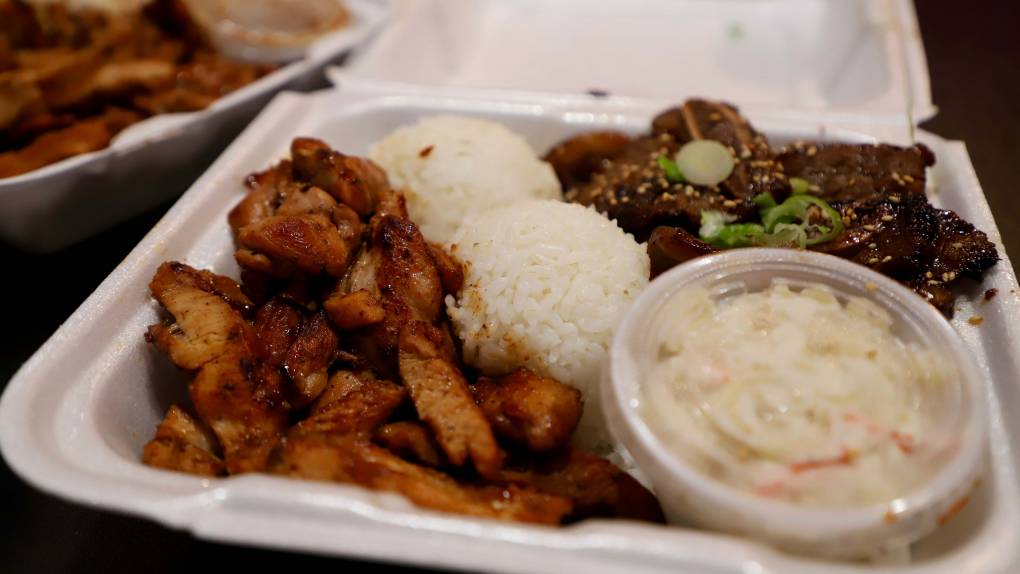
"content": "\u003cp>\u003cspan style=\"font-weight: 400\">[dropcap]F[/dropcap]or most of two decades, I grew up in a single-parent home in the South Bay with a Mexican immigrant father. I remember that our first apartment complex was surrounded by Vietnamese and Chinese immigrants, many of whom didn’t speak English. Still, we all learned how to communicate and mix our customs, spending time in each other’s homes and eating each other’s food. For me and my brother, that meant an extra dose of potstickers and noodles as kids. Our world opened up beyond the tortas, bistec, and quesadillas my dad would often make for dinner, and as I grew older, I understood what it meant to constantly translate cultures through taste.\u003c/span>\u003c/p>\n\u003cp>\u003cspan style=\"font-weight: 400\">In our neighborhood, we had access to everything from Round Table Pizza and Kentucky Fried Chicken to Middle Eastern rotisserie and German hofbrauhaus. But as a first-generation Mexican American with all of these options, there was one plate I grew to relish more than any other: Hawaiian barbecue.\u003c/span>\u003c/p>\n\u003cp>\u003cspan style=\"font-weight: 400\">The “plate lunch” combo was my favorite, no matter where I got it. It always arrived in a steamy container with a creamy scoop of macaroni salad, a lump of sticky white rice, and strips of grilled chicken on a bed of greens—all for a relatively affordable price. Occasionally, I’d mix it up with some breaded katsu for the extra crunch, or order two scoops of mac instead of rice. A can of sinfully sweet Hawaiian Sun completed the meal. I never questioned the origins of the dish.\u003c/span>\u003c/p>\n\u003cp>\u003cspan style=\"font-weight: 400\">But eventually I wondered: Did this really come from Hawaii? And how did it get to become such a popular meal for Northern Californians? \u003c/span>\u003c/p>\n\u003cp>\u003cspan style=\"font-weight: 400\">What I’ve come to understand is that…it’s complicated. There’s a distinction between “Hawaiian-style” foods and foods that are part of the “true,” original Hawaiian diet, such as fish, poi (a mash of starchy vegetables like taro or plantain) and certain fruits that are native to the islands. The rest has been modified over years of migration, colonialism and interchange.\u003c/span>\u003c/p>\n\u003cp>[ad fullwidth]\u003c/p>\n\u003cp>\u003cspan style=\"font-weight: 400\">Spam musubi? A mix of Japanese sushi and U.S. infantry rations from World War II. Loco moco? A mash-up of Spaniard-introduced beef, British gravy and Chinese rice that a group of young cooks tossed into a bowl at a diner in Hilo, Hawaii, in 1949. (One of the teens, \u003c/span>\u003ca href=\"https://www.eastbaytimes.com/2018/11/30/loco-moco-hawaiis-iconic-dish-has-roots-in-the-east-bay/\">\u003cspan style=\"font-weight: 400\">George Takahashi, later migrated to San Leandro\u003c/span>\u003c/a>\u003cspan style=\"font-weight: 400\">.) “Hawaiian pizza”? Don’t even think about it. Even the ukulele was brought over by the Portuguese, along with their sausages, oils and batters—key contributions that led to Hawaii’s eventual boom in fried treats like poi doughnuts.\u003c/span>\u003c/p>\n\u003cfigure id=\"attachment_13911077\" class=\"wp-caption alignnone\" style=\"max-width: 2560px\">\u003cimg loading=\"lazy\" decoding=\"async\" class=\"size-full wp-image-13911077\" src=\"https://ww2.kqed.org/app/uploads/sites/2/2022/03/hawaiianbbq_ilava-scaled.jpg\" alt='iLava Hawaiian Barbecue owner Nicolle Jacinto makes a \"hang loose\" hand gesture in front of an ocean mural inside her East Oakland restaurant.' width=\"2560\" height=\"1440\" srcset=\"https://cdn.kqed.org/wp-content/uploads/sites/2/2022/03/hawaiianbbq_ilava-scaled.jpg 2560w, https://cdn.kqed.org/wp-content/uploads/sites/2/2022/03/hawaiianbbq_ilava-800x450.jpg 800w, https://cdn.kqed.org/wp-content/uploads/sites/2/2022/03/hawaiianbbq_ilava-1020x574.jpg 1020w, https://cdn.kqed.org/wp-content/uploads/sites/2/2022/03/hawaiianbbq_ilava-160x90.jpg 160w, https://cdn.kqed.org/wp-content/uploads/sites/2/2022/03/hawaiianbbq_ilava-768x432.jpg 768w, https://cdn.kqed.org/wp-content/uploads/sites/2/2022/03/hawaiianbbq_ilava-1536x864.jpg 1536w, https://cdn.kqed.org/wp-content/uploads/sites/2/2022/03/hawaiianbbq_ilava-2048x1152.jpg 2048w, https://cdn.kqed.org/wp-content/uploads/sites/2/2022/03/hawaiianbbq_ilava-1920x1080.jpg 1920w\" sizes=\"(max-width: 2560px) 100vw, 2560px\">\u003cfigcaption class=\"wp-caption-text\">Nicole Jacinto fell in love with barbecuing in her native Philippines. Now, she runs a Hawaiian barbecue spot in a Latino strip mall in East Oakland. \u003ccite>(Alan Chazaro)\u003c/cite>\u003c/figcaption>\u003c/figure>\n\u003ch2>Fusion in an Unlikely Place\u003c/h2>\n\u003cp>\u003cspan style=\"font-weight: 400\">The story of Hawaiian barbecue isn’t a story about the sanctity of the purest Hawaiian foods. Instead, it’s a celebration of what it means to be from many places at once, of having mixed upbringings, of melting together a multitude of deliciously imperfect cultural elements and serving them in a Styrofoam to-go box. Most importantly, it’s about finding and tasting that fusion in the most unlikely places—like a Central American strip mall in East Oakland.\u003c/span>\u003c/p>\n\u003cp>\u003cspan style=\"font-weight: 400\">“Hawaiian food isn’t just 100% Hawaiian food, especially in the Bay Area,” says Nicolle Jacinto, owner of \u003c/span>\u003ca href=\"https://www.ilavahawaiianbbq.com/\">\u003cspan style=\"font-weight: 400\">iLava Hawaiian Barbecue\u003c/span>\u003c/a>\u003cspan style=\"font-weight: 400\">, which sits in the aforementioned strip mall. “It’s a mix of many cultures. There’s a fusion and variety of ethnicities here, and since we all eat different foods, Hawaiian has been able to become so popular.”\u003c/span>\u003c/p>\n\u003cp>\u003cspan style=\"font-weight: 400\">The restaurant is located on a metaphorical island on High Street and International Boulevard. It’s a barely noticeable independent shop surrounded by taco trucks, mega-mercados, lavanderías, pawn shops, armed security guards and fast food joints. Yet right in the heart of this predominantly Latino epicenter, you’ll find this tropically inspired restaurant, serving classic plates of island-style food to a diverse clientele of Spanish-speaking immigrants, high-schoolers and other non-Hawaiians.\u003c/span>\u003c/p>\n\u003cp>\u003cspan style=\"font-weight: 400\">[pullquote size=\"large\" align=\"right\"]“The story of Hawaiian barbecue isn’t a story about the sanctity of the purest Hawaiian foods. Instead, it’s a celebration of what it means to be from many places at once.”[/pullquote]Jacinto opened the business in 2017, when her former employer at Hawaiian Grill Express in San Lorenzo asked if she would be interested in running her own restaurant as a part-owner. Since then, Jacinto has overseen iLava’s success, expanding into catering services and a food truck that circulates the entire Bay Area.\u003c/span>\u003c/p>\n\u003cp>\u003cspan style=\"font-weight: 400\">The business serves classic Hawaiian-style plate lunches that feature dishes like barbecue chicken, beef and short ribs, kalua pork, lau lau and garlic shrimp. There’s also a menu of fresh tropical smoothies like the “Hawaiian Sunrise,” a tangy blend of passionfruit and mango. \u003c/span>\u003c/p>\n\u003cp>\u003cspan style=\"font-weight: 400\">The one \u003c/span>\u003ca href=\"https://www.yelp.com/biz/ilava-hawaiian-barbecue-oakland-4\">\u003cspan style=\"font-weight: 400\">Yelp\u003c/span>\u003c/a>\u003cspan style=\"font-weight: 400\"> reviewer who says iLava is “not a true authentic Hawaiian place” because they don’t serve poi seems to miss the point about what the restaurant does do well: a Californicated version of Pacific Island sustenance, served at reasonable prices, in a part of the city that otherwise lacks any major Polynesian presence.\u003c/span>\u003c/p>\n\u003cp>\u003cspan style=\"font-weight: 400\">In many ways, Hawaiian culinary history seems to be just that—a whirlpool of various, inexplicably linked ingredients from miscellaneous sources that can be cooked on the spot for anyone who’s hungry. Jacinto embodies this fusion in her own journey. After immigrating to the East Bay from the Philippines in 2009, Jacinto missed the flavors of her past. Though she isn’t Hawaiian by birth, many of her Filipino family members migrated to Hawaii in the 1990s. During yearly trips to the islands, she learned about the nuanced varieties of regional foods while helping her mother cook for relatives. According to Jacinto, the parallels between Hawaiians and Filipinos are unmistakable, highlighted by “a great sense of hospitality, an appreciation for tropical weather and a love of grilled meat.”\u003c/span>\u003c/p>\n\u003cp>\u003cspan style=\"font-weight: 400\">“My favorite Hawaiian dish is kalua pork,” she tells me. “It’s slow roasted, and it’s basically lechón in the Philippines. It’s prepared slightly differently—lechón is crispier—but it’s almost the same.” (A Latina employee at iLava excitedly compared the dish to carnitas.) Filipino ube (mashed purple yam) has a distinct purple hue, just like Hawaiian poi.\u003c/span>\u003c/p>\n\u003cp>\u003cspan style=\"font-weight: 400\">From a young age, Jacinto would cook skewered meats in the streets of her native country, grilling them over open flames and selling them to neighbors and passersby on their way to work. It was relatively inexpensive and convenient, she explains, to prepare food in this fashion. That’s where she gained an appreciation for barbecuing.\u003c/span>\u003c/p>\n\u003ch2>A Bay Area Classic\u003c/h2>\n\u003cp>\u003cspan style=\"font-weight: 400\">Of course, Hawaiian food is much more than grilled meats. But that particular style, commonly known as “Hawaiian BBQ,” is the one that’s the most widely available here in the Bay Area—especially the classic style of meal known as the plate lunch. Born from \u003c/span>\u003ca href=\"https://hawaiioceanproject.com/a-brief-history-of-plate-lunches-in-hawaii/\">\u003cspan style=\"font-weight: 400\">a working-class context of mixed leftover foods—\u003c/span>\u003c/a>\u003cspan style=\"font-weight: 400\">scraps from previous night’s meals consisting of rice, macaroni and a protein, heaped in a to-go bento box—the plate lunch has become an indisputable California favorite. \u003c/span>\u003c/p>\n\u003cfigure id=\"attachment_13911080\" class=\"wp-caption alignleft\" style=\"max-width: 1920px\">\u003cimg loading=\"lazy\" decoding=\"async\" class=\"size-full wp-image-13911080\" src=\"https://ww2.kqed.org/app/uploads/sites/2/2022/03/patricklandeza_poke-scaled.jpg\" alt=\"Patrick Landeza mixes poke inside a large metal bowl..\" width=\"1920\" height=\"2560\" srcset=\"https://cdn.kqed.org/wp-content/uploads/sites/2/2022/03/patricklandeza_poke-scaled.jpg 1920w, https://cdn.kqed.org/wp-content/uploads/sites/2/2022/03/patricklandeza_poke-800x1067.jpg 800w, https://cdn.kqed.org/wp-content/uploads/sites/2/2022/03/patricklandeza_poke-1020x1360.jpg 1020w, https://cdn.kqed.org/wp-content/uploads/sites/2/2022/03/patricklandeza_poke-160x213.jpg 160w, https://cdn.kqed.org/wp-content/uploads/sites/2/2022/03/patricklandeza_poke-768x1024.jpg 768w, https://cdn.kqed.org/wp-content/uploads/sites/2/2022/03/patricklandeza_poke-1152x1536.jpg 1152w, https://cdn.kqed.org/wp-content/uploads/sites/2/2022/03/patricklandeza_poke-1536x2048.jpg 1536w\" sizes=\"(max-width: 1920px) 100vw, 1920px\">\u003cfigcaption class=\"wp-caption-text\">Patrick Landeza, a Hawaiian cook and musician based in Hayward, specializes in poke. But he appreciates the way Hawaiian barbecue spots make the culture more accessible to the mainstream. \u003ccite>(Courtesy of Patrick Landeza)\u003c/cite>\u003c/figcaption>\u003c/figure>\n\u003cp>\u003cspan style=\"font-weight: 400\">“A plate lunch is just a mixture of things. We’re talking about Japanese, Korean, Hawaiian and more. We’re here in the Bay Area, and this is our taste profile, so that’s why it’s popping up everywhere,” says Patrick Landeza, a Hawaiian cook and musician who owns \u003c/span>\u003ca href=\"https://landezasisland.com/\">\u003cspan style=\"font-weight: 400\">Landeza’s Island Poke & Catering\u003c/span>\u003c/a>\u003cspan style=\"font-weight: 400\"> in Hayward, and is a member of the \u003c/span>\u003ca href=\"https://hccnc.org/\">\u003cspan style=\"font-weight: 400\">Hawai’i Chamber of Commerce in Northern California\u003c/span>\u003c/a>\u003cspan style=\"font-weight: 400\">.\u003c/span>\u003c/p>\n\u003cp>\u003cspan style=\"font-weight: 400\">Though Landeza believes most Hawaiian barbecue outlets lack “true aloha,” or a sense of soul and genuine service, he also admits that they are good at “doing what they do by serving comfort food.” Raised on the “island of Berkeley,” Landeza specializes in poke—bowls of diced raw fish and other ingredients—which is a certified Hawaiian staple. As a Bay Area Hawaiian OG, he acknowledges the importance and accessibility of mainstream Hawaiian barbecue among the non-Hawaiian population.\u003c/span>\u003c/p>\n\u003cp>\u003cspan style=\"font-weight: 400\">The cuisine’s origins on the mainland date back to 1999 when Johnson Kam and Eddie Flores, Jr. opened their \u003c/span>\u003ca href=\"http://archives.starbulletin.com/1999/11/26/business/story1.html\">\u003cspan style=\"font-weight: 400\">first L&L Hawaiian BBQ outside of Hawaii\u003c/span>\u003c/a>\u003cspan style=\"font-weight: 400\">. This was already three decades after the pair had successfully launched the original L&L Drive-In in 1976, in the Kalihi neighborhood of Oahu.\u003c/span>\u003c/p>\n\u003cp>\u003cspan style=\"font-weight: 400\">Their brand of quick, simple Hawaiian fare reached California’s shores when \u003c/span>\u003ca href=\"http://archives.starbulletin.com/1999/11/26/business/story1.html\">\u003cspan style=\"font-weight: 400\">a former employee relocated to San Francisco\u003c/span>\u003c/a>\u003cspan style=\"font-weight: 400\"> and began to serve his own Hawaiian-style plate lunches as a side hustle, Landeza explains. That initial success eventually led to the commercialization of Hawaiian food services that have since proliferated under the L&L brand name. Nowadays, the chain boasts over 200 locations throughout the United States, including a recent opening of their first franchise as far east as Florida. \u003c/span>\u003c/p>\n\u003cp>\u003cspan style=\"font-weight: 400\">Like the plate lunches they serve, L&L’s take on \u003c/span>\u003ca href=\"https://www.hawaiianbarbecue.com/about/\">\u003cspan style=\"font-weight: 400\">“the state food of Hawaii”\u003c/span>\u003c/a>\u003cspan style=\"font-weight: 400\"> is a fusion of past traditions with modern business opportunities. They were able to offer ownership to anyone willing to invest in their franchise model—whether Hawaiian-heritaged or not. A wave of shops selling what we now know as “Hawaiian BBQ” emerged as a result, often owned by immigrants like Jacinto.\u003c/span>\u003c/p>\n\u003cp>\u003cspan style=\"font-weight: 400\">[pullquote size=\"large\" align=\"right\"]“Eating a Filipino-prepared Hawaiian plate lunch in Oakland served by Latino employees represents the beauty of what food can teach us about our human similarities.”[/pullquote]There are other reasons \u003c/span>\u003ca href=\"https://sf.eater.com/2019/1/28/18178937/hawaiian-food-trend-san-francisco-bay-area\">\u003cspan style=\"font-weight: 400\">Hawaiian food has reached trending status in the Bay\u003c/span>\u003c/a>\u003cspan style=\"font-weight: 400\">. For starters, \u003c/span>\u003ca href=\"https://www.sfgate.com/news/article/Bay-Area-has-big-Pacific-Islander-population-2839970.php\">\u003cspan style=\"font-weight: 400\">the region is home to the largest population of Polynesian islanders\u003c/span>\u003c/a>\u003cspan style=\"font-weight: 400\"> who’ve transplanted to the contiguous stateside, making this the world’s biggest Little Island, with the cities of Hayward and Vallejo boasting the most Hawaiian residents. This proximity for cultural exchange largely explains why so many Americanized Polynesian trends have been popularized in the Bay, including tiki bars and \u003c/span>\u003ca href=\"https://www.curacaoliqueur.com/articles/the-mai-tai-history-and-its-recipes-explained\">\u003cspan style=\"font-weight: 400\">the disputed origins of the mai tai cocktail\u003c/span>\u003c/a>\u003cspan style=\"font-weight: 400\">. \u003c/span>\u003c/p>\n\u003cp>\u003cspan style=\"font-weight: 400\">For many, these can come across as a form of \u003c/span>\u003ca href=\"https://www.latimes.com/food/story/2019-11-27/tiki-bar-problems\">\u003cspan style=\"font-weight: 400\">cultural appropriation and “colonial nostalgia\u003c/span>\u003c/a>\u003cspan style=\"font-weight: 400\">.” I’ve seen the same exotic simplification happen with Mexican food—it’s tricky territory to mindlessly enjoy a tiki beverage or “Aloha burger” without considering the layers beneath the surface. On the one hand, it represents some attempt to offer the flavors and experiences of a region. But when done poorly, it comes off as kitschy, tone-deaf and imperialistically exploitative. \u003c/span>\u003c/p>\n\u003cp>\u003cspan style=\"font-weight: 400\">In the case of iLava, though, eating a Filipino-prepared Hawaiian plate lunch in Oakland served by Latino employees represents the beauty of what food can teach us about our human similarities.\u003c/span>\u003c/p>\n\u003cp>\u003cspan style=\"font-weight: 400\">[aside postID='arts_13900855,arts_13898436,arts_13904835']“Food is a vehicle for building community, creating and nurturing that community,” says Landeza. “I don’t do Hawaiian barbecue. I am a Hawaiian caterer who does Hawaiian food. But coming from the mainland with Hawaiian roots, we miss these foods because we identify with it, and we want to relive that however we can. I’ve lived in both worlds, and there is a way to share that aloha, through food and music.”\u003c/span>\u003c/p>\n\u003cp>\u003cspan style=\"font-weight: 400\">Whatever your personal preferences may be, I can only speak for mine: I’ll take a Hawaiian-style barbecue plate lunch any day of the week. There’s just something refreshingly simple about it, and it reminds me of how we’re all a mixture of histories that are outside of anyone’s control or simple definitions. In a way, this mishmash is the only thing I know. It’s a place of comfort for me as the child of immigrants.\u003c/span>\u003c/p>\n\u003cp>\u003cspan style=\"font-weight: 400\">Jacinto, an immigrant herself, feels similarly. “Hawaii reminds me of my home—the warmth, the green, the beaches,” she says. “It’s the closest where I can feel like I’m home.”\u003c/span>\u003c/p>\n\u003cp>\u003cspan style=\"font-weight: 400\">Who can’t stomach that?\u003c/span>\u003c/p>\n\u003cp>\u003cimg loading=\"lazy\" decoding=\"async\" class=\"aligncenter size-full wp-image-12904247\" src=\"https://ww2.kqed.org/app/uploads/sites/2/2017/03/Q.Logo_.Break_-400x39.jpg\" alt=\"\" width=\"400\" height=\"39\" srcset=\"https://cdn.kqed.org/wp-content/uploads/sites/2/2017/03/Q.Logo_.Break_-400x39.jpg 400w, https://cdn.kqed.org/wp-content/uploads/sites/2/2017/03/Q.Logo_.Break_-400x39-160x16.jpg 160w, https://cdn.kqed.org/wp-content/uploads/sites/2/2017/03/Q.Logo_.Break_-400x39-240x23.jpg 240w, https://cdn.kqed.org/wp-content/uploads/sites/2/2017/03/Q.Logo_.Break_-400x39-375x37.jpg 375w\" sizes=\"(max-width: 400px) 100vw, 400px\">\u003c/p>\n\u003cp>[ad floatright]\u003c/p>\n\u003cp>\u003cem>iLava Hawaiian Barbecue is open 11 am–8:15 pm daily at 1446 High St. in Oakland.\u003c/em>\u003c/p>\n\n",
"stats": {
"hasVideo": false,
"hasChartOrMap": false,
"hasAudio": false,
"hasPolis": false,
"wordCount": 2186,
"hasGoogleForm": false,
"hasGallery": false,
"hasHearkenModule": false,
"iframeSrcs": [],
"paragraphCount": 32
},
"modified": 1705007051,
"excerpt": "A first-generation Mexican American takes comfort in the cultural mishmash of a classic plate lunch.",
"headData": {
"twImgId": "",
"twTitle": "Why I Love Hawaiian BBQ: In Praise of One of the Bay's Great Multicultural Cuisines",
"socialTitle": "Hawaiian Barbecue Is One of the Bay Area's Great Multicultural Cuisines %%page%% %%sep%% KQED",
"ogTitle": "Why I Love Hawaiian BBQ: In Praise of One of the Bay's Great Multicultural Cuisines",
"ogImgId": "",
"twDescription": "",
"description": "A first-generation Mexican American takes comfort in the cultural mishmash of a classic plate lunch.",
"title": "Hawaiian Barbecue Is One of the Bay Area's Great Multicultural Cuisines | KQED",
"ogDescription": "",
"schema": {
"@context": "https://schema.org",
"@type": "Article",
"headline": "Why I Love Hawaiian BBQ: In Praise of One of the Bay's Great Multicultural Cuisines",
"datePublished": "2022-03-24T13:50:00-07:00",
"dateModified": "2024-01-11T13:04:11-08:00",
"image": "https://cdn.kqed.org/wp-content/uploads/2020/02/KQED-OG-Image@1x.png"
}
},
"guestAuthors": [],
"slug": "hawaiian-barbecue-bay-area-multicultural-oakland-ilava",
"status": "publish",
"sourceUrl": "/food/",
"templateType": "standard",
"excludeFromSiteSearch": "Include",
"featuredImageType": "standard",
"sticky": false,
"source": "Food",
"path": "/arts/13911062/hawaiian-barbecue-bay-area-multicultural-oakland-ilava",
"audioTrackLength": null,
"parsedContent": [
{
"type": "contentString",
"content": "\u003cdiv class=\"post-body\">\u003cp>\u003cp>\u003cspan style=\"font-weight: 400\">\u003c/p>\u003cp>\u003cspan class=\"utils-parseShortcode-shortcodes-__dropcapShortcode__dropcap\">F\u003c/span>\u003c/p>\u003cp>or most of two decades, I grew up in a single-parent home in the South Bay with a Mexican immigrant father. I remember that our first apartment complex was surrounded by Vietnamese and Chinese immigrants, many of whom didn’t speak English. Still, we all learned how to communicate and mix our customs, spending time in each other’s homes and eating each other’s food. For me and my brother, that meant an extra dose of potstickers and noodles as kids. Our world opened up beyond the tortas, bistec, and quesadillas my dad would often make for dinner, and as I grew older, I understood what it meant to constantly translate cultures through taste.\u003c/span>\u003c/p>\n\u003cp>\u003cspan style=\"font-weight: 400\">In our neighborhood, we had access to everything from Round Table Pizza and Kentucky Fried Chicken to Middle Eastern rotisserie and German hofbrauhaus. But as a first-generation Mexican American with all of these options, there was one plate I grew to relish more than any other: Hawaiian barbecue.\u003c/span>\u003c/p>\n\u003cp>\u003cspan style=\"font-weight: 400\">The “plate lunch” combo was my favorite, no matter where I got it. It always arrived in a steamy container with a creamy scoop of macaroni salad, a lump of sticky white rice, and strips of grilled chicken on a bed of greens—all for a relatively affordable price. Occasionally, I’d mix it up with some breaded katsu for the extra crunch, or order two scoops of mac instead of rice. A can of sinfully sweet Hawaiian Sun completed the meal. I never questioned the origins of the dish.\u003c/span>\u003c/p>\n\u003cp>\u003cspan style=\"font-weight: 400\">But eventually I wondered: Did this really come from Hawaii? And how did it get to become such a popular meal for Northern Californians? \u003c/span>\u003c/p>\n\u003cp>\u003cspan style=\"font-weight: 400\">What I’ve come to understand is that…it’s complicated. There’s a distinction between “Hawaiian-style” foods and foods that are part of the “true,” original Hawaiian diet, such as fish, poi (a mash of starchy vegetables like taro or plantain) and certain fruits that are native to the islands. The rest has been modified over years of migration, colonialism and interchange.\u003c/span>\u003c/p>\n\u003cp>\u003c/p>\u003c/div>",
"attributes": {
"named": {},
"numeric": []
}
},
{
"type": "component",
"content": "",
"name": "ad",
"attributes": {
"named": {
"label": "fullwidth"
},
"numeric": [
"fullwidth"
]
}
},
{
"type": "contentString",
"content": "\u003cdiv class=\"post-body\">\u003cp>\u003c/p>\n\u003cp>\u003cspan style=\"font-weight: 400\">Spam musubi? A mix of Japanese sushi and U.S. infantry rations from World War II. Loco moco? A mash-up of Spaniard-introduced beef, British gravy and Chinese rice that a group of young cooks tossed into a bowl at a diner in Hilo, Hawaii, in 1949. (One of the teens, \u003c/span>\u003ca href=\"https://www.eastbaytimes.com/2018/11/30/loco-moco-hawaiis-iconic-dish-has-roots-in-the-east-bay/\">\u003cspan style=\"font-weight: 400\">George Takahashi, later migrated to San Leandro\u003c/span>\u003c/a>\u003cspan style=\"font-weight: 400\">.) “Hawaiian pizza”? Don’t even think about it. Even the ukulele was brought over by the Portuguese, along with their sausages, oils and batters—key contributions that led to Hawaii’s eventual boom in fried treats like poi doughnuts.\u003c/span>\u003c/p>\n\u003cfigure id=\"attachment_13911077\" class=\"wp-caption alignnone\" style=\"max-width: 2560px\">\u003cimg loading=\"lazy\" decoding=\"async\" class=\"size-full wp-image-13911077\" src=\"https://ww2.kqed.org/app/uploads/sites/2/2022/03/hawaiianbbq_ilava-scaled.jpg\" alt='iLava Hawaiian Barbecue owner Nicolle Jacinto makes a \"hang loose\" hand gesture in front of an ocean mural inside her East Oakland restaurant.' width=\"2560\" height=\"1440\" srcset=\"https://cdn.kqed.org/wp-content/uploads/sites/2/2022/03/hawaiianbbq_ilava-scaled.jpg 2560w, https://cdn.kqed.org/wp-content/uploads/sites/2/2022/03/hawaiianbbq_ilava-800x450.jpg 800w, https://cdn.kqed.org/wp-content/uploads/sites/2/2022/03/hawaiianbbq_ilava-1020x574.jpg 1020w, https://cdn.kqed.org/wp-content/uploads/sites/2/2022/03/hawaiianbbq_ilava-160x90.jpg 160w, https://cdn.kqed.org/wp-content/uploads/sites/2/2022/03/hawaiianbbq_ilava-768x432.jpg 768w, https://cdn.kqed.org/wp-content/uploads/sites/2/2022/03/hawaiianbbq_ilava-1536x864.jpg 1536w, https://cdn.kqed.org/wp-content/uploads/sites/2/2022/03/hawaiianbbq_ilava-2048x1152.jpg 2048w, https://cdn.kqed.org/wp-content/uploads/sites/2/2022/03/hawaiianbbq_ilava-1920x1080.jpg 1920w\" sizes=\"(max-width: 2560px) 100vw, 2560px\">\u003cfigcaption class=\"wp-caption-text\">Nicole Jacinto fell in love with barbecuing in her native Philippines. Now, she runs a Hawaiian barbecue spot in a Latino strip mall in East Oakland. \u003ccite>(Alan Chazaro)\u003c/cite>\u003c/figcaption>\u003c/figure>\n\u003ch2>Fusion in an Unlikely Place\u003c/h2>\n\u003cp>\u003cspan style=\"font-weight: 400\">The story of Hawaiian barbecue isn’t a story about the sanctity of the purest Hawaiian foods. Instead, it’s a celebration of what it means to be from many places at once, of having mixed upbringings, of melting together a multitude of deliciously imperfect cultural elements and serving them in a Styrofoam to-go box. Most importantly, it’s about finding and tasting that fusion in the most unlikely places—like a Central American strip mall in East Oakland.\u003c/span>\u003c/p>\n\u003cp>\u003cspan style=\"font-weight: 400\">“Hawaiian food isn’t just 100% Hawaiian food, especially in the Bay Area,” says Nicolle Jacinto, owner of \u003c/span>\u003ca href=\"https://www.ilavahawaiianbbq.com/\">\u003cspan style=\"font-weight: 400\">iLava Hawaiian Barbecue\u003c/span>\u003c/a>\u003cspan style=\"font-weight: 400\">, which sits in the aforementioned strip mall. “It’s a mix of many cultures. There’s a fusion and variety of ethnicities here, and since we all eat different foods, Hawaiian has been able to become so popular.”\u003c/span>\u003c/p>\n\u003cp>\u003cspan style=\"font-weight: 400\">The restaurant is located on a metaphorical island on High Street and International Boulevard. It’s a barely noticeable independent shop surrounded by taco trucks, mega-mercados, lavanderías, pawn shops, armed security guards and fast food joints. Yet right in the heart of this predominantly Latino epicenter, you’ll find this tropically inspired restaurant, serving classic plates of island-style food to a diverse clientele of Spanish-speaking immigrants, high-schoolers and other non-Hawaiians.\u003c/span>\u003c/p>\n\u003cp>\u003cspan style=\"font-weight: 400\">\u003c/p>\u003c/div>",
"attributes": {
"named": {},
"numeric": []
}
},
{
"type": "component",
"content": "“The story of Hawaiian barbecue isn’t a story about the sanctity of the purest Hawaiian foods. Instead, it’s a celebration of what it means to be from many places at once.”",
"name": "pullquote",
"attributes": {
"named": {
"size": "large",
"align": "right",
"label": ""
},
"numeric": []
}
},
{
"type": "contentString",
"content": "\u003cdiv class=\"post-body\">\u003cp>Jacinto opened the business in 2017, when her former employer at Hawaiian Grill Express in San Lorenzo asked if she would be interested in running her own restaurant as a part-owner. Since then, Jacinto has overseen iLava’s success, expanding into catering services and a food truck that circulates the entire Bay Area.\u003c/span>\u003c/p>\n\u003cp>\u003cspan style=\"font-weight: 400\">The business serves classic Hawaiian-style plate lunches that feature dishes like barbecue chicken, beef and short ribs, kalua pork, lau lau and garlic shrimp. There’s also a menu of fresh tropical smoothies like the “Hawaiian Sunrise,” a tangy blend of passionfruit and mango. \u003c/span>\u003c/p>\n\u003cp>\u003cspan style=\"font-weight: 400\">The one \u003c/span>\u003ca href=\"https://www.yelp.com/biz/ilava-hawaiian-barbecue-oakland-4\">\u003cspan style=\"font-weight: 400\">Yelp\u003c/span>\u003c/a>\u003cspan style=\"font-weight: 400\"> reviewer who says iLava is “not a true authentic Hawaiian place” because they don’t serve poi seems to miss the point about what the restaurant does do well: a Californicated version of Pacific Island sustenance, served at reasonable prices, in a part of the city that otherwise lacks any major Polynesian presence.\u003c/span>\u003c/p>\n\u003cp>\u003cspan style=\"font-weight: 400\">In many ways, Hawaiian culinary history seems to be just that—a whirlpool of various, inexplicably linked ingredients from miscellaneous sources that can be cooked on the spot for anyone who’s hungry. Jacinto embodies this fusion in her own journey. After immigrating to the East Bay from the Philippines in 2009, Jacinto missed the flavors of her past. Though she isn’t Hawaiian by birth, many of her Filipino family members migrated to Hawaii in the 1990s. During yearly trips to the islands, she learned about the nuanced varieties of regional foods while helping her mother cook for relatives. According to Jacinto, the parallels between Hawaiians and Filipinos are unmistakable, highlighted by “a great sense of hospitality, an appreciation for tropical weather and a love of grilled meat.”\u003c/span>\u003c/p>\n\u003cp>\u003cspan style=\"font-weight: 400\">“My favorite Hawaiian dish is kalua pork,” she tells me. “It’s slow roasted, and it’s basically lechón in the Philippines. It’s prepared slightly differently—lechón is crispier—but it’s almost the same.” (A Latina employee at iLava excitedly compared the dish to carnitas.) Filipino ube (mashed purple yam) has a distinct purple hue, just like Hawaiian poi.\u003c/span>\u003c/p>\n\u003cp>\u003cspan style=\"font-weight: 400\">From a young age, Jacinto would cook skewered meats in the streets of her native country, grilling them over open flames and selling them to neighbors and passersby on their way to work. It was relatively inexpensive and convenient, she explains, to prepare food in this fashion. That’s where she gained an appreciation for barbecuing.\u003c/span>\u003c/p>\n\u003ch2>A Bay Area Classic\u003c/h2>\n\u003cp>\u003cspan style=\"font-weight: 400\">Of course, Hawaiian food is much more than grilled meats. But that particular style, commonly known as “Hawaiian BBQ,” is the one that’s the most widely available here in the Bay Area—especially the classic style of meal known as the plate lunch. Born from \u003c/span>\u003ca href=\"https://hawaiioceanproject.com/a-brief-history-of-plate-lunches-in-hawaii/\">\u003cspan style=\"font-weight: 400\">a working-class context of mixed leftover foods—\u003c/span>\u003c/a>\u003cspan style=\"font-weight: 400\">scraps from previous night’s meals consisting of rice, macaroni and a protein, heaped in a to-go bento box—the plate lunch has become an indisputable California favorite. \u003c/span>\u003c/p>\n\u003cfigure id=\"attachment_13911080\" class=\"wp-caption alignleft\" style=\"max-width: 1920px\">\u003cimg loading=\"lazy\" decoding=\"async\" class=\"size-full wp-image-13911080\" src=\"https://ww2.kqed.org/app/uploads/sites/2/2022/03/patricklandeza_poke-scaled.jpg\" alt=\"Patrick Landeza mixes poke inside a large metal bowl..\" width=\"1920\" height=\"2560\" srcset=\"https://cdn.kqed.org/wp-content/uploads/sites/2/2022/03/patricklandeza_poke-scaled.jpg 1920w, https://cdn.kqed.org/wp-content/uploads/sites/2/2022/03/patricklandeza_poke-800x1067.jpg 800w, https://cdn.kqed.org/wp-content/uploads/sites/2/2022/03/patricklandeza_poke-1020x1360.jpg 1020w, https://cdn.kqed.org/wp-content/uploads/sites/2/2022/03/patricklandeza_poke-160x213.jpg 160w, https://cdn.kqed.org/wp-content/uploads/sites/2/2022/03/patricklandeza_poke-768x1024.jpg 768w, https://cdn.kqed.org/wp-content/uploads/sites/2/2022/03/patricklandeza_poke-1152x1536.jpg 1152w, https://cdn.kqed.org/wp-content/uploads/sites/2/2022/03/patricklandeza_poke-1536x2048.jpg 1536w\" sizes=\"(max-width: 1920px) 100vw, 1920px\">\u003cfigcaption class=\"wp-caption-text\">Patrick Landeza, a Hawaiian cook and musician based in Hayward, specializes in poke. But he appreciates the way Hawaiian barbecue spots make the culture more accessible to the mainstream. \u003ccite>(Courtesy of Patrick Landeza)\u003c/cite>\u003c/figcaption>\u003c/figure>\n\u003cp>\u003cspan style=\"font-weight: 400\">“A plate lunch is just a mixture of things. We’re talking about Japanese, Korean, Hawaiian and more. We’re here in the Bay Area, and this is our taste profile, so that’s why it’s popping up everywhere,” says Patrick Landeza, a Hawaiian cook and musician who owns \u003c/span>\u003ca href=\"https://landezasisland.com/\">\u003cspan style=\"font-weight: 400\">Landeza’s Island Poke & Catering\u003c/span>\u003c/a>\u003cspan style=\"font-weight: 400\"> in Hayward, and is a member of the \u003c/span>\u003ca href=\"https://hccnc.org/\">\u003cspan style=\"font-weight: 400\">Hawai’i Chamber of Commerce in Northern California\u003c/span>\u003c/a>\u003cspan style=\"font-weight: 400\">.\u003c/span>\u003c/p>\n\u003cp>\u003cspan style=\"font-weight: 400\">Though Landeza believes most Hawaiian barbecue outlets lack “true aloha,” or a sense of soul and genuine service, he also admits that they are good at “doing what they do by serving comfort food.” Raised on the “island of Berkeley,” Landeza specializes in poke—bowls of diced raw fish and other ingredients—which is a certified Hawaiian staple. As a Bay Area Hawaiian OG, he acknowledges the importance and accessibility of mainstream Hawaiian barbecue among the non-Hawaiian population.\u003c/span>\u003c/p>\n\u003cp>\u003cspan style=\"font-weight: 400\">The cuisine’s origins on the mainland date back to 1999 when Johnson Kam and Eddie Flores, Jr. opened their \u003c/span>\u003ca href=\"http://archives.starbulletin.com/1999/11/26/business/story1.html\">\u003cspan style=\"font-weight: 400\">first L&L Hawaiian BBQ outside of Hawaii\u003c/span>\u003c/a>\u003cspan style=\"font-weight: 400\">. This was already three decades after the pair had successfully launched the original L&L Drive-In in 1976, in the Kalihi neighborhood of Oahu.\u003c/span>\u003c/p>\n\u003cp>\u003cspan style=\"font-weight: 400\">Their brand of quick, simple Hawaiian fare reached California’s shores when \u003c/span>\u003ca href=\"http://archives.starbulletin.com/1999/11/26/business/story1.html\">\u003cspan style=\"font-weight: 400\">a former employee relocated to San Francisco\u003c/span>\u003c/a>\u003cspan style=\"font-weight: 400\"> and began to serve his own Hawaiian-style plate lunches as a side hustle, Landeza explains. That initial success eventually led to the commercialization of Hawaiian food services that have since proliferated under the L&L brand name. Nowadays, the chain boasts over 200 locations throughout the United States, including a recent opening of their first franchise as far east as Florida. \u003c/span>\u003c/p>\n\u003cp>\u003cspan style=\"font-weight: 400\">Like the plate lunches they serve, L&L’s take on \u003c/span>\u003ca href=\"https://www.hawaiianbarbecue.com/about/\">\u003cspan style=\"font-weight: 400\">“the state food of Hawaii”\u003c/span>\u003c/a>\u003cspan style=\"font-weight: 400\"> is a fusion of past traditions with modern business opportunities. They were able to offer ownership to anyone willing to invest in their franchise model—whether Hawaiian-heritaged or not. A wave of shops selling what we now know as “Hawaiian BBQ” emerged as a result, often owned by immigrants like Jacinto.\u003c/span>\u003c/p>\n\u003cp>\u003cspan style=\"font-weight: 400\">\u003c/p>\u003c/div>",
"attributes": {
"named": {},
"numeric": []
}
},
{
"type": "component",
"content": "“Eating a Filipino-prepared Hawaiian plate lunch in Oakland served by Latino employees represents the beauty of what food can teach us about our human similarities.”",
"name": "pullquote",
"attributes": {
"named": {
"size": "large",
"align": "right",
"label": ""
},
"numeric": []
}
},
{
"type": "contentString",
"content": "\u003cdiv class=\"post-body\">\u003cp>There are other reasons \u003c/span>\u003ca href=\"https://sf.eater.com/2019/1/28/18178937/hawaiian-food-trend-san-francisco-bay-area\">\u003cspan style=\"font-weight: 400\">Hawaiian food has reached trending status in the Bay\u003c/span>\u003c/a>\u003cspan style=\"font-weight: 400\">. For starters, \u003c/span>\u003ca href=\"https://www.sfgate.com/news/article/Bay-Area-has-big-Pacific-Islander-population-2839970.php\">\u003cspan style=\"font-weight: 400\">the region is home to the largest population of Polynesian islanders\u003c/span>\u003c/a>\u003cspan style=\"font-weight: 400\"> who’ve transplanted to the contiguous stateside, making this the world’s biggest Little Island, with the cities of Hayward and Vallejo boasting the most Hawaiian residents. This proximity for cultural exchange largely explains why so many Americanized Polynesian trends have been popularized in the Bay, including tiki bars and \u003c/span>\u003ca href=\"https://www.curacaoliqueur.com/articles/the-mai-tai-history-and-its-recipes-explained\">\u003cspan style=\"font-weight: 400\">the disputed origins of the mai tai cocktail\u003c/span>\u003c/a>\u003cspan style=\"font-weight: 400\">. \u003c/span>\u003c/p>\n\u003cp>\u003cspan style=\"font-weight: 400\">For many, these can come across as a form of \u003c/span>\u003ca href=\"https://www.latimes.com/food/story/2019-11-27/tiki-bar-problems\">\u003cspan style=\"font-weight: 400\">cultural appropriation and “colonial nostalgia\u003c/span>\u003c/a>\u003cspan style=\"font-weight: 400\">.” I’ve seen the same exotic simplification happen with Mexican food—it’s tricky territory to mindlessly enjoy a tiki beverage or “Aloha burger” without considering the layers beneath the surface. On the one hand, it represents some attempt to offer the flavors and experiences of a region. But when done poorly, it comes off as kitschy, tone-deaf and imperialistically exploitative. \u003c/span>\u003c/p>\n\u003cp>\u003cspan style=\"font-weight: 400\">In the case of iLava, though, eating a Filipino-prepared Hawaiian plate lunch in Oakland served by Latino employees represents the beauty of what food can teach us about our human similarities.\u003c/span>\u003c/p>\n\u003cp>\u003cspan style=\"font-weight: 400\">\u003c/p>\u003c/div>",
"attributes": {
"named": {},
"numeric": []
}
},
{
"type": "component",
"content": "",
"name": "aside",
"attributes": {
"named": {
"postid": "arts_13900855,arts_13898436,arts_13904835",
"label": ""
},
"numeric": []
}
},
{
"type": "contentString",
"content": "\u003cdiv class=\"post-body\">\u003cp>“Food is a vehicle for building community, creating and nurturing that community,” says Landeza. “I don’t do Hawaiian barbecue. I am a Hawaiian caterer who does Hawaiian food. But coming from the mainland with Hawaiian roots, we miss these foods because we identify with it, and we want to relive that however we can. I’ve lived in both worlds, and there is a way to share that aloha, through food and music.”\u003c/span>\u003c/p>\n\u003cp>\u003cspan style=\"font-weight: 400\">Whatever your personal preferences may be, I can only speak for mine: I’ll take a Hawaiian-style barbecue plate lunch any day of the week. There’s just something refreshingly simple about it, and it reminds me of how we’re all a mixture of histories that are outside of anyone’s control or simple definitions. In a way, this mishmash is the only thing I know. It’s a place of comfort for me as the child of immigrants.\u003c/span>\u003c/p>\n\u003cp>\u003cspan style=\"font-weight: 400\">Jacinto, an immigrant herself, feels similarly. “Hawaii reminds me of my home—the warmth, the green, the beaches,” she says. “It’s the closest where I can feel like I’m home.”\u003c/span>\u003c/p>\n\u003cp>\u003cspan style=\"font-weight: 400\">Who can’t stomach that?\u003c/span>\u003c/p>\n\u003cp>\u003cimg loading=\"lazy\" decoding=\"async\" class=\"aligncenter size-full wp-image-12904247\" src=\"https://ww2.kqed.org/app/uploads/sites/2/2017/03/Q.Logo_.Break_-400x39.jpg\" alt=\"\" width=\"400\" height=\"39\" srcset=\"https://cdn.kqed.org/wp-content/uploads/sites/2/2017/03/Q.Logo_.Break_-400x39.jpg 400w, https://cdn.kqed.org/wp-content/uploads/sites/2/2017/03/Q.Logo_.Break_-400x39-160x16.jpg 160w, https://cdn.kqed.org/wp-content/uploads/sites/2/2017/03/Q.Logo_.Break_-400x39-240x23.jpg 240w, https://cdn.kqed.org/wp-content/uploads/sites/2/2017/03/Q.Logo_.Break_-400x39-375x37.jpg 375w\" sizes=\"(max-width: 400px) 100vw, 400px\">\u003c/p>\n\u003cp>\u003c/p>\u003c/div>",
"attributes": {
"named": {},
"numeric": []
}
},
{
"type": "component",
"content": "",
"name": "ad",
"attributes": {
"named": {
"label": "floatright"
},
"numeric": [
"floatright"
]
}
},
{
"type": "contentString",
"content": "\u003cdiv class=\"post-body\">\u003cp>\u003c/p>\n\u003cp>\u003cem>iLava Hawaiian Barbecue is open 11 am–8:15 pm daily at 1446 High St. in Oakland.\u003c/em>\u003c/p>\n\n\u003c/div>\u003c/p>",
"attributes": {
"named": {},
"numeric": []
}
}
],
"link": "/arts/13911062/hawaiian-barbecue-bay-area-multicultural-oakland-ilava",
"authors": [
"11748"
],
"categories": [
"arts_1",
"arts_12276"
],
"tags": [
"arts_13831",
"arts_5016",
"arts_10342",
"arts_10278",
"arts_1297",
"arts_17041",
"arts_1143"
],
"featImg": "arts_13911071",
"label": "source_arts_13911062"
},
"arts_13897987": {
"type": "posts",
"id": "arts_13897987",
"meta": {
"index": "posts_1716263798",
"site": "arts",
"id": "13897987",
"score": null,
"sort": [
1622149743000
]
},
"parent": 0,
"labelTerm": {},
"blocks": [],
"publishDate": 1622149743,
"format": "standard",
"title": "Legendary Oakland Barbecue Spot Flint's Will Open for Takeout This Summer",
"headTitle": "Legendary Oakland Barbecue Spot Flint’s Will Open for Takeout This Summer | KQED",
"content": "\u003cp>\u003cspan style=\"font-weight: 400\">For the past few months, Crystal Martin was on the verge of achieving a long-held dream. The granddaughter of the founder of \u003c/span>\u003ca href=\"https://www.instagram.com/flintsbarbecue/\">\u003cspan style=\"font-weight: 400\">Flint’s Barbecue\u003c/span>\u003c/a>\u003cspan style=\"font-weight: 400\">, an \u003c/span>\u003ca href=\"https://www.kqed.org/arts/13894423/flints-an-icon-of-oakland-barbecue-plots-return-to-original-location\">\u003cspan style=\"font-weight: 400\">iconic restaurant in the annals of Oakland barbecue\u003c/span>\u003c/a>\u003cspan style=\"font-weight: 400\">, had been working to resurrect the family business—in one of the original Flint’s locations, on San Pablo Avenue in West Oakland, no less.\u003c/span>\u003c/p>\n\u003cp>\u003cspan style=\"font-weight: 400\">Now, Martin says she’s one step closer to achieving her goal, though perhaps not in the way she expected: This summer, Martin will open Flint’s as a takeout- and delivery-only restaurant that will be part of a new \u003c/span>\u003ca href=\"https://www.cloudkitchens.com/\">\u003cspan style=\"font-weight: 400\">CloudKitchens\u003c/span>\u003c/a>\u003cspan style=\"font-weight: 400\"> ghost kitchen facility located in a big warehouse at \u003c/span>\u003ca href=\"https://www.loopnet.com/portfolio-property/5325-5333-Adeline-St-Emeryville-CA/5971289/\">\u003cspan style=\"font-weight: 400\">5325 Adeline Street\u003c/span>\u003c/a>\u003cspan style=\"font-weight: 400\">, at the border of North Oakland and Emeryville. She just signed the lease this week.\u003c/span>\u003c/p>\n\u003cp>\u003cspan style=\"font-weight: 400\">The upshot is that, for the first time in more than a decade, customers both old and new will be able to get a hold of Flint’s Barbecue’s famous coarse-ground links, ribs and barbecue sauce on a regular basis. \u003c/span>\u003c/p>\n\u003cp>https://www.instagram.com/p/CPUOjEcsNSJ/?utm_source=ig_web_copy_link\u003c/p>\n\u003cp>\u003cspan style=\"font-weight: 400\">The decision comes, in part, because Martin wasn’t able to secure the old San Pablo Avenue space after all. Her original plan was an ambitious one: The original Flint’s building has sat empty since the late ’90s, and its prospective buyer had told Martin that it needed upwards of $40,000 in construction work before she’d be able to move in. But then it seems the buyer had a change of heart, and now, Martin says, someone \u003c/span>\u003ci>\u003cspan style=\"font-weight: 400\">else\u003c/span>\u003c/i>\u003cspan style=\"font-weight: 400\"> is buying the building—someone who has other plans for the space. [aside postID='arts_13894423' \u003ci>label=\u003c/i>'More on Flint’s']\u003c/span>\u003c/p>\n\u003cp>\u003cspan style=\"font-weight: 400\">It was a disappointment, Martin concedes. But she’d also already started looking into alternatives. “Something told me to prepare a plan B,” she says. “The dream was to go back to that San Pablo location, but you know, maybe that wasn’t meant for us.”\u003c/span>\u003c/p>\n\u003cp>\u003cspan style=\"font-weight: 400\">Of course, opening in a ghost kitchen isn’t necessarily the ideal. According to Martin, the yet-unnamed Adeline Street facility will be home to 40 different businesses, each of them with their own little kitchen space in the warehouse. There won’t be any seating for customers; there won’t even be any signage for Flint’s outside of the building—the number of other restaurants sharing the space makes that unfeasible. Customers will be able to order takeout in person, but a lot of the business will be filtered through delivery apps like DoorDash and Uber Eats. CloudKitchens, a company backed by Uber co-founder Travis Kalanick, is one of a number of so-called \u003c/span>\u003ca href=\"https://www.kqed.org/bayareabites/135793/delivery-only-the-rise-of-restaurants-with-no-diners-as-apps-take-orders\">\u003cspan style=\"font-weight: 400\">ghost kitchen, or virtual kitchen, companies\u003c/span>\u003c/a>\u003cspan style=\"font-weight: 400\"> that have expanded their operations during the pandemic—companies whose long-term impact on the restaurant industry remains \u003c/span>\u003ca href=\"https://www.eater.com/21540765/ghost-kitchens-virtual-restaurants-covid-19-industry-impact\">\u003cspan style=\"font-weight: 400\">very much an open question\u003c/span>\u003c/a>\u003cspan style=\"font-weight: 400\">. \u003c/span>\u003c/p>\n\u003cfigure id=\"attachment_13894445\" class=\"wp-caption alignnone\" style=\"max-width: 640px\">\u003cimg loading=\"lazy\" decoding=\"async\" class=\"size-full wp-image-13894445\" src=\"https://ww2.kqed.org/app/uploads/sites/2/2021/03/flints_crystalmartin.crop_.jpg\" alt=\"Crystal Martin stands inside her Alameda commercial kitchen space during one of her Flint's pop-ups.\" width=\"640\" height=\"908\" srcset=\"https://cdn.kqed.org/wp-content/uploads/sites/2/2021/03/flints_crystalmartin.crop_.jpg 640w, https://cdn.kqed.org/wp-content/uploads/sites/2/2021/03/flints_crystalmartin.crop_-160x227.jpg 160w\" sizes=\"(max-width: 640px) 100vw, 640px\">\u003cfigcaption class=\"wp-caption-text\">Crystal Martin at her Alameda commercial kitchen space during one of her Flint’s pop-ups. \u003ccite>(HMTWNHERO)\u003c/cite>\u003c/figcaption>\u003c/figure>\n\u003cp>\u003cspan style=\"font-weight: 400\">In Oakland, CloudKitchens already runs one big ghost kitchen facility, \u003c/span>\u003ca href=\"https://oaklandfoodhall.com/\">\u003cspan style=\"font-weight: 400\">Oakland Food Hall\u003c/span>\u003c/a>\u003cspan style=\"font-weight: 400\">, in East Oakland. It has yet to formally announce the North Oakland/Emeryville project, though Martin says her understanding is that construction is well under way. (KQED reached out to CloudKitchens to confirm the details of the new ghost kitchen, but had not received a response at time of publication.)\u003c/span>\u003c/p>\n\u003cp>\u003cspan style=\"font-weight: 400\">Nevertheless, Martin is excited about the prospect of being able to finally turn the new Flint’s into a full-fledged business after spending the past year only selling her barbecue once every few months. When she opens in the ghost kitchen space—tentatively around July 15, Martin says—she plans to be open Thursday through Sunday to start out, and then eventually six days a week. \u003c/span>\u003c/p>\n\u003cfigure id=\"attachment_13894446\" class=\"wp-caption alignnone\" style=\"max-width: 800px\">\u003cimg loading=\"lazy\" decoding=\"async\" class=\"size-full wp-image-13894446\" src=\"https://ww2.kqed.org/app/uploads/sites/2/2021/03/FlintSlinks.Crop_.jpg\" alt=\"Two trays full of Flint's house-made links.\" width=\"800\" height=\"646\" srcset=\"https://cdn.kqed.org/wp-content/uploads/sites/2/2021/03/FlintSlinks.Crop_.jpg 800w, https://cdn.kqed.org/wp-content/uploads/sites/2/2021/03/FlintSlinks.Crop_-160x129.jpg 160w, https://cdn.kqed.org/wp-content/uploads/sites/2/2021/03/FlintSlinks.Crop_-768x620.jpg 768w\" sizes=\"(max-width: 800px) 100vw, 800px\">\u003cfigcaption class=\"wp-caption-text\">The coarse-ground links were one of Flint’s signature items. \u003ccite>(Flint's Barbecue)\u003c/cite>\u003c/figcaption>\u003c/figure>\n\u003cp>\u003cspan style=\"font-weight: 400\">“It’s a good starting place,” Martin says. She won’t have to take on the risk of signing a five- or 10-year lease right out of the gate, and she’ll be able to make sure the business is profitable and sustainable before making a larger commitment. “We do hope to someday have our own brick and mortar,” she says.\u003c/span>\u003c/p>\n\u003cp>\u003cspan style=\"font-weight: 400\">Meanwhile, Martin has raised a little over $7,000 toward opening her restaurant via a \u003ca href=\"https://www.gofundme.com/f/help-us-move-back-to-san-pablo\">GoFundMe campaign\u003c/a>—money she says she wound up using for the down payment on her \u003c/span>\u003cspan style=\"font-weight: 400\">CloudKitchens spot\u003c/span>\u003cspan style=\"font-weight: 400\">. She’s hoping supporters of the restaurant will still consider chipping in: She still needs to buy about $15,000 worth of equipment, including a new indoor smoker, before she can open for business.\u003c/span>\u003c/p>\n\u003cp>[ad fullwidth]\u003c/p>\n\u003cp>\u003c/p>\n",
"stats": {
"hasVideo": false,
"hasChartOrMap": false,
"hasAudio": false,
"hasPolis": false,
"wordCount": 805,
"hasGoogleForm": false,
"hasGallery": false,
"hasHearkenModule": false,
"iframeSrcs": [],
"paragraphCount": 12
},
"modified": 1705008302,
"excerpt": "The iconic barbecue restaurant will be part of a new ghost kitchen facility on the Oakland-Emeryville border.",
"headData": {
"twImgId": "",
"twTitle": "",
"ogTitle": "",
"ogImgId": "",
"twDescription": "",
"description": "The iconic barbecue restaurant will be part of a new ghost kitchen facility on the Oakland-Emeryville border.",
"title": "Legendary Oakland Barbecue Spot Flint's Will Open for Takeout This Summer | KQED",
"ogDescription": "",
"schema": {
"@context": "https://schema.org",
"@type": "Article",
"headline": "Legendary Oakland Barbecue Spot Flint's Will Open for Takeout This Summer",
"datePublished": "2021-05-27T14:09:03-07:00",
"dateModified": "2024-01-11T13:25:02-08:00",
"image": "https://cdn.kqed.org/wp-content/uploads/2020/02/KQED-OG-Image@1x.png"
}
},
"guestAuthors": [],
"slug": "flints-barbecue-oakland-emeryville-open-takeout-cloudkitchens",
"status": "publish",
"sourceUrl": "https://www.kqed.org/food",
"templateType": "standard",
"featuredImageType": "standard",
"sticky": false,
"source": "Food",
"WpOldSlug": "legendary-oakland-barbecue-spot-flints-will-open-for-takeout-this-summer",
"path": "/arts/13897987/flints-barbecue-oakland-emeryville-open-takeout-cloudkitchens",
"audioTrackLength": null,
"parsedContent": [
{
"type": "contentString",
"content": "\u003cdiv class=\"post-body\">\u003cp>\u003cp>\u003cspan style=\"font-weight: 400\">For the past few months, Crystal Martin was on the verge of achieving a long-held dream. The granddaughter of the founder of \u003c/span>\u003ca href=\"https://www.instagram.com/flintsbarbecue/\">\u003cspan style=\"font-weight: 400\">Flint’s Barbecue\u003c/span>\u003c/a>\u003cspan style=\"font-weight: 400\">, an \u003c/span>\u003ca href=\"https://www.kqed.org/arts/13894423/flints-an-icon-of-oakland-barbecue-plots-return-to-original-location\">\u003cspan style=\"font-weight: 400\">iconic restaurant in the annals of Oakland barbecue\u003c/span>\u003c/a>\u003cspan style=\"font-weight: 400\">, had been working to resurrect the family business—in one of the original Flint’s locations, on San Pablo Avenue in West Oakland, no less.\u003c/span>\u003c/p>\n\u003cp>\u003cspan style=\"font-weight: 400\">Now, Martin says she’s one step closer to achieving her goal, though perhaps not in the way she expected: This summer, Martin will open Flint’s as a takeout- and delivery-only restaurant that will be part of a new \u003c/span>\u003ca href=\"https://www.cloudkitchens.com/\">\u003cspan style=\"font-weight: 400\">CloudKitchens\u003c/span>\u003c/a>\u003cspan style=\"font-weight: 400\"> ghost kitchen facility located in a big warehouse at \u003c/span>\u003ca href=\"https://www.loopnet.com/portfolio-property/5325-5333-Adeline-St-Emeryville-CA/5971289/\">\u003cspan style=\"font-weight: 400\">5325 Adeline Street\u003c/span>\u003c/a>\u003cspan style=\"font-weight: 400\">, at the border of North Oakland and Emeryville. She just signed the lease this week.\u003c/span>\u003c/p>\n\u003cp>\u003cspan style=\"font-weight: 400\">The upshot is that, for the first time in more than a decade, customers both old and new will be able to get a hold of Flint’s Barbecue’s famous coarse-ground links, ribs and barbecue sauce on a regular basis. \u003c/span>\u003c/p>\u003c/p>\u003c/div>",
"attributes": {
"named": {},
"numeric": []
}
},
{
"type": "component",
"content": "",
"name": "instagramLink",
"attributes": {
"named": {
"instagramUrl": "https://www.instagram.com/p/CPUOjEcsNSJ/?utm_source=ig_web_copy_link"
},
"numeric": []
}
},
{
"type": "contentString",
"content": "\u003cdiv class=\"post-body\">\u003cp>\u003cp>\u003cspan style=\"font-weight: 400\">The decision comes, in part, because Martin wasn’t able to secure the old San Pablo Avenue space after all. Her original plan was an ambitious one: The original Flint’s building has sat empty since the late ’90s, and its prospective buyer had told Martin that it needed upwards of $40,000 in construction work before she’d be able to move in. But then it seems the buyer had a change of heart, and now, Martin says, someone \u003c/span>\u003ci>\u003cspan style=\"font-weight: 400\">else\u003c/span>\u003c/i>\u003cspan style=\"font-weight: 400\"> is buying the building—someone who has other plans for the space. \u003c/p>\u003c/div>",
"attributes": {
"named": {},
"numeric": []
}
},
{
"type": "component",
"content": "",
"name": "aside",
"attributes": {
"named": {
"postid": "arts_13894423",
"label": "\u003ci>label=\u003c/i>'More on Flint’s'"
},
"numeric": [
"\u003ci>label=\u003c/i>'More",
"on",
"Flint’s'"
]
}
},
{
"type": "contentString",
"content": "\u003cdiv class=\"post-body\">\u003cp>\u003c/span>\u003c/p>\n\u003cp>\u003cspan style=\"font-weight: 400\">It was a disappointment, Martin concedes. But she’d also already started looking into alternatives. “Something told me to prepare a plan B,” she says. “The dream was to go back to that San Pablo location, but you know, maybe that wasn’t meant for us.”\u003c/span>\u003c/p>\n\u003cp>\u003cspan style=\"font-weight: 400\">Of course, opening in a ghost kitchen isn’t necessarily the ideal. According to Martin, the yet-unnamed Adeline Street facility will be home to 40 different businesses, each of them with their own little kitchen space in the warehouse. There won’t be any seating for customers; there won’t even be any signage for Flint’s outside of the building—the number of other restaurants sharing the space makes that unfeasible. Customers will be able to order takeout in person, but a lot of the business will be filtered through delivery apps like DoorDash and Uber Eats. CloudKitchens, a company backed by Uber co-founder Travis Kalanick, is one of a number of so-called \u003c/span>\u003ca href=\"https://www.kqed.org/bayareabites/135793/delivery-only-the-rise-of-restaurants-with-no-diners-as-apps-take-orders\">\u003cspan style=\"font-weight: 400\">ghost kitchen, or virtual kitchen, companies\u003c/span>\u003c/a>\u003cspan style=\"font-weight: 400\"> that have expanded their operations during the pandemic—companies whose long-term impact on the restaurant industry remains \u003c/span>\u003ca href=\"https://www.eater.com/21540765/ghost-kitchens-virtual-restaurants-covid-19-industry-impact\">\u003cspan style=\"font-weight: 400\">very much an open question\u003c/span>\u003c/a>\u003cspan style=\"font-weight: 400\">. \u003c/span>\u003c/p>\n\u003cfigure id=\"attachment_13894445\" class=\"wp-caption alignnone\" style=\"max-width: 640px\">\u003cimg loading=\"lazy\" decoding=\"async\" class=\"size-full wp-image-13894445\" src=\"https://ww2.kqed.org/app/uploads/sites/2/2021/03/flints_crystalmartin.crop_.jpg\" alt=\"Crystal Martin stands inside her Alameda commercial kitchen space during one of her Flint's pop-ups.\" width=\"640\" height=\"908\" srcset=\"https://cdn.kqed.org/wp-content/uploads/sites/2/2021/03/flints_crystalmartin.crop_.jpg 640w, https://cdn.kqed.org/wp-content/uploads/sites/2/2021/03/flints_crystalmartin.crop_-160x227.jpg 160w\" sizes=\"(max-width: 640px) 100vw, 640px\">\u003cfigcaption class=\"wp-caption-text\">Crystal Martin at her Alameda commercial kitchen space during one of her Flint’s pop-ups. \u003ccite>(HMTWNHERO)\u003c/cite>\u003c/figcaption>\u003c/figure>\n\u003cp>\u003cspan style=\"font-weight: 400\">In Oakland, CloudKitchens already runs one big ghost kitchen facility, \u003c/span>\u003ca href=\"https://oaklandfoodhall.com/\">\u003cspan style=\"font-weight: 400\">Oakland Food Hall\u003c/span>\u003c/a>\u003cspan style=\"font-weight: 400\">, in East Oakland. It has yet to formally announce the North Oakland/Emeryville project, though Martin says her understanding is that construction is well under way. (KQED reached out to CloudKitchens to confirm the details of the new ghost kitchen, but had not received a response at time of publication.)\u003c/span>\u003c/p>\n\u003cp>\u003cspan style=\"font-weight: 400\">Nevertheless, Martin is excited about the prospect of being able to finally turn the new Flint’s into a full-fledged business after spending the past year only selling her barbecue once every few months. When she opens in the ghost kitchen space—tentatively around July 15, Martin says—she plans to be open Thursday through Sunday to start out, and then eventually six days a week. \u003c/span>\u003c/p>\n\u003cfigure id=\"attachment_13894446\" class=\"wp-caption alignnone\" style=\"max-width: 800px\">\u003cimg loading=\"lazy\" decoding=\"async\" class=\"size-full wp-image-13894446\" src=\"https://ww2.kqed.org/app/uploads/sites/2/2021/03/FlintSlinks.Crop_.jpg\" alt=\"Two trays full of Flint's house-made links.\" width=\"800\" height=\"646\" srcset=\"https://cdn.kqed.org/wp-content/uploads/sites/2/2021/03/FlintSlinks.Crop_.jpg 800w, https://cdn.kqed.org/wp-content/uploads/sites/2/2021/03/FlintSlinks.Crop_-160x129.jpg 160w, https://cdn.kqed.org/wp-content/uploads/sites/2/2021/03/FlintSlinks.Crop_-768x620.jpg 768w\" sizes=\"(max-width: 800px) 100vw, 800px\">\u003cfigcaption class=\"wp-caption-text\">The coarse-ground links were one of Flint’s signature items. \u003ccite>(Flint's Barbecue)\u003c/cite>\u003c/figcaption>\u003c/figure>\n\u003cp>\u003cspan style=\"font-weight: 400\">“It’s a good starting place,” Martin says. She won’t have to take on the risk of signing a five- or 10-year lease right out of the gate, and she’ll be able to make sure the business is profitable and sustainable before making a larger commitment. “We do hope to someday have our own brick and mortar,” she says.\u003c/span>\u003c/p>\n\u003cp>\u003cspan style=\"font-weight: 400\">Meanwhile, Martin has raised a little over $7,000 toward opening her restaurant via a \u003ca href=\"https://www.gofundme.com/f/help-us-move-back-to-san-pablo\">GoFundMe campaign\u003c/a>—money she says she wound up using for the down payment on her \u003c/span>\u003cspan style=\"font-weight: 400\">CloudKitchens spot\u003c/span>\u003cspan style=\"font-weight: 400\">. She’s hoping supporters of the restaurant will still consider chipping in: She still needs to buy about $15,000 worth of equipment, including a new indoor smoker, before she can open for business.\u003c/span>\u003c/p>\n\u003cp>\u003c/p>\u003c/div>",
"attributes": {
"named": {},
"numeric": []
}
},
{
"type": "component",
"content": "",
"name": "ad",
"attributes": {
"named": {
"label": "fullwidth"
},
"numeric": [
"fullwidth"
]
}
},
{
"type": "contentString",
"content": "\u003cdiv class=\"post-body\">\u003cp>\u003c/p>\n\u003cp>\u003c/p>\n\u003c/div>\u003c/p>",
"attributes": {
"named": {},
"numeric": []
}
}
],
"link": "/arts/13897987/flints-barbecue-oakland-emeryville-open-takeout-cloudkitchens",
"authors": [
"11743"
],
"categories": [
"arts_1",
"arts_12276"
],
"tags": [
"arts_13831",
"arts_10278",
"arts_1143"
],
"featImg": "arts_13896599",
"label": "source_arts_13897987"
},
"arts_13896380": {
"type": "posts",
"id": "arts_13896380",
"meta": {
"index": "posts_1716263798",
"site": "arts",
"id": "13896380",
"score": null,
"sort": [
1619626558000
]
},
"parent": 0,
"labelTerm": {},
"blocks": [],
"publishDate": 1619626558,
"format": "standard",
"title": "Fruitvale's Ruby Q Smoke Fusion Slings Barbecue Inspired by Mexico and Louisiana",
"headTitle": "Fruitvale’s Ruby Q Smoke Fusion Slings Barbecue Inspired by Mexico and Louisiana | KQED",
"content": "\u003cp>\u003cspan style=\"font-weight: 400\">[dropcap]I[/dropcap]f I’m being honest, the East Bay doesn’t have enough barbecue. There’s only a handful of small, family-owned joints around here—and I support them when I can. So, when a local friend told me about \u003ca href=\"https://rubyqsmokefusion.com/\">Ruby Q Smoke Fusion\u003c/a>, a new barbecue spot in East Oakland, I made sure to check it out. I was extra hyped when I found out that it was run by a young married couple from the area, Reuben Mcelligott and Edlyn Rodriguez.\u003c/span>\u003c/p>\n\u003cp>\u003cspan style=\"font-weight: 400\">“It’s called fusion for a reason. I mean, look at the neighborhood we’re at and who we serve,” Rodriguez says. \u003c/span>\u003c/p>\n\u003cp>\u003cspan style=\"font-weight: 400\">She’s talking about Fruitvale, where you’ll find some of the \u003ca href=\"https://www.kqed.org/bayareabites/135813/5-food-trucks-that-put-regional-mexican-plates-on-the-map\">best taco trucks anywhere on the entire West Coast\u003c/a>. The daughter of Mexican immigrants from Jalisco, Rodriguez knows the inside of a kitchen, having learned from her mother. But Ruby Q doesn’t serve traditional Mexican fare. Instead, it’s a fusion of Rodriguez’s culinary heritage combined with her husband’s family trade: Southern-style smoked and grilled meats. \u003c/span>\u003c/p>\n\u003cfigure id=\"attachment_13896416\" class=\"wp-caption aligncenter\" style=\"max-width: 800px\">\u003cimg loading=\"lazy\" decoding=\"async\" class=\"wp-image-13896416 size-medium\" src=\"https://ww2.kqed.org/app/uploads/sites/2/2021/04/RubyQ_barbecue-800x1200.jpg\" alt=\"Takeout containers of barbecue and mac and cheese on a picnic table.\" width=\"800\" height=\"1200\" srcset=\"https://cdn.kqed.org/wp-content/uploads/sites/2/2021/04/RubyQ_barbecue-800x1200.jpg 800w, https://cdn.kqed.org/wp-content/uploads/sites/2/2021/04/RubyQ_barbecue-1020x1530.jpg 1020w, https://cdn.kqed.org/wp-content/uploads/sites/2/2021/04/RubyQ_barbecue-160x240.jpg 160w, https://cdn.kqed.org/wp-content/uploads/sites/2/2021/04/RubyQ_barbecue-768x1152.jpg 768w, https://cdn.kqed.org/wp-content/uploads/sites/2/2021/04/RubyQ_barbecue-1024x1536.jpg 1024w, https://cdn.kqed.org/wp-content/uploads/sites/2/2021/04/RubyQ_barbecue-1365x2048.jpg 1365w, https://cdn.kqed.org/wp-content/uploads/sites/2/2021/04/RubyQ_barbecue-1920x2880.jpg 1920w, https://cdn.kqed.org/wp-content/uploads/sites/2/2021/04/RubyQ_barbecue-scaled.jpg 1707w\" sizes=\"(max-width: 800px) 100vw, 800px\">\u003cfigcaption class=\"wp-caption-text\">Ribs, brisket, and mac and cheese. \u003ccite>(Briana Chazaro)\u003c/cite>\u003c/figcaption>\u003c/figure>\n\u003cp>\u003cspan style=\"font-weight: 400\">The restaurant opened in June 2020, at the height of the pandemic, but with Rodriguez and Mcelligott’s dedication to serving great food while representing their cultures, it has flourished in a much-needed way. Though he jokes that his name sounds “white” because of his Irish grandfather, Mcelligott is a millennial Black dude who was raised around the corner. He was a 90s kid who never fully fit into any box and enjoyed skating, sports and hip hop—all elements that are on display on the restaurant’s walls.\u003c/span>\u003c/p>\n\u003cp>\u003cspan style=\"font-weight: 400\">More importantly, the space is a homage to Mcelligott’s mother’s family, who first started their barbecue business in Louisiana in the early 1900s, and whose influence can still be felt and tasted over a century later. “We use the family recipe from back then for our barbecue sauce. It’s something my family has been doing for as long as I know,” he explains. \u003c/span>\u003c/p>\n\u003cp>[ad fullwidth]\u003c/p>\n\u003cp>\u003cspan style=\"font-weight: 400\">Both Mcelligott and Rodriguez are proud of their family’s legacies, and together, they’ve launched a dynamic and affordable culinary outlet that reflects where each of them come from—in a city known for its eclectic spirit of diversity and newness. \u003c/span>\u003c/p>\n\u003cp>\u003cspan style=\"font-weight: 400\">[dropcap]S[/dropcap]o what exactly do American barbecue and Mexican food look like when they’re combined together? Try Ruby Q’s barbecue brisket quesadilla—a soft, warm and decadently cheesy mixture of avocado, queso Mexicano, pico de gallo and, of course, a mound of lightly crisped, not-too-tangy brisket inside the gooey middle. You get a taste of both cultures in each mouthful. As a Mexican American from the Bay, I can honestly say it’s the most flavorful (and filling) quesadilla I’ve ever eaten. Sorry, abuelita. \u003c/span>\u003c/p>\n\u003cfigure id=\"attachment_13896418\" class=\"wp-caption aligncenter\" style=\"max-width: 800px\">\u003cimg loading=\"lazy\" decoding=\"async\" class=\"size-medium wp-image-13896418\" src=\"https://ww2.kqed.org/app/uploads/sites/2/2021/04/RubyQ_quesadilla-800x533.jpg\" alt=\"A fried quesadilla topped with sour cream, guacamole, and pico de gallo.\" width=\"800\" height=\"533\" srcset=\"https://cdn.kqed.org/wp-content/uploads/sites/2/2021/04/RubyQ_quesadilla-800x533.jpg 800w, https://cdn.kqed.org/wp-content/uploads/sites/2/2021/04/RubyQ_quesadilla-1020x680.jpg 1020w, https://cdn.kqed.org/wp-content/uploads/sites/2/2021/04/RubyQ_quesadilla-160x107.jpg 160w, https://cdn.kqed.org/wp-content/uploads/sites/2/2021/04/RubyQ_quesadilla-768x512.jpg 768w, https://cdn.kqed.org/wp-content/uploads/sites/2/2021/04/RubyQ_quesadilla-1536x1024.jpg 1536w, https://cdn.kqed.org/wp-content/uploads/sites/2/2021/04/RubyQ_quesadilla-2048x1365.jpg 2048w, https://cdn.kqed.org/wp-content/uploads/sites/2/2021/04/RubyQ_quesadilla-1920x1280.jpg 1920w\" sizes=\"(max-width: 800px) 100vw, 800px\">\u003cfigcaption class=\"wp-caption-text\">The barbecue brisket quesadilla is one of the highlights. \u003ccite>(Briana Chazaro)\u003c/cite>\u003c/figcaption>\u003c/figure>\n\u003cp>\u003cspan style=\"font-weight: 400\">A single quesadilla could easily be your entire meal. But this is barbecue, so you’ll have to toss in a side of pulled pork nachos to go with that. Though I’ve eaten nacho remixes like this before, this version was on another level: the perfect combination of fresh tortilla chips, homemade guacamole, cheese, and juicy, fall-apart-on-your-fork pork that has been slow-cooked for hours. If that’s not your style, try the Louisiana gumbo with sausage that is “smoked while you sleep”—a nod to Mcelligott’s Cajun roots—which isn’t commonly offered in traditional barbecue settings. \u003c/span>\u003c/p>\n\u003cp>\u003cspan style=\"font-weight: 400\">[aside tag='barbecue' label='More Barbecue']However, the Ruby Q experience goes beyond its culinary heritage. The entire time I was there, the spot was hella active with locals. It’s a homey environment where the entire neighborhood converges, literally, to get a taste. Located at the chaotic intersection of Fruitvale Avenue and San Leandro Street, the restaurant is tucked in between an industrial railroad crossing, a busy highway overpass, a bustling BART station, and two Mexican restaurants. It’s surprisingly easy to miss. \u003c/span>\u003c/p>\n\u003cp>\u003cspan style=\"font-weight: 400\">But if you close your eyes and inhale, you’ll only smell one thing: racks of meat being smoked daily. Follow that scent, and you’ll see why everyone is lining up.\u003c/span>\u003c/p>\n\u003cp>\u003cspan style=\"font-weight: 400\">During my recent weeknight visit, I noticed an Asian family, a group of middle-aged Black women, a Mexican couple, teenage Pacific Islanders, and a squad of white city cowboys wearing their hats, boots and belt buckles. Everyone was enjoying the warm backdoor patio and the Mexican music from the bar next door, all while grubbing on group-sized portions of barbecued goodness. \u003c/span>\u003c/p>\n\u003cp>\u003cspan style=\"font-weight: 400\">It was so busy that I felt guilty for interrupting the husband-and-wife team to ask questions, since they were the sole employees running the show. They even had two of their kids with them that day, who were reading and had built a fort in the corner. But like true Bay Area hustlers, the family made it look as effortless as a Steph Curry three-pointer in the 4th quarter. That’s because for Mcelligott, struggle and sacrifice are nothing new.\u003c/span>\u003c/p>\n\u003cp>\u003cspan style=\"font-weight: 400\">“I put everything into this. Did you see the billboard on 880 in front of the Coliseum? I put that up because I wanted everyone in my family to see what I was doing for us,” he says, referencing the massive advertisement he purchased when Ruby Q first opened. “Everybody can see that.”\u003c/span>\u003c/p>\n\u003cfigure id=\"attachment_13896428\" class=\"wp-caption aligncenter\" style=\"max-width: 800px\">\u003cimg loading=\"lazy\" decoding=\"async\" class=\"size-medium wp-image-13896428\" src=\"https://ww2.kqed.org/app/uploads/sites/2/2021/04/RubyQ_window-800x533.jpg\" alt='Writing in the restaurant window reads, \"Seafood Gumbo,\" \"Loaded Nachos,\" \"Smoked While You Sleep,\" \"BBQ,\" and \"Open Patio.\"' width=\"800\" height=\"533\" srcset=\"https://cdn.kqed.org/wp-content/uploads/sites/2/2021/04/RubyQ_window-800x533.jpg 800w, https://cdn.kqed.org/wp-content/uploads/sites/2/2021/04/RubyQ_window-1020x680.jpg 1020w, https://cdn.kqed.org/wp-content/uploads/sites/2/2021/04/RubyQ_window-160x107.jpg 160w, https://cdn.kqed.org/wp-content/uploads/sites/2/2021/04/RubyQ_window-768x512.jpg 768w, https://cdn.kqed.org/wp-content/uploads/sites/2/2021/04/RubyQ_window-1536x1024.jpg 1536w, https://cdn.kqed.org/wp-content/uploads/sites/2/2021/04/RubyQ_window-2048x1365.jpg 2048w, https://cdn.kqed.org/wp-content/uploads/sites/2/2021/04/RubyQ_window-1920x1280.jpg 1920w\" sizes=\"(max-width: 800px) 100vw, 800px\">\u003cfigcaption class=\"wp-caption-text\">The restaurant’s window advertises barbecue “smoked while you sleep.” \u003ccite>(Briana Chazaro)\u003c/cite>\u003c/figcaption>\u003c/figure>\n\u003cp>\u003cspan style=\"font-weight: 400\">[dropcap]M[/dropcap]celligott’s vision began when he was a teenager growing up in East Oakland. His parents would send him to stay with his relatives in South Lake Tahoe every summer because he would “get into too much trouble” in his neighborhood. It was during those summer months away from the Bay that Mcelligott learned first-hand about his family’s barbecue business. Each year, he’d spend time working for his uncle, who ran Womack’s BBQ for over 40 years. But it was Mcelligott’s grandpa who opened the place in 1979 after helping to launch one of San Francisco’s most iconic barbecue restaurants, \u003ca href=\"http://newfillmore.com/fillmore-classics/leon-was-the-king-of-barbecue/\">Leon’s, in the Fillmore District\u003c/a>.\u003c/span>\u003c/p>\n\u003cp>\u003cspan style=\"font-weight: 400\">Between learning how to prepare chicken from expert grill masters, picking out the right types of wood to burn to get that variety of layered, smoky flavors, marinating ribs all day, and also regularly interacting with customers, Mcelligott began to steep himself in the saucy world of barbecue—then eventually added his own flair to the fire.\u003c/span>\u003c/p>\n\u003cp>\u003cspan style=\"font-weight: 400\">Working in restaurants was a switch for Mcelligott, who had spent most of his youth playing baseball and other sports. He held onto hopes of going professional until he was diagnosed with Hodgkin’s lymphoma in 2012, forcing him to give up sports at age 23. After six months of chemotherapy, Mcelligott overcame his illness. Rather than being discouraged, he shifted toward a career in his other life’s passion: barbecue.\u003c/span>\u003c/p>\n\u003cp>\u003cspan style=\"font-weight: 400\">Mcelligott knew he wanted to do something positive for himself—and for his family and community—and after enrolling in Le Cordón Bleu at San Francisco, his hope of bringing a family restaurant to Oakland became a reality.\u003c/span>\u003c/p>\n\u003cp>\u003cspan style=\"font-weight: 400\">At this point in our meal, I’d eaten through a delectable portion of mac and cheese, candied beans, a rack of soft ribs, more pulled pork, and everyone’s favorite, a quarter-pound of tender brisket. Between me and a small group of hungry friends, we couldn’t finish it all—which is impressive, considering the relatively low price we paid.\u003c/span>\u003c/p>\n\u003cfigure id=\"attachment_13896424\" class=\"wp-caption aligncenter\" style=\"max-width: 800px\">\u003cimg loading=\"lazy\" decoding=\"async\" class=\"size-medium wp-image-13896424\" src=\"https://ww2.kqed.org/app/uploads/sites/2/2021/04/RubyQ_Reuben-800x533.jpg\" alt=\"\" width=\"800\" height=\"533\" srcset=\"https://cdn.kqed.org/wp-content/uploads/sites/2/2021/04/RubyQ_Reuben-800x533.jpg 800w, https://cdn.kqed.org/wp-content/uploads/sites/2/2021/04/RubyQ_Reuben-1020x680.jpg 1020w, https://cdn.kqed.org/wp-content/uploads/sites/2/2021/04/RubyQ_Reuben-160x107.jpg 160w, https://cdn.kqed.org/wp-content/uploads/sites/2/2021/04/RubyQ_Reuben-768x512.jpg 768w, https://cdn.kqed.org/wp-content/uploads/sites/2/2021/04/RubyQ_Reuben-1536x1024.jpg 1536w, https://cdn.kqed.org/wp-content/uploads/sites/2/2021/04/RubyQ_Reuben-2048x1365.jpg 2048w, https://cdn.kqed.org/wp-content/uploads/sites/2/2021/04/RubyQ_Reuben-1920x1280.jpg 1920w\" sizes=\"(max-width: 800px) 100vw, 800px\">\u003cfigcaption class=\"wp-caption-text\">Decorations reflect Mcelligott’s love of sports, skating and hip hop. Rodriguez, his wife, was too busy to be photographed. \u003ccite>(Briana Chazaro)\u003c/cite>\u003c/figcaption>\u003c/figure>\n\u003cp>\u003cspan style=\"font-weight: 400\">Mcelligott was energetic and upbeat after an entire day’s shift, and throughout our conversation, he was all smiles and laughs. His spirit is radiant and genuinely soulful, like the playfully-decorated walls of his restaurant and the creative family recipes he uses. “This is everything I love,” Mcelligott says. His kids interrupt us with jokes, and he picks up the smallest one. I feel like a longtime friend visiting his home.\u003c/span>\u003c/p>\n\u003cp>\u003cspan style=\"font-weight: 400\">Though it wasn’t easy to launch a restaurant amidst a pandemic, Mcelligott tells me, business has been going well, and he and Rodriguez don’t foresee any slow-down. With its mixture of original barbecue recipes, Mexican fusion, Southern hospitality and a vibrant Bay Area energy that reflects the spirit of the neighborhood, Ruby Q Smoke Fusion is more than a place to get your favorite half-rack of ribs and homemade peach cobbler. It’s a place where you will find East Oakland still sustaining itself, and where you know you’ll be welcomed no matter what time it is, even when there is no food left to serve that day because it’s already been eaten.\u003c/span>\u003c/p>\n\u003cp>\u003cimg loading=\"lazy\" decoding=\"async\" class=\"aligncenter size-full wp-image-12904247\" src=\"https://ww2.kqed.org/app/uploads/sites/2/2017/03/Q.Logo_.Break_-400x39.jpg\" alt=\"\" width=\"400\" height=\"39\" srcset=\"https://cdn.kqed.org/wp-content/uploads/sites/2/2017/03/Q.Logo_.Break_-400x39.jpg 400w, https://cdn.kqed.org/wp-content/uploads/sites/2/2017/03/Q.Logo_.Break_-400x39-160x16.jpg 160w, https://cdn.kqed.org/wp-content/uploads/sites/2/2017/03/Q.Logo_.Break_-400x39-240x23.jpg 240w, https://cdn.kqed.org/wp-content/uploads/sites/2/2017/03/Q.Logo_.Break_-400x39-375x37.jpg 375w\" sizes=\"(max-width: 400px) 100vw, 400px\">\u003c/p>\n\u003cp>[ad floatright]\u003c/p>\n\u003cp>\u003cem>\u003ca href=\"https://rubyqsmokefusion.com/\">Ruby Q Smoke Fusion\u003c/a> is open at 954 Fruitvale Blvd. in Oakland Wednesday through Saturday, noon–8pm, and Sunday, 1–8pm.\u003c/em>\u003c/p>\n\n",
"stats": {
"hasVideo": false,
"hasChartOrMap": false,
"hasAudio": false,
"hasPolis": false,
"wordCount": 1593,
"hasGoogleForm": false,
"hasGallery": false,
"hasHearkenModule": false,
"iframeSrcs": [],
"paragraphCount": 24
},
"modified": 1705019106,
"excerpt": "What do you get when you combine traditional Mexican cooking with Southern-style barbecue?",
"headData": {
"twImgId": "",
"twTitle": "",
"ogTitle": "",
"ogImgId": "",
"twDescription": "",
"description": "What do you get when you combine traditional Mexican cooking with Southern-style barbecue?",
"title": "Fruitvale's Ruby Q Smoke Fusion Slings Barbecue Inspired by Mexico and Louisiana | KQED",
"ogDescription": "",
"schema": {
"@context": "https://schema.org",
"@type": "Article",
"headline": "Fruitvale's Ruby Q Smoke Fusion Slings Barbecue Inspired by Mexico and Louisiana",
"datePublished": "2021-04-28T09:15:58-07:00",
"dateModified": "2024-01-11T16:25:06-08:00",
"image": "https://cdn.kqed.org/wp-content/uploads/2020/02/KQED-OG-Image@1x.png"
}
},
"guestAuthors": [],
"slug": "ruby-q-smoke-fusion-barbecue-mexican-fruitvale-oakland",
"status": "publish",
"sourceUrl": "https://www.kqed.org/arts/category/food",
"templateType": "standard",
"featuredImageType": "standard",
"sticky": false,
"source": "Food",
"WpOldSlug": "ruby-q-smoke-fusion-brings-mexican-inspired-barbecue-to-fruitvale",
"path": "/arts/13896380/ruby-q-smoke-fusion-barbecue-mexican-fruitvale-oakland",
"audioTrackLength": null,
"parsedContent": [
{
"type": "contentString",
"content": "\u003cdiv class=\"post-body\">\u003cp>\u003cp>\u003cspan style=\"font-weight: 400\">\u003c/p>\u003cp>\u003cspan class=\"utils-parseShortcode-shortcodes-__dropcapShortcode__dropcap\">I\u003c/span>\u003c/p>\u003cp>f I’m being honest, the East Bay doesn’t have enough barbecue. There’s only a handful of small, family-owned joints around here—and I support them when I can. So, when a local friend told me about \u003ca href=\"https://rubyqsmokefusion.com/\">Ruby Q Smoke Fusion\u003c/a>, a new barbecue spot in East Oakland, I made sure to check it out. I was extra hyped when I found out that it was run by a young married couple from the area, Reuben Mcelligott and Edlyn Rodriguez.\u003c/span>\u003c/p>\n\u003cp>\u003cspan style=\"font-weight: 400\">“It’s called fusion for a reason. I mean, look at the neighborhood we’re at and who we serve,” Rodriguez says. \u003c/span>\u003c/p>\n\u003cp>\u003cspan style=\"font-weight: 400\">She’s talking about Fruitvale, where you’ll find some of the \u003ca href=\"https://www.kqed.org/bayareabites/135813/5-food-trucks-that-put-regional-mexican-plates-on-the-map\">best taco trucks anywhere on the entire West Coast\u003c/a>. The daughter of Mexican immigrants from Jalisco, Rodriguez knows the inside of a kitchen, having learned from her mother. But Ruby Q doesn’t serve traditional Mexican fare. Instead, it’s a fusion of Rodriguez’s culinary heritage combined with her husband’s family trade: Southern-style smoked and grilled meats. \u003c/span>\u003c/p>\n\u003cfigure id=\"attachment_13896416\" class=\"wp-caption aligncenter\" style=\"max-width: 800px\">\u003cimg loading=\"lazy\" decoding=\"async\" class=\"wp-image-13896416 size-medium\" src=\"https://ww2.kqed.org/app/uploads/sites/2/2021/04/RubyQ_barbecue-800x1200.jpg\" alt=\"Takeout containers of barbecue and mac and cheese on a picnic table.\" width=\"800\" height=\"1200\" srcset=\"https://cdn.kqed.org/wp-content/uploads/sites/2/2021/04/RubyQ_barbecue-800x1200.jpg 800w, https://cdn.kqed.org/wp-content/uploads/sites/2/2021/04/RubyQ_barbecue-1020x1530.jpg 1020w, https://cdn.kqed.org/wp-content/uploads/sites/2/2021/04/RubyQ_barbecue-160x240.jpg 160w, https://cdn.kqed.org/wp-content/uploads/sites/2/2021/04/RubyQ_barbecue-768x1152.jpg 768w, https://cdn.kqed.org/wp-content/uploads/sites/2/2021/04/RubyQ_barbecue-1024x1536.jpg 1024w, https://cdn.kqed.org/wp-content/uploads/sites/2/2021/04/RubyQ_barbecue-1365x2048.jpg 1365w, https://cdn.kqed.org/wp-content/uploads/sites/2/2021/04/RubyQ_barbecue-1920x2880.jpg 1920w, https://cdn.kqed.org/wp-content/uploads/sites/2/2021/04/RubyQ_barbecue-scaled.jpg 1707w\" sizes=\"(max-width: 800px) 100vw, 800px\">\u003cfigcaption class=\"wp-caption-text\">Ribs, brisket, and mac and cheese. \u003ccite>(Briana Chazaro)\u003c/cite>\u003c/figcaption>\u003c/figure>\n\u003cp>\u003cspan style=\"font-weight: 400\">The restaurant opened in June 2020, at the height of the pandemic, but with Rodriguez and Mcelligott’s dedication to serving great food while representing their cultures, it has flourished in a much-needed way. Though he jokes that his name sounds “white” because of his Irish grandfather, Mcelligott is a millennial Black dude who was raised around the corner. He was a 90s kid who never fully fit into any box and enjoyed skating, sports and hip hop—all elements that are on display on the restaurant’s walls.\u003c/span>\u003c/p>\n\u003cp>\u003cspan style=\"font-weight: 400\">More importantly, the space is a homage to Mcelligott’s mother’s family, who first started their barbecue business in Louisiana in the early 1900s, and whose influence can still be felt and tasted over a century later. “We use the family recipe from back then for our barbecue sauce. It’s something my family has been doing for as long as I know,” he explains. \u003c/span>\u003c/p>\n\u003cp>\u003c/p>\u003c/div>",
"attributes": {
"named": {},
"numeric": []
}
},
{
"type": "component",
"content": "",
"name": "ad",
"attributes": {
"named": {
"label": "fullwidth"
},
"numeric": [
"fullwidth"
]
}
},
{
"type": "contentString",
"content": "\u003cdiv class=\"post-body\">\u003cp>\u003c/p>\n\u003cp>\u003cspan style=\"font-weight: 400\">Both Mcelligott and Rodriguez are proud of their family’s legacies, and together, they’ve launched a dynamic and affordable culinary outlet that reflects where each of them come from—in a city known for its eclectic spirit of diversity and newness. \u003c/span>\u003c/p>\n\u003cp>\u003cspan style=\"font-weight: 400\">\u003c/p>\u003cp>\u003cspan class=\"utils-parseShortcode-shortcodes-__dropcapShortcode__dropcap\">S\u003c/span>\u003c/p>\u003cp>o what exactly do American barbecue and Mexican food look like when they’re combined together? Try Ruby Q’s barbecue brisket quesadilla—a soft, warm and decadently cheesy mixture of avocado, queso Mexicano, pico de gallo and, of course, a mound of lightly crisped, not-too-tangy brisket inside the gooey middle. You get a taste of both cultures in each mouthful. As a Mexican American from the Bay, I can honestly say it’s the most flavorful (and filling) quesadilla I’ve ever eaten. Sorry, abuelita. \u003c/span>\u003c/p>\n\u003cfigure id=\"attachment_13896418\" class=\"wp-caption aligncenter\" style=\"max-width: 800px\">\u003cimg loading=\"lazy\" decoding=\"async\" class=\"size-medium wp-image-13896418\" src=\"https://ww2.kqed.org/app/uploads/sites/2/2021/04/RubyQ_quesadilla-800x533.jpg\" alt=\"A fried quesadilla topped with sour cream, guacamole, and pico de gallo.\" width=\"800\" height=\"533\" srcset=\"https://cdn.kqed.org/wp-content/uploads/sites/2/2021/04/RubyQ_quesadilla-800x533.jpg 800w, https://cdn.kqed.org/wp-content/uploads/sites/2/2021/04/RubyQ_quesadilla-1020x680.jpg 1020w, https://cdn.kqed.org/wp-content/uploads/sites/2/2021/04/RubyQ_quesadilla-160x107.jpg 160w, https://cdn.kqed.org/wp-content/uploads/sites/2/2021/04/RubyQ_quesadilla-768x512.jpg 768w, https://cdn.kqed.org/wp-content/uploads/sites/2/2021/04/RubyQ_quesadilla-1536x1024.jpg 1536w, https://cdn.kqed.org/wp-content/uploads/sites/2/2021/04/RubyQ_quesadilla-2048x1365.jpg 2048w, https://cdn.kqed.org/wp-content/uploads/sites/2/2021/04/RubyQ_quesadilla-1920x1280.jpg 1920w\" sizes=\"(max-width: 800px) 100vw, 800px\">\u003cfigcaption class=\"wp-caption-text\">The barbecue brisket quesadilla is one of the highlights. \u003ccite>(Briana Chazaro)\u003c/cite>\u003c/figcaption>\u003c/figure>\n\u003cp>\u003cspan style=\"font-weight: 400\">A single quesadilla could easily be your entire meal. But this is barbecue, so you’ll have to toss in a side of pulled pork nachos to go with that. Though I’ve eaten nacho remixes like this before, this version was on another level: the perfect combination of fresh tortilla chips, homemade guacamole, cheese, and juicy, fall-apart-on-your-fork pork that has been slow-cooked for hours. If that’s not your style, try the Louisiana gumbo with sausage that is “smoked while you sleep”—a nod to Mcelligott’s Cajun roots—which isn’t commonly offered in traditional barbecue settings. \u003c/span>\u003c/p>\n\u003cp>\u003cspan style=\"font-weight: 400\">\u003c/p>\u003c/div>",
"attributes": {
"named": {},
"numeric": []
}
},
{
"type": "component",
"content": "",
"name": "aside",
"attributes": {
"named": {
"tag": "barbecue",
"label": "More Barbecue "
},
"numeric": []
}
},
{
"type": "contentString",
"content": "\u003cdiv class=\"post-body\">\u003cp>However, the Ruby Q experience goes beyond its culinary heritage. The entire time I was there, the spot was hella active with locals. It’s a homey environment where the entire neighborhood converges, literally, to get a taste. Located at the chaotic intersection of Fruitvale Avenue and San Leandro Street, the restaurant is tucked in between an industrial railroad crossing, a busy highway overpass, a bustling BART station, and two Mexican restaurants. It’s surprisingly easy to miss. \u003c/span>\u003c/p>\n\u003cp>\u003cspan style=\"font-weight: 400\">But if you close your eyes and inhale, you’ll only smell one thing: racks of meat being smoked daily. Follow that scent, and you’ll see why everyone is lining up.\u003c/span>\u003c/p>\n\u003cp>\u003cspan style=\"font-weight: 400\">During my recent weeknight visit, I noticed an Asian family, a group of middle-aged Black women, a Mexican couple, teenage Pacific Islanders, and a squad of white city cowboys wearing their hats, boots and belt buckles. Everyone was enjoying the warm backdoor patio and the Mexican music from the bar next door, all while grubbing on group-sized portions of barbecued goodness. \u003c/span>\u003c/p>\n\u003cp>\u003cspan style=\"font-weight: 400\">It was so busy that I felt guilty for interrupting the husband-and-wife team to ask questions, since they were the sole employees running the show. They even had two of their kids with them that day, who were reading and had built a fort in the corner. But like true Bay Area hustlers, the family made it look as effortless as a Steph Curry three-pointer in the 4th quarter. That’s because for Mcelligott, struggle and sacrifice are nothing new.\u003c/span>\u003c/p>\n\u003cp>\u003cspan style=\"font-weight: 400\">“I put everything into this. Did you see the billboard on 880 in front of the Coliseum? I put that up because I wanted everyone in my family to see what I was doing for us,” he says, referencing the massive advertisement he purchased when Ruby Q first opened. “Everybody can see that.”\u003c/span>\u003c/p>\n\u003cfigure id=\"attachment_13896428\" class=\"wp-caption aligncenter\" style=\"max-width: 800px\">\u003cimg loading=\"lazy\" decoding=\"async\" class=\"size-medium wp-image-13896428\" src=\"https://ww2.kqed.org/app/uploads/sites/2/2021/04/RubyQ_window-800x533.jpg\" alt='Writing in the restaurant window reads, \"Seafood Gumbo,\" \"Loaded Nachos,\" \"Smoked While You Sleep,\" \"BBQ,\" and \"Open Patio.\"' width=\"800\" height=\"533\" srcset=\"https://cdn.kqed.org/wp-content/uploads/sites/2/2021/04/RubyQ_window-800x533.jpg 800w, https://cdn.kqed.org/wp-content/uploads/sites/2/2021/04/RubyQ_window-1020x680.jpg 1020w, https://cdn.kqed.org/wp-content/uploads/sites/2/2021/04/RubyQ_window-160x107.jpg 160w, https://cdn.kqed.org/wp-content/uploads/sites/2/2021/04/RubyQ_window-768x512.jpg 768w, https://cdn.kqed.org/wp-content/uploads/sites/2/2021/04/RubyQ_window-1536x1024.jpg 1536w, https://cdn.kqed.org/wp-content/uploads/sites/2/2021/04/RubyQ_window-2048x1365.jpg 2048w, https://cdn.kqed.org/wp-content/uploads/sites/2/2021/04/RubyQ_window-1920x1280.jpg 1920w\" sizes=\"(max-width: 800px) 100vw, 800px\">\u003cfigcaption class=\"wp-caption-text\">The restaurant’s window advertises barbecue “smoked while you sleep.” \u003ccite>(Briana Chazaro)\u003c/cite>\u003c/figcaption>\u003c/figure>\n\u003cp>\u003cspan style=\"font-weight: 400\">\u003c/p>\u003cp>\u003cspan class=\"utils-parseShortcode-shortcodes-__dropcapShortcode__dropcap\">M\u003c/span>\u003c/p>\u003cp>celligott’s vision began when he was a teenager growing up in East Oakland. His parents would send him to stay with his relatives in South Lake Tahoe every summer because he would “get into too much trouble” in his neighborhood. It was during those summer months away from the Bay that Mcelligott learned first-hand about his family’s barbecue business. Each year, he’d spend time working for his uncle, who ran Womack’s BBQ for over 40 years. But it was Mcelligott’s grandpa who opened the place in 1979 after helping to launch one of San Francisco’s most iconic barbecue restaurants, \u003ca href=\"http://newfillmore.com/fillmore-classics/leon-was-the-king-of-barbecue/\">Leon’s, in the Fillmore District\u003c/a>.\u003c/span>\u003c/p>\n\u003cp>\u003cspan style=\"font-weight: 400\">Between learning how to prepare chicken from expert grill masters, picking out the right types of wood to burn to get that variety of layered, smoky flavors, marinating ribs all day, and also regularly interacting with customers, Mcelligott began to steep himself in the saucy world of barbecue—then eventually added his own flair to the fire.\u003c/span>\u003c/p>\n\u003cp>\u003cspan style=\"font-weight: 400\">Working in restaurants was a switch for Mcelligott, who had spent most of his youth playing baseball and other sports. He held onto hopes of going professional until he was diagnosed with Hodgkin’s lymphoma in 2012, forcing him to give up sports at age 23. After six months of chemotherapy, Mcelligott overcame his illness. Rather than being discouraged, he shifted toward a career in his other life’s passion: barbecue.\u003c/span>\u003c/p>\n\u003cp>\u003cspan style=\"font-weight: 400\">Mcelligott knew he wanted to do something positive for himself—and for his family and community—and after enrolling in Le Cordón Bleu at San Francisco, his hope of bringing a family restaurant to Oakland became a reality.\u003c/span>\u003c/p>\n\u003cp>\u003cspan style=\"font-weight: 400\">At this point in our meal, I’d eaten through a delectable portion of mac and cheese, candied beans, a rack of soft ribs, more pulled pork, and everyone’s favorite, a quarter-pound of tender brisket. Between me and a small group of hungry friends, we couldn’t finish it all—which is impressive, considering the relatively low price we paid.\u003c/span>\u003c/p>\n\u003cfigure id=\"attachment_13896424\" class=\"wp-caption aligncenter\" style=\"max-width: 800px\">\u003cimg loading=\"lazy\" decoding=\"async\" class=\"size-medium wp-image-13896424\" src=\"https://ww2.kqed.org/app/uploads/sites/2/2021/04/RubyQ_Reuben-800x533.jpg\" alt=\"\" width=\"800\" height=\"533\" srcset=\"https://cdn.kqed.org/wp-content/uploads/sites/2/2021/04/RubyQ_Reuben-800x533.jpg 800w, https://cdn.kqed.org/wp-content/uploads/sites/2/2021/04/RubyQ_Reuben-1020x680.jpg 1020w, https://cdn.kqed.org/wp-content/uploads/sites/2/2021/04/RubyQ_Reuben-160x107.jpg 160w, https://cdn.kqed.org/wp-content/uploads/sites/2/2021/04/RubyQ_Reuben-768x512.jpg 768w, https://cdn.kqed.org/wp-content/uploads/sites/2/2021/04/RubyQ_Reuben-1536x1024.jpg 1536w, https://cdn.kqed.org/wp-content/uploads/sites/2/2021/04/RubyQ_Reuben-2048x1365.jpg 2048w, https://cdn.kqed.org/wp-content/uploads/sites/2/2021/04/RubyQ_Reuben-1920x1280.jpg 1920w\" sizes=\"(max-width: 800px) 100vw, 800px\">\u003cfigcaption class=\"wp-caption-text\">Decorations reflect Mcelligott’s love of sports, skating and hip hop. Rodriguez, his wife, was too busy to be photographed. \u003ccite>(Briana Chazaro)\u003c/cite>\u003c/figcaption>\u003c/figure>\n\u003cp>\u003cspan style=\"font-weight: 400\">Mcelligott was energetic and upbeat after an entire day’s shift, and throughout our conversation, he was all smiles and laughs. His spirit is radiant and genuinely soulful, like the playfully-decorated walls of his restaurant and the creative family recipes he uses. “This is everything I love,” Mcelligott says. His kids interrupt us with jokes, and he picks up the smallest one. I feel like a longtime friend visiting his home.\u003c/span>\u003c/p>\n\u003cp>\u003cspan style=\"font-weight: 400\">Though it wasn’t easy to launch a restaurant amidst a pandemic, Mcelligott tells me, business has been going well, and he and Rodriguez don’t foresee any slow-down. With its mixture of original barbecue recipes, Mexican fusion, Southern hospitality and a vibrant Bay Area energy that reflects the spirit of the neighborhood, Ruby Q Smoke Fusion is more than a place to get your favorite half-rack of ribs and homemade peach cobbler. It’s a place where you will find East Oakland still sustaining itself, and where you know you’ll be welcomed no matter what time it is, even when there is no food left to serve that day because it’s already been eaten.\u003c/span>\u003c/p>\n\u003cp>\u003cimg loading=\"lazy\" decoding=\"async\" class=\"aligncenter size-full wp-image-12904247\" src=\"https://ww2.kqed.org/app/uploads/sites/2/2017/03/Q.Logo_.Break_-400x39.jpg\" alt=\"\" width=\"400\" height=\"39\" srcset=\"https://cdn.kqed.org/wp-content/uploads/sites/2/2017/03/Q.Logo_.Break_-400x39.jpg 400w, https://cdn.kqed.org/wp-content/uploads/sites/2/2017/03/Q.Logo_.Break_-400x39-160x16.jpg 160w, https://cdn.kqed.org/wp-content/uploads/sites/2/2017/03/Q.Logo_.Break_-400x39-240x23.jpg 240w, https://cdn.kqed.org/wp-content/uploads/sites/2/2017/03/Q.Logo_.Break_-400x39-375x37.jpg 375w\" sizes=\"(max-width: 400px) 100vw, 400px\">\u003c/p>\n\u003cp>\u003c/p>\u003c/div>",
"attributes": {
"named": {},
"numeric": []
}
},
{
"type": "component",
"content": "",
"name": "ad",
"attributes": {
"named": {
"label": "floatright"
},
"numeric": [
"floatright"
]
}
},
{
"type": "contentString",
"content": "\u003cdiv class=\"post-body\">\u003cp>\u003c/p>\n\u003cp>\u003cem>\u003ca href=\"https://rubyqsmokefusion.com/\">Ruby Q Smoke Fusion\u003c/a> is open at 954 Fruitvale Blvd. in Oakland Wednesday through Saturday, noon–8pm, and Sunday, 1–8pm.\u003c/em>\u003c/p>\n\n\u003c/div>\u003c/p>",
"attributes": {
"named": {},
"numeric": []
}
}
],
"link": "/arts/13896380/ruby-q-smoke-fusion-barbecue-mexican-fruitvale-oakland",
"authors": [
"11748"
],
"categories": [
"arts_1",
"arts_12276"
],
"tags": [
"arts_13831",
"arts_1297",
"arts_7944",
"arts_1143"
],
"featImg": "arts_13896409",
"label": "source_arts_13896380"
},
"arts_13895209": {
"type": "posts",
"id": "arts_13895209",
"meta": {
"index": "posts_1716263798",
"site": "arts",
"id": "13895209",
"score": null,
"sort": [
1617653668000
]
},
"parent": 0,
"labelTerm": {},
"blocks": [],
"publishDate": 1617653668,
"format": "standard",
"title": "Oakland’s Vegan Barbecue Sensation Is Already Blowing Up in SF",
"headTitle": "Oakland’s Vegan Barbecue Sensation Is Already Blowing Up in SF | KQED",
"content": "\u003cp>\u003cspan style=\"font-weight: 400;\">Ever since it exploded onto the local dining scene in 2019, \u003c/span>\u003ca href=\"https://veganmob.biz/\">\u003cspan style=\"font-weight: 400;\">Vegan Mob\u003c/span>\u003c/a>\u003cspan style=\"font-weight: 400;\"> has been one of the most popular restaurants in Oakland—a bright-green, graffiti-bedecked retro barbecue joint known for its rib tips, brisket-stuffed burritos and garlic noodles. Naturally, everything on the menu is vegan.\u003c/span>\u003c/p>\n\u003cp>\u003cspan style=\"font-weight: 400;\">Now, rapper-turned-chef Toriano Gordon (a.k.a. \u003c/span>\u003ca href=\"https://soundcloud.com/don-toriano\">\u003cspan style=\"font-weight: 400;\">Don Toriano\u003c/span>\u003c/a>\u003cspan style=\"font-weight: 400;\">) is bringing his meat-free adaptations of familiar soul food and barbecue dishes to San Francisco. Vegan Mob’s new food truck is posting up in the Mission six days a week as part of an all-vegan street food hub Gordon has helped set up at 701 Valencia Street—the \u003c/span>\u003ca href=\"https://www.instagram.com/citystationsf/\">\u003cspan style=\"font-weight: 400;\">City Station SF\u003c/span>\u003c/a>\u003cspan style=\"font-weight: 400;\"> lot, which was already a prime destination for vegan food fans when the popular Filipino-American food truck \u003c/span>\u003ca href=\"https://sf.eater.com/2020/11/6/21551481/senor-sisig-vegano-vegan-food-truck-filipino-burrito-mission-sf\">\u003cspan style=\"font-weight: 400;\">Señor Sisig set up its new vegan spinoff, Señor Sisig Vegano, there\u003c/span>\u003c/a>\u003cspan style=\"font-weight: 400;\">. \u003c/span>\u003c/p>\n\u003cp>\u003cspan style=\"font-weight: 400;\">Now that the two trucks have teamed up, they’ve created what might be the hottest block on the Bay Area’s vegan food circuit. During Vegan Mob’s March 21 San Francisco debut, Gordon says, the line of customers wrapped all the way around the corner, all day long—notwithstanding the fact that their block on Valencia Street is about three times the length of a typical city block. \u003c/span>\u003c/p>\n\u003cp>\u003cspan style=\"font-weight: 400;\">Business has stayed about as strong ever since. “We work together,” Gordon says of his collaboration with Señor Sisig co-owner Evan Kidera—a longtime friend from their days in the Bay Area rap scene. And the pair is bringing in other food trucks for guest appearances as well. This past Friday, for instance, Al Papi Pastor, the \u003ca href=\"http://www.instagram.com/p/CNJvkEjsldE/\" target=\"_blank\" rel=\"noopener noreferrer\">popular Mexico City-style taco truck\u003c/a>, was on hand to dish out a special all-vegan menu: burritos stuffed with nopales and jackfruit al pastor.\u003c/span>\u003c/p>\n\u003cp>\u003cspan style=\"font-weight: 400;\">For Gordon, launching the food truck was simply the next logical step for his growing business, once he convinced Kidera to sell him one of Señor Sisig’s old trucks. (“I begged him,” Gordon says.) The truck serves a slightly streamlined version of Vegan Mob’s restaurant menu—basically its 10 top sellers, plus Gordon’s newest creation: garlic noodles inspired by his lifelong love of Vietnamese institutions like Thanh Long and Crustacean. Vegan Mob’s garlic noodles don’t have fish sauce, and they’re made with vegan butter and vegan cheese, but Gordon says the noodles have been a runaway hit from the start—especially among his Black customers. “Black people who don’t mess with vegan food come and eat those noodles,” he says. \u003c/span>\u003c/p>\n\u003cp>[ad fullwidth]\u003c/p>\n\u003cp>https://www.instagram.com/p/CNQTyEPjPSH/\u003c/p>\n\u003cp>\u003cspan style=\"font-weight: 400;\">Vegan Mob is part of \u003c/span>\u003ca href=\"https://sf.eater.com/2021/1/8/22219689/senor-sisig-vegano-vegan-oakland-open-spice-monkey\">\u003cspan style=\"font-weight: 400;\">a new wave of popular, next-generation vegan food businesses\u003c/span>\u003c/a>\u003cspan style=\"font-weight: 400;\"> in the Bay Area that includes Señor Sisig Vegano, Lion Dance Cafe, Vegan Hood Chefs and Malibu’s Burgers. They all boast large social media followings (Vegan Mob, for instance, has more than 73,000 followers on \u003c/span>\u003ca href=\"https://www.instagram.com/officialveganmob/\">\u003cspan style=\"font-weight: 400;\">Instagram\u003c/span>\u003c/a>\u003cspan style=\"font-weight: 400;\">) and a diverse customer base. They’re all owned and operated by people of color. And they all have a certain cool factor that’s reflected in how successful they’ve been, even beyond the deliciousness of the food itself. \u003c/span>\u003c/p>\n\u003cp>\u003cspan style=\"font-weight: 400;\">Gordon credits the rapper Nipsey Hussle, \u003ca href=\"https://www.kqed.org/arts/13854043/when-nipsey-hussle-brought-his-marathon-mindset-to-oakland\">who was shot and killed almost exactly two years ago\u003c/a>, for helping to raise awareness of—and establishing a kind of “street cred” for—the vegan lifestyle. And Gordon believes Vegan Mob has played a large part in that as well. “I really am from the streets,” he says, noting that his father was in prison for 27 years, and that he himself nearly died of septic shock after mixing morphine, alcohol and weed.\u003c/span>\u003c/p>\n\u003cp>\u003cspan style=\"font-weight: 400;\">“I feel like God kept me on earth for a reason,” Gordon says. “I changed my life to come to school, to become this. To show the Black community and communities of color that it’s cool to be healthy—to be a role model to the ones younger than me, that you can have a business like this.” \u003c/span>\u003c/p>\n\u003cp>\u003cspan style=\"font-weight: 400;\">“My following is a lot of non-vegans who are African American, Latino, Filipino, and Pacific Islander. They come up to me and say, ‘Hey, your food is making me go vegan.’” \u003c/span>\u003c/p>\n\u003cp>https://www.instagram.com/p/CMRP37csjZG/\u003c/p>\n\u003cp>\u003cspan style=\"font-weight: 400;\">As excited as he is about his newfound success in the city, Gordon says he feels hurt that some customers have accused him of abandoning Oakland for brighter lights on the other side of the Bay. Notwithstanding the fact that he’s \u003c/span>\u003ci>\u003cspan style=\"font-weight: 400;\">from \u003c/span>\u003c/i>\u003cspan style=\"font-weight: 400;\">San Francisco, the Fillmore native says, “I’m not going nowhere. We’re expanding, we’re not leaving.”\u003c/span>\u003c/p>\n\u003cp>\u003cspan style=\"font-weight: 400;\">The problem is that as much as he loves his current location in Oakland at the former Kwik-Way, near the shores of Lake Merritt, the building’s long-term future is very much an open question. For years now, the building has been slated to be torn down and turned into a mixed-use retail facility or, more recently, an \u003c/span>\u003ca href=\"https://blog.sfgate.com/inoakland/2019/09/20/iconic-kwik-way-drive-in-site-to-become-affordable-housing-in-grand-lake-neighborhood/\">\u003cspan style=\"font-weight: 400;\">affordable housing complex\u003c/span>\u003c/a>\u003cspan style=\"font-weight: 400;\">. Time and time again, those plans have gotten waylaid: Originally, Gordon says, Vegan Mob was supposed to vacate the building this month, but the landlords now say he can stay until this coming January.\u003c/span>\u003c/p>\n\u003cp>\u003cspan style=\"font-weight: 400;\">So, Gordon is already plotting his next moves: In addition to a new \u003c/span>\u003ca href=\"https://sj.veganmob.biz/\">\u003cspan style=\"font-weight: 400;\">virtual kitchen operation that he’s set up in San Jose, for pickup and delivery only\u003c/span>\u003c/a>\u003cspan style=\"font-weight: 400;\">, Gordon is currently in talks with his friend and mentor GW Chew about taking over the space currently occupied by Chew’s own vegan soul food restaurant, the \u003c/span>\u003ca href=\"https://www.kqed.org/checkplease/19999/check-please-bay-area-kids-review-antipastos-the-veg-hub-cocos-ramen\">\u003cspan style=\"font-weight: 400;\">Veg Hub\u003c/span>\u003c/a>\u003cspan style=\"font-weight: 400;\">, in Oakland’s Dimond district. If it works out, Gordon would move Vegan Mob there, joining a cluster of popular restaurants owned by people of color, including the new Puerto Rican spot La Perla, the soul food restaurant Southern Cafe, and Dimond Slice Pizza—all restaurants that are helping to turn the neighborhood into a cool food hub while still preserving Oakland’s authentic, homegrown culture, Gordon says.\u003c/span>\u003c/p>\n\u003cp>\u003cspan style=\"font-weight: 400;\"> \u003c/span>\u003cspan style=\"font-weight: 400;\">“I’m convinced if I left Oakland, God would punish me,” Gordon says, noting that Oakland is where Vegan Mob had its first successes. “That would literally be forgetting where I came from.”\u003c/span>\u003c/p>\n\u003cp>\u003cimg loading=\"lazy\" decoding=\"async\" class=\"aligncenter size-full wp-image-12904247\" src=\"https://ww2.kqed.org/app/uploads/sites/2/2017/03/Q.Logo_.Break_-400x39.jpg\" alt=\"\" width=\"400\" height=\"39\" srcset=\"https://cdn.kqed.org/wp-content/uploads/sites/2/2017/03/Q.Logo_.Break_-400x39.jpg 400w, https://cdn.kqed.org/wp-content/uploads/sites/2/2017/03/Q.Logo_.Break_-400x39-160x16.jpg 160w, https://cdn.kqed.org/wp-content/uploads/sites/2/2017/03/Q.Logo_.Break_-400x39-240x23.jpg 240w, https://cdn.kqed.org/wp-content/uploads/sites/2/2017/03/Q.Logo_.Break_-400x39-375x37.jpg 375w\" sizes=\"(max-width: 400px) 100vw, 400px\">\u003c/p>\n\u003cp>[ad floatright]\u003c/p>\n\u003cp>\u003ci>\u003cspan style=\"font-weight: 400;\">Vegan Mob’s San Francisco food truck operates Tuesday through Saturday, 5pm–9pm, and Sunday, 11am–5pm; the \u003c/span>\u003c/i>\u003ca href=\"https://sj.veganmob.biz/\">\u003ci>\u003cspan style=\"font-weight: 400;\">San Jose cloud kitchen\u003c/span>\u003c/i>\u003c/a>\u003ci>\u003cspan style=\"font-weight: 400;\"> operation offers takeout and delivery Tuesday through Sunday, 11am–9pm. For updates, follow Vegan Mob on \u003c/span>\u003c/i>\u003ca href=\"https://www.instagram.com/officialveganmob/\">\u003ci>\u003cspan style=\"font-weight: 400;\">Instagram\u003c/span>\u003c/i>\u003c/a>\u003ci>\u003cspan style=\"font-weight: 400;\">.\u003c/span>\u003c/i>\u003c/p>\n\n",
"stats": {
"hasVideo": false,
"hasChartOrMap": false,
"hasAudio": false,
"hasPolis": false,
"wordCount": 1143,
"hasGoogleForm": false,
"hasGallery": false,
"hasHearkenModule": false,
"iframeSrcs": [],
"paragraphCount": 16
},
"modified": 1705019220,
"excerpt": "Vegan Mob, rapper-turned-chef Toriano Gordon’s hit restaurant, joins a bustling new vegan street food hub in the Mission.",
"headData": {
"twImgId": "",
"twTitle": "",
"ogTitle": "",
"ogImgId": "",
"twDescription": "",
"description": "Vegan Mob, rapper-turned-chef Toriano Gordon’s hit restaurant, joins a bustling new vegan street food hub in the Mission.",
"title": "Oakland’s Vegan Barbecue Sensation Is Already Blowing Up in SF | KQED",
"ogDescription": "",
"schema": {
"@context": "https://schema.org",
"@type": "Article",
"headline": "Oakland’s Vegan Barbecue Sensation Is Already Blowing Up in SF",
"datePublished": "2021-04-05T13:14:28-07:00",
"dateModified": "2024-01-11T16:27:00-08:00",
"image": "https://cdn.kqed.org/wp-content/uploads/2020/02/KQED-OG-Image@1x.png"
}
},
"guestAuthors": [],
"slug": "vegan-mob-oakland-mission-sf-expansion-food-truck-toriano-gordon-senor-sisig-vegano",
"status": "publish",
"sourceUrl": "https://www.kqed.org/arts/category/food",
"templateType": "standard",
"excludeFromSiteSearch": "Include",
"featuredImageType": "standard",
"sticky": false,
"source": "Food",
"articleAge": "0",
"path": "/arts/13895209/vegan-mob-oakland-mission-sf-expansion-food-truck-toriano-gordon-senor-sisig-vegano",
"audioTrackLength": null,
"parsedContent": [
{
"type": "contentString",
"content": "\u003cdiv class=\"post-body\">\u003cp>\u003cp>\u003cspan style=\"font-weight: 400;\">Ever since it exploded onto the local dining scene in 2019, \u003c/span>\u003ca href=\"https://veganmob.biz/\">\u003cspan style=\"font-weight: 400;\">Vegan Mob\u003c/span>\u003c/a>\u003cspan style=\"font-weight: 400;\"> has been one of the most popular restaurants in Oakland—a bright-green, graffiti-bedecked retro barbecue joint known for its rib tips, brisket-stuffed burritos and garlic noodles. Naturally, everything on the menu is vegan.\u003c/span>\u003c/p>\n\u003cp>\u003cspan style=\"font-weight: 400;\">Now, rapper-turned-chef Toriano Gordon (a.k.a. \u003c/span>\u003ca href=\"https://soundcloud.com/don-toriano\">\u003cspan style=\"font-weight: 400;\">Don Toriano\u003c/span>\u003c/a>\u003cspan style=\"font-weight: 400;\">) is bringing his meat-free adaptations of familiar soul food and barbecue dishes to San Francisco. Vegan Mob’s new food truck is posting up in the Mission six days a week as part of an all-vegan street food hub Gordon has helped set up at 701 Valencia Street—the \u003c/span>\u003ca href=\"https://www.instagram.com/citystationsf/\">\u003cspan style=\"font-weight: 400;\">City Station SF\u003c/span>\u003c/a>\u003cspan style=\"font-weight: 400;\"> lot, which was already a prime destination for vegan food fans when the popular Filipino-American food truck \u003c/span>\u003ca href=\"https://sf.eater.com/2020/11/6/21551481/senor-sisig-vegano-vegan-food-truck-filipino-burrito-mission-sf\">\u003cspan style=\"font-weight: 400;\">Señor Sisig set up its new vegan spinoff, Señor Sisig Vegano, there\u003c/span>\u003c/a>\u003cspan style=\"font-weight: 400;\">. \u003c/span>\u003c/p>\n\u003cp>\u003cspan style=\"font-weight: 400;\">Now that the two trucks have teamed up, they’ve created what might be the hottest block on the Bay Area’s vegan food circuit. During Vegan Mob’s March 21 San Francisco debut, Gordon says, the line of customers wrapped all the way around the corner, all day long—notwithstanding the fact that their block on Valencia Street is about three times the length of a typical city block. \u003c/span>\u003c/p>\n\u003cp>\u003cspan style=\"font-weight: 400;\">Business has stayed about as strong ever since. “We work together,” Gordon says of his collaboration with Señor Sisig co-owner Evan Kidera—a longtime friend from their days in the Bay Area rap scene. And the pair is bringing in other food trucks for guest appearances as well. This past Friday, for instance, Al Papi Pastor, the \u003ca href=\"http://www.instagram.com/p/CNJvkEjsldE/\" target=\"_blank\" rel=\"noopener noreferrer\">popular Mexico City-style taco truck\u003c/a>, was on hand to dish out a special all-vegan menu: burritos stuffed with nopales and jackfruit al pastor.\u003c/span>\u003c/p>\n\u003cp>\u003cspan style=\"font-weight: 400;\">For Gordon, launching the food truck was simply the next logical step for his growing business, once he convinced Kidera to sell him one of Señor Sisig’s old trucks. (“I begged him,” Gordon says.) The truck serves a slightly streamlined version of Vegan Mob’s restaurant menu—basically its 10 top sellers, plus Gordon’s newest creation: garlic noodles inspired by his lifelong love of Vietnamese institutions like Thanh Long and Crustacean. Vegan Mob’s garlic noodles don’t have fish sauce, and they’re made with vegan butter and vegan cheese, but Gordon says the noodles have been a runaway hit from the start—especially among his Black customers. “Black people who don’t mess with vegan food come and eat those noodles,” he says. \u003c/span>\u003c/p>\n\u003cp>\u003c/p>\u003c/div>",
"attributes": {
"named": {},
"numeric": []
}
},
{
"type": "component",
"content": "",
"name": "ad",
"attributes": {
"named": {
"label": "fullwidth"
},
"numeric": [
"fullwidth"
]
}
},
{
"type": "contentString",
"content": "\u003cdiv class=\"post-body\">\u003cp>\u003c/p>\u003c/p>\u003c/div>",
"attributes": {
"named": {},
"numeric": []
}
},
{
"type": "component",
"content": "",
"name": "instagramLink",
"attributes": {
"named": {
"instagramUrl": "https://www.instagram.com/p/CNQTyEPjPSH/"
},
"numeric": []
}
},
{
"type": "contentString",
"content": "\u003cdiv class=\"post-body\">\u003cp>\u003cp>\u003cspan style=\"font-weight: 400;\">Vegan Mob is part of \u003c/span>\u003ca href=\"https://sf.eater.com/2021/1/8/22219689/senor-sisig-vegano-vegan-oakland-open-spice-monkey\">\u003cspan style=\"font-weight: 400;\">a new wave of popular, next-generation vegan food businesses\u003c/span>\u003c/a>\u003cspan style=\"font-weight: 400;\"> in the Bay Area that includes Señor Sisig Vegano, Lion Dance Cafe, Vegan Hood Chefs and Malibu’s Burgers. They all boast large social media followings (Vegan Mob, for instance, has more than 73,000 followers on \u003c/span>\u003ca href=\"https://www.instagram.com/officialveganmob/\">\u003cspan style=\"font-weight: 400;\">Instagram\u003c/span>\u003c/a>\u003cspan style=\"font-weight: 400;\">) and a diverse customer base. They’re all owned and operated by people of color. And they all have a certain cool factor that’s reflected in how successful they’ve been, even beyond the deliciousness of the food itself. \u003c/span>\u003c/p>\n\u003cp>\u003cspan style=\"font-weight: 400;\">Gordon credits the rapper Nipsey Hussle, \u003ca href=\"https://www.kqed.org/arts/13854043/when-nipsey-hussle-brought-his-marathon-mindset-to-oakland\">who was shot and killed almost exactly two years ago\u003c/a>, for helping to raise awareness of—and establishing a kind of “street cred” for—the vegan lifestyle. And Gordon believes Vegan Mob has played a large part in that as well. “I really am from the streets,” he says, noting that his father was in prison for 27 years, and that he himself nearly died of septic shock after mixing morphine, alcohol and weed.\u003c/span>\u003c/p>\n\u003cp>\u003cspan style=\"font-weight: 400;\">“I feel like God kept me on earth for a reason,” Gordon says. “I changed my life to come to school, to become this. To show the Black community and communities of color that it’s cool to be healthy—to be a role model to the ones younger than me, that you can have a business like this.” \u003c/span>\u003c/p>\n\u003cp>\u003cspan style=\"font-weight: 400;\">“My following is a lot of non-vegans who are African American, Latino, Filipino, and Pacific Islander. They come up to me and say, ‘Hey, your food is making me go vegan.’” \u003c/span>\u003c/p>\u003c/p>\u003c/div>",
"attributes": {
"named": {},
"numeric": []
}
},
{
"type": "component",
"content": "",
"name": "instagramLink",
"attributes": {
"named": {
"instagramUrl": "https://www.instagram.com/p/CMRP37csjZG/"
},
"numeric": []
}
},
{
"type": "contentString",
"content": "\u003cdiv class=\"post-body\">\u003cp>\u003cp>\u003cspan style=\"font-weight: 400;\">As excited as he is about his newfound success in the city, Gordon says he feels hurt that some customers have accused him of abandoning Oakland for brighter lights on the other side of the Bay. Notwithstanding the fact that he’s \u003c/span>\u003ci>\u003cspan style=\"font-weight: 400;\">from \u003c/span>\u003c/i>\u003cspan style=\"font-weight: 400;\">San Francisco, the Fillmore native says, “I’m not going nowhere. We’re expanding, we’re not leaving.”\u003c/span>\u003c/p>\n\u003cp>\u003cspan style=\"font-weight: 400;\">The problem is that as much as he loves his current location in Oakland at the former Kwik-Way, near the shores of Lake Merritt, the building’s long-term future is very much an open question. For years now, the building has been slated to be torn down and turned into a mixed-use retail facility or, more recently, an \u003c/span>\u003ca href=\"https://blog.sfgate.com/inoakland/2019/09/20/iconic-kwik-way-drive-in-site-to-become-affordable-housing-in-grand-lake-neighborhood/\">\u003cspan style=\"font-weight: 400;\">affordable housing complex\u003c/span>\u003c/a>\u003cspan style=\"font-weight: 400;\">. Time and time again, those plans have gotten waylaid: Originally, Gordon says, Vegan Mob was supposed to vacate the building this month, but the landlords now say he can stay until this coming January.\u003c/span>\u003c/p>\n\u003cp>\u003cspan style=\"font-weight: 400;\">So, Gordon is already plotting his next moves: In addition to a new \u003c/span>\u003ca href=\"https://sj.veganmob.biz/\">\u003cspan style=\"font-weight: 400;\">virtual kitchen operation that he’s set up in San Jose, for pickup and delivery only\u003c/span>\u003c/a>\u003cspan style=\"font-weight: 400;\">, Gordon is currently in talks with his friend and mentor GW Chew about taking over the space currently occupied by Chew’s own vegan soul food restaurant, the \u003c/span>\u003ca href=\"https://www.kqed.org/checkplease/19999/check-please-bay-area-kids-review-antipastos-the-veg-hub-cocos-ramen\">\u003cspan style=\"font-weight: 400;\">Veg Hub\u003c/span>\u003c/a>\u003cspan style=\"font-weight: 400;\">, in Oakland’s Dimond district. If it works out, Gordon would move Vegan Mob there, joining a cluster of popular restaurants owned by people of color, including the new Puerto Rican spot La Perla, the soul food restaurant Southern Cafe, and Dimond Slice Pizza—all restaurants that are helping to turn the neighborhood into a cool food hub while still preserving Oakland’s authentic, homegrown culture, Gordon says.\u003c/span>\u003c/p>\n\u003cp>\u003cspan style=\"font-weight: 400;\"> \u003c/span>\u003cspan style=\"font-weight: 400;\">“I’m convinced if I left Oakland, God would punish me,” Gordon says, noting that Oakland is where Vegan Mob had its first successes. “That would literally be forgetting where I came from.”\u003c/span>\u003c/p>\n\u003cp>\u003cimg loading=\"lazy\" decoding=\"async\" class=\"aligncenter size-full wp-image-12904247\" src=\"https://ww2.kqed.org/app/uploads/sites/2/2017/03/Q.Logo_.Break_-400x39.jpg\" alt=\"\" width=\"400\" height=\"39\" srcset=\"https://cdn.kqed.org/wp-content/uploads/sites/2/2017/03/Q.Logo_.Break_-400x39.jpg 400w, https://cdn.kqed.org/wp-content/uploads/sites/2/2017/03/Q.Logo_.Break_-400x39-160x16.jpg 160w, https://cdn.kqed.org/wp-content/uploads/sites/2/2017/03/Q.Logo_.Break_-400x39-240x23.jpg 240w, https://cdn.kqed.org/wp-content/uploads/sites/2/2017/03/Q.Logo_.Break_-400x39-375x37.jpg 375w\" sizes=\"(max-width: 400px) 100vw, 400px\">\u003c/p>\n\u003cp>\u003c/p>\u003c/div>",
"attributes": {
"named": {},
"numeric": []
}
},
{
"type": "component",
"content": "",
"name": "ad",
"attributes": {
"named": {
"label": "floatright"
},
"numeric": [
"floatright"
]
}
},
{
"type": "contentString",
"content": "\u003cdiv class=\"post-body\">\u003cp>\u003c/p>\n\u003cp>\u003ci>\u003cspan style=\"font-weight: 400;\">Vegan Mob’s San Francisco food truck operates Tuesday through Saturday, 5pm–9pm, and Sunday, 11am–5pm; the \u003c/span>\u003c/i>\u003ca href=\"https://sj.veganmob.biz/\">\u003ci>\u003cspan style=\"font-weight: 400;\">San Jose cloud kitchen\u003c/span>\u003c/i>\u003c/a>\u003ci>\u003cspan style=\"font-weight: 400;\"> operation offers takeout and delivery Tuesday through Sunday, 11am–9pm. For updates, follow Vegan Mob on \u003c/span>\u003c/i>\u003ca href=\"https://www.instagram.com/officialveganmob/\">\u003ci>\u003cspan style=\"font-weight: 400;\">Instagram\u003c/span>\u003c/i>\u003c/a>\u003ci>\u003cspan style=\"font-weight: 400;\">.\u003c/span>\u003c/i>\u003c/p>\n\n\u003c/div>\u003c/p>",
"attributes": {
"named": {},
"numeric": []
}
}
],
"link": "/arts/13895209/vegan-mob-oakland-mission-sf-expansion-food-truck-toriano-gordon-senor-sisig-vegano",
"authors": [
"11743"
],
"categories": [
"arts_1",
"arts_12276"
],
"tags": [
"arts_13831",
"arts_10342",
"arts_1297",
"arts_1257",
"arts_7051",
"arts_1143"
],
"featImg": "arts_13895219",
"label": "source_arts_13895209"
},
"arts_13894423": {
"type": "posts",
"id": "arts_13894423",
"meta": {
"index": "posts_1716263798",
"site": "arts",
"id": "13894423",
"score": null,
"sort": [
1616527095000
]
},
"parent": 0,
"labelTerm": {},
"blocks": [],
"publishDate": 1616527095,
"format": "standard",
"title": "Flint’s, an Icon of Oakland Barbecue, Plots Return to Original Location",
"headTitle": "Flint’s, an Icon of Oakland Barbecue, Plots Return to Original Location | KQED",
"content": "\u003cp>\u003cspan style=\"font-weight: 400\">The dark red barbecue sauce at \u003c/span>\u003ca href=\"https://www.instagram.com/flintsbarbecue/\">\u003cspan style=\"font-weight: 400\">Flint’s Barbecue\u003c/span>\u003c/a>\u003cspan style=\"font-weight: 400\"> was deep in flavor, never too sweet. The house-made links were coarse-ground to maximize sauce absorption—the best around, according to the restaurant’s loyal fans. And by the time the restaurant closed the last of its three locations in Oakland in 2010, its legend was secure: To this day, there is no shortage of old-timers who insist that Flint’s was, without question, the greatest of all time, especially during the restaurant’s heyday in the 1970s and ’80s.\u003c/span>\u003c/p>\n\u003cp>\u003cspan style=\"font-weight: 400\">Then it was gone for good—until two years ago, that is, when Crystal Martin, the granddaughter of founder Willie Flintroy, resurrected the Flint’s name with a \u003c/span>\u003ca href=\"https://eastbayexpress.com/flints-bbq-is-coming-back-to-the-town-1/\">\u003cspan style=\"font-weight: 400\">series of pop-ups\u003c/span>\u003c/a>\u003cspan style=\"font-weight: 400\"> featuring all of the original recipes. Now, Martin says she’s one step closer to realizing her ultimate dream: to reopen Flint’s as a full-fledged restaurant at one of its original locations. Specifically, she’s in negotiations to lease the old Flint’s location at 3114 San Pablo Ave. in West Oakland—the same restaurant where she helped out as a kid, peeling potatoes for the potato salad in the prep kitchen area in back. (“That’s all I could do,” Martin recalls.) \u003c/span>\u003c/p>\n\u003cfigure id=\"attachment_13894445\" class=\"wp-caption aligncenter\" style=\"max-width: 640px\">\u003cimg loading=\"lazy\" decoding=\"async\" class=\"size-full wp-image-13894445\" src=\"https://ww2.kqed.org/app/uploads/sites/2/2021/03/flints_crystalmartin.crop_.jpg\" alt=\"Crystal Martin stands inside her Alameda commercial kitchen space during one of her Flint's pop-ups.\" width=\"640\" height=\"908\" srcset=\"https://cdn.kqed.org/wp-content/uploads/sites/2/2021/03/flints_crystalmartin.crop_.jpg 640w, https://cdn.kqed.org/wp-content/uploads/sites/2/2021/03/flints_crystalmartin.crop_-160x227.jpg 160w\" sizes=\"(max-width: 640px) 100vw, 640px\">\u003cfigcaption class=\"wp-caption-text\">Crystal Martin at her Alameda commercial kitchen space during one of her Flint’s pop-ups. \u003ccite>(HMTWNHERO)\u003c/cite>\u003c/figcaption>\u003c/figure>\n\u003cp>\u003cspan style=\"font-weight: 400\">The building has sat empty since that particular Flint’s closed in the late ’90s. At first, the whole point of the pop-ups was to build up enough capital to try to buy the place outright, Martin says. Instead, someone else recently bought the building, and the new owner reached out to Martin to see if she’d be interested in leasing the space—the first time that’s been a viable option since the restaurant closed.\u003c/span>\u003c/p>\n\u003cp>\u003cspan style=\"font-weight: 400\">There’s still a long way to go, however, before a reborn Flint’s restaurant becomes a reality. Martin says that in order to purchase all of the necessary kitchen equipment and to cover the first few months of rent while she gets the business off the ground, she needs to raise at least $75,000 to $100,000. She’s launched a \u003c/span>\u003ca href=\"https://www.gofundme.com/f/help-us-move-back-to-san-pablo\">\u003cspan style=\"font-weight: 400\">GoFundMe campaign\u003c/span>\u003c/a>\u003cspan style=\"font-weight: 400\">. Her hope is that the legion of folks who are nostalgic for Flint’s glory years will rally together to support the effort.\u003c/span>\u003c/p>\n\u003cp>\u003cspan style=\"font-weight: 400\">Still, the very prospect of bringing Flint’s back to one of its original homes has Martin feeling excited and hopeful. When she did a walkthrough a couple of weeks ago, it was the first time she’d been back in the space since the San Pablo Avenue location closed. As soon as she walked in the door, Martin says, she was flooded with memories of the time she spent there as a kid. \u003c/span>\u003c/p>\n\u003cp>[ad fullwidth]\u003c/p>\n\u003cp>\u003cspan style=\"font-weight: 400\">Martin’s older sister, Lynette Martin, worked at the restaurant as a high school student in the late ’70s. “The first thing I remembered was looking at the brick oven,” she says. “That brought back a lot of memories.” The San Pablo Avenue location was a very plainly decorated takeout-only restaurant, Lynette recalls. The only furniture, really, was a big cooler where they kept the soda and a jukebox that was always on, playing whatever R&B songs were popular at the time.\u003c/span>\u003c/p>\n\u003cp>\u003cspan style=\"font-weight: 400\">David Peters, a long-time resident of West Oakland’s Hoover-Foster neighborhood, grew up just around the corner from the San Pablo Avenue location and was a regular customer from the time it first opened in the early ’70s, often drawing long lines that wrapped around the block. (The very first Flint’s \u003c/span>\u003ca href=\"https://localwiki.org/oakland/Flint%27s_Bar-B-Q\">\u003cspan style=\"font-weight: 400\">opened on East 14th Street in 1968\u003c/span>\u003c/a>\u003cspan style=\"font-weight: 400\">.) “My enduring memory is the ‘thwack-thwack-thwack-thwack’ — is them hitting the cleavers, chopping up the ribs with the cleavers on the cutting boards. That’s the enduring auditory memory of Flint’s,” Peters says.\u003c/span>\u003c/p>\n\u003cfigure id=\"attachment_13894446\" class=\"wp-caption aligncenter\" style=\"max-width: 800px\">\u003cimg loading=\"lazy\" decoding=\"async\" class=\"size-full wp-image-13894446\" src=\"https://ww2.kqed.org/app/uploads/sites/2/2021/03/FlintSlinks.Crop_.jpg\" alt=\"Two trays full of Flint's house-made links.\" width=\"800\" height=\"646\" srcset=\"https://cdn.kqed.org/wp-content/uploads/sites/2/2021/03/FlintSlinks.Crop_.jpg 800w, https://cdn.kqed.org/wp-content/uploads/sites/2/2021/03/FlintSlinks.Crop_-160x129.jpg 160w, https://cdn.kqed.org/wp-content/uploads/sites/2/2021/03/FlintSlinks.Crop_-768x620.jpg 768w\" sizes=\"(max-width: 800px) 100vw, 800px\">\u003cfigcaption class=\"wp-caption-text\">The coarse-ground links were one of Flint’s signature items. \u003ccite>(Flint's Barbecue)\u003c/cite>\u003c/figcaption>\u003c/figure>\n\u003cp>\u003cspan style=\"font-weight: 400\">According to Peters, what set Flint’s apart were those coarse-ground links, which he never found anywhere else, and of course that barbecue sauce, which he says was “just so delicious”: \u003c/span>\u003c/p>\n\u003cp>\u003cspan style=\"font-weight: 400\">“You’d get it on your potato salad. You’d end up with a pool of it in their styrofoam to-go thing. You’d sop it up with bread. If I could have drank the stuff, it would have been fine.”\u003c/span>\u003c/p>\n\u003cp>\u003cspan style=\"font-weight: 400\">These days, Peters is the project director for a forthcoming “\u003ca href=\"https://walk.ouroakland.net/tour/black-liberation-1/\">Black Liberation Walking Tour\u003c/a>” of the Hoover-Foster neighborhood—a guided walk that aims to celebrate the history, culture, and art of that particular stretch of West Oakland. One of the first stops on the tour that’s already been planned? A visit to the old Flint’s, of course.\u003c/span>\u003c/p>\n\u003cp>\u003cspan style=\"font-weight: 400\">Peters believes the restaurant’s return would mark an important turning point for the neighborhood, which in his lifetime has gone from having just four Black families living on the block to being a predominantly Black neighborhood to now, once again, only having four Black families on the block. Since Flint’s departure in the ’90s, the once-vital commercial strip on that stretch of San Pablo Avenue has never been the same.\u003c/span>\u003c/p>\n\u003cp>\u003cspan style=\"font-weight: 400\">“[The restaurant] was a source of pride for the neighborhood,” Peters says of Flint’s. “People knew where we lived. It was affirming to see this thriving Black business do so well.”\u003c/span>\u003c/p>\n\u003cp>\u003cspan style=\"font-weight: 400\">In the meantime, nostalgic barbecue lovers looking to get a taste of that classic Flint’s flavor will have to content themselves with Martin’s pop-ups for now, starting with a sauce sale in late April to mark the \u003c/span>\u003ca href=\"https://www.instagram.com/p/CMi8B6Bs_TH/\">\u003cspan style=\"font-weight: 400\">two-year anniversary of her Flint’s comeback tour\u003c/span>\u003c/a>\u003cspan style=\"font-weight: 400\">. The next full-on barbecue pop-up will probably take place sometime over the summer. And in June, Martin will host the first pop-up for her new Creole soul food business, \u003c/span>\u003ca href=\"https://www.instagram.com/ladyflintscreolesoul/\">\u003cspan style=\"font-weight: 400\">Lady Flint’s Creole Soul\u003c/span>\u003c/a>\u003cspan style=\"font-weight: 400\">. All of the events will be held out of Martin’s commercial kitchen at 2400 Monarch St. in Alameda.\u003c/span>\u003c/p>\n\u003cp>\u003c/p>\n\u003cp>\u003cspan style=\"font-weight: 400\">But if all goes well, it’s possible that by early next year, Flint’s—in all its saucy glory—will rise again.\u003c/span>\u003c/p>\n\n",
"stats": {
"hasVideo": false,
"hasChartOrMap": false,
"hasAudio": false,
"hasPolis": false,
"wordCount": 1109,
"hasGoogleForm": false,
"hasGallery": false,
"hasHearkenModule": false,
"iframeSrcs": [],
"paragraphCount": 16
},
"modified": 1705019301,
"excerpt": "Crystal Martin, the granddaughter of the restaurant’s founder, is raising money to reopen Flint’s Barbecue’s long-shuttered West Oakland location.",
"headData": {
"twImgId": "",
"twTitle": "",
"ogTitle": "",
"ogImgId": "",
"twDescription": "",
"description": "Crystal Martin, the granddaughter of the restaurant’s founder, is raising money to reopen Flint’s Barbecue’s long-shuttered West Oakland location.",
"title": "Flint’s, an Icon of Oakland Barbecue, Plots Return to Original Location | KQED",
"ogDescription": "",
"schema": {
"@context": "https://schema.org",
"@type": "Article",
"headline": "Flint’s, an Icon of Oakland Barbecue, Plots Return to Original Location",
"datePublished": "2021-03-23T12:18:15-07:00",
"dateModified": "2024-01-11T16:28:21-08:00",
"image": "https://cdn.kqed.org/wp-content/uploads/2020/02/KQED-OG-Image@1x.png"
}
},
"guestAuthors": [],
"slug": "flints-an-icon-of-oakland-barbecue-plots-return-to-original-location",
"status": "publish",
"sourceUrl": "https://www.kqed.org/arts/category/food",
"templateType": "standard",
"featuredImageType": "standard",
"sticky": false,
"source": "Food",
"path": "/arts/13894423/flints-an-icon-of-oakland-barbecue-plots-return-to-original-location",
"audioTrackLength": null,
"parsedContent": [
{
"type": "contentString",
"content": "\u003cdiv class=\"post-body\">\u003cp>\u003cp>\u003cspan style=\"font-weight: 400\">The dark red barbecue sauce at \u003c/span>\u003ca href=\"https://www.instagram.com/flintsbarbecue/\">\u003cspan style=\"font-weight: 400\">Flint’s Barbecue\u003c/span>\u003c/a>\u003cspan style=\"font-weight: 400\"> was deep in flavor, never too sweet. The house-made links were coarse-ground to maximize sauce absorption—the best around, according to the restaurant’s loyal fans. And by the time the restaurant closed the last of its three locations in Oakland in 2010, its legend was secure: To this day, there is no shortage of old-timers who insist that Flint’s was, without question, the greatest of all time, especially during the restaurant’s heyday in the 1970s and ’80s.\u003c/span>\u003c/p>\n\u003cp>\u003cspan style=\"font-weight: 400\">Then it was gone for good—until two years ago, that is, when Crystal Martin, the granddaughter of founder Willie Flintroy, resurrected the Flint’s name with a \u003c/span>\u003ca href=\"https://eastbayexpress.com/flints-bbq-is-coming-back-to-the-town-1/\">\u003cspan style=\"font-weight: 400\">series of pop-ups\u003c/span>\u003c/a>\u003cspan style=\"font-weight: 400\"> featuring all of the original recipes. Now, Martin says she’s one step closer to realizing her ultimate dream: to reopen Flint’s as a full-fledged restaurant at one of its original locations. Specifically, she’s in negotiations to lease the old Flint’s location at 3114 San Pablo Ave. in West Oakland—the same restaurant where she helped out as a kid, peeling potatoes for the potato salad in the prep kitchen area in back. (“That’s all I could do,” Martin recalls.) \u003c/span>\u003c/p>\n\u003cfigure id=\"attachment_13894445\" class=\"wp-caption aligncenter\" style=\"max-width: 640px\">\u003cimg loading=\"lazy\" decoding=\"async\" class=\"size-full wp-image-13894445\" src=\"https://ww2.kqed.org/app/uploads/sites/2/2021/03/flints_crystalmartin.crop_.jpg\" alt=\"Crystal Martin stands inside her Alameda commercial kitchen space during one of her Flint's pop-ups.\" width=\"640\" height=\"908\" srcset=\"https://cdn.kqed.org/wp-content/uploads/sites/2/2021/03/flints_crystalmartin.crop_.jpg 640w, https://cdn.kqed.org/wp-content/uploads/sites/2/2021/03/flints_crystalmartin.crop_-160x227.jpg 160w\" sizes=\"(max-width: 640px) 100vw, 640px\">\u003cfigcaption class=\"wp-caption-text\">Crystal Martin at her Alameda commercial kitchen space during one of her Flint’s pop-ups. \u003ccite>(HMTWNHERO)\u003c/cite>\u003c/figcaption>\u003c/figure>\n\u003cp>\u003cspan style=\"font-weight: 400\">The building has sat empty since that particular Flint’s closed in the late ’90s. At first, the whole point of the pop-ups was to build up enough capital to try to buy the place outright, Martin says. Instead, someone else recently bought the building, and the new owner reached out to Martin to see if she’d be interested in leasing the space—the first time that’s been a viable option since the restaurant closed.\u003c/span>\u003c/p>\n\u003cp>\u003cspan style=\"font-weight: 400\">There’s still a long way to go, however, before a reborn Flint’s restaurant becomes a reality. Martin says that in order to purchase all of the necessary kitchen equipment and to cover the first few months of rent while she gets the business off the ground, she needs to raise at least $75,000 to $100,000. She’s launched a \u003c/span>\u003ca href=\"https://www.gofundme.com/f/help-us-move-back-to-san-pablo\">\u003cspan style=\"font-weight: 400\">GoFundMe campaign\u003c/span>\u003c/a>\u003cspan style=\"font-weight: 400\">. Her hope is that the legion of folks who are nostalgic for Flint’s glory years will rally together to support the effort.\u003c/span>\u003c/p>\n\u003cp>\u003cspan style=\"font-weight: 400\">Still, the very prospect of bringing Flint’s back to one of its original homes has Martin feeling excited and hopeful. When she did a walkthrough a couple of weeks ago, it was the first time she’d been back in the space since the San Pablo Avenue location closed. As soon as she walked in the door, Martin says, she was flooded with memories of the time she spent there as a kid. \u003c/span>\u003c/p>\n\u003cp>\u003c/p>\u003c/div>",
"attributes": {
"named": {},
"numeric": []
}
},
{
"type": "component",
"content": "",
"name": "ad",
"attributes": {
"named": {
"label": "fullwidth"
},
"numeric": [
"fullwidth"
]
}
},
{
"type": "contentString",
"content": "\u003cdiv class=\"post-body\">\u003cp>\u003c/p>\n\u003cp>\u003cspan style=\"font-weight: 400\">Martin’s older sister, Lynette Martin, worked at the restaurant as a high school student in the late ’70s. “The first thing I remembered was looking at the brick oven,” she says. “That brought back a lot of memories.” The San Pablo Avenue location was a very plainly decorated takeout-only restaurant, Lynette recalls. The only furniture, really, was a big cooler where they kept the soda and a jukebox that was always on, playing whatever R&B songs were popular at the time.\u003c/span>\u003c/p>\n\u003cp>\u003cspan style=\"font-weight: 400\">David Peters, a long-time resident of West Oakland’s Hoover-Foster neighborhood, grew up just around the corner from the San Pablo Avenue location and was a regular customer from the time it first opened in the early ’70s, often drawing long lines that wrapped around the block. (The very first Flint’s \u003c/span>\u003ca href=\"https://localwiki.org/oakland/Flint%27s_Bar-B-Q\">\u003cspan style=\"font-weight: 400\">opened on East 14th Street in 1968\u003c/span>\u003c/a>\u003cspan style=\"font-weight: 400\">.) “My enduring memory is the ‘thwack-thwack-thwack-thwack’ — is them hitting the cleavers, chopping up the ribs with the cleavers on the cutting boards. That’s the enduring auditory memory of Flint’s,” Peters says.\u003c/span>\u003c/p>\n\u003cfigure id=\"attachment_13894446\" class=\"wp-caption aligncenter\" style=\"max-width: 800px\">\u003cimg loading=\"lazy\" decoding=\"async\" class=\"size-full wp-image-13894446\" src=\"https://ww2.kqed.org/app/uploads/sites/2/2021/03/FlintSlinks.Crop_.jpg\" alt=\"Two trays full of Flint's house-made links.\" width=\"800\" height=\"646\" srcset=\"https://cdn.kqed.org/wp-content/uploads/sites/2/2021/03/FlintSlinks.Crop_.jpg 800w, https://cdn.kqed.org/wp-content/uploads/sites/2/2021/03/FlintSlinks.Crop_-160x129.jpg 160w, https://cdn.kqed.org/wp-content/uploads/sites/2/2021/03/FlintSlinks.Crop_-768x620.jpg 768w\" sizes=\"(max-width: 800px) 100vw, 800px\">\u003cfigcaption class=\"wp-caption-text\">The coarse-ground links were one of Flint’s signature items. \u003ccite>(Flint's Barbecue)\u003c/cite>\u003c/figcaption>\u003c/figure>\n\u003cp>\u003cspan style=\"font-weight: 400\">According to Peters, what set Flint’s apart were those coarse-ground links, which he never found anywhere else, and of course that barbecue sauce, which he says was “just so delicious”: \u003c/span>\u003c/p>\n\u003cp>\u003cspan style=\"font-weight: 400\">“You’d get it on your potato salad. You’d end up with a pool of it in their styrofoam to-go thing. You’d sop it up with bread. If I could have drank the stuff, it would have been fine.”\u003c/span>\u003c/p>\n\u003cp>\u003cspan style=\"font-weight: 400\">These days, Peters is the project director for a forthcoming “\u003ca href=\"https://walk.ouroakland.net/tour/black-liberation-1/\">Black Liberation Walking Tour\u003c/a>” of the Hoover-Foster neighborhood—a guided walk that aims to celebrate the history, culture, and art of that particular stretch of West Oakland. One of the first stops on the tour that’s already been planned? A visit to the old Flint’s, of course.\u003c/span>\u003c/p>\n\u003cp>\u003cspan style=\"font-weight: 400\">Peters believes the restaurant’s return would mark an important turning point for the neighborhood, which in his lifetime has gone from having just four Black families living on the block to being a predominantly Black neighborhood to now, once again, only having four Black families on the block. Since Flint’s departure in the ’90s, the once-vital commercial strip on that stretch of San Pablo Avenue has never been the same.\u003c/span>\u003c/p>\n\u003cp>\u003cspan style=\"font-weight: 400\">“[The restaurant] was a source of pride for the neighborhood,” Peters says of Flint’s. “People knew where we lived. It was affirming to see this thriving Black business do so well.”\u003c/span>\u003c/p>\n\u003cp>\u003cspan style=\"font-weight: 400\">In the meantime, nostalgic barbecue lovers looking to get a taste of that classic Flint’s flavor will have to content themselves with Martin’s pop-ups for now, starting with a sauce sale in late April to mark the \u003c/span>\u003ca href=\"https://www.instagram.com/p/CMi8B6Bs_TH/\">\u003cspan style=\"font-weight: 400\">two-year anniversary of her Flint’s comeback tour\u003c/span>\u003c/a>\u003cspan style=\"font-weight: 400\">. The next full-on barbecue pop-up will probably take place sometime over the summer. And in June, Martin will host the first pop-up for her new Creole soul food business, \u003c/span>\u003ca href=\"https://www.instagram.com/ladyflintscreolesoul/\">\u003cspan style=\"font-weight: 400\">Lady Flint’s Creole Soul\u003c/span>\u003c/a>\u003cspan style=\"font-weight: 400\">. All of the events will be held out of Martin’s commercial kitchen at 2400 Monarch St. in Alameda.\u003c/span>\u003c/p>\n\u003cp>\u003c/p>\n\u003cp>\u003cspan style=\"font-weight: 400\">But if all goes well, it’s possible that by early next year, Flint’s—in all its saucy glory—will rise again.\u003c/span>\u003c/p>\n\n\u003c/div>\u003c/p>",
"attributes": {
"named": {},
"numeric": []
}
}
],
"link": "/arts/13894423/flints-an-icon-of-oakland-barbecue-plots-return-to-original-location",
"authors": [
"11743"
],
"categories": [
"arts_1",
"arts_12276",
"arts_7862"
],
"tags": [
"arts_13831",
"arts_10342",
"arts_2533"
],
"featImg": "arts_13894444",
"label": "source_arts_13894423"
}
},
"podcastsReducer": {
"isFetching": false,
"fetchFailed": false,
"hasFetched": false,
"podcasts": {}
},
"radioProgramsReducer": {
"isFetching": false,
"fetchFailed": false,
"hasFetched": false,
"radioPrograms": {}
},
"radioSearchSegmentsReducer": {},
"programsReducer": {
"all-things-considered": {
"id": "all-things-considered",
"title": "All Things Considered",
"info": "Every weekday, \u003cem>All Things Considered\u003c/em> hosts Robert Siegel, Audie Cornish, Ari Shapiro, and Kelly McEvers present the program's trademark mix of news, interviews, commentaries, reviews, and offbeat features. Michel Martin hosts on the weekends.",
"airtime": "MON-FRI 1pm-2pm, 4:30pm-6:30pm\u003cbr />SAT-SUN 5pm-6pm",
"imageSrc": "https://cdn.kqed.org/wp-content/uploads/2024/04/All-Things-Considered-Podcast-Tile-360x360-1.jpg",
"officialWebsiteLink": "https://www.npr.org/programs/all-things-considered/",
"meta": {
"site": "news",
"source": "npr"
},
"link": "/radio/program/all-things-considered"
},
"american-suburb-podcast": {
"id": "american-suburb-podcast",
"title": "American Suburb: The Podcast",
"tagline": "The flip side of gentrification, told through one town",
"info": "Gentrification is changing cities across America, forcing people from neighborhoods they have long called home. Call them the displaced. Now those priced out of the Bay Area are looking for a better life in an unlikely place. American Suburb follows this migration to one California town along the Delta, 45 miles from San Francisco. But is this once sleepy suburb ready for them?",
"imageSrc": "https://cdn.kqed.org/wp-content/uploads/2024/04/American-Suburb-Podcast-Tile-703x703-1.jpg",
"officialWebsiteLink": "/news/series/american-suburb-podcast",
"meta": {
"site": "news",
"source": "kqed",
"order": 19
},
"link": "/news/series/american-suburb-podcast/",
"subscribe": {
"npr": "https://rpb3r.app.goo.gl/RBrW",
"apple": "https://itunes.apple.com/WebObjects/MZStore.woa/wa/viewPodcast?mt=2&id=1287748328",
"tuneIn": "https://tunein.com/radio/American-Suburb-p1086805/",
"rss": "https://ww2.kqed.org/news/series/american-suburb-podcast/feed/podcast",
"google": "https://podcasts.google.com/feed/aHR0cHM6Ly9mZWVkcy5tZWdhcGhvbmUuZm0vS1FJTkMzMDExODgxNjA5"
}
},
"baycurious": {
"id": "baycurious",
"title": "Bay Curious",
"tagline": "Exploring the Bay Area, one question at a time",
"info": "KQED’s new podcast, Bay Curious, gets to the bottom of the mysteries — both profound and peculiar — that give the Bay Area its unique identity. And we’ll do it with your help! You ask the questions. You decide what Bay Curious investigates. And you join us on the journey to find the answers.",
"imageSrc": "https://cdn.kqed.org/wp-content/uploads/2024/04/Bay-Curious-Podcast-Tile-703x703-1.jpg",
"imageAlt": "KQED Bay Curious",
"officialWebsiteLink": "/news/series/baycurious",
"meta": {
"site": "news",
"source": "kqed",
"order": 3
},
"link": "/podcasts/baycurious",
"subscribe": {
"apple": "https://podcasts.apple.com/us/podcast/bay-curious/id1172473406",
"npr": "https://www.npr.org/podcasts/500557090/bay-curious",
"rss": "https://ww2.kqed.org/news/category/bay-curious-podcast/feed/podcast",
"amazon": "https://music.amazon.com/podcasts/9a90d476-aa04-455d-9a4c-0871ed6216d4/bay-curious",
"stitcher": "https://www.stitcher.com/podcast/kqed/bay-curious",
"spotify": "https://open.spotify.com/show/6O76IdmhixfijmhTZLIJ8k"
}
},
"bbc-world-service": {
"id": "bbc-world-service",
"title": "BBC World Service",
"info": "The day's top stories from BBC News compiled twice daily in the week, once at weekends.",
"airtime": "MON-FRI 9pm-10pm, TUE-FRI 1am-2am",
"imageSrc": "https://cdn.kqed.org/wp-content/uploads/2024/04/BBC-World-Service-Podcast-Tile-360x360-1.jpg",
"officialWebsiteLink": "https://www.bbc.co.uk/sounds/play/live:bbc_world_service",
"meta": {
"site": "news",
"source": "BBC World Service"
},
"link": "/radio/program/bbc-world-service",
"subscribe": {
"apple": "https://itunes.apple.com/us/podcast/global-news-podcast/id135067274?mt=2",
"tuneIn": "https://tunein.com/radio/BBC-World-Service-p455581/",
"rss": "https://podcasts.files.bbci.co.uk/p02nq0gn.rss"
}
},
"californiareport": {
"id": "californiareport",
"title": "The California Report",
"tagline": "California, day by day",
"info": "KQED’s statewide radio news program providing daily coverage of issues, trends and public policy decisions.",
"imageSrc": "https://cdn.kqed.org/wp-content/uploads/2024/04/The-California-Report-Podcast-Tile-703x703-1.jpg",
"imageAlt": "KQED The California Report",
"officialWebsiteLink": "/californiareport",
"meta": {
"site": "news",
"source": "kqed",
"order": 8
},
"link": "/californiareport",
"subscribe": {
"apple": "https://podcasts.apple.com/us/podcast/kqeds-the-california-report/id79681292",
"amazon": "https://music.amazon.com/podcasts/26099305-72af-4542-9dde-ac1807fe36d5/kqed-s-the-california-report",
"npr": "https://www.npr.org/podcasts/432285393/the-california-report",
"stitcher": "https://www.stitcher.com/podcast/kqedfm-kqeds-the-california-report-podcast-8838",
"rss": "https://ww2.kqed.org/news/tag/tcram/feed/podcast"
}
},
"californiareportmagazine": {
"id": "californiareportmagazine",
"title": "The California Report Magazine",
"tagline": "Your state, your stories",
"info": "Every week, The California Report Magazine takes you on a road trip for the ears: to visit the places and meet the people who make California unique. The in-depth storytelling podcast from the California Report.",
"airtime": "FRI 4:30pm-5pm, 6:30pm-7pm, 11pm-11:30pm",
"imageSrc": "https://cdn.kqed.org/wp-content/uploads/2024/04/The-California-Report-Magazine-Podcast-Tile-703x703-1.jpg",
"imageAlt": "KQED The California Report Magazine",
"officialWebsiteLink": "/californiareportmagazine",
"meta": {
"site": "news",
"source": "kqed",
"order": 10
},
"link": "/californiareportmagazine",
"subscribe": {
"apple": "https://podcasts.apple.com/us/podcast/the-california-report-magazine/id1314750545",
"google": "https://podcasts.google.com/feed/aHR0cHM6Ly9mZWVkcy5tZWdhcGhvbmUuZm0vS1FJTkM3NjkwNjk1OTAz",
"npr": "https://www.npr.org/podcasts/564733126/the-california-report-magazine",
"stitcher": "https://www.stitcher.com/podcast/kqed/the-california-report-magazine",
"rss": "https://ww2.kqed.org/news/tag/tcrmag/feed/podcast"
}
},
"city-arts": {
"id": "city-arts",
"title": "City Arts & Lectures",
"info": "A one-hour radio program to hear celebrated writers, artists and thinkers address contemporary ideas and values, often discussing the creative process. Please note: tapes or transcripts are not available",
"imageSrc": "https://ww2.kqed.org/radio/wp-content/uploads/sites/50/2018/05/cityartsandlecture-300x300.jpg",
"officialWebsiteLink": "https://www.cityarts.net/",
"airtime": "SUN 1pm-2pm, TUE 10pm, WED 1am",
"meta": {
"site": "news",
"source": "City Arts & Lectures"
},
"link": "https://www.cityarts.net",
"subscribe": {
"tuneIn": "https://tunein.com/radio/City-Arts-and-Lectures-p692/",
"rss": "https://www.cityarts.net/feed/"
}
},
"closealltabs": {
"id": "closealltabs",
"title": "Close All Tabs",
"tagline": "Your irreverent guide to the trends redefining our world",
"info": "Close All Tabs breaks down how digital culture shapes our world through thoughtful insights and irreverent humor.",
"imageSrc": "https://cdn.kqed.org/wp-content/uploads/2025/02/CAT_2_Tile-scaled.jpg",
"imageAlt": "KQED Close All Tabs",
"officialWebsiteLink": "/podcasts/closealltabs",
"meta": {
"site": "news",
"source": "kqed",
"order": 1
},
"link": "/podcasts/closealltabs",
"subscribe": {
"apple": "https://podcasts.apple.com/us/podcast/close-all-tabs/id214663465",
"rss": "https://feeds.megaphone.fm/KQINC6993880386",
"amazon": "https://music.amazon.com/podcasts/92d9d4ac-67a3-4eed-b10a-fb45d45b1ef2/close-all-tabs",
"spotify": "https://open.spotify.com/show/6LAJFHnGK1pYXYzv6SIol6?si=deb0cae19813417c"
}
},
"code-switch-life-kit": {
"id": "code-switch-life-kit",
"title": "Code Switch / Life Kit",
"info": "\u003cem>Code Switch\u003c/em>, which listeners will hear in the first part of the hour, has fearless and much-needed conversations about race. Hosted by journalists of color, the show tackles the subject of race head-on, exploring how it impacts every part of society — from politics and pop culture to history, sports and more.\u003cbr />\u003cbr />\u003cem>Life Kit\u003c/em>, which will be in the second part of the hour, guides you through spaces and feelings no one prepares you for — from finances to mental health, from workplace microaggressions to imposter syndrome, from relationships to parenting. The show features experts with real world experience and shares their knowledge. Because everyone needs a little help being human.\u003cbr />\u003cbr />\u003ca href=\"https://www.npr.org/podcasts/510312/codeswitch\">\u003cem>Code Switch\u003c/em> offical site and podcast\u003c/a>\u003cbr />\u003ca href=\"https://www.npr.org/lifekit\">\u003cem>Life Kit\u003c/em> offical site and podcast\u003c/a>\u003cbr />",
"airtime": "SUN 9pm-10pm",
"imageSrc": "https://cdn.kqed.org/wp-content/uploads/2024/04/Code-Switch-Life-Kit-Podcast-Tile-360x360-1.jpg",
"meta": {
"site": "radio",
"source": "npr"
},
"link": "/radio/program/code-switch-life-kit",
"subscribe": {
"apple": "https://podcasts.apple.com/podcast/1112190608?mt=2&at=11l79Y&ct=nprdirectory",
"google": "https://podcasts.google.com/feed/aHR0cHM6Ly93d3cubnByLm9yZy9yc3MvcG9kY2FzdC5waHA_aWQ9NTEwMzEy",
"spotify": "https://open.spotify.com/show/3bExJ9JQpkwNhoHvaIIuyV",
"rss": "https://feeds.npr.org/510312/podcast.xml"
}
},
"commonwealth-club": {
"id": "commonwealth-club",
"title": "Commonwealth Club of California Podcast",
"info": "The Commonwealth Club of California is the nation's oldest and largest public affairs forum. As a non-partisan forum, The Club brings to the public airwaves diverse viewpoints on important topics. The Club's weekly radio broadcast - the oldest in the U.S., dating back to 1924 - is carried across the nation on public radio stations and is now podcasting. Our website archive features audio of our recent programs, as well as selected speeches from our long and distinguished history. This podcast feed is usually updated twice a week and is always un-edited.",
"airtime": "THU 10pm, FRI 1am",
"imageSrc": "https://cdn.kqed.org/wp-content/uploads/2024/04/Commonwealth-Club-Podcast-Tile-360x360-1.jpg",
"officialWebsiteLink": "https://www.commonwealthclub.org/podcasts",
"meta": {
"site": "news",
"source": "Commonwealth Club of California"
},
"link": "/radio/program/commonwealth-club",
"subscribe": {
"apple": "https://itunes.apple.com/us/podcast/commonwealth-club-of-california-podcast/id976334034?mt=2",
"google": "https://podcasts.google.com/feed/aHR0cDovL3d3dy5jb21tb253ZWFsdGhjbHViLm9yZy9hdWRpby9wb2RjYXN0L3dlZWtseS54bWw",
"tuneIn": "https://tunein.com/radio/Commonwealth-Club-of-California-p1060/"
}
},
"forum": {
"id": "forum",
"title": "Forum",
"tagline": "The conversation starts here",
"info": "KQED’s live call-in program discussing local, state, national and international issues, as well as in-depth interviews.",
"airtime": "MON-FRI 9am-11am, 10pm-11pm",
"imageSrc": "https://cdn.kqed.org/wp-content/uploads/2024/04/Forum-Podcast-Tile-703x703-1.jpg",
"imageAlt": "KQED Forum with Mina Kim and Alexis Madrigal",
"officialWebsiteLink": "/forum",
"meta": {
"site": "news",
"source": "kqed",
"order": 9
},
"link": "/forum",
"subscribe": {
"apple": "https://podcasts.apple.com/us/podcast/kqeds-forum/id73329719",
"google": "https://podcasts.google.com/feed/aHR0cHM6Ly9mZWVkcy5tZWdhcGhvbmUuZm0vS1FJTkM5NTU3MzgxNjMz",
"npr": "https://www.npr.org/podcasts/432307980/forum",
"stitcher": "https://www.stitcher.com/podcast/kqedfm-kqeds-forum-podcast",
"rss": "https://feeds.megaphone.fm/KQINC9557381633"
}
},
"freakonomics-radio": {
"id": "freakonomics-radio",
"title": "Freakonomics Radio",
"info": "Freakonomics Radio is a one-hour award-winning podcast and public-radio project hosted by Stephen Dubner, with co-author Steve Levitt as a regular guest. It is produced in partnership with WNYC.",
"imageSrc": "https://ww2.kqed.org/news/wp-content/uploads/sites/10/2018/05/freakonomicsRadio.png",
"officialWebsiteLink": "http://freakonomics.com/",
"airtime": "SUN 1am-2am, SAT 3pm-4pm",
"meta": {
"site": "radio",
"source": "WNYC"
},
"link": "/radio/program/freakonomics-radio",
"subscribe": {
"npr": "https://rpb3r.app.goo.gl/4s8b",
"apple": "https://itunes.apple.com/us/podcast/freakonomics-radio/id354668519",
"tuneIn": "https://tunein.com/podcasts/WNYC-Podcasts/Freakonomics-Radio-p272293/",
"rss": "https://feeds.feedburner.com/freakonomicsradio"
}
},
"fresh-air": {
"id": "fresh-air",
"title": "Fresh Air",
"info": "Hosted by Terry Gross, \u003cem>Fresh Air from WHYY\u003c/em> is the Peabody Award-winning weekday magazine of contemporary arts and issues. One of public radio's most popular programs, Fresh Air features intimate conversations with today's biggest luminaries.",
"airtime": "MON-FRI 7pm-8pm",
"imageSrc": "https://cdn.kqed.org/wp-content/uploads/2024/04/Fresh-Air-Podcast-Tile-360x360-1.jpg",
"officialWebsiteLink": "https://www.npr.org/programs/fresh-air/",
"meta": {
"site": "radio",
"source": "npr"
},
"link": "/radio/program/fresh-air",
"subscribe": {
"npr": "https://rpb3r.app.goo.gl/4s8b",
"apple": "https://itunes.apple.com/WebObjects/MZStore.woa/wa/viewPodcast?s=143441&mt=2&id=214089682&at=11l79Y&ct=nprdirectory",
"tuneIn": "https://tunein.com/radio/Fresh-Air-p17/",
"rss": "https://feeds.npr.org/381444908/podcast.xml"
}
},
"here-and-now": {
"id": "here-and-now",
"title": "Here & Now",
"info": "A live production of NPR and WBUR Boston, in collaboration with stations across the country, Here & Now reflects the fluid world of news as it's happening in the middle of the day, with timely, in-depth news, interviews and conversation. Hosted by Robin Young, Jeremy Hobson and Tonya Mosley.",
"airtime": "MON-THU 11am-12pm",
"imageSrc": "https://cdn.kqed.org/wp-content/uploads/2024/04/Here-And-Now-Podcast-Tile-360x360-1.jpg",
"officialWebsiteLink": "http://www.wbur.org/hereandnow",
"meta": {
"site": "news",
"source": "npr"
},
"link": "/radio/program/here-and-now",
"subsdcribe": {
"apple": "https://itunes.apple.com/WebObjects/MZStore.woa/wa/viewPodcast?mt=2&id=426698661",
"tuneIn": "https://tunein.com/radio/Here--Now-p211/",
"rss": "https://feeds.npr.org/510051/podcast.xml"
}
},
"hidden-brain": {
"id": "hidden-brain",
"title": "Hidden Brain",
"info": "Shankar Vedantam uses science and storytelling to reveal the unconscious patterns that drive human behavior, shape our choices and direct our relationships.",
"imageSrc": "https://ww2.kqed.org/radio/wp-content/uploads/sites/50/2018/05/hiddenbrain.jpg",
"officialWebsiteLink": "https://www.npr.org/series/423302056/hidden-brain",
"airtime": "SUN 7pm-8pm",
"meta": {
"site": "news",
"source": "NPR"
},
"link": "/radio/program/hidden-brain",
"subscribe": {
"apple": "https://itunes.apple.com/us/podcast/hidden-brain/id1028908750?mt=2",
"tuneIn": "https://tunein.com/podcasts/Science-Podcasts/Hidden-Brain-p787503/",
"rss": "https://feeds.npr.org/510308/podcast.xml"
}
},
"how-i-built-this": {
"id": "how-i-built-this",
"title": "How I Built This with Guy Raz",
"info": "Guy Raz dives into the stories behind some of the world's best known companies. How I Built This weaves a narrative journey about innovators, entrepreneurs and idealists—and the movements they built.",
"imageSrc": "https://ww2.kqed.org/news/wp-content/uploads/sites/10/2018/05/howIBuiltThis.png",
"officialWebsiteLink": "https://www.npr.org/podcasts/510313/how-i-built-this",
"airtime": "SUN 7:30pm-8pm",
"meta": {
"site": "news",
"source": "npr"
},
"link": "/radio/program/how-i-built-this",
"subscribe": {
"npr": "https://rpb3r.app.goo.gl/3zxy",
"apple": "https://itunes.apple.com/us/podcast/how-i-built-this-with-guy-raz/id1150510297?mt=2",
"tuneIn": "https://tunein.com/podcasts/Arts--Culture-Podcasts/How-I-Built-This-p910896/",
"rss": "https://feeds.npr.org/510313/podcast.xml"
}
},
"hyphenacion": {
"id": "hyphenacion",
"title": "Hyphenación",
"tagline": "Where conversation and cultura meet",
"info": "What kind of no sabo word is Hyphenación? For us, it’s about living within a hyphenation. Like being a third-gen Mexican-American from the Texas border now living that Bay Area Chicano life. Like Xorje! Each week we bring together a couple of hyphenated Latinos to talk all about personal life choices: family, careers, relationships, belonging … everything is on the table. ",
"imageSrc": "https://cdn.kqed.org/wp-content/uploads/2025/03/Hyphenacion_FinalAssets_PodcastTile.png",
"imageAlt": "KQED Hyphenación",
"officialWebsiteLink": "/podcasts/hyphenacion",
"meta": {
"site": "news",
"source": "kqed",
"order": 15
},
"link": "/podcasts/hyphenacion",
"subscribe": {
"apple": "https://podcasts.apple.com/us/podcast/hyphenaci%C3%B3n/id1191591838",
"spotify": "https://open.spotify.com/show/2p3Fifq96nw9BPcmFdIq0o?si=39209f7b25774f38",
"youtube": "https://www.youtube.com/c/kqedarts",
"amazon": "https://music.amazon.com/podcasts/6c3dd23c-93fb-4aab-97ba-1725fa6315f1/hyphenaci%C3%B3n",
"rss": "https://feeds.megaphone.fm/KQINC2275451163"
}
},
"jerrybrown": {
"id": "jerrybrown",
"title": "The Political Mind of Jerry Brown",
"tagline": "Lessons from a lifetime in politics",
"info": "The Political Mind of Jerry Brown brings listeners the wisdom of the former Governor, Mayor, and presidential candidate. Scott Shafer interviewed Brown for more than 40 hours, covering the former governor's life and half-century in the political game – and Brown has some lessons he'd like to share. ",
"imageSrc": "https://cdn.kqed.org/wp-content/uploads/2024/04/The-Political-Mind-of-Jerry-Brown-Podcast-Tile-703x703-1.jpg",
"imageAlt": "KQED The Political Mind of Jerry Brown",
"officialWebsiteLink": "/podcasts/jerrybrown",
"meta": {
"site": "news",
"source": "kqed",
"order": 18
},
"link": "/podcasts/jerrybrown",
"subscribe": {
"npr": "https://www.npr.org/podcasts/790253322/the-political-mind-of-jerry-brown",
"apple": "https://itunes.apple.com/us/podcast/id1492194549",
"rss": "https://ww2.kqed.org/news/series/jerrybrown/feed/podcast/",
"tuneIn": "http://tun.in/pjGcK",
"stitcher": "https://www.stitcher.com/podcast/kqed/the-political-mind-of-jerry-brown",
"spotify": "https://open.spotify.com/show/54C1dmuyFyKMFttY6X2j6r?si=K8SgRCoISNK6ZbjpXrX5-w",
"amazon": "https://music.amazon.com/podcasts/44420f75-3b0e-4301-ab3b-16da6b09e543/the-political-mind-of-jerry-brown"
}
},
"latino-usa": {
"id": "latino-usa",
"title": "Latino USA",
"airtime": "MON 1am-2am, SUN 6pm-7pm",
"info": "Latino USA, the radio journal of news and culture, is the only national, English-language radio program produced from a Latino perspective.",
"imageSrc": "https://ww2.kqed.org/radio/wp-content/uploads/sites/50/2018/04/latinoUsa.jpg",
"officialWebsiteLink": "http://latinousa.org/",
"meta": {
"site": "news",
"source": "npr"
},
"link": "/radio/program/latino-usa",
"subscribe": {
"npr": "https://rpb3r.app.goo.gl/xtTd",
"apple": "https://itunes.apple.com/WebObjects/MZStore.woa/wa/viewPodcast?s=143441&mt=2&id=79681317&at=11l79Y&ct=nprdirectory",
"tuneIn": "https://tunein.com/radio/Latino-USA-p621/",
"rss": "https://feeds.npr.org/510016/podcast.xml"
}
},
"marketplace": {
"id": "marketplace",
"title": "Marketplace",
"info": "Our flagship program, helmed by Kai Ryssdal, examines what the day in money delivered, through stories, conversations, newsworthy numbers and more. Updated Monday through Friday at about 3:30 p.m. PT.",
"airtime": "MON-FRI 4pm-4:30pm, MON-WED 6:30pm-7pm",
"imageSrc": "https://cdn.kqed.org/wp-content/uploads/2024/04/Marketplace-Podcast-Tile-360x360-1.jpg",
"officialWebsiteLink": "https://www.marketplace.org/",
"meta": {
"site": "news",
"source": "American Public Media"
},
"link": "/radio/program/marketplace",
"subscribe": {
"apple": "https://itunes.apple.com/WebObjects/MZStore.woa/wa/viewPodcast?s=143441&mt=2&id=201853034&at=11l79Y&ct=nprdirectory",
"tuneIn": "https://tunein.com/radio/APM-Marketplace-p88/",
"rss": "https://feeds.publicradio.org/public_feeds/marketplace-pm/rss/rss"
}
},
"masters-of-scale": {
"id": "masters-of-scale",
"title": "Masters of Scale",
"info": "Masters of Scale is an original podcast in which LinkedIn co-founder and Greylock Partner Reid Hoffman sets out to describe and prove theories that explain how great entrepreneurs take their companies from zero to a gazillion in ingenious fashion.",
"airtime": "Every other Wednesday June 12 through October 16 at 8pm (repeats Thursdays at 2am)",
"imageSrc": "https://cdn.kqed.org/wp-content/uploads/2024/04/Masters-of-Scale-Podcast-Tile-360x360-1.jpg",
"officialWebsiteLink": "https://mastersofscale.com/",
"meta": {
"site": "radio",
"source": "WaitWhat"
},
"link": "/radio/program/masters-of-scale",
"subscribe": {
"apple": "http://mastersofscale.app.link/",
"rss": "https://rss.art19.com/masters-of-scale"
}
},
"mindshift": {
"id": "mindshift",
"title": "MindShift",
"tagline": "A podcast about the future of learning and how we raise our kids",
"info": "The MindShift podcast explores the innovations in education that are shaping how kids learn. Hosts Ki Sung and Katrina Schwartz introduce listeners to educators, researchers, parents and students who are developing effective ways to improve how kids learn. We cover topics like how fed-up administrators are developing surprising tactics to deal with classroom disruptions; how listening to podcasts are helping kids develop reading skills; the consequences of overparenting; and why interdisciplinary learning can engage students on all ends of the traditional achievement spectrum. This podcast is part of the MindShift education site, a division of KQED News. KQED is an NPR/PBS member station based in San Francisco. You can also visit the MindShift website for episodes and supplemental blog posts or tweet us \u003ca href=\"https://twitter.com/MindShiftKQED\">@MindShiftKQED\u003c/a> or visit us at \u003ca href=\"/mindshift\">MindShift.KQED.org\u003c/a>",
"imageSrc": "https://cdn.kqed.org/wp-content/uploads/2024/04/Mindshift-Podcast-Tile-703x703-1.jpg",
"imageAlt": "KQED MindShift: How We Will Learn",
"officialWebsiteLink": "/mindshift/",
"meta": {
"site": "news",
"source": "kqed",
"order": 12
},
"link": "/podcasts/mindshift",
"subscribe": {
"apple": "https://podcasts.apple.com/us/podcast/mindshift-podcast/id1078765985",
"google": "https://podcasts.google.com/feed/aHR0cHM6Ly9mZWVkcy5tZWdhcGhvbmUuZm0vS1FJTkM1NzY0NjAwNDI5",
"npr": "https://www.npr.org/podcasts/464615685/mind-shift-podcast",
"stitcher": "https://www.stitcher.com/podcast/kqed/stories-teachers-share",
"spotify": "https://open.spotify.com/show/0MxSpNYZKNprFLCl7eEtyx"
}
},
"morning-edition": {
"id": "morning-edition",
"title": "Morning Edition",
"info": "\u003cem>Morning Edition\u003c/em> takes listeners around the country and the world with multi-faceted stories and commentaries every weekday. Hosts Steve Inskeep, David Greene and Rachel Martin bring you the latest breaking news and features to prepare you for the day.",
"airtime": "MON-FRI 3am-9am",
"imageSrc": "https://cdn.kqed.org/wp-content/uploads/2024/04/Morning-Edition-Podcast-Tile-360x360-1.jpg",
"officialWebsiteLink": "https://www.npr.org/programs/morning-edition/",
"meta": {
"site": "news",
"source": "npr"
},
"link": "/radio/program/morning-edition"
},
"onourwatch": {
"id": "onourwatch",
"title": "On Our Watch",
"tagline": "Deeply-reported investigative journalism",
"info": "For decades, the process for how police police themselves has been inconsistent – if not opaque. In some states, like California, these proceedings were completely hidden. After a new police transparency law unsealed scores of internal affairs files, our reporters set out to examine these cases and the shadow world of police discipline. On Our Watch brings listeners into the rooms where officers are questioned and witnesses are interrogated to find out who this system is really protecting. Is it the officers, or the public they've sworn to serve?",
"imageSrc": "https://cdn.kqed.org/wp-content/uploads/2024/04/On-Our-Watch-Podcast-Tile-703x703-1.jpg",
"imageAlt": "On Our Watch from NPR and KQED",
"officialWebsiteLink": "/podcasts/onourwatch",
"meta": {
"site": "news",
"source": "kqed",
"order": 11
},
"link": "/podcasts/onourwatch",
"subscribe": {
"apple": "https://podcasts.apple.com/podcast/id1567098962",
"google": "https://podcasts.google.com/feed/aHR0cHM6Ly9mZWVkcy5ucHIub3JnLzUxMDM2MC9wb2RjYXN0LnhtbD9zYz1nb29nbGVwb2RjYXN0cw",
"npr": "https://rpb3r.app.goo.gl/onourwatch",
"spotify": "https://open.spotify.com/show/0OLWoyizopu6tY1XiuX70x",
"tuneIn": "https://tunein.com/radio/On-Our-Watch-p1436229/",
"stitcher": "https://www.stitcher.com/show/on-our-watch",
"rss": "https://feeds.npr.org/510360/podcast.xml"
}
},
"on-the-media": {
"id": "on-the-media",
"title": "On The Media",
"info": "Our weekly podcast explores how the media 'sausage' is made, casts an incisive eye on fluctuations in the marketplace of ideas, and examines threats to the freedom of information and expression in America and abroad. For one hour a week, the show tries to lift the veil from the process of \"making media,\" especially news media, because it's through that lens that we see the world and the world sees us",
"airtime": "SUN 2pm-3pm, MON 12am-1am",
"imageSrc": "https://ww2.kqed.org/radio/wp-content/uploads/sites/50/2018/04/onTheMedia.png",
"officialWebsiteLink": "https://www.wnycstudios.org/shows/otm",
"meta": {
"site": "news",
"source": "wnyc"
},
"link": "/radio/program/on-the-media",
"subscribe": {
"apple": "https://itunes.apple.com/us/podcast/on-the-media/id73330715?mt=2",
"tuneIn": "https://tunein.com/radio/On-the-Media-p69/",
"rss": "http://feeds.wnyc.org/onthemedia"
}
},
"pbs-newshour": {
"id": "pbs-newshour",
"title": "PBS NewsHour",
"info": "Analysis, background reports and updates from the PBS NewsHour putting today's news in context.",
"airtime": "MON-FRI 3pm-4pm",
"imageSrc": "https://cdn.kqed.org/wp-content/uploads/2024/04/PBS-News-Hour-Podcast-Tile-360x360-1.jpg",
"officialWebsiteLink": "https://www.pbs.org/newshour/",
"meta": {
"site": "news",
"source": "pbs"
},
"link": "/radio/program/pbs-newshour",
"subscribe": {
"apple": "https://itunes.apple.com/us/podcast/pbs-newshour-full-show/id394432287?mt=2",
"tuneIn": "https://tunein.com/radio/PBS-NewsHour---Full-Show-p425698/",
"rss": "https://www.pbs.org/newshour/feeds/rss/podcasts/show"
}
},
"perspectives": {
"id": "perspectives",
"title": "Perspectives",
"tagline": "KQED's series of daily listener commentaries since 1991",
"info": "KQED's series of daily listener commentaries since 1991.",
"imageSrc": "https://cdn.kqed.org/wp-content/uploads/2025/01/Perspectives_Tile_Final.jpg",
"imageAlt": "KQED Perspectives",
"officialWebsiteLink": "/perspectives/",
"meta": {
"site": "radio",
"source": "kqed",
"order": 14
},
"link": "/perspectives",
"subscribe": {
"apple": "https://podcasts.apple.com/us/podcast/id73801135",
"npr": "https://www.npr.org/podcasts/432309616/perspectives",
"rss": "https://ww2.kqed.org/perspectives/category/perspectives/feed/",
"google": "https://podcasts.google.com/feed/aHR0cHM6Ly93dzIua3FlZC5vcmcvcGVyc3BlY3RpdmVzL2NhdGVnb3J5L3BlcnNwZWN0aXZlcy9mZWVkLw"
}
},
"planet-money": {
"id": "planet-money",
"title": "Planet Money",
"info": "The economy explained. Imagine you could call up a friend and say, Meet me at the bar and tell me what's going on with the economy. Now imagine that's actually a fun evening.",
"airtime": "SUN 3pm-4pm",
"imageSrc": "https://ww2.kqed.org/radio/wp-content/uploads/sites/50/2018/04/planetmoney.jpg",
"officialWebsiteLink": "https://www.npr.org/sections/money/",
"meta": {
"site": "news",
"source": "npr"
},
"link": "/radio/program/planet-money",
"subscribe": {
"npr": "https://rpb3r.app.goo.gl/M4f5",
"apple": "https://itunes.apple.com/us/podcast/planet-money/id290783428?mt=2",
"tuneIn": "https://tunein.com/podcasts/Business--Economics-Podcasts/Planet-Money-p164680/",
"rss": "https://feeds.npr.org/510289/podcast.xml"
}
},
"politicalbreakdown": {
"id": "politicalbreakdown",
"title": "Political Breakdown",
"tagline": "Politics from a personal perspective",
"info": "Political Breakdown is a new series that explores the political intersection of California and the nation. Each week hosts Scott Shafer and Marisa Lagos are joined with a new special guest to unpack politics -- with personality — and offer an insider’s glimpse at how politics happens.",
"airtime": "THU 6:30pm-7pm",
"imageSrc": "https://cdn.kqed.org/wp-content/uploads/2024/04/Political-Breakdown-2024-Podcast-Tile-703x703-1.jpg",
"imageAlt": "KQED Political Breakdown",
"officialWebsiteLink": "/podcasts/politicalbreakdown",
"meta": {
"site": "radio",
"source": "kqed",
"order": 5
},
"link": "/podcasts/politicalbreakdown",
"subscribe": {
"apple": "https://podcasts.apple.com/us/podcast/political-breakdown/id1327641087",
"amazon": "https://music.amazon.com/podcasts/e0c2d153-ad36-4c8d-901d-f1da6a724824/political-breakdown",
"npr": "https://www.npr.org/podcasts/572155894/political-breakdown",
"stitcher": "https://www.stitcher.com/podcast/kqed/political-breakdown",
"spotify": "https://open.spotify.com/show/07RVyIjIdk2WDuVehvBMoN",
"rss": "https://ww2.kqed.org/news/tag/political-breakdown/feed/podcast"
}
},
"possible": {
"id": "possible",
"title": "Possible",
"info": "Possible is hosted by entrepreneur Reid Hoffman and writer Aria Finger. Together in Possible, Hoffman and Finger lead enlightening discussions about building a brighter collective future. The show features interviews with visionary guests like Trevor Noah, Sam Altman and Janette Sadik-Khan. Possible paints an optimistic portrait of the world we can create through science, policy, business, art and our shared humanity. It asks: What if everything goes right for once? How can we get there? Each episode also includes a short fiction story generated by advanced AI GPT-4, serving as a thought-provoking springboard to speculate how humanity could leverage technology for good.",
"airtime": "SUN 2pm",
"imageSrc": "https://cdn.kqed.org/wp-content/uploads/2024/04/Possible-Podcast-Tile-360x360-1.jpg",
"officialWebsiteLink": "https://www.possible.fm/",
"meta": {
"site": "news",
"source": "Possible"
},
"link": "/radio/program/possible",
"subscribe": {
"apple": "https://podcasts.apple.com/us/podcast/possible/id1677184070",
"spotify": "https://open.spotify.com/show/730YpdUSNlMyPQwNnyjp4k"
}
},
"pri-the-world": {
"id": "pri-the-world",
"title": "PRI's The World: Latest Edition",
"info": "Each weekday, host Marco Werman and his team of producers bring you the world's most interesting stories in an hour of radio that reminds us just how small our planet really is.",
"airtime": "MON-FRI 2pm-3pm",
"imageSrc": "https://cdn.kqed.org/wp-content/uploads/2024/04/The-World-Podcast-Tile-360x360-1.jpg",
"officialWebsiteLink": "https://www.pri.org/programs/the-world",
"meta": {
"site": "news",
"source": "PRI"
},
"link": "/radio/program/pri-the-world",
"subscribe": {
"apple": "https://itunes.apple.com/us/podcast/pris-the-world-latest-edition/id278196007?mt=2",
"tuneIn": "https://tunein.com/podcasts/News--Politics-Podcasts/PRIs-The-World-p24/",
"rss": "http://feeds.feedburner.com/pri/theworld"
}
},
"radiolab": {
"id": "radiolab",
"title": "Radiolab",
"info": "A two-time Peabody Award-winner, Radiolab is an investigation told through sounds and stories, and centered around one big idea. In the Radiolab world, information sounds like music and science and culture collide. Hosted by Jad Abumrad and Robert Krulwich, the show is designed for listeners who demand skepticism, but appreciate wonder. WNYC Studios is the producer of other leading podcasts including Freakonomics Radio, Death, Sex & Money, On the Media and many more.",
"airtime": "SUN 12am-1am, SAT 2pm-3pm",
"imageSrc": "https://ww2.kqed.org/radio/wp-content/uploads/sites/50/2018/04/radiolab1400.png",
"officialWebsiteLink": "https://www.wnycstudios.org/shows/radiolab/",
"meta": {
"site": "science",
"source": "WNYC"
},
"link": "/radio/program/radiolab",
"subscribe": {
"apple": "https://itunes.apple.com/us/podcast/radiolab/id152249110?mt=2",
"tuneIn": "https://tunein.com/radio/RadioLab-p68032/",
"rss": "https://feeds.wnyc.org/radiolab"
}
},
"reveal": {
"id": "reveal",
"title": "Reveal",
"info": "Created by The Center for Investigative Reporting and PRX, Reveal is public radios first one-hour weekly radio show and podcast dedicated to investigative reporting. Credible, fact based and without a partisan agenda, Reveal combines the power and artistry of driveway moment storytelling with data-rich reporting on critically important issues. The result is stories that inform and inspire, arming our listeners with information to right injustices, hold the powerful accountable and improve lives.Reveal is hosted by Al Letson and showcases the award-winning work of CIR and newsrooms large and small across the nation. In a radio and podcast market crowded with choices, Reveal focuses on important and often surprising stories that illuminate the world for our listeners.",
"airtime": "SAT 4pm-5pm",
"imageSrc": "https://ww2.kqed.org/radio/wp-content/uploads/sites/50/2018/04/reveal300px.png",
"officialWebsiteLink": "https://www.revealnews.org/episodes/",
"meta": {
"site": "news",
"source": "npr"
},
"link": "/radio/program/reveal",
"subscribe": {
"apple": "https://itunes.apple.com/us/podcast/reveal/id886009669",
"tuneIn": "https://tunein.com/radio/Reveal-p679597/",
"rss": "http://feeds.revealradio.org/revealpodcast"
}
},
"rightnowish": {
"id": "rightnowish",
"title": "Rightnowish",
"tagline": "Art is where you find it",
"info": "Rightnowish digs into life in the Bay Area right now… ish. Journalist Pendarvis Harshaw takes us to galleries painted on the sides of liquor stores in West Oakland. We'll dance in warehouses in the Bayview, make smoothies with kids in South Berkeley, and listen to classical music in a 1984 Cutlass Supreme in Richmond. Every week, Pen talks to movers and shakers about how the Bay Area shapes what they create, and how they shape the place we call home.",
"imageSrc": "https://cdn.kqed.org/wp-content/uploads/2024/04/Rightnowish-Podcast-Tile-500x500-1.jpg",
"imageAlt": "KQED Rightnowish with Pendarvis Harshaw",
"officialWebsiteLink": "/podcasts/rightnowish",
"meta": {
"site": "arts",
"source": "kqed",
"order": 16
},
"link": "/podcasts/rightnowish",
"subscribe": {
"npr": "https://www.npr.org/podcasts/721590300/rightnowish",
"rss": "https://ww2.kqed.org/arts/programs/rightnowish/feed/podcast",
"apple": "https://podcasts.apple.com/us/podcast/rightnowish/id1482187648",
"stitcher": "https://www.stitcher.com/podcast/kqed/rightnowish",
"google": "https://podcasts.google.com/feed/aHR0cHM6Ly9mZWVkcy5tZWdhcGhvbmUuZm0vS1FJTkMxMjU5MTY3NDc4",
"spotify": "https://open.spotify.com/show/7kEJuafTzTVan7B78ttz1I"
}
},
"science-friday": {
"id": "science-friday",
"title": "Science Friday",
"info": "Science Friday is a weekly science talk show, broadcast live over public radio stations nationwide. Each week, the show focuses on science topics that are in the news and tries to bring an educated, balanced discussion to bear on the scientific issues at hand. Panels of expert guests join host Ira Flatow, a veteran science journalist, to discuss science and to take questions from listeners during the call-in portion of the program.",
"airtime": "FRI 11am-1pm",
"imageSrc": "https://cdn.kqed.org/wp-content/uploads/2024/04/Science-Friday-Podcast-Tile-360x360-1.jpg",
"officialWebsiteLink": "https://www.wnycstudios.org/shows/science-friday",
"meta": {
"site": "news",
"source": "npr"
},
"link": "/radio/program/science-friday",
"subscribe": {
"apple": "https://itunes.apple.com/WebObjects/MZStore.woa/wa/viewPodcast?s=143441&mt=2&id=73329284&at=11l79Y&ct=nprdirectory",
"tuneIn": "https://tunein.com/radio/Science-Friday-p394/",
"rss": "http://feeds.wnyc.org/science-friday"
}
},
"snap-judgment": {
"id": "snap-judgment",
"title": "Snap Judgment",
"tagline": "Real stories with killer beats",
"info": "The Snap Judgment radio show and podcast mixes real stories with killer beats to produce cinematic, dramatic radio. Snap's musical brand of storytelling dares listeners to see the world through the eyes of another. This is storytelling... with a BEAT!! Snap first aired on public radio stations nationwide in July 2010. Today, Snap Judgment airs on over 450 public radio stations and is brought to the airwaves by KQED & PRX.",
"airtime": "SAT 1pm-2pm, 9pm-10pm",
"imageSrc": "https://cdn.kqed.org/wp-content/uploads/2024/05/Snap-Judgment-Podcast-Tile-703x703-1.jpg",
"imageAlt": "KQED Snap Judgment",
"officialWebsiteLink": "https://snapjudgment.org",
"meta": {
"site": "arts",
"source": "kqed",
"order": 4
},
"link": "https://snapjudgment.org",
"subscribe": {
"apple": "https://podcasts.apple.com/us/podcast/snap-judgment/id283657561",
"npr": "https://www.npr.org/podcasts/449018144/snap-judgment",
"stitcher": "https://www.pandora.com/podcast/snap-judgment/PC:241?source=stitcher-sunset",
"spotify": "https://open.spotify.com/show/3Cct7ZWmxHNAtLgBTqjC5v",
"rss": "https://snap.feed.snapjudgment.org/"
}
},
"soldout": {
"id": "soldout",
"title": "SOLD OUT: Rethinking Housing in America",
"tagline": "A new future for housing",
"info": "Sold Out: Rethinking Housing in America",
"imageSrc": "https://cdn.kqed.org/wp-content/uploads/2024/04/Sold-Out-Podcast-Tile-703x703-1.jpg",
"imageAlt": "KQED Sold Out: Rethinking Housing in America",
"officialWebsiteLink": "/podcasts/soldout",
"meta": {
"site": "news",
"source": "kqed",
"order": 13
},
"link": "/podcasts/soldout",
"subscribe": {
"npr": "https://www.npr.org/podcasts/911586047/s-o-l-d-o-u-t-a-new-future-for-housing",
"apple": "https://podcasts.apple.com/us/podcast/introducing-sold-out-rethinking-housing-in-america/id1531354937",
"rss": "https://feeds.megaphone.fm/soldout",
"spotify": "https://open.spotify.com/show/38dTBSk2ISFoPiyYNoKn1X",
"stitcher": "https://www.stitcher.com/podcast/kqed/sold-out-rethinking-housing-in-america",
"tunein": "https://tunein.com/radio/SOLD-OUT-Rethinking-Housing-in-America-p1365871/"
}
},
"spooked": {
"id": "spooked",
"title": "Spooked",
"tagline": "True-life supernatural stories",
"info": "",
"imageSrc": "https://cdn.kqed.org/wp-content/uploads/2024/10/Spooked-Podcast-Tile-703x703-1.jpg",
"imageAlt": "KQED Spooked",
"officialWebsiteLink": "https://spookedpodcast.org/",
"meta": {
"site": "news",
"source": "kqed",
"order": 7
},
"link": "https://spookedpodcast.org/",
"subscribe": {
"apple": "https://podcasts.apple.com/us/podcast/spooked/id1279361017",
"npr": "https://www.npr.org/podcasts/549547848/snap-judgment-presents-spooked",
"spotify": "https://open.spotify.com/show/76571Rfl3m7PLJQZKQIGCT",
"rss": "https://feeds.simplecast.com/TBotaapn"
}
},
"tech-nation": {
"id": "tech-nation",
"title": "Tech Nation Radio Podcast",
"info": "Tech Nation is a weekly public radio program, hosted by Dr. Moira Gunn. Founded in 1993, it has grown from a simple interview show to a multi-faceted production, featuring conversations with noted technology and science leaders, and a weekly science and technology-related commentary.",
"airtime": "FRI 10pm",
"imageSrc": "https://cdn.kqed.org/wp-content/uploads/2024/04/Tech-Nation-Radio-Podcast-Tile-360x360-1.jpg",
"officialWebsiteLink": "http://technation.podomatic.com/",
"meta": {
"site": "science",
"source": "Tech Nation Media"
},
"link": "/radio/program/tech-nation",
"subscribe": {
"rss": "https://technation.podomatic.com/rss2.xml"
}
},
"ted-radio-hour": {
"id": "ted-radio-hour",
"title": "TED Radio Hour",
"info": "The TED Radio Hour is a journey through fascinating ideas, astonishing inventions, fresh approaches to old problems, and new ways to think and create.",
"airtime": "SUN 3pm-4pm, SAT 10pm-11pm",
"imageSrc": "https://ww2.kqed.org/radio/wp-content/uploads/sites/50/2018/04/tedRadioHour.jpg",
"officialWebsiteLink": "https://www.npr.org/programs/ted-radio-hour/?showDate=2018-06-22",
"meta": {
"site": "news",
"source": "npr"
},
"link": "/radio/program/ted-radio-hour",
"subscribe": {
"npr": "https://rpb3r.app.goo.gl/8vsS",
"apple": "https://itunes.apple.com/WebObjects/MZStore.woa/wa/viewPodcast?s=143441&mt=2&id=523121474&at=11l79Y&ct=nprdirectory",
"tuneIn": "https://tunein.com/radio/TED-Radio-Hour-p418021/",
"rss": "https://feeds.npr.org/510298/podcast.xml"
}
},
"thebay": {
"id": "thebay",
"title": "The Bay",
"tagline": "Local news to keep you rooted",
"info": "Host Devin Katayama walks you through the biggest story of the day with reporters and newsmakers.",
"imageSrc": "https://cdn.kqed.org/wp-content/uploads/2024/04/The-Bay-Podcast-Tile-703x703-1.jpg",
"imageAlt": "KQED The Bay",
"officialWebsiteLink": "/podcasts/thebay",
"meta": {
"site": "radio",
"source": "kqed",
"order": 2
},
"link": "/podcasts/thebay",
"subscribe": {
"apple": "https://podcasts.apple.com/us/podcast/the-bay/id1350043452",
"amazon": "https://music.amazon.com/podcasts/d800ea4c-7a2c-42f2-b861-edaf78a5db0b/the-bay",
"npr": "https://www.npr.org/podcasts/586725995/the-bay",
"stitcher": "https://www.stitcher.com/podcast/kqed/the-bay",
"spotify": "https://open.spotify.com/show/4BIKBKIujizLHlIlBNaAqQ",
"rss": "https://feeds.megaphone.fm/KQINC8259786327"
}
},
"thelatest": {
"id": "thelatest",
"title": "The Latest",
"tagline": "Trusted local news in real time",
"info": "",
"imageSrc": "https://cdn.kqed.org/wp-content/uploads/2025/05/The-Latest-2025-Podcast-Tile-703x703-1.jpg",
"imageAlt": "KQED The Latest",
"officialWebsiteLink": "/thelatest",
"meta": {
"site": "news",
"source": "kqed",
"order": 6
},
"link": "/thelatest",
"subscribe": {
"apple": "https://podcasts.apple.com/us/podcast/the-latest-from-kqed/id1197721799",
"npr": "https://www.npr.org/podcasts/1257949365/the-latest-from-k-q-e-d",
"spotify": "https://open.spotify.com/show/5KIIXMgM9GTi5AepwOYvIZ?si=bd3053fec7244dba",
"rss": "https://feeds.megaphone.fm/KQINC9137121918"
}
},
"theleap": {
"id": "theleap",
"title": "The Leap",
"tagline": "What if you closed your eyes, and jumped?",
"info": "Stories about people making dramatic, risky changes, told by award-winning public radio reporter Judy Campbell.",
"imageSrc": "https://cdn.kqed.org/wp-content/uploads/2024/04/The-Leap-Podcast-Tile-703x703-1.jpg",
"imageAlt": "KQED The Leap",
"officialWebsiteLink": "/podcasts/theleap",
"meta": {
"site": "news",
"source": "kqed",
"order": 17
},
"link": "/podcasts/theleap",
"subscribe": {
"apple": "https://podcasts.apple.com/us/podcast/the-leap/id1046668171",
"npr": "https://www.npr.org/podcasts/447248267/the-leap",
"stitcher": "https://www.stitcher.com/podcast/kqed/the-leap",
"spotify": "https://open.spotify.com/show/3sSlVHHzU0ytLwuGs1SD1U",
"rss": "https://ww2.kqed.org/news/programs/the-leap/feed/podcast"
}
},
"the-moth-radio-hour": {
"id": "the-moth-radio-hour",
"title": "The Moth Radio Hour",
"info": "Since its launch in 1997, The Moth has presented thousands of true stories, told live and without notes, to standing-room-only crowds worldwide. Moth storytellers stand alone, under a spotlight, with only a microphone and a roomful of strangers. The storyteller and the audience embark on a high-wire act of shared experience which is both terrifying and exhilarating. Since 2008, The Moth podcast has featured many of our favorite stories told live on Moth stages around the country. For information on all of our programs and live events, visit themoth.org.",
"airtime": "SAT 8pm-9pm and SUN 11am-12pm",
"imageSrc": "https://ww2.kqed.org/radio/wp-content/uploads/sites/50/2018/04/theMoth.jpg",
"officialWebsiteLink": "https://themoth.org/",
"meta": {
"site": "arts",
"source": "prx"
},
"link": "/radio/program/the-moth-radio-hour",
"subscribe": {
"apple": "https://itunes.apple.com/us/podcast/the-moth-podcast/id275699983?mt=2",
"tuneIn": "https://tunein.com/radio/The-Moth-p273888/",
"rss": "http://feeds.themoth.org/themothpodcast"
}
},
"the-new-yorker-radio-hour": {
"id": "the-new-yorker-radio-hour",
"title": "The New Yorker Radio Hour",
"info": "The New Yorker Radio Hour is a weekly program presented by the magazine's editor, David Remnick, and produced by WNYC Studios and The New Yorker. Each episode features a diverse mix of interviews, profiles, storytelling, and an occasional burst of humor inspired by the magazine, and shaped by its writers, artists, and editors. This isn't a radio version of a magazine, but something all its own, reflecting the rich possibilities of audio storytelling and conversation. Theme music for the show was composed and performed by Merrill Garbus of tUnE-YArDs.",
"airtime": "SAT 10am-11am",
"imageSrc": "https://cdn.kqed.org/wp-content/uploads/2024/04/The-New-Yorker-Podcast-Tile-360x360-1.jpg",
"officialWebsiteLink": "https://www.wnycstudios.org/shows/tnyradiohour",
"meta": {
"site": "arts",
"source": "WNYC"
},
"link": "/radio/program/the-new-yorker-radio-hour",
"subscribe": {
"apple": "https://itunes.apple.com/us/podcast/id1050430296",
"tuneIn": "https://tunein.com/podcasts/WNYC-Podcasts/New-Yorker-Radio-Hour-p803804/",
"rss": "https://feeds.feedburner.com/newyorkerradiohour"
}
},
"the-sam-sanders-show": {
"id": "the-sam-sanders-show",
"title": "The Sam Sanders Show",
"info": "One of public radio's most dynamic voices, Sam Sanders helped launch The NPR Politics Podcast and hosted NPR's hit show It's Been A Minute. Now, the award-winning host returns with something brand new, The Sam Sanders Show. Every week, Sam Sanders and friends dig into the culture that shapes our lives: what's driving the biggest trends, how artists really think, and even the memes you can't stop scrolling past. Sam is beloved for his way of unpacking the world and bringing you up close to fresh currents and engaging conversations. The Sam Sanders Show is smart, funny and always a good time.",
"airtime": "FRI 12-1pm AND SAT 11am-12pm",
"imageSrc": "https://cdn.kqed.org/wp-content/uploads/2025/11/The-Sam-Sanders-Show-Podcast-Tile-400x400-1.jpg",
"officialWebsiteLink": "https://www.kcrw.com/shows/the-sam-sanders-show/latest",
"meta": {
"site": "arts",
"source": "KCRW"
},
"link": "https://www.kcrw.com/shows/the-sam-sanders-show/latest",
"subscribe": {
"rss": "https://feed.cdnstream1.com/zjb/feed/download/ac/28/59/ac28594c-e1d0-4231-8728-61865cdc80e8.xml"
}
},
"the-splendid-table": {
"id": "the-splendid-table",
"title": "The Splendid Table",
"info": "\u003cem>The Splendid Table\u003c/em> hosts our nation's conversations about cooking, sustainability and food culture.",
"imageSrc": "https://cdn.kqed.org/wp-content/uploads/2024/04/The-Splendid-Table-Podcast-Tile-360x360-1.jpg",
"officialWebsiteLink": "https://www.splendidtable.org/",
"airtime": "SUN 10-11 pm",
"meta": {
"site": "radio",
"source": "npr"
},
"link": "/radio/program/the-splendid-table"
},
"this-american-life": {
"id": "this-american-life",
"title": "This American Life",
"info": "This American Life is a weekly public radio show, heard by 2.2 million people on more than 500 stations. Another 2.5 million people download the weekly podcast. It is hosted by Ira Glass, produced in collaboration with Chicago Public Media, delivered to stations by PRX The Public Radio Exchange, and has won all of the major broadcasting awards.",
"airtime": "SAT 12pm-1pm, 7pm-8pm",
"imageSrc": "https://ww2.kqed.org/radio/wp-content/uploads/sites/50/2018/04/thisAmericanLife.png",
"officialWebsiteLink": "https://www.thisamericanlife.org/",
"meta": {
"site": "news",
"source": "wbez"
},
"link": "/radio/program/this-american-life",
"subscribe": {
"apple": "https://itunes.apple.com/WebObjects/MZStore.woa/wa/viewPodcast?s=143441&mt=2&id=201671138&at=11l79Y&ct=nprdirectory",
"rss": "https://www.thisamericanlife.org/podcast/rss.xml"
}
},
"tinydeskradio": {
"id": "tinydeskradio",
"title": "Tiny Desk Radio",
"info": "We're bringing the best of Tiny Desk to the airwaves, only on public radio.",
"airtime": "SUN 8pm and SAT 9pm",
"imageSrc": "https://cdn.kqed.org/wp-content/uploads/2025/04/300x300-For-Member-Station-Logo-Tiny-Desk-Radio-@2x.png",
"officialWebsiteLink": "https://www.npr.org/series/g-s1-52030/tiny-desk-radio",
"meta": {
"site": "news",
"source": "npr"
},
"link": "/radio/program/tinydeskradio",
"subscribe": {
"rss": "https://feeds.npr.org/g-s1-52030/rss.xml"
}
},
"wait-wait-dont-tell-me": {
"id": "wait-wait-dont-tell-me",
"title": "Wait Wait... Don't Tell Me!",
"info": "Peter Sagal and Bill Kurtis host the weekly NPR News quiz show alongside some of the best and brightest news and entertainment personalities.",
"airtime": "SUN 10am-11am, SAT 11am-12pm, SAT 6pm-7pm",
"imageSrc": "https://cdn.kqed.org/wp-content/uploads/2024/04/Wait-Wait-Podcast-Tile-300x300-1.jpg",
"officialWebsiteLink": "https://www.npr.org/programs/wait-wait-dont-tell-me/",
"meta": {
"site": "news",
"source": "npr"
},
"link": "/radio/program/wait-wait-dont-tell-me",
"subscribe": {
"npr": "https://rpb3r.app.goo.gl/Xogv",
"apple": "https://itunes.apple.com/WebObjects/MZStore.woa/wa/viewPodcast?s=143441&mt=2&id=121493804&at=11l79Y&ct=nprdirectory",
"tuneIn": "https://tunein.com/radio/Wait-Wait-Dont-Tell-Me-p46/",
"rss": "https://feeds.npr.org/344098539/podcast.xml"
}
},
"weekend-edition-saturday": {
"id": "weekend-edition-saturday",
"title": "Weekend Edition Saturday",
"info": "Weekend Edition Saturday wraps up the week's news and offers a mix of analysis and features on a wide range of topics, including arts, sports, entertainment, and human interest stories. The two-hour program is hosted by NPR's Peabody Award-winning Scott Simon.",
"airtime": "SAT 5am-10am",
"imageSrc": "https://cdn.kqed.org/wp-content/uploads/2024/04/Weekend-Edition-Podcast-Tile-360x360-1.jpg",
"officialWebsiteLink": "https://www.npr.org/programs/weekend-edition-saturday/",
"meta": {
"site": "news",
"source": "npr"
},
"link": "/radio/program/weekend-edition-saturday"
},
"weekend-edition-sunday": {
"id": "weekend-edition-sunday",
"title": "Weekend Edition Sunday",
"info": "Weekend Edition Sunday features interviews with newsmakers, artists, scientists, politicians, musicians, writers, theologians and historians. The program has covered news events from Nelson Mandela's 1990 release from a South African prison to the capture of Saddam Hussein.",
"airtime": "SUN 5am-10am",
"imageSrc": "https://cdn.kqed.org/wp-content/uploads/2024/04/Weekend-Edition-Podcast-Tile-360x360-1.jpg",
"officialWebsiteLink": "https://www.npr.org/programs/weekend-edition-sunday/",
"meta": {
"site": "news",
"source": "npr"
},
"link": "/radio/program/weekend-edition-sunday"
}
},
"racesReducer": {},
"racesGenElectionReducer": {},
"racesGenElection2026Reducer": {},
"radioSchedulesReducer": {},
"listsReducer": {
"posts/arts?tag=barbecue": {
"isFetching": false,
"latestQuery": {
"from": 24,
"size": 12
},
"vitalsOnly": false,
"totalRequested": 5,
"isLoading": false,
"isLoadingMore": true,
"total": {
"value": 29,
"relation": "eq"
},
"items": [
"arts_13911062",
"arts_13897987",
"arts_13896380",
"arts_13895209",
"arts_13894423"
],
"complete": true
}
},
"recallGuideReducer": {
"intros": {},
"policy": {},
"candidates": {}
},
"savedArticleReducer": {
"articles": [],
"status": {}
},
"newslettersReducer": {
"isFetching": false,
"fetchFailed": false,
"hasFetched": false,
"newsletters": {},
"isSubscribing": false,
"isUnsubscribing": false,
"subscribedNewsletters": {}
},
"termsReducer": {
"about": {
"name": "About",
"type": "terms",
"id": "about",
"slug": "about",
"link": "/about",
"taxonomy": "site"
},
"arts": {
"name": "Arts & Culture",
"grouping": [
"arts",
"pop",
"trulyca"
],
"description": "KQED Arts provides daily in-depth coverage of the Bay Area's music, art, film, performing arts, literature and arts news, as well as cultural commentary and criticism.",
"type": "terms",
"id": "arts",
"slug": "arts",
"link": "/arts",
"taxonomy": "site"
},
"artschool": {
"name": "Art School",
"parent": "arts",
"type": "terms",
"id": "artschool",
"slug": "artschool",
"link": "/artschool",
"taxonomy": "site"
},
"bayareabites": {
"name": "KQED food",
"grouping": [
"food",
"bayareabites",
"checkplease"
],
"parent": "food",
"type": "terms",
"id": "bayareabites",
"slug": "bayareabites",
"link": "/food",
"taxonomy": "site"
},
"bayareahiphop": {
"name": "Bay Area Hiphop",
"type": "terms",
"id": "bayareahiphop",
"slug": "bayareahiphop",
"link": "/bayareahiphop",
"taxonomy": "site"
},
"campaign21": {
"name": "Campaign 21",
"type": "terms",
"id": "campaign21",
"slug": "campaign21",
"link": "/campaign21",
"taxonomy": "site"
},
"careers": {
"name": "Careers",
"type": "terms",
"id": "careers",
"slug": "careers",
"link": "/careers",
"taxonomy": "site"
},
"checkplease": {
"name": "KQED food",
"grouping": [
"food",
"bayareabites",
"checkplease"
],
"parent": "food",
"type": "terms",
"id": "checkplease",
"slug": "checkplease",
"link": "/food",
"taxonomy": "site"
},
"education": {
"name": "Education",
"grouping": [
"education"
],
"type": "terms",
"id": "education",
"slug": "education",
"link": "/education",
"taxonomy": "site"
},
"elections": {
"name": "Elections",
"type": "terms",
"id": "elections",
"slug": "elections",
"link": "/elections",
"taxonomy": "site"
},
"events": {
"name": "Events",
"type": "terms",
"id": "events",
"slug": "events",
"link": "/events",
"taxonomy": "site"
},
"event": {
"name": "Event",
"alias": "events",
"type": "terms",
"id": "event",
"slug": "event",
"link": "/event",
"taxonomy": "site"
},
"filmschoolshorts": {
"name": "Film School Shorts",
"type": "terms",
"id": "filmschoolshorts",
"slug": "filmschoolshorts",
"link": "/filmschoolshorts",
"taxonomy": "site"
},
"food": {
"name": "KQED food",
"grouping": [
"food",
"bayareabites",
"checkplease"
],
"type": "terms",
"id": "food",
"slug": "food",
"link": "/food",
"taxonomy": "site"
},
"forum": {
"name": "Forum",
"relatedContentQuery": "posts/forum?",
"parent": "news",
"type": "terms",
"id": "forum",
"slug": "forum",
"link": "/forum",
"taxonomy": "site"
},
"futureofyou": {
"name": "Future of You",
"grouping": [
"science",
"futureofyou"
],
"parent": "science",
"type": "terms",
"id": "futureofyou",
"slug": "futureofyou",
"link": "/futureofyou",
"taxonomy": "site"
},
"jpepinheart": {
"name": "KQED food",
"relatedContentQuery": "posts/food,bayareabites,checkplease",
"parent": "food",
"type": "terms",
"id": "jpepinheart",
"slug": "jpepinheart",
"link": "/food",
"taxonomy": "site"
},
"liveblog": {
"name": "Live Blog",
"type": "terms",
"id": "liveblog",
"slug": "liveblog",
"link": "/liveblog",
"taxonomy": "site"
},
"livetv": {
"name": "Live TV",
"parent": "tv",
"type": "terms",
"id": "livetv",
"slug": "livetv",
"link": "/livetv",
"taxonomy": "site"
},
"lowdown": {
"name": "The Lowdown",
"relatedContentQuery": "posts/lowdown?",
"parent": "news",
"type": "terms",
"id": "lowdown",
"slug": "lowdown",
"link": "/lowdown",
"taxonomy": "site"
},
"mindshift": {
"name": "Mindshift",
"parent": "news",
"description": "MindShift explores the future of education by highlighting the innovative – and sometimes counterintuitive – ways educators and parents are helping all children succeed.",
"type": "terms",
"id": "mindshift",
"slug": "mindshift",
"link": "/mindshift",
"taxonomy": "site"
},
"news": {
"name": "News",
"grouping": [
"news",
"forum"
],
"type": "terms",
"id": "news",
"slug": "news",
"link": "/news",
"taxonomy": "site"
},
"newsletters": {
"name": "newsletters",
"type": "terms",
"id": "newsletters",
"slug": "newsletters",
"link": "/newsletters",
"taxonomy": "site"
},
"perspectives": {
"name": "Perspectives",
"parent": "radio",
"type": "terms",
"id": "perspectives",
"slug": "perspectives",
"link": "/perspectives",
"taxonomy": "site"
},
"podcasts": {
"name": "Podcasts",
"type": "terms",
"id": "podcasts",
"slug": "podcasts",
"link": "/podcasts",
"taxonomy": "site"
},
"pop": {
"name": "Pop",
"parent": "arts",
"type": "terms",
"id": "pop",
"slug": "pop",
"link": "/pop",
"taxonomy": "site"
},
"pressroom": {
"name": "Pressroom",
"type": "terms",
"id": "pressroom",
"slug": "pressroom",
"link": "/pressroom",
"taxonomy": "site"
},
"quest": {
"name": "Quest",
"parent": "science",
"type": "terms",
"id": "quest",
"slug": "quest",
"link": "/quest",
"taxonomy": "site"
},
"radio": {
"name": "Radio",
"grouping": [
"forum",
"perspectives"
],
"description": "Listen to KQED Public Radio – home of Forum and The California Report – on 88.5 FM in San Francisco, 89.3 FM in Sacramento, 88.3 FM in Santa Rosa and 88.1 FM in Martinez.",
"type": "terms",
"id": "radio",
"slug": "radio",
"link": "/radio",
"taxonomy": "site"
},
"root": {
"name": "KQED",
"image": "https://ww2.kqed.org/app/uploads/2020/02/KQED-OG-Image@1x.png",
"imageWidth": 1200,
"imageHeight": 630,
"headData": {
"title": "KQED | News, Radio, Podcasts, TV | Public Media for Northern California",
"description": "KQED provides public radio, television, and independent reporting on issues that matter to the Bay Area. We’re the NPR and PBS member station for Northern California."
},
"type": "terms",
"id": "root",
"slug": "root",
"link": "/root",
"taxonomy": "site"
},
"science": {
"name": "Science",
"grouping": [
"science",
"futureofyou"
],
"description": "KQED Science brings you award-winning science and environment coverage from the Bay Area and beyond.",
"type": "terms",
"id": "science",
"slug": "science",
"link": "/science",
"taxonomy": "site"
},
"stateofhealth": {
"name": "State of Health",
"parent": "science",
"type": "terms",
"id": "stateofhealth",
"slug": "stateofhealth",
"link": "/stateofhealth",
"taxonomy": "site"
},
"support": {
"name": "Support",
"type": "terms",
"id": "support",
"slug": "support",
"link": "/support",
"taxonomy": "site"
},
"thedolist": {
"name": "The Do List",
"parent": "arts",
"type": "terms",
"id": "thedolist",
"slug": "thedolist",
"link": "/thedolist",
"taxonomy": "site"
},
"trulyca": {
"name": "Truly CA",
"grouping": [
"arts",
"pop",
"trulyca"
],
"parent": "arts",
"type": "terms",
"id": "trulyca",
"slug": "trulyca",
"link": "/trulyca",
"taxonomy": "site"
},
"tv": {
"name": "TV",
"type": "terms",
"id": "tv",
"slug": "tv",
"link": "/tv",
"taxonomy": "site"
},
"voterguide": {
"name": "Voter Guide",
"parent": "elections",
"alias": "elections",
"type": "terms",
"id": "voterguide",
"slug": "voterguide",
"link": "/voterguide",
"taxonomy": "site"
},
"guiaelectoral": {
"name": "Guia Electoral",
"parent": "elections",
"alias": "elections",
"type": "terms",
"id": "guiaelectoral",
"slug": "guiaelectoral",
"link": "/guiaelectoral",
"taxonomy": "site"
},
"arts_tag_barbecue": {
"isLoading": true
},
"arts_13831": {
"type": "terms",
"id": "arts_13831",
"meta": {
"index": "terms_1716263798",
"site": "arts",
"id": "13831",
"found": true
},
"relationships": {},
"featImg": null,
"name": "barbecue",
"description": null,
"taxonomy": "tag",
"headData": {
"twImgId": null,
"twTitle": null,
"ogTitle": null,
"ogImgId": null,
"twDescription": null,
"description": null,
"title": "barbecue Archives | KQED Arts",
"ogDescription": null
},
"ttid": 13843,
"slug": "barbecue",
"isLoading": false,
"link": "/arts/tag/barbecue"
},
"source_arts_13911062": {
"type": "terms",
"id": "source_arts_13911062",
"meta": {
"override": true
},
"name": "Food",
"link": "/food/",
"isLoading": false
},
"source_arts_13897987": {
"type": "terms",
"id": "source_arts_13897987",
"meta": {
"override": true
},
"name": "Food",
"link": "https://www.kqed.org/food",
"isLoading": false
},
"source_arts_13896380": {
"type": "terms",
"id": "source_arts_13896380",
"meta": {
"override": true
},
"name": "Food",
"link": "https://www.kqed.org/arts/category/food",
"isLoading": false
},
"source_arts_13895209": {
"type": "terms",
"id": "source_arts_13895209",
"meta": {
"override": true
},
"name": "Food",
"link": "https://www.kqed.org/arts/category/food",
"isLoading": false
},
"source_arts_13894423": {
"type": "terms",
"id": "source_arts_13894423",
"meta": {
"override": true
},
"name": "Food",
"link": "https://www.kqed.org/arts/category/food",
"isLoading": false
},
"arts_1": {
"type": "terms",
"id": "arts_1",
"meta": {
"index": "terms_1716263798",
"site": "arts",
"id": "1",
"found": true
},
"relationships": {},
"featImg": null,
"name": "Arts",
"description": null,
"taxonomy": "category",
"headData": {
"twImgId": null,
"twTitle": null,
"ogTitle": null,
"ogImgId": null,
"twDescription": null,
"description": null,
"title": "Arts Archives | KQED Arts",
"ogDescription": null
},
"ttid": 1,
"slug": "arts",
"isLoading": false,
"link": "/arts/category/arts"
},
"arts_12276": {
"type": "terms",
"id": "arts_12276",
"meta": {
"index": "terms_1716263798",
"site": "arts",
"id": "12276",
"found": true
},
"relationships": {},
"featImg": null,
"name": "Food",
"description": null,
"taxonomy": "category",
"headData": {
"twImgId": null,
"twTitle": null,
"ogTitle": null,
"ogImgId": null,
"twDescription": null,
"description": "Explore the Bay Area culinary scene through KQED's food stories, recipes, dining experiences, and stories from the diverse tastemakers that define the Bay's cuisines.",
"title": "Bay Area Food Archives, Articles, News, and Reviews | KQED",
"ogDescription": null
},
"ttid": 12288,
"slug": "food",
"isLoading": false,
"link": "/arts/category/food"
},
"arts_5016": {
"type": "terms",
"id": "arts_5016",
"meta": {
"index": "terms_1716263798",
"site": "arts",
"id": "5016",
"found": true
},
"relationships": {},
"featImg": null,
"name": "east oakland",
"description": null,
"taxonomy": "tag",
"headData": {
"twImgId": null,
"twTitle": null,
"ogTitle": null,
"ogImgId": null,
"twDescription": null,
"description": null,
"title": "east oakland Archives | KQED Arts",
"ogDescription": null
},
"ttid": 5028,
"slug": "east-oakland",
"isLoading": false,
"link": "/arts/tag/east-oakland"
},
"arts_10342": {
"type": "terms",
"id": "arts_10342",
"meta": {
"index": "terms_1716263798",
"site": "arts",
"id": "10342",
"found": true
},
"relationships": {},
"featImg": null,
"name": "editorspick",
"description": null,
"taxonomy": "tag",
"headData": {
"twImgId": null,
"twTitle": null,
"ogTitle": null,
"ogImgId": null,
"twDescription": null,
"description": null,
"title": "editorspick Archives | KQED Arts",
"ogDescription": null
},
"ttid": 10354,
"slug": "editorspick",
"isLoading": false,
"link": "/arts/tag/editorspick"
},
"arts_10278": {
"type": "terms",
"id": "arts_10278",
"meta": {
"index": "terms_1716263798",
"site": "arts",
"id": "10278",
"found": true
},
"relationships": {},
"featImg": null,
"name": "featured-arts",
"description": null,
"taxonomy": "tag",
"headData": {
"twImgId": null,
"twTitle": null,
"ogTitle": null,
"ogImgId": null,
"twDescription": null,
"description": null,
"title": "featured-arts Archives | KQED Arts",
"ogDescription": null
},
"ttid": 10290,
"slug": "featured-arts",
"isLoading": false,
"link": "/arts/tag/featured-arts"
},
"arts_1297": {
"type": "terms",
"id": "arts_1297",
"meta": {
"index": "terms_1716263798",
"site": "arts",
"id": "1297",
"found": true
},
"relationships": {},
"featImg": null,
"name": "food",
"description": null,
"taxonomy": "tag",
"headData": {
"twImgId": null,
"twTitle": null,
"ogTitle": null,
"ogImgId": null,
"twDescription": null,
"description": null,
"title": "food Archives | KQED Arts",
"ogDescription": null
},
"ttid": 1309,
"slug": "food",
"isLoading": false,
"link": "/arts/tag/food"
},
"arts_17041": {
"type": "terms",
"id": "arts_17041",
"meta": {
"index": "terms_1716263798",
"site": "arts",
"id": "17041",
"found": true
},
"relationships": {},
"featImg": null,
"name": "hawaiian barbecue",
"description": null,
"taxonomy": "tag",
"headData": {
"twImgId": null,
"twTitle": null,
"ogTitle": null,
"ogImgId": null,
"twDescription": null,
"description": null,
"title": "hawaiian barbecue Archives | KQED Arts",
"ogDescription": null
},
"ttid": 17053,
"slug": "hawaiian-barbecue",
"isLoading": false,
"link": "/arts/tag/hawaiian-barbecue"
},
"arts_1143": {
"type": "terms",
"id": "arts_1143",
"meta": {
"index": "terms_1716263798",
"site": "arts",
"id": "1143",
"found": true
},
"relationships": {},
"featImg": null,
"name": "Oakland",
"description": null,
"taxonomy": "tag",
"headData": {
"twImgId": null,
"twTitle": null,
"ogTitle": null,
"ogImgId": null,
"twDescription": null,
"description": null,
"title": "Oakland Archives | KQED Arts",
"ogDescription": null
},
"ttid": 692,
"slug": "oakland",
"isLoading": false,
"link": "/arts/tag/oakland"
},
"arts_7944": {
"type": "terms",
"id": "arts_7944",
"meta": {
"index": "terms_1716263798",
"site": "arts",
"id": "7944",
"found": true
},
"relationships": {},
"featImg": null,
"name": "fruitvale",
"description": null,
"taxonomy": "tag",
"headData": {
"twImgId": null,
"twTitle": null,
"ogTitle": null,
"ogImgId": null,
"twDescription": null,
"description": null,
"title": "fruitvale Archives | KQED Arts",
"ogDescription": null
},
"ttid": 7956,
"slug": "fruitvale",
"isLoading": false,
"link": "/arts/tag/fruitvale"
},
"arts_1257": {
"type": "terms",
"id": "arts_1257",
"meta": {
"index": "terms_1716263798",
"site": "arts",
"id": "1257",
"found": true
},
"relationships": {},
"featImg": null,
"name": "Mission District",
"description": null,
"taxonomy": "tag",
"headData": {
"twImgId": null,
"twTitle": null,
"ogTitle": null,
"ogImgId": null,
"twDescription": null,
"description": null,
"title": "Mission District Archives | KQED Arts",
"ogDescription": null
},
"ttid": 1269,
"slug": "mission-district",
"isLoading": false,
"link": "/arts/tag/mission-district"
},
"arts_7051": {
"type": "terms",
"id": "arts_7051",
"meta": {
"index": "terms_1716263798",
"site": "arts",
"id": "7051",
"found": true
},
"relationships": {},
"featImg": null,
"name": "Nipsey Hussle",
"description": null,
"taxonomy": "tag",
"headData": {
"twImgId": null,
"twTitle": null,
"ogTitle": null,
"ogImgId": null,
"twDescription": null,
"description": null,
"title": "Nipsey Hussle Archives | KQED Arts",
"ogDescription": null
},
"ttid": 7063,
"slug": "nipsey-hussle",
"isLoading": false,
"link": "/arts/tag/nipsey-hussle"
},
"arts_7862": {
"type": "terms",
"id": "arts_7862",
"meta": {
"index": "terms_1716263798",
"site": "arts",
"id": "7862",
"found": true
},
"relationships": {},
"featImg": null,
"name": "History",
"description": null,
"taxonomy": "category",
"headData": {
"twImgId": null,
"twTitle": null,
"ogTitle": null,
"ogImgId": null,
"twDescription": null,
"description": null,
"title": "History Archives | KQED Arts",
"ogDescription": null
},
"ttid": 7874,
"slug": "history",
"isLoading": false,
"link": "/arts/category/history"
},
"arts_2533": {
"type": "terms",
"id": "arts_2533",
"meta": {
"index": "terms_1716263798",
"site": "arts",
"id": "2533",
"found": true
},
"relationships": {},
"featImg": null,
"name": "West Oakland",
"description": null,
"taxonomy": "tag",
"headData": {
"twImgId": null,
"twTitle": null,
"ogTitle": null,
"ogImgId": null,
"twDescription": null,
"description": null,
"title": "West Oakland Archives | KQED Arts",
"ogDescription": null
},
"ttid": 2545,
"slug": "west-oakland",
"isLoading": false,
"link": "/arts/tag/west-oakland"
}
},
"userPermissionsReducer": {
"wpLoggedIn": false
},
"eventsReducer": {},
"fssReducer": {},
"tvDailyScheduleReducer": {},
"tvWeeklyScheduleReducer": {},
"tvPrimetimeScheduleReducer": {},
"tvMonthlyScheduleReducer": {},
"userAccountReducer": {
"user": {
"email": null,
"emailStatus": "EMAIL_UNVALIDATED",
"loggedStatus": "LOGGED_OUT",
"loggingChecked": false,
"articles": [],
"firstName": null,
"lastName": null,
"phoneNumber": null,
"fetchingMembership": false,
"membershipError": false,
"memberships": [
{
"id": null,
"startDate": null,
"firstName": null,
"lastName": null,
"familyNumber": null,
"memberNumber": null,
"memberSince": null,
"expirationDate": null,
"pfsEligible": false,
"isSustaining": false,
"membershipLevel": "Prospect",
"membershipStatus": "Non Member",
"lastGiftDate": null,
"renewalDate": null,
"lastDonationAmount": null
}
]
},
"authModal": {
"isOpen": false,
"view": "LANDING_VIEW"
},
"error": null
},
"youthMediaReducer": {},
"checkPleaseReducer": {
"filterData": {
"region": {
"key": "Restaurant Region",
"filters": [
"Any Region"
]
},
"cuisine": {
"key": "Restaurant Cuisine",
"filters": [
"Any Cuisine"
]
}
},
"restaurantDataById": {},
"restaurantIdsSorted": [],
"error": null
},
"userAgentReducer": {
"userAgent": "Mozilla/5.0 AppleWebKit/537.36 (KHTML, like Gecko; compatible; ClaudeBot/1.0; +claudebot@anthropic.com)",
"isBot": true
},
"requestOutcomesReducer": {
"notFound": []
}
}