window.__IS_SSR__=true
window.__INITIAL_STATE__={
"attachmentsReducer": {
"audio_0": {
"type": "attachments",
"id": "audio_0",
"imgSizes": {
"kqedFullSize": {
"file": "https://ww2.kqed.org/news/wp-content/themes/KQED-unified/img/audio_bgs/background0.jpg"
}
}
},
"audio_1": {
"type": "attachments",
"id": "audio_1",
"imgSizes": {
"kqedFullSize": {
"file": "https://ww2.kqed.org/news/wp-content/themes/KQED-unified/img/audio_bgs/background1.jpg"
}
}
},
"audio_2": {
"type": "attachments",
"id": "audio_2",
"imgSizes": {
"kqedFullSize": {
"file": "https://ww2.kqed.org/news/wp-content/themes/KQED-unified/img/audio_bgs/background2.jpg"
}
}
},
"audio_3": {
"type": "attachments",
"id": "audio_3",
"imgSizes": {
"kqedFullSize": {
"file": "https://ww2.kqed.org/news/wp-content/themes/KQED-unified/img/audio_bgs/background3.jpg"
}
}
},
"audio_4": {
"type": "attachments",
"id": "audio_4",
"imgSizes": {
"kqedFullSize": {
"file": "https://ww2.kqed.org/news/wp-content/themes/KQED-unified/img/audio_bgs/background4.jpg"
}
}
},
"placeholder": {
"type": "attachments",
"id": "placeholder",
"imgSizes": {
"thumbnail": {
"file": "https://cdn.kqed.org/wp-content/uploads/2024/12/KQED-Default-Image-816638274-2000x1333-1-160x107.jpg",
"width": 160,
"height": 107,
"mimeType": "image/jpeg"
},
"medium": {
"file": "https://cdn.kqed.org/wp-content/uploads/2024/12/KQED-Default-Image-816638274-2000x1333-1-800x533.jpg",
"width": 800,
"height": 533,
"mimeType": "image/jpeg"
},
"medium_large": {
"file": "https://cdn.kqed.org/wp-content/uploads/2024/12/KQED-Default-Image-816638274-2000x1333-1-768x512.jpg",
"width": 768,
"height": 512,
"mimeType": "image/jpeg"
},
"large": {
"file": "https://cdn.kqed.org/wp-content/uploads/2024/12/KQED-Default-Image-816638274-2000x1333-1-1020x680.jpg",
"width": 1020,
"height": 680,
"mimeType": "image/jpeg"
},
"1536x1536": {
"file": "https://cdn.kqed.org/wp-content/uploads/2024/12/KQED-Default-Image-816638274-2000x1333-1-1536x1024.jpg",
"width": 1536,
"height": 1024,
"mimeType": "image/jpeg"
},
"fd-lrg": {
"file": "https://cdn.kqed.org/wp-content/uploads/2024/12/KQED-Default-Image-816638274-2000x1333-1-1536x1024.jpg",
"width": 1536,
"height": 1024,
"mimeType": "image/jpeg"
},
"fd-med": {
"file": "https://cdn.kqed.org/wp-content/uploads/2024/12/KQED-Default-Image-816638274-2000x1333-1-1020x680.jpg",
"width": 1020,
"height": 680,
"mimeType": "image/jpeg"
},
"fd-sm": {
"file": "https://cdn.kqed.org/wp-content/uploads/2024/12/KQED-Default-Image-816638274-2000x1333-1-800x533.jpg",
"width": 800,
"height": 533,
"mimeType": "image/jpeg"
},
"post-thumbnail": {
"file": "https://cdn.kqed.org/wp-content/uploads/2024/12/KQED-Default-Image-816638274-2000x1333-1-672x372.jpg",
"width": 672,
"height": 372,
"mimeType": "image/jpeg"
},
"twentyfourteen-full-width": {
"file": "https://cdn.kqed.org/wp-content/uploads/2024/12/KQED-Default-Image-816638274-2000x1333-1-1038x576.jpg",
"width": 1038,
"height": 576,
"mimeType": "image/jpeg"
},
"xxsmall": {
"file": "https://cdn.kqed.org/wp-content/uploads/2024/12/KQED-Default-Image-816638274-2000x1333-1-160x107.jpg",
"width": 160,
"height": 107,
"mimeType": "image/jpeg"
},
"xsmall": {
"file": "https://cdn.kqed.org/wp-content/uploads/2024/12/KQED-Default-Image-816638274-2000x1333-1-672x372.jpg",
"width": 672,
"height": 372,
"mimeType": "image/jpeg"
},
"small": {
"file": "https://cdn.kqed.org/wp-content/uploads/2024/12/KQED-Default-Image-816638274-2000x1333-1-672x372.jpg",
"width": 672,
"height": 372,
"mimeType": "image/jpeg"
},
"xlarge": {
"file": "https://cdn.kqed.org/wp-content/uploads/2024/12/KQED-Default-Image-816638274-2000x1333-1-1020x680.jpg",
"width": 1020,
"height": 680,
"mimeType": "image/jpeg"
},
"full-width": {
"file": "https://cdn.kqed.org/wp-content/uploads/2024/12/KQED-Default-Image-816638274-2000x1333-1-1920x1280.jpg",
"width": 1920,
"height": 1280,
"mimeType": "image/jpeg"
},
"guest-author-32": {
"file": "https://cdn.kqed.org/wp-content/uploads/2025/01/KQED-Default-Image-816638274-1333x1333-1-160x160.jpg",
"width": 32,
"height": 32,
"mimeType": "image/jpeg"
},
"guest-author-50": {
"file": "https://cdn.kqed.org/wp-content/uploads/2025/01/KQED-Default-Image-816638274-1333x1333-1-160x160.jpg",
"width": 50,
"height": 50,
"mimeType": "image/jpeg"
},
"guest-author-64": {
"file": "https://cdn.kqed.org/wp-content/uploads/2025/01/KQED-Default-Image-816638274-1333x1333-1-160x160.jpg",
"width": 64,
"height": 64,
"mimeType": "image/jpeg"
},
"guest-author-96": {
"file": "https://cdn.kqed.org/wp-content/uploads/2025/01/KQED-Default-Image-816638274-1333x1333-1-160x160.jpg",
"width": 96,
"height": 96,
"mimeType": "image/jpeg"
},
"guest-author-128": {
"file": "https://cdn.kqed.org/wp-content/uploads/2025/01/KQED-Default-Image-816638274-1333x1333-1-160x160.jpg",
"width": 128,
"height": 128,
"mimeType": "image/jpeg"
},
"detail": {
"file": "https://cdn.kqed.org/wp-content/uploads/2025/01/KQED-Default-Image-816638274-1333x1333-1-160x160.jpg",
"width": 160,
"height": 160,
"mimeType": "image/jpeg"
},
"kqedFullSize": {
"file": "https://cdn.kqed.org/wp-content/uploads/2024/12/KQED-Default-Image-816638274-2000x1333-1.jpg",
"width": 2000,
"height": 1333
}
}
},
"arts_12329531": {
"type": "attachments",
"id": "arts_12329531",
"meta": {
"index": "attachments_1716263798",
"site": "arts",
"id": "12329531",
"found": true
},
"parent": 12329528,
"imgSizes": {
"small": {
"file": "https://ww2.kqed.org/app/uploads/sites/2/2016/11/Baryshnikov-1-credit-courtesy-e1478863458609-520x292.jpg",
"width": 520,
"mimeType": "image/jpeg",
"height": 292
},
"twentyfourteen-full-width": {
"file": "https://ww2.kqed.org/app/uploads/sites/2/2016/11/Baryshnikov-1-credit-courtesy-e1478863458609-1038x576.jpg",
"width": 1038,
"mimeType": "image/jpeg",
"height": 576
},
"thumbnail": {
"file": "https://ww2.kqed.org/app/uploads/sites/2/2016/11/Baryshnikov-1-credit-courtesy-e1478863458609-160x90.jpg",
"width": 160,
"mimeType": "image/jpeg",
"height": 90
},
"fd-sm": {
"file": "https://ww2.kqed.org/app/uploads/sites/2/2016/11/Baryshnikov-1-credit-courtesy-e1478863458609-960x540.jpg",
"width": 960,
"mimeType": "image/jpeg",
"height": 540
},
"post-thumbnail": {
"file": "https://ww2.kqed.org/app/uploads/sites/2/2016/11/Baryshnikov-1-credit-courtesy-e1478863458609-672x372.jpg",
"width": 672,
"mimeType": "image/jpeg",
"height": 372
},
"xsmall": {
"file": "https://ww2.kqed.org/app/uploads/sites/2/2016/11/Baryshnikov-1-credit-courtesy-e1478863458609-375x211.jpg",
"width": 375,
"mimeType": "image/jpeg",
"height": 211
},
"kqedFullSize": {
"file": "https://ww2.kqed.org/app/uploads/sites/2/2016/11/Baryshnikov-1-credit-courtesy-e1478863458609.jpg",
"width": 6010,
"height": 3380
},
"large": {
"file": "https://ww2.kqed.org/app/uploads/sites/2/2016/11/Baryshnikov-1-credit-courtesy-e1478863458609-1020x574.jpg",
"width": 1020,
"mimeType": "image/jpeg",
"height": 574
},
"xlarge": {
"file": "https://ww2.kqed.org/app/uploads/sites/2/2016/11/Baryshnikov-1-credit-courtesy-e1478863458609-1180x664.jpg",
"width": 1180,
"mimeType": "image/jpeg",
"height": 664
},
"guest-author-50": {
"file": "https://ww2.kqed.org/app/uploads/sites/2/2016/11/Baryshnikov-1-credit-courtesy-e1478863458609-50x50.jpg",
"width": 50,
"mimeType": "image/jpeg",
"height": 50
},
"guest-author-96": {
"file": "https://ww2.kqed.org/app/uploads/sites/2/2016/11/Baryshnikov-1-credit-courtesy-e1478863458609-96x96.jpg",
"width": 96,
"mimeType": "image/jpeg",
"height": 96
},
"medium": {
"file": "https://ww2.kqed.org/app/uploads/sites/2/2016/11/Baryshnikov-1-credit-courtesy-e1478863458609-800x450.jpg",
"width": 800,
"mimeType": "image/jpeg",
"height": 450
},
"guest-author-64": {
"file": "https://ww2.kqed.org/app/uploads/sites/2/2016/11/Baryshnikov-1-credit-courtesy-e1478863458609-64x64.jpg",
"width": 64,
"mimeType": "image/jpeg",
"height": 64
},
"guest-author-32": {
"file": "https://ww2.kqed.org/app/uploads/sites/2/2016/11/Baryshnikov-1-credit-courtesy-e1478863458609-32x32.jpg",
"width": 32,
"mimeType": "image/jpeg",
"height": 32
},
"fd-lrg": {
"file": "https://ww2.kqed.org/app/uploads/sites/2/2016/11/Baryshnikov-1-credit-courtesy-e1478863458609-1920x1080.jpg",
"width": 1920,
"mimeType": "image/jpeg",
"height": 1080
},
"fd-med": {
"file": "https://ww2.kqed.org/app/uploads/sites/2/2016/11/Baryshnikov-1-credit-courtesy-e1478863458609-1180x664.jpg",
"width": 1180,
"mimeType": "image/jpeg",
"height": 664
},
"full-width": {
"file": "https://ww2.kqed.org/app/uploads/sites/2/2016/11/Baryshnikov-1-credit-courtesy-e1478863458609-1920x1080.jpg",
"width": 1920,
"mimeType": "image/jpeg",
"height": 1080
},
"detail": {
"file": "https://ww2.kqed.org/app/uploads/sites/2/2016/11/Baryshnikov-1-credit-courtesy-e1478863458609-150x150.jpg",
"width": 150,
"mimeType": "image/jpeg",
"height": 150
},
"medium_large": {
"file": "https://ww2.kqed.org/app/uploads/sites/2/2016/11/Baryshnikov-1-credit-courtesy-e1478863458609-768x432.jpg",
"width": 768,
"mimeType": "image/jpeg",
"height": 432
},
"guest-author-128": {
"file": "https://ww2.kqed.org/app/uploads/sites/2/2016/11/Baryshnikov-1-credit-courtesy-e1478863458609-128x128.jpg",
"width": 128,
"mimeType": "image/jpeg",
"height": 128
},
"xxsmall": {
"file": "https://ww2.kqed.org/app/uploads/sites/2/2016/11/Baryshnikov-1-credit-courtesy-e1478863458609-240x135.jpg",
"width": 240,
"mimeType": "image/jpeg",
"height": 135
}
},
"publishDate": 1478863178,
"modified": 1478864486,
"caption": "Vaslav Nijinsky (Mikhail Baryshnikov) in 'Letter to a Man' directed and conceived by Robert Wilson and Baryshnikov.",
"description": "Vaslav Nijinsky (Mikhail Baryshnikov) in 'Letter to a Man' directed and conceived by Robert Wilson and Baryshnikov.",
"title": "LETTER TO A MAN",
"credit": "Photo: Lucy Jansch",
"status": "inherit",
"isLoading": false,
"fetchFailed": false
},
"arts_12284196": {
"type": "attachments",
"id": "arts_12284196",
"meta": {
"index": "attachments_1716263798",
"site": "arts",
"id": "12284196",
"found": true
},
"parent": 12283997,
"imgSizes": {
"small": {
"file": "https://ww2.kqed.org/app/uploads/sites/2/2016/11/Black-River-4-featured-e1477983959802-520x287.jpeg",
"width": 520,
"mimeType": "image/jpeg",
"height": 287
},
"twentyfourteen-full-width": {
"file": "https://ww2.kqed.org/app/uploads/sites/2/2016/11/Black-River-4-featured-1024x576.jpeg",
"width": 1024,
"mimeType": "image/jpeg",
"height": 576
},
"thumbnail": {
"file": "https://ww2.kqed.org/app/uploads/sites/2/2016/11/Black-River-4-featured-e1477983959802-160x88.jpeg",
"width": 160,
"mimeType": "image/jpeg",
"height": 88
},
"fd-sm": {
"file": "https://ww2.kqed.org/app/uploads/sites/2/2016/11/Black-River-4-featured-e1477983959802-960x530.jpeg",
"width": 960,
"mimeType": "image/jpeg",
"height": 530
},
"post-thumbnail": {
"file": "https://ww2.kqed.org/app/uploads/sites/2/2016/11/Black-River-4-featured-e1477983959802-672x372.jpeg",
"width": 672,
"mimeType": "image/jpeg",
"height": 372
},
"xsmall": {
"file": "https://ww2.kqed.org/app/uploads/sites/2/2016/11/Black-River-4-featured-e1477983959802-375x207.jpeg",
"width": 375,
"mimeType": "image/jpeg",
"height": 207
},
"kqedFullSize": {
"file": "https://ww2.kqed.org/app/uploads/sites/2/2016/11/Black-River-4-featured-e1477983959802.jpeg",
"width": 1024,
"height": 565
},
"large": {
"file": "https://ww2.kqed.org/app/uploads/sites/2/2016/11/Black-River-4-featured-e1477983959802-1020x563.jpeg",
"width": 1020,
"mimeType": "image/jpeg",
"height": 563
},
"guest-author-50": {
"file": "https://ww2.kqed.org/app/uploads/sites/2/2016/11/Black-River-4-featured-e1477983959802-50x50.jpeg",
"width": 50,
"mimeType": "image/jpeg",
"height": 50
},
"guest-author-96": {
"file": "https://ww2.kqed.org/app/uploads/sites/2/2016/11/Black-River-4-featured-e1477983959802-96x96.jpeg",
"width": 96,
"mimeType": "image/jpeg",
"height": 96
},
"medium": {
"file": "https://ww2.kqed.org/app/uploads/sites/2/2016/11/Black-River-4-featured-e1477983959802-800x441.jpeg",
"width": 800,
"mimeType": "image/jpeg",
"height": 441
},
"guest-author-64": {
"file": "https://ww2.kqed.org/app/uploads/sites/2/2016/11/Black-River-4-featured-e1477983959802-64x64.jpeg",
"width": 64,
"mimeType": "image/jpeg",
"height": 64
},
"guest-author-32": {
"file": "https://ww2.kqed.org/app/uploads/sites/2/2016/11/Black-River-4-featured-e1477983959802-32x32.jpeg",
"width": 32,
"mimeType": "image/jpeg",
"height": 32
},
"detail": {
"file": "https://ww2.kqed.org/app/uploads/sites/2/2016/11/Black-River-4-featured-e1477983959802-150x150.jpeg",
"width": 150,
"mimeType": "image/jpeg",
"height": 150
},
"medium_large": {
"file": "https://ww2.kqed.org/app/uploads/sites/2/2016/11/Black-River-4-featured-e1477983959802-768x424.jpeg",
"width": 768,
"mimeType": "image/jpeg",
"height": 424
},
"guest-author-128": {
"file": "https://ww2.kqed.org/app/uploads/sites/2/2016/11/Black-River-4-featured-e1477983959802-128x128.jpeg",
"width": 128,
"mimeType": "image/jpeg",
"height": 128
},
"xxsmall": {
"file": "https://ww2.kqed.org/app/uploads/sites/2/2016/11/Black-River-4-featured-e1477983959802-240x132.jpeg",
"width": 240,
"mimeType": "image/jpeg",
"height": 132
}
},
"publishDate": 1477983854,
"modified": 1477985780,
"caption": "(L to R) Gary (Brian Smick) shows off his best Pete Townshend moves to Colleen (Kathleen McHatton) in Performers Under Stress' production of 'Black River Falls' by Bryn Magnus.",
"description": "(L to R) Gary (Brian Smick) shows off his best Pete Townshend moves to Colleen (Kathleen McHatton) in Performers Under Stress' production of 'Black River Falls' by Bryn Magnus.",
"title": "black-river-4-featured",
"credit": "Photo: James Charles Lyons",
"status": "inherit",
"isLoading": false,
"fetchFailed": false
},
"arts_12260640": {
"type": "attachments",
"id": "arts_12260640",
"meta": {
"index": "attachments_1716263798",
"site": "arts",
"id": "12260640",
"found": true
},
"parent": 12237581,
"imgSizes": {
"small": {
"file": "https://ww2.kqed.org/app/uploads/sites/2/2016/10/wmliketotallyheklinabyjagcphotography2-e1477601036505-520x293.jpg",
"width": 520,
"mimeType": "image/jpeg",
"height": 293
},
"twentyfourteen-full-width": {
"file": "https://ww2.kqed.org/app/uploads/sites/2/2016/10/wmliketotallyheklinabyjagcphotography2-e1477601036505-1038x576.jpg",
"width": 1038,
"mimeType": "image/jpeg",
"height": 576
},
"thumbnail": {
"file": "https://ww2.kqed.org/app/uploads/sites/2/2016/10/wmliketotallyheklinabyjagcphotography2-e1477601036505-160x90.jpg",
"width": 160,
"mimeType": "image/jpeg",
"height": 90
},
"fd-sm": {
"file": "https://ww2.kqed.org/app/uploads/sites/2/2016/10/wmliketotallyheklinabyjagcphotography2-e1477601036505-960x540.jpg",
"width": 960,
"mimeType": "image/jpeg",
"height": 540
},
"post-thumbnail": {
"file": "https://ww2.kqed.org/app/uploads/sites/2/2016/10/wmliketotallyheklinabyjagcphotography2-e1477601036505-672x372.jpg",
"width": 672,
"mimeType": "image/jpeg",
"height": 372
},
"xsmall": {
"file": "https://ww2.kqed.org/app/uploads/sites/2/2016/10/wmliketotallyheklinabyjagcphotography2-e1477601036505-375x211.jpg",
"width": 375,
"mimeType": "image/jpeg",
"height": 211
},
"kqedFullSize": {
"file": "https://ww2.kqed.org/app/uploads/sites/2/2016/10/wmliketotallyheklinabyjagcphotography2-e1477601036505.jpg",
"width": 3910,
"height": 2200
},
"large": {
"file": "https://ww2.kqed.org/app/uploads/sites/2/2016/10/wmliketotallyheklinabyjagcphotography2-e1477601036505-1020x574.jpg",
"width": 1020,
"mimeType": "image/jpeg",
"height": 574
},
"xlarge": {
"file": "https://ww2.kqed.org/app/uploads/sites/2/2016/10/wmliketotallyheklinabyjagcphotography2-e1477601036505-1180x664.jpg",
"width": 1180,
"mimeType": "image/jpeg",
"height": 664
},
"guest-author-50": {
"file": "https://ww2.kqed.org/app/uploads/sites/2/2016/10/wmliketotallyheklinabyjagcphotography2-e1477601036505-50x50.jpg",
"width": 50,
"mimeType": "image/jpeg",
"height": 50
},
"guest-author-96": {
"file": "https://ww2.kqed.org/app/uploads/sites/2/2016/10/wmliketotallyheklinabyjagcphotography2-e1477601036505-96x96.jpg",
"width": 96,
"mimeType": "image/jpeg",
"height": 96
},
"medium": {
"file": "https://ww2.kqed.org/app/uploads/sites/2/2016/10/wmliketotallyheklinabyjagcphotography2-e1477601036505-800x450.jpg",
"width": 800,
"mimeType": "image/jpeg",
"height": 450
},
"guest-author-64": {
"file": "https://ww2.kqed.org/app/uploads/sites/2/2016/10/wmliketotallyheklinabyjagcphotography2-e1477601036505-64x64.jpg",
"width": 64,
"mimeType": "image/jpeg",
"height": 64
},
"guest-author-32": {
"file": "https://ww2.kqed.org/app/uploads/sites/2/2016/10/wmliketotallyheklinabyjagcphotography2-e1477601036505-32x32.jpg",
"width": 32,
"mimeType": "image/jpeg",
"height": 32
},
"fd-lrg": {
"file": "https://ww2.kqed.org/app/uploads/sites/2/2016/10/wmliketotallyheklinabyjagcphotography2-e1477601036505-1920x1080.jpg",
"width": 1920,
"mimeType": "image/jpeg",
"height": 1080
},
"fd-med": {
"file": "https://ww2.kqed.org/app/uploads/sites/2/2016/10/wmliketotallyheklinabyjagcphotography2-e1477601036505-1180x664.jpg",
"width": 1180,
"mimeType": "image/jpeg",
"height": 664
},
"full-width": {
"file": "https://ww2.kqed.org/app/uploads/sites/2/2016/10/wmliketotallyheklinabyjagcphotography2-e1477601036505-1920x1080.jpg",
"width": 1920,
"mimeType": "image/jpeg",
"height": 1080
},
"detail": {
"file": "https://ww2.kqed.org/app/uploads/sites/2/2016/10/wmliketotallyheklinabyjagcphotography2-e1477601036505-150x150.jpg",
"width": 150,
"mimeType": "image/jpeg",
"height": 150
},
"medium_large": {
"file": "https://ww2.kqed.org/app/uploads/sites/2/2016/10/wmliketotallyheklinabyjagcphotography2-e1477601036505-768x432.jpg",
"width": 768,
"mimeType": "image/jpeg",
"height": 432
},
"guest-author-128": {
"file": "https://ww2.kqed.org/app/uploads/sites/2/2016/10/wmliketotallyheklinabyjagcphotography2-e1477601036505-128x128.jpg",
"width": 128,
"mimeType": "image/jpeg",
"height": 128
},
"xxsmall": {
"file": "https://ww2.kqed.org/app/uploads/sites/2/2016/10/wmliketotallyheklinabyjagcphotography2-e1477601036505-240x135.jpg",
"width": 240,
"mimeType": "image/jpeg",
"height": 135
}
},
"publishDate": 1477521611,
"modified": 1477600905,
"caption": "Heklina, host of SF Opera Lab's 'Drag Queen of the Opera' pop-up event at Oasis.",
"description": "Heklina, host of SF Opera Lab's Drag Queen of the Opera pop-up event at Oasis.",
"title": "Heklina",
"credit": "Photo: José Guzman-Colon",
"status": "inherit",
"isLoading": false,
"fetchFailed": false
},
"arts_12257697": {
"type": "attachments",
"id": "arts_12257697",
"meta": {
"index": "attachments_1716263798",
"site": "arts",
"id": "12257697",
"found": true
},
"parent": 12257503,
"imgSizes": {
"small": {
"file": "https://ww2.kqed.org/app/uploads/sites/2/2016/10/Woolf1-e1477468348493-520x293.jpg",
"width": 520,
"mimeType": "image/jpeg",
"height": 293
},
"twentyfourteen-full-width": {
"file": "https://ww2.kqed.org/app/uploads/sites/2/2016/10/Woolf1-e1477468348493-1038x576.jpg",
"width": 1038,
"mimeType": "image/jpeg",
"height": 576
},
"thumbnail": {
"file": "https://ww2.kqed.org/app/uploads/sites/2/2016/10/Woolf1-e1477468348493-160x90.jpg",
"width": 160,
"mimeType": "image/jpeg",
"height": 90
},
"fd-sm": {
"file": "https://ww2.kqed.org/app/uploads/sites/2/2016/10/Woolf1-e1477468348493-960x540.jpg",
"width": 960,
"mimeType": "image/jpeg",
"height": 540
},
"post-thumbnail": {
"file": "https://ww2.kqed.org/app/uploads/sites/2/2016/10/Woolf1-e1477468348493-672x372.jpg",
"width": 672,
"mimeType": "image/jpeg",
"height": 372
},
"xsmall": {
"file": "https://ww2.kqed.org/app/uploads/sites/2/2016/10/Woolf1-e1477468348493-375x211.jpg",
"width": 375,
"mimeType": "image/jpeg",
"height": 211
},
"kqedFullSize": {
"file": "https://ww2.kqed.org/app/uploads/sites/2/2016/10/Woolf1-e1477468348493.jpg",
"width": 1200,
"height": 675
},
"large": {
"file": "https://ww2.kqed.org/app/uploads/sites/2/2016/10/Woolf1-e1477468348493-1020x574.jpg",
"width": 1020,
"mimeType": "image/jpeg",
"height": 574
},
"xlarge": {
"file": "https://ww2.kqed.org/app/uploads/sites/2/2016/10/Woolf1-e1477468348493-1180x664.jpg",
"width": 1180,
"mimeType": "image/jpeg",
"height": 664
},
"guest-author-50": {
"file": "https://ww2.kqed.org/app/uploads/sites/2/2016/10/Woolf1-e1477468348493-50x50.jpg",
"width": 50,
"mimeType": "image/jpeg",
"height": 50
},
"guest-author-96": {
"file": "https://ww2.kqed.org/app/uploads/sites/2/2016/10/Woolf1-e1477468348493-96x96.jpg",
"width": 96,
"mimeType": "image/jpeg",
"height": 96
},
"medium": {
"file": "https://ww2.kqed.org/app/uploads/sites/2/2016/10/Woolf1-e1477468348493-800x450.jpg",
"width": 800,
"mimeType": "image/jpeg",
"height": 450
},
"guest-author-64": {
"file": "https://ww2.kqed.org/app/uploads/sites/2/2016/10/Woolf1-e1477468348493-64x64.jpg",
"width": 64,
"mimeType": "image/jpeg",
"height": 64
},
"guest-author-32": {
"file": "https://ww2.kqed.org/app/uploads/sites/2/2016/10/Woolf1-e1477468348493-32x32.jpg",
"width": 32,
"mimeType": "image/jpeg",
"height": 32
},
"fd-med": {
"file": "https://ww2.kqed.org/app/uploads/sites/2/2016/10/Woolf1-e1477468348493-1180x664.jpg",
"width": 1180,
"mimeType": "image/jpeg",
"height": 664
},
"detail": {
"file": "https://ww2.kqed.org/app/uploads/sites/2/2016/10/Woolf1-e1477468348493-150x150.jpg",
"width": 150,
"mimeType": "image/jpeg",
"height": 150
},
"medium_large": {
"file": "https://ww2.kqed.org/app/uploads/sites/2/2016/10/Woolf1-e1477468348493-768x432.jpg",
"width": 768,
"mimeType": "image/jpeg",
"height": 432
},
"guest-author-128": {
"file": "https://ww2.kqed.org/app/uploads/sites/2/2016/10/Woolf1-e1477468348493-128x128.jpg",
"width": 128,
"mimeType": "image/jpeg",
"height": 128
},
"xxsmall": {
"file": "https://ww2.kqed.org/app/uploads/sites/2/2016/10/Woolf1-e1477468348493-240x135.jpg",
"width": 240,
"mimeType": "image/jpeg",
"height": 135
}
},
"publishDate": 1477467862,
"modified": 1477587084,
"caption": "(L to R) Martha (Beth Wilmurt) seethes at the world as her husband George (David Sinaiko) looks on in the Shotgun Players' production of 'Who's Afraid of Virginia Woolf?' by Edward Albee.",
"description": "(L to R) Martha (Beth Wilmurt) seethes at the world as her husband George (David Sinako) looks on in the Shotgun Players' production of 'Who's Afraid of Virginia Woolf?' by Edward Albee.",
"title": "Woolf1",
"credit": "Photo: Jessica Palopoli",
"status": "inherit",
"isLoading": false,
"fetchFailed": false
},
"arts_12236390": {
"type": "attachments",
"id": "arts_12236390",
"meta": {
"index": "attachments_1716263798",
"site": "arts",
"id": "12236390",
"found": true
},
"parent": 12232234,
"imgSizes": {
"small": {
"file": "https://ww2.kqed.org/app/uploads/sites/2/2016/10/RS21603_Neurosociety_DBMG_Labcoats-qut-520x292.jpg",
"width": 520,
"mimeType": "image/jpeg",
"height": 292
},
"twentyfourteen-full-width": {
"file": "https://ww2.kqed.org/app/uploads/sites/2/2016/10/RS21603_Neurosociety_DBMG_Labcoats-qut-1038x576.jpg",
"width": 1038,
"mimeType": "image/jpeg",
"height": 576
},
"thumbnail": {
"file": "https://ww2.kqed.org/app/uploads/sites/2/2016/10/RS21603_Neurosociety_DBMG_Labcoats-qut-160x90.jpg",
"width": 160,
"mimeType": "image/jpeg",
"height": 90
},
"fd-sm": {
"file": "https://ww2.kqed.org/app/uploads/sites/2/2016/10/RS21603_Neurosociety_DBMG_Labcoats-qut-960x539.jpg",
"width": 960,
"mimeType": "image/jpeg",
"height": 539
},
"post-thumbnail": {
"file": "https://ww2.kqed.org/app/uploads/sites/2/2016/10/RS21603_Neurosociety_DBMG_Labcoats-qut-672x372.jpg",
"width": 672,
"mimeType": "image/jpeg",
"height": 372
},
"xsmall": {
"file": "https://ww2.kqed.org/app/uploads/sites/2/2016/10/RS21603_Neurosociety_DBMG_Labcoats-qut-375x210.jpg",
"width": 375,
"mimeType": "image/jpeg",
"height": 210
},
"kqedFullSize": {
"file": "https://ww2.kqed.org/app/uploads/sites/2/2016/10/RS21603_Neurosociety_DBMG_Labcoats-qut.jpg",
"width": 1920,
"height": 1077
},
"large": {
"file": "https://ww2.kqed.org/app/uploads/sites/2/2016/10/RS21603_Neurosociety_DBMG_Labcoats-qut-1020x572.jpg",
"width": 1020,
"mimeType": "image/jpeg",
"height": 572
},
"xlarge": {
"file": "https://ww2.kqed.org/app/uploads/sites/2/2016/10/RS21603_Neurosociety_DBMG_Labcoats-qut-1180x662.jpg",
"width": 1180,
"mimeType": "image/jpeg",
"height": 662
},
"guest-author-50": {
"file": "https://ww2.kqed.org/app/uploads/sites/2/2016/10/RS21603_Neurosociety_DBMG_Labcoats-qut-50x50.jpg",
"width": 50,
"mimeType": "image/jpeg",
"height": 50
},
"guest-author-96": {
"file": "https://ww2.kqed.org/app/uploads/sites/2/2016/10/RS21603_Neurosociety_DBMG_Labcoats-qut-96x96.jpg",
"width": 96,
"mimeType": "image/jpeg",
"height": 96
},
"medium": {
"file": "https://ww2.kqed.org/app/uploads/sites/2/2016/10/RS21603_Neurosociety_DBMG_Labcoats-qut-800x449.jpg",
"width": 800,
"mimeType": "image/jpeg",
"height": 449
},
"guest-author-64": {
"file": "https://ww2.kqed.org/app/uploads/sites/2/2016/10/RS21603_Neurosociety_DBMG_Labcoats-qut-64x64.jpg",
"width": 64,
"mimeType": "image/jpeg",
"height": 64
},
"guest-author-32": {
"file": "https://ww2.kqed.org/app/uploads/sites/2/2016/10/RS21603_Neurosociety_DBMG_Labcoats-qut-32x32.jpg",
"width": 32,
"mimeType": "image/jpeg",
"height": 32
},
"fd-lrg": {
"file": "https://ww2.kqed.org/app/uploads/sites/2/2016/10/RS21603_Neurosociety_DBMG_Labcoats-qut-1920x1077.jpg",
"width": 1920,
"mimeType": "image/jpeg",
"height": 1077
},
"fd-med": {
"file": "https://ww2.kqed.org/app/uploads/sites/2/2016/10/RS21603_Neurosociety_DBMG_Labcoats-qut-1180x662.jpg",
"width": 1180,
"mimeType": "image/jpeg",
"height": 662
},
"full-width": {
"file": "https://ww2.kqed.org/app/uploads/sites/2/2016/10/RS21603_Neurosociety_DBMG_Labcoats-qut-1920x1077.jpg",
"width": 1920,
"mimeType": "image/jpeg",
"height": 1077
},
"detail": {
"file": "https://ww2.kqed.org/app/uploads/sites/2/2016/10/RS21603_Neurosociety_DBMG_Labcoats-qut-150x150.jpg",
"width": 150,
"mimeType": "image/jpeg",
"height": 150
},
"medium_large": {
"file": "https://ww2.kqed.org/app/uploads/sites/2/2016/10/RS21603_Neurosociety_DBMG_Labcoats-qut-768x431.jpg",
"width": 768,
"mimeType": "image/jpeg",
"height": 431
},
"guest-author-128": {
"file": "https://ww2.kqed.org/app/uploads/sites/2/2016/10/RS21603_Neurosociety_DBMG_Labcoats-qut-128x128.jpg",
"width": 128,
"mimeType": "image/jpeg",
"height": 128
},
"xxsmall": {
"file": "https://ww2.kqed.org/app/uploads/sites/2/2016/10/RS21603_Neurosociety_DBMG_Labcoats-qut-240x135.jpg",
"width": 240,
"mimeType": "image/jpeg",
"height": 135
}
},
"publishDate": 1477070774,
"modified": 1477371864,
"caption": "Mala Gaonkar and David Byrne collaborate on 'The Institute Presents: Neurosociety,' an immersive theatrical experience designed to make cognitive neuroscience research come alive at Pace Art+Technology in Menlo Park.",
"description": "David Byrne and Mala Gaonkar collaborate on The Institute Presents: Neurosociety, an immersive theatrical experience designed to make cognitive neuroscience research come alive at Pace Art+Technology in Menlo Park.",
"title": "RS21603_Neurosociety_DB&MG_Labcoats-qut",
"credit": "Photo: Courtesy of Catalina Kulczar",
"status": "inherit",
"isLoading": false,
"fetchFailed": false
},
"arts_12251261": {
"type": "attachments",
"id": "arts_12251261",
"meta": {
"index": "attachments_1716263798",
"site": "arts",
"id": "12251261",
"found": true
},
"parent": 12251260,
"imgSizes": {
"small": {
"file": "https://ww2.kqed.org/app/uploads/sites/2/2016/10/ap_09030905905-1f37ce966ec26d76a7d0a580217b7f0fc7e195e9-e1477348739588-520x292.jpg",
"width": 520,
"mimeType": "image/jpeg",
"height": 292
},
"twentyfourteen-full-width": {
"file": "https://ww2.kqed.org/app/uploads/sites/2/2016/10/ap_09030905905-1f37ce966ec26d76a7d0a580217b7f0fc7e195e9-e1477348739588-1038x576.jpg",
"width": 1038,
"mimeType": "image/jpeg",
"height": 576
},
"thumbnail": {
"file": "https://ww2.kqed.org/app/uploads/sites/2/2016/10/ap_09030905905-1f37ce966ec26d76a7d0a580217b7f0fc7e195e9-e1477348739588-160x90.jpg",
"width": 160,
"mimeType": "image/jpeg",
"height": 90
},
"fd-sm": {
"file": "https://ww2.kqed.org/app/uploads/sites/2/2016/10/ap_09030905905-1f37ce966ec26d76a7d0a580217b7f0fc7e195e9-e1477348739588-960x540.jpg",
"width": 960,
"mimeType": "image/jpeg",
"height": 540
},
"post-thumbnail": {
"file": "https://ww2.kqed.org/app/uploads/sites/2/2016/10/ap_09030905905-1f37ce966ec26d76a7d0a580217b7f0fc7e195e9-e1477348739588-672x372.jpg",
"width": 672,
"mimeType": "image/jpeg",
"height": 372
},
"xsmall": {
"file": "https://ww2.kqed.org/app/uploads/sites/2/2016/10/ap_09030905905-1f37ce966ec26d76a7d0a580217b7f0fc7e195e9-e1477348739588-375x211.jpg",
"width": 375,
"mimeType": "image/jpeg",
"height": 211
},
"kqedFullSize": {
"file": "https://ww2.kqed.org/app/uploads/sites/2/2016/10/ap_09030905905-1f37ce966ec26d76a7d0a580217b7f0fc7e195e9-e1477348739588.jpg",
"width": 3110,
"height": 1749
},
"large": {
"file": "https://ww2.kqed.org/app/uploads/sites/2/2016/10/ap_09030905905-1f37ce966ec26d76a7d0a580217b7f0fc7e195e9-e1477348739588-1020x574.jpg",
"width": 1020,
"mimeType": "image/jpeg",
"height": 574
},
"xlarge": {
"file": "https://ww2.kqed.org/app/uploads/sites/2/2016/10/ap_09030905905-1f37ce966ec26d76a7d0a580217b7f0fc7e195e9-e1477348739588-1180x664.jpg",
"width": 1180,
"mimeType": "image/jpeg",
"height": 664
},
"guest-author-50": {
"file": "https://ww2.kqed.org/app/uploads/sites/2/2016/10/ap_09030905905-1f37ce966ec26d76a7d0a580217b7f0fc7e195e9-e1477348739588-50x50.jpg",
"width": 50,
"mimeType": "image/jpeg",
"height": 50
},
"guest-author-96": {
"file": "https://ww2.kqed.org/app/uploads/sites/2/2016/10/ap_09030905905-1f37ce966ec26d76a7d0a580217b7f0fc7e195e9-e1477348739588-96x96.jpg",
"width": 96,
"mimeType": "image/jpeg",
"height": 96
},
"medium": {
"file": "https://ww2.kqed.org/app/uploads/sites/2/2016/10/ap_09030905905-1f37ce966ec26d76a7d0a580217b7f0fc7e195e9-e1477348739588-800x450.jpg",
"width": 800,
"mimeType": "image/jpeg",
"height": 450
},
"guest-author-64": {
"file": "https://ww2.kqed.org/app/uploads/sites/2/2016/10/ap_09030905905-1f37ce966ec26d76a7d0a580217b7f0fc7e195e9-e1477348739588-64x64.jpg",
"width": 64,
"mimeType": "image/jpeg",
"height": 64
},
"guest-author-32": {
"file": "https://ww2.kqed.org/app/uploads/sites/2/2016/10/ap_09030905905-1f37ce966ec26d76a7d0a580217b7f0fc7e195e9-e1477348739588-32x32.jpg",
"width": 32,
"mimeType": "image/jpeg",
"height": 32
},
"fd-lrg": {
"file": "https://ww2.kqed.org/app/uploads/sites/2/2016/10/ap_09030905905-1f37ce966ec26d76a7d0a580217b7f0fc7e195e9-e1477348739588-1920x1080.jpg",
"width": 1920,
"mimeType": "image/jpeg",
"height": 1080
},
"fd-med": {
"file": "https://ww2.kqed.org/app/uploads/sites/2/2016/10/ap_09030905905-1f37ce966ec26d76a7d0a580217b7f0fc7e195e9-e1477348739588-1180x664.jpg",
"width": 1180,
"mimeType": "image/jpeg",
"height": 664
},
"full-width": {
"file": "https://ww2.kqed.org/app/uploads/sites/2/2016/10/ap_09030905905-1f37ce966ec26d76a7d0a580217b7f0fc7e195e9-e1477348739588-1920x1080.jpg",
"width": 1920,
"mimeType": "image/jpeg",
"height": 1080
},
"detail": {
"file": "https://ww2.kqed.org/app/uploads/sites/2/2016/10/ap_09030905905-1f37ce966ec26d76a7d0a580217b7f0fc7e195e9-e1477348739588-150x150.jpg",
"width": 150,
"mimeType": "image/jpeg",
"height": 150
},
"medium_large": {
"file": "https://ww2.kqed.org/app/uploads/sites/2/2016/10/ap_09030905905-1f37ce966ec26d76a7d0a580217b7f0fc7e195e9-e1477348739588-768x432.jpg",
"width": 768,
"mimeType": "image/jpeg",
"height": 432
},
"guest-author-128": {
"file": "https://ww2.kqed.org/app/uploads/sites/2/2016/10/ap_09030905905-1f37ce966ec26d76a7d0a580217b7f0fc7e195e9-e1477348739588-128x128.jpg",
"width": 128,
"mimeType": "image/jpeg",
"height": 128
},
"xxsmall": {
"file": "https://ww2.kqed.org/app/uploads/sites/2/2016/10/ap_09030905905-1f37ce966ec26d76a7d0a580217b7f0fc7e195e9-e1477348739588-240x135.jpg",
"width": 240,
"mimeType": "image/jpeg",
"height": 135
}
},
"publishDate": 1477348611,
"modified": 1477348875,
"caption": "A detail of a portrait of William Shakespeare, presented by the Shakespeare Birthplace trust, as seen in March 2009.",
"description": "A detail of a portrait of William Shakespeare, presented by the Shakespeare Birthplace trust, as seen in March 2009.",
"title": "A detail of a portrait of William Shakespeare, presented by the Shakespeare Birthplace trust, as seen in March 2009.",
"credit": "Photo: Lefteris Pitarakis",
"status": "inherit",
"isLoading": false,
"fetchFailed": false
},
"arts_12232021": {
"type": "attachments",
"id": "arts_12232021",
"meta": {
"index": "attachments_1716263798",
"site": "arts",
"id": "12232021",
"found": true
},
"parent": 12222464,
"imgSizes": {
"small": {
"file": "https://ww2.kqed.org/app/uploads/sites/2/2016/10/onthehill12-520x293.jpg",
"width": 520,
"mimeType": "image/jpeg",
"height": 293
},
"twentyfourteen-full-width": {
"file": "https://ww2.kqed.org/app/uploads/sites/2/2016/10/onthehill12-1024x576.jpg",
"width": 1024,
"mimeType": "image/jpeg",
"height": 576
},
"thumbnail": {
"file": "https://ww2.kqed.org/app/uploads/sites/2/2016/10/onthehill12-160x90.jpg",
"width": 160,
"mimeType": "image/jpeg",
"height": 90
},
"fd-sm": {
"file": "https://ww2.kqed.org/app/uploads/sites/2/2016/10/onthehill12-960x540.jpg",
"width": 960,
"mimeType": "image/jpeg",
"height": 540
},
"post-thumbnail": {
"file": "https://ww2.kqed.org/app/uploads/sites/2/2016/10/onthehill12-672x372.jpg",
"width": 672,
"mimeType": "image/jpeg",
"height": 372
},
"xsmall": {
"file": "https://ww2.kqed.org/app/uploads/sites/2/2016/10/onthehill12-375x211.jpg",
"width": 375,
"mimeType": "image/jpeg",
"height": 211
},
"kqedFullSize": {
"file": "https://ww2.kqed.org/app/uploads/sites/2/2016/10/onthehill12.jpg",
"width": 1024,
"height": 576
},
"large": {
"file": "https://ww2.kqed.org/app/uploads/sites/2/2016/10/onthehill12-1020x574.jpg",
"width": 1020,
"mimeType": "image/jpeg",
"height": 574
},
"guest-author-50": {
"file": "https://ww2.kqed.org/app/uploads/sites/2/2016/10/onthehill12-50x50.jpg",
"width": 50,
"mimeType": "image/jpeg",
"height": 50
},
"guest-author-96": {
"file": "https://ww2.kqed.org/app/uploads/sites/2/2016/10/onthehill12-96x96.jpg",
"width": 96,
"mimeType": "image/jpeg",
"height": 96
},
"medium": {
"file": "https://ww2.kqed.org/app/uploads/sites/2/2016/10/onthehill12-800x450.jpg",
"width": 800,
"mimeType": "image/jpeg",
"height": 450
},
"guest-author-64": {
"file": "https://ww2.kqed.org/app/uploads/sites/2/2016/10/onthehill12-64x64.jpg",
"width": 64,
"mimeType": "image/jpeg",
"height": 64
},
"guest-author-32": {
"file": "https://ww2.kqed.org/app/uploads/sites/2/2016/10/onthehill12-32x32.jpg",
"width": 32,
"mimeType": "image/jpeg",
"height": 32
},
"detail": {
"file": "https://ww2.kqed.org/app/uploads/sites/2/2016/10/onthehill12-150x150.jpg",
"width": 150,
"mimeType": "image/jpeg",
"height": 150
},
"medium_large": {
"file": "https://ww2.kqed.org/app/uploads/sites/2/2016/10/onthehill12-768x432.jpg",
"width": 768,
"mimeType": "image/jpeg",
"height": 432
},
"guest-author-128": {
"file": "https://ww2.kqed.org/app/uploads/sites/2/2016/10/onthehill12-128x128.jpg",
"width": 128,
"mimeType": "image/jpeg",
"height": 128
},
"xxsmall": {
"file": "https://ww2.kqed.org/app/uploads/sites/2/2016/10/onthehill12-240x135.jpg",
"width": 240,
"mimeType": "image/jpeg",
"height": 135
}
},
"publishDate": 1476991399,
"modified": 1477006899,
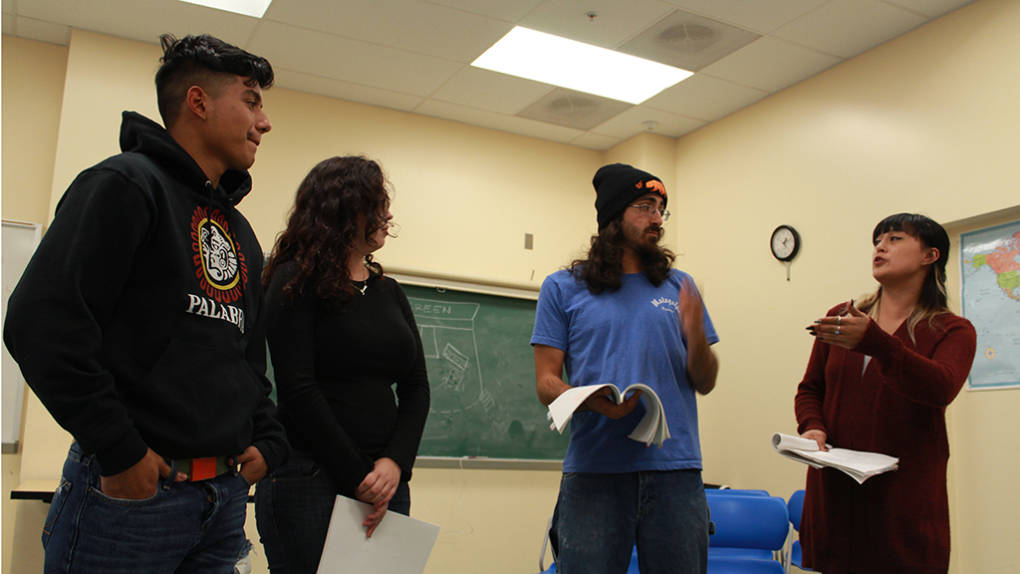
"caption": "Actors Luis Ramirez Martinez, Melissa Gomez, Jad Quesada and Nikki Nutterfield rehearse a scene from 'On The Hill' at City College in San Francisco.",
"description": "Actors Luis Ramirez Martinez, Melissa Gomez, Jad Quesada and Nikki Nutterfield rehearse a scene from \"On The Hill\" at City College San Francisco's Mission Campus. ",
"title": "Actors Luis Ramirez Martinez, Melissa Gomez, Jad Quesada and Nikki Nutterfield rehearse a scene from \"On The Hill\" at City College San Francisco's Mission Campus.",
"credit": "Photo: Creo Noveno/KQED",
"status": "inherit",
"isLoading": false,
"fetchFailed": false
},
"arts_12224087": {
"type": "attachments",
"id": "arts_12224087",
"meta": {
"index": "attachments_1716263798",
"site": "arts",
"id": "12224087",
"found": true
},
"parent": 12224085,
"imgSizes": {
"twentyfourteen-full-width": {
"file": "https://ww2.kqed.org/app/uploads/sites/2/2016/10/Shock-1-tozzini-e1476850478844-1038x576.jpg",
"width": 1038,
"mimeType": "image/jpeg",
"height": 576
},
"thumbnail": {
"file": "https://ww2.kqed.org/app/uploads/sites/2/2016/10/Shock-1-tozzini-e1476850478844-400x225.jpg",
"width": 400,
"mimeType": "image/jpeg",
"height": 225
},
"fd-sm": {
"file": "https://ww2.kqed.org/app/uploads/sites/2/2016/10/Shock-1-tozzini-e1476850478844-960x540.jpg",
"width": 960,
"mimeType": "image/jpeg",
"height": 540
},
"post-thumbnail": {
"file": "https://ww2.kqed.org/app/uploads/sites/2/2016/10/Shock-1-tozzini-e1476850478844-672x372.jpg",
"width": 672,
"mimeType": "image/jpeg",
"height": 372
},
"kqedFullSize": {
"file": "https://ww2.kqed.org/app/uploads/sites/2/2016/10/Shock-1-tozzini-e1476850478844.jpg",
"width": 1800,
"height": 1012
},
"large": {
"file": "https://ww2.kqed.org/app/uploads/sites/2/2016/10/Shock-1-tozzini-e1476850478844-1180x663.jpg",
"width": 1180,
"mimeType": "image/jpeg",
"height": 663
},
"guest-author-50": {
"file": "https://ww2.kqed.org/app/uploads/sites/2/2016/10/Shock-1-tozzini-e1476850478844-50x50.jpg",
"width": 50,
"mimeType": "image/jpeg",
"height": 50
},
"guest-author-96": {
"file": "https://ww2.kqed.org/app/uploads/sites/2/2016/10/Shock-1-tozzini-e1476850478844-96x96.jpg",
"width": 96,
"mimeType": "image/jpeg",
"height": 96
},
"medium": {
"file": "https://ww2.kqed.org/app/uploads/sites/2/2016/10/Shock-1-tozzini-e1476850478844-800x450.jpg",
"width": 800,
"mimeType": "image/jpeg",
"height": 450
},
"guest-author-64": {
"file": "https://ww2.kqed.org/app/uploads/sites/2/2016/10/Shock-1-tozzini-e1476850478844-64x64.jpg",
"width": 64,
"mimeType": "image/jpeg",
"height": 64
},
"guest-author-32": {
"file": "https://ww2.kqed.org/app/uploads/sites/2/2016/10/Shock-1-tozzini-e1476850478844-32x32.jpg",
"width": 32,
"mimeType": "image/jpeg",
"height": 32
},
"fd-med": {
"file": "https://ww2.kqed.org/app/uploads/sites/2/2016/10/Shock-1-tozzini-e1476850478844-1180x663.jpg",
"width": 1180,
"mimeType": "image/jpeg",
"height": 663
},
"detail": {
"file": "https://ww2.kqed.org/app/uploads/sites/2/2016/10/Shock-1-tozzini-e1476850478844-150x150.jpg",
"width": 150,
"mimeType": "image/jpeg",
"height": 150
},
"medium_large": {
"file": "https://ww2.kqed.org/app/uploads/sites/2/2016/10/Shock-1-tozzini-e1476850478844-768x432.jpg",
"width": 768,
"mimeType": "image/jpeg",
"height": 432
},
"guest-author-128": {
"file": "https://ww2.kqed.org/app/uploads/sites/2/2016/10/Shock-1-tozzini-e1476850478844-128x128.jpg",
"width": 128,
"mimeType": "image/jpeg",
"height": 128
}
},
"publishDate": 1476850245,
"modified": 1476853007,
"caption": "David Bicha is the murderous heart throb Tozzini in the Thrillpeddlers' production of 'Pyramid of Freaks' by Rob Keefe.",
"description": "David Bicha is the murderous heart throb Tozzini in the Thrillpeddlers production of 'Pyramid of Freaks' by Rob Keefe.",
"title": "Shock 1 tozzini",
"credit": "Photo: David Allen",
"status": "inherit",
"isLoading": false,
"fetchFailed": false
},
"arts_12231618": {
"type": "attachments",
"id": "arts_12231618",
"meta": {
"index": "attachments_1716263798",
"site": "arts",
"id": "12231618",
"found": true
},
"parent": 12231419,
"imgSizes": {
"small": {
"file": "https://ww2.kqed.org/app/uploads/sites/2/2016/10/Studio-Job-for-NLXL-Beauty-at-the-SJ-Museum-of-Art-520x346.jpg",
"width": 520,
"mimeType": "image/jpeg",
"height": 346
},
"twentyfourteen-full-width": {
"file": "https://ww2.kqed.org/app/uploads/sites/2/2016/10/Studio-Job-for-NLXL-Beauty-at-the-SJ-Museum-of-Art-1038x576.jpg",
"width": 1038,
"mimeType": "image/jpeg",
"height": 576
},
"thumbnail": {
"file": "https://ww2.kqed.org/app/uploads/sites/2/2016/10/Studio-Job-for-NLXL-Beauty-at-the-SJ-Museum-of-Art-160x107.jpg",
"width": 160,
"mimeType": "image/jpeg",
"height": 107
},
"fd-sm": {
"file": "https://ww2.kqed.org/app/uploads/sites/2/2016/10/Studio-Job-for-NLXL-Beauty-at-the-SJ-Museum-of-Art-960x639.jpg",
"width": 960,
"mimeType": "image/jpeg",
"height": 639
},
"post-thumbnail": {
"file": "https://ww2.kqed.org/app/uploads/sites/2/2016/10/Studio-Job-for-NLXL-Beauty-at-the-SJ-Museum-of-Art-672x372.jpg",
"width": 672,
"mimeType": "image/jpeg",
"height": 372
},
"xsmall": {
"file": "https://ww2.kqed.org/app/uploads/sites/2/2016/10/Studio-Job-for-NLXL-Beauty-at-the-SJ-Museum-of-Art-375x250.jpg",
"width": 375,
"mimeType": "image/jpeg",
"height": 250
},
"kqedFullSize": {
"file": "https://ww2.kqed.org/app/uploads/sites/2/2016/10/Studio-Job-for-NLXL-Beauty-at-the-SJ-Museum-of-Art.jpg",
"width": 1050,
"height": 699
},
"large": {
"file": "https://ww2.kqed.org/app/uploads/sites/2/2016/10/Studio-Job-for-NLXL-Beauty-at-the-SJ-Museum-of-Art-1020x679.jpg",
"width": 1020,
"mimeType": "image/jpeg",
"height": 679
},
"guest-author-50": {
"file": "https://ww2.kqed.org/app/uploads/sites/2/2016/10/Studio-Job-for-NLXL-Beauty-at-the-SJ-Museum-of-Art-50x50.jpg",
"width": 50,
"mimeType": "image/jpeg",
"height": 50
},
"guest-author-96": {
"file": "https://ww2.kqed.org/app/uploads/sites/2/2016/10/Studio-Job-for-NLXL-Beauty-at-the-SJ-Museum-of-Art-96x96.jpg",
"width": 96,
"mimeType": "image/jpeg",
"height": 96
},
"medium": {
"file": "https://ww2.kqed.org/app/uploads/sites/2/2016/10/Studio-Job-for-NLXL-Beauty-at-the-SJ-Museum-of-Art-800x533.jpg",
"width": 800,
"mimeType": "image/jpeg",
"height": 533
},
"guest-author-64": {
"file": "https://ww2.kqed.org/app/uploads/sites/2/2016/10/Studio-Job-for-NLXL-Beauty-at-the-SJ-Museum-of-Art-64x64.jpg",
"width": 64,
"mimeType": "image/jpeg",
"height": 64
},
"guest-author-32": {
"file": "https://ww2.kqed.org/app/uploads/sites/2/2016/10/Studio-Job-for-NLXL-Beauty-at-the-SJ-Museum-of-Art-32x32.jpg",
"width": 32,
"mimeType": "image/jpeg",
"height": 32
},
"detail": {
"file": "https://ww2.kqed.org/app/uploads/sites/2/2016/10/Studio-Job-for-NLXL-Beauty-at-the-SJ-Museum-of-Art-150x150.jpg",
"width": 150,
"mimeType": "image/jpeg",
"height": 150
},
"medium_large": {
"file": "https://ww2.kqed.org/app/uploads/sites/2/2016/10/Studio-Job-for-NLXL-Beauty-at-the-SJ-Museum-of-Art-768x511.jpg",
"width": 768,
"mimeType": "image/jpeg",
"height": 511
},
"guest-author-128": {
"file": "https://ww2.kqed.org/app/uploads/sites/2/2016/10/Studio-Job-for-NLXL-Beauty-at-the-SJ-Museum-of-Art-128x128.jpg",
"width": 128,
"mimeType": "image/jpeg",
"height": 128
},
"xxsmall": {
"file": "https://ww2.kqed.org/app/uploads/sites/2/2016/10/Studio-Job-for-NLXL-Beauty-at-the-SJ-Museum-of-Art-240x160.jpg",
"width": 240,
"mimeType": "image/jpeg",
"height": 160
}
},
"publishDate": 1476986023,
"modified": 1476986128,
"caption": "Wallpaper design by Studio Job included in the show 'Beauty' at the SJ Museum of Art",
"description": "Wallpaper design by Studio Job included in the show 'Beauty' at the SJ Museum of Art",
"title": "Wallpaper design by Studio Job included in the show 'Beauty' at the SJ Museum of Art",
"credit": "Photo: Studio Job for NLXL courtesy of SJ Museum of Art",
"status": "inherit",
"isLoading": false,
"fetchFailed": false
},
"forum_2010101857154": {
"type": "attachments",
"id": "forum_2010101857154",
"meta": {
"index": "attachments_1716263798",
"site": "forum",
"id": "2010101857154",
"found": true
},
"parent": 2010101857153,
"imgSizes": {
"small": {
"file": "https://ww2.kqed.org/app/uploads/sites/43/2016/10/drag-video-520x293.jpg",
"width": 520,
"mimeType": "image/jpeg",
"height": 293
},
"twentyfourteen-full-width": {
"file": "https://ww2.kqed.org/app/uploads/sites/43/2016/10/drag-video-1038x576.jpg",
"width": 1038,
"mimeType": "image/jpeg",
"height": 576
},
"thumbnail": {
"file": "https://ww2.kqed.org/app/uploads/sites/43/2016/10/drag-video-160x90.jpg",
"width": 160,
"mimeType": "image/jpeg",
"height": 90
},
"fd-sm": {
"file": "https://ww2.kqed.org/app/uploads/sites/43/2016/10/drag-video-960x541.jpg",
"width": 960,
"mimeType": "image/jpeg",
"height": 541
},
"post-thumbnail": {
"file": "https://ww2.kqed.org/app/uploads/sites/43/2016/10/drag-video-672x372.jpg",
"width": 672,
"mimeType": "image/jpeg",
"height": 372
},
"xsmall": {
"file": "https://ww2.kqed.org/app/uploads/sites/43/2016/10/drag-video-375x211.jpg",
"width": 375,
"mimeType": "image/jpeg",
"height": 211
},
"kqedFullSize": {
"file": "https://ww2.kqed.org/app/uploads/sites/43/2016/10/drag-video.jpg",
"width": 1920,
"height": 1081
},
"large": {
"file": "https://ww2.kqed.org/app/uploads/sites/43/2016/10/drag-video-1020x574.jpg",
"width": 1020,
"mimeType": "image/jpeg",
"height": 574
},
"xlarge": {
"file": "https://ww2.kqed.org/app/uploads/sites/43/2016/10/drag-video-1180x664.jpg",
"width": 1180,
"mimeType": "image/jpeg",
"height": 664
},
"guest-author-50": {
"file": "https://ww2.kqed.org/app/uploads/sites/43/2016/10/drag-video-50x50.jpg",
"width": 50,
"mimeType": "image/jpeg",
"height": 50
},
"guest-author-96": {
"file": "https://ww2.kqed.org/app/uploads/sites/43/2016/10/drag-video-96x96.jpg",
"width": 96,
"mimeType": "image/jpeg",
"height": 96
},
"medium": {
"file": "https://ww2.kqed.org/app/uploads/sites/43/2016/10/drag-video-800x450.jpg",
"width": 800,
"mimeType": "image/jpeg",
"height": 450
},
"guest-author-64": {
"file": "https://ww2.kqed.org/app/uploads/sites/43/2016/10/drag-video-64x64.jpg",
"width": 64,
"mimeType": "image/jpeg",
"height": 64
},
"guest-author-32": {
"file": "https://ww2.kqed.org/app/uploads/sites/43/2016/10/drag-video-32x32.jpg",
"width": 32,
"mimeType": "image/jpeg",
"height": 32
},
"fd-lrg": {
"file": "https://ww2.kqed.org/app/uploads/sites/43/2016/10/drag-video-1920x1081.jpg",
"width": 1920,
"mimeType": "image/jpeg",
"height": 1081
},
"fd-med": {
"file": "https://ww2.kqed.org/app/uploads/sites/43/2016/10/drag-video-1180x664.jpg",
"width": 1180,
"mimeType": "image/jpeg",
"height": 664
},
"full-width": {
"file": "https://ww2.kqed.org/app/uploads/sites/43/2016/10/drag-video-1920x1081.jpg",
"width": 1920,
"mimeType": "image/jpeg",
"height": 1081
},
"detail": {
"file": "https://ww2.kqed.org/app/uploads/sites/43/2016/10/drag-video-150x150.jpg",
"width": 150,
"mimeType": "image/jpeg",
"height": 150
},
"medium_large": {
"file": "https://ww2.kqed.org/app/uploads/sites/43/2016/10/drag-video-768x432.jpg",
"width": 768,
"mimeType": "image/jpeg",
"height": 432
},
"guest-author-128": {
"file": "https://ww2.kqed.org/app/uploads/sites/43/2016/10/drag-video-128x128.jpg",
"width": 128,
"mimeType": "image/jpeg",
"height": 128
},
"xxsmall": {
"file": "https://ww2.kqed.org/app/uploads/sites/43/2016/10/drag-video-240x135.jpg",
"width": 240,
"mimeType": "image/jpeg",
"height": 135
}
},
"publishDate": 1476923487,
"modified": 1476923560,
"caption": "Drag queen Scarlett Letter performs on stage during the GX4 Kitty Powers Drag Show.",
"description": "Drag queen Scarlett Letter performs on stage during the GX4 Kitty Powers Drag Show.",
"title": "drag video",
"credit": "Brittany Hosea-Small/KQED",
"status": "inherit",
"isLoading": false,
"fetchFailed": false
},
"arts_12345292": {
"type": "attachments",
"id": "arts_12345292",
"meta": {
"index": "attachments_1716263798",
"site": "arts",
"id": "12345292",
"found": true
},
"parent": 12345094,
"imgSizes": {
"small": {
"file": "https://ww2.kqed.org/app/uploads/sites/2/2016/11/5-520x347.jpg",
"width": 520,
"mimeType": "image/jpeg",
"height": 347
},
"twentyfourteen-full-width": {
"file": "https://ww2.kqed.org/app/uploads/sites/2/2016/11/5-1000x576.jpg",
"width": 1000,
"mimeType": "image/jpeg",
"height": 576
},
"thumbnail": {
"file": "https://ww2.kqed.org/app/uploads/sites/2/2016/11/5-160x107.jpg",
"width": 160,
"mimeType": "image/jpeg",
"height": 107
},
"fd-sm": {
"file": "https://ww2.kqed.org/app/uploads/sites/2/2016/11/5-960x640.jpg",
"width": 960,
"mimeType": "image/jpeg",
"height": 640
},
"post-thumbnail": {
"file": "https://ww2.kqed.org/app/uploads/sites/2/2016/11/5-672x372.jpg",
"width": 672,
"mimeType": "image/jpeg",
"height": 372
},
"xsmall": {
"file": "https://ww2.kqed.org/app/uploads/sites/2/2016/11/5-375x250.jpg",
"width": 375,
"mimeType": "image/jpeg",
"height": 250
},
"kqedFullSize": {
"file": "https://ww2.kqed.org/app/uploads/sites/2/2016/11/5.jpg",
"width": 1000,
"height": 667
},
"guest-author-50": {
"file": "https://ww2.kqed.org/app/uploads/sites/2/2016/11/5-50x50.jpg",
"width": 50,
"mimeType": "image/jpeg",
"height": 50
},
"guest-author-96": {
"file": "https://ww2.kqed.org/app/uploads/sites/2/2016/11/5-96x96.jpg",
"width": 96,
"mimeType": "image/jpeg",
"height": 96
},
"medium": {
"file": "https://ww2.kqed.org/app/uploads/sites/2/2016/11/5-800x534.jpg",
"width": 800,
"mimeType": "image/jpeg",
"height": 534
},
"guest-author-64": {
"file": "https://ww2.kqed.org/app/uploads/sites/2/2016/11/5-64x64.jpg",
"width": 64,
"mimeType": "image/jpeg",
"height": 64
},
"guest-author-32": {
"file": "https://ww2.kqed.org/app/uploads/sites/2/2016/11/5-32x32.jpg",
"width": 32,
"mimeType": "image/jpeg",
"height": 32
},
"detail": {
"file": "https://ww2.kqed.org/app/uploads/sites/2/2016/11/5-150x150.jpg",
"width": 150,
"mimeType": "image/jpeg",
"height": 150
},
"medium_large": {
"file": "https://ww2.kqed.org/app/uploads/sites/2/2016/11/5-768x512.jpg",
"width": 768,
"mimeType": "image/jpeg",
"height": 512
},
"guest-author-128": {
"file": "https://ww2.kqed.org/app/uploads/sites/2/2016/11/5-128x128.jpg",
"width": 128,
"mimeType": "image/jpeg",
"height": 128
},
"xxsmall": {
"file": "https://ww2.kqed.org/app/uploads/sites/2/2016/11/5-240x160.jpg",
"width": 240,
"mimeType": "image/jpeg",
"height": 160
}
},
"publishDate": 1479159291,
"modified": 1479159541,
"caption": "Hamlet (El Beh) gives it to his mother Gertrude (Beth Wilmurt) after killing Polonius (Kevin Clarke) behind the red curtain in the Shotgun Players' production of 'Hamlet' by William Shakespeare.",
"description": "Hamlet (El Beh) gives it to his mother Gertrude (Beth Wilmurt) after killing Polonius (Kevin Clarke) behind the red curtain in the Shotgun Players' production of 'Hamlet' by William Shakespeare.",
"title": "Hamlet",
"credit": "Photo: Pak Han",
"status": "inherit",
"isLoading": false,
"fetchFailed": false
},
"arts_12218547": {
"type": "attachments",
"id": "arts_12218547",
"meta": {
"index": "attachments_1716263798",
"site": "arts",
"id": "12218547",
"found": true
},
"parent": 12199964,
"imgSizes": {
"twentyfourteen-full-width": {
"file": "https://ww2.kqed.org/app/uploads/sites/2/2016/10/Symphony-Silicon-Valley-movie-score-series-1038x576.jpg",
"width": 1038,
"mimeType": "image/jpeg",
"height": 576
},
"thumbnail": {
"file": "https://ww2.kqed.org/app/uploads/sites/2/2016/10/Symphony-Silicon-Valley-movie-score-series-400x225.jpg",
"width": 400,
"mimeType": "image/jpeg",
"height": 225
},
"fd-sm": {
"file": "https://ww2.kqed.org/app/uploads/sites/2/2016/10/Symphony-Silicon-Valley-movie-score-series-960x540.jpg",
"width": 960,
"mimeType": "image/jpeg",
"height": 540
},
"post-thumbnail": {
"file": "https://ww2.kqed.org/app/uploads/sites/2/2016/10/Symphony-Silicon-Valley-movie-score-series-672x372.jpg",
"width": 672,
"mimeType": "image/jpeg",
"height": 372
},
"kqedFullSize": {
"file": "https://ww2.kqed.org/app/uploads/sites/2/2016/10/Symphony-Silicon-Valley-movie-score-series.jpg",
"width": 1920,
"height": 1080
},
"large": {
"file": "https://ww2.kqed.org/app/uploads/sites/2/2016/10/Symphony-Silicon-Valley-movie-score-series-1180x664.jpg",
"width": 1180,
"mimeType": "image/jpeg",
"height": 664
},
"guest-author-50": {
"file": "https://ww2.kqed.org/app/uploads/sites/2/2016/10/Symphony-Silicon-Valley-movie-score-series-50x50.jpg",
"width": 50,
"mimeType": "image/jpeg",
"height": 50
},
"guest-author-96": {
"file": "https://ww2.kqed.org/app/uploads/sites/2/2016/10/Symphony-Silicon-Valley-movie-score-series-96x96.jpg",
"width": 96,
"mimeType": "image/jpeg",
"height": 96
},
"medium": {
"file": "https://ww2.kqed.org/app/uploads/sites/2/2016/10/Symphony-Silicon-Valley-movie-score-series-800x450.jpg",
"width": 800,
"mimeType": "image/jpeg",
"height": 450
},
"guest-author-64": {
"file": "https://ww2.kqed.org/app/uploads/sites/2/2016/10/Symphony-Silicon-Valley-movie-score-series-64x64.jpg",
"width": 64,
"mimeType": "image/jpeg",
"height": 64
},
"guest-author-32": {
"file": "https://ww2.kqed.org/app/uploads/sites/2/2016/10/Symphony-Silicon-Valley-movie-score-series-32x32.jpg",
"width": 32,
"mimeType": "image/jpeg",
"height": 32
},
"fd-lrg": {
"file": "https://ww2.kqed.org/app/uploads/sites/2/2016/10/Symphony-Silicon-Valley-movie-score-series-1920x1080.jpg",
"width": 1920,
"mimeType": "image/jpeg",
"height": 1080
},
"fd-med": {
"file": "https://ww2.kqed.org/app/uploads/sites/2/2016/10/Symphony-Silicon-Valley-movie-score-series-1180x664.jpg",
"width": 1180,
"mimeType": "image/jpeg",
"height": 664
},
"detail": {
"file": "https://ww2.kqed.org/app/uploads/sites/2/2016/10/Symphony-Silicon-Valley-movie-score-series-150x150.jpg",
"width": 150,
"mimeType": "image/jpeg",
"height": 150
},
"medium_large": {
"file": "https://ww2.kqed.org/app/uploads/sites/2/2016/10/Symphony-Silicon-Valley-movie-score-series-768x432.jpg",
"width": 768,
"mimeType": "image/jpeg",
"height": 432
},
"guest-author-128": {
"file": "https://ww2.kqed.org/app/uploads/sites/2/2016/10/Symphony-Silicon-Valley-movie-score-series-128x128.jpg",
"width": 128,
"mimeType": "image/jpeg",
"height": 128
}
},
"publishDate": 1476746520,
"modified": 1476747074,
"caption": "Symphony Silicon Valley during its movie score series last year. The symphony received $20,000 from the Knight Foundation this year",
"description": "Symphony Silicon Valley during its movie score series last year. The symphony received $20,000 from the Knight Foundation this year",
"title": "Bugs Bunny at the Symphony II - Symphony Silicon Valley",
"credit": "Photo: Courtesy of the Knight Foundation",
"status": "inherit",
"isLoading": false,
"fetchFailed": false
}
},
"audioPlayerReducer": {
"postId": "stream_live",
"isPaused": true,
"isPlaying": false,
"pfsActive": false,
"pledgeModalIsOpen": true,
"playerDrawerIsOpen": false,
"liveAudioPlayStartedAt": 0,
"liveAudioPlayContext": ""
},
"authorsReducer": {
"byline_arts_12251260": {
"type": "authors",
"id": "byline_arts_12251260",
"meta": {
"override": true
},
"slug": "byline_arts_12251260",
"name": "Rebecca Hersher",
"isLoading": false
},
"2010101854226": {
"type": "authors",
"id": "2010101854226",
"meta": {
"override": true
},
"slug": "2010101854226",
"name": "Scott Shafer",
"firstName": "Scott",
"lastName": "Shafer",
"bio": "",
"email": "",
"isLoading": false
},
"cmusiker": {
"type": "authors",
"id": "32",
"meta": {
"index": "authors_1716337520",
"id": "32",
"found": true
},
"name": "Cy Musiker",
"firstName": "Cy",
"lastName": "Musiker",
"slug": "cmusiker",
"email": "cmusiker@kqed.org",
"display_author_email": false,
"staff_mastheads": [],
"title": "KQED Contributor",
"bio": "Cy Musiker is a former co-host of The Do List and a former reporter covering the arts for KQED News and The California Report. He loves live performance, especially great theater, jazz, roots music, anything by Mahler. Cy has an MJ from UC Berkeley's School of Journalism, and got his BA from Hampshire College. His work has been recognized by the Society for Professional Journalists with their Sigma Delta Chi Award for Public Service in Journalism. When he can, Cy likes to swim in Tomales Bay, run with his dog in the East Bay Hills, and hike the Sierra.",
"avatar": "https://secure.gravatar.com/avatar/05eaba5c5696ce8f062e4ea2df428a43?s=600&d=blank&r=g",
"twitter": null,
"facebook": null,
"instagram": null,
"linkedin": null,
"sites": [
{
"site": "arts",
"roles": [
"Contributor",
"subscriber"
]
},
{
"site": "news",
"roles": [
"author"
]
},
{
"site": "bayareabites",
"roles": [
"contributor"
]
}
],
"headData": {
"title": "Cy Musiker | KQED",
"description": "KQED Contributor",
"ogImgSrc": "https://secure.gravatar.com/avatar/05eaba5c5696ce8f062e4ea2df428a43?s=600&d=blank&r=g",
"twImgSrc": "https://secure.gravatar.com/avatar/05eaba5c5696ce8f062e4ea2df428a43?s=600&d=blank&r=g"
},
"isLoading": false,
"link": "/author/cmusiker"
},
"kjones": {
"type": "authors",
"id": "93",
"meta": {
"index": "authors_1716337520",
"id": "93",
"found": true
},
"name": "Kevin L. Jones",
"firstName": "Kevin",
"lastName": "Jones",
"slug": "kjones",
"email": "kjones@kqed.org",
"display_author_email": false,
"staff_mastheads": [],
"title": null,
"bio": null,
"avatar": "https://secure.gravatar.com/avatar/12c65b5633ed39d0a59bb7f497eff645?s=600&d=blank&r=g",
"twitter": null,
"facebook": null,
"instagram": null,
"linkedin": null,
"sites": [
{
"site": "arts",
"roles": [
"subscriber"
]
},
{
"site": "styleguide",
"roles": [
"contributor"
]
},
{
"site": "artschool",
"roles": [
"subscriber"
]
},
{
"site": "news",
"roles": [
"subscriber"
]
},
{
"site": "pop",
"roles": [
"subscriber"
]
}
],
"headData": {
"title": "Kevin L. Jones | KQED",
"description": null,
"ogImgSrc": "https://secure.gravatar.com/avatar/12c65b5633ed39d0a59bb7f497eff645?s=600&d=blank&r=g",
"twImgSrc": "https://secure.gravatar.com/avatar/12c65b5633ed39d0a59bb7f497eff645?s=600&d=blank&r=g"
},
"isLoading": false,
"link": "/author/kjones"
},
"rachael-myrow": {
"type": "authors",
"id": "251",
"meta": {
"index": "authors_1716337520",
"id": "251",
"found": true
},
"name": "Rachael Myrow",
"firstName": "Rachael",
"lastName": "Myrow",
"slug": "rachael-myrow",
"email": "rmyrow@kqed.org",
"display_author_email": true,
"staff_mastheads": [
"news"
],
"title": "Senior Editor of KQED's Silicon Valley News Desk",
"bio": "• I write and edit stories about how Silicon Valley power and policies shape everyday life in California. I’m also passionate about making Bay Area history and culture more accessible to a broad public. • I’ve been a journalist for most of my life, starting in high school with The Franklin Press in Los Angeles, where I grew up. While earning my first degree in English at UC Berkeley, I got my start in public radio at KALX-FM. After completing a second degree in journalism at Cal, I landed my first professional job at Marketplace, then moved on to KPCC (now LAist), and then KQED, where I hosted The California Report for more than seven years. • My reporting has appeared on NPR, The World, WBUR’s \u003ci>Here & Now\u003c/i>, and the BBC. I also guest host for KQED’s \u003ci>Forum\u003c/i>, as well as the Commonwealth Club in San Francisco. • I speak periodically on media, democracy and technology issues, and do voiceover work for documentaries and educational video projects. • Outside of the studio, you'll find me hiking Bay Area trails and whipping up Insta-ready meals in my kitchen. • I do not accept gifts, money, or favors from anyone connected to my reporting, I don't pay people for information, and I do not support or donate to political causes. • I strive to treat the people I report on with fairness, honesty, and respect. I also recognize there are often multiple sides to a story and work to verify information through multiple sources and documentation. If I get something wrong, I correct it.",
"avatar": "https://secure.gravatar.com/avatar/3ed8a3c5f26025e4a805ba634cda8cd764906b97438a6d9ce216b044e340da4e?s=600&d=blank&r=g",
"twitter": "rachaelmyrow",
"bluesky": null,
"facebook": null,
"instagram": null,
"linkedin": "https://www.linkedin.com/in/rachaelmyrow/",
"sites": [
{
"site": "arts",
"roles": [
"administrator"
]
},
{
"site": "news",
"roles": [
"edit_others_posts",
"editor"
]
},
{
"site": "futureofyou",
"roles": [
"editor"
]
},
{
"site": "bayareabites",
"roles": [
"editor"
]
},
{
"site": "stateofhealth",
"roles": [
"editor"
]
},
{
"site": "science",
"roles": [
"editor"
]
},
{
"site": "food",
"roles": [
"editor"
]
},
{
"site": "forum",
"roles": [
"editor"
]
},
{
"site": "liveblog",
"roles": [
"author"
]
}
],
"headData": {
"title": "Rachael Myrow | KQED",
"description": "Senior Editor of KQED's Silicon Valley News Desk",
"ogImgSrc": "https://secure.gravatar.com/avatar/3ed8a3c5f26025e4a805ba634cda8cd764906b97438a6d9ce216b044e340da4e?s=600&d=blank&r=g",
"twImgSrc": "https://secure.gravatar.com/avatar/3ed8a3c5f26025e4a805ba634cda8cd764906b97438a6d9ce216b044e340da4e?s=600&d=blank&r=g"
},
"isLoading": false,
"link": "/author/rachael-myrow"
},
"ctiee": {
"type": "authors",
"id": "8660",
"meta": {
"index": "authors_1716337520",
"id": "8660",
"found": true
},
"name": "Charlise Tiee",
"firstName": "Charlise",
"lastName": "Tiee",
"slug": "ctiee",
"email": "snailwing@gmail.com",
"display_author_email": false,
"staff_mastheads": [],
"title": null,
"bio": "Bay Area-based writer and painter. Reviews performances of classical music and audience behavior at \u003ca href=\"http://operatattler.com\" target=\"_blank\">The Opera Tattler\u003c/a>.",
"avatar": "https://secure.gravatar.com/avatar/f1a0befa08b57c5871e7b99521309901?s=600&d=blank&r=g",
"twitter": null,
"facebook": null,
"instagram": null,
"linkedin": null,
"sites": [
{
"site": "arts",
"roles": [
"contributor"
]
}
],
"headData": {
"title": "Charlise Tiee | KQED",
"description": null,
"ogImgSrc": "https://secure.gravatar.com/avatar/f1a0befa08b57c5871e7b99521309901?s=600&d=blank&r=g",
"twImgSrc": "https://secure.gravatar.com/avatar/f1a0befa08b57c5871e7b99521309901?s=600&d=blank&r=g"
},
"isLoading": false,
"link": "/author/ctiee"
},
"jwilkins": {
"type": "authors",
"id": "8668",
"meta": {
"index": "authors_1716337520",
"id": "8668",
"found": true
},
"name": "John Wilkins",
"firstName": "John",
"lastName": "Wilkins",
"slug": "jwilkins",
"email": "Johnrwilkins@aol.com",
"display_author_email": false,
"staff_mastheads": [],
"title": null,
"bio": "John Wilkins is the theater critic for KQED Arts. He was the Artistic Director of Last Planet Theatre for ten years and teaches in the Writing and Literature program at CCA. Follow him on Twitter @johnrwilkins2",
"avatar": "https://secure.gravatar.com/avatar/7798fcc8a10bee0e04387b724b492df7?s=600&d=blank&r=g",
"twitter": null,
"facebook": null,
"instagram": null,
"linkedin": null,
"sites": [
{
"site": "arts",
"roles": [
"subscriber"
]
}
],
"headData": {
"title": "John Wilkins | KQED",
"description": null,
"ogImgSrc": "https://secure.gravatar.com/avatar/7798fcc8a10bee0e04387b724b492df7?s=600&d=blank&r=g",
"twImgSrc": "https://secure.gravatar.com/avatar/7798fcc8a10bee0e04387b724b492df7?s=600&d=blank&r=g"
},
"isLoading": false,
"link": "/author/jwilkins"
},
"crnoveno": {
"type": "authors",
"id": "11208",
"meta": {
"index": "authors_1716337520",
"id": "11208",
"found": true
},
"name": "Creo Noveno",
"firstName": "Creo",
"lastName": "Noveno",
"slug": "crnoveno",
"email": "creonoveno@gmail.com",
"display_author_email": false,
"staff_mastheads": [],
"title": "KQED Contributor",
"bio": null,
"avatar": "https://secure.gravatar.com/avatar/0df6606b8e36036309fd287052246d01?s=600&d=blank&r=g",
"twitter": null,
"facebook": null,
"instagram": null,
"linkedin": null,
"sites": [
{
"site": "arts",
"roles": [
"subscriber"
]
},
{
"site": "pop",
"roles": [
"contributor"
]
}
],
"headData": {
"title": "Creo Noveno | KQED",
"description": "KQED Contributor",
"ogImgSrc": "https://secure.gravatar.com/avatar/0df6606b8e36036309fd287052246d01?s=600&d=blank&r=g",
"twImgSrc": "https://secure.gravatar.com/avatar/0df6606b8e36036309fd287052246d01?s=600&d=blank&r=g"
},
"isLoading": false,
"link": "/author/crnoveno"
}
},
"pagesReducer": {
"arts_category_theater": {
"type": "terms",
"id": "arts_967",
"meta": {
"index": "terms_1716263798",
"site": "arts",
"id": "967",
"score": 12.286901
},
"featImg": null,
"name": "Theater",
"description": null,
"taxonomy": "category",
"headData": {
"twImgId": null,
"twTitle": null,
"ogTitle": null,
"ogImgId": null,
"twDescription": null,
"description": null,
"title": "Theater Archives | KQED Arts",
"ogDescription": null
},
"ttid": 985,
"slug": "theater",
"isLoading": false,
"title": "Theater",
"pageMeta": {
"site": "arts",
"WpPageTemplate": "page-topic-editorial",
"currentPage": 51
},
"blocks": [
{
"blockName": "kqed/post-list",
"attrs": {
"layout": "cardArticle2",
"query": "posts/arts?category=theater",
"seeMore": false,
"paginated": true,
"page": 51
}
},
{
"blockName": "kqed/ad"
}
]
}
},
"pfsSessionReducer": {},
"postsReducer": {
"stream_live": {
"type": "live",
"id": "stream_live",
"audioUrl": "https://streams.kqed.org/kqedradio",
"title": "Live Stream",
"excerpt": "Live Stream information currently unavailable.",
"link": "/radio",
"featImg": "",
"label": {
"name": "KQED Live",
"link": "/"
}
},
"stream_kqedNewscast": {
"type": "posts",
"id": "stream_kqedNewscast",
"audioUrl": "https://www.kqed.org/.stream/anon/radio/RDnews/newscast.mp3?_=1",
"title": "KQED Newscast",
"featImg": "",
"label": {
"name": "88.5 FM",
"link": "/"
}
},
"arts_12329528": {
"type": "posts",
"id": "arts_12329528",
"meta": {
"index": "posts_1716263798",
"site": "arts",
"id": "12329528",
"score": null,
"sort": [
1478876988000
]
},
"guestAuthors": [],
"slug": "baryshnikov-and-wilson-excavate-nijinskys-diary-in-letter-to-a-man",
"title": "Baryshnikov and Wilson Excavate Nijinsky's Diary in 'Letter to a Man'",
"publishDate": 1478876988,
"format": "standard",
"headTitle": "Baryshnikov and Wilson Excavate Nijinsky’s Diary in ‘Letter to a Man’ | KQED",
"labelTerm": {
"term": 140,
"site": "arts"
},
"content": "\u003cp>Only the cruelest of Gods would have bothered to create Vaslav Nijinsky (1889-1950), the Russian dancer who burst to fame with the groundbreaking Russian dance company Ballet Russes under the direction of the impresario Serge Diaghilev. To fashion a mind and body that approached the perfection of music and then to let it shatter and decay into madness, and all of it just before the age of film, is the work of a punk and a sadist.\u003c/p>\n\u003cp>The celebrated Russian-American dancer Mikhail Baryshnikov has had plenty of offers to play Nijinsky and has wisely, so far, said, no. Taking on an artist more myth than man is a probable path to failure. And yet as the 68-year old Baryshnikov has gently aged from the amazing dancer he was to the sly actor and conceptual artist he is today, the question of Nijinsky returned. In collaboration with the iconoclastic stage director Robert Wilson, a master of light and stillness, he may have realized that there was a different Nijinsky waiting just for him.\u003c/p>\n\u003cp>So in Cal Performances’ presentation of their touring production \u003ca href=\"https://calperformances.org/performances/2016-17/special-events/robert-wilson-mikhail-baryshnikov-letter-to-a-man.php\" target=\"_blank\" rel=\"noopener\">\u003cem>Letter to a Man\u003c/em>\u003c/a>, Baryshnikov and Wilson begin with Nijinsky the diarist, who in the act of going mad tries to explain what it means to have the grace of God in your art, or as the man himself proclaimed in the diary he wrote in 1919 right before he was institutionalized: “I am God. I am spirit. I am a man of love.” As painful as it is to read Nijinsky’s journal, to see these rambling, chaotic thoughts staged with such rigor is to fall into a world of exasperating beauty.\u003c/p>\n\u003cfigure id=\"attachment_12329720\" class=\"wp-caption aligncenter\" style=\"max-width: 800px\">\u003cimg loading=\"lazy\" decoding=\"async\" class=\"size-medium wp-image-12329720\" src=\"http://ww2.kqed.org/arts/wp-content/uploads/sites/2/2016/11/Baryshnikov-3-credit-courtesy-e1478864257902-800x452.jpg\" alt=\"Vaslav Nijinsky (Mikhail Baryshnikov) shocks himself in 'Letter to a Man' directed and conceived by Robert Wilson and Baryshnikov.\" width=\"800\" height=\"452\" srcset=\"https://cdn.kqed.org/wp-content/uploads/sites/2/2016/11/Baryshnikov-3-credit-courtesy-e1478864257902-800x452.jpg 800w, https://cdn.kqed.org/wp-content/uploads/sites/2/2016/11/Baryshnikov-3-credit-courtesy-e1478864257902-160x90.jpg 160w, https://cdn.kqed.org/wp-content/uploads/sites/2/2016/11/Baryshnikov-3-credit-courtesy-e1478864257902-768x434.jpg 768w, https://cdn.kqed.org/wp-content/uploads/sites/2/2016/11/Baryshnikov-3-credit-courtesy-e1478864257902-1020x576.jpg 1020w, https://cdn.kqed.org/wp-content/uploads/sites/2/2016/11/Baryshnikov-3-credit-courtesy-e1478864257902-1920x1085.jpg 1920w, https://cdn.kqed.org/wp-content/uploads/sites/2/2016/11/Baryshnikov-3-credit-courtesy-e1478864257902-1180x667.jpg 1180w, https://cdn.kqed.org/wp-content/uploads/sites/2/2016/11/Baryshnikov-3-credit-courtesy-e1478864257902-960x542.jpg 960w, https://cdn.kqed.org/wp-content/uploads/sites/2/2016/11/Baryshnikov-3-credit-courtesy-e1478864257902-240x136.jpg 240w, https://cdn.kqed.org/wp-content/uploads/sites/2/2016/11/Baryshnikov-3-credit-courtesy-e1478864257902-375x212.jpg 375w, https://cdn.kqed.org/wp-content/uploads/sites/2/2016/11/Baryshnikov-3-credit-courtesy-e1478864257902-520x294.jpg 520w\" sizes=\"(max-width: 800px) 100vw, 800px\">\u003cfigcaption class=\"wp-caption-text\">Vaslav Nijinsky (Mikhail Baryshnikov) shocks himself in ‘Letter to a Man’ directed and conceived by Robert Wilson and Baryshnikov. \u003ccite>(Photo: Lucy Jansch)\u003c/cite>\u003c/figcaption>\u003c/figure>\n\u003cp>The performance begins with Baryshnikov sitting in a chair — a ridiculous opener for a dancer playing a dancer. His makeup and demeanor resemble nothing less than a Kabuki mask of pain and surprise. In English and Russian, he says, “I understand war because I fought with my mother-in-law.” The audience laughs at what seems an easy joke, but the laughter ceases when the sentence and the image start to mutate into fragments.\u003c/p>\n\u003cp>The lights black out and return so fast, Baryshnikov changes his expression so slightly, and the sentence keeps on breaking into bits and pieces — “I understand war,” “mother-in-law,” “fought” — to the point that you feel like you’re having a seizure. Barely anything happens and yet the scene is a sensory overload. Like most of \u003cem>Letter to a Man\u003c/em>, we only get a glimpse of Nijinsky’s genius, but his descent into madness is catalogued with an infinite and loving care.\u003c/p>\n\u003cp>[ad fullwidth]\u003c/p>\n\u003cp>At one point Wilson transforms the stage into a long rectangle of light, making you feel like the black sky is weighing down on your head and the endless road before you is stretching out forever. We hear the diary entry: “I went out for a walk once and it seemed to me there was blood in the snow, and so I ran following the trail. I had the impression that somebody had killed a man but he was alive.”\u003c/p>\n\u003cp>What follows is some of the most beautiful walking you can imagine — hesitant, then leaping forward with great force, then somehow happening all over again. The choreography has the feel of a strip of film come to life. Then you notice that as Nijinsky investigates the bloody trail, right behind him, almost tiptoeing in pursuit, is his shadow, strikingly offset against a thick white fog. There seems to be no possible end or reconciliation, only the belief that a murdered man should be alive, and that a man and his shadow can never be one.\u003c/p>\n\u003cp>It’s as if the piece obsessively reminds us that the only Nijinsky we get is the one that has been violently severed from himself. At one point he takes off his jacket — a relatively simple gesture — but does it with such grace that you end up wishing that you could do the same. That doing so might be the beginning of your entrance to the divine, as it is for Nijinsky a memory of how beautiful and perfect he once was. As the scene ends the jacket takes center stage and the dancer disappears.\u003c/p>\n\u003cfigure id=\"attachment_12329719\" class=\"wp-caption aligncenter\" style=\"max-width: 800px\">\u003cimg loading=\"lazy\" decoding=\"async\" class=\"size-medium wp-image-12329719\" src=\"http://ww2.kqed.org/arts/wp-content/uploads/sites/2/2016/11/Baryshnikov-e1478863899668-800x451.jpg\" alt=\"Vaslav Nijinski (Mikhail Baryshnikov) dreams of perfection in 'Letter to a Man' directed and conceived by Robert Wilson and Baryshnikov.\" width=\"800\" height=\"451\" srcset=\"https://cdn.kqed.org/wp-content/uploads/sites/2/2016/11/Baryshnikov-e1478863899668-800x451.jpg 800w, https://cdn.kqed.org/wp-content/uploads/sites/2/2016/11/Baryshnikov-e1478863899668-160x90.jpg 160w, https://cdn.kqed.org/wp-content/uploads/sites/2/2016/11/Baryshnikov-e1478863899668-768x433.jpg 768w, https://cdn.kqed.org/wp-content/uploads/sites/2/2016/11/Baryshnikov-e1478863899668-1020x575.jpg 1020w, https://cdn.kqed.org/wp-content/uploads/sites/2/2016/11/Baryshnikov-e1478863899668-1920x1082.jpg 1920w, https://cdn.kqed.org/wp-content/uploads/sites/2/2016/11/Baryshnikov-e1478863899668-1180x665.jpg 1180w, https://cdn.kqed.org/wp-content/uploads/sites/2/2016/11/Baryshnikov-e1478863899668-960x541.jpg 960w, https://cdn.kqed.org/wp-content/uploads/sites/2/2016/11/Baryshnikov-e1478863899668-240x135.jpg 240w, https://cdn.kqed.org/wp-content/uploads/sites/2/2016/11/Baryshnikov-e1478863899668-375x211.jpg 375w, https://cdn.kqed.org/wp-content/uploads/sites/2/2016/11/Baryshnikov-e1478863899668-520x293.jpg 520w\" sizes=\"(max-width: 800px) 100vw, 800px\">\u003cfigcaption class=\"wp-caption-text\">Vaslav Nijinsky (Mikhail Baryshnikov) dreams of perfection in ‘Letter to a Man’ directed and conceived by Robert Wilson and Baryshnikov. \u003ccite>(Photo: Lucy Jansch)\u003c/cite>\u003c/figcaption>\u003c/figure>\n\u003cp>And it is that split — the memory of a body, mind, and art in accordance with God — that makes \u003cem>Letter to a Man, \u003c/em>though brilliant, a difficult and rough go. Because in the end we can’t make it, and invariably come up short. Even with Baryshnikov and Wilson leading the way, two astounding and accomplished artists, they can only get us to Nijinsky the disaster. The other Nijinsky, well, he’s just a cruel rumor of heaven.\u003c/p>\n\u003cp>\u003cimg loading=\"lazy\" decoding=\"async\" class=\"aligncenter size-medium wp-image-12127869\" src=\"http://ww2.kqed.org/arts/wp-content/uploads/sites/2/2016/09/Q.Logo_.Break_-800x78.jpg\" alt=\"Q.Logo.Break\" width=\"800\" height=\"78\" srcset=\"https://cdn.kqed.org/wp-content/uploads/sites/2/2016/09/Q.Logo_.Break_.jpg 800w, https://cdn.kqed.org/wp-content/uploads/sites/2/2016/09/Q.Logo_.Break_-400x39.jpg 400w, https://cdn.kqed.org/wp-content/uploads/sites/2/2016/09/Q.Logo_.Break_-768x75.jpg 768w\" sizes=\"(max-width: 800px) 100vw, 800px\">\u003c/p>\n\u003cp>\u003cem>‘Letter to a Man’ runs through Sunday, Nov. 13 at Cal Performances’ Zellerbach Hall in Berkeley. For tickets and information, \u003ca href=\"https://calperformances.org\">click here\u003c/a>.\u003c/em>\u003c/p>\n\u003cp>\u003c/p>\n\u003cp> \u003c/p>\n\n",
"blocks": [],
"excerpt": "Robert Wilson and Mikhail Baryshnikov's arresting production at Cal Performances explores the famed Soviet dancer Vaslav Nijinsky's descent into madness.",
"status": "publish",
"parent": 0,
"modified": 1726770884,
"stats": {
"hasAudio": false,
"hasVideo": false,
"hasChartOrMap": false,
"iframeSrcs": [],
"hasGoogleForm": false,
"hasGallery": false,
"hasHearkenModule": false,
"hasPolis": false,
"paragraphCount": 13,
"wordCount": 909
},
"headData": {
"title": "Baryshnikov and Wilson Excavate Nijinsky's Diary in 'Letter to a Man' | KQED",
"description": "Robert Wilson and Mikhail Baryshnikov's arresting production at Cal Performances explores the famed Soviet dancer Vaslav Nijinsky's descent into madness.",
"ogTitle": "",
"ogDescription": "",
"ogImgId": "",
"twTitle": "",
"twDescription": "",
"twImgId": "",
"schema": {
"@context": "https://schema.org",
"@type": "Article",
"headline": "Baryshnikov and Wilson Excavate Nijinsky's Diary in 'Letter to a Man'",
"datePublished": "2016-11-11T07:09:48-08:00",
"dateModified": "2024-09-19T11:34:44-07:00",
"image": "https://cdn.kqed.org/wp-content/uploads/2020/02/KQED-OG-Image@1x.png"
}
},
"sticky": false,
"path": "/arts/12329528/baryshnikov-and-wilson-excavate-nijinskys-diary-in-letter-to-a-man",
"audioTrackLength": null,
"parsedContent": [
{
"type": "contentString",
"content": "\u003cdiv class=\"post-body\">\u003cp>\u003cp>Only the cruelest of Gods would have bothered to create Vaslav Nijinsky (1889-1950), the Russian dancer who burst to fame with the groundbreaking Russian dance company Ballet Russes under the direction of the impresario Serge Diaghilev. To fashion a mind and body that approached the perfection of music and then to let it shatter and decay into madness, and all of it just before the age of film, is the work of a punk and a sadist.\u003c/p>\n\u003cp>The celebrated Russian-American dancer Mikhail Baryshnikov has had plenty of offers to play Nijinsky and has wisely, so far, said, no. Taking on an artist more myth than man is a probable path to failure. And yet as the 68-year old Baryshnikov has gently aged from the amazing dancer he was to the sly actor and conceptual artist he is today, the question of Nijinsky returned. In collaboration with the iconoclastic stage director Robert Wilson, a master of light and stillness, he may have realized that there was a different Nijinsky waiting just for him.\u003c/p>\n\u003cp>So in Cal Performances’ presentation of their touring production \u003ca href=\"https://calperformances.org/performances/2016-17/special-events/robert-wilson-mikhail-baryshnikov-letter-to-a-man.php\" target=\"_blank\" rel=\"noopener\">\u003cem>Letter to a Man\u003c/em>\u003c/a>, Baryshnikov and Wilson begin with Nijinsky the diarist, who in the act of going mad tries to explain what it means to have the grace of God in your art, or as the man himself proclaimed in the diary he wrote in 1919 right before he was institutionalized: “I am God. I am spirit. I am a man of love.” As painful as it is to read Nijinsky’s journal, to see these rambling, chaotic thoughts staged with such rigor is to fall into a world of exasperating beauty.\u003c/p>\n\u003cfigure id=\"attachment_12329720\" class=\"wp-caption aligncenter\" style=\"max-width: 800px\">\u003cimg loading=\"lazy\" decoding=\"async\" class=\"size-medium wp-image-12329720\" src=\"http://ww2.kqed.org/arts/wp-content/uploads/sites/2/2016/11/Baryshnikov-3-credit-courtesy-e1478864257902-800x452.jpg\" alt=\"Vaslav Nijinsky (Mikhail Baryshnikov) shocks himself in 'Letter to a Man' directed and conceived by Robert Wilson and Baryshnikov.\" width=\"800\" height=\"452\" srcset=\"https://cdn.kqed.org/wp-content/uploads/sites/2/2016/11/Baryshnikov-3-credit-courtesy-e1478864257902-800x452.jpg 800w, https://cdn.kqed.org/wp-content/uploads/sites/2/2016/11/Baryshnikov-3-credit-courtesy-e1478864257902-160x90.jpg 160w, https://cdn.kqed.org/wp-content/uploads/sites/2/2016/11/Baryshnikov-3-credit-courtesy-e1478864257902-768x434.jpg 768w, https://cdn.kqed.org/wp-content/uploads/sites/2/2016/11/Baryshnikov-3-credit-courtesy-e1478864257902-1020x576.jpg 1020w, https://cdn.kqed.org/wp-content/uploads/sites/2/2016/11/Baryshnikov-3-credit-courtesy-e1478864257902-1920x1085.jpg 1920w, https://cdn.kqed.org/wp-content/uploads/sites/2/2016/11/Baryshnikov-3-credit-courtesy-e1478864257902-1180x667.jpg 1180w, https://cdn.kqed.org/wp-content/uploads/sites/2/2016/11/Baryshnikov-3-credit-courtesy-e1478864257902-960x542.jpg 960w, https://cdn.kqed.org/wp-content/uploads/sites/2/2016/11/Baryshnikov-3-credit-courtesy-e1478864257902-240x136.jpg 240w, https://cdn.kqed.org/wp-content/uploads/sites/2/2016/11/Baryshnikov-3-credit-courtesy-e1478864257902-375x212.jpg 375w, https://cdn.kqed.org/wp-content/uploads/sites/2/2016/11/Baryshnikov-3-credit-courtesy-e1478864257902-520x294.jpg 520w\" sizes=\"(max-width: 800px) 100vw, 800px\">\u003cfigcaption class=\"wp-caption-text\">Vaslav Nijinsky (Mikhail Baryshnikov) shocks himself in ‘Letter to a Man’ directed and conceived by Robert Wilson and Baryshnikov. \u003ccite>(Photo: Lucy Jansch)\u003c/cite>\u003c/figcaption>\u003c/figure>\n\u003cp>The performance begins with Baryshnikov sitting in a chair — a ridiculous opener for a dancer playing a dancer. His makeup and demeanor resemble nothing less than a Kabuki mask of pain and surprise. In English and Russian, he says, “I understand war because I fought with my mother-in-law.” The audience laughs at what seems an easy joke, but the laughter ceases when the sentence and the image start to mutate into fragments.\u003c/p>\n\u003cp>The lights black out and return so fast, Baryshnikov changes his expression so slightly, and the sentence keeps on breaking into bits and pieces — “I understand war,” “mother-in-law,” “fought” — to the point that you feel like you’re having a seizure. Barely anything happens and yet the scene is a sensory overload. Like most of \u003cem>Letter to a Man\u003c/em>, we only get a glimpse of Nijinsky’s genius, but his descent into madness is catalogued with an infinite and loving care.\u003c/p>\n\u003cp>\u003c/p>\u003c/div>",
"attributes": {
"named": {},
"numeric": []
}
},
{
"type": "component",
"content": "",
"name": "ad",
"attributes": {
"named": {
"label": "fullwidth"
},
"numeric": [
"fullwidth"
]
}
},
{
"type": "contentString",
"content": "\u003cdiv class=\"post-body\">\u003cp>\u003c/p>\n\u003cp>At one point Wilson transforms the stage into a long rectangle of light, making you feel like the black sky is weighing down on your head and the endless road before you is stretching out forever. We hear the diary entry: “I went out for a walk once and it seemed to me there was blood in the snow, and so I ran following the trail. I had the impression that somebody had killed a man but he was alive.”\u003c/p>\n\u003cp>What follows is some of the most beautiful walking you can imagine — hesitant, then leaping forward with great force, then somehow happening all over again. The choreography has the feel of a strip of film come to life. Then you notice that as Nijinsky investigates the bloody trail, right behind him, almost tiptoeing in pursuit, is his shadow, strikingly offset against a thick white fog. There seems to be no possible end or reconciliation, only the belief that a murdered man should be alive, and that a man and his shadow can never be one.\u003c/p>\n\u003cp>It’s as if the piece obsessively reminds us that the only Nijinsky we get is the one that has been violently severed from himself. At one point he takes off his jacket — a relatively simple gesture — but does it with such grace that you end up wishing that you could do the same. That doing so might be the beginning of your entrance to the divine, as it is for Nijinsky a memory of how beautiful and perfect he once was. As the scene ends the jacket takes center stage and the dancer disappears.\u003c/p>\n\u003cfigure id=\"attachment_12329719\" class=\"wp-caption aligncenter\" style=\"max-width: 800px\">\u003cimg loading=\"lazy\" decoding=\"async\" class=\"size-medium wp-image-12329719\" src=\"http://ww2.kqed.org/arts/wp-content/uploads/sites/2/2016/11/Baryshnikov-e1478863899668-800x451.jpg\" alt=\"Vaslav Nijinski (Mikhail Baryshnikov) dreams of perfection in 'Letter to a Man' directed and conceived by Robert Wilson and Baryshnikov.\" width=\"800\" height=\"451\" srcset=\"https://cdn.kqed.org/wp-content/uploads/sites/2/2016/11/Baryshnikov-e1478863899668-800x451.jpg 800w, https://cdn.kqed.org/wp-content/uploads/sites/2/2016/11/Baryshnikov-e1478863899668-160x90.jpg 160w, https://cdn.kqed.org/wp-content/uploads/sites/2/2016/11/Baryshnikov-e1478863899668-768x433.jpg 768w, https://cdn.kqed.org/wp-content/uploads/sites/2/2016/11/Baryshnikov-e1478863899668-1020x575.jpg 1020w, https://cdn.kqed.org/wp-content/uploads/sites/2/2016/11/Baryshnikov-e1478863899668-1920x1082.jpg 1920w, https://cdn.kqed.org/wp-content/uploads/sites/2/2016/11/Baryshnikov-e1478863899668-1180x665.jpg 1180w, https://cdn.kqed.org/wp-content/uploads/sites/2/2016/11/Baryshnikov-e1478863899668-960x541.jpg 960w, https://cdn.kqed.org/wp-content/uploads/sites/2/2016/11/Baryshnikov-e1478863899668-240x135.jpg 240w, https://cdn.kqed.org/wp-content/uploads/sites/2/2016/11/Baryshnikov-e1478863899668-375x211.jpg 375w, https://cdn.kqed.org/wp-content/uploads/sites/2/2016/11/Baryshnikov-e1478863899668-520x293.jpg 520w\" sizes=\"(max-width: 800px) 100vw, 800px\">\u003cfigcaption class=\"wp-caption-text\">Vaslav Nijinsky (Mikhail Baryshnikov) dreams of perfection in ‘Letter to a Man’ directed and conceived by Robert Wilson and Baryshnikov. \u003ccite>(Photo: Lucy Jansch)\u003c/cite>\u003c/figcaption>\u003c/figure>\n\u003cp>And it is that split — the memory of a body, mind, and art in accordance with God — that makes \u003cem>Letter to a Man, \u003c/em>though brilliant, a difficult and rough go. Because in the end we can’t make it, and invariably come up short. Even with Baryshnikov and Wilson leading the way, two astounding and accomplished artists, they can only get us to Nijinsky the disaster. The other Nijinsky, well, he’s just a cruel rumor of heaven.\u003c/p>\n\u003cp>\u003cimg loading=\"lazy\" decoding=\"async\" class=\"aligncenter size-medium wp-image-12127869\" src=\"http://ww2.kqed.org/arts/wp-content/uploads/sites/2/2016/09/Q.Logo_.Break_-800x78.jpg\" alt=\"Q.Logo.Break\" width=\"800\" height=\"78\" srcset=\"https://cdn.kqed.org/wp-content/uploads/sites/2/2016/09/Q.Logo_.Break_.jpg 800w, https://cdn.kqed.org/wp-content/uploads/sites/2/2016/09/Q.Logo_.Break_-400x39.jpg 400w, https://cdn.kqed.org/wp-content/uploads/sites/2/2016/09/Q.Logo_.Break_-768x75.jpg 768w\" sizes=\"(max-width: 800px) 100vw, 800px\">\u003c/p>\n\u003cp>\u003cem>‘Letter to a Man’ runs through Sunday, Nov. 13 at Cal Performances’ Zellerbach Hall in Berkeley. For tickets and information, \u003ca href=\"https://calperformances.org\">click here\u003c/a>.\u003c/em>\u003c/p>\n\u003cp>\u003c/p>\n\u003cp> \u003c/p>\n\n\u003c/div>\u003c/p>",
"attributes": {
"named": {},
"numeric": []
}
}
],
"link": "/arts/12329528/baryshnikov-and-wilson-excavate-nijinskys-diary-in-letter-to-a-man",
"authors": [
"8668"
],
"programs": [
"arts_140"
],
"categories": [
"arts_966",
"arts_235",
"arts_967"
],
"tags": [
"arts_1118",
"arts_596",
"arts_769"
],
"featImg": "arts_12329531",
"label": "arts_140"
},
"arts_12283997": {
"type": "posts",
"id": "arts_12283997",
"meta": {
"index": "posts_1716263798",
"site": "arts",
"id": "12283997",
"score": null,
"sort": [
1478044841000
]
},
"parent": 0,
"labelTerm": {
"site": "arts",
"term": 140
},
"blocks": [],
"publishDate": 1478044841,
"format": "standard",
"title": "'Black River Falls' Throws Jonestown Massacre into Sharp Relief",
"headTitle": "‘Black River Falls’ Throws Jonestown Massacre into Sharp Relief | KQED",
"content": "\u003cp>If you’ve ever wondered whether a stage production could be strangely incompetent and yet somehow deliver a low-key evening of interest, then you might want to go to \u003ca href=\"http://performersunderstress.com/PUS/PUS_Home_Page.html\" target=\"_blank\" rel=\"noopener\">Performers Under Stress’ production of Bryn Magnus’ \u003cem>Black River Falls\u003c/em>\u003c/a>, a slow burning fever dream on the dangers and difficulties of leading a decent life.\u003c/p>\n\u003cp>It’s 1978, the Jonestown Massacre is hot news, and 17-year old Gary has cut short what was supposed to be an extended stay in the woods. That he failed to kill a deer is cause for concern. Returning to his small Wisconsin town for Thanksgiving weekend, Gary’s worried about his 15-year-old sister, exasperated with his just-short-of-out-of-it dad, and vaguely in love with a longtime crush who’s involved with another local boy and probably a few others along the way. Our somnambulant hero is alienated, world weary, and the only virgin on stage, much to little sister’s delight.\u003c/p>\n\u003cp>Nothing much happens as Gary drifts from his father’s home, to the neighborhood bar, and to a series of painfully awkward conversations with his crush. Yet there’s something riveting about his desire to make things right with the people in his life, such as Dabney, a small-town braggart whose lurid claims of having sex with Grace Slick and writing parts of “White Rabbit” are treated as both a lie and proud local lore.\u003c/p>\n\u003cfigure id=\"attachment_12284201\" class=\"wp-caption aligncenter\" style=\"max-width: 683px\">\u003cimg loading=\"lazy\" decoding=\"async\" class=\"size-full wp-image-12284201\" src=\"http://ww2.kqed.org/arts/wp-content/uploads/sites/2/2016/11/blackriver1-e1477984412128.jpeg\" alt=\"Laurie (Gabby Rose) is a bit troubled in Performers Under Stress' production of 'Black River Falls' by Bryn Magnus.\" width=\"683\" height=\"389\" srcset=\"https://cdn.kqed.org/wp-content/uploads/sites/2/2016/11/blackriver1-e1477984412128.jpeg 683w, https://cdn.kqed.org/wp-content/uploads/sites/2/2016/11/blackriver1-e1477984412128-160x91.jpeg 160w, https://cdn.kqed.org/wp-content/uploads/sites/2/2016/11/blackriver1-e1477984412128-240x137.jpeg 240w, https://cdn.kqed.org/wp-content/uploads/sites/2/2016/11/blackriver1-e1477984412128-375x214.jpeg 375w, https://cdn.kqed.org/wp-content/uploads/sites/2/2016/11/blackriver1-e1477984412128-520x296.jpeg 520w\" sizes=\"(max-width: 683px) 100vw, 683px\">\u003cfigcaption class=\"wp-caption-text\">Laurie (Gabby Rose) is a bit troubled in Performers Under Stress’ production of ‘Black River Falls’ by Bryn Magnus. \u003ccite>(Photo: James Charles Lyons)\u003c/cite>\u003c/figcaption>\u003c/figure>\n\u003cp>Scott Rangle’s production lies somewhere between a quasi-disaster and an inadvertent success. The director guides his cast to a series of well-balanced and sympathetic performances. No one stands out or tries to do too much, and that allows the whole ensemble to just kind of fall into Magnus’ delicate rhythms. But the set, unaccredited, is a jumbled mess. Plus, Rangle seems to have no idea how to move from scene to scene, as if basic stagecraft were an ancient language he’s failed to master.\u003c/p>\n\u003cp>I can think of hundreds of slicker productions that have offered much less. Yet details matter. The quiet care of such unaffected acting should carry the day, but the direction and design undermine that virtue. The play ends up being a strange failure, and an even stranger success.\u003c/p>\n\u003cp>[ad fullwidth]\u003c/p>\n\u003cp>\u003cimg loading=\"lazy\" decoding=\"async\" src=\"http://ww2.kqed.org/arts/wp-content/uploads/sites/2/2016/09/Q.Logo_.Break_.jpg\" alt=\"Q.Logo.Break\" width=\"800\" height=\"78\" class=\"aligncenter size-full wp-image-12127869\" srcset=\"https://cdn.kqed.org/wp-content/uploads/sites/2/2016/09/Q.Logo_.Break_.jpg 800w, https://cdn.kqed.org/wp-content/uploads/sites/2/2016/09/Q.Logo_.Break_-400x39.jpg 400w, https://cdn.kqed.org/wp-content/uploads/sites/2/2016/09/Q.Logo_.Break_-768x75.jpg 768w\" sizes=\"(max-width: 800px) 100vw, 800px\">\u003c/p>\n\u003cp>\u003c/p>\n\u003cp>\u003cem>‘Black River Falls’ runs through Sunday, Nov. 20, at Mojo Theater in San Francisco. Tickets and information \u003ca href=\"http://performersunderstress.com\">here\u003c/a>.\u003c/em>\u003c/p>\n\n",
"stats": {
"hasVideo": false,
"hasChartOrMap": false,
"hasAudio": false,
"hasPolis": false,
"wordCount": 452,
"hasGoogleForm": false,
"hasGallery": false,
"hasHearkenModule": false,
"iframeSrcs": [],
"paragraphCount": 9
},
"modified": 1705032609,
"excerpt": "Scott Rangle’s production for Performers Under Stress lies somewhere between a quasi-disaster and an inadvertent success. ",
"headData": {
"twImgId": "",
"twTitle": "",
"ogTitle": "",
"ogImgId": "",
"twDescription": "",
"description": "Scott Rangle’s production for Performers Under Stress lies somewhere between a quasi-disaster and an inadvertent success. ",
"title": "'Black River Falls' Throws Jonestown Massacre into Sharp Relief | KQED",
"ogDescription": "",
"schema": {
"@context": "https://schema.org",
"@type": "Article",
"headline": "'Black River Falls' Throws Jonestown Massacre into Sharp Relief",
"datePublished": "2016-11-01T17:00:41-07:00",
"dateModified": "2024-01-11T20:10:09-08:00",
"image": "https://cdn.kqed.org/wp-content/uploads/2020/02/KQED-OG-Image@1x.png"
}
},
"guestAuthors": [],
"slug": "black-river-falls-throws-jonestown-massacre-into-sharp-relief",
"status": "publish",
"sticky": false,
"path": "/arts/12283997/black-river-falls-throws-jonestown-massacre-into-sharp-relief",
"audioTrackLength": null,
"parsedContent": [
{
"type": "contentString",
"content": "\u003cdiv class=\"post-body\">\u003cp>\u003cp>If you’ve ever wondered whether a stage production could be strangely incompetent and yet somehow deliver a low-key evening of interest, then you might want to go to \u003ca href=\"http://performersunderstress.com/PUS/PUS_Home_Page.html\" target=\"_blank\" rel=\"noopener\">Performers Under Stress’ production of Bryn Magnus’ \u003cem>Black River Falls\u003c/em>\u003c/a>, a slow burning fever dream on the dangers and difficulties of leading a decent life.\u003c/p>\n\u003cp>It’s 1978, the Jonestown Massacre is hot news, and 17-year old Gary has cut short what was supposed to be an extended stay in the woods. That he failed to kill a deer is cause for concern. Returning to his small Wisconsin town for Thanksgiving weekend, Gary’s worried about his 15-year-old sister, exasperated with his just-short-of-out-of-it dad, and vaguely in love with a longtime crush who’s involved with another local boy and probably a few others along the way. Our somnambulant hero is alienated, world weary, and the only virgin on stage, much to little sister’s delight.\u003c/p>\n\u003cp>Nothing much happens as Gary drifts from his father’s home, to the neighborhood bar, and to a series of painfully awkward conversations with his crush. Yet there’s something riveting about his desire to make things right with the people in his life, such as Dabney, a small-town braggart whose lurid claims of having sex with Grace Slick and writing parts of “White Rabbit” are treated as both a lie and proud local lore.\u003c/p>\n\u003cfigure id=\"attachment_12284201\" class=\"wp-caption aligncenter\" style=\"max-width: 683px\">\u003cimg loading=\"lazy\" decoding=\"async\" class=\"size-full wp-image-12284201\" src=\"http://ww2.kqed.org/arts/wp-content/uploads/sites/2/2016/11/blackriver1-e1477984412128.jpeg\" alt=\"Laurie (Gabby Rose) is a bit troubled in Performers Under Stress' production of 'Black River Falls' by Bryn Magnus.\" width=\"683\" height=\"389\" srcset=\"https://cdn.kqed.org/wp-content/uploads/sites/2/2016/11/blackriver1-e1477984412128.jpeg 683w, https://cdn.kqed.org/wp-content/uploads/sites/2/2016/11/blackriver1-e1477984412128-160x91.jpeg 160w, https://cdn.kqed.org/wp-content/uploads/sites/2/2016/11/blackriver1-e1477984412128-240x137.jpeg 240w, https://cdn.kqed.org/wp-content/uploads/sites/2/2016/11/blackriver1-e1477984412128-375x214.jpeg 375w, https://cdn.kqed.org/wp-content/uploads/sites/2/2016/11/blackriver1-e1477984412128-520x296.jpeg 520w\" sizes=\"(max-width: 683px) 100vw, 683px\">\u003cfigcaption class=\"wp-caption-text\">Laurie (Gabby Rose) is a bit troubled in Performers Under Stress’ production of ‘Black River Falls’ by Bryn Magnus. \u003ccite>(Photo: James Charles Lyons)\u003c/cite>\u003c/figcaption>\u003c/figure>\n\u003cp>Scott Rangle’s production lies somewhere between a quasi-disaster and an inadvertent success. The director guides his cast to a series of well-balanced and sympathetic performances. No one stands out or tries to do too much, and that allows the whole ensemble to just kind of fall into Magnus’ delicate rhythms. But the set, unaccredited, is a jumbled mess. Plus, Rangle seems to have no idea how to move from scene to scene, as if basic stagecraft were an ancient language he’s failed to master.\u003c/p>\n\u003cp>I can think of hundreds of slicker productions that have offered much less. Yet details matter. The quiet care of such unaffected acting should carry the day, but the direction and design undermine that virtue. The play ends up being a strange failure, and an even stranger success.\u003c/p>\n\u003cp>\u003c/p>\u003c/div>",
"attributes": {
"named": {},
"numeric": []
}
},
{
"type": "component",
"content": "",
"name": "ad",
"attributes": {
"named": {
"label": "fullwidth"
},
"numeric": [
"fullwidth"
]
}
},
{
"type": "contentString",
"content": "\u003cdiv class=\"post-body\">\u003cp>\u003c/p>\n\u003cp>\u003cimg loading=\"lazy\" decoding=\"async\" src=\"http://ww2.kqed.org/arts/wp-content/uploads/sites/2/2016/09/Q.Logo_.Break_.jpg\" alt=\"Q.Logo.Break\" width=\"800\" height=\"78\" class=\"aligncenter size-full wp-image-12127869\" srcset=\"https://cdn.kqed.org/wp-content/uploads/sites/2/2016/09/Q.Logo_.Break_.jpg 800w, https://cdn.kqed.org/wp-content/uploads/sites/2/2016/09/Q.Logo_.Break_-400x39.jpg 400w, https://cdn.kqed.org/wp-content/uploads/sites/2/2016/09/Q.Logo_.Break_-768x75.jpg 768w\" sizes=\"(max-width: 800px) 100vw, 800px\">\u003c/p>\n\u003cp>\u003c/p>\n\u003cp>\u003cem>‘Black River Falls’ runs through Sunday, Nov. 20, at Mojo Theater in San Francisco. Tickets and information \u003ca href=\"http://performersunderstress.com\">here\u003c/a>.\u003c/em>\u003c/p>\n\n\u003c/div>\u003c/p>",
"attributes": {
"named": {},
"numeric": []
}
}
],
"link": "/arts/12283997/black-river-falls-throws-jonestown-massacre-into-sharp-relief",
"authors": [
"8668"
],
"programs": [
"arts_140"
],
"categories": [
"arts_967"
],
"tags": [
"arts_1118",
"arts_596",
"arts_769"
],
"featImg": "arts_12284196",
"label": "arts_140"
},
"arts_12237581": {
"type": "posts",
"id": "arts_12237581",
"meta": {
"index": "posts_1716263798",
"site": "arts",
"id": "12237581",
"score": null,
"sort": [
1477681233000
]
},
"guestAuthors": [],
"slug": "drag-queen-heklina-pops-her-opera-cherry",
"title": "Drag Queen Heklina Pops Her Opera Cherry at Oasis",
"publishDate": 1477681233,
"format": "standard",
"headTitle": "Drag Queen Heklina Pops Her Opera Cherry at Oasis | KQED",
"labelTerm": {
"term": 140,
"site": "arts"
},
"content": "\u003cp>\u003cspan style=\"font-weight: 400\">A spectacularly-adorned creature — all glitter, lashes, hair, and curves — commands the stage with her bearing alone. Watching \u003ca href=\"https://en.wikipedia.org/wiki/Trannyshack\" target=\"_blank\" rel=\"noopener\">Trannyshack\u003c/a> founder Heklina open her mouth and unleash a booming sound that can’t be ignored as she belts out an anthem she wrote about self-expression entitled “Live My Life,” one can’t help but notice how the famed San Francisco drag queen so effortlessly captures the essence of many an opera diva.\u003c/span>\u003cspan style=\"font-weight: 400\">\u003cbr>\n\u003c/span>\u003c/p>\n\u003cp>https://www.youtube.com/watch?v=-d2f2vfPYTo\u003c/p>\n\u003cp>So it seems fitting that Heklina is hosting \u003ca href=\"http://sfoasis.com/event.cfm?cart&id=173817\" target=\"_blank\" rel=\"noopener\">\u003ci>Drag Queen of the Opera\u003c/i>\u003c/a> at her club, \u003ca href=\"http://sfoasis.com\" target=\"_blank\" rel=\"noopener\">Oasis\u003c/a>, in collaboration with singers from \u003ca href=\"http://sfopera.com\" target=\"_blank\" rel=\"noopener\">San Francisco Opera\u003c/a> (SF Opera). Appealing to the “opera-curious,” the Sunday, Oct. 30 offering from the company’s hip new audience outreach arm \u003ca href=\"http://sfopera.com/sfoperalab/\" target=\"_blank\" rel=\"noopener\">SF Opera Lab\u003c/a> promises to be popular among fans of both drag and opera, as well as newbies. Heklina is encouraging audience members to come in costume, drink cocktails, and enjoy arias performed by young singers. And there’s a DJ dance party afterwards.\u003c/p>\n\u003cp>The lineup includes \u003ca href=\"http://imgartists.com/artist/julie_adams\" target=\"_blank\" rel=\"noopener\">Julie Adams\u003c/a> (who aced the U.S. opera world’s biggest competition in 2014, the Metropolitan Opera National Council Auditions) and \u003ca href=\"http://brentonryan.com\" target=\"_blank\" rel=\"noopener\">Brenton Ryan\u003c/a>, hot off his acclaimed SF Opera debut in \u003ci>The Makropulos Case\u003c/i>, as well as additional vocalists and a pianist. There’ll be ample gender-role bending. And in keeping with the onrush of Halloween, looming large will be witches, devils, and coming back from the dead. The ringmistress of all of this operatic mayhem, of course, is Heklina, setting up the scenes and keeping the audience focused with the sharp and bawdy humor for which she’s known.\u003c/p>\n\u003cfigure id=\"attachment_12242565\" class=\"wp-caption aligncenter\" style=\"max-width: 800px\">\u003cimg loading=\"lazy\" decoding=\"async\" class=\"size-medium wp-image-12242565\" src=\"http://ww2.kqed.org/arts/wp-content/uploads/sites/2/2016/10/2.11.16_SFOLab-2435a-e1477601192994-800x532.jpg\" alt=\"SF Opera Lab Pop-Up\" width=\"800\" height=\"532\" srcset=\"https://cdn.kqed.org/wp-content/uploads/sites/2/2016/10/2.11.16_SFOLab-2435a-e1477601192994-800x532.jpg 800w, https://cdn.kqed.org/wp-content/uploads/sites/2/2016/10/2.11.16_SFOLab-2435a-e1477601192994-160x106.jpg 160w, https://cdn.kqed.org/wp-content/uploads/sites/2/2016/10/2.11.16_SFOLab-2435a-e1477601192994-768x511.jpg 768w, https://cdn.kqed.org/wp-content/uploads/sites/2/2016/10/2.11.16_SFOLab-2435a-e1477601192994-1020x678.jpg 1020w, https://cdn.kqed.org/wp-content/uploads/sites/2/2016/10/2.11.16_SFOLab-2435a-e1477601192994-960x639.jpg 960w, https://cdn.kqed.org/wp-content/uploads/sites/2/2016/10/2.11.16_SFOLab-2435a-e1477601192994-240x160.jpg 240w, https://cdn.kqed.org/wp-content/uploads/sites/2/2016/10/2.11.16_SFOLab-2435a-e1477601192994-375x249.jpg 375w, https://cdn.kqed.org/wp-content/uploads/sites/2/2016/10/2.11.16_SFOLab-2435a-e1477601192994-520x346.jpg 520w, https://cdn.kqed.org/wp-content/uploads/sites/2/2016/10/2.11.16_SFOLab-2435a-e1477601192994.jpg 1129w\" sizes=\"(max-width: 800px) 100vw, 800px\">\u003cfigcaption class=\"wp-caption-text\">San Francisco Opera has hosted two previous pop-ups at Public Works and The Chapel. \u003ccite>(Photo: Kristen Loken/San Francisco Opera)\u003c/cite>\u003c/figcaption>\u003c/figure>\n\u003ch3>Popping her opera cherry\u003c/h3>\n\u003cp>\u003cspan style=\"font-weight: 400\">Heklina herself is no opera insider. She’s never actually experienced an opera performed live on stage, though she’s going to get a chance to pop her opera cherry when she goes to see SF Opera’s \u003c/span>\u003ci>\u003cspan style=\"font-weight: 400\">Madame Butterfly\u003c/span>\u003c/i>\u003cspan style=\"font-weight: 400\"> next month. “I’m not sure why I’ve never been, maybe I thought it would not resonate,” Heklina says. “Like most people who aren’t familiar with opera, the word conjures images of a heavyset man belting out songs in Italian or Bugs Bunny dressed up like a valkyrie.”\u003c/span>\u003c/p>\n\u003cp>[ad fullwidth]\u003c/p>\n\u003cp>But Heklina has been enjoying her nascent relationship with the young, classically-trained singers she’s collaborating with at Oasis. “After working with these guys for the past few weeks, I am very intrigued,” she says. “For the uninitiated, the pop-up will be a great intro to the opera world.”\u003c/p>\n\u003ch3>Opera and the queer community\u003c/h3>\n\u003cp>\u003cspan style=\"font-weight: 400\">Opera has a huge fan base among the Bay Area’s queer community. SF Opera even has a subscription program dubbed the “Rainbow Series” for LGBT patrons, complete with rainbow colored lights and exclusive receptions.\u003c/span>\u003c/p>\n\u003cp>\u003cspan style=\"font-weight: 400\">“For me, a part of the intersection of queerness and opera definitely came out of a feeling of ‘otherness’ I had growing up,” says soprano \u003ca href=\"http://www.emmamcnairy.com\" target=\"_blank\" rel=\"noopener\">Emma McNairy\u003c/a>, who identifies as a lesbian. “This related to me feeling queer in some way, as well as me being so obsessed with opera as a child and teenager. My peers did not really understand this about me, but opera gave me such an amazing world and outlet for intellectual endeavors, languages, and then just plain emotion.”\u003c/span>\u003c/p>\n\u003cp>\u003cspan style=\"font-weight: 400\">With the mass popularity of TV shows like \u003c/span>\u003ci>\u003cspan style=\"font-weight: 400\">Transparent \u003c/span>\u003c/i>\u003cspan style=\"font-weight: 400\">and the once-niche but now prime-time \u003c/span>\u003ci>\u003cspan style=\"font-weight: 400\">RuPaul’s Drag Race\u003c/span>\u003c/i>\u003cspan style=\"font-weight: 400\">, gender fluidity is much more out in the open in our culture at large. This makes it a good time for the traditionalist, institutional art form of opera and the free-flowing, underground world of drag to finally get a joint coming-out party.\u003c/span>\u003c/p>\n\u003cp>\u003ciframe loading=\"lazy\" title=\"SF Opera Lab Pop-Ups: Innovative, Intimate, Eclectic Opera\" width=\"640\" height=\"360\" src=\"https://www.youtube.com/embed/ir-hWK8J_1I?feature=oembed\" frameborder=\"0\" allow=\"accelerometer; autoplay; clipboard-write; encrypted-media; gyroscope; picture-in-picture; web-share\" referrerpolicy=\"strict-origin-when-cross-origin\" allowfullscreen>\u003c/iframe>\u003c/p>\n\u003cp>\u003cspan style=\"font-weight: 400\">For its part, SF Opera hopes the show at Oasis will engage a younger, more diverse crowd — just like the two other more experimental events the Lab has put on since being founded last season. “Drag shows and opera are similar in melodrama, grandness, and the pomp and circumstance,” says Sean Waugh, the artistic planning manager at SF Opera and the producer of all of the company’s pop-up events thus far. “I like pushing us more and more out of our comfort zone, especially the performers. We are hoping to find a connection to the drag and LGBT community, especially the younger people.”\u003c/span>\u003c/p>\n\u003ch3>Cross-dressing not new to opera\u003c/h3>\n\u003cp>Cross-dressing in opera is as old as the art form itself. Women’s roles were originally sung by castrati — male singers whose testicles were removed before puberty — as seen in the 1994 movie \u003ci>\u003cspan style=\"font-weight: 400\">Farinelli\u003c/span>\u003c/i>\u003cspan style=\"font-weight: 400\">. These days castrated singers are hard to come by, so the parts in 17th and 18th century operas are sometimes taken by male countertenors who sing in falsetto — or just as often, if not more often, by pants-wearing female performers.\u003c/span>\u003cspan style=\"font-weight: 400\">\u003cbr>\n\u003c/span>\u003cspan style=\"font-weight: 400\">\u003cbr>\n\u003c/span>\u003cspan style=\"font-weight: 400\">Opera’s gender fluidity isn’t just part of ancient history. You can trace a clear line from Mozart’s casting of a woman in the role of the boy Cherubino in \u003c/span>\u003ci>\u003cspan style=\"font-weight: 400\">The Marriage of Figaro, \u003c/span>\u003c/i>\u003cspan style=\"font-weight: 400\">through Richard Strauss’ making Octavian a female part in \u003c/span>\u003ci>\u003cspan style=\"font-weight: 400\">Der Rosenkavalier\u003c/span>\u003c/i>\u003cspan style=\"font-weight: 400\">, and on to Thomas Adès using a soprano for the gender-neutral spirit Ariel in his 2004 version of \u003c/span>\u003ci>\u003cspan style=\"font-weight: 400\">The Tempest\u003c/span>\u003c/i>\u003cspan style=\"font-weight: 400\">.\u003c/span>\u003c/p>\n\u003cfigure id=\"attachment_12264824\" class=\"wp-caption aligncenter\" style=\"max-width: 800px\">\u003cimg loading=\"lazy\" decoding=\"async\" class=\"size-medium wp-image-12264824\" src=\"http://ww2.kqed.org/arts/wp-content/uploads/sites/2/2016/10/4.1.16_SFOperaLab-2131-1-e1477600482261-800x451.jpg\" alt=\"Fans get their opera on at a recent SF Opera Lab event in San Francisco.\" width=\"800\" height=\"451\" srcset=\"https://cdn.kqed.org/wp-content/uploads/sites/2/2016/10/4.1.16_SFOperaLab-2131-1-e1477600482261-800x451.jpg 800w, https://cdn.kqed.org/wp-content/uploads/sites/2/2016/10/4.1.16_SFOperaLab-2131-1-e1477600482261-160x90.jpg 160w, https://cdn.kqed.org/wp-content/uploads/sites/2/2016/10/4.1.16_SFOperaLab-2131-1-e1477600482261-768x433.jpg 768w, https://cdn.kqed.org/wp-content/uploads/sites/2/2016/10/4.1.16_SFOperaLab-2131-1-e1477600482261-1020x576.jpg 1020w, https://cdn.kqed.org/wp-content/uploads/sites/2/2016/10/4.1.16_SFOperaLab-2131-1-e1477600482261-1920x1083.jpg 1920w, https://cdn.kqed.org/wp-content/uploads/sites/2/2016/10/4.1.16_SFOperaLab-2131-1-e1477600482261-1180x666.jpg 1180w, https://cdn.kqed.org/wp-content/uploads/sites/2/2016/10/4.1.16_SFOperaLab-2131-1-e1477600482261-960x542.jpg 960w, https://cdn.kqed.org/wp-content/uploads/sites/2/2016/10/4.1.16_SFOperaLab-2131-1-e1477600482261-240x135.jpg 240w, https://cdn.kqed.org/wp-content/uploads/sites/2/2016/10/4.1.16_SFOperaLab-2131-1-e1477600482261-375x212.jpg 375w, https://cdn.kqed.org/wp-content/uploads/sites/2/2016/10/4.1.16_SFOperaLab-2131-1-e1477600482261-520x293.jpg 520w, https://cdn.kqed.org/wp-content/uploads/sites/2/2016/10/4.1.16_SFOperaLab-2131-1-e1477600482261.jpg 1985w\" sizes=\"(max-width: 800px) 100vw, 800px\">\u003cfigcaption class=\"wp-caption-text\">Fans get their opera on at a recent SF Opera Lab event in San Francisco. \u003ccite>(Photo: Kristen Loken/San Francisco Opera)\u003c/cite>\u003c/figcaption>\u003c/figure>\n\u003cp>\u003cspan style=\"font-weight: 400\">While less common, men occasionally take on female roles in opera, most notably \u003c/span>\u003cspan style=\"font-weight: 400\">the Gingerbread Witch in 19th century composer Engelbert Humperdinck’s \u003c/span>\u003ci>\u003cspan style=\"font-weight: 400\">Hansel and Gretel.\u003c/span>\u003c/i>\u003cspan style=\"font-weight: 400\"> Though the role was originally written for a mezzo-soprano, the witch is also routinely sung by a tenor, as in the Metropolitan Opera’s high-def film production in 2008.\u003c/span>\u003cspan style=\"font-weight: 400\">\u003cbr>\n\u003c/span>\u003cspan style=\"font-weight: 400\">\u003cbr>\n\u003c/span>\u003cspan style=\"font-weight: 400\">“Queer culture and opera have been inextricably intertwined since the days of Monteverdi,” says Michael Strickland, a gay opera fan and \u003ca href=\"http://sfciviccenter.blogspot.com\" target=\"_blank\" rel=\"noopener\">cultural blogger\u003c/a> who lives in San Francisco. “Why are so many queers into musical theater? I really don’t have a clue, other than they have an inclination towards escape, art, and fabulousness.”\u003c/span>\u003c/p>\n\u003cp>\u003cimg loading=\"lazy\" decoding=\"async\" src=\"http://ww2.kqed.org/arts/wp-content/uploads/sites/2/2016/09/Q.Logo_.Break_-800x78.jpg\" alt=\"Q.Logo.Break\" width=\"800\" height=\"78\" class=\"aligncenter size-medium wp-image-12127869\" srcset=\"https://cdn.kqed.org/wp-content/uploads/sites/2/2016/09/Q.Logo_.Break_.jpg 800w, https://cdn.kqed.org/wp-content/uploads/sites/2/2016/09/Q.Logo_.Break_-400x39.jpg 400w, https://cdn.kqed.org/wp-content/uploads/sites/2/2016/09/Q.Logo_.Break_-768x75.jpg 768w\" sizes=\"(max-width: 800px) 100vw, 800px\">\u003c/p>\n\u003cp>[ad floatright]\u003c/p>\n\u003cp>\u003cem>‘Drag Queen of the Opera’ gets underway on Sunday, Oct. 30, at Oasis in San Francisco. Tickets and information \u003ca href=\"http://sfoasis.com/event.cfm?cart&id=173817\" target=\"_blank\" rel=\"noopener\">here\u003c/a>. \u003c/em>\u003c/p>\n\n",
"blocks": [],
"excerpt": "A new collaboration at Club Oasis between one of San Francisco’s most revered drag performers and young singers from SF Opera highlights the enduring relationship between opera and cross-dressing.",
"status": "publish",
"parent": 0,
"modified": 1726770890,
"stats": {
"hasAudio": false,
"hasVideo": true,
"hasChartOrMap": false,
"iframeSrcs": [],
"hasGoogleForm": false,
"hasGallery": false,
"hasHearkenModule": false,
"hasPolis": false,
"paragraphCount": 16,
"wordCount": 1111
},
"headData": {
"title": "Drag Queen Heklina Pops Her Opera Cherry at Oasis | KQED",
"description": "A new collaboration at Club Oasis between one of San Francisco’s most revered drag performers and young singers from SF Opera highlights the enduring relationship between opera and cross-dressing.",
"ogTitle": "",
"ogDescription": "",
"ogImgId": "",
"twTitle": "",
"twDescription": "",
"twImgId": "",
"schema": {
"@context": "https://schema.org",
"@type": "Article",
"headline": "Drag Queen Heklina Pops Her Opera Cherry at Oasis",
"datePublished": "2016-10-28T12:00:33-07:00",
"dateModified": "2024-09-19T11:34:50-07:00",
"image": "https://cdn.kqed.org/wp-content/uploads/2020/02/KQED-OG-Image@1x.png"
}
},
"sticky": false,
"path": "/arts/12237581/drag-queen-heklina-pops-her-opera-cherry",
"audioTrackLength": null,
"parsedContent": [
{
"type": "contentString",
"content": "\u003cdiv class=\"post-body\">\u003cp>\u003cp>\u003cspan style=\"font-weight: 400\">A spectacularly-adorned creature — all glitter, lashes, hair, and curves — commands the stage with her bearing alone. Watching \u003ca href=\"https://en.wikipedia.org/wiki/Trannyshack\" target=\"_blank\" rel=\"noopener\">Trannyshack\u003c/a> founder Heklina open her mouth and unleash a booming sound that can’t be ignored as she belts out an anthem she wrote about self-expression entitled “Live My Life,” one can’t help but notice how the famed San Francisco drag queen so effortlessly captures the essence of many an opera diva.\u003c/span>\u003cspan style=\"font-weight: 400\">\u003cbr>\n\u003c/span>\u003c/p>\u003c/p>\u003cp>\u003cspan class='utils-parseShortcode-shortcodes-__youtubeShortcode__embedYoutube'>\n \u003cspan class='utils-parseShortcode-shortcodes-__youtubeShortcode__embedYoutubeInside'>\n \u003ciframe\n loading='lazy'\n class='utils-parseShortcode-shortcodes-__youtubeShortcode__youtubePlayer'\n type='text/html'\n src='//www.youtube.com/embed/-d2f2vfPYTo'\n title='//www.youtube.com/embed/-d2f2vfPYTo'\n allowfullscreen='true'\n style='border:0;'>\u003c/iframe>\n \u003c/span>\n \u003c/span>\u003c/p>\u003cp>\u003cp>So it seems fitting that Heklina is hosting \u003ca href=\"http://sfoasis.com/event.cfm?cart&id=173817\" target=\"_blank\" rel=\"noopener\">\u003ci>Drag Queen of the Opera\u003c/i>\u003c/a> at her club, \u003ca href=\"http://sfoasis.com\" target=\"_blank\" rel=\"noopener\">Oasis\u003c/a>, in collaboration with singers from \u003ca href=\"http://sfopera.com\" target=\"_blank\" rel=\"noopener\">San Francisco Opera\u003c/a> (SF Opera). Appealing to the “opera-curious,” the Sunday, Oct. 30 offering from the company’s hip new audience outreach arm \u003ca href=\"http://sfopera.com/sfoperalab/\" target=\"_blank\" rel=\"noopener\">SF Opera Lab\u003c/a> promises to be popular among fans of both drag and opera, as well as newbies. Heklina is encouraging audience members to come in costume, drink cocktails, and enjoy arias performed by young singers. And there’s a DJ dance party afterwards.\u003c/p>\n\u003cp>The lineup includes \u003ca href=\"http://imgartists.com/artist/julie_adams\" target=\"_blank\" rel=\"noopener\">Julie Adams\u003c/a> (who aced the U.S. opera world’s biggest competition in 2014, the Metropolitan Opera National Council Auditions) and \u003ca href=\"http://brentonryan.com\" target=\"_blank\" rel=\"noopener\">Brenton Ryan\u003c/a>, hot off his acclaimed SF Opera debut in \u003ci>The Makropulos Case\u003c/i>, as well as additional vocalists and a pianist. There’ll be ample gender-role bending. And in keeping with the onrush of Halloween, looming large will be witches, devils, and coming back from the dead. The ringmistress of all of this operatic mayhem, of course, is Heklina, setting up the scenes and keeping the audience focused with the sharp and bawdy humor for which she’s known.\u003c/p>\n\u003cfigure id=\"attachment_12242565\" class=\"wp-caption aligncenter\" style=\"max-width: 800px\">\u003cimg loading=\"lazy\" decoding=\"async\" class=\"size-medium wp-image-12242565\" src=\"http://ww2.kqed.org/arts/wp-content/uploads/sites/2/2016/10/2.11.16_SFOLab-2435a-e1477601192994-800x532.jpg\" alt=\"SF Opera Lab Pop-Up\" width=\"800\" height=\"532\" srcset=\"https://cdn.kqed.org/wp-content/uploads/sites/2/2016/10/2.11.16_SFOLab-2435a-e1477601192994-800x532.jpg 800w, https://cdn.kqed.org/wp-content/uploads/sites/2/2016/10/2.11.16_SFOLab-2435a-e1477601192994-160x106.jpg 160w, https://cdn.kqed.org/wp-content/uploads/sites/2/2016/10/2.11.16_SFOLab-2435a-e1477601192994-768x511.jpg 768w, https://cdn.kqed.org/wp-content/uploads/sites/2/2016/10/2.11.16_SFOLab-2435a-e1477601192994-1020x678.jpg 1020w, https://cdn.kqed.org/wp-content/uploads/sites/2/2016/10/2.11.16_SFOLab-2435a-e1477601192994-960x639.jpg 960w, https://cdn.kqed.org/wp-content/uploads/sites/2/2016/10/2.11.16_SFOLab-2435a-e1477601192994-240x160.jpg 240w, https://cdn.kqed.org/wp-content/uploads/sites/2/2016/10/2.11.16_SFOLab-2435a-e1477601192994-375x249.jpg 375w, https://cdn.kqed.org/wp-content/uploads/sites/2/2016/10/2.11.16_SFOLab-2435a-e1477601192994-520x346.jpg 520w, https://cdn.kqed.org/wp-content/uploads/sites/2/2016/10/2.11.16_SFOLab-2435a-e1477601192994.jpg 1129w\" sizes=\"(max-width: 800px) 100vw, 800px\">\u003cfigcaption class=\"wp-caption-text\">San Francisco Opera has hosted two previous pop-ups at Public Works and The Chapel. \u003ccite>(Photo: Kristen Loken/San Francisco Opera)\u003c/cite>\u003c/figcaption>\u003c/figure>\n\u003ch3>Popping her opera cherry\u003c/h3>\n\u003cp>\u003cspan style=\"font-weight: 400\">Heklina herself is no opera insider. She’s never actually experienced an opera performed live on stage, though she’s going to get a chance to pop her opera cherry when she goes to see SF Opera’s \u003c/span>\u003ci>\u003cspan style=\"font-weight: 400\">Madame Butterfly\u003c/span>\u003c/i>\u003cspan style=\"font-weight: 400\"> next month. “I’m not sure why I’ve never been, maybe I thought it would not resonate,” Heklina says. “Like most people who aren’t familiar with opera, the word conjures images of a heavyset man belting out songs in Italian or Bugs Bunny dressed up like a valkyrie.”\u003c/span>\u003c/p>\n\u003cp>\u003c/p>\u003c/div>",
"attributes": {
"named": {},
"numeric": []
}
},
{
"type": "component",
"content": "",
"name": "ad",
"attributes": {
"named": {
"label": "fullwidth"
},
"numeric": [
"fullwidth"
]
}
},
{
"type": "contentString",
"content": "\u003cdiv class=\"post-body\">\u003cp>\u003c/p>\n\u003cp>But Heklina has been enjoying her nascent relationship with the young, classically-trained singers she’s collaborating with at Oasis. “After working with these guys for the past few weeks, I am very intrigued,” she says. “For the uninitiated, the pop-up will be a great intro to the opera world.”\u003c/p>\n\u003ch3>Opera and the queer community\u003c/h3>\n\u003cp>\u003cspan style=\"font-weight: 400\">Opera has a huge fan base among the Bay Area’s queer community. SF Opera even has a subscription program dubbed the “Rainbow Series” for LGBT patrons, complete with rainbow colored lights and exclusive receptions.\u003c/span>\u003c/p>\n\u003cp>\u003cspan style=\"font-weight: 400\">“For me, a part of the intersection of queerness and opera definitely came out of a feeling of ‘otherness’ I had growing up,” says soprano \u003ca href=\"http://www.emmamcnairy.com\" target=\"_blank\" rel=\"noopener\">Emma McNairy\u003c/a>, who identifies as a lesbian. “This related to me feeling queer in some way, as well as me being so obsessed with opera as a child and teenager. My peers did not really understand this about me, but opera gave me such an amazing world and outlet for intellectual endeavors, languages, and then just plain emotion.”\u003c/span>\u003c/p>\n\u003cp>\u003cspan style=\"font-weight: 400\">With the mass popularity of TV shows like \u003c/span>\u003ci>\u003cspan style=\"font-weight: 400\">Transparent \u003c/span>\u003c/i>\u003cspan style=\"font-weight: 400\">and the once-niche but now prime-time \u003c/span>\u003ci>\u003cspan style=\"font-weight: 400\">RuPaul’s Drag Race\u003c/span>\u003c/i>\u003cspan style=\"font-weight: 400\">, gender fluidity is much more out in the open in our culture at large. This makes it a good time for the traditionalist, institutional art form of opera and the free-flowing, underground world of drag to finally get a joint coming-out party.\u003c/span>\u003c/p>\n\u003cp>\u003ciframe loading=\"lazy\" title=\"SF Opera Lab Pop-Ups: Innovative, Intimate, Eclectic Opera\" width=\"640\" height=\"360\" src=\"https://www.youtube.com/embed/ir-hWK8J_1I?feature=oembed\" frameborder=\"0\" allow=\"accelerometer; autoplay; clipboard-write; encrypted-media; gyroscope; picture-in-picture; web-share\" referrerpolicy=\"strict-origin-when-cross-origin\" allowfullscreen>\u003c/iframe>\u003c/p>\n\u003cp>\u003cspan style=\"font-weight: 400\">For its part, SF Opera hopes the show at Oasis will engage a younger, more diverse crowd — just like the two other more experimental events the Lab has put on since being founded last season. “Drag shows and opera are similar in melodrama, grandness, and the pomp and circumstance,” says Sean Waugh, the artistic planning manager at SF Opera and the producer of all of the company’s pop-up events thus far. “I like pushing us more and more out of our comfort zone, especially the performers. We are hoping to find a connection to the drag and LGBT community, especially the younger people.”\u003c/span>\u003c/p>\n\u003ch3>Cross-dressing not new to opera\u003c/h3>\n\u003cp>Cross-dressing in opera is as old as the art form itself. Women’s roles were originally sung by castrati — male singers whose testicles were removed before puberty — as seen in the 1994 movie \u003ci>\u003cspan style=\"font-weight: 400\">Farinelli\u003c/span>\u003c/i>\u003cspan style=\"font-weight: 400\">. These days castrated singers are hard to come by, so the parts in 17th and 18th century operas are sometimes taken by male countertenors who sing in falsetto — or just as often, if not more often, by pants-wearing female performers.\u003c/span>\u003cspan style=\"font-weight: 400\">\u003cbr>\n\u003c/span>\u003cspan style=\"font-weight: 400\">\u003cbr>\n\u003c/span>\u003cspan style=\"font-weight: 400\">Opera’s gender fluidity isn’t just part of ancient history. You can trace a clear line from Mozart’s casting of a woman in the role of the boy Cherubino in \u003c/span>\u003ci>\u003cspan style=\"font-weight: 400\">The Marriage of Figaro, \u003c/span>\u003c/i>\u003cspan style=\"font-weight: 400\">through Richard Strauss’ making Octavian a female part in \u003c/span>\u003ci>\u003cspan style=\"font-weight: 400\">Der Rosenkavalier\u003c/span>\u003c/i>\u003cspan style=\"font-weight: 400\">, and on to Thomas Adès using a soprano for the gender-neutral spirit Ariel in his 2004 version of \u003c/span>\u003ci>\u003cspan style=\"font-weight: 400\">The Tempest\u003c/span>\u003c/i>\u003cspan style=\"font-weight: 400\">.\u003c/span>\u003c/p>\n\u003cfigure id=\"attachment_12264824\" class=\"wp-caption aligncenter\" style=\"max-width: 800px\">\u003cimg loading=\"lazy\" decoding=\"async\" class=\"size-medium wp-image-12264824\" src=\"http://ww2.kqed.org/arts/wp-content/uploads/sites/2/2016/10/4.1.16_SFOperaLab-2131-1-e1477600482261-800x451.jpg\" alt=\"Fans get their opera on at a recent SF Opera Lab event in San Francisco.\" width=\"800\" height=\"451\" srcset=\"https://cdn.kqed.org/wp-content/uploads/sites/2/2016/10/4.1.16_SFOperaLab-2131-1-e1477600482261-800x451.jpg 800w, https://cdn.kqed.org/wp-content/uploads/sites/2/2016/10/4.1.16_SFOperaLab-2131-1-e1477600482261-160x90.jpg 160w, https://cdn.kqed.org/wp-content/uploads/sites/2/2016/10/4.1.16_SFOperaLab-2131-1-e1477600482261-768x433.jpg 768w, https://cdn.kqed.org/wp-content/uploads/sites/2/2016/10/4.1.16_SFOperaLab-2131-1-e1477600482261-1020x576.jpg 1020w, https://cdn.kqed.org/wp-content/uploads/sites/2/2016/10/4.1.16_SFOperaLab-2131-1-e1477600482261-1920x1083.jpg 1920w, https://cdn.kqed.org/wp-content/uploads/sites/2/2016/10/4.1.16_SFOperaLab-2131-1-e1477600482261-1180x666.jpg 1180w, https://cdn.kqed.org/wp-content/uploads/sites/2/2016/10/4.1.16_SFOperaLab-2131-1-e1477600482261-960x542.jpg 960w, https://cdn.kqed.org/wp-content/uploads/sites/2/2016/10/4.1.16_SFOperaLab-2131-1-e1477600482261-240x135.jpg 240w, https://cdn.kqed.org/wp-content/uploads/sites/2/2016/10/4.1.16_SFOperaLab-2131-1-e1477600482261-375x212.jpg 375w, https://cdn.kqed.org/wp-content/uploads/sites/2/2016/10/4.1.16_SFOperaLab-2131-1-e1477600482261-520x293.jpg 520w, https://cdn.kqed.org/wp-content/uploads/sites/2/2016/10/4.1.16_SFOperaLab-2131-1-e1477600482261.jpg 1985w\" sizes=\"(max-width: 800px) 100vw, 800px\">\u003cfigcaption class=\"wp-caption-text\">Fans get their opera on at a recent SF Opera Lab event in San Francisco. \u003ccite>(Photo: Kristen Loken/San Francisco Opera)\u003c/cite>\u003c/figcaption>\u003c/figure>\n\u003cp>\u003cspan style=\"font-weight: 400\">While less common, men occasionally take on female roles in opera, most notably \u003c/span>\u003cspan style=\"font-weight: 400\">the Gingerbread Witch in 19th century composer Engelbert Humperdinck’s \u003c/span>\u003ci>\u003cspan style=\"font-weight: 400\">Hansel and Gretel.\u003c/span>\u003c/i>\u003cspan style=\"font-weight: 400\"> Though the role was originally written for a mezzo-soprano, the witch is also routinely sung by a tenor, as in the Metropolitan Opera’s high-def film production in 2008.\u003c/span>\u003cspan style=\"font-weight: 400\">\u003cbr>\n\u003c/span>\u003cspan style=\"font-weight: 400\">\u003cbr>\n\u003c/span>\u003cspan style=\"font-weight: 400\">“Queer culture and opera have been inextricably intertwined since the days of Monteverdi,” says Michael Strickland, a gay opera fan and \u003ca href=\"http://sfciviccenter.blogspot.com\" target=\"_blank\" rel=\"noopener\">cultural blogger\u003c/a> who lives in San Francisco. “Why are so many queers into musical theater? I really don’t have a clue, other than they have an inclination towards escape, art, and fabulousness.”\u003c/span>\u003c/p>\n\u003cp>\u003cimg loading=\"lazy\" decoding=\"async\" src=\"http://ww2.kqed.org/arts/wp-content/uploads/sites/2/2016/09/Q.Logo_.Break_-800x78.jpg\" alt=\"Q.Logo.Break\" width=\"800\" height=\"78\" class=\"aligncenter size-medium wp-image-12127869\" srcset=\"https://cdn.kqed.org/wp-content/uploads/sites/2/2016/09/Q.Logo_.Break_.jpg 800w, https://cdn.kqed.org/wp-content/uploads/sites/2/2016/09/Q.Logo_.Break_-400x39.jpg 400w, https://cdn.kqed.org/wp-content/uploads/sites/2/2016/09/Q.Logo_.Break_-768x75.jpg 768w\" sizes=\"(max-width: 800px) 100vw, 800px\">\u003c/p>\n\u003cp>\u003c/p>\u003c/div>",
"attributes": {
"named": {},
"numeric": []
}
},
{
"type": "component",
"content": "",
"name": "ad",
"attributes": {
"named": {
"label": "floatright"
},
"numeric": [
"floatright"
]
}
},
{
"type": "contentString",
"content": "\u003cdiv class=\"post-body\">\u003cp>\u003c/p>\n\u003cp>\u003cem>‘Drag Queen of the Opera’ gets underway on Sunday, Oct. 30, at Oasis in San Francisco. Tickets and information \u003ca href=\"http://sfoasis.com/event.cfm?cart&id=173817\" target=\"_blank\" rel=\"noopener\">here\u003c/a>. \u003c/em>\u003c/p>\n\n\u003c/div>\u003c/p>",
"attributes": {
"named": {},
"numeric": []
}
}
],
"link": "/arts/12237581/drag-queen-heklina-pops-her-opera-cherry",
"authors": [
"8660"
],
"programs": [
"arts_140"
],
"categories": [
"arts_69",
"arts_235",
"arts_967"
],
"tags": [
"arts_1119",
"arts_1118",
"arts_596"
],
"featImg": "arts_12260640",
"label": "arts_140"
},
"arts_12257503": {
"type": "posts",
"id": "arts_12257503",
"meta": {
"index": "posts_1716263798",
"site": "arts",
"id": "12257503",
"score": null,
"sort": [
1477605631000
]
},
"parent": 0,
"labelTerm": {
"site": "arts",
"term": 140
},
"blocks": [],
"publishDate": 1477605631,
"format": "standard",
"title": "Shotgun Players' 'Who's Afraid...?' Raises Edward Albee From The Dead",
"headTitle": "Shotgun Players’ ‘Who’s Afraid…?’ Raises Edward Albee From The Dead | KQED",
"content": "\u003cp>Edward Albee is dead. While audiences and theater-makers around the world mourn the three-time, Pulitzer-Prize winning playwright’s recent passing on Sep. 16, his work palpably shows that the question of death is not always a settled one.\u003cstrong> \u003c/strong>\u003c/p>\n\u003cp>That’s certainly true of his 1962 shocker, \u003cem>Who’s Afraid of Virginia Woolf?\u003c/em>, a play so simply conceived that you could sum it up in two actions: guests come and guests go. Or if you’re a stickler for detail: a middle-aged couple, George and Martha, invites a younger one, Nick and Honey, over for late night drinks, on a kind of wouldn’t-it-be-fun-to-keep-the-party-going lark.\u003c/p>\n\u003cp>Most productions of \u003cem>Who’s Afraid\u003c/em> follow the template of Mike Nichols’ justly lauded 1966 film adaption starring Elizabeth Taylor and Richard Burton, right down to Taylor’s boozy line readings and the knick-knack realism of the sets. So the first shock we get in the Shotgun Players’ radical take on Albee’s play is what’s missing. Almost everything. Director Mark Jackson and set designer Nina Ball strip the stage of every prop except the most essential: liquor and the glasses with which to down it.\u003c/p>\n\u003cfigure id=\"attachment_12257701\" class=\"wp-caption aligncenter\" style=\"max-width: 800px\">\u003cimg loading=\"lazy\" decoding=\"async\" class=\"size-medium wp-image-12257701\" src=\"http://ww2.kqed.org/arts/wp-content/uploads/sites/2/2016/10/Woolf3George-e1477469103456-800x450.jpg\" alt=\"(L to R) George (David Sinako) falls into a reverie as his guest Nick (Josh Schnell) barely pays attention in the Shotgun Players' production of 'Who's Afraid of Virginia Woolf' by Edward Albee.\" width=\"800\" height=\"450\" srcset=\"https://cdn.kqed.org/wp-content/uploads/sites/2/2016/10/Woolf3George-e1477469103456-800x450.jpg 800w, https://cdn.kqed.org/wp-content/uploads/sites/2/2016/10/Woolf3George-e1477469103456-160x90.jpg 160w, https://cdn.kqed.org/wp-content/uploads/sites/2/2016/10/Woolf3George-e1477469103456-768x432.jpg 768w, https://cdn.kqed.org/wp-content/uploads/sites/2/2016/10/Woolf3George-e1477469103456-1020x574.jpg 1020w, https://cdn.kqed.org/wp-content/uploads/sites/2/2016/10/Woolf3George-e1477469103456-1180x664.jpg 1180w, https://cdn.kqed.org/wp-content/uploads/sites/2/2016/10/Woolf3George-e1477469103456-960x540.jpg 960w, https://cdn.kqed.org/wp-content/uploads/sites/2/2016/10/Woolf3George-e1477469103456-240x135.jpg 240w, https://cdn.kqed.org/wp-content/uploads/sites/2/2016/10/Woolf3George-e1477469103456-375x211.jpg 375w, https://cdn.kqed.org/wp-content/uploads/sites/2/2016/10/Woolf3George-e1477469103456-520x293.jpg 520w, https://cdn.kqed.org/wp-content/uploads/sites/2/2016/10/Woolf3George-e1477469103456.jpg 1200w\" sizes=\"(max-width: 800px) 100vw, 800px\">\u003cfigcaption class=\"wp-caption-text\">(L to R) George (David Sinaiko) falls into a reverie as his guest Nick (Josh Schnell) barely pays attention in the Shotgun Players’ production of ‘Who’s Afraid of Virginia Woolf?’ by Edward Albee. \u003ccite>(Photo: Jessica Palopoli)\u003c/cite>\u003c/figcaption>\u003c/figure>\n\u003cp>That one move plunges us into a world of stark beauty. The raised stage resembles a ballroom platform, its shiny floor spit-polished for the violence to come. Bisecting the long floating bar that covers the width of the stage, a bare staircase leads to a shadowy second floor bathroom, the finish line to a couple of memorable sprints to vomit in private. The liquor bottles, a dazzling array of primary colors offset by a white background, are garishly lit and possess an almost religious luminescence.\u003c/p>\n\u003cp>One might say that it’s a set that requires our active imagination. Every aspect of it could stand for almost anything at any given moment. Beth Wilmurt’s Martha slides down the front of the platform with an ice skater’s ease, ending with a demure cross of the legs as if she had politely lowered herself into a chair. When David Sinaiko’s George needs privacy, he merely steps off the platform and into what feels like nothing. Yet that space ably transforms into various hallways, the living room, and a graveyard of abandoned and broken shot glasses.\u003c/p>\n\u003cp>[ad fullwidth]\u003c/p>\n\u003cp>Jackson choreographs the action so that each individual moment possesses a symbolic visual logic. Nick sits on the couch — the edge of the platform — and George walks up to him, towering over the taller, younger man before him. Both actors perform the scene in a realistic manner, and yet the image of George as twice the size of Nick tells a wildly different story, as if reality were bifurcating right in front of us.\u003c/p>\n\u003cfigure id=\"attachment_12257698\" class=\"wp-caption aligncenter\" style=\"max-width: 800px\">\u003cimg loading=\"lazy\" decoding=\"async\" class=\"size-medium wp-image-12257698\" src=\"http://ww2.kqed.org/arts/wp-content/uploads/sites/2/2016/10/Woolf2Meagan-e1477468787388-800x450.jpg\" alt=\"Honey (Megan Trout) uses her husband Nick's body (Josh Schnell) as a piece of furniture in the Shotgun Players' production of 'Who's Afraid of Virginia Woolf' by Edward Albee.\" width=\"800\" height=\"450\" srcset=\"https://cdn.kqed.org/wp-content/uploads/sites/2/2016/10/Woolf2Meagan-e1477468787388-800x450.jpg 800w, https://cdn.kqed.org/wp-content/uploads/sites/2/2016/10/Woolf2Meagan-e1477468787388-160x90.jpg 160w, https://cdn.kqed.org/wp-content/uploads/sites/2/2016/10/Woolf2Meagan-e1477468787388-768x432.jpg 768w, https://cdn.kqed.org/wp-content/uploads/sites/2/2016/10/Woolf2Meagan-e1477468787388-1020x574.jpg 1020w, https://cdn.kqed.org/wp-content/uploads/sites/2/2016/10/Woolf2Meagan-e1477468787388-1180x664.jpg 1180w, https://cdn.kqed.org/wp-content/uploads/sites/2/2016/10/Woolf2Meagan-e1477468787388-960x540.jpg 960w, https://cdn.kqed.org/wp-content/uploads/sites/2/2016/10/Woolf2Meagan-e1477468787388-240x135.jpg 240w, https://cdn.kqed.org/wp-content/uploads/sites/2/2016/10/Woolf2Meagan-e1477468787388-375x211.jpg 375w, https://cdn.kqed.org/wp-content/uploads/sites/2/2016/10/Woolf2Meagan-e1477468787388-520x293.jpg 520w, https://cdn.kqed.org/wp-content/uploads/sites/2/2016/10/Woolf2Meagan-e1477468787388.jpg 1200w\" sizes=\"(max-width: 800px) 100vw, 800px\">\u003cfigcaption class=\"wp-caption-text\">Honey (Megan Trout) uses her husband Nick’s body (Josh Schnell) as a piece of furniture in the Shotgun Players’ production of ‘Who’s Afraid of Virginia Woolf?’ by Edward Albee. \u003ccite>(Photo: Jessica Palopoli)\u003c/cite>\u003c/figcaption>\u003c/figure>\n\u003cp>Megan Trout’s Honey, the character most bound to the needs of the architecture — she’s a vomiter — slips, falls, and lurches her way through a series of impossible poses, all of which would violate logic in a more realistic set. Here, however, they play up how malleable and misused Honey’s body and spirit are. We take all this in realistically, and yet the only way we understand the reality before us is that it is fundamentally not there. That’s not only a brilliant theatrical ploy, but also one that cuts deep into the logic of Albee’s troubling vision: the world is only what we make it out to be.\u003c/p>\n\u003cp>Jackson hasn’t come up with a concept so much as an assault; not an interpretation but a demand: that the play, the actors, the direction, the design, and the audience come together and perform a collective act of creation. And that’s what Albee probably wants — for us to see what the imagination really is and how the world around us is a product of its violent desires for happiness and peace.\u003c/p>\n\u003cp>That tension is right there in the opening of the third act, when Martha, alone on the stage, starts to act out bits and pieces of the life and marriage she wishes she had. Wilmurt glides across the stage, tapping parts of the set as if Martha is feeling the outlines of her soul. The scene is often played as a drunk lashing out at the world, at odds with everything and everyone around her. But Wilmurt’s touch is gentle and precise. Through her superb performance, we realize how fragile Martha is, and how delicate the life and world she’s made truly are. Drunk has never been so exacting and painful.\u003c/p>\n\u003cp>As the play unfurls its way to Albee’s haunting end, the production becomes so simple and alive that it hardly feels as if the brilliant cast is acting at all. They have become everything that we have imagined, and so they just say the lines and we happily and painfully fill in the rest. It’s like a carpet-bombing inside your head. Albee is dead, but Shotgun’s production brings his imagination bracingly back to life.\u003c/p>\n\u003cp>\u003cimg loading=\"lazy\" decoding=\"async\" src=\"http://ww2.kqed.org/arts/wp-content/uploads/sites/2/2016/09/Q.Logo_.Break_-800x78.jpg\" alt=\"Q.Logo.Break\" width=\"800\" height=\"78\" class=\"aligncenter size-medium wp-image-12127869\" srcset=\"https://cdn.kqed.org/wp-content/uploads/sites/2/2016/09/Q.Logo_.Break_.jpg 800w, https://cdn.kqed.org/wp-content/uploads/sites/2/2016/09/Q.Logo_.Break_-400x39.jpg 400w, https://cdn.kqed.org/wp-content/uploads/sites/2/2016/09/Q.Logo_.Break_-768x75.jpg 768w\" sizes=\"(max-width: 800px) 100vw, 800px\">\u003c/p>\n\u003cp>\u003c/p>\n\u003cp>\u003cem>Shotgun Players’ ‘Who’s Afraid of Virginia Woolf?’ runs through Sunday, Nov. 20 at The Ashby Stage in Berkeley. For tickets and information, \u003ca href=\"http://shotgunplayers.org\">click here\u003c/a>\u003c/em>.\u003c/p>\n\n",
"stats": {
"hasVideo": false,
"hasChartOrMap": false,
"hasAudio": false,
"hasPolis": false,
"wordCount": 1002,
"hasGoogleForm": false,
"hasGallery": false,
"hasHearkenModule": false,
"iframeSrcs": [],
"paragraphCount": 14
},
"modified": 1705032654,
"excerpt": "After Edward Albee's passing, a superbly staged and performed take on 'Who's Afraid of Virginia Woolf?' shows that the question of death is not always a settled one. ",
"headData": {
"twImgId": "",
"twTitle": "",
"ogTitle": "",
"ogImgId": "",
"twDescription": "",
"description": "After Edward Albee's passing, a superbly staged and performed take on 'Who's Afraid of Virginia Woolf?' shows that the question of death is not always a settled one. ",
"title": "Shotgun Players' 'Who's Afraid...?' Raises Edward Albee From The Dead | KQED",
"ogDescription": "",
"schema": {
"@context": "https://schema.org",
"@type": "Article",
"headline": "Shotgun Players' 'Who's Afraid...?' Raises Edward Albee From The Dead",
"datePublished": "2016-10-27T15:00:31-07:00",
"dateModified": "2024-01-11T20:10:54-08:00",
"image": "https://cdn.kqed.org/wp-content/uploads/2020/02/KQED-OG-Image@1x.png"
}
},
"guestAuthors": [],
"slug": "shotgun-players-whos-afraid-raises-edward-albee-from-the-dead",
"status": "publish",
"sticky": false,
"path": "/arts/12257503/shotgun-players-whos-afraid-raises-edward-albee-from-the-dead",
"audioTrackLength": null,
"parsedContent": [
{
"type": "contentString",
"content": "\u003cdiv class=\"post-body\">\u003cp>\u003cp>Edward Albee is dead. While audiences and theater-makers around the world mourn the three-time, Pulitzer-Prize winning playwright’s recent passing on Sep. 16, his work palpably shows that the question of death is not always a settled one.\u003cstrong> \u003c/strong>\u003c/p>\n\u003cp>That’s certainly true of his 1962 shocker, \u003cem>Who’s Afraid of Virginia Woolf?\u003c/em>, a play so simply conceived that you could sum it up in two actions: guests come and guests go. Or if you’re a stickler for detail: a middle-aged couple, George and Martha, invites a younger one, Nick and Honey, over for late night drinks, on a kind of wouldn’t-it-be-fun-to-keep-the-party-going lark.\u003c/p>\n\u003cp>Most productions of \u003cem>Who’s Afraid\u003c/em> follow the template of Mike Nichols’ justly lauded 1966 film adaption starring Elizabeth Taylor and Richard Burton, right down to Taylor’s boozy line readings and the knick-knack realism of the sets. So the first shock we get in the Shotgun Players’ radical take on Albee’s play is what’s missing. Almost everything. Director Mark Jackson and set designer Nina Ball strip the stage of every prop except the most essential: liquor and the glasses with which to down it.\u003c/p>\n\u003cfigure id=\"attachment_12257701\" class=\"wp-caption aligncenter\" style=\"max-width: 800px\">\u003cimg loading=\"lazy\" decoding=\"async\" class=\"size-medium wp-image-12257701\" src=\"http://ww2.kqed.org/arts/wp-content/uploads/sites/2/2016/10/Woolf3George-e1477469103456-800x450.jpg\" alt=\"(L to R) George (David Sinako) falls into a reverie as his guest Nick (Josh Schnell) barely pays attention in the Shotgun Players' production of 'Who's Afraid of Virginia Woolf' by Edward Albee.\" width=\"800\" height=\"450\" srcset=\"https://cdn.kqed.org/wp-content/uploads/sites/2/2016/10/Woolf3George-e1477469103456-800x450.jpg 800w, https://cdn.kqed.org/wp-content/uploads/sites/2/2016/10/Woolf3George-e1477469103456-160x90.jpg 160w, https://cdn.kqed.org/wp-content/uploads/sites/2/2016/10/Woolf3George-e1477469103456-768x432.jpg 768w, https://cdn.kqed.org/wp-content/uploads/sites/2/2016/10/Woolf3George-e1477469103456-1020x574.jpg 1020w, https://cdn.kqed.org/wp-content/uploads/sites/2/2016/10/Woolf3George-e1477469103456-1180x664.jpg 1180w, https://cdn.kqed.org/wp-content/uploads/sites/2/2016/10/Woolf3George-e1477469103456-960x540.jpg 960w, https://cdn.kqed.org/wp-content/uploads/sites/2/2016/10/Woolf3George-e1477469103456-240x135.jpg 240w, https://cdn.kqed.org/wp-content/uploads/sites/2/2016/10/Woolf3George-e1477469103456-375x211.jpg 375w, https://cdn.kqed.org/wp-content/uploads/sites/2/2016/10/Woolf3George-e1477469103456-520x293.jpg 520w, https://cdn.kqed.org/wp-content/uploads/sites/2/2016/10/Woolf3George-e1477469103456.jpg 1200w\" sizes=\"(max-width: 800px) 100vw, 800px\">\u003cfigcaption class=\"wp-caption-text\">(L to R) George (David Sinaiko) falls into a reverie as his guest Nick (Josh Schnell) barely pays attention in the Shotgun Players’ production of ‘Who’s Afraid of Virginia Woolf?’ by Edward Albee. \u003ccite>(Photo: Jessica Palopoli)\u003c/cite>\u003c/figcaption>\u003c/figure>\n\u003cp>That one move plunges us into a world of stark beauty. The raised stage resembles a ballroom platform, its shiny floor spit-polished for the violence to come. Bisecting the long floating bar that covers the width of the stage, a bare staircase leads to a shadowy second floor bathroom, the finish line to a couple of memorable sprints to vomit in private. The liquor bottles, a dazzling array of primary colors offset by a white background, are garishly lit and possess an almost religious luminescence.\u003c/p>\n\u003cp>One might say that it’s a set that requires our active imagination. Every aspect of it could stand for almost anything at any given moment. Beth Wilmurt’s Martha slides down the front of the platform with an ice skater’s ease, ending with a demure cross of the legs as if she had politely lowered herself into a chair. When David Sinaiko’s George needs privacy, he merely steps off the platform and into what feels like nothing. Yet that space ably transforms into various hallways, the living room, and a graveyard of abandoned and broken shot glasses.\u003c/p>\n\u003cp>\u003c/p>\u003c/div>",
"attributes": {
"named": {},
"numeric": []
}
},
{
"type": "component",
"content": "",
"name": "ad",
"attributes": {
"named": {
"label": "fullwidth"
},
"numeric": [
"fullwidth"
]
}
},
{
"type": "contentString",
"content": "\u003cdiv class=\"post-body\">\u003cp>\u003c/p>\n\u003cp>Jackson choreographs the action so that each individual moment possesses a symbolic visual logic. Nick sits on the couch — the edge of the platform — and George walks up to him, towering over the taller, younger man before him. Both actors perform the scene in a realistic manner, and yet the image of George as twice the size of Nick tells a wildly different story, as if reality were bifurcating right in front of us.\u003c/p>\n\u003cfigure id=\"attachment_12257698\" class=\"wp-caption aligncenter\" style=\"max-width: 800px\">\u003cimg loading=\"lazy\" decoding=\"async\" class=\"size-medium wp-image-12257698\" src=\"http://ww2.kqed.org/arts/wp-content/uploads/sites/2/2016/10/Woolf2Meagan-e1477468787388-800x450.jpg\" alt=\"Honey (Megan Trout) uses her husband Nick's body (Josh Schnell) as a piece of furniture in the Shotgun Players' production of 'Who's Afraid of Virginia Woolf' by Edward Albee.\" width=\"800\" height=\"450\" srcset=\"https://cdn.kqed.org/wp-content/uploads/sites/2/2016/10/Woolf2Meagan-e1477468787388-800x450.jpg 800w, https://cdn.kqed.org/wp-content/uploads/sites/2/2016/10/Woolf2Meagan-e1477468787388-160x90.jpg 160w, https://cdn.kqed.org/wp-content/uploads/sites/2/2016/10/Woolf2Meagan-e1477468787388-768x432.jpg 768w, https://cdn.kqed.org/wp-content/uploads/sites/2/2016/10/Woolf2Meagan-e1477468787388-1020x574.jpg 1020w, https://cdn.kqed.org/wp-content/uploads/sites/2/2016/10/Woolf2Meagan-e1477468787388-1180x664.jpg 1180w, https://cdn.kqed.org/wp-content/uploads/sites/2/2016/10/Woolf2Meagan-e1477468787388-960x540.jpg 960w, https://cdn.kqed.org/wp-content/uploads/sites/2/2016/10/Woolf2Meagan-e1477468787388-240x135.jpg 240w, https://cdn.kqed.org/wp-content/uploads/sites/2/2016/10/Woolf2Meagan-e1477468787388-375x211.jpg 375w, https://cdn.kqed.org/wp-content/uploads/sites/2/2016/10/Woolf2Meagan-e1477468787388-520x293.jpg 520w, https://cdn.kqed.org/wp-content/uploads/sites/2/2016/10/Woolf2Meagan-e1477468787388.jpg 1200w\" sizes=\"(max-width: 800px) 100vw, 800px\">\u003cfigcaption class=\"wp-caption-text\">Honey (Megan Trout) uses her husband Nick’s body (Josh Schnell) as a piece of furniture in the Shotgun Players’ production of ‘Who’s Afraid of Virginia Woolf?’ by Edward Albee. \u003ccite>(Photo: Jessica Palopoli)\u003c/cite>\u003c/figcaption>\u003c/figure>\n\u003cp>Megan Trout’s Honey, the character most bound to the needs of the architecture — she’s a vomiter — slips, falls, and lurches her way through a series of impossible poses, all of which would violate logic in a more realistic set. Here, however, they play up how malleable and misused Honey’s body and spirit are. We take all this in realistically, and yet the only way we understand the reality before us is that it is fundamentally not there. That’s not only a brilliant theatrical ploy, but also one that cuts deep into the logic of Albee’s troubling vision: the world is only what we make it out to be.\u003c/p>\n\u003cp>Jackson hasn’t come up with a concept so much as an assault; not an interpretation but a demand: that the play, the actors, the direction, the design, and the audience come together and perform a collective act of creation. And that’s what Albee probably wants — for us to see what the imagination really is and how the world around us is a product of its violent desires for happiness and peace.\u003c/p>\n\u003cp>That tension is right there in the opening of the third act, when Martha, alone on the stage, starts to act out bits and pieces of the life and marriage she wishes she had. Wilmurt glides across the stage, tapping parts of the set as if Martha is feeling the outlines of her soul. The scene is often played as a drunk lashing out at the world, at odds with everything and everyone around her. But Wilmurt’s touch is gentle and precise. Through her superb performance, we realize how fragile Martha is, and how delicate the life and world she’s made truly are. Drunk has never been so exacting and painful.\u003c/p>\n\u003cp>As the play unfurls its way to Albee’s haunting end, the production becomes so simple and alive that it hardly feels as if the brilliant cast is acting at all. They have become everything that we have imagined, and so they just say the lines and we happily and painfully fill in the rest. It’s like a carpet-bombing inside your head. Albee is dead, but Shotgun’s production brings his imagination bracingly back to life.\u003c/p>\n\u003cp>\u003cimg loading=\"lazy\" decoding=\"async\" src=\"http://ww2.kqed.org/arts/wp-content/uploads/sites/2/2016/09/Q.Logo_.Break_-800x78.jpg\" alt=\"Q.Logo.Break\" width=\"800\" height=\"78\" class=\"aligncenter size-medium wp-image-12127869\" srcset=\"https://cdn.kqed.org/wp-content/uploads/sites/2/2016/09/Q.Logo_.Break_.jpg 800w, https://cdn.kqed.org/wp-content/uploads/sites/2/2016/09/Q.Logo_.Break_-400x39.jpg 400w, https://cdn.kqed.org/wp-content/uploads/sites/2/2016/09/Q.Logo_.Break_-768x75.jpg 768w\" sizes=\"(max-width: 800px) 100vw, 800px\">\u003c/p>\n\u003cp>\u003c/p>\n\u003cp>\u003cem>Shotgun Players’ ‘Who’s Afraid of Virginia Woolf?’ runs through Sunday, Nov. 20 at The Ashby Stage in Berkeley. For tickets and information, \u003ca href=\"http://shotgunplayers.org\">click here\u003c/a>\u003c/em>.\u003c/p>\n\n\u003c/div>\u003c/p>",
"attributes": {
"named": {},
"numeric": []
}
}
],
"link": "/arts/12257503/shotgun-players-whos-afraid-raises-edward-albee-from-the-dead",
"authors": [
"8668"
],
"programs": [
"arts_140"
],
"categories": [
"arts_967"
],
"tags": [
"arts_1118",
"arts_596",
"arts_769"
],
"featImg": "arts_12257697",
"label": "arts_140"
},
"arts_12232234": {
"type": "posts",
"id": "arts_12232234",
"meta": {
"index": "posts_1716263798",
"site": "arts",
"id": "12232234",
"score": null,
"sort": [
1477407657000
]
},
"guestAuthors": [],
"slug": "david-byrnes-theatrical-thought-experiment-in-silicon-valley",
"title": "David Byrne's Theatrical Thought Experiment in Silicon Valley",
"publishDate": 1477407657,
"format": "standard",
"headTitle": "David Byrne’s Theatrical Thought Experiment in Silicon Valley | KQED",
"labelTerm": {
"term": 140,
"site": "arts"
},
"content": "\u003cp>The first room is entirely white, including white floors so glossy you feel you should take your shoes off. A semicircle of white leather lounge chairs surrounds a stage screened off with a see-through white curtain. My first reaction? It looks like a nail salon run by Barbarella.\u003c/p>\n\u003cp>“That’s it. Yes, yes!” laughs \u003ca href=\"http://www.davidbyrne.com\" target=\"_blank\" rel=\"noopener\">David Byrne\u003c/a>, my tour guide through this surreal space. Then he adds, “We don’t do nails. You get embodied in the body of a doll in this room.”\u003c/p>\n\u003cp>Byrne — yes, of Talking Heads fame and many other creative achievements — is walking me through his latest project, \u003cem>\u003ca href=\"https://www.eventbrite.com/e/the-institute-presents-neurosociety-tickets-27792285474\" target=\"_blank\" rel=\"noopener\">The Institute Presents: Neurosociety\u003c/a>. \u003c/em>It’s an immersive, participatory theater performance at Pace Art + Technology in Menlo Park, one of three Silicon Valley-based art spaces occupied by the New York-based Pace art gallery chain. The multi-room installation makes you, the visitor, a participant in a series of “scientific experiments” focused on how the human brain perceives what it senses, comes to conclusions, and then acts.\u003c/p>\n\u003cp>[soundcloud url=”https://api.soundcloud.com/tracks/302366505″ params=”color=ff5500&auto_play=false&hide_related=false&show_comments=true&show_user=true&show_reposts=false” width=”100%” height=”166″ iframe=”true” /]\u003c/p>\n\u003ch3>‘What you see might not actually be what’s out there’\u003c/h3>\n\u003cp>In the room we’re standing in, the doll is topped by two cameras instead of a head. When you don a virtual reality headset, you can see what the doll sees. This has the effect of fooling your brain into adopting the doll’s perspective. The idea for this trick comes from \u003ca href=\"http://www.ehrssonlab.se/\" target=\"_blank\" rel=\"noopener\">Group Ehrsson\u003c/a>, a neuroscience research firm based in Sweden, which did the very same thing in a lab much less sexy than this space.\u003c/p>\n\u003cfigure id=\"attachment_12236391\" class=\"wp-caption aligncenter\" style=\"max-width: 800px\">\u003cimg loading=\"lazy\" decoding=\"async\" class=\"size-medium wp-image-12236391\" src=\"http://ww2.kqed.org/arts/wp-content/uploads/sites/2/2016/10/RS21601_IMG_2453-qut-800x450.jpg\" alt=\"Based on research from the Ehrsson Lab in Sweden, this set up has visitors don virtual reality headsets to test the way their brains' body awareness can be manipulated.\" width=\"800\" height=\"450\" srcset=\"https://cdn.kqed.org/wp-content/uploads/sites/2/2016/10/RS21601_IMG_2453-qut-800x450.jpg 800w, https://cdn.kqed.org/wp-content/uploads/sites/2/2016/10/RS21601_IMG_2453-qut-160x90.jpg 160w, https://cdn.kqed.org/wp-content/uploads/sites/2/2016/10/RS21601_IMG_2453-qut-768x432.jpg 768w, https://cdn.kqed.org/wp-content/uploads/sites/2/2016/10/RS21601_IMG_2453-qut-1020x574.jpg 1020w, https://cdn.kqed.org/wp-content/uploads/sites/2/2016/10/RS21601_IMG_2453-qut.jpg 1920w, https://cdn.kqed.org/wp-content/uploads/sites/2/2016/10/RS21601_IMG_2453-qut-1180x664.jpg 1180w, https://cdn.kqed.org/wp-content/uploads/sites/2/2016/10/RS21601_IMG_2453-qut-960x541.jpg 960w, https://cdn.kqed.org/wp-content/uploads/sites/2/2016/10/RS21601_IMG_2453-qut-240x135.jpg 240w, https://cdn.kqed.org/wp-content/uploads/sites/2/2016/10/RS21601_IMG_2453-qut-375x211.jpg 375w, https://cdn.kqed.org/wp-content/uploads/sites/2/2016/10/RS21601_IMG_2453-qut-520x293.jpg 520w\" sizes=\"(max-width: 800px) 100vw, 800px\">\u003cfigcaption class=\"wp-caption-text\">Based on research from the Ehrsson lab in Sweden, this set up has visitors don virtual reality headsets to test the way their brains’ body awareness can be manipulated. \u003ccite>(Photo: Rachael Myrow/KQED)\u003c/cite>\u003c/figcaption>\u003c/figure>\n\u003cp>Byrne is an avid fan of science. “I’d read about certain experiments that labs had done, and my immediate thought was ‘I want to do that,'” he says. “I want to be the subject. I want to see what that’s like.’”\u003c/p>\n\u003cp>[ad fullwidth]\u003c/p>\n\u003cp>Together with his friend, technology investor\u003cstrong> \u003c/strong>Mala Gaonkar, Byrne visited 35 research labs around the world to hear about the latest developments in cognitive neuroscience. Their conversations ranged from how your brain figures out where it is in space, to more complicated questions about how your sense of affinity with other human beings affects your moral judgement.\u003c/p>\n\u003cp>“What you see might not actually be what’s out there,” says Gaonkar. “And what you feel, including your deepest sense of identity, might not actually be what’s out there.”\u003c/p>\n\u003cfigure id=\"attachment_12236393\" class=\"wp-caption aligncenter\" style=\"max-width: 800px\">\u003cimg loading=\"lazy\" decoding=\"async\" class=\"size-medium wp-image-12236393\" src=\"http://ww2.kqed.org/arts/wp-content/uploads/sites/2/2016/10/RS21602_Game_Show_Business_Card_credit_Kenny_Komer-qut-800x450.jpg\" alt=\"Perhaps the most disturbed experiment happens in a room set up like a TV game show.\" width=\"800\" height=\"450\" srcset=\"https://cdn.kqed.org/wp-content/uploads/sites/2/2016/10/RS21602_Game_Show_Business_Card_credit_Kenny_Komer-qut-800x450.jpg 800w, https://cdn.kqed.org/wp-content/uploads/sites/2/2016/10/RS21602_Game_Show_Business_Card_credit_Kenny_Komer-qut-160x90.jpg 160w, https://cdn.kqed.org/wp-content/uploads/sites/2/2016/10/RS21602_Game_Show_Business_Card_credit_Kenny_Komer-qut-768x432.jpg 768w, https://cdn.kqed.org/wp-content/uploads/sites/2/2016/10/RS21602_Game_Show_Business_Card_credit_Kenny_Komer-qut-1020x573.jpg 1020w, https://cdn.kqed.org/wp-content/uploads/sites/2/2016/10/RS21602_Game_Show_Business_Card_credit_Kenny_Komer-qut.jpg 1920w, https://cdn.kqed.org/wp-content/uploads/sites/2/2016/10/RS21602_Game_Show_Business_Card_credit_Kenny_Komer-qut-1180x663.jpg 1180w, https://cdn.kqed.org/wp-content/uploads/sites/2/2016/10/RS21602_Game_Show_Business_Card_credit_Kenny_Komer-qut-960x540.jpg 960w, https://cdn.kqed.org/wp-content/uploads/sites/2/2016/10/RS21602_Game_Show_Business_Card_credit_Kenny_Komer-qut-240x135.jpg 240w, https://cdn.kqed.org/wp-content/uploads/sites/2/2016/10/RS21602_Game_Show_Business_Card_credit_Kenny_Komer-qut-375x211.jpg 375w, https://cdn.kqed.org/wp-content/uploads/sites/2/2016/10/RS21602_Game_Show_Business_Card_credit_Kenny_Komer-qut-520x292.jpg 520w\" sizes=\"(max-width: 800px) 100vw, 800px\">\u003cfigcaption class=\"wp-caption-text\">Perhaps the most disturbed experiment happens in a room set up like a TV game show. \u003ccite>(Photo: Courtesy of Kenny Komer)\u003c/cite>\u003c/figcaption>\u003c/figure>\n\u003cp>Neural Science Professor Paul Glimcher leads the \u003ca href=\"http://kavlihumanproject.org\" target=\"_blank\" rel=\"noopener\">Kavli HUMAN Project\u003c/a> at New York University, an interdisciplinary research group focused on decision-making in humans from a public policy perspective. He was among the scientists interviewed by Byrne and Gaonkar as they sought to educate themselves about cognitive neuroscience for their art project.\u003c/p>\n\u003cp>“David and Mala have designed a set of experiences that really lay bare the nature of our human experiences in areas ranging from perception to decision-making,” Glimcher says.\u003c/p>\n\u003ch3>What if you were a drone pilot?\u003c/h3>\n\u003cp>In another part of the installation, Byrne and Gaonkar have visitors watch a scene from the movie \u003ca href=\"https://www.youtube.com/watch?v=MBCeP_i9BxI\" target=\"_blank\" rel=\"noopener\">\u003cem>Eye in the Sky\u003c/em>\u003c/a>. In it, military commanders tell a drone pilot there are terrorists in a particular house, plotting a suicide bombing. He must blow the building up.\u003c/p>\n\u003cp>“You are cleared to engage, lieutenant,” says Colonel Katherine Powell, played by British actor Helen Mirren. But outside, there appears to be an innocent civilian, a woman preparing to sell bread. The drone pilot hesitates.\u003c/p>\n\u003cp>“Those men are about to disperse. Engage now!” Colonel Powell barks.\u003c/p>\n\u003cp>It’s a disturbing scene, and Byrne and Gaonkar want you to imagine yourself as that drone pilot, making that awful, split-second decision of life and death.\u003c/p>\n\u003cp>They also want to play with the nature of the moral dilemma.\u003c/p>\n\u003cfigure id=\"attachment_12250032\" class=\"wp-caption aligncenter\" style=\"max-width: 800px\">\u003cimg loading=\"lazy\" decoding=\"async\" class=\"size-medium wp-image-12250032\" src=\"http://ww2.kqed.org/arts/wp-content/uploads/sites/2/2016/10/RS21618_IMG_2444-001-qut-800x450.jpg\" alt=\"David Byrne (of Talking Heads fame) seeks to spark a discussion about our cognitive biases - without being preachy about it.\" width=\"800\" height=\"450\" srcset=\"https://cdn.kqed.org/wp-content/uploads/sites/2/2016/10/RS21618_IMG_2444-001-qut-800x450.jpg 800w, https://cdn.kqed.org/wp-content/uploads/sites/2/2016/10/RS21618_IMG_2444-001-qut-160x90.jpg 160w, https://cdn.kqed.org/wp-content/uploads/sites/2/2016/10/RS21618_IMG_2444-001-qut-768x432.jpg 768w, https://cdn.kqed.org/wp-content/uploads/sites/2/2016/10/RS21618_IMG_2444-001-qut-1020x574.jpg 1020w, https://cdn.kqed.org/wp-content/uploads/sites/2/2016/10/RS21618_IMG_2444-001-qut.jpg 1920w, https://cdn.kqed.org/wp-content/uploads/sites/2/2016/10/RS21618_IMG_2444-001-qut-1180x664.jpg 1180w, https://cdn.kqed.org/wp-content/uploads/sites/2/2016/10/RS21618_IMG_2444-001-qut-960x541.jpg 960w, https://cdn.kqed.org/wp-content/uploads/sites/2/2016/10/RS21618_IMG_2444-001-qut-240x135.jpg 240w, https://cdn.kqed.org/wp-content/uploads/sites/2/2016/10/RS21618_IMG_2444-001-qut-375x211.jpg 375w, https://cdn.kqed.org/wp-content/uploads/sites/2/2016/10/RS21618_IMG_2444-001-qut-520x293.jpg 520w\" sizes=\"(max-width: 800px) 100vw, 800px\">\u003cfigcaption class=\"wp-caption-text\">David Byrne (of Talking Heads fame) seeks to spark a discussion about our cognitive biases – without being preachy about it. \u003ccite>(Photo: Rachael Myrow/KQED)\u003c/cite>\u003c/figcaption>\u003c/figure>\n\u003cp>“We start bringing it closer and closer and closer,” explains Byrne. Finally, the scene morphs so that we see a kid selling lemonade in front of a house on University Avenue in Palo Alto, instead of the bread seller in some far-off country. What fascinates Byrne is that people will change their response as to whether they’d blow up the building, and then retroactively search for justifications to explain why.\u003c/p>\n\u003ch3>Had this been a real science experiment…\u003c/h3>\n\u003cp>While the “experiments” at Pace draw on real research, this is theater, first and foremost. The situations don’t attach in lock step to specific studies Byrne and Gaonkar explored. Rather, the pair used their explorations to come up with something that evokes the same sense of wonder and surprise you might have as a study subject in an actual science lab.\u003c/p>\n\u003cp>At the end of their visit, visitors will get the results of these experiments, and the information will be shared with participating labs — though the labs have no plans to use the data. “This is really about sparking a discussion, as opposed to hardcore science,” Goankar says.\u003c/p>\n\u003cfigure id=\"attachment_12236394\" class=\"wp-caption aligncenter\" style=\"max-width: 800px\">\u003cimg loading=\"lazy\" decoding=\"async\" class=\"size-medium wp-image-12236394\" src=\"http://ww2.kqed.org/arts/wp-content/uploads/sites/2/2016/10/RS21600_IMG_2445-qut-800x450.jpg\" alt='David Byrne and Mala Gaonkar in the TV game show room. Byrne says the process of participating in these quasi-scientific studies \"really does change how you think about things. How you think about what we are and how we react and how make decisions and how we are in the world.\"' width=\"800\" height=\"450\" srcset=\"https://cdn.kqed.org/wp-content/uploads/sites/2/2016/10/RS21600_IMG_2445-qut-800x450.jpg 800w, https://cdn.kqed.org/wp-content/uploads/sites/2/2016/10/RS21600_IMG_2445-qut-160x90.jpg 160w, https://cdn.kqed.org/wp-content/uploads/sites/2/2016/10/RS21600_IMG_2445-qut-768x432.jpg 768w, https://cdn.kqed.org/wp-content/uploads/sites/2/2016/10/RS21600_IMG_2445-qut-1020x574.jpg 1020w, https://cdn.kqed.org/wp-content/uploads/sites/2/2016/10/RS21600_IMG_2445-qut.jpg 1920w, https://cdn.kqed.org/wp-content/uploads/sites/2/2016/10/RS21600_IMG_2445-qut-1180x664.jpg 1180w, https://cdn.kqed.org/wp-content/uploads/sites/2/2016/10/RS21600_IMG_2445-qut-960x541.jpg 960w, https://cdn.kqed.org/wp-content/uploads/sites/2/2016/10/RS21600_IMG_2445-qut-240x135.jpg 240w, https://cdn.kqed.org/wp-content/uploads/sites/2/2016/10/RS21600_IMG_2445-qut-375x211.jpg 375w, https://cdn.kqed.org/wp-content/uploads/sites/2/2016/10/RS21600_IMG_2445-qut-520x293.jpg 520w\" sizes=\"(max-width: 800px) 100vw, 800px\">\u003cfigcaption class=\"wp-caption-text\">David Byrne and Mala Gaonkar in the TV game show room. Byrne says the process of participating in these quasi-scientific studies “really does change how you think about things. How you think about what we are and how we react and how make decisions and how we are in the world.” \u003ccite>(Photo: Rachael Myrow/KQED)\u003c/cite>\u003c/figcaption>\u003c/figure>\n\u003cp>Byrne is convinced the installation will be transformative. “It really does change how you think about things, how you think about what we are and how we react and how make decisions and how we are in the world,” Byrne says. “It’s a bit pretentious to imagine that’s going to happen for everybody who goes through this, but it certainly happened to us.”\u003c/p>\n\u003cp>\u003cimg loading=\"lazy\" decoding=\"async\" class=\"aligncenter size-medium wp-image-12127869\" src=\"http://ww2.kqed.org/arts/wp-content/uploads/sites/2/2016/09/Q.Logo_.Break_-800x78.jpg\" alt=\"Q.Logo.Break\" width=\"800\" height=\"78\" srcset=\"https://cdn.kqed.org/wp-content/uploads/sites/2/2016/09/Q.Logo_.Break_.jpg 800w, https://cdn.kqed.org/wp-content/uploads/sites/2/2016/09/Q.Logo_.Break_-400x39.jpg 400w, https://cdn.kqed.org/wp-content/uploads/sites/2/2016/09/Q.Logo_.Break_-768x75.jpg 768w\" sizes=\"(max-width: 800px) 100vw, 800px\">\u003c/p>\n\u003cp>[ad floatright]\u003c/p>\n\u003cp>\u003cem>‘The Institute Presents: Neurosociety’ continues through March 31, 2017, at Pace Art+Technology in Menlo Park. See \u003ca href=\"https://www.eventbrite.com/e/the-institute-presents-neurosociety-tickets-27792285474\" target=\"_blank\" rel=\"noopener\">here \u003c/a>for tickets and more information.\u003c/em>\u003c/p>\n\n",
"blocks": [],
"excerpt": "The Talking Heads frontman develops immersive theater at Pace Menlo Park to make cognitive science come alive for civilians.",
"status": "publish",
"parent": 0,
"modified": 1726771028,
"stats": {
"hasAudio": false,
"hasVideo": false,
"hasChartOrMap": false,
"iframeSrcs": [],
"hasGoogleForm": false,
"hasGallery": false,
"hasHearkenModule": false,
"hasPolis": false,
"paragraphCount": 23,
"wordCount": 1169
},
"headData": {
"title": "David Byrne's Theatrical Thought Experiment in Silicon Valley | KQED",
"description": "The Talking Heads frontman develops immersive theater at Pace Menlo Park to make cognitive science come alive for civilians.",
"ogTitle": "",
"ogDescription": "",
"ogImgId": "",
"twTitle": "",
"twDescription": "",
"twImgId": "",
"schema": {
"@context": "https://schema.org",
"@type": "Article",
"headline": "David Byrne's Theatrical Thought Experiment in Silicon Valley",
"datePublished": "2016-10-25T08:00:57-07:00",
"dateModified": "2024-09-19T11:37:08-07:00",
"image": "https://cdn.kqed.org/wp-content/uploads/2020/02/KQED-OG-Image@1x.png"
}
},
"sticky": false,
"path": "/arts/12232234/david-byrnes-theatrical-thought-experiment-in-silicon-valley",
"audioTrackLength": null,
"parsedContent": [
{
"type": "contentString",
"content": "\u003cdiv class=\"post-body\">\u003cp>\u003cp>The first room is entirely white, including white floors so glossy you feel you should take your shoes off. A semicircle of white leather lounge chairs surrounds a stage screened off with a see-through white curtain. My first reaction? It looks like a nail salon run by Barbarella.\u003c/p>\n\u003cp>“That’s it. Yes, yes!” laughs \u003ca href=\"http://www.davidbyrne.com\" target=\"_blank\" rel=\"noopener\">David Byrne\u003c/a>, my tour guide through this surreal space. Then he adds, “We don’t do nails. You get embodied in the body of a doll in this room.”\u003c/p>\n\u003cp>Byrne — yes, of Talking Heads fame and many other creative achievements — is walking me through his latest project, \u003cem>\u003ca href=\"https://www.eventbrite.com/e/the-institute-presents-neurosociety-tickets-27792285474\" target=\"_blank\" rel=\"noopener\">The Institute Presents: Neurosociety\u003c/a>. \u003c/em>It’s an immersive, participatory theater performance at Pace Art + Technology in Menlo Park, one of three Silicon Valley-based art spaces occupied by the New York-based Pace art gallery chain. The multi-room installation makes you, the visitor, a participant in a series of “scientific experiments” focused on how the human brain perceives what it senses, comes to conclusions, and then acts.\u003c/p>\n\u003cp>\u003c/p>\u003cp>\u003cdiv class='utils-parseShortcode-shortcodes-__shortcodes__shortcodeWrapper'>\n \u003ciframe width='”100%”' height='”166″'\n scrolling='no' frameborder='no'\n src='https://w.soundcloud.com/player/?url=”https://api.soundcloud.com/tracks/302366505″&visual=true&”color=ff5500&auto_play=false&hide_related=false&show_comments=true&show_user=true&show_reposts=false”'\n title='”https://api.soundcloud.com/tracks/302366505″'>\n \u003c/iframe>\n \u003c/div>\u003c/p>\u003cp>\u003c/p>\n\u003ch3>‘What you see might not actually be what’s out there’\u003c/h3>\n\u003cp>In the room we’re standing in, the doll is topped by two cameras instead of a head. When you don a virtual reality headset, you can see what the doll sees. This has the effect of fooling your brain into adopting the doll’s perspective. The idea for this trick comes from \u003ca href=\"http://www.ehrssonlab.se/\" target=\"_blank\" rel=\"noopener\">Group Ehrsson\u003c/a>, a neuroscience research firm based in Sweden, which did the very same thing in a lab much less sexy than this space.\u003c/p>\n\u003cfigure id=\"attachment_12236391\" class=\"wp-caption aligncenter\" style=\"max-width: 800px\">\u003cimg loading=\"lazy\" decoding=\"async\" class=\"size-medium wp-image-12236391\" src=\"http://ww2.kqed.org/arts/wp-content/uploads/sites/2/2016/10/RS21601_IMG_2453-qut-800x450.jpg\" alt=\"Based on research from the Ehrsson Lab in Sweden, this set up has visitors don virtual reality headsets to test the way their brains' body awareness can be manipulated.\" width=\"800\" height=\"450\" srcset=\"https://cdn.kqed.org/wp-content/uploads/sites/2/2016/10/RS21601_IMG_2453-qut-800x450.jpg 800w, https://cdn.kqed.org/wp-content/uploads/sites/2/2016/10/RS21601_IMG_2453-qut-160x90.jpg 160w, https://cdn.kqed.org/wp-content/uploads/sites/2/2016/10/RS21601_IMG_2453-qut-768x432.jpg 768w, https://cdn.kqed.org/wp-content/uploads/sites/2/2016/10/RS21601_IMG_2453-qut-1020x574.jpg 1020w, https://cdn.kqed.org/wp-content/uploads/sites/2/2016/10/RS21601_IMG_2453-qut.jpg 1920w, https://cdn.kqed.org/wp-content/uploads/sites/2/2016/10/RS21601_IMG_2453-qut-1180x664.jpg 1180w, https://cdn.kqed.org/wp-content/uploads/sites/2/2016/10/RS21601_IMG_2453-qut-960x541.jpg 960w, https://cdn.kqed.org/wp-content/uploads/sites/2/2016/10/RS21601_IMG_2453-qut-240x135.jpg 240w, https://cdn.kqed.org/wp-content/uploads/sites/2/2016/10/RS21601_IMG_2453-qut-375x211.jpg 375w, https://cdn.kqed.org/wp-content/uploads/sites/2/2016/10/RS21601_IMG_2453-qut-520x293.jpg 520w\" sizes=\"(max-width: 800px) 100vw, 800px\">\u003cfigcaption class=\"wp-caption-text\">Based on research from the Ehrsson lab in Sweden, this set up has visitors don virtual reality headsets to test the way their brains’ body awareness can be manipulated. \u003ccite>(Photo: Rachael Myrow/KQED)\u003c/cite>\u003c/figcaption>\u003c/figure>\n\u003cp>Byrne is an avid fan of science. “I’d read about certain experiments that labs had done, and my immediate thought was ‘I want to do that,'” he says. “I want to be the subject. I want to see what that’s like.’”\u003c/p>\n\u003cp>\u003c/p>\u003c/div>",
"attributes": {
"named": {},
"numeric": []
}
},
{
"type": "component",
"content": "",
"name": "ad",
"attributes": {
"named": {
"label": "fullwidth"
},
"numeric": [
"fullwidth"
]
}
},
{
"type": "contentString",
"content": "\u003cdiv class=\"post-body\">\u003cp>\u003c/p>\n\u003cp>Together with his friend, technology investor\u003cstrong> \u003c/strong>Mala Gaonkar, Byrne visited 35 research labs around the world to hear about the latest developments in cognitive neuroscience. Their conversations ranged from how your brain figures out where it is in space, to more complicated questions about how your sense of affinity with other human beings affects your moral judgement.\u003c/p>\n\u003cp>“What you see might not actually be what’s out there,” says Gaonkar. “And what you feel, including your deepest sense of identity, might not actually be what’s out there.”\u003c/p>\n\u003cfigure id=\"attachment_12236393\" class=\"wp-caption aligncenter\" style=\"max-width: 800px\">\u003cimg loading=\"lazy\" decoding=\"async\" class=\"size-medium wp-image-12236393\" src=\"http://ww2.kqed.org/arts/wp-content/uploads/sites/2/2016/10/RS21602_Game_Show_Business_Card_credit_Kenny_Komer-qut-800x450.jpg\" alt=\"Perhaps the most disturbed experiment happens in a room set up like a TV game show.\" width=\"800\" height=\"450\" srcset=\"https://cdn.kqed.org/wp-content/uploads/sites/2/2016/10/RS21602_Game_Show_Business_Card_credit_Kenny_Komer-qut-800x450.jpg 800w, https://cdn.kqed.org/wp-content/uploads/sites/2/2016/10/RS21602_Game_Show_Business_Card_credit_Kenny_Komer-qut-160x90.jpg 160w, https://cdn.kqed.org/wp-content/uploads/sites/2/2016/10/RS21602_Game_Show_Business_Card_credit_Kenny_Komer-qut-768x432.jpg 768w, https://cdn.kqed.org/wp-content/uploads/sites/2/2016/10/RS21602_Game_Show_Business_Card_credit_Kenny_Komer-qut-1020x573.jpg 1020w, https://cdn.kqed.org/wp-content/uploads/sites/2/2016/10/RS21602_Game_Show_Business_Card_credit_Kenny_Komer-qut.jpg 1920w, https://cdn.kqed.org/wp-content/uploads/sites/2/2016/10/RS21602_Game_Show_Business_Card_credit_Kenny_Komer-qut-1180x663.jpg 1180w, https://cdn.kqed.org/wp-content/uploads/sites/2/2016/10/RS21602_Game_Show_Business_Card_credit_Kenny_Komer-qut-960x540.jpg 960w, https://cdn.kqed.org/wp-content/uploads/sites/2/2016/10/RS21602_Game_Show_Business_Card_credit_Kenny_Komer-qut-240x135.jpg 240w, https://cdn.kqed.org/wp-content/uploads/sites/2/2016/10/RS21602_Game_Show_Business_Card_credit_Kenny_Komer-qut-375x211.jpg 375w, https://cdn.kqed.org/wp-content/uploads/sites/2/2016/10/RS21602_Game_Show_Business_Card_credit_Kenny_Komer-qut-520x292.jpg 520w\" sizes=\"(max-width: 800px) 100vw, 800px\">\u003cfigcaption class=\"wp-caption-text\">Perhaps the most disturbed experiment happens in a room set up like a TV game show. \u003ccite>(Photo: Courtesy of Kenny Komer)\u003c/cite>\u003c/figcaption>\u003c/figure>\n\u003cp>Neural Science Professor Paul Glimcher leads the \u003ca href=\"http://kavlihumanproject.org\" target=\"_blank\" rel=\"noopener\">Kavli HUMAN Project\u003c/a> at New York University, an interdisciplinary research group focused on decision-making in humans from a public policy perspective. He was among the scientists interviewed by Byrne and Gaonkar as they sought to educate themselves about cognitive neuroscience for their art project.\u003c/p>\n\u003cp>“David and Mala have designed a set of experiences that really lay bare the nature of our human experiences in areas ranging from perception to decision-making,” Glimcher says.\u003c/p>\n\u003ch3>What if you were a drone pilot?\u003c/h3>\n\u003cp>In another part of the installation, Byrne and Gaonkar have visitors watch a scene from the movie \u003ca href=\"https://www.youtube.com/watch?v=MBCeP_i9BxI\" target=\"_blank\" rel=\"noopener\">\u003cem>Eye in the Sky\u003c/em>\u003c/a>. In it, military commanders tell a drone pilot there are terrorists in a particular house, plotting a suicide bombing. He must blow the building up.\u003c/p>\n\u003cp>“You are cleared to engage, lieutenant,” says Colonel Katherine Powell, played by British actor Helen Mirren. But outside, there appears to be an innocent civilian, a woman preparing to sell bread. The drone pilot hesitates.\u003c/p>\n\u003cp>“Those men are about to disperse. Engage now!” Colonel Powell barks.\u003c/p>\n\u003cp>It’s a disturbing scene, and Byrne and Gaonkar want you to imagine yourself as that drone pilot, making that awful, split-second decision of life and death.\u003c/p>\n\u003cp>They also want to play with the nature of the moral dilemma.\u003c/p>\n\u003cfigure id=\"attachment_12250032\" class=\"wp-caption aligncenter\" style=\"max-width: 800px\">\u003cimg loading=\"lazy\" decoding=\"async\" class=\"size-medium wp-image-12250032\" src=\"http://ww2.kqed.org/arts/wp-content/uploads/sites/2/2016/10/RS21618_IMG_2444-001-qut-800x450.jpg\" alt=\"David Byrne (of Talking Heads fame) seeks to spark a discussion about our cognitive biases - without being preachy about it.\" width=\"800\" height=\"450\" srcset=\"https://cdn.kqed.org/wp-content/uploads/sites/2/2016/10/RS21618_IMG_2444-001-qut-800x450.jpg 800w, https://cdn.kqed.org/wp-content/uploads/sites/2/2016/10/RS21618_IMG_2444-001-qut-160x90.jpg 160w, https://cdn.kqed.org/wp-content/uploads/sites/2/2016/10/RS21618_IMG_2444-001-qut-768x432.jpg 768w, https://cdn.kqed.org/wp-content/uploads/sites/2/2016/10/RS21618_IMG_2444-001-qut-1020x574.jpg 1020w, https://cdn.kqed.org/wp-content/uploads/sites/2/2016/10/RS21618_IMG_2444-001-qut.jpg 1920w, https://cdn.kqed.org/wp-content/uploads/sites/2/2016/10/RS21618_IMG_2444-001-qut-1180x664.jpg 1180w, https://cdn.kqed.org/wp-content/uploads/sites/2/2016/10/RS21618_IMG_2444-001-qut-960x541.jpg 960w, https://cdn.kqed.org/wp-content/uploads/sites/2/2016/10/RS21618_IMG_2444-001-qut-240x135.jpg 240w, https://cdn.kqed.org/wp-content/uploads/sites/2/2016/10/RS21618_IMG_2444-001-qut-375x211.jpg 375w, https://cdn.kqed.org/wp-content/uploads/sites/2/2016/10/RS21618_IMG_2444-001-qut-520x293.jpg 520w\" sizes=\"(max-width: 800px) 100vw, 800px\">\u003cfigcaption class=\"wp-caption-text\">David Byrne (of Talking Heads fame) seeks to spark a discussion about our cognitive biases – without being preachy about it. \u003ccite>(Photo: Rachael Myrow/KQED)\u003c/cite>\u003c/figcaption>\u003c/figure>\n\u003cp>“We start bringing it closer and closer and closer,” explains Byrne. Finally, the scene morphs so that we see a kid selling lemonade in front of a house on University Avenue in Palo Alto, instead of the bread seller in some far-off country. What fascinates Byrne is that people will change their response as to whether they’d blow up the building, and then retroactively search for justifications to explain why.\u003c/p>\n\u003ch3>Had this been a real science experiment…\u003c/h3>\n\u003cp>While the “experiments” at Pace draw on real research, this is theater, first and foremost. The situations don’t attach in lock step to specific studies Byrne and Gaonkar explored. Rather, the pair used their explorations to come up with something that evokes the same sense of wonder and surprise you might have as a study subject in an actual science lab.\u003c/p>\n\u003cp>At the end of their visit, visitors will get the results of these experiments, and the information will be shared with participating labs — though the labs have no plans to use the data. “This is really about sparking a discussion, as opposed to hardcore science,” Goankar says.\u003c/p>\n\u003cfigure id=\"attachment_12236394\" class=\"wp-caption aligncenter\" style=\"max-width: 800px\">\u003cimg loading=\"lazy\" decoding=\"async\" class=\"size-medium wp-image-12236394\" src=\"http://ww2.kqed.org/arts/wp-content/uploads/sites/2/2016/10/RS21600_IMG_2445-qut-800x450.jpg\" alt='David Byrne and Mala Gaonkar in the TV game show room. Byrne says the process of participating in these quasi-scientific studies \"really does change how you think about things. How you think about what we are and how we react and how make decisions and how we are in the world.\"' width=\"800\" height=\"450\" srcset=\"https://cdn.kqed.org/wp-content/uploads/sites/2/2016/10/RS21600_IMG_2445-qut-800x450.jpg 800w, https://cdn.kqed.org/wp-content/uploads/sites/2/2016/10/RS21600_IMG_2445-qut-160x90.jpg 160w, https://cdn.kqed.org/wp-content/uploads/sites/2/2016/10/RS21600_IMG_2445-qut-768x432.jpg 768w, https://cdn.kqed.org/wp-content/uploads/sites/2/2016/10/RS21600_IMG_2445-qut-1020x574.jpg 1020w, https://cdn.kqed.org/wp-content/uploads/sites/2/2016/10/RS21600_IMG_2445-qut.jpg 1920w, https://cdn.kqed.org/wp-content/uploads/sites/2/2016/10/RS21600_IMG_2445-qut-1180x664.jpg 1180w, https://cdn.kqed.org/wp-content/uploads/sites/2/2016/10/RS21600_IMG_2445-qut-960x541.jpg 960w, https://cdn.kqed.org/wp-content/uploads/sites/2/2016/10/RS21600_IMG_2445-qut-240x135.jpg 240w, https://cdn.kqed.org/wp-content/uploads/sites/2/2016/10/RS21600_IMG_2445-qut-375x211.jpg 375w, https://cdn.kqed.org/wp-content/uploads/sites/2/2016/10/RS21600_IMG_2445-qut-520x293.jpg 520w\" sizes=\"(max-width: 800px) 100vw, 800px\">\u003cfigcaption class=\"wp-caption-text\">David Byrne and Mala Gaonkar in the TV game show room. Byrne says the process of participating in these quasi-scientific studies “really does change how you think about things. How you think about what we are and how we react and how make decisions and how we are in the world.” \u003ccite>(Photo: Rachael Myrow/KQED)\u003c/cite>\u003c/figcaption>\u003c/figure>\n\u003cp>Byrne is convinced the installation will be transformative. “It really does change how you think about things, how you think about what we are and how we react and how make decisions and how we are in the world,” Byrne says. “It’s a bit pretentious to imagine that’s going to happen for everybody who goes through this, but it certainly happened to us.”\u003c/p>\n\u003cp>\u003cimg loading=\"lazy\" decoding=\"async\" class=\"aligncenter size-medium wp-image-12127869\" src=\"http://ww2.kqed.org/arts/wp-content/uploads/sites/2/2016/09/Q.Logo_.Break_-800x78.jpg\" alt=\"Q.Logo.Break\" width=\"800\" height=\"78\" srcset=\"https://cdn.kqed.org/wp-content/uploads/sites/2/2016/09/Q.Logo_.Break_.jpg 800w, https://cdn.kqed.org/wp-content/uploads/sites/2/2016/09/Q.Logo_.Break_-400x39.jpg 400w, https://cdn.kqed.org/wp-content/uploads/sites/2/2016/09/Q.Logo_.Break_-768x75.jpg 768w\" sizes=\"(max-width: 800px) 100vw, 800px\">\u003c/p>\n\u003cp>\u003c/p>\u003c/div>",
"attributes": {
"named": {},
"numeric": []
}
},
{
"type": "component",
"content": "",
"name": "ad",
"attributes": {
"named": {
"label": "floatright"
},
"numeric": [
"floatright"
]
}
},
{
"type": "contentString",
"content": "\u003cdiv class=\"post-body\">\u003cp>\u003c/p>\n\u003cp>\u003cem>‘The Institute Presents: Neurosociety’ continues through March 31, 2017, at Pace Art+Technology in Menlo Park. See \u003ca href=\"https://www.eventbrite.com/e/the-institute-presents-neurosociety-tickets-27792285474\" target=\"_blank\" rel=\"noopener\">here \u003c/a>for tickets and more information.\u003c/em>\u003c/p>\n\n\u003c/div>\u003c/p>",
"attributes": {
"named": {},
"numeric": []
}
}
],
"link": "/arts/12232234/david-byrnes-theatrical-thought-experiment-in-silicon-valley",
"authors": [
"251"
],
"programs": [
"arts_140"
],
"categories": [
"arts_235",
"arts_967"
],
"tags": [
"arts_1119",
"arts_1118",
"arts_596"
],
"featImg": "arts_12236390",
"label": "arts_140"
},
"arts_12251260": {
"type": "posts",
"id": "arts_12251260",
"meta": {
"index": "posts_1716263798",
"site": "arts",
"id": "12251260",
"score": null,
"sort": [
1477348894000
]
},
"parent": 0,
"labelTerm": {
"site": "arts",
"term": 137
},
"blocks": [],
"publishDate": 1477348894,
"format": "standard",
"title": "Christopher Marlowe Officially Credited as Co-Author of 3 Shakespeare Plays",
"headTitle": "Christopher Marlowe Officially Credited as Co-Author of 3 Shakespeare Plays | KQED",
"content": "\u003cp>Oxford University Press has announced that its new edition of the complete works of William Shakespeare will credit Christopher Marlowe as a co-author on the three \u003cem>Henry VI \u003c/em>plays.\u003c/p>\n\u003cp>Despite years of controversy about the authorship of some of Shakespeare’s work, this is the first time a major publishing house has formally named Marlowe as a co-author.\u003c/p>\n\u003cp>\u003ca href=\"http://guides.nyu.edu/c.php?g=276645&p=1848338\" target=\"_blank\" rel=\"noopener\">Christopher Marlowe\u003c/a> is a 16th century British poet and playwright. The extent of his possible influence on (or even collaboration with) William Shakespeare is the subject of much academic scholarship, \u003ca href=\"http://www.npr.org/templates/story/story.php?storyId=92142217\" target=\"_blank\" rel=\"noopener\">as NPR has reported\u003c/a>, but for many years, mainstream academics had mostly derided efforts of independent scholars who challenged the authorship of plays attributed to Shakespeare.\u003c/p>\n\u003cp>The \u003ca href=\"https://global.oup.com/academic/product/the-new-oxford-shakespeare-modern-critical-edition-9780199591152?cc=us&lang=en&\" target=\"_blank\" rel=\"noopener\">new Oxford edition\u003c/a>, which will be available in November, was edited by four Shakespeare scholars: Gary Taylor of Florida State University, John Jowett of the University of Birmingham, Terri Bourus of Indiana University and Gabriel Egan of De Montfort University.\u003c/p>\n\u003cp>Taylor tells NPR the conclusion that Marlowe should be credited as co-author is partly based on a combination of new and old research. In particular, Taylor cited \u003ca href=\"https://www.documentcloud.org/documents/3171247-14104-32558-1-PB.html\" target=\"_blank\" rel=\"noopener\">2009 research\u003c/a> by Hugh Craig and Arthur Kinney that analyzed vocabulary from the \u003cem>Henry VI\u003c/em> plays and compared it to plays known to have been written by Marlowe, and \u003ca href=\"http://www.tandfonline.com/doi/full/10.1080/17450918.2015.1102166\" target=\"_blank\" rel=\"noopener\">a 2015 article\u003c/a> by John Nance analyzing the prose of Part 2 of \u003cem>Henry VI\u003c/em>.\u003c/p>\n\u003cp>[ad fullwidth]\u003c/p>\n\u003cp>Taylor himself has published scholarly work on Marlowe and Shakespeare, \u003ca href=\"https://www.cambridge.org/core/books/shakespeare-survey/imitation-or-collaboration-marlowe-and-the-early-shakespeare-canon/2C00942D8A046D2AD2BC94ED9E4F4B53\" target=\"_blank\" rel=\"noopener\">including work from last year\u003c/a> titled \u003cem>Imitation or Collaboration? Marlowe and the Early Shakespeare Canon, \u003c/em>on which he collaborated with Nance.\u003c/p>\n\u003cp>“All these publications have been subjected to rigorous peer-review,” Taylor told NPR in an email.\u003c/p>\n\u003cp>He said there is also new work by Craig and another Shakespeare scholar, John Burrow, that is specifically on \u003cem>Henry VI, Part 3,\u003c/em> and will be published in a \u003ca href=\"https://global.oup.com/academic/product/the-new-oxford-shakespeare-authorship-companion-9780199591169?cc=us&lang=en&\" target=\"_blank\" rel=\"noopener\">companion text devoted entirely to research on the authorship\u003c/a> of work attributed to Shakespeare. The chapter on the third part of \u003cem>Henry VI\u003c/em> is one of 25 chapters on authorship, written by 18 scholars in five countries, according to Taylor.\u003c/p>\n\u003cp>Oxford University Press \u003ca href=\"https://www.washingtonpost.com/entertainment/oxford-says-shakespeare-will-share-credit-for-henry-vi/2016/10/24/69912bea-99db-11e6-b552-b1f85e484086_story.html\" target=\"_blank\" rel=\"noopener\">told The Associated Press\u003c/a> that “identifying Marlowe’s hand in the \u003cem>Henry VI\u003c/em> plays is just one of the fresh features of this project.”\u003c/p>\n\u003cp>Much of the authorship analysis is quite technical because it involves analyzing every word of entire plays, looking for patterns and clues. For example, an article on Marlowe’s presence in the \u003cem>Henry VI\u003c/em> plays, due to be published in the next issue of \u003cem>Shakespeare Quarterly\u003c/em>, is a collaboration between another of the Oxford project editors, Gabriel Egan, and a team of mathematicians from the University of Pennsylvania.\u003c/p>\n\u003cp>The addition of Marlowe’s name to the \u003cem>Henry VI\u003c/em> plays does not settle the question of Shakespearean authorship. Carol Rutter, a professor of Shakespeare and performance studies at the University of Warwick, \u003ca href=\"http://www.bbc.com/news/entertainment-arts-37750558\" target=\"_blank\" rel=\"noopener\">told the BBC\u003c/a>, “It will still be open for people to make up their own minds. I don’t think [Oxford University Press] putting their brand mark on an attribution settles the issue for most people.”\u003c/p>\n\u003cp>Rutter told the BBC, “I believe Shakespeare collaborated with all kinds of people … but I would be very surprised if Marlowe was one of them.”\u003c/p>\n\u003cp>As for how Marlowe’s vocabulary and style could have made it into Shakespeare’s work without direct collaboration, Rutter said: “It’s much more likely that he started his career working for a company where he was already an actor, and collaborated not with another playwright but with the actors — who will have had Marlowe very much in their heads, on the stage, in their voices. … They were the ones putting Marlowe’s influence into the plays.”\u003c/p>\n\u003cp>\u003c/p>\n\u003cp>Although she disagrees with the conclusion reached by Taylor and his co-editors, she told the BBC she thinks the discussion of authorship is good for Shakespearean scholarship. “We have really stopped thinking about the richness of the writing experience in the early modern theater, and by crediting Marlowe, people like Gary Taylor are making us attend to that,” she said. \u003c/p>\n\u003cdiv class=\"fullattribution\">Copyright 2016 NPR. To see more, visit http://www.npr.org/.\u003cimg decoding=\"async\" src=\"http://www.google-analytics.com/__utm.gif?utmac=UA-5828686-4&utmdt=Christopher+Marlowe+Officially+Credited+As+Co-Author+Of+3+Shakespeare+Plays+&utme=8(APIKey)9(MDAxOTAwOTE4MDEyMTkxMDAzNjczZDljZA004)\">\u003c/div>\n\n",
"stats": {
"hasVideo": false,
"hasChartOrMap": false,
"hasAudio": false,
"hasPolis": false,
"wordCount": 710,
"hasGoogleForm": false,
"hasGallery": false,
"hasHearkenModule": false,
"iframeSrcs": [],
"paragraphCount": 16
},
"modified": 1705032691,
"excerpt": "Oxford University Press will list both William Shakespeare and Christopher Marlowe as co-authors of the three 'Henry VI' plays in its newest complete edition of Shakespeare's work.",
"headData": {
"twImgId": "",
"twTitle": "",
"ogTitle": "",
"ogImgId": "",
"twDescription": "",
"description": "Oxford University Press will list both William Shakespeare and Christopher Marlowe as co-authors of the three 'Henry VI' plays in its newest complete edition of Shakespeare's work.",
"title": "Christopher Marlowe Officially Credited as Co-Author of 3 Shakespeare Plays | KQED",
"ogDescription": "",
"schema": {
"@context": "https://schema.org",
"@type": "Article",
"headline": "Christopher Marlowe Officially Credited as Co-Author of 3 Shakespeare Plays",
"datePublished": "2016-10-24T15:41:34-07:00",
"dateModified": "2024-01-11T20:11:31-08:00",
"image": "https://cdn.kqed.org/wp-content/uploads/2020/02/KQED-OG-Image@1x.png"
}
},
"guestAuthors": [],
"slug": "christopher-marlowe-officially-credited-as-co-author-of-3-shakespeare-plays",
"status": "publish",
"nprApiLink": "http://api.npr.org/query?id=499144368&apiKey=MDAxOTAwOTE4MDEyMTkxMDAzNjczZDljZA004",
"nprByline": "Rebecca Hersher",
"nprStoryDate": "Mon, 24 Oct 2016 12:57:00 -0400",
"nprLastModifiedDate": "Mon, 24 Oct 2016 14:09:15 -0400",
"sticky": false,
"nprHtmlLink": "http://www.npr.org/sections/thetwo-way/2016/10/24/499144368/christopher-marlowe-officially-credited-as-co-author-of-3-shakespeare-plays?ft=nprml&f=499144368",
"nprImageAgency": "AP",
"nprImageCredit": "Lefteris Pitarakis",
"nprStoryId": "499144368",
"nprRetrievedStory": "1",
"nprPubDate": "Mon, 24 Oct 2016 14:09:00 -0400",
"path": "/arts/12251260/christopher-marlowe-officially-credited-as-co-author-of-3-shakespeare-plays",
"audioTrackLength": null,
"parsedContent": [
{
"type": "contentString",
"content": "\u003cdiv class=\"post-body\">\u003cp>\u003cp>Oxford University Press has announced that its new edition of the complete works of William Shakespeare will credit Christopher Marlowe as a co-author on the three \u003cem>Henry VI \u003c/em>plays.\u003c/p>\n\u003cp>Despite years of controversy about the authorship of some of Shakespeare’s work, this is the first time a major publishing house has formally named Marlowe as a co-author.\u003c/p>\n\u003cp>\u003ca href=\"http://guides.nyu.edu/c.php?g=276645&p=1848338\" target=\"_blank\" rel=\"noopener\">Christopher Marlowe\u003c/a> is a 16th century British poet and playwright. The extent of his possible influence on (or even collaboration with) William Shakespeare is the subject of much academic scholarship, \u003ca href=\"http://www.npr.org/templates/story/story.php?storyId=92142217\" target=\"_blank\" rel=\"noopener\">as NPR has reported\u003c/a>, but for many years, mainstream academics had mostly derided efforts of independent scholars who challenged the authorship of plays attributed to Shakespeare.\u003c/p>\n\u003cp>The \u003ca href=\"https://global.oup.com/academic/product/the-new-oxford-shakespeare-modern-critical-edition-9780199591152?cc=us&lang=en&\" target=\"_blank\" rel=\"noopener\">new Oxford edition\u003c/a>, which will be available in November, was edited by four Shakespeare scholars: Gary Taylor of Florida State University, John Jowett of the University of Birmingham, Terri Bourus of Indiana University and Gabriel Egan of De Montfort University.\u003c/p>\n\u003cp>Taylor tells NPR the conclusion that Marlowe should be credited as co-author is partly based on a combination of new and old research. In particular, Taylor cited \u003ca href=\"https://www.documentcloud.org/documents/3171247-14104-32558-1-PB.html\" target=\"_blank\" rel=\"noopener\">2009 research\u003c/a> by Hugh Craig and Arthur Kinney that analyzed vocabulary from the \u003cem>Henry VI\u003c/em> plays and compared it to plays known to have been written by Marlowe, and \u003ca href=\"http://www.tandfonline.com/doi/full/10.1080/17450918.2015.1102166\" target=\"_blank\" rel=\"noopener\">a 2015 article\u003c/a> by John Nance analyzing the prose of Part 2 of \u003cem>Henry VI\u003c/em>.\u003c/p>\n\u003cp>\u003c/p>\u003c/div>",
"attributes": {
"named": {},
"numeric": []
}
},
{
"type": "component",
"content": "",
"name": "ad",
"attributes": {
"named": {
"label": "fullwidth"
},
"numeric": [
"fullwidth"
]
}
},
{
"type": "contentString",
"content": "\u003cdiv class=\"post-body\">\u003cp>\u003c/p>\n\u003cp>Taylor himself has published scholarly work on Marlowe and Shakespeare, \u003ca href=\"https://www.cambridge.org/core/books/shakespeare-survey/imitation-or-collaboration-marlowe-and-the-early-shakespeare-canon/2C00942D8A046D2AD2BC94ED9E4F4B53\" target=\"_blank\" rel=\"noopener\">including work from last year\u003c/a> titled \u003cem>Imitation or Collaboration? Marlowe and the Early Shakespeare Canon, \u003c/em>on which he collaborated with Nance.\u003c/p>\n\u003cp>“All these publications have been subjected to rigorous peer-review,” Taylor told NPR in an email.\u003c/p>\n\u003cp>He said there is also new work by Craig and another Shakespeare scholar, John Burrow, that is specifically on \u003cem>Henry VI, Part 3,\u003c/em> and will be published in a \u003ca href=\"https://global.oup.com/academic/product/the-new-oxford-shakespeare-authorship-companion-9780199591169?cc=us&lang=en&\" target=\"_blank\" rel=\"noopener\">companion text devoted entirely to research on the authorship\u003c/a> of work attributed to Shakespeare. The chapter on the third part of \u003cem>Henry VI\u003c/em> is one of 25 chapters on authorship, written by 18 scholars in five countries, according to Taylor.\u003c/p>\n\u003cp>Oxford University Press \u003ca href=\"https://www.washingtonpost.com/entertainment/oxford-says-shakespeare-will-share-credit-for-henry-vi/2016/10/24/69912bea-99db-11e6-b552-b1f85e484086_story.html\" target=\"_blank\" rel=\"noopener\">told The Associated Press\u003c/a> that “identifying Marlowe’s hand in the \u003cem>Henry VI\u003c/em> plays is just one of the fresh features of this project.”\u003c/p>\n\u003cp>Much of the authorship analysis is quite technical because it involves analyzing every word of entire plays, looking for patterns and clues. For example, an article on Marlowe’s presence in the \u003cem>Henry VI\u003c/em> plays, due to be published in the next issue of \u003cem>Shakespeare Quarterly\u003c/em>, is a collaboration between another of the Oxford project editors, Gabriel Egan, and a team of mathematicians from the University of Pennsylvania.\u003c/p>\n\u003cp>The addition of Marlowe’s name to the \u003cem>Henry VI\u003c/em> plays does not settle the question of Shakespearean authorship. Carol Rutter, a professor of Shakespeare and performance studies at the University of Warwick, \u003ca href=\"http://www.bbc.com/news/entertainment-arts-37750558\" target=\"_blank\" rel=\"noopener\">told the BBC\u003c/a>, “It will still be open for people to make up their own minds. I don’t think [Oxford University Press] putting their brand mark on an attribution settles the issue for most people.”\u003c/p>\n\u003cp>Rutter told the BBC, “I believe Shakespeare collaborated with all kinds of people … but I would be very surprised if Marlowe was one of them.”\u003c/p>\n\u003cp>As for how Marlowe’s vocabulary and style could have made it into Shakespeare’s work without direct collaboration, Rutter said: “It’s much more likely that he started his career working for a company where he was already an actor, and collaborated not with another playwright but with the actors — who will have had Marlowe very much in their heads, on the stage, in their voices. … They were the ones putting Marlowe’s influence into the plays.”\u003c/p>\n\u003cp>\u003c/p>\n\u003cp>Although she disagrees with the conclusion reached by Taylor and his co-editors, she told the BBC she thinks the discussion of authorship is good for Shakespearean scholarship. “We have really stopped thinking about the richness of the writing experience in the early modern theater, and by crediting Marlowe, people like Gary Taylor are making us attend to that,” she said. \u003c/p>\n\u003cdiv class=\"fullattribution\">Copyright 2016 NPR. To see more, visit http://www.npr.org/.\u003cimg decoding=\"async\" src=\"http://www.google-analytics.com/__utm.gif?utmac=UA-5828686-4&utmdt=Christopher+Marlowe+Officially+Credited+As+Co-Author+Of+3+Shakespeare+Plays+&utme=8(APIKey)9(MDAxOTAwOTE4MDEyMTkxMDAzNjczZDljZA004)\">\u003c/div>\n\n\u003c/div>\u003c/p>",
"attributes": {
"named": {},
"numeric": []
}
}
],
"link": "/arts/12251260/christopher-marlowe-officially-credited-as-co-author-of-3-shakespeare-plays",
"authors": [
"byline_arts_12251260"
],
"categories": [
"arts_235",
"arts_967"
],
"tags": [
"arts_596",
"arts_1427"
],
"affiliates": [
"arts_137"
],
"featImg": "arts_12251261",
"label": "arts_137"
},
"arts_12222464": {
"type": "posts",
"id": "arts_12222464",
"meta": {
"index": "posts_1716263798",
"site": "arts",
"id": "12222464",
"score": null,
"sort": [
1477159252000
]
},
"guestAuthors": [],
"slug": "youth-drama-on-the-hill-offers-possibilities-after-nieto-killing",
"title": "Youth Drama 'On The Hill' Offers Possibilities After Nieto Killing",
"publishDate": 1477159252,
"format": "standard",
"headTitle": "Youth Drama ‘On The Hill’ Offers Possibilities After Nieto Killing | KQED",
"labelTerm": {
"site": "arts"
},
"content": "\u003cp>In a small classroom-turned-theater space at San Francisco’s City College, Nataly Ortiz and Stephanie Tomasulo are in the throes of rehearsing Paul S. Flores’ new play, \u003cem>On the Hill\u003c/em>.\u003c/p>\n\u003cp>Ortiz plays Tomasulo’s great grandmother, who is grieving for the loss of her daughter. She’s a few words into the scene, script tightly in hand, when Flores interrupts her.\u003c/p>\n\u003cp>“‘We are \u003ci>Guerreros\u003c/i>,’” Flores says, repeating the actor’s line back at her to emphasize the rolling r’s. “You have to say it right.”\u003c/p>\n\u003cp>Adherence to a script is more than just professional practice. In \u003cem>On The Hill\u003c/em>, staged by local youth performing arts organization Loco Bloco, Flores takes his cues from a tragedy close to home.\u003c/p>\n\u003cp>https://www.youtube.com/watch?v=7jSGy-BnX-U\u003c/p>\n\u003cp>[ad fullwidth]\u003c/p>\n\u003cp>The play is part documentary theater, part interpretative piece. It explores the impact of gentrification and police violence, framed by the killing of Alex Nieto, the young man who was shot to death by four cops in San Francisco’s Bernal Heights neighborhood on Mar. 21, 2014. The title of the play refers to Bernal Hill, the park where Nieto was sitting when he was attacked.\u003c/p>\n\u003cp>Flores and his actors spent months interviewing sources close to Nieto as part of the script development process. The process also included conversations after workshop performances earlier this year to get audience feedback.\u003c/p>\n\u003cfigure id=\"attachment_12232029\" class=\"wp-caption aligncenter\" style=\"max-width: 1024px\">\u003cimg loading=\"lazy\" decoding=\"async\" class=\"size-full wp-image-12232029\" src=\"http://ww2.kqed.org/arts/wp-content/uploads/sites/2/2016/10/onthehill4.jpg\" alt='Actress Stephanie Tomasulo reads her monologue off her script as the ensemble chants along for \"On The Hill.\"' width=\"1024\" height=\"576\" srcset=\"https://cdn.kqed.org/wp-content/uploads/sites/2/2016/10/onthehill4.jpg 1024w, https://cdn.kqed.org/wp-content/uploads/sites/2/2016/10/onthehill4-160x90.jpg 160w, https://cdn.kqed.org/wp-content/uploads/sites/2/2016/10/onthehill4-800x450.jpg 800w, https://cdn.kqed.org/wp-content/uploads/sites/2/2016/10/onthehill4-768x432.jpg 768w, https://cdn.kqed.org/wp-content/uploads/sites/2/2016/10/onthehill4-1020x574.jpg 1020w, https://cdn.kqed.org/wp-content/uploads/sites/2/2016/10/onthehill4-960x540.jpg 960w, https://cdn.kqed.org/wp-content/uploads/sites/2/2016/10/onthehill4-240x135.jpg 240w, https://cdn.kqed.org/wp-content/uploads/sites/2/2016/10/onthehill4-375x211.jpg 375w, https://cdn.kqed.org/wp-content/uploads/sites/2/2016/10/onthehill4-520x293.jpg 520w\" sizes=\"(max-width: 1024px) 100vw, 1024px\">\u003cfigcaption class=\"wp-caption-text\">Actress Stephanie Tomasulo reads her monologue off her script as the ensemble chants along for ‘On The Hill.’ \u003ccite>(Photo: Creo Noveno/KQED)\u003c/cite>\u003c/figcaption>\u003c/figure>\n\u003cp>In addition to Nieto’s story, the piece also includes real-life narratives from the play’s own young actors. Flores and his cast ran a series of writing workshops exploring the themes brought up in Nieto’s case — loss, gentrification, and the role translation plays in the lives of immigrants and their children — as a jumping-off point from which to craft their own stories for the stage.\u003c/p>\n\u003cp>In the workshop, Tomasulo shared a story about her ailing grandmother’s final moments. The young bilingual woman spoke about how difficult it was to translate messages between her Spanish-speaking family and her grandmother’s English-speaking nurse.\u003c/p>\n\u003cfigure id=\"attachment_12232027\" class=\"wp-caption aligncenter\" style=\"max-width: 1024px\">\u003cimg loading=\"lazy\" decoding=\"async\" class=\"size-full wp-image-12232027\" src=\"http://ww2.kqed.org/arts/wp-content/uploads/sites/2/2016/10/onthehill1.jpg\" alt=\"Cast members turn to Paul S. Flores for direction during rehearsal.\" width=\"1024\" height=\"683\" srcset=\"https://cdn.kqed.org/wp-content/uploads/sites/2/2016/10/onthehill1.jpg 1024w, https://cdn.kqed.org/wp-content/uploads/sites/2/2016/10/onthehill1-160x107.jpg 160w, https://cdn.kqed.org/wp-content/uploads/sites/2/2016/10/onthehill1-800x534.jpg 800w, https://cdn.kqed.org/wp-content/uploads/sites/2/2016/10/onthehill1-768x512.jpg 768w, https://cdn.kqed.org/wp-content/uploads/sites/2/2016/10/onthehill1-1020x680.jpg 1020w, https://cdn.kqed.org/wp-content/uploads/sites/2/2016/10/onthehill1-960x640.jpg 960w, https://cdn.kqed.org/wp-content/uploads/sites/2/2016/10/onthehill1-240x160.jpg 240w, https://cdn.kqed.org/wp-content/uploads/sites/2/2016/10/onthehill1-375x250.jpg 375w, https://cdn.kqed.org/wp-content/uploads/sites/2/2016/10/onthehill1-520x347.jpg 520w\" sizes=\"(max-width: 1024px) 100vw, 1024px\">\u003cfigcaption class=\"wp-caption-text\">Cast members turn to Paul S. Flores for direction during rehearsal. \u003ccite>(Photo: Creo Noveno/KQED)\u003c/cite>\u003c/figcaption>\u003c/figure>\n\u003cp>“It was deeply personal, and Paul wanted it in because it was such a powerful moment,” Tomasulo says. “From there it really just became a way of coping for me.”\u003c/p>\n\u003cp>Since the workshop and preview performances, Flores decided to refocus the piece in the wake of the hunger strike mounted by a group of artists and activists known as the \u003ca href=\"https://ww2.kqed.org/arts/2016/05/12/the-frisco-five-protest-moves-bay-area-artists-to-action/\" target=\"_blank\" rel=\"noopener\">Frisco Five \u003c/a>this summer, who were protesting increased police shootings in the city. The resignation of San Francisco Police Department (SFPD) chief Greg Suhr days later also impacted Flores’ approach to the work.\u003c/p>\n\u003cp>“\u003cspan style=\"font-weight: 400\">The previews were just us cultivating interviews and feeling out the piece,” Flores says. “This second part is our anger about the lack of justice the Nietos got. Now the movement forces people to memorialize Alex and his case.”\u003c/span>\u003c/p>\n\u003cp>The latest version of the show, which opens at \u003ca href=\"http://www.brava.org/\">Brava Theater\u003c/a> in San Francisco’s Mission neighborhood on Thursday, Oct. 27, has been expanded to include both an interrogation of injustice in cases like Nieto’s, as well as a broader coming-of-age piece for youth growing up in gentrifying spaces.\u003c/p>\n\u003cfigure id=\"attachment_12232034\" class=\"wp-caption aligncenter\" style=\"max-width: 1024px\">\u003cimg loading=\"lazy\" decoding=\"async\" class=\"size-full wp-image-12232034\" src=\"http://ww2.kqed.org/arts/wp-content/uploads/sites/2/2016/10/onthehill13.jpg\" alt='Actors Melissa Gomez, Luis Ramirez Martinez and Nikki Nutterfield rehearse a scene from \"On The Hill.\"' width=\"1024\" height=\"576\" srcset=\"https://cdn.kqed.org/wp-content/uploads/sites/2/2016/10/onthehill13.jpg 1024w, https://cdn.kqed.org/wp-content/uploads/sites/2/2016/10/onthehill13-160x90.jpg 160w, https://cdn.kqed.org/wp-content/uploads/sites/2/2016/10/onthehill13-800x450.jpg 800w, https://cdn.kqed.org/wp-content/uploads/sites/2/2016/10/onthehill13-768x432.jpg 768w, https://cdn.kqed.org/wp-content/uploads/sites/2/2016/10/onthehill13-1020x574.jpg 1020w, https://cdn.kqed.org/wp-content/uploads/sites/2/2016/10/onthehill13-960x540.jpg 960w, https://cdn.kqed.org/wp-content/uploads/sites/2/2016/10/onthehill13-240x135.jpg 240w, https://cdn.kqed.org/wp-content/uploads/sites/2/2016/10/onthehill13-375x211.jpg 375w, https://cdn.kqed.org/wp-content/uploads/sites/2/2016/10/onthehill13-520x293.jpg 520w\" sizes=\"(max-width: 1024px) 100vw, 1024px\">\u003cfigcaption class=\"wp-caption-text\">Actors Melissa Gomez, Luis Ramirez Martinez and Nikki Nutterfield rehearse a scene from ‘On The Hill.’ \u003ccite>(Photo: Creo Noveno/KQED)\u003c/cite>\u003c/figcaption>\u003c/figure>\n\u003cp>“The play is particularly relevant, especially with the current climate between police and communities of color in the city,” says cast member Nikki Nutterfield.\u003c/p>\n\u003cp>\u003cem>On The Hill\u003c/em> also juxtaposes real events with imagined situations, such as Nieto coming back to life to speak to supporters fighting for his cause. These moments of “magical realism” serve as a means of offering alternative outcomes, Flores says, especially considering that all of the SFPD officers involved in the Nieto shooting were \u003ca href=\"https://ww2.kqed.org/news/2016/03/10/jury-clears-s-f-police-officers-of-wrongdoing-in-nieto-shooting/\" target=\"_blank\" rel=\"noopener\">exonerated\u003c/a> of all wrongdoing when the case went before a jury.\u003c/p>\n\u003cp>“You have to let these events unfold and not be satisfied by what people think is the end,” Flores says. “You have to be more suspicious about what people do to wrap it up, especially when it comes to justice.”\u003c/p>\n\u003cfigure id=\"attachment_12232028\" class=\"wp-caption aligncenter\" style=\"max-width: 1024px\">\u003cimg loading=\"lazy\" decoding=\"async\" class=\"wp-image-12232028 size-full\" src=\"http://ww2.kqed.org/arts/wp-content/uploads/sites/2/2016/10/onthehill2.jpg\" alt='Director and playwright Paul S. Flores watches intently as his cast rehearses scenes from \"On The Hill.\"' width=\"1024\" height=\"576\" srcset=\"https://cdn.kqed.org/wp-content/uploads/sites/2/2016/10/onthehill2.jpg 1024w, https://cdn.kqed.org/wp-content/uploads/sites/2/2016/10/onthehill2-160x90.jpg 160w, https://cdn.kqed.org/wp-content/uploads/sites/2/2016/10/onthehill2-800x450.jpg 800w, https://cdn.kqed.org/wp-content/uploads/sites/2/2016/10/onthehill2-768x432.jpg 768w, https://cdn.kqed.org/wp-content/uploads/sites/2/2016/10/onthehill2-1020x574.jpg 1020w, https://cdn.kqed.org/wp-content/uploads/sites/2/2016/10/onthehill2-960x540.jpg 960w, https://cdn.kqed.org/wp-content/uploads/sites/2/2016/10/onthehill2-240x135.jpg 240w, https://cdn.kqed.org/wp-content/uploads/sites/2/2016/10/onthehill2-375x211.jpg 375w, https://cdn.kqed.org/wp-content/uploads/sites/2/2016/10/onthehill2-520x293.jpg 520w\" sizes=\"(max-width: 1024px) 100vw, 1024px\">\u003cfigcaption class=\"wp-caption-text\">Director and playwright Paul S. Flores watches intently as his cast rehearses scenes from ‘On The Hill.’ \u003ccite>(Photo: Creo Noveno/KQED)\u003c/cite>\u003c/figcaption>\u003c/figure>\n\u003cp>Flores says that weaving together Nieto’s story with those of the cast members is his way of helping them understand not only the importance of the story they’re telling, but also the power each individual has in creating social change.\u003c/p>\n\u003cp>“I’m marking a piece of history with this piece of theater, and I feel honored to do that,” Flores says. “I’m also honored to build consciousness and affirm the voices of these young people in San Francisco.”\u003c/p>\n\u003cp>\u003c/p>\n\u003cp>\u003cem>‘On The Hill’ plays Thursday, Oct. 27–Sunday, Oct. 30, at Brava Theater in San Francisco. For more information and tickets, visit \u003ca href=\"http://www.brava.org/current-shows/current-shows/hill/#.WAauUhIrJTY\" target=\"_blank\" rel=\"noopener\">Brava.org\u003c/a>.\u003c/em>\u003c/p>\n\n",
"blocks": [],
"excerpt": "Developed in conjunction with a cast of talented, young, Bay Area actors, Paul Flores' new play addresses loss, gentrification, and the role translation plays in the lives of immigrants and their children.",
"status": "publish",
"parent": 0,
"modified": 1726787360,
"stats": {
"hasAudio": false,
"hasVideo": true,
"hasChartOrMap": false,
"iframeSrcs": [],
"hasGoogleForm": false,
"hasGallery": false,
"hasHearkenModule": false,
"hasPolis": false,
"paragraphCount": 20,
"wordCount": 930
},
"headData": {
"title": "Youth Drama 'On The Hill' Offers Possibilities After Nieto Killing | KQED",
"description": "Developed in conjunction with a cast of talented, young, Bay Area actors, Paul Flores' new play addresses loss, gentrification, and the role translation plays in the lives of immigrants and their children.",
"ogTitle": "",
"ogDescription": "",
"ogImgId": "",
"twTitle": "",
"twDescription": "",
"twImgId": "",
"schema": {
"@context": "https://schema.org",
"@type": "Article",
"headline": "Youth Drama 'On The Hill' Offers Possibilities After Nieto Killing",
"datePublished": "2016-10-22T11:00:52-07:00",
"dateModified": "2024-09-19T16:09:20-07:00",
"image": "https://cdn.kqed.org/wp-content/uploads/2020/02/KQED-OG-Image@1x.png"
}
},
"sticky": false,
"path": "/arts/12222464/youth-drama-on-the-hill-offers-possibilities-after-nieto-killing",
"audioTrackLength": null,
"parsedContent": [
{
"type": "contentString",
"content": "\u003cdiv class=\"post-body\">\u003cp>\u003cp>In a small classroom-turned-theater space at San Francisco’s City College, Nataly Ortiz and Stephanie Tomasulo are in the throes of rehearsing Paul S. Flores’ new play, \u003cem>On the Hill\u003c/em>.\u003c/p>\n\u003cp>Ortiz plays Tomasulo’s great grandmother, who is grieving for the loss of her daughter. She’s a few words into the scene, script tightly in hand, when Flores interrupts her.\u003c/p>\n\u003cp>“‘We are \u003ci>Guerreros\u003c/i>,’” Flores says, repeating the actor’s line back at her to emphasize the rolling r’s. “You have to say it right.”\u003c/p>\n\u003cp>Adherence to a script is more than just professional practice. In \u003cem>On The Hill\u003c/em>, staged by local youth performing arts organization Loco Bloco, Flores takes his cues from a tragedy close to home.\u003c/p>\u003c/p>\u003cp>\u003cspan class='utils-parseShortcode-shortcodes-__youtubeShortcode__embedYoutube'>\n \u003cspan class='utils-parseShortcode-shortcodes-__youtubeShortcode__embedYoutubeInside'>\n \u003ciframe\n loading='lazy'\n class='utils-parseShortcode-shortcodes-__youtubeShortcode__youtubePlayer'\n type='text/html'\n src='//www.youtube.com/embed/7jSGy-BnX-U'\n title='//www.youtube.com/embed/7jSGy-BnX-U'\n allowfullscreen='true'\n style='border:0;'>\u003c/iframe>\n \u003c/span>\n \u003c/span>\u003c/p>\u003cp>\u003cp>\u003c/p>\u003c/div>",
"attributes": {
"named": {},
"numeric": []
}
},
{
"type": "component",
"content": "",
"name": "ad",
"attributes": {
"named": {
"label": "fullwidth"
},
"numeric": [
"fullwidth"
]
}
},
{
"type": "contentString",
"content": "\u003cdiv class=\"post-body\">\u003cp>\u003c/p>\n\u003cp>The play is part documentary theater, part interpretative piece. It explores the impact of gentrification and police violence, framed by the killing of Alex Nieto, the young man who was shot to death by four cops in San Francisco’s Bernal Heights neighborhood on Mar. 21, 2014. The title of the play refers to Bernal Hill, the park where Nieto was sitting when he was attacked.\u003c/p>\n\u003cp>Flores and his actors spent months interviewing sources close to Nieto as part of the script development process. The process also included conversations after workshop performances earlier this year to get audience feedback.\u003c/p>\n\u003cfigure id=\"attachment_12232029\" class=\"wp-caption aligncenter\" style=\"max-width: 1024px\">\u003cimg loading=\"lazy\" decoding=\"async\" class=\"size-full wp-image-12232029\" src=\"http://ww2.kqed.org/arts/wp-content/uploads/sites/2/2016/10/onthehill4.jpg\" alt='Actress Stephanie Tomasulo reads her monologue off her script as the ensemble chants along for \"On The Hill.\"' width=\"1024\" height=\"576\" srcset=\"https://cdn.kqed.org/wp-content/uploads/sites/2/2016/10/onthehill4.jpg 1024w, https://cdn.kqed.org/wp-content/uploads/sites/2/2016/10/onthehill4-160x90.jpg 160w, https://cdn.kqed.org/wp-content/uploads/sites/2/2016/10/onthehill4-800x450.jpg 800w, https://cdn.kqed.org/wp-content/uploads/sites/2/2016/10/onthehill4-768x432.jpg 768w, https://cdn.kqed.org/wp-content/uploads/sites/2/2016/10/onthehill4-1020x574.jpg 1020w, https://cdn.kqed.org/wp-content/uploads/sites/2/2016/10/onthehill4-960x540.jpg 960w, https://cdn.kqed.org/wp-content/uploads/sites/2/2016/10/onthehill4-240x135.jpg 240w, https://cdn.kqed.org/wp-content/uploads/sites/2/2016/10/onthehill4-375x211.jpg 375w, https://cdn.kqed.org/wp-content/uploads/sites/2/2016/10/onthehill4-520x293.jpg 520w\" sizes=\"(max-width: 1024px) 100vw, 1024px\">\u003cfigcaption class=\"wp-caption-text\">Actress Stephanie Tomasulo reads her monologue off her script as the ensemble chants along for ‘On The Hill.’ \u003ccite>(Photo: Creo Noveno/KQED)\u003c/cite>\u003c/figcaption>\u003c/figure>\n\u003cp>In addition to Nieto’s story, the piece also includes real-life narratives from the play’s own young actors. Flores and his cast ran a series of writing workshops exploring the themes brought up in Nieto’s case — loss, gentrification, and the role translation plays in the lives of immigrants and their children — as a jumping-off point from which to craft their own stories for the stage.\u003c/p>\n\u003cp>In the workshop, Tomasulo shared a story about her ailing grandmother’s final moments. The young bilingual woman spoke about how difficult it was to translate messages between her Spanish-speaking family and her grandmother’s English-speaking nurse.\u003c/p>\n\u003cfigure id=\"attachment_12232027\" class=\"wp-caption aligncenter\" style=\"max-width: 1024px\">\u003cimg loading=\"lazy\" decoding=\"async\" class=\"size-full wp-image-12232027\" src=\"http://ww2.kqed.org/arts/wp-content/uploads/sites/2/2016/10/onthehill1.jpg\" alt=\"Cast members turn to Paul S. Flores for direction during rehearsal.\" width=\"1024\" height=\"683\" srcset=\"https://cdn.kqed.org/wp-content/uploads/sites/2/2016/10/onthehill1.jpg 1024w, https://cdn.kqed.org/wp-content/uploads/sites/2/2016/10/onthehill1-160x107.jpg 160w, https://cdn.kqed.org/wp-content/uploads/sites/2/2016/10/onthehill1-800x534.jpg 800w, https://cdn.kqed.org/wp-content/uploads/sites/2/2016/10/onthehill1-768x512.jpg 768w, https://cdn.kqed.org/wp-content/uploads/sites/2/2016/10/onthehill1-1020x680.jpg 1020w, https://cdn.kqed.org/wp-content/uploads/sites/2/2016/10/onthehill1-960x640.jpg 960w, https://cdn.kqed.org/wp-content/uploads/sites/2/2016/10/onthehill1-240x160.jpg 240w, https://cdn.kqed.org/wp-content/uploads/sites/2/2016/10/onthehill1-375x250.jpg 375w, https://cdn.kqed.org/wp-content/uploads/sites/2/2016/10/onthehill1-520x347.jpg 520w\" sizes=\"(max-width: 1024px) 100vw, 1024px\">\u003cfigcaption class=\"wp-caption-text\">Cast members turn to Paul S. Flores for direction during rehearsal. \u003ccite>(Photo: Creo Noveno/KQED)\u003c/cite>\u003c/figcaption>\u003c/figure>\n\u003cp>“It was deeply personal, and Paul wanted it in because it was such a powerful moment,” Tomasulo says. “From there it really just became a way of coping for me.”\u003c/p>\n\u003cp>Since the workshop and preview performances, Flores decided to refocus the piece in the wake of the hunger strike mounted by a group of artists and activists known as the \u003ca href=\"https://ww2.kqed.org/arts/2016/05/12/the-frisco-five-protest-moves-bay-area-artists-to-action/\" target=\"_blank\" rel=\"noopener\">Frisco Five \u003c/a>this summer, who were protesting increased police shootings in the city. The resignation of San Francisco Police Department (SFPD) chief Greg Suhr days later also impacted Flores’ approach to the work.\u003c/p>\n\u003cp>“\u003cspan style=\"font-weight: 400\">The previews were just us cultivating interviews and feeling out the piece,” Flores says. “This second part is our anger about the lack of justice the Nietos got. Now the movement forces people to memorialize Alex and his case.”\u003c/span>\u003c/p>\n\u003cp>The latest version of the show, which opens at \u003ca href=\"http://www.brava.org/\">Brava Theater\u003c/a> in San Francisco’s Mission neighborhood on Thursday, Oct. 27, has been expanded to include both an interrogation of injustice in cases like Nieto’s, as well as a broader coming-of-age piece for youth growing up in gentrifying spaces.\u003c/p>\n\u003cfigure id=\"attachment_12232034\" class=\"wp-caption aligncenter\" style=\"max-width: 1024px\">\u003cimg loading=\"lazy\" decoding=\"async\" class=\"size-full wp-image-12232034\" src=\"http://ww2.kqed.org/arts/wp-content/uploads/sites/2/2016/10/onthehill13.jpg\" alt='Actors Melissa Gomez, Luis Ramirez Martinez and Nikki Nutterfield rehearse a scene from \"On The Hill.\"' width=\"1024\" height=\"576\" srcset=\"https://cdn.kqed.org/wp-content/uploads/sites/2/2016/10/onthehill13.jpg 1024w, https://cdn.kqed.org/wp-content/uploads/sites/2/2016/10/onthehill13-160x90.jpg 160w, https://cdn.kqed.org/wp-content/uploads/sites/2/2016/10/onthehill13-800x450.jpg 800w, https://cdn.kqed.org/wp-content/uploads/sites/2/2016/10/onthehill13-768x432.jpg 768w, https://cdn.kqed.org/wp-content/uploads/sites/2/2016/10/onthehill13-1020x574.jpg 1020w, https://cdn.kqed.org/wp-content/uploads/sites/2/2016/10/onthehill13-960x540.jpg 960w, https://cdn.kqed.org/wp-content/uploads/sites/2/2016/10/onthehill13-240x135.jpg 240w, https://cdn.kqed.org/wp-content/uploads/sites/2/2016/10/onthehill13-375x211.jpg 375w, https://cdn.kqed.org/wp-content/uploads/sites/2/2016/10/onthehill13-520x293.jpg 520w\" sizes=\"(max-width: 1024px) 100vw, 1024px\">\u003cfigcaption class=\"wp-caption-text\">Actors Melissa Gomez, Luis Ramirez Martinez and Nikki Nutterfield rehearse a scene from ‘On The Hill.’ \u003ccite>(Photo: Creo Noveno/KQED)\u003c/cite>\u003c/figcaption>\u003c/figure>\n\u003cp>“The play is particularly relevant, especially with the current climate between police and communities of color in the city,” says cast member Nikki Nutterfield.\u003c/p>\n\u003cp>\u003cem>On The Hill\u003c/em> also juxtaposes real events with imagined situations, such as Nieto coming back to life to speak to supporters fighting for his cause. These moments of “magical realism” serve as a means of offering alternative outcomes, Flores says, especially considering that all of the SFPD officers involved in the Nieto shooting were \u003ca href=\"https://ww2.kqed.org/news/2016/03/10/jury-clears-s-f-police-officers-of-wrongdoing-in-nieto-shooting/\" target=\"_blank\" rel=\"noopener\">exonerated\u003c/a> of all wrongdoing when the case went before a jury.\u003c/p>\n\u003cp>“You have to let these events unfold and not be satisfied by what people think is the end,” Flores says. “You have to be more suspicious about what people do to wrap it up, especially when it comes to justice.”\u003c/p>\n\u003cfigure id=\"attachment_12232028\" class=\"wp-caption aligncenter\" style=\"max-width: 1024px\">\u003cimg loading=\"lazy\" decoding=\"async\" class=\"wp-image-12232028 size-full\" src=\"http://ww2.kqed.org/arts/wp-content/uploads/sites/2/2016/10/onthehill2.jpg\" alt='Director and playwright Paul S. Flores watches intently as his cast rehearses scenes from \"On The Hill.\"' width=\"1024\" height=\"576\" srcset=\"https://cdn.kqed.org/wp-content/uploads/sites/2/2016/10/onthehill2.jpg 1024w, https://cdn.kqed.org/wp-content/uploads/sites/2/2016/10/onthehill2-160x90.jpg 160w, https://cdn.kqed.org/wp-content/uploads/sites/2/2016/10/onthehill2-800x450.jpg 800w, https://cdn.kqed.org/wp-content/uploads/sites/2/2016/10/onthehill2-768x432.jpg 768w, https://cdn.kqed.org/wp-content/uploads/sites/2/2016/10/onthehill2-1020x574.jpg 1020w, https://cdn.kqed.org/wp-content/uploads/sites/2/2016/10/onthehill2-960x540.jpg 960w, https://cdn.kqed.org/wp-content/uploads/sites/2/2016/10/onthehill2-240x135.jpg 240w, https://cdn.kqed.org/wp-content/uploads/sites/2/2016/10/onthehill2-375x211.jpg 375w, https://cdn.kqed.org/wp-content/uploads/sites/2/2016/10/onthehill2-520x293.jpg 520w\" sizes=\"(max-width: 1024px) 100vw, 1024px\">\u003cfigcaption class=\"wp-caption-text\">Director and playwright Paul S. Flores watches intently as his cast rehearses scenes from ‘On The Hill.’ \u003ccite>(Photo: Creo Noveno/KQED)\u003c/cite>\u003c/figcaption>\u003c/figure>\n\u003cp>Flores says that weaving together Nieto’s story with those of the cast members is his way of helping them understand not only the importance of the story they’re telling, but also the power each individual has in creating social change.\u003c/p>\n\u003cp>“I’m marking a piece of history with this piece of theater, and I feel honored to do that,” Flores says. “I’m also honored to build consciousness and affirm the voices of these young people in San Francisco.”\u003c/p>\n\u003cp>\u003c/p>\n\u003cp>\u003cem>‘On The Hill’ plays Thursday, Oct. 27–Sunday, Oct. 30, at Brava Theater in San Francisco. For more information and tickets, visit \u003ca href=\"http://www.brava.org/current-shows/current-shows/hill/#.WAauUhIrJTY\" target=\"_blank\" rel=\"noopener\">Brava.org\u003c/a>.\u003c/em>\u003c/p>\n\n\u003c/div>\u003c/p>",
"attributes": {
"named": {},
"numeric": []
}
}
],
"link": "/arts/12222464/youth-drama-on-the-hill-offers-possibilities-after-nieto-killing",
"authors": [
"11208"
],
"categories": [
"arts_235",
"arts_967"
],
"tags": [
"arts_1119",
"arts_1118",
"arts_596",
"arts_1334"
],
"featImg": "arts_12232021",
"label": "arts"
},
"arts_12227264": {
"type": "posts",
"id": "arts_12227264",
"meta": {
"index": "posts_1716263798",
"site": "arts",
"id": "12227264",
"score": null,
"sort": [
1477076429000
]
},
"parent": 0,
"labelTerm": {
"site": "arts",
"term": 140
},
"blocks": [],
"publishDate": 1477076429,
"format": "standard",
"title": "Thrillpeddlers' Annual Theatrical Bloodbath High on Guts, Low on Art",
"headTitle": "Thrillpeddlers’ Annual Theatrical Bloodbath High on Guts, Low on Art | KQED",
"content": "\u003cp>San Francisco is a city of glistening surfaces — a mad display of wealth, talent, and inspiration. Thrillpeddlers theater company, which produces its own crazed vision of the “Grand Guignol” style — think of Hammer Studios at its kitschy goriest, only on stage — possesses a similar brashness to the city the 17-year-old company calls home, though in a kind of underground theater way. What connects this city and this company is a commitment to the sensational, a belief in the outlandish gesture, and a headlong rush to the spectacular ending that negates everything that comes before it.\u003c/p>\n\u003cp>It’s an aesthetic that’s meant to disgust and please, and the four one-act plays Thrillpeddlers presents in the latest edition of its annual Halloween celebration of the sick and depraved, \u003cem>Shocktoberfest 17: Pyramid of Freaks\u003c/em>, do so with varying degrees of success.\u003c/p>\n\u003cp>Yet, all four works are remarkably similar in effect. The first two, \u003cem>The Haunted House\u003c/em> and \u003cem>The Hellgrammite Method,\u003c/em> aren’t much as plays: the former is just a few sketchily written scenes on its way to a violent, bloody end; and the latter, originally written for the revival of \u003cem>The Twilight Zone\u003c/em> television series, makes an awkward transition to the stage.\u003c/p>\n\u003cfigure id=\"attachment_12224091\" class=\"wp-caption aligncenter\" style=\"max-width: 800px\">\u003cimg loading=\"lazy\" decoding=\"async\" class=\"size-medium wp-image-12224091\" src=\"http://ww2.kqed.org/arts/wp-content/uploads/sites/2/2016/10/Shock-5-drunk-e1476851298648-800x450.jpg\" alt=\"(L to R) Dan Foley as an out of control alcoholic and CJ Smith as his mysterious doctor in the Thrillpeddlers' production of 'The Hellgrammite Method' by William Selby.\" width=\"800\" height=\"450\" srcset=\"https://cdn.kqed.org/wp-content/uploads/sites/2/2016/10/Shock-5-drunk-e1476851298648-800x450.jpg 800w, https://cdn.kqed.org/wp-content/uploads/sites/2/2016/10/Shock-5-drunk-e1476851298648-400x225.jpg 400w, https://cdn.kqed.org/wp-content/uploads/sites/2/2016/10/Shock-5-drunk-e1476851298648-768x432.jpg 768w, https://cdn.kqed.org/wp-content/uploads/sites/2/2016/10/Shock-5-drunk-e1476851298648-1180x664.jpg 1180w, https://cdn.kqed.org/wp-content/uploads/sites/2/2016/10/Shock-5-drunk-e1476851298648-1920x1080.jpg 1920w, https://cdn.kqed.org/wp-content/uploads/sites/2/2016/10/Shock-5-drunk-e1476851298648-960x540.jpg 960w\" sizes=\"(max-width: 800px) 100vw, 800px\">\u003cfigcaption class=\"wp-caption-text\">(L to R) Dan Foley as an out of control alcoholic and CJ Smith as his mysterious doctor in the Thrillpeddlers’ production of ‘The Hellgrammite Method’ by William Selby. \u003ccite>(Photo: David Allen)\u003c/cite>\u003c/figcaption>\u003c/figure>\n\u003cp>What’s surprising is that the leads in both of the first two plays, James Jeske in \u003cem>The Haunted House\u003c/em> and Dan Foley in \u003cem>The Hellgrammite Method\u003c/em>, are tremendous. They rise above the unconvincing writing and shaky supporting casts to take on every single moment as if it were of the most vital importance. One might say that it’s the consolation of excellence no matter where it might appear. And the effect — the balance between the slipshod and the inspired — both haunts and damns the entire evening.\u003c/p>\n\u003cp>Thrillpeddlers has a terrific reputation. Audiences and critics at \u003cem>The San Francisco Chronicle\u003c/em>, \u003cem>SF Weekly\u003c/em>, and \u003cem>KQED Arts\u003c/em> find the company’s mixture of louche horror and high-octane camp a delight. I’m not so sure. And the issues, at least for me, become a great deal murkier in the second half of the program. The plays, \u003cem>Demon Train to Sodom\u003c/em> and \u003cem>Pyramid of Freaks\u003c/em>, are much better. The overall acting is much more consistent, but the failures of production and execution veer into real nastiness.\u003c/p>\n\u003cp>[ad fullwidth]\u003c/p>\n\u003cp>Scrumbly Koldewyn, an original founder of the legendary theatrical pranksters the Cockettes and a regular Thrillpeddlers collaborator, has more than a few tricks up his sleeve. His play, \u003cem>Demon Train to Sodom,\u003c/em> liberally sprinkles bits of the Cockettes’ musical lampoons, French sex farces, and Charles Ludlam’s Theater of the Ridiculous into what the program describes as a “\u003cem>Pulp Fiction\u003c/em> Musical.”\u003c/p>\n\u003cp>You can’t help but admire the way the author slips from the “don’t stop at that farm even though there’s a sexy girl waving at you” routine to a full-scale musical revue with a chorus of demons ready to show our hero, Michael, the joys of hell and sinful living. Conceptually, the invention here is a delight, but it’s undermined by an insistent laziness.\u003c/p>\n\u003cfigure id=\"attachment_12224286\" class=\"wp-caption aligncenter\" style=\"max-width: 800px\">\u003cimg loading=\"lazy\" decoding=\"async\" class=\"size-medium wp-image-12224286\" src=\"http://ww2.kqed.org/arts/wp-content/uploads/sites/2/2016/10/Shock-4-farm-e1476852019592-800x447.jpg\" alt=\"(L to R) A farmer (James Jeske) takes possession of the innocent Michael (Earl Alfred Paus) in more ways than one in the Thrillpeddlers' 'Demon Train to Sodom' by Scrumbly Kodewyn.\" width=\"800\" height=\"447\" srcset=\"https://cdn.kqed.org/wp-content/uploads/sites/2/2016/10/Shock-4-farm-e1476852019592-800x447.jpg 800w, https://cdn.kqed.org/wp-content/uploads/sites/2/2016/10/Shock-4-farm-e1476852019592-400x224.jpg 400w, https://cdn.kqed.org/wp-content/uploads/sites/2/2016/10/Shock-4-farm-e1476852019592-768x429.jpg 768w, https://cdn.kqed.org/wp-content/uploads/sites/2/2016/10/Shock-4-farm-e1476852019592-1180x659.jpg 1180w, https://cdn.kqed.org/wp-content/uploads/sites/2/2016/10/Shock-4-farm-e1476852019592-960x537.jpg 960w, https://cdn.kqed.org/wp-content/uploads/sites/2/2016/10/Shock-4-farm-e1476852019592.jpg 1800w\" sizes=\"(max-width: 800px) 100vw, 800px\">\u003cfigcaption class=\"wp-caption-text\">(L to R) A farmer (James Jeske) takes possession of the innocent Michael (Earl Alfred Paus) in more ways than one in the Thrillpeddlers’ ‘Demon Train to Sodom’ by Scrumbly Kodewyn. \u003ccite>(Photo: David Allen)\u003c/cite>\u003c/figcaption>\u003c/figure>\n\u003cp>In the play, Michael is sexually assaulted a number of times. Each assault is so poorly executed — both in the writing and in the production — that the whole enterprise starts to feel ethically suspect. The perfunctory nature of the blocking, the way Michael’s shorts are lazily pulled down to reveal his bare ass, is a problem. It’s not that it happens. It’s that it doesn’t seem to matter to the writer, the director, the actors, or the company. It’s just one more random event among many.\u003c/p>\n\u003cp>We know that there are no limits to art or entertainment. Yet still debasement (Thrillpeddlers’ metier) is only as interesting as the care with which it’s depicted. It reminds me of Black Francis of the Pixies screaming that he wants to grow “up to be / be a debaser.” But in the fractured logic of \u003ca href=\"https://www.youtube.com/watch?v=hWYVGiPEEpc\">the song\u003c/a>, Francis comes to that conclusion only after seeing a work of incredible art, \u003cem>\u003ca href=\"https://www.youtube.com/watch?v=054OIVlmjUM\">Un Chien Andalou\u003c/a>, \u003c/em>that is almost perfect in its execution — as opposed to the multiple assaults in \u003cem>Demon Train to Sodom\u003c/em>, which along with a great deal more in the production are sloughed off with a cavalier amateurishness.\u003c/p>\n\u003cp>And that leaves us with Rob Keefe’s \u003cem>Pyramid of Freaks\u003c/em>, a symptom of — and possible antidote to — what feels like an addiction to pure sensation on the part of the ‘peddlers. Director Noah Haydon gives the production a loose-leafed rhythm that underplays the jokes and allows Keefe’s tale of a circus strongman who murders roustabouts and eats their hearts to find its own sense, no matter how odd and degraded the action on stage might be.\u003c/p>\n\u003cp>The play has a sharp sense of the everyday. Freaks, roustabouts, and management go about their business, play cards, bicker, and gripe about work. Even the murderous Tozzini, an excellent David Bicha, has a difficult home life with his wife and their two half-dog, half-human children. The detective who’s after him is like everyone else, just trying to do his job.\u003c/p>\n\u003cfigure id=\"attachment_12224288\" class=\"wp-caption aligncenter\" style=\"max-width: 800px\">\u003cimg loading=\"lazy\" decoding=\"async\" class=\"size-medium wp-image-12224288\" src=\"http://ww2.kqed.org/arts/wp-content/uploads/sites/2/2016/10/Shock-2-family-e1476852588235-800x450.jpg\" alt=\"(L to R) Madame Banga (Zelda Koznofski) and Tozzini (David Bicha) share some time with their dog children (Alix Feinsod and Earl Alfred Paus) in the Thrillpeddlers' production of 'Pyramid of Freaks' by Rob Keefe.\" width=\"800\" height=\"450\" srcset=\"https://cdn.kqed.org/wp-content/uploads/sites/2/2016/10/Shock-2-family-e1476852588235-800x450.jpg 800w, https://cdn.kqed.org/wp-content/uploads/sites/2/2016/10/Shock-2-family-e1476852588235-400x225.jpg 400w, https://cdn.kqed.org/wp-content/uploads/sites/2/2016/10/Shock-2-family-e1476852588235-768x432.jpg 768w, https://cdn.kqed.org/wp-content/uploads/sites/2/2016/10/Shock-2-family-e1476852588235-1180x664.jpg 1180w, https://cdn.kqed.org/wp-content/uploads/sites/2/2016/10/Shock-2-family-e1476852588235-1920x1080.jpg 1920w, https://cdn.kqed.org/wp-content/uploads/sites/2/2016/10/Shock-2-family-e1476852588235-960x540.jpg 960w\" sizes=\"(max-width: 800px) 100vw, 800px\">\u003cfigcaption class=\"wp-caption-text\">(L to R) Madame Banga (Zelda Koznofski) and Tozzini (David Bicha) share some time with their dog children (Alix Feinsod and Earl Alfred Paus) in the Thrillpeddlers’ production of ‘Pyramid of Freaks’ by Rob Keefe. \u003ccite>(Photo: David Allen)\u003c/cite>\u003c/figcaption>\u003c/figure>\n\u003cp>Unfortunately, Keefe loses grip of the ordinary, or seems to lose patience with the joys of a nightmare that slowly unfolds. Instead, he speeds his way to the end and gives the audience the blood bath they’ve come for. So I guess it’s true that haste makes waste. It’s not the blood and violence that fails, of which there is plenty. It’s the rush to get to it against any kind of sense, dramatic rhythm, or care. You feel that Keefe loses interest in his own talent and is just happy to disgust us, where with greater care he could have made that disgust brilliant.\u003c/p>\n\u003cp>So we’re in a tiny theater South of Market and here’s a small company that’s thriving amidst the chaos of the voracious San Francisco scene. And yet its success, which is admirable, seems less a case of survival and more one of parasitic adaption, as neither the company nor city seems especially interested in human beings, or how the world has suddenly become so astounding and ugly at the same time. Art should care about completing itself, as a city should care about more than its glossy exteriors. The life we live and depict should aways exceed its shiny, bloody end.\u003c/p>\n\u003cp>\u003cimg loading=\"lazy\" decoding=\"async\" src=\"http://ww2.kqed.org/arts/wp-content/uploads/sites/2/2016/09/Q.Logo_.Break_-800x78.jpg\" alt=\"Q.Logo.Break\" width=\"800\" height=\"78\" class=\"aligncenter size-medium wp-image-12127869\" srcset=\"https://cdn.kqed.org/wp-content/uploads/sites/2/2016/09/Q.Logo_.Break_.jpg 800w, https://cdn.kqed.org/wp-content/uploads/sites/2/2016/09/Q.Logo_.Break_-400x39.jpg 400w, https://cdn.kqed.org/wp-content/uploads/sites/2/2016/09/Q.Logo_.Break_-768x75.jpg 768w\" sizes=\"(max-width: 800px) 100vw, 800px\">\u003c/p>\n\u003cp>[ad floatright]\u003c/p>\n\u003cp>\u003cem>‘Shocktoberfest 17: Pyramid of Freaks’ runs through Monday, Oct. 31, at The Hypnodrome in San Francisco. Tickets and information \u003ca href=\"http://thrillpeddlers.com\">here\u003c/a>.\u003c/em>\u003c/p>\n\n",
"stats": {
"hasVideo": false,
"hasChartOrMap": false,
"hasAudio": false,
"hasPolis": false,
"wordCount": 1294,
"hasGoogleForm": false,
"hasGallery": false,
"hasHearkenModule": false,
"iframeSrcs": [],
"paragraphCount": 17
},
"modified": 1705032715,
"excerpt": "The four one-act plays in the San Francisco company's latest annual Halloween show, 'Shocktoberfest 17: Pyramid of Freaks,' feature some great acting, but mostly disappointing writing and staging.",
"headData": {
"twImgId": "",
"twTitle": "",
"ogTitle": "",
"ogImgId": "",
"twDescription": "",
"description": "The four one-act plays in the San Francisco company's latest annual Halloween show, 'Shocktoberfest 17: Pyramid of Freaks,' feature some great acting, but mostly disappointing writing and staging.",
"title": "Thrillpeddlers' Annual Theatrical Bloodbath High on Guts, Low on Art | KQED",
"ogDescription": "",
"schema": {
"@context": "https://schema.org",
"@type": "Article",
"headline": "Thrillpeddlers' Annual Theatrical Bloodbath High on Guts, Low on Art",
"datePublished": "2016-10-21T12:00:29-07:00",
"dateModified": "2024-01-11T20:11:55-08:00",
"image": "https://cdn.kqed.org/wp-content/uploads/2020/02/KQED-OG-Image@1x.png"
}
},
"guestAuthors": [],
"slug": "thrillpeddlers-annual-theatrical-bloodbath-high-on-guts-low-on-art",
"status": "publish",
"sticky": false,
"path": "/arts/12227264/thrillpeddlers-annual-theatrical-bloodbath-high-on-guts-low-on-art",
"audioTrackLength": null,
"parsedContent": [
{
"type": "contentString",
"content": "\u003cdiv class=\"post-body\">\u003cp>\u003cp>San Francisco is a city of glistening surfaces — a mad display of wealth, talent, and inspiration. Thrillpeddlers theater company, which produces its own crazed vision of the “Grand Guignol” style — think of Hammer Studios at its kitschy goriest, only on stage — possesses a similar brashness to the city the 17-year-old company calls home, though in a kind of underground theater way. What connects this city and this company is a commitment to the sensational, a belief in the outlandish gesture, and a headlong rush to the spectacular ending that negates everything that comes before it.\u003c/p>\n\u003cp>It’s an aesthetic that’s meant to disgust and please, and the four one-act plays Thrillpeddlers presents in the latest edition of its annual Halloween celebration of the sick and depraved, \u003cem>Shocktoberfest 17: Pyramid of Freaks\u003c/em>, do so with varying degrees of success.\u003c/p>\n\u003cp>Yet, all four works are remarkably similar in effect. The first two, \u003cem>The Haunted House\u003c/em> and \u003cem>The Hellgrammite Method,\u003c/em> aren’t much as plays: the former is just a few sketchily written scenes on its way to a violent, bloody end; and the latter, originally written for the revival of \u003cem>The Twilight Zone\u003c/em> television series, makes an awkward transition to the stage.\u003c/p>\n\u003cfigure id=\"attachment_12224091\" class=\"wp-caption aligncenter\" style=\"max-width: 800px\">\u003cimg loading=\"lazy\" decoding=\"async\" class=\"size-medium wp-image-12224091\" src=\"http://ww2.kqed.org/arts/wp-content/uploads/sites/2/2016/10/Shock-5-drunk-e1476851298648-800x450.jpg\" alt=\"(L to R) Dan Foley as an out of control alcoholic and CJ Smith as his mysterious doctor in the Thrillpeddlers' production of 'The Hellgrammite Method' by William Selby.\" width=\"800\" height=\"450\" srcset=\"https://cdn.kqed.org/wp-content/uploads/sites/2/2016/10/Shock-5-drunk-e1476851298648-800x450.jpg 800w, https://cdn.kqed.org/wp-content/uploads/sites/2/2016/10/Shock-5-drunk-e1476851298648-400x225.jpg 400w, https://cdn.kqed.org/wp-content/uploads/sites/2/2016/10/Shock-5-drunk-e1476851298648-768x432.jpg 768w, https://cdn.kqed.org/wp-content/uploads/sites/2/2016/10/Shock-5-drunk-e1476851298648-1180x664.jpg 1180w, https://cdn.kqed.org/wp-content/uploads/sites/2/2016/10/Shock-5-drunk-e1476851298648-1920x1080.jpg 1920w, https://cdn.kqed.org/wp-content/uploads/sites/2/2016/10/Shock-5-drunk-e1476851298648-960x540.jpg 960w\" sizes=\"(max-width: 800px) 100vw, 800px\">\u003cfigcaption class=\"wp-caption-text\">(L to R) Dan Foley as an out of control alcoholic and CJ Smith as his mysterious doctor in the Thrillpeddlers’ production of ‘The Hellgrammite Method’ by William Selby. \u003ccite>(Photo: David Allen)\u003c/cite>\u003c/figcaption>\u003c/figure>\n\u003cp>What’s surprising is that the leads in both of the first two plays, James Jeske in \u003cem>The Haunted House\u003c/em> and Dan Foley in \u003cem>The Hellgrammite Method\u003c/em>, are tremendous. They rise above the unconvincing writing and shaky supporting casts to take on every single moment as if it were of the most vital importance. One might say that it’s the consolation of excellence no matter where it might appear. And the effect — the balance between the slipshod and the inspired — both haunts and damns the entire evening.\u003c/p>\n\u003cp>Thrillpeddlers has a terrific reputation. Audiences and critics at \u003cem>The San Francisco Chronicle\u003c/em>, \u003cem>SF Weekly\u003c/em>, and \u003cem>KQED Arts\u003c/em> find the company’s mixture of louche horror and high-octane camp a delight. I’m not so sure. And the issues, at least for me, become a great deal murkier in the second half of the program. The plays, \u003cem>Demon Train to Sodom\u003c/em> and \u003cem>Pyramid of Freaks\u003c/em>, are much better. The overall acting is much more consistent, but the failures of production and execution veer into real nastiness.\u003c/p>\n\u003cp>\u003c/p>\u003c/div>",
"attributes": {
"named": {},
"numeric": []
}
},
{
"type": "component",
"content": "",
"name": "ad",
"attributes": {
"named": {
"label": "fullwidth"
},
"numeric": [
"fullwidth"
]
}
},
{
"type": "contentString",
"content": "\u003cdiv class=\"post-body\">\u003cp>\u003c/p>\n\u003cp>Scrumbly Koldewyn, an original founder of the legendary theatrical pranksters the Cockettes and a regular Thrillpeddlers collaborator, has more than a few tricks up his sleeve. His play, \u003cem>Demon Train to Sodom,\u003c/em> liberally sprinkles bits of the Cockettes’ musical lampoons, French sex farces, and Charles Ludlam’s Theater of the Ridiculous into what the program describes as a “\u003cem>Pulp Fiction\u003c/em> Musical.”\u003c/p>\n\u003cp>You can’t help but admire the way the author slips from the “don’t stop at that farm even though there’s a sexy girl waving at you” routine to a full-scale musical revue with a chorus of demons ready to show our hero, Michael, the joys of hell and sinful living. Conceptually, the invention here is a delight, but it’s undermined by an insistent laziness.\u003c/p>\n\u003cfigure id=\"attachment_12224286\" class=\"wp-caption aligncenter\" style=\"max-width: 800px\">\u003cimg loading=\"lazy\" decoding=\"async\" class=\"size-medium wp-image-12224286\" src=\"http://ww2.kqed.org/arts/wp-content/uploads/sites/2/2016/10/Shock-4-farm-e1476852019592-800x447.jpg\" alt=\"(L to R) A farmer (James Jeske) takes possession of the innocent Michael (Earl Alfred Paus) in more ways than one in the Thrillpeddlers' 'Demon Train to Sodom' by Scrumbly Kodewyn.\" width=\"800\" height=\"447\" srcset=\"https://cdn.kqed.org/wp-content/uploads/sites/2/2016/10/Shock-4-farm-e1476852019592-800x447.jpg 800w, https://cdn.kqed.org/wp-content/uploads/sites/2/2016/10/Shock-4-farm-e1476852019592-400x224.jpg 400w, https://cdn.kqed.org/wp-content/uploads/sites/2/2016/10/Shock-4-farm-e1476852019592-768x429.jpg 768w, https://cdn.kqed.org/wp-content/uploads/sites/2/2016/10/Shock-4-farm-e1476852019592-1180x659.jpg 1180w, https://cdn.kqed.org/wp-content/uploads/sites/2/2016/10/Shock-4-farm-e1476852019592-960x537.jpg 960w, https://cdn.kqed.org/wp-content/uploads/sites/2/2016/10/Shock-4-farm-e1476852019592.jpg 1800w\" sizes=\"(max-width: 800px) 100vw, 800px\">\u003cfigcaption class=\"wp-caption-text\">(L to R) A farmer (James Jeske) takes possession of the innocent Michael (Earl Alfred Paus) in more ways than one in the Thrillpeddlers’ ‘Demon Train to Sodom’ by Scrumbly Kodewyn. \u003ccite>(Photo: David Allen)\u003c/cite>\u003c/figcaption>\u003c/figure>\n\u003cp>In the play, Michael is sexually assaulted a number of times. Each assault is so poorly executed — both in the writing and in the production — that the whole enterprise starts to feel ethically suspect. The perfunctory nature of the blocking, the way Michael’s shorts are lazily pulled down to reveal his bare ass, is a problem. It’s not that it happens. It’s that it doesn’t seem to matter to the writer, the director, the actors, or the company. It’s just one more random event among many.\u003c/p>\n\u003cp>We know that there are no limits to art or entertainment. Yet still debasement (Thrillpeddlers’ metier) is only as interesting as the care with which it’s depicted. It reminds me of Black Francis of the Pixies screaming that he wants to grow “up to be / be a debaser.” But in the fractured logic of \u003ca href=\"https://www.youtube.com/watch?v=hWYVGiPEEpc\">the song\u003c/a>, Francis comes to that conclusion only after seeing a work of incredible art, \u003cem>\u003ca href=\"https://www.youtube.com/watch?v=054OIVlmjUM\">Un Chien Andalou\u003c/a>, \u003c/em>that is almost perfect in its execution — as opposed to the multiple assaults in \u003cem>Demon Train to Sodom\u003c/em>, which along with a great deal more in the production are sloughed off with a cavalier amateurishness.\u003c/p>\n\u003cp>And that leaves us with Rob Keefe’s \u003cem>Pyramid of Freaks\u003c/em>, a symptom of — and possible antidote to — what feels like an addiction to pure sensation on the part of the ‘peddlers. Director Noah Haydon gives the production a loose-leafed rhythm that underplays the jokes and allows Keefe’s tale of a circus strongman who murders roustabouts and eats their hearts to find its own sense, no matter how odd and degraded the action on stage might be.\u003c/p>\n\u003cp>The play has a sharp sense of the everyday. Freaks, roustabouts, and management go about their business, play cards, bicker, and gripe about work. Even the murderous Tozzini, an excellent David Bicha, has a difficult home life with his wife and their two half-dog, half-human children. The detective who’s after him is like everyone else, just trying to do his job.\u003c/p>\n\u003cfigure id=\"attachment_12224288\" class=\"wp-caption aligncenter\" style=\"max-width: 800px\">\u003cimg loading=\"lazy\" decoding=\"async\" class=\"size-medium wp-image-12224288\" src=\"http://ww2.kqed.org/arts/wp-content/uploads/sites/2/2016/10/Shock-2-family-e1476852588235-800x450.jpg\" alt=\"(L to R) Madame Banga (Zelda Koznofski) and Tozzini (David Bicha) share some time with their dog children (Alix Feinsod and Earl Alfred Paus) in the Thrillpeddlers' production of 'Pyramid of Freaks' by Rob Keefe.\" width=\"800\" height=\"450\" srcset=\"https://cdn.kqed.org/wp-content/uploads/sites/2/2016/10/Shock-2-family-e1476852588235-800x450.jpg 800w, https://cdn.kqed.org/wp-content/uploads/sites/2/2016/10/Shock-2-family-e1476852588235-400x225.jpg 400w, https://cdn.kqed.org/wp-content/uploads/sites/2/2016/10/Shock-2-family-e1476852588235-768x432.jpg 768w, https://cdn.kqed.org/wp-content/uploads/sites/2/2016/10/Shock-2-family-e1476852588235-1180x664.jpg 1180w, https://cdn.kqed.org/wp-content/uploads/sites/2/2016/10/Shock-2-family-e1476852588235-1920x1080.jpg 1920w, https://cdn.kqed.org/wp-content/uploads/sites/2/2016/10/Shock-2-family-e1476852588235-960x540.jpg 960w\" sizes=\"(max-width: 800px) 100vw, 800px\">\u003cfigcaption class=\"wp-caption-text\">(L to R) Madame Banga (Zelda Koznofski) and Tozzini (David Bicha) share some time with their dog children (Alix Feinsod and Earl Alfred Paus) in the Thrillpeddlers’ production of ‘Pyramid of Freaks’ by Rob Keefe. \u003ccite>(Photo: David Allen)\u003c/cite>\u003c/figcaption>\u003c/figure>\n\u003cp>Unfortunately, Keefe loses grip of the ordinary, or seems to lose patience with the joys of a nightmare that slowly unfolds. Instead, he speeds his way to the end and gives the audience the blood bath they’ve come for. So I guess it’s true that haste makes waste. It’s not the blood and violence that fails, of which there is plenty. It’s the rush to get to it against any kind of sense, dramatic rhythm, or care. You feel that Keefe loses interest in his own talent and is just happy to disgust us, where with greater care he could have made that disgust brilliant.\u003c/p>\n\u003cp>So we’re in a tiny theater South of Market and here’s a small company that’s thriving amidst the chaos of the voracious San Francisco scene. And yet its success, which is admirable, seems less a case of survival and more one of parasitic adaption, as neither the company nor city seems especially interested in human beings, or how the world has suddenly become so astounding and ugly at the same time. Art should care about completing itself, as a city should care about more than its glossy exteriors. The life we live and depict should aways exceed its shiny, bloody end.\u003c/p>\n\u003cp>\u003cimg loading=\"lazy\" decoding=\"async\" src=\"http://ww2.kqed.org/arts/wp-content/uploads/sites/2/2016/09/Q.Logo_.Break_-800x78.jpg\" alt=\"Q.Logo.Break\" width=\"800\" height=\"78\" class=\"aligncenter size-medium wp-image-12127869\" srcset=\"https://cdn.kqed.org/wp-content/uploads/sites/2/2016/09/Q.Logo_.Break_.jpg 800w, https://cdn.kqed.org/wp-content/uploads/sites/2/2016/09/Q.Logo_.Break_-400x39.jpg 400w, https://cdn.kqed.org/wp-content/uploads/sites/2/2016/09/Q.Logo_.Break_-768x75.jpg 768w\" sizes=\"(max-width: 800px) 100vw, 800px\">\u003c/p>\n\u003cp>\u003c/p>\u003c/div>",
"attributes": {
"named": {},
"numeric": []
}
},
{
"type": "component",
"content": "",
"name": "ad",
"attributes": {
"named": {
"label": "floatright"
},
"numeric": [
"floatright"
]
}
},
{
"type": "contentString",
"content": "\u003cdiv class=\"post-body\">\u003cp>\u003c/p>\n\u003cp>\u003cem>‘Shocktoberfest 17: Pyramid of Freaks’ runs through Monday, Oct. 31, at The Hypnodrome in San Francisco. Tickets and information \u003ca href=\"http://thrillpeddlers.com\">here\u003c/a>.\u003c/em>\u003c/p>\n\n\u003c/div>\u003c/p>",
"attributes": {
"named": {},
"numeric": []
}
}
],
"link": "/arts/12227264/thrillpeddlers-annual-theatrical-bloodbath-high-on-guts-low-on-art",
"authors": [
"8668"
],
"programs": [
"arts_140"
],
"categories": [
"arts_967"
],
"tags": [
"arts_1118",
"arts_596",
"arts_769",
"arts_1334"
],
"featImg": "arts_12224087",
"label": "arts_140"
},
"arts_12231419": {
"type": "posts",
"id": "arts_12231419",
"meta": {
"index": "posts_1716263798",
"site": "arts",
"id": "12231419",
"score": null,
"sort": [
1477008024000
]
},
"guestAuthors": [],
"slug": "cy-and-davids-picks-tribute-to-a-vibraphonist-unraveling-a-hard-problem-and-what-is-beauty",
"title": "Cy and David's Picks: Tribute to a Vibraphonist, Unraveling a Hard Problem, and What is Beauty",
"publishDate": 1477008024,
"format": "standard",
"headTitle": "Cy and David’s Picks: Tribute to a Vibraphonist, Unraveling a Hard Problem, and What is Beauty | KQED",
"labelTerm": {
"site": "arts"
},
"content": "\u003ch4>KQED’s Cy Musiker and David Wiegand share their picks for great events around the Bay Area this week.\u003c/h4>\n\u003cp>[soundcloud url=”https://api.soundcloud.com/tracks/289227316″ params=”auto_play=false&hide_related=false&show_comments=true&show_user=true&show_reposts=false&visual=true” width=”100%” height=”165″ iframe=”true” /]\u003c/p>\n\u003cp>It’s another full week with tough choices at the Do List. We had room for just a shoutout to Oakland band \u003ca href=\"http://www.theseshen.com/\" target=\"_blank\" rel=\"noopener\">The Seshen’s \u003c/a>new album and record-release concert on \u003ca href=\"http://www.theuctheatre.org/event/1284767-seshen-berkeley/\" target=\"_blank\" rel=\"noopener\">Saturday, Oct. 22 at the UC Theatre\u003c/a> (such heartfelt R&B) with our friends \u003ca href=\"http://bellsatlas.com/\" target=\"_blank\" rel=\"noopener\">Bells Atlas\u003c/a> opening; and a shoutout for Brava Theatre’s presentation of \u003ca href=\"http://www.brava.org/current-shows/current-shows/hill/#.WAkQZfkrKJA\" target=\"_blank\" rel=\"noopener\">\u003cem>On the Hill, I Am Alex Nieto\u003c/em> (Oct. 27–30) \u003c/a>about the young man killed by San Francisco police. \u003ca href=\"https://ww2.kqed.org/arts/2016/04/25/alex-nieto-police-shooting-spurs-young-actors-to-reclaim-their-neighborhood-identity/\" target=\"_blank\" rel=\"noopener\">(See our KQED Arts video here)\u003c/a>. Plus please take \u003ca href=\"https://ww2.kqed.org/arts/2016/10/11/take-the-do-list-survey-you-might-win-kqed-swag/\" target=\"_blank\" rel=\"noopener\">The Do List Survey\u003c/a>, and help us make our show better. Enough. It’s a great list, so read (or listen) on.\u003c/p>\n\u003cp>https://www.youtube.com/watch?v=DqEseMoPZ-o\u003c/p>\n\u003cp>\u003cstrong>Oct. 23\u003c/strong>: The late Bobby Hutcherson played vibraphones with warmth even in his most experimental work (check \u003cem>\u003ca href=\"https://en.wikipedia.org/wiki/Out_to_Lunch!\" target=\"_blank\" rel=\"noopener\">Out to Lunch\u003c/a> \u003c/em>with Eric Dolphy). Over six decades, he led bands and worked with greats like Dolphy, Jackie McLean, McCoy Tyner, Billy Higgins, Joe Chambers, and Herbie Hancock. He was an inaugural member of the \u003ca href=\"https://www.sfjazz.org/sfjazzcollective\" target=\"_blank\" rel=\"noopener\">SFJAZZ Collective\u003c/a>, and on Oct. 23, SFJAZZ honors him with a concert featuring former collaborators like McCoy Tyner, George Cables, Hubert Laws, John Handy and more. Hutcherson died of chronic obstructive pulmonary disease — he always had an oxygen tank onstage during his final performances — and proceeds will go to pay for medical expenses for the Hutcherson family. \u003ca href=\"https://www.sfjazz.org/bobbyhutchersonmemorial\" target=\"_blank\" rel=\"noopener\">Details are here\u003c/a>.\u003c/p>\n\u003cfigure id=\"attachment_12231620\" class=\"wp-caption aligncenter\" style=\"max-width: 800px\">\u003cimg loading=\"lazy\" decoding=\"async\" class=\"size-medium wp-image-12231620\" src=\"http://ww2.kqed.org/arts/wp-content/uploads/sites/2/2016/10/Beauty-at-SJ-Museum-of-Art-800x546.jpg\" alt=\"Work by the LA based furnishing makers Nikolai and Simon Haas, part of the show 'Beauty' at the San Jose Museum of Art\" width=\"800\" height=\"546\" srcset=\"https://cdn.kqed.org/wp-content/uploads/sites/2/2016/10/Beauty-at-SJ-Museum-of-Art-800x546.jpg 800w, https://cdn.kqed.org/wp-content/uploads/sites/2/2016/10/Beauty-at-SJ-Museum-of-Art-160x109.jpg 160w, https://cdn.kqed.org/wp-content/uploads/sites/2/2016/10/Beauty-at-SJ-Museum-of-Art-768x524.jpg 768w, https://cdn.kqed.org/wp-content/uploads/sites/2/2016/10/Beauty-at-SJ-Museum-of-Art-1020x696.jpg 1020w, https://cdn.kqed.org/wp-content/uploads/sites/2/2016/10/Beauty-at-SJ-Museum-of-Art-960x655.jpg 960w, https://cdn.kqed.org/wp-content/uploads/sites/2/2016/10/Beauty-at-SJ-Museum-of-Art-240x164.jpg 240w, https://cdn.kqed.org/wp-content/uploads/sites/2/2016/10/Beauty-at-SJ-Museum-of-Art-375x256.jpg 375w, https://cdn.kqed.org/wp-content/uploads/sites/2/2016/10/Beauty-at-SJ-Museum-of-Art-520x355.jpg 520w, https://cdn.kqed.org/wp-content/uploads/sites/2/2016/10/Beauty-at-SJ-Museum-of-Art.jpg 1050w\" sizes=\"(max-width: 800px) 100vw, 800px\">\u003cfigcaption class=\"wp-caption-text\">Work by the LA based furnishing makers Nikolai and Simon Haas, part of the show ‘Beauty’ at the San Jose Museum of Art \u003ccite>(Photo: Joe Kramm/R & Company and SJ Museum of Art)\u003c/cite>\u003c/figcaption>\u003c/figure>\n\u003cp>\u003cstrong>Continuing through Feb. 19\u003c/strong>: What is beauty? You’ll find a few good theories at the show \u003ca href=\"http://sjmusart.org/exhibition/beauty-cooper-hewitt-design-triennial\" target=\"_blank\" rel=\"noopener\">\u003cem>Beauty \u003c/em>\u003c/a>that’s now running at the San Jose Museum of Art. This is the design triennial curated by the \u003ca href=\"http://www.cooperhewitt.org/\" target=\"_blank\" rel=\"noopener\">Cooper Hewitt Museum\u003c/a> in New York City, and a perfect match for\u003cbr>\nSilicon Valley, since there are more digital and tech-product designers working in the Bay Area than anywhere else in the world.\u003cbr>\nThe exhibit features everything from experimental prototypes and interactive games to tech, fashion and architecture. I love this definition for beauty from the designer \u003ca href=\"http://www.cristinagrajalesinc.com/artists/hechizoo-textiles\" target=\"_blank\" rel=\"noopener\">Hechizoo\u003c/a> (who’s in the show): “When you see beauty, you have this moment of silence, of stillness.” Details are \u003ca href=\"http://sjmusart.org/exhibition/beauty-cooper-hewitt-design-triennial\" target=\"_blank\" rel=\"noopener\">here. \u003c/a>\u003c/p>\n\u003cp>[ad fullwidth]\u003c/p>\n\u003cp>https://www.youtube.com/watch?v=O2K0ptoYpuc\u003c/p>\n\u003cp>\u003cstrong>Oct. 26 and Oct. 30\u003c/strong>: Tabla master and Bay Area resident \u003ca href=\"http://www.zakirhussain.com/\" target=\"_blank\" rel=\"noopener\">Zakir Hussain\u003c/a>’s fingers fly on the tabla (Indian drums similar to bongo drums), but it’s always in the service of telling a story. He loves collaborating with younger performers, and on this tour, Hussain is working with sitarist \u003ca href=\"http://www.niladrikumar.com/\" target=\"_blank\" rel=\"noopener\">Niladri Kumar\u003c/a>, whose father Hussain played with years ago. Playing with younger musicians, Hussain said recently, “stokes the fire under me and gets me going more.” Hussain is a longtime Deadhead, and he and Kumar will be joined at the Cal Performances show by former Grateful Dead drummer Micky Hart as a guest. Details for their \u003ca href=\"https://calperformances.org/performances/2016-17/world-stage/zakir-hussain-niladri-kumar.php\" target=\"_blank\" rel=\"noopener\">Zellerbach Hall show on Oct. 26 are here\u003c/a>, and for their their \u003ca href=\"http://gmc.sonoma.edu/event/3123035-zakir-hussain-niladri-kumar\" target=\"_blank\" rel=\"noopener\">Oct. 30 show at the Green Music Center here\u003c/a>.\u003c/p>\n\u003cfigure id=\"attachment_12231819\" class=\"wp-caption alignright\" style=\"max-width: 800px\">\u003cimg loading=\"lazy\" decoding=\"async\" class=\"size-medium wp-image-12231819\" src=\"http://ww2.kqed.org/arts/wp-content/uploads/sites/2/2016/10/070_THP-800x533.jpg\" alt=\"Brenda Meaney and Vandit Bhatt in Tom Stoppard's 'The Hard Problem' continues at the American Conservatory Theater through Nov. 13\" width=\"800\" height=\"533\" srcset=\"https://cdn.kqed.org/wp-content/uploads/sites/2/2016/10/070_THP-800x533.jpg 800w, https://cdn.kqed.org/wp-content/uploads/sites/2/2016/10/070_THP-160x107.jpg 160w, https://cdn.kqed.org/wp-content/uploads/sites/2/2016/10/070_THP-768x511.jpg 768w, https://cdn.kqed.org/wp-content/uploads/sites/2/2016/10/070_THP-1020x679.jpg 1020w, https://cdn.kqed.org/wp-content/uploads/sites/2/2016/10/070_THP-1920x1278.jpg 1920w, https://cdn.kqed.org/wp-content/uploads/sites/2/2016/10/070_THP-1180x786.jpg 1180w, https://cdn.kqed.org/wp-content/uploads/sites/2/2016/10/070_THP-960x639.jpg 960w, https://cdn.kqed.org/wp-content/uploads/sites/2/2016/10/070_THP-240x160.jpg 240w, https://cdn.kqed.org/wp-content/uploads/sites/2/2016/10/070_THP-375x250.jpg 375w, https://cdn.kqed.org/wp-content/uploads/sites/2/2016/10/070_THP-520x346.jpg 520w\" sizes=\"(max-width: 800px) 100vw, 800px\">\u003cfigcaption class=\"wp-caption-text\">Brenda Meaney and Vandit Bhatt in Tom Stoppard’s ‘The Hard Problem’ continues at the American Conservatory Theater through Nov. 13 \u003ccite>(Photo: Kevin Berne/ACT)\u003c/cite>\u003c/figcaption>\u003c/figure>\n\u003cp>\u003cstrong>Continuing through Nov. 13\u003c/strong>: Tom Stoppard writes dense, smart plays chock full of ideas. His newest is no exception. \u003cem>The Hard Problem\u003c/em> is about a young scientist, a psychologist, exploring the nature of consciousness and altruism — of goodness. This is Stoppard’s 11th time working with director Carey Perloff, artistic director for \u003ca href=\"http://www.act-sf.org/\" target=\"_blank\" rel=\"noopener\">American Conservatory Theater\u003c/a>, and Stoppard told me they make a terrific team. “The great thing about Carey,” said Stoppard during a break in rehearsal, “is she never puts a fence up around herself. She likes her writer to be involved. And above all, she likes my kind of theater. She’s in love with words and ideas. And we just blend very well.” The plays can demand that audiences drink more coffee than cocktails at intermission, but Stoppard is often deft at storytelling too. In this case, there’s a plot involving a lost baby and a wealthy hedge-fund manager. And Stoppard was most flattering about San Francisco audiences and how keen they are to be challenged. “There are cities, no doubt, where some of the audience might say: ‘Listen, you lost me, goodbye.’ In San Francisco, they might say: ‘Listen, you lost me. I’ll come again.’” Details for the show are \u003ca href=\"http://www.act-sf.org/home/box_office/1617_season/the_hard_problem.html\" target=\"_blank\" rel=\"noopener\">here.\u003c/a>\u003c/p>\n\u003cp>\u003c/p>\n\u003cp>https://www.youtube.com/watch?v=BgqAmZHkkTg\u003cbr>\n\u003cstrong>Oct. 21 and 22\u003c/strong>: You can see \u003ca href=\"http://www.kishibashi.com/#intro\" target=\"_blank\" rel=\"noopener\">Kishi Bashi\u003c/a> in his one-man band, live-looping like crazy in the NPR Tiny Desk Concert show above. But he worked more collaboratively (with producer Chris Taylor, engineer Pat Dillet, and drummer Matt Chamberlain) on his new album \u003cem>Sonderlust, \u003c/em>that is “straight from my soul.” The new work is still trademark Kishi Bashi, with lush synths and strings, but with an edge of sadness and loss that sneaks up on you. Kishi Bashi says the songs are about heartbreak, after his success and touring schedule put strains on his marriage. Details for Kishi Bashi’s shows at the \u003ca href=\"http://thefillmore.com/event/kishi-bashi-with-busmans-holiday/\" target=\"_blank\" rel=\"noopener\">Fillmore tonight\u003c/a> \u003ca href=\"http://thefillmore.com/event/kishi-bashi-with-busmans-holiday/\" target=\"_blank\" rel=\"noopener\">are here\u003c/a> and his show at \u003ca href=\"http://www.catalystclub.com/event/1251401-kishi-bashi-santa-cruz/\" target=\"_blank\" rel=\"noopener\">Catalyst in Santa Cruz here.\u003c/a>\u003c/p>\n\n",
"blocks": [],
"excerpt": "KQED's Cy Musiker and David Wiegand share their picks for great events around the Bay Area this week.",
"status": "publish",
"parent": 0,
"modified": 1726787362,
"stats": {
"hasAudio": false,
"hasVideo": true,
"hasChartOrMap": false,
"iframeSrcs": [],
"hasGoogleForm": false,
"hasGallery": false,
"hasHearkenModule": false,
"hasPolis": false,
"paragraphCount": 8,
"wordCount": 1003
},
"headData": {
"title": "Cy and David's Picks: Tribute to a Vibraphonist, Unraveling a Hard Problem, and What is Beauty | KQED",
"description": "KQED's Cy Musiker and David Wiegand share their picks for great events around the Bay Area this week.",
"ogTitle": "",
"ogDescription": "",
"ogImgId": "",
"twTitle": "",
"twDescription": "",
"twImgId": "",
"schema": {
"@context": "https://schema.org",
"@type": "Article",
"headline": "Cy and David's Picks: Tribute to a Vibraphonist, Unraveling a Hard Problem, and What is Beauty",
"datePublished": "2016-10-20T17:00:24-07:00",
"dateModified": "2024-09-19T16:09:22-07:00",
"image": "https://cdn.kqed.org/wp-content/uploads/2020/02/KQED-OG-Image@1x.png"
}
},
"sticky": false,
"path": "/arts/12231419/cy-and-davids-picks-tribute-to-a-vibraphonist-unraveling-a-hard-problem-and-what-is-beauty",
"audioTrackLength": null,
"parsedContent": [
{
"type": "contentString",
"content": "\u003cdiv class=\"post-body\">\u003cp>\u003ch4>KQED’s Cy Musiker and David Wiegand share their picks for great events around the Bay Area this week.\u003c/h4>\n\u003cp>\u003c/p>\u003cp>\u003cdiv class='utils-parseShortcode-shortcodes-__shortcodes__shortcodeWrapper'>\n \u003ciframe width='”100%”' height='”165″'\n scrolling='no' frameborder='no'\n src='https://w.soundcloud.com/player/?url=”https://api.soundcloud.com/tracks/289227316″&visual=true&”auto_play=false&hide_related=false&show_comments=true&show_user=true&show_reposts=false&visual=true”'\n title='”https://api.soundcloud.com/tracks/289227316″'>\n \u003c/iframe>\n \u003c/div>\u003c/p>\u003cp>\u003c/p>\n\u003cp>It’s another full week with tough choices at the Do List. We had room for just a shoutout to Oakland band \u003ca href=\"http://www.theseshen.com/\" target=\"_blank\" rel=\"noopener\">The Seshen’s \u003c/a>new album and record-release concert on \u003ca href=\"http://www.theuctheatre.org/event/1284767-seshen-berkeley/\" target=\"_blank\" rel=\"noopener\">Saturday, Oct. 22 at the UC Theatre\u003c/a> (such heartfelt R&B) with our friends \u003ca href=\"http://bellsatlas.com/\" target=\"_blank\" rel=\"noopener\">Bells Atlas\u003c/a> opening; and a shoutout for Brava Theatre’s presentation of \u003ca href=\"http://www.brava.org/current-shows/current-shows/hill/#.WAkQZfkrKJA\" target=\"_blank\" rel=\"noopener\">\u003cem>On the Hill, I Am Alex Nieto\u003c/em> (Oct. 27–30) \u003c/a>about the young man killed by San Francisco police. \u003ca href=\"https://ww2.kqed.org/arts/2016/04/25/alex-nieto-police-shooting-spurs-young-actors-to-reclaim-their-neighborhood-identity/\" target=\"_blank\" rel=\"noopener\">(See our KQED Arts video here)\u003c/a>. Plus please take \u003ca href=\"https://ww2.kqed.org/arts/2016/10/11/take-the-do-list-survey-you-might-win-kqed-swag/\" target=\"_blank\" rel=\"noopener\">The Do List Survey\u003c/a>, and help us make our show better. Enough. It’s a great list, so read (or listen) on.\u003c/p>\u003c/p>\u003cp>\u003cspan class='utils-parseShortcode-shortcodes-__youtubeShortcode__embedYoutube'>\n \u003cspan class='utils-parseShortcode-shortcodes-__youtubeShortcode__embedYoutubeInside'>\n \u003ciframe\n loading='lazy'\n class='utils-parseShortcode-shortcodes-__youtubeShortcode__youtubePlayer'\n type='text/html'\n src='//www.youtube.com/embed/DqEseMoPZ-o'\n title='//www.youtube.com/embed/DqEseMoPZ-o'\n allowfullscreen='true'\n style='border:0;'>\u003c/iframe>\n \u003c/span>\n \u003c/span>\u003c/p>\u003cp>\u003cp>\u003cstrong>Oct. 23\u003c/strong>: The late Bobby Hutcherson played vibraphones with warmth even in his most experimental work (check \u003cem>\u003ca href=\"https://en.wikipedia.org/wiki/Out_to_Lunch!\" target=\"_blank\" rel=\"noopener\">Out to Lunch\u003c/a> \u003c/em>with Eric Dolphy). Over six decades, he led bands and worked with greats like Dolphy, Jackie McLean, McCoy Tyner, Billy Higgins, Joe Chambers, and Herbie Hancock. He was an inaugural member of the \u003ca href=\"https://www.sfjazz.org/sfjazzcollective\" target=\"_blank\" rel=\"noopener\">SFJAZZ Collective\u003c/a>, and on Oct. 23, SFJAZZ honors him with a concert featuring former collaborators like McCoy Tyner, George Cables, Hubert Laws, John Handy and more. Hutcherson died of chronic obstructive pulmonary disease — he always had an oxygen tank onstage during his final performances — and proceeds will go to pay for medical expenses for the Hutcherson family. \u003ca href=\"https://www.sfjazz.org/bobbyhutchersonmemorial\" target=\"_blank\" rel=\"noopener\">Details are here\u003c/a>.\u003c/p>\n\u003cfigure id=\"attachment_12231620\" class=\"wp-caption aligncenter\" style=\"max-width: 800px\">\u003cimg loading=\"lazy\" decoding=\"async\" class=\"size-medium wp-image-12231620\" src=\"http://ww2.kqed.org/arts/wp-content/uploads/sites/2/2016/10/Beauty-at-SJ-Museum-of-Art-800x546.jpg\" alt=\"Work by the LA based furnishing makers Nikolai and Simon Haas, part of the show 'Beauty' at the San Jose Museum of Art\" width=\"800\" height=\"546\" srcset=\"https://cdn.kqed.org/wp-content/uploads/sites/2/2016/10/Beauty-at-SJ-Museum-of-Art-800x546.jpg 800w, https://cdn.kqed.org/wp-content/uploads/sites/2/2016/10/Beauty-at-SJ-Museum-of-Art-160x109.jpg 160w, https://cdn.kqed.org/wp-content/uploads/sites/2/2016/10/Beauty-at-SJ-Museum-of-Art-768x524.jpg 768w, https://cdn.kqed.org/wp-content/uploads/sites/2/2016/10/Beauty-at-SJ-Museum-of-Art-1020x696.jpg 1020w, https://cdn.kqed.org/wp-content/uploads/sites/2/2016/10/Beauty-at-SJ-Museum-of-Art-960x655.jpg 960w, https://cdn.kqed.org/wp-content/uploads/sites/2/2016/10/Beauty-at-SJ-Museum-of-Art-240x164.jpg 240w, https://cdn.kqed.org/wp-content/uploads/sites/2/2016/10/Beauty-at-SJ-Museum-of-Art-375x256.jpg 375w, https://cdn.kqed.org/wp-content/uploads/sites/2/2016/10/Beauty-at-SJ-Museum-of-Art-520x355.jpg 520w, https://cdn.kqed.org/wp-content/uploads/sites/2/2016/10/Beauty-at-SJ-Museum-of-Art.jpg 1050w\" sizes=\"(max-width: 800px) 100vw, 800px\">\u003cfigcaption class=\"wp-caption-text\">Work by the LA based furnishing makers Nikolai and Simon Haas, part of the show ‘Beauty’ at the San Jose Museum of Art \u003ccite>(Photo: Joe Kramm/R & Company and SJ Museum of Art)\u003c/cite>\u003c/figcaption>\u003c/figure>\n\u003cp>\u003cstrong>Continuing through Feb. 19\u003c/strong>: What is beauty? You’ll find a few good theories at the show \u003ca href=\"http://sjmusart.org/exhibition/beauty-cooper-hewitt-design-triennial\" target=\"_blank\" rel=\"noopener\">\u003cem>Beauty \u003c/em>\u003c/a>that’s now running at the San Jose Museum of Art. This is the design triennial curated by the \u003ca href=\"http://www.cooperhewitt.org/\" target=\"_blank\" rel=\"noopener\">Cooper Hewitt Museum\u003c/a> in New York City, and a perfect match for\u003cbr>\nSilicon Valley, since there are more digital and tech-product designers working in the Bay Area than anywhere else in the world.\u003cbr>\nThe exhibit features everything from experimental prototypes and interactive games to tech, fashion and architecture. I love this definition for beauty from the designer \u003ca href=\"http://www.cristinagrajalesinc.com/artists/hechizoo-textiles\" target=\"_blank\" rel=\"noopener\">Hechizoo\u003c/a> (who’s in the show): “When you see beauty, you have this moment of silence, of stillness.” Details are \u003ca href=\"http://sjmusart.org/exhibition/beauty-cooper-hewitt-design-triennial\" target=\"_blank\" rel=\"noopener\">here. \u003c/a>\u003c/p>\n\u003cp>\u003c/p>\u003c/div>",
"attributes": {
"named": {},
"numeric": []
}
},
{
"type": "component",
"content": "",
"name": "ad",
"attributes": {
"named": {
"label": "fullwidth"
},
"numeric": [
"fullwidth"
]
}
},
{
"type": "contentString",
"content": "\u003cdiv class=\"post-body\">\u003cp>\u003c/p>\u003c/p>\u003cp>\u003cspan class='utils-parseShortcode-shortcodes-__youtubeShortcode__embedYoutube'>\n \u003cspan class='utils-parseShortcode-shortcodes-__youtubeShortcode__embedYoutubeInside'>\n \u003ciframe\n loading='lazy'\n class='utils-parseShortcode-shortcodes-__youtubeShortcode__youtubePlayer'\n type='text/html'\n src='//www.youtube.com/embed/O2K0ptoYpuc'\n title='//www.youtube.com/embed/O2K0ptoYpuc'\n allowfullscreen='true'\n style='border:0;'>\u003c/iframe>\n \u003c/span>\n \u003c/span>\u003c/p>\u003cp>\u003cp>\u003cstrong>Oct. 26 and Oct. 30\u003c/strong>: Tabla master and Bay Area resident \u003ca href=\"http://www.zakirhussain.com/\" target=\"_blank\" rel=\"noopener\">Zakir Hussain\u003c/a>’s fingers fly on the tabla (Indian drums similar to bongo drums), but it’s always in the service of telling a story. He loves collaborating with younger performers, and on this tour, Hussain is working with sitarist \u003ca href=\"http://www.niladrikumar.com/\" target=\"_blank\" rel=\"noopener\">Niladri Kumar\u003c/a>, whose father Hussain played with years ago. Playing with younger musicians, Hussain said recently, “stokes the fire under me and gets me going more.” Hussain is a longtime Deadhead, and he and Kumar will be joined at the Cal Performances show by former Grateful Dead drummer Micky Hart as a guest. Details for their \u003ca href=\"https://calperformances.org/performances/2016-17/world-stage/zakir-hussain-niladri-kumar.php\" target=\"_blank\" rel=\"noopener\">Zellerbach Hall show on Oct. 26 are here\u003c/a>, and for their their \u003ca href=\"http://gmc.sonoma.edu/event/3123035-zakir-hussain-niladri-kumar\" target=\"_blank\" rel=\"noopener\">Oct. 30 show at the Green Music Center here\u003c/a>.\u003c/p>\n\u003cfigure id=\"attachment_12231819\" class=\"wp-caption alignright\" style=\"max-width: 800px\">\u003cimg loading=\"lazy\" decoding=\"async\" class=\"size-medium wp-image-12231819\" src=\"http://ww2.kqed.org/arts/wp-content/uploads/sites/2/2016/10/070_THP-800x533.jpg\" alt=\"Brenda Meaney and Vandit Bhatt in Tom Stoppard's 'The Hard Problem' continues at the American Conservatory Theater through Nov. 13\" width=\"800\" height=\"533\" srcset=\"https://cdn.kqed.org/wp-content/uploads/sites/2/2016/10/070_THP-800x533.jpg 800w, https://cdn.kqed.org/wp-content/uploads/sites/2/2016/10/070_THP-160x107.jpg 160w, https://cdn.kqed.org/wp-content/uploads/sites/2/2016/10/070_THP-768x511.jpg 768w, https://cdn.kqed.org/wp-content/uploads/sites/2/2016/10/070_THP-1020x679.jpg 1020w, https://cdn.kqed.org/wp-content/uploads/sites/2/2016/10/070_THP-1920x1278.jpg 1920w, https://cdn.kqed.org/wp-content/uploads/sites/2/2016/10/070_THP-1180x786.jpg 1180w, https://cdn.kqed.org/wp-content/uploads/sites/2/2016/10/070_THP-960x639.jpg 960w, https://cdn.kqed.org/wp-content/uploads/sites/2/2016/10/070_THP-240x160.jpg 240w, https://cdn.kqed.org/wp-content/uploads/sites/2/2016/10/070_THP-375x250.jpg 375w, https://cdn.kqed.org/wp-content/uploads/sites/2/2016/10/070_THP-520x346.jpg 520w\" sizes=\"(max-width: 800px) 100vw, 800px\">\u003cfigcaption class=\"wp-caption-text\">Brenda Meaney and Vandit Bhatt in Tom Stoppard’s ‘The Hard Problem’ continues at the American Conservatory Theater through Nov. 13 \u003ccite>(Photo: Kevin Berne/ACT)\u003c/cite>\u003c/figcaption>\u003c/figure>\n\u003cp>\u003cstrong>Continuing through Nov. 13\u003c/strong>: Tom Stoppard writes dense, smart plays chock full of ideas. His newest is no exception. \u003cem>The Hard Problem\u003c/em> is about a young scientist, a psychologist, exploring the nature of consciousness and altruism — of goodness. This is Stoppard’s 11th time working with director Carey Perloff, artistic director for \u003ca href=\"http://www.act-sf.org/\" target=\"_blank\" rel=\"noopener\">American Conservatory Theater\u003c/a>, and Stoppard told me they make a terrific team. “The great thing about Carey,” said Stoppard during a break in rehearsal, “is she never puts a fence up around herself. She likes her writer to be involved. And above all, she likes my kind of theater. She’s in love with words and ideas. And we just blend very well.” The plays can demand that audiences drink more coffee than cocktails at intermission, but Stoppard is often deft at storytelling too. In this case, there’s a plot involving a lost baby and a wealthy hedge-fund manager. And Stoppard was most flattering about San Francisco audiences and how keen they are to be challenged. “There are cities, no doubt, where some of the audience might say: ‘Listen, you lost me, goodbye.’ In San Francisco, they might say: ‘Listen, you lost me. I’ll come again.’” Details for the show are \u003ca href=\"http://www.act-sf.org/home/box_office/1617_season/the_hard_problem.html\" target=\"_blank\" rel=\"noopener\">here.\u003c/a>\u003c/p>\n\u003cp>\u003c/p>\n\u003cp>https://www.youtube.com/watch?v=BgqAmZHkkTg\u003cbr>\n\u003cstrong>Oct. 21 and 22\u003c/strong>: You can see \u003ca href=\"http://www.kishibashi.com/#intro\" target=\"_blank\" rel=\"noopener\">Kishi Bashi\u003c/a> in his one-man band, live-looping like crazy in the NPR Tiny Desk Concert show above. But he worked more collaboratively (with producer Chris Taylor, engineer Pat Dillet, and drummer Matt Chamberlain) on his new album \u003cem>Sonderlust, \u003c/em>that is “straight from my soul.” The new work is still trademark Kishi Bashi, with lush synths and strings, but with an edge of sadness and loss that sneaks up on you. Kishi Bashi says the songs are about heartbreak, after his success and touring schedule put strains on his marriage. Details for Kishi Bashi’s shows at the \u003ca href=\"http://thefillmore.com/event/kishi-bashi-with-busmans-holiday/\" target=\"_blank\" rel=\"noopener\">Fillmore tonight\u003c/a> \u003ca href=\"http://thefillmore.com/event/kishi-bashi-with-busmans-holiday/\" target=\"_blank\" rel=\"noopener\">are here\u003c/a> and his show at \u003ca href=\"http://www.catalystclub.com/event/1251401-kishi-bashi-santa-cruz/\" target=\"_blank\" rel=\"noopener\">Catalyst in Santa Cruz here.\u003c/a>\u003c/p>\n\n\u003c/div>\u003c/p>",
"attributes": {
"named": {},
"numeric": []
}
}
],
"link": "/arts/12231419/cy-and-davids-picks-tribute-to-a-vibraphonist-unraveling-a-hard-problem-and-what-is-beauty",
"authors": [
"32"
],
"categories": [
"arts_1",
"arts_69",
"arts_235",
"arts_75",
"arts_967",
"arts_70"
],
"tags": [
"arts_1119",
"arts_1118",
"arts_596",
"arts_626"
],
"featImg": "arts_12231618",
"label": "arts"
},
"forum_2010101857153": {
"type": "posts",
"id": "forum_2010101857153",
"meta": {
"index": "posts_1716263798",
"site": "forum",
"id": "2010101857153",
"score": null,
"sort": [
1476982800000
]
},
"parent": 0,
"labelTerm": {
"site": "forum",
"term": 3
},
"blocks": [],
"publishDate": 1476923583,
"format": "audio",
"title": "San Francisco's Thriving Drag Scene More Punk Rock than Glam",
"headTitle": "San Francisco’s Thriving Drag Scene More Punk Rock than Glam | KQED",
"content": "\u003cp>For decades San Francisco has embraced drag performance, while most of America shunned it as perverse. Now, drag is veering into the mainstream with the TV show “RuPaul’s Drag Race” earning an Emmy and a recent Fox remake of “The Rocky Horror Picture Show.” But in San Francisco, drag has remained subversive with a new wave of queens, to whom drag is more like punk performance art than glam dress-up. We’ll talk with San Francisco Chronicle style reporter Tony Bravo and local drag queens about the past and present of San Francisco’s drag scene.\u003c/p>\n\u003cp>\u003cstrong>Mentioned on Air:\u003c/strong>\u003c/p>\n\u003cp class=\"headline\">\u003ca href=\"http://www.sfchronicle.com/style/article/SF-s-new-wave-of-drag-queens-rebel-against-glam-8379061.php\">SF’s New Wave of Drag Queens Rebel Against Glam\u003c/a>\u003c/p>\n\u003cp>[ad fullwidth]\u003c/p>\u003cp>\u003c/p>\n",
"stats": {
"hasVideo": false,
"hasChartOrMap": false,
"hasAudio": false,
"hasPolis": false,
"wordCount": 121,
"hasGoogleForm": false,
"hasGallery": false,
"hasHearkenModule": false,
"iframeSrcs": [],
"paragraphCount": 4
},
"modified": 1704434808,
"excerpt": "For decades San Francisco has embraced drag performance, while most of America shunned it as perverse. Now, drag is veering into the mainstream with the TV show \"RuPaul's Drag Race\" earning an Emmy and a recent Fox remake of \"The Rocky Horror Picture Show.\" But in San Francisco, drag has remained subversive with a new wave of queens, to whom drag is more like punk performance art than glam dress-up. We'll talk with San Francisco Chronicle style reporter Tony Bravo and local drag queens about the past and present of San Francisco's drag scene.",
"headData": {
"twImgId": "",
"twTitle": "",
"ogTitle": "",
"ogImgId": "",
"twDescription": "",
"description": "For decades San Francisco has embraced drag performance, while most of America shunned it as perverse. Now, drag is veering into the mainstream with the TV show "RuPaul's Drag Race" earning an Emmy and a recent Fox remake of "The Rocky Horror Picture Show." But in San Francisco, drag has remained subversive with a new wave of queens, to whom drag is more like punk performance art than glam dress-up. We'll talk with San Francisco Chronicle style reporter Tony Bravo and local drag queens about the past and present of San Francisco's drag scene.",
"title": "San Francisco's Thriving Drag Scene More Punk Rock than Glam | KQED",
"ogDescription": "",
"schema": {
"@context": "https://schema.org",
"@type": "Article",
"headline": "San Francisco's Thriving Drag Scene More Punk Rock than Glam",
"datePublished": "2016-10-19T17:33:03-07:00",
"dateModified": "2024-01-04T22:06:48-08:00",
"image": "https://cdn.kqed.org/wp-content/uploads/2020/02/KQED-OG-Image@1x.png"
}
},
"guestAuthors": [
{
"userLogin": "scottshafer",
"firstName": "Scott",
"lastName": "Shafer",
"website": "",
"displayName": "Scott Shafer",
"linkedAccount": "",
"nickname": "",
"description": "",
"userEmail": "",
"ID": "2010101854226",
"type": "guest-author",
"userNicename": "scottshafer"
}
],
"slug": "san-franciscos-thriving-drag-scene-more-subversive-than-glam",
"status": "publish",
"audioUrl": "https://www.kqed.org/.stream/mp3splice/radio/forum/2016/10/Forum20161020ba.mp3",
"forumGuests": [
{
"name": "Tony Bravo",
"bio": "style reporter, The San Francisco Chronicle"
},
{
"name": "Adam Lash",
"bio": "performs as Terri Waffle"
},
{
"name": "Jon Louis",
"bio": "performs as The Divine Miss Bovine"
}
],
"airdate": 1476982800,
"sticky": false,
"path": "/forum/2010101857153/san-franciscos-thriving-drag-scene-more-subversive-than-glam",
"audioDuration": 1407000,
"audioTrackLength": null,
"parsedContent": [
{
"type": "contentString",
"content": "\u003cdiv class=\"post-body\">\u003cp>\u003cp>For decades San Francisco has embraced drag performance, while most of America shunned it as perverse. Now, drag is veering into the mainstream with the TV show “RuPaul’s Drag Race” earning an Emmy and a recent Fox remake of “The Rocky Horror Picture Show.” But in San Francisco, drag has remained subversive with a new wave of queens, to whom drag is more like punk performance art than glam dress-up. We’ll talk with San Francisco Chronicle style reporter Tony Bravo and local drag queens about the past and present of San Francisco’s drag scene.\u003c/p>\n\u003cp>\u003cstrong>Mentioned on Air:\u003c/strong>\u003c/p>\n\u003cp class=\"headline\">\u003ca href=\"http://www.sfchronicle.com/style/article/SF-s-new-wave-of-drag-queens-rebel-against-glam-8379061.php\">SF’s New Wave of Drag Queens Rebel Against Glam\u003c/a>\u003c/p>\n\u003cp>\u003c/p>\u003c/div>",
"attributes": {
"named": {},
"numeric": []
}
},
{
"type": "component",
"content": "",
"name": "ad",
"attributes": {
"named": {
"label": "fullwidth"
},
"numeric": [
"fullwidth"
]
}
},
{
"type": "contentString",
"content": "\u003cdiv class=\"post-body\">\u003cp>\u003c/p>\u003cp>\u003c/p>\n\u003c/div>\u003c/p>",
"attributes": {
"named": {},
"numeric": []
}
}
],
"link": "/forum/2010101857153/san-franciscos-thriving-drag-scene-more-subversive-than-glam",
"authors": [
"2010101854226"
],
"programs": [
"forum_3"
],
"categories": [
"forum_1623"
],
"tags": [
"forum_28"
],
"featImg": "forum_2010101857154",
"label": "forum_3"
},
"arts_12345094": {
"type": "posts",
"id": "arts_12345094",
"meta": {
"index": "posts_1716263798",
"site": "arts",
"id": "12345094",
"score": null,
"sort": [
1476889211000
]
},
"parent": 0,
"labelTerm": {
"site": "arts"
},
"blocks": [],
"publishDate": 1476889211,
"format": "standard",
"title": "The Startling Daring of Shotgun Players' 25th Season",
"headTitle": "The Startling Daring of Shotgun Players’ 25th Season | KQED",
"content": "\u003cp>Often the best is over before we know it. This is especially true of theater and dance, where astounding productions will vanish after two or three performances, lost but for the lucky few who took a chance on the unknown. Even the well-publicized and reviewed eventually fade away. It’s a brutal equation, and works against art’s power to gain traction over time. A novel, film, or poem will wait for you, but the theater waits for no one.\u003c/p>\n\u003cp>At Shotgun Players this month, there are such things as second chances.\u003c/p>\n\u003cp>In a normal year, Shotgun Players’ 2016 season would be a fantastic memory: five great productions, three of them — \u003ca href=\"https://ww2.kqed.org/arts/2016/04/28/what-happens-when-you-cast-hamlet-by-pulling-names-out-of-yoricks-skull/\">\u003cem>Hamlet\u003c/em>\u003c/a>, \u003ca href=\"https://ww2.kqed.org/arts/2016/06/10/shotgun-players-the-village-bike-is-a-reckless-obscene-wild-ride/\">\u003cem>The Village Bike\u003c/em>\u003c/a>, \u003cem>\u003ca href=\"https://ww2.kqed.org/arts/2016/10/27/shotgun-players-whos-afraid-raises-edward-albee-from-the-dead/\">Who’s Afraid of Virginia Woolf?\u003c/a> — \u003c/em>sharp takes on superb, daring plays. But starting Nov. 25, Shotgun reprises these productions and more in true repertory fashion, with the company rotating between the season’s plays — sometimes up to five in one week.\u003c/p>\n\u003cfigure id=\"attachment_12345289\" class=\"wp-caption aligncenter\" style=\"max-width: 800px\">\u003cimg loading=\"lazy\" decoding=\"async\" class=\"size-medium wp-image-12345289\" src=\"http://ww2.kqed.org/arts/wp-content/uploads/sites/2/2016/11/Goreview1-e1479159965417-800x448.jpg\" alt=\"(L to R) Becky (Elissa Stebbins) and Oliver (Kevin Clarke) place their faith in live over fidelity in The Shotgun Players' production of 'The Village Bike' by Penelope Skinner.\" width=\"800\" height=\"448\" srcset=\"https://cdn.kqed.org/wp-content/uploads/sites/2/2016/11/Goreview1-e1479159965417-800x448.jpg 800w, https://cdn.kqed.org/wp-content/uploads/sites/2/2016/11/Goreview1-e1479159965417-160x90.jpg 160w, https://cdn.kqed.org/wp-content/uploads/sites/2/2016/11/Goreview1-e1479159965417-768x430.jpg 768w, https://cdn.kqed.org/wp-content/uploads/sites/2/2016/11/Goreview1-e1479159965417-1020x571.jpg 1020w, https://cdn.kqed.org/wp-content/uploads/sites/2/2016/11/Goreview1-e1479159965417-1180x661.jpg 1180w, https://cdn.kqed.org/wp-content/uploads/sites/2/2016/11/Goreview1-e1479159965417-960x538.jpg 960w, https://cdn.kqed.org/wp-content/uploads/sites/2/2016/11/Goreview1-e1479159965417-240x134.jpg 240w, https://cdn.kqed.org/wp-content/uploads/sites/2/2016/11/Goreview1-e1479159965417-375x210.jpg 375w, https://cdn.kqed.org/wp-content/uploads/sites/2/2016/11/Goreview1-e1479159965417-520x291.jpg 520w, https://cdn.kqed.org/wp-content/uploads/sites/2/2016/11/Goreview1-e1479159965417.jpg 1200w\" sizes=\"(max-width: 800px) 100vw, 800px\">\u003cfigcaption class=\"wp-caption-text\">(L to R) Becky (Elissa Stebbins) and Oliver (Kevin Clarke) place their faith in life over fidelity in The Shotgun Players’ production of ‘The Village Bike’ by Penelope Skinner. \u003ccite>(Photo: Pak Han)\u003c/cite>\u003c/figcaption>\u003c/figure>\n\u003cp>Instead of casting from play to play, artistic director Patrick Dooley has assembled an excellent group of actors, many of them Shotgun veterans, and created a true ensemble. This is an audacious and unusual move in today’s performing arts climate where the repertory theater model, once vital, has mostly become a thing of the past. It’s ridiculously demanding of the actors — many of whom will play several different roles in the course of a few days — not to mention everyone behind the scenes.\u003c/p>\n\u003cp>Shotgun’s present season is not just a trick or a dazzling stunt of acting and production. It is, more importantly, a way of thinking about what a season of theater means. We always look back and reflect, and yet that distance filters and distorts. Shotgun has narrowed the gap so that we can feel the logic and organization of the company’s choices in the most visceral way possible.\u003c/p>\n\u003cp>[ad fullwidth]\u003c/p>\n\u003cp>Is Penelope Skinner’s profane and obscene \u003cem>The Village Bike\u003c/em> a rebuke to the sturdy melodrama of Heidi Schreck’s \u003cem>The Grand Concourse\u003c/em>? Or are both plays just different paths to the same awful conclusion about our vast desires?\u003c/p>\n\u003cfigure id=\"attachment_12345288\" class=\"wp-caption aligncenter\" style=\"max-width: 800px\">\u003cimg loading=\"lazy\" decoding=\"async\" class=\"size-medium wp-image-12345288\" src=\"http://ww2.kqed.org/arts/wp-content/uploads/sites/2/2016/11/Goreview2-e1479160255736-800x450.jpg\" alt=\"George (David Sinaiko) thinks of rodents and humans as Nick (Josh Schell) stays drunk in The Shotgun Players' production of 'Who's Afraid of Virginia Woolf?' by Edward Albee.\" width=\"800\" height=\"450\" srcset=\"https://cdn.kqed.org/wp-content/uploads/sites/2/2016/11/Goreview2-e1479160255736-800x450.jpg 800w, https://cdn.kqed.org/wp-content/uploads/sites/2/2016/11/Goreview2-e1479160255736-160x90.jpg 160w, https://cdn.kqed.org/wp-content/uploads/sites/2/2016/11/Goreview2-e1479160255736-768x432.jpg 768w, https://cdn.kqed.org/wp-content/uploads/sites/2/2016/11/Goreview2-e1479160255736-1020x574.jpg 1020w, https://cdn.kqed.org/wp-content/uploads/sites/2/2016/11/Goreview2-e1479160255736-1180x664.jpg 1180w, https://cdn.kqed.org/wp-content/uploads/sites/2/2016/11/Goreview2-e1479160255736-960x540.jpg 960w, https://cdn.kqed.org/wp-content/uploads/sites/2/2016/11/Goreview2-e1479160255736-240x135.jpg 240w, https://cdn.kqed.org/wp-content/uploads/sites/2/2016/11/Goreview2-e1479160255736-375x211.jpg 375w, https://cdn.kqed.org/wp-content/uploads/sites/2/2016/11/Goreview2-e1479160255736-520x293.jpg 520w, https://cdn.kqed.org/wp-content/uploads/sites/2/2016/11/Goreview2-e1479160255736.jpg 1200w\" sizes=\"(max-width: 800px) 100vw, 800px\">\u003cfigcaption class=\"wp-caption-text\">George (David Sinaiko) thinks of rodents and humans as Nick (Josh Schell) stays drunk in The Shotgun Players’ production of ‘Who’s Afraid of Virginia Woolf?’ by Edward Albee. \u003ccite>(Photo: Jessica Palopoli)\u003c/cite>\u003c/figcaption>\u003c/figure>\n\u003cp>Are the post-modern hijinks of Christopher Chen’s \u003ca href=\"https://ww2.kqed.org/arts/2016/09/16/shotgun-players-clever-caught-gets-caught-up-in-its-own-lies/\">\u003cem>Caught\u003c/em>\u003c/a> an extension, a riff, or a pale imitation of the meta-theatrical aspects of Shakespeare’s \u003cem>Hamlet\u003c/em>, a reloading of the famous “mousetrap” that might “catch the conscience of a king” and perhaps an audience? And isn’t Edward Albee’s \u003cem>Who’s Afraid of Virginia Woolf?\u003c/em> one nasty rat trap of a play, loaded with enough tricks and illusions to snap the neck of any rodent that might pass it by?\u003c/p>\n\u003cp>This is a chance that you shouldn’t miss; a season of carnage and caring. After all, a theater company is not one production, but many. Here is Shotgun in the multitude, its strengths and weaknesses right out in the open, daring us to take them all in. And so you should take that dare, greedily, knowing that what this company is doing is rare, special, and will soon become — as all theater is destined to be — a memory.\u003c/p>\n\u003cp>\u003cimg loading=\"lazy\" decoding=\"async\" class=\"aligncenter size-medium wp-image-12127869\" src=\"http://ww2.kqed.org/arts/wp-content/uploads/sites/2/2016/09/Q.Logo_.Break_-800x78.jpg\" alt=\"Q.Logo.Break\" width=\"800\" height=\"78\" srcset=\"https://cdn.kqed.org/wp-content/uploads/sites/2/2016/09/Q.Logo_.Break_.jpg 800w, https://cdn.kqed.org/wp-content/uploads/sites/2/2016/09/Q.Logo_.Break_-400x39.jpg 400w, https://cdn.kqed.org/wp-content/uploads/sites/2/2016/09/Q.Logo_.Break_-768x75.jpg 768w\" sizes=\"(max-width: 800px) 100vw, 800px\">\u003c/p>\n\u003cp>\u003cem>The Shotgun Players’ 2016 season runs from Friday, Nov. 25, through Sunday, Jan. 22, at the Ashby Stage in Berkeley. For tickets and information, \u003ca href=\"https://shotgunplayers.org\">click here\u003c/a>.\u003c/em>\u003c/p>\n\u003cp>\u003c/p>\n\u003cp>\u003cem>Read John Wilkins’ individual reviews of ‘\u003ca href=\"https://ww2.kqed.org/arts/2016/04/28/what-happens-when-you-cast-hamlet-by-pulling-names-out-of-yoricks-skull/\">Hamlet\u003c/a>,’ ‘\u003ca href=\"https://ww2.kqed.org/arts/2016/06/10/shotgun-players-the-village-bike-is-a-reckless-obscene-wild-ride/\">The Village Bike\u003c/a>,’ ‘\u003ca href=\"https://ww2.kqed.org/arts/2016/09/16/shotgun-players-clever-caught-gets-caught-up-in-its-own-lies/\">Caught\u003c/a>,’ and ‘\u003ca href=\"https://ww2.kqed.org/arts/2016/10/27/shotgun-players-whos-afraid-raises-edward-albee-from-the-dead/\">Who’s Afraid of Virginia Woolf?\u003c/a>‘ by clicking on the title.\u003c/em>\u003c/p>\n\n",
"stats": {
"hasVideo": false,
"hasChartOrMap": false,
"hasAudio": false,
"hasPolis": false,
"wordCount": 687,
"hasGoogleForm": false,
"hasGallery": false,
"hasHearkenModule": false,
"iframeSrcs": [],
"paragraphCount": 13
},
"modified": 1705032740,
"excerpt": "Starting later this month, theatergoers will be able to experience a true repertory theater experience at its best, with the company rotating between up to five plays in one week. ",
"headData": {
"twImgId": "",
"twTitle": "",
"ogTitle": "",
"ogImgId": "",
"twDescription": "",
"description": "Starting later this month, theatergoers will be able to experience a true repertory theater experience at its best, with the company rotating between up to five plays in one week. ",
"title": "The Startling Daring of Shotgun Players' 25th Season | KQED",
"ogDescription": "",
"schema": {
"@context": "https://schema.org",
"@type": "Article",
"headline": "The Startling Daring of Shotgun Players' 25th Season",
"datePublished": "2016-10-19T08:00:11-07:00",
"dateModified": "2024-01-11T20:12:20-08:00",
"image": "https://cdn.kqed.org/wp-content/uploads/2020/02/KQED-OG-Image@1x.png"
}
},
"guestAuthors": [],
"slug": "the-startling-daring-of-shotgun-players-25th-season",
"status": "publish",
"sticky": false,
"path": "/arts/12345094/the-startling-daring-of-shotgun-players-25th-season",
"audioTrackLength": null,
"parsedContent": [
{
"type": "contentString",
"content": "\u003cdiv class=\"post-body\">\u003cp>\u003cp>Often the best is over before we know it. This is especially true of theater and dance, where astounding productions will vanish after two or three performances, lost but for the lucky few who took a chance on the unknown. Even the well-publicized and reviewed eventually fade away. It’s a brutal equation, and works against art’s power to gain traction over time. A novel, film, or poem will wait for you, but the theater waits for no one.\u003c/p>\n\u003cp>At Shotgun Players this month, there are such things as second chances.\u003c/p>\n\u003cp>In a normal year, Shotgun Players’ 2016 season would be a fantastic memory: five great productions, three of them — \u003ca href=\"https://ww2.kqed.org/arts/2016/04/28/what-happens-when-you-cast-hamlet-by-pulling-names-out-of-yoricks-skull/\">\u003cem>Hamlet\u003c/em>\u003c/a>, \u003ca href=\"https://ww2.kqed.org/arts/2016/06/10/shotgun-players-the-village-bike-is-a-reckless-obscene-wild-ride/\">\u003cem>The Village Bike\u003c/em>\u003c/a>, \u003cem>\u003ca href=\"https://ww2.kqed.org/arts/2016/10/27/shotgun-players-whos-afraid-raises-edward-albee-from-the-dead/\">Who’s Afraid of Virginia Woolf?\u003c/a> — \u003c/em>sharp takes on superb, daring plays. But starting Nov. 25, Shotgun reprises these productions and more in true repertory fashion, with the company rotating between the season’s plays — sometimes up to five in one week.\u003c/p>\n\u003cfigure id=\"attachment_12345289\" class=\"wp-caption aligncenter\" style=\"max-width: 800px\">\u003cimg loading=\"lazy\" decoding=\"async\" class=\"size-medium wp-image-12345289\" src=\"http://ww2.kqed.org/arts/wp-content/uploads/sites/2/2016/11/Goreview1-e1479159965417-800x448.jpg\" alt=\"(L to R) Becky (Elissa Stebbins) and Oliver (Kevin Clarke) place their faith in live over fidelity in The Shotgun Players' production of 'The Village Bike' by Penelope Skinner.\" width=\"800\" height=\"448\" srcset=\"https://cdn.kqed.org/wp-content/uploads/sites/2/2016/11/Goreview1-e1479159965417-800x448.jpg 800w, https://cdn.kqed.org/wp-content/uploads/sites/2/2016/11/Goreview1-e1479159965417-160x90.jpg 160w, https://cdn.kqed.org/wp-content/uploads/sites/2/2016/11/Goreview1-e1479159965417-768x430.jpg 768w, https://cdn.kqed.org/wp-content/uploads/sites/2/2016/11/Goreview1-e1479159965417-1020x571.jpg 1020w, https://cdn.kqed.org/wp-content/uploads/sites/2/2016/11/Goreview1-e1479159965417-1180x661.jpg 1180w, https://cdn.kqed.org/wp-content/uploads/sites/2/2016/11/Goreview1-e1479159965417-960x538.jpg 960w, https://cdn.kqed.org/wp-content/uploads/sites/2/2016/11/Goreview1-e1479159965417-240x134.jpg 240w, https://cdn.kqed.org/wp-content/uploads/sites/2/2016/11/Goreview1-e1479159965417-375x210.jpg 375w, https://cdn.kqed.org/wp-content/uploads/sites/2/2016/11/Goreview1-e1479159965417-520x291.jpg 520w, https://cdn.kqed.org/wp-content/uploads/sites/2/2016/11/Goreview1-e1479159965417.jpg 1200w\" sizes=\"(max-width: 800px) 100vw, 800px\">\u003cfigcaption class=\"wp-caption-text\">(L to R) Becky (Elissa Stebbins) and Oliver (Kevin Clarke) place their faith in life over fidelity in The Shotgun Players’ production of ‘The Village Bike’ by Penelope Skinner. \u003ccite>(Photo: Pak Han)\u003c/cite>\u003c/figcaption>\u003c/figure>\n\u003cp>Instead of casting from play to play, artistic director Patrick Dooley has assembled an excellent group of actors, many of them Shotgun veterans, and created a true ensemble. This is an audacious and unusual move in today’s performing arts climate where the repertory theater model, once vital, has mostly become a thing of the past. It’s ridiculously demanding of the actors — many of whom will play several different roles in the course of a few days — not to mention everyone behind the scenes.\u003c/p>\n\u003cp>Shotgun’s present season is not just a trick or a dazzling stunt of acting and production. It is, more importantly, a way of thinking about what a season of theater means. We always look back and reflect, and yet that distance filters and distorts. Shotgun has narrowed the gap so that we can feel the logic and organization of the company’s choices in the most visceral way possible.\u003c/p>\n\u003cp>\u003c/p>\u003c/div>",
"attributes": {
"named": {},
"numeric": []
}
},
{
"type": "component",
"content": "",
"name": "ad",
"attributes": {
"named": {
"label": "fullwidth"
},
"numeric": [
"fullwidth"
]
}
},
{
"type": "contentString",
"content": "\u003cdiv class=\"post-body\">\u003cp>\u003c/p>\n\u003cp>Is Penelope Skinner’s profane and obscene \u003cem>The Village Bike\u003c/em> a rebuke to the sturdy melodrama of Heidi Schreck’s \u003cem>The Grand Concourse\u003c/em>? Or are both plays just different paths to the same awful conclusion about our vast desires?\u003c/p>\n\u003cfigure id=\"attachment_12345288\" class=\"wp-caption aligncenter\" style=\"max-width: 800px\">\u003cimg loading=\"lazy\" decoding=\"async\" class=\"size-medium wp-image-12345288\" src=\"http://ww2.kqed.org/arts/wp-content/uploads/sites/2/2016/11/Goreview2-e1479160255736-800x450.jpg\" alt=\"George (David Sinaiko) thinks of rodents and humans as Nick (Josh Schell) stays drunk in The Shotgun Players' production of 'Who's Afraid of Virginia Woolf?' by Edward Albee.\" width=\"800\" height=\"450\" srcset=\"https://cdn.kqed.org/wp-content/uploads/sites/2/2016/11/Goreview2-e1479160255736-800x450.jpg 800w, https://cdn.kqed.org/wp-content/uploads/sites/2/2016/11/Goreview2-e1479160255736-160x90.jpg 160w, https://cdn.kqed.org/wp-content/uploads/sites/2/2016/11/Goreview2-e1479160255736-768x432.jpg 768w, https://cdn.kqed.org/wp-content/uploads/sites/2/2016/11/Goreview2-e1479160255736-1020x574.jpg 1020w, https://cdn.kqed.org/wp-content/uploads/sites/2/2016/11/Goreview2-e1479160255736-1180x664.jpg 1180w, https://cdn.kqed.org/wp-content/uploads/sites/2/2016/11/Goreview2-e1479160255736-960x540.jpg 960w, https://cdn.kqed.org/wp-content/uploads/sites/2/2016/11/Goreview2-e1479160255736-240x135.jpg 240w, https://cdn.kqed.org/wp-content/uploads/sites/2/2016/11/Goreview2-e1479160255736-375x211.jpg 375w, https://cdn.kqed.org/wp-content/uploads/sites/2/2016/11/Goreview2-e1479160255736-520x293.jpg 520w, https://cdn.kqed.org/wp-content/uploads/sites/2/2016/11/Goreview2-e1479160255736.jpg 1200w\" sizes=\"(max-width: 800px) 100vw, 800px\">\u003cfigcaption class=\"wp-caption-text\">George (David Sinaiko) thinks of rodents and humans as Nick (Josh Schell) stays drunk in The Shotgun Players’ production of ‘Who’s Afraid of Virginia Woolf?’ by Edward Albee. \u003ccite>(Photo: Jessica Palopoli)\u003c/cite>\u003c/figcaption>\u003c/figure>\n\u003cp>Are the post-modern hijinks of Christopher Chen’s \u003ca href=\"https://ww2.kqed.org/arts/2016/09/16/shotgun-players-clever-caught-gets-caught-up-in-its-own-lies/\">\u003cem>Caught\u003c/em>\u003c/a> an extension, a riff, or a pale imitation of the meta-theatrical aspects of Shakespeare’s \u003cem>Hamlet\u003c/em>, a reloading of the famous “mousetrap” that might “catch the conscience of a king” and perhaps an audience? And isn’t Edward Albee’s \u003cem>Who’s Afraid of Virginia Woolf?\u003c/em> one nasty rat trap of a play, loaded with enough tricks and illusions to snap the neck of any rodent that might pass it by?\u003c/p>\n\u003cp>This is a chance that you shouldn’t miss; a season of carnage and caring. After all, a theater company is not one production, but many. Here is Shotgun in the multitude, its strengths and weaknesses right out in the open, daring us to take them all in. And so you should take that dare, greedily, knowing that what this company is doing is rare, special, and will soon become — as all theater is destined to be — a memory.\u003c/p>\n\u003cp>\u003cimg loading=\"lazy\" decoding=\"async\" class=\"aligncenter size-medium wp-image-12127869\" src=\"http://ww2.kqed.org/arts/wp-content/uploads/sites/2/2016/09/Q.Logo_.Break_-800x78.jpg\" alt=\"Q.Logo.Break\" width=\"800\" height=\"78\" srcset=\"https://cdn.kqed.org/wp-content/uploads/sites/2/2016/09/Q.Logo_.Break_.jpg 800w, https://cdn.kqed.org/wp-content/uploads/sites/2/2016/09/Q.Logo_.Break_-400x39.jpg 400w, https://cdn.kqed.org/wp-content/uploads/sites/2/2016/09/Q.Logo_.Break_-768x75.jpg 768w\" sizes=\"(max-width: 800px) 100vw, 800px\">\u003c/p>\n\u003cp>\u003cem>The Shotgun Players’ 2016 season runs from Friday, Nov. 25, through Sunday, Jan. 22, at the Ashby Stage in Berkeley. For tickets and information, \u003ca href=\"https://shotgunplayers.org\">click here\u003c/a>.\u003c/em>\u003c/p>\n\u003cp>\u003c/p>\n\u003cp>\u003cem>Read John Wilkins’ individual reviews of ‘\u003ca href=\"https://ww2.kqed.org/arts/2016/04/28/what-happens-when-you-cast-hamlet-by-pulling-names-out-of-yoricks-skull/\">Hamlet\u003c/a>,’ ‘\u003ca href=\"https://ww2.kqed.org/arts/2016/06/10/shotgun-players-the-village-bike-is-a-reckless-obscene-wild-ride/\">The Village Bike\u003c/a>,’ ‘\u003ca href=\"https://ww2.kqed.org/arts/2016/09/16/shotgun-players-clever-caught-gets-caught-up-in-its-own-lies/\">Caught\u003c/a>,’ and ‘\u003ca href=\"https://ww2.kqed.org/arts/2016/10/27/shotgun-players-whos-afraid-raises-edward-albee-from-the-dead/\">Who’s Afraid of Virginia Woolf?\u003c/a>‘ by clicking on the title.\u003c/em>\u003c/p>\n\n\u003c/div>\u003c/p>",
"attributes": {
"named": {},
"numeric": []
}
}
],
"link": "/arts/12345094/the-startling-daring-of-shotgun-players-25th-season",
"authors": [
"8668"
],
"categories": [
"arts_967"
],
"tags": [
"arts_1118",
"arts_596",
"arts_769"
],
"featImg": "arts_12345292",
"label": "arts"
},
"arts_12199964": {
"type": "posts",
"id": "arts_12199964",
"meta": {
"index": "posts_1716263798",
"site": "arts",
"id": "12199964",
"score": null,
"sort": [
1476747166000
]
},
"guestAuthors": [],
"slug": "knight-foundation-funding-several-new-art-projects-in-san-jose",
"title": "Knight Foundation Funding Several New Art Projects in San Jose",
"publishDate": 1476747166,
"format": "standard",
"headTitle": "Knight Foundation Funding Several New Art Projects in San Jose | KQED",
"labelTerm": {
"site": "arts"
},
"content": "\u003cp>The \u003ca href=\"http://www.knightfoundation.org/\" target=\"_blank\" rel=\"noopener\">John S. and James L. Knight Foundation\u003c/a> announced Friday that it awarded 16 organizations in San Jose grants for a range of projects, including a play about Frankenstein that uses virtual reality and a new mobile radio station.\u003c/p>\n\u003cp>For the past six years, the foundation has awarded arts organizations in San Jose and seven other cities millions of dollars in grants for community projects.\u003c/p>\n\u003cp>“We work with grantees and discuss a number projects that we can narrow down to what they’re excited about and what best fits our strategy,” Amanda Thompson, the Knight Foundation’s officer of the arts, said.\u003c/p>\n\u003cp>Thompson says the foundation focuses on cities where they have offices, so they can choose organizations they feel can be most helpful to their local communities. Thompson adds Knight does not accept grant applications, choosing to reach out to local groups instead.\u003c/p>\n\u003cp>This year, the Knight Foundation is providing a total of $400,000 to arts organizations in San Jose, with many of the grants going to projects focused on San Jose’s diverse communities. For example, the Firebird Youth Chinese Orchestra got $10,000 to provide master classes on traditional Chinese music and instruments, with the goal producing more teachers to work with children interested in the tradition.\u003c/p>\n\u003cp>[ad fullwidth]\u003c/p>\n\u003cp>But the main goal of the Knight Foundation, Thompson says, is to support local art, because “if you care about art, it makes you care about your community.”\u003c/p>\n\u003cp>“We’re not importing anything,” Thompson said. “There’s already a lot of great art that reflects the community.”\u003c/p>\n\u003cp>\u003cem>\u003cstrong>Below are the 2016 grant recipients and a summary of their grants, as provided by the Knight Foundation:\u003c/strong>\u003c/em>\u003cbr>\n\u003cstrong>\u003cbr>\nSymphony Silicon Valley \u003c/strong>($20,000): To experiment with new ways to draw younger audiences by launching a digital marketing campaign for the symphony’s major film score series, including its first performance of the Harry Potter film score this month.\u003cbr>\n\u003cstrong>\u003cbr>\nSan Jose State University School of Music and Dance\u003c/strong> ($10,000): To engage audiences with a semi-staged version of Mendelssohn’s great oratorio “Elijah,” remaining faithful to the composer’s music and updated with live action and digitally generated media that challenge the audience to experience the biblical story in the context of some of the pressing issues of modern life.\u003c/p>\n\u003cp>\u003cstrong>Firebird Chamber Orchestra\u003c/strong> ($10,000): To improve instruction of traditional Chinese music and instruments through master classes for teachers, so that in particular young Chinese-American musicians born in the United States, many of whom participate in local youth orchestras, can gain knowledge of traditional instruments such as the ehru, pipa or ruan.\u003cbr>\n\u003cstrong>\u003cbr>\nSchool of Visual Philosophy\u003c/strong> ($30,000) To help artists expand their practice and spark new ideas by bringing in artists and experts in science, technology and the humanities to teach collaborative courses. These classes will allow instructors to view their own field with a new perspective and introduce students to an interdisciplinary practice.\u003cbr>\n\u003cstrong>\u003cbr>\nSchool of Arts and Culture \u003c/strong>($25,000): To strengthen the capacity of arts leaders of color through the year-long Multicultural Arts Leadership Initiative Change Makers fellowship.\u003c/p>\n\u003cp>\u003cstrong>School of Arts and Culture\u003c/strong> ($20,000): To enhance cultural offerings in East San Jose by enabling local artists and arts agencies to use the production facilities at the Mexican Heritage Plaza at a reduced cost, and to receive technical assistance to operate the facilities and reach out to local audiences.\u003c/p>\n\u003cp>\u003cstrong>Exhibition District\u003c/strong> ($40,000): To transform a central alleyway from a blighted, unused space into a place-based landmark by orchestrating 100 artists to paint 100 murals arranged into a mosaic.\u003c/p>\n\u003cp>\u003cstrong>San Jose Taiko Group\u003c/strong> ($30,000): To plan for and produce a series of immersive events that convey the rich history and vibrant present of San Jose Japantown through a blending of San Jose Taiko’s drumming with Epic Immersive’s theatrical and production expertise.\u003c/p>\n\u003cp>\u003cstrong>Naatak\u003c/strong> ($10,000): To engage audiences in a new main-stage production in 2017 that combines ideas from India’s past and America’s present, with an emphasis on how the two come together for the local Indian-American community.\u003c/p>\n\u003cp>\u003cstrong>Teatro Vision de San Jose\u003c/strong> ($25,000): To develop a bilingual play – in concert with the local residents – that combines source material from classic Mexican and Chicano literature in addition to personal stories and objects from the local Latino community.\u003c/p>\n\u003cp>\u003cstrong>San Jose Jazz\u003c/strong> ($25,000): To bring more local, cultural programming to neighborhoods through the KSJZ Low Power FM “pirate radio” project – a mobile radio broadcasting station that travels to neighborhoods and highlights local musicians from the SJZ Boom Box mobile stage.\u003cbr>\n\u003cstrong>\u003cbr>\nCity Lights Performance Group of San Jose\u003c/strong> ($75,000): To experiment with technological innovation in the theater by supporting an immersive adaptation of Mary Shelley’s \u003cem>Frankenstein\u003c/em>, using projection mapping and first-person video tools to visually surround the audience with Frankenstein’s point of view.\u003cbr>\n\u003cstrong>\u003cbr>\nBackwater Arts | Anne & Marks Art Party\u003c/strong> ($25,000): To promote San Jose as a hub for innovative visual and performance art by expanding the art and cultural festival – Anne and Mark’s Art Party- to include a juried competition and full week of programming.\u003c/p>\n\u003cp>\u003cstrong>San Jose Museum of Art Association\u003c/strong> ($20,000): To engage new audiences by tapping into mindfulness with a new exhibition that presents contemporary works of art as objects of meditation, within an innovative exhibition design and accompanied by guided meditations, tea ceremonies on the museum’s sky bridge, and related programs that encourage restorative quietude and the practice of attention.\u003cbr>\n\u003cstrong>\u003cbr>\nSan Jose Stage Company\u003c/strong> ($30,000): To raise San Jose’s artistic profile internationally with a new co-production and co-commission of a play titled \u003cem>The Memory Stick\u003c/em>, which commemorates Ireland’s centenary of the 1916 Easter Rising. The play will be presented jointly with Dublin’s City Arts Office, Irish Theatre Institute and Dublin Theatre Festival.\u003c/p>\n\u003cp>\u003c/p>\n\u003cp>\u003cstrong>San Jose Poetry Festival\u003c/strong> ($5,000): To bring local and national literary talent together during the second annual San José Poetry Festival in September, 2016 through readings by poet laureates, writer workshops and literary reviews.\u003c/p>\n\n",
"blocks": [],
"excerpt": "The foundation gave a total of $400,000 in grants to 16 different organizations in San Jose to fund local art projects",
"status": "publish",
"parent": 0,
"modified": 1726787370,
"stats": {
"hasAudio": false,
"hasVideo": false,
"hasChartOrMap": false,
"iframeSrcs": [],
"hasGoogleForm": false,
"hasGallery": false,
"hasHearkenModule": false,
"hasPolis": false,
"paragraphCount": 19,
"wordCount": 1048
},
"headData": {
"title": "Knight Foundation Funding Several New Art Projects in San Jose | KQED",
"description": "The foundation gave a total of $400,000 in grants to 16 different organizations in San Jose to fund local art projects",
"ogTitle": "",
"ogDescription": "",
"ogImgId": "",
"twTitle": "",
"twDescription": "",
"twImgId": "",
"schema": {
"@context": "https://schema.org",
"@type": "Article",
"headline": "Knight Foundation Funding Several New Art Projects in San Jose",
"datePublished": "2016-10-17T16:32:46-07:00",
"dateModified": "2024-09-19T16:09:30-07:00",
"image": "https://cdn.kqed.org/wp-content/uploads/2020/02/KQED-OG-Image@1x.png"
}
},
"sticky": false,
"path": "/arts/12199964/knight-foundation-funding-several-new-art-projects-in-san-jose",
"audioTrackLength": null,
"parsedContent": [
{
"type": "contentString",
"content": "\u003cdiv class=\"post-body\">\u003cp>\u003cp>The \u003ca href=\"http://www.knightfoundation.org/\" target=\"_blank\" rel=\"noopener\">John S. and James L. Knight Foundation\u003c/a> announced Friday that it awarded 16 organizations in San Jose grants for a range of projects, including a play about Frankenstein that uses virtual reality and a new mobile radio station.\u003c/p>\n\u003cp>For the past six years, the foundation has awarded arts organizations in San Jose and seven other cities millions of dollars in grants for community projects.\u003c/p>\n\u003cp>“We work with grantees and discuss a number projects that we can narrow down to what they’re excited about and what best fits our strategy,” Amanda Thompson, the Knight Foundation’s officer of the arts, said.\u003c/p>\n\u003cp>Thompson says the foundation focuses on cities where they have offices, so they can choose organizations they feel can be most helpful to their local communities. Thompson adds Knight does not accept grant applications, choosing to reach out to local groups instead.\u003c/p>\n\u003cp>This year, the Knight Foundation is providing a total of $400,000 to arts organizations in San Jose, with many of the grants going to projects focused on San Jose’s diverse communities. For example, the Firebird Youth Chinese Orchestra got $10,000 to provide master classes on traditional Chinese music and instruments, with the goal producing more teachers to work with children interested in the tradition.\u003c/p>\n\u003cp>\u003c/p>\u003c/div>",
"attributes": {
"named": {},
"numeric": []
}
},
{
"type": "component",
"content": "",
"name": "ad",
"attributes": {
"named": {
"label": "fullwidth"
},
"numeric": [
"fullwidth"
]
}
},
{
"type": "contentString",
"content": "\u003cdiv class=\"post-body\">\u003cp>\u003c/p>\n\u003cp>But the main goal of the Knight Foundation, Thompson says, is to support local art, because “if you care about art, it makes you care about your community.”\u003c/p>\n\u003cp>“We’re not importing anything,” Thompson said. “There’s already a lot of great art that reflects the community.”\u003c/p>\n\u003cp>\u003cem>\u003cstrong>Below are the 2016 grant recipients and a summary of their grants, as provided by the Knight Foundation:\u003c/strong>\u003c/em>\u003cbr>\n\u003cstrong>\u003cbr>\nSymphony Silicon Valley \u003c/strong>($20,000): To experiment with new ways to draw younger audiences by launching a digital marketing campaign for the symphony’s major film score series, including its first performance of the Harry Potter film score this month.\u003cbr>\n\u003cstrong>\u003cbr>\nSan Jose State University School of Music and Dance\u003c/strong> ($10,000): To engage audiences with a semi-staged version of Mendelssohn’s great oratorio “Elijah,” remaining faithful to the composer’s music and updated with live action and digitally generated media that challenge the audience to experience the biblical story in the context of some of the pressing issues of modern life.\u003c/p>\n\u003cp>\u003cstrong>Firebird Chamber Orchestra\u003c/strong> ($10,000): To improve instruction of traditional Chinese music and instruments through master classes for teachers, so that in particular young Chinese-American musicians born in the United States, many of whom participate in local youth orchestras, can gain knowledge of traditional instruments such as the ehru, pipa or ruan.\u003cbr>\n\u003cstrong>\u003cbr>\nSchool of Visual Philosophy\u003c/strong> ($30,000) To help artists expand their practice and spark new ideas by bringing in artists and experts in science, technology and the humanities to teach collaborative courses. These classes will allow instructors to view their own field with a new perspective and introduce students to an interdisciplinary practice.\u003cbr>\n\u003cstrong>\u003cbr>\nSchool of Arts and Culture \u003c/strong>($25,000): To strengthen the capacity of arts leaders of color through the year-long Multicultural Arts Leadership Initiative Change Makers fellowship.\u003c/p>\n\u003cp>\u003cstrong>School of Arts and Culture\u003c/strong> ($20,000): To enhance cultural offerings in East San Jose by enabling local artists and arts agencies to use the production facilities at the Mexican Heritage Plaza at a reduced cost, and to receive technical assistance to operate the facilities and reach out to local audiences.\u003c/p>\n\u003cp>\u003cstrong>Exhibition District\u003c/strong> ($40,000): To transform a central alleyway from a blighted, unused space into a place-based landmark by orchestrating 100 artists to paint 100 murals arranged into a mosaic.\u003c/p>\n\u003cp>\u003cstrong>San Jose Taiko Group\u003c/strong> ($30,000): To plan for and produce a series of immersive events that convey the rich history and vibrant present of San Jose Japantown through a blending of San Jose Taiko’s drumming with Epic Immersive’s theatrical and production expertise.\u003c/p>\n\u003cp>\u003cstrong>Naatak\u003c/strong> ($10,000): To engage audiences in a new main-stage production in 2017 that combines ideas from India’s past and America’s present, with an emphasis on how the two come together for the local Indian-American community.\u003c/p>\n\u003cp>\u003cstrong>Teatro Vision de San Jose\u003c/strong> ($25,000): To develop a bilingual play – in concert with the local residents – that combines source material from classic Mexican and Chicano literature in addition to personal stories and objects from the local Latino community.\u003c/p>\n\u003cp>\u003cstrong>San Jose Jazz\u003c/strong> ($25,000): To bring more local, cultural programming to neighborhoods through the KSJZ Low Power FM “pirate radio” project – a mobile radio broadcasting station that travels to neighborhoods and highlights local musicians from the SJZ Boom Box mobile stage.\u003cbr>\n\u003cstrong>\u003cbr>\nCity Lights Performance Group of San Jose\u003c/strong> ($75,000): To experiment with technological innovation in the theater by supporting an immersive adaptation of Mary Shelley’s \u003cem>Frankenstein\u003c/em>, using projection mapping and first-person video tools to visually surround the audience with Frankenstein’s point of view.\u003cbr>\n\u003cstrong>\u003cbr>\nBackwater Arts | Anne & Marks Art Party\u003c/strong> ($25,000): To promote San Jose as a hub for innovative visual and performance art by expanding the art and cultural festival – Anne and Mark’s Art Party- to include a juried competition and full week of programming.\u003c/p>\n\u003cp>\u003cstrong>San Jose Museum of Art Association\u003c/strong> ($20,000): To engage new audiences by tapping into mindfulness with a new exhibition that presents contemporary works of art as objects of meditation, within an innovative exhibition design and accompanied by guided meditations, tea ceremonies on the museum’s sky bridge, and related programs that encourage restorative quietude and the practice of attention.\u003cbr>\n\u003cstrong>\u003cbr>\nSan Jose Stage Company\u003c/strong> ($30,000): To raise San Jose’s artistic profile internationally with a new co-production and co-commission of a play titled \u003cem>The Memory Stick\u003c/em>, which commemorates Ireland’s centenary of the 1916 Easter Rising. The play will be presented jointly with Dublin’s City Arts Office, Irish Theatre Institute and Dublin Theatre Festival.\u003c/p>\n\u003cp>\u003c/p>\n\u003cp>\u003cstrong>San Jose Poetry Festival\u003c/strong> ($5,000): To bring local and national literary talent together during the second annual San José Poetry Festival in September, 2016 through readings by poet laureates, writer workshops and literary reviews.\u003c/p>\n\n\u003c/div>\u003c/p>",
"attributes": {
"named": {},
"numeric": []
}
}
],
"link": "/arts/12199964/knight-foundation-funding-several-new-art-projects-in-san-jose",
"authors": [
"93"
],
"categories": [
"arts_1",
"arts_69",
"arts_235",
"arts_967"
],
"tags": [
"arts_1448",
"arts_596"
],
"featImg": "arts_12218547",
"label": "arts"
}
},
"podcastsReducer": {
"isFetching": false,
"fetchFailed": false,
"hasFetched": false,
"podcasts": {}
},
"radioProgramsReducer": {
"isFetching": false,
"fetchFailed": false,
"hasFetched": false,
"radioPrograms": {}
},
"radioSearchSegmentsReducer": {},
"programsReducer": {
"all-things-considered": {
"id": "all-things-considered",
"title": "All Things Considered",
"info": "Every weekday, \u003cem>All Things Considered\u003c/em> hosts Robert Siegel, Audie Cornish, Ari Shapiro, and Kelly McEvers present the program's trademark mix of news, interviews, commentaries, reviews, and offbeat features. Michel Martin hosts on the weekends.",
"airtime": "MON-FRI 1pm-2pm, 4:30pm-6:30pm\u003cbr />SAT-SUN 5pm-6pm",
"imageSrc": "https://cdn.kqed.org/wp-content/uploads/2024/04/All-Things-Considered-Podcast-Tile-360x360-1.jpg",
"officialWebsiteLink": "https://www.npr.org/programs/all-things-considered/",
"meta": {
"site": "news",
"source": "npr"
},
"link": "/radio/program/all-things-considered"
},
"american-suburb-podcast": {
"id": "american-suburb-podcast",
"title": "American Suburb: The Podcast",
"tagline": "The flip side of gentrification, told through one town",
"info": "Gentrification is changing cities across America, forcing people from neighborhoods they have long called home. Call them the displaced. Now those priced out of the Bay Area are looking for a better life in an unlikely place. American Suburb follows this migration to one California town along the Delta, 45 miles from San Francisco. But is this once sleepy suburb ready for them?",
"imageSrc": "https://cdn.kqed.org/wp-content/uploads/2024/04/American-Suburb-Podcast-Tile-703x703-1.jpg",
"officialWebsiteLink": "/news/series/american-suburb-podcast",
"meta": {
"site": "news",
"source": "kqed",
"order": 19
},
"link": "/news/series/american-suburb-podcast/",
"subscribe": {
"npr": "https://rpb3r.app.goo.gl/RBrW",
"apple": "https://itunes.apple.com/WebObjects/MZStore.woa/wa/viewPodcast?mt=2&id=1287748328",
"tuneIn": "https://tunein.com/radio/American-Suburb-p1086805/",
"rss": "https://ww2.kqed.org/news/series/american-suburb-podcast/feed/podcast",
"google": "https://podcasts.google.com/feed/aHR0cHM6Ly9mZWVkcy5tZWdhcGhvbmUuZm0vS1FJTkMzMDExODgxNjA5"
}
},
"baycurious": {
"id": "baycurious",
"title": "Bay Curious",
"tagline": "Exploring the Bay Area, one question at a time",
"info": "KQED’s new podcast, Bay Curious, gets to the bottom of the mysteries — both profound and peculiar — that give the Bay Area its unique identity. And we’ll do it with your help! You ask the questions. You decide what Bay Curious investigates. And you join us on the journey to find the answers.",
"imageSrc": "https://cdn.kqed.org/wp-content/uploads/2024/04/Bay-Curious-Podcast-Tile-703x703-1.jpg",
"imageAlt": "KQED Bay Curious",
"officialWebsiteLink": "/news/series/baycurious",
"meta": {
"site": "news",
"source": "kqed",
"order": 3
},
"link": "/podcasts/baycurious",
"subscribe": {
"apple": "https://podcasts.apple.com/us/podcast/bay-curious/id1172473406",
"npr": "https://www.npr.org/podcasts/500557090/bay-curious",
"rss": "https://ww2.kqed.org/news/category/bay-curious-podcast/feed/podcast",
"amazon": "https://music.amazon.com/podcasts/9a90d476-aa04-455d-9a4c-0871ed6216d4/bay-curious",
"stitcher": "https://www.stitcher.com/podcast/kqed/bay-curious",
"spotify": "https://open.spotify.com/show/6O76IdmhixfijmhTZLIJ8k"
}
},
"bbc-world-service": {
"id": "bbc-world-service",
"title": "BBC World Service",
"info": "The day's top stories from BBC News compiled twice daily in the week, once at weekends.",
"airtime": "MON-FRI 9pm-10pm, TUE-FRI 1am-2am",
"imageSrc": "https://cdn.kqed.org/wp-content/uploads/2024/04/BBC-World-Service-Podcast-Tile-360x360-1.jpg",
"officialWebsiteLink": "https://www.bbc.co.uk/sounds/play/live:bbc_world_service",
"meta": {
"site": "news",
"source": "BBC World Service"
},
"link": "/radio/program/bbc-world-service",
"subscribe": {
"apple": "https://itunes.apple.com/us/podcast/global-news-podcast/id135067274?mt=2",
"tuneIn": "https://tunein.com/radio/BBC-World-Service-p455581/",
"rss": "https://podcasts.files.bbci.co.uk/p02nq0gn.rss"
}
},
"californiareport": {
"id": "californiareport",
"title": "The California Report",
"tagline": "California, day by day",
"info": "KQED’s statewide radio news program providing daily coverage of issues, trends and public policy decisions.",
"imageSrc": "https://cdn.kqed.org/wp-content/uploads/2024/04/The-California-Report-Podcast-Tile-703x703-1.jpg",
"imageAlt": "KQED The California Report",
"officialWebsiteLink": "/californiareport",
"meta": {
"site": "news",
"source": "kqed",
"order": 8
},
"link": "/californiareport",
"subscribe": {
"apple": "https://podcasts.apple.com/us/podcast/kqeds-the-california-report/id79681292",
"amazon": "https://music.amazon.com/podcasts/26099305-72af-4542-9dde-ac1807fe36d5/kqed-s-the-california-report",
"npr": "https://www.npr.org/podcasts/432285393/the-california-report",
"stitcher": "https://www.stitcher.com/podcast/kqedfm-kqeds-the-california-report-podcast-8838",
"rss": "https://ww2.kqed.org/news/tag/tcram/feed/podcast"
}
},
"californiareportmagazine": {
"id": "californiareportmagazine",
"title": "The California Report Magazine",
"tagline": "Your state, your stories",
"info": "Every week, The California Report Magazine takes you on a road trip for the ears: to visit the places and meet the people who make California unique. The in-depth storytelling podcast from the California Report.",
"airtime": "FRI 4:30pm-5pm, 6:30pm-7pm, 11pm-11:30pm",
"imageSrc": "https://cdn.kqed.org/wp-content/uploads/2024/04/The-California-Report-Magazine-Podcast-Tile-703x703-1.jpg",
"imageAlt": "KQED The California Report Magazine",
"officialWebsiteLink": "/californiareportmagazine",
"meta": {
"site": "news",
"source": "kqed",
"order": 10
},
"link": "/californiareportmagazine",
"subscribe": {
"apple": "https://podcasts.apple.com/us/podcast/the-california-report-magazine/id1314750545",
"google": "https://podcasts.google.com/feed/aHR0cHM6Ly9mZWVkcy5tZWdhcGhvbmUuZm0vS1FJTkM3NjkwNjk1OTAz",
"npr": "https://www.npr.org/podcasts/564733126/the-california-report-magazine",
"stitcher": "https://www.stitcher.com/podcast/kqed/the-california-report-magazine",
"rss": "https://ww2.kqed.org/news/tag/tcrmag/feed/podcast"
}
},
"city-arts": {
"id": "city-arts",
"title": "City Arts & Lectures",
"info": "A one-hour radio program to hear celebrated writers, artists and thinkers address contemporary ideas and values, often discussing the creative process. Please note: tapes or transcripts are not available",
"imageSrc": "https://ww2.kqed.org/radio/wp-content/uploads/sites/50/2018/05/cityartsandlecture-300x300.jpg",
"officialWebsiteLink": "https://www.cityarts.net/",
"airtime": "SUN 1pm-2pm, TUE 10pm, WED 1am",
"meta": {
"site": "news",
"source": "City Arts & Lectures"
},
"link": "https://www.cityarts.net",
"subscribe": {
"tuneIn": "https://tunein.com/radio/City-Arts-and-Lectures-p692/",
"rss": "https://www.cityarts.net/feed/"
}
},
"closealltabs": {
"id": "closealltabs",
"title": "Close All Tabs",
"tagline": "Your irreverent guide to the trends redefining our world",
"info": "Close All Tabs breaks down how digital culture shapes our world through thoughtful insights and irreverent humor.",
"imageSrc": "https://cdn.kqed.org/wp-content/uploads/2025/02/CAT_2_Tile-scaled.jpg",
"imageAlt": "KQED Close All Tabs",
"officialWebsiteLink": "/podcasts/closealltabs",
"meta": {
"site": "news",
"source": "kqed",
"order": 1
},
"link": "/podcasts/closealltabs",
"subscribe": {
"apple": "https://podcasts.apple.com/us/podcast/close-all-tabs/id214663465",
"rss": "https://feeds.megaphone.fm/KQINC6993880386",
"amazon": "https://music.amazon.com/podcasts/92d9d4ac-67a3-4eed-b10a-fb45d45b1ef2/close-all-tabs",
"spotify": "https://open.spotify.com/show/6LAJFHnGK1pYXYzv6SIol6?si=deb0cae19813417c"
}
},
"code-switch-life-kit": {
"id": "code-switch-life-kit",
"title": "Code Switch / Life Kit",
"info": "\u003cem>Code Switch\u003c/em>, which listeners will hear in the first part of the hour, has fearless and much-needed conversations about race. Hosted by journalists of color, the show tackles the subject of race head-on, exploring how it impacts every part of society — from politics and pop culture to history, sports and more.\u003cbr />\u003cbr />\u003cem>Life Kit\u003c/em>, which will be in the second part of the hour, guides you through spaces and feelings no one prepares you for — from finances to mental health, from workplace microaggressions to imposter syndrome, from relationships to parenting. The show features experts with real world experience and shares their knowledge. Because everyone needs a little help being human.\u003cbr />\u003cbr />\u003ca href=\"https://www.npr.org/podcasts/510312/codeswitch\">\u003cem>Code Switch\u003c/em> offical site and podcast\u003c/a>\u003cbr />\u003ca href=\"https://www.npr.org/lifekit\">\u003cem>Life Kit\u003c/em> offical site and podcast\u003c/a>\u003cbr />",
"airtime": "SUN 9pm-10pm",
"imageSrc": "https://cdn.kqed.org/wp-content/uploads/2024/04/Code-Switch-Life-Kit-Podcast-Tile-360x360-1.jpg",
"meta": {
"site": "radio",
"source": "npr"
},
"link": "/radio/program/code-switch-life-kit",
"subscribe": {
"apple": "https://podcasts.apple.com/podcast/1112190608?mt=2&at=11l79Y&ct=nprdirectory",
"google": "https://podcasts.google.com/feed/aHR0cHM6Ly93d3cubnByLm9yZy9yc3MvcG9kY2FzdC5waHA_aWQ9NTEwMzEy",
"spotify": "https://open.spotify.com/show/3bExJ9JQpkwNhoHvaIIuyV",
"rss": "https://feeds.npr.org/510312/podcast.xml"
}
},
"commonwealth-club": {
"id": "commonwealth-club",
"title": "Commonwealth Club of California Podcast",
"info": "The Commonwealth Club of California is the nation's oldest and largest public affairs forum. As a non-partisan forum, The Club brings to the public airwaves diverse viewpoints on important topics. The Club's weekly radio broadcast - the oldest in the U.S., dating back to 1924 - is carried across the nation on public radio stations and is now podcasting. Our website archive features audio of our recent programs, as well as selected speeches from our long and distinguished history. This podcast feed is usually updated twice a week and is always un-edited.",
"airtime": "THU 10pm, FRI 1am",
"imageSrc": "https://cdn.kqed.org/wp-content/uploads/2024/04/Commonwealth-Club-Podcast-Tile-360x360-1.jpg",
"officialWebsiteLink": "https://www.commonwealthclub.org/podcasts",
"meta": {
"site": "news",
"source": "Commonwealth Club of California"
},
"link": "/radio/program/commonwealth-club",
"subscribe": {
"apple": "https://itunes.apple.com/us/podcast/commonwealth-club-of-california-podcast/id976334034?mt=2",
"google": "https://podcasts.google.com/feed/aHR0cDovL3d3dy5jb21tb253ZWFsdGhjbHViLm9yZy9hdWRpby9wb2RjYXN0L3dlZWtseS54bWw",
"tuneIn": "https://tunein.com/radio/Commonwealth-Club-of-California-p1060/"
}
},
"forum": {
"id": "forum",
"title": "Forum",
"tagline": "The conversation starts here",
"info": "KQED’s live call-in program discussing local, state, national and international issues, as well as in-depth interviews.",
"airtime": "MON-FRI 9am-11am, 10pm-11pm",
"imageSrc": "https://cdn.kqed.org/wp-content/uploads/2024/04/Forum-Podcast-Tile-703x703-1.jpg",
"imageAlt": "KQED Forum with Mina Kim and Alexis Madrigal",
"officialWebsiteLink": "/forum",
"meta": {
"site": "news",
"source": "kqed",
"order": 9
},
"link": "/forum",
"subscribe": {
"apple": "https://podcasts.apple.com/us/podcast/kqeds-forum/id73329719",
"google": "https://podcasts.google.com/feed/aHR0cHM6Ly9mZWVkcy5tZWdhcGhvbmUuZm0vS1FJTkM5NTU3MzgxNjMz",
"npr": "https://www.npr.org/podcasts/432307980/forum",
"stitcher": "https://www.stitcher.com/podcast/kqedfm-kqeds-forum-podcast",
"rss": "https://feeds.megaphone.fm/KQINC9557381633"
}
},
"freakonomics-radio": {
"id": "freakonomics-radio",
"title": "Freakonomics Radio",
"info": "Freakonomics Radio is a one-hour award-winning podcast and public-radio project hosted by Stephen Dubner, with co-author Steve Levitt as a regular guest. It is produced in partnership with WNYC.",
"imageSrc": "https://ww2.kqed.org/news/wp-content/uploads/sites/10/2018/05/freakonomicsRadio.png",
"officialWebsiteLink": "http://freakonomics.com/",
"airtime": "SUN 1am-2am, SAT 3pm-4pm",
"meta": {
"site": "radio",
"source": "WNYC"
},
"link": "/radio/program/freakonomics-radio",
"subscribe": {
"npr": "https://rpb3r.app.goo.gl/4s8b",
"apple": "https://itunes.apple.com/us/podcast/freakonomics-radio/id354668519",
"tuneIn": "https://tunein.com/podcasts/WNYC-Podcasts/Freakonomics-Radio-p272293/",
"rss": "https://feeds.feedburner.com/freakonomicsradio"
}
},
"fresh-air": {
"id": "fresh-air",
"title": "Fresh Air",
"info": "Hosted by Terry Gross, \u003cem>Fresh Air from WHYY\u003c/em> is the Peabody Award-winning weekday magazine of contemporary arts and issues. One of public radio's most popular programs, Fresh Air features intimate conversations with today's biggest luminaries.",
"airtime": "MON-FRI 7pm-8pm",
"imageSrc": "https://cdn.kqed.org/wp-content/uploads/2024/04/Fresh-Air-Podcast-Tile-360x360-1.jpg",
"officialWebsiteLink": "https://www.npr.org/programs/fresh-air/",
"meta": {
"site": "radio",
"source": "npr"
},
"link": "/radio/program/fresh-air",
"subscribe": {
"npr": "https://rpb3r.app.goo.gl/4s8b",
"apple": "https://itunes.apple.com/WebObjects/MZStore.woa/wa/viewPodcast?s=143441&mt=2&id=214089682&at=11l79Y&ct=nprdirectory",
"tuneIn": "https://tunein.com/radio/Fresh-Air-p17/",
"rss": "https://feeds.npr.org/381444908/podcast.xml"
}
},
"here-and-now": {
"id": "here-and-now",
"title": "Here & Now",
"info": "A live production of NPR and WBUR Boston, in collaboration with stations across the country, Here & Now reflects the fluid world of news as it's happening in the middle of the day, with timely, in-depth news, interviews and conversation. Hosted by Robin Young, Jeremy Hobson and Tonya Mosley.",
"airtime": "MON-THU 11am-12pm",
"imageSrc": "https://cdn.kqed.org/wp-content/uploads/2024/04/Here-And-Now-Podcast-Tile-360x360-1.jpg",
"officialWebsiteLink": "http://www.wbur.org/hereandnow",
"meta": {
"site": "news",
"source": "npr"
},
"link": "/radio/program/here-and-now",
"subsdcribe": {
"apple": "https://itunes.apple.com/WebObjects/MZStore.woa/wa/viewPodcast?mt=2&id=426698661",
"tuneIn": "https://tunein.com/radio/Here--Now-p211/",
"rss": "https://feeds.npr.org/510051/podcast.xml"
}
},
"hidden-brain": {
"id": "hidden-brain",
"title": "Hidden Brain",
"info": "Shankar Vedantam uses science and storytelling to reveal the unconscious patterns that drive human behavior, shape our choices and direct our relationships.",
"imageSrc": "https://ww2.kqed.org/radio/wp-content/uploads/sites/50/2018/05/hiddenbrain.jpg",
"officialWebsiteLink": "https://www.npr.org/series/423302056/hidden-brain",
"airtime": "SUN 7pm-8pm",
"meta": {
"site": "news",
"source": "NPR"
},
"link": "/radio/program/hidden-brain",
"subscribe": {
"apple": "https://itunes.apple.com/us/podcast/hidden-brain/id1028908750?mt=2",
"tuneIn": "https://tunein.com/podcasts/Science-Podcasts/Hidden-Brain-p787503/",
"rss": "https://feeds.npr.org/510308/podcast.xml"
}
},
"how-i-built-this": {
"id": "how-i-built-this",
"title": "How I Built This with Guy Raz",
"info": "Guy Raz dives into the stories behind some of the world's best known companies. How I Built This weaves a narrative journey about innovators, entrepreneurs and idealists—and the movements they built.",
"imageSrc": "https://ww2.kqed.org/news/wp-content/uploads/sites/10/2018/05/howIBuiltThis.png",
"officialWebsiteLink": "https://www.npr.org/podcasts/510313/how-i-built-this",
"airtime": "SUN 7:30pm-8pm",
"meta": {
"site": "news",
"source": "npr"
},
"link": "/radio/program/how-i-built-this",
"subscribe": {
"npr": "https://rpb3r.app.goo.gl/3zxy",
"apple": "https://itunes.apple.com/us/podcast/how-i-built-this-with-guy-raz/id1150510297?mt=2",
"tuneIn": "https://tunein.com/podcasts/Arts--Culture-Podcasts/How-I-Built-This-p910896/",
"rss": "https://feeds.npr.org/510313/podcast.xml"
}
},
"hyphenacion": {
"id": "hyphenacion",
"title": "Hyphenación",
"tagline": "Where conversation and cultura meet",
"info": "What kind of no sabo word is Hyphenación? For us, it’s about living within a hyphenation. Like being a third-gen Mexican-American from the Texas border now living that Bay Area Chicano life. Like Xorje! Each week we bring together a couple of hyphenated Latinos to talk all about personal life choices: family, careers, relationships, belonging … everything is on the table. ",
"imageSrc": "https://cdn.kqed.org/wp-content/uploads/2025/03/Hyphenacion_FinalAssets_PodcastTile.png",
"imageAlt": "KQED Hyphenación",
"officialWebsiteLink": "/podcasts/hyphenacion",
"meta": {
"site": "news",
"source": "kqed",
"order": 15
},
"link": "/podcasts/hyphenacion",
"subscribe": {
"apple": "https://podcasts.apple.com/us/podcast/hyphenaci%C3%B3n/id1191591838",
"spotify": "https://open.spotify.com/show/2p3Fifq96nw9BPcmFdIq0o?si=39209f7b25774f38",
"youtube": "https://www.youtube.com/c/kqedarts",
"amazon": "https://music.amazon.com/podcasts/6c3dd23c-93fb-4aab-97ba-1725fa6315f1/hyphenaci%C3%B3n",
"rss": "https://feeds.megaphone.fm/KQINC2275451163"
}
},
"jerrybrown": {
"id": "jerrybrown",
"title": "The Political Mind of Jerry Brown",
"tagline": "Lessons from a lifetime in politics",
"info": "The Political Mind of Jerry Brown brings listeners the wisdom of the former Governor, Mayor, and presidential candidate. Scott Shafer interviewed Brown for more than 40 hours, covering the former governor's life and half-century in the political game – and Brown has some lessons he'd like to share. ",
"imageSrc": "https://cdn.kqed.org/wp-content/uploads/2024/04/The-Political-Mind-of-Jerry-Brown-Podcast-Tile-703x703-1.jpg",
"imageAlt": "KQED The Political Mind of Jerry Brown",
"officialWebsiteLink": "/podcasts/jerrybrown",
"meta": {
"site": "news",
"source": "kqed",
"order": 18
},
"link": "/podcasts/jerrybrown",
"subscribe": {
"npr": "https://www.npr.org/podcasts/790253322/the-political-mind-of-jerry-brown",
"apple": "https://itunes.apple.com/us/podcast/id1492194549",
"rss": "https://ww2.kqed.org/news/series/jerrybrown/feed/podcast/",
"tuneIn": "http://tun.in/pjGcK",
"stitcher": "https://www.stitcher.com/podcast/kqed/the-political-mind-of-jerry-brown",
"spotify": "https://open.spotify.com/show/54C1dmuyFyKMFttY6X2j6r?si=K8SgRCoISNK6ZbjpXrX5-w",
"amazon": "https://music.amazon.com/podcasts/44420f75-3b0e-4301-ab3b-16da6b09e543/the-political-mind-of-jerry-brown"
}
},
"latino-usa": {
"id": "latino-usa",
"title": "Latino USA",
"airtime": "MON 1am-2am, SUN 6pm-7pm",
"info": "Latino USA, the radio journal of news and culture, is the only national, English-language radio program produced from a Latino perspective.",
"imageSrc": "https://ww2.kqed.org/radio/wp-content/uploads/sites/50/2018/04/latinoUsa.jpg",
"officialWebsiteLink": "http://latinousa.org/",
"meta": {
"site": "news",
"source": "npr"
},
"link": "/radio/program/latino-usa",
"subscribe": {
"npr": "https://rpb3r.app.goo.gl/xtTd",
"apple": "https://itunes.apple.com/WebObjects/MZStore.woa/wa/viewPodcast?s=143441&mt=2&id=79681317&at=11l79Y&ct=nprdirectory",
"tuneIn": "https://tunein.com/radio/Latino-USA-p621/",
"rss": "https://feeds.npr.org/510016/podcast.xml"
}
},
"marketplace": {
"id": "marketplace",
"title": "Marketplace",
"info": "Our flagship program, helmed by Kai Ryssdal, examines what the day in money delivered, through stories, conversations, newsworthy numbers and more. Updated Monday through Friday at about 3:30 p.m. PT.",
"airtime": "MON-FRI 4pm-4:30pm, MON-WED 6:30pm-7pm",
"imageSrc": "https://cdn.kqed.org/wp-content/uploads/2024/04/Marketplace-Podcast-Tile-360x360-1.jpg",
"officialWebsiteLink": "https://www.marketplace.org/",
"meta": {
"site": "news",
"source": "American Public Media"
},
"link": "/radio/program/marketplace",
"subscribe": {
"apple": "https://itunes.apple.com/WebObjects/MZStore.woa/wa/viewPodcast?s=143441&mt=2&id=201853034&at=11l79Y&ct=nprdirectory",
"tuneIn": "https://tunein.com/radio/APM-Marketplace-p88/",
"rss": "https://feeds.publicradio.org/public_feeds/marketplace-pm/rss/rss"
}
},
"masters-of-scale": {
"id": "masters-of-scale",
"title": "Masters of Scale",
"info": "Masters of Scale is an original podcast in which LinkedIn co-founder and Greylock Partner Reid Hoffman sets out to describe and prove theories that explain how great entrepreneurs take their companies from zero to a gazillion in ingenious fashion.",
"airtime": "Every other Wednesday June 12 through October 16 at 8pm (repeats Thursdays at 2am)",
"imageSrc": "https://cdn.kqed.org/wp-content/uploads/2024/04/Masters-of-Scale-Podcast-Tile-360x360-1.jpg",
"officialWebsiteLink": "https://mastersofscale.com/",
"meta": {
"site": "radio",
"source": "WaitWhat"
},
"link": "/radio/program/masters-of-scale",
"subscribe": {
"apple": "http://mastersofscale.app.link/",
"rss": "https://rss.art19.com/masters-of-scale"
}
},
"mindshift": {
"id": "mindshift",
"title": "MindShift",
"tagline": "A podcast about the future of learning and how we raise our kids",
"info": "The MindShift podcast explores the innovations in education that are shaping how kids learn. Hosts Ki Sung and Katrina Schwartz introduce listeners to educators, researchers, parents and students who are developing effective ways to improve how kids learn. We cover topics like how fed-up administrators are developing surprising tactics to deal with classroom disruptions; how listening to podcasts are helping kids develop reading skills; the consequences of overparenting; and why interdisciplinary learning can engage students on all ends of the traditional achievement spectrum. This podcast is part of the MindShift education site, a division of KQED News. KQED is an NPR/PBS member station based in San Francisco. You can also visit the MindShift website for episodes and supplemental blog posts or tweet us \u003ca href=\"https://twitter.com/MindShiftKQED\">@MindShiftKQED\u003c/a> or visit us at \u003ca href=\"/mindshift\">MindShift.KQED.org\u003c/a>",
"imageSrc": "https://cdn.kqed.org/wp-content/uploads/2024/04/Mindshift-Podcast-Tile-703x703-1.jpg",
"imageAlt": "KQED MindShift: How We Will Learn",
"officialWebsiteLink": "/mindshift/",
"meta": {
"site": "news",
"source": "kqed",
"order": 12
},
"link": "/podcasts/mindshift",
"subscribe": {
"apple": "https://podcasts.apple.com/us/podcast/mindshift-podcast/id1078765985",
"google": "https://podcasts.google.com/feed/aHR0cHM6Ly9mZWVkcy5tZWdhcGhvbmUuZm0vS1FJTkM1NzY0NjAwNDI5",
"npr": "https://www.npr.org/podcasts/464615685/mind-shift-podcast",
"stitcher": "https://www.stitcher.com/podcast/kqed/stories-teachers-share",
"spotify": "https://open.spotify.com/show/0MxSpNYZKNprFLCl7eEtyx"
}
},
"morning-edition": {
"id": "morning-edition",
"title": "Morning Edition",
"info": "\u003cem>Morning Edition\u003c/em> takes listeners around the country and the world with multi-faceted stories and commentaries every weekday. Hosts Steve Inskeep, David Greene and Rachel Martin bring you the latest breaking news and features to prepare you for the day.",
"airtime": "MON-FRI 3am-9am",
"imageSrc": "https://cdn.kqed.org/wp-content/uploads/2024/04/Morning-Edition-Podcast-Tile-360x360-1.jpg",
"officialWebsiteLink": "https://www.npr.org/programs/morning-edition/",
"meta": {
"site": "news",
"source": "npr"
},
"link": "/radio/program/morning-edition"
},
"onourwatch": {
"id": "onourwatch",
"title": "On Our Watch",
"tagline": "Deeply-reported investigative journalism",
"info": "For decades, the process for how police police themselves has been inconsistent – if not opaque. In some states, like California, these proceedings were completely hidden. After a new police transparency law unsealed scores of internal affairs files, our reporters set out to examine these cases and the shadow world of police discipline. On Our Watch brings listeners into the rooms where officers are questioned and witnesses are interrogated to find out who this system is really protecting. Is it the officers, or the public they've sworn to serve?",
"imageSrc": "https://cdn.kqed.org/wp-content/uploads/2024/04/On-Our-Watch-Podcast-Tile-703x703-1.jpg",
"imageAlt": "On Our Watch from NPR and KQED",
"officialWebsiteLink": "/podcasts/onourwatch",
"meta": {
"site": "news",
"source": "kqed",
"order": 11
},
"link": "/podcasts/onourwatch",
"subscribe": {
"apple": "https://podcasts.apple.com/podcast/id1567098962",
"google": "https://podcasts.google.com/feed/aHR0cHM6Ly9mZWVkcy5ucHIub3JnLzUxMDM2MC9wb2RjYXN0LnhtbD9zYz1nb29nbGVwb2RjYXN0cw",
"npr": "https://rpb3r.app.goo.gl/onourwatch",
"spotify": "https://open.spotify.com/show/0OLWoyizopu6tY1XiuX70x",
"tuneIn": "https://tunein.com/radio/On-Our-Watch-p1436229/",
"stitcher": "https://www.stitcher.com/show/on-our-watch",
"rss": "https://feeds.npr.org/510360/podcast.xml"
}
},
"on-the-media": {
"id": "on-the-media",
"title": "On The Media",
"info": "Our weekly podcast explores how the media 'sausage' is made, casts an incisive eye on fluctuations in the marketplace of ideas, and examines threats to the freedom of information and expression in America and abroad. For one hour a week, the show tries to lift the veil from the process of \"making media,\" especially news media, because it's through that lens that we see the world and the world sees us",
"airtime": "SUN 2pm-3pm, MON 12am-1am",
"imageSrc": "https://ww2.kqed.org/radio/wp-content/uploads/sites/50/2018/04/onTheMedia.png",
"officialWebsiteLink": "https://www.wnycstudios.org/shows/otm",
"meta": {
"site": "news",
"source": "wnyc"
},
"link": "/radio/program/on-the-media",
"subscribe": {
"apple": "https://itunes.apple.com/us/podcast/on-the-media/id73330715?mt=2",
"tuneIn": "https://tunein.com/radio/On-the-Media-p69/",
"rss": "http://feeds.wnyc.org/onthemedia"
}
},
"pbs-newshour": {
"id": "pbs-newshour",
"title": "PBS NewsHour",
"info": "Analysis, background reports and updates from the PBS NewsHour putting today's news in context.",
"airtime": "MON-FRI 3pm-4pm",
"imageSrc": "https://cdn.kqed.org/wp-content/uploads/2024/04/PBS-News-Hour-Podcast-Tile-360x360-1.jpg",
"officialWebsiteLink": "https://www.pbs.org/newshour/",
"meta": {
"site": "news",
"source": "pbs"
},
"link": "/radio/program/pbs-newshour",
"subscribe": {
"apple": "https://itunes.apple.com/us/podcast/pbs-newshour-full-show/id394432287?mt=2",
"tuneIn": "https://tunein.com/radio/PBS-NewsHour---Full-Show-p425698/",
"rss": "https://www.pbs.org/newshour/feeds/rss/podcasts/show"
}
},
"perspectives": {
"id": "perspectives",
"title": "Perspectives",
"tagline": "KQED's series of daily listener commentaries since 1991",
"info": "KQED's series of daily listener commentaries since 1991.",
"imageSrc": "https://cdn.kqed.org/wp-content/uploads/2025/01/Perspectives_Tile_Final.jpg",
"imageAlt": "KQED Perspectives",
"officialWebsiteLink": "/perspectives/",
"meta": {
"site": "radio",
"source": "kqed",
"order": 14
},
"link": "/perspectives",
"subscribe": {
"apple": "https://podcasts.apple.com/us/podcast/id73801135",
"npr": "https://www.npr.org/podcasts/432309616/perspectives",
"rss": "https://ww2.kqed.org/perspectives/category/perspectives/feed/",
"google": "https://podcasts.google.com/feed/aHR0cHM6Ly93dzIua3FlZC5vcmcvcGVyc3BlY3RpdmVzL2NhdGVnb3J5L3BlcnNwZWN0aXZlcy9mZWVkLw"
}
},
"planet-money": {
"id": "planet-money",
"title": "Planet Money",
"info": "The economy explained. Imagine you could call up a friend and say, Meet me at the bar and tell me what's going on with the economy. Now imagine that's actually a fun evening.",
"airtime": "SUN 3pm-4pm",
"imageSrc": "https://ww2.kqed.org/radio/wp-content/uploads/sites/50/2018/04/planetmoney.jpg",
"officialWebsiteLink": "https://www.npr.org/sections/money/",
"meta": {
"site": "news",
"source": "npr"
},
"link": "/radio/program/planet-money",
"subscribe": {
"npr": "https://rpb3r.app.goo.gl/M4f5",
"apple": "https://itunes.apple.com/us/podcast/planet-money/id290783428?mt=2",
"tuneIn": "https://tunein.com/podcasts/Business--Economics-Podcasts/Planet-Money-p164680/",
"rss": "https://feeds.npr.org/510289/podcast.xml"
}
},
"politicalbreakdown": {
"id": "politicalbreakdown",
"title": "Political Breakdown",
"tagline": "Politics from a personal perspective",
"info": "Political Breakdown is a new series that explores the political intersection of California and the nation. Each week hosts Scott Shafer and Marisa Lagos are joined with a new special guest to unpack politics -- with personality — and offer an insider’s glimpse at how politics happens.",
"airtime": "THU 6:30pm-7pm",
"imageSrc": "https://cdn.kqed.org/wp-content/uploads/2024/04/Political-Breakdown-2024-Podcast-Tile-703x703-1.jpg",
"imageAlt": "KQED Political Breakdown",
"officialWebsiteLink": "/podcasts/politicalbreakdown",
"meta": {
"site": "radio",
"source": "kqed",
"order": 5
},
"link": "/podcasts/politicalbreakdown",
"subscribe": {
"apple": "https://podcasts.apple.com/us/podcast/political-breakdown/id1327641087",
"amazon": "https://music.amazon.com/podcasts/e0c2d153-ad36-4c8d-901d-f1da6a724824/political-breakdown",
"npr": "https://www.npr.org/podcasts/572155894/political-breakdown",
"stitcher": "https://www.stitcher.com/podcast/kqed/political-breakdown",
"spotify": "https://open.spotify.com/show/07RVyIjIdk2WDuVehvBMoN",
"rss": "https://ww2.kqed.org/news/tag/political-breakdown/feed/podcast"
}
},
"possible": {
"id": "possible",
"title": "Possible",
"info": "Possible is hosted by entrepreneur Reid Hoffman and writer Aria Finger. Together in Possible, Hoffman and Finger lead enlightening discussions about building a brighter collective future. The show features interviews with visionary guests like Trevor Noah, Sam Altman and Janette Sadik-Khan. Possible paints an optimistic portrait of the world we can create through science, policy, business, art and our shared humanity. It asks: What if everything goes right for once? How can we get there? Each episode also includes a short fiction story generated by advanced AI GPT-4, serving as a thought-provoking springboard to speculate how humanity could leverage technology for good.",
"airtime": "SUN 2pm",
"imageSrc": "https://cdn.kqed.org/wp-content/uploads/2024/04/Possible-Podcast-Tile-360x360-1.jpg",
"officialWebsiteLink": "https://www.possible.fm/",
"meta": {
"site": "news",
"source": "Possible"
},
"link": "/radio/program/possible",
"subscribe": {
"apple": "https://podcasts.apple.com/us/podcast/possible/id1677184070",
"spotify": "https://open.spotify.com/show/730YpdUSNlMyPQwNnyjp4k"
}
},
"pri-the-world": {
"id": "pri-the-world",
"title": "PRI's The World: Latest Edition",
"info": "Each weekday, host Marco Werman and his team of producers bring you the world's most interesting stories in an hour of radio that reminds us just how small our planet really is.",
"airtime": "MON-FRI 2pm-3pm",
"imageSrc": "https://cdn.kqed.org/wp-content/uploads/2024/04/The-World-Podcast-Tile-360x360-1.jpg",
"officialWebsiteLink": "https://www.pri.org/programs/the-world",
"meta": {
"site": "news",
"source": "PRI"
},
"link": "/radio/program/pri-the-world",
"subscribe": {
"apple": "https://itunes.apple.com/us/podcast/pris-the-world-latest-edition/id278196007?mt=2",
"tuneIn": "https://tunein.com/podcasts/News--Politics-Podcasts/PRIs-The-World-p24/",
"rss": "http://feeds.feedburner.com/pri/theworld"
}
},
"radiolab": {
"id": "radiolab",
"title": "Radiolab",
"info": "A two-time Peabody Award-winner, Radiolab is an investigation told through sounds and stories, and centered around one big idea. In the Radiolab world, information sounds like music and science and culture collide. Hosted by Jad Abumrad and Robert Krulwich, the show is designed for listeners who demand skepticism, but appreciate wonder. WNYC Studios is the producer of other leading podcasts including Freakonomics Radio, Death, Sex & Money, On the Media and many more.",
"airtime": "SUN 12am-1am, SAT 2pm-3pm",
"imageSrc": "https://ww2.kqed.org/radio/wp-content/uploads/sites/50/2018/04/radiolab1400.png",
"officialWebsiteLink": "https://www.wnycstudios.org/shows/radiolab/",
"meta": {
"site": "science",
"source": "WNYC"
},
"link": "/radio/program/radiolab",
"subscribe": {
"apple": "https://itunes.apple.com/us/podcast/radiolab/id152249110?mt=2",
"tuneIn": "https://tunein.com/radio/RadioLab-p68032/",
"rss": "https://feeds.wnyc.org/radiolab"
}
},
"reveal": {
"id": "reveal",
"title": "Reveal",
"info": "Created by The Center for Investigative Reporting and PRX, Reveal is public radios first one-hour weekly radio show and podcast dedicated to investigative reporting. Credible, fact based and without a partisan agenda, Reveal combines the power and artistry of driveway moment storytelling with data-rich reporting on critically important issues. The result is stories that inform and inspire, arming our listeners with information to right injustices, hold the powerful accountable and improve lives.Reveal is hosted by Al Letson and showcases the award-winning work of CIR and newsrooms large and small across the nation. In a radio and podcast market crowded with choices, Reveal focuses on important and often surprising stories that illuminate the world for our listeners.",
"airtime": "SAT 4pm-5pm",
"imageSrc": "https://ww2.kqed.org/radio/wp-content/uploads/sites/50/2018/04/reveal300px.png",
"officialWebsiteLink": "https://www.revealnews.org/episodes/",
"meta": {
"site": "news",
"source": "npr"
},
"link": "/radio/program/reveal",
"subscribe": {
"apple": "https://itunes.apple.com/us/podcast/reveal/id886009669",
"tuneIn": "https://tunein.com/radio/Reveal-p679597/",
"rss": "http://feeds.revealradio.org/revealpodcast"
}
},
"rightnowish": {
"id": "rightnowish",
"title": "Rightnowish",
"tagline": "Art is where you find it",
"info": "Rightnowish digs into life in the Bay Area right now… ish. Journalist Pendarvis Harshaw takes us to galleries painted on the sides of liquor stores in West Oakland. We'll dance in warehouses in the Bayview, make smoothies with kids in South Berkeley, and listen to classical music in a 1984 Cutlass Supreme in Richmond. Every week, Pen talks to movers and shakers about how the Bay Area shapes what they create, and how they shape the place we call home.",
"imageSrc": "https://cdn.kqed.org/wp-content/uploads/2024/04/Rightnowish-Podcast-Tile-500x500-1.jpg",
"imageAlt": "KQED Rightnowish with Pendarvis Harshaw",
"officialWebsiteLink": "/podcasts/rightnowish",
"meta": {
"site": "arts",
"source": "kqed",
"order": 16
},
"link": "/podcasts/rightnowish",
"subscribe": {
"npr": "https://www.npr.org/podcasts/721590300/rightnowish",
"rss": "https://ww2.kqed.org/arts/programs/rightnowish/feed/podcast",
"apple": "https://podcasts.apple.com/us/podcast/rightnowish/id1482187648",
"stitcher": "https://www.stitcher.com/podcast/kqed/rightnowish",
"google": "https://podcasts.google.com/feed/aHR0cHM6Ly9mZWVkcy5tZWdhcGhvbmUuZm0vS1FJTkMxMjU5MTY3NDc4",
"spotify": "https://open.spotify.com/show/7kEJuafTzTVan7B78ttz1I"
}
},
"science-friday": {
"id": "science-friday",
"title": "Science Friday",
"info": "Science Friday is a weekly science talk show, broadcast live over public radio stations nationwide. Each week, the show focuses on science topics that are in the news and tries to bring an educated, balanced discussion to bear on the scientific issues at hand. Panels of expert guests join host Ira Flatow, a veteran science journalist, to discuss science and to take questions from listeners during the call-in portion of the program.",
"airtime": "FRI 11am-1pm",
"imageSrc": "https://cdn.kqed.org/wp-content/uploads/2024/04/Science-Friday-Podcast-Tile-360x360-1.jpg",
"officialWebsiteLink": "https://www.wnycstudios.org/shows/science-friday",
"meta": {
"site": "news",
"source": "npr"
},
"link": "/radio/program/science-friday",
"subscribe": {
"apple": "https://itunes.apple.com/WebObjects/MZStore.woa/wa/viewPodcast?s=143441&mt=2&id=73329284&at=11l79Y&ct=nprdirectory",
"tuneIn": "https://tunein.com/radio/Science-Friday-p394/",
"rss": "http://feeds.wnyc.org/science-friday"
}
},
"snap-judgment": {
"id": "snap-judgment",
"title": "Snap Judgment",
"tagline": "Real stories with killer beats",
"info": "The Snap Judgment radio show and podcast mixes real stories with killer beats to produce cinematic, dramatic radio. Snap's musical brand of storytelling dares listeners to see the world through the eyes of another. This is storytelling... with a BEAT!! Snap first aired on public radio stations nationwide in July 2010. Today, Snap Judgment airs on over 450 public radio stations and is brought to the airwaves by KQED & PRX.",
"airtime": "SAT 1pm-2pm, 9pm-10pm",
"imageSrc": "https://cdn.kqed.org/wp-content/uploads/2024/05/Snap-Judgment-Podcast-Tile-703x703-1.jpg",
"imageAlt": "KQED Snap Judgment",
"officialWebsiteLink": "https://snapjudgment.org",
"meta": {
"site": "arts",
"source": "kqed",
"order": 4
},
"link": "https://snapjudgment.org",
"subscribe": {
"apple": "https://podcasts.apple.com/us/podcast/snap-judgment/id283657561",
"npr": "https://www.npr.org/podcasts/449018144/snap-judgment",
"stitcher": "https://www.pandora.com/podcast/snap-judgment/PC:241?source=stitcher-sunset",
"spotify": "https://open.spotify.com/show/3Cct7ZWmxHNAtLgBTqjC5v",
"rss": "https://snap.feed.snapjudgment.org/"
}
},
"soldout": {
"id": "soldout",
"title": "SOLD OUT: Rethinking Housing in America",
"tagline": "A new future for housing",
"info": "Sold Out: Rethinking Housing in America",
"imageSrc": "https://cdn.kqed.org/wp-content/uploads/2024/04/Sold-Out-Podcast-Tile-703x703-1.jpg",
"imageAlt": "KQED Sold Out: Rethinking Housing in America",
"officialWebsiteLink": "/podcasts/soldout",
"meta": {
"site": "news",
"source": "kqed",
"order": 13
},
"link": "/podcasts/soldout",
"subscribe": {
"npr": "https://www.npr.org/podcasts/911586047/s-o-l-d-o-u-t-a-new-future-for-housing",
"apple": "https://podcasts.apple.com/us/podcast/introducing-sold-out-rethinking-housing-in-america/id1531354937",
"rss": "https://feeds.megaphone.fm/soldout",
"spotify": "https://open.spotify.com/show/38dTBSk2ISFoPiyYNoKn1X",
"stitcher": "https://www.stitcher.com/podcast/kqed/sold-out-rethinking-housing-in-america",
"tunein": "https://tunein.com/radio/SOLD-OUT-Rethinking-Housing-in-America-p1365871/"
}
},
"spooked": {
"id": "spooked",
"title": "Spooked",
"tagline": "True-life supernatural stories",
"info": "",
"imageSrc": "https://cdn.kqed.org/wp-content/uploads/2024/10/Spooked-Podcast-Tile-703x703-1.jpg",
"imageAlt": "KQED Spooked",
"officialWebsiteLink": "https://spookedpodcast.org/",
"meta": {
"site": "news",
"source": "kqed",
"order": 7
},
"link": "https://spookedpodcast.org/",
"subscribe": {
"apple": "https://podcasts.apple.com/us/podcast/spooked/id1279361017",
"npr": "https://www.npr.org/podcasts/549547848/snap-judgment-presents-spooked",
"spotify": "https://open.spotify.com/show/76571Rfl3m7PLJQZKQIGCT",
"rss": "https://feeds.simplecast.com/TBotaapn"
}
},
"tech-nation": {
"id": "tech-nation",
"title": "Tech Nation Radio Podcast",
"info": "Tech Nation is a weekly public radio program, hosted by Dr. Moira Gunn. Founded in 1993, it has grown from a simple interview show to a multi-faceted production, featuring conversations with noted technology and science leaders, and a weekly science and technology-related commentary.",
"airtime": "FRI 10pm",
"imageSrc": "https://cdn.kqed.org/wp-content/uploads/2024/04/Tech-Nation-Radio-Podcast-Tile-360x360-1.jpg",
"officialWebsiteLink": "http://technation.podomatic.com/",
"meta": {
"site": "science",
"source": "Tech Nation Media"
},
"link": "/radio/program/tech-nation",
"subscribe": {
"rss": "https://technation.podomatic.com/rss2.xml"
}
},
"ted-radio-hour": {
"id": "ted-radio-hour",
"title": "TED Radio Hour",
"info": "The TED Radio Hour is a journey through fascinating ideas, astonishing inventions, fresh approaches to old problems, and new ways to think and create.",
"airtime": "SUN 3pm-4pm, SAT 10pm-11pm",
"imageSrc": "https://ww2.kqed.org/radio/wp-content/uploads/sites/50/2018/04/tedRadioHour.jpg",
"officialWebsiteLink": "https://www.npr.org/programs/ted-radio-hour/?showDate=2018-06-22",
"meta": {
"site": "news",
"source": "npr"
},
"link": "/radio/program/ted-radio-hour",
"subscribe": {
"npr": "https://rpb3r.app.goo.gl/8vsS",
"apple": "https://itunes.apple.com/WebObjects/MZStore.woa/wa/viewPodcast?s=143441&mt=2&id=523121474&at=11l79Y&ct=nprdirectory",
"tuneIn": "https://tunein.com/radio/TED-Radio-Hour-p418021/",
"rss": "https://feeds.npr.org/510298/podcast.xml"
}
},
"thebay": {
"id": "thebay",
"title": "The Bay",
"tagline": "Local news to keep you rooted",
"info": "Host Devin Katayama walks you through the biggest story of the day with reporters and newsmakers.",
"imageSrc": "https://cdn.kqed.org/wp-content/uploads/2024/04/The-Bay-Podcast-Tile-703x703-1.jpg",
"imageAlt": "KQED The Bay",
"officialWebsiteLink": "/podcasts/thebay",
"meta": {
"site": "radio",
"source": "kqed",
"order": 2
},
"link": "/podcasts/thebay",
"subscribe": {
"apple": "https://podcasts.apple.com/us/podcast/the-bay/id1350043452",
"amazon": "https://music.amazon.com/podcasts/d800ea4c-7a2c-42f2-b861-edaf78a5db0b/the-bay",
"npr": "https://www.npr.org/podcasts/586725995/the-bay",
"stitcher": "https://www.stitcher.com/podcast/kqed/the-bay",
"spotify": "https://open.spotify.com/show/4BIKBKIujizLHlIlBNaAqQ",
"rss": "https://feeds.megaphone.fm/KQINC8259786327"
}
},
"thelatest": {
"id": "thelatest",
"title": "The Latest",
"tagline": "Trusted local news in real time",
"info": "",
"imageSrc": "https://cdn.kqed.org/wp-content/uploads/2025/05/The-Latest-2025-Podcast-Tile-703x703-1.jpg",
"imageAlt": "KQED The Latest",
"officialWebsiteLink": "/thelatest",
"meta": {
"site": "news",
"source": "kqed",
"order": 6
},
"link": "/thelatest",
"subscribe": {
"apple": "https://podcasts.apple.com/us/podcast/the-latest-from-kqed/id1197721799",
"npr": "https://www.npr.org/podcasts/1257949365/the-latest-from-k-q-e-d",
"spotify": "https://open.spotify.com/show/5KIIXMgM9GTi5AepwOYvIZ?si=bd3053fec7244dba",
"rss": "https://feeds.megaphone.fm/KQINC9137121918"
}
},
"theleap": {
"id": "theleap",
"title": "The Leap",
"tagline": "What if you closed your eyes, and jumped?",
"info": "Stories about people making dramatic, risky changes, told by award-winning public radio reporter Judy Campbell.",
"imageSrc": "https://cdn.kqed.org/wp-content/uploads/2024/04/The-Leap-Podcast-Tile-703x703-1.jpg",
"imageAlt": "KQED The Leap",
"officialWebsiteLink": "/podcasts/theleap",
"meta": {
"site": "news",
"source": "kqed",
"order": 17
},
"link": "/podcasts/theleap",
"subscribe": {
"apple": "https://podcasts.apple.com/us/podcast/the-leap/id1046668171",
"npr": "https://www.npr.org/podcasts/447248267/the-leap",
"stitcher": "https://www.stitcher.com/podcast/kqed/the-leap",
"spotify": "https://open.spotify.com/show/3sSlVHHzU0ytLwuGs1SD1U",
"rss": "https://ww2.kqed.org/news/programs/the-leap/feed/podcast"
}
},
"the-moth-radio-hour": {
"id": "the-moth-radio-hour",
"title": "The Moth Radio Hour",
"info": "Since its launch in 1997, The Moth has presented thousands of true stories, told live and without notes, to standing-room-only crowds worldwide. Moth storytellers stand alone, under a spotlight, with only a microphone and a roomful of strangers. The storyteller and the audience embark on a high-wire act of shared experience which is both terrifying and exhilarating. Since 2008, The Moth podcast has featured many of our favorite stories told live on Moth stages around the country. For information on all of our programs and live events, visit themoth.org.",
"airtime": "SAT 8pm-9pm and SUN 11am-12pm",
"imageSrc": "https://ww2.kqed.org/radio/wp-content/uploads/sites/50/2018/04/theMoth.jpg",
"officialWebsiteLink": "https://themoth.org/",
"meta": {
"site": "arts",
"source": "prx"
},
"link": "/radio/program/the-moth-radio-hour",
"subscribe": {
"apple": "https://itunes.apple.com/us/podcast/the-moth-podcast/id275699983?mt=2",
"tuneIn": "https://tunein.com/radio/The-Moth-p273888/",
"rss": "http://feeds.themoth.org/themothpodcast"
}
},
"the-new-yorker-radio-hour": {
"id": "the-new-yorker-radio-hour",
"title": "The New Yorker Radio Hour",
"info": "The New Yorker Radio Hour is a weekly program presented by the magazine's editor, David Remnick, and produced by WNYC Studios and The New Yorker. Each episode features a diverse mix of interviews, profiles, storytelling, and an occasional burst of humor inspired by the magazine, and shaped by its writers, artists, and editors. This isn't a radio version of a magazine, but something all its own, reflecting the rich possibilities of audio storytelling and conversation. Theme music for the show was composed and performed by Merrill Garbus of tUnE-YArDs.",
"airtime": "SAT 10am-11am",
"imageSrc": "https://cdn.kqed.org/wp-content/uploads/2024/04/The-New-Yorker-Podcast-Tile-360x360-1.jpg",
"officialWebsiteLink": "https://www.wnycstudios.org/shows/tnyradiohour",
"meta": {
"site": "arts",
"source": "WNYC"
},
"link": "/radio/program/the-new-yorker-radio-hour",
"subscribe": {
"apple": "https://itunes.apple.com/us/podcast/id1050430296",
"tuneIn": "https://tunein.com/podcasts/WNYC-Podcasts/New-Yorker-Radio-Hour-p803804/",
"rss": "https://feeds.feedburner.com/newyorkerradiohour"
}
},
"the-sam-sanders-show": {
"id": "the-sam-sanders-show",
"title": "The Sam Sanders Show",
"info": "One of public radio's most dynamic voices, Sam Sanders helped launch The NPR Politics Podcast and hosted NPR's hit show It's Been A Minute. Now, the award-winning host returns with something brand new, The Sam Sanders Show. Every week, Sam Sanders and friends dig into the culture that shapes our lives: what's driving the biggest trends, how artists really think, and even the memes you can't stop scrolling past. Sam is beloved for his way of unpacking the world and bringing you up close to fresh currents and engaging conversations. The Sam Sanders Show is smart, funny and always a good time.",
"airtime": "FRI 12-1pm AND SAT 11am-12pm",
"imageSrc": "https://cdn.kqed.org/wp-content/uploads/2025/11/The-Sam-Sanders-Show-Podcast-Tile-400x400-1.jpg",
"officialWebsiteLink": "https://www.kcrw.com/shows/the-sam-sanders-show/latest",
"meta": {
"site": "arts",
"source": "KCRW"
},
"link": "https://www.kcrw.com/shows/the-sam-sanders-show/latest",
"subscribe": {
"rss": "https://feed.cdnstream1.com/zjb/feed/download/ac/28/59/ac28594c-e1d0-4231-8728-61865cdc80e8.xml"
}
},
"the-splendid-table": {
"id": "the-splendid-table",
"title": "The Splendid Table",
"info": "\u003cem>The Splendid Table\u003c/em> hosts our nation's conversations about cooking, sustainability and food culture.",
"imageSrc": "https://cdn.kqed.org/wp-content/uploads/2024/04/The-Splendid-Table-Podcast-Tile-360x360-1.jpg",
"officialWebsiteLink": "https://www.splendidtable.org/",
"airtime": "SUN 10-11 pm",
"meta": {
"site": "radio",
"source": "npr"
},
"link": "/radio/program/the-splendid-table"
},
"this-american-life": {
"id": "this-american-life",
"title": "This American Life",
"info": "This American Life is a weekly public radio show, heard by 2.2 million people on more than 500 stations. Another 2.5 million people download the weekly podcast. It is hosted by Ira Glass, produced in collaboration with Chicago Public Media, delivered to stations by PRX The Public Radio Exchange, and has won all of the major broadcasting awards.",
"airtime": "SAT 12pm-1pm, 7pm-8pm",
"imageSrc": "https://ww2.kqed.org/radio/wp-content/uploads/sites/50/2018/04/thisAmericanLife.png",
"officialWebsiteLink": "https://www.thisamericanlife.org/",
"meta": {
"site": "news",
"source": "wbez"
},
"link": "/radio/program/this-american-life",
"subscribe": {
"apple": "https://itunes.apple.com/WebObjects/MZStore.woa/wa/viewPodcast?s=143441&mt=2&id=201671138&at=11l79Y&ct=nprdirectory",
"rss": "https://www.thisamericanlife.org/podcast/rss.xml"
}
},
"tinydeskradio": {
"id": "tinydeskradio",
"title": "Tiny Desk Radio",
"info": "We're bringing the best of Tiny Desk to the airwaves, only on public radio.",
"airtime": "SUN 8pm and SAT 9pm",
"imageSrc": "https://cdn.kqed.org/wp-content/uploads/2025/04/300x300-For-Member-Station-Logo-Tiny-Desk-Radio-@2x.png",
"officialWebsiteLink": "https://www.npr.org/series/g-s1-52030/tiny-desk-radio",
"meta": {
"site": "news",
"source": "npr"
},
"link": "/radio/program/tinydeskradio",
"subscribe": {
"rss": "https://feeds.npr.org/g-s1-52030/rss.xml"
}
},
"wait-wait-dont-tell-me": {
"id": "wait-wait-dont-tell-me",
"title": "Wait Wait... Don't Tell Me!",
"info": "Peter Sagal and Bill Kurtis host the weekly NPR News quiz show alongside some of the best and brightest news and entertainment personalities.",
"airtime": "SUN 10am-11am, SAT 11am-12pm, SAT 6pm-7pm",
"imageSrc": "https://cdn.kqed.org/wp-content/uploads/2024/04/Wait-Wait-Podcast-Tile-300x300-1.jpg",
"officialWebsiteLink": "https://www.npr.org/programs/wait-wait-dont-tell-me/",
"meta": {
"site": "news",
"source": "npr"
},
"link": "/radio/program/wait-wait-dont-tell-me",
"subscribe": {
"npr": "https://rpb3r.app.goo.gl/Xogv",
"apple": "https://itunes.apple.com/WebObjects/MZStore.woa/wa/viewPodcast?s=143441&mt=2&id=121493804&at=11l79Y&ct=nprdirectory",
"tuneIn": "https://tunein.com/radio/Wait-Wait-Dont-Tell-Me-p46/",
"rss": "https://feeds.npr.org/344098539/podcast.xml"
}
},
"weekend-edition-saturday": {
"id": "weekend-edition-saturday",
"title": "Weekend Edition Saturday",
"info": "Weekend Edition Saturday wraps up the week's news and offers a mix of analysis and features on a wide range of topics, including arts, sports, entertainment, and human interest stories. The two-hour program is hosted by NPR's Peabody Award-winning Scott Simon.",
"airtime": "SAT 5am-10am",
"imageSrc": "https://cdn.kqed.org/wp-content/uploads/2024/04/Weekend-Edition-Podcast-Tile-360x360-1.jpg",
"officialWebsiteLink": "https://www.npr.org/programs/weekend-edition-saturday/",
"meta": {
"site": "news",
"source": "npr"
},
"link": "/radio/program/weekend-edition-saturday"
},
"weekend-edition-sunday": {
"id": "weekend-edition-sunday",
"title": "Weekend Edition Sunday",
"info": "Weekend Edition Sunday features interviews with newsmakers, artists, scientists, politicians, musicians, writers, theologians and historians. The program has covered news events from Nelson Mandela's 1990 release from a South African prison to the capture of Saddam Hussein.",
"airtime": "SUN 5am-10am",
"imageSrc": "https://cdn.kqed.org/wp-content/uploads/2024/04/Weekend-Edition-Podcast-Tile-360x360-1.jpg",
"officialWebsiteLink": "https://www.npr.org/programs/weekend-edition-sunday/",
"meta": {
"site": "news",
"source": "npr"
},
"link": "/radio/program/weekend-edition-sunday"
}
},
"racesReducer": {},
"racesGenElectionReducer": {},
"racesGenElection2026Reducer": {},
"racesGenElection2026PresidentialReducer": {},
"radioSchedulesReducer": {},
"listsReducer": {
"posts/arts?category=theater": {
"isFetching": false,
"latestQuery": {
"from": 600,
"size": 12
},
"vitalsOnly": false,
"totalRequested": 12,
"isLoading": false,
"isLoadingMore": true,
"total": {
"value": 983,
"relation": "eq"
},
"items": [
"arts_12329528",
"arts_12283997",
"arts_12237581",
"arts_12257503",
"arts_12232234",
"arts_12251260",
"arts_12222464",
"arts_12227264",
"arts_12231419",
"forum_2010101857153",
"arts_12345094",
"arts_12199964"
],
"complete": true
}
},
"recallGuideReducer": {
"intros": {},
"policy": {},
"candidates": {}
},
"savedArticleReducer": {
"articles": [],
"status": {}
},
"newslettersReducer": {
"isFetching": false,
"fetchFailed": false,
"hasFetched": false,
"newsletters": {},
"isSubscribing": false,
"isUnsubscribing": false,
"subscribedNewsletters": {}
},
"termsReducer": {
"about": {
"name": "About",
"type": "terms",
"id": "about",
"slug": "about",
"link": "/about",
"taxonomy": "site"
},
"arts": {
"name": "Arts & Culture",
"grouping": [
"arts",
"pop",
"trulyca"
],
"description": "KQED Arts provides daily in-depth coverage of the Bay Area's music, art, film, performing arts, literature and arts news, as well as cultural commentary and criticism.",
"type": "terms",
"id": "arts",
"slug": "arts",
"link": "/arts",
"taxonomy": "site"
},
"artschool": {
"name": "Art School",
"parent": "arts",
"type": "terms",
"id": "artschool",
"slug": "artschool",
"link": "/artschool",
"taxonomy": "site"
},
"bayareabites": {
"name": "KQED food",
"grouping": [
"food",
"bayareabites",
"checkplease"
],
"parent": "food",
"type": "terms",
"id": "bayareabites",
"slug": "bayareabites",
"link": "/food",
"taxonomy": "site"
},
"bayareahiphop": {
"name": "Bay Area Hiphop",
"type": "terms",
"id": "bayareahiphop",
"slug": "bayareahiphop",
"link": "/bayareahiphop",
"taxonomy": "site"
},
"campaign21": {
"name": "Campaign 21",
"type": "terms",
"id": "campaign21",
"slug": "campaign21",
"link": "/campaign21",
"taxonomy": "site"
},
"careers": {
"name": "Careers",
"type": "terms",
"id": "careers",
"slug": "careers",
"link": "/careers",
"taxonomy": "site"
},
"checkplease": {
"name": "KQED food",
"grouping": [
"food",
"bayareabites",
"checkplease"
],
"parent": "food",
"type": "terms",
"id": "checkplease",
"slug": "checkplease",
"link": "/food",
"taxonomy": "site"
},
"education": {
"name": "Education",
"grouping": [
"education"
],
"type": "terms",
"id": "education",
"slug": "education",
"link": "/education",
"taxonomy": "site"
},
"elections": {
"name": "Elections",
"type": "terms",
"id": "elections",
"slug": "elections",
"link": "/elections",
"taxonomy": "site"
},
"events": {
"name": "Events",
"type": "terms",
"id": "events",
"slug": "events",
"link": "/events",
"taxonomy": "site"
},
"event": {
"name": "Event",
"alias": "events",
"type": "terms",
"id": "event",
"slug": "event",
"link": "/event",
"taxonomy": "site"
},
"filmschoolshorts": {
"name": "Film School Shorts",
"type": "terms",
"id": "filmschoolshorts",
"slug": "filmschoolshorts",
"link": "/filmschoolshorts",
"taxonomy": "site"
},
"food": {
"name": "KQED food",
"grouping": [
"food",
"bayareabites",
"checkplease"
],
"type": "terms",
"id": "food",
"slug": "food",
"link": "/food",
"taxonomy": "site"
},
"forum": {
"name": "Forum",
"relatedContentQuery": "posts/forum?",
"parent": "news",
"type": "terms",
"id": "forum",
"slug": "forum",
"link": "/forum",
"taxonomy": "site"
},
"futureofyou": {
"name": "Future of You",
"grouping": [
"science",
"futureofyou"
],
"parent": "science",
"type": "terms",
"id": "futureofyou",
"slug": "futureofyou",
"link": "/futureofyou",
"taxonomy": "site"
},
"jpepinheart": {
"name": "KQED food",
"relatedContentQuery": "posts/food,bayareabites,checkplease",
"parent": "food",
"type": "terms",
"id": "jpepinheart",
"slug": "jpepinheart",
"link": "/food",
"taxonomy": "site"
},
"liveblog": {
"name": "Live Blog",
"type": "terms",
"id": "liveblog",
"slug": "liveblog",
"link": "/liveblog",
"taxonomy": "site"
},
"livetv": {
"name": "Live TV",
"parent": "tv",
"type": "terms",
"id": "livetv",
"slug": "livetv",
"link": "/livetv",
"taxonomy": "site"
},
"lowdown": {
"name": "The Lowdown",
"relatedContentQuery": "posts/lowdown?",
"parent": "news",
"type": "terms",
"id": "lowdown",
"slug": "lowdown",
"link": "/lowdown",
"taxonomy": "site"
},
"mindshift": {
"name": "Mindshift",
"parent": "news",
"description": "MindShift explores the future of education by highlighting the innovative – and sometimes counterintuitive – ways educators and parents are helping all children succeed.",
"type": "terms",
"id": "mindshift",
"slug": "mindshift",
"link": "/mindshift",
"taxonomy": "site"
},
"news": {
"name": "News",
"grouping": [
"news",
"forum"
],
"type": "terms",
"id": "news",
"slug": "news",
"link": "/news",
"taxonomy": "site"
},
"newsletters": {
"name": "newsletters",
"type": "terms",
"id": "newsletters",
"slug": "newsletters",
"link": "/newsletters",
"taxonomy": "site"
},
"perspectives": {
"name": "Perspectives",
"parent": "radio",
"type": "terms",
"id": "perspectives",
"slug": "perspectives",
"link": "/perspectives",
"taxonomy": "site"
},
"podcasts": {
"name": "Podcasts",
"type": "terms",
"id": "podcasts",
"slug": "podcasts",
"link": "/podcasts",
"taxonomy": "site"
},
"pop": {
"name": "Pop",
"parent": "arts",
"type": "terms",
"id": "pop",
"slug": "pop",
"link": "/pop",
"taxonomy": "site"
},
"pressroom": {
"name": "Pressroom",
"type": "terms",
"id": "pressroom",
"slug": "pressroom",
"link": "/pressroom",
"taxonomy": "site"
},
"quest": {
"name": "Quest",
"parent": "science",
"type": "terms",
"id": "quest",
"slug": "quest",
"link": "/quest",
"taxonomy": "site"
},
"radio": {
"name": "Radio",
"grouping": [
"forum",
"perspectives"
],
"description": "Listen to KQED Public Radio – home of Forum and The California Report – on 88.5 FM in San Francisco, 89.3 FM in Sacramento, 88.3 FM in Santa Rosa and 88.1 FM in Martinez.",
"type": "terms",
"id": "radio",
"slug": "radio",
"link": "/radio",
"taxonomy": "site"
},
"root": {
"name": "KQED",
"image": "https://ww2.kqed.org/app/uploads/2020/02/KQED-OG-Image@1x.png",
"imageWidth": 1200,
"imageHeight": 630,
"headData": {
"title": "KQED | News, Radio, Podcasts, TV | Public Media for Northern California",
"description": "KQED provides public radio, television, and independent reporting on issues that matter to the Bay Area. We’re the NPR and PBS member station for Northern California."
},
"type": "terms",
"id": "root",
"slug": "root",
"link": "/root",
"taxonomy": "site"
},
"science": {
"name": "Science",
"grouping": [
"science",
"futureofyou"
],
"description": "KQED Science brings you award-winning science and environment coverage from the Bay Area and beyond.",
"type": "terms",
"id": "science",
"slug": "science",
"link": "/science",
"taxonomy": "site"
},
"stateofhealth": {
"name": "State of Health",
"parent": "science",
"type": "terms",
"id": "stateofhealth",
"slug": "stateofhealth",
"link": "/stateofhealth",
"taxonomy": "site"
},
"support": {
"name": "Support",
"type": "terms",
"id": "support",
"slug": "support",
"link": "/support",
"taxonomy": "site"
},
"thedolist": {
"name": "The Do List",
"parent": "arts",
"type": "terms",
"id": "thedolist",
"slug": "thedolist",
"link": "/thedolist",
"taxonomy": "site"
},
"trulyca": {
"name": "Truly CA",
"grouping": [
"arts",
"pop",
"trulyca"
],
"parent": "arts",
"type": "terms",
"id": "trulyca",
"slug": "trulyca",
"link": "/trulyca",
"taxonomy": "site"
},
"tv": {
"name": "TV",
"type": "terms",
"id": "tv",
"slug": "tv",
"link": "/tv",
"taxonomy": "site"
},
"voterguide": {
"name": "Voter Guide",
"parent": "elections",
"alias": "elections",
"type": "terms",
"id": "voterguide",
"slug": "voterguide",
"link": "/voterguide",
"taxonomy": "site"
},
"guiaelectoral": {
"name": "Guia Electoral",
"parent": "elections",
"alias": "elections",
"type": "terms",
"id": "guiaelectoral",
"slug": "guiaelectoral",
"link": "/guiaelectoral",
"taxonomy": "site"
},
"arts_category_theater": {
"isLoading": true
},
"arts_967": {
"type": "terms",
"id": "arts_967",
"meta": {
"index": "terms_1716263798",
"site": "arts",
"id": "967",
"found": true
},
"relationships": {},
"featImg": null,
"name": "Theater",
"description": null,
"taxonomy": "category",
"headData": {
"twImgId": null,
"twTitle": null,
"ogTitle": null,
"ogImgId": null,
"twDescription": null,
"description": null,
"title": "Theater Archives | KQED Arts",
"ogDescription": null
},
"ttid": 985,
"slug": "theater",
"isLoading": false,
"link": "/arts/category/theater"
},
"arts_140": {
"type": "terms",
"id": "arts_140",
"meta": {
"index": "terms_1716263798",
"site": "arts",
"id": "140",
"found": true
},
"relationships": {},
"name": "The Do List",
"slug": "the-do-list",
"taxonomy": "program",
"description": null,
"featImg": "https://cdn.kqed.org/wp-content/uploads/sites/2/2015/11/The-Do-LIst-logo-2014-horizontal-015.png",
"headData": {
"title": "The Do List Archives | KQED Arts",
"description": null,
"ogTitle": null,
"ogDescription": null,
"ogImgId": null,
"twTitle": null,
"twDescription": null,
"twImgId": null
},
"ttid": 141,
"isLoading": false,
"link": "/arts/program/the-do-list"
},
"arts_966": {
"type": "terms",
"id": "arts_966",
"meta": {
"index": "terms_1716263798",
"site": "arts",
"id": "966",
"found": true
},
"relationships": {},
"featImg": null,
"name": "Dance",
"description": null,
"taxonomy": "category",
"headData": {
"twImgId": null,
"twTitle": null,
"ogTitle": null,
"ogImgId": null,
"twDescription": null,
"description": null,
"title": "Dance Archives | KQED Arts",
"ogDescription": null
},
"ttid": 984,
"slug": "dance",
"isLoading": false,
"link": "/arts/category/dance"
},
"arts_235": {
"type": "terms",
"id": "arts_235",
"meta": {
"index": "terms_1716263798",
"site": "arts",
"id": "235",
"found": true
},
"relationships": {},
"featImg": null,
"name": "News",
"description": null,
"taxonomy": "category",
"headData": {
"twImgId": null,
"twTitle": null,
"ogTitle": null,
"ogImgId": null,
"twDescription": null,
"description": null,
"title": "News Archives | KQED Arts",
"ogDescription": null
},
"ttid": 236,
"slug": "news",
"isLoading": false,
"link": "/arts/category/news"
},
"arts_1118": {
"type": "terms",
"id": "arts_1118",
"meta": {
"index": "terms_1716263798",
"site": "arts",
"id": "1118",
"found": true
},
"relationships": {},
"featImg": null,
"name": "featured",
"description": null,
"taxonomy": "tag",
"headData": {
"twImgId": null,
"twTitle": null,
"ogTitle": null,
"ogImgId": null,
"twDescription": null,
"description": null,
"title": "featured Archives | KQED Arts",
"ogDescription": null
},
"ttid": 1135,
"slug": "featured",
"isLoading": false,
"link": "/arts/tag/featured"
},
"arts_596": {
"type": "terms",
"id": "arts_596",
"meta": {
"index": "terms_1716263798",
"site": "arts",
"id": "596",
"found": true
},
"relationships": {},
"featImg": null,
"name": "ntv",
"description": null,
"taxonomy": "tag",
"headData": {
"twImgId": null,
"twTitle": null,
"ogTitle": null,
"ogImgId": null,
"twDescription": null,
"description": null,
"title": "ntv Archives | KQED Arts",
"ogDescription": null
},
"ttid": 602,
"slug": "ntv",
"isLoading": false,
"link": "/arts/tag/ntv"
},
"arts_769": {
"type": "terms",
"id": "arts_769",
"meta": {
"index": "terms_1716263798",
"site": "arts",
"id": "769",
"found": true
},
"relationships": {},
"featImg": null,
"name": "review",
"description": null,
"taxonomy": "tag",
"headData": {
"twImgId": null,
"twTitle": null,
"ogTitle": null,
"ogImgId": null,
"twDescription": null,
"description": null,
"title": "review Archives | KQED Arts",
"ogDescription": null
},
"ttid": 787,
"slug": "review",
"isLoading": false,
"link": "/arts/tag/review"
},
"arts_69": {
"type": "terms",
"id": "arts_69",
"meta": {
"index": "terms_1716263798",
"site": "arts",
"id": "69",
"found": true
},
"relationships": {},
"featImg": null,
"name": "Music",
"description": null,
"taxonomy": "category",
"headData": {
"twImgId": null,
"twTitle": null,
"ogTitle": null,
"ogImgId": null,
"twDescription": null,
"description": null,
"title": "Music Archives | KQED Arts",
"ogDescription": null
},
"ttid": 70,
"slug": "music",
"isLoading": false,
"link": "/arts/category/music"
},
"arts_1119": {
"type": "terms",
"id": "arts_1119",
"meta": {
"index": "terms_1716263798",
"site": "arts",
"id": "1119",
"found": true
},
"relationships": {},
"featImg": null,
"name": "feature",
"description": null,
"taxonomy": "tag",
"headData": {
"twImgId": null,
"twTitle": null,
"ogTitle": null,
"ogImgId": null,
"twDescription": null,
"description": null,
"title": "feature Archives | KQED Arts",
"ogDescription": null
},
"ttid": 1136,
"slug": "feature",
"isLoading": false,
"link": "/arts/tag/feature"
},
"arts_1427": {
"type": "terms",
"id": "arts_1427",
"meta": {
"index": "terms_1716263798",
"site": "arts",
"id": "1427",
"found": true
},
"relationships": {},
"featImg": null,
"name": "wire",
"description": null,
"taxonomy": "tag",
"headData": {
"twImgId": null,
"twTitle": null,
"ogTitle": null,
"ogImgId": null,
"twDescription": null,
"description": null,
"title": "wire Archives | KQED Arts",
"ogDescription": null
},
"ttid": 1439,
"slug": "wire",
"isLoading": false,
"link": "/arts/tag/wire"
},
"arts_137": {
"type": "terms",
"id": "arts_137",
"meta": {
"index": "terms_1716263798",
"site": "arts",
"id": "137",
"found": true
},
"relationships": {},
"featImg": "https://ww2.kqed.org/app/uploads/sites/2/2014/04/logo-npr-lg1.png",
"name": "NPR",
"description": null,
"taxonomy": "affiliate",
"headData": {
"twImgId": null,
"twTitle": null,
"ogTitle": null,
"ogImgId": null,
"twDescription": null,
"description": null,
"title": "NPR Archives | KQED Arts",
"ogDescription": null
},
"ttid": 138,
"slug": "npr",
"isLoading": false,
"link": "/arts/affiliate/npr"
},
"arts_1334": {
"type": "terms",
"id": "arts_1334",
"meta": {
"index": "terms_1716263798",
"site": "arts",
"id": "1334",
"found": true
},
"relationships": {},
"featImg": null,
"name": "the do list",
"description": null,
"taxonomy": "tag",
"headData": {
"twImgId": null,
"twTitle": null,
"ogTitle": null,
"ogImgId": null,
"twDescription": null,
"description": null,
"title": "the do list Archives | KQED Arts",
"ogDescription": null
},
"ttid": 1346,
"slug": "the-do-list",
"isLoading": false,
"link": "/arts/tag/the-do-list"
},
"arts_1": {
"type": "terms",
"id": "arts_1",
"meta": {
"index": "terms_1716263798",
"site": "arts",
"id": "1",
"found": true
},
"relationships": {},
"featImg": null,
"name": "Arts",
"description": null,
"taxonomy": "category",
"headData": {
"twImgId": null,
"twTitle": null,
"ogTitle": null,
"ogImgId": null,
"twDescription": null,
"description": null,
"title": "Arts Archives | KQED Arts",
"ogDescription": null
},
"ttid": 1,
"slug": "arts",
"isLoading": false,
"link": "/arts/category/arts"
},
"arts_75": {
"type": "terms",
"id": "arts_75",
"meta": {
"index": "terms_1716263798",
"site": "arts",
"id": "75",
"found": true
},
"relationships": {},
"featImg": null,
"name": "Pop Culture",
"description": null,
"taxonomy": "category",
"headData": {
"twImgId": null,
"twTitle": null,
"ogTitle": null,
"ogImgId": null,
"twDescription": null,
"description": null,
"title": "Pop Culture Archives | KQED Arts",
"ogDescription": null
},
"ttid": 76,
"slug": "popculture",
"isLoading": false,
"link": "/arts/category/popculture"
},
"arts_70": {
"type": "terms",
"id": "arts_70",
"meta": {
"index": "terms_1716263798",
"site": "arts",
"id": "70",
"found": true
},
"relationships": {},
"featImg": null,
"name": "Visual Arts",
"description": null,
"taxonomy": "category",
"headData": {
"twImgId": null,
"twTitle": null,
"ogTitle": null,
"ogImgId": null,
"twDescription": null,
"description": null,
"title": "Visual Arts Archives | KQED Arts",
"ogDescription": null
},
"ttid": 71,
"slug": "visualarts",
"isLoading": false,
"link": "/arts/category/visualarts"
},
"arts_626": {
"type": "terms",
"id": "arts_626",
"meta": {
"index": "terms_1716263798",
"site": "arts",
"id": "626",
"found": true
},
"relationships": {},
"featImg": null,
"name": "the-do-list-featured",
"description": null,
"taxonomy": "tag",
"headData": {
"twImgId": null,
"twTitle": null,
"ogTitle": null,
"ogImgId": null,
"twDescription": null,
"description": null,
"title": "the-do-list-featured Archives | KQED Arts",
"ogDescription": null
},
"ttid": 634,
"slug": "the-do-list-featured",
"isLoading": false,
"link": "/arts/tag/the-do-list-featured"
},
"forum_3": {
"type": "terms",
"id": "forum_3",
"meta": {
"index": "terms_1716263798",
"site": "forum",
"id": "3",
"found": true
},
"relationships": {},
"name": "Forum",
"slug": "forum",
"taxonomy": "program",
"description": "\u003cem>Forum\u003c/em> finds the most interesting stories about where we live and who we are, and charts where our region and world are headed. Hosts Mina Kim and Alexis Madrigal invite communities in the Bay Area and California to engage in meaningful conversation in a two-hour live show that informs and challenges listeners with big ideas and different viewpoints.\r\n\r\nAt 9 a.m., Alexis gives the mic to the Bay Area, from San Rafael to San Jose, and at 10 a.m. with Mina, the perspective widens to all of California.Want to call/submit your comments during our live \u003cem>Forum\u003c/em> program Mon-Fri, 9am-11am? We'd love to hear from you! Please dial 866.SF.FORUM or \u003cstrong>(866) 733-6786\u003c/strong>, email \u003ca href=\"mailto:forum@kqed.org\" target=\"_blank\" rel=\"noreferrer noopener\">forum@kqed.org\u003c/a>, \u003ca href=\"https://twitter.com/search?q=%40kqedforum\" target=\"_blank\" rel=\"noreferrer noopener\">tweet\u003c/a>, or post on \u003ca href=\"https://www.facebook.com/KQEDForum/\" target=\"_blank\" rel=\"noreferrer noopener\">Facebook\u003c/a>.",
"featImg": null,
"headData": {
"title": "Forum - Forum",
"description": "Forum finds the most interesting stories about where we live and who we are, and charts where our region and world are headed. Hosts Mina Kim and Alexis Madrigal invite communities in the Bay Area and California to engage in meaningful conversation in a two-hour live show that informs and challenges listeners with big ideas and different viewpoints. At 9 a.m., Alexis gives the mic to the Bay Area, from San Rafael to San Jose, and at 10 a.m. with Mina, the perspective widens to all of California.Want to call/submit your comments during our live Forum program Mon-Fri, 9am-11am? We'd love to hear from you! Please dial 866.SF.FORUM or (866) 733-6786, email forum@kqed.org, tweet, or post on Facebook.",
"ogTitle": null,
"ogDescription": null,
"ogImgId": null,
"twTitle": null,
"twDescription": null,
"twImgId": null
},
"ttid": 3,
"isLoading": false,
"link": "/forum/program/forum"
},
"forum_1623": {
"type": "terms",
"id": "forum_1623",
"meta": {
"index": "terms_1716263798",
"site": "forum",
"id": "1623",
"found": true
},
"relationships": {},
"featImg": null,
"name": "Podcast",
"description": null,
"taxonomy": "category",
"headData": {
"twImgId": null,
"twTitle": null,
"ogTitle": null,
"ogImgId": null,
"twDescription": null,
"description": null,
"title": "Podcast Archives - KQED Forum",
"ogDescription": null
},
"ttid": 1623,
"slug": "podcast",
"isLoading": false,
"link": "/forum/category/podcast"
},
"forum_28": {
"type": "terms",
"id": "forum_28",
"meta": {
"index": "terms_1716263798",
"site": "forum",
"id": "28",
"found": true
},
"relationships": {},
"featImg": null,
"name": "Arts: Performance",
"description": null,
"taxonomy": "tag",
"headData": {
"twImgId": null,
"twTitle": null,
"ogTitle": null,
"ogImgId": null,
"twDescription": null,
"description": null,
"title": "Arts: Performance Archives | KQED Forum",
"ogDescription": null
},
"ttid": 28,
"slug": "arts-performance",
"isLoading": false,
"link": "/forum/tag/arts-performance"
},
"arts_1448": {
"type": "terms",
"id": "arts_1448",
"meta": {
"index": "terms_1716263798",
"site": "arts",
"id": "1448",
"found": true
},
"relationships": {},
"featImg": null,
"name": "art wire",
"description": null,
"taxonomy": "tag",
"headData": {
"twImgId": null,
"twTitle": null,
"ogTitle": null,
"ogImgId": null,
"twDescription": null,
"description": null,
"title": "art wire Archives | KQED Arts",
"ogDescription": null
},
"ttid": 1460,
"slug": "art-wire",
"isLoading": false,
"link": "/arts/tag/art-wire"
}
},
"userPermissionsReducer": {
"wpLoggedIn": false
},
"eventsReducer": {},
"fssReducer": {},
"tvDailyScheduleReducer": {},
"tvWeeklyScheduleReducer": {},
"tvPrimetimeScheduleReducer": {},
"tvMonthlyScheduleReducer": {},
"userAccountReducer": {
"user": {
"email": null,
"emailStatus": "EMAIL_UNVALIDATED",
"loggedStatus": "LOGGED_OUT",
"loggingChecked": false,
"articles": [],
"firstName": null,
"lastName": null,
"phoneNumber": null,
"fetchingMembership": false,
"membershipError": false,
"memberships": [
{
"id": null,
"startDate": null,
"firstName": null,
"lastName": null,
"familyNumber": null,
"memberNumber": null,
"memberSince": null,
"expirationDate": null,
"pfsEligible": false,
"isSustaining": false,
"membershipLevel": "Prospect",
"membershipStatus": "Non Member",
"lastGiftDate": null,
"renewalDate": null,
"lastDonationAmount": null
}
]
},
"authModal": {
"isOpen": false,
"view": "LANDING_VIEW"
},
"error": null
},
"youthMediaReducer": {},
"checkPleaseReducer": {
"filterData": {
"region": {
"key": "Restaurant Region",
"filters": [
"Any Region"
]
},
"cuisine": {
"key": "Restaurant Cuisine",
"filters": [
"Any Cuisine"
]
}
},
"restaurantDataById": {},
"restaurantIdsSorted": [],
"error": null
},
"userAgentReducer": {
"userAgent": "Mozilla/5.0 AppleWebKit/537.36 (KHTML, like Gecko; compatible; ClaudeBot/1.0; +claudebot@anthropic.com)",
"isBot": true
},
"requestOutcomesReducer": {
"notFound": []
}
}