Dewey Crumpler Paints ‘Portals to Absolute Autonomy’
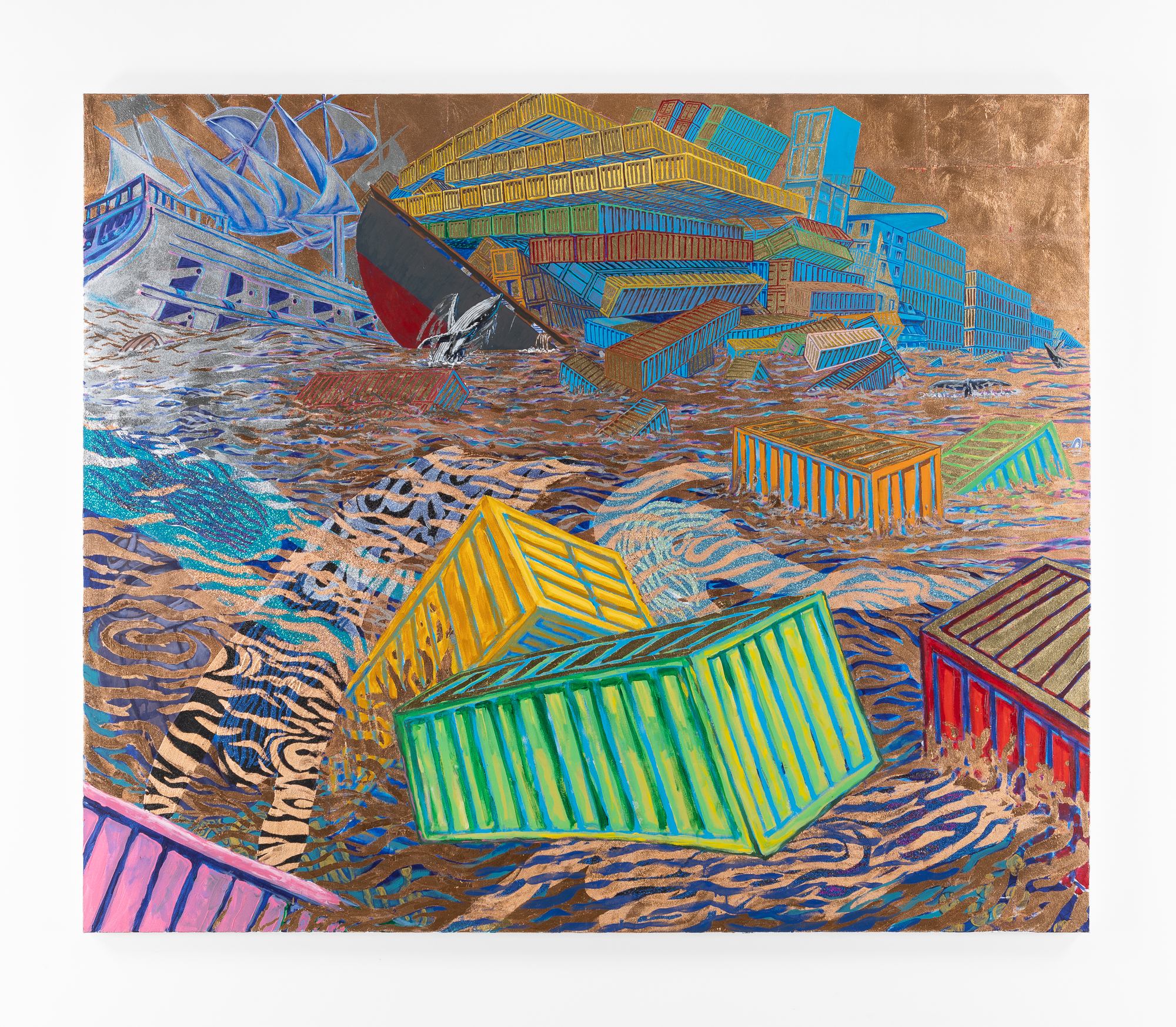
If the Museum of the African Diaspora were presenting only the single painting Breach, I would still tell you to go see Dewey Crumpler: Sonic Lineages. It’s that compelling.
Yes, this is the man who taught Deborah Roberts, Rozeal and Kehinde Wiley at the San Francisco Art Institute, but somehow we’ve had to wait two decades since his last major solo museum show. Since there are three floors of artworks covering five decades of the 77-year-old Bay Area legend’s practice, you won’t want to further delay your visit to this show.
Breach, one in a series of shipping container paintings, crashes present and past together, refusing to let us rest in pleasant fictions that modernity has somehow laid historic catastrophes to rest. Please go see the metallic copper leaf in person. It both darkens the sky like a storm and shines like a miracle being born. Copper, a conduit of electricity and a valuable commodity, floods from the sky into the turbulent waters churned by dozens of acid-colored shipping containers. Among them, ghostly figures — so easy to miss in a small digital reproduction — swim. Were they unleashed by the containers falling open or were they preexisting spirits activated by the disorder?
Crumpler never tells his viewer what they should perceive, but he may have left us a clue in Breach’s upper left corner, where a historic ship tilts precariously in an obvious reference to J.M.W. Turner’s 19th-century painting The Slave Ship, which recounts a notorious episode from the transatlantic slave trade in which a ship captain threw enslaved people overboard to their deaths in order to collect insurance on the ship’s “goods.”
“There is this containment that is being endeavored and, simultaneously, there’s always the escape,” curator Key Jo Lee told KQED of Crumpler’s shipping container paintings. “What he’s pointing to is the perpetual connectedness of all of these things.”
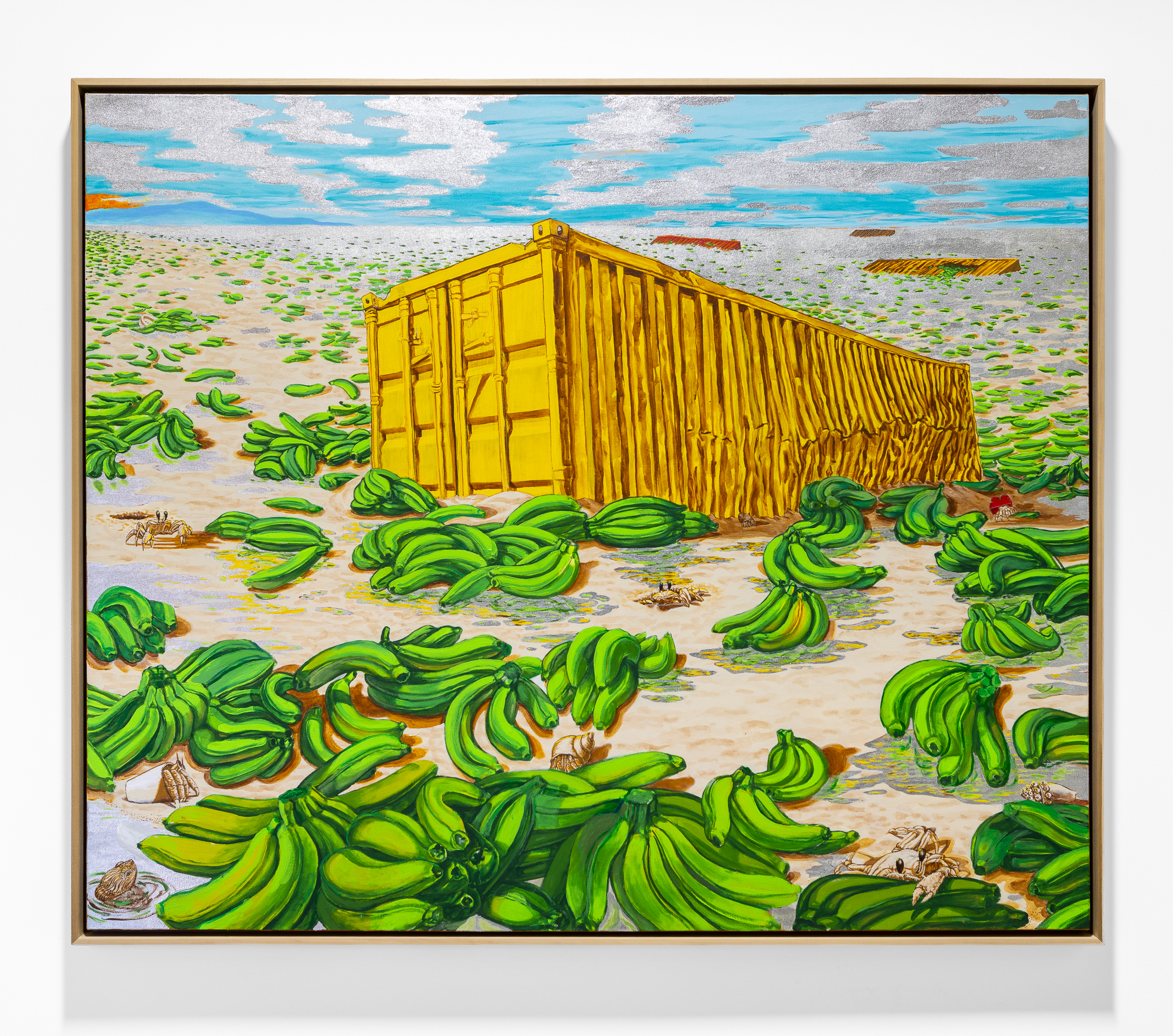
To Lee, Crumpler’s work exposes the mechanisms of exploitation, from the slave trade to the present day, in which we have become the product. The names of economists Friedrich Hayek and John Keynes are spelled out in the waters of Green Bananas.
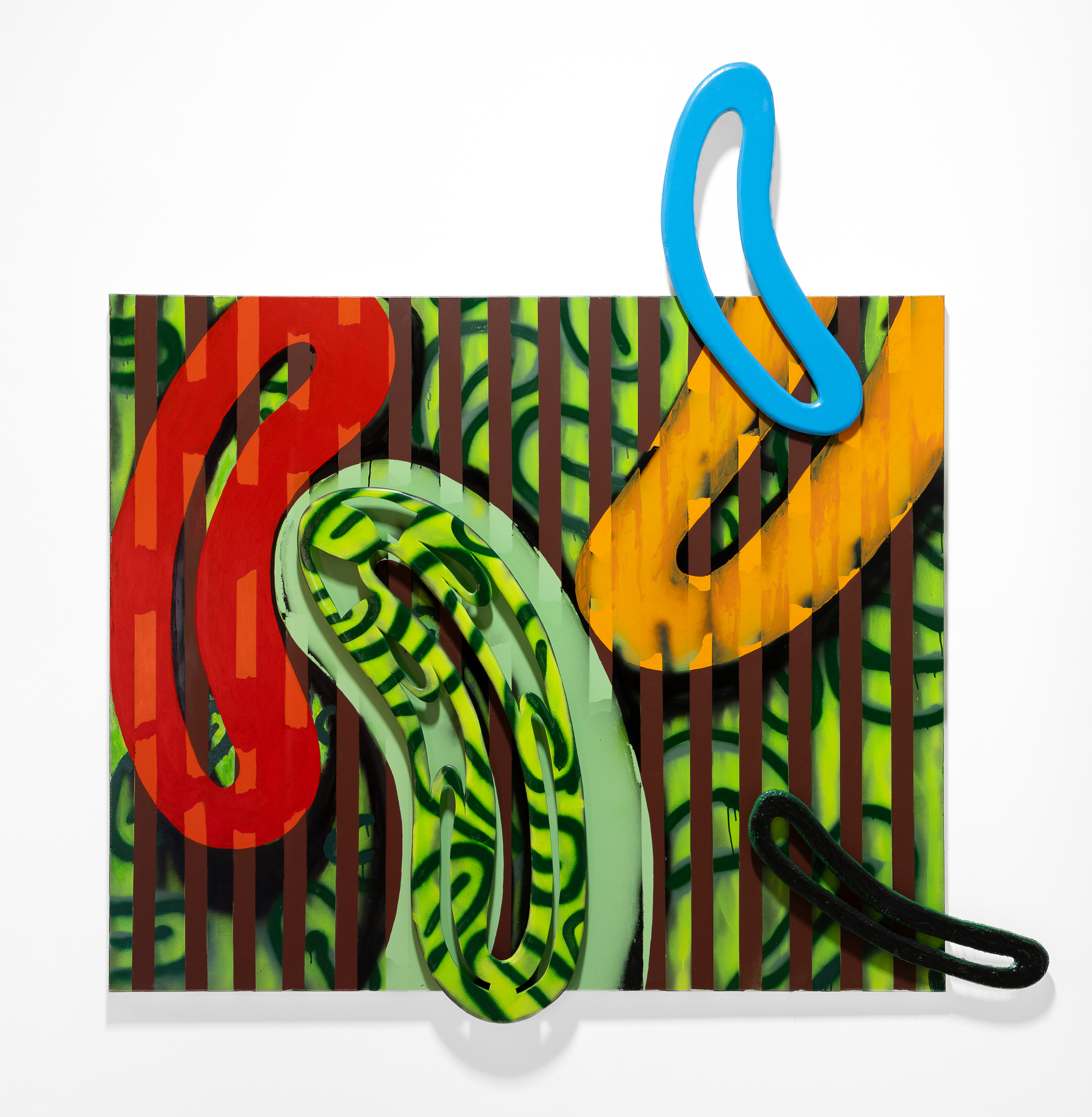
Sonic Lineages is not quite a retrospective proper, but with works spanning from 1968 to just last year, the exhibit reveals persistent engagement with recurring themes. Beyond the shipping containers lie images of voids and hoodies, each replete with meaning.
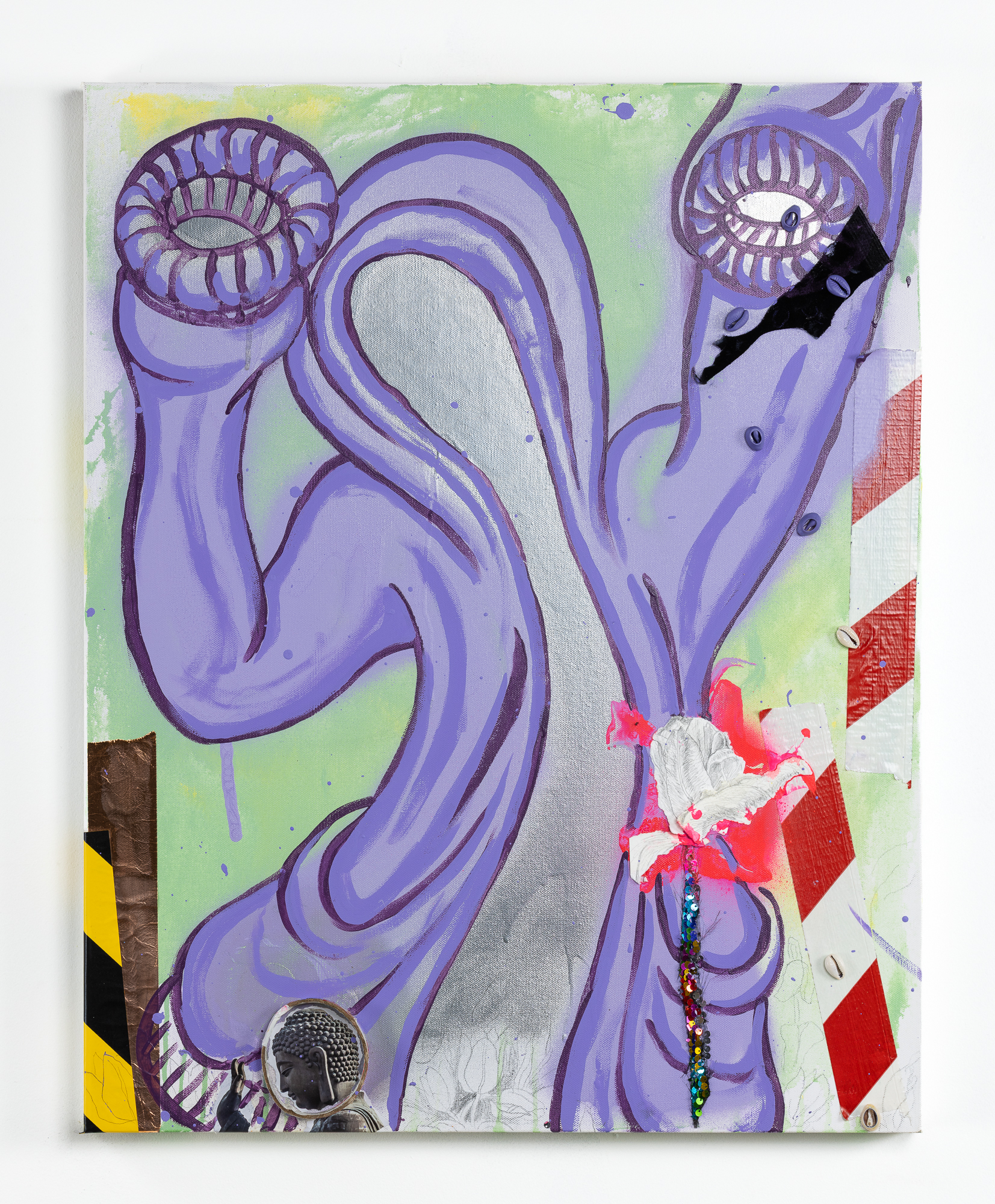
Early in Crumpler’s practice, he encountered a photograph of a metal slave collar, with a void at the center where a person’s neck was locked. Instead of “that void, which was meant to completely foreclose Black futures or foreclose our imagination, foreclose our agency,” explained Lee, “what he shows is that that void is actually the portal to absolute autonomy.”
Voids appear as three-dimensional forms on paintings, on discs that rotate at different speeds, and in the empty spaces of hoodies that dance like a 2000s iPod ad or open to reveal a futuristic cosmos within. Crumpler began the series after noticing his son’s hoodie thrown over the back of a chair. For me, it’s hard to see a hoodie without thinking of Trayvon Martin and all the potential of his life that his assailant removed.
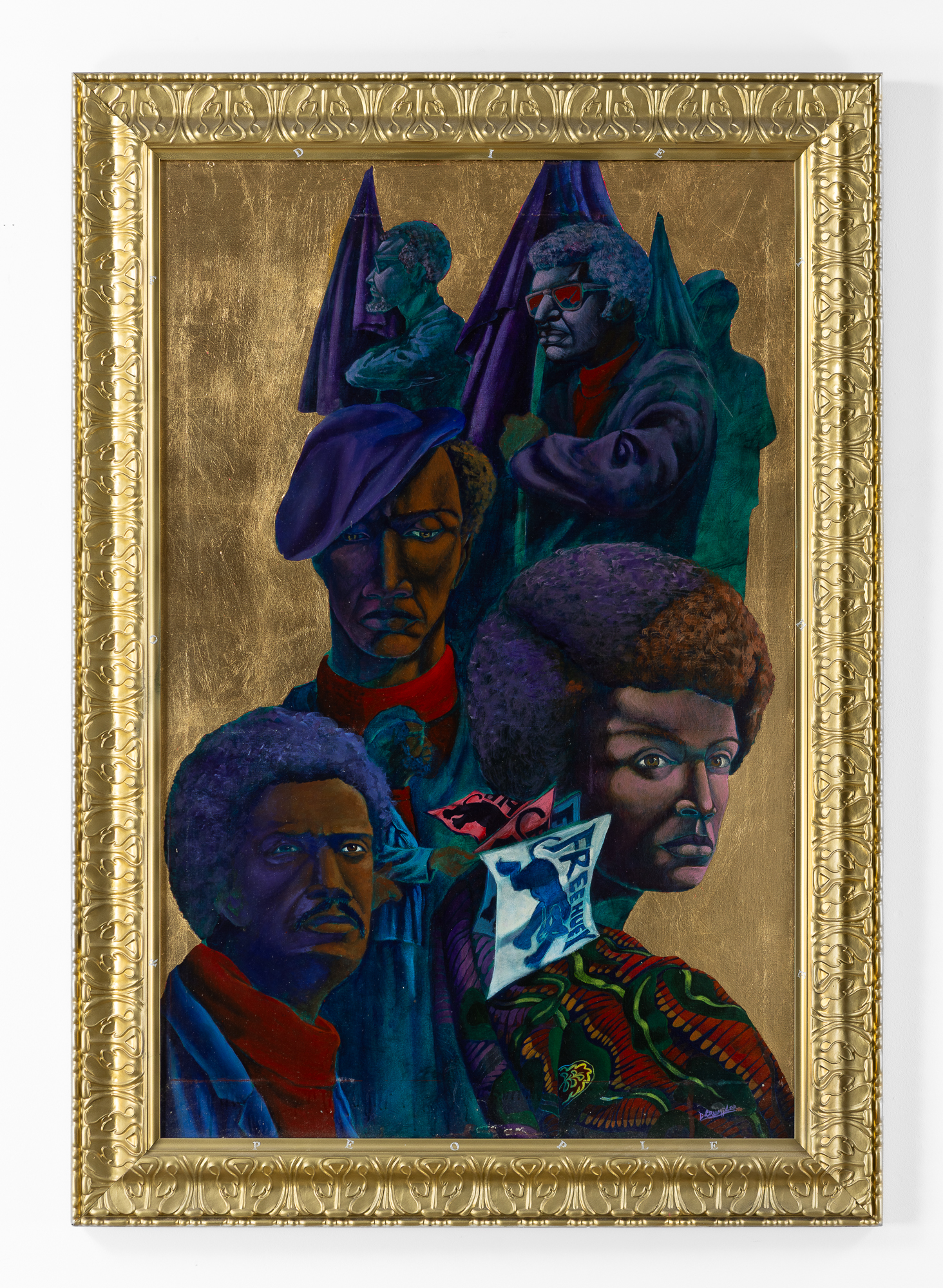
Growing up, Crumpler frequented San Francisco’s de Young, mesmerized by the paintings, but the only time he remembers seeing a Black person at the museum was in the bookstore. “I didn’t see any representations of me anywhere in that environment,” he said. “And I was becoming very conscious of the fact that my identity as an African American had something to do with why there was no possibility of seeing myself echoed back at me.”
Years of activism followed: Civil Rights marches, protests outside the Sheridan Palace Hotel against labor discrimination, demands for Black studies courses. When teachers at Crumpler’s college dismissed Black artists as lacking quality or originality, Crumpler brought in Cedric Dover’s book American Negro Art — its illustrations, “a blast from heaven.” Crumpler cited storied Black jazz musicians and challenged his teachers on the idea, as he summarized their position, that “creative genius only lived in one part of the world.”
Though Lee proposed mounting this exhibition several years ago, Crumpler insisted they wait until MoAD could produce a book to accompany it. It’s a requirement from an artist who understands how much the present owes the past and who feels a great responsibility to the future. (It’s easy to imagine this written testament will serve another young artist just as Dover’s book did for Crumpler.) For the present — happily — Sonic Lineages is on view for many months to come.
‘Dewey Crumpler: Sonic Lineages’ is on view at the Museum of the African Diaspora (685 Mission St., San Francisco) through May 30, 2027.