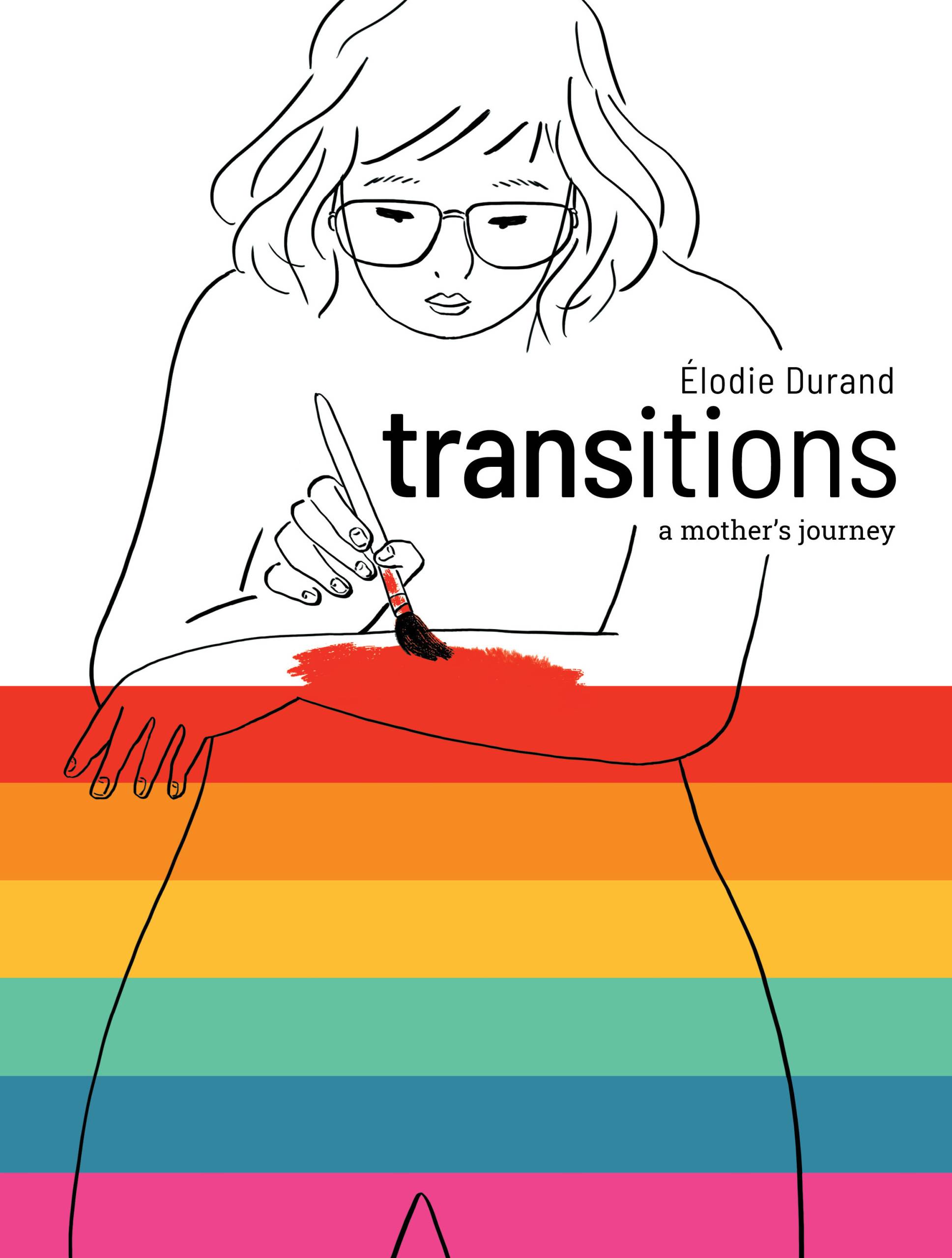
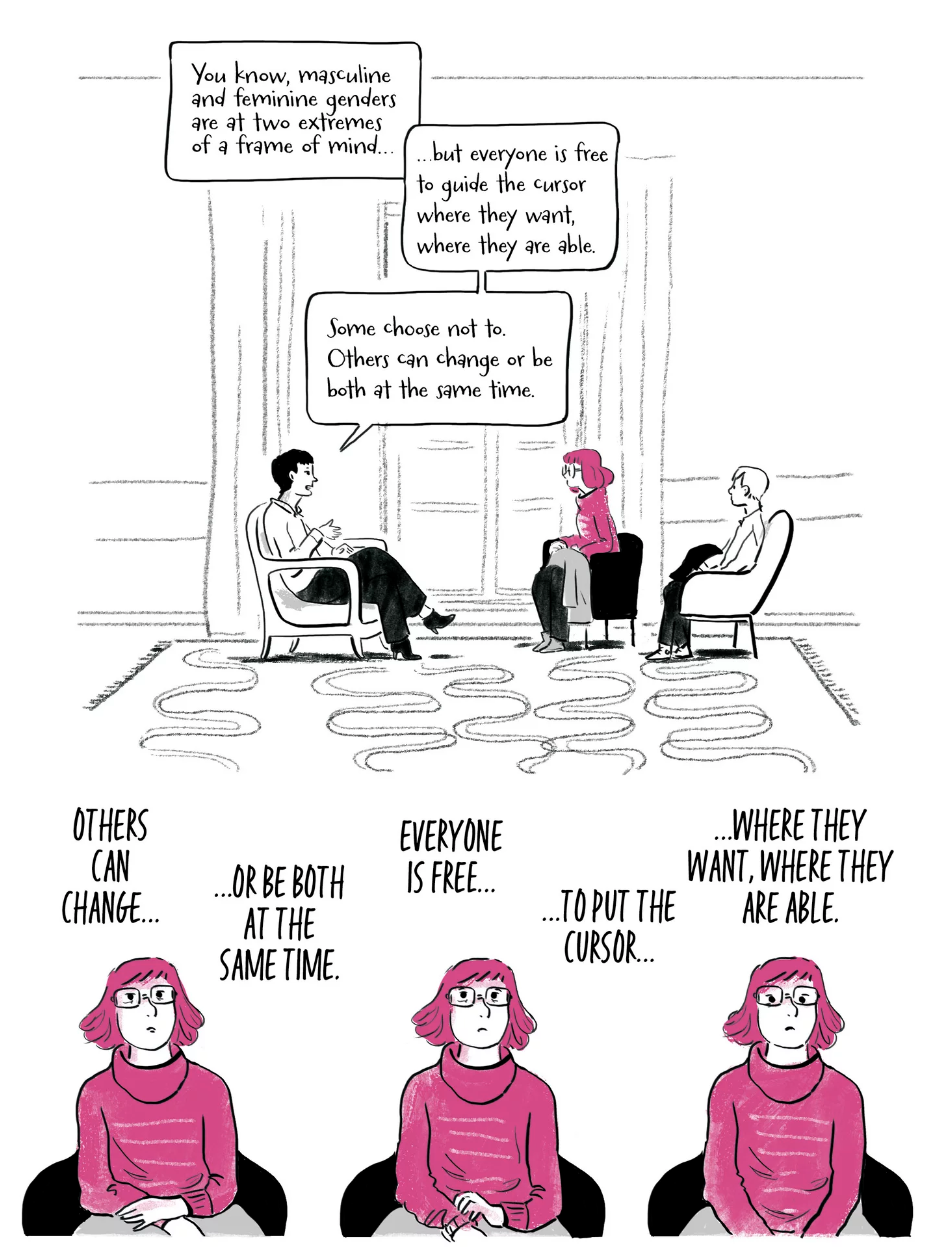
In the opening to Élodie Durand’s visual narrative, Transitions: A Mother’s Journey, a mother in her early 40s sits with her newly 19-year-old at a therapist’s office. The therapist is explaining the ways people in France are typically placed into oversimplified categories, boy or girl, from birth. “But in reality,” she continues, “there are multiple possibilities.”
The guarded mother only reluctantly engaging in this conversation beside her mostly silent teenager is Anne Marbot, a French university biologist who, until this point, as she later admits, has generally considered herself to be open-minded. Anne’s teenager, who was assigned female at birth and has been living her life until recently as “Lucie,” came out to her as a boy just a few months earlier. This session, with her child’s therapist, is intended to help Anne become a better ally to her son because, until now, the mother has not taken the announcement well. Instead, through nonacceptance she has driven a deep rift between them.
“I had no role model,” she later admits. “I was not prepared.”
Originally published in French in 2021 as Journal d’Anne Marbot, Transitions is a welcome addition to the growing number of graphic novels and comics exploring transgender as well as genderqueer identities. These include perhaps most famously Maia Kobabe’s graphic memoir Gender Queer — which has faced challenges around the country — alongside works like L. Nichols’ Flocks and Sabrina Symington’s fictional First Year Out. A distinguishing characteristic of Transitions in relation to these other works is that the focus of the story is what Alex’s mother refers to as her own different kind of transition, from shades of denial and rejection to unqualified support and acceptance of her child. As the therapist tells Marbot, who is riddled with anxiety, grief, and a host of other emotions for months following Alex’s announcement: “You fear that Alex will be marginalized, but the first and foremost marginalization is family rejection. That is in your hands.”
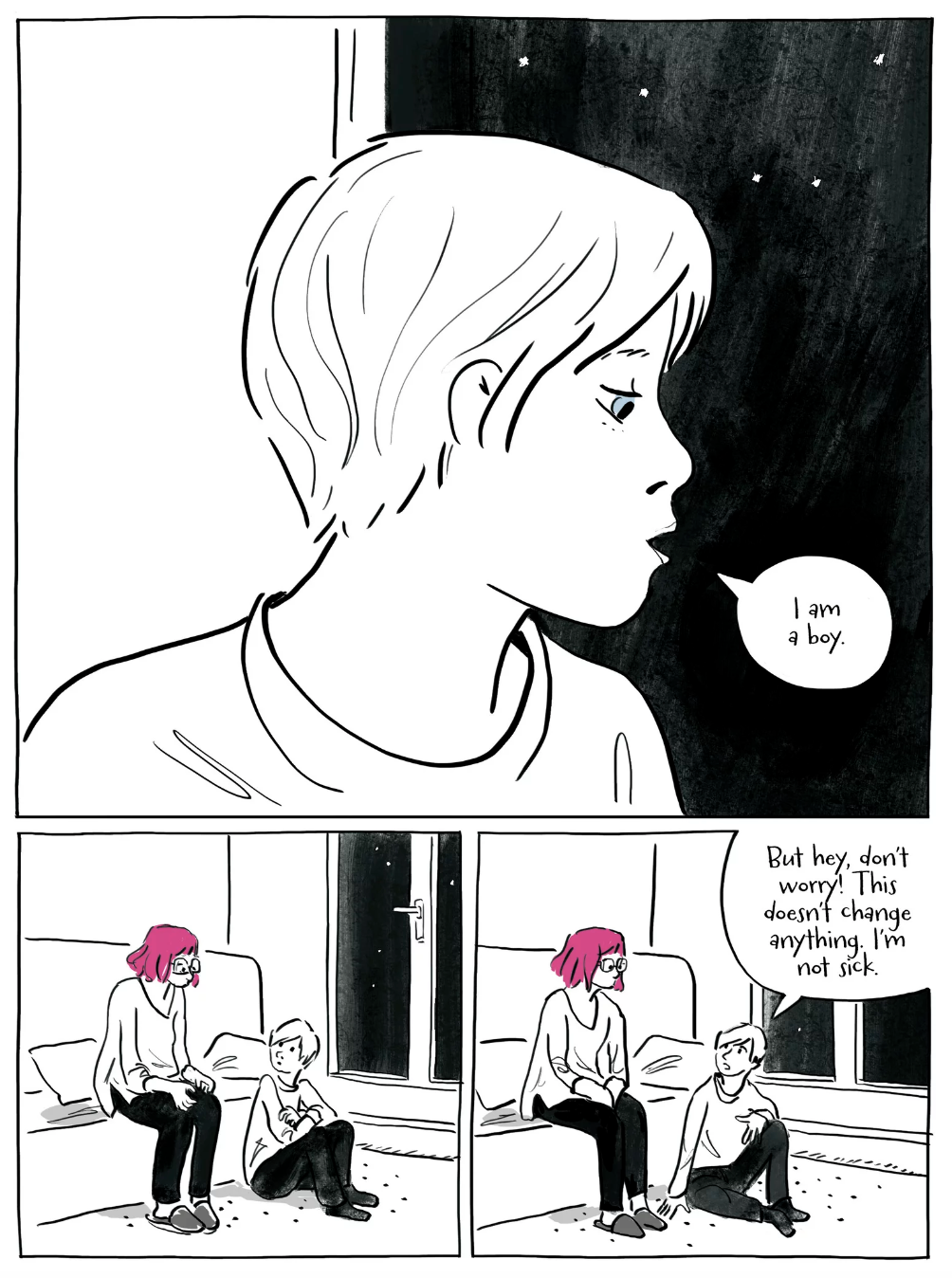
Transitions is shaped by the real-life story of Anne and Alex (all names have been fictionalized), as told to French artist and illustrator Durand. In addition to illustrating numerous children’s books, Durand also recently published a graphic memoir, Parenthesis, in which she draws and writes of her own experiences having a brain tumor and its assorted effects on her everyday life and sense of self. Here in Transitions, a biography of sorts, she animates exchanges between various family members, people she spent three years learning from and listening to, through her thoughtful, kaleidoscopic layouts and illustrations. Large chunks of narration, distinguishable through their typescript, come directly from Marbot’s own diary, which she started keeping nearly a year after her son told her he was male. Mixing text-heavy comics with pages of wordless, evocative drawings, most of Transitions is drawn in black, white, and grayscale, while splashes of bright colors — including an eye-popping hot pink — thread through, tracing the protagonist mother’s many emotional ups and downs.
9(MDAxOTAwOTE4MDEyMTkxMDAzNjczZDljZA004))