KQED Community Representation & Workplace Belonging ReportKQED Community Representation & Workplace Belonging Report

Each year, KQED publishes the Community Representation Report to share the initiatives and practices that support our equity and belonging work. It highlights the steps we have taken to advance representation, access and participation, along with what we are learning and where more work is needed.
This work focuses on how our staff experience our workplace, work with one another and help shape what we create for the Bay Area. We aim to cultivate a culture of kindness and curiosity, grounded in empathy, dignity and accountability. This means creating space for staff and community members to feel respected and included, contribute meaningfully and learn from one another.
Building that culture requires attention to which perspectives and identities shape the work and whether people have meaningful opportunities to participate. Our aspiration for this work is an organization where a wide range of perspectives informs decision-making and staff of different tenures, ages, identities, backgrounds and socioeconomic experiences can contribute, lead and take ownership. We are working toward this through three connected areas: who is represented; how people gain access to information and opportunities; and how people can contribute and help shape the work.
To help teams put these principles into everyday practice, we developed E.P.I.C. (Equity, Presence, Inclusion and Curiosity), a framework for reflection, learning and action. In the first year of this three-year effort, we have focused on building shared language and practical tools that teams can apply to their work. Going forward we will assess progress through team check-ins that explore how staff apply E.P.I.C., what changes they observe and where support is needed. These conversations will be grounded in each team’s priorities and vision for success, recognizing that progress will look different across teams.
As this work develops we aim to broaden participation, make processes more transparent and create more opportunities for staff and community members to shape KQED’s work. We believe bringing more perspectives into that work can strengthen our connection with the Bay Area and enhance the experiences we offer.

From Principle to Practice: The E.P.I.C. Framework
E.P.I.C. is both a training series and a practical framework for how staff work with one another and with the communities KQED serves. Its four pillars are Equity, which centers fairness, access and repair when needed; Presence, which considers who is represented, who we are working with and who is meaningfully invited to create with us; Inclusion, which encourages the vulnerability to explore ideas, learn through mistakes and create new approaches; and Curiosity, the thread that runs through each pillar and invites thoughtful questions of ourselves, our systems and one another.
Building on staff’s broad understanding of equity and belonging at KQED, E.P.I.C. was created to make those principles more recognizable and actionable within everyday conversations, working relationships, content, and audience engagement. It reflects an important evolution from a single organization-wide approach toward learning and action shaped around the work of individual teams.
The E.P.I.C. process begins with listening. Teams reflect on their progress, priorities and vision for success, and those insights inform a focused team framework supported by shared language and practical cognitive and relational tools. By grounding the experience in each team’s responsibilities and opportunities, E.P.I.C. connects equity and belonging principles directly to the work staff are already doing.
During the past year, staff have shared how the E.P.I.C. model has supported deeper editorial conversations about sourcing and created more space for thoughtful, diverse narratives. Staff also shared that using curiosity supported constructive, tense discussions involving different perspectives on how identity shows up in content and contributed to a positive outcome.
Throughout this report, E.P.I.C. serves as a connective thread for the advancement efforts that follow. Its four pillars provide a shared way to understand how representation, access and participation intersect—and how equity and belonging can be practiced through the choices, relationships, and work that shape KQED’s connection with the Bay Area.
—Candace Rucker Greenfield, Director of Diversity, Equity & Inclusion
Presence in Practice: Advancing Representation
Within E.P.I.C., Presence asks us to consider who is represented, whose experiences are reflected and which perspectives are invited into the room. The data in this section helps us explore those questions by showing who makes up KQED today, who is entering the organization, who is represented among senior leaders and where employees live throughout the nine-county Bay Area. Together these perspectives help us recognize the representation that already exists while identifying where participation can continue to grow.
No demographic table can tell the full story of a person or their experience. Race, ethnicity, age, gender expression and geography cannot tell us whether someone feels heard, how they experience KQED’s work, or how much influence they hold. What the data can offer is a meaningful starting point: a clearer understanding of who is present and the range of perspectives that may be contributing to KQED’s work.
A Portrait of Our Workforce
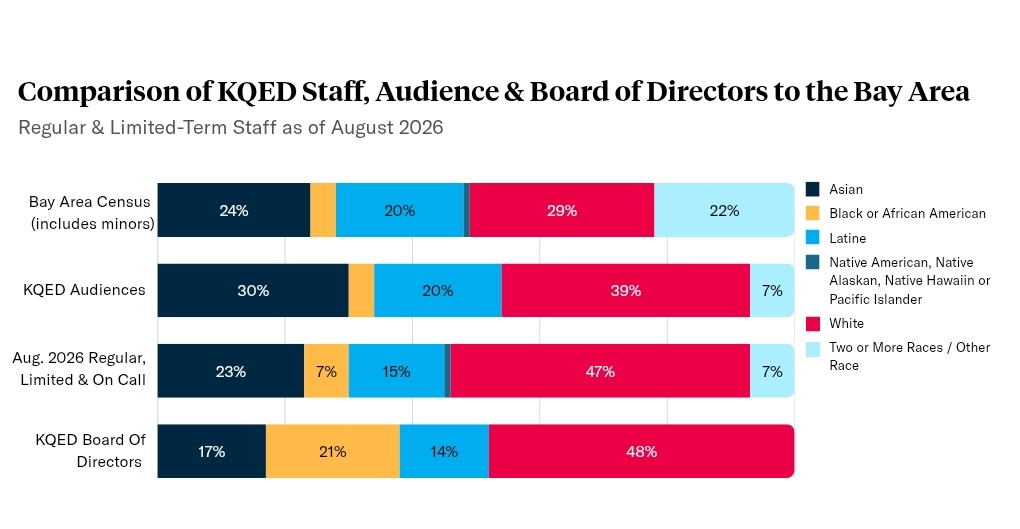
As of August 2026, this snapshot includes 455 full-time, limited-term, and on-call employees.
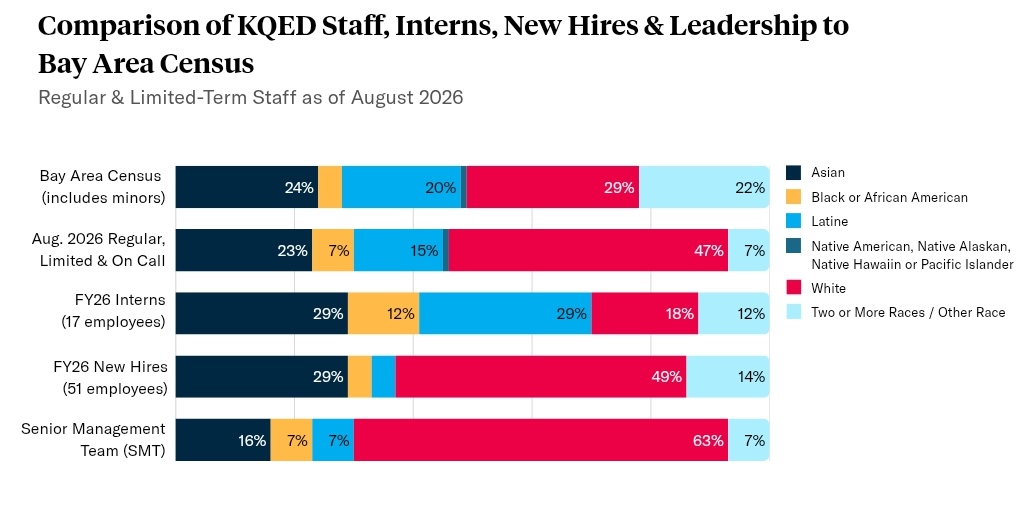
Understanding KQED’s range of racial and ethnic identities allows us to better understand where our workforce more closely reflects the region and where opportunities to expand representation remain.
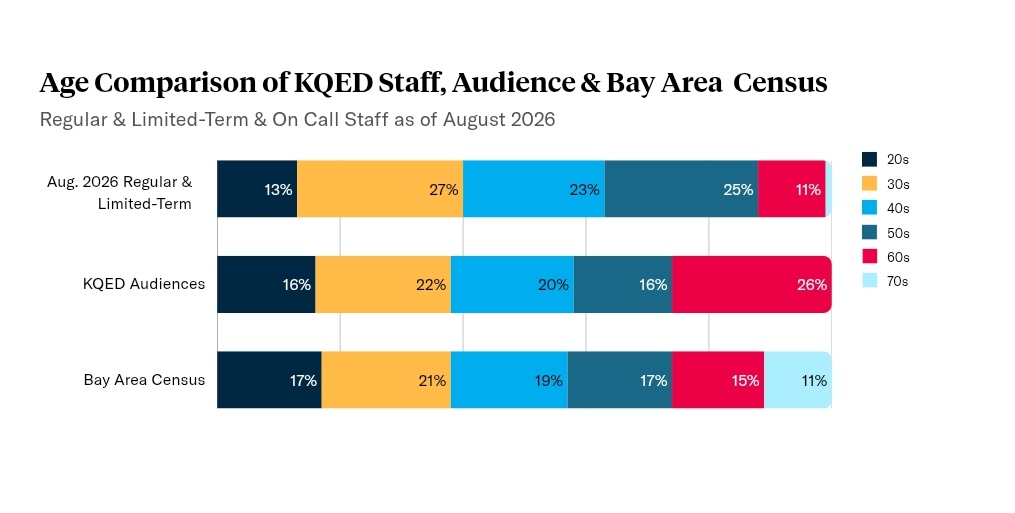
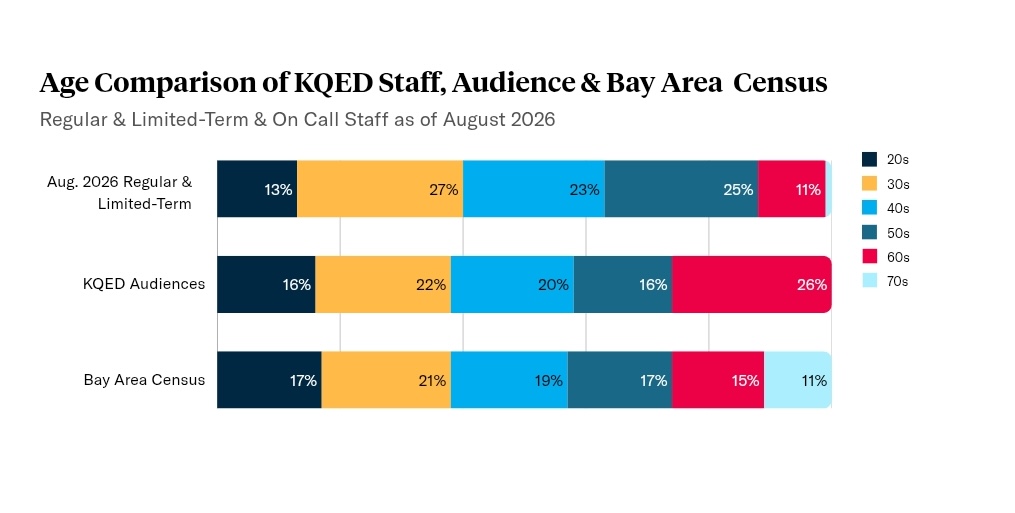
The age data shows a multigenerational workforce. KQED’s share of employees ages 20–39 is relatively close to the comparable Bay Area population. Employees ages 40–59 make up a larger share of KQED’s workforce, while employees ages 60 and older make up a smaller share. These comparisons help us see which generations are currently present across KQED.
New Perspectives Entering KQED
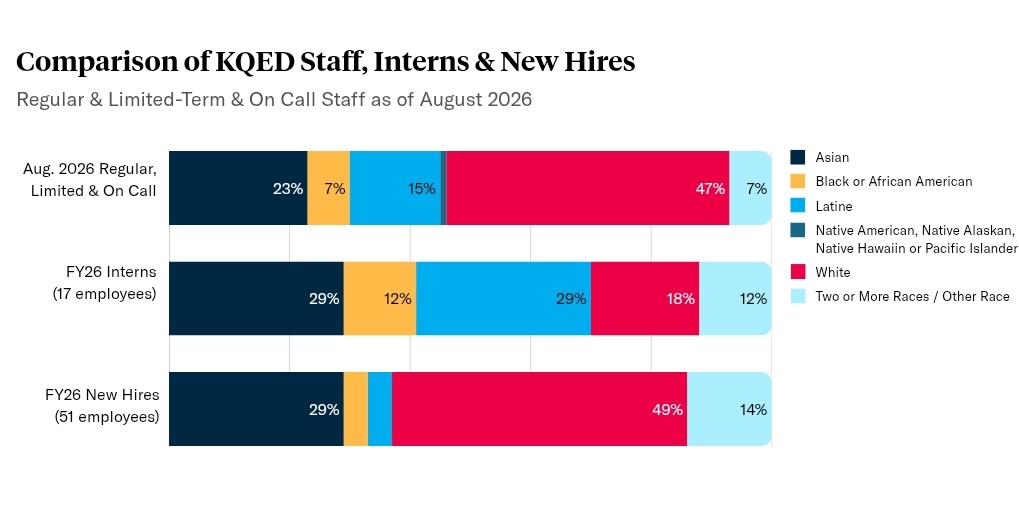
Representation is also shaped by who has opportunities to enter the organization and gain experience within it. This year’s data includes 51 new hires and 17 interns, offering two distinct views of access to KQED.
The intern cohort is distributed broadly across racial and ethnic groups when compared with the overall workforce. Among new hires, Asian and multiracial representation is higher than among all staff, while Black and Latino/a representation is lower.
New hires also skew younger than KQED’s current workforce. These findings show that access is broadening in some areas while giving us a clearer view of where continued attention and opportunity remain important.
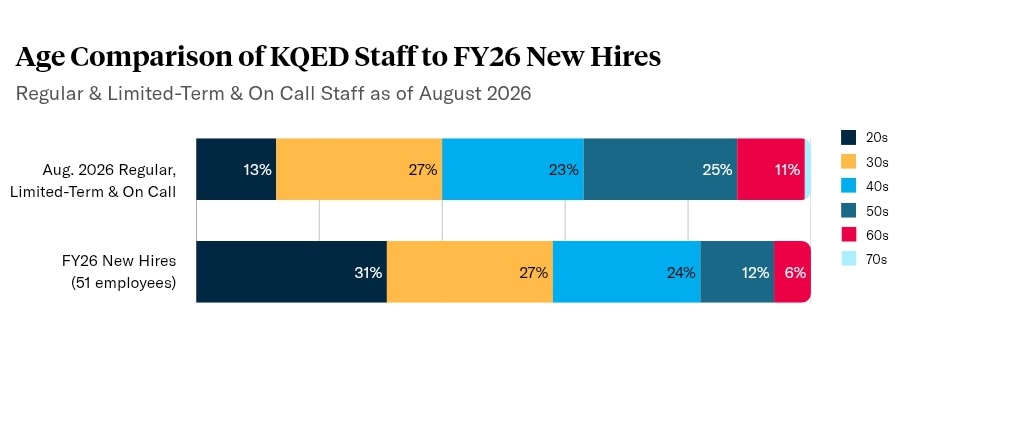
Understanding the age and race/ethnicity diversity among new hires and interns helps us see who is gaining experience at KQED and who is joining the organization through employment.
Representation Among Leadership
Diverse representation is essential within the rooms where organization-wide decisions are considered. KQED’s Senior Management Team includes 27 employees, and its demographic composition provides another perspective on who is currently present within senior leadership, and where that representation may continue to expand.
Compared with KQED’s overall workforce, White employees make up a larger share of the Senior Management Team, while Asian and Latino/a employees make up smaller shares.
KQED’s workforce is multigenerational, with employees in their 20s and 30s comprising 41% of all staff and 58% of new hires. Within the Senior Management Team, 92% of employees are in their 40s and 50s, offering a clearer view of the generational perspectives currently represented in senior leadership.
Our Presence Across the Bay Area
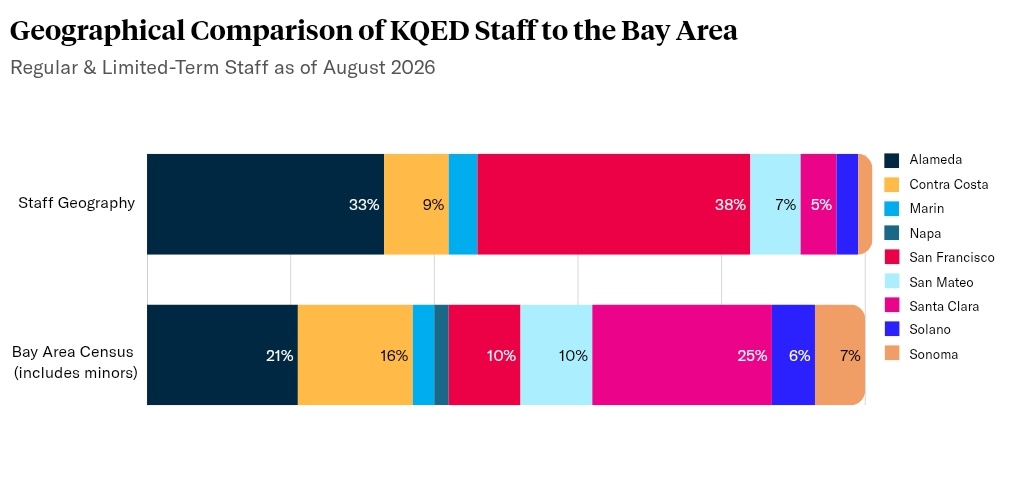
Looking at where employees live adds a regional dimension to the story of who KQED is. Comparing KQED’s staff distribution across the nine counties with each county’s share of the Bay Area population can help us see where our workforce presence is stronger and where it is more limited.
KQED employees live across eight of the nine Bay Area counties, with the largest shares residing in San Francisco (38%) and Alameda (33%). Together, these counties account for 71% of KQED staff, compared with 31% of the regional population. These points help us understand how our workforce is distributed across the region we serve and adds another layer to the broader picture of representation.
Taken together, these snapshots offer a fuller view of who is present across KQED—within the overall workforce, among those newly entering the organization, in senior leadership and throughout the Bay Area.
Advancing Access: Creating Pathways to Information, Opportunity and Growth
The foundation laid by representation helps us understand who is present and enables us to actively consider the innovation that becomes possible once people are in the room.
Within E.P.I.C., access sits at the intersection of Equity and Presence. Equity asks whether information and opportunities are shared fairly, while Presence asks who is included and whether their perspectives can meaningfully inform the work. At KQED, advancing access has meant exploring new ways for more people to participate in organization-wide decisions, understand work happening across teams, and build learning into their everyday responsibilities.
Broadening Organization-Wide Decision-Making
During the past year, we introduced a Senior Management Team as a way to involve more senior leaders in decisions affecting the organization as a whole. The team was designed to broaden decision-making beyond the Executive Management Team, expand the range of perspectives present in organization-wide discussions, strengthen cross-functional collaboration and alignment and create a greater sense of shared ownership in how KQED moves forward.
Making Information More Accessible
Alongside the Senior Management Team, Tiger Teams provide another organizational structure for expanding access to KQED’s organization-wide work. Born out of the need to implement initiatives in support of strategic priorities, 47% (63 out 135) of full time and limited term staff are on Tiger Teams to bring staff together around shared priority areas and help move initiatives from planning into action across teams and functions.
In particular, the Culture and Capacity Tiger Team supports work intended to strengthen collaboration and innovation, while creating closer connections among KQED’s editorial, business and digital functions. Several initiatives emerging from this priority area focus on making organizational information and change easier to understand. These include targeted learning for managers and senior leaders on information cascading, change management, accountability and how leaders want to show up for their teams. The aspiration is to help leaders understand organizational decisions, communicate them more effectively and give employees greater access to context and clarification.
“Building a Culture of Learning and Growth” is another initiative within the Culture and Capacity priority area. At the heart of this initiative is a growth mindset: the belief that people’s capacities and talents can develop through dedication, effort and learning from mistakes. It is also an invitation to remain curious—to ask what we can learn, what we might approach differently and how greater access to information and shared reflection can make future work more effective, efficient and innovative.
Advancing access is not about opening one doorway. It is about creating clearer and more connected pathways to information, decision-making, project participation, learning and growth. The Senior Management Team, Tiger Teams, and manager learning each approach that work differently, but they share a hopeful idea: when people can better understand the work, see where they can contribute and learn from what they have already done, they are better positioned to participate in what comes next.
Advancing Participation and Workplace Belonging
Access creates pathways; participation brings them to life. Participation asks how people are invited not only to receive KQED’s work, but also to engage, provide input, share their experiences and help shape what we create.
Within E.P.I.C., participation brings each pillar into motion. Equity considers the fairness and accessibility of an initiative while Presence asks who is involved. Inclusion creates room for people to contribute and challenge assumptions.and Curiosity helps us listen, learn and adjust based on what we hear. Across content, products, events and organizational work, participation is about creating more meaningful opportunities to build with people.
Building a Product With Our Community
One area where KQED employed the E.P.I.C. framework towards an area that impacted our audiences directly was our work on rebuilding the KQED App, As part of this design process, the team engaged with Bay Area community members on how the app could better serve them. Continuous research took place at every stage, from the earliest concepts through post-launch and community feedback helped shape what the app would become.
What KQED heard was clear: people were not looking for a content library; they wanted a daily local companion. That meant an app offering Bay Area content tailored to their interests, with the flexibility to read, listen, or watch. This audience feedback was incorporated and ultimately led to an App that had deeper, more responsive personalization features. Following the launch, the KQED App’s rating increased from the low three-star range to 4.9 stars, monthly installs increased 66%, repeat usage grew from 35% to 88% of monthly users and monthly live radio stream listens increased more than 600%.
These results demonstrate what can happen when community insight is treated as part of decision-making rather than as feedback collected only after the work is complete. By listening continuously and allowing what we learned to influence the product, KQED created an experience shaped around how people wanted to connect with local content.
Creating Space for the Bay Area to Gather
Participation also comes to life when people can gather around the cultures, questions, traditions and creativity that shape the Bay Area. Beginning in FY26, KQED’s Strategic Plan for Events and Experiences established a goal of presenting at least two larger-scale events per quarter outside San Francisco. By the end of the year, KQED’s events program KQED Live had doubled that minimum goal, presenting 16 events across Santa Clara, San Mateo, Alameda, Contra Costa, Sonoma and Napa counties.
KQED Live also set a goal for 28% of its programs to serve AAPI, Latine and family audiences through relevant subject matter or community representation onstage. By the end of FY26, 37.5% of programs had collectively served these audiences. Our food series brought local vendors together for cross-cultural exchanges about food and tradition through events including the Pupusa Showdown, Matcha Showdown, Rice Showdown, Kimchi & Culture, the Dumpling & Dim Sum Festival, and Seoul Meets Soul at the Oakland Museum. Other programs included Carnaval SF’s annual monarch dance competition for the fifth consecutive year; a walking tour with the Chinese Culture Center exploring the legal history and people behind birthright citizenship through important sites in San Francisco’s Chinatown; and Ritual of Braiding, featuring Amigas Unidas and Freedom Braiders. KQED Live also welcomed Bay Area creatives Jon M. Chu, Boots Riley, and Samin Nosrat as headlining interview guests with Forum.
This year, KQED Live introduced a new way to understand the impact of these experiences beyond the number of people who attended. Surveys asked whether an event helped attendees learn something new, feel connected with others and with KQED, and better understand and appreciate local issues, cultures and institutions. Across these four measures, an average of 74.7% of respondents agreed or strongly agreed.
This result establishes the first baseline for KQED Live’s Bay Area Roots Index. As the measure develops, it will help KQED understand and strengthen how its events create opportunities for local communities to know, appreciate and take part in the Bay Area we share.
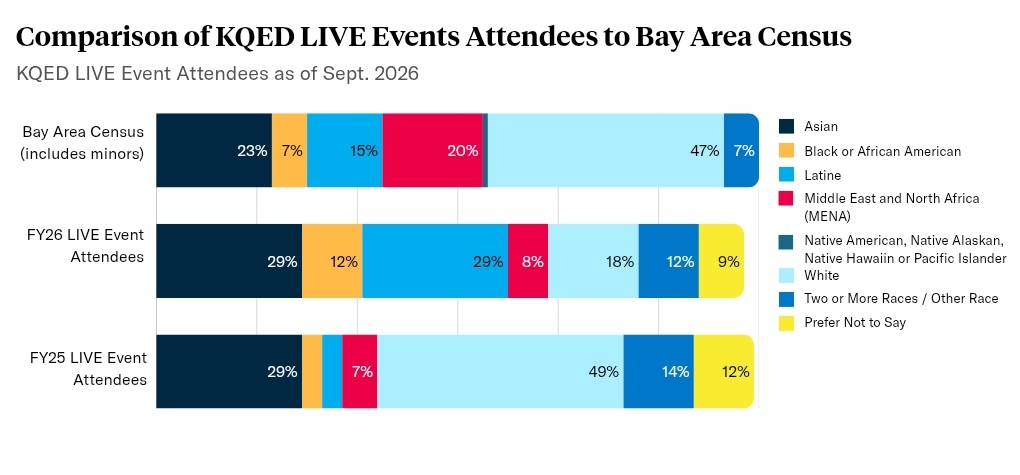
FY2 attendee responses reflect a range of racial and ethnic identities, with Asian and Latine identities each reported by 29% of respondents. Black or African American and Two or More Races/Other Race identities were each reported by 12%, Middle Eastern and North African identities by 8%, and White identities by 18%, offering another view of who is participating in KQED Live experiences.
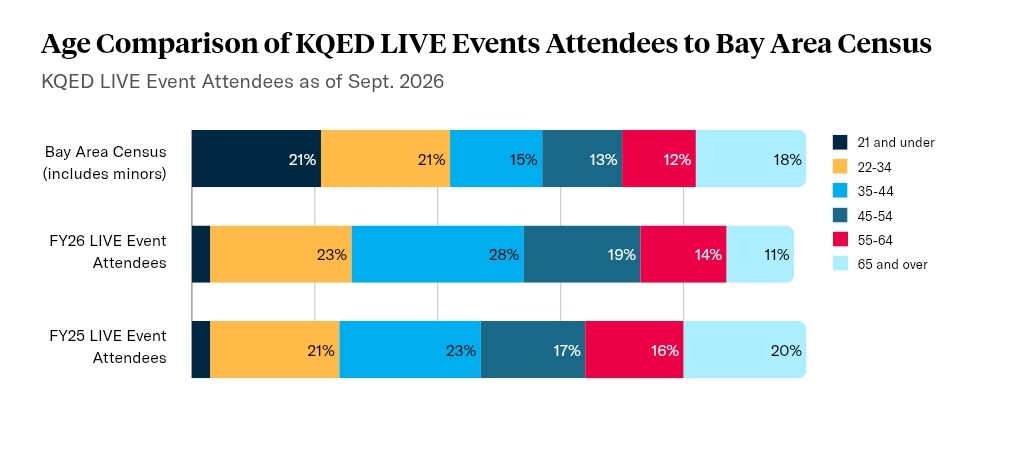
KQED Live welcomed attendees across age groups in FY26, with the largest share between ages 35 and 44 at 28%. Attendees ages 35–54 collectively represented 47%, compared with 40% in FY25 and 28% of the Bay Area Census comparison, providing a clearer view of the generations currently most represented at KQED Live events.LIVE attendees skew toward ages 22 to 54 and underrepresent people 21 and under and 65 and over.
KQED Live welcomed attendees across age groups in FY26, with the largest share between ages 35 and 44 at 28%. Attendees ages 35–54 collectively represented 47%, compared with 40% in FY25 and 28% of the Bay Area Census comparison, providing a clearer view of the generations currently most represented at KQED Live events.
Source Tracking: From Data Collection to Action
KQED is approaching its fifth year of collecting source-tracking data to better understand who is showing up in our content. Content teams record demographic and geographic information, along with each person’s role within a story, for the people who help shape KQED’s reporting—including subject-matter experts, people sharing first-person experiences, community activists, artists and others. This information helps us see whom we are already engaging and where we want to deepen or expand relationships with additional communities and perspectives.
The first several years of this work focused on building consistent participation in source tracking and developing a usable picture of the people appearing across KQED’s content and programming. With four years of data available, the work has begun evolving from collection and measurement toward deeper reflection, conversation and action.
This year, teams reviewed whom they were engaging and connected those findings with their E.P.I.C. survey responses, including where they had seen progress, where they wanted to improve and what success could look like. Bringing these two sources of information together helped each team identify a focused and realistic area for continued growth.
The analysis helps teams understand the range of lived and professional perspectives appearing in their work. Looking at each source’s role can show how first-person experiences are represented alongside subject-matter expertise. Geographic information can identify counties and communities with which teams may want to build stronger relationships, while age data can inform opportunities to engage younger people in coverage connected to their lives and perspectives. The purpose is to use what we learn to make sourcing more thoughtful and expansive—and to create more opportunities for people across the Bay Area to be an active collaborator in the stories KQED tells.
Conclusion: Continuing the Work, Together
Thank you for taking the time to read this report—and, more importantly, for the part you play in making this work possible. How we listen to, learn from and engage with one another across our organization and communities continues to shape this work and its impact.
I want to offer particular appreciation to the incredible staff at KQED who have intentionally committed to embracing the E.P.I.C model. They have gone beyond learning the framework to help create spaces with broader representation, greater access and deeper, more vulnerable and honest participation. This work can be uncomfortable and challenging, and our staff continue to approach it with care, curiosity and a genuine willingness to learn.
I am equally grateful to KQED’s leadership for continuing to strengthen and sustain its commitment to this work—even beyond moments when that commitment may receive greater public attention. Meaningful progress requires consistency, and that continued support helps create the conditions for this work to grow.
Looking ahead, our focus is to continue establishing E.P.I.C. as a foundational practice embedded throughout KQED. We will continue identifying ways to support one another at the organizational, team and individual levels, while creating more centralized places for staff to understand what is happening across KQED and how they can contribute.
As we move forward, we will continue bringing the ideas of representation, access and participation together—remaining curious about what more is possible and committed to building it with one another.
Notes: You may see inconsistent use of terms in some places (for example, Latine versus Latino) in the above report. In most cases, we’ve used language that we feel best represents our audiences, but some language reflects the categories recognized by the federal government or those recognized by a specific tracking platform.