Read and listen to immigration coverage from KQED’s reporters.
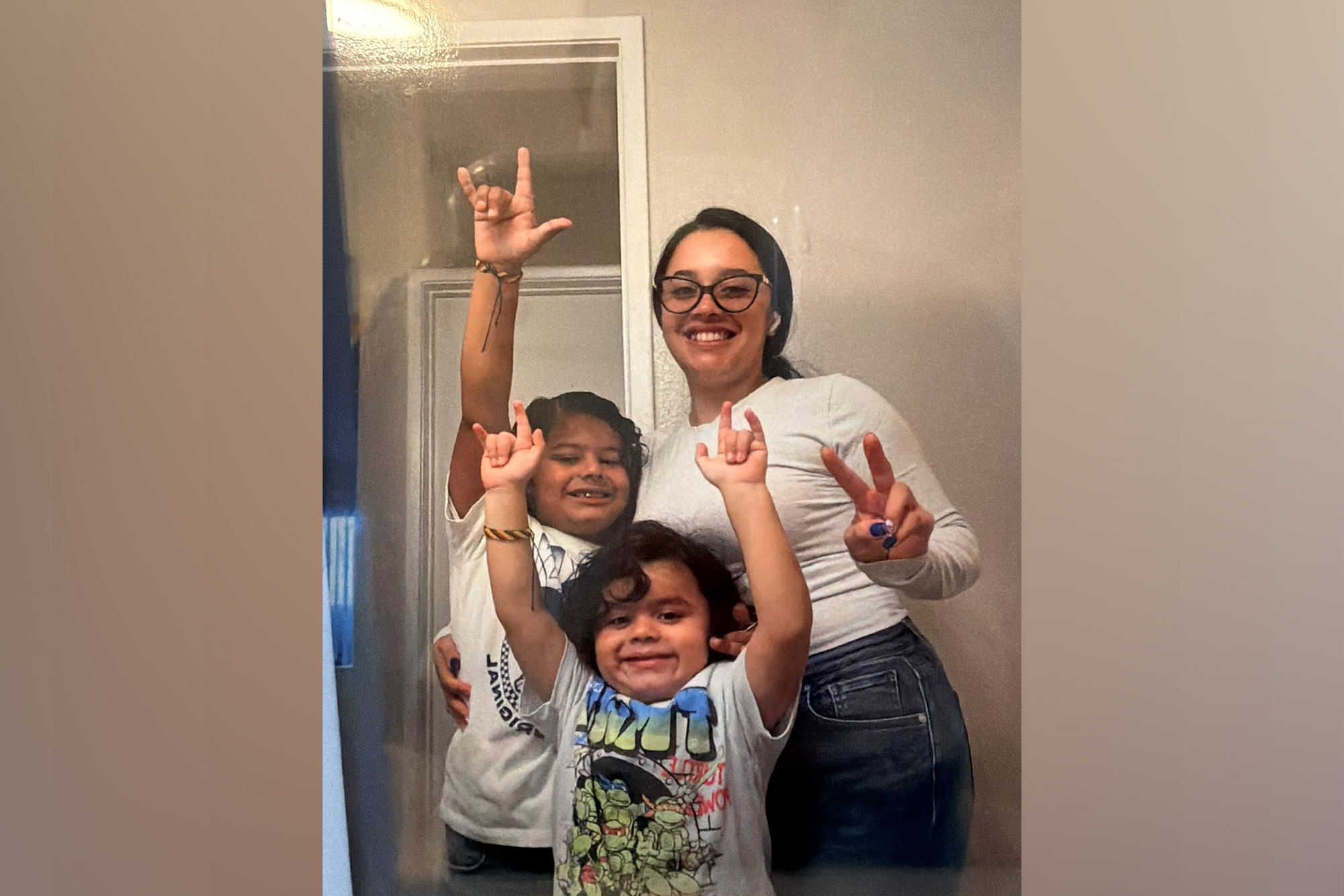
California Officials Demand ICE Return Family to US After Arrest and Deportation
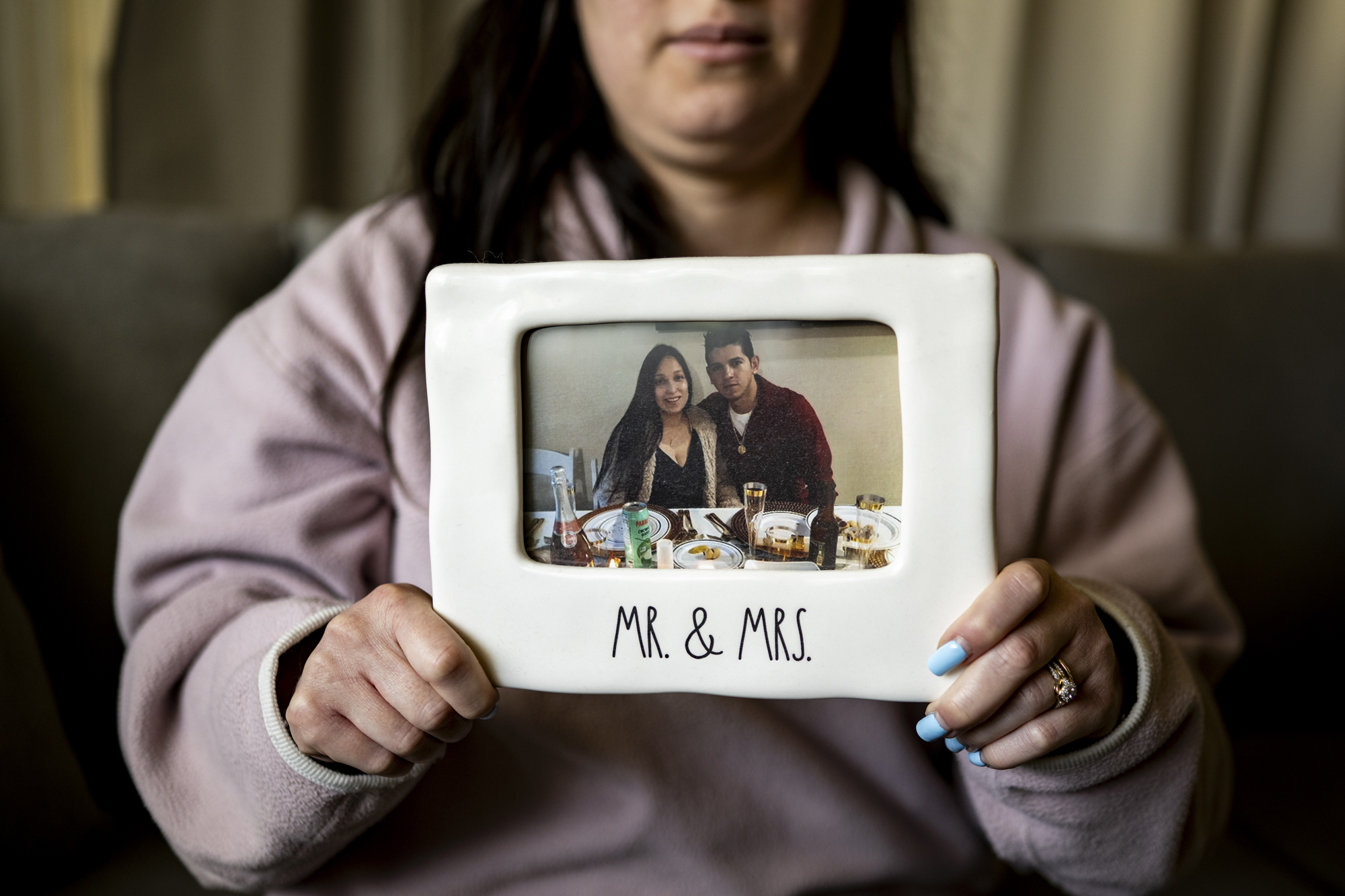
A Year After ICE Detained South Bay Immigrant, Family Trauma Lingers
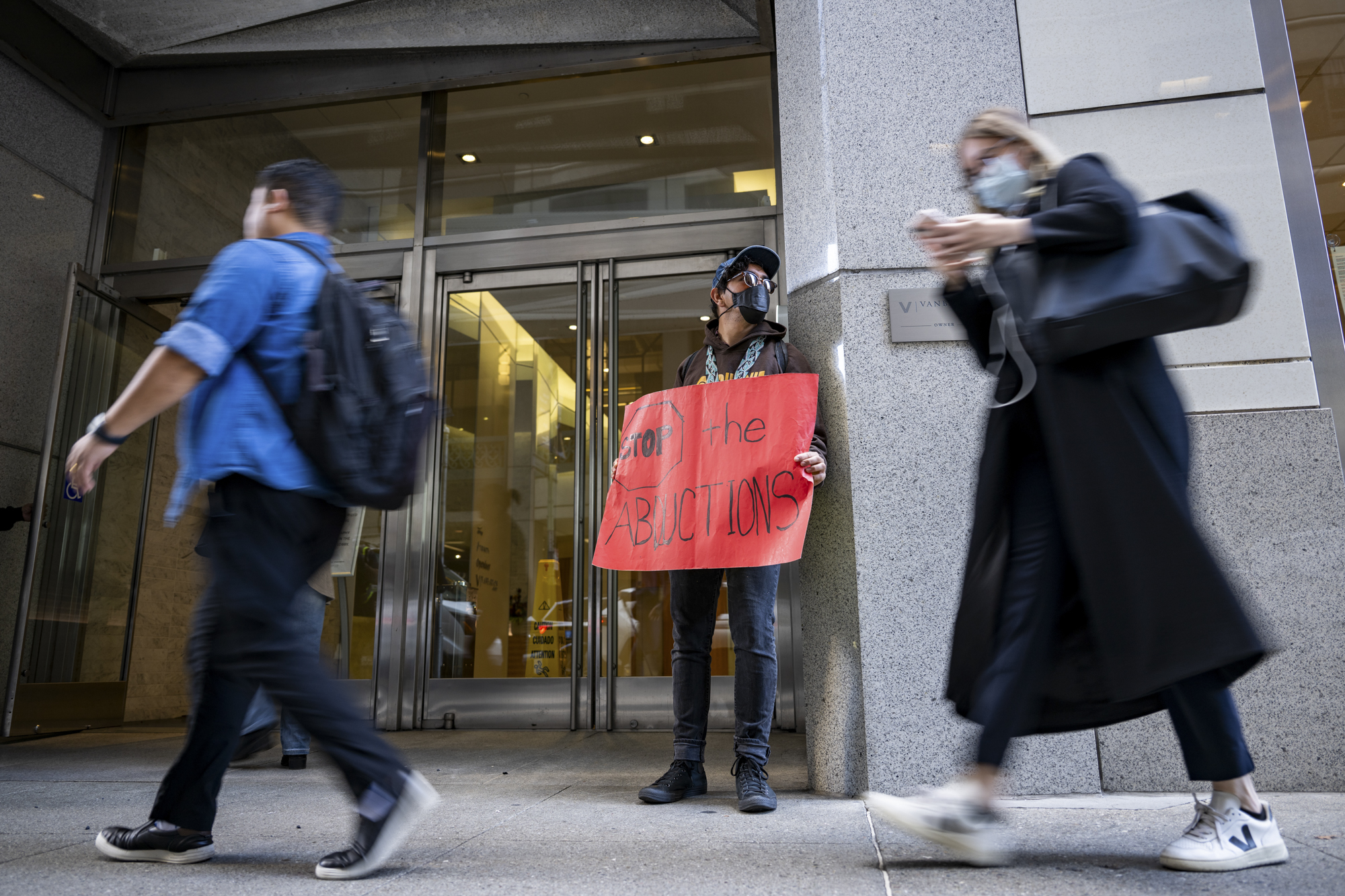
San Francisco Immigration Court’s Death by a Thousand Cuts
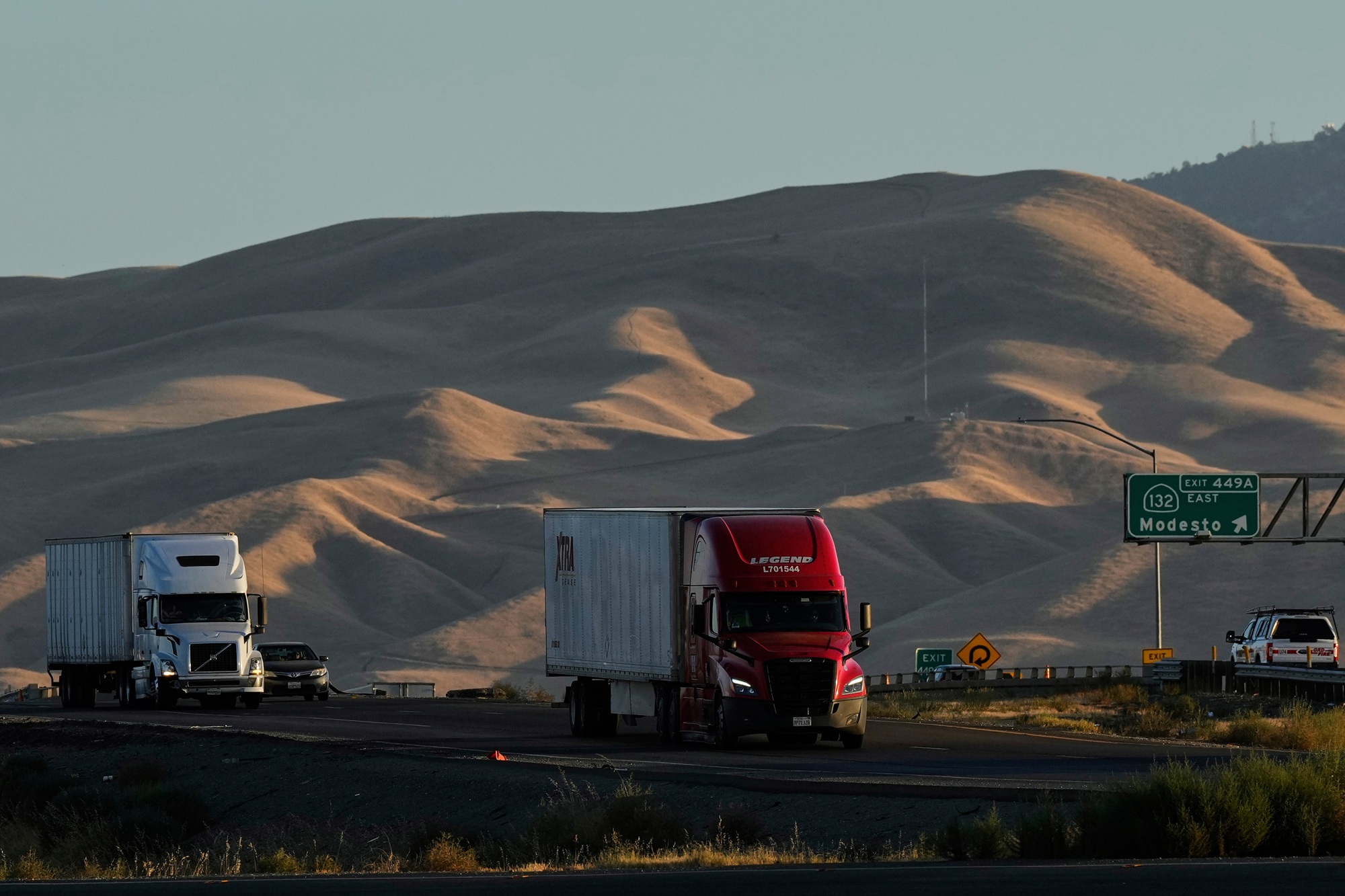
Judge Says California Must Allow 20,000 Immigrant Drivers to Reapply for Commercial Licenses
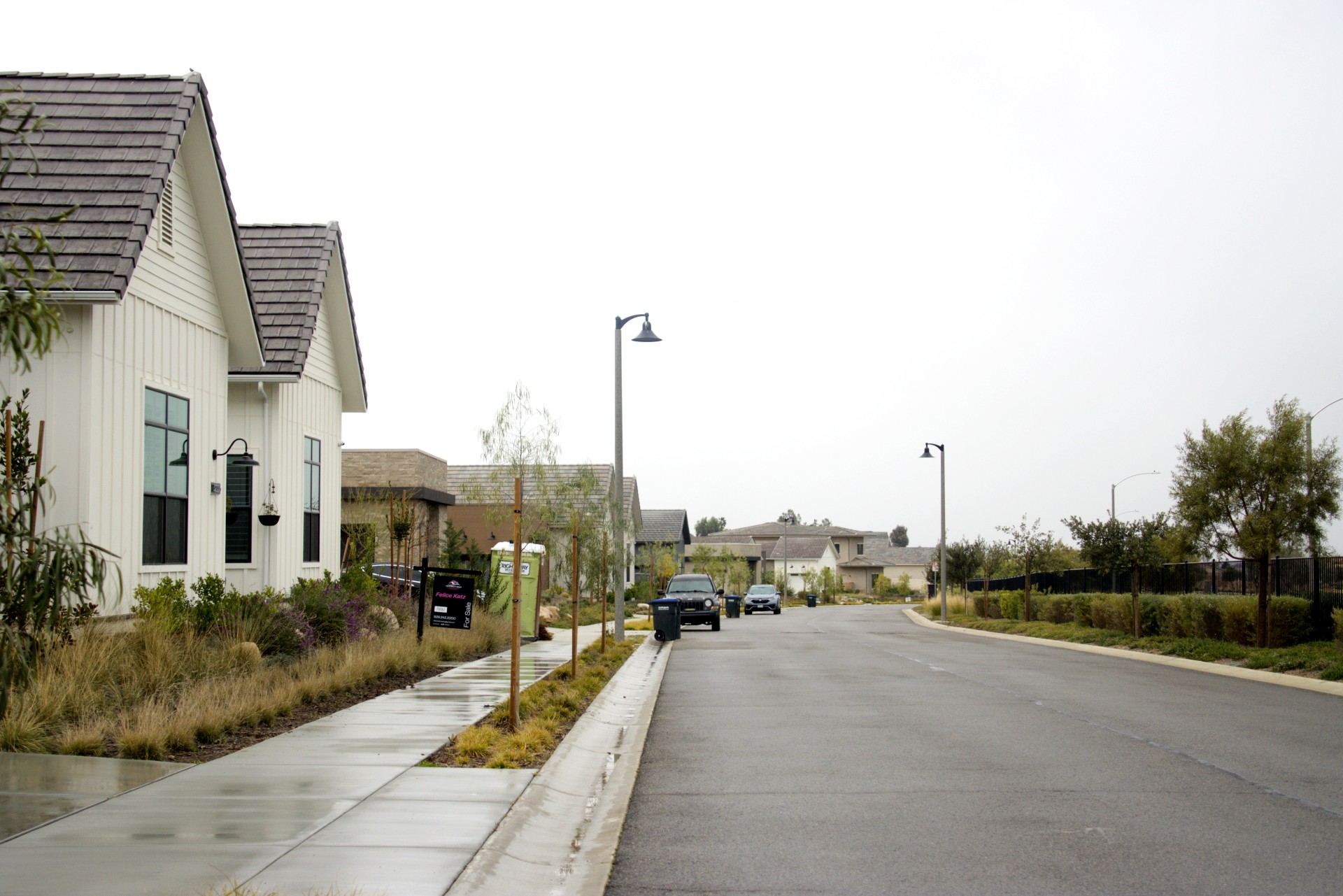
Riverside County Case Highlights Accountability for Federal Immigration Agents
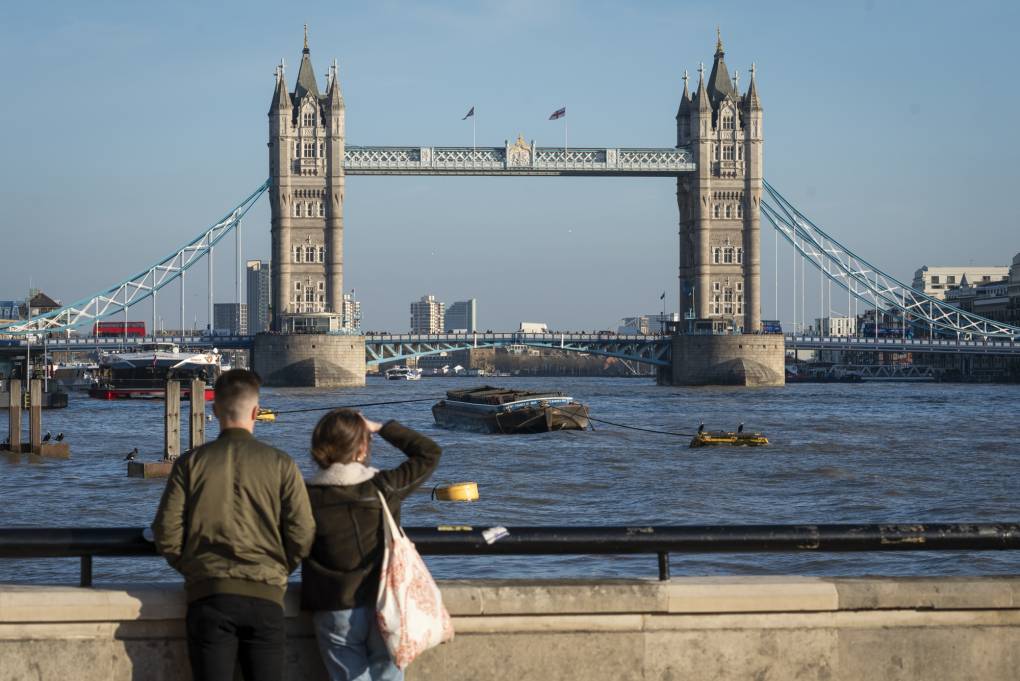
Want to Visit Europe Soon? Here’s Who Needs to Apply for New Travel Authorization
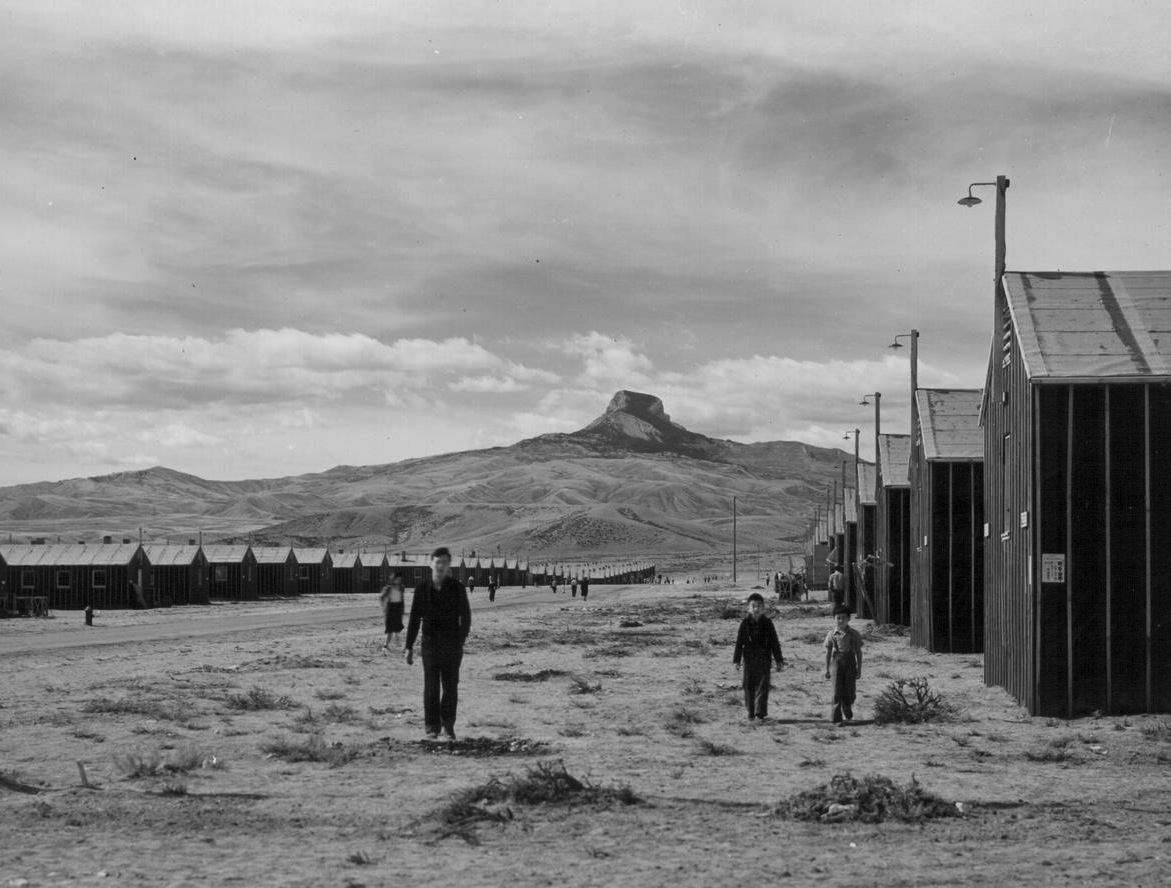
Elderly Japanese Americans Warn Same Threats Rising That Led to Internment
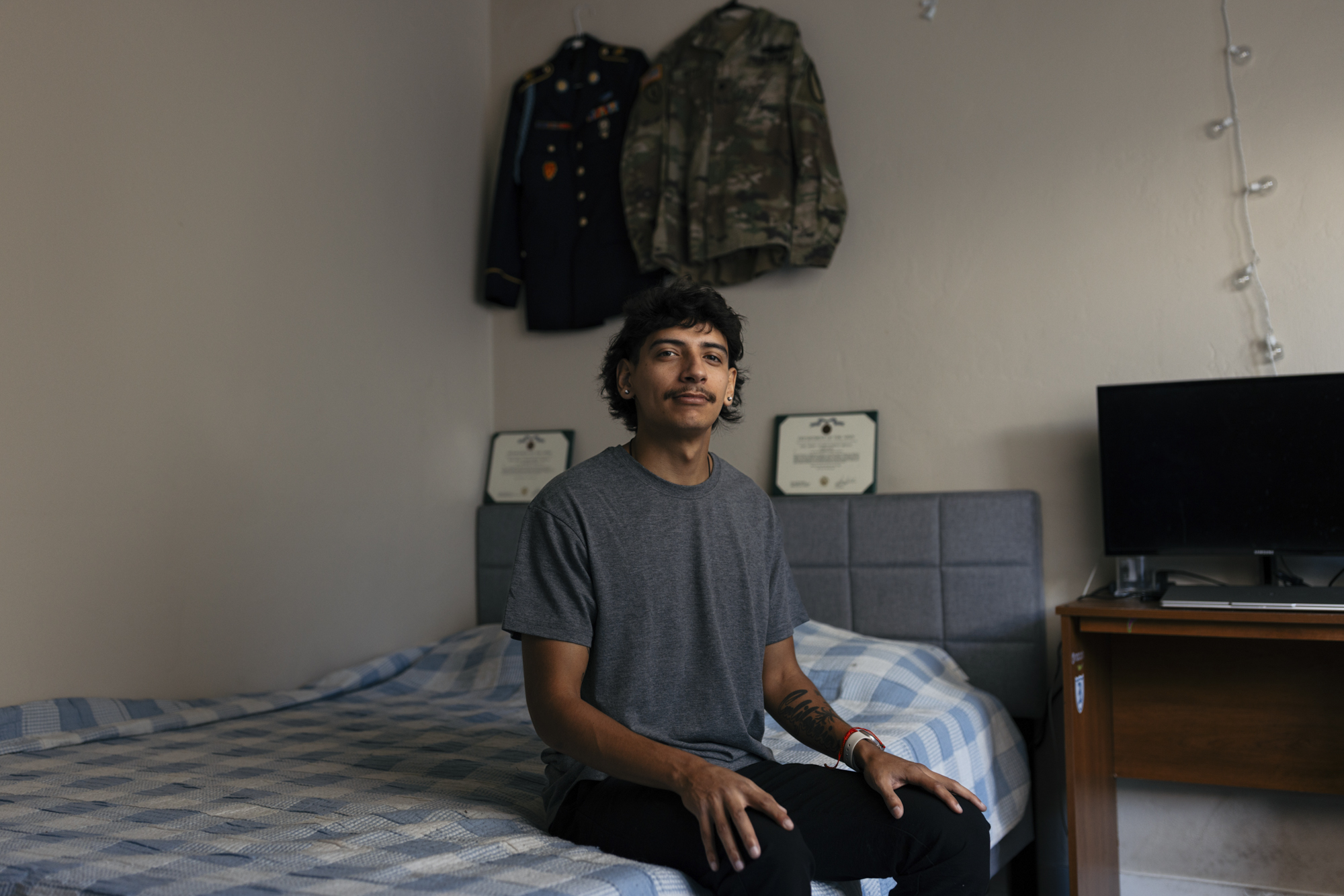
US Citizen, Army Veteran Detained by ICE Sues for Damages in Federal Court
California Democrats Ask Kristi Noem Not to Reopen FCI Dublin as an Immigration Jail
Judge Orders ICE to Provide Medical Care in Largest Immigration Jail in California
Sponsored
Player sponsored by
window.__IS_SSR__=true
window.__INITIAL_STATE__={
"attachmentsReducer": {
"audio_0": {
"type": "attachments",
"id": "audio_0",
"imgSizes": {
"kqedFullSize": {
"file": "https://ww2.kqed.org/news/wp-content/themes/KQED-unified/img/audio_bgs/background0.jpg"
}
}
},
"audio_1": {
"type": "attachments",
"id": "audio_1",
"imgSizes": {
"kqedFullSize": {
"file": "https://ww2.kqed.org/news/wp-content/themes/KQED-unified/img/audio_bgs/background1.jpg"
}
}
},
"audio_2": {
"type": "attachments",
"id": "audio_2",
"imgSizes": {
"kqedFullSize": {
"file": "https://ww2.kqed.org/news/wp-content/themes/KQED-unified/img/audio_bgs/background2.jpg"
}
}
},
"audio_3": {
"type": "attachments",
"id": "audio_3",
"imgSizes": {
"kqedFullSize": {
"file": "https://ww2.kqed.org/news/wp-content/themes/KQED-unified/img/audio_bgs/background3.jpg"
}
}
},
"audio_4": {
"type": "attachments",
"id": "audio_4",
"imgSizes": {
"kqedFullSize": {
"file": "https://ww2.kqed.org/news/wp-content/themes/KQED-unified/img/audio_bgs/background4.jpg"
}
}
},
"placeholder": {
"type": "attachments",
"id": "placeholder",
"imgSizes": {
"thumbnail": {
"file": "https://cdn.kqed.org/wp-content/uploads/2024/12/KQED-Default-Image-816638274-2000x1333-1-160x107.jpg",
"width": 160,
"height": 107,
"mimeType": "image/jpeg"
},
"medium": {
"file": "https://cdn.kqed.org/wp-content/uploads/2024/12/KQED-Default-Image-816638274-2000x1333-1-800x533.jpg",
"width": 800,
"height": 533,
"mimeType": "image/jpeg"
},
"medium_large": {
"file": "https://cdn.kqed.org/wp-content/uploads/2024/12/KQED-Default-Image-816638274-2000x1333-1-768x512.jpg",
"width": 768,
"height": 512,
"mimeType": "image/jpeg"
},
"large": {
"file": "https://cdn.kqed.org/wp-content/uploads/2024/12/KQED-Default-Image-816638274-2000x1333-1-1020x680.jpg",
"width": 1020,
"height": 680,
"mimeType": "image/jpeg"
},
"1536x1536": {
"file": "https://cdn.kqed.org/wp-content/uploads/2024/12/KQED-Default-Image-816638274-2000x1333-1-1536x1024.jpg",
"width": 1536,
"height": 1024,
"mimeType": "image/jpeg"
},
"fd-lrg": {
"file": "https://cdn.kqed.org/wp-content/uploads/2024/12/KQED-Default-Image-816638274-2000x1333-1-1536x1024.jpg",
"width": 1536,
"height": 1024,
"mimeType": "image/jpeg"
},
"fd-med": {
"file": "https://cdn.kqed.org/wp-content/uploads/2024/12/KQED-Default-Image-816638274-2000x1333-1-1020x680.jpg",
"width": 1020,
"height": 680,
"mimeType": "image/jpeg"
},
"fd-sm": {
"file": "https://cdn.kqed.org/wp-content/uploads/2024/12/KQED-Default-Image-816638274-2000x1333-1-800x533.jpg",
"width": 800,
"height": 533,
"mimeType": "image/jpeg"
},
"post-thumbnail": {
"file": "https://cdn.kqed.org/wp-content/uploads/2024/12/KQED-Default-Image-816638274-2000x1333-1-672x372.jpg",
"width": 672,
"height": 372,
"mimeType": "image/jpeg"
},
"twentyfourteen-full-width": {
"file": "https://cdn.kqed.org/wp-content/uploads/2024/12/KQED-Default-Image-816638274-2000x1333-1-1038x576.jpg",
"width": 1038,
"height": 576,
"mimeType": "image/jpeg"
},
"xxsmall": {
"file": "https://cdn.kqed.org/wp-content/uploads/2024/12/KQED-Default-Image-816638274-2000x1333-1-160x107.jpg",
"width": 160,
"height": 107,
"mimeType": "image/jpeg"
},
"xsmall": {
"file": "https://cdn.kqed.org/wp-content/uploads/2024/12/KQED-Default-Image-816638274-2000x1333-1-672x372.jpg",
"width": 672,
"height": 372,
"mimeType": "image/jpeg"
},
"small": {
"file": "https://cdn.kqed.org/wp-content/uploads/2024/12/KQED-Default-Image-816638274-2000x1333-1-672x372.jpg",
"width": 672,
"height": 372,
"mimeType": "image/jpeg"
},
"xlarge": {
"file": "https://cdn.kqed.org/wp-content/uploads/2024/12/KQED-Default-Image-816638274-2000x1333-1-1020x680.jpg",
"width": 1020,
"height": 680,
"mimeType": "image/jpeg"
},
"full-width": {
"file": "https://cdn.kqed.org/wp-content/uploads/2024/12/KQED-Default-Image-816638274-2000x1333-1-1920x1280.jpg",
"width": 1920,
"height": 1280,
"mimeType": "image/jpeg"
},
"guest-author-32": {
"file": "https://cdn.kqed.org/wp-content/uploads/2025/01/KQED-Default-Image-816638274-1333x1333-1-160x160.jpg",
"width": 32,
"height": 32,
"mimeType": "image/jpeg"
},
"guest-author-50": {
"file": "https://cdn.kqed.org/wp-content/uploads/2025/01/KQED-Default-Image-816638274-1333x1333-1-160x160.jpg",
"width": 50,
"height": 50,
"mimeType": "image/jpeg"
},
"guest-author-64": {
"file": "https://cdn.kqed.org/wp-content/uploads/2025/01/KQED-Default-Image-816638274-1333x1333-1-160x160.jpg",
"width": 64,
"height": 64,
"mimeType": "image/jpeg"
},
"guest-author-96": {
"file": "https://cdn.kqed.org/wp-content/uploads/2025/01/KQED-Default-Image-816638274-1333x1333-1-160x160.jpg",
"width": 96,
"height": 96,
"mimeType": "image/jpeg"
},
"guest-author-128": {
"file": "https://cdn.kqed.org/wp-content/uploads/2025/01/KQED-Default-Image-816638274-1333x1333-1-160x160.jpg",
"width": 128,
"height": 128,
"mimeType": "image/jpeg"
},
"detail": {
"file": "https://cdn.kqed.org/wp-content/uploads/2025/01/KQED-Default-Image-816638274-1333x1333-1-160x160.jpg",
"width": 160,
"height": 160,
"mimeType": "image/jpeg"
},
"kqedFullSize": {
"file": "https://cdn.kqed.org/wp-content/uploads/2024/12/KQED-Default-Image-816638274-2000x1333-1.jpg",
"width": 2000,
"height": 1333
}
}
},
"news_12075685": {
"type": "attachments",
"id": "news_12075685",
"meta": {
"index": "attachments_1716263798",
"site": "news",
"id": "12075685",
"found": true
},
"title": "260306-Child Deportation-01-KQED",
"publishDate": 1772839616,
"status": "inherit",
"parent": 0,
"modified": 1772845143,
"caption": "Lesly Rodriguez Gutierrez and her two sons were deported following an asylum check-in appointment in San Francisco Tuesday.",
"credit": "Courtesy of Centro Legal de la Raza",
"altTag": null,
"description": null,
"imgSizes": {
"thumbnail": {
"file": "https://cdn.kqed.org/wp-content/uploads/sites/10/2026/03/260306-Child-Deportation-01-KQED-160x107.jpg",
"width": 160,
"height": 107,
"mimeType": "image/jpeg"
},
"1536x1536": {
"file": "https://cdn.kqed.org/wp-content/uploads/sites/10/2026/03/260306-Child-Deportation-01-KQED-1536x1025.jpg",
"width": 1536,
"height": 1025,
"mimeType": "image/jpeg"
},
"post-thumbnail": {
"file": "https://cdn.kqed.org/wp-content/uploads/sites/10/2026/03/260306-Child-Deportation-01-KQED-672x372.jpg",
"width": 672,
"height": 372,
"mimeType": "image/jpeg"
},
"twentyfourteen-full-width": {
"file": "https://cdn.kqed.org/wp-content/uploads/sites/10/2026/03/260306-Child-Deportation-01-KQED-1038x576.jpg",
"width": 1038,
"height": 576,
"mimeType": "image/jpeg"
},
"npr-cds-wide": {
"file": "https://cdn.kqed.org/wp-content/uploads/sites/10/2026/03/260306-Child-Deportation-01-KQED-1200x675.jpg",
"width": 1200,
"height": 675,
"mimeType": "image/jpeg"
},
"kqedFullSize": {
"file": "https://cdn.kqed.org/wp-content/uploads/sites/10/2026/03/260306-Child-Deportation-01-KQED.jpg",
"width": 2000,
"height": 1334
}
},
"fetchFailed": false,
"isLoading": false
},
"news_12074622": {
"type": "attachments",
"id": "news_12074622",
"meta": {
"index": "attachments_1716263798",
"site": "news",
"id": "12074622",
"found": true
},
"title": "260219-SUNNYVALEDEPORTED-12-BL-KQED",
"publishDate": 1772053538,
"status": "inherit",
"parent": 0,
"modified": 1772650383,
"caption": "Aby Peña holds a photo of herself and her husband, Ulises Peña Lopez, at her home in Sunnyvale on Feb. 19, 2026. Peña Lopez was deported to Mexico after being taken into ICE custody outside their home in February 2025, leaving his wife and young daughter in the Bay Area.",
"credit": "Beth LaBerge/KQED",
"altTag": null,
"description": null,
"imgSizes": {
"thumbnail": {
"file": "https://cdn.kqed.org/wp-content/uploads/sites/10/2026/02/260219-SUNNYVALEDEPORTED-12-BL-KQED-160x107.jpg",
"width": 160,
"height": 107,
"mimeType": "image/jpeg"
},
"1536x1536": {
"file": "https://cdn.kqed.org/wp-content/uploads/sites/10/2026/02/260219-SUNNYVALEDEPORTED-12-BL-KQED-1536x1024.jpg",
"width": 1536,
"height": 1024,
"mimeType": "image/jpeg"
},
"post-thumbnail": {
"file": "https://cdn.kqed.org/wp-content/uploads/sites/10/2026/02/260219-SUNNYVALEDEPORTED-12-BL-KQED-672x372.jpg",
"width": 672,
"height": 372,
"mimeType": "image/jpeg"
},
"twentyfourteen-full-width": {
"file": "https://cdn.kqed.org/wp-content/uploads/sites/10/2026/02/260219-SUNNYVALEDEPORTED-12-BL-KQED-1038x576.jpg",
"width": 1038,
"height": 576,
"mimeType": "image/jpeg"
},
"npr-cds-wide": {
"file": "https://cdn.kqed.org/wp-content/uploads/sites/10/2026/02/260219-SUNNYVALEDEPORTED-12-BL-KQED-1200x675.jpg",
"width": 1200,
"height": 675,
"mimeType": "image/jpeg"
},
"kqedFullSize": {
"file": "https://cdn.kqed.org/wp-content/uploads/sites/10/2026/02/260219-SUNNYVALEDEPORTED-12-BL-KQED.jpg",
"width": 2000,
"height": 1333
}
},
"fetchFailed": false,
"isLoading": false
},
"news_12059883": {
"type": "attachments",
"id": "news_12059883",
"meta": {
"index": "attachments_1716263798",
"site": "news",
"id": "12059883",
"found": true
},
"title": "251014-ANTIFAROUNDTABLEFOLO-20-BL-KQED",
"publishDate": 1760467783,
"status": "inherit",
"parent": 12059840,
"modified": 1760570040,
"caption": "Ernesto Reyes holds a sign outside the San Francisco Immigration Court in downtown San Francisco on Oct. 14, 2025.",
"credit": "Beth LaBerge/KQED",
"altTag": null,
"description": null,
"imgSizes": {
"thumbnail": {
"file": "https://cdn.kqed.org/wp-content/uploads/sites/10/2025/10/251014-ANTIFAROUNDTABLEFOLO-20-BL-KQED-160x107.jpg",
"width": 160,
"height": 107,
"mimeType": "image/jpeg"
},
"1536x1536": {
"file": "https://cdn.kqed.org/wp-content/uploads/sites/10/2025/10/251014-ANTIFAROUNDTABLEFOLO-20-BL-KQED-1536x1024.jpg",
"width": 1536,
"height": 1024,
"mimeType": "image/jpeg"
},
"post-thumbnail": {
"file": "https://cdn.kqed.org/wp-content/uploads/sites/10/2025/10/251014-ANTIFAROUNDTABLEFOLO-20-BL-KQED-672x372.jpg",
"width": 672,
"height": 372,
"mimeType": "image/jpeg"
},
"twentyfourteen-full-width": {
"file": "https://cdn.kqed.org/wp-content/uploads/sites/10/2025/10/251014-ANTIFAROUNDTABLEFOLO-20-BL-KQED-1038x576.jpg",
"width": 1038,
"height": 576,
"mimeType": "image/jpeg"
},
"kqedFullSize": {
"file": "https://cdn.kqed.org/wp-content/uploads/sites/10/2025/10/251014-ANTIFAROUNDTABLEFOLO-20-BL-KQED.jpg",
"width": 2000,
"height": 1333
}
},
"fetchFailed": false,
"isLoading": false
},
"news_12074813": {
"type": "attachments",
"id": "news_12074813",
"meta": {
"index": "attachments_1716263798",
"site": "news",
"id": "12074813",
"found": true
},
"title": "Sikh Truckers",
"publishDate": 1772147085,
"status": "inherit",
"parent": 12074694,
"modified": 1772147116,
"caption": "Freight trucks travel northbound on Interstate 5 Highway, Wednesday, Sept. 3, 2025, in Tracy, California.",
"credit": "Godofredo A. Vásquez/AP Photo",
"altTag": null,
"description": null,
"imgSizes": {
"thumbnail": {
"file": "https://cdn.kqed.org/wp-content/uploads/sites/10/2026/02/ImmigrantTruckLicensesAP-160x107.jpg",
"width": 160,
"height": 107,
"mimeType": "image/jpeg"
},
"1536x1536": {
"file": "https://cdn.kqed.org/wp-content/uploads/sites/10/2026/02/ImmigrantTruckLicensesAP-1536x1024.jpg",
"width": 1536,
"height": 1024,
"mimeType": "image/jpeg"
},
"post-thumbnail": {
"file": "https://cdn.kqed.org/wp-content/uploads/sites/10/2026/02/ImmigrantTruckLicensesAP-672x372.jpg",
"width": 672,
"height": 372,
"mimeType": "image/jpeg"
},
"twentyfourteen-full-width": {
"file": "https://cdn.kqed.org/wp-content/uploads/sites/10/2026/02/ImmigrantTruckLicensesAP-1038x576.jpg",
"width": 1038,
"height": 576,
"mimeType": "image/jpeg"
},
"npr-cds-wide": {
"file": "https://cdn.kqed.org/wp-content/uploads/sites/10/2026/02/ImmigrantTruckLicensesAP-1200x675.jpg",
"width": 1200,
"height": 675,
"mimeType": "image/jpeg"
},
"kqedFullSize": {
"file": "https://cdn.kqed.org/wp-content/uploads/sites/10/2026/02/ImmigrantTruckLicensesAP.jpg",
"width": 2000,
"height": 1333
}
},
"fetchFailed": false,
"isLoading": false
},
"news_12074663": {
"type": "attachments",
"id": "news_12074663",
"meta": {
"index": "attachments_1716263798",
"site": "news",
"id": "12074663",
"found": true
},
"title": "DAYBOOK 3",
"publishDate": 1772058547,
"status": "inherit",
"parent": 12074658,
"modified": 1772058594,
"caption": "Daybook Terrace in Temecula on Thursday, Feb. 19, 2026. Riverside County prosecutors charged a man claiming to be a federal immigration officer with assault after he pulled a gun on a 17-year-old in this neighborhood last November.",
"credit": "Anthony Victoria/KVCR",
"altTag": null,
"description": null,
"imgSizes": {
"thumbnail": {
"file": "https://cdn.kqed.org/wp-content/uploads/sites/10/2026/02/DAYBOOK-3-160x107.jpg",
"width": 160,
"height": 107,
"mimeType": "image/jpeg"
},
"1536x1536": {
"file": "https://cdn.kqed.org/wp-content/uploads/sites/10/2026/02/DAYBOOK-3-1536x1025.jpg",
"width": 1536,
"height": 1025,
"mimeType": "image/jpeg"
},
"post-thumbnail": {
"file": "https://cdn.kqed.org/wp-content/uploads/sites/10/2026/02/DAYBOOK-3-672x372.jpg",
"width": 672,
"height": 372,
"mimeType": "image/jpeg"
},
"twentyfourteen-full-width": {
"file": "https://cdn.kqed.org/wp-content/uploads/sites/10/2026/02/DAYBOOK-3-1038x576.jpg",
"width": 1038,
"height": 576,
"mimeType": "image/jpeg"
},
"npr-cds-wide": {
"file": "https://cdn.kqed.org/wp-content/uploads/sites/10/2026/02/DAYBOOK-3-1200x675.jpg",
"width": 1200,
"height": 675,
"mimeType": "image/jpeg"
},
"kqedFullSize": {
"file": "https://cdn.kqed.org/wp-content/uploads/sites/10/2026/02/DAYBOOK-3.jpg",
"width": 1920,
"height": 1281
}
},
"fetchFailed": false,
"isLoading": false
},
"news_12034522": {
"type": "attachments",
"id": "news_12034522",
"meta": {
"index": "attachments_1716263798",
"site": "news",
"id": "12034522",
"found": true
},
"title": "Warm Weather In The UK",
"publishDate": 1743787017,
"status": "inherit",
"parent": 12018848,
"modified": 1772050098,
"caption": "Tower Bridge on the River Thames in London, England, on Feb. 21, 2019.",
"credit": "John Keeble/Getty Images",
"altTag": null,
"description": null,
"imgSizes": {
"medium": {
"file": "https://cdn.kqed.org/wp-content/uploads/sites/10/2025/04/GETTYIMAGES-1133971962-KQED-800x534.jpg",
"width": 800,
"height": 534,
"mimeType": "image/jpeg"
},
"large": {
"file": "https://cdn.kqed.org/wp-content/uploads/sites/10/2025/04/GETTYIMAGES-1133971962-KQED-1020x681.jpg",
"width": 1020,
"height": 681,
"mimeType": "image/jpeg"
},
"thumbnail": {
"file": "https://cdn.kqed.org/wp-content/uploads/sites/10/2025/04/GETTYIMAGES-1133971962-KQED-160x107.jpg",
"width": 160,
"height": 107,
"mimeType": "image/jpeg"
},
"1536x1536": {
"file": "https://cdn.kqed.org/wp-content/uploads/sites/10/2025/04/GETTYIMAGES-1133971962-KQED-1536x1025.jpg",
"width": 1536,
"height": 1025,
"mimeType": "image/jpeg"
},
"post-thumbnail": {
"file": "https://cdn.kqed.org/wp-content/uploads/sites/10/2025/04/GETTYIMAGES-1133971962-KQED-672x372.jpg",
"width": 672,
"height": 372,
"mimeType": "image/jpeg"
},
"twentyfourteen-full-width": {
"file": "https://cdn.kqed.org/wp-content/uploads/sites/10/2025/04/GETTYIMAGES-1133971962-KQED-1038x576.jpg",
"width": 1038,
"height": 576,
"mimeType": "image/jpeg"
},
"full-width": {
"file": "https://cdn.kqed.org/wp-content/uploads/sites/10/2025/04/GETTYIMAGES-1133971962-KQED-1920x1282.jpg",
"width": 1920,
"height": 1282,
"mimeType": "image/jpeg"
},
"kqedFullSize": {
"file": "https://cdn.kqed.org/wp-content/uploads/sites/10/2025/04/GETTYIMAGES-1133971962-KQED.jpg",
"width": 2000,
"height": 1335
}
},
"fetchFailed": false,
"isLoading": false
},
"news_12074031": {
"type": "attachments",
"id": "news_12074031",
"meta": {
"index": "attachments_1716263798",
"site": "news",
"id": "12074031",
"found": true
},
"title": "Ht Mtn prison with children. 223 KB",
"publishDate": 1771612135,
"status": "inherit",
"parent": 12073982,
"modified": 1771612351,
"caption": "The Heart Mountain Prison Camp in near Cody, Wyoming, was an internment camp used to incarcerate roughly 14,000 Japanese-Americans between August 12, 1942 and November 10, 1945. (Photo provided by the Heart Mountain Wyoming Foundation)",
"credit": null,
"altTag": null,
"description": null,
"imgSizes": {
"thumbnail": {
"file": "https://cdn.kqed.org/wp-content/uploads/sites/10/2026/02/Ht-Mtn-prison-with-children.-223-KB--160x121.jpg",
"width": 160,
"height": 121,
"mimeType": "image/jpeg"
},
"post-thumbnail": {
"file": "https://cdn.kqed.org/wp-content/uploads/sites/10/2026/02/Ht-Mtn-prison-with-children.-223-KB--672x372.jpg",
"width": 672,
"height": 372,
"mimeType": "image/jpeg"
},
"twentyfourteen-full-width": {
"file": "https://cdn.kqed.org/wp-content/uploads/sites/10/2026/02/Ht-Mtn-prison-with-children.-223-KB--1038x576.jpg",
"width": 1038,
"height": 576,
"mimeType": "image/jpeg"
},
"npr-cds-wide": {
"file": "https://cdn.kqed.org/wp-content/uploads/sites/10/2026/02/Ht-Mtn-prison-with-children.-223-KB--1171x675.jpg",
"width": 1171,
"height": 675,
"mimeType": "image/jpeg"
},
"kqedFullSize": {
"file": "https://cdn.kqed.org/wp-content/uploads/sites/10/2026/02/Ht-Mtn-prison-with-children.-223-KB-.jpg",
"width": 1171,
"height": 888
}
},
"fetchFailed": false,
"isLoading": false
},
"news_12073778": {
"type": "attachments",
"id": "news_12073778",
"meta": {
"index": "attachments_1716263798",
"site": "news",
"id": "12073778",
"found": true
},
"title": "260218-George Retes-01-KQED",
"publishDate": 1771461486,
"status": "inherit",
"parent": 0,
"modified": 1771462887,
"caption": "Army veteran George Retes filed suit against the United States government this week, alleging they illegally detained him for three days after an immigration raid at his worksite.",
"credit": "Courtesy of Institute for Justice",
"altTag": null,
"description": null,
"imgSizes": {
"thumbnail": {
"file": "https://cdn.kqed.org/wp-content/uploads/sites/10/2026/02/260218-George-Retes-01-KQED-160x107.jpg",
"width": 160,
"height": 107,
"mimeType": "image/jpeg"
},
"1536x1536": {
"file": "https://cdn.kqed.org/wp-content/uploads/sites/10/2026/02/260218-George-Retes-01-KQED-1536x1025.jpg",
"width": 1536,
"height": 1025,
"mimeType": "image/jpeg"
},
"post-thumbnail": {
"file": "https://cdn.kqed.org/wp-content/uploads/sites/10/2026/02/260218-George-Retes-01-KQED-672x372.jpg",
"width": 672,
"height": 372,
"mimeType": "image/jpeg"
},
"twentyfourteen-full-width": {
"file": "https://cdn.kqed.org/wp-content/uploads/sites/10/2026/02/260218-George-Retes-01-KQED-1038x576.jpg",
"width": 1038,
"height": 576,
"mimeType": "image/jpeg"
},
"npr-cds-wide": {
"file": "https://cdn.kqed.org/wp-content/uploads/sites/10/2026/02/260218-George-Retes-01-KQED-1200x675.jpg",
"width": 1200,
"height": 675,
"mimeType": "image/jpeg"
},
"kqedFullSize": {
"file": "https://cdn.kqed.org/wp-content/uploads/sites/10/2026/02/260218-George-Retes-01-KQED.jpg",
"width": 2000,
"height": 1334
}
},
"fetchFailed": false,
"isLoading": false
},
"news_11997597": {
"type": "attachments",
"id": "news_11997597",
"meta": {
"index": "attachments_1716263798",
"site": "news",
"id": "11997597",
"found": true
},
"title": "240408-FCIDublin-012-BL_qed",
"publishDate": 1722023695,
"status": "inherit",
"parent": 11997595,
"modified": 1766015393,
"caption": "A sign for the Federal Correctional Institution, Dublin, a former prison for women, in Dublin on April 8, 2024.",
"credit": "Beth LaBerge/KQED",
"altTag": null,
"description": null,
"imgSizes": {
"medium": {
"file": "https://cdn.kqed.org/wp-content/uploads/sites/10/2024/07/240408-FCIDublin-012-BL_qed-800x533.jpg",
"width": 800,
"height": 533,
"mimeType": "image/jpeg"
},
"large": {
"file": "https://cdn.kqed.org/wp-content/uploads/sites/10/2024/07/240408-FCIDublin-012-BL_qed-1020x680.jpg",
"width": 1020,
"height": 680,
"mimeType": "image/jpeg"
},
"thumbnail": {
"file": "https://cdn.kqed.org/wp-content/uploads/sites/10/2024/07/240408-FCIDublin-012-BL_qed-160x107.jpg",
"width": 160,
"height": 107,
"mimeType": "image/jpeg"
},
"1536x1536": {
"file": "https://cdn.kqed.org/wp-content/uploads/sites/10/2024/07/240408-FCIDublin-012-BL_qed-1536x1024.jpg",
"width": 1536,
"height": 1024,
"mimeType": "image/jpeg"
},
"post-thumbnail": {
"file": "https://cdn.kqed.org/wp-content/uploads/sites/10/2024/07/240408-FCIDublin-012-BL_qed-672x372.jpg",
"width": 672,
"height": 372,
"mimeType": "image/jpeg"
},
"twentyfourteen-full-width": {
"file": "https://cdn.kqed.org/wp-content/uploads/sites/10/2024/07/240408-FCIDublin-012-BL_qed-1038x576.jpg",
"width": 1038,
"height": 576,
"mimeType": "image/jpeg"
},
"full-width": {
"file": "https://cdn.kqed.org/wp-content/uploads/sites/10/2024/07/240408-FCIDublin-012-BL_qed-1920x1280.jpg",
"width": 1920,
"height": 1280,
"mimeType": "image/jpeg"
},
"kqedFullSize": {
"file": "https://cdn.kqed.org/wp-content/uploads/sites/10/2024/07/240408-FCIDublin-012-BL_qed.jpg",
"width": 2000,
"height": 1333
}
},
"fetchFailed": false,
"isLoading": false
},
"news_12046565": {
"type": "attachments",
"id": "news_12046565",
"meta": {
"index": "attachments_1716263798",
"site": "news",
"id": "12046565",
"found": true
},
"title": "The Core Civic detention facility in California City on June 28, 2025.",
"publishDate": 1751305002,
"status": "inherit",
"parent": 0,
"modified": 1751305043,
"caption": "The Core Civic detention facility in California City on June 28, 2025.",
"credit": "Saul Gonzalez/KQED",
"altTag": null,
"description": null,
"imgSizes": {
"thumbnail": {
"file": "https://cdn.kqed.org/wp-content/uploads/sites/10/2025/06/CORECIVICCALCITY2-KQED-160x107.jpg",
"width": 160,
"height": 107,
"mimeType": "image/jpeg"
},
"1536x1536": {
"file": "https://cdn.kqed.org/wp-content/uploads/sites/10/2025/06/CORECIVICCALCITY2-KQED-1536x1024.jpg",
"width": 1536,
"height": 1024,
"mimeType": "image/jpeg"
},
"post-thumbnail": {
"file": "https://cdn.kqed.org/wp-content/uploads/sites/10/2025/06/CORECIVICCALCITY2-KQED-672x372.jpg",
"width": 672,
"height": 372,
"mimeType": "image/jpeg"
},
"twentyfourteen-full-width": {
"file": "https://cdn.kqed.org/wp-content/uploads/sites/10/2025/06/CORECIVICCALCITY2-KQED-1038x576.jpg",
"width": 1038,
"height": 576,
"mimeType": "image/jpeg"
},
"kqedFullSize": {
"file": "https://cdn.kqed.org/wp-content/uploads/sites/10/2025/06/CORECIVICCALCITY2-KQED.jpg",
"width": 2000,
"height": 1333
}
},
"fetchFailed": false,
"isLoading": false
}
},
"audioPlayerReducer": {
"postId": "stream_live",
"isPaused": true,
"isPlaying": false,
"pfsActive": false,
"pledgeModalIsOpen": true,
"playerDrawerIsOpen": false
},
"authorsReducer": {
"byline_news_12074658": {
"type": "authors",
"id": "byline_news_12074658",
"meta": {
"override": true
},
"slug": "byline_news_12074658",
"name": "Anthony Victoria",
"isLoading": false
},
"tychehendricks": {
"type": "authors",
"id": "259",
"meta": {
"index": "authors_1716337520",
"id": "259",
"found": true
},
"name": "Tyche Hendricks",
"firstName": "Tyche",
"lastName": "Hendricks",
"slug": "tychehendricks",
"email": "thendricks@kqed.org",
"display_author_email": true,
"staff_mastheads": [
"news"
],
"title": "KQED Senior Editor, Immigration",
"bio": "\u003cspan style=\"font-weight: 400;\">Tyche Hendricks is KQED’s senior editor for immigration, leading coverage of the policy and politics that affect California’s immigrant communities. Her work for KQED’s radio and online audiences is also carried on NPR and other national outlets. She has been recognized with awards from the Radio and Television News Directors Association, the Society for Professional Journalists; the Education Writers Association; the Best of the West and the National Federation of Community Broadcasters. Before joining KQED in 2010, Tyche spent more than a dozen years as a newspaper reporter, notably at the \u003c/span>\u003ci>\u003cspan style=\"font-weight: 400;\">San Francisco Chronicle\u003c/span>\u003c/i>\u003cspan style=\"font-weight: 400;\">. At different times she has covered criminal justice, government and politics and urban planning. Tyche has taught in the MFA Creative Writing program at the University of San Francisco and at UC Berkeley’s Graduate School of Journalism, where she was co-director of a national immigration symposium for professional journalists. She is the author of \u003c/span>\u003ci>\u003cspan style=\"font-weight: 400;\">The Wind Doesn't Need a Passport: Stories from the U.S.-Mexico Borderlands\u003c/span>\u003c/i>\u003cspan style=\"font-weight: 400;\"> (University of California Press). \u003c/span>",
"avatar": "https://secure.gravatar.com/avatar/b8ee458e2731c2d43df86882ce17267e?s=600&d=blank&r=g",
"twitter": "tychehendricks",
"facebook": null,
"instagram": null,
"linkedin": null,
"sites": [
{
"site": "news",
"roles": [
"editor"
]
},
{
"site": "stateofhealth",
"roles": [
"editor"
]
}
],
"headData": {
"title": "Tyche Hendricks | KQED",
"description": "KQED Senior Editor, Immigration",
"ogImgSrc": "https://secure.gravatar.com/avatar/b8ee458e2731c2d43df86882ce17267e?s=600&d=blank&r=g",
"twImgSrc": "https://secure.gravatar.com/avatar/b8ee458e2731c2d43df86882ce17267e?s=600&d=blank&r=g"
},
"isLoading": false,
"link": "/author/tychehendricks"
},
"mlagos": {
"type": "authors",
"id": "3239",
"meta": {
"index": "authors_1716337520",
"id": "3239",
"found": true
},
"name": "Marisa Lagos",
"firstName": "Marisa",
"lastName": "Lagos",
"slug": "mlagos",
"email": "mlagos@kqed.org",
"display_author_email": false,
"staff_mastheads": [
"news"
],
"title": "KQED Contributor",
"bio": "Marisa Lagos is a correspondent for KQED’s California Politics and Government Desk and co-hosts the award-winning show and podcast, Political Breakdown. At KQED, Lagos also conducts reporting, analysis and investigations into state, local and national politics for radio, TV, online and onstage. In 2022, she and co-host, Scott Shafer, moderated the only gubernatorial debate in California. In 2020, the \u003ci>Washington Post\u003c/i> named her one of the top political journalists in California; she was nominated for a Peabody and won several other awards for her work investigating the 2017 California wildfires. She has worked at the \u003ci>San Francisco Chronicle\u003c/i>, \u003ci>San Francisco Examiner\u003c/i> and \u003ci>Los Angeles Times\u003c/i>. A UC Santa Barbara graduate, she lives in San Francisco with her two sons and husband.",
"avatar": "https://secure.gravatar.com/avatar/a261a0d3696fc066871ef96b85b5e7d2?s=600&d=blank&r=g",
"twitter": "@mlagos",
"facebook": null,
"instagram": null,
"linkedin": null,
"sites": [
{
"site": "arts",
"roles": [
"author"
]
},
{
"site": "news",
"roles": [
"editor"
]
},
{
"site": "science",
"roles": [
"editor"
]
},
{
"site": "forum",
"roles": [
"author"
]
},
{
"site": "liveblog",
"roles": [
"author"
]
}
],
"headData": {
"title": "Marisa Lagos | KQED",
"description": "KQED Contributor",
"ogImgSrc": "https://secure.gravatar.com/avatar/a261a0d3696fc066871ef96b85b5e7d2?s=600&d=blank&r=g",
"twImgSrc": "https://secure.gravatar.com/avatar/a261a0d3696fc066871ef96b85b5e7d2?s=600&d=blank&r=g"
},
"isLoading": false,
"link": "/author/mlagos"
},
"carlysevern": {
"type": "authors",
"id": "3243",
"meta": {
"index": "authors_1716337520",
"id": "3243",
"found": true
},
"name": "Carly Severn",
"firstName": "Carly",
"lastName": "Severn",
"slug": "carlysevern",
"email": "csevern@kqed.org",
"display_author_email": false,
"staff_mastheads": [
"news"
],
"title": "Senior Editor, Audience News ",
"bio": "Carly is KQED's Senior Editor of Audience News on the Digital News team, and has reported for the California Report Magazine, Bay Curious and KQED Arts. She's formerly the host of \u003ca href=\"http://ww2.kqed.org/pop/category/the-cooler/\" rel=\"noopener noreferrer\">The Cooler\u003c/a> podcast.",
"avatar": "https://secure.gravatar.com/avatar/2d8d6765f186e64c798cf7f0c8088a41?s=600&d=blank&r=g",
"twitter": "teacupinthebay",
"facebook": null,
"instagram": null,
"linkedin": null,
"sites": [
{
"site": "",
"roles": [
"editor"
]
},
{
"site": "arts",
"roles": [
"editor"
]
},
{
"site": "news",
"roles": [
"administrator"
]
},
{
"site": "pop",
"roles": [
"editor"
]
},
{
"site": "futureofyou",
"roles": [
"editor"
]
},
{
"site": "about",
"roles": [
"administrator"
]
},
{
"site": "mindshift",
"roles": [
"editor"
]
},
{
"site": "bayareabites",
"roles": [
"editor"
]
},
{
"site": "stateofhealth",
"roles": [
"editor"
]
},
{
"site": "science",
"roles": [
"editor"
]
},
{
"site": "food",
"roles": [
"contributor"
]
},
{
"site": "forum",
"roles": [
"editor"
]
},
{
"site": "perspectives",
"roles": [
"administrator"
]
},
{
"site": "liveblog",
"roles": [
"editor"
]
}
],
"headData": {
"title": "Carly Severn | KQED",
"description": "Senior Editor, Audience News ",
"ogImgSrc": "https://secure.gravatar.com/avatar/2d8d6765f186e64c798cf7f0c8088a41?s=600&d=blank&r=g",
"twImgSrc": "https://secure.gravatar.com/avatar/2d8d6765f186e64c798cf7f0c8088a41?s=600&d=blank&r=g"
},
"isLoading": false,
"link": "/author/carlysevern"
},
"ecruzguevarra": {
"type": "authors",
"id": "8654",
"meta": {
"index": "authors_1716337520",
"id": "8654",
"found": true
},
"name": "Ericka Cruz Guevarra",
"firstName": "Ericka",
"lastName": "Cruz Guevarra",
"slug": "ecruzguevarra",
"email": "ecruzguevarra@kqed.org",
"display_author_email": true,
"staff_mastheads": [
"news"
],
"title": "Producer, The Bay Podcast",
"bio": "Ericka Cruz Guevarra is host of \u003ca href=\"https://www.kqed.org/podcasts/thebay\">\u003cem>The Bay\u003c/em>\u003c/a> podcast at KQED. Before host, she was the show’s producer. Her work in that capacity includes a three-part reported series on policing in Vallejo, which won a 2020 excellence in journalism award from the Society of Professional Journalists. Ericka has worked as a breaking news reporter at Oregon Public Broadcasting, helped produce the Code Switch podcast, and was KQED’s inaugural Raul Ramirez Diversity Fund intern. She’s also an alumna of NPR’s Next Generation Radio program. Send her an email if you have strong feelings about whether Fairfield and Suisun City are the Bay. Ericka is represented by SAG-AFTRA.",
"avatar": "https://secure.gravatar.com/avatar/25e5ab8d3d53fad2dcc7bb2b5c506b1a?s=600&d=blank&r=g",
"twitter": "NotoriousECG",
"facebook": null,
"instagram": null,
"linkedin": null,
"sites": [
{
"site": "arts",
"roles": [
"subscriber"
]
},
{
"site": "news",
"roles": [
"editor",
"manage_categories"
]
},
{
"site": "futureofyou",
"roles": [
"subscriber"
]
},
{
"site": "stateofhealth",
"roles": [
"subscriber"
]
},
{
"site": "science",
"roles": [
"editor"
]
},
{
"site": "forum",
"roles": [
"subscriber"
]
}
],
"headData": {
"title": "Ericka Cruz Guevarra | KQED",
"description": "Producer, The Bay Podcast",
"ogImgSrc": "https://secure.gravatar.com/avatar/25e5ab8d3d53fad2dcc7bb2b5c506b1a?s=600&d=blank&r=g",
"twImgSrc": "https://secure.gravatar.com/avatar/25e5ab8d3d53fad2dcc7bb2b5c506b1a?s=600&d=blank&r=g"
},
"isLoading": false,
"link": "/author/ecruzguevarra"
},
"fjhabvala": {
"type": "authors",
"id": "8659",
"meta": {
"index": "authors_1716337520",
"id": "8659",
"found": true
},
"name": "Farida Jhabvala Romero",
"firstName": "Farida",
"lastName": "Jhabvala Romero",
"slug": "fjhabvala",
"email": "fjhabvala@kqed.org",
"display_author_email": true,
"staff_mastheads": [
"news"
],
"title": "KQED Contributor",
"bio": "\u003cspan style=\"font-weight: 400;\">Farida Jhabvala Romero is a Labor Correspondent for KQED. She previously covered immigration. Farida was \u003ca href=\"https://www.ccnma.org/2022-most-influential-latina-journalists\">named\u003c/a> one of the 10 Most Influential Latina Journalists in California in 2022 by the California Chicano News Media Association. Her work has won awards from the Society of Professional Journalists (Northern California), as well as a national and regional Edward M. Murrow Award for the collaborative reporting projects “Dangerous Air” and “Graying California.” \u003c/span>\u003cspan style=\"font-weight: 400;\">Before joining KQED, Farida worked as a producer at Radio Bilingüe, a national public radio network. Farida earned her master’s degree in journalism from Stanford University.\u003c/span>",
"avatar": "https://secure.gravatar.com/avatar/c3ab27c5554b67b478f80971e515aa02?s=600&d=blank&r=g",
"twitter": "FaridaJhabvala",
"facebook": null,
"instagram": null,
"linkedin": "https://www.linkedin.com/in/faridajhabvala/",
"sites": [
{
"site": "news",
"roles": [
"editor"
]
},
{
"site": "stateofhealth",
"roles": [
"author"
]
}
],
"headData": {
"title": "Farida Jhabvala Romero | KQED",
"description": "KQED Contributor",
"ogImgSrc": "https://secure.gravatar.com/avatar/c3ab27c5554b67b478f80971e515aa02?s=600&d=blank&r=g",
"twImgSrc": "https://secure.gravatar.com/avatar/c3ab27c5554b67b478f80971e515aa02?s=600&d=blank&r=g"
},
"isLoading": false,
"link": "/author/fjhabvala"
},
"amontecillo": {
"type": "authors",
"id": "11649",
"meta": {
"index": "authors_1716337520",
"id": "11649",
"found": true
},
"name": "Alan Montecillo",
"firstName": "Alan",
"lastName": "Montecillo",
"slug": "amontecillo",
"email": "amontecillo@kqed.org",
"display_author_email": false,
"staff_mastheads": [
"news"
],
"title": "KQED Contributor",
"bio": "Alan Montecillo is the senior editor of \u003cem>\u003ca href=\"http://kqed.org/thebay\">The Bay\u003c/a>, \u003c/em> KQED's local news podcast. Before moving to the Bay Area, he worked as a senior talk show producer for WILL in Champaign-Urbana, Illinois and at Oregon Public Broadcasting in Portland, Oregon. He has won journalism awards from the Society of Professional Journalists Northern California, the Public Media Journalists Association, The Signal Awards, and has also received a regional Edward R. Murrow award. Alan is a Filipino American from Hong Kong and a graduate of Reed College.",
"avatar": "https://secure.gravatar.com/avatar/d5e4e7a76481969ccba76f4e2b5ccabc?s=600&d=blank&r=g",
"twitter": "alanmontecillo",
"facebook": null,
"instagram": null,
"linkedin": null,
"sites": [
{
"site": "",
"roles": [
"editor"
]
},
{
"site": "news",
"roles": [
"editor",
"manage_categories"
]
}
],
"headData": {
"title": "Alan Montecillo | KQED",
"description": "KQED Contributor",
"ogImgSrc": "https://secure.gravatar.com/avatar/d5e4e7a76481969ccba76f4e2b5ccabc?s=600&d=blank&r=g",
"twImgSrc": "https://secure.gravatar.com/avatar/d5e4e7a76481969ccba76f4e2b5ccabc?s=600&d=blank&r=g"
},
"isLoading": false,
"link": "/author/amontecillo"
},
"jessicakariisa": {
"type": "authors",
"id": "11831",
"meta": {
"index": "authors_1716337520",
"id": "11831",
"found": true
},
"name": "Jessica Kariisa",
"firstName": "Jessica",
"lastName": "Kariisa",
"slug": "jessicakariisa",
"email": "jkariisa@kqed.org",
"display_author_email": false,
"staff_mastheads": [
"news"
],
"title": "Producer, The Bay",
"bio": "Jessica Kariisa is the producer of The Bay. She first joined KQED as an intern for The California Report Magazine, after which she became an on-call producer. She reported a Bay Curious episode on the use of rap lyrics in criminal trials which won a Society of Professional Journalists award in 2023 for Excellence in Features Journalism and the 2023 Signal Award for Best Conversation Starter. She’s worked on podcasts for Snap Judgment and American Public Media. Before embarking on her audio career, she was a music journalist.\r\n\r\nJessica Kariisa is represented by SAG-AFTRA.",
"avatar": "https://secure.gravatar.com/avatar/4afd355fd24f5515aeab77fd6c72b671?s=600&d=blank&r=g",
"twitter": null,
"facebook": null,
"instagram": null,
"linkedin": null,
"sites": [
{
"site": "arts",
"roles": [
"author"
]
},
{
"site": "news",
"roles": [
"editor",
"manage_categories"
]
}
],
"headData": {
"title": "Jessica Kariisa | KQED",
"description": "Producer, The Bay",
"ogImgSrc": "https://secure.gravatar.com/avatar/4afd355fd24f5515aeab77fd6c72b671?s=600&d=blank&r=g",
"twImgSrc": "https://secure.gravatar.com/avatar/4afd355fd24f5515aeab77fd6c72b671?s=600&d=blank&r=g"
},
"isLoading": false,
"link": "/author/jessicakariisa"
},
"bsiavoshy": {
"type": "authors",
"id": "11890",
"meta": {
"index": "authors_1716337520",
"id": "11890",
"found": true
},
"name": "Bejan Siavoshy",
"firstName": "Bejan",
"lastName": "Siavoshy",
"slug": "bsiavoshy",
"email": "bsiavoshy@kqed.org",
"display_author_email": false,
"staff_mastheads": [],
"title": "KQED Contributor",
"bio": null,
"avatar": "https://secure.gravatar.com/avatar/ead3e7c509634b37a73b1f57677e49f9?s=600&d=blank&r=g",
"twitter": null,
"facebook": null,
"instagram": null,
"linkedin": null,
"sites": [
{
"site": "news",
"roles": [
"editor"
]
}
],
"headData": {
"title": "Bejan Siavoshy | KQED",
"description": "KQED Contributor",
"ogImgSrc": "https://secure.gravatar.com/avatar/ead3e7c509634b37a73b1f57677e49f9?s=600&d=blank&r=g",
"twImgSrc": "https://secure.gravatar.com/avatar/ead3e7c509634b37a73b1f57677e49f9?s=600&d=blank&r=g"
},
"isLoading": false,
"link": "/author/bsiavoshy"
},
"kdebenedetti": {
"type": "authors",
"id": "11913",
"meta": {
"index": "authors_1716337520",
"id": "11913",
"found": true
},
"name": "Katie DeBenedetti",
"firstName": "Katie",
"lastName": "DeBenedetti",
"slug": "kdebenedetti",
"email": "kdebenedetti@kqed.org",
"display_author_email": false,
"staff_mastheads": [
"news",
"science"
],
"title": "KQED Contributor",
"bio": "Katie DeBenedetti is a digital reporter covering daily news for the Express Desk. Prior to joining KQED as a culture reporting intern in January 2024, she covered education and city government for the Napa Valley Register.",
"avatar": "https://secure.gravatar.com/avatar/6e31073cb8f7e4214ab03f42771d0f45?s=600&d=blank&r=g",
"twitter": null,
"facebook": null,
"instagram": null,
"linkedin": null,
"sites": [
{
"site": "news",
"roles": [
"author"
]
},
{
"site": "science",
"roles": [
"author"
]
},
{
"site": "liveblog",
"roles": [
"author"
]
}
],
"headData": {
"title": "Katie DeBenedetti | KQED",
"description": "KQED Contributor",
"ogImgSrc": "https://secure.gravatar.com/avatar/6e31073cb8f7e4214ab03f42771d0f45?s=600&d=blank&r=g",
"twImgSrc": "https://secure.gravatar.com/avatar/6e31073cb8f7e4214ab03f42771d0f45?s=600&d=blank&r=g"
},
"isLoading": false,
"link": "/author/kdebenedetti"
},
"emanoukian": {
"type": "authors",
"id": "11925",
"meta": {
"index": "authors_1716337520",
"id": "11925",
"found": true
},
"name": "Elize Manoukian",
"firstName": "Elize",
"lastName": "Manoukian",
"slug": "emanoukian",
"email": "emanoukian@KQED.org",
"display_author_email": false,
"staff_mastheads": [
"news"
],
"title": "KQED Contributor",
"bio": null,
"avatar": "https://secure.gravatar.com/avatar/3ae2b7f374920c4c6bdbb4c21d5d065f?s=600&d=blank&r=g",
"twitter": null,
"facebook": null,
"instagram": null,
"linkedin": null,
"sites": [
{
"site": "arts",
"roles": [
"editor"
]
},
{
"site": "news",
"roles": [
"editor"
]
},
{
"site": "science",
"roles": [
"editor"
]
},
{
"site": "liveblog",
"roles": [
"author"
]
}
],
"headData": {
"title": "Elize Manoukian | KQED",
"description": "KQED Contributor",
"ogImgSrc": "https://secure.gravatar.com/avatar/3ae2b7f374920c4c6bdbb4c21d5d065f?s=600&d=blank&r=g",
"twImgSrc": "https://secure.gravatar.com/avatar/3ae2b7f374920c4c6bdbb4c21d5d065f?s=600&d=blank&r=g"
},
"isLoading": false,
"link": "/author/emanoukian"
}
},
"breakingNewsReducer": {},
"pagesReducer": {
"root-site_immigration": {
"type": "pages",
"id": "root-site_15617",
"meta": {
"index": "pages_1716337520",
"site": "root-site",
"id": "15617",
"score": 0
},
"parent": 0,
"pageMeta": {
"excludeFromSiteSearch": "Include",
"sticky": false,
"adSlotOverride": "300x250_news",
"WpPageTemplate": "page-topic-editorial"
},
"labelTerm": {
"site": ""
},
"blocks": [
{
"innerHTML": "\n\u003cp>Read and listen to immigration coverage from KQED’s reporters.\u003c/p>\n",
"blockName": "core/paragraph",
"innerContent": [
"\n\u003cp>Read and listen to immigration coverage from KQED’s reporters.\u003c/p>\n"
],
"innerBlocks": [],
"attrs": []
},
{
"innerHTML": "",
"blockName": "kqed/post-list",
"innerContent": [],
"innerBlocks": [],
"attrs": {
"useSSR": true,
"seeMore": true,
"query": "posts/news,science,arts?tag=immigration&queryId=1750374e325"
}
},
{
"innerHTML": "",
"blockName": "kqed/ad",
"innerContent": [],
"innerBlocks": [],
"attrs": []
}
],
"publishDate": 1581369093,
"title": "Immigration",
"pagePath": "immigration",
"headTitle": "Immigration | KQED",
"content": "\u003cp>Read and listen to immigration coverage from KQED’s reporters.\u003c/p>\n\n\n\n\n\u003cp>[ad fullwidth]\u003c/p>\u003cp>\u003c/p>\n",
"modified": 1690475060,
"headData": {
"twImgId": "",
"twTitle": "",
"socialTitle": "Immigration Coverage | KQED",
"ogTitle": "",
"ogImgId": "",
"twDescription": "",
"description": "Explore the human stories behind immigration, and find a variety of resources to help you navigate our complex immigration system.",
"socialDescription": "Explore the human stories behind immigration, and find a variety of resources to help you navigate our complex immigration system.",
"title": "Immigration Coverage | KQED",
"ogDescription": "",
"imageData": {
"ogImageSize": {
"file": "https://cdn.kqed.org/wp-content/uploads/2020/02/KQED-OG-Image@1x.png",
"width": 1200,
"height": 630
},
"twImageSize": {
"file": "https://cdn.kqed.org/wp-content/uploads/2020/02/KQED-OG-Image@1x.png"
},
"twitterCard": "summary_large_image"
}
},
"slug": "immigration",
"status": "publish",
"format": "standard",
"path": "/root-site/15617/immigration",
"audioTrackLength": null,
"parsedContent": [
{
"type": "contentString",
"content": "\u003cdiv class=\"post-body\">\u003cp>\u003cp>Read and listen to immigration coverage from KQED’s reporters.\u003c/p>\n\n\n\n\n\u003cp>\u003c/p>\u003c/div>",
"attributes": {
"named": {},
"numeric": []
}
},
{
"type": "component",
"content": "",
"name": "ad",
"attributes": {
"named": {
"label": "fullwidth"
},
"numeric": [
"fullwidth"
]
}
},
{
"type": "contentString",
"content": "\u003cdiv class=\"post-body\">\u003cp>\u003c/p>\u003cp>\u003c/p>\n\u003c/div>\u003c/p>",
"attributes": {
"named": {},
"numeric": []
}
}
],
"label": "root-site",
"isLoading": false
}
},
"postsReducer": {
"stream_live": {
"type": "live",
"id": "stream_live",
"audioUrl": "https://streams.kqed.org/kqedradio",
"title": "Live Stream",
"excerpt": "Live Stream information currently unavailable.",
"link": "/radio",
"featImg": "",
"label": {
"name": "KQED Live",
"link": "/"
}
},
"stream_kqedNewscast": {
"type": "posts",
"id": "stream_kqedNewscast",
"audioUrl": "https://www.kqed.org/.stream/anon/radio/RDnews/newscast.mp3?_=1",
"title": "KQED Newscast",
"featImg": "",
"label": {
"name": "88.5 FM",
"link": "/"
}
},
"news_12075670": {
"type": "posts",
"id": "news_12075670",
"meta": {
"index": "posts_1716263798",
"site": "news",
"id": "12075670",
"score": null,
"sort": [
1772844596000
]
},
"guestAuthors": [],
"slug": "california-officials-demand-ice-return-family-to-us-after-arrest-and-deportation",
"title": "California Officials Demand ICE Return Family to US After Arrest and Deportation",
"publishDate": 1772844596,
"format": "standard",
"headTitle": "California Officials Demand ICE Return Family to US After Arrest and Deportation | KQED",
"labelTerm": {
"site": "news"
},
"content": "\u003cp>\u003ca href=\"https://www.kqed.org/news/tag/california\">California\u003c/a> officials and immigration attorneys are calling on the U.S. government to return a Bay Area mother and her two young children, one of whom has severe disabilities, after they were detained in San Francisco and deported this week.\u003c/p>\n\u003cp>Lesly Rodriguez Gutierrez, 28, and her two sons, who are 4 and 6 years old, were arrested on Tuesday as she attended a routine asylum check-in appointment in the city, state Superintendent Tony Thurmond said during a press conference on Friday.\u003c/p>\n\u003cp>He said at the time of their detention, the 6-year-old, who is deaf, did not have his hearing aids and remains without access to necessary medical devices.\u003c/p>\n\u003cp>[ad fullwidth]\u003c/p>\n\u003cp>“We are calling for the immediate return of this young man and his family,” Thurmond said. “This is a student who needs access to medical devices, hearing aids, and he needs to be in a program where he can receive support and care — not in some detention center, not in some cell living in squalor and poor conditions.”\u003c/p>\n\u003cp>Nikolas De Bremaeker, an attorney with Centro Legal De La Raza, said that in the days since their arrest, advocates have been trying to locate the family and have been misled about their whereabouts by Immigration and Customs Enforcement officials.\u003c/p>\n\u003cfigure id=\"attachment_12075687\" class=\"wp-caption alignleft\" style=\"max-width: 1500px\">\u003cimg loading=\"lazy\" decoding=\"async\" class=\"wp-image-12075687 size-full\" src=\"https://cdn.kqed.org/wp-content/uploads/sites/10/2026/03/260306-CHILD-DEPORTATION-02-KQED.jpg\" alt=\"\" width=\"1500\" height=\"2000\" srcset=\"https://cdn.kqed.org/wp-content/uploads/sites/10/2026/03/260306-CHILD-DEPORTATION-02-KQED.jpg 1500w, https://cdn.kqed.org/wp-content/uploads/sites/10/2026/03/260306-CHILD-DEPORTATION-02-KQED-160x213.jpg 160w, https://cdn.kqed.org/wp-content/uploads/sites/10/2026/03/260306-CHILD-DEPORTATION-02-KQED-1152x1536.jpg 1152w\" sizes=\"auto, (max-width: 1500px) 100vw, 1500px\">\u003cfigcaption class=\"wp-caption-text\">Rodriguez Gutierrez’s two sons, who are 4 and 6 years old. \u003ccite>(Courtesy of Centro Legal de la Raza)\u003c/cite>\u003c/figcaption>\u003c/figure>\n\u003cp>“We were told at every point that the family was at a different location, and even up to last night when I spoke with ICE, they told me a different location than where they actually were,” he told reporters. “This is no way for a democracy to work. This is a complete obstruction of access to council.”\u003c/p>\n\u003cp>On Friday, De Bremaeker said he was able to speak with Rodriguez Gutierrez and confirm that she and her sons were deported to Colombia. Gutierrez migrated to the U.S from Colombia four years ago. She had no criminal record, according to De Bremaeker.\u003c/p>\n\u003cp>De Bremaeker said that when they were arrested, another family member was located outside of the ICE office on 478 Tehama St. in San Francisco with the medical equipment that Rodriguez Gutierrez’s son needed, but was prevented from delivering it.\u003c/p>\n\u003cp>“It’s inhumane, it’s illegal, and it’s unconstitutional for this to happen,” he said Friday, adding that sign language in Colombia is different from the American Sign Language that the young student had been learning here. The child attends the California School for the Deaf in Fremont, and had been homesick on Tuesday.\u003c/p>\n\u003cp>“It’s incredibly cruel to rip a child, as they are thriving and not only using the assistive devices that they need … out of this incredibly brave and strong progress that he has made,” De Bremaeker said.\u003c/p>\n\u003cp>On Friday, Thurmond called on Sen. Markwayne Mullin, R-Oklahoma, President Donald Trump’s newly announced nominee for Homeland Security secretary, to demand the family’s return.\u003c/p>\n\u003cp>“Lesly did exactly what the government asked of her — she showed up to a scheduled immigration check-in in good faith and instead was taken away into custody along with her children,” said Jeannette Zanipatin, director of policy, advocacy and litigation at the Coalition for Humane Immigrant Rights of Los Angeles. “That is not enforcement. It is plain cruelty.”\u003c/p>\n\u003cp>\u003cem>KQED’s \u003c/em>\u003ca href=\"https://www.kqed.org/author/aaliahmad\">\u003cem>Ayah Ali-Ahmad\u003c/em>\u003c/a>\u003cem> contributed to this report.\u003c/em>\u003c/p>\n\u003cp>\u003c/p>\n",
"blocks": [],
"excerpt": "A mother and her two children, one of whom is deaf, were detained in San Francisco and deported this week.",
"status": "publish",
"parent": 0,
"modified": 1772845583,
"stats": {
"hasAudio": false,
"hasVideo": false,
"hasChartOrMap": false,
"iframeSrcs": [],
"hasGoogleForm": false,
"hasGallery": false,
"hasHearkenModule": false,
"hasPolis": false,
"paragraphCount": 15,
"wordCount": 587
},
"headData": {
"title": "California Officials Demand ICE Return Family to US After Arrest and Deportation | KQED",
"description": "A mother and her two children, one of whom is deaf, were detained in San Francisco and deported this week.",
"ogTitle": "",
"ogDescription": "",
"ogImgId": "",
"twTitle": "",
"twDescription": "",
"twImgId": "",
"schema": {
"@context": "https://schema.org",
"@type": "NewsArticle",
"headline": "California Officials Demand ICE Return Family to US After Arrest and Deportation",
"datePublished": "2026-03-06T16:49:56-08:00",
"dateModified": "2026-03-06T17:06:23-08:00",
"image": "https://cdn.kqed.org/wp-content/uploads/2020/02/KQED-OG-Image@1x.png",
"isAccessibleForFree": "True",
"publisher": {
"@type": "NewsMediaOrganization",
"@id": "https://www.kqed.org/#organization",
"name": "KQED",
"logo": "https://cdn.kqed.org/wp-content/uploads/2020/02/KQED-OG-Image@1x.png",
"url": "https://www.kqed.org",
"sameAs": [
"https://www.facebook.com/KQED",
"https://twitter.com/KQED",
"https://www.instagram.com/kqed/",
"https://www.tiktok.com/@kqedofficial",
"https://www.linkedin.com/company/kqed",
"https://www.youtube.com/channel/UCeC0IOo7i1P_61zVUWbJ4nw"
]
}
}
},
"primaryCategory": {
"termId": 1169,
"slug": "immigration",
"name": "Immigration"
},
"sticky": false,
"nprStoryId": "kqed-12075670",
"templateType": "standard",
"featuredImageType": "standard",
"excludeFromSiteSearch": "Include",
"articleAge": "0",
"path": "/news/12075670/california-officials-demand-ice-return-family-to-us-after-arrest-and-deportation",
"audioTrackLength": null,
"parsedContent": [
{
"type": "contentString",
"content": "\u003cdiv class=\"post-body\">\u003cp>\u003cp>\u003ca href=\"https://www.kqed.org/news/tag/california\">California\u003c/a> officials and immigration attorneys are calling on the U.S. government to return a Bay Area mother and her two young children, one of whom has severe disabilities, after they were detained in San Francisco and deported this week.\u003c/p>\n\u003cp>Lesly Rodriguez Gutierrez, 28, and her two sons, who are 4 and 6 years old, were arrested on Tuesday as she attended a routine asylum check-in appointment in the city, state Superintendent Tony Thurmond said during a press conference on Friday.\u003c/p>\n\u003cp>He said at the time of their detention, the 6-year-old, who is deaf, did not have his hearing aids and remains without access to necessary medical devices.\u003c/p>\n\u003cp>\u003c/p>\u003c/div>",
"attributes": {
"named": {},
"numeric": []
}
},
{
"type": "component",
"content": "",
"name": "ad",
"attributes": {
"named": {
"label": "fullwidth"
},
"numeric": [
"fullwidth"
]
}
},
{
"type": "contentString",
"content": "\u003cdiv class=\"post-body\">\u003cp>\u003c/p>\n\u003cp>“We are calling for the immediate return of this young man and his family,” Thurmond said. “This is a student who needs access to medical devices, hearing aids, and he needs to be in a program where he can receive support and care — not in some detention center, not in some cell living in squalor and poor conditions.”\u003c/p>\n\u003cp>Nikolas De Bremaeker, an attorney with Centro Legal De La Raza, said that in the days since their arrest, advocates have been trying to locate the family and have been misled about their whereabouts by Immigration and Customs Enforcement officials.\u003c/p>\n\u003cfigure id=\"attachment_12075687\" class=\"wp-caption alignleft\" style=\"max-width: 1500px\">\u003cimg loading=\"lazy\" decoding=\"async\" class=\"wp-image-12075687 size-full\" src=\"https://cdn.kqed.org/wp-content/uploads/sites/10/2026/03/260306-CHILD-DEPORTATION-02-KQED.jpg\" alt=\"\" width=\"1500\" height=\"2000\" srcset=\"https://cdn.kqed.org/wp-content/uploads/sites/10/2026/03/260306-CHILD-DEPORTATION-02-KQED.jpg 1500w, https://cdn.kqed.org/wp-content/uploads/sites/10/2026/03/260306-CHILD-DEPORTATION-02-KQED-160x213.jpg 160w, https://cdn.kqed.org/wp-content/uploads/sites/10/2026/03/260306-CHILD-DEPORTATION-02-KQED-1152x1536.jpg 1152w\" sizes=\"auto, (max-width: 1500px) 100vw, 1500px\">\u003cfigcaption class=\"wp-caption-text\">Rodriguez Gutierrez’s two sons, who are 4 and 6 years old. \u003ccite>(Courtesy of Centro Legal de la Raza)\u003c/cite>\u003c/figcaption>\u003c/figure>\n\u003cp>“We were told at every point that the family was at a different location, and even up to last night when I spoke with ICE, they told me a different location than where they actually were,” he told reporters. “This is no way for a democracy to work. This is a complete obstruction of access to council.”\u003c/p>\n\u003cp>On Friday, De Bremaeker said he was able to speak with Rodriguez Gutierrez and confirm that she and her sons were deported to Colombia. Gutierrez migrated to the U.S from Colombia four years ago. She had no criminal record, according to De Bremaeker.\u003c/p>\n\u003cp>De Bremaeker said that when they were arrested, another family member was located outside of the ICE office on 478 Tehama St. in San Francisco with the medical equipment that Rodriguez Gutierrez’s son needed, but was prevented from delivering it.\u003c/p>\n\u003cp>“It’s inhumane, it’s illegal, and it’s unconstitutional for this to happen,” he said Friday, adding that sign language in Colombia is different from the American Sign Language that the young student had been learning here. The child attends the California School for the Deaf in Fremont, and had been homesick on Tuesday.\u003c/p>\n\u003cp>“It’s incredibly cruel to rip a child, as they are thriving and not only using the assistive devices that they need … out of this incredibly brave and strong progress that he has made,” De Bremaeker said.\u003c/p>\n\u003cp>On Friday, Thurmond called on Sen. Markwayne Mullin, R-Oklahoma, President Donald Trump’s newly announced nominee for Homeland Security secretary, to demand the family’s return.\u003c/p>\n\u003cp>“Lesly did exactly what the government asked of her — she showed up to a scheduled immigration check-in in good faith and instead was taken away into custody along with her children,” said Jeannette Zanipatin, director of policy, advocacy and litigation at the Coalition for Humane Immigrant Rights of Los Angeles. “That is not enforcement. It is plain cruelty.”\u003c/p>\n\u003cp>\u003cem>KQED’s \u003c/em>\u003ca href=\"https://www.kqed.org/author/aaliahmad\">\u003cem>Ayah Ali-Ahmad\u003c/em>\u003c/a>\u003cem> contributed to this report.\u003c/em>\u003c/p>\n\u003cp>\u003c/p>\n\u003c/div>\u003c/p>",
"attributes": {
"named": {},
"numeric": []
}
}
],
"link": "/news/12075670/california-officials-demand-ice-return-family-to-us-after-arrest-and-deportation",
"authors": [
"11913"
],
"categories": [
"news_1169",
"news_28250",
"news_8"
],
"tags": [
"news_2043",
"news_18123",
"news_1323",
"news_27626",
"news_6904",
"news_20202",
"news_38"
],
"featImg": "news_12075685",
"label": "news"
},
"news_12075152": {
"type": "posts",
"id": "news_12075152",
"meta": {
"index": "posts_1716263798",
"site": "news",
"id": "12075152",
"score": null,
"sort": [
1772640041000
]
},
"guestAuthors": [],
"slug": "a-year-after-ice-detained-south-bay-immigrant-family-trauma-lingers",
"title": "A Year After ICE Detained South Bay Immigrant, Family Trauma Lingers",
"publishDate": 1772640041,
"format": "standard",
"headTitle": "A Year After ICE Detained South Bay Immigrant, Family Trauma Lingers | KQED",
"labelTerm": {
"site": "news"
},
"content": "\u003cp>SUNNYVALE — Sitting on the sofa in her \u003ca href=\"https://www.kqed.org/news/tag/sunnyvale\">Sunnyvale\u003c/a> apartment, Aby Peña blew a kiss into her pink cellphone as she said goodbye to her husband, Ulises Peña López, 2,000 miles away in Uruapan, Mexico. It wasn’t their first call of the day, and it wouldn’t be their last. They’ve talked often since Ulises, 31, was deported in October.\u003c/p>\n\u003cp>It’s been a year since the couple woke up together in this apartment and began what they thought would be a mundane morning of family errands. Ulises, a carpenter, went downstairs to warm up the car, while Aby got their then-3-year-old daughter Emily ready.\u003c/p>\n\u003cp>An hour later, Ulises would be \u003ca href=\"https://www.kqed.org/news/12028303/ice-arrest-left-bay-area-man-hospitalized-struggling-breathe-attorney-says\">in the emergency room\u003c/a> at El Camino Health in Mountain View, barely conscious, with U.S. Immigration and Customs Enforcement officers stationed near his bed. His lawyers would later tell a court that ICE agents had beaten Ulises so severely he suffered a heart attack and a stroke, allegations the agency has denied.\u003c/p>\n\u003cp>Meanwhile, Aby would be on the phone with the local Rapid Response Network, frantically trying to locate her husband while soothing her wailing daughter, who had watched from the window as the agents forced her father from the car at gunpoint, wrestled him into handcuffs and drove away.\u003c/p>\n\u003cp>[ad fullwidth]\u003c/p>\n\u003cp>What happened that February day, in the early weeks of President Donald Trump’s second term, prefigured the \u003ca href=\"https://www.npr.org/2025/10/13/nx-s1-5566785/ice-dhs-immigration-tactics-more-violent\">often-violent immigration arrests\u003c/a> that have unfolded across the country over the past year. And the lasting trauma, upheaval and financial strain for this one Bay Area family is an early example of how Trump’s campaign of mass deportation has upended life for countless American children and families in the months that followed.\u003c/p>\n\u003cp>“Today, the right side of my body is paralyzed. I’ve lost vision and hearing and sensation,” Ulises said by phone from Mexico. “Before that day, I was a normal person working in construction.”\u003c/p>\n\u003cp>Nearly 400,000 people were arrested by ICE last year, \u003ca href=\"https://www.migrationpolicy.org/article/trump-2-immigration-1st-year\">more than four times\u003c/a> the number in 2024. Public attention has focused on the crackdown in cities like Los Angeles and Minneapolis, where federal agents have killed at least two people and observers have documented their use of aggressive tactics. But even in Northern California, where a \u003ca href=\"https://www.kqed.org/news/12061294/federal-immigration-agents-in-the-bay-what-we-know-and-dont-know\">planned Border Patrol\u003c/a> surge was called off at the last minute last fall, immigration arrests have more than doubled. Ulises’ detention was just one of them.\u003c/p>\n\u003cfigure id=\"attachment_12074619\" class=\"wp-caption aligncenter\" style=\"max-width: 2000px\">\u003cimg loading=\"lazy\" decoding=\"async\" class=\"size-full wp-image-12074619\" src=\"https://cdn.kqed.org/wp-content/uploads/sites/10/2026/02/260219-SUNNYVALEDEPORTED-04-BL-KQED.jpg\" alt=\"\" width=\"2000\" height=\"1333\" srcset=\"https://cdn.kqed.org/wp-content/uploads/sites/10/2026/02/260219-SUNNYVALEDEPORTED-04-BL-KQED.jpg 2000w, https://cdn.kqed.org/wp-content/uploads/sites/10/2026/02/260219-SUNNYVALEDEPORTED-04-BL-KQED-160x107.jpg 160w, https://cdn.kqed.org/wp-content/uploads/sites/10/2026/02/260219-SUNNYVALEDEPORTED-04-BL-KQED-1536x1024.jpg 1536w\" sizes=\"auto, (max-width: 2000px) 100vw, 2000px\">\u003cfigcaption class=\"wp-caption-text\">Aby Peña leaves her husband’s belongings as he left them at their home in Sunnyvale on Feb. 19, 2026. Her husband, Ulises Peña Lopez, was deported to Mexico after being taken into ICE custody outside their home in February 2025, leaving his wife and young daughter in the Bay Area. \u003ccite>(Beth LaBerge/KQED)\u003c/cite>\u003c/figcaption>\u003c/figure>\n\u003cp>With the help of pro bono lawyers, Ulises has appealed his deportation and the family has filed personal injury claims against ICE. KQED reviewed legal filings in those cases, as well as government documents, and interviewed Ulises, Aby, their lawyers and outside experts about what the last year has been like for the family and how it illustrates \u003ca href=\"https://www.npr.org/2025/12/25/nx-s1-5645006/how-trumps-mass-deportation-efforts-have-affected-families-this-year#:~:text=Transcript-,The%20centerpiece%20of%20the%20Trump%20administration's%20second%20term%20has%20been,Good%20morning.\">what is now unfolding\u003c/a> for tens of thousands of other families across the country.\u003c/p>\n\u003cp>Under previous administrations, ICE sometimes violated the civil rights of immigrants — and its own policies — said Elena Hodges, an immigration attorney with Pangea Legal Services who’s part of the team representing Ulises. But now the intensity is escalating, she said.\u003c/p>\n\u003cp>“This level of violence is becoming more common and is increasingly embraced as just the routine course of operations,” she said. “High-profile harms to people, where they end up in the hospital, their car window is smashed … that tracks with a new level of political acceptance and encouragement that we’re seeing from the Trump administration.”\u003c/p>\n\u003cp>Over the past year, the administration has \u003ca href=\"https://www.epi.org/policywatch/trump-administration-closes-three-dhs-offices-focused-on-civil-rights-and-oversight/\">dismantled\u003c/a> many of the internal watchdog offices at the Department of Homeland Security, enabling agents to act with impunity, said Doris Meissner, a senior fellow at the non-partisan Migration Policy Institute in Washington, D.C.\u003c/p>\n\u003cp>“So we are seeing them be more aggressive and less likely to be called to account,” Meissner said.\u003c/p>\n\u003ch2>The arrest\u003c/h2>\n\u003cp>It was a little after 7 a.m. on Feb. 21, 2025. Ulises was in the carport starting up his red Ford Explorer when unmarked SUVs suddenly blocked him in and armed men surrounded the car, shouting.\u003c/p>\n\u003cp>“That’s when it all started,” Ulises said. He said officers yelled racist epithets, pushed him to the ground, kicked him, then yanked him up and handcuffed him.\u003c/p>\n\u003cp>He said they did not show a warrant (the administrative warrant ICE eventually produced was dated four days after the arrest).\u003c/p>\n\u003cfigure id=\"attachment_12074621\" class=\"wp-caption aligncenter\" style=\"max-width: 2000px\">\u003cimg loading=\"lazy\" decoding=\"async\" class=\"size-full wp-image-12074621\" src=\"https://cdn.kqed.org/wp-content/uploads/sites/10/2026/02/260219-SUNNYVALEDEPORTED-09-BL-KQED.jpg\" alt=\"\" width=\"2000\" height=\"1333\" srcset=\"https://cdn.kqed.org/wp-content/uploads/sites/10/2026/02/260219-SUNNYVALEDEPORTED-09-BL-KQED.jpg 2000w, https://cdn.kqed.org/wp-content/uploads/sites/10/2026/02/260219-SUNNYVALEDEPORTED-09-BL-KQED-160x107.jpg 160w, https://cdn.kqed.org/wp-content/uploads/sites/10/2026/02/260219-SUNNYVALEDEPORTED-09-BL-KQED-1536x1024.jpg 1536w\" sizes=\"auto, (max-width: 2000px) 100vw, 2000px\">\u003cfigcaption class=\"wp-caption-text\">Aby Peña sits in the kitchen at her home in Sunnyvale on Feb. 19, 2026. \u003ccite>(Beth LaBerge/KQED)\u003c/cite>\u003c/figcaption>\u003c/figure>\n\u003cp>Aby looked on in horror from the terrace outside their second-floor apartment as her daughter watched from the window.\u003c/p>\n\u003cp>“I just remember seeing him shaking really bad,” she said. “I didn’t know, was it a panic attack or what was happening.”\u003c/p>\n\u003cp>Aby said she screamed to the agents that Ulises had a life-threatening medical condition and an important appointment the following day. Doctors had recently diagnosed a tear inside an artery in his neck that put him at risk of a stroke, court filings show. They were treating him with medications and closely monitoring him, Aby said. As the arrest was unfolding, she ran to the bathroom, threw his prescriptions in a plastic bag and handed them to an officer.[aside postID=news_12073728 hero='https://cdn.kqed.org/wp-content/uploads/sites/10/2026/02/260218-George-Retes-01-KQED.jpg']Ulises said officers drove him to a nearby alley and beat him again, his hands still cuffed behind his back.\u003c/p>\n\u003cp>“I thought they were going to kill me,” he said. “Suddenly, I couldn’t feel anything. I couldn’t see anything.”\u003c/p>\n\u003cp>He came to with an officer pressing on his chest, performing CPR. He heard another man call an ambulance. The next thing he knew, he was in the hospital, hooked up to tubes and wires and handcuffed to the bed.\u003c/p>\n\u003cp>ICE’s arrest report tells the story differently. There’s no mention of officers striking Ulises. The report said they handcuffed him without incident, but once he was in the ICE vehicle, Ulises told them he had a heart condition and “appeared to be panicking.” They gave him a pill from one of the prescription bottles, but he started coughing and spitting out pill fragments.\u003c/p>\n\u003cp>ICE said Ulises threw up a red substance and began convulsing, at which point officers uncuffed him and laid him on the ground. He began “violently coughing up phlegm and grabbing his chest,” ICE said. When he lost consciousness, they performed chest compressions until an ambulance arrived, the report said.\u003c/p>\n\u003cp>ICE did not reply to requests for comment for this story. Last year, shortly after the arrest, ICE \u003ca href=\"https://www.kqed.org/news/12028303/ice-arrest-left-bay-area-man-hospitalized-struggling-breathe-attorney-says\">responded\u003c/a> to KQED and denied mistreating Ulises. At the time, an ICE spokesperson called the allegation that Ulises was beaten by officers “absolutely inaccurate.”\u003c/p>\n\u003ch2>The aftermath\u003c/h2>\n\u003cp>At the hospital, according to Ulises’ appeal to the Ninth U.S. Circuit Court of Appeals, “his hands and arms were bandaged, his face was swollen, and he could not move his right arm or hand.” A doctor indicated that Ulises had had a heart attack, the brief said.\u003c/p>\n\u003cp>Hodges, the attorney, said she waited many hours before ICE allowed her to see her client at the hospital — briefly, with armed officers present. Likewise, she said, ICE prevented him from speaking privately with doctors or his wife. When Aby was finally allowed 30 minutes with him the next morning, ICE officers took her cellphone away so she couldn’t photograph him, she said.\u003c/p>\n\u003cp>Soon after, Ulises was transported to Golden State Annex, a privately run immigration jail in northern Kern County, where his lawyers say he didn’t receive consistent medication or meaningful follow-up care.\u003c/p>\n\u003cfigure id=\"attachment_12074623\" class=\"wp-caption aligncenter\" style=\"max-width: 2000px\">\u003cimg loading=\"lazy\" decoding=\"async\" class=\"size-full wp-image-12074623\" src=\"https://cdn.kqed.org/wp-content/uploads/sites/10/2026/02/260219-SUNNYVALEDEPORTED-14-BL-KQED.jpg\" alt=\"\" width=\"2000\" height=\"1333\" srcset=\"https://cdn.kqed.org/wp-content/uploads/sites/10/2026/02/260219-SUNNYVALEDEPORTED-14-BL-KQED.jpg 2000w, https://cdn.kqed.org/wp-content/uploads/sites/10/2026/02/260219-SUNNYVALEDEPORTED-14-BL-KQED-160x107.jpg 160w, https://cdn.kqed.org/wp-content/uploads/sites/10/2026/02/260219-SUNNYVALEDEPORTED-14-BL-KQED-1536x1024.jpg 1536w\" sizes=\"auto, (max-width: 2000px) 100vw, 2000px\">\u003cfigcaption class=\"wp-caption-text\">Family photos hang on the wall at Aby Peña and Ulises Peña Lopez’s home in Sunnyvale on Feb. 19, 2026. Peña Lopez was deported to Mexico after being taken into ICE custody outside their home in February 2025, leaving his wife and young daughter in the Bay Area. \u003ccite>(Beth LaBerge/KQED)\u003c/cite>\u003c/figcaption>\u003c/figure>\n\u003cp>In the following days, ICE took Ulises to a local emergency room twice, for chest pain, trouble breathing and neurological symptoms. “A CT scan confirmed that he had had a stroke — either that day or during his arrest, or both,” according to his legal brief.\u003c/p>\n\u003cp>During the nearly eight months Ulises spent in ICE detention, first at Golden State Annex and then east of Bakersfield at the California City Detention Center, his pain and neurological symptoms worsened, Hodges said. He suffered nightmares and flashbacks to the assault.\u003c/p>\n\u003cp>The ICE officers’ physical assaults and verbal abuse during the arrest, “shock the conscience,” according to his claim for damages under the Federal Tort Claims Act. And California Democrats, including Silicon Valley Rep. Ro Khanna, have recently \u003ca href=\"https://www.kqed.org/news/12069220/south-bay-rep-ro-khanna-horrified-after-visit-to-california-city-ice-detention-center\">called out deplorable conditions\u003c/a> at ICE detention centers, including at California City.\u003c/p>\n\u003cp>Today, Ulises said, he walks with a cane, still in pain. Unable to work, he has no health insurance in Mexico. An aunt took him in. And Aby sends some money. But the doctors he needs are expensive, and a two-hour bus ride away in Morelia, the capital of Michoacan.\u003c/p>\n\u003cp>“I’m certain that if I had gotten adequate medical attention at the time, I wouldn’t be suffering like this now,” he said. “It would be a totally different story if I’d gotten care.”\u003c/p>\n\u003ch2>Those left behind\u003c/h2>\n\u003cp>It’s not only the physical ailments that linger. Aggressive immigration enforcement not only harms immigrants, but their family members, many of whom — like Aby and Emily — are U.S.-born citizens.\u003c/p>\n\u003cp>Abrupt family separations are \u003ca href=\"https://www.kqed.org/mindshift/66102/how-immigration-raids-traumatize-even-the-youngest-children\">traumatic for children\u003c/a>, said Dr. Lisa Fortuna, who chairs the psychiatry department at UC Riverside. But when a young child like Emily watches the violent arrest of a parent, the experience can leave lasting scars.\u003c/p>\n\u003cp>“Providing treatment early and effectively can really help children,” Fortuna said. “But it is an emotional injury nonetheless, and it’s quite serious.”\u003c/p>\n\u003cfigure id=\"attachment_12074620\" class=\"wp-caption aligncenter\" style=\"max-width: 2000px\">\u003cimg loading=\"lazy\" decoding=\"async\" class=\"size-full wp-image-12074620\" src=\"https://cdn.kqed.org/wp-content/uploads/sites/10/2026/02/260219-SUNNYVALEDEPORTED-07-BL-KQED.jpg\" alt=\"\" width=\"2000\" height=\"1333\" srcset=\"https://cdn.kqed.org/wp-content/uploads/sites/10/2026/02/260219-SUNNYVALEDEPORTED-07-BL-KQED.jpg 2000w, https://cdn.kqed.org/wp-content/uploads/sites/10/2026/02/260219-SUNNYVALEDEPORTED-07-BL-KQED-160x107.jpg 160w, https://cdn.kqed.org/wp-content/uploads/sites/10/2026/02/260219-SUNNYVALEDEPORTED-07-BL-KQED-1536x1024.jpg 1536w\" sizes=\"auto, (max-width: 2000px) 100vw, 2000px\">\u003cfigcaption class=\"wp-caption-text\">Aby Peña holds a pink dress she bought for her daughter’s next birthday at her home in Sunnyvale on Feb. 19, 2026. Her husband, Ulises Peña Lopez, was deported to Mexico after being taken into ICE custody outside their home in February 2025, leaving his wife and young daughter in the Bay Area. \u003ccite>(Beth LaBerge/KQED)\u003c/cite>\u003c/figcaption>\u003c/figure>\n\u003cp>Unlike many children who witness immigration arrests, Emily sees a therapist. But the little girl who used to sleep peacefully now wakes up screaming nightly. She’s fearful of strangers and jumpy when a car door slams. A year on, she is still replaying the event in her mind.\u003c/p>\n\u003cp>“We did a video call just two days ago, and my daughter asked, ‘Papi, are the men going to come back and hit you again? Does it still hurt?’” Ulises said. “That just broke me.”\u003c/p>\n\u003cp>The dislocation in Emily’s life only compounded after her father’s arrest. Aby, 32, who’d been a stay-at-home mom, had to go back to work as a licensed vocational nurse. Needing child care on an unpredictable schedule, she moved Emily in with her parents in Chico. Aby typically works three 14-hour shifts, then drives the four hours north to spend a couple of days with her daughter before starting the work week again.\u003c/p>\n\u003cp>“She doesn’t have me or her dad nearby now,” Aby said.\u003c/p>\n\u003cp>The arrangement runs counter to therapists’ suggestion that Emily’s recovery depends on a predictable routine, she said.\u003c/p>\n\u003cp>“She’s always having to say goodbye,” Aby said.\u003c/p>\n\u003cp>When Aby is home in Sunnyvale, the apartment feels empty. Her daughter’s closet is still full of toys and small pink dresses. Her husband’s watch is still on his nightstand, his razor in the bathroom – comforting reminders of the life they used to share.\u003c/p>\n\u003cp>The pair met a decade ago when she went to a restaurant where he was working. She was in nursing school, and he was training with the carpenters’ union. She admired that he was a hard worker and was happy to find that he loved to cook. When Emily was born, and Aby was recovering from a difficult pregnancy, Ulises soothed the baby to sleep on his chest.\u003c/p>\n\u003ch2>The future\u003c/h2>\n\u003cp>Ulises was 18 when he came to the U.S. in 2013. According to his appeal to the Ninth Circuit, he was fleeing the Jalisco Cartel after its members extorted his family and beat him, then — when he reported it to the police — murdered his uncle and cousins. Lawyer Priya Patel, with the California Collaborative for Immigrant Justice, believes Ulises should have been considered for asylum at the time. Instead, he was swiftly deported under an expedited removal order. He crossed the border again, undetected, came to the Bay Area and built a life, unaware of that deportation order or the fact that it could be reinstated at any time.\u003c/p>\n\u003cp>Federal documents show that early last year, ICE’s Law Enforcement Support Center flagged Ulises’ whereabouts for the San Francisco field office. The ICE arrest report mentions several misdemeanor convictions from his 20s. The most serious is a 2019 assault. Patel said Ulises pleaded no contest, following a verbal fight with his wife after he’d been out drinking. He was given a suspended sentence, she said.\u003c/p>\n\u003cfigure id=\"attachment_12074618\" class=\"wp-caption aligncenter\" style=\"max-width: 2000px\">\u003cimg loading=\"lazy\" decoding=\"async\" class=\"size-full wp-image-12074618\" src=\"https://cdn.kqed.org/wp-content/uploads/sites/10/2026/02/260219-SUNNYVALEDEPORTED-02-BL-KQED.jpg\" alt=\"\" width=\"2000\" height=\"1333\" srcset=\"https://cdn.kqed.org/wp-content/uploads/sites/10/2026/02/260219-SUNNYVALEDEPORTED-02-BL-KQED.jpg 2000w, https://cdn.kqed.org/wp-content/uploads/sites/10/2026/02/260219-SUNNYVALEDEPORTED-02-BL-KQED-160x107.jpg 160w, https://cdn.kqed.org/wp-content/uploads/sites/10/2026/02/260219-SUNNYVALEDEPORTED-02-BL-KQED-1536x1024.jpg 1536w\" sizes=\"auto, (max-width: 2000px) 100vw, 2000px\">\u003cfigcaption class=\"wp-caption-text\">Aby Peña speaks by phone with her husband, Ulises Peña Lopez, from their home in Sunnyvale on Feb. 19, 2026. Peña Lopez was deported to Mexico after being taken into ICE custody outside their home in February 2025, leaving his wife and young daughter in the Bay Area. \u003ccite>(Beth LaBerge/KQED)\u003c/cite>\u003c/figcaption>\u003c/figure>\n\u003cp>“There are four convictions, none of them resulted in jail time, other than one day,” Patel said. “And none of it involved physical violence.”\u003c/p>\n\u003cp>Nevertheless, the convictions may have marked Ulises as a target for ICE, under priorities spelled out by Trump’s border czar Tom Homan early last year to focus on convicted criminals.\u003c/p>\n\u003cp>Homan’s pledge to stay focused on the “worst of the worst” \u003ca href=\"https://www.kqed.org/news/12071374/under-trump-ice-is-far-more-likely-to-arrest-people-with-no-criminal-record-data-shows\">buckled\u003c/a> in the face of Trump’s call for a million deportations in his first year, though. As of Jan. 6, just \u003ca href=\"https://www.migrationpolicy.org/article/trump-2-immigration-1st-year\">one in four people\u003c/a> in ICE detention had a criminal conviction, according to the Migration Policy Institute. Ulises’ misdemeanors put him in that category.[aside postID=news_12073215 hero='https://cdn.kqed.org/wp-content/uploads/sites/10/2025/06/CORECIVICCALCITY2-KQED.jpg']That’s likely to make his appeal harder. But his lawyers hope to convince the judges of the Ninth Circuit that Ulises was deported without due consideration of the risk of persecution he faced in Mexico.\u003c/p>\n\u003cp>For now, Aby keeps working to support her daughter and herself and help Ulises get the medical care he needs in Mexico. She wonders if she should move to Chico to be with Emily. And then she wonders if she and Emily should move to Mexico to be with Ulises — though he doesn’t want his daughter to grow up there. Mostly, she’s hoping against hope that her husband will someday be able to return to California.\u003c/p>\n\u003cp>The trauma and strain Aby, Ulises and Emily are experiencing, a year after the arrest, is multiplied thousands of times across the country, as the government’s mass deportation campaign continues, said Fortuna, the psychiatry professor.\u003c/p>\n\u003cp>“This is a public health issue,” she said. “It’s creating psychological distress, at minimum, for youth and children and families and whole communities.”\u003c/p>\n\u003cp>With the future uncertain, Aby and Ulises try to stay connected through frequent calls and — when his internet connection is strong enough — video chats. And both agree, their prime motivation is ensuring Emily gets well and has a bright future.\u003c/p>\n\u003cp>“Whenever I call them, I can hear their smiles,” Ulises said. “I know what it means to be a parent: Your children are the engine that drives you, and you never give up. And that’s how it is for my wife and me. Whatever happens, we’re not giving up.”\u003c/p>\n\u003cp>[ad floatright]\u003c/p>\n",
"blocks": [],
"excerpt": "A Sunnyvale carpenter who was deported to Mexico with arrest-related injuries is fighting to return to the Bay Area.",
"status": "publish",
"parent": 0,
"modified": 1772664254,
"stats": {
"hasAudio": false,
"hasVideo": false,
"hasChartOrMap": false,
"iframeSrcs": [],
"hasGoogleForm": false,
"hasGallery": false,
"hasHearkenModule": false,
"hasPolis": false,
"paragraphCount": 54,
"wordCount": 2860
},
"headData": {
"title": "A Year After ICE Detained South Bay Immigrant, Family Trauma Lingers | KQED",
"description": "A Sunnyvale carpenter who was deported to Mexico with arrest-related injuries is fighting to return to the Bay Area.",
"ogTitle": "",
"ogDescription": "",
"ogImgId": "",
"twTitle": "",
"twDescription": "",
"twImgId": "",
"schema": {
"@context": "https://schema.org",
"@type": "NewsArticle",
"headline": "A Year After ICE Detained South Bay Immigrant, Family Trauma Lingers",
"datePublished": "2026-03-04T08:00:41-08:00",
"dateModified": "2026-03-04T14:44:14-08:00",
"image": "https://cdn.kqed.org/wp-content/uploads/2020/02/KQED-OG-Image@1x.png",
"isAccessibleForFree": "True",
"publisher": {
"@type": "NewsMediaOrganization",
"@id": "https://www.kqed.org/#organization",
"name": "KQED",
"logo": "https://cdn.kqed.org/wp-content/uploads/2020/02/KQED-OG-Image@1x.png",
"url": "https://www.kqed.org",
"sameAs": [
"https://www.facebook.com/KQED",
"https://twitter.com/KQED",
"https://www.instagram.com/kqed/",
"https://www.tiktok.com/@kqedofficial",
"https://www.linkedin.com/company/kqed",
"https://www.youtube.com/channel/UCeC0IOo7i1P_61zVUWbJ4nw"
]
}
}
},
"primaryCategory": {
"termId": 1169,
"slug": "immigration",
"name": "Immigration"
},
"sticky": false,
"nprStoryId": "kqed-12075152",
"templateType": "standard",
"featuredImageType": "standard",
"excludeFromSiteSearch": "Include",
"articleAge": "0",
"path": "/news/12075152/a-year-after-ice-detained-south-bay-immigrant-family-trauma-lingers",
"audioTrackLength": null,
"parsedContent": [
{
"type": "contentString",
"content": "\u003cdiv class=\"post-body\">\u003cp>\u003cp>SUNNYVALE — Sitting on the sofa in her \u003ca href=\"https://www.kqed.org/news/tag/sunnyvale\">Sunnyvale\u003c/a> apartment, Aby Peña blew a kiss into her pink cellphone as she said goodbye to her husband, Ulises Peña López, 2,000 miles away in Uruapan, Mexico. It wasn’t their first call of the day, and it wouldn’t be their last. They’ve talked often since Ulises, 31, was deported in October.\u003c/p>\n\u003cp>It’s been a year since the couple woke up together in this apartment and began what they thought would be a mundane morning of family errands. Ulises, a carpenter, went downstairs to warm up the car, while Aby got their then-3-year-old daughter Emily ready.\u003c/p>\n\u003cp>An hour later, Ulises would be \u003ca href=\"https://www.kqed.org/news/12028303/ice-arrest-left-bay-area-man-hospitalized-struggling-breathe-attorney-says\">in the emergency room\u003c/a> at El Camino Health in Mountain View, barely conscious, with U.S. Immigration and Customs Enforcement officers stationed near his bed. His lawyers would later tell a court that ICE agents had beaten Ulises so severely he suffered a heart attack and a stroke, allegations the agency has denied.\u003c/p>\n\u003cp>Meanwhile, Aby would be on the phone with the local Rapid Response Network, frantically trying to locate her husband while soothing her wailing daughter, who had watched from the window as the agents forced her father from the car at gunpoint, wrestled him into handcuffs and drove away.\u003c/p>\n\u003cp>\u003c/p>\u003c/div>",
"attributes": {
"named": {},
"numeric": []
}
},
{
"type": "component",
"content": "",
"name": "ad",
"attributes": {
"named": {
"label": "fullwidth"
},
"numeric": [
"fullwidth"
]
}
},
{
"type": "contentString",
"content": "\u003cdiv class=\"post-body\">\u003cp>\u003c/p>\n\u003cp>What happened that February day, in the early weeks of President Donald Trump’s second term, prefigured the \u003ca href=\"https://www.npr.org/2025/10/13/nx-s1-5566785/ice-dhs-immigration-tactics-more-violent\">often-violent immigration arrests\u003c/a> that have unfolded across the country over the past year. And the lasting trauma, upheaval and financial strain for this one Bay Area family is an early example of how Trump’s campaign of mass deportation has upended life for countless American children and families in the months that followed.\u003c/p>\n\u003cp>“Today, the right side of my body is paralyzed. I’ve lost vision and hearing and sensation,” Ulises said by phone from Mexico. “Before that day, I was a normal person working in construction.”\u003c/p>\n\u003cp>Nearly 400,000 people were arrested by ICE last year, \u003ca href=\"https://www.migrationpolicy.org/article/trump-2-immigration-1st-year\">more than four times\u003c/a> the number in 2024. Public attention has focused on the crackdown in cities like Los Angeles and Minneapolis, where federal agents have killed at least two people and observers have documented their use of aggressive tactics. But even in Northern California, where a \u003ca href=\"https://www.kqed.org/news/12061294/federal-immigration-agents-in-the-bay-what-we-know-and-dont-know\">planned Border Patrol\u003c/a> surge was called off at the last minute last fall, immigration arrests have more than doubled. Ulises’ detention was just one of them.\u003c/p>\n\u003cfigure id=\"attachment_12074619\" class=\"wp-caption aligncenter\" style=\"max-width: 2000px\">\u003cimg loading=\"lazy\" decoding=\"async\" class=\"size-full wp-image-12074619\" src=\"https://cdn.kqed.org/wp-content/uploads/sites/10/2026/02/260219-SUNNYVALEDEPORTED-04-BL-KQED.jpg\" alt=\"\" width=\"2000\" height=\"1333\" srcset=\"https://cdn.kqed.org/wp-content/uploads/sites/10/2026/02/260219-SUNNYVALEDEPORTED-04-BL-KQED.jpg 2000w, https://cdn.kqed.org/wp-content/uploads/sites/10/2026/02/260219-SUNNYVALEDEPORTED-04-BL-KQED-160x107.jpg 160w, https://cdn.kqed.org/wp-content/uploads/sites/10/2026/02/260219-SUNNYVALEDEPORTED-04-BL-KQED-1536x1024.jpg 1536w\" sizes=\"auto, (max-width: 2000px) 100vw, 2000px\">\u003cfigcaption class=\"wp-caption-text\">Aby Peña leaves her husband’s belongings as he left them at their home in Sunnyvale on Feb. 19, 2026. Her husband, Ulises Peña Lopez, was deported to Mexico after being taken into ICE custody outside their home in February 2025, leaving his wife and young daughter in the Bay Area. \u003ccite>(Beth LaBerge/KQED)\u003c/cite>\u003c/figcaption>\u003c/figure>\n\u003cp>With the help of pro bono lawyers, Ulises has appealed his deportation and the family has filed personal injury claims against ICE. KQED reviewed legal filings in those cases, as well as government documents, and interviewed Ulises, Aby, their lawyers and outside experts about what the last year has been like for the family and how it illustrates \u003ca href=\"https://www.npr.org/2025/12/25/nx-s1-5645006/how-trumps-mass-deportation-efforts-have-affected-families-this-year#:~:text=Transcript-,The%20centerpiece%20of%20the%20Trump%20administration's%20second%20term%20has%20been,Good%20morning.\">what is now unfolding\u003c/a> for tens of thousands of other families across the country.\u003c/p>\n\u003cp>Under previous administrations, ICE sometimes violated the civil rights of immigrants — and its own policies — said Elena Hodges, an immigration attorney with Pangea Legal Services who’s part of the team representing Ulises. But now the intensity is escalating, she said.\u003c/p>\n\u003cp>“This level of violence is becoming more common and is increasingly embraced as just the routine course of operations,” she said. “High-profile harms to people, where they end up in the hospital, their car window is smashed … that tracks with a new level of political acceptance and encouragement that we’re seeing from the Trump administration.”\u003c/p>\n\u003cp>Over the past year, the administration has \u003ca href=\"https://www.epi.org/policywatch/trump-administration-closes-three-dhs-offices-focused-on-civil-rights-and-oversight/\">dismantled\u003c/a> many of the internal watchdog offices at the Department of Homeland Security, enabling agents to act with impunity, said Doris Meissner, a senior fellow at the non-partisan Migration Policy Institute in Washington, D.C.\u003c/p>\n\u003cp>“So we are seeing them be more aggressive and less likely to be called to account,” Meissner said.\u003c/p>\n\u003ch2>The arrest\u003c/h2>\n\u003cp>It was a little after 7 a.m. on Feb. 21, 2025. Ulises was in the carport starting up his red Ford Explorer when unmarked SUVs suddenly blocked him in and armed men surrounded the car, shouting.\u003c/p>\n\u003cp>“That’s when it all started,” Ulises said. He said officers yelled racist epithets, pushed him to the ground, kicked him, then yanked him up and handcuffed him.\u003c/p>\n\u003cp>He said they did not show a warrant (the administrative warrant ICE eventually produced was dated four days after the arrest).\u003c/p>\n\u003cfigure id=\"attachment_12074621\" class=\"wp-caption aligncenter\" style=\"max-width: 2000px\">\u003cimg loading=\"lazy\" decoding=\"async\" class=\"size-full wp-image-12074621\" src=\"https://cdn.kqed.org/wp-content/uploads/sites/10/2026/02/260219-SUNNYVALEDEPORTED-09-BL-KQED.jpg\" alt=\"\" width=\"2000\" height=\"1333\" srcset=\"https://cdn.kqed.org/wp-content/uploads/sites/10/2026/02/260219-SUNNYVALEDEPORTED-09-BL-KQED.jpg 2000w, https://cdn.kqed.org/wp-content/uploads/sites/10/2026/02/260219-SUNNYVALEDEPORTED-09-BL-KQED-160x107.jpg 160w, https://cdn.kqed.org/wp-content/uploads/sites/10/2026/02/260219-SUNNYVALEDEPORTED-09-BL-KQED-1536x1024.jpg 1536w\" sizes=\"auto, (max-width: 2000px) 100vw, 2000px\">\u003cfigcaption class=\"wp-caption-text\">Aby Peña sits in the kitchen at her home in Sunnyvale on Feb. 19, 2026. \u003ccite>(Beth LaBerge/KQED)\u003c/cite>\u003c/figcaption>\u003c/figure>\n\u003cp>Aby looked on in horror from the terrace outside their second-floor apartment as her daughter watched from the window.\u003c/p>\n\u003cp>“I just remember seeing him shaking really bad,” she said. “I didn’t know, was it a panic attack or what was happening.”\u003c/p>\n\u003cp>Aby said she screamed to the agents that Ulises had a life-threatening medical condition and an important appointment the following day. Doctors had recently diagnosed a tear inside an artery in his neck that put him at risk of a stroke, court filings show. They were treating him with medications and closely monitoring him, Aby said. As the arrest was unfolding, she ran to the bathroom, threw his prescriptions in a plastic bag and handed them to an officer.\u003c/p>\u003c/div>",
"attributes": {
"named": {},
"numeric": []
}
},
{
"type": "component",
"content": "",
"name": "aside",
"attributes": {
"named": {
"postid": "news_12073728",
"hero": "https://cdn.kqed.org/wp-content/uploads/sites/10/2026/02/260218-George-Retes-01-KQED.jpg",
"label": ""
},
"numeric": []
}
},
{
"type": "contentString",
"content": "\u003cdiv class=\"post-body\">\u003cp>Ulises said officers drove him to a nearby alley and beat him again, his hands still cuffed behind his back.\u003c/p>\n\u003cp>“I thought they were going to kill me,” he said. “Suddenly, I couldn’t feel anything. I couldn’t see anything.”\u003c/p>\n\u003cp>He came to with an officer pressing on his chest, performing CPR. He heard another man call an ambulance. The next thing he knew, he was in the hospital, hooked up to tubes and wires and handcuffed to the bed.\u003c/p>\n\u003cp>ICE’s arrest report tells the story differently. There’s no mention of officers striking Ulises. The report said they handcuffed him without incident, but once he was in the ICE vehicle, Ulises told them he had a heart condition and “appeared to be panicking.” They gave him a pill from one of the prescription bottles, but he started coughing and spitting out pill fragments.\u003c/p>\n\u003cp>ICE said Ulises threw up a red substance and began convulsing, at which point officers uncuffed him and laid him on the ground. He began “violently coughing up phlegm and grabbing his chest,” ICE said. When he lost consciousness, they performed chest compressions until an ambulance arrived, the report said.\u003c/p>\n\u003cp>ICE did not reply to requests for comment for this story. Last year, shortly after the arrest, ICE \u003ca href=\"https://www.kqed.org/news/12028303/ice-arrest-left-bay-area-man-hospitalized-struggling-breathe-attorney-says\">responded\u003c/a> to KQED and denied mistreating Ulises. At the time, an ICE spokesperson called the allegation that Ulises was beaten by officers “absolutely inaccurate.”\u003c/p>\n\u003ch2>The aftermath\u003c/h2>\n\u003cp>At the hospital, according to Ulises’ appeal to the Ninth U.S. Circuit Court of Appeals, “his hands and arms were bandaged, his face was swollen, and he could not move his right arm or hand.” A doctor indicated that Ulises had had a heart attack, the brief said.\u003c/p>\n\u003cp>Hodges, the attorney, said she waited many hours before ICE allowed her to see her client at the hospital — briefly, with armed officers present. Likewise, she said, ICE prevented him from speaking privately with doctors or his wife. When Aby was finally allowed 30 minutes with him the next morning, ICE officers took her cellphone away so she couldn’t photograph him, she said.\u003c/p>\n\u003cp>Soon after, Ulises was transported to Golden State Annex, a privately run immigration jail in northern Kern County, where his lawyers say he didn’t receive consistent medication or meaningful follow-up care.\u003c/p>\n\u003cfigure id=\"attachment_12074623\" class=\"wp-caption aligncenter\" style=\"max-width: 2000px\">\u003cimg loading=\"lazy\" decoding=\"async\" class=\"size-full wp-image-12074623\" src=\"https://cdn.kqed.org/wp-content/uploads/sites/10/2026/02/260219-SUNNYVALEDEPORTED-14-BL-KQED.jpg\" alt=\"\" width=\"2000\" height=\"1333\" srcset=\"https://cdn.kqed.org/wp-content/uploads/sites/10/2026/02/260219-SUNNYVALEDEPORTED-14-BL-KQED.jpg 2000w, https://cdn.kqed.org/wp-content/uploads/sites/10/2026/02/260219-SUNNYVALEDEPORTED-14-BL-KQED-160x107.jpg 160w, https://cdn.kqed.org/wp-content/uploads/sites/10/2026/02/260219-SUNNYVALEDEPORTED-14-BL-KQED-1536x1024.jpg 1536w\" sizes=\"auto, (max-width: 2000px) 100vw, 2000px\">\u003cfigcaption class=\"wp-caption-text\">Family photos hang on the wall at Aby Peña and Ulises Peña Lopez’s home in Sunnyvale on Feb. 19, 2026. Peña Lopez was deported to Mexico after being taken into ICE custody outside their home in February 2025, leaving his wife and young daughter in the Bay Area. \u003ccite>(Beth LaBerge/KQED)\u003c/cite>\u003c/figcaption>\u003c/figure>\n\u003cp>In the following days, ICE took Ulises to a local emergency room twice, for chest pain, trouble breathing and neurological symptoms. “A CT scan confirmed that he had had a stroke — either that day or during his arrest, or both,” according to his legal brief.\u003c/p>\n\u003cp>During the nearly eight months Ulises spent in ICE detention, first at Golden State Annex and then east of Bakersfield at the California City Detention Center, his pain and neurological symptoms worsened, Hodges said. He suffered nightmares and flashbacks to the assault.\u003c/p>\n\u003cp>The ICE officers’ physical assaults and verbal abuse during the arrest, “shock the conscience,” according to his claim for damages under the Federal Tort Claims Act. And California Democrats, including Silicon Valley Rep. Ro Khanna, have recently \u003ca href=\"https://www.kqed.org/news/12069220/south-bay-rep-ro-khanna-horrified-after-visit-to-california-city-ice-detention-center\">called out deplorable conditions\u003c/a> at ICE detention centers, including at California City.\u003c/p>\n\u003cp>Today, Ulises said, he walks with a cane, still in pain. Unable to work, he has no health insurance in Mexico. An aunt took him in. And Aby sends some money. But the doctors he needs are expensive, and a two-hour bus ride away in Morelia, the capital of Michoacan.\u003c/p>\n\u003cp>“I’m certain that if I had gotten adequate medical attention at the time, I wouldn’t be suffering like this now,” he said. “It would be a totally different story if I’d gotten care.”\u003c/p>\n\u003ch2>Those left behind\u003c/h2>\n\u003cp>It’s not only the physical ailments that linger. Aggressive immigration enforcement not only harms immigrants, but their family members, many of whom — like Aby and Emily — are U.S.-born citizens.\u003c/p>\n\u003cp>Abrupt family separations are \u003ca href=\"https://www.kqed.org/mindshift/66102/how-immigration-raids-traumatize-even-the-youngest-children\">traumatic for children\u003c/a>, said Dr. Lisa Fortuna, who chairs the psychiatry department at UC Riverside. But when a young child like Emily watches the violent arrest of a parent, the experience can leave lasting scars.\u003c/p>\n\u003cp>“Providing treatment early and effectively can really help children,” Fortuna said. “But it is an emotional injury nonetheless, and it’s quite serious.”\u003c/p>\n\u003cfigure id=\"attachment_12074620\" class=\"wp-caption aligncenter\" style=\"max-width: 2000px\">\u003cimg loading=\"lazy\" decoding=\"async\" class=\"size-full wp-image-12074620\" src=\"https://cdn.kqed.org/wp-content/uploads/sites/10/2026/02/260219-SUNNYVALEDEPORTED-07-BL-KQED.jpg\" alt=\"\" width=\"2000\" height=\"1333\" srcset=\"https://cdn.kqed.org/wp-content/uploads/sites/10/2026/02/260219-SUNNYVALEDEPORTED-07-BL-KQED.jpg 2000w, https://cdn.kqed.org/wp-content/uploads/sites/10/2026/02/260219-SUNNYVALEDEPORTED-07-BL-KQED-160x107.jpg 160w, https://cdn.kqed.org/wp-content/uploads/sites/10/2026/02/260219-SUNNYVALEDEPORTED-07-BL-KQED-1536x1024.jpg 1536w\" sizes=\"auto, (max-width: 2000px) 100vw, 2000px\">\u003cfigcaption class=\"wp-caption-text\">Aby Peña holds a pink dress she bought for her daughter’s next birthday at her home in Sunnyvale on Feb. 19, 2026. Her husband, Ulises Peña Lopez, was deported to Mexico after being taken into ICE custody outside their home in February 2025, leaving his wife and young daughter in the Bay Area. \u003ccite>(Beth LaBerge/KQED)\u003c/cite>\u003c/figcaption>\u003c/figure>\n\u003cp>Unlike many children who witness immigration arrests, Emily sees a therapist. But the little girl who used to sleep peacefully now wakes up screaming nightly. She’s fearful of strangers and jumpy when a car door slams. A year on, she is still replaying the event in her mind.\u003c/p>\n\u003cp>“We did a video call just two days ago, and my daughter asked, ‘Papi, are the men going to come back and hit you again? Does it still hurt?’” Ulises said. “That just broke me.”\u003c/p>\n\u003cp>The dislocation in Emily’s life only compounded after her father’s arrest. Aby, 32, who’d been a stay-at-home mom, had to go back to work as a licensed vocational nurse. Needing child care on an unpredictable schedule, she moved Emily in with her parents in Chico. Aby typically works three 14-hour shifts, then drives the four hours north to spend a couple of days with her daughter before starting the work week again.\u003c/p>\n\u003cp>“She doesn’t have me or her dad nearby now,” Aby said.\u003c/p>\n\u003cp>The arrangement runs counter to therapists’ suggestion that Emily’s recovery depends on a predictable routine, she said.\u003c/p>\n\u003cp>“She’s always having to say goodbye,” Aby said.\u003c/p>\n\u003cp>When Aby is home in Sunnyvale, the apartment feels empty. Her daughter’s closet is still full of toys and small pink dresses. Her husband’s watch is still on his nightstand, his razor in the bathroom – comforting reminders of the life they used to share.\u003c/p>\n\u003cp>The pair met a decade ago when she went to a restaurant where he was working. She was in nursing school, and he was training with the carpenters’ union. She admired that he was a hard worker and was happy to find that he loved to cook. When Emily was born, and Aby was recovering from a difficult pregnancy, Ulises soothed the baby to sleep on his chest.\u003c/p>\n\u003ch2>The future\u003c/h2>\n\u003cp>Ulises was 18 when he came to the U.S. in 2013. According to his appeal to the Ninth Circuit, he was fleeing the Jalisco Cartel after its members extorted his family and beat him, then — when he reported it to the police — murdered his uncle and cousins. Lawyer Priya Patel, with the California Collaborative for Immigrant Justice, believes Ulises should have been considered for asylum at the time. Instead, he was swiftly deported under an expedited removal order. He crossed the border again, undetected, came to the Bay Area and built a life, unaware of that deportation order or the fact that it could be reinstated at any time.\u003c/p>\n\u003cp>Federal documents show that early last year, ICE’s Law Enforcement Support Center flagged Ulises’ whereabouts for the San Francisco field office. The ICE arrest report mentions several misdemeanor convictions from his 20s. The most serious is a 2019 assault. Patel said Ulises pleaded no contest, following a verbal fight with his wife after he’d been out drinking. He was given a suspended sentence, she said.\u003c/p>\n\u003cfigure id=\"attachment_12074618\" class=\"wp-caption aligncenter\" style=\"max-width: 2000px\">\u003cimg loading=\"lazy\" decoding=\"async\" class=\"size-full wp-image-12074618\" src=\"https://cdn.kqed.org/wp-content/uploads/sites/10/2026/02/260219-SUNNYVALEDEPORTED-02-BL-KQED.jpg\" alt=\"\" width=\"2000\" height=\"1333\" srcset=\"https://cdn.kqed.org/wp-content/uploads/sites/10/2026/02/260219-SUNNYVALEDEPORTED-02-BL-KQED.jpg 2000w, https://cdn.kqed.org/wp-content/uploads/sites/10/2026/02/260219-SUNNYVALEDEPORTED-02-BL-KQED-160x107.jpg 160w, https://cdn.kqed.org/wp-content/uploads/sites/10/2026/02/260219-SUNNYVALEDEPORTED-02-BL-KQED-1536x1024.jpg 1536w\" sizes=\"auto, (max-width: 2000px) 100vw, 2000px\">\u003cfigcaption class=\"wp-caption-text\">Aby Peña speaks by phone with her husband, Ulises Peña Lopez, from their home in Sunnyvale on Feb. 19, 2026. Peña Lopez was deported to Mexico after being taken into ICE custody outside their home in February 2025, leaving his wife and young daughter in the Bay Area. \u003ccite>(Beth LaBerge/KQED)\u003c/cite>\u003c/figcaption>\u003c/figure>\n\u003cp>“There are four convictions, none of them resulted in jail time, other than one day,” Patel said. “And none of it involved physical violence.”\u003c/p>\n\u003cp>Nevertheless, the convictions may have marked Ulises as a target for ICE, under priorities spelled out by Trump’s border czar Tom Homan early last year to focus on convicted criminals.\u003c/p>\n\u003cp>Homan’s pledge to stay focused on the “worst of the worst” \u003ca href=\"https://www.kqed.org/news/12071374/under-trump-ice-is-far-more-likely-to-arrest-people-with-no-criminal-record-data-shows\">buckled\u003c/a> in the face of Trump’s call for a million deportations in his first year, though. As of Jan. 6, just \u003ca href=\"https://www.migrationpolicy.org/article/trump-2-immigration-1st-year\">one in four people\u003c/a> in ICE detention had a criminal conviction, according to the Migration Policy Institute. Ulises’ misdemeanors put him in that category.\u003c/p>\u003c/div>",
"attributes": {
"named": {},
"numeric": []
}
},
{
"type": "component",
"content": "",
"name": "aside",
"attributes": {
"named": {
"postid": "news_12073215",
"hero": "https://cdn.kqed.org/wp-content/uploads/sites/10/2025/06/CORECIVICCALCITY2-KQED.jpg",
"label": ""
},
"numeric": []
}
},
{
"type": "contentString",
"content": "\u003cdiv class=\"post-body\">\u003cp>That’s likely to make his appeal harder. But his lawyers hope to convince the judges of the Ninth Circuit that Ulises was deported without due consideration of the risk of persecution he faced in Mexico.\u003c/p>\n\u003cp>For now, Aby keeps working to support her daughter and herself and help Ulises get the medical care he needs in Mexico. She wonders if she should move to Chico to be with Emily. And then she wonders if she and Emily should move to Mexico to be with Ulises — though he doesn’t want his daughter to grow up there. Mostly, she’s hoping against hope that her husband will someday be able to return to California.\u003c/p>\n\u003cp>The trauma and strain Aby, Ulises and Emily are experiencing, a year after the arrest, is multiplied thousands of times across the country, as the government’s mass deportation campaign continues, said Fortuna, the psychiatry professor.\u003c/p>\n\u003cp>“This is a public health issue,” she said. “It’s creating psychological distress, at minimum, for youth and children and families and whole communities.”\u003c/p>\n\u003cp>With the future uncertain, Aby and Ulises try to stay connected through frequent calls and — when his internet connection is strong enough — video chats. And both agree, their prime motivation is ensuring Emily gets well and has a bright future.\u003c/p>\n\u003cp>“Whenever I call them, I can hear their smiles,” Ulises said. “I know what it means to be a parent: Your children are the engine that drives you, and you never give up. And that’s how it is for my wife and me. Whatever happens, we’re not giving up.”\u003c/p>\n\u003cp>\u003c/p>\u003c/div>",
"attributes": {
"named": {},
"numeric": []
}
},
{
"type": "component",
"content": "",
"name": "ad",
"attributes": {
"named": {
"label": "floatright"
},
"numeric": [
"floatright"
]
}
},
{
"type": "contentString",
"content": "\u003cdiv class=\"post-body\">\u003cp>\u003c/p>\n\u003c/div>\u003c/p>",
"attributes": {
"named": {},
"numeric": []
}
}
],
"link": "/news/12075152/a-year-after-ice-detained-south-bay-immigrant-family-trauma-lingers",
"authors": [
"259"
],
"categories": [
"news_31795",
"news_1169",
"news_8"
],
"tags": [
"news_18538",
"news_18123",
"news_1323",
"news_27626",
"news_20202",
"news_2403",
"news_21285",
"news_23930",
"news_20529"
],
"featImg": "news_12074622",
"label": "news"
},
"news_12074891": {
"type": "posts",
"id": "news_12074891",
"meta": {
"index": "posts_1716263798",
"site": "news",
"id": "12074891",
"score": null,
"sort": [
1772449231000
]
},
"guestAuthors": [],
"slug": "san-francisco-immigration-courts-death-by-a-thousand-cuts",
"title": "San Francisco Immigration Court’s Death by a Thousand Cuts",
"publishDate": 1772449231,
"format": "audio",
"headTitle": "San Francisco Immigration Court’s Death by a Thousand Cuts | KQED",
"labelTerm": {},
"content": "\u003cp>San Francisco’s immigration courts are being hollowed out by the Trump Administration, with plans to close one of the courts downtown by the end of the year. Mission Local’s Clara-Sophia Daly explains how day to day operations — including asylum hearings — have changed.\u003c/p>\n\u003cp>\u003cstrong>Links:\u003c/strong>\u003c/p>\n\u003cul>\n\u003cli>\u003ca href=\"https://missionlocal.org/2026/02/sf-immigration-court-asylum-seekers/\">Inside San Francisco’s hollowed-out immigration court, where asylum is ‘essentially over’\u003c/a>\u003c/li>\n\u003c/ul>\n\u003cp>\u003c!-- iframe plugin v.4.3 wordpress.org/plugins/iframe/ -->\u003cbr>\n\u003ciframe loading=\"lazy\" frameborder=\"0\" height=\"200\" scrolling=\"no\" src=\"https://playlist.megaphone.fm?e=KQINC6286163923&light=true\" width=\"100%\" class=\"iframe-class\">\u003c/iframe>\u003c/p>\n\u003cp>\u003ci>Some members of the KQED podcast team are represented by The Screen Actors Guild, American Federation of Television and Radio Artists, San Francisco-Northern California Local.\u003c/i>\u003c/p>\n\u003cp>\u003cstrong>Ericka Cruz Guevarra \u003c/strong>[00:01:46] So for people who maybe don’t know how this process works, can you sort of trace an asylum seekers path from their home country to San Francisco immigration court? Like what does it take to sort of end up there?\u003c/p>\n\u003cp>[ad fullwidth]\u003c/p>\n\u003cp>\u003cstrong>Clara-Sophia Daly \u003c/strong>[00:01:56] It’s a very complicated process and it can depend. Generally, an asylum seeker will cross the border and they have a reasonable fear interview before they go to immigration court and then present themselves to the U.S. Government seeking asylum and then essentially it is up to them to prove to the United States government that they have high level of fear and that they are unsafe to return to their home country. A lot of asylum seekers have been in the process to try and legalize their status for a huge number of years. There are a lot of the asylum seekers from Colombia, a lot asylum seekers from Honduras, Mexico, Venezuela, Haiti. It’s interesting because with immigration law, there is obviously some subjectivity in regards to how a judge understands the law and how he or she implements it. San Francisco traditionally has been one of the immigration courts across the country that has the highest approval rates for asylum seekers. I think for a lot of immigrants that was a great thing, but also with that came a spotlight on that court and sort of the understanding that maybe these judges are not enforcing the law as they should from the perspective of some people and they’re being too lenient.\u003c/p>\n\u003cp>\u003cstrong>Ericka Cruz Guevarra \u003c/strong>[00:03:35] Some people, like the Trump administration. So I mean, it sounds like these two immigration courts in San Francisco played a pretty huge role, especially when it came to immigrants coming here to the Bay Area. But it’s also increasingly being gutted since the Trump Administration began its second term. What has changed at these courts, exactly?\u003c/p>\n\u003cp>\u003cstrong>Clara-Sophia Daly \u003c/strong>[00:03:59] A lot of the courtrooms are just empty. A huge number of judges have been fired, and they’re planning to close down one of the immigration courts downtown, the Montgomery Street Court, by the end of this year. Asylum seekers are confused. Attorneys are struggling to keep up with all these rulings and understand which immigration court takes precedent, who to listen to. Judges are confused, they’re getting fired, they are getting locked out of their emails.\u003c/p>\n\u003cp>\u003cstrong>Ericka Cruz Guevarra \u003c/strong>[00:04:29] Oh, wow.\u003c/p>\n\u003cp>\u003cstrong>Clara-Sophia Daly \u003c/strong>[00:04:30] It’s, it’s a mess. And it’s, I think, from a lot of the immigration advocates that I’ve spoken to, an intentional confusion and disruption of the system and kind of a way, again, to try and encourage immigrants living in the United States to go back to their home countries, which the federal government has made very clear is their goal.\u003c/p>\n\u003cp>\u003cstrong>Ericka Cruz Guevarra \u003c/strong>[00:05:05] I know you spent a whole day and some time at one of these immigration court buildings in San Francisco. And I’m so curious what you saw, like what is the impact of this gutting of the courts having on the day-to-day operations when you even like go to these courts?\u003c/p>\n\u003cp>\u003cstrong>Clara-Sophia Daly \u003c/strong>[00:05:23] The majority of asylum seekers are not getting what’s known as an individual hearing, where they are presenting the evidence for their case and asking the judge for asylum. I was present in the courtroom while the Department of Homeland Security was doing these, they call them pre-termination. What happens at those hearings is the Department of Homeland security basically is saying, this asylum seeker should go to a third country, with which the United States has an agreement. And that they should essentially hear their asylum case in that third country instead of in the United States.\u003c/p>\n\u003cp>\u003cstrong>Ericka Cruz Guevarra \u003c/strong>[00:06:00] And these third countries they’re being sent to, they’re not even necessarily like countries that these folks have any connection.\u003c/p>\n\u003cp>\u003cstrong>Clara-Sophia Daly \u003c/strong>[00:06:07] Correct. So that includes Guatemala, Honduras, El Salvador. There’s even Uganda, Rwanda, South Sudan, a huge number of countries that are on this list. And what’s also complicated and nuanced and interesting here is that we haven’t seen very many people actually go through the process and get sent to these third countries. And this whole process is also being questioned by courts. But the Department of Homeland Security is really just kind of using this to rapidly close out cases and convince asylum seekers to take a voluntary departure or give up on their case. The time period in which asylum seekers have to appeal this pre-termination has just been changed from 30 days to 10 days. So again, just so many small steps forward that the federal government is using to limit immigrants’ ability to legalize their status.\u003c/p>\n\u003cp>\u003cstrong>Ericka Cruz Guevarra \u003c/strong>[00:07:18] I’m curious what you heard from just people out there waiting for their turn to get asylum in the United States. I mean, any conversations that really stood out to you or people who stood out?\u003c/p>\n\u003cp>\u003cstrong>Clara-Sophia Daly \u003c/strong>[00:07:33] There was one guy who I remember was standing in line and he was shaking and I’m looking around. It’s not that cold out. He was shaking. He was so scared. And the reason a lot of these people waiting for their ICE check-ins were so fearful was that just a couple months ago, a huge number of people in the San Francisco court who went to their ICE Check-ins, were arrested. There was also another immigrant asylum seeker in the courtroom whose case was pre-terminated and he was offered these other countries to like quote unquote go half his case, or half his cases sent to. And he, I remember asked the judge, he said, well can I have some more time because I can’t find an immigration attorney. It’s so expensive to get an immigration attorney and the judge basically said, you know. You’ve had time, sorry. Like, I’m not gonna give you an extension there.\u003c/p>\n\u003cp>\u003cstrong>Ericka Cruz Guevarra \u003c/strong>[00:08:38] I mean, you mentioned earlier that at least one of these courthouses is slated to close. I mean yeah, what is the timeline on that and what can happen from here when it comes to immigration court in the Bay Area?\u003c/p>\n\u003cp>\u003cstrong>Clara-Sophia Daly \u003c/strong>[00:08:53] By mid-March, there will be just two judges left in person at the immigration courts downtown. And it’s still unclear exactly what’s going to happen. There has been some conversations about military judges coming in to replace some of these immigration judges, but I don’t have any updates on that from my sources. You know, maybe they will hire new judges. There’s been conversations of some judges moving to the conquered immigration court. So everything is still constantly changing day by day, week by week. It just means that San Francisco will no longer be this place where immigrants have the opportunity to stand before a judge and make their case.\u003c/p>\n\u003cp>\u003cstrong>Ericka Cruz Guevarra \u003c/strong>[00:09:44] You know, I’ve been thinking, Clara-Sophia, about how there’s been just so much talk about illegal immigration, but seeking asylum and immigrant coming to the Bay Area to seek asylum, coming into these courthouses, has always been a legal pathway to staying here. And this just seems like one less sort of legal pathway that’s also being taken away. For folks, for immigrants who are trying to come here legally.\u003c/p>\n\u003cp>[ad floatright]\u003c/p>\n\u003cp>\u003cstrong>Clara-Sophia Daly \u003c/strong>[00:10:17] Definitely. I think the majority of asylum seekers, they want to legalize their status. They want to do the right thing, and they try to do so. It’s no surprise or nothing new that there is long waits, right, to go through that process. But yes, it’s just becoming more and more difficult, if not next to impossible, for immigrants seeking legal status to get some type of permanent residency in the United States.\u003c/p>\n\n",
"blocks": [],
"excerpt": "Mission Local’s Clara-Sophia Daly explains how day to day operations — including asylum hearings — have changed. ",
"status": "publish",
"parent": 0,
"modified": 1772479451,
"stats": {
"hasAudio": true,
"hasVideo": false,
"hasChartOrMap": false,
"iframeSrcs": [],
"hasGoogleForm": false,
"hasGallery": false,
"hasHearkenModule": false,
"hasPolis": false,
"paragraphCount": 22,
"wordCount": 1520
},
"headData": {
"title": "San Francisco Immigration Court’s Death by a Thousand Cuts | KQED",
"description": "Mission Local’s Clara-Sophia Daly explains how day to day operations — including asylum hearings — have changed. ",
"ogTitle": "",
"ogDescription": "",
"ogImgId": "",
"twTitle": "",
"twDescription": "",
"twImgId": "",
"schema": {
"@context": "https://schema.org",
"@type": "NewsArticle",
"headline": "San Francisco Immigration Court’s Death by a Thousand Cuts",
"datePublished": "2026-03-02T03:00:31-08:00",
"dateModified": "2026-03-02T11:24:11-08:00",
"image": "https://cdn.kqed.org/wp-content/uploads/2020/02/KQED-OG-Image@1x.png",
"isAccessibleForFree": "True",
"publisher": {
"@type": "NewsMediaOrganization",
"@id": "https://www.kqed.org/#organization",
"name": "KQED",
"logo": "https://cdn.kqed.org/wp-content/uploads/2020/02/KQED-OG-Image@1x.png",
"url": "https://www.kqed.org",
"sameAs": [
"https://www.facebook.com/KQED",
"https://twitter.com/KQED",
"https://www.instagram.com/kqed/",
"https://www.tiktok.com/@kqedofficial",
"https://www.linkedin.com/company/kqed",
"https://www.youtube.com/channel/UCeC0IOo7i1P_61zVUWbJ4nw"
]
}
}
},
"primaryCategory": {
"termId": 1169,
"slug": "immigration",
"name": "Immigration"
},
"source": "The Bay",
"sourceUrl": "https://www.kqed.org/podcasts/thebay",
"audioUrl": "https://www.podtrac.com/pts/redirect.mp3/traffic.megaphone.fm/KQINC6286163923.mp3",
"sticky": false,
"nprStoryId": "kqed-12074891",
"templateType": "standard",
"featuredImageType": "standard",
"excludeFromSiteSearch": "Include",
"articleAge": "0",
"path": "/news/12074891/san-francisco-immigration-courts-death-by-a-thousand-cuts",
"audioTrackLength": null,
"parsedContent": [
{
"type": "contentString",
"content": "\u003cdiv class=\"post-body\">\u003cp>\u003cp>San Francisco’s immigration courts are being hollowed out by the Trump Administration, with plans to close one of the courts downtown by the end of the year. Mission Local’s Clara-Sophia Daly explains how day to day operations — including asylum hearings — have changed.\u003c/p>\n\u003cp>\u003cstrong>Links:\u003c/strong>\u003c/p>\n\u003cul>\n\u003cli>\u003ca href=\"https://missionlocal.org/2026/02/sf-immigration-court-asylum-seekers/\">Inside San Francisco’s hollowed-out immigration court, where asylum is ‘essentially over’\u003c/a>\u003c/li>\n\u003c/ul>\n\u003cp>\u003c!-- iframe plugin v.4.3 wordpress.org/plugins/iframe/ -->\u003cbr>\n\u003ciframe loading=\"lazy\" frameborder=\"0\" height=\"200\" scrolling=\"no\" src=\"https://playlist.megaphone.fm?e=KQINC6286163923&light=true\" width=\"100%\" class=\"iframe-class\">\u003c/iframe>\u003c/p>\n\u003cp>\u003ci>Some members of the KQED podcast team are represented by The Screen Actors Guild, American Federation of Television and Radio Artists, San Francisco-Northern California Local.\u003c/i>\u003c/p>\n\u003cp>\u003cstrong>Ericka Cruz Guevarra \u003c/strong>[00:01:46] So for people who maybe don’t know how this process works, can you sort of trace an asylum seekers path from their home country to San Francisco immigration court? Like what does it take to sort of end up there?\u003c/p>\n\u003cp>\u003c/p>\u003c/div>",
"attributes": {
"named": {},
"numeric": []
}
},
{
"type": "component",
"content": "",
"name": "ad",
"attributes": {
"named": {
"label": "fullwidth"
},
"numeric": [
"fullwidth"
]
}
},
{
"type": "contentString",
"content": "\u003cdiv class=\"post-body\">\u003cp>\u003c/p>\n\u003cp>\u003cstrong>Clara-Sophia Daly \u003c/strong>[00:01:56] It’s a very complicated process and it can depend. Generally, an asylum seeker will cross the border and they have a reasonable fear interview before they go to immigration court and then present themselves to the U.S. Government seeking asylum and then essentially it is up to them to prove to the United States government that they have high level of fear and that they are unsafe to return to their home country. A lot of asylum seekers have been in the process to try and legalize their status for a huge number of years. There are a lot of the asylum seekers from Colombia, a lot asylum seekers from Honduras, Mexico, Venezuela, Haiti. It’s interesting because with immigration law, there is obviously some subjectivity in regards to how a judge understands the law and how he or she implements it. San Francisco traditionally has been one of the immigration courts across the country that has the highest approval rates for asylum seekers. I think for a lot of immigrants that was a great thing, but also with that came a spotlight on that court and sort of the understanding that maybe these judges are not enforcing the law as they should from the perspective of some people and they’re being too lenient.\u003c/p>\n\u003cp>\u003cstrong>Ericka Cruz Guevarra \u003c/strong>[00:03:35] Some people, like the Trump administration. So I mean, it sounds like these two immigration courts in San Francisco played a pretty huge role, especially when it came to immigrants coming here to the Bay Area. But it’s also increasingly being gutted since the Trump Administration began its second term. What has changed at these courts, exactly?\u003c/p>\n\u003cp>\u003cstrong>Clara-Sophia Daly \u003c/strong>[00:03:59] A lot of the courtrooms are just empty. A huge number of judges have been fired, and they’re planning to close down one of the immigration courts downtown, the Montgomery Street Court, by the end of this year. Asylum seekers are confused. Attorneys are struggling to keep up with all these rulings and understand which immigration court takes precedent, who to listen to. Judges are confused, they’re getting fired, they are getting locked out of their emails.\u003c/p>\n\u003cp>\u003cstrong>Ericka Cruz Guevarra \u003c/strong>[00:04:29] Oh, wow.\u003c/p>\n\u003cp>\u003cstrong>Clara-Sophia Daly \u003c/strong>[00:04:30] It’s, it’s a mess. And it’s, I think, from a lot of the immigration advocates that I’ve spoken to, an intentional confusion and disruption of the system and kind of a way, again, to try and encourage immigrants living in the United States to go back to their home countries, which the federal government has made very clear is their goal.\u003c/p>\n\u003cp>\u003cstrong>Ericka Cruz Guevarra \u003c/strong>[00:05:05] I know you spent a whole day and some time at one of these immigration court buildings in San Francisco. And I’m so curious what you saw, like what is the impact of this gutting of the courts having on the day-to-day operations when you even like go to these courts?\u003c/p>\n\u003cp>\u003cstrong>Clara-Sophia Daly \u003c/strong>[00:05:23] The majority of asylum seekers are not getting what’s known as an individual hearing, where they are presenting the evidence for their case and asking the judge for asylum. I was present in the courtroom while the Department of Homeland Security was doing these, they call them pre-termination. What happens at those hearings is the Department of Homeland security basically is saying, this asylum seeker should go to a third country, with which the United States has an agreement. And that they should essentially hear their asylum case in that third country instead of in the United States.\u003c/p>\n\u003cp>\u003cstrong>Ericka Cruz Guevarra \u003c/strong>[00:06:00] And these third countries they’re being sent to, they’re not even necessarily like countries that these folks have any connection.\u003c/p>\n\u003cp>\u003cstrong>Clara-Sophia Daly \u003c/strong>[00:06:07] Correct. So that includes Guatemala, Honduras, El Salvador. There’s even Uganda, Rwanda, South Sudan, a huge number of countries that are on this list. And what’s also complicated and nuanced and interesting here is that we haven’t seen very many people actually go through the process and get sent to these third countries. And this whole process is also being questioned by courts. But the Department of Homeland Security is really just kind of using this to rapidly close out cases and convince asylum seekers to take a voluntary departure or give up on their case. The time period in which asylum seekers have to appeal this pre-termination has just been changed from 30 days to 10 days. So again, just so many small steps forward that the federal government is using to limit immigrants’ ability to legalize their status.\u003c/p>\n\u003cp>\u003cstrong>Ericka Cruz Guevarra \u003c/strong>[00:07:18] I’m curious what you heard from just people out there waiting for their turn to get asylum in the United States. I mean, any conversations that really stood out to you or people who stood out?\u003c/p>\n\u003cp>\u003cstrong>Clara-Sophia Daly \u003c/strong>[00:07:33] There was one guy who I remember was standing in line and he was shaking and I’m looking around. It’s not that cold out. He was shaking. He was so scared. And the reason a lot of these people waiting for their ICE check-ins were so fearful was that just a couple months ago, a huge number of people in the San Francisco court who went to their ICE Check-ins, were arrested. There was also another immigrant asylum seeker in the courtroom whose case was pre-terminated and he was offered these other countries to like quote unquote go half his case, or half his cases sent to. And he, I remember asked the judge, he said, well can I have some more time because I can’t find an immigration attorney. It’s so expensive to get an immigration attorney and the judge basically said, you know. You’ve had time, sorry. Like, I’m not gonna give you an extension there.\u003c/p>\n\u003cp>\u003cstrong>Ericka Cruz Guevarra \u003c/strong>[00:08:38] I mean, you mentioned earlier that at least one of these courthouses is slated to close. I mean yeah, what is the timeline on that and what can happen from here when it comes to immigration court in the Bay Area?\u003c/p>\n\u003cp>\u003cstrong>Clara-Sophia Daly \u003c/strong>[00:08:53] By mid-March, there will be just two judges left in person at the immigration courts downtown. And it’s still unclear exactly what’s going to happen. There has been some conversations about military judges coming in to replace some of these immigration judges, but I don’t have any updates on that from my sources. You know, maybe they will hire new judges. There’s been conversations of some judges moving to the conquered immigration court. So everything is still constantly changing day by day, week by week. It just means that San Francisco will no longer be this place where immigrants have the opportunity to stand before a judge and make their case.\u003c/p>\n\u003cp>\u003cstrong>Ericka Cruz Guevarra \u003c/strong>[00:09:44] You know, I’ve been thinking, Clara-Sophia, about how there’s been just so much talk about illegal immigration, but seeking asylum and immigrant coming to the Bay Area to seek asylum, coming into these courthouses, has always been a legal pathway to staying here. And this just seems like one less sort of legal pathway that’s also being taken away. For folks, for immigrants who are trying to come here legally.\u003c/p>\n\u003cp>\u003c/p>\u003c/div>",
"attributes": {
"named": {},
"numeric": []
}
},
{
"type": "component",
"content": "",
"name": "ad",
"attributes": {
"named": {
"label": "floatright"
},
"numeric": [
"floatright"
]
}
},
{
"type": "contentString",
"content": "\u003cdiv class=\"post-body\">\u003cp>\u003c/p>\n\u003cp>\u003cstrong>Clara-Sophia Daly \u003c/strong>[00:10:17] Definitely. I think the majority of asylum seekers, they want to legalize their status. They want to do the right thing, and they try to do so. It’s no surprise or nothing new that there is long waits, right, to go through that process. But yes, it’s just becoming more and more difficult, if not next to impossible, for immigrants seeking legal status to get some type of permanent residency in the United States.\u003c/p>\n\n\u003c/div>\u003c/p>",
"attributes": {
"named": {},
"numeric": []
}
}
],
"link": "/news/12074891/san-francisco-immigration-courts-death-by-a-thousand-cuts",
"authors": [
"8654",
"11831",
"11649"
],
"categories": [
"news_1169",
"news_8"
],
"tags": [
"news_1323",
"news_20202",
"news_33812",
"news_38",
"news_22598"
],
"featImg": "news_12059883",
"label": "source_news_12074891"
},
"news_12074694": {
"type": "posts",
"id": "news_12074694",
"meta": {
"index": "posts_1716263798",
"site": "news",
"id": "12074694",
"score": null,
"sort": [
1772147449000
]
},
"guestAuthors": [],
"slug": "judge-says-california-must-allow-20000-immigrant-drivers-to-reapply-for-commercial-licenses",
"title": "Judge Says California Must Allow 20,000 Immigrant Drivers to Reapply for Commercial Licenses",
"publishDate": 1772147449,
"format": "standard",
"headTitle": "Judge Says California Must Allow 20,000 Immigrant Drivers to Reapply for Commercial Licenses | KQED",
"labelTerm": {
"site": "news"
},
"content": "\u003cp>A \u003ca href=\"https://www.kqed.org/news/tag/california\">California\u003c/a> judge said on Wednesday the state’s Department of Motor Vehicles must allow about 20,000 immigrants to reapply for commercial driver’s licenses that were set to be canceled next week under pressure from the Trump administration.\u003c/p>\n\u003cp>The agency planned to revoke the licenses held by bus, truck, and delivery drivers on March 6 after the federal government found issues regarding \u003ca href=\"https://www.kqed.org/news/12067557/california-plans-to-reissue-contested-drivers-licenses-to-thousands-of-immigrants\">expiration dates last fall\u003c/a>, caused by DMV clerical errors. The state \u003ca href=\"https://www.kqed.org/news/12068027/california-delays-plan-to-reissue-commercial-licenses-drivers-mired-in-uncertainty\">paused a plan \u003c/a>to reissue the non-domiciled licenses in December, after sending 60-day cancellation notices.\u003c/p>\n\u003cp>The cancellations threatened the livelihoods of drivers through no fault of their own, according to lawyers for several license holders who sued the DMV in Alameda County Superior Court. Judge Karin Schwartz is expected to issue an official ruling in the coming days.\u003c/p>\n\u003cp>[ad fullwidth]\u003c/p>\n\u003cp>Many of those who received cancellation letters are Sikh asylum seekers from Punjab, India, who said they have valid work permits.\u003c/p>\n\u003cp>“We’re heartened. This is great news,” said plaintiff attorney Munmeeth Kaur Soni, with the Sikh Coalition, a New York-based national civil rights and advocacy organization, after the court hearing on Wednesday. “It’s a relief that a state court judge recognized that we need to hold our state agencies accountable.”\u003cem> \u003c/em>\u003c/p>\n\u003cp>Drivers and unions separately \u003ca href=\"https://www.citizen.org/news/new-lawsuit-challenges-punitive-trump-rule-against-immigrants-lawfully-holding-commercial-drivers-licenses/\">sued to block\u003c/a> a federal rule that aims to exclude an estimated 190,000 asylum seekers, refugees and other noncitizens from holding commercial licenses. The U.S. Department of Transportation argues its \u003ca href=\"https://www.fmcsa.dot.gov/newsroom/trumps-transportation-secretary-sean-p-duffy-puts-safety-first-finalizes-rule-stop\">regulation\u003c/a>, published this month, will improve public safety after a series of fatal highway accidents involving non-domiciled immigrant drivers. A panel of federal judges put an earlier, similar rule \u003ca href=\"https://www.fmcsa.dot.gov/newsroom/interim-final-ruling-restoring-integrity-issuance-non-domiciled-drivers-licenses-cdl\">on hold\u003c/a> last November.\u003c/p>\n\u003cfigure id=\"attachment_12067538\" class=\"wp-caption aligncenter\" style=\"max-width: 2000px\">\u003cimg loading=\"lazy\" decoding=\"async\" class=\"size-full wp-image-12067538\" src=\"https://cdn.kqed.org/wp-content/uploads/sites/10/2025/12/20251216_REVOKE-OF-COMMERCIAL-DRIVERS-LICENSES_DECEMBER_GH-9-KQED.jpg\" alt=\"\" width=\"2000\" height=\"1333\" srcset=\"https://cdn.kqed.org/wp-content/uploads/sites/10/2025/12/20251216_REVOKE-OF-COMMERCIAL-DRIVERS-LICENSES_DECEMBER_GH-9-KQED.jpg 2000w, https://cdn.kqed.org/wp-content/uploads/sites/10/2025/12/20251216_REVOKE-OF-COMMERCIAL-DRIVERS-LICENSES_DECEMBER_GH-9-KQED-160x107.jpg 160w, https://cdn.kqed.org/wp-content/uploads/sites/10/2025/12/20251216_REVOKE-OF-COMMERCIAL-DRIVERS-LICENSES_DECEMBER_GH-9-KQED-1536x1024.jpg 1536w\" sizes=\"auto, (max-width: 2000px) 100vw, 2000px\">\u003cfigcaption class=\"wp-caption-text\">The view from inside Amarjit Singh’s truck in Livermore, on Dec. 16, 2025. \u003ccite>(Gustavo Hernandez/KQED)\u003c/cite>\u003c/figcaption>\u003c/figure>\n\u003cp>In the State of the Union address on Tuesday, President Donald Trump highlighted a June 2024 accident in which an 18-wheeler crashed into a stopped car, severely injuring 5-year-old Dalilah Coleman. Trump, who said the driver was an undocumented person licensed in California, called on Congress to pass a law “barring any state from granting commercial driver’s licenses to illegal aliens.”\u003c/p>\n\u003cp>“Many, if not most, illegal aliens do not speak English and cannot read even the most basic road signs as to direction, speed, danger or location,” Trump said.\u003c/p>\n\u003cp>Industry experts doubt reliable evidence links safe driving with immigration status. They point instead to often grueling job conditions fueling driver fatigue as a contributor to truck collisions — especially in long-haul trucking, an industry that employs many drivers without permanent residence in the U.S.\u003c/p>\n\u003cp>Before the Trump administration changes, states issued non-domiciled commercial driver’s licenses to noncitizens who passed knowledge and skills tests and presented federally valid work authorization, but who did not have a green card.[aside postID=news_12068027 hero='https://cdn.kqed.org/wp-content/uploads/sites/10/2025/12/20251216_REVOKE-OF-COMMERCIAL-DRIVERS-LICENSES_DECEMBER_GH-5-KQED.jpg']At the court hearing in Oakland, state lawyers representing the DMV argued that its hands are tied. Federal transportation officials prohibited the agency in December from issuing non-domiciled licenses, saying the DMV had not complied with regulations.\u003c/p>\n\u003cp>The Federal Motor Carrier Safety Administration has threatened to decertify California’s entire commercial license program if it defies that directive, which could impact hundreds of thousands of drivers, according to the respondent’s brief.\u003c/p>\n\u003cp>“FMCSA has placed DMV in an impossible position,” attorneys for the state agency said. “Either stand by while thousands of eligible drivers have their non-domiciled CDLs cancelled, or expire, without being able to issue corrected or renewal licenses, or instead resume issuing these licenses and risk disenfranchising even more commercial drivers.”\u003c/p>\n\u003cp>The DMV initially said it would revoke about 17,300 of the licenses with expiration date errors in early January, and an additional 2,700 in mid-February. But after public outcry, it extended the deadline to March 6, to give federal officials more time to review corrective actions the state agency said it had taken.\u003c/p>\n\u003cp>Transportation Secretary Sean Duffy responded by announcing his agency would withhold \u003ca href=\"https://www.kqed.org/news/12069236/retribution-bay-area-lawmakers-slam-160-million-loss-in-federal-highway-funds\">$158 million\u003c/a> of highway safety funds, a decision the DMV is \u003ca href=\"https://www.courtlistener.com/docket/72239726/california-department-of-motor-vehicles-v-dot/\">fighting in court\u003c/a>.\u003c/p>\n\u003cp>Schwartz said the DMV must give drivers impacted by cancellations an opportunity to reapply, according to state law. The details of how the agency plans to issue those licenses in a reasonable time, while taking into account federal threats, should be worked out by the two parties ahead of the March 6 deadline, she said.\u003c/p>\n\u003cfigure id=\"attachment_12052396\" class=\"wp-caption aligncenter\" style=\"max-width: 2000px\">\u003cimg loading=\"lazy\" decoding=\"async\" class=\"size-full wp-image-12052396\" src=\"https://cdn.kqed.org/wp-content/uploads/sites/10/2025/08/230928-EAGLE-ROCK-SETTLE-MD-07_qed.jpg\" alt=\"\" width=\"2000\" height=\"1333\" srcset=\"https://cdn.kqed.org/wp-content/uploads/sites/10/2025/08/230928-EAGLE-ROCK-SETTLE-MD-07_qed.jpg 2000w, https://cdn.kqed.org/wp-content/uploads/sites/10/2025/08/230928-EAGLE-ROCK-SETTLE-MD-07_qed-160x107.jpg 160w, https://cdn.kqed.org/wp-content/uploads/sites/10/2025/08/230928-EAGLE-ROCK-SETTLE-MD-07_qed-1536x1024.jpg 1536w\" sizes=\"auto, (max-width: 2000px) 100vw, 2000px\">\u003cfigcaption class=\"wp-caption-text\">Trucks leave the Port of Oakland on Sept. 28, 2023. \u003ccite>(Martin do Nascimento/KQED)\u003c/cite>\u003c/figcaption>\u003c/figure>\n\u003cp>Federal officials “have repeatedly threatened to decertify California or take away its funds. The court cannot ignore that,” Schwartz told the packed courtroom proceeding, attended by several Sikh business owners and community leaders from the Bay Area and Central Valley.\u003c/p>\n\u003cp>After the hearing, some said they felt hopeful, after months of stress and uncertainty for relatives and friends who feared losing jobs in the trucking and logistics industry, a major source of employment for the Sikh community.\u003c/p>\n\u003cp>Rajinder Singh said his trucking company stood to lose about 20 of 30 drivers who received DMV cancellation letters, including three cousins. The employees support families and owe loans for homes and trucks they’ve purchased, he said.\u003c/p>\n\u003cp>“If they don’t have a license, how can they work and make payments for the trucks, for the homes? It’s hard,” said Singh, who owns Flying Eagle Xpress, based in Tracy.\u003c/p>\n\u003cp>\u003c/p>\n",
"blocks": [],
"excerpt": "Under pressure from the Trump administration, California planned to revoke the licenses next week. A state court’s ruling, expected in the coming days, will likely offer drivers a way to keep their licenses.",
"status": "publish",
"parent": 0,
"modified": 1772150856,
"stats": {
"hasAudio": false,
"hasVideo": false,
"hasChartOrMap": false,
"iframeSrcs": [],
"hasGoogleForm": false,
"hasGallery": false,
"hasHearkenModule": false,
"hasPolis": false,
"paragraphCount": 21,
"wordCount": 947
},
"headData": {
"title": "Judge Says California Must Allow 20,000 Immigrant Drivers to Reapply for Commercial Licenses | KQED",
"description": "Under pressure from the Trump administration, California planned to revoke the licenses next week. A state court’s ruling, expected in the coming days, will likely offer drivers a way to keep their licenses.",
"ogTitle": "",
"ogDescription": "",
"ogImgId": "",
"twTitle": "",
"twDescription": "",
"twImgId": "",
"schema": {
"@context": "https://schema.org",
"@type": "NewsArticle",
"headline": "Judge Says California Must Allow 20,000 Immigrant Drivers to Reapply for Commercial Licenses",
"datePublished": "2026-02-26T15:10:49-08:00",
"dateModified": "2026-02-26T16:07:36-08:00",
"image": "https://cdn.kqed.org/wp-content/uploads/2020/02/KQED-OG-Image@1x.png",
"isAccessibleForFree": "True",
"publisher": {
"@type": "NewsMediaOrganization",
"@id": "https://www.kqed.org/#organization",
"name": "KQED",
"logo": "https://cdn.kqed.org/wp-content/uploads/2020/02/KQED-OG-Image@1x.png",
"url": "https://www.kqed.org",
"sameAs": [
"https://www.facebook.com/KQED",
"https://twitter.com/KQED",
"https://www.instagram.com/kqed/",
"https://www.tiktok.com/@kqedofficial",
"https://www.linkedin.com/company/kqed",
"https://www.youtube.com/channel/UCeC0IOo7i1P_61zVUWbJ4nw"
]
}
}
},
"primaryCategory": {
"termId": 34551,
"slug": "labor",
"name": "Labor"
},
"audioUrl": "https://traffic.omny.fm/d/clips/0af137ef-751e-4b19-a055-aaef00d2d578/ffca7e9f-6831-41c5-bcaf-aaef00f5a073/9f5c822d-9dc3-4a73-b4c7-b3fd0121537c/audio.mp3",
"sticky": false,
"nprStoryId": "kqed-12074694",
"templateType": "standard",
"featuredImageType": "standard",
"excludeFromSiteSearch": "Include",
"articleAge": "0",
"path": "/news/12074694/judge-says-california-must-allow-20000-immigrant-drivers-to-reapply-for-commercial-licenses",
"audioTrackLength": null,
"parsedContent": [
{
"type": "contentString",
"content": "\u003cdiv class=\"post-body\">\u003cp>\u003cp>A \u003ca href=\"https://www.kqed.org/news/tag/california\">California\u003c/a> judge said on Wednesday the state’s Department of Motor Vehicles must allow about 20,000 immigrants to reapply for commercial driver’s licenses that were set to be canceled next week under pressure from the Trump administration.\u003c/p>\n\u003cp>The agency planned to revoke the licenses held by bus, truck, and delivery drivers on March 6 after the federal government found issues regarding \u003ca href=\"https://www.kqed.org/news/12067557/california-plans-to-reissue-contested-drivers-licenses-to-thousands-of-immigrants\">expiration dates last fall\u003c/a>, caused by DMV clerical errors. The state \u003ca href=\"https://www.kqed.org/news/12068027/california-delays-plan-to-reissue-commercial-licenses-drivers-mired-in-uncertainty\">paused a plan \u003c/a>to reissue the non-domiciled licenses in December, after sending 60-day cancellation notices.\u003c/p>\n\u003cp>The cancellations threatened the livelihoods of drivers through no fault of their own, according to lawyers for several license holders who sued the DMV in Alameda County Superior Court. Judge Karin Schwartz is expected to issue an official ruling in the coming days.\u003c/p>\n\u003cp>\u003c/p>\u003c/div>",
"attributes": {
"named": {},
"numeric": []
}
},
{
"type": "component",
"content": "",
"name": "ad",
"attributes": {
"named": {
"label": "fullwidth"
},
"numeric": [
"fullwidth"
]
}
},
{
"type": "contentString",
"content": "\u003cdiv class=\"post-body\">\u003cp>\u003c/p>\n\u003cp>Many of those who received cancellation letters are Sikh asylum seekers from Punjab, India, who said they have valid work permits.\u003c/p>\n\u003cp>“We’re heartened. This is great news,” said plaintiff attorney Munmeeth Kaur Soni, with the Sikh Coalition, a New York-based national civil rights and advocacy organization, after the court hearing on Wednesday. “It’s a relief that a state court judge recognized that we need to hold our state agencies accountable.”\u003cem> \u003c/em>\u003c/p>\n\u003cp>Drivers and unions separately \u003ca href=\"https://www.citizen.org/news/new-lawsuit-challenges-punitive-trump-rule-against-immigrants-lawfully-holding-commercial-drivers-licenses/\">sued to block\u003c/a> a federal rule that aims to exclude an estimated 190,000 asylum seekers, refugees and other noncitizens from holding commercial licenses. The U.S. Department of Transportation argues its \u003ca href=\"https://www.fmcsa.dot.gov/newsroom/trumps-transportation-secretary-sean-p-duffy-puts-safety-first-finalizes-rule-stop\">regulation\u003c/a>, published this month, will improve public safety after a series of fatal highway accidents involving non-domiciled immigrant drivers. A panel of federal judges put an earlier, similar rule \u003ca href=\"https://www.fmcsa.dot.gov/newsroom/interim-final-ruling-restoring-integrity-issuance-non-domiciled-drivers-licenses-cdl\">on hold\u003c/a> last November.\u003c/p>\n\u003cfigure id=\"attachment_12067538\" class=\"wp-caption aligncenter\" style=\"max-width: 2000px\">\u003cimg loading=\"lazy\" decoding=\"async\" class=\"size-full wp-image-12067538\" src=\"https://cdn.kqed.org/wp-content/uploads/sites/10/2025/12/20251216_REVOKE-OF-COMMERCIAL-DRIVERS-LICENSES_DECEMBER_GH-9-KQED.jpg\" alt=\"\" width=\"2000\" height=\"1333\" srcset=\"https://cdn.kqed.org/wp-content/uploads/sites/10/2025/12/20251216_REVOKE-OF-COMMERCIAL-DRIVERS-LICENSES_DECEMBER_GH-9-KQED.jpg 2000w, https://cdn.kqed.org/wp-content/uploads/sites/10/2025/12/20251216_REVOKE-OF-COMMERCIAL-DRIVERS-LICENSES_DECEMBER_GH-9-KQED-160x107.jpg 160w, https://cdn.kqed.org/wp-content/uploads/sites/10/2025/12/20251216_REVOKE-OF-COMMERCIAL-DRIVERS-LICENSES_DECEMBER_GH-9-KQED-1536x1024.jpg 1536w\" sizes=\"auto, (max-width: 2000px) 100vw, 2000px\">\u003cfigcaption class=\"wp-caption-text\">The view from inside Amarjit Singh’s truck in Livermore, on Dec. 16, 2025. \u003ccite>(Gustavo Hernandez/KQED)\u003c/cite>\u003c/figcaption>\u003c/figure>\n\u003cp>In the State of the Union address on Tuesday, President Donald Trump highlighted a June 2024 accident in which an 18-wheeler crashed into a stopped car, severely injuring 5-year-old Dalilah Coleman. Trump, who said the driver was an undocumented person licensed in California, called on Congress to pass a law “barring any state from granting commercial driver’s licenses to illegal aliens.”\u003c/p>\n\u003cp>“Many, if not most, illegal aliens do not speak English and cannot read even the most basic road signs as to direction, speed, danger or location,” Trump said.\u003c/p>\n\u003cp>Industry experts doubt reliable evidence links safe driving with immigration status. They point instead to often grueling job conditions fueling driver fatigue as a contributor to truck collisions — especially in long-haul trucking, an industry that employs many drivers without permanent residence in the U.S.\u003c/p>\n\u003cp>Before the Trump administration changes, states issued non-domiciled commercial driver’s licenses to noncitizens who passed knowledge and skills tests and presented federally valid work authorization, but who did not have a green card.\u003c/p>\u003c/div>",
"attributes": {
"named": {},
"numeric": []
}
},
{
"type": "component",
"content": "",
"name": "aside",
"attributes": {
"named": {
"postid": "news_12068027",
"hero": "https://cdn.kqed.org/wp-content/uploads/sites/10/2025/12/20251216_REVOKE-OF-COMMERCIAL-DRIVERS-LICENSES_DECEMBER_GH-5-KQED.jpg",
"label": ""
},
"numeric": []
}
},
{
"type": "contentString",
"content": "\u003cdiv class=\"post-body\">\u003cp>At the court hearing in Oakland, state lawyers representing the DMV argued that its hands are tied. Federal transportation officials prohibited the agency in December from issuing non-domiciled licenses, saying the DMV had not complied with regulations.\u003c/p>\n\u003cp>The Federal Motor Carrier Safety Administration has threatened to decertify California’s entire commercial license program if it defies that directive, which could impact hundreds of thousands of drivers, according to the respondent’s brief.\u003c/p>\n\u003cp>“FMCSA has placed DMV in an impossible position,” attorneys for the state agency said. “Either stand by while thousands of eligible drivers have their non-domiciled CDLs cancelled, or expire, without being able to issue corrected or renewal licenses, or instead resume issuing these licenses and risk disenfranchising even more commercial drivers.”\u003c/p>\n\u003cp>The DMV initially said it would revoke about 17,300 of the licenses with expiration date errors in early January, and an additional 2,700 in mid-February. But after public outcry, it extended the deadline to March 6, to give federal officials more time to review corrective actions the state agency said it had taken.\u003c/p>\n\u003cp>Transportation Secretary Sean Duffy responded by announcing his agency would withhold \u003ca href=\"https://www.kqed.org/news/12069236/retribution-bay-area-lawmakers-slam-160-million-loss-in-federal-highway-funds\">$158 million\u003c/a> of highway safety funds, a decision the DMV is \u003ca href=\"https://www.courtlistener.com/docket/72239726/california-department-of-motor-vehicles-v-dot/\">fighting in court\u003c/a>.\u003c/p>\n\u003cp>Schwartz said the DMV must give drivers impacted by cancellations an opportunity to reapply, according to state law. The details of how the agency plans to issue those licenses in a reasonable time, while taking into account federal threats, should be worked out by the two parties ahead of the March 6 deadline, she said.\u003c/p>\n\u003cfigure id=\"attachment_12052396\" class=\"wp-caption aligncenter\" style=\"max-width: 2000px\">\u003cimg loading=\"lazy\" decoding=\"async\" class=\"size-full wp-image-12052396\" src=\"https://cdn.kqed.org/wp-content/uploads/sites/10/2025/08/230928-EAGLE-ROCK-SETTLE-MD-07_qed.jpg\" alt=\"\" width=\"2000\" height=\"1333\" srcset=\"https://cdn.kqed.org/wp-content/uploads/sites/10/2025/08/230928-EAGLE-ROCK-SETTLE-MD-07_qed.jpg 2000w, https://cdn.kqed.org/wp-content/uploads/sites/10/2025/08/230928-EAGLE-ROCK-SETTLE-MD-07_qed-160x107.jpg 160w, https://cdn.kqed.org/wp-content/uploads/sites/10/2025/08/230928-EAGLE-ROCK-SETTLE-MD-07_qed-1536x1024.jpg 1536w\" sizes=\"auto, (max-width: 2000px) 100vw, 2000px\">\u003cfigcaption class=\"wp-caption-text\">Trucks leave the Port of Oakland on Sept. 28, 2023. \u003ccite>(Martin do Nascimento/KQED)\u003c/cite>\u003c/figcaption>\u003c/figure>\n\u003cp>Federal officials “have repeatedly threatened to decertify California or take away its funds. The court cannot ignore that,” Schwartz told the packed courtroom proceeding, attended by several Sikh business owners and community leaders from the Bay Area and Central Valley.\u003c/p>\n\u003cp>After the hearing, some said they felt hopeful, after months of stress and uncertainty for relatives and friends who feared losing jobs in the trucking and logistics industry, a major source of employment for the Sikh community.\u003c/p>\n\u003cp>Rajinder Singh said his trucking company stood to lose about 20 of 30 drivers who received DMV cancellation letters, including three cousins. The employees support families and owe loans for homes and trucks they’ve purchased, he said.\u003c/p>\n\u003cp>“If they don’t have a license, how can they work and make payments for the trucks, for the homes? It’s hard,” said Singh, who owns Flying Eagle Xpress, based in Tracy.\u003c/p>\n\u003cp>\u003c/p>\n\u003c/div>\u003c/p>",
"attributes": {
"named": {},
"numeric": []
}
}
],
"link": "/news/12074694/judge-says-california-must-allow-20000-immigrant-drivers-to-reapply-for-commercial-licenses",
"authors": [
"8659"
],
"categories": [
"news_31795",
"news_1169",
"news_34551",
"news_8"
],
"tags": [
"news_18538",
"news_36266",
"news_1323",
"news_17940",
"news_20202",
"news_19904",
"news_36249"
],
"featImg": "news_12074813",
"label": "news"
},
"news_12074658": {
"type": "posts",
"id": "news_12074658",
"meta": {
"index": "posts_1716263798",
"site": "news",
"id": "12074658",
"score": null,
"sort": [
1772125239000
]
},
"guestAuthors": [],
"slug": "riverside-county-case-highlights-accountability-for-federal-immigration-agents",
"title": "Riverside County Case Highlights Accountability for Federal Immigration Agents",
"publishDate": 1772125239,
"format": "standard",
"headTitle": "Riverside County Case Highlights Accountability for Federal Immigration Agents | KQED",
"labelTerm": {
"site": "news"
},
"content": "\u003cp>\u003cstrong>\u003cem>This story, \u003c/em>\u003c/strong>\u003ca href=\"https://www.kvcrnews.org/local-news/2026-02-23/alleged-federal-immigration-agents-arrest-after-pointing-gun-at-riverside-county-teen-considered-extraordinary-legal-expert-says\">\u003cstrong>\u003cem>originally published by KVCR\u003c/em>\u003c/strong>\u003c/a>\u003cstrong>\u003cem>, contains language that may be inappropriate for young or sensitive readers.\u003c/em>\u003c/strong>\u003c/p>\n\u003cp>\u003ca href=\"https://www.kqed.org/news/tag/riverside-county\">Riverside County\u003c/a> prosecutors charged a man claiming to be a federal immigration officer with assault after he pulled a gun on a 17-year-old last November.\u003c/p>\n\u003cp>Gerardo Rodriguez, 46, was arrested after the incident by Riverside County Sheriff’s deputies at his home near Temecula’s wine country.\u003c/p>\n\u003cp>The case is moving through the courts as national scrutiny grows over how difficult it is to hold federal agents accountable. Experts claim legal actions in the last decade have curtailed people’s ability to sue, while the teenager’s attorney remains optimistic about holding Rodriguez accountable.\u003c/p>\n\u003cp>[ad fullwidth]\u003c/p>\n\u003ch2>‘He’s just a kid’\u003c/h2>\n\u003cp>In-home surveillance video obtained by independent news outlet \u003ca href=\"https://lataco.com/gerardo-rodriguez-ice-arrested\">\u003cem>L.A. Taco\u003c/em>\u003c/a> shows Rodriguez walking in the middle of the block on Daybrook Terrace in Temecula, pointing his gun at an incoming pickup truck.\u003c/p>\n\u003cp>“Stop, stop, slow down,” Rodriguez yells to the truck’s driver on video. “Freeze, police! Put the car in fucking park.”\u003c/p>\n\u003cp>Deputies said Rodriguez wore a badge around his neck and identified himself as law enforcement. On video, Rodriguez is seen commanding the truck’s driver to get out of the car and sit on the curb.\u003c/p>\n\u003cp>\u003c!-- iframe plugin v.4.3 wordpress.org/plugins/iframe/ -->\u003cbr>\n\u003ciframe loading=\"lazy\" width=\"560\" height=\"315\" src=\"https://www.youtube.com/embed/XkqJbD_BrUY?si=Axwp9uIFdB4o7jeF\" title=\"YouTube video player\" frameborder=\"0\" allow=\"accelerometer; autoplay; clipboard-write; encrypted-media; gyroscope; picture-in-picture; web-share\" referrerpolicy=\"strict-origin-when-cross-origin\" scrolling=\"yes\" class=\"iframe-class\">\u003c/iframe>\u003c/p>\n\u003cp>“You’re speeding in the fucking neighborhood. Come over here, sit down. Sit your ass down,” Rodriguez said. “Do you have a driver’s license?”\u003c/p>\n\u003cp>Greg Kirakosian, a civil rights attorney based in Los Angeles, said the driver of the truck is his client — a 17-year-old boy who was driving home from a house party nearby.\u003c/p>\n\u003cp>Kirakosian said witnesses on scene identified Rodriguez as a federal immigration agent, either with Immigration and Customs Enforcement or Customs and Border Protection. Riverside County Sheriff’s deputies said Rodriguez was wearing a badge in a prepared statement, which was shared in November but has since been deleted.\u003c/p>\n\u003cfigure id=\"attachment_12074665\" class=\"wp-caption alignleft\" style=\"max-width: 473px\">\u003cimg loading=\"lazy\" decoding=\"async\" class=\"size-full wp-image-12074665\" src=\"https://cdn.kqed.org/wp-content/uploads/sites/10/2026/02/GerardoRodriguez-Video-screenshot-1.jpg\" alt=\"\" width=\"473\" height=\"229\" srcset=\"https://cdn.kqed.org/wp-content/uploads/sites/10/2026/02/GerardoRodriguez-Video-screenshot-1.jpg 473w, https://cdn.kqed.org/wp-content/uploads/sites/10/2026/02/GerardoRodriguez-Video-screenshot-1-160x77.jpg 160w\" sizes=\"auto, (max-width: 473px) 100vw, 473px\">\u003cfigcaption class=\"wp-caption-text\">In-home surveillance video: Gerardo Rodriguez is seen pointing a gun at a pickup truck. The driver of that truck is a 17-year-old, whose attorney said was on his way back home from a party nearby. \u003ccite>(Screenshot via Kirakosian Law)\u003c/cite>\u003c/figcaption>\u003c/figure>\n\u003cp>Kirakosian said neighbors stepped in and told Rodriguez to let the boy go, and the sheriff’s press release confirmed that the boy’s father told deputies on scene that Rodriguez stopped his son.\u003c/p>\n\u003cp>The boy’s parents rushed to the scene with his passport because they feared the encounter was immigration related, Kirakosian added.\u003c/p>\n\u003cp>“‘You know, why are you doing that? He’s just a kid. He was from down there. Leave him alone,’” Kirakosian said. “And you know, that adrenaline, I guess, wears off, and Rodriguez finally decides that, yeah, he probably shouldn’t be doing what he’s doing and just lets the boy go home.”\u003c/p>\n\u003cp>The Riverside County Sheriff’s Department arrested Rodriguez at his home after investigators obtained a search warrant and collected evidence related to the incident.\u003c/p>\n\u003cp>Rodriguez was arraigned in December, according to records obtained by KVCR, where he was charged with assault with a deadly weapon, child endangerment and false imprisonment. Rodriguez pleaded not guilty, and his private attorney, Michael Scaffidi, did not return calls requesting comment.\u003c/p>\n\u003cp>U.S. Customs and Border Protection said the case is still under investigation. The agency would not confirm or deny that Rodriguez was employed by the Department of Homeland Security, which oversees both ICE and Border Protection. ICE officials have told multiple media outlets that Rodriguez was not employed by their agency.\u003c/p>\n\u003ch2>Acting under the ‘color of law’\u003c/h2>\n\u003cp>Before Border Patrol and ICE agents carried out \u003ca href=\"https://www.mprnews.org/story/2026/02/16/more-than-80-minnesotans-detail-useofforce-intimidation-by-ice-agents-in-lawsuit\">widespread raids in Minnesota\u003c/a> this winter, the Department of Homeland Security carried out similar operations across Southern California, including in the Inland Empire. Last August, Mexican immigrant Francisco Longoria had his \u003ca href=\"https://www.kvcrnews.org/local-news/2025-08-22/attorneys-seek-answers-after-border-patrol-shoots-at-san-bernardino-mans-truck\">windows shot out\u003c/a> by Border Patrol agents in San Bernardino.\u003c/p>\n\u003cp>In Ontario, just two months later, 24-year-old U.S. citizen Carlos Jimenez \u003ca href=\"https://www.kvcrnews.org/local-news/2025-10-30/federal-immigration-agents-say-driver-tried-to-run-them-over-before-shooting-in-ontario\">was shot in his shoulder\u003c/a> by federal agents during an encounter near a school bus stop. Immigrant rights groups and lawyers are \u003ca href=\"https://www.kvcrnews.org/local-news/2025-11-15/attorneys-say-ontario-ice-shooting-fits-pattern-of-aggressive-enforcement\">calling for accountability\u003c/a> for the agents involved in the shootings.\u003c/p>\n\u003cp>Meanwhile, Kirakosian said he considers the incident involving Rodriguez and his client a standout case. He believes Rodriguez acted under \u003ca href=\"https://www.justice.gov/crt/deprivation-rights-under-color-law\">“the color of law”\u003c/a> — a federal civil rights statute that protects citizens from officers using their official authority to violate a person’s Constitutional rights. The rule applies to officers at all times, even if they are off duty or acting outside of their jurisdiction.\u003c/p>\n\u003cfigure id=\"attachment_12074668\" class=\"wp-caption aligncenter\" style=\"max-width: 2000px\">\u003cimg loading=\"lazy\" decoding=\"async\" class=\"wp-image-12074668 size-full\" src=\"https://cdn.kqed.org/wp-content/uploads/sites/10/2026/02/DAYBROOK-SIGN-2-scaled-e1772059119331.jpeg\" alt=\"\" width=\"2000\" height=\"1334\">\u003cfigcaption class=\"wp-caption-text\">Daybook Terrace in Temecula on Thursday, Feb. 19, 2026. \u003ccite>(Anthony Victoria/KVCR)\u003c/cite>\u003c/figcaption>\u003c/figure>\n\u003cp>“He stopped an individual when he had no right to,” Kirakosian said. “Pulled that individual out and detained him when he had no right to … no justification, no suspicion of any criminal activity … with threats of violence if he didn’t comply with his unlawful commands. I mean, it doesn’t get more of a Fourth Amendment violation than that.”\u003c/p>\n\u003cp>A spokesperson with the Riverside County District Attorney’s office told KVCR that their decision to charge Rodriguez is based solely on the “evidence, not a person’s position or profession” and that accountability under the law is essential to maintaining public trust.\u003c/p>\n\u003cp>The DA’s office also said Rodriguez was initially charged with assault by a public officer when the sheriff’s department booked him, but that charge was later dropped due to insufficient evidence.\u003c/p>\n\u003ch2>‘Difficult to prove’\u003c/h2>\n\u003cp>Kevin Johnson is the dean of the UC Davis School of Law, who considers Rodriguez’s situation an “extraordinary case.” “It’s really rare for a state prosecutor’s office or a county prosecutor’s office to bring these kinds of charges against a federal law enforcement officer,” Johnson said. “And I assume at some point, there’ll be efforts to dismiss it before there’s any plea.”\u003c/p>\n\u003cp>Johnson, an expert on immigration law, said that state court cases involving federal agents are often moved to federal court to be resolved. He added that in many cases, the federal government attempts to intervene to defend its employees.\u003c/p>\n\u003cp>Johnson also said citizens could attempt to file grievances against federal officers through \u003ca href=\"https://www.law.cornell.edu/wex/bivens_action\">Bivens action\u003c/a>, which are lawsuits that can be pursued by anyone, regardless of immigration status, who has had their Fourth, Fifth or Eighth Amendment rights violated by a federal agent. However, in 2022, the Supreme Court made a decision on a Border Patrol-related case that \u003ca href=\"https://www.vox.com/23159672/supreme-court-egbert-boule-bivens-law-enforcement-border-patrol-immunity\">many lawyers argue\u003c/a> provided DHS agents immunity from civil suits.\u003c/p>\n\u003cfigure id=\"attachment_12074669\" class=\"wp-caption aligncenter\" style=\"max-width: 1920px\">\u003cimg loading=\"lazy\" decoding=\"async\" class=\"size-full wp-image-12074669\" src=\"https://cdn.kqed.org/wp-content/uploads/sites/10/2026/02/DAYBROOK-1.jpg\" alt=\"\" width=\"1920\" height=\"1281\" srcset=\"https://cdn.kqed.org/wp-content/uploads/sites/10/2026/02/DAYBROOK-1.jpg 1920w, https://cdn.kqed.org/wp-content/uploads/sites/10/2026/02/DAYBROOK-1-160x107.jpg 160w, https://cdn.kqed.org/wp-content/uploads/sites/10/2026/02/DAYBROOK-1-1536x1025.jpg 1536w\" sizes=\"auto, (max-width: 1920px) 100vw, 1920px\">\u003cfigcaption class=\"wp-caption-text\">Daybrook Terrace in Temecula on Feb. 19, 2026. Gerardo Rodriguez was arrested after holding a teenager at gunpoint in this neighborhood last November, and witnesses said he identified himself as a federal immigration officer. \u003ccite>(Anthony Victoria/KVCR)\u003c/cite>\u003c/figcaption>\u003c/figure>\n\u003cp>“[The decision] held that cases against immigration enforcement officers are difficult to prove, in no small part, because those officers are engaged in protecting the national security of the United States,” Johnson said.\u003c/p>\n\u003cp>He added that Rodriguez appeared to be acting in his personal capacity and may not be shielded by the recent 2022 Bivens court ruling, meaning Rodriguez could be held liable in a civil court. Johnson also said he’s not surprised that a U.S. attorney is not representing Rodriguez.\u003c/p>\n\u003cp>“I think that his interests, since he’s being prosecuted individually, are separate and distinct from the U.S. government’s interests,” Johnson said. “I think it’s not unheard of for an individual officer in this kind of situation to get private counsel, counsel that’s responsive to him and directed by him.”\u003c/p>\n\u003cp>The arrest was also notable because Riverside County Sheriff Chad Bianco, a candidate for California governor, is an \u003ca href=\"https://www.youtube.com/watch?v=kYPGFaElxeg&t=412s\">outspoken supporter\u003c/a> of the Trump administration’s immigration policies. Johnson said he assumes that the sheriff’s arrest of Rodriguez — and the follow-up charges from the DA’s office — could be connected to the growing concern from the public over immigration enforcement actions.[aside postID=news_12073728 hero='https://cdn.kqed.org/wp-content/uploads/sites/10/2026/02/260218-George-Retes-01-KQED.jpg']“I think some conservatives are worried about government overreach,” he said. “The false imprisonment of a 17-year-old is the kind of a citizen who’s not subject to immigration enforcement is the kind of thing that would rile people up who feel, this is our community. We shouldn’t be treating citizens in our community like that.”\u003c/p>\n\u003cp>Kirakosian, the civil rights attorney representing the 17-year-old boy Rodriguez pulled over, said his client preferred not to speak to members of the media about the incident.\u003c/p>\n\u003cp>“It’s been a tornado for the whole family,” Kirakosian said. “I don’t know how else to put it.”\u003c/p>\n\u003cp>He added that he was “pleasantly surprised” by the sheriff’s arrest of Rodriguez, but doesn’t expect Rodriguez to be prosecuted, especially as the Trump administration continues to back the actions of federal agents. “I wish that was the trend we were going to start seeing increase with this case,” Kirakosian said.\u003c/p>\n\u003cp>And he added that he considers the young boy to be lucky.\u003c/p>\n\u003cp>“Because he was one wrong move away from this ending very differently,” Kirakosian said, “And [Rodriguez] would have said ‘I was scared for my life, and I had to take him down for my own safety.’ And you know, that’s what we’re seeing everywhere else with these agents.”\u003c/p>\n\u003cp>Rodriguez is scheduled to appear for a pretrial hearing on Feb. 27 at the Southwest Justice Center in Murrieta.\u003c/p>\n\u003cp>\u003cem>This story was edited with support from\u003c/em>\u003ca href=\"https://www.kqed.org/californianewsroom\">\u003cem> The California Newsroom\u003c/em>\u003c/a>\u003cem>, a collaboration of public media outlets throughout the state.\u003c/em>\u003c/p>\n\u003cp>[ad floatright]\u003c/p>\n",
"blocks": [],
"excerpt": "A Temecula man was charged after allegedly impersonating a federal immigration officer and threatening a 17-year-old, shining a spotlight on the limits of accountability for federal agents — a debate echoing across California.",
"status": "publish",
"parent": 0,
"modified": 1772061814,
"stats": {
"hasAudio": false,
"hasVideo": true,
"hasChartOrMap": false,
"iframeSrcs": [],
"hasGoogleForm": false,
"hasGallery": false,
"hasHearkenModule": false,
"hasPolis": false,
"paragraphCount": 39,
"wordCount": 1709
},
"headData": {
"title": "Riverside County Case Highlights Accountability for Federal Immigration Agents | KQED",
"description": "A Temecula man was charged after allegedly impersonating a federal immigration officer and threatening a 17-year-old, shining a spotlight on the limits of accountability for federal agents — a debate echoing across California.",
"ogTitle": "",
"ogDescription": "",
"ogImgId": "",
"twTitle": "",
"twDescription": "",
"twImgId": "",
"schema": {
"@context": "https://schema.org",
"@type": "NewsArticle",
"headline": "Riverside County Case Highlights Accountability for Federal Immigration Agents",
"datePublished": "2026-02-26T09:00:39-08:00",
"dateModified": "2026-02-25T15:23:34-08:00",
"image": "https://cdn.kqed.org/wp-content/uploads/2020/02/KQED-OG-Image@1x.png",
"isAccessibleForFree": "True",
"publisher": {
"@type": "NewsMediaOrganization",
"@id": "https://www.kqed.org/#organization",
"name": "KQED",
"logo": "https://cdn.kqed.org/wp-content/uploads/2020/02/KQED-OG-Image@1x.png",
"url": "https://www.kqed.org",
"sameAs": [
"https://www.facebook.com/KQED",
"https://twitter.com/KQED",
"https://www.instagram.com/kqed/",
"https://www.tiktok.com/@kqedofficial",
"https://www.linkedin.com/company/kqed",
"https://www.youtube.com/channel/UCeC0IOo7i1P_61zVUWbJ4nw"
]
}
}
},
"primaryCategory": {
"termId": 1169,
"slug": "immigration",
"name": "Immigration"
},
"sticky": false,
"nprByline": "Anthony Victoria",
"templateType": "standard",
"featuredImageType": "standard",
"excludeFromSiteSearch": "Include",
"showOnAuthorArchivePages": "No",
"articleAge": "0",
"path": "/news/12074658/riverside-county-case-highlights-accountability-for-federal-immigration-agents",
"audioTrackLength": null,
"parsedContent": [
{
"type": "contentString",
"content": "\u003cdiv class=\"post-body\">\u003cp>\u003cp>\u003cstrong>\u003cem>This story, \u003c/em>\u003c/strong>\u003ca href=\"https://www.kvcrnews.org/local-news/2026-02-23/alleged-federal-immigration-agents-arrest-after-pointing-gun-at-riverside-county-teen-considered-extraordinary-legal-expert-says\">\u003cstrong>\u003cem>originally published by KVCR\u003c/em>\u003c/strong>\u003c/a>\u003cstrong>\u003cem>, contains language that may be inappropriate for young or sensitive readers.\u003c/em>\u003c/strong>\u003c/p>\n\u003cp>\u003ca href=\"https://www.kqed.org/news/tag/riverside-county\">Riverside County\u003c/a> prosecutors charged a man claiming to be a federal immigration officer with assault after he pulled a gun on a 17-year-old last November.\u003c/p>\n\u003cp>Gerardo Rodriguez, 46, was arrested after the incident by Riverside County Sheriff’s deputies at his home near Temecula’s wine country.\u003c/p>\n\u003cp>The case is moving through the courts as national scrutiny grows over how difficult it is to hold federal agents accountable. Experts claim legal actions in the last decade have curtailed people’s ability to sue, while the teenager’s attorney remains optimistic about holding Rodriguez accountable.\u003c/p>\n\u003cp>\u003c/p>\u003c/div>",
"attributes": {
"named": {},
"numeric": []
}
},
{
"type": "component",
"content": "",
"name": "ad",
"attributes": {
"named": {
"label": "fullwidth"
},
"numeric": [
"fullwidth"
]
}
},
{
"type": "contentString",
"content": "\u003cdiv class=\"post-body\">\u003cp>\u003c/p>\n\u003ch2>‘He’s just a kid’\u003c/h2>\n\u003cp>In-home surveillance video obtained by independent news outlet \u003ca href=\"https://lataco.com/gerardo-rodriguez-ice-arrested\">\u003cem>L.A. Taco\u003c/em>\u003c/a> shows Rodriguez walking in the middle of the block on Daybrook Terrace in Temecula, pointing his gun at an incoming pickup truck.\u003c/p>\n\u003cp>“Stop, stop, slow down,” Rodriguez yells to the truck’s driver on video. “Freeze, police! Put the car in fucking park.”\u003c/p>\n\u003cp>Deputies said Rodriguez wore a badge around his neck and identified himself as law enforcement. On video, Rodriguez is seen commanding the truck’s driver to get out of the car and sit on the curb.\u003c/p>\n\u003cp>\u003c!-- iframe plugin v.4.3 wordpress.org/plugins/iframe/ -->\u003cbr>\n\u003ciframe loading=\"lazy\" width=\"560\" height=\"315\" src=\"https://www.youtube.com/embed/XkqJbD_BrUY?si=Axwp9uIFdB4o7jeF\" title=\"YouTube video player\" frameborder=\"0\" allow=\"accelerometer; autoplay; clipboard-write; encrypted-media; gyroscope; picture-in-picture; web-share\" referrerpolicy=\"strict-origin-when-cross-origin\" scrolling=\"yes\" class=\"iframe-class\">\u003c/iframe>\u003c/p>\n\u003cp>“You’re speeding in the fucking neighborhood. Come over here, sit down. Sit your ass down,” Rodriguez said. “Do you have a driver’s license?”\u003c/p>\n\u003cp>Greg Kirakosian, a civil rights attorney based in Los Angeles, said the driver of the truck is his client — a 17-year-old boy who was driving home from a house party nearby.\u003c/p>\n\u003cp>Kirakosian said witnesses on scene identified Rodriguez as a federal immigration agent, either with Immigration and Customs Enforcement or Customs and Border Protection. Riverside County Sheriff’s deputies said Rodriguez was wearing a badge in a prepared statement, which was shared in November but has since been deleted.\u003c/p>\n\u003cfigure id=\"attachment_12074665\" class=\"wp-caption alignleft\" style=\"max-width: 473px\">\u003cimg loading=\"lazy\" decoding=\"async\" class=\"size-full wp-image-12074665\" src=\"https://cdn.kqed.org/wp-content/uploads/sites/10/2026/02/GerardoRodriguez-Video-screenshot-1.jpg\" alt=\"\" width=\"473\" height=\"229\" srcset=\"https://cdn.kqed.org/wp-content/uploads/sites/10/2026/02/GerardoRodriguez-Video-screenshot-1.jpg 473w, https://cdn.kqed.org/wp-content/uploads/sites/10/2026/02/GerardoRodriguez-Video-screenshot-1-160x77.jpg 160w\" sizes=\"auto, (max-width: 473px) 100vw, 473px\">\u003cfigcaption class=\"wp-caption-text\">In-home surveillance video: Gerardo Rodriguez is seen pointing a gun at a pickup truck. The driver of that truck is a 17-year-old, whose attorney said was on his way back home from a party nearby. \u003ccite>(Screenshot via Kirakosian Law)\u003c/cite>\u003c/figcaption>\u003c/figure>\n\u003cp>Kirakosian said neighbors stepped in and told Rodriguez to let the boy go, and the sheriff’s press release confirmed that the boy’s father told deputies on scene that Rodriguez stopped his son.\u003c/p>\n\u003cp>The boy’s parents rushed to the scene with his passport because they feared the encounter was immigration related, Kirakosian added.\u003c/p>\n\u003cp>“‘You know, why are you doing that? He’s just a kid. He was from down there. Leave him alone,’” Kirakosian said. “And you know, that adrenaline, I guess, wears off, and Rodriguez finally decides that, yeah, he probably shouldn’t be doing what he’s doing and just lets the boy go home.”\u003c/p>\n\u003cp>The Riverside County Sheriff’s Department arrested Rodriguez at his home after investigators obtained a search warrant and collected evidence related to the incident.\u003c/p>\n\u003cp>Rodriguez was arraigned in December, according to records obtained by KVCR, where he was charged with assault with a deadly weapon, child endangerment and false imprisonment. Rodriguez pleaded not guilty, and his private attorney, Michael Scaffidi, did not return calls requesting comment.\u003c/p>\n\u003cp>U.S. Customs and Border Protection said the case is still under investigation. The agency would not confirm or deny that Rodriguez was employed by the Department of Homeland Security, which oversees both ICE and Border Protection. ICE officials have told multiple media outlets that Rodriguez was not employed by their agency.\u003c/p>\n\u003ch2>Acting under the ‘color of law’\u003c/h2>\n\u003cp>Before Border Patrol and ICE agents carried out \u003ca href=\"https://www.mprnews.org/story/2026/02/16/more-than-80-minnesotans-detail-useofforce-intimidation-by-ice-agents-in-lawsuit\">widespread raids in Minnesota\u003c/a> this winter, the Department of Homeland Security carried out similar operations across Southern California, including in the Inland Empire. Last August, Mexican immigrant Francisco Longoria had his \u003ca href=\"https://www.kvcrnews.org/local-news/2025-08-22/attorneys-seek-answers-after-border-patrol-shoots-at-san-bernardino-mans-truck\">windows shot out\u003c/a> by Border Patrol agents in San Bernardino.\u003c/p>\n\u003cp>In Ontario, just two months later, 24-year-old U.S. citizen Carlos Jimenez \u003ca href=\"https://www.kvcrnews.org/local-news/2025-10-30/federal-immigration-agents-say-driver-tried-to-run-them-over-before-shooting-in-ontario\">was shot in his shoulder\u003c/a> by federal agents during an encounter near a school bus stop. Immigrant rights groups and lawyers are \u003ca href=\"https://www.kvcrnews.org/local-news/2025-11-15/attorneys-say-ontario-ice-shooting-fits-pattern-of-aggressive-enforcement\">calling for accountability\u003c/a> for the agents involved in the shootings.\u003c/p>\n\u003cp>Meanwhile, Kirakosian said he considers the incident involving Rodriguez and his client a standout case. He believes Rodriguez acted under \u003ca href=\"https://www.justice.gov/crt/deprivation-rights-under-color-law\">“the color of law”\u003c/a> — a federal civil rights statute that protects citizens from officers using their official authority to violate a person’s Constitutional rights. The rule applies to officers at all times, even if they are off duty or acting outside of their jurisdiction.\u003c/p>\n\u003cfigure id=\"attachment_12074668\" class=\"wp-caption aligncenter\" style=\"max-width: 2000px\">\u003cimg loading=\"lazy\" decoding=\"async\" class=\"wp-image-12074668 size-full\" src=\"https://cdn.kqed.org/wp-content/uploads/sites/10/2026/02/DAYBROOK-SIGN-2-scaled-e1772059119331.jpeg\" alt=\"\" width=\"2000\" height=\"1334\">\u003cfigcaption class=\"wp-caption-text\">Daybook Terrace in Temecula on Thursday, Feb. 19, 2026. \u003ccite>(Anthony Victoria/KVCR)\u003c/cite>\u003c/figcaption>\u003c/figure>\n\u003cp>“He stopped an individual when he had no right to,” Kirakosian said. “Pulled that individual out and detained him when he had no right to … no justification, no suspicion of any criminal activity … with threats of violence if he didn’t comply with his unlawful commands. I mean, it doesn’t get more of a Fourth Amendment violation than that.”\u003c/p>\n\u003cp>A spokesperson with the Riverside County District Attorney’s office told KVCR that their decision to charge Rodriguez is based solely on the “evidence, not a person’s position or profession” and that accountability under the law is essential to maintaining public trust.\u003c/p>\n\u003cp>The DA’s office also said Rodriguez was initially charged with assault by a public officer when the sheriff’s department booked him, but that charge was later dropped due to insufficient evidence.\u003c/p>\n\u003ch2>‘Difficult to prove’\u003c/h2>\n\u003cp>Kevin Johnson is the dean of the UC Davis School of Law, who considers Rodriguez’s situation an “extraordinary case.” “It’s really rare for a state prosecutor’s office or a county prosecutor’s office to bring these kinds of charges against a federal law enforcement officer,” Johnson said. “And I assume at some point, there’ll be efforts to dismiss it before there’s any plea.”\u003c/p>\n\u003cp>Johnson, an expert on immigration law, said that state court cases involving federal agents are often moved to federal court to be resolved. He added that in many cases, the federal government attempts to intervene to defend its employees.\u003c/p>\n\u003cp>Johnson also said citizens could attempt to file grievances against federal officers through \u003ca href=\"https://www.law.cornell.edu/wex/bivens_action\">Bivens action\u003c/a>, which are lawsuits that can be pursued by anyone, regardless of immigration status, who has had their Fourth, Fifth or Eighth Amendment rights violated by a federal agent. However, in 2022, the Supreme Court made a decision on a Border Patrol-related case that \u003ca href=\"https://www.vox.com/23159672/supreme-court-egbert-boule-bivens-law-enforcement-border-patrol-immunity\">many lawyers argue\u003c/a> provided DHS agents immunity from civil suits.\u003c/p>\n\u003cfigure id=\"attachment_12074669\" class=\"wp-caption aligncenter\" style=\"max-width: 1920px\">\u003cimg loading=\"lazy\" decoding=\"async\" class=\"size-full wp-image-12074669\" src=\"https://cdn.kqed.org/wp-content/uploads/sites/10/2026/02/DAYBROOK-1.jpg\" alt=\"\" width=\"1920\" height=\"1281\" srcset=\"https://cdn.kqed.org/wp-content/uploads/sites/10/2026/02/DAYBROOK-1.jpg 1920w, https://cdn.kqed.org/wp-content/uploads/sites/10/2026/02/DAYBROOK-1-160x107.jpg 160w, https://cdn.kqed.org/wp-content/uploads/sites/10/2026/02/DAYBROOK-1-1536x1025.jpg 1536w\" sizes=\"auto, (max-width: 1920px) 100vw, 1920px\">\u003cfigcaption class=\"wp-caption-text\">Daybrook Terrace in Temecula on Feb. 19, 2026. Gerardo Rodriguez was arrested after holding a teenager at gunpoint in this neighborhood last November, and witnesses said he identified himself as a federal immigration officer. \u003ccite>(Anthony Victoria/KVCR)\u003c/cite>\u003c/figcaption>\u003c/figure>\n\u003cp>“[The decision] held that cases against immigration enforcement officers are difficult to prove, in no small part, because those officers are engaged in protecting the national security of the United States,” Johnson said.\u003c/p>\n\u003cp>He added that Rodriguez appeared to be acting in his personal capacity and may not be shielded by the recent 2022 Bivens court ruling, meaning Rodriguez could be held liable in a civil court. Johnson also said he’s not surprised that a U.S. attorney is not representing Rodriguez.\u003c/p>\n\u003cp>“I think that his interests, since he’s being prosecuted individually, are separate and distinct from the U.S. government’s interests,” Johnson said. “I think it’s not unheard of for an individual officer in this kind of situation to get private counsel, counsel that’s responsive to him and directed by him.”\u003c/p>\n\u003cp>The arrest was also notable because Riverside County Sheriff Chad Bianco, a candidate for California governor, is an \u003ca href=\"https://www.youtube.com/watch?v=kYPGFaElxeg&t=412s\">outspoken supporter\u003c/a> of the Trump administration’s immigration policies. Johnson said he assumes that the sheriff’s arrest of Rodriguez — and the follow-up charges from the DA’s office — could be connected to the growing concern from the public over immigration enforcement actions.\u003c/p>\u003c/div>",
"attributes": {
"named": {},
"numeric": []
}
},
{
"type": "component",
"content": "",
"name": "aside",
"attributes": {
"named": {
"postid": "news_12073728",
"hero": "https://cdn.kqed.org/wp-content/uploads/sites/10/2026/02/260218-George-Retes-01-KQED.jpg",
"label": ""
},
"numeric": []
}
},
{
"type": "contentString",
"content": "\u003cdiv class=\"post-body\">\u003cp>“I think some conservatives are worried about government overreach,” he said. “The false imprisonment of a 17-year-old is the kind of a citizen who’s not subject to immigration enforcement is the kind of thing that would rile people up who feel, this is our community. We shouldn’t be treating citizens in our community like that.”\u003c/p>\n\u003cp>Kirakosian, the civil rights attorney representing the 17-year-old boy Rodriguez pulled over, said his client preferred not to speak to members of the media about the incident.\u003c/p>\n\u003cp>“It’s been a tornado for the whole family,” Kirakosian said. “I don’t know how else to put it.”\u003c/p>\n\u003cp>He added that he was “pleasantly surprised” by the sheriff’s arrest of Rodriguez, but doesn’t expect Rodriguez to be prosecuted, especially as the Trump administration continues to back the actions of federal agents. “I wish that was the trend we were going to start seeing increase with this case,” Kirakosian said.\u003c/p>\n\u003cp>And he added that he considers the young boy to be lucky.\u003c/p>\n\u003cp>“Because he was one wrong move away from this ending very differently,” Kirakosian said, “And [Rodriguez] would have said ‘I was scared for my life, and I had to take him down for my own safety.’ And you know, that’s what we’re seeing everywhere else with these agents.”\u003c/p>\n\u003cp>Rodriguez is scheduled to appear for a pretrial hearing on Feb. 27 at the Southwest Justice Center in Murrieta.\u003c/p>\n\u003cp>\u003cem>This story was edited with support from\u003c/em>\u003ca href=\"https://www.kqed.org/californianewsroom\">\u003cem> The California Newsroom\u003c/em>\u003c/a>\u003cem>, a collaboration of public media outlets throughout the state.\u003c/em>\u003c/p>\n\u003cp>\u003c/p>\u003c/div>",
"attributes": {
"named": {},
"numeric": []
}
},
{
"type": "component",
"content": "",
"name": "ad",
"attributes": {
"named": {
"label": "floatright"
},
"numeric": [
"floatright"
]
}
},
{
"type": "contentString",
"content": "\u003cdiv class=\"post-body\">\u003cp>\u003c/p>\n\u003c/div>\u003c/p>",
"attributes": {
"named": {},
"numeric": []
}
}
],
"link": "/news/12074658/riverside-county-case-highlights-accountability-for-federal-immigration-agents",
"authors": [
"byline_news_12074658"
],
"categories": [
"news_31795",
"news_34167",
"news_1169",
"news_8"
],
"tags": [
"news_18538",
"news_17626",
"news_17725",
"news_27626",
"news_36003",
"news_20202",
"news_22732",
"news_20859",
"news_34141",
"news_20529"
],
"featImg": "news_12074663",
"label": "news"
},
"news_12018848": {
"type": "posts",
"id": "news_12018848",
"meta": {
"index": "posts_1716263798",
"site": "news",
"id": "12018848",
"score": null,
"sort": [
1772041248000
]
},
"guestAuthors": [],
"slug": "travel-europe-uk-england-visa-etias-eta-2025-2026-authorization",
"title": "Want to Visit Europe Soon? Here’s Who Needs to Apply for New Travel Authorization",
"publishDate": 1772041248,
"format": "standard",
"headTitle": "Want to Visit Europe Soon? Here’s Who Needs to Apply for New Travel Authorization | KQED",
"labelTerm": {
"site": "news"
},
"content": "\u003cp>Before last year, United States citizens visiting the United Kingdom and Europe didn’t need a visa waiver or travel authorization to enter these countries.\u003c/p>\n\u003cp>But that all changed, as \u003ca href=\"https://www.kqed.org/news/12018848/want-to-visit-europe-in-2025-youll-need-to-apply-for-new-travel-authorization#apply-uk-eta\">the U.K. now requires an electronic travel authorization (ETA) \u003c/a>for visitors from countries including the U.S., Canada, Australia and New Zealand. (Jump straight to \u003ca href=\"https://www.kqed.org/news/12018848/want-to-visit-europe-in-2025-youll-need-to-apply-for-new-travel-authorization#apply-uk-eta\">how to apply for an ETA to visit the U.K.)\u003c/a>\u003c/p>\n\u003cp>And later in 2026, \u003ca href=\"https://www.kqed.org/news/12018848/want-to-visit-europe-in-2025-youll-need-to-apply-for-new-travel-authorization#apply-europe-etias\">the European Union also plans to introduce its own visa waiver document called an ETIAS\u003c/a> for visitors, including U.S. citizens. The ETA and the ETIAS processes are separate, as \u003ca href=\"https://www.bbc.com/news/uk-politics-32810887\">the U.K. officially left the European Union in 2020\u003c/a>.\u003c/p>\n\u003cp>[ad fullwidth]\u003c/p>\n\u003cp>A few recent developments to know if you’re planning to travel to Europe in 2026:\u003c/p>\n\u003ch2>\u003cstrong>The UK is now enforcing ETA rules\u003c/strong>\u003c/h2>\n\u003cp>As of Feb. 25, visitors from 85 countries that require an ETA “will not be able to legally travel to the UK” without securing this document in advance, \u003ca href=\"https://www.gov.uk/government/news/no-permission-no-travel-uk-set-to-enforce-eta-scheme\">according to the U.K. Home Office\u003c/a>.\u003c/p>\n\u003cp>The ETA system was originally \u003ca href=\"https://www.gov.uk/government/news/uk-opens-pre-travel-requirement-to-non-europeans\">rolled out to non-Europeans in January 2025\u003c/a>, but “was not strictly enforced, to give visitors ample time to adjust to the new requirement,” the British government said.\u003c/p>\n\u003ch2>\u003cstrong>There’s still no firm launch date for ETIAS \u003c/strong>\u003c/h2>\n\u003cp>The European Travel Information and Authorization System (ETIAS) was originally scheduled to take effect sometime in mid-2025. But in March 2025, \u003ca href=\"https://travel-europe.europa.eu/revised-timeline-ees-and-etias-2025-03-07_en\">the EU announced that ETIAS had been postponed until “the last quarter of 2026.”\u003c/a>\u003c/p>\n\u003cp>But if you’re already making plans to travel into the European Union starting Oct. 1, 2026, you should know: there still is no firm date for the ETIAS launch, and advance applications aren’t open. The EU said that officials will announce a specific opening date “several months prior” to the system’s launch, and that “no action is required from travelers at this point.” We’ll update this guide with more information when we know it.\u003c/p>\n\u003ch2>\u003cstrong>Rising fees for tourists to Europe\u003c/strong>\u003c/h2>\n\u003cp>In 2025, just a few months after the program rolled out for travelers including American citizens, the U.K. raised the cost of an ETA by 60%: from £10 (around $13.50 at the current exchange rate) to its new cost of £16 (almost $22.)\u003c/p>\n\u003cp>Now,\u003ca href=\"https://ec.europa.eu/commission/presscorner/detail/en/mex_25_1879\"> the European Union has announced that it plans to similarly raise fees\u003c/a> by almost triple for its own ETIAS visitor application, from €7 (around $8) to €20 (around $23.)\u003c/p>\n\u003cp>The good news? The online process for obtaining permission to travel to these areas should be fairly simple — and speedy.\u003c/p>\n\u003cp>So, if you’re hoping to visit Europe in 2026, keep reading for everything you need to know about obtaining the right travel authorization before your visit.\u003c/p>\n\u003cul>\n\u003cli>\u003cstrong>Jump straight to: \u003c/strong>\u003cstrong>\u003ca href=\"#apply-europe-etias\">What permissions will U.S. citizens need to visit Europe?\u003c/a>\u003c/strong>\u003c/li>\n\u003c/ul>\n\u003ch2>\u003ca id=\"apply-uk-eta\">\u003c/a>New travel rules for U.S. citizens visiting the UK in 2026\u003c/h2>\n\u003cp>\u003cstrong>What will change in 2026 about travel to the U.K.?\u003c/strong>\u003c/p>\n\u003cp>If you’re a U.S. citizen visiting the U.K., you’ll need to apply online for an Electronic Travel Authorization (ETA) for any travel to (and through) that country. Starting Feb. 25, \u003ca href=\"https://www.gov.uk/government/news/no-permission-no-travel-uk-set-to-enforce-eta-scheme\">this requirement will be strictly enforced\u003c/a>, and the U.K. government says that unless you’re exempt, \u003ca href=\"https://homeofficemedia.blog.gov.uk/electronic-travel-authorisation-eta-factsheet-february-2026/\">you won’t be able to board\u003c/a> your flight without an ETA. [aside postID=news_11970450 hero='https://cdn.kqed.org/wp-content/uploads/sites/10/2023/12/230925-TaxiDriver-001-BL-qut.jpg']The new rules include any children who are traveling.\u003c/p>\n\u003cp>After applying, you’ll receive an email confirmation, so check your spam folder if you don’t see anything. This authorization will be digitally linked to the passport you applied with and will last for two years — during which time “\u003ca href=\"https://www.gov.uk/guidance/apply-for-an-electronic-travel-authorisation-eta\">you can travel to the U.K. \u003c/a>as many times as you want,” according to the U.K. government website.\u003c/p>\n\u003cp>\u003ca href=\"https://www.gov.uk/guidance/apply-for-an-electronic-travel-authorisation-eta\">Dual citizens who have British or Irish citizenship \u003c/a>do not need to apply for an ETA and must enter the U.K. using their British or Irish passport (or \u003ca href=\"https://www.gov.uk/guidance/electronic-travel-authorisation-eta-guide-for-dual-citizens\">a certificate of entitlement\u003c/a>) as proof of their exemption.\u003c/p>\n\u003cp>European visitors to the U.K. also\u003ca href=\"https://www.gov.uk/government/news/uk-to-extend-electronic-travel-to-european-visitors\"> now need to apply\u003c/a> for an ETA.\u003c/p>\n\u003cp>\u003cstrong>If I’m just transiting through a U.K. airport, do I still need an ETA?\u003c/strong>\u003c/p>\n\u003cp>If you have a connecting flight that takes you to the U.K., and you’ll pass through U.K. passport control at the airport to catch your next flight, the British government says \u003ca href=\"https://homeofficemedia.blog.gov.uk/electronic-travel-authorisation-eta-factsheet-february-2026/\">you’ll need an ETA\u003c/a>.\u003c/p>\n\u003cp>However, “those transiting through Heathrow and Manchester airports who do not go through U.K. passport control do not currently need an ETA,” says the U.K Home Office. Consider checking directly with your airline to be sure of your entry requirements.\u003c/p>\n\u003cp>\u003cstrong>How do I apply for an ETA?\u003c/strong>\u003c/p>\n\u003cp>The Home Office recommends that you apply for your ETA \u003ca href=\"https://www.youtube.com/watch?v=EQVvTTbHIu4\">\u003cem>before\u003c/em> booking your travel to the U.K.\u003c/a>\u003c/p>\n\u003cp>U.S. citizens can apply for an ETA via:\u003c/p>\n\u003cul>\n\u003cli>\u003ca href=\"https://www.gov.uk/guidance/using-the-uk-eta-app\">The official U.K. ETA app for iPhone or Android\u003c/a> or\u003c/li>\n\u003cli>\u003ca href=\"https://apply-for-an-eta.homeoffice.gov.uk/apply/electronic-travel-authorisation/how-to-apply\">The official gov.uk website\u003c/a>\u003c/li>\n\u003c/ul>\n\u003cfigure id=\"attachment_12018960\" class=\"wp-caption alignnone\" style=\"max-width: 1920px\">\u003cimg loading=\"lazy\" decoding=\"async\" class=\"wp-image-12018960 size-full\" style=\"font-weight: bold; background-color: transparent; color: #767676;\" src=\"https://cdn.kqed.org/wp-content/uploads/sites/10/2024/12/scotland-tourism.png\" alt=\"\" width=\"1920\" height=\"1080\" srcset=\"https://cdn.kqed.org/wp-content/uploads/sites/10/2024/12/scotland-tourism.png 1920w, https://cdn.kqed.org/wp-content/uploads/sites/10/2024/12/scotland-tourism-800x450.png 800w, https://cdn.kqed.org/wp-content/uploads/sites/10/2024/12/scotland-tourism-1020x574.png 1020w, https://cdn.kqed.org/wp-content/uploads/sites/10/2024/12/scotland-tourism-160x90.png 160w, https://cdn.kqed.org/wp-content/uploads/sites/10/2024/12/scotland-tourism-1536x864.png 1536w\" sizes=\"auto, (max-width: 1920px) 100vw, 1920px\">\u003cfigcaption class=\"wp-caption-text\">U.S. citizens thinking about making travel plans to a European city like Edinburgh, Scotland, should be aware of the big travel changes to the U.K. and Europe in 2025 and 2026. \u003ccite>(Guven Ozdemir/Getty Images)\u003c/cite>\u003c/figcaption>\u003c/figure>\n\u003cp>The U.K. government strongly recommends applying via the app and \u003ca href=\"https://www.gov.uk/guidance/using-the-uk-eta-app\">has a detailed guide to applying for an ETA this way\u003c/a>. However,\u003ca href=\"https://www.gov.uk/guidance/apply-for-an-electronic-travel-authorisation-eta\"> if you’re applying for someone else who is not with you in person during the application\u003c/a> — for example, a member of your travel party — they advise applying online rather than using the app.\u003c/p>\n\u003cp>To apply, you’ll need to upload a photo of your passport and, for travelers age 10 and over, your face. You’ll then be asked several questions and pay the cost of the application, which is now £16 (almost $22.)\u003c/p>\n\u003cp>Beware of any third-party website seeking to charge you more for processing your ETA application.\u003c/p>\n\u003cp>\u003cstrong>How long will getting an ETA take?\u003c/strong>\u003c/p>\n\u003cp>The U.K. government said that the ETA app “enables most applicants to receive a decision in hours” and that applicants will “usually get a decision within 3 working days, but you may get a quicker decision.”\u003c/p>\n\u003cp>However, the Home Office warns that it may “occasionally” take longer than three working days. So make sure you apply for your ETA well ahead of your departure date.\u003c/p>\n\u003cp>You can \u003ca href=\"https://www.gov.uk/check-eta\">check the status of your ETA online on gov.uk.\u003c/a>\u003c/p>\n\u003cp>\u003cstrong>What if my ETA application is unsuccessful?\u003c/strong>\u003c/p>\n\u003cp>The U.K. Home Office said that \u003ca href=\"https://homeofficemedia.blog.gov.uk/electronic-travel-authorisation-eta-factsheet-february-2026/\">if your ETA application is “rejected,” you’ll be informed of the reason and can apply again\u003c/a>.\u003c/p>\n\u003cp>But if your ETA application is “refused,” you won’t be able to apply again, and you can’t appeal the decision. Instead, you’ll have to apply for a visa to visit the U.K.\u003c/p>\n\u003ch2>\u003ca id=\"apply-europe-etias\">\u003c/a>New travel rules for U.S. citizens visiting Europe in 2026\u003c/h2>\n\u003cp>\u003cstrong>What do I need to know about visiting Europe as a U.S. citizen in the next few years?\u003c/strong>\u003c/p>\n\u003cp>In 2024, European Union officials announced that U.S. citizens visiting 30 European countries would soon need to apply online for travel authorization through the European Travel Information and Authorization System (ETIAS).\u003c/p>\n\u003cp>ETIAS was originally scheduled to come into effect sometime in mid-2025. But in March that year, \u003ca href=\"https://travel-europe.europa.eu/revised-timeline-ees-and-etias-2025-03-07_en\">the EU announced that ETIAS had been postponed until “the last quarter of 2026.”\u003c/a>\u003c/p>\n\u003cp>There is still no firm 2026 date for ETIAS travel authorizations taking effect, and applications aren’t open. The EU said that officials will announce a specific opening date “several months prior” to the system’s launch, and that “no action is required from travelers at this point.”\u003c/p>\n\u003cp>When ETIAS \u003cem>does\u003c/em> launch, which could be any time starting Oct. 1, this new requirement will include any children who are traveling and will also apply to travelers who are transiting through these countries. You’ll apply for ETIAS online, after which you’ll receive an email confirming your ETIAS travel authorization has been successful. This authorization will then be digitally linked to the passport you applied with and \u003ca href=\"https://travel-europe.europa.eu/etias/faqs-etias_en#validity-and-renewal\">will last for three years or until your passport expires\u003c/a> — whichever comes first.\u003c/p>\n\u003cp>Remember, the ETA and the ETIAS processes are separate, as \u003ca href=\"https://www.bbc.com/news/uk-politics-32810887\">the U.K. officially left the European Union in 2020\u003c/a>, so even if you have a valid ETA to visit the U.K., you’ll still need an ETIAS to enter Europe when the system is implemented.\u003c/p>\n\u003cfigure id=\"attachment_12018959\" class=\"wp-caption alignnone\" style=\"max-width: 1920px\">\u003cimg loading=\"lazy\" decoding=\"async\" class=\"size-full wp-image-12018959\" src=\"https://cdn.kqed.org/wp-content/uploads/sites/10/2024/12/italy-tourism.png\" alt=\"\" width=\"1920\" height=\"1280\" srcset=\"https://cdn.kqed.org/wp-content/uploads/sites/10/2024/12/italy-tourism.png 1920w, https://cdn.kqed.org/wp-content/uploads/sites/10/2024/12/italy-tourism-800x533.png 800w, https://cdn.kqed.org/wp-content/uploads/sites/10/2024/12/italy-tourism-1020x680.png 1020w, https://cdn.kqed.org/wp-content/uploads/sites/10/2024/12/italy-tourism-160x107.png 160w, https://cdn.kqed.org/wp-content/uploads/sites/10/2024/12/italy-tourism-1536x1024.png 1536w\" sizes=\"auto, (max-width: 1920px) 100vw, 1920px\">\u003cfigcaption class=\"wp-caption-text\">If you’re hoping to visit a European country like Italy in 2025, stay up-to-date with applications for the ETIAS travel authorization for U.S. citizens. \u003ccite>(Lorado/Getty Images)\u003c/cite>\u003c/figcaption>\u003c/figure>\n\u003cp>\u003cstrong>Which European countries will U.S. citizens need ETIAS travel authorization to visit in 2026?\u003c/strong>\u003c/p>\n\u003cp>\u003ca href=\"https://travel-europe.europa.eu/etias/who-should-apply_en#ETIAS-countries\">The full list of countries that U.S. citizens will need ETIAS travel authorization to visit in late 2026\u003c/a>: France, Italy, Spain, Germany, Portugal, Iceland, Croatia, Austria, Belgium, Bulgaria, Cyprus, Czech Republic, Denmark, Estonia, Finland, Greece, Hungary, Latvia, Liechtenstein, Lithuania, Luxembourg, Malta, Netherlands, Norway, Poland, Romania, Slovakia, Slovenia, Sweden and Switzerland.\u003c/p>\n\u003cp>U.S. citizens who also have European Union (EU) nationality will not need to apply for ETIAS travel authorization. \u003ca href=\"https://travel-europe.europa.eu/etias/faqs-etias_en\">See who else will be exempt from ETIAS travel authorization\u003c/a>.\u003c/p>\n\u003cp>\u003cstrong>How will I apply for ETIAS travel authorization when it comes into effect?\u003c/strong>\u003c/p>\n\u003cp>When applications finally open later in 2026, \u003ca href=\"https://travel-europe.europa.eu/etias_en\">you’ll apply online on the EU’s website\u003c/a>. Applications will cost €20 (almost $24), but those costs are waived for minors. \u003ca href=\"https://travel-europe.europa.eu/etias/faqs-etias_en#applying-for-an-etias-travel-authorisation\">Read more about the types of information you’ll be asked to provide in your application\u003c/a>.\u003c/p>\n\u003cp>One important thing if you’re planning to visit Europe in late 2026: To receive ETIAS travel authorization, \u003ca href=\"https://travel-europe.europa.eu/etias/faqs-etias_en#applying-for-an-etias-travel-authorisation\">your U.S. passport will need to be valid for more than three months after you \u003cem>leave\u003c/em> Europe\u003c/a>. Also, your passport can’t be more than 10 years old. So, if you were looking for a reason to renew your U.S. passport, now might be a good time.\u003c/p>\n\u003cp>When applications open, beware of any third-party website seeking to charge you more for processing your ETIAS travel authorization application.\u003c/p>\n\u003cp>\u003cstrong>How long will getting ETIAS travel authorization take?\u003c/strong>\u003c/p>\n\u003cp>The EU said that \u003ca href=\"https://travel-europe.europa.eu/etias/faqs-etias_en#applying-for-an-etias-travel-authorisation\">most ETIAS travel authorization applications “will be processed within minutes and at the latest within 96 hours”\u003c/a> — but warns that “some applicants may be asked to provide additional information or documentation or to participate in an interview with national authorities, which may take up to an additional 30 days.”\u003c/p>\n\u003cp>For this reason, “we strongly advise you to obtain the ETIAS travel authorization before you buy your tickets and book your hotels,” officials say. So, if you’re hoping to visit Europe in 2026, \u003ca href=\"https://travel-europe.europa.eu/etias_en\">it’s worth keeping an eye on the EU’s official ETIAS website for updates\u003c/a>.\u003c/p>\n\u003cp>\u003cstrong>What if my ETIAS travel authorization application is unsuccessful?\u003c/strong>\u003c/p>\n\u003cp>The EU lists \u003ca href=\"https://travel-europe.europa.eu/etias/faqs-etias_en#refusals-cancellations-and-appeals\">several reasons your ETIAS travel authorization could be denied\u003c/a>, including if you’re “considered to pose a security, illegal immigration or high epidemic risk.”\u003c/p>\n\u003cp>If you’re denied, you’ll be told the reason by email, which will also provide information about your options to appeal the decision.\u003c/p>\n\u003cp>[ad floatright]\u003c/p>\n",
"blocks": [],
"excerpt": "Making 2026 travel plans? What to know about the U.K.’s new entry rules, and when the European Union plans to launch its own requirements.",
"status": "publish",
"parent": 0,
"modified": 1772064230,
"stats": {
"hasAudio": false,
"hasVideo": false,
"hasChartOrMap": false,
"iframeSrcs": [],
"hasGoogleForm": false,
"hasGallery": false,
"hasHearkenModule": false,
"hasPolis": false,
"paragraphCount": 54,
"wordCount": 1955
},
"headData": {
"title": "Want to Visit Europe Soon? Here’s Who Needs to Apply for New Travel Authorization | KQED",
"description": "Making 2026 travel plans? What to know about the U.K.’s new entry rules, and when the European Union plans to launch its own requirements.",
"ogTitle": "",
"ogDescription": "",
"ogImgId": "",
"twTitle": "",
"twDescription": "",
"twImgId": "",
"schema": {
"@context": "https://schema.org",
"@type": "NewsArticle",
"headline": "Want to Visit Europe Soon? Here’s Who Needs to Apply for New Travel Authorization",
"datePublished": "2026-02-25T09:40:48-08:00",
"dateModified": "2026-02-25T16:03:50-08:00",
"image": "https://cdn.kqed.org/wp-content/uploads/2020/02/KQED-OG-Image@1x.png",
"isAccessibleForFree": "True",
"publisher": {
"@type": "NewsMediaOrganization",
"@id": "https://www.kqed.org/#organization",
"name": "KQED",
"logo": "https://cdn.kqed.org/wp-content/uploads/2020/02/KQED-OG-Image@1x.png",
"url": "https://www.kqed.org",
"sameAs": [
"https://www.facebook.com/KQED",
"https://twitter.com/KQED",
"https://www.instagram.com/kqed/",
"https://www.tiktok.com/@kqedofficial",
"https://www.linkedin.com/company/kqed",
"https://www.youtube.com/channel/UCeC0IOo7i1P_61zVUWbJ4nw"
]
}
}
},
"primaryCategory": {
"termId": 1169,
"slug": "immigration",
"name": "Immigration"
},
"sticky": false,
"WpOldSlug": "want-to-visit-europe-in-2025-youll-need-to-apply-for-new-travel-authorization",
"nprStoryId": "kqed-12018848",
"templateType": "standard",
"featuredImageType": "standard",
"excludeFromSiteSearch": "Include",
"articleAge": "0",
"path": "/news/12018848/travel-europe-uk-england-visa-etias-eta-2025-2026-authorization",
"audioTrackLength": null,
"parsedContent": [
{
"type": "contentString",
"content": "\u003cdiv class=\"post-body\">\u003cp>\u003cp>Before last year, United States citizens visiting the United Kingdom and Europe didn’t need a visa waiver or travel authorization to enter these countries.\u003c/p>\n\u003cp>But that all changed, as \u003ca href=\"https://www.kqed.org/news/12018848/want-to-visit-europe-in-2025-youll-need-to-apply-for-new-travel-authorization#apply-uk-eta\">the U.K. now requires an electronic travel authorization (ETA) \u003c/a>for visitors from countries including the U.S., Canada, Australia and New Zealand. (Jump straight to \u003ca href=\"https://www.kqed.org/news/12018848/want-to-visit-europe-in-2025-youll-need-to-apply-for-new-travel-authorization#apply-uk-eta\">how to apply for an ETA to visit the U.K.)\u003c/a>\u003c/p>\n\u003cp>And later in 2026, \u003ca href=\"https://www.kqed.org/news/12018848/want-to-visit-europe-in-2025-youll-need-to-apply-for-new-travel-authorization#apply-europe-etias\">the European Union also plans to introduce its own visa waiver document called an ETIAS\u003c/a> for visitors, including U.S. citizens. The ETA and the ETIAS processes are separate, as \u003ca href=\"https://www.bbc.com/news/uk-politics-32810887\">the U.K. officially left the European Union in 2020\u003c/a>.\u003c/p>\n\u003cp>\u003c/p>\u003c/div>",
"attributes": {
"named": {},
"numeric": []
}
},
{
"type": "component",
"content": "",
"name": "ad",
"attributes": {
"named": {
"label": "fullwidth"
},
"numeric": [
"fullwidth"
]
}
},
{
"type": "contentString",
"content": "\u003cdiv class=\"post-body\">\u003cp>\u003c/p>\n\u003cp>A few recent developments to know if you’re planning to travel to Europe in 2026:\u003c/p>\n\u003ch2>\u003cstrong>The UK is now enforcing ETA rules\u003c/strong>\u003c/h2>\n\u003cp>As of Feb. 25, visitors from 85 countries that require an ETA “will not be able to legally travel to the UK” without securing this document in advance, \u003ca href=\"https://www.gov.uk/government/news/no-permission-no-travel-uk-set-to-enforce-eta-scheme\">according to the U.K. Home Office\u003c/a>.\u003c/p>\n\u003cp>The ETA system was originally \u003ca href=\"https://www.gov.uk/government/news/uk-opens-pre-travel-requirement-to-non-europeans\">rolled out to non-Europeans in January 2025\u003c/a>, but “was not strictly enforced, to give visitors ample time to adjust to the new requirement,” the British government said.\u003c/p>\n\u003ch2>\u003cstrong>There’s still no firm launch date for ETIAS \u003c/strong>\u003c/h2>\n\u003cp>The European Travel Information and Authorization System (ETIAS) was originally scheduled to take effect sometime in mid-2025. But in March 2025, \u003ca href=\"https://travel-europe.europa.eu/revised-timeline-ees-and-etias-2025-03-07_en\">the EU announced that ETIAS had been postponed until “the last quarter of 2026.”\u003c/a>\u003c/p>\n\u003cp>But if you’re already making plans to travel into the European Union starting Oct. 1, 2026, you should know: there still is no firm date for the ETIAS launch, and advance applications aren’t open. The EU said that officials will announce a specific opening date “several months prior” to the system’s launch, and that “no action is required from travelers at this point.” We’ll update this guide with more information when we know it.\u003c/p>\n\u003ch2>\u003cstrong>Rising fees for tourists to Europe\u003c/strong>\u003c/h2>\n\u003cp>In 2025, just a few months after the program rolled out for travelers including American citizens, the U.K. raised the cost of an ETA by 60%: from £10 (around $13.50 at the current exchange rate) to its new cost of £16 (almost $22.)\u003c/p>\n\u003cp>Now,\u003ca href=\"https://ec.europa.eu/commission/presscorner/detail/en/mex_25_1879\"> the European Union has announced that it plans to similarly raise fees\u003c/a> by almost triple for its own ETIAS visitor application, from €7 (around $8) to €20 (around $23.)\u003c/p>\n\u003cp>The good news? The online process for obtaining permission to travel to these areas should be fairly simple — and speedy.\u003c/p>\n\u003cp>So, if you’re hoping to visit Europe in 2026, keep reading for everything you need to know about obtaining the right travel authorization before your visit.\u003c/p>\n\u003cul>\n\u003cli>\u003cstrong>Jump straight to: \u003c/strong>\u003cstrong>\u003ca href=\"#apply-europe-etias\">What permissions will U.S. citizens need to visit Europe?\u003c/a>\u003c/strong>\u003c/li>\n\u003c/ul>\n\u003ch2>\u003ca id=\"apply-uk-eta\">\u003c/a>New travel rules for U.S. citizens visiting the UK in 2026\u003c/h2>\n\u003cp>\u003cstrong>What will change in 2026 about travel to the U.K.?\u003c/strong>\u003c/p>\n\u003cp>If you’re a U.S. citizen visiting the U.K., you’ll need to apply online for an Electronic Travel Authorization (ETA) for any travel to (and through) that country. Starting Feb. 25, \u003ca href=\"https://www.gov.uk/government/news/no-permission-no-travel-uk-set-to-enforce-eta-scheme\">this requirement will be strictly enforced\u003c/a>, and the U.K. government says that unless you’re exempt, \u003ca href=\"https://homeofficemedia.blog.gov.uk/electronic-travel-authorisation-eta-factsheet-february-2026/\">you won’t be able to board\u003c/a> your flight without an ETA. \u003c/p>\u003c/div>",
"attributes": {
"named": {},
"numeric": []
}
},
{
"type": "component",
"content": "",
"name": "aside",
"attributes": {
"named": {
"postid": "news_11970450",
"hero": "https://cdn.kqed.org/wp-content/uploads/sites/10/2023/12/230925-TaxiDriver-001-BL-qut.jpg",
"label": ""
},
"numeric": []
}
},
{
"type": "contentString",
"content": "\u003cdiv class=\"post-body\">\u003cp>The new rules include any children who are traveling.\u003c/p>\n\u003cp>After applying, you’ll receive an email confirmation, so check your spam folder if you don’t see anything. This authorization will be digitally linked to the passport you applied with and will last for two years — during which time “\u003ca href=\"https://www.gov.uk/guidance/apply-for-an-electronic-travel-authorisation-eta\">you can travel to the U.K. \u003c/a>as many times as you want,” according to the U.K. government website.\u003c/p>\n\u003cp>\u003ca href=\"https://www.gov.uk/guidance/apply-for-an-electronic-travel-authorisation-eta\">Dual citizens who have British or Irish citizenship \u003c/a>do not need to apply for an ETA and must enter the U.K. using their British or Irish passport (or \u003ca href=\"https://www.gov.uk/guidance/electronic-travel-authorisation-eta-guide-for-dual-citizens\">a certificate of entitlement\u003c/a>) as proof of their exemption.\u003c/p>\n\u003cp>European visitors to the U.K. also\u003ca href=\"https://www.gov.uk/government/news/uk-to-extend-electronic-travel-to-european-visitors\"> now need to apply\u003c/a> for an ETA.\u003c/p>\n\u003cp>\u003cstrong>If I’m just transiting through a U.K. airport, do I still need an ETA?\u003c/strong>\u003c/p>\n\u003cp>If you have a connecting flight that takes you to the U.K., and you’ll pass through U.K. passport control at the airport to catch your next flight, the British government says \u003ca href=\"https://homeofficemedia.blog.gov.uk/electronic-travel-authorisation-eta-factsheet-february-2026/\">you’ll need an ETA\u003c/a>.\u003c/p>\n\u003cp>However, “those transiting through Heathrow and Manchester airports who do not go through U.K. passport control do not currently need an ETA,” says the U.K Home Office. Consider checking directly with your airline to be sure of your entry requirements.\u003c/p>\n\u003cp>\u003cstrong>How do I apply for an ETA?\u003c/strong>\u003c/p>\n\u003cp>The Home Office recommends that you apply for your ETA \u003ca href=\"https://www.youtube.com/watch?v=EQVvTTbHIu4\">\u003cem>before\u003c/em> booking your travel to the U.K.\u003c/a>\u003c/p>\n\u003cp>U.S. citizens can apply for an ETA via:\u003c/p>\n\u003cul>\n\u003cli>\u003ca href=\"https://www.gov.uk/guidance/using-the-uk-eta-app\">The official U.K. ETA app for iPhone or Android\u003c/a> or\u003c/li>\n\u003cli>\u003ca href=\"https://apply-for-an-eta.homeoffice.gov.uk/apply/electronic-travel-authorisation/how-to-apply\">The official gov.uk website\u003c/a>\u003c/li>\n\u003c/ul>\n\u003cfigure id=\"attachment_12018960\" class=\"wp-caption alignnone\" style=\"max-width: 1920px\">\u003cimg loading=\"lazy\" decoding=\"async\" class=\"wp-image-12018960 size-full\" style=\"font-weight: bold; background-color: transparent; color: #767676;\" src=\"https://cdn.kqed.org/wp-content/uploads/sites/10/2024/12/scotland-tourism.png\" alt=\"\" width=\"1920\" height=\"1080\" srcset=\"https://cdn.kqed.org/wp-content/uploads/sites/10/2024/12/scotland-tourism.png 1920w, https://cdn.kqed.org/wp-content/uploads/sites/10/2024/12/scotland-tourism-800x450.png 800w, https://cdn.kqed.org/wp-content/uploads/sites/10/2024/12/scotland-tourism-1020x574.png 1020w, https://cdn.kqed.org/wp-content/uploads/sites/10/2024/12/scotland-tourism-160x90.png 160w, https://cdn.kqed.org/wp-content/uploads/sites/10/2024/12/scotland-tourism-1536x864.png 1536w\" sizes=\"auto, (max-width: 1920px) 100vw, 1920px\">\u003cfigcaption class=\"wp-caption-text\">U.S. citizens thinking about making travel plans to a European city like Edinburgh, Scotland, should be aware of the big travel changes to the U.K. and Europe in 2025 and 2026. \u003ccite>(Guven Ozdemir/Getty Images)\u003c/cite>\u003c/figcaption>\u003c/figure>\n\u003cp>The U.K. government strongly recommends applying via the app and \u003ca href=\"https://www.gov.uk/guidance/using-the-uk-eta-app\">has a detailed guide to applying for an ETA this way\u003c/a>. However,\u003ca href=\"https://www.gov.uk/guidance/apply-for-an-electronic-travel-authorisation-eta\"> if you’re applying for someone else who is not with you in person during the application\u003c/a> — for example, a member of your travel party — they advise applying online rather than using the app.\u003c/p>\n\u003cp>To apply, you’ll need to upload a photo of your passport and, for travelers age 10 and over, your face. You’ll then be asked several questions and pay the cost of the application, which is now £16 (almost $22.)\u003c/p>\n\u003cp>Beware of any third-party website seeking to charge you more for processing your ETA application.\u003c/p>\n\u003cp>\u003cstrong>How long will getting an ETA take?\u003c/strong>\u003c/p>\n\u003cp>The U.K. government said that the ETA app “enables most applicants to receive a decision in hours” and that applicants will “usually get a decision within 3 working days, but you may get a quicker decision.”\u003c/p>\n\u003cp>However, the Home Office warns that it may “occasionally” take longer than three working days. So make sure you apply for your ETA well ahead of your departure date.\u003c/p>\n\u003cp>You can \u003ca href=\"https://www.gov.uk/check-eta\">check the status of your ETA online on gov.uk.\u003c/a>\u003c/p>\n\u003cp>\u003cstrong>What if my ETA application is unsuccessful?\u003c/strong>\u003c/p>\n\u003cp>The U.K. Home Office said that \u003ca href=\"https://homeofficemedia.blog.gov.uk/electronic-travel-authorisation-eta-factsheet-february-2026/\">if your ETA application is “rejected,” you’ll be informed of the reason and can apply again\u003c/a>.\u003c/p>\n\u003cp>But if your ETA application is “refused,” you won’t be able to apply again, and you can’t appeal the decision. Instead, you’ll have to apply for a visa to visit the U.K.\u003c/p>\n\u003ch2>\u003ca id=\"apply-europe-etias\">\u003c/a>New travel rules for U.S. citizens visiting Europe in 2026\u003c/h2>\n\u003cp>\u003cstrong>What do I need to know about visiting Europe as a U.S. citizen in the next few years?\u003c/strong>\u003c/p>\n\u003cp>In 2024, European Union officials announced that U.S. citizens visiting 30 European countries would soon need to apply online for travel authorization through the European Travel Information and Authorization System (ETIAS).\u003c/p>\n\u003cp>ETIAS was originally scheduled to come into effect sometime in mid-2025. But in March that year, \u003ca href=\"https://travel-europe.europa.eu/revised-timeline-ees-and-etias-2025-03-07_en\">the EU announced that ETIAS had been postponed until “the last quarter of 2026.”\u003c/a>\u003c/p>\n\u003cp>There is still no firm 2026 date for ETIAS travel authorizations taking effect, and applications aren’t open. The EU said that officials will announce a specific opening date “several months prior” to the system’s launch, and that “no action is required from travelers at this point.”\u003c/p>\n\u003cp>When ETIAS \u003cem>does\u003c/em> launch, which could be any time starting Oct. 1, this new requirement will include any children who are traveling and will also apply to travelers who are transiting through these countries. You’ll apply for ETIAS online, after which you’ll receive an email confirming your ETIAS travel authorization has been successful. This authorization will then be digitally linked to the passport you applied with and \u003ca href=\"https://travel-europe.europa.eu/etias/faqs-etias_en#validity-and-renewal\">will last for three years or until your passport expires\u003c/a> — whichever comes first.\u003c/p>\n\u003cp>Remember, the ETA and the ETIAS processes are separate, as \u003ca href=\"https://www.bbc.com/news/uk-politics-32810887\">the U.K. officially left the European Union in 2020\u003c/a>, so even if you have a valid ETA to visit the U.K., you’ll still need an ETIAS to enter Europe when the system is implemented.\u003c/p>\n\u003cfigure id=\"attachment_12018959\" class=\"wp-caption alignnone\" style=\"max-width: 1920px\">\u003cimg loading=\"lazy\" decoding=\"async\" class=\"size-full wp-image-12018959\" src=\"https://cdn.kqed.org/wp-content/uploads/sites/10/2024/12/italy-tourism.png\" alt=\"\" width=\"1920\" height=\"1280\" srcset=\"https://cdn.kqed.org/wp-content/uploads/sites/10/2024/12/italy-tourism.png 1920w, https://cdn.kqed.org/wp-content/uploads/sites/10/2024/12/italy-tourism-800x533.png 800w, https://cdn.kqed.org/wp-content/uploads/sites/10/2024/12/italy-tourism-1020x680.png 1020w, https://cdn.kqed.org/wp-content/uploads/sites/10/2024/12/italy-tourism-160x107.png 160w, https://cdn.kqed.org/wp-content/uploads/sites/10/2024/12/italy-tourism-1536x1024.png 1536w\" sizes=\"auto, (max-width: 1920px) 100vw, 1920px\">\u003cfigcaption class=\"wp-caption-text\">If you’re hoping to visit a European country like Italy in 2025, stay up-to-date with applications for the ETIAS travel authorization for U.S. citizens. \u003ccite>(Lorado/Getty Images)\u003c/cite>\u003c/figcaption>\u003c/figure>\n\u003cp>\u003cstrong>Which European countries will U.S. citizens need ETIAS travel authorization to visit in 2026?\u003c/strong>\u003c/p>\n\u003cp>\u003ca href=\"https://travel-europe.europa.eu/etias/who-should-apply_en#ETIAS-countries\">The full list of countries that U.S. citizens will need ETIAS travel authorization to visit in late 2026\u003c/a>: France, Italy, Spain, Germany, Portugal, Iceland, Croatia, Austria, Belgium, Bulgaria, Cyprus, Czech Republic, Denmark, Estonia, Finland, Greece, Hungary, Latvia, Liechtenstein, Lithuania, Luxembourg, Malta, Netherlands, Norway, Poland, Romania, Slovakia, Slovenia, Sweden and Switzerland.\u003c/p>\n\u003cp>U.S. citizens who also have European Union (EU) nationality will not need to apply for ETIAS travel authorization. \u003ca href=\"https://travel-europe.europa.eu/etias/faqs-etias_en\">See who else will be exempt from ETIAS travel authorization\u003c/a>.\u003c/p>\n\u003cp>\u003cstrong>How will I apply for ETIAS travel authorization when it comes into effect?\u003c/strong>\u003c/p>\n\u003cp>When applications finally open later in 2026, \u003ca href=\"https://travel-europe.europa.eu/etias_en\">you’ll apply online on the EU’s website\u003c/a>. Applications will cost €20 (almost $24), but those costs are waived for minors. \u003ca href=\"https://travel-europe.europa.eu/etias/faqs-etias_en#applying-for-an-etias-travel-authorisation\">Read more about the types of information you’ll be asked to provide in your application\u003c/a>.\u003c/p>\n\u003cp>One important thing if you’re planning to visit Europe in late 2026: To receive ETIAS travel authorization, \u003ca href=\"https://travel-europe.europa.eu/etias/faqs-etias_en#applying-for-an-etias-travel-authorisation\">your U.S. passport will need to be valid for more than three months after you \u003cem>leave\u003c/em> Europe\u003c/a>. Also, your passport can’t be more than 10 years old. So, if you were looking for a reason to renew your U.S. passport, now might be a good time.\u003c/p>\n\u003cp>When applications open, beware of any third-party website seeking to charge you more for processing your ETIAS travel authorization application.\u003c/p>\n\u003cp>\u003cstrong>How long will getting ETIAS travel authorization take?\u003c/strong>\u003c/p>\n\u003cp>The EU said that \u003ca href=\"https://travel-europe.europa.eu/etias/faqs-etias_en#applying-for-an-etias-travel-authorisation\">most ETIAS travel authorization applications “will be processed within minutes and at the latest within 96 hours”\u003c/a> — but warns that “some applicants may be asked to provide additional information or documentation or to participate in an interview with national authorities, which may take up to an additional 30 days.”\u003c/p>\n\u003cp>For this reason, “we strongly advise you to obtain the ETIAS travel authorization before you buy your tickets and book your hotels,” officials say. So, if you’re hoping to visit Europe in 2026, \u003ca href=\"https://travel-europe.europa.eu/etias_en\">it’s worth keeping an eye on the EU’s official ETIAS website for updates\u003c/a>.\u003c/p>\n\u003cp>\u003cstrong>What if my ETIAS travel authorization application is unsuccessful?\u003c/strong>\u003c/p>\n\u003cp>The EU lists \u003ca href=\"https://travel-europe.europa.eu/etias/faqs-etias_en#refusals-cancellations-and-appeals\">several reasons your ETIAS travel authorization could be denied\u003c/a>, including if you’re “considered to pose a security, illegal immigration or high epidemic risk.”\u003c/p>\n\u003cp>If you’re denied, you’ll be told the reason by email, which will also provide information about your options to appeal the decision.\u003c/p>\n\u003cp>\u003c/p>\u003c/div>",
"attributes": {
"named": {},
"numeric": []
}
},
{
"type": "component",
"content": "",
"name": "ad",
"attributes": {
"named": {
"label": "floatright"
},
"numeric": [
"floatright"
]
}
},
{
"type": "contentString",
"content": "\u003cdiv class=\"post-body\">\u003cp>\u003c/p>\n\u003c/div>\u003c/p>",
"attributes": {
"named": {},
"numeric": []
}
}
],
"link": "/news/12018848/travel-europe-uk-england-visa-etias-eta-2025-2026-authorization",
"authors": [
"3243"
],
"categories": [
"news_31795",
"news_1169"
],
"tags": [
"news_20281",
"news_32707",
"news_20202",
"news_1855"
],
"featImg": "news_12034522",
"label": "news"
},
"news_12073982": {
"type": "posts",
"id": "news_12073982",
"meta": {
"index": "posts_1716263798",
"site": "news",
"id": "12073982",
"score": null,
"sort": [
1771612997000
]
},
"guestAuthors": [],
"slug": "elderly-japanese-americans-warn-same-threats-rising-that-led-to-internment",
"title": "Elderly Japanese Americans Warn Same Threats Rising That Led to Internment",
"publishDate": 1771612997,
"format": "audio",
"headTitle": "Elderly Japanese Americans Warn Same Threats Rising That Led to Internment | KQED",
"labelTerm": {},
"content": "\u003cp>\u003cstrong>Here are the headline stories in the state for Friday, February 20th, 2026:\u003c/strong>\u003c/p>\n\u003cul>\n\u003cli>This week marks the 84th anniversary of the United States, under president Franklin D. Roosevelt, enacting Executive Order 9066, which led to U.S. residents of Japanese descent being dispossessed and interned, even if they were American citizens. Survivors of Japanese internment say they’re seeing the Trump Administration embracing similar policies that led to one of the darkest chapters of the United States in the 20th century.\u003c/li>\n\u003cli>A non-partisan policy analyst is recommending that California lawmakers reject Governor Gavin Newsom’s latest electric vehicle rebate proposal, citing cost concerns.\u003c/li>\n\u003c/ul>\n\u003cp>\u003cstrong>Japanese Internment Survivors Say White House Could Repeat History With Current Immigration Policy\u003c/strong>\u003c/p>\n\u003cp>Franklin Delano Roosevelt ushered in one of the darkest stains on the legacy of the United States when he signed \u003ca href=\"https://www.archives.gov/milestone-documents/executive-order-9066\">Executive Order 9066 on February 19th, 1942.\u003c/a>\u003c/p>\n\u003cp>A surprise attack by the Imperial Japanese air force on Pearl Harbor Military Base in Hawaii left the country bewildered and clamoring for reprisals; \u003ca href=\"https://www.nationalww2museum.org/war/topics/pearl-harbor-december-7-1941\">that was on December 7th, 1941\u003c/a>. A day later, the U.S. was officially at war with Japan–and Roosevelt used the Alien Enemies Act put a \u003ca href=\"https://densho.org/catalyst/the-alien-enemies-act-paved-the-way-for-japanese-american-incarceration-lets-keep-it-in-the-past/\">target on the backs of anyone that had Japanese ancestry in the country.\u003c/a>\u003c/p>\n\u003cp>Japanese communities that had emerged in the United States were no strangers to bigotry and discrimination, but\u003ca href=\"https://encyclopedia.densho.org/Anti-Japanese%20exclusion%20movement/?_gl=1*1u6npbn*_gcl_au*NjIwNjYyMzYwLjE3NzE2MDc5MzA.\"> anti-Japanese sentiment sky-rocketed after the Pearl Harbor attack\u003c/a>. Federal agents conducted raids on Japanese neighborhoods to detain “enemy aliens” without any search warrant or probably cause outside of a person’s ethnicity.\u003c/p>\n\u003cp>[ad fullwidth]\u003c/p>\n\u003cp>Two months after the Pearl Harbor attack, Roosevelt’s order 9066 empowered the Secretary of War to set up “military zones” anywhere in the United States, and exclude anybody from these areas for reasons of national security. In practice, it led to the de-facto reclassification of people of Japanese descent living in the as enemies of the state.\u003c/p>\n\u003cp>Then a resident of San Francisco, Sam Mihara, and his family were among more than 125,000 people of Japanese descent that were forced from their homes on the West Coast by the U.S. government, and moved to one of internment camps set up across the United States. \u003ca href=\"https://www.nps.gov/rori/learn/historyculture/incarceration-of-japanese-americans.htm\">At least half of those interned were U.S. citizens.\u003c/a>\u003c/p>\n\u003cp>Kiyo Sato and her family grappled with a similar fate. Back then, she was removed from her home in Sacramento and placed in an internment camp in Poston, Arizona.\u003c/p>\n\u003cp>The two say that there are unnerving parallels between Roosevelt’s policies that led to Japanese internment, and the Trump Administration’s \u003ca href=\"https://www.whitehouse.gov/presidential-actions/2025/03/invocation-of-the-alien-enemies-act-regarding-the-invasion-of-the-united-states-by-tren-de-aragua/\">immigration enforcement\u003c/a>–and if nothing is done to stop or curtail the White House’s draconian immigration policies–the country is due to repeat its past mistakes.\u003c/p>\n\u003cp>\u003cstrong>Nonpartisan Group Says Lawmakers Should Pump Brakes on Newsom’s Clean Car Rebates\u003c/strong>\u003c/p>\n\u003cp>The Legislative Analyst’s Office (L.A.O.) is calling on California legislatures to oppose the electric vehicle rebate plan that has been proposed by Governor Gavin Newsom, because it’s unclear just how the incoming funds would be allocated.\u003c/p>\n\u003cp>Governor Newsom proposed a \u003ca href=\"https://www.kqed.org/news/12072633/californias-instant-ev-rebates-would-require-automakers-to-match-state-funds\">$200-million-dollar rebate plan for prospective electric vehicle buyers in the state\u003c/a> earlier this year. The plan came after the Trump Administration refused to renew the federal program that gave E.V. buyers \u003ca href=\"https://www.irs.gov/credits-deductions/credits-for-new-clean-vehicles-purchased-in-2023-or-after\">a tax rebate of up to $7,500 on their car purchases. \u003c/a>\u003c/p>\n\u003cp>The plan still needs to be approved by the state legislature, but the L.A.O. is calling for lawmakers to reject the proposal. The group says that California has bigger budget concerns, and Newsom’s rebate program isn’t likely to move the needle when it comes to funding key health and public safety initiatives.\u003c/p>\n\u003cp>\u003c/p>\n\u003cp> \u003c/p>\n\n",
"blocks": [],
"excerpt": null,
"status": "publish",
"parent": 0,
"modified": 1771612997,
"stats": {
"hasAudio": false,
"hasVideo": false,
"hasChartOrMap": false,
"iframeSrcs": [],
"hasGoogleForm": false,
"hasGallery": false,
"hasHearkenModule": false,
"hasPolis": false,
"paragraphCount": 15,
"wordCount": 637
},
"headData": {
"title": "Elderly Japanese Americans Warn Same Threats Rising That Led to Internment | KQED",
"description": "Here are the headline stories in the state for Friday, February 20th, 2026: This week marks the 84th anniversary of the United States, under president Franklin D. Roosevelt, enacting Executive Order 9066, which led to U.S. residents of Japanese descent being dispossessed and interned, even if they were American citizens. Survivors of Japanese internment say they're seeing the Trump Administration embracing similar policies that led to one of the darkest chapters of the United States in the 20th century. A non-partisan policy analyst is recommending that California lawmakers reject Governor Gavin Newsom's latest electric vehicle rebate proposal, citing cost concerns.",
"ogTitle": "",
"ogDescription": "",
"ogImgId": "",
"twTitle": "",
"twDescription": "",
"twImgId": "",
"schema": {
"@context": "https://schema.org",
"@type": "NewsArticle",
"headline": "Elderly Japanese Americans Warn Same Threats Rising That Led to Internment",
"datePublished": "2026-02-20T10:43:17-08:00",
"dateModified": "2026-02-20T10:43:17-08:00",
"image": "https://cdn.kqed.org/wp-content/uploads/2020/02/KQED-OG-Image@1x.png",
"isAccessibleForFree": "True",
"publisher": {
"@type": "NewsMediaOrganization",
"@id": "https://www.kqed.org/#organization",
"name": "KQED",
"logo": "https://cdn.kqed.org/wp-content/uploads/2020/02/KQED-OG-Image@1x.png",
"url": "https://www.kqed.org",
"sameAs": [
"https://www.facebook.com/KQED",
"https://twitter.com/KQED",
"https://www.instagram.com/kqed/",
"https://www.tiktok.com/@kqedofficial",
"https://www.linkedin.com/company/kqed",
"https://www.youtube.com/channel/UCeC0IOo7i1P_61zVUWbJ4nw"
]
}
}
},
"primaryCategory": {
"termId": 34018,
"slug": "tcr",
"name": "tcr"
},
"source": "The California Report",
"sourceUrl": "https://www.kqed.org/news/tag/tcrarchive/",
"audioUrl": "https://www.podtrac.com/pts/redirect.mp3/traffic.megaphone.fm/KQINC7645439213.mp3?updated=1771613092",
"sticky": false,
"nprStoryId": "kqed-12073982",
"templateType": "standard",
"featuredImageType": "standard",
"excludeFromSiteSearch": "Include",
"articleAge": "0",
"path": "/news/12073982/elderly-japanese-americans-warn-same-threats-rising-that-led-to-internment",
"audioTrackLength": null,
"parsedContent": [
{
"type": "contentString",
"content": "\u003cdiv class=\"post-body\">\u003cp>\u003cp>\u003cstrong>Here are the headline stories in the state for Friday, February 20th, 2026:\u003c/strong>\u003c/p>\n\u003cul>\n\u003cli>This week marks the 84th anniversary of the United States, under president Franklin D. Roosevelt, enacting Executive Order 9066, which led to U.S. residents of Japanese descent being dispossessed and interned, even if they were American citizens. Survivors of Japanese internment say they’re seeing the Trump Administration embracing similar policies that led to one of the darkest chapters of the United States in the 20th century.\u003c/li>\n\u003cli>A non-partisan policy analyst is recommending that California lawmakers reject Governor Gavin Newsom’s latest electric vehicle rebate proposal, citing cost concerns.\u003c/li>\n\u003c/ul>\n\u003cp>\u003cstrong>Japanese Internment Survivors Say White House Could Repeat History With Current Immigration Policy\u003c/strong>\u003c/p>\n\u003cp>Franklin Delano Roosevelt ushered in one of the darkest stains on the legacy of the United States when he signed \u003ca href=\"https://www.archives.gov/milestone-documents/executive-order-9066\">Executive Order 9066 on February 19th, 1942.\u003c/a>\u003c/p>\n\u003cp>A surprise attack by the Imperial Japanese air force on Pearl Harbor Military Base in Hawaii left the country bewildered and clamoring for reprisals; \u003ca href=\"https://www.nationalww2museum.org/war/topics/pearl-harbor-december-7-1941\">that was on December 7th, 1941\u003c/a>. A day later, the U.S. was officially at war with Japan–and Roosevelt used the Alien Enemies Act put a \u003ca href=\"https://densho.org/catalyst/the-alien-enemies-act-paved-the-way-for-japanese-american-incarceration-lets-keep-it-in-the-past/\">target on the backs of anyone that had Japanese ancestry in the country.\u003c/a>\u003c/p>\n\u003cp>Japanese communities that had emerged in the United States were no strangers to bigotry and discrimination, but\u003ca href=\"https://encyclopedia.densho.org/Anti-Japanese%20exclusion%20movement/?_gl=1*1u6npbn*_gcl_au*NjIwNjYyMzYwLjE3NzE2MDc5MzA.\"> anti-Japanese sentiment sky-rocketed after the Pearl Harbor attack\u003c/a>. Federal agents conducted raids on Japanese neighborhoods to detain “enemy aliens” without any search warrant or probably cause outside of a person’s ethnicity.\u003c/p>\n\u003cp>\u003c/p>\u003c/div>",
"attributes": {
"named": {},
"numeric": []
}
},
{
"type": "component",
"content": "",
"name": "ad",
"attributes": {
"named": {
"label": "fullwidth"
},
"numeric": [
"fullwidth"
]
}
},
{
"type": "contentString",
"content": "\u003cdiv class=\"post-body\">\u003cp>\u003c/p>\n\u003cp>Two months after the Pearl Harbor attack, Roosevelt’s order 9066 empowered the Secretary of War to set up “military zones” anywhere in the United States, and exclude anybody from these areas for reasons of national security. In practice, it led to the de-facto reclassification of people of Japanese descent living in the as enemies of the state.\u003c/p>\n\u003cp>Then a resident of San Francisco, Sam Mihara, and his family were among more than 125,000 people of Japanese descent that were forced from their homes on the West Coast by the U.S. government, and moved to one of internment camps set up across the United States. \u003ca href=\"https://www.nps.gov/rori/learn/historyculture/incarceration-of-japanese-americans.htm\">At least half of those interned were U.S. citizens.\u003c/a>\u003c/p>\n\u003cp>Kiyo Sato and her family grappled with a similar fate. Back then, she was removed from her home in Sacramento and placed in an internment camp in Poston, Arizona.\u003c/p>\n\u003cp>The two say that there are unnerving parallels between Roosevelt’s policies that led to Japanese internment, and the Trump Administration’s \u003ca href=\"https://www.whitehouse.gov/presidential-actions/2025/03/invocation-of-the-alien-enemies-act-regarding-the-invasion-of-the-united-states-by-tren-de-aragua/\">immigration enforcement\u003c/a>–and if nothing is done to stop or curtail the White House’s draconian immigration policies–the country is due to repeat its past mistakes.\u003c/p>\n\u003cp>\u003cstrong>Nonpartisan Group Says Lawmakers Should Pump Brakes on Newsom’s Clean Car Rebates\u003c/strong>\u003c/p>\n\u003cp>The Legislative Analyst’s Office (L.A.O.) is calling on California legislatures to oppose the electric vehicle rebate plan that has been proposed by Governor Gavin Newsom, because it’s unclear just how the incoming funds would be allocated.\u003c/p>\n\u003cp>Governor Newsom proposed a \u003ca href=\"https://www.kqed.org/news/12072633/californias-instant-ev-rebates-would-require-automakers-to-match-state-funds\">$200-million-dollar rebate plan for prospective electric vehicle buyers in the state\u003c/a> earlier this year. The plan came after the Trump Administration refused to renew the federal program that gave E.V. buyers \u003ca href=\"https://www.irs.gov/credits-deductions/credits-for-new-clean-vehicles-purchased-in-2023-or-after\">a tax rebate of up to $7,500 on their car purchases. \u003c/a>\u003c/p>\n\u003cp>The plan still needs to be approved by the state legislature, but the L.A.O. is calling for lawmakers to reject the proposal. The group says that California has bigger budget concerns, and Newsom’s rebate program isn’t likely to move the needle when it comes to funding key health and public safety initiatives.\u003c/p>\n\u003cp>\u003c/p>\n\u003cp> \u003c/p>\n\n\u003c/div>\u003c/p>",
"attributes": {
"named": {},
"numeric": []
}
}
],
"link": "/news/12073982/elderly-japanese-americans-warn-same-threats-rising-that-led-to-internment",
"authors": [
"11890"
],
"programs": [
"news_72"
],
"categories": [
"news_33520",
"news_34018"
],
"tags": [
"news_36540",
"news_36539",
"news_36534",
"news_36537",
"news_36535",
"news_36536",
"news_36541",
"news_36542",
"news_36543",
"news_20202",
"news_36440",
"news_36532",
"news_24303",
"news_36529",
"news_36530",
"news_36531",
"news_17856",
"news_2267",
"news_17286",
"news_21998",
"news_20851",
"news_36533",
"news_236",
"news_36538"
],
"featImg": "news_12074031",
"label": "source_news_12073982"
},
"news_12073728": {
"type": "posts",
"id": "news_12073728",
"meta": {
"index": "posts_1716263798",
"site": "news",
"id": "12073728",
"score": null,
"sort": [
1771509650000
]
},
"guestAuthors": [],
"slug": "us-citizen-army-veteran-detained-by-ice-sues-for-damages-in-federal-court",
"title": "US Citizen, Army Veteran Detained by ICE Sues for Damages in Federal Court",
"publishDate": 1771509650,
"format": "standard",
"headTitle": "US Citizen, Army Veteran Detained by ICE Sues for Damages in Federal Court | KQED",
"labelTerm": {
"site": "news"
},
"content": "\u003cp>A U.S. citizen and Army veteran who was detained by federal \u003ca href=\"https://www.kqed.org/news/tag/immigration\">immigration\u003c/a> authorities for three days last summer in Southern California filed a civil rights suit against the federal government on Wednesday.\u003c/p>\n\u003cp>The lawsuit, filed in California’s Central District, alleges that the U.S. government and individual federal officers violated George Retes’ constitutional rights as well as numerous state laws during his arrest and detention, which began during a \u003ca href=\"https://www.kqed.org/news/12047753/authorities-say-about-200-immigrants-were-arrested-in-raids-on-2-southern-california-farms\">July immigration raid\u003c/a> at the Ventura County cannabis farm where Retes worked.\u003c/p>\n\u003cp>“At base, a central promise of our justice system is that innocent people like George are entitled to be free from arbitrary imprisonment, and inhumane conditions at the hands of federal agents,” states the lawsuit, which lawyers from the Institute for Justice, a nonprofit public interest law firm, filed. “George brings this case seeking accountability for his unconstitutional and tortious treatment by federal officers.”\u003c/p>\n\u003cp>[ad fullwidth]\u003c/p>\n\u003cp>It’s likely to be an uphill battle for Retes, because federal law and court precedent both limit the ability of American citizens to hold federal officials civilly accountable for constitutional violations that have already occurred — and because Retes’ lawyers have not yet been able to identify the individual officers involved in his detention.\u003c/p>\n\u003cp>But California lawmakers, along with legislators in nine other states, are \u003ca href=\"https://www.kqed.org/news/12071198/california-senate-approves-bill-making-it-easier-to-sue-ice-agents\">considering legislation aimed at making these sorts of lawsuits\u003c/a> easier for plaintiffs like Retes. The California proposal, if enacted, would be retroactive to the spring of 2025 and potentially relevant to Retes’ lawsuit.\u003c/p>\n\u003cp>As KQED has previously \u003ca href=\"https://www.kqed.org/news/12058936/masking-bill-fuels-california-legal-battle-over-federal-immigration-agents\">reported\u003c/a>, Retes said he tried to comply with immigration agents’ orders as he approached the farm in his vehicle last summer. But he said federal agents gave him contradictory commands before using tear gas, smashing his car window, pepper-spraying his face, pulling him out of the car and pinning him to the ground with their knees.\u003c/p>\n\u003cfigure id=\"attachment_12073780\" class=\"wp-caption aligncenter\" style=\"max-width: 2000px\">\u003cimg loading=\"lazy\" decoding=\"async\" class=\"size-full wp-image-12073780\" src=\"https://cdn.kqed.org/wp-content/uploads/sites/10/2026/02/GETTYIMAGES-2224603707-KQED.jpg\" alt=\"\" width=\"2000\" height=\"1351\" srcset=\"https://cdn.kqed.org/wp-content/uploads/sites/10/2026/02/GETTYIMAGES-2224603707-KQED.jpg 2000w, https://cdn.kqed.org/wp-content/uploads/sites/10/2026/02/GETTYIMAGES-2224603707-KQED-160x108.jpg 160w, https://cdn.kqed.org/wp-content/uploads/sites/10/2026/02/GETTYIMAGES-2224603707-KQED-1536x1038.jpg 1536w\" sizes=\"auto, (max-width: 2000px) 100vw, 2000px\">\u003cfigcaption class=\"wp-caption-text\">Federal agents at an immigration raid on July 10, 2025, near Camarillo, California. \u003ccite>(Mario Tama/Getty Images)\u003c/cite>\u003c/figcaption>\u003c/figure>\n\u003cp>“George did not resist. Using his military training to stay calm, he voluntarily placed his arms behind his back to show compliance. Still, officers knelt on his back and neck, zip-tied his hands, and detained him for hours at the farm — without ever telling him what he was accused of,” the lawsuit states.\u003c/p>\n\u003cp>Included in the lawsuit are photos that show Retes lying face down on the ground, surrounded by more than a dozen federal officers as his hands are tied behind his back. The suit goes on to detail his treatment at Naval Base Ventura County in Port Hueneme, then the Metropolitan Detention Center in Los Angeles, where he was held for three days.\u003c/p>\n\u003cp>At no time, according to the lawsuit, did authorities obtain a warrant, probable cause, or offer any legitimate explanation for Retes’ treatment or detention.\u003c/p>\n\u003cp>“He was strip-searched, deprived of his belongings, and held incommunicado for three days and three nights. He was never brought before a judge and was never charged with any offense,” the suit states. “Over the three days [approximately 72 hours] he spent in custody, he was deprived of basic rights that even suspected criminals receive. He was not allowed a phone call, access to counsel, or a hearing. He was also subjected to inhumane treatment, not being allowed a shower to wash chemical irritants off his body.”[aside postID=news_12073633 hero='https://cdn.kqed.org/wp-content/uploads/sites/10/2024/07/240408-FCIDublin-012-BL_qed-1020x680.jpg']The lawsuit relies on the U.S. Constitution’s Fourth Amendment protections against unreasonable searches and seizures and Fifth Amendment protections against deprivation of liberty and property. But it also cites California law, including the Tom Bane Civil Rights Act, which allows a person to sue another person for interfering with their rights by threat, intimidation or coercion.\u003c/p>\n\u003cp>It’s not clear whether the courts will allow a claim like Retes’ to move forward under that state law, said Harrison Stark, senior counsel at the University of Wisconsin Law School’s State Democracy Research Initiative.\u003c/p>\n\u003cp>Stark said there is a long history in the U.S. of states asserting their power to protect residents from federal constitutional overreach, dating back to Northern states’ response to the Fugitive Slave Act before the Civil War.\u003c/p>\n\u003cp>But, he added, a series of federal laws and court decisions in recent decades have limited the rights of Americans to sue federal officials for violations of civil rights that already occurred. By contrast, both the federal government and individuals have the right to sue states over past constitutional violations.\u003c/p>\n\u003cp>[ad fullwidth]\u003c/p>\n\u003cp>“It is unfortunately probably harder today than at any other point in the history of the nation to sue a federal official for money damages if they’ve violated your constitutional rights,” Stark said.\u003c/p>\n\u003cp>Stark said that’s why states like California are considering laws aimed at reclaiming those rights. But even without that law, he said, it’s still worth suing in Retes’ case.\u003c/p>\n\u003cfigure id=\"attachment_12055636\" class=\"wp-caption aligncenter\" style=\"max-width: 2000px\">\u003cimg loading=\"lazy\" decoding=\"async\" class=\"size-full wp-image-12055636\" src=\"https://cdn.kqed.org/wp-content/uploads/sites/10/2025/09/USImmigrationCustomsEnforcementHQGetty.jpg\" alt=\"\" width=\"2000\" height=\"1333\" srcset=\"https://cdn.kqed.org/wp-content/uploads/sites/10/2025/09/USImmigrationCustomsEnforcementHQGetty.jpg 2000w, https://cdn.kqed.org/wp-content/uploads/sites/10/2025/09/USImmigrationCustomsEnforcementHQGetty-160x107.jpg 160w, https://cdn.kqed.org/wp-content/uploads/sites/10/2025/09/USImmigrationCustomsEnforcementHQGetty-1536x1024.jpg 1536w\" sizes=\"auto, (max-width: 2000px) 100vw, 2000px\">\u003cfigcaption class=\"wp-caption-text\">The U.S. Immigration and Customs Enforcement (ICE) headquarters on April 14, 2025, in Washington, D.C. \u003ccite>(Pete Kiehart/The Washington Post via Getty Images)\u003c/cite>\u003c/figcaption>\u003c/figure>\n\u003cp>“I think folks who are experiencing these constitutional violations are entirely reasonably pulling every lever they can to get redress,” he said.\u003c/p>\n\u003cp>Retes’ suit names the United States of America, Immigration and Customs Enforcement, the Navy, the Federal Bureau of Investigation, and Customs and Border Protection, as well as the individual unnamed officers.\u003c/p>\n\u003cp>It asks for damages against individual, unnamed federal officers and the U.S. government, as well as attorneys’ fees and a declaration that Retes’ rights under California tort law and the Constitution were violated.\u003c/p>\n\u003cp>“George missed work, lost professional standing with his employer, and missed his daughter’s third birthday party. The traumatic experience exacerbated injuries he had sustained during his military service,” the lawsuit states. “And throughout his detention, no federal officer could provide an answer to the simplest question: Why am I here?”\u003c/p>\n\u003cp>\u003c/p>\n",
"blocks": [],
"excerpt": "George Retes alleges his constitutional rights were violated when he was held for three days after a raid on his Southern California workplace.",
"status": "publish",
"parent": 0,
"modified": 1771619632,
"stats": {
"hasAudio": false,
"hasVideo": false,
"hasChartOrMap": false,
"iframeSrcs": [],
"hasGoogleForm": false,
"hasGallery": false,
"hasHearkenModule": false,
"hasPolis": false,
"paragraphCount": 22,
"wordCount": 1027
},
"headData": {
"title": "US Citizen, Army Veteran Detained by ICE Sues for Damages in Federal Court | KQED",
"description": "George Retes alleges his constitutional rights were violated when he was held for three days after a raid on his Southern California workplace.",
"ogTitle": "",
"ogDescription": "",
"ogImgId": "",
"twTitle": "",
"twDescription": "",
"twImgId": "",
"schema": {
"@context": "https://schema.org",
"@type": "NewsArticle",
"headline": "US Citizen, Army Veteran Detained by ICE Sues for Damages in Federal Court",
"datePublished": "2026-02-19T06:00:50-08:00",
"dateModified": "2026-02-20T12:33:52-08:00",
"image": "https://cdn.kqed.org/wp-content/uploads/2020/02/KQED-OG-Image@1x.png",
"isAccessibleForFree": "True",
"publisher": {
"@type": "NewsMediaOrganization",
"@id": "https://www.kqed.org/#organization",
"name": "KQED",
"logo": "https://cdn.kqed.org/wp-content/uploads/2020/02/KQED-OG-Image@1x.png",
"url": "https://www.kqed.org",
"sameAs": [
"https://www.facebook.com/KQED",
"https://twitter.com/KQED",
"https://www.instagram.com/kqed/",
"https://www.tiktok.com/@kqedofficial",
"https://www.linkedin.com/company/kqed",
"https://www.youtube.com/channel/UCeC0IOo7i1P_61zVUWbJ4nw"
]
}
}
},
"primaryCategory": {
"termId": 13,
"slug": "politics",
"name": "Politics"
},
"sticky": false,
"nprStoryId": "kqed-12073728",
"templateType": "standard",
"featuredImageType": "standard",
"excludeFromSiteSearch": "Include",
"articleAge": "0",
"path": "/news/12073728/us-citizen-army-veteran-detained-by-ice-sues-for-damages-in-federal-court",
"audioTrackLength": null,
"parsedContent": [
{
"type": "contentString",
"content": "\u003cdiv class=\"post-body\">\u003cp>\u003cp>A U.S. citizen and Army veteran who was detained by federal \u003ca href=\"https://www.kqed.org/news/tag/immigration\">immigration\u003c/a> authorities for three days last summer in Southern California filed a civil rights suit against the federal government on Wednesday.\u003c/p>\n\u003cp>The lawsuit, filed in California’s Central District, alleges that the U.S. government and individual federal officers violated George Retes’ constitutional rights as well as numerous state laws during his arrest and detention, which began during a \u003ca href=\"https://www.kqed.org/news/12047753/authorities-say-about-200-immigrants-were-arrested-in-raids-on-2-southern-california-farms\">July immigration raid\u003c/a> at the Ventura County cannabis farm where Retes worked.\u003c/p>\n\u003cp>“At base, a central promise of our justice system is that innocent people like George are entitled to be free from arbitrary imprisonment, and inhumane conditions at the hands of federal agents,” states the lawsuit, which lawyers from the Institute for Justice, a nonprofit public interest law firm, filed. “George brings this case seeking accountability for his unconstitutional and tortious treatment by federal officers.”\u003c/p>\n\u003cp>\u003c/p>\u003c/div>",
"attributes": {
"named": {},
"numeric": []
}
},
{
"type": "component",
"content": "",
"name": "ad",
"attributes": {
"named": {
"label": "fullwidth"
},
"numeric": [
"fullwidth"
]
}
},
{
"type": "contentString",
"content": "\u003cdiv class=\"post-body\">\u003cp>\u003c/p>\n\u003cp>It’s likely to be an uphill battle for Retes, because federal law and court precedent both limit the ability of American citizens to hold federal officials civilly accountable for constitutional violations that have already occurred — and because Retes’ lawyers have not yet been able to identify the individual officers involved in his detention.\u003c/p>\n\u003cp>But California lawmakers, along with legislators in nine other states, are \u003ca href=\"https://www.kqed.org/news/12071198/california-senate-approves-bill-making-it-easier-to-sue-ice-agents\">considering legislation aimed at making these sorts of lawsuits\u003c/a> easier for plaintiffs like Retes. The California proposal, if enacted, would be retroactive to the spring of 2025 and potentially relevant to Retes’ lawsuit.\u003c/p>\n\u003cp>As KQED has previously \u003ca href=\"https://www.kqed.org/news/12058936/masking-bill-fuels-california-legal-battle-over-federal-immigration-agents\">reported\u003c/a>, Retes said he tried to comply with immigration agents’ orders as he approached the farm in his vehicle last summer. But he said federal agents gave him contradictory commands before using tear gas, smashing his car window, pepper-spraying his face, pulling him out of the car and pinning him to the ground with their knees.\u003c/p>\n\u003cfigure id=\"attachment_12073780\" class=\"wp-caption aligncenter\" style=\"max-width: 2000px\">\u003cimg loading=\"lazy\" decoding=\"async\" class=\"size-full wp-image-12073780\" src=\"https://cdn.kqed.org/wp-content/uploads/sites/10/2026/02/GETTYIMAGES-2224603707-KQED.jpg\" alt=\"\" width=\"2000\" height=\"1351\" srcset=\"https://cdn.kqed.org/wp-content/uploads/sites/10/2026/02/GETTYIMAGES-2224603707-KQED.jpg 2000w, https://cdn.kqed.org/wp-content/uploads/sites/10/2026/02/GETTYIMAGES-2224603707-KQED-160x108.jpg 160w, https://cdn.kqed.org/wp-content/uploads/sites/10/2026/02/GETTYIMAGES-2224603707-KQED-1536x1038.jpg 1536w\" sizes=\"auto, (max-width: 2000px) 100vw, 2000px\">\u003cfigcaption class=\"wp-caption-text\">Federal agents at an immigration raid on July 10, 2025, near Camarillo, California. \u003ccite>(Mario Tama/Getty Images)\u003c/cite>\u003c/figcaption>\u003c/figure>\n\u003cp>“George did not resist. Using his military training to stay calm, he voluntarily placed his arms behind his back to show compliance. Still, officers knelt on his back and neck, zip-tied his hands, and detained him for hours at the farm — without ever telling him what he was accused of,” the lawsuit states.\u003c/p>\n\u003cp>Included in the lawsuit are photos that show Retes lying face down on the ground, surrounded by more than a dozen federal officers as his hands are tied behind his back. The suit goes on to detail his treatment at Naval Base Ventura County in Port Hueneme, then the Metropolitan Detention Center in Los Angeles, where he was held for three days.\u003c/p>\n\u003cp>At no time, according to the lawsuit, did authorities obtain a warrant, probable cause, or offer any legitimate explanation for Retes’ treatment or detention.\u003c/p>\n\u003cp>“He was strip-searched, deprived of his belongings, and held incommunicado for three days and three nights. He was never brought before a judge and was never charged with any offense,” the suit states. “Over the three days [approximately 72 hours] he spent in custody, he was deprived of basic rights that even suspected criminals receive. He was not allowed a phone call, access to counsel, or a hearing. He was also subjected to inhumane treatment, not being allowed a shower to wash chemical irritants off his body.”\u003c/p>\u003c/div>",
"attributes": {
"named": {},
"numeric": []
}
},
{
"type": "component",
"content": "",
"name": "aside",
"attributes": {
"named": {
"postid": "news_12073633",
"hero": "https://cdn.kqed.org/wp-content/uploads/sites/10/2024/07/240408-FCIDublin-012-BL_qed-1020x680.jpg",
"label": ""
},
"numeric": []
}
},
{
"type": "contentString",
"content": "\u003cdiv class=\"post-body\">\u003cp>The lawsuit relies on the U.S. Constitution’s Fourth Amendment protections against unreasonable searches and seizures and Fifth Amendment protections against deprivation of liberty and property. But it also cites California law, including the Tom Bane Civil Rights Act, which allows a person to sue another person for interfering with their rights by threat, intimidation or coercion.\u003c/p>\n\u003cp>It’s not clear whether the courts will allow a claim like Retes’ to move forward under that state law, said Harrison Stark, senior counsel at the University of Wisconsin Law School’s State Democracy Research Initiative.\u003c/p>\n\u003cp>Stark said there is a long history in the U.S. of states asserting their power to protect residents from federal constitutional overreach, dating back to Northern states’ response to the Fugitive Slave Act before the Civil War.\u003c/p>\n\u003cp>But, he added, a series of federal laws and court decisions in recent decades have limited the rights of Americans to sue federal officials for violations of civil rights that already occurred. By contrast, both the federal government and individuals have the right to sue states over past constitutional violations.\u003c/p>\n\u003cp>\u003c/p>\u003c/div>",
"attributes": {
"named": {},
"numeric": []
}
},
{
"type": "component",
"content": "",
"name": "ad",
"attributes": {
"named": {
"label": "fullwidth"
},
"numeric": [
"fullwidth"
]
}
},
{
"type": "contentString",
"content": "\u003cdiv class=\"post-body\">\u003cp>\u003c/p>\n\u003cp>“It is unfortunately probably harder today than at any other point in the history of the nation to sue a federal official for money damages if they’ve violated your constitutional rights,” Stark said.\u003c/p>\n\u003cp>Stark said that’s why states like California are considering laws aimed at reclaiming those rights. But even without that law, he said, it’s still worth suing in Retes’ case.\u003c/p>\n\u003cfigure id=\"attachment_12055636\" class=\"wp-caption aligncenter\" style=\"max-width: 2000px\">\u003cimg loading=\"lazy\" decoding=\"async\" class=\"size-full wp-image-12055636\" src=\"https://cdn.kqed.org/wp-content/uploads/sites/10/2025/09/USImmigrationCustomsEnforcementHQGetty.jpg\" alt=\"\" width=\"2000\" height=\"1333\" srcset=\"https://cdn.kqed.org/wp-content/uploads/sites/10/2025/09/USImmigrationCustomsEnforcementHQGetty.jpg 2000w, https://cdn.kqed.org/wp-content/uploads/sites/10/2025/09/USImmigrationCustomsEnforcementHQGetty-160x107.jpg 160w, https://cdn.kqed.org/wp-content/uploads/sites/10/2025/09/USImmigrationCustomsEnforcementHQGetty-1536x1024.jpg 1536w\" sizes=\"auto, (max-width: 2000px) 100vw, 2000px\">\u003cfigcaption class=\"wp-caption-text\">The U.S. Immigration and Customs Enforcement (ICE) headquarters on April 14, 2025, in Washington, D.C. \u003ccite>(Pete Kiehart/The Washington Post via Getty Images)\u003c/cite>\u003c/figcaption>\u003c/figure>\n\u003cp>“I think folks who are experiencing these constitutional violations are entirely reasonably pulling every lever they can to get redress,” he said.\u003c/p>\n\u003cp>Retes’ suit names the United States of America, Immigration and Customs Enforcement, the Navy, the Federal Bureau of Investigation, and Customs and Border Protection, as well as the individual unnamed officers.\u003c/p>\n\u003cp>It asks for damages against individual, unnamed federal officers and the U.S. government, as well as attorneys’ fees and a declaration that Retes’ rights under California tort law and the Constitution were violated.\u003c/p>\n\u003cp>“George missed work, lost professional standing with his employer, and missed his daughter’s third birthday party. The traumatic experience exacerbated injuries he had sustained during his military service,” the lawsuit states. “And throughout his detention, no federal officer could provide an answer to the simplest question: Why am I here?”\u003c/p>\n\u003cp>\u003c/p>\n\u003c/div>\u003c/p>",
"attributes": {
"named": {},
"numeric": []
}
}
],
"link": "/news/12073728/us-citizen-army-veteran-detained-by-ice-sues-for-damages-in-federal-court",
"authors": [
"3239"
],
"categories": [
"news_1169",
"news_6188",
"news_8",
"news_13"
],
"tags": [
"news_18538",
"news_27240",
"news_35701",
"news_27626",
"news_34377",
"news_20202",
"news_21891",
"news_17968",
"news_237"
],
"featImg": "news_12073778",
"label": "news"
},
"news_12073633": {
"type": "posts",
"id": "news_12073633",
"meta": {
"index": "posts_1716263798",
"site": "news",
"id": "12073633",
"score": null,
"sort": [
1771423239000
]
},
"guestAuthors": [],
"slug": "california-democrats-ask-kristi-noem-to-not-reopen-fci-dublin-as-an-immigration-jail",
"title": "California Democrats Ask Kristi Noem Not to Reopen FCI Dublin as an Immigration Jail",
"publishDate": 1771423239,
"format": "standard",
"headTitle": "California Democrats Ask Kristi Noem Not to Reopen FCI Dublin as an Immigration Jail | KQED",
"labelTerm": {
"site": "news"
},
"content": "\u003cp>Three California Democrats are speaking out against the idea that the Trump administration could \u003ca href=\"https://www.kqed.org/news/12067566/dublin-council-takes-stand-against-turning-closed-prison-into-ice-detention\">turn a shuttered women’s prison\u003c/a> in Alameda County into a new immigration detention facility.\u003c/p>\n\u003cp>Sens. Alex Padilla and Adam Schiff and East Bay Rep. Mark DeSaulnier, whose district includes the former Federal Correctional Institution in Dublin, sent a letter late Tuesday to Homeland Security Secretary Kristi Noem voicing strong opposition to repurposing the facility as an immigration jail and asking pointed questions about whether there are plans in the works.\u003c/p>\n\u003cp>Though they did not cite specific new evidence that DHS is moving to open the facility, the members expressed a mounting sense of urgency to block the expansion of U.S. Immigration and Customs Enforcement detention at a time when in-custody deaths are spiking, and watchdog groups and state officials have described conditions as \u003ca href=\"https://www.kqed.org/news/12062774/conditions-at-massive-new-california-immigration-facility-are-alarming-report-finds\">“alarming”\u003c/a> and \u003ca href=\"https://oag.ca.gov/news/press-releases/attorney-general-bonta-warns-dangerous-conditions-california-city-detention\">“dangerous.”\u003c/a>\u003c/p>\n\u003cp>[ad fullwidth]\u003c/p>\n\u003cp>In an emailed statement to KQED on Feb. 18, an unnamed ICE spokesperson said: “ICE does \u003cstrong>not\u003c/strong> have plans to use the FCI Dublin for immigration detention.”\u003c/p>\n\u003cp>With funding for ICE in last summer’s One Big Beautiful Bill Act, Secretary Noem “aims to work with officials on both sides of the aisle to expand detention space to help ICE law enforcement carry out the largest deportation effort in American history,” the statement reads.\u003c/p>\n\u003cp>Padilla and Schiff \u003ca href=\"https://www.kqed.org/news/12070519/california-senators-visit-immigration-jail-ahead-of-looming-ice-funding-bill-deadline\">recently visited\u003c/a> the California City Detention Facility, a privately run operation that ICE opened in late August, and said they spoke to detainees who described inadequate medical and mental health care.\u003c/p>\n\u003cfigure id=\"attachment_12034002\" class=\"wp-caption aligncenter\" style=\"max-width: 2000px\">\u003cimg loading=\"lazy\" decoding=\"async\" class=\"size-full wp-image-12034002\" src=\"https://cdn.kqed.org/wp-content/uploads/sites/10/2025/04/034_SanFrancisco_AlexPadillaMissionKids_06012021_qed-1.jpg\" alt=\"\" width=\"2000\" height=\"1333\" srcset=\"https://cdn.kqed.org/wp-content/uploads/sites/10/2025/04/034_SanFrancisco_AlexPadillaMissionKids_06012021_qed-1.jpg 2000w, https://cdn.kqed.org/wp-content/uploads/sites/10/2025/04/034_SanFrancisco_AlexPadillaMissionKids_06012021_qed-1-800x533.jpg 800w, https://cdn.kqed.org/wp-content/uploads/sites/10/2025/04/034_SanFrancisco_AlexPadillaMissionKids_06012021_qed-1-1020x680.jpg 1020w, https://cdn.kqed.org/wp-content/uploads/sites/10/2025/04/034_SanFrancisco_AlexPadillaMissionKids_06012021_qed-1-160x107.jpg 160w, https://cdn.kqed.org/wp-content/uploads/sites/10/2025/04/034_SanFrancisco_AlexPadillaMissionKids_06012021_qed-1-1536x1024.jpg 1536w, https://cdn.kqed.org/wp-content/uploads/sites/10/2025/04/034_SanFrancisco_AlexPadillaMissionKids_06012021_qed-1-1920x1280.jpg 1920w\" sizes=\"auto, (max-width: 2000px) 100vw, 2000px\">\u003cfigcaption class=\"wp-caption-text\">Sen. Alex Padilla speaks at a press briefing in San Francisco on June 1, 2021. \u003ccite>(Beth LaBerge/KQED)\u003c/cite>\u003c/figcaption>\u003c/figure>\n\u003cp>Padilla told KQED on Tuesday he believes conditions there and in other facilities across the country are “deplorable.”\u003c/p>\n\u003cp>“DHS has no business expanding their detention capacity while the currently operating detention facilities have been so problematic,” Padilla said Tuesday. “A federal \u003ca href=\"https://www.kqed.org/news/12073215/judge-orders-ice-to-provide-medical-care-in-largest-immigration-jail-in-california\">judge recently ordered DHS\u003c/a> and the operators to comply with the minimum standards. We’re talking about basic things like clean water, like timely medical attention. A federal judge shouldn’t have to require this of an administration. It’s the law.”\u003c/p>\n\u003cp>ICE has previously denied that conditions in detention are insufficient.\u003c/p>\n\u003cp>“Ensuring the safety, security, and well-being of individuals in our custody is a top priority at ICE,” spokeswoman Tricia McLaughlin said in a recent statement. “ICE has higher detention standards than most U.S. prisons that hold actual U.S. citizens.”\u003c/p>\n\u003cp>In December, the Dublin City Council voted unanimously to oppose reopening \u003ca href=\"https://www.kqed.org/news/tag/federal-correctional-institution-in-dublin\">the shuttered prison\u003c/a> for any purpose, including as an immigration jail. FCI Dublin \u003ca href=\"https://www.kqed.org/news/11984115/women-forced-to-relocate-from-fci-dublin-prison-report-traumatizing-journey-seek-compassionate-release\">closed in scandal\u003c/a> in 2024 amid allegations of rampant sexual assault and mistreatment of inmates by staff. The facility also reportedly has serious infrastructure problems, including asbestos and mold.\u003c/p>\n\u003cp>Following \u003ca href=\"https://www.ktvu.com/news/prison-union-concerned-fci-dublin-could-be-turned-ice-detention-center\">reports\u003c/a> that ICE officials had toured the facility last February, community members rallied against a potential pivot and urged local officials to take preemptive measures.[aside postID=news_12070519 hero='https://cdn.kqed.org/wp-content/uploads/sites/10/2026/01/AlexPadillaAdamSchiffAP.jpg']In the letter to Noem, the lawmakers said the Dublin prison “is not suitable to be reopened for any purpose and would endanger the lives of both detainees and staff.”\u003c/p>\n\u003cp>They went on: “Although [Federal Bureau of Prisons] Director William K. Marshall III reportedly guaranteed that there are no plans to transfer use of FCI Dublin’s facilities to ICE, President Trump’s mass deportation agenda coupled with reporting that indicates ICE’s interest in the facility have left us gravely concerned that this facility could be utilized to detain individuals in unsafe conditions.”\u003c/p>\n\u003cp>They asked Noem to detail whether ICE is considering — or has considered — using the prison for immigration detention, and whether it has done a cost analysis, toured the site or received briefings on reopening requirements.\u003c/p>\n\u003cp>At the time of the Dublin City Council vote in December, DHS told KQED it had “nothing to announce about new detention facilities.” But the federal Bureau of Prisons, which owns the property, told the council that it plans to turn the Dublin facility over to the U.S. General Services Administration, which handles federal real estate, because the property is too expensive to keep up.\u003c/p>\n\u003cp>Community advocates said at the time they feared that could be the first step in handing the property over to ICE or a private prison company to run it as an immigration detention center.\u003c/p>\n\u003cp>Padilla told KQED his concern is heightened because DHS has not been transparent in how it is spending the unprecedented infusion of funds it received in the \u003ca href=\"https://www.kqed.org/news/12047037/a-betrayal-bay-area-leaders-react-to-us-house-passing-trumps-tax-and-welfare-cuts\">One Big Beautiful Bill Act\u003c/a> last summer.\u003c/p>\n\u003cfigure id=\"attachment_12069309\" class=\"wp-caption aligncenter\" style=\"max-width: 2000px\">\u003cimg loading=\"lazy\" decoding=\"async\" class=\"size-full wp-image-12069309\" src=\"https://cdn.kqed.org/wp-content/uploads/sites/10/2026/01/KristiNoemGetty.jpg\" alt=\"\" width=\"2000\" height=\"1333\" srcset=\"https://cdn.kqed.org/wp-content/uploads/sites/10/2026/01/KristiNoemGetty.jpg 2000w, https://cdn.kqed.org/wp-content/uploads/sites/10/2026/01/KristiNoemGetty-160x107.jpg 160w, https://cdn.kqed.org/wp-content/uploads/sites/10/2026/01/KristiNoemGetty-1536x1024.jpg 1536w\" sizes=\"auto, (max-width: 2000px) 100vw, 2000px\">\u003cfigcaption class=\"wp-caption-text\">Secretary of Homeland Security Kristi Noem speaks at a news conference on Jan. 7, 2026, in Brownsville, Texas. \u003ccite>(Michael Gonzalez/Getty Images)\u003c/cite>\u003c/figcaption>\u003c/figure>\n\u003cp>He said Noem refused to testify last year before the Senate Judiciary Committee, of which he and Schiff are members, as part of Congress’s regular oversight of DHS.\u003c/p>\n\u003cp>“They’ve been anything but transparent and forthcoming,” Padilla said Tuesday. “When Republican Sen. Chuck Grassley, R-Iowa, the chairman of the Judiciary committee, complains that she has not accepted his invitations to come before the committee, that just tells you how afraid they are of oversight and having to answer for their conduct.”\u003c/p>\n\u003cp>Grassley’s office recently announced that Noem would appear before the committee on March 3.\u003c/p>\n\u003cp>The Democrats’ letter comes at a time when ICE is rapidly expanding detention, holding a record of roughly 70,000 people in immigration jails, up from about 39,000 when President Donald Trump took office.\u003c/p>\n\u003cfigure id=\"attachment_12046564\" class=\"wp-caption aligncenter\" style=\"max-width: 2000px\">\u003cimg loading=\"lazy\" decoding=\"async\" class=\"size-full wp-image-12046564\" src=\"https://cdn.kqed.org/wp-content/uploads/sites/10/2025/06/CORECIVICCALCITY1-KQED.jpg\" alt=\"\" width=\"2000\" height=\"1333\" srcset=\"https://cdn.kqed.org/wp-content/uploads/sites/10/2025/06/CORECIVICCALCITY1-KQED.jpg 2000w, https://cdn.kqed.org/wp-content/uploads/sites/10/2025/06/CORECIVICCALCITY1-KQED-160x107.jpg 160w, https://cdn.kqed.org/wp-content/uploads/sites/10/2025/06/CORECIVICCALCITY1-KQED-1536x1024.jpg 1536w\" sizes=\"auto, (max-width: 2000px) 100vw, 2000px\">\u003cfigcaption class=\"wp-caption-text\">The Core Civic detention facility in California City on June 28, 2025. \u003ccite>(Saul Gonzalez/KQED)\u003c/cite>\u003c/figcaption>\u003c/figure>\n\u003cp>In recent months, ICE has bought warehouses to turn them into “mega” detention centers, has opened a massive tent camp on the Fort Bliss U.S. Army base, near El Paso, Texas, and has expanded contracts with private prison companies, such as CoreCivic, the operator of the California City facility.\u003c/p>\n\u003cp>All of that has been facilitated by a $45 billion, four-year appropriation in last summer’s reconciliation bill, which effectively quadrupled ICE’s annual detention budget.\u003c/p>\n\u003cp>Meanwhile, Congressional Democrats have refused to fund a regular budget appropriation for DHS, leading to a partial shutdown last week, without reforms to how ICE and Customs and Border Protection agents carry out immigration enforcement, such as wearing body cameras and not wearing masks.\u003c/p>\n\u003cp>Padilla also sent a separate \u003ca href=\"https://www.judiciary.senate.gov/imo/media/doc/2026-02-13%20Letter%20to%20DHS%20ICE%20re%20Deaths%20in%20Detention.pdf\">letter\u003c/a> to Noem on Tuesday, along with 20 other Senate Democrats, raising alarms over the steep increase in deaths in ICE detention — including 32 deaths in 2025, a two-decade record, and six so far this year.\u003c/p>\n\u003cp>[ad floatright]\u003c/p>\n",
"blocks": [],
"excerpt": "The lawmakers, including East Bay Rep. Mark DeSaulnier, said they were concerned about detention center conditions and deaths in ICE custody.",
"status": "publish",
"parent": 0,
"modified": 1771464813,
"stats": {
"hasAudio": false,
"hasVideo": false,
"hasChartOrMap": false,
"iframeSrcs": [],
"hasGoogleForm": false,
"hasGallery": false,
"hasHearkenModule": false,
"hasPolis": false,
"paragraphCount": 27,
"wordCount": 1147
},
"headData": {
"title": "California Democrats Ask Kristi Noem Not to Reopen FCI Dublin as an Immigration Jail | KQED",
"description": "The lawmakers, including East Bay Rep. Mark DeSaulnier, said they were concerned about detention center conditions and deaths in ICE custody.",
"ogTitle": "",
"ogDescription": "",
"ogImgId": "",
"twTitle": "",
"twDescription": "",
"twImgId": "",
"schema": {
"@context": "https://schema.org",
"@type": "NewsArticle",
"headline": "California Democrats Ask Kristi Noem Not to Reopen FCI Dublin as an Immigration Jail",
"datePublished": "2026-02-18T06:00:39-08:00",
"dateModified": "2026-02-18T17:33:33-08:00",
"image": "https://cdn.kqed.org/wp-content/uploads/2020/02/KQED-OG-Image@1x.png",
"isAccessibleForFree": "True",
"publisher": {
"@type": "NewsMediaOrganization",
"@id": "https://www.kqed.org/#organization",
"name": "KQED",
"logo": "https://cdn.kqed.org/wp-content/uploads/2020/02/KQED-OG-Image@1x.png",
"url": "https://www.kqed.org",
"sameAs": [
"https://www.facebook.com/KQED",
"https://twitter.com/KQED",
"https://www.instagram.com/kqed/",
"https://www.tiktok.com/@kqedofficial",
"https://www.linkedin.com/company/kqed",
"https://www.youtube.com/channel/UCeC0IOo7i1P_61zVUWbJ4nw"
]
}
}
},
"primaryCategory": {
"termId": 1169,
"slug": "immigration",
"name": "Immigration"
},
"audioUrl": "https://traffic.omny.fm/d/clips/0af137ef-751e-4b19-a055-aaef00d2d578/ffca7e9f-6831-41c5-bcaf-aaef00f5a073/f3e28d90-f0be-43a8-a6ff-b3f5011c144a/audio.mp3",
"sticky": false,
"nprStoryId": "kqed-12073633",
"templateType": "standard",
"featuredImageType": "standard",
"excludeFromSiteSearch": "Include",
"articleAge": "0",
"path": "/news/12073633/california-democrats-ask-kristi-noem-to-not-reopen-fci-dublin-as-an-immigration-jail",
"audioTrackLength": null,
"parsedContent": [
{
"type": "contentString",
"content": "\u003cdiv class=\"post-body\">\u003cp>\u003cp>Three California Democrats are speaking out against the idea that the Trump administration could \u003ca href=\"https://www.kqed.org/news/12067566/dublin-council-takes-stand-against-turning-closed-prison-into-ice-detention\">turn a shuttered women’s prison\u003c/a> in Alameda County into a new immigration detention facility.\u003c/p>\n\u003cp>Sens. Alex Padilla and Adam Schiff and East Bay Rep. Mark DeSaulnier, whose district includes the former Federal Correctional Institution in Dublin, sent a letter late Tuesday to Homeland Security Secretary Kristi Noem voicing strong opposition to repurposing the facility as an immigration jail and asking pointed questions about whether there are plans in the works.\u003c/p>\n\u003cp>Though they did not cite specific new evidence that DHS is moving to open the facility, the members expressed a mounting sense of urgency to block the expansion of U.S. Immigration and Customs Enforcement detention at a time when in-custody deaths are spiking, and watchdog groups and state officials have described conditions as \u003ca href=\"https://www.kqed.org/news/12062774/conditions-at-massive-new-california-immigration-facility-are-alarming-report-finds\">“alarming”\u003c/a> and \u003ca href=\"https://oag.ca.gov/news/press-releases/attorney-general-bonta-warns-dangerous-conditions-california-city-detention\">“dangerous.”\u003c/a>\u003c/p>\n\u003cp>\u003c/p>\u003c/div>",
"attributes": {
"named": {},
"numeric": []
}
},
{
"type": "component",
"content": "",
"name": "ad",
"attributes": {
"named": {
"label": "fullwidth"
},
"numeric": [
"fullwidth"
]
}
},
{
"type": "contentString",
"content": "\u003cdiv class=\"post-body\">\u003cp>\u003c/p>\n\u003cp>In an emailed statement to KQED on Feb. 18, an unnamed ICE spokesperson said: “ICE does \u003cstrong>not\u003c/strong> have plans to use the FCI Dublin for immigration detention.”\u003c/p>\n\u003cp>With funding for ICE in last summer’s One Big Beautiful Bill Act, Secretary Noem “aims to work with officials on both sides of the aisle to expand detention space to help ICE law enforcement carry out the largest deportation effort in American history,” the statement reads.\u003c/p>\n\u003cp>Padilla and Schiff \u003ca href=\"https://www.kqed.org/news/12070519/california-senators-visit-immigration-jail-ahead-of-looming-ice-funding-bill-deadline\">recently visited\u003c/a> the California City Detention Facility, a privately run operation that ICE opened in late August, and said they spoke to detainees who described inadequate medical and mental health care.\u003c/p>\n\u003cfigure id=\"attachment_12034002\" class=\"wp-caption aligncenter\" style=\"max-width: 2000px\">\u003cimg loading=\"lazy\" decoding=\"async\" class=\"size-full wp-image-12034002\" src=\"https://cdn.kqed.org/wp-content/uploads/sites/10/2025/04/034_SanFrancisco_AlexPadillaMissionKids_06012021_qed-1.jpg\" alt=\"\" width=\"2000\" height=\"1333\" srcset=\"https://cdn.kqed.org/wp-content/uploads/sites/10/2025/04/034_SanFrancisco_AlexPadillaMissionKids_06012021_qed-1.jpg 2000w, https://cdn.kqed.org/wp-content/uploads/sites/10/2025/04/034_SanFrancisco_AlexPadillaMissionKids_06012021_qed-1-800x533.jpg 800w, https://cdn.kqed.org/wp-content/uploads/sites/10/2025/04/034_SanFrancisco_AlexPadillaMissionKids_06012021_qed-1-1020x680.jpg 1020w, https://cdn.kqed.org/wp-content/uploads/sites/10/2025/04/034_SanFrancisco_AlexPadillaMissionKids_06012021_qed-1-160x107.jpg 160w, https://cdn.kqed.org/wp-content/uploads/sites/10/2025/04/034_SanFrancisco_AlexPadillaMissionKids_06012021_qed-1-1536x1024.jpg 1536w, https://cdn.kqed.org/wp-content/uploads/sites/10/2025/04/034_SanFrancisco_AlexPadillaMissionKids_06012021_qed-1-1920x1280.jpg 1920w\" sizes=\"auto, (max-width: 2000px) 100vw, 2000px\">\u003cfigcaption class=\"wp-caption-text\">Sen. Alex Padilla speaks at a press briefing in San Francisco on June 1, 2021. \u003ccite>(Beth LaBerge/KQED)\u003c/cite>\u003c/figcaption>\u003c/figure>\n\u003cp>Padilla told KQED on Tuesday he believes conditions there and in other facilities across the country are “deplorable.”\u003c/p>\n\u003cp>“DHS has no business expanding their detention capacity while the currently operating detention facilities have been so problematic,” Padilla said Tuesday. “A federal \u003ca href=\"https://www.kqed.org/news/12073215/judge-orders-ice-to-provide-medical-care-in-largest-immigration-jail-in-california\">judge recently ordered DHS\u003c/a> and the operators to comply with the minimum standards. We’re talking about basic things like clean water, like timely medical attention. A federal judge shouldn’t have to require this of an administration. It’s the law.”\u003c/p>\n\u003cp>ICE has previously denied that conditions in detention are insufficient.\u003c/p>\n\u003cp>“Ensuring the safety, security, and well-being of individuals in our custody is a top priority at ICE,” spokeswoman Tricia McLaughlin said in a recent statement. “ICE has higher detention standards than most U.S. prisons that hold actual U.S. citizens.”\u003c/p>\n\u003cp>In December, the Dublin City Council voted unanimously to oppose reopening \u003ca href=\"https://www.kqed.org/news/tag/federal-correctional-institution-in-dublin\">the shuttered prison\u003c/a> for any purpose, including as an immigration jail. FCI Dublin \u003ca href=\"https://www.kqed.org/news/11984115/women-forced-to-relocate-from-fci-dublin-prison-report-traumatizing-journey-seek-compassionate-release\">closed in scandal\u003c/a> in 2024 amid allegations of rampant sexual assault and mistreatment of inmates by staff. The facility also reportedly has serious infrastructure problems, including asbestos and mold.\u003c/p>\n\u003cp>Following \u003ca href=\"https://www.ktvu.com/news/prison-union-concerned-fci-dublin-could-be-turned-ice-detention-center\">reports\u003c/a> that ICE officials had toured the facility last February, community members rallied against a potential pivot and urged local officials to take preemptive measures.\u003c/p>\u003c/div>",
"attributes": {
"named": {},
"numeric": []
}
},
{
"type": "component",
"content": "",
"name": "aside",
"attributes": {
"named": {
"postid": "news_12070519",
"hero": "https://cdn.kqed.org/wp-content/uploads/sites/10/2026/01/AlexPadillaAdamSchiffAP.jpg",
"label": ""
},
"numeric": []
}
},
{
"type": "contentString",
"content": "\u003cdiv class=\"post-body\">\u003cp>In the letter to Noem, the lawmakers said the Dublin prison “is not suitable to be reopened for any purpose and would endanger the lives of both detainees and staff.”\u003c/p>\n\u003cp>They went on: “Although [Federal Bureau of Prisons] Director William K. Marshall III reportedly guaranteed that there are no plans to transfer use of FCI Dublin’s facilities to ICE, President Trump’s mass deportation agenda coupled with reporting that indicates ICE’s interest in the facility have left us gravely concerned that this facility could be utilized to detain individuals in unsafe conditions.”\u003c/p>\n\u003cp>They asked Noem to detail whether ICE is considering — or has considered — using the prison for immigration detention, and whether it has done a cost analysis, toured the site or received briefings on reopening requirements.\u003c/p>\n\u003cp>At the time of the Dublin City Council vote in December, DHS told KQED it had “nothing to announce about new detention facilities.” But the federal Bureau of Prisons, which owns the property, told the council that it plans to turn the Dublin facility over to the U.S. General Services Administration, which handles federal real estate, because the property is too expensive to keep up.\u003c/p>\n\u003cp>Community advocates said at the time they feared that could be the first step in handing the property over to ICE or a private prison company to run it as an immigration detention center.\u003c/p>\n\u003cp>Padilla told KQED his concern is heightened because DHS has not been transparent in how it is spending the unprecedented infusion of funds it received in the \u003ca href=\"https://www.kqed.org/news/12047037/a-betrayal-bay-area-leaders-react-to-us-house-passing-trumps-tax-and-welfare-cuts\">One Big Beautiful Bill Act\u003c/a> last summer.\u003c/p>\n\u003cfigure id=\"attachment_12069309\" class=\"wp-caption aligncenter\" style=\"max-width: 2000px\">\u003cimg loading=\"lazy\" decoding=\"async\" class=\"size-full wp-image-12069309\" src=\"https://cdn.kqed.org/wp-content/uploads/sites/10/2026/01/KristiNoemGetty.jpg\" alt=\"\" width=\"2000\" height=\"1333\" srcset=\"https://cdn.kqed.org/wp-content/uploads/sites/10/2026/01/KristiNoemGetty.jpg 2000w, https://cdn.kqed.org/wp-content/uploads/sites/10/2026/01/KristiNoemGetty-160x107.jpg 160w, https://cdn.kqed.org/wp-content/uploads/sites/10/2026/01/KristiNoemGetty-1536x1024.jpg 1536w\" sizes=\"auto, (max-width: 2000px) 100vw, 2000px\">\u003cfigcaption class=\"wp-caption-text\">Secretary of Homeland Security Kristi Noem speaks at a news conference on Jan. 7, 2026, in Brownsville, Texas. \u003ccite>(Michael Gonzalez/Getty Images)\u003c/cite>\u003c/figcaption>\u003c/figure>\n\u003cp>He said Noem refused to testify last year before the Senate Judiciary Committee, of which he and Schiff are members, as part of Congress’s regular oversight of DHS.\u003c/p>\n\u003cp>“They’ve been anything but transparent and forthcoming,” Padilla said Tuesday. “When Republican Sen. Chuck Grassley, R-Iowa, the chairman of the Judiciary committee, complains that she has not accepted his invitations to come before the committee, that just tells you how afraid they are of oversight and having to answer for their conduct.”\u003c/p>\n\u003cp>Grassley’s office recently announced that Noem would appear before the committee on March 3.\u003c/p>\n\u003cp>The Democrats’ letter comes at a time when ICE is rapidly expanding detention, holding a record of roughly 70,000 people in immigration jails, up from about 39,000 when President Donald Trump took office.\u003c/p>\n\u003cfigure id=\"attachment_12046564\" class=\"wp-caption aligncenter\" style=\"max-width: 2000px\">\u003cimg loading=\"lazy\" decoding=\"async\" class=\"size-full wp-image-12046564\" src=\"https://cdn.kqed.org/wp-content/uploads/sites/10/2025/06/CORECIVICCALCITY1-KQED.jpg\" alt=\"\" width=\"2000\" height=\"1333\" srcset=\"https://cdn.kqed.org/wp-content/uploads/sites/10/2025/06/CORECIVICCALCITY1-KQED.jpg 2000w, https://cdn.kqed.org/wp-content/uploads/sites/10/2025/06/CORECIVICCALCITY1-KQED-160x107.jpg 160w, https://cdn.kqed.org/wp-content/uploads/sites/10/2025/06/CORECIVICCALCITY1-KQED-1536x1024.jpg 1536w\" sizes=\"auto, (max-width: 2000px) 100vw, 2000px\">\u003cfigcaption class=\"wp-caption-text\">The Core Civic detention facility in California City on June 28, 2025. \u003ccite>(Saul Gonzalez/KQED)\u003c/cite>\u003c/figcaption>\u003c/figure>\n\u003cp>In recent months, ICE has bought warehouses to turn them into “mega” detention centers, has opened a massive tent camp on the Fort Bliss U.S. Army base, near El Paso, Texas, and has expanded contracts with private prison companies, such as CoreCivic, the operator of the California City facility.\u003c/p>\n\u003cp>All of that has been facilitated by a $45 billion, four-year appropriation in last summer’s reconciliation bill, which effectively quadrupled ICE’s annual detention budget.\u003c/p>\n\u003cp>Meanwhile, Congressional Democrats have refused to fund a regular budget appropriation for DHS, leading to a partial shutdown last week, without reforms to how ICE and Customs and Border Protection agents carry out immigration enforcement, such as wearing body cameras and not wearing masks.\u003c/p>\n\u003cp>Padilla also sent a separate \u003ca href=\"https://www.judiciary.senate.gov/imo/media/doc/2026-02-13%20Letter%20to%20DHS%20ICE%20re%20Deaths%20in%20Detention.pdf\">letter\u003c/a> to Noem on Tuesday, along with 20 other Senate Democrats, raising alarms over the steep increase in deaths in ICE detention — including 32 deaths in 2025, a two-decade record, and six so far this year.\u003c/p>\n\u003cp>\u003c/p>\u003c/div>",
"attributes": {
"named": {},
"numeric": []
}
},
{
"type": "component",
"content": "",
"name": "ad",
"attributes": {
"named": {
"label": "floatright"
},
"numeric": [
"floatright"
]
}
},
{
"type": "contentString",
"content": "\u003cdiv class=\"post-body\">\u003cp>\u003c/p>\n\u003c/div>\u003c/p>",
"attributes": {
"named": {},
"numeric": []
}
}
],
"link": "/news/12073633/california-democrats-ask-kristi-noem-to-not-reopen-fci-dublin-as-an-immigration-jail",
"authors": [
"259"
],
"categories": [
"news_31795",
"news_1169",
"news_8"
],
"tags": [
"news_20716",
"news_260",
"news_19112",
"news_27240",
"news_35701",
"news_1323",
"news_18352",
"news_33723",
"news_27626",
"news_33888",
"news_20202",
"news_36181",
"news_21729"
],
"featImg": "news_11997597",
"label": "news"
},
"news_12073215": {
"type": "posts",
"id": "news_12073215",
"meta": {
"index": "posts_1716263798",
"site": "news",
"id": "12073215",
"score": null,
"sort": [
1770850961000
]
},
"guestAuthors": [],
"slug": "judge-orders-ice-to-provide-medical-care-in-largest-immigration-jail-in-california",
"title": "Judge Orders ICE to Provide Medical Care in Largest Immigration Jail in California",
"publishDate": 1770850961,
"format": "standard",
"headTitle": "Judge Orders ICE to Provide Medical Care in Largest Immigration Jail in California | KQED",
"labelTerm": {
"site": "news"
},
"content": "\u003cp>A federal judge on Tuesday ordered the Trump administration to provide constitutionally adequate health care to people detained in the \u003ca href=\"https://www.kqed.org/news/12072450/immigrants-suing-ice-over-detention-conditions-get-their-day-in-court-in-sf\">largest immigration jail\u003c/a> in California.\u003c/p>\n\u003cp>In her \u003ca href=\"https://www.aclu.org/cases/gomez-ruiz-et-al-v-ice?document=PI-Order\">preliminary injunction\u003c/a>, District Judge Maxine Chesney also called for an independent third-party monitor to ensure U.S. Immigration and Customs Enforcement meets constitutional requirements for care. And she ordered ICE to allow the monitor to access the facility for at least 120 days, inspect conditions, review medical records and interview staff and patients.\u003c/p>\n\u003cp>The ruling followed a \u003ca href=\"https://www.aclu.org/cases/gomez-ruiz-et-al-v-ice\">lawsuit\u003c/a> on behalf of seven detained individuals alleging brutal conditions at the California City Detention Facility, a remote, privately operated center deep in the Mojave Desert. Chesney’s order applies to all current and future California City detainees, though she has not so far granted class status to all detainees for the lawsuit as a whole.\u003c/p>\n\u003cp>[ad fullwidth]\u003c/p>\n\u003cp>“I would characterize the conditions in this facility as truly crisis-level. It is an emergency, what’s happening inside,” said Margot Mendelson, executive director of the Prison Law Office, which brought the lawsuit alongside the American Civil Liberties Union, the California Collaborative for Immigrant Justice and the law firm Keker, Van Nest & Peters.\u003c/p>\n\u003cp>Loba Lovos Mendez, a California City detainee who has been in ICE custody for two years as she fights deportation, said she’s grateful to the court for the ruling.\u003c/p>\n\u003cp>“People’s lives depend on it,” she said. “It is outrageous that it took a lawsuit to say that we deserve adequate medical care while ICE holds us here.”\u003c/p>\n\u003cp>Chesney also ordered ICE to guarantee access to legal representation and to provide detained people with temperature-appropriate blankets and clothing, as well as daily recreational outdoor time.\u003c/p>\n\u003cfigure id=\"attachment_12054617\" class=\"wp-caption aligncenter\" style=\"max-width: 2000px\">\u003cimg loading=\"lazy\" decoding=\"async\" class=\"size-full wp-image-12054617\" src=\"https://cdn.kqed.org/wp-content/uploads/sites/10/2025/09/CoreCivicKQED3.jpg\" alt=\"\" width=\"2000\" height=\"1125\" srcset=\"https://cdn.kqed.org/wp-content/uploads/sites/10/2025/09/CoreCivicKQED3.jpg 2000w, https://cdn.kqed.org/wp-content/uploads/sites/10/2025/09/CoreCivicKQED3-160x90.jpg 160w, https://cdn.kqed.org/wp-content/uploads/sites/10/2025/09/CoreCivicKQED3-1536x864.jpg 1536w\" sizes=\"auto, (max-width: 2000px) 100vw, 2000px\">\u003cfigcaption class=\"wp-caption-text\">The CoreCivic Inc. California City Immigration Processing Center in California City, California, in June 2025. \u003ccite>(Saul Gonzalez/KQED)\u003c/cite>\u003c/figcaption>\u003c/figure>\n\u003cp>The 2,560-bed facility is owned and operated by the private, for-profit prison company CoreCivic. Formerly operated as a state prison, the California City immigration jail opened in late August, under a two-year, $130 million contract with ICE. Since then, the detainee population has climbed to more than 1,000, and the company has \u003ca href=\"https://ir.corecivic.com/node/24926/pdf\">said \u003c/a>it expects to fill the place early this year.\u003c/p>\n\u003cp>“We work closely with our government partner to ensure we are providing all required services and meeting applicable standards,” Ryan Gustin, a spokesman for CoreCivic, told KQED.\u003c/p>\n\u003cp>Gustin referred all questions about the court order to ICE and its parent agency, the Department of Homeland Security.\u003c/p>\n\u003cp>In a statement, ICE spokeswoman Tricia McLaughlin told KQED that the agency is already exceeding the requirements set out by the court.\u003c/p>\n\u003cp>“Judge Chesney’s order in this case was unnecessary and superfluous given DHS’s medical policy goes above and beyond her nominal ‘order,’” she said. “This is the best healthcare that many aliens have received in their lives.”\u003c/p>\n\u003cp>The immigration jail \u003ca href=\"https://www.kqed.org/news/12070519/california-senators-visit-immigration-jail-ahead-of-looming-ice-funding-bill-deadline\">gained notoriety after recent visits from U.S. lawmakers\u003c/a>, who said they witnessed punishing, inhumane conditions.[aside postID=news_12072927 hero='https://cdn.kqed.org/wp-content/uploads/sites/10/2026/02/FederalOfficersMasksAP.jpg']Plaintiffs, who described insect-infested, sewage-contaminated housing and threats of violence and solitary confinement by officers, also alleged a broken medical care system in their complaint.\u003c/p>\n\u003cp>Fernando Gomez Ruiz, a father of two who had lived in Los Angeles for 22 years before he was arrested, told attorneys he had been denied regular doses of insulin since arriving at California City, leading to elevated blood sugar levels and a mistreated ulcer on his foot.\u003c/p>\n\u003cp>“Mr. Gomez Ruiz knows that his diabetes can lead to serious infection and is worried that his foot will require amputation in the absence of the medical care he needs,” the suit reads. “Because of the facility’s restrictions on legal calls, he has been unable to discuss his medical needs in adequate detail with his attorney.”\u003c/p>\n\u003cp>ICE and DHS have disputed such allegations in the past. In court filings, they argued that the law does not require them to treat detainees better than prisoners and say the California City facility has an experienced warden who follows ICE’s detention standards.\u003c/p>\n\u003cp>Chesney issued an emergency order last month on behalf of two other detained men with life-threatening conditions, directing ICE to ensure timely access to outside doctors and treatment. But in court last Friday, the attorney for ICE acknowledged that California City staff failed to take one of those men to get his prostate cancer biopsy results on Feb. 2 because they hadn’t properly entered the appointment in their scheduling system.\u003c/p>\n\u003cfigure id=\"attachment_12046564\" class=\"wp-caption aligncenter\" style=\"max-width: 2000px\">\u003cimg loading=\"lazy\" decoding=\"async\" class=\"size-full wp-image-12046564\" src=\"https://cdn.kqed.org/wp-content/uploads/sites/10/2025/06/CORECIVICCALCITY1-KQED.jpg\" alt=\"\" width=\"2000\" height=\"1333\" srcset=\"https://cdn.kqed.org/wp-content/uploads/sites/10/2025/06/CORECIVICCALCITY1-KQED.jpg 2000w, https://cdn.kqed.org/wp-content/uploads/sites/10/2025/06/CORECIVICCALCITY1-KQED-160x107.jpg 160w, https://cdn.kqed.org/wp-content/uploads/sites/10/2025/06/CORECIVICCALCITY1-KQED-1536x1024.jpg 1536w\" sizes=\"auto, (max-width: 2000px) 100vw, 2000px\">\u003cfigcaption class=\"wp-caption-text\">The Core Civic detention facility in California City on June 28, 2025. \u003ccite>(Saul Gonzalez/KQED)\u003c/cite>\u003c/figcaption>\u003c/figure>\n\u003cp>The man, Fernando Viera Reyes, has been waiting months for care, has lost 25 pounds since he arrived in California City and is in excruciating pain, according to court records. The appointment was rescheduled for March 3.\u003c/p>\n\u003cp>“I am concerned about this particular detainee because I know people who died of prostate cancer, and it’s not pretty,” Chesney told the lawyers. “I am concerned he get the care he needs.”\u003c/p>\n\u003cp>Chesney indicated at the Friday hearing that she would grant the government’s request to transfer the case to the Eastern District of California, closer to the detention center, which is in southern Kern County, 75 miles east of Bakersfield. Attorneys for the detainees oppose the plan, saying ICE’s San Francisco field office is in charge of the facility. Chesney has not yet issued an order to move the case.\u003c/p>\n\u003cp>\u003c/p>\n",
"blocks": [],
"excerpt": "An attorney who sued the federal government alleged “crisis-level” conditions for the more than 1,000 people detained at the California City ICE facility.",
"status": "publish",
"parent": 0,
"modified": 1770936806,
"stats": {
"hasAudio": false,
"hasVideo": false,
"hasChartOrMap": false,
"iframeSrcs": [],
"hasGoogleForm": false,
"hasGallery": false,
"hasHearkenModule": false,
"hasPolis": false,
"paragraphCount": 22,
"wordCount": 951
},
"headData": {
"title": "Judge Orders ICE to Provide Medical Care in Largest Immigration Jail in California | KQED",
"description": "An attorney who sued the federal government alleged “crisis-level” conditions for the more than 1,000 people detained at the California City ICE facility.",
"ogTitle": "",
"ogDescription": "",
"ogImgId": "",
"twTitle": "",
"twDescription": "",
"twImgId": "",
"schema": {
"@context": "https://schema.org",
"@type": "NewsArticle",
"headline": "Judge Orders ICE to Provide Medical Care in Largest Immigration Jail in California",
"datePublished": "2026-02-11T15:02:41-08:00",
"dateModified": "2026-02-12T14:53:26-08:00",
"image": "https://cdn.kqed.org/wp-content/uploads/2020/02/KQED-OG-Image@1x.png",
"isAccessibleForFree": "True",
"publisher": {
"@type": "NewsMediaOrganization",
"@id": "https://www.kqed.org/#organization",
"name": "KQED",
"logo": "https://cdn.kqed.org/wp-content/uploads/2020/02/KQED-OG-Image@1x.png",
"url": "https://www.kqed.org",
"sameAs": [
"https://www.facebook.com/KQED",
"https://twitter.com/KQED",
"https://www.instagram.com/kqed/",
"https://www.tiktok.com/@kqedofficial",
"https://www.linkedin.com/company/kqed",
"https://www.youtube.com/channel/UCeC0IOo7i1P_61zVUWbJ4nw"
]
}
}
},
"primaryCategory": {
"termId": 1169,
"slug": "immigration",
"name": "Immigration"
},
"audioUrl": "https://traffic.omny.fm/d/clips/0af137ef-751e-4b19-a055-aaef00d2d578/ffca7e9f-6831-4[%E2%80%A6]f-aaef00f5a073/632eb2e9-6a21-4ed9-b95a-b3ef0007962a/audio.mp3",
"sticky": false,
"nprStoryId": "kqed-12073215",
"templateType": "standard",
"featuredImageType": "standard",
"excludeFromSiteSearch": "Include",
"articleAge": "0",
"path": "/news/12073215/judge-orders-ice-to-provide-medical-care-in-largest-immigration-jail-in-california",
"audioTrackLength": null,
"parsedContent": [
{
"type": "contentString",
"content": "\u003cdiv class=\"post-body\">\u003cp>\u003cp>A federal judge on Tuesday ordered the Trump administration to provide constitutionally adequate health care to people detained in the \u003ca href=\"https://www.kqed.org/news/12072450/immigrants-suing-ice-over-detention-conditions-get-their-day-in-court-in-sf\">largest immigration jail\u003c/a> in California.\u003c/p>\n\u003cp>In her \u003ca href=\"https://www.aclu.org/cases/gomez-ruiz-et-al-v-ice?document=PI-Order\">preliminary injunction\u003c/a>, District Judge Maxine Chesney also called for an independent third-party monitor to ensure U.S. Immigration and Customs Enforcement meets constitutional requirements for care. And she ordered ICE to allow the monitor to access the facility for at least 120 days, inspect conditions, review medical records and interview staff and patients.\u003c/p>\n\u003cp>The ruling followed a \u003ca href=\"https://www.aclu.org/cases/gomez-ruiz-et-al-v-ice\">lawsuit\u003c/a> on behalf of seven detained individuals alleging brutal conditions at the California City Detention Facility, a remote, privately operated center deep in the Mojave Desert. Chesney’s order applies to all current and future California City detainees, though she has not so far granted class status to all detainees for the lawsuit as a whole.\u003c/p>\n\u003cp>\u003c/p>\u003c/div>",
"attributes": {
"named": {},
"numeric": []
}
},
{
"type": "component",
"content": "",
"name": "ad",
"attributes": {
"named": {
"label": "fullwidth"
},
"numeric": [
"fullwidth"
]
}
},
{
"type": "contentString",
"content": "\u003cdiv class=\"post-body\">\u003cp>\u003c/p>\n\u003cp>“I would characterize the conditions in this facility as truly crisis-level. It is an emergency, what’s happening inside,” said Margot Mendelson, executive director of the Prison Law Office, which brought the lawsuit alongside the American Civil Liberties Union, the California Collaborative for Immigrant Justice and the law firm Keker, Van Nest & Peters.\u003c/p>\n\u003cp>Loba Lovos Mendez, a California City detainee who has been in ICE custody for two years as she fights deportation, said she’s grateful to the court for the ruling.\u003c/p>\n\u003cp>“People’s lives depend on it,” she said. “It is outrageous that it took a lawsuit to say that we deserve adequate medical care while ICE holds us here.”\u003c/p>\n\u003cp>Chesney also ordered ICE to guarantee access to legal representation and to provide detained people with temperature-appropriate blankets and clothing, as well as daily recreational outdoor time.\u003c/p>\n\u003cfigure id=\"attachment_12054617\" class=\"wp-caption aligncenter\" style=\"max-width: 2000px\">\u003cimg loading=\"lazy\" decoding=\"async\" class=\"size-full wp-image-12054617\" src=\"https://cdn.kqed.org/wp-content/uploads/sites/10/2025/09/CoreCivicKQED3.jpg\" alt=\"\" width=\"2000\" height=\"1125\" srcset=\"https://cdn.kqed.org/wp-content/uploads/sites/10/2025/09/CoreCivicKQED3.jpg 2000w, https://cdn.kqed.org/wp-content/uploads/sites/10/2025/09/CoreCivicKQED3-160x90.jpg 160w, https://cdn.kqed.org/wp-content/uploads/sites/10/2025/09/CoreCivicKQED3-1536x864.jpg 1536w\" sizes=\"auto, (max-width: 2000px) 100vw, 2000px\">\u003cfigcaption class=\"wp-caption-text\">The CoreCivic Inc. California City Immigration Processing Center in California City, California, in June 2025. \u003ccite>(Saul Gonzalez/KQED)\u003c/cite>\u003c/figcaption>\u003c/figure>\n\u003cp>The 2,560-bed facility is owned and operated by the private, for-profit prison company CoreCivic. Formerly operated as a state prison, the California City immigration jail opened in late August, under a two-year, $130 million contract with ICE. Since then, the detainee population has climbed to more than 1,000, and the company has \u003ca href=\"https://ir.corecivic.com/node/24926/pdf\">said \u003c/a>it expects to fill the place early this year.\u003c/p>\n\u003cp>“We work closely with our government partner to ensure we are providing all required services and meeting applicable standards,” Ryan Gustin, a spokesman for CoreCivic, told KQED.\u003c/p>\n\u003cp>Gustin referred all questions about the court order to ICE and its parent agency, the Department of Homeland Security.\u003c/p>\n\u003cp>In a statement, ICE spokeswoman Tricia McLaughlin told KQED that the agency is already exceeding the requirements set out by the court.\u003c/p>\n\u003cp>“Judge Chesney’s order in this case was unnecessary and superfluous given DHS’s medical policy goes above and beyond her nominal ‘order,’” she said. “This is the best healthcare that many aliens have received in their lives.”\u003c/p>\n\u003cp>The immigration jail \u003ca href=\"https://www.kqed.org/news/12070519/california-senators-visit-immigration-jail-ahead-of-looming-ice-funding-bill-deadline\">gained notoriety after recent visits from U.S. lawmakers\u003c/a>, who said they witnessed punishing, inhumane conditions.\u003c/p>\u003c/div>",
"attributes": {
"named": {},
"numeric": []
}
},
{
"type": "component",
"content": "",
"name": "aside",
"attributes": {
"named": {
"postid": "news_12072927",
"hero": "https://cdn.kqed.org/wp-content/uploads/sites/10/2026/02/FederalOfficersMasksAP.jpg",
"label": ""
},
"numeric": []
}
},
{
"type": "contentString",
"content": "\u003cdiv class=\"post-body\">\u003cp>Plaintiffs, who described insect-infested, sewage-contaminated housing and threats of violence and solitary confinement by officers, also alleged a broken medical care system in their complaint.\u003c/p>\n\u003cp>Fernando Gomez Ruiz, a father of two who had lived in Los Angeles for 22 years before he was arrested, told attorneys he had been denied regular doses of insulin since arriving at California City, leading to elevated blood sugar levels and a mistreated ulcer on his foot.\u003c/p>\n\u003cp>“Mr. Gomez Ruiz knows that his diabetes can lead to serious infection and is worried that his foot will require amputation in the absence of the medical care he needs,” the suit reads. “Because of the facility’s restrictions on legal calls, he has been unable to discuss his medical needs in adequate detail with his attorney.”\u003c/p>\n\u003cp>ICE and DHS have disputed such allegations in the past. In court filings, they argued that the law does not require them to treat detainees better than prisoners and say the California City facility has an experienced warden who follows ICE’s detention standards.\u003c/p>\n\u003cp>Chesney issued an emergency order last month on behalf of two other detained men with life-threatening conditions, directing ICE to ensure timely access to outside doctors and treatment. But in court last Friday, the attorney for ICE acknowledged that California City staff failed to take one of those men to get his prostate cancer biopsy results on Feb. 2 because they hadn’t properly entered the appointment in their scheduling system.\u003c/p>\n\u003cfigure id=\"attachment_12046564\" class=\"wp-caption aligncenter\" style=\"max-width: 2000px\">\u003cimg loading=\"lazy\" decoding=\"async\" class=\"size-full wp-image-12046564\" src=\"https://cdn.kqed.org/wp-content/uploads/sites/10/2025/06/CORECIVICCALCITY1-KQED.jpg\" alt=\"\" width=\"2000\" height=\"1333\" srcset=\"https://cdn.kqed.org/wp-content/uploads/sites/10/2025/06/CORECIVICCALCITY1-KQED.jpg 2000w, https://cdn.kqed.org/wp-content/uploads/sites/10/2025/06/CORECIVICCALCITY1-KQED-160x107.jpg 160w, https://cdn.kqed.org/wp-content/uploads/sites/10/2025/06/CORECIVICCALCITY1-KQED-1536x1024.jpg 1536w\" sizes=\"auto, (max-width: 2000px) 100vw, 2000px\">\u003cfigcaption class=\"wp-caption-text\">The Core Civic detention facility in California City on June 28, 2025. \u003ccite>(Saul Gonzalez/KQED)\u003c/cite>\u003c/figcaption>\u003c/figure>\n\u003cp>The man, Fernando Viera Reyes, has been waiting months for care, has lost 25 pounds since he arrived in California City and is in excruciating pain, according to court records. The appointment was rescheduled for March 3.\u003c/p>\n\u003cp>“I am concerned about this particular detainee because I know people who died of prostate cancer, and it’s not pretty,” Chesney told the lawyers. “I am concerned he get the care he needs.”\u003c/p>\n\u003cp>Chesney indicated at the Friday hearing that she would grant the government’s request to transfer the case to the Eastern District of California, closer to the detention center, which is in southern Kern County, 75 miles east of Bakersfield. Attorneys for the detainees oppose the plan, saying ICE’s San Francisco field office is in charge of the facility. Chesney has not yet issued an order to move the case.\u003c/p>\n\u003cp>\u003c/p>\n\u003c/div>\u003c/p>",
"attributes": {
"named": {},
"numeric": []
}
}
],
"link": "/news/12073215/judge-orders-ice-to-provide-medical-care-in-largest-immigration-jail-in-california",
"authors": [
"259",
"11925"
],
"categories": [
"news_31795",
"news_1169",
"news_8"
],
"tags": [
"news_35600",
"news_36430",
"news_35598",
"news_36479",
"news_1323",
"news_20606",
"news_20579",
"news_20202",
"news_21891"
],
"featImg": "news_12046565",
"label": "news"
}
},
"programsReducer": {
"all-things-considered": {
"id": "all-things-considered",
"title": "All Things Considered",
"info": "Every weekday, \u003cem>All Things Considered\u003c/em> hosts Robert Siegel, Audie Cornish, Ari Shapiro, and Kelly McEvers present the program's trademark mix of news, interviews, commentaries, reviews, and offbeat features. Michel Martin hosts on the weekends.",
"airtime": "MON-FRI 1pm-2pm, 4:30pm-6:30pm\u003cbr />SAT-SUN 5pm-6pm",
"imageSrc": "https://cdn.kqed.org/wp-content/uploads/2024/04/All-Things-Considered-Podcast-Tile-360x360-1.jpg",
"officialWebsiteLink": "https://www.npr.org/programs/all-things-considered/",
"meta": {
"site": "news",
"source": "npr"
},
"link": "/radio/program/all-things-considered"
},
"american-suburb-podcast": {
"id": "american-suburb-podcast",
"title": "American Suburb: The Podcast",
"tagline": "The flip side of gentrification, told through one town",
"info": "Gentrification is changing cities across America, forcing people from neighborhoods they have long called home. Call them the displaced. Now those priced out of the Bay Area are looking for a better life in an unlikely place. American Suburb follows this migration to one California town along the Delta, 45 miles from San Francisco. But is this once sleepy suburb ready for them?",
"imageSrc": "https://cdn.kqed.org/wp-content/uploads/2024/04/American-Suburb-Podcast-Tile-703x703-1.jpg",
"officialWebsiteLink": "/news/series/american-suburb-podcast",
"meta": {
"site": "news",
"source": "kqed",
"order": 19
},
"link": "/news/series/american-suburb-podcast/",
"subscribe": {
"npr": "https://rpb3r.app.goo.gl/RBrW",
"apple": "https://itunes.apple.com/WebObjects/MZStore.woa/wa/viewPodcast?mt=2&id=1287748328",
"tuneIn": "https://tunein.com/radio/American-Suburb-p1086805/",
"rss": "https://ww2.kqed.org/news/series/american-suburb-podcast/feed/podcast",
"google": "https://podcasts.google.com/feed/aHR0cHM6Ly9mZWVkcy5tZWdhcGhvbmUuZm0vS1FJTkMzMDExODgxNjA5"
}
},
"baycurious": {
"id": "baycurious",
"title": "Bay Curious",
"tagline": "Exploring the Bay Area, one question at a time",
"info": "KQED’s new podcast, Bay Curious, gets to the bottom of the mysteries — both profound and peculiar — that give the Bay Area its unique identity. And we’ll do it with your help! You ask the questions. You decide what Bay Curious investigates. And you join us on the journey to find the answers.",
"imageSrc": "https://cdn.kqed.org/wp-content/uploads/2024/04/Bay-Curious-Podcast-Tile-703x703-1.jpg",
"imageAlt": "\"KQED Bay Curious",
"officialWebsiteLink": "/news/series/baycurious",
"meta": {
"site": "news",
"source": "kqed",
"order": 3
},
"link": "/podcasts/baycurious",
"subscribe": {
"apple": "https://podcasts.apple.com/us/podcast/bay-curious/id1172473406",
"npr": "https://www.npr.org/podcasts/500557090/bay-curious",
"rss": "https://ww2.kqed.org/news/category/bay-curious-podcast/feed/podcast",
"google": "https://podcasts.google.com/feed/aHR0cHM6Ly93dzIua3FlZC5vcmcvbmV3cy9jYXRlZ29yeS9iYXktY3VyaW91cy1wb2RjYXN0L2ZlZWQvcG9kY2FzdA",
"stitcher": "https://www.stitcher.com/podcast/kqed/bay-curious",
"spotify": "https://open.spotify.com/show/6O76IdmhixfijmhTZLIJ8k"
}
},
"bbc-world-service": {
"id": "bbc-world-service",
"title": "BBC World Service",
"info": "The day's top stories from BBC News compiled twice daily in the week, once at weekends.",
"airtime": "MON-FRI 9pm-10pm, TUE-FRI 1am-2am",
"imageSrc": "https://cdn.kqed.org/wp-content/uploads/2024/04/BBC-World-Service-Podcast-Tile-360x360-1.jpg",
"officialWebsiteLink": "https://www.bbc.co.uk/sounds/play/live:bbc_world_service",
"meta": {
"site": "news",
"source": "BBC World Service"
},
"link": "/radio/program/bbc-world-service",
"subscribe": {
"apple": "https://itunes.apple.com/us/podcast/global-news-podcast/id135067274?mt=2",
"tuneIn": "https://tunein.com/radio/BBC-World-Service-p455581/",
"rss": "https://podcasts.files.bbci.co.uk/p02nq0gn.rss"
}
},
"californiareport": {
"id": "californiareport",
"title": "The California Report",
"tagline": "California, day by day",
"info": "KQED’s statewide radio news program providing daily coverage of issues, trends and public policy decisions.",
"imageSrc": "https://cdn.kqed.org/wp-content/uploads/2024/04/The-California-Report-Podcast-Tile-703x703-1.jpg",
"imageAlt": "KQED The California Report",
"officialWebsiteLink": "/californiareport",
"meta": {
"site": "news",
"source": "kqed",
"order": 8
},
"link": "/californiareport",
"subscribe": {
"apple": "https://podcasts.apple.com/us/podcast/kqeds-the-california-report/id79681292",
"google": "https://podcasts.google.com/feed/aHR0cHM6Ly9mZWVkcy5tZWdhcGhvbmUuZm0vS1FJTkM1MDAyODE4NTgz",
"npr": "https://www.npr.org/podcasts/432285393/the-california-report",
"stitcher": "https://www.stitcher.com/podcast/kqedfm-kqeds-the-california-report-podcast-8838",
"rss": "https://ww2.kqed.org/news/tag/tcram/feed/podcast"
}
},
"californiareportmagazine": {
"id": "californiareportmagazine",
"title": "The California Report Magazine",
"tagline": "Your state, your stories",
"info": "Every week, The California Report Magazine takes you on a road trip for the ears: to visit the places and meet the people who make California unique. The in-depth storytelling podcast from the California Report.",
"airtime": "FRI 4:30pm-5pm, 6:30pm-7pm, 11pm-11:30pm",
"imageSrc": "https://cdn.kqed.org/wp-content/uploads/2024/04/The-California-Report-Magazine-Podcast-Tile-703x703-1.jpg",
"imageAlt": "KQED The California Report Magazine",
"officialWebsiteLink": "/californiareportmagazine",
"meta": {
"site": "news",
"source": "kqed",
"order": 10
},
"link": "/californiareportmagazine",
"subscribe": {
"apple": "https://podcasts.apple.com/us/podcast/the-california-report-magazine/id1314750545",
"google": "https://podcasts.google.com/feed/aHR0cHM6Ly9mZWVkcy5tZWdhcGhvbmUuZm0vS1FJTkM3NjkwNjk1OTAz",
"npr": "https://www.npr.org/podcasts/564733126/the-california-report-magazine",
"stitcher": "https://www.stitcher.com/podcast/kqed/the-california-report-magazine",
"rss": "https://ww2.kqed.org/news/tag/tcrmag/feed/podcast"
}
},
"city-arts": {
"id": "city-arts",
"title": "City Arts & Lectures",
"info": "A one-hour radio program to hear celebrated writers, artists and thinkers address contemporary ideas and values, often discussing the creative process. Please note: tapes or transcripts are not available",
"imageSrc": "https://ww2.kqed.org/radio/wp-content/uploads/sites/50/2018/05/cityartsandlecture-300x300.jpg",
"officialWebsiteLink": "https://www.cityarts.net/",
"airtime": "SUN 1pm-2pm, TUE 10pm, WED 1am",
"meta": {
"site": "news",
"source": "City Arts & Lectures"
},
"link": "https://www.cityarts.net",
"subscribe": {
"tuneIn": "https://tunein.com/radio/City-Arts-and-Lectures-p692/",
"rss": "https://www.cityarts.net/feed/"
}
},
"closealltabs": {
"id": "closealltabs",
"title": "Close All Tabs",
"tagline": "Your irreverent guide to the trends redefining our world",
"info": "Close All Tabs breaks down how digital culture shapes our world through thoughtful insights and irreverent humor.",
"imageSrc": "https://cdn.kqed.org/wp-content/uploads/2025/02/CAT_2_Tile-scaled.jpg",
"imageAlt": "\"KQED Close All Tabs",
"officialWebsiteLink": "/podcasts/closealltabs",
"meta": {
"site": "news",
"source": "kqed",
"order": 1
},
"link": "/podcasts/closealltabs",
"subscribe": {
"apple": "https://podcasts.apple.com/us/podcast/close-all-tabs/id214663465",
"rss": "https://feeds.megaphone.fm/KQINC6993880386",
"amazon": "https://music.amazon.com/podcasts/92d9d4ac-67a3-4eed-b10a-fb45d45b1ef2/close-all-tabs",
"spotify": "https://open.spotify.com/show/6LAJFHnGK1pYXYzv6SIol6?si=deb0cae19813417c"
}
},
"code-switch-life-kit": {
"id": "code-switch-life-kit",
"title": "Code Switch / Life Kit",
"info": "\u003cem>Code Switch\u003c/em>, which listeners will hear in the first part of the hour, has fearless and much-needed conversations about race. Hosted by journalists of color, the show tackles the subject of race head-on, exploring how it impacts every part of society — from politics and pop culture to history, sports and more.\u003cbr />\u003cbr />\u003cem>Life Kit\u003c/em>, which will be in the second part of the hour, guides you through spaces and feelings no one prepares you for — from finances to mental health, from workplace microaggressions to imposter syndrome, from relationships to parenting. The show features experts with real world experience and shares their knowledge. Because everyone needs a little help being human.\u003cbr />\u003cbr />\u003ca href=\"https://www.npr.org/podcasts/510312/codeswitch\">\u003cem>Code Switch\u003c/em> offical site and podcast\u003c/a>\u003cbr />\u003ca href=\"https://www.npr.org/lifekit\">\u003cem>Life Kit\u003c/em> offical site and podcast\u003c/a>\u003cbr />",
"airtime": "SUN 9pm-10pm",
"imageSrc": "https://cdn.kqed.org/wp-content/uploads/2024/04/Code-Switch-Life-Kit-Podcast-Tile-360x360-1.jpg",
"meta": {
"site": "radio",
"source": "npr"
},
"link": "/radio/program/code-switch-life-kit",
"subscribe": {
"apple": "https://podcasts.apple.com/podcast/1112190608?mt=2&at=11l79Y&ct=nprdirectory",
"google": "https://podcasts.google.com/feed/aHR0cHM6Ly93d3cubnByLm9yZy9yc3MvcG9kY2FzdC5waHA_aWQ9NTEwMzEy",
"spotify": "https://open.spotify.com/show/3bExJ9JQpkwNhoHvaIIuyV",
"rss": "https://feeds.npr.org/510312/podcast.xml"
}
},
"commonwealth-club": {
"id": "commonwealth-club",
"title": "Commonwealth Club of California Podcast",
"info": "The Commonwealth Club of California is the nation's oldest and largest public affairs forum. As a non-partisan forum, The Club brings to the public airwaves diverse viewpoints on important topics. The Club's weekly radio broadcast - the oldest in the U.S., dating back to 1924 - is carried across the nation on public radio stations and is now podcasting. Our website archive features audio of our recent programs, as well as selected speeches from our long and distinguished history. This podcast feed is usually updated twice a week and is always un-edited.",
"airtime": "THU 10pm, FRI 1am",
"imageSrc": "https://cdn.kqed.org/wp-content/uploads/2024/04/Commonwealth-Club-Podcast-Tile-360x360-1.jpg",
"officialWebsiteLink": "https://www.commonwealthclub.org/podcasts",
"meta": {
"site": "news",
"source": "Commonwealth Club of California"
},
"link": "/radio/program/commonwealth-club",
"subscribe": {
"apple": "https://itunes.apple.com/us/podcast/commonwealth-club-of-california-podcast/id976334034?mt=2",
"google": "https://podcasts.google.com/feed/aHR0cDovL3d3dy5jb21tb253ZWFsdGhjbHViLm9yZy9hdWRpby9wb2RjYXN0L3dlZWtseS54bWw",
"tuneIn": "https://tunein.com/radio/Commonwealth-Club-of-California-p1060/"
}
},
"forum": {
"id": "forum",
"title": "Forum",
"tagline": "The conversation starts here",
"info": "KQED’s live call-in program discussing local, state, national and international issues, as well as in-depth interviews.",
"airtime": "MON-FRI 9am-11am, 10pm-11pm",
"imageSrc": "https://cdn.kqed.org/wp-content/uploads/2024/04/Forum-Podcast-Tile-703x703-1.jpg",
"imageAlt": "KQED Forum with Mina Kim and Alexis Madrigal",
"officialWebsiteLink": "/forum",
"meta": {
"site": "news",
"source": "kqed",
"order": 9
},
"link": "/forum",
"subscribe": {
"apple": "https://podcasts.apple.com/us/podcast/kqeds-forum/id73329719",
"google": "https://podcasts.google.com/feed/aHR0cHM6Ly9mZWVkcy5tZWdhcGhvbmUuZm0vS1FJTkM5NTU3MzgxNjMz",
"npr": "https://www.npr.org/podcasts/432307980/forum",
"stitcher": "https://www.stitcher.com/podcast/kqedfm-kqeds-forum-podcast",
"rss": "https://feeds.megaphone.fm/KQINC9557381633"
}
},
"freakonomics-radio": {
"id": "freakonomics-radio",
"title": "Freakonomics Radio",
"info": "Freakonomics Radio is a one-hour award-winning podcast and public-radio project hosted by Stephen Dubner, with co-author Steve Levitt as a regular guest. It is produced in partnership with WNYC.",
"imageSrc": "https://ww2.kqed.org/news/wp-content/uploads/sites/10/2018/05/freakonomicsRadio.png",
"officialWebsiteLink": "http://freakonomics.com/",
"airtime": "SUN 1am-2am, SAT 3pm-4pm",
"meta": {
"site": "radio",
"source": "WNYC"
},
"link": "/radio/program/freakonomics-radio",
"subscribe": {
"npr": "https://rpb3r.app.goo.gl/4s8b",
"apple": "https://itunes.apple.com/us/podcast/freakonomics-radio/id354668519",
"tuneIn": "https://tunein.com/podcasts/WNYC-Podcasts/Freakonomics-Radio-p272293/",
"rss": "https://feeds.feedburner.com/freakonomicsradio"
}
},
"fresh-air": {
"id": "fresh-air",
"title": "Fresh Air",
"info": "Hosted by Terry Gross, \u003cem>Fresh Air from WHYY\u003c/em> is the Peabody Award-winning weekday magazine of contemporary arts and issues. One of public radio's most popular programs, Fresh Air features intimate conversations with today's biggest luminaries.",
"airtime": "MON-FRI 7pm-8pm",
"imageSrc": "https://cdn.kqed.org/wp-content/uploads/2024/04/Fresh-Air-Podcast-Tile-360x360-1.jpg",
"officialWebsiteLink": "https://www.npr.org/programs/fresh-air/",
"meta": {
"site": "radio",
"source": "npr"
},
"link": "/radio/program/fresh-air",
"subscribe": {
"npr": "https://rpb3r.app.goo.gl/4s8b",
"apple": "https://itunes.apple.com/WebObjects/MZStore.woa/wa/viewPodcast?s=143441&mt=2&id=214089682&at=11l79Y&ct=nprdirectory",
"tuneIn": "https://tunein.com/radio/Fresh-Air-p17/",
"rss": "https://feeds.npr.org/381444908/podcast.xml"
}
},
"here-and-now": {
"id": "here-and-now",
"title": "Here & Now",
"info": "A live production of NPR and WBUR Boston, in collaboration with stations across the country, Here & Now reflects the fluid world of news as it's happening in the middle of the day, with timely, in-depth news, interviews and conversation. Hosted by Robin Young, Jeremy Hobson and Tonya Mosley.",
"airtime": "MON-THU 11am-12pm",
"imageSrc": "https://cdn.kqed.org/wp-content/uploads/2024/04/Here-And-Now-Podcast-Tile-360x360-1.jpg",
"officialWebsiteLink": "http://www.wbur.org/hereandnow",
"meta": {
"site": "news",
"source": "npr"
},
"link": "/radio/program/here-and-now",
"subsdcribe": {
"apple": "https://itunes.apple.com/WebObjects/MZStore.woa/wa/viewPodcast?mt=2&id=426698661",
"tuneIn": "https://tunein.com/radio/Here--Now-p211/",
"rss": "https://feeds.npr.org/510051/podcast.xml"
}
},
"hidden-brain": {
"id": "hidden-brain",
"title": "Hidden Brain",
"info": "Shankar Vedantam uses science and storytelling to reveal the unconscious patterns that drive human behavior, shape our choices and direct our relationships.",
"imageSrc": "https://ww2.kqed.org/radio/wp-content/uploads/sites/50/2018/05/hiddenbrain.jpg",
"officialWebsiteLink": "https://www.npr.org/series/423302056/hidden-brain",
"airtime": "SUN 7pm-8pm",
"meta": {
"site": "news",
"source": "NPR"
},
"link": "/radio/program/hidden-brain",
"subscribe": {
"apple": "https://itunes.apple.com/us/podcast/hidden-brain/id1028908750?mt=2",
"tuneIn": "https://tunein.com/podcasts/Science-Podcasts/Hidden-Brain-p787503/",
"rss": "https://feeds.npr.org/510308/podcast.xml"
}
},
"how-i-built-this": {
"id": "how-i-built-this",
"title": "How I Built This with Guy Raz",
"info": "Guy Raz dives into the stories behind some of the world's best known companies. How I Built This weaves a narrative journey about innovators, entrepreneurs and idealists—and the movements they built.",
"imageSrc": "https://ww2.kqed.org/news/wp-content/uploads/sites/10/2018/05/howIBuiltThis.png",
"officialWebsiteLink": "https://www.npr.org/podcasts/510313/how-i-built-this",
"airtime": "SUN 7:30pm-8pm",
"meta": {
"site": "news",
"source": "npr"
},
"link": "/radio/program/how-i-built-this",
"subscribe": {
"npr": "https://rpb3r.app.goo.gl/3zxy",
"apple": "https://itunes.apple.com/us/podcast/how-i-built-this-with-guy-raz/id1150510297?mt=2",
"tuneIn": "https://tunein.com/podcasts/Arts--Culture-Podcasts/How-I-Built-This-p910896/",
"rss": "https://feeds.npr.org/510313/podcast.xml"
}
},
"hyphenacion": {
"id": "hyphenacion",
"title": "Hyphenación",
"tagline": "Where conversation and cultura meet",
"info": "What kind of no sabo word is Hyphenación? For us, it’s about living within a hyphenation. Like being a third-gen Mexican-American from the Texas border now living that Bay Area Chicano life. Like Xorje! Each week we bring together a couple of hyphenated Latinos to talk all about personal life choices: family, careers, relationships, belonging … everything is on the table. ",
"imageSrc": "https://cdn.kqed.org/wp-content/uploads/2025/03/Hyphenacion_FinalAssets_PodcastTile.png",
"imageAlt": "KQED Hyphenación",
"officialWebsiteLink": "/podcasts/hyphenacion",
"meta": {
"site": "news",
"source": "kqed",
"order": 15
},
"link": "/podcasts/hyphenacion",
"subscribe": {
"apple": "https://podcasts.apple.com/us/podcast/hyphenaci%C3%B3n/id1191591838",
"spotify": "https://open.spotify.com/show/2p3Fifq96nw9BPcmFdIq0o?si=39209f7b25774f38",
"youtube": "https://www.youtube.com/c/kqedarts",
"amazon": "https://music.amazon.com/podcasts/6c3dd23c-93fb-4aab-97ba-1725fa6315f1/hyphenaci%C3%B3n",
"rss": "https://feeds.megaphone.fm/KQINC2275451163"
}
},
"jerrybrown": {
"id": "jerrybrown",
"title": "The Political Mind of Jerry Brown",
"tagline": "Lessons from a lifetime in politics",
"info": "The Political Mind of Jerry Brown brings listeners the wisdom of the former Governor, Mayor, and presidential candidate. Scott Shafer interviewed Brown for more than 40 hours, covering the former governor's life and half-century in the political game – and Brown has some lessons he'd like to share. ",
"imageSrc": "https://cdn.kqed.org/wp-content/uploads/2024/04/The-Political-Mind-of-Jerry-Brown-Podcast-Tile-703x703-1.jpg",
"imageAlt": "KQED The Political Mind of Jerry Brown",
"officialWebsiteLink": "/podcasts/jerrybrown",
"meta": {
"site": "news",
"source": "kqed",
"order": 18
},
"link": "/podcasts/jerrybrown",
"subscribe": {
"npr": "https://www.npr.org/podcasts/790253322/the-political-mind-of-jerry-brown",
"apple": "https://itunes.apple.com/us/podcast/id1492194549",
"rss": "https://ww2.kqed.org/news/series/jerrybrown/feed/podcast/",
"tuneIn": "http://tun.in/pjGcK",
"stitcher": "https://www.stitcher.com/podcast/kqed/the-political-mind-of-jerry-brown",
"spotify": "https://open.spotify.com/show/54C1dmuyFyKMFttY6X2j6r?si=K8SgRCoISNK6ZbjpXrX5-w",
"google": "https://podcasts.google.com/feed/aHR0cHM6Ly93dzIua3FlZC5vcmcvbmV3cy9zZXJpZXMvamVycnlicm93bi9mZWVkL3BvZGNhc3Qv"
}
},
"latino-usa": {
"id": "latino-usa",
"title": "Latino USA",
"airtime": "MON 1am-2am, SUN 6pm-7pm",
"info": "Latino USA, the radio journal of news and culture, is the only national, English-language radio program produced from a Latino perspective.",
"imageSrc": "https://ww2.kqed.org/radio/wp-content/uploads/sites/50/2018/04/latinoUsa.jpg",
"officialWebsiteLink": "http://latinousa.org/",
"meta": {
"site": "news",
"source": "npr"
},
"link": "/radio/program/latino-usa",
"subscribe": {
"npr": "https://rpb3r.app.goo.gl/xtTd",
"apple": "https://itunes.apple.com/WebObjects/MZStore.woa/wa/viewPodcast?s=143441&mt=2&id=79681317&at=11l79Y&ct=nprdirectory",
"tuneIn": "https://tunein.com/radio/Latino-USA-p621/",
"rss": "https://feeds.npr.org/510016/podcast.xml"
}
},
"marketplace": {
"id": "marketplace",
"title": "Marketplace",
"info": "Our flagship program, helmed by Kai Ryssdal, examines what the day in money delivered, through stories, conversations, newsworthy numbers and more. Updated Monday through Friday at about 3:30 p.m. PT.",
"airtime": "MON-FRI 4pm-4:30pm, MON-WED 6:30pm-7pm",
"imageSrc": "https://cdn.kqed.org/wp-content/uploads/2024/04/Marketplace-Podcast-Tile-360x360-1.jpg",
"officialWebsiteLink": "https://www.marketplace.org/",
"meta": {
"site": "news",
"source": "American Public Media"
},
"link": "/radio/program/marketplace",
"subscribe": {
"apple": "https://itunes.apple.com/WebObjects/MZStore.woa/wa/viewPodcast?s=143441&mt=2&id=201853034&at=11l79Y&ct=nprdirectory",
"tuneIn": "https://tunein.com/radio/APM-Marketplace-p88/",
"rss": "https://feeds.publicradio.org/public_feeds/marketplace-pm/rss/rss"
}
},
"masters-of-scale": {
"id": "masters-of-scale",
"title": "Masters of Scale",
"info": "Masters of Scale is an original podcast in which LinkedIn co-founder and Greylock Partner Reid Hoffman sets out to describe and prove theories that explain how great entrepreneurs take their companies from zero to a gazillion in ingenious fashion.",
"airtime": "Every other Wednesday June 12 through October 16 at 8pm (repeats Thursdays at 2am)",
"imageSrc": "https://cdn.kqed.org/wp-content/uploads/2024/04/Masters-of-Scale-Podcast-Tile-360x360-1.jpg",
"officialWebsiteLink": "https://mastersofscale.com/",
"meta": {
"site": "radio",
"source": "WaitWhat"
},
"link": "/radio/program/masters-of-scale",
"subscribe": {
"apple": "http://mastersofscale.app.link/",
"rss": "https://rss.art19.com/masters-of-scale"
}
},
"mindshift": {
"id": "mindshift",
"title": "MindShift",
"tagline": "A podcast about the future of learning and how we raise our kids",
"info": "The MindShift podcast explores the innovations in education that are shaping how kids learn. Hosts Ki Sung and Katrina Schwartz introduce listeners to educators, researchers, parents and students who are developing effective ways to improve how kids learn. We cover topics like how fed-up administrators are developing surprising tactics to deal with classroom disruptions; how listening to podcasts are helping kids develop reading skills; the consequences of overparenting; and why interdisciplinary learning can engage students on all ends of the traditional achievement spectrum. This podcast is part of the MindShift education site, a division of KQED News. KQED is an NPR/PBS member station based in San Francisco. You can also visit the MindShift website for episodes and supplemental blog posts or tweet us \u003ca href=\"https://twitter.com/MindShiftKQED\">@MindShiftKQED\u003c/a> or visit us at \u003ca href=\"/mindshift\">MindShift.KQED.org\u003c/a>",
"imageSrc": "https://cdn.kqed.org/wp-content/uploads/2024/04/Mindshift-Podcast-Tile-703x703-1.jpg",
"imageAlt": "KQED MindShift: How We Will Learn",
"officialWebsiteLink": "/mindshift/",
"meta": {
"site": "news",
"source": "kqed",
"order": 12
},
"link": "/podcasts/mindshift",
"subscribe": {
"apple": "https://podcasts.apple.com/us/podcast/mindshift-podcast/id1078765985",
"google": "https://podcasts.google.com/feed/aHR0cHM6Ly9mZWVkcy5tZWdhcGhvbmUuZm0vS1FJTkM1NzY0NjAwNDI5",
"npr": "https://www.npr.org/podcasts/464615685/mind-shift-podcast",
"stitcher": "https://www.stitcher.com/podcast/kqed/stories-teachers-share",
"spotify": "https://open.spotify.com/show/0MxSpNYZKNprFLCl7eEtyx"
}
},
"morning-edition": {
"id": "morning-edition",
"title": "Morning Edition",
"info": "\u003cem>Morning Edition\u003c/em> takes listeners around the country and the world with multi-faceted stories and commentaries every weekday. Hosts Steve Inskeep, David Greene and Rachel Martin bring you the latest breaking news and features to prepare you for the day.",
"airtime": "MON-FRI 3am-9am",
"imageSrc": "https://cdn.kqed.org/wp-content/uploads/2024/04/Morning-Edition-Podcast-Tile-360x360-1.jpg",
"officialWebsiteLink": "https://www.npr.org/programs/morning-edition/",
"meta": {
"site": "news",
"source": "npr"
},
"link": "/radio/program/morning-edition"
},
"onourwatch": {
"id": "onourwatch",
"title": "On Our Watch",
"tagline": "Deeply-reported investigative journalism",
"info": "For decades, the process for how police police themselves has been inconsistent – if not opaque. In some states, like California, these proceedings were completely hidden. After a new police transparency law unsealed scores of internal affairs files, our reporters set out to examine these cases and the shadow world of police discipline. On Our Watch brings listeners into the rooms where officers are questioned and witnesses are interrogated to find out who this system is really protecting. Is it the officers, or the public they've sworn to serve?",
"imageSrc": "https://cdn.kqed.org/wp-content/uploads/2024/04/On-Our-Watch-Podcast-Tile-703x703-1.jpg",
"imageAlt": "On Our Watch from NPR and KQED",
"officialWebsiteLink": "/podcasts/onourwatch",
"meta": {
"site": "news",
"source": "kqed",
"order": 11
},
"link": "/podcasts/onourwatch",
"subscribe": {
"apple": "https://podcasts.apple.com/podcast/id1567098962",
"google": "https://podcasts.google.com/feed/aHR0cHM6Ly9mZWVkcy5ucHIub3JnLzUxMDM2MC9wb2RjYXN0LnhtbD9zYz1nb29nbGVwb2RjYXN0cw",
"npr": "https://rpb3r.app.goo.gl/onourwatch",
"spotify": "https://open.spotify.com/show/0OLWoyizopu6tY1XiuX70x",
"tuneIn": "https://tunein.com/radio/On-Our-Watch-p1436229/",
"stitcher": "https://www.stitcher.com/show/on-our-watch",
"rss": "https://feeds.npr.org/510360/podcast.xml"
}
},
"on-the-media": {
"id": "on-the-media",
"title": "On The Media",
"info": "Our weekly podcast explores how the media 'sausage' is made, casts an incisive eye on fluctuations in the marketplace of ideas, and examines threats to the freedom of information and expression in America and abroad. For one hour a week, the show tries to lift the veil from the process of \"making media,\" especially news media, because it's through that lens that we see the world and the world sees us",
"airtime": "SUN 2pm-3pm, MON 12am-1am",
"imageSrc": "https://ww2.kqed.org/radio/wp-content/uploads/sites/50/2018/04/onTheMedia.png",
"officialWebsiteLink": "https://www.wnycstudios.org/shows/otm",
"meta": {
"site": "news",
"source": "wnyc"
},
"link": "/radio/program/on-the-media",
"subscribe": {
"apple": "https://itunes.apple.com/us/podcast/on-the-media/id73330715?mt=2",
"tuneIn": "https://tunein.com/radio/On-the-Media-p69/",
"rss": "http://feeds.wnyc.org/onthemedia"
}
},
"pbs-newshour": {
"id": "pbs-newshour",
"title": "PBS NewsHour",
"info": "Analysis, background reports and updates from the PBS NewsHour putting today's news in context.",
"airtime": "MON-FRI 3pm-4pm",
"imageSrc": "https://cdn.kqed.org/wp-content/uploads/2024/04/PBS-News-Hour-Podcast-Tile-360x360-1.jpg",
"officialWebsiteLink": "https://www.pbs.org/newshour/",
"meta": {
"site": "news",
"source": "pbs"
},
"link": "/radio/program/pbs-newshour",
"subscribe": {
"apple": "https://itunes.apple.com/us/podcast/pbs-newshour-full-show/id394432287?mt=2",
"tuneIn": "https://tunein.com/radio/PBS-NewsHour---Full-Show-p425698/",
"rss": "https://www.pbs.org/newshour/feeds/rss/podcasts/show"
}
},
"perspectives": {
"id": "perspectives",
"title": "Perspectives",
"tagline": "KQED's series of daily listener commentaries since 1991",
"info": "KQED's series of daily listener commentaries since 1991.",
"imageSrc": "https://cdn.kqed.org/wp-content/uploads/2025/01/Perspectives_Tile_Final.jpg",
"officialWebsiteLink": "/perspectives/",
"meta": {
"site": "radio",
"source": "kqed",
"order": 14
},
"link": "/perspectives",
"subscribe": {
"apple": "https://podcasts.apple.com/us/podcast/id73801135",
"npr": "https://www.npr.org/podcasts/432309616/perspectives",
"rss": "https://ww2.kqed.org/perspectives/category/perspectives/feed/",
"google": "https://podcasts.google.com/feed/aHR0cHM6Ly93dzIua3FlZC5vcmcvcGVyc3BlY3RpdmVzL2NhdGVnb3J5L3BlcnNwZWN0aXZlcy9mZWVkLw"
}
},
"planet-money": {
"id": "planet-money",
"title": "Planet Money",
"info": "The economy explained. Imagine you could call up a friend and say, Meet me at the bar and tell me what's going on with the economy. Now imagine that's actually a fun evening.",
"airtime": "SUN 3pm-4pm",
"imageSrc": "https://ww2.kqed.org/radio/wp-content/uploads/sites/50/2018/04/planetmoney.jpg",
"officialWebsiteLink": "https://www.npr.org/sections/money/",
"meta": {
"site": "news",
"source": "npr"
},
"link": "/radio/program/planet-money",
"subscribe": {
"npr": "https://rpb3r.app.goo.gl/M4f5",
"apple": "https://itunes.apple.com/us/podcast/planet-money/id290783428?mt=2",
"tuneIn": "https://tunein.com/podcasts/Business--Economics-Podcasts/Planet-Money-p164680/",
"rss": "https://feeds.npr.org/510289/podcast.xml"
}
},
"politicalbreakdown": {
"id": "politicalbreakdown",
"title": "Political Breakdown",
"tagline": "Politics from a personal perspective",
"info": "Political Breakdown is a new series that explores the political intersection of California and the nation. Each week hosts Scott Shafer and Marisa Lagos are joined with a new special guest to unpack politics -- with personality — and offer an insider’s glimpse at how politics happens.",
"airtime": "THU 6:30pm-7pm",
"imageSrc": "https://cdn.kqed.org/wp-content/uploads/2024/04/Political-Breakdown-2024-Podcast-Tile-703x703-1.jpg",
"imageAlt": "KQED Political Breakdown",
"officialWebsiteLink": "/podcasts/politicalbreakdown",
"meta": {
"site": "radio",
"source": "kqed",
"order": 5
},
"link": "/podcasts/politicalbreakdown",
"subscribe": {
"apple": "https://podcasts.apple.com/us/podcast/political-breakdown/id1327641087",
"google": "https://podcasts.google.com/feed/aHR0cHM6Ly9mZWVkcy5tZWdhcGhvbmUuZm0vS1FJTkM5Nzk2MzI2MTEx",
"npr": "https://www.npr.org/podcasts/572155894/political-breakdown",
"stitcher": "https://www.stitcher.com/podcast/kqed/political-breakdown",
"spotify": "https://open.spotify.com/show/07RVyIjIdk2WDuVehvBMoN",
"rss": "https://ww2.kqed.org/news/tag/political-breakdown/feed/podcast"
}
},
"possible": {
"id": "possible",
"title": "Possible",
"info": "Possible is hosted by entrepreneur Reid Hoffman and writer Aria Finger. Together in Possible, Hoffman and Finger lead enlightening discussions about building a brighter collective future. The show features interviews with visionary guests like Trevor Noah, Sam Altman and Janette Sadik-Khan. Possible paints an optimistic portrait of the world we can create through science, policy, business, art and our shared humanity. It asks: What if everything goes right for once? How can we get there? Each episode also includes a short fiction story generated by advanced AI GPT-4, serving as a thought-provoking springboard to speculate how humanity could leverage technology for good.",
"airtime": "SUN 2pm",
"imageSrc": "https://cdn.kqed.org/wp-content/uploads/2024/04/Possible-Podcast-Tile-360x360-1.jpg",
"officialWebsiteLink": "https://www.possible.fm/",
"meta": {
"site": "news",
"source": "Possible"
},
"link": "/radio/program/possible",
"subscribe": {
"apple": "https://podcasts.apple.com/us/podcast/possible/id1677184070",
"spotify": "https://open.spotify.com/show/730YpdUSNlMyPQwNnyjp4k"
}
},
"pri-the-world": {
"id": "pri-the-world",
"title": "PRI's The World: Latest Edition",
"info": "Each weekday, host Marco Werman and his team of producers bring you the world's most interesting stories in an hour of radio that reminds us just how small our planet really is.",
"airtime": "MON-FRI 2pm-3pm",
"imageSrc": "https://cdn.kqed.org/wp-content/uploads/2024/04/The-World-Podcast-Tile-360x360-1.jpg",
"officialWebsiteLink": "https://www.pri.org/programs/the-world",
"meta": {
"site": "news",
"source": "PRI"
},
"link": "/radio/program/pri-the-world",
"subscribe": {
"apple": "https://itunes.apple.com/us/podcast/pris-the-world-latest-edition/id278196007?mt=2",
"tuneIn": "https://tunein.com/podcasts/News--Politics-Podcasts/PRIs-The-World-p24/",
"rss": "http://feeds.feedburner.com/pri/theworld"
}
},
"radiolab": {
"id": "radiolab",
"title": "Radiolab",
"info": "A two-time Peabody Award-winner, Radiolab is an investigation told through sounds and stories, and centered around one big idea. In the Radiolab world, information sounds like music and science and culture collide. Hosted by Jad Abumrad and Robert Krulwich, the show is designed for listeners who demand skepticism, but appreciate wonder. WNYC Studios is the producer of other leading podcasts including Freakonomics Radio, Death, Sex & Money, On the Media and many more.",
"airtime": "SUN 12am-1am, SAT 2pm-3pm",
"imageSrc": "https://ww2.kqed.org/radio/wp-content/uploads/sites/50/2018/04/radiolab1400.png",
"officialWebsiteLink": "https://www.wnycstudios.org/shows/radiolab/",
"meta": {
"site": "science",
"source": "WNYC"
},
"link": "/radio/program/radiolab",
"subscribe": {
"apple": "https://itunes.apple.com/us/podcast/radiolab/id152249110?mt=2",
"tuneIn": "https://tunein.com/radio/RadioLab-p68032/",
"rss": "https://feeds.wnyc.org/radiolab"
}
},
"reveal": {
"id": "reveal",
"title": "Reveal",
"info": "Created by The Center for Investigative Reporting and PRX, Reveal is public radios first one-hour weekly radio show and podcast dedicated to investigative reporting. Credible, fact based and without a partisan agenda, Reveal combines the power and artistry of driveway moment storytelling with data-rich reporting on critically important issues. The result is stories that inform and inspire, arming our listeners with information to right injustices, hold the powerful accountable and improve lives.Reveal is hosted by Al Letson and showcases the award-winning work of CIR and newsrooms large and small across the nation. In a radio and podcast market crowded with choices, Reveal focuses on important and often surprising stories that illuminate the world for our listeners.",
"airtime": "SAT 4pm-5pm",
"imageSrc": "https://ww2.kqed.org/radio/wp-content/uploads/sites/50/2018/04/reveal300px.png",
"officialWebsiteLink": "https://www.revealnews.org/episodes/",
"meta": {
"site": "news",
"source": "npr"
},
"link": "/radio/program/reveal",
"subscribe": {
"apple": "https://itunes.apple.com/us/podcast/reveal/id886009669",
"tuneIn": "https://tunein.com/radio/Reveal-p679597/",
"rss": "http://feeds.revealradio.org/revealpodcast"
}
},
"rightnowish": {
"id": "rightnowish",
"title": "Rightnowish",
"tagline": "Art is where you find it",
"info": "Rightnowish digs into life in the Bay Area right now… ish. Journalist Pendarvis Harshaw takes us to galleries painted on the sides of liquor stores in West Oakland. We'll dance in warehouses in the Bayview, make smoothies with kids in South Berkeley, and listen to classical music in a 1984 Cutlass Supreme in Richmond. Every week, Pen talks to movers and shakers about how the Bay Area shapes what they create, and how they shape the place we call home.",
"imageSrc": "https://cdn.kqed.org/wp-content/uploads/2024/04/Rightnowish-Podcast-Tile-500x500-1.jpg",
"imageAlt": "KQED Rightnowish with Pendarvis Harshaw",
"officialWebsiteLink": "/podcasts/rightnowish",
"meta": {
"site": "arts",
"source": "kqed",
"order": 16
},
"link": "/podcasts/rightnowish",
"subscribe": {
"npr": "https://www.npr.org/podcasts/721590300/rightnowish",
"rss": "https://ww2.kqed.org/arts/programs/rightnowish/feed/podcast",
"apple": "https://podcasts.apple.com/us/podcast/rightnowish/id1482187648",
"stitcher": "https://www.stitcher.com/podcast/kqed/rightnowish",
"google": "https://podcasts.google.com/feed/aHR0cHM6Ly9mZWVkcy5tZWdhcGhvbmUuZm0vS1FJTkMxMjU5MTY3NDc4",
"spotify": "https://open.spotify.com/show/7kEJuafTzTVan7B78ttz1I"
}
},
"science-friday": {
"id": "science-friday",
"title": "Science Friday",
"info": "Science Friday is a weekly science talk show, broadcast live over public radio stations nationwide. Each week, the show focuses on science topics that are in the news and tries to bring an educated, balanced discussion to bear on the scientific issues at hand. Panels of expert guests join host Ira Flatow, a veteran science journalist, to discuss science and to take questions from listeners during the call-in portion of the program.",
"airtime": "FRI 11am-1pm",
"imageSrc": "https://cdn.kqed.org/wp-content/uploads/2024/04/Science-Friday-Podcast-Tile-360x360-1.jpg",
"officialWebsiteLink": "https://www.wnycstudios.org/shows/science-friday",
"meta": {
"site": "news",
"source": "npr"
},
"link": "/radio/program/science-friday",
"subscribe": {
"apple": "https://itunes.apple.com/WebObjects/MZStore.woa/wa/viewPodcast?s=143441&mt=2&id=73329284&at=11l79Y&ct=nprdirectory",
"tuneIn": "https://tunein.com/radio/Science-Friday-p394/",
"rss": "http://feeds.wnyc.org/science-friday"
}
},
"snap-judgment": {
"id": "snap-judgment",
"title": "Snap Judgment",
"tagline": "Real stories with killer beats",
"info": "The Snap Judgment radio show and podcast mixes real stories with killer beats to produce cinematic, dramatic radio. Snap's musical brand of storytelling dares listeners to see the world through the eyes of another. This is storytelling... with a BEAT!! Snap first aired on public radio stations nationwide in July 2010. Today, Snap Judgment airs on over 450 public radio stations and is brought to the airwaves by KQED & PRX.",
"airtime": "SAT 1pm-2pm, 9pm-10pm",
"imageSrc": "https://cdn.kqed.org/wp-content/uploads/2024/05/Snap-Judgment-Podcast-Tile-703x703-1.jpg",
"officialWebsiteLink": "https://snapjudgment.org",
"meta": {
"site": "arts",
"source": "kqed",
"order": 4
},
"link": "https://snapjudgment.org",
"subscribe": {
"apple": "https://podcasts.apple.com/us/podcast/snap-judgment/id283657561",
"npr": "https://www.npr.org/podcasts/449018144/snap-judgment",
"stitcher": "https://www.pandora.com/podcast/snap-judgment/PC:241?source=stitcher-sunset",
"spotify": "https://open.spotify.com/show/3Cct7ZWmxHNAtLgBTqjC5v",
"rss": "https://snap.feed.snapjudgment.org/"
}
},
"soldout": {
"id": "soldout",
"title": "SOLD OUT: Rethinking Housing in America",
"tagline": "A new future for housing",
"info": "Sold Out: Rethinking Housing in America",
"imageSrc": "https://cdn.kqed.org/wp-content/uploads/2024/04/Sold-Out-Podcast-Tile-703x703-1.jpg",
"imageAlt": "KQED Sold Out: Rethinking Housing in America",
"officialWebsiteLink": "/podcasts/soldout",
"meta": {
"site": "news",
"source": "kqed",
"order": 13
},
"link": "/podcasts/soldout",
"subscribe": {
"npr": "https://www.npr.org/podcasts/911586047/s-o-l-d-o-u-t-a-new-future-for-housing",
"apple": "https://podcasts.apple.com/us/podcast/introducing-sold-out-rethinking-housing-in-america/id1531354937",
"rss": "https://feeds.megaphone.fm/soldout",
"spotify": "https://open.spotify.com/show/38dTBSk2ISFoPiyYNoKn1X",
"stitcher": "https://www.stitcher.com/podcast/kqed/sold-out-rethinking-housing-in-america",
"tunein": "https://tunein.com/radio/SOLD-OUT-Rethinking-Housing-in-America-p1365871/",
"google": "https://podcasts.google.com/feed/aHR0cHM6Ly9mZWVkcy5tZWdhcGhvbmUuZm0vc29sZG91dA"
}
},
"spooked": {
"id": "spooked",
"title": "Spooked",
"tagline": "True-life supernatural stories",
"info": "",
"imageSrc": "https://cdn.kqed.org/wp-content/uploads/2024/10/Spooked-Podcast-Tile-703x703-1.jpg",
"imageAlt": "",
"officialWebsiteLink": "https://spookedpodcast.org/",
"meta": {
"site": "news",
"source": "kqed",
"order": 7
},
"link": "https://spookedpodcast.org/",
"subscribe": {
"apple": "https://podcasts.apple.com/us/podcast/spooked/id1279361017",
"npr": "https://www.npr.org/podcasts/549547848/snap-judgment-presents-spooked",
"spotify": "https://open.spotify.com/show/76571Rfl3m7PLJQZKQIGCT",
"rss": "https://feeds.simplecast.com/TBotaapn"
}
},
"tech-nation": {
"id": "tech-nation",
"title": "Tech Nation Radio Podcast",
"info": "Tech Nation is a weekly public radio program, hosted by Dr. Moira Gunn. Founded in 1993, it has grown from a simple interview show to a multi-faceted production, featuring conversations with noted technology and science leaders, and a weekly science and technology-related commentary.",
"airtime": "FRI 10pm",
"imageSrc": "https://cdn.kqed.org/wp-content/uploads/2024/04/Tech-Nation-Radio-Podcast-Tile-360x360-1.jpg",
"officialWebsiteLink": "http://technation.podomatic.com/",
"meta": {
"site": "science",
"source": "Tech Nation Media"
},
"link": "/radio/program/tech-nation",
"subscribe": {
"rss": "https://technation.podomatic.com/rss2.xml"
}
},
"ted-radio-hour": {
"id": "ted-radio-hour",
"title": "TED Radio Hour",
"info": "The TED Radio Hour is a journey through fascinating ideas, astonishing inventions, fresh approaches to old problems, and new ways to think and create.",
"airtime": "SUN 3pm-4pm, SAT 10pm-11pm",
"imageSrc": "https://ww2.kqed.org/radio/wp-content/uploads/sites/50/2018/04/tedRadioHour.jpg",
"officialWebsiteLink": "https://www.npr.org/programs/ted-radio-hour/?showDate=2018-06-22",
"meta": {
"site": "news",
"source": "npr"
},
"link": "/radio/program/ted-radio-hour",
"subscribe": {
"npr": "https://rpb3r.app.goo.gl/8vsS",
"apple": "https://itunes.apple.com/WebObjects/MZStore.woa/wa/viewPodcast?s=143441&mt=2&id=523121474&at=11l79Y&ct=nprdirectory",
"tuneIn": "https://tunein.com/radio/TED-Radio-Hour-p418021/",
"rss": "https://feeds.npr.org/510298/podcast.xml"
}
},
"thebay": {
"id": "thebay",
"title": "The Bay",
"tagline": "Local news to keep you rooted",
"info": "Host Devin Katayama walks you through the biggest story of the day with reporters and newsmakers.",
"imageSrc": "https://cdn.kqed.org/wp-content/uploads/2024/04/The-Bay-Podcast-Tile-703x703-1.jpg",
"imageAlt": "KQED The Bay",
"officialWebsiteLink": "/podcasts/thebay",
"meta": {
"site": "radio",
"source": "kqed",
"order": 2
},
"link": "/podcasts/thebay",
"subscribe": {
"apple": "https://podcasts.apple.com/us/podcast/the-bay/id1350043452",
"google": "https://podcasts.google.com/feed/aHR0cHM6Ly9mZWVkcy5tZWdhcGhvbmUuZm0vS1FJTkM4MjU5Nzg2MzI3",
"npr": "https://www.npr.org/podcasts/586725995/the-bay",
"stitcher": "https://www.stitcher.com/podcast/kqed/the-bay",
"spotify": "https://open.spotify.com/show/4BIKBKIujizLHlIlBNaAqQ",
"rss": "https://feeds.megaphone.fm/KQINC8259786327"
}
},
"thelatest": {
"id": "thelatest",
"title": "The Latest",
"tagline": "Trusted local news in real time",
"info": "",
"imageSrc": "https://cdn.kqed.org/wp-content/uploads/2025/05/The-Latest-2025-Podcast-Tile-703x703-1.jpg",
"imageAlt": "KQED The Latest",
"officialWebsiteLink": "/thelatest",
"meta": {
"site": "news",
"source": "kqed",
"order": 6
},
"link": "/thelatest",
"subscribe": {
"apple": "https://podcasts.apple.com/us/podcast/the-latest-from-kqed/id1197721799",
"npr": "https://www.npr.org/podcasts/1257949365/the-latest-from-k-q-e-d",
"spotify": "https://open.spotify.com/show/5KIIXMgM9GTi5AepwOYvIZ?si=bd3053fec7244dba",
"rss": "https://feeds.megaphone.fm/KQINC9137121918"
}
},
"theleap": {
"id": "theleap",
"title": "The Leap",
"tagline": "What if you closed your eyes, and jumped?",
"info": "Stories about people making dramatic, risky changes, told by award-winning public radio reporter Judy Campbell.",
"imageSrc": "https://cdn.kqed.org/wp-content/uploads/2024/04/The-Leap-Podcast-Tile-703x703-1.jpg",
"imageAlt": "KQED The Leap",
"officialWebsiteLink": "/podcasts/theleap",
"meta": {
"site": "news",
"source": "kqed",
"order": 17
},
"link": "/podcasts/theleap",
"subscribe": {
"apple": "https://podcasts.apple.com/us/podcast/the-leap/id1046668171",
"google": "https://podcasts.google.com/feed/aHR0cHM6Ly9mZWVkcy5tZWdhcGhvbmUuZm0vS1FJTkM0NTcwODQ2MjY2",
"npr": "https://www.npr.org/podcasts/447248267/the-leap",
"stitcher": "https://www.stitcher.com/podcast/kqed/the-leap",
"spotify": "https://open.spotify.com/show/3sSlVHHzU0ytLwuGs1SD1U",
"rss": "https://ww2.kqed.org/news/programs/the-leap/feed/podcast"
}
},
"the-moth-radio-hour": {
"id": "the-moth-radio-hour",
"title": "The Moth Radio Hour",
"info": "Since its launch in 1997, The Moth has presented thousands of true stories, told live and without notes, to standing-room-only crowds worldwide. Moth storytellers stand alone, under a spotlight, with only a microphone and a roomful of strangers. The storyteller and the audience embark on a high-wire act of shared experience which is both terrifying and exhilarating. Since 2008, The Moth podcast has featured many of our favorite stories told live on Moth stages around the country. For information on all of our programs and live events, visit themoth.org.",
"airtime": "SAT 8pm-9pm and SUN 11am-12pm",
"imageSrc": "https://ww2.kqed.org/radio/wp-content/uploads/sites/50/2018/04/theMoth.jpg",
"officialWebsiteLink": "https://themoth.org/",
"meta": {
"site": "arts",
"source": "prx"
},
"link": "/radio/program/the-moth-radio-hour",
"subscribe": {
"apple": "https://itunes.apple.com/us/podcast/the-moth-podcast/id275699983?mt=2",
"tuneIn": "https://tunein.com/radio/The-Moth-p273888/",
"rss": "http://feeds.themoth.org/themothpodcast"
}
},
"the-new-yorker-radio-hour": {
"id": "the-new-yorker-radio-hour",
"title": "The New Yorker Radio Hour",
"info": "The New Yorker Radio Hour is a weekly program presented by the magazine's editor, David Remnick, and produced by WNYC Studios and The New Yorker. Each episode features a diverse mix of interviews, profiles, storytelling, and an occasional burst of humor inspired by the magazine, and shaped by its writers, artists, and editors. This isn't a radio version of a magazine, but something all its own, reflecting the rich possibilities of audio storytelling and conversation. Theme music for the show was composed and performed by Merrill Garbus of tUnE-YArDs.",
"airtime": "SAT 10am-11am",
"imageSrc": "https://cdn.kqed.org/wp-content/uploads/2024/04/The-New-Yorker-Podcast-Tile-360x360-1.jpg",
"officialWebsiteLink": "https://www.wnycstudios.org/shows/tnyradiohour",
"meta": {
"site": "arts",
"source": "WNYC"
},
"link": "/radio/program/the-new-yorker-radio-hour",
"subscribe": {
"apple": "https://itunes.apple.com/us/podcast/id1050430296",
"tuneIn": "https://tunein.com/podcasts/WNYC-Podcasts/New-Yorker-Radio-Hour-p803804/",
"rss": "https://feeds.feedburner.com/newyorkerradiohour"
}
},
"the-sam-sanders-show": {
"id": "the-sam-sanders-show",
"title": "The Sam Sanders Show",
"info": "One of public radio's most dynamic voices, Sam Sanders helped launch The NPR Politics Podcast and hosted NPR's hit show It's Been A Minute. Now, the award-winning host returns with something brand new, The Sam Sanders Show. Every week, Sam Sanders and friends dig into the culture that shapes our lives: what's driving the biggest trends, how artists really think, and even the memes you can't stop scrolling past. Sam is beloved for his way of unpacking the world and bringing you up close to fresh currents and engaging conversations. The Sam Sanders Show is smart, funny and always a good time.",
"airtime": "FRI 12-1pm AND SAT 11am-12pm",
"imageSrc": "https://cdn.kqed.org/wp-content/uploads/2025/11/The-Sam-Sanders-Show-Podcast-Tile-400x400-1.jpg",
"officialWebsiteLink": "https://www.kcrw.com/shows/the-sam-sanders-show/latest",
"meta": {
"site": "arts",
"source": "KCRW"
},
"link": "https://www.kcrw.com/shows/the-sam-sanders-show/latest",
"subscribe": {
"rss": "https://feed.cdnstream1.com/zjb/feed/download/ac/28/59/ac28594c-e1d0-4231-8728-61865cdc80e8.xml"
}
},
"the-splendid-table": {
"id": "the-splendid-table",
"title": "The Splendid Table",
"info": "\u003cem>The Splendid Table\u003c/em> hosts our nation's conversations about cooking, sustainability and food culture.",
"imageSrc": "https://cdn.kqed.org/wp-content/uploads/2024/04/The-Splendid-Table-Podcast-Tile-360x360-1.jpg",
"officialWebsiteLink": "https://www.splendidtable.org/",
"airtime": "SUN 10-11 pm",
"meta": {
"site": "radio",
"source": "npr"
},
"link": "/radio/program/the-splendid-table"
},
"this-american-life": {
"id": "this-american-life",
"title": "This American Life",
"info": "This American Life is a weekly public radio show, heard by 2.2 million people on more than 500 stations. Another 2.5 million people download the weekly podcast. It is hosted by Ira Glass, produced in collaboration with Chicago Public Media, delivered to stations by PRX The Public Radio Exchange, and has won all of the major broadcasting awards.",
"airtime": "SAT 12pm-1pm, 7pm-8pm",
"imageSrc": "https://ww2.kqed.org/radio/wp-content/uploads/sites/50/2018/04/thisAmericanLife.png",
"officialWebsiteLink": "https://www.thisamericanlife.org/",
"meta": {
"site": "news",
"source": "wbez"
},
"link": "/radio/program/this-american-life",
"subscribe": {
"apple": "https://itunes.apple.com/WebObjects/MZStore.woa/wa/viewPodcast?s=143441&mt=2&id=201671138&at=11l79Y&ct=nprdirectory",
"rss": "https://www.thisamericanlife.org/podcast/rss.xml"
}
},
"tinydeskradio": {
"id": "tinydeskradio",
"title": "Tiny Desk Radio",
"info": "We're bringing the best of Tiny Desk to the airwaves, only on public radio.",
"airtime": "SUN 8pm and SAT 9pm",
"imageSrc": "https://cdn.kqed.org/wp-content/uploads/2025/04/300x300-For-Member-Station-Logo-Tiny-Desk-Radio-@2x.png",
"officialWebsiteLink": "https://www.npr.org/series/g-s1-52030/tiny-desk-radio",
"meta": {
"site": "news",
"source": "npr"
},
"link": "/radio/program/tinydeskradio",
"subscribe": {
"rss": "https://feeds.npr.org/g-s1-52030/rss.xml"
}
},
"wait-wait-dont-tell-me": {
"id": "wait-wait-dont-tell-me",
"title": "Wait Wait... Don't Tell Me!",
"info": "Peter Sagal and Bill Kurtis host the weekly NPR News quiz show alongside some of the best and brightest news and entertainment personalities.",
"airtime": "SUN 10am-11am, SAT 11am-12pm, SAT 6pm-7pm",
"imageSrc": "https://cdn.kqed.org/wp-content/uploads/2024/04/Wait-Wait-Podcast-Tile-300x300-1.jpg",
"officialWebsiteLink": "https://www.npr.org/programs/wait-wait-dont-tell-me/",
"meta": {
"site": "news",
"source": "npr"
},
"link": "/radio/program/wait-wait-dont-tell-me",
"subscribe": {
"npr": "https://rpb3r.app.goo.gl/Xogv",
"apple": "https://itunes.apple.com/WebObjects/MZStore.woa/wa/viewPodcast?s=143441&mt=2&id=121493804&at=11l79Y&ct=nprdirectory",
"tuneIn": "https://tunein.com/radio/Wait-Wait-Dont-Tell-Me-p46/",
"rss": "https://feeds.npr.org/344098539/podcast.xml"
}
},
"weekend-edition-saturday": {
"id": "weekend-edition-saturday",
"title": "Weekend Edition Saturday",
"info": "Weekend Edition Saturday wraps up the week's news and offers a mix of analysis and features on a wide range of topics, including arts, sports, entertainment, and human interest stories. The two-hour program is hosted by NPR's Peabody Award-winning Scott Simon.",
"airtime": "SAT 5am-10am",
"imageSrc": "https://cdn.kqed.org/wp-content/uploads/2024/04/Weekend-Edition-Podcast-Tile-360x360-1.jpg",
"officialWebsiteLink": "https://www.npr.org/programs/weekend-edition-saturday/",
"meta": {
"site": "news",
"source": "npr"
},
"link": "/radio/program/weekend-edition-saturday"
},
"weekend-edition-sunday": {
"id": "weekend-edition-sunday",
"title": "Weekend Edition Sunday",
"info": "Weekend Edition Sunday features interviews with newsmakers, artists, scientists, politicians, musicians, writers, theologians and historians. The program has covered news events from Nelson Mandela's 1990 release from a South African prison to the capture of Saddam Hussein.",
"airtime": "SUN 5am-10am",
"imageSrc": "https://cdn.kqed.org/wp-content/uploads/2024/04/Weekend-Edition-Podcast-Tile-360x360-1.jpg",
"officialWebsiteLink": "https://www.npr.org/programs/weekend-edition-sunday/",
"meta": {
"site": "news",
"source": "npr"
},
"link": "/radio/program/weekend-edition-sunday"
}
},
"racesReducer": {},
"racesGenElectionReducer": {},
"radioSchedulesReducer": {},
"listsReducer": {
"posts/news,science,arts?tag=immigration&queryId=1750374e325": {
"isFetching": false,
"latestQuery": {
"from": 0,
"postsToRender": 10
},
"tag": null,
"vitalsOnly": true,
"totalRequested": 10,
"isLoading": false,
"isLoadingMore": true,
"total": {
"value": 1105,
"relation": "eq"
},
"items": [
"news_12075670",
"news_12075152",
"news_12074891",
"news_12074694",
"news_12074658",
"news_12018848",
"news_12073982",
"news_12073728",
"news_12073633",
"news_12073215"
]
}
},
"recallGuideReducer": {
"intros": {},
"policy": {},
"candidates": {}
},
"savedArticleReducer": {
"articles": [],
"status": {}
},
"pfsSessionReducer": {},
"subscriptionsReducer": {},
"termsReducer": {
"about": {
"name": "About",
"type": "terms",
"id": "about",
"slug": "about",
"link": "/about",
"taxonomy": "site"
},
"arts": {
"name": "Arts & Culture",
"grouping": [
"arts",
"pop",
"trulyca"
],
"description": "KQED Arts provides daily in-depth coverage of the Bay Area's music, art, film, performing arts, literature and arts news, as well as cultural commentary and criticism.",
"type": "terms",
"id": "arts",
"slug": "arts",
"link": "/arts",
"taxonomy": "site"
},
"artschool": {
"name": "Art School",
"parent": "arts",
"type": "terms",
"id": "artschool",
"slug": "artschool",
"link": "/artschool",
"taxonomy": "site"
},
"bayareabites": {
"name": "KQED food",
"grouping": [
"food",
"bayareabites",
"checkplease"
],
"parent": "food",
"type": "terms",
"id": "bayareabites",
"slug": "bayareabites",
"link": "/food",
"taxonomy": "site"
},
"bayareahiphop": {
"name": "Bay Area Hiphop",
"type": "terms",
"id": "bayareahiphop",
"slug": "bayareahiphop",
"link": "/bayareahiphop",
"taxonomy": "site"
},
"campaign21": {
"name": "Campaign 21",
"type": "terms",
"id": "campaign21",
"slug": "campaign21",
"link": "/campaign21",
"taxonomy": "site"
},
"checkplease": {
"name": "KQED food",
"grouping": [
"food",
"bayareabites",
"checkplease"
],
"parent": "food",
"type": "terms",
"id": "checkplease",
"slug": "checkplease",
"link": "/food",
"taxonomy": "site"
},
"education": {
"name": "Education",
"grouping": [
"education"
],
"type": "terms",
"id": "education",
"slug": "education",
"link": "/education",
"taxonomy": "site"
},
"elections": {
"name": "Elections",
"type": "terms",
"id": "elections",
"slug": "elections",
"link": "/elections",
"taxonomy": "site"
},
"events": {
"name": "Events",
"type": "terms",
"id": "events",
"slug": "events",
"link": "/events",
"taxonomy": "site"
},
"event": {
"name": "Event",
"alias": "events",
"type": "terms",
"id": "event",
"slug": "event",
"link": "/event",
"taxonomy": "site"
},
"filmschoolshorts": {
"name": "Film School Shorts",
"type": "terms",
"id": "filmschoolshorts",
"slug": "filmschoolshorts",
"link": "/filmschoolshorts",
"taxonomy": "site"
},
"food": {
"name": "KQED food",
"grouping": [
"food",
"bayareabites",
"checkplease"
],
"type": "terms",
"id": "food",
"slug": "food",
"link": "/food",
"taxonomy": "site"
},
"forum": {
"name": "Forum",
"relatedContentQuery": "posts/forum?",
"parent": "news",
"type": "terms",
"id": "forum",
"slug": "forum",
"link": "/forum",
"taxonomy": "site"
},
"futureofyou": {
"name": "Future of You",
"grouping": [
"science",
"futureofyou"
],
"parent": "science",
"type": "terms",
"id": "futureofyou",
"slug": "futureofyou",
"link": "/futureofyou",
"taxonomy": "site"
},
"jpepinheart": {
"name": "KQED food",
"relatedContentQuery": "posts/food,bayareabites,checkplease",
"parent": "food",
"type": "terms",
"id": "jpepinheart",
"slug": "jpepinheart",
"link": "/food",
"taxonomy": "site"
},
"liveblog": {
"name": "Live Blog",
"type": "terms",
"id": "liveblog",
"slug": "liveblog",
"link": "/liveblog",
"taxonomy": "site"
},
"livetv": {
"name": "Live TV",
"parent": "tv",
"type": "terms",
"id": "livetv",
"slug": "livetv",
"link": "/livetv",
"taxonomy": "site"
},
"lowdown": {
"name": "The Lowdown",
"relatedContentQuery": "posts/lowdown?",
"parent": "news",
"type": "terms",
"id": "lowdown",
"slug": "lowdown",
"link": "/lowdown",
"taxonomy": "site"
},
"mindshift": {
"name": "Mindshift",
"parent": "news",
"description": "MindShift explores the future of education by highlighting the innovative – and sometimes counterintuitive – ways educators and parents are helping all children succeed.",
"type": "terms",
"id": "mindshift",
"slug": "mindshift",
"link": "/mindshift",
"taxonomy": "site"
},
"news": {
"name": "News",
"grouping": [
"news",
"forum"
],
"type": "terms",
"id": "news",
"slug": "news",
"link": "/news",
"taxonomy": "site"
},
"perspectives": {
"name": "Perspectives",
"parent": "radio",
"type": "terms",
"id": "perspectives",
"slug": "perspectives",
"link": "/perspectives",
"taxonomy": "site"
},
"podcasts": {
"name": "Podcasts",
"type": "terms",
"id": "podcasts",
"slug": "podcasts",
"link": "/podcasts",
"taxonomy": "site"
},
"pop": {
"name": "Pop",
"parent": "arts",
"type": "terms",
"id": "pop",
"slug": "pop",
"link": "/pop",
"taxonomy": "site"
},
"pressroom": {
"name": "Pressroom",
"type": "terms",
"id": "pressroom",
"slug": "pressroom",
"link": "/pressroom",
"taxonomy": "site"
},
"quest": {
"name": "Quest",
"parent": "science",
"type": "terms",
"id": "quest",
"slug": "quest",
"link": "/quest",
"taxonomy": "site"
},
"radio": {
"name": "Radio",
"grouping": [
"forum",
"perspectives"
],
"description": "Listen to KQED Public Radio – home of Forum and The California Report – on 88.5 FM in San Francisco, 89.3 FM in Sacramento, 88.3 FM in Santa Rosa and 88.1 FM in Martinez.",
"type": "terms",
"id": "radio",
"slug": "radio",
"link": "/radio",
"taxonomy": "site"
},
"root": {
"name": "KQED",
"image": "https://ww2.kqed.org/app/uploads/2020/02/KQED-OG-Image@1x.png",
"imageWidth": 1200,
"imageHeight": 630,
"headData": {
"title": "KQED | News, Radio, Podcasts, TV | Public Media for Northern California",
"description": "KQED provides public radio, television, and independent reporting on issues that matter to the Bay Area. We’re the NPR and PBS member station for Northern California."
},
"type": "terms",
"id": "root",
"slug": "root",
"link": "/root",
"taxonomy": "site"
},
"science": {
"name": "Science",
"grouping": [
"science",
"futureofyou"
],
"description": "KQED Science brings you award-winning science and environment coverage from the Bay Area and beyond.",
"type": "terms",
"id": "science",
"slug": "science",
"link": "/science",
"taxonomy": "site"
},
"stateofhealth": {
"name": "State of Health",
"parent": "science",
"type": "terms",
"id": "stateofhealth",
"slug": "stateofhealth",
"link": "/stateofhealth",
"taxonomy": "site"
},
"support": {
"name": "Support",
"type": "terms",
"id": "support",
"slug": "support",
"link": "/support",
"taxonomy": "site"
},
"thedolist": {
"name": "The Do List",
"parent": "arts",
"type": "terms",
"id": "thedolist",
"slug": "thedolist",
"link": "/thedolist",
"taxonomy": "site"
},
"trulyca": {
"name": "Truly CA",
"grouping": [
"arts",
"pop",
"trulyca"
],
"parent": "arts",
"type": "terms",
"id": "trulyca",
"slug": "trulyca",
"link": "/trulyca",
"taxonomy": "site"
},
"tv": {
"name": "TV",
"type": "terms",
"id": "tv",
"slug": "tv",
"link": "/tv",
"taxonomy": "site"
},
"voterguide": {
"name": "Voter Guide",
"parent": "elections",
"alias": "elections",
"type": "terms",
"id": "voterguide",
"slug": "voterguide",
"link": "/voterguide",
"taxonomy": "site"
},
"guiaelectoral": {
"name": "Guia Electoral",
"parent": "elections",
"alias": "elections",
"type": "terms",
"id": "guiaelectoral",
"slug": "guiaelectoral",
"link": "/guiaelectoral",
"taxonomy": "site"
},
"source_news_12074891": {
"type": "terms",
"id": "source_news_12074891",
"meta": {
"override": true
},
"name": "The Bay",
"link": "https://www.kqed.org/podcasts/thebay",
"isLoading": false
},
"source_news_12073982": {
"type": "terms",
"id": "source_news_12073982",
"meta": {
"override": true
},
"name": "The California Report",
"link": "https://www.kqed.org/news/tag/tcrarchive/",
"isLoading": false
},
"news_1169": {
"type": "terms",
"id": "news_1169",
"meta": {
"index": "terms_1716263798",
"site": "news",
"id": "1169",
"found": true
},
"relationships": {},
"featImg": null,
"name": "Immigration",
"description": null,
"taxonomy": "category",
"headData": {
"twImgId": null,
"twTitle": null,
"ogTitle": null,
"ogImgId": null,
"twDescription": null,
"description": null,
"title": "Immigration Archives | KQED News",
"ogDescription": null
},
"ttid": 1180,
"slug": "immigration",
"isLoading": false,
"link": "/news/category/immigration"
},
"news_28250": {
"type": "terms",
"id": "news_28250",
"meta": {
"index": "terms_1716263798",
"site": "news",
"id": "28250",
"found": true
},
"relationships": {},
"featImg": null,
"name": "Local",
"description": null,
"taxonomy": "category",
"headData": {
"twImgId": null,
"twTitle": null,
"ogTitle": null,
"ogImgId": null,
"twDescription": null,
"description": null,
"title": "Local Archives | KQED News",
"ogDescription": null
},
"ttid": 28267,
"slug": "local",
"isLoading": false,
"link": "/news/category/local"
},
"news_8": {
"type": "terms",
"id": "news_8",
"meta": {
"index": "terms_1716263798",
"site": "news",
"id": "8",
"found": true
},
"relationships": {},
"featImg": null,
"name": "News",
"description": null,
"taxonomy": "category",
"headData": {
"twImgId": null,
"twTitle": null,
"ogTitle": null,
"ogImgId": null,
"twDescription": null,
"description": null,
"title": "News Archives | KQED News",
"ogDescription": null
},
"ttid": 8,
"slug": "news",
"isLoading": false,
"link": "/news/category/news"
},
"news_2043": {
"type": "terms",
"id": "news_2043",
"meta": {
"index": "terms_1716263798",
"site": "news",
"id": "2043",
"found": true
},
"relationships": {},
"featImg": null,
"name": "children",
"description": null,
"taxonomy": "tag",
"headData": {
"twImgId": null,
"twTitle": null,
"ogTitle": null,
"ogImgId": null,
"twDescription": null,
"description": null,
"title": "children Archives | KQED News",
"ogDescription": null
},
"ttid": 2058,
"slug": "children",
"isLoading": false,
"link": "/news/tag/children"
},
"news_18123": {
"type": "terms",
"id": "news_18123",
"meta": {
"index": "terms_1716263798",
"site": "news",
"id": "18123",
"found": true
},
"relationships": {},
"featImg": null,
"name": "deportation",
"description": null,
"taxonomy": "tag",
"headData": {
"twImgId": null,
"twTitle": null,
"ogTitle": null,
"ogImgId": null,
"twDescription": null,
"description": null,
"title": "deportation Archives | KQED News",
"ogDescription": null
},
"ttid": 18157,
"slug": "deportation",
"isLoading": false,
"link": "/news/tag/deportation"
},
"news_1323": {
"type": "terms",
"id": "news_1323",
"meta": {
"index": "terms_1716263798",
"site": "news",
"id": "1323",
"found": true
},
"relationships": {},
"featImg": null,
"name": "Donald Trump",
"description": null,
"taxonomy": "tag",
"headData": {
"twImgId": null,
"twTitle": null,
"ogTitle": null,
"ogImgId": null,
"twDescription": null,
"description": null,
"title": "Donald Trump Archives | KQED News",
"ogDescription": null
},
"ttid": 1335,
"slug": "donald-trump",
"isLoading": false,
"link": "/news/tag/donald-trump"
},
"news_27626": {
"type": "terms",
"id": "news_27626",
"meta": {
"index": "terms_1716263798",
"site": "news",
"id": "27626",
"found": true
},
"relationships": {},
"featImg": null,
"name": "featured-news",
"description": null,
"taxonomy": "tag",
"headData": {
"twImgId": null,
"twTitle": null,
"ogTitle": null,
"ogImgId": null,
"twDescription": null,
"description": null,
"title": "featured-news Archives | KQED News",
"ogDescription": null
},
"ttid": 27643,
"slug": "featured-news",
"isLoading": false,
"link": "/news/tag/featured-news"
},
"news_6904": {
"type": "terms",
"id": "news_6904",
"meta": {
"index": "terms_1716263798",
"site": "news",
"id": "6904",
"found": true
},
"relationships": {},
"featImg": null,
"name": "immigrant children",
"description": null,
"taxonomy": "tag",
"headData": {
"twImgId": null,
"twTitle": null,
"ogTitle": null,
"ogImgId": null,
"twDescription": null,
"description": null,
"title": "immigrant children Archives | KQED News",
"ogDescription": null
},
"ttid": 6928,
"slug": "immigrant-children",
"isLoading": false,
"link": "/news/tag/immigrant-children"
},
"news_20202": {
"type": "terms",
"id": "news_20202",
"meta": {
"index": "terms_1716263798",
"site": "news",
"id": "20202",
"found": true
},
"relationships": {},
"featImg": null,
"name": "immigration",
"description": null,
"taxonomy": "tag",
"headData": {
"twImgId": null,
"twTitle": null,
"ogTitle": null,
"ogImgId": null,
"twDescription": null,
"description": null,
"title": "immigration Archives | KQED News",
"ogDescription": null
},
"ttid": 20219,
"slug": "immigration",
"isLoading": false,
"link": "/news/tag/immigration"
},
"news_38": {
"type": "terms",
"id": "news_38",
"meta": {
"index": "terms_1716263798",
"site": "news",
"id": "38",
"found": true
},
"relationships": {},
"featImg": null,
"name": "San Francisco",
"description": null,
"taxonomy": "tag",
"headData": {
"twImgId": null,
"twTitle": null,
"ogTitle": null,
"ogImgId": null,
"twDescription": null,
"description": null,
"title": "San Francisco Archives | KQED News",
"ogDescription": null
},
"ttid": 58,
"slug": "san-francisco",
"isLoading": false,
"link": "/news/tag/san-francisco"
},
"news_33748": {
"type": "terms",
"id": "news_33748",
"meta": {
"index": "terms_1716263798",
"site": "news",
"id": "33748",
"found": true
},
"relationships": {},
"featImg": null,
"name": "Immigration",
"description": null,
"taxonomy": "interest",
"headData": {
"twImgId": null,
"twTitle": null,
"ogTitle": null,
"ogImgId": null,
"twDescription": null,
"description": null,
"title": "Immigration Archives | KQED News",
"ogDescription": null
},
"ttid": 33765,
"slug": "immigration",
"isLoading": false,
"link": "/news/interest/immigration"
},
"news_33733": {
"type": "terms",
"id": "news_33733",
"meta": {
"index": "terms_1716263798",
"site": "news",
"id": "33733",
"found": true
},
"relationships": {},
"featImg": null,
"name": "News",
"description": null,
"taxonomy": "interest",
"headData": {
"twImgId": null,
"twTitle": null,
"ogTitle": null,
"ogImgId": null,
"twDescription": null,
"description": null,
"title": "News Archives | KQED News",
"ogDescription": null
},
"ttid": 33750,
"slug": "news",
"isLoading": false,
"link": "/news/interest/news"
},
"news_33729": {
"type": "terms",
"id": "news_33729",
"meta": {
"index": "terms_1716263798",
"site": "news",
"id": "33729",
"found": true
},
"relationships": {},
"featImg": null,
"name": "San Francisco",
"description": null,
"taxonomy": "interest",
"headData": {
"twImgId": null,
"twTitle": null,
"ogTitle": null,
"ogImgId": null,
"twDescription": null,
"description": null,
"title": "San Francisco Archives | KQED News",
"ogDescription": null
},
"ttid": 33746,
"slug": "san-francisco",
"isLoading": false,
"link": "/news/interest/san-francisco"
},
"news_31795": {
"type": "terms",
"id": "news_31795",
"meta": {
"index": "terms_1716263798",
"site": "news",
"id": "31795",
"found": true
},
"relationships": {},
"featImg": null,
"name": "California",
"description": null,
"taxonomy": "category",
"headData": {
"twImgId": null,
"twTitle": null,
"ogTitle": null,
"ogImgId": null,
"twDescription": null,
"description": null,
"title": "California Archives | KQED News",
"ogDescription": null
},
"ttid": 31812,
"slug": "california",
"isLoading": false,
"link": "/news/category/california"
},
"news_18538": {
"type": "terms",
"id": "news_18538",
"meta": {
"index": "terms_1716263798",
"site": "news",
"id": "18538",
"found": true
},
"relationships": {},
"featImg": null,
"name": "California",
"description": null,
"taxonomy": "tag",
"headData": {
"twImgId": null,
"twTitle": null,
"ogTitle": null,
"ogImgId": null,
"twDescription": null,
"description": null,
"title": "California Archives | KQED News",
"ogDescription": null
},
"ttid": 31,
"slug": "california",
"isLoading": false,
"link": "/news/tag/california"
},
"news_2403": {
"type": "terms",
"id": "news_2403",
"meta": {
"index": "terms_1716263798",
"site": "news",
"id": "2403",
"found": true
},
"relationships": {},
"featImg": null,
"name": "Mexico",
"description": null,
"taxonomy": "tag",
"headData": {
"twImgId": null,
"twTitle": null,
"ogTitle": null,
"ogImgId": null,
"twDescription": null,
"description": null,
"title": "Mexico Archives | KQED News",
"ogDescription": null
},
"ttid": 2418,
"slug": "mexico",
"isLoading": false,
"link": "/news/tag/mexico"
},
"news_21285": {
"type": "terms",
"id": "news_21285",
"meta": {
"index": "terms_1716263798",
"site": "news",
"id": "21285",
"found": true
},
"relationships": {},
"featImg": null,
"name": "South Bay",
"description": null,
"taxonomy": "tag",
"headData": {
"twImgId": null,
"twTitle": null,
"ogTitle": null,
"ogImgId": null,
"twDescription": null,
"description": null,
"title": "South Bay Archives | KQED News",
"ogDescription": null
},
"ttid": 21302,
"slug": "south-bay",
"isLoading": false,
"link": "/news/tag/south-bay"
},
"news_23930": {
"type": "terms",
"id": "news_23930",
"meta": {
"index": "terms_1716263798",
"site": "news",
"id": "23930",
"found": true
},
"relationships": {},
"featImg": null,
"name": "Sunnyvale",
"description": null,
"taxonomy": "tag",
"headData": {
"twImgId": null,
"twTitle": null,
"ogTitle": null,
"ogImgId": null,
"twDescription": null,
"description": null,
"title": "Sunnyvale Archives | KQED News",
"ogDescription": null
},
"ttid": 23947,
"slug": "sunnyvale",
"isLoading": false,
"link": "/news/tag/sunnyvale"
},
"news_20529": {
"type": "terms",
"id": "news_20529",
"meta": {
"index": "terms_1716263798",
"site": "news",
"id": "20529",
"found": true
},
"relationships": {},
"featImg": null,
"name": "U.S. Immigration and Customs Enforcement",
"description": null,
"taxonomy": "tag",
"headData": {
"twImgId": null,
"twTitle": null,
"ogTitle": null,
"ogImgId": null,
"twDescription": null,
"description": null,
"title": "U.S. Immigration and Customs Enforcement Archives | KQED News",
"ogDescription": null
},
"ttid": 20546,
"slug": "u-s-immigration-and-customs-enforcement",
"isLoading": false,
"link": "/news/tag/u-s-immigration-and-customs-enforcement"
},
"news_33738": {
"type": "terms",
"id": "news_33738",
"meta": {
"index": "terms_1716263798",
"site": "news",
"id": "33738",
"found": true
},
"relationships": {},
"featImg": null,
"name": "California",
"description": null,
"taxonomy": "interest",
"headData": {
"twImgId": null,
"twTitle": null,
"ogTitle": null,
"ogImgId": null,
"twDescription": null,
"description": null,
"title": "California Archives | KQED News",
"ogDescription": null
},
"ttid": 33755,
"slug": "california",
"isLoading": false,
"link": "/news/interest/california"
},
"news_33812": {
"type": "terms",
"id": "news_33812",
"meta": {
"index": "terms_1716263798",
"site": "news",
"id": "33812",
"found": true
},
"relationships": {},
"featImg": null,
"name": "Interests",
"description": null,
"taxonomy": "tag",
"headData": {
"twImgId": null,
"twTitle": null,
"ogTitle": null,
"ogImgId": null,
"twDescription": null,
"description": null,
"title": "Interests Archives | KQED News",
"ogDescription": null
},
"ttid": 33829,
"slug": "interests",
"isLoading": false,
"link": "/news/tag/interests"
},
"news_22598": {
"type": "terms",
"id": "news_22598",
"meta": {
"index": "terms_1716263798",
"site": "news",
"id": "22598",
"found": true
},
"relationships": {},
"featImg": null,
"name": "The Bay",
"description": "\u003cimg class=\"alignnone size-medium wp-image-11638190\" src=\"https://ww2.kqed.org/news/wp-content/uploads/sites/10/2018/02/TheBay_1200x6301.png\" alt=\"\" />\r\n\u003cbr/>\r\n\r\nEvery good story starts local. So that’s where we start. \u003ci>The Bay\u003c/i> is storytelling for daily news. KQED host Devin Katayama talks with reporters to help us make sense of what’s happening in the Bay Area. One story. One conversation. One idea.\r\n\r\n\u003cstrong>Subscribe to The Bay:\u003c/strong>\r\n\r\n\u003ca href=\"https://itunes.apple.com/us/podcast/the-bay/id1350043452?mt=2\">\u003cimg src=\"https://ww2.kqed.org/news/wp-content/uploads/sites/10/2018/01/Listen_on_Apple_Podcasts_sRGB_US-e1515635079510.png\" />\u003c/a>",
"taxonomy": "tag",
"headData": {
"twImgId": null,
"twTitle": null,
"ogTitle": null,
"ogImgId": null,
"twDescription": null,
"description": "Every good story starts local. So that’s where we start. The Bay is storytelling for daily news. KQED host Devin Katayama talks with reporters to help us make sense of what’s happening in the Bay Area. One story. One conversation. One idea. Subscribe to The Bay:",
"title": "The Bay Archives | KQED News",
"ogDescription": null
},
"ttid": 22615,
"slug": "the-bay",
"isLoading": false,
"link": "/news/tag/the-bay"
},
"news_34551": {
"type": "terms",
"id": "news_34551",
"meta": {
"index": "terms_1716263798",
"site": "news",
"id": "34551",
"found": true
},
"relationships": {},
"name": "Labor",
"slug": "labor",
"taxonomy": "category",
"description": "We examine worker safety, workplace regulation, employment trends and union organizing.",
"featImg": null,
"headData": {
"title": "Labor | KQED News",
"description": "We examine worker safety, workplace regulation, employment trends and union organizing.",
"ogTitle": null,
"ogDescription": null,
"ogImgId": null,
"twTitle": null,
"twDescription": null,
"twImgId": null
},
"ttid": 34568,
"isLoading": false,
"link": "/news/category/labor"
},
"news_36266": {
"type": "terms",
"id": "news_36266",
"meta": {
"index": "terms_1716263798",
"site": "news",
"id": "36266",
"found": true
},
"relationships": {},
"name": "commercial driver's licenses",
"slug": "commercial-drivers-licenses",
"taxonomy": "tag",
"description": null,
"featImg": null,
"headData": {
"title": "commercial driver's licenses | KQED News",
"description": null,
"ogTitle": null,
"ogDescription": null,
"ogImgId": null,
"twTitle": null,
"twDescription": null,
"twImgId": null
},
"ttid": 36283,
"isLoading": false,
"link": "/news/tag/commercial-drivers-licenses"
},
"news_17940": {
"type": "terms",
"id": "news_17940",
"meta": {
"index": "terms_1716263798",
"site": "news",
"id": "17940",
"found": true
},
"relationships": {},
"featImg": null,
"name": "Drivers' Licenses",
"description": null,
"taxonomy": "tag",
"headData": {
"twImgId": null,
"twTitle": null,
"ogTitle": null,
"ogImgId": null,
"twDescription": null,
"description": null,
"title": "Drivers' Licenses Archives | KQED News",
"ogDescription": null
},
"ttid": 17974,
"slug": "drivers-licenses",
"isLoading": false,
"link": "/news/tag/drivers-licenses"
},
"news_19904": {
"type": "terms",
"id": "news_19904",
"meta": {
"index": "terms_1716263798",
"site": "news",
"id": "19904",
"found": true
},
"relationships": {},
"name": "Labor",
"slug": "labor",
"taxonomy": "tag",
"description": null,
"featImg": null,
"headData": {
"title": "Labor | KQED News",
"description": null,
"ogTitle": null,
"ogDescription": null,
"ogImgId": null,
"twTitle": null,
"twDescription": null,
"twImgId": null
},
"ttid": 19921,
"isLoading": false,
"link": "/news/tag/labor"
},
"news_36249": {
"type": "terms",
"id": "news_36249",
"meta": {
"index": "terms_1716263798",
"site": "news",
"id": "36249",
"found": true
},
"relationships": {},
"name": "truckers",
"slug": "truckers",
"taxonomy": "tag",
"description": null,
"featImg": null,
"headData": {
"title": "truckers | KQED News",
"description": null,
"ogTitle": null,
"ogDescription": null,
"ogImgId": null,
"twTitle": null,
"twDescription": null,
"twImgId": null
},
"ttid": 36266,
"isLoading": false,
"link": "/news/tag/truckers"
},
"news_34167": {
"type": "terms",
"id": "news_34167",
"meta": {
"index": "terms_1716263798",
"site": "news",
"id": "34167",
"found": true
},
"relationships": {},
"name": "Criminal Justice",
"slug": "criminal-justice",
"taxonomy": "category",
"description": null,
"featImg": null,
"headData": {
"title": "Criminal Justice Archives | KQED News",
"description": null,
"ogTitle": null,
"ogDescription": null,
"ogImgId": null,
"twTitle": null,
"twDescription": null,
"twImgId": null
},
"ttid": 34184,
"isLoading": false,
"link": "/news/category/criminal-justice"
},
"news_17626": {
"type": "terms",
"id": "news_17626",
"meta": {
"index": "terms_1716263798",
"site": "news",
"id": "17626",
"found": true
},
"relationships": {},
"featImg": null,
"name": "crime",
"description": null,
"taxonomy": "tag",
"headData": {
"twImgId": null,
"twTitle": null,
"ogTitle": null,
"ogImgId": null,
"twDescription": null,
"description": null,
"title": "crime Archives | KQED News",
"ogDescription": null
},
"ttid": 17660,
"slug": "crime",
"isLoading": false,
"link": "/news/tag/crime"
},
"news_17725": {
"type": "terms",
"id": "news_17725",
"meta": {
"index": "terms_1716263798",
"site": "news",
"id": "17725",
"found": true
},
"relationships": {},
"featImg": null,
"name": "criminal justice",
"description": null,
"taxonomy": "tag",
"headData": {
"twImgId": null,
"twTitle": null,
"ogTitle": null,
"ogImgId": null,
"twDescription": null,
"description": null,
"title": "criminal justice Archives | KQED News",
"ogDescription": null
},
"ttid": 17759,
"slug": "criminal-justice",
"isLoading": false,
"link": "/news/tag/criminal-justice"
},
"news_36003": {
"type": "terms",
"id": "news_36003",
"meta": {
"index": "terms_1716263798",
"site": "news",
"id": "36003",
"found": true
},
"relationships": {},
"name": "federal agents",
"slug": "federal-agents",
"taxonomy": "tag",
"description": null,
"featImg": null,
"headData": {
"title": "federal agents | KQED News",
"description": null,
"ogTitle": null,
"ogDescription": null,
"ogImgId": null,
"twTitle": null,
"twDescription": null,
"twImgId": null
},
"ttid": 36020,
"isLoading": false,
"link": "/news/tag/federal-agents"
},
"news_22732": {
"type": "terms",
"id": "news_22732",
"meta": {
"index": "terms_1716263798",
"site": "news",
"id": "22732",
"found": true
},
"relationships": {},
"featImg": null,
"name": "Riverside",
"description": null,
"taxonomy": "tag",
"headData": {
"twImgId": null,
"twTitle": null,
"ogTitle": null,
"ogImgId": null,
"twDescription": null,
"description": null,
"title": "Riverside Archives | KQED News",
"ogDescription": null
},
"ttid": 22749,
"slug": "riverside",
"isLoading": false,
"link": "/news/tag/riverside"
},
"news_20859": {
"type": "terms",
"id": "news_20859",
"meta": {
"index": "terms_1716263798",
"site": "news",
"id": "20859",
"found": true
},
"relationships": {},
"featImg": null,
"name": "Riverside County",
"description": null,
"taxonomy": "tag",
"headData": {
"twImgId": null,
"twTitle": null,
"ogTitle": null,
"ogImgId": null,
"twDescription": null,
"description": null,
"title": "Riverside County Archives | KQED News",
"ogDescription": null
},
"ttid": 20876,
"slug": "riverside-county",
"isLoading": false,
"link": "/news/tag/riverside-county"
},
"news_34141": {
"type": "terms",
"id": "news_34141",
"meta": {
"index": "terms_1716263798",
"site": "news",
"id": "34141",
"found": true
},
"relationships": {},
"name": "Temecula",
"slug": "temecula",
"taxonomy": "tag",
"description": null,
"featImg": null,
"headData": {
"title": "Temecula Archives | KQED News",
"description": null,
"ogTitle": null,
"ogDescription": null,
"ogImgId": null,
"twTitle": null,
"twDescription": null,
"twImgId": null
},
"ttid": 34158,
"isLoading": false,
"link": "/news/tag/temecula"
},
"news_33745": {
"type": "terms",
"id": "news_33745",
"meta": {
"index": "terms_1716263798",
"site": "news",
"id": "33745",
"found": true
},
"relationships": {},
"featImg": null,
"name": "Criminal Justice",
"description": null,
"taxonomy": "interest",
"headData": {
"twImgId": null,
"twTitle": null,
"ogTitle": null,
"ogImgId": null,
"twDescription": null,
"description": null,
"title": "Criminal Justice Archives | KQED News",
"ogDescription": null
},
"ttid": 33762,
"slug": "criminal-justice",
"isLoading": false,
"link": "/news/interest/criminal-justice"
},
"news_20281": {
"type": "terms",
"id": "news_20281",
"meta": {
"index": "terms_1716263798",
"site": "news",
"id": "20281",
"found": true
},
"relationships": {},
"featImg": null,
"name": "air travel",
"description": null,
"taxonomy": "tag",
"headData": {
"twImgId": null,
"twTitle": null,
"ogTitle": null,
"ogImgId": null,
"twDescription": null,
"description": null,
"title": "air travel Archives | KQED News",
"ogDescription": null
},
"ttid": 20298,
"slug": "air-travel",
"isLoading": false,
"link": "/news/tag/air-travel"
},
"news_32707": {
"type": "terms",
"id": "news_32707",
"meta": {
"index": "terms_1716263798",
"site": "news",
"id": "32707",
"found": true
},
"relationships": {},
"featImg": null,
"name": "audience-news",
"description": null,
"taxonomy": "tag",
"headData": {
"twImgId": null,
"twTitle": null,
"ogTitle": null,
"ogImgId": null,
"twDescription": null,
"description": null,
"title": "audience-news Archives | KQED News",
"ogDescription": null
},
"ttid": 32724,
"slug": "audience-news",
"isLoading": false,
"link": "/news/tag/audience-news"
},
"news_1855": {
"type": "terms",
"id": "news_1855",
"meta": {
"index": "terms_1716263798",
"site": "news",
"id": "1855",
"found": true
},
"relationships": {},
"featImg": null,
"name": "travel",
"description": null,
"taxonomy": "tag",
"headData": {
"twImgId": null,
"twTitle": null,
"ogTitle": null,
"ogImgId": null,
"twDescription": null,
"description": null,
"title": "travel Archives | KQED News",
"ogDescription": null
},
"ttid": 1870,
"slug": "travel",
"isLoading": false,
"link": "/news/tag/travel"
},
"news_72": {
"type": "terms",
"id": "news_72",
"meta": {
"index": "terms_1716263798",
"site": "news",
"id": "72",
"found": true
},
"relationships": {},
"featImg": "https://ww2.kqed.org/app/uploads/sites/10/2014/10/TCR-2-Logo-Web-Banners-03.png",
"name": "The California Report",
"description": null,
"taxonomy": "program",
"headData": {
"twImgId": null,
"twTitle": null,
"ogTitle": null,
"ogImgId": null,
"twDescription": null,
"description": null,
"title": "The California Report Archives | KQED News",
"ogDescription": null
},
"ttid": 6969,
"slug": "the-california-report",
"isLoading": false,
"link": "/news/program/the-california-report"
},
"news_33520": {
"type": "terms",
"id": "news_33520",
"meta": {
"index": "terms_1716263798",
"site": "news",
"id": "33520",
"found": true
},
"relationships": {},
"featImg": null,
"name": "Podcast",
"description": null,
"taxonomy": "category",
"headData": {
"twImgId": null,
"twTitle": null,
"ogTitle": null,
"ogImgId": null,
"twDescription": null,
"description": null,
"title": "Podcast Archives | KQED News",
"ogDescription": null
},
"ttid": 33537,
"slug": "podcast",
"isLoading": false,
"link": "/news/category/podcast"
},
"news_34018": {
"type": "terms",
"id": "news_34018",
"meta": {
"index": "terms_1716263798",
"site": "news",
"id": "34018",
"found": true
},
"relationships": {},
"featImg": null,
"name": "tcr",
"description": null,
"taxonomy": "category",
"headData": {
"twImgId": null,
"twTitle": null,
"ogTitle": null,
"ogImgId": null,
"twDescription": null,
"description": null,
"title": "tcr Archives | KQED News",
"ogDescription": null
},
"ttid": 34035,
"slug": "tcr",
"isLoading": false,
"link": "/news/category/tcr"
},
"news_36540": {
"type": "terms",
"id": "news_36540",
"meta": {
"index": "terms_1716263798",
"site": "news",
"id": "36540",
"found": true
},
"relationships": {},
"name": "9066",
"slug": "9066",
"taxonomy": "tag",
"description": null,
"featImg": null,
"headData": {
"title": "9066 | KQED News",
"description": null,
"ogTitle": null,
"ogDescription": null,
"ogImgId": null,
"twTitle": null,
"twDescription": null,
"twImgId": null
},
"ttid": 36557,
"isLoading": false,
"link": "/news/tag/9066"
},
"news_36539": {
"type": "terms",
"id": "news_36539",
"meta": {
"index": "terms_1716263798",
"site": "news",
"id": "36539",
"found": true
},
"relationships": {},
"name": "Executive Order 9066",
"slug": "executive-order-9066",
"taxonomy": "tag",
"description": null,
"featImg": null,
"headData": {
"title": "Executive Order 9066 | KQED News",
"description": null,
"ogTitle": null,
"ogDescription": null,
"ogImgId": null,
"twTitle": null,
"twDescription": null,
"twImgId": null
},
"ttid": 36556,
"isLoading": false,
"link": "/news/tag/executive-order-9066"
},
"news_36534": {
"type": "terms",
"id": "news_36534",
"meta": {
"index": "terms_1716263798",
"site": "news",
"id": "36534",
"found": true
},
"relationships": {},
"name": "FDR",
"slug": "fdr",
"taxonomy": "tag",
"description": null,
"featImg": null,
"headData": {
"title": "FDR | KQED News",
"description": null,
"ogTitle": null,
"ogDescription": null,
"ogImgId": null,
"twTitle": null,
"twDescription": null,
"twImgId": null
},
"ttid": 36551,
"isLoading": false,
"link": "/news/tag/fdr"
},
"news_36537": {
"type": "terms",
"id": "news_36537",
"meta": {
"index": "terms_1716263798",
"site": "news",
"id": "36537",
"found": true
},
"relationships": {},
"name": "Franklin D. Roosevelt",
"slug": "franklin-d-roosevelt",
"taxonomy": "tag",
"description": null,
"featImg": null,
"headData": {
"title": "Franklin D. Roosevelt | KQED News",
"description": null,
"ogTitle": null,
"ogDescription": null,
"ogImgId": null,
"twTitle": null,
"twDescription": null,
"twImgId": null
},
"ttid": 36554,
"isLoading": false,
"link": "/news/tag/franklin-d-roosevelt"
},
"news_36535": {
"type": "terms",
"id": "news_36535",
"meta": {
"index": "terms_1716263798",
"site": "news",
"id": "36535",
"found": true
},
"relationships": {},
"name": "Franklin Delano Roosevelt",
"slug": "franklin-delano-roosevelt",
"taxonomy": "tag",
"description": null,
"featImg": null,
"headData": {
"title": "Franklin Delano Roosevelt | KQED News",
"description": null,
"ogTitle": null,
"ogDescription": null,
"ogImgId": null,
"twTitle": null,
"twDescription": null,
"twImgId": null
},
"ttid": 36552,
"isLoading": false,
"link": "/news/tag/franklin-delano-roosevelt"
},
"news_36536": {
"type": "terms",
"id": "news_36536",
"meta": {
"index": "terms_1716263798",
"site": "news",
"id": "36536",
"found": true
},
"relationships": {},
"name": "Franklin Roosevelt",
"slug": "franklin-roosevelt",
"taxonomy": "tag",
"description": null,
"featImg": null,
"headData": {
"title": "Franklin Roosevelt | KQED News",
"description": null,
"ogTitle": null,
"ogDescription": null,
"ogImgId": null,
"twTitle": null,
"twDescription": null,
"twImgId": null
},
"ttid": 36553,
"isLoading": false,
"link": "/news/tag/franklin-roosevelt"
},
"news_36541": {
"type": "terms",
"id": "news_36541",
"meta": {
"index": "terms_1716263798",
"site": "news",
"id": "36541",
"found": true
},
"relationships": {},
"name": "heart mountain",
"slug": "heart-mountain",
"taxonomy": "tag",
"description": null,
"featImg": null,
"headData": {
"title": "heart mountain | KQED News",
"description": null,
"ogTitle": null,
"ogDescription": null,
"ogImgId": null,
"twTitle": null,
"twDescription": null,
"twImgId": null
},
"ttid": 36558,
"isLoading": false,
"link": "/news/tag/heart-mountain"
},
"news_36542": {
"type": "terms",
"id": "news_36542",
"meta": {
"index": "terms_1716263798",
"site": "news",
"id": "36542",
"found": true
},
"relationships": {},
"name": "Heart Mountain Prison",
"slug": "heart-mountain-prison",
"taxonomy": "tag",
"description": null,
"featImg": null,
"headData": {
"title": "Heart Mountain Prison | KQED News",
"description": null,
"ogTitle": null,
"ogDescription": null,
"ogImgId": null,
"twTitle": null,
"twDescription": null,
"twImgId": null
},
"ttid": 36559,
"isLoading": false,
"link": "/news/tag/heart-mountain-prison"
},
"news_36543": {
"type": "terms",
"id": "news_36543",
"meta": {
"index": "terms_1716263798",
"site": "news",
"id": "36543",
"found": true
},
"relationships": {},
"name": "Heart Mountain Prison Camp",
"slug": "heart-mountain-prison-camp",
"taxonomy": "tag",
"description": null,
"featImg": null,
"headData": {
"title": "Heart Mountain Prison Camp | KQED News",
"description": null,
"ogTitle": null,
"ogDescription": null,
"ogImgId": null,
"twTitle": null,
"twDescription": null,
"twImgId": null
},
"ttid": 36560,
"isLoading": false,
"link": "/news/tag/heart-mountain-prison-camp"
},
"news_36440": {
"type": "terms",
"id": "news_36440",
"meta": {
"index": "terms_1716263798",
"site": "news",
"id": "36440",
"found": true
},
"relationships": {},
"name": "immigration arrests",
"slug": "immigration-arrests",
"taxonomy": "tag",
"description": null,
"featImg": null,
"headData": {
"title": "immigration arrests | KQED News",
"description": null,
"ogTitle": null,
"ogDescription": null,
"ogImgId": null,
"twTitle": null,
"twDescription": null,
"twImgId": null
},
"ttid": 36457,
"isLoading": false,
"link": "/news/tag/immigration-arrests"
},
"news_36532": {
"type": "terms",
"id": "news_36532",
"meta": {
"index": "terms_1716263798",
"site": "news",
"id": "36532",
"found": true
},
"relationships": {},
"name": "immigration operations",
"slug": "immigration-operations",
"taxonomy": "tag",
"description": null,
"featImg": null,
"headData": {
"title": "immigration operations | KQED News",
"description": null,
"ogTitle": null,
"ogDescription": null,
"ogImgId": null,
"twTitle": null,
"twDescription": null,
"twImgId": null
},
"ttid": 36549,
"isLoading": false,
"link": "/news/tag/immigration-operations"
},
"news_24303": {
"type": "terms",
"id": "news_24303",
"meta": {
"index": "terms_1716263798",
"site": "news",
"id": "24303",
"found": true
},
"relationships": {},
"featImg": null,
"name": "immigration policy",
"description": null,
"taxonomy": "tag",
"headData": {
"twImgId": null,
"twTitle": null,
"ogTitle": null,
"ogImgId": null,
"twDescription": null,
"description": null,
"title": "immigration policy Archives | KQED News",
"ogDescription": null
},
"ttid": 24320,
"slug": "immigration-policy",
"isLoading": false,
"link": "/news/tag/immigration-policy"
},
"news_36529": {
"type": "terms",
"id": "news_36529",
"meta": {
"index": "terms_1716263798",
"site": "news",
"id": "36529",
"found": true
},
"relationships": {},
"name": "Japanese",
"slug": "japanese",
"taxonomy": "tag",
"description": null,
"featImg": null,
"headData": {
"title": "Japanese | KQED News",
"description": null,
"ogTitle": null,
"ogDescription": null,
"ogImgId": null,
"twTitle": null,
"twDescription": null,
"twImgId": null
},
"ttid": 36546,
"isLoading": false,
"link": "/news/tag/japanese"
},
"news_36530": {
"type": "terms",
"id": "news_36530",
"meta": {
"index": "terms_1716263798",
"site": "news",
"id": "36530",
"found": true
},
"relationships": {},
"name": "Japanese American",
"slug": "japanese-american",
"taxonomy": "tag",
"description": null,
"featImg": null,
"headData": {
"title": "Japanese American | KQED News",
"description": null,
"ogTitle": null,
"ogDescription": null,
"ogImgId": null,
"twTitle": null,
"twDescription": null,
"twImgId": null
},
"ttid": 36547,
"isLoading": false,
"link": "/news/tag/japanese-american"
},
"news_36531": {
"type": "terms",
"id": "news_36531",
"meta": {
"index": "terms_1716263798",
"site": "news",
"id": "36531",
"found": true
},
"relationships": {},
"name": "Japanese American Internmnet",
"slug": "japanese-american-internmnet",
"taxonomy": "tag",
"description": null,
"featImg": null,
"headData": {
"title": "Japanese American Internmnet | KQED News",
"description": null,
"ogTitle": null,
"ogDescription": null,
"ogImgId": null,
"twTitle": null,
"twDescription": null,
"twImgId": null
},
"ttid": 36548,
"isLoading": false,
"link": "/news/tag/japanese-american-internmnet"
},
"news_17856": {
"type": "terms",
"id": "news_17856",
"meta": {
"index": "terms_1716263798",
"site": "news",
"id": "17856",
"found": true
},
"relationships": {},
"featImg": null,
"name": "Japanese Americans",
"description": null,
"taxonomy": "tag",
"headData": {
"twImgId": null,
"twTitle": null,
"ogTitle": null,
"ogImgId": null,
"twDescription": null,
"description": null,
"title": "Japanese Americans Archives | KQED News",
"ogDescription": null
},
"ttid": 17890,
"slug": "japanese-americans",
"isLoading": false,
"link": "/news/tag/japanese-americans"
},
"news_2267": {
"type": "terms",
"id": "news_2267",
"meta": {
"index": "terms_1716263798",
"site": "news",
"id": "2267",
"found": true
},
"relationships": {},
"featImg": null,
"name": "Japanese internment",
"description": null,
"taxonomy": "tag",
"headData": {
"twImgId": null,
"twTitle": null,
"ogTitle": null,
"ogImgId": null,
"twDescription": null,
"description": null,
"title": "Japanese internment Archives | KQED News",
"ogDescription": null
},
"ttid": 2282,
"slug": "japanese-internment",
"isLoading": false,
"link": "/news/tag/japanese-internment"
},
"news_17286": {
"type": "terms",
"id": "news_17286",
"meta": {
"index": "terms_1716263798",
"site": "news",
"id": "17286",
"found": true
},
"relationships": {},
"featImg": null,
"name": "tcr",
"description": null,
"taxonomy": "tag",
"headData": {
"twImgId": null,
"twTitle": null,
"ogTitle": null,
"ogImgId": null,
"twDescription": null,
"description": null,
"title": "tcr Archives | KQED News",
"ogDescription": null
},
"ttid": 17318,
"slug": "tcr",
"isLoading": false,
"link": "/news/tag/tcr"
},
"news_21998": {
"type": "terms",
"id": "news_21998",
"meta": {
"index": "terms_1716263798",
"site": "news",
"id": "21998",
"found": true
},
"relationships": {},
"featImg": null,
"name": "TCRAM",
"description": null,
"taxonomy": "tag",
"headData": {
"twImgId": null,
"twTitle": null,
"ogTitle": null,
"ogImgId": null,
"twDescription": null,
"description": null,
"title": "TCRAM Archives | KQED News",
"ogDescription": null
},
"ttid": 22015,
"slug": "tcram",
"isLoading": false,
"link": "/news/tag/tcram"
},
"news_20851": {
"type": "terms",
"id": "news_20851",
"meta": {
"index": "terms_1716263798",
"site": "news",
"id": "20851",
"found": true
},
"relationships": {},
"featImg": null,
"name": "The California Report",
"description": null,
"taxonomy": "tag",
"headData": {
"twImgId": null,
"twTitle": null,
"ogTitle": null,
"ogImgId": null,
"twDescription": null,
"description": null,
"title": "The California Report Archives | KQED News",
"ogDescription": null
},
"ttid": 20868,
"slug": "the-california-report",
"isLoading": false,
"link": "/news/tag/the-california-report"
},
"news_36533": {
"type": "terms",
"id": "news_36533",
"meta": {
"index": "terms_1716263798",
"site": "news",
"id": "36533",
"found": true
},
"relationships": {},
"name": "world war 2",
"slug": "world-war-2",
"taxonomy": "tag",
"description": null,
"featImg": null,
"headData": {
"title": "world war 2 | KQED News",
"description": null,
"ogTitle": null,
"ogDescription": null,
"ogImgId": null,
"twTitle": null,
"twDescription": null,
"twImgId": null
},
"ttid": 36550,
"isLoading": false,
"link": "/news/tag/world-war-2"
},
"news_236": {
"type": "terms",
"id": "news_236",
"meta": {
"index": "terms_1716263798",
"site": "news",
"id": "236",
"found": true
},
"relationships": {},
"featImg": null,
"name": "World War II",
"description": null,
"taxonomy": "tag",
"headData": {
"twImgId": null,
"twTitle": null,
"ogTitle": null,
"ogImgId": null,
"twDescription": null,
"description": null,
"title": "World War II Archives | KQED News",
"ogDescription": null
},
"ttid": 244,
"slug": "world-war-ii",
"isLoading": false,
"link": "/news/tag/world-war-ii"
},
"news_36538": {
"type": "terms",
"id": "news_36538",
"meta": {
"index": "terms_1716263798",
"site": "news",
"id": "36538",
"found": true
},
"relationships": {},
"name": "ww2",
"slug": "ww2",
"taxonomy": "tag",
"description": null,
"featImg": null,
"headData": {
"title": "ww2 | KQED News",
"description": null,
"ogTitle": null,
"ogDescription": null,
"ogImgId": null,
"twTitle": null,
"twDescription": null,
"twImgId": null
},
"ttid": 36555,
"isLoading": false,
"link": "/news/tag/ww2"
},
"news_6188": {
"type": "terms",
"id": "news_6188",
"meta": {
"index": "terms_1716263798",
"site": "news",
"id": "6188",
"found": true
},
"relationships": {},
"featImg": null,
"name": "Law and Justice",
"description": null,
"taxonomy": "category",
"headData": {
"twImgId": null,
"twTitle": null,
"ogTitle": null,
"ogImgId": null,
"twDescription": null,
"description": null,
"title": "Law and Justice Archives | KQED News",
"ogDescription": null
},
"ttid": 6212,
"slug": "law-and-justice",
"isLoading": false,
"link": "/news/category/law-and-justice"
},
"news_13": {
"type": "terms",
"id": "news_13",
"meta": {
"index": "terms_1716263798",
"site": "news",
"id": "13",
"found": true
},
"relationships": {},
"name": "Politics",
"slug": "politics",
"taxonomy": "category",
"description": null,
"featImg": null,
"headData": {
"title": "Politics | KQED News",
"description": null,
"ogTitle": null,
"ogDescription": null,
"ogImgId": null,
"twTitle": null,
"twDescription": null,
"twImgId": null
},
"ttid": 13,
"isLoading": false,
"link": "/news/category/politics"
},
"news_27240": {
"type": "terms",
"id": "news_27240",
"meta": {
"index": "terms_1716263798",
"site": "news",
"id": "27240",
"found": true
},
"relationships": {},
"featImg": null,
"name": "detention centers",
"description": null,
"taxonomy": "tag",
"headData": {
"twImgId": null,
"twTitle": null,
"ogTitle": null,
"ogImgId": null,
"twDescription": null,
"description": null,
"title": "detention centers Archives | KQED News",
"ogDescription": null
},
"ttid": 27257,
"slug": "detention-centers",
"isLoading": false,
"link": "/news/tag/detention-centers"
},
"news_35701": {
"type": "terms",
"id": "news_35701",
"meta": {
"index": "terms_1716263798",
"site": "news",
"id": "35701",
"found": true
},
"relationships": {},
"name": "detention facilities",
"slug": "detention-facilities",
"taxonomy": "tag",
"description": null,
"featImg": null,
"headData": {
"title": "detention facilities | KQED News",
"description": null,
"ogTitle": null,
"ogDescription": null,
"ogImgId": null,
"twTitle": null,
"twDescription": null,
"twImgId": null
},
"ttid": 35718,
"isLoading": false,
"link": "/news/tag/detention-facilities"
},
"news_34377": {
"type": "terms",
"id": "news_34377",
"meta": {
"index": "terms_1716263798",
"site": "news",
"id": "34377",
"found": true
},
"relationships": {},
"name": "featured-politics",
"slug": "featured-politics",
"taxonomy": "tag",
"description": null,
"featImg": null,
"headData": {
"title": "featured-politics Archives | KQED News",
"description": null,
"ogTitle": null,
"ogDescription": null,
"ogImgId": null,
"twTitle": null,
"twDescription": null,
"twImgId": null
},
"ttid": 34394,
"isLoading": false,
"link": "/news/tag/featured-politics"
},
"news_21891": {
"type": "terms",
"id": "news_21891",
"meta": {
"index": "terms_1716263798",
"site": "news",
"id": "21891",
"found": true
},
"relationships": {},
"featImg": null,
"name": "lawsuits",
"description": null,
"taxonomy": "tag",
"headData": {
"twImgId": null,
"twTitle": null,
"ogTitle": null,
"ogImgId": null,
"twDescription": null,
"description": null,
"title": "lawsuits Archives | KQED News",
"ogDescription": null
},
"ttid": 21908,
"slug": "lawsuits",
"isLoading": false,
"link": "/news/tag/lawsuits"
},
"news_17968": {
"type": "terms",
"id": "news_17968",
"meta": {
"index": "terms_1716263798",
"site": "news",
"id": "17968",
"found": true
},
"relationships": {},
"name": "Politics",
"slug": "politics",
"taxonomy": "tag",
"description": null,
"featImg": null,
"headData": {
"title": "Politics | KQED News",
"description": null,
"ogTitle": null,
"ogDescription": null,
"ogImgId": null,
"twTitle": null,
"twDescription": null,
"twImgId": null
},
"ttid": 18002,
"isLoading": false,
"link": "/news/tag/politics"
},
"news_237": {
"type": "terms",
"id": "news_237",
"meta": {
"index": "terms_1716263798",
"site": "news",
"id": "237",
"found": true
},
"relationships": {},
"featImg": null,
"name": "veterans",
"description": null,
"taxonomy": "tag",
"headData": {
"twImgId": null,
"twTitle": null,
"ogTitle": null,
"ogImgId": null,
"twDescription": null,
"description": null,
"title": "veterans Archives | KQED News",
"ogDescription": null
},
"ttid": 245,
"slug": "veterans",
"isLoading": false,
"link": "/news/tag/veterans"
},
"news_33734": {
"type": "terms",
"id": "news_33734",
"meta": {
"index": "terms_1716263798",
"site": "news",
"id": "33734",
"found": true
},
"relationships": {},
"featImg": null,
"name": "Local Politics",
"description": null,
"taxonomy": "interest",
"headData": {
"twImgId": null,
"twTitle": null,
"ogTitle": null,
"ogImgId": null,
"twDescription": null,
"description": null,
"title": "Local Politics Archives | KQED News",
"ogDescription": null
},
"ttid": 33751,
"slug": "local-politics",
"isLoading": false,
"link": "/news/interest/local-politics"
},
"news_20716": {
"type": "terms",
"id": "news_20716",
"meta": {
"index": "terms_1716263798",
"site": "news",
"id": "20716",
"found": true
},
"relationships": {},
"featImg": null,
"name": "Adam Schiff",
"description": null,
"taxonomy": "tag",
"headData": {
"twImgId": null,
"twTitle": null,
"ogTitle": null,
"ogImgId": null,
"twDescription": null,
"description": null,
"title": "Adam Schiff Archives | KQED News",
"ogDescription": null
},
"ttid": 20733,
"slug": "adam-schiff",
"isLoading": false,
"link": "/news/tag/adam-schiff"
},
"news_260": {
"type": "terms",
"id": "news_260",
"meta": {
"index": "terms_1716263798",
"site": "news",
"id": "260",
"found": true
},
"relationships": {},
"featImg": null,
"name": "Alameda County",
"description": null,
"taxonomy": "tag",
"headData": {
"twImgId": null,
"twTitle": null,
"ogTitle": null,
"ogImgId": null,
"twDescription": null,
"description": null,
"title": "Alameda County Archives | KQED News",
"ogDescription": null
},
"ttid": 268,
"slug": "alameda-county",
"isLoading": false,
"link": "/news/tag/alameda-county"
},
"news_19112": {
"type": "terms",
"id": "news_19112",
"meta": {
"index": "terms_1716263798",
"site": "news",
"id": "19112",
"found": true
},
"relationships": {},
"featImg": null,
"name": "Alex Padilla",
"description": null,
"taxonomy": "tag",
"headData": {
"twImgId": null,
"twTitle": null,
"ogTitle": null,
"ogImgId": null,
"twDescription": null,
"description": null,
"title": "Alex Padilla Archives | KQED News",
"ogDescription": null
},
"ttid": 19129,
"slug": "alex-padilla",
"isLoading": false,
"link": "/news/tag/alex-padilla"
},
"news_18352": {
"type": "terms",
"id": "news_18352",
"meta": {
"index": "terms_1716263798",
"site": "news",
"id": "18352",
"found": true
},
"relationships": {},
"featImg": null,
"name": "East Bay",
"description": null,
"taxonomy": "tag",
"headData": {
"twImgId": null,
"twTitle": null,
"ogTitle": null,
"ogImgId": null,
"twDescription": null,
"description": null,
"title": "East Bay Archives | KQED News",
"ogDescription": null
},
"ttid": 18386,
"slug": "east-bay",
"isLoading": false,
"link": "/news/tag/east-bay"
},
"news_33723": {
"type": "terms",
"id": "news_33723",
"meta": {
"index": "terms_1716263798",
"site": "news",
"id": "33723",
"found": true
},
"relationships": {},
"featImg": null,
"name": "fci dublin",
"description": null,
"taxonomy": "tag",
"headData": {
"twImgId": null,
"twTitle": null,
"ogTitle": null,
"ogImgId": null,
"twDescription": null,
"description": null,
"title": "fci dublin Archives | KQED News",
"ogDescription": null
},
"ttid": 33740,
"slug": "fci-dublin",
"isLoading": false,
"link": "/news/tag/fci-dublin"
},
"news_33888": {
"type": "terms",
"id": "news_33888",
"meta": {
"index": "terms_1716263798",
"site": "news",
"id": "33888",
"found": true
},
"relationships": {},
"featImg": null,
"name": "Federal Correctional Institution in Dublin",
"description": null,
"taxonomy": "tag",
"headData": {
"twImgId": null,
"twTitle": null,
"ogTitle": null,
"ogImgId": null,
"twDescription": null,
"description": null,
"title": "Federal Correctional Institution in Dublin Archives | KQED News",
"ogDescription": null
},
"ttid": 33905,
"slug": "federal-correctional-institution-in-dublin",
"isLoading": false,
"link": "/news/tag/federal-correctional-institution-in-dublin"
},
"news_36181": {
"type": "terms",
"id": "news_36181",
"meta": {
"index": "terms_1716263798",
"site": "news",
"id": "36181",
"found": true
},
"relationships": {},
"name": "kristi noem",
"slug": "kristi-noem",
"taxonomy": "tag",
"description": null,
"featImg": null,
"headData": {
"title": "kristi noem | KQED News",
"description": null,
"ogTitle": null,
"ogDescription": null,
"ogImgId": null,
"twTitle": null,
"twDescription": null,
"twImgId": null
},
"ttid": 36198,
"isLoading": false,
"link": "/news/tag/kristi-noem"
},
"news_21729": {
"type": "terms",
"id": "news_21729",
"meta": {
"index": "terms_1716263798",
"site": "news",
"id": "21729",
"found": true
},
"relationships": {},
"featImg": null,
"name": "Mark DeSaulnier",
"description": null,
"taxonomy": "tag",
"headData": {
"twImgId": null,
"twTitle": null,
"ogTitle": null,
"ogImgId": null,
"twDescription": null,
"description": null,
"title": "Mark DeSaulnier Archives | KQED News",
"ogDescription": null
},
"ttid": 21746,
"slug": "mark-desaulnier",
"isLoading": false,
"link": "/news/tag/mark-desaulnier"
},
"news_35600": {
"type": "terms",
"id": "news_35600",
"meta": {
"index": "terms_1716263798",
"site": "news",
"id": "35600",
"found": true
},
"relationships": {},
"name": "California City",
"slug": "california-city",
"taxonomy": "tag",
"description": null,
"featImg": null,
"headData": {
"title": "California City | KQED News",
"description": null,
"ogTitle": null,
"ogDescription": null,
"ogImgId": null,
"twTitle": null,
"twDescription": null,
"twImgId": null
},
"ttid": 35617,
"isLoading": false,
"link": "/news/tag/california-city"
},
"news_36430": {
"type": "terms",
"id": "news_36430",
"meta": {
"index": "terms_1716263798",
"site": "news",
"id": "36430",
"found": true
},
"relationships": {},
"name": "California City detention facility",
"slug": "california-city-detention-facility",
"taxonomy": "tag",
"description": null,
"featImg": null,
"headData": {
"title": "California City detention facility | KQED News",
"description": null,
"ogTitle": null,
"ogDescription": null,
"ogImgId": null,
"twTitle": null,
"twDescription": null,
"twImgId": null
},
"ttid": 36447,
"isLoading": false,
"link": "/news/tag/california-city-detention-facility"
},
"news_35598": {
"type": "terms",
"id": "news_35598",
"meta": {
"index": "terms_1716263798",
"site": "news",
"id": "35598",
"found": true
},
"relationships": {},
"name": "CoreCivic",
"slug": "corecivic",
"taxonomy": "tag",
"description": null,
"featImg": null,
"headData": {
"title": "CoreCivic | KQED News",
"description": null,
"ogTitle": null,
"ogDescription": null,
"ogImgId": null,
"twTitle": null,
"twDescription": null,
"twImgId": null
},
"ttid": 35615,
"isLoading": false,
"link": "/news/tag/corecivic"
},
"news_36479": {
"type": "terms",
"id": "news_36479",
"meta": {
"index": "terms_1716263798",
"site": "news",
"id": "36479",
"found": true
},
"relationships": {},
"name": "detained immigrants",
"slug": "detained-immigrants",
"taxonomy": "tag",
"description": null,
"featImg": null,
"headData": {
"title": "detained immigrants | KQED News",
"description": null,
"ogTitle": null,
"ogDescription": null,
"ogImgId": null,
"twTitle": null,
"twDescription": null,
"twImgId": null
},
"ttid": 36496,
"isLoading": false,
"link": "/news/tag/detained-immigrants"
},
"news_20606": {
"type": "terms",
"id": "news_20606",
"meta": {
"index": "terms_1716263798",
"site": "news",
"id": "20606",
"found": true
},
"relationships": {},
"featImg": null,
"name": "immigrant detainees",
"description": null,
"taxonomy": "tag",
"headData": {
"twImgId": null,
"twTitle": null,
"ogTitle": null,
"ogImgId": null,
"twDescription": null,
"description": null,
"title": "immigrant detainees Archives | KQED News",
"ogDescription": null
},
"ttid": 20623,
"slug": "immigrant-detainees",
"isLoading": false,
"link": "/news/tag/immigrant-detainees"
},
"news_20579": {
"type": "terms",
"id": "news_20579",
"meta": {
"index": "terms_1716263798",
"site": "news",
"id": "20579",
"found": true
},
"relationships": {},
"featImg": null,
"name": "immigrant rights",
"description": null,
"taxonomy": "tag",
"headData": {
"twImgId": null,
"twTitle": null,
"ogTitle": null,
"ogImgId": null,
"twDescription": null,
"description": null,
"title": "immigrant rights Archives | KQED News",
"ogDescription": null
},
"ttid": 20596,
"slug": "immigrant-rights",
"isLoading": false,
"link": "/news/tag/immigrant-rights"
}
},
"userAgentReducer": {
"userAgent": "Mozilla/5.0 AppleWebKit/537.36 (KHTML, like Gecko; compatible; ClaudeBot/1.0; +claudebot@anthropic.com)",
"isBot": true
},
"userPermissionsReducer": {
"wpLoggedIn": false
},
"localStorageReducer": {},
"browserHistoryReducer": [],
"eventsReducer": {},
"fssReducer": {},
"tvDailyScheduleReducer": {},
"tvWeeklyScheduleReducer": {},
"tvPrimetimeScheduleReducer": {},
"tvMonthlyScheduleReducer": {},
"userAccountReducer": {
"user": {
"email": null,
"emailStatus": "EMAIL_UNVALIDATED",
"loggedStatus": "LOGGED_OUT",
"loggingChecked": false,
"articles": [],
"firstName": null,
"lastName": null,
"phoneNumber": null,
"fetchingMembership": false,
"membershipError": false,
"memberships": [
{
"id": null,
"startDate": null,
"firstName": null,
"lastName": null,
"familyNumber": null,
"memberNumber": null,
"memberSince": null,
"expirationDate": null,
"pfsEligible": false,
"isSustaining": false,
"membershipLevel": "Prospect",
"membershipStatus": "Non Member",
"lastGiftDate": null,
"renewalDate": null,
"lastDonationAmount": null
}
]
},
"authModal": {
"isOpen": false,
"view": "LANDING_VIEW"
},
"error": null
},
"youthMediaReducer": {},
"checkPleaseReducer": {
"filterData": {
"region": {
"key": "Restaurant Region",
"filters": [
"Any Region"
]
},
"cuisine": {
"key": "Restaurant Cuisine",
"filters": [
"Any Cuisine"
]
}
},
"restaurantDataById": {},
"restaurantIdsSorted": [],
"error": null
},
"location": {
"pathname": "/immigration",
"previousPathname": "/"
}
}