Scott Wiener and Connie Chan Fight to Represent SF in Congress
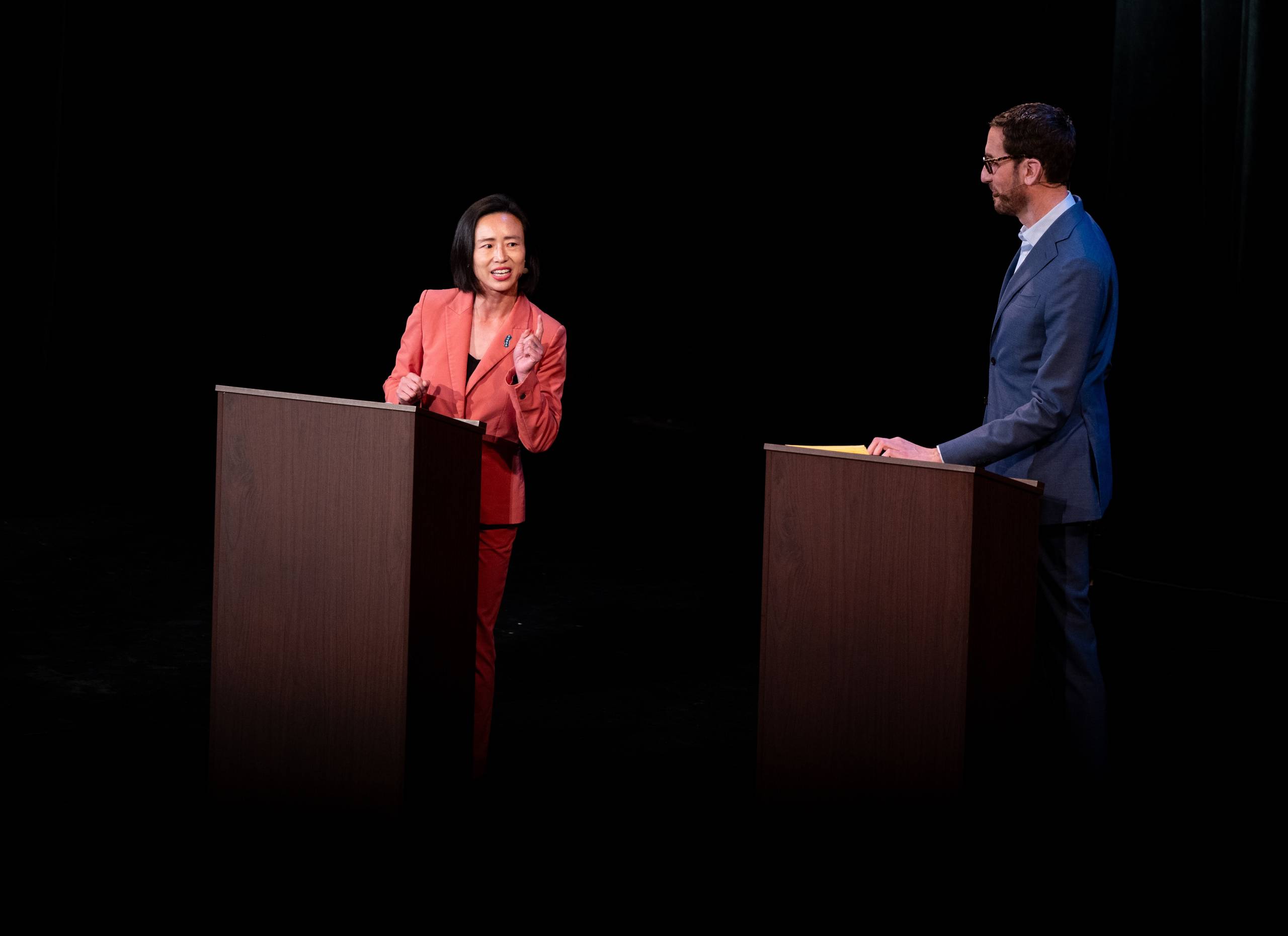
For decades, Nancy Pelosi has represented San Francisco in Congress. Now she’s retiring, making way for a truly competitive race for California’s 11th Congressional District. Today, we talk about the candidates — San Francisco Supervisor Connie Chan and state Sen. Scott Wiener — and discuss how they differ on the big issues.
Links:
Episode Transcript
This transcript is computer-generated. While our team has reviewed it, there may be errors.
Ericka Cruz Guevarra: [00:00:00] I’m Ericka Cruz Guevarra and welcome to The Bay, local news to keep you rooted. Nancy Pelosi has been San Francisco’s representative in Congress for decades. But now she’s retiring. And for the first time in a long time, a true competitive race is underway for California’s 11th congressional seat.
Sydney Johnson: [00:00:29] She has become a force in American politics, and whoever replaces her is gonna have huge shoes to fill.
Ericka Cruz Guevarra: [00:00:39] After winning Pelosi’s endorsement earlier this year, San Francisco Supervisor Connie Chan will face off against State Senator Scott Wiener. And while the two candidates are aligned on a lot of issues, San Francisco voters are gonna be looking at the finer print when they ffill out their ballots and where these candidates stand on everything from AI to housing to wealth taxes and Gaza.
Sydney Johnson: [00:01:09] Who we send to Congress to position themselves and make policy and law on these issues is gonna be incredibly important.
Ericka Cruz Guevarra: [00:01:19] Today, KQED reporter Sydney Johnson tells us more about who Connie Chan and Scott Wiener are and how these two differ on the big issues.
Sydney Johnson: [00:01:40] Locally, you know, this seat controls how San Francisco gets federal resources. Sydney Johnson is around.
Ericka Cruz Guevarra: [00:01:51] Reporter for KTVU.
Sydney Johnson: [00:01:51] That was a huge thing that, you know, Nancy Pelosi talked about. And I think why she earned the reputation that she did was she brought it back to San Francisco. It wasn’t just about those like flashy moments in Washington, but it was about showing the people in San Francisco that, hey, I’m working for you, you know, whether or not you agreed with what she was doing. And so, whoever goes on to represent San Francisco and Washington right now… Is going to have a big fight ahead of them to help the city get a lot of the funding that it has lost in recent years.
Ericka Cruz Guevarra: [00:02:29] I mean, I think maybe we sort of have taken for granted having such a powerful national figure who has spent decades working up to the career that she has to have brought so much resources back to San Francisco. And now there’s this historic shift that’s happening. And it’s historic also because both of the candidates in this election would be historic firsts in their own ways. So I wanna talk about them, starting with Connie Chan. Who is she and what kind of candidate is she shaping up to be in this race?
Sydney Johnson: [00:03:05] Yeah, Connie Chan is a supervisor in San Francisco. She represents the Richmond district. She was born in Hong Kong. She lived part of her early childhood in Taiwan and immigrated to San Francisco and grew up in Chinatown. And she’s really positioned herself as a working mom, as someone who is not taking money from billionaires in this race. Someone who’s looking out for the little guy, tenants.
Connie Chan: [00:03:37] We’ve been building that coalition in San Francisco, the Working People’s Coalition. We know how to fight, and we know how win. And we now will take this fight from San Francisco all the way to Washington, D.C.
Sydney Johnson: [00:03:50] She has sort of worked her way up in civil and public service. And she talks a lot about her experience on the board of supervisors as the budget chair, the person who brings all parties and interests together and tries to strike a deal. If Chan were to win, it would be the first time that we had someone who’s Chinese-American represent San Francisco in Congress. I think those are sort of the elements of the picture that she’s trying to paint of like. If you elect me, you’re electing the everyday San Franciscan.
Ericka Cruz Guevarra: [00:04:33] And then there’s your challenger, Scott Wiener. Remind us a little bit of his story and who he is as a candidate in this race.
Sydney Johnson: [00:04:43] Scott Wiener is a state senator representing San Francisco. Scott Wieter has really been pointing to his experience as a lawmaker, as this kind of bull in Sacramento, where he has passed tons of legislation. He’s kind of characterized as this policy wonk, but someone who’s going to work across the aisle in order to get things done.
Scott Wiener: [00:05:09] And we need leaders in Congress who do not just accept the status quo, but who demand change, even when it’s hard.
Sydney Johnson: [00:05:19] He would also be a historic first. He would be the first out gay man to represent San Francisco, which as we know has a huge history of being on the forefront of LGBTQ rights and gay marriage. And that is totally historic in its own right as well.
Ericka Cruz Guevarra: [00:05:38] Well Sydney, we’re gonna dive into their stance on some of these big issues, but how different are these candidates really and what do we know about how they might vote if they do get to Congress?
Sydney Johnson: [00:05:51] So, yeah, they will probably agree on the vast majority of issues in Congress that are applicable to a national scale. But here in San Francisco, you know, they are quite different. You know, Connie Chan gets kind of pegged as further left or more progressive in this race, even though she does have the endorsement of Nancy Pelosi herself, which we’ll get into. I think… The difference between these two, you know, one really lies in who’s supporting them and kind of the money that’s supporting, but also what they see as the definition of progress in San Francisco.
Ericka Cruz Guevarra: [00:06:34] Let’s get into the nitty gritty, where I think most San Francisco voters are probably sitting right now as they’re looking at their ballots and all the different ways that these candidates differ, starting with housing, which is of course a huge issue in San Francisco, in California. In what big ways do these two candidates differ in their approach to the housing crisis.
Sydney Johnson: [00:06:59] Yeah, I think housing is probably one of the areas where there’s the most stark difference between these two candidates. We’ll start with Senator Wiener. He has been known for passing a tremendous amount of legislation directed at housing at the state level, specifically to make it easier to build housing and also to increase pressure on cities to build housing. I mean, he supports more housing at all levels.
Scott Wiener: [00:07:27] I went to Sacramento and as a result of our work, thousands of affordable homes have been built in San Francisco with thousands more in the pipeline. We need to go big and build millions of homes in this country.
Sydney Johnson: [00:07:40] Senator Wiener has received a lot of support for the work that he’s done at the state level from pro-housing activists with Yimbi. And Chan, Wiener, has sort of painted her as an obstructionist, not only to what he sees as progress, but to literal housing projects and public transit projects in the city. He points to a project in Soma that Chan was part of a group of supervisors who oppose the development. She also opposed the mayor’s rezoning plan, which makes it easier to build taller and more dense buildings around the city.
Connie Chan: [00:08:18] We need to build housing, and we need to build housing that people can afford. We also need to help people to have rental subsidies so they can stay housed.
Sydney Johnson: [00:08:27] Her defense to this, she says she is looking out for tenants, that she’s looking out for small businesses that could be displaced by rents rising, by market rate developments. And she has said that those projects did not come with enough protections baked in. That’s the reason why she’s opposed a lot of projects.
Ericka Cruz Guevarra: [00:08:55] We’re gonna take a quick break, but when we come back, where the two candidates stand on AI, the billionaire tax, and Gaza. By the way, if you appreciate the work that we do here on the Bay, consider becoming a sustaining KQED member. That’s one of the best ways you can help support the journalism that we bring you here on this show. Just go to donate.kqed.org/podcasts. We’ll be right back.
Ericka Cruz Guevarra: [00:09:29] Another big issue in this race, Sydney, is AI. How do these two differ on that? They’re in all the ads!
Sydney Johnson: [00:09:38] For sure. They are dominating the ads in this race. Senator Wiener, he actually authored a A.I. Safety bill several years ago that Newsom vetoed. He came back the next year, and he got an AI transparency bill passed that Newsom did sign.
Scott Wiener: [00:09:57] But Congress has failed in a huge way around tech regulation. We have almost no federal regulation of AI.
Sydney Johnson: [00:10:05] Wiener has been talking a lot about this kill switch, this idea that when something really bad happens that AI is doing, there would be this kind of magical button that we could press to just shut it all off. But Chan has said that we shouldn’t wait until a catastrophe to have more regulation. In fact, we should wait before we move forward with the technology to figure out how to avoid that situation.
Connie Chan: [00:10:32] It is important to have human oversight during the developmental phase of the technology.
Sydney Johnson: [00:10:38] She’s taken kind of what one academic expert described to me as a more populist approach in this race when it comes to AI. She has called for a full moratorium on data centers until the technology is reined in and legislated. Wiener doesn’t support a full-on moratorium like that. He says that communities should decide where and when data centers get built. Another element to this, where the two have differed, is Wiener also just has more support, I think, from AI companies in general that are looking for regulation.
Connie Chan: [00:11:15] We as San Franciscans, but really all across the nation trust you to be able to regulate AI with integrity and that is not going to just placate to the industry.
Sydney Johnson: [00:11:28] You know, he has said that he has their support because they trust that he’s the guy who can get regulation done. Chan has pointed to legislation she’s supported locally to stop an AI-driven rent-fixing tool. But she does have a bit less experience in the lawmaking area than Wiener does around AI.
Scott Wiener: [00:11:49] And so we have a lot more work to do on AI regulation, and the reality is I’m the only candidate on this stage who has ever regulated AI full stop.
Ericka Cruz Guevarra: [00:12:04] I know these two also differ on the billionaire tax and wealth taxation, including in their support for Prop 40, the billionaire wealth tax. How are these two talking about that issue?
Sydney Johnson: [00:12:19] Wiener previously opposed the local overpaid CEO tax in San Francisco, which was defeated. And he is also opposing Prop 40. He has said that he supports taxing the wealthy, but that this one-time tax in particular is not the solution that he thinks is going to give Californians what we need.
Scott Wiener: [00:12:42] We already have an unstable boom bust budget. This will make it dramatically worse, and that’s why I don’t support it.
Sydney Johnson: [00:12:48] But he has said he supports things like Elizabeth Warren’s ultramillionaire tax. So I don’t think it’s fair to say that he doesn’t support wealth taxes full stop. But the ones that we are voting on here in San Francisco and California, he has opposed.
Connie Chan: [00:13:07] No billionaire should be paying less taxes than our teachers and nurses. And simple as that.
Sydney Johnson: [00:13:14] Chan has supported all of the above and has kind of used it to draw a line in the sand between her and Wiener.
Ericka Cruz Guevarra: [00:13:27] Okay, and then lastly on the issues, I wanna talk about foreign policy. They do seem similar on a few things here, but notably they differ around the issue of Israel and Gaza. How do these two differ in terms of their opinions on the U.S.’s relationship with Israel and Israel’s siege of Gaza?
Sydney Johnson: [00:13:53] Yeah I mean, just to go back to the early days of this race, there was a debate. Saikat Chakrabarti was still in the race at this time. The three candidates were asked if what’s happening in Gaza, what Israel is doing in Gaza is a genocide. And Chan and Chakrabarti held up their sign that said yes. And Wiener kind of twirled his sign. He didn’t answer the question. And the room erupted.
Protester: [00:14:31] Answer the question Scott!
Sydney Johnson: [00:14:31] Days later, Senator Wiener made a public announcement that he does consider what’s happening in Gaza to be a genocide. But I think for some voters, for whom this is their big issue that they’re maybe choosing their candidate on even, that that wasn’t totally satisfying. And Wieners does not support sending offensive arms to an Israeli government, but he does support defensive systems, such as the Iron Dome and David’s sling. But Chan talks about how she supports a full arms embargo to Israel. So there’s still some gray area between these two candidates on this.
Ericka Cruz Guevarra: [00:15:15] I wanna talk about how the campaign has been going so far. How are the candidates doing in this race? And have there been any other sort of pivotal moments that seem to be swaying voters in one direction or another?
Sydney Johnson: [00:15:30] Another thing I want to bring up, actually, that has been pretty pivotal in this race. Earlier this year, Scott Wiener’s campaign released an AI chatbot that people could go and ask a question and the responses were supposed to look like they were coming from Connie Chan. The idea was to basically create this interactive tool that you could go see why Connie Chan wants to block all of your housing. But it immediately fell flat. The reaction was pretty negative, pretty quick. And Connie Chan said that she felt that this was unfair, that she was being mocked. And Nancy Pelosi also stepped in and said, this is putting words in women’s mouths, something that women in politics have had to deal with for a long time. And they took it down. And they also took down the physical billboards that they had purchased to advertise his chat bot. And Scott Wiener publicly apologized. Even though it was not a good look, Wiener still has the lead in the polls. It doesn’t seem to have haunted his campaign in any lasting way.
Ericka Cruz Guevarra: [00:16:49] You talked a little bit about this already, Sydney, but can you summarize for me what the money is looking like in this race? Who’s funding both candidates here?
Sydney Johnson: [00:16:58] Well Wiener has raised far more than Chan has in this race, but Chan has significantly increased the amount that she’s raised, you know, specifically in this final stretch of the race. Chan has gotten money from labor groups, from Chinese American groups, and from Pelosi’s own family members. Wieners has received money from PACs that have contributions from AI companies and has received donations from people like crypto billionaire Chris Larson. He actually told Mission Local that he returned a donation from a Palantir executive. So he’s got the attention of tech for sure. But Wiener has also gotten union support. The last one to point out maybe is just that Grow USA, which is tied to the moderate political group in San Francisco called Grow SF, also contributed to Scott Wieners’ campaign.
Ericka Cruz Guevarra: [00:18:00] And what are you gonna be watching out for in the next couple of days?
Sydney Johnson: [00:18:03] You know, the last few days are always some of the most intense, I think, in terms of just the emotion, the feelings. You know obviously the polls are looking good for Scott Wiener, but we didn’t expect Connie Chan to do as well in the primary as she did. So it’ll be really interesting to see just what that final outcome looks like, how different neighborhoods vote in this race also. And yeah, we’ll be looking out for all of it.
Ericka Cruz Guevarra: [00:18:38] Well, Sydney Johnson, thank you so much as always. Appreciate it.
Sydney Johnson: [00:18:41] Thank you, Ericka.
Some members of the KQED podcast team are represented by The Screen Actors Guild, American Federation of Television and Radio Artists, San Francisco-Northern California Local.