


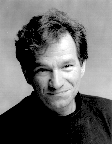
Peter L. Stein
Producer Peter L. Stein on the Making of The Castro
It's hard to pinpoint exactly how and when this program got its start. Was it in June of 1996, when KQED's cameras first started to roll tape (it was an AIDS benefit at Josie's Cabaret and Juice Joint)? Or perhaps it was in May 1992? That's when I first discussed the idea of a series of programs telling the story of San Francisco through its neighborhoods, and it quickly became clear to all of us that the Castro would make a powerful and entertaining episode.
Or was it in 1973, when a 13-year-old kid from the Sunset District had to spend a lot of after-school hours riding the streetcar home, and got his first look at the neighborhood that was soon to become the "gay mecca"? Truth to tell, I didn't notice too much about the Castro then -- it was just a place to catch the streetcar; but by the time I moved back to San Francisco as an adult in 1983, six blocks from Castro Street, the neighborhood had become, it seems irrevocably, a cornerstone of gay history. That transformation has always intrigued me -- because I feel a part of both worlds that the Castro defines. As a third-generation native San Franciscan, I can appreciate what the old "Eureka Valley" must have meant to its residents; and as a 37-year-old gay man, I have come to know both the appeal and the problems the Castro presents for a generation of gay men and lesbians who came of age there.
To tell the dramatic story of the Castro, my associate producer David Condon and I began by speaking with more than 200 individuals representing a wide spectrum of experiences in the neighborhood -- from the original merchants and families of Eureka Valley, to lesbian and gay pioneers who paved the way for a community to evolve in San Francisco in the '50s, to those who planted a rainbow flag in the neighborhood in the '70s, to young queers disaffected from the neighborhood today.
As a storyline emerged, we called upon KQED's viewers (as well as the remarkable archives of the Gay and Lesbian Historical Society of Northern California) to begin piecing together a visual history of the neighborhood; and shooting and interviewing took place mainly during the summer of 1996 -- more than 70 hours in total. Sometimes we were fortunate in our discoveries: a visiting out-of-towner happened to catch one of our appeals for footage on the air, and supplied us with exquisite and poignant home movies of gay life in San Francisco in the '40s and '50s. And sometimes we lost out: many of the important storytellers of the Castro, who should by all rights be around to share their tale, have died in the last 15 years. AIDS still casts a long shadow over the neighborhood, as inevitably it must over the documentary -- but I hope that in re-telling the history of the neighborhood, some of what shines through is the sense of exhilaration that an entire community began to feel as they laid claim to a neighborhood in a way that was unprecedented. What is most remarkable to me is that the sense of attachment to the valley has been transferred from generation to generation, from community to community over decades. It seems that somebody always wants to call that place "home."
The Castro Q and A
It was an unlikely setting for a revolution. A modest San Francisco neighborhood became, virtually overnight, an icon for a social and political movement. Filmmaker Peter L. Stein reflects on the making of The Castro, which traces the dramatic transformation of a quiet, working-class neighborhood of European immigrants into an international symbol of gay liberation.
Q. Why is this documentary about a neighborhood in San Francisco important to a national audience?
A. I think that the story of San Francisco's Castro District is one of the great immigrant stories of our country. The twist is, though, that these immigrants weren't fleeing distant tyrants or famines, but intolerant communities and families in their own country. Once they found each other in the streets of the Castro, they built a culture together, found political strength, and became part of a movement that was sweeping the nation. More than any other place, this one neighborhood came to symbolize, for better or for worse, the growing visibility of a group of people whose invisibility would have been preferred by much of the country.
Q. You're seeming to claim The Castro is the first gay neighborhood. How can that be?
A. Oh, even as far back as the 1920s there were certainly neighborhoods where homosexuals knew they could find each other, not only in San Francisco, but notably in Greenwich Village in New York. But before the era of the Castro, so-called "gay neighborhoods" were associated strictly with nightlife, or vice and prostitution, or at best a kind of Bohemian attitude that tolerated everybody, not just gays and lesbians. The Castro was really the first place where gay people set out to plant a rainbow flag in a neighborhood and stake a claim to it as their turf, where they could own businesses, buy property, elect their own officials, and walk down the street as a gay or lesbian person 24 hours a day. This was new. It was a new way of thinking about being a gay person in America -- not only could you be visible, you could have a home base, and your strength could be counted at the polls, at the cash register, in the property tax rolls. That's a powerful shift for a group of people who never felt they could be "at home" anywhere.
Nowadays you have neighborhoods in many cities -- West Hollywood, Chicago's North Halsted Street and Miami's South Beach, for example -- that are proudly gay-identified -- but the Castro, because it sprang up so fast and with such notoriety, became a kind of archetype of gay America. It also became a lightning rod for America's discomfort with so-called "gay power."
Q. It seems that gay life was not very well recorded until the explosion of the 1970s. Did that hamper your efforts to tell the story?
A. Gay history is mainly a hidden history until very recently. We are fortunate in having a local repository, the Gay and Lesbian Historical Society of Northern California, that has tried to preserve the images and the ephemera of gay life in this area. But it took a lot of hunting; my associate producer David Condon and I spoke with some 200 people before ever rolling a foot of tape. Sometimes we were fortunate in our discoveries: a visiting out-of-towner happened to find out about our project, and supplied us with exquisite and poignant home movies of gay life in San Francisco in the '40s and '50s. And sometimes we lost out: many of the important storytellers of the Castro, who should by all rights be around to share their tale, have died in the last 15 years. AIDS casts such an enormous shadow over the neighborhood.
Q. Were you ever concerned that the tragedy of AIDS would overwhelm your documentary?
A. AIDS is overwhelming, and it had to be dealt with in the story. But here again, time and history are funny things -- I don't think I could have made this documentary even 3 years ago. The neighborhood was still in the depths of a kind of psychic trauma that couldn't allow for any perspective on the momentous drama that happened there in the '70s. But when we began shooting in 1996, it seems that gay men of the generation who had lived through the nightmare were just beginning to turn the corner on AIDS -- not simply from a health standpoint, but in a larger sense. It seems people were beginning to try to make sense of the big picture -- and to remember with fondness the roller-coaster ride they had been on. And I think that joy of reminiscence is so important.
Q. A surprising bit of trivia from the documentary is that one of Tony Bennett's signature songs, "I Left My Heart in San Francisco," was written by two gay men. What are some other gems that you uncovered?
A. Yes, "I Left My Heart in San Francisco" was written by George Cory and Douglas Cross, two songwriters from New York who visited the city in the 1950's and were obviously taken with what they found here. It turns out that San Francisco in the 1950s was pretty well known as a friendly town for gays, despite the routine entrapments, harassment and police raids they suffered.
Another surprise I found-and this is not really trivia at all, but pretty important-was regarding San Francisco's well developed gay political community long before the Castro and Harvey Milk. You know, "gay liberation" is often seen as being born in June 1969, with the riots at New York's Stonewall Bar. And certainly, that uprising was nationally significant. But four years earlier in San Francisco, an incident took place on New Year's Day that put this city's gay and lesbian community on the map. There was a raid on a gay fundraising event that angered a lot of progressive heterosexuals (because some of them had been arrested too!), and eventually a judge threw out all the charges. It didn't have the national impact that Stonewall did but it helped develop a public awareness in San Francisco that gays and lesbians should be, to some degree, left unharassed.
And then of course there is the Twin Peaks Bar. In the early 1970s, a couple of lesbians bought one of the old Irish bars at the corner of Castro and Market Streets. It was pretty decrepit, dark and quiet. At the time, the trend in the swinging straight taverns was the "fern bar" look -- big windows, lots of plants, and a big wooden bar. Well, the women decided to open a gay men's bar with a similar look, and they installed enormous plate glass windows fronting Castro Street. It's hard to believe, but it was the first time that a gay bar had opened itself up so the world could look inside. That was only 25 years ago. And the bar is still there.
Q. What drew you to the story of the Castro District?
A. I have a rather unusual connection to it, because I am one of those rare people who didn't immigrate to San Francisco to begin a new life, but instead was actually born and raised here -- as was my father. We watched the neighborhood change before our eyes. So as a native, I could sympathize with the sense of loss that many of the old-timers felt in seeing their tight-knit community break apart. But just as important, I'm keenly aware of how transforming the experience of the Castro was to a whole generation of gay men and women -- the sense of finding their "people" for the first time. So I had a unique perspective on the history.
Interestingly, though, when I first moved back to San Francisco as an adult in the early '80s, I didn't really like the Castro -- I found it claustrophobic, too homogeneous, and relentlessly sexualized. My women friends felt invisible there. But after getting to know so many men and women whose lives were changed by the experience of the neighborhood, I really came to have a sense of wonder about the history that happened there. Even with its problems, the Castro is really an extraordinary chapter in a larger struggle that virtually every American minority has undergone -- the struggle for identity, survival, and ultimately, acceptance. And that was a story I wanted to tell.
Q. The documentary brings up some of the problems the neighborhood has experienced -- not just from neighbors, but from within the gay community. Is there a lot of criticism about the Castro?
A. Well at first, the very fact that a lot of open homosexuals were claiming a neighborhood as their "turf" was problematic for many of the old-timers -- but it's important to point out that on the whole, Eureka Valleyites have been extremely tolerant of the earth-shaking changes that swept the neighborhood. Of course, many of them benefited, as they watched their property values skyrocket in the 1970s and 1980s. But there were wonderful changes that happened, too -- places like Most Holy Redeemer Church, which at the outset was very critical of the gay "influx," turns out now to be a very progressive, gay-friendly congregation that turned their old convent into an AIDS hospice.
Within the gay community, women and people of color have always felt marginalized by the very white, very mainstream, very male world that the Castro became in the 1970's. And only in the last 10 years has the gay community begun to address these issues. To this day there are still no women's bars or hangouts in the Castro.
Q. Where is the neighborhood headed now?
A. There is a lot of trepidation over the growing commercialization of the Castro. And it's a fascinating parallel with some of the other "signature" ethnic neighborhoods in the U.S., like San Francisco's Chinatown or Boston's North End. Parts of those neighborhoods have become Disneyland versions of themselves, with no relation to the communities they once served. And as gays and lesbians find that they can live in lots of different places without fear, the very need for a "gay neighborhood" may in fact be obsolete. So what's to keep the Castro from becoming just another yuppie enclave?
But you know, one of the people I interviewed for the show, Sharon Johnson, told me a wonderful story. She grew up in the neighborhood when it was Eureka Valley, and she's seen it change a lot. She met a gay taxi driver in the Castro a little while ago who said, "I've only been here a couple of months, but somehow, this place feels like home." And Sharon said, "Well, welcome home." And that's really the spirit of the place -- it has always opened its arms to newcomers who needed a place to call home. I hope it never loses that.